Goal-Oriented Task Planning in Agentic AI Systems
Introduction
Agentic systems are no longer limited to answering prompts. They are increasingly expected to interpret goals, break them into tasks, execute actions, and adapt when conditions change.
Learners who begin exploring these ideas through an Agentic AI Certification Course quickly realize that planning is the real foundation of intelligent behavior.
A model that generates text is useful, a system that plans, prioritizes, and acts toward an objective is far more complex. Goal-oriented task planning sits at the center of that complexity. Without structured planning, agents either loop endlessly, take unsafe actions, or stop at partial results.
What Goal-Oriented Planning Actually Means?
Goal-oriented planning is the ability of an AI system to:
● Interpret a high-level objective
● Decompose it into smaller executable tasks
● Order those tasks logically
● Track progress
● Adjust steps when conditions change
Instead of reacting step-by-step, the agent maintains a representation of the goal and continuously evaluates how close it is to completion.
Core Planning Layers in Agentic Systems
Layer
Goal Interpreter
Task Decomposer
Function
Risk if Missing
Converts intent into structured objectives Misaligned outputs
Breaks goal into subtasks Incomplete execution
Dependency Manager Orders tasks correctly Logical errors
State Tracker Maintains memory of progress Repetition or loops
Execution Controller
Triggers actions safely Unsafe automation
Each layer reduces unpredictability.
From Prompt-Based to Goal-Based Execution:
Traditional systems operate like this:
User Prompt → Model Response → Stop
Goal-driven agents operate differently:
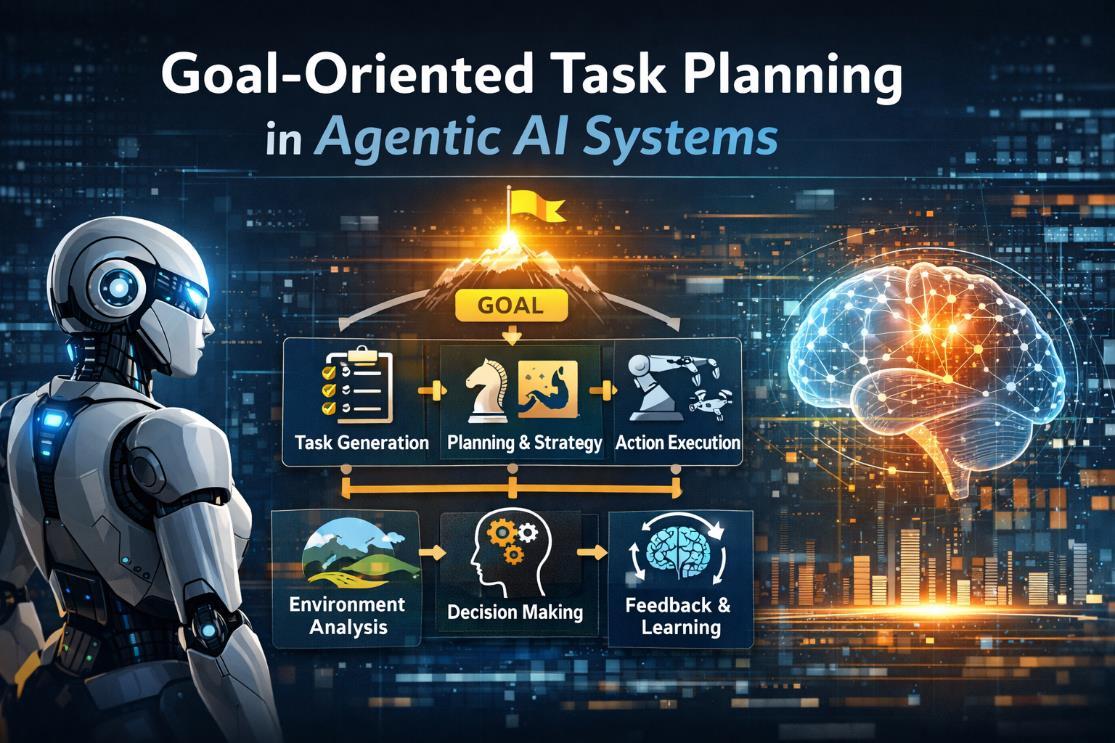
Goal → Task Breakdown → Action → Feedback → Adjust → Continue
This loop introduces autonomy but also introduces risk. Without constraints, agents may overreach.
Task Decomposition Strategies:
Effective decomposition depends on clarity.
Common strategies:
● Hierarchical breakdown (parent → child tasks)
● Dependency graph mapping
● Milestone-based segmentation
● Resource-aware planning
Example conceptual structure: goal = "Deploy scalable API" tasks = [ "Design architecture", "Provision infrastructure", "Deploy services", "Test performance" ]
The agent must also understand dependencies:
● Infrastructure before deployment
● Deployment before testing
Planning Under Uncertainty:
Agentic systems operate in changing environments.
Challenges include:
● Missing information
● Conflicting signals
● Delayed responses
● Tool failures
Planning must therefore include:
● Retry logic
● Fallback strategies
● Escalation rules
● Safe exit conditions
Without these controls, autonomy becomes instability.
Rule-Based vs Adaptive Planning:
Planning Type
Fixed Rules
Adaptive Logic
Characteristics Trade-Off
Predictable, simple
Context-aware
Hybrid Model Rules + learning
Low flexibility
Higher complexity
Balanced control
In many enterprise scenarios, hybrid approaches are preferred because they balance adaptability with oversight.
Role of Feedback Loops:
Planning without feedback is guesswork.
Agents require:
● Outcome verification
● Performance metrics
● Error detection
● Replanning triggers
Example cycle:
if task_status == "failed": replan()
Feedback loops prevent silent drift from the original goal.
Guardrails in Goal Planning:
When studying structured approaches through a Generative AI Course in Noida, learners often encounter guardrail concepts early.
Critical guardrails include:
● Action permission limits
● Resource usage thresholds
● Execution time limits
● Human approval checkpoints
Autonomous planning without guardrails risks unintended side effects.
Memory and Context Handling:
Planning requires state awareness.
Two memory types are common:
● Short-term execution memory
● Long-term contextual memory
If the agent forgets previous steps, it may:
● Repeat completed tasks
● Re-open closed actions
● Misinterpret progress
Memory systems must be structured, not improvised.
Measuring Goal Completion:
Agents must define completion conditions clearly.
Completion signals may include:
● All tasks executed successfully
● Validation tests passed
● Approval received
● Metrics within threshold
Accuracy
Completion Metric Example
95% success rate
Performance Latency below 200ms
Resource Usage Within allocated budget
Validation Manual confirmation
Without measurable endpoints, agents may continue indefinitely.
Common Failure Modes:
Goal-oriented agents often fail due to:
● Poor task sequencing
● Ignoring dependency constraints
● Acting without verifying state
● Overgeneralizing rules
● Not detecting goal ambiguity
Example failure scenario:
Goal: Update database
Agent skips backup step
Data loss occurs
Planning must include safety-critical checkpoints.
Multi-Agent Coordination:
Advanced systems may distribute tasks across agents.
Challenges:
● Synchronizing task order
● Avoiding duplication
● Managing shared state
● Resolving conflicting decisions
Coordination Issue Impact
Race Conditions
State Conflict
Misaligned Goals
Deadlocks
Inconsistent output
Data corruption
Partial execution
System halt
Structured orchestration becomes necessary as complexity increases.
Planning and Resource Awareness:
Autonomous systems must understand constraints.
Planning should consider:
● API rate limits
● Compute budget
● Execution deadlines
● Security policies
Agents that ignore resource limits may complete goals but create operational risk.
Designing for Transparency:
Goal-oriented systems should log:
● Initial goal
● Generated tasks
● Decision rationale
● Execution results
● Replanning steps
Transparency improves:
● Debugging
● Compliance
● Trust Without traceability, diagnosing agent decisions becomes difficult.
Learning and Plan Refinement:
Advanced agents refine planning patterns over time.
They may:
● Adjust task ordering
● Improve time estimation
● Reduce redundant steps
● Optimize resource allocation
This adaptive refinement must remain within defined boundaries.
Programs such as a Masters in Gen AI Course often emphasize that improvement mechanisms must not override safety rules.