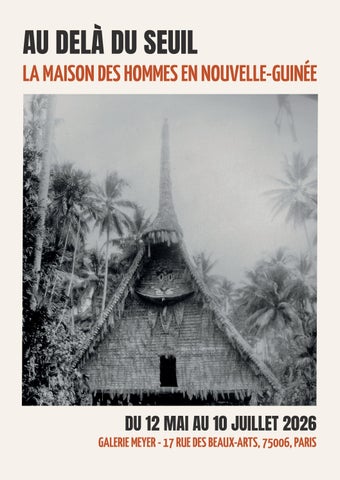
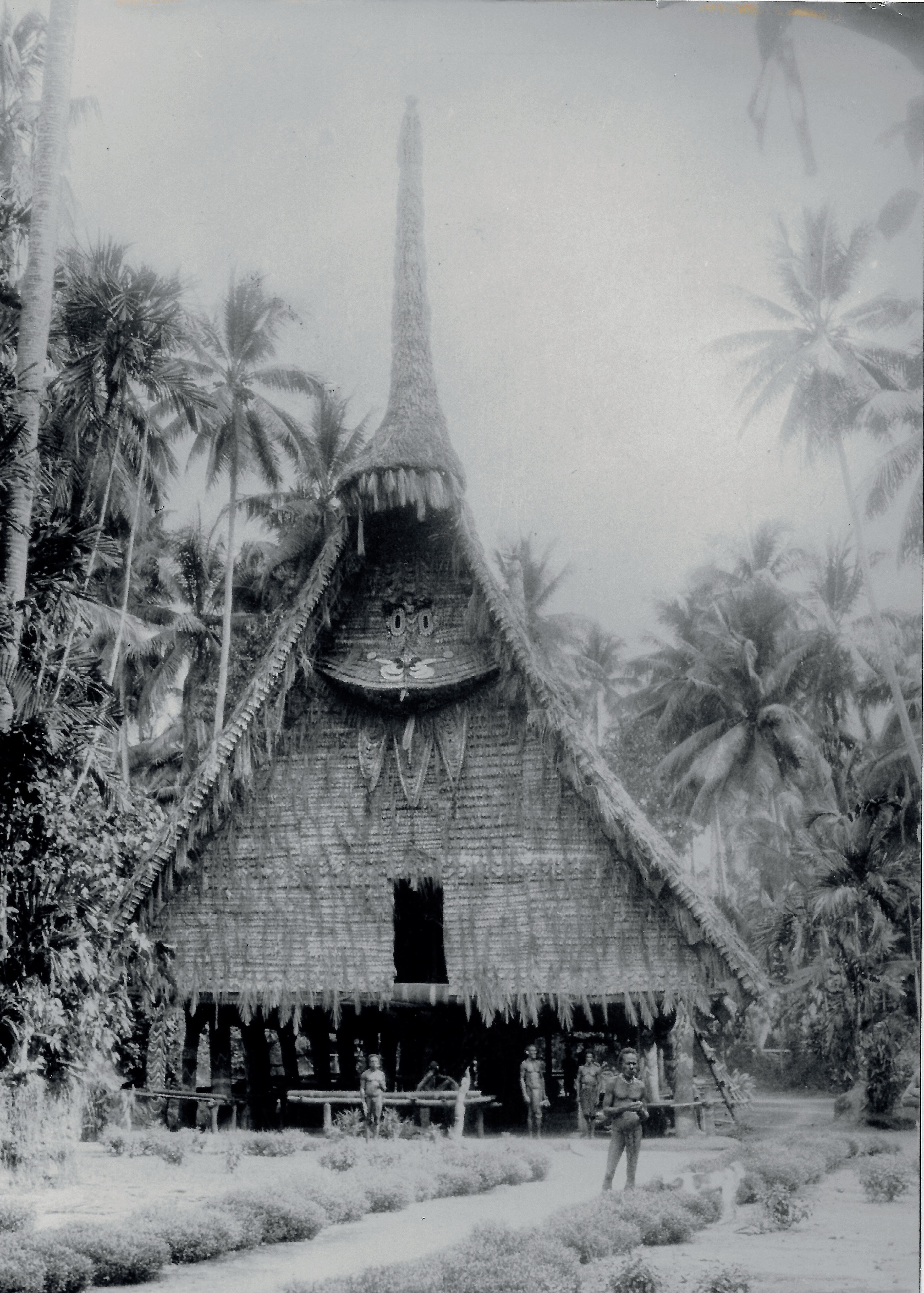
Depuis le début de mes études en anthropologie et en arts de l’Océanie à l’École du Louvre, une fascination persiste. Elle ne m’a jamais quittée. Elle porte sur un lieu dont je ne savais presque rien, sinon qu’il m’est interdit : la maison des hommes.
Il y a, dans cette interdiction même, quelque chose qui attire. Un espace que l’on ne voit pas mais autour duquel tout semble s’organiser. Au fil des années, ce lieu s’est imposé à moi comme une énigme. Comment un même espace peut-il rassembler tant de fonctions primordiales ? Comment peut-il contenir, à lui seul, l’équilibre d’un monde ?
Cette exposition est un hommage à ces lieux aujourd’hui souvent disparus ou profondément transformés, sans prétendre vous en présenter une reconstitution fidèle, les oeuvres exposées vous offrent un aperçu des objets, des pratiques et des croyances qui animaient ces lieux.
Je signe ici ma première exposition en tant que commissaire. Elle marque l’aboutissement d’un parcours académique mené entre l’École du Louvre et l’IESA.
Je tiens à remercier celles et ceux qui m’ont accompagnée tout au long de ces années, et en particulier Anthony JP Meyer, qui me donne aujourd’hui l’opportunité de partager avec vous une partie de ce savoir.
Since the beginning of my studies in anthropology and Oceanic arts at the École du Louvre, a fascination has persisted. It has never left me. It concerns a place I know almost nothing about, except that it is forbidden to me: the men’s house.
There is, within this very prohibition, something deeply compelling. A space that is not seen, yet around which everything seems to be organised. Over the years, this place has established itself in my mind as an enigma. How can a single space bring together so many essential functions? How can it, on its own, contain the balance of an entire world?
This exhibition is a tribute to these places, which are today often disappeared or profoundly transformed. Without claiming to offer a faithful reconstruction, the works presented here provide an insight into the objects, practices, and beliefs that once animated these spaces.
Here, I present my first exhibition as a curator. It marks the culmination of an academic journey undertaken between the École du Louvre and IESA. I would like to thank those who have accompanied me throughout these years, and in particular Anthony JP Meyer, who is now giving me the opportunity to share part of this knowledge with you.
Vairea ANANIA
ARCHITECTURE
Comment traiter d’un sujet si complexe sans commencer par les éléments mêmes qui le constituent ?
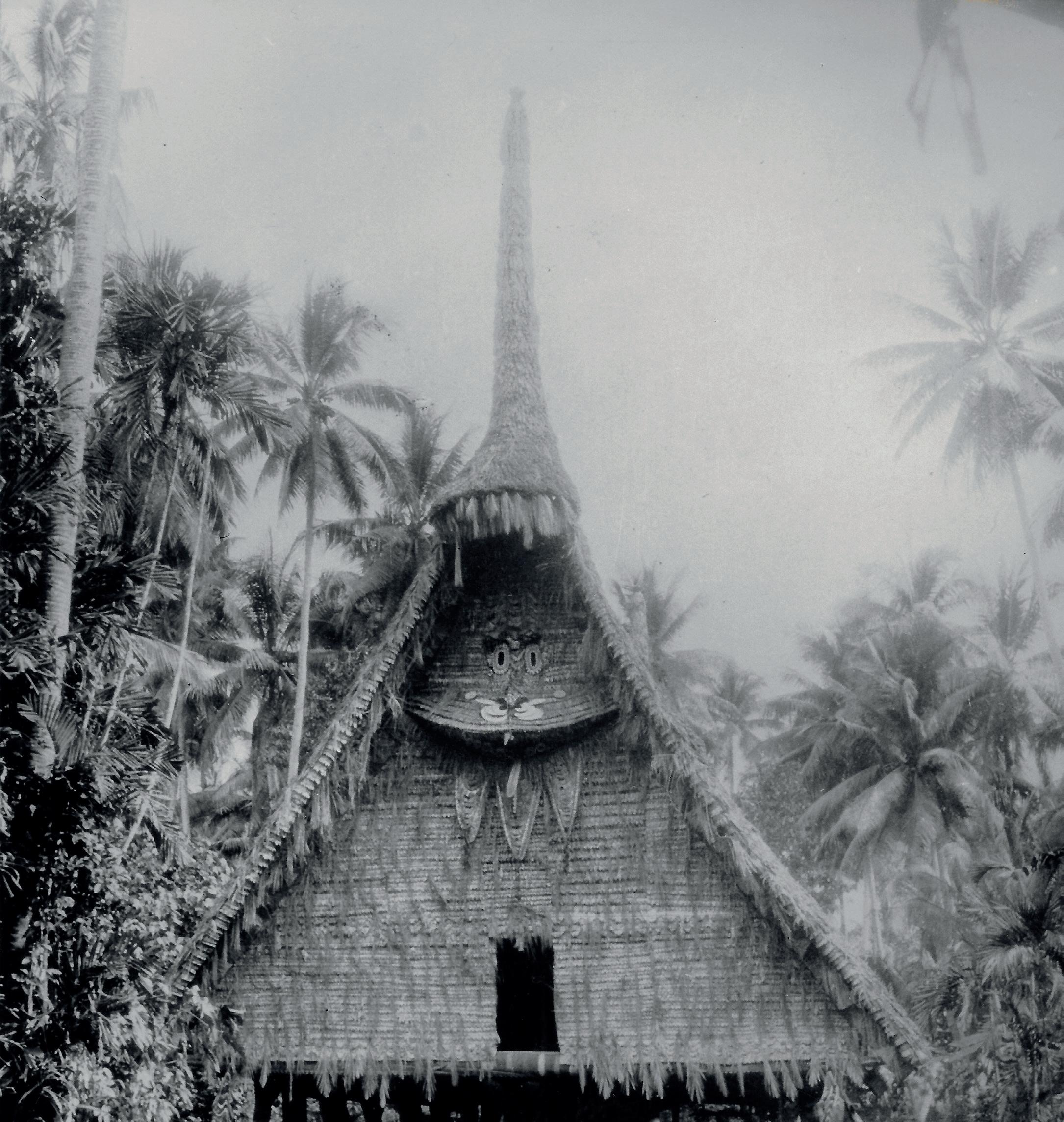
Fondations, poteaux, charpente et décors traduisent bien plus qu’une simple conception utilitaire de l’architecture : ils participent à l’élaboration d’un ensemble profondément signifiant, celui d’un corps. Souvent associé au féminin, celui-ci se présente comme une enveloppe protectrice que l’on peut assimiler au ventre maternel. À ce titre, la maison des hommes devient un lieu de transformation essentiel, notamment lors des rites d’initiation des adolescents qui, en y entrant, expérimentent une forme de seconde naissance.
Le plus souvent érigées sur pilotis et construites à partir de bois résistants et de feuillages, ces architectures incarnent à la fois le centre politique et spirituel de la communauté. Si chaque groupe possède ses spécificités et chaque maison ses particularités, toutes participent néanmoins d’un même langage architectural, où se croisent fonctions sociales, mémoire ancestrale et représentation du monde.
How can one address such a complex subject without first considering the very elements that constitute it?
Foundations, posts, framework, and decorative elements express far more than a purely utilitarian approach to architecture: they contribute to the creation of a deeply meaningful whole, that of a body. Often associated with the feminine, it appears as a protective envelope that can be likened to the maternal womb. As such, the men’s house becomes a site of essential transformation, particularly during initiation rites, when teenagers, upon entering it, experience a form of second birth.
Most often raised on stilts and constructed from durable wood and foliage, these structures embody both the political and spiritual center of the community. While each group has its own specificities and each house its particular features, all nonetheless partake in a shared architectural language, where social functions, ancestral memory, and representations of the world intersect.
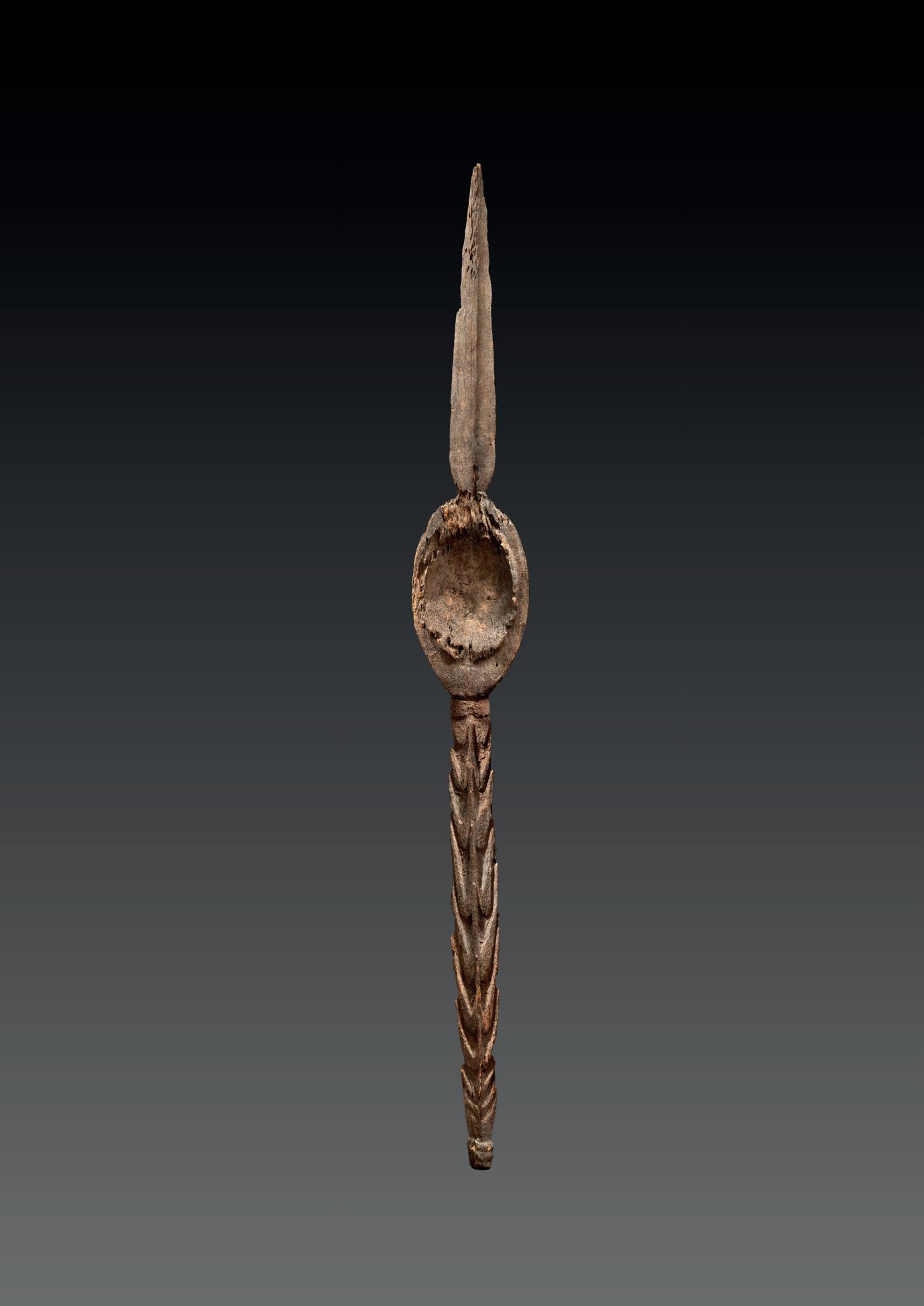
SOMMET DE POTEAU DE MAISON DES HOMMES
Lacs Murik et embouchure du fleuve Sepik, Papouasie-Nouvelle-Guinée, Mélanésie. XIX e - XX e siècle. Bois.
107 × 42,5 × 20 cm.
Provenance : Mission Marienburg, Papouasie-Nouvelle-Guinée ; Ph. Dodier, Avranches ; H. & P. Leloup, Paris ; Sotheby’s Londres, 16 juin 1980, lot 120 ; Loudmer-Poulain, Paris, 24 juin 1981, lot 17 ; Audap-Godeau-Solanet, Paris, 10 novembre 1989, lot 153 ; collection Pierre Robin, Paris ; collection privée néerlandaise ; D. Rosenthal.
TOP OF A MEN’S HOUSE POST
Murik Lakes and the mouth of the Sepik River, Papua New Guinea, Melanesia. 19 th -20 th century. Wood.
107 × 42.5 × 20 cm.
Provenance: Marienburg Mission, Papua New Guinea; Ph. Dodier, Avranches; H. & P. Leloup, Paris; Sotheby’s, London, 16 June 1980, lot 120; Loudmer-Poulain, Paris, 24 June 1981, lot 17; Audap-Godeau-Solanet, Paris, 10 November 1989, lot 153; Pierre Robin collection, Paris; private Dutch collection; D. Rosenthal.
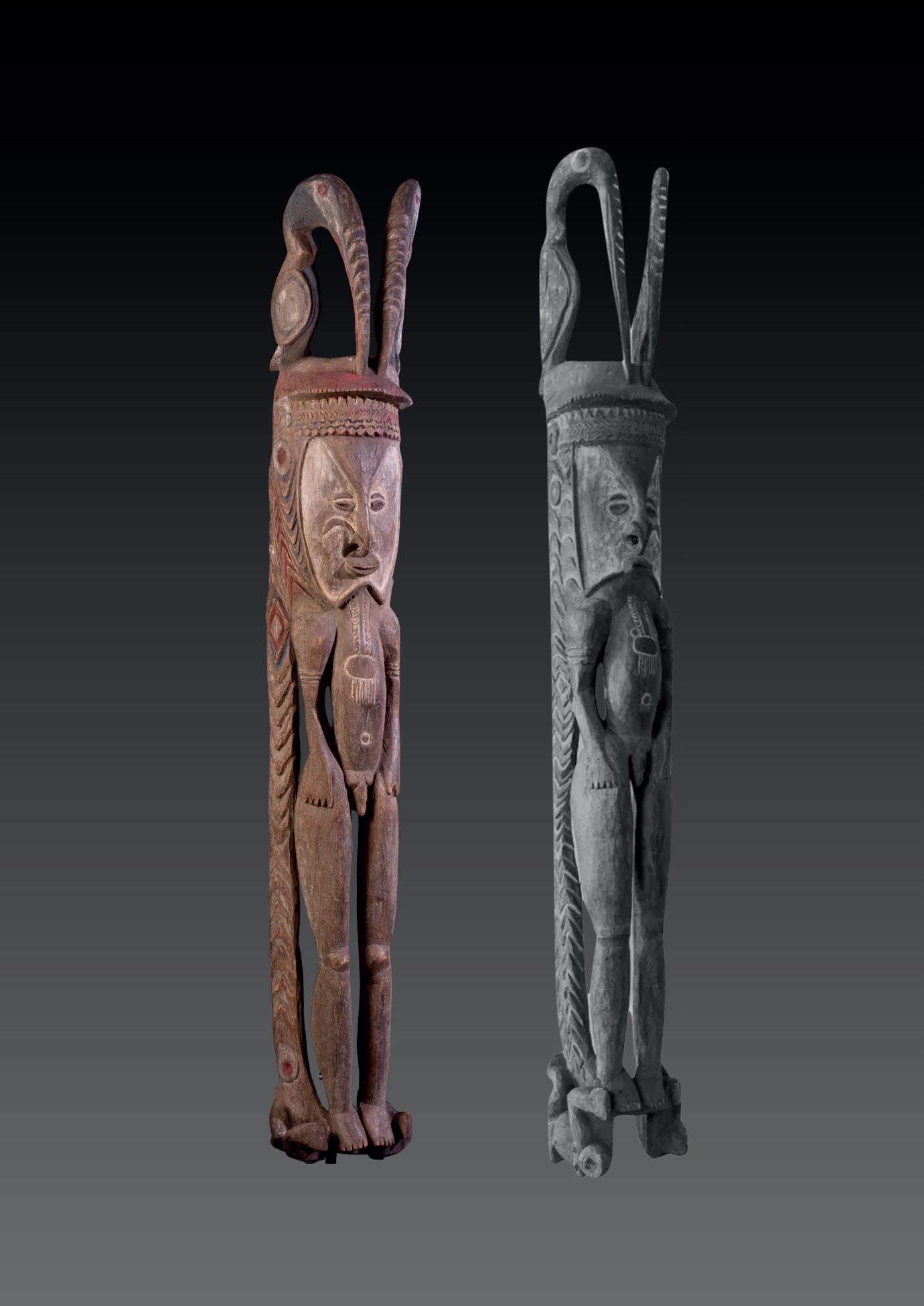
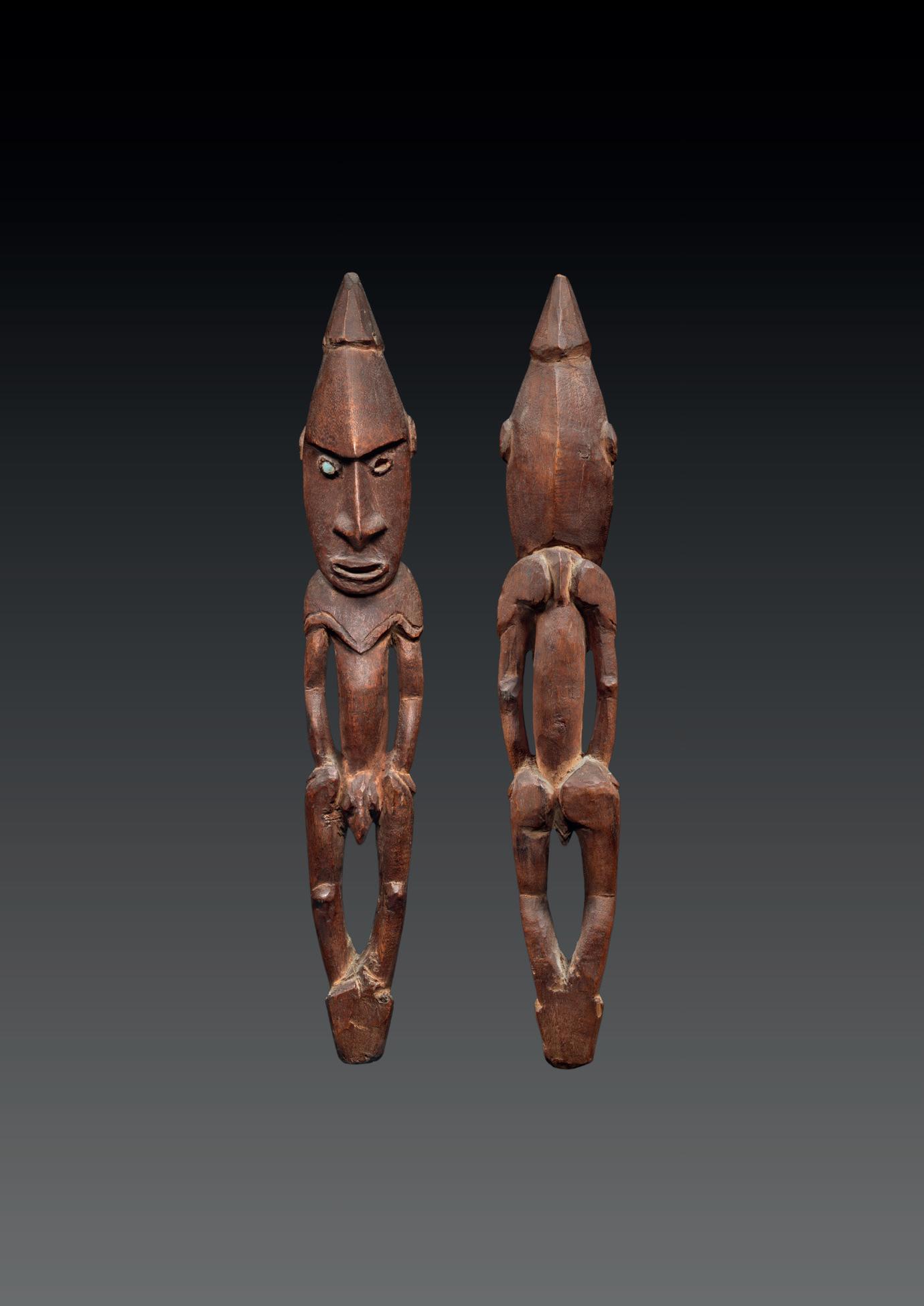
PAIRE DE GRANDES FIGURES
WOSERA SAWOS (NGWALL)
Village de Numangwa, région Sawos, Moyen Sepik, Papouasie-Nouvelle-Guinée.
Début - milieu du XX e siècle.
Bois dur, pigments rouges, bleus, blancs et noirs.
206 × 25 × 28 cm ; 225 × 25 × 29 cm.
Collectée in situ par Chris Boylan dans le village de Numangwa.
PAIR OF LARGE WOSERA
SAWOS FIGURES (NGWALL)
Numangwa Village, Sawos region, Middle Sepik, Papua New Guinea. Early to mid-20 th century.
Hardwood, red, blue, white, and black pigments.
206 × 25 × 28 cm; 225 × 25 × 29 cm.
Collected in situ by Chris Boylan in the village of Numangwa.
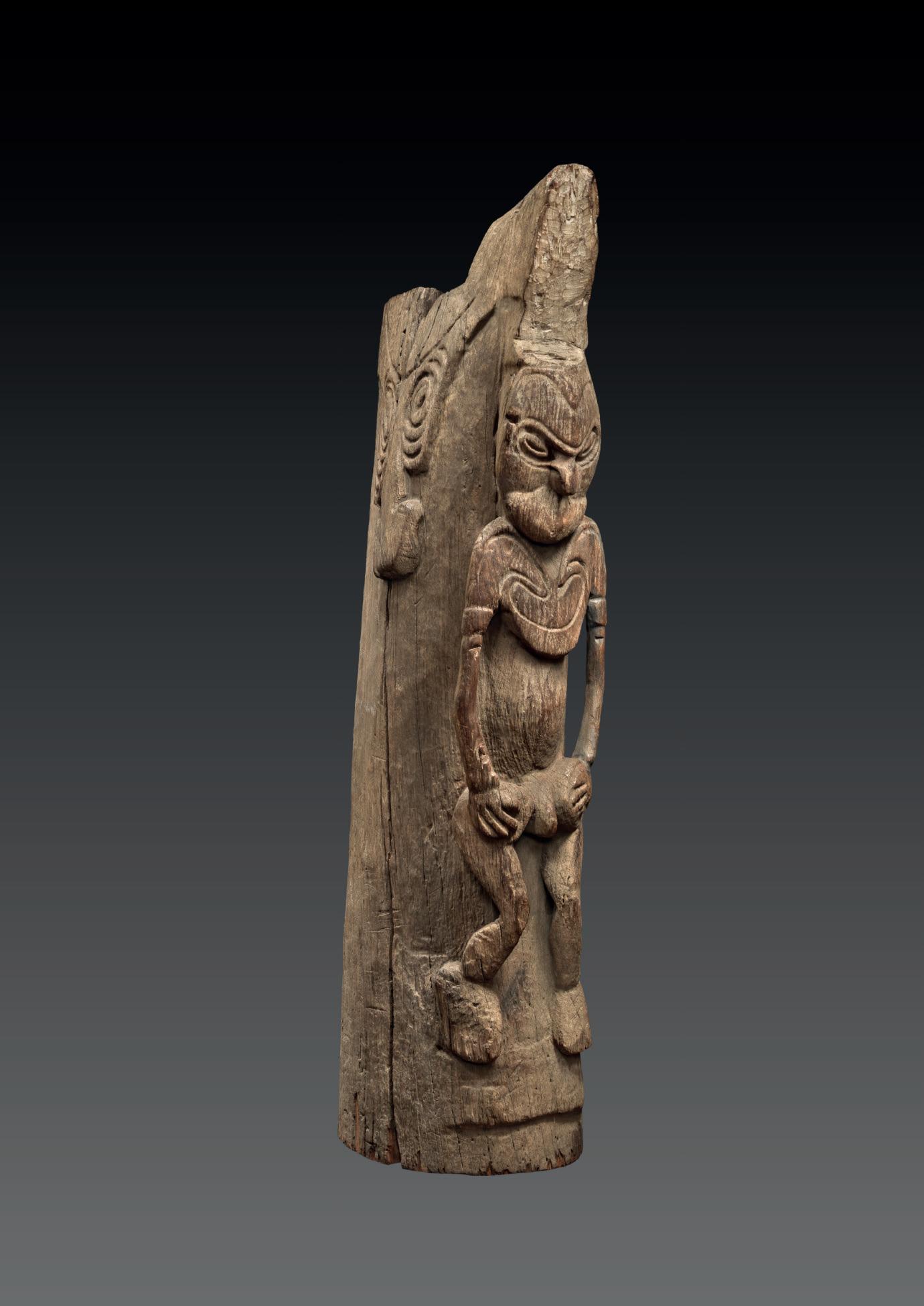
POTEAU CENTRAL DE MAISON DES HOMMES
Région Boiken, Bas Sepik, Papouasie-Nouvelle-Guinée, Mélanésie. XXe siècle.
Bois (alstonia ?) avec traces de pigments.
Hauteur : 163 cm.
Collecté sur le terrain par Ulrich Kortmann et Michael Kremerskoten dans les années 1970 - 1980.
CENTRAL POST OF A MEN’S HOUSE
Boiken region, Lower Sepik, Papua New Guinea, Melanesia. 20th century.
Wood (alstonia?) with traces of pigment.
Height: 163 cm.
Collected in the field by Ulrich Kortmann and Michael Kremerskoten in the 1970s-1980s.
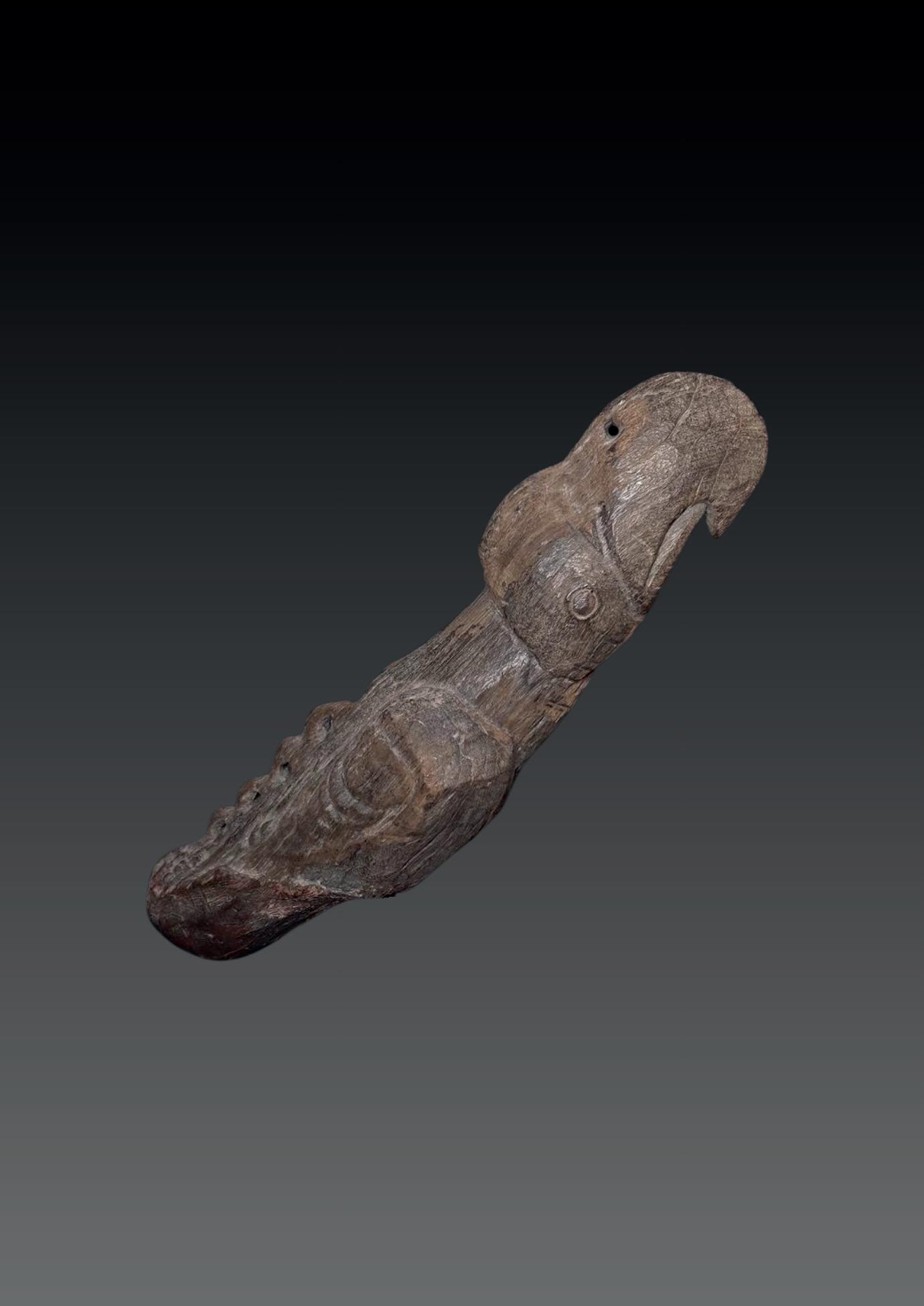
ÉPIS DE FAÎTAGE
À L’EFFIGIE D’UN AIGLE
Groupe linguistique latmul, Moyen Sepik, Papouasie-Nouvelle-Guinée, Mélanésie.
XIX e - XX e siècle.
Bois avec une forte patine d’érosion et d’âge.
50 × 13 × 16 cm.
RIDGEPOLE FINIAL IN THE FORM OF AN EAGLE
Iatmul linguistic group, Middle Sepik, Papua New Guinea, Melanesia. 19 th -20 th century.
Wood with an erosion and aged patina.
50 × 13 × 16 cm.
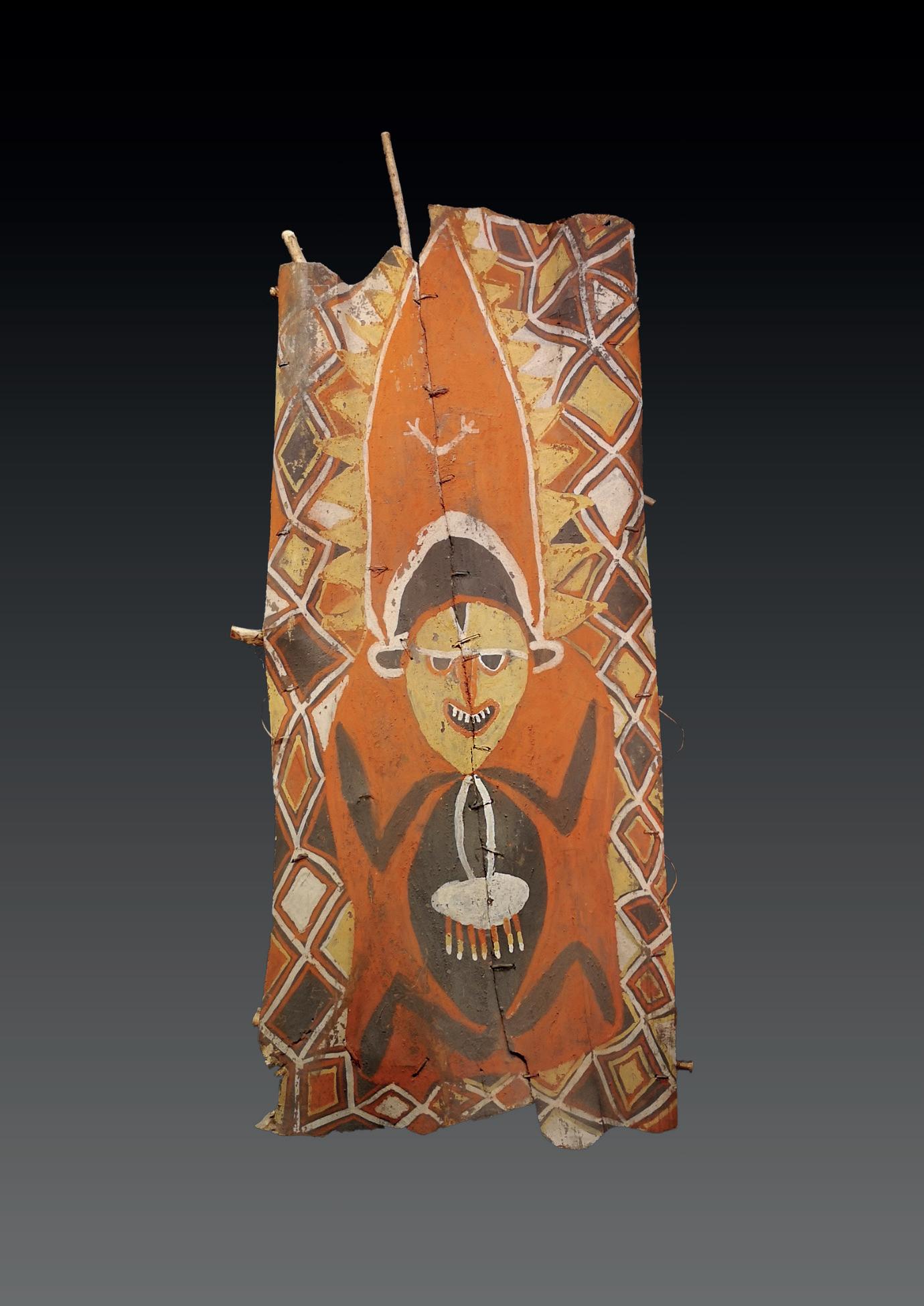
PEINTURE SUR ÉCORCE
Région de Maprik (Abelam), monts du Prince Alexander, Papouasie-Nouvelle-Guinée, Mélanésie.
Début à milieu du XX e siècle.
Écorce de palmier sagou, bois, rotin et pigments indigènes.
150 × 73 cm.
Collecté sur le terrain par Peter Hallinan au début des années 1970.
Provenance : ex collection Peter Hallinan, Queensland (inv. H503).
BARK PAINTING
Maprik region (Abelam), Prince Alexander Mountains, Papua New Guinea, Melanesia.
Early to mid-20 th century.
Sago palm bark, wood, rattan, and indigenous pigments.
150 × 73 cm.
Collected in the field by Peter Hallinan in the early 1970s.
Provenance: ex Peter Hallinan collection, Queensland (inv. H503).
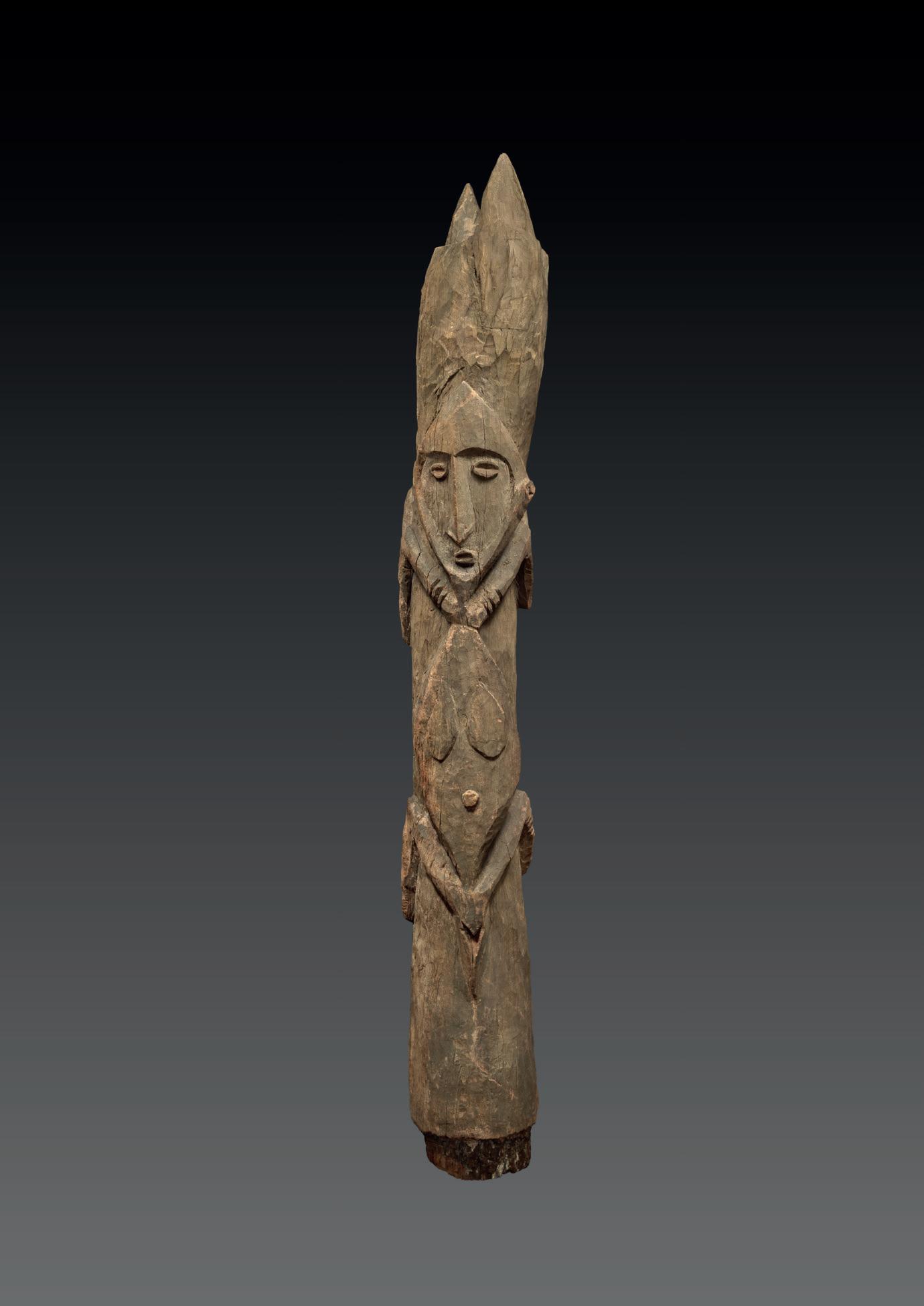
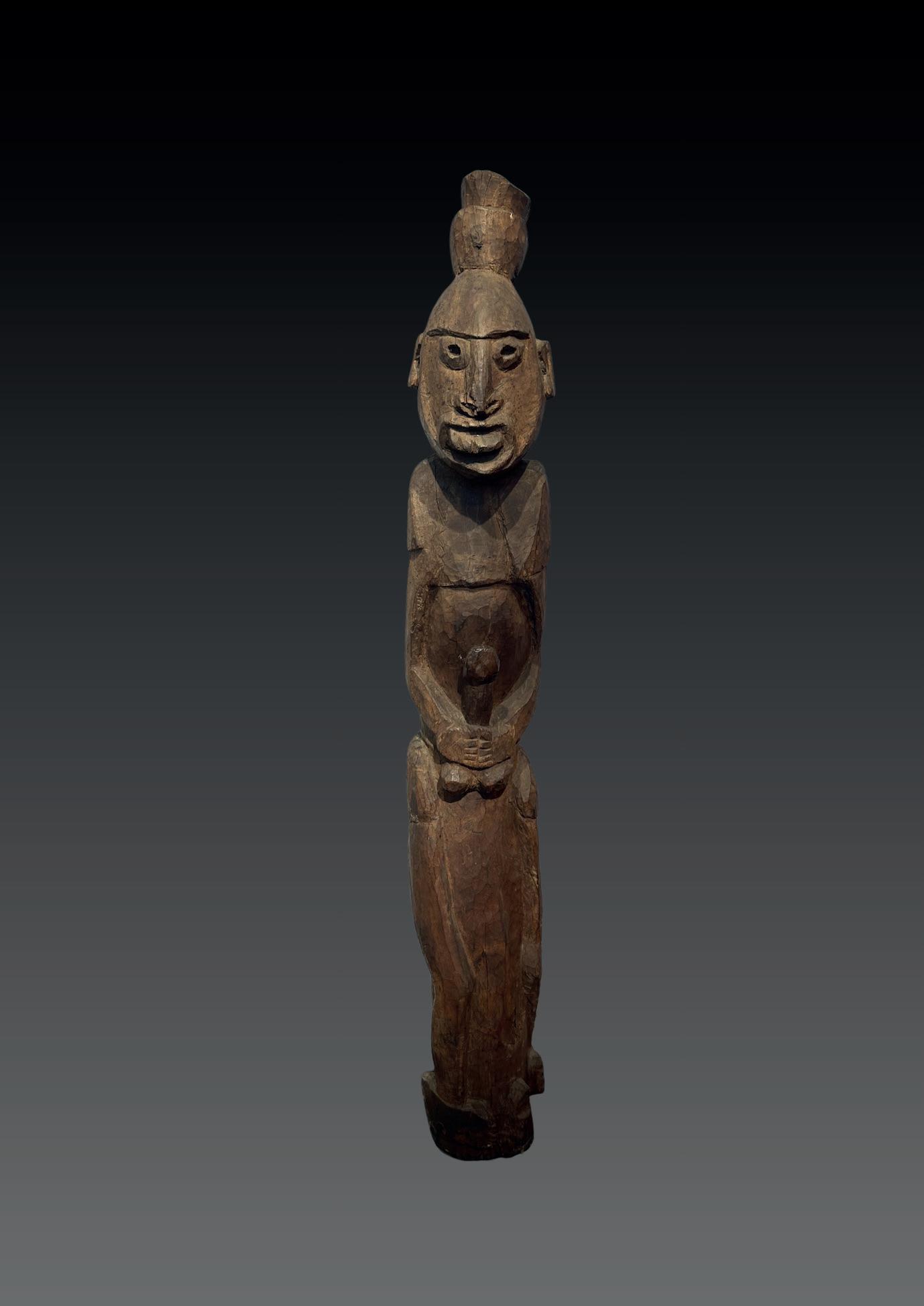
POTEAU SCULPTÉ DE MAISON DES HOMMES
Fleuve Sepik, Papouasie-Nouvelle-Guinée.
XIX e siècle.
Bois.
Hauteur : 156 cm.
Important poteau en bois sculpté, provenant de la collection Pitt Rivers.
Inscriptions : « German New-Guinea, Webster, July 1899 » (en jaune) ; « P2011 » (au crayon) ; « 6790 » (à l’encre blanche).
Provenance : William D. Webster (1868 - 1913), Oxfordshire ; Lieutenant-General Augustus Pitt-Rivers (1827 - 1900), Dorset, acquis le 12 juillet 1899 ; collection privée, Royaume-Uni, 1994 - 2022.
Important carved wooden post, from the Pitt Rivers collection.
Inscriptions: “German New-Guinea, Webster, July 1899” (in yellow); “P2011” (in pencil); “6790” (in white ink).
Provenance: William D. Webster, Oxfordshire; Augustus Pitt-Rivers, Dorset, acquired 12 July 1899; private collection, United Kingdom, 1994-2022.
Illustration: Pitt-Rivers catalogue, vol. 8, 1899, p. 2193 (with drawing).
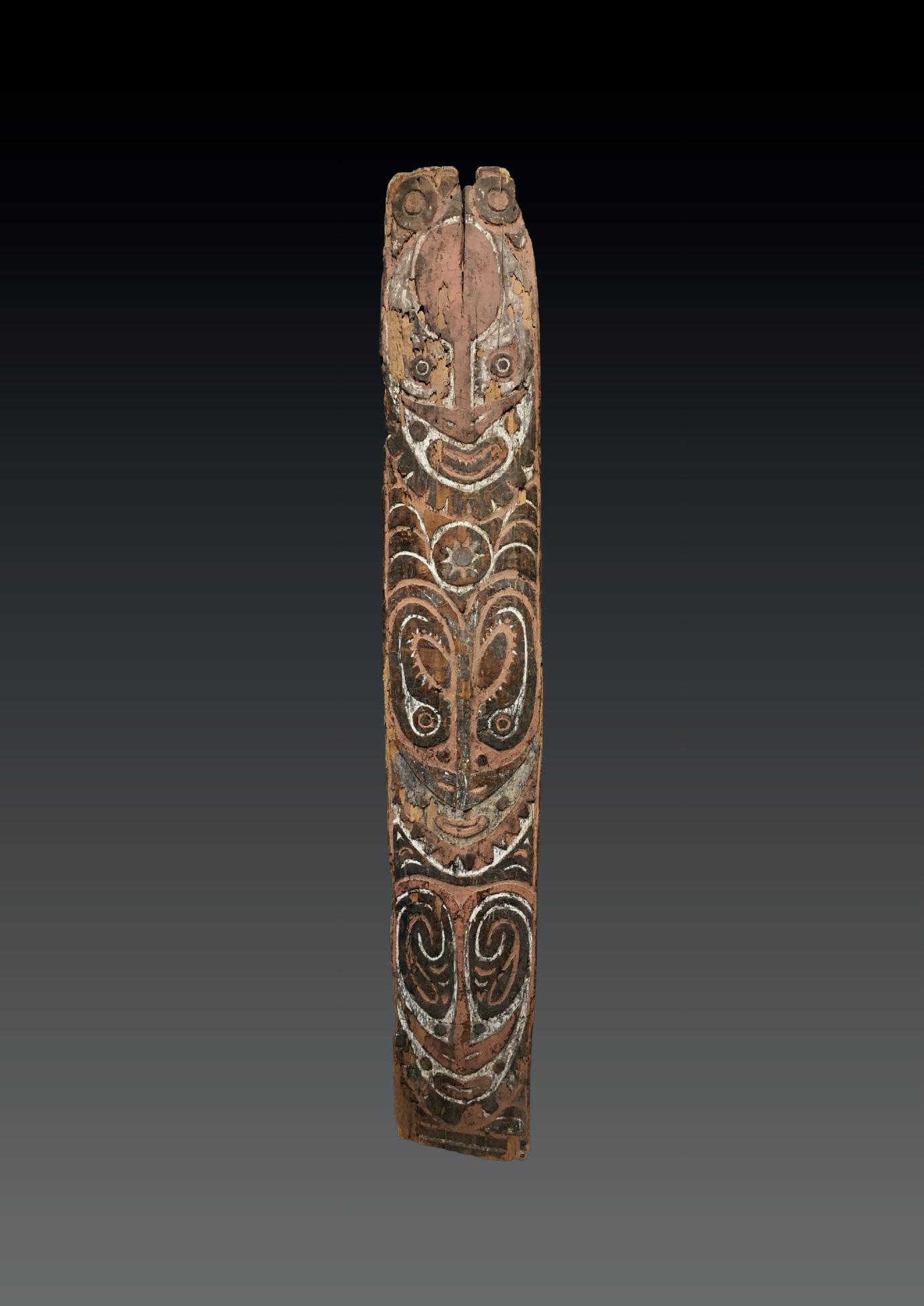
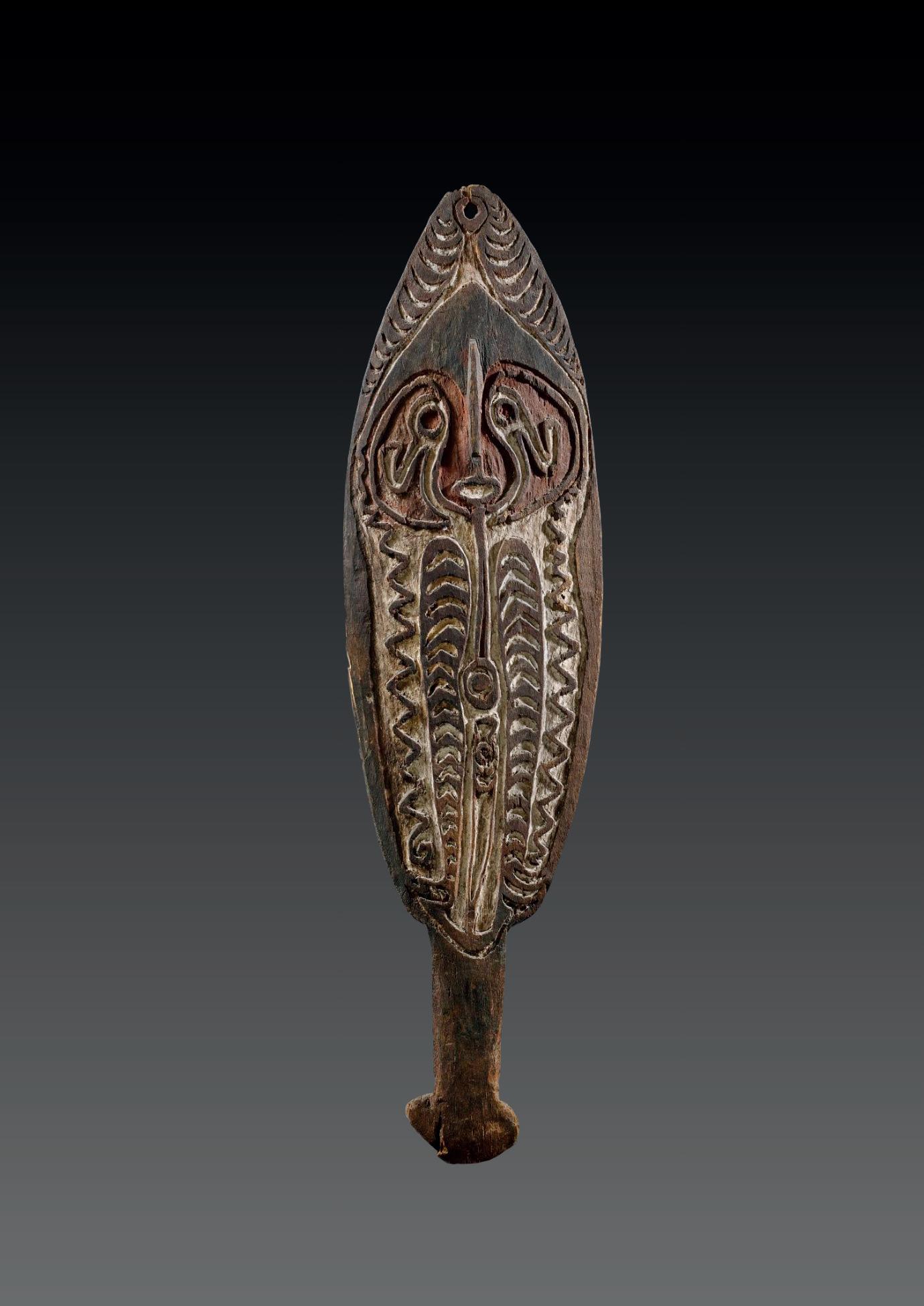
PLANCHE DE MAISON DES HOMMES
Groupe linguistique Iatmul, rivière Sepik, Papouasie-Nouvelle-Guinée, Mélanésie.
XIX e - XX e siècle. Bois.
163,5 × 26 × 2 cm.
Collectée sur le terrain par le Dr Fred Gerrits dans les années 1960. Une étiquette en néerlandais au revers indique : « N° 933, Schild. Naam : Woga. Maker : Busa (tod). Herh (?) : Kambaramba (grass country) ».
PLANK FROM A MEN’S HOUSE
Iatmul linguistic group, Sepik River, Papua New Guinea, Melanesia. 19 th -20 th century. Wood.
163.5 × 26 × 2 cm.
Collected in the field by Fred Gerrits in the 1960s. A Dutch label on the reverse reads: “N° 933, Schild. Naam: Woga. Maker: Busa (tod). Herh (?): Kambaramba (grass country)”.
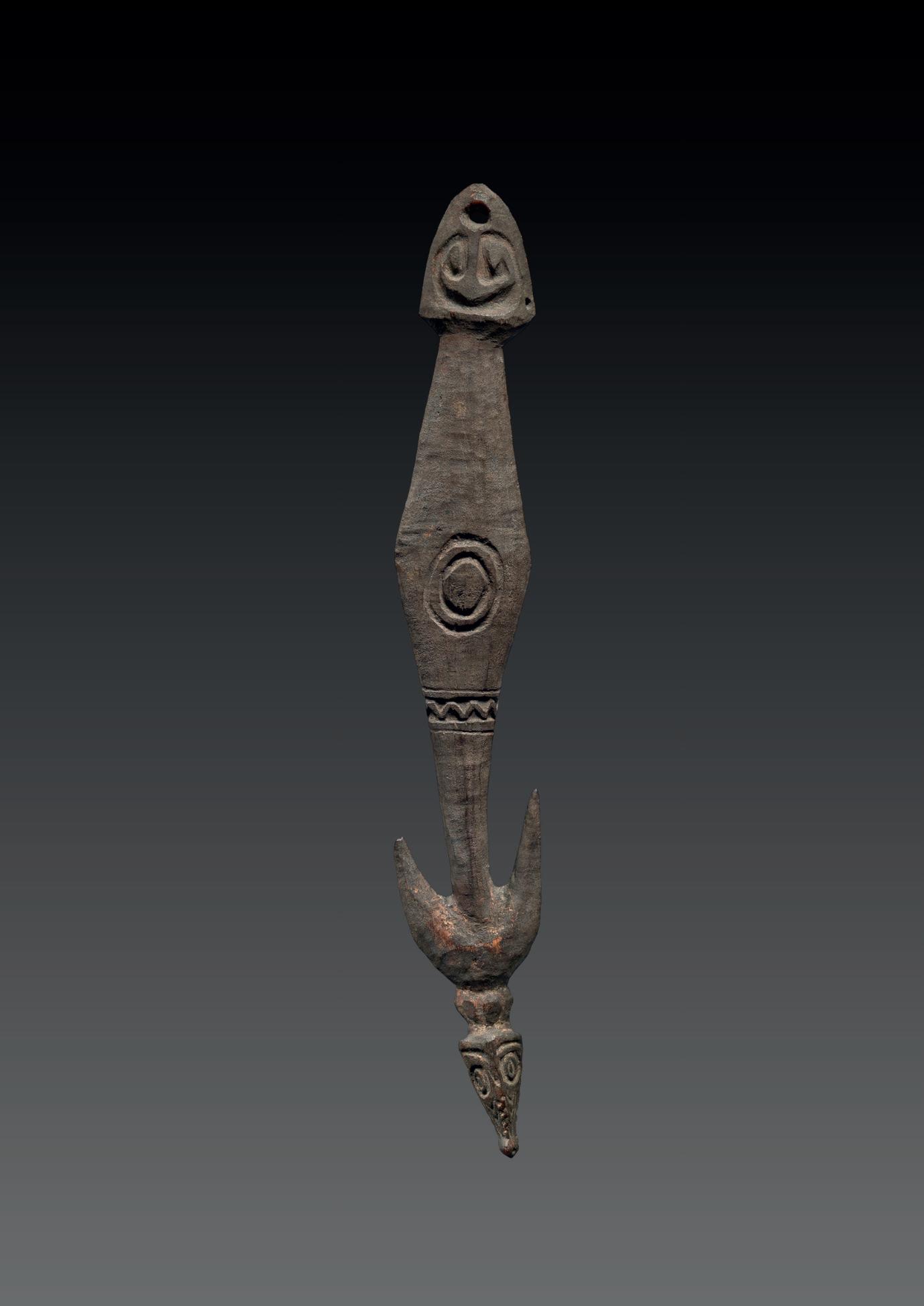
CROCHET DE SUSPENSION
Groupe linguistique Iatmul, Moyen Sepik, Papouasie-Nouvelle-Guinée, Mélanésie.
XIX e - XX e siècle.
Bois avec une épaisse patine de suie et d’âge.
67 × 10,5 × 4,5 cm.
Provenance : Apparemment issu d’une ancienne collection allemande ; ex Bruce Frank, New York ; collection Daniel Vigne, Paris ; collection privée, Paris.
SUSPENSION HOOK
Iatmul linguistic group, Middle Sepik, Papua New Guinea, Melanesia. 19 th -20 th century.
Wood with a thick patina of soot and age.
67 × 10.5 × 4.5 cm.
Provenance: Apparently from an early German collection; ex Bruce Frank, New York; Daniel Vigne collection, Paris; private collection, Paris.
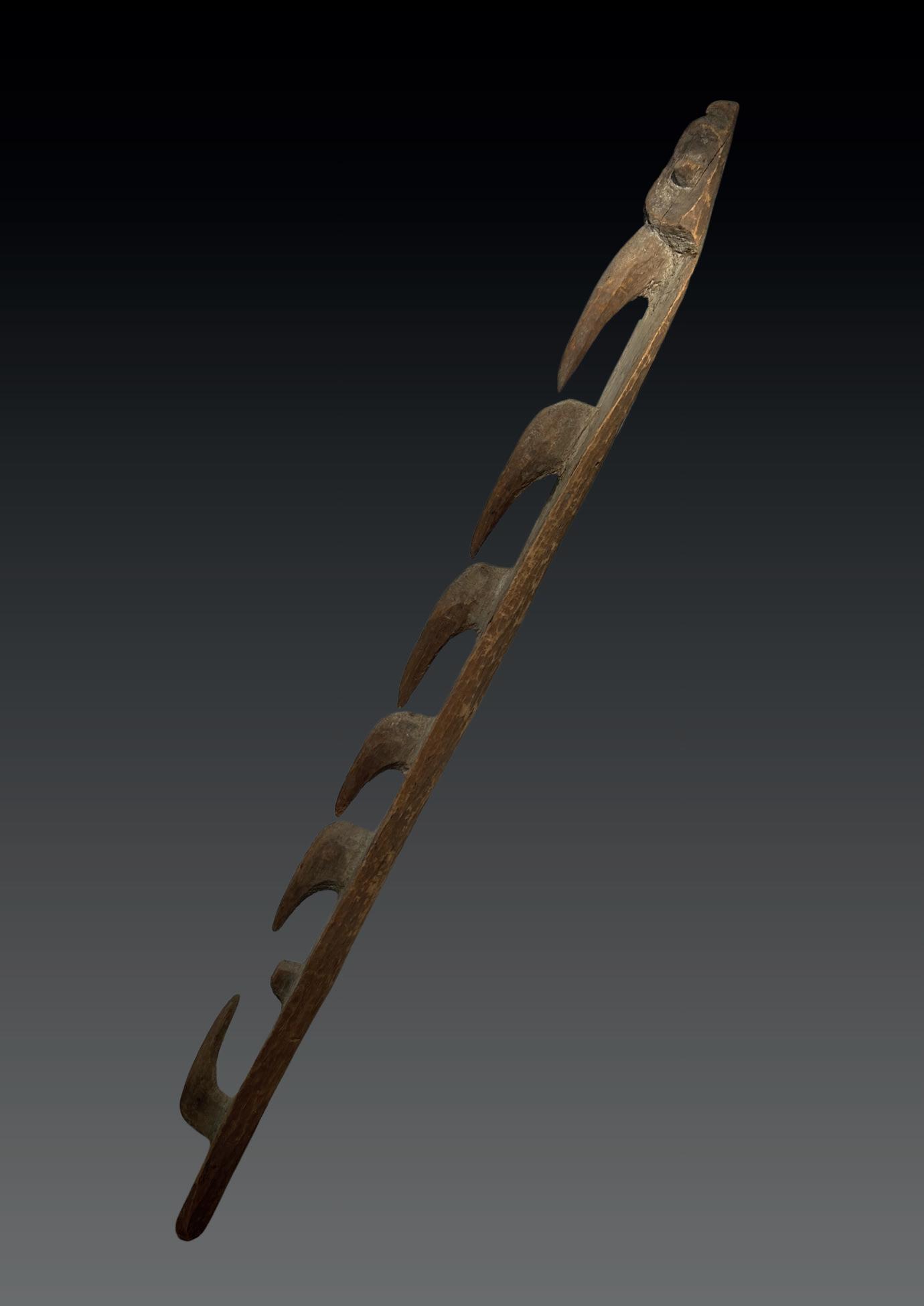
FIGURE À CROCHETS
ANTHROPO-ZOOMORPHE
Région entre la rivière Korewori et les montagnes Hunstein, rive sud du Moyen Sepik, Papouasie-Nouvelle-Guinée, Mélanésie.
Première moitié du XX e siècle.
Bois avec traces de pigment, d’usure, d’âge et degâts d’insectes.
206,5 cm.
L’objet aurait été collecté par Wayne Heathcote et Barry Hoare vers 1960.
Provenance : ex collection Maurice Bonnefoy, D’Arcy Galleries, New York, vers 1970, inv. n°2966.
ANTHROPO-ZOOMORPHIC
HOOK FIGURE
Region between the Korewori River and the Hunstein Mountains, south bank of the Middle Sepik, Papua New Guinea, Melanesia.
First half of the 20 th century.
Wood with traces of pigment, wear, age, and insect damage. 206.5 cm.
The object is said to have been collected by Wayne Heathcote and Barry Hoare around 1960.
Provenance: ex Maurice Bonnefoy collection, D’Arcy Galleries, New York, circa 1970, inv. no. 2966.
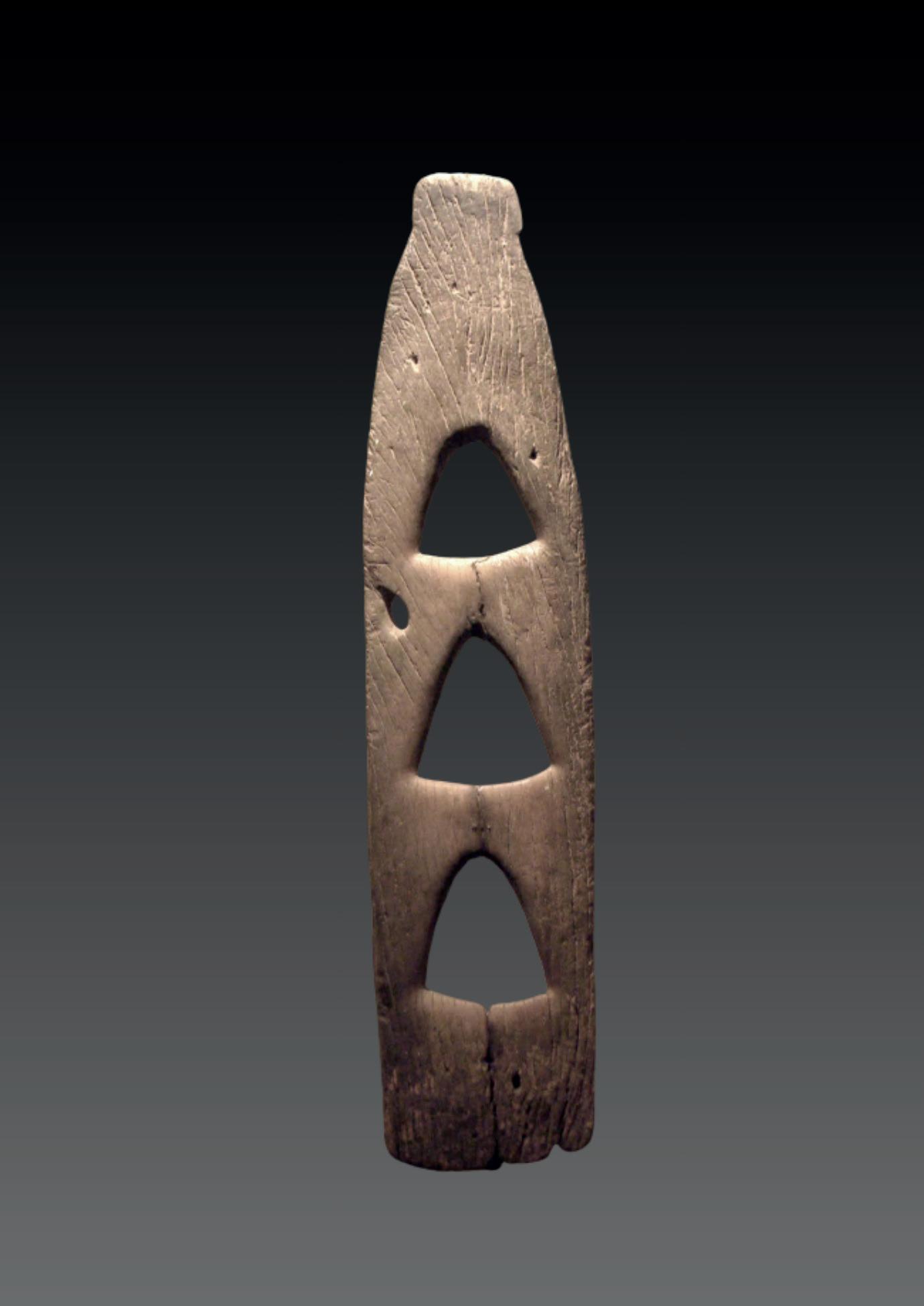
ÉCHELLE DE L’ENTRÉE DE LA MAISON DES HOMMES
Île de Manam, Papouasie-Nouvelle-Guinée, Mélanésie.
XIX e - XX e siècle.
Bois (probablement garamut).
157 × 36,5 × 3 cm.
LADDER FROM THE ENTRANCE OF THE MEN’S HOUSE
Manam Island, Papua New Guinea, Melanesia. 19 th -20 th century.
Wood (probably garamut).
157 × 36.5 × 3 cm.
ANCÊTRES - ANCESTORS
La maison des hommes ne leur est pas entièrement réservée, elle abrite aussi tout un monde invisible. Les ancêtres ne s’y manifestent pas seulement à travers son architecture mais aussi dans tous les objets qui y sont conservés. Au-delà de ses fonctions en tant que lieu de réunion, c’est là que sont conservés les amulettes, figures sculptées, masques et autres instruments rituels.
Souvent gardés à l’abri des regards, la manipulation des dits objets est réservée aux initiés et s’inscrit au sein de rituels précis et codifiés. Les objets agissent alors comme supports permettant la participation active des ancêtres dans la vie rituelle et sociale de la communauté, en leur donnant corps. Lorsque activés, ils agissent comme de véritables intercesseurs entre le monde des vivants et celui des esprits.
The men’s house is not reserved solely for them; it also shelters an entire invisible world. Ancestors are not only manifested through its architecture, but also through the objects preserved within it. Beyond its function as a place of assembly, it is here that amulets, carved figures, masks, and other ritual instruments are kept.
Often hidden from view, the handling of these objects is reserved for initiates and takes place within precise and codified rituals. The objects thus act as supports that enable the active participation of the ancestors in the ritual and social life of the community, giving them form. When activated, they become true intermediaries between the world of the living and that of the spirits.
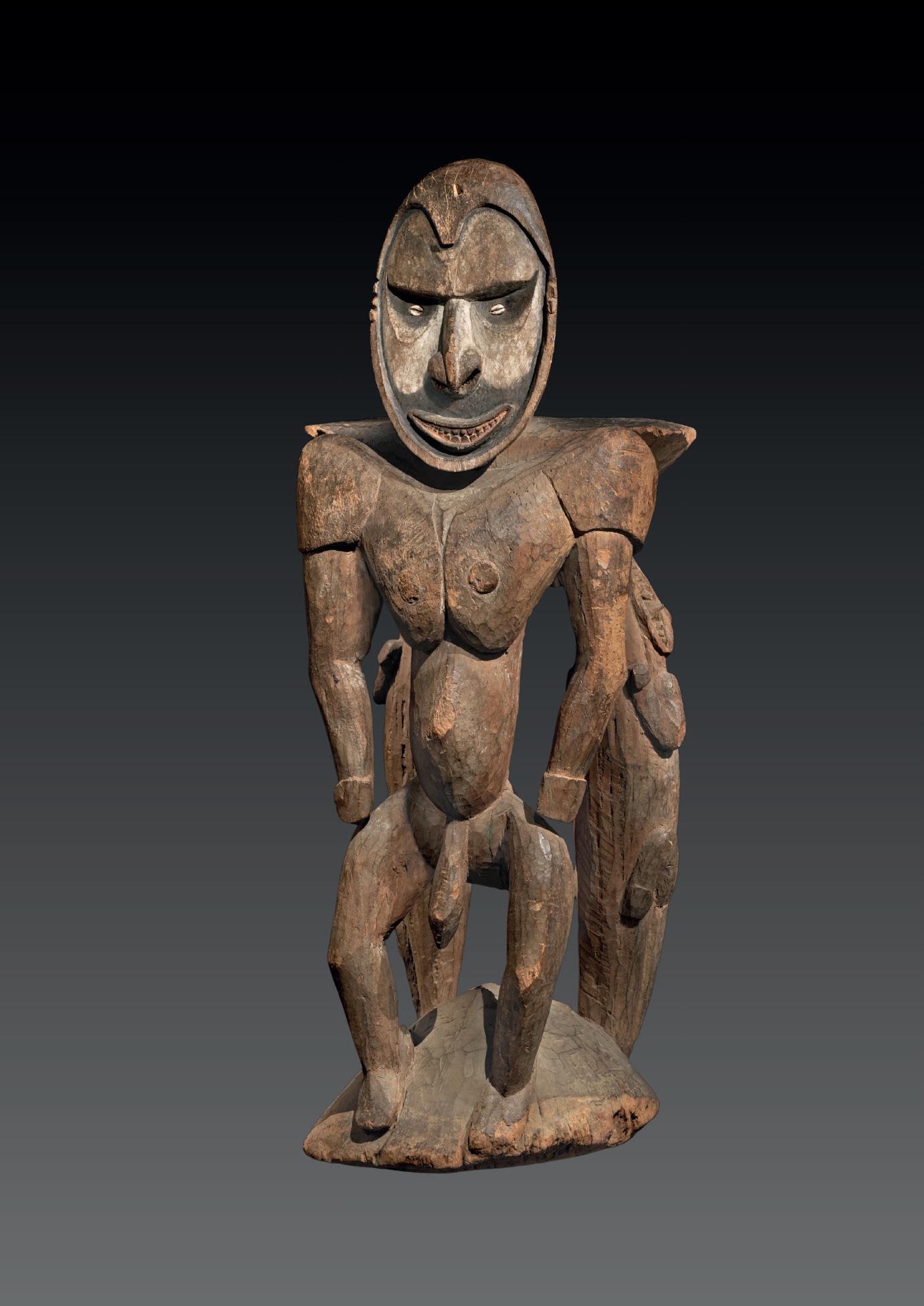
“TABOURET” D’ORATEUR
Groupe linguistique Iatmul, Moyen Sepik, Papouasie-Nouvelle-Guinée, Mélanésie.
XIX e -XX e siècle.
Bois, cauris et pigments rouges, blancs et noirs. Patine d’âge et d’usage ; les deux oreilles sont manquantes. Petite restauration conservatrice aux yeux et au bord du plateau. 121 × 46 × 47 cm.
Collecté sur le terrain par Oscar Meyer et Bruce Lawes, vers 1956-1957 ; photographié en transit sur le canot de fret de l’expédition sur le lac Chambri.
Provenance : vendu par Harry Franklin, Los Angeles. Anciennement dans les collections de Kleinmann, marchand d’art moderne à Paris, puis dispersé à l’Hôtel Drouot vers 1970 (commissaire-priseur Maurice Rheims, expert Jean Roudillon). Acquis lors de cette vente par le Dr Maillant (Neuillysur-Seine), puis revendu à l’Hôtel Drouot, Paris, Laurin, Guilloux, Buffetaud, Tailleur, 21 juin 1993, lot 30.
ORATOR’S “STOOL”
Iatmul linguistic group, Middle Sepik, Papua New Guinea, Melanesia. 19 th -20 th century.
Wood, cowrie shells, and red, white, and black pigments. Age and use patina; both ears missing. Minor conservation restoration to the eyes and the edge of the platform. 121 × 46 × 47 cm.
Collected in the field by Oscar Meyer and Bruce Lawes, circa 1956-1957; photographed in transit on the expedition’s cargo canoe on Lake Chambri.
Provenance: Sold by Harry Franklin, Los Angeles. Formerly in the collections of Kleinmann, modern art dealer, Paris, then dispersed at Hôtel Drouot circa 1970 (auctioneer Maurice Rheims, expert Jean Roudillon). Acquired at this sale by Dr. Maillant (Neuilly-sur-Seine), then resold at Hôtel Drouot, Paris, Laurin, Guilloux, Buffetaud, Tailleur, 21 June 1993, lot 30.
PORTE-CRÂNE D’ANCÊTRE (MARO)
Région de la rivière Porapora aux lacs Murik, Bas Sepik, Papouasie-Nouvelle-Guinée, Mélanésie.
XVII e - XIX e siècle. Datation : test au carbone 14 indiquant une moyenne autour de 1750 après J.-C. (fourchette : 1646 - 1820 après J.-C.).
Bois patiné par l’âge et longue immersion aquatique, avec dommages, dépôts d’insectes et traces de champignons aquatiques.
189 × 22,2 × 7 cm.
Provenance : ancienne collection Van Lier, Pays-Bas ; Galerie Alain de Monbrison, Paris ; collection Edward Klejman, Paris.
ANCESTOR SKULL HOLDER (MARO)
Porapora River region to the Murik Lakes, Lower Sepik, Papua New Guinea, Melanesia. 17 th -19 th century. Radiocarbon dating indicates an average around 1750 AD (range: 1646-1820 AD). Wood patinated by age and prolonged water immersion, with damage, insect deposits, and traces of aquatic fungi.
189 × 22.2 × 7 cm.
Provenance: former Van Lier collection, Netherlands; Galerie Alain de Monbrison, Paris; Edward Klejman collection, Paris.
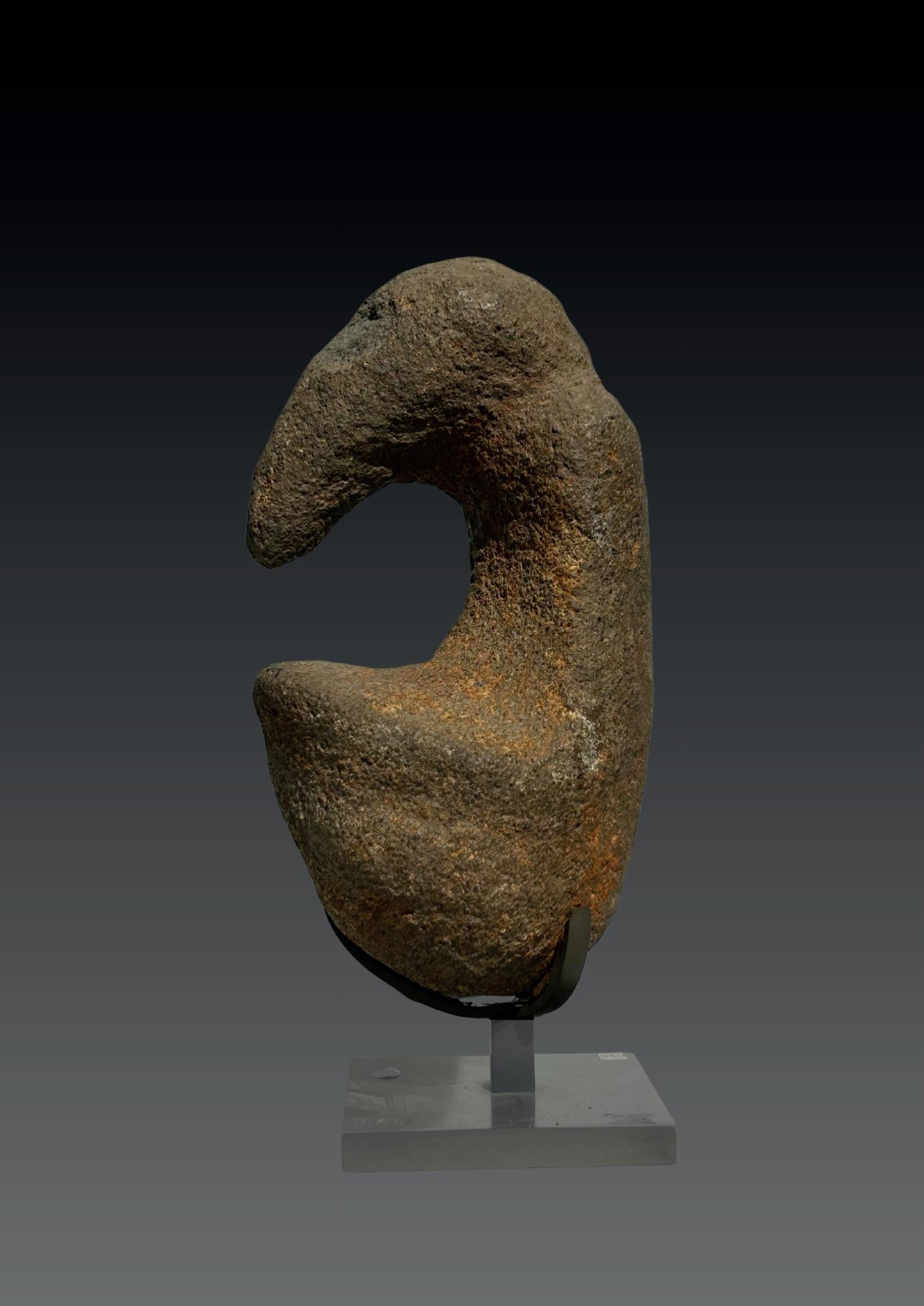
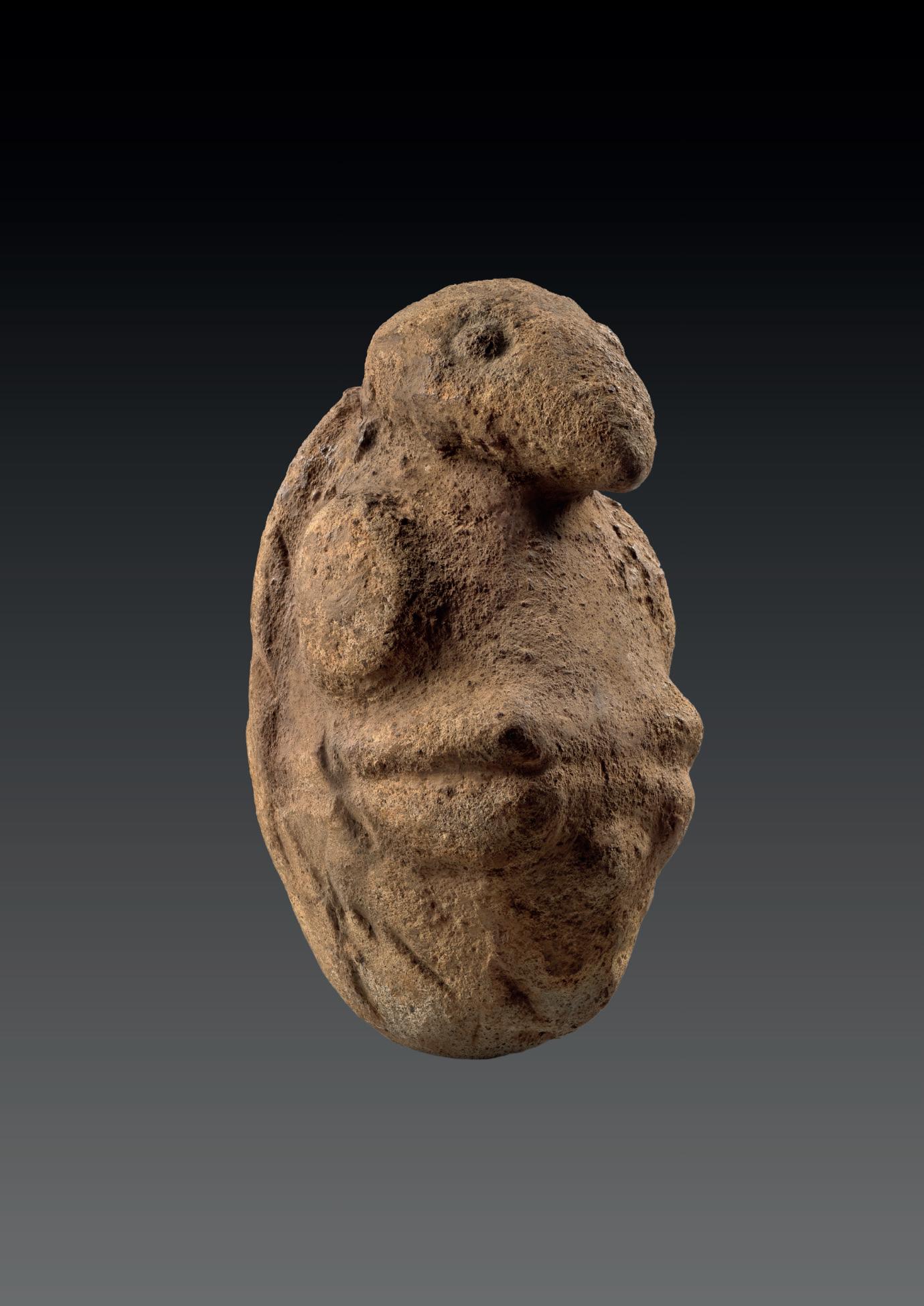
EFFIGIE SACRÉE EN PIERRE ANTHROPO-ZOOMORPHE
Région du Haut Ramu, Papouasie-Nouvelle-Guinée, Mélanésie.
Période pré-contact : 6000 av. J.-C. - 1600 apr. J.-C.
Pierre avec patine incrustée présentant des traces d’oxyde de fer et possibles pigments et colorations.
19,5 × 8,5 × 11 cm.
L’exemplaire présente un éclat circulaire de part et d’autre de la tête (dont un œil manquant) ainsi que de légères rayures récentes. Analyse micro-analytique (certificat ASA 23.18.35 MEB 202.036) concluant à des altérations compatibles avec une ancienneté non quantifiée.
Observation : pièce examinée et décrite par Douglas Newton, qui souligne son ancienneté manifeste et sa conformité aux motifs stylistiques de la région et à une production pré-contact.
Provenance : collectée à la fin des années 1960 par un voyageur ; ancienne collection John Friede, New York.
SACRED STONE ANTHROPOZOOMORPHIC EFFIGY
Upper Ramu region, Papua New Guinea, Melanesia.
Pre-contact period: 6000 BC - 1600 AD.
Stone with an encrusted patina showing traces of iron oxide and possible pigments and coloration.
19.5 × 8.5 × 11 cm.
The piece shows a circular chip on both sides of the head (including one missing eye), as well as minor recent scratches. Micro-analytical examination (certificate ASA 23.18.35 MEB 202.036) confirming alterations consistent with evident age; examined and described by Douglas Newton, who emphasizes its clear antiquity and its conformity with regional stylistic patterns and a pre-contact period.
Provenance: collected in the late 1960s by a traveller; former collection of John Friede, New York.
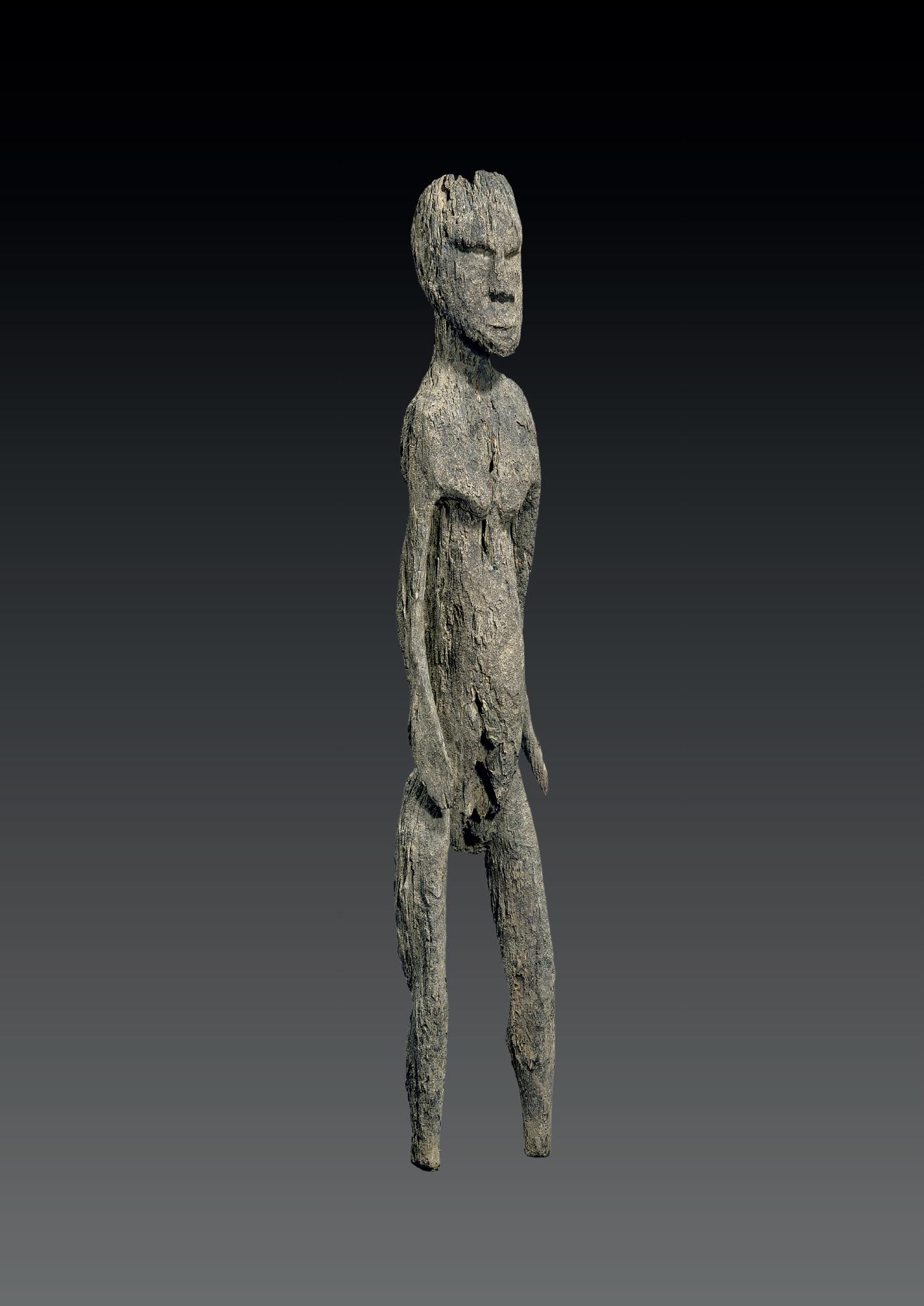
DIVINITÉ CENTRALE YIMAR
Peuple Yimam (ou Yimar), régions supérieures des rivières Korewori et Blackwater, sud du Moyen Sepik, Papouasie-Nouvelle-Guinée, Mélanésie.
Datation : test au carbone 14 indiquant un âge conventionnel d’environ -105 ans (avant 1950) ± 60 ans ; datation calibrée et dendrochronologique suggérant une coupe du bois vers 1650 apr. J.-C., la sculpture ayant été réalisée peu après l’abattage de l’arbre.
Bois dur, dense et noirci par les éléments, avec traces de terre, racines et dépôts d’insectes.
131 × 25 × 20 cm.
CENTRAL DEITY YIMAR
Yimam (or Yimar) people, upper Korewori and Blackwater river regions, southern Middle Sepik, Papua New Guinea, Melanesia.
Dating: radiocarbon testing indicating a conventional age of approximately 105 years BP (before 1950) ± 60 years; calibrated and dendrochronological analysis suggesting the wood was felled around 1650 AD, with the sculpture executed shortly after the tree was cut. Hard, dense wood, darkened by exposure to the elements, with traces of soil, roots, and insect deposits.
131 × 25 × 20 cm.
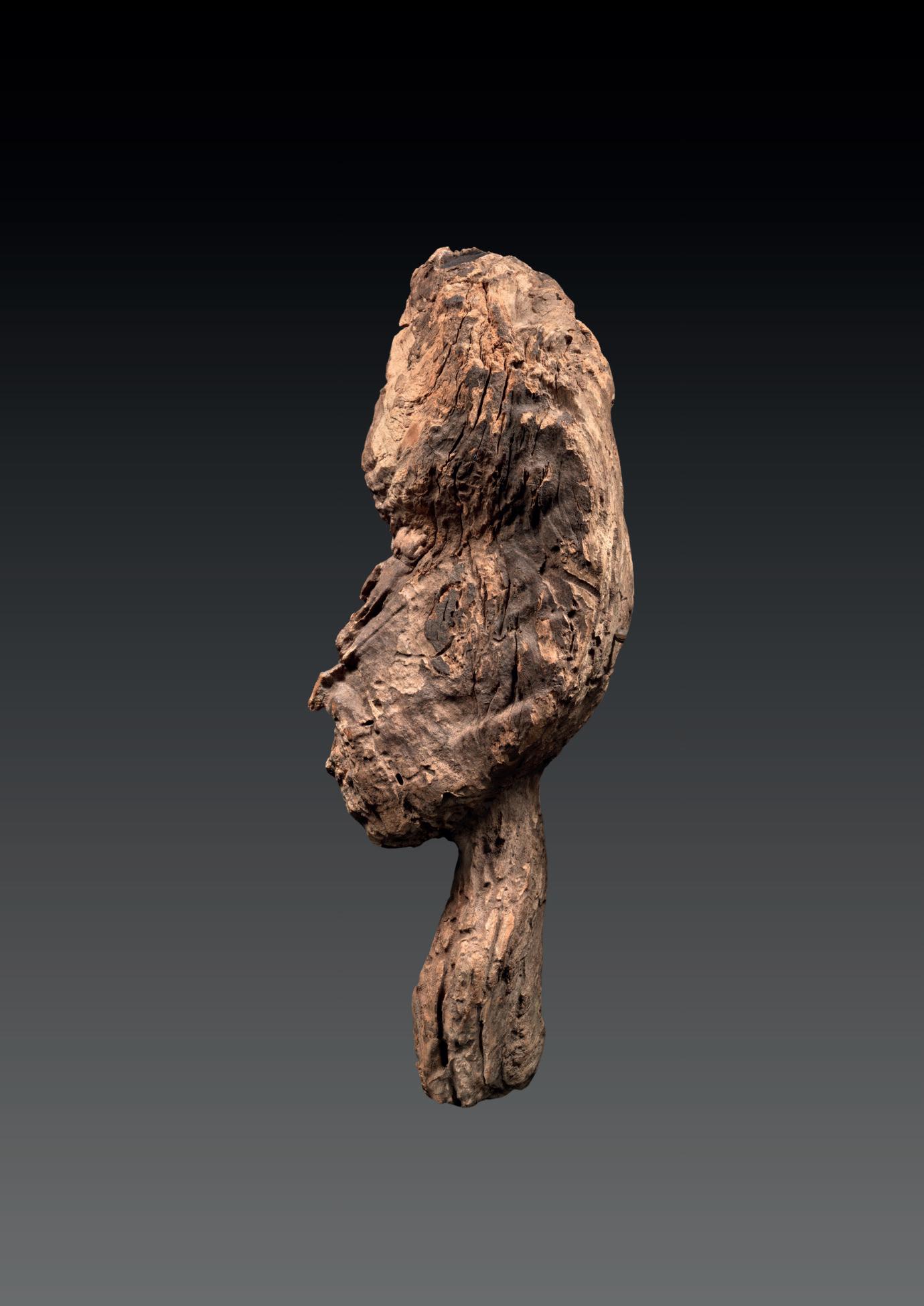
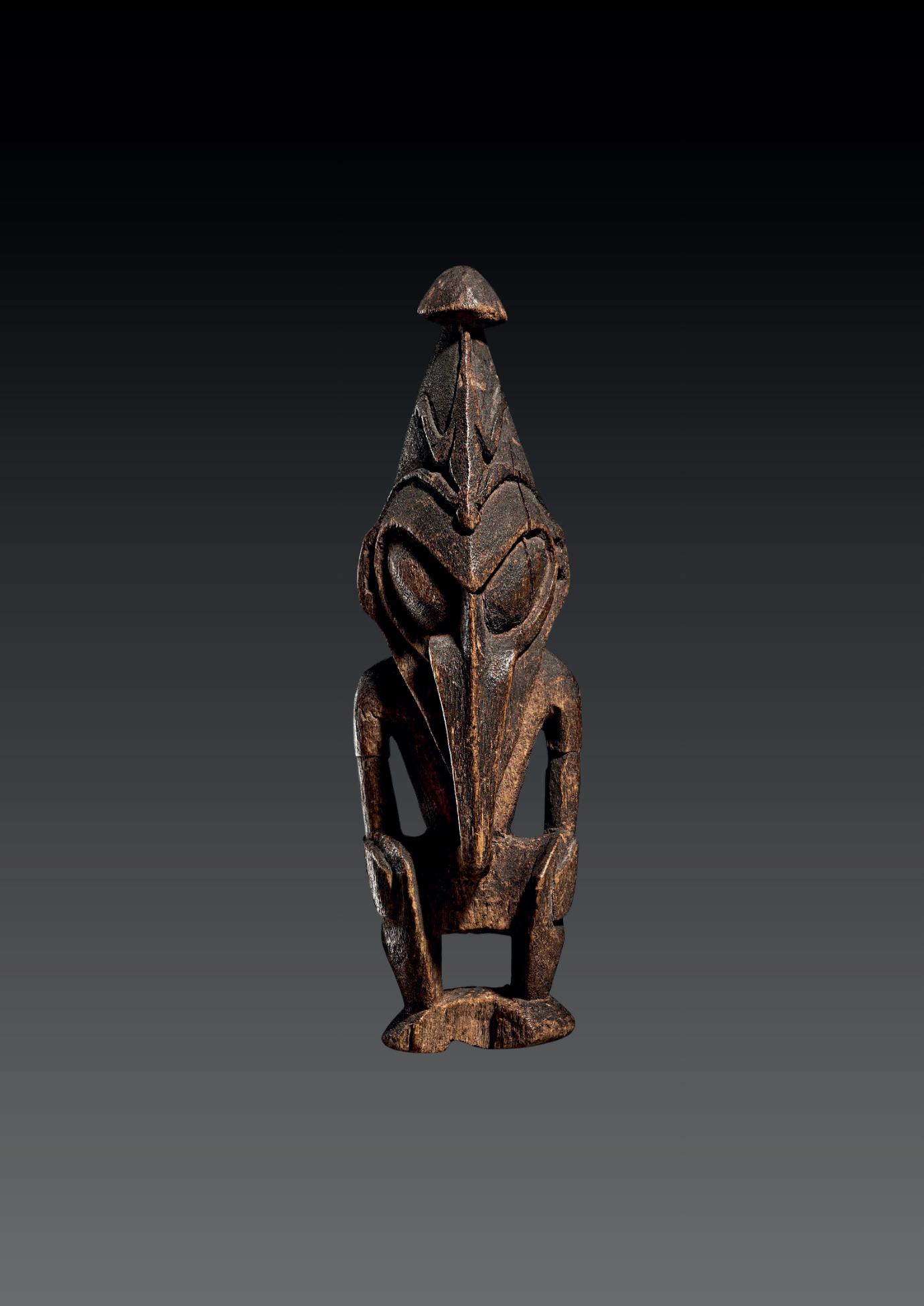
TÊTE DE DIVINITÉ CENTRALE YIMAR
Peuple Yimam (ou Yimar), régions supérieures des rivières Korewori et Blackwater, sud du Moyen Sepik, Papouasie-Nouvelle-Guinée, Mélanésie.
1650 - 1810 apr. J.-C. (datation carbone 14). Bois dur, dense, érodé et altéré (vitex cofassus ?).
28,8 × 9,2 × 11 cm.
Provenance : ex SVD (Societas Verbi Divini - Société du Verbe Divin), Mission Museum, Haus der Völker und Kulturen, Sankt Augustin, Allemagne, inv. n°71-(?)-54 (inscription en peinture blanche partiellement effacée) ; cédée par échange avec Ulrich Hoffmann vers 1997/1998.
HEAD OF CENTRAL DEITY
YIMAR
Yimam (or Yimar) people, upper regions of the Korewori and Blackwater rivers, southern Middle Sepik, Papua New Guinea, Melanesia. 1650-1810 AD (radiocarbon dating).
Hard, dense wood, eroded and altered (vitex cofassus?).
28.8 × 9.2 × 11 cm.
Provenance: ex SVD (Societas Verbi Divini - Society of the Divine Word), Mission Museum, Haus der Völker und Kulturen, Sankt Augustin, Germany, inv. no. 71-(?)-54 (white painted inscription partially erased); ceded via exchange to Ulrich Hoffmann circa 1997/1998.
AMULETTE DE FIGURE D’ANCÊTRE
Régions du bas Sepik ou de la côte nord, Papouasie-Nouvelle-Guinée, Mélanésie.
Période précoloniale.
Bois avec traces de pigment original, sculpté avec des outils en pierre. 14,1 cm.
Provenance : Ex collection C. Delora, USA. Montée sur un socle en bois signé Kichizô Inagaki (vers 1920/1940).
ANCESTOR FIGURE
AMULET
Lower Sepik regions or northern coast, Papua New Guinea, Melanesia. Pre-colonial period.
Wood with traces of original pigment, carved with stone tools. 14.1 cm.
Provenance: ex C. Delora collection, USA. Mounted on a wooden base signed Kichizo Inagaki (c. 19201940).
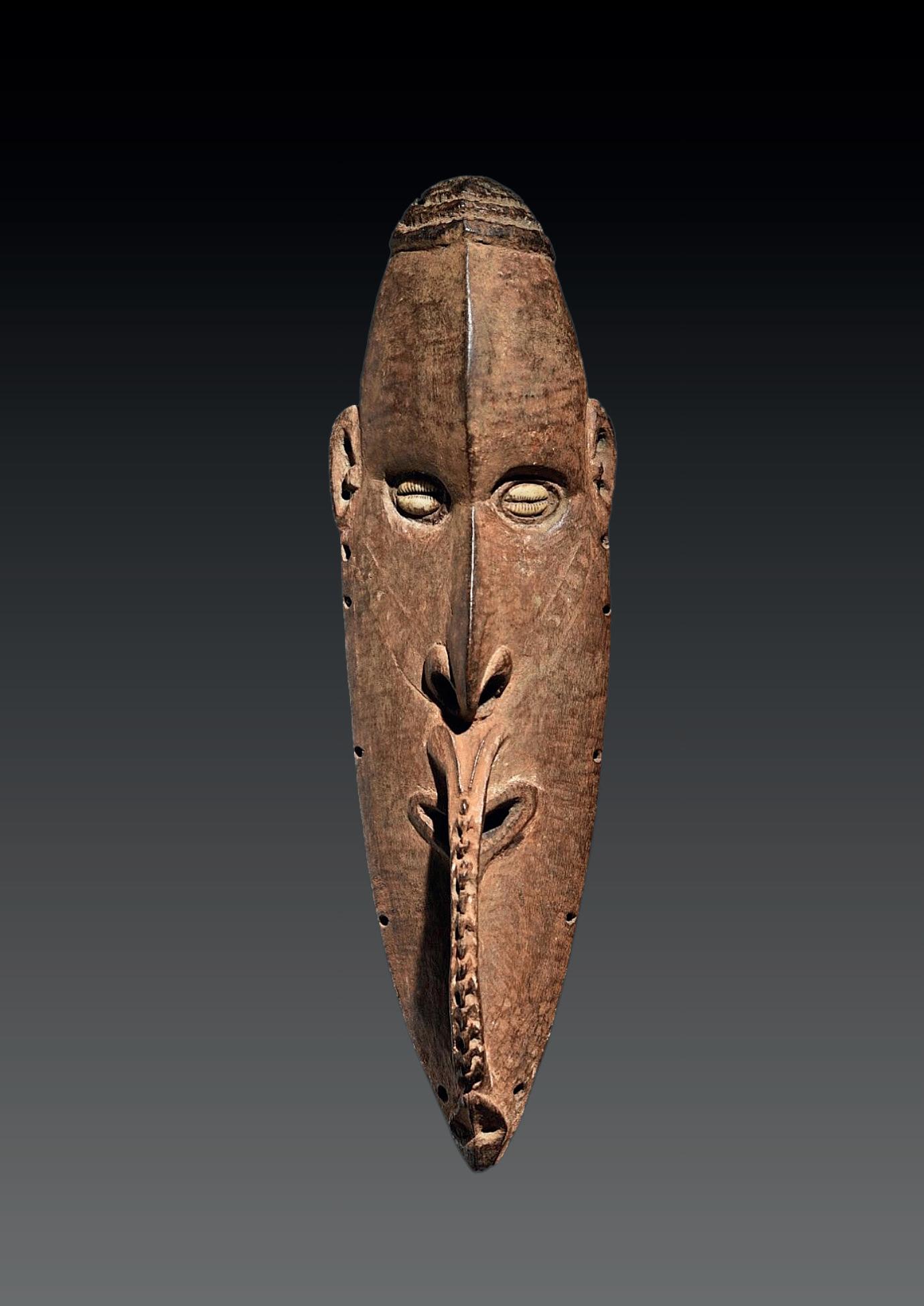
MASQUE MEI
Groupe linguistique Iatmul, Moyen Sepik, Papouasie-Nouvelle-Guinée, Mélanésie.
XIX e - début XX e siècle (avant les années 1920).
Bois (arbre local appelé “yaranda” ?), incrustations de deux cauris, résine, bonne patine d’usage et d’âge, restes de polychromie. Sculpté avec des outils néolithiques.
50 × 15,5 × 8 cm.
MEI MASK
Iatmul linguistic group, Middle Sepik, Papua New Guinea, Melanesia. 19 th -early 20 th century (before the 1920s).
Wood (local tree called “yaranda“?), shell inlays of two cowries, resin, fine age and use patina, remains of polychromy. Carved with Neolithic tools.
50 × 15,5 × 8 cm.
PLANCHE NGOPE
Groupe linguistique Elema, golfe de Papouasie, Papouasie-Nouvelle-Guinée, Mélanésie.
XIX e - XX e siècle.
Bois et pigments à belle patine d’usage et d’âge. 126 cm.
Provenance : Collecté sur le terrain par Thomas & Susanne Schultze-Westrum (1937-2022) entre le 10 janvier et le 27 avril 1966 ; Asher Eskenazy, Paris ; ex F. & D. Mathieu, Paris ; collection privée, Pays-Bas.
Elema linguistic group, Gulf of Papua, Papua New Guinea, Melanesia. 19 th -20 th century.
Wood and pigments with a fine age and use patina. 126 cm.
Provenance: Field collected by Thomas & Susanne Schultze-Westrum (1937-2022) between 10 January and 27 April 1966 ; Asher Eskenazy, Paris; ex F. & D. Mathieu, Paris; private collection, Netherlands.
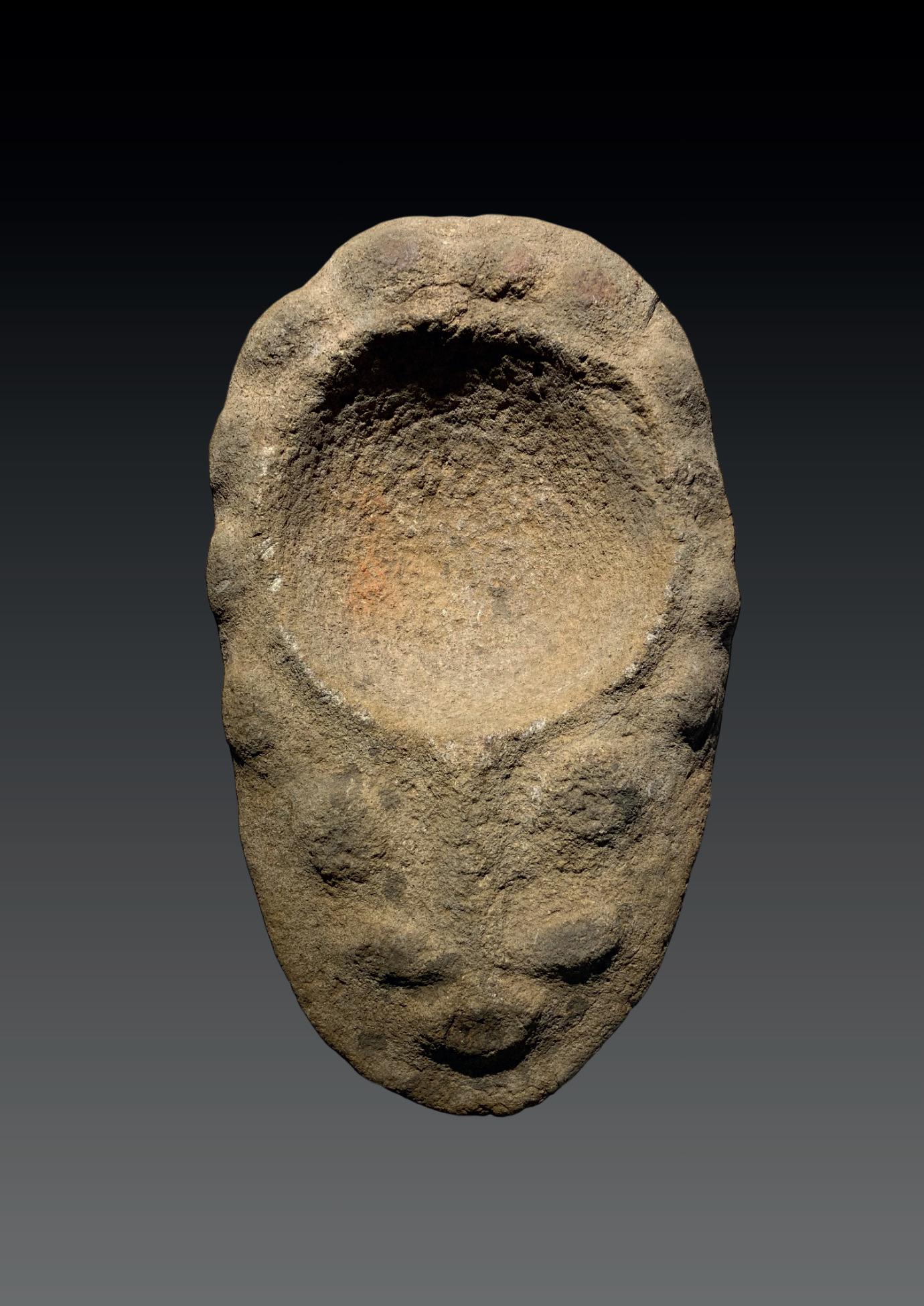
Hautes Terres centrales à orientales, Papouasie-Nouvelle-Guinée, Mélanésie.
Pierre avec traces de pigments rougeâtres et de coloration.
41,5 × 24,5 × 8 cm.
Analyse micro-analytique (certificat ASA 23.18.35 MEB 202.035) confirmant des altérations compatibles avec une ancienneté évidente, examinée et décrite par Douglas Newton, qui souligne son ancienneté manifeste et sa conformité aux motifs stylistiques de la région et à une période précontact.
ANTHROPOMORPHIC CEREMONIAL MORTAR
Central to Eastern Highlands, Papua New Guinea, Melanesia. Stone with traces of reddish pigments and coloration.
41.5 × 24.5 × 8 cm.
Micro-analytical examination (certificate ASA 23.18.35 MEB 202.035) confirming alterations consistent with evident age; examined and described by Douglas Newton, who emphasizes its clear antiquity and its conformity with regional stylistic patterns and a pre-contact period.
FIGURE ARCHAÏQUE
ANTHROPO-ZOOMORPHE
Région de Laiagam, province d’Enga, Papouasie-Nouvelle-Guinée, Mélanésie.
4000 av. J.-C. - 400 apr. J.-C.
Grès de dureté moyenne à surface archéologique.
Hauteur : 22 cm.
Collectée sur le terrain par Ronald Ingle, géologue australien (Dawsett Engineering), entre 1961 et 1963 dans la province d’Enga. Cette figure, ainsi que quatre autres découvertes sur le même site, a été examinée par le Dr Pamela Swadling (Australian National University).
ARCHAIC ANTHROPOZOOMORPHIC FIGURE
Laiagam region, Enga Province, Papua New Guinea, Melanesia. 4000 BC - 400 AD.
Medium-hard sandstone with an archaeological surface.
Height: 22 cm.
Collected in the field by Ronald Ingle (Dawsett Engineering) between 1961 and 1963 in Enga Province. This figure, along with four others discovered at the same site, was examined by Pamela Swadling.
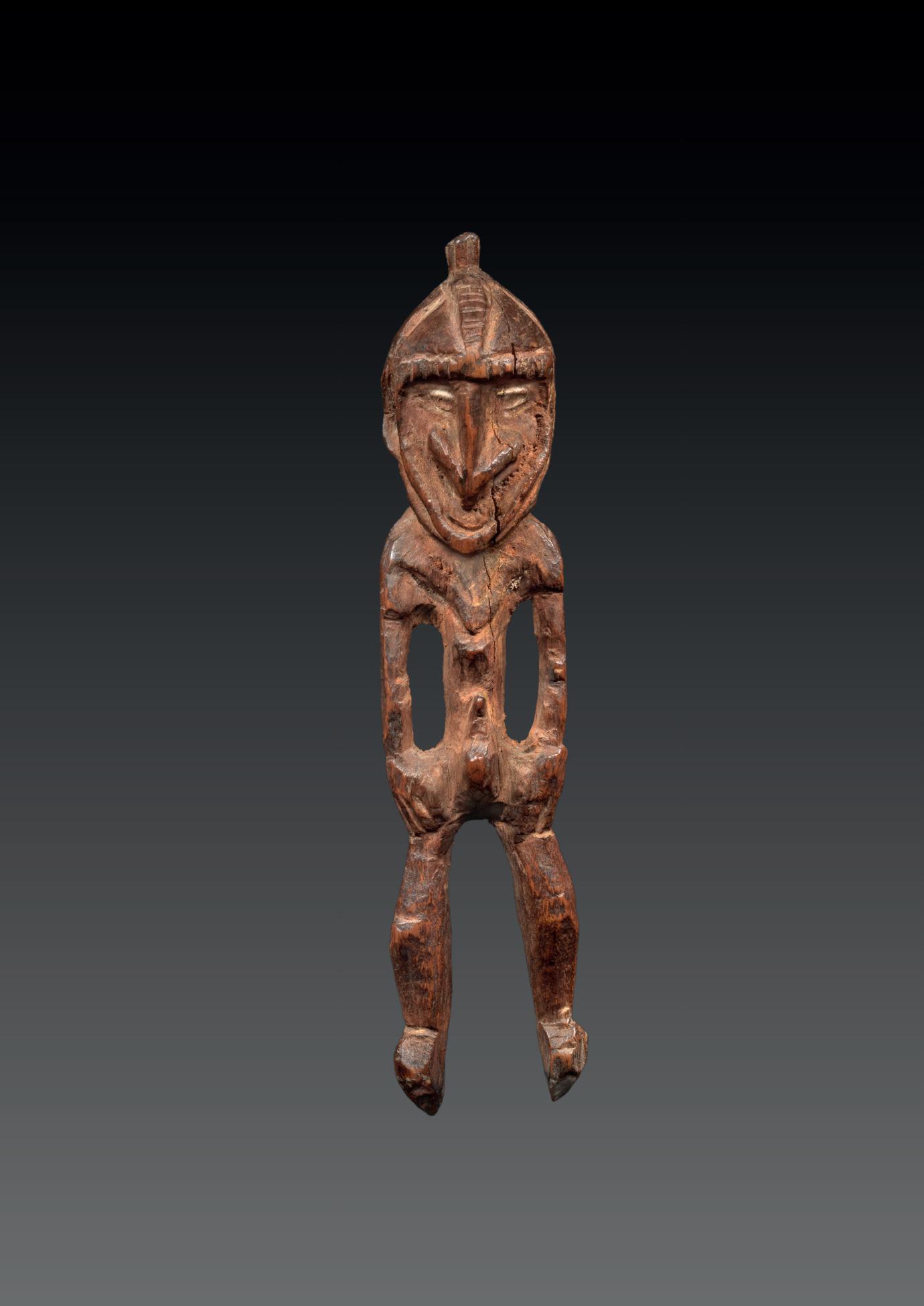
FIGURE D’ANCÊTRE
Delta du fleuve Ramu ou île Manam, Papouasie-Nouvelle-Guinée, Mélanésie. Bois à patine brun foncé, sèche et ancienne.
21 cm.
Provenance : ex collection privée, Suisse ; ex collection privée, Pays-Bas.
ANCESTOR FIGURE
Ramu River delta or Manam Island, Papua New Guinea, Melanesia. Wood with a dark brown, dry and aged patina. 21 cm.
Provenance: ex private collection, Switzerland; ex private collection, Netherlands.
FIGURE D’ANCÊTRE
Bas Sépik, Papouasie-Nouvelle-Guinée, Mélanésie.
XIX e - XX e siècle.
Bois, perle de verre et belle patine d’usage et d’âge.
31 × 5 cm.
Provenance : collection privée du Dr. Albert Hahl (1868-1945), gouverneur de la Nouvelle-Guinée Allemande (1902-1914) ; par descendance ; acquis auprès de la famille.
Provenance: private collection of Dr. Albert Hahl (1868-1945), Governor of German New Guinea (1902-1914); by descent; acquired from the family.
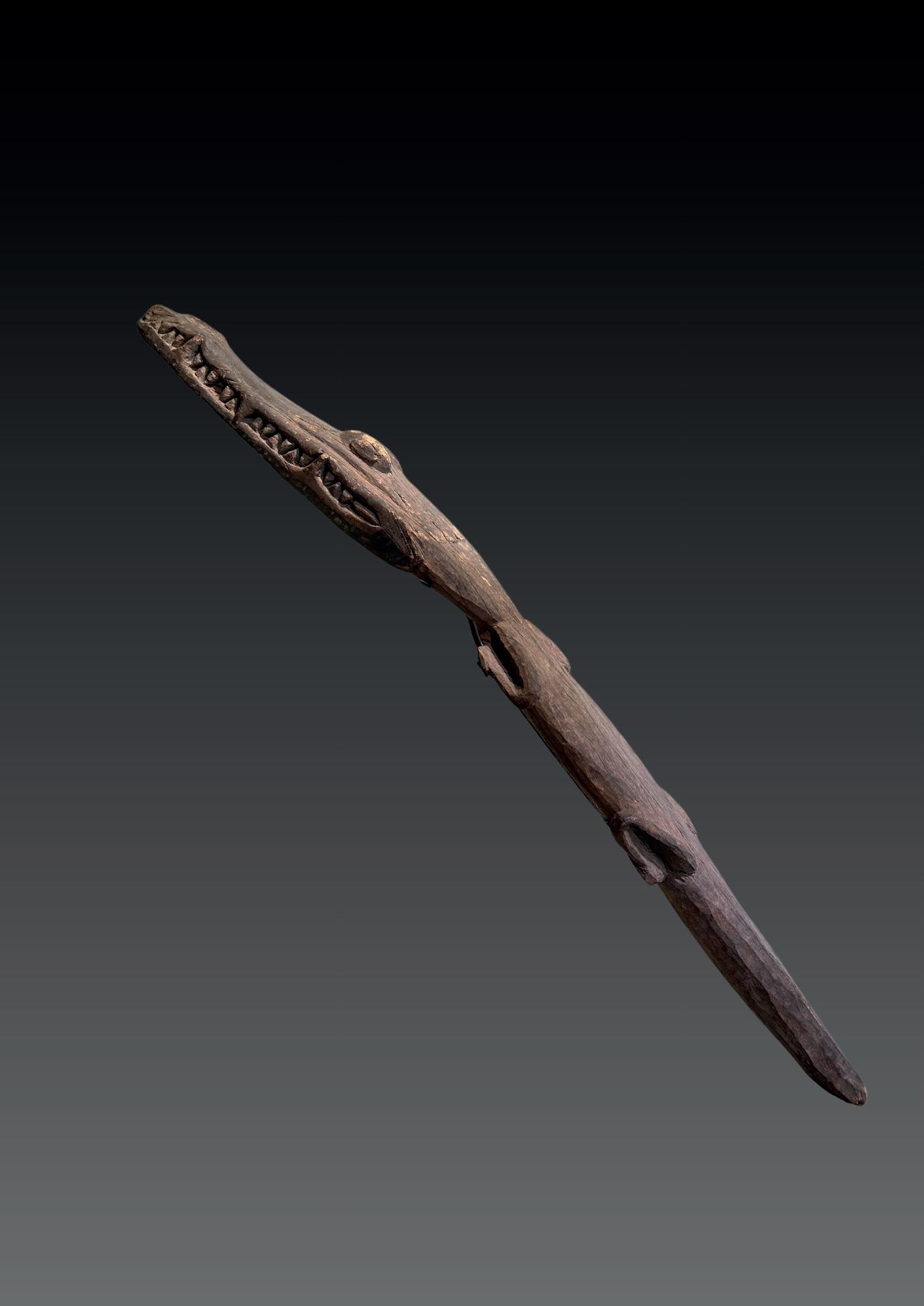
CROCODILE CÉRÉMONIEL
Village d’Angerman (?), groupe linguistique Iatmul, Moyen Sepik, Papouasie-Nouvelle-Guinée, Mélanésie.
Début du XX e siècle.
Bois avec traces de polychromie blanche, noire et ocre rouge.
115 × 21,5 × 12,5 cm.
Provenance : ex Patrick Cartoux.
CEREMONIAL CROCODILE
Angerman Village (?), Iatmul linguistic group, Middle Sepik, Papua New Guinea, Melanesia. Early 20 th century.
Wood with traces of white, black, and ochre-red polychromy.
115 × 21.5 × 12.5 cm.
Provenance: ex Patrick Cartoux.
Un très grand merci à tous ceux qui ont rendu cette exposition possible : Anthony JP Meyer, Mael Revaillot, Matthias Egger, Mathilde Izard, Charlie Bertrand, Anouk Lecoutey, Swan Desrumaux et Catherine Jacomet.
Responsable de la publication : Vairea Anania
Conception et réalisation graphique : Vairea Anania
La reproduction ou la publication, sous quelque forme ou format que ce soit, en tout ou en partie, des éléments, images, photos, œuvres d’art et textes contenus dans cette publication est interdite sans autorisation écrite formelle.
Ce catalogue est publié en format numérique et consultable gratuitement en permanence sur la plateforme WWW.ISSUU.COM et sur WWW.MEYEROCEANIC.ART
A huge thank you to everyone who made this exhibition possible:
Anthony JP Meyer, Mael Revaillot, Matthias Egger, Mathilde Izard, Charlie Bertrand, Anouk Lecoutey, Swan Desrumaux et Catherine Jacomet.
Reproduction or publication, in any form or format whatsoever, of all or part of the elements, images, photos, works of art and texts contained in this publication is prohibited without formal written permission. This catalogue is published in digital format and can be consulted free of charge permanently on the platform WWW.ISSUU.COM and on WWW.MEYEROCEANIC.ART