AIT CO-ORGANIZES GREEN TECHNOLOGY EXPO 2023, ADVOCATES FOR SUSTAINABLE SOLUTIONS AND GLOBAL PARTNERSHIPS
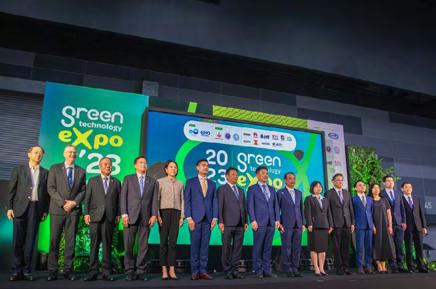
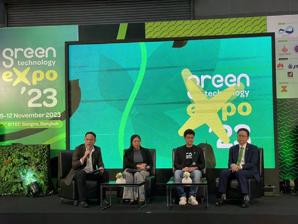
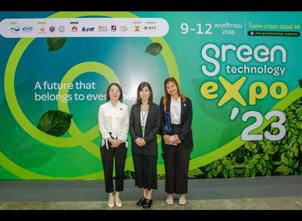
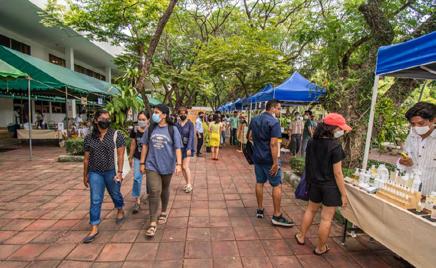
On November 12, 2023, the Asian Institute of Technology (AIT) played a pivotal role as a co-organizer of the successful “Green Technology Expo 2023” held at the Bangkok International Trade and Exhibition Center (BITEC). This event, co-hosted by the Thailand-Sino Association of Sciences and Technology (TSAST) and China Council for the Promotion of International Trade–Shanghai (CCPIT-Shanghai), received support from the Ministry of Energy, Ministry of Higher Education, Science, Research and Innovation of Thailand, and other prestigious institutions. AIT’s involvement highlighted its dedication to advancing sustainable technologies in addressing global climate challenges.
Themed “Towards the transition to newer, cleaner, sustained evergreen technology,” the expo aimed to support global climate policies and Sustainable Development Goals (SDGs). It focused on Thailand’s ambition to emerge as a regional hub for electric vehicle (EV) production within the framework of the Bio-CircularGreen Economy. Attendees benefitted from various services including green energy consumption, business and technology matching, and engaging discussions at the Green Tech Investment Forum.
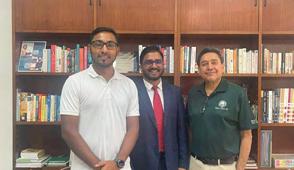
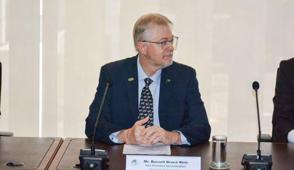
AIT’s representatives, including Mr. Russell Rein, AIT’s Vice President for Administration, and Dr. Wenchao Xue,
Director of the Belt and Road Research Center, actively participated in the event. Their contributions, along with AIT’s involvement in productive business negotiations, collaborative technology development, and showcasing expertise in green mobility and waste management, underscored the institute’s commitment to finding sustainable solutions and fostering global partnerships for a greener future.
AIT AND CRES, CHINA, SIGN MOU TO ADVANCE ENERGY AND ENVIRONMENTAL COOPERATION
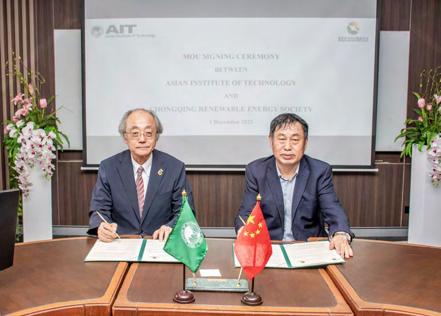
The MOU establishes a comprehensive cooperation framework between AIT and CRES, focusing on nongovernmental exchanges, particularly in technology transfer within energy and environment sectors. Initiatives include soliciting donations from Chinese firms for product showcases, developing a technology transfer mechanism at AIT with entities like the UN, and conducting training programs for Southeast and South Asian markets. Academic exchange plans involve offering AIT students short-term fellowships at CRES, and facilitating personal swaps, with AIT scholars researching in Chongqing and CRES staff joining AIT training programs. The agreement also boosts network collaboration by engaging stakeholders and business partners across both nations, as emphasized by Professor Kazuo Yamamoto at the signing ceremony. � https://ait.ac.th/2023/12/ait-and-cres-china-signmou-to-advance-energy-and-environmentalcooperation/
AIT SIGNED A MEMORANDUM OF UNDERSTANDING WITH THE ELECTRICITY GENERATING AUTHORITY OF THAILAND
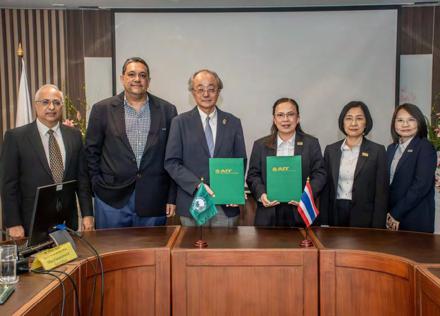
On May 18, 2023, the Asian Institute of Technology (AIT) and the Electricity Generating Authority of Thailand (EGAT) solidified their collaboration with the signing of a Memorandum of Understanding (MoU). Signed by AIT President Prof. Kazuo Yamamoto and Dr. Jiraporn Sirikum, Deputy Governor-Power Business, the MoU seeks to deepen ties between the two institutions. Its core objective is to establish a scholarship program spanning two years for master’s degrees in Engineering & Technology, Environment, Resources and Development, and Management, aimed at enhancing the skills of EGAT employees related to sustainable energy. The ceremony witnessed expressions of gratitude from Mr. Sanjeev Jayasinghe, acknowledging Dr. Jiraporn’s dedicated efforts. Prof. Shobhakar Dhakal highlighted the longstanding relationship between AIT and EGAT, expressing AIT’s commitment to supporting EGAT in human resource development. Prof. Yamamoto, in his remarks, applauded EGAT for entrusting AIT with this crucial task and anticipated the implementation of the MoU from August 2023. Dr. Sirikum underscored EGAT’s dedication to fostering high-performance employees, particularly in sustainable energy, through collaboration
with AIT. Notable attendees included key figures from AIT such as Prof. Dieter Trau, Prof. Abdul Salam, Dr. Yuosre Badir, alongside EGAT officials including Miss Phana Supavakul, Miss Sopaphan Suphachan, and others.
THE PALLADIUM GROUP COMMENDS SAR100 MIDPOINT ACCOMPLISHMENTS; PLANS FUTURE COLLABORATION WITH
YCA
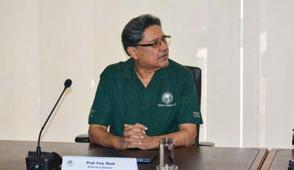
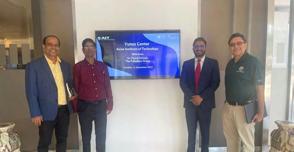
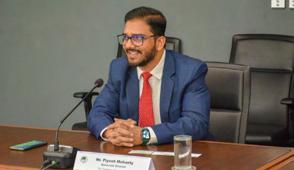
21 November 2023 – AIT Vice-President for Administration, Mr. Russell Rein, welcomed The Palladium Group’s representative, Mr. Piyush Mohanty, Associate Director on 21 November 2023 along with Prof. Abdul Salam, Dean, School of Environment, Resources and Development (SERD); Prof. Faiz Shah, Executive Director, Yunus Center AIT (YCA) and SAR100 Program Lead; Dr. Jai Govind Singh, Associate Professor, Sustainable Energy Transition and SAR100 Academic Lead; Dr. Pradeep Dash, SAR100 Administrative Lead; and the SAR100 technical team.
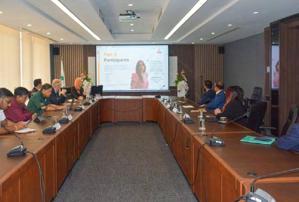
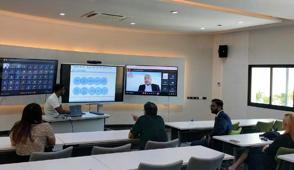
The SAR100 mid-term report was presented, during which Mr. Mohanty appreciated the Yunus team’s work in maintaining the quality and momentum of this high-impact regional program. Mr. Rein and Prof Salam highlighted
AIT’s strengths as a regional learning powerhouse. Prof. Shah and Dr. Singh addressed program-specific questions in the lead up to the SAR100 Capstone Week scheduled 4-8 March 2024.
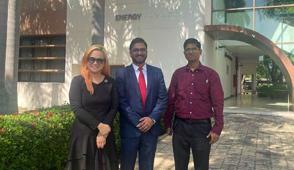
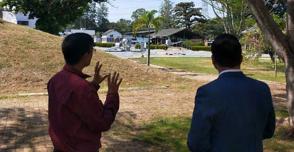
Mr. Mohanty visited the YCA Regional Knowledge Hub during Mr. S. K Soonee’s class and experienced the SAR100 hybrid learning environment in real time. He also visited the Energy Department and campus facilities.
The Palladium Group is managing the World Bank’s WePOWER SAR100 program on behalf of the Australian Government. This program is designed to build professional credentials of mid-career women in the energy sector to take on leadership roles in the region’s rapidly changing energy environment.
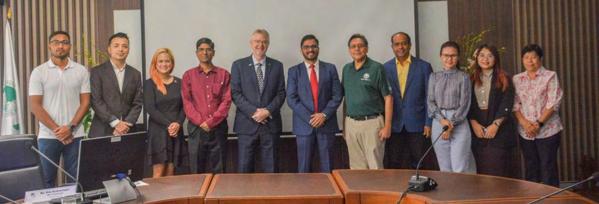
From left to right: Mr. Binay Karna, SAR 100 Technical Lead; Mr. Sanjeet Amatya, Director of Public Affairs, Office of International and Public Affairs; Ms. Kim E. Kiatiwongse, SAR100 MEL Coordinator; Dr. Jai Govind Singh, Associate Professor and SAR100 Academic Lead; Mr. Russel Rein, VP for Administration; Mr. Piyush Mohanty, Associate Director, The Palladium Group; Prof. Faiz Shah, Executive Director, YCA and Program Lead, SAR100; Dr. Pradeep Dash, Administration Lead, SAR100; Ms. Esther Nant May Than Htay , SAR100 GDSI Coordinator; Ms. Saw Theint Theint, Program and Administrative Coordinator; and Ms. Parichad Nuntavong, Program Secretary, YCA
SAR100 mid-term report presented at the AIT Boardroom
Yunus Center AIT Headquarters
Warm welcome from YCA
Energy Park
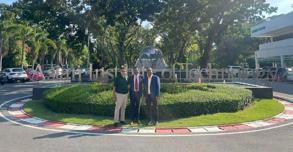
AIT Landmark
Energy Building
Regional Knowledge Hub (RKH)
DEVELOPMENT OF NEAR REAL-TIME PROVINCIAL EMISSION INVENTORY SYSTEM
Project Duration: 03 May 2022 to 30 July 2023
Description:
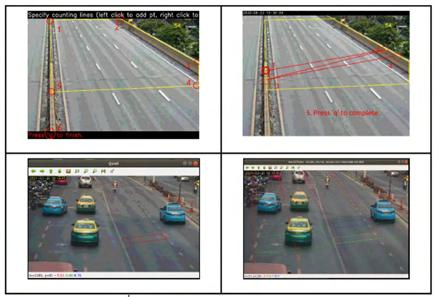
This research has studied and developed the near realtime emission inventory from the three main sources which are traffic, open burning, and industry in Pathum Thani province. The datasets that are used to develop the near real-time emission inventories come from CCTV on the road, google map API, hotspots from satellites and CEMS. The emission inventories are presented to the public via a web application platform by importing the hourly emission to the platform. In the industry sector, almost all emission inventory was calculated from static datasets because the factories that have CEMS have only 6 factories in Pathum Thani province and all of them are power plants. From the results, the most emission came from the food and beverage sector.
AI BASED SMART MICROGRID PLATFORM
AIT Research Theme: Infrastructure
Project Duration: 15 February 2021 to 28 December 2023
Description:
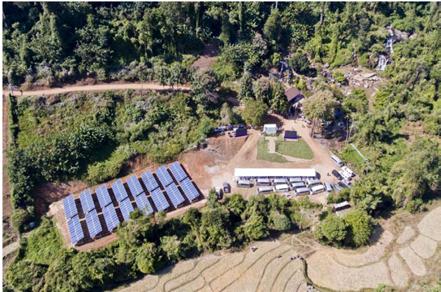
The project “AI based Smart Microgrid Platform” The research project funded by Provincial Electricity Authority (PEA). Thailand has a growing demand for electricity and a trend towards increasing the use of renewable energy sources. There are efforts to integrate electricity into the distribution system. However, alternative energy sources will have limitations due to the uncertainty in supplying electricity into the power distribution system. The electricity distribution system has been developed to be more stable and flexible by utilizing Microgrid systems, which incorporate advanced control algorithms. The creation of Smart Microgrid systems, enabling the capability to purchase, distribute electricity and control the distribution system both in connection with the main
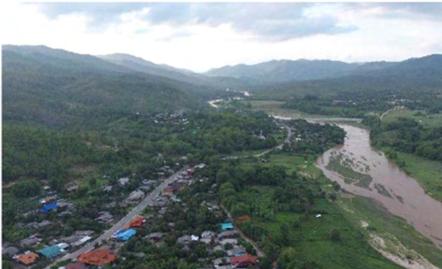
grid (On-grid) and independently (Islanding mode). This is beneficial for the electricity distribution network of the Provincial Electricity Authority (PEA), particularly in remote areas at the end of transmission lines, allowing residents in remote areas to have access to electricity.
COMTRADE INTELLIGENT DATA CLUSTERING AND ANOMALY ANALYSIS PLATFORM (CIDCAAP)
AIT Research Theme: Infrastructure
Project Duration: 23 September 2021 to 31 December 2023
Description:
Thai people have an increasing demand for electricity, but sometimes there are disruptions in the electricity supply, leading to power outages. If a power outage lasts for more than 20 seconds, it can have consequences on people’s lives and properties, including safety and livelihoods. Therefore, electricity producers must work continuously to address and develop solutions to meet the increasing demand. Currently, the regional electricity sector has developed and utilized equipment capable of measuring electricity consumption, which is suitable for managing and monitoring energy issues (DFR, Relays, and PQ Meters).
The electricity consumption data collected is used to identify the causes of deficiencies in the electricity system, aiming to improve its stability and enhance the quality of life for all Thai people.
RESEARCH PROJECT ON EDSSEA- ENERGY DEMAND IN SOUTH AND SOUTHEAST ASIA
AIT Research Theme: Infrastructure
Project Duration: 2022-2026
Description:
The main objective of the project on Energy Demand Changes Induced by Technological and Social Innovations is to create a research community with a focus on end-use, demand-side perspectives that further dialogue and cross- fertilization of research and policy analysis through data, concepts and methodologies. The goal of EDSSEA- Energy Demand in South and Southeast Asia is also to develop a service-oriented bottom-up demand model to help in providing inputs to climate policy analysis. South Asian countries are expected to experience fast economic growth and infrastructure development in the coming three decades. Most of the demand in the region does not have historical path dependency and hard lock-in effect. This provides enough scope and opportunities for planning to decouple energy demand growth from emission growth. Such energy demand planning can have the benefit of reduced cost of supply capacity expansion planning and synergies with near term SDGs Framework. It is funded by the Research Institute of Innovative Technology for the Earth (RITE), Japan. Active participation of SMARTS team in online and offline meetings continued through 2023. Joyashree Roy spoke on “What is wellbeing in the Global
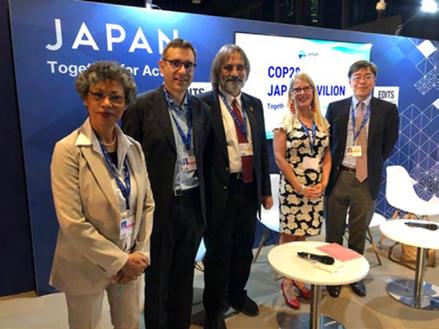
South and how to achieve it” and moderated the session on “EDITS innovations to fill in research gaps”, at EDITS Annual Meeting, 6-10 November 2023, Lisbon, Portugal. She also delivered talk on “The costs and potentials of demand-side interventions from a Global South perspective” and participated in the Panel discussion on “Demand-side innovations and their connection to energy security” at the session on “EDITS: Demandside solutions to disruptions”, Hosted by the Japanese Pavilion at COP28, Expo City Dubai, United Arab Emirates, 11th December 2023.
RESEARCH PROJECT ON MULTI-COUNTRY ELECTRICITY TRANSITION POTENTIAL AND CHALLENGES
AIT Research Theme: Clean Energy
Project Duration: 2022-2026
Description:
The “Research Project on Multi-Country Electricity Transition Potential and Challenges” (MCET) focuses on clean energy, running from 2022 to 2026. The primary goal is to establish energy modeling teams proficient in creating zero-carbon pathways and scenarios, enabling cross-country comparisons. The project currently centers on Thailand and Bangladesh, investigating their potential for electricity transition and the specific challenges they face. By fostering the development of these teams, MCET aims to enhance the capacity for sustainable energy planning and implementation. This initiative will facilitate knowledge exchange and the development of tailored strategies, contributing to each country’s unique context and accelerating their progress towards clean energy goals. The project ultimately seeks to provide a
framework for other nations to follow, promoting global advancements in sustainable electricity transition.
Weblink:
� https://www.smartscenter.org/copy-of-edssea
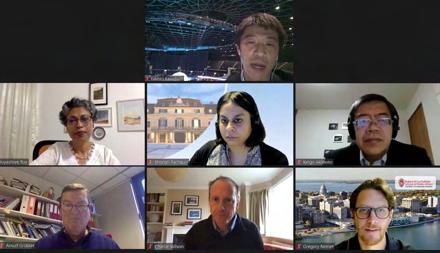
TALK ON “WHAT IS WELLBEING IN THE GLOBAL SOUTH AND HOW TO ACHIEVE IT” AND SESSION ON “EDITS INNOVATIONS TO FILL IN RESEARCH GAPS”, AT EDITS ANNUAL MEETING
AIT Research Theme: Innovations
Project Duration: 6-10 November 2023
Description:
At the EDITS Annual Meeting held from November 6-10, 2023, in Lisbon, Portugal, Center Director Professor Joyashree Roy delivered an insightful talk on “What is Wellbeing in the Global South and How to Achieve It.” Her presentation focused on understanding wellbeing from the perspective of the Global South, emphasizing the importance of addressing social, economic, and environmental challenges unique to these regions. Professor Roy highlighted the critical role of innovation and sustainable development in achieving wellbeing, aligning her discussion with Sustainable Development Goals (SDGs) 7, 9, 11, and 12. In addition to her talk, Professor Roy moderated a session on “EDITS Innovations to Fill in Research Gaps,” where she facilitated
discussions on cutting-edge innovations designed to bridge existing research gaps. This session showcased various innovative projects and research initiatives aimed at promoting sustainability and addressing pressing global challenges, furthering the mission of EDITS.
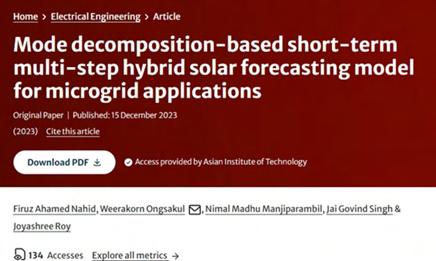
MODE DECOMPOSITION-BASED SHORT-TERM MULTI-STEP HYBRID SOLAR FORECASTING MODEL FOR MICROGRID APPLICATIONS
AIT Research Theme: Clean Energy
Project Duration: 2023
Description:
A sustainable energy sector and achieving carbon neutrality in microgrids require a firm commitment to renewable energy resources. A sharp focus on solar energy holds the most promising potential for a lowcarbon energy pathway. Efficient and optimal energy management application in the case of such microgrid systems requires the development of an accurate forecasting technique. A significant obstacle in creating such an accurate prediction tool is the intermittent nature of solar energy. To address this challenge, this research proposes a novel threefold hybrid model that integrates empirical mode decomposition (EMD), convolutional neural networks (CNN), and long short- term memory (LSTM) neural networks to forecast solar radiation up to three steps ahead. We do this utilizing two distinct solar radiation datasets obtained from two different sites in Thailand: one at 30-min intervals and the second one at 15-min intervals. To assess the forecasting capabilities of the proposed model, this study has carried out a comprehensive analysis by comparing it to six alternative models considering hybrid and stand-alone options. The
proposed model outperformed them all, establishing its supremacy with the lowest mean absolute error (MAE), root-mean-square error (RMSE), and mean absolute percentage error (MAPE), additionally, ensuring that it meets the industry standards for forecasting applications. The proposed model’s effectiveness in accurately predicting solar radiation has been successfully tested for a microgrid case study site in Thailand which supplies power to a business complex and uses the innovative Green Energy Management System (GEMS) developed by Leonics Co. Ltd.
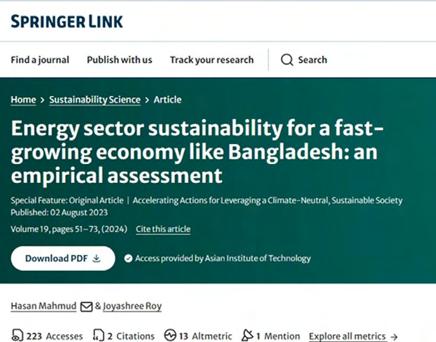
ENERGY SECTOR SUSTAINABILITY FOR A FAST-GROWING ECONOMY LIKE BANGLADESH: AN EMPIRICAL ASSESSMENT
AIT Research Theme: Clean Energy
Project Duration: 2023
Description:
Fast-growing economies like Bangladesh are expected to experience high growth in GDP, and in energy use with structural shifts towards digitalization and industrialization in the coming decades. However, given the goal of global net zero carbon growth, energy sector development will need to satisfy multiple sustainability criteria simultaneously. This paper examines empirically the trends in sustainability indicators for Bangladesh’s energy sector to assess the current status based on past trend. A long list of 438 indicators is compiled from the literature used in various country contexts for understanding energy sector sustainability but this study identifies a short list of 38 Bangladesh- specific indicators and develops a composite index. Principal Component Analysis (PCA) method was used for weighting individual indicators to arrive at the composite index. Results show that Bangladesh is showing marginal progress towards
sustainability of the energy sector. While progress in social and economic indicators such as increasing access to cleaner fuel, electrification, productive use of energy, increased diversity of fuel mix has aided in advancing sustainability, the deteriorating environmental indicators over time is pulling down the sustainability status of the energy sector. Among other things, increasing share of fossil fuel in energy mix, lack of adequate improvement in energy efficiency in all sectors, increase in methane
emissions need attention and solution to make energy sector sustainable. These steps can also help in reducing overall energy demand and emissions without adversely impacting social and economic growth through deployment of appropriate fuel choice, technologies and infrastructure. For better monitoring of energy sector sustainability, some data gaps for Bangladesh have also been identified.
ENERGY DEMAND CHANGES INDUCED BY TECHNOLOGICAL AND SOCIAL CHANGES IN SOUTH AND SOUTHEAST ASIA
AIT Research Theme: Technology, Policy and Society
AIT Unit: SMARTS@AIT /SERD
Project Duration: 1 September 2022 to 30 April 2026
Project Sponsors/Clients: It will evolve over time.
Currently: In India (GCP-JU, IIT Guwahati, SAFE) In Bangladesh (JNU, ULAB, Science connect) In the region (SANDEE)
Project Partners: : It will evolve over time. Currently: In India (GCP-JU, IIT Guwahati, SAFE) In Bangladesh (JNU, ULAB, Science conenct) In the region (SANDEE)
Expected Social Impact: Sustainable energy production and consumption solutions, Low energy demand with high human well being
Description:
South Asia and South East Asian countries are expected to experience fast economic growth and infrastructure development in the coming three decades due to the region’s poverty reduction imperative along with population growth and income growth. So, levels and structure of energy and resource demands are bound to go up. But the interesting point is that most of this structure and infrastructure and demand is going to be new so most of the demand does not have historical path dependency and hard lock in effect. This provides
SUSTAINABLE
ENERGY
enough scope for planning for decoupled energy demand growth. Embedding these solutions within policy planning early on and without further delay will not lock the region in unsustainable pathways now which will mean many irreversible or stranded asset consequences in future. By themselves physical resource demands are not directly enhancing human welfare and wellbeing (or utility). Rather it is the services and amenities that the use of energy and other resources provide that is the ultimate social goal of resource use. Taking a service lens provides many new emission mitigation pathways and potentials for demand shift, improvement and avoidance possibilities. How to imagine and model consumers is an interesting domain both theoretically and empirically.
CONSUMPTION ON CAMPUS
In 2023, the total electricity consumption at AIT amounted to 10,809,720 kWh, marking a 5% rise compared to the previous year. This increase can be attributed to the installation of additional infrastructure, including air conditioners and water heaters in Student Village-2 and Student Village-3. Breakdown of electricity usage revealed that 35% was allocated to chilling operations, 21% for academic purposes, 15% for residential needs, and 27% for other operational requirements.
AIT’s energy infrastructure includes rooftop photovoltaic (PV) units with a combined capacity of 50 kW. These units have an average solar electricity generation of 175
kWh/day, contributing 20-25% of power to the Institute’s library. In 2023, the PV system generated 65,194.20 kWh of electricity. Additionally, AIT expanded its solar energy capacity from 4.2 kW to 12 kW in October 2019, located on the Energy building. This system generates an average of 50 kWh/day, supplying 50% of the building’s power needs. In 2023, the Energy building PV system produced 16,063.83 kWh of electricity. AIT’s commitment to sustainability is further underscored by a contract with BCPG Public Company Limited (Bangchak) to install a 1.5 MW solar rooftop PV system on various campus buildings. This initiative is scheduled for completion by
AIT Research Theme: Infrastructure
AIT Unit: Yunus Center
Project Duration: 7 November 2022 to 31 December 2024
Project Sponsors/Clients: World Bank, Pakistan Water and Power Development Authority (WAPDA)
Project Partner: ECEWI and Menaal International
Expected Social Impact: Improved efficiencies in energy services, management, and technologies enhance energy security for citizens of Pakistan
Description:
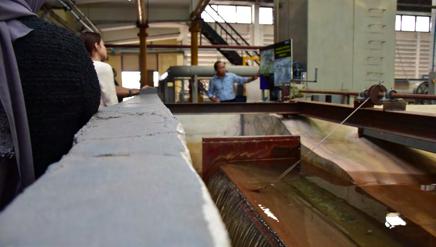
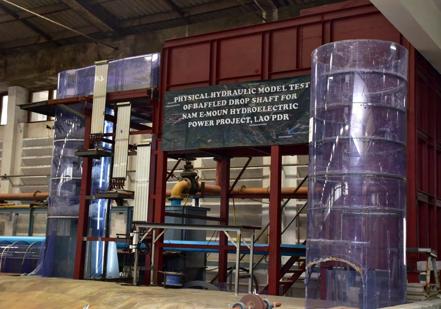
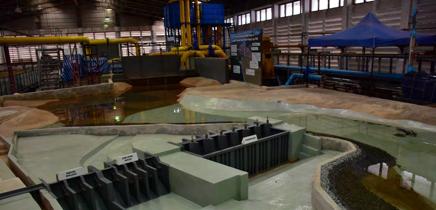
Dams are crucial infrastructure that impacts national socio-economic development goals. They are also crucial in terms of the risks they pose to the surrounding communities, the energy infrastructure, and overall public safety should an emergency or unforeseen event happen. This course develops the competencies of engineers and staff of hydropower projects and facilities of Pakistan’s Water and Power Development Authority to analyze and mitigate potential disasters and implement measures to ensure safety. In particular, the course helps participants:
EDSMAT3-C-13: HYDROPWER
September 2024, aligning with AIT’s goal to become a Net Zero Campus.
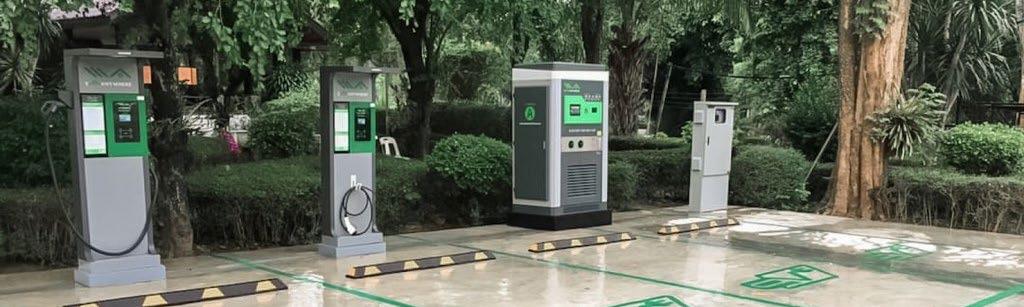
To promote the use of electric vehicles (EVs) among employees and students and reduce emissions, AIT, in collaboration with EA (Energy Absolute), installed two AC/ DC electric vehicle fast-charging stations in 2018. These were the first of their kind at AIT, aimed at facilitating the adoption of EVs on campus. The increased presence of EVs on campus in 2023 serves as evidence of the effectiveness and importance of these charging stations in encouraging sustainable transportation practices.
a. Understand the elements of an effective dam safety program
b. Learn and apply best practices and guidelines of dam safety
c. Identify and assess risks in hydropower operations
d. Learn and apply strategies in emergency response planning
PROJECT
MANAGEMENT & EDSMAT3-C-14: CONSTRUCTION MANAGEMENT AND QUALITY CONTROL FOR HYDEL PROJECTS
AIT Research Theme: Infrastructure
AIT Unit: Yunus Center
Project Duration The EDSMAT3-C-14 : 07 November 2022 to 13 December 2024
Project Duration The EDSMAT3-C-13 : 17 August 2022 to 31 December 2024
Project Sponsors/Clients: The World Bank
Project Partner: Entura Clean Energy & Water Institute (ECEWI) Menaal Travel Iraj Consultants
Expected Social Impact:
By improving construction management and quality control in hydel projects, the EDSMAT3-C-14 initiative aims to significantly boost the efficiency and reliability of energy services in Pakistan. This enhancement will contribute to increased energy security, ensuring a stable and sustainable energy supply that can meet the growing demands of the population. The program seeks to empower participants with the skills necessary to implement and oversee projects that not only advance technological capacities but also foster economic growth and environmental sustainability in the region.
Description:
The EDSMAT3-C-13 module Hydropower Project Management course is designed for engineers of Pakistan’s Water and Power Development Authority to develop competencies in mana ging and implementing activities of hydropower projects. It is aimed at strengthening individual skill sets vital to a smooth implementation of the entire project and the successful achievement of its desired outcomes. The course helps participants:
a. Enhance their understanding of the project cycle and organizational structure
b. Understand roles and responsibilities of engineers and other project staff
c. Understand the importance of testing and essential operational procedures
d. Analyze project costs and budgets
e. Learn to develop a project implementation plan
The EDSMAT3-C-14 module is an integral part of the broader EDSMAT3 Program, focused specifically on hydroelectric (hydel) project development. This module aims to profoundly enhance the competencies of professionals involved in the construction and oversight of hydel projects, ensuring they are equipped with cutting-edge methods in construction management and rigorous quality control standards. Under the guidance of Project Principal Investigator (PI) Dr. Faiz Shah, participants will engage in an in-depth curriculum that covers advanced techniques in project planning, execution, and management tailored specifically to the unique demands of hydel infrastructure. The training will also emphasize the importance of adhering to international quality standards to mitigate risks and ensure the operational longevity and efficiency of energy projects.
EDSMAT3-D-18-HEALTH AND SAFETY STANDARDS FOR HYDROPOWER PROJECTS
AIT Research Theme: Infrastructure
AIT Unit: Yunus Center
Project Duration: 31 October 2022 to 31 December 2024
Project Sponsors/Clients: World Bank, Pakistan Water and Power Development Authority (WAPDA)
Expected Social Impact: Improved efficiencies in energy services, management and technologies enhance energy security for citizens of Pakistan
Project Description:
Hydropower is a crucial resource that enables Pakistan to achieve its national development objectives. However, while it may bring great benefits to the country and power people’s homes, and sustain the industry, it also poses a lot of environmental, health, and safety risks. This course helps develop the competencies of engineers and staff of hydropower projects and facilities of Pakistan’s Water and Power Development Authority to identify, mitigate and manage health and safety risks and ensure the sustainability of hydropower in the context of Pakistan. In particular, the course helps participants:
a. Understand the need for health and safety standards within the project organization
b. Explain the operational and non-operation factors affecting health and safety
c. Analyze health and safety scenarios, operations and inspection procedures, and emergency and crisis situations,
d. Demonstrate the behavioral and leadership qualities of a successful health and safety professional
EDSMAT3-E21-IMPLEMENTING SELECTIVE ERP APPLICATIONS & EDSMAT3-E-20- PERFORMANCE-BASED EVALUATION SYSTEMS & EDSMAT3-E-22-INSTITUTIONAL DEVELOPMENT GAP ANALYSIS AND PDNA
AIT Research Theme: Infrastructure
AIT Unit: Yunus Center
Project Duration EDSMAT3-E21: 21 November 2022 to 31 December 2024
Project Duration EDSMAT3-E20 & E22: 05 December to 31 December 2024
Project Sponsors/Clients: World Bank, Pakistan Water and Power Development Authority (WAPDA)
Project Partners: ECEWI and Menaal Travel
Project Description:
EDSMAT3-E21 Implementing Selective ERP Applications course is designed for engineers of Pakistan’s Water and Power Development Authority to implement the selective ERP applications. Improved efficiencies in energy services, management, and technologies enhance energy security for citizens of Pakistan
EDSMAT3-E20 the Performance-Based Evaluation Systems course intends to build the capacity on how to access and evaluate the performance by the system for the hydro-power projects.
EDSMAT3-E21 the Institutional Development Gap Analysis and PDNA project is on capacity building in the area of Hydropower Infrastructure|Renewable Energy|Energy Management|WAPDA|EDSMAT
EDSMAT3-F-23-INVESTMENT ANALYSIS OF RENEWABLE ENERGY PROJECTS & EDSMAT3-F-24-FINANCIAL
AND ECONOMIC PLANNING FOR ENERGY PROJECTS & EDSMAT3-F-25HYDROPOWER FINANCING AND RISK MANAGEMENT
AIT Research Theme: Infrastructure
AIT Unit: Yunus Center
Project DurationEDSMAT3-F-23: 21 November 2022 to 31 December 2024
Project DurationEDSMAT3-F-24, 25: 05 December 2022 to 31 December 2024
Project Sponsors/Clients: World Bank, Pakistan Water and Power Development Authority (WAPDA)
Project PartnerEDSMAT3-F-23 : ECEWI and Menaal Internal Travel
Project PartnerEDSMAT3-F-24, 25: Menaal International Travel, Jerson Remo and Team
Project Description:
EDSMAT3-F-23 the Investment Analysis of Renewable Energy Projects project is focused on Materials and Procurement for Hydropower Projects, for Improved efficiencies in energy services, management, and technologies enhance energy security for the citizens of Pakistan
EDSMAT3-F-24-Financial and Economic Planning for Energy Projects course is designed for engineers
of Pakistan’s Water and Power Development Authority to develop competencies in Financial and Economic Planning activities of hydropower projects. It is aimed at strengthening individual skill sets vital to the smooth implementation of the entire project and the successful achievement of its desired outcomes.
EDSMAT3-F-25-Hydropower Financing and Risk Management course is designed for engineers of Pakistan’s Water and Power Development Authority to develop competencies in Hydropower Financing and Risk Management activities of hydropower projects. It is aimed at strengthening individual skill sets vital to the smooth implementation of the entire project and the successful achievement of its desired outcomes.