Asian Institute of Technology
MARCH & APRIL 2020
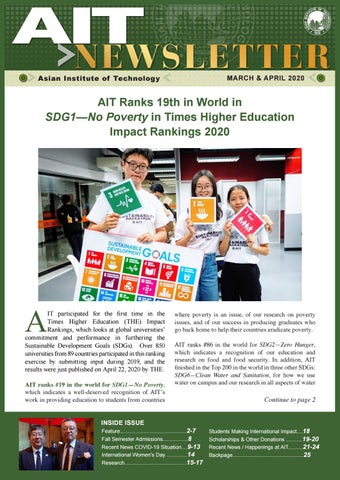
AIT Ranks 19th in World in SDG1—No Poverty in Times Higher Education Impact Rankings 2020
A
IT participated for the first time in the Times Higher Education (THE) Impact Rankings, which looks at global universities’ commitment and performance in furthering the Sustainable Development Goals (SDGs). Over 850 universities from 89 countries participated in this ranking exercise by submitting input during 2019, and the results were just published on April 22, 2020 by THE. AIT ranks #19 in the world for SDG1—No Poverty, which indicates a well-deserved recognition of AIT’s work in providing education to students from countries INSIDE ISSUE
where poverty is an issue, of our research on poverty issues, and of our success in producing graduates who go back home to help their countries eradicate poverty. AIT ranks #86 in the world for SDG2—Zero Hunger, which indicates a recognition of our education and research on food and food security. In addition, AIT finished in the Top 200 in the world in three other SDGs: SDG6—Clean Water and Sanitation, for how we use water on campus and our research in all aspects of water
Feature.............................................2-7 Fall Semester Admissions.................8 Recent News COVID-19 Situation....9-13 International Women's Day ..............14 Research..........................................15-17
Continue to page 2
Students Making International Impact....18 Scholarships & Other Donations ...........19-20 Recent News / Happenings at AIT..........21-24 Backpage................................................25
MARCH & APRIL 2020
from resources to engineering to waste; SDG14— Life Below Water, which measures our research on life below water and education on and support for aquatic ecosystems; and SDG15—Life on Land, which measures AIT’s research on life on land and our education on and support for land ecosystems. AIT submitted data for 13 of the 17 SDGs for this Ranking and placed in the 301-400 group for overall impact.
2
President Eden Woon said: “To be #19 in the world in SDG1—No Poverty in this prestigious Times Higher Education Impact Rankings 2020 on sustainability work and commitment by top global universities is a tribute to the dedication of our students and faculty and staff to address the poverty issue in Asia. I am also pleased with the good recognition we received in several other SDGs, but we will review all the results humbly and strive to do better next time.”
FEATURE
AIT LAUNCHES MARINE PLASTIC ABATEMENT MSC WITH US$ 3 MILLION JAPAN GRANT The Government of Japan has approved a financial contribution of 3 million fifty thousand (US) dollars to the Asian Institute of Technology (AIT) in Thailand to support the launch of the first postgraduate program on marine plastic litter in the region. The grant bolsters Japan’s “MARINE Initiative” toward realization of the “Osaka Blue Ocean Vision” shared at the G20 Osaka Summit last year, aimed at reducing additional pollution by marine plastic litter to zero by 2050. Under the support, AIT will launch a one-year Master of Science degree program called Marine Plastic Abatement (MPA) in August 2020. The program will train a new generation of Asian environmental leaders to combat the ocean plastic litter problem through advanced technologies and sound management practices. Plastic pollution is one of the greatest problems affecting the marine environment today. A staggering 8 million tons of plastic ends up in
AIT President Eden Woon, right, with Japanese Ambassador Kazuya Nashida.
the world’s oceans every year, according to the United Nations Environment Programme (UNEP). The top 6 countries in the world that discharge the most plastic debris into the ocean are in Asia, according to scientific research. The specialized MPA program seeks to empower young Asian practitioners, social entrepreneurs, officials and professionals who can play significant roles in marine plastic abatement, which is key for attaining Sustainable Development Goals (SDGs).
FEATURE
MARCH & APRIL 2020
3
AIT launches specialized Marine Plastic Abatement MSc for August 2020.
Japan’s contribution was formalized at a recent meeting in Bangkok between H.E. Mr. Kazuya Nashida, Ambassador of Japan to Thailand and Dr. Eden Y. Woon, President of AIT. During the meeting, Ambassador Nashida said: “I hope that this important program will contribute to the human resource development in the region, which is an urgent need, including for Thailand. It is also a great honor that a number of AIT’s faculty members graduated from University of Tokyo, Kyoto University and other outstanding universities in Japan.”
the Asia-Pacific region.”
The grant is one of the largest in AIT’s recent history and includes provision for 50 full and 50 partial academic scholarships earmarked for students from developing countries. It will also enable AIT to deliver a portfolio of certificate programs, training courses, intensive summer / winter school programs, advanced laboratory and other activities in marine plastic abatement.
Graduates and trained professionals from the MPA program, together with experts from Japan and other countries, will form the planned ‘Global Marine Plastic Alliance’ – a regional network think-tank providing technical expertise, policy guidance and professional consultation on the ocean plastic issue.
“AIT is extremely thankful for this generous support from the Government of Japan to address one of the critical challenges of our time,” President Woon said. “By contributing to a number of SDGs, the new MSc program will reinforce our mission to create social impact with innovation for
The MPA program will position AIT as an academic hub linking leading universities and international organizations in Japan with partner universities in the Greater Mekong sub-Region. Graduate students will link in-class subject matter to research outcomes and marine plastic abatement practices. Emphasis will be placed on learning from Japan’s best practices on marine plastic abatement, with key contributions from sustainable development practitioners and industry.
The donation is another milestone in the long history of AIT-Japanese partnership. Over the past 50 years, the Government of Japan has supported 934 students from many countries in Asia and 160 Japanese academicians to study and teach at AIT. On 9 December 2019, Japan and AIT celebrated their 50th Anniversary of bilateral cooperation.
FEATURE
MARCH & APRIL 2020
4
AN END-OF-SEMESTER MESSAGE FROM THE PRESIDENT APRIL 24, 2020 DEAR AIT FAMILY Today is April 24, the last day of classes for the January Semester at AIT. For those students who are graduating this May, this has been a semester that you will never forget. You will remember how the world, your home country if you come from overseas, Thailand, and AIT battled the Coronavirus these past few months. Your alma mater closed on March 18 and moved all its classes to interactive online instruction. Some of you went back home right after that, but others stayed on campus. Your final exams in a few days will also be online and, sadly, your May 22 Graduation Ceremony has been cancelled. We apologize for not being able to give you one of the momentous occasions of your life, but we hope that we can welcome you back to our December Graduation Ceremony! All of us, from the May graduates to the continuing students, to the faculty and staff of AIT, have lived through a difficult period so far in 2020, and the end is not in sight. We have learned that staying healthy and cooperating with one another become priorities in our lives, and we all realize that this is not only a life-changing crisis we are going through right now, but a world-changing crisis. Academia, of which AIT is a member, will never be the same again. When I came to AIT in the Fall of 2018, among other things, I advocated for more innovation in our teaching, and we have learned that we must do that not just to be better, but to survive. With almost all universities around the world closed without a clear restart date, we must engage more and more with students online. AIT’s expertise is based on valuable experience and student feedback over the past six weeks, on technology AIT has developed, on individual online initiatives by different units at AIT, on learning from best global practices, on acquisition of new technology, and on “out of the box” thinking in web-based education. Earlier this year, I set up the AIT Academic Contingency Task Force—headed by the Vice President for Academic Affairs and the Vice President for Knowledge Transfer—to explore and devise and coordinate ideas of innovative interactive platforms for education, including faculty training, and ensure that these will be applied not only if classes cannot begin in August, but for the future when they will be interwoven into our stimulating face-to-face residential experience, resulting in an even more innovative education at AIT. We hope that as Thailand’s COVID-19 situation improves, as the global battle against this virus turns the corner, AIT will be able to open its doors in August of 2020. But as I said above, even if the global situation prevents AIT and other universities from opening on time this Fall, AIT is ready to welcome new and continuing students to pursue their education “without missing a beat”! Whenever all of you do enter AIT’s Gate, you will find a safe and
creative environment where education and research will continue on the five strategic focus areas of AIT: Smart Communities, Climate Change, FoodEnergy-Water, Infrastructure, and Technology, Policy, and Society. And it is so clear to us that sustainability issues in which AIT specializes are key to this planet’s survival, as we now witness firsthand the formidable power of nature. Now a word about what is happening at AIT at present. So far, the campus continues not to have a confirmed case of COVID-19. We have been blessed with proactive cooperation by all students and residents, with steady efforts by mission-essential personnel and faculty, and with heart-warming generosity by donors. Just today (April 24), we are completing the distribution of 10 free face masks to every student and resident on campus, thanks to a 20,000-mask donation from the AIT Belt and Road Research Center, with funds from the AIT Chinese Alumni. We are also grateful to other donors who, in this very difficult economic period, have shown their belief in AIT by continuing to support AIT’s education and infrastructure. Thailand seems to be doing better with COVID-19, but it continues to be in a state of National Emergency, and as long as that is the case, AIT will remain vigilant and closed, with staff working from home. For those who are on campus, we thank you so much for the sacrifices due to the restrictive measures we have had to implement to keep the campus safe. For those who are at home outside AIT or outside Thailand, please take care! For those who are leaving AIT after this semester, good luck, safe travels, and stay healthy please! Dr. Eden Woon President
FEATURE
MARCH & APRIL 2020
5
AIT CAMPUS COMMUNITY RECEIVED 20,000 FACE MASK DONATION FROM AIT BELT AND ROAD RESEARCH CENTER precautionary measures were enforced during the entire distribution process on campus.
to protect the campus from Covid-19, they raised this additional 150,000 baht for the Center, which made this mask donation possible,” President Eden Woon said.
The donation provides facial protection for 600 students and 700 staff and their families who are studying online and working from home on campus during the Covid-19 shutdown of the institute. Also receiving masks are mission-essential personnel who live off campus but who have been coming into the office on duty as needed. Contractors and Vendors who provide services to the campus were also beneficiaries. The remainder are maintained by OFAM, which also issued masks to its facilities’ personnel and security staff and for other protective uses on campus.
The Office of Facilities and Assets Management (OFAM) received the shipment on April 20 and organized the orderly distribution of 13,000 masks over a three-day period from April 22-24. Social distancing and
The AIT Belt and Road Research Center supports research by our students and faculty which can benefit the entire Belt and Road region. It was inaugurated in November 2019, with funding by the AIT Chinese Alumni Chapter.
The director of OFAM inspects the shipment of face masks on April 20, 2020.
T
hirteen hundred students, staff, and residents on AIT campus in late April received 10 free face masks each from an AIT Belt and Road Research Center donation of 20,000 masks. This humanitarian gesture for our campus community was made possible by an injection of 150,000 Thai baht from the AIT Chinese Alumni Chapter into the AIT Belt and Road Research Center, supplemented with personal financial contributions by the AIT Leadership – the President, the three Vice Presidents, and the three Deans. “AIT is very thankful for the generosity of our Chinese Alumni Chapter which has been supporting the AIT Belt and Road Research Center all along. This time, realizing that AIT is in the midst of a very tense effort
Students receive donated face masks on April 22, 2020.
FEATURE
MARCH & APRIL 2020
AIT Alum is First Recipient of the Xulhaz Mannan Inclusive Development Award Conferred by USAID Cambodia’s Sopheap Sreng is a first recipient of the Xulhaz Mannan Inclusive Development Award conferred by the U.S. Agency for International Development (USAID) for his commitment to the inclusion of marginalized populations in USAID’s development efforts. He currently is a Gender and Project Design Specialist with USAID Cambodia. Sopheap graduated from the Asian Institute of Technology (AIT) in 2010 with an M.Sc Degree in Gender and Development Studies. Before coming to AIT, he was a community organizer in Ratanakiri province where he worked with indigenous communities to improve their livelihoods and educational status of their children. He also holds a BA in Business Management from the University of Cambodia and was one of the World Bank Scholars in 2007 for Social Accountability Diploma, awarded by the Ateneo de Manila University. He has both worked and received trainings in Thailand, Zambia, the United States, and Afghanistan. He is a proud father and a husband who takes household work responsibility dearly to his heart.
Sopheap (middle) with USAID/Mission Director (left) and Program Office Director (right) presenting the award Photo: Michael Gebremedhin
Watch Sopheap’s acceptance video here: https://www.youtube.com/watch?v=u_iYPY2Zqeg&feature=youtu.be
6
FEATURE
MARCH & APRIL 2020
7
UPDATE ON AIT DURING GLOBAL CORONAVIRUS CRISIS
The AIT Coronavirus Task Force meets daily. 30 APRIL 2020
Since January of this year, the Coronavirus (COVID-19) crisis has spread across the world. By the end of April, the situation was improving in Thailand, but there are places around the world, including many of the countries where our AIT students, faculty, and staff come from, which are still heavily affected. AIT took action very early to make sure our campus is safe. We formed the AIT Coronavirus Task Force at the end of January to monitor the crisis, both in general and specifically on how it affects the institute. The Task Force has been devising policies, measures and advice, and has kept the AIT community informed through a dedicated Intranet column— with links to the Thai Government public health websites— and through frequent emails. As the number of confirmed cases of Coronavirus increased daily worldwide, the work of the Task Force shifted into high gear, and more and more restrictive precautionary steps have been taken by AIT to ensure a safe and healthy environment on campus. For example, the Task Force ensured that all AIT students overseas— who wanted to—have returned
to AIT, and those arriving from highly infected countries were placed on a 14-day quarantine. As of this update, there is no student in quarantine, having all been cleared medically. Contingency operational plans have been put in place since Thailand declared a National Emergency in early April, and this is expected to last until the end of May. So far, the AIT community is making sacrifices to protect the campus, and no Coronavirus cases have occurred at AIT. Back on March 18, AIT officially closed, following the policy announced by the Thai Government, and all face-to-face classes were cancelled for the rest of the Spring Semester and moved to online interactive instruction. About half the 1400 students chose to remain at AIT, with the other half, including exchange students from around the world, going back to their home country or their home in Thailand. All students were able to learn via interactive online instruction until the end of the Spring Semester on April 24. Final exams and theses defense will then also be online in the first part of May. The May Graduation Exercise has been cancelled, but those students
graduating this May will be able to complete their requirements to graduate on time. They are also welcome to come back to attend the December Graduation Exercises if they wish. The campus is not “locked down”, but work by AIT faculty and staff is now on a “Work from Home” basis, with only mission essential personnel coming to the office very occasionally. Meanwhile, looking ahead to the Fall Semester, AIT faculty and staff are working very hard to make sure that the online education we are providing now will be enhanced for the future, with more innovative interactive online instruction on different platforms available this August. Therefore, with new technology and methodology, AIT “will not miss a beat” and will welcome students to enroll in August 2020, even in the eventuality that the crisis prevents on-campus instruction to start at that time. Quality Education and Research— “Social Impact with Innovation”— will go on at AIT! And at the time of this writing, we are optimistic that the AIT campus will be open with face-to-face classes by August 2020!
FALL SEMESTER ADMISSIONS
MARCH & APRIL 2020
8
In April, AIT President Eden Woon wrote a personal message to applicants who are considering offers of admission from AIT. Dear Prospective Student of AIT: First of all, congratulations for having received an offer of admission from the Asian Institute of Technology from a competitive group of applicants! I sincerely hope that you will choose to attend AIT, which is uniquely positioned in accordance with our “Social Impact with Innovation” motto which is driving our research and education now. We hope to hear from you very soon on your confirmation to enroll at AIT this August. However, I know that because there is a global public health crisis consuming all of us, you naturally have questions in your mind about attending AIT this Fall. While it is true that the Covid-19 epidemic is far from being ended in the world, I can tell you that Thailand is fighting the virus vigorously and has been affected less than many other countries, especially the ones in Europe and the UK. Moreover, AIT has been vigilant and has guarded the safety of its campus and students and staff well. With the school closure order from the Thai Government, all instruction at AIT has been placed online. Many of our students have chosen to go back to their home country, and others have remained on campus. But our online instruction has gone smoothly for both sets of these students. In addition, we are perfecting an AIT Online Learning Environment consisting of a number of innovative platforms to enhance this online experience, just in case face-to-face instruction does not start by August 2020. The goal is to
provide an AIT quality education whether or not classes resume on campus at that time. Of course, no one can predict the course of development of the Coronavirus at this point, but we believe that Thailand and AIT will be open before August of this year, so that you can come in person to AIT at that time to start the Fall semester. Nevertheless, AIT quality education will go on “without missing a beat”. Even if we must start online in August, your education will flow seamlessly into in-person education once the campus is opened. AIT is globally known for its sustainability and capacity building research and education. These are subjects which are crucial in the postCoronavirus world, as this crisis has woken up mankind to its neglect of Nature. While the virus situation is indeed grave, we all know that human ingenuity will overcome it—it is just a matter of time! “Education”, I believe, is such a critical aspect of one’s professional and personal journey that it should never be allowed to be held hostage by external situations. We welcome you to come to AIT to study how we can work with mother earth in a more respectful and scientific way, and the virus will not stop us from providing this quality education to you starting in August, either in person or online!! I hope to see you on campus in a few months! Eden Y Woon President AIT
RECENT NEWS COVID-19 SITUATION
Mentorship System for Students
AIT President Eden Woon on one of his regular inspections of the campus during the closure period.
In April, AIT set up a Mentorship System for the approximately 600 students who chose to remain on the AIT campus and study from their dorms during the campus
MARCH & APRIL 2020
9
closure. “We recognize the additional stress of being away from home and that students are worried about their loved ones during COVID-19 crisis,” President Woon said, explaining his reason for instituting this program. “So AIT set up a Mentorship System so every remaining student will have some senior staff member – in most cases from their home country – to be a helping hand and a listener and mentor during this difficult time.” He added in a message to the community that for those AIT students who have gone home, AIT was still thinking of them as they continued their studies online. The president urged these students to take precautions to be safe with their families in their home countries.
AIT President calls on Secretary-General to the Prime Minister of Thailand Dr. Eden Y Woon, AIT President paid a courtesy call on Mr. Distat Hotrakitya, SecretaryGeneral to the Prime Minister of Thailand at the Government House of Thailand, Bangkok on 19 March 2020.
Dr. Eden Y Woon, AIT President, right, with Mr. Distat Hotrakitya, Secretary-General to the Prime Minister.
RECENT NEWS COVID-19 SITUATION
MARCH & APRIL 2020
Chinese Embassy to Thailand donates face masks and hand sanitizers On behalf of the Chinese Embassy to Thailand, Counsellor of Cultural Sector, Ms Chang Yumeng (pictured above and right), and First Secretary of Education, Ms. Song Ruoyun, paid a short visit to the campus on April 2 to deliver face masks and sanitizer gels to AIT. President Eden Woon received the donation and expressed his heartfelt gratitude on behalf of the institute.
Alcohol-based Hand Sanitizer developed at AIT Biotechnology Lab Prof. Anil Kumar Anal, Head of the Department of Food Agriculture and Bioresources, School of Environment, Resources and Development, formulated and developed an effective (99.9% efficacy) gel sanitizer at the Biotechnology Laboratory, AIT. This low-cost hand sanitizer was tested in-house with the help of his staff. Initially, the team produced only about 10 liters due to limited raw materials. The team distributed the sanitizer to campus locations such as the AIT Medical Center, administration offices, schools, classrooms, laboratories and the cafeteria during the first week of March.
10
RECENT NEWS COVID-19 SITUATION
MARCH & APRIL 2020
11
By Kanda Yaemboonruang
AIT’s First Step to Interactive Online Classes ing is that everyone can learn and share knowledge everywhere and anytime. Nonetheless, Saw Theint, also noticed that some students struggled to maintain concentration throughout the class. However, she said that online learning worked out well and was very useful during this unfortunate time.
The Office of Public Affairs spoke with some AIT faculty members and students about their experience with online classes to find out how they prepared themselves for online learning and what challenges they experienced and overcame.
Assistant Prof. Dr. Takuji W. Tsusaka, Chair of Natural Resources Management, School of Environment, Resources and Development, said that he was now ‘online’ every day either for his classes, exams or meetings. The difficulty he found was not seeing his students’ physical reactions. “It is a little bit hard to conduct discussions with the students and it is difficult to tell whether the students understand the discussion or not,” he said. His solution was to make a video mandatory in order to create two-way communication in his classes to ensure that the students paid close attention and could follow class discussions. Another challenge was to conduct exams online. Dr. Tsusaka explained that a lot of experimenting was done on his part to see what would work best. He found open-book exams, rather than closed-book exams, better for online testing. Although it is challenging, online learning allows students to stay safe and to learn at home. It was very beneficial to AIT students who traveled back to their home countries, as they could be confident that their education continued without any interruption, Dr. Tsusaka emphasized. Saw Theint Theint Htet, a master’s student in Urban Environmental Management from Myanmar, decided to stay in AIT during the COVID-19 crisis and study online from her dorm. She explained that one main advantage of online learn-
Associate Professor Dr. Chutiporn Anutariya, Associate Dean of the School of Engineering and Technology, explained that online classes cannot replace face-to-face classes, but online classes help a lot in this unprecedented situation. “We are employing many alternatives such as Zoom, Google Meet and other social media platforms to ensure effective communication among faculty members and students,” she said. Dr. Chutiporn further explained that the success of online learning depends on the teachers as changing to the online teaching mode does not only entail moving classes online. Rather, the entire teaching approach has to be modified to ensure the same level of teaching and learning effectiveness and to ensure the same level of student engagement in classes. “We cannot just use the same materials in face-to-face classes online. We need more exercises and Q&As in online classes. The COVID-19 crisis has pushed teachers to be aware of the reality of E-learning. By the time the crisis subsides, teachers will be more equipped with E-learning, and they can then combine technology with the more conventional classroom teaching methods. In the future, teachers may not need to cancel their classes anymore if they have to be away for seminars or meetings. They may just create online classes,” Dr. Chutiporn said.
RECENT NEWS COVID-19 SITUATION
MARCH & APRIL 2020
12
AIT Geoinformatics Center aids COVID-19 pandemic response in Uttarakhand, India Amid the COVID-19 pandemic, the Government of Uttarakhand state in northern India has requested the AIT Geoinformatics Center (GIC) to upgrade an existing geospatial platform to aid its handling of the crisis.
and positive cases; live locations of ambulances; status of migrant labor coming from other states due to the ongoing lockdown in India and locations of food grain storage facilities and capacity availabilities.
The recent call comes from the same government that hired GIC last year to execute a project called “Implementation of an Integrated Geospatial Platform, Database, and Applications for Disaster Risk Management” under a World Bank funded initiative. The geospatial platform was originally designed to monitor natural hazards, provide early warning and support decision making for effective disaster management.
According to GIC Director Dr. Manzul Kumar Hazarika, the COVID-19 Decision Support System will help the State Government of Uttarakhand to visualize the information up to a house-level and manage COVID-19 patient care and case hotspots in a much better way by knowing the number of people to quarantine, and food and other logistics requirements in any specific location.
The AIT Geoinformatics Center has now customized the platform to address the pandemic by taking advantage of the existing database and information in the system. A dedicated COVID-19 decision support system has been established within the existing geospatial platform, which is capable of providing locations of COVID-19 outbreak hotspots in the state; estimation of populations around a hotspot; locations of designated COVID-19 hospitals and quarantine facilities, capacities, occupancies and inventories of life-saving equipment; locations of designated COVID-19 test laboratories including number of samples tested
“Efforts are being made to get the mobile phone locations of the COVID-19 patients, people sent
for quarantine, and migrant labor information to integrate into the system to monitor their movements,” he added. The geospatial platform is device-independent and can be accessed and viewed from smart-phones, tablets, laptops and personal computers. The information is available and accessible to government agencies and decision-makers in the form of maps to help them in monitoring and responding to the COVID-19 pandemic across the entire state. The online platform and its data are also available to the Government officials in Uttarakhand, but non-sensitive information is expected to be made available to the public to provide situational awareness for citizens.
GIC’s COVID-19 Decision Support System maps Uttarakhand, India using geospatial data and analytics.
RECENT NEWS COVID-19 SITUATION
MARCH & APRIL 2020
13
Entrepreneurship Center’s Covid-19 Competition The AIT Entrepreneurship Center (EC) launched its "AIT's fight against COVID-19" competition in an open call to the AIT Community. The Entrepreneurship Center sought ideas for projects that can create real impact to fight COVID-19 within the next 6 months. Teams can be composed of AIT members (Faculty, Students, Alumni, Staff and Family members). The center said it would consider any type of project with impact potential in areas such as software, hardware, devices, prevention, treatment, behaviour, diagnostic. Though organizers stressed that there is no limitation on the focus, projects will be evaluated on:
➡️ ➡ ➡ ➡ ➡ ➡
Impact to fight COVID-19 Team strength Ability to execute the project and to perform POC within 1 month and create impact within 6 months Ability to work remotely on the project Ability to attract external funding or support Scalability of technology or approach to create wider impact
For more information: https://www.ait.ac.th/2020/04/aits-fight-against-covid-19/
Book Loan Ride-Thru Service New: "Book Loan Ride-Thru" service initiated by the AIT Library to support students' studies and research during SFH! Books that are not found online, can be requested through this service. 4 Easy Steps to Request a Book Loan: 1. Search your required book from the library catalogue. 2. Copy the call numbers or titles of books and send your request to library 3. Library staff will find and collect the books for you. Then, make an appointment to pick up at your available time. Every loaned book will be cleaned before being put in a package, along with your printed student ID on top of the package. 4. Just ride to pick up your book in front of the library -- every day from 8.00 AM - 4.30 PM! ➡ Visit Library website: http://library.ait.ac.th
INTERNATIONAL WOMEN’S DAY
MARCH & APRIL 2020
14
By Kanda Yaemboonruang
DON’T LEAVE ANY WOMAN BEHIND We must acknowledge that there is diversity among women, and we must make sure that we understand this diversity and ensure equality across all societal substructures — Prof. Kyoko Kusakabe International Women’s Day – which was observed on March 8 – is not just a celebration, it is a campaign to encourage women to speak out about their problems, women’s rights and values they are fighting for to effect significant changes. It marks women’s ongoing struggle for equality across the world. According to the United Nations Women, the theme for International Women’s Day 2020 is “I am Generation Equality: Realizing Women’s Rights”. Kyoko Kusakabe, professor of Gender and Development Studies at AIT’s School of Environment, Resources and Development, says that the hashtag #EachforEqual means that we must not leave any woman behind, and we should make sure that all women are not reduced to just one generic unit. “We must acknowledge that there is diversity among women, and we must make sure that we understand this diversity and ensure equality across all societal substructures, be they religions, occupations or others,” Prof. Kusakabe said. She explained that over the past years, more and more women have been speaking out, and the women’s movement is becoming a powerful social movement. This is definitely a good sign for women. However, visible ones in the media come from ‘front row’ women; meaning the highly educated women in urban areas, she said. There are still countless women in rural areas, most of whom are living in poor conditions, whose voices have yet to be heard and whose lives have yet to be changed, she stressed. Thus, there is still a need to ensure equality for all. Prof. Kusakabe added that education for girls and women is crucial as it is a means of empowerment, employment and higher incomes. Education is key to women’s advancement. “Even now, we hear some of our new students saying that they were told that girls should not get higher education. In this generation, it is unbelievable. Our students come from many countries around the world. So classes are a venue to exchange views and experiences about their problems and situations. This allows them to have much wider perspectives on others’ problems, and their own situations.”
Professor Kyoko Kusakabe expresses concerns over gender equality on International Women's Day 2020.
In the next few decades, most countries in Asia will experience aging societies. The United Nations has forecasted that by 2050, the number of elderly people will double, and by 2100 the entire world will become a full aging society. Prof. Kusakabe commented on the implications of decreasing rates of population growth, saying it’s a demographic reality that governments need to address now and that solutions will be found in improving women’s place in society. “Women do not give birth because they know that they cannot expect much support for childcare.” Many societies still think childcare is women’s sole responsibility, so a change of mindset is necessary, Prof. Kusakabe said. It is difficult for women to have children as they will have to assume two full-time roles of being a mother and a worker. Without support from government and their employers as well as changes in attitude and long working hours of men, women may not be willing to have a child because it will become too much of a burden for them, she stressed. “It is crucial now that governments look into how to improve this situation for women, if we want to alleviate the effects of the ageing society in the future.
RESEARCH
MARCH & APRIL 2020
15
By Kanda Yaemboonruang
DR EKBORDIN WINIJKUL
HIDDEN DANGER! SUMMER ‘OZONE’ SPIKES
AIT EXPERT ADVISES TO AVOID OUTDOOR ACTIVITIES DURING THE DAYTIME Ozone pollution at ground level is more detrimental to our health than PM 2.5. With heat and sunlight, the mixture of these elements becomes toxic, especially in summer — Dr. Ekbordin Winijkul Dr. Ekbordin Winijkul, Assistant Professor in the Department of Energy, Environment, and Climate Change, is an AIT atmospherics scientist whose work focuses on PM 2.5 and other air pollution. His current research showed that in the first few weeks of March, the level of ‘ozone’, which is a toxic gas, has been higher than normal in some areas. For example, in Chiangmai in northern Thailand, he found that on March 10 the level of ozone was at 117 ppb (part per billion) for 8 hours. This level was far higher than the normal maximum level of 70 ppb. It is normal to detect a higher level of ground-ozone during the summer as high temperatures and sunlight are the catalysts for an increase in the ground-ozone level. Ground-ozone is considered toxic. A large volume can lead to health effects and can induce asthma. It is a hidden danger as it is corrosive, and has no color or smell, making it hard to be detected, Dr. Ekbordin said. Dr. Ekbordin suggests avoiding outdoor activities
during the daytime. He is concerned about people in northern Thailand as the high level of PM 2.5 combined with the increasing level of ground-zone ozone in some areas, including Chiangrai, may pose extremely high risks or health problems. He added that ozone is one type of air pollution that environmental academics around the world are keeping an eye on, as it has posed problems globally.
RESEARCH
MARCH & APRIL 2020
16
By Kanda Yaemboonruang
PROF. JOYASHREE ROY, BANGABANDHU CHAIR PROFESSOR
HOME GARDENS IN INDIA HIT BY CLIMATE CHANGE
Home gardens maintain green cover and harbour rich biodiversity that helps in poverty reduction.
A recent study of home gardens in the dry regions of West Bengal, India has revealed that they are facing the effects of climate change and that there is a need to provide agricultural extension services to these gardens for their sustenance. The paper ‘Biodiversity and Impacts of Climate Change in Home Gardens: Evidence From a Study in West Bengal’ authored by Joyashree Roy, professor at Asian Institute of Technology, Thailand, and Sebak Kumar Jana, Vidyasagar University, points out that home garden owners have reported pest attacks, insect and diseases. The studies were conducted in the arid areas at Garbeta block in Paschim Medinipur district. Prof. Roy said home gardens not only provide food security but also help in maintaining green cover, harbour rich biodiversity and help in poverty reduction in rural areas. “Unless agricultural extension service is given to these home gardens, there is no guarantee that people will continue the healthy practice,” she said. According to her, home gardens are a major land use pattern all over the world, and in rural areas can provide vegetables and fruits to the family throughout the year. “The most common attack on the home garden is semi-looper (Leda poka in Bengali), almost 77%, affecting vegetables and tree,” the study said. The other pests are aphids affecting 33% of home gardens and white fly 11% of home gardens. The common diseases in the home gardens studied are: mosaic in 41%, downy mildew in 37% and foot row in 32%. The field survey pointed out that planting dates have been changed for some crops like chilli (30%), brinjal (21%) and gourd (17%). “The major reasons are changes in the onset of rain, shortage of water and lack of timely irrigation,” the study said.
CHANGE IN TEMPERATURE The study also looked at the change in temperature in home gardens between 1965 and 2010. The minimum temperature during this time showed an increase from 1960s to 2005. The minimum temperature increased from 20.5 degrees Celsius to over 22 degrees C. The maximum temperature decreased from about 32 degrees C in the mid1960 to almost 31 degrees in 2005. While there was no hired labour, annual time allocated by households varied from 40.14 hours and 35 hours. “The households report that some species of plants, like eucalyptus and mango, are becoming extinct in home garden… the main reason is felling, water crisis, pests and deteriorating quality of the soil,” the paper said. The paper, which is part of the book Current State and Future Impacts of Climate Change on Biodiversity, highlights that there is a “need of extension services on the part of the government regarding crop planning, land management, providing irrigation and training for water and soil conservation so that home garden owners can take different adaptation strategies period.” By Shiv Sahay Singh
(THE HINDU Newspaper, Published Feb. 24)
RESEARCH
MARCH & APRIL 2020
17
DR. ATTAPHONGSE TAPARUGSSANAGORN AND SU KYI
WIRELESS SENSING SYSTEM FOR THE REMOTE OPERATION OF OFF-GRID TRACKER SOLAR Dr. Attaphongse Taparugssanagorn and Su Kyi of the AIT Telecommunications program explain their findings in their paper "Wireless sensing for a solar power system", published in Digital Communications and Networks journal, February 2020 Issue. Researchers at Thailand’s Asian Institute of Technology have developed a wireless sensing system for the remote operation of off-grid PV installations which feature solar trackers. Based on the global standard ZigBee 2.4 GHz wireless technology, the system features six sensors for measuring battery terminal voltage; solar voltage; solar current; current to the DC-DC converter; tilt angle of solar panels according to voltage across the potentiometer; and a converter transistor temperature sensor. The sensors and 12 V rechargeable, sealed lead-acid battery are powered exclusively by the PV system itself, said the researchers. THE SYSTEM The system, which includes two Arduino Uno open-source microcontroller boards, a DC-DC converter circuit and an H-Bridge motor driver, is said to be capable of a range of operations including continuous remote monitoring, remote configuration, remote disabling of battery power to the DC-DC converter and motor, and generating visual alerts.
According to the research team, the system’s XBee ZNet 2.5 module – a radio-frequency device developed to
The new system could aid off-grid tracker solar deployment. Image: NEXTracker
operate with the Zigbee protocol – transmits data wirelessly every 10 minutes including information such as the PV installation’s voltage, current, battery voltage, load current and converter transistor temperature, to another XBee ZNet 2.5 module connected to a computer used by the PV system operator. “The XBee end device gets the [hourly] data from the XBee coordinator to alter the tilt angle in auto-mode,” stated the system’s developers. “It can also read the data to rotate the tilt of the solar PV panel in manual mode.” The system, which was tested under moving cloud conditions, is said to be effective in terms of performance, cost and power consumption. It is described in the paper Wireless sensing for a solar power system, published in Digital Communications and Networks.
STUDENTS MAKING INTERNATIONAL IMPACT
MARCH & APRIL 2020
18
AIT Student Social Entrepreneurs reach Bangkok Regional Final Six in the Hult Prize 2020 Challenge AIT’s 'Team Saikiran' on March 16 joined 5 other finalist student entrepreneur teams representing universities around Asia at the Final 6 Bangkok Regionals of the Hult Prize 2020 Challenge -A Global Competition. All were competing for the Global Prize of US$ 1Mil. in start-up funding. Team Saikiran represented diverse backgrounds working for a common vision of fighting air pollution and climate change using technology and innovation. As a part of their journey, they pitched their idea to a series of leading international experts and judges. AIT’s student social entrepreneurs -- Mr. Saikiran Gaddmedi, India, M.Eng. in Nanotechnology; Mr. Vivek Sharma Poudel, Nepal, M.Eng. Nanotechnology; Ms. Ying Chen, China, MBA; and Mr. Ekachai Lojanaphiwat, Thailand, PhD, Environmental Engineering & Management -- made it all the way to the final 'Top '6 Changemakers from the Hult Prize 2020 Bangkok Regional Summit. For more: http://www.hultprizeat.com/ait
INTERNATIONAL STUDENT ENTREPRENEUR AIT PhD candidate receives ICD Progress Award 2019 in Dubai Late last year, Gautam Dadhich (pictured right, center), 28, an Indian PhD candidate under Dr. Hiroyuki Miyazaki, RSGIS, School of Engineering and Technology, represented AIT at the Global Grad Show (GGS), Dubai. His idea – ProFind-Proficient Platform for Farm Insurance for Natural Disasters -- was not only selected for exhibition during Global Grad Show-GGS (10-16 Nov. 2019) but was also chosen for pitching in the boot camp part of GGS entrepreneurship program, where only a few project ideas from selected projects were invited after scrutiny of its business model canvas, value proposition canvas and investment deck. His project was one of the few selected projects out of 15 projects shortlisted globally from 1500 submissions. Mr. Dadhich, who hails from Jaipur district in Rajasthan state of northwestern India, is now developing an agri-insuretech ICT platform to improve risk resiliency of the agriculture community using satellite imagery and machine learning. He is currently in Dubai working on his business feasibility and is seeking investor seed funding of US$ 1,000,000. He already received a US$ 30,000 grant for his business feasibility and market validation. Funding is provided by ARM holdings, an investment firm in Dubai that supports social startups. He also received honorable mention in “ICD Progress Award 2019” for making a social impact by his idea to protect the farming community from natural hazards.
SCHOLARSHIPS AND OTHER DONATIONS Mr. Bhargab Mohan Das (SE 2005) supports AIT with Named Scholarships and Student awards for Best Master’s Thesis under the name of his late father, Prof. Emeritus Madan Mohan Das
MARCH & APRIL 2020
19
Dr. Yanyong Phataralaoha (IE&M '86) signed the agreement to support AIT towards two 42 credits Doctoral Degree Tuition Scholarships Prominent alumnus and a major donor to AIT, Dr. Yanyong Phataralaoha (IE&M ’86), Managing Director, Thai Pipe Industry Company Limited supported AIT towards two 42 credits Doctoral Degree Tuition Scholarships for a total amount of 1,344,000 Thai Baht. These scholarships will be for students from Myanmar, Laos PDR, Cambodia, Vietnam and China (only from Yunnan Province) enrolled in Water Engineering and Management (WEM), School of Engineering & Technology and Environmental Engineering & Management (EEM), School of Environment, Resources and Management for August 2020 intake.
Mr. Bhargab Mohan Das (SE 2005), Founding Chairman of DASS Energy and the Founding CEO and Managing Director, Christiani & Nielsen Energy Solutions Co., Ltd. signed an agreement with AIT President Dr. Eden Woon to support AIT for 5 Named Scholarships (24 credits + 1-year registration fee for a total amount of THB 2,120,000) in Civil Engineering and 3 Student awards for Best Master’s Thesis (1 award every May graduation for a total amount of USD 6,000) in the field of Water Engineering and Management under the name of his late father, Prof. Emeritus Madan Mohan Das. He will also provide student internships offerings in one of his affiliated companies. AIT President Dr. Eden Woon expressed his appreciation and thanked Mr. Das for his support to the Institute.
AIT President Dr. Eden Y. Woon expressed his appreciation to Dr. Yanyong for his continued support to the Institute.
The late Mr. Kee Book Hee (EE’82) family signed the agreement to support AIT towards a one Full Master Degree Scholarship The late Mr. Kee Book Hee, AIT alumnus who graduated in Environmental Engineering in 1982, made a personal donation to the AIT Endowment Fund in 2010 and his family has decided they would like to use his contribution for one full Master degree scholarship in the amount of 1,200,000 Thai Baht. This scholarship will be for one student of any nationality enrolled in Environmental Engineering & Management (EEM), School of Environment, Resources and Management for August 2020 intake. Mr. Kee was the Former President of the AITAA Malaysia Chapter and Former Managing Director of Frontier Bond (M) Sdn Bhd, Malaysia. AIT President Dr. Eden Y. Woon expressed his thanks and appreciation to the family of late Mr. Kee for their support to the Institute.
SCHOLARSHIPS AND OTHER DONATIONS
MARCH & APRIL 2020
20
Engr. Mohammad P. Aftab (EE '75) signed the agreement to support AIT towards a 12 credits Tuition and one semester Registration Fee Master Degree Scholarship Engr. Mohammad P. Aftab, AIT alumnus graduated in Environmental Engineering 1975 support AIT towards a 12 credits tuition and one semester registration fee Master Degree Scholarship in the amount 212,000 Thai Baht. This scholarship will be for one deserving Pakistani student enrolled in Urban Environmental Management, School of Environment, Resources & Development for August 2020 intake.
Engr. Aftab is working as Discipline Manager at Saudi Consulting Services. He was the former Vice President of NESPAK National Engineering Services, Pakistan. AIT President Dr. Eden Y. Woon expressed his thanks and appreciation to Engr. Aftab for his support to the Institute.
Assoc. Prof. Dr. Somchet Thinaphong (M. Eng. WRE’73 & D. Eng. WRE’80) Agrees to Support AIT’s Water Engineering & Management (WEM) Laboratory Assoc. Prof. Dr. Somchet Thinaphong, an AIT alumnus who graduated in Master of Engineering 1975, and Doctoral of Engineering 1980 both in Water Resources Engineering, has agreed to support AIT in the amount of THB 60,000 towards student research at Water Engineering & Management (WEM) laboratory. Assoc. Prof. Dr. Somchet Thinaphong is currently the Managing Director of Dawei Special Economic Zone Project, Italian-Thai Development Public Company Limited. He is an inductee of AIT Hall of Fame in the second batch, and a former President of AIT Alumni Association
Headquarter during 2016-2017. He is also the former Chairman & Executive Board at GISTDA (Geo-Informatics and Space Technology Development Agency), Ministry of Science & Technology, Thailand. AIT President Dr. Eden Y. Woon expressed his sincere thanks to Assoc. Prof. Dr. Somchet for his support to the Institute. President Woon said: “AIT’s students and laboratories are always looking for additional funding to help with their research and facilities. And we are always grateful to our alumni who remember their Alma Mater. Dr. Somchet’s contribution is deeply appreciated.”
Mr. Niyot Masavisut (IB’96) Agrees to Support School of Management (SOM) Activities Mr. Niyot Masavisut, an AIT alumnus who graduated in Master of Business Administration 1996 in International Business, has agreed to support AIT in the amount of THB 50,000 towards School of Management activities in the newly established smart classroom at SOM, Bangkok campus. Mr. Niyot Masavisut is currently the President of Sukhumvit Asset Management Company Limited (SAM) where he has more than 14 years of experiences in senior management positions. SAM
is a state enterprise with the Financial Institution Development Fund (FIDF) holding 100% shares. AIT President Dr. Eden Y. Woon expressed his thanks to Mr. Niyot for his support to the Institute. President Woon said: “The smart classroom at SOM, Bangkok campus will offer more options for faculty to deliver high-quality online education. And we are always grateful to our alumni who remember their Alma Mater. Mr. Niyot’s contribution is deeply appreciated.”
RECENT NEWS / HAPPENINGS AT AIT
MARCH & APRIL 2020
21
Interview with AIT President In a report conducted before the Asian Institute of Technology closed its campus on March 18 – cancelling all face-to-face classes and moving to online interactive learning for all students – AIT President Dr. Eden Woon spoke to Thailand Education Partnership (TEP). The president touched on the rapidly evolving COVID-19 pandemic, and elaborated on how higher education institutions must respond quickly in the 21st Century to rapid technological advancements in the delivery of education.
Dr. Eden Woon, AIT President
Watch: https://bit.ly/ait-tep-online-teaching
The Impact of Artificial Intelligence on Job Security The world is now focusing on Artificial Intelligence (AI) and the possible impact it may have on human life with many voicing concerns about job security. Thailand Education Partnership (TEP) spoke to Associate Professor Dr. Mongkol Ekpanyapong, the director of AI Center at AIT, to find out how Thai people can better prepare themselves when the age of AI begins. Dr. Mongkol mentioned that Thai workers may lose more than 5 million jobs within the next few years because of the substitution of AI, but at the same time, there will be new career opportunities occurring 12 times over, he estimates. He explains how we should prepare ourselves to adapt to this change.
Dr. Mongkol Ekpanyapong, Co-director of the AIT Artificial Intelligence Center
Dr. Mongkol is also a faculty member and head of the Industrial Systems Engineering (ISE) Department in the School of Engineering and Technology. Watch: https://youtu.be/a8ikPiSwCJ8
Meeting of the Board of Directors of the Project of Development of High-Quality Research Graduate in Science and Technology The meeting of the Board of Directors of the Project of Development of HighQuality Research Graduate in Science and Technology was held on 16 March 2020. Prof. Deepak Sharma, Vice President for Academic Affairs, AIT and Dr. Chadamas Thavasethakul, Executive Vice President, NSTDA, Thailand co-chaired the meeting that was conducted remotely.
RECENT NEWS / HAPPENINGS AT AIT
MARCH & APRIL 2020
22
Preparing Graduates for the Job Market A report from the Thailand National Statistical Office showed that in September 2019, almost 400,000 were unemployed, whereas a more recent survey from March to April 2020 found that more than 500,000 new graduates in Thailand may have a high risk of being out of jobs. Startled by these statistics, Thailand Education Partnership (TEP) raises the question of whether an answer may lie in an overhaul of the education system that provides new approaches of teaching and learning at the university level, with the aim to develop graduates who are well-equipped with the skills that will directly respond to the current market demands. TEP recently conducted an interview in Thai the language with Associate Professor Dr. Chutiporn Anutariya, Associate Dean of the School of Engineering and Technology and a faculty member in the Department of Information and Communication Technologies, Asian Institute of Technology (AIT). Dr. Chutiporn explained that in order to prepare graduates for the job market, universities must allow students to tackle problems, and to learn how to combine knowledge and technologies to solve those problems. Dr. Chutiporn further explained: “We cannot use a problem written in a textbook
Expert Talk at AIT Entrepreneurship Center An Expert Talk on “My Experience & Experiments with Life & the Lessons Learnt after AIT” by Mr. Bhargab Mohan Das, Founding Chairman of DASS Energy & CEO/ MD of Christiani & Nielsen Energy Solutions Co., Ltd. at AIT Entrepreneurship Center on 12 March 2020.
"In order to prepare graduates for the job market, universities must allow students to face real problems, and to learn how to combine knowledge and technologies to solve those problems." - Associate Professor Dr. Chutiporn Anutariya
or a real problem that happened 10 years ago as a proposition. Teachers need to make sure that what is discussed is relevant to current issues. This is termed problem-based learning. Students must have a chance to learn from entrepreneurs who can show them how to use their knowledge to solve the problem and succeed,” she said. The associate dean stressed that team work is also crucial. Apart from other skills they must have, students need to also possess effective communication skills which will allow them to effectively relate to their team. Dr. Chutiporn concluded that all these skills are crucial and necessary in real work situations and must be emphasized in higher education classes. With technological advancements that allow online education to reach even a larger audience, acquiring these important skills has never been easier or more accessible than today, she said. Watch: https://youtu.be/ESZgRL-yhLY
RECENT NEWS / HAPPENINGS AT AIT
MARCH & APRIL 2020
23
International Art Exhibition: "Embrace Nepal" A grand opening ceremony of an International Art Exhibition titled "Embrace Nepal" took place on March 8. Mr. Russell Rein, Vice President of Administration welcomed Special Guest Mrs. Pratigya Rai, Second Secretary of the Embassy of Nepal to Thailand to open the exhibition held at Korean House.
Unleashing The Vajra: Nepal's Journey Between India and China / UNDP Resident Representative to Thailand Mr. Renaud Meyer speaks A Special on Campus Talk "Unleashing The Vajra: Nepal's Journey Between India and China" by author Mr. Sujeev Shakya (photo, right) was hosted by the School of Management on 2 March 2020. UNDP Resident Representative to Thailand Mr. Renaud Meyer (photo, left) joined the event as a Special Speaker.
‘MY TREE AND ME’ Tree Planting Activity The ‘MY TREE AND ME’ Tree Planting Activity was a joint activity of the Student Union Campus and Environment and the Student Union External Affairs held on 14 March 2020. Volunteer students planted 30 trees on two locations on the campus near the AIT Library and the West Lake. The Student Union is thankful to OFAM and the AIT Community for helping the students to realize this sustainability activity.
RECENT NEWS / HAPPENINGS AT AIT
MARCH & APRIL 2020
24
International Women’s Day 2020 Our AIT Student Union Gender and Culture Team and students of the Department of Development and Sustainability are leaders of the "I am Generation Equality, Realizing Women's Rights" movement. For more information about the AIT Gender and Development Studies program, visit: http:// dds.ait.ac.th/gds
“Love Is Still All Around” Our AIT Student Union on March 25 arranged the ”Love Is Still All Around” campaign to distribute hand sanitizers to their fellow students. The activity was controlled well with all practicing social distancing.
Happy Earth Day 2020 AIT marked the 50th Anniversary of Earth Day on 22 March 2020. The theme for Earth Day 2020 is Climate Action. AIT is committed to tackling Climate Change, which represents an enormous challenge to humanity and the life-support systems that make our planet habitable.
NEW: Graduates Club Alumni Talk Series
Join in on the new Alumni Talk Series launched by the AIT Graduates Club to share your knowledge and experiences while connecting with other alumni friends and the AIT community! All Alumni are invited to be a speaker in the upcoming GC CONNECT’S Alumni Talk Series. Topics can vary from global issues to a project you are currently working on. The e-Talk will be followed by group discussions and interactive live sessions. Visit: http://www.aitgradsclub.ait.ac.th/ Register Here: https://lnkd.in/dA5hwZa
BACKPAGE
MARCH & APRIL 2020
ADMISSIONS NOT AFFECTED BY COVID-19 AIT remains committed to continue its mission of providing quality education relevant to the region and the world. Without missing a beat, AIT successfully moved to online classes and exams for the balance of this past Semester. We look forward to welcoming all new and current students to our campus for the Fall Semester. If the COVID-19 crisis persists, any admitted student who is not able to come to our AIT campus will be able to start the Fall Semester seamlessly online through Interactive Online Classes supported by AIT’s Online Learning Environment. Admission to AIT is open. Apply Here https://www.ait.ac.th/admissions/ More information for students and applicants https://www.ait.ac.th/covid-19-info/
For feedback, contact Office of Public Affairs opa@ait.ac.th
Follow AIT at Website Facebook YouTube Twitter LinkedIn Pinterest Instagram
https://www.ait.ac.th https://www.facebook.com/AITasia https://www.youtube.com/user/aitasia https://twitter.com/aitasia https://www.linkedin.com/school/asian-institute-of-technology https://www.pinterest.com/aitasia https://www.instagram.com/aitasia
25