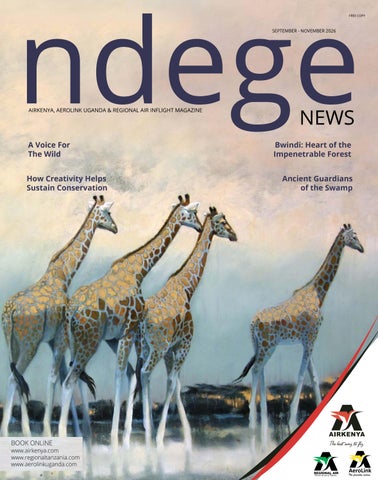
ndege
FREE COPY
SEPTEMBER - NOVEMBER 2026
AIRKENYA, AEROLINK UGANDA & REGIONAL AIR INFLIGHT MAGAZINE
A Voice For The Wild How Creativity Helps Sustain Conservation
NEWS
Bwindi: Heart of the Impenetrable Forest Ancient Guardians of the Swamp
BOOK ONLINE
www.airkenya.com www.regionaltanzania.com www.aerolinkuganda.com
| DECEMBER 2025 - FEBRUARY 2026 | 1
STAY 6 PAY 5
SIX NIGHTS. TWO REMARKABLE LANDSCAPES. ONE SPECTACULAR SAFARI. From the rugged beauty of Samburu to the vast landscapes of the Maasai Mara, experience two of Kenya’s most remarkable wildernesses. Track rhino on foot, discover Samburu culture and the Special Five, then journey south for intimate wildlife encounters and unforgettable game drives in the Mara’s community conservancies.
Booking Terms & Conditions apply. +254 (0)796 222 555 | RESERVATIONS@SARUNIBASECAMP.COM WWW.SARUNIBASECAMP.COM 2 | NDEGE NEWS | SEPTEMBER - NOVEMBER 2026
HELP LION POPULATIONS THRIVE You can save lion populations in Meru National Park with Born Free today!
"Using the EarthRanger app, our team monitors lion movements daily. This real-time data allows us to make smarter, faster decisions to protect not only lions, but also their habitats and the communities keeping livestock. Satellite collaring helps us understand where lions go, what they need, and how to prevent conflict with people —but we can’t do it alone.” Jeremy Kimathi Project Officer, Born Free Kenya Find out more & get involved: bornfree.org.uk/airkenya/
LION MONITORING In Kenya, we have monitored five prides in Meru National Park for more than a decade, gaining an intimate view of their lives and watching individuals grow. Each lion is recorded in our database, with detailed IDs and life histories built over time. With your support, Born Free is implementing initiatives to safeguard this key population in our homeland of Meru. Today, around 50 adult lions roam the park, and one by one, we are getting to know them all!
KIMEU, MULIKA PRIDE Kimeu inherited the dark and large mane characteristic of his father, Mfalme. His great mane is unique, as most of the males have shorter manes. After six years of not being seen, Kimeu recently made an appearance and he wasted no time making his presence known upon his return as he was immediately observed mating with Liz from Elsa’s Pride.
LIZ, ELSA’S PRIDE
SAHARA, MULIKA PRIDE
Liz is easily recognisable by a scar below her left nostril. At 11 years old, she’s the most experienced mother in this pride. She has perfected her skills in hunting, roaming the landscape, raising cubs and teaching new generations. Liz is a symbol of resilience, having been through seasons of plenty and scarcity, always emerging stronger.
Sahara a living testament of resilience and strength. Once struck with a poisoned arrow, she defied the odds and survived, becoming a symbol of courage and hope and helping to guide the Mulika Pride. Her triumph shaped her into a devoted mother of three cubs, symbolising fierce protectiveness and the grace born of hardship.
You can help
Registered Charity No: 1070906
Visit bornfree.org.uk/airkenya/ to donate • Wildlife Monitoring & Protection • Promoting Human -Wildlife Conflict • Conserving Outstanding Landscapes • Our Voice in the Community bornfreekenya
BornFreeKenya
bornfreekenya
www.bornfree.org.uk | info@bornfree.or.ke | +254 720 460 369
25
20 SEPTEMBER - NOVEMBER 2026
REGULAR 05
Welcome Note
06
Editor’s Note
07
Cover My Story
10
Group News Update
FEATURES
14
Nature Update
18
Side Excursions
22 A Voice For The Wild: The Mdamanyi Brothers and the Art of Conservation
42
Packing Tips
44
AirKenya CSR Partners
30
26 Celebrating 25 Years of Community-Led Marine Conservation in Tanzania 29 Purchasing with Purpose: How Creativity Can Sustain Conservation When Funding is Under Pressure 32 In Search of Gorillas in Bwindi Impenetrable Forest 36 The Ease of Being in the Highlands: A Sojourn Amidst the Mists of Nkuringo 40 Elsa’s National Park
34
4 | NDEGE NEWS | SEPTEMBER - NOVEMBER 2026
40
27
WELCOME NOTE
New Ways to Take Flight Karibu, and welcome aboard. In Swahili, ndege means both “bird” and “aeroplane”, a lovely reminder that in this part of the world, flight has always felt close to nature.
human judgement matters most. That leaves more room for the things no machine can replicate: creativity, experience and the relationships that keep AirKenya human and premium.
AirKenya’s story is one of purposeful firsts. In the 1970s, we helped open up Kenya’s safari circuit by becoming the first safari airline to operate flights between Nairobi and the Maasai Mara, and we were among the first to welcome Kenya’s talented women into the cockpit. More than five decades later, that same pioneering instinct guides how we invest, how we operate and how we prepare the Airkenya Group for the future. Innovation looks different today, but the instinct behind it is much the same: to keep finding better ways to fly.
None of this is a sudden shift; it is the continuation of a long-standing habit of innovation. Not so long ago, our pilots walked out to their aircraft carrying flight bags heavy with the paper that came with flying: charts, manuals and pages of essential documentation. In May 2021, we retired those bags with a KCAAapproved Electronic Flight Bag. Today, much of what once travelled on paper travels digitally instead.
People sometimes imagine a CFO’s world as all spreadsheets and caution, and yes, there is some of that. But the part of my job I enjoy most is making sure our resources flow to the systems, people and ideas that make this business stronger. Because I also oversee IT, I get to see Airkenya through a second lens. Finance asks where an investment will matter; IT often reveals where a good idea can go further. Some of the most useful innovations are almost invisible to the passenger. They simplify a process, save time or take repetitive work off someone’s desk. Small changes on their own, perhaps, but together they change the way we work. Artificial intelligence takes that idea further. Much has been promised about AI and much has been overstated. Our approach is deliberately practical: it is not about replacing people; it is about giving them back their time. In finance, hours once spent pulling reports together can now be spent understanding what the numbers are telling us. Across our Airline Group that includes AeroLink in Uganda and Regional Air in Tanzania, AI is helping teams sift through information faster, identify emerging patterns and focus attention where
Booking with us has changed just as dramatically. We were the first in our market to adopt the AeroCRS (now Go7) platform for online bookings and payments. Today, wherever in the world your safari begins, you can book and pay for your flight to the Mara in minutes, while our travel partners can manage their guests just as seamlessly. In a journey with many moving parts, making one of them simpler matters. Care for our guests, we believe, should begin long before you reach the airport. Even procurement, a word that rarely quickens the pulse, has its own quiet drama. Our procurement management system tracks every order from request to delivery, so we know what we have spent, what we have received and the value it creates. Why should that matter to you? Because every schedule we publish is a promise, and promises in aviation are kept through a thousand small details most passengers will never see. A spare part arrives when it should, an aircraft is ready when it needs to be and come midday a traveller is enjoying lunch in the Mara, with grazing zebra for company instead of a departure board. There is one more benefit, and it is the one closest to my heart. Less paper means less waste, while better flight planning and better information help us use our aircraft and fuel more
WELCOME NOTE
Rose Munene Group CFO efficiently. That matters when the world beneath our wings is the very reason so many of us are here: the elephants of Amboseli, the great herds crossing the Mara and the vast, quiet spaces of the north. These wild places are the heart of why we fly. In a little while, you will see them for yourself. Beneath all this innovation sits something older and far more important. For more than fifty years, we have flown these skies safely. That record is the bedrock of everything we do, and we guard it more carefully than anything on our balance sheet. It was not imported; it was earned close to home. Our crews know these airstrips in every season, and our decisions are made close to our routes, our people and our customers. That closeness has shaped our route network, our fleet decisions and, increasingly, the way we use data and technology to run the business. This edition of Ndege News is full of that spirit. In the stories that follow, you will meet the people, partnerships and milestones that keep AirKenya’s pioneering DNA alive. It has not disappeared; it is simply finding new ways to take flight. So sit back and enjoy the view. There are few better office windows in the world than yours right now. Thank you for choosing AirKenya.
NDEGE NEWS |SEPTEMBER - NOVEMBER 2026 | 5
EDITOR’S NOTE
What makes us care?
Editor Cynthia Adams
I think that is a question we often ask ourselves, reflecting on significant moments and experiences, wondering why they affect us the way they do. Why do some simply become distant memories, while others stay with us, causing us to look closer, think a little deeper, or see something in an entirely different way? That’s what this issue has turned out to be — a collection of different adventures with a common thread running through them. Each explores an experience that became more than something we simply saw or did. As these stories cross my desk, I find myself adding more than a few destinations to my own bucket list with every issue we produce—some just an AirKenya flight away! And although I have the opportunity to visit many of these places myself, as an editor I often find myself in the role of armchair traveller, seeing them first through someone else’s eyes. Sometimes, that is the next best thing to being there. In this issue, we meet two brothers creating beautiful paintings as resident artists at a lodge in the Serengeti. Inspired by their surroundings, they invite guests to watch them work and even take home a piece as a reminder of their time in Tanzania. Georgina Lamb, CEO of the David Shepherd Wildlife Foundation, shares the story of her grandfather and what has become a remarkable family legacy — one that now connects artists from around the world in support of conservation. I am fortunate to be travelling to London in September as a sponsor of the Foundation’s annual Wildlife Artist of the Year event, and I can’t wait! Harriet James takes us to Bwindi Impenetrable Forest in Uganda and shares the story of meeting a gorilla face to face for the first time. You’ll feel 6 | NDEGE NEWS | SEPTEMBER - NOVEMBER 2026
Publisher The Business Platform Ltd P. O. Box 103364-00101, Nairobi Tel: +254 741 0700001 Email: businessplatformkenya@ gmail.com Advertising Peter Ondabu Tel: +254 722 770 367 ondabupeter@gmail.com
as though you were right there with her. I’ve yet to do it myself, but it’s on my list — which seems to get longer and longer the more I learn about all there is to explore in East Africa. We’ve also included a few smaller stories that invite you to experience sights, sounds and smells that might otherwise be overlooked when the big animals take centre stage. Because the little things matter, too, and often contribute just as much to the memories we take home. AirKenya is also part of this story. Beyond connecting travellers with some of East Africa’s most amazing places, the airline supports conservation organisations working in the Masai Mara, Samburu, Meru and Amboseli through flights and other initiatives. It is another example of how caring becomes action—and how different contributions, large and small, can make a difference. We hope this issue gives you a collection of moments — some grand, some quiet, some unexpected — that will have you remembering your time in East Africa fondly long after you’ve returned home.
Design and Layout Digital Colour Business Ltd info@digitalcolourbiz.com NDEGE which means aeroplane in Kiswahili is a quarterly Magazine publication of AIRKENYA Express Limited Wilson Airport P.O. Box 30357 - 00100 Nairobi, Kenya Reservations Tel: +254 20 391 6000 Email: resvns@airkenya.com The magazine focuses on tourism, hospitality, travel, leisure, conservation and aviation related news in the East African region and beyond. The views expressed in NDEGE NEWS Magazine do not necessarily reflect those of either AIRKENYA EXPRESS, REGIONAL AIR SERVICES and / or AEROLINK UGANDA
ndege
FREE COPY
SEPTEMBER - NOVEMBER 2026
AIRKENYA, AEROLINK UGANDA & REGIONAL AIR INFLIGHT MAGAZINE
A Voice For The Wild How Creativity Helps Sustain Conservation
NEWS
Bwindi: Heart of the Impenetrable Forest Ancient Guardians of the Swamp
And of course, leave you wanting to come back. BOOK ONLINE
Cynthia Adams Editor
www.airkenya.com www.regionaltanzania.com www.aerolinkuganda.com
| DECEMBER 2025 - FEBRUARY 2026 | 1
Cover My Story Karen Laurence-Rowe From Canvas to Conservation: How a painting of Giraffes Changed Everything I’ve always lived in Africa, mainly east Africa – and love the gifts of drama and beauty this continent offers. I can’t imagine living anywhere else! But loving this continent also means witnessing its heartbreak. Over the last few decades, I’ve watched in dismay as vast savannas and ancient forests—once teeming with free-roaming game—have dwindled into fractured pockets of wilderness. Whilst I know there are many dedicated people desperately trying to protect what is left, it’s hard not to feel helpless. Shouldn’t we ALL be doing more to save this planet and its wild spaces? I was soon to discover that art could lend a helping hand… The Turning Point In 2012, I took a leap of faith and entered the David Shepherd Wildlife Artist of the Year competition for the very first time. To my absolute disbelief, my painting of a journey of giraffes took home the overall title - I was overwhelmed! Shocked as I was, this event would be a turning point in my life, one where I realised that I could make my art assist in helping to raise funds and awareness for Africa’s dwindling species.
I’m also incredibly proud to serve as a Patron for Helping Rhinos, donating a new piece every year for their events, and I’ve also happily painted to raise funds for elephants, wild dogs, cheetahs, and lions, as well as beautiful creatures further afield like orangutans and tigers. Working alongside the David Shepherd Wildlife Foundation over the years has been both a pleasure and a profound privilege - I love the community of astonishingly talented artists that surround it. The Foundation has a deep passion and commitment to save the creatures that we, as artists, all so love to depict using our uniquely individual skills. I believe DSWF and their community of creatives have provided a crucial platform to raise awareness of the many species that are now on the brink of extinction. I’m proud to be part of that!”
Rothschild Mirage
In a twist of coincidence and still recovering from a series of cardiac arrests a few months before, I attended the 2023 Wildlife Artist of the Year and was fortunately sitting down as my name was called out as having won the prestigious title for a second time - also with a painting of giraffes. It was an extremely emotional moment. These gentle and mostly silent creatures seemed to be reminding me there was more to be done. A fanciful idea yes, but not so off the mark when you consider how alarmingly their numbers are dwindling thanks to climate change, poaching and loss of habitat! A Community of Creativity and Hope Since that pivotal moment in 2012, I’ve regularly used my paintings as a way of fundraising for conservation. NDEGE NEWS |SEPTEMBER - NOVEMBER 2026 | 7
Ndege News Magazine Photo Contest Celebrating Moments from the Sky & the Ground Below Ndege Magazine invites our safari guests and readers to share their favourite moments from East Africa through photography and story. This contest is simply our way of celebrating the remarkable experiences our travellers witness — and carry home with them. How to Enter Submit up to two (2) photographs taken during your travels in East Africa. Email submissions to: TRAVELS2AFRICA@GMAIL.COM Your email must include: • Full name • Contact phone number • City and country of residence • Photo category (Wildlife, Birds, or Community/ People) • A short write-up (150–200 words), included in the email or attached as a PDF There is no entry fee. Please submit all materials in one email. Photo Categories Participants may submit images to one of the following categories: 1. East African Wildlife 2. East African Birds 3. East African Community & People All submitted images must fall within one category only. Image Requirements • Maximum of two (2) images total • JPEG (.jpg) files only • Each image must not exceed 5 MB at submission • File names must include your name and category (example: Adams_Wildlife_Serengeti.jpg) Finalists may be asked to provide higher-resolution files for print. Entry Period • Entries open: March 1, 2026 • Entries close: September 15, 2026 • Winners announced: November 15, 2026 Late or incomplete submissions will not be considered. Winners & Recognition • One Grand Prize Winner o Cover feature on Ndege Magazine (December 2026 issue) o Featured story of approximately 300 words • Category Winners (one per category) o Featured inside the magazine alongside their image and story 8 | NDEGE NEWS | JUNE - AUGUST 2026
There is no monetary prize — recognition in print is the reward. Photo Guidelines • Photos must be original and taken by the entrant • Minimal editing is acceptable • Heavy manipulation or AI-generated images are not permitted • Images must not have been previously published in other magazines or commercial outlets Rights & Usage By entering, you confirm that: • You are the sole creator and copyright holder of the image(s) • Any identifiable people in the photo have given consent Ndege News Magazine is granted one-time, nonexclusive rights to publish winning images in the December 2026 issue (print and related digital editions). Images will not be used beyond this publication, and full credit will always be given to the photographer. Judging Entries will be judged by the AirKenya Ndege News Magazine editorial team based on visual impact, storytelling, relevance to category, and overall sense of place. Judges’ decisions are final. Due to the volume of submissions, individual feedback cannot be provided.
We are a We're proud to share that Saruni Basecamp is now a Certified B Corp™, a recognition of standards we hold ourselves to, and a milestone that belongs to the Maasai and Samburu families whose choice to protect their land made it possible. www.sarunibasecamp.com
GROUP NEWS UPDATE
AIRKENYA
AirKenya Recognized During MKTE Breakfast AirKenya was honoured with a Certificate of Appreciation during the Magical Kenya Travel Expo (MKTE) 2026 Partners’ Breakfast, held on 28th July at the Nairobi Serena Hotel. The certificate was presented to recognize the airline’s valued partnership and support for the MKTE 2025. The breakfast brought together government leaders, tourism associations, hospitality executives, destination marketers, tourism and hospitality academic institutions, airline representatives, media partners, and private sector stakeholders to officially set the tone for MKTE 2026. The expo is expected to be the platform’s largest edition yet and part of a national push toward 5.5 million international arrivals and a KES 1 trillion tourism economy by 2027/28. For AirKenya, the certificate has become a reaffirmation of five decades spent moving travellers safely and seamlessly between Nairobi and the bush destinations, a quiet but vital part of what keeps Kenya’s tourism machinery running, formally acknowledged over breakfast in the room where the next chapter of that story is being written.
Leadership Training with KATA Four AirKenya group managers recently took part in a leadership training programme organised by the Kenya Association of Travel Agents (KATA), one of the industry’s key professional bodies for travel trade development in Kenya. The training brought together leaders from across the travel and aviation sector, airlines, agents, and tour operators alike, for a shared conversation on leadership in an industry that runs on relationships as much as on flight schedules. For the managers who attended, it was a chance to step outside day-to-day operations, sharpen their leadership skills, and compare notes with peers navigating the same pressures elsewhere in the sector. 10 | NDEGE NEWS | SEPTEMBER - NOVEMBER 2026
GROUP NEWS UPDATE
AirKenya Wins World Travel Awards 2026 Second Year Running AirKenya has been named Kenya’s Leading Domestic Safari Carrier at the World Travel Awards 2026, marking its second consecutive year holding the title and its fifth trophy in the category overall. The win confirms 2025’s title defense as no one-off, cementing AirKenya’s position as the most-awarded domestic safari carrier in Kenya’s history. AirKenya’s history with the World Travel Awards category ‘Kenya’s Leading Domestic Safari Carrier’ stretches back over a decade. • 2013 - Pioneer winner of the category • 2014 - Second consecutive win • 2023 - Reclaimed the title • 2025 - Won again, breaking a two-year gap • 2026 - Back-to-back win, fifth trophy overall
No other current domestic safari carrier in Kenya has won the category as many times. What the Award Recognises The World Travel Awards, established in 1993, are decided by a global vote of travel-industry professionals and travellers, making them one of the tourism sector’s most closely watched accolades.
Your Private Home in The Wild. Nestled inside Amboseli National Park, Kibo Villa offers the ultimate private luxury retreat. Enjoy uninterrupted vistas of Mt. Kilimanjaro and wildlife grazing in the savannah. The villa has 3 en-suite rooms, a private swimming pool, lounge, kitchen, expansive verandas and a BBQ area. Enjoy freshly prepared meals and dedicated staff.
For AirKenya, the 2026 win reflects continued commitment to world class safety, infrastructure, premium customer care, sustainable aviation and the extended reach of AirKenya’s wholly-owned subsidiaries- Regional Air Services in Tanzania and AeroLink in Uganda - connecting travellers across East Africa’s premier safari circuit.
“This award belongs to our incredible team on the ground and in the air, whose dedication ensures every guest’s journey is as memorable as the safari itself. To our loyal passengers and travel partners who voted for us, thank you for letting us be part of your safari story.” - John Kimondo, Group CEO.
NDEGE NEWS |SEPTEMBER - NOVEMBER 2026 | 11
www.kibovilla.com
NDEGE NEWS | JUNE - AUGUST 2026 | 11
reservations@kibovilla
+254 721 363 163
kibovilla
GROUP NEWS UPDATE
AEROLINK
Supporting the Rwenzori Marathon
New CSR Partnership
AeroLink has thrown its weight behind this year’s Tusker Lite Rwenzori Marathon, offering special fares to help runners, supporters, and race organisers reach Kasese and the foothills of the Rwenzori Mountains with ease. Now recognised as a World Athletics Label race, Rwenzori marathon was built to drive tourism and economic opportunity into the Kasese region, and to raise awareness of the very real threat climate change poses to the Rwenzori’s glaciers, among the last remaining ice fields in Africa. By making it easier for participants and spectators to get there, AeroLink backed a cause that mirrors its own - connecting travellers to places that need to be seen, understood, and protected.
AeroLink is proud to announce the renewal of the Corporate Social Responsibility partnership with Bwindi Community Hospital, effective 1st August 2026. Nestled at the edge of Bwindi Impenetrable National Park, the hospital is a lifeline for communities living alongside one of the world’s most important conservation areas, often the only accessible source of quality healthcare for families in the surrounding villages. For AeroLink, the partnership is a natural extension of its presence in the region: supporting the people who call Bwindi home, not just the visitors who come to see it. AeroLink’s support comes in the form of ticket support, giving the hospital’s team air access that cuts out long hours on the road, so that time and funds otherwise spent travelling can go straight back into serving patients and delivering on the hospital’s mission.
A VIP Visitor to Bwindi
AeroLink recently flew Michael Yormark, President of Roc Nation Sports International, on a familiarisation trip to Uganda’s Bwindi Impenetrable National Park organised by the Uganda Tourism Board. Bwindi is home to roughly half of the world’s remaining population of mountain gorillas, one of the rarest and most closely guarded species on the planet. Trips like this matter well beyond the individual visit: when a figure 12 | NDEGE NEWS | SEPTEMBER - NOVEMBER 2026
of Yormark’s global standing in sport and entertainment experiences Bwindi firsthand, it puts Uganda’s conservation story in front of an audience that rarely gets to see it up close. As UTB’s trusted aviation partner, AeroLink is proud to connect visitors from around the world to Uganda’s most iconic wildlife destinations, championing the country’s tourism footprint and putting Uganda on the global map, one flight at a time.
GROUP NEWS UPDATE
REGIONAL AIR
Kuro Route Reinstated Regional Air has reinstated its route to Kuro from Arusha, restoring convenient air access to one of northern Tanzania’s more remote and rewarding safari areas. Kuro is situated in Tarangire National Park - famous for giant baobab trees and massive elephant herds. Reaching it by road can require hours of travel that reduce valuable game-viewing time. The airstrip serves several high-end intimate safari camps, and with the route back in the schedule, travellers gain back what matters most on safari: time in the bush, not on the road.
Promotional Fare Arusha - Zanzibar Regional Air has launched a promotional fare on the popular Arusha–Zanzibar route, making it easier and more affordable to pair a mainland safari with island time on Zanzibar’s beaches. It remains one of the most sought-after combinations in East African travel, a few days chasing the Big Five in the Serengeti or Ngorongoro, followed by white sand, turquoise water, and the spice-scented streets of Stone Town. The promotional fare is a timely support for agents building multi-stop itineraries for their clients.
NDEGE NEWS |SEPTEMBER - NOVEMBER 2026 | 13
NATURE UPDATE
BLOSSOMS & BEYOND
The Mysterious Fragrance of Ylang-ylang By Cynthia Adams
The last trace of dusk has slipped away, and darkness has settled in. The tropical night is humid and warm, and an unfamiliar fragrance permeates the air. Perfumed with an exotic scent, you are reminded that you’re far away from home, on the coast of the Indian Ocean. Everything about your day, and now evening, has been magical. The scent of ylang-ylang in bloom has now also become one of those memories that will always remind you of East Africa. The Swahili Coast’s Fragrant Past Although cloves became Zanzibar’s signature spice after the 19th century, the islands have long been home to a vast collection of aromatic plants brought by Arab, Indian, and European traders. Ylang-ylang eventually joined cinnamon, cardamom, nutmeg, vanilla, and cloves in these tropical gardens. The Flower That Blooms at Night Ylang-ylang isn’t the flower that catches your eye first. Its blossoms are modest and not at all showy. They begin green and gradually turn a soft yellow-green as they mature. The petals are long and ribbon-like, often wilting in the tropical heat. But their fragrance takes center stage, more than compensating for their plain looks.
people assume Chanel No. 5 smells mainly of roses or jasmine, but it is the inclusion of ylang-ylang that plays one of the most important supporting roles in this iconic perfume, contributing elegance, warmth, and sensuality.
When evening arrives and the air cools, their perfume becomes dramatically stronger. This isn’t accidental. Like many tropical flowers, ylang-ylang evolved to attract night-flying moths, which locate blossoms by scent rather than color. During the day the fragrance is pleasant; after sunset it comes alive. Add a tropical rain shower into the equation and it becomes almost intoxicating.
A Flower of Romance Because of this history, the essential oil is still widely used in massage oils, candles, and perfumes intended to create a feeling of relaxation and intimacy. Perhaps that’s one reason so many people find themselves lingering outdoors after sunset. Studies even suggest the fragrance may help slow the heart rate and encourage a feeling of calm.
Importance in the World of Perfume Trying to describe the fragrance is almost impossible. Some people detect banana or jasmine, others notice honey or a mix of spices. It seems to change depending on the person smelling it, and perhaps on the evening itself.
The Scent of Memory As dusk settles over the coast and the day’s heat begins to soften, this tree quietly transforms itself into nature’s perfume bottle. Long before anyone bottled its fragrance, ylangylang was already scenting tropical evenings, carried on warm Indian Ocean breezes.
Its name comes from the Tagalog word ilang-ilang, meaning “flower of flowers.” The tree (Cananga odorata) is native to Southeast Asia, but it has been cultivated for generations along the East African coast, particularly in Zanzibar and parts of coastal Tanzania and Kenya, where the warm, humid climate allows it to flourish.
After the details of your journey have faded, the memory of its scent remains. A single whiff of ylang-ylang can transport you back across years to that moonlit veranda on a warm tropical night. Of all our senses, smell is the one most closely linked to memory, preserving forgotten moments until a familiar fragrance gently brings them around again.
When the perfumer, Ernest Beaux, created Chanel No. 5 for Coco Chanel in 1921, he wanted a fragrance that didn’t smell like a single flower. Instead, it would evoke the impression of an entire luxurious bouquet. Many
I know that years from now I may not remember what I ate that evening or even the conversations had. But I suspect that one unexpected breath of ylang-ylang will take me straight back to that veranda overlooking the Indian Ocean.
14 | NDEGE NEWS | SEPTEMBER - NOVEMBER 2026
NDEGE NEWS | DECEMBER 2025 - FEBRUARY 2026 | 19
NATURE UPDATE
THE BIRDS & THE BEES
The Little Black One
White-sided large Carpenter Bee (Xylocopa nigrita) By Dr. Kathrin Krausa Carpenter bees are huge bees, often mistaken for a beetle or a big bumble bee. In fact, there are no bumble bees in Africa and the only thing they have in common with beetles is their rather clumsy flight style. This becomes particularly apparent, when they try to enter their nests: landing is not always graceful, carpenter bees often seem to miss the entrance, bump into the wood, or even tumble to the ground before finally finding their way inside. The nests are drilled by the female bee herself: with her strong mouthparts acting like a drill, she creates pathways and chambers into the wood–one can easily hear the buzz that creates! Inside the nest she raises her young. Numerous cells are stocked with a lot of pollen and a bit of nectar – enough nutrients to develop into a full-fledged bee. Unfortunately, carpenter bees cannot distinguish between a dead tree
in the forest and a wooden beam supporting a house. As a result, they sometimes tunnel into buildings, creating an unusual form of human– wildlife conflict. While the bees are simply looking for a suitable nesting site, people are understandably less enthusiastic about having long tunnels drilled into the structural timber of their homes. The largest bee in East Africa is a member of the Carpenter bees: Xylocopa nigrita. Nigrita can be translated to little black one – The females are not exactly little, but in contrast to the golden males, they have a black colour. Since the bee is big, her nest needs to be big: the entrances alone are around 2cm wide and extend deep inside of the wood.
to be shaken to release it. Only socalled buzz-pollinators can do that, among a few others, like carpenter bees. They hold on to the flowers and rapidly vibrate their flight muscles. The pollen falls out of the flower and onto the hairy bee. Because of the bee’s sheer size, this carpenter bee also perfectly matches the flowers of passion fruits. And who does not like tomatoes or passion fruit?
But there are some positives that are difficult to deny:
Images © Warren Steyn 16 | NDEGE NEWS | JUNE - AUGUST 2026
Carpenter bees are powerful pollinators. They are particularly great for the pollination of nightshades such as tomatoes that do not give away their pollen easily–their flowers need
Dr. Kathrin Krausa, Head of Research and Education at Beetopia, Beegreen Ltd., Arusha Tanzania
NATURE UPDATE
SMALL & SPECIAL
Growling Geckos!
By Cynthia Adams If you’ve visited East Africa, you may have blamed some mysterious nighttime noises on the wrong little creature. Sitting in your room at a lodge or tented camp, you might imagine hearing birds rustling outside, a mouse in the rafters, or perhaps a mongoose wandering past. But as your ears adjust, you realize the sounds are coming from inside. Not to worry—it’s probably a growling gecko, or as I like to think of them, one of Africa’s tiny dragons. Found throughout East Africa, house geckos are unusual because, unlike most lizards, they’re remarkably vocal. They chirp, squeak, click, bark, and even produce soft little growls. These sounds help defend territory, warn rivals, and attract mates. I’ve often watched them chase one another across the walls of our home before stopping nose to nose as the growling begins. It’s a little disconcerting the first time you hear it! Most Are Nocturnal The geckos commonly seen around homes in Tanzania and Kenya are usually nocturnal. Spending their days tucked behind picture frames, beneath roof tiles, cracks in walls, or behind cupboards, they emerge at dusk to begin the hunt. They frequent areas of light where moths, flies and mosquitoes gather. Their large eyes are specially adapted for seeing in low light. Unlike many lizards, they don’t have movable eyelids. Instead, they keep their eyes clean by licking them with their tongues—a behavior that’s both fascinating and a little comical to watch. Common Geckos Around East African Homes The species you’re most likely to see and hear is the Tropical House Gecko
(Hemidactylus mabouia). Pale grey or tan with a somewhat translucent appearance, it has become one of the world’s most successful geckos for pest management. Predators Life isn’t easy for a gecko. They may seem abundant around our homes, but they’re an important part of the food chain, and relatively few survive adulthood. They have a long list of enemies—snakes, birds, small mammals like genets, mongoose and civets, with the biggest culprit often being domestic house cats.
How They Defend Themselves Despite being tiny, geckos have several remarkable defenses. • Growling or chirping to startle rivals or fend off predators. • Dropping the tail (called autotomy). The detached tail wriggles vigorously, distracting the predator while the gecko escapes. • Excellent camouflage • Lightning-fast climbing thanks to millions of microscopic hairs (setae) on their toe pads that allow them to cling to smooth walls and ceilings.
Reproduction Female house geckos generally lay just one or two hard-shelled eggs, often using communal nesting sites, where several females may choose the same protected crack or crevice. The eggs are white and about the size of small marbles or jellybeans. People occasionally discover these hidden nurseries behind cupboards, roof beams, or loose bark.
Nature’s Evening Chorus! In addition to setting up shop in our homes, they have also become part of the evening soundtrack. You may already be accustomed to crickets, tree frogs and perhaps the nightjar. Add growls, squeaks, barks and chirps and you have the beginnings of an East African symphony!
In East Africa’s warm climate, breeding occurs year-round. Eggs hatch in about 6–10 weeks, and the tiny young are completely independent from the moment they emerge.
Before electric lights, nighttime insects were more dispersed. Today, porch lights and windows act like giant insect magnets, providing geckos with an all-you-can-eat buffet every evening. They have adapted brilliantly to living alongside us—not because they need our houses, but because our lights make hunting so much easier.
One of the reasons geckos are so common around East African homes is that humans have accidentally created the perfect hunting grounds for them.
NDEGE NEWS | JUNE - AUGUST 2026 | 17
SIDE EXCURSIONS
OFF THE BEATEN TRACK
A Day Hike on Kilimanjaro Reaching the Shira Plateau By Ree Pashley Mighty Kilimanjaro, Africa’s highest mountain, is both majestic and intimidating. Reaching the summit, Uhuru Peak, is an adventure that requires time, stamina, and a hefty budget. First, there is the physical aspect: the trek requires moderate fitness and the ability to hike for 8-10 hours a day. Next is the time commitment: full climbs typically take 6-8 days, which might be the total number of travel days a visitor has. Cost, too, is a major factor: a solo trek can cost thousands of dollars. But what if you could climb part of Kilimanjaro? Step foot on the base of this great mountain, without the pressure of physical stamina or a deep travel budget? Enter Shira Plateau. At approximately 3,800 meters (12,500 feet), it is one of the world’s highest mountain plateaus and stretches more than 6000 hectares along the western side of Kilimanjaro. A day hike on Shira Plateau allows visitors to spend a day exploring the base of Kilimanjaro along Lemosho Route. The trail reaches to the overnight camp known as Shira Camp 1 (3,610 meters above sea level) to enjoy lunch, then circles back to Morum Picnic Site, where guests will find their vehicle and return to Londorossi Gate by road. This day hike offers an ideal snapshot of Kilimanjaro, condensed into a sin18 | NDEGE NEWS | SEPTEMBER - NOVEMBER 2026
gle afternoon: a hike suitable for beginners, within the Kilimanjaro mountain area, that reaches an impressive elevation but without serious altitude influence on the body. The day hike arrives at a functioning Kilimanjaro base camp, but without the time commitment or financial investment of a multi-day climb. Did you know? The difference between hike, trek, and climb Hike: a long, outdoor walk with or without an established route Trek: usually refers to a multi-day hike along established trails Climb: a hike or trek to a given point or a specific destination (i.e., Mount Kilimanjaro), which may or may not require technical skills or gear
The full activity takes 4-6 hours, depending on the fitness of the group, and is suitable for seniors, children and beginners. There is a slight elevation gain of 500 meters, and most of the hike is along level ground. Though it is not challenging, it offers great appeal to experienced hikers with the incredible views and glacier river crossings (which require manoeuvring over steep sections and balancing across river rocks - trekking poles are advised). And, of course, the day hike means bragging rights: you’ve set foot on Africa’s highest mountain. That’s pretty epic, in itself.
SIDE EXCURSIONS
The Shira Plateau day hike may only take a few hours, but the drive to reach West Kilimanjaro is typically 1-2 hours, depending on if you’re traveling from Moshi or Arusha towns, making the full activity, including drive time, basically a full day in the West Kilimanjaro area. Alternatively, guests can opt to stay overnight at the lovely Simba Farm, a working organic farm that offers charming cottages or camping for guests. A stay includes farm-fresh meals, a tour of the farm (children especially love to see the rabbits and ducks), evening fires under starry skies, and a lovely swimming pool. Simba Farm is located just 20 minutes (9 km) from Londorossi Gate, where guests sign the Kilimanjaro logbook and get their hiking permits. If your travel itinerary isn’t packed to the brim, and you have an additional day in the area, why not enjoy a day
trek on Africa’s highest mountain? Costs for a single traveler start at around $300- $350. A group of 4, sharing costs, is approximately $215 per person.
park entry fee, an experienced mountain guide, and trekking permit. If you’ve dreamed of seeing Africa’s highest mountain but aren’t ready for a full climb, consider a day hike along the breathtaking Shira Plateau for a taste of Mount Kilimanjaro.
This includes transportation and fuel,
Ree Pashley
Ree Pashley has a background in criminal justice and social work. She has over a decade of experience working with adult and young offenders in various cities across Canada. But Canada was far too cold for her liking, so she moved to East Africa and began dabbling in jobs that don’t require high security. Ree has worked at an art gallery in Stonetown, Zanzibar, volunteered with a library project in Arua, Uganda, and, more recently is a freelance writer who splits her time between Arusha and Karatu, Tanzania.
NDEGE NEWS | JUNE - AUGUST 2026 | 19
SIDE EXCURSIONS
OFF THE BEATEN TRACK
Ancient Guardians of the Swamp A Shoebill Adventure By Laura Kyle Our rickety longboat with its thin awning bounces around in the choppy, grey waters of Lake Victoria, leaving behind the busy pier in Entebbe. Big, black clouds loom menacingly on the horizon, but everyone is cheerfully optimistic they’re not coming our way. The captain takes Roger, my guide, and me westwards across a 12-kilometre stretch of water to Mabamba Swamp. We are going in search of the shoebill. The shoebill is an elusive, prehistoric bird that has lived on Earth for at least 30 million years. Only 5,000 to 8,000 exist today, all of them in East and Central Africa, and they are further threatened by loss of habitat and poaching. 15 of them live in Uganda’s Mabamba Swamp. After an hour of enjoying a rhythmic spray of water on my face and with a brief interlude to detangle a fishing net from our motor, we enter the swamp and Roger points out a dazzling array of birds – malachite kingfishers flashing like jewels, black and white pied kingfishers sitting sentinel-like in the reeds, elegant purple herons rising tall from the flats and statuesque fish eagles taking up position at the top of dead branches. He even spots a family of otters slinking in and out of the water. A little further in and the swamp channels narrow so I have to switch boats. I join Maria, an expert at finding shoebills in their 2,424-hectare habitat. “It’s huge, it is huge!” she says. “And sometimes we miss the shoebill because it uses so many different places to find food or hide and not be disturbed.” 20 | NDEGE NEWS | JUNE - AUGUST 2026
So, I’m somewhat surprised when our narrow canoe phut, phut, phuts for just a couple of minutes through the bright green reeds, papyrus and water cabbages, into a small clearing and there, standing on spindly legs, is an enormous bird with piercing yellow eyes glaring down its beak at us, a beak that’s bigger than its head. “I think we’d better clap ourselves!” says Maria. “We’ve got the chance to see a shoebill up very close - from the feet to the top and you get to see the two eyes looking straight at you!” It’s an extraordinary sight - like a glimpse into a Jurassic world. The bird, which stands over a metre tall and weighs around five kilos, does not look like it belongs in this era. It stands like a slategrey statue, blending into the muddy shallows and now the sky as well, as the storm clouds gather overhead. Heavy
SIDE EXCURSIONS
drops of rain start to fall. As we rush to put on our waterproofs, Maria fires off her shoebill spiel at speed. Our bird, being slightly smaller in size, is a female. She lives a solitary life unless breeding. She can stand silently in one place for hours, waiting for a lungfish her favourite prey - to surface for air. The shoebill demonstrates this patience by snapping at the lapwings who are divebombing and tutting at her proximity to their chicks, all the while holding her ground. She can’t swim, so when she darts forward to snare a fish with a sharp hook at the end of her beak, she throws out her wings a metre either side, to stop herself falling headlong into the water. Maria estimates she is between seven and 12 years old, so she’s likely to have had at least one chick. Shoebills live up to 25 years in the wild but will fledge only one chick every five years. This makes them exceedingly conscientious parents, which Maria greatly admires. “Shoebills can be better than humans,” she says. “If the female goes hunting, the male will watch the baby. When the mum comes back, the male will go. They both stay with the baby for a year and a half, it’s a long time for birds. I know so many, many wives, who are crying, ‘The man did not help me!’ But the shoebill is
an amazing bird.” The rain buckets down and the shoebill continues her stoic vigil, drops dripping from the hook on her beak. It’s hard to leave this magnificent creature, but Maria is keen to go. Manoeuvring out of the swamp, I clamber back aboard the boat with the awning. It feels like an upgrade, until the rain drives in sideways. Thunder rumbles and lightening zig zags across the black sky like cracks in an egg. All the fishermen have disappeared, and I wonder how sensible it is to be out in the middle of the lake in the middle of a storm. The captain bails out water with a sawnoff jerry can as I shiver down under two lifejackets. Roger, who’d been so chatty on the way out, disappears beneath a pink blanket.
Laura Kyle Laura Kyle is an international journalist whose career has unfolded across continents and conflict zones. During 20 years with Al Jazeera English, she reported from around the world, covering stories across Asia and Africa — from tribal violence in Papua New Guinea and Pol Pot–era trials in Cambodia, to the fallout from the Fukushima disaster in Japan and devastating drought in Burkina Faso. She has lived in China, Nepal, Australia, Malaysia and Qatar, eventually settling
As we finally approach Entebbe, the rain eases, the clouds lift and a Uganda Airlines plane roars in overhead in jarring juxtaposition to the morning’s experience, where a one-hour journey has taken me back millions of years in time.
in Doha, where she swapped hiking boots for heels and anchored major international news for the next 15 years. It was a time of tumultuous upheaval in the region with the Arab Spring, the war in Gaza, and Iran’s attack on a U.S. airbase in Qatar, when she remained on air as the newsroom shook from missiles being intercepted overhead. Today, Laura has swapped her heels for bare feet and has settled on the slopes of Mount Meru, where she lives with her husband, three young children and an ever-growing menagerie of rescued animals. NDEGE NEWS | JUNE - AUGUST 2026 | 21
FEATURE
A Voice For The Wild The Mdamanyi Brothers and the Art of Conservation By Annie Thomsen On the endless plains of Tanzania’s Serengeti, where elephants move quietly beneath acacia trees and lions rest in the golden grass, Joe and Geof Mdamanyi have found more than artistic inspiration—they have found purpose. As resident artists at Elewana Collection’s Serengeti Explorer, the brothers welcome guests into a world where art becomes a bridge between people and nature. Their paintings capture the beauty of East Africa’s wildlife, but their true ambition reaches far beyond creating beautiful images. A typical day begins early in the morning. One of the brothers is already at his easel beneath the open-air studio at the lodge. They take turns in the studio: while one is painting, the other is gathering inspiration. Fresh drawing surfaces wait alongside their brushes, pastels, and pencils, while guests drift over with coffee in hand, curious to watch the Serengeti slowly emerge on paper. Conversations begin with technique and color, but rarely stay there for long. They often turn to discussions about wildlife, conservation, and the stories behind the animals taking shape on the canvas. For Joe, the artist’s journey began almost as soon as he could hold a pencil. He was just six years old when he started drawing, fascinated by the wildlife and landscapes that surrounded him. His passion for nature eventually led him beyond the studio, earning a degree in environmental studies that now complements his work as an artist. “Art will be my voice. My art shares a visual language,” Joe explains. “It tells stories. I hope it speaks to people, giving them a greater understanding of nature.” 22 | NDEGE NEWS | SEPTEMBER - NOVEMBER 2026
Art by Joe Mdamanyi
This page: Art by Joe Mdamanyi
His paintings reflect that philosophy. They are more than portraits of wildlife; they are visual conversations about coexistence, biodiversity, and the importance of protecting the ecosystems that sustain both animals and people. Geof’s path was different. He only began drawing in his early twenties, inspired in part by watching his older brother pursue his passion, but it was the Serengeti itself that became his greatest teacher. “I hope my art is more than something that decorates walls,” Geof says. “I hope it brings awareness and a call to protect.” When he isn’t at his easel with oil pastels in hand, Geof can often be found gathering inspiration in the bush or on a game drive, camera in hand, quietly collecting moments that might later find their way onto a canvas. These fleeting encounters with wildlife become photographic references that allow him to preserve not only what he saw, but what he felt in that moment. Those encounters continue to shape every stroke, reminding him that the greatest privilege is not simply seeing wildlife, but witnessing it where it belongs.
The Serengeti, he says, has taught him respect, patience, and humility. “When you’re looking into the eyes of a leopard, or viewing a herd of elephants in the open savannah, you can’t help but feel humble.” Every creation of the brothers is an invitation to look more closely—not simply at the animal itself, but at its place in an increasingly fragile world. Their paintings range from small to large pieces, up to six feet in size, sometimes taking up to 100 hours to finish their exceptionally detailed drawings. Occasionally, a guest picks up a pencil or brush and joins them. Sketchbooks appear, materials are shared, and what begins as a casual art lesson of-
ten turns into something more: a conversation about the animals just beyond the lodge and why they deserve to remain there. Listening to Joe and Geof speak, it is clear that they feel the power of conservation in their work. Their canvases are not simply records of memorable safari sightings; they are expressions of gratitude, respect, and hope. It is a NDEGE NEWS |SEPTEMBER - NOVEMBER 2026 | 23
This page: Art by Geof Mdamanyi
philosophy that resonates deeply with my own belief that art is one of conservation’s most compelling voices.
before. Stories are exchanged, paintings revisited, and conversations continue long after the brushes and pencils have been set aside.
As afternoon fades into evening, guests often return from their own game drives to find the brothers still working at their easels. A blank surface has transformed since breakfast, inspired perhaps by the very animals those guests encountered only hours
Science gives us the facts, and policy provides direction, but art reaches the heart. It creates emotional connections that statistics alone rarely can. A painting has the power to spark curiosity, inspire empathy, and encourage someone to see wildlife not as a dis-
tant spectacle, but as something profoundly worth protecting. The Mdamanyi brothers embody that idea beautifully. Through their residency at Elewana’s Serengeti Explorer lodge, they are not only sharing their remarkable talent with guests from around the world—they are helping shape a deeper appreciation for the landscapes just beyond the lodge’s windows. In a place where every sunrise tells a story of survival and every game drive offers a reminder of nature’s extraordinary resilience, Joe and Geof are ensuring those stories continue long after visitors return home. Their paintings may hang on walls across the globe, but their true purpose is far greater. They are quiet ambassadors for the Serengeti—reminding us that every work of art has the potential to become an act of conservation. Every creation of the brothers is an invitation to look more closely— not simply at the animal itself, but at its place in an increasingly fragile world.
24 | NDEGE NEWS | SEPTEMBER - NOVEMBER 2026
YOUR FAVORITE SAFARI MOMENT... FEATURE ... deserves a place on your wall.
THE
PERFECT HOLIDAY GIFT!
Commission a custom watercolour or oil painting!
Whether it was the lion at sunrise, your first game drive, the baby elephant that you will never forget, or your favorite sundowner in the savanna...
FOR MORE INFORMATION ATCATC : T ME AT: P L E A SCEOCNOTN
annethomsen@studiongong.com
Art by Geof Mdamanyi
Science gives us the facts, and policy provides direction, but art reaches the heart
Annie Thomsen
Through immersive Art Safaris and
Art by ANNE THOMSEN YOUR SAFARI. YOUR STORY. YOUR PAINTING.
Anne is partnered with numerous organisations including the Grévy’s Zebra Trust, Elewana Collection, and the African Fund for Endangered Animals, serves on the board of the Loisaba Community Conservation Foundation, and is a proud ambassador for Game Rangers International.
Anne Thomsen is an award-winning artist and creative conservationist whose work focuses on wildlife and community. After living and working across Hong Kong, Singapore, Italy, the United States, and Belgium, her studio is currently based in Germany. For more than 30 years, Anne has returned to Kenya and Tanzania, where the landscapes, wildlife, and people continue to inspire her vision. Her passion for conservation and sustainability is at the heart of her business, Studio Ngong, where a percentage of profits supports wildlife conservation and community projects.
Some safari moments deserve more.
Artist-in-Residence programs in Africa, Anne encourages others to connect deeply with nature through sketching, painting, and mindful observation. The core values of her practice: patience, presence, and protection—are qualities that are vital in wild landscapes.
Every creation of the brothers is an invitation to look more closely—not simply at the animal itself, but at its place in an increasingly fragile world. Science gives us the facts, and policy provides direction, but art reaches the heart
NDEGE NEWS |SEPTEMBER - NOVEMBER 2026 | 25
WORLDWIDE SHIPPING
...Inspired by your own safari photos and treasured memories.
Celebrating 25 Years of Community-Led Marine Conservation in Tanzania By Catharine Joynson-Hicks Image © Will Wilson
Twenty-five years ago, Tanzania’s marine and coastal ecosystems were under growing pressure. Marine turtles and dugongs were being harvested for their meat, consumption of turtle eggs was widespread and commonplace, while destructive fishing practices were damaging coral reefs and seagrass meadows, and many coastal communities faced deep poverty with few sustainable livelihood opportunities. Conservation was often something done to communities, rather than with them. Yet along the coast, there was also immense knowledge, resilience, and care for the ocean. In 2001, this worrying reality inspired the creation of Sea Sense — then known as the Tanzania Turtle and Dugong Conservation Programme. What began as a small initiative on Mafia Is26 | NDEGE NEWS | SEPTEMBER - NOVEMBER 2026
Image © Melissa Kay Valente
Image © Sea Sense
Conservation Officer applying a flipper
land has grown into one of Tanzania’s leading marine conservation organisations, working across much of the country’s coastline. Sea Sense’s vision was simple but powerful: that lasting conservation can only succeed when coastal communities themselves are at the heart
of protecting the natural resources on which their futures depend. With knowledge, trust, opportunity and a voice, coastal communities are the strongest guardians of Tanzania’s oceans. Over the past quarter century, over 7,500 green and hawksbill turtle nests Image © Sea Sense
Hatchling Conservation Officers relocating eggs at risk of predation by ants
have been protected, with the hatching of 609,000 baby turtles. Education campaigns have played an essential role in community-engagement – including schools’ art and singing competitions, travelling theatre productions, marine wildlife roadshows, and community movie evenings. Together, these campaigns have inspired a new generation to value and defend the ocean. But perhaps the greatest achievement is not measured only in numbers. It is measured in people. In communities that now proudly protect marine turtle nests. In fishers becoming conservation champions. In children growing up understanding that the ocean is not endless, but precious. In the partnerships, trust, and shared sense of responsibility that have been built over 25 years.
Image © Sea Sense
This journey has not been without challenges. Climate change, habitat loss, overfishing and increasing presNDEGE NEWS |SEPTEMBER - NOVEMBER 2026 | 27
Images © Sea Sense
CLOCKWISE: Green turtle hatchling reaches sea; Education; Community-led monitoring of sea turtles in Tanzania
sures on coastal resources remind us that the work is far from over. But the past 25 years have shown something extraordinary: when communities lead conservation, real and lasting change is possible. As we celebrate this milestone, we also look forward. The future of Tanzania’s oceans will depend on even stronger collaboration between communities, government, civil society, researchers, tourism operators, donors and young leaders. Sea Sense cannot do this alone — and nor should it. Protecting our marine heritage is a shared responsibility. The next 25 years are about building
resilience, scaling impact, and ensuring that both people and nature thrive together. The ocean connects us all, and together, we can ensure that future generations inherit seas that are alive with marine turtles, dolphins, coral reefs, and hope.
For more information, or to learn how you can help, please contact Sea Sense Email: info@seasense.or.tz Website: www.seasense.or.tz
Catharine Joynson-Hicks Catharine Joynson-Hicks is the founder of Sea Sense, one of Tanzania’s leading community-based marine conservation organisations. A passionate conservationist with more than 35 years of experience, she has dedicated her career to protecting wildlife and natural ecosystems across East Africa. Her work has spanned a wide range of conservation fields, including forest protection, elephant monitoring, and marine biodiversity, with a particular focus on empowering local communities to become stewards of their natural resources. Having lived and worked in Tanzania
28 | NDEGE NEWS | SEPTEMBER - NOVEMBER 2026
for over two decades, Catharine has called Mafia Island, Dar es Salaam, and now Arusha home. Her vision and leadership helped establish Sea Sense as a respected conservation organisation supporting coastal communities, marine wildlife, and sustainable livelihoods along Tanzania’s coastline. Today, she continues to play an active non-executive role within Sea Sense, providing strategic guidance and support. Outside conservation, Catharine is a talented potter whose creativity is inspired by the natural world she has spent her life working to protect.
Purchasing with Purpose:
How Creativity Can Sustain Conservation When Funding is Under Pressure By Georgina Lamb, CEO, David Shepherd Wildlife Foundation When conservation funding falters, creativity can help keep wildlife alive. It is a lesson I grew up with. My late grandfather, the wildlife artist David Shepherd, understood something simple but profound: if people could fall in love with the wildlife he painted, they would fight to protect it. More than forty years later, as the third generation of my family to lead the David Shepherd Wildlife Foundation, I have seen how right he was. Today, as extinction rates rise and conservation budgets come under increasing pressure, creative solutions, including purpose-driven art buying, are helping sustain the conservation work needed to protect endangered species.
For my family, this belief has long been more than an idea; it has shaped our lives and our work for more than four decades. My grandfather was one of the world’s most celebrated wildlife artists. But for him, painting was never simply about art. It was about protection. The elephants, tigers and rhinos that appeared on his canvases were not just subjects of admiration; they were species he feared the world might lose if people did not learn to care.
worldwide. What began as an artist’s personal mission soon grew into a global movement, demonstrating how creativity can be a powerful force in the fight against extinction. My mother, now Chair of our Board of Trustees, carried that vision forward during her 25-year tenure, building the Foundation into the organisation it is today and ensuring my grandfather’s belief in the power of creativity remained at the heart of our work.
In 1984, he turned that belief into action by founding the David Shepherd Wildlife Foundation, using his paintings to raise awareness and vital funding for conservation projects
Art by Chung Shek
Roar into the Light
As conservation funding comes under increasing pressure, creativity is no longer a luxury; it is a necessity. Nature is not simply something “nice to have”. Healthy ecosystems underpin our economies, food systems and climate stability. NDEGE NEWS |SEPTEMBER - NOVEMBER 2026 | 29
A painting by Karen Laurence-Rowe
Community engagement
But art does more than raise awareness; it generates vital funding when collectors purchase with purpose, helping protect species that may otherwise disappear within our lifetime.
Today, as the third generation of our family to lead this mission, I feel both the privilege and responsibility of continuing that legacy. But the urgency of the work has never been greater. Around the world, conservation budgets are shrinking as threats to wildlife intensify. Habitat loss, illegal wildlife trade and climate change are accelerating species decline at a pace few could have imagined even a generation ago. Scientists estimate that up to one million animal and plant species now face extinction, many within our lifetime. Meanwhile, the illegal wildlife trade is one of the world’s largest criminal industries, worth an estimated US$20 billion annually and rivalled only by trafficking in drugs, arms and people. Against this backdrop, the idea that art might help protect wildlife can seem surprising. Yet creativity has long mobilised people and resources when traditional funding is under strain. Art transcends language, politics and geography. A single image can communicate the fragility of our planet more powerfully than any statistic. 30 | NDEGE NEWS | SEPTEMBER - NOVEMBER 2026
A painting by Stefano Zagaglia
Through exhibitions, auctions and artist collaborations, including our annual Wildlife Artist of the Year, funds raised through art help support conservation partners protecting endangered species, supporting communities living alongside wildlife and tackling the illegal wildlife trade.
Art transcends language, politics and geography. A single image can communicate the fragility of our planet more powerfully than any statistic. But art does more than raise awareness; it generates vital funding when collectors purchase with purpose, helping protect species that may otherwise disappear within our lifetime.
FEATURE
The risks these individuals face are real. Around 100 wildlife rangers are killed each year in the line of duty protecting threatened species and ecosystems, highlighting just how dangerous the frontline of conservation can be. This funding can have immediate impact. A single artwork sold can help fund anti-poaching patrols protecting elephants, support monitoring programmes for critically endangered tigers, or contribute to habitat restoration for rhinos and pangolins. As conservation funding comes under increasing pressure, creativity is no longer a luxury; it is a necessity. Nature is not simply something “nice to have”. Healthy ecosystems underpin our economies, food systems and climate stability. According to the Living Planet Index, global wildlife populations have declined by almost 70 per cent since 1970, a stark reminder of how rapidly nature is disappearing. Art connects people emotionally to wildlife and offers a way to participate in conservation. It also empowers artists to become advocates for the natural world, ensuring their creativity helps protect the species that inspire them. The ripple effect can be powerful. An artwork sparks a conversation. A collector learns about a species’ plight. Awareness grows. Support expands. My grandfather understood this instinctively, and it remains a guiding principle of our work today. The challenges facing wildlife can feel overwhelming. But creativity reminds us that solutions often come from unexpected places. A brushstroke can become a force for change in the right context. For buyers, collectors and supporters, the message is simple: what we purchase matters. Purchasing with purpose transforms creativity into conservation.
Image© GeorginaLamb
That belief comes to life every year through Wildlife Artist of the Year, David Shepherd Wildlife Foundation’s international art competition and exhibition. This September, more than 170 original artworks, selected from over 1,700 submissions by artists across 60 countries, will be exhibited at Mall Galleries, London, bringing together internationally recognised artists alongside exceptional emerging talent in one extraordinary collection. Every artwork is available to purchase, with 50% of every sale supporting David Shepherd Wildlife Foundation’s conservation partners across Africa and Asia.
The complete collection will also be available to view and purchase online from 27 August, one week before the exhibition opens, giving collectors around the world the opportunity to acquire exceptional contemporary wildlife art while helping protect the wildlife that inspired it. Wildlife Artist of the Year 2026 Mall Galleries, London 8–12 September 2026 Drawn from the Wild. Collected for its Future. Website: https://davidshepherd.org
Georgina Lamb Georgina Lamb is Chief Executive of the David Shepherd Wildlife Foundation, founded by her grandfather, celebrated wildlife artist David Shepherd. After six years leading its conservation programmes and policy work, she now carries forward her family’s legacy to protect endangered species. NDEGE NEWS |SEPTEMBER - NOVEMBER 2026 | 31
In Search of Gorillas in Bwindi Impenetrable Forest By Harriet James
Some people say that in life, you never forget your firsts. Your first job, your first kiss, your first time in a new city or country. Life is full of firsts, and one of mine was meeting the mountain gorillas. I remember that moment clearly. My feet were numb from the exhausting hike through the dense vegetation and rugged terrain of Bwindi Impenetrable Forest, and I was on the verge of giving up. I had started to think I would never get that one photograph that would serve as my 32 | NDEGE NEWS | SEPTEMBER - NOVEMBER 2026
memory of being with the gorillas. Then suddenly, there before us, a massive, dark-furred body appeared among the thick greenery, and my heart seemed to stop. “Remember when I told you about Ndugu just before the trek? There he is, the patriarch of the group,” said our ranger and guide, Joshua Tuinamasiko, pointing towards the silverback. There was no mistaking him. Apart from the silver hair across his back,
his impressive size and strong facial features gave him an authoritative appearance. He had deep-set eyes and a prominent brow ridge, and for a moment he seemed to pick me out from our small group of spectators. My first instinct was to take as many photographs as I could before he disappeared again into the thick bush. But then we locked eyes. For a moment, I wondered whether I should run. Then I remembered our ranger’s instructions: stop. Time seemed to stand still too. Everything
FEATURE
around me faded away as I watched this extraordinary animal looking back at me. When you see people posting their gorilla trekking experiences on Instagram, you might think it is simply a walk in the park and, voilà, the gorillas are there waiting for you to take photographs with them. Wrong. The journey to find them can be anything but easy. Before setting off, we were welcomed by the Batwa people with song and dance. Known as the “Keepers of the Forest,” the Batwa have lived alongside the wildlife of Bwindi for generations. It was a wonderful introduction to the forest and a reminder that this landscape has a human history as well as a natural one. After instructions from the ranger, you begin the hike with an immersion into a world of towering trees, thick undergrowth and lush vegeta-
tion. There are chirping birds, rustling leaves and fresh mountain air, but somewhere in the back of your mind you are also watching the grey clouds above and hoping they do not turn into rain. Bwindi’s weather is unpredictable, so a light raincoat is not something you want to leave behind. The forest certainly lives up to its name. The vegetation can be so dense that rangers use machetes to cut a way through the undergrowth. You’ll encounter steep slopes, muddy and uneven trails, streams to cross and, sometimes, safari ants that will bite mercilessly if you don’t take precautions. And there is a lot of walking. Up a hill, down a hill, into the thick forest and sometimes back again, because the gorillas never stay in one place. Depending on where the family happens to be that day, the trek can take anywhere from one to six hours. Some people, of course, get lucky
and find the gorillas just a short stroll away. We were not those people. Just when you are beginning to wonder whether you can take another step, the forest suddenly gives up its secret. There they are, minding their own business as if you haven’t just spent hours climbing through the forest looking for them. I cannot properly describe the feeling of finally finding them. At that moment, you really might be the happiest person alive. Once we settled in to watch the family, our ranger shifted our attention towards a blackback lying comfortably in the greenery. Young males under the age of twelve are known as blackbacks; as they mature, the characteristic silver hair develops across their backs.
NDEGE NEWS |SEPTEMBER - NOVEMBER 2026 | 33
Gorilla trekking is carefully controlled to minimise the impact of visitors. Only a limited number of people may visit each habituated gorilla family, and once you find them, you are allowed just one precious hour in their company. An hour sounds like a long time. It isn’t. It passes astonishingly quickly. When our ranger told us it was time to leave, I felt genuinely sad. After all the climbing, slipping, sweating and wondering whether I would ever make it through the forest, I suddenly didn’t want to go. We began the walk downhill, leaving Ndugu and his family behind in the thick green forest. The young male looked completely relaxed. His lips carefully stripped leaves from a stem while his large molars slowly ground and chewed the vegetation. Gorillas feed mainly on leaves, shoots, stems and other plant material, including bamboo. Using their remarkably agile lips and hands to select the parts they want, they can eat up to 18 kilograms of vegetation a day. “Most of the food in Bwindi is succulent; that’s why the mountain gorillas can survive without going to drink water,” our ranger explained. Their diet is almost entirely vegetarian, although other small invertebrates like ants, larvae and snails are also part of it. Nearby, a playful young gorilla radiated an infectious liveliness while its mother watched closely, keeping an eye on her youngster. Watching the family together made it easy to understand the role of the dominant silverback. There may be more than one silverback within a family, but there is one dominant male respon34 | NDEGE NEWS | SEPTEMBER - NOVEMBER 2026
sible for protecting and guiding the group. And here we were, sitting quietly among them. Uganda, Rwanda and the Democratic Republic of the Congo are the only countries in the world where mountain gorillas can be seen in the wild. In Uganda, they are found in Bwindi Impenetrable National Park and Mgahinga Gorilla National Park, where their protection is critical to both conservation and tourism.
Uganda still had plenty waiting for us. The journey could continue to Queen Elizabeth National Park, with its famous tree-climbing lions, or Lake Mburo National Park and its zebras and other wildlife. But I knew that nothing else on this trip would be quite like this. Some people say you never forget your firsts. I know I will never forget mine.
Harriet James Harriet James is an award-winning travel journalist and speaker based in Nairobi, Kenya, with a decade of experience writing for local and international publications. Her work focuses on Africa’s travel and tourism industry, with a particular interest in the continent’s overlooked destinations, cultural heritage, conservation, and the people whose stories bring these places to life. She is passionate about telling stories that deepen understanding of Africa and encourage more thoughtful, meaningful travel.
NDEGE NEWS |SEPTEMBER - NOVEMBER 2026 | 35
FEATURE
The Ease of Being in the Highlands A Sojourn Amidst the Mists of Nkuringo By Hollie M’gog
Wrapped in a beautifully embroidered blanket against the early morning chill of the Ugandan highlands, I sat on the deep, uncovered verandah of Clouds Mountain Gorilla Lodge, cradling a steaming flask of tea (I don’t drink tea in cups!) Before me, the world was a canvas of shifting mist and deep emerald. The lodge’s name is no mere affectation; thick clouds can, and on this morning did, drape themselves across the mountain ridges, swirling and parting. Later in the day though I did get the sweeping views down the southern end of the country, over the
36 | NDEGE NEWS | SEPTEMBER - NOVEMBER 2026
shimmering expanse of Lake Mutanda, and toward Mount Gahinga and the Virunga range. To the west, the Democratic Republic of Congo asks for recognition, its proximity lending an exhilarating sense of remoteness to this high ridge in Nkuringo. The Bwindi Impenetrable Forest itself rolls away from the road up the hill to the North so the lodge does not look onto it. All around were the calls of turacos. Yet, this individuality is beautifully juxtaposed with community life: from the valley below, the distant, joyful voices of children playing football on the village pitch drift
upward through the now lightening clouds. Managed by Wild Places, the lodge perfectly embodies their philosophy: it is remote, beautiful and profoundly intimate. My journey wound upwards from the Rwandan border, past Lake Mutanda and then along the southern edge of the Bwindi forest, passing through the village of Nkuringo. Arriving at Clouds, which lies on the southern side of the road, you pass through patchy stands of trees remaining here and there, before climbing broad, country-house-style
stone stairs. On your left, an organic, chemical-free vegetable garden thrives; on your right, indigenous trees stretch toward the clouds. Flanked by clean concrete and inlaid with smooth, flat river rocks, the pathway leads you into a spectacular U-shaped stone chalet. Huge, gridpaned windows frame the entrance like glowing lantern glass, revealing warm chrome lamps resting on rustic wooden tables. Inside, large grid-paned doors open to an unhurried world I’d like to forever exist in. Raw river rocks are beautifully inlaid into a white cement facade, a masonry style that brings the walls alive at night. The rocks project from the plaster, catching the soft glow of chandeliers and candles from inside. Overhead, massive wooden beams arch across the ceiling, filled in with polished inlaid wood to create a soaring, protective canopy. In the main chalet, the atmosphere is cozy and deeply personal. It is a place of tactile pleasures: beautifully embroidered wingback armchairs invite you to linger, the quiet alcoves are stocked with spectacular coffee
table books. I could easily spend days moving from nook to alcove, lost in reading. The design celebrates local Ugandan culture, incorporating rich elements; polished Ankole cow horns, traditional bao games, local artwork and fresh cut flowers. Five grand stone fireplaces are scattered throughout the main area. In a gesture of extraordinary hospitality, the staff sets your dinner table at a different fireplace every single night! This thoughtful touch means that
every meal feels entirely fresh and intimate. The sense of sanctuary deepens in the bedrooms, reached via stone pathways that zigzag down the ridge to cottages nestled across three distinct terraced levels. With six one-bedroom stone cottages and two spacious two-bedroom family cottages, each is a masterpiece of rustic comfort. My cottage lay at the lowest level at the very edge
NDEGE NEWS |SEPTEMBER - NOVEMBER 2026 | 37
But Clouds is much more than a luxury lodge; it is a pioneering community conservation project. Born from a partnership between the Nkuringo community, the African Wildlife Foundation and the Uganda Safari Company, the lodge was designed to support the long-term protection of the region’s mountain gorillas. By drawing tourists to this spectacular ridge, it directly funds gorilla conservation and supports the local economy. That gorilla presence is felt throughout, from the wood carvings on the mantelpieces to the trailhead for the Nkuringo gorilla family, which is located within walking distance of the lodge. Setting out on foot from the chalet to trek these great apes is an unparalleled privilege. During my stay one wide-eyed guest recounted the sheer, miraculous luck of witnessing a wild gorilla giving birth!
of a pocket forest. Always in Bwindi, colorful turacos fly through the branches, and as night falls, the tree hyraxes begin their wild, ghoulish and strangely thrilling calls — a crazy chorus echoing through the dark. Inside, the cottages have this fabulous double-sided stone fireplace built into the shared wall between the bedroom and the sitting room! I immediately threw plush cushions on the floor to sit by the hearth and sipped wine while gazing through large windows framed by heavy, elegant curtains. The ‘ease of being’ at Clouds is defined by the remarkable synergy of its staff and its scrum-diddliy-ump38 | NDEGE NEWS | SEPTEMBER - NOVEMBER 2026
tious food. The staff are phenomenally helpful, exceptionally friendly and exude a warmth that makes you want to linger just to converse more with them. The kitchen itself is a clean, brilliantly organised space where a vibrant, smiling energy directly shapes the food. The meals are a highlight (but not the only one): from sizzling, fresh pizzas pulled from the outdoor wood-fired oven on the verandah to multi-course, candlelit dinners. One of the days I was able to wander down to the organic garden in the morning sunlight and pick sweet, sun-warmed strawberries with my own hands, and then ate them at breakfast with creamy yoghurt.
Beyond the gorilla trails, the lodge provides a really worthwhile trip to experience the ancient heritage of the Batwa people. Walking down through the Nkuringo village and turning toward the Congo border, you bypass the concrete community office to enter the pocket forests being conserved on the southern side of the road. Guided by Batwa elders, you step into a living history, learning the profound skills of forest survival: how to rub wood to spark a fire in seconds, which plants are edible or medicinal, and how to construct a traditional twig shelter of folded branches packed with dense leaves to repel the mountain rains. High in the branches, a simple tree-platform stands as a throw-back to their forest-dwelling past. For those who speak Swahili, it is an extraordinary opportunity to converse directly with the elders, asking questions and sharing laughter. This encounter is a powerful, essential experience that no traveller should leave out.
FEATURE
NDEGE NEWS |SEPTEMBER - NOVEMBER 2026 | 39
FEATURE
Elsa’s National Park By Santiago Legarre Visiting Professor, Strathmore University Safari enthusiasts often argue that conservancies offer a more intimate wildlife experience than national parks, where vehicle congestion can detract from sightings. There is one notable exception to that rule: Meru National Park. Here, you can watch a lioness feeding on a freshly killed reticulated giraffe calf without another vehicle in sight. If another vehicle eventually joins you in contemplating this portrait of nature’s toughness, it will likely bear the same logo displayed on your own vehicle’s door: Elewana Elsa’s Kopje. Flying into this park is a great part of the safari experience. AirKenya is the only airline that serves an airstrip within Meru National Park, with regular flights that are part of the company’s Northern circuit, including Nanyuki, Samburu and Lewa Downs. There is something wonderfully satisfying about stepping off your aircraft into the heart of your destination after a short, comfortable flight from Nairobi. Then, having an Elewana vehicle pick you up and start your safari within minutes of arrival makes for the perfect introduction to this beautiful place. Within minutes of collecting our bags and
getting in the truck we had the great fortune of spotting a pride of six fully grown lions – what a welcome to Meru National Park! In Elsa’s backyard… Indeed, it would seem that the fifth largest national park in Kenya— Meru—is like Elsa’s backyard (called that for the lioness made famous by Joy Adamson, to whom the lodge pays great, deserved tribute). Departing from the lodge on an early morning game drive, you leave the small hill (“kopje” in Afrikaans) on which Elsa’s camp sits, and plunge into the immensity of a mostly dry, thorny savannah that belongs almost exclusively to you. This feeling of solitude is remarkable, almost surreal. Thanks to Kenya Wildlife Service’s successful efforts against poaching, the park has flourished. The only remaining camp within is reaping the rewards of years of patience against all odds. Meeting up with friends at Elsa’s Kopje, we shared several exciting game drives together. Over the course of a few days our team spotted the coveted big five. The lions we encountered are part of a population of approximately 102
individuals, according to the Born Free Foundation, which works alongside KWS to monitor Meru’s big cats. There are countless herds of buffalo that roam throughout Meru Park, and a thriving, healthy elephant population, thanks to this poaching-free era. A wild and remote rhino sanctuary has been established in the park and boasts a large contingent of black and white rhino. Like in Tsavo West, the designated area is expansive. Although they are both artificial, in the sense that they constitute an effort of human intervention to compensate for years of poaching, the Meru rhino sanctuary looks “less perfect” and hence “less artificial”
than its Tsavo counterpart. We were able to spot several families of white rhino; however, the more elusive black one will have to wait until a future visit. The sanctuary is enclosed with unobtrusive fencing that incorporates wildlife corridors, allowing every species except rhinos to move freely in and out. We also spotted many dutiful rangers and a KWS airplane that carefully monitors the movement of these enormous beasts from above, with their protection the highest priority. Leopards have right of way… My time at Meru was far too brief! After departing, my friends came across a leopard that walked calmly across the dusty road, completing their goal of seeing the big five. It was a dream come true for them, which I enjoyed vicariously from afar
Image © Santiago Legarre
with the hope of returning in the near future. My AirKenya flight back to Nairobi had me recalling so many pleasant memories from my safari in this beautiful, remote part of Kenya.
Meru National Park wildlife now holds a special place in my heart, but equally memorable was the time shared with friends and the gracious hospitality from Elewana’s Elsa’s Kopje – an experience not to be missed!
Santiago Legarre Santiago Legarre is a national of Argentina who has been coming to Kenya to teach for the last fifteen years. When he is in Africa, he teaches during the week at Strathmore University Law School in Nairobi, but on the weekends he escapes on safari to the Kenyan and Tanzanian parks. He likes to write about what he sees while in the bush, and his work has been featured several times in SWARA magazine and in the Argentine travel magazine Aire Libre. In addition to that, he has written three books on his travel experiences in Africa. NDEGE NEWS |SEPTEMBER - NOVEMBER 2026 | 41
PACKING TIPS
Pack Light, Travel Wild! By Cynthia Adams
What shall I bring? As you might imagine, this is the question we get most often while guests are in the prep stages of coming on safari. I’ve seen people bring three large suitcases for an eight-day trip, and others arrive with one carry-on for a two-week trip. Something in the middle is probably the best goal. And what I’ve personally learned over the years – the less I bring, the happier I am. Whenever I’ve packed excessive amounts of clothing, shoes and more, I’ve never come close to wearing even half of it. Lesson learned along the way! Going on safari doesn’t require an enormous wardrobe. In fact, when small aircraft and bush airstrips are part of your adventure, it is important to pack light, keep it practical and leave a little room for a few gifts and a kilo or two of those amazing East African coffees! That is my number one gift to bring to friends when I head back to the U.S. for a visit. Here’s my list…
•Comfortable trousers, shorts or skirts – cotton, quick-drying fabrics and/or non-wrinkling fabrics are easy to care for and typically most comfortable. For women, add a lightweight sundress or similar – this will probably become your favourite decision.
•Neutral, natural colours – khaki, olive, tan, beige and muted greens are ideal. For women, throw a few scarves in to dress it up or add a splash of colour.
•Layers! Early morning game drives can be chilly, even when afternoons are hot. A sweater or lightweight jacket will be perfect. Check the time of year and where you are travelling to determine if you will need more, or less.
•Lightweight shirts – short sleeves are best, but include at least one long-sleeved shirt for cool days and extra protection from sun and insects.
• A hat with a good brim. The African sun can be intense, particularly this close to the equator.
BEFORE
42 | NDEGE NEWS | SEPTEMBER - NOVEMBER 2026
AFTER
PACKING TIPS
• Comfortable walking and/or hiking shoes if your itinerary includes bush walks or trekking. • Sandals or flip-flops for relaxing around camp. • A swimsuit – many safari camps and lodges have pools. • One smart-casual outfit if you fancy dressing up a little for dinner. Keep in your hand luggage… • Passport, visas and travel documents • Prescription medication • A change of clothes and basic toiletries • Prescription glasses or contact lenses • Camera and essential electronics • Phone and charging cable Keep paper copies of your passport information page, flight itinerary and visa, along with digital copies on your phone, too.
• Small bag or daypack for game drives and excursions. • Travel journal and pen – after several extraordinary days, remembering exactly where you saw that leopard can become surprisingly difficult. Pack lighter than you think… Small safari aircraft have much lower baggage allowances than international flights, and soft-sided luggage is often the most practical choice and sometimes required. Check the rules for every flight on your itinerary, not just your international journey. The good news? Most safari camps offer laundry service, often with a quick turnaround. Pack clothing that mixes and matches and plan to wear things more than once. Nobody in the bush is keeping track.
Don’t forget… • Binoculars – 8x or 10x magnification is ideal for wildlife viewing. • Camera, spare batteries and extra memory cards
One last thing… You really don’t need very much. Comfortable clothes, sensible shoes, your camera, binoculars and a sense of adventure will take you a long way. And whatever you forget? Chances are you’ll manage perfectly well without it.
• Power bank and charging cables • Travel adapter • Insect repellent • Sunscreen, lip balm and sunglasses • Small first-aid kit • Reusable water bottle • Torch/headlamp – nights in the bush are dark. NDEGE NEWS |SEPTEMBER - NOVEMBER 2026 | 43
AIRKENYA CSR PARTNER
Soaring Towards Gender Equality in Samburu Images © Mamen Saura
Every day, in a remote village in Samburu, a girl gets her period but she has no access to pads. She uses old cloth, leaves, even mud as a substitute. She stays home from school - ashamed, in pain, afraid of leaking or being laughed at. She falls behind in class. And over time, the
44 | NDEGE NEWS | SEPTEMBER - NOVEMBER 2026
dreams she once held - of becoming a teacher, a nurse, a leader - begin to slip away. This isn’t rare. It’s reality for girls in rural communities like Samburu. The Samburu Project is an NGO that is working to address that problem.
Based on their community reporting, 38% of girls in Samburu miss school because of their period and 65% of girls can’t afford menstrual products. Without access to these basic necessities, these girls are forced to put their health and safety at risk. May 28 is recognized globally as Menstrual Hygiene Day - a day dedicated to breaking stigma, raising awareness, and advancing menstrual equity. Each year, The Samburu Project marks the occasion by hosting a large-scale celebration in Samburu that brings students, educators, and community leaders together to learn, share, and advocate for girls’ health and education. In partnership with PadMad, Kapa Oil, and longtime partner AirKenya, the organization has already distributed reusable menstrual products to more than 12,675 girls across 65 schools in Samburu. This June, students from seven additional schools will come together for the annual Menstrual Hygiene Day celebration, bringing
AIRKENYA CSR PARTNER
both primary and secondary school students into the conversation - including more than 500 boys. Because ending stigma starts with inclusion, boys are an important part of creating supportive school environments where menstruation is understood rather than stigmatized. This annual celebration is more than an event; students participate in workshops, discussions, and creative performances centered on themes of menstrual health and gender equality. Through poems, skits, songs, and traditional dances, young people challenge stigma, share their experiences and encourage open conversations about periods and girls’ rights. AirKenya has been a dedicated partner of this work for many years, helping The Samburu Project reach more remote communities and expand
access to menstrual health resources and education. Last year, representatives from AirKenya joined the event, sharing stories of leadership, perseverance and career opportunities. By highlighting women working across the aviation industry - including female pilots - AirKenya provides a powerful example of women lead-
ing in traditionally male-dominated fields. Their commitment helps young people see possibilities beyond their villages and reminds girls that their ambitions are worth pursuing. Every girl deserves the chance to attend school, pursue her dreams, and live without shame or fear. By providing access to menstrual products, education, and safe spaces to learn and lead, The Samburu Project is helping girls in Samburu reclaim their power - and inspiring entire communities to stand together in support. AirKenya is proud to be a sponsor of this program, making an impact and joining this movement. To learn more about the program, visit: https://donate.thesamburuproject.org/mhd2026
NDEGE NEWS |SEPTEMBER - NOVEMBER 2026 | 45
KIDEPO
APOKA
JINJA
KIBALE NAT. PARK
KISUMU
MBARARA
LAKE MBURO NAT. PARK
LAMU
MALINDI
DIANI MOMBASA
1. Amboseli 2. Arusha 3. Lewa Downs 4. Masai Mara 5. Meru 6. Nairobi
7. Nanyuki 8. Samburu 9. Migori 10. Loisaba 11. Arusha
1. Arusha 2. Kilimanjaro 3. Kogatende 4. Lake Manyara 5. Lobo
6. Ndutu 7. Seronera 8. Zanzibar 9. Tarime
1. Bwindi Impenetrable Forest - Kihihi and Kisoro airstrips 2. Queen Elizabeth National Park - Kasese and Mweya airstrips 3. Kibale Forest National Park - Kasese airstrip
4. Murchison Falls National Park - Pakuba and Chobe airstrips 5. Kidepo National Park - Apoka Airstrip
AIRKENYA FLIGHT SCHEDULE 2026 AIRKENYA FLIGHT SCHEDULE 2026 MASAI MARA
AMBOSELI FLT NO
FROM
TO
DEPART
ARRIVE
P2 883
WILSON
AMBOSELI
07:30
08:05
P2 884
AMBOSELI
WILSON
08:15
08:50
• Daily service; minimum of 2 pax to operate. • Flight from Amboseli to Wilson connects to Nanyuki, Lewa Downs, Samburu, Meru, and Loisaba at 09:45; Maasai Mara at 10:30 and Arusha at 13:30.
ARUSHA FLT NO
FROM
TO
DEPART
ARRIVE
P2 823
WILSON
ARUSHA
13:30
14:25
P2 824
ARUSHA
WILSON
14:40
15:35
• • •
Daily service, minimum of 4 pax per sector to operate. Arusha service is non-operational 1st April - 20th May and 1st Nov - 15th Dec This airport is your gateway to a safari between Kenya and Tanzania as it easily connects to Manyara, Seronera and Lobo with Regional Air Services at 15:30.
LEWA DOWNS
FLT NO
FROM
TO
DEPART
P2 851
WILSON
MASAI MARA
07:30
08:00
P2 852
MASAI MARA
WILSON
08:05
09:35
P2 853
WILSON
MASAI MARA
10:30
11:10
P2 854
MASAI MARA
WILSON
11:15
13:00
P2 951
WILSON
MASAI MARA
14:15
15:00
P2 952
MASAI MARA
WILSON
15:10
16:30
• Daily Service; minimum of 2 pax per strip to operate. • The inbound flight Masai Mara to Wilson arriving at 09:35 connects to our Wilson - Northern Kenya Services i.e. Lewa, Loisaba, Meru, Nanyuki and Samburu at 09:45 and to Arusha at 13:30 • Masai Mara services operates into multiple airstrips, therefore timings may vary depending on aircraft routing. • The arrival and departure times depict the first stop. • Call Airkenya operations on departure date to confirm arrival and pick up times for various airstrips
MERU FLT NO
ARRIVE
WILSON
MERU
09:45
10:45
WILSON
11:00
13:10
P2 872
MERU
NANYUKI
11:00
11:45
MERU
SAMBURU
11:00
11:15
MERU
MASAI MARA
11:00
13:00
TO
DEPART
ARRIVE
P2 871
WILSON
LEWA DOWNS
09:45
10:45
P2 862
P2 872
LEWA DOWNS
WILSON
11:00
13:10
P2 862
LEWA DOWNS
MASAI MARA
11:00
13:00
• •
DEPART
MERU
FROM
pending on aircraft routing over multiple airstrips. Flight from Masai Mara connects to Lewa via Wilson at 09:45. Flight from Lewa to Wilson connects to Arusha at 13:30 and to Masai Mara at 14:15.
TO
P2 871
FLT NO
Daily service; minimum of 2 pax to operate.
FROM
P2 872
P2 871
•
ARRIVE
• Daily service; minimum of 2 pax to operate.
-
aircraft routing over multiple airstrips. • Flight from Masai Mara connects to Meru via Wilson at 09:45. • Flight from Meru to Wilson connects to Arusha at 13:30 and to Masai Mara at 14:15. • Flights from Meru to Samburu is a one-direction service.
airstrips.
airstrips.
NANYUKI / KAMOK FLT NO
LOISABA
FROM
TO
DEPART
ARRIVE
P2 871
WILSON
NANYUKI
09:45
10:45
P2 872
NANYUKI
WILSON
12:15
13:10
FLT NO
FROM
TO
DEPART
ARRIVE
P2 871
WILSON
LOISABA
09:45
10:45
P2 871
NANYUKI
MERU
11:00
11:45
P2 872
LOISABA
WILSON
11:00
13:10
P2 862
NANYUKI
MASAI MARA
12:00
13:00
P2 862
LOISABA
MASAI MARA
11:00
13:00
• Daily service to Nanyuki Civil and Kamok airstrips; minimum of 2 pax per strip to operate.
• Daily service; minimum of 2 pax to operate. routing over multiple airstrips. • Flight from Masai Mara connects to Loisaba via Wilson at 09:45. • Flight from Loisaba to Wilson connects to Arusha at 13:30 and to Masai Mara at 14:15.
pending on aircraft routing over multiple airstrips. • Flight from Masai Mara connects to Nanyuki Civil/Kamok via Wilson at 09:45. • Flight from Nanyuki Civil/Kamok to Wilson connects to Arusha at 13:30 and to Masai Mara at 14:15. • Flight from Nanyuki Civil/Kamok to Masai Mara may route via Wilson in low season to connect on
airstrips.
AIRKENYA FLIGHT SCHEDULE 2026 MASAI MARA - SERENGETI VV (VIA MIGORI/TARIME)
SAMBURU BUFFALO/ KALAMA FLT NO
FROM
TO
DEPART
ARRIVE
P2 871
WILSON
SAMBURU
09:45
10:45
P2 872
SAMBURU
WILSON
11:00
13:10
P2 862
SAMBURU
MASAI MARA
11:00
13:00
• Daily service to Samburu Buffalo and Kalama airstrips; minimum of 2 pax per strip to operate. -
pending on aircraft routing over multiple airstrips.
FLT NO
FROM
TO
DEPART
P2/8N 453/424
MASAI MARA
SERONERA
08:05
ARRIVE 12:30
8N/P2 423/454
SERONERA
MASAI MARA
08:00
11:45
P2/8N 453/424
MASAI MARA
KOGATENDE
08:05
12:30
8N/P2 423/454
KOGATENDE
MASAI MARA
08:00
11:45
P2/8N 453/002
MASAI MARA
MANYARA
08:00
12:45
8N/P2 423/454
MANYARA
MASAI MARA
08:05
11:45
P2/8N 453/424
MASAI MARA
FORT IKOMA
08:05
12:30
8N/P2 423/454
FORT IKOMA
MASAI MARA
08:00
11:45
P2/8N 453/424
MASAI MARA
NDUTU
08:05
12:45
• Flight from Masai Mara connects to Samburu Buffalo and Kalama via Wilson at 09:45.
8N/P2 423/454
NDUTU
MASAI MARA
08:00
11:45
• Flight from Samburu Buffalo and Kalama to Wilson connects to Arusha at 13:30 and to Masai Mara at 14:15.
P2/8N 453/424
MASAI MARA
LOBO
08:05
12:30
8N/P2 423/454
LOBO
MASAI MARA
08:00
11:45
• Flight from Samburu Buffalo and Kalama to Masai Mara may route via Wilson in low season to con-
MIGORI / TARIME FLT NO
FROM
TO
DEPART
ARRIVE
P2/8N 453/424
MASAI MARA
SERENGETI SOUTH
08:05
12:30
8N/P2 423/454
SERENGETI SOUTH
MASAI MARA
08:00
11:45
P2/8N 453/424
MASAI MARA
SASAKWA
08:05
12:30
8N/P2 423/454
SASAKWA
MASAI MARA
09:00
11:45
P2/8N 453/424
MASAI MARA
GRUMETI
08:05
12:30
8N/P2 423/454
GRUMETI
MASAI MARA
08:00
11:45
P2 453
MASAI MARA
MIGORI
08:05
08:50
P2 453
MASAI MARA
TARIME
08:05
10:50
• Daily service; minimum of 2 pax per strip to operate, except 1st April - 20th May when its non-operational.
P2 454
TARIME
MASAI MARA
08:45
11:45
• 1st Nov - 15th Dec requires minimum 4 pax.
P2 454
MIGORI
MASAI MARA
11:15
11:45
• Flight services route via Migori and Tarime
• Daily service; minimum of 2 pax per strip to operate, except 1st April - 20th May when its non-operational. • 1st Nov - 15th Dec requires minimum 4 pax. • Tarime to Migori arrive at 1045hrs. • Service operates into multiple airstrips therefore timings may vary depending on aircraft routing. • AirKenya provides road transfer and ground handling between Migori and Tarime. • The service connects Airkenya Masai Mara services with Regional Air/Auric Air/Coastal Aviation Serengeti services. • Arrival and departure time to/from Migori may vary significantly by up to 45 minutes depending on aircraft routing over multiple airstrips.
• AirKenya provides road transfer and ground handling between Migori and Tarime. • Service operates into multiple airstrips therefore pick up and drop off tmings may vary depending on aircraft routing. • Service operates into multiple airstrips therefore pick up and drop off timings may vary depending on aircraft routing. • The service connects Airkenya Masai Mara services with Regional Air/Auric Air/Coastal Aviation Serengeti services.
Valid from 21st December 2025 to 31st December 2026 • CHECK IN is done 60 minutes to departure time in Nairobi (Wilson)and Arusha Airports. Passengers will not be allowed to check in 30 minutes to departure time on the mentioned airports • Check in time for all bush airstrips is 30 minutes before flight departure time • Contact Airkenya Operations department on the morning of the scheduled flight to get approximate arrival and departure times for various bush airstrips • Airkenya guarantees all its connecting flights within Kenya and across Tanzania in conjunction with its subsidiary; Regional Air Services. • Contact the Charter department for tailor-made services or if the scheduled service does not meet your requirements: charters@airkenya.com • Airkenya reserves the right to change departure times or carrier when so required for operational, weather or safety reasons. Email resvns@airkenya.com or call +254 (0)20 391 6000 for further clarification.
Contact the Charter department for tailor-made services or if the scheduled service does not meet your requirements: charters@airkenya.com
NDEGE NEWS |SEPTEMBER - NOVEMBER 2026 | 49
Call Centre - +254 (0)20 391 6000 / +254 (0) 20 3925000 Operations: +254 (0) 706 085534 / +254 (0) 727 131977 Email: resvns@airkenya.com / marketing@airkenya.com Website: www.airkenya.com
AIRKENYA FLEET
BOMBARDIER DHC 8-202 (DASH 8) Manufacturer: Bombardier Crew: 5 (2 pilots, 1 flight attendant, 1 engineer, 1 baggage Master Passengers: Maximum 37 Description: Pressurised aircraft ideal for both African bush and city flying No in Fleet: 3
DHC 7-100 (DASH 7) Manufacturer: Dehavilland Canada Crew: 5 (2 Pilots, 2 Flight attendants, 1 Engineer and 1 Baggage Master) Passengers: Maximum 49 Description: Pressurised STOL (short take-off and landing) aircraft ideal for African bush flying No in Fleet: 1
DHC 6-300 (TWIN OTTER) Manufacturer: Dehavilland Canada Crew: 2 pilots Passengers: Maximum 18 Description: STOL (short take-off & landing) aircraft with fixed landing gear ideal for African bush flying No in Fleet: 3
2026 FLIGHT SCHEDULE VALID FROM 1 JANUARY TO 31 DECEMBER 2026 FROM Arusha AM
TO Kogatende Lobo Manyara Ndutu*** Seronera Grumeti Lamai Fort ikoma Sasakwa SGS***
ETD 08:30 08:30 08:30 08:30 08:30 08:30 08:30 08:30 08:30 08:30
ETA 10:30 10:30 08:55 10:30 10:30 10:30 10:30 10:30 10:30 10:30
Arusha PM** Kilimanjaro Manyara Kogatende Seronera Lobo Lamai Sasakwa Grumeti Fort ikoma SGS*** Ndutu*** Wilson
13:00 15:30 15:30 15:30 15:30 15:30 15:30 15:30 15:30 15:30 15:30 14:40
13:15 15:55 17:30 17:30 17:30 17:30 17:30 17:30 17:30 16:30 16:30 15:35
Arusha Zanzibar
13:00 14:35 15:30 16:35
COMMENTS
Timings above are estimates and will vary depending on aircraft routing
FROM TO Manyara AM Arusha Kilimanjaro Kogatende Lobo Lobo Ndutu*** Seronera Lamai Lamai Grumeti Sasakwa Zanzibar Ndutu***
Timings above are estimates and will vary depending on aircraft routing
Kilimanjaro PM**
Arusha Manyara Seronera Kogatende Lobo Lamai Sasakwa Grumeti Fort ikoma SGS*** Ndutu***
15:00 15:00 15:00 15:00 15:00 15:00 15:00 15:00 15:00 15:00 15:00
15:15 15:55 17:30 17:30 17:30 17:30 17:30 17:30 17:30 16:30 16:30
Arusha Kilimanjaro Lobo Ndutu*** Manyara Seronera Tarime Zanzibar Masai Mara
10:00 10:00 10:00 10:00 10:00 10:00 09:00 10:00 08:00
12:15 13:15 TBA TBA 11.35 10:30 09:30 14:35 11:45 Connects with Airkenya at Migori including the road transfer
ETA 12:15 13:15 09:25 10:20 11:15 09:05 10:30 10:20 11:15 09:05 10:30 14:35
Arusha *** Kilimanjaro *** Kogatende *** Lobo *** Manyara *** Seronera *** Tarime *** Zanzibar *** Masai Mara***
11:35 11:35
Timings above are estimates and will vary depending on aircraft routing
Seronera AM Arusha Kilimanjaro Lobo Manyara Tarime Zanzibar Masai Mara
11:00 11:00 09:30 11:00 09:00 11:00 08:00
12:15 13:15 09:50 11:35 09:30 14:35 11:45 Connects with Airkenya at Migori including the road transfer
Timings above are estimates and will vary depending on aircraft routing
Lobo AM
Arusha Kilimanjaro Kogatende Manyara Ndutu*** Seronera Tarime Zanzibar Masai Mara
09:45 09:45 09:45 09:45 9:45 09:45 09:00 09:45 08:00
12:15 13:15 09:55 11:35 10:15 10:30 09:30 14:35 11:45 Connects with Airkenya at Migori including the road transfer
Timings above are estimates and will vary depending on aircraft routing
Tarime
TO Arusha Kilimanjaro Kogatende Lobo Manyara Ndutu*** Tarime Zanzibar Masai Mara
ETD 11:00 11:00 09:45 09:45 11:00 11:00 09:00 11:00 08:00
ETA COMMENTS 12:15 13:15 09:55 10:00 11:35 TBA 09:30 14:35 11:45 Connects with Airkenya at Migori including the road transfer
Timings above are estimates and will vary depending on aircraft routing
Sasakwa**
09:20 10:00 09:20 09:50 11:35 12:00 09:20 10:30 09:00 09:30 11:35 14:35 08:00 11:45 Connects with Airkenya at Migori including the road transfer
Timings above are estimates and will vary depending on aircraft routing
Masai Mara
FROM Grumeti**
12:15 13:10
Seronera
08:05 12:30 Connects with RAS at
Kogatende
08:05
11:15 Connects with RAS at
Lamai
08:05
11:15 Connects with RAS at
Ndutu***
08:05 12:45 Connects with RAS at
Lobo
08:05 12:30 Connects with RAS at
Sasakwa
08:05 12:30 Connects with RAS at
Grumeti
08:05 12:30 Connects with RAS at
Fort ikoma
08:05 12:30 Connects with RAS at
SGS***
08:05 12:30 Connects with RAS at
Migori
08:05
Tarime
08:05 10:50 Connects with RAS at
Seronera Kogatende Lamai Ndutu*** Lobo Sasakwa Grumeti Fort ikoma SGS***
11:00 11:00 11:00 11:00 11:00 11:00 11:00 11:00 11:00
Tarime including the road transfer Tarime including the road transfer Tarime including the road transfer
Timings above are estimates and will vary depending on aircraft routing
Kogatende AM
COMMENTS
Timings above are estimates and will vary depending on aircraft routing
Timings above are estimates and will vary depending on aircraft routing
Zanzibar Arusha
ETD 11:50 11:50 08:40 08:40 10:50 08:40 08:40 08:40 10:50 08:40 08:40 11:50
Tarime including the road transfer Tarime including the road transfer Tarime including the road transfer Tarime including the road transfer Tarime including the road transfer Tarime including the road transfer
8:50 Operated by Airkenya Express
Tarime including the road transfer
12:30 11:15 11:15 12:45 12:30 12:30 12:30 12:30 12:10
Timings above are estimates and will vary depending on aircraft routing
Arusha Kilimanjaro Kogatende Manyara Ndutu*** Seronera Tarime Zanzibar Masai Mara
11:00 09:45 09:45 09:45 09:45 09:45 09:00 09:45 08:00
12:15 13:15 09:55 11:35 10:15 10:30 09:30 14:35 11:45 Connects with Airkenya at Migori including the road transfer
Timings above are estimates and will vary depending on aircraft routing
SGS***
Arusha*** Kilimanjaro Lobo*** Manyara*** Seronera*** Tarime*** Zanzibar*** Masai Mara***
09:45 09:45 09:45 09:45 09:45 09:00 09:45 08:00
12:15 13:15 13:15 11:35 10:35 09:30 14:35 11:45 Connects with Airkenya at Migori including the road transfer
Timings above are estimates and will vary depending on aircraft routing
Fort Ikoma** Arusha 11:00 12:15 Kilimanjaro 11:00 13:15 Lobo 09:45 10:35 Kogatende 09:45 10:35 Manyara 09:45 11:35 Tarime 09:00 09:30 Zanzibar 11:00 15:05 Zanzibar 9:45 14:35 Kilimanjaro - Wilson Sector Operated by AirKenya Express Timings above are estimates and will vary depending on aircraft routing
Timings above are estimates and will vary depending on aircraft routing Nairobi, Arusha 13:30 14:25 Wilson Manyara 13:30 15:55 Seronera 13:30 17:30 Lobo 13:30 17:30 Kogatende 13:30 17:30 Wilson - Arusha Sector Operated by Airkenya Express Timings above are estimates and will vary depending on aircraft routing
NOTES • *ON REQUEST means we will only operate where there is sufficient traffic to justify the operation and timing or when extra cost is covered • ON INDUCEMENT means flights which we will operate at scheduled rates for 4 passengers or more • ****TBA means time to be advised depending on flight plan that day • A minimum of 2 pax is required for RAS to operate into any airstrip that's not on inducement or request.
Operations: ops@regional.co.tz / +255 (0)753 500 300 / (0)786 021 102 Reservations: resvns@regional.co.tz / +255 (0)754 285 754 / (0)784 285 753
www.regionaltanzania.com
REGIONAL AIR FLEET
REGIONAL AIR FLEET
CESSNA GRAND CARAVAN C208B Manufacturer: Crew: Passengers:
Cessna Aircraft Company, USA 2 pilots Maximum 12
No in Fleet:
3
BOMBARDIER DHC 8-202 (DASH 8) Manufacturer: Bombardier Passengers: Description: No in Fleet:
engineer) Maximum 37 Pressurized cummuter aircraft 1
FLIGHT SCHEDULE
KIBALE FOREST NATIONAL PARK AND QUEEN ELIZABETH NATIONAL PARK
BWINDI IMPENETRABLE FOREST NATIONAL PARK (SOUTH)
DAILY SERVICE: Flight to/from Kasese will operate with a minimum of 2 passengers
DAILY SERVICE
FLT NO
FROM
TO
DEPART
ARRIVE
A8 111
ENTEBBE
KISORO
0700
0815
A8 112
KISORO
ENTEBBE
0835
1125
A8 117
ENTEBBE
KISORO
1030
1145
A8 118
KISORO
ENTEBBE
1205
1425
• • • • • •
FROM
TO
DEPART
ARRIVE
ENTEBBE
KIHIHI
0700
0815
A8 112
KIHIHI
ENTEBBE
0835
1125
A8 117
ENTEBBE
KIHIHI
1030
1145
A8 118
KIHIHI
ENTEBBE
1205
1425
ENTEBBE
KIHIHI
1300
1530
A8 122
KIHIHI
ENTEBBE
1550
1715
ENTEBBE
KIHIHI
1300
1410
A8 132
KIHIHI
ENTEBBE
1430
1615
KIBALE FOREST NATIONAL PARK AND QUEEN ELIZABETH NATIONAL PARK
DAILY SERVICE: Flight to/from Kasese will operate with a minimum of 2 passengers FROM
TO
DEPART
ARRIVE
A8 111
ENTEBBE
KASESE
0700
0815
A8 112
KASESE
ENTEBBE
0835
1125
A8 117
ENTEBBE
KASESE
1030
1145
A8 118
KASESE
ENTEBBE
1205
1425
• Timings may vary depending on aircraft routing. • Flight A8 117/118 will operate all year except March, April, May and November • From Kasese Airstrip passengers can connect to: - Kihihi and Kisoro airstrips on request at seat rate. • The arrival and departure times depict the first stop.
+256 31 733 3000 @aerolinkuganda
1530
A8 122
KASESE
ENTEBBE
1550
1715
A8 131
ENTEBBE
KASESE
1300
1410
A8 132
KASESE
ENTEBBE
1430
1615
FLT NO
FROM
TO
DEPART
ARRIVE
A8 121 A8 122
ENTEBBE MURCHISON
MURCHISON ENTEBBE
1300 1420
1400 1715
Murchison Falls National Park – KFNP, QENP & BINP
• Flight A8 131/132 will operate all year except March, April, May and November • The arrival and departure times depict the first stop.
FLT NO
ARRIVE
1300
• Timings may vary depending on aircraft routing. • Flight to/from Murchison will operate with a minimum of 4 passengers per airstrip • Flight A8 121/122 will operate all year except March, April, May and November whereby the service will be non-operational. • From Murchison, passengers can connect to:- Kasese and Kihihi airstrips • The arrival and departure times depict the first stop.
• Flight A 121/122 will operate all year except March, April, May and November • Flight A8 121 may route via Murchinson Falls National Park subject to loads • The arrival and departure times depict the first stop.
A8 131
DEPART
KASESE
DAILY SERVICE EXCEPT MARCH, APRIL, MAY AND NOVEMBER.
• Timings may vary depending on aircraft routing. • Flight A8 117/118 will operate all year except March, April, May and November • From Kihihi Airstrip passengers can connect to: - Kisoro and Kasese airstrips on request at seat rate. • The arrival and departure times depict the first stop.
A8 121
TO
ENTEBBE
MURCHISON FALLS NATIONAL PARK (PAKUBA, CHOBE & BUGUNGU AIRSTRIPS)
DAILY SERVICE
A8 111
FROM
A8 121
• Flight A8 131/132 will operate all year except March, April, May and November • The arrival and departure times depict the first stop.
BWINDI IMPENETRABLE FOREST NATIONAL PARK (NORTH) FLT NO
FLT NO
• Flight A8 121/122 will operate all year except March, April, May and November • Flight 121 may route via Murchison Falls National Park subject to loads • The arrival and departure times depict the first stop.
Timings may vary depending on aircraft routing. Due to the prevailing weather conditions, Kisoro will operate in the early morning and midmorning Kisoro has a surcharge of USD 70 per person From Kisoro airstrip passengers can connect to:- Kihihi and Kasese airstrips on request at seat rate. Flight A8 117/118 will operate all year except March, April, May and November The arrival and departure times depict the first stop.
aerolinkuganda
Valid: January to December 2026
DAILY SERVICE EXCEPT MARCH, APRIL, MAY AND NOVEMBER. FLT NO FROM TO DEPART
ARRIVE
A8 121
1530
PAKUBA/CHOBE/ BUGUNGU
KASESE/KIHIHI
1420
• Timings may vary depending on aircraft routing. • Flight from Murchison to Kasese/Kihihi will operate with a minimum of 4 passengers per airstrip • Flight A8 121will operate all year except March, April, May and November whereby the service will be non-operational. KFNP- Kibale Forest National Park (Kasese airstrip) QENP - Queen Elizabeth National Park (Kasese airstrip) BINP - Bwindi Impenetrable Forest National Park (Kihihi airstrip) • The arrival and departure times depict the first stop.
Notes • CHECK IN TIME is 60 minutes to departure time at Entebbe International Airport • Check in time for all bush airstrips is 30 minutes • Contact AeroLink Operations department on the morning of the airstrips. • AeroLink ONLY guarantees connections within its route network. • Flight to/from Jinja to Kisoro/Kihihi/Kasese/ Murchison Falls on request at a surcharge of USD 1000. • AeroLink reserves the right to change departure times or carrier when so required for operational, weather or safety reasons. • Contact the Charter department for tailor-made services or if the scheduled service does not meet your requirements:
+256 776 882203 @aerolinkuganda
info@aerolinkuganda.com in
aerolinkuganda
NDEGE NEWS |SEPTEMBER - NOVEMBER 2026 | 53
www.aerolinkuganda.com
AEROLINK FLEET AEROLINK AIRCRAFT FLEET
CESSNA GRAND CARAVAN C208B Crew:
2 pilots
No in Fleet:
4
NAIROBI Airkenya Express Limited, Wilson Airport P.O. Box 30357 - 00100 Nairobi, Kenya Telephone numbers: Call Centre (Reservations) +254 (0)20 391 6000
Airkenya Express
@airkenya_official Administration:
(Operations, Sales Marketing & Accounts) +254 (0) 20 3925000, 6005745/6, +254 (0) 206005730 Mobile: +254 (0) 721 415346, 0733 731865, +254 (0) 727 131977 E-mail: resvns@airkenya.com, operations@airkenya.com charters@airkenya.com & helicopters@airkenya.com
@AirKenyaExpress
www.airkenya.com
AEROLINK ENTEBBE INTERNATIONA AIRPORT - UGANDA P.O. BOX 689 Entebbe RESERVATIONS Tel: +256 31 7333000 OPERATIONS Tel: +256 771 009307 ADMINISTRATION Tel: +256 31 733000 Email: info@aerolinkuganda.com
www.regionaltanzania.com
www.aerolinkuganda.com NDEGE NEWS |SEPTEMBER - NOVEMBER 2026 | 55
Protect what matters most with Maisha Medical Evacuation Plan Air, Ground Specialist Care- seamlessly connected You get to enjoy
When Every Second Counts
24/7 Medical Helpline – anytime, anywhere Unlimited emergency air evacuations to Nairobi Unlimited ground ambulance transfers within Kenya Direct access to AMREF Flying Doctors – no third party
MAISHA BRONZE
Annual Plan
KSH
3100
Per Person Per Year
Short-Term Plan
$10 Period: 15 Days
Tourist Plus Plan Coverage
From remote locations to Nairobi’s leading hospitals, Maisha ensures you and your loved ones receive rapid, coordinated medical evacuation.
MAISHA SILVER
MAISHA GOLD
MAISHA PLATINUM
$56
$66
$120
Per Person Per Year
Per Person Per Year
Per Person Per Year
$24
$32
$80
Period: 30 Days
Period: 30 Days
Period: 30 Days
$35
$50
$60
$100
Period: 15 Days
Period: 30 Days
Period: 30 Days
Period: 30 Days
Kenya (Air and Ground Evacuation)
Kenya, Tanzania & Zanzibar
Kenya, Tanzania, Zanzibar, Uganda, Rwanda & Burundi
Kenya, Tanzania, Zanzibar Uganda, Rwanda, Burundi , South Sudan & Ethiopi a
MAISHA DIAMOND
70 - 80 Yrs
$280.00 $320.00
80 - 85 Yrs
$400.00
Below 70Yrs
Above 85 Yrs
Kenya, Tanzania, Zanzibar Uganda, Rwanda, Burundi , South Sudan & Ethiopi a
Scan to Subscribe
+254 20 699 2000