24 Biomimicry at its best — Where Exceptional People Meet Extraordinary Design
28 Mount Kenya: A Tapestry of Wildlife, Flora and Adventure
32 The Ultimate Bespoke Experience — Serengeti Luxury Retreat 36 A Journey in Time — Mount Meru Game Lodge
Welcome on board
As the long rains begin to sweep across our landscapes, East Africa is renewed—washed clean, vividly green, and alive with possibility. This season of transformation mirrors the spirit with which we welcome you aboard this March edition of Ndege News.
The rains breathe life back into our savannahs and forests, setting the stage for one of nature’s most extraordinary spectacles: the wildebeest calving season. Across the southern plains of the Serengeti and Ndutu conservation area of Tanzania, hundreds of thousands of newborn calves take their first steps, drawing predators and photographers alike into a timeless drama that defines the rhythm of the wild. It is a powerful reminder of why East Africa remains one of the world’s most compelling safari destinations—raw, authentic, and endlessly captivating.
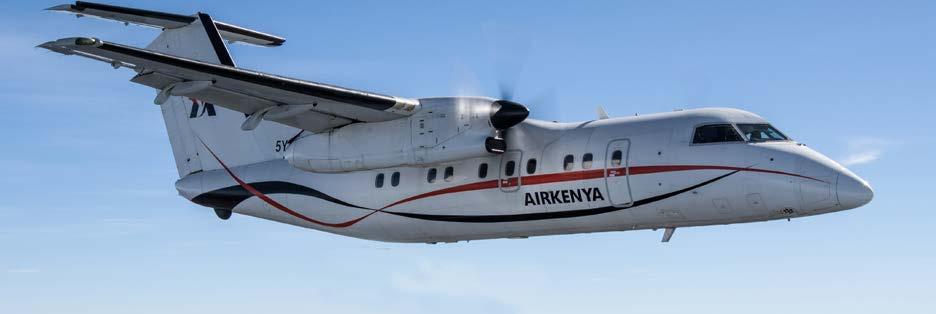
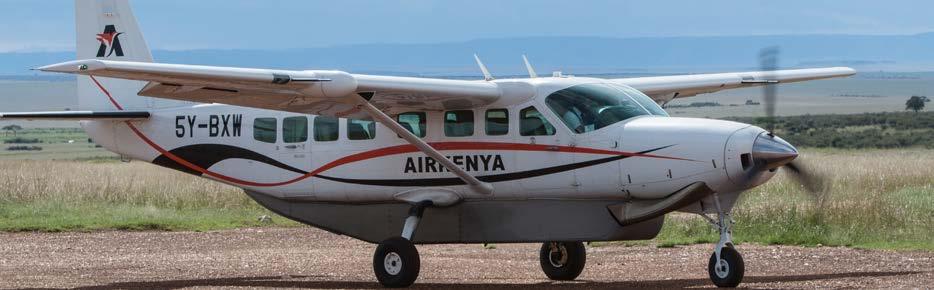
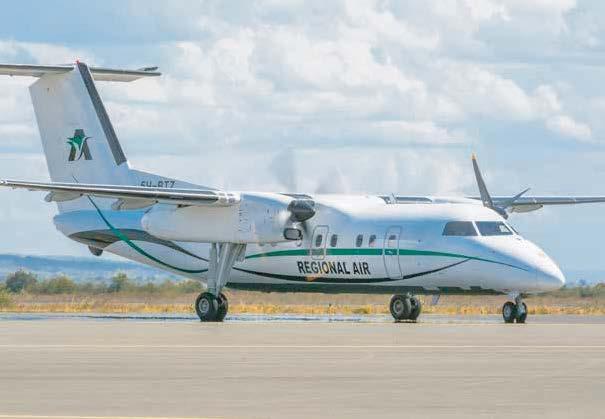
This January marked the launch of AirKenya’s direct flights to Arusha –the gateway to Tanzania’s spectacular Northern safari circuit. Our daily flights connect perfectly with our
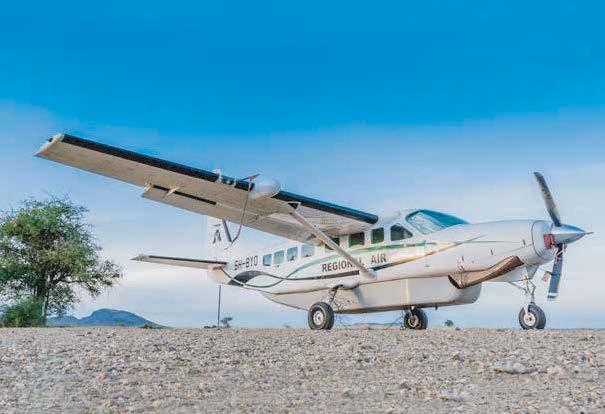
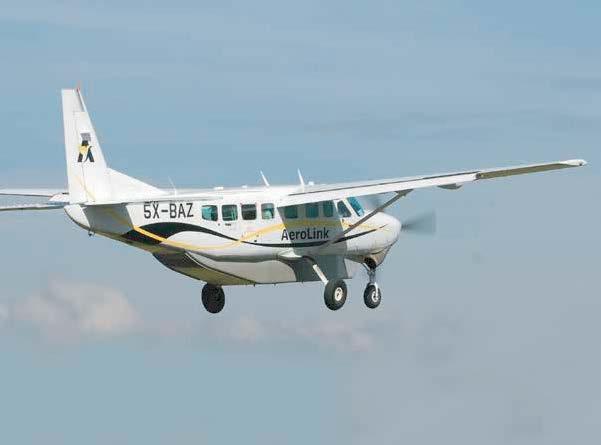
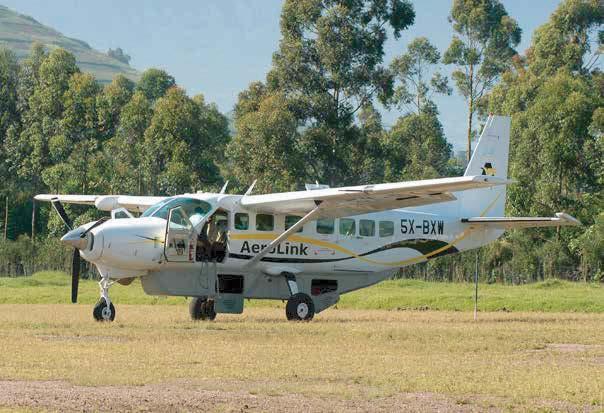
subsidiary airline, Regional Air, delivering our guests seamlessly into the heart of the Serengeti and Manyara National Park. Regional Air has also expanded the number of airstrips they fly to in the Serengeti, thus reflecting our commitment to making this remarkable destination more accessible for our guests. In Uganda, our subsidiary AeroLink continues to provide reliable, seamless connections to the country’s magnificent and lush national parks, supported by friendly service and highly knowledgeable personnel.
Despite shifting seasons and changing skies, East Africa continues to hold a special place in the hearts of international travellers. The promise of close encounters with wildlife, breathtaking landscapes, and warm hospitality draws visitors back time and again.
As we move further into 2026, our airline group remains deeply committed to ensuring that every moment of your journey feels thoughtful, seamless, and truly welcoming. With over 40 years of experience, we take pride in delivering a premi-
um service that continues to care for our guests—today and for years to come.
In this edition of Ndege News, we invite you to explore stories of travel, conservation, culture, and adventure that celebrate the richness of our land and skies. Whether you are flying for business, leisure, or the thrill of discovery, thank you for choosing to travel with us.
From all of us at Airkenya, we wish you smooth flights, memorable journeys, and a season filled with discovery.
Jean Uku Marketing Manager
Karibu
Dear Winged Wanderers,
Chances are if you’re reading this magazine, you’re on one of our flights, with an aerial view of Kenya, Tanzania or Uganda below. East Africa is one of the most beautiful regions on our planet. Flying at an altitude averaging around 10,000 feet to many of our destinations lets you appreciate the varied terrain—from the vast savannahs of the Serengeti dotted with granite kopjes or the dense forest of the Ngorongoro Conservation Area, often with a view of the crater below. Rising from the floor of the Rift Valley, the volcano Ol Doinyo Lengai keeps a watchful eye over her Maasai and their cattle, along with giraffe, zebra, wildebeest and other inhabitants of this arid land—the lake covered in pink from a million nesting flamingos.
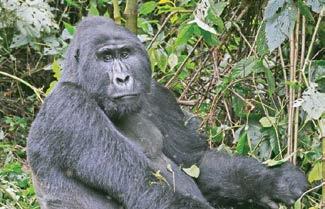
At certain times of the year with the Masai Mara below, you’ll witness the great migration moving poetically, like a river flowing with tributaries branching off and then reconnecting again. Seeing the glaciers on Kilimanjaro as you approach Amboseli airstrip will take your breath away. And the jungle foliage of Uganda; the pearl of Africa, her hills and mountains draped in green velvet. Providing secret shelter for the gorillas, this lofty view will have you pondering what your trek will be like as you set out on your expedition.
From this bird’s eye view, everything is a sensory experience. The sound of the plane’s engine humming along, the visual beauty of the land, the smell of the African earth as you step off the plane – your flight is an equally magical part of your safari and a memory that you will fondly relive until you come join us again and create many more.
This is my first issue as your new editor, and I have big shoes to fill! Hollie M’Gog, the former editor, has made it easy for me by providing such a great
flow to follow. But I hope to add some new ideas into the mix.
In future issues, we will continue to feature many beautiful destinations – who doesn’t like to imagine themselves immersed in an adventure at an amazing camp or lodge. We will also bring you human-interest stories from the people who live, work, and quietly make a difference in these landscapes—from conservationists and guides to artists, photographers, and community leaders whose lives are deeply intertwined with East Africa. I’m also excited to introduce a column on how art and conservation work together to support each other, and how creativity can inspire protection, awareness, and connection.
And because some of the best stories are yours, we look forward to inviting our guests to take part—through an annual photography contest of shared travel moments and personal stories from the bush that deserve to be told.
We are thrilled to have you join our flock as we fly across the skies to get you safely to the start of your adventure, or back to your final destination. And when you return to your homes, you can still follow our adventures with our online publication. We want to do what we can to tempt you to come back and visit us again and continue to be part of our family.
Karibuni wote!
Cynthia Adams Editor
Editor Cynthia Adams
Publisher
The Business Platform Ltd
P. O. Box 103364-00101, Nairobi Tel: +254 741 0700001
Email: businessplatformkenya@ gmail.com
Advertising
Peter Ondabu
Tel: +254 722 770 367 ondabupeter@gmail.com
Design and Layout
Digital Colour Business Ltd info@digitalcolourbiz.com
NDEGE which means aeroplane in Kiswahili is a quarterly Magazine publication of AIRKENYA Express Limited
Wilson Airport
P.O. Box 30357 - 00100 Nairobi, Kenya
Reservations
Tel: +254 20 391 6000
Email: resvns@airkenya.com
The magazine focuses on tourism, hospitality, travel, leisure, conservation and aviation related news in the East African region and beyond. The views expressed in NDEGE NEWS Magazine do not necessarily reflect those of either AIRKENYA EXPRESS, REGIONAL AIR SERVICES and / or AEROLINK UGANDA
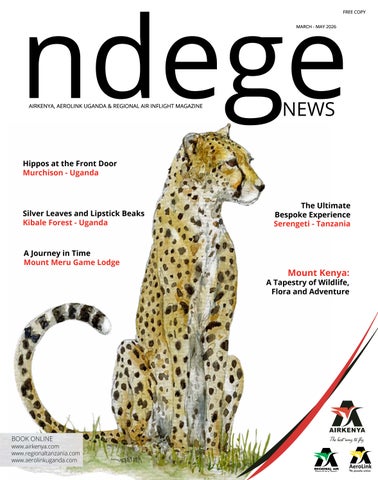
Cover My Story Where Art Meets the Wild
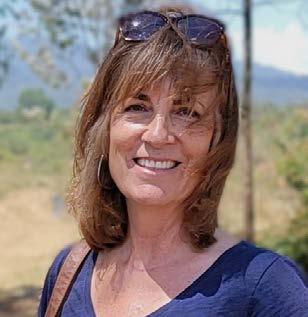
Anne Thomsen, on stillness, a cheetah, and conservation through creativity
After living and working across East Africa, Asia-Pacific, the US and Europe, Anne now runs her art and design business, Studio Ngong, from her studio in Germany –with East Africa remaining at the core of her inspiration and creative work.
As a creative conservationist, Anne’s work focuses on art, wildlife, and community. Her paintings and designs don’t simply depict the natural world; they actively support it through charity events and purpose-driven merchandise that benefits conservation organisations working on the ground.
Her relationship with East Africa began more than 30 years ago on her first solo journey to the region. The wild beauty of Kenya and Tanzania left a lasting imprint, shaping a lifelong commitment to wildlife conserva tion and the creative spirit of the African landscape. Like many who experience it deeply, Anne feels this is where her soul found its home.
Through Studio Ngong, she creates art-led products that help fund conservation and community initiatives. She also leads im mersive art safaris and artist-in-residence programs with Art Workshops in Africa, in viting participants to slow down, observe carefully, and reconnect with the natural world through sketch ing and sustained presence.
Anne travels to Kenya and Tanzania several times a year, often for extended stays. She also serves on the board of the Loisaba Community Conservation Foundation, where her involvement extends beyond advocacy into hands-on community engagement, including projects supporting a local school, medical centre, and the Chui Mamas, a women’s cooperative, in Ewaso, northern Kenya.
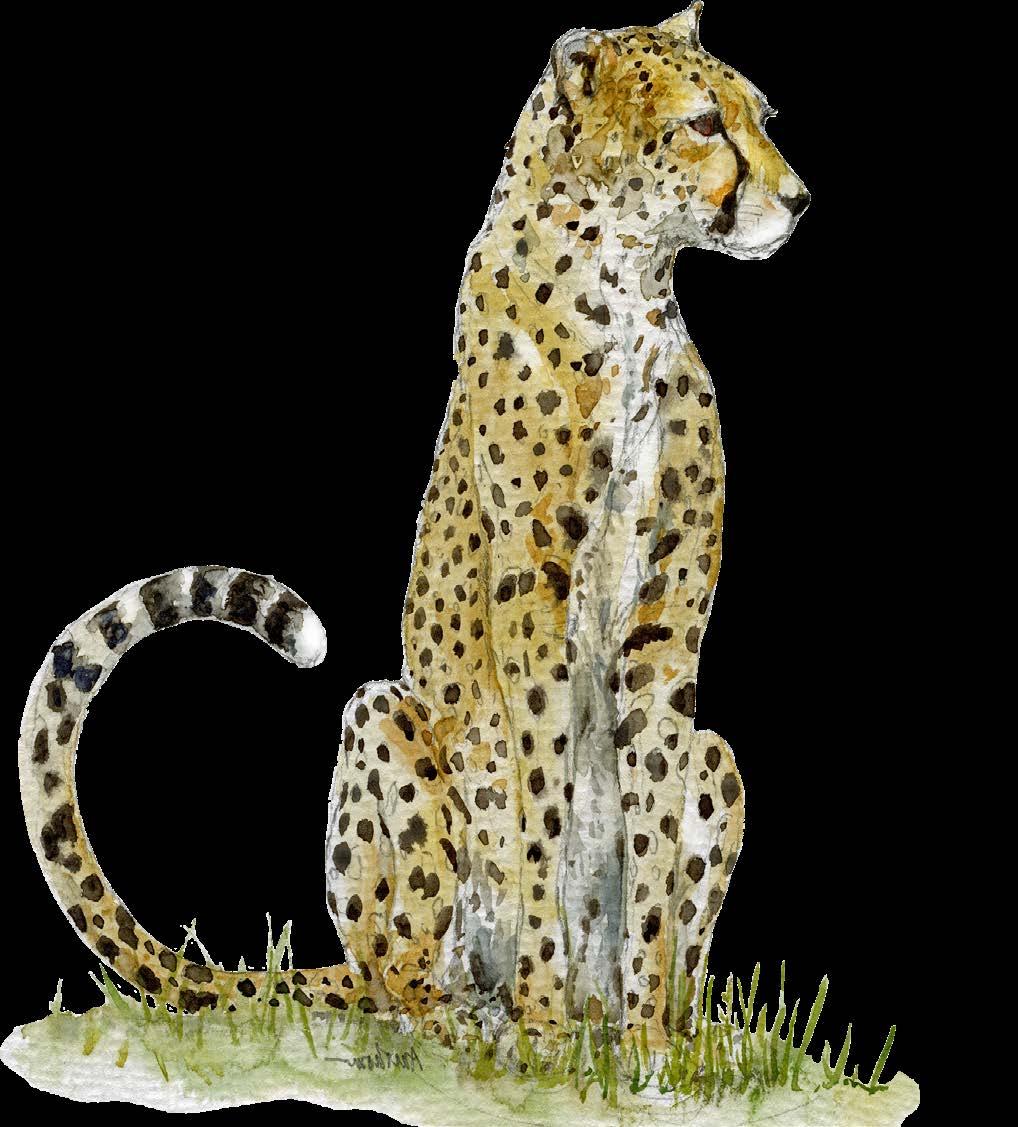
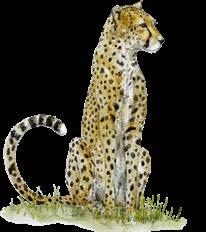
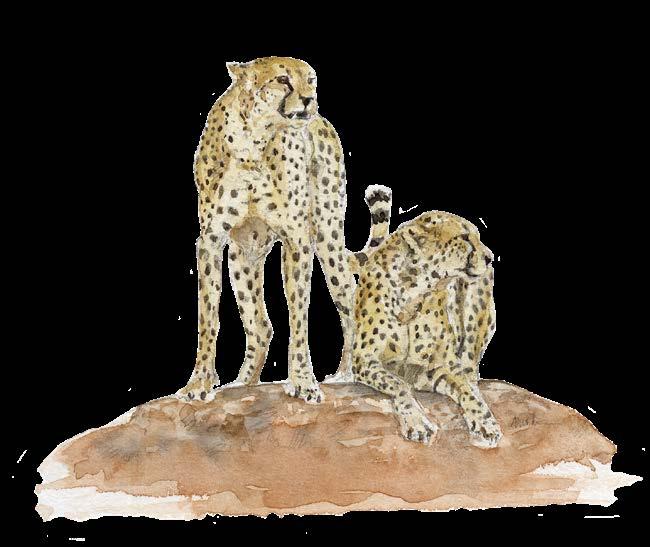
stillness became the foundation of the painting, made even more precious by fellow safari guests who lingered nearby, savouring the rare gift of simply being present—rather than rushing on to the next sighting.
Anne’s work invites the viewer to pause and consider the wildlife in situ. In slowing the act of seeing, this piece reflects the values at the core of her practice: patience, presence, and protection—qualities that help nurture and safeguard wild landscapes.
Focused on conservation and collaboration, Anne works with organisations including the Grévy’s Zebra Trust, Elewana Collection, Friends of Nairobi National Park, and the African Fund for Endangered Animals. She is also a proud ambassador for Game Rangers International. These partnerships reflect her belief that lasting conservation can only succeed when people are part of the solution.
Beginning in June, Anne will contribute a regular column to Ndege News, exploring the relationship between art and conservation—from sketching in the wild to the power of creative attention and learning to truly see as a first step in protecting what matters most.
www.studiongong.com
Art in the Field
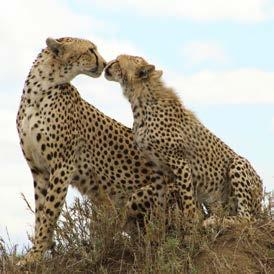
This month’s cover artwork captures a beautiful cheetah that was observed on the Namiri Plains in the Serengeti. Sketched over nearly an hour of quiet watching, the moment unfolded slowly: cheetahs resting on sunlit rocks, sitting upright and alert, or stretching as cats do. That
Anne sketches wildlife on safari not to capture perfection, but to understand behavior, movement, and relationship. Time spent watching—sometimes an hour or more—becomes as important as the finished artwork.
Seamless Access to Tanzania: Airkenya Introduces Wilson–Arusha Route
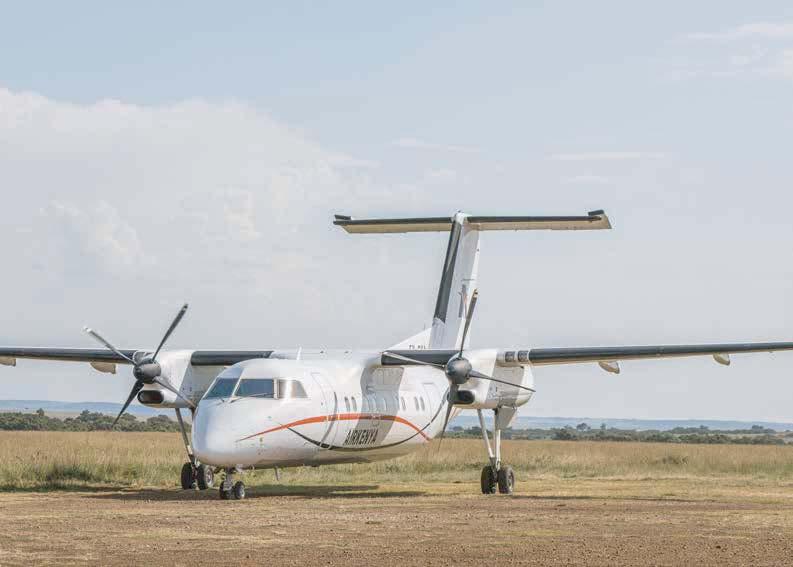
Airkenya is delighted to announce the successful launch of our daily scheduled flights between Wilson Airport, Nairobi, and Arusha Airport, a service that has been operating seamlessly since 1st January 2026.
As part of this new route update, our scheduled flights will now operate to Arusha, while Kilimanjaro will continue to be served via charter flights. Arusha remains one of Tanzania’s premier tourism hubs and a key gateway for travelers exploring renowned safari destinations across both Kenya and Tanzania.
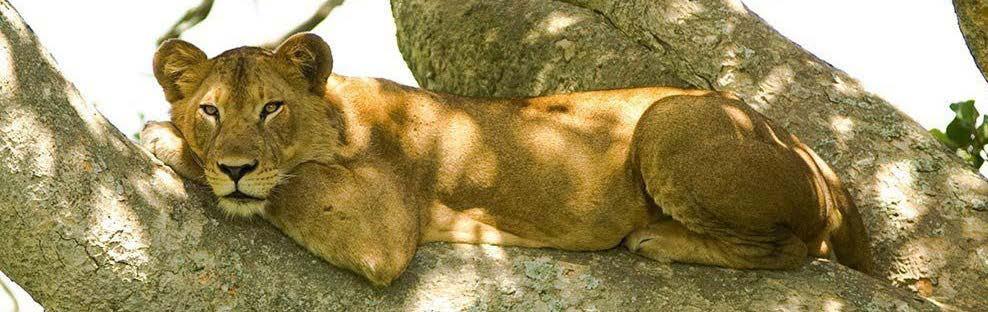
Upon arrival in Arusha, passengers can easily connect with our subsidiary partner, Regional Air, for onward travel to Tanzania’s iconic national parks, including the Serengeti and Lake Manyara. Lake Manyara National Park is known for its rich biodiversity, from rare treeclimbing lions and large elephant herds to its alkaline lake, which seasonally attracts thousands of flamingos. Serengeti National Park stands as one of the world’s most celebrated wildlife destinations, famed for the Great Migration, an
awe inspiring annual movement of over 1.5 million wildebeest accompanied by vast herds of zebras.
Together, these destinations offer travelers a diverse and unforgettable Tanzanian safari experience, now made even more accessible through AirKenya’s enhanced regional connectivity.
Regional Air Reinstates Its Scheduled Flights to Airstrips in the Serengeti
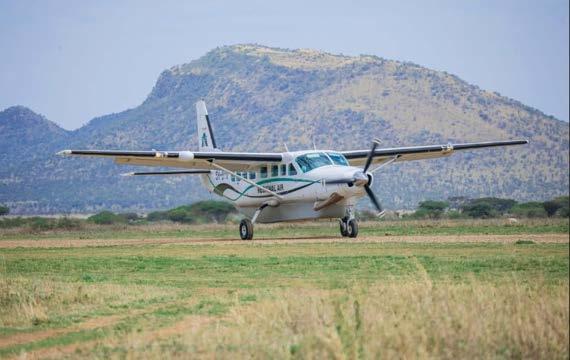
Regional Air has reinstated its scheduled flights to key airstrips across the Serengeti, including Grumeti, Sasakwa, Fort Ikoma, Ndutu, and Lamai. These airstrips are in addition to Seronera, Lobo and Kogatende that were already being served by Regional Air. The various airstrips are strategically located within the park and game reserves adjacent to the park, ensuring convenient access to the Serengeti’s diverse regions and renowned wildlife areas.
Flights into the Serengeti offer travelers breathtaking views of the vast savannah, an unforgettable, scenic introduction to one of Africa’s most iconic safari landscapes. It is a breathtaking way to begin the safari adventure that awaits within the park.
AIRKENYA
AEROLINK
Why Runners Are Flying to Kasese
Tusker Lite Rwenzori Marathon: The marathon that starts on the equator
By Maren Hald Bjørgum
If you’re on this flight, chances are you’re wired for discovery. Aerolink passengers don’t sit still. You’re the kind of traveler who would trade a city weekend for a crater lake, a rainforest, or a savannah sunrise. So, here’s a destination you may not have added to your list yet: Kasese, home of the Tusker Lite Rwenzori Marathon, one of Africa’s most spectacular running experiences.
And yes, it starts on the equator.
A marathon that doubles as your next adventure
Every August, runners from 35+ countries gather just before sunrise inside Queen Elizabeth National Park. The air is still, the savannah is waking, and the 42 km runners line up with their feet planted directly on the equator.
From there, the route heads east toward Kasese town, with the national park stretching out on the right and the Rwenzori Mountains rising ahead on the left. Reaching town, the course climbs into the lush Kilembe Valley, where arabica coffee grows in the foothills of the mountain. The air cools, the scenery deepens, and the Kilembe climb becomes the defining challenge of the race.
The finish brings runners back to Kasese town, where music and crowds turn the final meters into a proper street party!
Why runners keep coming back
This is not just for elites, although Uganda’s best talent will be on the starting line. It is a destination marathon built on challenge, scenery, and great vibes.
The setting is one-of-a-kind. The only marathon in the world that starts on the equator and moves from savannah to mountain foothills in a single morning.
Ugandan running clubs treat this race as a yearly milestone, a place to test themselves, chase personal bests, or simply prove they can conquer Kilembe. If you’ve never run with Uganda’s running clubs, you are in for a treat!
And Kasese shows up. Race weekend fills hotels, keeps restaurants open late, and brings locals out in force to cheer every runner home.
While the setting is spectacular, the standards are serious. The marathon is certified by World Athletics and holds official label status, meaning your time counts, whether you are chasing a personal best or a qualifying mark.
Make the most of it Kasese places you within reach of
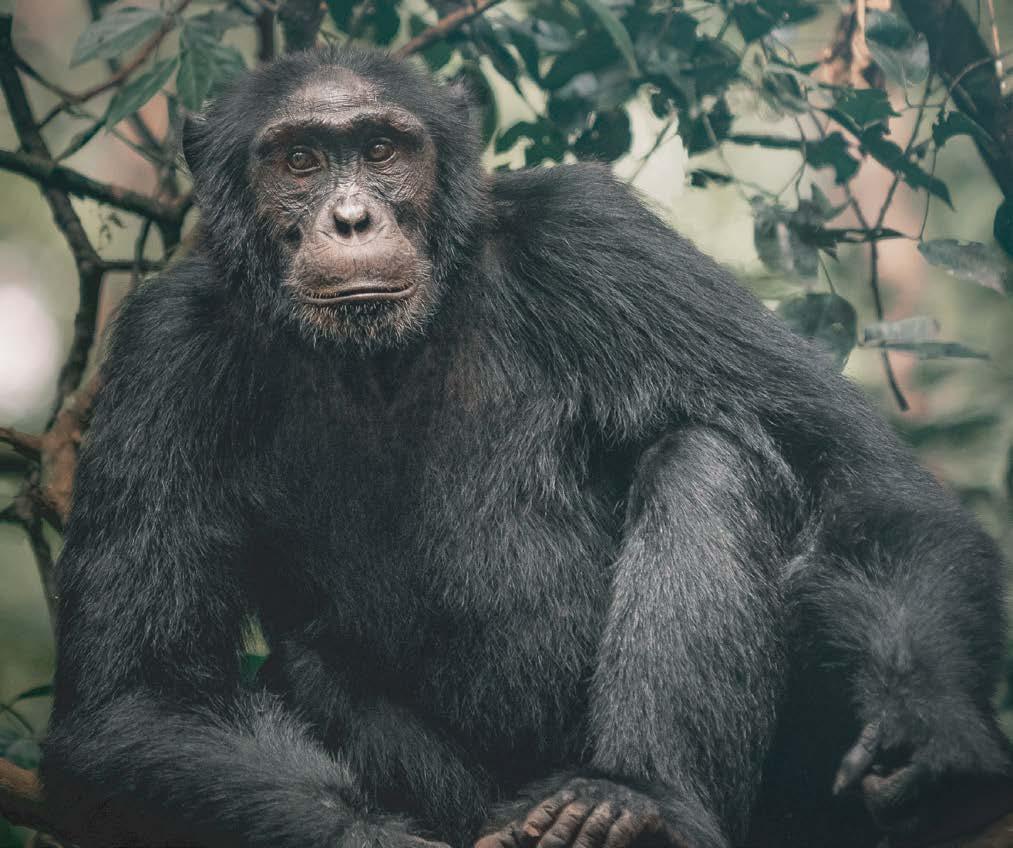
game drives in Queen Elizabeth National Park, chimpanzee trekking in Kyambura Gorge, hikes in the Rwenzori’s up to Margherita Peak (5,109 m), and coffee tours from tree to processing.
The marathon becomes your reason to explore a region that rewards curiosity.
On August 22, 2026, we celebrate our 5th anniversary with 5 km, 10 km, 21 km, and 42 km distances.
Fly in, run on the equator, celebrate – and leave with a story that lasts long after the flight home.
With AeroLink’s AM and PM flights to Kasese, your adventure is closer than you think. See you on August 22!
A new year invites fresh journeys — new places to explore and deeper insight into community, conservation, and the arts. It also brings wonderful voices who will share life from the bush and thoughtful perspectives on East Africa.
Meet the Team
In this issue, we’re pleased to introduce two new contributors whose experience and creativity enrich the pages of Ndege News.
Laura Kyle brings a distinguished
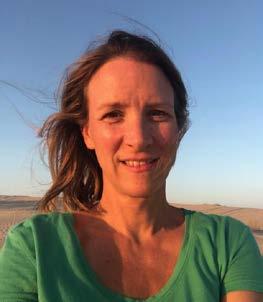
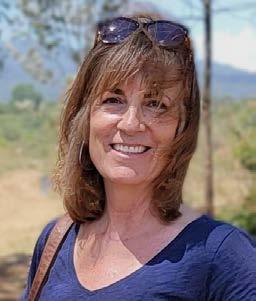
background in journalism and a global perspective now rooted in Arusha. Cynthia Adams, our new editor and a contributor on culture and life in the bush, combines a long career in the creative arts with a deep connection to East Africa.
Laura Kyle Cynthia Adams
Laura Kyle is an international journalist whose career has unfolded across continents and conflict zones.
During 20 years with Al Jazeera English, she reported from around the world, covering stories across Asia and Africa — from tribal violence in Papua New Guinea and Pol Pot–era trials in Cambodia, to the fallout from the Fukushima disaster in Japan and devastating drought in Burkina Faso.
She has lived in China, Nepal, Australia, Malaysia and Qatar, eventually settling in Doha, where she swapped hiking boots for heels and anchored major international news for the next 15 years.
It was a time of tumultuous upheaval in the region with the Arab Spring, the war in Gaza, and Iran’s attack on a U.S. airbase in Qatar, when she remained on air as the newsroom shook from missiles being intercepted overhead.
Today, Laura has swapped her heels for bare feet and has settled on the slopes of Mount Meru, where she lives with her husband, three young children and an ever-growing menagerie of rescued animals.
Cynthia’s career in the creative arts spans more than thirty years in the United States, where she has worked with private clients, commercial builders, and interior designers.
Her artistic journey has included mural commissions, contemporary abstract paintings, and decorative arts such as gold leaf, Italian plasters, hand-painted fabrics and furniture, and handmade wallpapers. Even while immersed in paints and plasters, she always found time to write, contributing to numerous magazines and newspapers over the years.
After coming on safari in 2019, Cynthia and her husband felt the calling to relocate to East Africa. They sold their business and the majority of their belongings, packed their bags (including their cat!) and made the move to Tanzania. Five years later they feel completely immersed in their lives here and love being part of this vibrant community.
As a long-time professional artist, Cynthia has always been aware of how the environment influences her creative endeavours. Combining her passions for photography, painting, and writing, she continues to explore and share the stories and beauty that shape her daily life.
Ndege News Magazine Photo Contest
Celebrating Moments from the Sky & the Ground Below
Ndege News Magazine invites our safari guests and readers to share their favourite moments from East Africa through photography and story. This contest is simply our way of celebrating the remarkable experiences our travellers witness — and carry home with them.
How to Enter
Submit up to two (2) photographs taken during your travels in East Africa.
Email submissions to: TRAVELS2AFRICA@GMAIL.COM
Your email must include:
• Full name
• Contact phone number
• City and country of residence
• Photo category (Wildlife, Birds, or Community/ People)
• A short write-up (150–200 words), included in the email or attached as a PDF
There is no entry fee. Please submit all materials in one email.
Photo Categories
Participants may submit images to one of the following categories:
1. East African Wildlife
2. East African Birds
3. East African Community & People
All submitted images must fall within one category only
Image Requirements
• Maximum of two (2) images total
• JPEG (.jpg) files only
• Each image must not exceed 5 MB at submission
• File names must include your name and category (example: Adams_Wildlife_Serengeti.jpg)
Finalists may be asked to provide higher-resolution files for print.
Entry Period
• Entries open: March 1, 2026
• Entries close: September 15, 2026
• Winners announced: November 15, 2026
Late or incomplete submissions will not be considered.
Winners & Recognition
• One Grand Prize Winner
o Cover feature on Ndege News Magazine in one of the quarterly issues in 2027
o Featured story of approximately 300 words
• Category Winners (one per category)
Featured inside the magazine alongside their image and story
There is no monetary prize — recognition in print is the reward.
Photo Guidelines
• Photos must be original and taken by the entrant
• Minimal editing is acceptable
• Heavy manipulation or AI-generated images are not permitted
• Images must not have been previously published in other magazines or commercial outlets
Rights & Usage
By entering, you confirm that:
• You are the sole creator and copyright holder of the image(s)
• Any identifiable people in the photo have given consent
Ndege News Magazine is granted one-time, nonexclusive rights to publish winning images in a 2027 issue (print and related digital editions). Images will not be used beyond this publication, and full credit will always be given to the photographer.
Judging
Entries will be judged by the Air Kenya Ndege News Magazine editorial team based on visual impact, storytelling, relevance to category, and overall sense of place. Judges’ decisions are final. Due to the volume of submissions, individual feedback cannot be provided.
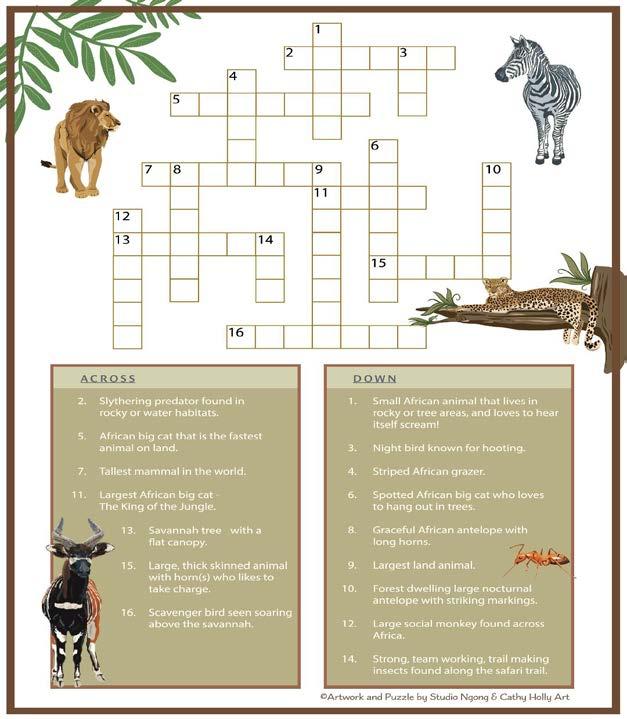
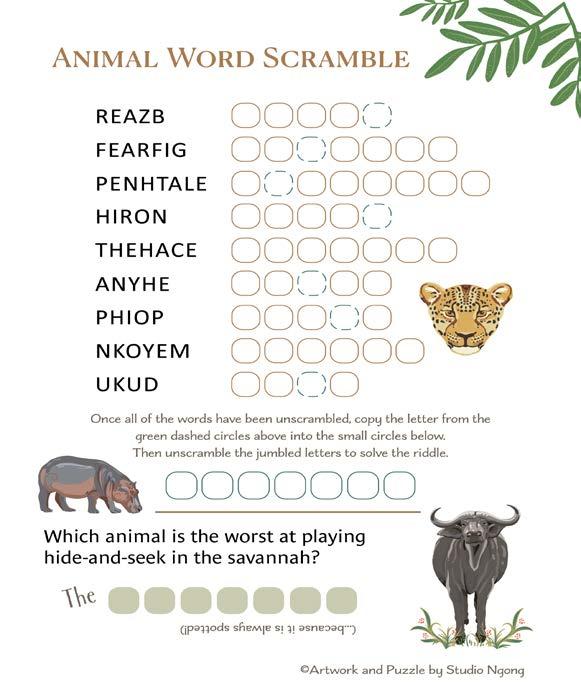
Answer Key
BLOSSOMS & BEYOND Meet The Flying Handkerchief
By John Woolmer
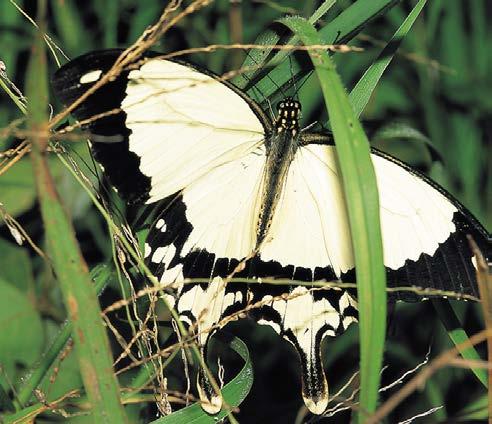
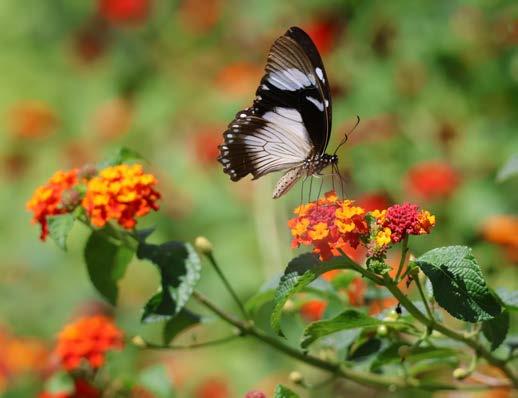
Papilio dardanus, known as the Flying Handkerchief or the Mocker Swallowtail, is one of Africa’s most interesting butterflies. Male Mocker Swallowtails are usually the ones people notice first. With a soft, pale yellow colour, often edged with black, they float lightly and really do resemble a handkerchief drifting on the breeze. The male butterflies are easily seen, often drinking from water on forest paths.
Masters of Disguise
Unlike the males, female Mocker Swallowtails can vary tremendously. In fact, they come in dozens of varying looks, patterns, shapes and colour, each one mimicking a butterfly that birds know to avoid because it’s toxic. By copying these dangerous species, they gain protection from attacks by predatory birds, a very clever survival trick.
Mimicry is a common practice in the world of butterflies. Another example is the African Monarch who have caterpillars which are poisonous to birds. It is mimicked by other butterflies, notably the female Diadem Eggfly. Birds, either by some inherited instinct, or by eating a poisonous butterfly, quickly learn which species to avoid.
From Butterflies to Babies
One of the most remarkable chapters in the Mocker Swallowtail’s story, though, doesn’t take place in the forest at all — but in a hospital.
British scientist Cyril Clarke spent years studying the genetics behind these butterflies and their many forms. That work led him to notice striking similarities between butterfly inheritance and the way human blood types are passed from parent to child.
One of his greatest achievements was his discovery of a method of preventing rhesus babies. Rhesus haemolytic is a disease in new-born children resulting from incompatibilities between maternal and foetal blood. His insights and research helped play a key role in developing a treatment that prevents rhesus disease, a once-deadly condition affecting newborn babies. Thanks to this breakthrough, a medical mystery was unlocked, and countless infant lives have been saved.
So, the next time you see a Mocker Swallowtail drifting across a forest path, remember it’s not just a beautiful insect. It’s a quiet reminder that even the smallest details in nature can lead to life-changing discoveries.
THE BIRDS & THE BEES
– The Con Artist of the Acacias!
By Cynthia Adams
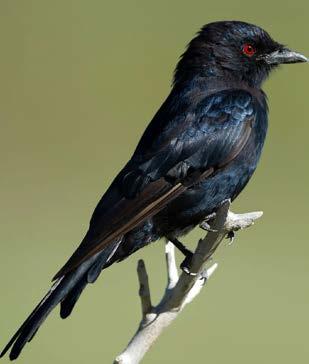
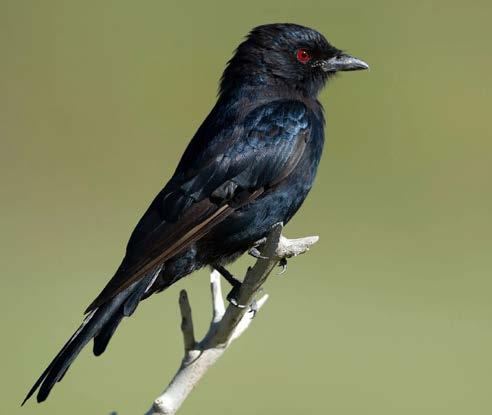
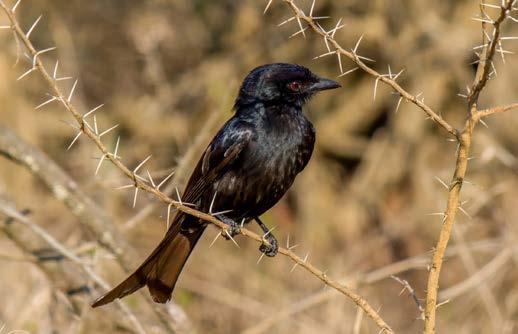
You’ve seen it many times on safari. Glossy black with a slight blue sheen in good light, and red eyes that look like they know something you don’t. A deeply forked tail like a swallow that helps with agile aerial maneuvering.
Most guests ignore it completely—big mistake! Bird enthusiasts are in on the scoop of what makes this a worthy bird to know about. But that can be said of all birds, right?
What Makes the Drongo Special?
The fork-tailed drongo is found across much of sub-Saharan Africa, including Tanzania and Kenya, often perched on Acacia branches, the backs of grazing mammals and hitching a ride on safari vehicles!
It hunts insects in several clever ways:
• Hawking – launching into the air to catch flying insects mid-flight
• Sallying – dropping down onto beetles or grasshoppers
• Following large mammals – grabbing insects flushed out of the grasses by buffalo or elephants
But that’s just the warm-up act. They are the tricksters of the savannahs!
The Fork-Tailed Drongo
The Deception Strategy
Drongos are masters of vocal mimicry. They can imitate mongoose alarms calls, starling and pied babbler warning sounds, and even the cries of raptors.
Here’s what researchers have documented: as an opportunistic and clever hunter, the drongo will watch a mongoose dig up a juicy grub. It will time an alarm call to startle the mongoose which will then drop the food and run for cover. At that point the drongo swoops down for its prize. They are clever like that!
But here’s the really fascinating part:
If the mongoose begin to ignore one fake alarm call, the drongo switches to a different species’ alarm call and will rotate through its repertoire until it gets its prize. Field studies of the drongo, conducted in the Kalahari, have learned that more than 20% of their food intake is secured via this kind of trickery.
That is not instinct alone. That’s adaptive deception, opportunistic theft and strategy!
Drongos are one of the few birds shown to understand cause and effect in social systems. They can adjust their behavior when their deception stops working. Over time they continue to learn and expand their mimicry.
Interestingly, drongos also give genuine alarm calls. Sometimes they warn truthfully, and sometimes they lie, so other animals can’t afford to ignore them.
They are fearless for their size, fiercely territorial and will mob large raptors.
Next time you are out in the bush and spot a drongo, make sure and pause to watch their clever and calculated antics!
TALL TALES FROM THE BUSH!
Why safari stories grow bigger at sunset — and what the wildlife is really doing…
Safari stories get bigger and better with every retelling!
When you’re back at your camp and sitting around bush TV at dusk, the day’s sightings are often magnified under the influence of an African sunset and the excitement of
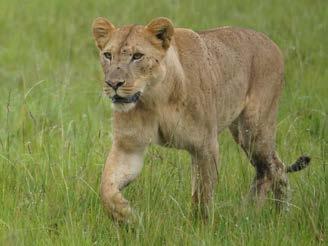
Tall Tale: Lions are nocturnal hunters.
a thrilling game drive. And perhaps that gin and tonic is contributing just a little, too.
Here’s how to stay ahead of those storytellers, or at least make sure that yours are solid!
Fact: Lions are opportunistic hunters. Although nighttime is often when much of their hunt happens, they will also hunt at dawn, dusk, overcast afternoons, or whenever the mood (and hunger) strikes. Daytime kills absolutely happen—especially when it’s cooler. Maybe you’ll be lucky enough to witness the silent stalking and flash of fur as a hunt ensues.
Tall Tale: Elephants go off to secret graveyards to die.
Fact: There’s no hidden elephant cemetery. Older elephants may linger near water or softer ground when weak, and carcasses sometimes accumulate in drought years—but there’s no mystical burial site.
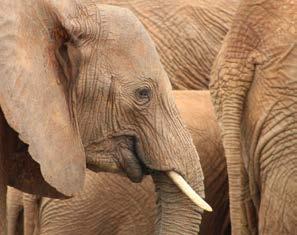
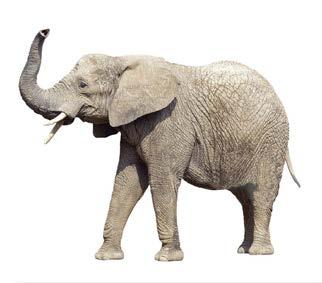
Tall Tale: An elephant lifting its trunk means it’s about to charge.
Fact: Usually, it’s smelling you. When the trunk is up, they are in information gathering mode.
Ears out, head high, and stillness—pay attention! This could be a more serious assessment.
Best to remember: most elephants do not want to charge. They want space. When they escalate, it’s usually because they feel pressured, surprised, or protective (especially around calves).
The most important thing to remember is that wildlife can be unpredictable. There’s always an exception to the rule, which is how those tall tales often start!
Lion Conservation in Meru Conservation Area
By Moses Nyagah – Field Supervisor, Born Free Foundation
The Ecological and Cultural Importance of Lions
Lions, the majestic rulers of Africa’s grasslands, are more than apex predators. They are keystone species that keep ecosystems balanced by controlling herbivore populations, preventing overgrazing, and sustaining healthy landscapes. Beyond their ecological role, lions have long symbolised strength, courage, and leadership in cultures across the world. Protecting them means safeguarding both biodiversity and a timeless emblem of human inspiration.
Challenges Facing Lions in Meru
Despite their importance, lions face serious challenges. Retaliatory killings and snaring threaten their survival, particularly in areas where communities are livestock keepers. Livestock predation often provokes retaliation from local communities, placing lions at risk. To counter these threats, Born Free and its partners have developed targeted rescue and monitoring programmes.
Born Free is committed to saving every single lion. The programme focuses on:
• Monitoring populations and studying movement patterns.
• Rescue operations, including de-snaring and treating injuries.
• Direct interventions against threats such as poison arrows and wire snares.
Thanks to these efforts, Meru’s lion population continues to thrive. At the heart of these rescues are trained
Born Free personnel dedicated to freeing lions from life-threatening traps and ensuring their survival.
Community-Based Solutions for Coexistence
Conservation cannot succeed without the support of local communities. To reduce conflict and foster
coexistence, Born Free has extended its work beyond the park. Over the past three years, the team has:
• Constructed 19 Predator-Proof Bomas (PPBs) to secure livestock against lions and other predators.
These measures have drastically reduced predation and retaliatory killings. The impact is best captured in the words of farmer Gerand Muthee: “I used to lose at least one sheep or goat every night to lions and hyenas. I even slept outside with my livestock in the cold air to protect them. Thanks to Born Free’s Predator Proof Boma, I no longer live in fear. I promise to ensure lions, hyenas, and other carnivores remain safe in our area.”
His testimony reflects how practical
solutions can transform fear into coexistence.
Collaborative Conservation
The success of the Born Free initiative demonstrates the power of collaboration. By uniting conservation organisations, government agencies, and local communities, lions are not only surviving but thriving. Communities are increasingly supportive, recognising that protecting lions safeguards ecosystems, cultural heritage, and future generations.
A Shared Responsibility
Continued support is vital. Financial contributions towards Predator Deterrent Lights and Predator Proof Bomas directly enhance human-carnivore coexistence, reduce conflict, and secure the future of these magnificent animals. Lion conservation is therefore a shared responsibility, a milestone pillar for biodiversity protection and a testament to the enduring bond between people and wildlife.
To support this critical work, visit the Born Free Foundation’s website or contact our partnerships manager at caroline@bornfree.or.ke.
Hippos at the Front Door The Untamed Elegance of Anyadwe, Murchison’s First Private Villa
In the heart of Uganda’s most dramatic landscape, where the Victoria Nile surges toward Lake Albert, a new kind of sanctuary has emerged. Nestled amongst the iconic Kigelia Africana, or the sausage tree and a large number of newly planted trees that will add to the riverine forest, is Anyadwe House, a private villa that marks a first for the Murchison region. An intimate, exclusive gateway to the most tremendous waterfalls in East Africa.
Anyadwe’s legacy is in her name which carries a weight of history and local reverence. It translates to “Daughter of the Moon,” a nickname bestowed by the local population
By Hollie M’gog
upon Florence Baker. Blonde haired Florence, who traversed these lands on a legendary expedition alongside her husband, Samuel Baker, was celebrated for her “incredible nature”. Today, the house that bears her title seeks to capture that same spirit of exploration, tempered with a refined, modern luxury that allows guests to experience the Nile views as she might have — though with significantly more comfort.
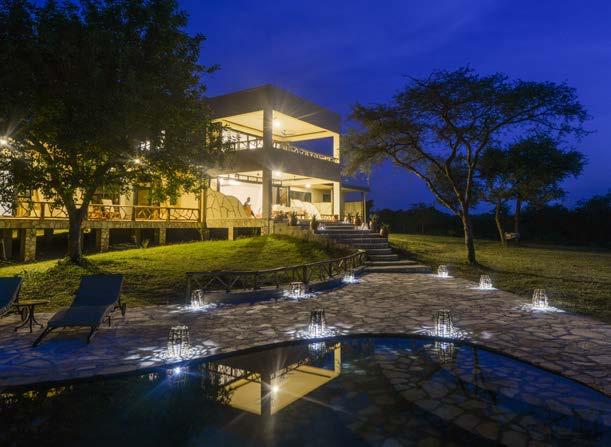
Designed with a striking, square double-story architectural silhouette, Anyadwe House is a masterclass in blending contemporary lines with organic textures. The villa features
two distinct wings, each housing two bedrooms, providing a total capacity for eight guests, though extra beds can be arranged for children if required.
The aesthetic is deeply rooted in the Ugandan landscape. The walls are finished in a light clay colour, echoing the natural earth of the region, while the interior is punctuated by polished and varnished natural wood. Perhaps most striking is the use of the ubiquitous Ankole cattle horns. These famous, oversized horns are integrated into the decor with taste and sophistication, celebrating a quintessential symbol of Ugandan heritage.
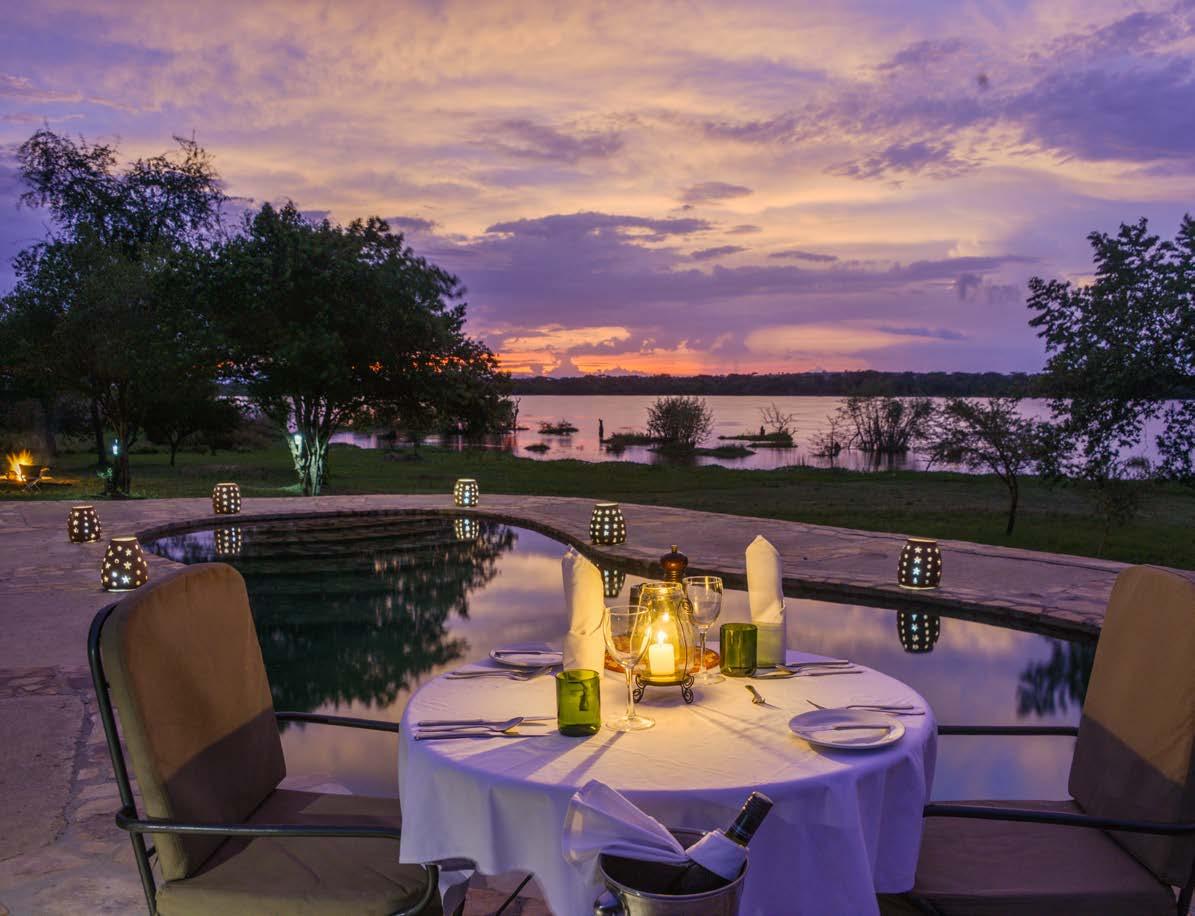
Intimate sunset dining
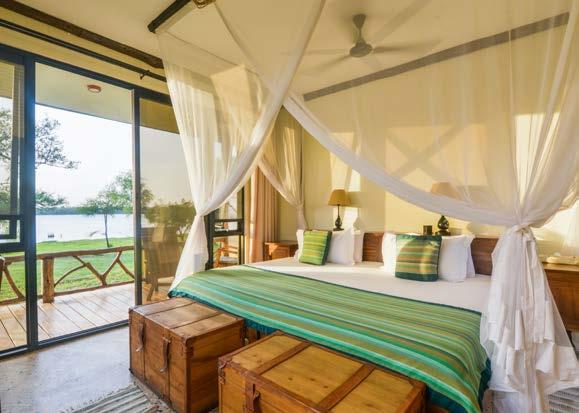
Comfort is paramount in this malarial area; every room is equipped with fans and mosquito netting, ensuring that the “exquisite views” through the windows can be enjoyed without the nuisance of insects. Whether you are relaxing in the hammock chair or looking out from your private verandah, the house feels like a seamless extension of the riverbank.
Wildlife at Your Doorstep
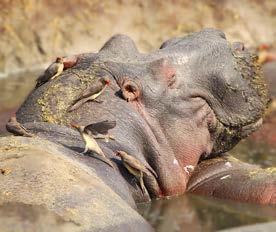
One of the most extraordinary features of Anyadwe House is its proximity to the resident wildlife. This is not a place where you simply go on a game drive to see animals; here, the animals come to you. A pod of hippos resides literally at the front door, their rhythmic “puffing” and “splashing” providing the soundtrack to your stay.
At night, these massive creatures emerge from the Nile to graze on the grass surrounding the house. Because of this, wandering the grounds after dark is discouraged, but the house is cleverly designed so that you can safely watch the hippos from your windows or while walking to the swimming pool. For the best
experience, it is highly recommended to bring a red-light torch; animals do not react to red light, allowing for a truly non-intrusive nocturnal safari from your own verandah.
The birdlife is equally spectacular. In a single tree outside room number four, I myself identified eleven different species of birds without even having to leave my private space. From the flicking ears of a curious hippo to the sight of an elephant wandering through the grounds, Anyadwe villa offers a front-row seat to
the theatre of the wild, the majesty of the mighty Nile and beneath a canopy of night-time stars.
The Luxury of Choice
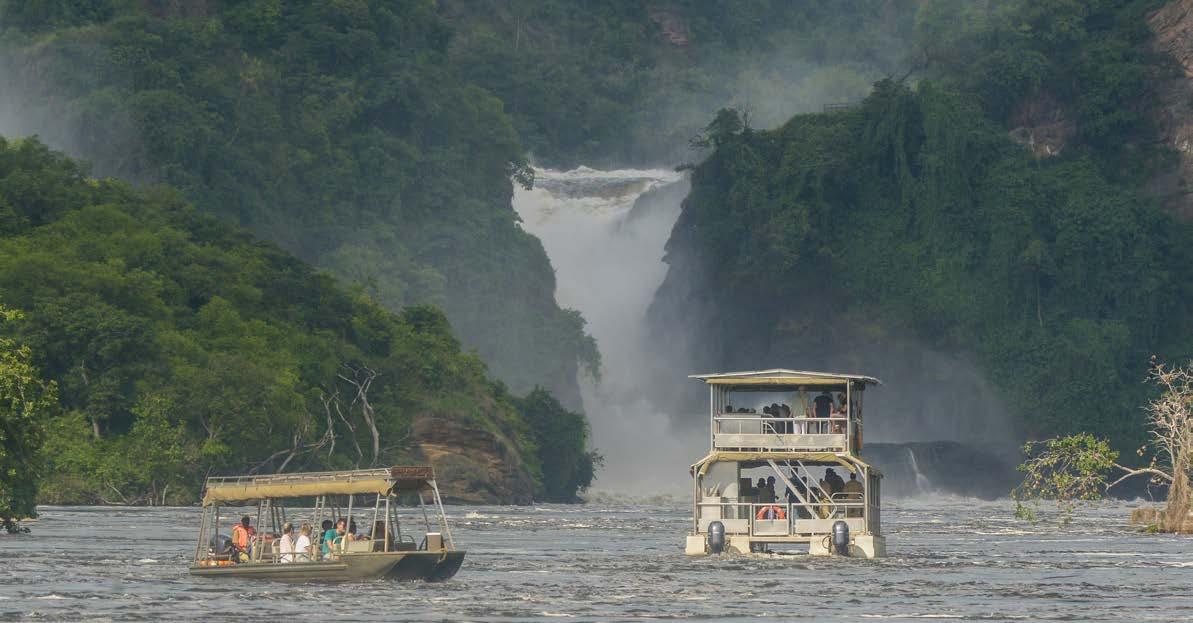
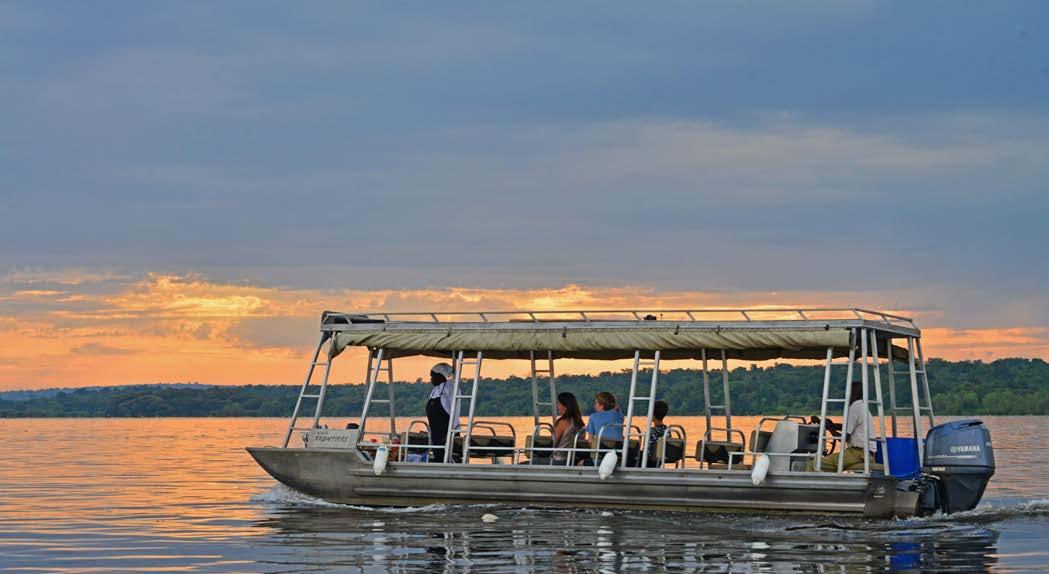
The Anyadwe House - Wild Frontiers working partnership offers guests unparalleled flexibility through the safari vehicles it has on hand and its private jetty, where a boat can be summoned at any moment for excursions to the Delta, sunset cruises, fishing trips or to the base of the thundering falls.
Trips to the base of the falls
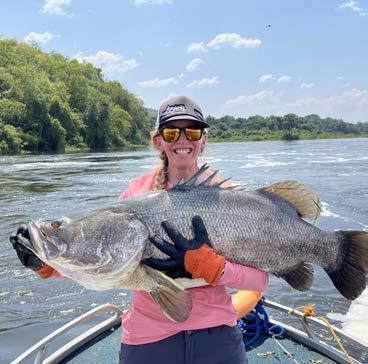
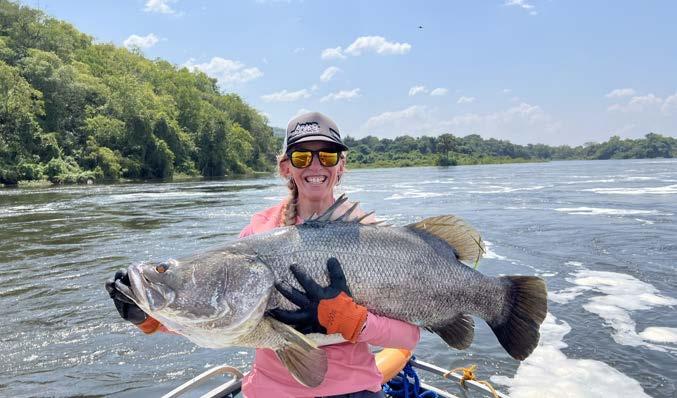
Nile Perch fishing
Within the villa itself, service is entirely bespoke, centered around a private chef who prepares meals to be enjoyed across a variety of settings: on the pool deck for sundrenched lunches, upon expansive communal or private room verandahs, or upstairs on the first-story deck where there is a fully stocked bar featuring everything from chilled whites for river views to robust reds for the evening. This seamless experience extends to the solar-heated swimming pool, which maintains an inviting temperature from dawn until dusk. And the really special touch:
Key activities include:
As evening draws in, staff set up a mobile fire pit on a raised metal platform that can be moved anywhere in the garden for stargazing amidst the calls of the hippos.
This villa is unparalleled in its versatility: Want to self-cater, feel free. Want to bring your own booze, no worries. Want full board, a massage, wake-up calls, tea and coffee ready at all hours, then just ask. Or perhaps you want to grab a coffee in your own way in your own time, re-heat a delicious meal you didn’t manage to finish the day before,
• The Bottom of the Falls: A boat trip to witness the power of the Nile as it is squeezed through a 9m narrow gorge.
• Delta Trips: Whether at dawn or dusk, the Delta is a prime spot for sightings of the rare shoebill and, perhaps if you are lucky, elephants bathing in the water, or a leopard in a tree.
Either one of these trips can be combined with some exquisite fishing for the famously huge Nile perch.
• The Top of the Falls: A drive to the summit provides a different perspective on the “tremendous” force of the water.
• Game Drives: Heading across the bridge toward the lake into the Delta area for traditional safari sightings for which a picnic and six-hours is a good time to set aside.
• Chimp Trekking at Budongo: Located just one hour from the house, Budongo Forest offers a unique trekking experience. While many visit Kibale or Kyambura Gorge, Budongo is “really special,” steeped in history and famous as the subject of several fabulous books.
then the kitchen is just like your own at home – you’ve access to it all!
Exploring Murchison and Beyond
While the exclusivity of the villa might tempt you to stay put, the surrounding Murchison Falls National Park demands exploration. To truly experience the region, a minimum stay of three nights is suggested (I stayed six nights in the region, albeit at three different places), though four nights are ideal for those celebrating special events.
Access and Practicalities
Getting to Anyadwe House is surprisingly straightforward. For those seeking a rapid arrival, helicopter access is available via Kampala Executive Aviation, while Aerolink Uganda operates regular flights to the region. It is a particularly convenient getaway for travellers from Kenya — a mere “hop, skip, and a jump” from Entebbe.
The villa operates on your own terms. You can arrive with a tour company or drive your own vehicle independently. Despite its remote feel, modern conveniences like internet access are available, ensuring you can share your “magic” moments with the world in real-time.
Anyadwe House represents a perfect balance: the raw, untamed power of the Nile and the sophisticated, quiet luxury of a private home. Whether you are watching a Nile perch jump from the water or listening to the “daughter of the moon” lore by the fireside, a stay here is absolutely magic.
Beautiful accommodations at Anyadwe House
Silver Leaves and Lipstick Beaks Kibale Forest’s Turaco Treetops Lodge
By Hollie M’gog
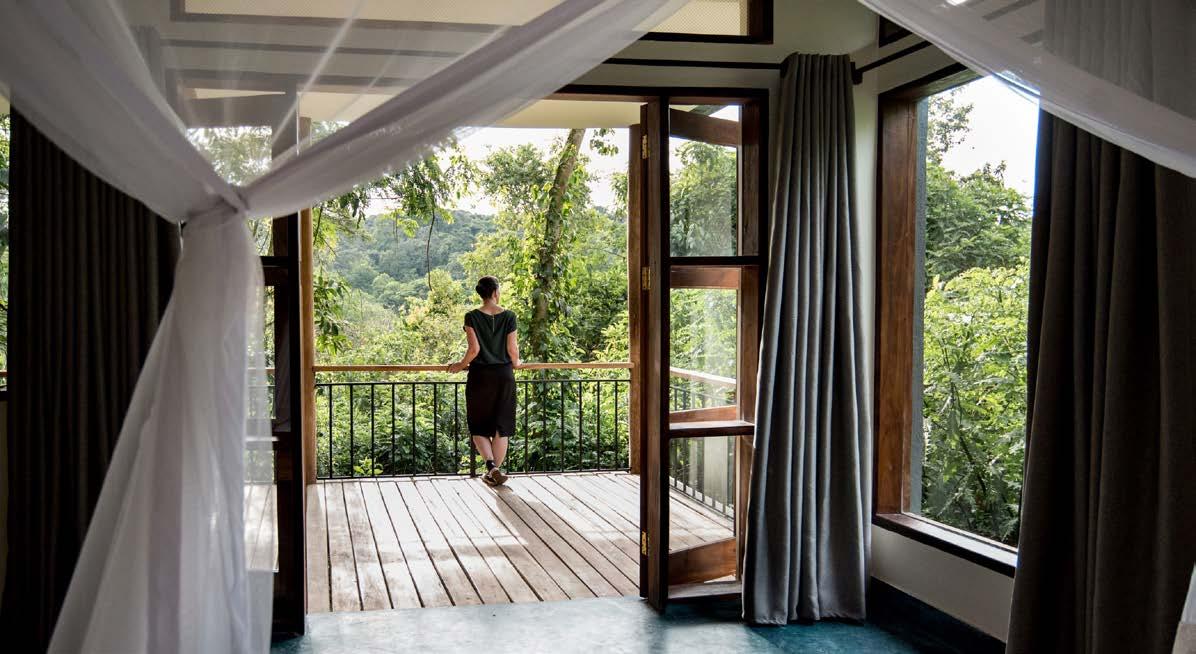
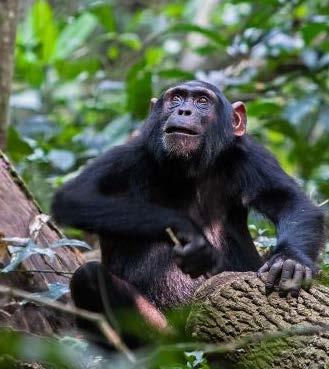
Mountain gorillas they say … chimpanzees I retort when I’m asked in Nairobi where I’m headed. Are they easy to get to? Simple, I reply. An Air Kenya flight to Entebbe and then a skip across to the foothills of the Rwenzoris with Aerolink to Kasese from where easy tarmac roads weave alongside and between crater lakes into the Kibale forest.
To enter the Kibale forest is to leave the disarray of forest-side villages behind; the welding, the chainsaws, the motorbikes, and surrender to a landscape defined by its glorious higgildy-pigglidyness. A place where nature refuses to grow in straight
lines and instead weaves a chaotic, vibrant tapestry of life. As you descend through the surrounding cleared lands, the transition is sudden and profound; the air cools, the light filters through a thousand layers of green, and you find yourself within the embrace of Turaco Treetops lodge grounds. This is one of the few places in the region where one feels genuinely immersed in the forest rather than merely looking at it from a distance. The lodge itself serves as a fascinating study in contrast, where the structured, organised mind of its Dutch and German owners meets the beautiful, untamed chaos of the Ugandan wil-
derness. There is a distinct sense of European order in the way the lodge is laid out, with its clean, spartan lines and thoughtful organisation that provides a necessary anchor amidst the sensory explosion of the forest’s sights, sounds and smells.
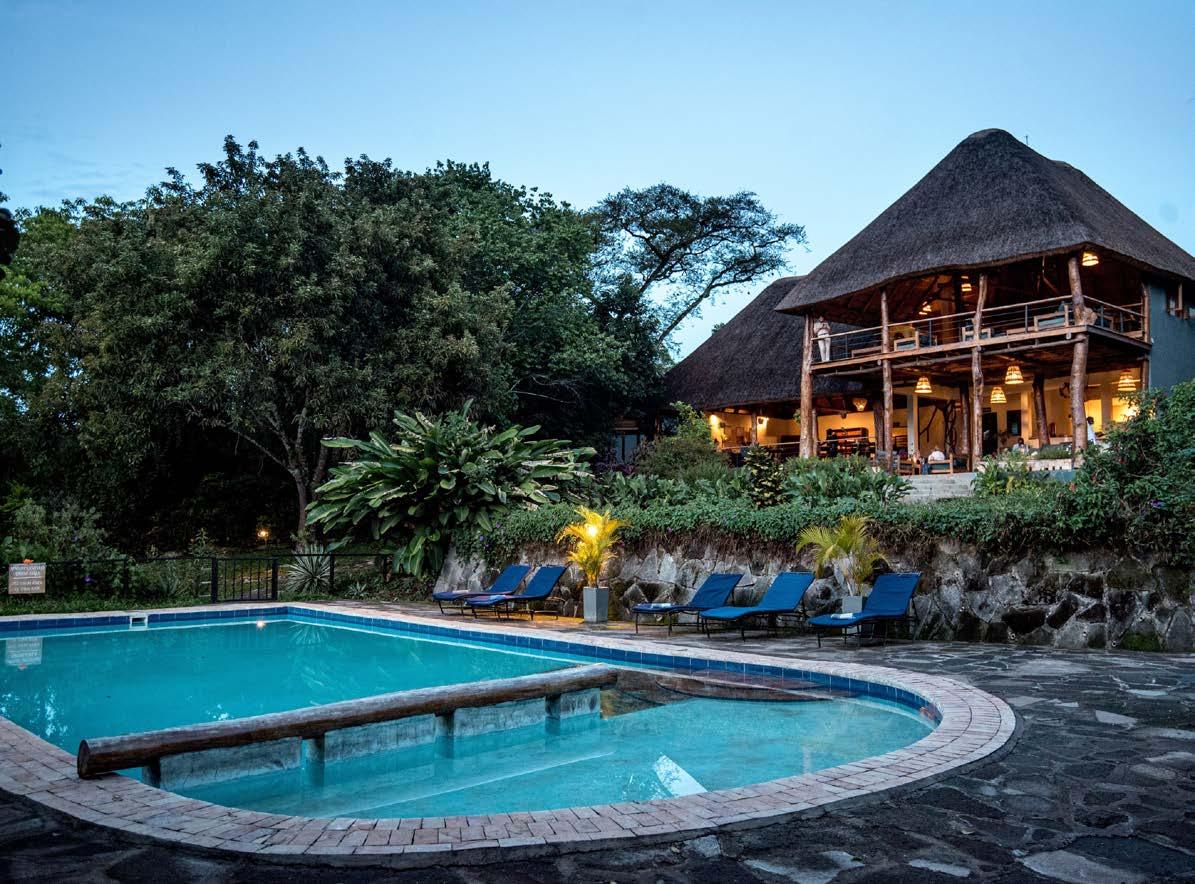
The architecture of the main area is dominated by huge thatched roofs, housing a double-story space designed to maximise the view of the forest canopy. From the comfortable sofas on the upper level, one can look out over the remnant, regrowth and old forest, while the ground floor offers an open-air dining area, a cosy fireplace corner, and a (still
empty) children’s room. In a clearing that allows just enough sun to penetrate the foliage, a swimming pool sits surrounded by sun loungers, an inclusion that feels like a nod to modern requirements yet remains deeply integrated into the environment. It is here, by the pool or from the decks of the rooms, that the magic of the forest’s inhabitants becomes most apparent. The great
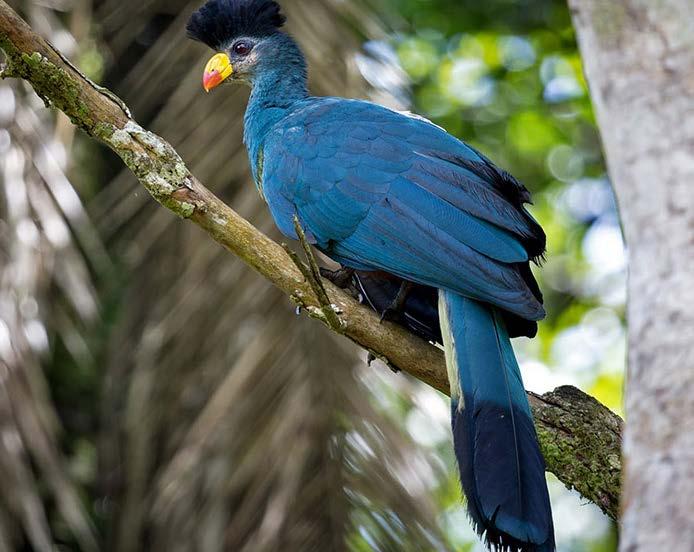
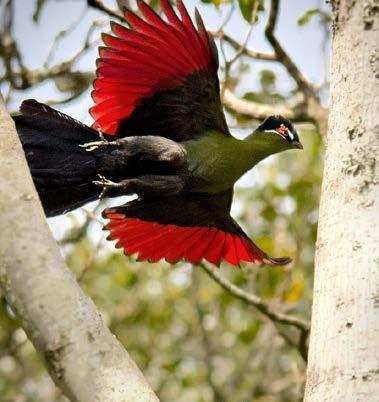
blue turacos, with their striking lipstick-red beaks and plumage of yellow and deep blue, are the true stars of the show. They do not fly with the grace of eagles; instead, they dash through the trees or fall clumsily from the branches, dipping and diving in a way that feels beautifully haphazard against the lodge’s deliberate, straight-lined structure. Their movement is mirrored by the horn-
bills, whose arrival is heralded by the distinct whoomph of their heavy wings as they come to feed on the fruiting trees.
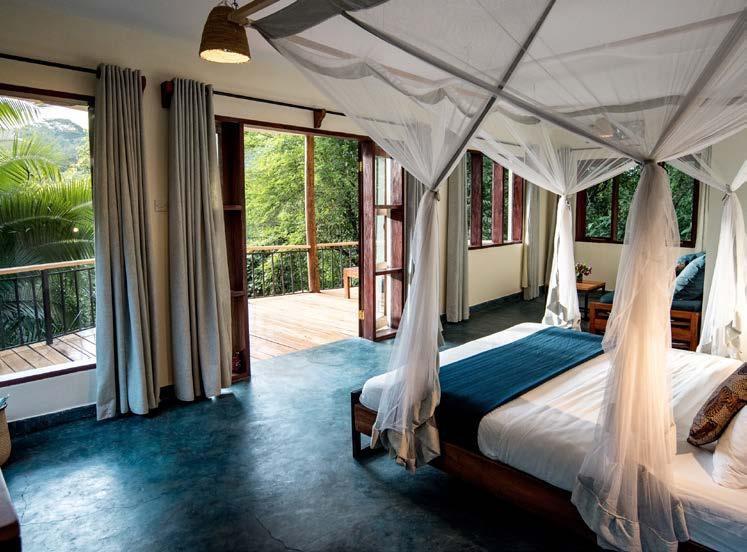
The lodge’s rooms are a straight-line blend of local craft and European minimalism. They take their inspiration from the turaco itself, incorporating a palette of every imaginable blue, accented by the same red and yellow that grace the birds outside. This is complemented by the ubiquitous Ugandan flat bowl basket weave, which is used throughout the interior design to ground the space in local tradition. There is a spaciousness to the rooms that borders on the indulgent, with large, simple bathrooms and simply-comfortable beds protected by expansive mosquito nets. While the forest of Kibale is surprisingly free of mosquitoes, these nets serve a more whimsical purpose: keeping the forest’s many butterflies out of your sleeping quarters.
Life at Turaco Treetops is governed by the rhythm of the forest. Throughout the day, one hears the persistent call of tinker birds, the
various melodies of barbets, and the chatter of sunbirds as they feed on nectar around the pool. The grounds are a haven for primates, with nine species found in the forest, including the ashy red colobus. For those who look closely, the red-legged sun squirrel might be seen darting across a branch, and if you are particularly lucky or check the lodge’s camera traps, you might catch a glimpse of the more elusive residents like the African golden cat or the serval, which have been spotted near the forest edge.
The heart of the experience, however, is the forest walk, a journey that reveals the intricate details of the forest’s higgildy-pigglidyness. While the walk is designed to take an hour, it is easy to spend three, as the sheer density of flora and fauna demands a slow pace. The forest floor and undergrowth are teeming with butterflies that possess names as evocative as their appearances. The blue sailor, a beautiful creature of blue and white, flutters alongside the orange and white wings of the flying handkerchief. There are green-banded swallowtails, blue-banded swallowtails and the iridescent blue mother of pearl, each adding a flicker of colour to the dappled sunlight.
The trees themselves tell stories of
the forest’s history and its larger inhabitants. The African holly, or Acanthus, stands with its distinctive leaves, while the Prunus africana trees often bear the scars of passing elephants who prize their bark, leaves, and fruit. Unlike the strangling figs that slowly envelop their hosts, the Ficus capensis stands alone, a sturdy sentinel in the woods. There are also the Pandanus kikiaii and the Phoenix reclinata palms, contributing to the layers of texture that make the forest feel so ancient and full. One of the more curious plants encountered is the silver leaf desmodium, which bears small purple-blue flowers. In the dry season, this plant becomes incredibly sticky, a defensive mechanism designed to deter larger animals while inadvertently trapping and killing small insects that are drawn to its scent in search of nectar.
The forest walk also leads past the remnants of two old treehouses, silent witnesses to the forest’s past, and across grounds marked by the deep imprints of elephant footprints. This connection to the land and its restoration is perhaps the most vital aspect of the Turaco Treetops story, embodied by the Chris Roberts Forestry Foundation. Chris Roberts, one of the founding shareholders, has a vision for the region that is as
vast as the forest itself. The foundation works tirelessly on agroforestry, teaching the local community how to integrate cropping trees and fruits that are useful to people with the needs of the wild. Since the lodge’s inception five years ago, the change in the landscape has been massive. What was once cleared land is being reclaimed by the forest, with replanting efforts ensuring that the lodge remains a true sanctuary.
As the day ends, there is no better place to reflect on this transformation than the sundowner deck. Simple in its style and looking out over the foundation’s forestry area toward the deep woods, it offers a moment of profound quiet. There is a bird hide nearby with bird baths that attract a steady stream of feathered visitors, allowing for close-up observation of the sunbirds and barbets that call this place home. Sitting there, one realises that the lodge is not just a place to stay, but a bridge between two worlds. It is a place where the precision of European thought has created a framework that allows visitors to safely and comfortably experience the glorious, unbridled chaos of the Ugandan forest. In the straight lines of the lodge and the dipping, falling flight of the turacos, a perfect, albeit unlikely, harmony is found.
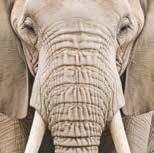
Biomimicry at its best Where Exceptional People Meet Extraordinary Design
What a phenomenal place!
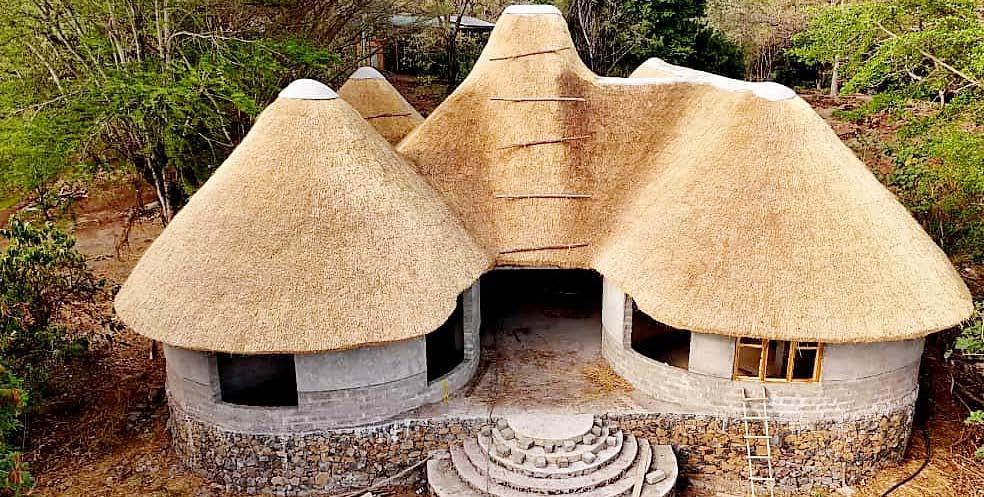
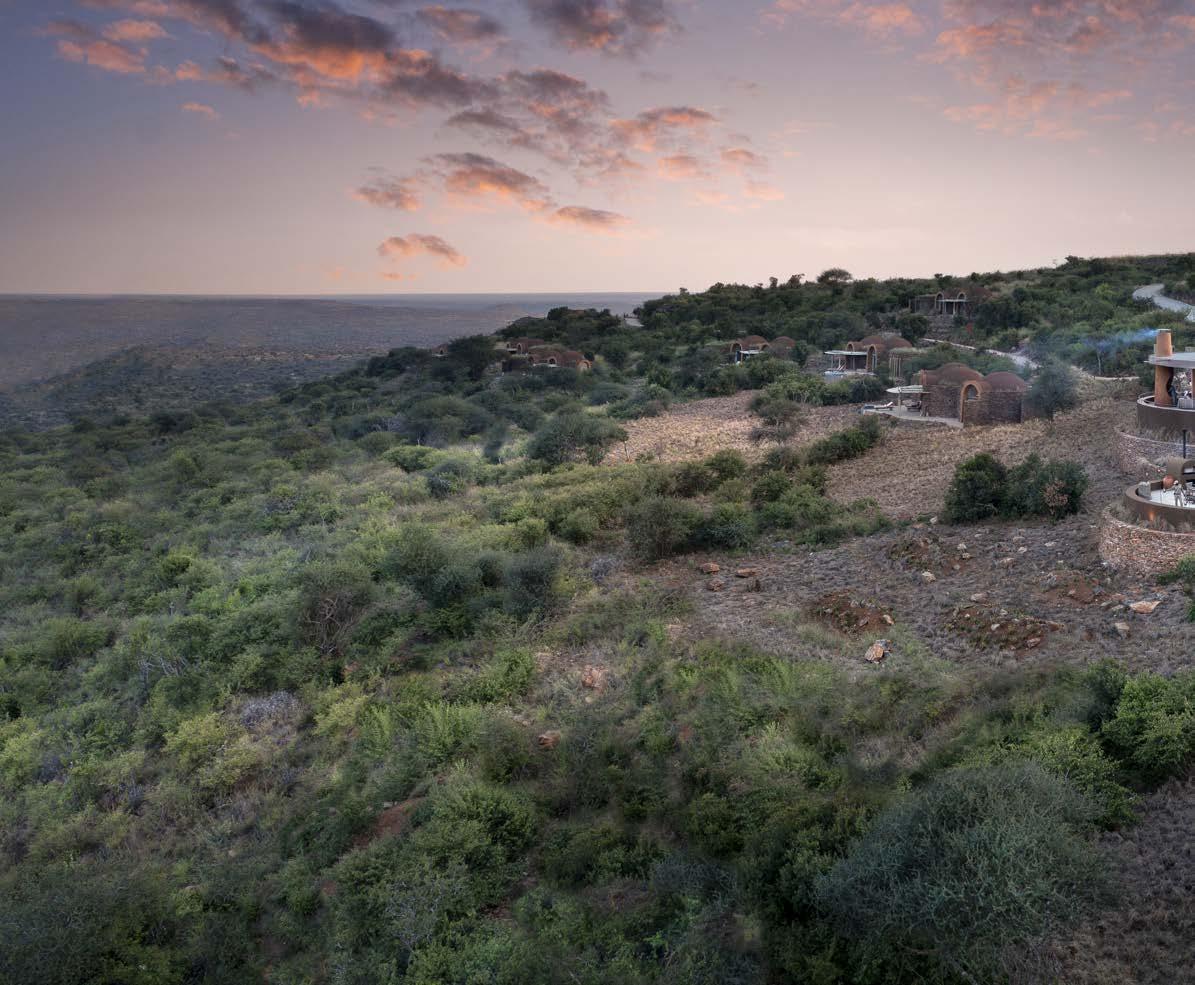
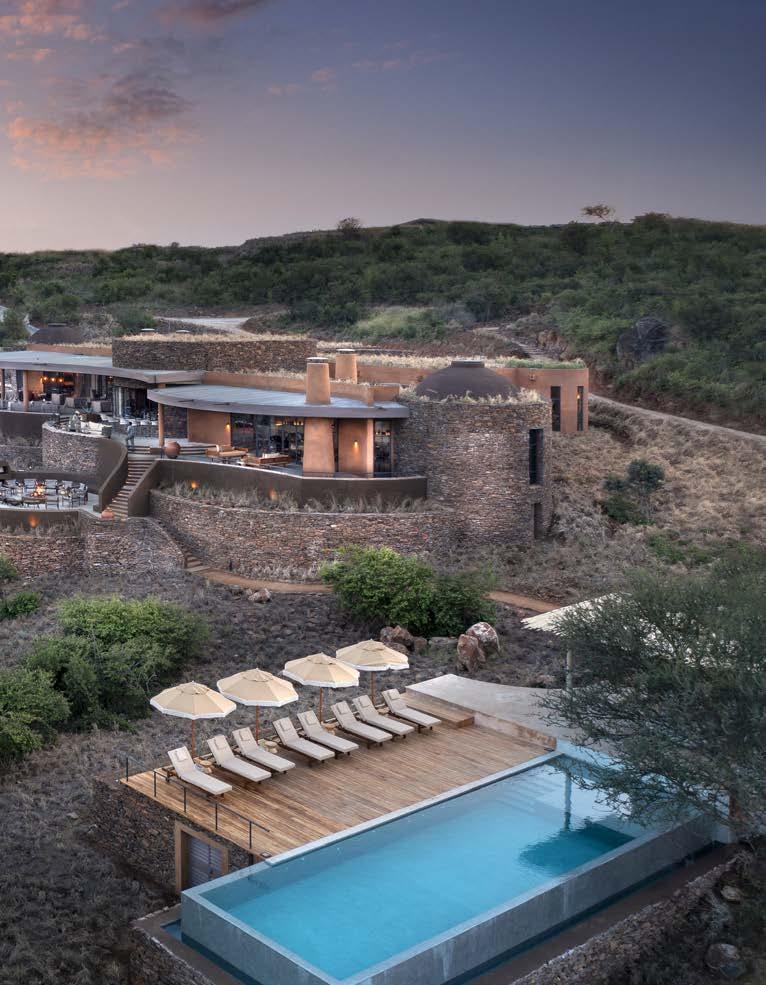
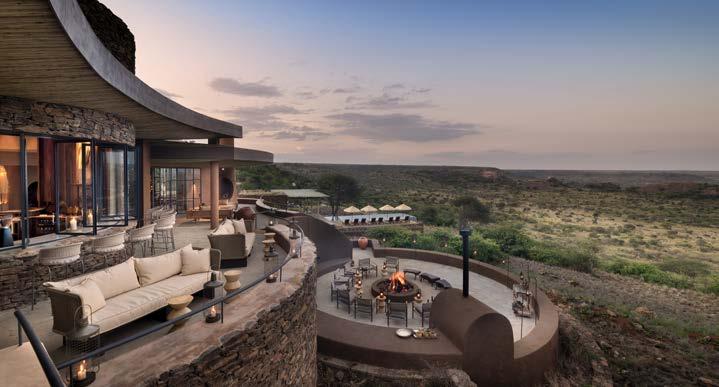
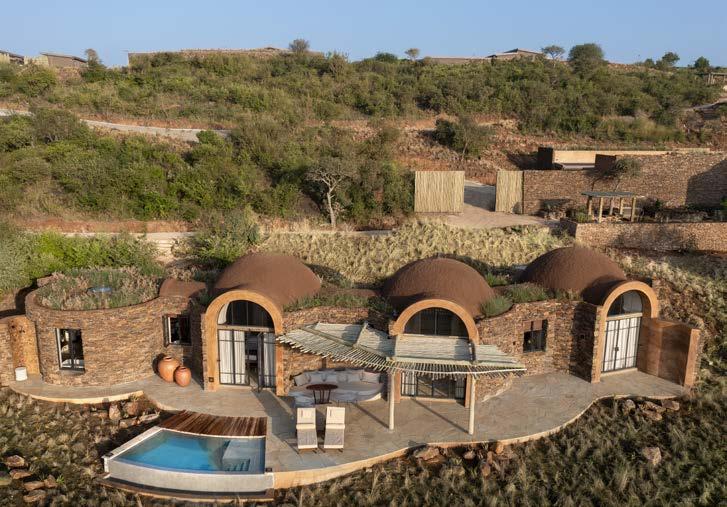
Honestly, I have seen some beautiful spots in my travels, but &Beyond’s Suyian Lodge is something else entirely. When you arrive, you’re immediately struck by the biomimicry of the whole design; it has been so meticulously thought out. It’s designed to mirror the natural world around it, specifically the termite mounds and elephant backs that dot this landscape. If you can imagine the inner workings of a termite mound — with its intricate tunnels, its natural coolness, and that palpable sense of a warm and safe home — then you have an idea of what they’ve achieved here, just on a much grander, more magnificent scale.
But before I even get into the architecture, I have to talk about the heartbeat of this place. You can have the most stunning lodge in the world, a place of absolute beauty, but it’s the staff here who truly make it. Here they are, quite simply, incredible.
By Hollie M’gog
There is a level of service that goes above and beyond anything I’ve experienced — a warmth and a genuine sense of care that makes you feel part of that “community” the architecture tries to emulate.
We were the ‘difficult’ guests that arrived late and, as we were chasing specific mammals (striped hyena, caracal and of course a melanistic leopard) we took our hosts up on the offer of a 2-hour ten pm game drive and another at 4.30 am. They were so very accommodating and warmly responsive that the thermos tea and packed pre-breakfast snacks tasted even sweeter for it.
As I walk through the grounds to my room — which I’ve started calling The Queen’s Chamber - I’m struck by the gardens. They’ve planted these stunning ornamental grasses, all seeding now, and the local mannequins (those delightful little birds) are absolutely loving them. You see these little “bird parties” everywhere, doz-
ens of mannequins busy collecting seeds from the swaying stalks; it’s a really special sight to start your day.
The gardens are also home to iconic Boscia trees. For years, these trees were held back by the local elephants, but now that they are protected within the lodge gardens, they’ll finally have the chance to grow into the proper, majestic trees the landscape needs and used to have. It’s all part of a very conscious effort to blend the lodge into the environment. As you walk down the paths, you’re looking at living roofs that will only become lusher and more integrated as the lodge ages. There are rock agamas sunning themselves on the boulders and butterflies dropping in and out of native flowers. There isn’t a straight line in sight; everything is designed with ochres, browns and natural hues of the earth to ensure nothing feels intrusive.
When you finally reach your front
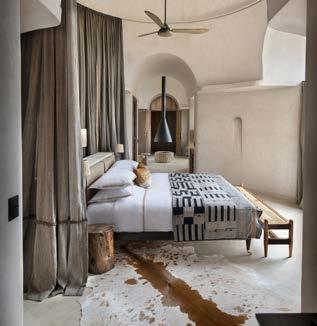
doors, you realise just how “grand” this place is, despite its natural look. The doors are these beautifully huge Arab-style doors, made of what looks like sustainable wood, featuring leather-clad handles, great big push bars, and a surprisingly small, charming brass knocker. Opening them is like entering a sanctuary. The room is built of three different chambers joined by arched mini-hallways, a layout that allows for a wonderful flow of air from one side to the other. They say it’s so the “spirits” can pass through, but practically speaking, it keeps the space remarkably cool during the heat of the day.
Inside, the decor is just divine. There’s a beautiful sofa, a dining area and even a gas fire with a free-hanging chimney. Right now, in the midday sun, a fire is the last
thing on my mind, but the evenings here get quite chilly, and I can’t wait to see that chimney in action. For the sun-lovers, there’s a Mediterranean-style terrazzo area with sun benches and a private plunge pool (about 3 by 2 metres), which is where I’m heading the moment I finish this.
The lodge is incredibly generous with its touches, too. There’s a private mini-bar where the house wines are actually on the house, and a proper tea and coffee station with a fridge stocked with fresh, cold milk. It’s these little things, combined with the staff’s attentiveness, that mak e you feel so looked after.
subtle and non-obtrusive, perfectly complementing the cowhide rugs and sisal matting on the floors. Behind the great big bed is a functional desk, and at the foot, a long bench for your clothes.
The bedroom itself feels like something out of a Sultan’s palace. It has a magnificent, curved roof with a hanging fan, and the walls are a soft, beautiful pinkish hue. The lighting is
Then you move into the third dome, which is the dressing area and bathroom. A heavy curtain seals off the wardrobe alcove, leading into an enormous bathroom. The central turret of this dome actually houses the indoor shower, which features a skylight at the very top — showering under the natural light coming through that dome is something very special indeed. If you prefer the fresh air, there’s an outside shower as well, plus an enormous bathtub and a toilet with a view. They’ve thought of everything: his-and-hers sinks, a massive mirror and every type of “lotion and potion” you could possibly desire. The whole thing is space so well done. It is truly, deeply special.
Had I not been so in need of a poolside nap from our wildlife spotting I’d have used the cold plunge pool and steam room at the spa and had a massage, or even placed my yoga mat before a million dollar view and stretched away the aches – but instead the Queen’s Chamber held me in her embrace, luxuriously snoozing … until I was woken by trumpets and branches breaking. There below me a scene played out, a scene that was properly explained at afternoon tea later on:
Lions had attempted to surround and snatch a baby elephant calf but the herd fought back and as some chased pride members, others trumpeted, screeched and ran, heavy-footed away while one big matriarch lunged at thorn bushes and broke branches as she voiced her dissatisfaction of the feline behaviour in the wild that day.
Epic
There are two more sensational spots to mention - the pool fits delightfully into an L shaped outside dining and turkish cushion relaxation alcoves with that million-dollar African vista. The yoga space and gym sit a stately distance back into the hill and, with its glass panelled doors that open completely to the outside, one can work on inner strength as the mists lift from the ground and the dawn emerges.
But I have to go back to the people, because that is what I will remember most. In a place this beautiful, it would be easy for the service to feel secondary, but here, the staff are the stars. Their presence creates that sense of “camaraderie and community” that defines the Shanza-type plan of the lodge. They aren’t just staff; they are the curators of the entire experience. Whether it’s the way they anticipate you might need a cold drink by the pool or the genuine pride they take in explaining the biomimicry of the
buildings, they elevate Suyian from a luxury lodge to a home.
If you are looking for a place that blends world-class architecture with a heart of gold, this is it. The termite mounds may have provided the inspiration for the walls, but the people inside them provide the soul. I’m going to go and jump in my plunge pool now, but I know that whenever I need anything, the incredible team here will already be one step ahead of me. It really is something special.
Fire & Spice
Evenings at Suyian, where embers glow and Cajun flavour takes centre stage!
After a day in the wilds of Lakipia in northern Kenya, guests love relaxing around the campfire in the evening, having a signature cocktail and small plates that hint at the evening to come.
A popular meal that is loved by all is their Cajun Style Snapper.
Enjoy making this dish at home and reliving your magical moments at this lovely lodge.
Ingredients:
• 1 Fillet Red Snapper
• 50g coarse salt
• 1.5L water
• 200g panko Bread Crumbs
• 30g melted butter
Method
Yield:8
Prep Time:30 minutes
• 45ml paprika
• 30ml garlic powder
• 15ml onion powder
• 15ml dried oregano
• 15ml chilli powder
• 5ml maldon salt
1. Pre heat the oven at 180 degrees Celsius
2. Mix coarse salt and water until the salt has dissolved
3. Cut the fillet into portions then add the snapper into the brine and leave for 5 minutes
4. Rinse the fish with running water, pat dry
5. In a bowl mix all the spices and panko then pour the melted butter and mix until fully combined
6. Take the crumb mix and put on top of the snapper portions and place in a baking tray and bake for 5-10 minutes or until fish is cooked
7. Serve with a cajun aioli on the side
Book now with www.andBeyond.com or your preferred travel specialist and fly in with Air Kenya from Nairobi directly.
Cajun Style Snapper
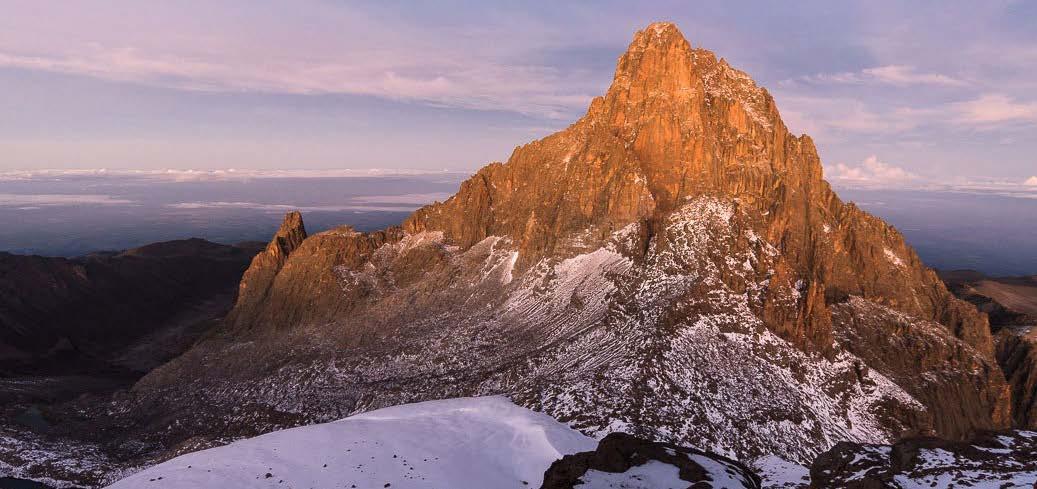
Mount Kenya: A Tapestry of Wildlife, Flora and Adventure
By Hollie M’gog
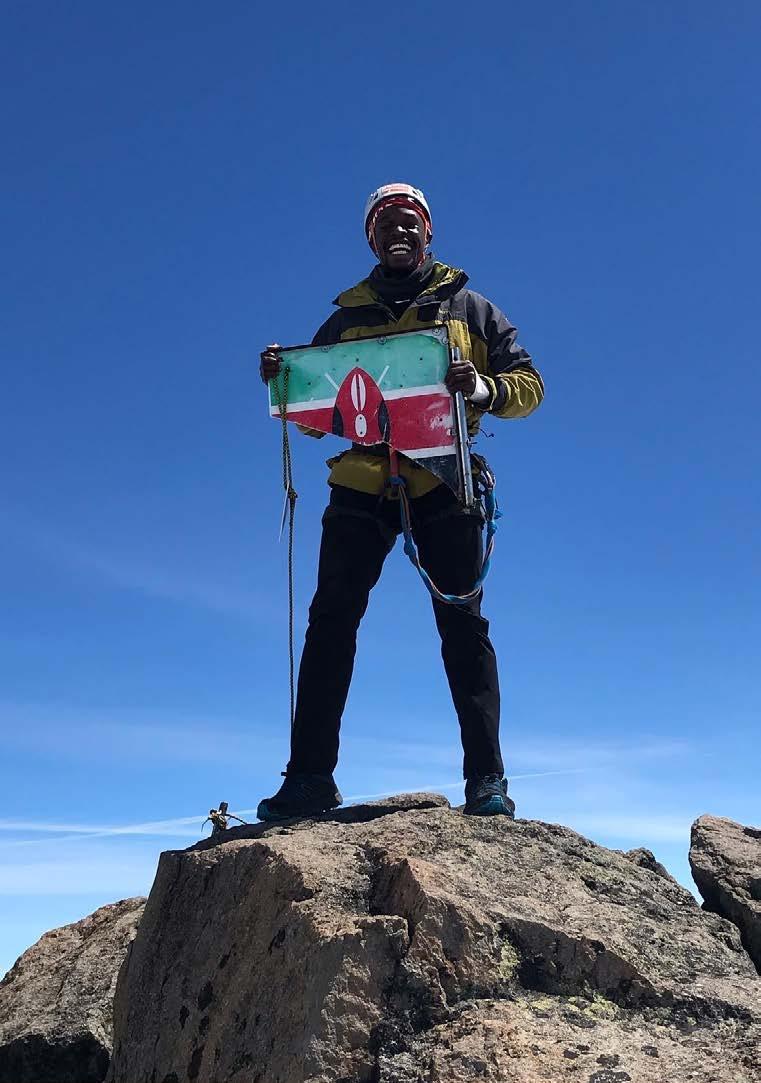
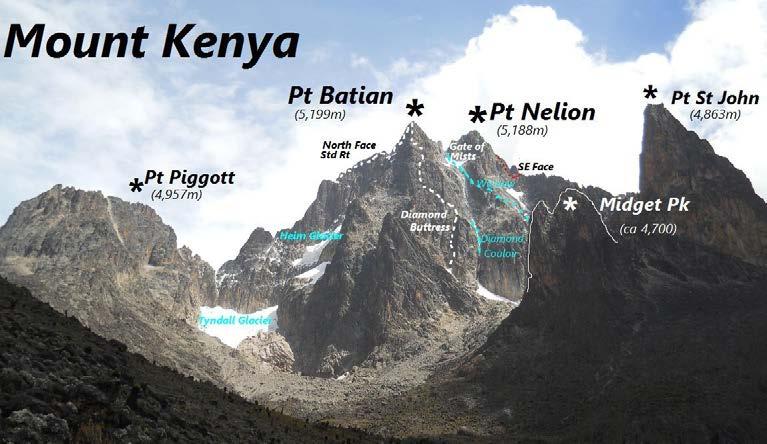
There are not many places where glaciers lie almost on the equator, where the equatorial heat gives way to snow-capped peaks. But right here, just a short 1hr flight from Nairobi you will find a rich landscape brimming with wildlife, unique flora and numerous activities that reveal this mountain’s multifaceted allure. Are you a peak pusher? Then there are three that call. At 5,199 metres Batian and Nelion require practice with ice axes and crampons (those funny metal teeth you clip to your mountain boots), but Point Leanna – well, that is up for anyone who is willing to have their breath taken away. Tourism, biodiversity, water and culture; those are the four attractions of Kirinyaga, Kenya’s equatorial mountain.
The Wild Heart of Mount Kenya
Did you know that the higher you go the less oxygen there is and the colder it gets?
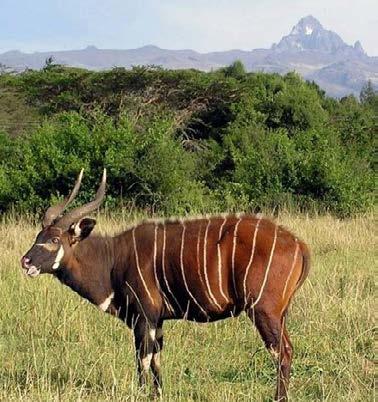
It is precisely because of this, that bands of vegetation form, composed of species that love to grow in a specific climatic zone. The lower mountain slopes are draped in dense forest; towering East African cedar, the olives and the combretums, forming a rich understory of ferns and orchids. These forests are home to elephants, buffaloes, bushbucks and colobus monkeys (to mention but a few). The birds dip and float, burble and screech – over 130 species!
Then there are the bamboo thickets where at night you can hear the snuffling-grunting giant forest hog, glimpse the tiptoeing serval, and perhaps several types of duikers. Then the mountain’s unique alpine moorlands unfold, where only the hardiest creatures thrive, the realm of mountain heathers.
Hyraxes, which share a (very) distant ancestry with elephants, scamper between rocks while sunbirds flit, sipping nectar, around giant groundsels, with their massive, rosette-like leaves and lobelias, which trap water in their leaf bases to protect against freezing.
The Alpine Swift climbs to alpine heights, dipping and ducking in the wind while the streaky seedeater dashes about at ground level. Even higher and the vegetation thins out to reveal a landscape dominated by tussock grasses and alpine flowers such as Helichrysum, also known as the everlasting flower. These hardy blooms endure harsh conditions, adding bursts of colour to the otherwise stark terrain.
At night, the eerie calls of the African wood owl and the shrieking tree hyrax echo across the mountain slopes and if you’re warm and snug in your sleeping bag – then the world cannot be more beautiful.
The hikers among you can plan for two or three days on the lower slopes, dossing down in tents of your own and cooking on mobile gas. Alternatively, you can make your adventure more of an experience by using a mobile camp operator to set up a base camp from which you can explore each day and return to each night.
Seasoned mountaineers can aim for the top, curating the challenge to suit their experience. We would suggest a few days training using all the equipment needed, you can do this on the Dragon’s Teeth in the Aberdare Mountain range or even at Hells Gate in Naivasha.
Quiz Questions
Does the equator pass to the North, the South or right through Mt. Kenya?
Is it Africa’s 1st, 2nd or 3rd highest mountain?
Approximately how many million years ago was it created? 1, 2 or 3 million?
Name the 3 main peaks of the mountain
How many glaciers does (did) the mountain support?
New to mountain climbing – don’t want to push the limits too far? Then hire some porters, a chef and sling your daypack over your shoulders and take four or five days to hike up one route and down another.
Hell bent on fishing? Then pack
up the tackle and head for a weekend, or even a day trip to Lake Ellis or Lake Alice. There is a road up to Lake Ellis, so you can even tow your little row boat up, in the hope that a day’s drift-and-cast on repeat will score some delicious rainbow trout for dinner!
Trail-runners we haven’t forgotten you! The dash up a clear and easily runnable track to Lake Ellis and the views and altitude training that comes with it, will set you up for an ultramarathon!
The lower mountain slopes are crisscrossed with paths that allow walkers to explore the forest zones, where ancient trees and mountain streams create a serene atmosphere. A popular trek is the walk to the bamboo zone, which provides a chance to see ‘forest’ elephants and
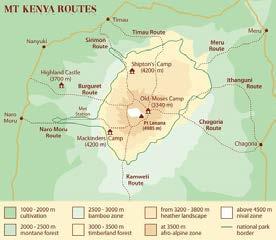
perhaps even colobus monkeys in their natural habitat. For those looking for an immersive multi-day trek without summiting, the Chogoria route offers a journey through valleys carpeted with wildflowers and stunning views of Lake Michaelson, one of the mountain’s lesser-known tarns.
And yet there is still more!
Dark skies: Stars, Tents and Comets: The mountain’s numerous wild campsites allow for an unforgettable, potentially chilly but always magical, dry-season camping experience under the equatorial stars. Bring along The Travelling Telescope crew and you’ll learn astronomy and dabble in astrology while the valley views at sunrise are breathtaking, with the early morning light revealing layers of mist-clad ridges.
Cultural Significance and Conservation
Beyond its natural wonders, Mount Kenya holds deep cultural significance for the Kikuyu and Meru communities that live on its slopes. The mountain is considered sacred, believed to be the home of Ngai, the supreme God. Local communities often engage in traditional practices near the mountain, seeking blessings for rain, fertility and prosperity. Respecting these cultural practices, engaging with elder storytellers, is an integral part of the Mount Kenya experience, adding a layer of depth to visits.
Conservation efforts on Mount Kenya are vital for preserving its delicate ecosystems. The mountain is a UNESCO World Heritage Site, recognised for its ecological and cultural importance. However, threats such as deforestation, illegal logging and climate change pose challenges to the mountain’s health. Organisations like the Kenya Wildlife Service (KWS) and Mount Kenya Trust (critical partner) are actively involved in reforestation programs and anti-poaching patrols to protect the mountain’s
biodiversity. Visitors are encouraged to support these efforts by respecting park regulations, staying on designated trails, and minimising their environmental footprint.
But there is more you can do!
Enter the 3 peaks, 3 weeks challenge that happens each January – Mt. Kilimanjaro, Mt. Kenya and Mt. Meru, the toughest mountain challenge in Africa.
Support reforestation through competing in the 10 to 4 mountain bike challenge that happens each February. From ten thousand feet to four thousand feet by bike – can you do it?
Mount Kenya is more than just a mountain; it is a living tapestry of life, where the rhythms of nature pulse through every valley, forest and peak. From the thrill of reaching Point Lenanna’s summit to quiet reflection by Lake Alice’s shores, each experience is woven into the fabric of this unique landscape. For those who seek adventure, beauty and a deeper connection with nature, Mount Kenya offers a journey that lingers long after the descent. It is a place where the spirit of Africa’s wild heart beats strong, inviting all who visit to reconvene with self, with nature and to discover new boundaries.
Quiz Question Answers:
The Equator lies 16.5km North of the Mt. Kenya peaks. Mt. Kenya is Africa’s second highest mountain after Kilimanjaro and before the Rwenzori’s. It was formed around 3 million years ago. Batian, Nelion and Point Lenana in order of height. The mountain supports 11 main glaciers.
Air Kenya flies to Nanyuki from Nairobi and Maasai Mara three times weekly. Nanyuki is the base for climbing the mountain.
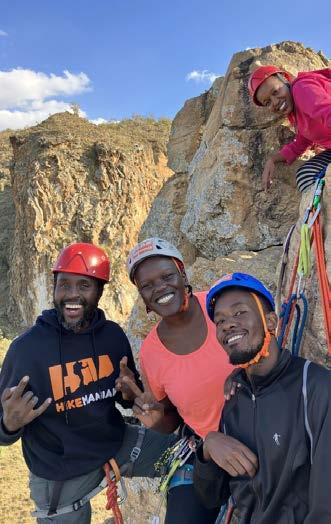
Hike Maniak (hikemaniak.co.ke) are a great company to use to manage all your mountain logistics.
10to4Registration@MountKenyaTrust. org - for registration and bookings for camping, bike drop, etc.
The Ultimate Bespoke Experience Serengeti Luxury Retreat
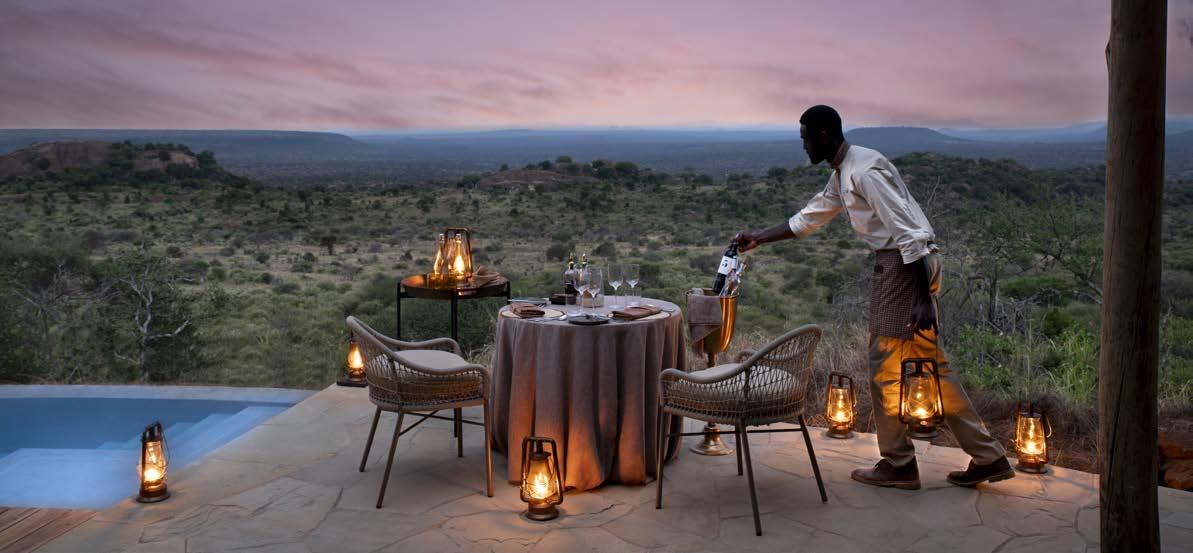
Perched high on a golden ridgeline above the Retima Plains in the heart of the Serengeti, Serengeti Luxury Retreat isn’t just a destination; it’s a masterclass in intentional hospitality. With only four impeccably designed private tents, this exclusive camp delivers solitude, personalisation, and spectacle in equal measure, reshaping what it means to “do safari” in style.
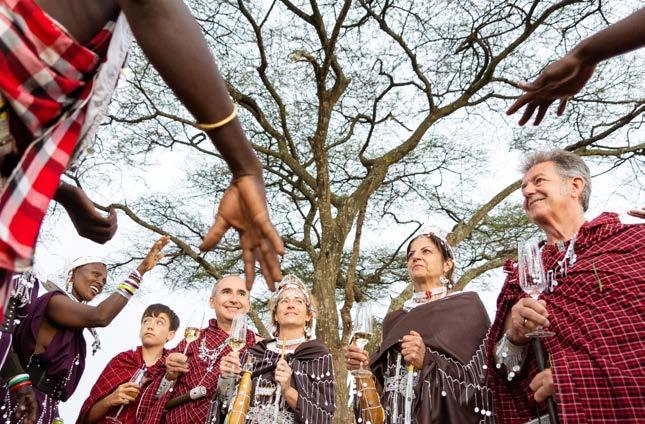
From the outset, it’s clear this is a place for those who seek more than bucket-list wildlife sightings. Here, the experience is about depth, stillness and surprise — luxury without the clichés. Service so attuned to your rhythms, it feels telepathic. A traditional welcome of singing and dancing awaits each guest’s arrival, but beyond the ritual lies an atmosphere of effortless grace. The kind of
By Hollie M’gog
hospitality that doesn’t perform for effect . . . it simply is.
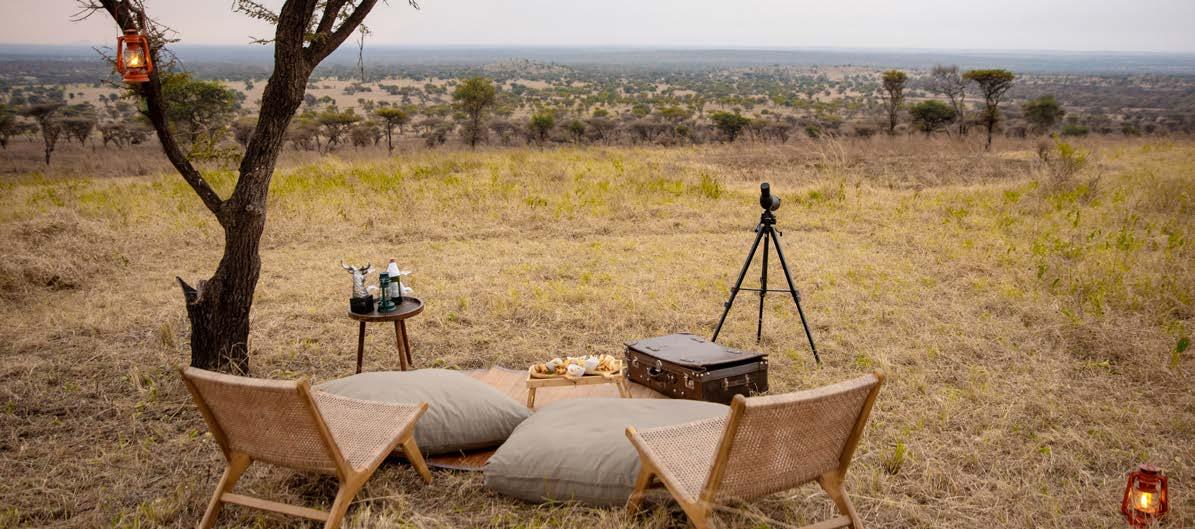
The setting alone defies superlatives. From every corner of the property, be it the communal lounge, the alfresco dining spaces, or the outdoor/ indoor shower, you’re met with uninterrupted, panoramic views across the Serengeti’s boundless plains. Wildebeest, giraffe and the occasional lion drift across the landscape below, framed by flame-orange sunsets and early morning mists. A spotting scope is provided, of course!
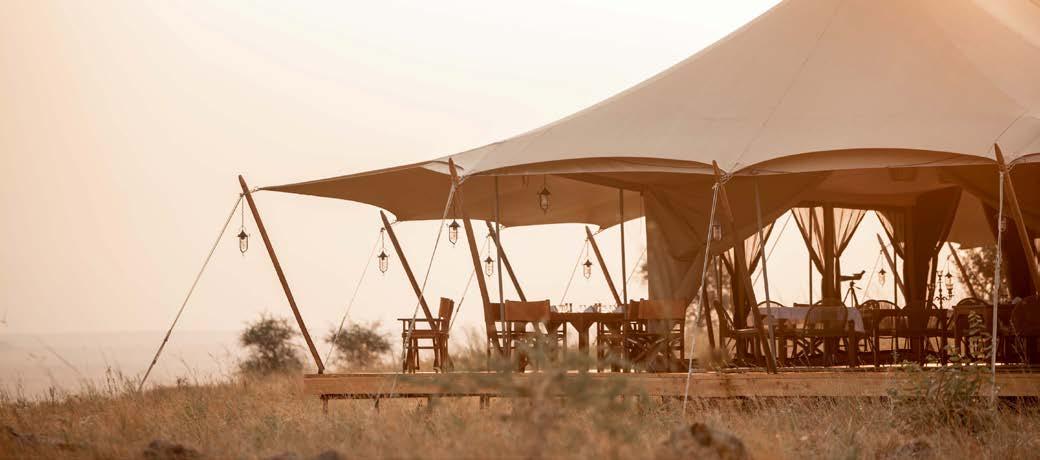
The lodge’s architecture is quietly theatrical. The soaring tented roof of the main pavilion evokes a whimsical circus canopy, yet the interior leans into earthy elegance: dark polished woods, artisan-carved lanterns, creamy linens, and locally crafted
placemats. There’s no clutter here, just thoughtful, tactile luxury. Crystal candleholders flicker after dark, while a discreet spotting scope reminds you that nature never clocks out.
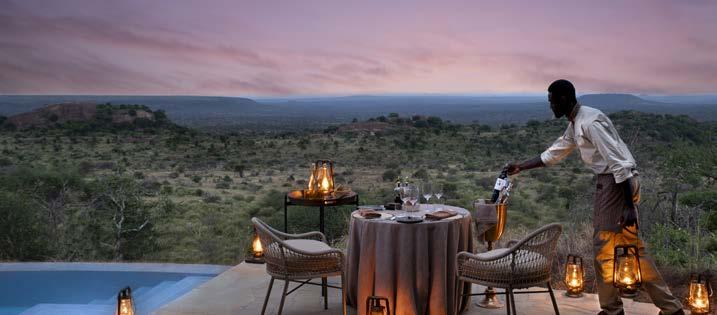
Each of the four (soon to be five) guest tents is a world unto itself: kingsized beds swathed in fine linen, hisand-hers sinks and sweeping decks that blur the boundary between indoor comfort and outdoor awe. It’s not just about design, it’s about philosophy. Guests are encouraged to tune into birdcalls, rustling grass and the primal hush of the savannah. And yet, every creature comfort has been anticipated. Heated water bottles tucked into your bed at night, gourmet snacks refreshed daily, and the luxury of complete silence . . . except for the hyenas giggling at dusk
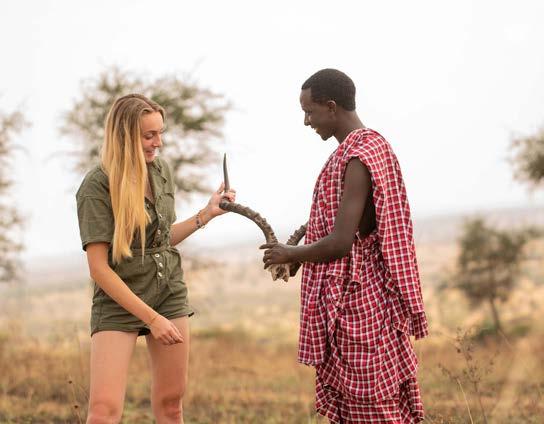
and lions coughing in the distance. At the core of Serengeti Luxury Retreat’s ethos is a commitment to ultra-bespoke experiences. Here, “no guest needs to do what another does” is not marketing fluff — It’s gospel. While one couple enjoys a full Maasai-led bush dinner under the stars, another may prefer a quiet meal on their private deck, decorated with flowers and lanterns, accompanied only by the rustle of acacia leaves. Others might gravitate toward the main tent, where storytelling will mingle with the aroma of Swahili spices and French sauces.
Menus shift daily. Nothing is on repeat unless you want it. The chef speaks with guests directly, crafting meals to suit whims and dietary needs with artistic flair. One night might bring a perfectly grilled rack of lamb with tamarind jus, the next a hand-rolled gnocchi infused with lemongrass and ginger. Vegan, pescatarian, gluten-free . . . it’s all possible, and always beautifully plated. Food here is not simply nourishment . . . it’s theatre, memory, and magic.
It’s this philosophy of intentional difference that spills into every aspect of the retreat. Guests can opt for sunrise hot air balloon rides that float silently above the migration, or guided walks with naturalists who
trace termite mounds, interpret spoor and narrate the bush as if reading a novel. There’s even a volleyball court for those needing a bit of adrenaline between game drives. Want to learn how to cook chapati over an open fire as the sun sets? Just ask. Prefer to sip champagne in the pool watching elephants in the distance? Done.
And then there are the celebratory touches; each one handled with tact and joy. Weddings here are not offthe-shelf affairs but deeply rooted in place. Couples may choose traditional Maasai ceremonies, complete with a blessing from an elder, or more intimate spiritual rituals tailored to their beliefs. Birthday surprises are orchestrated with discreet flair; think
cakes hidden in picnic baskets, spontaneous songs from the staff and sundowners that suddenly include a handwritten note and sparklers.
Behind this high-touch, high-end experience is a fiercely committed team. Staff members are frequently described by guests as “family,” “flawless” and “full of heart.” Many have been trained from nearby communities and have grown with the retreat. A private butler is assigned to each tent, ensuring continuity, comfort and an uncanny ability to anticipate your needs before you’ve voiced them.
The retreat is the brainchild of an owner who saw a saturated mid-market and dared to imagine
something truly singular. The tents, sourced from South Africa for their unique silhouette and high-altitude performance, were chosen precisely because they didn’t resemble anything else in the Serengeti. His partner, equally detail-driven, shaped the design with a “less but better” mindset. And it works.
Marketing is refreshingly direct. Instead of relying on big-name agents or glossy brochures, the retreat uses highly specific landing pages and word-of-mouth referrals. It’s paid off: a loyal Brazilian clientele often stays 10–15 nights; it’s new, but guests have begun arriving in numbers, drawn by the camp’s discretion and privacy-first policy. High-profile visitors, from discreet diplomats to
FACT BOX
Need to Know
Where
Serengeti Luxury Retreat is located in a remote, elevated section of the central Serengeti, Tanzania—accessible via Seronera Airstrip, followed by a private 45-minute game drive through big cat country.
How to Get There
Fly into Kilimanjaro International Airport or Arusha Airport. From there, take a Regional Air flight (approx. 1 hour) to Seronera. Private charters available on request.
global artists, return again and again.
Looking ahead, the retreat is adding a fully private villa, complete with its own chef, bar, and plunge pool, promising a new benchmark in Serengeti seclusion. But growth won’t come at the expense of intimacy. The owners are adamant: exclusivity will always remain the cornerstone.
And yet, the most extraordinary element of Serengeti Luxury Retreat might be what happens beyond its canvas walls. Through the Oskar Foundation, 20% of the camp’s profits are channelled into grassroots education initiatives. A school feeding programme now reaches over 300 children daily. Six local teachers offer after-hours English lessons,
Rooms
Just 4 luxury tents, each with a private deck, open-air shower, and sweeping views. A private villa, with its own chef, pool, and bar, is launching soon.
Rates
From $1,250 per person per night, fully inclusive. Minimum stay: 2 nights. Rates include all meals, private butler service, game drives, bush experiences and community contributions. Balloon safaris and special celebrations priced separately.
based on the owner’s belief that “language is a transportable skill,” a ticket to jobs far beyond the Serengeti’s borders. It’s not charity, it’s investment in potential. And it’s woven into the DNA of the place.
So many properties claim to “give back.” Here, you see it in action, without the self-congratulation. You feel it in the pride of the staff, the care taken with every detail, the continuity between luxury and legacy.
In the end, Serengeti Luxury Retreat is less a hotel and more a home for the wild-hearted traveller, those who crave beauty, solitude and a sense of meaning in their adventures. You arrive as a guest. You leave changed. And if you’re lucky, you return.
Don’t Miss
The chef’s surprise bush dinner, sunset cooking lessons and the indulgent anywhere-anytime dining policy.
Good to Know
There is Wi-Fi in the tents and in the main lounge.
Giving Back
20% of profits fund a local education initiative via the Oscar Foundation, supporting school meals and English lessons for over 300 children.
A Journey in Time Mount Meru Game Lodge
By Laura Kyle
Travel is about the journey as much as the destination and Mount Meru Game Lodge is a gem not to be missed on your way to and from Kilimanjaro and Arusha airports.
The historic, family-run hotel nestles single-storey in a grove of mature trees, with a small lake on one side and the rushing Usa River on the other. With deeply comfortable beds, it’s a place to take a long, slow breath and relax into your holiday— or gear up for your return home.
During a friendly and efficient check in and with a cool welcome juice in hand, you’ll find yourself wandering around the airy reception and immediately being transported to a bygone era.
“Guests are drawn to its history,” says the lodge’s joint owner Kim Bell. “They arrive not expecting to discover what they discover.”
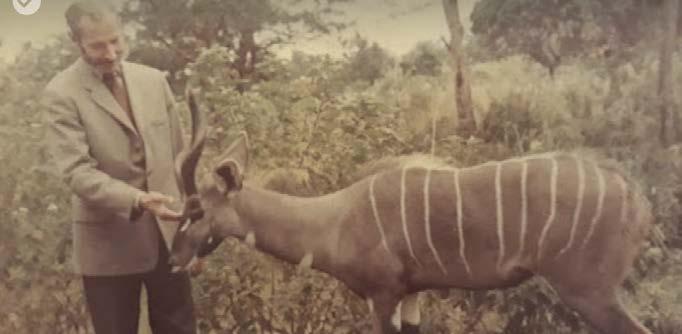
Photos all over the walls tell the story of the lodge founder, Hungarian-born Dr. Andreas Van Nagy and three generations of his family who lived here with a menagerie of rescued animals.
Von Nagy first came to Arusha in the 1950s, to capture wild animals for a German zoo. It was a time when Africa’s big predators still roamed the foothills of Mount Meru.
But his true passion was saving wildlife, not sentencing it to a life behind bars and so began Tanzania’s first-ever wildlife sanctuary. Von Nagy took in hundreds of injured and orphaned animals - big and small. Those that could were re-introduced into the wild - an orphaned baby elephant was taken to Mkomazi National Park - and many others were released into an area managed by Von Nagy called Mount Meru Conservation Area. Today it forms
the lower section of Arusha National Park and legend has it that any zebra you see there is a direct descendant of Von Nagys’ herd.
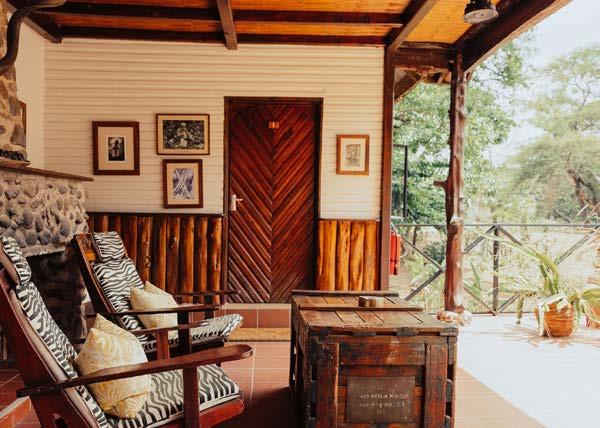
Living conditions for the Von Nagy family were basic - a small farmhouse with no running water or electricity and an outdoor loo, which the children rushed in and out of at night to avoid prowling leopards. The original 1930s building is today the lodge’s cozy bar and indoor restaurant.
As word of the animal sanctuary spread throughout the 1960s to 1980s, Von Nagy was recognised for his work in conservation by then-President Julius Nyerere, considered the Father of the Tanzanian nation. Visitors grew both in number and prestige, rooms were built to accommodate them and the lodge was born.
Family friends and guests of the Tanzanian government frequently stayed here, including the King and Queen of Sweden, then-Prince Charles, the Hemingways, the Kennedys and Bernhard Grzimek of Serengeti fame.
Hubertus Cardoso is Von Nagy’s grandson. Everyone calls him Zummi from his constant zooming around the lodge as a little boy. The photos show him as a toddler with a chimp called Milla, his best friend for eight years. Zummi adored his grandfather.
“I idolised him. He always had time for us children. He was so passionate about animals and as kids you’re always interested in animals, so we would be allowed to get involved in treating them.”
Von Nagy was keen that the sanctuary be open to Tanzanians so they could see the animals of their country and respect them. Zummi remembers from a very young age, being part of the Sunday entertainment.
“I was told to go and play with Milla, it was beautiful,” he remembers. “There’s a little thing on YouTube where you see me and her playing and hanging out.”
But the lodge was never set up to house a growing chimp, so as Milla got older, the family asked Jane Goodall for help and Milla was re-homed.
In the 1980s, Von Nagy felt the pull of his home and returned to Hungary. A small museum there, run by Zummi’s sister, showcases Von Nagy’s work and time in Africa.
The lodge itself was passed onto Von Nagy’s son who stopped taking in new animals and rented out the property until the family talked of selling it.
But Zummi had other ideas.
“I wanted to have a go at running
it and I wasn’t interested in partnerships,” he says. “Until I met The Bells.”
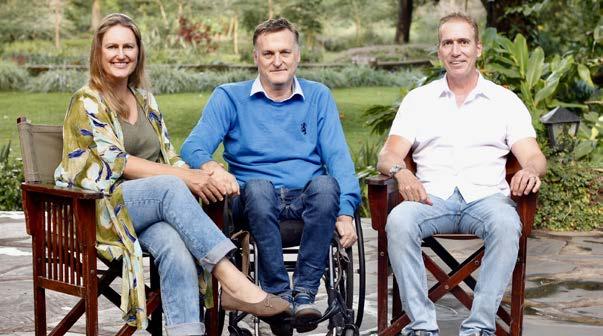
Harry and Kim Bell were in South Africa with their two young children when Covid gave them a glimpse of what life could be like without Harry’s stressful job in finance. They took a trip to Arusha and were on the lookout for new opportunities.
“I googled ‘lodge for sale in Arusha’ and I got a link to Zummi’s ad,” says Kim. “We arrived in the dark, not sure what to expect, but in the morning with the sounds of the birds and the tropical garden, we saw its potential.”
The Bells brought with them a fresh burst of creative energy and busi-
ness acumen that complemented Zummi’s knowledge and passion.
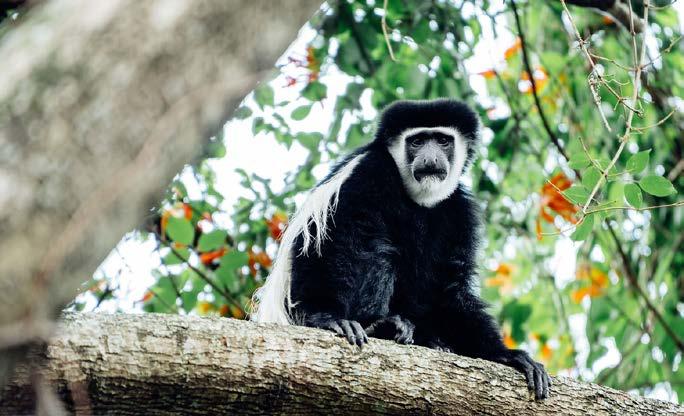
They have newly landscaped the lake and gardens, with a sweeping lawn and serene walkway through the old animal sanctuary. The young plants and trees attract a kaleidoscope of butterflies, the distinctive colobus monkeys with their white tails hanging like feather dusters between the branches, and birds including crowned cranes, yellow-billed storks and ibis.
“It’s been important to us to preserve the lodge’s historical look and feel, whilst modernising it and making it comfortable,” says Kim.
The walkways and many of the rooms are accessible by wheelchair. Harry himself uses a wheelchair and
understands the need for more places in Tanzania that are as easy to get around.
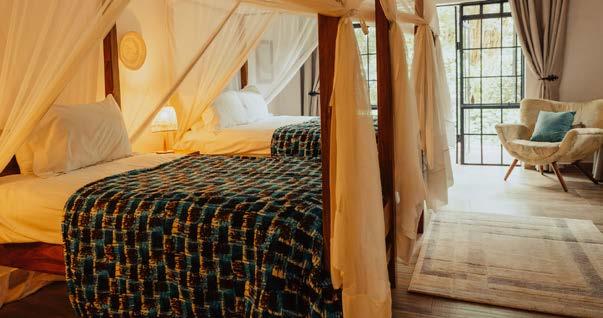
The rooms - or cottages - each with a veranda and sitting discreetly amongst the trees or beside the lake, have been renovated with new bathrooms and raised ceilings. Decoration is simple and stylish with baskets on the walls and African fabrics brightening the beds. Wherever she can, Kim sources from local craftspeople and stocks a small shop with locally-made products.
Patrick Ndelwa also sells his wood carvings on site, continuing the tradition of his father who made them for guests of the Von Nagys.
The Bells are also keen environmentalists with an active recycling programme and cutting back where they can on single-use plastic. Many of their cleaning products are eco-friendly and food is sourced locally and seasonally wherever possible. All the staff are trained to recognise local wildlife and share their knowledge with guests when possible.
Where Von Nagy had a particular passion for helping animals, The Bells’ is for the young people of Tanzania. They have partnered with local tourism training colleges and have taken on a number of interns, most of whom have stayed on to become full-time employees.
“It’s a passion of ours to create opportunities for young people and help them get their foot in the door,” says Kim.
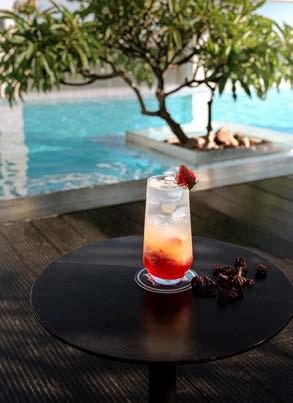
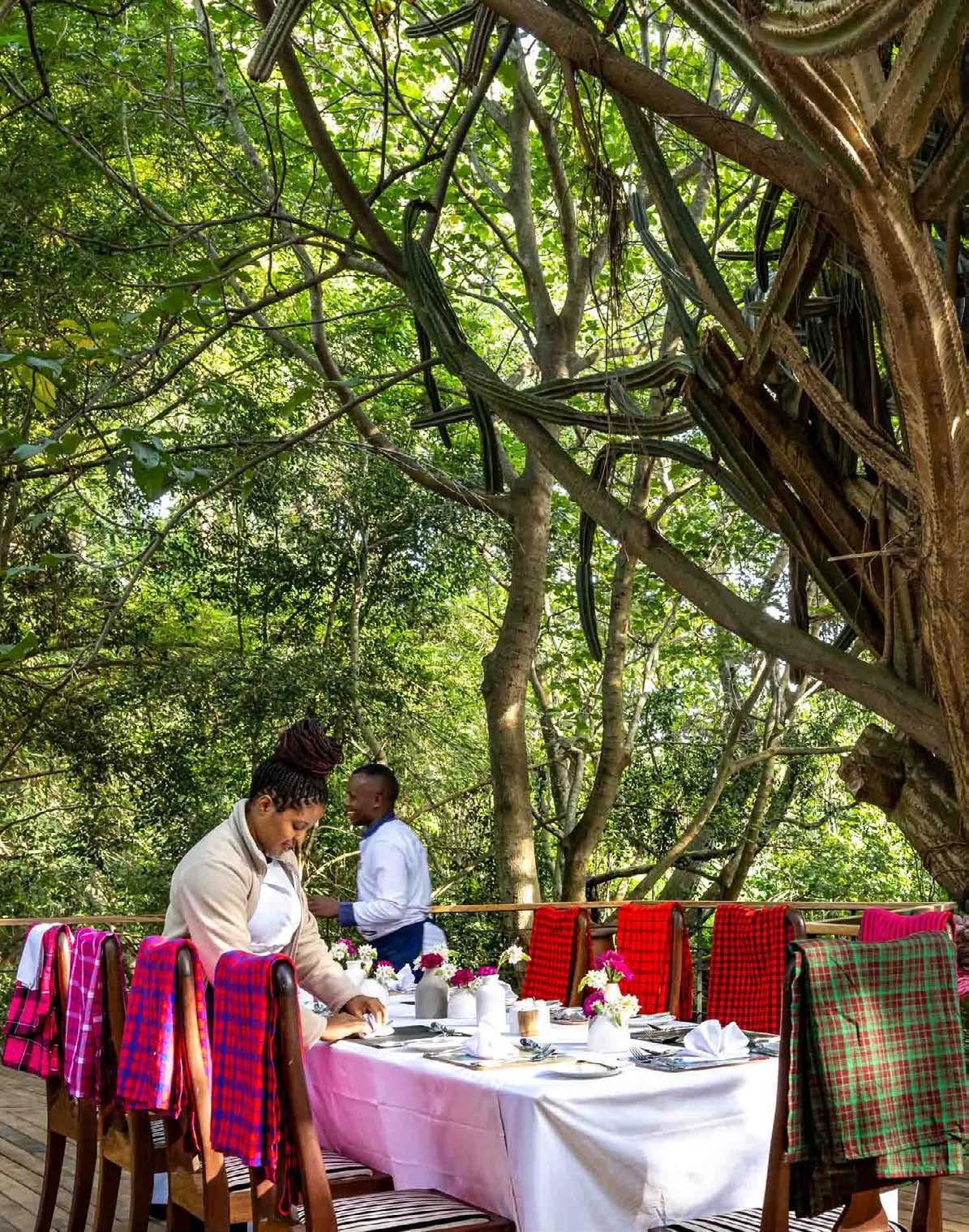
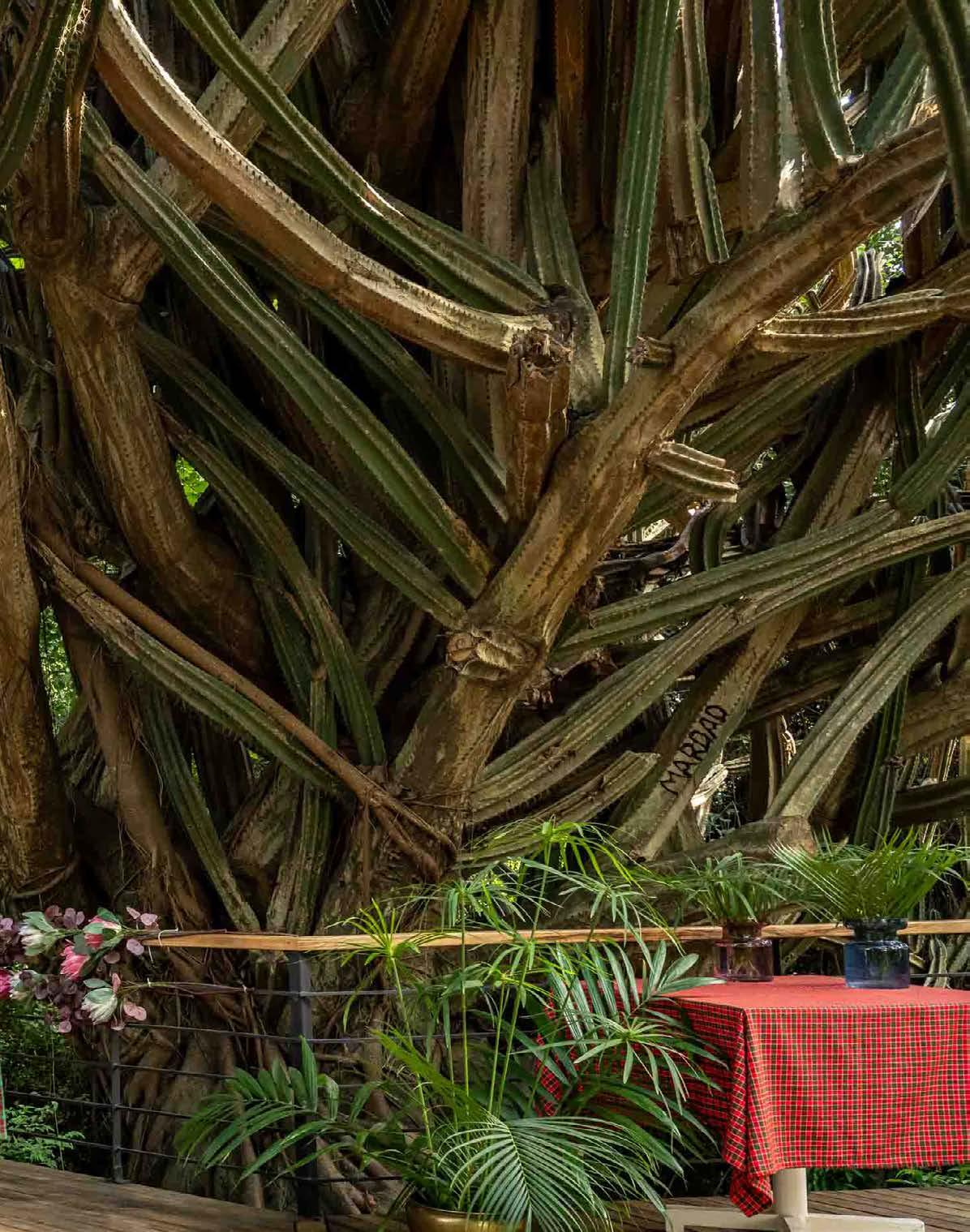
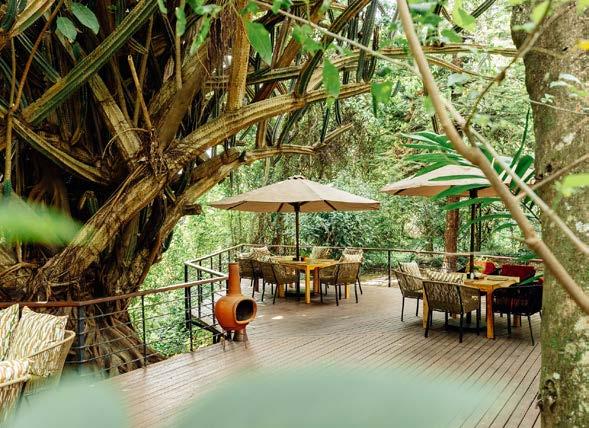
She is continually encouraging her younger team members to be more confident and forthcoming with guests. As the sun goes down and you’re drawn towards flickering candle light bouncing off the canopy of mango trees, the fire pit, or a river-view deck under a 100-year old cactus tree, the staff will likely tempt you to a delicious Mount Meru Game Lodge cocktail with gin, mint and black pepper.
“I think it’s really our staff who leave a lasting impres-
sion on the guests. People always say they felt so cared for and so welcome,” says Kim.
That warm and fuzzy feeling is a great start to any safari trip. Even better, it’s one to look forward to on your return, when you come back to Mount Meru Game Lodge and are greeted like an old friend.
“We’re so blessed to have Harry and Kim,” says Zummi. “It’s a beautiful relationship and they are now very much a part of the story.”
The start of 2026 feels different not because everything is easy, but because we’re still standing after a year that tested us in ways we didn’t expect.
For us as MMWCA, 2025 was a year of mixed emotions: moments of both progress and of uncertainty. The biggest shock came with the sudden termination of USAID funding. For years, this fund was a key pillar for us and for many conservancies across the Mara. When it ended, the effects were immediate. Some programmes slowed. Support for conservancy programmes became harder to sustain. In Mara East, where new conservancies were just beginning to take shape, community programmes were left hanging in uncertainty.
We had to pause, reassess, and make difficult choices. As an organisation, we went through a period of restructuring and prioritisation, focusing on what mattered most and how to keep moving forward with fewer resources. During this time, the support of partners like Airkenya-whose partnership with MMWCA significantly reduced travel costs- stepped in and made a real difference. We remain deeply thankful to our partners who stood with us when it mattered most.
What gives us pride, looking back, is that we didn’t stop.
With steady leadership from our CEO, Daniel Sopia, and the guidance of the Board, we continued to build for the
future. One of the most important outcomes of the year was the development of our new 10-year Strategic Plan. This was a moment of reflection—looking at where we have come from over the last 12 years, what we’ve learned, and what we need to do differently going forward.
The strategy is clear about our priorities: stronger conservancies, more land secured for conservation, better and more reliable income for conservancies, improved livelihoods for communities, and policies that protect the Mara landscape in the long term.
At the same time, we began to capture our decade-long story. That’s how Guardians of the Mara came to life. The book tells the story of MMWCA and its member conservancies—the growth, the challenges, the partnerships, and the lessons learned along the way. It documents how conservancy governance has evolved, how communities
have shaped conservation, and how partnerships have helped carry the work forward. Moreover, it reflects real experiences—what worked, what didn’t, and lessons learned. The book, now in its final stages, is expected to be released in the first quarter of 2026.
Another important step forward came in July 2025, with the formal registration of the One Mara Carbon Project (OMCP) as a Company Limited by Guarantee, owned collectively by participating conservancies. This was the result of many conversations, legal work, and governance workshops involving conservancy leaders and partners. It laid the foundation for conservancies to formally come on board. It’s a practical step toward long-term sustainability, led by the conservancies themselves.
In 2026, we remain committed to safeguarding the Mara landscape and livelihoods.
Education through Conservation
Ask anyone living in Amboseli what the most important conservation-related benefit they receive from Big Life and you will hear a unanimous reply: Education.
Big Life Foundation is a wildlife conservation organisation based in the Amboseli ecosystem. Our primary focus is protecting wildlife, but we have long understood that if the people who live across Amboseli do not benefit from our programs, then they are certainly not going to support conservation.
Since 2000, we have awarded more than 3,600 scholarships from primary to tertiary level. Many of these students have already graduated from university, taken up prominent positions, or are pursuing careers that might not have been possible without this support.
Of the 818 scholarships we awarded last year, one of those went to Eunice Simantoi Lemujini, pictured here with her parents. She recently graduated from Laikipia University and hopes to pursue a career in conservation. An excellent student, Big Life stepped in when her family was unable to pay for the high fees.
Eunice grew up in Orbili, a settlement near the Chyulu Hills. It’s a remote area that has not historically given much importance to education, especially for girls. She is the first woman in her family and in her village to receive a university degree. Eunice has always had a passion for the natural world. While her friends at school wanted to become medics, teachers, and engineers, it was conservation that inspired her, citing
her love for the environment and biodiversity as well as the work being done by Big Life rangers to protect wildlife.
Thanks to our partnership with a German charity called Big Girls Foundation, we were able to cover the costs of Eunice’s degree.
At her graduation, Eunice expressed that “I want to become an example for women and girls who grew up like me to know that they can pursue their passions and become who they want to be. If they work hard and focus on their studies, then anything is possible.”
Eunice is a shining example of how conservation benefits those living in wildlife areas, and how those people may in turn go on to dedicate their lives to supporting conservation. Together with our donors and partner organizations like Air Kenya, we are laying the groundwork for positive transformation throughout the Greater Amboseli ecosystem towards a future that is bright for both humans and wildlife.
Join us in making lasting change in Amboseli by visiting our website and donating at www.biglife.org
Big Life Foundation supports children living in Amboseli from Primary Level through to Tertiary Level 2.
Eunice Simantoi with her parents at her Graduation
Elephant family monitored by Big Life rangers during a vehicle patrol, Amboseli National Park
Remembering Craig, Amboseli’s Most Celebrated Tusker
While outpourings of grief for noteworthy people are common, it’s far rarer for an animal to elicit the same response. Yet Craig, one of Amboseli’s elephant bulls, was a rare exception.
The volume of support and consolation on social media has been amazing to see. Reading these personal accounts, it’s obvious that Craig had an extraordinary impact on a huge number of people. No one who spent time with him could doubt the sentience of elephants. For many, his exceptionally calm demeanour bridged the imaginary divide between humans and nature, helping people to realize that there is more to the world than what we might perceive and understand.
According to the Amboseli Trust for Elephants, an organisation that has studied Amboseli’s elephant population for more than fifty years, Craig was born in 1972. Craig lived through drought, shifting
landscapes, and the brutal legacy of ivory poaching, eventually dying of natural causes at 54. No creature – human or elephant – could ask for much more.
Decades of ivory poaching and trophy hunting in Africa have selectively removed elephants with the biggest tusks, leaving only a handful. Fewer than 30 survive in East Africa, and 10 call the Greater Amboseli Ecosystem home. Craig survived into old age because this ecosystem, and the people protecting it, held the line. His death represents a conservation success.
Yet his death also comes at a time when land across the Greater Amboseli Ecosystem is being sold off and developed at an alarming rate.
In partnership with local communities, Big Life is working to address this crisis— supporting land management, habitat
protection, and sustainable livelihoods to ensure that conservation and community can thrive together.
Elephants like Craig deserve more than survival—they deserve space, safety, and a future. By partnering with Big Life, Air Kenya is helping lead the way for responsible tourism. Your visit to Amboseli can help protect Craig and his habitat. A small gift helps fund the rangers, corridors, and community-led efforts that keep him safe.
We would like to end with our co-founder Nick Brandt’s words: “Craig was special. But I want to say one obvious thing: all elephants are special. So let us protect all animals, whether they have huge tusks or no tusks, are photogenic or not photogenic, superficially charismatic or not.” Join us in making lasting change in Amboseli by visiting our website and donating at www.biglife.org
Bridging Uganda’s Remote Frontiers: Aerolink Enabling Lifesaving Work at Bwindi Community Hospital
On the edge of the misty Bwindi Impenetrable Forest, Bwindi Community Hospital (BCH) is where worldclass volunteer surgeons meet hardy mountain life, and where travel can turn into meaningful action.
Inside BCH’s simple wards you’ll meet Aine, an 80-year-old Batwa woman who survived cervical cancer but lived for years with a vesicovaginal fistula. When a team led by Dr. Verena Geissbuhler arrived for a urogynecology camp, they repaired the damage and sent Aine home smiling again. Nearby, 27yearold Eliza, whose ectopic ureter threatened her marriage, left after surgery with a renewed chance at family life.
Founded under a tree in 2003 by Dr. Scott Kellermann and his wife Carol, BCH has grown into a 155bed hub of care and training for southwestern Uganda. Travel here isn’t just wildlife and trekking; it’s an oppor-
tunity to see how healthcare, volunteering, and local life intersect. The hospital’s surgical camps—urology, orthopaedics, urogynecology, dental, and vision, bring free or lowcost specialist care to people who otherwise couldn’t travel the poor roads to distant hospitals.
Volunteer teams like Swiss charity AFRICOMED run multiweek orthopedics camps. One recent effort performed dozens of lifechanging surgeries and hundreds of physio sessions. Partners such as Aerolink make these missions possible, shortening travel time and reliably ferrying teams and supplies to this remote outpost.
Visiting Bwindi can be a chance to trek for gorillas and witness community resilience. Consider adding a hospital visit, meet local staff, or support volunteer programs. Your trip can leave both you and this community changed for the better.
MALINDI
DIANI MOMBASA
LAMU
1. Amboseli 2. Arusha
Lewa Downs
Masai Mara
Meru
Nairobi
Nanyuki
Samburu
Migori
Loisaba
Arusha
1. Bwindi Impenetrable Forest - Kihihi and Kisoro airstrips
2. Queen Elizabeth National Park - Kasese and Mweya airstrips 3. Kibale Forest National Park - Kasese airstrip 1. Arusha
Kilimanjaro
Kogatende
Lake Manyara
Lobo
LAKE MBURO NAT. PARK
KIBALE NAT. PARK
JINJA
MBARARA
APOKA 6. Ndutu
Seronera
Zanzibar
Tarime
4. Murchison Falls National Park - Pakuba and Chobe airstrips
5. Kidepo National Park - Apoka Airstrip
KIDEPO
AIRKENYA FLIGHT SCHEDULE 2026
AIRKENYA FLIGHT SCHEDULE 2026
• Daily service; minimum of 2 pax to operate.
• Flight from Amboseli to Wilson connects to Nanyuki, Lewa Downs, Samburu, Meru, and Loisaba at 09:45; Maasai Mara at 10:30 and Arusha at 13:30.
ARUSHA
• Daily service, minimum of 4 pax per sector to operate
• Arusha service is non-operational 1st April - 20th May and 1st Nov - 15th Dec
• This airport is your gateway to a safari between Kenya and Tanzania as it easily connects to Manyara, Seronera and Lobo with Regional Air Services at 15:30
• Daily Service; minimum of 2 pax per strip to operate.
• The inbound flight Masai Mara to Wilson arriving at 09:35 connects to our Wilson - Northern Kenya Services i.e. Lewa, Loisaba, Meru, Nanyuki and Samburu at 09:45 and to Arusha at 13:30
• Masai Mara services operates into multiple airstrips, therefore timings may vary depending on aircraft routing.
• The arrival and departure times depict the first stop.
• Call Airkenya operations on departure date to confirm arrival and pick up times for various airstrips
• Daily service; minimum of 2 pax to operate.
pending on aircraft routing over multiple airstrips.
• Flight from Masai Mara connects to Lewa via Wilson at 09:45.
• Flight from Lewa to Wilson connects to Arusha at 13:30 and to Masai Mara at 14:15. airstrips.
• Daily service; minimum of 2 pax to operate.
aircraft routing over multiple airstrips.
• Flight from Masai Mara connects to Meru via Wilson at 09:45.
• Flight from Meru to Wilson connects to Arusha at 13:30 and to Masai Mara at 14:15.
• Flights from Meru to Samburu is a one-direction service.
airstrips.
/ KAMOK
• Daily service to Nanyuki Civil and Kamok airstrips; minimum of 2 pax per strip to operate.
pending on aircraft routing over multiple airstrips.
• Flight from Masai Mara connects to Nanyuki Civil/Kamok via Wilson at 09:45.
• Flight from Nanyuki Civil/Kamok to Wilson connects to Arusha at 13:30 and to Masai Mara at 14:15.
• Flight from Nanyuki Civil/Kamok to Masai Mara may route via Wilson in low season to connect on airstrips.
AIRKENYA FLIGHT SCHEDULE 2026
SAMBURU BUFFALO/ KALAMA
FLT NO FROM TO DEPART ARRIVE
P2 871 WILSON SAMBURU 09:45 10:45
P2 872 SAMBURU WILSON 11:00 13:10
P2 862 SAMBURU MASAI MARA 11:00 13:00
• Daily service to Samburu Buffalo and Kalama airstrips; minimum of 2 pax per strip to operate.
pending on aircraft routing over multiple airstrips.
• Flight from Masai Mara connects to Samburu Buffalo and Kalama via Wilson at 09:45.
• Flight from Samburu Buffalo and Kalama to Wilson connects to Arusha at 13:30 and to Masai Mara at 14:15.
• Flight from Samburu Buffalo and Kalama to Masai Mara may route via Wilson in low season to con-
MIGORI / TARIME
FLT
P2 453 MASAI MARA MIGORI 08:05 08:50
P2 453 MASAI MARA TARIME
P2 454 TARIME
P2 454 MIGORI
• Daily service; minimum of 2 pax per strip to operate, except 1st April - 20th May when its non-operational.
• 1st Nov - 15th Dec requires minimum 4 pax.
• Tarime to Migori arrive at 1045hrs.
• Service operates into multiple airstrips therefore timings may vary depending on aircraft routing.
• AirKenya provides road transfer and ground handling between Migori and Tarime.
• The service connects Airkenya Masai Mara services with Regional Air/Auric Air/Coastal Aviation Serengeti services.
• Arrival and departure time to/from Migori may vary significantly by up to 45 minutes depending on aircraft routing over multiple airstrips.
MASAI MARA - SERENGETI VV (VIA MIGORI/TARIME) FLT NO FROM TO DEPART ARRIVE
P2/8N 453/424 MASAI MARA SERONERA 08:05 12:30
8N/P2 423/454 SERONERA MASAI MARA 08:00 11:45
P2/8N 453/424 MASAI MARA KOGATENDE 08:05 12:30
8N/P2 423/454 KOGATENDE MASAI MARA 08:00 11:45
P2/8N 453/002 MASAI MARA MANYARA 08:00 12:45
8N/P2 423/454 MANYARA MASAI MARA 08:05 11:45
P2/8N 453/424 MASAI MARA FORT IKOMA 08:05 12:30
8N/P2 423/454 FORT IKOMA MASAI MARA 08:00 11:45
P2/8N 453/424 MASAI MARA NDUTU 08:05 12:45
8N/P2 423/454 NDUTU MASAI MARA 08:00 11:45
P2/8N 453/424 MASAI MARA LOBO 08:05 12:30
8N/P2 423/454 LOBO MASAI MARA 08:00 11:45
P2/8N 453/424 MASAI MARA SERENGETI SOUTH 08:05 12:30
8N/P2 423/454 SERENGETI SOUTH MASAI MARA 08:00 11:45
P2/8N 453/424 MASAI MARA SASAKWA 08:05 12:30
8N/P2 423/454 SASAKWA MASAI MARA 09:00 11:45
P2/8N 453/424 MASAI MARA GRUMETI 08:05 12:30
8N/P2 423/454 GRUMETI MASAI MARA 08:00 11:45
• Daily service; minimum of 2 pax per strip to operate, except 1st April - 20th May when its non-operational.
• 1st Nov - 15th Dec requires minimum 4 pax.
• Flight services route via Migori and Tarime
• AirKenya provides road transfer and ground handling between Migori and Tarime.
• Service operates into multiple airstrips therefore pick up and drop off tmings may vary depending on aircraft routing.
• Service operates into multiple airstrips therefore pick up and drop off timings may vary depending on aircraft routing.
• The service connects Airkenya Masai Mara services with Regional Air/Auric Air/Coastal Aviation Serengeti services.
• CHECK IN is done 60 minutes to departure time in Nairobi (Wilson)and Arusha Airports. Passengers will not be allowed to check in 30 minutes to departure time on the mentioned airports
• Check in time for all bush airstrips is 30 minutes before flight departure time
• Contact Airkenya Operations department on the morning of the scheduled flight to get approximate arrival and departure times for various bush airstrips
• Airkenya guarantees all its connecting flights within Kenya and across Tanzania in conjunction with its subsidiary; Regional Air Services.
• Contact the Charter department for tailor-made services or if the scheduled service does not meet your requirements: charters@airkenya.com
• Airkenya reserves the right to change departure times or carrier when so required for operational, weather or safety reasons.
Email resvns@airkenya.com or call +254 (0)20 391 6000 for further clarification.
Contact the Charter department for tailor-made services or if the scheduled service does not meet your requirements: charters@airkenya.com Valid from 21st December 2025 to 31st December 2026