Prefabrication as a Catalyst for Value: A Quantity Surveyor’s Opportunity to Lead
CEO LETTER
At the time of writing, I have now been in the AIQS CEO role for almost six months. I have thoroughly enjoyed it, and it is heartening to know that my efforts are assisting a key profession in a key industry.
Professional associations play a central role in lifting standards in their respective industries, but they are comprised of individual members who wish to better themselves and the industry. Your attitudes as an individual, therefore, matter enormously. A mindset of constant learning and improvement is at the heart of professionalism. It assists you and your career, your profession, industry and country. AIQS constantly strives to have relevant education topics, based on the agreed competencies, which have been considered at length and endorsed by the AIQS Board. We are constantly planning new education choices for AIQS members.
The pipeline of work in Australia is strong, and there is plenty of demand for quantity surveyors around the country. There is a significant housing shortage, a substantial amount of infrastructure being built, and preparations are underway for the Brisbane Olympics in 2032. The New Zealand economy and construction industry could be stronger, but there are some signs of ‘green shoots’ there. Certified Quantity Surveyors (CQS) serve a critical role in procurement. This highlights the importance of clients and contractors securing and engaging the services of a CQS from the outset.
Tickets for the Built Environment Awards Gala Dinner in Melbourne on Thursday, 28th May 2026 can now be purchased. It will be an outstanding evening to celebrate the achievements of the industry.
I strongly encourage you to purchase tickets for you and your colleagues before they are sold out. Tickets can be purchased via the website: builtenvironmentawards.com.au
The NZIQS conference on 1st–3rd July also promises to be a great event, with registrations open now.
If you would like to get more involved with AIQS or have any feedback that you would like to share, please reach out to me via jcameron@aiqs.com.au.
With best wishes,
DR. JAMES CAMERON CEO
The Australian Institute of Quantity Surveyors
CERTIFIED AND CHARTERED QUANTITY SURVEYORS MUST LEAD OUR MOST CRITICAL PROJECTS
By Mark Freestone FAIQS CQS
A record number of road, rail, and energy projects have created acute skills shortages, now a key constraint on Australia’s construction sector.
As
of 2024, every State and Territory faces a quantity surveyor shortage.
Jobs and Skills Australia has repeatedly listed civil engineering professionals, including quantity surveyors, among the most in-demand occupations. As of 2024, every State and Territory faces a quantity surveyor shortage.
…Pressure on the pipeline and the professionals delivering it, is intensifying.
With the Brisbane 2032 Olympics now less than seven years away, pressure on the pipeline, and the professionals delivering it, is intensifying.
NOT ALL SKILLS SHORTAGES ARE EQUAL
Jobs and Skills Australia attributes the shortage of quantity surveyors to more than just numbers, it’s a, ‘suitability gap’. While candidates exist on paper, too few are job-ready due to lack of experience or capability.
This lack of qualified quantity surveyors could lead to delays and cost overruns due to poor budget and resource management.
Addressing the shortage of quantity surveyors will take time and require a multi-faceted approach that includes investment in training, addressing
gender and equality, and potentially immigration reform.
In the meantime, we must make hard decisions about where to deploy our most qualified professionals, and to which projects.
PUT YOUR BEST PEOPLE ON YOUR MOST IMPORTANT PROJECTS
While there’s no single, named rule in economics or business that states this outright, four well-established principles support the case:
1. Opportunity Cost and Resource Scarcity
In classical economics, the concept of opportunity cost implies that when resources (including skilled labour) are scarce, they should be allocated to the highest-value activities. Deploying your best people to the most important projects maximises return on investment.
2. Pareto Principle (80/20 Rule)
The 80/20 Rule is widely applied in business. In most organisations, 20% of effort delivers 80% of the impact. In a constrained labour market, top talent should focus on the most critical, highstakes projects.
3. Strategic Workforce Planning
In HR and organisational theory, strategic workforce planning involves aligning human capital with organisational goals. In periods of talent shortage, businesses are encouraged to:
• Identify mission-critical roles and projects
• Deploy or retain top performers in these areas
• Postpone or reprioritise lowervalue work.
4. Risk Management and Business Continuity
From a risk perspective, ensuring continuity and success in critical projects during a skills shortage demands prioritising capability, where failure would be most costly. This is consistent with the principles of risk mitigation and resilience planning, especially in high-stakes sectors like infrastructure.
WHO ARE OUR BEST QUANTITY SURVEYORS?
Quantity surveyors are vital to the success of construction projects. Their responsibilities span cost management, contract administration, procurement, risk mitigation, overall financial oversight, and more.
In Australia, the title ‘quantity surveyor’ is not legally protected. Membership of the Australian Institute of Quantity Surveyors (AIQS) is voluntary. This means that individuals with varying qualifications and experience levels may all call themselves a ‘quantity surveyor’, potentially leaving clients exposed.
In an industry where cost, risk, and compliance are key, that’s a vulnerability the industry cannot afford to carry.
Fortunately, things have changed for the betterment of both the profession and clients. In 2024, AIQS launched a new membership structure, automatically tying the Certified Quantity Surveyor designation to Member/Fellow grades.
‘Certified Quantity Surveyor’ is protected by law and can only be used by those passing the AIQS Assessment of Professional Competence (APC) process.
In the UK, the quantity surveying profession has been regulated for some time. The title ‘Chartered Quantity Surveyor’ is protected by law and may only be used by those who have completed a recognised degree, supervised work experience, and passed the RICS APC process.
Although the regulatory environments differ between the UK and Australia, both AIQS and RICS provide a way to identify quantity surveyors with the qualifications, capability, and credibility to lead on critical projects. To mitigate your vulnerability, use a ‘Certified’ or ‘Chartered’ Quantity Surveyor.
Governments and private sector clients should prioritise appointing Certified and/or Chartered Quantity Surveyors to all major projects.
THE CASE FOR FAVOURING CERTIFIED AND/OR CHARTERED QUANTITY SURVEYORS
Australia must not allow skills shortages and weak regulation to compromise the quality of construction delivery, regardless of the project or sector. Governments and private sector clients should prioritise appointing Certified and/or Chartered Quantity Surveyors to all major projects. Why? Because Certified and Chartered Quantity Surveyors:
• Provide proven, tested expertise in (and not limited to) cost planning, value engineering, and risk management
• Comply with professional and ethical standards
• Have ongoing Continuing Professional Development (CPD) requirements to maintain currency of skills
• Can be held accountable through disciplinary processes.
These Professionals Deliver:
• Greater certainty in cost and commercial performance
• Stronger governance and risk mitigation
• Higher confidence for taxpayers, investors, and stakeholders.
A CRITICAL MOMENT FOR THE PROFESSION
As the Olympics infrastructure program progresses and the national construction pipeline grows, it’s time to raise the bar. Prioritising Certified and Chartered Quantity Surveyors is not about gatekeeping, it’s about protecting project outcomes and professional standards.
If more clients understood the value Certified and Chartered Quantity Surveyors deliver, the decision would be obvious. In today’s market, the most critical projects demand the most qualified professionals. That’s how we safeguard delivery and the reputation of our industry.
REFERENCES
Jobs and Skills Australia 2025, Occupation Shortage List, <www. jobsandskills.gov.au/data/occupationshortages-analysis/occupationshortage-list>.
This article was written by Mark Freestone FAIQS CQS, originally published by DCWC September 2025.
Australia’s Quantity Surveyors carry the responsibility of cost certainty, accuracy, and trust on every project. CostX is built to support that responsibility—helping QSs measure with confidence, adapt quickly, and deliver clarity when it matters most. As proud Platinum Sponsors of the AIQS Built Environment Awards, we’re honoured to stand alongside the professionals the industry counts on every day.
SHAPING THE FUTURE OF QUANTITY SURVEYING: A CONTRACTOR’S COMMERCIAL PERSPECTIVE
For contractors, the future of quantity surveying isn’t theoretical, it’s happening every day on site, in conference rooms, and across commercial meetings. Tight margins, fickle material prices, skilled labour challenges, seismic and insurance pressures, shifting procurement models, and rising client expectations mean the traditional quantity surveyor role is no longer enough.
The industry doesn’t need more cost reporters. It needs commercial leaders.
FROM MEASUREMENT TO MARGIN
Measurement will always matter, but it no longer defines value. Automation, digital take-offs, and AI will rapidly take over quantification. That’s not a threat; it’s an opportunity. The real value of a contractor-side quantity surveyor now sits in risk management, procurement strategy, subcontractor engagement, cashflow control, and contract administration. Knowing where the risks sit, how contract clauses will play out, and where margin is gained
or lost separates average performance from commercial success. If you can’t see the risks before they arrive on site, you’re already behind.
COMMERCIAL LEADERSHIP IN THE NZ ENVIRONMENT
New Zealand contracting is uniquely challenging. A small market, fluctuating workload, skilled labour shortages, seismic strengthening demands, insurance volatility, and heavy compliance requirements create a highrisk commercial landscape.
In this environment, quantity surveying professionals must operate as commercial leaders: confident, practical, and decisive. Early contractor involvement and ‘Design and Build’ (D&B) contracts require quantity surveyor input from day one, shaping scope, procurement strategy, and risk allocation before problems become site realities.
This means challenging inefficient design, locking down scope early, structuring procurement strategically, driving disciplined contract administration, and protecting entitlement by following the contract documents to the letter. The future contractor quantity surveyor isn’t there to observe commercial outcomes, they are there to create and protect them.
DESIGN & BUILD: COMMERCIAL DISCIPLINE REQUIRED
D&B has fundamentally reshaped contractor risk.
Contractors now carry design liability, programme risk, and material escalation, often under fixed-price contracts.
This demands commercial discipline. Quantity surveying professionals must interrogate design assumptions, identify documentation gaps early, and push for clarity before risk transfers to site. Protecting margin is about managing scope, controlling risk, and driving smarter decisions.
TECHNOLOGY: A WEAPON, NOT A CRUTCH
Digital tools and AI measurement are becoming standard, but technology only adds value when paired with experience and sound judgement. AI can measure quantities but it can’t assess buildability, foresee scope gaps, or manage contractual nuance.
If junior quantity surveying professionals don’t properly learn construction fundamentals, we risk producing technically capable but commercially fragile practitioners. Technology should sharpen thinking, not replace it.
THE BOTTOM LINE
Construction has always been high risk and unforgiving. The quantity surveyor of the future must lead commercial strategy, drive risk management, and actively shape outcomes. Those who evolve will thrive. Those who cling to traditional roles risk being left behind. The message is simple: step up, lean in, and lead, or become irrelevant in the industry we help build.
EMMOLINA MAY MNZIQS, ICECA, REG QS Director, Educator, and Construction Dispute Specialist
BEYOND THE USUAL LANES
For decades, the quantity surveying profession organised itself by building type: from residential and commercial to civil and infrastructure. Those labels gave clients a familiar language, and they helped firms define capability. But the work has quietly moved on. The built environment is being reshaped by forces that don’t fit neatly inside those old categories, the fields like decarbonisation, climate adaptation, digital infrastructure, complex supply chains, and new delivery models.
When we look at the future of quantity surveying work, we should follow where the work is actually flowing and what that work is demanding.
One clear example is energy and digital infrastructure, because these projects are rewriting what risk looks like. Renewables, storage, network upgrades, and high-load facilities supporting data and AI are accelerating. They bring long-lead equipment, commissioning complexity, interface risk, and performance obligations tied to carbon outcomes.
In here, ‘cost’ is not only quantities and rates, it’s systems readiness, handover certainty, and the commercial consequences when an asset doesn’t perform as promised.
The quantity surveyor who can bring structure to ambiguity becomes the stabiliser of the project team.
Resilience upgrades, climate adaptation, and disaster recovery work are another area that is quickly becoming our normal work. This pipeline often arrives at scale, with compressed timeframes, shifting scopes, and incomplete records. It demands scenario thinking, working with ranges, contingencies, and decisions under uncertainty rather than perfect information. The quantity surveyor who can bring structure to ambiguity becomes the stabiliser of the project team.
As projects get more complex, we are also seeing the rise of dispute prevention and resolution as a core capability. When projects become more interconnected, friction increases, not always because people are careless, but because alignment breaks quietly through scope, responsibilities, sequencing, documentation, and expectations.
The commercial question is less “What is this variation worth?” and more: “What did we agree and when did that agreement stop being true?”.
Look further ahead and you can already see new specialisations forming: portfolio-level cost intelligence, interface and sequence pricing for industrialised construction, and quantity surveying professionals who can shape (or build) software that reflects real practice rather than forcing practice to work around software.
The trend isn’t about narrowing the profession. It’s about extending our relevance into frontiers where generalist coverage can’t reach alone. AI will support day-to-day repetitive tasks like measurement and reporting, but people remain the variable that breaks projects and people are the only variable that can prevent them from breaking.
The usual lanes still matter. But the industry is moving and so must we. Beyond the usual lanes is where our next professional value could be shaped, proven, and recognised.
BRISBANE 2032: WHY PPPS SHOULD BE PART
OF THE OLYMPIC
INFRASTRUCTURE PLAYBOOK
By Owen Hayford
EXECUTIVE SUMMARY
Queensland faces a once-in-ageneration opportunity – and challenge – in delivering the infrastructure for the Brisbane 2032 Olympic and Paralympic Games (Games). While the Queensland government has public funding available to cover the current forecast costs, it is almost inevitable that a funding shortfall will arise as the true cost of delivering the required infrastructure becomes clear. Additional funding sources will almost certainly be needed.
Public-Private Partnerships (PPPs) offer a proven model to not only mobilise private capital, but also share delivery risk and embed whole-of-life thinking into projects. This article explores why PPPs should be part of the strategy, identifies the best candidate projects for PPP delivery, and outlines practical steps for the Games Independent Infrastructure and Coordination Authority (GIICA) and the Queensland government to act now.
The capital cost is… currently estimated at $7.1 billion for venues.
THE FUNDING CHALLENGE
The Queensland government’s 2032 Delivery Plan sets out an ambitious program of venues, athlete villages, and transport upgrades. The capital cost is significant, currently estimated at $7.1 billion for venues. History suggests that the final cost will almost certainly be higher. This investment will also coincide with the Queensland government’s $116.8 billion capital infrastructure pipeline over the next four years.
The question is not whether Queensland (with financial assistance from the commonwealth government) can fund and deliver the infrastructure; it can.
The question is how to do so without overburdening public finances and while maintaining quality, timeliness, and long-term legacy value. This is where PPPs come in.
PPPS EXPLAINED: TWO KEY MODELS
PPPs are not a single structure but a family of models. For Brisbane 2032, two basic forms require consideration.
I SERVICE PAYMENT PPPS
How they work: A privately owned entity (PPP Co) designs, builds, finances, and maintains the asset. Government makes monthly service payments once the facility is available and meets performance standards.
Finance: PPP Co raises debt and equity to finance construction. Government indirectly repays this finance through the monthly service payments.
Risk allocation: Delays to completion defer commencement of the monthly service payments, and poor operating performance reduces them, creating strong incentives for timely delivery and quality.
Cost: Service payment PPPs do not expand the funding available to repay the finance. The service payment is wholly sourced from government funding. The financing cost is higher than direct government borrowing, but benefits include:
• the risk buffer that private capital provides against contractor insolvency and default, and
• financial discipline from private capital at risk.
I USER-CHARGE PPPS
How they work: PPP Co collects and retains revenues from users. For sporting facilities and multi-use arenas, operating revenues can include ticket sales, parking, advertising, naming rights, food and beverage (retail and corporate hospitality).
For athlete villages, revenue can be generated from the subsequent postgames development of the land and airspace.
Funding benefit: This model expands funding beyond government funding, reducing reliance on taxpayer dollars. Governments can, of course, similarly access these funding sources by applying user charges to a publicly funded facility, but they often do so less effectively than the private sector.
Risk: Revenue shortfalls are borne by PPP Co, not government, unless minimum revenue guarantees are provided.
Both models can be combined with value capture mechanisms to capture a slice of the property value uplift that occurs in the vicinity of the new infrastructure, which can contribute to the funding task.
WHY PPPS MAKE SENSE FOR BRISBANE 2032
PPPs deliver strategic benefits that align perfectly with the needs of Olympic infrastructure:
• Timely delivery incentives: Services payment and/or usercharge structures motivate on-time completion, critical for a fixed-date event.
• Superior cost and time performance: Past studies (e.g., Duffield 2008) indicate that PPP contracts deliver better time and
OLYMPICS
cost outcomes than traditional models, largely due to the financial discipline that private capital brings to a project.
• Whole-of-life thinking: PPPs embed lifecycle cost efficiency and will ensure post-Games legacy transition is planned upfront.
• Shared owner responsibility: The Queensland government’s capacity to act as a capable owner across dozens of projects will be stretched in the lead-up to 2032. PPPs enable government to share the capable owner responsibilities with private sector equity investors who bring delivery, asset management, and governance capabilities.
• Financial rigour: Equity investors and lenders scrutinise cost, program, revenue, and performance assumptions, reducing optimism bias.
• Risk buffer: PPP structures provide the government with a buffer against the risk of contractor insolvency and default by incentivising equity investors and lenders to intervene early to protect their investment.
ADDRESSING COMMON CONCERNS
Procurement timeframes: While PPP procurements take longer, there is still sufficient time if GIICA acts now and streamlines bidding processes.
Market capacity: Australia’s PPP market is deep but finite. Sequencing tenders, harmonising contract terms, and minimising bespoke requirements will be essential to attract sufficient bidding interest.
WHY GOVERNMENT SHOULD RETAIN DEMAND RISK
Demand risk is the risk that venues attract fewer events or patrons than forecast. It is best retained by government. Why?
Government influence: The state is uniquely positioned to attract major events through policy, marketing, and tourism strategies.
Economic benefits: The broader economic uplift from events (tourism, hospitality, jobs) flows to government and the community, not just the venue operator.
Investor appetite: Private investors are reluctant to take demand risk for Olympic venues, given uncertainty post-games. Retaining or sharing this risk will ensure competitive bidding and lower financing costs.
But lower risk operating revenues (perhaps with a minimum revenue guarantee) could potentially provide PPP Co with a user-charge revenue stream.
PPPS AND FAIR RISK ALLOCATION
PPPs need not be adversarial or involve unfair risk transfer. Modern PPPs can embrace collaborative contracting concepts. Examples include:
• Progressive PPPs: Government shortlists a preferred consortium based on capability early in the project development phase, then finalises scope, program, price, and risk sharing through negotiation and/or segmented market testing rather than ‘two-to-the-wire’ PPP bids. This reduces bid costs and redirects resources to collaborative innovation.
These models are gaining traction globally and could be adapted for Brisbane 2032.
GLOBAL AND LOCAL PRECEDENTS
London 2012: Used PPPs for transport upgrades and athlete villages.
Paris 2024: Used PPPs for major venues and housing.
Sydney 2000: Used PPPs for the main stadium, multi-use arena and athletes’ village (now Newington).
Perth Stadium (Optus Stadium): Delivered as a Design, Build, Finance, and Maintain (DBFM) PPP, with operations contracted separately. A strong precedent for Brisbane’s main stadium.
BEST CANDIDATES FOR PPP DELIVERY
Not all projects suit PPPs. The best candidates share these features:
• Greenfield (new build, not refurbishment)
• Significant capital cost (to justify transaction costs)
• Long-term maintenance needs
• Potential user-charge revenue streams
• Measurable outputs
• Projects where post-games configuration can be locked in at contractual close
• Assets attractive to investors, contractors and consultants (including Games-period profile).
TOP CONTENDERS
I MAIN BRISBANE STADIUM (VICTORIA PARK)
Capital cost: $3.8 billion.
Structure: A DBFM structure would see PPP Co design, build, finance and maintain the asset, with operations either bundled (Design, Build, Finance, Operate, and Maintain, or DBFOM) or separately contracted, as at Perth’s Optus Stadium.
Why PPP works: Showpiece venue, kudos for investors and contractors, clear performance metrics, significant capital cost, standalone project.
Demand risk: Best retained by government, as it is best placed to attract major events to the State and to capture the associated economic benefits.
Revenue: PPP Co’s revenue stream to comprise:
• government capital contribution
• performance-based service payment
• operating revenue (excluding ticket sales) from car-parking, advertising, naming rights, food and beverage (retail and corporate hospitality).
Government retains major event ticketing revenue. The government may need to guarantee a minimum number of events and patronage each year (to underpin the operator’s user-based operating revenue stream).
I ATHLETES’ VILLAGES
Locations: Bowen Hills, Gold Coast, Sunshine Coast.
Why PPP works: Proven model (Smith Collective, London 2012, Paris 2024). Large capital cost and post-games development opportunity.
Structure: PPP Co delivers Olympic accommodation, then redevelops site for housing/community use. Government could mandate suitable social and affordable housing outcomes
Revenue: Availability payments during Games; development profits postgames.
Legacy and lifecycle: 25,000 seats required for Games, but only 8,000 thereafter.
Significant long-term operations and maintenance (O&M) costs, with ongoing maintenance of pools, filtration equipment, and mechanical plant. A PPP partner will bring efficiency and risk management to lifecycle costs.
Payments/Revenue:
• Service payment: Government pays service payment based on facility availability, and performance (water quality, facility readiness).
• Community usage/legacy revenue: The O&M subcontractor (or PPP Co) could retain or share revenue from community swimming, training, membership, hire, etc.
• Major event revenue share/ commercial upside: For big competitions, ticketing and event revenues could be split or shared, giving PPP Co upside for elite events. Government to guarantee a minimum revenue amount for PPP Co.
I THE WAVE (TRANSPORT PROJECT)
Scope: Heavy rail Beerwah-Birtinya with new stations; metro-style bus corridor from Birtinya through Maroochydore to Sunshine Coast Airport; Mooloolah River Interchange Upgrade.
Why PPP works: Transport-oriented development integration can subsidise rail costs; availability payment model for core rail infrastructure.
Value capture: Opportunities exist around new stations.
I GOLD COAST ARENA
Already proposed as DBFOM, an ideal PPP candidate.
PROJECTS NOT SUITED TO PPPS
A PPP model is not suitable for all 2032 Delivery Plan projects.
Refurbishments, temporary facilities, lower-value community assets, and projects requiring rapid scope flexibility are better delivered through publicly funded delivery models.
MARKET READINESS
Australia’s PPP market is experienced, but capacity is finite. To ensure success:
• Scale up GIICA capability: PPP expertise will be critical. Done well, this can create a repeatable pipeline that the market can resource.
CLOSING ARGUMENT
Brisbane 2032 is a golden opportunity to showcase Queensland’s infrastructure capability. PPPs are not a silver bullet, but they are a strategic tool for high-value, complex projects. They mobilise private capital, embed lifecycle thinking, and share risk in ways traditional delivery cannot.
The time to act is now, before fiscal pressure, market congestion, and delivery risk leave fewer and poorer choices. GIICA and the Queensland government should identify PPP candidates, engage with the market, and embed PPPs in the 2032 Delivery Plan. Doing so will ensure Queensland delivers world-class infrastructure on time, on budget, and fit for post-games legacy purposes.
This article was written by Owen Hayford from Infralegal.
WHAT ROLE IS AI PLAYING ON PROJECTS YOU ARE WORKING ON?
CARA HU MAIQS CQS
Senior Consultant, North Projects
Within the current construction landscape, AI is increasingly viewed not as a replacement for expert judgment, but as a high-fidelity ‘smart database’. By mitigating the subjectivity inherent in complex project variables, AI provides a ‘digital truth’ that allows quantity surveyors to maintain their role as trusted advisors, fostering transparency and supporting balanced project outcomes.
ENHANCING FEASIBILITY AND PROCUREMENT
During the feasibility stages, AI allows us to move beyond manual benchmarking. By instantly crossreferencing historical data from projects with similar constraints, it provides a robust foundation for initial cost planning and early contractor involvement.
During tender review, AI’s utility lies in its ability to look ‘beyond the page’. Rather than relying solely on a bidder’s submission, AI aggregates market data to verify construction methodologies and historical performance. This enhances the rigour of our technical assessments, ensuring the selected contractor aligns with the project’s long-term lifecycle requirements.
PRECISION IN RISK ALLOCATION
While Monte Carlo simulations remain a staple, AI advances risk analysis by providing granular, site-specific insights.
CASE STUDY: AUSTRALIAN TRANSMISSION INFRASTRUCTURE
On a major Australian infrastructure project, we faced significant challenges in pricing landslide risks for tower foundations.
By using AI to synthesise localised geological and environmental data, we established the empirical likelihood of a landslide event. This empowered the client to make an informed, databacked decision on risk transfer: determining whether to lock the risk into the contract price or manage it via a provisional sum with a realistic allowance.
CONCLUSION
Ultimately, AI functions as a sophisticated repository of historical outcomes that allows the profession to move away from speculation toward a grounded reality. It serves as a silent partner that enables the modern consultant to be more precise and equitable, further strengthening the value we provide to the built environment.
ANDREW PETROVSKI MAIQS CQS
Senior Quantity Surveyor, Newton Fisher Group
Artificial intelligence (AI) is increasingly forming part of my work as a quantity surveyor; however, I see its role being more supportive rather than central. AI is being used to assist with administrative, repetitive, and timeconsuming tasks that dilute our value as quantity surveyors.
Activities such as document management, information summarisation, report formatting and consistency checks, and the organisation of large volumes of project data can all be made less time consuming with the aid of AI. Whilst these tasks may be time consuming, they provide limited professional value on their own. Importantly, all cost planning, measurement, reconciliation, and advisory work remains firmly driven by Certified Quantity Surveyors exercising professional judgement.
This enables us to focus our efforts on providing high value services. By reducing time spent on repetitive
processes, AI enables us to remain focused on cost strategy, risk assessment, value management, procurement advice, and clear communication with clients. This has improved both the quality of advice provided and the overall value that a quantity surveyor can provide towards desirable outcomes.
Looking forward, as AI continues to advance, I see it supporting the profession by improving efficiency and consistency across repetitive tasks. This will allow quantity surveyors to increasingly concentrate on their advisory role, providing insight, foresight and commercial guidance, rather than being weighed down by process-driven activities.
Ultimately, AI should be viewed as a catalyst for better quantity surveying, supporting informed decisionmaking while reinforcing, rather than diminishing, the importance of professional expertise.
OSKAR WAIKARI
Quantity Surveyor, Martinus
When I was asked about the role of AI in the projects I work on, I reflected on how it’s being used more as a support tool than a replacement. As a quantity surveyor working in New Zealand since 2022, AI is helping with tasks like analysing large amounts of cost data, reviewing contracts, and improving the accuracy of forecasting.
The real value is that it saves time on repetitive work, allowing quantity surveyors to focus more on commercial judgement, risk, and decision-making. For the New Zealand construction industry, incorporating AI will be beneficial for the reasons mentioned before however, I only ever see it becoming hugely beneficial on larger costed projects, as it may not be cost effective to use on smaller budget projects.
BUILT ENVIRONMENT AWARDS: CELEBRATING EXCELLENCE
The Built Environment Awards Gala Dinner is set to be one of the most anticipated events of the year for professionals in architecture, construction, and urban development. Taking place in South Wharf, Melbourne on the evening of Thursday, 28th May, this Awards gala dinner will bring together leaders, innovators, and emerging talents to celebrate outstanding achievements and advancements in the built environment sector.
Hosted by comedian Dave Thornton, attendees can look forward to an inspiring night that not only highlights the accomplishments of industry visionaries but also fosters valuable networking opportunities.
JUDGING PANEL
The Built Environment Awards judging panel comprises leading experts from across the sector:
DONNA WHEATLEY: ARCHITECTURE Partner, Gray Puksand
Donna brings decades of innovative design experience and a commitment to sustainability.
SIMON GOBBO: CONSTRUCTION
Head of Construction, Versatile Group
BUILT ENVIRONMENT AWARDS
Simon is known for his leadership on complex construction projects and industry mentorship.
MARK CHAPPÉ FAIQS (RET.): QUANTITY SURVEYING
Former Director, Rider Levett Bucknall
Mark is a respected authority in cost management and project delivery.
ALISON SCOTLAND: SUSTAINABILITY
CEO, Australian Sustainable Built Environment Council (ASBEC)
Alison champions green building practices and environmental stewardship.
QUOC PHAM: INNOVATION
Principal Business Consultant, Autodesk
Quoc is at the forefront of technological advancement and creative solutions in the built environment.
This accomplished panel ensures rigorous, fair, and insightful evaluation of all nominees.
SPONSORS
A key factor in the success of the Built Environment Awards is the support from sponsors, whose commitment to progress and excellence helps drive the industry forward. This year’s Awards proudly acknowledges the following sponsors.
I PLATINUM SPONSOR: RIB SOFTWARE
Swinburne researchers have a reputation for high-quality research, underpinned by leading digital technology platforms and industry collaboration.
I GOLD SPONSOR: WILDE AND WOOLLARD
Managing the entire project lifecycle from planning to construction and beyond, RIB is a global powerhouse providing innovative software solutions to propel the industry forward and make engineering and construction more efficient and sustainable.
The development of RIB’s powerful portfolio of software solutions is driven by industry expertise, best practice, and a passion to remain at the cutting edge of technology.
I GOLD SPONSOR: SWINBURNE UNIVERSITY OF TECHNOLOGY
Swinburne University of Technology is a world-class university creating social and economic impacts through science, technology and innovation. As a dualsector university, Swinburne offers higher education and Pathways and Vocational Education (PAVE). They offer courses in a broad range of disciplines and their close ties with industry provide students with opportunities for valuable workplace experiences during their studies.
Wilde and Woollard is one of Australia’s leading end-to-end quantity surveying practices. With roots dating back to 1928, they have built an impressive portfolio of major projects across different industries in Australia.
Wilde and Woollard’s vision is to lead the Australian market by delivering impeccable execution, innovative perspectives, and unbiased advice for their clients.
As the Built Environment Awards Gala Dinner approaches, excitement is building among nominees, sponsors, and attendees alike. The event promises to be a memorable celebration of the people and organisations shaping the future of the built environment in Australia.
For more information, visit builtenvironmentawards.com.au.
MANAGING EMBODIED WATER: EVERY DROP COUNTS
By Srinath Perera MAIQS, Namal Gamage, Sepani Senaratne MAIQS CQS, and Sameera Pathirana
SUSTAINABILITY
INTRODUCTION
Do you know that only about 0.014% of the Earth’s water is easily accessible for human use, while the rest is stored in oceans, glaciers, and deep underground? Yet the construction industry consumes around 15–16% of this global freshwater, which is quite staggering.
…The construction industry consumes around 15–16% of this global freshwater, which is quite staggering.
At the same time, freshwater resources are becoming increasingly scarce due to the rapid growth of population, changing climate patterns, and rising water pollution. The United Nations (UN) has warned that by 2025, nearly two thirds of the global population may face water shortage (Gamage et al. 2025). Australia faces this challenge greatly, being the driest inhabited continent on Earth.
While water is fundamental to sustaining life, its link to construction is far less visible and often overlooked. The built environment consumes enormous quantities of freshwater for activities such as concrete production, curing, cleaning, and many more. Therefore, the construction industry needs to recognise the gravity of its water dependence, particularly the combination of both direct and indirect water elements, collectively known as Embodied Water.
WHAT IS EMBODIED WATER?
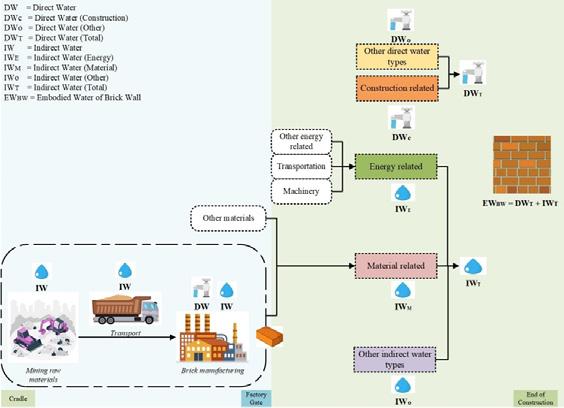
The Embodied Water (EW) of a building refers to the overall water utilised (directly as well as indirectly) to construct the building. Direct Water (DW) refers to water drawn directly from sources such as pipelines, lakes, and reservoirs. Indirect Water (IW) means water which is not directly used (which is not apparent) for activities but is indirectly consumed due to the water embodied in materials, electricity, etc. The concepts of DW, IW, and EW have been elaborated using a generic example of brick wall construction, as presented in Figure 1.
In reference to Figure 1, water is directly used to produce bricks and is indirectly consumed due to the use of electricity/ fossil fuels for operating machinery, transportation, etc.
The summation of both direct and indirect water components (e.g., IW mining + IW transportation + IW manufacturing) is the EW of the brick from its inception to manufacturing.
…Water can be directly utilised for activities such as mixing mortar, cleaning, and other related tasks.
Next, a brick wall is constructed utilising the manufactured bricks. During wall construction, water can be directly utilised for activities such as mixing mortar, cleaning, and other related tasks. Even if that is the apparent water usage in wall construction, a higher portion of water is not visible as it is embodied in materials, energy sources, etc.
The summation of both direct and indirect water components is the EW of a brick wall from its inception to the end of construction. Therefore, direct and indirect water chains move forward, as shown in Figure 1.
Figure 1: A brick wall’s direct and indirect water requirements from mining raw materials to the end of construction (Gamage et al. 2025).
CHALLENGES OF REDUCING EMBODIED WATER IN CONSTRUCTION
Reducing EW is far from straightforward, as construction projects involve numerous materials, multiple suppliers, and complex supply chains that stretch across regions and even continents. Several practical and organisational challenges hinder EW reduction in construction, elaborated in the subsequent discussion.
One of the key challenges is the limited understanding among construction stakeholders about concepts such as Embodied Water and water scarcity Many professionals are familiar with onsite water use but are less aware of the significantly larger share that is embodied within materials and energy sources. As a result, most efforts still focus on reducing visible water consumption on construction sites (direct water), while the indirect component often receives minimal attention.
Yet, research indicates that direct water use during construction activities may represent only about 7–39% of total EW, whereas indirect water associated with materials and methods stands for 61–93%, emphasising the significance of the hidden water component (Gamage et al. 2025).
Another major challenge is the high wastage of both materials and water across construction and manufacturing processes
It is estimated that more than 10 billion tonnes of construction and demolition waste are generated worldwide annually. These wastes include bricks, concrete, plasterboard, metals such as steel and aluminium, and organic materials like timber, paper, and plastics.
Each of these materials embodies an abundance of water throughout its life cycle; therefore, when materials are wasted, that water is also wasted. Moreover, some studies indicate that water consumption in building construction typically ranges from 2–3.6 kL per m2 , even though the actual requirement is only about 0.5 kL per m2 This means that approximately 2–2.5 kL per m2 of water is wasted during construction (Gamage et al. 2025).
Many stakeholders remain hesitant to use alternative materials due to a lack of knowledge and low confidence in newer products. As a result, traditional materials such as concrete and steel, which consume large volumes of water, continue to be widely used in construction.
Another challenge lies in the difficulties of estimating EW and the limited availability of reliable data Construction projects involve complex supply chains, which makes it difficult to quantify both direct and indirect water consumption. Estimating EW is challenging not only because of the complexity in supply chains but also due to the lack of reliable data sources. Currently, only a few databases and tools are available to support EW estimation, and most of them are limited to the early stages of a product’s life cycle, such as the cradle-to-gate boundary.
The lack of rules and regulations makes it difficult to prioritise water management.
Flexible designs reduce the demand for new materials and help minimise both material and water wastage.
While carbon reduction is now supported by rating systems and national policies in many countries, Embodied Water has received only limited attention from such frameworks.
STRATEGIES FOR REDUCING EMBODIED WATER IN CONSTRUCTION
Despite these challenges, numerous strategies exist to mitigate EW in construction, and some of them are elaborated below.
Designers can design buildings with adaptable plans that can serve various purposes, such as factories, warehouses, or offices, without requiring significant alterations. Flexible designs reduce the demand for new materials and help minimise both material and water wastage, a particularly valuable approach in rapidly urbanising areas where space is constrained.
Moreover, employing value engineering and lean construction techniques during the design process further enhances efficiency by using resources wisely and improving workflow.
Another strategy is to adopt alternative materials that replace high water intensive materials like concrete and steel. For instance, cross-laminated timber can be utilised instead of reinforced concrete structures where suitable. Moreover, adopting alternative construction methods, such as offsite construction, can help reduce EW. These methods use controlled manufacturing environments that minimise rework and optimise resource use, which in turn reduces the overall water consumed.
Water is often wasted in large quantities during construction (as elaborated under challenges), but this can be reduced through efficient engineering/ technological measures, as well as behavioural practices.
SUSTAINABILITY
Thus, adopting efficient engineering/ technological measures, such as utilising dust suppression vehicles with sprinklers and high-pressure, low-flow water jets for cleaning concrete wagons, as well as waterefficient fixtures like dual-flush toilets, at construction sites, helps minimise water wastage.
Moreover, assigning responsibility, introducing penalties for unsustainable practices, and improving monitoring and supervision are effective behavioural/preventive measures to conserve water.
Construction and demolition waste embodies a massive volume of water. However, it is estimated that over 75% of construction waste has a residual value that can be recycled or reused (Gamage et al. 2025). Therefore, applying closed-loop principles, such as recycling water and materials, assists in reducing EW in construction.
Introducing policies related to water management and devising strict rules to follow building codes and specifications in construction projects helps minimise unwanted rework, material, and water wastage, eventually reducing overall water consumption.
…Over 75% of construction waste has a residual value that can be recycled or reused.
ROLE OF THE QUANTITY SURVEYOR IN ADDRESSING EMBODIED WATER IN CONSTRUCTION
In order to manage EW in construction, we need to understand the current level of consumption. Therefore, estimating EW in construction becomes essential.
Quantifying both direct and indirect water use provides a clearer picture of where water is consumed, wasted, or conserved throughout a project.
In practice, the availability of such data supports informed design choices, efficient procurement, and compliance with sustainability ratings. Therefore, quantity surveyors, with their expertise in measurement, cost planning, and life cycle thinking, play a crucial role in integrating the concept of EW into everyday construction practice.
At the design stage, quantity surveyors can collaborate with architects and engineers to demonstrate how various materials or structures impact both cost and water. Including wateruse information together with cost data helps clients make choices that are both financially sound and environmentally responsible.
During the tendering stage, quantity surveyors can help reduce EW by encouraging suppliers to share information about the water used in producing their materials in tender documents. This allows clients to compare not just prices, but also the environmental impact of different options. Quantity surveyors can also recommend materials that are locally sourced or manufactured using waterefficient processes, which reduces indirect water.
Onsite, quantity surveyors can work with contractors to plan and monitor water use against project targets. They can help identify water hotspots in construction and the areas where water is often wasted, suggesting more efficient practices.
CONCLUSION
Embodied Water remains an overlooked yet critical aspect of sustainable construction.
As water scarcity intensifies worldwide, the construction industry must look beyond direct water use and recognise the significance of its indirect component. Understanding the challenges in reducing EW and the strategies that address them is vital for making meaningful progress toward resource efficiency. Quantity surveyors are well capable of leading this shift by utilising their analytical and measurement expertise to integrate water awareness into cost planning, procurement, and project evaluation. The decisions and efforts we make today can help create a future where construction uses water more carefully and responsibly. Ultimately, these actions support the vision of the UN’s Water Action Decade (2018–2028) and help guide the construction industry toward achieving the Sustainable Development Goals.
REFERENCES
Gamage, N, Perera, S, Senaratne, S & Pathirana, S 2025, ‘Embodied Water in the building life cycle: current research and future directions’, Resources, Conservation & Recycling Advances, p. 200283.
Saravanan, S & Singh, AK 2022, ‘A Review on Techniques for Solar Still Efficiency Enhancement’, Journal of The Institution of Engineers (India): Series C, vol. 103, no. 3, pp. 519-33.
This article was written by Srinath Perera MAIQS, Namal Gamage, Sepani Senaratne MAIQS CQS, and Sameera Pathirana from Centre for Smart Modern Construction c4SMC), Western Sydney University.
CASH RETENTION: IS IT TIME TO ABOLISH?
By Sam Neave
PAYMENTS
Cash retention has existed since at least Victorian-era railway projects in the United Kingdom (UK). Last year, the UK government announced a consultation on the future of retention, questioning its merit in securing quality workmanship in the construction sector. The consultation reignited (or perhaps stoked an ongoing) debate on payment practices, and how best to balance conflicting interests within the construction supply chain. Specifically, it has highlighted questions around poor payment practices, cashflow issues, and insolvency – all factors that similarly impact the Australian construction sector.
Is it time that Australia considers abolishing retention too?
RETENTION AS A FAILED PERFORMANCE GUARANTEE
The UK Department of Business and Trade opened consultation in July 2025, with the remit of addressing the “scourge of late payments, which causes the closure of 38 businesses per day and costs the UK economy £11 billion per year”.
The UK construction sector, like Australia, supply goods and services on trade credit rather than cash on delivery like other industries. This creates significant risk when payments are disputed, made late, or permit long payment periods.
…Retentions are a payment method that incentivise contractors to fulfil their contractual obligations.
These risks are perpetuated towards the end of the project where contractors are almost complete and have little left to claim on their contract. Hence, retention has been used to guarantee performance throughout this period by withholding a portion of their monthly payment. In other words, retentions are a payment method that incentivise contractors to fulfil their contractual obligations. The amount withheld can vary, however, in Australia this is typically 10% of each progress claim to a maximum amount of 5% of the overall contract value.
…Retention imposes disproportionate financial pressure on contractors.
Given profit margins in construction typically “fluctuate around 5%”, according to the Master Builders National Report this suggests that retention imposes disproportionate financial pressure on contractors.
From this perspective, retention may not only be a standard contractual feature but also leverage to ensure quality workmanship, especially during the defect’s liability period.
However, if the cost of remedial work is greater than the retention withheld, which it often is, there is little incentive for contractors to return to site. This is the primary concern of the proposed reform in the United Kingdom.
However, there are several other issues that also necessitate new thinking in terms of payment and retention methods in construction, including the persistently high rates of insolvency, which sat at 15.7% of all insolvencies in England and Wales in November 2025.
Then there’s the added issue of retention as working capital. Although retentions are contractually withheld from subcontractors, these funds are often used for operational expenses of head contractors. This perpetuates the ramifications of insolvency and poor payment practices for downstream stakeholders.
SHOULD AUSTRALIA FOLLOW THE UK? ABOLISH OR PROTECT
The question for Australia is not simply whether to follow the UK’s reform trajectory, but rather whether the advantages of change outweigh the consequences of consciously maintaining the status quo of retention practices.
This, of course, must prefer proportionality over contractual leverage. Here, arguments are made for and against:
The consultation presented three options for retention reform, see Table 1 on the previous page.
The simplest argument for abolition is that retention restricts the cashflow of firms, shifting insolvency risk to subcontractors, who finance project delivery while also absorbing credit risk.
By abolishing retention, risks associated with the delay in cashflow are removed. Therefore, monthly payments throughout the supply chain more accurately reflect which stakeholder has carried the risk. This argument is simplistic, in that it fails to guarantee contractor performance.
The abolishment of retention may also encourage further development of security practices by encouraging the use of more tailored financial instruments, such as bonds, guarantees, and insurance products.
These typically cover specific aspects of the construction process which, in turn, may allocate risk to the stakeholder who is best suited to manage it. However, the ability of the sector to self-regulate is contentious, especially given the disparity in contractual power between head contractors and subcontractors.
However, some argue that the central issue is not retention itself, but rather its exposure to misuse or insolvency risk because of other stakeholders. Where retention is protected through a trust framework, as proposed here, it can operate without these risks.
The UK consultation exemplifies the New Zealand retention trust scheme, where cash retention must be held in a separate trust account.
…Proportionate ‘finetuning’ of current retention practices may be better suited rather than outright abolition.
The scheme imposes financial penalties for non-compliance, including $50,000 and $200,000 infringements for directors and companies, respectively. Other frameworks include the NSW trust scheme, which requires projects valued over $20 million to hold retention in trust. Similarly, firms constructing eligible QLD projects ($1 million+ for public projects and $10 million+ for private projects) require a retention trust account.
The construction sector is widely concerned with cost escalation and increasing regulation, which suggests that proportionate ‘fine-tuning’ of current retention practices may be better suited rather than outright abolition.
The reform question, therefore, is not simply choosing between abolishment and protection, but determining whether the construction sector is better served by removing the practice of retention entirely or recalibrating its use to be more purposeful.
CONCLUSION
As payment reform gains momentum globally, the construction sector must advocate for mechanisms that balance risk and achieve their desired outcomes. In the case of retention, current practices fall short of guaranteeing optimal performance by stakeholders and have unintentional consequences for cashflow and financial stability.
The UK consultation highlights two alternative policy options, that is, abolish or protect retention. The consultation comes at a time when Australian jurisdictions, such as Victoria, are exploring wider payment practice reform. For Australia, the question is not whether or not reform is needed but rather how can future changes to payment legislation balance risk related to cashflow, workmanship, and other aspects of contractual performance.
Kennedys 2025, ‘Retentions in construction – time for reform?’, 24 November, <https:// www.kennedyslaw.com/en/thoughtleadership/article/2025/retentions-inconstruction-time-for-reform/>.
Master Builders Australia 2023, Building and Construction Industry Forecasts Australia, September 2023, <https:// masterbuilders.com.au/wp-content/ uploads/2023/09/230908_Forecasts_ September-2023_NationalReport.pdf>.
Queensland Building and Construction Commission 2021, ‘Trust accounts’, <https:// www.qbcc.qld.gov.au/running-yourbusiness/trust-accounts>.
Retention Deposit Scheme 2025, ‘From Victorian railways to modern construction: the history of retentions’, 4 May, <https:// www.retentiondepositscheme.org/insights/ the-history-of-retentions>.
Victoria Department of Transport and Planning 2025, Building reform, <https:// www.planning.vic.gov.au/guides-andresources/building-policy/building-reform>.
This article was written by Sam Neave, PhD Candidate, University of Melbourne.
By Gerard Connor
This article is condensed from ‘NZS3910 2023 – Section 9 Variations – a Comprehensive Guide’ by Gerard Connor, specifically sections of definitions and distinctions between temporary works, preliminary and general, site facilities, and related variation implications.
In NZS 3910:2023, the New Zealand standard form contract for building and civil engineering construction, clear distinctions between temporary works and preliminary and general (P&G) are essential for proper pricing, risk allocation, variation valuation, and avoiding disputes. Misalignment with industry practices, such as standard methods of measurement (SMMs), often leads to conflation and commercial friction.
DEFINITION OF TEMPORARY WORKS
Temporary works are defined in NZS 3910:2023 as, “Works of any kind, not being part of the contract works to be taken over by the principal, but which are required for the execution of the contract works.”
This encompasses elements that enable construction of the permanent works but are not handed over to the principal. Examples include scaffolds (for access), temporary access roads, crane platforms, falsework, shoring, and piling platforms. These are distinct from site facilities needed for the overall running of the project.
The New Zealand Temporary Works Forum Procedural Control Good Practice Guideline (GPG) references the British Standard BS 5975, defining temporary works as, “parts of the works that allow or enable construction of, protect, support or provide access to, the permanent works and which might or might not remain in place at the completion of the works.”
Contractors should carefully review tender documents and specific conditions… to determine design responsibility.
A key nuance in NZS 3910:2023 is that sacrificial works required temporarily for execution (e.g., certain piling) may be deemed part of the permanent contract works if they become integrated. Contractors should carefully review tender documents and specific conditions (e.g., clause 5.2.2) to determine design responsibility (typically the contractor’s unless stated otherwise).
DEFINITION OF P&G
P&G covers the contractor’s onsite overheads: expenses or losses for the general overall running of the contract works. These exclude items normally covered by subcontractors (e.g., scaffolding below 3m, task lighting, rubbish removal) or suppliers (e.g., delivery packaging), and are not identifiable as measured items under specific contract works or temporary works.
The definition includes four categories:
1. Remuneration and Expenses for Staff: Fixed, lump sum, or timerelated costs for management, administration, routine field engineering, surveying, procurement, and supervisory staff assigned ordinarily to the contract (excluding working forepersons and leading hands, part of net cost). Includes fringe benefits, fringe benefit tax, transportation, housing, accommodation, protective clothing, surveying/office equipment.
2. Insurance Premiums: For policies required by the contract (others fall under margin).
3. Contractor’s Bond: As specified in specific conditions.
4. Site and Temporary Facilities (not Temporary Works): Provision, operation, and maintenance of offices, shelter buildings, communications, water supply, drainage, waste management, roads (general running only), fencing, electrical supply, and ablutions, as originally specified. Changes introducing new requirements may allow claims beyond the scheduled allowance (9.3.10(a)), subject to equity (9.3.13).
P&G differs from company estimating spreadsheets or ‘P&G specifications’, which must align with this contractual definition for:
1. Competitive bidding
2. Industry-standard percentage alignment
3. Accurate working day rate calculation (9.3.12/9.3.13)
4. Separating non-P&G scope into the schedule of prices (unless amended via Schedule 2).
CONFLICTS WITH INDUSTRY PRACTICES
SMMs (e.g., ANZSMM, NZS 4202, RICS NRM 2) define ‘preliminaries’ in two parts:
• Information/Requirements: Noncost items (e.g., tender conditions), mirrored in RFTs or mistitled ‘P&G specs’ (recommend retitling to ‘project information and principal’s requirements’).
• Pricing Schedule: Headings for non-measurable items (management, insurances, site establishment, temporary works, environmental/health and safety).
NAVIGATING CONSTRUCTION COST ESCALATION IN THE LIVING SECTORS WITH THE FULL POWER OF BIM
By Andrew Van Meel
Cost pressures are a defining challenge in the living sectors, where affordability for buyers and tenants must sit alongside quality, durability and rapid delivery. How can developers and owners deliver value when input costs keep rising?
The November 2025 edition of WT’s Australian Construction Market Conditions Report shows little relief in sight for developers of build-to-rent, student accommodation, and social and affordable housing. Even if escalation stabilises temporarily, the surge in Olympics-related activity and growth in other high-demand sectors, such as data centres, is likely to push costs upward again.
Many drivers of escalation lie beyond a developer’s control: skills shortages, supply-chain volatility, tariffs, insolvencies, and rising costs of insurance, financing, and compliance. While there is no silver bullet, strategies such as realistic budgeting, early value management, aligned procurement, and clear risk allocation consistently improve cost outcomes – as does full use of Building Information Modelling
(BIM), a coordinated environment where a shared digital representation of an asset can be enriched with a range of project data.
FROM COST PLANS TO LIVING DATA
BIM, digital twins, and data-driven cost-intelligence platforms are essential tools for understanding, optimising, and tracking costs. They bring clarity and predictability to delivery, build confidence, and reduce risk, while also supporting cost-effective long-term operation and maintenance.
The most substantial value emerges when teams work from a single, realtime source of truth, integrating the project’s design (3D BIM) with time (4D), cost (5D), sustainability (6D), facilities management (7D), and even safety planning (8D) data. In this rich paradigm, issues are spotted earlier and addressed holistically, design choices assessed faster, and discussions can shift from debating numbers to comparing options. Teams understand not just what the costs are, but why they occur and how decisions can affect them.
Achieving these benefits requires a robust BIM framework, clear expectations, and disciplined oversight. Without strong foundations, models may be incomplete, fragmented, or misaligned with operational needs.
SET UP A ROBUST BIM GOVERNANCE FRAMEWORK
Projects generate thousands of data points, from design models and procurement schedules to site reports and asset registers.
A BIM framework works best when established at an organisational level…
Unless properly structured and connected, this information delivers limited value. BIM execution plans, information requirements, and supportive principal project requirements (PPRs) provide a consistent governance structure, enabling ‘big data’ to be transformed into ‘smart data’ that is accurate, connected, and usable across the project lifecycle.
Setting expectations early helps consultants price and respond accurately, lowering the need for inflated contingencies, which could translate to savings of up to 3% of construction costs.
A BIM framework works best when established at an organisational level, not reinvented for each project. Standardised processes and templates reduce duplication, clarify expectations for consultants, and allow teams to mobilise faster with less ambiguity.
Setting expectations early helps consultants price and respond accurately, lowering the need for inflated contingencies, which could translate to savings of up to 3% of construction costs.
MAINTAIN INDEPENDENT OVERSIGHT DURING DESIGN
A common pitfall in the living sectors is discovering too late that a model is deficient or unsuitable for facilities management. Independent oversight of BIM management ensures you receive what you’ve paid for and that the digital asset retains value into operations. Separating this role from the lead consultant, typically a designer themselves, enhances transparency and protects your interests.
Formal reviews at key milestones (such as 50% and 70% design development and the final issued-for-construction stage) verify alignment and compliance.
Clear reporting tools track performance and will reinforce accountability across the design team.
Investing in independent oversight is about ensuring that the right information is available in the right format at the right time, turning data into a powerful decision-making tool and strategic asset.
BE SPECIFIC WITH BIM EXPECTATIONS IN YOUR PRINCIPAL PROJECT REQUIREMENTS
Once the design phase is on track, the next challenge is ensuring that contractors understand the digital expectations from the outset. Clear PPRs reduce the risk of scope gaps, variations, and misinterpretation, all of which drive cost and delay.
Setting BIM expectations at tender allows contractors to compete on a level playing field, bring the right expertise, and establish the processes and reporting needed to deliver highquality models throughout the project lifecycle.
…BIM discipline must continue through construction.
TRACK AS-BUILT DOCUMENTATION THROUGHOUT CONSTRUCTION, NOT JUST AT HANDOVER
The long-term value of the model is only realised when it reflects the reality of what’s built, so BIM discipline must continue through construction. Progressive point-cloud scanning and BIM deviation analysis will keep the digital asset in sync with progress on the ground.
As-built verification ensures that the model remains a trustworthy, accurate foundation for operations and an enabler of predictive maintenance, asset tracking, and lifecycle planning.
TRANSFORMING THE LIVING SECTORS WITH BIM
The principles we’ve discussed here are already well proven in more digitally mature sectors, such as data centres, where scope clarity, rigorous coordination, and early integration with facilities management are well established. Applied to the living sectors, they unlock similar advantages: fewer surprises in design, clearer tender inclusions, and assets that transition smoothly into operations.
For developers and operators, the takeaways are simple: treat your digital asset with the same care as your physical one. Set expectations early, require structured data, ensure independent oversight, and verify continuously.
With these fundamentals in place, BIM becomes a powerful cost-management tool that can help navigate escalation, support competitive pricing, and deliver buildings that perform reliably over decades.
For the living sectors, where success depends on cost control, volume, predictability, and operational reliability, BIM offers more than a competitive edge. It’s a pathway to delivering better living outcomes for everyone, and it’s never too late to get started.
This article was written by Andrew Van Meel from WT Partnership.
CALCULATING UPFRONT CARBON:
By Tom Dean from Slattery
SUSTAINABILITY
As Australian companies prepare to disclose their Scope 3 emissions from 2026, construction presents a significant, and often overlooked, source of emissions. Slattery’s carbon accounting team offers a credible Australian-first method to construction spend into carbon impact.
INTRODUCTION
Construction is carbon-heavy – even when it’s not your core business. Australia’s new climate disclosure regime commenced on 1 January 2025. Large businesses must report Scope 3 emissions – the indirect emissions across their value chain – from 2026. For organisations outside the construction sector, this can present a blind spot.
Construction may not be your core business, but it may account for a meaningful share of your Scope 3 footprint. Capital works are common, carbon-intensive and financially significant.
Unlike operational emissions, which can be reduced over time, embodied carbon is locked in from day one.
Yet most finance teams are unprepared for how difficult construction-related emissions are to calculate.
THE CHALLENGE FOR FINANCE TEAMS
For most spend categories, emissions can be estimated using publicly available factors. But there is currently no credible, publicly available spendbased emissions factor for embodied carbon in Australian construction.
Some data exists, but it is often locked behind paywalls, tailored for niche applications, or not suited to broad industry adoption.
Finance teams looking for a simple equation – a reliable way to translate dollars spent on construction into tonnes of CO2e – will quickly discover a gap.
The Green Building Council of Australia’s Scope 3 Emissions discussion paper outlines the challenge of “translating the emissions of an asset to a corporate account”, noting that international guidance “is not consistent, and in some cases, may not be appropriate for Australian conditions”.
Slattery’s paper presents a conservative, spend-based factor for embodied carbon, developed specifically for Australian construction. Why conservative?
Because a cautious estimate – of more carbon, not less – encourages further investigation. If low-carbon materials, recycled products or adaptive reuse strategies are used, for instance, actual emissions may be lower.
Until better data is available, a conservative baseline creates the conditions for deeper conversations. When the cost of offsets is high, the case for better data – and emissions reduction – becomes even stronger.
This is not a definitive answer – but a practical starting point.
THE FIGURE
This spent-based factor provides a high-level estimate for embodied carbon based on dollars spent.
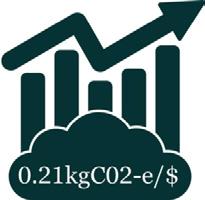
For every dollar spent on construction, applying a factor of 0.21 estimates the embodied carbon emissions (in kilograms of CO2e equivalent).
For example:
• A company spends $25 million on construction in FY26
• Applying the Slattery factor of 0.21 yields 5,250,000 kilograms (5,250 tonnes) of embodied carbon (CO2e)
• This equates to approximately one tonne of CO2e for every $5,000 spent.
This figure is designed to be conservative and is not a substitute for first principles measurement of materials or the advice of a trusted quantity surveyor.
In most cases, a more granular assessment will yield a lower emissions figure.
This figure is based on new building projects and does not currently apply to industrial developments, which have different material compositions and cost structures.
When we split the data by building type, we see variation. Fitouts, for example, are typically lower, with early estimates suggesting figures closer to 0.12 kgCO2e per dollar. Further breakdowns by asset class will be shared in future updates.
A full methodology is provided in Appendix A.
NEXT STEPS
Australia’s mandatory sustainability reporting and climate-related disclosures, introduced on 1 January 2025, requires reporting entities to disclose their Scope 3 emissions from 2026.
The Australian Securities & Investments Commission acknowledges that some data may be “too hard or costly to obtain,” and permits larger businesses to use, “estimates and industry averages rather than directly sourcing the information from their value chain”.
Slattery’s conservative estimate offers a practical first step – a provisional baseline for entities facing construction-related emissions for the first time.
In time, more sophisticated tools and standards will emerge – and Slattery is currently developing an online carbon calculator to contribute to this body of knowledge.
In the interim, a standardised, spendbased figure offers companies a clear foundation for disclosure, can support capability building over time, and generate better-quality data for investors, insurers and regulators.
It will incentivise more detailed measurement by allowing those who invest in better data to demonstrate lower emissions profiles and stronger sustainability performance.
Image: C Dustin, Unsplash, provided by Slattery.
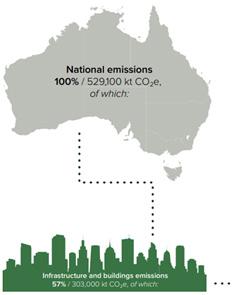
Exhibit 1: Source –Infrastructure Australia 2023.
Exhibit 2: Slattery estimate for embodied carbon based on dollars spent.
SUSTAINABILITY
APPENDIX A – SLATTERY METHODOLOGY
Our spend-based emissions factor was calculated from a robust dataset of building projects within the Slattery database.
Our dataset is unique, as it includes projects where both embodied carbon planning advice and detailed cost planning services have been provided. This integrated dataset enables direct comparison between total upfront embodied carbon and the corresponding total project expenditure, forming the basis of the spend based factor.
I SCOPE AND BOUNDARIES
• The dataset is building projects only. It excludes infrastructure or horizontal works, which may exhibit materially different emissions profiles and are outside the scope of this factor’s applicability.
• Embodied carbon measurements focus on life cycle stages A1 to A5, covering material extraction, manufacturing, transport and onsite construction processes. Demolition and end-of-life stages are excluded.
• Cost data represents the total project cost, incorporating all project phases including contingencies and associated project costs.
I DATA SOURCES
• Emissions factors are sourced from the AusLCI life cycle inventory database, accessed through the Etool software platform.
• When available, Environmental Product Declarations (EPDs) for specific materials or products are incorporated.
• Standard Etool assumptions were used transport and construction calculations (A4 and A5). The exception is when we have overseas-sourced product with an EPD, we will include the additional freight required.
I DATASET CHARACTERISTICS AND LIMITATIONS
• Projects included have proactive teams that engaged in carbon planning services. This may suggest a sample bias toward clients with stronger commitments or motivations to reduce carbon emissions. This may skew the dataset towards lower embodied carbon intensity profiles relative to the broader market.
• Notwithstanding this, the calculated spend-based factor is conservative, as it is based on the highest project emissions intensity values present in the dataset.
• Despite this conservative approach, our factor remains lower than the current Climate Active spend-based emissions equivalency figure.
I EXCLUSION OF INDUSTRIAL SECTOR PROJECTS
• Analysis identified industrial sector projects as statistical outliers. These projects were therefore excluded to avoid distortion of the general factor.
• This exclusion results in a spendbased factor more accurately reflective of mainstream building projects.
APPENDIX B – LITERATURE REVIEW
A scan of available data sources confirms a clear gap in publicly accessible, standardised, spend-based emissions factors for construction in Australia. While there is substantial work underway across government, industry and academia, none of these efforts yet provide the practical, Australia-specific spend-based emissions factor that finance and sustainability teams need.
I KEY SOURCES REVIEWED:
• Greenhouse Gas Protocol: Allows for spend-based estimates as one of three accepted calculation methods (alongside average data and supplier-specific methods). However, it does not provide construction-specific spend-based emissions factors, nor does it offer detailed guidance tailored to construction procurement or capital works.
• Climate Active: Uses IELab (Industrial Ecology Lab) data to supply spend-based emissions factors across many categories. Access is limited to members. Climate Active is currently under review.
• IELab and Footprint Lab: IELab’s data is based on 20 years of academic modelling but is highly technical and not designed for practical industry application. IELab’s commercial offshoot, Footprint Lab, provides spendbased estimates behind a paywall.
• Infrastructure NSW: The Embodied Carbon Measurement for Infrastructure: Technical Guidance provides some guidance on Page 62, based on earlier modelling for Infrastructure Australia. This is not suitable for broader application.
SUSTAINABILITY
I INDUSTRY AND GOVERNMENT SUPPORT
Industry discussion about Scope 3 emissions has been underway for some time but these are, in the main, targeting construction or sustainability audiences.
• NABERS Embodied Carbon: Measures, verifies and compares upfront embodied carbon of new buildings, covering material, transport, and construction emissions. Does not include spend-based emissions factors for general construction.
• Green Building Council of Australia: The GBCA’s Scope 3 discussion paper (2024) notes the need for benchmarking data to support reporting entities, particularly for fitouts.
• Australian Sustainable Built Environment Council: ASBEC’s policy roadmap, Our upfront opportunity (2025), recommends investment in an “aligned national framework and tools to baseline, measure, benchmark, disclose and reduce embodied carbon through a unified methodology and common database”.
• Infrastructure Australia: Embodied Carbon Projections for Australian Infrastructure and Buildings (2024) recommends governments “continue developing a nationally standardised embodied carbon measurement system, which allows for consistent methods to collect, measure, and assess data about embodied carbon.”
• GRESB: In 2024, GRESB surveyed infrastructure asset participants and found inconsistent Scope 3 reporting and no universally agreed definition of materiality.
• PCAF, CRREM and GRESB: The Partnership for Carbon Accounting Financials (PCAF), Carbon Risk Real Estate Monitor (CRREM) and GRESB released technical guidance for Accounting and Reporting of GHG Emissions from Real Estate Operations (2023), but this does not include spend-based emissions factors.
• Property Council of Australia: Its 2023 submission on climate disclosure reporting identified the need for a standard Scope 3 methodology for capital works.
• Australian Sustainable Finance Institute: Expects to release the Australian Sustainable Finance Taxonomy mid-2025. Spend-based benchmarks are not included.
REFERENCES
Australian Securities & Investments Commission. (n.d). Sustainability reporting. https://asic.gov.au/ regulatory-resources/sustainability-reporting/.
Australian Securities & Investments Commission. (n.d). Sustainability reporting for small business. https://asic.gov.au/regulatory-resources/ sustainability-reporting/sustainability-reportingfor-small-business/
Australian Sustainable Built Environment Council (ASBEC). (March 2025). Our upfront opportunity: A policy roadmap. www.asbec.asn.au/researchitems/our-upfront-opportunity/
Australian Sustainable Finance Institute. (n.d.). Australian Sustainable Finance Taxonomy. www. asfi.org.au/about-taxonomy.
Climate Active. (July 2024). Climate Active consultation update. www.climateactive.org. au/what-climate-active/news/climate-activeconsultation-update
Green Building Council of Australia (GBCA). (July 2024). Scope 3 emissions – Measuring impact: Why Scope 3 deserves our attention more than ever. Discussion Paper. https://gbca-web. s3.amazonaws.com/media/documents/scope-3discussion-paper.pdf
GRESB. (April 2025). Scope 3 for infrastructure assets: A data-driven research roadmap for GRESB. www.gresb.com/nl-en/scope-3-forinfrastructure-assets-a-data-driven-researchroadmap-for-gresb/
Infrastructure Australia. (July 2024). Embodied carbon projections for Australian infrastructure and buildings. www.infrastructureaustralia.gov.au/ reports/embodied-carbon-projections-australianinfrastructure-and-buildings
Partnership for Carbon Accounting Financials (PCAF), Carbon Risk Real Estate Monitor (CRREM) & GRESB. (March 2023). Technical guidance for accounting and reporting of GHG emissions from real estate operations. https:// carbonaccountingfinancials.com/en/newsitem/ pcaf-crrem-and-gresbg-release-the-first-versionof-technical-guidance-for-accounting-andreporting-of-ghg-emissions-form-real-estateoperations
Property Council of Australia. (February 2023). Submission to the Australian Government on climate-related disclosure. https://treasury.gov. au/sites/default/files/2023-04/c2022-314397property-council-australia.pdf
This article was written by Tom Dean and originally published by Slattery in October 2025.
PREFABRICATION AS A CATALYST FOR VALUE: A
QUANTITY SURVEYOR’S OPPORTUNITY TO LEAD
By Shelley Rogers MAIQS CQS
Prefabrication is increasingly recognised as a critical component in the evolution of Australia’s construction industry. As pressures relating to productivity, workforce capacity, sustainability and cost certainty continue to intensify, prefabricated and industrialised construction methods offer a practical pathway toward more efficient and resilient project delivery. For quantity surveyors, this shift represents not only a technical adjustment, but a strategic opportunity to help shape the future of the industry.
From a cost management perspective, prefabrication aligns strongly with many of the outcomes clients increasingly seek: certainty, predictability, quality and long-term value. While discussion around prefabrication has often focused on barriers to adoption, there is growing evidence that, when appropriately integrated, prefabrication can deliver measurable benefits across the project lifecycle. The role of the quantity surveyor is central to unlocking this value by reframing how cost is assessed, communicated and embedded in decision-making.
…Prefabrication enables earlier certainty of scope, cost, and program.
At its most effective, prefabrication enables earlier certainty of scope, cost, and program. By shifting a significant proportion of construction activity into controlled manufacturing environments, variability associated with weather, site access, and trade sequencing can be reduced. This predictability supports more reliable cost planning, reduces contingency reliance, and improves commercial outcomes for all parties.
For quantity surveying professionals, this creates an opportunity to move cost advice upstream, supporting earlier and more informed decisions that influence project outcomes rather than merely reporting on them.
Program certainty is one of the clearest areas where prefabrication delivers value. Shorter and more predictable construction durations can reduce preliminaries, site overheads, and exposure to time-related claims. Earlier completion can also provide financial benefits to clients through reduced financing costs or accelerated revenue streams.
Improved quality at delivery reduces the likelihood of rework, defects liability costs, and post-completion disruption.
While these outcomes are well understood conceptually, they are not always fully reflected in traditional cost comparisons. Quantity surveyors are well placed to bridge this gap by integrating program-related cost impacts into holistic value assessments.
Prefabrication also offers a meaningful response to ongoing labour challenges. By relocating work from site to factory, projects can benefit from improved productivity, safer working conditions, and greater workforce stability. Manufacturing environments allow for repetition, standardisation, and increasingly, automation, all of which contribute to more consistent outputs. For quantity surveying professionals, understanding these production efficiencies enables more accurate forecasting of labour-related costs and risks, supporting more robust cost advice.
Factory-based production enables optimised material use and minimises off-cuts and damage.
Quality outcomes are another area where prefabrication consistently demonstrates strength. Controlled manufacturing processes allow for tighter tolerances, improved testing regimes, and earlier identification of defects. Improved quality at delivery reduces the likelihood of rework, defects liability costs, and post-completion disruption. From a whole-of-life perspective, higherquality construction can also translate into reduced maintenance costs and improved asset performance. Quantity surveyors can play a key role in articulating these benefits through life cycle costing and value-based reporting.
Material efficiency and waste reduction further enhance the economic case for prefabrication. Factory-based production enables optimised material use and minimises off-cuts and damage. Reduced waste has direct cost benefits through lower disposal costs, as well as indirect benefits where sustainability outcomes influence procurement decisions, approvals, or operational performance. As sustainability considerations become increasingly commercial in nature, quantity surveying professionals can ensure these efficiencies are recognised as cost benefits rather than ancillary outcomes.
Perhaps the greatest opportunity for the profession lies in the application of whole-oflife costing.
PREFABRICATION
Effective prefabrication outcomes rely on early engagement between designers, manufacturers, contractors, and cost advisors.
Perhaps the greatest opportunity for the profession lies in the application of whole-of-life costing. Prefabrication aligns strongly with long-term asset performance, yet operational and maintenance costs are often underweighted during early project stages. Quantity surveyors are uniquely positioned to change this narrative by embedding life cycle thinking into feasibility studies, business cases, and procurement advice. By doing so, quantity surveying professionals can help clients make decisions that balance upfront investment with longterm value.
Importantly, prefabrication also encourages earlier collaboration across the project team. Effective prefabrication outcomes rely on early engagement between designers, manufacturers, contractors, and cost advisors. This integrated approach supports better design optimisation, clearer risk allocation, and more accurate cost forecasting. Quantity surveyors can act as facilitators within this process, supporting informed trade-offs between design, cost, program, and performance.
While prefabrication encompasses a broad range of systems and solutions, this diversity should be viewed as a strength rather than a limitation. Modular, panelised, and hybrid approaches allow prefabrication to be tailored to project-specific requirements.
Quantity surveying professionals who invest in understanding these systems are better equipped to advise on suitability, cost drivers, and procurement strategies, strengthening their role as trusted advisors.
The evolution of prefabrication also presents an opportunity for the profession to contribute to improved data and benchmarking. As more projects adopt industrialised construction methods, quantity surveyors can play a leading role in capturing and sharing cost data, lessons learned, and performance outcomes. Over time, this collective knowledge will support greater confidence, reduce uncertainty, and improve decision-making across the industry.
Critically, prefabrication does not diminish the role of the quantity surveyor; it elevates it. As construction methods evolve, the profession’s value lies not only in measurement, but in insight. Understanding manufacturing processes, logistics, supply chains, and risk profiles allows quantity surveying professionals to provide advice that is strategic rather than transactional. This evolution aligns closely with the profession’s broader trajectory toward advisory and value-focused services.
Prefabrication is not a universal solution, nor does it always represent the lowest initial cost option. Its suitability will vary depending on project type, scale, location, and procurement strategy. However, when assessed holistically, prefabrication can deliver significant value across program, quality, risk, and longterm cost performance. The ongoing emphasis on short-term capital cost risks obscuring these benefits at a time when the industry faces mounting pressure to improve productivity and deliver more sustainable outcomes.
For the quantity surveying profession, there is a clear opportunity to lead. By challenging narrow cost comparisons, advocating for whole-of-life thinking, and supporting procurement models that enable early engagement, quantity surveying professionals can play a central role in facilitating more informed and balanced decision-making. In doing so, the profession can help ensure that prefabrication is assessed not as an exception to conventional practice, but as a viable and valuable component of a modern construction industry.
This article was written by Shelley Rogers MAIQS CQS from Rider Levett Bucknall (RLB).
OWNERS: FOCUS ON ROI WHEN NEGOTIATING WITH CONSTRUCTION CONTRACTORS
By Matt Stevens MBA PhD FCIOB FAIB
Project owner negotiations with construction contractors are a ‘value for money’ discussion aimed at reaching an agreement. Each party is trying to maximise its financial benefit. For the project owner, it is a more complicated situation, but for the construction contractor, it is straightforward. Let’s take time to examine.
…Contractor
margins
are thin in Australia and may remain so in the near future.
As you know, contractor margins are thin in Australia and may remain so in the near future. Contractors are competing against more construction firms than they did ten years ago on every bid. How does one compete and stay financially viable? Our answer: Project Return on Investment (PROI).
Return on investment (ROI) is a core measure for all businesses. It is flexible across all transaction sizes and is not reliant solely on profit margins but also on the terms and conditions. For example, the invoice condition “2% discount if paid in 10 days or the net is due in 30 days” (2/10 net 30) is commonly used to encourage prompt payment. For some people in our industry, it may not seem like much, especially on a small invoice. However, on an annualised basis, it is 37% return on investment. This return suggests it may be better to meet obligations than to reinvest in company infrastructure or pursue new business opportunities.
PROI depends on financial transactions, including payroll, client payments, service provider payments, and supplier payments. These vastly different outcomes illustrate the significance of negotiating better terms and conditions. PROI is an old concept to be sure.
It is notable that many 20th-century practices have been forgotten and are not taught to young professionals. Clearly, PROI is part of the ‘physics’ of construction (think gravity). Just as they were effective in your grandfather’s time and still are today.
Let’s agree that the amount of money tied up in building work is the right basis for calculation. In other words, the contractor must assess the risk and value for renting out working capital to the client. Contractors rarely catch up on project cash flow. Additionally, there are no guarantees regarding the accuracy of our estimate, the project’s schedule, or timely payment. Hence, we have to charge a larger percentage than most other industries on our financing (lending money to) of the project.
To calculate a proper PROI on a project, we input the following factors:
• Amount and timing of assets, including inflows (sources) and outflows (uses) of cash
• Collected profit dollars (rewards)
• Amount of cash allocated.
…The return on investment for a construction firm starts at the project level.
These three factors are used in a moderately complex equation to derive a PROI. Note that the return on investment for a construction firm starts at the project level. Without profitable projects, a contractor’s business cannot be profitable. See Figure 1.
Figure 1 shows the input screen for a simple PROI calculation.
We know this is not realistic and is purposely limited for illustration purposes. As shown in shaded boxes, these are revenue, costs, timing requirements, and allocated capital. Each of these influences the result. Note that each project’s net profit is 5%; the length of each project varies. As we change inputs between two projects, the outputs may be the same. Remember that in your next negotiation.
In Figure 2, we see many effects:
• Job 1 exceeds its working capital, meaning borrowing from a creditor
• The supplier credit terms for Job 3 help cashflow
• Client payment on Job 2 helps keep the total working capital investment at its lowest.
ROI is an annualised metric used to accurately compare shorter and longer projects. Our equation assumes the project takes a year and projects the net profit in dollars. For example, project 2 would earn $6,271.20 on a net monthly investment of $4,628.75, yielding a 135.48% PROI.
We unabashedly recommend that construction firms use PROI as a preliminary pricing model. Our research has confirmed that using an ROI calculation at the bidding stage is a good operating practice.
…The top quartile of contractors earn approximately a 40% (and above) ROI…
Top-quartile contractors utilise this, along with other factors (such as dual overhead application, job sizing, and
competitors’ tender histories), to set prices. It keeps them away from bad pricing decisions and overly optimistic projections, retainage percentages, milestone payments, liquidated damages, or change order processes that directly alter cash inflows/outflows.
This PROI-centric approach offers additional benefits. Project managers who are measured by this will implement the best financial practices. Also, as the PROI of a construction firm’s projects improves, so does the balance sheet and profit-and-loss statement to the delight of banks, suppliers, and other critical partners. As with all best practices, this has multiple positive effects.
At present, the top quartile of contractors earn approximately a 40% (and above) ROI, according to U.S. banking data. This means they are highly successful financially, driven by sound financial practices starting with their projects. As an aside, the median performing builder or subcontractor hovers in the low 20s.
Developers and government procurers should know that strong PROI motivates contractors. This is why some owners pay on a fortnightly basis. It is uncontroversial that margins that reduce debt and cashflow drag enable construction organisations to continue attracting top talent, partners, and projects, and to upgrade internal infrastructure. The importance of using PROI and other best practices for predictable outcomes cannot be ignored.
Figure 1: Simple Example of the Inputs for Calculating PROI.
Figure 2: The ROI Calculation.
This article was written by Matt Stevens, Senior Lecturer in Construction Management from Western Sydney University.
BUILDING COST INDEX
MARCH 2026
THE BUILDING COST INDEX IS PUBLISHED IN THE PRINT VERSION OF THE BUILT ENVIRONMENT ECONOMIST.
IT CONTAINS DATA THAT CAN BE USED AS A PREDICTOR FOR THE ESTIMATED TIMES FOR DESIGN AND CONSTRUCTION AND INCLUDES A SUMMARY OF THE PAST, PRESENT AND ESTIMATED FUTURE CONSTRUCTION COSTS.