S E P TE M B E R 2 0 26
BOSS SURVEY: BUSINESS LEADERS' OUTLOOK TURNS GLOOMY P 39
HAWAI I B U S I N E S S .CO M
PLU S MONEY RAINS O N H AWA I ʻ I ' S B E S T PA I D AT H L E T E S P. 6 2
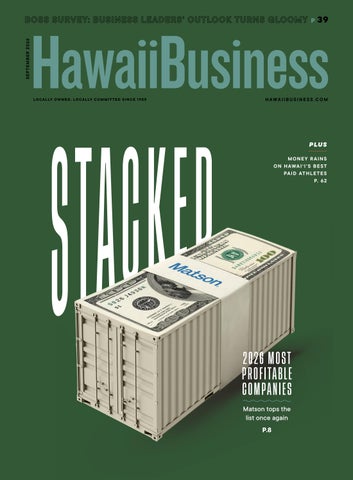
2 02 6 MO ST P RO FITAB L E CO MPAN IES Matson tops the list once again P.8
G R E AT N E S S C A N B E L E A R N E D — L O C A L LY
The future belongs to those who can do what technology never will. Navigate uncertainty. Inspire people. Create belonging. Lead with presence when it matters most.
This fall, the Berkeley Institute for Human Connection is coming to Hawai‘i, launching a new executive leadership experience featuring Dr. Mark Rittenberg.
OCT 26-28 | AC Hotel Honolulu by Marriott | 8:00 AM - 4:00 PM D R. MA RK RI T T E N BE RG
Distinguished Teaching Fellow and Senior Lecturer, UC Berkeley Haas School of Business.
He trains leaders the way actors are trained, because , , presence isn t a personality trait. It s a practice. SCAN T O A P P LY
O ʻA H U . FA L L 2 0 2 6 . A P P L I C AT I O N S O P E N
W E L C O M E D I N PA R T N E R S H I P W I T H
FLEXIBLE TRAINING FOR TODAY’S WORKFORCE
SHORT-TERM PROGRAMS. INDUSTRY-ALIGNED SKILLS. PARTNERING WITH HAWAI‘I EMPLOYERS. DESIGNED FOR CAREER GROWTH AND WORKFORCE ADVANCEMENT.
IT | HOSPITALITY | HEALTHCARE | CULINARY
Inquire with us EMAIL: mchar@hawaii.edu
YO U R R OA D M A P TO H AWA I ‘ I ’ S 2 0 26 BUSINESS EVENTS
SEP OCT NOV DEC
Hawai‘i Leadership Academy: Cohort Three September 17 Hawai‘i Excellence in Business Awards
October 23 Wahine Forum
November 12 HB20 Alumni Reunion
December TBA CEO of the Year Celebration
V I S I T W W W. H AWA I I B U S I N E S S . C O M / E V E N T S
0 9. 2 6
CONTENTS
69 Visualizing Sinkholes
Combining ancestral knowledge with modern data visualization tools, UH-West Oʻahu’s Create(x) lab and community partners are working to restore endangered ecosystems. One project shows where the endangered ‘ewahinahina plant is growing in a type of sinkhole formed in ancient coral where Hawaiians practiced agriculture. The mission is the restoration and regeneration of Hawai‘i’s biosystems.
Profits Piling Up
7
LETTER FROM THE EDITOR
Hawaii Business Magazine’s 2026 List of Most Profitable Companies includes repeat stalwart performers and some surprising newcomers into the upper echelon. We look at what makes Matson a perennial standout, topping the list for the fifth year in a row. We also take a new measure of companies based on profits per employee and profits as a percent of revenue. See how your company ranks. 8
BOSS and 808 Surveys
Best of Show
Our BOSS Survey of 412 local business owners and executives plus our 808 Survey of members of the general public show the overall outlook for quality of life in the state is slipping. Taken together, they provide a wake-up call for policymakers. A clear majority of business leaders say Hawai‘i is now a worse place to do business than five years ago. Take a closer look.
Hawaii Business Magazine brings home 23 awards, including 9 first-place honors, at the annual awards ceremony hosted by the Hawaiʻi chapter of the Society of Professional Journalists. The distinctions range from photos, layout and design, to multimedia presentation as well as impactful journalism in features, profiles and analyses. Check out the individual highlights.
39
59
Athlete Salaries
Top professional athletes from Hawaiʻi have held their own in the national cadre of well-paid sports figures. Once again, Tua Tagovailoa tops the list, with pay of $54 million. But he’s not alone. Twenty others have leveraged their initial start in the state to win pay packages over $1 million. See what your favorite home-grown athlete is being paid 62
HAWAII BUSINESS (ISSN 0440-5056) IS PUBLISHED 12 TIMES A YEAR BY PACIFICBASIN COMMUNICATIONS. ©2026 PACIFICBASIN COMMUNICATIONS, LLC. ALL RIGHTS RESERVED. ANY UNAUTHORIZED COPYING, DISTRIBUTION, OR ADAPTATION IS STRICTLY PROHIBITED AND WILL RESULT IN LIABILITY OF UP TO $100,000. EDITORIAL, ADVERTISING AND BUSINESS OFFICES AT 1088 BISHOP STREET, SUITE LL2, HONOLULU, HI 96813. TELEPHONE (808) 534-7520. POSTMASTER: SEND ALL ADDRESS CHANGES TO HAWAII BUSINESS, P.O. BOX 913, HONOLULU, HI 96808. SUBSCRIBERS NOTIFY THE SAME OFFICE. PLEASE INCLUDE NEW ADDRESS AND OLD ADDRESS (MAILING LABEL PREFERRED) PERIODICALS POSTAGE PAID AT HONOLULU, HAWAI‘I, AND AT ADDITIONAL MAILING OFFICES. SUBSCRIPTION: ONE YEAR $24.99 / TWO YEARS $34.99 / THREE YEARS $44.99. FOREIGN: ONE YEAR $53.99 (US FUNDS). FOR SUBSCRIPTION INQUIRIES, ADDITIONAL RATES, INFORMATION, NOTIFICATION OF CHANGE OF ADDRESS AND SUBSCRIPTION SERVICE, PLEASE CALL (800) 788-4230. SEPTEMBER 2026 VOL. 72/NO.3
4
SEPTEMBER 2026
The entrance to the historic Pacific Club. Photo: Aaron Yoshino
77 Making History at The Pacific Club
For 175 years, the state’s top business leaders and dealmakers met at The Pacific Club to establish camaraderie and forge trust in relationships that shaped Hawaiʻi. Over the decades, the club has evolved in countless ways, not least its welcoming of a broad sweep of groups once excluded. One guiding rule: Talk business and network all you want but leave politics outside. Today, you’ll find a cross section of society, even families, enjoying its facilities.
ʻSociety Needs to Change’
Serve It Up Hot
Trial and Error
Gov. Josh Green doesn’t often let fly with philosophical musings about today’s social ills. But at a recent bill signing, he took some moments to reflect on the deterioration of our civil discourse that required the Legislature to pass bills protecting public workers from harassment. Laws should be a last resort, he says. Social media has given some people license to think they can cross the line. But he has a warning to offenders: “You’re gonna get busted.”
Operating a restaurant, never an easy job, is becoming even more challenging in Hawaiʻi. That’s because owners are squeezed between rising costs and a limited ability to pass those expenses along through their own price increases. The answer? Listen to customers, change up the menus, serving sizes and marketing strategies. Will it work? Let’s talk about it over lunch.
Suffering from glossophobia? You’re not alone, and we’ve got you covered. The fear of public speaking is one of the most common shared phobias, and people will go to extraordinary lengths to avoid getting up in front of others, whether at work, in a classroom or at a formal event. Columnist Ryann Noelani Coules shares her own experience and proposes practical techniques to help you not only get through a speaking engagement but even enjoy it.
84
86
94
SPECIAL ADVERTISING SECTIONS Hawaiʻi’s Rich Selection of Private Schools
Choose a private school that meets your needs. 15 AIA Honors Top Architectural Designs AIA’s Honolulu chapter celebrates design excellence. 45 West Oʻahu
Learn how quality medical care is expanding on the west side. 73
H AWA I I B U S I N E S S
5
HB EVENTS C O N N E C T W I T H H AWA I I B U S I N E S S M A G A Z I N E L O C A L LY OW N E D, L O C A L LY COMMITTED SINCE 1955.
Our goal is to strengthen the local economy and help our communities thrive. Publisher KENT COULES kentc@hawaiibusiness.com • (808) 364-5869
A W A R D S
2 0 2 6
PRESENTING SPONSOR:
SEPTEMBER 17, 2026 Fuller Hall - Downtown YWCA Excellence rarely begins with unlimited resources. More often, it starts with vision, determination, and a commitment to making a meaningful impact. The Hawai‘i Excellence in Business Awards celebrate organizations that embody these qualities – achieving measurable success while strengthening their employees, industries, and communities. Selected through a competitive application process, this year’s honorees demonstrate outstanding leadership, innovation, workplace culture, and community stewardship. Their stories reflect what excellence in Hawai‘i looks like today and inspire what is possible for tomorrow.
20 26
THE
A
B L A C K
B O O K
E V E N T
Editorial Editor-in-Chief JENNIFER ABLAN jennifera@hawaiibusiness.com Managing Editor KEN WILLS kenw@hawaiibusiness.com • (808) 987-8135 Senior Editor STEVE PETRANIK stevep@hawaiibusiness.com • (808) 534-7584 Senior Contributing Writer CYNTHIA WESSENDORF cynthiaw@hawaiibusiness.com Staff Writer RYANN NOELANI COULES ryannc@hawaiibusiness.com Staff Writer GRANT NAKASONE grantn@hawaiibusiness.com Copy Editor ELROY GARCIA Editorial Interns LILI HURD, KIANI VIDAURRI Design & Photography Creative Director ESTHER MOHRMANN Graphic Designer CHASE NUUHIWA Graphic Designer KAREN TANIGAWA Graphic Designer GINNY WILLIAMS Staff Photographer AARON YOSHINO Digital Digital Director RANDALL LIBRAMONTE randalll@hawaiibusiness.com Digital Content Manager MARIANNE LEANO mariannel@hawaiibusiness.com Sales & Marketing Senior Account Executive YONGCHAE SONG yongchaes@hawaiibusiness.com • (808) 228-5078 Account Executive KELLY CLARK kellyc@hawaiibusiness.com • (979) 587-6410 Operations Manager REBECCA BROOKING rebeccab@hawaiibusiness.com • (808) 534-7560 Events Manager ASHLEY MCLEAN ashleym@hawaiibusiness.com • (808) 272-6550 Events Coordinator OLIVIA DE SENA oliviad@hawaiibusiness.com Circulation hawaiibusinessmag@emailcustomerservice.com
OCTOBER 23, 2026 Hilton Hawaiian Village Mark your calendars – Wahine Forum returns on October 23, 2026, at Hilton Hawaiian Village. Presented by Hawai‘i Community Foundation, this is the state’s largest leadership and career development conference for women. From established executives to emerging professionals, women across industries will come together to share real stories, build practical skills, and strengthen community. For more information on events, visit hawaiibusiness.com/events or contact Ashley McLean, Events Manager, at ashleym@hawaiibusiness.com
Connect with us on social media: HawaiiBusiness HawaiiBusinessMagazine Hawaii Business is published by
Founder DUANE KURISU Chairman SUSAN EICHOR President BRANDON KURISU Director of Finance JADE MOKIHANA HIND
LET TER FROM THE EDITOR
LET TER FROM THE EDITOR
Dead Last. Now What?
H
awai‘i has just been named the worst state in America to do business – dead last, out of 50 – in CNBC’s 2026 “America’s Top States for Business” rankings. It’s the first time in the study’s 20-year history that Hawai‘i has finished at the very bottom. Last year we were 49th. This year we found a way to be worse. That’s the kind of headline that should embarrass every public official in this state, from the Capitol to the county councils. It’s a report card that scores all 50 states on the same yardstick, on the same categories, year after year, and this year – on infrastructure and cost of doing business, Hawai‘i finished last of 50. Hawaii Business Magazine’s BOSS Survey, which polled 412 local business owners and executives, backs up what the CNBC ranking suggests. Senior editor Steve Petranik reported that a majority – 57% – told researchers that Hawai‘i is now a worse place to run a business than it was five years ago. Only one in five said things have gotten better. It’s a broad, shared loss of confidence and it isn’t confined to business leaders. In a parallel 808 Poll of 401 members of the general public, the outlook was even bleaker: just 10% of the public expects the local economy to improve in the coming year, versus 23% of business leaders, while 46% of the public and 45% of business leaders expect it to get worse. For more on BOSS, see page 39. I’ve spent the past 12 months talking with small business owners – the lifeblood of our state’s economy – about exactly what the state could do, right now, to make Hawai‘i a place where small businesses can hire and hold onto good employees instead of just surviving another quarter. Bernice Parsons, President and Co-Founder of Vertaccount, put it plainly: “Don’t just subsidize businesses. Subsidize the cost of employing Hawai‘i workers,” she says. If the state wanted to aggressively support small business hiring and retention, the most impactful tax breaks would probably be the following, she says: • Payroll tax credits tied to local hiring • Relief from the General Excise Tax on labor-intensive services • Subsidies for healthcare and training costs • Incentives for profit-sharing and employee ownership • Credits for retaining long-term Hawai‘i residents on staff None of these are radical ideas. They’re the kind of targeted, hiring-focused relief other states use every day to compete for jobs – and that Hawai‘i, with its uniquely punishing General Excise Tax and high cost of living,
needs more than most. Right now the tax code doesn’t care whether a company hires locally or keeps workers for the long haul; it taxes the transaction either way. Credits like these would change that math. The overwhelming pessimism is already showing up in the numbers. Asked about their spending plans for the coming year, only one in five business owners and executives said they plan to substantially increase spending; nearly a third said they expect to cut costs instead. And when we asked what’s actually driving the anxiety, the answer was consistent: cost of living, named by 54% of business leaders and 58% of the general public as the single biggest issue facing the state, with the cost of housing close behind. That housing pressure falls hardest on Hawai‘i’s future workforce. Renters, Millennials and Gen Zers were significantly more likely than anyone else to name housing costs among the state’s biggest problems – precisely the group Parsons’s retention credits are meant to keep from leaving. The “Paradise Tax” is scaring new businesses away and enraging small local business owners who would like to call Hawai‘i home forever. None of the concerns is a call for a bailout. It’s a call for the state to stop taxing employers for the simple act of hiring a neighbor, and to start treating that relief as the floor, not an afterthought, for a state that just finished dead last in the nation. I welcome your thoughts, views, opinions and perspective on this topic. Please write me at jennifera@ hawaiibusiness.com. POKÉMON UPDATE
Rachel Wagenman’s June feature on the Pokémon craze just got a new chapter. Japan’s ruling Liberal Democratic Party has formed a group to study regulating the trading card market, which grew 90% over four years to roughly $2.3 billion in 2025. Lawmakers cite rising counterfeiting, tax evasion and money-laundering risks as cards fetch record sums, including a $16.4 million Pikachu card bought by YouTuber Logan Paul.
JENNIFER ABLAN EDITOR-IN-CHIEF
H AWA I I B U S I N E S S
7
M O S T P R O F I TA B L E C O M PA N I E S
Matson Tops Hawai‘i’s 2026 Most Profitable Companies List for 5th Year Financial companies fill out much of the remaining top 20, HEI returns to profit while Hawaiian Telcom brings up the bottom with its second consecutive large loss as it builds out a statewide fiber network. by K e n W i l l s
H
awaiʻi’s transportation and ocean shipping company Matson captured the crown as the state’s most profitable company in the past year, despite being buffeted by shifting U.S. trade policies. Matson has held the top position in Hawaii Business Magazine’s annual list for the past five years. The compilation draws from the Hawaii Business Top 250 list of companies and nonprofits that respond to an annual survey, ranking them according to reported annual revenues. The Most Profitable list draws from these responses but does not include some private companies that choose not to disclose profit figures, or parent companies that do not break out profits for only their Hawai‘i operations. Matson, Hawai‘i’s fifth-largest enterprise by revenue, is the state’s main logistics provider, operating a fleet of ships in the Pacific linking Hawai‘i, Alaska, Guam, Southeast Asia, Japan, China, as well as the U.S. West Coast. Matson maintained its profit lead in 2025 with net income of $444.8 million,
8
SEPTEMBER 2026
M O S T P R O F I TA B L E C O M PA N I E S
which was a 6.6% decline from the prior year on annual revenues that dipped 2.3%. “The primary driver behind raising the outlook for consolidated operating income is the strengthening of freight demand in our China service post-Lunar New Year that we expect now to continue through peak season,” Matt Cox, chairman and CEO of Matson, said during the first quarter 2026 earnings call. During the company’s second-quarter call, Cox raised the full-year 2026 outlook despite year-over-year weakness in the Hawai‘i and Alaska segment shipments. Cox said the company’s China service freight rates exceeded management’s expectations for e-commerce, electronic goods and garments. Reed Seay, equity analyst at Stephens, says the impact from shifting U.S. tariff policies, which caused significant disruptions to global trade in 2025, was now being taken in stride. “There was a lot of noise last year on tariffs, and I think it’s kind of gotten to the point where a lot of shippers have decided that China is basically here to stay, at least as part of their supply chain,” Seay told Hawaii Business. “You need really, really high tariffs on China to make it not worthwhile to manufacture there.” Meanwhile, fuel cost increases due to the U.S. and Israel war with Iran have caused the shipper to increase surcharges on freight loads, Cox said, but noted the company is able to recover from that volatility over time. In its early August second-quarter earnings report, it said: “The company continues to expect to fully recover fuel costs by the end of the year.” Consistently over the years, Matson has taken advantage of its competitive advantages to become a profit powerhouse. Indeed, Matson’s shareholders have benefited from its industry dominance. Matson's stock, which trades on the New York Stock Exchange under the ticker symbol MATX, nearly doubled in price in the year to August 11. Seay sums up Matson’s profit strategy this way: Matson is able to charge a premium in the sector for its fast, reliable service due to several factors that give it a unique, niche hold on the market. In many locations, Matson operates its own ports that give it efficient, rapid turnaround. It also operates smaller ships that can navigate shallower waters in
some inland Chinese ports, so they are not affected by tides that cause delays for larger ships. And crucially, unlike competitors, Matson runs cargo in both directions to and from Asia due to its stops in Alaska and Hawai‘i and between Asian ports. At the same time, Seay says, even though Matson’s speed and reliability allow it to charge a premium over other ocean shippers, it is also significantly cheaper than air cargo, though not significantly slower. “Air freight is still, like 80% more expensive than Matson,” he says. “So as long as Matson is going to retain their reliability, it’s basically a discount to air freight, which has similar reliability, but it’s much faster – more like three days where Matson is like 11. But if you can push out your supply chain a week and know that all your freight’s still going to be there on time… they’ll pay that price.” “It’s their niche market, nobody has been able to replicate it,” Seay adds. “The deliberate nature of the management team just makes it really, really hard to do what they do in the time and with the money that they’re willing to spend to make sure they have the best product. It just goes unmatched.” Matson also profits from its unique hold over the flow of goods to and from Hawai‘i, as the dominant non-air logistics company in the state. It declines to say what percent of the state’s commerce is delivered via its ships. (See “Matson’s Unique Ship-to-Shelf Delivery System Keeps Hawai‘i Well-Stocked,” Hawaii Business Magazine, December 2025) Also in the logistics sector, Pasha Hawaii, the state’s second-largest shipper, is a private company and did not report profits. However, it ranked 17th in the Top 250 list with revenues of $778 million, compared with Matson’s $3.35 billion in sales. SeaWide Express, which operates between Hawai‘i and the U.S. mainland, Alaska and Guam, reported profits of $692,000, ranking it in 48th place on the Most Profitable list. FHB REMAINS AT NO. 2
Second on the Most Profitable list was First Hawaiian Bank, with profits of $276.3 million, up 20% from the prior year. Despite uncertainty over economic policy and interest rates, Bob Harrison,
the bank’s chairman, president and CEO, told shareholders: “Our performance in 2025 was not driven by short-term decisions, but by the cumulative impact of investments made over multiple years in data, digital platforms, talent, and culture that continue to differentiate First Hawaiian Bank from the competition.” He also said the bank had been disciplined about cutting costs. In a strategic move, First Hawaiian announced in July this year that it would acquire California-based TriCo Bancshares to expand on the mainland where economic growth rates exceed those in Hawai‘i. See link here: linkedin. com/pulse/first-hawaiian-trico-joinforces-two-strong-banks-hlhec/ The state’s financial sector as a whole profited handsomely in 2025, due to accelerating loan issuance and net interest margin growth. Twelve of the top 20 most profitable enterprises in the state were banks, credit unions or insurance companies. Besides First Hawaiian Bank, financial firms at the top of the Most Profitable list include Bank of Hawai‘i (No. 3), American Savings Bank (No. 5), Central Pacific Financial (No. 6) and First Insurance Co. of Hawai‘i (No. 7).
“You need really, really high tariffs on China to make it not worthwhile to manufacture there.” — REED SEAY EQUITY ANALYST AT STEPHENS
H AWA I I B U S I N E S S
9
M O S T P R O F I TA B L E C O M PA N I E S
HEI RETURNS TO PROFIT
Hawaiian Electric Industries (HEI), which reported a massive loss of $1.4 billion in 2024 as a result of its contribution to the nearly $4 billion settlement following the Maui wildfires, returned to profit in 2025. It posted earnings of $123.1 million, putting it in the No. 4 position. In his annual report statement to shareholders, Scott Seu, CEO of HEI, said the company had worked “with urgency” to reduce wildfire risk and harden the power grids across the Islands as part of a three-year $480 million Wildfire Safety Strategy. “I am encouraged to share that we have now resolved the Maui wildfire tort litigation settlement. With the resolution of key appeals, we are moving forward with the vital process of beginning payments to those affected. This is a fundamental step in our collective healing and a reaffirmation of our company’s enduring commitment to the recovery of Maui.” In April 2026, the company made its first of four $479 million annual settlement payments. Seu also addressed the issue of affordability for state residents, who pay among the highest electricity rates in the country. “Affordability will continue to be a core focus as we move forward, particularly as we face affordability headwinds brought on by geopolitical conflict,” he wrote. Even so, the company has appealed to the utility commission for rate increases
“Affordability will continue to be a core focus as we move forward…” — SCOTT SEU, CEO OF HEI
10
SEPTEMBER 2026
in each of 2027 and 2028. Hawaiian Electric – which has 472,000 customers on O‘ahu, Hawai‘i island, Maui, Moloka‘i and Lāna‘i – faces higher insurance premiums due to the wildfire payments plus inflationary pressures. It also has faced increased costs in 2026 after backto-back severe storms caused flooding that resulted in outages and damage to infrastructure. HAWAIIAN TELCOM REMAINS IN THE RED
After Hawaiian Electric’s recovery, the new loss leader is Hawaiian Telcom, which is owned by Altafiber (formerly Cincinnati Bell). It reported a loss of $59.2 million in the past year following a $67.8 million loss in 2024. “Over the past decade, Hawaiian Telcom has invested more than $1.7 billion to build a statewide fiber network and position Hawai‘i as the first fully fiber-enabled state in the nation,” the company says in an emailed statement. “This transformational investment has required significant upfront capital and substantial spending to modernize communications infrastructure across the islands. “As a result,” it continues, “the company has prioritized long-term network investment and growth over near-term earnings. The reported losses in both 2024 and 2025 primarily reflect the financial impact of that investment cycle, including depreciation, interest expense, and the costs associated with expanding fiber infrastructure across the state.” Hawaiian Telcom says the investment will create a foundation for “monetizing the network through continued subscriber growth, higher utilization of its fiber assets, and expanding demand for broadband and digital services.” VALUABLE EMPLOYEES
One measure of an efficient operation is the amount of profit gained from each employee’s contribution. While capital expenditures are typically one-off costs, hiring people is expensive and incurs ongoing costs as long as employees stay with a company. As a result, many companies seek to limit labor expenditures while still delivering quality products and services.
Hawaii Business analyzed the Top 250 data provided by the companies to see which organizations were most efficient by this filter. Excluding nonprofit organizations, Matson again tops the list, with an astounding $254,754 in profit per each of its 1,746 employees. Below Matson on that ranking are one insurance company (First Insurance Company of Hawaii, with $183,645 in profits per employee) followed by seven banks and credit unions with per-employee profits ranging from $85,000 to $137,000. While the source of their revenue streams is very different, Matson is the only non-financial firm in the top 10 companies on the list. MORE PROFITS PER SALE
Ranking companies and nonprofits by another measure – the amount of profit they produce as a percentage of their annual revenue – turns up a different ranking. That list measuring efficient operations puts two nonprofits at the top: Harold K.L. Castle Foundation, with profit equal to 53.6% of revenue, followed by the Blood Bank of Hawaii at 28.3%. (Nonprofits report “profits” to the Internal Revenue Service using a slightly different accounting method than forprofit companies.) Rounding out the top 15 organizations listed by this rubric are nine banks or credit unions, with American Savings Bank leading that pack at 27.7%. When measuring profit as a percent of revenue, the overall profit leader Matson comes in at No. 19, with 13.3%. Matson is also a perennial leader in the Hawaii Business Magazine list of Most Charitable Companies. It typically vies with First Hawaiian Bank for the distinction of the state’s most charitable organization. It’s a category that state charities and residents love to watch year to year, as companies open their coffers to compete for the distinction of being the organizations that give the most back to the community. Companies and nonprofits will be reporting their figures to Hawaii Business in the months ahead, and this year’s ranking will be featured in the November issue of the magazine.
M O S T P R O F I TA B L E C O M PA N I E S
2026
2025
MOST PROFITABLE COMPANIES Top 250 Rank
1
1
5
Matson, Inc.
$444,800,000
$476,400,000
-6.6%
$3,344,500,000
13.30%
1,746
$254,754
2
2
11
First Hawaiian Bank
$276,266,000
$230,129,000
20.0%
$1,168,349,000
23.60%
2,018
$136,901
3
3
13
Bank of Hawaiʻi Corp.
$205,902,000
$149,994,000
37.3%
$1,066,913,000
19.30%
1,877
$109,697
4
67
6
Hawaiian Electric Industries (HEI)
$123,120,000
($1,426,009,000)
108.6%
$3,086,896,000
4%
2,659
$46,303
5
10
32
American Savings Bank
$101,245,000
$12,317,000
722.0%
$364,937,000
27.70%
972
$104,162
6
4
38
Central Pacific Financial Corp.
$77,480,000
$53,412,000
45.1%
$292,700,000
26.50%
756
$102,487
7
9
30
First Insurance Company of Hawaii Ltd.
$39,300,000
$16,400,000
139.6%
$396,300,000
9.90%
214
$183,645
8
8
58
Kawailoa Development LLP
$32,769,000
$17,944,000
82.6%
$175,332,000
18.70%
824
$39,768
9
6
39
The Nakupuna Companies
$29,858,103
$36,535,536
-18.3%
$288,421,946
10.40%
1,370
$21,794
10
7
67
Hawaii State Federal Credit Union
$26,275,020
$18,375,574
43.0%
$151,965,103
17.30%
378
$69,511
11
12 128 Gather Federal Credit Union
$12,528,714
$10,052,721
24.6%
$48,421,780
25.90%
95
$131,881
12
11
$10,228,453
$12,292,633
-16.8%
$112,315,659
9.10%
120
$85,237
13
32 113
Aloha Pacific Federal Credit Union
$9,933,496
$2,295,526
332.7%
$61,507,907
16.10%
172
$57,753
14
18 102 Chaminade University of Honolulu
$7,759,112
$5,859,034
32.4%
$73,989,745
10.50%
297
$26,125
15
77
COMPANY NAME
Net Profit/Loss (2025)
Hawaii Employers’ Mutual Insurance Co. (HEMIC)
Net Profit/Loss (2024)
Gross Profit % Annual Sales Change (2025)
Profit/Loss Full-Time Profit per as % of Employees employee Revenue 2025
46
Pacific Guardian Life Insurance Company Ltd.
$7,304,237
$3,791,249
92.7%
$260,025,800
2.80%
113
$64,639
55
Kauaʻi Island Utility Cooperative
$7,146,598
$7,052,711
1.3%
$177,755,881
4%
143
$49,976
16
17
17
20 188 Blood Bank of Hawaii
$5,994,054
$5,221,047
14.8%
$21,167,876
28.30%
121
$49,538
18
15 131
Hawaii National Bank
$5,952,000
$7,433,000
-19.9%
$45,516,000
13.10%
151
$39,417
19
22 111
Securitas Security Services USA, Inc.
$5,600,000
$4,000,000
40.0%
$62,300,000
9%
20
178
Pearl Hawaii Federal Credit Union
$5,555,755
NA
$24,903,124 (1)
22.30%
65
$85,473
21
27 93
I. Kitagawa and Co. Ltd.
$5,500,000
102.2%
$89,200,000
6.20%
179
$30,726
(1) Total interest income + non-interest income, per NCUA call report
$2,720,000
NA
(2) FKA Hickam Federal Credit Union
H AWA I I B U S I N E S S
11
2025
2026
M O S T P R O F I TA B L E C O M PA N I E S
Top 250 Rank
COMPANY NAME
Net Profit/Loss (2025)
Net Profit/Loss (2024)
Gross Profit % Annual Sales Change (2025)
Profit/Loss Full-Time Profit per as % of Employees employee Revenue 2025
22 24 186 Honolulu Federal Credit Union (HOCU)
$4,731,277
$3,867,172
22.3%
$21,377,028
22.10%
55
$86,023
23 22 165 Kakua Kalihi Valley
$4,700,000
$4,000,000
17.5%
$32,000,000
14.70%
244
$19,262
Maui Oil Company
$4,680,000
$5,430,000
-13.8%
$152,400,000
3.10%
134
$34,925
$4,068,465
$1,643,889
147.5%
$7,593,607
53.60%
6
$678,078
$3,958,000
$5,371,000
-26.3%
$106,580,000
3.70%
671
$5,899
Catholic Charities Hawaiʻi
$3,849,482
$9,648,166
-60.1%
$52,505,000
7.30%
278
$13,847
YMCA of Honolulu
$3,668,216
$718,615
410.5%
$44,614,021
8.20%
179
$20,493
212 Pacific Historic Parks
$3,271,722
$2,200,011
48.7%
$13,104,099
25%
60
$54,529
30 60 159 Lakahi Federal Credit Union (2)
$2,249,375
($532,191)
522.7%
$34,115,470
6.60%
107
$21,022
24
66
25
246 Harold K. L. Castle Foundation
26
19
82
27
13 124
28 39 137 29
Waianae Coast Comprehensive Health Center
31
59 146 G70
$2,183,000
($328,000)
765.5%
$38,711,000
5.60%
96
$22,740
32
31 190 Maui County Federal Credit Union
$2,115,648
$2,315,022
-8.6%
$20,625,158 (1)
10.30%
67
$31,577
33 29 198 Lanakila Pacific
$1,870,445
$2,657,732
-29.6%
$17,555,577
10.70%
167
$11,200
34 48 210 Hawaii Central Federal Credit Union
$1,813,042
$268,015
576.5%
$13,401,488
13.50%
37
$49,001
35
219 Kilauea Pest Control Inc.
$1,812,005
$2,395,632
-24.4%
$11,742,678
15.40%
100
$18,120
36
110
Hale Makua Health Services
$1,700,000
$2,200,000
-22.7%
$62,500,000
2.70%
335
$5,075
37 42 192 IDEA Food Service USA Inc.
$1,684,878
$526,014
220.3%
$18,971,148
8.90%
180
$9,360
38 45 145 Child & Family Service
$1,500,000
$440,000
240.9%
$39,157,000
3.80%
343
$4,373
39 37 203 Easterseals Hawaii
$1,492,906
$1,198,000
24.6%
$16,363,442
9.10%
207
$7,212
$1,490,156
$827,541
80.1%
$27,010,525
5.50%
80
$18,627
ELCCO Inc.
40
172
41
250 Orion Engineers & Associates
$1,392,811
$555,478
150.7%
$6,380,000
21.80%
18
$77,378
Gather Vacations Inc.
$1,326,459
$703,446
88.6%
$25,711,855
5.20%
48
$27,635
42 40 176
(1) Total interest income + non-interest income, per NCUA call report
12
SEPTEMBER 2026
(2) FKA Hickam Federal Credit Union
2025
2026
M O S T P R O F I TA B L E C O M PA N I E S
Top 250 Rank
COMPANY NAME
Net Profit/Loss (2025)
Net Profit/Loss (2024)
Gross Profit % Annual Sales Change (2025)
Profit/Loss Full-Time Profit per as % of Employees employee Revenue 2025
43
168 Partners in Development Foundation
$1,273,139
$888,192
43.3%
$28,647,587
4.40%
181
$7,034
44
130 Hawaii Water Service
$1,183,312
$1,465,716
-19.3%
$46,006,646
2.60%
48
$24,652
45
241
Hoʻala Nā Pua
$930,668
$555,811
67.4%
$8,618,601
10.80%
48
$19,389
46
163 Sunspear Energy
$870,088
NA
$32,700,000
2.70%
69
$12,610
47 52 242 Boys & Girls Club of Hawaii
$801,995
1392.0%
$8,455,044
9.50%
50
$16,040
193 SeaWide Express
$692,000
NA
$18,900,000
3.70%
55
$12,582
184
$3,098
48
$53,753
Le Jardin Academy
$570,000
$1,200,000
-52.5%
$27,700,000
2.10%
50 43 215 Hawaiian Islands Freight Association
$557,178
$465,158
19.8%
$12,424,303
4.50%
$416,188
($117,492)
454.2%
$8,940,760
4.70%
110
$3,784
52 44 162 Parents And Children Together
$230,523
$451,031
-48.9%
$33,003,878
0.70%
346
$666
53 38 243 Life Cycle Engineering
$200,000
$800,000
-75.0%
$8,300,000
2.40%
71
$2,817
Bishop & Company Inc.
$189,981
($73,901)
357.1%
$9,470,240
2%
11
$17,271
55 55 166 Waikiki Health
($120,255)
($535,231)
77.5%
$31,654,336
-0.40%
155
($776)
56 53 228 Pearl Harbor Aviation Museum
($278,710)
$12,186
-2387.1%
$10,047,170
-2.80%
48
($5,806)
57 34 233 St. Andrew’s Schools
($472,000)
$1,255,000
-137.6%
$9,198,000
-5.10%
71
($6,648)
58 62 238 Maui Clothing Co. Inc.
($637,644)
($1,154,525)
44.8%
$8,853,805
-7.20%
71
($8,981)
($988,204)
$527,491
-287.3%
$28,595,723
-3.50%
183
($5,400)
($1,728,679)
($3,092,577)
44.1%
$17,362,255
-10%
174
($9,935)
49 36 171
51
57 237 Hale Kipa Inc.
54 56 231
59
41 169 IHS, The Institute for Human Services Inc.
60 63 199 Hawaiian Humane Society
NA
61
30
1
Hawaii Medical Service Association (HMSA)
($3,110,509)
$2,383,410
-230.5%
$4,716,108,564
-0.10%
1,353
($2,299)
62
61
31
UHA Health Insurance
($8,495,000)
($1,020,000)
-732.8%
$375,130,000
-2.30%
179
($47,458)
Hawaiian Telcom
($59,200,000)
($67,800,000)
12.7%
$347,300,000
-17%
900
($65,778)
63 66 33
H AWA I I B U S I N E S S
13
HOʻOMAIKAʻI ʻANA TO ALL THE HONOREES! CELEBRATING LEADERSHIP. INSPIRING COMMUNITY.
GLOBAL MUSIC PHENOMENON AMERICA'S FIRST 100,000 WATT ASIAN POP RADIO STATION
SPECIAL PROMOTIONAL SECTION
H AWA I ‘ I
PR I VAT E L O O SCH T R O P R E
by C y n t h i a S w
Alana N
e e n e y,
ili Hurd ewton and L
HDS goes the extra smile for your employees. Our team at Hawaii Dental Service (HDS) understands the importance of choosing the right dental plan based on your employees’ overall health needs. Our local customer service team members are based in Downtown Honolulu, but have roots in and serve all communities across Hawai‘i. Whether it’s finding a dentist or specialist, explaining benefits, or guiding them through their care options, our team members are dedicated to delivering support with aloha—and a smile. Live Well, Smile More, with HDS.
To learn more about our dental plans, visit HawaiiDentalService.com.
P R I VAT E S C H O O L R E P O R T
SPECIAL PROMOTIONAL SECTION
W
ith one of the highest rates of private school enrollment in the nation, Hawai‘i offers families a wide variety of choices to give their children a leg up in the world. Academic advantages—smaller classrooms, a strong focus on STEM, arts, or athletics—along with rigorous college
preparation and connections to social and professional organizations are just some of the perks provided by private schools. Many also foster holistic growth based on individual learning strengths and challenges and provide secular or faith-based values such as Episcopal or Catholic traditions. In this special guide, learn what’s new in some of our local private schools.
Clarence T.C. Ching Neighborhood
*
ASSETS SCHOOL Located in Honolulu, Assets is the only school in Hawai‘i specializing in educating children who are gifted, dyslexic, or have other language-based learning differences. Students in kindergarten through grade 12 are taught to understand how they learn best, while advocating for themselves and embracing their differences in a safe, supportive community. “We don’t define our students by their diagnosis; we recognize their potential,” says Head of School Ryan Masa. “Many of our students are exceptionally bright, but they learn differently. In traditional classrooms, those strengths can sometimes be overshadowed by their challenges.” With an 8-1 student-teacher ratio, Assets provides individualized, evidence-based instruction that builds on each student’s strengths while addressing areas of challenge. “Our students aren’t expected to fit into a one-size-fits-all model. We tailor learning to help each child reach their full potential,” Masa says. Assets is currently constructing its first permanent buildings and classrooms for music, drama, art and robotics, as well as a makerspace where students can work together to build and create. Plans also
include a 3,000-square-foot stand-alone library and a 1,600-square-foot courtyard, both funded by the school’s $10 million Great Minds Capital Campaign. “Our capital campaign does more than enhance facilities—it expands what is possible in teaching and learning, fostering confidence, engagement and persistence,” Masa says. “The campaign ensures that gifted and dyslexic learners can fully access their potential and develop the skills, creativity and resilience needed for future success.” In 2022, Assets opened the Transforming Lives Center at the K-8 campus. Its clinical director assesses students across the state for dyslexia, dyscalculia, dysgraphia, ADHD, and executive function challenges, then creates learning profiles to support the students, their families and their teachers. “For our students, the challenge is accessing learning in ways that match how their brains work and providing opportunities to demonstrate mastery in ways that aren’t defined by their learning differences,” Masa says. “Our educational model recognizes those strengths while providing instruction that helps students build the literacy and language skills they need to thrive.”
H AWA I I B U S I N E S S
17
P R I VAT E S C H O O L R E P O R T
*
SPECIAL PROMOTIONAL SECTION
HAWAI‘I BAPTIST ACADEMY At Hawai‘i Baptist Academy, academic rigor is paired with faith, care and community, shaping how students learn, serve and prepare for life beyond campus. Serving students age 2 through grade 12, HBA is a big school that acts like a small one, and a place where students are challenged, supported and known, says Amy Vorderbruegge, the school’s vice president. Vorderbruegge points to HBA’s “why, what and how” framework: Faith guides why it serves, academic excellence defines what it pursues, and a nurturing environment shapes how that’s accomplished. Although rooted in Christianity, only about 30% of HBA families are Christian. The school uses a secular curriculum, integrating faith through classroom conversations, relationships and four core values: humility, curiosity, love and commitment.
Hawai‘i Baptist Academy
*
Its mission comes to life through a whole-child approach. Students study art, music and STEM alongside core academics, and eighth graders complete capstone projects combining collaboration, leadership and service. Recent projects include fundraising to provide menstrual products to girls on the island who lacked access to them and organizing a basketball camp for children with special needs. A new leadership and life skills course will help students with public speaking, teamwork, organization and time management. In high school, directed studies connect students with alums and professionals in fashion, architecture and design. Meanwhile, HBA has been expanding its learning spaces. Its Innovation and Discovery Center includes a collab lab, recording studio, robotics and coding areas, fabrication tools, and spaces for gardening and aquaponics. Opening in October, the center’s “Aviary” will provide a sheltered multipurpose outdoor space for free play, exercise and large gatherings. As AI reshapes education, HBA is emphasizing what technology cannot replace: sound judgment, compassion and human connection. Through its AI policy and digital citizenship efforts, HBA aims to develop ethical, resilient students who can use new tools responsibly and serve others. Vorderbruegge says the goal is to nurture and challenge students as they become who they are called to be.
ANGELS AT PLAY Angels at Play Preschool & Kindergarten’s mission is to provide children with a fulfilling and successful early childhood education in a small, caring environment where they can grow and love to learn. The school, which currently has more than 50 students, was founded in 1994 and is located on the grounds of St. Mary’s Episcopal Church in Honolulu. It’s for kids under 6 years old; the minimum age requirement is 2 years, 8 months. Angels at Play strives to provide excellence in early childhood education in an environment that is healthy, safe and stimulating and designed so that each young child can flourish.
18
SEPTEMBER 2026
SAINT LOUIS SCHOOL P R I VAT E S C H O O L R E P O R T
SPECIAL PROMOTIONAL SECTION
where boys who want to change the world become the men who do
Hawai‘i’s only private all-boys K-12 school
ACCEPTING APPLICATIONS (808) 739-4832
“Our experienced teachers work together with families to meet the goals of developing the whole child during their child’s most formative years of rapid growth,” says the school’s director, Lori Agena. Angels at Play prepares children to enter kindergarten by presenting them with age-appropriate life skills and challenges and giving them “a joy” for learning. “While we build strong academic foundations, we place equal importance on nurturing empathy, positive self-worth, independence and meaningful social connections for a lifetime of learning,” Agena says. The school focuses on activities designed to stimulate each child’s social, physical and academic development, and motivating them to explore the world around them while also being challenged through structured and creative hands-on activities. Music, outdoor play, monthly chapel services and dance are also incorporated into the program. In today’s fast-evolving world, Angels at Play also continues to instill the need for kindness, confidence, and a love for learning, Agena says. “Our goal is to have each child grow to have a rich foundation and to build upon what was learned yesterday and take this path to become a successful adult.”
•
1846 School Founded – 180 Years
•
12:1 Student-Teacher Ratio
•
45 Advanced and Honors Courses
•
97 State and Territorial Athletic Championships
•
Over 40 Sports Teams
•
Over 11,000 hours of annual Community Service
•
2.4 Million in Financial Aid, Scholarships, and Grants
•
World’s Top 20 Robotics Team
•
2022-2025 4-Peat JROTC Robotics National Champions
ADMISSIONS@SAINTLOUISHAWAII.ORG WWW.SAINTLOUISHAWAII.ORG
Angels at Play
H AWA I I B U S I N E S S
19
P R I VAT E S C H O O L R E P O R T
creative
SPECIAL PROMOTIONAL SECTION
curious
empowered
GRADES 6-12 · (808) 922-2744 · HAWAIISCHOOLFORGIRLS.ORG/APPLYNOW 20
SEPTEMBER 2026
P R I VAT E S C H O O L R E P O R T
SPECIAL PROMOTIONAL SECTION
*
SAINT LOUIS SCHOOL Saint Louis School, Hawai‘i’s only private all-male Catholic school, offers a college preparatory education rooted in the Marianist tradition to students in kindergarten through grade 12. Located on the lower Kalaepōhaku portion of the Ko‘olau Mountains in Honolulu, the school was founded in 1846; today, approximately 770 students attend the school. “Our greatest distinction is our ability to recognize and develop the unique God-given talents of every student,” says Glenn Medeiros, the school’s president and CEO. “Our goal is to graduate Saint Louis gentlemen who are confident in who they are and prepared to lead with integrity, compassion and purpose.” Saint Louis focuses on educating the whole person—mind, body and spirit. The school’s education model emphasizes academics, faith, leadership and the arts and combines rigorous college preparatory studies with opportunities in advanced coursework, technology, robotics, leadership, service and championship-level athletics. “Through individualized guidance, students are prepared for the college, career or vocational pathway that best matches their abilities and aspirations,” Medeiros says. “Students learn the importance of discipline, teamwork, service, resilience and personal responsibility.” In a rapidly changing world, Medeiros says students must know more than how to use technology, “they must possess the character and wisdom to use it well.” “Our blended-learning model combines proven teaching practices using technology, collaboration, project-based learning and real-world experiences. We teach students to use AI and other emerging technologies responsibly while strengthening the distinctly human abilities technology cannot replace: critical thinking, creativity, communication, ethical judgment and meaningful relationships.”
DR. GLENN MEDEIROS Ed. D. President Saint Louis School
KATEY MOBLEY Chief growth officer HawaiiUSA Federal Credit Union
*
HAWAIIUSA FCU When families think about the cost of private school, tuition is often the primary focus. However, tuition is only one component of the overall investment in a child’s development. It is possible for families to manage the costs associated with providing educational and personal growth opportunities for their children and still maintain healthy, long-term financial goals like college savings and retirement planning. “One of the most common misconceptions we see is that parents feel they must either fully fund college or provide every enrichment opportunity along the way,” says Katey Mobley, chief growth officer at HawaiiUSA Federal Credit Union. “In reality, financial balance often comes from thoughtful trade-offs.” For example, instead of every possible dollar going toward future college expenses, a student may benefit more from an educational travel experience, athletic program, or leadership opportunity. “The financial challenge is often not just paying tuition but thoughtfully managing the full ecosystem of opportunities parents hope to provide for their children,” Mobley says. So, how can families give children meaningful educational opportunities while still protecting their long-term financial well-being? “The first solution should be planning, budgeting, and aligning spending with family values – not taking on debt,” Mobley says. “While financing options may be appropriate in certain situations, we generally encourage families to start with a comprehensive financial plan that balances current educational expenses with long-term goals.” HawaiiUSA FCU typically recommends starting with a family spending plan that prioritizes today’s educational needs, tomorrow’s college goals, and parents’ long-term financial well-being. Rather than trying to fund every opportunity available, families can evaluate activities based on their child’s interests, and the overall household budget, Mobley says. “What sets HawaiiUSA apart is that we start with the family’s overall financial wellness, not a specific product. We help families balance the opportunities they want to provide today—whether that’s private school, athletics, travel or enrichment programs—with the goals they’ll need to fund tomorrow, including college, retirement and long-term financial security. Our goal is to help members make confident, informed decisions that support both their children’s future and their own.”
H AWA I I B U S I N E S S
21
P R I VAT E S C H O O L R E P O R T
*
Honolulu Waldorf School
SPECIAL PROMOTIONAL SECTION
HONOLULU WALDORF SCHOOL Founded in 1961, Honolulu Waldorf School has been part of Hawai‘i’s educational landscape for 65 years. Its Hawaiian name is Kula Ho‘omohala Pua (School of the Blossoming Child), and according to Head of School Marie-Hélène Harlow, “It speaks beautifully to what we believe education should do: help each child grow into who they are becoming while developing a meaningful relationship with the world around them.” The school’s children range in age from 2 to 12, and the program focuses on their needs at each stage of development. Here, Harlow says, the arts, music, handwork, world languages and practical skills are all woven into a strong academic education, and students learn not only by listening and reading, but by doing, observing, imagining, creating, moving and making. “Here in Hawai‘i, we also want children to develop a strong connection to place, community, and responsibility for our island home,” she says. ‘Iolani School
*
22
SEPTEMBER 2026
At Waldorf, success is defined not only by what children know, but what they can do with what they know. They need time to develop their own ideas, to ask meaningful questions, to wrestle with problems, and to experience themselves as creators rather than just consumers, Harlow says. By strengthening these capacities first, Waldorf prepares them to enter a technological world with a strong sense of their own thinking, creativity and humanity, and, in time, to understand that technology is a tool that should remain in service of humanity, she says. “We want children to think independently, develop their own original ideas, stay curious, work through difficulty, collaborate and create. When they encounter a problem, we want them to have the confidence to look at it from different angles, ask thoughtful questions, and imagine solutions that may not already exist.”
SPECIAL PROMOTIONAL SECTION
*
P R I VAT E S C H O O L R E P O R T
‘IOLANI SCHOOL ‘Iolani School is a culturally diverse, independent college preparatory school in Honolulu. It serves more than 2,300 students from kindergarten through grade 12 and also has a boarding program for grades 9 to 12. Rooted in the tradition and values of the Episcopal Church, it was founded in 1863 at the request of King Kamehameha IV and Queen Emma. At ‘Iolani, educators help students grow into well-rounded, balanced critical thinkers prepared for success. “‘Iolani has always believed education is about more than just academic achievement. We challenge students to pursue excellence while developing character, compassion and a sense of responsibility to others,” says Head of School Melinda Bihn. “Our students are encouraged to explore broadly, think deeply and contribute meaningfully to their communities.” Here, a sense of curiosity is important. Faculty and staff create an environment where students are encouraged to ask questions, embrace challenges and learn from different perspectives. “Through academics, the arts, athletics, research and service, students develop resilience, sound judgment and the
confidence to navigate an increasingly complex world,” Bihn says. As AI changes how we acquire information, uniquely human skills become even more important, Bihn says. “‘Iolani sees its role as helping students think critically, communicate effectively, act ethically and collaborate with others,” she says. “Technology will continue to evolve, but curiosity, integrity and thoughtful leadership will always matter.” Bihn, who came to the school in summer 2026, says she’s impressed with the strength of the ‘Iolani community. “Our One Team culture fosters a genuine sense of belonging, where students are known, supported and challenged to become their very best. That combination of high expectations and deep care creates graduates who are not only prepared for college and careers, but who are also prepared to lead lives of purpose and service.”
H AWA I I B U S I N E S S
23
P R I VAT E S C H O O L R E P O R T
SPECIAL PROMOTIONAL SECTION
MID-PACIFIC CLASS OF ‘91
24
SEPTEMBER 2026
SPECIAL PROMOTIONAL SECTION
P R I VAT E S C H O O L R E P O R T
Executive training that starts in preschool Montessori students demonstrate significantly more * executive function compared to their peers Discover the benefits of an authentic Montessori education at Montessori Community School
Montessori Community School provides Two-Year-Old, Preschool, Kindergarten and Elementary programs and is the only AMS- and HAIS-accredited school in Hawaiʻi. Learn more at montessorihawaii.org. Findings from Angeline S. Lillard et al. "Montessori Preschool Elevates and Equalizes Child Outcomes: A Longitudinal Study." Frontiers in Psychology, 8 (2017).
H AWA I I B U S I N E S S
25
P R I VAT E S C H O O L R E P O R T
SPECIAL PROMOTIONAL SECTION
Success starts here.
Inspired by Queen Emma’s mission and vision, St. Andrew’s Schools integrates a legacy of educational excellence with the real-world experiences that students need to grow into thoughtful leaders, confident problem-solvers, and compassionate citizens. From internships in the heart of Honolulu to opportunities in research, the arts, athletics, service learning, and global leadership development, our students engage in authentic lessons that prepare them to thrive in a changing world.
Serving girls and boys from Preschool to Grade 12
StAndrewsSchools.org/Apply 26
SEPTEMBER 2026
P R I VAT E S C H O O L R E P O R T
SPECIAL PROMOTIONAL SECTION
*
HAWAI‘I SCHOOL FOR GIRLS AT LA PIETRA Serving about 100 students from grades 6 through 12, Hawai‘i School for Girls at La Pietra offers an intimate learning environment that fosters sisterhood and ensures every student is known, says Alison Beste, director of curricular innovation. The school rebranded recently with the release of its new strategic plan, Vision 2035, which includes a return to its original name. “We have a larger kind of strategic plan in identifying where we are in the world, and who we serve – and we serve young women,” Beste says. Along with the rebranding, the school is changing how it defines success for students. “We are definitely moving away from defining success as a perfect report card and a perfect SAT score. Those metrics are important, but they don’t always carry over to life after high school.” Instead, the school measures success through its Portrait of a Graduate framework that emphasizes the skills and qualities students should develop before graduation. Two new courses are being offered for the 2026–27 school year. Junior Seminar allows students in their junior year to design and lead independent
projects, supported by female mentors in their fields of interest. “We had one student who felt stuck at the beginning of her Junior Seminar project. We connected her with a marine biologist and dolphin trainer, leading to hands-on experience and a project she could bring to life,” Beste says. Students present their work in school-wide TED Talks. The second course, Place and Purpose Learning,
brings together sixth-, seventh- and eighth-grade students to explore their sense of place in Hawai‘i through Hawaiian history and the ‘āina. “Right now, I don't know what this is going to look like in December. It is in the kids’ hands and we’re not going to let them fall. We’re going to help them every step of the way, but you have to be comfortable with letting the kids take some ownership of their learning.”
H AWA I I B U S I N E S S
27
P R I VAT E S C H O O L R E P O R T
SPECIAL PROMOTIONAL SECTION
LEARNING THAT TRANSFORMS LIVES
Smart kids who learn differently find their strengths and voice at Assets. Kindergarten through 12th Grade Private Tours Available Now Accepting Applications
snoissimdA
28
SEPTEMBER 2026
• Over 95% o students are co ege-bound • :1 student-to-teacher ratio with persona i!ed education • ward-winning robotics and mentorship programs • tudents compete academica y across awaii and beyond • Over % o students are a so student ath etes
www.AssetsSchool.org (808) 423-1356
P R I VAT E S C H O O L R E P O R T
SPECIAL PROMOTIONAL SECTION
*
ST. ANDREW’S SCHOOLS The Priory, previously all-girls K-12, and The Prep, previously all-boys K-6, will become coeducational; the Queen Emma Preschool will remain coed. Despite the changes, St. Andrew’s will continue to uphold and maintain Queen Emma’s mission and legacy, says Ruth Fletcher, president and head of school at St. Andrew’s. “We’re an Episcopalian school, and to be an Episcopal school, you respect the worth and dignity of each child and then you help to build the world so that it’s more humane, and those values, those principles of our existence are going to stay the same,” Fletcher says. The transition is expected to boost enrollment and increase opportunities for friendships between girls and boys. “We have a tough market here in Honolulu with so many independent private schools [and] we’ve always kept an eye on what we can do to make sure we thrive.” The school plans to expand its offerings across academics, arts and student development in the coming year. Music and performing arts will begin in fourth grade, with students choosing to attend band, orchestra, or choir; language instruction will
also start in fourth grade and continue through upper grades. In addition, athletics will be offered for both boys and girls. The school is also strengthening its foundation of social-emotional learning through the RULER program, which teaches students to recognize, understand, express and regulate emotions to support personal and academic success. “If you can regulate your emotions, you’re more apt to be successful
in life,” Fletcher says. Emotions come and go, “but if you can regulate them, then you can actually bring out the best in yourself and others.” Fletcher says the school will measure its success in part through student happiness, post-high school outcomes, and graduates who feel valued and confident that their voices and actions can positively impact others, including a reported 100% of graduates attending college.
H AWA I I B U S I N E S S
29
P R I VAT E S C H O O L R E P O R T
*
SACRED HEARTS ACADEMY Sisters of the Sacred Hearts founded the Roman Catholic college preparatory school for girls in 1909. Located in Honolulu, the school currently has about 500 students in preschool through grade 12.
30
SEPTEMBER 2026
SPECIAL PROMOTIONAL SECTION
The academy offers a “girl focused” academic curriculum and extended-learning programs tailored to “how girls learn best.” “We focus on giving our students the opportunities that will set them up for success as they pursue their next chapter. Each learning experience – whether in a classroom, on a stage or in a field – is intentionally structured to develop each student’s strengths and aspirations while fostering a culture of confidence and empowerment,” says Chanel A. Moke Puha, director of admissions. In addition to high school diplomas, at least 25% of academy graduates leave the school with associate degrees from Chaminade University, and at least half
of the school’s athletic programs regularly advance to state tournaments, Moke Puha says. On campus, the new state-of-theart Creative Media Wing is equipped with a full studio, sound booths and editing bays, allowing students to create content and tell their stories using the kind of cameras, lighting and programs they would use in the real world. The academy also has a tech team that monitors developments in artificial intelligence, “allowing us to embrace it,” Moke Puha says. “Our teachers have integrated some of the AI software into their daily lessons as an opportunity to show students how to use it responsibly.” At Sacred Hearts Academy, preparing students for the future is key, Moke Puha says. “We want to help bring the best out of our students” and prepare them to be “confident, creative and compassionate individuals ready to not only be our next leaders but community contributors.”
SPECIAL PROMOTIONAL SECTION
P R I VAT E S C H O O L R E P O R T
H AWA I I B U S I N E S S
31
P R I VAT E S C H O O L R E P O R T
*
MID-PACIFIC INSTITUTE At Mid-Pacific Institute, innovation is grounded in community, place, the arts, technology and student curiosity. Set in the heart of Mānoa Valley, the campus reflects that philosophy with its openair gathering spaces, arts cottages, the Weinberg Technology Center and a new six-lane track and field complex next to a revitalized Wailele Spring. Dr. Paul Turnbull, Mid-Pacific’s president, says families choose the school first for its culture. He says its strength is its small-school feel; here, he says, students are encouraged to get involved and to make the most of the opportunities around them. The school’s culture carries into the classroom through deeper learning, an approach Turnbull describes as relationship-driven and rooted in how students think, learn, unlearn and relearn. Rather than memorizing information only to forget it, students are encouraged to become “learn-italls,” not “know-it-alls.” At its core, deeper learning encourages students to seek novelty, stay curious and become comfortable stretching their brains beyond one right answer. One of the clearest examples is Mid-Pacific Exploratory, or MPX, an interdisciplinary program that connects math, science, humanities, art and technology through real-world problem solving. One student who combined dance, music, motion capture and virtual reality in a final project went on
32
SEPTEMBER 2026
SPECIAL PROMOTIONAL SECTION
to pursue both dance and technology in college. Another used LiDAR, drones and aerial photogrammetry to scan the campus before going on to Caltech and later SpaceX. That momentum extends beyond the classroom, too, with a recent graduate earning a spot on Team USA in track and field. Mid-Pacific is also looking ahead through its AI Advisory
Council and annual EdFuture Summit. For Turnbull, the goal is not simply to prepare students for college, but for a world where the questions keep changing. Through deeper learning, arts, athletics, technology and a strong sense of place, Mid-Pacific aims for students who are grounded, adaptable and curious enough to keep learning, long after graduation.
P R I VAT E S C H O O L R E P O R T
SPECIAL PROMOTIONAL SECTION
Known. Challenged. Inspired. “One Team” isn’t a slogan. It’s a culture built over 162 years, now stepping into its next era with bold leadership, cutting-edge learning, and the same unshakeable commitment to developing young people of integrity and purpose. And right now, there’s never been a more exciting time to be part of it.
Students at ‘Iolani School experience learning that extends far beyond the classroom. They don’t just absorb facts; they apply what they know through leadership, service, competition, and creativity, lifting one another up as they grow.
three decades of leadership experience in independent and international schools, with a career devoted to academic excellence, student well-being, and collaboration. Her arrival marks a new chapter, one that honors a remarkable legacy while boldly embracing what comes next.
At the heart of an ‘Iolani education is something no algorithm can replicate: community. Our students are known by their teachers and by their peers, and relationships are nurtured daily on the ideals of teamwork, humility, and hard work. Recognized not only for their achievement but for their character, ‘Iolani students mentor peers, organize service projects, compete with integrity, and show up for others because they understand that success is measured not just by what you accomplish, but by how you contribute.
That future includes artificial intelligence. ‘Iolani approaches AI as a critical and necessary educational opportunity, providing top-notch faculty, resources, and facilities for students to dream big and act responsibly in a rapidly changing world. A key part of this unfolding is understanding how these tools work while cultivating the discernment, character, and judgment to use them wisely. Our students engage with artificial intelligence through dedicated coursework, hands-on lab experiences, and advanced machine learning programs.
This year marks an exciting new chapter as ‘Iolani welcomes Dr. Melinda Bihn, the first woman in the school’s history to serve as Head of School. Dr. Bihn brings more than
If you’re looking for a school where your child will be known, challenged, and inspired to make a difference, come join the team.
2,300
K-12 Enrollment
$9
Million Financial Aid Budget
To learn more, scan the QR code or visit iolani.org.
$
15,400 Average Award
23%
Student Body Receiving Assistance
16
Average Class Size
H AWA I I B U S I N E S S
33
P R I VAT E S C H O O L R E P O R T
SPECIAL PROMOTIONAL SECTION
Le Jardin Academy
*
*
LE JARDIN ACADEMY Founded in 1961, Le Jardin Academy is a private, nonsectarian school for preschoolers through 12th graders. Located in Kailua on O‘ahu’s Windward Side, it’s also Hawai‘i’s only International Baccalaureate school. IB schools focus on inquiry-based, interdisciplinary learning rather than standardized test preparation. While other schools might teach subjects in isolation to the world around them, IB entwines learning with global issues, requires independent research, community service and a special class devoted to critical thinking. Beyond academics, the program prepares students to make meaningful differences in the world by developing the whole person, intellectually, socially, emotionally and ethically. “We combine academic rigor with a range of co-curricular activities and an extraordinary experiential education program,” says Head of School Earl Kim. “An inquiry-based education develops not only what they know, but how they think, communicate, collaborate and solve problems. They learn to ask thoughtful questions, embrace challenges, and take ownership of their learning.” Grounded in the value of hana pono (to work carefully, correctly and righteously), Le Jardin students connect learning with meaningful action, exploring interests and giving back to the community through after-school programs, summer fun and summer school. All told, the school provides students over 30 different learning opportunities beyond the classroom. “Our students explore Hawai‘i’s unique environment as an extension of the classroom, engage in real-world research and service, and develop a global perspective through experiences that extend from Windward O‘ahu to partnerships across the globe,” Kim says. And here, college preparation begins well before senior year. “Graduates leave prepared to thrive at top universities and in their future careers, empowered to lead lives of purpose and to make a positive difference in the world, wherever life takes them,” Kim says. “For 65 years, families have entrusted us with what matters most. It is a responsibility we embrace with humility and purpose, preparing graduates who are ready to succeed in an ever-changing world and shape it for the better.”
HANALANI SCHOOLS Nestled on 6 acres in Mililani, Hanalani Schools—a private Christian school for preschool through high school students—has nurtured, challenged and prepared students for success since its founding in 1952. According to the school’s mission, Hanalani prepares students to graduate with a strong academic foundation, real-world problem-solving skills, leadership experience, and the Christian character needed to thrive in college, careers and life. Educators focus on developing successful leaders and enriching the whole student—mentally, physically and spiritually—by offering high-quality programs powered by STEAM and built on three foundational pillars: core knowledge, critical skills and Christian character. Students are challenged to discover their strengths and pursue their passions through project-based learning, design thinking, and cocurricular opportunities such as athletics, fine arts, robotics and student leadership. Alongside rigorous academics, students learn to think critically and communicate effectively, and how to collaborate, create and adapt. The school’s Christian foundation and core values—to love God, to love others and to challenge yourself—also help students develop a sense of purpose and responsibility to serve others. Hanalani recognizes that today’s students are entering a world of rapid change, and education should be about more than preparing them for the next test. It should prepare them for life. That’s why the focus is not only on what students learn, but how they learn. The school embraces technology as a tool—whether through robotics, AI, research, online learning opportunities or personalized learning experiences. At the same time, it emphasizes the uniquely human qualities that technology can never replace: creativity, empathy, leadership, collaboration and character. The “Hanalani Way” is about educating minds, shaping hearts, inspiring future leaders and developing Christ-centered leaders who are ready for a changing world.
Hanalani Schools
34
SEPTEMBER 2026
P R I VAT E S C H O O L R E P O R T
SPECIAL PROMOTIONAL SECTION
*
MONTESSORI COMMUNITY SCHOOL As Montessori Community School approaches its 55th anniversary it continues to emphasize a child centered, developmentally appropriate and research-based approach to education. “We have an established history of cultivating critical and independent thinkers, and our preschool and elementary programs have provided research-validated instruction for
generations of lifelong learners,” says Head of School Jyo Bridgewater. The school, located in the Makiki area of Honolulu, provides programs for toddlers through elementary students, and is accredited by both the American Montessori Society and the Hawai‘i Association of Independent Schools. A Montessori education features mixed age classrooms, no grades or tests, concrete learning materials, and a holistic approach to development. Here the emphasis is on individualized
learning plans that allow students to progress at their own pace. This education model is particularly relevant in today’s fast-paced AI-influenced world, Bridgewater says. “It has never been more important for children to learn to think for themselves. Our students are known for their curiosity, initiative, and critical thinking, beyond rote memorization.” Those skills, she says, are nurtured through experiences “that allow each child to construct solid academic, social and emotional foundations.” Montessori pedagogy considers the whole child, paying careful attention to the age and abilities of each while inculcating a deep understanding of mathematics, language and other core academics. “Our children learn how to learn,” Bridgewater says. “By encouraging each child’s interests and giving models and practice for independent study, children proceed at much their own pace.” Teachers, she says, are guides and mentors who facilitate “individual investigation” and ensure nothing essential is neglected.
Montessori Community School H AWA I I B U S I N E S S
35
P R I VAT E S C H O O L R E P O R T
SPECIAL PROMOTIONAL SECTION
Future-ready families start here
START
GROW
Build saving habits with games and incentives for chores
Hands-on learning with kid’s debit card and app with parent controls.
ACHIEVE 9 Scholarships 9 Credit-building 9 Financial independence
Get future-ready hawaiiusafcu.com/youthbanking
@HAWAIIUSAFCU 36 SEPTEMBER 2026
Insured by NCUA
SPECIAL PROMOTIONAL SECTION
P R I VAT E S C H O O L R E P O R T
Strong Beginnings. Bright Futures. Serving 30 years in our community. Experienced, dedicated, and caring educators. Providing developmentally appropriate curriculum. Warm, nurturing atmosphere where every child feels valued.
Applicants must be 3 by December 31,2027 Application Deadline: November 30, 2026 Learn more at angelsatplaypreschool.com Schedule an in-person tour by calling the office at (808) 944-2625 H AWA I I B U S I N E S S
37
Dream. Learn. Do.
P R I VAT E S C H O O L R E P O R T
SPECIAL PROMOTIONAL SECTION
THE HANALANI WAY! At Hanalani, our faith-based education empowers students from PRESCHOOL through HIGH SCHOOL with meaningful opportunities to discover their passions, follow their dreams, and prepare for their future.
VISIT HANALANI.ORG TO LEARN HOW WE PREPARE STUDENTS FOR THEIR FUTURE!
NOW ACCEPTING APPLICATIONS FOR THE 2026 - 2027 SCHOOL YEAR. ADMISSIONS@HANALANI.ORG | 808.625.0737 HANALANISCHOOLS
HANALANIROYALS
HANALANISCHOOLS
94-294 Anania Drive, Mililani, HI 96789
www.ktasuperstores.com
Devoted to the community since 1916. KTA Super Stores is Hawai‘i’s locally owned & operated one stop shop, serving Hawai‘i Island’s grocery, household and pharmacy needs for over 109 years! Downtown, Hilo 808-935-3751
Puainako, Hilo 808-959-9111
Waimea 808-885-8866
Waikoloa Village 808-883-1088
Kailua-Kona 808-329-1677
Keauhou, Kona 808-322-2311
Express, Kealakekua 808-323-1916
KTA Pharmacy, Ponahawai 808-865-0505
38
SEPTEMBER 2026
BOSS SURVEY
From Bad To Even Worse PART I
The latest BOSS Survey of 412 local business owners and executives reveals what’s on their minds. One finding: A substantial majority believe Hawai‘i today is an even worse place to run a business than it was five years ago. by s t e v e p e t r a n i k
H
awai‘i is often ranked as one of the worst states in the nation to operate a company. In fact, in July, CNBC dropped the state from 49th in the nation last year to dead last this year in its annual ranking of America’s Top States for Business. In the latest version of the BOSS Survey of local business owners and executives, we asked: Compared to five years ago, is Hawai‘i
a better or worse place to run a business? The results suggest many business leaders believe the state’s business climate has deteriorated. A clear majority of business leaders (57%) said Hawai‘i is now a worse place to do business than five years ago. Not everyone shared that view: One in five business leaders thought Hawai‘i has become a better place to do business. Here are the full numbers.
:)
:( MUCH WORSE
SOMEWHAT WORSE
17%
ABOUT THE SAME
40%
SOMEWHAT BETTER
22%
MUCH BETTER
14%
6%
* Percentages do not always add to 100 due to rounding
Methodology Hawaii Business Magazine contracted Anthology FINN Partners to conduct two online surveys: the BOSS Survey and the 808 Poll. For the BOSS, 414 random interviews of business owners and executives across the Hawaiian Islands were conducted from April 30, 2026, to July 21, 2026. The data was weighted to reflect the proper proportions of each company segment (very small, small, medium and large) within
the state as reported by the state Department of Labor. A sample of this size has a margin of error of +/- 4.82 percentage points with a 95% level of confidence. Data collection for the 808 Poll of the general public began May 28 and ended June 21. A total of 401 completed surveys were collected, resulting in a margin of error for the overall sample of +/- 4.89 at the 95% level of confidence. Respondents were screened to ensure they were
18 years of age or older and full-time residents of the state. Anthology says it uses AI tools to enhance efficiency; however, all final insights and conclusions are reviewed and determined by human researchers. All tools used are enterprise AI models that do not retain or train on any data, ensuring confidentiality. AI serves as a tool in the process, but human expertise remains the primary driver of analysis.
H AWA I I B U S I N E S S
39
BOSS SURVEY
This Qualifies as Good News: Less Pessimism Than Before
For nearly three decades, the BOSS Optimism Index has measured Hawai‘i’s business leaders’ perception of what lies ahead for the economy. The index is based on BOSS Survey respondents’ answers to the question: How will the local economy do in the coming year – get better, worse or stay the same? The answers matter because confidence encourages businesses to expand and hire, while pessimism often leads to cost cutting and hiring freezes. Here is the latest change in the index along with the results over the past decade.
:)
150
125
INDEX B EG A N
BOSS Optimism Index
Peak optimism
Rising optimism after deep gloom
131
125 116
119
116 109
114 101
95
100
104
102
97
102
82
1998
99 92
88
75
:(
50 APR 2018
NOV 2018
MAY 2019
OCT 2019
APR 2020
NOV 2020
APR 2021
OCT 2021
MAY 2022
OCT 2022
APR 2023
SEPT 2023
MAY 2024
NOV 2024
JUN 2025
DEC 2025
JUL 2026
* Dates listed reflect when the multimonth survey concluded
REMAIN THE SAME
45%
33%
46%
44%
SEPTEMBER 2026
23%
10%
TOP Business Leaders BOTTOM General Public
* Percentages do not always add to 100 due to rounding
SUBSTANTIAL COST CUTTING
31% Business Leaders
40
WILL IMPROVE
:)
Business owners and executives were asked which statement best describes their company’s spending plans for the coming year.
GET WORSE
:(
Spending Plans
:)
In the 808 Poll of 401 members of the general public statewide, we asked the same question: Will the local economy get better, worse or stay the same in the coming year? The public was even gloomier about Hawai‘i’s economy than business leaders. We compare the numbers. Pessimism has real consequences among the public as well as among business leaders. If ordinary people worry about the economy, they are less likely to spend money that helps drive the local economy.
:(
Local Economy Forecast
NO SUBSTANTIAL INCREASE IN SPENDING OR COST CUTTING
47%
SUBSTANTIAL INCREASE IN SPENDING
20%
BOSS SURVEY
Hawai'i's Biggest Problem
54%
Respondents in both surveys were asked: What is the single biggest issue facing the state? The cost of living was cited by
more than half of the people in each survey. Housing costs ranked second in both surveys.
Business Leaders
58%
General Public
Cost of Living
20%
Cost of housing
23%
10%
Government effectiveness
6%
9%
Economy / jobs
7%
2%
Healthcare
<1%
2%
Crime / public safety
4%
2%
Environment / climate
1%
1%
Education
1%
* Percentages do not always add to 100 due to rounding
What Else Worries You? After identifying the No. 1 problem in people’s minds, we widened the lens. Respondents in both surveys were asked: Which economic factors are most responsible for your outlook for Hawai‘i’s economy over the next 12 months? Respondents could choose multiple factors. The responses reveal some striking divides between business leaders and the general public. Members of the public were far more concerned about the cost of living, housing affordability and lagging wages. At right are the concerns cited most often by both groups. Among the general public, it was renters, Millennials and Gen Zers who were significantly more likely to identify housing costs as among the biggest issues facing Hawai‘i. Tourism – the main driver of the local economy – was cited by many people in both surveys, especially on the Neighbor Islands, where its economic importance is proportionally even greater than on O‘ahu. On O‘ahu, tourism was a concern of 21% of business leaders and 16% of the general public. On the Neighbor Islands, those numbers rose to 30% and 22%.
70% 37%
Cost of Living
35%
35%
8%
8%
Housing unaffordability
Overall U.S. and global economy
5%
Wages not keeping up with costs
30%
23%
Tourism and its impact on Hawai‘i
18%
6%
State & local government leadership
17%
>1%
Homelessness
16%
10%
Federal government policies, President Trump
14%
>1%
Cost of insurance
13%
>1%
Crime and public safety
11%
2%
Environment and climate change
9%
8%
Job security / availability of good jobs
8%
11%
Increased cost of doing business
>1%
5%
Taxes
>1%
H AWA I I B U S I N E S S
41
BOSS SURVEY
Has Financial Success Gotten Harder?
TOP Business Leaders BOTTOM General Public
:)
:(
For generations, Americans assumed their children would be better off financially than they were. Today, that optimism has faded for many families. To test that sentiment, we asked respondents in each survey: Do you believe people growing up in Hawai‘i today have a better or worse chance of financial success than the Baby Boom generation (born 1946-1964)? Among business leaders, 71% thought younger people’s chances for success were somewhat worse or much worse. The percentage was even higher among the general public: 75%.
MUCH WORSE
SOMEWHAT WORSE
36%
35%
31%
Business owners and executives were asked which business costs have increased significantly over the past year. They could choose more than one. Most business leaders said two or more of their business costs having risen significantly.
42%
Business owners and executives were asked: Which are the actions that your company is most likely to take in the next 12 months? Only 24% planned no major changes. Most planned two or more of these changes.
MUCH BETTER
15%
14%
5%
7%4%
Hiring or Firing and Why? More than half of the companies surveyed said they are not hiring, though only a small number (4%) are actually cutting staff. Among companies that are hiring, most are struggling to fill open positions.
40%
31%
Materials / Inventory
SOMEWHAT BETTER
9%
44%
It's Rough Out There. What Are You Planning to Do About It?
Which of You r Costs Have Gone Up
ABOUT THE SAME
Not hiring due to lack of need or demand
Raise prices
Wages / benefits
35%
Cut costs
26%
Not hiring due to cost constraints
18%
Insurance
34%
No major changes planned
24%
Hiring but struggling to fill positions
26%
Gasoline
33%
Invest in AI / technology
21%
We are hiring & can fill positions easily 11%
Utilities (electricity, water)
32%
Expand within Hawai‘i
12%
Reducing workforce
Shipping / logistics
29%
Increase workforce
12%
Rent / lease costs
27%
Delay expansion
10%
Regulatory / compliance costs
12%
Expand outside Hawai‘i
9%
Borrowing costs (interest rates)
8%
42
SEPTEMBER 2026
* Percentages do not always add to 100 due to rounding
4%
BOSS SURVEY
Hawai'i's Quality of Life PART II
Business leaders and the general public alike say the overall quality of life for Hawai’i’s people has declined over the past five years, but they remain far more positive about their own lives. by s t e v e p e t r a n i k
W
e asked respondents in both surveys about the overall quality of life for Hawai‘i’s people and then about their personal quality of life. Not surprisingly, business owners and executives – an affluent group overall – were more upbeat on average about their personal quality of life than the general public.
We began this section of both surveys with a broad question: Compared to five years ago, is Hawai‘i a better or worse place to live? Each answer has a score, from 5 to 1 – the higher the score, the more positive the respondents’ answers. Among business leaders, exactly half believe Hawai‘i is now a worse place to live. Among the general public, almost two-thirds do.
TOP Business Leaders
Business Leaders MEAN = 2.59
BOTTOM General Public
:)
:( MUCH WORSE (1)
13%
17%
SOMEWHAT WORSE (2)
General Public MEAN = 2.30
ABOUT THE SAME (3)
37%
SOMEWHAT BETTER (4)
MUCH BETTER (5)
32%
47%
12%
26%
6%
7%
2%
The numeric midpoint on a five-point rating scale is 3.00. The mean scores of 2.59 and 2.30 fall substantially below this threshold, signifying a net negative perception of life in the state compared to five years ago. This negative assessment was shared by every demographic group tracked in the surveys: high income, low income and in-between respondents; those with college degrees and without; and all age groups and ethnic groups.
:(
Each respondent was asked: How do you feel about your family’s income and overall ability to thrive in Hawai‘i over the next few years? Among business leaders, two-thirds were very optimistic or somewhat optimistic. Among the general public, the split between optimists and pessimists was 50-50.
:)
Can You Thrive in Hawai'i?
Business Leaders
General Public
Very Optimistic (4)
15%
11%
Somewhat Optimistic (3)
52%
39%
Somewhat Pessimistic (2)
26%
41%
Very Pessimistic (1)
7%
9%
MEAN
2.76
2.52
H AWA I I B U S I N E S S
43
BOSS SURVEY
AWFUL
SO-SO
GOOD
GREAT
Digging Deeper Into Your Quality of Life
Our next question made the issue personal: How would you rate your own overall quality of life in Hawai‘i today? People were much more positive about their personal quality of life than they were about the overall quality of life for Hawai‘i’s people. The numeric midpoint on a four-point rating scale is 2.50. The mean scores of 2.91 and 2.61 are both above this threshold, signifying a net positive result. It’s no surprise that business owners and executives reported a higher quality of life on average than the general public. And among the general public, retirees and survey respondents in the highest income group reported substantially higher quality of life overall than other groups. TOP Business Leaders BOTTOM General Public
2% 26%
6%
51%
38%
Quality of Life Dashboard
47%
5% 17%
10%
AWFUL
25%
30%
36%
2% 19%
11%
Your Financial Situation
5%
Respondents in both surveys were asked: How would you rate your satisfaction with your financial situation? Among the general public, people age 65 and older, those with college degrees and those living on O‘ahu reported better financial situations. Of course, those with the highest household incomes had the highest financial scores. 10%
10%
47%
How would you rate your satisfaction with your health? This question elicited the most “great” and “good” responses among our quality of life questions. Lucky we live Hawai‘i. Interestingly, among the general public, the mean score among people 65 and older was 2.86, slightly higher than the overall mean score. That means they are equally satisfied with their health as younger respondents, not necessarily that they’re as healthy as younger people.
16%
37%
41%
41%
25%
25%
54%
16%
Are You Happy with Your Leisure Life?
Our question to respondents: How would you rate your satisfaction with your leisure life? Among the general public, women, O‘ahu residents, and people 65 and older had somewhat higher scores overall.
12%
6%
8%
7%
35%
55%
SO-SO
26%
32%
GOOD
47%
45%
21%
14%
GREAT
:)
Overall Quality of Life
21%
Your Health
Next question: How satisfied are you with your job? It may not be surprising that if you own a company or help run one, you are more likely to be happy with your job than if you are a regular employee. Still, 22% of those owners and executives assess their job as awful or only so-so. People not working were excluded from this question
:(
MEAN SCORES
:)
:(
What About You r Personal Quality of Life?
Business Leaders
2.91
General Public
2.61 3.04
Job Satisfaction 2.57 2.55
Financial Situation 2.28
3.04
Health 2.82 2.82
Leisure 2.66
2.76
Thriving in Hawai‘i 2.52
The small number of “Did not know” or “Did not respond” answers were excluded from the mean scores, charts and dashboard. Those exclusions and numeric rounding are why the percentages do not always add to 100.
44
SEPTEMBER 2026
AN
L DESI
68
G
AW A R D S
2O26
UA
N
N
A S PEC I A L PU B L I CAT I O N O F A I A H O N O LU LU
TH
DESIGN AWARDS
THE AMERICAN INSTITUTE OF ARCHITECTS, HONOLULU CHAPTER PRESENTS
Shaping Communities Through Design Excellence
Juried Awards Centennial Awards People’s Choice Awards Mayor’s Choice Award Hawai‘i Energy Award Student Design Awards
A S PEC I A L PU B L I CAT I O N O F A I A H O N O LU LU A I A H O N O L U L U D E S I G N AWA R D S 2 026 025
TABLE OF CONTENTS
PRESIDENT ’S MESSAGE
2 MAHALO TO OUR SPONSORS
Aloha,
3 PRESIDENT’S MESSAGE
4 AWARD LEVELS, PROJECT CATEGORIES AND MEET THE JURORS
5 JURIED AWARDS: • AWARDS OF EXCELLENCE • AWARDS OF MERIT • HONORABLE MENTIONS • COMMUNITY IMPACT AWARD • PEOPLE’S CHOICE AWARD • MAYOR’S CHOICE AWARD • HAWAI‘I ENERGY AWARD
11 CENTENNIAL AWARDS
12
Welcome to the 68th Annual AIA Honolulu Design Awards, a celebration of the people and projects that continue to shape Hawai‘i through thoughtful, innovative design. This year’s awards are especially meaningful as we also celebrate the Centennial of AIA Hawai‘i—100 years of architects serving our communities and creating places that enrich the lives of those who call these islands home. The projects recognized in these pages demonstrate the extraordinary talent of our local architects and the lasting value that great design brings to Hawai‘i. From homes and schools to workplaces and public spaces, each project reflects a commitment to design excellence and the unique character of our islands. As we honor this year’s recipients, we also celebrate every architect, client, consultant, contractor, and community partner who helped bring these visions to life. Together, they remind us that investing in design is an investment in Hawai‘i’s future. Mahalo to our distinguished jury for their thoughtful review of this year's submissions, and congratulations to all of our Design Award recipients. We hope these exceptional projects leave you with a sense of the impact local architects have had over the past century—and the contributions they will make in the century ahead.
STUDENT DESIGN AWARDS
Lance Hirai, AIA 2026 AIA HONOLULU PRESIDENT
DESIGN AWARDS COMMITTEE CHAIRS
Ryan Sullivan, AIA Stephanie Ing, Assoc. AIA Calvin Bulan Katalina Kim, Assoc. AIA
AIA HONOLULU STAFF
Julia Fink, EVP Camilla Nicholas, Assistant Director Jessica Bandol, Admin & Events
D E S I G N AWAR DS CO M M IT TE E
Juliann Chen, Assoc. AIA Bryan Fujiwara, AIA John Fullmer, AIA Lisa van den Heuvel, Allied Member Liana Odanaka, AIA
PUBLISHER
Kent Coules EDITORIN- CHIEF
Jennifer Ablan CREATIVE DIRECTOR
Esther Mohrmann
OPERATIONS MANAGER
Rebecca Brooking SENIOR ACCOUNT EXECUTIVE
YongChae Song
AIA Design Awards 2026 is published by Hawaii Business Magazine, in partnership with AIA Honolulu, September 2026 ©2026 by aio Media Group,
ACCOUNT EXECUTIVE 1088 Bishop St., Suite LL2,
Kelly Clark
Honolulu, HI 96813.
H AWA I I B U S I N E S S
47
A I A H O N O L U L U D E S I G N AWA R D S 2 026
A S PEC I A L PU B L I CAT I O N O F A I A H O N O LU LU
MAHALO
DICKEY SPONSOR
TO OU R 2026 AIA HO NO LU LU D E S I G N AWA R D SPONSORS!
WOOD SPONSORS
OSSIPOFF SPONSORS
PREIS SPONSORS
48
SEPTEMBER 2026
A S PEC I A L PU B L I CAT I O N O F A I A H O N O LU LU PROJ E C T CATEG O R I E S
AWARD OF EXCELLENCE
Projects are submitted and judged in one of our six categories. The number of projects awarded in each category and the award level (Excellence, Merit, Honorable Mention) shall be determined by the jury.
Requires unanimous vote of the jury that a project excels in all aspects. Reserved for those projects which stand out from all of the meritorious award winners. This highest honor recognizes projects which are deemed to exemplify excellence of architectural design on all levels of analysis, and exemplify the highest standards to which AIA members aspire.
RESIDENTIAL
Completed projects including single-family residential, multi-family residential, residential housing community planning, and residential renovations, additions and historic preservation. Residential projects of various sizes and scope are welcome as long as the project involved substantial exterior alterations.
AWARD OF MERIT
Requires consensus from the jury that a project is deserving for a high quality of work overall. Granted to projects which display a high standard of architectural quality and design.
COMMERCIAL/INDUSTRIAL
HONORABLE MENTION
Completed projects including public and private developments of a commercial nature comprising retail, industrial, manufacturing and hospitality.
Responds to notable achievements in one or more particular project aspects; area(s) that stood out, as agreed through consensus by the jury.
Commercial renovations, historic preservation, adaptive reuse as well as new construction projects are eligible.
UNBUILT
Completed projects including public and private developments of an institutional nature: K-12 and higher education, recreational facilities/parks, hospitals and medical facilities, and utilities.
Unbuilt entries may include any project that is commissioned (client sponsored) or intended for construction, purely theoretical work not intended for construction, submitted individually (by AIA or Assoc. AIA), as a team. The jury will review and select entries in this category based on creativity, originality, power and potential of the ideas presented.
INTERIOR ARCHITECTURE
COMMUNITY IMPACT AWARD
INSTITUTIONAL
Completed projects involving substantial interior and minimal exterior alterations. Examples of projects in this category include, but are not limited to, tenant improvements and new tenant spaces within an existing (or by others and/or previously completed) exterior shell/space. Also includes residential interior renovations with minimal exterior improvement.
Recognizes projects that are designed to remove barriers and burdens, physical or abstract, empowering and enabling people to gather, connect, live and function to their highest potential, ultimately bringing a community together. This award is unique in that it relies on the experiences of end users. Entries must demonstrate significant social impact.
MEET THE JURORS PRO F E SS I O NAL CATEG O R I E S
JENNIFER CAMP, AIA AIA HONOLULU PRINCIPAL, HI•ARCH•Y LLP
LAURA LESNIEWSKI, FAIA, LEED AP, WELL AP AIA KANSAS CITY PRINCIPAL, BNIM
KEVIN MIYAMURA, AIA AIA HONOLULU PRINCIPAL, AMA A/E
CATHI HO SCHAR, FAIA, LEED AP AIA HONOLULU ASSOCIATE PROFESSOR, UHM SCHOOL OF ARCHITECTURE & DIRECTOR, UHCDC
BRIGITTE SHIM, HON. FAIA, FRAIC, OAA TORONTO INTL, CANADA SOCIETY PRINCIPAL, SHIM‑SUTCLIFFE ARCHITECTS
STU D E NT CATEG O R I E S
LAURA AYERS, AIA, LEED AP
HAZEL GO, AIA
CHRIS HONG, AIA
PRINCIPAL & CO-OWNER WHITESPACE ARCHITECTS
SENIOR ASSOCIATE WCIT ARCHITECTURE
PRINCIPAL CHRIS HONG DESIGN LLC
H AWA I I B U S I N E S S
49
A I A H O N O L U L U D E S I G N AWA R D S 2 026 025
AWA R D L E VE L S
Award of Excellence
A I A H O N O L U L U D E S I G N AWA R D S 2 026
A S PEC I A L PU B L I CAT I O N O F A I A H O N O LU LU
AWARD OF EXCELLENCE COMMERCIAL/INDUSTRIAL FIRM WRNS Studio ADDITIONAL DESIGN FIRMS
Engineering Partners Inc. (Civil and Structural Engineer), Interface Engineering (Mechanical, Plumbing Engineer), Ronald N.S. Ho & Associates, Inc. (Electrical, Energy Engineer), Jordan Consultants, LLC (Specifications), Coffman Engineers, Inc. (Code and Fire Protection), Hirata & Associates (Geotechnical), Sherwood Design Engineers (Water Recycling), Umemoto Cassandro Design Corporation (Landscape Architect), Salter, Inc. (AV, Telecom, and Acoustic), Vitok Engineers (Distilling), Marshall Associates (Food Service) CONTR ACTOR KPRS LOCATION Kailua-Kona, Hawai‘i Island,
Hawai‘i
PHOTOS: JASON O'REAR
Kona Farm Distillery
K
ONA FARM DISTILLERY AIMS TO TAKE THE TRADITIONAL COFFEE FARM AND TASTING ROOM EXPERIENCE TO THE NEXT LEVEL .
The 71-acre property is a working farm with a 10,000-square-foot production facility, and tasting room in Kailua-Kona, designed to bring the visitor on a seamless journey from the farm to the tasting room. For inspiration, the design team at WRNS Studio looked to wine tasting rooms in Napa and Sonoma counties in California, where the aim is to connect with the land, “the terroir,” says Adam Woltag, AIA, partner at WRNS. “This is a hospitality-forward space where the level of finish and craft is on display.” The tasting room is encased in glass with panoramic views framed by oversized hangar doors, and the copper still, encased in glass, is
50
SEPTEMBER 2026
placed front and center. WRNS designed the furniture as well, which is carved from locally sourced ‘ōhi‘a and monkeypod, with exposed wood beams to create an overall warmth. The outside of the building “flows” inside to the hospitality space, which features dark wood that’s been charred and treated. Along with creating a heavily textured aesthetic, the treatment also serves to preserve and protect the wood. Surrounding lava rock was also incorporated, tying in additional natural elements. The facility was completed in 2025. Certified LEED Silver, the production facility captures rainwater and processes it for gray water irrigation. It also has
rooftop, side and ground-level photovoltaic panels. “The mechanical complexity, including the lighting and electrical works, the finishes, it was incredibly intense, and the coordination around it all was a challenging and wonderful experience,” Woltag says. “We had never done anything like this before and learned a lot.”
“The project reduces traditional boundaries between growing, making, and consuming in elegant ways that balance the competing needs of an industrial and hospitality project.” — JUROR’S COMMENT
A S PEC I A L PU B L I CAT I O N O F A I A H O N O LU LU A I A H O N O L U L U D E S I G N AWA R D S 2 026 025
AWARD OF EXCELLENCE
Award of Excellence
TH E HAWAI‘ I ENERGY AWARD FOR EXCELLENCE IN ENERGY- EFFICIENT DESIGN INSTITUTIONAL FIRM G70 CLIENT Hawaii Baptist Academy CONTR ACTOR Allied Builders Systems LOCATION Honolulu, O‘ahu, Hawai‘i PHOTOS: OLIVIER KONING
ABOUT THE HAWAI‘I ENERGY AWARD FOR ENERGY-EFFICIENT DESIGN
The Hawai‘i Energy Award recognizes buildings that help Hawai‘i toward our 100% clean energy goals by incorporating energy efficiency as a foundational value.
Hugh and Mary McCormick Innovation & Discovery Center
H
IGHLY IMAGINATIVE IN CONCEPT, THE HUGH AND MARY MCCORMICK INNOVATION & DISCOVERY CENTER AT HAWAI‘I BAPTIST ACADEMY IN
NU‘UANU HONORS THE SCHOOL’S FOUNDERS, ITS DISTINCT ARCHITECTURE AND UNIQUE SETTING.
“The elementary school is tucked away in an incredible environment,” says Charles Kaneshiro, AIA, chairman of G70 Design. G70 designed the 7,000-square-foot facility to flow between two humongous Monkey Pod trees, and rather than overshadowing the historic building and its unique details, the new building is interwoven and connects with the land around it. “It’s organic, like a landform,” Kaneshiro says. “It’s almost as if we raised part of the ground, slid the building into it, and put the ground back on top of it.”
The entrance, a single porthole in the concrete wall, leads through to the other side of the building, facing the stream and courtyard with floor-to-ceiling glass. Plants grow on the roof and sculptures that look like the roots of trees, with little lights in them that resemble plants, are visible on the ceiling. The library and maker spaces are now connected by a flexible classroom, creating two spaces of discovery, collaboration and innovation. “If you are a kid walking in, it’s like wow,” Kaneshiro says. “They are enjoying the use of the building for sure.” Having opened in 2025, the school will soon achieve certified Gold LEED status, Kaneshiro says, just like HBA’s middle and high schools, which G70 previously redesigned.
“It’s a unique structure, in tune with the environment around it. It flows with the values of the school: humility, curiosity and love,” he says. “It was a really fun project to be involved in, and rewarding for the entire team. And the school is just enamored with it.”
“The reveal of academic and spatial discovery in this building evokes a sense of wonder and delight. From the passage through the entry wall into the learning classrooms set against the verdant environment beyond, the building’s design prompts interactive and open-ended learning opportunities at each moment.” — JUROR’S COMMENT
H AWA I I B U S I N E S S
51
Award of Excellence
A I A H O N O L U L U D E S I G N AWA R D S 2 026
A S PEC I A L PU B L I CAT I O N O F A I A H O N O LU LU
AWARD OF EXCELLENCE
Haleola‘ili‘āinapono
RESIDENTIAL FIRM Bowers + Kubota Consulting ADDITIONAL DESIGN FIRMS NOEI
(Structural Engineer of Record for the Building), Buehler Engineering (Structural Engineer of Record for the PV Array), CADE Engineers LLC (Electrical Engineer of Record for the PV system), JPB Engineering (Geotechnical Engineer), S.S. Dannaway Assoc. (Fire Protection Engineer), Dennis Poma (Wastewater Engineer)
CLIENT Aaron & Jessica Ackerman CONTR ACTOR Bryan Allen
Construction
LOCATION Honolulu, O‘ahu, Hawai‘i PHOTOS: AARON YOSHINO
T
O DATE, ONLY 35 CERTIFIED “LIVING BUILDINGS” EXIST WORLDWIDE. ONE OF THEM, THE HALEOLA‘ILI‘ĀINAPONO RESIDENCE, IS LOCATED IN PĀLOLO
VALLEY ON O‘AHU.
Launched in 2006 by the International Living Future Institute, the building challenge “sets a very high bar,” says Bowers + Kubota architect Aaron Ackerman, who specializes in sustainable building design and also lives in the residence with his family. To earn living building certification, designers must meet 20 “almost impossible” requirements, “which blows more common sustainable building programs like LEED out of the water,” Ackerman says. Among them, the home must generate more energy than it uses, and is the first building in Hawai‘i where 100% of wastewater is legally recycled on-site, including black and gray water. Other requirements to be certified as a “living building”: The entire carbon footprint of the construction project must amount to about zero; 70% of the building must consist of salvaged building materials; 100% of raw materials must be third party certified for responsible industry harvesting and extraction practices; and the landscape includes more than 30 edible plants. “Bowers + Kubota did this to offer real world solutions to global and regional challenges that require walking the walk vs. talking the talk, leading by example,” Ackerman says.
52
SEPTEMBER 2026
“When you overlay all these requirements on top of one another it’s extremely challenging to accomplish.” The living building program is meant to challenge the status quo. “It’s about market transformation and questioning the way things are built,” Ackerman says, from the way material supply chains are handled to environmental impacts. “It puts into question building codes, regional ordinances, and things that can make some of these goals out of reach.” The project also has to serve as a living case study – its doors must open to the public on an annual basis, plus the building must have a death plan stating how it will be disassembled and repurposed.
“Knowing what I know about how dwellings affect people and wellness, and that humans spend 90% of our time indoors, it’s incredibly rewarding to provide this for my family and people who come to visit.” “The jury unanimously recognized the significant effort and rigor of examining the fullest range of resource preservation and regenerative design within a single dwelling. One imagines the daily ritual of living in this house prompting an increased awareness of resource mindfulness, living up to the aspirations of the project’s name.” — JUROR’S COMMENT
CREATING HOPE FOR FUTURE GENERATIONS H awa i ‘i B a p t i s t Acad em y H ug h a n d Ma r y M c Cor m ic k In n ovation & Discovery C ent er
G70 AD ARCHITECTURE //
CIVIL ENGINEERING //
EST. 1999
INTERIOR DESIGN //
PLANNING & ENVIRONMENT
Award of Merit
A I A H O N O L U L U D E S I G N AWA R D S 2 026
A S PEC I A L PU B L I CAT I O N O F A I A H O N O LU LU
AWARD OF M ERIT INSTITUTIONAL FIRMS Guerin Glass Architects
PC and Geoffrey Lewis Architect, Inc
ADDITIONAL DESIGN FIRM
Wolf Landscape Architecture (Landscape Architect) CLIENT The Marianist Center of
Hawaii
CONTR ACTOR Hanson
Construction, LLC
LOCATION Honolulu, O‘ahu,
Hawai‘i
Mystical Rose Oratory Pavilion “The refreshing simplicity and geometric clarity of this addition to the spiritual center of this school’s campus is wonderfully complementary to the original building, and restrained in gesture without overwhelming it.”
Hale Mau‘u
AWARD OF M ERIT RESIDENTIAL FIRM Walker Warner ADDITIONAL DESIGN FIRMS
Catherine Kwong Design (Interior Designer), David Y. Tamura Associates (Landscape Architect) CONTRACTOR Metzler Contracting Co. LOCATION Hawai‘i Island, Hawai‘i
“The four elemental single-story volumes are seamlessly fused with the rugged volcanic site fusing built form and landscape.” — JUROR’S COMMENT
PHOTO: WILLIAM JESS LAIRD
— JUROR’S COMMENT
PHOTO: MARIKO REED
HONORABLE M ENTION PEOPLE ’S CHOICE AWARD TH E MAYOR'S CHOICE AWARD INSTITUTIONAL FIRM WCIT Architecture ADDITIONAL DESIGN FIRM Gensler
(Co-Design Architect) CLIENT ‘Iolani School
CONTR ACTOR Albert C. Kobayashi, Inc. LOCATION Honolulu, O‘ahu, Hawai‘i PHOTO: ADAM TAYLOR
54
SEPTEMBER 2026
‘Iolani School Arrillaga Student Center “The project offers diverse and overlapping spaces that reflect a commitment to social exchange, mentorship, peer learning, work, and play, across an array of interior and exterior spaces.” — JUROR’S COMMENT ABOUT THE PEOPLE’S CHOICE AWARD
The People’s Choice Award is selected following a two-week online voting process that is open to AIA members and the public at large.
ABOUT THE MAYOR'S CHOICE AWARD
The Mayor's Choice Award was selected by Honolulu Mayor Rick Blangiardi among all the entries.
A S PEC I A L PU B L I CAT I O N O F A I A H O N O LU LU
INSTITUTIONAL
President Theodore Roosevelt High School Gymnasium
CLIENT State of Hawai‘i Department of
Education
CONTR ACTOR Nan, Inc. LOCATION Honolulu, O‘ahu, Hawai‘i PHOTO: ANTON KISSELGOFF
Honorable Mention
“The handling of building program, enclosure, structure and daylighting in this project displays planning and technical skill in resolving a complicated program within a tightly constrained and challenging site. What was formerly an opaque campus space now activates the surrounding campus with an agile lightness.”
FIRM Ferraro Choi and Associates Ltd.
— JUROR’S COMMENT
HONORABLE M ENTION
Downtown Branch, American Savings Bank
INTERIOR ARCHITECTURE “Located on the ground floor of the American Savings Bank Tower, the downtown bank branch interior is a sensitive modern insertion into and existing brutalist concrete building. The prototypical branch bank design prioritizes visual connections between inside and outside and utilizes locally harvested Albizia wood to create an inner warmth.”
FIRM Dean Sakamoto Architects LLC ADDITIONAL DESIGN FIRMS Coffman
Engineers Inc. (Mechanical Consultant), Nakamura, Oyama & Assoc Inc. (Electrical Consultant), Censeo AV+Acoustics (Acoustic Consultant), Albizia Project and Four Square Solutions (Millwork)
CLIENT American Savings Bank CONTR ACTOR Ralph S. Inouye Co Ltd. LOCATION Honolulu, O‘ahu, Hawai‘i PHOTO: ANDREA BRIZZI PHOTOGRAPHY
HONORABLE M ENTION
— JUROR’S COMMENT
Kaiāulu o Kuku‘ia
RESIDENTIAL FIRM Design Partners Incorporated ADDITIONAL DESIGN FIRM D & T Designs (Interior & Non-architectural) CLIENT Ikaika ‘Ohana CONTR ACTOR Maryl Group Construction Inc.; Goodfellows Bros LOCATION Lahaina, Maui, Hawaiʻ‘i PHOTO: DESIGN PARTNERS INCORPORATED
“This project takes on challenging goals to provide accessible housing in a not-for-profit world. One can envision this growing into a well-lived-in community over time. It uses an effective floor plan, including how the offset stair allows for an equal mix of two- and 3-bedroom units. Congratulations on LEED Gold.” — JUROR’S COMMENT
H AWA I I B U S I N E S S
A I A H O N O L U L U D E S I G N AWA R D S 2 026 025
HONORABLE M ENTION
55
HONORABLE M ENTION
The Park on Ke‘eaumoku
RESIDENTIAL FIRM Design Partners Incorporated
“The programming of the project reflects a commitment to public open space, a pedestrian-oriented ground level, and community amenities that contribute to the activation of the neighborhood.”
CLIENT Keeaumoku Development
Owner LLC
CONTR ACTOR Nan, Inc. LOCATION Honolulu, O‘ahu, Hawai‘i PHOTO: ADAM TAYLOR
— JUROR’S COMMENT
Honorable Mention
A I A H O N O L U L U D E S I G N AWA R D S 2 026
A S PEC I A L PU B L I CAT I O N O F A I A H O N O LU LU
HONORABLE M ENTION UNBUILT Commissioned Work to be Built
Māhualauhīnano - Keaukaha Resiliency Center for Learning “The holistic approach demonstrates thoughtful planning, site design, architecture, and landscape design in alignment with the Framework for Excellence and local cultural values and practices.”
FIRM Ferraro Choi and Associates Ltd. CLIENT Ka ‘Umeke Kā‘eo Public Charter School & Hui Ho‘oleimaluō LOCATION Hilo, Hawaii Island, Hawaiʻ‘i RENDERING: FERRARO CHOI AND ASSOCIATES LTD.
— JUROR’S COMMENT
COMM U N ITY IM PACT AWARD
Lili‘uokalani Center
INSTITUTIONAL FIRM Flansburgh Architects CLIENT Lili'uokalani Trust CONTR ACTOR Kiewit Corporation LOCATION Honolulu, O‘ahu, Hawai‘i PHOTOS: MATTHEW MILLMAN PHOTOGRAPHY
“Lively and theatrical, the adaptive reuse of the old Honolulu Club building into a more extroverted public amenity is an admirable and appropriate civic gesture for this site overlooking the Blaisdell Center district. The building’s façade is an activated visual invitation highlighting the activities and talents of the youth using the spaces within.” — JUROR’S COMMENT
56
SEPTEMBER 2026
CENTENNIAL AWARD FIRM CDS International LOCATION Honolulu, O‘ahu, Hawai‘i
PHOTO: CDS INTERNATIONAL
“The project reflects an office typology uniquely suited for our local climate, with large open walkways, lanais, overhangs, and generous landscape areas that reflect a value system that is rare in commercial environments today.” — JUROR’S COMMENT
CENTENNIAL AWARD FIRM AHL LOCATION Honolulu, O‘ahu, Hawai‘i YEAR BUILT 1965 PHOTO: HAWAIʻI STATE ARCHIVES
Hawai‘i State Capitol “More than just a collection of abstracted tropical metaphors, the Capitol’s enduring architectural strength are the expressed ideals of our systems of government: open and accessible public space for gathering and dissent, trust in institutional stability, and representation of the landscape and its people.” — JUROR’S COMMENT
CENTENNIAL AWARD FIRM John Hara Associates Inc. LOCATION Honolulu, O‘ahu, Hawai‘i YEAR BUILT 1978 & 2001 PHOTO: FRANZEN PHOTOGRAPHY
Honolulu Academy of Arts “The Honolulu Museum of Art is defined by its signature courtyards both historic and modern. The museum’s modern additions have made a positive contribution to this remarkable urban ensemble.” — JUROR’S COMMENT
CENTENNIAL AWARD FIRM John Hara Associates Inc. LOCATION Kahului, Maui, Hawai‘i YEAR BUILT 1994 PHOTO: FRANZEN PHOTOGRAPHY
Maui Community Arts & Cultural Center “The design sets a timeless and understated background for Maui’s cultural arts community to occupy center stage. It is elemental and iconic without being overly monumental, and expresses the role of architecture to support civic forms of expression with modesty and simplicity appropriate to the Maui community.” — JUROR’S COMMENT
H AWA I I B U S I N E S S
57
Centennial Award
YEAR BUILT 1987
Hawaii Kai Corporate Plaza
A I A H O N O L U L U D E S I G N AWA R D S 2 026 025
THE CENTENNIAL AWARD HONORS ARCHITECTURAL PROJECTS OF LASTING SIGNIFICANCE THAT HAVE STOOD THE TEST OF TIME. IT RECOGNIZES EXCEPTIONAL DESIGNS COMPLETED AT LEAST 25 YEARS AGO BY A CURRENT OR FORMER MEMBER OF THE AIA HONOLULU CHAPTER (OR ITS PREDECESSORS)
Student Design Awards
A I A H O N O L U L U D E S I G N AWA R D S 2 026
A S PEC I A L PU B L I CAT I O N O F A I A H O N O LU LU
STUDENT DESIGN AWARDS The Student Design Awards honor student achievements in the design studio and provide a forum for student design excellence to be celebrated beyond the academic setting.
AWARD OF M ERIT GRADUATE
The Hale
STUDENTS Edwin Sun, Dylan
Martos and Jayden Uowolo
SCHOOL University of Hawai'i
at Manoa School of Architecture
HONORABLE M ENTION GRADUATE
Fragment and Fold: A Pedestrian Market Park for Lahaina
HONORABLE M ENTION UNDERGRADUATE
STUDENT Noah Larson
STUDENT Joshua Luke Ishimine
SCHOOL University of Hawai'i at
SCHOOL University of Hawai'i at
Manoa School of Architecture
HONORABLE M ENTION
Manoa School of Architecture
Filtering Water
PEOPLE ’S CHOICE AWARD
UNDERGRADUATE
GRADUATE
STUDENTS Elijah Nadamoto
STUDENT Nevaeh Angel Nacion
and Zoe Huang
SCHOOL University of Hawai'i at
Manoa School of Architecture
SCHOOL University of Hawai'i at
Manoa School of Architecture
ABOUT THE PEOPLE’S CHOICE AWARD
The People’s Choice Award is selected following a two-week online voting process that is open to AIA members and the public at large.
58
SEPTEMBER 2026
Hale Nā Kōnāhuanui
Ho‘ōla Kūpuna Center
S PJ AWA R D S
Hawaii Business Wins 23 Journalism Awards The judges honored our reporting on Lahaina’s recovery, housing, immigration, workplace culture and other issues that shaped Hawai‘i in 2025. We also won for our design, digital work, illustrations and photography. by S t e v e P e t r a n i k
H
awaii Business Magazine earned 23 statewide honors in July – including nine firstplace prizes – at the annual awards dinner for the Hawai‘i chapter of the Society of Professional Journalists. In fact, Hawaii Business won more firstplace awards and total awards than any other media organization. Earlier this year, Hawaii Business was named the Best Magazine by the national Alliance of Area Business Publishers, one of six national honors recognizing the magazine’s journalism, design and digital work. It was the fifth time that Hawaii Business had won the national award for best regional business magazine in nine years. Both the state and national awards handed out this year recognize work published during 2025. The state contest was judged by journalists from the San Diego and East Tennessee chapters of the Society of Professional Journalists. Managing Editor Ken Wills won first place in Government Reporting for “He Served His Country. His Country Ordered Him to Leave” and first place for Business Reporting for “Matson Keeps Hawai‘i Well-Stocked.” In the first story, about Purple Heart Army veteran Sae Joon Park, the judges
said, “Wills takes us behind the scenes as a crisis unfolds.” Wills also won three third-place awards: His story “Kaua‘i Pediatrician Who Warned About One Toxic Pesticide Sees a Bigger Threat” won third in both Government Reporting and Science Reporting. He also won third place for Body of Work by a Single Writer. Senior contributing writer Cynthia Wessendorf received first place in Feature Writing/Long Form for “Lahaina Is Rising, Slowly,” a deeply reported look at the community’s recovery from the 2023 wildfires. The judges called it “superb community journalism,” praising its “crisp writing, beautiful photographs and compelling human-centered storytelling.” Wessendorf also won second place in the prestigious A-Mark Prize for Investigative Reporting for her article “Bad Jobs,“ which investigated the ways many women in Hawai‘i still encounter sexual harassment, discrimination, unequal treatment and other toxic workplace practices. “(It’s) a powerful wake-up call to the state’s business community about what they may be doing wrong, and how supporting women can create success,” the judges said.
H AWA I I B U S I N E S S
59
S PJ AWA R D S
The magazine also captured first place for Overall Page Design, with judges praising Art Director Jeff Sanner’s work for its range, creativity and visual storytelling. Sanner also won first place for Magazine Cover for the June issue, “Likes, Follows and Paychecks,” about how local social media influencers earn a living or simply cover expenses. He also won first place for Editorial Cartoon/Illustration for the illustrations accompanying a report in the February issue called “Hawai‘i’s Housing Crisis Was Decades in the Making.” That housing report earned Contributing Writer Kathryn Drury Wagner first place for Best Explanatory Journalism. In fact, Hawaii Business Magazine won first place in the Special Section category for the section in the February 2025 issue marking the magazine’s 70th Anniversary – a package that included important reporting like Wagner’s housing crisis story. Hawaii Business won a total of three awards for the online I.C.E. Map – a collaboration by Wills and Hawaii Business’ digital team of Randall Libramonte and Marianne Leano – which crowdsourced reports on raids by agents of U.S. Immigration and Customs Enforcement. The map won first place for Informational Graphic and two second place awards, in Data Journalism and Multimedia Presentation. The magazine also earned eight other awards: • Staff writer Ryann Noelani Coules won two second-place prizes: in Feature Writing/Long Form for “I Donated a Kidney to a Stranger – and Maybe You Should Too” and in Business Reporting for “Not Grown in Hawai‘i.” • The magazine won second place in Industry or Trade Reporting for five stories on real estate and land issues by Wagner, Coules, Perry Arrasmith and Shelby Mattos. • Second place in Feature Writing/Short Form went to Editor-in-Chief Jennifer Ablan for her story, “UH President Wendy Hensel on Listening, Innovating and Reimagining the Classroom.” • Petranik’s collaboration with Sanner on the fall 2025 BOSS Survey won second place in Informational Graphics, • Contributing Writer Ann Auman won third place in Best Explanatory Journalism for her two-part report on
“AI in Education.” • Third place in Feature Photography/ Vi d e o g ra p hy we n t t o St a f f Photographer Aaron Yoshino’s photo essay for the Matson report. • And in a team effort, we won third place for headline writing. The evening also highlighted the accomplishments of Hawaii Business’
Less is More
75% fewer parts. 75% reduction in global warming potential. Up to 40% more efficiency.* New high-tech control board makes set up and programming easy.
SEPTEMBER 2026
Outdoor fan with high-density permanently lubricated composite blade.
Revolutionary direct-drive ECM motor with beltless vane axial fan is compact, ultra quiet and slides out easily.
Round tube plate-fin 5/16” condensor coil reduces refrigerant charge. NEW Puron AdvanceTM refrigerant (R-454B) provides a 75% reduction in global warming potential compared to Puron (R-410A)
Tool-free filter access door for ease of service.
Available in select Weather Series RTUs.
**
EcoBlueTM Technology literally revolutionized the industry with a direct-drive vane axial fan system and a high-density composite blade fan. Fewer moving parts mean lower maintenance costs and higher cost efficiency. Now with our new Puron Advance refrigerant, it’s greener for the planet, too. And it’s all backed by the best technical support, parts and training in the islands. Locally owned distributor: Carrier Hawaii Kapolei Honolulu Kahului Kailua-Kona (808) 677-6339 • CarrierHawaii.com *As compared to our traditional belt-drive fans. **Select models. Ask us for details. ©2026 Carrier. All Rights Reserved.
26-CAR-0311 Less is More.indd 1
60
current SPJ summer intern, Kiani Vidaurri, who earned three student journalism awards while attending the University of Hawai‘i: second place in both Investigative Journalism and in Sports Journalism, and third in Feature Journalism. Overall, UH students won 24 awards, all in categories only open to students.
Matsumoto & Clapperton Advertising Client: CARRIER HAWAII
7/22/26 7:41 PM
Date: 7.22.25 Job# 26-CAR-0311
Become Hawai‘i’s Best Place to Work I S YO U R C O M PA N Y O N E O F T H E B E S T P L A C E S TO W O R K 2 0 2 7 I N H AWA I I Our program identifies those employers who do things right by creating workplace cultures that recruit employees and make them want to stay. We give recognition where it’s due and provide employers with honest and useful feedback from their employees.
Register your business at BestPlacesToWorkHawaii.com
DEADLINE IS OCTOBER 16TH
SPORT SALARIES
THEY WERE $HOWN THE MONEY 1 TUA TAGOVAILOA
Here are the salaries of Hawai‘i’s best paid athletes by L A N C E T O M I N A G A
A
fter being released by the Miami Dolphins in March, Hawai‘i’s Tua Tagovailoa signed a one-year “prove it” contract with the Atlanta Falcons for the veteran minimum of $1,215,000. No need to feel sorry for the seven-year veteran: The former Saint Louis School standout will also receive a $53 million cash payout from the Dolphins, stemming from the fouryear $212.4 million contract extension that he signed in July 2024. Thus, it’s no surprise that Tagovailoa once again tops our list of Hawai‘i’s highest-paid professional athletes. Meanwhile, another former Saint Louis Crusader, Nick Herbig, has made the biggest jump on our list. In June, the fourth-year outside linebacker who still had a year left on his rookie contract, signed a four-year $100 million contract extension with the Pittsburgh Steelers, including a signing bonus of nearly $20 million. Although he’s only started 11 games in his career, Herbig’s ability to pressure quarterbacks – he has 16 sacks and 32 QB hits – makes him an important weapon in the Steelers’ defense. Here is our list of athletes with Hawai‘i ties and their 2026 salaries. Our primary source is Spotrac.com, a website that tracks the contracts of athletes in major professional sports leagues.
62
SEPTEMBER 2026
Quarterback | ATLANTA FALCONS ‘Ewa Beach, Saint Louis School
$54,000,000
DETAILS: One-year $1.215 million contract with Atlanta plus $52.785 million paid by his previous team, the Miami Dolphins
2
DEFOREST BUCKNER
$23,000,000
Defensive Tackle | INDIANAPOLIS COLTS Wai‘anae, Punahou School
DETAILS: Two-year $46 million contract extension (2025-2026), including a $10 million roster bonus
3
NICK HERBIG
$21,000,000
Linebacker | PITTSBURGH STEELERS Kalāheo (Kaua‘i), Saint Louis School
DETAILS: Five-year $100 million contract (2026-2030), including a $19.686 million signing bonus
4
ISAAC SUEMALO
Guard | ARIZONA CARDINALS Born in Honolulu
$12,610,000
DETAILS: Three-year $31.5 million contract (2026-2028), including an $8.5 million signing bonus and a $100,000 workout bonus
5
KA‘IMI FAIRBAIRN
Placekicker | HOUSTON TEXANS Kailua, Punahou School
$7,776,000
DETAILS: Three-year $13 million contract (2026-2028), including a $6 million signing bonus and a roster bonus of $280,000
6. ALOHI GILMAN
Safety | KANSAS CITY CHIEFS Lā‘ie, Kahuku High
HIGHeR ANd hIGHEr $7,500,000
DETAILS: Three-year $24 million contract (2026-2028), including a $6 million signing bonus and $250,000 workout bonus
7.
DE’ZHAUN STRIBLING $7,073,536
Wide Receiver | SAN FRANCISCO 49ERS Kapolei, Kapolei High
DETAILS: Four-year $13,376,740 contract (2026-2029), including
HAWA I‘I’S TRA CK ING TH E SAL AR IES OFCE 201 3 SIN ES LET ATH D PAI BES T Here are a few observations on the evolution of professional sports salaries since 2013, when we started this annual ranking of Hawai‘i’s professional athletes.
a $6,188,536 signing bonus
8. MARCUS MARIOTA
$7,000,000
Quarterback | WASHINGTON COMMANDERS Honolulu, Saint Louis School
DETAILS: One-year $7 million contract (2026), including a $5 million signing bonus, $450,000 roster bonus and $100,000 workout bonus
9. ISIAH KINER-FALEFA Utility | BOSTON RED SOX Honolulu, Mid-Pacific Institute
$6,000,000
DETAILS: One-year $6 million contract
10. KIRBY YATES
Relief Pitcher | PITTSBURGH PIRATES Lī hu‘e, Kauai High
$5,000,000
$3,674,000
Wide Receiver | CINCINNATI BENGALS Honolulu, Punahou School
DETAILS: Four-year $3,999,384 contract (2023-2026), plus an additional $883,864 after fulfilling the NFL’s “Proven Performance Escalator” criteria
12. RIGOBERTO SANCHEZ $2,500,000 Punter | INDIANAPOLIS COLTS University of Hawai‘i
DETAILS: Three-year $7.5 million contract (2024-2026)
13. TOLU SMITH
Power Forward | DETROIT PISTONS Kahuku High
Led by Shane Victorino, baseball players topped our salary rankings from 2013 to 2016. But that’s history. In 2021, the NFL’s rising popularity saw the league secure media rights deals totaling more than $110 billion through 2033. As a result, the average NFL salary has doubled from $2 million in 2013 to $4 million in 2026. Similarly, the league’s salary cap has soared from $123 million per team in 2013 to over $301 million in 2026. Joe Montana, considered one of the greatest quarterbacks in history, made about $25.5 million over his 16 NFL seasons. Adjusted for inflation, that translates to about $53 million today. Tua Tagovailoa is pocketing $54 million in 2026 alone.
MORE THAN A PASSING FANCY
DETAILS: One-year $5 million contract
11. ANDREI IOSIVAS
FOOTBALL IS NOW KING
$2,411,090
DETAILS: Two-year $2,481,728 contract (2025-2027)
14. TETAIROA MCMILLAN $2,109,563 Wide Receiver | CAROLINA PANTHERS Waimānalo
It pays to be a quarterback. Starting NFL QBs average more than $30.1 million in salary per year. That’s more than double the starters at the next highest-paid positions, edge rushers and wide receivers, who average about $13.5 million annually. .
CRUSADERS MARCH ON
From Brandon League and Tyson Alualu to Marcus Mariota and Nick Herbig, at least one Saint Louis School graduate has made our list every year. Other local high school sports powerhouses, like Punahou and Kahuku, have had many athletes on the annual lists, but not on every year’s list. .
GOOD NEIGHBORS
Two athletes from the Neighbor Islands – Maui’s Victorino and Island of Hawai‘i’s Max Unger – have each topped an annual list. But most of the best-paid stars have O‘ahu connections. .
INFLATION
Victorino’s list-leading $13 million salary in 2013, when adjusted for inflation, comes out to $18.7 million in 2026. Three players on this year’s list will make more than that this year.
DETAILS: Four-year $27,930,390 contract (2025-2028), including a $1,104,563 roster bonus
H AWA I I B U S I N E S S
63
ANNUAL SALARY LEADERS 2025
TUA TAGOVAILOA
$50,296,000
2024
TUA TAGOVAILOA
$23,171,000
2023
DEFOREST BUCKNER
$17,250,000
2022
DEFOREST BUCKNER
$16,000,000
2021
DEFOREST BUCKNER
$17,000,000
2020
TUA TAGOVAILOA
$20,250,979
2019
MARCUS MARIOTA
$20,922,000
2018
2017
2016
MAX UNGER
$8,000,000
Center | NEW ORLEANS SAINTS Kailua-Kona, Hawai‘i Preparatory Academy
DAVID AMERSON
Cornerback | OAKLAND RAIDERS Honolulu (Grew up in North Carolina)
SCOTT FELDMAN
Pitcher | HOUSTON ASTROS Kailua (Grew up in California)
$8,500,000
15. JONAH SAVAIINAEA Guard | MIAMI DOLPHINS Saint Louis School
$1,354,658
DETAILS: Four-year $11,322,475 contract (2025-2028), including a $4,874,528 signing bonus
16. ROMAN WILSON
$1,317,288
Wide Receiver | PITTSBURGH STEELERS Kī hei, Saint Louis School
DETAILS: Four-year $5,745,168 contract (2024-2027)
17. MARIST LIUFAU
Linebacker | DALLAS COWBOYS Honolulu, Punahou School
$1,312,410
DETAILS: Four-year $5,691,514 contract (2024-2027)
18. JAMIN DAVIS
$1,215,000
Outside Linebacker | PITTSBURGH STEELERS Born in Honolulu DETAILS: One-year $1.215 million contract
19. DILLON GABRIEL
Quarterback | CLEVELAND BROWNS Mililani, Mililani High
$1,123,015
DETAILS: Four-year $6,226,322 contract (2025-2028), including a $118,015 roster bonus
20. DARIUS MUASAU
Linebacker | NEW YORK GIANTS Mililani High, University of Hawai‘i
$1,075,000
DETAILS: Four-year $4,220,912 contract (2024-2027)
$8,000,000
21. JONAH LAULU
$1,075,000
Defensive Tackle | LAS VEGAS RAIDERS University of Hawai‘i
DETAILS: Four-year $4,124,520 contract (2024-2027)
2015
2014
2013
SHANE VICTORINO
Outfielder | BOSTON RED SOX Wailuku, St. Anthony School
SHANE VICTORINO SHANE VICTORINO
$13,000,000
22. KAPENA GUSHIKEN
Safety | PHILADELPHIA EAGLES Pukalani, Kamehameha Schools (Maui)
DETAILS: Three-year $3.125 million contract (2026-2028), in-
$13,000,000
cluding a $25,000 signing bonus
23. RICO GARCIA $13,000,000
SEPTEMBER 2026
$900,000
Relief Pitcher | BALTIMORE ORIOLES Honolulu, Saint Louis School, Hawai‘i Pacific University DETAILS: One-year $900,000 contract
64
$910,000
24. KANSEI MATSUZAWA Placekicker | LAS VEGAS RAIDERS University of Hawai‘i
$895,000
33. CADE SMITH
Relief Pitcher | CLEVELAND GUARDIANS University of Hawai‘i
DETAILS: Three-year $3.11 million contract (2026-2028), includ-
DETAILS: One-year $824,600 contract
ing a $10,000 signing bonus
34. JOEY CANTILLO
25. USO SEUMALO
Nose Tackle | SEATTLE SEAHAWKS Kaunakakai, Moloka‘i High
$895,000
Pitcher | CLEVELAND GUARDIANS Honolulu, Kailua High
$824,600
$796,600
DETAILS: One-year $796,600 contract
DETAILS: Three-year $3.11 million contract (2026-2028), including a $10,000 signing bonus
26. KA‘ENA DECAMBRA
$890,000
Center | ARIZONA CARDINALS Wai‘anae, Saint Louis School, University of Hawai‘i
DETAILS: Three-year $3.105 million contract (2026-2028), including a $5,000 signing bonus
27. PETER MANUMA
$885,000
Safety | NEW ENGLAND PATRIOTS ‘Ewa Beach, Campbell High, University of Hawai‘i
DETAILS: Three-year $3.1 million contract (2026-2028)
28. KOHL LEVAO
Guard | NEW YORK JETS University of Hawai‘i
$885,000
UnITED FoOTBALl LEAgUE While the United Football League does not release individual player salaries, the minimum salary for the 2026 season is $64,000. Players are also eligible for performance bonuses and receive approximately $900 per week during training camp. Here are UFL players with Hawai‘i ties:
DAE DAE HUNTER
Running Back | DALLAS RENEGADES University of Hawai‘i
KANA‘I MAUGA
DETAILS: Three-year $2.965 million contract (2025-2027)
Linebacker | ORLANDO STORM Wai‘anae, Wai‘anae High
29. TREVEN MA‘AE
STEVEN MCBRIDE
Defensive Tackle | LAS VEGAS RAIDERS Kapolei
$885,000
DETAILS: One-year $885,000 contract
30. JALEN WALTHALL
Wide Receiver | NEW YORK JETS University of Hawai‘i
$885,000
DETAILS: One-year $885,000 contract
31. JOSH ROJAS
Shortstop | KANSAS CITY ROYALS University of Hawai‘i
$855,615
DETAILS: One-year $855,615 contract
32. BEN SCOTT
Center | TAMPA BAY BUCCANEERS Honolulu, Saint Louis School
Wide Receiver | ST. LOUIS BATTLEHAWKS University of Hawai‘i
JORDAN TA‘AMU
Quarterback | DC DEFENDERS Pearl City, Pearl City High
INDIVIDUALS • •
$855,000
UFC fighter Max Holloway has pocketed an estimated $7.15 million for his two fights so far this year. LPGA golfer Allisen Corpuz (Punahou School) has garnered $1.1 million in tournament earnings through the first half of 2026.
DETAILS: Two-year $1.935 million contract (2026-2027)
H AWA I I B U S I N E S S
65
HERE’S WHY ALL THE BONUSES Why do NFL teams give players bonuses – for signing, for making the roster, for working out in the offseason – instead of simply paying that extra money in salaries? After all, it can be confusing when a player signs a four-year $80 million contract and then has five or six different kinds of payments. The reason: Under the NFL’s salary cap and contract rules, bonuses and salaries serve different purposes. Here’s an explanation:
01 SIGNING BONUSES SPREAD OUT THE SALARY CAP HIT
03 WORKOUT BONUSES ENCOURAGE PARTICIPATION
This is the biggest reason. Suppose a player’s contract provides a $20 million signing bonus and a salary of $5 million a year for four years. The player usually gets the entire $20 million bonus almost immediately after signing. But for salary-cap calculations, the bonus is divided evenly over the four years of the contract, with $5 million charged against the team’s salary cap each year instead of all at once. That helps teams fit their most expensive players under each year’s salary cap. The player is happy to get the money up front and that’s why their agents push for larger signing bonuses.
A workout bonus rewards players for attending voluntary offseason workouts. A team might pay a $500,000 bonus if a player participates in at least 90% of workouts. The money isn’t huge for star players, but it gives other players a financial incentive to be around coaches, learn new schemes and build chemistry with teammates.
02 ROSTER BONUSES FORCE DECISIONS A roster bonus is paid if the player is on the roster by a certain date. For instance, when an $8 million roster bonus is due to a player on the fifth day of the league year, that player’s team has three options: • • •
Keep the player and pay him. Try to renegotiate the contract. Release him before the bonus is due.
Roster bonuses create natural decision points every offseason.
66
SEPTEMBER 2026
04 SALARIES CAN BE EASIER TO STOP If a player is cut, nonguaranteed salaries do not need to be paid; this often happens to players who have little leverage when they negotiate their contracts. But the most sought-after players often get contracts with guaranteed salaries that must be paid even if they’re released by their teams.
05 BONUSES HELP STRUCTURE NEGOTIATIONS Imagine two contracts that both total $100 million. CO NT RACT A
• • •
$20 million signing bonus $20 million guaranteed salary $60 million nonguaranteed salary
C O N T R ACT B
• •
$50 million signing bonus $50 million guaranteed salary
They’re both worth $100 million on paper, but Contract B gives the player much more money that’s effectively locked in. That’s why sports reporters usually focus on guaranteed money, not total contract value.
06 INCENTIVE BONUSES REWARD PERFORMANCE Teams also include bonuses for things like: • • • • •
Being a Pro Bowl selection Rushing for 1,000 or more yards Recording 10 sacks Playoff appearances Winning league awards
These allow players to earn more if they meet high expectations while protecting the team if they don’t. These incentive bonuses are not included in this annual ranking of sports salaries. Good players who have an off year or two or are injured before signing their new contracts are often offered incentive bonuses. Those bonuses are paid if they perform as well as or better than they did in the past.
<SECTION NAME> In the Create(x) lab at UH-West Oʻahu, graduate student Shaelyn Loo demonstrates data visualization of a sinkhole in Kīpuka O Kahinahina. Photo: Aaron Yoshino
Director Kari Noe shows the Mo‘olelo Mapper, an IDH fellows immersive project used to visualize and map Hawaiian stories. Noe oversees the Create(x) emerging media lab at UH-West Oʻahu. Photo: Aaron Yoshino.
68
SEPTEMBER 2026
T EC H N O LO GY
High Tech Meets Hawaiian Tradition UH-West Oʻahu’s Create(x) lab and community partners help restore endangered ecosystems using ancestral knowledge. by A N N A U M A N
C
omputer science graduate student Shaelyn Loo points to a bright computer touchscreen in the dark Create(x) lab at UH-West O‘ahu. She’s gathering data for a restoration project at Kı̄puka O Kahinahina, in nearby Kalaeloa, to reopen sinkholes once used to cultivate food and medicinal crops that struggle elsewhere in ‘Ewa’s dry climate. “This is where you control everything, your UI – user interface,” she explains, then points to the Projectable, a data visualization tool that shows where the endangered ‘ewahinahina plant is growing in a kāluamahi, a type of sinkhole formed in ancient coral where Hawaiians, such as her ancestors, practiced agriculture. “And down here, this is an overarching view of the Kı̄puka (ancient geological oasis) space as a whole,” Loo says. She selects an orange-colored “kaluamahi 1” label, which corresponds to a particular sinkhole, and pulls up more information on the tiny plant in West Honouliuli that kūpuna say is important to the health of ‘Ewa Moku. The software Loo uses is named Napu‘ukilolima – a tool created by multiple community organizations. It can display interactive maps and survey results and, in this instance, show images of what kāluamahi sinkholes and their
plants look like at different times based on images and observations taken by Loo and volunteers. Kāluawai, sinkholes with water, at one time nurtured ‘ōpae‘ula, a native shrimp. The data collected provides hard evidence to supporters and community partners of the impact of regeneration efforts. The ‘Ewa Moku project is co-designed by Kumu Dietrix Jon Ulukoa Duhaylonsod, an archaeologist and ethnohistorian born and raised in the old village of Honokai Hale. He works with Kau‘ikiokapō, a Native Hawaiian nonprofit founded by members of Hālau Kiawekūpono O Ka Ua to restore the area with a blend of new technology, traditional practices and Hawaiian ancestral knowledge. It’s one of several Indigenous Data Hub projects managed by the UH System Office of Indigenous Knowledge and Innovation, or OIKI, and funded through Change Hawai‘i, a multidisciplinary UH initiative. Loo has been an IDH fellow since 2024, first as an undergraduate and now as a master’s student. The project focuses on restoring Kı̄puka O Kahinahina, a crucial habitat for the ‘ewahinahina, an endangered endemic plant once found throughout West O’ahu.
H AWA I I B U S I N E S S
69
‘EWA MOKU COMMUNITY PARTNER
The IDH and its fellows program were co-founded by OIKI director Kamuela Enos and Create(x) lab director Kari Noe. The IDH fellows partner with community groups and individuals who are active in regeneration efforts. The ‘Ewa Moku IDH hub, based at UH-West O‘ahu, is focused on regenerating resources – including subterranean water – in a place that’s been degraded or destroyed by commercial, residential and other development. Enos says: “IDH is about, ‘How do we take ancestral practices and bring them into contemporary spaces to provide tools to practitioners and students of a community so they can deeply understand what’s happening there, how their ‘āina and their area worked and functioned?’ “The goal is not just building students but building citizens,” he says. The ‘Ewa Moku project “represents an investment in regional practitioners who are doing ‘āina work to give them the tools necessary to move what was once anecdotal to hard data points.” Though less well known than restoration of lo‘i kalo and fishponds in Hawai‘i, ‘Ewa Moku coral sinkholes – and
their cultural value – are coming back to life through this collaborative work. Students and experts in data science, botany, archaeology and water science collect data in Kı̄puka O Kahinahina, led by Duhaylonsod. Duhaylonsod also advocates for Indigenous rights internationally, particularly the protection of intellectual property rights. “A big focus of the project is the data sovereignty,” to ensure the community has authority over the information – who has access to it, for example, or who can share it, Loo says. Noe, Loo and others are developing protocols by collaborating with the community on how the data should be collected and shared. Community members and students can also help gather data and monitor the project. Loo and Noe are both Hawaiian, and the project is grounded in a Hawaiian mindset and worldview, which they integrate with their technical skills. Noe has a doctorate in computer science and a bachelor’s in creative media from UH. Loo is working on her master’s in computer science. They carried a portable Projectable display and a generator to the Kahe
Point Beach Park pavilion on May 30 to share data visually about the sinkhole and plant regeneration progress with the community. “We want to be able to inform and educate people about this practice,” Loo says. “It’s a form of Hawaiian agriculture that is probably less known and less popular to some other forms of agriculture that people may be familiar with, like lo‘i kalo, because this is very unique to more hot, arid landscapes, and it relies on these kālua, but it’s a very fruitful and very productive practice,” Loo explains. “It’s so tiny, they (the plants) can be overlooked.” When studying the sinkholes’ water data, observers noticed “fluctuations with water level around the time of the tsunami; we can infer that the subterranean waters under the space are connected with the ocean tide,” Loo says. Trenching to build in adjacent parcels likely caused water levels in the sinkholes to drop, Loo and others say, and the plants inside died unexpectedly at that time. Despite such challenges, volunteers continue the restoration work, driven by a commitment to regenerate Hawai‘i. For example, they took ‘ewahinahina seeds to Moloka‘i, reintroduced them there, and the plants that grew from those seeds were brought back and planted in Kı̄puka O Kahinahina. BLENDING TECH AND INDIGENOUS PRACTICES
Holoholo is a conceptual prototype of an immersive interactive classroom for Hawaiian navigation at the Create(x) lab at UH-West O‘ahu. Photo: Aaron Yoshino.
70
SEPTEMBER 2026
Noe and Enos say that ancestral knowledge is key to innovation. That means designing protocol for practical project development and management that is grounded in Indigenous-centered practices and equal co-design with community partners. Their goal is to launch practical projects through the Indigenous Data Hubs that are grounded by the “three pillars” that Noe developed in her doctoral dissertation: The first pillar is to locate hubs where they can be accessed by students, faculty and community partners from that area. Create(x) is at UH-West O‘ahu, and it serves as the ‘Ewa Moku IDH. The second is to enable student fellows to work with community partners to co-design projects that involve collecting, analyzing, visualizing and/or archiving local data.
The third pillar is “reciprocity” – sharing technology and co-development with community partners, which enables partners to benefit from the collaboration and have authority and sovereignty over their own data. Director Noe has managed the Create(x) lab since 2020 when she was a graduate student. She earned her doctorate in 2024. As director, she oversees the hubs as well as other innovative and creative projects that weave together artificial intelligence, data science and creative immersive technology with ancestral knowledge and practices. The new Center for Indigenous Innovation in Data and Emerging Technologies, under OIKI, is the home for these innovations. The “x” in the lab’s name refers to a common variable in code. Create(x) means “Create anything,” and students and researchers are encouraged to experiment. The hubs are supported by the National Science Foundation with seed funding from Change Hawai‘i through the Community Data Hub Initiative. Key projects include the IDH and its Makawalu “eight perspectives” Visualization Environment, developed by Noe, that serves as the code base to develop many of the data visualization projects. INDIGENOUS KNOWLEDGE AND INNOVATION
The mission of UH’s Office of Indigenous Knowledge and Innovation is the restoration and regeneration of Hawai‘i’s biosystems. Being a catalyst for community-based projects and research that merges ancestral science with contemporary science and technology for long-term social and economic abundance, while educating future innovators, is key to that. “Restoration is innovation,” says Enos, the OIKI director. Enos says restoration requires “patient” capital invention, meaning that both for-profit and nonprofit investors must be in it for the long run. He explains state funding tends to be focused on culture, “but when we shot past the state and started getting money from the feds and foundations, they were calling us innovation.” The information collected is evidence that shows funders the impact of restoration efforts.
Kumu Dietrix Jon Ulukoa Duhaylonsod, an Indigenous archaeologist and ethnohistorian, holds an endangered ‘ewahinahina in a kāluamahi, an agricultural sinkhole. Photo courtesy of Hālau Kiawekūpono O Ka Ua
Enos’ family was active during the Hawaiian Renaissance, with his father, Eric Enos, who was one of the founders of Ka‘ala Farms, a pioneer in ‘āina-based education. Kamuela Enos’ experience at Ka‘ala shaped his belief that Indigenous communities can deploy their ancestral systems to overcome institutional and systemic barriers. “It came directly from people holding on to their practices and trying to figure out, how do they underwrite it. And that ‘āina-based education movement birthed the community-based economic development movement,” Enos says. This perspective was reinforced earlier in Enos’ career when he helped Ma‘o Organic Farms grow into one of the largest organic farms in the state and one of the largest employers on the Wai‘anae Coast.
He explains that restoration projects can be co-designed and managed by community members like him who have both cultural competencies and expertise in fields like urban planning and business, computer science, creative media, data science, archaeology, botany, fisheries and more. Many Hawaiians and kama‘āina are dedicated to restoration, and Enos wants to find ways to bring Hawaiian ancestral systems back and make communities economically solvent. That includes communities owning their knowledge and industries. “The restoration of the community economically is critical for the restoration of identity,” Enos explains. H AVE A STORY I D EA OR NEWS T I P?
Let us know at news@hawaiibusiness.com
H AWA I I B U S I N E S S
71
NEWSMAKERS DESERVE CREDIT WHERE CREDIT IS DUE
COMMEMORATE YOUR
HAWAII BUSINESS
ACHIEVEMENTS PRESERVE YOUR STORY WITH OUR MODERN AND MEMORABLE KEEPSAKES. N E W S K E E P S A K E . C O M / PA G E S / H AWA I I - B U S I N E S S
WEST O‘AHU Access to quality medical care in West O‘ahu continues to grow as The Queen’s Health Systems expands its facilities and services with the goal of keeping the community healthy. by Cynthia Sweeney
P R O U D LY P R E S E N T E D B Y H AWA I I B U S I N E S S M A G A Z I N E
SPECIAL PROMOTIONAL SECTION
Stronger with Screening If you’re over 45, it’s time to take charge of your health. Preventive screenings can help detect issues early and keep you strong for what matters most.
• Colonoscopy
• Mammogram
• DEXA Scan
Schedule your screenings at Queen’s – West O‘ahu today. Colonoscopy Appointments: 808-691-3150 Mammogram or DEXA Scan Appointments: 808-691-7171
74
SEPTEMBER 2026
SPECIAL PROMOTIONAL SECTION
NEW EMERGENCY BAY The Emergency Department at The Queen’s Medical Center – West O‘ahu is the second busiest in the state, after Queen’s – Punchbowl. To accommodate higher patient volumes, Queen’s – West O‘ahu opened a new ambulance bay in April. The facility was enlarged from three to six ambulance stalls, the main entryway was expanded, and a dedicated security office was added. A new, specially equipped gurney for stroke patients also improves patient
flow by fast-tracking critical individuals straight to CT imaging, making for quicker diagnoses and treatment. “This continued Emergency Department expansion will help ensure that our patients can receive comprehensive care closer to home, which can minimize travel and support better health outcomes in the process,” says Robin Kalohelani, senior vice president and COO at Queen’s – West O‘ahu and Queen’s – Wahiawā.
NEW CANCER INFUSION CLINIC In July, the new Cancer Infusion Clinic was opened at Queen’s – West O‘ahu. This 2,500-square-foot expansion includes eight treatment bays allowing for 2,300 additional treatments per year, along with two private rooms and two fast-track bays designed for efficiency and to reduce wait times. Plus, the larger floor plan is designed to better accommodate patients and their families. “Patients will experience high quality, compassionate care with stunning mountain views and panoramic sights spanning from ‘Ewa to Diamond Head, making it a true healing environment with aloha,” Kalohelani says.
GASTROENTEROLOGY SERVICES/ COLON SCREENING AWARENESS The Direct Access Screening Program and Same Day Surgery Center at Queen’s – West O‘ahu focus on early detection and prevention of colon cancer. The center streamlines the procedural process and provides stateof-the-art endoscopy facilities for highly accurate diagnostic results and a comfortable patient experience, says Kalohelani, who adds that “earlier detection dramatically improves outcomes as Stage 1 colon cancer has a 90%-plus survival rate according to the National Cancer Institute.” For patient convenience, the center offers colon screenings Monday through Saturday.
H AWA I I B U S I N E S S
75
SPECIAL PROMOTIONAL SECTION
QUEEN’S – WAHIAWĀ NEW CT SCANNER The Emergency Department at Queen’s – Wahiawā has also expanded services and technology. In October 2025, a new CT scanner was installed in a fully renovated CT room inside the ED. It delivers faster, more efficient, and higher-quality imaging with lower radiation exposure. Ongoing renovations to the ED will expand the waiting room and registration area and increase the number of treatment rooms from 16 to 25. “We remain committed to the mission of our founders, Queen Emma and King Kamehameha IV, to provide in perpetuity, quality health care services to improve the well-being of Native Hawaiians and all the people of Hawai‘i,” Kalohelani says.
QUEEN’S – KAHI MOHALA The Queen’s Medical Center – Kahi Mohala is Hawai‘i’s only hospital-based residential program for youths age 4 to 17. In October 2025, the facility celebrated its first anniversary as part of The Queen’s Health Systems. To help address statewide provider shortages, Queen’s – Kahi Mohala now hosts multidisciplinary clinical training rotations for fellows, nurses, social workers, occupational therapists, and psychologists. Over the next decade, behavioral health services will continue to expand, as will community education, outreach, and partnerships to increase awareness of behavioral health resources and improve access to care.
76
SEPTEMBER 2026
INSTITUTIONS Photo: Aaron Yoshino
The Club That Connects Hawai‘i For 175 years, The Pacific Club has helped shape the Islands by bringing together generations of business, civic and community leaders by G R A N T N A K A S O N E
H AWA I I B U S I N E S S
77
INSTITUTIONS
D
uring a typical weekday lunch at The Pacific Club’s dining room, executives at one table discuss a company’s future, and at another, nonprofit leaders plan their next big fundraiser. Attorneys, architects, educators, entrepreneurs, bankers and politicians are scattered here and there arranging deals, proposing innovations, defusing crises and building relationships that might last a lifetime. Similar scenes have played out for generations at The Pacific Club. As it celebrates its 175th anniversary this year, the private club at Queen Emma Street and Vineyard Boulevard continues to fulfill its main purpose: bringing together people who help shape Hawai‘i. A HISTORY OF BUILDING TRUST
Long before emails, phones and Zoom, personal and business relationships were built on something simpler – people sat down with each other and talked, often while sharing food and drinks. That was The Pacific Club’s original purpose, says club historian Caroline Bond Davis. In 1851, Hawai‘i was still an independent kingdom, and Hawaiian – not English – was the predominant language of government, commerce, education and diplomacy. That year, a group of British businessmen in Honolulu created what was then known as “The Mess,” a place where members could speak and read English. “They first gathered everybody’s English reading material because they were so hungry to read in English,” Davis says. “Then, naturally of course, they established the bar.” The place quickly evolved into a club for men of all nationalities – including two of Hawai‘i’s kings – and in 1892, its name was changed to The Pacific Club. Throughout Hawai‘i’s history – from kingdom to republic to U.S. territory to statehood – the club was a place where prominent men could nurture friendships and business ties. And to ensure fellowship among members, Davis says club rules discouraged discussions of politics and religion inside the clubhouse. “It was a place for business and camaraderie,” she says. “If people wanted to argue politics, they were asked to take it outside.”
78
SEPTEMBER 2026
Businessmen gathered over lunch, dinner, coffee, drinks and cards. Bridge, poker, cribbage and hanafuda weren’t just games; they were intimate opportunities for members to gauge others’ character before doing business with them. “You learned about the people you were sitting across from,” Davis says. “Business relationships are lifelong relationships, and you don’t want to be in one with somebody you later find you’re not comfortable with.” A LIVING ROOM FOR LEADERS
The club changed with the times, though sometimes slowly. After decades of exclusion, men of Asian ancestry were allowed to join starting in 1968 and women were accepted as members beginning in 1984. Card games are less common today as are alcoholic drinks with lunch. And families with children are now welcomed more than ever. Still, the club remains the meeting place for many of the state’s most influential leaders. “The history of the club is really intertwined with the history of Hawai‘i,” says Raj George, the club’s 175th anniversary committee chair. “A lot of club members have had influential roles in terms of business, government and civic leadership. “You have formal or informal meetings happening at the club. You have connections being made, partnerships developing, and it serves as a living room for the business, government and community to get together,” he adds. Member Elyn Yao recently spearheaded the committees responsible for recruiting new members. “You can certainly network at a variety of different events across town,” she says. “But I think what sets The Pacific Club apart is the history and the generations of members, [the] relationships that are built here and last forever.” She says those long-standing connections create opportunities for collaboration outside of traditional business settings. “The Pacific Club was synonymous with ‘That is where business happens,’” she says. “It’s conversations that are not necessarily even started in the boardroom. It’s over breakfast at The Pacific Club.”
175 YEARS OF CHANGE
The club is the oldest private club in the United States west of the Mississippi and surviving 175 years required frequent change. And no one understands those changes better than Lesley Brey. When she became the club’s first female president in 2013, her installation was recognized as a historic milestone. But Brey never saw it that way; being first, she says, “meant more to other people than it meant to me.” For her, the milestone was just another necessary step for the club. “I wanted us to get past this,” she says, recalling that period. “Someday, the first woman, the first Asian, the first short
person – it won’t be a thing anymore. That would be my fantasy.” Her presidency that year came with many challenges, including from those who still didn’t believe a woman could do the job. But there were even greater challenges after she was elected: Years of deferred maintenance had left the aging clubhouse in need of expensive repairs. Structural problems hidden behind walls and ceilings revealed even greater issues once renovations began. Over several years and multiple presidencies, club leaders grappled with difficult decisions, like how to fund the expensive improvements – with added assessments paid by existing members or with loans whose costs would also be passed on to future members. There were
The Pacific Club’s clubhouse in 1960. Photo Courtesy of The Pacific Club
The Pacific Club’s library in 1960. Photo Courtesy of The Pacific Club
H AWA I I B U S I N E S S
79
The Pacific Club’s crest. Photo: Aaron Yoshino
The Pacific Club’s main entrance. Photo: Aaron Yoshino
80
SEPTEMBER 2026
The Pacific Club’s lobby. Photo: Aaron Yoshino
heated meetings and frustration among members, and a few left the club. But Brey believes those difficult conversations ultimately preserved the club and allowed it to remain resilient. “My job was to finish the construction and heal the membership,” she says. “Now we’re looking at projects that never would have been possible if we hadn’t bitten the bullet back then.” The club has evolved in another important way. Today it extends well beyond business. On any weekend, families gather around the pool, children play on the lawn and members frequent the pickleball and paddle tennis courts. Holiday brunches, Easter celebrations and Thanksgiving dinners have become traditions for many families, making the club as much a social gathering place as a professional one. The main dining room remains the heart of the club, but there are two other dining areas and you can eat next to the pool too. George says the club’s ability to adapt, while staying true to its traditions, has kept it resilient. “Each generation serves as a steward of the club, preserving what makes it
special while ensuring it continues to evolve,” he says. THE NEXT GENERATION
Yao joined The Pacific Club after returning home from the continent, where she spent decades working for Microsoft, Cisco and Hewlett-Packard. She says it wasn’t about finding another networking organization – it was about finding community. “I immediately felt at home,” she says. Working remotely after moving back to Honolulu, Yao sought a place where she could connect with Hawai‘i’s business community. But what she found at The Pacific Club was something much broader. “I felt like it was the intersection between business and community leaders,” she says. “There are so many different walks of life.” As chair of the Membership and Next Generation committees, she says the club’s history, mission and diversity are the biggest attractions for prospective members, whose recruitment has become one of the club’s highest priorities. And
when it comes to recruiting, she says, perception is the main challenge. “The club shouldn’t be perceived as being only for an older generation,” she says. Today, 30% of the club’s members are younger than 50, which points to the efforts of Yao and others to attract emerging leaders. In just four months, the club also surpassed its goal of adding 175 new members during its anniversary membership campaign and now has a growing waiting list for new members. “It wasn’t about increasing membership,” Yao says. “It was about bringing in the future leaders of Hawai‘i. The club continues to thrive because each generation brings their own unique experiences.” Another recruitment goal was to bring in people from different industries. Diverse perspectives and careers among members, she says, are some of the club’s key strengths. It also means a more robust internal governing body of volunteer leaders. The club is run by its members, who serve on committees that oversee virtually every aspect of the club, including
H AWA I I B U S I N E S S
81
operations, events and projects. Elections for key roles like president and vice president are held each year. PLACE, SPACE AND PEOPLE
The club’s 175th anniversary committee adopted three guiding ideas to govern their planning: place, space and people. For “place,” George points to the club’s historic site and its connection to Princess Ka‘iulani – the heir to the Hawaiian Kingdom at the time it was overthrown. The princess was born on the property and lived there as a child, and for decades after The Pacific Club purchased the estate in 1927, her childhood home served as its clubhouse. For “space,” he points to today’s clubhouse. “I think what defines the club more than anything is Vladimir Ossipoff as
Mildred Bulosan, The Pacific Club’s dining room manager, who’s worked at the club for 54 years. Photo: Aaron Yoshino
the architect of the current clubhouse,” George says. Ossipoff is Hawai‘i’s most famous architect and the clubhouse he designed, opened in 1960, is one of his most celebrated works, a reflection of Hawaiian “inside-outside” design. For George, the holistic design succeeds on so many levels. “The whole experience – from when you pull into the driveway, walk through, go to the dining room and out – is really his vision,” George says. He says the building fosters relationships, with every detail designed with intention. “If you’re going to position yourself as a gathering place, you need to have a place that facilitates conversation, interaction that is inviting, that’s welcoming, that helps people open up and connect with each other.”
THE HEART BEHIND THE CLUB
While George says place and space are significant, neither can function without the people. The club’s 1,391 active members and 152 staff are undoubtedly its heart, and no one embodies that more than Mildred Bulosan, known by most as Aunty Millie or simply Mama. She began by bussing tables 54 years ago and has been managing the club’s dining room for decades. She knows members by name, as well as where they work and their favorite lunch orders. And she knows their children, too – many of whom are now members themselves. “I’ve seen generations grow up here,” she says. “I’ve seen children of members years ago now become club presidents.” Bulosan has seen the club’s dramatic evolution. She started work at the club before women were even allowed in the main dining room during the main lunch hour. Then, she watched as women became members and then club leaders. But through multiple general managers, club presidents and thousands of members, she insists one thing has never changed. “This has always been my second home,” she says. Even now, at age 75, she struggles to imagine retirement and life after The Pacific Club. “I don’t know what I’m going to do when I leave this place,” she says. “I’ve seen a lot here, a lot of people and a lot of changes, but it’s always been a community. No matter the members, the president, it’s always been family.” THE NEXT 175 YEARS
It seems that no matter which member you talk to, they all come to the same conclusion: The Pacific Club has survived by adapting to political, social and technological change, while never wavering from its mission. “It has to continue being a place where people care,” Davis says. “It needs to be more than a place that people use – it needs to be a place where people belong.” Aunty Millie agrees. As she looks across the dining room she manages, she speaks to the heart of the club – the people – and expresses a feeling that many members and staff share. “The members, the club – this is my family,” she says tearfully.
82
SEPTEMBER 2026
The Pacific Club’s current library, much of it unchanged for decades. Photo: Aaron Yoshino
H AWA I I B U S I N E S S
83
POLICY
Gov. Green Offers Philosophical Discourse on Social Ills at Bill Signing Event
Gov. Josh Green signs House Bills 1890 and 1888 into law, extending new protections to Hawaiʻi’s education workers. Photo Courtesy: Office of the Governor
Drawing a line between free speech and threats or harassment to education workers, Gov. Green says it’s a “society-wide problem” and warns that those who cross the line will be pursued by the state Attorney General. by K E N W I L L S
84
SEPTEMBER 2026
B
ill signing ceremonies are usually well-scripted events, with sponsors of the legislation invited to take a bow for their hard work, paying respect to the contributions of various people who pushed against the odds to bring valuable legislation to the governor’s desk for his signature. That was indeed the case for his signing in July of legislation that aimed to protect Department of Education employees from harassment or physical violence in the course of doing their jobs. Gov. Josh Green signed the bills and handed pens to prominent contributors before they all gathered for a group photo. But things got interesting when Green began responding to media questions that clearly touched a nerve. The governor started to ad lib about what he felt were social ills that have led some people to think it is okay to make threats – verbal, online, or even physical – toward public employees or others.
Asked to define the line between passionate parental advocacy and harassment, Green became philosophical about the spread of aggressive behavior throughout society. “Sadly, in society now, there are just too many ways to subtly threaten individuals, to intimidate people. When it boils over in a terrible way … it’s way beyond what anyone should ever accept,” Green said. The bills he signed into law came about after a series of documented cases of parental and public harassment of teachers and other employees of the Department of Education. Victims tried unsuccessfully for years to convince state lawmakers to acknowledge these acts were a direct result of their work and the state should back them up by providing legal assistance, establishing department guidelines and other measures. The bills Green signed into law for the first time authorize the state Attorney General to assist threatened education workers, including sports officials at
DOE facilities or public charter schools, to obtain a temporary restraining order against aggressors. Previously, the department often resisted moves to restrict harassing parents or others while requiring employees to handle those cases as private matters, including hiring their own lawyers. Political support for the bills changed after a violent attack on Moanalua High School Assistant Athletic Director Natalie Iwamoto on Dec. 4, 2025, was captured on surveillance video and circulated widely online. Green noted that the problems experienced by educational workers were similar to cases for emergency services workers, healthcare employees and others. “Society has to do a little better. We all have to be more thoughtful and caring about the impact of our words and our actions, because it shouldn’t come to the point where we see someone actually threatened before we feel we have to totally change policy. Laws really should be, in some cases, the last resort. We should be able to solve our differences as civilized, caring people.” Showing his determination on the issue, Green issued a stern warning to those who might carry on with their threats: “You’re gonna get busted.” Violators could be punished by up to 1 year in jail and a $2,000 fine. “No person should ever feel threatened. No person should ever be assaulted. No teacher, no educator should ever think about that in their lives. It’s completely unacceptable,” he added. At the signing ceremony, Green and state lawmakers recognized the advocacy of Iwamoto and Lindsay Chambers, a former DOE communications director, who endured years of threatening comments, emails, social media posts and phone calls from an aggressive parent before she decided to leave her job for the private sector. “That’s why it’s so amazing when an individual who’s gone through something tough steps into a leadership role, like these two women, and encourages the Legislature to take action,” Green said. He also said it was unfortunate that it took a violent act against Iwamoto to push the Legislature to pass the bills that had failed in previous sessions. “A lot of times, that is how government works. It takes an extreme moment
to alert us to a challenge,” Green said, though he noted that of the hundreds of bills passed by the Legislature, only a small number fall into that category. Chambers, who attended the ceremony, said she looked forward to “closing this chapter,” adding that she was grateful to others in the small group who had advocated for the bills over years. But she said the signing was “bittersweet, knowing that something like this would have saved many of the victims that came before us from additional trauma that we are still working to heal from.” The main goal of the bill, she said, was “to ensure that the state can no longer say, ‘this is not our problem that you were harassed or assaulted, good luck on your own.’” In the past, she said, state officials had forced employees to conduct their own investigations and to pay private attorney fees to seek temporary restraining orders or other protections. Iwamoto declined to comment on the law signing, citing the state’s ongoing legal case pending against Aukusitino Noga, who was accused of assault in the attack on her. Noga’s wife Jamielee pleaded “no contest” in June to a charge of harassment and was fined $1,000 and sentenced to two days in jail, which was satisfied by time served. NOT JUST HAWAI‘I
“Sometimes it takes a catalyst,” Green added, “and that’s what these two women have been.” Green also expressed frustration with the overall fraying of social discourse, a problem that has spread far beyond the borders of Hawai‘i. “It’s okay to express your concerns about our school system,” he said. “It’s okay to express your opinion on how to make things better. But it’s never okay to attack someone personally. It’s just not okay. It’s not okay in government. It’s not okay in the classroom. It’s not okay at a sporting event. We have to back away from that as a society.” “When things get physical, there’s no question at all,” he added. “But I would say anytime you’re communicating with an educator or anyone in society, if you directly threaten them or tell them that they could be harmed, you’ve crossed the line terribly.”
“There’s freedom of speech,” he added, “I get it. But never threaten an individual directly.” Social media has made the situation worse, Green said, by providing cover to those who intend to harass public employees. “There are clear, clear indicators that society has lost its way. I actually have additional concerns about social media. And people hiding behind anonymous threats. That’s also terrible. It gets amplified. I can tell you as a public servant — and I know our educators who take a lot of input from the outside — it does hurt.” Instead, he called for unity. “We have to work together. We are a family in this state. Do not ever think it’s okay to scare someone or threaten them or attack them. That is never going to be tolerated.” PRIVATE SECTOR IMPACT
The new standard could reverberate in the private sector as well. Although not binding on private companies, the law reinforces the legal concept that employers are responsible for the safety of workers while doing their jobs. “However it manifests itself, workplace violence is a major concern for employers and employees nationwide,” according to the U.S. Occupational Safety and Health Administration website. It defines workplace violence as “any act or threat of physical violence, harassment, intimidation, or other threatening behavior that occurs at the work site.” While teachers and other employees in education often have the most direct interaction with the public, threats and actual violence have been increasing across the nation against judges, healthcare workers and others. Nationwide, about 750 violent acts in all public and private sectors resulted in fatalities in 2023, according to the latest available government records. OSHA places responsibility on employers to establish a zero-tolerance policy toward workplace violence. “The policy should cover all workers, patients, clients, visitors, contractors, and anyone else who may come in contact with employees,” it says. H AVE A STORY I D EA OR NEWS T I P?
Let us know at news@hawaiibusiness.com
H AWA I I B U S I N E S S
85
R E S TA U R A N T S
STATE’S RESTAURANTS GET CREATIVE TO WEATHER HIGHER COSTS AND RAPID CHANGE Owners are facing a convergence of price increases, from higher ingredient costs, fuel hikes, insurance and rental rates, and even a rise in the minimum wage. Meanwhile, customers will push back if restaurants raise prices too much. by K I A N I V I D A U R R I
86
SEPTEMBER 2026
E
ven in the best of times, operating a restaurant in Hawaiʻi is a delicate balance of dozens of input costs against constantly shifting customer preferences and their own affordability constraints that limit what restaurants can charge. Now the challenges are rising exponentially, as owners are hit with price increases across the board – from fuel price hikes for transportation, increased food and other input costs, rising salary costs, scarce labor due to the immigration crackdown, rising franchise fees, higher insurance and rental charges and more. Yet with customers facing their own household budget constraints, restaurateurs who pass on costs by raising food prices risk alienating the very people who keep them in business. “Running a restaurant is one of the hardest jobs that somebody can do,” says Elisia Flores, CEO of L&L Hawaiian Barbecue, which has more than 200 franchisees. Restaurant owner-operators are often in a hot, fast-paced kitchen for long hours, directing staff and serving customers from morning till night, then going home to face other tasks, like
bookkeeping, scheduling and ordering. Many repeat this routine almost every day – including holidays. Even for those who can keep up that pace, it’s an incredibly tough industry. Hawaii Business Magazine talked with owners of local restaurants, large and small, as well as their advocates to find out how they endure, evolve and excel, and sometimes fail.
L&L CEO Elisia Flores succeeded her father, Eddie Flores Jr., in 2019. The restaurant franchise now has over 230 locations across 17 states and Japan. Photo: Aaron Yoshino
RESTAURANT CLOSINGS HURT EVERYONE
When a local restaurant closes, employees lose their jobs, farmers and distributors lose a customer, patrons lose a place they enjoyed visiting while the overall local economy takes another hit. Every dollar spent in a Hawai‘i restaurant generates $1.65 of economic activity within the state, according to the National Restaurant Association. Zippy’s COO Jay Kaneshiro says a primary challenge for restaurants is cost pressures, with food and other ingredient costs constantly fluctuating. But Zippy’s – like many local restaurants – is committed to buying local produce for parts of its menu – even though local produce is generally more expensive than imports. “Supporting other local businesses help sustain Hawai‘i’s culture and livelihood,” Kaneshiro says. Another key issue is the rising cost of labor and simply finding enough employees, Flores says. The problem is nationwide. The U.S. Bureau of Labor Statistics (BLS) says eating and drinking establishments lost 26,100 jobs in July, following a loss of 12,100 jobs in June. For urban Honolulu in May 2025, the latest breakout available, the BLS reports that food-preparation and food-serving workers averaged pay of $22.20 an hour. Fast-food and counter workers averaged only $16.81 an hour. By comparison, the mean wage that month across all occupations in urban Honolulu was $34.79 an hour. Hawai‘i’s minimum wage rose to $16 an hour at the beginning of this year and will rise to $18 an hour at the start of 2028. Those increases are particularly costly for the labor-intensive restaurant industry, Matsuoka says, which is why the industry encouraged state legislators to provide a tip credit. An employer can take a tip credit of $1.25 an hour, meaning the employer could pay $14.75 an hour in direct wages. But the employee’s wages plus tips must total at least $7 an hour on average more than the minimum wage. If the employee makes less than $23, the credit is reduced or eliminated. Victor Lim, owner/operator of McDonald’s of Hawaii and a member of the HRA board, says the minimum wage increase from $14 an hour to $16 an hour
Victor Lim, owner/operator of McDonald’s of Hawaii and a member of the HRA board, speaks at a Hawaii Restaurant Association legislative meet and greet. Photo courtesy of HRA
this year led to more than a 14% increase in average labor costs for Hawai‘i restaurants. There were also increased costs for health insurance and unemployment insurance. HRA says restaurants that raise menu prices to cover those increased costs face resistance from consumers. In a high-cost living environment like Hawai‘i, it is hard for the food service industry to recruit and retain workers, Kaneshiro says. But he adds that Zippy’s takes extra steps to keep employees by regularly reviewing their wages and benefits and by increasing the company’s investment in training programs like its Next Stop University.
Team members are the “backbone” of their operation, Kaneshiro says, so the company makes sure to listen to their feedback. Some restaurants have no choice but to increase prices to pay their staff so they can still make a profit, Flores says. Many small businesses close since “they’re doing so much work now for so little money,” she says. So she encourages people to support mom and pop businesses because “every time one of them closes, it’s such a loss to the community.” She says America’s economy has become K-shaped: lower-income people spend less while high-income people
H AWA I I B U S I N E S S
87
continue to spend. “When you really take like a magnifying glass to the industry, you’ll see that certain segments of businesses are really hurting.” Increased costs pushed restaurants’ profit margins down from 2020 to 2024. Since 2025, that cost pressure remains but consumer spending is softening amid economic uncertainty. Flores says those factors have led to more “razor-thin margins.” Rising tariffs last year and this year have added up to 15% to product costs, and shipping costs are added to that, HRA says. Businesses that import specialty ingredients, like seafood and premium meats, can face even more fluctuations due to supply chain issues, sourcing challenges, and limited availability, says Ryan Ko, chairman of the HRA Board of Directors and chief operating officer of Westman Group. In the first quarter of 2026, the typical profit margin for Hawai‘i restaurants decreased from 10% to less than 2%, HRA reported after conversations with its members. HRA anticipates the worst is yet to come since tariff impacts often “take 12 to 18 months to fully show up.” The association also says, “Hawai‘i businesses are now paying roughly 80% more for shipping than they did five years ago.” “Typically, a successful restaurant would be able to capture maybe 8% to 10% in net profit,” but those higher costs have made thin margins even slimmer, says Andrew Le, owner and chef of The Pig and The Lady. The average person’s costs are also increasing, so there is less spending by customers and fewer of them coming in to eat, he says. Higher costs have pushed him and his restaurant teammates to be more creative with their labor and recipes. “Sometimes I feel like I don’t know how we survived the month, but we do. We find a way,” Le says.
The Pig and The Lady grew from a pop-up restaurant to a brick-and-mortar in Kaimukī, relocating from Chinatown Photo: Aaron Yoshino
Over 50 Hawai‘i restaurants permanently closed during the pandemic. Some survived on take-out, while Waiāhole Poi Factory depended on both lots of takeout customers and outdoor seating for eat-in clients. The National Restaurant Association’s Council of State Restaurant Associations was impressed by how few Hawai‘i restaurants closed compared to other states, says Matsuoka, who serves on the council. Federal and state government programs helped ease the burden.
One key program was the Hawai‘i Restaurant Card, which provided $500 prepaid debit cards to people receiving unemployment benefits. Funded with federal CARES Act money, the cards could be used for food and nonalcoholic beverages at eligible local eateries. Not long after the pandemic, dozens of restaurants were damaged in the August 2023 Lahaina wildfires. Matsuoka says many owners had mortgaged their homes to help with business expenses, but when their restaurants were destroyed, that financial obligation remained. Chef and TV personality Guy Fieri donated $1.2 million to restaurant workers affected by the fires. He partnered with HRA, American Savings Bank and Fiserv to give $600 prepaid debit cards for necessities like medication and gas. More recently, people were advised to stay away when the Kona Low storms devastated Hale‘iwa and Waialua in March. A Hale‘iwa restaurateur told Matsuoka that he lost a lot of money because he had no customers while continuing to pay rent and utilities. Even so, he didn’t reduce staff hours because his employees wouldn’t otherwise have been able to pay their living expenses.
WHAT YOU DON’T KNOW CAN HURT YOU
One of Matsuoka’s friends said “It’s just the unknown” as the reason she closed her restaurant after facing regular crises following the Lahaina wildfires. In recent years, the overall restaurant industry has been hit hard with the unexpected, including the 2020-21 Covid pandemic, 2023’s wildfires and this year’s Kona Low storms.
88
SEPTEMBER 2026
Members of the Hawai‘i Restaurant Association (HRA) Board of Directors gather for a group photo at their 2026 Annual Meeting. Photo courtesy of HRA
Honolulu Mayor Rick Blangiardi joins HRA board member Victor Lim and other industry leaders at the 2026 Legislative Meet and Greet. Photo courtesy of HRA
Keliko Hoe, owner of Waiāhole Poi Factory, says his restaurant closed for four days during the flooding in March, the second-longest stretch since he began managing the factory and restaurant in 2009. It’s on low ground and near a stream, so it often suffers from flooding, but this year's repeated floods were much worse than usual. “The saturation in the ground doesn’t have a chance to go back down … it’s still saturated, and then you got another flood,” Hoe says. The floods deterred potential customers and closures along Kamehameha Highway also hurt business. When business is slow, he says, staff focuses on preserving ingredients and food they already have and generators keep refrigerators going when grid power turns off.
Larger restaurant chains with research and marketing departments can monitor and adjust to trends with new menu options, says Mike Palmer, managing partner of Ho‘okipa Partners LLC and a past chairman of HRA. Some local restaurants now offer more menu flexibility for customers that include “higher protein, lower refined carbohydrates, more fiber, smaller portions, better satiety,” Matsuoka says. That doesn’t mean all menu items are smaller;
instead there is “more choice architecture,” like having a “protein latte instead of a sugary blended drink” or tossed salad as a side, not French fries. As Baby Boomers age and their appetites shrink, many are seeking smaller portions with high protein. That’s one reason Gyotaku Japanese Restaurant’s three locations serve all-day senior meals with smaller portions than similar menu items. And Zippy’s offers Zip Pacs in three sizes – mini, regular and deluxe – because not everyone has downsized their appetite. In fact, Kaneshiro says, Zippy’s has increased portion sizes for some menu items to “maintain affordability without compromising the standards or flavors that customers know and love.” He has seen a shift in expectations where customers are more value conscious and want convenience, so Zippy’s is investing in technology to make things easier for employees and affordable for customers. SUPPORTING THE LOCAL COMMUNITY
Matusoka says “the number-one motivation” for restaurateurs is making people happy and “enjoy knowing that they are doing something for the community.”
Gyotaku Japanese Restaurant, founded in 2001, offers senior meals on their menu. Photo: Aaron Yoshino
CHANGING CONSUMER BEHAVIORS
The number of challenges can sometimes seem overwhelming. Higher gas prices this year are another burden on consumers and the “impact is rolling down to the restaurants,” Matsuoka says. And Le has seen fewer tourists especially after his restaurant moved from Chinatown to Kaimukī. Restaurants are adapting to the use of GLP-1 medications like Ozempic and Wegovy, and how they reduce customers’ appetites, Matsuoka says. Those customers often now look for lighter meals and higher protein, so some burger places offer a lettuce wrap in place of a bun, and many Mexican restaurants offer burrito bowls, eliminating the carbs from tortillas.
H AWA I I B U S I N E S S
89
Kaneshiro feels the same way. “I want to make sure (customers) know that we appreciate them, and they feel cared for.” Zippy’s has always supported local causes: It’s annual Kōkua Pac bentos during May have supported different causes over the years, including nonprofits like Special Olympics Hawai‘i, Partners in Development Foundation and HUGS and provided meals to nurses, vaccination-clinic workers and other health care workers during the pandemic. L&L’s Flores says, “We get to give back to this place that has given us everything.” The causes have included Maui wildfire relief and investing over $3 million toward education and community initiatives. Even during tough times, restaurants in Hawai‘i continue to help the community. “It’s the restaurateurs who step up” in times of need, Matsuoka says. HRA members and the national nonprofit Mercy Chef partnered to provide thousands of free meals to survivors during and after the Kona Low storms and Lahaina wildfires. Ronald McDonald House Charities of Hawaii provides free housing for families who travel to O‘ahu while their children undergo serious medical treatments. For 30 years, 72 Hawai‘i-based McDonald’s restaurants donated more than $600,000 annually to the Ronald McDonald Campaign.
Hawaii Restaurant Association at UH this year. Photo courtesy of HRA
90
SEPTEMBER 2026
Braddahhood and Sistahhood Grindz is a community-supported program that provides meals and career-development opportunities to UH student-athletes. Matsuoka says these young people often cannot afford the kind of meals needed for their rigorous training and gametime performance. On top of the food, the program provides career development and networking that can benefit the athletes after graduation. Le credits the community for sustaining his business during Covid. “If you’re not able to kind of connect with (the community) on the more genuine and personal level, they’re not going to get behind you, especially when you actually need it,” Le says. The Only Good Vibes Project has made dining at Le’s restaurant more accessible to customers – which he says adds meaning to those who work there. It’s a partnership with the nonprofit Chef Hui and operates on a “pay-whatyou-can scale.” It is limited to three reservations per night and features a fourcourse tasting menu. Proceeds are donated to that month’s nonprofit partner. Over the years, the Waiāhole Poi Factory has supported Hawaiian culture and art and the community. And it supports local agriculture by buying taro from numerous local farms. “Our product is a product that has been in Hawai‘i for hundreds of years …
we’re able to create economic support through that,” Hoe says. THE PATH TO SUCCESS
While the restaurant business is challenging, it teaches valuable skills and can be rewarding. Entry-level employees can work their way up to be CEO, Flores says. “You can start off as a dishwasher, and you can become an owner.” In fact, Matsuoka says about 60% of people’s first jobs were in hospitality or restaurants. Mike Rompel, owner-operator of 55 Domino’s restaurants in Hawai‘i and Utah, started his career as a 19-yearold delivery driver and pizza maker for Domino’s. Eventually, he purchased his first store in San Francisco then moved with his family to O‘ahu, where he bought six Hawai‘i Domino’s stores that were struggling financially for $600,000. Eddie Flores Jr., L&L’s co-founder and Elisia’s father, purchased the original L&L location with his business partner Johnson Kam in 1976. Today it has over 230 franchise locations across 17 states and Japan, introducing local style food to millions outside Hawai‘i. “Because my parents had L&L, they achieved their American dream,” Flores says, and she hopes she can help others achieve their dream. Le started his family business as a pop-up restaurant in 2011. That allowed
L&L Co-founder Eddie Flores Jr. purchased the original L&L location with his business partner Johnson Kam in 1976. Photo: Aaron Yoshino
his family to test drive their unique cooking and service style without the burden of a lease. It was “critical to really define who we are and what we do before we committed to a brick and mortar,” he says. While many chefs learn hospitality and how to cook, “nobody prepares us for the business side of it,” he says. He advises restaurateurs to become well versed in their profit and loss statement and build their menu and labor force according to those numbers. From day one of Le’s restaurant, he and his team focused on making a profit and keeping realistic expectations. Restaurants are always a risk, Hoe says, so owners must understand their capacity for financial risk. Avoid blindly following a road to debt, he says. Le offers other advice: Find the right business partner and build a wellrounded team of cooks who can grow without having to leave the company; develop a thick skin because you won’t please everyone; work genuinely and with intention; and be selfless. Matsuoka adds a final piece of advice: “What’s going to make the difference is the determination … willingness to sacrifice.”
Helping Locals STAY HERE
HOPE HOMEBUYER EDUCATION PROGRAM PREPARE TO BUY A HOME Participants have access to: • homebuyer education classes • unlimited homeownership coaching • buyer assistance referrals • post-purchase services ENROLL FOR JUST $10 Save $65 off a lifetime membership with Hawaiʻi HomeOwnership Center. Get the discount through a REALTOR® referral*.
More than 70% of participants bought a home within 18 months of program completion.
Photo courtesy of Hawaiʻi HomeOwnership Center
A PROGRAM OF
*Member of the Honolulu Board of REALTORS®
H AWA I I B U S I N E S S
91
Mahalo to everyone who joined us for the 2026 Hawaii Business Magazine Leadership Conference, presented by First Hawaiian Bank. Together, hundreds of leaders from across Hawai‘i gathered for a meaningful day of connection, learning and thoughtful conversations centered on people-first leadership. We extend our sincere appreciation to First Hawaiian Bank for its continued partnership, along with ALTRES, Alaska Airlines and Hawaiian Airlines, Anthology, HEMIC, Prince Resorts Hawaii and Hawaii Dental Service for helping make this event possible. Mahalo to our inspiring speakers, dedicated expo partners, volunteers and every attendee who brought their energy, curiosity and leadership to this year’s conference.
MAHALO TO OUR SPONSORS & PARTNERS! PRESENTING SPONSOR
“At Alaska Airlines and Hawaiian Airlines, we know that our strength comes from our people. From the employees who care for our guests each day to the community leaders helping shape Hawai‘ʻi’s future, people are at the center of everything we do. That is why we are proud to support this annual conference and the emerging leaders it brings together. Investing in people, creating opportunities to learn, and building strong relationships are all part of how we continue to serve Hawai‘i with care and purpose. Mahalo to Hawaii Business for bringing this event to life. We are grateful to be part of a day focused on leadership, connection, and the future of our Islands.” —AL ASK A AIRLINES AND HAWAIIAN AIRLINES
“First Hawaiian Bank is proud to help bring this conference to life for its 13th year alongside Hawaii Business Magazine. What stood out most wasn’t any single session but the hallway conversations, the relationships forming, and people showing up for one another,” said Bob Harrison, Chairman, President and CEO, First Hawaiian Bank. “This year’s Leadership Conference was shaped around ‘humancentered leadership,’ reflecting leadership in its most authentic form.”
GOLD SPONSORS
SILVER SPONSOR
—FIRST HAWAIIAN BANK
HOTEL SPONSOR
SPECIAL PARTNER
PRINT SPONSOR
SWAG BAG SPONSOR
“This year’s Leadership Conference reinforced a simple but powerful truth: people matter. In a world increasingly shaped by technology and change, human connection, empathy, and a sense of belonging remain at the heart of great leadership. Mahalo to Hawaii Business Magazine for creating a space where our community can come together to learn, connect, and grow together. It’s an honor to support this event that inspires and cultivates transformative leadership in Hawai‘ʻi.” —ALTRES
“The Hawaii Business Leadership Conference continues to facilitate leadership discussions that are extremely relevant. What I took away from this conference is how leadership at all levels is about the human connection, as the keynote speaker Matthew Emerzian carried throughout his message. While are in the midst of all the innovation in AI, as leaders we must still retain our core values and how we effectively connect with those we work with and serve.” — LEIL A K AGAWA , VP, ENTERPRISE STRATEGY & TRANSFORMATION, HEMIC
“Mahalo to the Hawaiʻi Business team, guest speakers, and panelists for another successful conference. We can all learn from keynote Matthew Emerzian’s inspiring message on the value of every individual within our organizations and community. Our team was also particularly thankful to connect with so many attendees at the Anthology FINN Partners table, and hear firsthand about the challenges shaping their work. Anthology is proud to be a sponsor the Leadership Conference and we look forward to the Wahine Forum in October.” — DENNIS CHRISTIANSON, MANAGING PARTNER , ANTHOLOGY FINN PARTNERS
TRIAL AND ERROR
Public Speaking Without the Panic Glossophobia – the fear of public speaking – is often cited as the most common fear. Here’s how I finally achieved feeling calm and confident behind a mic. by R ya n n N o e l a n i C o u l e s
D
espite being a former theater kid and doing dozens of presentations in high school and college, I’m still susceptible to stage fright. I get butterflies in my stomach, heart palpitations, a face that blushes tomato-red if I trip over a word, and – in the worst instances – a mind that goes completely blank. That makes me the rule and not the exception. As Matt Abrahams, a strategic communications professor at Stanford University’s Graduate School of Business, puts it: “85% of people report being nervous about speaking in public, and I believe the other 15% are lying.” A survey published in Forbes reveals that despite 70% of workers agreeing that presentation skills are crucial for career success, 20% admit to going to extreme lengths, like calling in sick, just to avoid speaking in public. But overcoming this anxiety is important for professional development: Data from the Graduate Management
94
SEPTEMBER 2026
Admission Council’s 2025 Corporate Recruiters Survey shows that 61% of employers rank communication and public speaking among the top five most sought-after candidate skills. When I was invited to speak at The Queen’s Health Systems’ Heritage Day event in July to share my experience donating a kidney at their transplant center, I was honored, terrified and determined not to pass up an opportunity to advocate for living organ donation. So, when I felt relaxed and “in the zone” while delivering that speech in front of nearly 200 people, I knew I had stumbled onto something worth sharing. FINDING THE RIGHT WORDS
As a writer, my first inclination was to draft my speech on a Word doc, like I do my articles. Speechwriting turned out to be more time consuming than I anticipated, and I quickly realized how
different writing that’s meant to be read is from writing that’s meant to be spoken. After multiple failed attempts at speechwriting, my sister advised me to instead try talking to myself to figure out how I want to communicate my story. I’m glad I pivoted – finding the right words came easier when I verbalized my thoughts. Although I found speaking aloud in front of a mirror to be a much better method for me, speechwriting may work better for you. There’s no one-size-fits-all approach to public speaking, so I encourage experimenting until you figure out which strategy is best for you. Once I had a general idea of what I wanted to say, I practiced my speech in front of loved ones, who then gave me valuable feedback. Having a few trusted people who served as sounding boards helped refine the flow of my speech, and they also asked questions that made me realize what sections needed clarification or elaboration.
Managing the clock was another hurdle. I timed every practice run to make sure I stayed within my 7- to 10-minute window. Keeping my speech under that 10-minute mark while talking at a comfortable, easy-to-understand pace forced me to focus on the most impactful points. PRACTICE, PRACTICE, PRACTICE
It’s not groundbreaking advice, but its impact cannot be overstated: rehearsal is everything. The more familiar you are with your message, the more confident you will feel on stage. Practice in front of the mirror. Practice in front of your pet. Practice in front of your friends. Practice in the shower. Practice on the treadmill while your heart rate is elevated to simulate that sudden rush of adrenaline. However, try not to get attached to a memorized word-for-word script. Experimenting with synonyms and different phrases during practice trains your brain to be flexible, so you aren’t thrown off balance if you miss a specific word on stage. And if you do stumble during a practice run, force yourself to keep going rather than restarting. Learning to roll with the hiccups in private is the best way to handle them gracefully in public.
in public – and experience intense anxiety every time – beta-blockers can be a helpful tool. Beta-blockers are non-addictive prescription medications commonly used to quiet the physical symptoms of performance and social anxiety, such as rapid heart rate, trembling hands or a shaky voice. While they don’t treat generalized anxiety disorders or solve the psychological root causes of stress, they work quickly by blocking the effects of adrenaline. This dampens your body’s fight-or-flight reaction, usually without dulling your mental sharpness (though a small percentage of people do report dizziness or fatigue. It’s important to consult with your doctor before taking medications). Curious if it might help, I scheduled an appointment with a doctor, explained my upcoming speech, and asked if beta-blockers were worth trying. After reviewing my medical history to make sure I was a safe candidate, she prescribed me propranolol.
My doctor advised me to test the medication at home before the event. Doing a trial run gave me peace of mind that my body reacted well to it. About 45 minutes before my speech, I took 20 mg of propranolol. As I walked up to the mic, I was shocked that my heart wasn’t beating out of my chest. From the beginning to the end of my speech, I felt calm and in control. IN RETROSPECT
The beta-blockers quelled my physical symptoms of anxiety, but the hours I spent practicing, especially in front of friends and family, mattered far more. I don’t plan to rely on propranolol every time I step onto a stage. Proving to myself that I could deliver my story to a crowd – and actually enjoy it – led to a lasting takeaway: I am capable of being a great public speaker, and my voice is worth hearing.
THE VALUE OF AN OUTLINE
I didn’t want to read from a script, but I still wanted a safety net in case my mind went blank, so I prepared an outline. I divided the speech into six segments, color-coded from red to purple, and with short, bullet points for each segment. The colors were meant to help me navigate the page at a glance, but I thankfully didn’t end up looking at my outline at all. I’m still glad I took it with me. Just knowing it was there eased my worries. As a bonus, holding onto my outline took away some of that “what do I do with my hands?” awkwardness on stage. BETA-BLOCKERS
Even with plenty of practice and an outline, it’s natural to still feel anxious when speaking in front of an audience. Ideally, repeated exposure to public speaking would eventually desensitize us to the fear. But for those of us who rarely speak
Columnist Ryann Noelani Coules poses with The Queen’s Health Systems President and CEO Jason Chang.
H AWA I I B U S I N E S S
95
TO SUBSCRIBE, VISIT HAWAIIBUSINESS.COM/NEWSLETTER-SIGNUP-2
Locally grown Locally loved Trust your brand and your business with Hawai ʻi’s favorite lifestyle show, and reach thousands of local viewers ready to shop, dine, and explore! Scan the QR code below to get in touch with our HI Now Daily team!