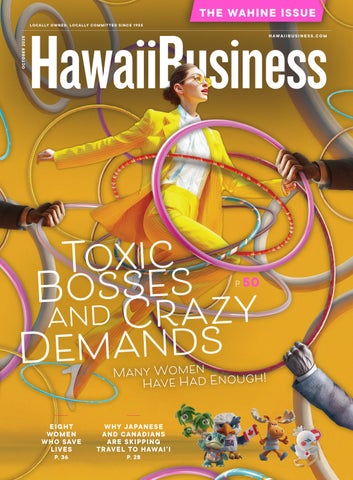
THE WAHINE ISSUE OCTO B E R 202 5
HAWAIIBUSINESS .COM
Toxic Bosses y and Craz s d n a m e D P. 50
Many Women ! Have Had Enough
E IGHT WOME N WHO SAVE LIVES P. 36
WHY JAPANESE AND CANADIAN S ARE SKIPPING TR AVE L TO HAWAI ’ I P. 28
BRINGING WOMEN LEADERS INTO THE CIRCLE Wāhine Pō‘ai, a leadership program for female executive directors of Hawai‘i nonprofits, aims to empower through peer connection. Like so many success stories over the years, the
grounded in Native Hawaiian cultural practice
Wāhine Pō‘ai program started small—in a garage.
and place.
Kilikina Mahi, a Maui-based consultant who assists
Kau‘i Kanaka‘ole, executive director of Ala Kukui,
nonprofits and community networks, says that in
a community-based nonprofit retreat center
2018 and 2019 she found herself advising a whole
in Hāna, Maui, remembers everyone looking
series of new nonprofit executive directors.
at each other and saying, “Yes, yes, exactly.
“At a certain point, I realized that all of these new
That’s what we need. When do we start?!”
executive directors were women who were in
Wāhine Pō‘ai’s first cohort of six launched in
this position for the first time,” Mahi says. “I was
January 2020, kicking off a 9-month-long series
having very similar conversations with all of them,
of get-togethers, both virtual and at Ala Kukui
wrestling with management and leadership issues. And suddenly it just seemed like we could be so much more effective, and probably happier, if we had all those conversations together.”
The program has incorporated some traditional skill-building instruction, including bringing in community leaders and subject-matter experts to speak and mentor. But the main focus has been
Mahi invited a small group of women to her garage
on creating and strengthening the pō‘ai (a circle,
for lunch, and pitched the idea: a hui of female
circuit, hoop, girdle, or group, as of friends)—a
nonprofit executive directors joining together
connection that’s intended to endure past the
to create a leadership and peer support program
9-month program length.
2 | O CTO B E R 2 0 2 5
“We can give you information all day long, but that is not really what Wāhine Pō‘ai is about,” Mahi says. “It’s about building those deep relationships and connections to help fuel the work that needs to be done.” Wāhine Pō‘ai has now established its fourth cohort of leaders, and is looking into how to grow the program organically, in a way that
“ It’s about building those deep relationships and connections to help fuel
preserves its original spirit.
the work that needs
The Hawai‘i Community Foundation (HCF)
to be done.” – Kilikina Mahi
has supported the program as a way to help advance nonprofit excellence in Hawai‘i, and recently renewed its sponsorship for the
Kanaka‘ole says that something one of the
program’s third year.
program’s cohort members said recently has
“The ability of a nonprofit organization to provide value to the community is rooted in the strength of its leadership,” says Justina Acevedo-Cross, HCF’s senior director of community strategy. “As executive leadership training programs go, Wāhine Pō‘ai is unique in that it focuses on women, it has a lot of Neighbor Island representation, it’s very adaptive to the needs of the cohort.
stuck with her: “She said [Wāhine Pō‘ai] allowed her to just be herself. Which sounds like a simple thing, but executive directors don’t get many chances to let their guard down. That ED hat is always on; you’re representing your organization, and your community. And she was able to let that down during this cohort, and connect and share in a safe circle.”
It’s about, come as you are, as you’re able, and [the program] providing support.”
hawaiicommunityfoundation.org H AWA I I B U S I N ES S | 3
QUEEN’S WOMEN’S HEALTH SERVICES
A doctor who treats me like ‘ohana.
We offer comprehensive care for women of all ages across Hawai‘i. From breast and bone health to maternity services and more, we provide optimal care through our cutting-edge diagnostics and treatments. We focus on wellness and prevention to make sure you and your ‘ohana are getting the care you deserve. We work with you to help you through some of life’s most important times. As a patient of The Queen’s Health Systems, you are a part of our ‘ohana.
SERVICES INCLUDE: • Gynecology and Obstetrics • Menopause Management • Incontinence and Pelvic Floor Conditions • Minimally Invasive Surgery • Gynecologic Cancer • Breast Health • Prenatal Care • Maternity Services • Obstetric Ultrasound • Family Planning Services • Gender Affirming Care
Scan the QR code to find care near you 4 | O CTO B E R 2 0 2 5
H AWA I I B U S I N ES S | 5
6 | O CTO B E R 2 0 2 5
H AWA I I B U S I N ES S | 7
8 | O CTO B E R 2 0 2 5
H AWA I I B U S I N ES S | 9
10 | O CTO B E R 2 0 2 5
H AWA I I B U S I N ES S | 11
10.25
FEATURES
N E M O W E V A S O WH S E V LI 28
Where Have the Japanese and Canadians Gone? An unfavorable dollaryen exchange rate and President Trump’s threats against Canada have sharply reduced visitors from those two countries, our biggest foreign sources of tourism.
36
Meet 8 Women Who Save Lives From hospitals to shorelines, meet the women who answer Hawai‘i’s most urgent calls. With compassion and resilience, they overcome stress and danger to protect residents of the state.
50
Our Cover Story: The Toxic Work Environments Women Endure An unflinching look at harassment, intimidation, and power abuse in Hawai‘i workplaces.
76
Reclaiming One of the State’s Cultural Icons – The Lei By supporting flower growers on each island, BEHawai‘i is helping to revive a cottage industry that has moved offshore.
82
Parting Shot Closing this chapter with an image that speaks beyond the portrait. As we softly retire this feature, our last image for the print edition honors women’s leadership and legacy in Hawai‘i.
PHOTOS BY AARON YOSHINO
12 | O CTO B E R 2 0 2 5
H AWA I I B U S I N ES S | 13
10.25
CONTENTS
64 A Kaua’i Doctor’s Quixotic Crusade Against Pesticides Dr. Lee Evslin warns that federal legislation could limit EPA review of scientific studies showing harmful effects from pesticides like those in Roundup, used across the state.
Editor’s Letter about our Wahine Issue A message on the Wahine Forum and the power of women in business, community and Hawai‘i. 18
Hawaii Business Magazine Excellence in Business Awards Hawaii’s top companies celebrate their success. 22
UH President Wendy Hensel Opens Up In her first in-depth interview since her January arrival, she talks about AI, UH’s future and being “an outsider.” 24
SPECIAL ADVERTISING SECTIONS Banking & Finance Report Leaders in the local banking industry discuss current financial news and trends. 71
HAWAII BUSINESS (ISSN 0440-5056) IS PUBLISHED 12 TIMES A YEAR BY PACIFICBASIN COMMUNICATIONS. ©2025 PACIFICBASIN COMMUNICATIONS, LLC. ALL RIGHTS RESERVED. ANY UNAUTHORIZED COPYING, DISTRIBUTION, OR ADAPTATION IS STRICTLY PROHIBITED AND WILL RESULT IN LIABILITY OF UP TO $100,000. EDITORIAL, ADVERTISING AND BUSINESS OFFICES AT 1088 BISHOP STREET, SUITE LL2, HONOLULU, HI 96813. TELEPHONE (808) 534-7520. POSTMASTER: SEND ALL ADDRESS CHANGES TO HAWAII BUSINESS, P.O. BOX 913, HONOLULU, HI 96808. SUBSCRIBERS NOTIFY THE SAME OFFICE. PLEASE INCLUDE NEW ADDRESS AND OLD ADDRESS (MAILING LABEL PREFERRED) PERIODICALS POSTAGE PAID AT HONOLULU, HAWAI‘I, AND AT ADDITIONAL MAILING OFFICES. SUBSCRIPTION: ONE YEAR $24.99 / TWO YEARS $34.99 / THREE YEARS $44.99. FOREIGN: ONE YEAR $53.99 (US FUNDS). FOR SUBSCRIPTION INQUIRIES, ADDITIONAL RATES, INFORMATION, NOTIFICATION OF CHANGE OF ADDRESS AND SUBSCRIPTION SERVICE, PLEASE CALL (800) 788-4230. OCTOBER 2025 VOL. 71/NO. 4
14 | O CTO B E R 2 0 2 5
H AWA I I B U S I N ES S | 15
HB EVENTS C O N N E C T W I T H H AWA I I B U S I N E S S M AGA Z I N E L O C A L LY OW N E D , L O C A L LY C O M M I T T E D SINCE 1955.
Our goal is to strengthen the local economy and help our communities thrive.
PRESENTED BY
20 25
OCTOBER 24 | HILTON HAWAIIAN VILLAGE Wahine Forum is the largest professional development conference for women in Hawai‘i. The conference is attended by top female executives, entrepreneurs, and up-and-coming leaders intent on advancing their careers.
PRESENTED BY
2025
Publisher KENT COULES kentc@hawaiibusiness.com • (808) 364-5869 Editorial Editor-in-Chief JENNIFER ABLAN jennifera@hawaiibusiness.com Managing Editor KEN WILLS kenw@hawaiibusiness.com • 808-987-8135 Senior Editor STEVE PETRANIK Senior Contributing Writer CYNTHIA WESSENDORF cynthiaw@hawaiibusiness.com Staff Writer RYANN NOELANI COULES ryannc@hawaiibusiness.com Staff Writer SHELBY MATTOS shelbym@hawaiibusiness.com Copy Editor ELROY GARCIA Editorial Intern KALENA O’CONNELL Design & Photography Creative Director JEFF SANNER jeffs@hawaiibusiness.com Graphic Designer KAREN TANIGAWA karent@hawaiibusiness.com Staff Photographer AARON YOSHINO Digital Digital Director RANDALL LIBRAMONTE randalll@hawaiibusiness.com Digital Content Manager MARIANNE LEANO mariannel@hawaiibusiness.com Sales & Marketing Account Executive YONGCHAE SONG yongchaes@hawaiibusiness.com • (808) 228-5078 Account Executive CHAZ TIOGANGCO chazt@hawaiibusiness.com • (808) 387-1672 Senior Account Coordinator REBECCA BROOKING rebeccab@hawaiibusiness.com • (808) 534-7560 Events Manager ASHLEY MCLEAN ashleym@hawaiibusiness.com • (808) 272-6550 Events Coordinator OLIVIA DE SENA oliviad@hawaiibusiness.com Circulation circulation@pacificbasin.net Connect with us on social media: Hawaii Business Magazine @HawaiiBusinessMagazine Hawaii Business is published by
NOVEMBER 22 | PUNAHOU SCHOOL A full-day conference where attendees will choose from one of four “tracks” to gain knowledge and tools to navigate the complex world of personal finance.
For more information on events, visit hawaiibusiness.com/events or contact Ashley McLean, Events Manager, at ashleym@hawaiibusiness.com 16 | O CTO B E R 2 0 2 5
Chairman DUANE KURISU Chief Executive Officer SUSAN EICHOR Chief Operating Officer BRANDON KURISU Director of Finance JADE CARREL
H AWA I I B U S I N ES S | 17
A N
O P E N
M I N D
Exploring Women’s Issues in Writing and In Person
E
ACH OCTOBER, OUR MAGAZINE SHARES THEMES WITH THE WAHINE FORUM, HAWAI‘I’S LARGEST LEADERSHIP AND CAREER DEVELOPMENT CONFERENCE FOR WOMEN. That’s
when more than 1,000 women – executives, entrepreneurs, rising leaders and young professionals – come together to learn, connect and build community. What makes the forum especially powerful is the honesty of the participants. Real women share real stories about navigating careers and life – the highs that fuel ambition and the lows that test resilience. That same spirit runs through our cover story by award-winning journalist Cynthia Wessendorf. She exposes the hard truths of many women’s careers: toxic workplaces, grueling schedules and impossible trade-offs that so many women endure, especially single mothers. Cynthia’s reporting reveals harrowing ways women are forced to walk the line between putting up with workplace harassment, low pay and disrespect – or walking away with their families’ financial stability on the line. It’s a reality that’s rarely discussed as openly as it should be. In Hawai‘i, being a breadwinner, a boss or both often means carrying an outsized burden. The state’s high cost of living magnifies every decision and makes the climb to the top feel even steeper.
“THE MOTHERHOOD PENALTY”
Numbers tell part of the story. Women make up nearly half of Hawai‘i’s workforce, yet they hold only a quarter of the top executive roles in the state’s 250 largest organizations. Among the 100 biggest organizations by revenue, just nine women occupy the chief executive seat. The pay gap is just as sobering. A UH Economic Research Organization report shows men start pulling ahead in pay during their late 20s, about the same time many women become mothers. That gap only widens with age. Economists call it the “motherhood penalty.” For women in Hawai‘i, it’s simply reality. But numbers alone can’t capture the grit and the breakthroughs. Hawai‘i is home to trailblazing leaders who prove what’s possible: Connie Lau, Susan Eichor, Susan Yamada and Catherine Ngo have set bold examples at the highest levels. Rising stars like Christine Camp, Dawn Lippert, Elisia Flores, Ann Teranishi and Su Shin are pushing industries forward while mentoring the next generation. In higher education, UH President Wendy 18 | O CTO B E R 2 0 2 5
Hensel is reshaping the state’s largest public institution with a focus on access, equity and innovation. (Please see her story on page 24.) And across every sector, other influential women are making their marks: Sherry Menor-McNamara at the Chamber of Commerce Hawaii, Dr. Kanoe Nāone with the Girl Scouts of Hawai‘i, Rolanda Morgan with Susan G. Komen Hawai‘i, Jean Boyd at HawaiiUSA Federal Credit Union and many more.
PARTING SHOT
We’re “soft retiring” a regular feature in our magazine, Parting Shot, and replacing it on the last page with a column called Trial and Error. I call it “soft retiring” because Parting Shot photographs will continue online on our website and Instagram. The last page of a magazine shouldn’t signal the end, as Parting Shot suggests; it should spark a lasting thought. With that in mind, the last page will now focus on the trials and triumphs of 20- and 30-somethings. Ryann Noelani Coules, the lead writer of this new column, told me the constant negative chatter about Gen Zers and Millennials is overblown and backed it up by sending me a New Yorker article titled “It’s Time to Stop Talking About ‘Generations.’ ” (Read it at bit.ly/3VxoH96.) Born in 1999, Ryann says she doesn’t feel particularly connected to either Gen Z or Millennial stereotypes. “There is so much variation within each generation; it’s quite silly how much emphasis we put on what each generation is supposedly like,” she tells me. So, we’re dedicating the last page in our magazine to 20- and 30-somethings – what they’re up to and what they’re thinking. I want to see and hear it all from local 20- and 30-somethings: your triumphs, your missteps, your wild ideas and even the things you can’t believe you did (include photos, too). This is your space to experiment, explain and shine – and to remind us all that the best stories are the ones we’re still figuring out. Ryann will launch the series in November and we’re hoping it starts an exciting new dialogue.
JENNIFER ABLAN EDITOR-IN-CHIEF
H AWA I I B U S I N ES S | 19
Pack more into your next Neighbor Island trip (literally) Your bag always flies free between the Islands* with Huaka‘i by Hawaiian, including golf clubs, bikes and surfboards. So whether you’re flying for business or holoholo, be sure to sign up for your free membership first at HawaiianAirlines.com/Huakai.
*First standard checked bag on Neighbor Island flights is free for any HawaiianMiles member with an address in Hawai‘i. Terms and conditions apply.
20 | O CTO B E R 2 0 2 5
SPECIAL PROMOTIONAL SECTION
WINNER
CHAMBER O F C O M M E RC E H AWA I I Sherry Menor, CCE, President & CEO As the “Voice of Business” in Hawaii, the Chamber of Commerce Hawaii is a statewide, non-profit organization whose mission is to serve as the advocate for business in Hawaii.
T
he Chamber of Commerce Hawaii is honored to be recognized in Hawaii Business Magazine’s inaugural Excellence in Business Awards, a recognition that underscores the Chamber’s 175 years of commitment to our state’s businesses, communities, and people. Since our founding in 1850, during a pivotal surge in Pacific trade, the Chamber has played a defining role in shaping the state’s economic and civic landscape. Originally created to unify local merchants and advocate for Hawaii’s commercial interests, the Chamber has grown into a dynamic force that represents 2,000 members statewide. Today, we proudly serve as the voice of business, advocating at every level of government, creating opportunities to connect, and championing initiatives that fuel growth across industries and generations. As the nation’s second-oldest chamber of commerce west of the Rockies, our legacy is matched only by our vision for the future. The Chamber is driving progress through landmark programs like the 2030 Blueprint for Hawaii, a roadmap to build a more competitive and sustainable economy; Chamber of Commerce Hawaii, a 501(c)(6) membership organization, advocates for business and drives economic growth statewide. In 1987, it established the Hawaii Chamber of Commerce Foundation, a 501(c) (3) that operates exclusively for charitable, educational, literary, and scientific purposes.
BizBoost, a federally funded initiative that provides no-cost legal, financial, and accounting support to help small businesses access federal funding; and our Education & Workforce Development programs, which strengthen career pathways and close critical skills gaps. Meanwhile, the Young Professionals Program continues to cultivate future leaders by empowering young talent to thrive and serve their communities right here at home. Last but not least, since 1985, our Military Affairs Council has championed Hawaii’s second-largest
economic driver by strengthening ties between businesses, the community, and national defense. This year, as we mark our 175th anniversary, we reflect not only on our rich history but also on the partnerships and people who have carried us forward. To join the movement and be part of the next chapter of Hawaii’s business story, visit cochawaii.org.
The Chamber of Commerce Hawaii 733 Bishop Street, Makai Tower, Suite 1200 Honolulu, HI 96813 (808) 545-4300 info@cochawaii.org www.cochawaii.org
H AWA I I B U S I N ES S | 21
BY HAWAII BU S IN E S S M AG A ZIN E STA F F
The Inaugural Hawaii Business Magazine Excellence in Business Awards
T
HE WORLD’S MOST ADMIRED COMPANIES OFTEN START SMALL.
Jeff Bezos launched Amazon out of a garage. Bill Gates and Paul Allen built Microsoft with secondhand computers in a cramped workspace. Jensen Huang, cofounder of Nvidia, once cleaned toilets at a Denny’s while putting himself through school — before leading his company to a $4 trillion valuation. What these stories show is that greatness isn’t defined by how you start, but by the vision, ingenuity, and impact you create along the way. True excellence combines innovation, leadership and a commitment to the people and communities you serve. This year, Hawaii Business Magazine launched the first Excellence in Business Awards to spotlight that same spirit in Hawai‘i. These awards are designed to recognize organizations that have achieved measurable success while also strengthening their employees, industries, and communities.
vators to cultural nonprofits, these organizations are united by their commitment to excellence. Among the honorees: 535 PLUMBING LLC, a family-run
business delivering reliable, sustainable plumbing solutions across O‘ahu, guided by aloha, kuleana, and laulima. ALOHA COLLECTION, which brings
Hawaiian culture to life through fashion and lifestyle products while fostering local artisan partnerships. B ● AYADA HOME CARE, providing
HOW HONOREES WERE SELECTED
In this inaugural year, companies and nonprofits across the state were invited to share why they should be recognized as one of Hawai‘i’s most excellent businesses. Applicants submitted essays of up to 500 words highlighting their stories of success, growth, and community impact. They were asked to reflect on: • Financial success and growth • Employee engagement, retention, and workplace culture • Community impact and philanthropy • Diversity, equity, and inclusion practices 22 | O CTO B E R 2 0 2 5
Alongside their essays, organizations submitted business details and contact information. A panel of editors and advisers then carefully reviewed every submission, looking for not only strong numbers but also the leadership, creativity, and values-driven practices that distinguish truly excellent businesses.
THE 2025 HONOREES
The first class of Excellence in Business honorees represents the diversity and resilience of Hawai‘i’s economy. From family-owned plumbing companies to global hospitality brands, from tech inno-
compassionate in-home healthcare services for families across the islands. BEAUTY WORKS STUDIO, a locally
owned salon emphasizing skill, service, and community connection. BOWERS + KUBOTA CONSULTING, a
leader in architecture, engineering, and construction management, delivering projects that strengthen Hawai‘i’s communities. CHAMBER OF COMMERCE HAWAII,
celebrating 175 years as the Voice of Business, strengthening Hawai‘i’s economy through advocacy, workforce development, and civic engagement.
COLDWELL BANKER REALTY, delivering
trusted real estate services with a focus on community investment and sustainable growth. CORTEVA AGRISCIENCE, advancing
agriculture with innovative solutions that support Hawai‘i’s farmers and sustainability goals. FAMILY MEDIATION HAWAII, fostering
harmony and conflict resolution for families across the islands. HAWAI‘I TALENT ONBOARDING PROGRAM (HITOP) BY MOVERS & SHAKAS,
streamlining workforce integration for new hires while strengthening local businesses. IQ 360, a nationally recognized
consultancy pairing world-class strategy with Hawai‘i values of humility, respect, and community. JANI-KING HAWAII, providing commer-
cial cleaning services with a focus on quality, reliability, and workforce development. JAPAN-AMERICA SOCIETY OF HAWAII,
promoting cultural understanding and partnership between Hawai‘i and Japan. KAHALA NUI, a healthcare and senior
living organization prioritizing wellness, compassion, and community engagement. MAUNA LOA HELICOPTERS, delivering
unforgettable experiences while emphasizing safety, sustainability, and island stewardship. MID-PACIFIC PEST CONTROL OF HAWAI‘I, a family-founded, locally
rooted company safeguarding homes, businesses, and communities with trusted pest management solutions across multiple islands.
NORTHWESTERN MUTUAL HAWAI‘I,
UHA HEALTH INSURANCE, offering
OCEAN SPORTS, a multi-generational
WAI ORG INC (DBA WAI: WASTEWATER ALTERNATIVES & INNOVATIONS), creating
guiding families and businesses with financial planning solutions while fostering local growth and community impact.
ocean recreation company combining entertainment, education, and workforce development.
accessible healthcare coverage while supporting community health programs.
sustainable water solutions to protect Hawai‘i’s natural resources. THE SYSTEMCENTER, a trusted com-
OUTRIGGER HOSPITALITY GROUP, a
hospitality leader integrating cultural stewardship, guest experiences, and community engagement. TAIKOBO HAWAII INC / MAUNA KEA SUNSET TOUR, delivering immersive cultural
and natural experiences while promoting sustainability.
TERRAFORMATION, advancing reforesta-
tion and environmental restoration initiatives across Hawai‘i.
mercial furniture dealership with 50 years of expertise in creating beautiful and functional workspaces. Just as Amazon, Microsoft, and Nvidia remind us that world-changing companies can emerge from humble beginnings, Hawai‘i’s first class of Excellence in Business honorees prove that innovation, vision, and community-minded leadership define true greatness — right here in the Islands. H AWA I I B U S I N ES S | 23
BY J ENNIFER A B L A N
UH President Wendy Hensel on Listening, Innovating and Reimagining the Classroom She says that when she arrived in Hawai‘i, “I think there was some concern that I would not understand the state and the needs of the university. I deliberately slowed down with the campuses and spent the time to really listen. That was extremely helpful.”
F
OR YEARS, A COMPUTER SCIENCE DEGREE WAS CONSIDERED A GOLDEN TICKET TO A SECURE CAREER. Just ask UH
System President Wendy Hensel: Her son graduated with one in December. Yet instead of stepping into a market overflowing with opportunity, he entered a field being reshaped by artificial intelligence and offering few entrylevel jobs for CS grads. “Five years ago, everyone would have told you that’s the safest possible degree you can get, that it’s hot,” she says. “And of course, these folks are struggling.” Watching her son enter a fast-changing labor force has reinforced her belief that higher education must go beyond preparing students for their first job. She argues it should equip them for a lifetime of profound change against the backdrop of AI and digital transformation, geopolitical volatility, climate change and generational shifts in values. In Hensel’s view, the future will reward those who pair technical expertise with enduring, human-centered “soft” skills –
24 | O CTO B E R 2 0 2 5
problem-solving, adaptability and critical thinking – essential for navigating a world in flux. “It really, in many respects, is the rebirth of the humanities,” she says. “How do you continually learn, acquire information, and work through ambiguity and fast, furious change in a way that lets you be successful? We are no longer preparing people for a single skill set that they then employ for the rest of their lives.” This blend of pragmatism and optimism has already begun shaping Hensel’s early tenure at UH. She enlisted Guy Kawasaki, who popularized the term “technology evangelist” at Apple in the 1980s and 1990s and played a key role marketing the original Macintosh. Kawasaki has since become a best-selling author and an evangelist for Canva, the online design platform co-founded by Melanie Perkins, who famously faced more than 100 investor rejections before turning her idea into a multibillion-dollar business. At UH, Kawasaki serves as an advisor to Hensel and together they are working on new digital initiatives. He is also “a resource
“
PEOPLE HERE RECOGNIZE THAT MY SUCCESS IS THE UNIVERSITY’S SUCCESS IS THE STATE’S SUCCESS.”
to faculty on strategic uses of AI across academics, research, and operations,” according to the university system’s website. Hensel herself leans naturally into the digital age – chatting in a YouTube interview with her new dog, Phoebe, nestled at her side (which she reposted on LinkedIn, commenting, “Phoebe and I were interviewed!”) – or appearing in an Instagram reel from the UH Mānoa Alumni Makers’ Market at The Royal Hawaiian. Hensel is equally comfortable in the classroom, online or at community events. She welcomed students
PHOTOS COURTESY: WENDY HENSEL
back to campus, which was documented in a video posted on X, the platform formerly known as Twitter (https://x.com/UHPresident/status/1960530284035588309) In fact, the volume of her public appearances suggests she has been UH president for years, though she has been in the role since January 1, 2025.
THE ‘OUTSIDER’
When I first met Hensel on the lush Mānoa campus this summer, she exuded both candor and curiosity as we talked about many topics, including her life and career, the future of UH and the current era of global digitization. Born in Grand Rapids and raised in Michigan, Hensel initially found being an “outsider” in Hawai‘i to be a challenge. “I think there was some concern that I would not understand the state and the needs of the university,” she says. “So, I deliberately slowed down with the campuses and spent the time to really listen. That was extremely helpful.” Over several months, she visited all 10 UH campuses and five satellite education centers to hear “what people wanted me to know, what was important to them, what they thought wasn’t working well, and where some of the big opportunities were in the days ahead. That was really invaluable.” Overall, “People care about universities in general, but the people here recognize that my success is the university’s success is the state’s success,” she says. Hensel brings an impressive resume to the role. She previously held leadership positions at The City University of New York and Georgia State University. As executive vice chancellor and university provost at City University, she oversaw student and faculty experiences across its 25 campuses. At Georgia State, she was provost and senior VP for academic affairs and dean of the college of law. A cum laude graduate of Har-
WENDY HENSEL AND PHOEBE
vard Law School, Hensel earned her bachelor’s degree with highest honors from Michigan State University as a Harry S. Truman Scholar and Supreme Court intern. She has spoken candidly about a turning point in her life: the loss of her first husband. “He had just turned 40 and was actually in great health at the time of his death,” she revealed in a Q&A for UH students. “I was with him when it happened. I had a 9-year-old son with autism and an 11-year-old daughter at the time. That horrible event shaped me into who I am today.”
“I always have my priorities straight. People often ask, ‘How do you stay so calm under pressure?’ The answer is, I know who I am, I know what’s most important, and I keep my eye on the ball. That grounds me,” she says. “Nothing could possibly be harder, I don’t think, than what I’ve already experienced. That kind of tragedy teaches you to treasure the present.” She remarried, and together with her husband, Kenton, is the parent of four children – two her own and two gained through marriage.
H AWA I I B U S I N ES S | 25
REIMAGINING THE CLASSROOM
Hensel believes universities must rethink how they deliver education in a rapidly evolving, globally competitive environment. “The University of Hawai‘i stands as a true research powerhouse and a beacon of excellence but at an affordable cost,” she says. The Carnegie Foundation recently reaffirmed UH Mānoa’s standing as an R1: doctoral university – very high research activity, the top tier of research institutions in the country, in its February 2025 update. The designation highlights the university’s role as a hub for cutting-edge discovery and innovation. (See the foundation’s assessment of each of the four UH four-year campuses at tinyurl.com/UHassess.) UH’s internationally recognized research spans ocean, earth and environmental sciences; astronomy; tropical agriculture and sustainability; health sciences and medicine; Pacific Island and Asian studies; engineering and artificial intelligence. Among their innovations, UH researchers developed a new AI tool that simplifies exploration of complex geoscience data, from tracking sea levels on Earth to analyzing atmospheric conditions on Mars. That work was published in the Journal of Geophysical Research: Machine Learning and Computation. For Hensel, innovation also means reimagining the classroom. Rather than focusing solely on traditional degree programs, she envisions a more flexible, techrich model that could include audio, visual and other specialized courses similar to those offered at peer institutions such as Full Sail University, NYU Steinhardt, and Carnegie Mellon University. Full Sail, for example, offers technology-focused degrees in areas like information technology, cybersecurity, software engineering, artificial intelligence and extended reality.
26 | O CTO B E R 2 0 2 5
“It really starts with delivering education or training at the level the student needs, at the moment they need it,” Hensel explains. “That could be anything from a single day of in-depth training to a certificate, to eventually a broader degree.” She argues the current academic calendar is outdated, built on an agrarian model where students take summers off and study in fixed blocks of time. “When people want to learn something, they’re ready to go,” she says. “We need to be responsive to that and much more flexible and nimble in how we deliver content and expertise.” A one-day training session, she notes, could easily evolve into a full certificate program for students seeking to expand their skills. “It’s really an existential threat if we can’t evolve quickly enough to meet the needs of the moment,” Hensel adds.
ADVICE FOR WOMEN
Asked to reflect on her leadership style, Hensel doesn’t hesitate. “The most powerful lesson has been to be your authentic self,” she says. “Not what someone else thinks you should be, or who, as a woman you must be in order to be successful.” She refuses to mold herself to others’ expectations. “It was never worth it to twist myself into knots – trying to be gentle or overly authoritative,” or meet some socially constructed expectation of what a woman should be, she says. Hensel recalls her early days in law, a profession still dominated by men. Colleagues valued her work but were less comfortable with her authority. “People are happy to have you do the work,” she says. “They’re less happy to have you be the boss.” That tension followed her into leadership. In one 360-degree
“
IT’S REALLY AN EXISTENTIAL THREAT IF WE [U.H.] CAN’T EVOLVE QUICKLY ENOUGH TO MEET THE NEEDS OF THE MOMENT.”
review, she was labeled “intimidating.” At first, she was puzzled. “It was a woman who was delivering the review. I said, ‘Either you have to identify what behavior you believe or they are identifying as intimidating, or this is the same kind of sexist trope that’s out there in the universe – that simply by being a woman in a position of authority and exercising that authority, it creates intimidation.’ She looked at me and started laughing. She said, ‘You’re absolutely correct about that.’ ” Hensel stresses that she welcomes constructive feedback and is always striving to grow as a leader. But she’s learned to recognize when criticism is more about others’ discomfort with women in authority than about her own behavior. “You have to know yourself well enough to say, that’s not about me. That’s an issue other people have. And I will not change who I am to appease it.” Her message to women and leaders is that you can’t be effective if you’re not yourself. Find your voice, don’t be afraid of it, and use it responsibly.
H AWA I I B U S I N ES S | 27
BY KEN WILLS ILLUSTRATION: JEFF SANNER
Foreign Pillars of Hawai‘i Tourism are Teetering
Hawai‘i’s biggest industry is scrambling to react to a drop-off in visitors from the top two foreign sources of tourists – Japan and Canada. The causes of the downturn are different in each case, but the simultaneous blow could affect business prospects during peak winter months. 28 | O CTO B E R 2 0 2 5
H
AWAI’I’S TOURISM JUGGERNAUT HAS LONG BEEN SUPPORTED BY FOREIGN VISITORS FROM JAPAN AND CANADA, BESIDES U.S. MAINLAND TOURISTS. Now, in a confluence of events
outside the state’s control, visitor numbers from those two countries are in a simultaneous, and worrisome, decline. Tourism is the state’s biggest industry and accounts for about 20 percent of the Islands’ economic activity. For Japanese tourists, the U.S. dollar’s high exchange rate against the yen has boosted the cost of a Hawai‘i vacation. The yen has been in a broad weakening trend against the U.S. dollar since 2021, caused by a mix of U.S. tariff threats, divergent monetary policies between the two countries’ central banks, as well as years of wage and price stagnation. While a weak yen has helped Japan’s export-led industries, it also has made travel to Hawai‘i a budget-busting prospect for many Japanese families. As if that weren’t enough, President Donald Trump caused a self-inflicted wound on U.S. tourism even before officially taking office. Thousands of Canadian citizens are boycotting U.S. travel after he repeatedly insulted their national pride, threatening to subjugate our northern neighbor as a 51st state. Even if the threat of annexing Canada was only a rhetorical flourish in a larger tariff-negotiating ploy, Canadians interpreted Trump’s posturing as an unforgivable slight: Voting with their pocketbooks, many are now avoiding travel to the U.S. entirely, including the previous popular destination among the frost-bitten throngs — our tropical 50th state.
Those twin threats have left Hawai`i’s hotels, restaurants, airlines, tour guides and travel services — and all the trickle-down businesses and employees that benefit from tourist spending — scrambling to adapt to the lull during the summer. Peak winter tourism months ahead could be even bleaker. In the articles that follow, Hawaii Business Magazine takes a closer look at the causes and impacts of tourism declines from Japan and Canada and highlights local efforts to lure reluctant travelers so businesses can weather the approaching storm.
H AWA I I B U S I N ES S | 29
BY RYANN NOELA N I C O UL E S ILLUSTRATION: JEFF SANNER
Canadian Tourists are Boycotting the U.S. Here’s What That Means for Hawai‘i
C
ANADIANS HAVE LONG BEEN HAWAI‘I’S SECONDLARGEST SOURCE OF FOREIGN VISITORS, BEHIND JAPAN, BUT THIS YEAR MANY ARE STAYING HOME OR CHOOSING OTHER DESTINATIONS.
The reasons are varied, but the main one was largely avoidable – President Trump’s pugnacious comments aimed at Canada’s leaders, but even more importantly, at its 41 million citizens. In the first seven months of the year, more than 245,000 Canadians came to Hawai‘i, down 9.4% from the first seven months of 2024 and 27.3% from the first seven months of 2019, the last year before the pandemic interrupted normal tourism patterns, according to the Department of Business, Economic Development and Tourism. Although the Islands receive far more Japanese visitors (an estimated 288,168 more in 2024, according to data from the Hawai‘i Tourism Authority), Canadians are “oftentimes registering ahead of Japan in relation to some of the key performance metrics,” says Colin Wood, a Canadian citizen and senior account director at Hawai‘i Tourism Canada. For instance, yearto-date July 2025 data published by the HTA indicates that Canadian visitors’ average stay of 11.36 days is nearly double that of Japanese visitors, who average 5.99 days. 30 | O CTO B E R 2 0 2 5
HTA also estimates that in the first seven months of 2025, Canadian visitors spent $635.3 million while Japanese spent $551.7 million. That works out to about $2,590 per person per trip for Canadian visitors versus $1,472 per person per trip on average for Japanese tourists. “So it’s interesting, right?” says Wood. “Because I think the perception is that Japan is leaps and bounds ahead of Canadians in terms of visitation and spend and all those metrics, but that’s not always the case.” Still, the amount of money spent by Canadian visitors in the first seven months of 2025 is down 4.9%, from $668.3 million in the same period of 2024, and 7.5% lower, from $686.1 million in 2019. That’s a deficit already being felt by hotels, restaurants and other businesses in the tourism industry. Even more worrisome – the normal peak period for Canadian tourists is the upcoming winter season. A few local restaurateurs emailed impact statements to Hawaii Business via the Hawaii Restaurant Association. Mike Palmer, managing partner of Kuhio Avenue Food Hall, wrote: “We have noticed a decline in tourism, including a drop in Canadian tourists. From my understanding there has been about a 5-6% drop in Canadians visiting Hawai‘i compared to last year, and we have noticed that drop at restaurants, especially in Waikīkī. This is in addition to a
decrease from other countries such as Korea (-8%) and Australia (-10%) compared to 2024.” Javier Barberi, owner of Mala Ocean Tavern in Waikīkī and Coco Deck Lahaina and Pizza Paradiso on Maui, stated: “Recent Hawai‘i Tourism Authority figures show Canadian visitor arrivals to Maui remain significantly lower (April 2025 was down 28% compared to April 2019) and while Canadians spend more per day on average when compared to the average [in 2019], the reduced numbers have translated to fewer seatings, especially in our breakfast and lunch service. Our restaurant has seen a notable decline in Canadian visitors this year, and we have been working hard to ensure that they go home with great memories to share with their neighbors.”
ZOOMING OUT
It’s not just Hawai‘i – all of the U.S. is experiencing a decline of Canadian tourism. According to new data from Statistics Canada, Canadian road trips to the U.S. – their primary mode of entry – fell by 33% this June compared to June 2024, following a 38% decline in May. Air travel from Canada also saw a 22% year-over-year decrease. June marked the sixth consecutive month of sharp drops in Canadian inbound travel, with double-digit
year-over-year declines in both car and air travel to the U.S. every month since April. While the unfavorable exchange rate plays a role ($1 CAD / $0.73 USD at the time of publication), escalating geopolitical tensions appear to be the primary driver behind Canadians staying away. These tensions stem from various actions and statements by the Trump administration. For instance, on July 10 President Donald Trump announced a 35% tariff on Canadian goods, effective August 1, citing a purported “flow of fentanyl” across the border as justification. The latest friction in the ongoing tariff negotiations emerged after Canadian Prime Minister Mark Carney’s July 30 announcement that Canada will join France and the United Kingdom in recognizing a Palestinian state at the United Nations General Assembly in September. President Trump swiftly responded on his social media platform the following day, posting, “Wow! Canada has just announced that it is backing statehood for Palestine. That will make it very hard for us to make a Trade Deal with them.” But the tone was set much earlier by Trump’s recurring annexation rhetoric, including this comment made during a Fox News interview in June: “Frankly, Canada should be the 51st state, they really should. Because Canada relies entirely on the United States, we don’t rely on Canada.” Trump has also publicly made jabs at Canadian leadership, such as referring to then-Canadian Prime Minister Justin Trudeau as “governor” of the “Great State of Canada.” Such sentiments have been echoed by other U.S. officials, further exacerbating the strained relationship.
DÉJÀ VU
Some Canadians feel an affinity for Hawai‘i because of its own history of having its sovereignty forcibly trampled. Trump’s rhetoric about Canada becoming the “51st state” evokes injustices that led to Hawai‘i becoming the 50th. The Hawaiian Kingdom, a globally recognized sovereign nation with its own constitutional monarchy and diplomatic ties, was overthrown in 1893, led by a small group of American and European businessmen with the support of U.S. Marines. Their aim was for U.S. annexation. The overthrow was investigated in The Blount Report, commissioned by President Grover Cleveland, which concluded that the United States was complicit in the lawless overthrow of the legitimate, peaceful government of Hawai‘i. With President Cleveland’s opposition, the first two annexation treaties failed in the Senate. In 1897, two Hawaiian organizations actively resisted the third annexation attempt: The Hui Kālai‘āina gathered 17,000 signatures petitioning for the monarchy’s restoration, while the Hui Aloha ‘Āina
collected approximately 21,000 signatures protesting annexation. The 1896 census recorded 39,504 Native Hawaiians, and even accounting for the significant number of people who may have signed both petitions, these documents provided evidence that the majority of Native Hawaiians did not consent to the overthrow of their homeland’s leaders. Their resistance was disregarded when President William McKinley signed the Newlands Resolution, leading to the unilateral annexation of Hawai‘i in 1898. Hawai‘i became the 50th state in 1959. Given that history, new threats of annexation of Canada can’t easily be dismissed as theoretical.
“ELBOWS UP”
Polls indicate that Canadians’ favorable outlook toward the U.S. is plummeting. One survey, published by Gallup in August, found that just 15% of Canadians approved of U.S. leadership, while 79% disapproved. This unfavorable view is higher than that for China’s leadership, which stood at 64% disapproval, and is only PHOTO COURTESY OF JEAN MCRAE
BRITISH COLUMBIA RESIDENTS JEAN MCRAE AND HER HUSBAND ANDRÉ ENJOY A MEAL DURING THEIR LAST TRIP TO HAWAII ISLAND.
H AWA I I B U S I N ES S | 31
slightly better than the 82% disapproval rating for Russia’s. Merchandise emblazoned with slogans like “Canada is Not For Sale” and “Elbows Up” (a hockey defensive tactic symbolizing a defiant stance and readiness to push back) are gaining popularity in Canada. A growing number of Canadians are now boycotting U.S. tourism and goods, instead opting to explore their own country or other parts of the globe and making a concerted effort to buy more Canadian products. A Longwoods International study conducted in April found that 60% of Canadians are less likely to travel to the U.S. in the next year due to current American policies, trade practices and political statements. Of those, 36% had already canceled planned trips. “The main reason why Canadians are upset is really the ‘51st state’ rhetoric and [Trump] threatening to annex our country,” says Canadian YouTuber Guard The Leaf, who said he didn’t want to reveal his name on his popular channel because of safety concerns. After hearing stories about foreigners being detained, interrogated and deported upon arriving at American airports, Guard The Leaf says he doesn’t want to risk being detained simply because he runs a channel critical of Trump and his policies. Despite the boycott, he says he might need to cross the border “whether it’s a family emergency or something, because,” like many Canadians, “I do have friends and family in the U.S.” His channel bio, in part, reads, “Guard The Leaf is a proudly Canadian voice covering the rising tensions between Canada and the U.S., from trade and tourism to sovereignty and survival. If it affects Canada, we talk about it. This channel is about standing up for Canadian independence, calling out disrespect, and making sure our side of the story gets told, because no one else will.” Since posting his first video in late April, he’s already uploaded more than a hundred videos and amassed over 63,400 subscribers as of September 3. 32 | O CTO B E R 2 0 2 5
Guard The Leaf frequently uploads videos about the decline of Canadian tourism in America, commenting on news footage that reports on what’s driving the decrease and its impact on different destinations’ economies, including videos specifically on Maine, Buffalo, Las Vegas, Florida and, yes, Hawai‘i. “The media is portraying it as being a tariff issue or the currency exchange. But if that’s what the message is being delivered, then many U.S. citizens may not know that we’re actually pissed off with the annexation and 51st threats,” he says. When asked how Trump’s second term compares to his first, Guard The Leaf says, “It’s 100% different. I mean, during his first term, I was still going to the U.S. Yes, he did impose tariffs on us and there were things going on, but it wasn’t to this extent.” Guard The Leaf acknowledges in his video titled “Hawai‘i’s Tourism in CRISIS Without Canadian Visitors” that although Hawai‘i is “considered a solid Democrat stronghold, ... they’re not putting enough pressure where it matters – on Washington.” He says his decision not to travel to Hawai‘i for the foreseeable future hit especially hard as he and his family used to frequently travel here. “My first visit was in 2010. When I came, there was something about Hawai‘i, the people and just the nature, that I loved it the second I got at the airport.” Guard The Leaf’s fondness for the Islands even led to him and his wife deciding to get married on O‘ahu in 2018. Regardless, he still doesn’t feel comfortable coming back anytime soon. “Every state in the U.S., including Hawai‘i,” has “Republican supporters, and not all of them, but you know, there are still going to be supporters that are going to be repeating the rhetoric and annexation threats and whatever else, right?” For a video titled “Canadian Tourists Are Spending Elsewhere Now, Here’s Proof,” Guard The Leaf asked viewers who had canceled or scrapped planned trips to the
U.S. to comment where they are going instead and how much money they’ll be spending elsewhere. Several comments featured in that video highlighted money originally earmarked for Hawai‘i trips being redirected elsewhere: – “Cancelled our trip to Hawai‘i. Spending that $10,000 + to take Via Rail to Montreal and Quebec City.” – “My wife and I have gone to Maui 9 times in the last 10 years. We will not step foot into the U.S. and spend our money there until the orange clown is out of the White House. This year we are going to the Philippines.” – “We cancelled a trip to Hawai‘i and went to Bali. Hawai‘i lost $36k.” – “Cancelled my trip to San Diego and Hawaii. We are currently travelling in Amsterdam and the UK instead. I estimate we will be spending about $14,000 to $15,000.”
A SPECIAL CASE?
On the bright side, Hawai‘i is enduring the Canadian boycott on U.S. tourism better than most other American destinations. “Currently, the statistics are telling us that there’s a range of U.S. travel by Canadians that has been reduced between 20 to 30%, depending on the metric,” but there’s been “a considerably smaller downturn when we talk about Canadians visiting Hawai‘i” says Wood. He attributes this to the popular perception that the Islands have both a geographical and cultural separation from the rest of the States. “I think Canadians’ considerations around travel to Hawai‘i are different because they appreciate that the destination is different,” says Wood. “One of the things that I found myself using in relation to language when we’re communicating out about Hawai‘i within the Canadian market is we refer back to ‘the Aloha spirit’ and the welcoming nature of Hawai‘i and Hawaiians. ... It seems within the Hawaiian DNA to be
welcoming, to encourage positive experiences from mindful travelers that are coming to Hawai‘i.” Hawaii Business spoke to one Canadian couple still planning to visit the Island of Hawai‘i in November for their third time. Jean Mcrae, a retiree from British Columbia, says her past two trips have “been very pleasant. ... It’s an easy holiday. People are very friendly, and the service is nice.” McRae says she feels Canada-U.S. relations are “a bit strained” because of the tariffs and “accusations and comments that have been leveled, mostly by the President but also by others, against Canada.” This has led her and her family to alter some of their decision-making. “We actually just returned from a trip to the Yukon. Originally, we had plans to go to Alaska, but we decided that we wouldn’t do that this time.” But McRae says visiting Hawai‘i feels different than other parts of the U.S. for a few reasons. “Part of it is the distance from the mainland United States,” she says, and the culture feels different, too: “I think the indigenous Hawaiian presence, that’s something that, you know, we’ve enjoyed very much. ... I think it’s also the politics. The fact that it’s a Democratic state makes it feel a little less like we might run into any problem.” She says she plans on spending about $6,000 to $7,000 on her upcoming trip.
SNOWBIRD SEASON AND BEYOND
Looking ahead, the decline of Canadian tourists may hit Hawai‘i harder. That’s because the most popular season for Canadians to travel is winter, when ‘snowbirds’ flock to warm-weather places to escape the cold. “Canadians tend to come at times when it’s going to be the shoulder season in relation to U.S. visits. It’s a little different from the Japanese visitation pattern,” says Wood, so Canadian tourists are seen as especially import-
ant “because they kind of balance out the overall visitation over the course of the year.” During a follow-up conversation with Guard The Leaf, he mentioned that he’s heard some of his compatriots say they are following through with trips to the U.S. booked before geopolitical tensions escalated, because cancelling the trips would be too costly. He anticipates that once these pre-scheduled trips conclude by year-end, Hawai‘i and the broader U.S. will likely experience an even sharper decline in Canadian tourism in 2026. In one promising sign, Wood noted: “WestJet, one of the two major Canadian airlines bringing Canadians to Hawai‘i, has released its winter flight schedule and has increased its total seats to Hawai‘i while reducing capacity on many continental U.S. flights. I see that as a very positive sign that they are anticipating a stronger winter for Hawai‘i visits from Canada.” However, the outlook is not entirely positive. Sean Dee, EVP and Chief Commercial Officer at OUTRIGGER Hospitality Group, said in an email that the company’s Hawai‘i resorts and hotels had a strong start to the year before conditions changed. “Q1 2025 performance exceeded the same period in 2024, signaling robust early-season demand. However, recent developments, including the announced tariff, have led to elevated cancellations from April onward. Additionally, forward bookings for the upcoming core Canadian travel season (November to April) are pacing slower, indicating potential softening in the months ahead. This trend is more specific to our Hawai‘i portfolio, as our other international markets are not experiencing the same headwinds at this time.” Dee states that although Canadians constitute a “relatively modest portion” of their business, making up 5% of their guests on O‘ahu, 2.8% on the Island of Hawai‘i, 3% on Maui and 2.3% on Kaua‘i, “it remains a valued and strategic audience. We’re
actively monitoring these trends and adjusting our approach to help re-engage Canadian travelers in the months ahead.” He says this includes collaborating with their “airline and wholesale partners to create compelling offers tailored to this audience. Whether through seasonal promotions, exclusive vacation packages or coordinated campaigns with travel trade partners, we’re focused on keeping Hawai‘i top-of-mind for Canadians considering a warmweather escape.” For the upcoming winter season, the hotel chain is hoping to entice Canadians to Hawai‘i’s warmer climes with a lineup of home-grown entertainment. “Last December, we were proud to debut ‘Auana, the first-ever resident Cirque du Soleil show in Hawai‘i, hosted at our craft property, OUTRIGGER Waikīkī Beachcomber Hotel,” Dee noted. “With Cirque’s global headquarters in Montréal, we see this as a special full-circle moment, welcoming a world-class Canadian cultural brand to the heart of Waikīkī. It’s an exciting new chapter in Hawai‘i entertainment and one more reason we invite our Canadian guests to rediscover the Islands with us.” Outstanding beaches, targeted entertainment and vacation package deals may not be enough to draw many Canadians back to the U.S. Asked if he has any advice for tourism leaders and public officials to navigate the situation, Guard The Leaf offered this response: “I’ll be honest, I think it’s a little too late, but if they do want to see if they can get Canadians and international tours back, you have to be insistent here, right? “I know your bottom lines are hurting, but you have to be able to sympathize with why we are actually boycotting. Make sure that you’re addressing the real problem and sympathizing with Canadians, versus trying to convince us and sell us to come back.”
H AWA I I B U S I N ES S | 33
BY SHELBY MAT TO S ILLUSTRATION: JEFF SANNER
What Will Lure Japanese to the Islands When Costs Soar? Maybe Genki Balls?
J
APANESE TOURISTS JOIN LOCAL RESIDENTS TO FLING SMALL BALLS CONTAINING BACTERIA AND YEAST INTO THE ALA WAI CANAL that defines the
northern edge of Waikīkī. These so-called “genki balls” are designed to kill the organic matter that fills the canal and causes unpleasant odors. The activity, organized by Hawai‘i Tourism Japan and a Japanese-based travel company, aims to give Japanese tourists a stake in preserving the places they love to visit. “Responsible tourism works because Japanese understand island nations,” says Eric Takahata, Managing Director of Hawai‘i Tourism Japan. “Groups and incentive travelers want to do more corporate social responsibility and give back.” It’s one of a few strategies that local and Japanese companies are deploying to bring more Japanese visitors to Hawai‘i. For decades, Japanese travelers have been a vital source for Hawai‘i’s tourism industry, but in recent years, the flow of visitors from Japan has slowed. Now, Hawai‘i’s tourism leaders are working to rewrite the playbook by targeting younger travelers and harnessing the power of social media in hopes of rekindling Japan’s love of the islands despite a weak yen. The recent decline in visitors echoes prior downdrafts. In 2019, nearly 1.5 million Japanese tourists 34 | O CTO B E R 2 0 2 5
visited Hawai‘i. By 2024, that figure had plummeted to just over 720,000, and forecasts for 2025 predict a 20,000 decrease. The main reasons cited by tourism officials are the weak yen rate, continuously rising travel costs and lingering aftershocks of the pandemic. According to JTB Tourism Research & Consulting Co., more Japanese residents are now choosing destinations such as South Korea, Thailand and the continental United States over Hawai‘i. “The consumers in Japan will continue to look at Hawai‘i as the top destination that they want,” says Ted Kubo, President and CEO of JTB Hawai‘i, the state’s largest travel company for Japanese visitors. “The problem is figuring out how to bring the tourists back.” JTB Hawai‘i is adapting by meeting travelers where they are – online. The company has ramped up its presence on YouTube and Instagram, showcasing the islands’ beauty and culture to a new generation of Japanese consumers. The travel company offers hotel, transportation and flight packages. Japanese flights to Hawai‘i increased in frequency from late spring into the summer of 2025, with All Nippon Airways resuming daily flights and some incremental upgrades by Japan Airlines. Kubo says that while he cannot disclose visitor numbers, he predicts that online promotions will show an
increase by the end of the year. While visitors were cautious at the beginning of the year, he says that August through October numbers show more activity. “I hear this from other companies in the industry as well, this springtime wasn’t very active,” he says. “Back then, there were discussions about this new administration coming up with tariffs, and people didn’t know how that would play out in their corporate environment. “And when the economy is uncertain, then consumers, due to the uncertainty, kind of wait and see, not spending a lot of money…. “People’s behavior has changed,” Kubo adds. “People’s experiences have changed. It is important for Hawai‘i to be on top of their mind, in every consumer’s mind, when they consider overseas travel.” But the financial barriers are steep; Japanese visitors today are paying nearly twice as much for their trips compared to pre-pandemic years, Kubo says, primarily due to the unfavorable exchange rate. While first-time visitors often report that their trips exceed expectations, repeat travelers, who make up more than 70% of the market, are harder to impress and retain. The DBEDT’s 2025 forecast is cautious and predicts that Japanese arrivals aren’t expected to surpass 2019 levels until 2030. “The Japan market has been kind of recovering in 2025, but
it’s been a long road since the pandemic,” says Jennifer Chun, Director of DBEDT Tourism Research. “We see a negative growth for Japan in 2025, but we do expect that the situation with the federal government and our international relations with all the countries, including Japan, should normalize in 2026, [even] 2028.” Social media, famous landmarks and movies filmed in Hawai‘i remain powerful lures for visitors. A recent DBEDT study found that 40% of Japanese visitors cited these influences in their decision to visit O‘ahu. In April 2025, there were 393 scheduled flights from Japan to Hawai‘i, offering 110,945 seats which was an increase in flights but not in capacity. “For Japan, Hawai‘i is still a very much desired destination, it’s just harder for them to come,” Chun says. “It’s not that they don’t want to come versus Canadian visitors who have said that they don’t want to go to the U.S.” The competition for Japanese tourists is fiercer than ever. Guam and Okinawa offer similar tropical experiences at a lower cost. Mitsue Varley, country director for Hawai‘i Tourism Japan, says that direct flights to more of the island chain, especially Hawai‘i Island, could help attract more visitors. She works with airlines and wholesalers to develop new travel products tailored for the Japanese market. There isn’t much that can be done in Hawai‘i about the Japanese yen rate, so Hawai‘i Tourism Japan, under contract with the Hawai‘i Tourism Authority, is focused on keeping the market open through partnerships with airlines, hotels and attractions. Campaigns like “Yappari Hawai‘i” (“Gotta Be Hawai‘i”) use a multimedia approach, racking up nearly 90 million impressions in 2024 alone. With splashes of Waikīkī beach and the big whale from Bishop Museum, one of the most viewed videos of this campaign features a multi-generational family enjoying
the sights. A young couple brings their children and parents around O‘ahu. The short video with 6.2 million views depicts how Hawai‘i can be a destination location that is fascinating for visitors with young kids or adults. The Malama campaign, meanwhile, leans into regenerative tourism highlighting how visitors can give back to the land, and collaborates with Instagram influencers, children’s book publishers, and skincare brands to promote Hawai‘i’s culture and natural beauty. But while Japanese people spend more per trip, their stays are getting shorter. Varley believes the focus should be on attracting so-called “quality tourists” rather than focusing on overall numbers. “Japanese visitors are ideal, and people who are coming currently are ideal visitors,” she says. “The Japan market is over 70% repeat visitors, so we need to increase the first-timers.” Varley says the Sister City Summit, where 33 Japanese cities send representatives, can be a great start in the process, by creating relationships with two-way exchange programs. The next event will be in Honolulu in May 2026.
The event will host hundreds of government, business and cultural leaders from Hawai‘i and Japan to create new projects and initiatives that will mutually benefit both areas. Carl Bonham, executive director of the University of Hawai‘i Economic Research Organization (UHERO), says its 2025 forecast projects a 4 percent total arrivals decline over the next two years, with a $1.6 billion reduction in real visitor spending by 2026, largely due to tariff wars and higher vacation costs. Financial concerns remain the biggest obstacle for Japanese travelers. UHERO said more than 64% of vacationers told DBEDT they won’t return because of high costs, financial constraints and the yen exchange rate. Yet, HTJ’s Varley remains optimistic. “The Japanese market has a long history of relationships, and also still the largest market in the international market,” she says. “So you’ve got to be patient, and we cannot give up. We have to keep putting the resources [in], and then when it’s slowly coming back, it’s coming back.”
PHOTO COURTESY: KEVIN COBARRUBIA
EVERY WEEK, THESE GENKI BALLS ARE THROWN INTO THE ALA WAI BY VOLUNTEERS AND COMMUNITY MEMBERS.
H AWA I I B U S I N ES S | 35
BY RYANN NOELA N I C O UL E S PHOTOS BY AARON YOSHINO
8 WOMEN WHO SAVE LIVES THEIR JOBS ARE D I F F I C U LT, S T R E S S F U L AND SOMETIMES DA N G E R O U S B U T H AWA I ‘ I D E P E N D S O N T H E S E W O M E N TO STEP UP WHEN LIVES ARE ON THE LINE. WE T E L L T H E I R S TO R I E S AND HONOR THEIR C O U R AG E , R E S I L I E N C E A N D C O M PA S S I O N .
36 | O CTO B E R 2 0 2 5
D
r. Lois Chiu emigrated from Hong Kong to New York City with her family when she was 9. She recalls her parents frequently reminding her and her brother about the stakes. “We came here, we didn’t speak the language, we didn’t have much money and we kind of risked it all to come here,” Chiu says. And she remembers her parents telling them: “You need to do something to make a better life for yourselves.” When it came to careers, Chiu says her parents would approve of them being doctors, lawyers or businesspeople, and nothing else. “My brother chose business, and I chose medicine.” While attending medical school in Syracuse, New York, she was encouraged to do a one-month “away rotation,” which enabled her to focus on a specific specialty at an outside hospital. She’d already decided she wanted to work in pediatrics and was initially interested in an allergy and immunology subspecialty. When she applied for an allergy and immunology rotation at Columbia University, she says the only thing that was available was an NICU rotation. “I just wanted to go to New York [City], so I took it and ended up really loving it,” Chiu says of her time in a neonatal intensive care unit. After completing a neonatology fellowship in 2009, she moved to O‘ahu with her husband to be closer to his family and began working at Kaiser Permanente Moanalua Medical Center. NICUs are where neonatologists like Chiu care for babies born prematurely or with other health problems. The Moanalua Medical Center’s NICU has 18 beds and she says they care for an average of 14 to 15 patients at a time. According to Chiu, most of her patients are “preemies,” sometimes born as early as 22 weeks. The full gestation period is 40 weeks, so babies that premature are “barely halfway cooked when they’re born.” Parents of premature babies are often fearful and anxious, Chiu says.
CHIEF OF NEONATOLOGY AT KAISER PERMANENTE MOANALUA MEDICAL CENTER
WOMEN WHO SAVE LIVES
DR.
LOIS CHIU
“When people imagine a baby, they imagine this big, fat baby crying. But when you’re born at 23 weeks, you’re not crying, you’re definitely not fat and your skin is so transparent.” Their care needs are unlike those of a full-term baby. For example, “If you talk to a pediatrician, when they say they’re starting feedings on a baby, they’ll say, ‘Start with 1 ounce, 2 ounces.’ ” Whereas with premature babies, Chiu says, “We’re talking milliliters. Like 1 mL, 2 mL.” The criterion for discharge isn’t based on age or weight, she says, but on a baby’s medical stability and a skills-based assessment: “In order to go home, you have to be kind of like a term baby. So you’ll have to be able to breathe on your own. You have to be able to eat on your own.” As a neonatologist, supporting and educating parents is just as important as caring for her patients. “Many parents will tell you they’re afraid to touch their own baby because they don’t know if it’s gonna hurt them,” Chiu says, but it’s her job to make sure the parents learn how to tend to their little ones while they’re in the NICU, which makes the transition home easier. “Family-centered care is a part of our philosophy, so parents are participating,” she says. That includes having them feed their babies, change their diapers and provide input on
“what they think would make the baby get better faster.” Because the state’s only NICU facilities are on O‘ahu, families from the Neighbor Islands face additional challenges. “When those babies are transported here, they can stay four or five months, even longer. What happens to the mom and dad? Do they come here? If they come here, where do they stay? Many of them do not have families [on O‘ahu]. Or even if they have families here, they can’t ask the family, ‘Can I live with you for the next four months?’ So they’re often displaced,” Chiu explains. Ronald McDonald House Charities is an international nonprofit that
helps families in such precarious situations. It has two “beautiful houses” in Mānoa Valley for families to stay for free as long as needed. Chiu has served on the Ronald McDonald House Charities’ local board for the past five years and she just finished two years as board chair. “This charity has been very meaningful to be part of. … They provide food, like the refrigerator is always stocked with something. They have activities for the family. They have a shuttle that brings the families to the hospital and back. So it’s a very convenient and wonderful service for families who are with kids in the hospital.”
H AWA I I B U S I N ES S | 37
OCEAN SAFETY DISTRICT 2 LIEUTENANT
WOMEN WHO SAVE LIVES
C H E L S EA KAHALEPAUOLE-BIZIK
C
helsea Kahalepauole-Bizik’s life has always revolved around the ocean. Long before becoming the Honolulu Ocean Safety’s first wahine lifeguard lieutenant, the Kailua native recalls going out on her father’s boat: “I was 5 years old [riding] on his back while he was diving for tako in Kāne‘ohe Bay. I thought it was so cool, catching tako to make squid luau.” Around the same age, she says, she “learned how to surf at Castle Point, which is on the far left side of Kailua Bay.” And at 11, she fell in love with paddling. When interviewed, Kahalepauole-Bizik, now 34, was training to compete in her 10th Na Wahine O Ke Kai, a 41-mile outrigger canoe race from Moloka‘i to O‘ahu. Her lifeguarding career started at a hotel pool when she was 18, where she learned the job’s fundamentals. She says that initial experience helped her develop “the eye for children in trouble” and recognizing what lifeguards call “climbing the invisible ladder,” because con-
38 | O CTO B E R 2 0 2 5
trary to what is often portrayed in movies, a drowning person is rarely yelling for help or making large splashes. Instead, they often silently struggle to breathe and keep their head above water, which usually looks like them trying to grab onto a ladder that’s not there. After joining the city’s Ocean Safety team in 2011, Kahalepauole-Bizik was assigned to District 2, which includes Moanalua Bay to Kāne‘ohe Bay. She says the Windward Side was “a great place to start” because “it’s such a mix of different types of beaches.” One challenge is Hanauma Bay, where “at any given time, about 200 people are in the water, face down,” so lifeguards must learn how to identify someone who’s lost consciousness among a sea of snorkelers: “One of the telltale signs is the top of the snorkel is in the water. You count how long the snorkel has been in the water; 15 seconds, then you’re like, ‘OK, that person needs help.’ ” Meanwhile, down the highway is Sandy’s, a popular surfing, bodysurfing and bodyboarding
spot that has a powerful shore break notorious for breaking bones. “So, you’ve got back injuries, neck injuries at Sandy Beach and Makapu‘u, and then you’ve got CPR cases at Hanauma Bay, Kailua and Waimānalo. You have a mix of all of it.” Kahalepauole-Bizik also spent time in dispatch, where she acquired other skills: “I feel like dispatch was a really good place for me to learn how to be a supervisor, because you listen in on all these different calls and how the other supervisors handle them, and it’s all just scenarios, right? You start to look at things as a scenario. ... Then you understand what information is needed to pass along to the other departments, like HFD and EMS and the Coast Guard.” When four Honolulu Ocean Safety Lieutenant positions opened in 2023, Kahalepauole-Bizik applied and interviewed for the job alongside 20 to 30 other lifeguards. “I was hoping I did well, but you never know,” she says. “I got a phone call and the chief told
CHELSEA KAHALEPAUOLE-BIZIK IS OCEAN SAFETY LIEUTENANT FOR O‘AHU’S DISTRICT 2, WHICH RUNS FROM MOANALUA BAY TO KĀNE‘OHE BAY. SHE’S A MOBILE RESPONDER TO CALLS AT UNGUARDED SPOTS LIKE CHINA WALLS AND A SUPERVISOR DURING RESCUES AT GUARDED BEACHES, LIKE HERE AT KAILUA BEACH.
me, ‘We’d like to offer you the position. You scored third highest out of four, so the position that’s still open is in District 2.’ I was like, ‘Oh my gosh, that’s where I’m from,’ and I kind of teared up a little.” As a lieutenant, Kahalepauole-Bizik serves as both a mobile responder to calls at unguarded spots within her district, including China Walls and Spitting Caves, as well as a supervi-
sor during rescues at guarded beaches. “If there’s only one guy, then of course, you’re jumping in to help and assist. ... You’re making sure the communication is getting out there and that backups are coming for your tower guards, making sure your tower guards have all the equipment that’s needed. And then, after the scenario is finished, replenishing their equipment, getting their statements of what
happened and making sure that they’re OK.” What advice does she have for other women interested in Ocean Safety? “Probably just what I got said to me, which is just stay true to yourself, share your aloha and give everything you got. When you don’t have any more to give, give some more. That’s one thing females are good at – giving their all and giving their aloha.”
H AWA I I B U S I N ES S | 39
PRIMARY CARE NURSE AT KAISER PERMANENTE KONA MEDICAL OFFICE
WOMEN WHO SAVE LIVES
Y NA
ZIMMERMAN
Y
na Zimmerman, R.N., is on a mission to make quality healthcare more accessible in Kona. With 17 years of nursing experience in Northern California, she joined the Kaiser Permanente Kona Medical Office in 2022 and quickly identified a significant limitation in their Nurse Treatment Center’s triage. “If a patient comes in with, let’s say, chest pain, which is the common one, our options were limited to just [making] future appointments or ‘I’ll call an ambulance for you,’ ” she says. “Now, we try our best to accommodate that patient without an appointment.” Zimmerman and her fellow nurses are now able to ask a supervising provider to order an EKG so they “can rule out if it’s real chest
40 | O CTO B E R 2 0 2 5
pain or just heartburn,” she says, which saves the patient the scary experience of being redirected to the ER but unsure if they’re having a heart attack. “Even though it says we don’t have emergency services here in Kaiser Kona, they still trust us to take care of them, so that’s why we try our best.” The Nurse Treatment Center has expanded its capabilities in other ways under Zimmerman’s leadership, including offering more kinds of pulmonary testing and placing Holter monitors that record patients’ heart rhythms. “So instead of the patient flying to O‘ahu to do that, the patient will be coming to our clinic,” she says, which saves them time, money and hassle. Continuing to expand services offered to patients in Kona is top pri-
ority for Zimmerman. “I believe all nurses have the same mission: to save lives. But with limited resources, we cannot do much. I’m hoping for this clinic to expand so we can provide more care for our patients. ... That’s my opinion, and that is my passion, and I really want to help. I even told them that I’m willing to work 12 hours if you open an urgent care, so let’s just get it started.” Although her team is not yet able to insert a PICC line – a long catheter inserted into a peripheral vein, typically in the arm, for long-term intravenous treatment – the nurses at Kona Medical Office are now able to assist patients with PICC line dressing changes and teach them how to care for their PICC line at home. Indeed, Zimmerman says education is an important part of her job: “It’s a privilege for me to educate my patient, whether it is an insulin teach or glucometer teach or even just a simple antibiotic self-administration teach. I feel like I give them comfort when I sit down with them and give them instructions in the easiest way possible that they can follow. They appreciate that a lot, and I don’t let them go until they feel comfortable doing so.” Zimmerman attributes her aptitude for nursing to being from a family of caregivers. “My sister is an OBGYN doctor and my aunties are all nurses. ... So it kind of inspired me to do nursing and provide care for people in the community, but especially the unfortunate ones. I guess it’s in my blood,” she says. Though they may not have as many resources as facilities on O‘ahu, Zimmerman says, she finds strength in her colleagues, who have become like a second family. “We are like a big family, so we support each other,” she says, citing a work culture where potlucks are a frequent and beloved tradition. “Even when we don’t have any reason for potluck, everybody brings food, so it makes my heart happy.”
RESCUE WATERCR AFT OPER ATOR
WOMEN WHO SAVE LIVES
K A P UA CHANG
H
onolulu City and County Ocean Safety employs about 300 lifeguards, but only a dozen or so are women. Among them, Kapua Chang holds the distinction of being O‘ahu’s first and only woman rescue watercraft operator. “From the moment I got into recruit class as a lifeguard, I remember seeing the boys out on the jet ski and being like, ‘Wow, that’s the job that I want to do,’ ” she says. After becoming an ocean safety officer in 2021, Chang immediately started training for the additional certification. She says she continued building her skills as a water woman by following the advice of veteran guard Tau Hannemann: “Get in the water every day, whether it’s a train or it’s a surf or to explore your zone ... and be confident in wherever you are.” This dedication was put to the test when she enrolled in Ocean Safety’s seven-week intensive rescue watercraft program in 2024. “At the very beginning, my head instructor, Ian Forester, told me in front of everybody, ‘Kapua, congratulations for being the first female. But just because you’re female, we’re not gonna take it any easier on you.’ ” Chang says she wouldn’t want it any other way “because then the guys in the tower would say, ‘Kapua had it easy, you know, she had special treatment.’ Absolutely not.” Trainees must pass several tests to become certified rescue watercraft operators. “The first is a written assessment,” says Chang, who explains the course has five required reading materials. “There’s about 50
questions, about 10 questions from each manual, and you have to pass with an 80% or higher.” After passing the written exam, trainees face a physical assessment that requires them to expertly operate a jet ski in 25-foot surf on the North Shore, as measured by the Hawaiian scale. (The face of such a wave would be about 50 feet.) That means knowing how to harness the power of adrenaline without letting it take over. “There was so much adrenaline running through that class,” she says, it’s imperative to know how to “scale it back and rest your mind from spiraling out.” Trainees also take turns playing the roles of patient and crewman while simulating rescues in massive surf. In hazardous conditions, “you have to be on it. Every detail, every move, is very critical, because not only your life is in danger, but also the crewman that you’re working with, the patient that you’re working with. So you have to be on your best game, top tier.” Chang was one of four graduates that completed the program in
December 2024. Because she’s “at the bottom of the totem pole in terms of seniority,” she still works primarily as a tower guard. Nevertheless, she’s eager to take every chance she gets to be on the watercraft. “If I can get a day on the ski,” she says, “I’m absolutely excited. I’m stoked.” The two positions work hand-inhand to protect people both close to shore and further out to sea: “The jet ski is considered the tip of the spear of Ocean Safety,” she says. “When you’re on the ski, you’re moving and assessing situations quickly but thoroughly to help whoever’s out a mile away or several miles away from the tower.” Four years into her lifeguarding career, the Lā‘ie native has already worked in four out of the Island’s five districts, with only the Leeward Side to go. Although her natural inclination is to stay low-key, Chang says she now feels it’s important to be more visible “to show wahine, hey, I did it. You can do it too. And I’m not going to be able to do that behind the scenes or behind the curtains.”
H AWA I I B U S I N ES S | 41
TR ANSPLANT SURGEON AT THE QUEEN’S MEDICAL CENTER
G
rowing up with two physician parents on O‘ahu sparked Dr. Linda Wong’s interest in medicine at an early age. She understood then that being in medicine “kept my parents busy all the time, so something must be going on that makes them want to stay at work so much and not come home.” During her third year of medical school at U.C. Irvine, she did rotations in different departments to determine what she should specialize in. “I liked surgery the best” because you’re “able to do something with your hands and get something accomplished, which is instant gratification. I think with [other forms of ] medicine, you have to be a little bit more patient,” Wong says. When it came time to choose a fellowship, she leaned toward pediatric surgery but was dissuaded by the extra years of training required by that sub-specialty. Her father was a kidney transplant surgeon and although Wong wasn’t sure she wanted to follow in his footsteps, she chose a transplant fellowship in San Franscisco. She admits she “went into it halfhearted,” but her sentiment changed after she took part in her first liver transplant. “I saw this young woman who had some sort of autoimmune hepatitis, and she was about to die. She was in the ICU, and she had all sorts of tubes and breathing tubes. She was barely responsive. Her kidneys were not working, and she was probably a day from dying. ... I went to another city and procured a liver, and I helped them put it back in. Surgery took like five or six hours, and the next day, she was up and awake, watching cartoons, and they took out all the breathing tubes and she was back to normal. It was that epiphany moment where you know that you’re going to do something that’s truly life altering.” After completing her fellowship,
42 | O CTO B E R 2 0 2 5
WOMEN WHO SAVE LIVES
DR.
L I N DA WONG
she wanted to stay in California, but her dad pleaded for her to return home because the Islands lacked a liver transplant program. He said: “If you stay in California, the transplant surgeons are a dime a dozen. ... They don’t need you like we need you.” She says she asked for five more years, but he took matters into his own hands, calling one day to say, “I put your name on the stationery, and I put your name on the door, and I bought you a one-way ticket, so you’re going to come, and this is when you’re going to start.” Her father, Dr. Livingston Wong, performed the state’s first kidney transplant in 1969, and she performed Hawai‘i’s first liver transplant in 1993 at the same hospital, St. Francis Medical Center. Wong has since performed more than 400 liver transplants and now heads the state’s only liver transplant program, at The Queen’s Medical Center. Beyond liver transplants, Wong less frequently performs other surgeries, including kidney transplants and removing cancerous sections of livers and pancreases.
“It’s a pretty intense thing,” Wong says of liver transplants. After taking the donated liver out of ice, “We basically have 45 to 60 minutes to sew it in, or the patient dies. So there’s a lot of tension, a lot of nervousness in the room, because you got to sew and you got to sew quickly. I can’t make mistakes. There’s no room for errors. It’s probably like being those Blue Angels pilots – a little error and, you know, plane blows up, right? It’s the same idea here.” Wong explains how she manages the stress: “I exercise a lot. ... A lot of cardio stuff, a little light weights, stretching. ... It makes your resting heart rate a little lower. So when you get under stress, your heart rate will get faster, but it’s not going super crazy.” Her other favorite way to decompress? “Baking cookies and mochi and other stuff. Being in the kitchen and making desserts, it’s kind of like operating, doing stuff with your hands, keeping them busy. You can be creative and make up stuff that you know didn’t exist before.”
LEFT: DR. LINDA WONG, A TRANSPLANT SURGEON AT THE QUEEN’S MEDICAL CENTER, POSES IN THE OPERATING ROOM. RIGHT: WONG METICULOUSLY SCRUBS HER HANDS AND FOREARMS FOR SEVERAL MINUTES BEFORE GOING INTO THE O.R., A CRITICAL STEP TO MINIMIZE THE RISK OF SPREADING INFECTION TO THE PATIENT DURING SURGERY.
H AWA I I B U S I N ES S | 43
CLINICAL DIRECTOR AT THE INSTITUTE FOR HUMAN SERVICES
WOMEN WHO SAVE LIVES
VINNESHA PORTER
H
aving experienced generational homelessness for the first 12 years of her life, Vinnesha Porter says she knows what it’s like to live in abandoned homes, on the beach or with random folks until her parents returned from their “drug trips.” Even after her grandparents adopted her and her siblings, she says “life wasn’t that much easier.” But rather than being defeated by her unstable upbringing, Porter gained a superpower: empathy. “Because I knew what it was like to be in the dark and feeling alone, that was my drive to support and help people,” she says, which led to getting a job at the Institute for Human Services 15 years ago. IHS is a local nonprofit that offers personalized support and solutions to people in crisis, including those struggling with homelessness, mental illness and addiction.
44 | O CTO B E R 2 0 2 5
Porter admits to suffering culture shock when she started as a receptionist at the IHS men’s shelter but then developed “really cool friendships with people at the shelter that I otherwise probably wouldn’t [have] engaged with.” About a year later, she was promoted to outreach, where the “majority of our job was just being on the streets, engaging with people and bringing them into the shelter.” The licensed mental health counselor says she learned how to build a rapport with people by “not judging them, just meeting them where they’re at and making them feel like I’m not there to change their life. I’m there to give them the resources and the tools they need to make the decisions that they feel comfortable making.” It’s different when someone faces psychosis and presents a danger to themselves or others. She says if “their drug use is extreme,
or their mental health causes so much distress that they’re not even able to make decisions for themselves,” IHS has the right to take that individual to family court and request a petition. Porter explains the petition is good for two years and if “you refuse psychiatric medications and intervention, at that point me and my staff are allowed to take you into the hospital by virtue of HPD and the sheriff’s department, and they have to take their psych meds.” From Porter’s perspective, nobody deserves to be written off as a lost cause: “What I tell people is, these are your moms, your brothers, your sisters, your auntie who, for some reason, either genetically or through long term drug use or trauma, they are mentally just not stable, but that doesn’t make them less human. These are people who just need time, attention, love and care and the right resources.” She now serves as IHS’ clinical director, focusing on providing extra resources and support to her staff. “I’m constantly looking at the … people coming into all of our programs, and I’m always working with leadership to develop more services, a better approach.” Despite their best efforts, some people still succumb to their struggles. “But that doesn’t stop us,” Porter says. She adds it’s imperative that she and her staff take care of themselves and decompress, because “vicarious trauma is very real,” and the heavy moments and emotional exhaustion that come with the job are balanced by a concerted effort to celebrate every win. “My biggest pride is putting people in housing and visiting them later and seeing how truly happy they are and unified with their family. … That’s what keeps me coming back every day, is just looking at how people can turn their lives around with the right support.”
OPERATIONS BATTALION CHIEF AT HAWAI‘I COUNTY FIRE DEPARTMENT
WOMEN WHO SAVE LIVES
M E LA N I E KEOLANUI
A
fter graduating from Hilo High School, Melanie Keolanui left her coastal hometown to play NCAA Division I volleyball at Creighton University in Omaha, Nebraska. Keolanui says moving from Hawai‘i to America’s most landlocked state – so-called because it’s the only one where you have to cross at least three states or Canadian provinces to reach seawater – was “super scary,” but she was determined to compete at the highest collegiate level. Sports are “something that’s made me who I am, being a part of a team and working towards a common goal,” she says, and it’s a mentality that “translates over to the Fire Department pretty easily.” After earning her bachelor’s degree in kinesiology, Keolanui returned to Hilo and, a few years later, trained to become a firefighter EMT with the Hawai‘i County Fire Department. When she joined in 2006, she was only the fourth woman to ever work for the department in its history, which dates to 1888. A fire calls for them to be a “firefighter first and then a medic second,” she says, but most of their calls are about medical emergencies unrelated to fires. “I always knew I wanted to do something in the medical field,” she says. “My dad had heart problems. He died when I was 16, so I grew up seeing him have issues with his health, and I always appreciated and looked up to the firefighters. They came to our house all the time.” She says those formative experiences make her job more meaningful:
“I have extra pride being the person who shows up to try to resolve whatever the issue is.” Soon after becoming a firefighter EMT, she completed an extra year of training to become a paramedic. As a paramedic, “You’re pretty much in charge of the ambulance and patient care. You can give controlled medications. You can take over someone’s airway with intubation. … So you’re basically performing advanced life support,” she says. Keolanui worked as a firefighter paramedic for nine years before being promoted to fire equipment operator in 2016. In that role, she drove the fire engine, operated the truck’s tools and managed the water supply at fires. Three years later, she became a fire captain, which put her in charge of a station. “I was lucky enough to get Central [Fire Station] in Hilo as my first assignment, which is kind of rare to get assigned where you live right away.” At the time of her interview, Keolanui was captain at Haihai Fire Station, where six people work under her per shift. And as of Oct. 1, she will be the fire department’s first female operations battalion chief, marking the third consecutive position for which she’s the first woman. The promotion carries a steep increase in responsibilities. “As the
battalion chief, you’re in charge of half the island. So your subordinates are the fire captains at each of the stations,” she explains. Keolanui leads the East Battalion, which oversees 10 fire stations stretching “from Ka‘ū all the way to Honoka‘a.” That’s an area greater than 2,000 square miles, or more than three times the size of O‘ahu. Over her two decades at the Hawai‘i County Fire Department, she has received countless expressions of gratitude for her service, but she says one phone call stands out. A woman who Keolanui helped back when she was a paramedic intern tracked her down: “She said, ‘Hey, I don’t know if you remember me. I got your name through, you know, the coconut wireless in Hilo. ... Thirteen years ago, you were there in the hospital when I was in labor with my daughter. You left before she was born, but you started my IV. I always have a hard time getting IVs, but you got it on the first try. And you were just so caring and so nice. I’ve been trying to find you ever since.’ “She said she named her daughter Melanie. I’m like, ‘What?’ And she goes, ‘Yeah, I named my daughter after you. … I always liked that name, and then the way that you treated me that day, it just was like, yeah, I’m gonna name her that.’ So obviously, that’s an honor.” H AWA I I B U S I N ES S | 45
PRESIDENT AND CEO OF THE HAWAIIAN HUMANE SOCIETY
WOMEN WHO SAVE LIVES
A N NA NEUBAUER
F
rom cleaning kennels at a veterinary hospital when she was 14 to her current role leading the Hawaiian Humane Society, Anna Neubauer says her career has been defined by a single question: Where can I have the greatest impact? “I loved veterinary medicine,” she says, “but I saw that I could have more of an impact and help more people in our community, as well as help many, many more animals, if I went into the animal shelter side.” After earning her bachelor’s degree in biology and becoming a certified veterinary technician, Neubauer shifted her focus. With a friend, she co-founded a cat shelter and then a spay/neuter clinic in Fort Collins, Colorado. It’s a project she says she’s “really, really proud of.” Her subsequent nine years working at a large Denver shelter, combined with a master’s degree in nonprofit management, gave her a holistic skill set. “Every experience that I had, every educational opportunity I took, really built me up to do what
46 | O CTO B E R 2 0 2 5
I’m doing now. Sometimes your path isn’t a straight one … but you end up where you’re supposed to be.” In 2019, Neubauer was recruited to be president and CEO at the Hawaiian Humane Society, where she now oversees 170 employees and 1,300 volunteers. Under her leadership, the organization has made significant policy shifts by examining what they do as an organization and how they do it. “We’re here for our community, we’re here for the animals that need us, but we’re not the best at everything,” she says. “We’re not, you know, wildlife rehabilitators and things like that.” She says her team worked hard to change the public perception that the Hawaiian Humane Society is “all things and everything for animals.” Instead, “let’s get the animals to where they need to be initially.” For example, wildlife is “very sensitive to handling, very sensitive to their environment … so what they need right away
is getting them connected to the wildlife rehabilitators and the folks that are experts in that area.” Another major shift was their approach to cats. “We can’t just take cats in and take cats in and take cats in because we only have so much space,” Neubauer says. Now, they focus on a trap-neuter-release program to manage the stray cat populations. If a “cat comes in that’s injured or ill, we want to make sure that they’re doing well … so we’ll address that differently. But for those cats that are in stable environments, that have a community cat caretaker and are well managed in their space,” they’ll get returned to where they were found. She says this change in strategy “has really allowed us to help save more animals.” It’s also helped to educate the community about the organization’s mission, she says, and in turn, the community helps “us do the work that we do.” Ultimately, it’s the human-animal bond that inspires her most. While she loves many things
about her job, the stories that “give me chicken skin” are the ones where her team helps people keep their animals. Through their Pet Kōkua program, the Hawaiian Humane Society offers several resources for animals at risk of being surren-
dered, including a pet food bank that offers temporary assistance for owners who need food for their animals. It also offers low or waivedfee microchipping, which became mandatory for pets over 4 months old in 2020, and sterilization
services for pet owners on government assistance or experiencing homelessness. “Sometimes their animal is all they have,” she says. “And to be able to help that, I think that’s really, really impactful for me.”
H AWA I I B U S I N ES S | 47
IS YOUR COMPANY ONE OF THE
BEST PLACES TOIN HAWAI‘I? WORK O U R P R O G R A M I D E N T I F I E S T H O S E E M P L OY E R S W H O D O T H I N G S R I G H T BY C R E AT I N G W O R K P L A C E C U LT U R E S T H AT R E C R U I T E M P L OY E E S A N D M A K E T H E M WA N T TO S TAY. W E G I V E R ECO G N I T I O N W H E R E I T ’S D U E A N D P ROV I D E E M P L OY E R S W I T H H O N E S T A N D U S E F U L F E E D B A C K F R O M T H E I R E M P L OY E E S . R E G I S T E R YO U R B U S I N E S S AT
W W W. B E S T P L A C E S TO W O R K H AWA I I . C O M L A S T C H A N C E TO R E G I S T E R I S O C TO B E R 1 7 T H
48 | O CTO B E R 2 0 2 5
H AWA I I B U S I N ES S | 49
BY CYNTHIA WE SSE NDO RF ILLUSTRATION: JEFF SANNER
BAD Jobs 50 | O CTO B E R 2 0 2 5
s
Many Hawai‘i workplaces are rigid, unwelcoming or downright awful for women and caretakers. It doesn’t have to be this way. PART 1: How Employers Drive Women Away
T
HE “PROBLEM EMPLOYEE” LABEL HAS FOLLOWED CLAIRE FROM OFFICE TO OFFICE, YEAR AFTER YEAR.
She got that reputation when she threw away an old collection of adult videos from a public space at her agency. The material was clearly inappropriate for a professional workplace, but no one had ever objected before, she says. And her colleagues, all men, were angry about it. Friendly rapport turned to icy silence. Claire says she had navigated the rough-and-tumble of the workplace with a quick laugh and an occasional well-placed verbal jab, but this situation was new. “I became public enemy number one. This was the start of me speaking out, and then getting just absolutely crushed for it,” Claire says. She asked that her real name not be used for fear of further retaliation. “My hairstylist said my hair had started falling out,” she recalls. “It’s like one of those things where you see stuff and maybe it’s not a big deal early on, but over time, whether it’s people not taking you seriously, or not listening to you, or getting dismissed, it’s like death by a thousand paper cuts.” Just as the stress of being ostracized began taking a toll, she was promoted into a new position and arrived at the job in the exurbs of Honolulu, hoping for a fresh start. But news of what she’d done had traveled throughout the organization, and the response was mostly harsh: she wasn’t a team player, she wasn’t like them, she didn’t belong. And they’d keep making her feel it. Claire eventually hit her breaking point and transferred into a completely new role with the agency.
“Quiet Firing” Claire is now a mother navigating solo parenting. Recently, out of the blue, the agency’s leadership team informed her that she needed to take on extra shifts, including in the dead of night. “They’re well aware of my situation. They know there’s no one at home to watch my child,” says Claire. “It’s unreasonable. It’s almost like quiet firing.” She pushed back. “I said, you guys talk about family first, but what do you act like? What you’re asking of me is cruel.” While friends have volunteered to stay at her house when she’s called out at night, the arrangement is unsustainable, she says. Claire sees a therapist and a naturopath to deal with the years of chronic stress, and she’s trying to get another position that doesn’t demand overnight work. She regularly contemplates leaving the agency, but giving up the generous retirement benefits feels like a bad financial move, particularly with years of parenting ahead. “People have asked me if I’m going to stay, because it’s been so toxic for so long. But as a single mom, you’re not really free to leave because you’re walking away from your financial security.” She says she may leave anyway.
Unequal, and Often Unfair Claire’s work life has become an endurance test of impossible demands and a profound lack of care and respect from her colleagues. As one of just a handful of women in a large department, her treatment feels targeted and linked to her gender. “There’s no doubt we have systemic sex discrimination in Hawai‘i,” says Elizabeth Jubin Fujiwara, a senior partner at the Honolulu law firm Fujiwara and Rosenbaum. “It’s a matter of degree and how dangerous your job is as far as physical H AWA I I B U S I N ES S | 51
safety, and just emotional safety too. How much can you take before you quit, or before you get fired, because you can’t function anymore?” Her description of gender-based discrimination matches what Claire has experienced: “Say you stay on the job and start suffering from post-traumatic stress disorder. You’re not sleeping. You’re suffering every time something reminds you of what happened. And then you go home to your family and function there when you’ve been treated like hell all day. It’s a nightmare.” In her decades litigating civil rights and discrimination cases, Fujiwara has seen clients dealing with bias, lower pay, inadequate maternity leaves, sexual harassment, rigid work schedules and a lack of affordable childcare. Some of the issues are grounds for lawsuits, and others just everyday hassles and heartaches. Employment conditions, in fact, are driving women out of the workplace. From January to June 2025, the national labor participation rate among women ages 25 to 44 with a child under 5 dropped from 69.7% to 66.9%, according to U.S. Bureau of Labor Statistics figures released on Aug. 1 and reported in a Time magazine article. Much of that drop was attributed to returnto-office policies and the loss of flexibility that the Covid era gave to many workers. The loss hit mothers particularly hard.
The Motherhood Penalty In Hawai‘i, data about working women, including mothers, is similarly concerning. From 2015 to 2022, the average male in Hawai‘i out-earned the average female by 50%, according to American Community Survey data reported in a UH Economic Research Organization blog post in March 2024. Nationally, the gap is even larger, at 69%. That same UHERO post showed that women in Hawai‘i needed at least a master’s degree to match the lifetime earnings of a man with some college experience but no degree. The largest gap in pay happens at the highest levels, with women working as chief executives, financial managers and pharmacists earning significantly less than men. And getting to those top roles remains difficult. While women make up 47% of the state’s workforce, only 63 women occupied the top-most executive position in Hawaii Business Magazine’s latest Top 250 list of the state’s largest organizations. That’s about 25% of all chief executives on the list. When looking at the list’s 100 largest companies – those reporting gross annual revenue of $81.6 million and up – just 9 women occupied the most senior position. That, of course, is just 9% of those elite chief executives.
Stark Differences in Lifetime Earnings in Hawai‘i Men earn significantly more than women in Hawai‘i, at every level of education. The average lifetime earnings of a woman with a master’s degree still fall below a man with some college experience but no degree. Listed amounts are average lifetime earnings. Average lifetime earnings for men and women in Hawai‘i by education level (in 2022 dollars)
Professional Degree
$4,048,574 $4,516,600
Doctoral Degree Master’s Degree
$3,378,444 $3,654,780
$2,422,572
Bachelor’s Degree Associate Degree
$1,517,785
Some College, No Degree High School or GED Less than High School 0 0
$2,046,050 $2,262,923
$2,074,505 $1,268,209 $1,597,727 $1,042,445 $934,620 $644,609
1,000,000 1
2,000,000 2
$5,322,935
$3,070,064
3,000,000 3
MEN WOMEN 4,000,000 4
5,000,000 5
SOURCE: UH ECONOMIC RESEARCH ORGANIZATION, “THE GENDER PAY GAP IN HAWAI‘I” BY RACHEL INAFUKU, MARCH 12, 2024. AMOUNTS ARE IN 2022 DOLLARS.
52 | O CTO B E R 2 0 2 5
6
“
IT’S BEEN SO TOXIC FOR SO LONG. BUT AS A SINGLE MOM, YOU’RE NOT REALLY FREE TO LEAVE BECAUSE YOU’RE WALKING AWAY FROM YOUR FINANCIAL SECURITY.” – CLAIRE | EMPLOYEE AT A HONOLULU AGENCY
According to the UHERO post, the wage gap between Hawai‘i men and women starts in their mid-to-late 20s, at which point men’s income grows much more quickly than women’s and continues over the course of their careers. The divergence happens at the same time that women begin having children – 27 is the average age of a first birth in Hawai‘i – and accumulates as a lifelong hit to their financial well-being, nicknamed the motherhood penalty. In Hawai‘i, the median annual earnings for working mothers with full-time jobs is about $56,000 a year. For fathers with full-time jobs, that number is $72,000, according to a May 2025 report from the national Institute for Women’s Policy Research. About 66% of mothers with children under 18 worked full time, year-round, in Hawai‘i, as opposed to 82% of men, according to that same report. The motherhood penalty can start as soon as a baby is born, given that only 32% of working people in Hawai‘i said their employer offers paid family and medical leave, according to a 2024 survey commissioned by the Hawai‘i Children’s Action Network. In the 2025 legislative session, a bill to enact a statewide paid family-leave program died, as have similar bills repeatedly over the past decade. HCAN’s survey also found that 63% of Hawai‘i residents have taken time off to care for a newborn or sick family member, or because of a serious illness or injury. Of those, 30% took unpaid leave, or quit their jobs altogether.
Beyond pay and policies, sexual harassment remains a problem in Hawai‘i workplaces. According to an article on Fujiwara and Rosenbaum’s website, more than 60 sexual harassment complaints are investigated each year by the state Civil Rights Commission and the federal Equal Employment Opportunity Commission, but that number is considered just a small fraction of actual cases, most of which go unreported.
A Culture of Silence Soon after she stepped down as director of the state Department of Human Services in 2016, Rachael Wong filed a sexual harassment complaint against then-Hawai‘i House Speaker Joseph Souki. The Hawai‘i State Ethics Commission, after hearing complaints from Wong and other women, called for his resignation. While Wong went public about her experience, none of the others who filed complaints did. And they still haven’t. “I thought my job was to keep the door open, to pave the way so that others could come forward. And nobody has,” Wong said in a recent interview. “It really, really surprised me. I’m fifth generation here, and I hadn’t realized the extent and depth of the culture of silence. Don’t stick your head out. No make waves.” She co-founded the organization Safe Places & Workplaces to shine a light on the pervasiveness of sexual harassment and to advocate for safer, more respectful workplaces. A survey about sexual harassment in Hawai‘i that her organization conducted in 2019 found that 52.2% of women and 42.4% of men said they experienced sexual harassment at work. But only 18% told an HR representative, and just 9% filed an official complaint. In addition to cultural norms about sticking out, attorney Fujiwara attributes some of the fear to Hawai‘i’s anemic labor market. The high cost of living means nearly everyone needs to work, yet there’s not an abundance of jobs. Many women, worried about losing their jobs, will say nothing. Even heavily protected state workers are afraid to speak up, she says. “You can’t get more protection than the state Constitution, and union and civil service protection, but they are still afraid. They need the job.”
H AWA I I B U S I N ES S | 53
Strong Laws, Troubling Realities Fujiwara grew up in New Orleans, at a time when it resembled “an apartheid state” for Black people and women had few opportunities. She rebelled and left for Hawai‘i, where she earned a master’s degree in social work from UH Mānoa and a law degree from the William S. Richardson School of Law. In 1986, she founded her own practice focused on civil rights and employment law and has since helped push forward some of the nation’s strongest laws protecting women, and workers in general. For example, jurors in Hawai‘i are asked to use a “reasonable woman” standard, rather than a “reasonable person” or “reasonable man” standard, when evaluating sex discrimination, sexual harassment and pregnancy discrimination cases. That shift in focus means that deciding whether or not touching is harassment depends on a woman’s perspective, she explains. Legal language around equal pay was recently strengthened to better ensure Hawai‘i women are fairly compensated, says Fujiwara, and a law preventing employers from asking about salary histories was passed to prevent lowballing women and other job-seekers. In June, the Hawai‘i Supreme Court ruled in favor of a city worker who had asked for a new boss because her current one was discriminating against her based on gender and disability. She claimed her employer then retaliated against her with a demotion. The court found her request for a new boss was a reasonable accommodation that should have been honored. But what the law says and what a person experiences can be very different things. Fujiwara sees rampant problems, particularly in lower-paid service and hospitality roles. Hawai‘i’s tourism economy, for instance, “is based on the sexualization of women,” she says, with the expectation that “they’re supposed to be smiling all the time at the customers, even if they’re sexually harassing them.” Employers routinely fail to protect employees from hotel guests, she says, despite a legal requirement to address this kind of “third-party harassment.” Additionally, Fujiwara says that in cases where the harasser is a male coworker, the unions often protect the men. But most women never get anywhere near a courthouse. They’re often afraid to even speak with a supervisor or file an internal complaint for fear of retaliation, which can take frightening dimensions. Fujiwara has seen women working in commercial kitchens who were threatened with
54 | O CTO B E R 2 0 2 5
“
I HADN’T REALIZED THE EXTENT AND DEPTH OF THE CULTURE OF SILENCE. DON’T STICK YOUR HEAD OUT. NO MAKE WAVES.” – RACHAEL WONG | CO-FOUNDER, SAFE PLACES & WORKPLACES
knives. In an extreme example from decades ago, one of her clients, an apprentice in a union job, was almost thrown off a rooftop by male coworkers who didn’t want her working there. Other clients couldn’t find another job. “They have literally had to move to the mainland because they feel like they’ve been blackballed,” she says. More often, retaliation plays out in slights, taunts and the slow poisoning of a person’s work and life. “Even if she isn’t fired,” says Fujiwara, “her employer and her co-workers know how to make her life miserable.”
“Pure Punishment” When Naomi looks back on the difficult year of 2022, she says she wishes she had never filed a sexual harassment complaint. The blowback in her small office at the state Department of Defense left her isolated for months, growing increasingly depressed, with only “menial tasks” assigned to her. “I definitely got to the point where I just was so miserable every day. I hated everything about being alive and having to go into work,” says Naomi, who asked that her real name be withheld for privacy reasons. “You can’t escape thinking about how you got there, with you being alone in an office all this time,” she says. “It truly felt like pure punishment.” She started the job in 2021 and wasn’t concerned about working with the all-male team, who she expected “will always have my back,”
she says. On her first day at work, her boss quickly disabused her of that idea by making references to the male anatomy and sex with his wife. “That set the tone for how things were in the office,” Naomi explains. One of her coworkers, meanwhile, needed constant attention, she says. He liked to troll people on Reddit and make her read his comments. He insisted she taste the food he brought for lunch. He once asked over and over if she would play ball games with him and, when she declined, he demanded that she clean up the office instead. His lack of boundaries made her deeply uncomfortable. But this co-worker was best friends with the boss, who instructed the team to deal with his idiosyncrasies, help keep him organized and never make him mad. Finally, the coworker asked Naomi if he could give her herpes, and annoying behavior turned into harassment. She told her boss that she needed him to do something to stop the behavior. Soon afterwards, her boss referred to her as a “bitch.” Naomi filed an official discrimination complaint with the HR department, and her boss and coworker were moved into another building during the investigation. Nearly all of her allegations were confirmed, including sexual harassment on the part of both men, as well as racist comments directed to a Black coworker, ethics violations for asking Naomi to do work for her boss’s daughter, and a breach of confidentiality during the investigation on the part of a female HR employee. One of the “corrective actions” required, she says, was that the entire team had to retake sexual harassment training, herself included. “I used the system as they asked me to and now, as a result of that, I needed to prove that I have learned, once again, how to use the system that is not going to work for me.” After mediation and training sessions, her boss and co-worker returned to the office, while Naomi landed another job with another agency. She says she’s happy to work with a professional team where no one calls her the “little gal who works on social media.” But she would be very hesitant to file a complaint again. “If I were ever in that situation again, I would probably think really hard before saying something, because I am a woman who went through that situation and got no help.”
PART II: What Supportive Employers Do Differently
W
HEN SHE WAS IN HER 20S, “I COULDN’T IMAGINE THE LIFE I HAVE NOW, with the
company I have now,” says Nicole Velasco, who works in business development in the Hawai‘i office of NORESCO, a national energy company. She’s worked there for nearly a decade. At the moment, she’s at home with a new baby, and with a toddler in tow. After the births of both her sons, she was given three months of paid time off from the company, and she’s currently negotiating to extend her leave beyond that. But back then, before she switched to the corporate world, Velasco was a stressed-out city employee, trying to extract herself from a bad relationship and trapped in a workplace grind that seemed to never let up. The pace ended abruptly in 2017 when she was fired from her job as executive director of the Honolulu Office of Economic Development. Looking back, she believes the official reasons were spurious, including being on her phone too much, despite handling the office’s social media. She thinks the unspoken reason was that she failed to conform.
“
THAT SET THE TONE FOR HOW THINGS WERE IN THE OFFICE.” – NAOMI | WHO LEFT A JOB
BECAUSE OF HARASSMENT
“It came down to not fitting a particular expectation that had been established before I walked through the door. … They saw me as a young local girl, and it was a ‘She should just know to bring donuts and coffee’ thing,” Velasco says. “Then I arrived, and I proved to be ‘difficult’ because I said I’m not going to be a ‘yes man,’ I will push for innovation and question
H AWA I I B U S I N ES S | 55
“
YOU CAN’T GET MORE PROTECTION THAN THE STATE CONSTITUTION, AND UNION AND CIVIL SERVICE PROTECTION, BUT THEY ARE STILL AFRAID. THEY NEED THE JOB.” – ELIZABETH JUBIN FUJIWARA | SENIOR PARTNER, FUJIWARA AND ROSENBAUM
things, and I want to know why I have to clean up your messes. … I really cared about my team as people, but I operated a little differently.” The rupture from her job was “heartbreaking,” she says, but also a “blessing in disguise.” “Had they not fired me, I probably would still be there because I believe in our people and in our community and that we want things to be better,” she says. “But it was actually killing me, and I don’t say that facetiously. I had been whittled away from a health perspective. I was developing cancer and just turning 30.” Her medical treatments were successful, and she soon landed a job that supported her in ways she never expected. “This is a different environment – it took me by surprise,” she says of the Massachusetts-based company. “It’s people forward and team forward.” In her first meeting with her boss, Velasco says he asked her what she wanted from the job. “I told him to be able to take care of family, to take care of my health, to live a life and not feel guilty about it. He looked at me like that’s pretty basic.” She says her employer has assisted her at every critical juncture in her life since that talk. When she was being stalked and felt threatened, the company immediately changed the office locks. When her grandmother was dying, she was given time off to care for her. When her children were born, she got company-sponsored paid leave. And when she returned to work, she could do it from home, and with no pressure to return to the office. “I’ve never once been made to feel guilty,” Velasco says.
56 | O CTO B E R 2 0 2 5
The difference in workplace cultures continues to amaze her and makes her question why oftentouted local values can be absent in the workplace. “How did I get trained to believe my needs were too much?” she asked. “By the same culture that prioritizes ‘ohana. Let’s reevaluate our collective contract with each other and ask ourselves if we’re satisfied with certain infrastructures and systems. And the answer is probably no.” She still remembers a city employee who needed to leave early to pick up her son from elementary school. The father had forgotten the boy, and it was getting late. Shortly afterward, an HR director chastised Velasco for letting the employee go, thus squandering the “public asset” of required work time. “We need to have a long, overdue conversation to think about how we got here. Why are we more concerned about recouping one-and-ahalf hours of wages and not about a small child left on the roadside?”
Evolving Workplaces For all the social changes of the past decades, workplaces can often seem stuck in the past. Schedules are fixed, with office hours often conflicting with school hours. Remote options from the pandemic have been clawed back by many employers. Family leave remains one of the stingiest in the world. Some of the problems spring from lack of awareness, says Wong from Safe Places & Workplaces and the executive director of the professional development organization One Shared Future. Many leaders simply don’t know much about their employees’ lives. “There’s one of your reliable team members, who’s making choices for their livelihood and not able to be there for their child or their aging parents,” she says. “And it’s never dawned on you that a policy could totally change productivity, culture, the bottom line, everything because you’re an old-school guy and have a really supportive family structure, and you don’t think about those things.” Other impediments to changing workplace cultures reflect how society is structured. “We’re still in a patriarchal culture of male leadership looking a certain way and then female leadership trying to look that way as well, versus what does female leadership uniquely look like?” says Kerrie Urosevich, the executive director of the Early Childhood Action Strategy and a founder of the ‘Ohana Workplace Alliance. The alliance looks at disparities between men’s
and women’s experiences in the workplace, and ways to close the gaps. One trouble spot is women’s lower pay, which Urosevich attributes partly to men’s more assertive negotiating skills. She shares a revealing example from her own experience on the hiring committee for a head of school. The committee’s male pick asked for $30,000 more, which they offered. When he ended up declining the position, the group selected a female candidate the following year and offered her the original salary. She accepted. “We all started celebrating,” says Urosevich. “Then one of the women on the committee says, ‘Absolutely not. We need to offer her $30,000 over because she’s more qualified than the guy we interviewed last year.’ And I felt so ashamed. The funny part was that when we offered the candidate $30,000 more, she was really taken aback.”
Evaluating Companies Urosevich and her team advocate for policies such as pay parity audits, remote work options, mental health programs and childcare subsidies, or even having companies develop their own childcare workforces and pay living wages. The group is in the early stages of devising a grading system that evaluates an employer’s family-friendly policies, which they could use to attract new hires. What a family-friendly workplace looks like will vary from employer to employer, and even employee to employee. Urosevich, the mother of three, now in their late teens and early 20s, says that many workplace policies are based on models from the 1950s and ’60s, and they’re hopelessly outdated. She particularly dislikes the idea that people in roles like hers need to be at specific workstations, at set times.
“The context is just so dramatically different now. With technology, we can be much more flexible and actually retain staff because of that,” she says. “You’re not making employees choose between their own health and their work, or their family and their work. They can take care of it all more holistically and meet deadlines and be an awesome employee.” For Ben Treviño, the father of a young daughter and an alliance member, and the network coordinator of the Omidyar Fellows Program, work-from-home options are invaluable, but the physical workplace can be equally so. “It’s an important space,” he says. “In the same way that we invest in our homes as a place we want to live in, how do we make workplaces a place we want to be, to be a shelter when home can’t be that?” Another scoring system is now being developed by Llasmin Chaine, executive director of the Hawai‘i State Commission on the Status of Women, and Aleeka Kay Morgan, executive director of the Nurturing Wāhine Fund. Their planned gender-equity scorecard will measure organizations in areas such as compensation, hiring practices, women in leadership roles and flexible work arrangements. The scorecard is being developed based on models used elsewhere. The goal is to recognize organizations doing good work, spotlight best practices and provide support so everyone can improve, says Chaine. “If we’re not giving folks the tools to implement policy and shift things in a positive direction, then we’re missing half of what’s needed. Ultimately, we want everyone to thrive.”
Examples of Sexual Harassment • Using sexist slurs such as “bitch” and “slut” • Talking about body parts inappropriately • Making sexually explicit comments • Demanding a date in exchange for a job or promotion • Repeatedly texting or calling in a harassing way
• Sharing sexual content without permission • Following someone in a way that makes them feel uncomfortable • Purposely touching in an unwelcome way • Offering inappropriate gifts • Forcing a sexual act without permission
SOURCE: FROM THE SAFE PLACES & WORKPLACES WEBSITE, BASED ON A 2018 SURVEY CONDUCTED BY THE NATIONAL NONPROFIT STOP STREET HARASSMENT.
H AWA I I B U S I N ES S | 57
Designing Better Workplaces: Four Approaches Med-Quest: Rare Telework Options in the Public Sector Hawai‘i Medicaid Director Judy Mohr Peterson takes a refreshingly simple and direct approach to the job of leading about 250 employees and serving more than 400,000 Hawai‘i JUDY PETERSON residents in the MedQuest program. “We focus on getting the work done, and we try to be as flexible as possible while recognizing that people are trying to be good parents and raising a family and living their lives,” she says. Some employees need flexibility to deal with family obligations. Some can do their work mostly or completely at home. Others need or want to work in the office. To meet those divergent needs, Peterson has kept the telework model from the pandemic days, despite pressure from legislators and other state officials who want to see “butts in the chairs,” she says. Currently, about half the team works remotely at least part of the week – more than any other division in the state, she says. And their productivity has risen because of the arrangement, she says, and continues to: “People have actually gotten more productive over time.” “Telework really aligns with our mission and vision,” says Peterson. “We’re about promoting health and wellness, and having healthy families and healthy communities. You can’t have that if you’re not treating people with respect.” As the mother of two adult daughters, Peterson is empathetic to her team’s struggles, especially the female managers with young
58 | O CTO B E R 2 0 2 5
kids who feel guilty about falling short in their jobs and at home. She reminds them that “this idea that women can do everything is false.” She also tells them that fathers are rarely in similar positions, “because whether we like it or not, and whether we acknowledge it or not, women bear the brunt of the caregiving … and nothing else gets moved off their schedules,” she says. Flexibility about where and when the work gets done helps employees stay in their jobs. “Our division has a reputation for, one, being mission driven, but also we’ve been able to retain people.” Since she arrived in Honolulu from the Oregon Medicaid office a decade ago, Peterson has introduced innovations such as medically tailored meals for diabetic patients and programs that link health care and housing. She’s now preparing for the challenges ahead, as new Medicaid work requirements threaten to strip away people’s health insurance. Her division is looking at how to get clients into jobs, job training and volunteer opportunities so they can keep their coverage. “Our team believes in what they’re doing. They know that they’re making a difference for hundreds of thousands of people,” says Peterson. “We try to create an environment that is supportive of the team, that values them, no matter where they are in the organization.” PHOTO: AARON YOSHINO
Hawai‘i Foodbank: When Focusing on Pay Really Matters The Hawai‘i Foodbank distributed more than 21 million pounds of food and served 154,000 people a month in fiscal year 2024 – the same number of people as at the height of the pandemic and twice as many as in 2019.
AMY MILLER
The enormity of the task keeps the organization’s president and CEO, Amy Miller, focused on practical matters. For her team of 70, that means meeting their immediate need for better pay. When she arrived in 2021, many weren’t earning a living wage, she says. Employee surveys showed overall favorability scores were 59%, compared to an average score of 71% among food banks nationwide. “It was pretty awful,” Miller says. “There were people who work here that needed food assistance. It wasn’t right for us to be contributing to the problem. People shouldn’t have to work two or three jobs to make ends meet.” She immediately lifted the lowest pay from $14 to $17, and now $19, which she says is still too low given escalating living costs. The rest of the team got a wage bump as well. Next, she conducted a compensation survey to benchmark the nonprofit against similar ones across the country, and to map specific roles against similar roles in Hawai‘i and elsewhere. Data came from local organizations and the national Feeding America network. While she didn’t find discrepancies based on gender or ethnicity, she says she did find that some positions needed “equity adjustments,” which they got. The organization also launched a $50 monthly “wellness stipend” and distributes fresh produce to the team each month. Favorability metrics rose to 73% in 2024 – a 14% jump from 2021. Retention rates have also risen, from 67% in fiscal year 2023 to 77% in fiscal year 2024, and to 85% now. At the moment, there’s a “baby boom” at the food bank, she says, with several women and one man at home on leave. The organization works with them to take paid time off, and to ease back to the job with part-time hours or work-from-home days. “You can’t be a stickler who says, ‘You have to be back in the office five days a week on day 91 after you gave birth,’ and then that person ends up leaving,” Miller explains. “You’re
hurting yourself if you’re creating a situation where good people leave.” Because of the nature of their work, many warehouse workers and drivers have set hours. But she encourages flexibility for those who can take it and creates paths for people who want more flexible jobs, in part by removing “weeding mechanisms.” “Every single one of our positions will ask for a bachelor’s or equivalent experience,” she says. “We have directors who don’t have college degrees and they’re fabulous in their roles.”
MacNaughton: Diverse Viewpoints Lead to Better Decisions At this small real-estate development company, decisions are made after open discussions and listening to everyone’s ideas. “Sometimes EMILY PORTER it takes a little more time, but the positive results are quite enduring,” says COO Emily Porter. “Sometimes I’ll say something in a meeting that’s a bit off the wall, out of the box, and probably not the right answer,” she says. “I do it because I want to make sure the room is large enough that people feel like they can share their opinion fully.” In her varied career that included working as a litigator and in operations for a Bay Area tech company, Porter says she’s “experienced feelings of not belonging as a woman.” She’s sensitive about letting others know their voices count, and says the payoff is better, more innovative ideas. As an example, MacNaughton bought and manages several boutique hotels in Waikīkī. The question of whether to keep or disband the valet and bell service at one of the hotels elicited a lot of emotions and conflicting opinions.
H AWA I I B U S I N ES S | 59
“Financially, it didn’t make sense anymore, but that team was a big part of the operation and interfaced well with other members of the front desk,” she says. After much back and forth, they cancelled the service, but employees were offered jobs at other hotels, and in some cases at other companies that MacNaughton works with. By talking and learning about the feelings involved, “we made a good business decision in a very human-centric way that cared about the people,” she says. Another example is working on hotel bathroom renovations. In those cases, Porter says the leadership team taps the perspectives of men and women, young and old, who have different ideas about the need for privacy or how comfortable they are sharing hot tubs and saunas. The feedback helps clarify when to provide separate or unisex facilities. Because the tone from the top matters, the company has added two more women to the leadership team and two as general managers of hotels. It regularly reviews compensation to make sure it’s equitable, promotes people based on merit and offers flexibility in where employees work. For Porter personally, she appreciates being able to serve on boards and work on community projects, such as a K-12 healthy relationships curriculum that she’s now developing. “I love that MacNaughton supports me to volunteer with community organizations, even during work hours,” she says.
PHOTO: AARON YOSHINO
American Savings Bank: Improvements Started with Hard Conversations When Beth Whitehead joined American Savings Bank in 2008, she found BETH WHITEHEAD a “great, solid, profitable company” with abysmal employee engagement scores, below 50%. As the “self-appointed guardian of the culture,” she took it as a personal challenge.
60 | O CTO B E R 2 0 2 5
Today, engagement scores have shot up to the high 80% to 90% levels. She attributes the transformation to “the democratization of the employee experience” as the company sought answers from the entire staff about what a great company would look like to them, and where ASB fell short. The responses led to dramatic changes, she says. The bank immediately revamped its family-leave policies to offer three months of paid leave, with the option to work part-time with fulltime wages in the first month back on the job. It runs annual, mandatory training on respect in the workplace, with lots of role-playing. “We’re trying to make sure that we are empathetic toward each other. … If we want to be collaborative and work together, we have to understand and respect each other,” says Whitehead. She says the bank’s leaders undergo extensive cohort-based training in how to seek out feedback and accept the responses, which can be uncomfortable. In the end, she says, “I think we all have work to do on getting outside our definition of ourselves and our perceptions of greatness, as in our company is great, so how can you say something bad about us?” And they act on feedback to fix problems. In one instructive example, Whitehead says surveys identified serious discontent with the way the operations staff communicated with the tellers and other frontline staff. She spearheaded efforts to improve the internal website and email communications, only to receive another low score on employee surveys. “We spent a year fixing the wrong problem because we didn’t dig in deeply enough and listen enough,” she says. The core problem was people wanted conversations, not memos. “Once we started bringing them together to talk about issues that needed to be solved, the communication score went up by 20 points.” Four of the nine bank executives are women, including Whitehead, who is an executive VP and chief administrative officer. The bank develops talent and mostly promotes from within, including CEO Ann Teranishi and Executive VP Dani Aiu, who started as a teller 30 years ago. “We do a really great job of nurturing talent and making opportunities available,” Whitehead says. “The culture here is one of being inclusive and welcoming and trying to make sure everyone feels valued.”
Understanding Hawai‘i’s Employment Laws Protection from Discrimination
It is against the law for employers to refuse to hire, bar or discharge, or discriminate against any individual because of race, sex including gender identity or expression, sexual orientation, age, religion, color, ancestry, disability, marital status, arrest and court record, reproductive health decision, and domestic or sexual violence victim status. The law applies to employers with at least one employee. Hawai‘i Revised Statutes 378-2
Sexual Harassment
State law prohibits sexual harassment in the workplace, which is defined as unwanted sexual advances and other forms of verbal, physical and visual harassment that affects a person’s ability to get or keep a job, or that creates a hostile workplace. Hawai‘i Revised Statutes 378-1 and Hawai‘i Administrative Rule 12-46-109
Nondisclosure Agreements
Employers are not allowed to use NDAs to prevent employees from discussing sexual harassment occurring at the workplace, or to retaliate against them for talking about it. Hawai‘i Revised Statutes 378-2.2
Equal Pay
Employers are prohibited from paying lower wages to employees in protected categories, compared to what others are paid, if they are doing similar work, requiring equal skill, effort and responsibility. In addition, employers cannot stop their employees from discussing their wages. Hawai‘i Revised Statutes 378-2.3
Salary History
When inquiries are made about hiring and when negotiating employment contracts, employers are not allowed to ask about an applicant’s salary history, or to rely on that information to determine wages, benefits or other compensation. Hawai‘i Revised Statutes 378-2.4
Pay Transparency
Employers with 50 or more employees are required to disclose an hourly rate or salary range in job postings. Exceptions include internal transfers or promotions and public-sector positions where pay is determined through collective bargaining. Hawai‘i Revised Statutes 378-2.8
Victims of Domestic or Sexual Violence
Employers are required to allow employees who are victims of domestic or sexual violence, or parents of children who are victims, to take unpaid leave to seek medical attention or counseling, relocate residences and related activities. Employers must also make reasonable accommodations, such as changing locks, modifying work schedules or screening calls. Hawai‘i Revised Statutes 378-81 and 378-72
Pregnancy Discrimination
Hawai‘i administrative rules prohibit employers from excluding a job applicant or firing an employee because of pregnancy. In addition, they cannot terminate an employee for taking “disability” leave due to pregnancy, childbirth or related medical conditions. The leave must be for a reasonable period
of time, as determined by the employee’s physician. Hawai‘i Administrative Rules 12-46-107 and 12-46-108
Family Leave
The Hawai‘i Family Leave Law says employees “may be eligible” for 4 weeks of unpaid family leave for the birth or adoption of a child. The law applies to employers with 100 or more employees, and employees must have worked at least 6 consecutive months. The federal Family and Medical Leave Act guarantees up to 12 weeks of unpaid leave for parents. The law applies to employers with 50 or more employees, and employees must have worked 1,250 hours with the employer during the 12 months before they start leave.
Breastfeeding on the Job
Employers must provide reasonable break times for employees to express milk for one year after the child’s birth. In addition, they need to provide a location, other than a restroom, that is shielded from view and free from intrusion from coworkers and the public. Hawai‘i Revised Statutes 378-92 Note: The summaries above describe some of the Hawai‘i employment laws that are most relevant to women and caretakers. For the full wording of laws in the Hawai‘i Revised Statutes, go to bit.ly/3UJSTh4. Be advised: These summaries should not be substituted for the advice of an attorney or HR expert.
H AWA I I B U S I N ES S | 61
62 | O CTO B E R 2 0 2 5
PHOTO COURTESY: DANICOLE RAMOS
WA I K I K I ’ S O N LY A L L
ocean view H OT E L
E S C A P E
Proud Sponsor of Hawaii Business Magazine’s Wahine Forum
OFFERING OCEAN VIEW AND OCEANFRONT ROOMS AND SUITES
P R I N C E W A I K I K I .C O M
H AWA I I B U S I N ES S | 63
BY KEN WILLS PHOTO: GETTY IMAGES
Kaua‘i Pediatrician Who Warned About One Toxic Pesticide Sees a Bigger Threat Hawai‘i led the nation in outlawing chlorpyrifos, but Dr. Lee Evslin says legislation in the U.S. Congress might prevent EPA review of new scientific evidence, which opponents say could limit states’ roles in the future
H
AWAI‘I ISN’T OFTEN AT THE FOREFRONT OF NATIONAL POLICYMAKING, BUT ITS 2018 BAN ON A WIDELY USED BUT CONTROVERSIAL PESTICIDE SET THE STAGE FOR OTHER STATES, THE FEDERAL GOVERNMENT AND EVEN THE EUROPEAN UNION TO FOLLOW SUIT.
With much fanfare, then-Gov. David Ige signed the bill into law in June of that year after a heated public debate in Kaua‘i. Residents there had raised alarms about seed companies spraying the pesticide chlorpyrifos on fields near schools. Now, a soft-spoken Kaua‘i pediatrician who helped focus state lawmakers’ attention on the health risks of chlorpyrifos back then is again sounding the alarm. This time, the showdown is over a seemingly innocuous 71-word section of the appropriations bill that the U.S. House of Representatives will take up this month following their summer
64 | O CTO B E R 2 0 2 5
break. (As of press time, Congress had not voted on the bill) “It’s a sleeper poison-pill,” says Dr. Lee Evslin, describing the provision that opponents argue could prevent Hawai‘i and other states from again setting their own pesticides restrictions. “Hawai‘i’s children and families live closer to pesticide spray zones than most Americans,” Evslin wrote in an appeal to the state’s congressional delegation. He urged them to scrutinize the measure, warning that it “would lock in outdated federal determinations, preventing timely updates that could save lives and protect vulnerable populations.” Opponents of the provision say it would also shield chemical companies from lawsuits by people harmed by pesticide use and would limit research that might document hazards posed by chemicals already on the U.S. Environmental Protection Agency’s approved list,
such as glyphosate, the prime ingredient in Roundup and other herbicides. “It’s so much under the radar,” Evslin says of the section of the bill, which has been overshadowed in Washington by higher-profile debates involving tariffs, tax cuts, immigration enforcement and Jeffrey Epstein files.
“TILTING AT WINDMILLS”
With lawmakers returning to Washington, one of the first orders of business will be to debate and vote on the appropriations bill. From his island outpost in one of the western-most reaches of the country, Evslin is hoping his single voice can add to a roar that is heard in Washington. He has sent letters to Hawai‘i’s congressional delegation, written articles and talked
with those in his profession, hoping to convince anyone who will listen. “It’s huge, how [the health risks] can be so well documented, and there’s so little publicity out there,” he says. U.S. Representative Jill Tokuda, who represents the Neighbor Islands and much of rural and suburban O‘ahu, strongly opposed the measure. “This provision is a blatant giveaway to powerful pesticide manufacturers, shielding them from accountability while leaving families, farmers, and workers to bear the harmful consequences of toxic exposure,” says Tokuda, a Democrat, ahead of the vote. But the math is against Democrats in the House, where Republicans outnumber them. Evslin, who seems more at ease combing through academic journals or giving measured medical advice to a patient, muses at how he keeps getting pulled into the political arena despite his natural tendency to shy away from the limelight. “To some degree I feel like Don Quixote, tilting at windmills,” Evslin says with a chuckle. “There’s a part of me that’s unbelievably passionate about it, and there’s a part of me that looks at myself from a distance. “It’s a battle that I think is vital, and I understand that it’s daunting, and I tell myself, just do your best, take one step forward at a time.” Evslin’s work to raise public awareness caps a career that included roles as CEO of Kaua‘i Medical Clinic and later Wilcox Hospital, Senior VP at Hawai‘i Pacific Health as well as private practices as a general pediatrician and sports medicine/ wellness clinic physician. He has drafted testimony for the American Academy of Pediatrics, has written columns for
local newspapers and was a keynote speaker at the 2022 U.N. General Assembly Science Summit. Evslin says he tried to pull away from medicine during a stint as a small-scale farmer on the Garden Isle after he retired, but science kept pulling him back. He says he was drawn to an increasing number of studies that showed medical hazards from chronic exposure to chemicals that are used in Hawai‘i at much-higher levels than on the mainland. That’s when he bumped into less familiar territory of politics, where even the immutable laws of science are often treated merely as cards that can be traded in fungible transactions for personal, professional or partisan gain. “At times I say to myself, ‘Am I nuts? I’m happily retired and have nine grandchildren. Why am I even doing this?’ But it feels so right to me, and I’ve become moderately knowledgeable. I feel that I should speak out.” Evslin says he was at first a reluctant traveler in the campaign to ban or restrict certain uses of pesticides. He didn’t focus on pesticides – a catch-all category
that also includes herbicides, insecticides and fungicides – until reading two papers in 2012 by the American Academy of Pediatrics, which reported on the health threats of chronic low-level exposure to pesticides. “I’ve always been interested in why some people are healthy and some are not,” Evslin explains. “That’s been a thread of my career and looking at what you can do about it.” “So, when these papers came out, that was a game-changer to a certain degree to pediatric thinking.” Up to that point, he says, pediatricians were taught to treat acute poisoning – accidental spray exposure or consuming a pesticide. “If someone called me and said they took something, the first thing I would do is call the poison control center because they had the data at their fingertips” and could most quickly treat the immediate symptoms. He adds: “The idea of chronic, low-level exposure to pesticides being dangerous just hadn’t been something I or most pediatricians thought about.” That was about to change.
DR. LEE EVSLIN
PHOTO COURTESY OFLEE EVSLIN
H AWA I I B U S I N ES S | 65
THREE GROWING SEASONS A YEAR
Hawai‘i has played a critical role in the development of crop seeds that are sold by major companies around the world and become, literally, the source of much of the food consumed on the planet. That’s because those multinational seed companies – through complicated genetic engineering and hybrid techniques – need to test their creations before receiving regulatory approval. Currently, that means they need to show the seeds have performed through three growing seasons. Because of its geographic location and benevolent climate, Hawai‘i is one of the few places in the United States that offers seed growers such favorable conditions. Companies such as Syngenta, Dow AgroSciences, DuPont Pioneer and BASF Plant Science were drawn to the ideal farmland on Kaua‘i to develop new seed strains, while Monsanto, now owned by Bayer, concentrates its farming operations on other islands. In 2012, the companies operating in Kaua‘i “were reportedly spraying or applying 18 tons of restricted use pesticides in a relatively small footprint,” says Evslin. “It became a huge issue with activists on Kaua‘i.” Evslin says the seed companies explained they had to use large amounts of pesticide because insects in the tropics were worse than on the mainland. “So, if you compare our usage of chlorpyrifos, which is a very toxic insecticide, with the usage on the mainland, we ended up using about three times” mainland amounts, he says. Shortly after Evslin had shifted his focus to chronic, lowlevel pesticide exposure, members of the Kaua‘i County Council introduced legislation to limit the use of chemicals in the fertile fields of the island’s west side. 66 | O CTO B E R 2 0 2 5
“I wrote testimony for the hearing,” Evslin says. “At that point in my career, I was in my practice on Kaua‘i, which had a lot to do with wellness, so it was in my alley.” About 15 other physicians and medical practitioners on the island signed the testimony he read to the hearing, which was packed with hundreds of people representing both sides. Not comfortable in front of big crowds, much less emotionally charged ones like this, Evslin remained clinical, explaining that from a scientific perspective, it was important to think about the health risks from long-term, lowlevel exposure to the chemicals that were being sprayed in the community’s fields. “All they were asking for was that they wanted no-spray zones around schools, they wanted stronger rightto-know language so that people would be informed about what was being sprayed where,” Evslin recalls. Long story short: The council approved restrictions, the seed companies won a legal appeal that said only the state could impose such limits, and the state Legislature later followed up with its own law imposing a phased-in ban on chlorpyrifos in the state. Other states followed suit. Federal government attempts to bar the use of the pesticide followed a similar on-again, off-again pattern as the issue – and control of the EPA –bounced between shifting political camps and agendas. Today, long after the U.S. Court of Appeals for the Eighth Circuit vacated the EPA’s effective ban on chlorpyrifos, use of the pesticide still faces restrictions but is not banned at the federal level.
NEW EVIDENCE OF HARM EMERGES
Coincidentally, a study published this month in the journal JAMA Neurology links prenatal
exposure to the insecticide with enduring widespread molecular, cellular and metabolic effects in the brain. Researchers for the study, from Columbia University’s Mailman School of Public Health, Children’s Hospital in Los Angeles, and the Keck School of Medicine at USC, also linked the chemical exposure to poorer fine-motor control among youth. “A study like this is a powerful argument for the ban that Hawai‘i enacted in 2018,” says Evslin, who had served on a state-county joint fact-finding task force on this issue, and it provides evidence about “the danger of the federal government saying that even a blockbuster study like this could not even be analyzed [under the pending legislation] until the next formal review of the chemical,” a process that occurs about once every 15 years. That’s why he says Section 453 in the appropriations bill is so potentially dangerous. “What they’re saying is that if new data comes along, they can’t spend money reviewing it to see if they should modify” existing rules, Evslin says. “So theoretically what that would mean is only every 15 years could you do research and point out issues and make a difference about the danger of one of these chemicals.”
SECTION 453 AS POLITICAL STRATEGY
Environmental and other non-governmental organizations advocating for restrictions on certain pesticide uses have ramped up efforts to block section 453, which opponents say plays into the strategy of chemical companies. After losing heavily in recent court cases, companies like Bayer/ Monsanto have sought relief from state legislatures and courts, with limited success, according to Jay Feldman, executive director of one such group, Beyond Pesticides.
Next, they turned to Congress. “They do it in a very circuitous route,” he said. “They do it through an appropriations bill, where they basically say to EPA, ‘you can’t change the label [on pesticides] unless you do an extensive health assessment,” which can take over a decade. “So, they’re not directly saying you can’t sue manufacturers, they’re saying the EPA cannot allow a change in a label without these tremendous hurdles that are very time-consuming. “The manufacturer then goes to the court, and says ‘Judge, we couldn’t change this label [to provide better warnings to consumers], because this is the label EPA gave us and Congress has precluded the change in label, so we can’t be held responsible for failure to warn.” The sort of Catch-22 routine blocks the last avenue for litigants seeking relief for damages, he said. The irony, Feldman adds, is that the pesticide companies are the ones who helped write the language in the bills. “Whether that would even hold up in court, it remains to be seen, but it’s been done before,” he said.
In a statement, Bayer responded: “We agree that no company should have blanket immunity and, to be clear, the language in section 453 of the appropriations bill for the Department of the Interior would not prevent anyone from suing pesticide manufacturers. Anything to assert otherwise is a distortion of reality. “As part of our multi-pronged approach, we support federal legislation alongside more than 360 agricultural organizations because the future of American farming depends on reliable science-based regulation of important crop protection products – determined safe for use by the EPA. Other measures include the support of legislation at the state level and a Supreme Court petition. “Legislation at a federal level is needed to ensure that states and courts do not take a position or action regarding product labels at odds with congressional intent, federal law and established scientific research and federal authority….” In court filings, Bayer unit Monsanto has argued that because
the EPA has approved glyphosate-based product labels without cancer warnings, plaintiffs cannot sue under state laws for failure to include such warnings. Even so, with the application of Roundup on farm fields around the country, lawsuits alleging health damage from exposure to the chemical also began piling up. After initially winning some of the lawsuits by claiming research showed the chemical was safe, Bayer started losing, big-time, and the losses and legal costs mounted up. As of August 2025, Bayer had settled about 100,000 Roundup lawsuits for about $11 billion, but another 61,000 cases remain active. In a statement on glyphosate, Bayer said it “stands behind the safety of our glyphosate-based products which have been tested extensively, approved by regulators and used around the globe for 50 years. The EPA has an extremely rigorous review process which spans multiple years, considers thousands of studies and involves many independent risk assessment experts at the EPA.”
H AWA I I B U S I N ES S | 67
POLITICAL TWILIGHT ZONE
After the Kaua‘i hearings, the fact-finding recommendations and the County Council vote to restrict pesticide use around schools, Evslin says, he was stung by the seed industry representatives’ comments that he was “fear-mongering” and “unscientific” – the antithesis of his self-image. “And that’s when I was struck by this kind of Twilight Zone. It was as if they weren’t looking at the same scientific information at all.” A representative of the Hawaii Crop Improvement Association, which represents the seed companies, did not respond to Evslin’s assertion but in a statement said it supports the House measure. The section, it said, will “help ensure that our hard-working agricultural producers across the country can rely on consistent agricultural labeling based on well-established and thorough scientific protocols.” Peter Adler, a conflict resolution consultant and chair of the joint task force charged with finding common ground among the feuding sides, recalls the role played by Evslin. “He did a lot of careful rounding up of studies,” Adler says of the task force debates. “It wasn’t just an opinion jamboree. It was much more based on trying to understand what the data was [concerning] the use of some of these pesticides.” Adler says the task force sought to sort out which claims were real and which ones were exaggerated or imagined, what could be confirmed, and what couldn’t. Evslin “was really good about pulling in a lot of data and groups of studies,” he says. “It was bringing evidence to the table. We’re not in a court of law, but we’re trying to work out [a solution in] a highly charged political environment. He was very fact-centered.” Evslin’s concerns intensified when he later started digging into the scientific studies on glyphosate, the active pesticide ingredient in
68 | O CTO B E R 2 0 2 5
Roundup and many other herbicides. “It was so obvious that the scientific literature had so much data about how dangerous it was, and all you hear from these industry places was, ‘no, it’s safe, it’s one of the best studied ones in the country, no regulatory agency has banned it, and on and on,” Evslin says. “I began to babble about it to my wife, and she said, ‘stop talking about it and write a book’.” So, he did, published in July 2021: “Breakfast at Monsanto’s: Is Roundup in Our Food Making Us Fatter, Sicker, and Sadder?” While conducting research for his book, Evslin said, he came across what he said was convincing scientific evidence that glyphosate was pervasive in our food supply and was causing damaging health effects.
GLYPHOSATE-BASED HERBICIDES CHANGED SEED SCIENCE
If chlorpyrifos proved a moral victory for Hawai‘i advocates hoping to limit chemical exposure that can cause developmental delay in children, the presence of glyphosate in food posed a greater challenge. In plant and crop genetics, one of the most profound changes in agriculture has been to genetically alter seeds so they become resistant to toxic chemicals in glyphosates. That is the primary ingredient used in Roundup, which is produced by Monsanto and has become the world’s most heavily used herbicide in history. By using seeds that are resistant to glyphosate, farmers can spray their fields with the pesticide, killing everything but the intended crops, and saving millions of dollars on weed control. After that discovery, use of Roundup and related glyphosate-based pesticides spread like, well, weeds. “We in the United States use 30-40% of the glyphosate in the world, and we have much less
restrictive guidelines” on it, Evslin says. So, everything from soybeans to corn to canola to wheat – many of the ingredients used in our highly processed foods – are often sprayed with glyphosate herbicides and leave traces in the resulting food products that we consume. Tests, meanwhile, have shown that 80-90% of Americans have glyphosate in their bodies, which dissipates over time but can also be replenished if a steady diet of food and water contain the chemical. And pesticide opponents say they do. After examining hundreds of scientific studies on glyphosate and glyphosate formulas, Evslin says it became clear to him that there was powerful evidence suggesting links to cancer and other detrimental health effects.
GLYPHOSATE’S ROLE AS AN ANTIBIOTIC
Amid piles of studies, Evslin thinks he’s found the regulatory Achilles heel for glyphosate. “It’s definitely an antibiotic,” Evslin says, “And it affects the microbiome – the bacterial content of our intestines and our skin and our respiratory tract. The vital role that it’s playing is only beginning to be fully understood. “We have more bacteria cells in us than we have human cells. They are an unbelievably integral part of everything – how we think, how our immune system works, how we digest foods.” Studies, he says, are showing links to obesity, inflammation, DNA changes and liver disease, among other disorders. But regulatory agencies don’t consider chemicals’ effects on the microbiome, he says. “What I’ve been trying to do with that is say, yes, I understand,” he says. “But we do regulate antibiotics in food and it’s an antibiotic, and we need to accept that fact. It seems to me it’s an Achilles heel, because it is an antibiotic, we regu-
late antibiotics, and that should be a short way to get it out of our food.”
PROSPECTS FOR SECTION 453
What are the chances that Section 453 of the appropriations bill will be approved? Rather likely, it turns out. Few Republicans have gone against the party line in any recent votes. Hawai‘i congress member Tokuda stood firm in a statement ahead of the vote: “Hiding dangerous information on pesticides endangers everyone but especially workers, pregnant women, keiki, and vulnerable communities. It is another win for corporate interests and their priorities and yet another reckless, shameful, and immoral effort by Republicans. No corporation should be above the law, especially when lives are at risk.”
The state’s other representative, Ed Case, also opposed the bill. In a letter to Evslin, he wrote that section 453 and other parts of the bill “prohibit the Environmental Protection Agency from enforcing environmental and public health regulations related to clean water, clean air and hazardous waste and pesticide laws.” He said he also opposed a 23% cut to the EPA’s budget, “which severely impacts its capabilities to protect human health and the environment.” Says Evslin: “In terms of what will happen with the bill, my guess is that the House will pass it, and there may be more of a fight in the Senate if it crosses over. The provision is so buried, though, that I don’t think it will get defeated unless there is a dramatic increase in public awareness.” Either way, after the vote, Evslin will glance out at the tropical land
where he once considered gardening, and then he’ll turn his attention back to the latest medical studies examining health effects from longterm exposure to pesticides.
LANGUAGE OF SECTION 453 OF THE HOUSE APPROPRIATIONS BILL
SEC. 453. None of the funds made available by this or any other Act may be used to issue or adopt any guidance or any policy, take any regulatory action, or approve any labeling or change to such labeling that is inconsistent with or in any respect different from the conclusion of— (a) a human health assessment performed pursuant to the Federal Insecticide, Fungicide, and Rodenticide Act (7 U.S.C. 136 et seq.); or (b) a carcinogenicity classification for a pesticide.
H AWA I I B U S I N ES S | 69
70 | O CTO B E R 2 0 2 5
SPECIAL PROMOTIONAL SECTION SPECIAL SECTION TAKING CARE PROMOTIONAL OF BUSINESS: Keeping Hawai‘i Healthy
Q&A WITH
THE 2025 HAWAI‘I
BANKING & FINANCIAL REPORT
H AWA I I B U S I N ES S | 171 H AWA I I B U S I N ES S
|
72 | O CTO B E R 2 0 2 5
SPECIAL PROMOTIONAL SECTION
MALA MARKET, CPB BUSINESS CUSTOMER
CENTRAL PACIFIC BANK’S BUSINESS EXCEPTIONAL PLAN A LEG UP FOR SMALL BUSINESSES A focus on small businesses is one of the core pillars at Central Pacific Bank, along with the belief that small businesses are the economic cog that helps the engine run in the state’s local economy. That’s why the bank designed its Business Exceptional flagship checking account, which offers more benefits to meet the needs of a wide range of businesses from startups to established companies. “We know that small businesses face a lot of challenges and we feel that banking shouldn’t be one of them,” says Jane Page, CPB product manager. “We created Business Exceptional to give more value and loaded it with benefits, particularly to support small businesses, that are not available in comparable products.” Customers with the Business Exceptional plan receive 325 free deposits or checks paid per period, which is significantly more than the 100 or fewer offered elsewhere, and charges less than other financial institutions—about half—for additional deposits or checks paid. On top of that, CPB provides free ACH electronic payments, free incoming wire transfers and free foreign currency requests. The bank also reimburses customers up to $4 per transaction for ATM fees from other banks. CPB is also the only local bank that offers a cash bonus just for opening or upgrading an existing account to Business Exceptional, with two different options available to accommodate businesses of all sizes. During September and October 2025, customers can receive either $1,200 for depositing $75,000 in new funds, or $400 for $25,000. “This is a really opportune time for existing customers to make the upgrade, or for new
customers to open a new account,” says Page. “Out of all local banks, we are the only one that offers cash bonuses to businesses. We’ve had hundreds of people participate over the last couple of years, and people are thrilled. It’s always nice to get a little bit of cash, right?” Each Business Exceptional account holder is required to maintain a $10,000 balance to avoid a monthly service charge. Customers can combine balances across all deposit accounts, including checking, savings, CDs and money market funds to meet the daily minimum balance. Going on 71 years in business, CPB has branches across the Hawaiian Islands. Additionally, Forbes has given the bank high marks each of the past four years, and named it the best “in-state” bank in Hawai‘i multiple times in the magazine’s annual list, including in 2025. “What really sets CPB apart is the longevity of our business relationships and team behind them that really goes the distance to support these businesses,” Page says. “Earlier this year, we also launched Business Express, the state’s only online loan portal offered by a local bank to make banking more convenient for small businesses. It has proved very popular.” CPB has always served a wide range of business customers, from the service industry to doctors, churches, even elevator service companies. “Hawai‘i businesses are very entrepreneurial,” says Page. “We offer a number of benefits that other banking institutions charge for because we feel small businesses need a leg up in the world.” Visit cpb.bank/business-exceptional for more information.
OFFERING THE TOOLS LOCAL BUSINESSES NEED TO SUCCEED. For generations, Hawaii’s businesses have looked to CPB to provide support, guidance and business products tailored to their needs. From our free online hub for business owners, called Rising Tide Hawaii, to our Tidepools by CPB coworking space in downtown Honolulu, we continue to go above and beyond for local businesses. Another exceptional example of our support for Hawaii businesses is our Business Exceptional Checking Account, which is packed with truly useful features. Designed for small and medium-sized businesses with high checking activity, our Business Exceptional Checking Account has no charge for the first 325 deposited items and/or checks paid each statement period. There’s no minimum opening deposit. No incoming wire transfer fees. And no charge for business online banking with unlimited bill pay. Business Exceptional Checking also allows you to begin building your own Business Exceptional Plan, where you can combine business balances across linked accounts. Want to really put your money to work…in a way that works for your business? We got you. SPONSORED BY CENTRAL PACIFIC BANK. MEMBER FDIC. CENTRAL PACIFIC BANK 220 S. KING STREET, HONOLULU, HI 96813 WWW.CPB.BANK H AWA I I B U S I N ES S | 73
TAKE CONTROL OF YOUR FINANCIAL FUTURE SATURDAY, NOVEMBER 22 8:00 AM TO 2:00 PM
PRESENTED BY
4 TRACKS TO CHOOSE FROM:
2025
GETTING STARTED
GETTING BACK ON TRACK RETIREMENT PLANNING
FROM SMART APPS TO SMART AGING: FINANCIAL PLANS FOR TODAY
PUNAHOU SCHOOL NO MATTER WHERE YOU ARE ON YOUR FINANCIAL JOURNEY, THE 2ND ANNUAL MONEY MATTERS CONFERENCE OFFERS PRACTICAL STRATEGIES, EXPERT INSIGHTS, AND EMPOWERING GUIDANCE TO HELP YOU GROW YOUR WEALTH AND BUILD LASTING CONFIDENCE.
JOIN US AND START MAKING MONEY WORK FOR YOU.
Jean Chatzky
FINANCIAL EDITOR OF NBC’S TODAY SHOW RADIO AND PODCAST HOST: EVERYDAY WEALTH WITH SOLEDAD O’BRIEN AND JEAN CHATZKY AARP PERSONAL FINANCE AMBASSADOR
74 | O CTO B E R 2 0 2 5
M O N E Y M AT T E R S . H AWA I I B U S I N E S S . C O M \ $ 5 0 P R E - R E G I S T R AT I O N , $ 6 0 AT T H E D O O R
Nash Subotic
CEO - WESTPAC WEALTH PARTNERS
H AWA I I B U S I N ES S | 75
BY SHELBY MAT TO S A N D K E N W I LLS
Reviving Hawai‘i’s Lei Industry One Flower at a Time
F
EW THINGS ARE AS INEXTRICABLY TIED TO HAWAI‘I’S CULTURE AS A FRAGRANT AND COLORFUL LEI. They’re draped on
the shoulders of graduates, slipped over the necks of wide-eyed visitors, or stacked high on community leaders at official events. Lei making has a rich and vibrant history across the Islands. Yet over recent decades, the bulk of the lei-making industry has moved offshore, to foreign lands where growers and lei-makers string flowers into strands and sell them back cheaply to us here in Hawai‘i. Now, the Lei Poina‘ole Project hopes to turn that around. The project created by the nonprofit BEHawai‘i aims to revitalize and strengthen the local lei industry through community engagement and advocacy. The main mission of the group is to uplift local flower growers and lei makers to preserve the traditions of lei in Hawai‘i. Launched three years ago, the program has engaged propagators on each of the main islands in hopes of building pilot projects into a statewide network of flower growers, lei-makers and vendors that can flourish as it did in the past. “You think about Hawai‘i, you think about a lei,” says Brook Lee, secretary of BEHawai‘i, who helped focus the nonprofit’s attention on the needs of struggling lei flower growers and lei makers. So far, the Lei Poina‘ole Project has connected with 26 existing growers, 22 new growers and 7 propagators. The goal is not just to support the big farmers, but small and medi-
76 | O CTO B E R 2 0 2 5
um-sized growers so that a cottage industry can thrive once again. “The objective of the project at the end is to have the Lei Poina‘ole Coalition,” adds BEHawai‘i Executive Director Sylvia Hussey. “The lei project is a mechanism in which to form the coalition” of growers, lei-makers and vendors that will carry on even after initial startup efforts cease. Lee remembers the idea for the Project stemmed from a conversation she had with a lei store owner who told her in 2020 that the lei industry was in decline and needed help. That conversation stuck with her, and when BEHawai‘i began considering projects to fund, the memory resurfaced. The idea to support a statewide lei network blossomed. In 2022, the group was awarded a three-year grant from the Federal Administration for Native Americans. The grant supported eight existing and 16 new farmers across the state. While the group knew the grant couldn’t solve the problem in just a few years, it helped them start the conversations needed to build the coalition. Lee says they aim to help growers who have been quietly maintaining but are at a breaking point and need support. Besides foreign competitors, farmers are facing agricultural diseases and beetle infestations that are devastating long-established farms. “We’re hoping to be able to set people up, because we can’t fund it forever, but we wanted to just sort of try to piece it into a way that they can know that they’re certain CTAHR will help,” Lee says, referring to the UH Mānoa College of Tropical Agriculture and Human Resources.
Experts take the participants on a walking tour of their properties to assess what their problems may be or what they should focus on. “One of the first things we explain about the project is that the project takes none of the production. We just want to help them, Hussey says. Their focus, she says, is: “How can we help them keep all of their production and how they want to distribute that, whether it’s commercially or [through] family.” While respecting current practices, Hussey says the farmers in the program also share their knowledge with the next generation and in the process gain a scientific grounding in how best to grow their flowers.
INSIGHT FROM A NEW GROWER
The propagation site on Hawai‘i Island may be furthest along among the pilot projects. It is coordinated by David Fuertes, executive director of the nonprofit Kahua Pa‘a Mua. On a five-acre property in the North Kohala community of Kapa‘au, Fuertes has cuttings of a diverse range of flowering plants that,
once they sprout roots, are distributed to five families to plant on their own land. Flower varieties in the mix include crown flower, pikake, puakenikeni, ‘ākulikuli, ‘ōlena as well as more common plumeria and orchids. Under a makeshift greenhouse, a watering system emits a spray of water for 20 seconds every hour, keeping the plants moist. The team meets regularly to discuss best practices. They take measurements and share data. “The families will supply local lei makers, and they can make their own lei as well,” said Fuertes. “It’s a community-based economic development program.” In a blessing to dedicate the site last year, Kahu Kealoha Sugiyama explained the spiritual role of lei. “When you pick a flower, it’s a memory between you and the receiver,” Sugiyama explained. “It starts out with one memory, one flower, and you keep adding and adding until the lei is completed. What was a single memory now becomes a story, a story between you and the lei maker. That story is precious.” When Hussey enlisted Fuertes to join the state-wide
effort, she already knew his background — he had been her former high school teacher. “I was born and raised in Kohala. I’m a Kohala high school graduate, and so when we were looking for a propagation site in Kohala, there was no question who it needed to be,” Hussey says. “And that’s an example of leveraging rela-
tionships to be able to find in the community those propagator sites.” As more lei are flown in from other countries, the project is working to foster an appreciation for local sellers. “A lei is a lei is a lei,” says Lee, “and it is intrinsically imprinted on the ideology of who we are as a people in Hawai‘i.”
SYLVIA HUSSEY H AWA I I B U S I N ES S | 77
78 | O CTO B E R 2 0 2 5
H AWA I I B U S I N ES S | 79
2 0 2 5
A
B L A C K
B O O K
E V E N T
On August 13, Hawaii Business Magazine gathered Hawai‘i’s Top 250 companies at the Capitol Modern for an evening of celebration and connection. Leaders from across the state came together to recognize the achievements of Hawai‘i’s largest businesses and the people driving their success. Mahalo to our sponsors for making this event possible, and congratulations to all of this year’s honorees!
MAHALO TO OUR SPONSORS & PARTNERS!
“This year’s Hawaii Top 250 CEOs Celebration at the Capitol Modern was a vibrant evening that allowed Hawai‘i’s business community and leaders the opportunity to connect and reconnect in a relaxed environment. Thank you to Hawaii Business Magazine for hosting this engaging event with delicious food from Prime Roast Café. Cades Schutte is proud to be a continued partner of this event.” — RYAN M . HAMAGUCHI , PARTNER , CADES SCHUT TE LLP
H O T E L
G O L D
S P O N S O R S
S I L V E R
S P O N S O R
S P O N S O R
G I F T
“The Hawaii Business Top 250 is a premier event where Hawaii’s business leaders come together to share ideas and create a better future for our state. By nurturing our unique environment, we allow local businesses to thrive. It’s at events like the Top 250 that leaders meet to discuss mutually beneficial ideas for everyone in the 50th State, paying tribute to our founders who, over 70 years ago, envisioned a place where business could grow and flourish. Today, CPB is proud to be part of the fabric of our society, supporting local businesses and community causes.” — BR ANDT FARIAS, EVP, CHIEF MARKETING OFFICER , CENTR AL PACIFIC BANK
S P O N S O R
C A T E R E D B Y P R I M E R O A S T C A F E
80 | O CTO B E R 2 0 2 5
“We are grateful to Hawaii Business and the other sponsors for bringing together the state’s business leaders to celebrate our successes in 2024. It was also a valuable opportunity to draw strength and encouragement from one another as we brace for the impact of economic uncertainties. Here in the islands, we understand that despite the challenges ahead, we are all in this together. Now more than ever, we must uplift each other and the communities we serve.” —SU SHIN , PRESIDENT, HAWAIIAN TELCOM
H AWA I I B U S I N ES S | 81
PA R T I N G
S H O T
LOCATION: HONOLULU
BY J E N N IF E R A B L A N
| PHOTOGRAPHER: AARON YOSHINO
Parting Shot AS WE SOFTLY RETIRE PARTING SHOT FROM THE PAGES OF HAWAII BUSINESS MAGAZINE, WE CELEBRATE A FEATURE THAT HAS LONG CAPTURED THE ESSENCE OF OUR COMMUNITY. For years, Parting
Shot has spotlighted Hawai‘i locals — leaders, business owners, artists, and new talent — each framed in a way that revealed more than a portrait. The star of Parting Shot was never just the person in the photo, but rather what they were doing and where they were. It was about action and atmosphere — the details in the background, the sense of place, and the moment unfolding. These elements together made each image dynamic, pulling readers into a story that stretched beyond the frame. Guiding this vision has been our incredible in-house photographer, Aaron Yoshino, whose artistry and instinct shaped the voice of Parting Shot. For this closing feature, Aaron selected a photograph that holds special meaning to him: a 2021 portrait of Pat Saiki, taken for our Sages Over 70 issue. “Pat’s political service to the state of Hawai‘i was important, and I loved that I got to shoot portraits of her in her living room, with her dog,” Aaron reflects. “It’s not the usual setting for a retired public figure of her prominence. I was grateful for the opportunity to portray her in such a personal way.” The image also resonates with our Wahine Issue, honoring women’s leadership and legacy in Hawai‘i. In that sense, it’s a fitting closing note — a reminder that Parting Shot has always been about capturing not just a person, but a story: where they are, what they’re doing, and what that moment says about who they are. Though the print feature is retiring, the spirit of Parting Shot will continue on our digital platforms and in the archive of images Aaron has created — a vivid record of the people and places that shape Hawai‘i.
82 | O CTO B E R 2 0 2 5
SPECIAL PROMOTIONAL SECTION
Health and Wellness for All A S T H E H AWA I ‘ I C O M M U N I T Y F O U N DAT I O N ’ S H E A LT H A N D W E L L N E S S P R O G R A M D I R E C T O R , G R E G G K I S H A B A OV E R S E E S A B R OA D R A N G E O F G R A N T P R O G R A M S S U P P O R T I N G E F F O R T S T O E N S U R E T H AT E F F E C T I V E H E A LT H C A R E I S AC C E S S I B L E T O A L L I N H AWA I ‘ I . W E S AT D O W N W I T H G R E G G R E C E N T LY T O L E A R N M O R E A B O U T H O W H E A P P R OAC H E S T H I S W O R K .
Q: HOW WOULD YOU EXPLAIN HCF’S APPROACH TO HEALTH AND WELLNESS, AS A SECTOR? A: It’s been found that only 20 percent of a person’s overall health and wellness depends on clinical care received in a health care setting, such as your doctor’s office. The other 80 percent is influenced by your health behavior, socio-economic factors, and your physical environment. Health behaviors include things like tobacco use, diet, exercise, and alcohol. Socio-economic factors include your level of education, your employment, whether you have family and community support systems. And the fi nal factor is the environment in which you live—air quality, housing, transit. That is why effective health care is such a challenge, because everything is connected. If we don’t have a strategy that tackles all these issues in a holistic way, we’re not going to get the positive outcomes we’re looking for. Q: YOU’VE TALKED ABOUT THE IMPORTANCE OF SHIFTING HEALTH
CARE RESOURCES AND DECISION MAKING TO COMMUNITY MEMBERS WHO ARE CLOSEST TO THE SOLU TIONS. WHAT DOES THIS LOOK LIKE IN PRACTICE?
CENTERS FOR DISEASE CONTROL AND PREVENTION (CDC) ELIMINATED ITS OFFICE OF SMOKING AND HEALTH. WHAT IMPACT IS THAT HAVING IN HAWAI‘I?
A: We can throw a lot of money at health care, but, unless the community becomes an active part of the solution, we’re not going to achieve success. State Rep. Jill Tokuda tells a story about a conversation she had with a Lāna‘i kupuna. The kupuna said, “We love Hawai‘i, we love our island, but it’s hard to be born here and it’s hard to die here.” And that’s because there’s very little healthcare available for pregnant mothers on Lāna‘i, and very little care for kūpuna on island as they enter their sunset years. That is a hard-earned perspective from someone who has been in that small community their whole life, and it highlights the specific things we need to work on to improve health and wellness on Lāna‘i. That kind of community input is so powerful.
A: Tobacco use is the leading cause of preventable death and disease, so to see that office dismantled is shocking and disheartening. At the state level, this situation makes the Hawai‘i Tobacco Prevention and Control Trust Fund even more crucial. We’re working to protect and preserve the trust fund, to ensure these essential resources are available to support the tobacco control community. Changing health behaviors like tobacco use takes years to accomplish, and the organizations and coalitions we support are just the gold standard of doing what it takes, over the long game. It’s such a hard job, but they persevere.
Q: WHAT’S THE BEST WAY TO IMPROVE HEALTH AND WELLNESS IN HAWAI‘I? A: I say start with education. It’s a great equalizer. If you can provide a student with a good education, there’s nothing that can stop them, and they can achieve at the highest levels. Not just traditional education, but also training people to become leaders in their community, so they’re empowered to make positive change. Q: EARLIER THIS YEAR, THE FEDERAL
Q: HOW IS HCF ENGAGING WITH THE HEALTH AND WELLNESS SECTOR? A: Since 2023, we’ve been supporting a Health and Wellness cohort of 20 nonprofits, granting out $886,000 to date for a wide range of services that are creating a more resilient and equitable health ecosystem in Hawai‘i. And, in August 2025, we awarded $282,500 in seed grants to 17 nonprofit organizations to support messaging that reduces mental and behavioral health stigma within Island communities. We’re taking a broad, strategic approach, and I’m excited to see the outcomes from these nonprofit organizations in the upcoming months and years.
T O L E A R N M O R E A B O U T H C F ’ S A P P R OAC H T O H E A LT H A N D W E L L N E S S , V I S I T H AWA I I C O M M U N I T Y F O U N D AT I O N . O R G/C H A N G E H AWA I I B U S I N ES S | 83
Lauren Agena attends her barre fitness class.
Control what you can. Get your MAMMOGRAM. Lauren Agena chose to face her Stage 4 metastatic breast cancer diagnosis with a positive mindset. Guided by a compassionate health care team, she underwent treatment and emerged with a renewed sense of energy and purpose. Today, she continues to dance to her own script and pursue her passions. Take control of your health. Get a mammogram every year starting at age 40, or earlier if you have a family history of breast cancer. Women who get a mammogram during Breast Cancer Awareness Month in October at one of our medical centers or clinics will receive a special gift, while supplies last. Schedule your mammogram today. We make it easy with online scheduling at
HawaiiPacificHealth.org/Mammogram.
Hawai‘i Pacific Health is proud to be the first health system in Hawai‘i to have earned the Integrated Network Cancer Program accreditation from the Commission on Cancer. 84 | O CTO B E R 2 0 2 5