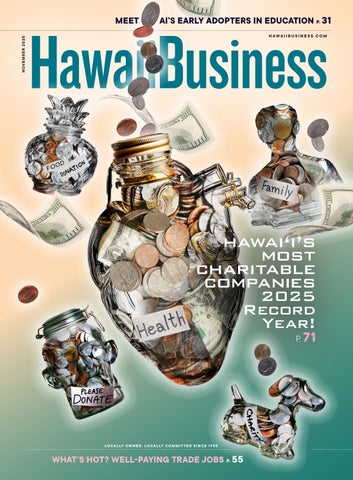
MEET
AI’S EARLY ADOPTERS IN EDUCATION P. 31
N OVE M B E R 202 5
HAWAIIBUSINESS .COM
hawai‘i’s most charitable companies
2025 Record Year! P. 71
WHAT’S HOT? WELL-PAYING TRADE JOBS P. 55
2 | N OV E M B E R 2 0 2 5
H AWA I I B U S I N ES S | 3
4 | N OV E M B E R 2 0 2 5
H AWA I I B U S I N ES S | 5
TAKE CONTROL OF YOUR FINANCIAL FUTURE SATURDAY, NOVEMBER 22 8:00 AM TO 2:00 PM
PRESENTED BY
4 TRACKS TO CHOOSE FROM:
2025
GETTING STARTED
GETTING BACK ON TRACK RETIREMENT PLANNING
FROM SMART APPS TO SMART AGING: FINANCIAL PLANS FOR TODAY
PUNAHOU SCHOOL NO MATTER WHERE YOU ARE ON YOUR FINANCIAL JOURNEY, THE 2ND ANNUAL MONEY MATTERS CONFERENCE OFFERS PRACTICAL STRATEGIES, EXPERT INSIGHTS, AND EMPOWERING GUIDANCE TO HELP YOU GROW YOUR WEALTH AND BUILD LASTING CONFIDENCE.
JOIN US AND START MAKING MONEY WORK FOR YOU. NON-PROFIT SPONSOR
6 | N OV E M B E R 2 0 2 5
Jean Chatzky
FINANCIAL EDITOR OF NBC’S TODAY SHOW RADIO AND PODCAST HOST: EVERYDAY WEALTH WITH SOLEDAD O’BRIEN AND JEAN CHATZKY AARP PERSONAL FINANCE AMBASSADOR
M O N E Y M AT T E R S . H AWA I I B U S I N E S S . C O M \ $ 5 0 P R E - R E G I S T R AT I O N , $ 6 0 AT T H E D O O R
Nash Subotic
CEO - WESTPAC WEALTH PARTNERS
( TWO POINT FIVE)
EARN 2.5% CASH BACK*
The industry-leading cash back rewards card that’s always there for you.
On-Demand Redemptions, No Annual Fees, Cash Advance Fees, Foreign Fees or Balance Transfer Fees.** alwayscashcard.com
*Offer subject to credit approval. Earn 2.5% cash back on net purchases up to $5,000 each billing cycle. After that, a 1.25% cash back will apply to additional net purchases. **The variable APR for Purchases, Balance Transfers and Cash Advances for the Always Cash Signature Rewards card is 18%, when you open your Account, based on your creditworthiness. The APRs are current as of 1/8/2025 and will vary with the market based on the U.S. Prime Rate. Rates are subject to change at any time without prior notice. We will not charge an APR greater than the maximum that we are permitted to charge by law (currently 18.0%). Cash Rewards are based on net purchases. Minimum credit line is $5,000 for the Always Cash Signature Rewards card. Certain terms and conditions apply. Credit union membership required. Contact us for eligibility. Hawaii residency required for new accounts.
/HawaiiStateFCU H AWA I I B U S I N ES S | 7
8 | N OV E M B E R 2 0 2 5
Jocelyn Chagami POSITION:
Director IT Technical Solutions
LOCATION:
Honolulu, Hawaii
HIRED:
1988
Over 36 years of experience at Matson. Solutions oriented. Big picture thinker. Believes in the power of mentoring as a big sister and board member for Big Brothers Big Sisters Hawaii. Values Matson’s commitment to service.
NOTES:
Matson’s people are more than Hawaii shipping experts. They are part of what makes our community unique. Visit Matson.com H AWA I I B U S I N ES S | 9
10 | N OV E M B E R 2 0 2 5
H AWA I I B U S I N ES S | 11
SHOP LOCAL SHOP SMALL SUPPORT SMALL BUSINESS THIS HOLIDAY SEASON
• MARK YOUR CALENDARS • SMALL BUSINESS
WHY SUPPORT LOCAL?
S AT U R DAY
Small businesses make up 99.3% of all business in Hawaii employing approximately 49.9% of Hawaii employees.
NOVEMBER 29
When you shop local + shop small, more of your money stays in Hawaii. Many small businesses often source products and services from other local providers. This results in a stronger local economy, supporting job creation, and helping to maintain vibrant neighborhoods. Shop Small Hawaii is a community initiative managed by the Patsy T. Mink Center for Business & Leadership, a program under YWCA O’ahu a 501(c)(3) nonprofit organization 12 | N OV E M B E R 2 0 2 5
• GET ONLINE • This holiday season, visit SHOPSMALLHAWAII.COM to discover more than 700 local small businesses through the Shop Small Hawaii Directory.
PH 808.695.2633 EM aloha@shopsmallhawaii.com 1040 Richards Street, Honolulu, HI 96813 www.shopsmallhawaii.com
H AWA I I B U S I N ES S | 13
11.25
FEATURES
17
Letter We’re entering the season of giving, but Hawai‘i businesses shine throughout the year by helping the state’s neediest. Editor-in-Chief Jennifer Ablan offers some thoughts on what makes Hawai’i special.
PHOTOS BY JEFF SANNER
14 | N OV E M B E R 2 0 2 5
20
My Job Nick Clemons, chief of interpretation, education and volunteers at Haleakalā National Park, explains why he has a dream job amid 25,000 acres of wilderness.
26
Nonprofit With flexibility and dedication, nonprofit Child & Family Service aims to meet the needs of individuals and families across the state. Our profile highlights some of the organization’s achievements.
31
AI Despite fears about misuse of Artificial Intelligence, educators in Hawai‘i’s schools are embracing the new technology in creative ways. Early signs show that, with guardrails, students are shaping it to their needs, and teachers are freed from routine tasks.
71
Most Charitable Our annual survey of Hawai‘i’s Most Charitable Companies shows another year of record giving. Companies and nonprofits aim to meet residents’ most pressing needs and cover shortfalls for charities hurt by cuts in federal funding.
11 .2 5
CONTENTS
55
Toolbelt Young people are increasingly turning their backs on college degrees with high costs and uncertain job prospects, instead pursuing skilled trades and other nontraditional career paths. We talk with some in the so-called Toolbelt Generation who could reshape Hawai‘i’s workforce.
SP E CI A L A DV E RTI SI NG SE CTI ONS Philanthropy Day Awards Celebrating winners honored by the Association of Fundraising Professionals, Aloha Chapter. 43 Keeping Hawai‘i Healthy Hear from local health care leaders on key issues. 19
76
Most Charitable Feature First Hawaiian Bank stands out as a perennial top corporate donor, but its employees run their own separate fundraising efforts that give a significant boost to state charities.
114
Trial And Error In her debut column, Ryann Noelani Coules reflects on the struggles of those just starting their careers to make ends meet on meager salaries. She also shares some priceless advice.
Financial Planning Guide Expert advice about planning a successful financial future. 67 Honolulu “Give Big” special section We celebrate the spirit of philanthropy in our islands. 92
HAWAII BUSINESS (ISSN 0440-5056) IS PUBLISHED 12 TIMES A YEAR BY PACIFICBASIN COMMUNICATIONS. ©2025 PACIFICBASIN COMMUNICATIONS, LLC. ALL RIGHTS RESERVED. ANY UNAUTHORIZED COPYING, DISTRIBUTION, OR ADAPTATION IS STRICTLY PROHIBITED AND WILL RESULT IN LIABILITY OF UP TO $100,000. EDITORIAL, ADVERTISING AND BUSINESS OFFICES AT 1088 BISHOP STREET, SUITE LL2, HONOLULU, HI 96813. TELEPHONE (808) 534-7520. POSTMASTER: SEND ALL ADDRESS CHANGES TO HAWAII BUSINESS, P.O. BOX 913, HONOLULU, HI 96808. SUBSCRIBERS NOTIFY THE SAME OFFICE. PLEASE INCLUDE NEW ADDRESS AND OLD ADDRESS (MAILING LABEL PREFERRED) PERIODICALS POSTAGE PAID AT HONOLULU, HAWAI‘I, AND AT ADDITIONAL MAILING OFFICES. SUBSCRIPTION: ONE YEAR $24.99 / TWO YEARS $34.99 / THREE YEARS $44.99. FOREIGN: ONE YEAR $53.99 (US FUNDS). FOR SUBSCRIPTION INQUIRIES, ADDITIONAL RATES, INFORMATION, NOTIFICATION OF CHANGE OF ADDRESS AND SUBSCRIPTION SERVICE, PLEASE CALL (800) 788-4230. NOVEMBER 2025 VOL. 71/NO. 5
H AWA I I B U S I N ES S | 15
HB EVENTS C O N N E C T W I T H H AWA I I B U S I N E S S M AGA Z I N E L O C A L LY OW N E D , L O C A L LY C O M M I T T E D SINCE 1955.
Our goal is to strengthen the local economy and help our communities thrive.
CEO YE AR OF THE
Ann Teranishi American Savings Bank
CEO of the Year Celebration THURSDAY, DECEMBER 11TH, 2025 | 8:00AM - 11:00AM
YWCA, Fuller Hall Don’t miss out on this opportunity to congratulate Ann Teranishi, CEO of American Savings Bank, as Hawaii Business Magazine’s 2025 CEO of the Year. For more information on events, visit hawaiibusiness.com/events or contact Ashley McLean, Events Manager, at ashleym@hawaiibusiness.com
STATEMENT OF OWNERSHIP, MANAGEMENT AND CIRCULATION (Required by 39 U.S.C. 3685) 1. Production Title: Hawaii Business. 2 Publication Number: 237560. 3. Filing Date: September 17, 2025. 4. Issue Frequency: Monthly. 5. Number of Issues Published Annually: 12. 6. Annual Subscription Price: $29.95 (U.S.). 7. Complete Mailing Address of Known Office of Publication: 1088 Bishop St., Ste LL2, Honolulu, HI 96813-3113. 8. Complete Mailing Address of Headquarters or General Business Office of Publisher, same as above. 9. Full Names and Complete Mailing Addresses of Publisher, Editor, and Managing Editor: Publisher: Kent Coules, 1088 Bishop St., Ste. LL2, Honolulu, HI 96813-3113; Editor: Jennifer Ablan, same address; Managing Editor: Ken Wills, same address. 10. Owner: Pacific Basin Communications, LLC, 1088 Bishop St. Ste. LL.2, Honolulu, HI 96813-3113; stock of which is held by Duane Kurisu, same address. 11. Known Bondholders, Mortgages, and Other Security Holders Owning or Holding 1 Percent or More of Total Amount of Bonds, Mortgages or Other Securities: None. 12. Tax Status (For completion by nonprofit organizations authorized to mail at nonprofit rates): N/A 13. Publication Name: Hawaii Business Magazine. 14. Issue date for Circulation Data Below: August, 2025, 15. Extent and Nature of Circulation: Business to Business a. Total Number of Copies (Net Press Run) - Average Number of copies each issue during preceding 12 months: 4,466; Actual number of copies of single issue published nearest to filing date: 3,418 b. Paid and/ or Requested Circulation: (1) Paid/Requested OutsideCounty Mail Subscriptions Stated on Form 3541 - Average: 0; August Issue: 0, (2) Paid In-County Subscriptions Stated on Form 3541 - Average: 3,345; August Issue: 2,513; (3) Sales Through Dealers and Carriers, Street Vendors, Counter Sales, and Other Non-USPS Paid Distribution - Average 370; August Issue: 365; (4) Other classes Mailed Through the USPS - Average: 13; August Issue: 0. c. Total Paid and/or Requested Circulation - Average: 3,715; August Issue: 2,878. d. Free distribution by Mail: (1) Outside-County as Stated on Form 3521 - Average: 0; August Issue: 0: (2) InCounty as stated on Form 3541 - Average: 736; August Issue: 540: (3) Other Classes Mailed Through USPS - Average:0; August Issue: 0: (4) Free Distribution Outside the Mail - Average: 0; August Issue: O. e. Total free distribution - Average: 749: August Issue: 540; f. Total Distribution - Average: 4,464; August Issue: 3,418; g. Copies Not Distributed - Average: 0: August Issue: 0. h. Total - Average: 4,464; August Issue: 3,418; i. Percent Paid and/or Requested Circulation Average: 83.2%; August Issue: 84.2% 16. Electronic Copies Circulation a. Requested and Paid Electronic Copies Average: 0; August Issue: 0. b. Total Requested and Paid Print Copies + Requested/Paid Electronic Copies - Average: 0; August Issue: 0. c. Total Requested Copy Distribution + Requested/Paid Electronic Copies - Average: 0; August Issue: 0. d. Percent Paid and/ or Requested Circulation - Average: 83.2%; August Issue: 84.2% 17. This Statement of Ownership is required and will be printed in the November 2025 issue of this publication. 18. Signature and Title of Editor, Publisher, Business Manager or Owner: Kent Coules, Publisher. I certify that the statements made by me above are correct and complete. (signed) Kent Coules, Publisher.
16 | N OV E M B E R 2 0 2 5
Publisher KENT COULES kentc@hawaiibusiness.com • (808) 364-5869 Editorial Editor-in-Chief JENNIFER ABLAN jennifera@hawaiibusiness.com Managing Editor KEN WILLS kenw@hawaiibusiness.com • 808-987-8135 Senior Editor STEVE PETRANIK Senior Contributing Writer CYNTHIA WESSENDORF cynthiaw@hawaiibusiness.com Staff Writer RYANN NOELANI COULES ryannc@hawaiibusiness.com Staff Writer SHELBY MATTOS shelbym@hawaiibusiness.com Copy Editor ELROY GARCIA Editorial Intern KALENA O’CONNELL Design & Photography Creative Director JEFF SANNER jeffs@hawaiibusiness.com Graphic Designer KAREN TANIGAWA karent@hawaiibusiness.com Staff Photographer AARON YOSHINO Digital Digital Director RANDALL LIBRAMONTE randalll@hawaiibusiness.com Digital Content Manager MARIANNE LEANO mariannel@hawaiibusiness.com Sales & Marketing Account Executive YONGCHAE SONG yongchaes@hawaiibusiness.com • (808) 228-5078 Account Executive CHAZ TIOGANGCO chazt@hawaiibusiness.com • (808) 387-1672 Senior Account Coordinator REBECCA BROOKING rebeccab@hawaiibusiness.com • (808) 534-7560 Events Manager ASHLEY MCLEAN ashleym@hawaiibusiness.com • (808) 272-6550 Events Coordinator OLIVIA DE SENA oliviad@hawaiibusiness.com Circulation circulation@pacificbasin.net Connect with us on social media: Hawaii Business Magazine @HawaiiBusinessMagazine Hawaii Business is published by
Chairman DUANE KURISU Chief Executive Officer SUSAN EICHOR Chief Operating Officer BRANDON KURISU Director of Finance JADE CARREL
A N
O P E N
M I N D
Gratitude in a Time of Cuts
T
HANKSGIVING HAS ALWAYS BEEN MY FAVORITE HOLIDAY. It is a season of gratitude, but
in Hawai‘i, it has also become a season of resilience. This year, that message feels especially sharp. Our state is facing more than $100 million in federal cuts – a blow that lands hardest on those who need help the most. And yet, as we pulled together our annual feature on Hawai‘i’s Most Charitable Companies (page 71), what stood out was how companies and nonprofits responded. Rather than shrinking back, they stepped up. As Managing Editor Ken Wills details in his feature, charitable giving across the Islands that we were able to track surged to record levels in 2024, with 106 companies and nonprofits contributing more than $349 million. That’s almost $50 million more than the previous year. Employees also pitched in with more than 90,000 volunteer hours and $4.2 million in direct donations of their own. These numbers matter. They mean Lahaina families displaced by the 2023 fires are still receiving housing assistance and mental health support. They mean our food banks can keep shelves stocked, our schools can access resources, and our cultural programs can survive even as federal support fades.
THE SPIRIT OF GIVING
Some of Hawai‘i’s biggest companies are leading the way. Matson topped the corporate list with $7.6 million in giving during 2024; meanwhile, First Hawaiian Bank contributed $5.7 million and its employees donated nearly $874,000 more. The Hawai‘i Community Foundation alone reported $151.7 million in donations – a staggering increase of more than $50 million from the year before. But what stays with me even more than the size of the checks is the spirit behind them. As Michelle Ka‘uhane of the Hawai‘i Community Foundation says: “When our communities are in need, companies and their employees see themselves as part of the solution.” That sense of kuleana – of responsibility to one another – is what makes Hawai‘i different. Of course, no amount of local generosity can fully replace lost federal dollars. The challenges of housing, health and education remain daunting. But this season of Thanksgiving reminds me that generosity is one of our Islands’ greatest strengths.
As we gather with our families and friends, let us be grateful not only for the food on our tables but for the way Hawai‘i continues to take care of its own. That is a tradition worth honoring and protecting as we face the year ahead.
A MESSY, BEAUTIFUL JOURNEY
“I’m starting with a confession: I’m 26 and had less than $50 in my bank account a couple months back. I know, not good.” That’s how Ryann Noelani Coules opens her new column, “Trial and Error,” and it sets the tone perfectly: candid, witty and refreshingly real about the highs and lows of life in Hawai‘i for people in their 20s and 30s. Coules isn’t writing from an ivory tower. She’s a journalist trying to make it in Hawai‘i on a salary with little wiggle room, navigating rent, student loans and impulse purchases like $7 oat milk lattes, all while striving for a sense of balance. “Yet, like many people my age, I live paycheck-to-paycheck. I love my job and the benefits are great, but my salary is modest, and living in the state with the highest cost of living makes matters harder.” That double whammy – sky-high living expenses and limited career opportunities – defines young adulthood in the Islands. It also makes Coules’ reflections deeply relatable for a generation figuring it all out one misstep at a time – and for us older folks trying to understand their struggles. She doesn’t just offer advice; she shares her stumbles and small victories, celebrating progress where she finds it. The timing of her first “Trial and Error” column this month is appropriate as our all-day Money Matters event is Nov. 22. The gathering is aimed at all generations but may be especially important for those of Coules’ age group, for which adulthood comes with overdraft fees, overdue bills and the occasional impulse splurge on poké and bikinis, but also the satisfaction of slowly, stubbornly, making it work.
JENNIFER ABLAN EDITOR-IN-CHIEF
H AWA I I B U S I N ES S | 17
HAWAIIBUSINESS.COM/NEWSLETTER-SIGNUP
18 | N OV E M B E R 2 0 2 5
SPECIAL PROMOTIONAL SECTION
SPECIAL PROMOTIONAL SECTION
KEEPING HAWAI‘I HEALTHY
Q&A WITH
Hear from our local healthcare leaders on key issues affecting our state in the coming year. H AWA I I B U S I N ES S | 19 H AWA I I B U S I N ES S 1
|
20 | N OV E M B E R 2 0 2 5
SPECIAL PROMOTIONAL SECTION
PHOTO COURTESY: HAWAI‘I PACIFIC HEALTH
Hawai‘i Pacific Health works with Habitat for Humanity to build a home.
HAWAI‘I PACIFIC HEALTH HEALTH STARTS WHERE WE LIVE, LEARN, WORK AND PLAY. AT HAWAI‘I PACIFIC HEALTH, THIS MEANS ADDRESSING COMMUNITY NEEDS BEYOND TRADITIONAL HOSPITAL WALLS. That’s why HPH partners with community organizations to address social and economic conditions that support better health, including housing stability, food access and financial security. “We want to go beyond just individual health outcomes and treating diseases to improve the upstream drivers of health,” says Michael Robinson, HPH’s vice president of government relations and community affairs. HPH is a not-for-profit health care network of hospitals, clinics, physicians and care providers serving Hawai‘i
and the Pacific region. It also collaborates with organizations such as Hawai‘i Community Lending and the Hawai‘i Habitat for Humanity Association, investing in affordable housing development, low-cost mortgages for low-income homebuyers and home construction for Native Hawaiians on Hawaiian home lands. The collective impact since 2023 has resulted in 900 new affordable housing units in development. Additionally, it’s paved the way for over 90 small farmers to strengthen their businesses through loans and technical assistance, and for 1,700 financially struggling households to receive help with financial education, loans, housing counseling and credit building, Robinson says. HPH has invested in the Feed the Hunger Fund and Hawai‘i Investment Ready to support local food hubs and small food businesses. It also partners with Hawai‘i Foodbank and Farm Link Hawai‘i to make fresh, local produce available to food insecure families.
DR. VINH TRAN JOINED HAWAII DENTAL SERVICE (HDS) AS DENTAL DIRECTOR EARLIER THIS YEAR, BRINGING A WEALTH OF EXPERIENCE IN BOTH CLINICAL PRACTICE AND DENTAL EDUCATION. With a career spanning private practices and community health centers across Hawai‘i and the mainland, Dr. Tran has contributed to improving oral health at organizations such as Premier Dental Group HI, Dr. Alan Fujimoto Inc., and Bay Clinic, now known as Hawai‘i Island Community Health Center. He also served as an attending dentist with NYU Langone Health, mentoring dental residents on the Big Island. A forward-thinking leader in dental imaging, Dr. Tran is the founder of Evolve CBCT Diagnostics, a company dedicated to providing detailed radiology reports for advanced dental imaging. Dr. Tran holds a B.S. in Health from the University of Houston, a D.D.S. from Howard University, and a Certificate in Oral and Maxillofacial Radiology from the University of Florida.
HAWAIIDENTALSERVICE.COM H AWA I I B U S I N ES S | 21
PHOTO COURTESY: ONE KALĀKAUA SENIOR LIVING
SPECIAL PROMOTIONAL SECTION
“HPH also supports our local food system by setting a goal to purchase at least 50% of produce and proteins served in our medical centers from local farmers,” Robinson says, and “partnering with Kamehameha Schools on this goal has increased the collective impact of our joint institutional food purchasing power.” HPH is also working to reduce health disparities by improving economic mobility for ALICE individuals and families, or those considered “Asset Limited, Income Constrained, Employed.” The health system has invested in financial services, job training and employment opportunities for people from under-resourced communities who are looking at careers in health care. “Our innovative Academic Health Center, in partnership with the Hawai‘i Department of Education and Waipahu High School, is a great example of this,” Robinson says. Other HPH partners include Hawaiian Community Assets, which provides financial education and grant and loan programs that help local households build wealth that can be shared and passed on to future generations. HPH also supports Aloha United Way’s ALICE Cohort, a collective of nonprofit organizations aimed at advancing financial stability, housing solutions and workforce opportunities for Hawai‘i’s struggling households.
22 | N OV E M B E R 2 0 2 5
ONE KALĀKAUA SENIOR LIVING TO MEET ITS GOAL AS A VIBRANT COMMUNITY FOR LONGEVITY AND HEALTHY AGING, ONE KALĀKAUA SENIOR LIVING HAS LUSH GROUNDS, ENGAGING SOCIAL OPPORTUNITIES AND A MISSION THAT ALIGNS WITH BLUE ZONE VALUES – PLACES IN THE WORLD WHERE PEOPLE REGULARLY LIVE HEALTHY LIVES INTO THEIR 100S. “The latest advancements in healthy aging point to Blue Zone regions and how lifestyle, environment, community and purpose play a role,” says Leina
Ijacic, CEO at One Kalākaua. “We strive to be the leader in Hawai‘i for healthy aging in these driving factors.” Activities and programs at the Honolulu assisted living facility focus on physical and mental health, spiritual growth and community engagement. Residents enjoy fitness classes, fresh and nutritious meals, and a sense of fun and community. One Kalākaua has earned a perfect score from the Hawai‘i Department of Health in 7 of the past 10 inspection surveys, something Ijacic calls “an unprecedented track record in the assisted living industry.” Over the past year, One Kalākaua has also strengthened strategic partnerships with Straub Benioff Medical Center; Navian Hawai‘i, the state’s only local nonprofit hospice provider; and the University of Hawai‘i. It currently serves as an educational site for the geriatric physician fellowship program at UH Mānoa’s John A. Burns
School of Medicine, bringing the next generation of doctors into the community. One Kalākaua also partners with the School of Nursing and Dental Hygiene at UH Mānoa, where senior nursing students work with staff to provide care in the facility’s on-site clinic and residential units. Ijacic points out that such partnerships are a “win-win” because they provide students “the opportunity to learn the many components of health and wellness, while helping our kūpuna as the school brings the most up to date care practices to improve the services we provide.” One Kalākaua is Hawai‘i’s only fee-simple assisted living facility. Residents have the option to rent or purchase their units, and may sell the units or pass them along to next of kin. “We strive to keep our residents independent and engaged, while offering personalized support to promote healthy aging,” Ijacic says.
H AWA I I B U S I N ES S | 23
24 | N OV E M B E R 2 0 2 5
PHOTO: GETTY IMAGES
HAWAII DENTAL SERVICE HAWAII DENTAL SERVICE IS THE LEADING DENTAL BENEFITS PROVIDER IN THE STATE, SERVING OVER ONE MILLION RESIDENTS ACROSS THE ISLANDS. Maintaining access to care through HDS’s wide network of providers is always a top priority, which is why community outreach has become an important component of HDS’s efforts. Rural communities with fewer dentists may experience a gap in access to care, an issue HDS is actively working to address. “I’ve seen firsthand, at community health centers on the neighbor islands, that access to dentists and specialists can be limited,” says HDS Dental Director, Dr. Vinh Tran. HDS is committed to expanding access to dental care, especially in communities that need it most. To recruit and retain more dentists in rural areas, HDS is actively working to get high school and college-aged students interested in dental careers. Smile Makers is HDS’s community program that works with local dentists and schools to spread the word via social media
SPECIAL PROMOTIONAL SECTION
INVESTING IN RETIREMENT: WHY ONE KALAKAUA IS MORE THAN JUST A CONDO
and educational materials that showcase dentistry as a rewarding career path. The HDS Foundation also funds scholarships for students pursuing careers in dentistry and dental hygiene and contributes to loan repayment programs run by the state. Choosing a career in dentistry is also a way for students to give back to their communities, Tran says. “Dental care is constantly evolving and HDS’s mission is to champion oral health for Hawai‘i families. To achieve our mission, we’re working in partnership with local dentists, hygienists, and assistants to ensure everyone in our communities has access to the care they need.” For nearly 20 years, HDS has hosted its signature community outreach event, the HDS Tooth Fairy Fun Day, to provide screenings and educational outreach to families on O‘ahu. This year marked the first time the organization brought the event to Wailuku, Maui. One family even drove all the way from Hāna to attend. “We try to bring access everywhere,” Tran says. “Community outreach is a core part of what we do, and we’ll continue to find new ways to make an impact. At the end of the day, it’s about creating healthier smiles across Hawai‘i, one community at a time.”
For those seeking peace of mind in retirement or long-term value in investment, One Kalakaua Senior Living delivers both. This fee-simple condominium for adults 55 and older blends ownership, resort-style amenities, and continuity of care in the heart of Honolulu. Equity in Ownership Fee-simple ownership sets One Kalakaua apart from other senior facilities, giving residents the confidence of truly having a home within a supportive community. This model allows buyers to build equity, with units that can be willed to heirs, rented, or sold, providing both peace of mind and long-term value. A Full Continuum of Services & Convenience One of the greatest risks in retirement housing is the uncertainty of changing health needs. One Kalakaua addresses this with a complete continuum of care, offering independent living, assisted living, and a skilled nursing facility all within the community. This approach minimizes disruption for residents and reduces both the financial and emotional costs of moving. In addition, unit amenities such as weekly housekeeping, dining services, fitness facilities, a pool and jacuzzi, wellness programs, and on-site medical response provide convenience, safety, and a higher quality of life every day. Location + Market Trends = Potential Appreciation Condo prices on O‘ahu have continued to rise year over year, reflecting steady demand. One Kalakaua’s location in Honolulu, close to medical centers, shops, and everyday amenities, strengthens its appeal for retirees seeking a walkable, service-rich community. Risk Mitigation & Peace of Mind Meals, fitness, wellness programs, and health care at One Kalakaua reduce many of the unpredictable costs and stresses that often come with later years. The combination of ownership and services secures much of the lifestyle residents want without unwelcome surprises. In short, One Kalakaua provides retirees with lasting peace of mind by combining the security of equity with the comfort of care, services, and a prime Honolulu location. To learn more or schedule a personal showing, visit onekalakaua.net.
TO LEARN MORE ABOUT ONE KALAKAUA SENIOR LIVING AND ITS MĀLAMA INITIATIVES, H AWA I I B U S I N ES S | 25
N O N P R O F I T
W I T H
A
M I S S I O N
126 Years of Serving Hawai‘i’s Families The mission of Child & Family Service is to offer a wide range of family services and to support everyone from keiki to kūpuna
CHILD & FAMILY SERVICE IS ONE OF HAWAI‘I’S OLDEST, LARGEST AND MOST IMPACTFUL NONPROFITS.
During the 2025 fiscal year, it says it directly served 16,402 individuals and reached an additional 117,000 through phone calls, referrals and walk-in visits. The beneficiaries were spread across O‘ahu, Kaua‘i, Hawai‘i Island, Maui, Lāna‘i and Moloka‘i. “I truly believe that Child & Family Service does not belong to any one person but to the community. This organization will continue to be here for Hawai‘i’s families until the day the community no longer needs us,” says Amanda Pump, president and CEO since January 2024. CFS’ free services focus on five areas: • Caring for keiki: Early education and child abuse prevention through family support. 26 | N OV E M B E R 2 0 2 5
BY L I L I H U R D
• Healing from trauma: Counseling and therapeutic services for individuals and families in crisis. • Empowering youth: Helping teens overcome challenges and achieve success in school and life. • Honoring kūpuna: Support and wellness services for elders and their caregivers. • Social enterprises: Strengthening families through goal-setting, resources and resiliency programs. “We rarely see a family that just needs one thing,” says Pump, who has been in human services for 25 years. “Usually a variety of different things, like, ‘I need better income, I need childcare, I need housing. I might be coping with some substance abuse issues, mental health.’ So one program alone can’t tackle everything.” Some families get help for a year, while others are supported for five or six years. CFS was founded in 1899 and today offers 49 programs, with more than half open to walk-ins and the rest available through referrals from family or criminal court, family welfare and others. Transition to Success is an anti-poverty approach that CFS calls “revolutionary,” because it is making a meaningful impact on families in rural communities across the state, including those with high populations of Native Hawaiian families. This model of care is woven into existing programs and addresses 21 key areas of well-being, connecting families with essential services and resources to maintain stability and improve overall health. There is personalized support, coaching, mentorship and practical resources, and people can share their stories.
AMANDA PUMP
“We’ve seen great success in strengthening the social determinants of health,” says Pump, referring to the non-medical factors that often impact health and lifespan, like income, education and available resources. Every family’s journey is unique, but once they start at CFS, they are guided toward the services they need and supported with food, clothing, information and programs, she says. Pump says every child deserves two safe parents. Families often turn to CFS for resources, education and preventive services that help lead them to become safe caregivers. That means CFS works with many types of parents – including domestic abuse offenders with substantiated child abuse or neglect cases – to create opportunities for healing and change. “For the most part, kids are resilient and they love their parents,” says Pump. “They deserve access to parents when they are safe.” To track impact, CFS uses short-term measurements to assess how each service is helping people. For example: With a family seeking safety, success is measured by whether they develop a safety plan, secure housing and basic needs, and sustain permanent housing without relying on multiple systems. Another key measure is whether a family has successfully completed certain programs, Pump says.
PHOTOS COURTESY: CHILD & FAMILY SERVICE
CHILD & FAMILY SERVICE HOSTS A VOLUNTEER SERVICE DAY WHERE VOLUNTEERS PACK WELCOME BAGS FOR THOSE ENTERING ITS RESIDENTIAL PROGRAMS. EACH BAG HAS ESSENTIALS SUCH AS TOWELS, PILLOWCASES AND TOYS FOR CHILDREN.
AMANDA PUMP SPEAKS TO STUDENTS AT HAWAI’I PACIFIC UNIVERSITY ABOUT THE HISTORY AND IMPACT OF CHILD & FAMILY SERVICE IN HAWAI’I.
“Sometimes I get the most meaning when I’ve worked with a family, five or six years ago and I run into them in the community, or they’ll come to an event that we’re throwing, and they’ll talk about how their kids have grown up, or how they are in the military and so successful, or, some even remark like how Child & Family Service might have saved their lives.” Pump says the program she is most proud of starting is Hope and Healing, which helps children who have been victimized by sexual trauma to receive trauma-related care and counseling.
CFS recognized that many of those displaced by the August 2023 wildfires on Maui were children, so it provided mental health resources and expanded its tutoring program, Hale O Hulu, to help students get back on track if they had fallen behind. The wildfires intensified many problems. “We’re seeing more child abuse and neglect cases right now. We’re seeing more sexual assault hotline calls. We’re seeing more people needing basic needs and needing housing. And we’re really seeing a lot of our staff worried like, ‘Hey, am I going to get outpriced from Maui?’ Pump says.
CFS has a staff of nearly 400 and a $37.8 million budget for fiscal year 2026. Most of its money comes from federal, state and county governments and 21% comes from private funding, but cuts this year by the federal government have created uncertainty about the future. “This is a concern all nonprofit leaders face,” Pump says. “We don’t have certainty about what lies ahead, which puts us in difficult situations – how do we uphold our promises to the community or meet our ethical obligations when the necessary resources aren’t guaranteed? It takes a significant toll on the well-being of both leaders and nonprofit staff.” H AWA I I B U S I N ES S | 27
M Y
J O B
BY A L LY W H A L E Y
THIS INTERVIEW HAS BEEN EDITED FOR CLARITY AND CONCISENESS
NAME: NICK CLEMONS JOB: CHIEF OF INTERPRETATION, EDUCATION AND VOLUNTEERS, AND PUBLIC INFORMATION OFFICER AT HALEAKALĀ NATIONAL PARK
Working “At a Park That Goes From Sea Level to 10,023 Feet” HALEAKALĀ NATIONAL PARK’S WORLD-FAMOUS VIEWS, HIKES AND 25,000 ACRES OF WILDERNESS DRAW AS MANY AS A MILLION VISITORS A YEAR,
and the park rangers who work there face all kinds of challenging situations, including extreme weather, lost or dehydrated hikers, missing children and big crowds, especially at sunrise. For Nick Clemons, the park’s chief of interpretation, education and volunteers, it’s a dream job. “I have just been blown away by everything this park has to offer, from the summit down to the sea in Kīpahulu,” he says. BEGINNINGS: Clemons has worked for the National Park Service for 17 years – ever since
28 | N OV E M B E R 2 0 2 5
college graduation – and even served as a volunteer before then. He was with the Upward Bound Program – a federal program that helps students from low-income families to finish high school and college by connecting them with nonprofits – when he met park rangers who worked in resource management. They seemed to enjoy their jobs, he says, and that helped inspire him to work for the park service straight out of college. MANY STOPS: Before coming to Maui, he worked at five National Park Service sites on the East Coast: • Assateague Island National Seashore, a barrier island off Maryland and Virginia that is known for its wild horses.
• Three sites in Philadelphia: Independence National Historical Park, home to Independence Hall and the Liberty Bell; the nearby former home of writer Edgar Allan Poe; and the national memorial for Thaddeus Kosciuszko, a hero in both his native Poland and in the American Revolutionary War. • Fire Island National Seashore, a barrier island off the south shore of Long Island, New York. CURRENT JOB: Resource management and planning led Clemons to the park service but now his role is mostly to support his fellow rangers as they lead hikes, staff the visitor centers, do outreach work with volunteers and perform other services. After a temporary assignment at Haleakalā National Park in the summer of 2024, he was offered a permanent job there. “A typical day for me, I come in and typically check in with the staff to see how their morning is
PHOTO COURTESY: NICK CLEMONS
shaping out, what their expectations for the day are and just to let them know I’m here,” Clemons explains. “I answer emails and I look at anything that is pressing for our work plan that really needs to get done and to make sure that they have the support they need.” BIG CHALLENGES: With a summit that is almost 2 miles high, Haleakalā’s weather can vary wildly – from days that are sunny and mild to those with 50 mph winds and even stronger gusts, snowfall and freezing temperatures. The sometimes wintry scenes can surprise tourists who expect tropical weather, and fast-changing conditions, altitude sickness and dehydration can disorient and confuse even the most experienced hikers, Clemons says. “Every visitor is different in their expectations, and we do our best to meet those expectations while also following our policies and guidelines to protect both the visitor and the resource,” he says.
“Emergencies can range from an injured hiker on a trail or a missing child or adult, whether at the summit or the Kīpahulu district.” BEST PART OF THE JOB: Clemons loves seeing visitors enjoying all that Haleakalā offers, especially the spectacular views. “The sunrise is always what comes to mind, but the sunset as well and once the sun is fully set, the night sky is amazing. A lot of people have never seen the Milky Way before, and to see it on Haleakalā is so special. You feel so close to the sky,” he says. “I’ve seen tears streaming down their faces at the sheer beauty of the sight.” HAWAIIAN CULTURE: Haleakalā is a sacred place for Native Hawaiians and Clemons says the park service tries to reflect that in its activities. Guides discuss the place’s history, and a morning prayer welcomes the sun every morning before it rises.
“Our education specialist is also our Native Hawaiian liaison. All projects we have within the park go through an interdisciplinary review team, and we consult with local Native members to make sure the Hawaiian perspective and culture are incorporated into our projects,” Clemons says. “They have a chance to review and comment on it before ground is broken on whatever project we’re working on, so their perspective is never neglected.” LOVES HIS JOB: Clemons says everyone loves America’s national parks – “the crown jewels of public land.” And now Haleakalā has captured his heart. “Who can say that they work in a park that goes from sea level to 10,023 feet?” he exclaims.
H AWA I I B U S I N ES S | 29
BY STEVE PETR A N IK ILLUSTRATION: GETTY IMAGES
Nominate an Outstanding Small Business We’re now accepting nominations for our 2026 SmallBiz Editor’s Choice Awards HAWAII BUSINESS MAGAZINE IS PROUD TO CELEBRATE EXCEPTIONAL LOCAL COMPANIES IN OUR ANNUAL BEST OF SMALL BUSINESS ISSUE.
To nominate a business, visit hawaiibusiness.com/lists-awards and click on the SmallBiz Editor’s Choice Awards button. The deadline for nominations is Dec. 31.
CHILD & FAMILY SERVICE IS ONE OF HAWAI‘I’S OLDEST, LARGEST AND MOST IMPACTFUL NONPROFITS.
During the 2025 fiscal year, it says it directly served 16,402 individuals and reached an additional 117,000 through phone calls, referrals and walk-in visits. The beneficiaries were spread across O‘ahu, Kaua‘i, Hawai‘i Island, Maui, Lāna‘i and Moloka‘i. “I truly believe that Child & Family Service does not belong to any one person, but to the community. This organization will continue to be here for Hawai‘i’s families until the day the community no longer needs us,” says Amanda Pump, president and CEO since January 2024. CFS’ free services focus on five areas: • Caring for keiki: Early education and child abuse prevention through family support. 30 | N OV E M B E R 2 0 2 5
We’re looking for companies that stand out for their products and services, leadership and staff, community impact, and overall excellence. To be eligible, nominees must: • Be based in Hawai‘i • Have fewer than 100 fulltime employee equivalents • Have been in business for at least three years.
Self-nominations are welcome. Due to the number of entries received, we are unable to acknowledge every submission. However, leaders of the winning companies will be interviewed, and the companies will be profiled in the May 2026 issue of Hawaii Business Magazine and on our website.
BY A N N AU MA N
ARTI FI C I AL I NTELLI GE N C E IN HAWA I ‘ I K - 1 2 EDUCA T IO N
Part I: Meet the Early Adopters in Our Schools They recognize AI’s challenges and long-term unknowns, but they also believe that with proper guardrails, AI is already enhancing education, and students are benefiting. These early adopters are riding the wave, not trying to hold it back, and here’s how they’re doing it.
P
UBLIC SCHOOL COMPUTER SCIENCE TEACHER MIKI CACACE NOTICED HER DAUGHTER STRUGGLED TO READ LONG PASSAGES OF
TEXT. So Cacace developed a custom
AI chatbot that added more white space. Now she has “beautiful reading comprehension,” says Cacace, an award-winning resource teacher in the state Department of Education’s Office of Curriculum and Instructional Design. Cacace also used AI to help her daughter improve her math and music skills. After they created a song using AI, her daughter told Cacace: “That’s not mine. It’s my ideas, but now I’m going to use this to make it my own.” “That’s what we need to make students understand: How do I use it to make it my own and use AI as a tool to help me grow,” Cacace said at a panel on AI during Honolulu Tech Week in September.
H AWA I I B U S I N ES S | 31
She is exploring the many possibilities for individual learning using AI and now trains other DOE teachers on how AI tools can save them time and personalize instruction to best fit students’ needs.
LOCAL LEADER IN AI EDUCATION Another early adopter is Gabriel Yanagihara, an ‘Iolani School teacher in emerging technologies such as game design, AI and fabrication. He says he wants everyone in Hawai‘i to be AI literate, and he’s working toward that goal. He leads free workshops and boot camps for students and parents, consults for organizations, and has a newsletter and website of free resources (gabrielyanagihara.com). He says he wants parents to learn how the tools work so they can best guide their children in their use. His students use AI to brainstorm, debug software code, generate visuals, and write dialogue or scripts for their projects. They are creating video games, websites, apps and even books from scratch. “We don’t just allow AI; we structure how it’s used,” Yanagihara says. “I train students on specific tools and show them when it makes sense to bring AI in and when it doesn’t.” Class projects that were once just “dream-level” are now standard. He says AI tools have made him more efficient and effective – he has his personal life and weekends back – while improving student outcomes. Yanagihara says not all schools can afford licenses for AI tools that have guardrails to protect student data. Free versions often lack those guardrails. “That worries me, because it creates an equity gap. My students have 24/7 AI access tied to my lessons, and I 32 | N OV E M B E R 2 0 2 5
can track how they use it in class. Most students in the state don’t have that,” he says. However, many of AI’s early adopters hope it can enhance equality in education. Candace Cheever, K-12 director of teaching and learning at Punahou School, is optimistic that some AI technology might democratize learning by making tutors accessible to everyone.
AI WILL SOON BE EVERYWHERE Artificial intelligence is not going away, whether you like it or not, leaders in the field say, and educators must accept and guide the transformation – not be swept away by it. But that transformation won’t be easy. “This is going to be a huge disruption to our education system,” says Winston Sakurai, executive assistant and chief of staff at the DOE’s Office of Curriculum and Instructional Design. “Moving a system like we have is very challenging,” Sakurai said at a panel discussion during Honolulu Tech Week. Change, he added, will happen “one classroom at a time, one school at a time” until AI is “like the air we breathe.” To leverage it for student success, he encourages teachers to try AI and get comfortable with it, so they feel less threatened. Michael Ida, “Dr. Ida” to his students and colleagues, teaches computer science and math at Kalani High School. He says AI is far more transformative than previous technological advances. “Unlike a search engine or gradual tool upgrades, its range of capabilities – whether generating lesson plans, activities or hyper-realistic images and video – suggests it will fundamentally change professions and daily life,” Ida says.
Most people have trouble recognizing what’s generated by AI. When Cacace trains DOE teachers, she shows them two images of children in a garden: one real and one generated by AI with students it created. Many teachers cannot tell the difference. Her point is that teachers need to learn to understand the basics of how AI works in terms of computer science fundamentals so they can guide students in using AI tools. “Because if we as teachers are not educating ourselves with these new technologies, how do we then teach our students to be safe and effective users of technology?” The key, she says, is teachers and schools need to choose tools and methods for powerful student learning – instead of students “using it as just something to cheat or something to just get a quick answer from.”
AI DESIGNED FOR EDUCATION Magic School is a national AI platform designed to comply with laws that protect children under age 13, though older students can use it too. Since November 2024, about 1,500 DOE teachers have been trained on Magic School, which is currently free for them, and they use it for lesson planning and student assignments that they can complete on the Magic School platform. Student data is protected and private, and most work on school devices that are kept at school. Magic School says its software serves diverse learners, saves teachers time and improves student results. In Hilo, Waiākea Intermediate School social studies teacher Jonathan Peralto says Magic School is “a lot of fun.” He says the platform’s chatbot, named “Raina,” has helped him improve his lessons and planning. Now, he says, he can modify lessons in minutes instead of hours.
WHEN TRAINING TEACHERS ABOUT AI, MIKI CACACE WILL SHOW THIS AI-GENERATED PICTURE AND A PICTURE OF REAL CHILDREN. MANY TEACHERS CAN’T TELL WHICH IS REAL. SHE SAYS, “IF WE AS TEACHERS ARE NOT EDUCATING OURSELVES WITH THESE NEW TECHNOLOGIES, HOW DO WE THEN TEACH OUR STUDENTS TO BE SAFE AND EFFECTIVE USERS OF TECHNOLOGY?” PHOTOS COURTESY: MIKI CACACE
Using Magic School, his U.S. history students role-played Oregon Trail characters, and then wrote three journal entries for their characters’ experiences, with details about their journeys. Then the students could generate images for each entry. Before Magic School, Peralto used a social studies tool called Humy.ai, with chatbots that mimicked historical figures. Students interviewed George Washington, then asked Thomas Jefferson about writing America’s founding documents. A debate with James Madison taught them about the U.S. government and Constitution. Peralto and other social studies teachers are now dabbling with a Magic School writing-feedback tool for short responses that students write in class. “It’s pretty unbelievable,” he says, because giving feedback is less burdensome and he can reach more students individually. That’s crucial because each social studies teacher at his school has 130140 students. Peralto has also tested AI writing-feedback tools, which help him automate feedback for individual students based on
“
WE CREATE THE PROMPT AND FEED IT ALL THE INFORMATION WE THOUGHT IT WOULD NEED AND THEN HAVE STUDENTS INTERACT WITH AI IN DIFFERENT WAYS.”
– ELISA LO
MANDARIN LANGUAGE TEACHER, PUNAHOU SCHOOL
his curriculum. One tool also identified common issues among students’ work, helping him target instruction to build specific skills like citing evidence.
THE URGENCY TO DO WHAT WE SHOULD DO At ‘Iolani School, faculty can use Magic School AI with students from 2nd to 12th grade. “Its strength is that teachers can assign specific AI tools for a class and then turn them off afterward, so it supports intentional use for particular activities,” Yanagihara explains.
‘Iolani high school students will be trying Google’s Gemini AI this year, and already have Perplexity AI and Magic School through their teachers. These are provided under educational licensing currently for select students, which protects teacher and student data. “I love the AI because it creates the urgency to do what we should have been doing with education for the last 20 years,” Yanagihara says. “You don’t just grade the final paper that’s turned in.” For example, he uses Magic School for his seventh graders; with it, the students create an idea for a game and include three argu-
H AWA I I B U S I N ES S | 33
PHOTOS: AARON YOSHINO
EDUCATORS, STUDENTS AND TECH LEADERS GATHERED AT ‘IOLANI SCHOOL IN SEPTEMBER TO DISCUSS AI’S EVOLVING ROLE IN EDUCATION. AMONG THOSE PARTICIPATING FROM ‘IOLANI WERE TEACHER GABRIEL YANAGIHARA, LEFT, AND STUDENTS THOMAS MACCHIARULO AND MAYA GONSOWSKI
ments to discuss. Then Yanagihara assigns each of them a chatbot they can interact with as a thought partner while they are writing their ideas for their game design. The students write a 12-page document that covers details about the game, from the concept and story ideas to the code they need to write. They also include a list of resources. It’s both technical and creative writing. “I give them access to the tool, and when it’s done – time for the test – I turn the room (in Magic School) off, and then it’s back to me,” Yanagihara says. He can see their chat histories, and Magic
34 | N OV E M B E R 2 0 2 5
School warns him if a student is doing something that’s off-task or concerning. Yanagihara uses an AI tool that gives students instant feedback on technical things based on his scoring rubric, which assesses things like correct grammar and paragraph structure, after they upload their assignments into that tool. He says using these tools cuts his grading time by 90%. That gives him more time to build relationships with students. He notes that using AI for assessment can also lighten the burden for English teachers, who grade thousands of papers.
EXPERIMENTING AND SHARING RESULTS At Punahou School, 35 teachers volunteered as AI innovators this year, according to Cheever, Punahou director of teaching and learning, who is also an English teacher. For that they receive a small stipend. Their mission, Cheever says, is to “lean in to experimenting with uses for teaching and learning with AI and sharing out what’s working with their colleagues.” Several English teachers signed up to develop an AI literacy and ethics unit in ninth grade, the grade
in which many new students join the school. And teachers of fourth through eighth grades get help implementing AI, particularly in the health class that all students take in middle school. However, students are not using AI tools to work on writing assignments in English classes. There, teachers require more in-class writing – partly to guard against students using AI inappropriately at home and then turning in the assignments. Punahou Mandarin language teachers Elisa Lo and Joy Lu-Chen signed up for Magic School to learn how to use AI at different levels of Mandarin, then shared their time-saving knowledge with teachers of other foreign languages. They created custom chatbots to help students and got feedback on their learning. In one level 3 chatbot, “We’d create the prompt and feed it all the information we thought it would need and then have students interact with AI in different ways,” Lo explains. For example, there were grammar patterns and vocabulary the teachers wanted the students to learn. The teachers created two chatbots that students could interview about student life at Peking University – living on campus and off. Then the students compared what they learned from the chatbots with their peers. Lu-Chen also integrated Speakology AI into all her classes to provide students with opportunities to practice interpersonal speaking through simulated video chats. Despite all these uses for AI, the final exam is still a live, in-person conversation.
Mid-Pacific, trained a theater teacher on NotebookLM, a Google platform designed as an AI research tool and “thinking partner.” “I asked her to give me a famous artist that you talk about in class” and she suggested the famous English actor and director Laurence Olivier. They researched him and created a podcast with two people discussing his acting techniques. “She was blown away with the accuracy of it,” Grantham says. “This is the same thing that she would always talk about in class, but now she could basically create the podcast and have two people discuss the acting techniques and how he embodied his characters, which comes off way differently than a lecture. And now it has a video feature where it will create a video of interaction.” Chris Ferry of Mid-Pacific – an English as a second language teacher who calls himself a “champion of multilingual and inclusive learning” – uses AI to differentiate lessons for different kinds of students, whether they are multilingual or have ADHD or dyslexia. “You will drive yourself into the ground, as a lot of teachers do, trying to prepare materials the proper way for different students,” he says. AI tools help him design content for individual learners at their language level, which works better than them just using a translator. He follows the Common European
Framework for Languages, which works well with AI and can create reading assignments at different levels.
STUDENT AMBASSADORS SHOW AND TELL Some motivated students have appeared at events and in videos as AI ambassadors, including those at Mid-Pacific Institute and ‘Iolani School. A lot can be learned from students, educators say. One example is former Mid-Pacific student ambassador and now alumna Gianna Groves. She says she was afraid to use AI at first because many people associate it with cheating, but she found it helped her reach her goal: She has been accepted to the architecture school at the Savannah College of Art and Design in Georgia, Before that, while learning derivatives in a calculus class at Mid-Pacific, her teacher used a particular method that worked well for her. But when she used ChatGPT to help with a derivative problem, she didn’t understand what the AI was telling her. So she asked the chatbot to use her teacher’s method instead; when it did, she understood what the chatbot was saying. “That was a pivotal moment for me,” Groves says. “It’s not just a tool there by itself.” The AI tool sometimes needs you to explain to it how you learn, she says. “It enhances your abil-
EARLY ADOPTER SCHOOL Mid-Pacific Institute, which still emphasizes a broad education for all its students, was an early adopter of AI. Among its offerings is an Immersive Technology Program. Brian Grantham, director of educational technology for
AMONG THOSE LEADING THE INTRODUCTION OF AI INTO K-12 EDUCATION IN HAWAI‘I ARE, LEFT TO RIGHT, BRIAN GRANTHAM OF MID-PACIFIC INSTITUTE.
JONATHAN PERALTO OF WAIĀKEA INTERMEDIATE SCHOOL
AND WINSTON SAKURAI OF THE HAWAI‘I DEPARTMENT OF EDUCATION.
H AWA I I B U S I N ES S | 35
ity to learn and to understand things. It can empower you to be you.” Mid-Pacific expects students to be transparent in how they use AI. Students must be able to explain their assignments and how they did them, Grantham says. They must be able to evaluate AI work for accuracy and bias, and know that it should not replace their own ideas or thinking. They are also not allowed to disseminate harmful content. If a student can’t explain what
This Charter School Is Surfing the AI Wave
K
ŪLIA ACADEMY, A PUBLIC CHARTER SCHOOL ON O‘AHU, IS THE FIRST SCHOOL IN THE U.S. TO OFFER A SEVEN-YEAR AI AND DATA SCIENCE PROGRAM TO “GROW ENGINEERS,” SAYS EXECUTIVE DIRECTOR ANDY OMER GOKCE.
“We need to surf this wave,” he says. The school is located at 2340 Omilo Lane, near the H-1 Freeway and off Kamehameha IV Road, in the former school building for St. John the Baptist Catholic Church. He says students are coming from across O‘ahu: Wai‘anae, Mililani, Kailua, Kāhala and elsewhere. Kūlia Academy launched in 2024 with a sixth grade class. This year, there’s a seventh grade class as well, and another grade will be added each year through 12th grade. Current enrollment is 150 and is open to all students in available grades. The academy’s website (kuliaacademy.org) announced in September that the school achieved the highest proficiency scores among all middle and high schools in Hawai‘i, according to the Strive HI 2024-25 state test results. In math, the school had a 75% proficiency score; in English, it scored 80%. (A student is considered proficient if their test score meets or exceeds the benchmark level set by the state.)
36 | N OV E M B E R 2 0 2 5
they wrote, that means they used AI as a shortcut that harms their actual learning. “But if you can talk to me about it, and it’s somewhere close to what you wrote, then you use the AI to deepen your understanding.” ‘Iolani students Maya Gonsowski and Thomas Macchiarulo are student directors of the ‘Iolani’s Digital Literacy Ambassadors program. Some teachers have allowed them to test AI tools like Perplexity AI for research or assess ChatGPT’s ability to write
School is from 8 a.m. to 4 p.m., and most student work is done at school with little homework. Teachers are paid on a 12-month contract and teach in the summer; they can also choose to stay from 3-4 p.m. for extra pay. That keeps salaries competitive, and the teachers union supported this arrangement, Gokce says. He explains that some households are not suited for doing homework, so students get almost everything done at school, where teachers can monitor them. And the teachers have fewer students to supervise than regular public school teachers. The teacher load is about 70 students compared with 130 to 150 students in a public middle school, Gokce says, allowing teachers to know their students well. Gokce, formerly a charter school administrator in California, helped launch the school after years of work with the Hawai‘i Department of Education; most of his co-founders are now members of the academy’s board. Their goal is to have a public school that prepares students for emerging technologies. They looked at STEM school models for children that were taught at MIT, Stanford and UCLA, among other institutions. While Kūlia Academy is focused on AI and data science, students learn to manually code before they use AI so they can understand how algorithms work. They cannot use ChatGPT to produce code. And they learn Python, HTML and later, C++ programming. The school controls how students
a paper. They say they want to learn about AI but can’t if most teachers don’t want it in their classes. “I need at least one course to give me the support to fully understand AI and its capabilities,” Macchiarulo said at a public panel organized by Yanagihara. He and Gonsowski say students need to be familiar with AI before they’re in college or in the workforce, and teachers should be preparing them for that future now.
use technology, Gokce says, and students are not allowed to bring phones or other devices to school. Instead, they use computers the school purchased with help from a federal grant. “We have plenty of devices here; maybe double the number of students,” Gokce says. “We have computers and iPads and iMacs here at this school.” Students also take English, social studies and science, and have other options such as drone programming, music and sports. The school has added environmental science, a subject that often involves a lot of data particularly relevant to Hawai‘i. English teachers collaborate with AI and data science classes when students write about data science information and present reports in groups. Gokce explains that students have to defend their reports, not just present the data. “We ask them to come up with conclusions. What does it mean? Where do we go from here? They need to come and defend what they are proposing.” He uses a metaphor to explain the focus of the school: “Our aim here is to put them in the kitchen: to design the algorithms, to design AI models.” Students will learn how something works, he says, and that includes computer engineering. “We want to designate a place where students can take a computer, take it apart, put in some RAM, change the GPU, attack it, install Linux, attack it, harden it, and then attack it again. So, the idea is for them to understand the architecture behind it, how it works.”
ARTI FI C I AL I NTELLI GE N C E IN HAWA I ‘ I K - 1 2 EDUCA T IO N
Part II: Fear, Caution and Uncertainty
Even those educators excited about the benefits of using AI in the classroom understand the challenges and obstacles. Here’s how they plan to deal with them.
T
HERE IS GOOD REASON MANY PEOPLE – PARENTS, TEACHERS AND OTHER COMMUNITY MEMBERS – ARE CAUTIOUS ABOUT USING GENERATIVE AI IN CLASSROOMS. That’s largely
because our overall use of AI is an experiment and we don’t know what the long-term outcome for society and learning will be. We do know that AI makes it easier for students to cheat and shortcut their way through school, even when schools and teachers put restrictions on its use. There are other questions, including: How do we know which AI content to trust? Will AI diminish or destroy the human element in music, art, videos and other creative fields? Will AI make future generations dumber? ‘Iolani School’s Gabriel Yanagihara says the biggest issue about AI in schools is the lack of clarity about when or even whether students can use AI tools in individual classes. The Hawai‘i DOE has general guidelines
H AWA I I B U S I N ES S | 37
about ethical and transparent use of appropriate AI tools, as well as data privacy. Its Digital Design Team outlines these guidelines for teachers and students on its website; go to tinyurl.com/HIDOEai. “Teachers aren’t sure what’s safe, what’s allowed, or what tools are worth their time,” he says. “They are worked so much already, so even though AI can help lower their workloads and help with work-life balance, it’s a big ask to ask them to learn a whole new system on top of all we already ask of our educators.” Yanagihara helps with ‘Iolani’s AI strategy and teacher support. “We were able to move quickly because we had the flexibility to build an internal task force, test tools and implement support systems in-house.” However, schools vary greatly in resources, he says. Some schools lack devices or reliable internet access, which makes hands-on training harder. Others worry about ethics or student misuse, and lack of understanding by teachers and parents.
ETHICAL AND APPROPRIATE AI USE Brian Grantham of Mid-Pacific Institute is working with teachers and departments on appropriate AI tools in each subject area. The goal is to use AI for deeper learning, not just copy and paste and turn the assignment in. Teachers’ knowledge of AI is limited, and they are concerned about students cheating. His response is to have students and teachers work together, “co-creating classroom expectations.” When kids are invited into the AI discussion, they see ways to use AI tools from their perspective and how each individual learns, Grantham says. Teachers can create assignments that make sense to themselves, but 38 | N OV E M B E R 2 0 2 5
“
TEACHERS AREN’T SURE WHAT’S SAFE, WHAT’S ALLOWED, OR WHAT TOOLS ARE WORTH THEIR TIME.” – GABRIEL YANAGIHARA ‘IOLANI SCHOOL
students might see them differently, particularly if they have a learning difference such as ADHD, he says. That means the teacher’s instructions for the assignment can seem overwhelming or ambiguous. Mid-Pacific’s syllabi include clear guidelines on use of AI, including when students must ask permission to use it. Last year teachers had varying policies about AI use, which confused students. So, this year AI policies are consistent within each subject. Mid-Pacific high school students can directly use ChatGPT, Gemini, CoPilot, Adobe and Apple Intelligence. Elementary and middle school students can use the SchoolAI platform. Mid-Pacific also has an AI Certification Course that prepares students for the workplace of the future, providing them with skills that are in high demand across industries, Grantham says.
AI LITERACY TRAINING AND ETHICAL STANDARDS High schools and colleges are concerned that AI use without clear guardrails to keep students safe is rampant. AI’s effects are “terrible,” says an English teacher from Farrington High School. She says she’s returning to pencil and paper assignments so she can better assess her students’ writing. In fact, many English teachers agree on the importance of having
students do more in-class writing without access to the internet. Both independent and public schools in Hawai‘i are addressing issues of ethical AI use through AI literacy training and by having guardrails on AI tools used at school. The idea is to encourage AI use in ways that enhance critical thinking while keeping student information safe. That training on the ethical use of AI is crucial because schools cannot monitor and protect students when they use AI and social media at home.
AI DETECTORS DON’T WORK Educators interviewed for this story unanimously said that AI detection tools don’t work effectively and can be wrong. A teacher might end up punishing a student when a teacher’s guidelines for AI use aren’t clear. Teachers who get to know their students can recognize when a student has turned in work using AI without being transparent about it and not labeling how they used the tool – but if you have dozens of new students each semester, knowing each of them well can be a challenge. Mid-Pacific Institute has done a lot of testing with AI detectors and found they hallucinate worse than AI itself does. Plus the detector provides the percentage of content that might have been generated by AI, which can be misleading.
PHOTO COURTESY: MIKE SARMIENTO
PHOTO: ANN AUMAN
PHOTO: AARON YOSHINO
MIKE LATHAM OF PUNAHOU
“How do you take a 70% accusation and then leverage that against a kid when you may or may not be right?” Grantham says. Because once you accuse a student of cheating, the student might get suspended or expelled, and that will hurt their future. He suggests that early in the semester, teachers assign several writing pieces on paper in class, “so you can start to capture how your kids speak.” When the teachers see the student’s work later, the teacher will know whether the writing is too clean or above the student’s level.
AI ETHICS AND TRUST In 2021, Hawai‘i’s Legislature passed Act 158 to improve digital literacy among young people. It required all K-12 public schools to offer computer science courses or computer science content by the 2024-2025 school year. And, according to the state Department of Education’s Miki Cacace, AI will be integrated into updated
MIKE SARMIENTO OF PURPLE MAI‘A
computer science standards next summer. (See guidelines on computer science education from a national consortium at reimaginingcs.org.) “The mandate from Act 158 provides crucial support needed for expanding professional development,” Cacace says. This legislation has driven a significant increase in the number of computer science instructors, growing from 1,237 in 2022-2023 to 3,815 in 20242025, she says. The DOE has created AI guidance and training through its Office of Curriculum and Instructional Design. In fact, DOE administrators are ahead of many school districts in the U.S. They’ve drawn up guidelines for ethical use of AI in their schools (tinyurl.com/Hawaiiai), encouraged computer science and AI literacy training, and are developing approaches for holding students accountable for ethical use of AI. Find the DOE’s AI guidance for teachers and resources at tinyurl.com/Hawaiiai2, and guidelines for students at bit.ly/ hidoe-ai-students.
MICHAEL IDA OF KALANI HIGH SCHOOL
Public school teachers who want to learn more about computer science/AI learning opportunities can email cs@k12. hi.us. The Magic School AI pilot is only available for HIDOE K-12 public schools. The challenge faced by the DOE in increasing AI literacy training and education lies in the size and complexity of the public school system. Reaching about 152,000 students and 13,000 teachers, librarians and counselors takes time and patience. However, there are schools with pockets of early AI adopter teachers who are motivated to experiment and lead others. Winston Sakurai, executive assistant and chief of staff at the DOE’s Office of Curriculum and Instructional Design, says schools should complete a self-assessment and build AI literacy by identifying key personnel, finding areas for growth, and setting a vision for how they want to use AI while meeting DOE goals for graduation. Each school will approach this differently, just as they do with curriculum and instruction, because
H AWA I I B U S I N ES S | 39
communities have unique needs. The overall goal is the same: to use AI responsibly and effectively while also legally protecting students’ private data and information that they provide to an AI tool or chatbot. Such protections are required by federal laws such as COPPA, or the Children’s Online Privacy Protection Act.
SAFEGUARDING STUDENT DATA Some of Hawai‘i’s private schools have moved quickly with teacher training on AI, including syllabi with ethical standards and guidelines on when to use AI tools. Mid-Pacific’s Grantham says educators use AI tools at school that have guardrails to protect student data. Mid-Pacific’s elementary school uses SchoolAI, a “wrapper” program that adds guardrails around other AI programs to protect student data. It limits AI responses to those appropriate for the child’s age. Just as with Magic School AI, students do not have their own SchoolAI accounts. They piggyback on the teacher’s account, letting the teacher set the boundaries. Grantham says the process of doing an assignment can be more important than the final product. Some teachers focus on individual steps rather than the final exam, paper or project. That makes cheating less likely too because a final paper can often be generated by AI. “It’s about, ‘What did you do to get to that product and the thinking?’” Grantham says. Yanagihara of ‘Iolani calls this process “scaffolding,” or “steps” in the learning process. Michael Ida’s students in computer science and math at Kalani High School collaborate on whiteboards on stands in the classroom and also use Chromebooks at school that have internet access for AI use. Ida says AI won’t replace teachers but is a valuable tool to 40 | N OV E M B E R 2 0 2 5
save teachers time on tasks like generating sets of problems with unique answers, which takes hours to create manually. “If I try to be creative, maybe I can use it to supercharge my teaching in a way that I wasn’t able to do before,” Ida says.
YOU CAN’T “UNRING THE BELL” Punahou School’s approach is focused on AI “as a kind of critical literacy,” according to Punahou President Michael Latham. “We want our students to have a clear understanding of how the technology works, of actually what’s involved in the technology,” he says. “We want them to be aware of and able to use it in ways that provide them with advantages, especially in personalized learning. But we also want them to be aware of the pitfalls, the ethical problems” and risks, he says “I think the biggest challenge for us, and really for probably any school, is to figure out how to use these tools in ways that amplify or enhance the kind of teaching and learning that we do, but not undermine our core learning objectives,” Latham says. “You can’t unring a bell; you can’t put the toothpaste back in the tube. These tools are out here,” Latham notes, adding that it would be a disservice to students to ignore AI. Latham says that “we plan really carefully about where AI is best deployed in the curriculum and the pedagogy and where it should be avoided.” One of those areas where AI should be limited, he says, is English instruction. A lot of ideas are communicated in writing, and that involves critical thinking skills, Latham says. “I think students need to go through the cognitive work of framing an idea, figuring out how to express it, thinking about the evidence they’re going to use, how
they’re going to structure an argument,” Latham explains. ChatGPT can create an essay, but that deprives the student of the struggle involved in framing ideas, which in turn erodes critical thinking skills. An experimental study by MIT researchers supports the idea that cognitive skills are compromised when using AI, but the study also notes in its preliminary findings that “rewriting an essay using AI tools (after prior AI-free writing) engaged more extensive brain network interactions.” (See the study at tinyurl. com/568tjud3.) Punahou’s Candace Cheever adds that “more teachers are doing in-class writing where they can monitor students on school computers with lockdown browsers so they cannot access the internet or AI.”
SOCIAL AND EMOTIONAL LEARNING Teachers are coping with AI’s arrival at the same time they are dealing with leftover effects of the Covid lockdowns, which left students on average with diminished propensity to interact with each other and to speak up in class. “I feel like there’s more hesitancy for kids to collaborate, communicate in person. So we always try to emphasize a human element in education,” says Kalani High’s Ida. Now, collaboration is an essential skill. “When we were younger, the stereotype of a programmer was a lone person in their basement just hacking out code,” he says. But now projects require cooperation and working in teams. Many other teachers mentioned this same issue and say that’s why they are focusing more on social and emotional learning, or SEL. That means more in-class discussions and collaborative learning to encourage students to speak in class – and they say AI tools can support these verbal presentations and class discussions in many ways.
“The teacher is no longer the central figure or authoritarian of content because kids have access to content far more than what we know at this point,” Grantham says. “So, the teacher’s job is going to be much more focused on SEL.” Teachers will check in on how individual kids are doing. “How’s your group dynamics in your class?” he says. “Do your kids feel comfortable talking? Do you have a safe environment where everybody is contributing?” At a recent event at Mid-Pacific Institute, a student said he’d be comfortable being interviewed for a job by an avatar or chatbot. But Grantham says some people fear that children will become less social if they have companion bots. “Because now I can just go talk to this friend who’s always going to be nice to me, and I don’t have to worry about dealing with the actual humans in the world, but that’s why human-in-the-middle matters.” Keeping children engaged socially matters more than ever, he says. On the other hand, the DOE’s Sakurai says AI can help students who have anxiety or social struggles. Conversational tools, including voice-to-text, let them practice safely, which can lead to real-world conversations. Therapists now use AI to help students manage anxiety and learning challenges in ways we never imagined, Sakurai says. Punahou is also “leaning into discussion skills,” Cheever says. The school brought in educational leaders from the University of Wisconsin-Madison to teach instructors how to engage students in authentic discussions. Substitute teachers were brought in and regular teachers were given two days off to attend a retreat to learn how to conduct effective discussions in their classes.
What Parents Need to Know Here are questions parents and guardians should ask their child’s school about its use of artificial intelligence.
1. How is AI being used at the school? In which classes? 2. What are the guidelines for ethical AI use at school? 3. Which AI tools can my child use for homework? 4. How are my child’s privacy rights being protected? 5. Please give me examples of how AI tools will enhance learning. 6. Will my child still learn basic skills like how to write and multiply?
GROUNDING TECH IN HAWAIIAN CULTURE Purple Mai‘a is a nonprofit whose mission is to build the next generation of culturally grounded, community serving technology makers and problem solvers. Its website says it empowers community through the application of Indigenous innovation, technology and computer science. Mike Sarmiento, VP of educational design for Purple Mai‘a, shares an important ‘olelo: I ka wā ma hoe, ka wā ma hope – we move forward looking back. The future is found in the past. “The first thing we do is that we understand our ‘ike, our knowledge base, is rich,” Sarmiento said during a discussion during Honolulu Tech Week in September. “When I think about AI, we start with the framing of ancestral intelligence, about ancestral knowledge.” The common thread or knowledge
base has always been ‘āina and mo‘olelo (our stories). (Hawaii Business Magazine is working on a report that more fully examines how people in Hawai‘i are integrating AI with Hawaiian culture, local values and the specific needs of Hawai‘i. Look for that report in 2026.) Cacace wonders whether those running AI companies will embrace diversity and cultural identity so AI produces accurate responses. “Do they have our best interests at heart?” Hawai‘i’s schools are in the early stages of a transformation. AI already supports personalized practice, reduces teacher workload on repetitive tasks, and enables creative projects that were previously impractical. At the same time, it raises difficult questions about access, authenticity, ethics and cultural relevance. The journey has just begun, but Punahou’s Latham is correct: You can’t unring this AI bell.
H AWA I I B U S I N ES S | 41
WA I K I K I’ S O N LY A L L
ocean view H OT E L
E S C A P E OFFERING OCEAN VIEW AND OCEANFRONT ROOMS AND SUITES
P R I N C E W A I K I K I .C O M
42 | N OV E M B E R 2 0 2 5
Proud Sponsor of Hawaii Business Magaz ine’s Money Matters Financial Conference
S PEC I A L PR O M OT I O N A L S ECT I O N
Ha__wa__i‘i’s Na__tiona__l Phila__nthropy Da__y C E L E B R AT I N G T H O S E W H O M A K E H AWA I ‘ I A B E T T E R P L AC E
- MEET THE 2025 AFP ALOHA CHAPTER HONOREES H AWA I I B U S I N ES S | 43
45
Introduction
46
Eric Co
47
Nanci Kreidman
48
Stupski Foundation
49
Mauna Kea Resort
50
Catherine "Kitty" Yannone
51
Jung Song
52
Kyla Nakashima
53
Diamond Bakery
54
Alma Grocki
SPONSORS
Mahalo TO OUR DON ORS!
DISTINGUISHED PARTNER:
HAWAII COMMUNIT Y FOUNDATION CHANGEMAKER SPONSOR
Our generous supporters
HAWAII STATE FEDER AL CREDIT UNION
its vision. For education, enrichment
K AMEHAMEHA SCHOOLS/PAUAHI FOUNDATION
and enlightenment. For economic
UH FOUNDATION
are helping Hawai‘i’s university realize
vitality and cultural preservation. For UH. For Hawai‘i.
Learn more at UHFoundation.org/4UH4HI
44 | N OV E M B E R 2 0 2 5
FRIEND SPONSOR
COOKE FOUNDATION EAST-WEST CENTER HAWAII PACIFIC HEALTH PUNAHOU SCHOOL MEDIA SPONSOR
HAWAII BUSINESS MAGAZINE
S PEC I A L PR O M OT I O N A L S ECT I O N
2025 National Philanthropy Day He Pilina Wehena ‘Ole An Inseverable Relationship Friday, November 14, 2025 Sheraton Waikiki Hotel
F
OR Y E A RS, THE A FP A LOH A CH A P TER H A S WOR K ED TO STR ENGTHEN H AWA I‘I'S NON-PROFIT SECTOR BY EQUIPPING FUNDR A ISING PROFESSIONA LS W ITH THE TOOLS TO A DVA NCE THEIR MISSIONS. Now more than ever, the organization is dedicated to supporting our communities, which is why we're proud to announce our annual National Philanthropy Day event on Friday, November 14th. The event is a chance for all of us to recognize and celebrate the individuals, businesses, and foundations whose generous contributions of time, talent, and resources are making a real difference across the islands. National Philanthropy Day, established in 1986 by the Association of Fundraising Professionals (AFP), is a global day of observance that recognizes the profound impact of giving. It's an opportunity to shine a spotlight on the unsung heroes who work tirelessly to improve our communities. This year's celebration will be an all-day conference and awards luncheon for philanthropic leaders, held at the Sheraton Waikiki Hotel. The conference is designed to empower community leaders with the knowledge and skills necessary to navigate the dynamic environment of philanthropy. The day's events will also include our annual awards luncheon, celebrating this year's exceptional awardees who truly exemplify the spirit of aloha and the transformative power of giving. This year, we are proud to welcome these awardees to our distinguished group of community leaders: • PAULETTE V. MAEHARA OUTSTANDING COMMUNITY LEADERSHIP AWARD:
Eric Co, Harold K.L. Castle Foundation • PAULETTE V. MAEHARA OUTSTANDING COMMUNITY LEADERSHIP AWARD:
Nanci Kreidman, (Ret.), Domestic Violence Action Center • OUTSTANDING FOUNDATION AWARD:
Stupski Foundation
• OUTSTANDING CORPORATION IN PHILANTHROPY:
Mauna Kea Resort
NATIONAL PHIL ANTHROPY DAY COMMIT TEE JANICE N . KNAPP, CFRE, President, AFP Aloha Chapter WENDY CHANG , CFRE, MEd, NPD Chair KERRI BOSWORTH VAN DUYNE , Sponsorship Chair MICHELLE MORIHAR A , CFRE, MBA, Award Chair ANGEL A BRIT TEN , CFRE, Award Chair JACQUI SOVDE , Awards Luncheon Chair BILLIE TAK AKI LUEDER , Marketing Chair BRI MILLS , Merchandise Chair K ATIE VAN NISPEN & MARIKO MIHO, VIP Chairs NPD COMMIT TEE MEMBERS: RYAN CATAL ANI , BE-JAY KODAMA , MICHAEL MARSH , CLINT RILEY, CFRE , & KELSEY JOY SABL AN
• OUTSTANDING PHILANTHROPIST AWARD IN MEMORIAM:
Catherine "Kitty" Yannone
• OUTSTANDING PROFESSIONAL FUNDRAISER AWARD:
Jung Song, East-West Center
• OUTSTANDING YOUTH IN PHILANTHROPY AWARD:
Kyla Nakashima, Punahou School
• OUTSTANDING SMALL BUSINESS AWARD:
Diamond Bakery
• OUTSTANDING VOLUNTEER FUNDRAISER IN PHILANTHROPY AWARD:
Alma Grocki, U.S. Navy (Ret.)
SENIOR ACCOUNT COORDINATOR PUBLISHER
Kent Coules
Rebecca Brooking
ACCOUNT EXECUTIVES
EDITOR-IN- CHIEF
Jennifer Ablan
YongChae Song Chaz Tiogangco
MANAGING EDITOR
CONTRIBUTING WRITER
CREATIVE DIRECTOR
COPY EDITOR
Ken Wills
Jeff Sanner
Cynthia Sweeney
The 2025 NPD Awards is published by Hawaii Business Magazine, in partnership with AFP Aloha Chapter, November 2025. ©2025 by aio Media Group, 1088 Bishop St., Suite LL2, Honolulu, HI 96813.
Elroy Garcia
H AWA I I B U S I N ES S | 45
S PEC I A L PR O M OT I O N A L S ECT I O N
- PA U L E T T E V. M A E H A R A O U T S T A N D I N G C O M M U N I T Y L E A D E R S H I P AWA R D -
Eric Co
CEO, Harold K.L. Castle Foundation PHOTO: AARON YOSHINO
W
For more than 25 years, ERIC CO has been committed to
marine science, conservation and climate resilience in Hawai‘i, the Pacific Islands
and the Caribbean. Co is passionate about building partnerships for co-management of ocean resources and focusing on innovative ways to open doors to new supporters. He’s been a marine program coordinator at The Nature Conservancy of Hawai‘i and a Pacific region restoration specialist for NOAA. Since 2011, Co has run the ocean programs at the Harold K.L. Castle Foundation, leading all environmental grantmaking efforts, ‘āina-based education and climate initiatives. In July, the foundation named him its new CEO. Co also currently serves as the president of the board of directors of Sust‘āinable Molokai, and is known as a generous mentor and community builder. “He asks very smart questions that inspire improvement and innovation,” says Peter Hayashida, senior consultant and principal at Marts&Lundy, a fundraising and philanthropic consulting firm. “What I find most striking is his humility and desire to lift up others, which can distract from his very real and tangible impacts on the projects with which he’s affiliated. There’s a selflessness to his service.”
46 | N OV E M B E R 2 0 2 5
S PEC I A L PR O M OT I O N A L S ECT I O N
- - PPAAUULLEETTTTEE VV. . MMAAEEHHAARRAA OOUUTTSSTTAANNDDI INNGG CCOOMMMMUUNNI ITTYY LLEEAADDEERRSSHHI IPP AAW WAARRDD - -
Nanci Kreidman (Ret.), Domestic Violence Action Center PHOTO: AARON YOSHINO
W
hen NANCI KREIDMAN moved to Hawai‘i in the 1970s, there was only one shelter for domestic violence survivors on O‘ahu, and no programs in the state to help them. Drawing on her background working at a community action program in New Jersey, Kreidman founded the Domestic Violence Action Center (DVAC) and spent the next nearly 40 years supporting and advocating for women, children and, at times, men in abusive relationships. “Clients often share how DVAC quite literally saved their lives. This would never have been possible were it not for the exceptional leadership of Nanci Kreidman,” says Lani Moore, DVAC’s marketing and development manager. Although retired, Kreidman continues to mentor many of her former colleagues at the center, and has been instrumental in Commit to Keiki, a statewide collaborative for Hawai‘i’s youngest children and their families. “She continues to serve as an inspiration for many people,” Moore says. Kreidman has also taken a leadership role in Allies in Resistance, which supports diversity, equity and inclusion in Hawai‘i, and took part in the Hawai‘i True Costs Coalition to address severe and chronic government underfunding for nonprofits.
H AWA I I B U S I N ES S | 47
S PEC I A L PR O M OT I O N A L S ECT I O N
- O U T S T A N D I N G F O U N D A T I O N AWA R D -
PHOTO: AARON YOSHINO
PHOTO COURTESY: THE STUPSKI FOUNDATION
The Stupski Foundation
T
o date, THE STUPSKI FOUNDATION has invested $225 million in communities in Hawai‘i and San Francisco to aid with postsecondary education, health care and food justice. The organization is now spending down its $365 million in assets to community partners by 2029 because “change can’t wait,” and people working directly in communities can make the best decisions about where funding can make real change, says Cheri Souza, pictured above, the Hawai‘i postsecondary success program officer at the Stupski Foundation. “We commit to trust-based philanthropic practices, shifting decision-making power dynamics and break-
48 | N OV E M B E R 2 0 2 5
ing self-imposed rules to create systems that serve our communities equitably,” she says. Larry and Joyce Stupski founded their organization in 1996, donating $723 million to individual nonprofits and the Stupski Foundation. Since then, the foundation has invested more than $11.7 million in University of Hawai‘i programs. In 2024, its food justice grantmaking totaled more than $8 million in the state. This year, $4.5 million was invested in rural Hawai‘i to expand youth access to education and cultural programs, and $6.4 million to community-based organizations working to expand access to health education, family support, and essential care services across the Islands.
S PEC I A L PR O M OT I O N A L S ECT I O N
- OU T S TA N DI NG C O R P O R AT I O N I N PH I L A N T H RO PY -
CRAIG ANDERSON, VP OF OPERATIONS, MAUNA KEA RESORT PHOTO COURTESY: MAUNA KEA RESORT
Mauna Kea Resort T he resort has a sustained commitment to the environment with donations averaging $500,000 annually to organizations like the Hawai‘i Land Trust and The Nature Conservancy, and more than $300,000 to the Hawaiian Legacy Reforestation Initiative. Specifically, it has donated over $290,000 toward Hawai‘i Land Trust’s effort to purchase, protect and revitalize Māhukona, a 642-acre parcel on the Kohala Coast. That money helps ensure that 4 miles of coastline and hundreds of cultural and historic sites and recreational spaces will be maintained for the benefit of the public.
The resort also partners with the National Park Service to provide upkeep on a portion of the 175-mile Ala Kahakai National Historic Trail that traverses its property. “What sets MAUNA KEA RESORT apart is their unwavering dedication to environmental sustainability and their innovative approach to offsetting the carbon footprint of their guests’ stays,” says Susanne Kurisu, executive director of the Hawaiian Legacy Reforestation Initiative. “They have proven to be instrumental in our journey toward a sustainable future.”
H AWA I I B U S I N ES S | 49
S PEC I A L PR O M OT I O N A L S ECT I O N
- O U T S T A N D I N G P H I L A N T H R O P I S T AWA R D I N M E M O R I A M -
PHOTO COURTESY: CATHERINE YANNONE, ASSETS SCHOOL
Catherine “Kitty” Yannone Chief Executive Officer, CommPac
C
Together, we can uplift our lāhui Kamehameha Schools founder Ke Ali‘i Bernice Pauahi Pākī Bishop was a visionary, role model and philanthropist dedicated to supporting others. Through the support of alumni, individuals, foundations and corporations, the Pauahi Foundation continues Ke Ali‘i Pauahi’s legacy by uplifting ‘ōiwi leaders who are empowered, unified and prepared to solve the issues facing Native Hawaiians and our communities. Learn more at pauahi.org
50 | N OV E M B E R 2 0 2 5
ATHERINE “KITTY” YANNONE dedicated herself to advancing philanthropy and corporate social responsibility and ensuring her investments in nonprofit organizations made a meaningful difference. Yannone was owner and CEO of public relations firm Communications-Pacific, where she mentored thousands of students through her internship program that included learning about volunteerism and the importance of giving back. Yannone spent countless hours serving on boards within the community and sharing her public relations expertise. She donated funds and her time to the Red Cross, American Heart Association, Girl Scouts of America, YWCA and other nonprofit organizations. She also worked with Kapi‘olani Medical Center to create Hawai‘i’s first Ronald McDonald House on O‘ahu. She passed in 2023. Close to Yannone’s heart was the nonprofit school Assets, Hawai‘i’s only school specializing in educating children who are gifted, dyslexic, or have other language-based learning differences. She served as chair of Assets’ board of trustees, personally donated to the school and supported its tuition assistance fund. “Kitty was a passionate person and when she believed in the mission of an organization, she went all out,” says Linda Jameson Myers, vice president of institutional advancement at Assets.
PROMOTIONAL SSPECIAL PEC I A L PR O M OT I O N A L SSECTION ECT I O N
- O U T S T A N D I N G P R O F E S S I O N A L F U N D R A I S E R AWA R D -
PHOTO: AARON YOSHINO
Jung Song Chief Development Officer, East-West Center
E
arlier this year, in the midst of uncertainty regarding federal funding, JUNG SONG and her team secured over $530,000—in just one month— in commitments from East-West
Center alums and donors to support student scholarships. Song joined the EWC in 2022, leading the office of development. During her tenure, the center’s fundraising increased from $668,000 in 2022 to $2.82 million in 2024, a 322% increase. “Jung’s strong listening skills and direct communication style are assets in connecting with donors and understanding what motivates their philanthropic investments,” says AJ Halagao, president of the Hawai‘i Leadership Forum. “She deftly balances the funding priorities of the organization with individual donors’ interests and passions.”
Song began her career with community service and international relief organizations, and has worked as a fundraising professional for over 23 years. She spent 20 years at the University of Hawai‘i Foundation, where her efforts strongly contributed to the organization’s annual fundraising growth, from $11.5 million in 2002 to $165 million in 2022. Song also serves as vice president of the EWC Foundation and has mentored numerous fundraising professionals and students throughout her career.
9 A S S OCI AT I ON OF F U NDR A I S I NG PR OF ES S I ONA L S A LOHA CHA PT ER H | AWA 2 0 2 5I IAWA B U RS DS I N ES S | 51
S PEC I A L PR O M OT I O N A L S ECT I O N
- O U T S T A N D I N G Y O U T H I N P H I L A N T H R O P Y AWA R D -
Kyla Nakashima Punahou School
PHOTO COURTESY: KYLA NAKASHIMA
W
hile a sophomore at Punahou School, KYLA NAKASHIMA noticed that many public high schools provided mentorship programs for public elementary schools. Not many private schools did, however. To bridge that divide, Nakashima and a few friends started a mentoring program for students at Lincoln Elementary School. A year later, she had grown the program to 24 mentors, and this past year there were 44. Nakashima provided training for the high school mentors and paired them with elementary students. During her time there, the mentors and younger students would meet once a week after school for conversation, activities and games. And while Nakashima graduated with Punahou’s Class of 2025, the program, funded entirely through donations, will continue. Before moving on, Nakashima trained a couple of mentors to take over the program this school year. “This program could definitely be used as a template for other schools to do more outreach and bridge gaps within our community,” says Wendy Chang, senior director of development at Punahou School. Now in college, Nakashima says she’ll remain active in her community through various service projects and will continue her work with youth.
52 | N OV E M B E R 2 0 2 5
S PEC I A L PR O M OT I O N A L S ECT I O N
-- O OU UT T SS T TA AN ND D II N NG G SS M MA A LL LL B BU U SS II N N EE SS SS A AW WA AR RD D --
PHOTO: AARON YOSHINO
I
Diamond Bakery
n 2023, DIAMOND BAKERY was inspired to transform the traditional clear wrapper of its iconic cookie boxes to feature Kalley-Mae Yee, that year’s Kapi‘olani Medical Center Children’s Miracle Network Champion. Yee, now 4, beat the odds after being born at 23 weeks and barely weighing over 1 pound. The bakery donated 25 cents per box, raising over $15,000 for the hospital, and donated over $20,000 to Kapi‘olani Medical Center for Women and CMN’s fundraising program. “They don’t just give—they collaborate, innovate and activate. Their leadership, especially under Butch Galdeira, pictured above, demonstrates the powerful role local businesses can play in elevating nonprofit
missions,” says Amanda Price, director of philanthropy, Hawai‘i Pacific Health and the Kapi‘olani Health Foundation. Diamond Bakery also offers nonprofits a new way to fundraise and double their investments. Schools, clubs and other groups pay just $5 for each 1-pound bag of freshly baked cookies and sell them for $10. Their generosity reaches far beyond as they've championed other keiki-focused causes, including Shriners Children’s Hawai‘i, reinforcing their commitment to Hawai‘i's families. The 103-year-old company exemplifies what it means to be a community-centered business, Price says. “They are not only making cookies and crackers—they are making a difference.”
H AWA I I B U S I N ES S | 53
S PEC I A L PR O M OT I O N A L S ECT I O N
- O U T S T A N D I N G V O L U N T E E R F U N D R A I S E R I N P H I L A N T H R O P Y AWA R D -
Alma Grocki
I
PHOTO: AARON YOSHINO
U.S. Navy (Ret.)
n 1977, ALMA GROCKI became the first woman from Hawai‘i to enter the U.S. Naval Academy. She retired from the Navy in 2016, a two-star admiral. Since her retirement, Grocki has served on the boards of Pacific Historic Parks, the USS Battleship Missouri Memorial, the Pearl Harbor Aviation Museum and the Ke‘ehi Lagoon Memorial. And while she’s served in numerous other military related volunteer roles, Grocki’s philanthropy also extends to nonmilitary nonprofits. For example, she regularly donates her handcrafted gemstone jewelry to charity auctions across Hawai‘i. One of the beneficiaries of those donations is Assets School. Since 2009, her commitment and contributions to Assets have “had a ripple effect, encouraging others to contribute their time, talent, and treasure to the cause,” says Linda Myers, vice president of institutional advancement at the school.
Grocki has also represented Assets in promotional television news segments, expanding visibility and boosting support for the school. “Alma is a fierce ambassador educating others about giftedness, dyslexia and language-based learning differences, emphasizing the importance of early intervention,” Myers says. “Her engagement across multiple nonprofit organizations reflects her belief in service and her broad impact on the local community.”
THE SECRET TO MAKING HAWAI‘I A BETTER PLACE? You. Your support drives positive change across our islands. To the donors, nonprofits, and community leaders who partner with us to support Lahaina’s recovery, preserve our natural resources, strive to ensure everybody in our state has a fair chance to thrive, and more—mahalo for partnering with us in this work.
Ready to maximize your impact? The Catalyst Fund powers HCF’s most critical work —from launching innovative programs to providing essential operating support. Your contribution strengthens the foundation for long-term impact. Give today at hawaiicommunityfoundation.org/give
54 | N OV E M B E R 2 0 2 5
hawaiicommunityfoundation.org
BY CY N T H I A W E S S E N D OR F
Hawai‘i’s Young Pragmatists Are Choosing the Trades And many are probably making more money than you
H AWA I I B U S I N ES S | 55
PHOTOS JEFF SA N N E R
K
YLIE UMEBAYASHI’S PARENTS WERE NOT HAPPY WHEN SHE TOLD THEM SHE WANTED TO BE A HAIRSTYLIST.
In their minds, she’d been set up for a traditional college experience, leading to a stable government job. But in hers, a desk job was unappealing. She loved working with hair and knew she had the talent and drive to build a serious career in the beauty industry. But the criticism was intense, complete with warnings that she would bring shame to the family. To appease them, she did everything, at full speed. After graduating from Kaimuki Christian School, Umebayashi earned an associate degree in cosmetology at Honolulu Community College while training at Marsha Nadalin Salon in Kāhala, where she had worked since she was 15. She also got licensed as a cosmetologist. She then jumped into business administration at UH Mānoa, packing her schedule with 18 hours of credits each semester, and 12 hours each summer, while continuing to work at the salon. The academic marathon ended with a bachelor’s degree in 2020. “I wanted to be done with school,” she says. “I was motivated to never step foot in a classroom ever again.”
“
“THE REALITY IS THAT OUR ECONOMY RELIES HEAVILY ON THOSE TRADES POSITIONS.” – ANNA PACHECO
PRESIDENT AND CEO, AE CONSULTING
56 | N OV E M B E R 2 0 2 5
Her instinct to pursue the trades and specialty skills is shared by many Gen Zers across the country, who are flocking to traditional apprenticeships and trade schools. In Hawai‘i, the trend is less pronounced, but the opportunities are immense. Employers in construction, manufacturing, health care, clean energy and other sectors are eager to hire skilled employees – and they earn higher salaries and carry less debt than many people with four-year degrees. For Umebayashi, the financial payoff came quickly. At the salon, she worked early mornings to late nights on commission, breaking six figures in annual earnings. She put some of that money into a reduced-priced “workforce” unit at a new high-rise condo in Kaka‘ako, which she was offered in a housing lottery. In January, at age 27, she became a self-employed stylist, renting space at Oasis Salon in Kaimukī. She says her current pace is less frenetic and better for her work-life balance, but she doesn’t let herself become satisfied or complacent. “It’s not wise when you’re in your 20s to feel comfortable,” she says. “You should feel uncomfortable, you should take risks. … I thought I would be a millionaire at 25, so I feel like I’m behind. I’ve always had a fire under me.” Umebayashi is paying off her mortgage as aggressively as possible. Even good debt troubles her, and she takes a very “full throttle, unconventional” approach to investing in hopes of being debt-free and financially secure. She also plans to open a salon of her own. Despite her restlessness, she realizes she’s in a pretty good spot. She says she sees many of her peers burdened with student loans and struggling to find jobs, with no clear paths forward. “Our education system makes it seem like college is this great promise to a good life and a good future, but often it can be the opposite,” she says. “You start behind other people who don’t take on debt.”
“
OUR EDUCATION SYSTEM MAKES IT SEEM LIKE COLLEGE IS THIS GREAT PROMISE TO A GOOD LIFE AND A GOOD FUTURE, BUT OFTEN IT CAN BE THE OPPOSITE.” – KYLIE UMEBAYASHI
HAIRSTYLIST WITH COSMETOLOGY AND BUSINESS DEGREES
MORE MONEY, LESS DEBT From a career perspective, Umebayashi’s skepticism about the benefits of a traditional college experience is not off-base, particularly in Hawai‘i where four-year degrees lead to less income and opportunity than in any other state. Five years after graduating, only 43% of four-year college graduates in Hawai‘i have jobs that typically require bachelor’s degrees – the lowest percentage in the U.S. – according to a 2024 report from the Strada Education Foundation. Maryland had the highest percentage, at 60%. And jobs that pay a living wage are scarce. Matt Stevens, a data scientist and executive director of Hawai‘i Workforce Funders Collaborative, says: “We’re 50th in the nation as to how much you can expect to earn at
KYLIE UMEBAYASHI IS AN INDEPENDENT HAIRSTYLIST AT OASIS SALON IN KAIMUKĪ. HER ASSOCIATE DEGREE IN COSMETOLOGY HAS PAID OFF MORE THAN HER BACHELOR’S.
every educational attainment level, adjusted for cost of living. And when you get to the four-year degree, it’s actually off-the-charts low. We’re a statistical outlier.” The state Department of Labor and Industrial Relations estimates, in uncannily precise terms, that 377,760 jobs will open in Hawai‘i between 2020 and 2030. But less than a third, or 120,290 job openings, are projected to pay at least a
“living wage” of $56,841 for a single adult with no children, according to “From Crisis to Opportunity,” a report published in January by the Hawai‘i Workforce Funders Collaborative. The MIT living wage calculator recently upped that amount to $62,234. The nonprofit collaborative calls attention to the problem of low-quality jobs and advocates for better jobs with better pay. In
the process, it brings business, government, nonprofit and educational leaders together to figure out how to do that. Community colleges in the UH system have responded with a dizzying array of shortterm training and credentialing programs alongside core humanities classes and two-year degree programs. Many are new programs developed with input from employers. “The fact is that a high school diploma is no longer enough. Students have to do something post-graduation, and there are so many options at the community colleges,” says Karen Lee, chancellor of Honolulu Community College. About 3,700 students are enrolled at HCC, which has seen its numbers steadily increase after dropping during the pandemic. That trend is similar across the UH System. Many practical two-year associate degrees lead to trade careers, viewed broadly as skilled work requiring specialized training and often a license. People straight out of school or training programs can earn $100,000 or more – and live far more comfortable lives than a living wage provides, which would barely cover a decent one-bedroom rental, a compact car and fresh food. The young pragmatists gravitating to the trades are sometimes called the toolbelt generation, and they’re looking for financial freedom, an escape from office life, and jobs that are less likely to be disrupted by technology and economic downturns.
H AWA I I B U S I N ES S | 57
MECHATRONICS: DEMAND EXCEEDS SUPPLY
RAMSEY AGUSTIN, ABOVE, AND HIS COHORT IN THE MECHATRONICS PROGRAM AT LEEWARD COMMUNITY COLLEGE LEARN HOW TO WIRE CONTROL PANELS.
58 | N OV E M B E R 2 0 2 5
In a set of unassuming temporary buildings at Leeward Community College, students are wiring control boxes based on detailed schematics. Other rooms are filled with elaborate machines and tools for learning about sensors, robotics, control systems, computer-integrated machinery and other technology. William Labby, an assistant professor at LCC, founded the mechatronics program to fill a specific workforce need – technicians to maintain Honolulu’s driverless trains – and it’s since blossomed into a two-year program, leading to an associate of science degree. He chafes at the “trades” label and explains that his students gain high-level math and troubleshooting skills that complement the design skills of engineers. “Engineers and highly skilled technicians are two sides of the same coin,” he says. “Engineers are design oriented, while technicians deal with installation, maintenance, retooling, reprogramming and all the follow-on functions behind the engineering design.” About half the mechatronics graduates are hired by Hitachi, which installs and maintains the operating system for Skyline’s trains. For the others, Labby says, companies are coming “out of the woodwork” to talk to his students, with many landing jobs at medical imaging companies, military contractors, Cirque du Soleil and the Ball Corp. in Kapolei. He says new hires at Ball, which makes 12-ounce cans, start out at about $85,000 a year, with lots of overtime opportunities. “Automation is a growth industry in the state. We’re going to get more and more automated with all of our small food and beverage manufacturing companies,” says
PHOTO COURTESY: KAPI‘OLANI COMMUNITY COLLEGE
CAITLIN FACKENDER AND MATTHEW SUN ARE SECOND-YEAR STUDENTS IN KAPI‘OLANI COMMUNITY COLLEGE’S POPULAR RADIOLOGIC TECHNOLOGY PROGRAM.
Labby. “Most companies would rather hire local, and now that word is getting out about this program, I’m getting more of a push for graduates. Demand exceeds my supply.” While 22 students are enrolled in the program now, Labby says he has the capacity for 40. The obstacle is high school college counselors. “The message they convey is that if you don’t go to a four-year school, you fail, and that is not the case,” he says. A fourth-semester student, Christian Smith, just landed a job with a military contractor, and negotiated to work part time until he graduates. Before joining the program, he was a helicopter mechanic with the military, and says he now has “a better, deeper understanding of how things work.” Another student, Ramsey Agustin, graduated from Damien Memorial School in 2022 and spent his freshman year at Oregon State University studying mechanical engineering. Formidable out-ofstate tuition and housing costs forced him to return home. He’s now completing his final semester in the mechatronics program while also working at a
machine shop in Pearl City, and he looks forward to getting a better-paid job soon and eventually finishing his bachelor’s degree. Agustin finds the classes challenging but manageable. “I haven’t ever felt like we’re being lectured too much, which is helpful,” he says. “About 70% of the classes have been mostly hands-on, which is better for some people. I like it.”
RADTECH: A REVERSE PIPELINE More than half of Kapi‘olani Community College’s students move on to four-year universities, says Misaki Takabayashi, the college’s chancellor. But some programs are so sought-after that the pipeline is reversed: people with bachelor’s degrees head to KCC for an additional associate degree. The radiologic technology program is one of them. Two of the three students I spoke with already had degrees from UH Mānoa: Aura Coffman in animal science and Garrison Hiramatsu
“
NOW THAT WORD IS GETTING OUT ABOUT THIS PROGRAM, I’M GETTING MORE OF A PUSH FOR GRADUATES. DEMAND EXCEEDS MY SUPPLY.” – WILLIAM LABBY
FOUNDER, MECHATRONICS PROGRAM AT LEEWARD COMMUNITY COLLEGE
in elementary education. Neither felt that their choices suited them, and they were drawn to the prospect of a well-paid career with defined hours and tasks. A third student, Breanne Yang, says she always wanted to work in health care, but got sidetracked in restaurant jobs.
H AWA I I B U S I N ES S | 59
“
I DON’T KNOW IF (STUDENTS) FULLY UNDERSTAND THE IMPACT OF BEING ABLE TO DO A TWO-YEAR DEGREE.” – KIMBERLY SUWA
DIRECTOR, RADIOLOGIC TECHNOLOGY PROGRAM AT KAPI‘OLANI COMMUNITY COLLEGE
About 25% of applicants are accepted, with decisions based on an admissions test and grades from prerequisite courses taken in their first year. In the second year, selected students focus on how to safely image the human body using X-ray equipment and gain practical experience in health care settings. Along with respiratory care, radiologic technology is the most popular program in the college’s health care division, and offers the highest pay. The entry-level hourly wage is $45 on O‘ahu, and a technologist with a couple of years’ experience earns about $92,000 annually, according to Program Director Kimberly Suwa. Very experienced or specialized technologists, such as those working in mammography or radiation therapy, earn about $112,000, she says. When high schoolers tour the campus, those figures usually impress them. “They obviously understand that there is a large discrepancy between what you
60 | N OV E M B E R 2 0 2 5
can make at McDonald’s versus what you can make as a technologist,” Suwa says. “But I don’t know if they fully understand the impact of being able to do a twoyear degree as opposed to having to go to a four-year college.” For one thing, the community colleges in the UH System charge $131 per credit hour for in-state students, or about $2,000 a semester for a full 15-hour course load. Tuition at UH Mānoa is $441 per credit, or about $6,600 per semester for a similar load. Despite the lower cost, and access to scholarships and federal financial aid, more students than in the past seem to have outside jobs, says Jodi Ann Nakaoka, the chair of KCC’s health sciences department. She says the department cautions students to eliminate or minimize their work hours because the program is intense, but Hawai‘i’s high cost of living increasingly makes that impossible.
AERO: TRAINING SUPER MECHANICS At the end of Lagoon Drive, a shoreline road snaking along the eastern edge of the Honolulu airport, young men and a handful of women are training to become airplane mechanics at Honolulu Community College’s aeronautics maintenance technology program. Vintage and modern planes line the perimeter of the building, and engines and tools fill the interior workshops. All of the aircraft have been donated, including a small Cessna 172, a replica of an old crop duster, and a DC-9 with its engine removed but airframe intact. Teams of students are taking engines apart and putting them back together, and learning how to diagnose and fix problems that
the faculty have introduced. Much of the classroom instruction gets translated into projects, such as constructing a cross-section of a plane’s wing based on blueprints. Instructor Brian Quinto drills the students on the importance of safety and attention to detail. “We’re often compared to auto mechanics. No denigration to them, but if something goes wrong with your car, you just pull over.” Signing off on repairs becomes a legal document, he explains to students, and planes aren’t cleared to take off until the mechanic says so. Andy Tran, a second-year student in the program, says “there’s a big learning curve for the program. The more I learn, the harder it is to fix things.” “Many of the new students are like deer in the headlights because it comes at you really fast, but we have a lot to teach in a relatively short amount of time,” explains Mike Willett, the lead instructor at the AERO program. It’s one of Honolulu Community College’s most popular offerings, with about 75 current students and more than a hundred on a growing waitlist. Tran took a sheet-metal course at HCC during the year he waited for a spot to open up. He says he loves everything about aviation, but mechanical training is much cheaper and more accessible than flight school. The schedule runs for seven hours, four days a week, and leads to an associate of science degree. At the end of the two-year program, the pass rate for first-time test takers seeking FAA certification exceeds the national average, says Willett. Like the radiologic technology program at KCC, many of the students have outside jobs. Micah Holmberg, who used to repair motorcycles and manufacturing equipment, attends the full-time program, then works as a full-
INSTRUCTORS MIKE WILLETT, RIGHT, AND BRIAN QUINTO LEAD THE AERONAUTICS MAINTENANCE TECHNOLOGY PROGRAM AT HONOLULU COMMUNITY COLLEGE’S AIRPORT LOCATION.
“
WE HAVE A LOT TO TEACH IN A RELATIVELY SHORT AMOUNT OF TIME.” – MIKE WILLETT
LEAD INSTRUCTOR AT THE AERO PROGRAM
H AWA I I B U S I N ES S | 61
time aircraft mechanic helper nearby. At the end of his double shifts, he travels home to the North Shore. Hawaiian Airlines regularly opens slots for its part-time paid apprenticeship program for AERO students, and a new scholarship program offers students’ financial assistance and mentorship. Both were developed to fill openings at Hawaiian caused by retirements. Willett says graduates are also hired by companies such as Hawaii Air Cargo, Swissport and United Airlines, and they leave the program with advanced mechanical skills they can take anywhere.
STUDENTS IN THE TWO-YEAR AERO PROGRAM LEARN TO TROUBLESHOOT PROBLEMS USING A WIDE RANGE OF DONATED AIRPLANE ENGINES.
62 | N OV E M B E R 2 0 2 5
AN APPRENTICESHIP CHANGED HIS LIFE Drew Maberry works long hours as a journeyman millwright, a job that goes back to classical antiquity when skilled carpenters designed and built water mills. Today, millwrights install, maintain, repair and reassemble machinery used in factories, power plants and construction sites. On the day we spoke, Maberry had just returned from Par Hawaii, where he was welding large platforms on top of the existing plant in Kapolei. His employer, APB, short for American Piping & Boiler Co., has been contracted by Par to upgrade the facility. He sets the scene of his jobsite: “I’m wearing fire-resistant clothes and a head sock and gloves. I’m basically covered head to toe, with a hard hat that I change into welding headgear. And I’m two stories high,” welding in the blistering sun of Kapolei. While the job is strenuous, the pay is good, at $55 an hour, and the benefits are great. With overtime, Maberry’s weekly check is more than he ever imagined he could make when he left high school in
PHOTOS COURTESY: DREW MABERRY
“
I THINK ABOUT HOW FAR I’VE COME AND I JUST WANT TO KEEP LEARNING AND BUILDING.” – DREW MABERRY
JOURNEYMAN MILLWRIGHT
DREW MABERRY LOGGED 8,000 HOURS AS AN APPRENTICE BEFORE EARNING THE TITLE OF JOURNEYMAN MILLWRIGHT. MANY OF THOSE HOURS WERE AT AES WHEN IT WAS A COALBURNING PLANT, SHOWN HERE.
Missouri, feeling “lost” and stuck in low-wage retail jobs. In his mid-20s, Maberry moved to Waimānalo, where his father had relocated. He worked in restaurants for a while, then decided he needed a “career job” so he could live on his own. After passing math and physical tests, he got a traditional carpentry apprenticeship with the Hawaii Carpenters Apprenticeship & Training Fund, then switched to the union’s millwright apprenticeship when it opened for the first time in 2020. The past decade has seen a sharp increase in active registered apprenticeships nationwide, from
359,388 in 2015 to over 696,205 in 2025, according to data from the U.S. Department of Labor. Hawai‘i’s trend line is less robust, with a steep decline in apprenticeships in 2022, though those numbers have inched up in the past couple of years. In 2025, there are 6,094 active apprenticeships in the state, of which about 85% are in construction, 11% in manufacturing and the rest in a smattering of other industries. Maberry recently completed his apprenticeship’s required 8,000 hours of work and weekly classes, which earned him the official title of journeyman millwright. H AWA I I B U S I N ES S | 63
Some of his apprenticeship jobs were challenging, he says, including 12-hour days at AES when it was still a coal-fired power plant, with no days off. “I probably have black lung from welding in tight spaces at AES and shoveling dust, or whatever it was,” he says with a laugh. And he’s worked with plenty of old-school “tough-love” guys, but says that he’s “fortunate that my boss at APB is so understanding and good at dealing with different personalities, which is important because it can be such long hours and grueling work.” Despite the job’s ups and downs, Maberry says he’s finally financially comfortable and able to provide for his 5-year-old son. And he feels optimistic about the future: “I think about how far I’ve come and I just want to keep learning and building.”
“
WE’RE 50TH IN THE NATION AS TO HOW MUCH YOU CAN EXPECT TO EARN. … AND WHEN YOU GET TO THE FOURYEAR DEGREE, IT’S ACTUALLY OFF-THE-CHARTS LOW.” – MATT STEVENS
EXECUTIVE DIRECTOR, HAWAI‘I WORKFORCE FUNDERS COLLABORATIVE
64 | N OV E M B E R 2 0 2 5
ALTERNATE ON-THE-JOB TRAINING ROUTES Beyond Hawai‘i’s dozens of skilled apprenticeships (see the list at tinyurl.com/hiapprentice) spanning from bricklayers to elevator constructors, some large private companies offer their own paid training programs. Hawaiian Electric’s apprenticeship program, for example, trains people to be linemen, electricians, maintenance mechanics, and maintenance or substation electricians. The program pairs apprentices with experienced journeymen, and supplements on-the-job training with classroom or online instruction. Apprentices are hired based on written and physical tests. About 250 employees on O‘ahu and in Maui County have completed the program since 2009, and 22 on Hawai‘i Island since 2017, according to Communications Manager Darren Pai. “Establishing our own training programs allows us to address skilled labor shortages, such as linemen, and maintain high safety standards,” he explains in an email. The more than century-old Pearl Harbor Naval Shipyard apprenticeship is the most popular program at Honolulu Community College; it provides the academic component for an associate of applied science degree upon completion. Other apprenticeships are more informal. The 29-year-old who repaired my refrigerator says he discovered the trade circuitously. He studied environmental science at the University of Montana, then returned home to Hawai‘i Island and started a landscaping business. After a few years, he decided to do something “less strenuous
and more analytical” and mentored with a seasoned HVAC and appliance repair professional on Hawai‘i Island. Eventually, he branched out on his own in Honolulu, where he says the job is “humbling and stressful sometimes, but the fun is in learning new things and diagnosing problems.”
REACHING THE OTHER 50% While apprenticeships and associate degrees are established routes to good jobs, Hawai‘i’s community colleges also offer short-term vocational training. The programs fill a training gap in the Islands since most private vocational schools only teach massage therapy, according to the state Department of Education’s list of licensed schools. And in June, the two Job Corps training centers on O‘ahu and Maui were terminated by the U.S. Department of Labor, along with 97 others across the country. Short-term training lets participants sample careers, build foundational skills or upskill into better-paying jobs in a variety of areas. For example: • LCC offers commercial driver courses, as does the Hawaiian Council through its Hawaiian Trades Academy. • KCC recently contracted with the Kahala Hotel & Resort to develop training for employees who want to advance into midlevel leadership roles. • HCC launched a summer program that brings high schoolers to campus to try out three career and technical education options. • The Building Industry Association of Hawai‘i offers free pre-apprenticeship training that
LESS THAN A THIRD OF JOB OPENINGS WILL PAY A LIVING WAGE From 2020 to 2030, the state Department of Labor and Industrial Relations projects that only 120,290 of the 257,470 job openings in Hawai‘i will pay a living wage, defined as at least $56,841 for a single adult. Many living-wage jobs are in construction and repair, health care, transportation and other sectors that rely on trade and specialty skills. Demand for living-wage jobs will be high as the number of young people entering the workforce in that time frame – estimated at 167,787 – exceeds the number of living-wage job openings. Here are projected Hawai‘i job openings, 2020-2030:
32%
68%
JOBS PAYING A LIVING WAGE
JOBS PAYING BELOW A LIVING WAGE
SOURCE: HAWAI‘I WORKFORCE FUNDERS COLLABORATIVE, “FROM CRISIS TO OPPORTUNITY: BUILDING HAWAI‘I’S WORKFORCE RESILIENCE,” 2025. DATA PULLED FROM THE HIRENET HAWAI‘I DATABASE.
covers math, blueprint reading and the fundamentals of the trade. • UH Maui College and Hawaiian Electric created a free training program that can lead to jobs at power-generating stations. • High schools across the Islands have introduced career and technical education that helps students gain real-world skills and work experience. The UH community colleges’ Good Jobs Hawai‘i initiative helps coordinate and fund many of these programs, using $35 million in federal Covid-recovery grants and private philanthropy. Program Manager Nicolette van der Lee says that grant funding runs out next year, but the state Legislature will continue to fund free, noncredit courses for those seeking careers as commercial drivers, nursing aides, information technologists and other high-demand positions. The Good Jobs program targets the nearly 50% of residents who forgo college and other formal training. “We’ve been seeking to connect with them and show
that you don’t have to have a job in the hotel industry working as a server, or some other entry-level job that doesn’t have a pathway to a living wage,” says Van der Lee.
EARLY RESULTS ARE PROMISING A preliminary study shows that short-term training has a positive impact. Hawai‘i residents who completed Good Jobs training were making, on average, about 12% more six months after completing the program, according to a July 7 blog post on the UH Economic Research Organization’s website. Among those employed before the program, 38% ended up moving to a different industry, where they saw even higher income gains. The biggest gains were for people switching to the health care industry, which the report says saw “average quarterly wage increases approaching $4,000,” or about $16,000 annually.
Younger participants just entering the workplace found jobs in industries “with stronger wage potential, often linked to their training,” according to the blog post. Van der Lee says the Good Jobs initiative is part of a thriving workforce development ecosystem in Hawai‘i, spearheaded by the state Workforce Development Council. “We want to change the narrative that says you have to leave Hawai‘i for more education and opportunity,” says Van der Lee. “We’re trying to create the education and training infrastructure here, and also the employment opportunities individuals need to get the good jobs so they can stay.”
H AWA I I B U S I N ES S | 65
A TROUBLED ECONOMY Anna Pacheco, president and CEO at AE Consulting, has spent more than a decade researching education and workforce challenges, and consulting with local organizations. She sees unprecedented opportunities now in trade careers, driven by a wave of retirements. “It has really put us into a talent crunch,” she says. “We’ve got this huge gap with the more senior folks leaving positions and the younger generation not entering them at the speed we need to fill those gaps. And the problem is becoming more and more profound.” Like Labby from LCC, she says the predominant message that young people hear is to go to college, get a four-year degree and land a professional job. “The reality is that our economy relies heavily on those trades positions,” Pacheco says. “I
think we’re at an inflection point where we need to get students into those careers because if we don’t, we’re not going to reach our clean energy goals or our housing goals.” While the prospects are promising for people with practical skills in the trades, the picture for recent four-year college graduates is blurrier. The current hiring slowdown, with new jobs only trickling into the U.S. economy, can hit recent graduates the hardest. Students who majored in computer science, for instance – once seen as a sure bet, complete with snarky “learn to code” comments to English majors – are now the ones who are often bemoaning their job prospects. Today, 6.1% of recent graduates in computer science and 7.5% of computer engineering majors are unemployed – some of the highest rates of all college majors, according to recent data from the Federal Reserve Bank of New York.
NUMBER OF ACTIVE APPRENTICESHIPS GROWS NATIONALLY BUT SLIPS IN HAWAI‘I
Popular majors such as environmental studies now have higher underemployment rates than art history majors, with 49% working in jobs that don’t require a bachelor’s degree. Even new graduates in journalism have significantly less underemployment, at 36%. In Hawai‘i, UHERO economists see the state slipping into a mild recession in 2026, the result of federal layoffs and less consumer spending and tourism due to tariffs and inflation. Only construction remains resilient, according to UHERO’s September 2025 forecast. While higher education is always valuable, and often the pathway to a prosperous, fulfilling life, that path can be long, winding and expensive. Quicker, more direct routes are launching many of Hawai‘i’s young adults into rewarding careers, and with fewer financial risks – a big advantage in uncertain times.
In the U.S., the number of people working in formal apprenticeship programs has grown each year over the past decade: from 359,388 in 2015 to 696,205 in 2025. The pandemic years of 2020 and 2021 saw the growth of active apprenticeships slow to 2.7% and 1.5%, but the growth rate has improved since then.
U.S. GROWTH
In Hawai‘i, the growth in active apprenticeships has been less steady and robust, with a sharp decline during the pandemic years and modest increases in 2024 and 2025. This
year, 6,094 people are working in apprenticeships, which is almost 1,500 fewer than the decade’s high point in 2017.
HAWAI‘I GROWTH
SOURCE: U.S. DEPARTMENT OF LABOR, APPRENTICESHIPUSA DASHBOARD.
66 | N OV E M B E R 2 0 2 5
Hear what our experts on the following pages have to offer in regard to your financial plans.
SPECIAL PROMOTIONAL SECTION
Financial Planning Guide
H AWA I I B U S I N ES S | 67
SPECIAL PROMOTIONAL SECTION
PLANNING FOR TODAY. PREPARING FOR TOMORROW. When it comes to money, most people don’t worry about headlines until they hit home. Rising interest rates, market volatility, inflation—it can all feel overwhelming. But for Chris Lee, principal and financial advisor at Edward Jones,
those shifts are simply part of a larger conversation: helping families in Hawai‘i prepare for the future. “It’s easy to get caught up in the rate cuts and economic news,” Lee says. “But what really matters is how these changes affect your personal goals—buying a home, upgrading your family car, saving for retirement, or ensuring you have health care coverage when you need it most.”
Hawai‘i’s Complex Financial Picture The economic picture in Hawai‘i is complex. The labor market remains resilient, and equity markets have delivered above-average gains in recent years. But residents still face unique challenges: Along with high housing costs and rising health care expenses, there’s uncertainty around Social Security and pensions. Lee points out that financial priorities differ across generations: • Millennials often focus on saving for a first home while managing student loans. • Gen Xers are balancing careers and maximizing 401(k)s and IRAs. • Baby Boomers want to maintain the lifestyles they’ve worked hard to build, while preparing for increasing health care needs. • High-net-worth families are focused on generational wealth transfer and legacy planning. That’s why Lee emphasizes diversifica-
68 | N OV E M B E R 2 0 2 5
tion—not just in equities and bonds, but also across credit qualities, sectors and time horizons. “We still see fixed income as a valuable strategy, especially when it’s diversified,” he explains. “We also remain opportunistic in U.S. equities, particularly quality companies in technology and AI. But the key is building a plan that fits your risk tolerance and long-term goals.”
Retirement and Legacy Planning Lee offers strong guidance about retirement planning. “Don’t overload your portfolio with cash. Inflation erodes value over time. And for many retirees, delaying Social Security can strengthen their financial position in later years.” For Lee, financial advising is more than numbers on a page. “This is about people’s lives—their families, their legacies, their security. Robo-advisors can’t replicate that human side of planning.
Listening, understanding, and building trust is what makes the difference.”
Growth and Innovation at Edward Jones That people-first philosophy is backed by firm-level investments. “We’re growing in so many ways, so it’s not about one single growth opportunity,” Lee says. “I’m really excited that Edward Jones continues to make ongoing investments to enhance the high-net-worth client experience.” Edward Jones is expanding its product offerings to help these clients diversify their portfolios and optimize their taxes. Many of these enhancements are in support of Edward Jones Generations®, the firm’s first private client service, which officially launched in May. The program offers tax strategies and wealth-transfer solutions designed to help families prepare across multiple generations. At the same time, Edward Jones is in-
SPECIAL PROMOTIONAL SECTION
vesting $1.5 billion in financial technology to empower advisors with innovative solutions. “Our technology is designed to free up capacity for financial advisors to grow their practices,” Lee explains. “That allows us to focus even more on complex planning needs, while balancing innovative digital tools with the personal service that clients in Hawai‘i expect and deserve.”
he says. “With the right guidance, clients can feel confident no matter what the markets bring.”
Edward Jones. By your side, for every generation.
Looking Ahead Lee acknowledges risks on the horizon—geopolitical uncertainty, inflationary pressures, and inevitable market volatility. But he also sees opportunities. “The future of wealth in North America is about resiliency and planning,”
H AWA I I B U S I N ES S | 69
70 | N OV E M B E R 2 0 2 5
hawai‘i’s most charitable companies 2025
H AWA I I B U S I N ES S | 71
BY KEN WILLS
Hawai‘i’s Most Charitable Companies Give More Than Ever
H
AWAI‘I COMPANIES AND NONPROFIT ORGANIZATIONS DUG DEEP INTO THEIR POCKETS THIS PAST YEAR TO DONATE A RECORD AMOUNT TO STATE CHARITIES, EXCEEDING LAST YEAR’S LEVEL BY NEARLY $50 MILLION.
In all, 106 companies and nonprofit organizations contributed more than $349 million, and employees volunteered more than 90,000 hours of their time to help those in need, according to Hawaii Business Magazine’s 2025 list of Hawai‘i’s Most Charitable Companies. If that weren’t enough, employees donated $4.2 million of their own money on top of corporate gifts. Technically, some of that total is double-counted, because part of the corporate gifts goes to philanthropic organizations such as the Hawai‘i Community Foundation, which in turn distribute their donations to other philanthropic groups. Still, the numbers reflect a robust generosity across the Islands to assist those in need while also filling gaps left by cuts in federal government funding that previously reached the state’s neediest. “What makes Hawai‘i unique compared to many other places is the way giving here is rooted in values – aloha, mālama and 72 | N OV E M B E R 2 0 2 5
kuleana,” says Michelle Ka‘uhane, chief operating officer and executive VP of the Hawai‘i Community Foundation, the biggest overall donor on the 2025 list. “When our communities are in need, companies and their employees see themselves as part of the solution, and they respond in ways that reflect both compassion and commitment.” The foundation reported cash and in-kind donations of $151.7 million, more than $50 million higher than the previous year. In the two years since the devastating Maui blaze killed 102 people and destroyed most of the town of Lahaina, funds continued to pour in for the survivors and their families. Although the rebuilding effort has been slower than many had hoped, signs of progress are evident as the recovery effort, and the focus of philanthropic groups, shifts from emergency needs to interim support and longer-term sustainable economic development. “The interim lifestyle of ‘temporary’ remains temporary two years later, so the challenge of long-term stability is still very real,” Ka‘uhane says. “We went from very basic needs to more intricate needs. … Now we’re looking at longer-term needs. How do we convert to longterm housing strategies so that we have permanent units on Maui?
There’s a lot of mental health issues. There’s a lot of financial crisis because people have been struggling to pay rent and continue paying a mortgage for a house that’s no longer standing. “And so the challenges financially haven’t decreased. I would argue that they have increased,” Ka‘uhane says.
MATSON TOP CORPORATE GIVER
Matson, the state’s biggest shipping lifeline to the outside world and also its most profitable company for four years running, scored the top spot among corporate donors this past year, with cash and in-kind contributions of $7.6 million. That’s down from the $8.7 million it contributed in 2023 but eclipses recent perennial pacesetter First Hawaiian Bank, which came in at $5.7 million; in 2023 the bank donated $7.4 million. The 2,019 employees at the bank rounded up another $873,987 of their own money to contribute to charities, the highest level of employee giving at any company. (See accompanying story, p. 76) Matt Cox, chairman and CEO of Matson, says the company takes its philanthropic mission seriously as “one of the guiding principles of our business.”
•
MATSON, THE STATE’S BIGGEST SHIPPING LIFELINE TO THE OUTSIDE WORLD AND ALSO ITS MOST PROFITABLE COMPANY FOR FOUR YEARS RUNNING, SCORED THE TOP SPOT AMONG CORPORATE DONORS THIS PAST YEAR, WITH CASH AND IN-KIND CONTRIBUTIONS OF $7.6 MILLION.
“We look for ways to make the biggest impact we can by focusing on support for established nonprofit organizations that are particularly effective in addressing significant community needs,” he says. “We also look for opportunities where our shipping services can be especially valuable to an organization or effort, like our multimillion-dollar commitments to food bank programs and Maui relief and recovery efforts.”
Reflecting its range of priorities, Matson’s top charity recipients this year included the Hawai‘i Foodbank, Maui Wildfire Recovery, the Maui Food Bank, the American Heart Association and Big Brothers Big Sisters Hawai‘i. “When the pandemic struck, we increased our giving resources supporting social safety net programs, like Hawai‘i Foodbank and other nonprofits that target food security,” says Cox. “Then, when tragedy struck Maui, we increased our giving again to support the emergency response and relief efforts, and later added recovery programs like temporary housing for displaced families. “While we are still working with a number of these organizations to address continuing needs, we plan to return to our more traditional giving profile, supporting a wide range of social services, marine conservation, culture and arts, and education programs.” First Hawaiian Bank, the number two corporate donor this year, focuses on three main areas of philanthropy: health and human services, education, and arts and culture. “It changes over time” depending on the economy and community needs, says Bob Harrison, chairman, president and CEO at FHB. “At this point in time, we’re probably heavier in health and human services first, then education, and we still support the arts and culture but not to the degree we had in the past.”
MOST GENEROUS
When it comes to charitable giving, everyone likes to see large numbers. But it’s also easier for companies with vast revenues to give bigger amounts. Another way to rank charity is as a percentage of gross annual sales – let’s say “Most Generous.” In that category among for-profit com-
panies, financial firm Wells Fargo Advisors takes the crown locally, with donations of $1.1 million, or 3.8% of total revenue. Even Hawaiian Electric Industries, which took a huge loss last year to cover part of a $4 billion court-approved settlement of lawsuits in the Maui wildfires case, still donated $1.5 million to Aloha United Way, the Hawai‘i Wildfire Management Organization and other groups. Its 2,587 employees also chipped in another $458,685 to various organizations out of their own pockets. The University of Hawai‘i Foundation was second in the nonprofit category of megadonors, with $63.7 million going to university programs, research and student costs. The nonprofit Kamehameha Schools reported $30.6 million in contributions to its top recipients: Saint Louis School, the Partners in Development Foundation, the Institute for Native Pacific Education and Culture, ‘Aha Pūnana Leo, and the University of Hawai‘i Foundation. Reporting for the first time as a combined corporate entity, Hawaiian Airlines and Alaska Airlines said it made total contributions of $3.9 million from its Hawai‘i-related operations.
UPCOMING CHALLENGES
As the leading conduit for fund flows through the state’s philanthropic organizations, Ka‘uhane of Hawai‘i Community Foundation’s says its role has increased with each major disaster to befall the state. “Over the last seven years, we’ve been through four disasters: the lava eruptions, the flooding in Kaua‘i, the Covid pandemic and the Maui fires,” says Ka‘uhane. “We feel we move from disaster to disaster.”
H AWA I I B U S I N ES S | 73
Inclusive. Local. Lasting. For nearly 80 years, we have been supporting the developmental disabilities community here in the Islands — from keiki to kupuna — with personalized programs that empower people to choose their own path. Learn more about how our care and cause help sustain a thriving Hawaii.
200 local employees 780 hours of care each day 2,000 families served in 2024 eastersealshawaii.org 74 | N OV E M B E R 2 0 2 5
Corporate donations to the foundation come in many forms, not just cash. “There were all kinds of creative ways that we could provide opportunities for businesses to partner with us,” Ka‘uhane says. “Tommy Bahama gave us not cash but … all their advertising space at Maui airport – all their advertising space that would have promoted Tommy Bahama had our QR code promoting the Maui Strong Fund. So sometimes the corporate donations come in dollars and cents and sometimes they come in partnerships like that.” But when making cash donations, companies should abide by one very specific plea, Ka‘uhane says: Don’t put restrictions on
•
IN ALL, 106 COMPANIES AND NONPROFIT ORGANIZATIONS CONTRIBUTED MORE THAN $349 MILLION, AND EMPLOYEES VOLUNTEERED MORE THAN 90,000 HOURS OF THEIR TIME TO HELP THOSE IN NEED.
how the funds can be used. “What I need folks to understand is that during a disaster we create a pool fund that allows every donor to help amplify the ability to meet community needs, and it is not restricted,” she says. “What that allows us to do is to move at the speed and the need of the community. We can go from basic needs to interim housing to long-term housing to mental health as we see those needs evolving.” Besides the ongoing needs of victims of the Maui fire, the foundation continues to seek funds to address other issues, including housing shortages on Maui that preceded the fire, mental health programs across the state, and statewide early education programs. Ka‘uhane says funding challenges in the year ahead became more complicated following huge cuts in federal grants and other programs under the Trump administration that in the past have benefited those most in need in Hawai‘i. “We have new information now that the year has started, and the new administration has made some decisions that we know will have long-term impact,” she says. “So, we’re really trying to wrap up fundraising so we can fill some of that gap. “We’re going to have to be creative. We’re going to have to have some tough conversations, but we really are starting to think about how we fundraise to meet the needs of our community as that starts to evolve based on the federal dynamics.” But Ka‘uhane remains optimistic. “Hawai‘i’s giving, relative to the size of our population and economy, is remarkable,” she says. “The level of response shows that when challenges arise, Hawai‘i’s business community and workforce stand shoulder to shoulder with residents to ensure that our Islands recover and thrive. This past year has reinforced what we already know: Generosity is one of Hawai‘i’s greatest strengths.”
•
THE UNIVERSITY OF HAWAI‘I FOUNDATION WAS SECOND IN THE NONPROFIT CATEGORY OF MEGADONORS, WITH $63.7 MILLION GOING TO UNIVERSITY PROGRAMS, RESEARCH AND STUDENT COSTS.
H AWA I I B U S I N ES S | 75
BY KEN WILLS
A Culture of Giving at First Hawaiian Bank Touches Everyone, Including Tellers and Even Retirees
F
IRST HAWAIIAN BANK HAS BEEN THE STATE’S TOP CORPORATE DONOR IN ALL BUT THREE OF THE LAST 13 YEARS, CONTRIBUTING MORE THAN $70 MILLION TO CHARITIES ACROSS HAWAI‘I SINCE 2011.
That’s an impressive and consistent record, cherished by the state’s philanthropic community. Reliable corporate giving is the category most celebrated by those who rush to the aid of victims, including groups that helped out after four major disasters in the state over the last seven years. Not only has First Hawaiian Bank been a perennial top giftgiver for more than a decade, it also shines in another area: money raised by employees, separate from corporate giving. Although the bank’s total corporate contributions in 2024 totaled $5.7 million – second only to Matson’s $7.6 million – the bank’s employees donated another $873,987 of their own cash. First Hawaiian’s 2,019 employees also volunteered 11,211 hours of their time for charitable work. The bank staff’s level of community concern and involvement is a point of pride for Bob Harrison, chairman, president and CEO of First Hawaiian Bank, even though the employee fundraising group operates outside of his chain of command. The employee-run giving program, he says, “just goes miles 76 | N OV E M B E R 2 0 2 5
above everyone else in that category. Others maybe have higher overall in-kind and other kinds of cash donations, but that really does stand out. “And that’s why when you ask about the culture here about giving, it’s really important. What’s another cool thing is we make it available to our retirees as well, and a number of them continue to give even after they retire.” Although the employee-led program operates separately from the corporate side, the company offers paycheck withdrawals for those who take part. Employees select a leadership group and choose which charities receive the funds. Last year, employees sent money to about 30 different charities. The employee group, called Kōkua Mai, is currently led by Kayla Smith, the bank’s marketing programs officer, who has been involved with the program for more than two years. “We host [an annual kickoff rally] at the start of the campaign so employees can meet nonprofit leaders face to face, hear their stories, and see firsthand where donations are going,” she says. “That connection makes a big difference in how people choose to give as well as how much. “Branches and departments enjoy creating fundraisers like shave ice and Moloka‘i Bread sales,
Bob Harrison, First Hawaiian Bank
Zippy’s tickets, book swaps, and even white elephant sales. It has become a fun competition and a shared way for all of us to support our community.”
98-99% PARTICIPATION
In a recent video interview with Hawaii Business, Harrison was joined by a group of executives spread across six time zones. On the monitor, he bears a slight resemblance to Bing Crosby, displaying a relaxed affability and smooth confidence – a style that can sway board members but can also make envious competitors wish he was on their team. When Harrison suggests to his executives that charitable giving should be at the heart of what the company does, you can envision Crosby’s character in the classic film “White Christmas” rallying the troops for a surprise tribute to their former general. Everyone gladly pitches in. “You know, there might be a little bit of arm-twisting here and there,” Harrison says with a wry smile about the employee program. “I’m not going to say that never happens, but there’s no way you can get 98-99% of the people consistently giving, year after year” without genuine commitment by employees.
PHOTO COURTESY: FIRST HAWAIIAN BANK
“So, I think that’s pretty incredible,” he adds. “I’ve never heard of anybody at that level of giving before as an organization. Some of these are tellers making $18 to $20 an hour. That’s not a lot, especially in Hawai‘i, given all the costs and everything,” yet they still give.
PART OF OUR JOB
Cameron Nekota, executive vice president at the bank and president of the First Hawaiian Bank Foundation, said the culture of community giving helps make the bank an attractive place to work. “Part of the reason that I wanted to join the organization was because I felt like it was an organization that cared about Hawai‘i, its people and its employees,” he says.
He relayed an example of the bank’s philanthropy – supporting a creative plan to address one element of the homeless problem in the state by encouraging self-sustainability. “We were the first corporate giver to Pu‘uhonua o Wai‘anae, which is the homeless encampment at Wai‘anae boat harbor, to move them into land that they had purchased,” Nekota says. “We were the lead $250,000 gift contribution to that effort.” In 2020, some 200 people who live in makeshift shelters next to Wai‘anae Small Boat Harbor and their supporters raised $1.4 million – enough to buy 20 acres in Wai‘anae Valley – where they are building small, permanent homes. As homes are completed, residents move from the encampment to the houses.
“It was really outside of our natural wheelhouse,” Nekota says. “But again, thinking back to what is our job here – it’s to help impact community. … As an organization, to take a risk on them was something that we debated a lot. At the end of the day, we all came to the conclusion that we want to help move in ways that maybe we haven’t thought of before.”
SHIFT IN STRATEGY
The shape of that potential impact took a sharp turn at the start of the year following widespread cuts at the federal level – from grants and aid, to staffing and even the elimination of whole government programs during the first months of the Trump administration. CONTINUE ON PG 85
First Hawaiian Bank (Top Corporate Donor #2) was first in employee volunteerism, with 11,211 of volunteer hours during work time or company-sponsored events and $873,987 in employee donations. In photo, First Hawaiian Bank employees participate in charity promotion event.
H AWA I I B U S I N ES S | 77
it takes a
creating hope for future generations The G70 Foundation is dedicated, through the spirit of generosity, to improve communities in Hawai‘i through design, education, environment, culture, and community development projects.
our impact since 2002
23 years
fostering a culture of giving
1,172,000+
in funds given through grants
145+
local organizations served
our passion
F
culture & humanities
community development / housing & shelter
celebrating the diversity of Hawaiis many cultures
in funds given through grants
O
U
N
D
A
T
78 | N OV E M B E R 2 0 2 5
I
O
design / arts local organizations served
education / youth development
environment / sustainability
celebrating the diversity of Hawaiis many cultures
sustaining people and resources into perpetuity
N
G70FOUNDATION.DESIGN
• FOR PROFIT• HAWAI‘I’S MOST CHARITABLE COMPANIES 2025• COMPANIES ARE RANKED IN ORDER.
COMPANY NAME
TOTAL CASH & IN-KIND DONATIONS
EMPLOYEES (2024)
GROSS ANNUAL SALES (2024)
EMPLOYEE CASH DONAVOLUNTEER TIONS FROM HOURS EMPLOYEES
THE TOP 5 NONPROFITS OR CHARITIES RECIEVING DONATIONS
Hawai‘i Foodbank, Maui Wildfire Recovery, Maui Foodbank, American Heart Association, Big Brothers Big Sisters Hawai‘i
MATSON
$7,600,000
2,040
$3,421,800,000
FIRST HAWAIIAN BANK
$5,701,508
2,019
$1,165,847,000
11,211
ALASKA AIRLINES AND HAWAIIAN AIRLINES
$3,873,050
7,464
$3,821,600,000
4,328
Kāko‘o ‘Ōiwi, ‘Iolani Palace, Bishop Museum, Make-A-Wish Hawai‘i, Polynesian Voyaging Society
MOSS
$3,579,732
231
$174,600,000
250
Hawai‘i Community Foundation, University of Hawai‘i Foundation, FIU Foundation, Handy, ABC Cares Foundation
HAWAII FOODSERVICE ALLIANCE $3,406,000
597
$266,750,000
1,865
$1,036,280,000
BANK OF HAWAI‘I
$3,255,380
THE NAKUPUNA COMPANIES
$2,965,603
1,362
ULUPONO INITIATIVE
$1,960,940
14
HAWAIIAN ELECTRIC INDUSTRIES (HEI)
$1,500,000
2,587
$287,477,651
$3,219,850,000
$873,987
Hawai‘i Community Lending, Blood Bank of Hawai‘i, Hawai‘i Foodbank, Vision to Learn, Hawai‘i Youth Symphony
Hawai‘i Foodbank, Kaua‘i Food Bank 9,385
$585,489
N/A
925
$1,300
Ke Ali‘i Pauahi Foundation, Polynesian Voyaging Society, Mālama Loko Ea Foundation, Institute for Native Pacific Education and Culture (INPEACE), Asian & Pacific Islander American (APIA) Scholars
126
$6,735
The Kohala Center, Hawai‘i Appleseed, Trust for Public Land, The Food Basket (SNAP "DA BUX" Double Up Food Bucks), Molokai Clean Energy Hui (Community Energy Resilience & Action Plan)
6,890
$458,685
Aloha United Way, Hawai‘i Wildfire Management Organization, Polynesian Voyaging Society, Ka‘ala Farm, Malama Learning Center
AMERICAN SAVINGS BANK
$1,480,000
950
$318,403,000
9,000
$210,000
Child & Family Service, Kapiolani Health Foundation, Kupu Hawai‘i, Partners in Development Foundation and United Way chapters (Aloha United Way, Friendly Isle United Fund, Hawai‘i Island United Way, Kaua‘i United Way and Maui United Way)
CENTRAL PACIFIC FINANCIAL CORP.
$1,300,000
741
$250,456,000
6,500
$470,000
N/A
PASHA HAWAII
$1,257,646
494
$771,000,000
PRINCE RESORTS HAWAII
$1,091,900
1,580
$225,000,000
WELLS FARGO ADVISORS
$1,075,000
42
$28,321,450
GOODFELLOW BROS.
$1,006,172
523
$452,000,000
HALEKULANI CORPORATION
$898,918
691
$155,000,000
ALEXANDER & BALDWIN
$800,000
96
$236,670,000
KYO-YA HOTELS & RESORTS
$633,794
3,202
$799,541,220
SERVCO PACIFIC
$564,322
1,096
$3,856,836,000
PAR HAWAII
$532,623
642
$3,678,079,817
Aloha United Way, Special Olympics Hawai‘i, Hawai‘i Nature Center, Hawaiian Canoe Racing Association, Kupu Hawai‘i
DORVIN D. LEIS
$500,000
525
$201,000,000
Daniel R. Sayre Memorial Foundation - Wildfire fund, Maui Health Foundation, Hawai‘i Community Foundation, Maui Arts & Cultural Center, Navy League of the United States, Honolulu Council
FIRST INSURANCE COMPANY OF HAWAII
$488,615
225
$345,800,000
Sony Open/Friends of Hawai‘i Charities, Imua Family Services, PBS Hawaii, Coast Guard Foundation, and Hawai‘i Community Foundation 1,925
$126,306
The Nature Conservancy of Hawai‘i, Hawaiian Legacy Reforestation Initiative, Hawai‘i Land Trust/Mahukona, Charity Walk, Legacy Carbon YWCA - Honolulu, Habitat for Humanity, Project Hope, Goodwill Hawai‘i, Honpa Hongwanji Mission of Hawai‘i, Hawai‘i Tax Institute
117
$18,427
Maui United Way, Make-A-Wish-Hawai‘i, Habitat for Humanity Hawai‘i, Council for Native Hawaiian Advancement, Aloha Council Boy Scouts of Hawai‘i Hawai‘i International Film Festival, American Red Cross, Honolulu Museum of Art, Bishop Museum, and the Hawai‘i Symphony Orchestra
$58,000
Aloha United Way, Maui County Nutrition Program, Hawai‘i Symphony Orchestra, A&B Sugar Museum, Hawai‘i Agricultural Foundation
8,634
$405,434
Honolulu Festival, Aloha Festivals, Hawai‘i High School Athletic Association, HLTA Charity Walk, Kyo-ya Hotels Foundation
989
$260,959
Aloha United Way, Boys and Girls Club, Hawai‘i Symphony Orchestra, University of Hawai‘i Foundation, Ho’ōla Nā Pua
$20,000
American Red Cross, American Heart Association, University of Hawai‘i Foundation, Malama Learning Center, Aloha United Way
H AWA I I B U S I N ES S | 79
• HAWAI‘I’S MOST CHARITABLE COMPANIES 2025 • FOR PROFIT•
80 | N OV E M B E R 2 0 2 5
• FOR PROFIT• HAWAI‘I’S MOST CHARITABLE COMPANIES 2025• COMPANIES ARE RANKED IN ORDER.
COMPANY NAME
TOTAL CASH & IN-KIND DONATIONS
EMPLOYEES (2024)
GROSS ANNUAL SALES (2024)
$92,194,361
EMPLOYEE CASH DONAVOLUNTEER TIONS FROM HOURS EMPLOYEES
Kualoa Ranch Foundation, The Institute for Human Services, Key Project, Agricultural Leadership Foundation of Hawai‘i, American Heart Association
KUALOA RANCH HAWAII
$476,141
470
CHICK-FIL-A
$457,861
305
Y. HATA & CO
$451,410
465
UNITED AIRLINES
$405,000
1,454
HAWAIIAN HOST GROUP
$365,006
423
NORDIC PCL CONSTRUCTION
$359,300
250
$437,300,000
890
HAWAI‘I GAS
$308,144
375
$265,569,000
810
MERRILL LYNCH
$285,000
110
$48,000,000
G70
$273,283
98
$37,250,000
MACNAUGHTON
$272,643
19
YOUNG BROTHERS
$267,866
412
AES HAWAI‘I
$264,530
63
KONA BREWING HAWAII
$244,100
HILTON GRAND VACATIONS
$426,069,000
THE TOP 5 NONPROFITS OR CHARITIES RECIEVING DONATIONS
600
Aloha Harvest, Living Way Church, Salvation Army, Make-A-Wish Foundation and Fellowship of Christian Athletes
160
Aloha Harvest, The Pantry, University of Hawai‘i Foundation, Hawai‘i Restaurant Association, Culinary Institute of the Pacific
756
Hawai‘i Agricultural Foundation, Hawai‘i Food Bank, Girl Scouts of Hawai‘i, Movers & Shakas, Boys & Girls Club of Maui Make-A-Wish Hawaii, Merrie Monarch Festival & Royal Parade, Hawai‘i Museum of Art, Aloha United Way, YWCA $34,000
Aloha United Way, Special Olympics of Hawai‘i, Kapi'olani Health Foundation, University of Hawai‘i Foundation, Girl Scouts and Child & Family Service Aloha United Way, Special Olympics Hawai‘i, Hawai‘i Agricultural Foundation, University of Hawai‘i Foundation, Holomua Collective Hawai‘i Community Foundation, Hawai‘i Foodbank, Aloha United Way, Mai Movement, American Heart Association, Susan G. Komen Race for the Cure, Hawai‘i Opera Theater
220
$2,500
Aloha United Way, Boy Scouts of America, American Red Cross, Hawai‘i Historic Foundation, Ho’ōla Nā Pua
690
$500
US Vets, Teach for America, Special Olympics, Hawai‘i Red Cross, Housing Hawai‘i's Future
$177,194,000
72
$7,630
Aloha United Way, Relay for Life, Hawai‘i Foodbank, Coast Guard Foundation, American Heart Association
$36,525,678
374
Hawai‘i Agricultural Research Center, Hawai‘i Keiki Museum, Makaha Learning Center, American Heart Association, Boys & Girls Club Maui
232
60
Eddie Aikau Foundation, Ke Kai Ala Foundation, Na Kama Kai Charity, Ho‘oma‘a Foundation, Waipa Foundation
$240,728
1,818
800
Hawai‘i Lodging & Tourism Association, Waikiki Community Center, Habitat for Humanity, Boys & Girls Club of Hawai‘i, Aloha United Way
CETRA TECHNOLOGY
$235,000
31
$5,700,000
40
Parents and Children Together, Filipino Community Center, Honolulu Japanese Chamber of Commerce
SHERATON KAUAI RESORT
$227,223
270
$45,000,000
1,265
HILO-KONA SUBARU HYUNDAI
$200,000
56
$48,500,000
REVOLUSUN SMART HOME / REVOLUSUN
$198,900
162
HAWAIIAN TELCOM
$170,000
900
AMERICAN FLOOR & HOME
$155,900
123
LOCATIONS
$150,410
77
$33,689,340
ALOHA PACIFIC FEDERAL CREDIT $126,271 UNION
165
$54,374,852
CORTEVA AGRISCIENCE
$125,000
157
$341,900,000
$4,800
Kaua‘i Hospice, Kauai Independent Food Bank, Kaua‘i United Way, Charity Walk, Special Olympics Kaua‘i N/A
145
Ohana Hope Village, Molokai IEEE Humanitarian Project, BBB Foundation, Make a Wish, Rotary Foundation
7,000
Completed a pledge to Maui Wildfire Relief Fund of $2,000,000, for a total of $3,000,000.
300
$75,900
Aloha United Way, Straub Foundation, The Salvation Army, Grassroot Institute of Hawai‘i, Blood Bank
$31,655
Hawai‘i Community Foundation, Boys and Girls Club of Hawai‘i, Family Programs Hawai‘i, Big Brothers Big Sisters, Hawai‘i 3R's Kapiolani Children's Miracle Network, The Salvation Army, Friends of Honolulu City Lights, University of Hawai‘i Foundation, Hawai‘i HomeOwnership Center
1,624
400
$12,000
Hawai‘i public schools, Hawai‘i Foodbank and Kaua‘i Independent Food Bank, Ag Leadership Foundation, Hawai‘i Farm Bureau, Kaua‘i United Way H AWA I I B U S I N ES S | 81
82 | N OV E M B E R 2 0 2 5
• FOR PROFIT• HAWAI‘I’S MOST CHARITABLE COMPANIES 2025• COMPANIES ARE RANKED IN ORDER.
COMPANY NAME
FINANCE FACTORS
TOTAL CASH & IN-KIND DONATIONS
$109,400
JR DORAN / CERAMIC TILE PLUS $100,240 AND EXCLUSIVELY YOURS
EMPLOYEES (2024)
GROSS ANNUAL SALES (2024)
EMPLOYEE CASH DONAVOLUNTEER TIONS FROM HOURS EMPLOYEES
106
$16,339,000
1,713
THE TOP 5 NONPROFITS OR CHARITIES RECIEVING DONATIONS
$11,334
Kupu, Child & Family Service, Girl Scouts of Hawai‘i, American Judicature Society, Assets School.
30
$9,724,711
800
$2,000
Maui Strong/Hawai‘i Community Foundation, Hawai‘i Animal Rescue Foundation (HARF), UH Shidler College of Business, Friends of the Children's Justice Center, Maui Food Bank, Aloha Maui Pride. We donate our parking lot and water every Saturday to youth groups, not-forprofit organizations, schools, etc. to host car wash fundraisers.
149
$1,355
Aloha United Way, Historic Hawai‘i Foundation, St. Andrew's Priory, Ho’ōla Nā Pua, Girl Scouts of Hawai‘i
AHL
$99,776
100
$38,385,941
KILAUEA PEST CONTROL
$93,000
96
$10,058,300
PACIFIC GUARDIAN LIFE INSURANCE COMPANY
$79,943
119
$420,400,000
ONLY THE BEST
$75,000
250
Red Cross Hawai‘i, Maui Humane Society, Hawaiian Humane Society, Wyland Foundation, Kaua‘i Humane Society
DYNAMIC PLANNING & RESPONSE
$75,000
47
Marked Men For Christ, Hawaii Prayer Breakfast, Crimestoppers, New Hope
ALOHA GREEN HOLDINGS
$70,000
71
$11,000,000
320
HENSEL PHELPS
$68,300
583
$560,000,000
643
COFFMAN ENGINEERS
$65,000
102
$22,500,000
BOWERS + KUBOTA CONSULTING $59,314
300
$81,634,000
Salvation Army, Family Services, LDS Charities, Girl Scouts, Boy Scouts 1,767
$1,118
N/A
The Pantry, AccesSurf, Honolulu Zoo, Hawai‘i Health & Harm Reduction Center, Hawai‘i Appleseed, Hawai‘i LGBT Legacy Foundation, Last Prisoner Project $26,000
Wounded Warrior Project, Public Schools of Hawai‘i, Hawaii Meals on Wheels, Hawai‘i Food Bank, Special Olympics Red Cross Guam, Hawai‘i Food Bank, Special Olympics, Various additional organizations & professional societies
928
$95,962
Aloha United Way, Hawai‘i Foodbank, Adopt-A-Highway, University of Hawai‘i Foundation Friends of Capitol Modern, Palama Settlement, Pearl Harbor Aviation Museum
EVENTS INTERNATIONAL
$50,000
12
$4,927,768
HAWAI‘I LIFE REAL ESTATE SERVICES
$42,033
47
$58,300,000
CBIP INC. DBA COLDWELL BANKER ISLAND PROPERTIES
$35,500
114
$61,646,059
550
$33,538
Best Buddies International, Hawaii Children's Action Network, Hawai‘i Island Humane Society, UVSC, Mana'olana Pink Paddlers
SECURITAS SECURITY SERVICES USA
$35,081
1,005
$60,000,000
220
$5,000
The GIFT Foundation, Special Olympics Hawai‘i, Greg Gomes Foundation, SKAL Foundation, Kapiolani Health Foundation
AQUA ENGINEERS
$29,937
94
$35,240,284
Various Island foodbanks and Hawaii Foodbank; American Cancer Society; various statewide school, community and Chamber events; national and Hawai‘i ESOP Association
BISHOP & COMPANY
$28,002
11
$8,744,366
The Women’s Fund of Hawai‘i, American Red Cross of Hawai‘i, IONA Dance
NOGUCHI & ASSOCIATES
$27,400
52
$11,130,000
CENTURY 21 PROPERTIES HAWAII
$21,849
3
$2,620,422
Big Brothers Big Sisters, Korean Catholic Community, Hawai‘i HomeOwnership Center, Hope for Dogs Rescue, Central Union Church
RE/MAX HAWAII
$21,580
209
$17,282,337
Advantage Kokua Scholarship through University of Hawai‘i Foundation, Hawai‘i Community Foundation, Habilitat, Ho’ōla Nā Pua, Salvation Army
HAWAII WATER SERVICE COMPANY
$19,300
$44,582,200
Hawai‘i Island Humane Society, The Food Basket (Hawai‘i Island), Maui Food Bank, Waikoloa Dry Forest Initiative, North Hawai‘i Hospice
HILT, Hawai‘i Community Foundation, Maui Film Festival
43
N/A
H AWA I I B U S I N ES S | 83
SPECIAL PROMOTIONAL ADVERTISING
HAWAI’I GAS AT THE 2025 HLTA CHARITY WALK
FAMILY FUN AT THE ANNUAL TOUCH A TRUCK EVENT IN KAPOLEI
HAWAI’I GAS EMPLOYEES PARTICIPATED IN A SCHOOL SUPPLIES DRIVE FOR PARENTS AND CHILDREN TOGETHER
Hawai‘i Gas plays a vital role in fueling our communities and supporting daily life across the islands, committed to delivering reliable energy while actively addressing the challenges of a changing world. With a focus on decarbonization and prioritizing social responsibility, we’re working hard to build a more sustainable future, with the well-being of Hawai‘i’s communities at the heart of everything we do. Our employees take pride in supporting communities statewide through partnerships with local nonprofit organizations, volunteerism, and engagement in a variety of events. In 2024, Hawai‘i Gas employees committed more than 800 volunteer hours to environmental,
social, and cultural initiatives through the company’s Kōkua Giving Program. Established over 25 years ago, the Kōkua Giving Program was designed to build lasting relationships with local nonprofits, encourage employee philanthropy, and increase involvement in volunteer and charitable events. Today, the program continues to offer financial support to nonprofits and community organizations dedicated to education, environmental stewardship, cultural preservation, social services, and more. Through corporate donations and sponsorships, community outreach, and an employee matching initiative, Hawai‘i Gas makes a meaningful, multi-faceted impact. “Social responsibility is a cornerstone of our broader sustainability efforts,” said Alicia Moy, President and CEO at Hawai‘i Gas. “By supporting local organizations, we help build a stronger, more resilient community. These priorities have always been central to the company’s mission.”
WWW.HAWAIIGAS.COM 84 | N OV E M B E R 2 0 2 5
Over the past year, Hawai‘i Gas contributed more than $300,000 to a range of nonprofit groups through the Kōkua Giving program. This included donations to organizations like Holomua Collective, Helping Hands Hawai‘i, and funding for scholarships at local community colleges through the University of Hawai‘i Foundation. Employees also supported longstanding partners such as the Special Olympics and Aloha United Way through volunteer work and workplace giving campaigns. Hawai‘i Gas also amplifies individual employee donations through a matching program that doubles personal donations to qualified nonprofits. “It’s incredible to see employees support causes near and dear to their hearts, from organizations that help animals, fund cancer research, and beyond,” said Moy. “We are committed to empowering our employees in all of the ways they give back, increasing our collective ability to make a difference.”
• FOR PROFIT• HAWAI‘I’S MOST CHARITABLE COMPANIES 2025• COMPANIES ARE RANKED IN ORDER.
COMPANY NAME
TOTAL CASH & IN-KIND DONATIONS
EMPLOYEES (2024)
GROSS ANNUAL SALES (2024)
EMPLOYEE CASH DONAVOLUNTEER TIONS FROM HOURS EMPLOYEES
300
THE TOP 5 NONPROFITS OR CHARITIES RECIEVING DONATIONS
AccesSurf Hawaii, Malama Maunaloa, Kapiolani Community College, University of Hawai‘i, Charity Walk, Special Olympics, Hawai‘i State Coalition Against Domestic Violence, Hawai‘i Foodbank, Action with Aloha, Kapiolani Medical Center
THE HAWAII GROUP
$15,000
178
$9,680,687
CONTRACT FURNISHERS OF HAWAII
$14,747
44
$23,318,363
HAWAIIAN OCEAN ADVENTURES
$13,000
23
$1,900,000
TANAKA OF TOKYO RESTAURANTS
$10,886
190
$12,877,869
Chaminade University, Manoa Valley Theater, JTB Goodwill Foundation, Outrigger Foundation, The 200 Club
CONSTRUCTORS HAWAII
$10,000
37
$25,432,405
Kapiolani Medical Center for Women and Children
VERITY CPAS
$10,000
30
$3,700,000
JERRY V'S AUTO GROUP
$10,000
150
$94,000,000
$2,000
Aloha United Way, Civil Beat, Family Promise, Rotary, Lilestrand Foundation, Ho'ōla Nā Pua, Women's Fund of Hawai‘i, Na Wahine 76
240
Da Hui paddle race, Da Hui shoot out, Kahuku motocross track, Kaiwaipuna Foundation
N/A Kapiolani Health Foundation, special needs children's programs, Habilitat Inc., Laulima Giving Program, Giving Hope Hawai‘i
PHOTOS COURTESY: FIRST HAWAIIAN BANK
CONTINUED FROM PG 77
“It looks like the cuts the federal government is doing are going to be way more than supporters of the traditional nonprofit community are going to be able to [replace],” says Harrison. He credits Gov. Josh Green and the state Legislature for stepping in to support a $50 million supplement to nonprofit charities. “We’re going to see where the cracks open up, see what they can fill, and whatever doesn’t work out with their criteria, see how we can support those areas that didn’t get help from those efforts,” Harrison says. Nekota notes that the bank’s foundation has already seen a record number of requests from nonprofits asking for philanthropic support this year. “We’re seeing tremendous need based on some of the cuts,” Nekota says. “What the bank is doing directly outside of the foundation, it’s going to be way more than we’ve done in recent memory.”
First Hawaiian Bank employees organize their own fundraising events in addition to corporate giving, and more than 98% of the bank’s staff contribute.
H AWA I I B U S I N ES S | 85
SPECIAL PROMOTIONAL ADVERTISING
TOP: KEIKICO COMPETITION TOP RIGHT: SEEDS OF SERVICE VOLUNTEER PROGRAM RIGHT: ASB CHARITABLE FOUNDATION
100 Years Strong: American Savings Bank’s Century of Community Impact This year, American Savings Bank (ASB) celebrates 100 years of serving and investing in Hawaii’s residents, businesses and communities. To reaffirm its commitment, the bank launched the ASB Charitable Foundation and kicked off its year-long festivities in January with a $100,000 contribution to local nonprofits nominated by its teammates and voted on by the public. “Reaching 100 years as Hawaii’s community bank is something truly special,” said Beth Whitehead, Executive Vice President and Chief Administrative Officer. “We’re focused on making a lasting difference by investing in affordable housing, expanding financial education and revitalizing our Chinatown, Kalihi and Palama neighborhoods. The impact we’ve made so far inspires us to do even more for the next 100 years.”
Teammates Driving Real Impact ASB’s teammates are the driving force behind the community impact initiatives. Through its Community Council, ASB identifies meaningful projects aligned with its goals, rallies volunteers, promotes a culture of giving and ensures teammates stay connected to the needs of the community. Their engagement, hands-on involvement and leadership bring real, meaningful results: • 136,000 Hours of Service: Teammates contributed their time and talent through ASB’s Seeds of Service volunteer program to support projects and organizations across the islands. This year marks the 20th anniversary of the program, which began in 2005. • $3 Million Raised: With 95 percent average participation, the Kahiau Teammate Giving Program has provided a much-needed financial boost to local nonprofits since 2011. • $1.6 Million Awarded to Young Entrepreneurs: ASB’s annual KeikiCo Competition awards prize money for their students’ winning business plans focused on addressing community needs. • $100 Million Invested in Affordable Housing: Through its This is HOME program, ASB has
helped hundreds of families achieve homeownership—keeping local people living where they love, right here in Hawaii. • $1 Million for Aala Park: ASB has invested in park enhancements and community events, from free fitness classes to youth skateboard clinics and family fun fairs, creating a safe, vibrant gathering space. • $3.27 Million for Hawaii Communities: Since 2023, ASB has teamed up with the Federal Home Loan Bank of Des Moines Member Impact Fund to strengthen local programs, including $525,000 to aid Lahaina homeowner recovery. Mahalo to Hawaii for being an essential part of American Savings Bank’s story. All dreams are possible when we work together, and the best is yet to come.
300 N. BERETANIA ST. HONOLULU, HI, 96817 WWW.ASBHAWAII.COM @ASBHAWAII | @AMERICANSAVINGSBANK 86 | N OV E M B E R 2 0 2 5
• HAWAI‘I’S MOST CHARITABLE COMPANIES 2025 • NON-PROFIT• COMPANIES ARE RANKED IN ORDER.
COMPANY NAME
TOTAL CASH & IN-KIND DONATIONS
EMPLOYEES (2024)
GROSS ANNUAL SALES (2024)
EMPLOYEE CASH DONAVOLUNTEER TIONS FROM HOURS EMPLOYEES
HAWAI‘I COMMUNITY FOUNDATION
$151,700,000
83
$114,100,000
UNIVERSITY OF HAWAI‘I FOUNDATION
$63,716,590
108
$86,593,328
KAMEHAMEHA SCHOOLS
$30,563,427
2,328
$566,713,000
THE HARRY AND JEANETTE WEINBERG FOUNDATION
$16,066,120
72
HAROLD K. L. CASTLE FOUNDATION
$6,685,968
6
$5,309,275
ALOHA UNITED WAY
$6,638,272
57
$22,439,358
KAISER PERMANENTE HAWAII
$6,124,000
3,009
$2,234,600,000
THE CLARENCE T.C. CHING FOUNDATION
$5,407,910
2
HAWAII MEDICAL SERVICE ASSOCIATION (HMSA)
$3,578,017
1,391
$4,352,791,752
$49,880
Aloha United Way, Boys and Girls Clubs of America, Family Promise of Hawai‘i, Healthy Mothers Healthy Babies, HomeAid Hawai‘i
HAWAII DENTAL SERVICE (HDS) $1,980,300
132
$256,621,000
$8,350
Aloha United Way, Center for Tomorrow's Leaders, HDS Foundation, Residential Youth Services and Empowerment, Susannah Wesley Community Center
$25,200
THE TOP 5 NONPROFITS OR CHARITIES RECIEVING DONATIONS
As one of the largest grant-makers in Hawai‘i, HCF supports numerous nonprofits in the state. University of Hawai‘i programs, research and students
$149,108
Saint Louis School, Partners in Development Foundation, Institute for Native Pacific Education & Culture, Aha Punana Leo, University of Hawai‘i Foundation Lahaina Community Land Trust, Purple Mai'a, Elepaio Social Services, Vibrant Hawai‘i, Permanently Affordable Living Hawai‘i University of Hawai‘i Foundation, Hawai‘i Department of Education, The Nature Conservancy, Hawai‘i Hospital Education and Research Foundation, Hawai‘i Conservation Alliance Foundation
$18,234
Maui United Way, Catholic Charities Hawai‘i, Parents and Children Together, The Institute for Human Services, Waikiki Community Center N/A St Francis Healthcare System, Punahou PUEO Program, University of Hawai‘i Foundation, The Queen's Medical Center, REHAB Hospital of the Pacific
Pauahi Foundation, University of Hawai‘i Foundation, Ka‘Ie Ola, Alaka‘ina Digital Bus Program, Kawaiaha‘o Church, Ka Haka ‘Ula College at UH Hilo
ALAKA'INA FOUNDATION
$1,950,000
1,432
$250,000,000
UHA HEALTH INSURANCE
$523,785
173
$366,910,000
56
KĀHALA SENIOR LIVING COMMUNITY, INC. DBA KĀHALA $417,306 NUI
214
$44,273,945
2,747
$31,000
Project Vision, Kapiolani Medical Center, Friends of Hawai‘i Charities, Inc., American Heart Association, Hawai‘i Symphony Orchestra Alzheimer's Association-Aloha Chapter, Catholic Charities Hawai‘i, Hawai‘i Meals on Wheels, Kokua Kalihi Valley, Project Dana
UNIVERSITY OF HAWAI‘I
$264,559
8,567
$2,206,062,000
HAWAII STATE FEDERAL CREDIT UNION
$254,250
379
$120,500,528
1,200
$14,734
Salvation Army, Lanakila Pacific, YMCA Hawai‘i, Friends of the Library, Aloha Harvest
HAWAIIUSA FEDERAL CREDIT UNION
$179,391
360
$121,279,709
1,814
$21,134
Chaminade EECE Teacher Scholarships, Alzheimer's Association of Hawai‘i, Weed & Seed Hawai‘i, Trust for Public Land, Hawai‘i HomeOwnership Center
HAWAII MEDICAL ASSURANCE ASSOCIATION (HMAA)
$113,250
3
$228,000,000
American Diabetes Association, American Heart Association, American Red Cross, Hawai‘i Food and Wine Festival, March of Dimes
WAIKIKI HEALTH
$28,500
174
$31,649,935
Boys and Girls Club of Hawai‘i, Hawai‘i LGBT Legacy Foundation-Honolulu Pride Parade, Mental Health Association of Hawai‘i, Gregory House, Jarrett Middle School, HPHA, HHRRC-Honolulu AIDS Walk, EWI, HPA
BLOOD BANK OF HAWAII
$20,369
117
$20,205,000
Hawai‘i Community Foundation, Adventist Health Castle, Puuhale Elementary School
MAUI COUNTY FEDERAL CREDIT UNION
$15,000
62
$17,956,835
PEARL HARBOR AVIATION MUSEUM $12,000
70
$10,325,880
Aloha United Way, Hawai‘i Foodbank
N/A
285 $9,597
N/A
H AWA I I B U S I N ES S | 87
SPECIAL PROMOTIONAL ADVERTISING
HawaiiUSA Federal Credit Union is guided by the belief that financial wellness is the foundation for resilient communities and brighter futures. With this mission, the credit union continues to expand its community reach through personalized coaching, educational programs, and community partnerships that make financial wellness accessible across Hawaii. HawaiiUSA’s 66 certified financial coaches have worked with thousands of members and employees, offering free one-on-one support in areas such as budgeting, debt reduction, savings and homeownership preparation. This effort underscores the credit union’s commitment to helping members achieve lasting financial stability.
Education remains central to HawaiiUSA’s outreach. For over 30 years, the credit union has supported student-operated credit unions at schools like Waipahu High School, where students learn real-world skills by managing financial transactions, mentoring peers, and promoting positive money habits. These student-run branches serve as living classrooms that help young people gain confidence and responsibility while broadening access to financial literacy within their school communities. Building on this legacy, HawaiiUSA also invests in Hawaii’s educators and future leaders through scholarships for post-high and graduate students, classroom stipends, and tuition assistance for teachers enrolled in Chaminade University’s Financial Literacy Education Program. By equipping teachers with the tools to integrate personal finance into K–12 classrooms, HawaiiUSA ensures financial education reaches even more students statewide. These invest-
ments reflect a deep belief that empowering both students and educators creates lasting, generational impact. HawaiiUSA extends this mission to vulnerable and underserved populations through partnerships with nonprofits such as the Alzheimer’s Association and the Domestic Violence Action Center. These collaborations deliver financial wellness workshops, fundraising, and social enterprise opportunities that provide both education and tangible support for families navigating difficult circumstances. With 13 branches statewide and a growing digital footprint, HawaiiUSA continues to evolve how people bank and how they thrive. More than a credit union, they are a community partner who actively and consistently builds pathways to financial resilience. By ensuring financial wellness is inclusive, sustainable, and rooted in care, HawaiiUSA strengthens both its members and Hawaii as a whole.
WWW.HAWAIIUSAFCU.COM | (808) 534-4300 88 | N OV E M B E R 2 0 2 5
H AWA I I B U S I N ES S | 89
SPECIAL PROMOTIONAL ADVERTISING
Capitol Modern: the Hawai‘i State Art Museum is a free public art museum within the Art in Public Places Program of the Hawai‘i State Foundation on Culture and the Arts. As a part of this public art program, the museum features exhibitions curated from the State’s Art in Public Places Collection and from student exhibitions. The museum is in the No. 1 State Capitol
90 | N OV E M B E R 2 0 2 5
Building, near the State Capitol, ‘Iolani Palace, and the State Library. Admission is always free. Wednesday – Saturday, 10:00 a.m. – 4:00 p.m., with evening hours during First Friday and other events. The Hawai‘i State Foundation on Culture and the Arts (SFCA), a government agency administratively attached to the Department of Accounting and General Services (Hawaii Revised Statutes Chapter 9), was established by the Hawai‘i State Legislature in 1965, to promote, perpetuate, preserve and encourage culture and the arts, history and the humanities as central to the quality of life of the people of Hawai‘i. SFCA funding is provided by the state of Hawai‘i and the National Endowment for the Arts.
CONTACT Hawai‘i State Foundation on Culture and the Arts (SFCA) Website: sfca.hawaii.gov Telephone: 808-586-0300 Email: HawaiiSFCA@hawaii.gov Facebook: @HawaiiSFCA Instagram: @Hawaii_SFCA Capitol Modern: the Hawai‘i State Art Museum Website: CapitolModern.org Telephone: 808-586-0900 Email: info@CapitolModern.org Facebook: @CapitolModern Instagram: @CapitolModern
SPECIAL PROMOTIONAL ADVERTISING
Made in Hawai‘i, for Hawai‘i: HMSA’s commitment to community health. See how HMSA invests in the health and well-being of Hawai‘i. In 2024, HMSA and the HMSA Foundation invested more than $3.4 million in local organizations to support the health and well-being of residents. A warm bed, a first-generation medical student, and a new fitness court on Maui – these efforts show that community health is multifaceted and takes many hands to provide meaningful opportunities. Founded by social workers 87 years ago, HMSA continues its mission to improve Hawai‘i’s health and well-being. With its role as a health insurer foundational to its mission, HMSA has evolved into a health organization that part-
ners with physicians, hospitals, and community to improve health in innovative ways. Strengthening communities Together, HMSA and the HMSA Foundation have made a lasting impact in our community. Since 1996, the HMSA Foundation has contributed more than $44 million to strengthen communities and have brought this commitment to life through initiatives rooted in equity and transformation, including:
• Addressing housing as health care with investments in Family Promise of Hawai‘i’s Ohana Navigation Centers (permanent emergency shelter facility), HomeAid Hawai‘i’s Iwilei Kauhales (group of homes), and Project Vision Hawai‘i’s Maui Medical Respite (specialty shelter).
• Supporting workforce development with multiyear grants to the University of Hawai‘i’s John A. Burns School of Medicine and the School of Nursing & Dental
Hygiene, and the Healthcare Association of Hawaii’s health care workforce initiative. • Access to two free fitness courts, which opened this summer on Maui through a partnership with County of Maui, HMSA, and National Fitness Campaign. In 2025, the Foundation also proudly announced its second cohort of community based nonprofit organizations committed to advancing collective health and well-being statewide: • Hoa ‘Āina O Mākaha • Hui Mālama I Ke Ala ‘Ūlili • I Ola Lāhui • Kahumana • Kūkulu Kumuhana O Anahola • The Maui Farm • Nohona Health • Palama Settlement To view information about HMSA’s commitment to community partnerships, investments, and impact, visit hmsafoundation.org.
WWW.HMSAFOUNDATION.ORG H AWA I I B U S I N ES S | 91
SPECIALPROMOTIONAL PROMOTIONAL SECTION SPECIAL SECTION
PRESENTED BY
GIVE Where Your Heart Lives
Giving Tuesday is December 2nd Give Big Hawai‘i is HONOLULU Magazine’s online local fundraising initiative designed to spark Hawai‘i’s charitable spirit. Support the movement with an online donation on Giving Tuesday, December 2, 2025.
givebighawaii.com | #givebighawaii
92
HONOLULU MAGAZINE
92 | N OV E M B E R 2 0 2 5
SPECIALPROMOTIONAL PROMOTIONAL SECTION SPECIAL SECTION
Hawai‘i Nonprofits Fight Back After Cuts p.43 p.99 | Your Support Matters! p.40 p.96 NOVEMBER 2025
93
SPECIAL PROMOTIONAL SECTION
WHO WE ARE Give Big Hawai‘i celebrates the spirit of philanthropy in our Islands. There are so many nonprofits across the state doing exceptional work to make Hawai‘i a better place. Yet, many organizations have limited resources to meet the diverse needs, and depend on the generosity of donors, as well as the hard work of volunteers, to fulfill their missions.
VISIT GIVEBIGHAWAII.COM TO MAKE AN IMPACT STARTING NOV. 24 THROUGH THE END OF THE YEAR.
DONNA KODAMA-YEE Publisher DIANE SEO Editorial Director
CONTENTS
KATRINA VALCOURT Executive Editor
43 LOC AL N O N PRO FITS FIG HT BAC K A F TE R FE D E R A L CUTS Organizations are counting on donations and local community support to help them navigate rough terrain.
ANNABELLE INK Project Writer JAMES NAKAMURA Creative Director CHRISTINE LABRADOR Senior Art Director MICHELLE STOFLE Strategic Partnerships DONNIE FORD Account Executive MICHELLE OKADA Advertising Project Manager
A BOUT TH E COVE R A RTI ST
Kristen Reyno, founder of Lola Pilar Hawai‘i, takes inspiration from the rich tradition of Hawaiian quilt patterns. The intersection of photography, flowers and design serves as both artistic expression and cultural preservation. lolapilarhawaii.com, @lolapilarhawaii ALL FLOWER PHOTOS THROUGHOUT THIS SECTION: LOLA PILAR HAWAI‘I
TOGETHER, WE CAN END DOMESTIC VIOLENCE No one should have to live in fear. LISTEN SPEAK UP OFFER HELP SUPPORT
DVAC accompanies domestic violence survivors on their journeys to safety and self-sufficiency, every step of the way. 94
HONOLULU MAGAZINE
CHRISTY DAVIS Marketing Director
Written, designed and published by:
HONOLULU Magazine, November 2025. © 2025 by aio Media Group, 1088 Bishop St., Suite LL2, Honolulu, HI 96813.
PHOTOS: COURTESY: LOLA PILAR HA AWAI‘I/KRISTEN REYNO
40 YOU R S U PPO RT M AT TE R S! Last year, Give Big Hawai‘i raised more than $150,000 for 112 local organizations. Here is how some of those dollars went to work.
SPECIAL PROMOTIONAL SECTION
IIneed needhelp helpwith with addiction addictionsupport support resources resources
YOUR DONATION IS A LIFELINE FOR HAWAI‘I
IIneed needhelp help with withchildcare childcare inin Wai‘anae Wai‘anae
Support Support the the AUW AUW 211 211 Helpline. Helpline. Your Your Donation Donation Makes Makes the the Difference. Difference. Aloha Aloha United United Way’s Way’s 211 211 Resource Resource Helpline Helpline connects connects Hawai‘i Hawai‘i residents residents to to vital vital services, services, from from food food and and housing housing to to mental mental health health care. care. Your Your donation donation keeps keeps this this lifeline lifeline open open from from 7:00am-10:00pm, 7:00am-10:00pm, ensuring ensuring no no one one faces faces challenges challenges alone. alone. Without Without adequate adequate funding, funding, 211 211 may may need need to to shorten shorten its its operating operating hours, hours, limiting limiting access access to to critical critical support support when when people people need need itit most. most. Crisis Crisis and and Essential Essential Services: Services:
During Duringcrises criseslike likemental mentalhealth healthemergencies emergenciesor or natural naturaldisasters, disasters,211 211provides providesimmediate, immediate, compassionate compassionatecare. care.The Thehelpline helplineconnects connectscallers callersto to over over1,300 1,300agencies agenciesand and4,000 4,000programs, programs,including including help helpwith withutilities, utilities,childcare, childcare,job jobtraining, training,and andmore. more.
Language Language and and Local Local Support: Support:
211 211serves servesresidents, residents,by byresidents, residents,and andoffers offers interpretation interpretationin inover over180 180languages, languages,ensuring ensuring everyone everyonein inour ourdiverse diversecommunity communitycan canget gethelp. help.
VISIT: AUW211.ORG/DONATE Donate Donate now now to to keep keep 211 211 ready ready to to help help our our neighbors neighbors in in need. need. Together, Together, we we can can build build aa stronger, stronger, more more resilient resilient Hawai‘i. Hawai‘i.
IIneed needhelp helppaying paying for formy myutilities utilities
IIneed needhelp help finding findingaafood food bank bankononMaui Maui NOVEMBER 2025
95
SPECIAL PROMOTIONAL SECTION
Your Support Ma tters! Every donation counts—even the smallest ones can help our Islands’ nonprofits make a difference for the better. BY ANNABELLE INK
L
AST YEAR, 941 INDIVIDUAL DONORS raised a total of $158,280 for 112 local organizations through Give Big Hawai‘i. The donations, which came through HONOLULU’s online platform, had a significant impact on the services and programs our community’s nonprofits provide. And they want you to know that every donation, big or small, makes a difference. Here’s how some of the benefiting organizations used last year’s funds.
MAUI NUI MARINE RESOURCE COUNCIL Founded in 2007 by a group of concerned Maui residents, the Maui Nui Marine Resource Council helps protect the island’s marine resources. The community-based nonprofit works from mauka to makai, collaborating with larger organizations to address threats to the ocean and its reefs. Last year, its Give Big donations were directed to a community-based coral restoration area, to retrieve damaged corals and replant them on the same reef. The funds also supported the group’s water quality monitoring program and mobile labs, allowing staff to run tests at the beach. mauireefs.org 96
HONOLULU MAGAZINE
96 | N OV E M B E R 2 0 2 5
For the past 50 years, Responsive Caregivers of Hawai‘i has organized engaging activities for adults with developmental disabilities, boosting their quality of life. With last year’s Give Big donations, the nonprofit purchased supplies for learning activities focused on cooking, technology, arts and crafts, physical exercise, music and dance. The donations also helped fund hula lessons and a showcase. rcoh.org
COURTESY: RESPONSIVE CAREGIVERS OF HAWAI‘I
COURTESY: KULEANA CORAL RESTORATION
RESPONSIVE CAREGIVERS OF HAWAI‘I
SPECIAL PROMOTIONAL SECTION
Since 1990, the Domestic Violence Action Center has been stepping up to combat domestic violence and other forms of abuse. Along with working toward policy reform and providing community education, the nonprofit offers survivors and their children legal representation, housing and emotional support. DVAC used last year’s Give Big donations to facilitate support groups, providing attendees with snacks, babysitting services and care packages. The donations also helped fund its confidential helpline, which survivors can call to ask questions or get help.
COURTESY: THE PANTRY
DOMESTIC VIOLENCE ACTION CENTER
domesticviolenceactioncenter.org
COURTESY: DOMESTIC VIOLENCE ACTION CENTER
THE PANTRY BY FEEDING HAWAI‘I TOGETHER The Pantry, which provides Hawai‘i with its only online community food distribution system, has been fighting food insecurity for more than 20 years. The nonprofit offers members a “grocery store-style” experience, letting them choose what they need and when. Last year’s Give Big donations went directly into The Pantry’s food distribution program, which serves 5,000 families a month. The donations also helped pay for furniture, freezers and electric bills. thepantry.org
For 40 years, Hawaiian Islands Ministries has connected people of faith in inspiring ways. The organization has built bridges among churches of all denominations and united congregations. HIM used last year’s Give Big donations to make its events more accessible to youths through subsidized fees and free lunches. Additionally, some donations were used for scholarships and child care for participants of the nonprofit’s mental health workshop. himonline.org
COURTESY: HAWAIIAN ISLANDS MINISTRIES
HAWAIIAN ISLANDS MINISTRIES
NOVEMBER 2025 97 H AWA I I B U S I N ES S | 97
SPECIAL PROMOTIONAL SECTION
Inclusive. Local. Lasting. For nearly 80 years, we have been supporting the developmental disabilities community here in the Islands — from keiki to kupuna — with personalized programs that empower people to choose their own path. Learn more about how our care and cause help sustain a thriving Hawaii.
200 local employees 780 hours of care each day 2,000 families served in 2024 eastersealshawaii.org 98
HONOLULU MAGAZINE
SPECIAL SPECIAL PROMOTIONAL PROMOTIONAL SECTION SECTION SPECIAL PROMOTIONAL SECTION
Local Nonprofits Fight Back After Federal Cuts Organizations are counting on donations and local community support to help them navigate rough terrain.
COURTESY: HAWAI‘I FOODBANK
BY ANNABELLE INK
NOVEMBER 2025
99
SPECIAL PROMOTIONAL SECTION
W
E’VE ALL SEEN NEWS about Con-
COURTESY: HAWAI‘I PUBLIC RADIO
gress slashing federal funding to nonprofits across the country, leading to layoffs and massive program reductions, including in Hawai‘i. According to Aloha United Way, unmet needs—the gaps in services, resources or support—among local nonprofits was 46% higher during the fi rst six months of 2025 compared to the same period last year. While the state has set aside $50 million for local nonprofits impacted by federal funding cuts—a move Aloha United Way CEO Michelle Bartell describes as a “huge bright spot”—it’s not enough to make up for the approximately $450 million in federal funding that Hawai‘i nonprofits had been receiving annually. The federal cuts have also created a ripple effect, pushing private donors and corporations to redirect their funds away from nonprofits they previously supported to those newly in need of assistance. “It’s a little bit like going and plugging holes in a dam,” she says. “As soon as you feel like you get one area sort of shored up, you’ve sprung a leak over here.” But Hawai‘i’s nonprofits aren’t giving up: They’re working harder than ever to keep the funding flowing so they can continue their services. “These are folks that are in it to really serve the community,” Bartell says. “They’re very resilient, and they’re very familiar with what they need to do in these moments.” We spoke with several nonprofits across the state to see how they’re adjusting to federal funding cuts.
Sophia McCullough, HPR digital news editor 10 0
HONOLULU MAGAZINE
100 | N OV E M B E R 2 0 2 5
Rallying Behind Public Media IN M ID -JULY, AF TE R CONG RESS VOTE D
to rescind $1.1 billion in funding for the Corporation for Public Broadcasting, Hawai‘i Public Radio’s listeners stepped up and fought back. Last year, HPR received $525,000 in federal funding; this year, after President Donald Trump moved to defund public media, it received none. HPR immediately launched an emergency fundraising campaign, and donors raised more than $461,000 in just two days, less than a week after the vote passed. But the support didn’t stop. Between July 18 and 31, HPR raised a total of $650,000. HPR CEO Meredith Artley says the money “fi lled the puka” created by federal cuts, helping HPR shift from a 94% community-funded service to a 100% community-funded one. “Shifting to a 100% member-supported organization could have been really frightening, or could have been really traumatic,” says Joseph Uno, HPR board chair and longtime listener. But, he says, because “we got so much support,” it was neither. Artley cautions that HPR will still need to work at staying on top of funding cuts. The company is seeking to raise a total of $8.3 million this year, in part by expanding its donor base, which today comprises 10% of listeners. “We’re kind of existing on a continuum right now, of hope and gratitude and concern and preparation, because we’re just not out of the woods yet,” Artley says. “But thanks to our community, we’re in a really strong place at an unprecedented moment.” This is attributed in part to HPR anticipating the federal cuts and gearing up months before the funding ax fell. Artley sent out her first assessment of the situation in March, after a technical glitch briefly took HPR off-air during its prime morning hours. “We got flooded with hundreds and hundreds—we couldn’t keep up with it—of calls, emails,” she says. “All of them were worried that the federal government had done something to HPR.” That time, HPR was safe. But Artley knew there were grounds for concern. Leaders at NPR and PBS had just been called to testify before the executive branch’s new Department of Government Efficiency, and the Federal Communications Commission was threatening to investigate public media sponsorship practices. Artley knew it would be important to share the news with the public. “To me, that’s something that’s so important in a time of uncertainty, a time of crisis,” she says. “Especially an organization whose job is to both communicate and listen to the community that it serves—we better communicate what’s going on.”
SPECIAL PROMOTIONAL SECTION
COURTESY: HAWAI‘I PUBLIC RADIO
The food bank is working hard to meet increased demand, relying on collaboration to help cover some of its needs. For instance, the California Association of Food Banks helps Hawai‘i Foodbank access B-grade products, including healthy, fresh produce that can’t be sold on the retail market. Shipping company Matson covers overseas shipping costs for certain food items and helps the organization get food to the Neighbor Islands. “It’s this really neat story about cross-sector collaboration to help fi ll the gaps for our community,” Miller says. The nonprofit is also turning to the local community for support. In August, the nonprofit held its annual Food Drive Day, where it received donations equivalent to 615,000 meals. That result surpassed both last year’s drive and this year’s goal. “Our goal was about over 500,000 [meals] … so we felt really, really happy,” Miller says. “I do think we are lucky, and that we sit in a place where people really understand that food is a basic need.” The donations included more than 17,000 pounds of food and $279,000. Miller says such success is proof of Hawai‘i’s “secret sauce,” a willingness to step up and take care of each other when times get tough. “We saw this with COVID, we saw this with the Maui wildfires, and I think we’re seeing it again. Community members really will step up and give when they see their neighbors in need. And not every place in the world is like that.”
From left: HPR staff members Leah Woolsey, D.W. Gibson, Maddie Bender and Sharene Taba with Hawai‘i Symphony Orchestra music director Dane Lam
The “Secret Sauce” of Feeding Hawai‘i THE HAWAI‘I FOODBANK RELIES HEAVILY
CONT I NUE D O N P A G E 1 0 2
COURTESY: HAWAI‘I FOODBANK
on federal assistance, with some 20% of its food and more than 20% of its funding coming from federal sources. Last year, the nonprofit received $9.7 million in federal funding. So, when the USDA’s Emergency Food Assistance Program cut one of its major programs last spring, the organization lost about $2.5 million worth of food. “We’re still kind of in reaction mode to figure out how we might fi ll that gap,” Hawai‘i Foodbank CEO and president Amy Miller says. Even before the funding cuts, Miller says the organization was already “stretched to capacity,” serving an average of 170,000 people each month. That’s the same number of people helped during the height of the pandemic and double the number it was serving before COVID. Cuts to Medicaid and food security programs, paired with inflationary pressures, are making it harder for people to get food on the table. “Thirty percent of our community is food insecure,” Miller says. And they’re “people that you know.”
Volunteers at this year’s Food Drive Day event in August NOVEMBER 2025 10 1 H AWA I I B U S I N ES S | 101
SPECIAL PROMOTIONAL SECTION
Volunteers remove invasive algae at Maunalua Bay. Below: Aloha Collection collaboration tote bag
The Cuts Extend to Preservation MĀLAMA MAUNALUA, A LOCAL NONPROFIT
dedicated to restoring Maunalua Bay, depends largely on funding from the National Oceanic and Atmospheric Administration and the National Fish and Wildlife Foundation. But those grants—between $200,000 and several million dollars—are disappearing, says executive director Doug Harper. Harper says the losses will ultimately impact the environment. “When you’re dealing with environmental stuff, if you’re not actively restoring, most likely, it is further degrading,” he says. “What can we do to kind of hold the line until we have enough resources to potentially gain ground with overall restoration?” While Harper says it’s not possible to completely recover from federal cuts, the nonprofit has softened the impact by appealing to donors, applying for private grants and selling merchandise. Earlier this year, it launched a limited-edition line of tote bags with Aloha Collection with a design inspired by five
native species of seaweed found in Maunalua Bay. All proceeds went to the nonprofit. Harper says sales far exceeded expectations, generating thousands of dollars and prompting a second run of the bags, along with a new pouch. “In a situation like that, you always wonder how much of this is just that they love Aloha bags,” Harper says. “But regardless of what was driving the motivation, the initial round was pretty much advertised just to supporters of MM, and we sold out very quickly.” The organization steered the money toward restoration work that Harper says wouldn’t otherwise have been possible. It’s also raising money by selling T-shirts with a new design every year. “We’ve been very fortunate that our supporters are so willing to purchase, and we’ve been able to make money off of that as well,” Harper says. Regular donors also are making donations earlier in the year and some are specifically directing their contributions to projects normally supported by federal grants. Still others are stepping up to volunteer with the group. “I have heard from volunteers that they’ll come out because of, in part, hearing what’s going on,” Harper says. CONTINUED ON PAGE 104
10 2
HONOLULU MAGAZINE
102 | N OV E M B E R 2 0 2 5
COURTESY: MĀLAMA MAUNALUA
C ON T I N U ED F R O M P AG E 101
After-School All-Stars Hawaii ADVERTISEMENT
Mission: After-School All-Stars Hawaii provides comprehensive after-school programs that keep children safe and help them succeed in school and life.
After-School All-Stars Hawai‘i
After-School Aft er-School All-Stars Hawaii After-School All-Stars Hawai‘i provides comprehensive after-school programs that keep children safe and help them succeed in school and life.
EVENTS AND OPPORTUNITIES
After-School All-Stars Hawaii provides free comprehensive after-school programs Visit asashawaii.org/get-involved to that keep children safe and help them succeed in school and life. learn how you can be part of our AllEVENTS AND
Star or provide O P Pʻohana O R T Uas N aI Tvolunteer IES opportunities for our students to learn as a corporate partner. Visit asashawaii.org/get-
EDonate V E N T Sto A Nlearn Dprograms our online involved to how you can at Oasashawaii.org/donate PPORTUNITIES and help
be part of our All-Star ‘ohana
provide exciting as a asashawaii.org/getvolunteer orprograms, provide classes, Visit field trips and experiences for our opportunities forhow ouryou students involved to learn can to students. learn corporate be partas of aour All-Starpartner. ‘ohana as a Sponsor aortable at our annual volunteer provide opportunities Donate to our programs online All-Star Affair Gala that for our students to learn asfeatures a performances from our All-Star at asashawaii.org/donate corporate partner. students. Contact exciting us at and help provide aloha@asashawaii.org to secure programs, classes, fieldonline trips and Donate to our programs at aexperiences table for our upcoming event. for our students. asashawaii.org/donate and help provide exciting programs, classes, Sponsor table at our annual field fi eld trips aand experiences for our All-Star Affair Gala H O W Y O U C A N that H E Lfeatures P students. KE Y S E RVICE S PROVI DE D
After-School All-Stars Hawaii provides free after-school and summer programs for middle and intermediate school students. ASAS supports the social, emotional and intellectual development of underserved students KEY SERVICES PROVIDED by providing structured academic supports, health and fitness activities andAfter-School enrichmentAll-Stars programs. In addition, ASAS specialand programs Hawai‘i provides freeoffers after-school summer Kon E Yservice S E R V Ilearning, C E S P R Oyouth V I D E leadership, D focused career exploration, sportsprograms for middle and intermediate school students. ASAS supports the based youth development and high school transition. ASAS Hawaii serves social, emotional and intellectual underserved After-School All-Stars Hawaiidevelopment provides free of after-school andstudents summer by over 2,500 students at eight schools on Oʻahu and threefitness schools on Hawaiʻi providing structured academic supports, health activities andthe programs for middle and intermediate school and students. ASAS supports Island every year. enrichment programs. In addition, ASAS offers special programs focused by social, emotional and educational development of underserved students on service learning, youthacademic leadership, careerhealth exploration, sports-based providing structured supports, and fi fitness tness activities and youthenrichment development and high transition. ASAS Hawai‘i servesfocused over on programs. In school addition, ASAS off offers ers special programs 2,700service students at eight schools on O‘ahu and exploration, five schools sports-based on Hawai‘i Island learning, youth leadership, career youth L Eevery A D Edevelopment RSHIP year. and high school transition. ASAS Hawaii serves over 3,000 students at 13 Title I schools, eight on Oʻahu and five five on Hawaiʻi Island. Paula Fitzell, President & CEO B OA R D O F D I R EC TO R S
LEADERSHIP
A DV I S O RY B OA R D
Greg Dickhens Dawn M. Dunbar, Chair Bert A. Kobayashi Brett Brewer, Founding Paula Fitzell, President & CEO Chair Susan Kobayashi Richanne Lam, Vice Chair and Treasurer E X ECU TIVE S TAFF LE ADIRECTORS DERSHIP BOARD OF Maya Soetoro-Ng Lori Abe, Secretary Greg Dickhens DawnCampbell M. Dunbar, Chair Jeff Watanabe Corey Bert A.OF Kobayashi E X ECUFounding TIVE S TAFF BOARD DIRECTORS Brewer, Chair Lynn Watanabe ADVISO RY B OARD AJ Brett Halagao Susan Kobayashi Paula Fitzell, President and CEO Dawn M. Dunbar, Chair Yee Greg Dickhens Richanne Lam, Vice Chair Brady Lori Harrison Jacque Shin, Director of Programs Brett Brewer, Founding Chair Bert A. Kobayashi Maya Soetoro-Ng Polk, Treasurer JimJim Polk Andrea Oka, Richanne Lam, Vice Chair Susan Kobayashi Jeff Watanabe Corey Vara Campbell, Secretary Tiffany Director of Development AJ Halagao and Communications Lori Harrison Tiffany Vara
JimLynn Polk,Watanabe Treasurer Corey Campbell, Brady Yee Secretary AJ Halagao Lori Harrison Tiffany Tiff any Vara
Maya Soetoro-Ng Jeff Watanabe Lynn Watanabe Brady Yee
performances from our All-Star ASAS Hawaii inspires students to Sponsor a table at our annual students. ushigh at aloha@ be healthy,Contact graduate school All-Star Gala that features asashawaii.org to secure a table and go to college, find a career performances our All-Star for our August 15,back 2024 they love and from give toevent. their students. Contact us at community. Donate toaloha@ support asashawaii.org to secure a table our mission at asashawaii.org/ for our August 21,provide 2026 event. donate and help exciting programs, classes, field trips and experiences for our students.
1523 Kalākaua Avenue Suite 202 1523 Kalākaua Kalākaua Avenue Honolulu, HIAvenue 96826 Suite 202 202 HI Honolulu, HI 96826 96826 asashawaii.org P: (808) 734-1314 asashawaii.org asashawaii.org E: aloha@asashawaii.org (808) 734-1314 734-1314 Facebook/Instagram/Twitter: EMAIL EMAIL @allstarshawaii aloha@asashawaii.org aloha@asashawaii.org Youtube: AfterSchoolAllStarsHawaii FACEBOOK/INSTAGRAM FACEBOOK/INSTAGRAM @allstarshawaii @allstarshawaii YOUTUBE YOUTUBE @AfterSchoolAllStarsHawaii @AfterSchoolAllStarsHawaii
NOVEMBER 2025 47 H AWA I I B U S I N ES S | 103
SPECIALPROMOTIONAL PROMOTIONAL SECTION SPECIAL SECTION
CONTINUED FROM PAGE 102
Maintaining Access to Communitywide Health Care
COURTESY: KUMUK AHI HEALTH + WELLNESS/PETER SILVA
Kumukahi Health + Wellness’ newly renovated Hilo office space
the organization took a hit. Kumukahi, which provides sexual-and gender-based care, lost about 10% of funding for its HIV programs. Silva says the organization is bracing for still deeper cuts in 2026. But a recent $1 million grant from the Stupski Foundation has dramatically changed its trajectory. “Tears were coming down our eyes after the call; we were just jumping up and down,” Silva says, recalling the moment staff learned about the grant. “All of this confusion and turmoil that we were going through, and we had this one moment of brightness. Like, oh my God, thank you so much for believing in us.” Kumukahi plans to use the funding to both sustain and expand its operations. Some of the money will help create a new staff position to assist transgender patients with their appointments. “If you’re in transition, it’s very scary to go out into society and share a legal document—it doesn’t match, you’re not feeling aligned with anything,” Silva says. “Having someone to hold your hand through that and make sure that you make the medical appointments, we’re going to see a huge increase in health equity.” The nonprofit also plans to launch a transitional housing program in Hilo for sexual and gender minorities. To Silva, the Stupski grant is a “tremendous reaffirmation” of Kumukahi’s work and an opportunity to continue to make real change. “It’s our hope that with this seed money, health insurance companies are going to see the value in this, our government funding organizations are going to see the value,” Silva says. “You’re going to see so many health improvements for our community.”
2025 Hawai‘i Island AIDS Walk in May
10 4
HONOLULU MAGAZINE
104 | N OV E M B E R 2 0 2 5
COURTESY: KUMUK AHI HEALTH + WELLNESS/ BERNI HALEAMAU
WITH COVID - REL ATED FUNDING running dry and inflation on the rise, Kumukahi Health + Wellness on Hawai‘i Island was in a precarious position even before federal cuts. There were some weeks when leadership postponed getting paid to make sure employees got their paychecks. “We’ve just been in survival mode,” CEO Peter Silva says. “We came so close to closing our doors.” When Trump announced his first wave of executive orders earlier this year—many of which targeted the LGBTQ community and diversity, equity and inclusion initiatives—
ADVERTISEMENT
The Salvation Army The Salvation Army’s mission, motivated by God’s love, is to preach the gospel of Jesus Christ and to meet human needs in His name without discrimination.
EVENTS AND OPPORTUNITIES THIS HOLIDAY SEASON • Register to ring! Volunteer as a Red Kettle bell ringer or host a Virtual Red Kettle. Sign up at registertoring.com. • Share joy through Angel Tree! Provide Christmas gifts for keiki and kūpuna through the Angel Tree program, or volunteer to support gift collection and distribution. Learn more at hawaii.salvationarmy.org. YEAR-ROUND • Volunteer for food distribution, meal prep, disaster support, and projects at community centers. • Join Echelon, our network of young professionals, to support local youth through advocacy and volunteering. • Give with Joy! Every dollar you donate stays in your community.
KEY SERVICES PROVIDED
For over 130 years, The Salvation Army—together with donors, partners, and volunteers—has met the greatest needs of Hawai‘i and the Pacifi Pacificc through these vital services: • Substance use disorder treatment—residential and community-based programs that restore lives and rebuild futures with dignity. • Emergency rent and utility assistance—breaking the cycle of poverty by keeping individuals and families housed and stable. • Food insecurity programs— providing nutritious meals so Hawai‘i’s most vulnerable individuals and hardworking families never go hungry. • Corps Community Centers—
serving local needs in every community, including keiki and kūpuna programs, preschool, and spiritual care. • Emergency Disaster Services— among the fi first rst to arrive, and the last to leave. • Holiday support—Thanksgiving meals and Christmas gifts through Angel Tree. • Youth character development— enrichment through music and arts programs, athletics, mentoring, teen clubs, and summer camp at Camp Homelani.
IN NEED OF SUPPORT? • Visit our website to request services for yourself or your loved one.
Join our team at: bit.ly/SalvationArmyHIJobs
The Salvation Army Hawaiian and Pacifi Pacificc Islands Division Headquarters 2950 Mānoa Road Honolulu, HI 96822 hawaii.salvationarmy.org 1-800-SAL-ARMY
DIVISIONAL LEADERSHIP Major Troy Trimmer,
Charmaine Hauanio-Kuewa,
Major Anie Trimmer,
Matthew Mendonza,
Divisional Commander Divisional Director of Women’s Ministries and Divisional Leader for Offi Officer cer Development
Divisional Director of Development Community Engagement and Volunteer Talent Manager
CORPORATE PARTNERSHIP OPPORTUNITIES
Heather.Wong@usw.salvationarmy.org FACEBOOK
@salarmyhi INSTAGRAM
@salarmyhi
NOVEMBER 2025 49 H AWA I I B U S I N ES S | 105
ADVERTISEMENT
Hawaiian Humane Society The Hawaiian Humane Society is dedicated to promoting the human-animal bond and the humane treatment of all animals.
EVENTS AND OPPORTUNITIES
Join our cause by adopting; volunteering; fostering; being a Couch or Lap Crasher foster for dogs or cats; participating in our ʻĪlio Explorers field trip program for shelter dogs; advocating for stronger animal welfare laws; making in-kind or monetary donations; or sponsoring or attending our signature community fundraising event, PetWalk, which takes place every October at Kapiʻolani Regional Park.
Hawaiian Humane FP Profile
KEY SERVICES PROVIDED
The Hawaiian Humane Society is a nonprofit education and advocacy organization that shelters, protects, rescues, reunites and rehomes animals. Established in 1883, it is Oʻahu’s largest animal welfare organization helping local pets and people in need.
Join our team at HawaiianHumane.org/ join-our-team
The Hawaiian Humane Society is committed to being the animal welfare organization Oʻahu’s animals need and deserve by embracing an animal sheltering model called Socially Conscious Sheltering. With the nine tenets of PACT (People and Animals in Community Together) as a compass, Hawaiian Humane is dedicated to fostering a culture of transparency, ethical decision making, mutual respect, continual learning and collaboration. Between June 2024 and July 2025, the Hawaiian Humane Society’s 30+ programs and services helped tens of thousands of animals. This included finding new homes for 7,600+ pets, fostering 1,600+ animals, and providing 12,400+ spay/ neuter surgeries to help curb pet overpopulation. Hawaiian Humane’s Pet Food Bank also distributed 52,100+ pounds of pet food to families in need. LEADERSHIP BOARD OF DIRECTORS David Okabe Chair
Gina Woo Anonuevo Vice Chair
Ernest H. Fukeda, Jr. Treasurer
Patsy K. Saiki Secretary
M EM B ER S O F TH E B OARD Eric Ako, DVM Robert H. Armstrong Emi Kanai Au Tim Brauer
Leslie Campaniano Mike Ching Shelley Cramer Elisia Flores James Guindon Dede Guss Darin K. Hisanaga, DVM Gabriel Lee Nathaniel Lam, DVM, DACVS Sherry Menor-McNamara Melissa Teves Pavlicek Lawrence D. Rodriguez Susan Smith Ginny Tiu Tracy Tonaki Robert R. Bean, Director Emeritus
10 5 06 HHOONNOOLL UULL UUMMAAGGAAZ ZI N I NEE
106 | N OV E M B E R 2 0 2 5
E X ECU TIVE TE A M Anna Neubauer, MPA, CNP, CAWA President & CEO
Meredith Forbes
Director of Development
Michael Williams
Director of Finance
Natalie Spencer
VP of Operations
Stephanie Kendrick
VP of Community Engagement
Tasha Crabtree, Director of Veterinary Services
Tim Casey, SHRM-SCP
Director of Human Resources
Hawaiian Humane Society Mō‘ili‘ili Campus 2700 Wai‘alae Avenue Honolulu, HI 96826 Hawaiian Humane Society Kosasa Family Campus at Ho‘opili 91-1945 Fort Weaver Road ‘Ewa Beach, HI 96706 HawaiianHumane.org (808) 356-2200 info@hawaiianhumane.org facebook.com/hawaiianhumanesociety instagram.com/hawaiianhumane tiktok.com/@hawaiianhumane youtube.com/hawaiianhumane
SPECIAL PROMOTIONAL SECTION
Hawaiian Humane FP Ad We touch the lives of thousands of animals. But to us, they’re all one-of-a-kind. -
Every year, we help more than 13,000 animals on O‘ahu.
MO ILI ILI
You can impact a pet’s life by adopting, volunteering
EWA BEACH
and donating.
HawaiianHumane.org
NOVEMBER 2025
10 7
ADVERTISEMENT
HDS Foundation The HDS Foundation was established by Hawaii Dental Service (HDS), to improve the oral health of Hawai‘i’s communities through oral health initiatives and grants to local nonprofits that provide oral health education, work to prevent oral disease, and increase access to dental care for underserved populations. EVENTS AND OPPORTUNITIES
KEY SERVICES PROVIDED
HDS FP Profile
As Hawai‘i’s first and leading not-for-profit dental benefits provider, HDS serves over a million residents across Hawai‘i, Guam, and Saipan. The HDS Foundation supports community oral health through key initiatives such as Smile Makers, Dentist by One, Seal Away Decay, and Kupuna Smiles. Over the past decade, it has invested more than $17 million in grants to expand access to care, particularly for underserved populations. In 2024 alone, the HDS Foundation provided over $2.3 million to 14 nonprofits for oral health education, disease prevention, workforce development, and dental care access. It also awarded $15,849 in Smile Fund grants to six nonprofits, $113,000 in scholarships to Hawai‘i residents pursuing dental careers, and more than $250,000 in matching gifts to the state’s loan repayment program specifically for dentists and dental hygienists. The HDS Foundation collaborates with partners through the Hawai‘i Oral Health Coalition to advance statewide oral health initiatives.
More community partners are needed across our islands to help elevate the importance of good oral health. The HDS Foundation encourages local nonprofit organizations to apply for grants to support the development of oral health programs or projects that target our underserved communities statewide. Grant submission deadlines are on Dec. 15 and June 15 annually. HDS Foundation will consider programs and projects that promote: • Oral health education • Prevention of oral disease • Access to dental care by underserved populations
900 Fort Street Mall, Suite 1900 Honolulu, HI 96813-3705
LEADERSHIP HDS FOUNDATION BOARD OFFICERS Emi Eno Orikasa, DDS, Chair and President
Allison Tran, DDS, Vice Chair Diane S.L. Paloma, PhD, Vice President
Quin Ogawa, Treasurer Shere Saneishi-Kim, Secretary
10 5 2 8 HH OO NN OO LL UU LL UUMM AA GG AA ZZ IN IN EE
108 | N OV E M B E R 2 0 2 5
HAWAII D ENTAL SERVI CE (H DS) Diane S.L. Paloma, PhD, President and CEO
HDSFoundation.gives HawaiiDentalService.com (808) 529-9277 Foundation@HawaiiDentalService.com FACEBOOK AND INSTAGRAM
@hawaiidentalservice LINKEDIN
linkedin.com/company/Hawaii-dental-service
Building a brighter future for Hawai‘i, one Smile Maker at a time. At Hawaii Dental Service (HDS), we’re committed to building a strong dental workforce in Hawai‘i. By promoting oral health careers to Hawai‘i residents and supporting the next generation of dental professionals, we’re working to ensure that everyone has access to the care they need within their own communities. Live Well, Smile More, with HDS.
To learn how we’re shaping the future of oral health in Hawai‘i, visit HDSFoundation.gives/SmileMakers.
SPECIAL PROMOTIONAL SECTION ADVERTISEMENT
Shriners Children’s Hawai‘i Transforming the lives of keiki by providing exceptional specialty care for all bone, muscle and joint issues in a family-centered and collaborative environment, regardless of a family’s insurance status or ability to pay. EVENTS AND OPPORTUNITIES Community Outreach: • Outreach clinic visits on Kaua‘i, Maui and Hawai‘i Island • Satellite clinic visits throughout the Pacific Basin • Hawai‘i research symposiums • Community educational sessions H OW YO U C A N H E LP
KEY SERVICES PROVIDED Shriners Children’s Hawai‘i is a modern, state-of-the-art, keiki-friendly hospital offering specialized pediatric care for routine to rare orthopedic conditions. Since 1923, our team of specialists have cared for more than 58,000 keiki with routine sports and play injuries, scoliosis, clubfoot, cerebral palsy, and other complex or rare neuromusculoskeletal conditions. Almost 80% of our patients are from Hawai‘i, and our board-certified orthopedic surgeons offer outreach services throughout the Neighbor Islands and in Pacific Basin countries and U.S. territories. IN-HOUSE SERVICES INCLUDE: • Prosthetics and orthotics lab (POPS) for creation and custom fitting of artificial limbs or devices including bracing • Physical and occupational therapy with gym equipment, assistive device assessments and an indoor therapy pool • Hawai‘i’s first EOS X-Ray system, delivering quality imaging at a fraction of the radiation dose of standard x-ray imaging, delivering on our commitment to keeping keiki safe
• Recreation therapy providing adaptive sports and expressive arts to enhance recovery • 17-room Family Center for out-of-town families needing a place to stay during treatment of their keiki • Convenient telehealth options • Dental under sedation • Certified athletic trainers to get athletes back in the game
WE’VE EXPANDED! Keiki needing outpatient orthopedic care can now visit our new Central O‘ahu clinic, located in the Mary Savio Medical Plaza in ‘Aiea. LEADERSHIP Drew Graul
Administrator, Hawai‘i
Jennifer Weiss, M.D. Chief of Staff
Richelle Asselstine, PhD, RN
Nurse Executive, Director of Patient Care Services
Francel Visini, MBA
1140 HHOONNOOLLUULLUUMMAAGGAAZZI N 5 I NEE
110 | N OV E M B E R 2 0 2 5
Director of Fiscal Services
B OARD O F GOVERN O R S E X ECU TIVE CO M M IT TEE Joseph Ernst, Chairman Charles Slaton, Vice Chairman Aaron Vallely, Secretary Anthony Escasa, Treasurer
When it comes to fundraising, the possibilities are endless! Whether you attend a community event or host a fundraiser of your own, every dollar you raise helps make an immediate and memorable impact on keiki and their ‘ohana. For ways to participate, contact (808) 941-4466. D O N AT E T O D AY ! Shriners Children’s™ is a registered name under which Shriners Hospitals for Children conducts activities.
Shriners Children’s Honolulu Hospital 1310 Punahou Street Honolulu, HI 96826 (808) 941-4466 Shriners Children’s Central O‘ahu Clinic 98-1247 Ka‘ahumanu Street, Suite 122 ‘Aiea, HI 96701 (808) 485-8985 shrinerschildrens.org/hawaii Facebook @ShrinersHawaii Instagram @ShrinersHawaii
SPECIAL PROMOTIONAL SECTION
THE MOST
AMAZING CARE FOR YOUNG ATHLETES
Shriners Children’s Hawaiʻi has expanded our sports medicine program and grown our team! Our highly-specialized team of orthopedic surgeons, advanced practice clinicians and athletic trainers focus on healthy training, injury prevention, and surgical and non-surgical care of children with sports injuries and other bone, joint and muscle problems. At Shriners Children’s Hawaiʻi, we work with athletes, families, coaches and athletic trainers to ensure young athletes have a swift and safe return to the game. Keiki and adolescents up to age 18 are welcome.
(808) 941-4466
Shriners Childrenʻs Honolulu Hospital Duke Shriners Children’s Hawaiʻi Patient Ambassador
1310 Punahou Street Honolulu, Hawaiʻi 96826
Shriners Childrenʻs Central O‘ahu Clinic 98-1247 Ka‘ahumanu Street, Ste. 122 ‘Aiea, Hawaiʻi 96701
www.shrinerschildrens.org/hawaii NOVEMBER 2025
111
The inaugural Hawai‘i Excellence in Business Awards was held at the beautiful Upstairs at Pier 38, where we gathered to honor companies and organizations that exemplify excellence across industries. From small businesses to large enterprises, women-owned companies to non-profits, each honoree reflects the leadership, resilience, and innovation that strengthen Hawai‘i’s economy and community. We extend our warmest mahalo to everyone who joined us in celebrating this first cohort of winners. A special mahalo to our award sponsors, Systemcenter and Upstairs at Pier 38, for helping make this milestone luncheon possible.
MAHALO TO OUR SPONSORS & PARTNERS!
“We are so honored to have sponsored this year’s Hawaii Excellence in Business event hosted by Hawaii Business Magazine. Our president, Stephan Edwards, had the privilege of presenting the 1st place award in the Family-Owned Business category to 535 Plumbing. As a family-owned business ourselves, it was especially meaningful to celebrate their healthy growth grounded in integrity. We are also deeply inspired by all of the incredible organizations honored—each one clearly committed to culture, good business, and strengthening the communities they serve across Hawaii. We are so grateful to be alongside businesses who, although serving different purposes, are united in the responsibility and privilege of serving our communities here in Hawaii.” — KER A YOUNG , SYSTEMCENTER
Thank you for choosing Upstairs at Pier 38 as the venue for the “Excellence in Business” event. It was an honor to host, and I was especially proud to present the Non-Profit of the Year award. At Pier 38, we strongly believe in the importance of developmental programs, conservation, and health services. These outreach programs are vital for our community, and non-profit organizations must thrive to continue making a difference in people’s everyday lives. Our community thrives on the kindness, generosity, and second chances offered by these local programs, and I am committed to contributing in every way we can. — NICO CHAIZE , UPSTAIRS AT PIER 3 8
T R I A L
A N D
E R R O R
BY RYA N N N O E L A N I C O U L ES
Living Within My Means In Hawai‘i, where the cost of living far outpaces the national average, many residents are finding creative ways to make ends meet.
I
’M STARTING WITH A CONFESSION: I’M 26 AND HAD LESS THAN $50 IN MY BANK ACCOUNT A COUPLE OF MONTHS BACK. I know, not good.
I’ve struggled with my finances since I first started earning money as a teenager. Instead of saving, I made too many impulse purchases and didn’t budget. Now I’m proud to report that I’ve gradually gained financial independence from my parents, recently enrolled in a 401(k) and have cut back on frivolous spending. That’s progress in my book. Yet, like many people my age, I live paycheck to paycheck. I love my job and the benefits are great, but my salary is modest, and living in the state with the highest cost of living makes matters harder.
114 | N OV E M B E R 2 0 2 5
IDENTIFY AND PLUG MONEY LEAKS
RETHINKING A CREDIT CARD
So I asked for advice from Jean Chatzky, founder and CEO of HerMoney and a keynote speaker at Hawaii Business Magazine’s Money Matters Financial Conference this month. I shared my situation – and that I now have $300 in savings instead of $50. Chatzky’s first question: “Where does your money go?” For me, it’s rent, utilities, Wi-Fi, car insurance, gas, groceries, student loans, a gym membership and a lot of dining out. Chatzky says dining out is a common money drain, especially among young adults reluctant to cook for one. “A lot of people are not really conscious of where their money goes, so my first step is to track your spending,” Chatzky tells me; then she suggests apps that make the tedious process easier. After reviewing several, I downloaded Spending Tracker because I prefer its simple interface. “Different people have different places in their lives where their money is leaking, and you have to figure out where your leaks are so you can plug them,” she explains. That lets you redirect money to savings. Chatzky says $300 is an “OK start as an emergency cushion,” but it wouldn’t cover emergencies like a costly car repair or plumbing disaster. She recommends at least $2,000. “Set achievable goals about how much you could automatically funnel into a high-yield savings account every payday,” Chatzky says. She suggests $50 per paycheck as a starting point, but “we want to get to where you’re consistently saving 15% of what you earn.”
I tell her I owe nearly $30,000 in student loans, with a current minimum payment of $178 a month. She tells me not to stress about paying more than that each month because, unlike high-interest credit card debt, student loan interest rates are generally reasonable. Her advice: Stick to the existing payment schedule and never be late. As for credit card debt, I don’t have any because the only credit card I’ve had was canceled due to inactivity. I didn’t trust myself with that kind of spending power, so I never used it. Chatzky says it’s time to apply for another: “Although your student loans help, nothing builds credit like a credit card.” She recommends a secured credit card, which requires a security deposit that functions as the credit limit and collateral. She says to avoid putting discretionary purchases like shopping or dining out on it. Instead, select just one fixed bill for the credit card – such as a phone, gym or car insurance payment – and pay the card off automatically every month. After 18 to 24 months of responsible use, the card typically graduates to a standard one and the deposit is refunded. Our conversation leaves me equipped with valuable knowledge and motivated to change. I’ll happily trade the stress of living paycheck to paycheck for the empowerment of a plan: finding money leaks by tracking my spending, sticking to attainable savings goals, and applying for a secured credit card to responsibly use and build credit. For the first time, I don’t feel like a financial lost cause. And I know where I’m headed.
SPECIAL PROMOTIONAL SECTION
How an East Maui Coastline Got its ‘Opihi Back TA K I N G C A R E O F T H E F I S H I N G WAT E R S B E T W E E N K A U P Ō A N D K E ‘A N A E I S A C O M M U N I T Y A F FA I R . P H OTO: CO U RT ESY N Ā M A MO O MŪ‘O L E A
F
OR CLAUDIA KALAOLA AND THE OTHER KEIKI WHO GREW UP ALONG MAUI’S
EASTERN SHORE IN THE 1960s, the reef and shoreline at Mū‘olea Point represented more than just a place to play. “At five years old, we knew how to fish. We ate limu (seaweed) and ‘opihi (limpets) and whatever we caught. This was literally our icebox,” says Kalaola. Knowledgeable kānaka maoli helped maintain Mū‘olea for centuries, helping to ensure an abundance of marine life for families living near the coast. However, in recent decades, this cultural gathering place began to show signs of depletion; overfishing had decimated stocks of ‘opihi, kole, ‘ū‘ū, and other crucial species. In 2004, area residents had the opportunity to purchase nearly 70 acres of coastal land around Mū‘olea, and created a nonprofit, Nā Mamo o Mū‘olea, to better manage and protect the area’s natural resources. “In ancient times, the konohiki [land division head] would manage an area and make sure there were resources for everyone,” says Kalaola, who is Nā Mamo’s director. “Today, the community has to collectively act as konohiki and ask: What kind of wind and rain are we
them always to kilo (look) and observe having? What plants are growing and are before taking. By combining knowledge the birds coming back?” and working together, we’re stronger.” Nā Mamo volunteers created the Supporting this vital coastal restoration state’s first ‘opihi rest area, asking work, the Hawai‘i Community Foundation residents to limit their picking of the (HCF) has been a strategic popular limpets for a threeyear period. As a result, “By combining partner, providing funding and organizational strengththe area’s ‘opihi population knowledge ening to Nā Mamo and a rebounded. Today, this rest and working cohort of other grassroots area has become a model for together, we’re groups facing similar chalconservation in East Maui, stronger.” lenges across Maui’s nearwhich is now home to at shore communities. Through least nine ‘opihi rest areas. -CLAUDIA KALAOLA its Holomua Marine InitiaIn fact, Kalaola’s work has tive Fund, Laulima Grants, expanded from Mū‘olea to and Makai Watch programs, communities spanning from HCF has helped build a network where Kaupō to Ke‘anae, which are now collabtraditional knowledge and community orating to establish their own regional wisdom drive conservation efforts. Community Based Subsistence Fishing “By supporting community organiArea, Maui Hikina Huliāmahi, covering zations like Nā Mamo, HCF hopes the 60 miles of coastline with proposed codes uniqueness and abundance of Hawai‘i’s of conduct for species harvest based on nearshore marine environments will be Native Hawaiian cultural principles. Once restored and protected for generations,” created, this protected zone would be the says Dana Okano, HCF’s Natural Environlargest of its kind in Hawai‘i. ment program director. “The expertise and “All of our East Maui communities lived experience of these communities is have really started to bond together in the really the best source for finding effective, work,” Kalaola says. “You start talking and appropriate solutions to the conservation everyone has similar stories of how their challenges faced all across the Islands.” kūpuna took them out fishing and taught
TO LE A RN MORE A BOUT TH E WORK H C F IS SU PP ORTI NG TH ROUGH TH E C H A N GE FR A ME WORK , V ISIT H AWA I I C O M M U N I T Y F O U N D AT I O N . O R G/C H A N G E H AWA I I B U S I N ES S | 115
Celebrating 20 Years of Hope
For 20 years, Pacific Cancer Foundation has been a lifeline for cancer patients, survivors, and caregivers across Maui County. Their dedicated team provides free services including patient navigation, transportation and lodging, financial assistance, nutritional support, wellness programs, and support groups that bring strength, healing, and most of all, hope. At Pasha Hawaii, we are honored to stand alongside PCF in this important work. From our partnership at the Made in Maui County Festival to our sponsorship of Paddle for Life, we are proud to support an organization that embodies compassion and resilience for our island ‘ohana.
116 | N OV E M B E R 2 0 2 5