J U LY 2 0 26
SHOULD HAWAI‘I HOLD A CONSTITUTIONAL CONVENTION IN 2030? P. 34 HAWAI I B U S I N E S S .CO M
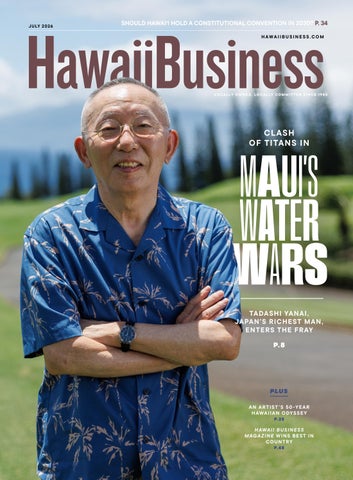
CLASH O F T I TA N S I N
MAUI'S WATER WARS TA DA SH I YA N A I, JA PA N ’ S RIC H E ST M AN , E N T E RS T H E F RAY P. 8
PLUS A N A R T I S T ’ S 5 0 -Y E A R H AWA I I A N O DY S S E Y P.25 H AWA I I B U S I N E S S M AG A Z I N E W I N S B E ST I N COUNTRY P.48
THE LAUNIU WARD VILLAGE RESIDENCE 00 LIVING ROOM
Let the Outside In Ocean vistas stretch toward the horizon. Expansive windows fill interiors with soft sunlight. Illuminated spaces are both classic and contemporary. Studio, One, Two, and Three Bedroom Residences
INQUIRE
livingatlauniu.com | 808 556 6543
Offered by Ward Village Properties, LLC RB-21701
THE PROJECT IS LOCATED IN WARD VILLAGE, A MASTER PLANNED DEVELOPMENT IN HONOLULU, HAWAII, WHICH IS STILL BEING CONSTRUCTED. ANY VISUAL REPRESENTATIONS OF WARD VILLAGE, INCLUDING WITHOUT LIMITATION, RETAIL ESTABLISHMENTS, PARKS, AMENITIES, OTHER FACILITIES AND THE CONDOMINIUM PROJECTS THEREIN, INCLUDING THEIR LOCATION, UNITS, VIEWS, FURNISHINGS, DESIGN, COMMON ELEMENTS AND AMENITIES, DO NOT ACCURATELY PORTRAY THE CONDOMINIUM PROJECTS OR THE MASTER PLANNED DEVELOPMENT. ALL VISUAL DEPICTIONS AND DESCRIPTIONS IN THIS ADVERTISEMENT ARE FOR ILLUSTRATIVE PURPOSES ONLY. THE DEVELOPER MAKES NO GUARANTEE, REPRESENTATION OR WARRANTY WHATSOEVER THAT THE DEVELOPMENTS, FACILITIES OR IMPROVEMENTS OR FURNISHINGS AND APPLIANCES DEPICTED WILL ULTIMATELY APPEAR AS SHOWN OR EVEN BE INCLUDED AS A PART OF WARD VILLAGE OR ANY CONDOMINIUM PROJECT THEREIN. EXCLUSIVE PROJECT BROKER WARD VILLAGE PROPERTIES, LLC, RB-21701. COPYRIGHT ©2026. EQUAL HOUSING OPPORTUNITY.
WARNING: THE CALIFORNIA DEPARTMENT OF REAL ESTATE HAS NOT INSPECTED, EXAMINED OR QUALIFIED THIS OFFERING. THIS IS NOT INTENDED TO BE AN OFFERING OR SOLICITATION OF SALE IN ANY JURISDICTION WHERE THE PROJECT IS NOT REGISTERED IN ACCORDANCE WITH APPLICABLE LAW OR WHERE SUCH OFFERING OR SOLICITATION WOULD OTHERWISE BE PROHIBITED BY LAW. NOTICE TO NEW YORK RESIDENTS: THE DEVELOPER OF THE LAUNIU WARD VILLAGE AND ITS PRINCIPALS ARE NOT INCORPORATED IN, LOCATED IN, OR RESIDENT IN THE STATE OF NEW YORK. NO OFFERING IS BEING MADE IN OR DIRECTED TO ANY PERSON OR ENTITY IN THE STATE OF NEW YORK OR TO NEW YORK RESIDENTS BY OR ON BEHALF OF THE DEVELOPER/OFFEROR OR ANYONE ACTING WITH THE DEVELOPER/ OFFEROR’S KNOWLEDGE. NO SUCH OFFERING, OR PURCHASE OR SALE OF REAL ESTATE BY OR TO RESIDENTS OF THE STATE OF NEW YORK, SHALL TAKE PLACE UNTIL ALL REGISTRATION AND FILING REQUIREMENTS UNDER THE MARTIN ACT AND THE ATTORNEY GENERAL’S REGULATIONS ARE COMPLIED WITH, A WRITTEN EXEMPTION IS OBTAINED PURSUANT TO AN APPLICATION IS GRANTED PURSUANT TO AND IN ACCORDANCE WITH COOPERATIVE POLICY STATEMENTS #1 OR #7, OR A “NO-ACTION” REQUEST IS GRANTED.
Representing experience. Representing a reverence for Hawai‘i. Representing hard work. Representing success. Representing an impactful profession. Representing like-minded colleagues. Representing a business we love. Representing each other always. Representing You. At Hawai‘i Life, representation is everything. It’s at the heart of real estate and how we view our relationship with you. HawaiiLife.com | 1-800-370-3848
O‘ahu Maui Kaua‘i Hawai‘i Island Molokai
The leader in luxury, 13+ years running. Hawai‘i owned and operated. Globally connected. For agents thinking about their business, we welcome the conversation. HawaiiLifeRepresents.com © Hawai‘i Life 2026. Leadership based on highest brokerage sales volume statewide above $3M (MLS, 2013–2025).
0 7. 2 6
CONTENTS
96 Meet Mana Up’s Cohort 11 of Promising Entrepreneurs More than 10 years after Mana Up started identifying state entrepreneurs who could compete on a bigger stage with a little help, the program has quietly become one of the most consequential economic engines in the state. The program’s six-month accelerator pairs founders with mentors, executive training and pathways to global distribution and funding. Mana Up co-founders Meli James and Brittany Heyd have selected the latest cohort of finalists, and Hawaii Business Magazine exclusively profiles them.
Photo: Aaron Yoshino
Japan’s Richest Man Lands in a Maui Water Fight
6
LETTER FROM THE EDITOR
Tadashi Yanai, the billionaire founder of Uniqlo and the wealthiest person in Japan, says he loves Maui, wants to live there permanently some day and has offered $40 million of his own money to help fix the island’s water infrastructure. In the process, he has been cast as a billionaire villain who only cares about golf courses for the rich. He says his intentions are pure. We caught up with him on Maui to find out how he got pulled into the middle of the island’s water wars. 8
An Artist’s Life, Reflected in Community Artist Gary Ackerman has ridden the ups and downs of life on Hawaiʻi island over the past five decades, tapping into a steady flow of tourists and collectors who seek him out in the remote North Kohala community. At 85, he shows no sign of slowing down, still painting every day. He’s constantly experimenting with new art forms to supplement his dazzling canvasses of expressionist and abstract paintings. 25
Who’s in Favor of a New Constitutional Convention? It’s been 48 years since the last constitutional convention was held, with voters approving 34 amendments to the state’s premier governing document. In 2028 it will be time for voters to consider whether to hold another ConCon in 2030. This time, state residents are divided, with some saying it’s time to update the political system while others favor the status quo, fearful that outside influencers might take the lead. We look at the lessons from 1978. 34
HAWAII BUSINESS (ISSN 0440-5056) IS PUBLISHED 12 TIMES A YEAR BY PACIFICBASIN COMMUNICATIONS. ©2026 PACIFICBASIN COMMUNICATIONS, LLC. ALL RIGHTS RESERVED. ANY UNAUTHORIZED COPYING, DISTRIBUTION, OR ADAPTATION IS STRICTLY PROHIBITED AND WILL RESULT IN LIABILITY OF UP TO $100,000. EDITORIAL, ADVERTISING AND BUSINESS OFFICES AT 1088 BISHOP STREET, SUITE LL2, HONOLULU, HI 96813. TELEPHONE (808) 534-7520. POSTMASTER: SEND ALL ADDRESS CHANGES TO HAWAII BUSINESS, P.O. BOX 913, HONOLULU, HI 96808. SUBSCRIBERS NOTIFY THE SAME OFFICE. PLEASE INCLUDE NEW ADDRESS AND OLD ADDRESS (MAILING LABEL PREFERRED) PERIODICALS POSTAGE PAID AT HONOLULU, HAWAI‘I, AND AT ADDITIONAL MAILING OFFICES. SUBSCRIPTION: ONE YEAR $24.99 / TWO YEARS $34.99 / THREE YEARS $44.99. FOREIGN: ONE YEAR $53.99 (US FUNDS). FOR SUBSCRIPTION INQUIRIES, ADDITIONAL RATES, INFORMATION, NOTIFICATION OF CHANGE OF ADDRESS AND SUBSCRIPTION SERVICE, PLEASE CALL (800) 788-4230. JULY 2026 VOL. 72/NO. 1
2
J U LY 2 0 2 6
110 Got ʻTech Neck’? Staring at Your Laptop Too Long? Time for a Stretch This month’s columnist, Ryann Noelani Coules, says “our collective screen dependency has turned neck and back pain into a global public health crisis” and offers some thoughts on how to turn that around. Aches and pains are not just affecting the elderly. Remote workstations may have worsened the problem, but companies are increasingly having to address ergonomic issues in the office. That’s also spawned an industry of companies offering solutions or therapies.
Writer Ryann Noelani Coules gets stretched by a StretchLab flexologist. Photo: Aaron Yoshino
Hawaii Business Magazine Named Best in the U.S.
Makaliʻi Metrics Can Tell You What’s in Your Soil
For the fifth time in nine years, Hawaii Business Magazine has been chosen as the best regional business magazine in the country. Judges from the University of Missouri-Columbia School of Journalism gave top honors to Hawaii Business, which beat out magazines in bigger markets including Florida, Dallas and Minnesota’s Twin Cities, among others. The judges said: “With people-centered stories and creative design, Hawaii Business focuses on the big issues facing the state — and looks forward not back.”
After a UH Mānoa soil testing lab fell victim to federal funding cuts, Daniel Richardson co-founded Makaliʻi Metrics to tell farmers, gardeners and researchers about the nutrients in their soil. The company’s new testing lab in Mō‘ili‘ili opened in May. The lab helps people restore and rejuvenate their lands using both traditional and modern land-management techniques. Tests can show not only nutrients but variations resulting from the state’s different climate zones, the age of the soil and impact from surrounding environments and prior usage.
48
SPECIAL ADVERTISING SECTION Top Performers in Real Estate 2026 Profiles of great agents across four Hawaiian Islands 51
86
H AWA I I B U S I N E S S
3
HB EVENTS C O N N E C T W I T H H AWA I I B U S I N E S S M A G A Z I N E L O C A L LY OW N E D, L O C A L LY COMMITTED SINCE 1955.
Our goal is to strengthen the local economy and help our communities thrive. Publisher KENT COULES kentc@hawaiibusiness.com • (808) 364-5869
JULY 17, 2026 Hilton Hawaiian Village Hawaii Business Magazine in partnership with First Hawaiian Bank presents the Leadership Conference, Hawai‘i’s premier leadership event, bringing together professionals, executives and changemakers for a full day of insight, connection and growth. Through candid conversations, interactive workshops and real-world tools, attendees gain fresh perspective and practical strategies to lead with impact. Connect with those shaping Hawai‘i’s industries — and leave with ideas you can put into action immediately.
A W A R D S
2 0 2 6
PRESENTING SPONSOR:
SEPTEMBER 17, 2026 Fuller Hall - Downtown YWCA Excellence rarely begins with unlimited resources. More often, it starts with vision, determination, and a commitment to making a meaningful impact. The Hawai‘i Excellence in Business Awards celebrate organizations that embody these qualities—achieving measurable success while strengthening their employees, industries, and communities. Selected through a competitive application process, this year’s honorees demonstrate outstanding leadership, innovation, workplace culture, and community stewardship. Their stories reflect what excellence in Hawai‘i looks like today and inspire what is possible for tomorrow. For more information on events, visit hawaiibusiness.com/events or contact Ashley McLean, Events Manager, at ashleym@hawaiibusiness.com
Editorial Editor-in-Chief JENNIFER ABLAN jennifera@hawaiibusiness.com Managing Editor KEN WILLS kenw@hawaiibusiness.com • (808) 987-8135 Senior Editor STEVE PETRANIK stevep@hawaiibusiness.com • (808) 534-7584 Senior Contributing Writer CYNTHIA WESSENDORF cynthiaw@hawaiibusiness.com Staff Writer RYANN NOELANI COULES ryannc@hawaiibusiness.com Staff Writer GRANT NAKASONE grantn@hawaiibusiness.com Copy Editor ELROY GARCIA Editorial Interns LILI HURD, KIANI VIDAURRI, ALLYSON WHALEY
Design & Photography Creative Director ESTHER MOHRMANN Graphic Designer CHASE NUUHIWA Graphic Designer KAREN TANIGAWA Graphic Designer GINNY WILLIAMS Staff Photographer AARON YOSHINO Digital Digital Director RANDALL LIBRAMONTE randalll@hawaiibusiness.com Digital Content Manager MARIANNE LEANO mariannel@hawaiibusiness.com Sales & Marketing Senior Account Executive YONGCHAE SONG yongchaes@hawaiibusiness.com • (808) 228-5078 Account Executive KELLY CLARK kellyc@hawaiibusiness.com • (979) 587-6410 Operations Manager REBECCA BROOKING rebeccab@hawaiibusiness.com • (808) 534-7560 Events Manager ASHLEY MCLEAN ashleym@hawaiibusiness.com • (808) 272-6550 Events Coordinator OLIVIA DE SENA oliviad@hawaiibusiness.com Circulation hawaiibusinessmag@emailcustomerservice.com Connect with us on social media: HawaiiBusiness HawaiiBusinessMagazine Hawaii Business is published by
Founder DUANE KURISU Chairman SUSAN EICHOR President BRANDON KURISU Director of Finance JADE MOKIHANA HIND
Left to right: Liane Khim, Cash Management Services Manager, ASB; Kyle Shelly, Director, Corporate Banking, ASB; Tony Mizuno, Executive Vice President, Commercial Markets, ASB; Patricia Chang Moad, Managing Director, Continental Assets Management; Billy Pieper, Director, Commercial Banking, ASB; Kiley Nakamura, Director, Commercial Real Estate, ASB
“The people at ASB are phenomenal. In this day and age, you can feel like just a number on a balance sheet — I don’t feel that way at ASB.” Patricia Chang Moad, Managing Director Continental Assets Management
Member FDIC © 2026 American Savings Bank
With the help of American Savings Bank, Continental Assets Management turned an underused downtown office building into the AC Hotel by Marriott Honolulu, the preferred corporate travel hotel in Hawaii. ASB’s commercial banking team makes complex financing easier to navigate for the most ambitious projects while nurturing strong relationships to make your dreams possible. asbhawaii.com
A different kind of bank.
LET TER FROM THE EDITOR
Why Hawai‘i Needs More Public-Private Partnerships
H
awaiʻi faces no shortage of big challenges: aging infrastructure, housing shortages, rising costs and growing demands on public resources. Solving them will require more than government action alone. It will also require private-sector investment, innovation and expertise. That was the premise behind Hawaii Business Magazine’s inaugural Public-Private Partnership (P3) summit in May, which brought together leaders from government, business and nonprofits to explore how collaboration can help address some of Hawai‘i’s most pressing issues. While public-private partnerships are used around the world, Hawai‘i has been slower to embrace them. Yet some of the state’s most ambitious projects are moving forward because of these arrangements. One of the most visible examples is the redevelopment of Aloha Stadium through the New Aloha Stadium Entertainment District project. As Hawaii Business reported in March, the state is partnering with Aloha Hālawa District Partners (AHDP), the project’s master developer, to design, build, operate and maintain the new stadium while developing the surrounding entertainment district. AHDP will operate and maintain the project for 30 years under state oversight. The project will replace the shuttered Aloha Stadium with a new 31,000-seat multipurpose venue, with the potential for future expansion, while transforming the 98-acre site into a mixed-use district that includes housing, hotels, retail, entertainment, office space and community amenities. By combining public investment with private capital and expertise, the project aims to deliver a long-awaited community asset while reducing the financial burden on taxpayers. “Effective connections between the public and private sectors are key to moving Hawai‘i forward. It’s clear that the state has lagged behind in forging the kinds of public-private partnerships that drive local economies,” says Hawaii Business publisher Kent Coules, who helped produce our first P3 Summit. The summit underscored this reality: Government and business often cannot solve complex problems alone. Government provides oversight and accountability. Private organizations contribute capital, innovation and expertise. The most successful partnerships recognize the value of both—a win-win for all parties. Of course, public-private partnerships are not without controversy. Questions about transparency, accountability and community impact deserve scrutiny. Hawai‘i’s residents should expect thoughtful debate whenever private interests intersect with public assets. As the state’s needs continue to outpace available resources, finding effective ways to work together will become increasingly important. Our cover story on the Maui water crisis offers another example of the opportunities and challenges that arise when private capital intersects with public needs.
6
J U LY 2 0 2 6
As I report, Tadashi Yanai—the billionaire founder of Uniqlo and the richest man in Japan—has found himself at the center of one of Maui’s most consequential debates over water, infrastructure and community stewardship. Cast by some critics as a symbol of outside wealth and privilege, Yanai has proposed contributing tens of millions of dollars of his own money to help modernize West Maui’s aging water infrastructure, with the goal of transferring those improvements to public ownership. His proposal has ignited debate about who should control Hawai‘i’s precious resources, but it also raises questions about how private investment can contribute to solving public challenges. After spending time with Yanai and his deputies while reporting this story, I found Yanai to be sincere in both his affection for Maui and his desire to be part of its future. “I love Maui,” Yanai tells me. “I would like to live here permanently someday.” Reasonable people can disagree about the merits of his proposal, but the broader question remains: How can Hawai‘i harness private capital and expertise while protecting the public interest? As our P3 Summit made clear, that is a conversation we can no longer avoid. At Hawaii Business, these are conversations we strive to foster. Our mission is not simply to report the news, but to provide context, challenge assumptions and examine the forces shaping Hawai‘i. That commitment was recently recognized on a national stage. For the fifth time in nine years, Hawaii Business has been named the nation’s best regional business magazine by The Alliance of Area Business Publishers, earning the organization’s highest honor against publications from larger markets across the United States and Canada. The recognition reflects the work of an extraordinary team of editors, writers, photographers, designers and digital storytellers dedicated to producing journalism that informs, challenges and serves Hawai‘i’s business community. Judges praised the magazine’s people-centered storytelling, creative design and focus on the issues shaping Hawai‘i’s future. The honor came alongside five additional national awards recognizing excellence in profile writing, explanatory journalism, multimedia storytelling, special publications and design. These awards are gratifying, but they are not the goal. The goal is producing journalism that matters – journalism that helps readers better understand the forces shaping Hawai‘i’s economy, communities and future. Mahalo for reading and for supporting Hawaii Business.
JENNIFER ABLAN EDITOR-IN-CHIEF
YO U R R OA D M A P TO H AWA I ‘ I ’ S 2 0 26 BUSINESS EVENTS
JUL
July 17 Leadership Conference
AUG
August 13 Top 250 CEO Celebration
SEP OCT
Hawai‘i Leadership Academy: Cohort Three September 17 Hawai‘i Excellence in Business Awards
October 8 HB20 (20 FOR THE NEXT 20) Impact Summit October 23 Wahine Forum Inaugural Wahine of the Year Pau Hana Celebration
NOV
November TBA CEO Roundtable
DEC
December TBA CEO of the Year Celebration
V I S I T W W W. H AWA I I B U S I N E S S . C O M / E V E N T S
Japan’s Richest Man Came to Maui for Golf. He Got a WATER WAR Instead.
8
J U LY 2 0 2 6
Cast by critics as a villain in Maui’s water wars, Uniqlo billionaire Tadashi Yanai says he’s willing to contribute $40 million to help rebuild the island’s aging infrastructure. by J E N N I F E R A B L A N
E X C L U S I V E F E AT U R E
O
n a warm April afternoon in Maui, Tadashi Yanai, the billionaire founder of clothing brand Uniqlo, sits in one of his own aloha shirts discussing neither fashion nor his vast fortune. He’s talking about water. “Making money alone has no meaning for me,” Yanai says through a translator. “The money should support society and community. That is what I would like to do using my money.” It is not the sort of statement one expects from Japan’s richest man – or from one of the world’s most influential businessmen, now cast by critics as a central figure in Maui’s escalating fight over a resource many residents view as sacred. According to Forbes’ real-time billionaire rankings, Yanai and his family are worth an estimated $67 billion as of June 2026, making him the wealthiest person in Japan and one of the 35 richest people on Earth. So how did the architect of one of the world’s most powerful retail empires find himself at the center of a Hawaiian island’s drought?
Close friend Hirotaka Takeuchi of Harvard Business School sits beside Tadashi Yanai, founder of TY Management. During the discussion, Takeuchi translated for Yanai. Photo: Aaron Yoshino
The answer begins on the fairways year, putting at risk an event estimated of Kapalua. to generate roughly $50 million annually There, a dispute over irrigation for the island’s economy. has evolved into something much The controversy has transformed larger. Yanai’s Hawai‘i company, TY a famously private billionaire and avid Management, owns the Kapalua golf courses, whose lush fairways depend on increasingly scarce supplies. As drought conditions Making money alone has no worsened, Maui Land meaning for me. The money & Pineapple – which controls much of West should support society and Maui’s water infracommunity.” structure – and state regulators pushed to — Tadashi Yanai, founder of TY Managament restrict usage, igniting a conflict that now stretches far beyond the golf course. golfer into the unlikely public face of one The stakes reach well beyond the of Hawai‘i’s most emotionally charged greens. What began as a fight over irrigadebates: Who gets access to a diminishing tion now touches jobs, tourism and one of resource, and who gets to decide. Maui’s signature sporting events. Resort “I’m very sad, very sad and disapadvocates say water shortages contribpointed,” Yanai says of the tournament’s cancellation. “I am determined to bring uted to the cancellation of the PGA Sentry it back to Maui.” Tournament for a second consecutive But Maui’s water wars did not begin with Yanai. Their roots stretch back for more than a century. Beginning in the 19th century, sugar and pineapple plantations diverted streams through vast ditch systems, redirecting water away from Native Hawaiian kalo farmers and coastal ecosystems. The plantations eventually faded. The struggle over control of the water did not. For decades, much of the infrastructure remained in private hands. Maui Land & Pineapple – the modern heir to the plantation era – continued to control key portions of West Maui’s reservoirs, ditches and delivery networks. Then came years of drought, mounting legal battles and, in 2023, the devastating Lahaina wildfire. Together, they intensified calls to place more of Maui’s water system under public control. In May 2026, Maui County reached an agreement to acquire Maui Land & Pineapple’s water assets, a landmark shift that could reshape control of West Maui’s water for the first time since the plantation era.
H AWA I I B U S I N E S S
9
Pomaikaʻi Kaniaupio-Crozier, Conservation Director for Pu‘u Kukui Watershed Preserve. Photo: Aaron Yoshino
The deal landed squarely in the middle of TY Management’s legal fight with the company, turning what began as a dispute over golf course irrigation and aging infrastructure into part of a much larger reckoning over land, water and power in Hawai‘i. Yet even that historic transfer left the central question unresolved. Who should control Maui’s water future? For some residents, the answer should never depend on the interests of wealthy investors or resort owners. “Our island is dying,” says Maui resident Lauren Palakiko. “Our concern is not about billionaires playing golf. Our concern is how we sustain future generations.”
10
J U LY 2 0 2 6
YANAI’S PUSH TO REBUILD THE SYSTEM
Kenji Yui, a senior adviser to Yanai and one of the architects of TY Management’s Maui water strategy, says the company had spent months quietly discussing its own partnership proposal with Maui County before the agreement with Maui Land & Pineapple was unveiled. “We have been talking with the county for the past six months,” Yui says. The discussions have been about “if we can work together to jointly acquire MLP’s water system.” But Yui acknowledged that Maui Land & Pineapple appeared to have an advantage over TY Management, remarking that “the county has direct communication with Maui Land & Pineapple because
they have a historical relationship.” Yui insists the county’s agreement with Maui Land & Pineapple changes little about Yanai’s broader ambitions in Maui. Rather, he positions the billionaire’s involvement as an attempt to accelerate repairs to West Maui’s fragile water infrastructure using tens of millions of dollars of his personal stake rather than taxpayer money. “If the county would like to reduce using taxpayers’ money, then it’s good for the community and for the county to work with TY,” Yui says. “Because TY can provide funding.” Maui County has not closed the door on the idea, but its response was measured. “We are always open to evaluating
proposals that may benefit our community,” a county spokesperson said. “Maui County has engaged in successful public–private partnerships in the past, but any future partnership would undergo thorough review, including input from the Council and the community. Our focus will always be on ensuring any decision serves the best interests of Maui County residents.” YANAI’S $40 MILLION BET
Yanai has floated contributing somewhere between $30 million and $40 million toward repairs and upgrades to West Maui’s water system, though Yui describes those figures as rough estimates rather than hard caps. Among the proposals under discussion: repairing aging reservoirs, fixing sections of the Honokōhau ditch system and building transmission lines capable of delivering “R-1” recycled wastewater to Kapalua, reducing dependence on stream diversions during droughts. The proposal is closely tied to the future of Kapalua’s golf courses, which require substantial irrigation. According to Yui, water demand can reach roughly 1.5 million gallons per day during Maui’s hottest and driest periods, though actual usage fluctuates throughout the year depending on rainfall, humidity, weather conditions and growing seasons. Yui says Yanai’s long-term goal is for all irrigation water used by the golf courses to eventually come from recycled wastewater or other non–potable sources, such as brackish water, rather than the Honokōhau ditch system. “Just building a transmission line from the current wastewater treatment facility to Kapalua, at least it will take $20 million,” Yui says. Yui confirmed that the funding would come from Yanai’s personal fortune. “If the cost is reasonable for Mr. Yanai, then he will donate the money.” Yui says the proposed recycled–water pipeline would serve not only the golf courses but broader irrigation needs in Kapalua. If alternative irrigation supplies can be secured for the area, he says, water currently delivered through the Honokōhau ditch system could potentially be redirected to other users, including Maui County and taro farmers. Exactly how the remaining investment dollars would be spent remains
unclear. Yui says discussions involving According to Yui, TY Management has the county and other stakeholders are invested approximately $10.3 million ongoing and that it is premature to assign over the past decade in water-monitoring specific amounts to projects such as ditch technology, irrigation-system repairs and repairs, reservoir improvements or other upgrades, weather stations, soil-moisture infrastructure upgrades. sensors and other tools designed to op“It is safe to say he [Yanai] is willing timize irrigation and reduce water use. to invest a substantial amount, millions of dollars, in Our island is dying. Our concern improving the water is not about billionaires playing infrastrucgolf. Our concern is how we sustain ture in order for an adefuture generations.” quate water — Lauren Palakiko, Maui resident supply to be available for future In 2019, TY spent an additional $12.6 generations,” Yui says. “That would save taxpayers millions of dollars.” million renovating the Plantation Course. Yanai’s representatives point to preAccording to Yui, the project included vious investments as evidence that the converting portions of the course to company has sought to reduce water more drought–resistant grasses, installconsumption rather than increase it. ing a more efficient sprinkler system
Native plants are being replanted along the ridgeline at Puʻu Kukui Watershed Preserve, helping restore and protect a critical Maui watershed. Photo: Aaron Yoshino
H AWA I I B U S I N E S S
11
and reducing irrigated acreage by about six acres. Similar renovations had been planned for the Bay Course before water restrictions halted those efforts. The Bay Course is currently closed and not being irrigated. WHY MAUI MATTERS TO YANAI
Yanai says it’s a misconception to view him as simply a money-driven billionaire. Instead, he says his vision for Maui stems from a deep appreciation for the island, its people and its environment. “I believe water should belong to the community,” Yanai says through a translator. “Not privatized.” Under Yanai’s proposal, TY Management would ultimately transfer the upgraded infrastructure to a government agency or public entity at no cost. Over time, Maui has become far more than a luxury destination or business investment for Yanai. Yanai and his wife visit the island regularly, golfing in Kapalua several times a year, and he says he has developed a strong personal attachment
12
J U LY 2 0 2 6
to the community and landscape. “I love Maui,” Yanai says through his translator. “I would like to live here permanently someday.” He says the island has also had a pro-
“This is not only economic development,” Yanai says through a translator. “It is also about the environment, including the water situation.” Through TY Management, Yanai has already committed $2.5 million to Maui-related causes. That includes $750,000 donated in 2025 to local nonprofits such as Hale Makua Health Services I believe water should and the Lahainaluna High belong to the community. School Foundation to help offset charitable losses tied to the Not privatized.” cancellation of the PGA Tour’s — Tadashi Yanai, founder of TY Managament Sentry tournament. The company also previously provided $1 million for found effect on his personal well-being. watershed conservation efforts, along “My health became much better after with an additional $500,000 this year to Aloha Pu‘u Kukui. spending time in Maui,” he says. “The weather, the environment, the people – it Following the Lahaina wildfire, TY is a very special place.” Management says, it funded 50 temporary Yanai says he hopes to support homes for displaced residents. That’s on both economic opportunity and envitop of the offer to invest up to $40 million ronmental stewardship in West Maui, to modernize West Maui’s aging water particularly efforts tied to long-term wainfrastructure before eventually transter sustainability. ferring the upgraded system to public
Kenji Yui, a senior adviser to Tadashi Yanai and a key architect of TY Management's Maui water strategy, and John Meier, president of the nonprofit Aloha Puʻu Kukui, visit Puʻu Kukui Watershed Preserve, where native species are being replanted along the ridgeline as part of longterm watershed stewardship efforts. Photo: Aaron Yoshino
ownership at no cost to the government. Globally, Yanai and his companies have contributed hundreds of millions of dollars to humanitarian and educational initiatives, but he says Maui remains uniquely personal to him. GOLF, WATER AND PUBLIC BACKLASH
Yanai’s championship golf courses, which spread across hundreds of acres of Kapalua hillside, have increasingly become a symbol of Maui’s larger struggle over water, tourism and development. As climate change deepens the island’s droughts and Native Hawaiian communities press legal claims to ancestral water rights, the debate has increasingly focused on West Maui’s aging ditch system – and on whether the shortages stem from drought, failing infrastructure or both. To critics, dedicating scarce water resources to luxury golf courses, regardless of who finances the infrastructure, is difficult to separate from Hawai‘i’s longer history of unequal land and water use. The philosophical debate eventually
hardened into a legal one. In 2025, Yanai’s company, TY Management, sued Maui Land & Pineapple, alleging that the company neglected the aging Honokōhau ditch system that supplies water to West Maui, worsening shortages that threatened Kapalua. “MLP has knowingly, and in violation of its promises and obligations to Plaintiffs, allowed the Ditch System to fall into a state of demonstrable disrepair,” the lawsuit states. “That disrepair – not any act of God, force of nature, or other external factor – is why users who depend on the system are currently without water.” TY’s lawsuit points to what it says is visible evidence of that neglect. During a May 2025 site visit, TY representatives, consultants and county officials observed sediment accumulation at Diversion 770, debris clogging intake structures and damage to one of the development tunnels that historically supplied additional water to the system, according to court filings. TY
also documented severe deterioration in the liner of the Village Reservoir, where large sections had cracked or detached. Photographs included in the filings show sediment buildup at key diversion points, damaged gates, overgrown sections of the ditch system and deteriorating storage facilities. TY argues the images support its claim that aging infrastructure – not simply drought – has reduced the amount of water reaching West Maui users. Maui Land & Pineapple rejects that characterization entirely. “The reality is there’s been a very strong misinformation campaign,” CEO Race Randle told Hawaii Business Magazine in an interview conducted before Maui Land & Pineapple agreed to sell its water assets to Maui County. “Last year was the driest year on record in Maui. If the streams aren’t flowing, there is no water to divert.” Randle argues the dispute is not about neglected infrastructure but the harsh mathematics of climate change, drought and limited storage capacity in
H AWA I I B U S I N E S S
13
Race Randle, CEO Of Maui Land & Pineapple Inc. Photo: Aaron Yoshino
West Maui’s isolated water system. “When Mother Nature goes to an extreme,” he said, “there’s a lot of finger-pointing that happens very quickly.” Yanai sees it differently. “This is not a legal matter,” he says through a translator. “It is a human matter.” Whether Maui County’s agreement to acquire Maui Land & Pineapple’s water assets will ultimately reshape the dispute remains an open question. County officials declined to speculate on whether the deal could help resolve the litigation between TY Management and Maui Land & Pineapple, noting that the case remains a private dispute between the two companies. For now, the future of West Maui’s water system remains unresolved. The county’s agreement with Maui Land & Pineapple is nonbinding. The litigation continues. And behind the scenes, county officials, private developers, Native Hawaiian advocates and Yanai’s advisers are still negotiating over who should ultimately control one of Maui’s most politically sensitive resources. WHEN THE FAIRWAYS TURNED BROWN
That question became impossible to ignore when the water restrictions reached Kapalua. As supplies tightened, authorities sharply limited diversions from West Maui streams, reducing irrigation water across the resort community. The Bay Course was forced to close. Water that once sustained its fairways was redirected in an effort to preserve the Plantation Course, home of the PGA Tour’s season-opening Sentry Tournament. Even that proved insufficient. The fairways began to brown. At Kapalua, where emerald greens had long served as a symbol of luxury Hawaiian tourism, large stretches of landscape turned brittle under conservation measures. Residents watched gardens dry out. Irrigation systems slowed. Golf operations shifted into survival mode. For resort operators, the threat
14
J U LY 2 0 2 6
HONOKŌHAU DITCH SYSTEM AN INFRASTRUCTURE SYSTEM BUILT FOR ANOTHER ERA
The populated part of West Maui is a narrow strip of coastline pressed between the Pacific Ocean and steep volcanic mountains. Nearly every drop of fresh water that reaches its homes, hotels, farms and golf courses depends on a fragile network of streams, tunnels, ditches and reservoirs built during Hawai‘i’s plantation era. Long before Ka‘anapali became synonymous with luxury tourism, water shaped power on Maui. Beginning in the late 1800s, sugar and pineapple companies diverted vast quantities of water away from Native Hawaiian communities and into plantation agriculture, transforming both the island’s economy and ecosystem. The systems allowed plantations to flourish for generations while downstream kalo farmers and coastal fishponds struggled for survival. Many of those same diversion systems still define West Maui today. The 11-mile Honokōhau ditch system — now at the center of the dispute between TY Management and Maui Land & Pineapple — was designed for a very different Hawai‘i: one built around plantation agriculture, not climate volatility, wildfire risk and mounting development pressure. Today, those pressures are intensifying. According to the Hawai‘i Annual Climate Report 2025, last year was the second driest year in Hawai‘i’s 106-year recorded history, with statewide rainfall averaging just 42 inches — roughly 20 inches below the 30-year average. Maui experienced its driest year on record. Hawai‘i island recorded its second driest. By year’s end, 65% of the state was classified as abnormally dry or worse, while all of Moloka‘i experienced drought conditions. The most severe period came in February, when more than half of Hawai‘i was classified as being in severe drought or worse. For Maui Land & Pineapple, the explanation for the shortages is straightforward. “When the streams aren’t flowing, there is no water to divert,” CEO Race Randle says. “That’s the reality.” But TY Management argues the central problem is not the amount of rain falling from the sky. The central question running through the dispute is whether West Maui is running out of water or losing its ability to capture, store and deliver the water it already has.
extended beyond aesthetics. The Plantation Course hosts the Sentry Tournament, a global television showcase and one of Maui’s most important tourism events. Resort advocates say the tournament generates roughly $50 million annually for the island’s economy through hotel bookings, restaurant traffic, transportation services and visitor spending. When the event was ultimately canceled, the effects rippled well beyond the golf course. Hotels, restaurants, caddies, landscapers and other hospitality workers all depend on the winter tourism surge that accompanies the tournament. For many local businesses, the water dispute had become an economic crisis as much as an environmental one. TY Management maintains that the shortages are not fundamentally the result of declining rainfall. The rain still falls on West Maui’s mountains, the company argues. The problem is that aging ditches, reservoirs and delivery systems
were never adequately maintained to capture and move that water when it arrives. Critics disagree. But by the time the fairways turned brown, the argument was no longer confined to engineers, regulators and lawyers. It had become a public battle over water, development and who gets to shape Maui’s future. THE UNINTENDED CONSEQUENCES
In early 2026, organizers canceled the PGA Tour’s Sentry Tournament in Kapalua for the second consecutive year after uncertainty surrounding water delivery and course conditions made it impossible to guarantee tournament standards in time for the event. For Hawai‘i’s tourism industry, the fallout was far more than a sporting disappointment. Jerry Gibson, president of the Hawaii Hotel Alliance and one of the state’s most influential hospitality executives, says the economic consequences could
reverberate across the Islands for years. “This whole thing, honestly, has affected us for years to come,” Gibson says. The Sentry Tournament and the Sony Open, he says, have long served as Hawai‘i’s most valuable annual tourism advertisements – two consecutive weeks of nationally televised images showcasing the Islands during winter on the mainland. “You’re sitting in New York in January, and it’s freezing outside, and you see the surfers, the golf courses, the palm trees,” Gibson says. “You might get off the couch and decide to book a trip to Hawai‘i.” The immediate losses from the Sentry cancellation were estimated at roughly $50 million annually. Gibson believes the long-term impact could stretch far higher. “You can’t just talk about $50 million,” he says. “This is hundreds of millions of dollars over time.” According to Gibson, the PGA Tour explored relocating the event elsewhere in Hawai‘i – and even to the mainland – before ultimately canceling it because no other course could be prepared quickly enough to meet tournament requirements. “The courses need months of preparation,” Gibson says. “They couldn’t guarantee the water was going to be delivered like it was supposed to be.” Yet Gibson rejects the idea that the crisis can be blamed entirely on one company or one drought. “You can blame a little bit of nature because there was a drought at the time,” he says. “And you can also say communication should have been a lot better between everybody.” ‘WHAT MLP HAS DONE IS A SIN’
At Puʻu Kukui Watershed Preserve, native plants are being reintroduced along the hillside to stabilize the landscape and reduce erosion. The white structures are water storage tanks. Photo: Aaron Yoshino
To Yanai, the picture looks very different. “What MLP has done is a sin,” Yanai says at one point during our interview, referring to Maui Land & Pineapple. Yanai accuses the company of failing to maintain the aging ditch infrastructure needed to move water through West Maui. Maui Land & Pineapple strongly disputes that claim. “The system is functioning,” Randle says. “The issue is that there was no water in the streams to divert.”
H AWA I I B U S I N E S S
15
John Meier, president of the nonprofit Aloha Puʻu Kukui. A former technology entrepreneur who began his career at Apple and later founded and grew software companies, Meier has volunteered at Puʻu Kukui for six years and has been involved in conservation efforts on Maui for the past decade. Photo: Aaron Yoshino
At Puʻu Kukui Watershed Preserve, native species, including ʻaʻaliʻi, a traditional Hawaiian healing plant, are being replanted across the hillside as part of longterm watershed stewardship efforts. Photo: Aaron Yoshino
16
J U LY 2 0 2 6
Behind the increasingly personal rhetoric lies a more uncomfortable reality: Both sides may be arguing over a system that was never designed for modern Maui. West Maui’s water infrastructure was built for another era – one centered on plantation agriculture, not luxury tourism, wildfire resilience and climate volatility. Now engineers, developers and government officials are scrambling to answer a far larger question: How does an island community survive when drought becomes permanent? For Randle, the answer begins with data. “A drought is a scientific fact,” he says. “What really helps in discussions around water is good data – how much rain is falling, where it’s going, and how much water is actually available.” Randle argues Maui’s crisis exposes a structural problem far bigger than Kapalua’s golf courses: West Maui simply lacks the storage capacity to survive prolonged climate extremes. “In West Maui, we have roughly 10 days of water storage,” he says. “If it doesn’t rain, you’re relying on groundwater.” That vulnerability has accelerated a
growing push toward large-scale water recycling, expanded reservoir systems and even desalination projects. Yanai, through TY Management, has proposed major investments in recycled “R-1” water infrastructure intended to reduce dependence on stream diversions. Maui Land & Pineapple says many of those ideas remain conceptual and subject to county approval. “There’s no detailed proposal in front of us,” Randle says. “But recycling water is absolutely part of the future.” Even critics of Kapalua’s golf operations increasingly acknowledge that Maui’s long-term survival may ultimately depend less on litigation than on engineering. Across West Maui, crews are already expanding so-called “purple pipe” systems that carry recycled water for irrigation. County officials are studying additional storage reservoirs capable of capturing storm runoff during increasingly erratic weather events. The stakes stretch far beyond golf. “How do we achieve our goals with limited resources?” Randle asks. “That’s the real question.” LOCALS ARE ANGRY
representing community groups before Hawai‘i’s Commission on Water Resource Management, argued that the use of groundwater for golf-course irrigation violated state water permitting requirements in West Maui’s regulated aquifer system. The controversy intensified after Commission Chair Dawn Chang issued correspondence in 2025 stating that water operators had represented groundwater as an existing source of irrigation water within the Kapalua system and that its temporary use could continue while permit applications were under review. Critics interpreted the letter as effectively sanctioning the use of drinking water for golf-course irrigation during a period of drought and water restrictions. Chang later rejected that interpretation, saying the correspondence neither authorized nor directed new groundwater withdrawals but instead reflected information that had been provided to the commission regarding existing operations. Chang will retire as Department of Land and Natural Resources chairperson and director on July 1. TY Management also rejected accusations that it was improperly taking drinking water for golf irrigation, arguing that it did not directly control the underlying water sources flowing through the broader West Maui delivery network. The company says its long-term proposal
Lauren Palakiko, who was born and raised on the West Side whose husband is a kalo farmer, says golf courses were filling their reservoirs with drinking water from aquifers during Maui's drought. "Those are our only safe, clean drinking water." Photo courtesy of Lauren Palakiko
of dispossession and mistrust. Palakiko, a Maui Realtor born and As West Maui’s drought intensified, the raised on the West Side whose husband is fight over Kapalua’s water supply exa kalo farmer, moves between the island’s panded beyond aging plantation ditches luxury economy and its local communiand into another politically explosive ties. But on the question of question: whether drinkwater, she is unsparing. ing water was being used to “They were using the keep the golf courses alive. approval to irrigate with Historically, Kapalua’s drinking water,” she says. courses relied heavily on The reality is there’s been a very surface water diverted She alleges that "they filled through the Honokōhau their reservoir with drinkstrong misinformation campaign.” ing water from our aquifer ditch system. But as stream - depleting it within days. flows dropped and regula— Race Randle, CEO, Maui Land & Pineapple, speaking Those are our only safe, tors restricted diversions to Hawaii Business Magazine before the company during the drought, atclean drinking wells." agreed to sell its water assets to Maui County West Side residents, tention shifted toward meanwhile, were restricted groundwater wells – potato watering their yards once ble water sources that many a week. She recalls watching a nearby residents viewed as increasingly scarce centers on recycled “R-1” water infragolf course run sprinklers at noon – after the Lahaina wildfire disaster. structure precisely to reduce dependence peak evaporation time – close enough Environmental advocates and on both stream diversions and potable Native Hawaiian groups accused to the Lahaina burn zone to feel almost groundwater. TY Management and Maui Land & provocative. But after Lahaina, the symbolism “It does feel like a slap in the face,” Pineapple of relying on potable groundproved difficult to contain – and for resshe says. “We are on drought restrictions water to irrigate the Plantation Course idents like Lauren Palakiko, impossible and we are watering grass so billionaires during the water crisis. Earthjustice, to separate from a much longer history
H AWA I I B U S I N E S S
17
can play golf.” For many Maui residents, the image of green fairways surviving amid drought restrictions and wildfire trauma became emotionally inseparable from deeper fears about who would ultimately control Hawai‘i’s increasingly scarce water resources. WHO GETS THE WATER?
For many residents, the fight over water has become about something larger than golf, tourism or infrastructure. Three years after the Lahaina wildfire catastrophe, water shortages have become psychologically inseparable from questions of public safety and survival. Questions once confined to hydrologists and regulators suddenly became existential for ordinary residents: Who
gets water during a drought? Who sacrifices first? In Hawai‘i, water has never been simply about water. It is land, sovereignty, history and survival flowing through the same streams. Palakiko traces the conflict “when the plantations started diverting water out of the streams.” When the plantations shut down around 2000, she says, developers inherited the same diversion and water delivery system once controlled by sugar companies – but instead of replenishing the land, much of that water now flows into pools, resorts and manicured fairways. The consequences, she argues, are now appearing underground. The island’s freshwater exists as a fragile lens floating above ocean saltwater deep within the aquifer, and that lens
is shrinking. “You’ve got this bowl and all these straws – which are wells – all sucking from the same freshwater lens,” she says. “The salination is rising past the EPA’s threshold for safe human consumption. This is our water source. This is how we get our water.” She also has not forgotten how some officials responded after Lahaina burned. “After we lost our town and our homes and our people, they were joking that we wouldn’t need to put salt on our food anymore because our water was already salty enough.” For many Native Hawaiians, the modern fight over West Maui’s water cannot be separated from the plantation-era diversions that transformed the islands generations ago. Long before Kapalua became a global golf destination,
The Puʻu Kukui Watershed Preserve in West Maui, a protected native forest that plays a key role in sustaining the region's water supply and ecological resilience. Photo: Aaron Yoshino
18
J U LY 2 0 2 6
communities downstream argued that communities through drought. diverted streams damaged traditional “Our mountains are called Mauna farming, fishponds and cultural practices. Kahālāwai – the Gathering of the Water,” Climate change has only intensified she says. “We were once the second wetthose tensions. test spot in the world. We have the ability For some residents, the sight of green fairways during water restrictions symbolizes a familiar imbalance in Hawai‘i – one where tourism, luxury develMālama ‘āina — take care of opment and outside wealth the land first.” continue to shape access to finite island resources. Others argue — Lauren Palakiko, Maui resident the deeper danger lies elsewhere: an aging infrastructure system increasingly incapable of supportto bring that back.” ing anyone, regardless of who owns the Above all, she wants Native Hawaiian golf courses. customary water practices treated not as Palakiko says both concerns are real, a historical footnote but as the governing but she keeps returning to something principle. “Malama ‘āina – take care of the land more fundamental than litigation or infrastructure deals: restoring the natural first,” she says. “Everything that depends water cycle itself. on this land and water to survive comes She wants all streams restored from before extracurricular activities, such as mountain to sea – mauka to makai. She golf. I don’t really know any locals who wants the West Side reforested because would put a dollar before any of that.” healthy forests attract rain clouds, recharge aquifers and help sustain
Tadashi Yanai in May donated $500,000 to the nonprofit Aloha Puʻu Kukui toward the restoration work of the West Maui Puʻu Kukui Watershed Preserve. The latest gift brings the total contribution to Puʻu Kukui Watershed to $1.5 million since 2024. From left to right: Mari Poorman, Peacewinds; John Meier, Aloha Puʻu Kukui; Veronica Fernandez, Aloha Puʻu Kukui; Alex Nakajima, Kapalua Golf; Mr. Tadashi Yanai, TY Management. Photo: Aaron Yoshino
H AWA I I B U S I N E S S
19
Race Randle, The Builder If Tadashi Yanai is the billionaire at the center of Maui’s water controversy, Race Randle is the local executive who has become one of its most visible participants. by J E N N I F E R A B L A N
20
J U LY 2 0 2 6
S
hortly after Maui Land & Pineapple announced a memorandum of understanding with Maui County that could place major West Maui water assets under county control, I spoke with Race Randle about the company’s future, the ongoing water debate and his vision for Maui. As chief executive of Maui Land & Pineapple, Randle oversees one of Hawai‘i’s oldest and most storied companies, a firm publicly traded on the New York Stock Exchange under the ticker symbol MLP. Its history stretches back more than a century, and its land holdings and water infrastructure have placed it at the center of a growing debate over water, development and public trust. As he navigates those challenges, Randle must also answer to shareholders. Maui Land & Pineapple shares have risen about 4% over the past year, even as the company has found itself at the center of one of Hawai‘i’s most closely watched water disputes. “We’re a company that has a long legacy, a long legacy of stewardship in Hawai‘i,” Randle says. “Over a hundred years of creating thousands of jobs, creating homes for hundreds, if not thousands, of families on Maui and protecting and preserving some of the most pristine lands on Maui.” The water controversy has attracted attention because it touches on something more fundamental. In Hawai‘i, water is not simply a resource. It is tied to history, identity, economic opportunity and the future of entire communities. Yet spend time with Randle and a different picture emerges. He is less interested in talking about legal disputes than he is in talking about communities. “My father was a homebuilder,” Randle says. “From the first days I could walk, I was on job sites.” That experience shaped his worldview long before he entered the executive suite. Born and raised in Hawai‘i, Randle grew up watching homes take shape one foundation at a time. Later, his career took him beyond the Islands, but he says he always felt drawn back home. Like many local families, he watched friends and relatives leave because of the high cost of living and limited opportunities. When the chance came to return to Maui, he took it.
Maui County’s storage reservoir at the Mahinahina Water Treatment Facility. Photo: Aaron Yoshino
“I’m a community builder,” he said. Today, he lives in Lahaina with his wife and two children. He talks about Maui less as a business market and more as a place where people know their neighbors, help one another through difficult times and celebrate successes together. That outlook informs the vision he has for Maui Land & Pineapple. “It’s not my vision. It’s our vision,” he said. “We all believe that there is a future where local families are thriving, where communities are resilient and where families are stable.” For Randle, that future depends on solving several interconnected challenges: housing, economic opportunity, food security and water security. Those priorities have taken on greater urgency since the Lahaina wildfire on August 8, 2023, which exposed vulnerabilities across West Maui and intensified public scrutiny of everything connected to land and water. The human toll has been staggering. According to U.S. Census Bureau Vintage 2025 estimates, Maui County’s population dropped from 164,022 in 2023 to 160,592 in 2025 – a loss of about 3,400 residents, or 2.1%. From 2024 to 2025 alone, more than 1,600 residents left, the largest single-year drop of any county in the state. Approximately 90% of Lahaina burn area residents remain displaced, according to the University of Hawai‘i Economic Research Organization (UHERO), a figure that has changed little over time. Maui Land & Pineapple occupies a unique position in that conversation. Its history is intertwined with Maui’s plantation era, even though pineapple is no longer the company’s primary business. To some residents, that history carries baggage. To others, the company remains an important steward of land and infrastructure that could help address some of the island’s most pressing needs. Randle argues that the company is focused on meeting present-day challenges. “What we’ve taken on is the challenging effort to create community,” he said, describing a strategy aimed at putting land and assets to their most productive use for local residents.
That philosophy is now being tested in public. The dispute involving entities tied to Tadashi Yanai has elevated questions about stewardship, accountability and the future of Maui’s water system. While Randle declines to discuss the specifics of ongoing litigation, he repeatedly returns to the same theme: collaboration. He says Maui Land & Pineapple sought direct discussions between decision makers and even offered mediation before litigation began. “That offer still stands,” he said. The economic consequences of the ongoing turmoil extend beyond the water dispute itself. The Sentry Tournament is gone. The Sony Open may follow. Hospitality veteran Jerry Gibson estimates hundreds of millions in lost revenues – losses that fall hardest on the workers and small businesses that depend on Maui’s visitor economy. UHERO estimates the fire-driven population loss alone will cost the state at least $50 million in annual income. Randle’s most ambitious proposal may be the MOU with Maui County, which could eventually transfer major West Maui water assets into county ownership and management. Terms of the MOU still leave many questions, and it is nonbinding, but Randle describes the agreement as an effort to strengthen the overall system through greater storage capacity, additional water sources and long-term public oversight. Supporters see it as a path toward greater stability. Skeptics question whether any single agreement can resolve decades of tension surrounding land use, development and water management. Randle understands the skepticism.“We may not be able to change what happened in the past,” he said. “But we can learn from it. We can listen to the community, and we can take action that makes this place better.” As the public debate over water continues, Randle insists the conversation should not be about winners and losers. It should be about what kind of future Maui wants to build — and who is willing to help build it. For a man who still describes himself as a community builder, that may be the most important project of all.
H AWA I I B U S I N E S S
21
Our mission is to champion oral health and create a lifetime of healthy smiles for Hawaii families. Since 1962, Hawaii Dental Service (HDS) has improved oral health and preserved the healthy smiles of Hawaii families. Today, as Hawaii’s leading dental benefits provider, HDS serves more than a million residents in Hawaii, Guam, and Saipan.
Prioritizing Oral Health Education
Keeping Our Workforce Healthy
Increasing Access to Dental Care
Building Hawaii’s Dental Workforce
To learn more about our dental plans and community initiatives, visit HawaiiDentalService.com.
Friend or foe?
You can fight AI, ignore it, or make it work for you. AI search visibility is already reshaping who gets found and who gets left out. And it pulls from a very short list made up of brands that move first. Are you showing up where your customers are looking? For a complimentary AI Visibility Assessment, scan the QR code or visit us at AnthologyFinnPartners.com.
ART
Artist’s Half-Century in Hawai‘i Weaves History, Community and a Legacy Still going strong at 85, Gary Ackerman tells his story as a witness and a participant in the shifting economic fortunes of Hawaiʻi island’s North Kohala district. He is a resident artist with global reach who remains anchored in the Islands that inspire his work by K E N W I L L S
Gary Ackerman’s first art gallery, called Gallery One, located in a converted gas station in Kapaʻau. Photo courtesy of Gary Ackerman
H AWA I I B U S I N E S S
25
C
ommunities are complex tapestries of multicolored threads woven into a textured whole—sometimes vibrant, sometimes worn or threadbare. Hawai‘i island’s North Kohala region, which juts out like a chin pointing toward Maui, has a rich history whose fabric reveals rips as well as bright patches from economic swings it has weathered. The last half-century has brought recovery in the wake of sugar’s collapse, despite the pandemic’s devastating interruption. Along the way, one family has both helped drive the area’s transformation and benefited from it. Gary Ackerman, at 85 an elder statesman of the Hawai‘i art community, recalls his love affair with the two towns of Hawi and Kapa‘au that make up North Kohala. He first arrived in 1976, a year after the last sugar mill shut down,
Ackerman purchased a dilapidated gas station, shown here with the pumps still in place, to store his supplies. It later became a gallery. Photo courtesy of Gary Ackerman
26
J U LY 2 0 2 6
marking the end of a 112-year run that had shaped the land, the population and the economy. At the time, its depressed towns were hardly places that screamed opportunity. But in the same way an artist sees beauty where others do not, Ackerman envisioned a future for himself, his art and his family. Along with many others, he helped revive the towns. “Opportunity was probably the last thing I thought about,” recalls Ackerman during an interview at his gallery in Kapa‘au that displays his paintings of impressionism and abstract styles as well as new sculptures. “I think opportunity—if I may be bold enough to say—usually just arrives because you’re ready for it. “When I first arrived on the Big island, I saw an area that was just starting again, certainly not thriving, but it had its natural course to begin again. And that’s where I was—I was just beginning to get revitalized.”
Plagued by a genetic heart condition that killed his father at the age of 40, Ackerman was recuperating from his own heart surgery that he underwent in California when he was only 34. A friend told him to check out Kalalau Valley on Kaua‘i, and he spent more than a year there living off the land, painting and regaining his health. He later visited Hawai‘i island and was mesmerized by the vast undeveloped spaces, the lava zones alternating with grasslands, long stretches of pristine, empty beaches and lush tropical valleys. “It felt comfortable, and I thought the people that I ended up being surrounded with had good vibes and good feelings, good understandings …. And so I stayed on, and as I stayed on, I managed to be in the right place at the right time.” A GALLERY OF HIS OWN
Birthplace of King Kamehameha and once home to some 28,000 Native Hawaiians, the North Kohala district’s population was decimated by foreign diseases brought by early missionaries, explorers and traders. Over decades starting in the 1800s, the area contributed forests of sandalwood exports to China, and it enjoyed prosperity during a century-long stretch when immigrants from Japan, the Philippines, China, Portugal and elsewhere arrived to do the backbreaking work of growing, harvesting and transporting sugar cane. By 1975, with the demise of the region’s sugar industry, the population of North Kohala’s two towns dwindled to barely more than 3,000 people, half its current population. “When I first came here, I saw a variety of landscapes, and it intrigued me to see layers and miles of lava and ash that hardened, and the newborn life that came from it,” Ackerman says. “It became the groundwork for the trees that started to grow throughout the years... I’m fascinated with that aspect.” He started his first gallery in Kapa‘au “just to house my own things,” he recalls, noting that the district had only recently been connected by a new road to the developing resort zones along the coast and to Kailua-Kona. Previously, all traffic had to traverse a twisty mountain road to the onetime cattle town of Waimea, also known as Kamuela, and as a result, tourists were scarce at this northern tip of the island.
While some artists create visions out of chaos, Ackerman keeps his studio orderly and neat. “When I need a certain color, I don’t want to waste time looking for it.” Photo: Ken Wills
Divorced and single in his 30s, Ackerman met the woman who would become his wife at a Kohala party. Yesan Ko, a resident of Hong Kong, had a career as a flight attendant with Pan American World Airlines before it folded in 1991. She enjoyed her stopovers on Hawai‘i island that became more frequent after meeting Ackerman. They share a love of travel, and her airline employee status allowed the couple to cheaply visit destinations all over the world, a passion that’s continued for nearly 45 years. That became the start of their business in Kohala. “During our travels, if we were in New Zealand, I bought a few blocks of butter and brought them home, and of course the few local people that I knew said, ‘Oh! Is that for sale?’ I said ‘why sure!’” “I’m not quite the businessman, but I take advantage of needs and wants and desires.”
“I don’t try to paint for sale, I try to paint for me.”
Having discovered a local demand for goods, they increasingly stocked up on items from their far-flung trips. Meanwhile, their shop moved to a location directly across the street from the statue honoring King Kamehameha. One day in the late ’70s, before tourism picked up, Ackerman discovered there was a potential market for his art. While painting on the roadside out by the lush Pololu Valley, a man in what Ackerman remembers as a “fancy” car stopped to watch him. “He says, ‘Nice painting. Is it for sale?’ Well, of course, my eyes popped out because I didn’t know how many meals I had going forward. He gave me quite a bit of money for it, and it somehow made a difference in my life. I said, ‘look at what I can do — I can paint a picture, and somebody can come and buy it from me. ‘That was a new story in my life.’”
H AWA I I B U S I N E S S
27
In the 1980s, Ackerman heard that a Kapa‘au gas station was for sale, and he could buy it at an attractive price. The catch was that the new owner would have to dig out and remove the underground gasoline storage tanks while meeting federal environmental standards for the soil surrounding it. It was a gamble, but it paid off, and today it’s the location of Ackerman Galleries, Fine Art by Gary Ackerman, which displays his paintings and sculptures. That’s just a block away from the Ackerman Galleries gift shop run by his daughter. His path might have gone a different way entirely. At one point, he’d had a chance to buy oceanfront property in Puako for about $800. Then it was just a beautiful stretch of shoreline with few homes; today that purchase alone would have netted him many millions of dollars. But he shrugs it off, saying money was never a motivating factor, because he’s happy where he is, and has achieved his own financial success. A BUILDING WITH A COLORFUL PAST
Upright sculpture with various artworks behind in Ackerman’s studio viewing room. Photo: Ken Wills
28
J U LY 2 0 2 6
His new gallery building had a storied history if little commercial value. While digging up the 5,000-gallon gasoline tanks, the crew discovered hundreds of bottles of all shapes and sizes that had been discarded and buried there. Ackerman kept dozens, including some with Chinese characters, a whiskey bottle from Scotland and others from distant lands that had been carried here over the years. Cleaned and preserved, many now are neatly lined on shelves in his art studio. Others would be incorporated into his sculptures. Ackerman says that besides being a gas station and an auto repair shop (the car lift is still under the floor boards in the back of the rebuilt structure), the building also had a stint as a showroom for Model-A Fords, and it was even a dentist’s office at one point. Among the items left behind, which Ackerman saved, are gold teeth and empty opium bottles, the medicine apparently used as an anesthetic before Novocain became widely available. During the plantation years, the building held another attraction: Immigrant women would offer dances out front for 10 cents to attract sugar plantation workers passing by on the street. For some particularly attentive men, the dancers
might lead them to upstairs rooms for more private encounters. For sure, it was a polyglot community that mingled and mixed despite ethnically segregated plantation camps, and the region today reflects that blend. Tom Morse, who wrote a historical tome The Rise and Fall of Sugar in Kohala, describes the remnants of that period in the book: “While the buildings are gone, and only traces of history can be found beneath the now wild cane grass fields, the cultural melting pot has remained long after.” BEGINNING OF THE HANDOVER
Now, 50 years later, Ackerman’s fine arts gallery benefits from a steady stream of tourists who drive through town to see the statue and to hike scenic Pololu Valley at the end of the road. This gallery is operated by one of his three daughters, Maylan. It is filled with his paintings that are purchased by clients from all over the world and includes a busy workshop and art studio next to a peaceful garden. Ackerman transferred ownership of a second building strategically located directly across the street from the King Kamehameha statue in Kapa‘au to another daughter, Camille Dugan. And a third daughter, Alyssa Slaven, owns the business that runs a gift shop gallery and the bustling King’s View Cafe inside that building, plus she recently started operating a gift shop in neighboring Hawi. All three daughters have their own artistic interests and pursuits, ranging from paintings to epoxy and resin woodwork, music, jewelry and crafts. Ackerman relies heavily on his wife, Yesan, who he says is the disciplined bookkeeper of the family who keeps him in line and also tells him when to stop making endless final touches on his paintings. What was once a single colorful thread in the community tapestry has multiplied into many. It’s a point of pride for Ackerman, as he reflects on his life, but he also knows the challenges of juggling family dynamics. “Time will tell what’s next,” Ackerman says hopefully and with obvious affection, but in a nod to the struggles many family businesses face, he adds wryly: “Having a business that’s in the family is not always charming.”
Experimental use of Coke bottles fused together while being melted in a kiln. Photo: Ken Wills
H AWA I I B U S I N E S S
29
DRAWING VISITORS TO KOHALA
Mary Spears, a prominent artist based in Waimea since 1989, recalls Ackerman’s impact on the community. “Gary and Yesan appeared to have a vision of turning Kapa‘au into an art destination when they purchased a building and set up his studio and gallery there,” Spears says. “The area was in that postsugar-cane sag. Not much was happening. Buildings looked derelict and unkempt. Once they purchased Gary’s studio/gallery, they started turning it into a beautiful place to not only create art but showcase his work. “I always appreciated that they encouraged their daughters to pursue their own art and gave them an amazing platform to do so,” Spears adds. “Gary and Yesan focused on North Kohala and have been a major part of keeping the town vibrant and interesting and drawing visitors to the area for the other businesses there.” As tourists discovered the community and started spending money there, storefronts that once provided basic necessities like appliances and housewares gave way to cafes, galleries, ice cream stands, gift shops and even a zipline operator. A new vitality, and tax base, took hold.
Ackerman explains his vision and use of colors and materials for an abstract painting. Photo: Ken Wills
30
J U LY 2 0 2 6
Don’t get the wrong impression. As Ackerman edges closer to his ninth decade, he has no interest in slowing down. For a man who was inspired to paint nearly every single day of his life, each day brings discovery and excitement about seeing the world with fresh eyes. Remarkably, he still has 20-20 vision, but his real talent is preserving a childlike appreciation for everything that comes into view. He has always looked at the world in a unique way. Even as a schoolboy in Los Angeles, teachers would reprimand him for gazing out the windows at trees and clouds. “My job is to see things,” Ackerman explains. “I used to just sit there and look at stuff, and teachers used to tell me I’m dreaming, I’m not paying attention. I was paying more attention than they knew. “One thing that is happening for me all the time, I can’t help this — it’s a learning process. I’m always learning something new, and I want to use it.” For instance, he becomes animated when discussing his craft and what excites him even after so many years. “There are ways to take paint and not just apply it with a brush,” Ackerman says, using his hands to illustrate. “You can apply it by squeezing it out of bottles, you
can do it through spray cans or you can dab it with other chemicals, from waters to alcohols. And you can make things look different than with a brush. A brush will only do certain things. I don’t know all the things that it can do.” Tourists and local residents alike often stop at the gallery out of curiosity and find museum-level artwork displayed on the walls. He previously used the space just as a studio, but when passers-by saw him at work and asked whether they could buy paintings, he realized he could turn it into a gallery. Some visitors inevitably asked him about his craft, and he’s willing to expound at length. When the subject of oil paint comes up, even non-artists would struggle not to feel his enthusiasm. “Oils have the viscosity that has the right temperature control. It even has the odor of being fabulous. I’m married to it,” Ackerman declares with intensity. “And I can do things with it. You can control it because you can dry it slowly, you can speed it up, you can make it thin, you can make it thick. You can make an atmosphere the way you want it.” Whatever he does, he finds a ready customer base. Today, his paintings generally sell for $5,000 to $20,000 and above. His paintings are part of the
Front and side of Ackerman Galleries, Fine Art by Gary Ackerman, as it appears today in Kapaʻau. Photo: Ken Wills
decorations at the Mauna Lani, Auberge Resorts Collection, in Waikoloa, several are owned by Warren Buffett’s sister, Bertie, more hang in homes of the Martinellis, owners of the cider and beverage business, and one was part of Whitney Houston’s estate. “I don’t try to paint for sale, I try to paint for me,” Ackerman states emphatically, a visceral backlash to an earlier point in his career when he was working for an art distributor who required constant reproductions of a small number of images. He quit that job and ever since he has jealously guarded his freedom to create what he wanted, when he wanted. ENDLESS EXPERIMENTATION
What he has wanted to create has spanned an ever-widening expanse of art. He generally eschews realism (“I can’t improve upon nature”) but ventures into abstract paintings in addition to his mainstay impressionism. Once he noticed that a house painter left paint out too long, and it started to curdle. Inspired by the design that formed, Ackerman sought to recreate the technique on his canvases. They show up as textured bodies of jellyfish and other images that raise up off the level surface. He has recently begun experimenting with glass and bottles melted in a kiln, combining the flattened glass, epoxy, wood, metal and other materials in sculptures of all sorts. Fish started to become a focus of his recent creations, a natural reflection of his environment. Hawai‘i, and North Kohala in particular, he says, have special characteristics that make open air landscape painting in Hawai‘i the rival of anyplace in the world. Partly that’s a factor of the long days of sunlight – “the only real light there is,” he notes. “There’s no better lighting than in the middle of the Pacific here at times when the volcano is settled in and the light trade winds are coming through. The light is fabulous,” Ackerman says. “It does change all the time. And that’s what I like about it ... and the passing clouds that hide the sun, which diffuses and gives a different kind of light and is wonderful. But the intense light here is like I’ve never known in any other place.” Asked where he might live if not in Hawai‘i, top of the list is the south of
France, where he has traveled many times. But still he’s partial to the visual smorgasbord available to an artist in the middle of the Pacific ocean, with shifting clouds and rainbows. A special challenge of painting outdoors in North Kohala is the sudden change of weather. “You can’t take a very big canvas because all of a sudden the wind will pick up and turn it into a sail. It’ll end up in Maui,” Ackerman says, laughing while recalling prior attempts. A constant theme is reinvention. While passing the collection of glass bottles retrieved decades earlier from under his gallery, he suddenly saw them as art and wondered what would happen if he put them in a kiln, melting them just enough. In one experiment, the labels burned off, but the Coca-Cola imprint was still visible on the glass surface. Similarly, he noticed a few years ago that the paper pallets he used while making paintings on the easel became a kind of unintentional byproduct creation, so he started framing some of those. And while he prefers oils to watercolors, Ackerman also tried his hand at an abstract watercolor painting. “Look, you see how the watercolor just spreads and creates a diffuse mix?”
You can’t do that with oils, he says with a mischievous smile, and then holds up a painting in which he successfully recreated the same technique using oil. “I’m keeping this one,” he says, possessively. “I won’t sell it.” Ackerman remains humble. After decades of using every technique he can imagine, every edge of his brushes and other materials, he still says he’s only mastered 5% of what’s possible. How might his life have been different if he’d moved to global artistic centers in New York, Paris, Venice and elsewhere like many other accomplished artists? “Sure, there were a few times that I was wondering why I’m here and not there,” Ackerman muses. “Fundamentally it was because I felt that it was important to keep my health. It’s one thing to have recognition and a bit of fame and be dead. I’d rather be alive and healthy.” “I chose a simpler life,” he says. “I’m just out in the wilderness somewhere in the middle of the Pacific, and it’s okay. Out in the wilderness, I love that.” As a result of that choice, he’s become a radiant thread running through the community fabric of North Kohala and Hawai‘i, a tapestry that’s more colorful because a region captured his imagination.
H AWA I I B U S I N E S S
31
Connecting the world, together Proud to support the Hawaii Business Leadership Conference.
Grow the business you love. Leave HR and payroll to us.
You didn’t become a business owner to manage payroll, navigate compliance, or handle employee benefits. You did it because you’re passionate about the work you do. Since 1969, ALTRES has simplified HR, payroll, and staffing so Hawai'i businesses can focus on what they do best. See how ALTRES can simplify your business at altres.com.
Alternative Resources for Business
PUBLIC POLICY
SHOULD HAWAI‘I HAVE A CONSTITUTIONAL CONVENTION IN 2030?
34
J U LY 2 0 2 6
T
he Constitutional Convention of 1978 was a major turning point for Hawai‘i’s state and county governments. After three months of debate, that ConCon proposed 34 amendments to the state constitution, and voters later approved all of them. Voters said yes to greater authority for county governments, the expansion of personal privacy rights, the establishment of the Office of Hawaiian Affairs, the creation of a state ethics code for public officials and much more. A generation of leaders from both parties got their political starts at the convention, including a future state governor and Honolulu mayor. But that was 48 years ago, and in 2028 it will be time for voters to consider: Should we hold another ConCon in 2030? That is the subject of Part I of this special report. In Part II we look into the lessons we can learn from the 1978 session. That ConCon was a chaotic, democratic and highly fractured process that mirrored a modern, contradictory and unreconciled society. Understanding what happened, why and what could have been done better is essential to making good decisions about a future ConCon. A VOTE AT LEAST EVERY 10 YEARS
Hawai‘i’s unique state constitution requires a general election vote at least every 10 years on this question:
People are divided: Some say the state’s political status quo needs an overhaul that only a Constitutional Convention can provide. Others fear a new ConCon could be hijacked by outside interests and valuable rights and institutions damaged by P E R R Y A R R A S M I T H
“Shall there be a convention to propose a revision of or amendments to the Constitution?” Hawai‘i’s voters responded yes by a nearly 3-to-1 margin in the November 1976 election, but that was the last time support was so high. Subsequent votes over the decades all fell short, and no ConCons have been convened since then. (The 1996 vote had far more yes than no votes, but the Hawai‘i Supreme Court invalidated it, and set the standard for passage on this ballot declaration: Yes votes must outnumber no votes and blank votes combined.) In 2018, when residents last voted on whether to hold a ConCon, they chose no by a 3-to-1 margin. Among those leading the charge against was Josh Wisch, then-executive director of the American Civil Liberties Union of Hawai‘i. “Around the country,” Wisch warned on the Honolulu Civil Beat news site on Oct. 30, 2018, “we see government and special interests participating in the dismantling of labor rights, invasions of privacy, rolling back hard-won protections for sexual minorities, and the advancement of private ownership of once-public spaces, just to name a few. Those same systems of power would like nothing more than a crack at our state constitution.” Many environmental groups and unions voiced similar concerns, and those voices may have reversed public opinion. The actual vote belied a statewide poll published by
H AWA I I B U S I N E S S
35
Civil Beat 11 months earlier. In that poll, 54% of all residents supported another ConCon, while only 20% were opposed. YOUNG AND OLD WEIGH IN
PBS Hawai‘i held a ConCon discussion in January 2026 as part of its public affairs series “Kākou: Hawai‘i’s Town Hall.” The 10 panelists, which included myself, were people with widely diverse views and experiences concerning the legacy of the 1978 Constitutional Convention and whether Hawai‘i should authorize another such convention. (View the discussion at tinyurl.com/ConConPBS.) It was less a debate than a dialogue, moderated by Hawai‘i journalist Yunji de Nies, about the need to be more aware of the risks and rewards of another ConCon. Sandee Oshiro, a key chronicler of the 1978 ConCon while a reporter at The Honolulu Advertiser, functioned as a keeper of history. She also noted that the media landscape is much scarcer than it was in 1978. “Given the news desert we have right now [and] the lack of news resources in the community, it was so different back then. We had two robust newspapers. We had the (TV) stations covering ConCon. We had the wire services and a number of independent publications. That’s no longer the case today.” The greatly diminished reporting resources of traditional media have been only partly offset by the existence of Civil Beat, a more robust Hawai‘i Public Radio and other small media outlets. With the news media we have today, can the public gain a clear understanding of the political dynamics at a prospective convention? Colin Moore, a professor of political science at UH Mānoa with a doctorate in government from Harvard University, lent an academic perspective to the conversation. In 2018, Moore sponsored the Citizen’s Jury, along with such groups as the Hawai‘i Community Foundation, the Collaborative Leaders Network, UH’s William S. Richardson School of Law, UH’s Public Policy Center, the Accord 3.0 Network and Common Cause. A “jury” of 18 voters was selected to represent a range of “gender, age group, education level, ethnicity and political leanings.” Moore says he observed enthusiasm among jury members for another ConCon, though actual voters overwhelmingly rejected the idea in the 2018 general election. “I was surprised at how depressed I felt by this result,” he recalled in 2020. “Unlike what I heard in our citizens’ jury, the arguments from professional lobbyists came from a place of fear – of what might be lost, rather than the possibilities to change our system of government for the better.” Six years later, the risks attached to another convention haven’t changed, Moore said during the PBS
36
J U LY 2 0 2 6
discussion. “I think that special interests are more powerful. They’re more influential. After Citizens United, they probably have more opportunities to spend a lot of money affecting the delegate elections, which would be part of ConCon.” Citizens United v. FEC was a 2010 U.S. Supreme Court ruling that determined that corporations, unions and other groups have a First Amendment right to spend unlimited money independently to influence elections, as long as they do not coordinate directly with candidates. The future influence of such spending in Hawai‘i is complicated by Gov. Josh Green’s signing of Senate Bill 2471 into law in May. The measure, advocates contend, will limit how corporations, political action committees and other Hawai‘i-based entities can spend money during political campaigns. If the law is not struck down as unconstitutional, it could limit in-state money’s influence on any future ConCon, too. Money from entities incorporated outside Hawai‘i would not be covered and might complicate the process. During the PBS discussion, Barbara Marumoto, a former state representative, provided a critical Republican Party counterbalance to former Gov. John D. Waihe‘e, a Democrat. While then-delegate Marumoto had often voted with the dissidents at the 1978 ConCon, Waihe‘e, also a delegate, had coalesced with the majority group. MANY AVENUES CAN LEAD TO CHANGE
Two current legislators provide a younger counterbalance: Democratic state Rep. Tina Grandinetti and Republican state Rep. Diamond Garcia. “It’s less of a question of whether to ConCon or not to ConCon,” Grandinetti noted on PBS, “and more about the community organizing that will come neighborhood by neighborhood as we ask ourselves that question. The ConCon is one vehicle for change, but there are many other avenues that communities can take to build that power to chart a new path that’s more independent of corporate control and special interests. I think the next year or so will be really exciting to see how the community leaders – the people on the ground – respond to this question.” Garcia said a ConCon was overdue. “I believe that speaking from a Gen Z generation that it is time for our generation to stand up and really affect the constitution of our state,” Garcia argued. “We’re going to be in charge of government, of the private sector, of what happens here in Hawai‘i for decades to come, and I believe it’s time for our generation to really have a voice in constructing and looking at our current constitution to make it work for us.” Two groups that may see a risk in opening up Hawai‘i’s Constitution are Native Hawaiians and public sector unions. Kaiali‘i “Kai” Kahele, a former U.S. congressman and now chair of the Office of Hawaiian Affairs,
expressed concerns that a new ConCon might seek to diminish the powers of OHA, an organization created by the 1978 ConCon. “Do the conditions exist in Hawai‘i today — and also at the national level — that would warrant reopening the state’s constitution and addressing what some would perceive [as] the shortfalls that the Legislature hasn’t been able to enact?” The “shortfalls,” he says, are in the language of the constitution itself, which he says allows the state Legislature to meddle in the branch’s affairs. “What we saw after the [1978] ConCon is when the Legislature put its finger on the scale and the watering down of what the true intent of the ConCon delegates was in the creation of OHA in 1979 in its enabling statute, and then the determination of how OHA would be funded through its pro rata share. [In] those two issues the Legislature has deviated from what the delegates wanted.” Kahele says that he opposes another ConCon because he believes Hawai‘i is not prepared for that conversation. OHA, however, is still open to amending the constitution. During the 2026 legislative session, OHA sought a moratorium on live fire training by the military on public trust lands — which would require a constitutional amendment. Neither bill proposing this amendment received a hearing. CONCERN OVER ENVIRONMENTAL RISKS
Isaac Moriwake, managing attorney for Earthjustice’s Mid-Pacific Office, also expressed doubts about the utility of another convention — largely because the strong environmental language in the constitution has played a major role in important legal cases, including a recent one: Navahine v. Hawai‘i Department of Transportation. The case, which resulted in a settlement on June 20, 2024, hinged on the rights of the plaintiffs to “a clean and healthful environment.” “We’re doing a fine job with the laws that we have now, and there’s a definite risk that if you open it up, it’s all going to be huli. It’s all going to be overturned,” he said. Former Rep. Marumoto was not convinced. “I don’t think another ConCon would take away these things that we fought so hard for and found so
important,” she contended. “When people went into the ’78 ConCon, they were thinking in terms of initiative, referendum and recall and not much else. But what came out of it was a merit selection of judges, a reapportionment commission that did the reapportionment instead of the legislators themselves, a general fund spending ceiling, a balanced budget debt ceiling, which is very effective and has held pretty strong.” Wisch, now president of the Holomua Collaborative, a nonprofit that works to make Hawai‘i more affordable for families, wrote the 2018 Civil Beat article that opposed a new ConCon. But he said his views have changed – and so have the feelings of Hawai‘i’s people. “I am much more open to it than I was then,” Wisch said. “One of the main reasons that I am is that since that time I have gained a greater appreciation for all of the safeguards that are in place.” Before any ConCon can happen, voters would have to decide whether they even want one. If they vote yes, voters would elect the delegates who align with their views. Moore agreed that this would be one of the “pretty strong guardrails” that would make it hard for outsider interests to hijack the election. Next, Wisch said, the elected delegates would be charged with either amending the constitution or not amending it. Once they complete their work, voters would have the power to accept or reject every proposal. “They’re also not going in with a completely blank piece of paper. They’re not erasing the constitution and starting over. It is making amendments.” A ConCon is a journey, not a singular moment. “This isn’t just necessarily a runaway train. It’s more like a hiking trail with a bunch of checkpoints that you’ve got to go through.” KAHELE CALLS IT “HEART SURGERY”
OHA Chair Kahele responded that a ConCon is akin, in the democratic sense, to “heart surgery.” The 1978 Constitutional Convention ended up being monumental in scope, so Kahele’s metaphor may be apt.
There is an overriding question in Kahele’s eyes: Does today’s Hawai‘i require the political equivalent of heart surgery? To continue this metaphor, the annual work of the state Legislature, in comparison, is more like a yearly checkup with your doctor. New treatments and prescriptions may be begun, but no major surgery is performed. “What is the problem we’re trying to solve?” Kahele asked. “And do the conditions exist that warrant us doing this today?” Right now, he said, there appears to be no clear agenda for a ConCon from the public. Democratic Rep. Grandinetti offered one reason for a ConCon. “There are serious risks when we open up our constitution. But I think that many of us feel that we’re in a crisis of democracy right now,” she said. “People have big feelings here at home about what’s happening at a state level and nationally, so the idea of inviting people in to redesign the system is exciting to me. I think it has to come with a commitment to ensuring that it is citizen-led again.” Former Gov. Waihe‘e offered his guidance. “I think one of the mistakes would be to try and imagine that you’re going to have the same Constitutional Convention again. The decision about whether you have it or not, I believe, has to be made in the context of the time.” When the people of Hawai‘i vote on another ConCon in 2028, will they be comfortable enough with a status quo future or will they be willing to roll the dice on possible major constitutional changes aimed at fixing our imperfect society? Those are the grand questions that make democracy both exciting and scary. Democracy is a risk, especially when it unleashes something powerful like a Constitutional Convention. What we choose will help determine our destiny.
THE TIME CONSTRAINTS HAVE CAUSED US TO MAKE, MANY TIMES, RASH STATEMENTS, RASH JUDGMENTS. … I THINK THE CONSTITUTION DESERVES MORE DELIBERATION AND TIME.” FR ENCH Y DESOTO, 1978 CONCON DELEGATE A N D COM MIT TEE CH A IR
H AWA I I B U S I N E S S
37
PART II: THE LESSONS OF THE 1978 CONCON Those important lessons included that delegates needed more time to discuss the issues and voters needed more time to ponder any proposed constitutional amendments that emerge from a new ConCon. by P E R R Y A R R A S M I T H
38
J U LY 2 0 2 6
I
n november 1976, when hawai‘i decided to hold a constitutional Convention, 168,445 citizens voted yes and 58,852 voted no — an overwhelming 3-to-1 margin. People wanted the kind of change that only constitutional amendments could bring. Anne Harpham, then a reporter with The Honolulu Advertiser, suggested the big yes majority was a protest vote against status quo politics and recently enacted laws of the time, including those that increased legislators’ pay and pensions. That anti-status quo sentiment was shared by The Advertiser’s editorial page, which suggested: “The need is not to have a convention that is run by a duplication of the legislative establishment. If it were, we could save money by holding a special session of the Legislature.” In the media establishment’s eyes, a ConCon was a democratic opportunity to reform state government functions, without meddling from elected officials. But many leaders saw the ConCon as an opportunity to make changes they’d long sought but had not been able to make. County leaders like Honolulu Mayor Frank Fasi wanted greater home rule and full county control over property taxes, rather that the system then that included partial state control. The chief justice of Hawai‘i’s Supreme Court, William S. Richardson, saw the ConCon as an opportunity to overhaul the state’s entire court system and create the Judicial Selection Commission, a group of attorneys who would vet all
candidates considered for nomination as state court judges. Both ideas were proposed by ConCon delegates and approved by voters, as was the establishment of the Intermediate Court of Appeals, a body of judges who today rule on most appeals, freeing the state Supreme Court to focus on the most important cases. Several business leaders took leaves of absence to serve as delegates. William Paty, the eventual president of the convention, was a plantation manager, and Peter C. Lewis, chair of the ConCon’s Committee on Taxation and Finance, was an executive with Hawaiian Electric Co. Another group that gained prominence at the 1978 ConCon was the first graduating class of UH’s new law school, which included future-Gov. Waihe‘e, Anthony “Tony” Chang, Franklin Hayashida and Carol Fukunaga. The second class included Craig Nakamura and Michael Liu. SPECIAL ELECTION TO CHOOSE CONCON DELEGATES
While there was a massive appetite for constitutional reform in the general election of 1976, the special election to select delegates was marked by low voter turnout, strong union influence and an aversion to establishment figures. In 1975, the state attorney general’s office declared that a person could serve both as a representative or senator in the Legislature and as a ConCon delegate, but many people opposed that dual role.
In the end, 697 candidates for 102 seats were on the ballot for the special election to choose ConCon delegates. Morris Takushi, then-state elections administrator, called the May 1978 election the largest in state history. Despite the excitement, an April poll published in The Advertiser showed that 45% of respondents statewide were “not very well informed” about issues that might be discussed at the ConCon. And 50% said they knew little about the ConCon candidates running in their districts. Sadly, the election drew historically low turnout. UH political science professor Richard Kosaki said it was the lowest-recorded turnout of any election in the state’s history — less than half that to select delegates to Hawai‘i’s first convention to debate a state constitution, in 1950. Of the 102 elected delegates in 1978, only three were active elected officials. Kekoa Kaapu was a city councilmember on O‘ahu, and Donald Ching and Robert Taira were members of the state Senate. Time was short for delegates to organize in coherent blocs on the issues: the election of candidates was in May, the ConCon convened in July, and all proposed constitutional amendments had to be completed by September. Ultimately, the ConCon would be held at the old post office building in Downtown Honolulu — a short walk from the state Capitol and other government offices. THE CHAOS OF THE CONVENTION
Delegate Floyd Pulham of East Hawai‘i island, in his capacity as acting chair, convened the ConCon on July 5, 1978. “I am rather reminded at this moment of the mosquito who found himself in a nudist colony — he didn’t know where to begin either,” he said. No one knew how the convention would go. It was full of novices pulled together to review an entire constitution in three months. Folks like Pulham, a Republican excluded from the emerging majority of delegates, felt it was not fair to be left out of political debate before the convention had even started. “If we expect the general public to accept the results of our deliberations, some of you are going to have to clean up your act,” he said. He was speaking about how the majority of delegates had consolidated
TH E CONSTITUTIONA L CON V ENTION TIM ELIN E
1950
Hawai‘i held its first convention to debate a state constitution.
1976
Voters approved holding a new Constitutional Convention by a nearly 3-to-1 margin.
1978 (MAY)
A special election was held to select 102 delegates out of 697 candidates, marking the lowest-recorded voter turnout in state history. (JUL-SEP)
The convention convened in Downtown Honolulu, with delegates working under strict deadlines to draft 34 proposed amendments (NOV)
The public voted to approve all 34 proposed amendments during the general election. (DEC)
The revised constitution was formally ratified.
1996
A ConCon vote garnered more yes votes than no votes, but was invalidated by the Hawai‘i Supreme Court.
2018
Hawai‘i residents overwhelmingly voted against holding a new ConCon by a 3-to-1 margin.
2028
Voters will once again cast ballots to decide whether to authorize a new convention.
2030
The projected year the next Constitutional Convention will take place if voters approve it in 2028.
H AWA I I B U S I N E S S
39
KEY PLAYERS OF THE CONCON DEBATE
TH E 1978 A RCHITECTS
WILLIAM PATY
Plantation manager who served as the president of the 1978 convention.
ADELAIDE “FRENCHY” DESOTO
Committee chair who shepherded the creation of the Office of Hawaiian Affairs (OHA).
KAIALI‘I “KAI” KAHELE
OHA chair who opposes a new ConCon, calling it the political equivalent of “heart surgery”.
JOHN D. WAIHE‘E
1978 delegate leader whose convention prominence launched his path to becoming governor
JOSH WISCH
Holomua Collaborative president who opposed a ConCon in 2018 but is now open to the process.
TH E MODER N VOICES
40
J U LY 2 0 2 6
TOM OKAMURA
29-year-old delegate who framed and secured the statewide ethics code.
TINA GRANDINETTI
Progressive state representative who views a ConCon as an exciting vehicle for community organizing.
power over the convention’s 16 committees before it even started. Among those following this division was Sandee Oshiro, then a young reporter with the Star-Bulletin. “The divisiveness in the pre-convention organizing is almost a textbook example of the basic pattern of political power which scholars say was shaped in past constitutional conversations both here and on the mainland,” Oshiro observed. “There emerged a group of ‘reformers’ and a group of ‘stand-patters’ — those interested in change and those opposed to it.” The majority was seen as an alliance of three factions: those aligned with Sens. Donald Ching and Robert Taira; those with close ties to unions like the HGEA; and a group of young attorneys and aspiring politicians. Oshiro considered this last group, which included Waihe‘e, as the most independent members of the majority alliance. “Some have ties with such unions as the Hawaii Government Employees Association,” Oshiro observed, while “most boast of some political experience and all are said to view themselves as the realists among the young idealists.” Before the convention convened, William Paty, the ConCon’s eventual president, rewarded his allies and backers with committee chairmanships. Every delegate got a seat on their preferred committee, but no member of the minority, now called the “independents,” was granted control over any of the 16 committees. Less than a handful of independents were even granted a committee vice chairmanship. The lineup of chairs was a telling mix of establishment figures and outsiders loosely affiliated with the majority faction. Teruo “Terry” Ihara, a longtime organizer for the Democratic Party of Hawai‘i and a traditional John Burns acolyte, controlled the Education Committee. Melvin Nishimoto, a deputy attorney general under Gov. George Ariyoshi, chaired the Committee on the Legislature. Akira Sakima, who represented Kalihi in the Legislature from 1959 to 1976, led the Committee on Local Government. Thomas Hamilton, the former UH president and the head of the Hawai‘i Visitors and Convention Bureau under John A. Burns, got the Committee on Style. Anthony “Tony” Chang, a former classmate of Waihe‘e and Carol Fukunaga, was named chair of the committee on Environment, Agriculture, Conservation, and Land – a committee with an expansive reach. Adelaide “Frenchy” DeSoto got authority over the Committee on Hawaiian Affairs, a job that had garnered little attention in previous conventions. Fukunaga was granted control of the Committee on the Executive. For some chairs, this was their first public leadership role. For lobbyists — including those from influential union and business groups — lobbying at the convention was far more challenging than at the state Legislature. The ConCon had 102 delegates, most of whom carried little to no political experience. Unions, in particular, had been reviled since negative press coverage in May over their perceived influence over the delegates. “Lobbying is made to look like it’s not the generally accepted American way of participating in politics,” union leader David Trask explained. “That’s because
a lot of people there don’t understand the process because we have a lot of young delegates who haven’t been around [politics] long.” Other lobbyists like Samuel Caldwell of the Hawaiian Sugar Planters Association, found the delegates to be thoroughly undisciplined. Caldwell recognized that the overall majority alliance struggled to keep a rein on majority members in every committee. One difference between lobbying at the Legislature and the ConCon “is that the convention chairmen don’t have control of their committees the way legislators do, and that’s because there really isn’t a majority group.” On the other side of these complaints, Carol Zachary of Common Cause Hawai‘i, a government watchdog group, found a more receptive audience than at the state Legislature. “The major differences between the Legislature and the ConCon is that the people who came into this [convention] were political novices, and they didn’t move into a well-established system like at the Capitol.” In this temporary vacuum of traditional power, lobbyists often functioned as de facto experts on rapidly evolving efforts and proposals. Some chairs faced key political tests as they pushed for incremental reform, among them Tom Okamura, just 29 and the chair of the Ethics Committee. He was a member of Waihe‘e’s faction fighting to strengthen ethics across state government. Okamura believed the government could be more transparent and less quid pro quo. “I remember as a youngster in Hilo, the county workers would pave the driveways and repair the homes of people who were friends of the mayor,” Okamura told the convention. “Everybody knew it and, although most personally objected, it was nevertheless condoned. Things like that aren’t accepted so easily anymore.” The Republican political machine of James Kealoha that once ran county government on Hawai‘i island had long disappeared. Nonetheless, Okamura believed in further ethical reform. Eleven years earlier, the state Legislature had established an Ethics Commission and different counties later established their own, each with their own standards and rules. There were many investigations into Fasi. One notable one centered on the Kukui Plaza scandal of the 1970s; it involved allegations that politically connected buyers received preferential access to condos in the new Kukui Plaza development in downtown Honolulu. Okamura believed that a baseline for ethical standards across state and county governments seemed reasonable. “In other words, we will make state and county ethics codes more consistent. At the same time, we will prevent either state or county government from repealing or diminishing an ethics code area such as financial disclosure.” Delegates needed to submit proposals to the convention by July 31 and all votes on proposed constitutional amendments had to be completed by Sept. 20. That was so election officials could print ballots for the November election and voters had time to ponder the proposed amendments. The delegates felt rushed. Delegate DeSoto expressed the widespread feeling of being burned out. “We have all
H AWA I I B U S I N E S S
41
experienced, at this point in time, the frustrations of the time constraints that we have to operate under. I think that this is the greatest injustice in this convention. The time constraints have caused us to make, many times, rash statements, rash judgments. Our fuses are short because we are meeting night and day and trying to absorb information as fast as we can. … I think that the constitution deserves more deliberation and time in order to make good decisions for the public.” But the delegates soldiered on. DeSoto’s committee crafted language that doubled-down on the state’s commitment to supporting the Department of Hawaiian Home Lands while simultaneously establishing a new political body to organize Native Hawaiians across the Islands, now known as the Office of Hawaiian Affairs. THE PEOPLE ADOPT A REVISED CONSTITUTION
The vote to approve or reject the 34 proposed amendments took place on Nov. 8. Unlike the special election to select the delegates in May, voter turnout was high at 74% of registered voters. The convention ultimately spent about $140,000 on newspaper, radio and television ads on education efforts concerning their proposed amendments. When adjusted for inflation, that’s the equivalent of almost $700,000 in today’s dollars. The ballot allowed voters to either adopt all of the amendments or reject all. They could also selectively approve or disapprove every individual proposal, which, as it turned out, most voters did. Out of a total of 292,692 ballots, 53,102 voters had supported all amendments, while 51,761 residents opposed all amendments. Here were key outcomes: • On granting greater authority to county governments, 130,960 voters supported more county home rule, while 121,263 voters wanted to leave such power to state government. • On expanding an individual’s right to privacy, 131,241 voters approved the measure and 120,982 voters opposed it. • The establishment of the Office of Hawaiian Affairs was even closer: 130,230 supported the idea, while 121,993 voters did not. The recognition of traditional and customary rights for Hawaiians earned
42
J U LY 2 0 2 6
a bit more support — about 10,000 more yes ballots than the OHA amendment. • Support for strengthening the Department of Hawaiian Home Lands was narrow too: 129,087 voters in favor and 123,993 voters opposed. • The most popular amendment to come out of the 1978 ConCon had been shepherded by Okamura’s Ethics Committee: the framing of a statewide ethics code. It gained 179,958 affirmative votes. The success of every ballot measure also created controversy: Was it illegal for the ballot to allow voters to choose yes on all 34 amendments at once? More importantly, had the ballot been designed in favor of driving every amendment’s success? If voters wanted to selectively vote on amendments, they needed to check yes or no on each one. If they failed to indicate their vote on an amendment, it counted as an automatic ‘yes.’ Plaintiffs from Maui County represented by Miriam Kahalekai filed a lawsuit against this ballot, resulting in a case that reached the Hawai‘i Supreme Court. Kahalekai v. Doi was an attempt to throw out the vote that approved the constitutional amendments. The plaintiffs were inspired by Susan Halas, a reporter with Maui News who had covered the convention and grown disenchanted with the proceedings and the ballot’s design. While he was officially charged with defending the validity of the 1978 election that approved the revised constitution,
TURNOUT
74
%
(REGISTERED VOTERS) outgoing Lt. Gov. Nelson Doi personally agreed with Halas. He too wanted to scrap the proposed constitutional amendments. ConCon President Paty hit back. “I think confusion resulted primarily from short lead time between the end of the convention and Nov. 7,” he told Jerry Burris of The Advertiser. “People just didn’t have the time to get the feel of it in many cases and reacted justifiably to the lack of time to fully understand the amendments.” A month later, new Lt. Gov. Jean King, who had taken office on Dec. 4, 1978, supported conducting a new vote on the amendments. “Personally speaking,” King told Gregg Kakesako of the Star-Bulletin, “I would have preferred allowing the people to vote on each issue separately.”
34
PROPOSED AMENDMENTS
Supreme Court Chief Justice Richardson and Justices Homer B. Kidwell, Thomas Ogata, Benjamin Menor and Bert T. Kobayashi presided over the case. At issue was the question of “whether the proposed amendments were submitted to the voters in the form and manner required by law.” The case proved politically awkward for the Supreme Court, whose chief justice had successfully fought to overhaul the court system through the ConCon and create the Judicial Selection Commission and the Intermediate Court of Appeals. “The burden upon the convention of informing the electorate was especially heavy, but required, by reason of the number and complexity of the amendments proposed by it,” the court found. “Correlatively, however, it was incumbent upon members of the public to educate and familiarize themselves with the contents and effect of the proposed amendments before expressing themselves at the polls.” The people of Hawai‘i had been educated. Their vote was valid. The court ruled that the process had been legal. Other attempts were made to water down the full force of the 1978 ConCon’s amendments. One legal strategy came down to a term inserted into several amendments: “as provided by law.” Fujio Matsuda, president of the UH System in 1978, had seen the ConCon as an opportunity to assert UH’s autonomy.
292,692 BALLOTS
51,761 REJECT ALL
53,102 APROVE ALL
SELECTIVELY APPROVE OR DISAPPROVE
However, such plans were challenged by the machinations, in Matsuda’s mind, of the chief attorney retained by ConCon: James Funaki. As the chief attorney of the Hawai‘i House of Representatives, Funaki sought to protect the Legislature’s authority. “He was an expert on legislative language,” Matsuda recalled in February 1997, “so he stuck in a phrase that says ‘in accordance with law.’” “That created an ambiguity” that the ConCon delegates may not have intended but which the Legislature would use to reassert its control. As Matsuda said: “The Legislature decides what the degree of autonomy is for the university, instead of the constitution deciding that.” Such language dots much of the work that came out of the 1978 convention. For
instance, the amendment relating to the treatment of the state of Hawai‘i’s obligation “to protect, control and regulate the use of Hawai‘i’s water resources for the benefits of its people” was left to the state Legislature for full implementation. The constitution provided a mandate. The Legislature was saddled with the responsibility of implementing that mandate. The eventual body, the Commission on Water Resource Management and its attendant Water Code were not realized until 1987, soon after former delegate Waihe‘e was elected governor. With agricultural lands, the reality was far murkier. Article 11, Section 3 of the 1978 Constitution declared that the state of Hawai‘i “shall conserve and protect agricultural lands, promote diversified agriculture, increase agricultural
$140,000 SPENT ON NEWSPAPER, RADIO AND TELEVISION ADS ON EDUCATION EFFORTS FOR THE PROPOSED AMENDMENTS APPROVE
1978 CONCON AMENDMENT VOTES
REJECT
STATEWIDE ETHICS CODE
179,958
72,265
TRADITIONAL & CUSTOMARY RIGHTS
140,061
112,165 131,241 120,982
RIGHT TO PRIVACY COUNTY HOME RULE
121,263
130,960
OFFICE OF HAWAIIAN AFFAIRS
130,960 121,993
DEPARTMENT OF HAWAIIAN HOME LANDS
129,087 123,993 # BALLOTS 25,000
50,000
75,000
100,000
125,000
150,000
175,000
200,000
H AWA I I B U S I N E S S
43
W H AT’S N EXT?
2028
THE AUTHORIZATION VOTE
Hawai‘i voters decide whether to authorize a new Constitutional Convention.
POST-2028
THE DELEGATE ELECTION
If a convention is approved, voters decide which delegates will represent their views.
2030
THE CONVENTION CONVENES
The elected delegates debate and decide whether to propose amendments to the state constitution, or leave it as is.
POST CONVENTION THE FINAL APPROVAL
Voters have the ultimate say, deciding at the ballot box whether to accept or reject every individual amendment proposed by the delegates.
44
J U LY 2 0 2 6
self-sufficiency and assure the availability of agriculturally suitable lands.” Such language is incredibly powerful if left alone. However, there is a qualifier: “The legislature shall provide standards and criteria to accomplish the foregoing.” The language, when scanned across the entire document, reserves the full force of many amendments to the Legislature’s prerogative. The Legislature, in the case of agricultural lands and their stewardship, did not act to provide these standards until 2005, nearly 40 years after the 1978 Constitutional Convention. Some people’s concerns about the new constitution were tied to fears of a mystical “Palaka Power,” a phrase used to describe the influence of local blue-collar, often union-connected Democrats. Some even described the new constitution as a “Palaka” constitution. The origin of the term was a pamphlet titled “Palaka Power” written by a Democratic Party outsider David Hagino. Hagino was intent on reforming the party, making it more inclusive for younger Democrats. The pamphlet took its name from the rough checkered palaka shirts – traditionally worn by plantation laborers, paniolo and other workers. Hagino chose it as a symbol of working-class strength, “localism” and a revival of Democratic Party ideals that he felt had been coopted by big business, special interests and outsiders. On Oct. 25, 1978, John Leopold, a state senator and Republican nominee for governor, said “the greatest degree of racial antagonism came not from the old, more traditional delegates but from the younger ones” enmeshed in the movement organized around Palaka Power. Leopold feared for “the growing ethnic and racial tensions in our state.” In his memoir, “Ben,” former Gov. Ben Cayetano — who was running for the state Senate in 1978 — contended that the Palaka Power doctrine had only widened the political gulf between insiders and outsiders. “Preserving local values was important, but ‘Palaka Power’ [pamphlet] seemed written to exclude political outsiders, haole and local. I felt excluded. And I think most independent Democrats I was allied with felt the same way.” At the formal ratification of the constitution on Saturday, Dec. 2, 1978, delegates protested against the constitution and
Palaka Power. Several delegates felt bitter about the ConCon’s outcome and either refused to sign the document or affixed their signatures alongside the phrase “with reservations.” THE POLITICAL AFTERMATH
With the convention over, several delegates immediately furthered their political careers. In the 1978 general election, Okamura was elected to the state Board of Education, while Donna Ikeda, Clarice Hashimoto, Fukunaga, Barbara Marumoto and Tony Takitani won House seats. But they were only the start of an avalanche of former delegates to gain office at the state and county level. To ensure that no sweeping convention with the same force as the 1978 Constitutional Convention ever took place again, the state Legislature set clear limits on where and how a constitutional amendment could be settled. The 1979 legislative session proposed an amendment that would raise the approval threshold from 35% to 50% of the total vote cast, including ballots that left constitutional amendments blank. In the 1980 session, Senate Bill 1703 further provided that “each amendment shall be submitted in the form of a question embracing but one subject; and provided further, that each question shall have designated spaces to mark Yes or No on the amendment.” In the 1980 general election, both amendments to the constitution were approved by voters. It was a deliberate action by the Legislature to prevent another ballot design similar to the one produced for voters in November 1978. In 2011, Paty was interviewed by PBS’ Leslie Wilcox. He said his political acumen as a plantation manager gave him insight into both local culture and union dynamics, making him a unique force at the convention, and that the ConCon president’s role was to “develop the rules, develop committees, get the hearings going, and come up with recommendations all in terms of 60 actual workdays.” Such a job was fitting for a luna, as “the social dynamics of that by itself were highly exceptional in terms of the job that we wanted to accomplish,” he said. In his old age, Paty appeared to see that the constitution needed to evolve in the face of a changing Hawai‘i. “I recognize
that the ConCon was kind of special in terms of its influence on the long-term structure of our state, the management of our resources, [and] the fiscal responsibilities that we have today,” Paty said. “But at the same time, you can’t ignore that the constitution is a living document.
And in terms of the passage of time — in terms of where people are — it should be perhaps hauled out of the garage and washed up and [we] should take a look at this car to see how it’s running.”
One size fits all. (350 to 1150 tons)
Every building has different temperature control needs. That’s why we developed our award-winning AquaEdge® 19DV Water-Cooled Centrifugal Chiller. Engineered to be the ultimate in flexibility, efficiency and reliability, it’s our most environmentally sustainable HVAC solution yet. Carrier Hawaii is your single-source solution for cooling, ventilation and intelligent controls. Turn to the experts with service and distribution across the islands.
Locally owned distributor: Carrier Hawaii Kapolei Honolulu Kahului Kailua-Kona (808) 677-6339 • CarrierHawaii.com ©2026 Carrier
26-CAR-0309 HB 4.625x7.5.indd 1
Matsumoto & Clapperton Advertising Client: CARRIER HAWAII
5/28/26 9:02 PM
Date: 5.28.26 H AWA I I B U S I N E S S 45 Job# 26-CAR-0309
Helping lead the way to safer workplaces.
True leadership in Hawai‘i means more than just business success. It’s also about caring for our people. At HEMIC, we are proud to stand alongside local business leaders in fostering safer workplaces and saving lives. This is part of our shared kuleana. To learn more about the HEMIC Family of Companies and how partnering with us can lead to a safer Hawai‘i, please call us at (808) 524-3642 or visit HEMIC.com.
TO SUBSCRIBE, VISIT HAWAIIBUSINESS.COM/NEWSLETTER-SIGNUP-2
HAW BUSI AII This year’s award for best regional business magazine comes after we won the same prize for our work published in 2017, 2018, 2019 and 2024
HAWAII BUSINESS WINS NATIONAL BEST MAGAZINE HONOR – AGAIN
by J E N N I F E R A B L A N
PHOTOS COURTESY: HCATF
SPECIAL ADVERTISING SECTION
S TAT E ’ S P L A N T O R E V I TA L I Z E AG R I C U LT U R E P. 36
WOMEN WHO SAVE LIVES
C H E L S EA
CAN HAWAI‘I BECOME THE NAPA VALLEY OF CHOCOLATE?
KAHALEPAUOLE-BIZIK
C
helsea Kahalepauole-Bizik’s life has always revolved around the ocean. Long before becoming the Honolulu Ocean Safety’s first wahine lifeguard lieutenant, the Kailua native recalls going out on her father’s boat: “I was 5 years old [riding] on his back while he was diving for tako in Kāne‘ohe Bay. I thought it was so cool, catching tako to make squid luau.” Around the same age, she says, she “learned how to surf at Castle Point, which is on the far left side of Kailua Bay.” And at 11, she fell in love with paddling. When interviewed, Kahalepauole-Bizik, now 34, was training to compete in her 10th Na Wahine O Ke Kai, a 41-mile outrigger canoe race from Moloka‘i to O‘ahu. Her lifeguarding career started at a hotel pool when she was 18, where she learned the job’s fundamentals. She says that initial experience helped her develop “the eye for children in trouble” and recognizing what lifeguards call “climbing the invisible ladder,” because con-
trary to what is often portrayed in movies, a drowning person is rarely yelling for help or making large splashes. Instead, they often silently struggle to breathe and keep their head above water, which usually looks like them trying to grab onto a ladder that’s not there. After joining the city’s Ocean Safety team in 2011, Kahalepauole-Bizik was assigned to District 2, which includes Moanalua Bay to Kāne‘ohe Bay. She says the Windward Side was “a great place to start” because “it’s such a mix of different types of beaches.” One challenge is Hanauma Bay, where “at any given time, about 200 people are in the water, face down,” so lifeguards must learn how to identify someone who’s lost consciousness among a sea of snorkelers: “One of the telltale signs is the top of the snorkel is in the water. You count how long the snorkel has been in the water; 15 seconds, then you’re like, ‘OK, that person needs help.’ ” Meanwhile, down the highway is Sandy’s, a popular surfing, bodysurfing and bodyboarding
spot that has a powerful shore break notorious for breaking bones. “So, you’ve got back injuries, neck injuries at Sandy Beach and Makapu‘u, and then you’ve got CPR cases at Hanauma Bay, Kailua and Waimānalo. You have a mix of all of it.” Kahalepauole-Bizik also spent time in dispatch, where she acquired other skills: “I feel like dispatch was a really good place for me to learn how to be a supervisor, because you listen in on all these different calls and how the other supervisors handle them, and it’s all just scenarios, right? You start to look at things as a scenario. ... Then you understand what information is needed to pass along to the other departments, like HFD and EMS and the Coast Guard.” When four Honolulu Ocean Safety Lieutenant positions opened in 2023, Kahalepauole-Bizik applied and interviewed for the job alongside 20 to 30 other lifeguards. “I was hoping I did well, but you never know,” she says. “I got a phone call and the chief told
HAWAI‘I’S GOT PRIDE, AN D PLENTY OF FIGHT TOO
HAWAIIBUSINESS .COM
E M E RGING LEGAL STARS |
CHELSEA KAHALEPAUOLE-BIZIK IS OCEAN SAFETY LIEUTENANT FOR O‘AHU’S DISTRICT 2, WHICH RUNS FROM MOANALUA BAY TO KĀNE‘OHE BAY. SHE’S A MOBILE RESPONDER TO CALLS AT UNGUARDED SPOTS LIKE CHINA WALLS AND A SUPERVISOR DURING RESCUES AT GUARDED BEACHES, LIKE HERE AT KAILUA BEACH.
AU G U ST 202 5
OCEAN SAFETY DISTRICT 2 LIEUTENANT
P. 23
ALANA
PEACOTT- RICARDOS
TRAVIS KUWAHARA KOBAYASHI SUGITA & GODA UNDERGRADUATE: UH Hilo; LAW DEGREE: UH Mānoa
ALANA PEACOTT-RICARDOS serves as in-house General
Goda since 2019, focusing on estate planning, probate, and trust and estate litigation. He previously worked at the Probate Court, giving him valuable firsthand experience in trust and estate matters. During law school, Travis earned multiple CALI Awards and clerked for Chief Judge R. Mark Browning of the First Circuit’s Probate Court. He also earned an MBA concurrently with his JD.
Counsel at Finance Factors, where she specializes in banking, finance, insurance and real estate law. Her career began in commercial litigation, then expanded into public policy advocacy at a nonprofit addressing sexual violence. In 2014, she joined Goodsill, gaining experience in medical malpractice defense and health law. Today, Alana ensures regulatory compliance across multiple sectors and serves on the boards of the Hawai‘i Women’s Legal Foundation and Volunteer P. Legal Services.
TRAVIS KUWAHARA has been with Kobayashi Sugita &
me, ‘We’d like to offer you the position. You scored third highest out of four, so the position that’s still open is in District 2.’ I was like, ‘Oh my gosh, that’s where I’m from,’ and I kind of teared up a little.” As a lieutenant, Kahalepauole-Bizik serves as both a mobile responder to calls at unguarded spots within her district, including China Walls and Spitting Caves, as well as a supervi-
sor during rescues at guarded beaches. “If there’s only one guy, then of course, you’re jumping in to help and assist. ... You’re making sure the communication is getting out there and that backups are coming for your tower guards, making sure your tower guards have all the equipment that’s needed. And then, after the scenario is finished, replenishing their equipment, getting their statements of what
38 | O CTO B E R 2 0 2 5
happened and making sure that they’re OK.” What advice does she have for other women interested in Ocean Safety? “Probably just what I got said to me, which is just stay true to yourself, share your aloha and give everything you got. When you don’t have any more to give, give some more. That’s one thing females are good at – giving their all and giving their aloha.”
H AWA I I B U S I N ES S | 39
WE WON: BEST REGIONAL BIZ MAGAZINE – AGAIN P. 20
FINANCE FACTORS
UNDERGRADUATE: Boston University; LAW DEGREE: UH Mānoa
LGBTQ RIGHTS ARE UNDER ATTACK. HERE ARE SIX ESSAYS FROM ACTIVIS TS AND ALLIES WHO ARE PUSHING BACK WITH STRENGTH, SUPPORT AND FRESH IDEAS.
49
RAN KIN G HAWAI‘I’ S LARGES T COM PAN IES & NON PRO FITS
WAS THERE AN EVENT OR MOMENT IN YOUR LIFE THAT INSPIRED YOU TO A CAREER IN LAW?
WAS THERE AN EVENT OR MOMENT IN YOUR LIFE THAT INSPIRED YOU TO A CAREER IN LAW?
“I originally intended to pursue business, but didn’t meet the managerial experience requirement for most MBA programs. UH’s joint JD/MBA program gave me a path forward – and I discovered I wanted to practice law.”
“As the Medical-Legal Coordinator at the Sex Abuse Treatment Center, I planned to become a prosecutor. But once at Richardson, I explored new areas of law and met people with diverse goals. That curiosity led me to where I am today.”
WHAT ADVICE WOULD YOU HAVE FOR YOUR FIRST-YEAR ASSOCIATE SELF?
WHAT ADVICE WOULD YOU HAVE FOR YOUR FIRST-YEAR ASSOCIATE SELF?
“You won’t have all the answers – and that’s okay. Don’t let it shake your confidence. Take initiative, stay open to feedback and focus on growing. Your determination will set you apart.”
“Embrace uncertainty. Working under time pressure with unfamiliar issues can be stressful, but staying calm and applying your skills will help you navigate those challenges.”
S U R V E Y O F 3 4 1 L O C A L E X E C S P. 100
32 | J U N E 2 0 2 5
H AWA I I B U S I N ES S | 33
ARRASMITH IS A FREEL ANCE WRITER. RAISED ON O‘AHU, HE HOLDS A MASTER’S OF URBAN AND REGIONAL PL ANNING FROM UH MĀNOA .
THE WAHINE ISSUE
BY K ATHRY N DR URY WAG NER
BY K EN W I L L S
ORIGINAL PHOTOS: AARON YOSHINO; ILLUSTRATION: JEFF SANNER
OCTO B E R 202 5
HAWAIIBUSINESS .COM
He Served His Country. His Country Ordered Him to Leave.
Condos Under Pressure
P. 50
Many Women Have Had Enough!
O C TO B E R 2 02 5
E IGHT WOME N WHO SAVE LIVES P. 36
WHY JAPANESE AND CANADIAN S ARE SKIPPING TR AVE L TO HAWAI ’ I
A
N ONGOING INSURANCE CRISIS HAS HURT CONDO
SALES ON O‘AHU: Prices are down and properties are lingering on the market more than three times longer than in 2022. The biggest factor is the rising price of insurance. When the insurance coverage on a condo building is not 100% of the cost to rebuild, many banks and other mortgage lenders are reluctant to lend money to people wanting to buy condos there. “The challenges we face with condo insurance – rising costs, accessibility and coverage – are complex, with no clear solutions yet,” says Trevor Benn, president of both the Honolulu Board of Realtors and real estate firm Forward Realty, via an email interview. “Lenders are trying to find nonsalable loan solutions while we continue to press our legislators nationally and locally for assistance.” The U.S. and much of the rest of the world have suffered more frequent and more powerful coastal flooding,
wildfires, hurricanes and windstorms in recent years. That’s led to more catastrophic claims, Benn notes, with huge losses for insurers that are then shared with customers in the form of higher rates. In fact, global reinsurance losses have exceeded $100 billion annually for several consecutive years, reports Jorge Martinez Marin, via an email interview. Marin is a producer at Honolulu-based insurance agency ACW Group, which writes insurance policies for condominium associations across O‘ahu, Hawai‘i Island, Kaua‘i and Maui. “And multiple admitted carriers such as FICOH, Fireman’s Fund and DB Insurance are not writing new business/policies.” Additionally, he notes, “Surplus carriers are reducing capacity and requiring agents to build layered ‘insurance towers’ of multiple carriers to fully insure properties.”
R
IDING 2- TO 3-FOOT WAVES ON O‘AHU’S NORTH SHORE THIS SPRING, DANICOLE RAMOS WAS HAPPY TO BE BACK IN THE SURF
after years spent studying and collecting degrees in Seattle and Washington, D.C. Ramos, 31, who grew up in Waialua, had rushed to Hale‘iwa Ali‘i Beach Park after work on March 13, hoping to catch a few waves as the sunset painted the skies brilliant shades of purple. Straddling his surfboard, he focused on an incoming swell when another surfer paddled over. “He says to me, ‘I saw on social media you’re an immigration lawyer.’ He gets real chatty and says, ‘Maybe you can help my friend,’ then tells me this crazy story about a Purple Heart veteran who was shot and now they want to deport him. “I was like, ‘What!?’ Why is he telling me this while I’m in the water? This is the weirdest referral I’ve ever gotten.” Just two years after earning a law degree from the Richardson School of Law at UH Mānoa, Ramos didn’t realize he was about to ride the biggest wave of his life. The case quickly attracted local, national and even international attention. The day after getting the referral, the newly minted lawyer and immigrant veterans advocate at the Refugee & Immigration Law Clinic in Honolulu contacted the veteran, Sae Joon Park, now 55. Although Park was born in South Korea, he had moved to be with his mother in the U.S. when he was 7 and later, with a green card in hand, spent nearly a half-century in the country. Piece by piece, Ramos, who is also a captain in the Hawai‘i Air National Guard, began investigating how a decorated veteran could find himself persona non grata in America.
P. 28
36 | J U LY 2 0 2 5
H AWA I I B U S I N ES S | 37
SUFFERED PTSD FROM COMBAT
Here are the facts that Ramos says he collected: Park was wounded in battle – he’d been shot twice and nearly died – while serving as an infantryman in the U.S. Army in Panama in 1989. For that, he was awarded the Purple Heart. Following treatment in the U.S. and suffering post-traumatic stress disorder, he self-medicated with street drugs and got convicted in New York City on drug charges and skipping bail. He had to sacrifice his green card despite his exemplary service. After serving 2 ½ years in prison, Park pulled his life together, got clean, held a job in Hawai‘i and paid taxes for more than a decade. But with the election of Donald J. Trump and his administration’s crackdown on undocumented residents, Park says he was told at his annual check-in with the local Immigration
38 | S EP T EM B ER 2 0 2 5
BY ANN AU MAN
P.
33 HAWAI‘I’S GOT PRIDE, AND PLENTY OF FIGHT TOO
H AWAI I B U S I N E S S
HAWAIIBUSINESS .COM
J U N E 202 5
TH E WA H I N E I S S U E
Toxic Bosses y and Craz Demands
Attorney Danicole Ramos is representing Sae Joon Park, a wounded U.S. Army combat veteran who lost his green card a decade and a half ago after criminal convictions. Options have run low for the Purple Heart recipient, who rebuilt his life in Hawai‘i but self-deported to South Korea to avoid being detained and kicked out of the U.S.
Rising insurance rates continue to squeeze condo owners on O‘ahu, but relief may be in sight
THESE LOCALS REVE RSE THE BR AIN DR AIN P. 46
ROADMAP FOR A DYNAMIC LOCAL ECONOMY P. 50
Part I: Meet the Early Adopters in Our Schools
30 | N OV EM B ER 2 0 2 5
48
J U LY 2 0 2 6
UBLIC SCHOOL COMPUTER SCIENCE TEACHER MIKI CACACE NOTICED HER DAUGHTER STRUGGLED TO READ LONG PASSAGES OF
TEXT. So Cacace developed a custom AI chatbot that added more white space. Now she has “beautiful reading comprehension,” says Cacace, an award-winning resource teacher in the state Department of Education’s Office of Curriculum and Instructional Design. Cacace also used AI to help her daughter improve her math and music skills. After they created a song using AI, her daughter told Cacace: “That’s not mine. It’s my ideas, but now I’m going to use this to make it my own.” “That’s what we need to make students understand: How do I use it to make it my own and use AI as a tool to help me grow,” Cacace said at a panel on AI during Honolulu Tech Week in September.
H AWA I I B U S I N ES S | 31
Likess, and Follyocw s Pa h ec k P. 18
J U N E 2 02 5
They recognize AI’s challenges and long-term unknowns, but they also believe that with proper guardrails, AI is already enhancing education, and students are benefiting. These early adopters are riding the wave, not trying to hold it back, and here’s how they’re doing it.
P
PR I D E I S S U E
ARTIFICIAL INTELLIGENCE IN HAWAI‘I K - 12 EDUCATION
h In, ncers Cas al Influe t Get By Some Loc ers Jus While Oth
D.E.I. STILL HAS A FUTURE IN HAWAI‘I P. 43
I
F
or the fifth time in nine years, Hawaii Business Magazine has been selected as the best regional business magazine in the country, beating magazines from much larger markets such as Dallas, Florida and the Twin Cities of Minnesota. The honor was announced at the Alliance of Area Business Publishers’ annual awards ceremony, held this year in Wilmington, North Carolina, during AABP’s summer convention in May. Hawaii Business also won five other awards for work published in 2025: first–place gold for Best Profile of a Person or Company, second-place silver for Best Explanatory Journalism, Best Use of Multimedia and Best Ancillary Publication, and third-place bronze for Best Overall Design. In naming Hawaii Business as the best magazine, the judges from the University of Missouri’s School of Journalism wrote: “With people-centered stories and creative design, Hawaii Business focuses on the big issues facing the state — and looks forward not back. A piece about toxic bosses stood out as a combination of investigative reporting and information about the law, while a story about women who save lives was a different take on looking at the business world. This is a publication that clearly understands its community and how to serve them.” The gold for best profile of a person or company was for the July 2025 feature “He Served His Country. His Country Ordered Him to Leave.” on Sae Joon Park by HB managing editor Ken Wills. “The typical business profile might explain how a business person has made or lost millions, but this story is not typical,” the judges wrote. “Deep reporting fuels a complex tale of a young immigration attorney and his client—a Purple Heart recipient who made the difficult decision to self-deport to South Korea. Good storytelling need not always be pleasant; important stories like this one let readers feel the impact of national policies.” The silver medal for best explanatory journalism was for the November 2025 feature “Meet the Early AI Adopters in Our Schools” by contributing writer Ann Auman. “This story stands out for the number of voices it brings to bear on an important topic in an important setting: AI in schools,” the judges wrote. “Drawing on extensive teacher interviews, this two-part story paints a clear yet sober picture of AI’s potential as a classroom collaborator within a structure of ethical use.” Hawaii Business won its first award ever in the multimedia category. The magazine was awarded silver for best use of multimedia for the “I.C.E. Map.” “This interactive map is an outstanding example of community journalism that invites the audience and community at large to meaningfully participate in the reporting,” the judges wrote. “The map is dynamic and user-friendly, offering a public service while also explaining the larger impact of intensified immigration enforcement on a local economy.” The silver for best ancillary publication was for a section “Celebrating Our 70th Anniversary” by former editor-in-chief Steve Petranik, former creative director Jeff Sanner, writers
Ann Auman, Kathryn Drury Wagner, Noelle Fujii-Oride, Maria Torres-Kitamura, Vicki Viotti and Beverly Creamer, and photographer Aaron Yoshino. The magazine was founded in 1955 and is the nation’s oldest regional business magazine. “A thoughtful retrospective explores the deep connections between business and community over time,” the judges wrote. “Historical imagery and archival materials provide meaningful context, while contemporary stories add relevance and immediacy. Each feature is designed with care, creating a varied yet cohesive reading experience. Timelines and visual storytelling elements guide readers through key moments, while compelling narratives bring emotional weight and local significance to the forefront. The result is a well-crafted and meaningful celebration of both history and impact.” Jennifer Ablan, current editor-in-chief, said the awards affirm the power of great multimedia journalism and the importance of community impact amid widespread retrenchment across the news media industry. “Our editorial, creative and digital teams have been deliberate in crafting storytelling that informs, engages and creates meaningful impact for our communities,” she says. Ablan and Wills joined Hawaii Business in the middle of 2025, taking over from Petranik and managing editor Cynthia Wessendorf. Wills attended the awards ceremony and convention on behalf of Hawaii Business. “Our stories were recognized by peers from business publications across the U.S. and Canada as agenda-setting journalism that adds to a national dialogue on important trends,” Wills says. “We take seriously our obligation to shed light on the very real impact that government policies have on Hawai‘i businesses and residents. For instance, the interactive I.C.E. Map on our website is one service we provide to the business community to help owners, employees and customers make informed decisions.” In awarding the third-place bronze for Best Overall Design to Hawaii Business, then-creative director Jeff Sanner and photographer Aaron Yoshino, the judges wrote: “Bright, engaging design captures a strong sense of place through vibrant color and expressive imagery. Photography highlights people in action, creating energy and authenticity across features, while page designs consistently integrate color in ways that feel purposeful and cohesive. Layouts are clean and highly navigable, with thoughtful use of simple shapes and lines to guide the reader.” Ryann Noelani Coules, staff writer at Hawaii Business, whose story “Women Who Save Lives” was highlighted by judges as part of the best magazine award, said of her recognition: “The idea for profiling women who save lives came to me in a dream, as cheesy as that sounds. I remember you [Jennifer] and I were trying to come up with a theme for the wahine issue profiles, and we both threw out a couple of ideas, but none of them stuck. I guess my brain problem-solved in my sleep, and I dreamt about pitching it to you! It’s not a hard business story per se, like the daughterswho-stood-up-in-their-family-business theme from the year before, but women in lifesaving careers is absolutely worth highlighting in our magazine. To date, it’s my favorite feature I’ve ever worked on.”
H AWA I I B U S I N E S S
49
Tony L. Pinkert RS-65539
Molly Russell RS-63179
Kelly Shaw RB-21516
David L. Skeele RB-12882
Kristina R. Vaughn-Hazard RB-23095
Sean Ahearn RB-21748
Danette K. Andrews RS-60907
Billy Eckert RS-72094
Heather Ford RB-22753
Susan L. Higgins RB-22852
Jim Karlovsky RB-21662
Kepa Kruse RB-24345
Kymry Perez RB-22674
Alex Sirois RS-87229
Hannah Sirois RB-15263
Debbie Arakaki RB-20674
Christopher Barca RB-20936
Robyn R. Curletti RB-22951
Deanna Davis RB-24677
Josef E. E. Erlemann RS-77630
Dave Futch RS-49802
Eric Littlejohn RB-22409
Greg Mebel RB-23174
Klaus Simmer RB-22924
Jeremy T. Stice RB-21286
Stephanie Rae Band RS-84381
Alesia Barnes RB-22312
James S. Chan RB-20132
Ben Fieman RB-23470
Anne Hogan Perry RB-15815
Ruthie Kaminskas RS-78191
Jared Musser RS-83709
Kai Brown & Jason Lee RB-21188 & RB-21707
Jon Yamasato RB-20095
Sean Yano RS-61434
Thomas L. Loratta RB-14885
C O M PA S S N A M E D # 1 B R O K E R A G E I N T H E U . S . *
Maui
Compass is a licensed real estate broker and abides by Equal Housing Opportunity laws. All material presented herein is intended for informational purposes only. Information is compiled from sources deemed reliable but is subject to errors, omissions, changes in price, condition, sale, or withdrawal without notice. No statement is made as to the accuracy of any description. All measurements and square footage are approximate. This is not intended to solicit property already listed. Nothing herein shall be construed as legal, accounting or other professional advice outside the realm of real estate brokerage. * Source: RealTrends 3/9/25. Imagery Source: Licensed Adobe Photos.
Rebecca Hirsch- Daisuke Keliihoomalu “Kai” Ioh RB-19834 RB-19352
Kaua’ i
Big Island
Kristen Hann RS-67526
O’ahu
H AWA I I B U S I N E S S M AG A Z I N E
Congratulations to Our 2026 Top Performers
Steven Ellison RB-23832
SPECIAL PROMOTIONAL SECTION
TOP PERFORMERS in
REAL ESTATE 2026
Hawaii Business Magazine identified the leading real estate companies and invited them to submit their Top Performers. This section profiles many of these Top Performers in real estate. Consider these agents and companies when preparing to make your next real estate transaction. Top Performers List P.52
Top Performers Profiles P.56
51
2026
Top Performers in Real Estate List
ALOHA SOTHEBY'S INTERNATIONAL REALTY (HAWAIʻI ISLAND)
Doreen Trudeau MacArthur Lai Group Diandra Dickinson Chris Stimac Stefanie Henderson Brian Axelrod Nicole Vincent Whitney Harvey Karine Wedemeyer Pat Halpern
COLDWELL BANKER ISLAND PROPERTIES (KAUAʻI)
Michela Hinds
Anne Eliason
Jahsiah Aldana
Brenda S. Crawford
Georgette Gascon
Ilona Coffey
Michele McKinley
Dani Dooley Kelly Liberatore
CARON B REALTY (OʻAHU)
Caron B Davis Doug T Davis Jessica White Julie Eggers Reiya Matsumoto
Robert Denniston Mike Liberatore Shannon French Ryan Mcanarney CJ Halladay COLDWELL BANKER ISLAND PROPERTIES (HAWAIʻI ISLAND)
COLDWELL BANKER REALTY | DIAMOND HEAD KAHALA OFFICE
Team Miki and Jackie Diane O. Ito Anne Oliver Lisa Haeringer Melissa Jo Filek Rose Jang John Peterson Akino Hayakawa Hiromi Farmer Dawn Kayano
ALOHA SOTHEBY'S INTERNATIONAL REALTY (KAUAʻI)
COLDWELL BANKER ISLAND PROPERTIES (OAHU)
Paul Kyno
Derek Kamm
Mark Goodman
Brandon C. Lau
Andrea Healey
Mavis KL Nellas
Kauai Home Group
Jocelyn Okudara
Jay Rao
Susan Borochov
Team Sold - Derinda Thatcher, Tina Kitchens
Debra Blachowiak
Joanne Matsuoka
Lovette Llantos
Dolores Panlilio Bediones
Cheree Rapoz
Beth Makanani
Sophia A. Yunis
Andrew Leitheiser
Todd Hadley
Adriana Fuamatu-Maafala
Kristine Berens
John Gephart
Melissa Guffin
Juliana Simone
Kurtis Becker
Malia Kakos, J.D.
Howard Meguro Marco A. Silva Kona Carla Womack Kendall DiDonato
COLDWELL BANKER REALTY | HONOLULU OFFICE
Tracy Allen Kyle C. Sakoda Holden Lau Douglas Shanefield Kris Choo
Jennifer Easterly
Davilyn Yrojo
Crislyn Hashimoto
Mikako T. Borden
BETTER HOMES AND GARDENS REAL ESTATE LIFESTYLE (HAWAIʻI ISLAND)
COLDWELL BANKER ISLAND PROPERTIES (MAUI)
COLDWELL BANKER REALTY | WINDWARD OFFICE
COLDWELL BANKER REALTY | WAIKELE OFFICE
Mary Anne Fitch
Antonet Barut
Team Mikiko Terahira
Evan Harlow
Shari M. Hooks
Eleanor Simon
Raymond S.F. Chin
Kathy Grindle
Team Tess de Jesus
Gary J. Mooers
Mary Browne-Burris
Team Melinda Pinter
Jody W. Libed
Joyce Yu Guan
Diane C. Pizarro
Florence Calica
Don Watson
Sayles Team-Dano Sayles, Anthony Sayles, Alex Sayles, Erin Haywood, Michael Scott, Christine Arnesen
Sherrie Kuroda
Kimberly Xiang
Brandy Shibuya
Max Blair
Crystal Cabansag
Colette Nishimura
Dee Garnes
Sissy Sosner
Robert Jensen Garces
Stephanie Dutcher
Calen Kim-Walker
Cynthia D. Campos
Angel Wannemacher Eileen Lacerte Stephen Kazanjian Donna Bowles Gretchen & Bobby HartTown
REFINED HAWAII (OʻAHU)
HI Thrive Group (Hazel Gacula)
52
REFINED HAWAII (OʻAHU) (CONT)
SPECIAL PROMOTIONAL SECTION
Rhonda Smith-Sanchez David McAlear
COMPASS (OʻAHU)
Dennis Noah-Casison
Anne Hogan Perry
Eric K. Yamamoto
Sean Yano (Yano Group)
J U LY 2 0 2 6
SPECIAL PROMOTIONAL SECTION
COMPASS (OʻAHU) (CONT)
Alesia Barnes James S. Chan Ruthie Kaminskas Stephanie Rae Band Jared Musser Kai Brown & Jason Lee Jon Yamasato
Top Performers in Real Estate List
COMPASS (HAWAIʻI ISLAND) (CONT)
CORCORAN PACIFIC PROPERTIES (KAUAʻI)
Tony L Pinkert
Reba Roy
Daisuke Kai Ioh
Donna Rice
Kristen Hann
Wren Purdue
Steven Ellison
Tim Mira
David L Skeele
Todd Granato
Ben Fieman
Sharon Carlson
COMPASS (MAUI)
Heidi Bertucci
Tina Wilcox
Sasha Mason
Tamara Braun
Debbie Arakaki
Elle Zhang EXP REALTY (KAUAʻI)
Michael C. Rodger Karen L Agudong Rayna L Evans Diana Hegmann
Nagel Mira
Donald G Pixler Rohnar R Boyd Deborah Kaufman Cole
Sean.Lopez
Deanna Davis
Sheri Murasaki
Josef E E Erlemann
Bill Ward
Greg Mebel
Mary LaVoie-Olson
Dave Futch
Stephen Cipres
Eric Littlejohn
Beau Moody
Christopher Barca
Jo Frasier
Klaus Simmer
Pumehana Li
Jeremy Stice CORCORAN PACIFIC PROPERTIES (HAWAIʻI ISLAND)
Robyn R Curletti COMPASS (KAUAʻI)
Yvonne Kouri-Morgan
Danette K Andrews
Jon McCumsey
Hannah Sirois
Don Austgen
Susan Higgins
Kevin Walmsley
Kepa Kruse
Wailana Herbst
Jim Karlovsky
Annie Mendoza
Sean Ahearn
Kevin Shiraki
Billy Eckert
Jeff Calley
Alex Sirois
Victoria Leadley
Heather Ford
Jennifer Rice
Eric M King COMPASS (HAWAIʻI ISLAND)
CORCORAN PACIFIC PROPERTIES (MAUI)
Molly Russell
Jeanne Dunn
Rebecca Hirsch-Keliihoomalu
Stephanie Thomas
Kristina R Vaughn-Hazard
Lewis Nguyen
Kelly Shaw
Christopher Perry
Thomas L Loratta
EXP REALTY (OʻAHU) (CONT)
Dustin Geiger
Ruth Marvin CORCORAN PACIFIC PROPERTIES (OʻAHU)
2026
EXP REALTY - TOP 10 TEAMS (ALL ISLANDS)
The Agency Team (Dylan WJ Nonaka)
Clayton C Hurd Gabriel Prieto Steven L Cole
Kawaguchi Group (Tony Kawaguchi)
EXP REALTY (HAWAIʻI ISLAND)
Hawaii Lux Homes (Sherine M Duncan)
Kuira K Young
Core Team Hawaii (Derek A Okahashi) Turnkey Group (Matthew J Iannaccio) Team Taparra (Justin K Taparra) Team Harosky Homes (Lornalyn A "Leian" Harosky)
Patti Kam Sonja L Schmidt Dylan Shropshire Jasmine Ann Hi‘ilani Matsumoto Charlotte K Kekela Max B Aiona JR
Team Alaka‘i (Matthew FG Wong)
Lori A Henbest
Graham Group (Loren BA Graham)
Stefanie Schomaker
Hawaii Home Group Team (Jasmine Bell)
EXP REALTY (MAUI)
EXP REALTY (OʻAHU)
Claire K Bajo
Art Manzano Scott Catton
Joel L Cavasso
Margaret C Cabalar
Tina Marie Gamble
Jyoti Suzanne Young Graziano
Ashliey Wasson Christopher O Tolentino Lucy L Shen Marlene K Sedeno Marilou Moralez Tyler Steven Jones
Gabriela R Ramirez Bruce R Travis Lori Lynn Winterhalter Christopher T Bannowsky Roland Sprecher Adam T Zarro
ISLAND KEY:
O‘AHU
MAUI
HAWAI‘I ISLAND
KAUA‘I
*Names in BOLD are profiled in section
H AWA I I B U S I N E S S
53
2026
Top Performers in Real Estate List
FIVE STAR REALTY, INC. (OʻAHU)
HAWAII LIFE (HAWAIʻI ISLAND)
Izzi Chan
Jake Chancer
Brian Chua
Jan Nores
Coco He
Stephen T. L. Hurwitz
Quoc Huynh
James F. Allison
Ky Lao
Erika Stuart
Vincent Lao
Beth T Robinson
Feng Qing Lin
Noelani E Spencer
Ruth Manzano Javier / Ruth & Associates
Robert Chancer
Thompson Pham Kim Nguyen Stevens
Renee Hill Edward L Barry
FORWARD REALTY (OʻAHU)
HAWAI'I MODERN REALTY (KAUAʻI)
Trevor Benn
Rachel Bradley
Ryan Oda
Etsuko Morita Fields
Sean Melton
Scott D. Larimer
Greg Andrasick
Lectie A. Batula
Blaise Nakagawa
Angelique Kekuewa
HAWAII LIFE (OʻAHU)
Team Hawaii (Reine Ah Moo and Shannon K. Smith)
Noel Pietsch Shaw Julianna Garris Jeanie Schmaltz Cathy Possedi Kimberly L Soares, Nash, Cynthia L
David Jacobs Carole Kaili Daly Amanda McCann HAWAI'I MODERN REALTY | KAILUA OFFICE (OʻAHU)
Dan Madden
Corinda S. Wong
Denise Drake
La‘a and Company (Kelly La‘a and Kaulana La‘a)
Cherie Tsukamoto Harmoni Akao HAWAII LIFE (MAUI)
Team Beddow (Mary M Beddow, Chris R. Beddow, Malia Barger) Liz Bills
HAWAI’I MODERN REALTY | KAPOLEI OFFICE (OʻAHU) (CONT)
Judy J. Hoppel Kevin Carey Hillary Norrell Sasha Ellul Jerron Roberts Linda Chau Jeana Pelekai Love Crystal Conrad Punahele Carnate HUALALAI REALTY (HAWAIʻI ISLAND)
The 808 Team Antonio & Associates KW BIG ISLAND
Sam Schaus Brodie Callender
ISLAND SOTHEBY'S INTERNATIONAL REALTY (MAUI)
Jenni Lee Bherin Brown Mishi Clauberg
Courtney M. Brown
Brendan Alcistco
Truman T. Taoka
James Resor
Mino McLean Shaun Pederson Sam Utley Heidi Dollinger
KOHANAIKI REALTY (HAWAIʻI ISLAND)
Carrie Nicholson
Debra Merle Renona K. Barrozo Mark Bladen Jackson
KOI HAWAII REALTY (OʻAHU)
Jordan Smith
Will Tanaka & Leonie Lam (Team Tanaka)
KELLER WILLIAMS HONOLULU (OʻAHU)
KONA RESORT PROPERTIES (HAWAIʻI ISLAND)
IHARA Team
Ismael "J.R." Zendejas
Tongg + Partners
Suzanne Patterson
Shanel K. Vivas
The Feliciano Group
Shari Lyons Grounds
Catherine Pennell
Sisi Takaki
Jerry Adamany
J U LY 2 0 2 6
Sara Fox & Associates
Chieko Madenokoji
Taniguchi & Associates
Christian Slocum
Kuleana Collective
Dan Polimino
Team Maxey (Rick Maxey and Nani Maxey)
Owen P Langer
Maui Luxury Real Estate Team
Ku'uipo Valenzuela
Bradley S MacArthur
David W Richardson
Julie Ching Kela Fernandez
Chiaki Yamada
Liane M. Freitas
Robert J Hasson
Joyce Mitchell-Mynar
Regina M. Stuard
Leslie M Smith
Jeff T Onderko
Dean Otto Liza Rivera
Leiola Augustine
Craig Alvarado
Tyler P MacArthur
KELLER WILLIAMS REALTY (MAUI)
Rob Kildow
Josh Jerman
Tom Tezak
54
Christopher Page
SPECIAL PROMOTIONAL SECTION
Kina Knisley HAWAI’I MODERN REALTY | KAPOLEI OFFICE (OʻAHU)
David Cordeiro
Ayumi Kim
The Ulu Team
Sophia Lee
KNUTSON & ASSOCIATES (HAWAIʻI ISLAND)
Blake Kessner
SPECIAL PROMOTIONAL SECTION
LIST SOTHEBY'S INTERNATIONAL REALTY (OʻAHU)
PREMIER ISLAND PROPERTIES (HAWAIʻI ISLAND)
Esther Park Kusunoki
Cindy Wild
International Team
Gayle Ching
Brandon E. Kim Scott Startsman Akimi Mallin Drew Read Seiko Ono Aileen Rodriguez-Chizer Yusaku Inoue Hatsumi Campbell LOCATIONS HAWAII (OʻAHU)
Atsuko Ajed
REMAX HAWAII | KAHALA OFFICE (OʻAHU)
Aleks Husmann
Myron Kiriu
Trish Kim
Noel Marchan
Sean Takamori Michelle Nouchi Ogata
Cari Tanabe
Mei Pang
John Quindar
Brett K. Aka
Julianna Strasser
Wendy Lee Akai
Sean Santoki
Rolanda Li Racoma REMAX HAWAII | KAILUA OFFICE (OʻAHU)
Wendy Tenn Scott Adams
MAUI LUXURY REAL ESTATE LLC (MAUI)
Laisin Lee
Michael Pieklo
Dianne Ho Bosworth
Megumi Nekotani
Shizue Goldblatt
Angie Tadena-Villagomez
Karin and Meme Moody
Cannie Chum
Rina Shinagawa
Roberta Wakisaka-Fellezs
Kelsey Charles
Kim Wong Balisacan
Claire Chung
SACHI HAWAII (OʻAHU) (CONT)
REAL BROKER LLC (OʻAHU)
Mathew Ngo
Carol Russell
Christine Koga
Velva Ribble-Padgett
Melyssa Shimamoto
Veola Amous
Margarita Munden
Michael Scott Baran
Daniel Lee Kim
MAUI REAL ESTATE ADVISORS (MAUI)
REMAX HAWAII | KAKAAKO OFFICE (OʻAHU)
Michelle Bosque Kimberly Ann Sloan Amy Sword Elena Jones Cherie Attix RE/MAX KAUAI LIVING BROKERED BY RE/MAX HONOLULU (KAUAʻI)
Yvonne Summerfield
ISLAND KEY:
O‘AHU MAUI HAWAI‘I ISLAND KAUA‘I *Names in BOLD are profiled in section
RE/MAX HONOLULU (OʻAHU)
Min Yong Shannon Severance Chris Fidelibus Collette Kama Vineeta Jetley Rajiv Jetley Perry Kunishige
Jaymes Song
MREA Team
Ayumi Jampel
SACHI HAWAII (OʻAHU)
OAHURE.COM (OʻAHU)
REMAX HAWAII | WEST (OʻAHU)
Sachi Braden
Wanida Tienchai
Nichole Ehrbar
Gloria Ezera
Robert H. “Robbie” Dein
Bryn Kaufman
Sue Brown Hilary Brown
ZT HAWAII, LLC (HAWAIʻI ISLAND)
Isaac Fierro
Grace M. Koreyasu
SUE BROWN REALTY & ASSOCIATES (HAWAIʻI ISLAND)
Erin Clapper
Tim Soennichsen
Bob Hansen
Keiko Nespor
Tim Brown
Rachel Barnette Stacy Loe Paris
Junko Yamada
REMAX HAWAII (MAUI)
Lena Ching Aipa
Clint Hansen
2026
REMAX HAWAII | WEST (OʻAHU) (CONT)
REMAX HAWAII | NORTH SHORE (OʻAHU)
Stephanie Chan
Jodee Farm
Top Performers in Real Estate List
Moe Matsuda
Joe Castaneda
Joe Jeong
Asako Nishikawa
Lori Chang
Desmond Cura
Yoshiko Kasuga
H AWA I I B U S I N E S S
55
2026
Top Performers in Real Estate
O‘ahu
SPECIAL PROMOTIONAL SECTION
Better Homes and Gardens, Real Estate Refined
TOP PERFORMER O‘AHU 2026
Eric K. Yamamoto Real Estate Broker/Owner
I
n 2021, Eric and his business partner Dennis Noah-Casison founded Refined Real Estate Hawaii LLC, launching a locally owned brokerage built on service, trust, and community. The firm has since entered a new chapter as Better Homes & Gardens Real Estate Refined, an evolution that preserves its local roots while expanding its reach through a global network. Eric serves as Principal Broker, overseeing all agents while continuing to lead in day-to-day sales. Eric’s achievements include being named to Pacific Business News’ prestigious 40 Under 40 (2020) and a finalist for Pacific Edge Magazine’s Business Achievement Awards in the “Social Media Influencer of the Year” category (2019). He consistently ranks nationally as a top producer by RealTrends and the Asian Real Estate Association of America (AREAA).
Known for his thoughtful and caring approach, Eric prioritizes building genuine relationships with his clients. He takes the time to understand their goals, educate them on the market, and guide them through every step of the process. His focus is not just on closing deals, but on ensuring his clients feel confident, informed, and empowered to make the best decisions for their future. Before transitioning to real estate, Eric spent nearly two decades in the hospitality and customer service industry, shaping his client-first mindset. A lifelong Hawaii resident, Eric lives in Ewa Beach with his husband, Sean Tanabe-Yamamoto, and their daughter, and remains deeply committed to serving and giving back to his community.
Eric K. Yamamoto eric@refinedhawaii.com 808-348-1555 Instagram: @ericyamamoto_realtor Web: ericyamamoto.sites.bhgrealestate.com
56
J U LY 2 0 2 6
O‘ahu
SPECIAL PROMOTIONAL SECTION
Better Homes and Gardens, Real Estate Refined
TOP PERFORMER O‘AHU 2026
Top Performers in Real Estate
2O26
Jahsiah “Sai” Aldana RB-23598
W
ith more than 13 years of full-time real estate experience on Oahu and Maui, Jahsiah has had the privilege of helping over 300+ clients achieve their real estate goals. His work spans residential resales, private developments, and home rehabilitations — from workforce housing to distinguished luxury estates — giving him a well-rounded understanding of the local markets. Raised on Oahu from humble beginnings, he began working at age 16. These early experiences shaped his strong work ethic, dedication, and deep commitment to guiding clients with care and integrity. A lifelong island resident, he offers genuine, firsthand insight into Hawaii’s neighborhoods and communities. This foundation naturally led him to collaborate with respected developers, resulting in more than $550 million in successful development transactions, including notable projects such as The Kapiolani Residence, Wailea Hills - La‘i Loa, and Wailea Golf Estates II. Jahsiah finds lasting fulfillment in supporting families and his community, always striving to offer steady guidance, knowledge, and a strong network to those he serves. 2017 Sapphire Society
2018 Diamond Society
Coldwell Banker Island Properties
TOP PERFORMER O‘AHU 2026
2025 GOLD Award Recipient (BHGRE)
Aloha Aina Award Nominee 2015, 2016, 2022, 2023, 2024, 2025, 2026
Better Homes and Gardens Real Estate REFINED 808.561.0391 sai@refinedhawaii.com www.bhgrerefinedhawaii.com Instagram: myagentsai
Mavis Nellas REALTOR®, RS-61485 CLHMS, CRS, GRI, SRES
B
orn and raised in Hawai‘i, I draw on more than 23 years of full-time real estate experience and a deep appreciation for O‘ahu’s neighborhoods, lifestyle, and architecture, along with a thoughtful and highly personalized approach to each client relationship. As a Global Luxury Realtor with Coldwell Banker Island Properties, I represent clients throughout many of O‘ahu’s most sought-after communities, offering market insight, discretion, and attentive service through every stage of the real estate process. I was honored to recently receive the International President’s Elite Award, reflecting the trust and support of my clients throughout my career. Clients often describe me as knowledgeable, approachable, attentive, and a strong listener with a calm, solution-oriented style. I believe exceptional real estate service begins with understanding each client’s vision and helping them navigate important decisions with confidence and clarity. Many clients have become lasting friends, which I consider one of the most meaningful aspects of my work. As an avid golfer, I appreciate the parallels between golf and real estate. Both require patience, preparation, strategy, local knowledge, and the ability to navigate challenges while keeping longterm goals in focus. It is a mindset that naturally shapes how I guide and advocate for my clients. I strive to make each experience seamless, elevated, and thoughtfully tailored to my clients’ individual goals, while providing a real estate experience grounded in trust, discretion, and aloha.
(808) 497-0825 | Mavis@RealMavis.com MavisNellasHawaii.com
H AWA I I B U S I N E S S
57
2026
Top Performers in Real Estate
O‘ahu
SPECIAL PROMOTIONAL SECTION
Coldwell Banker Realty
TOP PERFORMER O‘AHU 2026
Dolores Panlilio Bediones LUXURY PROPERTY SPECIALIST REALTOR® I RB-15568
D
olores is a respected luxury real estate professional with more than 30 years of success. She has received a multitude of accolades throughout her real estate career including the Honolulu Board of Realtors Aloha Aina Award for client service (2002-2016) and a consistent honoree of the Hawaii Business Magazine Hall of Fame - the highest award for the Top 100 Realtors. Her depth of market knowledge and ability to consistently deliver exceptional results has resulted in an impressive network of clients that now include multi-generations. Dolores has closed more than 500 transactions with first-time home buyers, multi-generations of families, investors, and ultra-high-net worth individuals. From the Hawaiian Islands to New York, from China to Korea and across Europe, investors have sought out Dolores to market and manage the sale of their luxury properties. Her dedication and commitment to her clients is paramount. Dolores comes from generations of real estate. Her family was involved with subdivision and com-
mercial developments and held investments in Asia, Silicon Valley, Las Vegas and Newport Beach. Her immersion in the industry from a young age provided her with a deep and diverse understanding of the market, both from an investor and developer point of view. Dolores continues this legacy with her two children - Michael, who works in commercial development in Virginia, and her daughter and business partner Amanda who works closely with Dolores on all of her transactions in Hawaii. In addition to her unparalleled real estate success, Dolores is deeply involved with the community. She is an active member of the Pacific Club, Waialae Country Club where she recently started playing golf at a later age, the Rotary Club, and philanthropic organizations such as Child and Family Service, Aloha Medical Mission, Hawaiian Humane Society... Dolores’ dedication extends beyond real estate, enriching lives and supporting causes across Oahu and beyond.
Dolores Panlilio Bediones (808) 383-9787 Dolores.bediones@cbrealty.com Doloresbedioneshawaii.com
58
J U LY 2 0 2 6
Coldwell Banker Realty 1585 Kapiolani Blvd, Suite 1010 Honolulu, HI 96814
SPECIAL PROMOTIONAL SECTION
O‘ahu
Top Performers in Real Estate
2O26
Coldwell Banker Realty
TOP PERFORMER O‘AHU 2026
Colette Nishimura REALTOR-BROKER® | RB-23061 ABR, MRP, SRS
B
orn and raised on Oahu, Colette Nishimura is a trusted real estate professional with 13 years of experience and nearly 300 successful transactions. A local market expert, she is dedicated to helping buyers, sellers, and investors achieve their real estate goals with confidence. Colette has consistently earned the International President’s Circle Award, placing her among the top 4% of Coldwell Banker agents worldwide. She also serves as her office representative for the Coldwell Banker CARES Foundation, reflecting her commitment to community service. Prior to real estate, she spent more than 25 years in management, bringing exceptional leadership, negotiation, and customer service skills to every transaction. Clients value her professionalism and dedication. One recent client shared: “Colette was an amazing realtor… She answered all my questions and was there every step of the way through both transactions. She is
calm, kind, considerate, and thorough… I would highly recommend her to family and friends. A professional all the way.” Whether you are buying your first home, selling for top dollar, or investing in Hawaii real estate, Colette provides expert guidance and personalized service to ensure a seamless and successful experience.
243 Ainahou St. Honolulu, HI 96825
Coldwell Banker Realty 94-799 Lumiaina St. Ste A1 Waipahu, HI 96797 (808) 780-1685 | Colette.Nishimura@cbrealty.com colettenishimura.net
H AWA I I B U S I N E S S
59
2026
Top Performers in Real Estate
Compass
TOP PERFORMER O‘AHU 2026
O‘ahu
SPECIAL PROMOTIONAL SECTION
Alesia Barnes RB-22312 CRS, SRES, MRP, CLHM-Guild, Top 100
A
s a distinguished real estate broker, entrepreneur, and investor, Alesia Barnes delivers a powerful blend of market mastery, exceptional communication, and unwavering integrity. Leading the Alesia Barnes Team—recognized in the RealTrends Top 1% of Realtors in the U.S.—she anchors her practice on true concierge-level service. Alesia acutely understands the distinct needs of her clientele, offering strict discretion and the relentless drive to get complex deals done. Beyond deep neighborhood expertise, she prioritizes your unique goals over a quick commission. Alesia acts as a proactive problem-solver, fiercely negotiating on your behalf while treating every transaction with the utmost care. By listening closely to your needs and handling every detail transparently, Alesia expertly guides clients through the pivotal emotional milestones of buying and selling real estate in Hawaii.
Alesia Barnes | RB-22312 CRS, SRES, MRP, CLHM-Guild, Top 100 Compass 4211 Waialae Avenue, Suite 100 Honolulu, HI 96816 (808) 397-7928 | alesia@barneshawaii.com www.alesiabarnes.com
FALL COHORT 3 (SEP 11 - OCT 9)
REGISTRATION NOW OPEN The Hawaiʻi Leadership Academy provides senior leaders with the fast-track, high-impact program they need to elevate their skills. Prepare for increased responsibility in just five weeks.
Guest Speakers
Lori Kahikina
Wendy Hensel
Bob Harrison
Jason Chang
Honolulu Authority for Rapid Transit
University of Hawai‘i System
First Hawaiian Bank
The Queen’s Health Systems
EXECUTIVE DIRECTOR
60
PRESIDENT
CHAIRMAN, PRESIDENT AND CEO
PRESIDENT AND CHIEF EXECUTIVE OFFICER
Aaron J. Sala
PRESIDENT & CEO
Hawai’i Visitors and Convention Bureau
F O R MO R E I NF ORM AT I ON V I S I T hecouncil.org/HEC/Events/Event_display.aspx?EventKey=9260912
J U LY 2 0 2 6
SPECIAL PROMOTIONAL SECTION
O‘ahu
Top Performers in Real Estate
2O26
Compass
TOP PERFORMER O‘AHU 2026
Ruthie Kaminskas Realtor® | RS-78191
W
hat happens when you combine the relentless drive of an Ironman triathlete and world traveler with thirty years of real estate experience and deep Lanikai roots? You get Ruthie Kaminskas, an agent with the stamina and expertise to lead you through any real estate journey. Recently named the #1 Compass sales agent on Oahu (April 2025–April 2026), and ranked in the top 5 of Oahu agents, Ruthie has more than $346.6M in lifetime sales, including Oahu’s most expensive residential sale in 15 years in Lanikai at $24.38M. She balances extreme patience with the absolute tenacity needed to get tricky deals done, often uncovering exclusive off-market opportunities for her buyers. That rare combination of hyper-local knowledge and unstoppable work ethic is exactly why her clients trust her implicitly.
“It doesn’t matter if you are the buyer or the seller, she works with a relentless energy to help your dreams come true! She brings an amazing knowledge and network of Oahu to the table.” — Leslie Hurt, Client
Beyond real estate, Ruthie focuses her energy on island stewardship and philanthropy, actively championing local causes like the Hawaii Food Bank , RYSE, and Ho’ōla Nā Pua. Guided by a personal creed of kindness, integrity, and crossing the finish line, Ruthie doesn’t just close transactions—she builds lifelong partnerships and friendships while helping you secure your perfect piece of Hawaii.
Ruthie Kaminskas Realtor® | RS-78191 (808) 377-0443 ruthie.k@compass.com ruthiek.com
H AWA I I B U S I N E S S
61
2026
Top Performers in Real Estate
O‘ahu
SPECIAL PROMOTIONAL SECTION
Compass
TOP PERFORMER O‘AHU 2026
KJ Real Estate Team Trusted advisors for Buyers, Sellers and Investors Experienced in New Home Sales Client Focused 8-person Real Estate Team
C
hoosing the right real estate advisor can make all the difference. As principals of KJ Real Estate Team, Kai Brown and Jason Lee bring a perspective that extends beyond the typical real estate transaction. In addition to helping clients buy and sell homes throughout O‘ahu, they have spent years working on some of Hawai‘i’s largest residential communities, collaborating with developers, lenders, industry partners, and thousands of local families navigating important housing decisions.
That experience provides clients with a unique advantage. By understanding how homes are priced, marketed, and positioned in the marketplace—from both the brokerage and development sides of the industry—Kai and Jason help clients make informed decisions with confidence. Whether assisting a first-time buyer, a growing family searching for more space, an investor evaluating opportunities, or a homeowner preparing to sell, the KJ Real Estate Team is known for thoughtful guidance, clear communication, and a commitment to putting clients first. Today, KJ Real Estate Team includes eight dedicated professionals who share the belief that successful real estate is built on trust, expertise, and relationships. The team combines innovative marketing, strong negotiation skills, and deep local market knowledge to help clients achieve their goals while making the process as seamless as possible. We are honored to be recognized among Hawai‘i’s Top Performers. More importantly, we are grateful for the opportunity to serve the individuals, families, and communities who continue to place their trust in us. Your goals are our priority. Your success is our measure of achievement.
Kai M. Brown, MBA RB-21188 (808) 224-3271 kaibrown@compass.com
62
J U LY 2 0 2 6
Jason Lee RB-21707 (808) 258-5421 jasonlee@compass.com
SPECIAL PROMOTIONAL SECTION
O‘ahu
Top Performers in Real Estate
2O26
eXp Realty
TOP PERFORMER O‘AHU 2026
Hawaii LUX Homes RS-76286
K
nown for their thoughtful approach and elevated client experience, Hawaii LUX Homes has become a trusted name in Hawaii real estate under the leadership of founder and team lead Sherine Duncan. The Hawaii LUX team brings together a group of dedicated professionals who share a passion for serving clients with integrity, thoughtful guidance, and a deep appreciation for the communities they call home. With an elevated marketing approach, strong local knowledge, and personalized service, the team works across the islands, helping buyers, sellers, and investors navigate every stage of the real estate journey with
confidence. From first homes to legacy properties, Hawaii LUX Homes is committed to delivering a seamless, strategic, and supportive experience for every client. Whether preparing a home with curated staging, showcasing properties through thoughtful marketing, or helping clients navigate major life transitions, every opportunity is approached with care and intention. Under Sherine’s leadership, Hawaii LUX Homes has continued to grow while remaining grounded in the values that matter most: connection, community, and service. At the heart of everything they do is a simple mission — helping clients find their happy place.
Hawaii LUX Homes RB-21841 Sherine@HawaiiLuxHomes.com (808) 554-2272 HawaiiLuxHomes.com
H AWA I I B U S I N E S S
63
2026
Top Performers in Real Estate
O‘ahu
SPECIAL PROMOTIONAL SECTION
eXp Realty
TOP PERFORMER O‘AHU 2026
Ashliey Wasson RS-73275
A
shliey Wasson was studying to become a paralegal when she discovered real estate at just twenty years old. She went all in — and she’s been a full-time agent ever since. Originally from New Hampshire and Massachusetts, she moved to Oahu at twenty years old and built a career and a life she loves on these islands. More than fifteen years later, Ashliey ranks in the top 2% at eXp Realty, one of the largest independent brokerages in the world, with a global network of more than 83,000 agents across 29 countries. A fierce negotiator with a deep network, she leverages that reach to earn her clients every possible advantage — because
no matter the price range, everyone deserves a luxury experience. What sets Ashliey apart isn’t just production; it’s trust. Her business is entirely repeat and referral, a reflection of the relationships she nurtures long after closing. She’s also a certified Mentor and co-chairs her brokerage’s Agent Advisory Council for the state of Hawaii, investing in the next generation of agents. Above all, Ashliey is a dedicated mom who lives for her daughter — and she brings that same heart to her clients. “I have the deepest gratitude and appreciation for my clients and friends,” she says. “There is no success without them.”
Ashliey Wasson | RS-73275 ashliey@oahuluxhomes.com oahuluxhomes.com (808) 354-4744 6600 Kalanianaole Hwy, Suite #114 Honolulu, HI 96825
64
J U LY 2 0 2 6
SPECIAL PROMOTIONAL SECTION
O‘ahu
Top Performers in Real Estate
2O26
Hawai‘i Life
TOP PERFORMER O‘AHU 2026
Julianna Garris REALTOR, CLHMS, CRS, Broker-in-Charge; RB-17280
J
ulianna Garris has called Hawai‘i home since 1981, and for 35 of those years, has become a trusted O‘ahu market expert. In that time, she has guided more than 500 transactions across the island’s most sought-after communities, and that volume tells only part of the story. What it represents is a working knowledge of micro-market values that can only be built over time, through deals closed and an uncompromising commitment to her clients. Raised in an environment surrounded by frequent construction and design changes, her instincts for property run deeper than most. With personal experience in more than a dozen construction and renovation projects, she brings unique and valuable insight into the interconnected aspects of a home and how it’s built. Built on lasting relationships, her business draws from a network of friends and clients who have become one and the same over the years. She is incredibly grateful for the opportunity to have served hundreds of individuals with their real estate needs
and has also become a trusted guide for elderly clients transitioning into independent and senior living communities. Julianna is the first to say that she couldn’t have done it all on her own. She is incredibly appreciative of the amazing agents, Hawai‘i Life staff, trades people, escrow companies and other professionals that have made an impact on both her career and her life. “Thank you so much for your diligence and perseverance in finding a home that Mike and Kat are very happy with and provides us a place to spend some time with them. You have been awesome through this process. We consider you a dear friend who stuck with us through this long arduous process. We hope to continue meeting with you on our trips to Hawaii.” –LARRY & CINDY KINNEY “Just as Michelangelo could see through the exterior of his marble blocks to find the hidden masterpiece, Julianna possesses that same x-ray vision in viewing properties.” –ROBERT C. KLAPPER, M.D.
The Choi Group with Hawai‘i Life julie@garrishawaii.com (808) 255-7143 | www.Choi.HawaiiLife.com
H AWA I I B U S I N E S S
65
2026
Top Performers in Real Estate
O‘ahu
SPECIAL PROMOTIONAL SECTION
Hawai‘i Life
TOP PERFORMER O‘AHU 2026
Cherie and Kaety Tsukamoto Cherie Tsukamoto, Realtor(B), RB-14911 2023 REALTOR® of the Year Kaety Enos Tsukamoto, Realtor(S), RS-85351
C
herie Tsukamoto and Kaety Tsukamoto of Hawaii Life bring a powerful blend of experience, local knowledge, and fresh energy as a dedicated mother and daughter-in-law real estate team. Together, they offer clients the best of both worlds—seasoned insight paired with a modern, dynamic approach to buying and selling homes across O‘ahu. Cherie’s deep roots in Hawai‘i real estate, extensive market knowledge, and years of experience provide a steady, strategic foundation for every transaction. Her understanding of island properties—including single-family residences, condos, luxury homes, and investment properties—allows her to guide clients with confidence, care, and a long-term perspective. Kaety complements this with a vibrant, client-focused energy and a keen eye for marketing, technology, and current trends. Her approach ensures properties are positioned thoughtfully and exposed to the right audience, while buyers benefit from her responsiveness and attention to detail throughout the process. As family, Cherie and Kaety share aligned values —integrity, communication, and genuine service. As professionals, they bring complementary strengths that elevate the client experience. Whether navigating complex negotiations or celebrating a first home purchase, they are committed to making each step seamless and successful.
With Cherie and Kaety, clients gain not just two Realtors, but a cohesive team dedicated to building lasting relationships and delivering exceptional results in Hawai‘i’s unique real estate market.
Cherie Tsukamoto, Realtor(B), RB-14911 (808) 227-2216 Cherie@HawaiiLife.com Kaety Enos Tsukamoto, Realtor(S), RS-85351 (808) 393-0753 KaetyEnos@HawaiiLife.com
66
J U LY 2 0 2 6
SPECIAL PROMOTIONAL SECTION
O‘ahu
Top Performers in Real Estate
2O26
Keller Williams Honolulu
TOP PERFORMER O‘AHU 2026
The Ihara Team Realtor®, RS-65892
D
an and Julie Ihara have spent more than
“Senior Living Options,” “I’m a Trustee…Now What?”
21 years helping families make informed
and “Avoiding Family Disputes and Capital Gains Tax.”
property decisions that build, protect, and
Dan leads the Keller Williams Real Estate Planner
pass on generational wealth, rooted in one universal
community, coaching 400+ agents nationwide on
mission: keeping families together and avoiding pain-
consultative planning and long term real estate wealth
ful disputes over real estate after parents pass.
strategies. In early 2026, Dan and Julie released Prop-
As trusted Real Estate Wealth Advisors, The Ihara
erty Decisions: Avoid Family Disputes & Painful Taxes
Team has served more than 1,600 families across
to Build a Legacy that Lasts, expanding their mission to
Hawai’i in luxury real estate, 1031 exchanges, trust and
families everywhere navigating real estate decisions,
probate sales, pre-inheritance planning, senior reloca-
aging, and passing property to the next generation. His
tion, and legacy protection. Consistently ranked among
upcoming Real Estate Wealth Hive will continue that
Honolulu’s Top 10 Realtors for nearly two decades,
mission through education, collaboration, and legacy
they have surpassed $1.1 billion in career sales and
planning. Since the book’s release, Dan has been fea-
successfully guided over 400 1031 exchanges.
tured in USA Today, Wealth Defined, Apple News, and
Dan’s passion for education has driven him to speak at more than 1,200 local and national events on topics including “Building Wealth Through Real Estate,”
inducted into Marquis Who’s Who. Hawaii’s Real Estate Advisor. National Coach. Universal Mission: Keep Families Together.
The Ihara Team iharateam.com (808) 427-3006 ihara@iharateam.com
H AWA I I B U S I N E S S
67
2026
Top Performers in Real Estate
O‘ahu
SPECIAL PROMOTIONAL SECTION
Koi Realty
TOP PERFORMER O‘AHU 2026
Will Tanaka and Leonie Lam RB-24367 and RB-23762
A
s owners and brokers of Koi Realty, Will and Leonie combine legal insight, leadership experience and 100% hands-on real estate transaction expertise. Will Tanaka is a licensed attorney with a background in title and escrow and is an adjunct Professor teaching real estate transaction law at the University of Hawaii’s School of Law. Leonie Lam spent more than two decades building and leading teams at two of the state’s largest brokerages and serving as a Director with the Honolulu Board of Realtors. Between them, they’ve successfully navigated countless high-stakes real estate challenges, including the transactions that demand uncommon expertise and judgement. Contested or distressed estates, properties tangled in title or tenant issues, deals where one wrong step creates dispute that outlasts the closing.
For premium buyers and sellers, that means clear, accurate execution that makes everything feel simpler instead of stressful. Staging, vendor coordination, negotiation, paperwork. All organized, explained and handled with compassion. For trust and probate sales, it means meticulous documentation and patience that complicated, multi-party transactions demand. Their clients expect a clear plan, a timeline they can easily explain to other beneficiaries and a clean record that stands up if anyone questions it later. The same level of care applies whether you’re buying your first home or selling a luxury property. What clients tell them most often is they finally felt informed, secure and at peace. High-stakes property decisions are stressful enough. Take the chaos off your plate, so you can stay grounded and in control.
Will Tanaka, JD Principal Broker & Owner | RB-24367 (808) 429-0341 will@koihawaii.com
Leonie Lam Broker-in-Charge & Owner | RB-23762 (808) 754-4020 leonie@koihawaii.com
3660 Waialae Avenue, Suite 310 | Honolulu, Hawaii 96816 www.KoiHawaii.com
68
J U LY 2 0 2 6
SPECIAL PROMOTIONAL SECTION
O‘ahu
Top Performers in Real Estate
2O26
List Sotheby’s International Realty
TOP PERFORMER O‘AHU 2026
Esther Park Kusunoki REALTOR®, RB-21002 SENIOR VICE PRESIDENT ABR, CHMS, CRS, GRI, SRS
E
sther Park Kusunoki has earned a distinguished reputation within Hawai‘i’s real estate community through her unwavering commitment to excellence, warm professionalism, and deep industry expertise. Known for her client-centric approach and consistent performance, she is widely regarded as one of Hawai‘i’s top brokers. Her exceptional track record and purposeful, results-driven mindset have firmly established her as an industry leader. For 11 consecutive years, Esther has been named List Sotheby’s International Realty’s Highest Overall Sales Top Producer and was verified by Real Trends and Newsweek as a Top Broker in the United States for 2024. Specializing in luxury residences and multi-family apartment buildings, she is famously known as the “Queen of Kaka‘ako and Ward Village”—a title underscored by her extensive and record-setting sales throughout the area. Her expertise also spans numerous apartment building transactions across O‘ahu, further demonstrating the breadth of her success. At the heart of Esther’s career is her ability to cultivate lasting relationships with both clients and colleagues. Supported by a robust global network
developed over years of collaboration, she operates with integrity as her guiding principle. Every goal Esther sets, and every transaction she leads is grounded in delivering exceptional service, meaningful value, and lasting results for her clients.
TESTIMONIALS: “Once again, Esther delivered an exceptional service enlisting our unit and selling it. We are truly impressed with Esther’s professionalism, honesty and integrity, and personal attention, which was very important to my husband and I. Our entire experience working with Esther has been phenomenal! Thank you, Esther. It was a pleasure working with you and we hope to work with you again in the future.” “Esther was the glue that held this whole process together. This being my first home purchase, I didn’t know what to do, but Esther was there from the beginning in finding a home we liked, to the process of purchasing the real estate. She made our appointments and always reminded us of homeowner events and viewings. She has great organizational skills and made me feel like I was her only client (when I know she has several). Still to this day after my purchase of my condo, Esther reminds me of meetings and any news of part replacements for my home. She will even go above and beyond and contact the management for me so that I can have an easier time. She’s a huge blessing and just made my first home purchase easy and smooth.”
List Sotheby’s International Realty (808) 489-6733 esther@eparkrealtor.com
H AWA I I B U S I N E S S
69
2026
Top Performers in Real Estate
O‘ahu
SPECIAL PROMOTIONAL SECTION
List Sotheby’s International Realty
TOP PERFORMER O‘AHU 2026
Drew Read HI LICENSE RS-67769
D
rew’s honesty, integrity and knowledge coupled with his exceptional service make him a great realtor! Drew has experience with real estate in both Hawai‘i and the Mainland. He started out buying properties for investment purposes and discovered a true passion for the industry. Drew was first exposed to real estate as a child, when his father worked as an architect and general contractor of custom homes.
FOR SALE: The Mokulua Estate in Lanikai 4 Bed/ 4.5 Bath Oceanfront home, 4 Bed/4Bath Guest home and 1 Bed/1Bath Care Takers Cottage. $31,000,000
This early introduction gave Drew an appreciation for quality craftsmanship and architectural design. With his dependability, loyalty, expertise and attention to detail, Drew goes above and beyond to understand his clients’ needs and consistently exceeds their expectations. His commitment to professional service combined with his enthusiasm and integrity make Drew an excellent guide to real estate.
FOR SALE: Gold Coast 3 Bed/2 Bath/2 Parking Oceanfront condo in Diamond Head Apts Ltd #505. End unit with amazing views and space. $2,195,000
List Sotheby’s International Realty 4211 Waialae Avenue, Suite 8060 Honolulu, HI 96816 (808) 782-3636 | realestate@drewread.com www.drewread.com
70
J U LY 2 0 2 6
SPECIAL PROMOTIONAL SECTION
O‘ahu
Top Performers in Real Estate
2O26
Locations Hawaii LLC
TOP PERFORMER O‘AHU 2026
Julianna Strasser Realtor Associate® RS-73470
J
ulianna Strasser is a highly accomplished
Julianna’s dedication, market expertise, and strong
realtor and consistent top producer known for
negotiation skills have placed her among the industry’s
her results-driven approach and unwavering
top performers. She has earned numerous accolades,
commitment to her clients. Originally from Sydney,
including the Diamond Society Award (2023), Plati-
Australia, she is the youngest of three sisters and was
num Society Award (2021), Sapphire Society Awards
raised in a family of physicians who instilled in her
(2022, 2018, 2015), Master Circle Award (2016), and
the values of integrity, compassion, and a strong work
President’s Circle Awards (2017, 2014). She was also
ethic from an early age.
honored as Salesperson of the Year in 2023.
These principles continue to shape Julianna’s
Recognized for her personalized service and atten-
professional philosophy. Her ability to connect with
tion to detail, Julianna has built a loyal and diverse
clients, understand their needs, and deliver exception-
client base. Her clients consistently describe her as
al outcomes is rooted in both her upbringing and her
dedicated, honest, and hardworking.
natural talent. For over two decades, she has proudly
For those seeking a trusted real estate professional
called Hawaii home, where she built a thriving real
who delivers care and excellence, Julianna Strasser is
estate career grounded in service and trust.
the clear choice.
Locations Hawaii 614 Kapahulu Avenue Suite 300 Honolulu, HI 96815 (808) 221-8220 Julianna.strasser@locationshawaii.com
H AWA I I B U S I N E S S
71
2026
Top Performers in Real Estate
Locations Hawaii LLC
TOP PERFORMER O‘AHU 2026
W
ith more than 20 years of experience at Locations LLC, Megumi is a Partner and REALTOR® at Locations who serves local, mainland, and international buyers and sellers. Fluent in English and Japanese, she is known for her professionalism, market expertise, and commitment to providing exceptional service with honesty and integrity. Beyond real estate, Megumi is dedicated to giving back to Hawaii’s community. She serves on the Executive Board of the Locations Foundation,
Locations Hawaii LLC
TOP PERFORMER O‘AHU 2026
O‘ahu
SPECIAL PROMOTIONAL SECTION
Megumi Nekotani 猫谷
めぐみ
Realtor®, Partner, RB 21062
a nonprofit organization funded by Locations agents and employees that partners with local nonprofits supporting Hawaii’s children and families.
ハワイでの不動産購入・売却を 日本語でサポートいたします。
Locations, LLC 1288 Ala Moana Blvd., #220, Honolulu, HI 96814 (808) 358-7267 megumi.nekotani@locationshawaii.com www.locationshawaii.com/megumi.nekotani
Cari Tanabe
PARTNER, LOCATIONS TOP 100 AGENTS ON OAHU REALTOR® I ABR, CNE, CRS RB-23394
C
ari Tanabe is a Partner and top-performing REALTOR® with Locations, known for her results-driven approach and commitment to helping clients achieve their real estate goals across Oahu. With more than two decades of experience in residential lending before entering real estate, Cari brings financial expertise and practical insight to each transaction, guiding buyers and sellers through complex decisions with clarity and confidence. Clients value Cari’s responsiveness, attention to detail, and ability to anticipate needs throughout the process. She approaches each relationship with integrity and a solutions-focused mindset, working to keep transactions on track and building lasting relationships beyond the transaction. Cari leverages Locations’ industry-leading tools and programs to deliver efficient, informed service to her clients. Her work has been recognized through multiple company awards for both production and client service. Beyond her work in real estate, Cari supports the community through her involvement with the Locations Foundation, where she served on the Advisory Board and continues as a donor. Her selection as one of Hawaii Business Magazine’s Top Performing Realtors reflects sustained performance and commitment to the clients and communities she serves.
72
J U LY 2 0 2 6
Locations Pearlridge 98-161 Kaonohi St. (808) 282-0120 cari.tanabe@locationshawaii.com
SPECIAL PROMOTIONAL SECTION
O‘ahu
Top Performers in Real Estate
2O26
Remax Hawai‘i
TOP PERFORMER O‘AHU 2026
Scott Adams Realtor–Associate, RS-66472 “Thank you to our friends and clients for your trust and confidence over the years. It’s been an honor and a blessing to help you with your real estate needs, and I am truly grateful for the friendships that have grown along the way.”
• Voted Best in Real Estate, 10 Years (Honolulu Magazine)
trong local ties and decades of sales, construction, and investment experience allow me to provide practical guidance and personalized service to buyers and sellers throughout Oahu.
• Voted Hawaii’s Best Real Estate Firm, 15 Years (Honolulu Star-Advertiser)
S
SERVICES INCLUDE:
• Residential Home Sales • Senior Housing Transition Assistance • Coordinating Repairs & Renovations • Investment Property Strategies • VA & Military Sales
• National Award Recipient, 20 Years (National Franchises)
• Voted Best of Honolulu Real Estate Firm, 12 Years (Honolulu Magazine)
“Scott goes above and beyond what you would expect from a realtor. Not only did he get the highest price ever recorded (in the neighborhood) for my parents’ home, he helped them prepare their property to sell, handling all the repairs, document updates, and maintenance that was needed. He also helped my parents move and sell their belongings. He was extremely patient and positive throughout the entire process…” – Carla W. (Seller)
Having helped hundreds of families achieve their real estate goals, I understand that every client and every property is unique. Let me show you how we can make a difference. Call me or stop by our KAILUA, KAHALA, KAKAAKO, or KAPOLEI office.
“I was especially impressed by Scott’s extensive knowledge of the local market, network of contacts and analytical approach. Our home purchase was fraught with difficulties and at a high risk of falling through, but Scott put in the work and carried us through...” – Brett J. (Buyer)
• Top 100 Realtors on O’ahu, 16 Years (Honolulu Board of Realtors)
“Scott Adams is the best Realtor I’ve dealt with in four states. His knowledge and commitment to providing superior customer service is unmatched. I highly recommend him.” –
• Top Performer/Top 100 Realtors in Hawaii, 14 Years (Hawaii Business Magazine)
Aaron Q. (Buyer)
Remax Hawai‘i (808) 779-5135 | Scott.Adams@REMAXHawaii.com www.HiHomes.com Offices in K AHALA, K AILUA, K AK A AKO and K APOLEI
H AWA I I B U S I N E S S
73
2026
Top Performers in Real Estate
O‘ahu
SPECIAL PROMOTIONAL SECTION
Remax Hawai‘i
TOP PERFORMER O‘AHU 2026
Brett K. Aka RS-75473
B
rett Aka approaches real estate differently. As a former Manager within Ernst & Young’s Honolulu Advisory Services practice, he brings a unique combination of analytical thinking, financial expertise, and strategic negotiation skills to every transaction. Rather than focusing solely on buying and selling property, Brett believes his role is to serve as a trusted advisor. His “advisory over sales” philosophy centers on helping clients make informed decisions by understanding market trends, evaluating risk, and developing strategies that align with their long-term goals. Whether working with first-time buyers, growing families, investors, or those planning for retirement, Brett is committed to providing thoughtful guidance and honest advice. Real estate in Hawai‘i can be complex. Brett is known for his ability to break down complicated issues into clear, understandable recommendations. He frequently collaborates with lenders, attorneys, engineers, contractors, accountants, and other professionals to help clients navigate challenges and make confident decisions. While Brett is honored to have received numerous industry recognitions throughout his career, he is most grateful for the relationships he has built along the way.
The majority of his business comes from repeat clients, referrals, friends, and family members who continue to place their trust in him. He views that trust as both a privilege and a responsibility. Brett believes that success is not measured by the number of transactions completed, but by the quality of service provided and the lasting relationships that are created. He is deeply appreciative that an approach centered on integrity, communication, and putting clients’ interests first has allowed his business to grow almost entirely through word-of-mouth recommendations. Outside of real estate, Brett is a proud community supporter as an Aloha United Way (AUW) Society of Young Leader’s Board Member, former AUW Board Member, Advantage Kokua Scholarship Board Member, and Child & Family Service Guild Member. “Aloha! To everyone who has trusted me with their real estate journey, thank you! Your referrals, support, and friendship mean more to me than any award or sales achievement. I feel incredibly fortunate to do work that allows me to help people make important life decisions while building meaningful, long-term relationships along the way.” –BRETT
REMAX Hawai’i (808) 753-3923 Brett.aka@remaxhawaii.com @brett— aka Brett K. Aka, Oahu Real Estate
74
J U LY 2 0 2 6
SPECIAL PROMOTIONAL SECTION
O‘ahu
Top Performers in Real Estate
2O26
Remax Hawai‘i
TOP PERFORMER O‘AHU 2026
Myron Kiriu Realtor, CEO, Owner, CLHMS, RB-17242 #1 Real Estate Team on Oahu in 2025
(based on MLS sales volume, excluding new project sales)
M
yron Kiriu has over 36 years of Hawai‘i real estate experience and is consistently one of the top agents in the state. Having successfully closed over 2,670 transactions with a volume of over $2,395,000,000, Myron works diligently with a “client-first” approach to real estate. He utilizes a very talented team of real estate professionals and the latest technology to effectively service each of his clients based on their unique needs. He is honored to be included among Hawaii Business Magazine’s Top Performers this year and for the past six years. Myron is also a 12-year recipient of the Top 100 Realtor award; he received the REMAX Pinnacle Club Team award, the highest annual sales production tier a real estate team can achieve in the REMAX network; was named #1 Realtor on O‘ahu by Hawaii Business Magazine; and was voted one of “Hawaii’s Best” Realtors for 10 years by Honolulu Star-Advertiser readers. A UC Berkeley alumnus and former CPA with KPMG Peat Marwick (Honolulu) and PriceWaterhouse/Coopers (San Francisco), Myron brings a wealth of experience and keen financial insight to every transaction. As owners, Myron and Ambur Kiriu have led the company for the past 20+ years, and the firm has consistently received a host of accolades: It has been recognized as one of Hawai‘i’s “Best Places to Work” by Hawaii Business Magazine; voted one of “Hawaii’s Best” Real Estate Firms for 15 years by Honolulu Star-Advertiser readers; voted “Best of Honolulu” Real Estate Firm for 13 years by Honolulu Magazine readers; and voted one of “Hawaii’s Most Charitable Companies” 8 years in a row by Hawaii Business Magazine.
Myron and Ambur are thrilled to announce that Better Homes and Gardens Real Estate Advantage Realty is now REMAX Hawai‘i. This new affiliation with REMAX, one of the most recognized real estate names in the world, means global exposure for REMAX Hawaii’s listings, tapping into a worldwide referral network (in over 110 countries and territories with over 140,000 agents), and use of cutting-edge technology/marketing tools offered by REMAX global.
Kailua Beachfront Estate! 572C N Kalaheo Ave 12 beds | 14 full & 2 half baths $18,880,000 FS
“I’d like to give a great big mahalo to our amazing clients for their trust in us and for allowing us to be part of their lives. Our commitment to our clients goes back over 36 years. Ambur and I had a vision to create a company that placed our clients’ interests as its top priority and have carefully built a team and company that have the same heart and shared values. We’d like to thank and share this honor with our company. To our fellow agents, thank you for working with us as we all strive to make our clients’ dreams come true. As always, I want to give a special thank you to my wife Ambur, who has been a constant source of love and support to me. Without Ambur, none of this would be possible.” - MYRON
REMAX Hawai‘i Kahala Mall, Upper Level 4211 Waialae Ave, Box 9050, Honolulu, HI 96816 (808) 864-9000 | Myron.Kiriu@remaxhawaii.com MyronKiriu.com Realtor, CEO, Owner, CLHMS, RB-17242
H AWA I I B U S I N E S S
75
2026
Top Performers in Real Estate
Remax Hawai‘i
TOP PERFORMER O‘AHU 2026
O‘ahu
SPECIAL PROMOTIONAL SECTION
Wendy Lee Akai RB-23886 ABR, RENE, RSPS, SRES, SRS, SFR
"It’s not just a property, it’s your home, an investment, your future."
T
o Wendy, real estate is a relationship built on trust and genuine care. Operating on a deeply felt “Client First” philosophy, she recognizes that properties are never “just” real estate—they are someone’s home, an investment, their future. Licensed since 2015, earning her Broker’s license in 2023, holding a BA in Economics, Wendy pairs analytical market insights with a grounded, common-sense approach to everything she does. She treats each client as a top priority, providing uncompromised service. In this dynamic market, she remains meticulously responsive & available, knowing timing is everything. Born & raised in Honolulu, purchasing her first property more than 30 years ago, Wendy knows the importance of investing in real estate & the special nuances each neighborhood holds. Whether buying or selling, she brings together industry experts & resources to empower clients to make highly informed, educated decisions. Wendy would love to partner with you to reach your real estate goals.
Remax Hawai‘i
TOP PERFORMER O‘AHU 2026
Wendy Lee Akai RB-23886 ABR, RENE, RSPS, SRES, SRS, SFR wendy.akai@remaxhawaii.com 808.454.3569
Mathew Ngo REALTOR-BROKER® RB-20704
M
athew Ngo focuses on building long term relationships with his clients. Ensuring that all Mathew’s clients receive his personal touch in every transaction is of the utmost importance. Mathew communicates with his clients on a regular basis and updates them on all facets of his work for them. Mathew knows Honolulu, and surrounding neighborhoods, and familiarizes himself with the fast changing marketplace and provides the latest technologies to promote his sales locally, on the mainland and globally. Mathew’s focus is purely on the client’s needs and wants, and he delivers with the utmost precision. His unique ability to listen and understand your needs and desire, and even fears, is why Mathew is proving to be one of the most valuable agents on Oahu.
76
J U LY 2 0 2 6
REMAX Hawai‘i (808) 222-7183 Mathew@MathewNgo.com www.MathewNgo.com
SPECIAL PROMOTIONAL SECTION
Remax Hawai‘i
TOP PERFORMER O‘AHU 2026
O‘ahu
Top Performers in Real Estate
2O26
Michelle Nouchi Ogata
REALTOR, RS-59688 CPA (Not Practicing)
A
nationally award-winning Realtor with REMAX Hawaii, Michelle Nouchi Ogata has been proudly serving local clients for more than 25 years. She attributes her success to a strong work ethic, unwavering discipline, integrity, and a deep dedication to her clients’ goals. Before entering real estate, Michelle built a successful career as a Certified Public Accountant and State & Local Tax Manager with KPMG LLP. She transitioned into real estate in 2001, seamlessly leveraging her audit and tax expertise to assess complex financial situations, clarify objectives, and develop realistic, results-driven solutions. This strategic and thoughtful approach has helped her cultivate long-term relationships rooted in trust, transparency, and proven results. Michelle extends her sincere gratitude to the family, friends, clients, and associates whose continued support has shaped her career. When not assisting clients, she enjoys yoga, traveling, and spending meaningful time with her family.
Michelle Nouchi Ogata REALTOR, RS-59688 CPA (Not Practicing) (808) 271-9333 michelle.nouchiogata@remaxhawaii.com
WA I K I K I ’ S O N LY A L L
ocean view H OT E L
E S C A P E
Proud sponsor of Hawaii Business Magazine’s Women Entrepreneurs Conference
OFFERING OCEAN VIEW AND OCEANFRONT ROOMS AND SUITES
P R I N C E W A I K I K I .C O M
H AWA I I B U S I N E S S
77
2026
O‘ahu
SPECIAL PROMOTIONAL SECTION
nternational Reach with Local Trust remains the
fluctuations, and shifting global market trends, Sachi
driving philosophy for Sachi Braden, Founder
goes far beyond the scope of traditional brokerage
and CEO of Sachi Hawaii. With over 30 years
services to protect and advise today’s discreet, affluent
Top Performers in Real Estate
Sachi HawaiiPacific Century Properties
O‘AHU 2026
Sachi Braden CEO & Founder Realtor® RB-16308
I
of elite real estate experience, Sachi has built an
buyers and sellers.
extraordinary legacy in Oahu’s upscale luxury market,
Sachi continues to steer the firm’s comprehensive
establishing a firm renowned for its record-breaking
real estate ecosystem, which includes luxury sales and
sales and unparalleled global connection. Under her
strategic consultation, premier property management,
leadership since its founding in 2003, Sachi Hawaii has
long-term and vacation rental management, and
consistently bridged the gap between Hawaii’s premier
bespoke concierge services. Sachi remains a powerful
properties and a sophisticated international clientele.
force in the industry, with the added focus of shaping
It is Sachi’s global perspective that defines the
the firm’s long-term global network and empowering
firm’s competitive edge. By assembling an elite team of
her leadership team to drive the company forward.
multilingual professionals fluent in English, Japanese
Whether you are buying, selling, or managing a
(日本語), Mandarin (普通话), Cantonese (广东话), and
high-value real estate portfolio, putting Sachi Braden’s
Taiwanese (台湾话), Sachi Hawaii showcases Hawaii
unique international network and decades of trusted
as one of the world’s greatest places to live and invest.
expertise to work ensures an unmatched level of
Navigating the complex nuances of cross-cultural
success. Add the Sachi Hawaii team to your network
communication, international finance, currency
and let us serve you with true distinction and Aloha.
Sachi Hawaii-Pacific Century Properties, LLC 88 Piikoi St. #301 Honolulu HI 96814 (808) 226-9294 | sachi@sachihawaii.com www.sachihawaii.com
78
J U LY 2 0 2 6
SPECIAL PROMOTIONAL SECTION
O‘ahu
Top Performers in Real Estate
2O26
Sachi HawaiiPacific Century Properties
TOP PERFORMER O‘AHU 2026
Moe Matsuda
Vice President, Principal Broker, Realtor® RB-21534
M
oe Matsuda brings over 20 years of elite real estate experience and a sophisticated mastery of the Oahu luxury market to her role as Vice President and Principal Broker at Sachi Hawaii. Having spent two decades working side-byside as the protégé to company founder Sachi Braden, Moe has absorbed a lifetime of industry-leading expertise, cross-cultural nuance, and high-level negotiation strategy. Today, she seamlessly blends that rich legacy with a forward-thinking vision, serving as the strategic engine driving Sachi Hawaii into its next era of success. Her deep understanding of Honolulu’s premier micro-markets allows her to navigate complex transactions with exceptional precision and insight. From managing high-net-worth portfolios to guiding first-time luxury buyers, Moe approaches every transaction with an unwavering commitment to discretion, integrity, and client advocacy. Her ability to anticipate market shifts and innovate marketing strategies has made her an indispensable asset to both her clients and her firm.
At the core of Moe’s professional philosophy is the belief that real estate is fundamentally built on trust and enduring relationships. She is deeply grateful for the global and local network of clients, colleagues, and industry professionals who have trusted her guidance over the past twenty years. As a leader, she fosters a collaborative culture of excellence within Sachi Hawaii, mentoring the next generation of agents with the same dedication that shaped her own distinguished career. True leadership is defined by the team you build and the community you serve. Moe is incredibly appreciative of the dedicated agents and staff at Sachi Hawaii, as well as the trusted escrow officers, attorneys, and industry partners who contribute to every successful closing. “Success in this industry is never a solo achievement,” Moe reflects. “It is a collective effort, and I am profoundly grateful to our team and our clients for allowing us to turn real estate goals into lasting legacies.”
Sachi Hawaii-Pacific Century Properties, LLC 88 Piikoi St. #301 Honolulu HI 96814 (808) 753-6596 | moe@sachihawaii.com www.sachihawaii.com
H AWA I I B U S I N E S S
79
2026
Top Performers in Real Estate
Maui
SPECIAL PROMOTIONAL SECTION
Hawai‘i Life
TOP PERFORMER MAUI 2026
Josh Jerman REALTOR-BROKER, RB-19728
I
want to once again thank my loyal clients for choosing me to represent their Maui real estate endeavors. Raised in Upcountry Maui, I bring over 22 years of proven success in real estate sales. I was ranked #1 in 2025 and 2023, #2 in 2024, and #3 in 2022 in residential sales volume out of over 1,700 Realtors on Maui (Realtors Association of Maui). I also want to give thanks to my team, which includes my sales partners: Tim Stice, R(B), Rich Wu, R(S), and Souksamlane Jerman, R(S). We have well-established processes that ensure clear, timely communication, personalized service and diligent representation. We utilize market insights, ongoing education, and international connections through Forbes Global Properties. Academic achievements include graduating cum laude with two bachelor’ degrees from the University of Washington. I’ve since traveled to 26 countries (and counting). I’ve hiked to Machu Picchu and Mount Everest Base Camp, canoed the Amazon River and swam in the Ganges, sailed in the South Pacific, fly-fished in Patagonia and the Seychelles, trekked in the North Pole, and touched the Great Wall of China. Throughout my travels, I’ve developed an appreciation, awareness, and respect for all types of people and was inspired to return home to serve my community while applying my cultured experiences. I have a reputation for professionalism, personal integrity, and dedication to my clients. In 2019, I was named Realtor Broker of the Year by the Realtors Association of Maui. Prior to that, I was honored as the recipient of Maui County’s Young Business Person of the Year Award for 2012. I have held numerous positions with the Realtors Association of Maui (RAM) since 2005, including Director-at-Large (6 years) and I currently serve as co-chair of Professional Standards. I served on the Board of Directors for the Hawaii Association of Realtors (HAR) for four years, chaired the Realtor Party (HAR), and I’m currently the RPAC
Trustees Chair. My wife and I founded the Josh and Souk Jerman Foundation, which has now donated more than $85,000 to college-bound high school students across Maui County. I remain committed to upholding the highest standards of integrity and service to ensure my clients receive an exceptional experience every time. I give thanks to the Maui community which continues to sustain me personally and professionally.
Keawakapu Beach, South Maui | $24.5M This over a half-acre property is located within the ideal stretch of Keawakapu Beach, offering unparalleled access to Maui’s most coveted shoreline just steps from the home’s living room. This architectural triumph blends contemporary elegance and convenience with the island’s natural beauty, creating a private sanctuary of sophistication and rare serenity. Designed for those who appreciate refined living and grand entertaining, the 7,244 square foot home features 5 spacious en-suite bedrooms, multiple areas for relaxed socializing, and a seamless indooroutdoor flow that embraces the home’s stunning pool courtyard and beachfront experience.
(808) 283-2222 Josh@HawaiiLife.com JoshJerman.com
80
J U LY 2 0 2 6
SPECIAL PROMOTIONAL SECTION
Maui
Top Performers in Real Estate
2O26
Keller Williams
TOP PERFORMER MAUI 2026
Joyce Mitchell-Mynar REALTOR® (S) RS-76999
B
orn and raised in Hawai’i on O’ahu, and a longtime resident of Pukalani and Hāna Maui for the past 33 years with her husband Danny and son Darius, Joyce’s extensive knowledge and expansive network allows her to support her clients’ ability to select and secure their homes and investments, creating a rich lifelong legacy, by nourishing and supporting their real estate needs and goals. Acknowledged as a leader and a member of Keller Williams Global “Gary Keller’s Top Agent Group” and the Keller Williams Luxury Liaison for Maui, she is known for her personalized approach and deep market knowledge. Joyce believes “the “Āina calls the Steward” and Luxury is not simply a price point, it is a standard of service, care, and experience for all properties. Her clients value her professionalism, strategic negotiation skills, attention to detail, and ability to make every experience, seamless and rewarding. With a passion for wellness, connection,
and island living, Joyce brings both sophistication and heartfelt guidance to every client relationship. Whether representing Buyers seeking their dream Maui retreat or Sellers maximizing the value of their property, she is committed to delivering extraordinary results with grace and authenticity.
“Joyce exceeded every expectation. Her market expertise, communication, and dedication made the entire experience effortless and successful.” — Client Testimonial
“Professional, knowledgeable, and truly caring — Joyce is the definition of luxury service.” — Client Testimonial
Joyce Mitchell-Mynar REALTOR® (S) RS-76999 808.268.0499 joycemitchellmynar@kw.com 285 W. Kaahumanu Ave., Suite 201 Kahului, HI 96732.
H AWA I I B U S I N E S S
81
2026
Top Performers in Real Estate
Hawai‘i Island
SPECIAL PROMOTIONAL SECTION
Kohanaiki Realty
TOP PERFORMER HAWAI‘I ISLAND 2026
Carrie Nicholson PRINCIPAL BROKER & VICE PRESIDENT, SALES AND MARKETING, RB-19302
M
AHALO to Hawaii Business Magazine for the honor of being recognized as a Top Performer in 2026. It’s truly meaningful to be acknowledged in a place as special as Hawai‘i, where the beauty, culture, and lifestyle of the islands continue to inspire people from around the world. The continued strength and resilience of Hawai‘i’s luxury real estate market reflect the lasting appeal of island living and the unique experiences our communities offer. As Vice President of Sales & Marketing and Principal Broker at Kohanaiki Realty, I’m incredibly grateful for the opportunity to represent one of the most extraordinary private club communities in the islands. Being able to guide clients through such an important chapter in their lives—whether purchasing a legacy property, finding a second home, or making a longterm investment—is something I never take for granted. With deep roots on Hawai‘i Island and a strong connection to the Kohanaiki community, I strive to provide thoughtful guidance, trusted market knowledge, and a personalized approach to every relationship. If you’ve been considering a move to Hawai‘i, exploring investment opportunities, or simply wanting to learn more about the Kona Coast lifestyle, I’d love the opportunity to connect and talk story about your real estate goals and how I can help bring them to life.
Kohanaiki - Hale Alani 32 is a 4-bedroom, 4.5 bathroom home with 4,122 total sq. ft. positioned to welcome warm sunrise views over the majestic Hualalai and Mauna Loa Mountains. Fully furnished with an RH designed furniture package. Offered at $5.8 million. Listed by Carrie Nicholson, PB, Kohanaiki Realty. MLS# 729380
Kohanaiki Realty, LLC 808-896-9749 | cnicholson@Kohanaiki.com | Kohanaiki.com
82
J U LY 2 0 2 6
SPECIAL PROMOTIONAL SECTION
eXp Realty
TOP PERFORMER KAUA‘I 2026
Kaua‘i
Top Performers in Real Estate
2O26
Karen L. Agudong REALTOR-BROKER CRB, SFR, SRS, e-PRO®, ABR® RB-17447
F
or nearly three decades, Karen Agudong has helped buyers and sellers navigate their real estate journeys on Kaua‘i. A graduate of the University of Hawai‘i at Mānoa and a longtime Kaua‘i resident, she is known for her market knowledge, strong work ethic, and genuine care for the clients she assists. Her leadership includes serving as Past President of the Kaua‘i Board of REALTORS®, along with receiving past honors such as REALTOR® Associate of the Year and Best of Kaua‘i. Karen believes real estate is about more than buying and selling property—it’s about helping people through important life transitions and being someone they can trust and count on along the way. She takes pride in building lasting relationships and providing personalized guidance throughout the process. Living and working on Kaua‘i is a blessing she never takes for granted. She feels honored to help her clients achieve their real estate goals in the community she loves. Karen is deeply grateful for the trust her clients place in her and humbled to be recognized among Hawai‘i’s top real estate professionals.
exp Realty (808) 652-0677 www.AlohaIsland.com karen@alohaisland.com
Salt + Burn Studio find your fire. Feel the burn. Barre yoga strength stretch hitt To build a community for individuals to meet their fitness/health goals with a variety of workout classes and make lifetime friendships.
Founded by Chelsey Tsuda in the heart of Kaka’ako, Salt + Burn Studio exists as more than just a place to move—it's a sanctuary where every body belongs. We believe movement is medicine, not performance. Inspired by Hawaii's deep-rooted value of inclusivity, we've created a space that honors every shape, size, age, and ability. Our approach blends the precision of Barre with the functional strength of conditioning, all wrapped in the unhurried wisdom of island time. At Salt + Burn, you won't find intimidating equipment or unrealistic standards. Instead, you'll discover supportive instructors who see your potential, a community that celebrates your progress, and an atmosphere where your biggest competition is who you were yesterday. This is movement with mana—the spiritual energy that connects us all. This is Barre and conditioning the way Hawaii intended: welcoming, grounding, and transformative for every single body that walks through our doors. Come as you are. Move at your pace. Find your strength.
Meet the team
Book a class with us! Follow us @saltburnhi Website: www.saltburnhi.com H AWA I I B U S I N E S S
83
GOOD. BETTER. BEST.
HAZEL GACULA REALTOR® RS-84882 (808) 497-6588
JAHSIAH “SAI” ALDANA REALTOR® RB-23598 (808) 561-0391
CONGRATULATIONS
GEORGETTE GASCON REALTOR® RS-80702 (808) 725-1625
to our Top Performers at Better Homes and Gardens Real Estate Refined who made the Hawaii Business Magazine Top Performers in Real Estate list for 2026! A true testament that “Nobody Knows Homes Better.℠”
MICHELA HINDS REALTOR® RS-85928 (808) 859-6977
MICHELE MCKINLEY REALTOR® RB-21166 (808) 756-7099
DENNIS NOAH-CASISON REALTOR® RB-23834 (808) 256-7011
ERIC K. YAMAMOTO REALTOR® RB-23057 (808) 348-1555
BETTER HOMES AND GARDENS REAL ESTATE REFINED RB-23332 © Better Homes and Gardens Real Estate 2025 – 2026. All rights reserved. Better Homes and Gardens®, BHGRE® and the Better Homes and Gardens Real Estate Logo are registered service marks owned by Meredith Operations Corporation and licensed to Better Homes and Gardens Real Estate LLC. Franchisee Legal Entity Name (not the dba) fully supports the principles of the Fair Housing Act and the Equal Opportunity Act. Each franchise is independently owned and operated. Any services or products provided by independently owned and operated franchisees are not provided by, affiliated with, or related to Better Homes and Gardens Real Estate LLC nor any of its affiliated companies.
New Soil Lab Helps Rejuvenate the ‘Āina. Makali‘i Metrics is blending advanced technology with ‘ike (traditional Hawaiian knowledge) to support farmers and land stewards by A N N A U M A N
What’s in your soil? Makaliʻi Metrics’ new and state-of-the-art Organic Elementar Analyzer UNICUBE heats soil to 1,150 degrees Celsius to measure concentrations of carbon, nitrogen and other critical elements, then sends that data to a computer. Photo: Aaron Yoshino
86
J U LY 2 0 2 6
T EC H N O LO GY
D
aniel richardson is ok with getting dirty, because he cares about Hawai‘i’s ‘āina. The CEO and founder of Makali‘i Metrics spends much of his time collecting soil samples for analysis at the company’s new testing lab in Mō‘ili‘ili. He wants to know what’s in local soils and to help people restore and rejuvenate their lands using both traditional and modern land-management techniques. The company’s tests tell farmers, gardeners and researchers about the nutrients in their soil—something many soil labs on the mainland could also do. But Makali‘i Metrics adds so much more that is vital: information about the land’s geology, volcanic soil and microclimate and how it was used in earlier times, gleaned from historical newspapers, local kūpuna and traditional histories and narratives. It also provides guidance on how to nurture soil in the post-plantation era and how to deal with invasive species. For Richardson, it’s not just a job. He says he’s driven by a passion for land stewardship, regeneration and caring for the ‘āina. “I see myself as a tool that’s being used in this moment” to rejuvenate Hawai‘i, Richardson says, and adding that he hopes his company’s lessons will benefit future generations of farmers and land stewards. An important kāko‘o, or support person at the company, is former kalo farmer Zachary Pilien from Purple Mai‘a Foundation. As chief technology officer, he works with tech builders from Purple Mai‘a to manage all the soil company’s data systems and machine learning models — and “dig holes.” LAB FILLS A NEED
Makali‘i Metrics was founded as a private company in 2022 and opened its lab May 14 after a UH Mānoa soil testing lab closed temporarily, partly because of federal funding cuts. Richardson had worked at the lab while earning his undergraduate and graduate degrees in natural resources and environmental management. Makali‘i Metrics was created to take some of the load off the UH lab, and when that lab closed, soil samples waiting to
H AWA I I B U S I N E S S
87
F E AT U R E
Each test Makaliʻi Metrics runs is calibrated for Hawaiʻi’s unique volcanic soils, microclimates and agricultural conditions. Photo: Aaron Yoshino
88
J U LY 2 0 2 6
be analyzed piled up. Richardson stored hundreds of the samples in freezers at his new lab. “We’re just like, shoot we’ll just do it ourselves,” he says. The company emerged from a group that included co-founder Kūha‘o Zane, creative director of Sig Zane Designs; Kamuela Enos, head of the UH Office of Indigenous Knowledge and Innovation; and UH soils professors who had advised and supervised Richardson. The Purple Mai‘a and Edith Kanaka‘ole foundations provided funding and support. “What was in place were university labs and continental labs that spit out spreadsheets with nutrients and parts per million … (but clients) needed useful tools and actionable insights into that data,” Richardson says. That info is available to farmers and other clients on an easy-to-follow dashboard created with the help of Purple Mai‘a. There, clients can also access old Hawai‘i newspapers and archived information about their locations. Zane, who is also president of Edith Kanaka‘ole Foundation, shares Richardson’s vision. “How can Kanaka perspective inform our soil analysis? Especially for us in the hālau where you learn about these different kino lau—‘ie ‘ie to koa to maile to laua‘e and palapalai that are important to our kuahu. They all interact with the soil. Maybe there are specific soil signatures in the kino lau,” plants that are manifestations of Hawaiian akua and ancestors. Zane does the branding for Makali‘i Metrics.
sustainable and fertile. “Do you have the money to put down, like, three tons of compost on your acreage? And do you have insurance to weather anything that might adversely affect your yields? Can you support your family?” Makali‘i Metrics encourages high school and university students with a passion for the ‘āina to be interns because education is at the core of its mission. Interested students can contact makaliimetrics@gmail.com. The company partners with the Kōkua Foundation and Purple Mai‘a to host its interns, Richardson says. “In five years, I hope that we have built the frameworks that tightly weave these practices that our kūpuna were implementing on the ‘āina with these
modern analytical tools and educate as far out globally in that sphere,” Richardson says. “And second,” he hopes to have “a robust team of ‘āina practitioners, scientists, students, interns, college graduates all working here in Hawai‘i on the food security and soil degradation issues that we face today.” Bags of different-colored soil samples from O‘ahu, Kaua‘i and Hawai‘i island, each labeled by name and GPS location, are piled in the lab’s freezers, ready to be tested. Standard soil sample tests cost $75; specialty samples, such as for macadamia, coffee and fruit growers, cost $95. Large projects that require many samples cost more, and water samples can also be tested. Makaliʻi Metrics founder Daniel Richardson is a Native Hawaiian and deeply committed to giving Hawaiʻi's farmers and land stewards access to soil analysis that actually reflects their land. Photo: Aaron Yoshino
HAWAIʻI AS A LEADER IN SOIL SCIENCE
“Our belief is that there’s no reason that Hawai‘i shouldn’t be a leader in soil science … because we have so many different microclimates, so many different ages of land happening all in such a small space,” Richardson says. “It’s like a natural laboratory up here.” Richardson says members of the U.S. Department of Agriculture’s Natural Resources Conservation Service recently toured the lab to determine if Makali‘i Metrics could assist in Pacific region soil analysis. He says he understands the economics of farming and the risks farmers take when they try to make their lands more
H AWA I I B U S I N E S S
89
These samples of soils from Oʻahu and Hawai‘i island were later put into small packets for analysis by Makaliʻi Metrics’ equipment. Photo: Aaron Yoshino
90
J U LY 2 0 2 6
H AWA I I B U S I N E S S
91
Makali‘i Metrics offers restoration packages too, which include baseline carbon tests, nutrient mapping, and zone analysis for large land restoration and transition projects. Among the basic chemical elements measured are nitrogen, carbon, hydrogen and sulfur. And the company’s large spectrometer can measure many more elements, including levels of potassium, magnesium, calcium, phosphorus, sulfur, boron, manganese and aluminum. “They can click into each site that we’ve sampled, and hover over and see why sulfur is important for your plants, why phosphorus, why calcium, etc.,” he says. BUILDING RELATIONSHIPS ADDS TO UNDERSTANDING
Makali‘i Metrics prioritizes relationship-building, Richardson says. “We don’t want to be necessarily a lab where it’s just a black box and there’s no interface, [and] you don’t know who’s analyzing or why. “Walking a space with someone who has dedicated so much of their lives to restoring it—that’s where information arises.” As an example, he describes two kalo varieties that are growing close to each other. “One grows better over here for some reason,” even though it’s just steps away from the other plant, he says. “Could we take a couple of tests there?” People only get into those kinds of details “when you are on the ‘āina with them.” Richardson is especially excited about huiMAU (alaulili.com), a nonprofit community organization in East Hāmākua on Hawai‘i island that’s dedicated to revitalizing the ‘āina through both ancestral knowledge and practices. The goal is to grow healthy food and ecosystems for generations to come. huiMAU stewards more than 1,000 acres leased from Hawai‘i County and Kamehameha Schools. Invasive eucalyptus trees were planted on the former sugar cane land 35 years ago and never harvested. The nonprofit has restored 35 acres of the land and plans to restore an additional 10 acres to create “the largest regenerative ‘ulu (breadfruit) agroforestry system in Hawai‘i,” huiMAU Executive Director No‘eau Peralto says. It also includes banana, kalo and other Hawaiian ancestral crops. huiMAU was co-founded in 2011 by Peralto and Haley Kailiehu, director
of creative development, who are both generational descendants from that area. Mau also means to perpetuate. Richardson says huiMAU is growing ‘ulu and kalo in both traditional and new ways, and pairing them with plants that supply nutrients and shade for starter crops. Makali‘i Metrics supplied the soil testing. The community did research and identified a traditional practice used in that ahupua‘a called pākukui. “You’re taking kukui material, digging pits and burying it and growing kalo on top of that buried, composted kukui. And this practice is very specific and reported through Hāmākua, in oli, in newspapers,” Richardson says. Trials supported the process and tracked how it affected nutrient levels in the soil. And he says that new technologies could complement and enhance other sustainable pre-plantation era practices. Richardson lauds the huiMAU community. “They are a rare group, coupling
LOCAL MATTERS IN HAWAI‘I. START HERE
AT THE SOURCE FOR HAWAI‘I’S REAL ESTATE
HiCentral.com
HiCentral.com
From property search to home sweet hale Find verified open houses, properties for sale or rent, and REALTORS® ready to support you every step of the way.
HOUSES, YOU’LL FIND VERIFIED OPEN PROPERTIES FOR SALE, PROPERTIES FOR RENT AND REALTORS® READY TO SUPPORT
92
YOU THROUGHOUT THE PROCESS.
J U LY 2 0 2 6
that knowledge with the ability to rally resources and make big steps towards their goals.” And the organization has created jobs. Peralto says that huiMAU is the second-largest employer in the community, with 21 full-time employees. Its programs range from ‘āina restoration to culture-based ‘āina education and a food hub. “We’re just one strand in a long line of genealogy in this place,” Peralto says. “It’s our kuleana to hold on to the rope, to maintain the connection to our ancestors and to add to it our own experiential knowledge, so that the generations to come have a stronger rope to guide and support their way. “A practice that fed our ancestors may not be able to feed us in the same ways today, but the knowledge and values embedded in that practice form the foundation upon which we develop our own practices in our context.”
SEARCH HICENTRAL.COM
NEWSMAKERS DESERVE CREDIT WHERE CREDIT IS DUE
COMMEMORATE YOUR
HAWAII BUSINESS
ACHIEVEMENTS PRESERVE YOUR STORY WITH OUR MODERN AND MEMORABLE KEEPSAKES. HTTPS://NEWSKEEPSAK E. C OM /PAG ES /H AWAII- B U S IN ES S
The
On May 18, Hawaii Business Magazine welcomed women entrepreneurs, business leaders and changemakers from across the islands to the 2026 Women Entrepreneurs Conference at Prince Waikiki. Presented by Central Pacific Bank, the conference featured inspiring keynote conversations with venture capitalist Laura Chau and championship coach Laura Beeman, alongside engaging breakout sessions led by accomplished women leaders, founders and industry experts. Mahalo to our supporting sponsors, Altres and Alaska Airlines and Hawaiian Airlines, as well as our print sponsor, JPG Hawaii, for helping make the day possible. Throughout the day, attendees connected with valuable resources and organizations through the conference expo, including Hawaiʻi FoundHer, the Hawaiʻi Small Business Development Center, the Patsy T. Mink Center for Business & Leadership and other partners dedicated to advancing women in business. The celebration continued into the evening with a vibrant Pau Hana Marketplace emceed by Christian Whitney of The Lilikoi Project, where attendees shopped and connected with local businesses including Aunty Kendra's, Resi Resins, Sunfloral & Flair, Live Long & Plant, Any Kine Snax, Sweet Inspirations, Kākou Collective, Ua Hawaiʻi, Clette Intimatewear and Fig & Ginger. Together, the day showcased the power of connection, collaboration and entrepreneurship thriving across Hawaiʻi.
PRESENTED BY:
SUPPORTING SPONSORS:
SPECIAL PARTNER: PRINT SPONSOR:
“Central Pacific Bank is proud to be the presenting sponsor and partner with Hawaii Business Magazine on another inspiring and impactful Women Entrepreneurs Conference. We are honored to support the innovation, resilience, and growth of women-owned businesses across our community. Investing in women entrepreneurs strengthens our local businesses, enriches our communities and creates lasting positive impact for future generations. We extend sincere appreciation to the speakers, panelists, sponsors, small business resource providers, volunteers, and attendees whose participation made this conference possible. Your willingness to share your experiences, challenges, and successes created an environment of collaboration, learning and empowerment.” CENTRAL PACIFIC BANK
Susan Utsugi, Group Senior Vice President & Division Manager “Alaska Airlines and Hawaiian Airlines are proud to support the Women Entrepreneurs Conference. Women-owned businesses play a vital role in strengthening Hawaiʻi’s economy, creating opportunities, and building resilient communities. As airlines deeply connected to Hawaiʻi, we are honored to support an event that empowers women entrepreneurs, fosters meaningful connections, and inspires innovation. We look forward to celebrating the leaders and changemakers who are helping shape Hawaiʻi’s future.”
ALASKA AIRLINES AND HAWAIIAN AIRLINES
“Supporting women entrepreneurs is more than good business, it’s essential to building a stronger, more inclusive Hawai‘i. We are proud to sponsor a conference that champions women entrepreneurs and creates space for women business owners to collaborate and inspire one another. Mahalo to Hawaii Business Magazine for bringing us together.” ALTRES
Raquel Guss, Director of Strategy
TRIAL AND ERROR
2. 1.
3.
4. 5.
6.
7.
8.
11.
10. 9.
1. Ahualoa Family Farms | 2. Island Essence | 3. Good Mana | 4. Bujo Bae | 5. Oysters Hawai i | 6. Maebo Noodle Factory 7. Oceans End | 8. Waimea Herb Company | 9. Wailua Granola Co. | 10. Yick Lung | 11. Vaui Social Liquids PH OTO S : A A RO N YO S HIN O
96
J U LY 2 0 2 6
LIFESTYLE
MADE IN HAWAI‘I.
Scaling Globally W IT H M AN A U P
T
he islands have long exported talent—young entrepreneurs who leave for San Francisco, New York or Seattle in search of capital, mentorship and scale. Meli James and Brittany Heyd decided to reverse that trend. In founding Mana Up, they weren’t just building an accelerator. They were making an argument: that world-class brands could be born here, grown here and sent out to the world from here. About a decade later, that argument is winning. Now entering its 11th cohort, Mana Up received more than 250 applications this year — a record — drawn from across the islands by a program that has quietly become one of the most consequential economic engines in the state. Hawaii Business Magazine has the exclusive on the founders who made the cut. James brought Silicon Valley fluency to the mission. A Cornell-trained entrepreneur who built Nirvino into an Apple Top 100 app, she was twice named by Entrepreneur Magazine as a woman reshaping entrepreneurship—and she brought that restless, systems-level thinking home to Hawai‘i. Heyd arrived with a different kind of firepower: a
Georgetown-trained attorney and policy mind who co-founded 1776, one of the country’s most prominent startup hubs, and worked on economic development inside the Obama White House. Together, they form an unusually complete founding team—one fluent in both the language of venture capital and the levers of public policy. What they’ve built reflects that range. Mana Up’s six-month accelerator pairs founders with mentors, executive training and pathways to global distribution and funding. Its retail arm, House of Mana Up, places island-made products on shelves at Royal Hawaiian Center, Ward Village and Kahului Airport, and ships them nationwide online. Its Aloha Markets have taken local makers to New York, Los Angeles and Tokyo, which is proof that the appetite for Hawai‘i’s brands extends far beyond the islands. The mission underneath all of it is unambiguous: strengthen the local economy, create well-paying jobs and push back against the cost of living that forces too many Island families to make impossible choices. More than 105 companies have come through the program. This year, a record-breaking 250-plus founders applied to join them. — Jennifer Ablan
H AWA I I B U S I N E S S
97
From Cravings to Creation, Wailua Granola Co. Took Shape by R YA N N N O E L A N I C O U L E S
F
or Kaua‘i native Taleea Carvalho, the journey from home baker to food entrepreneur began with a daily craving. Her family loved acai bowls, but store-bought options left her dissatisfied. “We were buying Costco granola, and every time I got to the bottom of my bowl, I could never finish it, because it was just too sweet,” Carvalho recalls. “So, I ended up making our own granola, which is actually our original granola blend now.” After she gifted her homemade blend to loved ones for Christmas, their enthusiastic feedback encouraged her to start selling it. In 2020, she founded Wailua Granola Co., which now offers four varieties in addition to their original blend, including cacao, peanut butter, macadamia nut and granola brittle. “In our granola we use coconut oil as our base, which is pretty expensive oil, but to me it makes all the difference. It tastes better, it’s better for you,” Carvalho says. She also attributes the quality of her granola to a commitment to incorporate local ingredients such as raw honey from Kaua‘i apiaries and fresh coconut grown on island. “We support farmers and other local makers to produce our products, and I'm super proud of that, and I love that we can do that. We can pay our farmers what they’re asking to produce our product, which also makes it a premium product, because if you think about picking a coconut and husking and bagging it, that takes a lot of time. But I’m willing to pay that money for that product, because it sets us apart.” Wailua Granola Co. also operates The Granola House, their café in Kapaia. The menu features açaí bowls, smoothies and parfaits, served with their signature crunch.
98
J U LY 2 0 2 6
Founder Sees Oceans End Purses and Accessories As Link to the World by K E R R I M E A D E
S
ince her acceptance to the newest Mana Up cohort, an African proverb has lingered in Danielle Gosiaco’s mind: If you want to get there fast, go alone. But if you want to get far, go together. She has yearned for the camaraderie of fellow business owners. “As an entrepreneur, you’re often isolated,” she says. “I feel that building alongside [my fellow cohort members] and being a part of a network is my missing link.” Oceans End specializes in embroidered and embossed purses and accessories with an elevated island aesthetic. In the same way you’d see Kate Spade New York and Chanel Paris, founder and owner Danielle Gosiaco wants Hawai‘i to be visibly represented on her products. It’s her way to honor the place where she grew up and is now growing her business while raising her daughters. Gosiaco’s mother, Oma, taught her how to sew when she was in fifth grade. By then she was already cutting up fabric and clothes and sewing it all back together. Experimenting with fashion
came naturally to her. She made her prom dress during her senior year and upon graduation, earned a degree in fashion. Gosiaco later pursued tattooing, but after the birth of her first daughter, her trajectory shifted. She was unsure of her next step when her partner asked, “Why don’t you start sewing again?” Rather than returning to clothing, she gravitated toward purses and accessories. But she needed a business name. After floating several ideas, she landed on Oceans End. It’s more than just a name. It’s representative of where she has come from, and a respectful nod to her multi-cultural background. Her mother is from Germany, her father from Hawai‘i, and her partner is Mexican. “With connections all over the world, we realized one thing that connects us all, the Oceans End.” The business hasn’t just shaped Gosiaco’s career but her perspective as well. “It’s taught me grace. It’s taught me to let go of my ego and become a better person. It’s taught me that nothing’s so serious, there is always a solution, and to never lose focus on your why.”
H AWA I I B U S I N E S S
99
When It’s Snack Time, Yick Lung – Hawaii’s Choice is There With New Family Recipes by K E R R I M E A D E
F
or more than a century, Yick Lung - Hawaii’s Choice has been a fixture in Hawai‘i’s snack industry. It was founded in the early 1900s by Derek Ching’s great grandfather, after his immigration from China. Four generations later, the company proudly still remains in family hands. Ching joined the business in his early twenties and was eager to introduce new ideas. However, his vision differed from that of his parents, who preferred to keep the company a traditional mom-and-pop business. Ching stepped away and pursued his own path, building a career in the finance industry in Singapore. After his parents passed away in 2023, Ching returned from Singapore to take over the business. He was left to figure out how to revamp the product line and make it more functional for the new generation while still preserving the legacy of the brand. Recognizing that younger generations are increasingly health-conscious, the company
100
J U LY 2 0 2 6
developed li hing tablets, compressing li hing powder into an easily portable and mess-free form. Additionally, they revamped their wellknown Nibbits crunchy snack by changing the shape to a twist and changing the flavor to a lighter corn-based recipe. Because Yick Lung - Hawaii’s Choice is such a long-standing part of the community, it’s important for Ching to give back as well. One year, he donated hard candies to the Alzheimer’s Association and Hawaii Kai Jaycees to make candy leis for graduates. Ching has respect for the realities of succeeding in business in Hawai‘i. “Being an entrepreneur is a pretty tough nut,” he says. “You’ve got to be half insane to be an entrepreneur! And very persistent and resourceful.” On the brink of turning 60, Ching finds himself coming full circle, still with a love and passion to keep this beloved family-owned business a thriving, evolving, mouth-watering and continuing — not merely nostalgic — part of every islander’s life.
Hilo's Maebo Noodle Factory, a 75Year Island Staple, Eyes Mainland and Global Expansion by G R A N T N A K A S O N E
O
n Hawai‘i Island, a longtime local favorite is preparing for its next chapter of growth. Founded in Hilo in 1950, Maebo Noodle Factory has been producing fresh noodles and its iconic “One-Ton Chips” for generations, becoming a staple in Hawai‘i households and restaurants. Formed by Koto Maebo in a converted family garage, the business began with handmade saimin, chow fun and udon noodles. Over time, the company expanded its products with the creation of “One-Ton Chips,” a snack made from won ton dough that would go on to become one of the brand’s most recognizable and iconic products. Chasity Enoka and her sister Porsche Leopoldino are among the recipients representing Maebo Noodle Factory in Mana Up’s Cohort 11. Now led by the fourth generation of the Maebo family, the company continues to operate from its Hilo factory, where fresh noodles and chips are still produced daily, and the business remains
rooted in the same family-driven approach that has connected with Hawai‘i consumers for more than 75 years. “Our family still plays a really big role, even if we’re the fourth generation,” says Leopoldino. “All of us are here daily to put in the work.” Today, Maebo distributes products statewide and beyond, serving both local customers and mainland restaurants, where the company has seen growing interest. Maebo Noodle Factory aims to expand its distribution channels to mainland and international markets while modernizing its operations, including strengthening e-commerce capabilities, increasing digital marketing and learning how to improve its production and supply chain logistics. The program is also an opportunity for the company’s leadership to learn from experienced mentors to prepare the family business for long-term growth. “I’m personally excited to get involved with the mentors at Mana Up,” Enoka says. “Our main goals are modernization, expansion and to learn.”
H AWA I I B U S I N E S S
101
Vaui Social Liquids Brings a Modern Twist to An Ancient Drink – Kava
B
by R YA N N N O E L A N I C O U L E S
ased on maui, vaui social liquids sells sparkling kava tea in three tropical flavors: mango punch, passion orange guava and pineapple lemonade. The star ingredient, kava, is derived from a root native to the South Pacific that has been consumed by indigenous people for millennia. It’s “traditionally pounded and pulverized into a powder mixed with water and then enjoyed as a tea ceremonially for social gatherings and special occasions. The Polynesians didn’t have alcohol, they had kava, so it was really their social drink,” says founder Kyle Fleming. “The traditional way of drinking it [tastes] kind of muddy. It’s an acquired taste for sure, but the effects are really nice. You get this nice relaxing effect, but you don’t get hung over the next day. You’re relaxed enough to have a good social interaction, but you’re not sloppy or drunk. So it’s really a great experience and a great alternative to alcohol,” he adds.
102
J U LY 2 0 2 6
This inspired him and his co-founders in 2024 to concoct a canned kava beverage designed to be “a bit more convenient” than home-brewing and to “get the flavor a little bit more approachable for your average consumer.” The result, Fleming says, “still has a little bit of that earthy note, but is a lot smoother, more refreshing and also slightly carbonated.” By offering a healthier alternative to spirits, the company aims to combat the modern “social recession.” Fleming says the data suggests that “over the past decade, social time spent with friends has dropped by 60% down to just 13 hours a month, which is super sad. So, we want to do our part to kind of try to reverse that with a healthier, safer option. Our goal is to have a million new social interactions kind of around our drinks, so if that’s us sponsoring events, and we can tally up how many people attended the event, that can kind of click towards our goal.”
H AWA I I B U S I N E S S
103
Tapping Hawai‘i’s Spiritual Grounding, Good Mana Shares It With the World by K E R R I M E A D E
B
ack in 2019, Denny Kwock often stayed on Hawai‘i island’s Hāmākua Coast at Akiko’s Buddhist Bed & Breakfast, a lush two-acre property 15 miles north of Hilo. One morning, Akiko Masuda, the host and owner, showed him a root crop he didn’t recognize. “Olena,” Akiko explained. “Hawaiian turmeric. It grows like a weed here.” Their exchange hung in Kwock’s mind. He recognized an opportunity to build something local. Struck by the quality and purity of the turmeric grown here, the O‘ahu native saw potential for “taking the goodness of Hawai‘i and sharing it with the world.” Kwock’s whole career has been based on promoting health and wellness. He led clinical research of supplement formulas at The Daily Wellness Co. when the Honolulu-based company was founded in 1996, and worked with several schools including Stanford School of Medicine, Santa Clara Valley Medical Center
104
J U LY 2 0 2 6
and Wake Forest School of Medicine. Nine years later, he was appointed president and CEO. In October 2022, Kwock also became president of newly formed Good Mana, and it has become a way for Kwock to expand upon his prior work and serve the place he calls home. As a projection of the company’s name, Kwock approaches the business of wellness as both sacred and spiritual. “In Hawai‘i, nature is more intimate. The air is gentler, the skies feel closer, and the colors are more vivid. In promoting Good Mana, I want people to feel this, whether it’s by using the product or by seeing Hawai‘i in a different light, rather than just as a tourist destination.” This perspective has also been shaped by fatherhood. Kwock’s two sons, 15 and 20 years old, have given him “an appreciation of how quickly life goes by” and an understanding of how his business can improve the quality of life for his customers.
Shell Game: The Sisters Behind Hawai‘i’s Hottest Oyster Company
W
by J E N N I F E R A B L A N
hen Allison "Allie" Chu and her sister Julie Chu Fieman describe how Oysters Hawai‘i came to be, they finish each other's sentences – which makes sense, because the business runs the same way. One brings the vision, the other makes it real. Allie, a former Miss Hawai‘i, actress and classically trained opera singer, fell in love with oysters during her years living and working part-time in New York. Back home, she and her husband, Hopena Pokipala, spotted what no one else had: the Islands had no dedicated oyster catering company. If you wanted fresh-shucked oysters, you drove to a restaurant. Armed with a double major in international business and marketing, Pokipala immediately saw the opportunity. They pulled together uniforms, mapped a concept – and launched the week before the pandemic arrived. Enter Fieman. A former teacher with no business background, she became, in her own words, "the executioner.” She was the one who turned big dreams into spreadsheets, contracts and timelines. "Allie and Hopena were always full of wonderful ideas," she says. "They needed someone to come through on the execution." That division of labor paid off fast. After the pandemic pause, a single wedding booking reignited everything. Guests wanted oysters at their own events. Word spread. Today, Oysters Hawai‘i operates across O‘ahu, Kaua‘i, Maui and the Hawai‘i island, with teams in Las Vegas and California. They shucked at Super Bowl LVIII. They hold a contract with the Las Vegas Raiders. They employ about 40 team members all with strong ties to Hawai‘i . Their smoked ponzu sauce, inspired by a family recipe, now sits on shelves at every Foodland statewide, with customers ordering from the mainland and abroad. Foodland is already asking about the champagne mignonette. This year at the Made in Hawai‘i Festival, they will introduce the “Spicy Hawaiian,” a special version created as a tribute to cofounder Hopena Pokipala and the flavors he loved most. New this season: a caviar service that accidentally sparked a global trend, and a custom stationary cart for weddings and upscale events. Hopena passed away earlier this year at just 30 years old. Both women are candid about how deeply his presence still shapes everything – the company's slogan, its sauces, its soul. "We both feel so connected to him doing this business," Allie says.
H AWA I I B U S I N E S S
105
Built With Gratitude, Island Essence Taps Hawai‘i’s Fragrances and Oils
“I
by K E R R I M E A D E
feel like our customers appreciate the fact that we’re actually here on Maui,” says Charade Law. “If I outsource it, it doesn’t feel the same.” As general manager and partner of Island Essence, she runs the luxury bath and beauty brand based on fragrances and ingredients that capture the essence of Hawai‘i, ranging from plumeria and gardenia to pikake and mango. Their trademark line, Maui Miracle Oils, uses oils from kukui nut and tamanu nut, both rooted in Polynesian history and used for centuries to nourish hair, skin and nails. Island Essence is a Maui-based business, and Law says it’s important to keep it that way. She prioritizes employing local people, using local agencies for social media and marketing, and supporting local charities. While outsourcing production could lower costs, Law is unwilling to sacrifice the business’s authenticity. Born and raised on O‘ahu, Law came to Maui with preconceived notions about how she would manage a business. It didn’t take long for her to realize she needed to slow down, and success on Maui is more about creating and building relationships than a constant sense of urgency. Exemplifying the aloha spirit through customer relations remains a core value. Today, she takes pride in looking after the small but mighty staff. When she accepted the position of general manager, she believed the combination of her business experience and pride in her Hawaiian heritage could help rebrand the company and grow its digital presence. Every morning as Law drives along the Hāna Highway to work, as she sees the ocean on her right, Haleakalā on her left, and the West Maui mountains in the distance, she’s reminded of the beauty that surrounds her. “Gratitude is a big part of our story here,” she says. “I feel truly committed to moving this company forward.”
106
J U LY 2 0 2 6
Ahualoa Family Farms: Growing More Than Macadamia Nuts by J E N N I F E R A B L A N
A
t Ahualoa Family Farms on Hawai‘i Island, owner Chad Cleveland has built more than a successful agricultural business—he has cultivated a company guided by community, sustainability, and a genuine love for farming. Born and raised on a Southern California citrus farm and armed with a degree in Agronomy from Cal Poly Pomona, Cleveland says agriculture has always been part of who he is. “Farming’s in my heart,” he explains, adding that he also has “a passion, or addiction, for business.” That combination of agricultural knowledge and entrepreneurial drive ultimately led him to Ahualoa Family Farms. When Cleveland acquired the business in 2017, he was not actively looking to enter the macadamia nut industry. In fact, he originally wanted to pursue more exotic crops. However, after meeting a retired couple who had created a small but promising macadamia nut operation, he recognized an opportunity. The business was rebranded as Ahualoa Family Farms, reflecting the importance of both family and community. Since then, the business has more than doubled in size through largely organic growth. “People find our products, try our products, they love them. The product sells itself,” Cleveland says.
A major milestone came when the company purchased and restored Hawai‘i’s oldest macadamia nut processing facility. Today, Ahualoa Family Farms works with more than 70 small growers across Hawai‘i Island, helping strengthen local agriculture while producing premium, small-batch products. “Our specialty is supporting all the local farmers,” Cleveland says. “We’re kind of the only ones that actually buy from all the different farmers in the area.” What distinguishes the company, according to Cleveland, is not simply the quality of its ingredients but “the art, soul and passion that goes into everything we make.” Products are crafted in small batches using fresh ingredients and locally grown macadamia nuts. The company’s philosophy centers on aloha, ‘āina, and ‘ohana—principles that influence everything from sourcing and production to relationships with farmers, employees and customers. Cleveland’s favorite product, Hawaiian Island Honey Macadamia Nuts, reflects that approach: fresh local macadamia nuts and Hawaiian honey, thoughtfully crafted and shared with pride. And perhaps his outlook on both business and life is best captured by one of his favorite sayings: “There’s nothing that a day at the beach can’t fix.”
H AWA I I B U S I N E S S
107
BUJO BAE Adds Island-Style Flare to Spice Up Stationery by R YA N N N O E L A N I C O U L E S
W
riting down important dates to remember and checking off items on a to-do list are excellent ways to keep your professional and personal life organized, but these good habits can feel like a chore when you are working with plain, uninspiring paper. Enter BUJO BAE, a local stationery brand that aims to reverse this productivity slump with aesthetically pleasing calendars, journals, notepads, greeting cards, stickers, pens and more. Owner and artist Jenna Ikeda explains that BUJO is shorthand for “bullet journaling,” which she describes as “like a diary, a planner, a journal, a scrapbook. You just start off with a plain dot grid journal, and the fun part about it is that you can create your own pages, ... so it’s just a great way to stay creative, stay organized in a journaling style that is officially like your own, and it’s really flexible.”
108
J U LY 2 0 2 6
Ikeda, who grew up in Hilo but now lives on O‘ahu, says she often draws inspiration from her hometown and heritage. For example, she often incorporates palaka patterns and anthurium into her designs “because it’s very nostalgic to me, and those who have been born and raised in Hilo, or have any connection to Hilo, know that anthurium is like the unofficial flower.” Her products balance this local nostalgia with modern playfulness, featuring cheeky slogans like “HOME SWEET HILO,” “DOING THE DAMN THING” and “MANIFEST THAT SHIT.” Ultimately, Ikeda believes the visual appeal and quality of your tools can “make all the difference” in your motivation to use them. “From there it just snowballs ... and it’s that good dopamine hit of ‘okay, I have all these organized plans, I can do what I need to get done, and then I can hit my goals,’” she says.
Waimea Herb Co. Cultivates Creativity Along With Spices and Teas by R YA N N N O E L A N I C O U L E S
I
n 2011, an afterschool program in Waimea on Hawai‘i island set out to teach children how to tend to a garden and grow their own food. Mālie Sarsona, co-founder of Waimea Herb Co., recalls the processed snacks the kids used to bring to the program in its early days: “You would see Cheetos, you would see cans of Spam. It was wild. We were like, ‘oh, this is not great.’ ... So we taught them how to grow their own food, like fruits and berries, and actually create something with them.” She says the kids especially loved learning how to harvest herbs and brew tea because it’s “like creating potions. ... They were putting a dash of chamomile and a little bit of peppermint, and they felt so cool creating their own blends.” What began as an afterschool project was soon integrated into the core curriculum at Kanu o ka Āina charter school. And the runaway popularity of their tea prompted the 2013 launch of Waimea Herb Co., bringing blends of lemongrass, peppermint, hibiscus, chamomile, bergamot, ‘awa, māmaki and more to the broader market. Today, the company handles all manufacturing in-house, and they continue to source exclusively from local growers. “If you’re a farmer with us, you’re actually part of our seed share program,” Sarsona explains. “You get access to free seeds and seedlings whenever available, you grow it, and once it’s ready to harvest, we will buy it back from you.” In addition to their products being available for purchase on their website, they occasionally sell at markets and retail in some local stores. “We try to stick with smaller shops, and that is very intentional,” says Sarsona, “because we are a small business that wants to support other small businesses.”
H AWA I I B U S I N E S S
109
TRIAL AND ERROR
110
J U LY 2 0 2 6
TRIAL AND ERROR
How to Reduce the Physical Toll That Screentime Takes on Your Body I am 27 years old, active and healthy. Yet, on any given afternoon, my upper back, shoulders and neck feel like they belong to someone twice my age. by R YA N N N O E L A N I C O U L E S
PH OTO S : A A RO N YO S HIN O
I
t is a persistent, dull ache that has flared up on and off since my high school days — usually triggered by carrying a heavy bag or sitting for hours on end. But lately, the main culprit is my screen time, which I can only reduce so much because my livelihood depends on working at a computer. When I spend too much time slumped over a laptop or staring down at my phone, the stiffness becomes so overwhelming that it hijacks my focus, making it nearly impossible to get any actual work done. Unfortunately, my experience is far from unique; it is a common reality in the modern workforce. Our collective screen dependency has turned neck and back pain into a global public health crisis. A 2022 study on spinal health highlighted just how pervasive this “digital slouch” has become, indicating that roughly 73% of university students and 64.7% of work-from-home professionals suffer from chronic neck or back pain. Crucially, the study also noted that 39.2% of these individuals admit that this physical discomfort decreases their productivity. The estimated costs to businesses from medical expenses, insurance and lost productivity due to ergonomically related injuries runs into the tens of billions of dollars. That in turn has created new businesses offering everything from better work stations, such as standing desks and chair-desk alignment that puts less stress on the spine, to physical therapy regimens.
CREATING AN ERGONOMIC WORKSPACE
Ergonomics is the science of adapting the workplace to the worker. By structuring equipment and tasks around physical well-being, it directly boosts both comfort and performance. One of the most basic applications of ergonomics is a desk set-up that promotes good posture. For those of us who spend our days in front of a screen, this starts with maintaining a neutral spine — whether sitting or standing. To achieve this alignment, keep your monitor roughly an arm’s length away and directly at eye level, so your head isn’t constantly tilting forward. While the average adult head weighs only about 10 to 12 pounds in a neutral position, gravity and leverage multiply that load as it tilts forward. At just a 15° tilt, the pressure on your spine climbs to roughly 27 pounds. At 30°, it feels like 40 pounds; at 45°, it reaches 49 pounds; and at a steep 60° angle, your neck is straining under an astonishing 60 pounds of force—the physical equivalent of carrying a commercial microwave oven around your neck. It’s also important to place your keyboard and mouse at or slightly below the height where your elbows naturally bend, preventing unnecessary strain on your shoulders and wrists. Of course, practicing what you preach is easier said than done. I am guilty of hunching over my laptop on the couch or perching on an unforgiving stool at my kitchen counter almost daily — which are
H AWA I I B U S I N E S S
111
StretchLab’s Emily Ammons administering therapy to Ryann Noelani Coules to help relieve back, shoulder and neck pains. Photo: Aaron Yoshino
both terrible for my spine. While an adjustable office chair with built-in lumbar support is the gold standard, high-quality models can easily set you back several hundred dollars. If you aren’t ready to shell out that kind of cash, you can often score premium chairs, desks and other ergonomic gear secondhand on platforms like Craigslist and Facebook Marketplace, or by hunting down local office and warehouse liquidation sales for discounted, gently used office furniture. Ultimately, investing in a supportive workspace that fosters healthy habits is more than just a luxury — it is a vital preventative measure. Neglecting your posture today is a direct path to chronic, painful setbacks down the road, including debilitating conditions like “tech neck” and carpal tunnel syndrome. MICROBREAKS AND STRETCHING
Even if you’ve achieved an ergonomically sound set-up, getting movement in and stretching is still imperative because our bodies are not engineered to hold a static position for hours at a time. Prolonged sitting, no matter how good your posture, restricts blood circulation and causes muscles — particularly in the hips, neck and lower back — to tighten, leading to stiffness and fatigue.
112
J U LY 2 0 2 6
Taking microbreaks throughout the workday to walk around and do other forms of light activity, ideally every 30 minutes, can combat these issues. Also consider implementing a regular stretching routine into your schedule but bear in mind that stretching cold can actually lead to injury. Warming up first draws blood flow to the targeted areas, making the tissue significantly more pliable and responsive to change. Fortunately, a proper warm-up is simple: just 5 to 10 minutes of light movement, like a brisk walk, is usually enough to prep your muscles. If you’re new to a routine, starting out can be a little daunting. It takes time to acclimate to the unique physical feedback of stretching, particularly when trying to distinguish between therapeutic tension and harmful pain. Without proper form and technique, it is all too easy to overextend, risking a painful strain or tear that defeats the purpose of the practice. Hawai‘i companies that offer services include StretchLab, which operates four locations on O‘ahu, with plans to expand to Maui at the beginning of next year. According to Adam Bogucki, StretchLab’s Hawa‘i area director, the benefits of assisted stretching sessions include “increased flexibility, increased mobility, decreased pain, injury prevention and enhanced sports ability. We sometimes
describe it as the perfect mix of like physical therapy and massage — it’s not as intense as physical therapy, and it’s also a little bit more whole body, but our results are a little bit more long lasting than just massage.” Even if you are experienced and have been stretching independently for years, assisted stretching can be more effective than doing it solo. “When you stretch on your own, you’re using other muscles to stretch a certain muscle. When somebody’s doing it for you, it’s just that one muscle getting stretched, so it’s a little bit more on purpose and it also gets deeper into the stretch,” Bogucki explains. Bogucki says the company’s client demographics are diverse, with members as young as 8 years old to over 100 — ranging from athletes to individuals recovering from sedentary lifestyles. StretchLab also partners directly with local businesses looking to integrate physical wellness into their corporate benefits. “We kind of fit in this niche in employee wellness, where it’s something that can help with so many different areas,” Bogucki says. “It helps you be more comfortable at work, it helps you be more comfortable in your life, you’re going to get injured less, you’re going to be sick less if you’re taking care of your body.” As much as professional equipment and services can help, you do not need to spend hundreds of dollars on an ergonomic chair or assisted stretching sessions to begin reversing the damage of spending 40 hours a week on the computer. The path to a pain-free workday starts with small, non-negotiable boundaries. Simple adjustments — like going for a five-minute walk every hour or following a basic stretching tutorial on YouTube, can do wonders for your physical and mental alignment. By implementing daily microbreaks, you are treating your body with the same respect you give your deadlines.
SPECIAL PROMOTIONAL SECTION
The Makai Watch Program A COMMUNIT Y-LED MODEL FOR PROTEC TING HAWAI‘I’S COASTLINES.
T
HE HEALTH OF HAWAI‘I’S NATURAL ENVIRONMENT IS ROOTED IN A RECIPROCAL CONNECTION TO ‘ĀINA, SUPPORTED BY TRADITIONAL PRACTICES THAT HAVE PROVIDED ABUNDANCE FOR GENERATIONS. As the Native
Hawaiian ‘ōlelo no‘eau (proverb) reminds us: “I ka wā ma mua ka wā ma hope” — “We look to the past as a guide to the future.” Hawai‘i Community Foundation’s (HCF’s) Natural Environment strategy recognizes this truth, aligning social, economic, and environmental priorities to strengthen community stewardship, improve policies, and build workforce capacity that sustains Hawai‘i’s valuable natural resources. For years, North Shore community members witnessed the impact of overcrowded beaches, recognizing deteriorating reefs, use of illegal fishing nets, and thinning fish populations. State enforcement couldn’t be everywhere all at once and concerned residents lacked official channels to help protect the waters and reefs they love. North Shore community organization Mālama PūpūkeaWaimea partnered with state enforcement more than two decades ago to launch Makai Watch, training community volunteers to monitor coastlines, document concerns, and educate visitors. The program revives traditional ahupua‘a management, where communities held responsibility for the resources within their care. A grant from HCF’s Holomua Marine Initiative Pooled Fund allowed Mālama Pūpūkea-Waimea for the first time to be able to pay parttime staff to conduct this work rather than relying on volunteers. This strengthened the consistency, coverage, and impact of the program. The impacts are clear: healthier fish populations, reduced violations, and visitors who better understand protection rules. However, the real power of this work became evident when the Makai Watch model proved replicable. In 2025, the state expanded the Makai Watch program to include islandwide coordinators on Maui and Hawai‘i Island, growing the network to more than 20 official member organizations. Today, the State of Hawai‘i Division of Aquatic Resources Holomua Marine Initiative supports 17 Makai Watch groups statewide. Each adapts its own approach to its unique coastline and proves that when communities lead environmental stewardship, Hawai‘i’s ‘āina, and all who depend on it, can thrive.
T O L E A R N M O R E , V I S I T H A WA I I C O M M U N I T Y F O U N D AT I O N . O R G/S T R E N G T H E N I N G/H O L O M U A - M A R I N E - I N I T I AT I V E .
Representing You. At Hawai‘i Life, representation is everything. It’s at the heart of real estate and how we view our relationship with you. HawaiiLife.com | 1-800-370-3848
O‘ahu Maui Kaua‘i Hawai‘i Island Molokai
The leader in luxury, 13+ years running. Hawai‘i owned and operated. Globally connected. For agents thinking about their business, we welcome the conversation. HawaiiLifeRepresents.com © Hawai‘i Life 2026. Leadership based on highest brokerage sales volume statewide above $3M (MLS, 2013–2025).