A PR I L 2 0 26
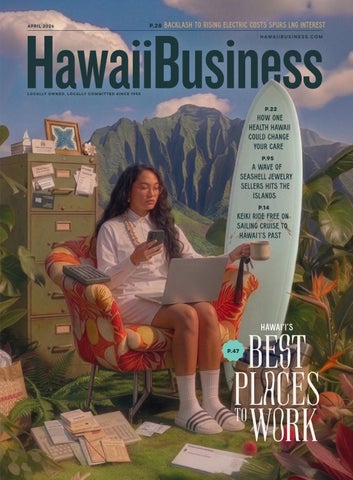
P.28 BACKLASH TO RISING ELECTRIC COSTS SPURS LNG INTEREST HAWAI I B U S I N E S S .CO M
P.22
HOW ONE HEALTH HAWAII COULD CHANGE YOUR CARE P.95
A WAVE OF SEASHELL JEWELRY SELLERS HITS THE ISLANDS P.14
KEIKI RIDE FREE ON SAILING CRUISE TO
BEST PLACES WORK
P.47
TO
Care More Try Harder And Go Further
Tradewind Group is a local company born and raised in Hawai‘i, and founded on the principle that success relies on our deep sense of kuleana and aloha for our community. www.tradewindgrp.com
Built on generations of trust, your well-being is the heart of what we do. Your health isn’t just our mission, it’s our legacy.
queens.org
BY JENNIFER ABLAN
W
AN OPEN MIND
Why You Want to Be Known as a ‘Best Place to Work’
ORK CONSUMES MUCH OF OUR LIVES. By most estimates, the average full-time employee will spend close to 90,000 hours on the job over a lifetime. In subtle ways, our work influences our identity, relationships and daily structure. Steve Jobs captured that reality in his famous Stanford Commencement Address (tinyurl.com/y8hdnxzn) in 2005 when he told graduates, “Your work is going to fill a large part of your life, and the only way to be truly satisfied is to do what you believe is great work.” I watch this video every year as college graduation approaches. Jobs challenged the idea of a traditional career, arguing that treating work as a rigid ladder of titles and promotions separates professional life from personal meaning. Instead, he encouraged people to pursue work as a vocation, merging passion with productivity. As managing editor Ken Wills reports in this year’s Hawai‘i’s Best Places to Work survey, many local employees say they genuinely enjoy their jobs and respect their leaders. Yet the data also reveal a more complicated picture about compensation, cost of living and work-life balance in the Islands. Hawaii Business Magazine’s annual survey shows employees overwhelmingly agree with two statements: “I like what I do for this organization,” and “I believe in this organization’s leadership.” In other words, people like their work and they trust their bosses. But another theme runs through the results: work-life balance remains a challenge. Employers in Hawai‘i operate within a paradox. Businesses must compete in demanding markets while navigating one of the highest costs of living in the nation. Residents enjoy a natural environment and cultural values admired around the world, yet many families struggle to remain financially stable and sometimes juggle multiple jobs just to stay. Within that tension, 91 organizations earned recognition this year as Hawai‘i’s Best Places to Work. They represent industries from finance and healthcare to nonprofits and professional services. What they share is a deliberate effort to build workplaces where employees feel respected, engaged and supported. “One of the strongest trends we’re seeing across Hawaiʻi-based organizations is that employees feel like they have a really great relationship with their direct supervisor,” says Tracie Foglia of the Hawaii Employers Council. Direct managers often shape workplace culture more than any mission statement. The survey, conducted by Workforce Research Group, shows many employers investing meaningfully in their people. Nearly all winning companies offer retirement benefits, and employers pay an average of 69% of health insurance premiums. Even so, compensation remains the most persistent concern. Satisfaction with total pay consistently ranks lowest in employee surveys. Many workers say they value their company
culture and community but still struggle with the cost of living. Leadership plays a critical role in how organizations navigate these pressures. One example is Nash Subotic of WestPac Wealth Partners. Subotic runs the firm with a clear philosophy: culture comes before profit. If the culture is strong, he believes, performance and profitability will follow. That approach has earned national recognition. WestPac was named the No. 1 Best Workplace in Financial Services in a nationwide Fortune survey and has also been recognized in Hawaii Business Magazine’s Best Places to Work rankings for several years. For more on Subotic’s philosophy on the workplace, please read our profile on Page 7. If work influences who we are, then the best workplaces must offer more than purpose. They must pair meaningful work and strong leadership with fair compensation and respect for life outside the office. That is what truly defines a best place to work. THE BIG PICTURE: HAWAII BUSINESS × HAWAI‘I COMMUNITY JOURNAL Hawaii Business Magazine is pleased to expand its coverage through a collaboration with Hawai‘i Community Journal (HCJ), the new name for Overstory, a solutions-focused newsroom serving Hawaiʻi. HCJ’s community-centered reporting complements Hawaii Business coverage by bringing a deep perspective on how major issues affect people and places across the Islands. Together, Hawaii Business and HCJ work to help you see how Hawai‘i’s biggest challenges across business, environment and community life are connected. By sharing select stories and perspectives across both platforms, we’re excited to offer readers a broader, more complete understanding of the forces shaping Hawai‘i and the solutions emerging across sectors. You will begin to see select HCJ stories on Hawaii Business platforms, with additional shared coverage and joint features ahead. This collaboration broadens Hawaii Business’ coverage to connect economic insight with community and environmental context, helping readers better understand Hawaiʻi’s future. Our first print story is on page 36.
JENNIFER ABLAN EDITOR-IN-CHIEF
H AWA I I B U S I N E S S
3
HB EVENTS C O N N E C T W I T H H AWA I I B U S I N E S S M A G A Z I N E L O C A L LY OW N E D, L O C A L LY COMMITTED SINCE 1955.
Our goal is to strengthen the local economy and help our communities thrive. Publisher KENT COULES kentc@hawaiibusiness.com • (808) 364-5869
TRAINING DAY APRIL 23, 2026 Japanese Cultural Center
Best Places to Work: Training Day brings together Hawai‘i’s top-performing employers for a half-day conference focused on forward-thinking leadership, innovative HR strategies, and the evolving expectations of today’s workforce. Designed to inspire and equip, the event connects decision-makers and talent leaders for meaningful learning, idea-sharing, and practical takeaways that strengthen workplace culture and performance across the state.
The
MAY 18, 2026 Prince Hotel The Women Entrepreneurs Conference 2026 brings together founders, executives, and change-makers for a full day of connection, insight, and practical strategy on Monday, May 18, 2026, at Prince Waikiki. From keynote conversations and breakout sessions, networking expo, and pau hana marketplace, the conference is designed to leave attendees empowered, informed, and ready to take action. For more information on events, visit hawaiibusiness.com/events or contact Ashley McLean, Events Manager, at ashleym@hawaiibusiness.com
Editorial Editor-in-Chief JENNIFER ABLAN jennifera@hawaiibusiness.com Managing Editor KEN WILLS kenw@hawaiibusiness.com • (808) 987-8135 Senior Editor STEVE PETRANIK stevep@hawaiibusiness.com • (808) 534-7584 Senior Contributing Writer CYNTHIA WESSENDORF cynthiaw@hawaiibusiness.com Staff Writer RYANN NOELANI COULES ryannc@hawaiibusiness.com Staff Writer GRANT NAKASONE Copy Editor ELROY GARCIA Editorial Interns LILI HURD, KIANI VIDAURRI, ALLYSON WHALEY
Design & Photography Creative Director ESTHER MOHRMANN Graphic Designer CHASE NUUHIWA Graphic Designer KAREN TANIGAWA Graphic Designer GINNY WILLIAMS Staff Photographer AARON YOSHINO Digital Digital Director RANDALL LIBRAMONTE randalll@hawaiibusiness.com Digital Content Manager MARIANNE LEANO mariannel@hawaiibusiness.com Sales & Marketing Account Executive YONGCHAE SONG yongchaes@hawaiibusiness.com • (808) 228-5078 Account Executive CHAZ TIOGANGCO chazt@hawaiibusiness.com • (808) 387-1672 Operations Manager REBECCA BROOKING rebeccab@hawaiibusiness.com • (808) 534-7560 Events Manager ASHLEY MCLEAN ashleym@hawaiibusiness.com • (808) 272-6550 Events Coordinator OLIVIA DE SENA oliviad@hawaiibusiness.com Circulation circulation@pacificbasin.net Connect with us on social media: HawaiiBusiness HawaiiBusinessMagazine Hawaii Business is published by
Founder DUANE KURISU Chairman SUSAN EICHOR President BRANDON KURISU Director of Finance JADE CARREL
04.26
CONTENTS
14
Keiki Sail Toward Hawaiian Heritage Captain Pablo, a.k.a. Paul Allen, takes Pua Ka ‘Ilima charter excursions out for sailing trips to help pay for the Kohala Sailing Foundation’s free Keiki Sailing Program for Big Island youth. The foundation coordinates with schools and nonprofit programs to connect youths with Hawaiian maritime heritage.
Photo courtesy: Pua Ka ‘Ilima
Towering Ambition Pays Off for Subotic
Eugene Lene Sees Only Abilities
Pros and Cons of One Health Hawaii
Can LNG Slow the Rise of Electricity Costs?
Sustainable Solutions, Beyond Concepts
Using his 6-foot-5-inch height as an edge, Nash Subotic found a refuge and a way forward through basketball after fleeing wartorn Bosnia at age 13. He turned his ambitions toward boardrooms, balance sheets and billion-dollar ambitions in Hawaiʻi.
With training and support from Lanakila Pacific, Eugene Lene has become a finalist for the national William M. Usdane Award, which celebrates federal contractor employees with disabilities who have exhibited outstanding achievement and exceptional character.
The proposed One Health Hawaii combination of HMSA and Hawaiʻi Pacific Health would become a powerhouse with annual revenues over $6 billion if regulators approve the proposed plan. Critics say it could raise healthcare costs, lead to layoffs and limit options for patients in the state. Proponents and opponents square off.
More than 50 leading organizations in the state have backed a plan to cut energy costs by replacing petroleum with Liquefied Natural Gas. That could bring big savings but would require a huge upfront expense to change infrastructure. Environmental groups say it could also delay the transition to alternative energy sources.
Climate Hawai‘i Executive Director Jeff Mikulina says Hawai‘i can demonstrate to the globe what sustainable solutions look like. The organization says it wants to break down traditional barriers and foster transformative collaborations that pave the way for climate solutions.
7
12
22
32
28
H AWA I I B U S I N E S S
5
04.26
CONTENTS
95 Hawaiʻi’s Shell Jewelry Industry Sparkles Jewelry made from seashells is enjoying a burst of popularity in the Islands and across the seas. From casual to luxury, shell jewelry from Hawaiʻi is in high demand. But there are environmental, ethical and regulatory concerns that jewelers and artists must consider.
Guest columnist Perry Arrasmith (right) clowning around with his brother Nathan. Photo courtesy of Perry Arrasmith
Photo: Aaron Yoshino
How to Help Waikōloa Village Before the Next Fire Our first collaboration with Hawaiʻi Community Journal, formerly Overstory, focuses on the need for a second escape route out of the Hawaiʻi island community of Waikōloa Village in case of a wildfire. After the disaster in Lahaina, attention is turning next to Waikōloa to limit risks for residents who could be trapped in a fast-moving blaze.
Making Homes Affordable for Native Hawaiians
Where Are the State’s Best Places to Work?
Trial and Error: Post-Grad Angst
The Access to Home Ownership program, just a year old, aims to counter the outmigration of Native Hawaiians by removing key financial barriers to buying a home. The program is run by the Office of Hawaiian Affairs partnership with American Savings Bank.
In Hawaii Business Magazine’s annual survey of the Best Places to Work in Hawaiʻi, 91 companies made the grade, delivering on key benefits and creating workplaces where employees feel valued as well as productive. But work-life balance is still a concern, and many companies need to boost pay to keep employees from leaving the state.
In his debut column for Hawaii Business Magazine, Grant Nakasone describes his anxiety and some levelheaded advice he received that helped him land a job after graduation. It’s a jungle out there, he and his classmates discovered. Here are some of his tips that might help others in a similar predicament.
42
47
36
SPECIAL ADVERTISING SECTION Profiles of Some of the Best Places to Work in Hawaiʻi Learn more about how select companies have created workplaces where employees are engaged and committed. 59
103
HAWAII BUSINESS (ISSN 0440-5056) IS PUBLISHED 12 TIMES A YEAR BY PACIFICBASIN COMMUNICATIONS. ©2026 PACIFICBASIN COMMUNICATIONS, LLC. ALL RIGHTS RESERVED. ANY UNAUTHORIZED COPYING, DISTRIBUTION, OR ADAPTATION IS STRICTLY PROHIBITED AND WILL RESULT IN LIABILITY OF UP TO $100,000. EDITORIAL, ADVERTISING AND BUSINESS OFFICES AT 1088 BISHOP STREET, SUITE LL2, HONOLULU, HI 96813. TELEPHONE (808) 534-7520. POSTMASTER: SEND ALL ADDRESS CHANGES TO HAWAII BUSINESS, P.O. BOX 913, HONOLULU, HI 96808. SUBSCRIBERS NOTIFY THE SAME OFFICE. PLEASE INCLUDE NEW ADDRESS AND OLD ADDRESS (MAILING LABEL PREFERRED) PERIODICALS POSTAGE PAID AT HONOLULU, HAWAI‘I, AND AT ADDITIONAL MAILING OFFICES. SUBSCRIPTION: ONE YEAR $24.99 / TWO YEARS $34.99 / THREE YEARS $44.99. FOREIGN: ONE YEAR $53.99 (US FUNDS). FOR SUBSCRIPTION INQUIRIES, ADDITIONAL RATES, INFORMATION, NOTIFICATION OF CHANGE OF ADDRESS AND SUBSCRIPTION SERVICE, PLEASE CALL (800) 788-4230. APRIL 2026 VOL. 71/NO. 10
6
APRIL 2026
P HOTO OF NASH SU B OTIC BY GILMORE STU DIOS
Nash Subotic Survived a War. Now He’s Building a Billion-Dollar Firm. by J E N N I F E R A B L A N
Photos courtesy of Nash Subotic
THE FIRST THING YOU NOTICE ABOUT NASH SUBOTIC IS HIS HEIGHT. AT SIX-FOOT-FIVE, HE DOESN’T JUST OCCUPY SPACE, HE COMMANDS IT. BUT HIS STATURE IS MORE THAN PHYSICAL. IT’S A QUIET REMNANT OF A LIFE ONCE DEFINED BY BASKETBALL.
L
ONG BEFORE BOARDROOMS, balance sheets and billion-dollar ambitions, athleticism carried the Sarajevo-born Subotic toward freedom. At 13, he fled Bosnia with his family as civil war tore through the region. They resettled in Serbia, carrying the invisible weight of bombs, checkpoints and the constant knowledge that life could end without warning. Basketball became his refuge, and eventually, his way forward.
“I think, first of all, you have to be lucky,” Subotic says, his Serbian accent still pronounced. “Lucky means you survive. Nothing bad happens to you. And then you’re prepared when opportunity comes. Everyone gets opportunities, but not everyone is ready.” He seized opportunities that ultimately led to his founding of WestPac Wealth Partners. His first major break came with Red Star Belgrade, one of Europe’s most prestigious basketball pro-
H AWA I I B U S I N E S S
7
grams. Competing at that level sharpened his discipline and put him squarely on the radar of U.S. scouts. “I got the opportunity to play against the top teams in the world outside the NBA,” he says. “That environment teaches you pressure. It teaches you how to show up when it matters.” That opportunity opened the door to the United States, and to an athletic scholarship at Hawai‘i Pacific University, where Subotic played NCAA Division II basketball. “When I came to the U.S., I saw a land of opportunity,” he says. “I saw something I don’t see anywhere else – and I grabbed it.” FROM GROUNDSKEEPER TO GURU
Adjusting to a new language, culture and expectations was daunting. Subotic immersed himself fully, completing both his bachelor’s degree and MBA in just five years.
Basketball, he says, prepared him for more than competition. It taught him how to fail, recover and stay disciplined when no one was watching. “Every training session, every game … it’s not just about skill,” he says. “It’s about pressure, risk and showing up every single day.” Off the court, life in America was humbling. To survive, he was working before and after school, maintaining grounds and doing construction jobs. On campus, he wore a janitor’s vest—work that carried no prestige but lasting perspective. “When you’re a groundskeeper, people see you differently,” he says. “But it teaches you something important – and that is, no work is beneath you. And it teaches you how people really see you.” Those experiences sharpened his instincts. He learned to read a room, recognize ego and insecurity and distinguish between people seeking status and those truly worth
getting to know. “I learned who the social climbers were,” he says. “And I learned who the real people were.” Subotic has carried strong soft skills throughout his business career, admitting he has walked away from professional partnerships that didn’t feel right. His drive is matched by emotional intelligence—or what Corporate America calls EQ. “I have a lot of empathy,” he says. After graduating, Subotic joined John Hancock Financial Services, quickly rising into leadership roles. But it was September 2007, at the onset of the Global Financial Crisis, that would define his entrepreneurial path. As Wall Street began to unravel, Subotic saw opportunity where others saw paralysis. He launched WestPac Wealth Partners to serve clients disillusioned with traditional advisers. “It was actually an exciting time,” he says. “People were des-
For Subotic, true wealth is found at home with his wife, Marija, and their children, Bianka and Alek.
8
APRIL 2026
perate for guidance. Most advisers were under the table, and they were afraid to speak because portfolios were down 40%. We weren’t afraid.” He started with just three representatives. Today, WestPac has more than 375 team members, serves roughly 38,000 clients and oversees more than $5 billion in assets across California, Nevada, Washington, Oregon, Montana, Arizona, Hawai‘i and Florida. Subotic’s vision is ambitious by design: to build a billion-dollar-revenue firm over the next 14 years. Hawaii Business Magazine asked why in 14 years? “I want to be retired by then,” he said. What separates WestPac, Subotic explains, is integration. Instead of isolating investments, insurance, taxes and estate planning, the firm treats financial life as a single, interconnected system, particularly for ultra-wealthy clients. “Most firms bring value,” he says. “We create value. The more wealth people have, the more surprised we are by what’s missing. We exist in those gaps.” Overall for WestPac, “culture has to come before profit,” he says. “If you focus on culture, profitability follows. Never the other way around.” WestPac’s approach has earned national recognition. The firm was named #1 Best Workplace in Financial Services in a nationwide Fortune survey, ranking first among 228,000 small and mid-sized workplaces. It has also earned accolades in Hawaii Business Magazine’s Best Places to Work from 2019 through 2025. WestPac also embraces LifeWork Integration, recognizing that employees are more than their job titles. That translates into flexible schedules, remote work options and support for personal well-being to promote balance as well as long-term success for both people and clients. ‘EDUCATION IS FREEDOM’
For Subotic, true wealth isn’t measured in numbers – it’s found at home. With his wife, Marija, and their children, Bianka and Alek, he defines success through happiness
Subotic credits his time playing NCAA Division II basketball with teaching him how to fail, recover and maintain the discipline required to build a multibilliondollar firm.
and health. “I work 24/7 because I love what I do and work does not feel like work because my life is integrated between my business and personal life. But at the end of the day, success is about my family. If my kids are on school break, I take a break too.” That perspective has been shaped by loss. The unexpected deaths of three WestPac employees in recent years, including one in his early 30s, left a profound mark. “It reminds you how fragile everything is,” he says. “How fast life can change. I live like it’s my last day because I’ve seen how quickly things disappear.” Every decision, every priority, reflects that awareness – anchoring him to family, to empathy and to the urgency of living fully. Observers often compare Subotic to Tony Robbins, citing his magnetic charisma, commanding presence and shared Eastern European heritage. However, Subotic’s personal and professional philosophy is influenced by Simon Sinek, whose books, talks, and videos “I read and whose moves I follow,” he says. Subotic says young professionals should picture an iceberg to guide their careers. “What people admire is what’s above the water,” he explains. “What keeps everything afloat is what’s underneath.”
Below the surface, he points to discipline, consistency, values and integrity. He believes many people live divided lives—thinking one thing, saying another, acting differently depending on who’s watching. “That’s not freedom,” he says. “You can’t be free doing the wrong things. Freedom comes from doing the right thing consistently, especially when no one’s paying attention.” After speaking at Hawaii Business Magazine’s Money Matters Conference in Honolulu in November, Subotic was asked during a Q&A whether he would support the Pasefika Student Advancement Program at the University of Hawai‘i at Mānoa. He didn’t hesitate – he pledged $10,000 on the spot. “Education is freedom,” he says. “When people are educated, they can’t be controlled.” Subotic also believes Americans often underestimate how rare true stability is. He encourages travel to see how much of the world lives without it. “You can’t love this country the same way unless you’ve lived without what it offers,” he says. For Subotic, building a billion-dollar firm isn’t about ego. It’s about scale and helping more people live organized, intentional financial lives. “If we grow, we help more families,” he says. “That’s the point.”
H AWA I I B U S I N E S S
9
YO U R R OA D M A P TO H AWA I ‘ I ’ S 2 0 26 BUSINESS EVENTS
APR
April 10–May 8 Hawai‘i Leadership Academy: Cohort Two April 23 Best Places to Work: Training Day
MAY
May 18 Women’s Entrepreneur Conference May 28 P3 Summit
JUL
July 17 Leadership Conference
AUG
August 13 Top 250 CEO Celebration
SEP OCT
Hawai‘i Leadership Academy: Cohort Three September TBA Hawai‘i Excellence in Business Awards
October 8 HB20 (20 FOR THE NEXT 20) Impact Summit October 23 Wahine Forum Inaugural Wahine of the Year Pau Hana Celebration
NOV
November TBA Money Matters Financial Conference
DEC
December TBA CEO of the Year Celebration
V I S I T W W W. H AWA I I B U S I N E S S . C O M / E V E N T S
MY JOB
BY NAME
NAME: EUGENE LENE
JOB: GROUNDSKEEPING LEADER, LANAKILA PACIFIC
12
APRIL 2026
BY KIANI VIDAURRI
MY JOB
I Have Faced Challenges, But Now I Lead a Work Team at Tripler EUGENE LENE LEADS A GROUNDSKEEPING TEAM AT TRIPLER ARMY MEDICAL CENTER, A LARGE SLOPING SITE COVERING 367 ACRES ON MOANALUA RIDGE.
Known as a mentor and hard worker, his achievements are all the more remarkable because of an intellectual disability that makes comprehension difficult. But with training and support from Lanakila Pacific, he has made major progress, and today he is a finalist for the national William M. Usdane Award, which celebrates federal contractor employees with disabilities who have exhibited outstanding achievement and exceptional character. “I’m just grateful and shocked and appreciate” being selected as a finalist for the award, Lene said in an interview. As for his work, he said, “I’m good when every day I come to work. I’m happy.” COMPANY SUPPORT: Lanakila Pacific
is a nonprofit based in Kalihi that provides meals for seniors and people with disabilities, and helps them become self-sufficient through training programs and job opportunities. Lene said Lanakila Pacific allowed him to grow as a person, a worker and a leader. “For all those years I’ve been here … I was just happy,” Lene said. “I never did become a leader in any other job, but this job and all this — I really appreciate it.”
BEGINNINGS: Lene grew up in Kali-
hi, graduated from Farrington High School in 2001 and then entered a
Lanakila Pacific training program that prepared him for employment. From there, he worked different jobs, including for a moving company and in security, but none of them offered the kind of work environment he was looking for. So he searched for something new. “To be honest, it was kind of hard at that time looking for a job,” he said. At a job fair in 2014, he saw the Lanakila Pacific booth and remembered his time in its training program. He joined the nonprofit as a grounds service worker in 2014. WORK ENVIRONMENT: Lene recalled
cutting grass with his father at a church in Kailua when he was a kid. “That’s how I learned how to cut grass, from my dad.” Tripler is Lanakila Pacific’s largest contract worksite. Most of the crew’s work is cutting grass, but they also trim trees, pull weeds and use string trimmers, riding mowers, hole saws and hedgers. They wear safety glasses and gloves when they handle equipment. Lene said working at Tripler can be “pretty intense, because you are on a sloping area, then your legs become sore.” Evan Nakatsuka, Lanakila Pacific’s director of workforce programs, said six out of seven members on that crew have an “invisible disability,” which can include an intellectual or mental health challenge or autism. Nakatsuka, who joined in the interview with Lene, said his strength is making the work enjoyable for his team and keeping it simple. “Eugene is the one with his finger on the
pulse of the team, so they follow his lead and his positivity,” he said. Lene said he feels supported by Lanakila Pacific through constant communication and assistance. John Oda, Lanakila Pacific’s assistant manager of the grounds maintenance department, checks in with the crews daily at Tripler and two other locations and will help with the work when needed. Every morning, Lene and Oda give safety briefings to the crew, focusing on that day’s work site, being mindful of passing vehicles and pedestrians and proper use of protective equipment. Lene, one of three in the crew who drive themselves to work, also trains new employees and teaches them how to use weed trimmers. Although Tripler has a lot of ground to cover, he tells his co-workers to approach work without stress. They enjoy each other’s company and have fun while still focusing on getting the job done. “The guys I work with, it’s a ble ssing,” he said, and he thanks his co-workers every day for their hard work. CHALLENGES: Lene and his co-workers have faced challenges in the past year – the sudden death of a crew member and two others leaving the team – but Lene encourages them to stay positive. “I want my work environment to be a good work environment.”
THIS INTERVIEW HAS BEEN EDITED FOR CLARITY AND CONCISENESS.
H AWA I I B U S I N E S S
13
BY KEN WILLS / PHOTOS BY MARK A. J O H N S O N
14
APRIL 2026
on a quest to reawaken Hawai i s Past for youth, captain hoists the Sails Proceeds from Pua Ka ‘Ilima’s charter sailing trips help fund free keiki outings off Hawai‘i island. The goal is to revive a proud maritime heritage while also teaching practical skills to Big Island youth.
H AWA I I B U S I N E S S
15
Paul Allen, a.k.a. Captain Pablo, takes the helm and enjoys a sense of freedom when the winds fill the sails.
A
s the froth and churn of waves smack the sailboat’s hull, Captain Pablo cuts the engine on the 42-foot Pua, which suddenly tilts sharply to the port side under power of trade winds that fill two bulging sails. Five passengers, the captain and one crew member feel the sharp tug of nature’s harnessed energy as the sailboat slices through the brilliant blue waves off Hawai‘i island’s Kohala Coast. Captain Pablo smiles broadly and looks out at the horizon. He’s been here a zillion times, and it never gets old. “For me, it’s just a sense of freedom and a release of all the stresses and pressures that are going on in your daily life, relationships, work and all that,” says Pablo. His real
16
APRIL 2026
name is Paul Allen, but in a playful nod to a maritime culture of seamen assuming nicknames, he transforms into his nom-de-bateau persona the moment he steps onto the boat. Pablo’s mission today is to run a Pua Ka ‘Ilima charter excursion out of Kawaihae Harbor in South Kohala. Proceeds from these four-hour sailing trips help pay for the Kohala Sailing Foundation’s free Keiki Sailing Program for Big Island youth. The foundation coordinates with schools and nonprofit programs to connect youths ages 11 to 17 with the Hawaiian maritime heritage on the vast ocean that surrounds them. So far, more than 200 youths have taken part. “Our mission is teaching sailing, seamanship and leadership while building personal, nature-connected relationships,” Allen explains. “Also,
we’re introducing marine career paths and promoting environmental conservation and stewardship – really to build a relationship with the wind and the water.” Despite Hawai‘i’s long tradition of sailing and canoeing, many residents today have few opportunities to experience this link to their past. Allen, and foundation co-founder Captain Ralph Blancato, who has logged more than 62,000 blue water miles from Alaska to New Zealand, want to change that. “Most of them are strong swimmers and have spent a lot of time in the water, but most have not sailed, which is a part of them we’re trying to awaken, especially for the Hawaiian kids,” says Allen. “A lot of them have lost that connection to sailing. Before motors,
ancient Hawaiians, that’s how they got around. They paddled a lot in their canoes, but if they could sail, they sailed their canoes.” LEARNING THE ROPES
The keiki sailing excursions are not just leisurely pleasure trips, although there’s plenty of fun along the way. They learn first-hand about the art of sailing, the importance of marine and reef life around the Islands as well as rules to stay safe on the water. The excursions include specialists who teach the children about migratory whales and the importance of sharks to the marine environment. A UH marine scientist also talks about natural and manmade dangers to coral reefs around the archipelago. As if on cue, while Allen is describing the program, a young Humpback whale surfaces about 100 yards away and repeatedly slaps its fin on the water surface. “He’s giving us a high five,” Allen says, pausing, and the passengers silently observe as we glide past. Each child takes turns driving the boat, trimming or grinding the sails. They learn to tie ropes that are critical to controlling the sails and securing the boat to the dock. They learn about the complicated mix of winds that are especially variable along this coastline due to trade wind eddies, katabatic winds racing down the sides of Kohala and Mauna Kea mountains, and the weather signs that might signal it’s time to head back to shore. “We’ll go out a bit and look at the wind direction and strength, and I’ll ask the kids which way they think we should sail. We’ll talk about it, and I’ll have the kids come up with a plan.” Some of those sessions are led by 21-year-old Ruby Mandini, who participated in the keiki program and is now helping the crew and also instructing the youths. “I kind of direct them and show them what lines to pull” to raise or lower the sails, Mandini says. While the captains run the boat, “I run around and make everything move with the kids. Going over the parts of the boat, any knowledge I
On this voyage, crew member Jamie Nease turns the winch to raise the main sail.
H AWA I I B U S I N E S S
17
Photo courtesy of Pua Ka 'Ilima
have with sailing, I’m always sharing it with the kids. “I’ve grown up trying to learn a lot about the reef, the ocean and diving. When I get a chance, I try to teach them some reef educational things too,” supplemented by reef reference books on board. Before they tie up to a buoy and go for a swim, Mandini gauges the youths’ knowledge and then teaches them something new. “I love the water portion of our sails, because we can put all that knowledge into effect, so when we jump in the water, I point out all of the things we were talking about and send them on a hunt to find their own fish.” When Mandini is not at sea in her role as a deckhand, she works as a preschool teaching assistant, a land-based passion of hers. But she confides: “I want to always have a hand in being on the water.” Eleven-year-old Ikaia Fuertes remembers his outing fondly because it was the first time he’d been on a sailboat.
18
APRIL 2026
“I like sitting on the edge of the boat and letting my feet hang over the edge,” he recalls, although he says the ride got a little “bumpy” when it cut through the waves. “We got to jump off the side of the boat and go swimming too,” he says. “I saw yellow tangs and other fish.” Although he’s been swimming in the ocean many times, the introduction to sailing left a lasting impression on Fuertes who says he’d like to go sailing again — and that’s one of the program’s goals. HAWAIIAN WAY ECHOES THROUGH TIME
A connection to sailing traditions in the Islands goes back through the ages. Interest in Hawaiian sailing origins surged in the 1970s due to the efforts of the Polynesian Voyaging Society, which seeks to perpetuate the art and science of ancient Polynesian exploration. “The canoes that brought the first Hawaiians to their island
home had disappeared from earth. Cultural extinction felt dangerously close to many Hawaiians,” the society’s website states. It set out to recreate those vessels and launched the Hōkūle‘a, or Star of Gladness, a double-hulled sailing canoe that attracted global attention when its crew sailed in 1976 from Hawai‘i to Tahiti using only the stars, currents and natural elements for navigation to complete the 2,600-mile voyage. Since then, it has completed many other trips, confirming “revelations of how our ancestors navigated across the open ocean, found islands and settled Polynesia,” the society states. Although the Pua is fully equipped with the latest instruments and is built with modern materials, the mission of the Kohala Sailing Foundation is sympathetic with that of the Polynesian Voyaging Society. “We’re trying to teach the Hawaiian way,” Allen says. “Especially for the Hawaiian kids on the boat, it’s part of who you are. A lot of
From trimming sails to marine stewardship, more than 200 keiki have already taken the helm of the Pua.
times when we experience things that are in our DNA but aren’t familiar to us in our lifetime, it can be awakened. If we can reach a couple kids that way, it’s really important.” The Kohala Coast played an important role in Hawaiian history, and for many decades, water routes provided the main way to get from one place to another. To the north of Kawaihae Harbor lies the former Hawaiian village of Lapakahi, now a state historical park featuring stone foundations and reconstructed wood and thatched structures used by the inhabitants of the ancient fishing village. Allen explains that its location was determined by important geographical features that took into account prevailing trade winds that blew steadily, and sometimes hazardously, through the ‘Alenuihāhā Channel that separates Maui from Hawai‘i island. “Coming from Maui, you can sail the whole way to Lapakahi, but further this way, the wind drops off and gets shadowed because of the mountain, and you’ve got to paddle a lot more,” Allen explains. “So that place is really important for that, they could launch from there.” As she turns the winch to let out the main sail, Pua crew member Jamie Nease relates her own love of the ocean and her deep respect for the variable winds and currents around the Hawaiian archipelago that can pose deadly risks to the untrained. She formed the Wahine Makani Foundation, a nonprofit that promotes traditional Hawaiian sailing canoe racing for competitive women. The elite teams cross the state’s most challenging ocean channels, starting with the ‘Alenuihāhā Channel. “We cross every channel in the island chain, as well as partially circumnavigate each of the islands,” Nease says.
Photo courtesy of Pua Ka 'Ilima
H AWA I I B U S I N E S S
19
a Friend of the reef is a friend of Mine Sailors on the Pua also learn a little local history about a rock ‘n’ roll music legend’s love for Hawai‘i. In the 1980s and ‘90s, Jerry Garcia, the lead guitarist and vocalist of the Grateful Dead, was an avid scuba diver in Hawai‘i, especially along this western coast of Hawai‘i island, which he visited many times. During Garcia’s hundreds of dives, he observed the damage that was being done to coral reefs from boats dropping anchors. He saw the potential of setting up a system of permanent moorings that dive, snorkel and sail charter boats could tie up to instead of dropping anchors that were repeatedly tearing into the coral reefs. “I dive the reefs off the Kona Coast, and I see the damage that anchors can cause...some of the coral is so fragile that if you touch it, it breaks,” Garcia said in testimony at the Board of Land & Resources Penalty Hearing on Day Use Moorings in 1990. “The only point of view that I have is the point of view of any other citizen of the United States. And I think you can do yourselves a favor and make Hawai‘i look good and just approve this thing.” The measure was approved by the state, and Garcia and the Grateful Dead made a “sizeable contribution” to get the mooring system started. Today, a statewide network of 220 moorings is managed by the Malama Kai Foundation in partnership with the Department of Land and Natural Resources. “So, every time we tie up to the moorings, we say, ‘Thanks Uncle Jerry!’” Allen says, laughing.
20
APRIL 2026
PASSING A TORCH, AND SKILLS
Allen’s passion for sailing started at an early age, and he wants to share that love with the next generation. It also helped him steer away from other temptations when he was younger. “In my early 20s, I went down a pretty dark path, and I realized it was interfering with my sailing, and sailing was what I loved more than anything,” Allen recalls. “So, I just stopped hanging out with those people, stopped partying and all that stuff, and totally straightened myself out, all because of sailing. I feel really strongly about what an anchor it can be in your life.” It’s a passion he wants to instill in others. At the first meeting with children in the keiki program, Allen asks about their prior water and boating experience. “They’ll say, ‘I’m on the swim team, I’m a lifeguard, I’ve been paddling my whole life, I’m a free diver,’ and I say, ‘Okay, you guys are going to be the ones saving me if we get into trouble!’ Most are really strong swimmers.” Others who haven’t been in the water or have less confidence are equipped with life jackets and are closely monitored. Once the boat is moored at a buoy, the group splits into those who are more adventurous and want to snorkel and explore the reef with an adult guide, and others who jump off the boat into the water and stay a bit closer. Deep connections are made with each keiki voyage. One group of youths from the nonprofit Kahua Pa‘a Mua impressed Captain Pablo from the moment they showed up at the pier. “Those kids were so cool,” he recalls. “They stood on the dock, all lined up, and gave a Hawaiian chant requesting permission to board the boat. “And at the end, they lined up along the dock again and gave the thanksgiving chant to us. Those are the kinds of kids we’re trying to target: They’ve never been sailing, they haven’t been out on the water much, maybe on a fishing boat.
Showing them a little bit about sailing, that you can get around this way, too, teaching them about the reef and things like that. It’s really important.” Young or old, passengers share a universal thrill when the motor is shut off and the silent power of the wind takes hold, propelling the hull through the waves at exhilarating speed. “I see it in people, their physical reaction when I turn off the motor,” Pablo says. “There’s a big exhale of relief and they go, ‘ahhh, that’s nice.’ It’s a feeling of peace.” PUA KA ʻILIMA TEAM
Captain Pablo and Captain Ralph are joined by a small but dedicated number of crew members on their voyages. Allen’s wife, Lelja Bratovic, manages reservations for Pua Ka ‘Ilima and the foundation, as well as payments, the website and other administrative duties. Bratovic juggles her work for Pua Ka
‘Ilima with a career as a global conflict resolution mediator, including experience across five continents as co-founder and president of Global Majority, which promotes peaceful resolution of conflicts through education and dialogue. Captain Pablo, too, has another life when he’s not taking out charter groups or keiki sails. He owns Four Winds Canvas and Shade LLC, and he’s a record-holding blue ocean racer. Several times a year, he flies to California or other locations for world-class competitions. Among other records, he and his crew set the fastest time from Hawai‘i to Yokohama, Japan, at seven and a half days in August 2023, cutting the prior record of about 13 days. Captain Pablo’s intensely competitive spirit is masked behind a relaxed demeanor and cool confidence. No matter the urgency of quickly adjusting ropes to raise or lower sails, his ready smile and calm voice keep those around him focused on their duties. It’s a style that
Ruby Mandini, who graduated from the keiki program to become a deckhand, shares her knowledge of reef stewardship before the youths enter the water. Photo courtesy of Pua Ka 'Ilima
puts everyone on board at ease. For keiki who feel the tug of sailing and want to get more practical experience, Allen directs them to a number of sailing clubs in Kona, Hilo and Kawaihae on the Big Island. He says the Waikiki Yacht Club on O‘ahu, among others, also have junior sailing programs. “What I want to do – I have a lot of experience coaching and racing,” Allen says. “I want to take some of the kids who are a little more switched on to sailing, and start taking them out on small boats, like one-on-one or two kids.” For those youths who catch the bug, there’s a lifetime of skills to hone, all while carrying on a tradition that brought Hawai‘i’s first inhabitants to the Islands. “It’s easy to enjoy,” Allen says, smiling and scanning the waves as the sails grab the wind. “You come out here on a warm day on a small boat, and you’re planing around and getting wet. That’s pretty fun.”
Photo courtesy of Pua Ka 'Ilima
H AWA I I B U S I N E S S
21
B Y R YA N N N O E L A N I C O U L E S A N D K E N W I L L S
CLASH OF TITANS
Hawai‘iʼs Healthcare Leaders Disagree on Best Path Forward Top executives at HMSA, HPH take on frank criticisms about their proposed combination, addressing specific community concerns over potential service cuts, staffing layoffs and a diminished focus on primary care.
22
APRIL 2026
T
HE HEALTHCARE LANDSCAPE IN HAWAI‘I damage. “Look at what happened to all the local venCOULD GET A RADICAL MAKEOVER dors and local retailers around Amazon,” he countered. if regulators approve a combination of the He instead proposed healthcare leaders revisit state’s largest health insurer with the second“Plan B,” an alternative model that favors inclusion largest hospital system, creating an integrated behemoth over integration. The solution to Hawai‘i’s healthcare with combined annual revenues topping $6 billion. woes “can’t be isolationist,” Chang concluded. “You Already the plan has come under sharp attack by have to work with everybody. I’m proposing that Plan competing medical providers and consumer advocates B is the better option.” alike, just months after the Hawaii Medical Service Association (HMSA), a member of the Blue Cross Blue NATIONAL TRENDS, NATIONAL BACKLASH Shield Association, and Hawai‘i Pacific Health (HPH) announced their plan to join under a parent organizaTo be sure, what’s happening in Hawai‘i is part of a nation to be called One Health Hawaii. tional trend that has led to consolidations of insurers HMSA, which is already the largest organization with healthcare providers, pharmacy benefit managers in the state by revenues and insures 53% of the state’s and others, with mixed results. That trend has also population, would join forces with a hospital group sparked a bipartisan backlash in the face of rising costs that has four medical centers with more than 600 and threats to competition. beds. Combined, the two nonprofit organizations have Massachusetts Sen. Elizabeth Warren, a Democrat, more than 9,140 employees. and Missouri Sen. Josh Hawley, a Republican, introWhat will all of this mean for the cost of healthduced legislation that would break up companies that care in the Islands, for the existing employees and for own health insurers and medical providers. the companies trying to compete against a new giant On a recent PBS episode of Firing Line with Marthat combines service providers with an insurer that garet Hoover, billionaire Mark Cuban, who has made approves or rejects medical procedures and costs? a personal campaign of increasing transparency in the Hawaii Business Magazine invited the top players healthcare sector, said large insurance companies “game in the combination — they eschew the the system” by owning healthcare terms merger or takeover — to answer providers and others in the healthcare these questions at a summit of Honoservice chain. “Literally what those WHETHER THOSE lulu executives. For the parties that companies do defines the cost of OPINIONS CAN would become One Health Hawaii, healthcare in this country,” he said. there are projected cost-savings, effi“Right pocket, left pocket, it EVENTUALLY COALESCE ciencies and better health outcomes. doesn’t matter,” Cuban added. “They INTO A UNIFIED “A platform that integrates the don’t care which company they profit HEALTHCARE STRATEGY consumer, the seller, and the supply in as long as that profit is somewhere FOR THE ISLANDS chain… creating the best experience in their vertical integration.” REMAINS THE $2 and the lowest prices. Imagine that exSimilar concerns are taking perience in healthcare; that’s what we BILLION QUESTION. hold in Hawai‘i, which already has hope for our family and friends,” said one vertically integrated healthMark Mugiishi, CEO of HMSA, comparing the promise care group, Kaiser Permanente Hawaii, a unit of the of One Health Hawaii to Amazon’s operational efficiency. California-based parent. One Health Hawaii would For his part, HPH President and CEO Ray Vara leapfrog that with an even larger market share. framed the proposed combination as a necessary response to a “broken” and “unsustainable” landscape WARNINGS ABOUT PRICES, LAYOFFS where health systems are losing money and employer costs are skyrocketing. “The current status quo state, Chang, representing Queen’s, argued that such intewithout significant disruption or intervention, is much grations typically lead to higher prices and reduced more scary,” he said. choice. He also warned that in a market of only 1.4 milThe exchange in mid-February, which was moderlion people, such a move could isolate other providers. ated by Hawaii Business Editor-in-Chief Jennifer Ab“Vertical integration means you take two organizalan, was characterized by blunt views in a city whose tions… and you put them together, which then creates executives generally pride themselves on collegial a firewall — a wall between everybody else,” Chang behind-the-scenes airing of differences. said. “If you think about the disruption that’s needed in “I feel that this is like the Trojan horse story,” Jason Hawai‘i today, it’s not to create segregation, it’s actually Chang, president and CEO of The Queen’s Health to create more partnerships across the entire span.” System, warned. “Sounds great, it’s a gift—but once it’s Vara countered that Chang was referencing for-profbehind the doors, you don’t know what’s inside, and it integrations that differ from the proposed local there’s a tremendous amount of risk.” nonprofit model. HMSA and HPH are already nonprofit Chang also took issue with Mugiishi’s comparison organizations, as would be the proposed parent. to Amazon. While acknowledging the online retailer’s “In those markets where you have nonprofit, success, he urged the audience to consider the collateral local organizations coming together… you find results
H AWA I I B U S I N E S S
23
consistent with what we’re talking about—bending the cost curve, creating better access, minimizing administrative burden and creating capacity that otherwise doesn’t exist,” Vara said. The discussion grew tense when Vara pointed out that a similar alternative had been on the table years ago—and that Queen’s opted out of it. Chang responded candidly: “That was my predecessor. And I would say that if we could really go back and do that again, that was the wrong move. We should not have walked away from that table.” However, that deal “still excluded everybody else in the community.” His remark drew attention to past missed opportunities, while underscoring how long the integration debate has been simmering. Another panelist, Vicky Hanes, COO of Hawai‘i Island Community Health Center, shifted the conversation to the front lines of care. She said primary care receives less than 5 cents of every healthcare dollar spent in the country. Spending more money on preventative care would result in less demand for the much more expensive care that is the mainstay of the companies in the proposed merger, she said. Her center is one of 13 primary care providers across the state. “I think a part of this conversation is about, where are we bending that cost?” Hanes asked. “I think if you can focus on bringing resources into the primary care system … giving them good preventative care, all
the vaccines, all the annual wellness visits, giving them all of their care gaps, getting all of that stuff checked out so we don’t end up in a situation where we’re totally upstream in the hospital, high-cost procedures, specialty care up the wazoo, that’s the conversation I want to bring to the table.” HMSA and HPH have projected that the partnership could generate over $2 billion in savings over a decade. HMSA’s Mugiishi said that as a nonprofit, One Health Hawaii is designed so that savings are reinvested back into the community: “It gets reinvested, number one, in bending the cost curve so that you, the employers, have a slower rate of increase of your premium dollars.” Mugiishi said that the “unleashed value” of the deal lies in a planned aggressive shift toward prevention. “The value that is going to be unleashed is in the proper coordination of care that happens at the primary care level that makes sure that people with chronic diseases don’t progress, people who are healthy don’t progress to chronic disease,” he explained. “That’s where you actually save money. So, if you take that care coordination and you invest in that, that’s where you’re going to find the largest amount of the savings.” ‘SUSTAIN THE ECOSYSTEM’
Beyond premiums, Mugiishi argued this capital would allow for strategic investments to “sustain the ecosys-
tem,” such as expanding the provider footprint on neighbor islands and utilizing technology to bridge the urban-rural gap to specialists like neurologists. However, for Chang, the “pencil out” simply doesn’t justify the optimism. “The devil is in the details,” he warned. While HMSA and HPH tout billions in potential savings, Chang argued that a realistic analysis suggests the savings are significantly lower—a discrepancy he fears will eventually be bridged by service cuts and layoffs. In follow-up interviews, the three executives furthered their cases as to whether One Health Hawaii will be miraculous or disastrous for the Islands’ healthcare landscape. Vara, pushing back on Chang’s assertion that the projected $2 billion in savings isn’t possible without service cuts and layoffs, says that HMSA and HPH hired Deloitte Actuarial Services to perform a third-party evaluation to confirm that their calculation of savings is accurate. “And that has been submitted as part of our business case. That’s gone to our regulators as part of the approval package,” says Vara. Chang warns that One Health Hawaii could financially destabilize non-HPH providers by luring commercially insured patients—the only profitable segment of the market— away from the rest of the system. “No health system in the United States makes money on Medicare and Medicaid,” Chang explains. “It’s
From left, Jason Chang (The Queen’s Health System), Mark Mugiishi (HMSA), Vicky Hanes (Hawai‘i Island Community Health Center), and Ray Vara (Hawai‘i Pacific Health) discuss the proposed One Health Hawaii combination at Hawaii Business Magazine's CEO Healthcare Summit.
24
APRIL 2026
always an investment. What we profit from is commercial business.” Chang argues that even a small shift in market share could have catastrophic results for community services because the stability of Hawai‘i’s healthcare depends on a fair distribution of Medicare, Medicaid and commercial patients across all providers. Without that balance, he fears care providers will be forced to make cuts to specialty departments. “Let’s say they shift 5% [of commercial business] away from Queen’s. That’s $45 million,” Chang says. “All of a sudden, it strains all the other programs... Behavioral health, for example, is a $15- to $20-million investment we make every year. These moves slowly erode our ability to support these critical services.” Mugiishi insists that One Health Hawaii is not designed to bankrupt the competition. He acknowledges that non-HPH providers currently provide 67% of the state’s care – a burden HPH cannot carry alone. “There is just no scenario in which we could allow non-HPH providers to become financially unviable. We need them,” he says. “We 100% will make sure that they do not collapse.” Despite these assurances, Chang views vertical integration as “extremely risky.” He instead advocates for a “horizontal model” — a legal structure where all providers bear risk collectively. “Everyone participates in an even way,” Chang says. “If we don’t do a good job managing the most expensive, highest-need patients, we all take the loss evenly. And if we do well, we all benefit evenly.” Mugiishi, however, points to significant legal hurdles, noting that “horizontal integrations have very strict antitrust rules under the Sherman Act.” This, he argues, makes it structurally impossible to integrate Queen’s and Hawai‘i Pacific Health in that manner. While he expresses a future willingness to explore other risk-bearing entities that allow for “value-based care across the whole ecosystem,” he defends the current path. “We have to start somewhere,” Mugiishi says, “and we started a couple years ago with Hawai‘i Pacific Health when everybody else wasn’t interested.”
Though they have opposing views on the best way forward, there is a shared consensus that the status quo is failing, and the need for reform is urgent. “What we don’t disagree on,” Vara concludes, “is the current system is unsustainable, and change
is necessary. It’s human nature – especially in an environment like we operate in – that people are going to have different opinions.” Whether those opinions can eventually coalesce into a unified healthcare strategy for the Islands remains the $2 billion question.
With Carrier and Puron Advance™ refrigerant, you can save energy and the planet. Carrier’s split system ACs offer the broadest range of options to tailor comfort to any space. Save the most money now by covering just the necessities. Or save the most on future bills with the world’s most efficient split-system AC. They all include Puron Advance™ (R-454b) refrigerant, which results in a 4x reduction in greenhouse gas emissions compared to Carrier’s original Puron™ (R-410a). Best of all, it’s all backed by Carrier Hawaii with service and support across all major islands.
Locally owned distributor: Carrier Hawaii Kapolei Honolulu Kahului Kailua-Kona (808) 677-6339 • CarrierHawaii.com
26-CAR-0307 HB 4.625x7.5.indd 1
Matsumoto & Clapperton Advertising Client: CARRIER HAWAII
2/10/26 8:05 PM
Date: 2.10.26 H AWA I I B U S I N E S S 25 Job# 26-CAR-0307
Sanitation is the first line of defense for any food manufacturer. They must implement food safety and sanitation measures to ensure that their processing plants remain audit-ready and compliant.
A ONE-STOP ALLY FOR EVERYTHING SANITATION SPC began as a sanitation consultant for food manufacturers and has expanded its services to cover a diverse clientele, including meat and poultry plants, protein and fresh-cut produce suppliers, as well as processing units for greens, almonds, dairy, and other food products. Fueled by their accountability, SPC delivers a carefully designed, 8-step process to boost its clients’ hygiene standards to new levels.
Its skilled HR department hires the right candidates who can fulfill their responsibilities from day one. Having achieved steady growth in California, Arizona, Wisconsin and Hawaii, SPC is set to transcend state borders and expand its presence across the U.S. to guarantee the highest quality sanitation services for an expanding clientele.
“We leverage over 30 years of diverse experience to provide continuous sanitation programs for our client’s ongoing success.” Gonzalo De La Cruz, Owner at SPC.
510-909-4910 www.saniprocess.com
TO SUBSCRIBE, VISIT HAWAIIBUSINESS.COM/NEWSLETTER-SIGNUP-2
BY JENNIFER ABLAN
Over 50 High-Profile Hawai‘i Companies Push for Affordable Energy with LNG MEANWHILE, ENVIRONMENTAL GROUPS INCLUDING THE SIERRA CLUB OF HAWAI‘I, 350HAWAII AND OTHERS HAVE EXPRESSED SHARP OPPOSITION TO LNG.
M
ORE THAN 50 OF HAWAI‘I’S LEADING ORGANIZATIONS
have called for immediate action to lower energy costs by replacing petroleum with Liquefied Natural Gas (LNG). The Coalition for Hawai‘i’s Energy Future brings together Native Hawaiian leaders, healthcare providers, agricultural groups, tourism representatives, construction and retail associations and cost-of-living nonprofits. Among its members are Aloha United Way, Waianae Coast Comprehensive Health Center, the Hawai‘i Agricultural Foundation and the Hawai‘i Farm Bureau. Collectively, they represent thousands of workers and families across the Islands, united in a shared goal of lowering electricity costs and strengthening grid reliability, with liquefied natural gas positioned as a transitional fuel. Environmental groups including The Sierra Club of Hawai‘i and
28
APRIL 2026
350Hawaii and others, meanwhile, have expressed sharp opposition to the idea. Paul Yonamine, special adviser to Gov. Josh Green on energy matters, frames the debate in personal terms. “I would love to have all three of my kids back in Hawai‘i, but it’s just that it’s so expensive,” he said, pointing to the broader cost-of-living pressures facing local families. Hawai‘i consistently ranks among the most expensive states in the nation for electricity. According to EIA data compiled and reported in February 2026, the state has the highest average residential electricity price in the United States, roughly 39.9 cents per kilowatt-hour (kWh). That’s more than double the national average of about 18.05 cents per kWh. These elevated energy costs ripple across the economy, affecting food production, housing construction, healthcare delivery, nonprofit operations and small business viability. “Energy costs are just pervasive,” Yonamine said. “If you look at why our water costs are going up 50% over the next three years… it’s related to electricity. If you really start peeling the onion and you look at a lot of our cost infrastructure in our state today—not everything, but a lot of it—it can connect back to electricity costs.” In early March, Hawaiian Electric asked the state Public Utilities Commission to approve another rate increase for the next two years. If approved, “typical” O‘ahu residents would see their monthly bills rise about $11 dollars over the period while neighboring island residents would face even bigger increases. A BRIDGE STRATEGY?
At the center of the coalition’s proposal is LNG as a “bridge” strategy. Independent life-cycle analyses from the U.S. Department of Energy indicate that LNG used for power generation produces substantially lower greenhouse gas emissions than oil. Compared to Hawai‘i’s continued reliance on imported petroleum, supporters argue LNG could reduce CO2-equivalent emissions by
more than 30% over the next two decades. Advocates stress that LNG is not intended to replace renewables. Hawai‘i’s statutory mandate to reach 100% renewable electricity by 2045 remains intact. Instead, coalition members describe LNG as a stabilizer, reducing emissions immediately while solar, wind, geothermal and battery storage continue scaling. The Sierra Club of Hawai‘i and 350Hawaii are leading opponents to LNG expansion, arguing that new fossil fuel infrastructure risks undermining Hawai‘i’s 2045 renewable mandate. Wayne Tanaka, chapter director of the Sierra Club of Hawai‘i and a prominent advocate for environmental protection, native species and water resource preservation, told Hawaii Business Magazine in a telephone interview: “There’s no foreseeable end to the ‘bridge’, given economic, political and technological realities that are implicated by the proposal.” Furthermore, Tanaka adds: “The cost-benefit analysis financial-wise is laughable. If you think that cost overruns won’t completely eat up any benefits, I’ve got a rail to sell you.” Tanaka and other opponents contend LNG facilities could become stranded assets as renewable and storage costs continue to decline, comparing potential LNG investments to the Honolulu Rail Transit in terms of long-term financial exposure. Former Gov. David Ige blocked LNG plans during his administration, arguing that investment in transitional fossil fuels diverts time and capital from scaling renewables at the pace required by law. “We are diverting capital away from renewables, and (they’ll be) locking us into indefinite dependency on imported fossil fuels,” Tanaka adds. Critics also raise concerns about methane leakage across the LNG supply chain and question whether transitional infrastructure could delay the full buildout of renewable generation and storage. They frame the debate as a matter of sequencing: every dollar invested in LNG,
NATI O NAL AV E RAGE
18.05
cents per kWh
HAWA IʻI AVERAGE
vs
39.9
cents per kWh
Average residential electricity price in the United States.
they argue, is a dollar not invested directly in solar, wind, storage or grid modernization. Yonamine points to Japan as an instructive example. He has encouraged engagement with JERA, one of the world’s largest energy companies and a major global LNG buyer. “JERA is fundamentally driving the decarbonization strategy for Japan today,” he said. “They already generate close to 30% of the country’s power. They’re the largest buyer of LNG, which provides them with energy security as well.” Following the Fukushima disaster, Japan relied heavily on LNG to stabilize its grid while simultaneously advancing long-term decarbonization strategies. Supporters argue that Hawai‘i, like Japan, operates in an isolated energy system and faces similar reliability constraints. “With a balance sheet of roughly $50 billion and almost $30 billion in revenue, JERA understands how
to integrate LNG alongside renewables,” Yonamine said. “The lesson from Japan is that you can lower emissions, secure reliability and still stay on a path to decarbonization.” Tanaka argues that local consumers in Hawai‘i will end up footing the bill for the JERA project. “In terms of dependency, we’re going to invest billions of dollars in infrastructure that is going to create a dependency to pay that off that will last decades and/or leave us with a huge, stranded asset that will have to be paid off by ratepayers.” INFRASTRUCTURE REALITY
All told, much of Hawai‘i’s generation fleet is decades old, with some plants more than 60 years in service. Outages and brownouts are becoming increasingly frequent, as was evident during storms that disrupted the islands during the Super Bowl. Unlike mainland grids,
Hawai‘i cannot import emergency power from neighboring states. Former Hawai‘i Public Utilities Commission Chair Hermina Morita recently testified that declining to advance LNG in 2015 may have cost residents between $1.5 billion and $3.5 billion in potential fuel savings. Coalition leaders cite that estimate as evidence that delay carries measurable economic consequences. They also reject the notion that LNG infrastructure would create permanent fossil fuel dependence. According to coalition briefings, only a limited share of proposed capital investments would be tied specifically to LNG components. The majority would fund solar and existing renewable sources, as well as generation assets capable of incorporating hydrogen blends, biofuels, and other lower-carbon inputs as those technologies mature.
H AWA I I B U S I N E S S
29
NONPROFIT WITH A MISSION
BY KIANI VIDAURRI PHOTOS COURTESY OF JEFF MIKULINA
CLIMATE HAWAI‘I SEEKS A GREENER FUTURE “BY DESIGN, NOT JUST DEFAULT”
C
LIMATE HAWAI‘I SAYS IT AIMS TO TURN CLIMATE CHANGE AWARENESS INTO ACTION, advocating for sustainable solutions that are crucial to the future of Hawai‘i and the world. The nonprofit, launched in 2022 as the Hawai‘i Executive Collaborative’s Climate Coalition, was rebranded as Climate Hawai‘i in 2024. Now retired Alexander & Baldwin CEO Chris Benjamin and UH Mānoa professor Chip Fletcher were co-founders, and they now serve as chair and science adviser, respectively. The organization says it looks to break down traditional barriers and foster transformative collaborations that pave the way for climate solutions. “There’s a lot of opportunity here for Hawai‘i to be a leader and demonstrate to the globe what sustainable solutions look like,” says
32
APRIL 2026
Jeff Mikulina, executive director of Climate Hawai‘i. In its first year, it encouraged local organizations that signed a Climate Pledge to do carbon inventories by measuring their greenhouse gas emissions. Any organization can get a better understanding of its emissions by plugging their fuel and electricity consumption into the “Carbon Emissions Inventory Calculator.” The calculator is found under “Toolkits” on Climate Hawai‘i’s website, www.climatehawaii. earth.”. In the same place is the “Decarbonization Toolkit,” which launched in 2025 and offers customized strategies on how organizations can reduce emissions. PROMOTING CLIMATE ACTION
As a small organization, Mikulina says, Climate Hawai‘i must limit its focus to a few issues. In 2023,
The Climate Leadership Awards recognizes those who drive climate action in Hawaiʻi. Left: Former Gov. David Ige receives the inaugural Individual Climate Hero award in 2024 for his energy policy decisions while in office. Right: Kupu’s co-founder and CEO, John Leong, accepts the Non-Profit or Government Advocate award in 2025.
it provided testimony at the state Legislature in support of funding for the Hawai‘i Green Infrastructure Authority (HGIA), also known as Hawai‘i’s Green Bank. Mikulina says companies that “you wouldn’t typically associate with aggressive climate action” also testified in support of the funding, which he calls a “real, positive step.” “Climate Hawai‘i actually was instrumental in helping us pass a bill” that would help underserved customers afford clean energy, says Gwen Yamamoto Lau, executive director of HGIA. The Legislature approved $100 million in funding but that was decreased to $50 million by Gov. Josh Green to help balance the state budget. Yamamoto Lau says that HGIA was still grateful as the money lowered the energy burden for lower-income households. In August 2025, Green established the Hawai‘i Green Fee
Governor Josh Green signs a measure supporting Hawaiʻi’s climate goals. In 2025, Green established the Hawaiʻi Green Fee Advisory Council to help fund wildfire mitigation and clean energy projects.
H AWA I I B U S I N E S S
33
This is a captionQuidus derum ea ab ipsandi blandandis ut iusantio volupta erumquo doluptum ea nume vent ex etur samus. Xerum idio es dus dicid quidunt.
Elemental Impact and Climate Hawaiʻi meet about the 2025 Legislative outlook.
Advisory Council, with Mikulina as its chair. After the 10-member panel of volunteers presented its proposed projects for the 2027 fiscal year to Green in December, he made minor changes and submitted it to the Legislature in January. BRAVE-SPACE CONVERSATIONS
Climate Hawai‘i has now shifted its focus to having more “brave-space conversations” about difficult climate issues, bringing stakeholders together to reach a shared understanding. “I think the best thing to do is have these discussions outside of (public) hearings,” Yamamoto Lau says. There, stakeholders with different perspectives can reach “some kind of compromise so that policies can move forward.”
34
APRIL 2026
Some topics of those brave-space conversations include shoreline management and utility rate securitization, which is used as a financial mechanism to manage the massive costs associated with climate change. By issuing bonds secured by a specific charge on customer bills, utilities can raise capital at lower interest rates to fund projects like wildfire mitigation and clean energy projects. The next brave-space conversation will be about sustainable aviation fuel. Using a “drop-in jet fuel” that comes from biological sources instead of fossil fuel is a “key part of our decarbonization in Hawai‘i,” since most of the state’s carbon emissions are from aviation, Mikulina says. Hawai‘i is “the perfect place to figure this out, because we’re so de-
Solar panels are a cost-effective, clean energy alternative.
pendent on jet fuel to bring people here and to bring goods to Hawai‘i,” he says. Today, 24 states, the District of Columbia and Puerto Rico are committed to achieving 100% clean electricity, according to the Clean Energy States Alliance. Mikulina says “Hawai‘i started that trend” in 2015 when it became the first U.S. state to legally mandate 100% renewable electricity by 2045. He explains that Hawai‘i is at the “tip of the spear for impacts,” where people feel climate change and shifting weather patterns acutely. He says Hawai‘i could be a model for the rest of the world if it succeeds in its mitigation efforts, and that there is an “abundance of natural resources to tap into for energy.” IMPLEMENTING CLIMATE SOLUTIONS
Even though Mikulina says Hawai‘i is “far ahead of the rest of the country,” it can be difficult to move from awareness to action when businesses are focused on immediate issues like revenue, staffing and profit. So he tries to present climate solutions in a win-win way. “Historically, a lot of maybe business leaders or even community leaders viewed climate as like this other issue, as opposed to an issue that deeply impacts their business or their community,” Mikulina says. But he says renewable energy can help cut costs. For example, Nohona Hale and Kahauiki Village
– two housing projects on O‘ahu for low-income residents – have photovoltaic panels, resulting in lower monthly electricity bills. “Clean energy isn’t a sacrifice, it’s really a strategy,” Mikulina says. For two years, the organization’s annual Climate Leadership Awards have gone to people and organizations that drive climate action across the state. With the federal government cutting funding for environmental programs and disrupting state-level climate efforts, Mikulina says it’s more important than ever to celebrate successes. “If we just go by default, then it’ll be disruptive, it’ll be expensive, it’ll be messy, we won’t have the workforce prepared for this new future,” he says. “We can do a lot better for our families and for our future.”
Attendees celebrate influential people and organizations at the 2025 Climate Leadership Awards.
H AWA I I B U S I N E S S
35
B Y G I L I A N S A N T I A G O , M A H E A L A N I D U P O N T A N D N A K A N AT H A N I E L
Why Waikōloa Village’s Wildfire Risk Rivals — and May Exceed — Lahaina’s This story marks our first collaboration with Hawai‘i Community Journal (HCJ), the new name for Overstory, a solutions-focused newsroom serving Hawai‘i.
36
APRIL 2026
W
Waikōloa Village is surrounded by pastureland and downslope from Mauna Kea. The area is hot, arid and often very windy, conditions that are ideal for wildfire.
hen Rob Lee learned about a consultant’s plan to survey community members on an emergency evacuation strategy for vulnerable Waikōloa Village on Hawai‘i island, the state Department of Transportation project manager saw a public relations misstep in the making. Waikōloa Village, which sits in the windswept corridor between Mauna Kea and Mauna Loa peaks, is one of the state’s top locations facing extreme risk of wildfire. Although many residents were unaware of the risks when they bought homes in the South Kohala community, that changed in 2023. The Maui wildfires, which wiped out the town of Lahaina and killed 102 people, still haunt residents statewide. In Waikōloa Village, concerns are especially acute as the landlocked community has only one escape route, which could easily become blocked in an emergency. “I was like, holy samoly!” said Lee. “I told [the consultant] well, you guys better invite me [to speak] at the meeting because I know what [residents] are going to ask.” Lee, with 41 years of experience on the island, knew that if he didn’t step in to defuse the situation, residents’ already heated emotions could boil over. They wanted action, not more surveys. Sure enough. The meeting was packed with highly emotional residents concerned about living with wildfire threats. A speaker from the audience said the current situation in the village was irresponsible and bordered on malfeasance by elected officials. Many attendees wanted a tangible plan.
“They couldn’t care less about the survey because they already want the second road, the second road, the second road,” said Lee. Rebecca Cohen, an evacuation expert from Texas-based KLD Associates, often works in California communities facing wildfire threats. She got the message. “So, I heard their need,” said Cohen. “And when I listened more, it appears their concerns are more than just from an evacuation perspective.” Ever since the Maui fires, residents around the state had started looking at their own communities’ geography and infrastructure that could hinder escape in the case of emergency. Residents have also looked at mitigating risks by removing or reducing dead foliage that can add fuel to wildfires. “Everybody kept hammering the number two road, the number two road. And I understand everybody’s emotional,” said Lee. “I can understand where they’re coming from, but the county was trying to do something, which is better than doing nothing, which is great.” UNDERSTANDING THE RISK
Waikōloa Village residents cite their community’s inclusion in the Hawai‘i Attorney General’s 2024 Lahaina Fire Incident Analysis Report as a reason to take action. The report states: “Hawai‘i has a very high risk of wildfire — higher than 88 percent of other U.S. states, Lahaina has a 98 percent higher risk than the rest of the country. Other parts of Hawai‘i also have extreme risk, for example, Waikōloa Village on the island of Hawai‘i has 100 percent higher risk than any other place in the U.S.”
H AWA I I B U S I N E S S
37
There’s one big difference between the communities, said Waikōloa Village resident Aislinn Chalker: “We don’t have an ocean and we are surrounded by invasive grasses.” While Waikōloa Village shares a name with the coastal Waikōloa resort communities, Waikōloa Village is a 15-minute drive from the ocean. Jumping into the ocean, as many Lahaina fire survivors did, isn’t an option for Waikōloa Village residents if a fire reaches their community. Waikōloa Village is home to an estimated 10,000 people, which fluctuates with the seasons (the last official census in 2020 said the town had around 7,000 full-time residents.) The community, with its new housing developments and expanded shopping areas, is one of the fastest growing communities on Hawai’i Island. Waikōloa Road, which cuts through pasture land and lava fields, is the only way in and out of the town by car. It’s an eight-minute drive maikai to Queen Ka‘ahumanu Highway and a 10-minute trip mauka to Mamalahoa Highway. Waikōloa Village residents are concerned that traffic might come to a standstill during an evacuation as it did in Lahaina. THE VILLAGE IS A GIGANTIC CUL-DE-SAC
Waikōloa Village was first developed in the 1970s by Boise Cascade – the lumber company – as a golf retirement community. Before the construction of Waikōloa Village there weren’t significant populations that lived in the area. The area is hot, arid and often very windy, conditions that are ideal for wildfire. The feared wildfire would come mauka from the slopes of Mauna Kea. High winds would drive the flames quickly across the grassland leaving residents with little time to escape toward the ocean on Waikōloa Road. Going up toward Mamalohoa Highway would likely
38
APRIL 2026
BEHIND THE STORY This article is provided in collaboration with fellows of the Solutions Journalism Network Climate Beacon Newsroom Initiative in partnership with the Indigenous Journalists Association, a national effort supporting Indigenous-led and Indigenous-serving newsrooms reporting on climate through community-defined priorities. The piece centers community voice and response, reported through a solutions journalism framework. It examines how communities are responding to a critical and place-specific climate challenge, how those responses work in practice, and how stories of creativity, ingenuity and strength can help communities better understand and solve shared problems. The fellows participating in this initiative are also reporters with Hawai‘i Radio Hour, a community-rooted program that explores local issues through trusted journalism, mo‘olelo and mele from beloved performers, and the wisdom of kūpuna reflecting on the place we call home. For Hawaiʻi Community Journal, this partnership reflects our founding commitment to community listening and to journalism that serves Hawai‘i’s people and places by examining systems and solutions through local perspectives. Scan the QR code below and you can listen to the companion conversation to this article on Hawai‘i Radio Hour, Episode 34 on Spotify and YouTube. The program is produced and hosted by Naka Nathaniel, Kolby Akamu Moser and Mileka Lincoln.
Waikōloa Road is the only full-time road in and out of the community.
be driving into the flames. That means going down Waikōloa Road to Queen Ka‘ahumanu Highway is the only full-time way out. Chalker, who grew up on O‘ahu, says a significant problem for Waikōloa Village is that many people who moved into the community didn’t understand the wildfire risk when they moved into Waikōloa Village 10 years ago. “Imagine working your whole life and then using your retirement money and buying a now one million dollar home and then finding out you’re in the highest wildfire risk area on the island,” Chalker said. “And I mean us too, my husband and I, we bought this house and we were so excited we could afford our first home.” Chalker said she had no awareness of the fire threat the first six years she lived in Waikōloa Village. “And then we started having a couple of fires up mauka and we started
to really think about it. Then we evacuated [during the Mana Road fire] and we thought, oh my God, nobody ever told us about it. We never thought about this.” The Mana Road fire started along Old Saddle Road in July 2021 and eventually burned 40,000 acres not far from Waikoloa Village. On Hawai‘i Island during a real estate transaction, there are disclosures required about lava flow zones (Waikōloa Village is in the zone with the second-lowest risk.) However, there aren’t similar disclosures for wildfire. “We actually tried to engage the Hawaii Realtors Association to see what we could do to get disclosures put in when people buy just to say this is a high wildfire risk area,” said Chalker. The effort was unsuccessful. Chalker’s family has prepared a go-bag: “We’re ready to go right now if we had to.” But knowing when to go is
a concern for Waikōloa Village residents. After all, the sirens didn’t sound in Lahaina. Would the call to leave come in time? Another complication is a tactic that Hawaiian Electric adopted in the wake of Lahaina: the power safety power shutoff (PSPS). Shutting off power lowers the risk of power lines or other company equipment sparking fires. However, it also can cut power to information sources people follow to help them make decisions on whether and when to evacuate. However, for many residents, the answer to the wildfire problem was frustratingly obvious: Waikōloa Village needs a second full-time road in-and-out of the community. “I understand and I feel for them, and I don’t disagree with their statement, but again, my perspective is exclusively for evacuation purposes,” said Cohen. “And it sounded to me like DOT [and Rob Lee] was responding to that need at the very least.”
H AWA I I B U S I N E S S
39
CREATING ANOTHER WAY OUT
There is already more than one way out of Waikōloa Village. There’s an emergency road that runs roughly parallel to Waikōloa Road. The Hulu Street Road is very lightly paved, is curvy, and has steep sections. It’s intended for evacuees to escape toward the ocean. The escape route leads to a gate not far from the South Kohala Fire Station. There is no possibility of emergency vehicles driving up Hulu Street from the coast because the road is too steep to climb. Emergency vehicles are expected to travel up Waikōloa Road. Chalker is one of many residents frustrated that the state and the county aren’t developing a second road and are instead relying on private developers to build infrastructure for the community. After Lahaina, Chalker helped create a nonprofit, Wildfire Safety Advocates of Waikōloa, and the group distributes t-shirts and
“
And sure enough, everybody was like, ‘They couldn’t care less about the survey because they already want the second road, the second road, the second road.’” Rob Lee Project Manager, Hawai‘i Department of Transportation
bumperstickers reading “Second Road for Waikōloa.” Her nonprofit’s website has a drone video following vehicles down the emergency evacuation road. Hawai‘i county council already set aside 2.5 million dollars for the planning design of a second road. Council member James Hustace, who represents communities in North and South Kohala which includes Waikōloa Village, sponsored the action. At the community meeting announcing the evacuation study,
Hustace spoke about the importance of being prepared for the continuing growth of Waikōloa Village. “It was important to me hearing from the community that we have public financing behind roads, and that if we are growing a community with county housing, that we also have a responsibility to be at the table to provide that infrastructure,” Hustace said. A proper second road is thought to cost at least 25 million dollars. The price tag is a limitation along
The Hulu Street emergency road is a lightly paved road that the Waikōloa Village community uses twice a year to practice evacuations. Photo Courtesy: Naka Nathaniel
40
APRIL 2026
The Hulu Street emergency road leads to the Queen Ka‘ahumanu highway not far from the South Kohala fire department station. Courtesy of Naka Nathaniel
WHAT CAN INDIVIDUALS DO TO LIMIT THEIR RISK?
with acquiring the land to build a permanent second road. A QUICKER SOLUTION WITH A LOWER PRICE TAG
Lee’s message was there is a second emergency road coming and it might be ready by early summer. While there isn’t a second fulltime road planned, Lee and the state Department of Transportation have collaborated with five private landowners to create another lightly paved road that will exit out onto Queen Ka‘ahumanu Highway near the Puako Beach Road. Lee said the emergency road should be finished by September and cost 3.75 million dollars. Lee said the cooperation of the landowners is crucial to the second emergency road being created. Lee said the road, which will exit at the
northern part of the community near Kamakoa Nui Street next to a new planned development called Nānā Kai, will be straighter and less undulating than Hulu Street. By the end of the summer there should be three ways out of Waikōloa Village in case of a wildfire. Lee expects that after the DOT finishes the road, it will be turned over to the Hawai‘i County Civil Defense. For Lee, the second emergency road he is working on should also alleviate a bit more anxiety when it’s completed. “Everybody forgets about what the Mana Road fire was like and what the Waikōloa fires are like, because they don’t live here,” said Lee. “We had more fires that everybody else had in the entire state [on Aug. 8, 2023,] but unfortunately Lahaina one was fast and was deadly. We don’t want that happening to our Big Island residents.”
In the meantime, wildfire prevention advocacy groups are very active in Waikōloa Village encouraging people to take steps to minimize the risk of losing a home to fire. The Hawai‘i Wildfire Management Organization says an important step is creating a five-foot buffer around houses that’s clear of flammable debris. “What makes or breaks your home is what you have done or not done around that from your outside wall to five feet out,” said Elizabeth Pickett of HWMO.”And that is very empowering,” So is a third way out enough for residents like Chalker? “At this point, the anxiety of it is too much for our family,” she said. “We’ve decided to move. And a major consideration for where we’re looking is what is the fire risk.” To Lee and Cohen, when it comes to the objective of effectively evacuating Waikoloa Village, the short-term 3.75 million solution available in months, is better than the 25 million dollar solution available in years. “Honestly, I’m confident that what we provide the community, and really the county, will be very useful, and there is a good chance that our findings will support what they’re looking to do,” said Cohen. If you’re in the greater Waikoloa community and would like to take the survey here’s the link: http:// waikoloavillage.evacuationsurvey. com/
H AWA I I B U S I N E S S
41
HOUSING
RESTORING
HOPE IN
By Donalyn Dela Cruz
Local programs help tackle Hawai‘i’s housing crisis
42
APRIL 2026
O
ne evening last February, a single social media post stopped Dane Fujiwara mid-scroll. What he saw became the unexpected spark that would help him achieve a long-held dream that feels increasingly out of reach for many local families: homeownership in Hawai‘i. “I found the AHO program on social media late one night and the program hadn’t opened yet,” Fujiwara says. Still in its pilot stage today, the Access to Home Ownership program is run through the Office of Hawaiian Affairs (OHA) partnership with American Savings Bank. Launched in early 2025, it aims to counter the growing outmigration of Native Hawaiians by removing key financial barriers to buying a home. Although 61.6% of Hawai‘i households owned their homes in 2024, Native Hawaiian ownership was lower, at 58.4% as of 2017. Meanwhile, Hawai‘i’s median home value has climbed to nearly $808,200, a steep barrier for firsttime buyers. These market conditions limit Native Hawaiians’ options disproportionately. Instead of buying, they often rent or live in older, less secure housing, which undermines the stability, wealth accumulation and intergenerational security that come with homeownership. “The major barriers to homeownership are the down payment and closing costs, income qualifying, and the monthly mortgage payment,” says Billy Pieper, American Savings Bank senior vice president of strategic partnerships. AHO reduces the ongoing costs for new homeowners by using OHApledged funds to guarantee portions of a mortgage. Deposit-backed mort-
THE HOME OWNERSHIP LANDSCAPE IN HAWAI‘I RENT
OWN
61.6%
Hawaii Households
58.4%
Native Hawaiian Households
M E DI A N H O M E VA LU E
gages typically use funds from the homeowners’ savings or a relative’s savings as collateral, rather than just the home itself. But in this case, the OHA provides the collateral, and that eliminates the requirement for mortgage insurance payments, which are typically required for loans with low down payments. That cost reduction makes homeownership more attainable. Fujiwara and his wife are both educators, and they and their two boys were living with family before finding a place to rent. “We tried to do our best to save when we could and try to be ready. I think that there are so many people in similar situations as we are in who are just trying to make ends meet and live a simple life,” Dane Fujiwara says. “But reality here in Hawai‘i is that it’s challenging for young Hawaiian families to raise their children here.” The Fujiwaras’ previous attempts to buy a home failed.
$808,200
“There are so many variables that go into purchasing a home. And unfortunately, we were really learning on the go with the different things that one needs to have to even prequalify for a loan. From gathering all the necessary documents and having them ready to present at the right time is time-consuming,” he says. AHO PROVIDED A SOLUTION
In June, the Fujiwaras moved into their new home in Kāne‘ohe. He credits OHA’s staff with guiding them through each step and their loan officer at American Savings Bank, who helped them navigate the loan process. Nearly 20 Native Hawaiian families statewide purchased homes through AHO in its first nine months. “We chose the name AHO intentionally,” says Poni Askew, OHA director of economic and business resilience. “In Hawaiian, aho means
H AWA I I B U S I N E S S
43
naling a shift in how families are redefining ownership,” Guerra notes. “Rather than giving up, people are finding new ways to sustain stability by pooling resources, building ADUs Combats out-migration N O MORTG AGE INSU R ANC E by removing the barriers (accessory dwelling units) and priOHA provides the collateral. of down payments and oritizing flexibility.” This eliminates monthly PMI closing costs. AUW helps clients seeking atpayments and lowers costs. tainable housing at all levels, whether they’re looking to own or rent, so Nearly 20 Native R E VOLV ING F U ND they don’t move to the mainland. Hawaiian families Money is recycled. statewide purchased “This is the big goal that we all Once the principal drops to 80% or homes through the have and that is to get people into less of the home’s value, funds are program in its first nine homes, to get people to stay here, to released for the next buyer. months. keep our people here,” Pecher says. Both buying a home and finding a rental can take a lot of time. Add to cordage – the strong, flexible line response programs. that the strain of learning about and that binds a traditional hale together. Affordable housing is a challenge navigating all the steps and requireIt’s what gives structure, resilience nationwide, however, Hawai‘i’s ments. Recognizing this challenge, and connection to a home. In that needs are greater than anywhere AUW developed an affordable propsame way, this program serves as else, says Nora Guerra, senior vice erties pilot program to match clients the cord that helps Native Hawaiian president of community lending with housing options based on their families anchor themselves to place, solutions at Guild Mortgage Co., a incomes and the area median into ‘āina, and to future generations.” national mortgage lender that specome (AMI) in their neighborhood. AHO is structured as a revolving cializes in residential home loans. 211 works with Hawai‘i Affordable program, which means the mon“In many states – California, TexHousing Properties, a property ey that supports one participant’s as or Washington – families struggle management company. mortgage is eventually put back with the cost of entry into homeownPecher says many callers are into the AHO fund to support other ership due to rising prices and limitunaware that they might qualify for homebuyers. ed supply,” Guerra says. affordable rentals. To That happens when a borrow“Yet, Hawai‘i stands find out, 211 begins er pays down their mortgage to apart because 40% of with data collection: “The big goal the point where the mortgage’s households live below household size, remaining principal is 80% or less of the ALICE threshold,” that we all have... income, contact the house’s assessed value. “(Then) which refers to families information. “At that is to keep our OHA’s deposit tied to that loan that are asset limited, point, our system will people here.” becomes unencumbered and is reincome constrained, generate their AMI, leased back into the pool to support (and) employed. That and pull up qualifying — Jennifer Pecher, the next family,” Askew explains. AUW VICE PRESIDENT means they have little or property records,” no savings and live from Pecher adds. WHILE AHO OPENS DOORS TO paycheck to paycheck even though AUW’s program pre-screens HOMEOWNERSHIP, ANOTHER the adults in the household may be clients before referring them to PILOT PROGRAM HELPS RENTERS. working multiple jobs. One major car specific properties. Once a client repair or lost job can lead to eviction matches with a property, 211 doesn’t Aloha United Way’s 211 helpline and even homelessness. stop its support. is a statewide connector, linking resIn coming up with strategies “It’s kind of what happens on idents and organizations to resourcfor Hawai‘i homebuyers, Guerra the back end that’s really important es that strengthen health, education has looked at numerous housing with this program, and that is the and financial stability. The line is studies from the state’s Department follow-up,” notes Pecher. “We have dominated by housing-related calls. of Business, Economic Development the ability and the capacity to call “We started thinking, what & Tourism, the Holomua Collective the client back. And then we’re able part can 211 play in really finding a and the University of Hawai‘i Ecoto mitigate any kind of barriers.” way for folks to access housing or nomic Research Organization. Pecher hopes AUW can eventuto move the needle along this big “While the working-age popually be a one-stop shop for affordthing,” says Jennifer Pecher, AUW lation is flat, multigenerational and able rental housing information. In vice president of 211 community co-buying models are growing, sigthe meantime, AUW is collecting AHO IN A NUTSHELL
44
APRIL 2026
AUW IN A NUTSHELL Combats out-migration by matching renters with affordable properties based on neighborhood AMI.
40% of Hawaiʻi households live paycheck to paycheck, struggling with the high cost of entry into housing.
Identifies “pukas” through client feedback to ensure residents do not fall through the cracks.
2 1 1 HE L P L INE A statewide connector that pre-screens clients and streamlines the process with a universal rental application.
WHO IS ALICE
feedback from clients who have received help from the pilot program to identify any “pukas.” “It’s our way of not letting folks fall through the cracks,” she says. AUW also hopes to expand its platform into a Hawai‘i affordable housing resource portal, where people can easily access state, county and other housing assistance programs. “We need the inventory in the system, and then we also need the funding to build the ramp to get there,” Pecher says. AUW is also in discussions with the state’s Hawai‘i Housing Finance & Development Corp. to build a universal rental application, which would significantly streamline the process for thousands looking to rent. AUW President & CEO Michelle Bartell believes that both pilots are examples of creative solutions designed to restore hope in housing through greater access. “And they are programs that can be replicated and scaled for even greater impact,” Bartell added. “What’s meaningful about AHO is that it’s not charity; it’s a practical solution built on shared responsibility,” Askew notes. “There is no silver bullet to solving the out-migration crisis but that’s no excuse to stop trying,” Pieper adds. And for families like the Fujiwaras, these innovations aren’t abstract. They’re the difference between staying in Hawai‘i or being pushed away.
ASSET L IM IT E D
T HE AL IC E T HR E SHO L D
I NCO M E CO NST R AINE D
E M P LOYE D
H AWA I I B U S I N E S S
45
Your Wallet Called.
It Wants This Newsletter.
PERSONAL FINANCE REPORT Each issue covers essential money topics such as retirement timing, tax strategies, charitable giving, market trends, and Hawai‘i’s economy in clear, practical language.
SCAN TO SUBSCRIBE OR VISIT WWW.HAWAIIBUSINESS.COM/NEWSLETTER-SIGNUP-2
BEST PLACES WORK TO
H AWA I I B U S I N E S S
47
SURVEY SAYS:
I LIKE MY JOB AND BOSS, BUT WORK-LIFE BALANCE SUFFERS Hawaii Business Magazine’s annual survey of Hawai‘i's Best Places to Work shows top companies deliver great benefits and best practices to keep workers engaged, happy and productive. But some employees still say they can’t afford to live here. by K E N W I L L S
H
awai‘i employers not only have to produce quality products and services to survive in a competitive market, they must also contend with a unique paradox that affects businesses operating across the Islands. Employers here know that residents – including their employees and colleagues – enjoy a quality of life that inspires superlatives: We’re surrounded by a pristine natural environment, a climate envied around the world and a diverse population that continues to value fairness, respect and aloha. At the same time, employers must grapple with the fact that a large section of the state’s population struggles to stay above the poverty line even while juggling two or three jobs, because the cost of living is among the highest in the nation. In that context, employers that show a commitment to being among the best places to work deserve well-earned accolades. Every April, Hawaii Business Magazine celebrates these organizations – profitmaking and nonprofit alike – with our latest roundup in Hawai‘i’s Best Places to Work 2026. The 91 employers featured in this issue understand the special challenges of operating in Hawai‘i and strive to make their employees fulfilled, rewarded and welcomed in an environment where they can also be productive. In this year’s survey of Hawai‘i employees, conducted by Workforce Re-
48
APRIL 2026
search Group, workers said they most agreed with the statements:“I like what I do for this organization,” and “I believe in this organization’s leadership.” “One of the strongest trends we’re seeing across Hawai‘i-based organizations, across sectors, across islands, is that employees feel like they have a really great relationship with their direct supervisor,” says Tracie Foglia, talent solutions manager at the Hawaii Employers Council. “So to be a best place to work, how can you really leverage direct supervisors as change agents? Have senior leadership really explain to them changes and improvements that are coming up…. and have that supervisor talk with the team about that change. That way it strengthens something that we already have going for us in Hawai‘i – that strong employee-supervisor relationship.” SURVEY SHOWS WINS, CHALLENGES
Judging from the results of the Workforce Research Group survey of employees and employers, many organizations are hitting the right notes, but there’s also room for improvement. And the challenges in the current economic environment are particularly sharp. Overall, the state’s employment outlook is still anemic. In its latest forecast in late February, the Economic Research Organization at the University of Hawai‘i (UHERO) predicted a
gradual recovery after “last year’s mild jobs recession.” “The local labor market has improved modestly after contracting in the first half of 2025,” it stated. “We now expect a small net increase in payroll jobs this year. Construction, health care, and the accommodations and food service sectors will continue to add jobs, while federal civilian employment losses will pull down growth numbers.” Within that environment, this year’s Hawaii Business survey provides interesting insights into the programs and employment practices aimed at attracting and retaining top talent. Employers across the board are generous with retirement programs, with 98% offering some form of retirement benefit. Company matching of employee contributions rises with the size of the organization, with 50% for small companies and nonprofits providing a match, while 73% of medium and 94% of large organizations do so. For health insurance costs, employers pay 69% of premiums, on average. The survey results also show that nonprofit organizations can be just as welcoming for employees as profit-making companies. At least one nonprofit organization, Parents & Children Together, was among the top three best places to work in the latest ranking of the large employers’ category. (See list of survey winners and top benefits offered, starting on page 50.)
MODELING BEST PRACTICES
“Surveys like the Best Places to Work show leaders of organizations who aren’t already at that level what could be,” says Foglia. “I can absolutely see a future where almost all of our Hawai‘i employers are best places to work. It’s not a competition. We can really learn from each other about best practices and how to get there.” In aggregate, work-life balance scores lowest among the benchmark measures evaluated by workers. Foglia says this is the result of the “brilliance of Gen Z” that has forced employers to reckon with the issue. She says it’s also the area where current managers are the biggest offenders by not setting the right tone or leading by example. “As leaders, we’re taking more on our plate and having less time for life,” she says. “We’re taking more time for work with the intent to alleviate that work for the team. But that was kind of blowing up the entire box, when people take on more in hopes of saving the team, they’re really setting the tone, for now we work after-hours, now we’re answering emails on the weekend, instead of having the intent of ‘I’m going to save my team from this, I’m going to take it on myself.’ “The real impact is, I’m reaching out to my team with emails after-hours, and I’m actually creating more work for them by creating that example.” She suggests that managers focus on one or two ways to signal to their teams that personal and family time can take precedence over work outside of normal working hours. Within the category of work-life balance, the lowest agreement among employees – and therefore an area with greatest potential for improvement – came in response to these questions: “My organization encourages me to take time off,” and “I rarely miss personal events because of work.” To be fair, it’s not just managers; companies are also complicit. Years of cost-cutting cycles that cut staffing to bare minimum means that remaining employees can’t turn to colleagues for backup. Either they and their managers do the work, or it doesn’t get done. Competitive pressures cascade down through an organization, and that causes dedicated and task-oriented employees to sacrifice personal time. It’s a vicious cycle. Remote work gave employees increased flexibility, for a while. Winning
companies said 27% of their employee population works remotely, with that percentage falling to 20% for large companies, a number that has remained fairly steady since dropping after the pandemic ended. Even remote work became an opportunity to intrude on personal time, Foglia says. “A lot of us realized we could do this work from a different place, and we can do it at different hours. But boy, instead of really monitoring our time – okay I’m working past 5 pm, so maybe I’ll take a break during the day – a lot of us keep chugging along.”
included in that. It’s something that hasn’t been part of the conversation that is becoming something that we realize is a need.” A LIVING WAGE
In the Hawaii Employers Council’s own surveys, the question that ranks lowest is: “I am satisfied with my total compensation package.” Similarly, the lowest score among all questions in the Workforce Research Group survey was in response to: “I am paid fairly for the work I perform.” “We have a lot of employees who work multiple jobs to be able to afford to DEI IMPORTANT, BUT CHILDCARE LAGS live here,” says Foglia. “And we continue to come up against the talent crisis that Other trends touch on corporate priwe have amazing people leaving Hawai‘i orities while maintaining diversity and welcoming work environments despite a to work on the mainland where they can make a higher salary and the cost of federal government attack on Diversity, living is less.” Equity and Inclusion (DEI). It’s known locally as the “luxury Of the 91 winning companies, 68% tax,” meaning salaries in Hawai‘i are less disclosed that women make up half of than the cost of living, their workforce or more. but those who accept Meanwhile, about 70% the tradeoff get to live of companies said they in an amazing place. have specific protections against discrimination “It almost breaks their Often, employees find the tax too high. based on sexual identifi“Time and time cation or gender-identity. heart… ‘I can’t afford again I come across And 15% of companies to live here anymore.’” employees born and have initiatives specifi— On employees who love their jobs raised in our island cally aimed at recruiting and Hawai‘i, but are pushed away by community, love their LGBTQ+ employees. the cost of living job, love their company, At the same time, their family is so happy while 85% of companies where they are,” says Foglia. “It almost said they give training in cybersecurity, only 52% provide racial sensitivity train- breaks their heart when they tell me, ‘I’m thinking of leaving this company,’ and it’s ing and 69% require training to reduce not because of any of these engagement sexual harassment. things ... [or] categories we’re talking One area ripe for improvement about in best places to work. It’s ‘I can’t includes options for childcare. Only afford to live here anymore.” 5% of companies provide full or partial Toward that end, leaders across govpayment of costs for childcare and 2% offer on-site childcare services, according ernment, business, education, nonprofits and philanthropy are promoting a 20to the survey. Labor studies have shown year statewide goal – called Hawai‘i’s that participation in the labor force, especially for women, is limited by scarce Generational Workforce Commitment — to ensure residents have living-wage options for parents who would like to jobs and can continue to live in the state. enter the workforce but need someone In a statement, Hawai‘i Gov. Josh to care for children while doing so. Some Green praised the effort, what he called employees are fired for taking off too a “generational change” instead of much time to attend to children who are “quick fixes.” sick or need care during working hours. “When we align our schools, our uni“It is a big issue, and I think we’re versity system, our employers and our going to see this becoming more of a state agencies around a common goal, trend,” says Foglia. “When employees we create real pathways for Hawai‘i’s are looking at companies that offer a families to earn living wages and thrive great benefit package, [they expect] in our state.” that some sort of childcare support be H AWA I I B U S I N E S S
49
BENEFITS AT A GLANCE Company Name
Paid Holidays #
Employee Dependent Paid Medical Medical Maternity Coverage Coverage Leave % Paid by % Paid by F: Full Employer Employer P: Partial
100
92
Paid Paternity Leave F: Full P: Partial
P
Diversity and Retirement Inclusion Match Training
Adventist Health Castle
8
AES Hawaii
12
Ala Moana Dental Care
4
100
Alakaʻi Services Group, Inc.
11
100
Alexander & Baldwin
12
100
82
F
F
✓
Aloha Hospitality Professionals
9
98
0
P
P
✓
Aloha Pacific Federal Credit Union
14
100
95
P
Aloha United Way
15
100
AlohaCare
15
American Savings Bank
✓
F
F
✓
P
P
✓
Formal Profit Sharing Plan
✓
✓
Remote Workers %
Exercise/ Fitness Facility
X
2
✓
X
46
X
X ✓
Employee Ownership Programs (e.g. ESOP)
✓
X
25
✓
80
X
0
✓
X
✓
X
10
85
X
✓
X
25
✓
100
65
✓
✓
X
85
✓
11
95
75
✓
✓
Architects Hawaii Ltd
9
100
50
✓
✓
Atlas Insurance Agency
10
100
50
X
✓
Bayer Hawaii
16
90
90
F
✓
✓
Bowers + Kubota Consulting Inc.
12
100
100
P
✓
✓
Bristol Hospice Hawaii
10
90
0
Central Pacific Bank
15
93
68
P
Chamber of Commerce Hawaii
17
100
0
F
Chaminade University of Honolulu
20
100
50
P
Child & Family Service
16
98
50
Corteva Agriscience
11
74
50
Cushman & Wakefield ChaneyBrooks
12
97
0
CWA, CPAs
11
100
Diagnostic Laboratory Services, Inc.
12
90
85
Diamond Bakery
9
100
100
Diamond Head Dental Care
7
100
Dynamic Planning & Response LLC
11
75
0
Edward Jones
10
80
77
F
F
✓
ELCCO, Inc.
11
100
50
P
P
✓
50
APRIL 2026
F
F
F
✓
✓
✓
✓
F
P
P
F
P
P
X
✓
✓
25
X
20
✓
1
✓
3
X
80
X
✓
X
20
X
✓
X
20
✓
✓
X
0
✓
✓
✓
X
3
✓
✓
✓
✓
5
✓
X
10
✓
✓
29
✓
✓
X
20
✓
✓
X
0
✓
✓
✓
X
11
X
✓
✓
X
8
✓
✓
17
X
1
✓
✓
Company Name
Paid Holidays #
Employee Dependent Paid Medical Medical Maternity Coverage Coverage Leave % Paid by % Paid by F: Full Employer Employer P: Partial
Paid Paternity Leave F: Full P: Partial
Diversity and Retirement Inclusion Match Training
EnviroServices and Training Center LLC
10
100
0
Express Employment Professionals of Hawaii
6
98
98
Finance Factors Ltd.
11
100
60
First Hawaiian Bank
14
96
87
F+P
F+P
✓
✓
G70
8
100
50
P
P
✓
✓
Goose's Edge, Inc.
3
100
Hale Kipa, Inc.
6
100
Hawaiʻi Public Health Institute
16
100
50
Hawaii Community Foundation
14
100
50
Hawaii Diagnostic Radiology Services
17
100
50
Hawaii Energy / Leidos
11
75
75
Hawaii Mortgage Experts LLC
10
100
Hawaii State FCU
13
100
50
✓
✓
HEMIC Family of Companies
15
100
50
X
Hickam Communities
12
75
75
HiEmployment
11
99
0
Imua Family Services
19
100
Intech Hawaii
12
iQ 360
Formal Profit Sharing Plan
Employee Ownership Programs (e.g. ESOP)
Remote Workers %
Exercise/ Fitness Facility
X
✓
✓
X
90
✓
✓
✓
✓
✓
11
✓
✓
X
5
✓
22
✓
X
80
✓
X
X
0
✓
X
30
X
52
X
95
X
24
✓
11
X
99
X
37
✓
X
20
✓
✓
X
2
X
✓
X
13
✓
X
1
100
X
X
14
13
100
✓
✓
X
88
Island Insurance Company, Limited
10
100
50
X
✓
✓
X
2
Island Palm Communities
12
80
80
✓
✓
X
4
JR Doran Inc. (Ceramic Tile Plus and Exclusivey Yours Design)
7
100
X
✓
X
3
Kapili Roofing & Painting
6
100
X
✓
X
0
Kilauea Pest Control
4
100
X
8
Kupu
13
100
0
X
X
70
Lawson & Associates, Inc.
10
100
100
X
X
13
LŌKAHI Federal Credit Union
11
100
0
F
F
✓
✓
X
1
Lowney Architecture
10
75
75
P
P
✓
✓
X
10
Make-A-Wish Hawaii
16
100
✓
✓
X
22
Maui Resort Rentals
9
100
✓
✓
X
8
Mitsunaga & Associates, Inc.
9
100
X
40
N&K CPAs, Inc
12
100
X
75
P
P
X
✓
P
✓
✓ ✓
F
✓
F
✓
✓ ✓
✓
F
P
F
P
0 P
100
✓
✓
✓ ✓
✓
X
F+P
X
✓
✓
H AWA I I B U S I N E S S
✓
✓
✓
✓
✓
✓
51
Company Name
Paid Holidays #
Employee Dependent Paid Medical Medical Maternity Coverage Coverage Leave % Paid by % Paid by F: Full Employer Employer P: Partial
Formal Profit Sharing Plan
Employee Ownership Programs (e.g. ESOP)
Remote Workers %
Exercise/ Fitness Facility
✓
X
20
✓
✓
0
X
48
✓
0
X
50
X
3
11
80
70
Noa Botanicals
8
95
84
Noguchi & Associates
12
100
Nordic PCL Construction
11
91
94
F
Northwestern Mutual Hawai'i
11
75
75
P
Okahara and Associates Inc.
11
100
50
X
Pacific Administrators, Inc.
13
80
80
X
✓
X
0
Pacific Biodiesel Technologies, LLC
9
100
40
✓
✓
X
5
Pacific Guardian Life Insurance Company
13
100
70
✓
✓
X
5
Pacxa
10
100
50
X
✓
✓
X
98
Panda Restaurant Group, Inc.
2
80
50
✓
✓
✓
✓
Parents And Children Together
14
98
✓
✓
Premier Solutions Hi LLC
11
100
X
Prince Resorts Hawaii
12
100
100
F+P
F+P
✓
ProService Hawaii
9
100
17
P
P
Pyramid Insurance Centre
10
100
50
Ronald N.S. Ho & Associates, Inc.
11
100
50
Seagull Schools
19
100
0
Servco Pacific Inc
8
85
Service Rentals & Supplies Inc.
6
100
St. Andrew's Schools
19
100
Swinerton
11
90
The Systemcenter
10
100
UHA Health Insurance
12
100
100
USAble Life
11
94
80
Verity CPAs
10
100
WATG
14
75
WestPac Wealth Partners
14
50
Windward Synergy Center
8
Y. Hata & Company, Limited
6
100
78
Zephyr Insurance Company, Inc
11
100
60
APRIL 2026
F+P
Diversity and Retirement Inclusion Match Training
New York Life Insurance Company
52
F+P
Paid Paternity Leave F: Full P: Partial
✓
X
P
P
P
X
✓
F
✓
✓
P
✓
✓
P
P
F
P
100
✓
✓
X
80
X
25
✓
X
5
X
✓
✓
37
X
✓
X
50
✓
60
X
0
X
1
✓
✓ X
P
60
✓
✓
✓ ✓
✓
X
3
X
2
✓
15
X
41
X
80
X
99
X
20
✓
30
P
P
✓
✓
F
F
✓
✓
X
✓
✓
✓
F+P
F
✓
F
F
✓
50
P
F
X
50
F
F
✓
✓
✓
✓
✓
✓
✓
✓
✓
✓
✓
✓
45
✓
✓
✓
X
5
✓
X
25
✓ X
P
✓
LARGE COMPANIES
THE REMAINING LARGE COMPANIES ARE LISTED ALPHABETICALLY
S
H
250
L O Y E
E
P
+
I
E M
WAIʻ
A
Adventist Health Castle HEADQUARTERS: Kailua EMPLOYEES: 985 adventisthealthcastle.org
AlohaCare
HEADQUARTERS: Honolulu EMPLOYEES: 292 alohacare.org
American Savings Bank HEADQUARTERS: Honolulu EMPLOYEES: 999 asbhawaii.com
Bayer Hawaii
HEADQUARTERS: Kunia EMPLOYEES: 414 hawaii.bayer.us
Central Pacific Bank
HEADQUARTERS: Honolulu EMPLOYEES: 743 cpb.bank
Child & Family Service
HEADQUARTERS: ʻEwa Beach EMPLOYEES: 321 childandfamilyservice.org
Diagnostic Laboratory Services, Inc. HEADQUARTERS: ʻAiea EMPLOYEES: 790 dlslab.com
First Hawaiian Bank
1
HEADQUARTERS: Honolulu EMPLOYEES: 1883 FHB.COM
HEAD QUARTERS
BOWERS + KUBOTA CONSULTING INC.
Hawaii State FCU
HEADQUARTERS: Honolulu EMPLOYEES: 376 hawaiistatefcu.com
WAIPAHU
Island Palm Communities EM PLOYEES ( HI)
ARCHITECTURE
315
bowersandkubota.com
HEADQUARTERS: Schofield Barracks EMPLOYEES: 351 islandpalmcommunities.com
Panda Restaurant Group, Inc. HEADQUARTERS: Kahului EMPLOYEES: 572 pandarg.com
Prince Resorts Hawaii HEADQUARTERS: Honolulu EMPLOYEES: 1543 princeresortshawaii.com
ProService Hawaii
HEADQUARTERS: Honolulu EMPLOYEES: 366 proservice.com
Servco Pacific Inc
2
Parents and Children Together
3
Chaminade University of Honolulu
HEADQUARTERS
HONOLULU
HEADQUARTERS
HONOLULU
EMPLOYEES (HI)
303
EMPLOYEES (HI)
304
patchhawaii.org
HEADQUARTERS: Honolulu EMPLOYEES: 1152 servco.com
Y. Hata & Company, Limited HEADQUARTERS: Honolulu EMPLOYEES: 470 yhata.com
chaminade.edu
H AWA I I B U S I N E S S
53
S
50 249
L O Y E
E
E M
P
WAIʻ
I
H
MEDIUM COMPANIES A
2
Edward Jones
HEADQUARTERS
ST. LOUIS, mo
EMPLOYEES (HI)
150
edwardjones.com
1
HEAD QUARTERS
NORTHWESTERN MUTUAL HAWAI‘I
3
HONOLULU EM PLOYEES ( HI)
FINANCE
62
hawaii.nm.com
THE REMAINING MEDIUM COMPANIES ARE LISTED ALPHABETICALLY
HONOLULU
EMPLOYEES (HI)
125
swinerton.com
Atlas Insurance Agency
Diamond Bakery
alamoanadentalcare@gmail.com
atlasinsurance.com/
diamondbakery.com
HEADQUARTERS: Honolulu EMPLOYEES: 51
HEADQUARTERS: Honolulu EMPLOYEES: 123
HEADQUARTERS: Honolulu EMPLOYEES: 70
Alexander & Baldwin
Bristol Hospice Hawaii
ELCCO, Inc.
alexanderbaldwin.com/
bristolhospice.com/location/bristolhospice-hawaii/
elccoelectric.com
Aloha Pacific Federal Credit Union HEADQUARTERS: Honolulu EMPLOYEES: 174
alohapacific.com
Architects Hawaii Ltd HEADQUARTERS: Honolulu EMPLOYEES: 95
ahl.design
APRIL 2026
HEADQUARTERS
Ala Moana Dental Care
HEADQUARTERS: Honolulu EMPLOYEES: 91
54
Swinerton
HEADQUARTERS: Honolulu EMPLOYEES: 242
Corteva Agriscience
HEADQUARTERS: Waimea EMPLOYEES: 160
corteva.com/our-impact/communities/ hawaii/
CWA, CPAs
HEADQUARTERS: Honolulu EMPLOYEES: 70
cwa.cpa
HEADQUARTERS: Kahului EMPLOYEES: 86
EnviroServices and Training Center LLC HEADQUARTERS: Honolulu EMPLOYEES: 56
gotoetc.com
Finance Factors Ltd.
HEADQUARTERS: Honolulu EMPLOYEES: 113
financefactors.com
Goose’s Edge, Inc.
HEADQUARTERS: Kailua Kona EMPLOYEES: 53
GoosesEdge.com
Hale Kipa, Inc.
HEADQUARTERS: Ewa Beach EMPLOYEES: 110
hawaii.nyloffices.com
Noa Botanicals
HEADQUARTERS: Honolulu EMPLOYEES: 55
noacares.com/
Noguchi & Associates
halekipa.org
HEADQUARTERS: Honolulu EMPLOYEES: 54
Hawai‘i Community Foundation
Nordic PCL Construction
HEADQUARTERS: Honolulu EMPLOYEES: 82
hawaiicommunityfoundation.org
nogins.com
hawaiidrs.com
biodiesel.com
HEADQUARTERS: Honolulu EMPLOYEES: 118
hemic.com
Hickam Communities HEADQUARTERS: Honolulu EMPLOYEES: 86
Hickam Communities, LLC
Imua Family Services HEADQUARTERS: Kahului EMPLOYEES: 52
discoverimua.com
Island Insurance Company, Limited HEADQUARTERS: Honolulu EMPLOYEES: 125
islandinsurance.com
Kapili Roofing & Painting HEADQUARTERS: Waipahu EMPLOYEES: 123
Kapiliroof.com
Kilauea Pest Control HEADQUARTERS: Kailua EMPLOYEES: 95
kilaueapest.com
Kupu
HEADQUARTERS: Honolulu EMPLOYEES: 58
kupuhawaii.org
LŌKAHI Federal Credit Union HEADQUARTERS: Honolulu EMPLOYEES: 103
lokahifcu.com
Maui Resort Rentals HEADQUARTERS: Wailea EMPLOYEES: 100
mauiresortrentals.com/
N&K CPAs, Inc
T O
HALL FAME OF
NUMBER OF YEARS ON THE LIST
nordicpcl.com/
Pacific Biodiesel Technologies, LLC
HEMIC Family of Companies
S
20 26
HEADQUARTERS: Honolulu EMPLOYEES: 166
Hawaii Diagnostic Radiology Services HEADQUARTERS: Honolulu EMPLOYEES: 65
E
O R K
HEADQUARTERS: Honolulu EMPLOYEES: 51
W
g70.design
BEST
A C
HEADQUARTERS: Honolulu EMPLOYEES: 96
New York Life Insurance Company
P L
G70
HEADQUARTERS: Kahului EMPLOYEES: 83
Pacific Guardian Life Insurance Company
22
22
21
Edward Jones
Servco Pacific
Island Insurance
HEADQUARTERS: Honolulu EMPLOYEES: 115
pacificguardian.com
Pacxa
Nordic PCL Construction 20
The Hawaii Group 14
pacxa.com
ProService Hawaii 20
Hawaii Diagnostic Radiology Services 14
HEADQUARTERS: Honolulu EMPLOYEES: 91
Pyramid Insurance Centre HEADQUARTERS: Honolulu EMPLOYEES: 69
pyramidins.com/
Bowers + Kubota Consulting 19
City Mill 13
Atlas Insurance Agency 18
Pacxa 13
Central Pacific Bank 17
Panda Restaurant Group 13
Seagull Schools
Pacific Administrators 17
Okahara and Associates 12
seagullschools.org/home
First Hawaiian Bank 16
CW Associates CPAs 12
American Savings Bank 16
American Home & Floor 11
EnviroServices & Training Center 15
Honolulu Board of Realtors 11
Ronald N.S. Ho & Associates, Inc. HEADQUARTERS: Honolullu EMPLOYEES: 66
rnsha.com
HEADQUARTERS: Kailua EMPLOYEES: 140
Service Rentals & Supplies Inc. HEADQUARTERS: Kahului EMPLOYEES: 64
service-rentals.com
St. Andrew’s Schools
HEADQUARTERS: Honolulu EMPLOYEES: 80
The Systemcenter
Hawaii State Federal Credit Union 15
systemcenter.com
Imua Family Services 15
standrewsschools.org
HEADQUARTERS: Honolulu EMPLOYEES: 56
UHA Health Insurance HEADQUARTERS: Honolulu EMPLOYEES: 181
uhahealth.com
Pacific Biodiesel 15 Swinerton 15
Island Palm Communities 11 New York Life Insurance 11 Ronald N.S. Ho & Associates 11 Servpac 11
HEADQUARTERS: Honolulu EMPLOYEES: 76
nkcpa.com
H AWA I I B U S I N E S S
55
SMALL COMPANIES WAIʻ
L O Y E
E
P
15 49
S
A
I
E M
Companies that make the Best Places to Work list report very positive results from a confidential survey conducted by Workforce Research Group. Participants responded to 80 statements with the following: strongly agree, agree, disagree, strongly disagree or neutral. The employee survey accounts for 80% of a company’s final score, while the HR survey accounts for 20%. Based on this year’s survey of Hawai‘i employees, here are 10 key motivators that lead to engaged employees:
H
KEY DRIVERS OF ENGAGEMENT
1 I like what I do for this organization
2
3
4
I believe in this organization's leadership
This organization is committed to producing highquality products/ services
I believe this organization values me
AES Hawaii
HEADQUARTERS: Honolulu EMPLOYEES: 48
5
6
7
This organization treats me with dignity, not as just a number
I have fun at work
I understand what is expected of me
aes-hawaii.com
Alaka‘i Services Group, Inc. HEADQUARTERS: Honolulu EMPLOYEES: 49
Alaka‘i Services Group, Inc.
Aloha Hospitality Professionals
HEADQUARTERS: Honolulu EMPLOYEES: 15
alohahp.com
Aloha United Way
8
9
10
I typically feel I make daily progress at work
My job is wellaligned with my abilities
This organizations benefits package is satisfactory
HEADQUARTERS: Honolulu EMPLOYEES: 49
auw.org
Chamber of Commerce Hawaii HEADQUARTERS: Honolulu EMPLOYEES: 19
cochawaii.org
Diamond Head Dental Care HEADQUARTERS: Honolulu EMPLOYEES: 30
diamondheaddentalcare.come
56
APRIL 2026
1
HAWAII ENERGY ENERGY
HEAD QUARTERS
EM PLOYEES ( H I)
HONOLULU
35
hawaiienergy.com
2
Cushman & Wakefield ChaneyBrooks
3
HiEmployment
HEADQUARTERS
HONOLULU
HEADQUARTERS
HONOLULU
EMPLOYEES (HI)
26
EMPLOYEES (HI)
17
hi-employment.com
chaneybrooks.com
THE REMAINING SMALL COMPANIES ARE LISTED ALPHABETICALLY
Dynamic Planning & Response LLC HEADQUARTERS: Honolulu EMPLOYEES: 42
dynapnr.com
iQ 360
Okahara and Associates Inc.
WestPac Wealth Partners
iq360inc.com
okahara.com
westpacwealth.com
HEADQUARTERS: Honolulu EMPLOYEES: 18
HEADQUARTERS: Hilo EMPLOYEES: 39
HEADQUARTERS: Honolulu EMPLOYEES: 46
Express Employment Professionals of Hawaii
JR Doran Inc. (Ceramic Tile Plus and Exclusivey Yours Design)
Pacific Administrators, Inc.
Windward Synergy Center
pacadmin.com
windwardsynergycenter.com
expresspros.com/HonoluluHi/
ceramictileplus.com
Premier Solutions Hi LLC
HEADQUARTERS: Honolulu EMPLOYEES: 26
Hawai‘i Public Health Institute
HEADQUARTERS: Honolulu EMPLOYEES: 42
hiphi.org
Hawaii Mortgage Experts LLC HEADQUARTERS: Honolulu EMPLOYEES: 46
hawaiimortgageexperts.com
Intech Hawaii
HEADQUARTERS: Honolulu EMPLOYEES: 21
intech-hawaii.com
HEADQUARTERS: Kahului EMPLOYEES: 28
HEADQUARTERS: Honolulu EMPLOYEES: 44
Lawson & Associates, Inc.
HEADQUARTERS: Honolulu EMPLOYEES: 16
Lawson & Associates, Inc.
USAble Life
HEADQUARTERS: Kapolei EMPLOYEES: 15
premiersolutionshi.com
Lowney Architecture
HEADQUARTERS: Honolulu EMPLOYEES: 28
lowneyarch.com
Verity CPAs
HEADQUARTERS: Honolulu EMPLOYEES: 17
HEADQUARTERS: Honolulu EMPLOYEES: 24
hawaii.wish.org
WATG
Mitsunaga & Associates, Inc. HEADQUARTERS: Honolulu EMPLOYEES: 44
Zephyr Insurance Company, Inc HEADQUARTERS: Honolulu EMPLOYEES: 20
www.zephyrins.com
USAble Life.com
Make-A-Wish Hawaii
HEADQUARTERS: Honolulu EMPLOYEES: 27
HEADQUARTERS: Kailua EMPLOYEES: 17
veritycpas.com
HEADQUARTERS: Honolulu EMPLOYEES: 16
watg.com
mitsunagaassociates.com
H AWA I I B U S I N E S S
57
OTHER CATEGORIES MOST FAMILY FRIENDLY PLACES TO WORK
BEST PLACES TO WORK FOR WOMEN
SMALL EMPLOYER
1. Make-A-Wish Hawaii 2. Hawai‘i Public Health Institute
SMALL EMPLOYER
1. WestPac Wealth Partners 2. USAble Life 3. WATG MEDIUM EMPLOYER
1.New York Life Insurance Company 2.Maui Resort Rentals 3. Corteva Agriscience
1. Edward Jones 2. Northwestern Mutual Hawai‘i 3. Atlas Insurance Agency
LARGE EMPLOYER
1. Chaminade University of Honolulu 2. American Savings Bank 3. First Hawaiian Bank
BEST PLACE TO WORK IN HOSPITALITY/ RESTAURANTS IN HAWAIʻI
•
LARGE EMPLOYER
1. Bowers + Kubota Consulting Inc. 2. Parents And Children Together 3. Chaminade University of Honolulu
APRIL 2026
SMALL EMPLOYER
1. WestPac Wealth Partners 2. Verity CPAs 3. Diamond Head Dental Care MEDIUM EMPLOYER
1. New York Life Insurance Company 2. Swinerton 3. Nordic PCL Construction LARGE EMPLOYER
1. Hawaii State FCU 2. Bayer Hawaii 3. First Hawaiian Bank
BEST PLACE TO WORK FROM THE NEIGHBOR ISLANDS
Maui Resort Rentals
• 58
MEDIUM EMPLOYER
HEALTHIEST PLACES TO WORK
BEST PLACE TO WORK ROOKIE OF THE YEAR
Cushman & Wakefield ChaneyBrooks
•
Service Rentals & Supplies LLC.
BEST PLACES TO WORK FOR LGBTQ+ SMALL EMPLOYER
1. Hawaii Energy / Leidos 2. Express Employment Professionals of Hawaii 3. Chamber of Commerce Hawaii MEDIUM EMPLOYER
1.Northwestern Mutual Hawai‘i 2. CWA, CPAs 3. Bristol Hospice Hawaii LARGE EMPLOYER
1. Parents And Children Together 2. Central Pacific Bank 3. American Savings Bank
BEST YOUNG BUSINESS TO WORK FOR
•
Alaka‘i Services Group, Inc.
BEST PLACE TO WORK FAMILY OWNED
•
Service Rentals & Supplies LLC.
S PEC I A L PR O M OT I O N A L S ECT I O N
22 YEARS
LA
TINU
M
HAWAI‛I P
20 26
OYERS PL
TOP EM ’S
SERVCO PACIFIC INC.
A
T SERVCO PACIFIC INC., we are proud to be a diverse team of more than 3,300 dedicated team members, known as Team Servco, committed to delivering innovative mobility solutions. Servco operates across the automotive, mobility, and music industries, with a strong presence in Hawaiʻi and Australia. We are united and guided by four Core Values: Respect, Service, Innovation, and Teamwork. “Servco’s strength has always been our people,” said Peter Dames, President & CEO. “As we build for the next 100 years of success, we’re investing in our people, embracing innovation, and staying anchored in our Core Values.” Empowering our people to embrace change means preparing them for the future. Through structured AI training and collaborative learning cohorts, we’re building the skills and confidence to adopt new technology. Our intentional approach to AI enablement helps our
BEST PLACES TO WORK WINNER 2005, 2006, 2007, 2008, 2009, 2010, 2011, 2012, 2013, 2014, 2015, 2016, 2017, 2018, 2019, 2020, 2021, 2022, 2023, 2025, 2026.
team work smarter, focusing on creating meaningful impact for our customers and communities. Servco also invests in the future of its team members and their families through the Servco Foundation, offering scholarships for spouses and children pursuing higher education. The Foundation supports education-focused organizations, including Lōkahi, helping schools build sustainable music programs that inspire the next generation. Community is at the heart of who we are. We foster a culture rooted in service and pride where giving back is part of how we lead. Through our team member-led initiative, Team Serve, we champion hands-on efforts in the areas of youth services, wellness, aina stewardship, and social mobility across Hawaii. Together, we turn purpose into action and strengthen the communities we call home. In addition to professional development opportunities, team members enjoy competitive compensation, significant
subsidies for medical and dental premiums, and exclusive discounts on Servco products and services. Servco was the first in Hawaiʻi to introduce a profit-sharing program, and it’s a benefit that continues to support our team members today. Servco also celebrates achievement through company events, including the annual Team Servco Dinner and biennial Family Fun Day. Learn more at servco.com/careers.
2 8 5 0 P U K O L O A S T. S T E . 3 0 0 HONOLULU, HI 96819 (808) 564-1300
servco.com
H AWA I I B U S I N E S S
59
S PEC I A L PR O M OT I O N A L S ECT I O N
20 YEARS
LA
TINU
M
HAWAI‛I P
20 26
OYERS PL
TOP EM ’S
ISLAND INSURANCE
F
OR OVER 85 YEARS, ISLAND INSURANCE has lived its promise of local experts protecting local people, earning a place in Ward Group’s top 50 of U.S. property and casualty (P&C) insurers for 18 years and celebrating 20 consecutive years on Hawaiʻi’s Best Places to Work list. Since 1940, Island has provided personalized solutions and superior service to Hawaiʻi’s families and businesses and is the only locally-owned P&C insurer in the state. Like our logo the hala tree, an indigenous Hawaiian tree symbolizing a strong root system and foundation, Island has grown by staying deeply connected to the community we serve. “Reaching 20 years on Hawaiʻi’s Best Places to Work list is something we don’t take for granted,” said Scott Kuioka, President of Island Insurance. “It’s a testament to the incredible team we’ve built, people who show up every day with purpose and a deep commitment to serving our community.” Those words ring true for employees who have grown up with the company. 60
APRIL 2026
BEST PLACES TO WORK WINNER 2007, 2008, 2009, 2010, 2011, 2012, 2013, 2014, 2015, 2016, 2017, 2018, 2019, 2020, 2021, 2022, 2023, 2024, 2025, 2026
Ryan Kawamoto, Underwriting Manager - Large Accounts, joined Island Insurance as an intern over 15 years ago and has continued to evolve in the company. “Island gave me the opportunity to grow, and what’s kept me here is knowing that the work we do truly matters to the people of Hawaiʻi,” he said. “We are able to help businesses across the state and it’s great getting to meet so many people.” Employee Benefits: Island employees enjoy competitive benefits including medical, dental, drug and vision coverage, 401(k) with company matching, profit sharing, paid time off, learning and development programs, and college scholarship opportunities for employees’ children and grandchildren. Giving Back, Island Style: Employees are eligible for donation matching up to $500 annually and receive two paid volunteer days per year. An employee-run snack shop raises funds throughout the year to support charitable giving during the holiday season. The Hoʻohana Spirit: Employees also shape their workplace through the
employee-led Hoʻohana Club, a name meaning value-driven, intentional work. “I’m excited for all our events to get out and support our community,” said Christine Kaakua, Property Claims Specialist and Club President. “Island was founded to serve underserved communities in Hawaiʻi and the Hoʻohana Club helps perpetuate that legacy.”
828 FORT STREET MALL, STE 200 HONOLULU, HI 96813 (808) 564-8200
islandinsurance.com
S PEC I A L PR O M OT I O N A L S ECT I O N
20 YEARS
LA
TINU
M
HAWAI‛I P
20 26
OYERS PL
TOP EM ’S
PROSERVICE HAWAII
BEST PLACES TO WORK WINNER 2007, 2008, 2009, 2010, 2011, 2012, 2013, 2014, 2015, 2016, 2017, 2018, 2019, 2020, 2021, 2022, 2023, 2024, 2025, 2026.
KAUAI OFFICE
HAWAII KAI OFFICE
F
OR 20 CONSECUTIVE YEARS, ProService Hawaii has been recognized as one of Hawaiiʼs Best Places to Work—an honor we earn by having great people in a high-performing culture grounded in purpose and values. Our purpose is clear: to empower employers to succeed in Hawaii. For more than 30 years, weʼve built enduring partnerships with local businesses—growing alongside many of them for decades and standing shoulder-to-shoulder through changing business environments. What makes ProService unique is our local expertise that includes a deep bench of labor and employment law professionals, along with our #1 health and insurance products in Hawaii. We serve more than 3,000 employers and 50,000 employees— supported by 300+ professionals across Oahu, Maui, Big Island, and Kauai. From payroll and benefits to compliance, safety, and training, we help employers get time back, so they can focus on building their
business. With more local companies hiring talent outside of Hawaii, we offer HR services to remote employees based in all 50 states. Our culture is anchored in five core values—ProFirst, Play for Keeps, Clients Are Partners, We Learn, and Be a Pro. We lead a client-focused culture that relentlessly drives continuous improvement with clear priorities and transparent communication. We invest into competitive benefits, leadership development, retirement matching, education debt assistance, family-focused leave policies, and employee perks. We also believe strong businesses and strong communities go hand in hand. Through sponsorships, volunteer opportunities, and ongoing community involvement, we invest in organizations that strengthen our islands. Many of the nonprofits we support are our client partners, and weʼre proud to help power the people who serve Hawaii every day.
KONA OFFICE
MAUI OFFICE
6 6 0 0 K A L A N I A N A O L E H W Y. , S T E . 2 0 0 H O N O LU LU, H I 96 82 5 (808) 725-6877
proservice.com
H AWA I I B U S I N E S S
61
S PEC I A L PR O M OT I O N A L S ECT I O N
17 YEARS
LA
TINU
M
HAWAI‛I P
20 26
OYERS PL
TOP EM ’S
CENTRAL PACIFIC BANK
BEST PLACES TO WORK WINNER 2006, 2007, 2012, 2013, 2014, 2015, 2016, 2017, 2018, 2019, 2020, 2021, 2022, 2023, 2024, 2025, 2026.
WE GOT YOU. ALWAYS. AT CENTRAL PACIFIC BANK, WE GOT YOU IS HOW WE SHOW UP, EVERY DAY.
I
T’S THE WAY we support customers through life’s biggest moments. It’s how we create a workplace where employees feel valued, trusted, and empowered. And it’s how we stay deeply connected to the local communities we serve across Hawaii. For more than 70 years, we’ve lived by this promise, and that commitment continues to earn recognition. CPB is proud to be named one of Hawaii’s Best Places to Work, one of America’s Best Regional Banks by Newsweek for 2026, and one of America’s Best Banks by Forbes. More importantly, we continue to build a place where people can do meaningful work, grow their careers, and feel proud of the impact they make. 62
APRIL 2026
We believe a stronger community starts with opportunity. That means helping local families achieve homeownership, supporting housing solutions that expand affordability, and standing alongside small businesses as they grow. Through programs like WE by CPB Rising Tide, we also invest in women entrepreneurs by providing education, mentorship, and connection. For our employees, we focus on creating an exceptional experience. Team members enjoy competitive benefits, flexible work-life balance, and access to career development and leadership pathways. From our Voyagers Leadership Program to our prestigious Hoku Awards, we celebrate growth, performance, and potential. Connection matters here. Our Employee Club brings colleagues together through social gatherings, volunteer projects, and shared experiences that build relationships and strengthen our culture.
At Central Pacific Bank, you’ll find purpose-driven people, meaningful work, and a shared commitment to helping Hawaii thrive. Join us and experience why at Central Pacific Bank, We got you. Member FDIC. Equal Housing Lender.
220 SOUTH KING STREET HONOLULU, HI 96813 (808) 544-0500
www.cpb.bank
S PEC I A L PR O M OT I O N A L S ECT I O N
15 YEARS
LA
TINU
M
HAWAI‛I P
20 26
OYERS PL
TOP EM ’S
ENVIROSERVICES & TRAINING CENTER
We’ll take care of it means we celebrate each other. From major personal milestones to the quiet, behind-thescenes victories, we recognize each other and we say it out loud or celebrate with an ice cream sandwich party! OR THE 15TH year in a row, We’ll take care of it also means we EnviroServices & Training Center make space to reset. We’ve got Popcorn (ETC) has been recognized as Thursdays (yes, an in-house popcorn one of Hawai‘i’s Best Places to machine) and a Zen Zone to nap, stretch, Work. We’re honored because we or hop on the walking desk. During the know recognition like this isn’t built in a day. It’s earned in the everyday moments holidays, we gift shiatsu massages to every employee, because they deserve it. that define a workplace. We’ll take care of it means we don’t We’ll take care of it means you don’t cut corners. We take safety seriously. We have to choose between doing great work and being there for your people. It means communicate and look out for each other in the office and in the field. if life happens—family needs, appointWe’ll take care of it doesn’t stop ments, school events—your team steps in, at our office doors. Whether it’s volunschedules adjust, and the work still gets teering, donating, or supporting causes done the right way. through our charitable gift fund, we do We’ll take care of it means you’re our best to give back in ways that matter. supported to grow. Through Lunch & Most importantly, “We’ll Take Care of Learns, teammates share what they know, It” keeps us grounded in why we do this: build confidence as presenters, and help serving Hawai‘i with care, respect, and each other thrive personally and profeslong-term stewardship. sionally (free lunch included).
BEST PLACES TO WORK WINNER 2012, 2013, 2014, 2015, 2016, 2017, 2018, 2019, 2020, 2021, 2022, 2023, 2024, 2025, 2026.
15 YEARS OF “WE’LL TAKE CARE OF IT”
F
Fifteen years is something we’re proud of. But what matters most is how we earned it, a people-first, family-oriented culture where colleagues show up for one another and take pride in work that matters. We can’t say mahalo enough to our team for making ETC what it is today, and every day!
5 0 5 WA R D AV E . , S U I T E 2 0 2 , HONOLULU, HI 96814 (808) 839-7222
gotoetc.com
H AWA I I B U S I N E S S
63
S PEC I A L PR O M OT I O N A L S ECT I O N
16 YEARS
LA
TINU
M
HAWAI‛I P
20 26
OYERS PL
TOP EM ’S
AMERICAN SAVINGS BANK A DIFFERENT KIND OF BANK. American Savings Bank has proudly served Hawaii’s residents, businesses, and communities for more than 100 years. But, ask any of its nearly 1,000 teammates and they’ll quickly assure you: This is not your grandfather’s stuffy bank. Employees have voted ASB a Best Place to Work in Hawaii for 16 years and counting. While ASB’s roots run deep in the community, its workplace culture feels anything but antiquated. ASB takes care of its teammates with benefits starting on Day 1 because when teammates feel supported, customers and the community feel it too. “We know one size doesn’t fit all,” said Beth Whitehead, executive vice president and chief administrative officer. “We ask our teammates what mattes to them, implement their feedback, and build our benefits around real life. Doing the right thing for our people is not a strategy. It’s who we are.” BUILT AROUND REAL LIFE When it comes to taking care of teammates and customers, ASB’s philosophy is simple: meet people where they are and provide personalized support. With affordability top of mind across Hawaii, ASB introduced a student loan repayment assistance program to help ease financial pressure. In 2025, ASB took its 401(k) benefit a step further. What was once a company match now includes a guaranteed
BEST PLACES TO WORK WINNER 2010, 2011, 2012, 2013, 2014, 2015, 2016, 2017, 2018, 2019, 2020, 2021, 2022, 2023, 2025, 2026.
company contribution, plus a match. The shift ensures that 100 percent of employees, even those who can’t afford to contribute, are building a stronger financial future. Through its award winning LifeBalance wellness program, ASB also supports pre ventative care, mental health, and overall well-being so teammates can show up at their best. A CAMPUS BUILT FOR COLLABORATION ASB’s Campus was designed with collaboration and efficiency in mind. Connections happen organically on the outdoor lanai, coffee hui offering free Starbucks coffee, and collaboration corners located throughout its Campus. An arcade, fitness center, Malama relaxation rooms, massage chair, and outdoor games provide time and space for teammates to recharge and practice mindfulness throughout the day. Showing appreciation is part of ASB’s DNA and it takes center stage during Teammate Appreciation Month. For an entire month, ASB goes all in with fun activities, treats, and shared moments that build connections across teams and islands. The highlight is an annual statewide Mahalo Party featuring local food, games, and live music. IMPACT BEYOND THE WORKPLACE Being a different kind of bank also means looking beyond its walls and reinvesting into the communities it serves. In
2025, ASB teammates logged more than 10,800 volunteer hours and raised over $175,000 through its annual workplace giving campaign. People Centered. Community Driven. Getting Stuff Done the Right Way. That is what makes ASB a different kind of bank.
BENEFITS EMPLOYEES LOVE Benefits eligibility on Day 1 Weekly paydays 401(k) company contribution and match Student loan repayment assistance Generous PTO, including a day each for your birthday and wellness Casual dress code Leadership and career development Pet insurance Dog-friendly Campus
PO BOX 2300 HONOLULU, HI 96804 (808) 627-6900
asbhawaii.com INSTAGRAM: @asbhawaii FACEBOOK/LINKEDIN: American Savings Bank
H AWA I I B U S I N E S S
65
S PEC I A L PR O M OT I O N A L S ECT I O N
15 YEARS
LA
TINU
M
HAWAI‛I P
20 26
OYERS PL
TOP EM ’S
IMUA FAMILY SERVICES
That philosophy shows up in tangible ways – flexible schedules, meaningful professional development, and leadership that listens. It also shows up in four paws and a wagging tail. Kiki, the agency’s English Cream Golden Retriever and official office companion dog, has become a daily reminder that care starts from within. Whether offering a quiet moment between MUA FAMILY SERVICES is proud meetings or sparking smiles during a busy to be named as one of Hawaiʻi’s Best afternoon, Kiki embodies Imua’s commitment to mental wellness and a culture Places to Work for the 15th time! where people feel valued. The achievement says as much This recognition comes at a milestone about the heart of our employees as it does our work in the community. moment, with 2026 marking the 50th anniversary of Camp Imua, the agency’s On Maui, Imua isn’t just another nonbeloved recreational camp experience profit. Since 1947, we have stood beside children and families facing developmen- that has crafted life-changing memories for children with special needs and tal challenges, building programs that meet real needs with real solutions. What their families. And next year, Imua Family began as services to help children sufServices celebrates its 80th anniversary – eight decades of service, innovation, fering the effects of Polio has grown into a comprehensive network of support that and unwavering dedication to the keiki of Maui County. empowers keiki and strengthens families Awards are meaningful. Milestones across three islands. As the organization expands its reach, it has never lost sight are worth celebrating. But what truly of one truth: when staff feel supported, defines Imua is its people: the therapists, teachers, counselors, administrators, and families thrive.
BUILT ON HEART: INSIDE IMUA’S AWARD-WINNING CULTURE
I
BEST PLACES TO WORK WINNER 2008, 2010, 2012, 2013, 2014, 2015, 2016, 2017, 2018, 2020, 2021, 2022, 2023, 2025, 2026.
volunteers who show up daily, determined to make a difference. Fifteen Best Places to Work honors don’t happen by accident. They happen when an organization commits to excellence, invests in its team, and leads with compassion. As Imua Family Services looks toward its next chapter, one thing is clear: the future is bright – for our staff, for the families we serve, and for the generations of keiki who will continue to benefit from our mission.
1 61 S . WA K E A AV E . KAHULUI, HI 96732 (808) 244-7467
discoverimua.com
H AWA I I B U S I N E S S
67
S PEC I A L PR O M OT I O N A L S ECT I O N
15 YEARS
LA
TINU
M
HAWAI‛I P
20 26
OYERS PL
TOP EM ’S
HAWAII STATE FEDERAL CREDIT UNION
BEST PLACES TO WORK WINNER 2010, 2013, 2014, 2015, 2016, 2017, 2018, 2019, 2020, 2021, 2022, 2023, 2024, 2025, 2026.
H
AWAII STATE FCU is more than a bank and more than a typical credit union. “Always Right By You” isn’t just a tagline for those we serve but a promise to our employees, who enjoy generous benefits, opportunities for career advancement, and a healthy worklife balance. Our employees are the foundation of our organization. Every day, they deliver exceptional service to more than 138,000 members across the state and support them throughout their financial journeys. Their commitment is why we place such importance on recruiting and retaining hard-working, talented individuals. We ensure they have the tools, training, and resources needed to succeed in their roles and to grow within our organization. We strive to provide a people-first workplace where employees can thrive; we know when people feel supported and valued, they can do their best work and are inspired to build meaningful lives beyond it. We want every team member to feel equipped, empowered, and cared for at every stage of their journey. That’s why we offer competitive compensation, benefits, and enrichment resources, including financial literacy classes and
68
APRIL 2026
access to wellness, engagement, and employee assistance programs. When our people flourish, our entire organization flourishes with them. We recognize that growth is a lifelong pursuit and encourage employees to explore new skills, expand their potential, and empower an active role in their professional development. Our headquarters was designed with this spirit in mind. Our “Always Right By You” culture resonates through each collaborative and cultivating environment that champions growth, embraces change, and sparks innovation. Our employees see, feel, and share our commitment to enriching others. They are passionate about uplifting the communities they call home. We embrace and support this by providing opportunities to volunteer, share their talents, show
their pride, and support local nonprofit organizations. Together, we strengthen the fabric of our island home. Hawaii State FCU remains committed to trust, respect, and integrity in everything we do. Discover more about Hawaii State FCU and hear directly from our employees. Scan the QR code to watch their stories.
333 QUEEN STREET HONOLULU, HI 96813 (808) 587-2700
hawaiistatefcu.com
S PEC I A L PR O M OT I O N A L S ECT I O N
10 YEARS
LA
TINU
M
HAWAI‛I P
20 26
OYERS PL
TOP EM ’S
EXPRESS EMPLOYMENT PROFESSIONALS
BUILT TO HELP HAWAIʻI WORK SMARTER
At Express Employment Professionals, being recognized as one of the Best Places to Work begins with a conviction: when our people thrive, the businesses and communities we serve grow stronger. As a locally owned staffing firm supporting Industrial, Skilled Trades, Office Services, Professional Search, and Healthcare sectors, we deliver workforce solutions that strengthen productivity, improve retention, and increase profitability. As a Joint Commission Certified Healthcare staffing provider, we uphold rigorous compliance standards that protect facilities, patients, and reputations. We understand the distinct pressures facing Hawai’i employers and the real people behind every job order and every career decision. INNOVATION THAT DRIVES RESULTS
Innovation is our competitive edge. We deploy AI-powered recruiting technology to expand talent pipelines, elevate candidate matching, and reduce time-to-fill. Advanced applicant tracking systems streamline sourcing, screening, onboarding, and compliance documentation so clients move efficiently from job order to productive employee.
BEST PLACES TO WORK WINNER
2017, 2018, 2019, 2020, 2021, 2022, 2023, 2024, 2025, 2026.
Digital timekeeping, geofencing, and payroll integrations increase accuracy, reduce risk, and minimize administrative strain for organizations managing contingent labor. Our leadership team monitors real-time Results, Pipeline, and Activity dashboards to forecast hiring trends, identify bottlenecks, and coach with precision, so our people can anticipate client needs and respond, particularly in Healthcare and Skilled Trades where speed and accuracy are mission critical. A CULTURE THAT PERFORMS AND GIVES BACK
Our culture is built on accountability, celebration, and genuine care for one another. Each year we align on strategy, sharpen execution, and recognize achievement together. This year, we celebrated at Aulani, creating memories that remind us why the work matters. Beyond performance, we remain committed to community and workforce development. We partner with local organizations, serve on boards, support schools, and volunteer as judges for SkillsUSA, helping prepare the next generation for careers in trade, technical, and skilled service professions.
Guided by Servant Heart, Growth Focused, Outcome Driven, Sense of Urgency, and Proactive Ownership, we show up as workforce consultants and neighbors. With more than 80 percent of our team serving five or more years, clients and candidates alike benefit from continuity, local expertise, and trusted partnership. Being a Best Place to Work is not about perks. At Express, we build teams that help Hawai’i businesses move forward with confidence.
1 1 3 0 N . N I M I T Z H W Y, S T E A - 1 3 5 HONOLULU, HI 96817 (808) 525-5225
expresspros.com/honoluluhi
H AWA I I B U S I N E S S
69
S PEC I A L PR O M OT I O N A L S ECT I O N
10 YEARS
LA
TINU
M
HAWAI‛I P
20 26
OYERS PL
TOP EM ’S
FINANCE FACTORS
M
ORE THAN A BANK— A PLACE TO BELONG For over 70 years, Finance Factors has served as a cornerstone of Hawai‘i’s financial landscape. We are dedicated to building generational wealth for our neighbors, offering competitive CDs, high-yield savings rates, and highly personalized home and commercial real estate loans. As a locally owned and operated company, we take great pride in fostering a forward-thinking culture driven by innovation, collaboration, and measurable community impact. Finance Factors isn’t just a premier place to build a career; it is a professional home where every teammate is empowered to lead and valued for their unique contributions. WHY OUR TEAM THRIVES We believe that when our teammates are supported, our community succeeds. We offer a comprehensive benefits package designed for the modern workforce: 70
APRIL 2026
BEST PLACES TO WORK WINNER
2008, 2013, 2016, 2017, 2018, 2022, 2023, 2024, 2025, 2026.
• Modern Flexibility: We champion work-life integration through versatile onsite and hybrid work models. • Comprehensive Health: Peace of mind comes standard with 100% employer-paid Kaiser medical insurance, alongside gym subsidies, onsite immunizations, and proactive wellness programs. • Financial Security: We invest in your future with personalized financial planning, competitive 401(k) matching, and performance-based bonuses. DRIVEN BY ALOHA Community service is the pulse of Finance Factors. In 2025, our Foundation and dedicated teammates supported over 40 local nonprofits through fundraising and hands-on volunteer work. One of our proudest traditions is our Annual Charity Breakfast, where our team comes together to cook and sell local-style breakfast plates to our downtown neighbors, turning a workday into a celebration of giving.
“Our team’s heart creates a space where people flourish,” says President and COO Rob Nelson. “It’s about the purpose behind every interaction.” At Finance Factors, you aren’t just taking a job; you’re joining a mission rooted in service, innovation, and the spirit of Aloha.
1 1 6 4 B I S H O P S T R E E T, S U I T E 3 0 0 H O N O LU LU, H AWA I I 96 81 3 (808) 522-2000
financefactors.com
S PEC I A L PR O M OT I O N A L S ECT I O N
10 YEARS
LA
TINU
M
HAWAI‛I P
20 26
OYERS PL
TOP EM ’S
N&K CPAS, INC.
BEST PLACES TO WORK WINNER
2006, 2007, 2008, 2009, 2010, 2012, 2023, 2024, 2025, 2026
F
OR THE FOURTH CONSECUTIVE YEAR, N&K CPAS, INC. is honored to be recognized as one of Hawaii Business Magazine’s Best Places to Work. Each year this distinction carries special meaning, but this year in particular, it feels reflective of intentional growth, investment in our people at every level, and our ability to adapt without losing the essence of who we are or the culture we work so purposefully to build. The past year was not simply about getting bigger. It was about strengthening our core while continuing to evolve. As our firm expanded through welcoming new team members, developing CPAs, investing in our Client Advisory Services division, and integrating new technology, we remained equally focused on what has always been our highest priority, our people.
We invested in leadership development and executive coaching for our senior leaders. We introduced new roles dedicated to professional growth and operational excellence. We enhanced our retirement and benefits offerings, expanded learning opportunities, and equipped our professionals with updated tools, software, and emerging technologies. These were thoughtful decisions made by our principals as part of a long-term commitment to building a firm where our people can succeed and grow. We also continued to make space to listen. Through surveys, conversations, and ongoing feedback, we sought to better understand what flexibility and support look like in today’s workplace. Whether refining hybrid practices and introducing hoteling, encouraging wellness initiatives, or creating more intentional opportunities to gather and celebrate, our goal remains
clear as we work to build an environment where high performance and genuine well-being coexist. While we know there is always more work to do, we are proud of the meaningful progress we have made. As we look ahead, we remain committed to growing thoughtfully, leading responsibly, and building a firm where talented individuals can thrive for the long term.
999 BISHOP STREET 2200 HONOLULU, HI 96813 (808) 524-2255
nkcpa.com
H AWA I I B U S I N E S S
71
S PEC I A L PR O M OT I O N A L S ECT I O N
11 YEARS
LA
20 26
TINU
M
HAWAI‛I P
OYERS PL
TOP EM ’S
ISLAND PALM COMMUNITIES
BEST PLACES TO WORK WINNER
2015, 2016, 2017, 2018, 2019, 2021, 2022, 2023, 2024, 2025, 2026
11 YEARS AS ONE OF HAWAI‘I’S BEST PLACES TO WORK
F
OR THE 11TH CONSECUTIVE YEAR, ISLAND PALM COMMUNITIES (IPC)—a 50‑year partnership between Centinel, a leader in community development, and the U.S. Department of the Army—is honored to be recognized as one of Hawai’i’s Best Places to Work. Teams say IPC is where they feel supported, valued and able to grow. With more than 7,500 homes and 23,000 residents, IPC’s nearly 400 employees bring heart, pride and purpose to their work each day. Our culture is built on connections to each other, our mission and our communities. A WORKPLACE THAT INVESTS IN PEOPLE IPC’s growth is grounded in Centinel’s mission to create communities where people can live, work and thrive—which deepens as Centinel expands across Hawai’i. Growth here is intentional: mentorship, leadership pathways and cross‑training support advancement. As a partner in the Military Spouse Employment Partnership, IPC provides continuity and opportunity for military spouses through transitions. A comprehensive benefits package—including health, retirement, PTO, gym discounts, pet insurance and hybrid work—reflects our dedication to balance and well-being. A CULTURE OF RECOGNITION & CONNECTION Recognition is central to who we are. The Hype Squad and Mālama Program celebrate teamwork, service and living our values—helping people feel seen while strengthening collaboration across a large, mission‑driven team.
72
APRIL 2026
COMMUNITY IMPACT ACROSS HAWAIʻI IPC supports community as a continuum across our employees, our residents and our island home — caring for people and the place we share. We partner with on‑base and island organizations to volunteer, uplift keiki programs, host family events and stay close to residents. We also work with Hawai’i‑based businesses—landscaping, fencing, painting and skilled trades—sustaining island workforce. IPC also supports numerous local nonprofits such as ASYMCA and the Hawai’i Agricultural Foundation through sponsorships and donations, helping expand family services, advance food education and local agriculture, and bolster island food security.
RECOGNITION & CLOSING In 2025, IPC earned NAA’s Military Community of the Year, driven by resident satisfaction and employee dedication. “Our employees are the heart of IPC,” said Ka’eolani Winner, director of Property Management. “Their passion for our residents and island community is what makes IPC a truly exceptional place to work.” Eleven years of recognition affirms what our team already knows: IPC is built on genuine care.
STEWARDSHIP OF PEOPLE & PLACE Environmental stewardship remains a core value. IPC is a 15‑year Tree City USA recipient, committed to preserving O’ahu’s natural beauty through sustainable landscaping, restoration, and practices that keep neighborhoods healthy and resilient.
3703 MCMAHON ROAD SCHOFIELD BARRACKS, HI 96857 (877 ) 487-4323
islandpalmcommunities.com
S PEC I A L PR O M OT I O N A L S ECT I O N
WAI‛I
20 26
LOYERS
HA
T OP E
MP
’S
GOLD
HICKAM COMMUNITIES OUR 9TH YEAR AS ONE OF HAWAI’I’S BEST PLACES TO WORK
N
INE YEARS RUNNING, HICKAM COMMUNITIES (HC)—formed through a 50‑year Centinel–U.S. Air Force partnership—has been named one of Hawai’i’s Best Places to Work. Employees describe HC as a place where a lean team turns purpose into action – feeling respected, supported and connected.
Located at JBPHH and Bellows Air Force Station, HC spans five neighborhoods and nearly 2,500 homes. A dedicated team of just over 100 professionals brings that care to every interaction.
2026 Military Community of the Year—signals of responsive service, high standards and performance. NEIGHBORS FIRST: STRENGTHENING HAWAIʻI’S ECONOMY
HC’s approach reflects Centinel’s mission to create communities where people can live, work and thrive, brought to life by an, agile team that continues to grow capabilities across Hawai’i. Employees advance through mentorship, leadership pathways, cross‑training and benefits that support long‑term well-being. “Our team is small by design—focused, nimble and deeply committed,” said Sylwia Surmacz, director of Property Management. “We show up for each other and our residents. That shared purpose makes Hickam Communities a place where people genuinely want to work.”
Hickam’s heart shows up in employee potlucks—from Kim’s Northeast Italian dishes to Sherry’s lumpia—reflecting belonging. To support well-being, management created an outdoor gathering space a—shaded seating and a place to connect and celebrate. Leadership nurtures this spirit. Project Director Mladena Johnson Providence is a community‑forward leader—a presence with residents and a bridge to base partners. “Our success starts with listening and being present — for our team, our residents, and our community,” she says. “When people feel supported, everything else follows.” LISTENING, ENGAGING, BELONGING
HC recently earned national recognition for strong resident satisfaction and is a finalist for the National Apartment Association’s
HC stays close to residents through touch points, town halls and volunteerism with trusted partners. Team members support
'13
HC cares for place—installing 240 solar streetlights, completing thousands of irrigation upgrades to conserve water and restoring trees to keep neighborhoods resilient.
A CULTURE OF GENUINE CARE
SERVICE YOU CAN FEEL
'12
STEWARDSHIP YOU CAN SEE
HC fuels O’ahu’s economy by hiring locally and partnering with Hawai’i‑based small businesses—including tree care, roofing, landscaping and trades. These relationships support local jobs and keep value in the community.
A WORKPLACE CENTERED ON GROWTH, STABILITY & SUPPORT
BEST PLACES TO WORK WINNER
the broader island community through volunteerism and the Centinel Community Fund—backing programs with partners like ASYMCA and others to expand services and capacity where it matters most.
'14
'15
'17
In its ninth year of recognition, Hickam Communities stands as a workplace defined by purpose, pride and aloha, shaped by a close‑knit team whose effort shows up every day.
2 1 1 M E R C U R Y S T R E E T, HONOLULU, HI 96818 (888) 329-4758
hickamcommunities.com
'18
'19
'24
'26
GOLD
H AWA I I B U S I N E S S
73
S PEC I A L PR O M OT I O N A L S ECT I O N
WAI‛I
20 26
LOYERS
HA
T OP E
MP
’S
GOLD
ALOHA PACIFIC FEDERAL CREDIT UNION
A
T ALOHA PACIFIC FEDERAL CREDIT UNION, PEOPLE COME FIRST. Our credit union started in 1936, when Honolulu City and County employees joined together to establish a not-for-profit financial cooperative to support one another and their families. In 2026, we celebrate 90 years of service across Hawaiʻi. The relationships behind the work still define us. We are honored to be recognized as one of Hawaiʻi Business Magazine’s Best Places to Work. This is a reflection of the environment our employees create together, day after day. Our culture starts with respect and trust. Many of our employees live in the communities we serve. They greet members by name. They take pride in helping someone buy a first car, build savings, or solve a problem on a tough day. Teams share ownership and support each other through busy seasons. Leaders listen, communicate clearly, and stay connected to the work.
BEST PLACES TO WORK WINNER GOLD
74
APRIL 2026
'09
'10
We invest in people who want to grow. New hires receive structured onboarding and hands-on support. Training includes more than 80 paid hours of classroom learning with training specialists, followed by continued on-the-job training. Employees also have opportunities to grow into leadership and management roles as they build skills and take on new responsibilities. Service beyond the branch is part of who we are as a member-owned cooperative, year after year. Employees raise funds for the Children’s Miracle Network in support of Kapiʻolani Medical Center for Women & Children, including volunteering at the annual Radiothon. This summer marks our 39th year awarding scholarships to local students, and we support youth education and financial literacy. We also sponsor the University of Hawaiʻi Esports program, supporting students, teamwork, and new career pathways. Employees enjoy one of the best benefits plans in the industry, and receive paid hours each year to participate in community programs and projects. Teams help distribute
'11
'12
'13
school supplies through Operation Homefront with the Hawaiʻi National Guard. Employees also host financial reality fairs at local high schools. Team members nominate their own projects for Aloha Pacific CARES, so service ideas come from the people closest to the community. If you want a workplace rooted in relationships, teamwork, and service to Hawaiʻi, build your career with Aloha Pacific.
832 SOUTH HOTEL STREET HONOLULU, HI 96813 (808) 531-3711
alohapacific.com
'17
'19
'20
‘26
S PEC I A L PR O M OT I O N A L S ECT I O N
WAI‛I
20 26
LOYERS
HA
T OP E
MP
’S
GOLD
CERAMIC TILE PLUS AND EXCLUSIVELY YOURS
F
OR THE PAST 49 YEARS (SINCE 1977) JR DORAN INC. (D.B.A. CERAMIC TILE PLUS AND EXCLUSIVELY YOURS), a second-generation, family-owned business has supplied tile, stone, stone and quartz countertops and cabinetry to its client, contractor, builder, designer and architectural communities. Our employee team is extraordinary. “Over 75% are long-term employees who have been with the company 13 to 31 years. We think that says a lot about who we are as a company. “Our employees are our extended Ohana,” says James R. Doran III, president of Ceramic Tile Plus and Exclusively Yours. As my father (our founder) always reminded us – they are our most valuable resource. This relationship is a part of his legacy that we will always honor and celebrate.” Employees take advantage of the company’s robust benefits package that
BEST PLACES TO WORK WINNER
'17
'18
includes full medical and dental insurance, a $50,000 life insurance policy, chiropractic coverage, gym membership, birthday bonus, paid vacation and personal days and 401k matching retirement plan. There’s also our IncentFit Wellness Program that incentivizes healthy activities. (For example, when we walk 8000 steps a day we earn $1. When we go the gym we get $2.50. When we receive the Flu vaccine we get $25, and for our annual physical we get $50. The goal with this is to incentivize being healthy and doing healthy things. Not only does it keep the team happier and healthier, but it also helps to keep operations running smoothly with fewer sick days. “We are so happy to be able to celebrate our 9th year being recognized as one of the Best Places to Work in Hawai‘i,” says Doran. “It’s a real point of pride for all of us.”
'20
'21
'22
'23
Ceramic Tile Plus and Exclusively Yours has everything you need and more than you imagined, providing beautiful finishes for Maui’s new home and remodeling projects.
25 KAHULUI BEACH ROAD KAHULUI, HI 96732 (808) 871-7595
ceramictileplus.com
'24
'25
'26
GOLD
H AWA I I B U S I N E S S
75
S PEC I A L PR O M OT I O N A L S ECT I O N
WAI‛I
20 26
LOYERS
HA
T OP E
MP
’S
GOLD
G70
AS WE CELEBRATE OUR 55TH ANNIVERSARY WE REFLECT.
I
N HAWAIʻI, BUSINESS is often described in terms of growth, scale, and market strength. Those measures carry weight and discipline, and they shape how firms position themselves in a competitive landscape. Yet in these islands, they have always existed alongside another accounting—one that lives less in quarterly reports and more in memory. Leaders are remembered for how they carried themselves when choices were complicated, when competing interests pressed in, and when the way forward required steadiness rather than speed. Over time, that memory becomes a form of record-keeping, often more enduring than any balance sheet. It is within this shared framework that we mark our own fifty-five years—not as a milestone of scale, but as a commitment to practice with consistency, care, and accountability to this place we call home. Our beloved hulu mamo, Pilahi Paki, spoke of aloha as a universal intelligence rooted in relationship. In her teaching, connection gives rise to harmony, and harmony creates the conditions for shared well-being. For those of us in positions of leadership, that framing is neither abstract nor ceremonial. It asks for coherence between belief and conduct. It asks that we stand firmly in our kūlana while honoring the kuleana that accompanies it, recognizing that status without responsibility is hollow and responsibility without humility is brittle.
BEST PLACES TO WORK WINNER GOLD
76
APRIL 2026
'16
'19
For firms shaping Hawaiʻi’s built environment and economic life, work unfolds within places already alive with genealogy, story, and community memory. Each business undertaking manifests in spaces that carry both hope and consequence. The influence of a decision extends well beyond project completion, touching daily experiences in ways rarely visible at the outset. Practicing with integrity here means engaging that continuum thoughtfully and remaining present to the people who will live with the outcome long after the work is complete. Hawaiʻi’s business community will continue to innovate and expand as new sectors redefine what growth looks like in the decades ahead. What will remain constant is the expectation that leadership strengthens the fabric of relationship
'20
'21
'22
that makes enterprise possible. Aloha, understood in its fuller sense, is neither ornament nor marketing language. It is the discipline of honoring relationship before ambition, recognizing that success gains durability from integrity—and that in these islands, how we move with one another shapes what endures.
1 1 1 S . K I N G S T R E E T, S U I T E 1 7 0 HONOLULU, HI 96813
g70.design
'23
'24
'25
'26
S PEC I A L PR O M OT I O N A L S ECT I O N
WAI‛I
20 26
LOYERS
HA
T OP E
MP
’S
GOLD
HAWAI‘I ENERGY/ LEIDOS
HAWAI‘I ENERGY IS PROUD TO BE RECOGNIZED AS ONE OF HAWAI‘I’S BEST PLACES TO WORK FOR 2026.
T
HIS RECOGNITION REFLECTS the organization’s continued commitment to its people, its mission, and the communities it serves. For more than 15 years, the Hawai‘i Energy program (administered by Leidos, Inc.) has supported the state’s clean energy transition, helping families and businesses reduce energy waste, lower costs, and move toward a more sustainable future. As energy affordability remains a top statewide priority, Hawai‘i Energy has stayed committed to prioritizing people, community, and stewardship of Hawai‘i’s natural resources. In 2025, Hawai‘i Energy launched Energy for Good, an employee-led volunteer program created to deepen con-
BEST PLACES TO WORK WINNER
'18
'19
nections through hands-on service and educate team members on the community issues facing customers today. Team members organize volunteer workdays with local organizations and supported a number of causes including food sustainability with Kūpā ʻĀina Farms in Kailua and beautifying the roads of Waimānalo with the Hawai‘i Bicycling League. To date, Energy for Good volunteers have logged over 200 hours, including a rapid mobilization to support local food banks in November when federal funding was in jeopardy – reflecting a shared belief that caring for Hawai‘i extends beyond the workplace and into the communities that employees call home. This year, Hawai‘i Energy leadership continues to prioritize organizational health, ensuring employees feel supported, valued, and engaged. Flexible and hybrid work options, professional development opportunities, wellness benefits, and
'20
'21
'22
meaningful team connection all contribute to a workplace where employees can thrive while doing work that matters. At its core, Hawai‘i Energy is powered by people who are deeply committed to protecting Hawai‘i’s resources through their work, their service, and their collaboration with one another. This commitment has helped Hawai‘i Energy remain both a trusted leader in Hawai‘i’s energy sector and one of Hawai‘i’s best places to work for the past nine years.
45 N. KING ST SUITE #500 HONOLULU, HI, 96817
hawaiienergy.com
'23
'24
'25
'26
GOLD
H AWA I I B U S I N E S S
77
S PEC I A L PR O M OT I O N A L S ECT I O N
WAI‛I
20 26
LOYERS
HA
T OP E
MP
’S
GOLD
NORTHWESTERN MUTUAL HAWAI‘I
F
OR OVER 50 YEARS, NORTHWESTERN MUTUAL HAWAI‘I has provided tailored insurance and investment strategies, enabling clients to focus on what truly matters. The firm believes that the right financial plan can transform hope into choice. On August 1, 2025, Northwestern Mutual Hawai‘i celebrated its first anniversary as a standalone Network Office, allowing for localized decision-making and a deeper commitment to the Hawai‘i community. Managing Partner Jamie Delgadillo states, “Being a locally owned Network Office empowers us to make decisions that directly impact our community. We are excited about the growth and positive change we can foster.” COMMUNITY ENGAGEMENT: VALUES IN ACTION Northwestern Mutual Hawai‘i actively partners with organizations such as MakeA-Wish Hawai‘i, the Hawai‘i Foodbank, Honolulu Pride, and the Shidler College of Business. In 2026, the firm is partnering with Kapi‘olani Medical Center for Women & Children to raise funds for the Martha B. Smith Cancer & Infusion Center, starting with a $15,000 grant from the Northwestern Mutual Foundation in 2025. RECRUITING: EXPANDING EXPERTISE Northwestern Mutual Hawai‘i prioritizes the growth and development of its team of over 30 financial advisors and additional team members. Six advisors were recognized among the nine honorees of the Forbes Top Financial Security
BEST PLACES TO WORK WINNER
'17
'19
'20
'21
'22
GOLD
[1] Ranking Published 7/10/25. Data as of 12/31/24. No compensation provided for ranking. Licensing fees apply to use Forbes logo.
78
APRIL 2026
Find out more about our career opportunities at:
Professionals in Hawai‘i Best-in-State for 20251, including the first-place honoree. The firm seeks talented individuals, especially career changers looking to thrive, addressing the industry’s projected shortage of financial advisors, and offering award-winning training. Northwestern Mutual Hawai‘i also offers a college program recognized as a Top 100 Internship Program by WayUp for 2025 with year-round recruiting. Northwestern Mutual Hawai‘i recognizes individuals seeking to establish financial security, increase wealth, and safeguard their assets. We are grateful for the opportunity to support you in your financial journey.
northwesternmutual.com/office/hi/ hawaii/87832138/careers-in-finance
7 3 7 B I S H O P S T R E E T, S U I T E 1 7 0 0 M AU K A TOW E R , H O N O LU LU, H I 96 81 3
hawaii.nm.com Northwestern Mutual is the marketing name for The Northwestern Mutual Life Insurance Company (NM) (life and disability insurance, annuities, and life insurance with long-term care benefits) and its subsidiaries in Milwaukee, WI.
'23
'24
'25
'26
S PEC I A L PR O M OT I O N A L S ECT I O N
WAI‛I
20 26
LOYERS
HA
T OP E
MP
’S
GOLD
HEMIC
HEMIC EMPLOYEE BENEFITS INCLUDE: Leadership & career development Benefit allowance for medical, dental and other insurance, cash-out option
100% LOCAL, COMMITTED TO EXCELLENCE
B
ORN IN HAWAI‘I to serve Hawai‘i’s businesses and workers, HEMIC has always been guided by the Aloha Spirit and driven by a profound sense of kuleana. It’s why we design our insurance coverage and risk management solutions specifically for the needs of our local policyholders. And, it’s why we partner with local business leaders to foster safer workplaces and save lives. We also believe in treating our employees with Aloha, providing opportunities for professional growth, leadership development, and cross-functional collaboration. Our teams work together across disciplines, bringing expertise and innovation to everything we do. For our customers, we are committed to delivering the tools and support they need to thrive. Our local presence means: • Deep understanding of the Hawai‘i business landscape • On-the-ground support across the Islands • Personalized claim and safety services • Seamless management of insurance products and services under one roof
BEST PLACES TO WORK WINNER
'19
Company-paid life, AD&D and long-term disability insurance Flexible spending (FSA) and health reimbursement (HRA) accounts
As the HEMIC Family of Companies, we provide a full range of risk management solutions: • HEMIC – Workers’ Compensation coverage, backed by safety consultants and an exclusive online safety portal. • EPIC – Temporary Disability Insurance for off-the-job coverage. • HIMI – Additional commercial insurance products, risk management consulting, and specialized services, including a Small Business Program and Third-Party Claim Administration Services. • HEMIC FOUNDATION – A nonprofit dedicated to supporting organizations that care for our local community. Complementing our commitment to Aloha are our core values – excellence, integrity, connection, and belief. We put these values into action every day in a creative, problem-solving environment that empowers our employees and ensures we deliver the best possible service to our customers.
'20
'21
'22
'23
• Pre-tax 401(k) with 6% company matching • Tuition reimbursement & student loan repayment assistance • Parking & travel allowance • $1,000 charitable giving match • Unlimited coffee, espresso & ice cream • Generous PTO, 14 paid holidays – and your birthday off!
915 FORT STREET HONOLULU, HI 96813
HEMIC.com
'24
'25
'26
GOLD
H AWA I I B U S I N E S S
79
S PEC I A L PR O M OT I O N A L S ECT I O N
WAI‛I
20 26
LOYERS
HA
T OP E
MP
’S
GOLD
DIAGNOSTIC LABORATORY SERVICES
B
EING NAMED A BEST PLACE TO WORK FOR 2026 carries special meaning for Diagnostic Laboratory Services, Inc. (DLS) as the organization celebrates 40 years of serving Hawaiʻi. Since 1985, DLS has supported physicians, hospitals and patients with reliable laboratory services across the islands. Much has changed over the years, but one thing has remained constant. The work has always been about people. “We believe that great science starts with great people, and that belief is reflected in our corporate culture and daily operations,” says DLS President Mark Wasielewski. That philosophy is lived out every day. Employees bring care, compassion and responsibility to their roles, knowing their work plays an important part in patient care. Precision matters. So does teamwork. Across departments and islands, team members rely on one another to maintain the accuracy and efficiency that healthcare partners depend on. As DLS has expanded its reach, leadership has worked intentionally to
BEST PLACES TO WORK WINNER GOLD
80
APRIL 2026
'21
preserve a strong sense of ʻohana. Employees know each other. They support each other. And they take pride in being part of something larger than themselves. Career development is another priority. Through hands-on training, the Career Connections program, and advancement opportunities, employees are able to build meaningful, long-term careers. Many current leaders began in entry-level roles, a reflection of DLS’s belief in developing talent from within. That investment strengthens the organization and creates opportunities for employees to grow alongside it. DLS’s growth continues across the state, including expanded services on the neighbor islands through several partnerships. This growth strengthens access to high-quality laboratory services while being guided by the company’s cultural core. That core is defined by DLS’s ICARE values: Innovation, Compassion, Aloha, Respect and Excellence. They shape decision making, guide interactions and reinforce expectations at every level of the organization.
'22
'23
'24
Receiving the Best Place to Work designation for the sixth consecutive year reflects more than a milestone year. It reflects a culture built over 40 years – a culture grounded in trust, accountability and commitment to community – and a company that continues to invest in its people as its greatest strength.
9 9 - 8 59 I WA I WA ST R E ET A I E A , H AWA I I 96701 (808) 589-5100
dlslab.com
'25
'26
S PEC I A L PR O M OT I O N A L S ECT I O N
WAI‛I
20 26
LOYERS
HA
T OP E
MP
’S
GOLD
KUPU
K
UPU, HAWAI‘I’S LEADING conservation and environmental education nonprofit, was established in 2007 and serves all Hawaiian Islands and the greater U.S.-affiliated Pacific. Through hands-on training and ʻāina-based service, Kupu empowers the next generation while strengthening local communities. To date, Kupu has generated more than $265 million in economic benefits for the state of Hawai‘i. What sets Kupu apart is that many of its 400 employees—including 70–80 core staff—are alumni of its own programs. This reflects the strength of Kupu’s career pathways and professional networks, which create real opportunities for upward mobility. Many participants secure employment with their host sites, enter related industries, or pursue higher education. Beyond paid service, Kupu has awarded $8.1 million in education awards to help members go to college. Kupu has trained more than 6,500 teens and young adults through paid, hands-on programs, including Kupu ʻĀina Corps, Nā Manu ʻElele Stewards, Conservation Leadership Development Program, Environmental Education Leaders, and its Culinary and Community Programs. Throughout these initiatives, members have planted over 1.5 million native plants statewide. The Culinary and Community Programs provide employment training alongside GED completion support, life skills development, and trauma-informed services for under-resourced youth. More than 100 graduates have earned alternative high school diplomas while gaining real-world catering experience through events hosted at the Ho‘okupu Center, a full-service event venue that also serves as the educational home base for these programs.
BEST PLACES TO WORK WINNER
'20
External Affairs Officer Keisha Tanaka began as a member of Kupu ʻĀina Corps working at Ulupō Heiau on Oʻahu learning through cultural practices, traditional farming and fishing techniques, she went on to join Kupu’s staff and rose to the executive team over six years. She is now at the forefront of efforts to build a regenerative economy that sustains Hawai‘i’s future and says: “Kupu isn’t just a great place to work—it’s a legacy.”
'21
'22
'24
55 MERCHANT ST #3100, HONOLULU, HI 96813 (808) 735-1221
kupuhawaii.org
'25
'26
GOLD
H AWA I I B U S I N E S S
81
M A H A LO TO O U R P R I N C E R E S O R TS H AWA I I ‘ O H A N A FO R
taking us beyond the expected —year after year.
MAU N A KE A B EACH H OTE L AUTO G RA P H CO L L E CTIO N
THE WESTI N HA P UN A BE ACH RE S ORT
P RIN CE WA IKIKI
Five years strong! This award celebrates our people—their passion, aloha spirit, and unwavering commitment to creating meaningful memories for our guests and for each other. PRI NCE RE S ORTS HAWA II—WHERE PEO PL E, PL ACE, AND ‘OHANA CRE ATE EXTRAO RDIN A RY EXPERIEN CES.
PRINCERESORTSHAWAII.COM
S PEC I A L PR O M OT I O N A L S ECT I O N
WAI‛I
20 26
LOYERS
HA
T OP E
MP
’S
GOLD
PRINCE RESORTS HAWAII EXCELLENCE, LED BY PEOPLE Five years. One distinction. And a belief that never wavers.
F
OR THE FIFTH CONSECUTIVE YEAR, Prince Resorts Hawaii (PRH) has been named a Best Place to Work—standing alone as the only hospitality company in Hawaiʻi to achieve the honor five years running. The recognition speaks to more than workplace culture. It reflects a philosophy deeply felt by both employees and guests: When people are trusted to care about what they do, excellence is achieved and care is returned. Across PRH’s luxury properties, that belief comes to life in everyday moments. Housekeepers, engineers, valets and front-office teams are empowered to think like owners—making thoughtful decisions, solving problems in real time and shaping guest experiences that feel personal rather than prescribed. Clear expectations, a shared vision and leadership that is present and approachable give employees the freedom to lead with heart and intention. “Being named a Best Place to Work for the fifth year in a row is especially meaningful because it comes from the culture our employees live every day,” says Shigeki Yamane, president of Prince Resorts Hawaii. “When our team members feel valued and supported, that care naturally extends to our guests—often creating relationships that last for generations.” Those generational connections are a defining hallmark of Prince Resorts Hawaii. Families return year after year, building traditions across decades, while employees remain just as rooted. Nearly
BEST PLACES TO WORK WINNER GOLD
'22
Teammates celebrate ASB’s 100th year of serving Hawaii with birthday-style festivities.
28 percent of PRH’s workforce has been with the company for more than 20 years, with an average tenure of 11 years—an uncommon achievement in most industries. That commitment is backed by action. PRH offers competitive benefits and clear pathways for growth, along with comprehensive health/wellness programs, including an annual Health Reimbursement Arrangement. The company’s people-first mindset also reaches well beyond its resorts. Employee-driven community programs introduce students to hospitality careers through hands-on experiences, partnering with University of Hawaiʻi athletes and engaging elementary, middle and high school students. The impact is tangible, with participating students joining the workforce and more schools seeking to take part.
'23
'24
'25
'26
After five consecutive years of recognition, Prince Resorts Hawaii continues to show that awards are not the goal—they are the result. The real achievement lies in the people who bring the experience to life, the guests who return with stories and memories, and a legacy of hospitality built to endure. Prince Resorts Hawaii owns and operates three luxury hotels and their companion golf courses: Prince Waikiki, The Westin Hapuna Beach Resort, and Mauna Kea Beach Hotel, an Autograph Collection property, along with Hawaii Prince Golf Club, Hapuna Golf Course, and Mauna Kea Golf Course. PRH is a subsidiary of Seibu Holdings, Inc. and part of Seibu Prince Hotels Worldwide.
100 HOLOMOANA STREET HONOLULU, HI 96815 (808) 956-1111
princeresortshawaii.com
H AWA I I B U S I N E S S
83
S PEC I A L PR O M OT I O N A L S ECT I O N
WAI‛I
20 26
LOYERS
HA
T OP E
MP
’S
GOLD
ALOHA UNITED WAY
A
LOHA UNITED WAY (AUW) IS HONORED TO BE NAMED ONE of Hawaiʻi Business Magazine’s Best Places to Work — and for us, this recognition starts with our people. At AUW, we believe in a Hawai‘i united in aloha—where every person has the opportunity to thrive. That vision anchors our 2025–2030 Strategic Plan and shapes how we show up for our community and for one another. Our mission is clear: we unite people and resources to turn individual efforts into collective solutions — so together we achieve what none of us can do alone. That mindset defines our workplace culture.
BEST PLACES TO WORK WINNER GOLD
84
APRIL 2026
'08
'09
We are connectors, problem-solvers, and community builders. Whether we are partnering with nonprofits, mobilizing volunteers, or working alongside business and community leaders, collaboration is at the heart of what we do. And it begins internally. We value open communication, fresh ideas, and shared ownership. Every team member plays a meaningful role in driving impact across Hawaiʻi. The ʻōlelo noʻeau, “A ‘ohe hana nui ke alu‘ia — No task is too big when done together,” is not just something we say. It is how we work, support one another, navigate challenges, and celebrate wins as a team. We know great work happens when people feel trusted and supported. We invest in professional growth, flexible work arrangements, monthly volunteer time,
'10
'14
'26
wellness offerings like yoga and mindful reset sessions, and meaningful opportunities for staff to help shape our strategic direction. We foster an inclusive environment where diverse perspectives are respected and every voice matters. Being named a Best Place to Work affirms our commitment to creating a workplace where purpose fuels performance and people feel proud of what they do. At Aloha United Way, our employees don’t just come to a job — they become part of our mission. Together, we build stronger communities and a brighter future for our islands.
2 0 0 N . V I N E YA R D B LV D. S U I T E 700 HONOLULU HI 96817 (808) 536-1951
info@auw.org
S PEC I A L PR O M OT I O N A L S ECT I O N
WAI‛ I HA
20 26
LO Y E R S
SI
TOP E
MP
’S
LVER
ALA MOANA DENTAL CARE
F
OR DECADES, ALA MOANA DENTAL CARE has been a trusted name in Honolulu dentistry. What truly sets the practice apart isn’t just the quality of care—it’s the workplace culture behind it. Ask the team what it’s like to work here, and you’ll hear the same themes: respect, support, growth, and a genuine commitment to doing things the right way. At the core of the practice is a strong patient-first philosophy. Dentistry at Ala Moana Dental Care is both technically excellent and genuinely compassionate, focused on precision, clarity, and making patients feel comfortable and respected. That mindset shapes every role in the office, from the front desk to the clinical team. Staff are empowered to take the time they need with patients, communicate clearly, and deliver care they’re
BEST PLACES TO WORK WINNER SILVER
'16
proud of—without being pushed into a rushed, volume-driven environment. What really makes the practice stand out for employees is the balance it offers. The team works a flexible three-days-on, four-days-off schedule, which means less time commuting and more time to rest, recharge, and enjoy life outside of work. Compensation sits in the top 10% tier of the market, reflecting how seriously the practice takes attracting and retaining great people. Combined with continued investment in technology, training, and education, this creates a workplace where staff can grow their skills while also protecting their energy and well-being. The culture is deeply collaborative. Hygienists, assistants, administrative staff, and clinicians work as one team with a shared goal: delivering a smooth, com-
'17
'19
'26
fortable, high-quality experience for every patient. Roles are respected, communication is clear, and people are treated like professionals—not interchangeable parts. Strong leadership and consistent management keep expectations clear and the environment stable, which is rare in a field where burnout and turnover are common. It’s no surprise the practice has been named one of Honolulu’s Best Places to Work for many years. In short, Ala Moana Dental Care isn’t just a place to work—it’s a place to build a career. For professionals who want top-tier compensation, real work-life balance, and a team culture built on respect and excellence, this is the kind of practice that’s hard to find—and even harder to leave. At Ala Moana Dental Care “We are a T.E.A.M. — Together Everyone Achieves More.”
1 6 0 1 K A P I O L A N I B LV D, HONOLULU, HI 96814 (808) 941-5555
www.alamoanadentalcare.com
H AWA I I B U S I N E S S
85
S PEC I A L PR O M OT I O N A L S ECT I O N
WAI‛ I HA
20 26
LO Y E R S
SI
TOP E
MP
’S
LVER
SEAGULL SCHOOLS
F
OR MORE THAN FIVE DECADES, Seagull Schools has proudly served Hawaii’s children and families with outstanding, affordable, and accessible early education. In 1971, Seagull started as a two-classroom school and evolved over the next few decades to become a leading early education and intergenerational organization serving nearly 1,000 keiki and kupuna across the State of Hawaii. We currently offer year-round preschool programs in six communities on O‘ahu: Aina Haina, downtown Honolulu, Kailua, Kapolei, Ko Olina and Ocean Pointe (‘Ewa Beach). Our campuses in downtown Honolulu (The Early Education Center) and Ko Olina serve children as young as 12 months to five years. Seagull’s preschools are high-quality and affordable, and we offer tuition aid to qualifying families.
BEST PLACES TO WORK WINNER
‘11
At Seagull Schools, our community of teachers and caregivers are united in the belief that all children should have the best possible start to their educational journey. Seagull provides children and their families with a fun, caring and inclusive learning environment marked by innovative curricula that encourage play and outdoor learning. The academic program includes hands-on learning experiences that fully prepare children for their formal education experience. Seagull proudly recognizes the hard work and passion of our dedicated employees. They are the reason our program has been so successful, and why generations of children and grandchildren return to our program. Seagull’s classroom teachers deliver our highly sought-after education program with enthusiasm and empathy for a wide range of learning needs.
‘24
‘25
‘26
Seagull’s dedicated teachers and leaders are the reason that our program is in its fifth decade of serving Hawaii’s families and why Seagull continues to be a school of choice in our local communities. As many graduates of the program and their families will tell you, when your child enters a Seagull School program, they become part of an extended ‘ohana where the needs of the individual child are nurtured, and their talents are celebrated. In our dynamic learning environments, both children and families find a community that they can trust.
1300 KAILUA RD. KAILUA, HI 96734 (808) 261-8534
SILVER
seagullschools.org
86
APRIL 2026
S PEC I A L PR O M OT I O N A L S ECT I O N
WAI‛ I HA
20 26
LO Y E R S
SI
TOP E
MP
’S
LVER
UHA HEALTH INSURANCE 30 YEARS OF PROVIDING MEDICAL, DRUG, AND VISION PLANS FOR HAWAI‘I SINCE 1996.
A
S UHA MARKS 30 YEARS OF SERVICE IN HAWAIʻI, we remain grounded in our mission as a local health insurer and mutual benefit society—carefully stewarding employers’ and members’ premium dollars to ensure access to affordable, high-quality care. Founded by physician educators from the University of Hawaiʻi John A. Burns School of Medicine, UHA Health Insurance champions patient-centric care that empowers providers and puts patient safety and well-being first. LARGE ENOUGH TO SERVE, SMALL ENOUGH TO CARE Because of our physician-founded legacy, we recognize our privileged duty, or kuleana, to care for Hawaiʻi’s people and the health of our community. OUR ACHIEVEMENTS IN 2025: We donated over $530,000 to numerous charitable organizations throughout Hawaiʻi. On average, our call center handled 7,800 customer calls per month. We’ve expanded our provider network to include Walmart and Sam’s Club optical and vision centers, in addition to Costco, giving members more access and flexibility to use their UHA vision benefits. UHA has repeatedly been recognized for exceptional business performance and
BEST PLACES TO WORK WINNER SILVER
'10
meaningful contributions to the community, earning various awards for excellence and positive impact across Hawaiʻi. Hawaii Business • Named a Best Place to Work in 2025 • Ranked 30th among the Top 250 Hawaii Companies in 2025 • Honored with the 2025 Hawaiʻi Excellence in Business award • Recognized as one of the Most Charitable organizations in 2025 Star Advertiser • Finalist for 2025 Hawaii’s Best Health Insurer Pacific Business News • Recipient of the Kokua Kahiau Award
For 30 years, as we’ve worked to influence Hawaiʻi healthcare for the better, we’ve been able to serve countless lives through our benefits and coverage, charitable donations, customer service, advocacy of prevention and well-being, and our dedicated nursing team. Mahalo Hawaiʻi for your trust, partnership, and aloha. To our dedicated team at UHA, thank you for making UHA a best place to work! Together we’ll continue to uphold our founders’ vision to simplify healthcare and deliver it with heartfelt compassion. Learn more about UHA by visiting uhahealth.com
KITV • Won First Place in the KITV Best of Hawaii Viewers’ Choice Award
'24
'25
'26
700 BISHOP ST 3RD FLOOR HONOLULU, HI 96813 (808) 532-4000
uhahealth.com
H AWA I I B U S I N E S S
87
S PEC I A L PR O M OT I O N A L S ECT I O N
WAI‛ I HA
20 26
LO Y E R S
SI
TOP E
MP
’S
LVER
ST. ANDREW’S SCHOOLS
TAKING ACTION TO MAKE AN IMPACT
ACADEMIC EXCELLENCE IN A CULTURE OF CARE St. Andrew’s Schools prepares students to achieve their educational goals in a culture of care, love, respect, and service. We focus on personalized, experiential learning to draw out each student’s unique gifts and talents while instilling a love for learning and a desire to strive for the highest in all that they do. This culture of care and educational excellence is what makes St. Andrew’s Schools special. DEVELOPING COURAGEOUS AND COMPASSIONATE LEADERS
As they grow with us, we inspire students to investigate the world, recognize multiple perspectives, and communicate their ideas – with the goal of taking action to make a difference. To support this impact-based learning, our curriculum integrates science, technology, engineering, art, and math to challenge students to solve problems in creative and innovative ways. CULTIVATING LEADERS THROUGH AUTHENTIC WORK
Our Global Leadership curriculum, As an Episcopal school founded by Queen St. Andrew’s in the City program, and exceptional college counseling position Emma Kaleleonālani, we carry out her legacy of courageous and compassionate graduates for success because they have leadership. Our faith and our school values direct experience in leadership and community problem-solving. Our K-12 campus – expressed as aloha, kuleana, and mālama – create an environment that hon- is footsteps from vibrant downtown businesses and the seat of government. ors the worth and dignity of every human being. Because they are known and under- Before graduating, high school students engage in authentic workplace experiencstood, our students are ready to engage es through internships that prepare them in learning that challenges them to grow academically, socially, and emotionally. for college and beyond.
BEST PLACES TO WORK WINNER SILVER
88
APRIL 2026
'24
'25
'26
KŪLIA I KA NUʻU (STRIVE FOR THE HIGHEST) Developing a strong sense of self gives all our students the confidence to become changemakers in their communities. St. Andrew’s nurtures the growth of each child by setting high expectations in an environment filled with lovingkindness. Our students can be themselves while becoming their best, in a place where they know they belong. Queen Emma Square Campus Coed, Kindergarten to Grade 12 Queen Emma Preschool Coed, Ages 2-5
224 QUEEN EMMA SQUARE HONOLULU, HI 96813 (808) 536-6102
standrewsschools.org
S PEC I A L PR O M OT I O N A L S ECT I O N
WAI‛ I HA
20 26
LO Y E R S
SI
TOP E
MP
’S
LVER
ADVENTIST HEALTH CASTLE
F
OUNDED IN 1963, Adventist Health Castle is deeply rooted in the Windward Oʻahu community and committed to exceptional care — for both patients and the people who serve them. As a 160-bed Level III Trauma medical center with comprehensive inpatient and outpatient services, primary and specialty care clinics, urgent care, and home health, Adventist Health Castle brings together more than 1,250 employees, 370 active medical staff, and 70 employed providers under one shared mission: living God’s love by inspiring health, wholeness, and hope. Nationally recognized for quality and safety, Adventist Health Castle has earned a CMS 5-Star rating for three consecutive years and received an “A” Leapfrog Hospital Safety Grade for both Spring and Fall 2025 — distinctions that reflect the organization’s sustained commitment to clinical excellence and patient-centered care. At the heart of the organization is a belief that caregivers must also be cared for. Through its Associate Well-Being Hub, employees have access to free licensed counseling, mental health
resources, financial wellness tools, and career development programs. Leaders receive specialized training in empathy, spiritual care, and whole-person leadership to ensure a culture of compassion extends internally as well as externally. Adventist Health Castle is equally committed to long-term career growth. Paid training programs for certified nursing assistants, medical assistants, mental health technicians, and surgical technicians allow individuals to earn professional certifications while receiving a paycheck. Tuition assistance and scholarship-supported advanced degree programs create pathways for upward mobility and professional advancement. Community and connection define the workplace culture. Milestones are celebrated every five years of service, and recognition programs ensure team members feel valued for their contributions. Signature events such as ‘Ohana Day and the annual Christmas Tree Lighting bring employees and their families together, reinforcing a strong sense of belonging. Employees also benefit from competitive healthcare discounts, zero co-pay services with employed physicians, phar-
macy savings, wellness perks, and access to the Perks at Work platform. Recognized for both performance and purpose, Adventist Health Castle combines advanced technology with compassionate care — creating a workplace where excellence, growth, and community thrive together. Explore career opportunities at AdventistHealthCastle.org/Careers
BEST PLACES TO WORK WINNER
'25
'26
SILVER
640 ‘ULUKAHIKI STREET KAILUA, HI 96834 (808) 263-5500
adventisthealthcastle.org
H AWA I I B U S I N E S S
89
S PEC I A L PR O M OT I O N A L S ECT I O N
WAI‛ I HA
20 26
LO Y E R S
SI
TOP E
MP
’S
LVER
BRISTOL HOSPICE HAWAII
CULTURE OF YES: COMPASSION IN ACTION
A
T BRISTOL HOSPICE HAWAII, our Culture of Yes reflects a shared commitment to compassion, collaboration, and purpose. We believe hospice care is not only about clinical excellence, but about honoring each life journey with dignity and human connection. This philosophy shapes how our teams support patients and families across the islands and how we care for one another as colleagues. Our interdisciplinary model brings together nurses, physicians, aides, social workers, chaplains, counselors, and volunteers in a deeply collaborative environment. Open communication, mutual respect, and shared accountability ensure every team member feels valued and empowered to contribute meaningfully. Working together across homes, care facilities, and community settings fosters 90
APRIL 2026
strong professional bonds and a unified sense of mission. Innovation and growth are actively encouraged. In 2025, our team launched the Little Lights pediatric hospice program, expanding specialized, ʻohana-centered support for children and families. Staff participation in program development, training, and community outreach reflects our culture of initiative and shared leadership. We also strengthen services for veterans and bereaved families through community partnerships and comprehensive grief programs. These efforts create opportunities for employees to extend impact beyond direct care while deepening community connection and professional purpose. Our people are the heartbeat of Bristol Hospice Hawaii. Through mentorship, continuing education, wellness initiatives, and flexible scheduling, we support both personal well-being and career development. Investing in staff resilience and
growth cultivates the positivity and stability that define our workplace culture. Bristol Hospice Hawaii is a place where compassion guides action, collaboration drives innovation, and every team member is united by purpose, pride, and the spirit of aloha.
BEST PLACES TO WORK WINNER
'25
SILVER
55 MERCHANT ST STE 2900, HONOLULU, HI 96813 (808) 536-8012
bristolhospice.com
'26
S PEC I A L PR O M OT I O N A L S ECT I O N
WAI‛ I HA
20 26
LO Y E R S
SI
TOP E
MP
’S
LVER
MITSUNAGA & ASSOCIATES, INC.
F
OR OVER FIVE DECADES, MITSUNAGA & ASSOCIATES, INC. (MAI) has been shaping Hawaii’s built environment with integrity, innovation, and a deep connection to our island communities. Under the leadership of CEO Lois Mitsunaga, this family-founded firm has grown into a woman-owned, locally operated full-service architecture, engineering, and construction management powerhouse, bringing diverse perspectives and inclusive leadership to every project. With over 40 dedicated professionals and comprehensive in-house capabilities spanning architecture, civil engineering, electrical engineering, structural engineering, and construction management, MAI delivers integrated solutions that take projects seamlessly from concept through construction. Our sister company’s relationship with Mitsunaga Construction, Inc. further strengthens this approach, offering clients design-build insights, constructability reviews, and field-based practical knowledge under one trusted partnership.
MAI’s portfolio reflects the breadth of our expertise and our commitment to the communities we serve. From educational facilities like Mokapu Elementary School and the Leilehua High School New Administration Building, to affordable housing developments like Koa Vista I and Koa Vista II, to private projects such as Saint Louis School’s Newell Hall Renovations, our work touches lives across the islands. We’ve also delivered mission-critical facilities for federal clients including NAVFAC, the U.S. Army Corps of Engineers, and the U.S. Air Force, with projects valued at over $250 million in the Pacific region. What sets MAI apart is our understanding that every project must honor Hawaii’s unique cultural heritage and environmental needs. We prioritize sustainable design practices and low-impact development strategies, creating spaces that serve today’s needs while protecting our natural resources for future generations. Being recognized as one of Hawaii Business Magazine’s 2026 Best Places to Work reflects the culture that makes this work possible — one built on collaboration,
professional growth, and shared purpose. “While honoring the legacy my father built, I’m proud to lead MAI into a new chapter that embraces innovation while staying true to our local roots,” says Lois Mitsunaga. “This recognition belongs to every member of our team.”
BEST PLACES TO WORK WINNER
'25
'26
SILVER
7 4 7 A M A N A S T R E E T, S U I T E 2 1 6 HONOLULU, HI 96814 (808) 945-778
general@mitsdesign.com mitsunagaassociates.com
H AWA I I B U S I N E S S
91
S PEC I A L PR O M OT I O N A L S ECT I O N
WAI‛ I HA
20 26
LO Y E R S
SI
TOP E
MP
’S
LVER
PACIFIC GUARDIAN LIFE INSURANCE
G
UIDED BY A COMMITMENT TO SHARING OUR LIVES WITH YOURS, Pacific Guardian Life (PGL) has provided dependable financial products and services for more than 60 years. Our achievements reflect the dedication and heart of our incredible team. We are proud to foster a workplace that supports development and well-being, and we are honored to be nominated once again as one of the Best Places to Work. Employee development is central to our culture. By investing in our employees’ futures through training programs, we empower them to reach their full potential. Employees are invited to take courses to gain further industry skills and
BEST PLACES TO WORK WINNER SILVER
92
APRIL 2026
‘25
‘26
earn certificates, with PGL covering fees and providing the support they need for their studies. Each year, select team members also participate in a leadership conference in Japan, where they exchange ideas, gain global perspective, and bring valuable insights back to PGL. Beyond professional advancement, we prioritize balance and wellness. Flexible work arrangements, generous vacation time, and weekly yoga classes help create an environment where employees can thrive both personally and professionally. What truly sets PGL apart is our strong sense of community. From cultural celebrations and inclusion-focused initiatives, including our annual Diversity Day potluck where employees share food and traditions from their heritage, to ʻohana-centered events such as company movie days that welcome employees’ families, we believe connection strengthens our workplace. Our commitment also extends beyond our offices and into the communities we serve. In 2026, PGL employees
volunteered alongside the Waikīkī Aquarium for a beach cleanup, helped care for Wahiawā Botanical Garden, supported Aloha United Way through food drives and bake sales, served hundreds of meals to those in need, and partnered with Habitat for Humanity to help build a home for a family. Pacific Guardian Life is more than a workplace. It is a community where people are valued, growth is encouraged, and giving back is part of who we are. Being named among the Best Places to Work reflects the culture our employees help create every day.
1 4 4 0 K A P I O L A N I B LV D # 1 7 0 0 HONOLULU, HI 96814 (808) 955-2236
pacificguardian.com
S PEC I A L PR O M OT I O N A L S ECT I O N
HAWAI‛I
BR
20 26
YERS PLO
TOP EM ’S
ONZE
Y. HATA & CO., LIMITED
F
OUNDED IN 1913 AS A SMALL WHOLESALE BUSINESS IN HILO, HAWAIʻI, the Hata family has worked to support the local food industry for three generations. What began as a modest operation has blossomed into a premier food service distributor, yet the core values of the founding family remain the heartbeat of the organization. An important aspect of this longevity is Y. Hata’s commitment toward its employees. We focus on fostering an environment where every team member—from warehouse staff, drivers, to sales consultants and administrative personnel—feels supported by an approachable leadership team. We believe that when our people thrive, our community prospers. Y. Hata also celebrates employee successes through robust internal recognition programs that encourage excellence at every level of the company. Whether being recognized by a direct manager for hitting a milestone or by peers for
BEST PLACES TO WORK WINNER BRONZE
94
APRIL 2026
'26
demonstrating the company’s core values, we ensure the hard work and dedication of our staff never goes unnoticed. Beyond professional recognition, Y. Hata provides weekly “‘Ohana Lunches” prepared by our talented corporate chefs, offering a moment for different departments to enjoy a quality meal together. We also encourage employees to form activity groups based on personal interests—including hiking, basketball, and Zumba—to ensure that everyone can enjoy their hobbies and build lasting friendships outside of their daily tasks. As a strong proponent of supporting the local community and frequently recognized as one of Hawaiʻi’s most charitable companies, Y. Hata empowers employees to give back by providing paid time off to volunteer at a non-profit of their choice. We also invest heavily in Hawaiʻi’s culinary future through various scholarship and mentoring programs for aspiring local chefs. By living the “Live Aloha, Give Aloha” philosophy, Y. Hata continues to prove it is more than just a workplace; it is a dedicated community supporting employees and customers throughout the islands. JOIN OUR LEGACY. For more information, please visit www.yhata.com/careers
285 SAND ISLAND ACCESS RD. HONOLULU, HI 96819 (808) 447-4100
yhata.com
B Y R YA N N N O E L A N I C O U L E S P H O T O S A A R O N Y O S H I N O
A Deep D iv e into
HAWAI‘I’S SHELL JEW ELRY INDUSTRY
The journey of a seashell from the reef to a pendant on a gold chain is a fascinating tale made increasingly relevant as a burgeoning business takes shape. Three Hawai‘i artisans who make jewelry from shells talk about their craft as well as the ethics of shelling for commerce and for personal collections.
T
hey adorn casual beachgoers, become treasured accessories for bridal parties and decorate the resplendent elite as they glide among guests at private dinners. Hawai‘i is a rich resource for this nascent business sector as demand builds across the Islands and across the globe. Exactly how big a business it has become is something of a mystery, though. State figures actually show the number of licensed sellers has declined in recent years, though officials admit that’s probably due to lack of awareness and noncompliance rather than reflecting reality. “Shell jewelry has really only exploded in the last seven or eight years,” says Brooke Holt, founder and designer of 21 Degrees North Designs on O‘ahu. “Don’t get me wrong,” she adds, “I love shells. I love shell jewelry. That’s why I first wanted to make it, [but] I’m kind of over it at this point because it’s so oversaturated.”
When Holt started making shell jewelry in the mid-1990s, there weren’t many others creating newer styles of jewelry with Hawaiian shells outside of the revered tradition of Ni‘ihau shell lei. Now, jewelers selling shell designs are abundant, judging by the availability of choices online and in stores. Accessories such as sunrise shell necklaces, Hebrew cone earrings, and miter and Tahitian pearl bangles have become iconic staples of island style. While the shell jewelry industry appears to be expanding in tandem with the popularity of this merchandise, it remains a largely under-documented domain, lacking the data necessary to quantify its true size and impact. Strict requirements of state regulations may actually be driving sellers to evade the mandates. Technically, anyone taking marine life from Hawaiian waters for commercial purposes must hold a Commercial Marine License (CML), according to the state Department
H AWA I I B U S I N E S S
95
of Land and Natural Resources’ Division of Aquatic Resources (DAR). The license, which costs $100 for residents and $250 for non-residents annually, mandates strict monthly harvest reporting. “It is important to note that because marine life is defined in the rule as including even parts of living organisms, this licensing requirement applies to the commercial collection of live specimens, empty shells, and even shell pieces,” says DAR Aquatic Biologist Bryan Ishida. Regulation extends down the supply chain. Businesses that purchase marine life – including empty or fragmented shells – directly from CML licensees for commercial resale must obtain a Commercial Marine Dealer License (CMDL), which costs $100 per year and requires weekly reporting. Ishida says these licensing fees “are vital to maintaining DAR’s objective of protecting aquatic resources for future generations.” By law, these proceeds are directed into the Commercial Fisheries Special Fund to bankroll research, monitoring and the staff that work in commercial fisheries management. These reports also serve as an economic barometer. “CMDL reports, in particular, provide the
ability to track even small changes to market demand, pricing and other trends,” Ishida explains. However, the department admits licensing and reporting compliance in the shell sector is “likely quite low” compared to the seafood sector. According to their records, commercial participation peaked in 1977 with 44 shell collectors submitting reports; over the last decade, the number of CML holders reporting shell harvests has dwindled to ten or fewer annually. This decline is primarily attributed to a lack of awareness. “DAR recognizes this and understands that increased outreach and non-enforcement measures are needed to raise compliance,” Ishida says, but the agency must prioritize using “their limited resources on the harvest of live aquatic life,” and most shells harvested for jewelry are thought to be empty shells. HONORING A TRADITION
Shell jewelry has been an integral part of Hawaiian culture for centuries, with ample evidence indicating Ni‘ihau shell lei predate the arrival of Captain Cook in 1778. They are made of rare, tiny shells found off the rugged coast of the Forbidden Isle.
According to Kealoha Figaroa, founder of Ni‘ihau shell jewelry company Pūpū Creations, many of the shell species used to construct Ni‘ihau shell lei are found on other islands, but ones found on Ni‘ihau are prized because they “hold their luster” better. He guesses that this is because there’s comparatively less freshwater runoff into the ocean. “My family tells me on Ni‘ihau, the water is so pristine that you can see about 300 feet down into the bottom of the ocean,” he says. For his family, and many others from the island, the tradition of creating shell leis has been passed on for many generations. Figaroa recalls memories from childhood spent at a table where elders would dump hundreds of shells for the children to organize. “All our grandparents... they would take all the kids, and they would tell us, ‘Okay, you need to sit here and sort these shells by color, by size, by all that.’ And of course, we hated it. But for the older people, it was very important for us to learn these things, so that when we do see these leis, we have much more appreciation for the leis.” Once they had mastered the sorting process, the children would learn the delicate art of piercing the shells. Only after proving their
Queen Emma photographed wearing a Niʻihau shell lei circa 1880 Photo: Hawai‘i State Archives
Figaroa’s grandmother Loka Kenemaka Kaohelaulii (center) mentored him in the art of making Niʻihau shell lei, which she and her two companions are pictured wearing. Photo courtesy of Kealoha Figaroa
96
APRIL 2026
Jewelry and fashion designer Brooke Holt at work in her Mākaha studio.
proficiency in that skill were they allowed to begin stringing them together, starting with smaller pieces like earrings before eventually advancing to leis. Still, Figaroa says that gathering shells from the beach is by far the most tedious part of the process. Figaroa explains that collecting a sufficient number of matching shells to create a high-quality, symmetrical lei requires immense patience. “It’s anywhere from two weeks all the way up to three years to make one lei,” he explains. The considerable time and craftsmanship required to create these intricate pieces are reflected in their price tag, which can reach upwards of tens of thousands of dollars. Figaroa, who lives on O‘ahu, says his cousins frequently send him shells from Ni‘ihau to create the lei sold by his business, Pūpū Creations. “I allow space for my family members to also have some other items on sale so they can profit from it as well, and not just myself.” He says one reason he loves collaborating with his relatives is that “there’s
different family members that have specific styles.” One of his cousins, for example, specializes in delicate color gradients. And Figaroa, mentored by his grandmother, took after her in specializing in working with momi shells to create three-strand leis and the straight Kui Pololei style. THE EVOLUTION OF SHELL JEWELRY
Newer styles of Hawaiian shell jewelry have emerged in recent decades. They often feature cone shells, cowries, drupes and miters not typically found in the Ni‘ihau shell lei tradition. One of the contemporary style shell jewelry makers on the scene is Ano‘ipua Kaaloa, who started out as a shell collecting hobbyist. Kaaloa says the kinds of shells she finds differ based on whether or not she’s looking on the Windward Side or Leeward Side: On the east side, “I’ll find a lot of abbreviated cones, tumbled pink cones, the endemic Hawaiian golden yellow cones,
strombs, Adam’s miters, lettered miters. Then on the other side of the island, I find so many cowries” and rarer shells to come by, “like marble cones, leopard cones.” She says she saw other people making jewelry with their beach finds and thought, “That looks cool. I think I can do that with my shells.” Her business, ‘Ano’ipūpū Jewelry, sells everything from shell necklaces, earrings, bangles, belly button rings and keychains. She says her favorite pieces to make are resin earrings that contain a bunch of different micro shells because they are one of her more “unique” designs. When she started selling her pieces in late 2024, Kaaloa says she was motivated to not only create “nice jewelry, but more affordable” merchandise, because a lot of the market is “really expensive.” When figuring out her price points, she says she considered “if I was to buy my own jewelry, what prices would I want to set?” Like many other shell jewelry businesses, Kaaloa operates without
H AWA I I B U S I N E S S
97
WHERE SHELLS COME FROM & WHAT TO LOOK OUT FOR
The shells used in jewelry come from animals in the mollusk phylum. To protect their vulnerable, soft bodies, many mollusks have evolved to build exoskeletons, a.k.a. shells, by secreting minerals through a specialized organ called the mantle. Keoki Stender, a marine educator, photographer and founder of MarinelifePhotography. com, says that you can glean a great deal about a mollusk’s lifestyle by examining its shell. Cowries, for instance, are the heavy-duty tanks of the reef. Their domed, “bottom-heavy” shell is engineered for stability. “The ones that are most domic – a humpback, very domed, flat bottom – they would be more likely to be in a high surf environment,” Stender explains. Combined with a foot that provides powerful suction, the humpback cowries’ low center of gravity allows it to “handle the full force of breaking waves” without being swept away. In contrast, he says, the streamlined, “tapered shape” of miters and augers allows them to easily crawl through sand in search of prey. And the elaborate, spiny architecture of murexes serves as a defense “designed so no one can bite them.” The diversity of patterns, from the distinctive black markings on Hebrew cones to the vibrant ombré of sunrise shells, is produced by pigment-secreting cells in the mantle. These cells act much like an inkjet printer, depositing color at the growing edge of the shell. Cone snails are predators that hunt using a venomous harpoon-like tooth that shoots out the base of their shell. Their toxicity generally depends on that species’ diet. “The worm eaters are like a bee sting [to humans]. But if you’re allergic to bee sting, that can be really bad,” Stender warns. “The fish eaters are especially bad because if your prey is fast moving, you got to have a potent sting.” Because specific cone snail species are among the most venomous animals on earth, being familiar with their patterns to discern which are dangerous is extremely important when handling. “The ones that have the worst sting are the tented pattern cones,” says Stender. In Hawai‘i, textile, banded marble and striated cones possess a sting that is potentially fatal to humans. Stender explains that lifespan varies significantly across species, noting a direct correlation between shell size and growth rate. “The bigger the shell, generally, the slower it grows,” he says, because the animal must extract a higher volume of minerals from both the water and its food to build its home. While Stender estimates that many micro-shell species live for only six months to a year, some larger mollusks—such as the leopard cone and tiger cowry—can live for a decade or longer.
98
APRIL 2026
Top: Keoki Stender pictured at his studio lab. Left: Some specimens in Stender’s extensive shell collection.
a traditional brick-and-mortar storefront. Instead, she has built a loyal following through markets, appearing as a regular vendor at the Kaka‘ako Farmers Market every Saturday and the Kailua Farmers Market on Sundays. Despite having neither a physical shop nor an e-commerce website, Kaaloa found enough success at the markets that she was able to quit her former job in the food service industry and focus on running her business full-time a little over a year into opening ‘Ano’ipūpū Jewelry. “I’m grateful, that’s for sure,” she says. Holt, founder and designer at 21 Degrees North Designs, makes jewelry from an array of materials, including coral, pearls, sandalwood beads, neon thread, lauhala, silver, gold and, of course, shells. Having partially grown up in Mākaha, she’s been frequenting O‘ahu’s west side beaches in search of shells since the 1980s. “I had different beaches for different shells,” Holt explains. “Some shells you can find up and down the coast, but others you can only find in very specific spots. I started then researching what types of shells grow in what types of reef situations.”
Hawaiʻi’s most venomous cone shells (left to right): the banded marble cone (Conus bandanus), the textile cone (Conus textile), and the Hawaiian striated cone (Conus striatus). Photo: MarinelifePhotography.com
The daughter of a fashion designer mother and a glass blower father, Holt naturally felt inclined to do something creative with the shells she found, which led her to taking up jewelry making. Holt finds that inspiration can strike from anywhere: “sometimes it’s a color, sometimes it’s a concept, sometimes it’s a place.” For instance, the design for one of her first pair of statement earrings began with a moment of observation while surfing. Captivated by how “the water and the sun playing on the ripples gives it all those little dancing rings, I wanted to make earrings that represent that, so I made these concentric circle earrings. I like organic shapes and asymmetrical things.” In an era of viral trends and mimicry, Holt says it’s important that her pieces stand out. That’s “the greatest compliment I can get, and I do hear it a lot at my markets. I want to be different. I don’t want to look like anyone else.” One concern Holt has is the impact an increase in shelling has on the environment: “You want to encourage entrepreneurship, but again, we’re still perpetuating this culture of, take, take, take . . . . So, yeah, do we need to start having limits?”
THE ETHICS OF SHELLING
It isn’t illegal to take live shells, but Ishida says “DAR requests that commercial collectors do so sparingly and only as demand requires as many species are quite rare” or little is known about their abundance. The agency strongly recommends collecting empty shells rather than live specimens. “However, DAR asks commercial collectors to remember that shells, even when empty, contribute to the ecosystem, whether providing a home for a hermit crab or over years wearing down into sand and other seafloor substrate,” says Ishida. For artisans like Figaroa, Kaaloa and Holt, the first rule of the reef is absolute: only take empty shells. They look for signs of life — like a visible body or a sealed operculum —whereas sand and rocks in the aperture indicate the shell is dead. “The only way shells can reproduce plentifully is if the reef system is healthy. If the reef is not healthy, you won’t get your shells,” Figaroa says. Marine educator Keoki Stender, founder of MarinelifePhotography.com, warns that damage often happens through simple negligence, such as walking on reefs made of mussels and oysters at low tide: “If
you trample it, you crush the shells. You kill hundreds at one time. You have to be mindful of what you’re stepping on.” He also implores beachgoers to return things back to where they originally were when exploring the ocean and tide pools. For example, “If you leave the rock overturned, the sun’s going to fry everything [on the bottom], the fish are going to eat everything that is here and exposed, and then the life that was on the top of the rock is going to die [underneath], and the part of the reef where you turn the rock and put it onto the reef is going to kill everything on that part of the reef too,” he says. Ishida reminds commercial collectors that as a natural resource, “empty shells are for everyone’s enjoyment. People who want to collect shells for their own personal collection, jewelry making for themselves, or just enjoying seeing them while diving should be able to do so. Accordingly, commercial collectors should think about their impact on not only the environment but others who may want to collect shells for non-commercial purposes.”
H AWA I I B U S I N E S S
99
CEO HEALTHCARE S U MM I T
MAHALO TO ALL WHO JOINED US FOR THE 2026 CEO HEALTHCARE SUMMIT. We are deeply grateful to Hawai‘i’s healthcare leaders and community partners who took the time to be in the room and engage in thoughtful, forward-looking dialogue about the future of care in our state. Special thanks to the Downtown YWCA and Fuller Hall for serving as the beautiful backdrop to an open and meaningful conversation.We extend our sincere appreciation to our distinguished panelists — Dr. Mark Mugiishi of HMSA, Jason Chang of The Queen’s Health System, Ray Vara of Hawai‘i Pacific Health and Dr. Vicky Hanes of Hawaiʻi Island Community Health Center — for sharing their candor and expertise. Mahalo as well to our valued sponsors, The Queen’s Health System and Altres, for their support in making this gathering possible. Most importantly, thank you to every attendee who contributed to the caliber of discussion in the room. It was your presence and participation that made the afternoon truly impactful. GOLD SPONSORS
“ALTRES is proud to support spaces where people can come together, listen, and work toward thoughtful solutions for our community. We value conversations that are focused on creating a better future for Hawai‘i’s workplaces and families. Mahalo to the panelists and Hawaii Business for bringing us all together.” -ALTRES
“The Queen’s Health Systems was pleased to sponsor the CEO Healthcare Summit. It is Queen’s kuleana to pursue opportunities that strengthen Hawaiʻi’s health care ecosystem, and to engage in conversations and partnerships that uplift the entire community. In 1859, our founders – Queen Emma and King Kamehameha IV – set us on a mission to improve the health of Native Hawaiians and all the people of Hawai‘i. For over 165 years since then, Queen’s has been deeply invested in carrying on this vital work. We thank Hawaii Business for organizing an event aimed at addressing some of the critical issues facing Hawai‘i health care today.” -THE QUEEN’S HEALTH SYSTEMS
A Public Private Exchange.
M AY 28 K APIO L ANI COMMUNIT Y COLLEGE 7: 30 A M - 3 : 30 PM
+info (808) 272-6550
BY GRANT NAKASONE
Time to Leave the College Nest. Now What? Searching for a job right after graduation can be a perilous task. Here’s what I learned from my journey that might help others.
TRIAL AND ERROR
COLLEGE GRADUATION IS MARKETED AS A CELEBRATION OF YEARS OF HIGHER EDUCATION, BUT FOR MANY, INCLUDING MYSELF, IT FEELS MORE LIKE BEING DROPPED IN THE MIDDLE OF TRAFFIC WITH NOTHING BUT A DIPLOMA AND A LINKEDIN PROFILE. In May, I will be graduating from the University of Hawai‘i at Mānoa with my degree in journalism. Like many of my classmates, the past few months leading up to graduation have been both exciting and utterly overwhelming. When do I start applying for jobs? Why does this entry-level job require three years of experience? Do I move to the continent for more opportunities? Can I be away from my family for that long? Should I go to grad school? What happens if I don’t have a job when I graduate? These are questions I asked myself during a car ride home with my parents late last year. Right on cue, as if my parents could sense the anxiety attack I was having about my future, they began prodding me about my post-graduation plans. Without a clear answer to give them, I knew I had to get serious about finding a job. The longer I waited, the more difficult things were going to get. As I began my search, however, it became abundantly clear that the journey I was about to embark upon wasn’t going to be smooth. Entry-level positions in journalism and communications required multiple years of outside experience, and the minimum qualifications were difficult to meet for any student right out of college. The odds seemed to be stacked against me and everyone else in the same boat. My friend Skye Navarro is a Mililani native who’s also graduating from college next month. She found herself in a similar position, but she had a different outlook that I think could be helpful to others. As she aptly put it, “I have no idea what I’m doing, but admitting you don’t have a clue is the first step in finding a clue.” After months of searching without much success, prospects looked
H AWA I I B U S I N E S S
103
rather perilous, so I did what most 21-year-olds do in times of crisis — I called my parents. Here’s the advice they gave me to help confront the uncertainty of my future: First, don’t confine yourself to a job that has to check every single box. Be open and willing to adapt and learn as you go. If a job isn’t quite perfect, don’t see it as an obstacle or deadend, but as a steppingstone to reach your goal.
Second, try not to make impulsive decisions because you feel pressured or overwhelmed at the moment. Take time to weigh the pros and cons carefully and when all else fails, as cliché as it sounds, trust your gut. Third, start as early as you can. Don’t push the search off until next week or next month, because before you know it, graduation’s here and the time to make tough decisions was yesterday. That all sounds great, but what does it actually mean for a soonto-be college graduate who doesn’t have a clue about what to do? For me, it meant that college graduation doesn’t mean you’re doomed to fail in life if you don’t have a perfectly mapped out fiveyear plan. What truly matters is whether you are willing to face challenges head-on, be fiercely resilient and always open to growth. As hopeless and frightened as I felt during moments in my search, my parents always reminded me that every application submitted,
Through our Women of Distinction Gala, Girl Scouts of Hawai‘i celebrates inspiring women while raising vital support for programs that empower girls to lead with courage, confidence, and character.
Our Impact
Postscript: After taking my parents’ advice and following my gut, I accepted a job as a reporter with Hawaii Business Magazine, where I will begin to work full-time after graduation. I was anxious about not waiting until I had my diploma in hand to start looking for a position. I had a number of options to consider. I knew the job market is crowded with new graduates, as well as many people who have been furloughed or whose jobs have been replaced by AI. This article is my first assignment. I’m eager to get started, and I’m looking forward to many more stories to come.
Michelle Ka‘uhane
Kathy Morimoto
Lori Teranishi
HAWAII COMMUNITY FOUNDATION
ST. FRANCIS HEALTHCARE SYSTEM
iQ 360, Inc.
2,200+ girls served statewide each year 2,119 girls supported through programs Programs on 5 islands across Hawai‘i
For more details, to reserve your sponsorship, or view our auction
every interview completed and every rejection received is part of the process. I’ve learned that the path forward may not be very clear today, but it takes shape with every step taken, so brace yourself for the journey ahead and take that first step.
Together, we are building the next generation of innovators, entrepreneurs, and community leaders.
S PEC I A L PR O M OT I O N A L S ECT I O N
WAI‛I
20 26
LOYERS
HA
T OP E
MP
’S
GOLD
HAWAI‘I COMMUNITY FOUNDATION
A
GREAT PLACE TO WORK, BECAUSE OF THE WORK WE DO. At Hawai‘i Community Foundation (HCF), our people show up every day with a shared sense of purpose. We are proud and humbled to be recognized as one of the Best Places to Work, an honor that reflects not just our culture, but the extraordinary mission that drives it. For more than 109 years, HCF has stood at the heart of Hawaiʻi’s communities, working alongside donors, partners, and neighbors to build a future where every island community can truly thrive. Our vision of an equitable and vibrant Hawaiʻi isn’t just a statement; it’s the reason our team comes to work each morning. This commitment translated into real, meaningful impact. In 2025, HCF stewarded more than 1,160 funds established by individuals, businesses, and organizations who share our passion for a better Hawaiʻi. We distributed over $85 million in grants, contracts, and support to communities statewide, including scholarships that helped more than 1,400 Hawai‘i students pursue their dreams.
BEST PLACES TO WORK WINNER
'19
From expanding access to affordable housing and conserving precious freshwater resources, to ensuring the healthy development of Hawai‘i’s youngest keiki, our work touches every corner of these islands. Guided by the CHANGE Framework, which identifies six essential sectors shaping the well-being of our communities, HCF operates with offices and staff located statewide, staying close to the people and places we serve. That presence matters. It means our team isn’t just working for Hawai‘i; they’re living it, breathing it, and investing in it every single day. Being named one of Hawai‘i’s Best Places to Work is a celebration of the people who make all this possible. Our staff brings heart, expertise, and deep aloha to our mission of building a thriving and equitable Hawai‘i. They are the foundation behind the Foundation. We are incredibly proud of this recognition, and even more proud of what we’re building together for the future of Hawai‘i. Mahalo to our team, our donors, and our community!
'20
'21
'22
'23
827 FORT STREET MALL HONOLULU, HI 96813 (808) 537-6333
hawaiicommunityfoundation.org
'24
'25
'26
GOLD
H AWA I I B U S I N E S S
105
It all starts with our people. At First Hawaiian Bank, our employees are the reason we’re able to say yes every day. Their dedication and teamwork shape the experiences we create and the relationships we build with customers and communities across Hawai‘i. We’re honored to once again be named one of Hawaii’s Best Places to Work for the 16th year. Join our team at fhb.com/careers.