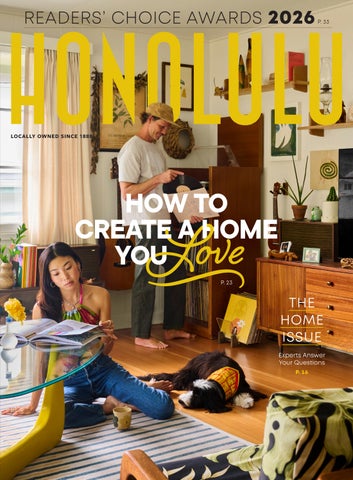
HOW TO CREATE A HOME YOU
Myron Kiriu
Kim Wong Balisacan
CEO, Owner, CLHMS, Realtor, RB-17242
Realtor, RB-21263
808.864.9000
808.258.1304
MyronKiriu.com
Wendy Tenn BIC, Realtor, RB-24084
808.389.8595
WendyTennRealEstate.com
Brett Aka Realtor, RS-75473
808.753.3923
AkaHomesHawaii.com
Karin Moody & Meme Moody
PB, Owner*, R, RB-22505 | BIC, R, RB-22780
KimBHawaii.com
808.392.7410 | 808.741.3835
Michelle Doo Van Rafelghem
SRS, ABR, RSPS, SRES, RENE, SFR, R, RB-23886
MBA, Realtor, RS-39617
808.384.1875
OahuDreamHome.com
MoodyTeam.com
Wendy Lee Akai 808.454.3569
wendy-akai.remaxhawaii.com
Scoop Slyman & Stephanie Wu
Michael Pieklo
808.798.2098
michael-pieklo.remaxhawaii.com
CLHMS, MRP, ABR, SRS, Realtors, RS-83651, RS-83369
Realtor, RS-79930*
808.551.6740
Krisztina Kollo Realtor, RS-66919
808.218.9196
Jeff & Taryn Char Realtors, RB-23468 & RB-23478
808.372.2282
HawaiiHome.realestate
PrimePropertiesHI.com
Sue Jo
Rolanda Racoma
SRES, Relator, RB-23897
808.253.8477
Realtor, RB-24177
808.220.9212
SuesHIHomes.com
RolandaRacoma.com
Daria Andreev
Lila Garvin
MRP, ABR, Realtor, RS-85255
808.674.7152
BuySellWithDaria.com
Realtor, RS-87727
408.771.6653 Lila.Homes
HawaiiRealtyScoop.com
Better Homes and Gardens Real Estate Advantage Realty is now REMAX Hawai‘i. Enjoy the same award-winning company, trusted agents, and exceptional service — now strengthened by REMAX’s global reach and resources. Visit any of our six O‘ahu and Maui offices to connect with our 180 real estate professionals and learn how we can support your home journey.
REMAXHAWAII.COM | 808.738.3600 KĀHALA | KAKA‘AKO | KAILUA | KAPOLEI | HALE‘IWA | WAILUKU
RB-18228 REMAX Hawai‘i. ©2025 RE/MAX, LLC. * RB-21766 REMAX Hawai‘i North Shore. ** RB-22126 REMAX Hawai‘i West O‘ahu. Each Office Independently Owned and Operated.
For inquiries, contact our circulation department: Phone: (808) 534-7520 Email: circulation@pacificbasin.net
publisher
HONOLULU Magazine emerged from Paradise of the Pacific, a publication commissioned by King Kalākaua that began in 1888, making it the oldest continuously published magazine west of the Mississippi.
Donna Kodama-Yee (808) 534-7501 | donnaky@honolulumagazine.com
editorial design Editorial Director Creative Director
Diane Seo James Nakamura
dianes@honolulumagazine.com jnakamura@honolulumagazine.com Executive Editor Senior Art Director
Katrina Valcourt Christine Labrador Dining Editor
Mari Taketa
Home & Style Editor
Brie Thalmann
Digital Editor
photography Staff Photographer
Aaron K. Yoshino
marketing
Andrea Lee Marketing Director Contributing Editor Christy Davis Don Wallace christyd@honolulumagazine.com Copy Editor Events Coordinator
Elroy Garcia Alithea Valdez
Editorial Intern Special Projects Editor
Esmé Betsch Thomas Obungen
contributors advertising Sean Marrs Strategic Partnerships Tommy Shih Michelle Stofle | (808) 534-7532 michelles@honolulumagazine.com Catherine Toth Fox
FEEDBACK
Send us your comments and/or feedback: HONOLULU Magazine 1088 Bishop St., Suite LL2 Honolulu, HI 96813 Email: letters@honolulumagazine.com
Advertising Executive
Donnie Ford
donnief@honolulumagazine.com Advertising Project Manager
Michelle Okada
SOCIAL MEDIA
michelleo@honolulumagazine.com
Facebook: facebook.com/honolulumag Instagram: instagram.com/honolulumag YouTube: youtube.com/honolulumagazine
East Coast Representative
Jeff Greif | (212) 213-1155 jeff@freeagentmedia.com 15 Maiden Lane, Suite 1001 New York, NY 10038
SUBSCRIPTION SERVICES
To subscribe to HONOLULU, sign up online at bit.ly/subscrible-hnl or call (800) 788-4230. To purchase the latest issue, visit shop.honolulumagazine.com. Get the latest of HONOLULU Magazine sent to your inbox each week by signing up to be a newsletter subscriber at honolulumagazine. com/subscribe-newsletter.
PRESS RELEASES
Founder
Duane Kurisu
Chairman
Susan Eichor
President
Brandon Kurisu
Director of Finance
Jade Carrel
Submit all press releases to info@honolulumagazine.com.
ADVERTISE
For more information on advertising contact publisher Donna Kodama-Yee.
EVENTS CALENDAR
City & Regional Magazine Association
Hawai‘i Publishers Association
Circulation Vertification Council
honolulumagazine.com/contact-us
Got an event you’d like to promote? Submit your event listing at honolulumagazine.com/ local-events. (ISSN 0441-2044) © 2026 PacificBasin Communications, LLC. All rights reserved. Any unauthorized copying, distribution, or adaptation is strictly prohibited and will result in liability of up to $100,000. Published monthly by PacificBasin Communications. Advertising and business offices: 1088 Bishop St., Ste. LL2, Honolulu, HI, 96813-4204. Phone: (808) 537-9500. MATERIALS Publisher cannot be held responsible for care or return of manuscripts, photographs or art. Unsolicited material must be accompanied by a self-addressed envelope and return postage. Publisher reserves the right to edit letters to the editor and other material submitted. Periodicals postage paid at Honolulu, Hawai‘i, and at additional mailing offices. SUBSCRIPTION: one year $24.99. Foreign: one year $39.95. For subscription inquiries, additional rates, information, notification of change of address and subscription service, please call (800) 7884230. POSTMASTER Send address changes to HONOLULU Magazine, 1088 Bishop St., Suite LL2, Honolulu, HI 96813. Subscribers notify the same office. Please include new address and old address (mailing label preferred).
MARCH 2026
1
Hawaii’s Leading Destination for Home Appliances We offer Oahu’s largest in-stock inventory of premium appliances backed by competitive pricing and outstanding service with aloha.
Visit our New Live Thermador Display Today PHADhi.com | 808.564.2493 | 99-1305 Koaha Place, Aiea @phadappliance
C E L E B R AT I N G H AWA I‘I’S S O U L M A R C H 2 0 2 6 | V O L . L X N O. 7
Contents
AARON K. YOSHINO
A tasting of crack seed kicks off Asatos Waikīkī’s new dessert omakase. See page 55 for more.
FEATURES 16 Answers You Need, from People Who Know Industry experts weigh in on some of the most pressing issues related to real estate buying and investments, mortgages, homebuilding and remodeling. BY D I A N E S E O A N D BRIE THALMANN
23 How to Create a Home You Love The four homes featured here are certainly artful and stylish, but they also exude warmth, coziness and joy—personal sanctuaries that celebrate the unique stories of those who call them home. BY B R I E T H A L M A N N
33 HONOLULU Home Readers’ Choice Awards HONOLULU Home continues the legacy of the former Hawai‘i Home + Remodeling in asking readers to name their favorite local contractors and home services. Our mission remains the same—to celebrate local businesses trusted to get jobs done well. Here are the winners and finalists in 48 categories. DEPARTMENTS
5 Currents Find out where to learn archery, interact with a robot, sip matcha and see a film. Plus, meet an inspiring woman and her service dog. 49 ‘Ono Eight of the city’s top bakers tell us which other bakers’ flaky, buttery, creamy treats they seek out. And a local sherbet wiz gets a major national nod.
4 Editor’s Page
56 Afterthoughts
Our stories for this issue provide some insight.
The Los Angeles team’s magical season was thrilling—for reasons beyond Shohei Ohtani and another World Series victory.
WHAT MAKES A HOME A HOME
BY DIANE SEO
PROMOTIONS AFTER PAGE 32 AIA Hawaii: Celebrating Our Centennial The American Institute of Architects builds on a century of design to inspire the Hawai‘i of tomorrow.
I ♥ THE DODGERS
BY MICHELLE OK ADA
ON THE COVER: Jordan Higa, Noa Emberson and Limu at home in Pauoa Valley. Photo: Tommy Shih MARCH 2026
3
E DI TOR’ S PAG E
What Makes a Home a Home Our stories for this issue provide some insight.
A
TOMMY SHIH
HOME DOESN’T HAVE TO BE LARGE, luxurious or tucked in an exclusive neighborhood for it to be loved. A home is a home when you make it a place you’re thankful to return to at the end of the day. After I sold my three-bedroom, two-bath home that my daughter and I lived in for almost 15 years, I rented an apartment down the street from my mother, who still lives in the house I grew up in. Although it’s a lot less than half the size of my former place, I adore it. It’s cozy, quiet, has the cool minimalist aesthetic that I prefer, and I can see and hear the ocean from my living room. It’s made me realize life is better without all the furniture, household items and stuff I used to have. I prefer being in a compact, comfortable space where I’m friends with my next-door neighbor and his sweet pup. In other words, apartment living suits me.
That’s the sentiment behind this month’s feature on homes we love. Instead of choosing the most lavish, architecturally impeccable homes on O‘ahu, home and style editor Brie Thalmann discovered diverse homes that the people who live in them cherish for various reasons. For some, it’s nostalgia; for others, it’s the special, meaningful items scattered throughout that make them happy. Luxury, after all, is attainable because you’re the one defining it. “I felt honored to share the stories of these four special abodes and the equally delightful homeowners who inhabit them,” Brie says. “No two homes were alike, each thoughtfully tailored to their owners’ unique tastes, passions and vibrant personalities. There is much for the average homeowner to glean. Whether you fill it with treasured mementos of friends and family, adorn it with art that inspires, or lean into design styles that spark joy, your home should be a celebration of the things, people and elements of life you hold most dear.” Our second home feature is meant to help you, our readers, get answers to all kinds of questions related to home buying and selling, remodeling, real estate investments, inherited properties and more. It’s often hard to get answers from those in the know, so we did it for you. Whether you’re a first-time homebuyer hoping to qualify for a loan, or someone who wants to remodel an existing house but is confused about the state’s permitting processes, we hope this piece helps you achieve ideal outcomes. To round out our home coverage, we’re presenting the winners of our HONOLULU Home Readers’ Choice Awards, highlighting favorite businesses in the homebuilding and remodeling industry in 48 categories. Thank you to everyone who voted! I hope you enjoy these and all the other stories in this issue. Our editorial team spends a lot of time discussing story ideas for the magazine, always with the hope of informing, entertaining, uplifting and inspiring the people who matter most to us—our readers.
DIANE SEO EDITORIAL DIRECTOR DIANES@HONOLULUMAGAZINE.COM
4
HONOLULU MAGAZINE
Aja Toscano and Roland Longstreet, one of four couples we interviewed about how they created a home they love. See page 23 for the story.
Currents LIFE
TECH
Libraries of the Future
IN
HONOLULU
➸ IT’S MORNING AT THE ʻĀINA HAINA PUBLIC LIBRARY and music fills the room as a sleek
humanoid robot named Pepper dances in front of curious children. Later, the wide-eyed robot greets patrons with a gentle smile as the kids navigate the options on her touch screen and ask her questions, such as where to find the bathroom and what her favorite color is. Pepper, at just under 4 feet, was a gift from the Friends of the Library of Hawaiʻi, a nonprofit that purchased it using a $25,000 grant from an anonymous donor, plus an additional $15,000. Read more on page 14. —Katrina Valcourt, photo by Aaron K. Yoshino MARCH 2026
5
CURRENTS
HAPPENINGS
March Picks
See more things to do this month at honolulumagazine.com/things-to-do.
Top events this month. BY ANDREA LEE Festival
Honolulu Festival
March 14–15 / Hawai‘i Convention Center $8 one-day admission, $10 at the door Celebrating the cultures of the Pacific Rim, the 30th annual festival will include performances, a Sake and Food Fest, a bon dance, a parade and Nagaoka fireworks.
honolulufestival.com, @honfestival
COURTESY: ASOBIE XPO HAWAI‘I
Comedy
Charlene Kaye: Tiger Daughter
March 15 / 6 p.m. Blue Note Hawai‘i / From $25
Atarashii Gakko!, one of the headliners for AsobiExpo Hawai‘i
Theater
Food & Drink
Concert
March 4–8 / From $9 Kennedy Theatre
March 5 / 5 to 8 p.m. Fishcake / Free admission
March 8, 19, 22 / From $43.50 Blaisdell Concert Hall
Lele Wale
With mele, hula and inspiration from true stories, this play explores the aftermath of the Lahaina wildfires through the eyes of those who lived through them.
manoa.hawaii.edu, @uhmkennedytheatre
Sunset Fest: Matcha
Every first Thursday of the year, Fishcake is hosting a themed mini market and food fest; for March, expect edible and nonedible matcha delights.
fishcake.us, @fishcakehawaii
Shakespeare Festival
In a three-part series, Hawai‘i Symphony Orchestra performs the music of Felix Mendelssohn’s A Midsummer Night’s Dream, Sergei Prokofiev’s ballet Romeo and Juliet and Pyotr Ilyich Tchaikovsky’s Romeo and Juliet.
myhso.org, @hawaiisymphonyorchestra
Musician, comedian and actor Charlene Kaye, known for her parodies of pop artists’ music styles, puts a humorous spin on her relationship with her immigrant mother in this solo show.
bluenotejazz.com, @charlenekaye Festival
AsobiExpo Hawai‘i
March 16 / 6 p.m. Waikīkī Shell / From $70 This Japanese pop culture experience marks its first international event here with performers Kyary Pamyu Pamyu, Atarashii Gakko! and Fruits Zipper as well as booth exhibits.
asobiexpo.com, @asobisystem_official
Food & Drink
your fill of unlimited brunch eats and drinks from beloved BRUNCHFEST Enjoy local restaurants, including Café Kaila, Smith & Kings and Over March 29, 11 a.m. Ho‘okupu Center
GET T Y IMAGES
6
HONOLULU MAGAZINE
Easy. Dressing up for the K-pop theme is encouraged!
hnltix.com, @honolulumag
A RRIVA L S
C U LT U R E
New in Town
THE WAY OF THE BOW
Places and activities that have opened recently.
Hawai‘i’s first public kyudojo is slated for Kaimukī.
BY ANDREA LEE
BY BRIE THALMANN
on O‘ahu were dedicated to kyudo, the traditional Japanese martial art that develops the spirit and mind through archery. In fact, the Meiji period art form’s presence in Hawai‘i dates to 1900. Following the bombing of Pearl Harbor, however, the kyudo community fractured, with teachers and members sent to internment camps and kyudo equipment confiscated under martial law.
House of Mana Up From sampling Kō Hana Hawaiian Agricole Rum and Mānoa Chocolate to admiring the larger-than-life Arlie Glass lei wall installation, the new Royal Hawaiian Center store with products from more than 70 local businesses is worth a visit. 2201 Kalākaua Ave., Waikīkī, houseofmanaup.com, @houseofmanaup
Pepper Lunch The global teppanyaki chain has opened its first Hawai‘i location at Moanalua Shopping Center. Here, you mix your meal on a sizzling iron plate, add sauce and cook to your liking. 930 Valkenburgh St., Suite 205, Āliamanu, pepperlunchrestaurants.com, @pepperlunchhawaiiToshiko Takaezu admiring
ANDRE A LEE
COURTESY: GLOW GOLF HAWAI‘I
one of her pots around the late 1950s.
Kawaii Kingdom Shop adorable Asian imports, from blind boxes and plushies to stationery and accessories, at this neon emporium with locations at Hawai‘i’s two largest malls. Ala Moana Center, 1450 Ala Moana Blvd., Ala Moana, and Pearlridge Center, 98-1005 Moanalua Road, ‘Aiea, @kawaiikingdom808
Glow Golf Hawai‘i This indoor mini golf course at Ka Makana Ali‘i offers 22 holes of glow-rious family-friendly fun and a kama‘āina discount. 91-5431 Kapolei Parkway, Kapolei, glowgolfhawaii.com, @glowgolfhawaii
COURTESY: HAWAI‘I K YUDO FOUNDATION
COURTESY: PEPPER LUNCH
COURTESY: HOUSE OF MANA UP
PRIOR TO WORLD WAR II, at least a dozen groups
Now, the local nonprofit Hawai‘i Kyudo Foundation aims to revive the practice in the Islands by teaming up with the City and County of Honolulu to build the state’s first public, regulation-sized kyudojo. HKF will raise funds for and construct the $850,000 recreation and education facility, which it will donate to the city. Set for completion in summer 2026, the campus will occupy a little more than half an acre of undeveloped land in the mauka section of Mau‘umae Nature Park in Kaimukī. The grounds will include a 3,200-square-foot open-air shajo (shooting gallery), a grassy 28-meter yamichi (arrow path) with an adjacent spectator area and a matoba (target bank). It will also feature a Japanese garden and a classroom big enough for 40 people; the room will be designed as a flexible multipurpose space for community meetings, events and other movement-based practices. hawaiikyudofoundation.org, @hawaiikyudofoundation MARCH 2026
7
CURRENTS
NEWS
“WE’RE GOING TO KEEP GOING” Amid a damaging PR crisis, organizers are determined to continue cleaning the notoriously polluted Ala Wai Canal with Genki Balls.
Participants toss Genki Balls at a recent event sponsored by Genki Ala Wai Project.
“
W
E’RE JUST A GROUP OF VOLUNTEERS and we’ve never used tax dollars,”
says Fumiko Chun, a founding member of the Genki Ala Wai Project. Since 2019, the group has tossed nearly 300,000 Genki Balls into the Ala Wai Canal to remove sludge, eliminate odors and foster an ecosystem where fish and other marine life thrive. More than 17,000 volunteers, including students, senior citizens, corporate employees and visitors from Japan, have prepared and tossed the mud balls containing potentially beneficial microbes into the notoriously polluted canal. “It started with kids, then their parents, grandparents, organizations and companies got involved,” says Ken Kaneshiro, president and CEO of the Hawai‘i Exemplary State Foundation, under which the project operates. “That’s been the most gratifying aspect, to see such broad community support.” The group, however, faced an unexpected PR crisis last fall, after local media shared Hawai‘i Pacific University research that found that Genki Balls tossed into Kailua’s Hāmākua Marsh did not improve the canal’s water quality. The microbes intended to be released by the balls also weren’t evident in aquarium tanks that the researchers filled with water and sediment from the marsh. They said the water quality actually worsened. 8
HONOLULU MAGAZINE
SE AN MARRS
BY DIANE SEO
Repercussions were swift. Although none of the organization’s core team wavered, the group’s monthly public events initially experienced a dramatic drop in attendance, and the much-touted Genki Balls project was suddenly cloaked in skepticism. Chun, who serves as the group’s media liaison, says she erred in assuming people wouldn’t believe the research since it involved only 200 Genki Balls. “We make 600 Genki Balls with preschoolers in two hours. What can you expect to do with only 200?” Chun says, sounding exasperated. The Genki Ala Wai Project has spent more than $50,000 on water quality testing since forming. When the project began, only 44% of the submitted samples from the canal met Hawai‘i Department of Health standards. Now, that number is 74%, Chun says. In a response drafted after the public fallout, Chun and Kaneshiro, who is program director of the Center for Conservation Research and Training at UH’s Pacific Biosciences Research Center, wrote: “Together we have seen tangible progress: over 20 inches of polluted sludge reduced, cleaner water with far fewer Enterococci bacteria (a key indicator of sewage pollution) near the Hawai‘i Convention Center, and the return of marine life to areas where it had long disappeared. Today, sightings of native fish, hammerhead sharks, spotted eagle rays and even monk seals are beginning to change the reputation of one of Hawai‘i’s most polluted waterways.” The group also has received feedback about the canal’s smell: People say it’s not as bad as it used to be. Teachers at neighboring Jefferson Elementary have told project leaders that they used to keep their classroom windows closed because of the odor; now they’re open. For their part, HPU faculty members Carmella Vizza and Olivia Nigro say they “stand firmly” behind the results of their study at Hāmākua Marsh. “We want our community engaged in efforts that meaningfully improve the quality of Hawai‘i’s waterways, and that starts with ensuring people have the information they need to make clear, informed decisions about where they invest their time and resources,” they said in a written response. The HPU researchers are hoping to secure funding for an independent study in the Ala Wai watershed. In the meantime, the Genki Ala Wai Project continues, with monthly events for the public still being planned. “We’re going to keep going,” Chun says. “Our team is resilient, and I have faith in our community.” genkialawai.org, @genkialawaiproject
INGREDIENT
A Nice Crunch and a Little Slime A chef hopes visitors will love the pohole he’s introduced to Waikīkī. BY M A R I TA K E TA
er you call them, local love for fiddlehead ferns runs deep. Once a staple at lū‘au and potlucks, the curly delicacy has become harder to find. Only a handful of restaurants serve it, in places like Kalihi, Mānoa, Waiāhole and Kaimukī. Now add to that list Basalt, smack in the heart of Waikīkī. “Everybody knows ‘ulu, taro and local tomatoes. Pohole is a little different,” executive chef Lance Kosaka says. “To me it’s a cross between asparagus and okra, with that nice crunchy texture a nd a little slime.” Kosaka gets the shoots from Kumuola, a nonprofit that farms them in Mānoa Valley. Warabi salad is far from a bestseller at the ABC Stores-owned restaurant, he says—but it makes locals happy. 2255 Kūhiō Ave., Waikīkī, basaltwaikiki.com, @basaltwaikiki
A ARON K. YOSHINO
POHOLE, HŌ‘I‘O, WARABI, PAKO: Whatev-
Kosaka’s warabi or pohole salad with local cherry tomatoes, red onions and soy-cuttlefish dressing
BOOK
Removed by Force William M. Kaneko shines a light on unjust treatment of Japanese Americans in Hawai‘i during World War II. BY BRIE THALMANN
COURTESY: LEGACY ISLE PUBLISHING
IN THE 85 YEARS SINCE WORLD WAR II, much
has been documented about the incarceration of Japanese Americans in internment camps on the U.S. mainland. Now, lawyer and civil rights activist William M. Kaneko and journalist and public policy advocate Sara N. Lin are bringing another lesser-known story to the forefront— the unwritten history of the 1,500 Japanese Americans in Hawai‘i who were ousted at gunpoint from their homes and businesses under the same executive order. In Removed by Force: The Eviction of Hawai‘i’s Japanese Americans During World War II, releasing this month, Kaneko and Lin detail the unjust events that occurred in the hours im-
mediately after the bombing of Pearl Harbor and in the years to follow. Lives were upended and many never made it back to their neighborhoods. Kaneko, who served as president of the Honolulu Japanese American Citizens League from 1990 to 1993, offers a front-row seat to the civil and human rights group’s hard-won, nearly 50-year battle with the U.S. Department of Justice for redress and reparations. The book also chronicles the JACL’s evolution over the years, including its advocacy for same-sex marriage, and transgender and Native Hawaiian rights. $18.95, 242 pages, legacyislepublishing.com MARCH 2026
9
CURRENTS
TREND
SO MATCHA MATCHA Two newcomers arrived last fall, pairing matcha lattes with soft serve and craft musubi. BY M A R I TA K E TA
TA I L S O F T H E C I T Y
READY TO SERVE Summer Kozai says her assistance dogs have helped her regain her independence. More importantly, they’ve brought joy and connections. BY DIANE SEO
Matcha, in Japan the stuff of dessert flavorings and the formalized ritual of tea ceremony, surges on as the trendiest drink in Honolulu nei. While matcha lattes are at virtually every café, in Waikīkī, two specialists emerged last fall. On the western edge, MARUWU SEICHA offers matcha and hojicha drinks, soft serve and itssignature Ube Matcha Latte. The San Francisco-based chain has five locations and plans more, including one in Kapolei’s Don Don Donki and another in Mō‘ili‘ili this summer.
A ARON K. YOSHINO
260 Beach Walk, Waikīkī, maruwuseicha.us, @maruwuseichausa
You’ll find AS YOU LIKE ’s hand-whisked matcha drinks and craft onigirazu musubi in the lobby of Hotel Renew. It’s sister to an identically named matcha café in Brooklyn, New York,both owned by Yuji Haraguchi, known locally for high-end sushi creations. Drinks range from minimalist matcha, sweetened with just 5 grams of honey, to matcha mango and banana chocolate cold brew. Fillings for the onigirazu include Spam, pastrami and barbecue toro. 129 Paoakalani Ave., Waikīkī, @asyoulikewaikiki
10
HONOLULU MAGAZINE
focused on her career and having adventures with friends. Then her life took a dramatic, difficult turn. The ‘Iolani School grad contracted bacterial meningitis, most likely during a work trip in the Marshall Islands, and in the chaotic aftermath upon returning to Hawai‘i, wound up unable to breathe. When she awoke from a medically induced coma weeks later, s he learned she would need to have all four limbs amputated. The now 42-year-old spent many months at The Queen’s Medical Center, then three more years in Portland, undergoing various surgeries and therapies to learn how to function with prosthetic limbs. While in Oregon, she received her first service dog—Trooper—via Assistance Dogs of Hawai‘i. For the next eight years, the black lab was Kozai’s constant companion, helping her rebuild her life and gain independence. But Kozai was also bolstered by her own remarkably resilient spirit, which kept her living in gratitude instead of resentment. Eventually, she resumed her career as a defense contract auditor based in Honolulu. After Trooper died in 2021, it took Kozai three years to heal from the loss. “I was so heartbroken,” she says. She applied for another dog only after learning that Trooper’s now-grown puppies were ready for their assignments. In February 2024, Trooper’s daughter, Oakley, came to Kozai’s side, and like her father, became her supportive shadow. “The main thing that they did and now do to help me is retrieve items and close and open doors,” Kozai says. The uber-motivated Oakley—whom Kozai has nicknamed “‘Opihi” because she’s a “Stage 5 clinger”—is thrilled when asked to assist. “As soon as I say, ‘Oakley,’ she’s running to help me with whatever I need,” Kozai says. “If I print something, she’ll get the paper from the printer. If I’m trying to brush my hair and I drop my brush, she’ll pick it up. Any time of day, she’s ready to help.” Yet, the biggest thing her dogs have provided is helping her reintegrate into the world. “When I had the amputations, the first few years were very difficult, and you worry about how everyone else sees you,” Kozai says. “I was living in a nursing home, which is already weird for a 27-year-old, but when I got Trooper, part of the requirement is you have to take them out on neighborhood walks and socialize them. It forced me to get outside, and I ended up making so many friends.” For Kozai, a dog’s unconditional love is healing. “I never stopped having fun with friends,” Kozai says. “But the love, joy and companionship that Trooper and Oakley brought— that’s something that a human, I don’t think, could ever do. Everything they do is selfless. There are no conditions—they just want to help because they love you.”
A ARON K. YOSHINO
A ARON K. YOSHINO
L
IKE MANY 26-YEAR-OLDS, Summer Kozai was
Summer Kozai at home with her assistance dog, Oakley, or ‘Opihi, as she’s nicknamed her
MARCH 2026
11
MAT T BRUENING PHOTOS: MAT T BRUENING
T R E N D WAT C H
Pride of Palaka
Palaka pieces from Matt Bruening (above row), Salvage Public (top right) and Crystal Rose (bottom right)
What’s behind the return of the old-school Hawai‘i fabric? BY BRIE THALMANN
I
F IT SEEMS LIKE YOU’RE SEEING PALAK A EVERYWHERE, you’re not imagining
it. The classic Hawai‘i fabric is back—in our feeds, at makers markets and in every major shopping center on O‘ahu. Even Foodland’s palaka cooler bags went viral. We reached out to local designers for insight on the trend. First, some history: The plaid, heavy-duty cotton fabric arrived in the Islands in the early 1800s on the backs of English and American sailors who wore it as loose, long-sleeve shirts. During Hawai‘i’s plantation era, palaka’s durability made it popular among paniolo and field workers. It also enjoyed a resurgence in the ’60s and ’70s. Along the way, the fabric wove its way into Hawai‘i’s heart as a symbol of community and our working-class roots. Millennials, like designer Crystal Rose, grew up seeing palaka worn by her grandparents’ generation. “They only had a few colors, and I’d mostly seen it in quilts, shirts and traditional mu‘umu‘u,” she says. “It wasn’t really cool.” Designer Nāpali Souza of Salvage Public agrees. “I remember choosing to wear palaka when I started at Kamehameha in the seventh grade and feeling a
12
HONOLULU MAGAZINE
little out of place,” he says. “It was a little unusual to wear it back in 1993 as a teenager.” For designer Matt Bruening, it was reminiscent of family reunions and coming-of-age parties. Souza points to Bruening as one of the designers to kick off the current craze. “He’s done such a great job of making it fresh, and presenting palaka in modern silhouettes,” he says. Bruening debuted his first palaka piece, a coach’s jacket, in 2018. “I thought that it was cool that it represents a hardworking class— that’s where I come from,” Bruening says. Next came his ’90s-style bucket hats, available in a rainbow of playful colors. “That went crazy,” he says of the response. Since then, Bruening’s whipped up everything from palaka patchwork maxi dresses and kimono jackets to ulua-printed shirt sets. His ability to elevate the fabric via fashion-forward cuts and offbeat color combos keeps customers coming back. The same can be said of Rose’s designs. Drawing on her Japanese heritage, her Furoshiki pants feature knotted details inspired by traditional Japanese packaging. And her Flower Power pants, cut from a cheery lilac palaka, are covered in multihued floral patches. The
increase in palaka color options is part of what’s driving interest, she says, along with social media and sewing’s growing popularity. “Sewing has also become a cool pastime—it’s everywhere on TikTok—and palaka is an easier fabric to work with,” she says. This has inspired retro-loving younger generations to make their own wares. “Gen Z is the one that’s making it blow up and making it super popular,” she says. Yet Salvage Public’s palaka fans extend to customers in their 60s too, Souza says; all are drawn to the label’s unexpected translations in new, exciting fabrications. Its first palaka release was a tote made from a custom-designed Jacquard knit, which flew off the shelves. And its first foray into palaka clothing, a spring 2025 cotton twill zip jacket featuring indigo-dyed threads, sold out even faster. “There’s a growing appreciation of Hawai‘i fashion and a celebration of place and culture,” Souza says. Bruening says if designers continue to push palaka in creative new directions, its reach will grow even more. “I’d love for people to wear it around the world,” he says. “It’s a conversation starter, an educating moment. It’s like a little piece of Hawai‘i wherever they go.”
CURRENTS
SALVAGE PUBLIC PHOTOS: JOSEPH SERRAO
Hawaiian Honey cowrie shell earrings STYLE
Wonders of the Sea 444ever offers a bold take on ocean-inspired jewelry. BY BRIE THALMANN
PHOTOS: A ARON K. YOSHINO
“I REMEMBER COMING UP WITH A POCKET FULL OF SHELLS, and I felt so rich,” designer Nico Jager says, recall-
ing his first shell-diving session at Yokohama Bay. “It’s just incredible that the ocean creates such beautiful, pure forms of art,” he says. It was the height of the pandemic, and after Punctured years away from the ocean, Jager says the sea called him miter shell ring back. “Growing up in Kāne‘ohe, my dad had a boat, so we spent a lot of time fishing, spearfishing and snorkeling.” Around the same time, hoping to reignite his creative juices, Jager signed up for an introductory jewelry-making class and took to the craft like a fish to water. Thus, 444ever was born as a natural melding of his two interests. It’s not your standard dainty shell jewelry. Jager describes it as masculine and edgy with a grungier feel. “It reflects the power of the ocean rather than the calm beauty,” he says. His pieces fuse exquisite shells—think checkered cowrie, sunrise and miter styles—with silver spikes, skulls and coral-like caps. He also creates all-silver pieces, including ‘opihi-studded crosses and shark-tooth star pendants. A scuba diving professional by day, Jager uses his evenings to explore new nooks of the ocean. “While free diving and treasure hunting in untouched, unfamiliar territory, it’s like I’m flying underwater. It’s just the most rewarding feeling,” he says.
@444everdesign, available at Harbors Vintage, 1269 S. Beretania St., McCully-Mō‘ili‘ili, and Hook & Hide Hawai‘i, 1136 Nu‘uanu Ave., Downtown
PHOTOS: NICO JAGER
CRYSTAL ROSE PHOTOS: CRYSTAL ROSE
‘Opihi pendant necklace
Sunrise shell pendant necklace
MARCH 2026
13
FO R M O R E I N FO 1090 KEOLU DRIVE, KAILUA KAILUACINEMAS.C OM , @ KAILUACINEMAS
PURSUITS
Local Revival A Kailua family breathes new life into a community staple.
LIBRARIES OF THE FUTURE C ONTINUED FROM PAGE 5
Pepper currently interacts with folks on Thursday mornings at the ‘Āina Haina Public Library, but there are plans for her to visit other branches. “We are also hoping to incorporate Pepper into story times and [we’re] pursuing other educational opportunities for the robot, such as coding,” says state librarian Stacey A. Aldrich. “We have only just begun, and we will continue to learn, which will influence future uses and programs.” Pepper is meant to help users become familiar with new technology—and the library is the perfect place for that. “Public libraries have always been places of innovation where people can explore new ideas and gain experience with emerging technologies,” Aldrich says. “For centuries libraries have been places that connect people to ideas, stories and knowledge. As transmission technologies have changed, libraries continue to help people in our communities build the skills they need to thrive in an increasingly digital world.” All 51 public library branches in Hawai‘i launched RFID scanning and self-checkout stations in April 2024. Seven branches also have self-return shelves. In addition to free internet and computer usage, libraries also offer basic computer classes and recently expanded to one-on-one tech support. “We’re using technology not for its own sake,” Aldrich says, “but to create more access, more confidence and more meaningful connections, both in our libraries and beyond them.” —Katrina Valcourt
14
HONOLULU MAGAZINE
J
AYMIE AND JOSH TYAU
weren’t looking to purchase a movie theater. But Josh, a structural engineer, and Jaymie, who recently got her private pilot’s license, came on the radar of the lawyer helping to sell Kailua Cinemas, the only independently owned first-run movie theater in Hawai‘i. At the time, the Tyaus were helping their 17-year-old son, Nolan, run a kettle corn business at the Lōkahi Kailua Market. “That’s how he thought of us,” Jaymie says of the lawyer, with a laugh. “‘You’d be great as theater owners, because you know how to make bomb kettle corn.’” From a business standpoint, it didn’t make sense. The theater had been losing money for years. “This is a dreamer’s project. I was like, I don’t know if we’re this insane,” Jaymie says. “But apparently, we are.” They got the keys in September 2025. The building was transformed in 2016 from a secondrun dollar movie house to a firstrun luxury theater, with red faux leather recliners. The chairs are still in good shape, but the Tyaus have spent many late nights cleaning screens, replacing projector bulbs, rewiring the sound system and fixing the leaking roof themselves. “I think that there is going to be a resurgence in movies,” Josh says. Nationally, gross domestic theater revenue has been
increasing to almost pre-COVID numbers, and with big players like Amazon MGM Studios committing to more theatrical releases, the Tyaus are hoping they can be profitable. But beyond that, “It’s a cultural thing,” he says. “Actually, our first date was to the movies.” They went to see Adam Sandler in Click. “We’re hoping that we can keep a space like this alive and running so that you have something, you have a theater in your community. Otherwise …” Jaymie finishes his thought: “There’s not much left.” So far, the Tyaus have been able to keep their prices low and their creativity blooming. Jaymie grins as she talks about plans for the theater, from cosmetic upgrades and more food offerings to a book club and a little gift shop stocked with things like socks and blankets. “I want all of O‘ahu just to realize we have something unique to offer,” she says. And yes, you can get kettle corn there, along with regular movie popcorn and other snacks. The Tyaus also want the theater to be community-centric. In February, Kailua Music School premiered its students’ music videos on all four screens, and spaces are available to rent for family gatherings and dance parties. “We just get to serve this community we love,” Jaymie says. “I feel like it completes me.”
A ARON K. YOSHINO
A ARON K. YOSHINO
BY K AT R I N A VA LC O U RT
A ARON K. YOSHINO
Josh and Jaymie Tyau want Kailua Cinemas to be a focal point in the community.
MARCH 2026
15
Answers You Need, from People Who Know Industry experts weigh in on some of the most pressing issues related to real estate buying and investments, mortgages, homebuilding and remodeling. by D I A N E S E O A N D B R I E T H A L M A N N
p.16
ILLUSTRATIONS: -VL ADIMIR-/ISTOCK/GET T Y IMAGES PLUS VIA GET T Y IMAGES; CNY THZL/DIGITALVISION VECTORS VIA GET T Y IMAGES
TH
UE
OME ISS H E
F E AT U R E ANSWERS YOU NEED, FROM PEOPLE WHO KNOW
My siblings and I are inheriting our parents’ home and aren’t in agreement about what to do with it. What advice would you give to sort things out? JAR ED K AWA SHI M A
COURTESY: YEE & K AWASHIMA LLLP
PARTNER, YEE & KAWASHIMA LLLP
Open communication is key, trust and estate attorney Jared Kawashima says, and he encourages families to openly state their goals with respect to property. “Each family member should state if they want to sell or not,” he says. “They may want to, or keep the house because it’s the family home.” If the decision is to sell, then they have to decide whom to sell it to, a third party or family member. “After you get through those two decision points, you can focus on
What’s the best way to shore up our finances so we can one day own a home? J EF F VEN TUR A
COURTESY: FIRST HAWAIIAN BANK
SENIOR VICE PRESIDENT/RESIDENTIAL REAL ESTATE LOANS DIVISION MANAGER, FIRST HAWAIIAN BANK
Conversations with customers looking to buy their first home start with their credit, making sure they’re paying bills on time, First Hawaiian Bank’s Jeff Ventura says. “One or two late payments can really impact your credit score, so it’s important to keep up your payments and build up your credit score because it will impact the pricing of the mortgage.” If customers have revolving debts like credit cards, Ventura encourages them to pay them down as much as possible. “From the time the lender pulls your credit report, if the balance on your credit cards is near the credit limit, that could drive down your credit score.”
what you need to accomplish the tasks,” Kawashima says. “In my experience, having co-owners of a property is more difficult, so just selling the property is the cleanest option.” Kawashima advises to always involve professionals, the four core ones being an attorney, a CPA, an appraiser and a Realtor. The type of attorney depends on the decision points. “If you’re going to sell the house to a family member, you’ll need an attorney to draft a buy-sell agreement with the terms,” he says. “And if one sibling is buying out the other sibling, they need to base it on the appraised value at that time. If you’re going to renovate it to rent it out, you’ll probably want a construction-related attorney to deal with the contractor, depending on the size of the renovation.”
When siblings don’t agree on what they want to do with the family home, Kawashima says they should try mediation first with an independent person facilitating. “It’s nonbinding, so you can’t force anybody to do anything. But we always try mediation first, because it’s the quickest and cheapest option,” he says. Arbitration is the next step, which can be binding. “But you’re always going to have somebody that’s unhappy with arbitration because there’s going to be a winner and a loser. And then you have the nuclear option, which is filing a complaint to partition a property.” Kawashima says that should be the last option, not just because of the animosity it can cause: Partitioning also makes it more likely the home will be sold at below market price. —DS
Starting early and being focused and disciplined to save for a down payment is critical, he says. “Ideally, you would want to put at least 10% down, although 20% is optimal.” In Hawai‘i, many first-time homebuyer loan programs and discounts are available, including the state’s new Hale Kamaʻāina Mortgage Program, which First Hawaiian Bank is prepared to support, Ventura says. The program offers reduced fixed rates for first-time homebuyers, and borrowers can also get down payment assistance loans that can be 4% of the purchase price. They can even put less than 10% down on a purchase. Ventura says First Hawaiian Bank also runs its own program, called the First Step Home Loan program, which requires only 10.01% down, with no requirement for mortgage insurance. (Mortgage insurance is normally required for
buyers with down payments of less than 20%.) “It’s a really good way for first-time homebuyers to get started and keep their costs down,” Ventura says. —DS
Is it better to buy a home when prices are high and interest rates are low, or vice versa? Ventura says it depends. When interest rates were low, as they were pre-pandemic, borrowing was cheaper, so buyers could afford higher priced properties. This increased buyer demand drove up prices. “If the housing supply doesn’t rise at that same pace, then inventory tightens, and that’s not an ideal time to buy as it becomes a seller’s market,” he says. After the pandemic, interest rates rose, which suggested that prices CONTINU ED ON PAGE 18
17
MARCH 2026
17
F E AT U R E ANSWERS YOU NEED, FROM PEOPLE WHO KNOW
I’m nearing retirement age and am considering investing in real estate in Hawai‘i. What are the considerations I should be weighing in making this decision?
CONTIN U ED FROM PAGE 17
With reports of climate change causing wildfires and eroding Hawai‘i’s shoreline, are insurance costs going to skyrocket and be difficult to obtain?
their pricing, or they can’t justify writing those risks.” While rates across the country are escalating, Hawai‘i hasn’t experienced the same kind of steep price increases seen in other states, despite the Lahaina wildfires and close hurricane calls, Kuioka says. “Still, anytime you live on the coast, and not in just Hawai‘i but across the globe, you’re subject to higher degrees of perils, whether it’s wind, flood, rain or any kind of earth-driven peril,” Kuioka says. “Typically, when you’re along the coast, you have higher winds, higher potential for flood, and you have earth movement related to erosion of the land. And insurers do understand that.” It comes down to whether or not an insurance firm can adjust the pricing for those increases. “Sometimes you can, but it can be really difficult and that’s why you’re seeing a lot of markets pull back from coastal properties,” Kuioka says. “And unless there’s some stability in global catastrophes, we will continue to see increases.” —DS
S COT T KUIO K A PRESIDENT, ISLAND INSURANCE
Across the globe, property losses that are happening from climate-related events are much higher in the recent decade than during the previous one, Island Insurance president Scott Kuioka says. “The frequency and severity of events have both been increasing, and that’s how we factor in what kind of losses we anticipate,” he says. “I think everybody understands that those two things are happening and that insurers are having to adjust
18
LIAN E C HO N G FINANCIAL PLANNER, SAGIENT
“Real estate is often considered to be a great investment by many, especially in Hawai‘i where property values have increased tremendously over the years,” financial planner Liane Chong says. “While it is recommended to own your own home, investing in real estate near retirement has different considerations.” Chong says as people plan for retirement, the key is to identify the amount of their fixed monthly expenses and to make sure they have enough guaranteed income to pay those expenses for the rest of their lives. In addition, they’ll need access to liquid money to cover discretionary expenses, medical costs and potentially long-term care costs. “If you have properly planned and saved for retirement and have enough liquid assets to buy investment property, real estate would be something to consider,” she says. One common reason for investing in real estate is the desire to pass down property to children, Chong says. Another is to create ongoing income—provided you can pay off the mortgage or at least see a profit after all expenses are paid from the rental payments. “While property is a valuable asset, another consideration is whether you want to manage another bill, hire a property manager, deal with potential vacancies or unpaid rent, and have to spend money fixing and maintaining your property. Real estate investment can be highly lucrative and desirable, but as you are near retirement, age plays a different role in your decision.” —DS
COURTESY: SAGIENT
afford it and refinance down the road, but adjustable rate mortgages are not for everyone,” he says. “If you’re on a fixed income—let’s say you’re retired—you probably want a fixed interest rate. For homebuyers who know they’re not going to stay in a property for a long time, or if they know there’s a good chance they’re going to refinance, an adjustable rate mortgage might be the more ideal product for them. For the past couple of years, we’ve had more adjustable rate mortgage applications than fixed rate applications.” —DS
COURTESY: ISL AND INSURANCE
would come down. “But that didn’t happen,” Ventura says, because homeowners tended to hold on to their low-interest-rate properties instead of selling, and the resulting reduced inventory “has kept prices elevated.” Rates have steadily declined since the beginning of last year, and the forecast is for there to be a small decrease in 2026, Ventura says. And if rates continue to decline, the general consensus is that prices will increase. “There’s also always the option to get an adjustable rate mortgage to help you
F E AT U R E ANSWERS YOU NEED, FROM PEOPLE WHO KNOW
When selling an older home, how do you decide whether to fix it up or sell as-is? What factors should you consider? MY R O N K IR IU
COURTESY: REMA X HAWAI‘I
REALTOR AND EXECUTIVE ASSOCIATE, REMAX HAWAI‘I
According to Remax’s Myron Kiriu, there are several factors to consider, starting with a client’s timeline. “If you need to sell right away, then you can’t fix it up,” Kiriu says. Even minimal renovations can take a few months. “When you start remodeling kitchens and bathrooms, that’s going to take quite a bit of time,” he says. And you’ll need to account for how long it will take to get building permits. You’ll want to assess local market conditions. “Recently, I’ve noticed that turnkey houses are selling for a higher premium and
How can you best achieve your renovation goals on a limited budget? S H AO L IN LOW
COURTESY: STUDIO SHAOLIN
OWNER AND PRINCIPAL DESIGNER, STUDIO SHAOLIN
Be realistic about your budget, advises interior designer Shaolin Low. People often only consider material costs, but you’ll likely also be paying for labor and potentially a contractor fee. “If you’re on a super tight budget, ask yourself, is this something I have to do right now, and if it’s not, consider waiting,” she says. “Because, if you don’t have the money to do it right, you’ll compromise and end up in a position where you hate what you chose, and it can cost you more money down the line to redo.” If you can move forward, design-wise, Low suggests a high-low tactic when deciding where to focus funds. Invest in high-quality materials for the elements that are more per-
they’re selling faster—that’s islandwide,” Kiriu says. “Buyers don’t want to take the time to get building permits and there’s the rising cost of renovations. With a turnkey home, they don’t have to sit for a year or two before getting the house they want.” The home’s condition also comes into play. “How bad is it?” Kiriu asks. “If most people are going to tear it down anyway and start new, then it doesn’t make sense to put money into it.” If the condition is fair, Kiriu advises doing a cost-benefit analysis with your real estate agent. “My rule of thumb is, if you can get a two-for-one return—$2 for every dollar spent—I’d recommend it,” he says. “If they’re going to spend $50,000 to get $100,000 on a higher sales price, I think it’s worthwhile.”
If you are going to renovate, invest in areas that will give you the biggest return on investment. Kiriu suggests addressing chronic problems, such as a faulty roof or leaky plumbing, and major safety issues first. “Besides that, critical items to fix are paint and flooring, because they cover the most surface area—what people will see,” he says. Curb appeal is important. Poor exterior conditions, such as peeling paint, can deter buyers from even stepping inside. “And if the landscaping is overgrown, it can make a lot look smaller,” Kiriu says. When deciding where else to allocate funds, Kiriu advises putting yourself in the buyer’s shoes. “What’s going to excite them about the house? What’s going to make them put in an offer? What’s going to make them close?” he says. —BT
manent, that will be costly or difficult to change out. In the kitchen, that’s countertops and cabinets. “If you go with low-quality cabinets and one gets wet and starts to warp, it’s really hard to replace just one—you’ll be replacing them all,” Low says. Fixtures, hardware, tile and appliances are areas where you can get thrifty. “You can find really great dupes of expensive tile and hardware,” she says. “And appliances can always be upgraded further down the line.” The same rule applies for bathrooms. Prioritize spending on your shower, tub and flooring. “Your vanity and toilet can be places to save, because those are pretty easy to swap out,” she says. In the rest of the home, invest in good flooring. “Flooring frames your entire space, so it sets the tone for all the other design decisions you’re going to make,” she says. “It also requires the
most labor, so it’s something you won’t want to change often.” Like hardware, there are great lighting dupes aplenty and lighting fixtures are easy to update. And since you can do it yourself, refinishing walls is an affordable way to make a big design change. “When I get asked how to refresh a bedroom in a weekend, it would be doing peeland-stick wallpaper, painting or changing the drapes,” Low says. It’s also worth noting that a smaller budget doesn’t mean you can’t work with an interior designer. You may not be able to afford full-project services, but there are designers and firms, including Low’s studio, that offer partial services, such as virtual consultations that can be purchased by package or at an hourly rate. So, you can get professional advice on everything from layouts and space planning to furniture scale and color schemes. —BT
19
F E AT U R E
How do you select the right contractor?
STR AT TO N W R I G HT
RO SE AN N F RE ITAS
PRESIDENT AND FOUNDER, PARADISE HOME INSPECTIONS
CEO, BIA HAWAI‘I
With older homes, there are a multitude of elements and costs to consider that the average person might not be aware of. Paradise Home Inspections’ Stratton Wright suggests creating an action plan that begins with an assessment of a home’s condition. “Start with the major components—structural integrity, foundation, electrical wiring, plumbing, roofing,” Wright says. “If not well maintained, those are the most expensive to fix and your house won’t be able to function without them.” Figuring out when components were last updated and with what kinds of materials will give you a road map for the budget you’ll need, what to prioritize and what is coming down the pike. “You need to look at least five to 10 years down the road,” he says. Foundation issues are common in the Islands, Wright notes. “If your house is older and leaning, that’s most likely due to erosion, which happens a lot, especially in Hawai‘i,” he says. “You’ll need a structural engineer to do a report and let you know if a property is safe. The minimum for that could be thousands of dollars before any construction work even happens.” Roofing costs can also easily rack up. “We find a lot of leaks within the attic or home itself,” Wright says. The life expectancy for a roof usually runs from 25 to 30 years, depending on material. “The average cost to replace the whole
20
roof for a single-family property starts at $25,000,” he says. Along with water damage, leaks from faulty roofing or plumbing can also lead to mold, frequently encountered in older homes. According to Wright, the biggest plumbing concern is usually the main drain line, which runs underground, sometimes buried under concrete. “The minimum cost to replace a whole line for a single-family property averages $10,000 to $20,000,” he says. And although not always top of mind, water heaters are another common issue. “The average cost to replace a heater is $2,500 to $3,500.” Making sure that your home’s electrical wiring is solvent is also a top priority. “Outdated electrical panels could be a fire hazard or against current code,” Wright says. “Some of the properties we inspect, they’re still using electrical components that were banned because of fires. So, one, obviously it’s a safety hazard. And two, you’re not going to be able to get homeowners insurance.” Replacing your breaker panel can range from $2,500 to $3,500. If you need to rewire your entire house, the cost shoots up to $40,000 to $50,000 for a single-family home. Outside of those major components, you’ll also want to examine your home’s building materials. Depending on when they were built, older homes can sometimes feature hazardous materials, once deemed acceptable, that now require remediation, such as asbestos or lead. —BT
COURTESY: PARADISE HOME INSPECTIONS
What are the best practices for modernizing an older home?
“Most people aren’t experts on how to remodel a home, so finding the right contractor is really important,” BIA Hawai‘i CEO Roseann Freitas says. She suggests taking your time and doing some homework. “From a legal side, make sure that person, if they’re in a field that requires licensing, actually has the appropriate license,” she says. “For a general contractor, you would check with the state.” Not only should you confirm that the business is registered with the Hawai‘i Department of Commerce and Consumer Affairs, you should also go the extra step and check with DCCA’s Professional and Vocational Licensing Division to make sure the business has a current license and it hasn’t had any issues. You can do the same for specialty contractors, who deal with things like countertops and cabinetry, and need special licenses. Licensure is critical. “It shows that they have not only the knowledge and competency, but that they’re being ethical and that goes back to trust,” Freitas says. “To have your license you have to have insurance, you have to have workman’s comp.” Otherwise, if a contractor brings someone on the job and they get injured, it could fall on the homeowner. “If they hire subcontractors and don’t pay them, the subcontractor can put a lien on the homeowner’s home,” she says. Licensure also offers homeowners protections via the DCCA’s Regulated Industries Complaints Office, or RICO, which monitors licensees and may be
COURTESY: BIA HAWAI‘I
ANSWERS YOU NEED, FROM PEOPLE WHO KNOW
F E AT U R E ANSWERS YOU NEED, FROM PEOPLE WHO KNOW
KIM SAN C HEZ REGIONAL HOME PLANNING CONSULTANT, HPM BUILDING SUPPLY
COURTESY: HPM BUILDING SUPPLY
able to provide funds or resources to remedy certain situations. Outside of the DCCA, the Better Business Bureau can provide helpful information and reviews. And membership in organizations like the Building Industry Association of Hawai‘i suggests quality work. “We use RICO and the BBB to vet all our members,” Freitas says. “Usually, if they belong to some sort of association, they’re trying to stay on top of the latest education and trends, as well as the professional development that comes with the industry.” In your research, find out how long these professionals have been in business and talk to people they’ve worked with before, Freitas advises. “Online reviews are great too, but sometimes it’s really good to talk to somebody who’s gone through the process,” she says. “So, you can ask, how did this work? What should we be doing?” If all checks out, you’ll want to sit down and see if your communication styles align. Freitas suggests interviewing at least three contractors. Be upfront about your budget, talk through your timeline, the scope of work and how many projects they’ll be managing concurrently. Feel free to inquire about subcontractors. “It’s OK to ask ‘Who do you work with?’ because that’s a reflection on the company, too,” Freitas says. You’ll also want to go over how they handle payments and invoicing. “Reputable contractors will have a payment plan in place,” she says. “They usually will ask for a deposit to order materials and once it arrives, payment in full. Labor is usually more incremental as they finish phases of the project. You should never pay anyone completely up front as a contractor.” Paperwork should be a part of their practice—receipts for deposits and material orders, and addendums for any contract adjustments. “Everything should be in writing.” —BT
What are the best practices for building an accessory dwelling unit?
Get to know your property, HPM’s Kim Sanchez advises. To determine how much space you have available for an ADU, you need to know your lot size, and where your property lines and setbacks (the minimum distance between a structure and said lines) fall. If not already in hand, you may need to hire a surveyor to map everything out. “There has to be a 10-foot break between the main dwelling and ADU,” Sanchez says. And units in most zones need to be 10 feet from the front property line and 5 feet from side and rear lines. Research your area’s zoning regulations, which differ by county. On O‘ahu, ADUs are allowed in most residential zones and certain rural districts, but not all. A lot must be a minimum of 3,500 square feet, must have off-street parking for the ADU, aside from parking for the main house, and the owner must reside in the main dwelling or ADU. There are also size restrictions. ADUs can be a maximum of 500 square feet for lots up to 4,999 square feet,
and 1,000 square feet for lots greater than 5,000 square feet. Understand the costs. For Pilikai, HPM Homes’ 685-squarefoot one-bedroom, one-bath ADU model, “building materials start at about $80,000,” Sanchez says. “A contractor starts at $295 to $400 per square foot, so you’re looking at $200,000. Add my architect and now you’re looking at $300,000 to $350,000.” Additionally, there will be plumbing, electrical and sewer costs to consider. To accommodate the ADU “your electrical meter and water meter have to be upgraded,” Sanchez says. If you have a cesspool, that must be converted to a septic system. Consider the length of time an ADU can take to build and plan accordingly, Sanchez advises. Just like a regular house, you’ll need to acquire permits for zoning, building, electrical and plumbing. “With my part, I can get you into permitting within a month to a couple of months,” Sanchez says. “Permitting takes eight to 12 to 24 months. After that, if the contractor is ready to start building, now you’re looking at two years.” —BT
21
F E AT U R E ANSWERS YOU NEED, FROM PEOPLE WHO KNOW
What changes have been made at the Department of Planning and Permitting to speed up the building permit process? DAW N TAK EUC HI A P U N A
In 2022, getting an O‘ahu building permit for a single-family property took an average of two years. Since then, the DPP has been taking steps to expedite the process. “We’ve done a lot of overhaul in our technology,” DPP’s Dawn Takeuchi Apuna says. In August 2025, the DPP rolled out HNL Build, a permitting software that took the process completely online. Right off the bat, it eliminated the time previously needed for a design professional to physically drop off and pick up plans from each department. It also keeps applicants updated on the status of their permits. For example, if needed, applications are routed to the Board of Water Supply, the Hawai‘i State Historic Preservation Division, and the DPP’s wastewater or stormwater agencies. “If things don’t check out, then all those agencies make comments and it goes back to the applicant to fix,” Takeuchi Apuna says. “If it comes through again, that would be a
22
second review cycle.” Typically, projects go through at least three cycles before approval. “Now, you can see the comments that are being made,” she says. “The more you understand, you can ask questions of your design professional and hold them accountable. Why is this like this? Or it seems like it’s been stuck in this phase—what’s going on?” In December 2025, the DPP also introduced CivCheck, a new AI software for design professionals. It’s currently optional to use but will become mandatory at some point in 2026. “It’s kind of like TurboTax,” Takeuchi Apuna says. “It will guide them through the process of getting all the documents and designing their plans in a way that conforms with the code. We believe this is a game changer, because the quality of the plans is so important and how it affects the rest of the review process.” Once a plan goes through CivCheck, it receives a certification and a report is generated that the DPP can utilize, making for a smoother review. Along the way, the software trains both the design professionals and
reviewers to become better at navigating reviews. Takeuchi Apuna has already noticed improvements. In 2022, the “pre-screen” stage, during which DPP checks plans to make sure they’re formatted correctly before sending them to code review, was majorly backlogged. “It was six months just sitting in prescreen,” she says. “With CivCheck, it’s automatic.” The residential code review stage now takes two weeks or less. And hopes are high for the software’s future impact: A six-month pilot project the DPP did with CivCheck showed a 70% reduction in residential code review time. “We want to be faster than any permitting agency in the nation and I think with the tools we’ve recently implemented, we’ll get there,” Takeuchi Apuna says. She aims to help agencies with bottlenecks to refine and streamline and incorporate them into HNL Build. “For a single-family home, with everything that’s required, two to three weeks or less is our goal,” she says. “I think people deserve a building permit in a really reasonable short time.” —BT
COURTESY: HAWAI‘I DEPARTMENT OF PL ANNING AND PERMIT TING
DIRECTOR, HAWAI‘I DEPARTMENT OF PLANNING AND PERMITTING
HOW TO CREATE A YOU There’s no shortage of design inspiration to spruce up our homes. Social media is filled with streams of immaculately appointed interiors, trendy makeovers and experts espousing what’s in and out. But spaces need to speak to us, invite us in. The four homes featured here are certainly artful and stylish, but they also exude warmth, coziness and joy—personal sanctuaries that celebrate the unique stories of those who call them home. by B R I E T H A L M A N N art direction by C H R I S T I N E L A B R A D O R photography by T O M M Y S H I H
p.23
F E AT U R E HOW TO CREATE A HOME YOU LOVE
Higa and Emberson relax with their pup Limu.
The couple enjoys collecting vintage pieces and dog figurines.
24
F E AT U R E HOW TO CREATE A HOME YOU LOVE
An art-filled wall in the couple’s shared home office
Keep Friends and Family Close JORDAN HIGA AND NOA EMBERSON PAUOA VALLEY
“M
A pufferfish art piece by Emberson’s mother adds quirk to the kitchen.
Y FAMILY IS FR O M THIS VALLE Y —
my grandma’s house and generations beyond that live down the street, so it feels like home,” Jordan Higa says of the 1950s Pauoa house she and Noa Emberson acquired in 2021. The couple fell in love with the charming plantation-style home the moment they spotted the living room’s original wood windows that not only spill in light, but frame large swaths of lush mountainside. The light was important as Higa and Emberson are both artists—graphic designer-illustrators who create from home. Their works are sprinkled through the abode, adding island imagery, abstract forms and lively hues to the walls. The couple used color as a foundation for each room’s design. “Our kitchen is gold and yellows, the bathroom is blue, the living room is greens and yellows,” Higa says. Though originally a bit thrown by the kitchen’s dated brick-red linoleum countertops, the couple came to adore them and leaned into the retro vibe by adding ochre and white checkerboard floor tiles. Cherishing the past is a theme echoed throughout the dwelling. Each space is filled with items that remind them of friends and family, including travel tokens, thrifted treasures and pieces lovingly passed down through generations. “The kitchen has a world theme,” Emberson says, pointing out its large pull-down map, originally from a Kaimukī elementary school, that was gifted by a friend. Fishing-themed folk art from Nova Scotia, where Emberson’s mom lives, mingles with trinkets his dad brought back from Peru. In the living room, the pair turned the base of a Noguchi-style coffee table school bus yellow with the help of Higa’s father, a painter and lifelong collector himself. In fact, much of the home’s furniture and décor—including its 1979 Brothers Cazimero concert poster, old-school radio and curio cabinet refinished with crackle paint—are culled from his stash. Beloved pieces by fellow creatives, including Emberson’s mom, round out the mix. Purposely, nothing is too precious. The aim, they say, is to create a space that’s comforting and storied that juxtaposes whimsy with an artful eye. “I really love that we have a fun mix of art and items done by our friends or from family members,” Higa says. “We love my dad’s old radio, we love the record player and Noa’s dad’s surfboard. Those are all super meaningful pieces that bring in a lot of good energy and memories.”
F E AT U R E A large-scale TK TK figurative painting by Longstreet ties the living room colors together.
26
HONOLULU MAGAZINE
F E AT U R E HOW TO CREATE A HOME YOU LOVE
Surround Yourself with Your Passions AJA TOSCANO AND ROLAND LONGSTREET WAIKĪKĪ
T
EN STORIES UP, overlooking the Ala Wai on the sleepy
Diamond Head end of Waikīkī, Aja Toscano and Roland Longstreet have transformed a petite two-bedroom apartment into their personal haven. Coincidentally, the couple’s previous apartment was on the same floor, just two buildings over, but was short on space. “At our old spot, we used to have books in the kitchen cabinets,” Toscano says. Along with better airflow and a beautiful view of the Pālolo and Mānoa valleys, the move provided the couple with more room to enjoy their passions. Both Toscano and Longstreet are part of O‘ahu’s creative community. Maui-born Toscano is a creative producer, prop stylist and casting director, while Longstreet is an artist who works mainly in sculpture, but also dabbles in painting, copperwork and lighting. So, it’s no surprise that creative endeavors are what spark their joy. Pour-over coffee is one of the couple’s favorite home rituals. “That’s how we met, at Ars Café,” Toscano says. An extensive vinyl collection showcases their affinity for music. When not listening to records, the radio is tuned to KTUH for some classical background music. Longstreet, who also does hand percussion, even has his own set of handcrafted tabla, classical Indian drums. A glass cabinet over the kitchen peninsula holds a slew of film cameras. And naturally, there’s locally made art everywhere you turn, from artists such as John Koga, Duncan Dempster and Ayaka Takao. “We like to have a lot of art in our home to inspire delight and creativity, and for an uplifting, fun energy,” Longstreet says. “We also like the sense of community it brings.” Collecting furniture and décor—treasure hunting, as Toscano calls it—is another of the couple’s pastimes. “We lean midcentury,” Longstreet says of the mix, sourced everywhere from Inspiration and Hound & Quail to Facebook Marketplace. The living room’s fluted mirror was rescued from curbside pickup. “Each time we’re on the mainland, we bring back one of those Ikea stools,” Toscano says. And, of course, there’s the couple’s wide-ranging book collection, now out of the kitchen and on bookshelves in both bedrooms. Topics range from mythology and anatomy to philosophy. “Creativity can be channeled through multiple avenues, so it’s helpful to have those things around in case the moment calls for a bongo session or a record or a book with information you wouldn’t find elsewhere,” Longstreet says. “It’s a little bit eclectic, but cozy,” he says.
A view of the Ala Wai framed by collectibles and one of Longstreet’s sculptures
The cozy dining nook and (below) the couple’s extensive vinyl collection
27
F E AT U R E HOW TO CREATE A HOME YOU LOVE
Let the Story Unfold
A Richard Ralya painting pairs perfectly with the dining room’s thrifted credenza.
JACQUELINE DAVEY AND IAN EICHELBERGER PACIFIC HEIGHTS
P
ERCHED HIGH ABOVE THE CIT Y on the
Pacific Heights hillside, the airy, lightfilled living room of Jacqueline Davey and Ian Eichelberger’s 1967 home has all the feel of an atrium nestled among the treetops. Back in 2017, the couple viewed the two-story Charles Ty Sutton-designed abode on a whim and found themselves smitten with the room’s soaring 16-foot ceilings, walls of glass and distinctly midcentury lines. “I was in awe of the space—the light and the trees, being surrounded by foliage and birds,” Davey says. “It felt grand.” The home’s thoughtful design details especially spoke to Eichelberger, a general contractor and woodworker. “The glass goes right up to the corners and the ceiling—those kinds of things you can’t really do anymore,” he says. “Every day, I cannot believe that I actually get to live here,” Davey says. “It’s a pretty magical spot.” The couple have long been fans of the midcentury modern aesthetic. “We used to be obsessed with estate sales,” Davey says. A creative director, Davey has an eye for special pieces. “I’ve always loved old things that have a past,” she says. The living room’s vintage Cado shelving unit and table lamps were discovered at the estate sale of a former Bishop Museum director. “We’re also obsessed with chair design—it’s a problem,” Eichelberger says with a laugh. “We probably have more than 20.” The room’s tufted wrap-around couch and tulipstyle coffee table are flanked by a 1928 LC4 lounger trimmed in spotted pony hair and a turn-of-the-century ladderback chair inherited from Eichelberger’s grandmother. The duo also enjoy bringing long-forgotten historic pieces back to life. “Jacqueline got this at a Kāhala garage sale for five bucks,” Eichelberger says of the dining room’s 1949 Hans Wegner wishbone chair, which they had restored. And Davey restrung the patio’s bronze Walter Lamb lounge chair herself. In the recently remodeled kitchen, which features gorgeous walnut cabinetry built by Eichelberger, the couple punctuated the windows with avocado green pendant lights made by ceramicist Isami Enomoto, who often did work for artist Jean Charlot. And the paper lantern chandelier over the island, they cobbled together from individual lamps collected over the years. “Everything in our house is very lived-in and has a story,” Davey says. “I love being surrounded by things that I think are aesthetically pleasing. I think that there’s value in being surrounded by beautiful things that you really love and treasure.”
Quartzite countertops complement the kitchen’s bespoke walnut cabinetry.
F E AT U R E HOW TO CREATE A HOME YOU LOVE
Kicking back with kitty Milli
A 1950s dough box inherited from Eichelberger’s grandparents doubles as an accent table.
Estate sale gold—a vintage Cado shelving unit
29
F E AT U R E HOW TO CREATE A HOME YOU LOVE
The home seamlessly blends elements of Japanese, Scandanavian and Australian design. The couple’s cat Velcro has a norentrimmed door for going between the hidden pantry and living room.
The kitchen and sunken living room are cleverly divided by a 20-foot-long open plywood bookshelf that acts as a railing.
F E AT U R E HOW TO CREATE A HOME YOU LOVE
Create a Personal Sanctuary
An aluminum Muuto chandelier plays nicely against Danish furniture.
AKEMI HIATT AND PAOLO VIDA LI ‘ĀINA HAINA
W
HEN LO O KIN G TO CRE ATE A H O ME
that offers calm and respite, a Japandi aesthetic is a great place to start, something that Akemi Hiatt and Paolo Vidali know firsthand. During the pandemic, the couple reimagined their three-bedroom, two-bath 1950s tract home in ‘Āina Haina, with the help of architect Andrew Forman of Blueprint808, utilizing the design style’s clean lines, earthy materials and soft, quieting palette. “I’m half Japanese, so I like minimal JapaneseScandinavian design, and Paolo is first-generation Italian, so he leans maximalist and bold—we’ve kind of blended them together,” Hiatt says. The couple designed their home as an escape from the everyday hustle and bustle. Hawai‘i Island-raised Hiatt is executive director of the Kaka‘ako creative hub Our Space, while Vidali is the founder-CEO of local web agency Hidden Gears, which also has a satellite office in New York. “We wanted a retreat, where you can quietly create something, cook a meal or curl up with a book or an art project and just take a break,” Hiatt says. They were intentional in their choice of lighter woods, which contribute to the home’s soothing energy and can be seen in the bamboo flooring that runs throughout, the kitchen’s oak cabinetry and balsa pendant lights, and the plywood bookshelf that runs the length of the sunken living room. “We love the natural tones,” Hiatt says. A restorative experience was also top of mind when dreaming up their main bathroom. “I really wanted to do a furo,” Hiatt says, pointing out their deep, Japanese-style soaking tub. “I was going through a lot of health issues at the time, so I wanted the bathroom to be a peaceful sanctuary,” she says. At first glance, the linear fluted tile that trims its surround appears as if it’s wood, contributing to the room’s modern Japanese onsen vibe. And the mottled green hue of the bathroom’s handcrafted field tiles offers a tranquil-but-fun touch. Back outside, a Danish dining table and chairs are backed by an art-dotted wall. “My first job was at a photography nonprofit, so I’ve collected a lot of fine art photography, and Paolo likes wood printing—all his tattoos are wood block prints,” Hiatt says. The dining nook represents the couple’s other favorite aspect of their home, a place they can enjoy with friends and family. “Creating a place where we can convene and host and enjoy the space with people was really important,” Vidali says. “It’s a gift to even have a home, especially here in Hawai‘i, and we want to share it,” Hiatt says.
A black-andwhite Dane Nakama painting adds pop.
31
S P EC I A L P R O M OT I O N A L S ECT I O N
Details within original Honolulu Hale blueprints
MARCH 2026
ofc1
HiSAM Sculpture Garden | 10s
100
years of Advocacy, Design and Community
Honoring a century of AIA Honolulu while looking ahead to the future of architecture in Hawai‘i
Hanauma Bay Marine Center | 00s
Kūlanihāko‘i High School | 20s
The Lodge at Koele | 90s
“
Our profession is strongest when we invest in people, mentorship, and the future of our communities. Lance Hirai, AIA
2026 AIA Honolulu President
G70.DESIGN
S P EC I A L P R O M OT I O N A L S ECT I O N
A MESSAGE FROM THE EXECUTIVE VICE PRESIDENT, AIA HAWAI‘I This year, AIA Hawai‘i proudly celebrates 100 years of architects serving our Islands. In 1926, the American Institute of Architects, Hawai‘i Chapter was established when local architects united to respond collectively to Honolulu’s desire to build a City Hall. Instead of bidding on the project as competing firms, they wrote to the City asking to work together on “an architecture that reflects Hawai‘i’s climate and multiethnic population.” The result was Honolulu Hale, which opened in 1929 and is credited not to a single firm but to six local architects (Robert G. Miller, Dickey and Wood, and Rothwell, Kangeter, and Lester). That spirit of collaboration continues to guide us today. Since then, AIA has been the voice of architects in Hawai‘i—advancing design, elevating practice, and helping shape the communities we call home. We are also part of a larger story. The American Institute of Architects is the largest and most influential network of architects and design professionals in the world, connecting more than 100,000 members across the globe who share a passion for design excellence, professional integrity and service to society. Together, we continue to set the standard for the profession and demonstrate how architecture can be a force for positive change.
Architecture in Hawai‘i is more than buildings. It connects people to place, honors cultural heritage, and responds to our unique island environment. As we celebrate this centennial, I invite you to pause and reflect on the spaces in your own life. How do they shape your day, connect you to your community, or reflect the culture of Hawai‘i? Behind each of those places is a story of design, and of architects committed to serving people and place. Looking forward, AIA architects remain committed to championing beautiful, inclusive and resilient design that safeguards public health and welfare. We support policies and practices that reduce carbon emissions, expand access to affordable housing, strengthen civic infrastructure, and uphold the rights and voices of all communities. Architects don’t just respond to change, they lead it by creating solutions that honor our culture, serve our communities, and sustain our future. We invite you to explore this insert and join us in imagining the next century of design in Hawai‘i.
Contents The Past: 2. Architecture Through the Ages 6. Voices of a Century: Reflections of Past Presidents The Present: 10. Building with Purpose The Future: 18. Shaping Tomorrow 22. Next Generation: Emerging Voices In Architecture
With aloha,
Julia Fink Executive Vice President AIA Hawai‘i
Produced in partnership with:
Publisher
Strategic Partnerships
Michelle Stofle
James Nakamura
donnaky@honolulumagazine.com
michelles@honolulumagazine.com
jnakamura@honolulumagazine.com
Donna Kodama-Yee
© 2026 aio Media Group, 1088 Bishop St., Suite LL2, Honolulu, HI 96813
Client Relationship Manager
Michelle Okada
Creative Director
Senior Art Director
Christine Labrador
MARCH 2026
1
A I A H AWA I I
|
100 YEARS
S P EC I A L P R O M OT I O N A L S ECT I O N
THE PAST
ARCHITECTURE THROUGH THE AGES Resort Era 1920s –
In 1926, the Hawai‘i chapter of the American Institute of Architects formed to establish an appropriate local architectural style that emphasized Honolulu’s climate and multiethnic population. Its first endeavor, City Hall, inspired architects to send letters—which have been preserved—to the city, asking to work on the project as a group. Since then, AIA has been the voice of architects and the architecture profession in the state.
Tourism begins to take root as a dominant industry. The rise of resort architecture goes hand in hand with improvements in transportation: better harbors, early aviation infrastructure and roads connecting Waikīkī with Downtown Honolulu. This period produces a fascinating blend of styles and innovations shaped by global trends, the local climate and the marketing of Hawai‘i as a romantic, tropical paradise. 1930s –
Civic Pride The decade is shaped by the Great Depression, the strengthening of Hawai‘i’s territorial identity, and preparations for possible statehood. Public works projects designed to express stability, dignity and a sense of place are often aided by federal New Deal funding. Honolulu’s civic core—Downtown and the Capitol District—is established as a landscape of government, culture and education.
1926: Aloha Tower, designed by Arthur Reynolds, AIA, opens. Hawai‘i State Archives, Photograph Collection, PP-9-6-003
1936: Ala Moana Park opens. Hawai‘i State Archives, Photograph Collection, PP-65-6-022 2
HONOLULU MAGAZINE
S P EC I A L P R O M OT I O N A L S ECT I O N
1940s –
War and Rebuilding In the aftermath of World War II, architects collaborate through the AIA to develop a vision for Honolulu, advocating for traffic and zoning plans, parks and green spaces. Hawai‘i’s architecture moves toward functionality, defense and recovery. Military infrastructure permanently alters the Islands’ physical landscape, while postwar rebuilding is focused on the massive demand for housing. The seeds of Hawai‘i’s suburban sprawl are planted as military housing areas evolve into new residential subdivisions, automobile culture grows, and wider roads are created. Families and returning veterans modify plantation housing stock for multigenerational living. 1950s –
Midcentury Boom The rise of commercial aviation brings thousands more visitors annually and Hawai‘i’s architecture adapts to accommodate this influx. Design emphasizes indoor-outdoor living, broad lānai, screen walls, breeze blocks and landscaping that frames modernity against lush Hawaiian settings. The new Honolulu International Airport terminal (1951) includes long, low horizontal lines; broad overhangs; and glass expanses—hallmarks of midcentury airport design. It welcomes visitors with open-air concourses and tropical landscaping.
1959: Liljestrand House, Vladimir Ossipoff, FAIA | Olivier Koning
1960s –
Tropical Modernism Postwar Hawai‘i faces limited resources and high import costs, so efficiency is paramount. Buildings maximize natural light and airflow, reducing dependence on air conditioning. Use of local materials like lava rock, coral stone and redwood connect buildings to place. Landscape design is central: water features, native plants and shaded courtyards act as natural cooling systems. Solar shading, crossventilation, operable louvers, breeze blocks, etc., are the norm in design decades before “green” design becomes a trend. Architecture works with the environment rather than against it—rooted in necessity but imbued with artistry. Early 1960s: IBM Building designed by Vladimir Ossipoff, FAIA Courtesy: Ward Village
MARCH 2026
3
A I A H AWA I I
|
100 YEARS
S P EC I A L P R O M OT I O N A L S ECT I O N
1970s –
Cultural Renaissance Architects, artists and communities experiment with ways to embed Indigenous values into the built environment, often in dialogue with modern design and technology. Murals, sculptures and carvings by Native Hawaiian and local artists are integrated into buildings through the State Foundation on Culture and the Arts’ Art in Public Places Program (est. 1967). Building siting, landscaping and materials increasingly reflect respect for ‘āina and climate. Projects from this era continue even today to influence how architects approach issues of cultural representation, community engagement and sustainability. 1980s –
Looking Up The ’80s mark the emergence of the modern Honolulu skyline. Fueled by Japanese investment, we see a surge in office towers, hotels and condominiums. Honolulu’s zoning code revisions and infrastructure upgrades enable high-rise construction, particularly in Downtown, Ala Moana and Waikīkī. At the same time, architects help create the waterfront master plan for Kaka‘ako with the Hawai‘i Community Development Authority.
1969: Hawai‘i State Capitol designed by Lemmon Freeth Haines and Jones in association with John Carl Warnecke | Hawai‘i State Archives, Photograph Collection, PP-12-4-012
1990s –
The Business of Building: Regulation, Risk and Rapid Change The 1990s usher in a new era for Hawai‘i’s architects, shaped by sweeping changes in the economy, law, technology and regulation. The rise of Computer-Aided Design and the World Wide Web revolutionize design, speeding up production while connecting local firms to global clients and competition. At the same time, new codes and ordinances—spurred by advances in safety standards and landmark legislation like the Americans with Disabilities Act—embed equity and rigor into the built environment. Yet greater complexity means longer reviews, more documentation and heightened liability. Environmental regulations, addressing everything from asbestos to hazardous materials cleanup, add further responsibility. For architects in Hawai‘i, the decade blends creativity with compliance, demanding adaptability in a profession now defined as much by technical and legal acumen as by design vision.
1986: Tamarind Park/Bishop Square designed by CDS International Courtesy: CDS International 4
HONOLULU MAGAZINE
1996: First Hawaiian Center becomes the tallest building in Hawai‘i at 429 feet. Its complex design and structural innovations relied heavily on CAD modeling. Architect Kohn Pederson Fox also had to navigate life-safety codes and Honolulu’s strict high-rise regulations. | AIA Honolulu
S P EC I A L P R O M OT I O N A L S ECT I O N
Did you know?
Hawai‘i has one of the highest percentages of LEEDaccredited architects per capita.
2000s –
Sustainability The 2000s see architects and developers integrating LEED (Leadership in Energy and Environmental Design) principles as standard practice. Previous architects who leaned on passive cooling and indoor-outdoor transitions helped make Hawai‘i a leader in climate-responsive green design. State and county governments began adopting green building standards in the late 1990s, leading to mandates in the 2000s that require LEED for public projects. The LEED framework aligns with Hawaiian values of mālama ‘āina and results in buildings that are energy-efficient, climate-adapted and visually expressive of Hawai‘i’s identity.
2005: Hawai‘i Gateway Energy Center in Kailua-Kona, designed by Ferraro Choi, achieves LEED Platinum status. | David Franzen, Franzen Photography
2010s –
Transit-Oriented Development O‘ahu’s traffic delays—among the worst in the nation—push planners and developers to explore rail-oriented development as a way to reduce automobile dependence. To counter suburban sprawl, planners and architects emphasize pedestrian-friendly streets, human-scale massing and active ground-floor uses. A rise in mixed-use buildings combines residential, commercial and civic uses, often with retail at street level and residential or office units above. The redevelopment of Kaka‘ako is one great example.
2020s –
Adaptive Architecture
2022: Niu Valley Middle School World Language Center, designed by Dean Sakamoto Architects Courtesy: Andrea Brizzi Photography
The 2020s have brought the theme of adaptive architecture to the forefront, reflecting the state’s urgent need to respond to pandemics, climate change, sea-level rise, extreme weather and ongoing urban densification. Unlike past eras, when adaptation focused primarily on style or function, the 2020s emphasize resilience, flexibility and environmental responsiveness as fundamental design principles. Ongoing Waikīkī shoreline resilience upgrades include design interventions like flood-resistant streets and raised utilities. Lessons from adaptive projects inform coastal zoning, resilient urban planning and sustainable community design. Architects are now exploring holistic resilience, where buildings are part of integrated systems that address sea-level rise and energy independence. The current decade exemplifies a Hawai‘ispecific approach to adaptive design—one that is forward-looking, rooted in place and informed by both technology and tradition.
MARCH 2026
5
A I A H AWA I I
|
100 YEARS
S P EC I A L P R O M OT I O N A L S ECT I O N
THE PAST
VOICES OF A CENTURY:
REFLECTIONS OF PAST PRESIDENTS They led our local chapter of AIA with vision and purpose.
T
John Fullmer, AIA AIA Honolulu President, 2003 While leading AIA Honolulu in 2003, John Fullmer, AIA, recalls how sustainability, technology and communityfocused design were redefining the profession. His path to architecture began in eighth grade with a school assignment to reach out to a professional in a field that interested him. With a love of both math and art, he randomly selected an architect from the phone book—and that architect generously responded to his questions, providing a road map that would shape his career. From high school drafting classes to furthering his education at the UH School of Architecture, Fullmer’s early trajectory blended creativity, logic and problemsolving, a combination that would define his professional approach. By the time Fullmer led AIA Honolulu, he had already accumulated years of experience on the organization’s board. He later extended his leadership to the Hawai‘i State Council, where he focused on legislative advocacy for architecture. His tenure at AIA coincided with a pivotal shift in the architectural industry’s priorities. “When I graduated in the late 6
HONOLULU MAGAZINE
Courtesy: John Fullmer
hroughout our Islands’ history, architecture has been shaped by leaders with bold vision and a deep understanding of Hawai‘i and its people. We spoke to two past presidents of the local chapter of AIA about their tenures, what architecture meant in their respective eras, and how the profession has evolved. Together, their stories illuminate not only the challenges and opportunities but also the enduring impact architects have had on the culture and built environment of Hawai‘i.
’80s and early ’90s, architecture was still dominated by big-name architects producing iconic forms,” he recalls. The early 2000s, however, brought a growing emphasis on sustainability, community responsiveness and equitable design. During his presidency, Fullmer spearheaded the AIA Honolulu office’s move from Chinatown to nearby Merchant Street, transforming the space into a pilot project for Leadership in Energy and Environmental Design certification in interior design.
This effort reflected a broader professional shift from architecture as solely a showcase of form, to architecture as a tool for community service, environmental stewardship and long-term value. While beauty remains important, Fullmer says he sees architecture’s first priority as serving the community and having a positive impact on its environment. Fullmer also notes the accelerating impact of technology on architecture. From building information management systems to software that analyzes designs for performance efficiency, technological tools now enable architects to integrate sustainability features and more, from the earliest stages of a project. Looking ahead, he sees both opportunity with artificial intelligence and reason to be cautious. He says AI can offer increased efficiencies but poses risks if relied upon too heavily, especially by less experienced architects. What Fullmer says he’s always loved about architecture is its puzzle-solving nature. He thrives on projects with constraints—think historic buildings, adaptive reuse efforts and complex renovations— where creative solutions must balance preservation, client needs and community impact. He says his most meaningful projects include the Bishop Museum’s Hawaiian Hall renovation; he navigated historic preservation, cultural significance and innovative design to deliver a space that serves both the institution and the broader community. For the next generation, Fullmer offers pragmatic advice: create, sketch, write and gain diverse experiences. To best serve their communities—and to succeed in their profession—he says, they should seek accredited education, explore different buildings and contexts, and embrace opportunities to integrate architecture meaningfully into community life. Fullmer is president of MASON.
Courtesy: Carol Sakata
S P EC I A L P R O M OT I O N A L S ECT I O N
Carol Sakata, FAIA AIA Hawai‘i President, 1989
Carol Sakata, FAIA, made history as the first female president of AIA Hawai‘i, and the first woman from Hawai‘i to be elevated to Fellowship in the prestigious American Institute of Architects College of Fellows. For over 30 years she held leadership positions in the AIA locally and nationally, and with the National Council of Architectural Registration Boards. “If you can lead volunteers who don’t have any allegiance to you, you develop skills and techniques to better lead employees, consultants, clients, etc.,” Sakata reflects, emphasizing the leadership lessons learned during this period. In 1979, Sakata became (and still is) a principal at her firm, CDS International. The late 1980s were a time of relative prosperity for local architects, wedged between the high interest rates and project cancellations of the early 1980s and the economic uncertainty fueled by the Gulf War of the early ’90s. Much of the work for Hawai‘i architects during the ’80s involved designing resorts, shopping centers, multifamily housing, and renovating structures. Hawai‘i’s architects were already mindful of the environment, designing to align to natural conditions such as tradewinds and sunlight. Many were also involved in historic preservation—a practice that would continue to grow in importance over the following decades. Profound technological changes were also taking place, including the replacement of hand drafting with computer-aided design, then 3D simulations. Building materials were advancing, too. And more women were coming to the forefront in architecture, particularly in leadership roles. When Sakata joined AIA in 1973, female membership in the organization was minimal; today, women comprise approximately 27% of AIA’s over 100,000 members nationwide. Among Sakata’s most meaningful projects is the historic rehabilitation of the Moana Surfrider resort. Reflecting on her career, she emphasizes the joy of helping clients transform ideas into tangible spaces. Her advice to emerging architects is as much about personal growth as professional development: “Get involved … It expands your horizons, your knowledge base, and can lead to meaningful friendships and personal growth.” MARCH 2026
7
LAYOUT DESIGN BY JESSICA BANDOL, AIA HONOLULU EVENTS & OPERATIONS COORDINATOR
Vote for Hawaii’s Favorite Building: A Centennial Showcase
ALOHA TOWER | BUILT 1926
DESIGNED BY: ARTHUR L. REYNOLDS, AIA
Aloha Tower has been a gateway to Honolulu, greeting ships LAYOUT DESIGN BY JESSICA BANDOL, AIA HONOLULU EVENTS & OPERATIONS COORDINATOR and passengers as they enter the port. Today, the Hawaiʻi Department of Transportation manages the historic landmark while Hawaiʻi Pacific University's main campus is housed in the ALOHA neighboring marketplace where1926 it blends academic TOWER | BUILT innovation with Hawaiʻi’s rich maritime legacy. DESIGNED BY: ARTHUR L. REYNOLDS, AIA
Aloha Tower has been a gateway to Honolulu, greeting ships and passengers as they enter the port. Today, the Hawaiʻi Department of Transportation manages the historic landmark while Hawaiʻi Pacific University's main campus is housed in the neighboring marketplace where it blends academic FIRST HAWAIIAN CENTER | BUILT innovation with Hawaiʻi’s rich maritime legacy. 1996
DESIGNED BY: KOHN PEDERSEN FOX First Hawaiian Center serves as a beacon on our city skyline FIRST HAWAIIAN CENTER | BUILTa1996 and pays homage to our hometown. It incorporates sense of place while serving our community and shaping our future. DESIGNED BY: KOHN PEDERSEN FOX
First Hawaiian Center serves as a beacon on our city skyline and pays homage to our hometown. It incorporates a sense of place while serving our community and shaping our future.
MOANA MOANA SURFRIDER, SURFRIDER, A A WESTIN WESTIN RESORT RESORT & & SPA SPA || BUILT BUILT 1901 1901
DESIGNED BY: MOANA SURFRIDER, A WESTIN RESORT & SPA | BUILT 1901 OLIVER G. TRAPHAGEN, FAIA DESIGNED BY: first hotel, the Moana Surfrider, Opened in 1901 as Waikiki’s OLIVER G. TRAPHAGEN, FAIA the “First Lady of Waikiki,” blends Victorian elegance with Opened in Recent 1901 asrenovations Waikiki’s first hotel, the modern luxury. refreshed itsMoana historicSurfrider, lobby “First of Waikiki,” blends Victorian and the rooms intoLady serene beach retreats. Discover elegance its storiedwith modern luxury. Recent renovations refreshed its historic lobby past and at the Moana Museum in the Banyan Wing, home to rooms into serene beach retreats. Discover its storied Hawaii’s first electric elevator. past at the Moana Museum in the Banyan Wing, home to Hawaii’s first electric elevator.
(808) 628-7243
8
(808) 628-7243
HONOLULU MAGAZINE
contact@aiahonolulu.org
contact@aiahonolulu.org
lives. Choose your favorite from the selections below — or write in your own nomination online — and help us honor a century of architecture in Hawai‘i. SCAN TO VOTE BISHOP MUSEUM, HAWAIIAN HALL | BUILT 1903
Vote for your favorite building! This fun competition shines a light on the design legacy of iconic structures across our stateDESIGNED and encourages BY: C W DICKEY, AIA RENOVATED BY: MASON, 2012 everyone to discover (or rediscover!) the buildings that shape our daily writeMuseum in yourwas own lives. Choose your favorite from the selections below — orBishop established at a time when there were nomination online — and help us honor a century of architecture fewer thanin oneHawai‘i. hundred major museums in the world. Hawaiian
Hall is made up of three interlinked structures which were built beginning in 1890 and opened to the public in 1903. Architects William F. Smith, and Ripley and Dickey did various parts of the BISHOP MUSEUM, HAWAIIAN HALL | BUILT 1903 structure. Hawaiian Hall closed for three years (2009-2012) for a beautiful renovation directed by MASON. DESIGNED BY: C W DICKEY, AIA RENOVATED BY: MASON, 2012
Bishop Museum was established at a time when there were fewer than one hundred major museums in the world. Hawaiian Hall is made up of three interlinked structures which were built beginning in 1890 and opened to the public in 1903. Architects William F. Smith, and Ripley and Dickey did various parts of the structure. Hawaiian Hall closed for three years (2009-2012) for IBM BUILDING | BUILT 1962 a beautiful renovation directed by MASON.
DESIGNED BY: VLADIMIR OSSIPOFF, FAIA Architect Vladimir Ossipoff incorporated brise soleil into his
IBM BUILDING | BUILT design for the IBM Building'1962 s façade, evoking an IBM innovation:
punch cards that the company introduced in the 1920s. The
DESIGNED design keeps BY: the interior cool, making the structure an early VLADIMIR OSSIPOFF, FAIA
example of sustainable architecture. Today, the IBM Building
remainsVladimir a vital part of Ward Village, reflecting both Ossipoff’s Architect Ossipoff incorporated brise soleil into his design for the ingenuity IBM Building's façade, Ward' evoking an IBM legacy. innovation: modernist and Victoria s creative punch cards that the company introduced in the 1920s. The design keeps the interior cool, making the structure an early example of sustainable architecture. Today, the IBM Building remains a vital part of Ward Village, reflecting both Ossipoff’s modernist ingenuity and Victoria Ward's creative legacy. THE THE ROYAL ROYAL HAWAIIAN, HAWAIIAN, A A LUXURY LUXURY COLLECTION COLLECTION RESORT RESORT || BUILT BUILT 1927 1927
DESIGNED BY: WARREN AND WETMORE
THE ROYAL HAWAIIAN, A LUXURY COLLECTION RESORT | BUILT 1927
DESIGNED BY: Opened in 1927 and known as the “Pink Palace of the Pacific,” WARREN AND WETMORE
The Royal Hawaiian, a Luxury Collection Resort, is a sanctuary
Opened in 1927 and known Blending as the “Pink Palacesophistication of the Pacific,” with of timeless elegance. modern Theindigenous Royal Hawaiian, is a sanctuary charm,a Luxury it offersCollection refined Resort, accommodations, worldof timeless elegance. Blending modern sophistication with class amenities, and a Historic Gallery honoring its rich indigenous charm, it offers refined accommodations, worldheritage. class amenities, and a Historic Gallery honoring its rich heritage.
(808) 628-7243
(808) 628-7243
contact@aiahonolulu.org
contact@aiahonolulu.org
MARCH 2026
9
A I A H AWA I I
|
100 YEARS
S P EC I A L P R O M OT I O N A L S ECT I O N
THE PRESENT
BUILDING WITH PURPOSE Current priorities are to maintain a sense of place, achieve greater sustainability and foster personal and community wellness through their work.
H
awai‘i architects today are thoughtfully rooting both residential and commercial projects in Island culture, prioritizing keeping Hawai‘i, Hawai‘i. They also understand the importance of resiliency and environmentally centered designs, utilizing more planet-friendly materials to reduce carbon emissions. Additionally, they’re creating designs that promote personal and community wellness. We spoke to several leading local architects, all AIA members, about the principles behind their work and what drives good design in Hawai‘i today. “AIA is a like-minded community of architects working together as problem solvers,” says Laurel Swan, AIA, principal at WhiteSpace Architects. “Buildings should be thoughtful, they should be healthy, they
10
HONOLULU MAGAZINE
should be beautiful, they should fit within our community and our landscapes and our environments.” PASSION-DRIVEN WORK
At architecture’s core, there’s a shared desire to have a positive, lasting effect on society and the world as a whole. “We have the ability to affect a lot of people all at once,” says Jason Takeuchi, AIA, an associate and project architect at Ferraro Choi. “Our license covers something as small as a shack or restroom renovation all the way up to something as big as an Olympic stadium or an airport. Compared to other fields, like medicine for example, where you’re treating one patient at a time, we’re designing things potentially for thousands of people that will live on for decades. That’s
S P EC I A L P R O M OT I O N A L S ECT I O N
“You’re really achieving something functional and wonderful for society but also getting to flex that creative brain.” — Laurel Swan, AIA, principal at WhiteSpace Architects
The team from Ferraro Choi redesigned the Roosevelt High School gym.
Cour tesy: Ferraro Choi
the draw—how much impact can you make with the talent that you have.” Licensure in itself demands a high level of passion and dedication—the education, field experience and examination required is both rigorous and extensive. “In terms of overall education and licensure, our profession is similar to the medical field or law,” Takeuchi says. “We’re held to very high standards.” To become an architect in the U.S., you need to earn a license from the board of the state you’ll be practicing in, which takes an average of 12.9 years of education and work experience, according to the National Council of Architectural Registration Boards. “In Hawai‘i, we have very stringent laws protecting architects’ rights to practice,” Takeuchi says. “Most architects have an accredited degree in architecture, either a bachelor’s and master’s or a doctorate.” After graduation, they need to pass six licensure exams and complete between 3,500 and 5,000 hours of apprenticeship or internship experience to ensure competency in critical areas of practice. The skills mastered cover everything from practice and project
MARCH 2026
11
A I A H AWA I I
|
100 YEARS
S P EC I A L P R O M OT I O N A L S ECT I O N
management to programming and construction administration. The total time invested, from undergraduate education to licensure, can range from 15 to 20 years. For Swan, the payoff is a technically challenging career that also fosters creativity and altruism through meaningful work. “You’re really achieving something functional and wonderful for society but also getting to flex that creative brain,” she says. “Buildings are such an essential part of how we exist in the world and in our communities. If I make a good building that people love, or even if I renovate a building that people love, or if I’m part of a team that renovates a building that people love, I feel a sense of pride.” FOSTERING A SENSE OF PLACE
Preserving our Islands’ history, culture and uniqueness is a top priority for many Hawai‘i architects, including Takeuchi. When working on projects, he focuses on perpetuating local and Native Hawaiian culture while incorporating modern conveniences. “Most of the buildings that we design are intended to be there for 30, 50 years. So, whatever is put out into the public, we want to make sure that it’s not only durable, but it means something,” he says. Similarly, Melanie Islam, AIA, and principal at MASON, says she does extensive research on the history of each of her project sites. This involves discovering the place name, ahupua‘a, archaeology and history. “We have a lot of mo‘olelo [in Hawai‘i], a lot of stories about where we are from,” she says. “Understanding where your site is, where your building is, whether it’s a new or an existing building, and what was the story of that place can tell you what the building or site wants to be from a cultural and community perspective.” Swan says she aligns projects with the goals and values of the communities they’re in. “We talk story with people who have been in that neighborhood or space and ask, ‘What does this place mean to you? How can we incorporate that into what you need now? And how can we make sure that history is honored while we’re also looking ahead to see what you need in this place moving forward?’” Many Hawai‘i architecture firms have inhouse cultural experts dedicated to making sure that Native Hawaiian values are well represented in projects, and that architects incorporate Native Hawaiian elements that are significant to each site.
12
HONOLULU MAGAZINE
Cour tesy: MASON
S P EC I A L P R O M OT I O N A L S ECT I O N
A rendering of Lūhauola, MASON’s latest mixed-use project in Kapolei MARCH 2026
13
|
100 YEARS
S P EC I A L P R O M OT I O N A L S ECT I O N
Augie Salbosa Photography
A I A H AWA I I
Kamehameha Schools’ Bishop Memorial Chapel
create + build + inspire
HNL MAUKA CONCOURSE
14
HONOLULU MAGAZINE
Honolulu, HI 808-949-7 7 70 www.kya.design
S P EC I A L P R O M OT I O N A L S ECT I O N
It can be as subtle as a pattern integrated into flooring or as defining as honoring an area’s wahi pana, or sacred sites. For a Roosevelt High School project, Takeuchi and his team wrapped the gymnasium’s exterior in concrete forms, lines and patterns that recall traditional Hawaiian pahu drums to reflect the instrument’s deep ties to the Makiki neighborhood. At one of WhiteSpace Architects’ latest projects on Hawai‘i Island, a wall covering depicting a historic map of Honoka‘a shares the story of the people who built the community’s downtown district. And when designing the second iteration of Kamehameha Schools’ Bishop Memorial Chapel, the now-closed Honolulu firm Kauahikaua and Chun implemented a lava rock foundation inspired by ancient heiau, along with kapa-style carvings, trims made of native woods and
an exterior stone wall that pays homage to the traditional stone structures of Hawai‘i before Captain James Cook’s arrival in 1778. Daniel Chun, FAIA, who served as co-leader of the chapel project and is now retired, recalls, “In a world that feels increasingly homogenous and changing too fast, people want some kind of anchor. They’re craving individuality and connection.” FOCUSING ON SUSTAINABILITY
More than 1,400 architectural firms have signed the AIA 2030 Commitment, an initiative to achieve net zero carbon emission buildings by 2030, along with the AIA Materials Pledge, a vow to consider the health of our ecosystem and society when choosing building materials. As the world faces a growing cli-
mate crisis, sustainability within the architectural industry has never been more important, and Hawai‘i architects are rising to meet the challenge. Islam, the sustainability director at MASON, is currently engaged in a workforce housing project with the goal of elevating what affordable housing looks and feels like in Hawai‘i in terms of clean energy. The potential benefits are immense. “Getting access to clean energy will ultimately help you, like everyone in the future, save money and reallocate those resources to other more important, critical things,” she says. “When you have clean energy that is almost free, then you can afford education, better food or saving for your future.” Designed by AIA firm Ferraro Choi, the Hawai‘i Gateway Energy Center visitor center in Kailua-Kona was one of the first buildings in the world to receive a
YEARS Congratulations AIA Hawaii on a century-long legacy of advocacy - amplifying the voice of local architects and design professionals in service to our island communities.
1164 Bishop Street, Suite 400 Honolulu, HI 96813 https://www.financeinsurance.com/ MARCH 2026
15
A I A H AWA I I
|
100 YEARS
S P EC I A L P R O M OT I O N A L S ECT I O N
WHAT SETS AIA ARCHITECTS APART? An AIA designation represents the highest standards of architectural practices in the industry, indicating qualification, knowledge, accountability and excellence built from education, experience and practice. It also represents a pledge to protect the health, safety and welfare of buildings and the communities they serve. Courtesy: WhiteSpace Architects
AIA ARCHITECTS:
• LEED (Leadership in Energy and Environmental Design) Platinum rating from the U.S. Green Building Council for its innovative design. Outfitted with a passive deep seawater cooling system, photovoltaic panels and thermal chimney, i t generates as much clean renewable energy as it consumes.
AIA members uphold a strict code of ethics and professional conduct, ensuring integrity, accountability and service to the public good.
•
Have access to a network of more than 100,000 leading architects and design professionals through AIA’s 200plus global chapters.
PROMOTING WELLNESS
•
Complete more continuing education hours than what is required for licensing to stay current on the latest building technologies, sustainability strategies and safety codes.
•
Are dedicated to design that is culturally conscious, with Hawai‘i’s unique environment and future in mind.
•
Are part of a national and local voice advocating for safe, equitable and resilient communities by shaping public policy on issues like housing, climate action and equity in the built environment.
THROUGH ARCHITECTURE
Today’s architects operate with the understanding that good design can support community health, since people’s emotional and physical wellness are directly affected by the spaces they live in, work at or visit. “There are really amazing studies showing measurable differences in people’s well-being if you have buildings that are thoughtfully designed,” Swan says. This means creating healthy work environments, which isan even higher priority post-COVID. Architects say providing access to daylight, good air quality, views of nature and areas for social interaction can drastically impact employee happiness and output, and thus overall company performance. For an office expansion for the Hawai‘i Foodbank, Ferraro Choi’s Takeuchi added natural ventilation to the warehouse, making the place cooler and more comfortable for volunteers and staff. “It’s kind of an invisible thing; it just blends in, but it has helped their capacity and
16
HONOLULU MAGAZINE
S P EC I A L P R O M OT I O N A L S ECT I O N
“There are really amazing studies showing measurable differences in people’s wellbeing if you have buildings that are thoughtfully designed.” —
LAUREL SWAN
expanded their operations significantly,” he says. For Islam of MASON, good design means “creating buildings and places to meet people’s needs, support community resilience, and bring delight.” GOOD DESIGN MAKES THE WORLD BETTER
It’s clear that in today’s world, design success is measured by much more than just the beauty and functionality of a project. Architects not only consider the longlasting cultural, environmental and societal effects of a space, their work is centered around those effects. “Good design is going to make a difference in the world,”
Takeuchi says. “It’s not just aesthetic. It’s not just Instagrammable. I think we’re in a place in society and culture that is leaning away from the ‘starchitect’ model and more placing emphasis on social impact. It can also be measured in other ways— effective use of resources, performance output. There are buildings that are net positive, which means that they generate more energy than they consume. I think that is good design.” And, he says, good design takes into account “the mission of the client that you’re working for and the community beyond.”
Congratulations AIA Honolulu on
100 years
of Excellence in Architecture
www.pva.com
PVA AIA 100th AD_Final.indd 1
Pictured: Renovation of a 1940s home designed by Vladimir Ossipoff, FAIA, on Diamond Head.
M A R C H12/18/25 2 0 2 6 6:0117 AM
A I A H AWA I I
|
100 YEARS
S P EC I A L P R O M OT I O N A L S ECT I O N
THE FUTURE
SHAPING TOMORROW Three leaders in the industry discuss what’s likely to unfold in the next 100 years.
Hawaii Off-Grid Architecture & Engineering
T
oday’s architects are thoughtfully considering tomorrow’s architecture as the world confronts pressing issues like climate change. In Hawai‘i, they’re moving forward with climateresistant buildings to better prepare the Islands for shifting weather patterns. They’re also using more sustainable building materials and processes to offset Hawai‘i’s carbon footprint. Additionally, as technology continues to advance, they’re exploring tools to help with efficiency and considering how to responsibly incorporate artificial intelligence into their work. We spoke with three visionary AIA Honolulu architects about the future of architecture in the Islands and what we are likely to see unfold in that space in the next 100 years.
Anahola, a mass timber project under construction on Kaua‘i by Hawaii Off-Grid Architecture & Engineering which will be the first of its kind in the state. 18 18
HONOLULU MAGAZINE HONOLULU MAGAZINE
AIA Cen
S P EC I A L P R O M OT I O N A L S ECT I O N
A Focus on Climate Resiliency The architects we interviewed agreed that builders must be mindful of climate developments, and AIA has made climate action a top priority. The United Nations says climate change is the “defining crisis of our time,” says Wendy Meguro, AIA, associate professor at the UH School of Architecture and the Sea Grant College Program. And reports have indicated that the built environment is responsible for 42% of our greenhouse gas emissions, she adds. “We’re a big emitter, but that also means that we’re a really important part of the solution.” Architects already are working to reduce fossil fuel-based energy consumption in favor of renewable energy. In Hawai‘i, this means using “daylighting,” shading and natural ventilation, Meguro says. “We’re now using equipment that allows buildings to use energy when renewable energy is plentiful on the grid. I think
in the future, we’ll have smarter controls in buildings to allow us to use clean energy when it’s available.” Overall, architects say they need to create resilient communities that can adapt well to the effects of climate change. Hawai‘i is experiencing rising sea levels, for instance, and scientists are predicting more extreme rainfall and weather events due to warmer temperatures. UH researchers have projected that the sea level off Waikīkī will rise up to about 1 foot by 2050 and nearly 6 feet by 2100 due to climate change. To prepare for this, a more resilient infrastructure is needed, and architects are already considering how best to elevate buildings from street level, Meguro says. “We have some of the best scientists in the world here helping us map future flooding, and architects now have computational tools that help us visualize how we might adapt to sea level rise. That could be something like elevating roads or buildings, for example, or relocating
Congratulations to AIA Honolulu
DESIREE MALABED
on achieving a century of promoting design excellence.
AIA Centennial Ad_Half-Page_NPCL_01-02-26_Final.indd 1
1099 ALAKEA ST., SUITE 1600 HONOLULU, HI 96813 808.541.9101 | WWW.NORDICPCL.COM LICENSE NO. ABC-17
MARCH 2026
19
1/2/2026 1:31:19 PM
A I A H AWA I I
|
100 YEARS
S P EC I A L P R O M OT I O N A L S ECT I O N
developments to safer locations. In the near term, policymakers and designers need to work together very closely to create policies that safeguard our communities against increasing sea level and extreme rainfall.”
A Return to Traditional Hawaiian Practices
Illustration of potential flood adaptation strategies on a generic site that represents a location adjacent to the canal in Waikīkī.
Desiree Malabed
Rob Iopa, FAIA, chairman of WCIT, says he spends a lot of time thinking about the future of architecture and how the culture and people of Hawai‘i can be represented going forward. In considering best practices, he says the past provides guidance. “There are some practices that Hawaiians had adopted that can move us forward,” he says. As such, he’s actively working on ways architecture can apply “tomorrow’s ahupua‘a.” “The intention is living in balance with your location,” he says. “We think of this as a past natural re-
source management technique, but the principles are appropriate today. Ahupua‘a practices were based around water, so as we move forward and talk about natural resources and sustainability, we can look at the past for ways to become resilient.” And like Meguro, Iopa says building climate resiliency in Hawai‘i is the top aim. “If you stand on Kalākaua Avenue and imagine 6 feet of sea rise, you have to imagine being inundated with water. We need adaptive methods to live within this coastal environment.” He believes Hawai‘i should be building new structures or moving existing ones to elevated ground, even though this is a “massive undertaking” that requires extensive financial resources. “Still, I see it as an opportunity rather than a crisis. I do envision a built environment in 100 years where buildings live above the ground plane. We can create smarter building systems.” What’s front of mind for Dean Sakamoto, FAIA, founder of Dean Sakamoto Architects, is considering what materials to use to
20
HONOLULU MAGAZINE
Punahou School and Douglas Peebles
S P EC I A L P R O M OT I O N A L S ECT I O N
The Punahou Sidney and Minnie Kosasa Community by Design Partners Incorporated, which was inspired by the ahupua‘a framework and has a functioning lo‘i, catchment cisterns for collecting rainwater, a 25,000-square-foot native Hawaiian forest environment with trails, and a vegetable garden.
“future-proof ” buildings. “I think we ought to start thinking about using wood—pre-engineered lumber, mass timber—and promote the use of renewable resources to build the superstructure, or enclosure, or our buildings,” he says.
The Value of Architects in the Future Everyone is aware that artificial intelligence is here, says Sakamoto, who serves as executive director of the SHADE Institute, a nonprofit that he says is focused on “sustainable, humanitarian architecture and design for the
Earth.” But while AI can be useful for notetaking and can speed up some processes, he says architects are the ones with the experience and knowledge to devise creative solutions for both current and future problems. “Software always gets better, and AI can help speed things up, but at the end of the day, it’s architects who realize a real space.” With four decades of experience, Sakamoto says architects, especially ones that have been in the industry for years, have invaluable knowledge. “It took me a long time to learn how to become an architect,” he says. “There’s a lot to learn, and there were a lot of hard lessons over the years, and that’s what
clients get. … Being able to think spatially—that’s one of the gifts we have. We can think spatially and anticipate what the future may be spatially.” Iopa and Meguro agree that creativity, backed by educational and practical knowledge, is what’s needed to confront architectural challenges of the future. “We bring together design, natural resources, the hard sciences, psychology, politics, as well as community input, and try to create spaces where people can thrive and the planet can too,” Meguro says.
MARCH 2026
21
A I A H AWA I I
|
100 YEARS
S P EC I A L P R O M OT I O N A L S ECT I O N
THE FUTURE
NEXT GENERATION:
EMERGING VOICES IN ARCHITECTURE They’re rethinking how architecture can address climate change, create equity and foster cultural preservation.
A
s Hawai‘i’s architectural landscape continues to evolve, a new generation of architects is stepping forward with fresh ideas, a willingness for bold experimentation, and a deep commitment to community and sustainability. These young visionaries are not only building on lessons of the past; they’re rethinking how architecture can address climate change, create equity and foster cultural preservation. From innovative residential projects to experimental public spaces, their work highlights the creativity, curiosity and resilience that will shape Hawai‘i’s built environment for decades to come.
22
HONOLULU MAGAZINE
Marcos Cruz Ortiz, Assoc. AIA Marcos Cruz Ortiz’s journey into architecture has been shaped by movement and contrast. From childhood, Ortiz moved often, first from his birthplace in Hilo to Las Vegas, then across myriad neighborhoods, from great places to not so great places. Every place he lived had its own unique character and style. “Looking at my childhood, living in all these different housing conditions, I realized I could be part of making these places better,” he says. These early experiences instilled a deep sense of responsibility. To him, architecture isn’t just about design; it’s about creating equitable, livable spaces that improve everyday life. Ortiz, who is studying for his licensure exams, says he approaches architecture as “functional art,” balancing creativity with technical precision. He focuses on residential projects—low-rise, multifamily and
single-family homes—prioritizing durability, efficiency and the needs of working families. His role often centers on construction administration, coordinating contractors and ensuring that materials and methods support homes built to last. He says he seeks solutions that maintain quality without cutting corners, and that he understands how every decision can affect the families who will call these spaces home. In Hawai‘i, where housing affordability is an acute challenge, Ortiz’s work takes on added significance. He has contributed to projects for the Department of Hawaiian Home Lands and other affordable housing initiatives, where thoughtful design directly impacts quality of life. Through each project, he sees the tangible ways architecture can promote equity, giving families safe, functional and lasting homes.
S P EC I A L P R O M OT I O N A L S ECT I O N
Austin Pollard, AIA After moving to Maui four years ago, Austin Pollard focused on highly environmentally focused work, where roofs protect homes from wind, sun and rain while also collecting rainwater as a primary potable source. Each building he designs responds to the climate efficiently, minimizing resource use and maximizing functionality. For Pollard, building effective, resilient structures is a top priority, and he says he prefers that a building’s systems be visible to the public. “When someone’s walking by, someone who doesn’t know much about architecture, if they can see that there’s this huge roof and there’s solar panels on the roof, it makes people more curious about it,” he says. Community engagement is another layer of his practice. After the 2023 Maui wildfires, Pollard helped design the offgrid ‘Ohana Hope Village in Kahului, a transitional housing community for those displaced by the fires. He became licensed in Hawai‘i in 2024.
Maleah Reynolds, Assoc. AIA
Madou Sarah Mahoro, Assoc. AIA
Maleah Reynolds says she’s long been fascinated by the ways that environments shape our experiences, especially mental health. “I want to create spaces that are functional, but also promote wellbeing,” she says, adding that built environments can support or hinder those who inhabit them. Through her studies, which include mental health and human behavior, Reynolds creates buildings with the climate and material efficiency in mind. But she also considers people’s emotional and cognitive needs. This cross-disciplinary approach allows her to think holistically, imagining spaces that balance form, function and human experience. She draws from technology, culture and lived experience to better serve communities. Reynolds, who graduated from UH Mānoa’s Doctor of Architecture program in 2025, sees her generation of architects as similarly minded. “My peers are very interested in interdisciplinary work,” she says. “They are not limited to one area. They want to be experts but also bring in outside knowledge.” Currently practicing in Hawai‘i, Reynolds says design fosters community and resilience. She emphasizes the interplay between social, environmental and psychological forces within the spaces she creates. By connecting architecture to broader human and societal contexts, she helps to redefine what architecture can be—a discipline that cares as much about people’s minds as it does about walls and roofs.
Born in the Ivory Coast and trained in the U.S., Madou Sarah Mahoro’s choice to pursue architecture was shaped by home. Growing up in West Africa, she saw how infrastructure often copied European models ill-suited to tropical climates. “We don’t have appropriate infrastructure … they just try to copy what they see in the Western world,” she says. Witnessing the negative impacts of these construction choices inspired her to explore climate-responsive and sustainable design. Hawai‘i, with its parallels to the Ivory Coast’s environment, offered her a living classroom. Deeply invested in climate-resilient and sustainable design, she envisions architecture’s future rooted in resiliency—spaces crafted to respond to global warming, for example, and built for the climate of both today and decades ahead. Her dream projects include net-zero cultural spaces such as museums that honor heritage and advance sustainable practices. Long term, Mahoro hopes to return to West Africa to practice what she’s learned, but for now, she’s focused on making a difference here: “I want to be impactful in any way possible in the future of architecture.” She brings a valuable dual perspective to her architectural path: a design vision paired with hands-on construction expertise. Early in her career, she worked in construction administration, where she says she “learned more than if I was only doing drawing,” gaining insight into how buildings are made. That grounding in the field complements her architectural training, giving her a fuller picture of how ideas move from paper to reality. MARCH 2026
23
A I A H AWA I I
|
100 YEARS
2026 Centennial E LAYOUT DESIGN BY JESSICA BANDOL, AIA HONOLULU EVENTS & OPERATIONS COORDINATOR
Read Along: A Year of Architecture-Inspired Books
68th Annual AIA Design Awards Gala
Canstruction® at Kahala Mall
QUARTERLY
JULY
SEPTEMBER
Join our book club! Read these four selected titles and watch for upcoming discussion gatherings at inspiring venues across Hawaiʻi.
Celebrate a century of design excellence at our signature Centennial Gala, held at the Hawaii Theatre on July 24.
Catch our annual Canstruction® structures — creative, community-driven designs built entirely from canned goods. The cans are donated to Hawaiʻi Foodbank.
Spring Nature Behind Barbed Wire by Connie Chiang
Summer What if We Get It Right by Ayana Elizabeth Johnson
Fall Human Transit by Jarrett Walker
Winter Brave New World by Aldous Huxley 24
HONOLULU MAGAZINE
l Events Calendar Archtober: Join us for Architecture Month OCTOBER
Enjoy a full month of architecture-inspired events: Firm Crawl Film Night Photography Workshop Keiki Workshop(s) Special Walking Tour and more!
Explore the City: Walking Tours ALL YEAR Learn about Honolulu’s urban core with our architect-guided walking tours of Downtown or Chinatown offered 2-3 times each month throughout the year.
Stay Connected FOLLOW US More events and collaborations are in the works as we celebrate AIA Hawaii’s 100th year. Follow along on our website and social media for the latest opportunities to engage with your architectural community.
AIA CALENDAR
@aiahonolulu @aiahonolulu
F ARCHITECTURAL INNOVA O Y R U T A CEN MMUNITY ADVANCEMENT IN H TION AWAI'I O AND C ific Distributors congratulate c a P d n Isla n this historic milesto s o i ' i a w a ne. AIA H
Thank you for your continued partnership and invaluable contribution to Hawai'i's Architectural and Building Industry. Your 100th anniversary is a testament to your commitment to excellence.
LEARN MORE ABOUT THE UNIQUE SERVICES WE PROVIDE FOR ARCHITECTS AND BUILDERS.
www.ipdhawaii.com
Locally Owned and Operated Since 1978
Our Honolulu facilities include a warehouse, lock shop, and certified weld shop. Hawaii’s Only Certified Architectural Hardware Consultant (AHC). 500 Alakawa St. #114 Honolulu, HI 96817 O BC2
HONOLULU MAGAZINE
(808) 955-1126
Nobody Knows Homes Better ℠
Jahsiah Aldana
Kristen Cabang
Angelina Criscione
Hazel Gacula
Georgette Gascon
Jason Hinds
Michela Hinds
Danny Hwang
Joanne Iglesias
Christy Kim
Iolani Lebbon
Gabrilyn Lee
Lizel G. Manayan
Nicole Marcos
Michele McKinley
Aaron Mo
REALTOR®, RB-23598
REALTOR®, RS- 84427
Dezire A. Moniz REALTOR®, RS- 86684
REALTOR®, RS- 87568
REALTOR®, RS- 86924
REALTOR®, RS- 86337
REALTOR®, RS- 74916
Natasha Morris REALTOR®, RS- 77700
REALTOR®, RS- 84882
REALTOR®, RS- 77571
Kamalani Nono-Kawaauhau REALTOR®,
RS- 85503
REALTOR®, RS- 80702
REALTOR®, RS- 84187
Ruby Anne N. Paulino REALTOR®, RS- 86882
REALTOR®, RS- 88372
REALTOR®, RS- 78491
Nicole Sugasawara REALTOR®, RS- 87668
REALTOR®, RS- 85928
REALTOR®, RB-21166
Kamalani Sullivan REALTOR®, RS- 83506
REALTOR®, RS- 38701
REALTOR®, RS- 86080
Vee Uribe REALTOR®, RS- 86363
REFINED REAL ESTATE HAWAII is now...
91-1121 Keaunui Drive. Ste. 204, Ewa Beach, HI 96706
808.260.9888 | www.bhgrefinedhawaii.com Dennis Noah-Casison
REALTOR®, Co-Founder Broker in charge RB-23834
Eric K. Yamamoto
REALTOR®, Co-Founder Principal Broker RB-23057
HONOLULU HOME
READERS’ CHOICE AWARDS
HONOLULU Home continues the legacy of the former Hawai‘i Home + Remodeling in asking readers to name their favorite local contractors and home services. Our mission remains the same—to celebrate local businesses trusted to get jobs done well. Here are the winners and finalists in 48 categories.
P.33 MARCH 2026
33
R E A D E R S ’ C H O I C E AWA R D S 2 0 2 6
Categories 36 ADU/Packaged Homes
42 Interior Design
36 Aging-in-Place Expert
42 Kitchen Design
36 Appliances
42 Landscape Design
36 Architecture Firm
42 Lighting Fixtures
36 Bath Designer
42 Outdoor Furnishings
36 Bath and Plumbing Supply Store
43 Painting Services
36 Builder
43 Pest Control Company
36 Cabinetry Supplier
44 Plumbing Company
36 Cement, Concrete and Masonry
44 Pool & Spa Company
36 Closet Design
44 Rain Gutters
36 Cooling and Air Conditioning Company
44 Residential Developer
38 Countertop Supplier 38 Decks and Lānai 38 Design-Build Company 38 Fences and Gates Company 38 Flooring Supplier 40 Foundations
46 Smart Home and Tech Services 46 Solar Company 46 Stone Supplier 46 Tile Supplier 46 Upholstery
40 Furnishings
46 Vintage Furnishings & Accessories
41 Garage Door Company
46 Water Catchment
41 Garden Shop
46 Water Damage Restoration Services
41 General Contractor 41 Glasswork 41 Home Additions 41 Home Improvement Store 42 Home Security
34
44 Roofing Company
HONOLULU MAGAZINE
46 Window & Door Supplier 46 Window Covering Company 46 Window Tinting
Mahalo for choosing us!
R E A D E R S ’ C H O I C E AWA R D S 2 0 2 6
Winner, Design-Build Company and Home Additions Finalist, Aging In Place Expert and Builder
FINALIST
WINNER
FINALIST
WINNER
READERS’ ADERS’ READERS’ ADERS’ READERS’ ADERS’ READERS’ ADERS’ READERS’ ADERS’ READERS’ ADERS’ READERS’ CHOICE AWARDS CHOICE AWARDS CHOICE AWARDS CHOICE AWARDS CHOICE AWARDS CHOICE AWARDSCHOICE AWARDS
2021
2022
2023
2024
2024
2025
2025
Building Homes That Last For Generations Set Yourself Up For Success at our:
(808) 593-2808 grahambuilders.com Licensed & Bonded BC-16446
BUILDING YOUR HOME FOR LIFE FREE SEMINAR Register at grahambuilders.com/seminar
R E A D E R S ’ C H O I C E AWA R D S 2 0 2 6
Builder W I N N ER
Atlas Construction F I N A LI ST
Graham Builders
Cabinetry Supplier W I N N ER
John Cook Kitchens F I N A LI ST
Cabinetry Supplier Winner John Cook Kitchens
AARON K. YOSHINO
C&C Cabinets Granite
Cement, Concrete and Masonry W I N N ER
HW Masonry
ADU/Packaged Homes
Architecture Firm
WINNER
Peter Vincent Architects
HPM Building Supply
FI N ALI ST
F INAL IST
W I N N ER
Powers Design Studio
Hardware Hawai‘i
WINNER
Hilweh Builders F INAL IST
W I N N ER
WINNER
PHAD—Pacific Home and Appliance Distribution F INAL IST
Pacific Appliance Group
36
HONOLULU MAGAZINE
Closet Design W I N N ER
F I N A LI ST
Inspired Closets
John Cook Kitchens FI N ALI ST
Atlas Construction
Graham Builders
Appliances
Island Ready-Mix Concrete
California Closets
Bath Designer Aging-in-Place Expert
F I N A LI ST
Bath and Plumbing Supply Store W I N N ER
Ferguson Bath, Kitchen & Lighting Gallery
Cooling and Air Conditioning Company W I N N ER
Carrier Hawai‘i F I N A LI ST
RevoluSun
FI N ALI ST
The Bathroom Store CONTINUED ON PAGE 3 8
Customer First
R E A D E R S ’ C H O I C E AWA R D S 2 0 2 6
Since 1954.
Since we’ve opened our first store in Kailua, the compass guiding our journey has been unchanging – to offer our customers the finest service and the highest QUALITY of lumber and building supplies. We believe in building relationships with our customer, so you can count on us to help you with your needs. Mahalo to our employees and customers for helping us serve Hawaii as a trusted home improvement store for over 70 years.
OAHU Kailua • Mapunapuna • Kapolei KAUAI Koloa — www.HardwareHawaii.com
MARCH 2026
37
R E A D E R S ’ C H O I C E AWA R D S 2 0 2 6
CONTIN U ED FROM PAGE 3 6
Countertop Supplier WINNER
John Cook Kitchens F INAL IST
Selective Stone
Decks and Lānai WINNER
Hawai‘i Deck Builders F INAL IST
Hardware Hawai‘i
Design-Build Company WINNER
Graham Builders F INAL IST
Atlas Construction
Fences and Gates Company WINNER
Raynor Hawai‘i Overhead Doors F INAL IST
Flooring Supplier WINNER
American Floor & Home F INAL IST
Design-Build Company Winner Graham Builders
Selective Stone
CONTINUED ON PAGE 40
38
HONOLULU MAGAZINE
AARON K. YOSHINO
HPM Building Supply
R E A D E R S ’ C H O I C E AWA R D S 2 0 2 6
HONOLULU’S BEST, VOTED BY YOU! Proud to be named Honolulu’s Best Window Covering As a locally owned, family-run business, we’re proud to deliver custom blinds, shades, and shutters with years of trusted local expertise. Mahalo for voting for us!
Located on Windward Oahu. Complimentary consultations by appointment only. (808) 348-6831 | paradisewindowcoverings.com
WINDOWS · BLINDS · SH A DES · SH UT TER S MARCH 2026
39
R E A D E R S ’ C H O I C E AWA R D S 2 0 2 6
CONTIN U ED FROM PAGE 3 8
Foundations W I N N ER
Foundation Support of HI F I N A LI ST
Foundations Hawai‘i
Furnishings W I N N ER
C. S. Wo & Sons F I N A LI ST
Furnishings Winner C. S. Wo & Sons
AARON K. YOSHINO
HomeWorld
A
MAHALO
for your trust and for choosing local.
We are honored to be named a HONOLULU Home Readers’ Choice Award Winner for 2026. Since 2009, we’ve powered Hawaiʻi, from mom-and-pop shops to restaurants, banks, hospitals, universities, and over 10,000 homes statewide. More than 200 local businesses trust us to design energy solutions that work today and adapt for tomorrow. As the energy landscape evolves, so do we, continuing to offer smart, reliable solutions backed by a local team committed to Hawaiʻi for the long haul.
CABI BATH
Join The Revolusun® 808.748.8888 revolusun.com
lic# ABC 30244
4
R E A D E R S ’ C H O I C E AWA R D S 2 0 2 6
Garage Door Company
General Contractor
Home Additions
W I N N ER
Barker Kappelle Construction
W I N N ER
WINNER
Raynor Hawai‘i Overhead Doors F INAL IST
Takase Doors & Service
Garden Shop WINNER
FI NA LI ST
Atlas Construction
Graham Builders F I N A LI ST
Atlas Construction
Glasswork
Home Improvement Store
W I N N ER
W I N N ER
Ko‘olau Farmers
The Glass Guru of Honolulu
Hardware Hawai‘i
F INAL IST
FI NA LI ST
City Mill
Geobunga
F I N A LI ST
Reflections Glass
CONTINUED ON PAGE 42
AWARD-WINNING DESIGN THAT TRANSFORMS YOUR HOME
Mahalo!
CABINET SUPPLIER, KITCHEN DESIGN, BATH DESIGN, AND COUNTER SUPPLIER
94−117 Malakeke Pl., #102, Waipahu, HI, 96797 Tel: (808) 599−3533 • www.johncookkitchens.com Design & Remodeling Lic. BC-38754 In business since 1973
FOLLOW US: @JOHNCOOKKITCHENS
R E A D E R S ’ C H O I C E AWA R D S 2 0 2 6
CONTIN UED FROM PAGE 41
Home Security
Kitchen Design
Lighting Fixtures
WI NNER
W I N N ER
W I N N ER
F I NAL I ST
FI N ALI ST
F I N A LI ST
Interior Design
Landscape Design
Outdoor Furnishings
WI NNER
W I N N ER
W I N N ER
F I NAL I ST
FI N ALI ST
F I N A LI ST
MDH Automation
John Cook Kitchens
Alert Alarm Hawai‘i
Dial Electric Supply
Carolyn Pace Design
InForm Design
Lighting Concepts
Hapa Landscaping
Archipelago Home
INspiration Interiors
Aloha ‘Āina Landscaping
HomeWorld
H Mahalo to HONOLULU Magazine readers for voting HPM as your choice for ADUs, Packaged Homes, Fences and Gates. As a 100% employee-owned Hawai‘i company, we’re honored to serve our community by providing solutions that help local families build, stay, and thrive in the place they love.
Visit our newest O‘ahu Design Centers on Nimitz. 560 N Nimitz Hwy, Suites 104, 108 & 109 Honolulu, HI 96817 hpmhawaii.com 42
H AWA I ‘I I S LAN D • M AU I • O ‘AH U • KAUA‘ I HONOLULU MAGAZINE
Fences and Gates
ADUs and Package Homes
B
R E A D E R S ’ C H O I C E AWA R D S 2 0 2 6
Painting Services
Painting Services Winner Kapili Roofing & Painting
WINNER
Kapili Roofing & Painting F INAL IST
Honowai Painting
Pest Control Company WINNER
Pest Tech Hawai‘i F INAL IST AARON K. YOSHINO
Terminix
CONTINU ED ON PAGE 44
HOME AT LAST HAWAI‘I’S #1 BUILDING SEMINAR RSVP for a Seminar or Request a Free Estimate: • Design–Build Services • Full-Service General Contracting • New Homes, Additions & Renovations • Kitchens & Bathrooms 808-951-9500
@AtlasConstructionHawaii @AtlasConstruction www.atlasconstruction808.com Bonded & Insured LIC #BC-27277
★★★★★
Best Builder
MISTY K. Atlas construction is the company to call to build your dream home or do an addition. They are a great company you work with and very professional. We will definitely use them again. Thank you Atlas Construction.
Bath Designer, Design-Build Company, General Contractor, Home Additions MARCH 2026
43
R E A D E R S ’ C H O I C E AWA R D S 2 0 2 6
CONTIN U ED FROM PAGE 43
Plumbing Company WINNER
Pool & Spa Company Winner Pacific Pool & Spa
Steve’s Plumbing & A/C Service F INAL IST
Island Plumbing
Pool & Spa Company WINNER
Pacific Pool & Spa F INAL IST
Pacific AquaScapes
Rain Gutters WINNER
Tropical Raingutter F INAL IST
A-Plus Seamless Raingutters
Residential Developer WINNER
Howard Hughes Holdings F INAL IST
Castle & Cooke Hawai‘i
Roofing Company WINNER
AARON K. YOSHINO
Kapili Roofing & Painting F INAL IST
HI Point Roofing Hawai‘i
CONTINUED ON PAGE 4 6
44
HONOLULU MAGAZINE
R E A D E R S ’ C H O I C E AWA R D S 2 0 2 6
YOUR BUILD, OUR ALOHA
PHOTOS: CRYSTAYLOR CREATIVE
Reader’s Choice recognition from the community we build for.
Mahalo to the HONOLULU Magazine community for voting us the Winner in Decks & Lānai and Aging-in-Place Expert.
WINNER: Aging-in-Place Expert
As a builder, we are honored by your trust and support. We will uphold this standard by continuing to live by our Aloha values and our promise to always do the right thing.
WINNER: Decks and Lānai
FOLLOW OUR JOURNEY. MEET OUR TEAM. SEE OUR WORK.
BC-37232
(808) 220-5007 | chad@hilwehbuilders.com hilwehbuilders.com | @hilweh_builders_llc hawaiideckbuilders.com | @hawaiideckbuilders MARCH 2026
45
R E A D E R S ’ C H O I C E AWA R D S 2 0 2 6
CONTIN U ED FROM PAGE 44
Water Catchment W I N N ER
Roth Ecological Design International F I N A LI ST
3Rwater
Water Damage Restoration Services W I N N ER
Urgent Island Restoration
Stone Supplier Winner Selective Stone
Smart Home & Tech Services
Tile Supplier
WINNER
Daltile
MDH Automation F INAL IST
RevoluSun
Solar Company
W I N N ER FI N ALI ST
AARON K. YOSHINO
F I N A LI ST
Superior Restoration & Construction
Window & Door Supplier W I N N ER
Hardware Hawai‘i F I N A LI ST
Honsador Lumber
Selective Stone
Upholstery
Window Covering Company
W I N N ER
W I N N ER
ABC Furniture
Paradise Window Coverings
FI N ALI ST
F I N A LI ST
F INAL IST
Bob Arkus Custom Upholstery
Design 5
Stone Supplier
Vintage Furnishings & Accessories
Window Tinting
WINNER
W I N N ER
W I N N ER
WINNER
RevoluSun Alternate Energy
Selective Stone F INAL IST
Daltile
46
HONOLULU MAGAZINE
The Consignment Center FI N ALI ST
Hound & Quail
T&T Tinting Specialists F I N A LI ST
Al’s Tinting
POLLS CLOSE MARCH 31, 2026
Enter to Win 2 VIP Tickets to the Hale ‘Aina Gala in September 2026
What Bakers Crave
Eight of the city’s top bakers tell us which other bakers’ flaky, buttery, creamy treats they seek out. BY CATHER IN E TOTH FOX PHOTOS BY AARON K. YOSHINO
MARCH 2026
49
‘ONO
N
obody knows baked goods better than professional bakers. It’s what they make daily and, apparently, it’s what they crave. Here are the treats they indulge in when they’re not the ones doing the baking. BREAKFAST DANISH, The Local General Store
Cristina Nishioka, Beyond Pastry Studio Only recently has Cristina Nishioka started making laminated pastries, many infused with her signature Filipino flavors, at her bakery in Downtown Honolulu. She’s added banana lumpia Danishes, cinnamon rolls with calamansi curd, and longganisa-feta Danish rolls to her lineup of savory biscuits, fluffy ensaymadas and pillowy-soft milk breads. “[Laminated pastries] require a certain skill level to be able to make well,” says Nishioka, who didn’t eat croissants and Danishes growing up in the Philippines. “There’s a lot that goes into it. You cannot rush the process. … When a bakery masters that, it shows in the pastry. You can taste the difference.” Which is why, on her days off, she’ll seek out the breakfast Danish at The Local General Store. It’s a play on shakshouka with mushrooms, creamy béchamel, Gruyère cheese and a jammy egg inside a skillfully made flaky pastry. “I’m really a texture person,” Nishioka says, “and all of those flavors and textures come together. It’s comforting.” The Local General Store, 3458 Wai‘alae Ave., Kaimukī, (808) 777-2431, thelocalgeneralstorehi.com, @thelocalgeneralstorehi Beyond Pastry Studio, 1067 Alakea St., Downtown, beyondpastrystudio.com, @beyondpastrystudio
50
HONOLULU MAGAZINE
‘ONO
FUWA FUWA PUFF, CakeM
Katherine Yang, Mille Fête Katherine Yang had been running her successful dessert catering business in New York City when Fête’s James Beard Award-winning chef Robynne Maii, an old friend, convinced her to move to Honolulu to help her open a bakery. It made perfect sense: Yang specialized in classic American and French desserts—and that’s what she does now at Mille Fête, with items like a gorgeous eight-layer POG cake, chocolate bells that read like an upgraded Choco Pie, and Spam-and-cheese-fi lled baked bao. Bestsellers lately, the executive pastry chef and partner says, are seasonal whoopie pies and a New York black-and-white cookie with fresh liliko‘i pulp. When she’s not working, Yang craves the fuwa fuwa puff from CakeM. It’s a round Japanese-style sponge fi lled with an airy vanilla cream. “Fuwa fuwa” is onomatopoeia for soft and fluff y, perfectly describing the cloudlike texture. “It’s so lovely, not too sweet, really light; it’s just perfect,” Yang says. “It’s a really grown-up, really delicious version of a Twinkie.” CakeM, 808 Sheridan St., Suite 112, Ke‘eaumoku, (808) 492-1723, @cakem.hawaii Mille Fête, 1113 Smith St., Chinatown, millefete.com, @millefete
KOUIGN AMANN, B. Patisserie, Kona Coffee Purveyors
Niel Koep, Fendu Boulangerie Niel Koep opened Fendu Boulangerie in 2009, after 18 years as executive pastry chef at the Four Seasons Resort Lāna‘i. His scones, in flavors like mango and cranberry, are unlike the sweet, cakelike ones at other local bakeries— they’re more English style, not overly sweet, for pairing with coffee or tea. “I do have a scone or two a day,” Koep says, “right when they come out of the oven when they’re hot and fresh.” The bakery is also known for its scratch-made breads, gorgeous desserts like a strawberryguava cheesecake shaped like a rose, and Valrhona dark chocolate domes fi lled with Grand Marnier crème brûlée. Koep is deft with laminated dough and appreciates when other bakeries do it well. Like the kouign amann, a French pastry that’s labor-intensive and challenging to master, at Kona Coffee Purveyors, which serves the version made famous by San Francisco’s B. Patisserie. While the black sesame kouign amann is popular, Koep prefers the plain one. “It’s sweet but not overly sweet, the dough is laminated very nicely with sugar between the layers, the portion size is nice, and it’s baked just right.” Kona Coffee Purveyors, 2330 Kalākaua Ave., Waikīki, (808) 450-2364, konacoffeepurveyors.com Fendu Boulangerie, 2752 Woodlawn Drive, Mānoa, fenduboulangerie.net, @fendu.boulangerie MARCH 2026
51
‘ONO
ORANGE CARDAMOM MORNING BUN, Breadshop
Hana Quon, Patisserie HQ Acclaimed pastry chef Hana Quon moved to Honolulu after closing Café Madeleine in Boston, and for the past two years she’s been showcasing her desserts at The Curb in Kaimukī. It may seem strange to have such high-end desserts—pandaninfused canelé filled with pandan milk jam, mini pluot tarts that look like sunsets—at a neighborhood coffee shop, but that’s exactly her plan. “Lots of coffee shops do coffee really, really well, but I noticed they don’t have pastries to match their coffee,” the Maryland native says. “It’s nice to be able to provide that and know that my goods are being served alongside elite coffee.” Quon has a passion for viennoiserie, baked goods like croissants that fall somewhere between pastry and bread, so she appreciates the well-made breads and laminated pastries at Breadshop. A favorite is its orange cardamom morning bun. “The cardamom is ground fresh, so it’s just really heady with florals,” Quon says. “Cardamom can sometimes be bad and taste like potpourri. So you can always tell the places that grind it fresh. You can smell it a mile away.” Breadshop, 3408 Wai‘alae Ave., Kaimukī, breadsbybreadshop.com, @breadshophnl The Curb, 3408 Wai‘alae Ave., Suite 103, Kaimukī, @hanaquon
LEMON CRUNCH CAKE, The Alley Restaurant at ‘Aiea Bowl
Andrew Chun-Hori, Hawaiian Pie Co. The Hori family has been baking since the 1930s, so many items at Hawaiian Pie Co. have been around for generations. “We love taking those classic recipes and giving them a fresh twist, like turning bread pudding into a pie with our signature crust or finishing our tea cake with a drizzle of liliko‘i glaze,” says Andrew ChunHori, the fourth-generation lead baker who creates many of the new treats. The bakery boasts more than 50 kinds of buttery-crust pies, but its most popular are the classics: Hawaiian passion pear, caramel apple and pineapple whip. When Chun-Hori wants a different sweet, he goes for the lemon crunch cake at The Alley Restaurant at ‘Aiea Bowl. He tried it for the first time back in high school. “It was one of those simple moments that stick with you,” he says. “The fluffy, light chiffon cake keeps the cake from feeling too heavy, and the lemon curd adds just the right amount of tartness to balance out the sweet crunch from the toffee bits. It really provides a good balance of flavor and mouthfeel when you dig into it.” The Alley at ‘Aiea Bowl, 99-115 ‘Aiea Heights Drive, ‘Aiea, aieabowl.com/restaurant, @aieabowl Hawaiian Pie Co., 508 Waiakamilo Road, Kalihi, (808) 988-7828, hawaiianpieco.com, @hawaiianpieco
52
HONOLULU MAGAZINE
‘ONO
GLAZED DOUGHNUTS AND CROISSANT BITES, Donut King
Rodney Weddle, La Tour Bakehouse For the past 24 years, executive chef and partner Rodney Weddle has seen La Tour Bakehouse evolve. It started as a bakery churning out crusty baguettes for the popular banh mi at Ba-Le Sandwich shops. Today, thanks to a new automation system, La Tour makes about 40,000 pounds of dough a day for its croissants, sourdough loaves and signature Japanese breads, most of which are sold wholesale. The most recent addition, all-natural taro rolls, are sold at Costco. For La Tour’s new retail shop on Nimitz Highway, the bakery makes breads, chocolate mochi, haupia buns and more daily. Still, Weddle likes to pop into Donut King in Market City Shopping Center, often after brunch at nearby Café Kaila. His favorites include the glazed doughnuts and croissant bites. “Oh my God, they’re so good,” he says. “I was just there on Saturday. My wife always says, “Don’t buy too much,’ but when I go in there, I get a whole box of doughnuts.” Donut King, multiple locations, @donutkinghawaii La Tour Bakehouse, 888 N. Nimitz Highway, Iwilei, latourbakehouse.com, @latourbakehouse
MARCH 2026
53
‘ONO
TAEGU CROISSANT, Breadshop
Harley Tunac Chow, The Local General Store Harley Tunac Chow makes a lot of laminated pastries. It’s what The Local General Store, which she owns and runs with husband Jason Chow, has become known for. Favorites include Tunac Chow’s Danishes featuring local fruits or baked with butter mochi, and flaky croissants filled with sweet char siu made with local pork. When the couple opened the whole-animal butcher shop and bakery in 2023, they didn’t have a sheeter to automate the cutting of dough sheets. Three months in, they invested in a tabletop one and it’s still going strong. “It’s our little baby,” Tunac Chow says. She loves laminated pastries so much, “On my days off, I just want a croissant,” she says. She’s obsessed with the airy, buttery taegu, spinach and Manchego croissant from Breadshop. “I think it’s underrated,” Tunac Chow says. “[Breadshop] views food in a similar way to us, basing it on nostalgic things like our POG Danish. I grew up eating taegu and they put it in a croissant. It’s just so good.” Breadshop, 3408 Waiʻalae Ave., Kaimukī, breadsbybreadshop.com, @breadshophnl The Local General Store, 3458 Wai‘alae Ave., Kaimukī, (808) 7772431, thelocalgeneralstorehi.com, @thelocalgeneralstorehi
CUSTARD PIE, Zippy’s
Jill Yamashita, Chocolate + Vanilla Bakery Desserts at Chocolate + Vanilla Bakery are what you gravitate to at a potluck or after a long day at work. They’re not stuffy or fancy, they’re approachable and fun. That’s exactly the vibe owner Jill Yamashita is going for. The bakery sells colorful scones in playful flavors like Vietnamese coffee and strawberry-matcha, decadent bread pudding squares and mini crème brûlées. Yamashita, an alum of Le Cordon Bleu, recently added ube banana bread with chocolate chips and tiramisu to her menu. The outside dessert she craves most is the custard pie at Zippy’s. This local favorite has been on the menu of the chain’s Napoleon’s Bakery since it opened in 1983, along with dobash cake and the iconic Napples. “It’s so creamy and amazingly good,” Yamashita says. “The flavors are well balanced, in my opinion. I usually eat it once a month—and I’m not usually a dessert person!” Zippy’s, multiple locations, zippys.com, @zippys Chocolate + Vanilla Bakery, 1115 12th Ave., Kaimukī, @chocolateandvanilla808
54
HONOLULU MAGAZINE
‘ONO
The Willy Wonka of Chill Neale Asato made his name on humble, nostalgic sherbet. Now he’s a James Beard Award semifinalist. BY M A R I TA K E TA PHOTOS BY A ARON K. YOSHINO
THE DAY HE B E C A ME A S E MIFINALIS T for the 2026 James Beard
Award for Outstanding Pastry Chef, Neale Asato was prepping cubes of “Gummy Bear Jello.” He’d sorted the bears by color, melted them down with water and layered the reds, oranges, yellows and greens into a chewy, modern-day Rainbow Jell-O, with a dip of shredded lemon peel to up the puckery punch. It was mid-January, opening week of Flavor Lab at Asatos Waikīkī, the three-course dessert omakase whose ideas he’d been experimenting with since the pandemic. Then Maui chef Sheldon Simeon texted. “I had no idea what he was congratulating me on,” Asato says. “I just felt in shock all day.” If there exists a Willy Wonka of sweet and savory, of nostalgic local snacks mind-bended and morphed for palates of today, Asato is it. Before he created Flavor Lab and before the James Beard nomination, Asato’s sherbet was already a fixture around O‘ahu. Li hing vanilla f loat, lemon peel cola gummy, classic Green River, strawberry guri-guri—Asato Family sherbets elevated the simple oldschool dessert to pop culture status.
Lines grew, first at Asato’s warehouse space in Hālawa, then at its pickup window near Downtown. For special events, there was Aloha Shoyu sherbet and Spam, eggs and rice ice cream. Pickled mango juice sherbet is still a fixture. Asato was blending a culinary background honed at Vintage Cave with the ingredients and flavors of his childhood. “I wanted to push what sherbet could be, just be creative and do some new things. It’s a loose term, a frozen product with some dairy and between 1 and 9% fat,” he says. Flavor Lab “gives us a chance to create things that aren’t frozen.” Like the cola recipe he concocted, served with tinctures of ascorbic acid, 10% saline and simple syrup so you can adjust flavors as you like. Or his idea for kūlolo shave ice, or ways to use the boba machine, stone grinder and other equipment he’s collected. Asato and eight other Hawai‘i chefs and eateries are among the roughly 500 nationwide named as James Beard Award semifinalists. Finalists will be announced March 31.
Clockwise from top: Asato at his Waikīkī shop; “Gummy Bear Jello”; li hing strawberry crunch cake shave ice; Flavor Lab’s sensory tour of a crack seed store
2424 Kalākaua Ave., Suite 113, Waikīkī, asatos.com, @asatoswaikiki MARCH 2026
55
AFTERTHOUGHTS
BY MICHELLE OKADA
I ♥ the Dodgers The Los Angeles team’s magical season was thrilling— for reasons beyond Shohei Ohtani and another World Series victory.
for the Los Angeles Dodgers, my list would’ve begun—and ended—at “Shohei Otani.” And yes, I would have spelled it wrong. But out of curiosity about the Japanese baseball star everyone was calling the greatest of all time, I watched Apple TV’s Fight for Glory: 2024 World Series. It went behind the scenes of the Dodgers-Yankees battle—the edge-of-your-seat ups and downs, personal stories of the players, the ways the Dodgers came together to support each other as they captured the season-ending championship. There was so much more to the team than its GOAT. I was hooked. Despite not knowing a thing about baseball, I started asking Siri when the next Dodgers game was. If I was driving, I made her update the score every 5 minutes. At home, watching by myself, I jumped off the sofa to cheer home runs. Together with the team, I did the celebration dances—the Freddie Freeman hip wiggle when someone hit a double, the Ohtani skin care commercial eye swipe that teammates mimic when he hits a home run (I spell his name correctly now). I can even throw out a few stats. More than a few friends started texting, “Who are you?” I’d never been a sports fan. If anything, I was a caretaker—a lifelong worrier, usually about my family. As an adoptee, I grew up feeling it was my duty to be a good daughter. But by last year, I was exhausted and lost. I was so used to caring for the daily needs of others that I couldn’t put myself first without feeling selfish. That’s when the Dodgers convinced me otherwise. You know the Disney movie Inside Out, about all the different emotions that live inside your head? Well, Joy, which had been missing for a while, had rejoined the party. For the first time in a long time, I felt a spark. Watching a game became my me time—except
56
HONOLULU MAGAZINE
on weekends, when my husband and I headed to the bar at Nordstrom and cheered the team together over fries and Diet Cokes. He wasn’t a Dodgers fan, but he wanted to be there with me. I was grateful for his support. My husband and I had been married four years, and at 42, I knew it was time we built our own life. Then in October I had to put down Sadie, the pup I shared with my brother for 15 years. My brother—who is disabled, and whom I’ve looked after for years— moved out of our house a week later and into a place that worked better for him. Suddenly, I was no one’s daily caregiver. So when the Dodgers won the National League pennant on Oct. 17, I impulsively bought two tickets for World Series Game 4 at Dodger Stadium. We went all out. My husband and I booked a tour of the stadium and bought fresh white Dodgers jerseys. When we arrived in “Dodgers Nation”—Dodger-speak for the team’s passionate fan base—I felt liberated. Suddenly I was an extrovert. “Go Dodgers!” I yelled to random strangers in LA hats. I opened conversations by telling people we’d come from Hawai‘i to cheer the team. It was fun wearing Dodger blue alongside so many others. I was in the moment. It was my time. My love for the Dodgers swelled. Even though the Dodgers lost Game 4 with Ohtani pitching, it didn’t matter. They won a spectacular World Series, and I won even more. I learned that my family can be OK when I’m not there every day. And I realized from following all the ups and downs of the Dodgers season that anything can happen—some of it bad, some of it good, and some of it unbelievably great. I can’t wait to see what the new season will bring for the team—and for me. COURTESY: MICHELLE OKADA
I
F YOU ASKED ME LAST SUMMER to name players
Michelle Okada is HONOLULU’s advertising project manager.
K-POP THEME
M A RC H 29 10:30 A.M. VIP | 11 A.M. GA HO‘OKUPU CENTER 1125 Ala Moana Blvd
HONOLULU Magazine’s BrunchFest K-POP Edition brings together Hawai‘i’s best brunch bites, creative cocktails, and high-energy K-POP vibes for one unforgettable day.
TI CKETS ON SAL E AT
HNLTIX .COM
THE LAUNIU WARD VILLAGE AMENITY LOBBY
Elevated Amenities, Unforgettable Moments The Launiu Ward Village residences are an artful blend of inspired design and timeless sophistication. Expansive views extend the interiors, and a host of amenities provides abundant space to gather with family and friends. Studio, One, Two, and Three Bedroom Residences
INQUIRE
liveatlauniu.com | 808 556 2801
Offered by Ward Village Properties, LLC RB-21701
THE PROJECT IS LOCATED IN WARD VILLAGE, A MASTER PLANNED DEVELOPMENT IN HONOLULU, HAWAII, WHICH IS STILL BEING CONSTRUCTED. ANY VISUAL REPRESENTATIONS OF WARD VILLAGE, INCLUDING WITHOUT LIMITATION, RETAIL ESTABLISHMENTS, PARKS, AMENITIES, OTHER FACILITIES AND THE CONDOMINIUM PROJECTS THEREIN, INCLUDING THEIR LOCATION, UNITS, VIEWS, FURNISHINGS, DESIGN, COMMON ELEMENTS AND AMENITIES, DO NOT ACCURATELY PORTRAY THE CONDOMINIUM PROJECTS OR THE MASTER PLANNED DEVELOPMENT. ALL VISUAL DEPICTIONS AND DESCRIPTIONS IN THIS ADVERTISEMENT ARE FOR ILLUSTRATIVE PURPOSES ONLY. THE DEVELOPER MAKES NO GUARANTEE, REPRESENTATION OR WARRANTY WHATSOEVER THAT THE DEVELOPMENTS, FACILITIES OR IMPROVEMENTS OR FURNISHINGS AND APPLIANCES DEPICTED WILL ULTIMATELY APPEAR AS SHOWN OR EVEN BE INCLUDED AS A PART OF WARD VILLAGE OR ANY CONDOMINIUM PROJECT THEREIN. EXCLUSIVE PROJECT BROKER WARD VILLAGE PROPERTIES, LLC, RB-21701. COPYRIGHT ©2026. EQUAL HOUSING OPPORTUNITY.
WARNING: THE CALIFORNIA DEPARTMENT OF REAL ESTATE HAS NOT INSPECTED, EXAMINED OR QUALIFIED THIS OFFERING. THIS IS NOT INTENDED TO BE AN OFFERING OR SOLICITATION OF SALE IN ANY JURISDICTION WHERE THE PROJECT IS NOT REGISTERED IN ACCORDANCE WITH APPLICABLE LAW OR WHERE SUCH OFFERING OR SOLICITATION WOULD OTHERWISE BE PROHIBITED BY LAW. NOTICE TO NEW YORK RESIDENTS: THE DEVELOPER OF THE LAUNIU WARD VILLAGE AND ITS PRINCIPALS ARE NOT INCORPORATED IN, LOCATED IN, OR RESIDENT IN THE STATE OF NEW YORK. NO OFFERING IS BEING MADE IN OR DIRECTED TO ANY PERSON OR ENTITY IN THE STATE OF NEW YORK OR TO NEW YORK RESIDENTS BY OR ON BEHALF OF THE DEVELOPER/OFFEROR OR ANYONE ACTING WITH THE DEVELOPER/OFFEROR’S KNOWLEDGE. NO SUCH OFFERING, OR PURCHASE OR SALE OF REAL ESTATE BY OR TO RESIDENTS OF THE STATE OF NEW YORK, SHALL TAKE PLACE UNTIL ALL REGISTRATION AND FILING REQUIREMENTS UNDER THE MARTIN ACT AND THE ATTORNEY GENERAL’S REGULATIONS ARE COMPLIED WITH, A WRITTEN EXEMPTION IS OBTAINED PURSUANT TO AN APPLICATION IS GRANTED PURSUANT TO AND IN ACCORDANCE WITH COOPERATIVE POLICY STATEMENTS #1 OR #7, OR A “NO-ACTION” REQUEST IS GRANTED.
HBLA-00136 2026 March Honolulu Magazine_8x10-875 v1 mech.indd 5
1/22/26 11:19 AM