CONVENTION NEWS
By Matt Thurber
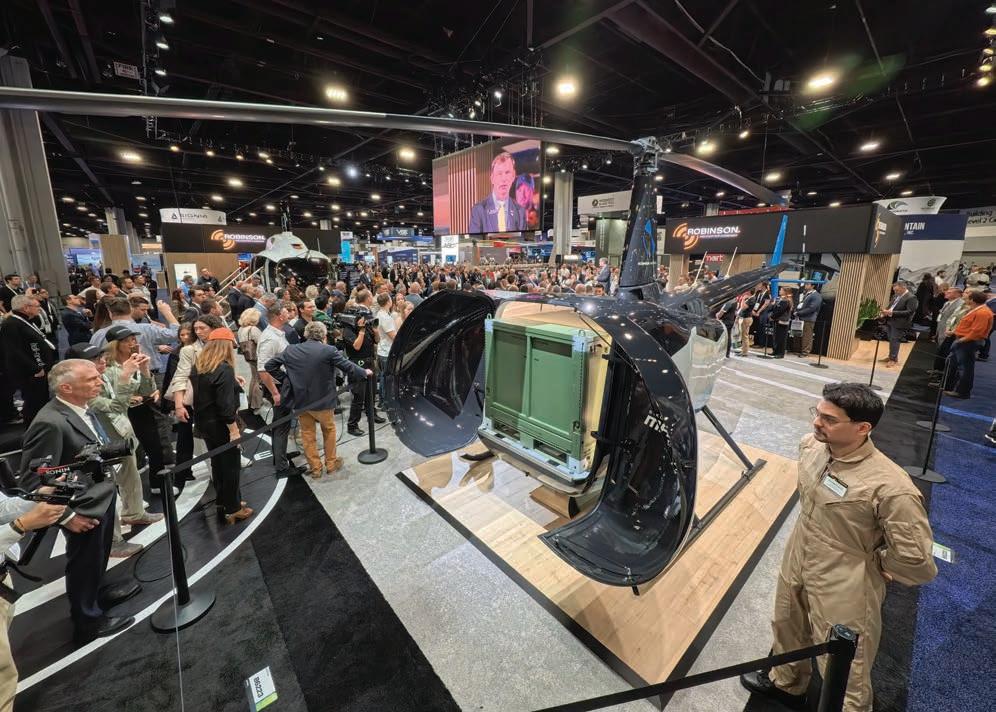
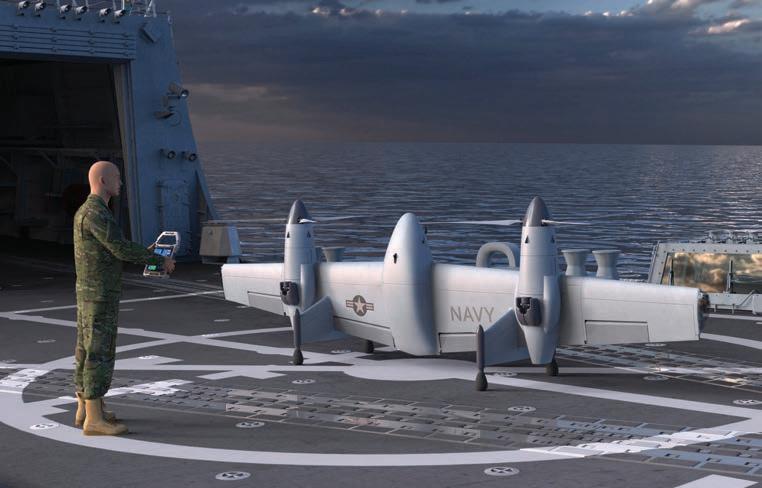
Robinson Helicopter president and CEO David Smith unveiled Robinson Unmanned yesterday, the company’s new business unit that includes its Ascent drones and uncrewed versions of the R44 and R66 helicopters. The unit’s president is Ascent AeroSystems president Paul Fermo.
“[Robinson Unmanned] could easily be bigger than all of our heritage businesses combined,” Smith said. There is a need for defense products at commercial costs, he added, “and built by a sustainable business, not a VC-backed money-losing business.
We stand alone in that we are the only ones that can build incredibly [fast] at aerospace quality and automotive scale.”
The U.S. needs this kind of capability, he explained. “We see this opportunity…that the next era is the era of both manned and unmanned in collaboration, unlocking missions that couldn’t have been done with either by themselves.” These missions include public safety, such as search and rescue, protecting large gatherings, finding missing children, and others.
“All those are right in the sweet spot of what Robinson Unmanned can o ff er in collaboration with our manned aircraft. The same for defense logistics.
Modernizing airspace
General aviation operators need to get on board with ADS-B | 2
Growing market
Leonardo is growing in all segments and preparing to bring two new rotorcraft to market | 4
SkyDrive eVTOL
Japan approves SkyDrive’s certification plan as company’s orderbook grows | 12
flight
Airbus Helicopters prepares to add a fourth H140 prototype to its flight test fleet | 16
By Chad Trautvetter
Operators of general aviation aircraft, which includes all civil helicopters, must get on board with ADS-B equipage to facilitate denser airspace that accommodates additional traffic, such as drones and eVTOLs, FAA Administrator Bryan Bedford said Tuesday morning during a regulator fireside talk at Verticon 2026. The session, moderated by VAI president and CEO François Lassale, also featured remarks from EASA executive director Florian Guillermet.
“We’ll break some glass in the process [of ATC modernization], and some will feel like they’re being left out. That could be in the general aviation community, for example, and [incorporates] this idea of ADS-B electronic conspicuity,” Bedford said. “We need all aircraft to broadcast…to tighten up separation. We have to have a lot higher fidelity on where aircraft are. I don’t know why this is proving to be so difficult.”
Asked by Lassale to look 10 years into the future of U.S. ATC modernization, the FAA chief demurred, saying, “This is a big challenge, and we don’t even want to talk 10 years into the future. The problem with NextGen is that it always was 20 years into the future. We need to fix stuff today. I’m here to tell you we are going to modernize the


national airspace within three years.”
Bedford does not lack vision when it comes to the goal of ATC modernization—he envisions a more proactive (rather than today’s reactive) system that will enable more efficient use of airspace. “The whole safety regime in the U.S. is about keeping planes far apart from each other. If we continue this structure, the sky’s capped.
“If we want to create more capacity, reducing separation standards and going to trajectory flying is the only way to do that. We need
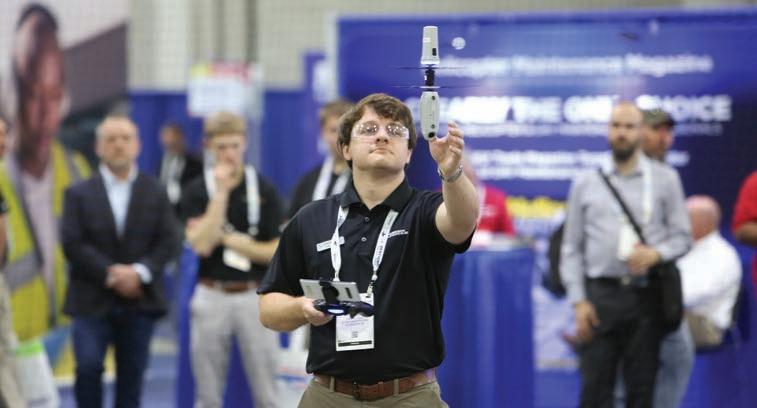
to go from imprecise to precise.” That likely means regulations requiring ADS-B, potentially including portable units, for helicopters and lighter piston airplanes.
Guillermet was more introspective, noting that ATC modernization in Europe needs to be a mix of short- and long-term thinking. As a former air traffic controller, he brings a unique perspective to the similar effort across the pond, though he acknowledged that the same ATC systems he used 30 years ago are largely still in use today.
“I think part of this 10-year vision is definitely the sort of trajectory-based operation,” he said. “An aircraft or a vehicle, it’s just one point in space that we take into account the full trajectory so that we can process it with strategic negotiation.”
Trajectory-based ATC systems would allow for strategic traffic deconfliction before aircraft leave the ground and tighter separation standards, both agency leaders said. This would also reduce ground congestion at airports, they added.
“If I try to project 10 years ahead,” Guillermet said, “I wish we are still able to further improve the level of safety in this aviation system because there will be more objects and there will be more traffic, so we need to make sure that we improve the system compared to what it is today while maintaining the same level of safety.” z
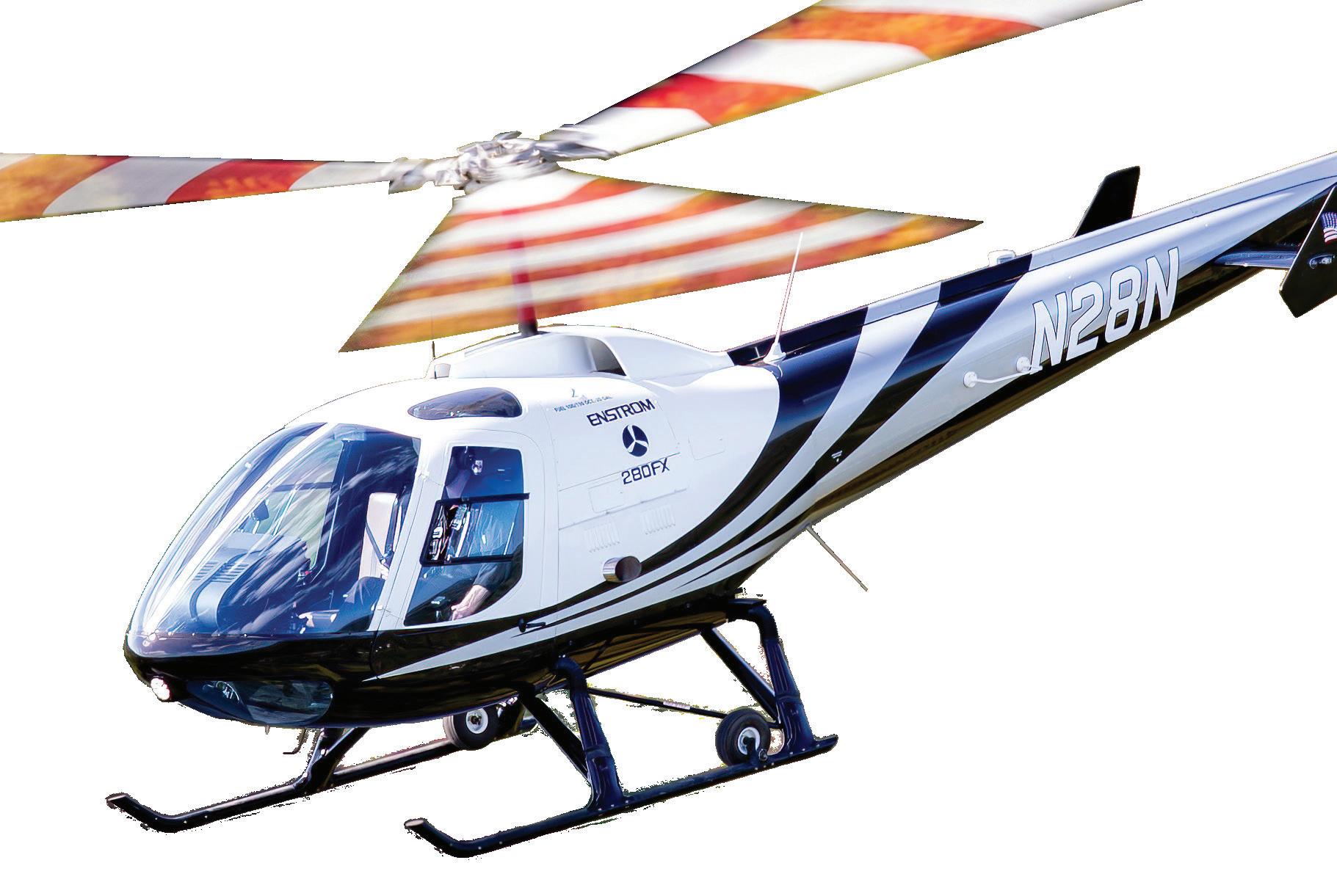
Enstrom’s
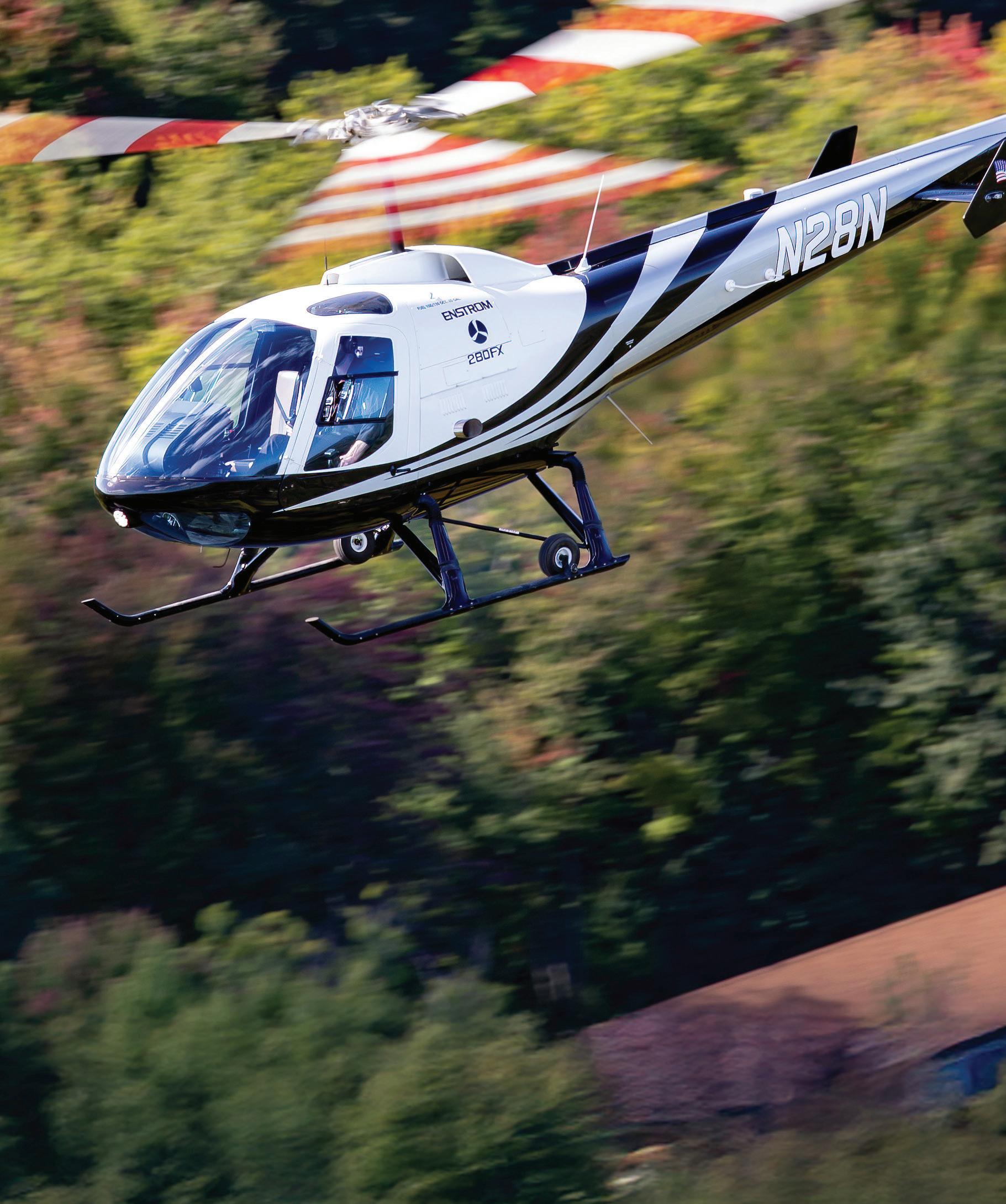
Enstrom makes ownership easy.
By Chad Trautvetter
Aeromedical operator Life Flight Network inked an order for a dozen Pilatus PC-12 Pro turboprop singles on Tuesday at Verticon 2026. The 10-year deal, worth about $82 million at list prices, also makes the Aurora, Oregon company the U.S. launch customer for the airplane with an aeromedical interior. Deliveries to Life Flight are set to begin next year.
Under the agreement, the aircraft will be outfitted for ICU-level care and transport at Pilatus Aircraft USA’s facility in Broomfield, Colorado. Life Flight already has 16 aeromedical-configured PC-12s in its fleet, in addition to about 40 aeromedical helicopters. The firm
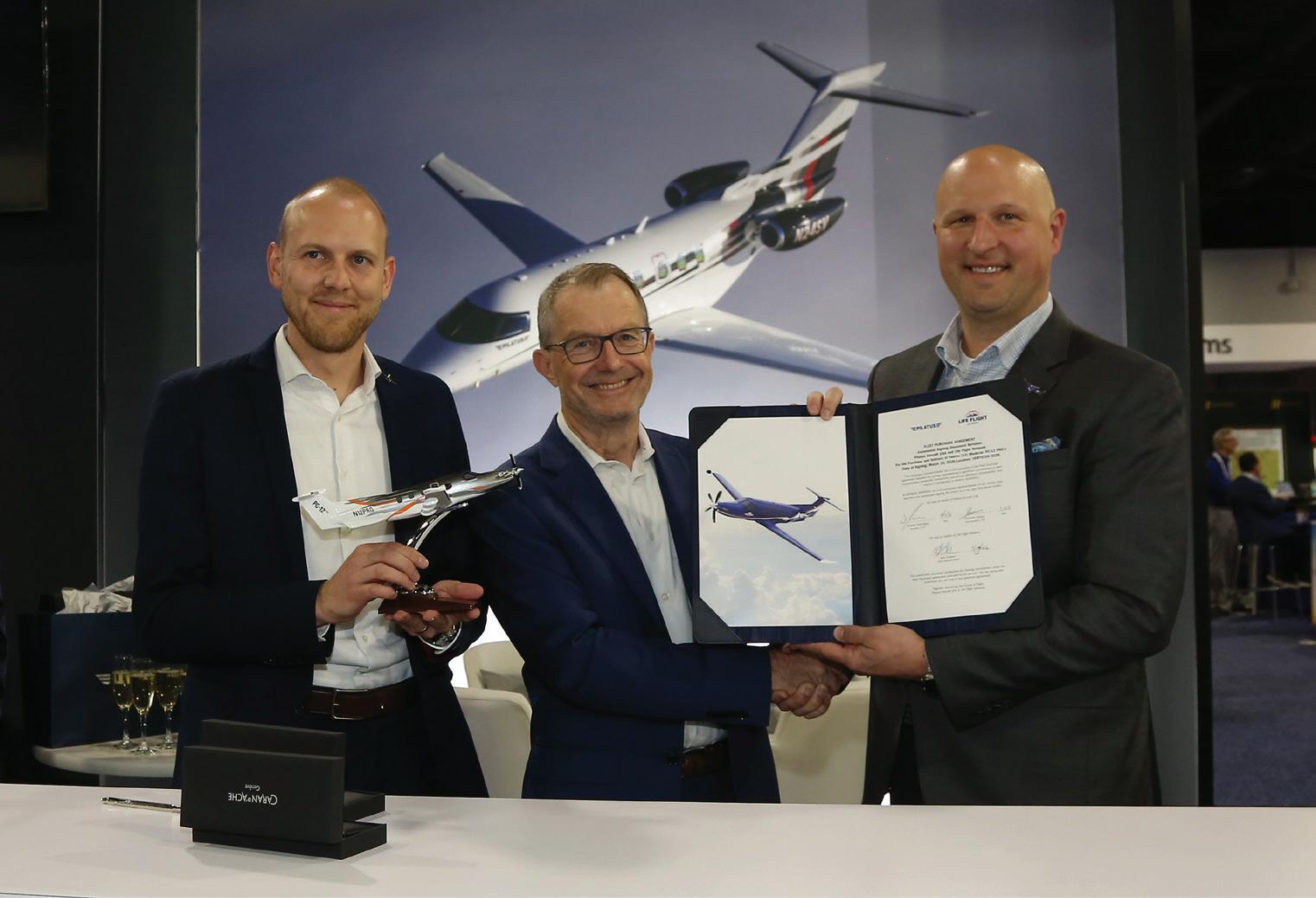
order will be for replacement aircraft, but the company holds options for additional PC-12 Pros to support fleet growth.
Founded nearly 50 years ago, Life Flight is known for clinical excellence, operational reliability, and rapid response across diverse and often remote terrain. Its service region spans the Pacific Northwest, the Intermountain West, and Hawaii.
“The PC-12 Pro provides the performance, reliability, and advanced safety technology
necessary to serve our communities,” said Life Flight CEO Ben Clayton. “We are committed to investing in aircraft that enhance patient care, support our crews, and uphold the highest standards of safety.”
Launched last March, the PC-12 Pro features Garmin G3000 Prime avionics with five touchscreens and autothrottle. It also has a 100-pound payload increase from its PC-12 NGX predecessor. Deliveries of the new model began late last year. z
Bell Textron launched more luxury interior options for the Bell 429 this week at Verticon, marking the latest upgrade in the Designer Series offerings for the light twin helicopter. The VVIP interior is available in five color schemes: arctic gray/charcoal, charcoal/jet black, crimson/jet black, sand/jet black, and snow/jet black.
Features include premium Italian leather seats with custom stitching; leather-wrapped composite panels that provide additional sound dampening; a redesigned Alcantara headliner with an integrated LED lightbar; updated environmental cabin controls; and ambient LED lighting. The upgraded cabin

console—available in five veneer options— adds storage, cupholders, a removable ice bin, dual USB-C plugs, and indirect floor lighting.
Bell Textron is showcasing the Designer Series VVIP interior for the Bell 429 light this week at Verticon 2026.
The interior package also includes enhanced pilot storage, anodized door-sill plates, and premium finishes. C.T.
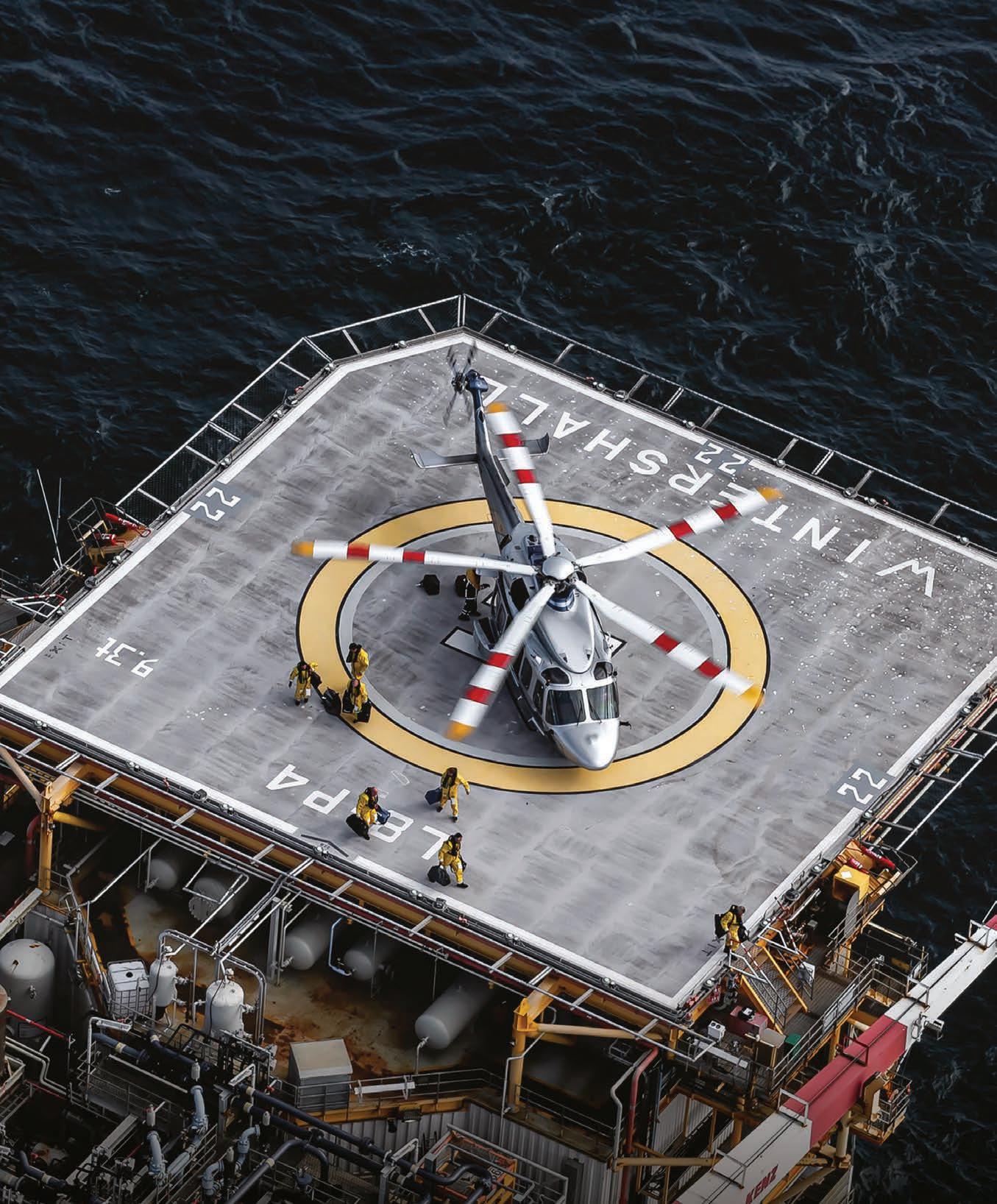
Offshore missions demand exceptional capability: the AW189 sets the benchmark. In a rapidly evolving energy market comprising fossils and renewable energies, it enables operators to tackle challenging long-range, day/night, and deep water missions in all weather conditions. With a class-leading cabin capable of carrying up to 16 passengers fully IOGP compliant, the AW189 meets or exceeds all current safety standards and is the first helicopter certified with HTAWS offshore mode, strengthening operational safety. CO2 emissions are minimised versus payload available and usage of Sustainable Aviation Fuels is approved ensuring maximum environmental benefits.
Visit us at VERTICON, Stand B9707.

By Matt Thurber
The global rotorcraft market is growing and remains strong, according to Gian Piero Cutillo, managing director of Leonardo’s helicopter division. This is true in both the civil and military domains, he added.
In its release of preliminary results for 2025, Leonardo highlighted higher-than-expected revenue and EBITA growth, with 5.1% more new orders compared to 2024. Deliveries totaled 182 new helicopters, down from 191 in 2024, in part due to the finalization of the U.S. Navy TH-73A contract. Revenues climbed 11.1%, and new orders reached €6.2 billion (about $7.3 billion).
On the civil side, sales for offshore operations are doing well, as are EMS and corporate/VIP transportation. Leonardo enjoyed a 60% share in deliveries from 2021 through 2025 for offshore transport, search and rescue, and wind farm support.
“We believe that our current portfolio matches quite well the demand that we are seeing,” he said. “The AW139 is definitely the leader in this segment, but we see the AW189 gaining…and improving its…market share.” In the 8.5-tonne category, the AW149 and AW189
have captured about 70% market share.
Leonardo’s first production light single AW09 has flown, and the company has signed up 120 preliminary sales contracts. “We are quite satisfied about the results that we are having,” Cutillo said, although there were some delays after Leonardo purchased the developer, Kopter Group, in 2020, due to a need for redesign work, including new main rotor blades.
“I believe that it’s more important that we really hit the target,” he said, rather than trying to shorten the time to certification and then having to redo some items. “We are quite satisfied…and confident that this product will be successful.”
On the military side, increased defense spending amid rising geopolitical uncertainty is driving growth. This will lead to the deployment of new technologies for conventional and disruptive architectures, including uncrewed assets, according to Leonardo.
Integrating rotorcraft with drones or land- or sea-based platforms is the trend, and “Leonardo Group has more than a chance to [have] competence on that,” Cutillo said. “We are looking to invest.”
With its AW249 attack helicopter, Leonardo
After Bell Textron completed the critical design review of the DARPA Speed and Runway Independent Technologies (SPRINT) aircraft, work has begun on the flight demonstrator, now designated the X-76.
Bell was downselected for the second phase of the SPRINT program in July 2025, which entails detailed design, build, and ground testing. Phase 1A and B involved conceptual and preliminary design. After building the first aircraft, flight testing is slated for the third phase of the program.
SPRINT is funded by DARPA and the U.S. Special Operations Command and requires an aircraft capable of flying at 400 to 450 knots and hovering in austere environments with unprepared surfaces.
“Bell is honored to receive the X-76 designation and continue the spirit of American innovation, honoring the founding of the United States in 1776,” said Jason Hurst, Bell senior v-p of engineering.
“This is an important milestone as the Bell and DARPA team advances to a historic first in aviation history and fulfills our mission of developing next-generation vertical-lift aircraft.” M.T.
and the Italian army are studying management and control of drones from the helicopter. Developing an interface to do this is more important than owning the drone technology itself, he explained.
The long-delayed AW609 tiltrotor is “the technology of the future, to overcome what I call the embedded limits of the traditional platform, which is speed, range, and vibration,” he said. “Because of the help of the wing, you have two machines in one. You can take off vertically like a helicopter, and in a few seconds, it can turn into a turboprop-type machine.”
By Matt Thurber
Robinson Helicopter unveiled the R44 Utility interior, designed for “high-intensity, ‘dirty’ missions,” yesterday at Verticon 2026. According to the company, the R44 Utility trim was requested by operators seeking something better suited to harsh environments, such as muddy agricultural and job sites. An R44 equipped with the Utility option is on display at Robinson’s exhibit here at the show.
The new design replaces the fabric headliner with a TitanPlate “durable, abrasion-resistant, textured coating.” Black R-Force nylon replaces fabric on the back wall of the cabin, and seat inserts are made of camouflage weave compound with easy-to-clean black Muirhead leather bolsters. Rubberized floor mats with positive retention eliminate the need for carpeting.
Other features include olive-green seat belts, flat khaki exterior paint with a Sherwood green stripe, and pulsing LED landing and taxi lights. The R44 Utility is an option that buyers can select when speccing out a new helicopter.
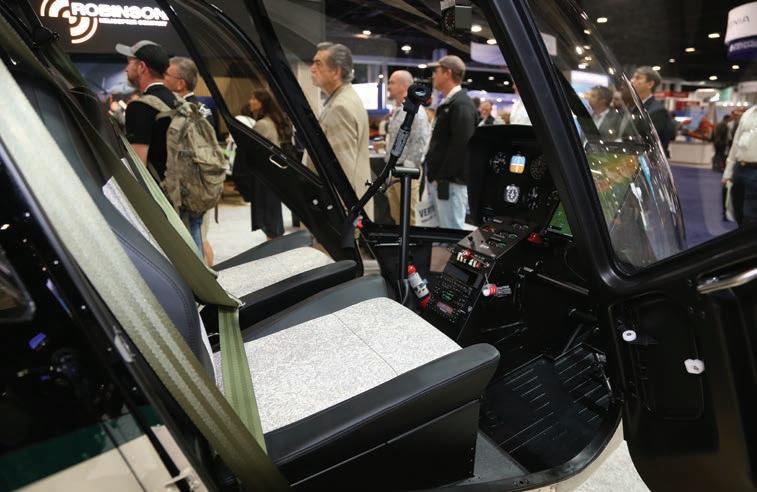
Robinson debuts the new R44 Utility interior, designed for use in harsh environments.
Robinson president and CEO David Smith said part of the impetus to develop the R44 Utility was the company’s renewed focus on higher-risk missions. “They’re essential—from tuna spotting to agriculture, wildlife relocation, conservation, anti-poaching—all those
things are uniquely helicopter-based missions, and Robinson’s done a great job being at the center of it all. The fabric headliners and leather seats didn’t always hold up that well to those environments, so this is intended to be a much better setup for that.” z
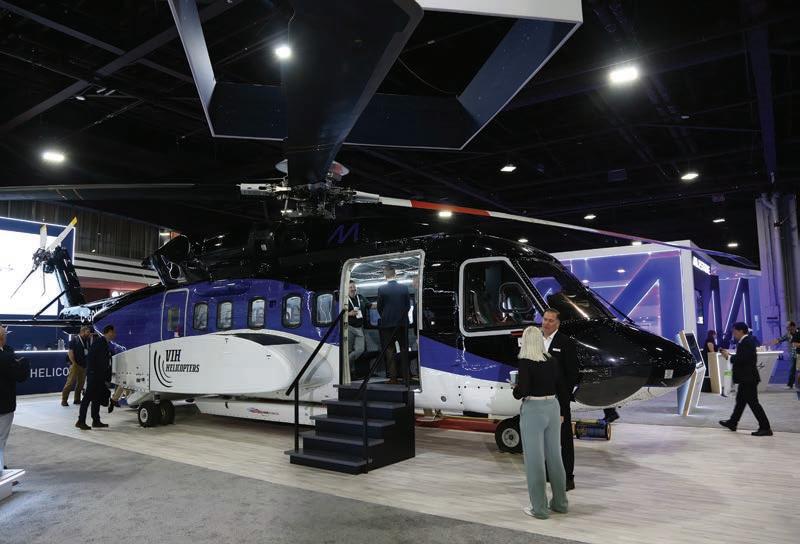
This S-92 is the first customer ship, S/N 920006, delivered 2004. Today, it is owned by Milestone Aviation and has been reconfigured as a firefighting helicopter. It flew more than 550 hours during the active 2025 firefighting season in Canada with operator VIH. 920006 has accumulated more than 15,600 flight hours, well within the helicopter’s 30,000-hour certified airframe lifespan. Sikorsky Commercial Helicopters v-p Leon Silva said that in-service S-92s will be flying for at least another 25 to 28 years.
By Hanneke Weitering
Sikorsky expects to begin flight-testing three experimental aircraft programs this year as the Lockheed Martin company advances its autonomy and hybrid-electric propulsion technologies.
Company executives told reporters at Verticon that the Nomad 100 VTOL drone, the U-Hawk autonomous Black Hawk derivative, and the hybrid-electric experimental (HEX) tilt-wing VTOL technology demonstrator are all progressing toward first flights in 2026.
The three programs reflect Sikorsky’s broader push to develop uncrewed systems, electrified propulsion, and new manufacturing approaches that could shape the next generation of vertical-lift aircraft.
Sikorsky’s Nomad family of uncrewed aircraft systems is derived from the company’s “rotor-blown wing” tail-sitter concept. The company flew a smaller demonstrator, the Nomad 50, last year. The new Nomad 100 model features an approximately 18-foot
wingspan and a hybrid-electric propulsion system.
Sikorsky envisions Nomad as a scalable VTOL platform for both military and civil missions. Potential roles include intelligence, surveillance, and reconnaissance; logistics resupply; disaster response; and wildfire monitoring. The company intends to scale the design for a broader family of aircraft with increasing payload capacity.
Nomad aircraft feature Sikorsky’s Matrix autonomy system, a flight control and mission management architecture that the company has been developing for more than a decade. The software stack has been integrated across more than 20 platforms and accumulated more than 1,000 flight hours, according to Sikorsky.
Matrix autonomy also underpins the U-Hawk program, which is converting legacy UH-60L Black Hawks into fully autonomous cargo aircraft. The U-Hawk replaces the cockpit with cargo space and adds clamshell doors. Sikorsky unveiled the U-Hawk concept last year and is now completing development
of the first example. Executives said U-Hawk could support a variety of missions, including autonomous logistics resupply, disaster relief operations, and battlefield support roles.
HEX, the third program approaching its first flight, is part of Sikorsky’s broader effort to explore electrified propulsion architectures for future vertical-lift aircraft. The initial aircraft is a “tube-frame” structure designed primarily to validate the hybrid drivetrain, which produces roughly 1.2 megawatts of power.
The HEX demonstrator is currently undergoing ground runs ahead of its first hover flight. Sikorsky plans to follow it with two additional test aircraft that will incorporate composite fuselages and wings and will be used to explore the full flight envelope, including wing-borne flight and transition between hover and forward flight.
Beyond validating hybrid propulsion, the program is also testing new manufacturing methods and materials. Sikorsky engineers are increasingly using additive manufacturing and other advanced processes to produce structural components, including gears and other drivetrain parts that traditionally required castings or forgings.
Company officials said these approaches could eventually support faster aircraft development cycles than those typical of traditional rotorcraft programs, which often remain in production for decades with incremental upgrades.
While Sikorsky continues to develop these technology demonstrators, the company is also investing in its existing product lines. Production of the latest heavy-lift variant, the S-92A+, is now underway, with the company targeting a production capacity of up to 12 aircraft per year. Standard delivery lead times remain about 36 months after order, although Sikorsky said it will begin building some aircraft on speculation to shorten delivery timelines for future customers.
At the same time, Sikorsky confirmed it is studying future vertical-lift platforms beyond its current lineup. Executives said the company is evaluating potential next-generation aircraft concepts, including tilt-wing or advanced rotorcraft designs that could incorporate hybrid propulsion and other emerging technologies. z
By Charlotte Bailey
Hélicoptères Guimbal is officially starting a helicopter family, confirming the development of the Cabri G5. Speaking just ahead of Verticon, Hélicoptères Guimbal president and CEO Bruno Guimbal remained coy about a timeline that “started years ago,” although he suggested, “I will be more than happy if it gets into service in four years in France.”
As the proposed “big brother” to its existing sibling, the multi-mission G5 aims to bridge a perceived gap in the market between the smaller Guimbal Cabri G2 and Airbus H125. The concept began “many years ago, and we have had time to refine the strategy,” offered Guimbal, who explained that customers have long called for a larger variant building upon
the DNA of the existing “basic safe trainer.”
Hélicoptères Guimbal has frozen the fiveseat G5 design “for some time,” with eight tonnes of tooling already produced. The helicopter’s four-blade main rotor will feature high-aspect-ratio composite blades, helping improve ride quality and noise mitigation.
“Safety is the main issue for people who fly, but for people who don’t, noise is the main issue,” explained Guimbal. “I want the Cabri G5 to be the quietest helicopter ever.” Component supplier negotiations are currently ongoing.
The composite airframe will retain the crashworthy fuel system of the G2, while the cabin—“significantly smaller outside” than the now-discontinued Eurocopter EC120—retains almost identical internal dimensions. Designed for versatility and modularity, the G5 could
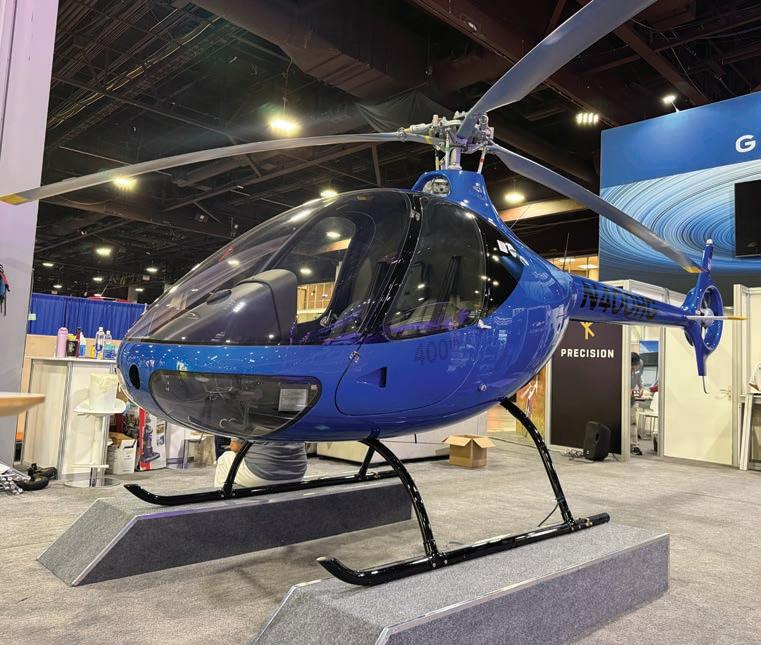
prove a “very efficient” four-seat aircraft for military or VIP use, suggested Guimbal. He added that the reconfigurable seating arrangement “is, for a light helicopter, absolutely unique.”
Avionics will be informed by the multiple configurations developed on the G2, although “despite producing a significant part of our avionics,” Guimbal acknowledges, “today, what people want is a Garmin 500.” A secondgeneration vehicle management system set to fly “very soon” on the G2 will also be fully compatible with the upcoming type.
Safety is the main issue for people who fly, but for people who don’t, noise is the main issue. I want the Cabri G5 to be the quietest helicopter ever.
—Bruno Guimbal Hélicoptères Guimbal president and CEO
The G5 will be powered by an internallymounted Safran Arrius 2D, marking the first partnership between the OEMs. This powerplant, described by Guimbal as “powerful, modern, and not too expensive for a turbine,” will offer 450 shp, a dual-channel Fadec, and 3,000 hours’ time between overhauls.
No timeline for G5 development milestones or certification expectations has yet been made public, but with Guimbal recognizing that the company is “not in a critical timeline,” it is not going to burn through money “just to save a few years.” However, he urged that entry into service will be “as soon as possible” and suggested the G5’s price will be “very competitive for a turbine helicopter.”
According to Guimbal, Airbus’ recent minority stake in Hélicoptères Guimbal “recognizes there is a place for this helicopter in the market,” although Airbus has no direct stake or responsibility in the ongoing G5 program. z
By Kerry Lynch
The Jan. 29, 2025 midair collision between a U.S. Army Black Hawk and a PSA Airlines CRJ700 near Washington, D.C., triggered an immediate push to shut down helicopter routes not just in the nation’s capital but across the country. According to Vertical Aviation International (VAI) president and CEO François Lassale, it’s about far more than helicopters; the routes and heliports at stake are the same infrastructure that will one day serve the advanced air mobility (AAM) industry VAI is working to bring into the fold.
“They started shutting down routes, and VAI is front and center out there on the hill and with the FAA, arguing the case to keep those heliports open and those routes open,” Lassale told AIN in a pre-Verticon interview. “Those are the very routes and heliports that will be converted

to vertiports and what AAM will use.”
Lassale noted that helicopters have nearly 100 years of experience operating in the airspace. “It’s not about design and certification of these machines; it’s about our whole ecosystem—workforce development, vertiport design, electrification of vertiports, fire suppression, and airspace integration with the ATC modernization coming.”
He continued, “If you’ve got drones, AAM, and helicopters all operating in the same airspace in congested areas, the human controller can’t control it all, so the ATC modernization is a piece of it, and we are the ones who are joining all those dots together to say, ‘We need to make sense of this.’”
Collaboration is the only way to accomplish
Coptersafety’s Leonardo AW169 flight simulator with Phase 8 avionics has received FAA level-D approval. Built by TRU Simulation, the simulator is installed and ready for pilot training at Coptersafety’s Helsinki International Airport (EFHK) training center in Finland.
Phase 8 upgrades the AW169’s Honeywell Primus Epic 2.0 glass cockpit to introduce advanced search-and-rescue modes, an improved four-axis autopilot, and increased automation for single-pilot IFR certification. It includes HTAWS with o shore modes, a synthetic vision system, and an advanced
health and usage monitoring system (HUMS).
The full-flight simulator features cockpit vibration, smoke generation, three-dimensional cloud modeling, and night and NVIS/ NVG visual scenes. Coptersafety can configure visual environments to replicate specific geographic locations and landing sites at customer request.
Coptersafety plans to expand its Helsinki facility following the company’s acquisition by MML Keystone in January. This expansion will add more level-D simulators, which are expected to be available in 2027 and 2028. C.T.
the integration, he maintained. “We’re trying to pull all the parties together to have a joined-up conversation, which is really important. So for me, Verticon is a great place where the entire vertical lift ecosystem comes together to make sense of that change, and not just to talk about it, but to actually shape that change.”
In addition to innovation, the community wants to focus on an array of safety, operational, technical, and other issues, particularly through the education sessions: “That’s an important thing, the takeaways that those folks get out of the education program and what they can bring back and deploy onto the front line,” Lassale said.
VAI’s ambitions are to bring those issues globally. He pointed to plans for the first international event to be held in May in Bali. The three-day event is designed to bring the Southeast Asian community together to delve into operational and other challenges and highlight lessons learned from Europe, North America, and other parts of the world. “We’ve taken those lessons learned, and we’ve converted them into practical takeaways,” he said.
Ultimately, Lassale concluded, “Our show is impressive in its size, our show floor, our education program, the people we’ve got coming, the sheer amount of people we’ve got coming, but the real value for me is in the rooms where the operators are sitting down comparing notes, where the regulators are listening, where the industry leaders are challenging each other to do better. That’s where change starts; that’s what’s so powerful about Verticon and bringing that community together.” z
By Amy Wilder
Rotorcraft often operate where bird activity is densest: low altitudes, near coastlines and waterways, around landfills, and along predictable routing features such as rivers and shorelines. Given this reality, the most effective bird strike defense is a layered strategy that combines regulatory baseline design standards, voluntary equipment choices, disciplined operating procedures, and consistent reporting that improves the data used to target mitigations.
Baseline rules focus on a defined certification case, not day-to-day mission profiles. In U.S. transport-category rotorcraft certification, FAR 29.631 states that a rotorcraft “must be designed to ensure capability of continued safe flight and landing (for Category A) or safe landing (for Category B) after impact with a 2.2-pound (1-kilogram) bird,” at a defined speed condition and “at altitudes up to 8,000 feet,” with compliance shown by test or substantiated analysis.
other words, certification standards and operational reality do not always align cleanly, and operators may choose additional measures beyond the baseline.
Data points used by regulators and safety advocates consistently highlight the same operational drivers: altitude and airspeed. In the FAA’s 2023 bird strike Special Airworthiness Information Bulletin (SAIB), the agency summarizes its review of reported rotorcraft bird strikes by noting that more than 90% of bird strikes occurred at or below 3,500 feet agl.
The SAIB also states that “there is a 32% decrease of bird-strike likelihood for every
According to the FAA, 90% of birdstrikes occur at or below 3,500 feet agl, where helicopters spend most of their time.
flying low. EASA advises crews to reduce speed in critical times of day and to use specific planning and in-flight procedures when low-level flight is required.
EASA’s guidance is unusually direct about consequences in single-pilot operations: “In single-pilot operations, a bird strike can incapacitate the pilot and result in a loss of control accident. Use helmets and eye protection.” That call is reinforced by a broader checklist of operational practices aimed at reducing encounter likelihood and improving survivability when avoidance fails.
That includes being attentive to bird activity reports before takeoff, delaying departures when bird concentrations are observed when feasible, and using ATC or flight information services to report unusual bird activity.
The guidance also emphasizes time of day and geography as practical risk multipliers, advising operators to avoid low-altitude routing along navigational features birds use, and to recognize dawn and dusk as periods when certain birds concentrate in open areas such as airfields.

That requirement sets a minimum design bar for a specific bird mass and impact condition, but it does not, by itself, manage the operational exposure that dominates many rotorcraft missions.
The FAA’s rotorcraft safety promotion concept frames bird-strike protection as one category in a set of voluntary design and equipment safety features. It also explicitly describes “a continuum of voluntary options” that operators can select based on “operational needs, budget, and personal risk tolerances.”
According to the FAA, the concept offers a flexible approach because stakeholder priorities differ and are influenced by operational needs, budget, and personal risk tolerances. In
1,000 feet gained above 500 feet agl.” EASA’s rotorcraft bird-strike guidance makes the same connection, urging pilots to “plan to fly at a minimum of 2,500 feet when possible” because “operating rotorcraft above this height significantly reduces the likelihood of a bird strike.”
Speed is the other dominant factor because it constrains reaction time. EASA notes that “more than three out of four bird strikes (77%) occur when airspeeds are greater than 80 knots,” reasoning that, above that band, “birds and pilots have no time to get out of the way.” The FAA SAIB likewise highlights speed. Rotorcraft mission requirements are a factor. EASA notes that certain operations require
Operational guidance identifies the levers crews can actually move: altitude when possible, speed when practicable, procedural discipline around known bird activity, and personal protection equipment for crew survivability.
For operators that can add technology layers, the sources point to two categories: visibility cues meant to trigger avian avoidance and physical protection meant to manage strike consequences. EASA recommends using “pulse lights, taxi lights and/or landing lights when operating in the vicinity of bird activity,” and specifies tactics by ambient conditions, including continuous operation in sunny conditions and at night when practicable.
For operators building a practical birdstrike program, the recommendations collectively support evidence-based priorities: identify local bird hazard areas and times, increase altitude when allowed, wear a helmet and visor when practical, and report wildlife strikes. z
By Matt Thurber
SkyDrive and the Japan Civil Aviation Bureau (JCAB) have concluded an agreement for the SD-05 eVTOL aircraft’s general certification plan. The agreement “describes the overall plan of activities required to demonstrate the aircraft’s compliance with legal requirements, including the processes and cooperative steps that will be required between JCAB and SkyDrive to achieve type certification,” according to the company. Plans call for entry into service in 2028, and SkyDrive is also working with the FAA on certification.
JCAB is reviewing SkyDrive’s other certification plans for structure, systems, electric motors, and noise as part of the six-step type certification process. So far, the certification basis has been issued, and 95% of the means of compliance are complete. That covers “the detailed design standards that indicate how SkyDrive will show compliance with the requirements established under the certification basis,” SkyDrive explained.
The SD-05 is equipped with 12 battery-powered rotors. With an mtow of 3,100 pounds, the aircraft will carry three passengers and one pilot on flights of 12 to 25 miles.
“Air mobility is getting global attention with eVTOL aircraft at the core,” said SkyDrive CEO Tomohiro Fukuzawa. The advantage of the SD-05 over some other eVTOLs with wing-based lift is that it can take off and land in much smaller spaces, he explained. The overall width is 37.7 feet, which is smaller than the wingspan of typically wing-equipped eVTOLs. Of the 70 rooftop heliports in Tokyo, more than 90% are large enough to accommodate the SD-05. “The SkyDrive vehicle is a much simpler configuration,” he said.
Operating costs for the SD-05 will initially be about the same as for a comparable-size helicopter, according to Fukuzawa. By 2030, SkyDrive aims to lower those costs to about twice that of a ground-based taxi. “That is our
estimation and target,” he said.
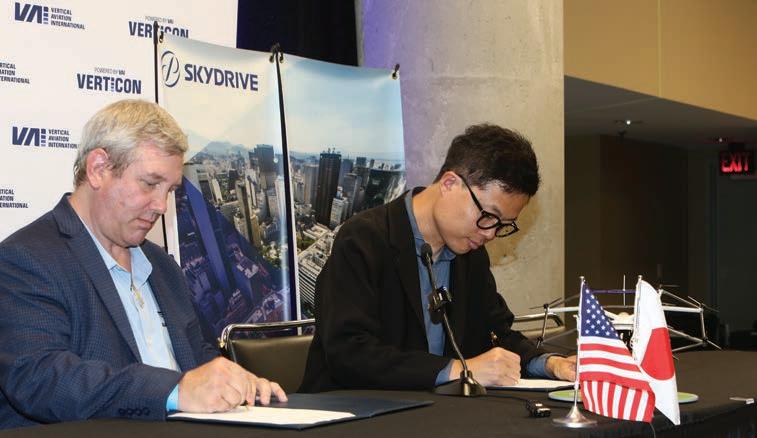
SkyDrive has 415 preorders for the SD-05 from buyers in eight countries. At Verticon yesterday, SkyDrive and Aeroauto signed a letter of intent for eight SD-05s, with four scheduled for delivery in 2028 and the remainder in 2029. Aeroauto founder and CEO Sean Borman said his company plans to operate the aircraft in Florida and the Southeast U.S.
“Florida represents one of the most
compelling launch markets for advanced air mobility anywhere in the world,” Borman said. “Our partnership with SkyDrive brings together a powerful combination of aircraft innovation, operational expertise, and infrastructure development.”
SkyDrive also signed an agreement with SAI Flight, which already has a partnership for operating SD-05s in South Carolina, to add Florida to its footprint. z
The FAA has approved the supplement type certificate (STC) for FreeFlight Systems’ RA4500 MK II radar altimeter in Airbus AS350s and Bell 407s. The RA-4500 MK II is 5G-resilient and meets the FAA’s corresponding alternate methods of compliance (AMOC) for AD 2023-11-07 regarding radio altimeter tolerance in the 5G C-band environment.
As a member of the FreeFlight Terrain series 5G-resilient radar altimeter family, the RA-4500 MK II features “advanced RF
filtering to help rotorcraft operators maintain reliable, high-fidelity agl radar altitude performance in today’s changing RF environment,” according to the company.
The installation package includes documentation, STC drawings, a rotorcraft flight manual supplement, and AMOC letters.
FreeFlight will support continued upgrades to the RA-4500 MK II as minimum interference-tolerance performance criteria evolve, the company said. M.T.
April 22 – 25, 2026
Friedrichshafen, Germany
Halls A1 – A3, Dome, Static Display


By Matt Thurber
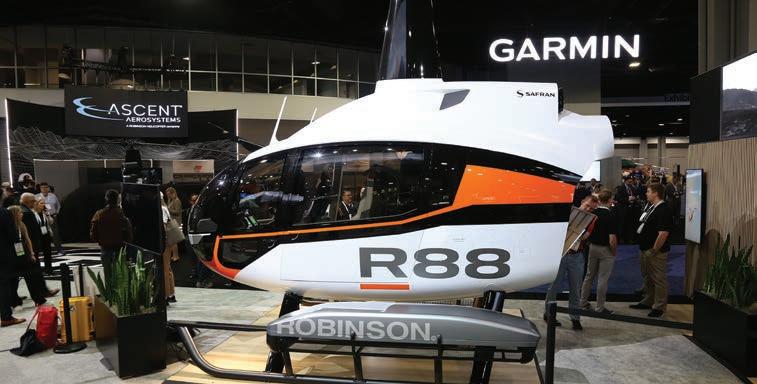
Robinson Helicopter has chosen three new suppliers for the R88, which will be the largest helicopter manufactured by the Torrance, California-based company. Capable of carrying 10 occupants, the single-engine R88 is a utility and passenger transport helicopter. With a flatfloor cabin, the helicopter features a truck-bed style rear door to facilitate cargo or stretcher loading. Robinson brought the R88 mockup to its Verticon exhibit, and this is the same mockup that was unveiled at last year’s show.
The new suppliers are GPMS, which will provide the Foresight MX health and usage monitoring system (HUMS); Outerlink for its Iris connected aircraft solution for flight data monitoring and communications; and Skurka Aerospace, which will manufacture the R88’s Safran Helicopter Engines Arriel 2W’s brushless starter-generator.
Calling it a “first for the single-engine helicopter market,” the Foresight MX HUMS will capture and transmit health data after each flight. The HUMS includes automated rotor track and balance optimization and will be standard on the R88, with five years of Level 1 and one year of Level 2 monitoring included. Level 1 monitors the health status of critical systems, while Level 2 can identify bearing and gear health and calculate the remaining life of critical parts.
Outerlink’s Iris provides a satellite communications link to stream more than 300 flight parameters, including GPS location, engine health, and HUMS data. Pilots will be able to contact dispatch immediately using the Iris
push-to-talk voice-over internet protocol feature at any location or altitude.
Like all Robinson Helicopters, the R88 will be equipped with video and audio recording devices, and Iris supports up to five audio channels. Video and audio can be mapped to flight data to provide more mission information. The system can also trigger alerts to maintenance personnel if there is a mechanical exceedance or emergency situation, and send real-time fuel data and weather conditions, measured at the helicopter, with position reports. “This allows ground crews to monitor range and trigger automated alerts for predetermined fuel and weather
Rolls-Royce authorized maintenance and overhaul center Essential Turbines has opened a facility in Mesa, Arizona. Previously, the company operated at a temporary location in the Phoenix area. It is also a member of the engine manufacturer’s First network.
With the new facility, Essential Turbines has tripled its capacity to service M250 and RR300 engines and will be able to provide faster turnaround times for customers in the U.S., particularly in the Southwest. Dedi-
minimums,” according to Outerlink.
Robinson selected the Skurka Aerospace brushless starter-generator to help lower life cycle costs and improve R88 availability. The brushless unit eliminates brush inspections and the risk of carbon-tracking failures.
“Utilizing easier-to-maintain components and real-time data streaming ensures R88 operators have more time in the air and a clearer picture of aircraft health,” said Robinson president and CEO David Smith. “These advancements reflect Robinson’s focus on ensuring the R88 is the most dependable, reliable, and economic helicopter for individual owners and parapublic missions.” z
cated infrastructure for engine overhaul, test cell operations, and component repair will enable the company to meet those objectives.
“After three years in a temporary space, we’re making a permanent commitment to Arizona with a facility specifically designed for MRO excellence,” said Essential Turbines president and CEO Gannon Gambeski. “This purpose-built location gives our team the modern infrastructure and expanded capacity to deliver the quality and responsiveness Essential Turbines is known for.”
More than 16,000 M250 and RR300 engines are in service, and Essential Turbines serves EMS, government, utility, oil and gas, and commercial helicopter operators. M.T.



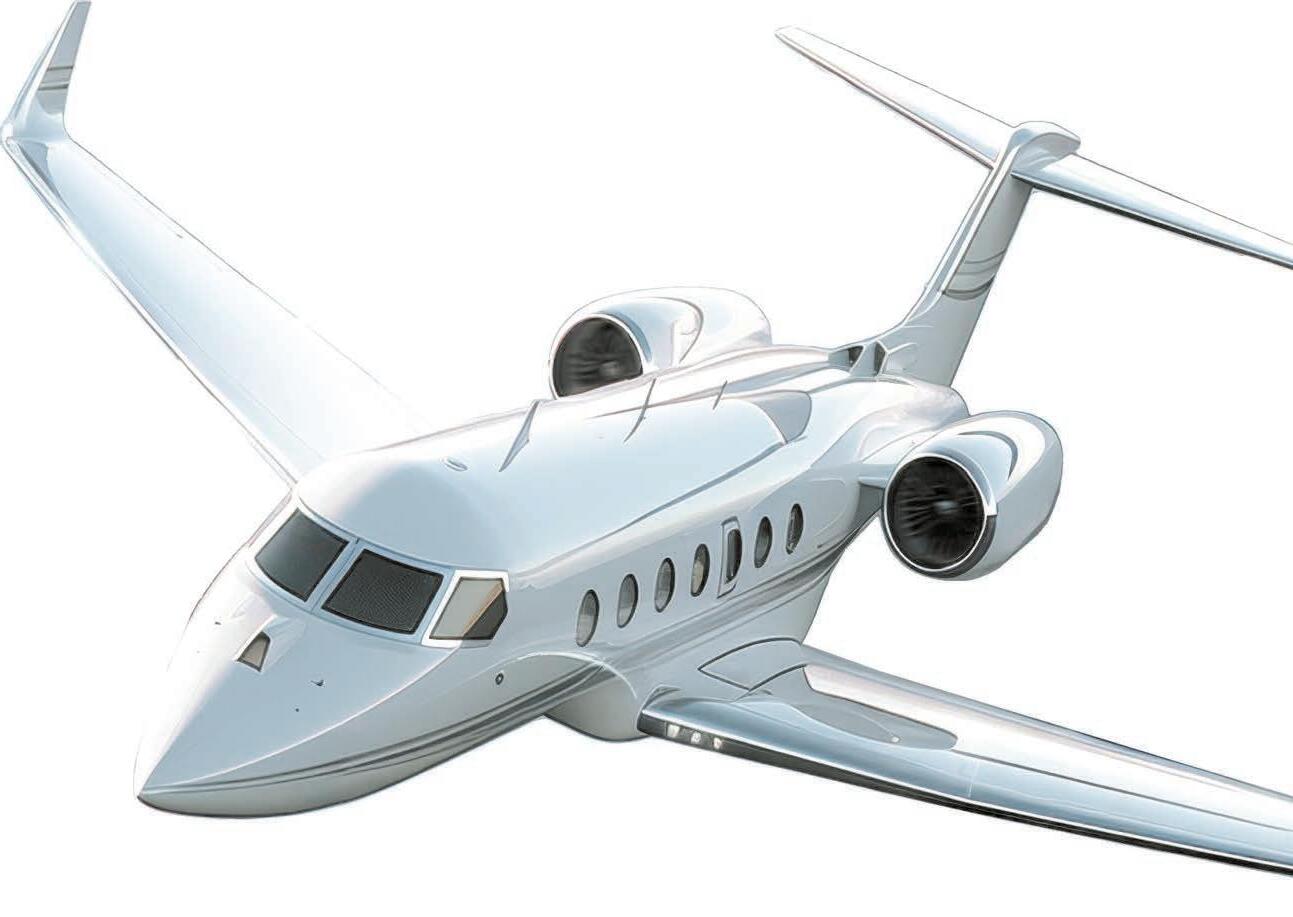
EBACE26 marks a decisive step forward, bringing fresh energy and opportunity to the global Business Aviation community. The static display returns in a new dedicated location at Geneva Airport, designed to deliver the most secure, fexible and customer-focussed aircraft showcase in the event’s history.
Coupled with Geneva’s well-connected ecosystem, nowhere else in Europe brings together this calibre of key stakeholders, infuential customers and industry associations.
Be part of the new experience.
Find out more at ebace.aero

By Charlotte Bailey
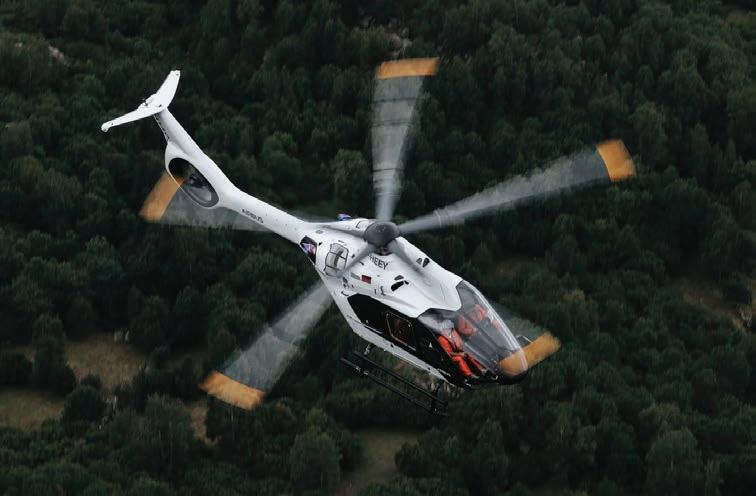
A year after revealing the H140, Airbus remains confident that the program is on track to meet its projected 2028 entry into service. A fourth aircraft is on schedule to augment the flight-test fleet later this year. Airbus has already amassed firm orders for 61 H140s, propelling the platform to become the best-selling light twin in the EASA CS-27/FAA FAR Part 27 segment.
“The unveiling of the H140 is underlined by the sales success we had last year,” said Airbus v-p of light twin helicopter programs Dirk Petry. Counting both orders and options, the company has commitments for more than 100 of the as-yet-uncertified helicopters, outperforming bookings for 45 H135s last year. However, Petry maintains that the H135 will remain a valuable asset to “many public services and military training contracts” and is “not a replacement” for its smaller sibling.
With Airbus having commenced industrial production for its first serially-produced airframe, a dedicated combined line for the H135 and H140 will leverage commonalities. This, explained Petry, is “the most efficient setup in
terms of production, lead times, and balancing between models.” Production capacity is predicted to “follow demand,” incorporating flexibility for a production rate promised to be “much more than [Airbus is currently] producing” for just the H135.
The H140 is set to enter service in the aeromedical role in 2028, followed by passenger flights in 2029, and then offshore and utility missions in 2031. According to Petry, 2026 will be “a year of testing” in the run-up to certification.
Last year’s active flight-test campaign saw the first H140 prototype (PT1) conduct “hot and high” flights in Spain and the French Pyrenees, respectively, with the aircraft having accumulated around 120 flight hours since June 2023. The nonconforming PT1 was retired from flight testing early last month.
PT2—an airframe that Petry explained represents “the major standard pre-zero for development and configuration”—debuted in August. This ship conducted cold-weather testing in Finland in December before commencing a snow campaign in Norway.
PT2 is expected to return to Airbus’ Donauwörth, Germany site at the end of this month
Certain rotorcraft equipped with the Airbus Helicopters Helionix avionics suite can be upgraded with Astronautics Corporation of America’s AeroSync Max V2.1 wireless airborne communications system (wACS).
Astronautics and Airbus are collaborating on the upgrade, which is available for EASA-certified H145 and H145M helicopters. Plans call for wACS to be approved for the H160 by the end of this year and the H225 in 2027.
The V2.1 upgrade adds 4G in-flight connectivity for passengers and Ethernet/Wi-Fi gateway capability to support camera streaming to tablet devices for medical and mission-cabin device management and secure patient-data transmission. It also enables continuous cybersecurity updates and uploads of current Helionix databases.
“The AeroSync Max 2.1 upgrade builds on our proven architecture to deliver expanded data capabilities, in-flight connectivity functionality, and ongoing cybersecurity support, helping ensure these platforms are prepared for the next generation of connected operations,” said Matthew Frei, director of connected aircraft solutions at Astronautics. M.T,
before embarking on a U.S. certification campaign in the third and fourth quarters. A third aircraft, PT3, is helping to calibrate autopilot capabilities, while PT4—the first aircraft to be built in a full serial configuration—will enter service in first-quarter 2027. PT4 will be used for major certification testing under relevant operational conditions.
A fifth H140, which has just moved to major component assembly, will be initially operated by Airbus to support the ongoing development of optional equipment post-certification. z
By Amy Wilder
Regulators and industry representatives discussed the evolving distinctions between drones, remotely piloted aircraft, and autonomous systems during a panel discussion yesterday at Verticon 2026, revealing some confusion and a mix of philosophies in the approach to emerging aerospace technologies.
The FAA received approximately 4,000 comments on its proposed Part 108 beyondvisual-line-of-sight (BVLOS) rule, with many commenters opposing requirements that would affect low-altitude crewed aircraft operations, according to Brandon Roberts, FAA executive director for rulemaking, speaking during the panel discussion.
Between 2,000 and 3,000 comments came from operators of helicopters, gliders, parachutes, and Part 103 ultralights that share airspace below 500 feet, Roberts said. The proposed rule would require aircraft operating outside airport environments to either be equipped with ADS-B Out for drone detection or develop their own drone-avoidance plans.
“Zero people liked that idea,” Roberts said. “I’d be hard pressed to find a single comment that said, ‘We love it.’”
Roberts said the FAA is reconsidering the approach for the final rule. The agency
proposed changing right-of-way rules so aircraft equipped with ADS-B Out could continue normal operations in low-altitude airspace, while airports would remain protected to the surface. The proposal aimed to enable drones to detect and avoid crewed aircraft while operating in the same airspace for package delivery, infrastructure inspection, and survey missions.
Darryl Abelscroft, technical strategy portfolio manager for future safety and innovation at the UK Civil Aviation Authority, said the UK is taking a use-based regulatory approach. The UK strategy seeks full integration but is starting with restricted airspace. “Everything that flies should be able to do so safely,” he said. “That’s easy to say. It’s hard to do.”
David Oord, director of policy, regulatory affairs, and standards at Wisk, said the autonomous eVTOL aircraft developer is envisioning its own workforce pipeline rather than competing for existing pilots and mechanics.
“We can go to these high schools and say you don’t need to go turn a bunch of wrenches to be a full A&P” to work on Wisk aircraft, he said. Wisk, a Boeing subsidiary developing an all-electric autonomous air taxi, is taking a first-to-autonomy approach for its aircraft, which is displayed at the Boeing booth at Verticon. z

StandardAero announced Agrarflug Helilift as the European launch customer and Wildcat Helicopters as the Canadian launch customer for its tailboom modification STC at Verticon on Monday. The company has received STC approval from the FAA, EASA, and Transport Canada for the Bell 212 and Bell 412.
The modification removes 100 pounds from the airframe to improve payload capacity and reduce maintenance, the
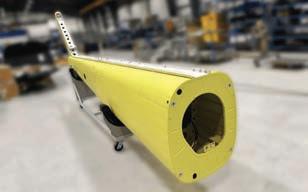
Scottsdale, Arizona-based company said, noting that roughly half of the weight reduction comes from the tailboom and the remainder from nose ballast. It replaces the original composite honeycomb baggage compartment with an aluminum sheet-metal semi-monocoque design that is more corrosion-resistant.
“By reducing empty weight, improving center of gravity, and eliminating common structural maintenance drivers, we’re helping our customers increase revenue potential while lowering total cost of ownership,” said Andrew Park, general manager of StandardAero’s Langley, British Columbia facility.
The upgrade features higher-strength longerons, new bulkhead frames for improved load transfer, no life-limited parts, and improved inspection access.
The modification is compatible with existing flight controls, driveshaft assemblies, and installed STCs, including the BLR Aerospace FastFin system. A.W.
By Chad Trautvetter
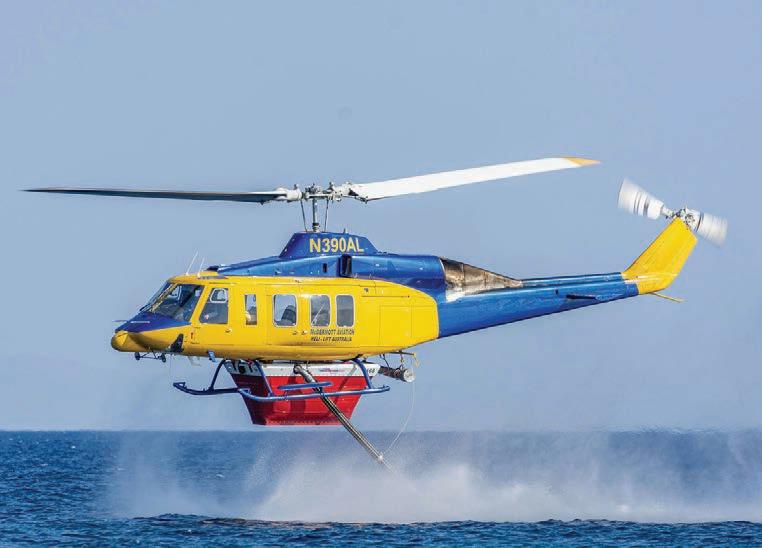
McDermott Aviation plans to restart production of the former Bell 214 helicopter as the McDermott 214ST, an upgraded variant of the heavy-lift twin with Safran Aneto engines, in the 2028 to 2029 time frame, the Queensland, Australia-based company announced this week at Verticon 2026.
The company expects to start delivering refurbished versions, also called the 214ST, next year. McDermott is the world’s largest operator of the Bell 214 and owner of the aircraft’s type certificate.
“What’s particularly interesting about this program is that it’s essentially the rebirth of a tried and proven helicopter,” said company founder and president John McDermott. “We have the unique advantage of being able to incorporate all the improvements that have emerged over more than 40 years of operational experience. That includes service bulletins, service letters, and other
enhancements that improve longevity and continued airworthiness.”
The McDermott 214ST, currently powered by GE CT7 engines, can lift 7,900-pound external loads, cruise at speeds up to 160 knots, and fly more than 300 nm. Future variants will employ Safran Aneto engines, delivering enhanced performance, efficiency, and reliability, the company said.
According to McDermott, the 214ST is already in use for aerial firefighting, heavylift, disaster response, search-and-rescue, and other specialized missions. Its ownership of the type certificate enables the company to oversee ongoing airframe improvements, ensure long-term parts availability, and develop mission-specific modifications.
The company plans to offer the aircraft through several acquisition pathways, including direct purchase, dry lease, and fully supported wet-lease arrangements, supported by training programs, engineering services, and global logistics support. z
EASA, Airbus Helicopters, and Loft Dynamics have launched a helicopter safety training program in Nepal that requires helicopter pilots to complete four hours of virtual-reality simulator training focused on mountain flying and emergency procedures.
The initiative aims to reduce helicopter accidents in Nepal’s high-altitude terrain and variable weather conditions. The month-long program in Kathmandu features a Loft Dynamics H125 VR flight simulator and training courses developed by Airbus that comply with ICAO standards.
Helicopter operations serve as a critical link for Nepal, providing transport, rescue, and tourism services to remote regions.
The Civil Aviation Authority of Nepal’s 2025 safety report emphasized that navigating the country’s complex conditions requires high levels of pilot proficiency.
“By showcasing Loft Dynamics’ VR technology with our specialized training curricula during this dedicated Safety Roadshow, we are providing Nepali pilots with a concrete, hands-on training experience to master mountain flying and emergency scenarios,” said Arnd von Fabeck, head of aviation safety management and international network at Airbus Helicopters.
The program operates within the EUSouth Asia Aviation Partnership Project, a regional technical cooperation initiative implemented by EASA that supports aviation safety and regulatory convergence across South Asia. A.W.

The Asia-Pacific region posted the strongest year-over-year retail sales increase at 29%.
By Amy Wilder
Preowned twin-engine helicopter supply dropped 26% in 2025 to a five-year low while median pricing increased 10%, according to Aero Asset’s annual Heli Market Trends Twin-Engine report released yesterday.
Heavy-twin median pricing reached a fiveyear high, and medium-twin median prices rose 17%, the report indicates. Meanwhile,
light-twin pricing is holding steady.
“Despite softer transaction volume in 2025, tightening supply bolstered pricing and strengthened overall market equilibrium,” said Valérie Pereira, v-p of market research at the Toronto-based broker, dealer, and helicopter sales and market intelligence firm. “Median transaction prices continued to rise, and the shorter time to sale reflected sustained demand for well-positioned
Metro Aviation’s completion center delivered 24 aircraft completions in the past year, along with multiple refurbishment, mission upgrade, and inspection projects, the Shreveport, Louisiana-based company said at Verticon. It is displaying an EC145 C2 and an AW09 at its booth this week, and other examples of its completions are on display at Airbus’ booth.
The company won a multi-ship completion contract through Davenport Aviation to modernize the New York State Police (NYSP) Aviation Unit and has delivered two H145 aircraft, with additional rotorcraft scheduled for completion in the coming years.
Metro Gulf completed 19 helicopters and
two fixed-wing aircraft during the same period. PAC International completed or refurbished 21 aircraft and performed 64 component overhauls along with 72 maintenance jobs.
Metro is displaying a refurbished Airbus Helicopters EC145 C2 completed for Wellstar AirCare
twin-engine helicopters in 2025.”
Retail sales declined across all asset classes. Light twin-engine helicopter sales declined 7% year over year while supply dropped to a five-year low. Medium-twin retail sales declined by 11%, while supply remained steady. Heavy-twin sales fell to a five-year low with supply declining 22%.
North America accounted for 38% of global retail transactions in 2025, followed by Europe with 22%. Asia-Pacific posted the strongest year-over-year retail sales increase at 29%, while Latin America rose 20%. North America was the only region to record an increase in available inventory, with supply rising 6%.
The Airbus EC/H145 market offered the strongest liquidity, followed by the Bell 429 and Airbus EC/H135. Among tracked twinengine models, the Airbus EC225 and Sikorsky S76D markets recorded the weakest liquidity.
Aero Asset also announced the launch of an advisory services division at Verticon. Julie Guédon was appointed senior director of advisory services to lead the division. Thales do Couto Neto and Camilo Bicudo were appointed directors of market research.
“More than ever before, industry stakeholders want market data that informs strategy, capital allocation, pricing, timing, and risk management,” Aero Asset co-founder Emmanuel Dupuy said of the expansion. z
at its Verticon booth. The helicopter supports Wellstar’s expansion of critical care transport capabilities across Georgia and the Southeast.
Metro is also featuring the Leonardo AW09 at its booth. Several Metro-completed aircraft are showcased at the Airbus booth, including the New York State Police H145 D3 and Memorial Hermann Health System’s H160. A.W.
Metro Aviation is displaying a refurbished EC145 C2 completed for Wellstar AirCare at its Verticon booth this week.


Your feedback is crucial to provide the business aviation aircraft, engine, and avionics manufacturers with honest feedback that allows for continuous improvement to customer and product support.
As a thank-you, AIN will provide a $500 Corporate Angel Network (CAN) donation for every 100 RESPONDENTS as well as a $5 USD*-equivalent Starbucks card for each respondent.
By Charlotte Bailey
Leonardo has emerged as the successful bidder for the UK’s long-running New Medium Helicopter (NMH) program, with the airframer selected to supply the UK Armed Forces with 23 AW149 helicopters. The selection, made just hours before Leonardo’s current tender was due to expire, follows a protracted process fraught with program delays and revisions to requirements.
According to the UK Ministry of Defence (MoD), the £1 billion ($1.3 billion) award will also safeguard more than 3,000 jobs at Leonardo’s Yeovil facility in Somerset. This southwest England site marks the UK’s last sovereign helicopter manufacturer, which was at risk of closure should no contract materialize.
“The deal cements the site’s role of serving the national and export market with advanced military rotorcraft, with significant potential for the international market in the future— combining AW149 and other types for export,”
continued from page 1
There’s a key need across every branch, to resupply front lines or manage ship-to-ship support or ship-to-shore, and our aircraft are perfectly suited for that.”
While the military still needs heavy-lift rotorcraft, it also needs “dependable, attritable ones,” Smith added, “where if there’s a loss of aircraft due to bad guys shooting at it or whatever, they just leave it. And they don’t have to send good people to try and extract technology out.”
In addition to Ascent AeroSystems drone products, Robinson Unmanned incorporates new versions of the R44 and R66 designed to fulfill those missions. The R44 Airtruck and Sprayhawk are equipped with Rotor Technologies’ RPX autonomy suite. The Airtruck is designed for cargo, resupply, and surveillance missions, while the Sprayhawk is for agricultural and environmental operations. The R66 Turbinetruck adopts Sikorsky’s Matrix
explained Leonardo. The MoD added that the NMH contract “paves the way for future military international orders to be built in the UK with an increased workshare for the UK above 40%.”
In 2021, the UK government set out the NMH requirement for up to 44 helicopters to replace an aging fleet of Airbus Helicopters Puma HC2s and AS365 Dauphins. This was revised downwards to 35 units in 2023. Although Lockheed Martin and Airbus Helicopters had initially intended to field their respective Black Hawk and H175 aircraft for contention, both withdrew, with Leonardo the only application submitted by the Aug. 30, 2024 deadline.
The MoD has also confirmed that it will invest further in Leonardo’s Proteus, described by its manufacturer as “the UK’s first autonomous full-size helicopter.” Leonardo was awarded a four-year, £60 million contract to develop the AW09-derived platform with the Royal Navy. The scale of future funding has not been publicly announced. z
autonomy system and features large clamshell front doors for loading cargo.
“Robinson is officially entering the ‘era of both,’” Smith said, “a fundamental shift where flight is no longer a choice between human intuition and machine precision, but the seamless integration of both. By folding the Rotor Technologies R44 remotely piloted solutions into our existing fleet of Ascent small and technologyagnostic, heavy-lift drones, we are creating a versatile ecosystem of certified, proven airframes capable of tackling any mission profile.
“Our goal isn’t just to build better helicopters; it’s to build smarter, safer VTOL solutions. By fusing human expertise with autonomous reliability, we are massively amplifying mission capability while significantly reducing operational risk. In environments where the danger is highest, our technology is at its strongest, ensuring that we aren’t just protecting the pilot, but redefining what’s possible.” z
JAMES HOLAHAN (1921-2015), FOUNDING EDITOR
WILSON S. LEACH, FOUNDER & CHAIR EMERITUS
EDITOR-IN-CHIEF – Matt Thurber
MANAGING EDITOR – Charles Alcock
PRESS ROOM EDITOR – Jessica Reed
THE EDITORIAL TEAM
Charlotte Bailey Curt Epstein
Kerry Lynch
Chad Trautvetter Hanneke Weitering Amy Wilder
PRODUCTION MANAGER – Martha Jercinovich
GRAPHIC DESIGNER – Grzegorz Rzekos
PHOTOGRAPHER – Mariano Rosales
DIRECTOR OF VIDEO – Ian Whelan
EXECUTIVE CHAIR – Dave Leach
PRESIDENT – Ruben Kempeneer
HEAD OF PEOPLE & BRAND – Jennifer Leach English
SENIOR DIRECTOR, INDUSTRY AFFAIRS AND EVENTS – Nancy O’Brien
ADVERTISING SALES
Victoria Tod – Northeastern U.S./Eastern Canada/United Kingdom, +1 (203) 733-4184
Michelle James – Western U.S./Western Canada, +1 (520) 343-0236
Henry Specht – Midwestern U.S., Southeastern U.S./ Caribbean/Brazil, +1 (201) 444-5075
Diana Scogna – Europe/Middle East, +33 6 62 52 25 47
DIRECTOR OF MARKETING AND CLIENT SERVICES – Lisa Valladares
AUDIENCE DEVELOPMENT DIRECTOR – Eileen Silberfeld
MARKETING SPECIALIST – Alyssa Barry
SOCIAL MEDIA MARKETING – Zach O’Brien
SALES ADMINISTRATOR – Cindy Nesline
MANAGER OF FINANCE & HUMAN RESOURCES – Tracy Britton
ACCOUNTS PAYABLE – Mary Avella
ACCOUNTS RECEIVABLE – Bobbie Bing
U.S. HEADQUARTERS: 214 Franklin Ave., Midland Park, NJ 07432, +1 (201) 444-5075
Advertising Inquiries: +1 (201) 345-0085, adsales@ainonline.com
Circulation Inquiries: +1 (201) 345-0085 subscriptions@ainonline.com
WASHINGTON, D.C. EDITORIAL OFFICE: Kerry Lynch (business aviation) – klynch@ainonline.com +1 (703) 969-9195
EUROPEAN EDITORIAL OFFICE: Charles Alcock – calcock@ainonline.com, Tel: +44 7799 907595
VAI Convention News is a publication of the AIN Media Group, Inc., 214 Franklin Ave., Midland Park, NJ 07432; Tel.: +1 (201) 444-5075. Copyright ©2026 All rights reserved. Reproduction in whole or in part without permission of AIN Media Group, Inc. is strictly prohibited. AIN Media Group, Inc. publishes Aviation International News, AINonline.com, AINalerts, AircraftPost.com BJTonline.com, BJTwaypoints, Dubai Airshow News, EBACE Convention News, Farnborough Airshow News, FutureFlight newsletter, Leeham News and Analysis, MEBAA Convention News, NBAA Convention News, Paris Airshow News, Singapore Airshow News Printed by Bennett Graphics, Tucker, Georgia
News and analysis covering cutting edge aviation technology and business models, including zero carbon propulsion, eVTOL aircraft, automation and autonomy, and new infrastructure.