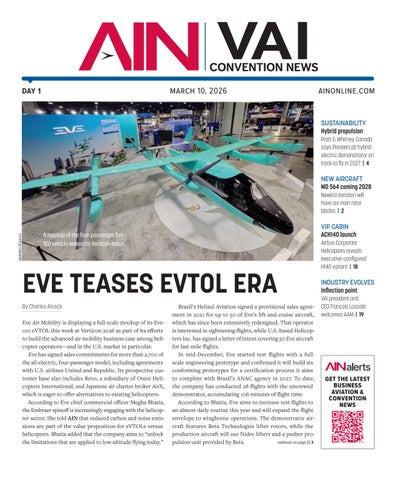
EVE TEASES EVTOL ERA
By Charles Alcock
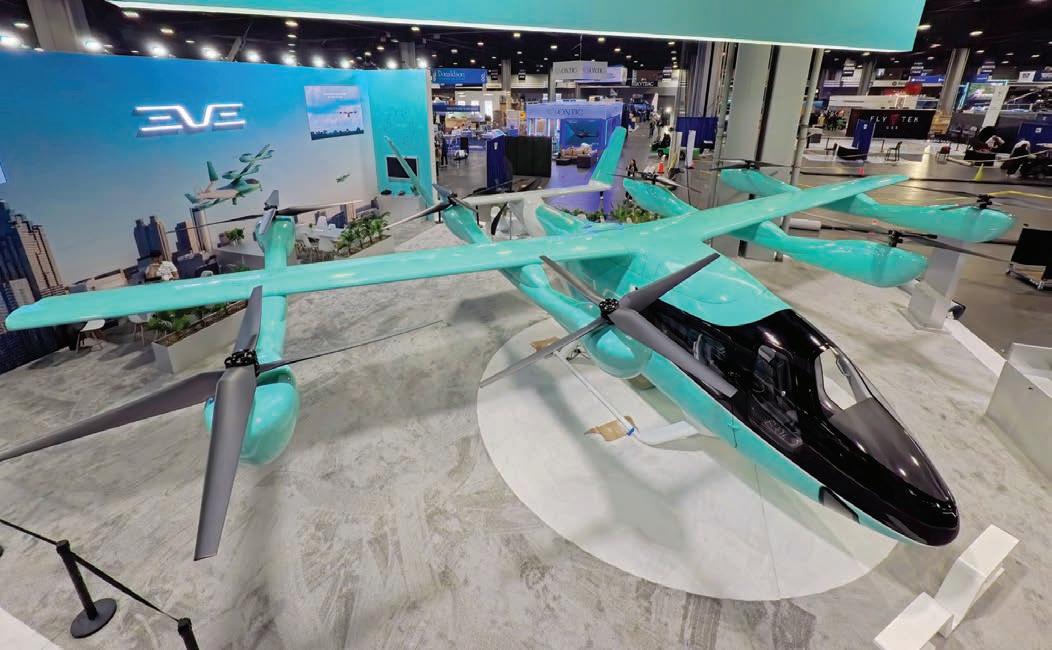
Eve Air Mobility is displaying a full-scale mockup of its Eve100 eVTOL this week at Verticon 2026 as part of its efforts to build the advanced air mobility business case among helicopter operators—and in the U.S. market in particular.
Eve has signed sales commitments for more than 2,700 of the all-electric, four-passenger model, including agreements with U.S. airlines United and Republic. Its prospective customer base also includes Revo, a subsidiary of Omni Helicopters International, and Japanese air charter broker AirX, which is eager to offer alternatives to existing helicopters. According to Eve chief commercial officer Megha Bhatia, the Embraer spinoff is increasingly engaging with the helicopter sector. She told AIN that reduced carbon and noise emissions are part of the value proposition for eVTOLs versus helicopters. Bhatia added that the company aims to “unlock the limitations that are applied to low-altitude flying today.”
Brazil’s Helisul Aviation signed a provisional sales agreement in 2021 for up to 50 of Eve’s lift-and-cruise aircraft, which has since been extensively redesigned. That operator is interested in sightseeing flights, while U.S.-based Helicopters Inc. has signed a letter of intent covering 50 Eve aircraft for last-mile flights.
In mid-December, Eve started test flights with a fullscale engineering prototype and confirmed it will build six conforming prototypes for a certification process it aims to complete with Brazil’s ANAC agency in 2027. To date, the company has conducted 28 flights with the uncrewed demonstrator, accumulating 106 minutes of flight time.
According to Bhatia, Eve aims to increase test flights to an almost daily routine this year and will expand the flight envelope to wingborne operations. The demonstrator aircraft features Beta Technologies lifter rotors, while the production aircraft will use Nidec lifters and a pusher propulsion unit provided by Beta. continues on page 22
SUSTAINABILITY
Hybrid propulsion
Pratt & Whitney Canada says PioneerLab hybridelectric demonstrator on track to fly in 2027 | 4
NEW AIRCRAFT MD 564 coming 2028
Newest iteration will have six main rotor blades | 2
VIP CABIN ACH140 launch
Airbus Corporate Helicopters reveals executive-configured H140 variant | 18
INDUSTRY EVOLVES Inflection point VAI president and CEO François Lassale welcomes AAM | 19
A mockup of the four-passenger Eve100 vehicle makes its Verticon debut.
MD Helicopters unveils six-bladed MD 564
By Matt Thurber
MD Helicopters today took the wraps off its newest helicopter model, the MD 564, an iteration of the MD 500 series with six main rotor blades, a four-bladed tail rotor, and improved performance. Entry into service is expected at the end of 2027 or early 2028.
The MD 564 is not a clean-sheet design but an update of the MD 500 series type certificate. It will be powered by the Rolls-Royce 250-C47E/3 engine with dual-channel Fadec, delivering 675 shp—up from the MD530F’s 650-shp 250-C30 (Series IV) engine. It will
have a 400-nm range and 4-hour endurance with main and auxiliary fuel. The main rotor system has a diameter of 27 feet 6 inches.
Price will be $4 million, but the direct operating cost will be lower than that of other lightsingles, a spokesperson for the company stated.
At mtow, hover out-of-ground-effect is “up to 14,500 feet,” according to MD Helicopters. Internal payload will be “up to 650 pounds” higher and external payload “up to 750 pounds” greater than legacy 500-series aircraft.
Like the 530F, the MD 564 features Garmin avionics, including the G500 TXi touchscreen display, and will be IFR-capable. MD Helicopters

does not plan to equip the MD 564 with an autopilot but may consider doing so in the future.
According to MD Helicopters, “One of the defining advantages of the MD 564 is the ability to deliver long light-single [helicopter] performance in a short light-single footprint. For utility and aerial work operations, meaningful increases in lift typically require stepping into aircraft like the Bell 407 or Airbus H125, along with their higher acquisition and operating costs.” z
DOT selects eight projects for AAM/eVTOL integration trials
The U.S. Department of Transportation (DOT) rolled out its highly anticipated advanced air mobility (AAM) integration program yesterday, announcing the selection of eight projects that will include trials throughout the country.
Unveiled in June as part of the “Unleashing American Drone Dominance” executive order, the eVTOL Integration Pilot Program (eIPP) aims to set the foundation for the safe operation of electric vertical takeoff and landing aircraft in the National Airspace System. According to the DOT, the eIPP “will create one of the largest real-world testing environments for next-generation aircraft in the world.”
Expected to kick off in the coming months, the eight projects will span 26 states and cover a range of operations, including urban air taxi, regional passenger transportation, cargo and logistics, emergency medical response, autonomous flight technologies, and offshore and energy transport.
“Working together, we will ensure America leads the way in safely leveraging next-gen aircraft to radically redefine personal travel, regional transportation, cargo logistics, emer-
gency medicine, and so much more,” Transportation Secretary Sean Duffy said in a statement.
FAA Deputy Administrator Chris Rocheleau noted that the projects will provide a better understanding of how to safely and efficiently integrate the aircraft into the NAS. “The program will provide valuable operational experience that will inform the standards needed to enable safe advanced air mobility operations.”
Among the eIPP partners, the Port Authority of New York and New Jersey will work with Archer, Beta, Electra, and Joby on 12 different operational concepts in New England, including electric air taxi services in Manhattan.
Another partner, the Texas Department of Transportation, will test regional flights involving air taxi networks connecting Dallas, Austin, San Antonio, and, eventually, Houston. Archer, Beta, Joby, and Wisk will participate.
In the Pacific Northwest, the Rocky Mountains, and Oklahoma, the Utah Department of Transportation will trial various aircraft and operating concepts with Ampaire, Beta, and Joby.
The Pennsylvania Department of Transportation will work through the NASAO AAM
Multistate Collaborative to trial regional flights across 13 states in support of the Essential Air Service program with Beta, Electra, and others.
Louisiana will participate in operational tests conducted over the Gulf and at energy industry locations in Louisiana, Texas, and Mississippi. This will involve Beta and Elroy Air.
The Florida Department of Transportation will work with multiple industry partners in phases of operations focused on cargo delivery, passenger transportation, automation, and medical response. Archer, Beta, Electra, and Joby, among others, are on tap for these operations.
North Carolina’s Department of Transportation will explore aeromedical services and autonomous flights with Beta, Joby, and others. Albuquerque is also trialing autonomous operations in concert with flight automation specialist Reliable Robotics.
These eight projects were selected from more than 30 proposals. The DOT said they were selected based on their ability to accelerate AAM integration, the breadth of concepts proposed, and their potential for regulatory and policy insights. K.L.
The MD 564 could enter service in late 2027.

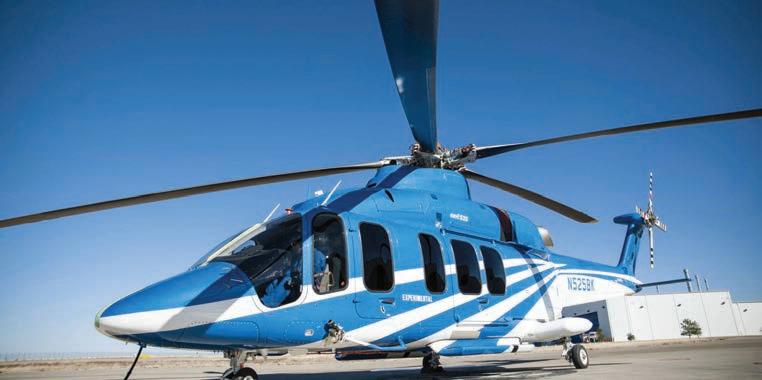
The second flight-test Bell 525, FTV2, continues to do cold-weather and icing testing in Wisconsin and Canada.
Bell hopeful for 525’s FAA nod by end of year
By Chad Trautvetter
Making his Verticon debut as Bell Textron’s president and CEO, Danny Maldonado outlined his company’s successes in 2025 while also acknowledging that the super-mediumtwin Bell 525 Relentless once again eluded FAA certification.
“We delivered 169 helicopters last year, with 10,000 Bells now in service,” he told the media on Monday at the show. “We also ramped up our aftermarket [support] and our investment in our people, our facilities, and our products; accelerated the MV75 program; and celebrated the advancement to Phase 3 of the Army’s Flight School Next program.”
He also noted that Bell faced “primitive challenges in 2025—that is, tariffs, government shutdowns, and supply-chain issues. But our team did a fantastic job of working through all those challenges and still delivering on all our commitments to our customers.”
While Maldonado said the Bell 525 program made progress last year, “We didn’t get the [helicopter] FAA certified in 2025. However, we continue to make progress with our flight activities and customers.”
Bell 525 program senior v-p Michael Deslatte added that the company’s objective is to certify the fly-by-wire helicopter by
year-end, without giving any promise of that timeline but noting that all flight testing has been completed for the FAA. “When we introduced the 525, our goal was crystal clear: to deliver a super-medium helicopter that sets a new benchmark for safety, performance, and mission capability. That vision has not changed.
“You’ll notice this year when the show opens [today] that the 525 is not in our booth, and that’s by design. Every one of our [test 525s] are out in the field, hard at work
preparing us for market entry. Our team remains focused on critical activities necessary for certification.”
Last year at Verticon, Bell said it was engaged with the FAA on the type certification process. Since then, Deslatte said, “We continue to be in lockstep with the FAA on these final efforts towards certification.” The only open certification activities for the 525 are failure-mode regression and fly-by-wire software validation at Bell’s integration test lab.
Two of the three flight-test Bell 525s are conducting post-certification flying activities—namely, cold-weather expansion and full icing capability—in Yellowknife, Canada, and Marquette, Michigan. “Since the fall, these two teams have been…focused on anti-ice performance, along with increased gross weight cold weather testing,” Deslatte noted. “Together, these teams have flown hundreds of hours and accomplished thousands of test points in austere conditions and are gearing up for type inspection authorization with the FAA next season.”
The third test aircraft is “ready and waiting” to begin function and reliability testing with the FAA once “prerequisite activities” are completed, according to Deslatte.
Meanwhile, two pilots from Omni Helicopters became the first customer pilots to log time in the new helicopter after completing a four-day familiarization course with the Bell Training Academy. This included eight hours in the level-C Bell 525 simulator and three days of instructional courses. z
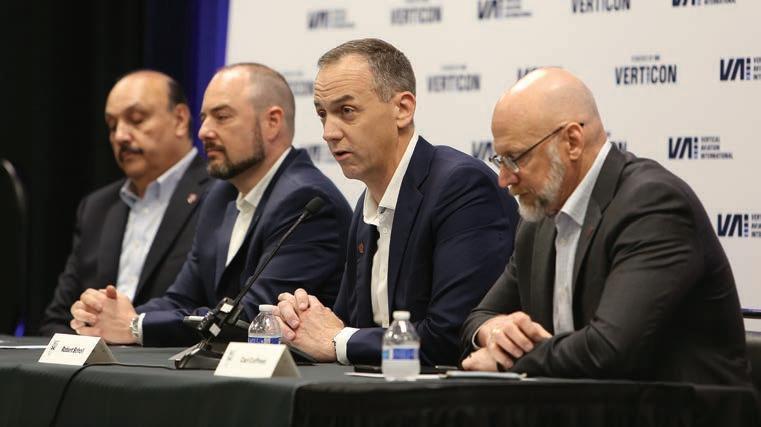
Bell executives gave updates yesterday here in Atlanta on the company’s civil and defense programs.


P&WC pushes hybrid propulsion tech
By Amy Wilder
Pratt & Whitney Canada’s hybrid-electric PioneerLab helicopter demonstrator remains on track for a first flight next year as the RTX business advances hybrid initiatives and expands globally to meet sustained demand for helicopter engines and MRO services.
The PioneerLab demonstrator, based on the Airbus Helicopters H145 platform, will combine a single P&WC PW210S engine with a pair of Collins Aerospace 250-kilowatt electric motors and controllers targeting up to 30% reduction in fuel consumption and carbon dioxide emissions, according to AIN ’s March 9, 2025 report. Airbus Helicopters announced the 2027 target date during a media briefing at its Donauwörth, Germany facility and said the project is on track to confirm a preliminary design this year.
“Hybrid-electric propulsion and electrified aircraft systems are key parts of RTX’s technology roadmap for optimizing performance and enhancing fuel efficiency across multiple future aircraft platforms,” said Maria Della Posta, president of P&WC.
The PioneerLab project represents one of several hybrid-electric initiatives P&WC is
pursuing. In September, the European Union’s Clean Aviation Joint Undertaking selected P&WC to lead the Powerplant Hybrid Application REgional Segment (PHARES) consortium, marking the first time a Canadian company will participate in and lead a Clean Aviation program.
The PHARES project will develop a hybrid-electric propulsion demonstrator targeting up to 20% improved fuel efficiency on regional aircraft missions, featuring an advanced PW127XT-derivative turboprop engine connected to a Collins 250-kilowatt electric motor drive system.
Speaking with AIN at Verticon in Atlanta on March 10, Nico Chabée, v-p of marketing and sales for helicopters at P&WC, emphasized the company’s continued growth on both production and service sides of the business while highlighting innovations in hybrid-electric propulsion.
“The business is people,” Chabée said, placing P&WC at “the center of the ecosystem” serving operators and partners globally on both sides of the market. While acknowledging that the company is not perfect, he said its goals are always to improve, help people, and be dependable.
P&WC has been expanding its footprint in Asia, including growth in Singapore and the broader Asian market through MRO network expansion. The company expanded its Eagle
Services Asia facility in Singapore and invested $20 million to expand its manufacturing presence there, with plans for a 10% workforce increase.
Chabée also highlighted growth in the emergency medical services market and fleet rejuvenation programs. Rising demand for helicopters has contributed to sustained growth at P&WC as the engine maker continues to navigate supply-chain challenges. Shortages of pilots and mechanics, combined with lingering supply-chain issues, continue to constrain the industry as demand outpaces supply, creating backlogs, though Chabée said the supply-chain issues are improving.
At Verticon, P&WC and Leonardo Helicopters are marking several operator milestones. The Leonardo AW169 fleet reached 250,000 aircraft flying hours, with a celebration scheduled for March 10 at 4:00 p.m. Eastern at the Leonardo booth. The companies are also recognizing Alidaunia’s 50 years of operations, Heli Korea’s 30 years, and Alpine Helicopters’ 65-year milestone.
P&WC continues to invest approximately $500 million annually in innovations for existing engine models and future products, including advanced materials research to improve thermal efficiency and reduce fuel burn and emissions. The company is also preparing to demonstrate hydrogen combustion technology on a PW127XT turboprop engine for the Canadian government-backed Hydrogen Advanced Design Engine Study.
The company, which celebrated its 100th anniversary in 2025, has manufactured helicopter propulsion systems for six decades and has built approximately 20,000 helicopter engines, totaling roughly 80 million flight-hours.
The hybrid-electric PioneerLab demonstrator is based on the Airbus H145 platform, with preliminary design expected this year.
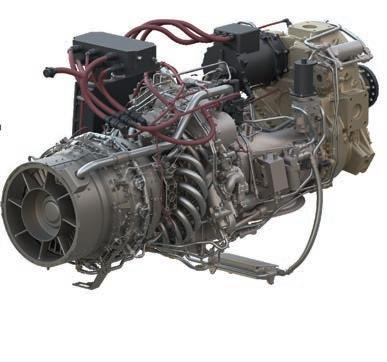
P&WC PW210S engine with two Collins Aerospace 250-kilowatt electric motors and controllers
Where Care Takes Flight

For Emergency Medical Services operations, speed of response is critical. Thanks to the combination of advanced technologies and inherent flexibility, Leonardo’s product range guarantees a rapid and capable response. Spacious and readily reconfigurable cabins, advanced avionics and all-weather capability, day and night, ensure that medical personnel can always be there when it counts. Visit us at VERTICON, Stand B9707.
Airbus Helicopters grows its Marignane footprint
By Charlotte Bailey
As Airbus Helicopters’ orders continue to rise, significant redevelopment work is underway at the airframer’s Rotors and Transmissions Centre of Excellence in Marignane, France. A €230 million (about $270 million) investment will see around 60% of the existing site substantially altered by 2028, allowing Airbus to expand and optimize its elementary parts production.
The first stone has already been laid for a new 31,000-sq-m (333,681-sq-ft) building at the heart of the complex, set to be the site’s biggest. This will supersede many older buildings approaching obsolescence, some up to 70 years old. Head of new projects JeanLouis Gaud explained that the new factory aims to “reshape, and transform completely,
the activity of elementary parts machining” through increased automation, digitization, and production optimization.
The Rotors and Transmissions Centre of Excellence produces around 350 of the “most critical parts” internally, representing around a third of Airbus helicopter gearboxes and complementing some 20,000 elements created elsewhere. Enhancements aim to streamline output while cutting lead times by 50%.
Current production will continue in parallel as the new building is fully commissioned in two to three years. This, Gaud said, offers a “big advantage” with an opportunity to install new machining and processes, integrating all steps onto a single production line. Airbus is also looking to raise its “first time right rate” from 60% to 80%, something Gaud believes
is “comparable to the best practices we have benchmarked for that type of complexity.”
In parallel, a decade-long program to transform around 60% of the site will be completed by 2032. “We are looking to export some activities close by and create some satellites,” explained Marignane site director Pascal Kuhn.
Offsite activities include the enlargement of logistical assets, alongside facilities for training and maintenance. He added that the 80 hectares of land adjacent to the airport “may be a possibility of common extension.”
The Marignane facility is currently the largest private employer in the south of France and the third biggest industrial site in the country, following Airbus Toulouse and a tire manufacturer. It has more than 9,000 permanent employees and around 4,000 subcontractors. To support the future workforce, an upcoming Airbus Helicopter Academy will welcome its first students at the end of 2028.
Airbus Helicopters’ performance in 2025 was marked by a 20% increase in orders, with 536 orders logged. Last year, Airbus delivered 392 helicopters, up from 361 in 2024. z
Upcoming Airbus H160M Guépard on track for 2028 deliveries
With the development of Airbus Helicopters’ H160M Guépard (Cheetah) intensifying, the OEM is on track to deliver its inaugural units to the French armed forces in 2028. Airbus proclaims the ongoing flight-test campaign is “a very good start for the military.”
Speaking at a briefing in Marignane, H160 program head Benoit Klein explained that Airbus is “very happy about the behavior of the aircraft.” The first prototype—which surpassed 72 flight hours as of late February—has already conducted a “mini cold campaign” in the French Alps and tested electromagnetic capability in proximity to French naval vessels.
Preparation will begin next month for an airborne firing campaign at Cazaux air base, set to take place in the third quarter. This will look to validate the aircraft’s aerodynamic stability when deploying rockets and guns.
“In terms of missiles, we are ready now, [but] we need to demonstrate the flying sta-
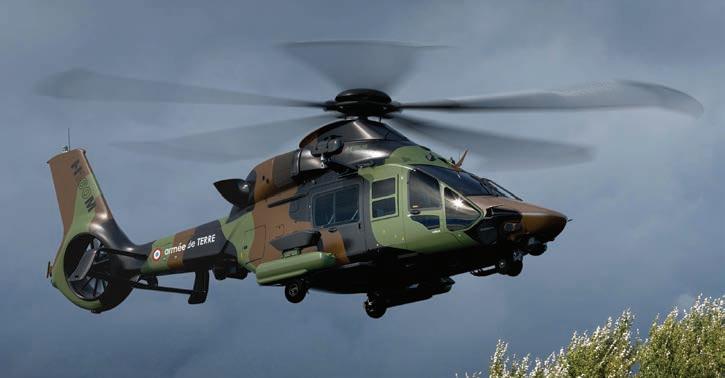
The militarized H160M “Guépard” prototype made its first flight in July.
bility of the aircraft a little bit more,” Klein said. The H160M’s weapons package will include door- and pod-mounted machine guns, as well as guided missiles.
A second prototype will fly soon, followed by a third unit currently under construction in
Donauwörth, Germany. In July, Airbus Helicopters CEO Bruno Even said the company had received “excellent feedback from the French Navy on the performance of their six H160s, which have proven themselves with a high availability rate.” C.B.
THE WAY MADE FOR YOU FLY
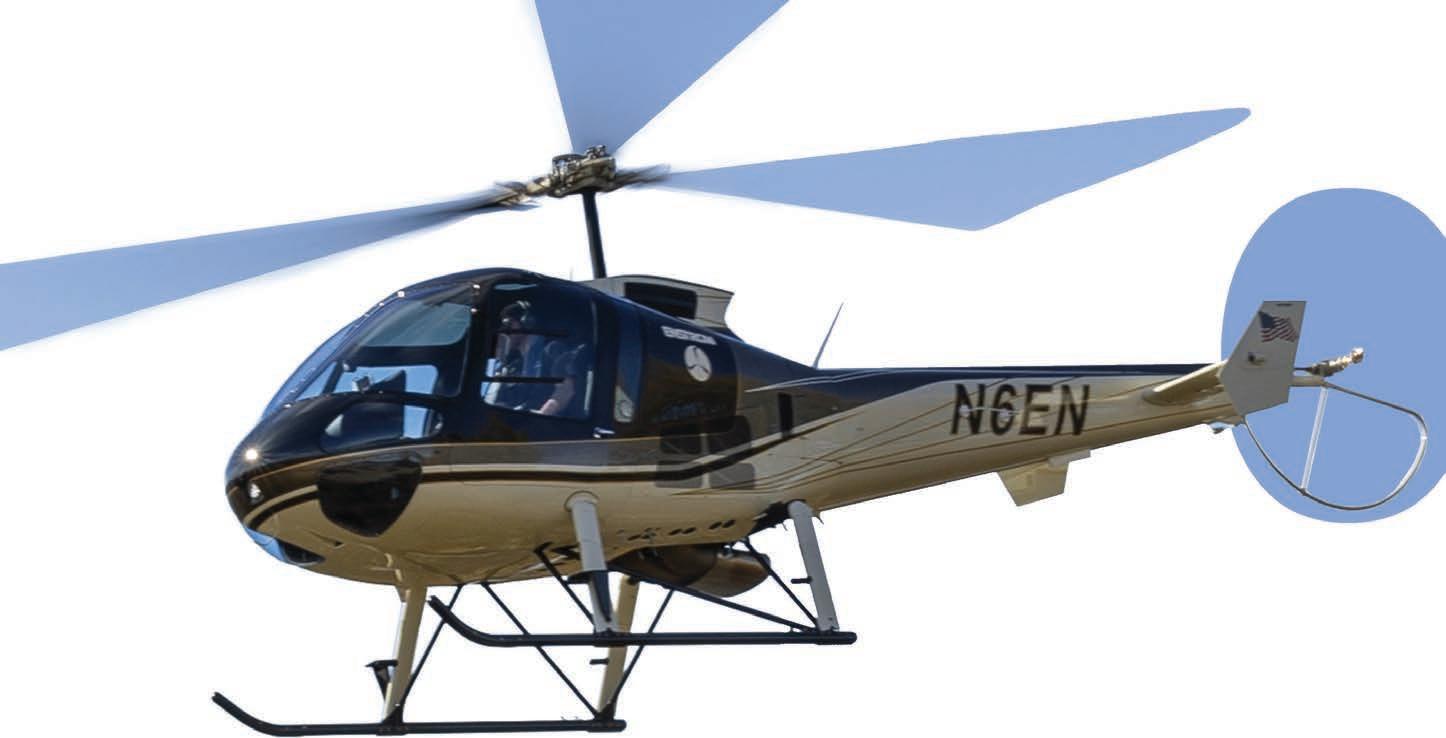
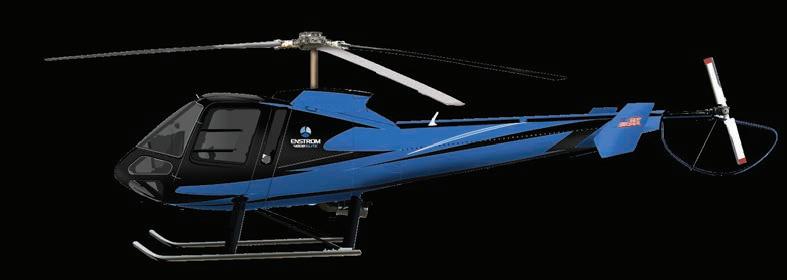
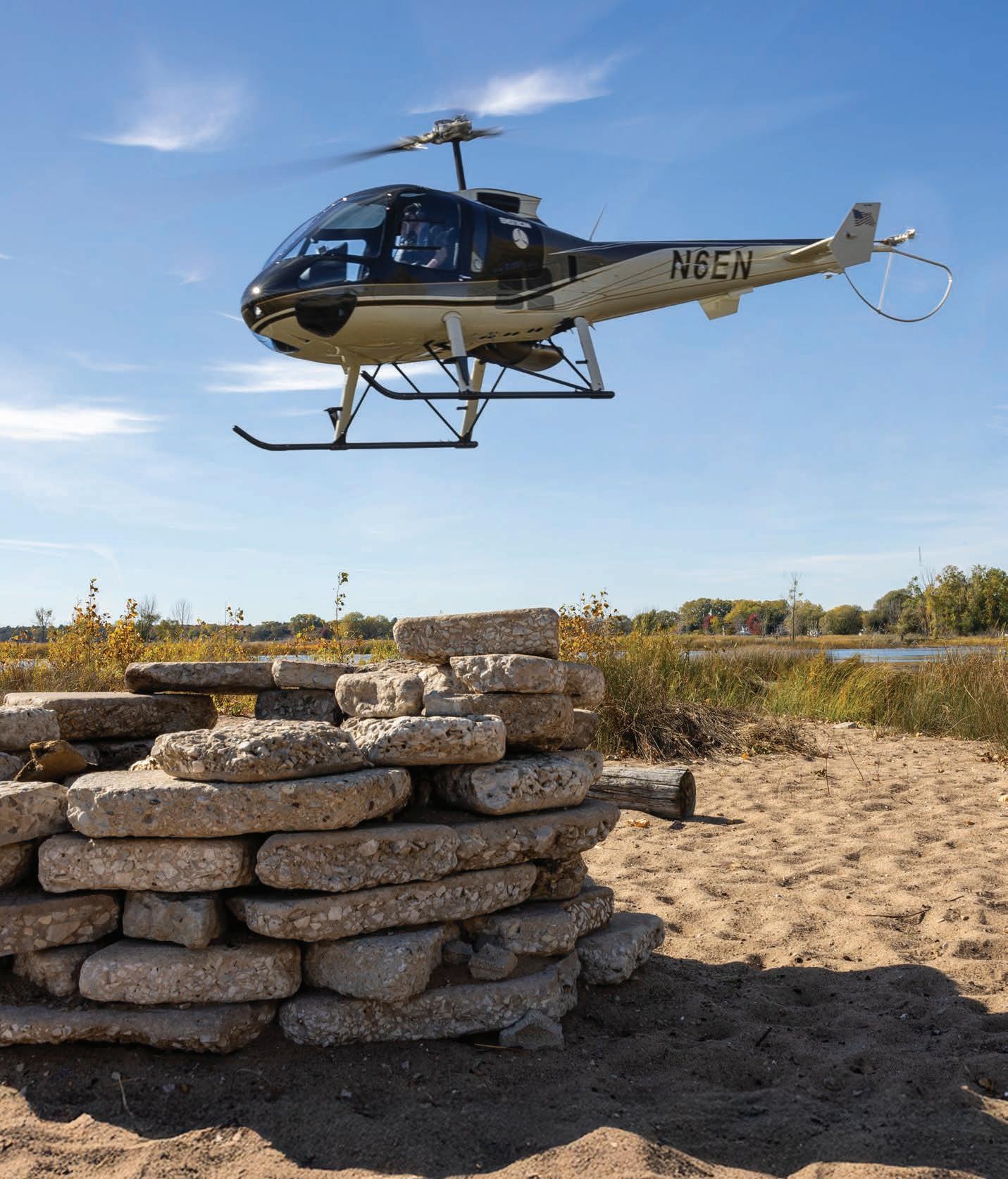
Purpose-built and pilot-trusted, Enstrom helicopters move effortlessly from workweek to weekend escape. Fly on your schedule, land where others can’t, and enjoy refined comfort with confident performance, because the best aircraft should work as hard as you do, and reward you just the same.
/ All-Glass Digital Instrument Panel
/ Advanced Controls & Avionics
/ Custom Exterior Paint & Design
/ Premium Interior & Upholstery
/ Autopilot, Air Conditioning & More


Moog shows automated Black Hawk
By Matt Thurber
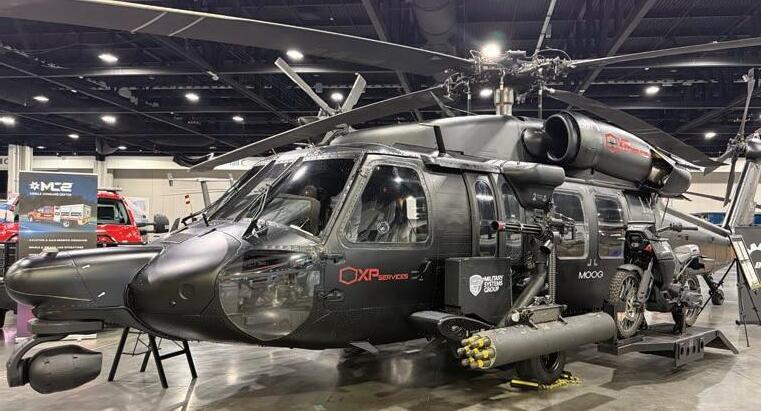
Moog’s Verticon exhibit features a Sikorsky UH-60 Black Hawk that demonstrated automated liftoff, hover, and en-route flight last October. Moog’s Genesys GRC 4000 four-axis rotorcraft autopilot, integrated into the helicopter’s Genesys avionics suite, has received FAA technical standard order authorization, Moog announced on Monday.
“This certification marks a significant step forward for rotorcraft operators,” said Moog Avionics director of business development Nick Bogner. “The GRC 4000 takes on high-complexity control tasks to reduce pilot workload, enabling pilots to focus on mission-critical objectives, improving safety, and ensuring success.”
Pilots can engage the automation modes with one button and use the autopilot’s stability augmentation and envelope protection features for protection against over- and underspeed conditions or to bring the helicopter to a near-level mode when needed, for
example, during an inadvertent instrument meteorological conditions encounter.
The IFR-capable GRC 4000 also offers autopilot pitch control, glide slope, and altitude, airspeed, and vertical speed hold modes.
GPMS ‘HUMS’ along with Bell programs
GPMS International is bringing its Foresight MX health and usage monitoring system (HUMS) to the Bell 505 helicopter. At the same time, GPMS also won contracts with Bell helicopter operators Halo-Flight and Helicopter Express for HUMS system upgrades.
Announced this week at Verticon, the company’s partnership with the OEM on the Model 505 expands the portfolio of Bell platforms supported by Foresight MX and will provide operators of the light-single helicopter with advanced vibration monitoring, predictive maintenance insights, and flight-data monitoring capabilities.
With Foresight MX, operators can automatically capture and analyze aircraft vibration and operational data after each flight through GPMS’s web-based analytics platform, enabling maintenance teams to better assess aircraft condition
and operational trends. The system also allows operators to share HUMS data with Bell’s customer support team.
Meanwhile, Helicopter Express of Tate, Georgia, has become the first Bell 412EPX operator to upgrade from the Bell Helicopter Vibration Monitor (BHVM) system to Foresight MX. This marks a step forward in the BHVM-to-GPMS upgrade program developed in partnership with Bell, as operators seek modern, supportable alternatives to aging legacy monitoring systems.
Helicopter Express operates a mixed-mission fleet supporting the U.S. Forest Service under a contract that requires operators to use modern helicopters equipped with HUMS. Its HUMS-enabled fleet now includes a Bell 429 and three Bell 412 EPXs, bringing the company’s HUMSequipped fleet onto a single platform.
South Texas nonprofit emergency air ambu-
Roll features include heading hold, and nav, localizer, and VOR guidance.
“The future of aviation is increased safety and aircraft performance through automation,” Bogner said. z
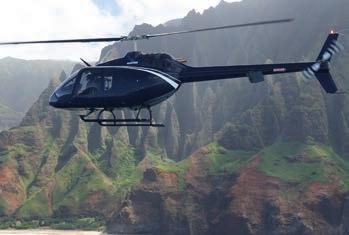
Bell 505 helicopters will get GPMS’s Foresight MX health and usage data monitoring system.
lance service Halo-Flight has placed an order to equip three more Bell 407s with Foresight MX. With this order, its entire fleet of five 407GXis is equipped with the health monitoring system. In other news, GPMS has received FAA supplemental type certificate (STC) approval for Foresight MX on the Columbia CH-47D helicopter and is pursuing an approved model list STC for other Chinook variants. PJ Helicopters of Red Blu , California, is the launch customer for the HUMS unit on the heavy-lift twin helicopter. C.T.
MARIANO ROSALES
A Sikorsky UH-60 Black Hawk that recently demonstrated automated flight with Moog’s Genesys autopilot is on display this week here in Atlanta.

























Sikorsky ramps S-92A+ production in New York
By Hanneke Weitering
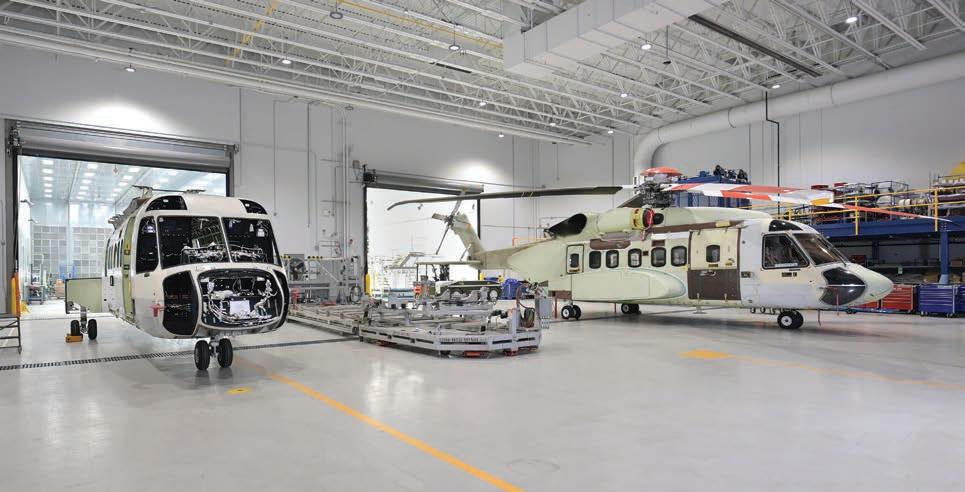
Sikorsky Aircraft is preparing to launch series production of the S-92A+, the latest variant of its flagship large-cabin helicopter. The company revealed on Friday that the assembly line for the S-92A+ will be located in Owego, New York, at the Lockheed Martin Systems Integration facility. Sikorsky is a Lockheed subsidiary.
At least five S-92A+ helicopters are expected to roll off the production line this year, but the facility is capable of producing up to 12 aircraft per year, Leon Silva, Sikorsky’s v-p of global commercial and military systems, told reporters during a pre-Verticon briefing on February 25. The company anticipates deliveries of the first S-92A+ in 2028.
“We’ve decided we’re going to leverage the facility that we have up in Owego, New York, that recently completed the delivery of the Presidential S-92s,” Silva said, referring to the variant known as VH-92A.
Silva added that the Owego team has “tons of experience” with S-92 production, having delivered 23 of the new U.S. presidential helicopters between 2021 and 2024.
“Since 2021, as a function of markets and the fact that there were significant numbers of S-92s in storage at the time, we have produced relatively modest numbers of S-92s, one to two aircraft a year, mostly for heads of state,” he said. “In 2026, we’re planning to build at least five aircraft of the S-92A+ category.” Last year, the company delivered two S-92As to head-of-state customers in Asia and the Middle East.
The first confirmed customer for the S-92A+ will be an unnamed head-of-state operator that has ordered two aircraft. In anticipation of further orders, Sikorsky is building three additional S-92A+ “spec” aircraft, meaning units built in a standard configuration. “We anticipate still this year to close on additional sales, and so we wanted to kind of get going with the planning and manufacturing of those aircraft,” Silva said.
While Owego will handle the aircraft assembly, most of the aircraft’s components—including the main gearbox, blades, and drivetrains—will continue to be produced at Sikorsky’s headquarters in Stratford, Connecticut.
Sikorsky’s S-92family helicopters, including the latest S-92A+ variant, are assembled and integrated at Lockheed Martin’s Systems Integration facility in Owego, New York.
The upgraded S-92A+ variant centers around Sikorsky’s Phase IV gearbox, which it has been developing for more than a decade at an investment cost of more than $100 million. The Phase IV gearbox adds a backup lubrication system that allows the S-92 to continue operating after a loss of oil pressure, eliminating the long-standing “land immediately” requirement.
In addition to the more robust gearbox, the Sikorsky S-92A+ upgrade adds about 1,200 pounds of additional useful load, LifePlus component life-extension improvements to reduce maintenance downtime, and updated digital avionics based on Sikorsky’s Matrix autonomy system that enable features such as automated offshore approaches and enhanced search-and-rescue functions. GE CT7-8A6 engines improve performance at high altitudes and temperatures, while a lighter and more flexible cabin layout enables faster reconfigurations for different missions.
“The S-92A+ helicopter is another example of how we are modernizing the fleet and transforming for the future, and we are building in surge capacity to meet expected demand,” Sikorsky v-p and general manager Rich Benton said. “The S-92 remains the aircraft of choice for head of state, offshore energy, and search-and-rescue operators who want the highest available flight-time helicopter to perform long-range missions in any weather condition.”
Rotortrade posts record helicopter transactions
By Matt Thurber
Helicopter dealer and asset manager Rotortrade broke a record in 2025, tallying its highest-ever sales volume and value, with revenues up 50% and transactions up 35% year over year.
“Delivering record growth in both volume and value reflects the maturity of our global platform and the confidence operators place in our expertise,” said Rotortrade founder and CEO Philippe Lubrano. “The acceleration in EMS and mission-driven segments demonstrates how critical reliable, well-configured aircraft are for essential operations worldwide. The market fundamentals remain strong, and we enter 2026 with solid momentum.”
In the EMS segment, Rotortrade deliveries
were up sixfold, while the combined EMS, utility, and VIP market accounted for 87% of the helicopters that it delivered in 2025. EMS remained the strongest segment for Rotortrade, and more than 90% of 2025 completed transactions involved Airbus and Leonardo models.
Light single-engine and light-twin helicopters showed sustained demand, with the Airbus H125 and H145D3 and Leonardo AW109SP accounting for more than 50% of the 2025 fleet sold. About 70% of transactions took place in Europe and the Americas, with stable activity in Asia-Pacific, the Middle East, and Africa.
“Our strategy remains focused on supporting customers across the full aircraft life cycle—from acquisition and financing to maintenance and asset optimization—while

In collaboration with Jonsen Island, Rotortrade is displaying a new “capsule collection” at Verticon.
continuing to expand our international footprint,” Lubrano said.
At Verticon, Rotortrade unveiled the next step in its collaboration with design firm Jonsen Island, a “capsule collection” including caps, a hoodie, a t-shirt, and a signature jacket. All of these are on display at the Rotortrade exhibit and for sale on Jonsen Island’s website. Last year, Jonsen Island and Rotortrade collaborated on the refurbishment of an Airbus EC120, and the new collection reflects the two companies’ aviation and ocean inspirations. z


Robinson preps factory for biggest-ever ship
By Matt Thurber
Unveiled last year at Verticon, the R88 is Robinson’s largest helicopter, capable of carrying 10 occupants, with a 275-cu-ft cabin for up to eight passengers or 1,800 pounds of payload with full fuel. Power is provided by a 1,000shp Safran Helicopter Engines Arriel 2W. Certification and entry into service are expected to take place later this decade, and the R88 will sell for about $3.3 million.
A key element of the R88 design is the input drive shaft, which connects the engine to the main transmission. “Input drive shafts are really tricky. That’s one of the hardest challenges on any helicopter, the ability to take relative motion between gear boxes and engines and throughout all sorts of maneuvers and transients,” Robinson Helicopter president and CEO David Smith told AIN
Rather than adopt a conventional design, such as the Kamatics KAflex that Smith’s former employer, Bell, uses in many of its
helicopters, he wanted something less expensive that doesn’t require the complex overhaul process associated with a proprietary product. “It’s a fine product, but we want a different solution,” he said.
“The technology that we’re using for our input drive shaft is such an interesting improvement over the products that our competitors have used. Because we in the industry go to these single-source operators that control the aftermarket and specialty intellectual property, we avoided all of that with this design, and it works really well. We’re hundreds of hours into testing, full speed, full power, and it’s working like a champ. I think we’ve got something good that’s going to cut the cost probably in half, maybe a third, for the competing product. This is going to be a design that operates well and doesn’t require an obscene overhaul cost.”
Also helping manage costs is further vertical integration, down to making its own fasteners for certain hard-to-source applications,
more use of robotics for repetitive work like sanding rotor blades, and putting five-axis milling machines to work making hydraulic components that Robinson used to purchase from vendors. “That accelerates our iterations through the design cycle and gets the parts in test sooner, and allows us to then make the next iteration on the design,” Smith said.
A new, larger water-jet machine will be used for cutting R88 sheetmetal parts, including rotor blade skins for blades that are three feet longer than the R66’s. Repetitive tasks such as machining, welding, and sanding are being augmented by dedicated robotic centers, Smith explained, “all areas where we have high injury risk and repetitive motion injury risk.”
The idea isn’t to replace workers but deploy them to more important work, like the final sanding of rotor blade bond lines that can’t be done precisely enough by machines. “There’s about 20% of the blade they can’t do with robotics,” he said. “The resolution of their movement isn’t sufficient to do some of the most critical bond-line sanding.”
An in-house team developed a robotic process for manufacturing blade weights that eliminated a significant amount of labor. “We tried working with third-party integrators for this stuff,” Smith said, “and they failed us.
“The guys have been really incredible because they learned to code the robot. This is stuff that I would have loved to have done in my previous life, but work restrictions under the labor contracts at my previous employer made it difficult. Here, we have the flexibility to do end-to-end innovation. There’s still a lot of work for the same technician…so we’re hiring; we need probably another 75 to 100 people to do the things that are ahead of us.”
Robinson has also invested in inspection technology to speed quality-control processes. R88 cabin assembly is well underway and in testing, along with many other components such as the landing gear and aircraft systems.
“We have several reviews during the week with each system, [to] try to notice all the bottlenecks early,” he said. “We can fix, or we can change the path that we’re going through so we can deliver on time. I want the customer to know that we are doing our best to deliver them a product that they’re going to be happy with, and we’re not going to cut any corners.” z
Robinson president and CEO David Smith introduced the 10-seat R88 at Verticon 2025.
Uncrewed Black Hawk set to soar
By Matt Thurber
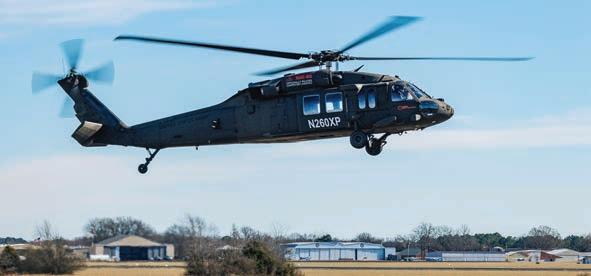
Honeywell, Moog, and XP Services are collaborating to convert a Sikorsky UH-60L Black Hawk into the RUC-60, equipped with Near Earth Autonomy’s Captain autonomy system. Mission flight testing is expected this year, following earlier integration work and flights of the responsive uncrewed capability (RUC) Black Hawk to prepare for the next phase of testing.
Autonomous helicopters are gaining interest among defense organizations, particularly for their ability to sustain forces without risking human crew members.
“Near Earth is leading the integration of autonomy into the next generation of military operations,” said Lyle Chamberlain, the company’s chief technology officer. “Once you remove the pilot, you have to re-evaluate the entire operation, everything from how the
aircraft gets out of the hangar to how it navigates and makes mission-critical decisions in flight. Autonomy isn’t just about flight control; it has to take on the full role of the crew, including responsibilities we often take for granted. That’s why we built the Captain autonomy architecture from the ground up to support end-to-end operations and meet the rigorous accreditation standards needed for real-world deployment.”
The Sikorsky UH-60 Black Hawk that demonstrated automated liftoff, hover, and en-route flight in October will be converted into the uncrewed RUC60 variant.
The RUC-60 demonstrated fully automated flight last year. Near Earth has been working on an uncrewed Black Hawk since 2021 and has completed more than 10,000 automated flights with 140 helicopters, including Airbus, Bell, Boeing, Kaman, and Leonardo models.
Deploying as a kit to convert UH-60L helicopters, the RUC-60 will include Moog’s Genesys GRC 4000 four-axis autopilot. z

WHERE
TRAINING TAKES
www.reiser-st.com

FAAST webinar targets peer pilot mental health
By Amy Wilder
Leaders from the U.S. Helicopter Safety Team (USHST) outlined the structure and goals of its new Peer Pilot Mental Health Support Program during a recent FAA Safety Team (FAAST) webinar. The program is a confidential, peer-to-peer resource designed to address mental health challenges within the rotorcraft community.
USHST officially launched the peer-topeer assistance for personal and professional challenges last year at Verticon, marking an expansion of the organization’s safety portfolio beyond technical recommendations into mental well-being.
Chris Baur, CEO of Hughes Aerospace and industry co-chair of USHST, described the program as a long-overdue step for vertical aviation. “No amount of training prepares us for the internal burdens we sometimes carry alone,” Baur said. “The stigma around mental health support is lifting it’s about time vertical aviation had a peer program of its own.”
The program is modeled in part on airline peer-support systems and is open not only
to helicopter pilots, but also to mechanics, crewmembers, and fixed-wing pilots seeking support. Baur emphasized that the service is confidential, independent of employers and regulators, and free of charge. “This program is here with no judgment, no reports—just real people ready to listen,” he said.
Operational oversight and clinical support are provided by the Centre for Aviation Psychology. Aedrian Bekker, a clinical aviation psychologist and the center’s operations director, said the goal is to connect aviators with peers who understand the unique pressures of their work. “At the heart of it, this is about ensuring a pilot or an aviator in need can speak to somebody who speaks their language, who understands exactly what it’s like to be in their sector of aviation,” Bekker said.
Licensed mental health professional Jessica Auslander, who supervises peer counselors, said her role focuses on training, consultation, and escalation only when safety is at risk. Confiding in a peer “does not constitute a therapeutic interaction,” Auslander said, adding that confidentiality is breached only in rare cases involving imminent harm. “Talking to
USHST’s peerto-peer mental health assistance program is free and available for anyone involved in aviation. The service is confidential and independent of employers.
a peer…is not considered reportable because our peers are not licensed professionals.”
Program advocates emphasize that addressing mental health is not just a personal benefit but a safety imperative. By encouraging early dialogue, the program seeks to reduce the human-factor risks that contribute to errors and enhance overall flight safety across the helicopter community. Webinar organizers stressed that broader participation is key to reducing accidents and improving safety culture across the industry as a whole.
Peer volunteers are experienced helicopter pilots and crew trained to engage with colleagues on non-life-threatening mental well-being concerns, offering understanding and direction to additional resources when appropriate. Confidentiality is central, with support grounded in shared professional experience. In addition to oneon-one peer conversations, USHST promotes supplemental resources, including its online “Resilience Hub,” which offers self-directed tools and reference material on pilot wellness.
USHST peer volunteer Sean Gavin, an Air National Guard helicopter pilot, said his motivation for participating stems from firsthand experience. “It sure would have been helpful to have trained peers out there,” Gavin said, during some of the difficult moments in his career. “Being able to step in, listen, and help someone has been great.”
The webinar hosts indicated that the video will be available via SocialFlight. z
After long pause, Enstrom eyes new deliveries
By Curt Epstein
Following the FAA’s and EASA’s certification of a crash-resistant fuel system (CRFS) on its 480B turbine helicopter, Michigan-based Enstrom Helicopter is now gearing up to resume deliveries of new aircraft for the first time since it was sold out of bankruptcy in 2022.
“When the bankruptcy happened, the FAA more than paused our production certificate,” explained Charles Wade, Enstrom’s senior v-p of product, sales, and customer excellence. “We had to earn it back, so there was a process we had to go through, and that took time.”
During that span, the agency had also instituted a mandate that all OEMs integrate CRFS technology into their new-build rotorcraft to minimize the risk of post-crash fuel fires. Enstrom partnered with Safran Aerosystems to develop the CRFS fuel bladders and other necessary components to achieve compliance.
Safran also managed the CRFS testing program to support the recertification of both the 480B and the 280FX piston, which is undergoing ground and flight testing in anticipation of FAA approval in the second quarter.
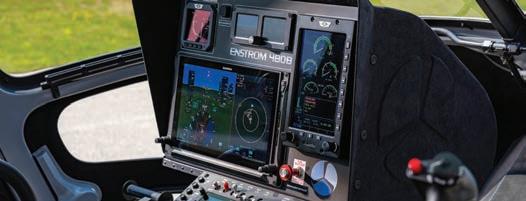
With the return of aircraft production, Enstrom will now offer three tiers of equipage on the 480B, which it outlined last year at Verticon. The standard 480B includes analog instruments, while the Signature and Elite versions will offer an all-glass Garmin cockpit, which is awaiting FAA certification.
The Elite will also feature custom paint schemes, upgraded cabin furnishings, Genesys
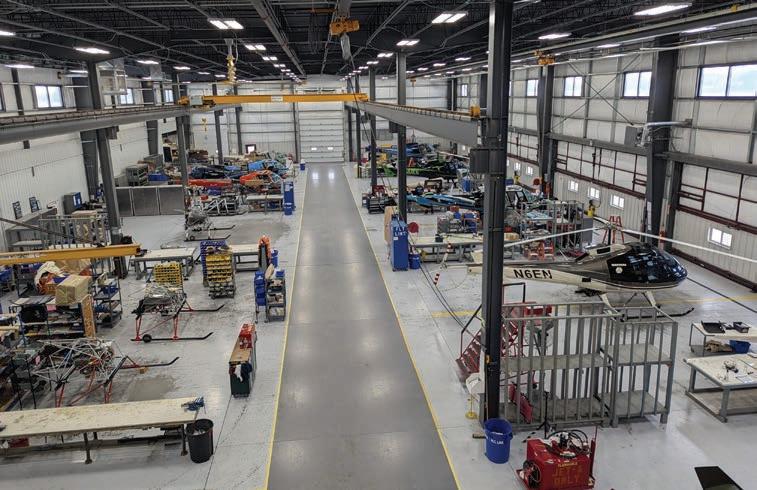
With a crucial FAA certification in its pocket and two others pending, Enstrom Helicopter is ramping up its assembly line to resume deliveries of new rotorcraft.
three-axis autopilot, and cabin air conditioning as standard. The latter two features will be available as options for the Signature model.
“Right now, [with] the base model 480B, we can build and deliver them today,” Wade said. “It’s really the Signature and the Elite models, because of the glass certification, which are a few months behind the standard.”
FAA certification for the new avionics suite on those models is expected by midyear. Wade noted that Enstrom has eight assembled 480Bs in stock, including one standard model, while the other seven await authorization. Two more are under construction.
Once the certifications are wrapped up, Wade said Enstrom plans to ramp up on the 480B. “We’d like to produce about 15 or 16 of them this year—that’s kind of what we are forecasting,” he explained, adding that he expects the company to produce 10 piston 280FXs as the facility spools up.
“Now that we have these certifications, we’re provisioning a line,” he told AIN. “If you count the 280 and 480 models together, we should be getting into that 40 to 45 range pretty easily.”
The span in which the facility was actually idled was a short one, according to Wade. “We were very fortunate that the shutdown was only a couple of months long,” he said, adding that the OEM was able to bring back
some of its key production staff. “That gave us a great foundation for managing the ramp-up, and we’ve just been building on that core competency since.”
While the company had not delivered new rotorcraft for the past several years, its production lines were kept busy producing parts to support the global fleet of more than 700 Enstroms in service. “We’ve been doing a lot with the aftermarket business,” explained Wade, who joined the company in late 2024.
“Obviously, the machines and the manpower is common between production and aftermarket. By virtue of having that aftermarket business, it’s been able to keep things running down there.”
On the maintenance side, Enstrom recently named Canadian provider Heli-Lynx Helicopters as an authorized service center to perform repairs and overhauls on both its turbine and piston models. To help customers locate their nearest service facility, as well as identify those that will perform mobile maintenance in their region, the manufacturer introduced a new interactive “find a service center” feature on its website.
This week at Verticon, the airframer is displaying three of its helicopters at its booth: a Signature and an Elite 480B, as well as a 280FX. “Enstrom is really excited, and I think 2026 is going to be a fun year,” concluded Wade. “We’re turning a big corner.” z
Airbus launches ACH140 executive helicopter
five-blade rotor system, the company said.
AEM debuts low-impedance audio router
Canadian avionics manufacturer Anodyne Electronics Manufacturing (AEM) has launched a low-impedance router for its P139-HD Digital Audio System to support military and special-mission applications.
P139-HD is a modular audio platform providing centralized control and routing for audio signals. The platform handles audio to and from transceivers, receivers, headsets, recorders, and other audio sources, including intercom routing, Bluetooth devices, and multiple talk groups.
By Charlotte Bailey
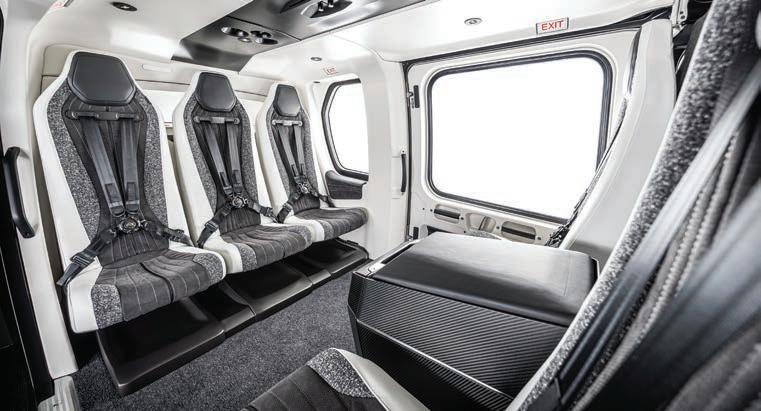
Airbus Corporate Helicopters (ACH) is now offering the upcoming H140 with an executive-configured variant, which the company will unveil today at Verticon. The ACH140, scheduled to enter service in 2030, also ushers in a new interior design that will be extended across the wider ACH family.
Launch customers for the ACH140 have already been secured in what Airbus Corporate Helicopters CEO Frédéric Lemos described as the “top three regions” worldwide: Brazil, the U.S., and Europe, which collectively steer more than 70% of total market volume. Around 100 commitments have been made for the H140 since Airbus Helicopters launched the model last year at Verticon.
A high-density configuration for the ACH140 will seat six passengers in the main cabin, which Airbus believes offers “unmatched cabin space” within the light-twin segment. Under an available option, two cabin seats can be removed and substituted with up to two cabinets. Passengers will also benefit from the “largest windows on the market” and a smooth ride quality enhanced by the H140’s
Notably, the ACH140 provided an opportunity for “reviewing and face-lifting” the ACH line’s visual elements, Lemos said, with the revised interior design offering “dynamic stretched lines” and a blend of “sophisticated materials.” Intended to provide a distinct and cohesive visual identity, “the ACH130 will bring the new design, but with the current color and material of the catalog,” followed by a “rolling plan” to encompass other ACH platforms, he said.
Customers will also retain the opportunity to customize their own requirements above and beyond the catalog options, with Airbus remaining open to the idea of a potential collaboration such as that embodied by the ACH130 Aston Martin partnership.
With the H140 on schedule to enter into service in 2028 in the aeromedical service role, Lemos believes the aircraft’s modularity is crucial to its proposed corporate application. “The ACH line is our offering to have the best operational efficiency and retain as much as possible the value of the aircraft, because it’s very modular and easy to repurpose,” he explained. Additionally, with increasing numbers of ACH customers assisting in disaster event response, reconfigurable capability is a key consideration. z
The router supports headsets at 5-ohm and 8-ohm impedance levels. It has eight headset ports, 10 transceivers with 18 receive-only channels, and 12 keylines for special functions or mission-equipment control. The unit includes a 25-watt speaker driver, and it routes and mixes aircraft audio from all sources controlled by connected control panels.
Used by law enforcement and special-mission operators, the system can now accommodate additional military and intelligence, surveillance, and reconnaissance aircraft.
AEM sales and marketing director Tony Weller said the company received regular requests from aircraft integrators and military operators involved in training and ISR applications for a dedicated low-impedance system.
In February, AEM debuted the MTP138 VHF FM panel-mount radio for special-mission platforms. The narrowband and wideband transceiver operates in the 138-MHz to 174-MHz frequency band and was developed in consultation with o shore, air medical, search-and-rescue, coast guard, and forest service operators. The radio can convert to a Project 25 digital transceiver and supports 40 zones and 5,000 channels. AEM is evaluating regional STCs for popular aircraft models. A.W.
The ACH140 features a six-passenger VIP cabin and introduces a new interior design for the ACH lineup.
VAI chief finds industry at an ‘inflection point’
By Kerry Lynch
François Lassale heads into his first Verticon as the president and CEO of Vertical Aviation International (VAI) as the event is gaining momentum. The show—in its second edition as Verticon and building off the 35 years held as Heli-Expo—has 15,000-plus registrations, 654 exhibitors, 280,000 sq ft of exhibit space filled, and more than 60 aircraft on static display.
“It’s shaping up to be a really good one,” Lassale told AIN. “We’re ahead of the drag curve, which is great for me. The team’s been working tirelessly for this.”
But Lassale quickly noted the important part for him: this is the first in his current role as the industry reaches an “inflection point.” He explained, “Helicopters remain essential to society. Period. That’s not going to change. But we’re also seeing a lot of these new entrants coming into the market, and it’s not a dystopian future—it’s a reality.”
Lassale conceded that it is too soon to tell how many of these new entrants will be certified. “We don’t know at this point. Certification is tough…and I think they’re finding out what degree of investment and time it is.”
But the industry must be prepared, Lassale continued. “There’s a whole bunch of expectation around the new technology. For me, it’s about how VAI positions itself at this inflection point, and that’s why we’ve pursued the [eVTOL] industry.”
VAI is staging events at Verticon to help lure the sector, including an airline panel, because many are chasing lucrative large orders in that segment. “That’s what the investors would like,” he said. “We understand it. But what we’re trying to say to them is that VAI is your home.”
Lassale is also hoping to drive home the point that there are important reasons VAI should be their home. “They’re operating in the same airspace as helicopters and drones,” he said. “We’re out there, defending the airspace.”
“Our job is to bring that community together and alleviate any concerns from the helicopter industry that these things are coming to take over,” Lassale said. “That’s not the reality. Helicopters remain the backbone of the vertical lift industry today, and they will remain for decades. What’s changing is that they’re not alone anymore.”
Verticon is being “very deliberate” to demonstrate that helicopters and AAM are part of a single vertical lift future, he said. “They’re complementary, they’re not competitive. It’s evolution, it’s not replacement.” z
EASA STCs Dart basket for Bell 505
Dart Aerospace has received EASA supplemental type certificate (STC) approval for its external cargo helicopter utility basket designed for Bell 505 helicopters. According to the Canadian company, the basket is intended for both utility and VIP operations and is designed to carry items such as skis, tools, equipment, and other externally mounted cargo.
The basket incorporates a self-locking handle for lid closure and a gas spring to assist with opening and closing. The unit is constructed from corrosion-resistant stainless steel and finished with a white coating intended to resist scratching.
According to Dart, the EASA STC provides a certified configuration for European operators seeking an external cargo solution for the Bell light singleturbine helicopter. The STC applies specifically to the Bell 505 configuration and adds to Dart’s existing line of utility baskets approved for platforms such as the Airbus Helicopters H125, Bell 407, Robinson R66, and Leonardo AW119, as well as other helicopters from these manufacturers.
Founded in 1975, Dart produces helicopter mission equipment, parts, and accessories, and reports more than 2,000 STC’d products supporting operators worldwide. A.W.
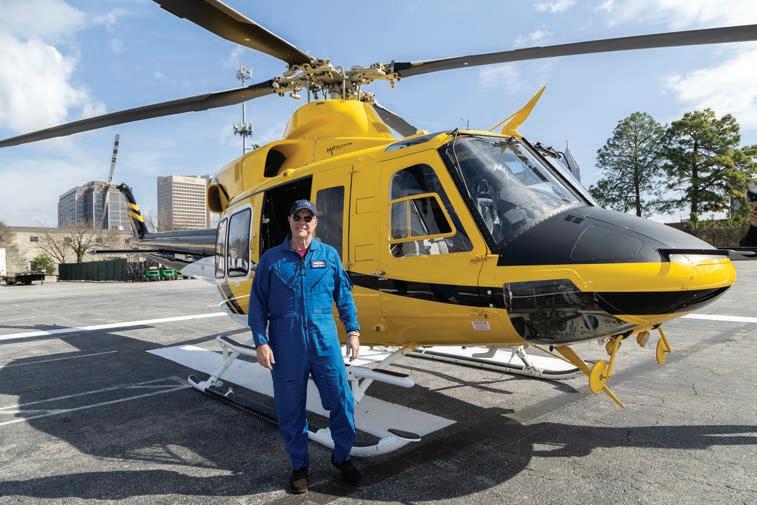
Vertical Aviation International president and CEO François Lassale flew this Bell 412 EPX to Verticon.
Leonardo’s production AW09 leading flight-test program
By Charlotte Bailey and Matt Thurber
Progress on the Leonardo AW09 single-engine helicopter continues. The aircraft started life as the Marenco Swisshelicopter SKYe SH09 and then Kopter SH09 before Leonardo purchased the program in 2020 and renamed it the AW09.
Although the OEM had hoped for EASA certification last year, this was hindered by a five-month pause in flight-test activity from late 2024 due to gearbox issues.
In August, Leonardo reported that the program had taken a significant step forward with the first serial-production copy, S6, taking to the skies from the final assembly line facility in Varese, Italy. Leonardo has since shared that the campaign has been “demonstrating strong progress toward certification” with flight testing on the pre-series prototypes PS4 and PS5 continuing.
PS4 is conducting engine and performance testing after having opened the flight envelope and completed all handling qualities certification flight tests. PS5 “further expanded the flight envelope in altitude and temperature, and it is now completing the flight load and
vibration survey activity, which represent a significant part of the certification test program,” the company said.
“In the coming weeks, PS5 will also complete avionics testing and, most importantly, start the ‘avoid curve’ test campaign, the last test activity to be performed ahead of type certification,” it added.
As the first production helicopter, S6 is undergoing function and reliability testing, “flying different mission profiles representative of end customer operations, as well as to validate the human-machine interface.”
Total flight-test hours of all the AW09 prototypes and S6 exceed 1,000, with more than 500 hours accumulated on PS4, PS5, and S6. Most of the key laboratory tests for the AW09 program have also been completed.
The helicopter’s basic configuration is complete, and all hardware and software have been established and integrated. Leonardo will later develop some specific mission configurations that require additional equipment and systems.
“All the Leonardo and Kopter teams are fully engaged as we advance through the AW09 certification campaign,” said Marco
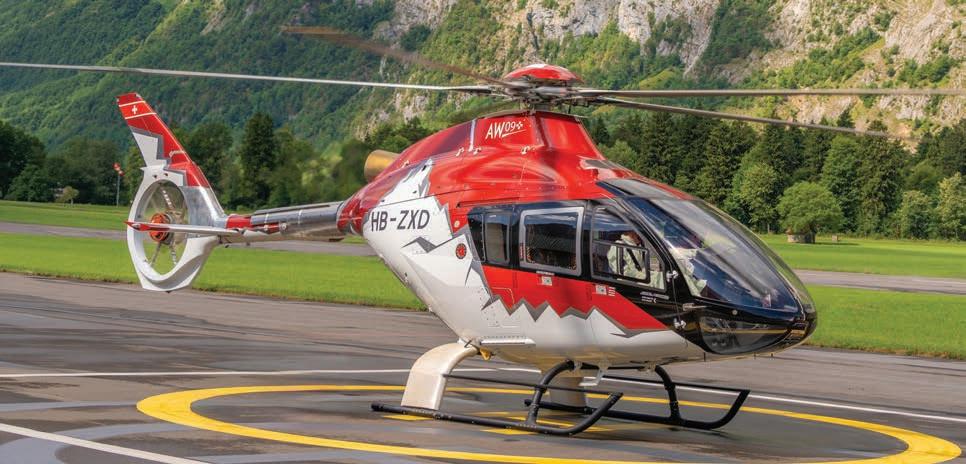
PS4, one of Leonardo’s pre-series prototype AW09s, was used for handling qualities certification testing and opening up the flight envelope. Two prototypes, PS4 and PS5, and the first production unit S6, have logged more than 500 hours.
Viola, CEO of Leonardo’s Kopter Group. “We are performing extensive test activities, while S6 now plays a central role in validating the maturity of the design.”
Leonardo describes the eight-passenger AW09 as the “first all-new design in its weight class for more than 30 years,” adding that its flexible cabin layout helps equip it to perform multiple missions across different applications. The OEM added that it is the only light single helicopter to feature a “native connected aircraft” concept that enables seamless and automatic download of data at the end of each flight, together with advanced flight tracking capability.”
With a composite airframe and shrouded tail rotor, the AW09 features a flat floor, high-ceiling cabin for maximum loading flexibility, and eight individual crashworthy passenger seats. Stretchers can be loaded via unobstructed rear access.
Avionics feature a Garmin G3000H suite. Performance capabilities include a range of 432 nm, cruise speed up to 140 knots, and external load capacity of 3,300 pounds.
The Safran Arriel 2K-powered helicopter has already garnered around 130 preliminary sales contracts.
Direct plating simplifies rotor blade complexity
By Charles Alcock
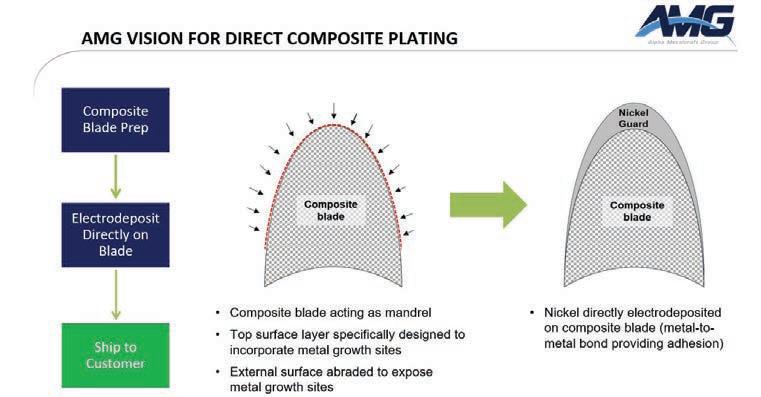
Alpha Metalcraft Group (AMG) believes it can reduce the cost and complexity of specialist manufacturing tasks such as applying the leadingedge guards that prolong the service life of carbon-fiber rotary blades. The company is working with OEMs, including developers of eVTOL aircraft, to introduce an electroplating process in which nickel is directly deposited on composite surfaces rather than making the guards separately and then fitting them to the blades.
The current process involves expensive stainless steel mandrel forms for shaping the nickel abrasion guards. This approach is also time-consuming, with five separate steps plus two or more transportation stages to get the finished items installed on the blades.
Mandrels produced to duplicate the shape of the rotorblade can cost up to $100,000 apiece. According to AMG engineering director Luigi Cazzaniga, as many as 80 mandrels might be needed for various parts of an eVTOL and, in his view, some of the advanced air mobility sector start-ups have not yet fully considered this or other aspects of preparations for high-volume manufacturing.
“By moving to direct composite plating, we can make the trailing edge as thin as we like,
which will also mean weight savings for the aircraft,” Cazzaniga explained. “The ability to directly plate a nickel substrate onto a carbonfiber composite structure eliminates the need for multiple assembly processes and can lower overall manufacturing costs.”
With proof-of-concept engineering work now complete, AMG is partnering with M4 Engineering to make composite panels onto which metal layers that could include lightning-strike protection can be electro-deposited. The external surface can be exposed by abrasion techniques, with the nickel and copper layers bonded and embedded into the composites. Essentially, the composite blade acts as its own mandrel.
By April, the Connecticut-based company expects to be ready to take the next step with a manufacturing partnership. AMG is open to business models that could include licensed manufacturing or establishing facilities close to aircraft OEMs. With certification issues still to be resolved, Cazzaniga estimated that it could take another 12 to 18 months to achieve full-scale production for the new process.
AMG’s engineering team has conducted strength tests on various direct plating samples to identify specific failure points. This work has led the company to improve the surface abrasion process. z
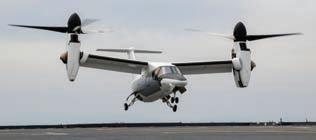
Leonardo: AW609 tiltrotor to enter service in 2027
As the AW609 continues type inspection authorization activities with regulators, Leonardo is targeting entry into service of the civil tiltrotor in 2027. “We will soon start maturity assessment activities to explore the use of the aircraft in operational contexts” such as civilian, public service, and government operations, the Italian OEM said. This includes market promotion and demo flights for potential customers and other users.
Tiltrotors fall under the FAA’s poweredlift category, a regime that aircraft such as the AW609 will have to meet. This represents, Leonardo said, “an all-new regulatory framework also including the stringent requirements typically set in the civil sector. This is unprecedented in the industry and requires time and multiple reviews before each step ahead is taken, [then] moving to the next stage of development, testing, and assessment. It is always worth noting this is not just an industry e ort, it’s a shared e ort involving other players, especially the FAA.”
The rotorcraft’s basic configuration is complete, and all main and core hardware and software are “firmly established and integrated.” Leonardo later plans to develop specific mission configurations that will require additional equipment and systems.
Leonardo believes the most promising civil market for the AW609 is for passenger transport and VIP travel “at the early stage of operational activities. The government market has shown growing interest,” it added. M.T.
AW609 tiltrotor
Alpha Metalcraft’s plating system deposits nickel directly on composite surfaces.
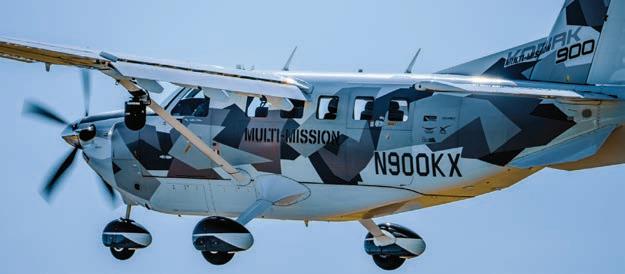
Daher’s Kodiak 900 multi-mission aircraft can complement helicopters in law enforcement operations by providing longendurance surveillance.
Daher Kodiaks fill public safety air missions
By Amy Wilder
Daher Aircraft is making its debut as an exhibitor at Verticon 2026 this week, promoting its Kodiak 100 and 900 turboprops as complements to rotorcraft fleets for law enforcement and public safety agencies. Notably, the company is showcasing the turboprops’ ability to extend mission capabilities while lowering costs for helicopter-focused organizations.
“As agencies increasingly seek greater endurance, along with extended coverage and more adaptable missions, the Kodiak 100 and 900 offer compelling solutions with their persistent surveillance capabilities,” said Daher Aircraft CEO Nicolas Chabbert.
Daher acquired the Kodiak line in 2019 and has since introduced the Kodiak 100 Series III and the larger Kodiak 900. The company developed in-house systems integration capabilities for the multi-mission market, which
continued from page 1
Eve’s efforts to develop an advanced air mobility ecosystem also include its Vector software, providing air traffic management systems for urban eVTOL operations. The group is working with ground infrastructure partners, including the Signature Aviation and Atlantic Aviation FBO chains.
“We are now working to build the business case [for the Eve-100], planning initial routes and establishing load factors needed for high-volume urban transportation, with
now accounts for one-third of Kodiak sales.
The Kodiak 900 multi-mission aircraft (MMA) can mount a sensor turret up to 15 inches on the wing strut. Daher tested the configuration during a law enforcement agency briefing in the Western U.S., and the aircraft supported two felony arrests on the same day.
According to Daher, the Kodiaks can remain aloft for seven to eight hours, or up to 9.5 hours in some configurations, far exceeding typical helicopters. Performing well at speeds between 85 and 110 knots, the turboprops turn tightly and provide a steady observation platform suitable for pilots with varying experience levels.
Direct operating expenses average around $400 per hour, including fuel, though some Part 91 maintenance approaches can reduce that figure. Daher said this represents a substantial savings compared with helicopter hourly costs. z
multiple point-to-point hops,” Bhatia explained. At Verticon, Eve announced a collaboration with Australia’s Alt Air, a partner of Skyports Infrastructure, to develop vertiports in Sydney and Palm Beach. The agreement covers codevelopment of infrastructure, route planning, airspace integration, ground operations, and customer experience. The partners will also study routes between population centers, commercial districts, and tourism hubs in Sydney, South East Queensland, and surrounding regions. z
VAI CONVENTION NEWS
JAMES HOLAHAN (1921-2015), FOUNDING EDITOR
WILSON S. LEACH, FOUNDER & CHAIR EMERITUS
EDITOR-IN-CHIEF – Matt Thurber
MANAGING EDITOR – Charles Alcock
PRESS ROOM EDITOR – Jessica Reed
THE EDITORIAL TEAM
Charlotte Bailey Curt Epstein
Kerry Lynch
Chad Trautvetter Hanneke Weitering Amy Wilder
PRODUCTION MANAGER – Martha Jercinovich
GRAPHIC DESIGNER – Grzegorz Rzekos
PHOTOGRAPHER – Mariano Rosales
DIRECTOR OF VIDEO – Ian Whelan
EXECUTIVE CHAIR – Dave Leach
PRESIDENT – Ruben Kempeneer
HEAD OF PEOPLE & BRAND – Jennifer Leach English
SENIOR DIRECTOR, INDUSTRY AFFAIRS AND EVENTS – Nancy O’Brien
ADVERTISING SALES
Victoria Tod – Northeastern U.S./Eastern Canada/United Kingdom, +1 (203) 733-4184
Michelle James – Western U.S./Western Canada, +1 (520) 343-0236
Henry Specht – Midwestern U.S., Southeastern U.S./ Caribbean/Brazil, +1 (201) 444-5075
Diana Scogna – Europe/Middle East, +33 6 62 52 25 47
DIRECTOR OF MARKETING AND CLIENT SERVICES – Lisa Valladares
AUDIENCE DEVELOPMENT DIRECTOR – Eileen Silberfeld
MARKETING SPECIALIST – Alyssa Barry
SOCIAL MEDIA MARKETING – Zach O’Brien
SALES ADMINISTRATOR – Cindy Nesline
MANAGER OF FINANCE & HUMAN RESOURCES – Tracy Britton
ACCOUNTS PAYABLE – Mary Avella
ACCOUNTS RECEIVABLE – Bobbie Bing
U.S. HEADQUARTERS: 214 Franklin Ave., Midland Park, NJ 07432, +1 (201) 444-5075
Advertising Inquiries: +1 (201) 345-0085, adsales@ainonline.com
Circulation Inquiries: +1 (201) 345-0085 subscriptions@ainonline.com
WASHINGTON, D.C. EDITORIAL OFFICE: Kerry Lynch (business aviation) – klynch@ainonline.com +1 (703) 969-9195
EUROPEAN EDITORIAL OFFICE: Charles Alcock – calcock@ainonline.com, Tel: +44 7799 907595
VAI Convention News is a publication of the AIN Media Group, Inc., 214 Franklin Ave., Midland Park, NJ 07432; Tel.: +1 (201) 444-5075. Copyright ©2026 All rights reserved. Reproduction in whole or in part without permission of AIN Media Group, Inc. is strictly prohibited. AIN Media Group, Inc. publishes Aviation International News, AINonline.com, AINalerts, AircraftPost.com BJTonline.com, BJTwaypoints, Dubai Airshow News, EBACE Convention News, Farnborough Airshow News, FutureFlight newsletter, Leeham News and Analysis, MEBAA Convention News, NBAA Convention News, Paris Airshow News, Singapore Airshow News
Printed by Bennett Graphics, Tucker, Geogia
VAI 2026 Salute to Excellence Awards Recognize Top Performers




By Jessica Reed
Vertical Aviation International (VAI) is recognizing 10 individuals in the rotorcraft industry with its Salute to Excellence Awards for 2026. “This year’s honorees represent the discipline, judgment, and consistency that define toptier operations,” said VAI president and CEO François Lassale.
FAA aviation safety coordinator Lee Roskop was chosen for the Harold Summers Legacy Award, sponsored by VAI. Roskop, formerly a helicopter pilot with the U.S. Air Force, now leads rotorcraft safety analytics at the FAA. He works with industry partners such as the U.S. Helicopter Safety Team and contributes significantly to the FAA Rotorcraft Accident Dashboard.
The 2026 Matthew S. Zuccaro Land & LIVE Award goes to the U.S. Coast Guard Air Station Savannah (Georgia) crew of CG-6561, recognizing them for their remarkable decision-making and coordination on a mission during a severe storm with heavy rain and lightning. Commanders McClain G. “Mac” Isom and Zachery Geyer took off in 40- to 50-knot winds, hoping to reach a distressed mariner. An emergency beach landing and multiple relocations were necessitated, guided by flight mechanic Glenn Bratlie and rescue swimmer Nicholas Barnes
Brian Atkinson and Brian Dunn of Coldstream Helicopters are recognized with the Pilots of the Year Award for “decisive



airmanship” while on a firefighting mission for Ontario, Canada’s Ministry of Natural Resources. When an electrical failure cut power and disabled cockpit communications, the crew manually released the bucket with 7,000 pounds of water and was able to regain control of the Airbus Helicopters Super Puma in less than 30 seconds.
Irina Sakgaev, applications manager at CHC Helicopter, takes the Safety Award for promoting safety education and awareness for rotorcraft operations at her company. Leader of the CHC Safety and Quality Summit since 2006, Sakgaev organizes 35 to 40 speakers and as many as 100 workshops for the annual forum.
Pete Gillies was selected for the Lifetime Achievement Award in recognition of his skill in piloting rotorcraft, as well as innovation and instruction. He spent many years as a Western Helicopters pilot and ultimately chief pilot, and continues teaching at the age of 93.
The 2026 Communications Award goes to Bruce Webb and the Airbus Helicopters Aviation Education and Community Outreach Team, based in Grand Prairie, Texas, who redefined “how an OEM advances safety through communications,” VAI stated. Webb joined Airbus (then Eurocopter) in 1999 and served 16 years as chief pilot before becoming director of aviation education and community outreach. The team transitioned to digital media after the Covid-19 pandemic limited in-person training.

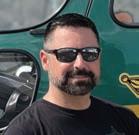
Tom Luca Schneider is the recipient of the W.A. “Dub” Blessing Flight Instructor of the Year Award. After creating “back-to-basics” videos explaining U.S. operations and procedures to pilots, he was recruited to develop and present helicopter pilot safety webinars for the FAA Safety Team.
The Humanitarian Service Award this year recognizes Operation Helo and its use of rotorcraft to provide post-disaster aid. More than 100 aircraft were part of the volunteer network that responded after Hurricane Helene in the southeastern U.S. in 2024. Another major deployment followed floods in Texas eight months ago.
Deputy Nicholas Romano with the Broward Sheriff ’s Office in Fort Lauderdale, Florida, has received the Law Enforcement Award based on his leadership in drone operations for promoting public safety. He has piloted drones for almost 10 years and trains others to operate remote-piloted systems.
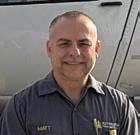
The Maintenance Award has been presented to Matt Pagano, senior mechanic for the Riverside Police Department Air Support Unit in Riverside, California. Pagano joined the unit in 2003 and is now the sole mechanic for its two Airbus H125 helicopters. He is recognized for providing excellent rotorcraft maintenance amid demanding conditions, as well as prioritizing clear communications between pilots and mechanics to protect missions and crews. z
Lee Roskop Nicholas Barnes
McClain G. “Mac” Isom
Brian Atkinson and Brian Dunn Zachery Geyer
Irina Sakgaev Pete Gillies Bruce Webb Tom Luca Schneider Nicholas Romano Matt Pagano
Glenn Bratlie
Single [R]evolution
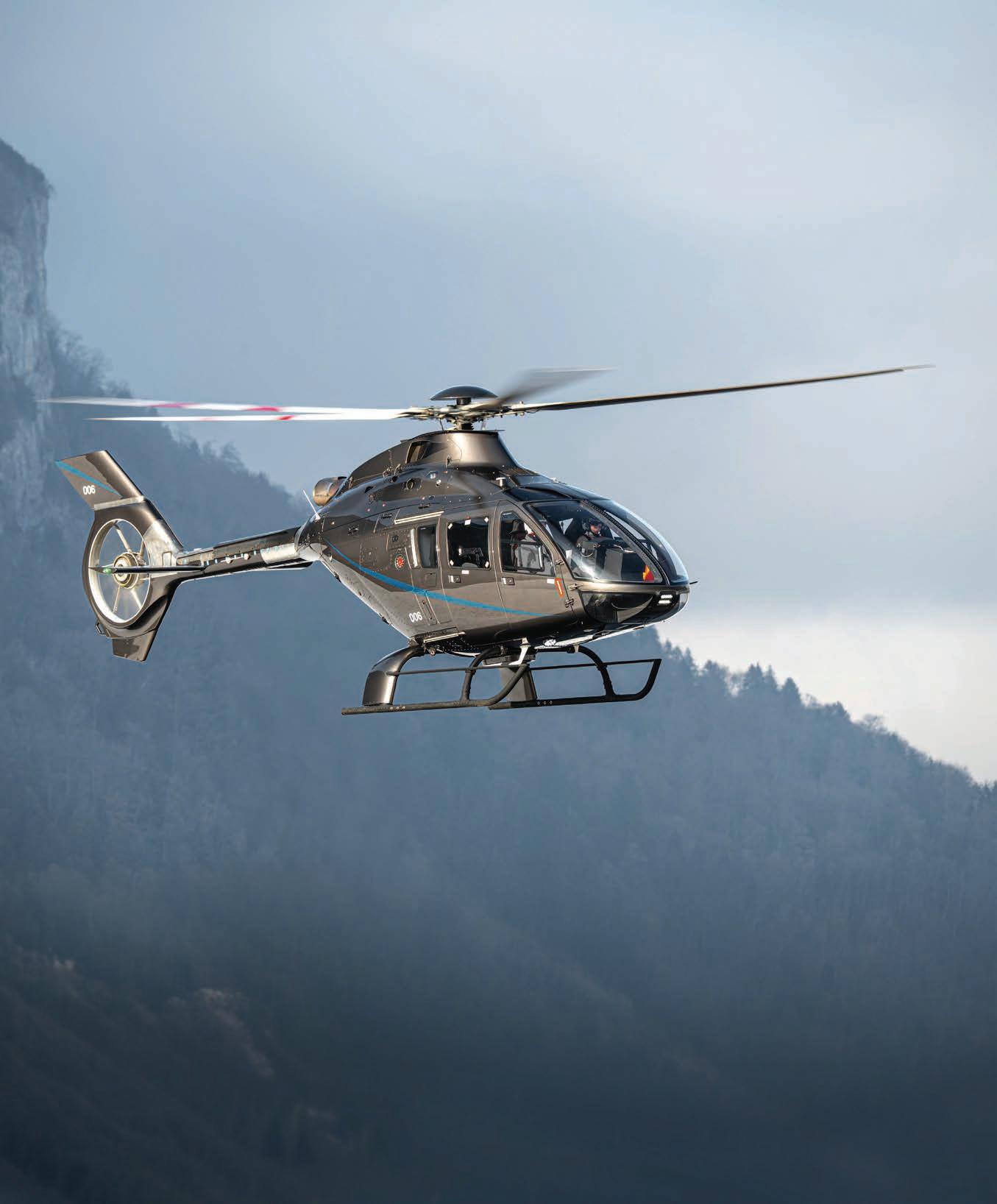
Leonardo offers a wide range of rotorcraft solutions for operators around the globe. The AW09 is the next-generation single-engine helicopter designed for versatility. With spacious seating for up to eight, it is well suited for passenger transport while easily adapting to medical and law enforcement missions. Advanced technology and cutting-edge safety features ensure operators can go farther and achieve more, no matter the mission.
Visit us at VERTICON, Stand B9707.