Unparalleled maintenance. It takes dedication, a sense of urgency and another million square ft of infrastructure.
We are expanding our infrastructure to increase our presence around the world, to always have room for you.
SINGAPORE AIRSHOW NEWS
More than 1,000 companies gathered at the 2026 Singapore Airshow.
AIRX DREAMS OF ELECTRIC EVES
By Chad Trautvetter
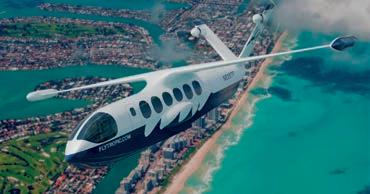
Tokyo-based air charter broker AirX placed a firm order for two Eve Air Mobility eVTOL aircraft and options for 48 more—a deal potentially worth $150 million (at estimated list prices of $3 million per aircraft)—yesterday at the Singapore Airshow. AirX will use the electric aircraft mainly for transfer and sightseeing flights in Japan, with a focus on the Osaka Bay area. Its first two eVTOLs are expected to be delivered in 2029.
AirX has been arranging these types of flights throughout Japan in helicopters, flown by partner companies holding air operator certificates, for nearly 11 years via its Airos Skyview online booking platform. Bookings at the company are evenly split between transfer and sightseeing flights. An app planned for launch in the second quarter will provide a more seamless
interface that would better facilitate ad-hoc advanced air mobility (AAM) bookings, AirX founder and CEO Kiwamu Tezuka told AIN
According to AirX supply innovation procurement specialist Masato Kikuchi, plans call for the company to lease the Eve eVTOLs to partner operators that will fly them.
AAM service with the four- to six-passenger electric aircraft is set to begin in the Tokyo metropolitan area within the next five years, dependent on when it obtains certification, he noted.
Asked how much AAM flights would cost on an Eve aircraft, Tezuka said he and his team “are trying to figure that out right now.” However, he noted that demand is there: “We already get lots of requests for transfer flights using helicopters.”
continues on page 22
OEMS China Solution Comac’s C909s are slated to serve as capable firefighting aircraft. | 06
FUEL
Tanker Time
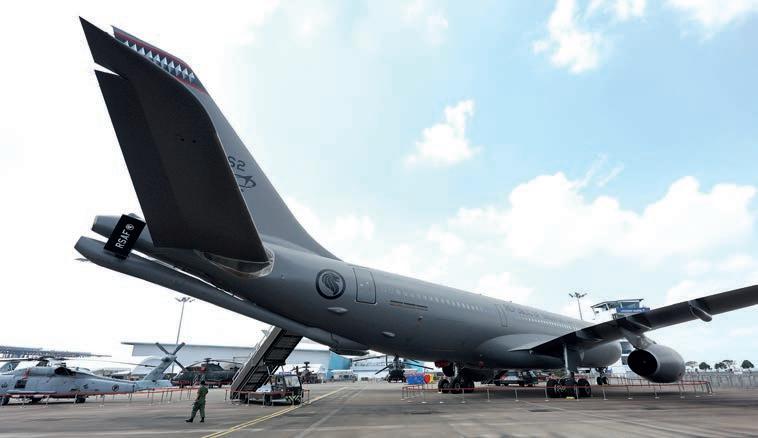
Airbus’ A330 MRTT is now certified to automatically refuel other aircraft. | 12
AUTONOMY
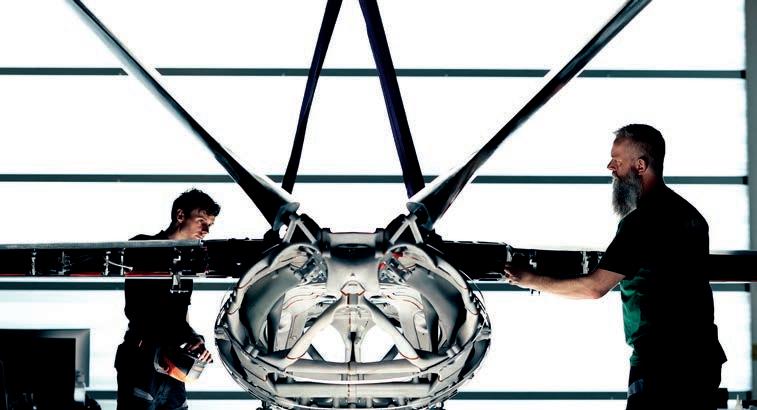
Digital Design Saab is deploying 3D printing to build a software-defined AAV fuselage. | 13
MODIFICATION
Special Mission
IAI’s ‘Ellyon’ is a Gulfstream G600 modified for government duties. | 21 alerts
Tigerair pounces on Airbus A321neo deal
By Charles Alcock
Tigerair Taiwan has signed a purchase agreement with Airbus for four A321neo narrowbodies. The deal signed yesterday at the Singapore Airshow is intended to support the carrier’s network expansion and improve the fuel efficiency of its fleet.
The low-cost carrier operates 17 A320 family twinjets, including nine A320ceos and eight A320neos. In addition to domestic routes, Tigerair operates services to Japan, South Korea, Thailand, and Vietnam.
“The purchase of A321neo aircraft is a cornerstone of our ‘third-generation’ fleet expansion, designed to maximize operational e ffi ciency as we scale for regional dominance,” said Tigerair chairperson Joyce Huang. “Configured with 232 seats, the A321neo allows us to increase capacity on our high-demand ‘golden routes’ and accelerate network expansion. By serving more passengers across more destinations with a lower cost per seat, this investment reinforces our position as Taiwan’s leading lowcost carrier.”
Bell 505 breaks into South Korean firefighting market
South Korean helicopter operator EnB Air signed an order with Bell Textron for a Bell 505 dedicated to initial-attack firefighting missions yesterday at the Singapore Airshow. This marks the light-single helicopter’s first commercial sale in South Korea, and expands its growing role in aerial firefighting worldwide. Also at the show, Nakanihon Air inked a deal with Bell Textron for a pair of 412 medium twins to support helicopter emergency medical services.
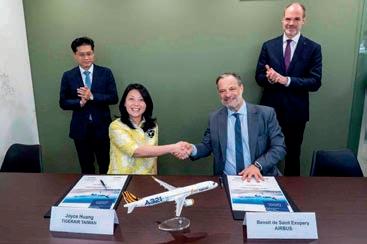
Tigerair Taiwan chairperson Joyce Huang (left) and Benoît de Saint-Exupéry, Airbus EVP of sales for commercial aircraft, signed the contract.
According to Airbus, the airline could achieve significant savings in training, maintenance, and operations costs by opting for an all-A320 family fleet. The A320neo program is now backed by more than 10,000 orders from 130 customers worldwide. At list prices, the deal with Tigerair is valued at around $576 million. z
Vietjet opts for Pratt & Whitney power
Vietjet has confirmed the selection of Pratt & Whitney’s Geared Turbofan (GTF) engines to power 44 A320neo airliners, which it will start adding to its fleet from July 2026. The agreement signed yesterday at the Singapore Airshow also covers a 12-year EngineWise comprehensive maintenance plan.
The 24 A321neos and 20 A321XLRs are part of a 100-ship firm order that Vietjet placed with Airbus in October 2025. This brought the total order commitment for the A321 to 280 aircraft and followed a May 2025 deal covering 20 of the larger A330neos.
As Vietnam’s largest privately owned airline, the carrier operates from its base in Ho Chi Minh. It ordered its first A321s in 2018 and has a fleet of 42 GTF-powered A321neos.
“The GTF engine is powering our growth with industry-leading operating economics and fuel e ciency of up to 20% [verses earlier aircraft],” said Vietjet managing director Nguyen Thanh Son. “We continue to trust in the long-term, comprehensive, and responsible partnership with Pratt & Whitney.” C.A.
South Korea opts to upgrade ‘SLAM Eagles’
By David Donald
Boeing will upgrade the 59 surviving F-15K Eagles operated by the Republic of Korea Air Force (ROKAF). A sole-source, hybrid foreign military sales/direct commercial sale contract worth $2.8 billion has been awarded by South Korea’s Defense Acquisition Program Administration (DAPA) as part of a wider ROKAF modernization drive.
Initiated in 2022, the F-15K+ update program received U.S. foreign military sales approval in November 2024. The contract was announced by the U.S. Department of Defense on January 30, and the program is expected to run for 11 years.
Under the deal, Boeing will design the upgrade and supply equipment, but the majority of the physical upgrade work will be performed in Korea by local partners. A cockpit upgrade is part of the modernization, which will feature a new electronic warfare suite, AESA radar, and an updated mission computer.
Korea acquired 61 F-15Ks, the first 40 of which were powered by the General Electric F110 engine, while the final batch of 21 featured Pratt & Whitney F100s. They are stationed at Daegu Air Base with three squadrons. The first was delivered in 2005.
The F-15K is known as the “SLAM Eagle” on account of its ability to carry the AGM-84K
Standoff Land Attack Missile-Extended Range (SLAM-ER), a derivative of the AGM-84 Harpoon anti-ship missile that also figures in the F-15K’s arsenal. The ability to carry such heavy weapons, including the Taurus KEPD 350 cruise missile, was a key factor in the decision to upgrade the Eagles. The ROKAF’s other fighter types—the F-35, upgraded F-16V, and forthcoming KF-21—are not well-suited to long-range missions with heavy weapons.
In the meantime, Japan is pursuing a major upgrade for 96 of its younger aircraft to the Japanese Super Interceptor standard with APG-82(V)1 AESA radar and many other enhancements. Singapore, the third regional user, has a relatively young fleet of GE-powered F-15SGs that was purchased with a high level of advanced equipment. Until the arrival of the F-35, the F-15SG remains the Republic of Singapore Air Force’s most potent fighter asset.
However, the prospect of Indonesia joining the ranks of Asia-Pacific Eagle users is now bleak, with Boeing declaring in Singapore on Tuesday that it was “no longer an active campaign.” Indonesia had formally committed in 2023 to buying up to 24 F-15INDs, a version of the F-15EX Eagle II currently in production for the U.S. Air Force. The deal has subsequently shown no signs of concrete progress, while Indonesia placed firm orders with Dassault for the Rafale. z
CAE offers Singapore helicopter training
In the coming days, training systems integrator CAE will submit its proposal for a rotary-wing training requirement raised by the Singapore Ministry of Defence. A manufacturer of flight simulators and training provider, CAE has expanded its o er to provide complete training systems. Although details of the Singapore proposal remain commercially sensitive, the company’s bid draws on recent similar contracts in other Asia-Pacific nations.
A multi-purpose helicopter training center has been established in Brunei, primarily to support the military’s Sikorsky S-70 Black Hawks and Sikorsky S-92s used in the o shore oil industry. The center has also been used by the Philippine Air Force as part of its pre-acquisition evaluation of the Black Hawk.
In Australia, where CAE’s Asia-Pacific headquarters is located, the company landed a 10-year, AUD$300 million ($200 million) contract to provide the Project AIR5428 Phase 3/Future Air Mission Training System (F-AMTS).
Located at the Royal Australian Air Force’s Base East Sale in Victoria, and due to become operational by 2028, the F-AMTS will train non-pilot aircrew, such as operators of the E-7 Wedgetail AEW platform and the P-8 Poseidon maritime patrol aircraft, and weapon systems ocers for the F/A-18F fighter and the EA-18 electronic warfare platform. D.D.
DAVID M c INTOSH
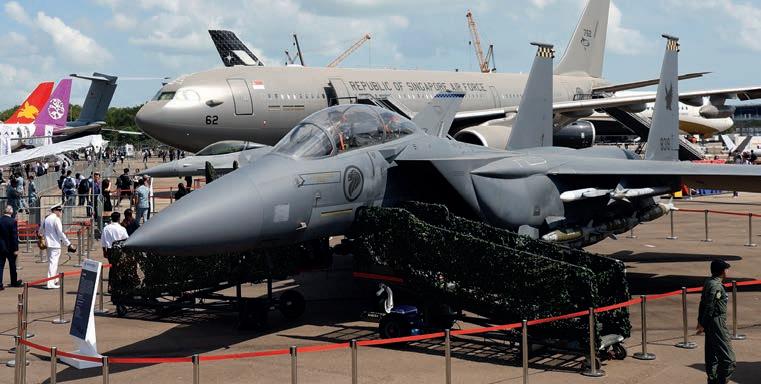
A Singapore Air Force F-15SG.
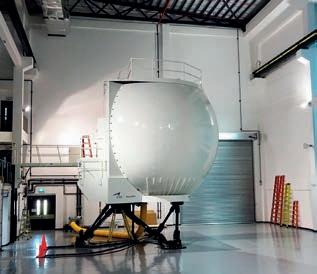
A 3000-series simulator for the S-70 Black Hawk is part of the training center.
Flying fish to soar in Singapore waters
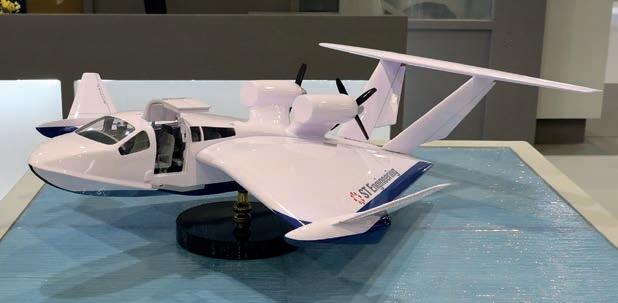
A miniature model of the ST Engineering AirFish wing-inground-effect vessel is on display at the Singapore Airshow.
By Charlotte Bailey
ST Engineering AirX’s wing-in-ground-effect (WIG) craft, the AirFish Voyager, is on track to enter service later this year with Singaporean ferry operator BatamFast. The start of commercial operations is subject to International Maritime Organization certification of the vessel, which AirX—a joint venture between ST Engineering and Peluca (formerly Wigetworks)—expects to obtain in mid-2026.
Regional ferry operator BatamFast will lease and operate one 10-seat AirFish to service an
initial route between Singapore and Indonesia’s Batam, set to commence in the second half of this year. Additional routes within Southeast Asia will follow. BatamFast general manager Chua Choon Leng said he believes that the adoption of the WIG craft will allow the company to extend “its reach and impact across coastal communities and beyond.”
With the first harbor and flight tests set to commence in the coming months, AirX is confident that its vessel is optimized for island-hopping, offering a smoother ride at three or four times the speed of conventional ferries. Alongside tourism, the company says that other
missions could include logistics and surveillance in littoral waters. Target annual production rates will start at six to 12 units before rising to 36, depending on market uptake, according to AirX.
Meanwhile, Wings Over Water Ferries intends to purchase four AirFish maritime vessels to operate in India from late 2026, subject to local regulatory approval. Initial use cases will focus on “high-demand coastal states and sectors with strong tourism, commuter, and regional connectivity potential,” according to AirX. The partners will also explore local assembly, manufacturing, training, and maintenance opportunities in India. z
India’s Mehair orders hybrid seaplane
By Charles Alcock
Indian seaplane operator Maritime Energy Heli Air Services (Mehair) plans to operate the hybrid-electric Polaris model being developed by U.S. start-up Tidal Flight. The companies signed a deal at the Singapore Airshow on Wednesday covering five firm orders and five options for the 9- to 12-passenger aircraft, which has a range of 1,000 nm.
According to Virginia-based Tidal Flight, deliveries of the Polaris will start from 2030 with a list price of around $6 million. The aircraft has attracted 12 purchase agreements potentially covering 150 orders.
Tidal Flight is now building a full-scale powertrain and iron bird for ground testing. Having raised $4 million in seed funding and won a $1.25 million U.S. Air Force contract, the company aims to fly a full-scale prototype in 2028.
Mumbai-based Mehair intends to deploy the Polaris for regional air services to remote communities along the country’s coastline, inland waterways, and islands. The operator, which has been in business since 2011, has been awarded 92 seaplane routes through India’s UDAN regional connectivity program.
Tidal Flight is one of several companies seeking to develop a new generation of hybridand all-electric seaplanes and wing-in-groundeffect vessels. Others include Elfly in Norway, Swiss-based Jekta, and Regent Craft in the U.S.
In 2023, Mehair, which operates a fleet of Cessna Caravan 208 floatplanes, signed a deal for up to 50 of Jekta’s PHA-ZE 100 amphibious aircraft. In 2024, it placed a conditional order for hydrogen-electric Caravans retrofitted by ZeroAvia. It has also expressed interest in a hydrogen-powered VTOL aircraft being developed by Switzerland’s Sirius Aviation.
“This LOI is a strategic milestone in Mehair’s long-term vision to not only operate seaplanes in India, but to help build a sustainable, futureready ecosystem around water-based aviation,” said Mehair managing director Siddharth Verma. “The Polaris platform aligns strongly with our objective of unlocking new regional markets, dramatically reducing travel times, and enabling safe, efficient, and environmentally responsible connectivity across India’s vast maritime and inland geography.” z
Tidal Flight’s Polaris hybrid-electric seaplane.
Comac sells six firefighting C909s
By Charlotte Bailey
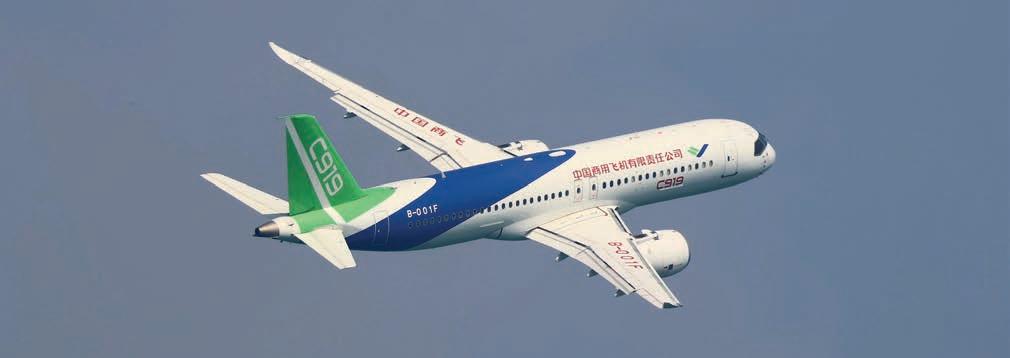
Comac has signed a letter of intent with Shanxi Victory General Aviation for six newly-certified C909 firefighting jets. The deal includes three firm orders and indications of intent for another three.
Capable of carrying 10 tonnes of water or fire retardant plus 19 passengers, the modified C909 variant received regulatory approval from the Civil Aviation Authority of China
last December. Firefighting missions will benefit from the aircraft’s 2,000-nm range and its ability to operate from high-altitude, high-temperature environments and narrow runways.
In commercial passenger service, the C909’s cabin can seat 78 to 97 passengers. So far, Comac has delivered more than 200 aircraft, including a mix of C909 regional jets and larger C919 narrowbodies. Comac said it is “setting its sights on the Southeast Asian
Entrol to deliver mission-ready Airbus H145 simulator to New Zealand’s GCH Aviation
Madrid-based flight simulator manufacturer Entrol is poised to deliver a level-5 Airbus H145 flight training device to New Zealand aeromedical operator GCH Aviation. The helicopter simulator has completed the factory acceptance test, clearing the way for installation at the operator’s Christchurch International Airport (NZCH) headquarters by the end of next month.
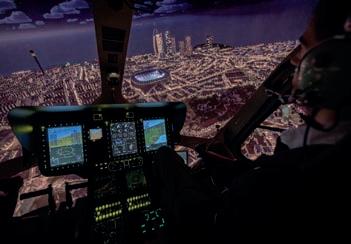
According to Entrol, the device features the company’s Enwall Complete LED visual system to provide pilots-in-training with an immersive experience. This includes LED panels on the floor that allow pilots to maintain visual contact
with the ground or the hoist area—a critical factor for helicopter operations, said Entrol.
The visual environment is powered by Entrol’s Unreal Engine-based Envision system. Its database includes nine generic airports and heliports with 3D buildings and a realistic environment, as well as a specific heliport designed with precise 3D objects to simulate real-world operational challenges.
In addition, it is equipped with a mixedreality hoist station and a vibration system, making the device “one of the most mission-ready configurations delivered by Entrol.” This station enables coordinated pilot
Shanxi Victory General Aviation is buying Comac’s C909 configured for firefighting duties, with a firm order for three.
aviation market,” with the C909 operational in commercial service in countries including Indonesia, Laos, and Vietnam.
Furthermore, Comac believes its sustained development of new aircraft variants—such as the reconfigurable C909 medical rescue aircraft on display at the Singapore Airshow—will “better meet the needs of customers in Southeast Asia and worldwide with diversified aircraft products and a customer support network.” z
and crewmember training at the same time, mirroring real-world operating conditions.
GCH Aviation plans to use the simulator to enhance its pilot training capabilities, focusing on operational safety, IFR proficiency, and specialized air ambulance mission readiness. C.T.
Entrol’s flight simulator will include a mixedreality hoist station and vibration system.
ENHANCE YOUR BRAND AND INFLUENCE KEY BUYERS
WITH AIN CONVENTION & AIRSHOW NEWS
For over 50 years, AIN has provided market-leading coverage of the most important airshows and conventions across the globe. Drive awareness and consideration with a 360-degree marketing plan including print (where available), newsletters, video, social and digital. Custom content opportunities are also available across all of our platforms.
Learn more at: marketing.ainonline.com/airshows-conventions
Embraer tie-up aims for ‘Make in India’ airliners
By Charles Alcock
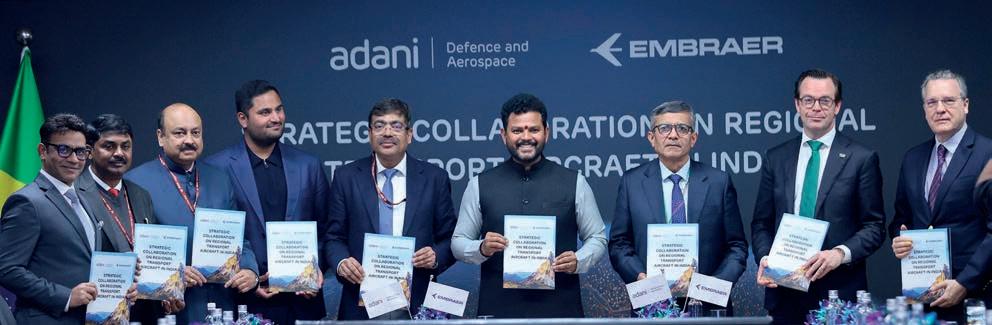
Embraer and Adani Defence & Aerospace are teaming to develop regional air services in India. The Brazilian airframer signed a memorandum of understanding on January 27 to launch a partnership that will focus on possible local manufacturing of airliners, as well as supply chain support, aftermarket services, and pilot training.
The announcement did not specify when or how Indian manufacturing might begin, but indicated that an assembly line could be established. The partnership was described as being part of the “indigenization” goals of the Indian government’s Regional Transport Aircraft program, but did not explicitly confirm which Embraer aircraft programs.
To date, Embraer has made limited inroads into the Indian air transport sector with Star Air operating a fleet of 13 E175s and ERJ145s. The country’s air force operates the Legacy 600 business jet and the Netra airborne early warning and control platform, both based on the ERJ145.
The loose agreement is intended to signal support for the government’s Atmanirbhar Bharat Self-Reliant India policy. Adani and Embraer said they aim to support domestic air transport demand while generating significant direct and indirect employment across engineering, manufacturing, logistics, and support services.
“Regional aviation is the backbone of economic expansion,” said Adani Defence & Aerospace director Jeet Adani. “With initiatives like UDAN transforming air connectivity across Tier 2 and Tier 3 cities, the need for an indigenous regional aviation ecosystem has become critical. This partnership will also strengthen strategic relations between India and Brazil, bringing complementary capabilities together.”
Ahmedabad-based Adani is a private defense and aerospace group seeking to expand its portfolio beyond drones. It is also active in maintenance, repair, and
Executives from Embraer and Adani Defense & Aerospace celebrate an agreement signed in late January that could see airliners assembled in India for the domestic market.
overhaul, as well as pilot training, weapons, and avionics.
The only other private aircraft manufacturer in India is Tata Advanced Systems, which is involved with Airbus’ C295 twin turboprop military transport and has production ambitions for commercial airliners. Last week, government-backed Hindustan Aeronautics announced plans to partner with Russia’s United Aircraft for local manufacturing of the SJ100 regional jet.
According to industrial intelligence group GlobalData, the Adani-Embraer agreement represents a “pragmatic e ff ort” to launch export-ready aerospace manufacturing in India. “While domestic demand is robust, the longer-term opportunity lies in building certified production processes and a deep supplier base that can support Embraer programs globally,” said aerospace and defense analyst Vinayak Kamath. z
Leonardo inks deal with Adani to establish helicopter assembly facility in India
Adani Defence & Aerospace, an Indian integrated private company, has signed a memorandum of understanding with Leonardo to establish a helicopter manufacturing ecosystem in India to prepare for an expected surge in military rotary-wing demand and a drive for self-reliance in helicopter production.
Under the agreement, the companies will lay the groundwork for increased in -
digenization, pilot training facilities, and the establishment of a robust maintenance, repair, and overhaul capability. Although the agreement focuses initially on the military market, it could expand into the commercial sector.
In terms of opportunities, the initial targets are Indian Armed Forces requirements that could be met by Leonardo’s AW169M and AW109 Trekker M helicopters. D.D.
RAAF retiring eight from No. 100 squadron
By Charlotte Bailey
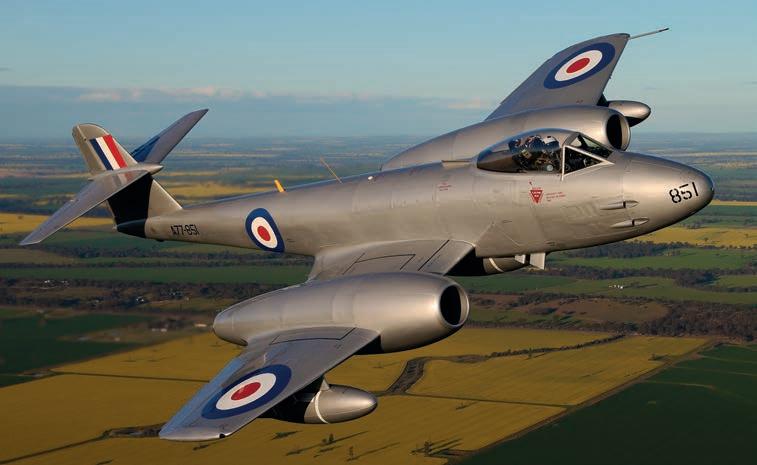
The Royal Australian Air Force (RAAF) announced on January 15 that it will withdraw eight aircraft from No. 100 Squadron’s heritage fleet following “a comprehensive review of technical and airworthiness factors.” Although certain piston types will be maintained in an airworthy condition, others—including three vintage jets—will be “transitioned with dignity” to other institutions.
In a move that could permanently ground the last airworthy Gloster Meteor in the world,
five aircraft transferred from Temora Aviation Museum will return there, including the Vampire T.35, Meteor F.8, and Canberra jets. No. 100 Squadron will continue to operate the Harvard, Mustang, and two Spitfires.
“As aircraft age, upkeep becomes especially complex, especially for flying displays,” the RAAF said, adding that the reduction from 19 to 11 aircraft was “essential to balancing heritage preservation with operational safety.”
The heritage squadron was formed for the
The last airworthy Gloster Meteor in the world could be permanently grounded with the move by the RAAF.
RAAF’s centenary in 2021 and partnered with Temora Aviation Museum to operate various airworthy types. The museum noted that the new rationale “is a significant change to the agreement that we entered into,” but nevertheless “[understands] the rationale.” As of press time, the museum had not responded to AIN’s request for comment on its plans for the jets, which are notably absent from the organization’s published list of aircraft it intends to maintain in airworthy condition. z
U.S. approves sale of four Boeing P-8 Poseidons to Singapore
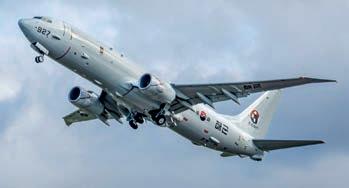
The U.S. government has approved a potential sale for four Boeing P-8A Poseidon maritime reconnaissance aircraft to the Republic of Singapore Air Force (RSAF), accompanied by eight lightweight torpedoes and adjacent support. The acquisition, valued at about $2.13 billion, was approved by the U.S. Defense Security Cooperation Agency (DSCA) on January 20.
Singapore’s Ministry of Defence first announced its intention to acquire the P-8A last September. It has been evaluating the Boeing-built aircraft, as well as the competing Airbus C295MPA turboprop, to replace its aging Fokker 50 MPA Enforcers, which have been in service with 121 Squadron since 1993. Addressing Singapore’s Parliament in March 2025, defense minister Ng Eng Hen said that
P-8s would replace aging Fokker 50 MPAs.
the RSAF had been “looking intently and evaluating appropriate replacements.”
This acquisition would make Singapore the P-8A’s first operator in Southeast Asia. Other operators in the Indo-Pacific region include Australia, South Korea, and New Zealand. India operates the P-8I Neptune variant.
Derived from the Boeing 737NG, the P-8
reconnaissance platform o ers notable improvements over its Fokker 50 predecessor, including extended endurance and range, bolstered by its in-flight refueling capability. It also operates at higher altitudes and features an enhanced sensor suite and anti-submarine warfare capability.
The U.S. Department of State describes Singapore as one of its “strongest bilateral partners in Southeast Asia” that “plays an indispensable role in securing the region’s security and economic framework.” The DSCA stated, “This proposed sale will enhance the foreign policy and national security objectives of the U.S. by improving the security of a strategic partner that is an important force for political stability and economic progress in Asia.” C.B.
Airbus’s A330 Multi Role Tanker Transport can perform automatic refueling during the day and at night.
A330 tanker approved for automatic refueling
By Charles Alcock
The Singapore government has backed Airbus efforts to achieve what it says is the world’s first full certification for automatic air-to-air refueling (A3R) capability with the A330 Multi
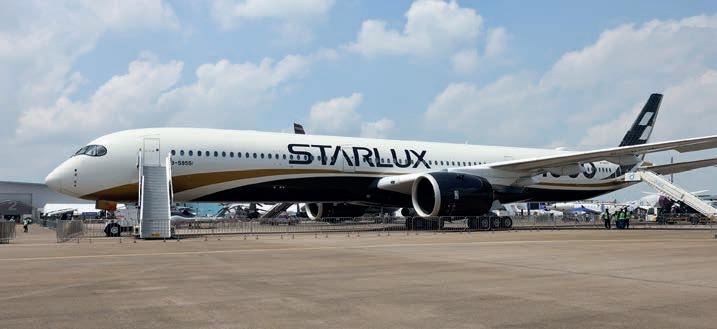
Taiwan’s first Airbus A350-1000 makes Singapore debut
Starlux Airlines, a luxury-focused carrier serving 31 destinations, is displaying its first Airbus
A350-1000 at the Singapore Airshow, prior to the airplane’s entry into commercial service. The Taiwanese airline took delivery of the jet in early January.
In collaboration with Japanese hyperrealist artist Hajime Sorayama, Starlux is turning two A350-1000s into “flying masterpieces that merge aviation craftsmanship with contemporary aesthetics,” according to the airline. The collaboration with the artist is called “Airsorayama.”
Role Tanker Transport (MRTT).
On Tuesday, the European manufacturer reported that Spain’s National Institute for Aerospace Technology issued the approval following a qualification and flight-test campaign conducted with the Republic of Singapore Air
Force (RSAF) and the Defence Science and Technology Agency (DSTA).
The RSAF has become the first air force to introduce A3R for its fleet of A330 MRTTs, which are operated by the service’s 112 Squadron. According to Airbus, the approval marks a key milestone in the aircraft’s ongoing development, with the A3R system having confirmed its maturity, safety, and reliability across multiple mission profiles.
According to DSTA chief executive Ng Chad-Son, Singapore’s MRTT fleet can now perform automatic refueling during the day and at night. “DSTA worked very closely with RSAF and Airbus to advance innovation, enhance safety, and reduce crew workload,” he explained.
The A3R combines automation and computer vision technologies to detect, track, and engage aircraft set to receive fuel, without the need for manual input. According to Airbus, the reduced operator workload both enhances safety and makes for greater operational flexibility.
Airbus, RSAF, and DSTA started collaborating on the A3R capability for the MRTT in 2020. For flight trials conducted in both Spain and Singapore, the RSAF provided its A330s plus F-16 and F-15 fighters. z
“Showcasing Taiwan’s first A350-1000 demonstrates more than the arrival of a single aircraft type,” said Starlux CEO Glenn Chai. “It marks the maturation of a comprehensive fleet capable of supporting both long-haul and regional operations. Through this international platform, we aim to highlight our professional capabilities to the global audience and attract greater attention to the development of Taiwan’s aviation industry.” M.T.
DAVID M c INTOSH
DAVID M c INTOSH
Starlux Airlines’ A350-1000
Saab to fly 3D-printed autonomous air vehicle
By David Donald
Later this year, Saab plans to fly a self-funded autonomous air vehicle that will be used as a testbed for some of its systems. More importantly, the vehicle will be the first aircraft to fly with a software-defined fuselage at the heart of its structure.
Working with Divergent Technologies, Saab has developed an autonomous vehicle approximately 5 meters long that comprises twenty-six 3D-printed parts made using laser powder-fusion additive technology. Divergent has already built and supplied the vehicle’s fuselage, and its load-bearing properties have been rigorously tested.
Software-defined hardware manufacturing is what Saab sees as a logical next step in aircraft design and production, and it builds on its extensive work in software-defined avionics and model-based engineering. Much of this work found its first major expression in the Gripen E fighter, which was created using computer-aided design (CAD) and model-based engineering. The resulting digital twin enables manufacturing using 3D digital models rather than traditional 2D paper drawings.
Additionally, the fighter’s avionics employ an architecture that segregates flight-critical software from mission systems in a computer hardware-independent arrangement. This allows rapid upgrades to mission systems without affecting flight-critical software.
Armed with this expertise, The Rainforest— Saab’s internal start-up for transformative innovation—began looking at how model-based engineering and software-defined avionics could be applied to aircraft manufacturing.
“We are asking ourselves the question. In the Gripen E, customers get a platform where they can code mission-critical applications in the morning and fly them in the afternoon. How can we give them the same level of software flexibility, but for actual hardware?” said Axel Bååthe, head of The
Rainforest. “We call this software-defined hardware manufacturing.
“We envision that Saab’s future production factory is our most important product. We want to be able to give our customers freedom to not feel locked into a specific design, neither in hardware or software. The production factory will be one that reconfigures itself instantly to build whatever our joint digital twin looks like, without being limited by expensive investment in new tooling.”
“CAD in the morning, fly in the afternoon” is how Saab defines its new vision. Such an
intelligence, topology-optimized structures can be created. Given a set of requirements, such as internal capacity and system requirements, the system can create a 3D structural design that is fully optimized to meet the needs while accounting for load paths, without the constraints imposed by traditional manufacturing and design methods.
Complex shapes such as lattices and intricate 3D curves become possible, freeing structural design from straight lines, perfect circles, welding, and riveting. Elements of the structure can be thickened or slimmed down according to the loads they will bear, and because the 3D model is purely digital, changes can be made—even outer mold line—and the whole design altered accordingly, all within the digital twin. The possibility of more complex structures also enables more efficient use of internal volume and the location of access
undertaking is ambitious and time-consuming, but as a first step, the concept of building load-carrying aerostructures in a more software-defined way was selected, for which a partner was required.
Saab selected Divergent Technologies, based in Torrance, California, which is already producing a range of parts for a variety of multi-domain applications. The company has ambitious plans, too, with a further five factories planned over the next two years, potentially including one in Europe.
Using digital design driven by artificial
apertures, wiring harnesses, and cabling.
As a result, the adoption of software-defined hardware and 3D printing greatly reduces the parts count, material waste, and manufacturing time.
Divergent Technologies has also devised fixtureless assembly technology that employs advanced robotics to position parts in a referenceless 3D space, ensuring a perfect fit during assembly. Details of the assembly system remain under wraps, but the promise is assembly facilities that do not require expensive fixed-alignment systems.
The 3D-printed fuselage for Saab’s autonomous air vehicle includes topology-optimized complex shapes and varying thicknesses to find the best structural load paths and reduce parts counts.
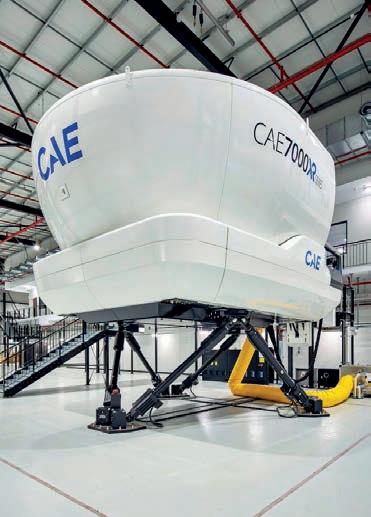
CAE adds 777X flight sim in Singapore
By Charles Alcock
CAE is adding a 7000XR full-flight simulator for Boeing’s 777X airliner at its training center in Singapore, the Canada-based group announced on Thursday. The equipment is now being installed and will be available for use from next fall, pending approval from Singapore’s aviation regulator.
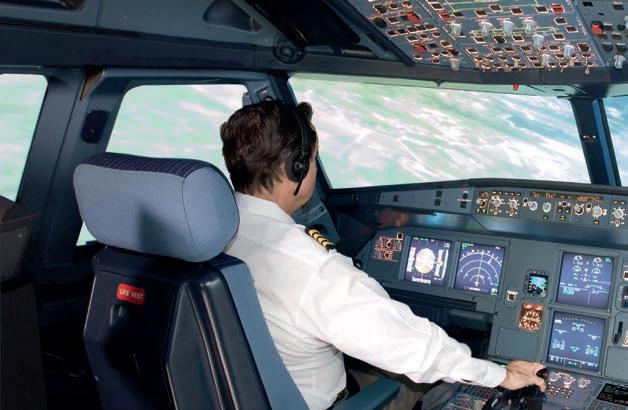
The 7000XR simulator features CAE’s latest 3D visual system, which leverages the company’s Prodigy image generator derived from video gaming technology. According to CAE, this delivers photorealistic renderings under all weather conditions with enhanced moving models that create a more immersive training environment.
CAE said it will be the first company to provide 777X flight training in the Asia-Pacific region. It opened the center in Singapore to allow airlines to train pilots closer to their operating bases.
“The 777X is the latest widebody aircraft developed in the market and is central to many airlines’ long-haul strategies, particularly in Asia and the Middle East,” said CAE civil aviation president Alexandre Prévost. “With this simulator in Singapore, we are providing the training infrastructure where it is needed most, at the crossroads of Asia-Pacific aviation. In addition, the 777X gives the Singapore-CAE flight training center one of the most comprehensive Boeing training portfolios in the region.” z
Cebu Pacific extends pilot training agreement
Cebu Pacific has extended its agreement with CAE covering pilot training for its Airbus A320 and ATR 72-600 fleets. The Philippines-based low-cost carrier announced the commitment on Tuesday at the Singapore Airshow.
CAE will continue to train Cebu’s A320 flight crew through to 2037. The agreement covering ATR 72 pilots has also been extended for an unspecified period, with the two companies having had a partnership
CAE’s 7000XR full-flight simulator for the Boeing 777X features a 3D visual system with photorealistic imagery under all types of weather conditions, and enhanced moving models.
since a joint training center was established at Clark International Airport (RPLC) i n 2011.
Cebu Pacific Airbus A320 pilots, as well as those flying the airline’s ATR turboprops, will continue training with CAE, under a contract that now extends through 2037.
“Extending our training services agreements with CAE underscores Cebu Pacific’s commitment to safety, operational excellence, and long-term growth,” said Javier Massot, the airline’s chief operations officer. “As we continue to expand our fleet and network, it is critical that we invest in world-class pilot training to support a strong and sustainable pipeline of aviation professionals. Our longstanding partnership with CAE ensures our pilots are equipped with the highest standards of training as we scale our operations across the region.”
Cebu Pacific serves more than 60 domestic routes and cities in 14 other countries, including Australia, China, Japan, Singapore, and the UAE. Its fleet includes a mix of A320, A321, and A330 models, as well as both the ATR 72-500 and -600 twin turboprops.
According to CAE’s 2025 Aviation Talent Forecast, the Asia-Pacific region will require approximately 98,000 new commercial pilots over the next decade. C.A.
THE DAILY INFORMATION THAT AVIATION LEADERS RELY ON
AINalerts delivers the news and intelligence that directors of aviation, chief pilots, flight department leaders, OEMs, MROs, and industry executives need to stay ahead. Trusted reporting, exclusive analysis—delivered straight to your inbox Monday through Friday.
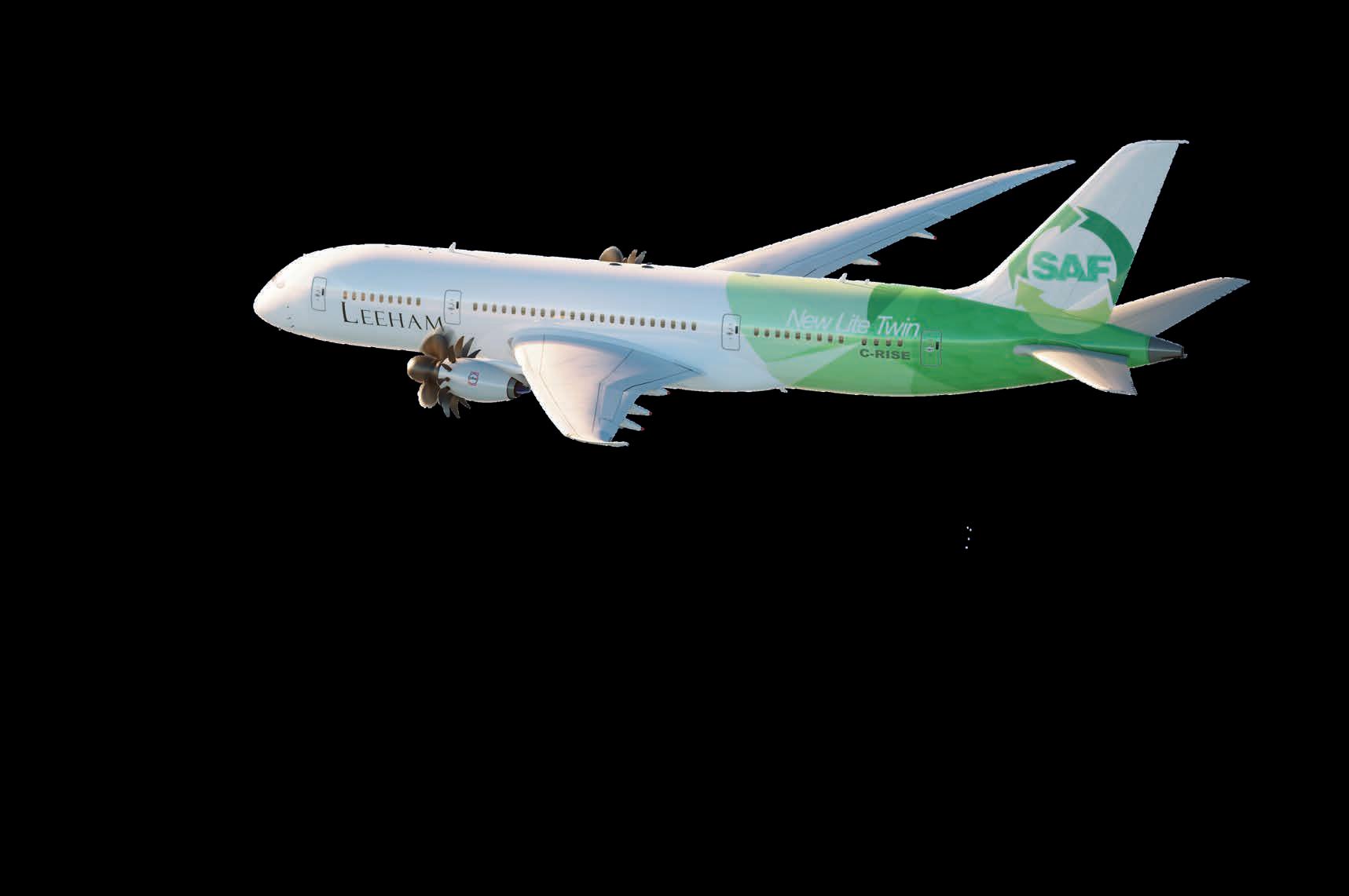
Embraer prioritizes E2 sales boost
By Leeham News and Analysis Staff
At the start of each year, Leeham News and Analysis gives its assessment of the challenges and opportunities facing leading aerospace companies. Here is a summary of its key observations about Embraer, with full versions of this and other reports available to subscribers.
Ostensibly, the Brazilian aerospace and defense group has begun 2026 in a good position to resume its role as a potential disruptor to the Airbus-Boeing duopoly in the air transport sector. In that context, the Brazilian airframer is known to be exploring an airliner design in the 180- to 240-seat range, but analysts generally take the view that these plans are unlikely to be confirmed this year.
Embraer’s near-term priority is likely maximizing sales of the existing E-Jet E2 family, not launching a new mainline aircraft that would directly compete with those offered by its U.S. and European rivals. In its most recent financial and delivery guidance published in November 2025, the group said it expected to deliver between 77 and 85 commercial aircraft and 145 to 155 executive jets for the full year.
If confirmed in its year-end results on March 6, this would represent an increase over the 73 new commercial aircraft and 130 executive aircraft deliveries in 2024. It hopes to build on this in the next 12 months.
Embraer president and CEO Francisco Gomes Neto told investors on a November earnings call that his company was “experiencing a highly positive phase, a strong indication that our strategy driven by efficiency and innovation is delivering solid results and effectively supporting our sustainable growth.”
Tied to this focus on sales are a series of commercial agreements intended to help build opportunities in the defense, eVTOL, and commercial aviation sectors, including for the E2 in markets not yet exploited.
These have included Turkish Aerospace, KAI and DAPA in South Korea, and SAMI in Saudi Arabia. In India, Embraer has established a fully owned Indian subsidiary while also partnering with the Mahindra Group on
the C-390 multirole military aircraft.
These agreements serve multiple purposes, including political alignment, supply-chain diversification, and adding options for future final assembly or risk-sharing.
How much these industrial partnerships are designed to lay the groundwork for a future new airplane design is yet to be seen.
Certainly, Embraer aims to expand the E2’s footprint across multiple continents—mindful that the new family has yet to match the sales success of the original E170/175 design.
In the Middle East, Embraer says only 22% of available seat-kilometers are dedicated to intraregional routes, which is below Europe’s 52% and North America’s 64%. “This gap underscores a significant opportunity,” the company says, including small narrowbody aircraft such as the E2, which could “unlock over 120 unserved city-pairs.”
The same is true in China. For the past two decades, Embraer has highlighted the reliance of Chinese airlines on narrowbody aircraft with 150-plus seats, a strategy it says was suited to rapid trunk-market expansion. “The limits of this model have become increasingly clear”
as the market matured and growth slowed, according to Embraer.
The company hopes to reap the rewards of a target of 1.5 billion annual travelers in the country by 2035, where a “structural imbalance in fleet composition” means more than 80% of China’s single-aisle aircraft are large narrowbodies. Sub-90-seat jets account for just 5% of the Chinese fleet, versus 26% in North America.
A limited number of E-Jets are operated by Chinese carriers such as Tianjin Airlines, GX Airlines, and Colorful Guizhou Airlines. In the next 20 years, China is expected to see demand for 1,630 aircraft with 150 seats or fewer. Both the E190-E2 and E195-E2 are certified by the Civil Aviation Administration of China—although IP protection and market access, particularly in the context of competition with state-owned airframer Comac, will need to be worked through. z
LNA is led by Scott Hamilton, founder and managing director of the Leeham company, and aeronautical and economics analyst Bjorn Fehrm.
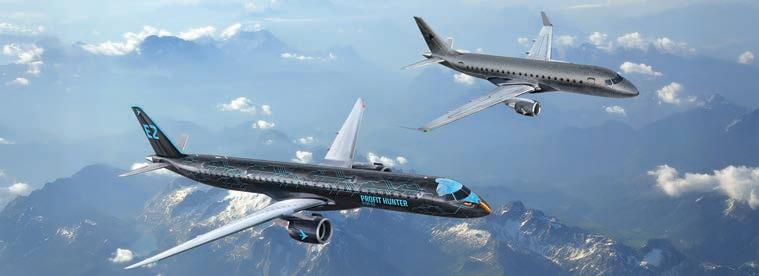
E195-E2 and E175
TrueNoord E195-E2
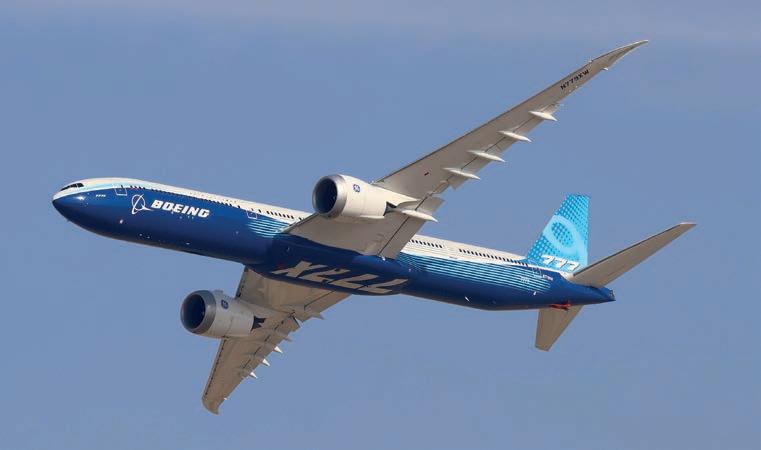
Boeing is confident it will certify the 777X this year
By Charlotte Bailey
With 60% of all long-haul services to Southeast Asia operated by a widebody, Boeing is confident that its protracted 777X program— now targeting type certification in the second half of this year—will help meet a demand that continues to grow in the region.
Singapore operates more flights per square kilometer than any country, explained Darren Hulst, v-p of commercial marketing at Boeing. With Asia being the largest contributor to the 5.5% passenger growth seen worldwide last year, this complements a 25-year growth period for the region he described as “dynamic.”
Indeed, within the widebody market, the need for approximately 910 new aircraft over the next 25 years (19% of total aircraft demand) coincides with an increase in the number of Southeast Asian city-pairs served by the 787. In 2012, this stood at two, rising to
518 in 2025. Singapore-based customers alone have more than 180 Boeing aircraft on order to support fleet modernization.
The 777X will play an important role in a region that, despite being the single largest contributor to a projected global 8% rise yearon-year in passenger traffic, is a market Hulst believes has still “probably undergrown in the last few years due to the challenges coming out of the pandemic.” However, ongoing certification delays have also impacted fleet planning.
“In the near term, [the ongoing 777X certification delay] forces airlines to make some adjustments to either the retirement date of the airplanes they have in their fleet, or to their expansion or replacement plans, maybe some investment in the near term in terms of midlife modifications to interiors,” explained Hulst.
While he added the caveat that it is up to the FAA “in terms of the ultimate timing for
Lufthansa Technik to support Air Premia 787s
South Korean carrier Air Premia has agreed to have airframe components for its Boeing 7879 fleet maintained by the Lufthansa Technik facility in Shenzhen, China. The Europe-based maintenance, repair, and overhaul group announced the contract on Monday at the Singapore Airshow.
Under a 10-year contract, the Shenzhen center will support Air Premia’s nine Dreamlin-
ers, which are powered by Rolls-Royce Trent 1000 engines. The agreement covers component lease and exchange services through Lufthansa Technik’s global network.
Component support covers engine inlet cowls, fan cowls, thrust reversers, exhaust nozzles, radomes, and flight controls. The Shenzhen facility opened in 2000 as a joint venture between Lufthansa Technik and Bei-
certification,” Boeing nevertheless expects this to be awarded in the second half of this year. However, the widebody’s entry into service could be pushed to 2027. “It’s really up to our customers when they take delivery of the aircraft, and the processes and steps they need to go through between certification and ultimately revenue service for that aircraft,” he said.
Conversely, regional narrowbody fleet growth has been softer, with Southeast Asian post-pandemic recovery of available seat-kilometers notably lagging the overall Asian total. However, with the region’s narrowbody fleet the oldest on the market, retirement requirements are predicted to grow by the mid-2030s, starting at a few dozen before the end of the decade and rising to a few hundred between 2030 and 2035. Indicative of regional narrowbody demand, Boeing has garnered more than 2,200 net orders for 737 Maxs from airlines in the broader APAC market. z
jing Kailan Aviation Technology. It specializes in airframe-related component repairs, component services, and mobile engine support.
“This new contract builds upon our existing Total Component Support agreement for Boeing 787-9 aircraft that began in August 2024,” said Jens Michel, Lufthansa Technik’s v-p of corporate sales. “This partnership represents another level of cooperation with Air Premia and strengthens our strategic position in the Korean market.” C.A.
DAVID M c INTOSH
WingsOverAsia is building a large jet maintenance hangar at Singapore’s Seletar Aerospace Park.
WingsOverAsia breaks ground for Seletar hangar
By Matt Thurber
WingsOverAsia, the long-time full-service FBO located at Singapore’s Seletar Aerospace Park, celebrated the groundbreaking for its new jet hangar yesterday during the Singapore Airshow. The facility will help WingsOverAsia, in partnership with equity investor MJets, to expand its business jet services at Seletar to include jet maintenance and management for business jet owners and operators.
“Continuing WingsOverAsia’s decadelong reputation for sustained innovation within the regional general aviation landscape, this project serves as a prelude to many new business aviation frontiers to evolve from the recent strategic equity partnership with MJets,” said Ng Yeow Meng, founder and managing director o f WingsOverAsia.
The hangar at Seletar will be integrated into MJets’ regional FBO network, which has facilities in India, Myanmar, Cambodia, and Thailand, enabling the company to support
larger and more advanced aircraft platforms, according to WingsOverAsia. MJets and WingsOverAsia expect the new regional center of excellence at Seletar to create more than 50 new high-value jobs across various disciplines.
“This partnership ensures that advanced capability becomes dependable daily execution—delivers operational reliability, scalable capability, and end-to-end peace of mind through consistent performance,” said MJets CEO Natthapatr Sibunruang.
“JTC is delighted that Seletar Aerospace Park is providing the enabling infrastructure and ecosystems to support the rapid growth of business and private aviation across the Asia-Pacific,” said Christine Wong, assistant CEO of JTC. “We welcome WingsOverAsia’s latest hangar expansion, which will provide much-needed services for the sector to scale and develop in the region.” JTC (formerly Jorong Town Corporation) is a statutory board under the Singapore Ministry of Trade and Industry and promotes sustainable industrial development. z
RTX inks services and support deals
RTX’s Collins Aerospace and Pratt & Whitney Canada subsidiaries scored a flurry of services and support deals from several Asia-Pacific airline customers this week at the 2026 Singapore Airshow.
Singapore Airlines and All Nippon Airways (ANA) inked agreements with Collins to renew FlightSense life cycle maintenance support programs, which include “advanced” aircraft prognostics and health management software. The former signed a deal that covers its Boeing 777 fleet, including three 777Fs, for an additional five years.
ANA renewed two FlightSense agreements, including a five-year renewal for onsite support for the Japanese airline’s Boeing 737NG/Max, 767, 777, and 787 fleets and for its De Havilland Canada Dash 8-400s. This cost-per-flight-hour agreement provides guaranteed component availability, reduced downtime, and cost predictability. It also signed a three-year extension for repair services for the Rolls-Royce Trent 1000s that power ANA’s Boeing 787s.
Meanwhile, Thai Airways selected Collins’ flight operations and maintenance exchanger system for its Airbus A321neo fleet, delivering real-time data to pilots, maintenance departments, and back o ces, improving situational awareness, predictive maintenance, and fleet e ciency.
Rounding out the agreements, Pratt & Whitney Canada inked a 15-year maintenance agreement with Scoot for 24 APS5000 auxiliary power units on its fleet of Boeing 787s. C.T.
Thai Airways selected Collins’ flight operations and maintenance exchanger.
News and analysis covering cutting edge aviation technology and business models, including zero carbon propulsion, eVTOL aircraft, automation and autonomy, and new infrastructure.
Singapore welcomes the Falcon 6X to show site
By Matt Thurber
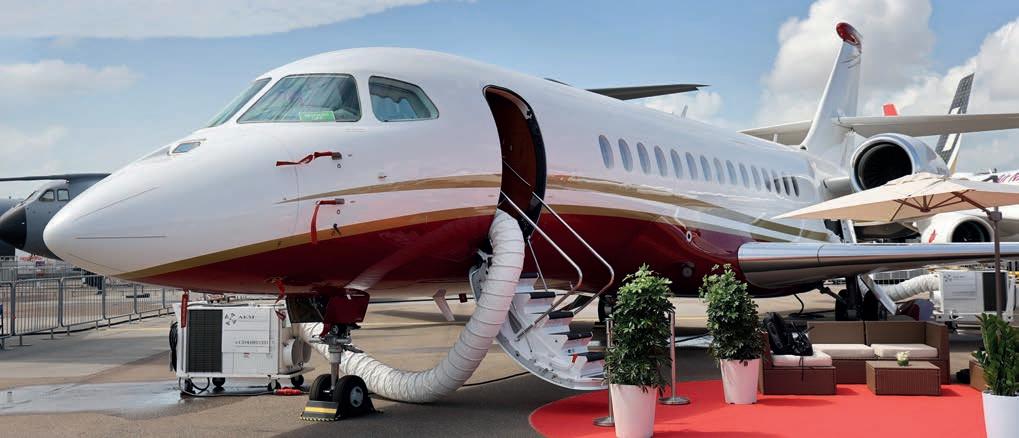
Capable of flying up to 5,500 nm on a single load of fuel, Dassault’s Falcon 6X is the French company’s flagship aircraft, at least until its larger and longer-range sibling—the 10X—enters service in 2027. The 6X, however, is no small jet, and visitors to the Singapore Airshow can see for themselves the amenities that Dassault’s designers have crafted inside the 6X’s spacious cabin.
With a volume of 1,843 sq ft, the cabin features a cross section of 78 inches high by 102 inches wide, the widest and tallest of any purpose-built business jet now in production.
The 6X’s maximum operating speed is Mach 0.90, and at a slower speed of Mach 0.85, it can still fly nonstop for 5,100 nm.
“We think this is a very important market,” said Carlos Brana, executive v-p, civil aircraft. “We see emerging markets now with Southeast Asia, and we brought this 6X [which] has
Dassault names Asia-Pacific Falcon sales SVP
Dassault Aviation has appointed Didier Raynard as its new senior vice president of sales for the Asia-Pacific region. At the Singapore Airshow on Tuesday, the company announced that Raynard will succeed Jean-Michel Jacob, who is retiring.
A graduate of France’s ESTACA aerospace engineering school, Raynard will be based in Kuala Lumpur, Malaysia, and will lead sales campaigns for Dassault’s Falcon business jets across East and Southeast Asia, Australia, New Zealand, and the Pacific Rim. He joined Dassault in 2008
as a sales manager and has more than 24 years of experience in the region, having previously worked for EADS and Airbus.
There are now around 100 Falcons based in the Asia-Pacific region. Dassault is working to boost this fleet with the arrival of new models, including the 6X, which entered service in late 2023, and the 10X, which
After entering service in 2023, the Falcon 6X made its Singapore Airshow debut in 2024, and now it’s back for a return engagement as the Southeast Asia business aviation market warms up.
now been in service for two years. We’re getting very good feedback on this airplane. Pilots are happy, and the passengers as well.
“With the 6X you have the range to reach Europe, Africa, and parts of the United States. Most important for local people who want to travel extensively, it’s a very good tool.”
“The Singapore Airshow is a key opportunity for us to engage with customers across one of the world’s most promising aviation markets,” said Dassault chairman and CEOEric Trappier. “The top of the Falcon line continues to set new standards for cabin comfort and flight performance. Through our expanded MRO presence in Malaysia we are furthering our commitment to supporting the long-term growth of business aviation in the region.” z
is about to start its flight-test campaign. Dassault is displaying a Falcon 6X at the Singapore Airshow, highlighting the wide cabin, advanced fly-by-wire flight controls, and Pratt & Whitney Canada PW812D engines.
In 2024, Dassault’s ExecuJet Malaysia subsidiary opened a new maintenance, repair, and overhaul facility at Malaysia’s Subang Airport. The facility supports Falcon jets and many other business aircraft types. C.A.
DAVID M c INTOSH
Didier Raynard, Dassault’s new SVP APAC
IAI on a mission to redefine G600 jets
By David Donald
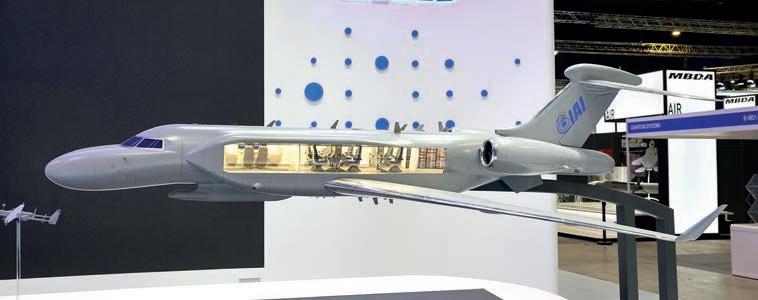
IAI is displaying a model of its latest special-mission Gulfstream variant at the Singapore Airshow. While earlier IAI-modified Gulfstreams were based on the G550, the Ellyon is the first to use the G600 airframe.
Earlier G550 versions were used for ISR,
The G600-based Ellyon has a large fairing under the forward fuselage housing ISR systems.
aerial ground surveillance, and AEW.
In addition to a change of platform, the Ellyon now packs multiple capabilities into a single aircraft. Externally, the aircraft has the familiar slab-sided fuselage fairings and bulbous nose, aft fuselage, and fin-tip radomes of earlier AEW models, but it adds a ventral fairing that houses further mission equipment.
Thanks to miniaturization of electronics
and advances in automation, the Ellyon can conduct AEW, ISR, signals intelligence, command and control (C2), and electronic attack/ jamming roles. The display model features a central cabin with six operator consoles and a forward area that could act as a C2 hub.
An IAI spokesman told AIN that the Gulfstream platform already has customers but declined to elaborate. z
Calls grow for Canada to get a Gripen
By Charlotte Bailey
Commenting on the speculation that Canada might revise its plans to acquire a fleet consisting entirely of F-35s, Mikael Franzén, Saab chief marketing officer for the Gripen multirole fighter, said his company is “responding to questions.” Advocating for the combined strength of a potential mixed fleet, Franzén said, “Gripen is strong on availability and adaptability and would give combat mass to Canada.”
The revised selection—which could see some 72 of 88 Lockheed Martin F-35 orders canceled by Canada—could be more than a pointed statement on U.S. President Donald Trump’s increasingly fractious foreign policy. As for the financial burden, “of course, you will be able to procure more Gripens than F-35s, so it’s a significant cost difference,” Franzén said, “but also the operational cost is significantly better on the Gripen.”
With Canada looking to acquire its new fleet before 2032, the acquisition of the Gripen would entail significant domestic production, said Franzén. This line could produce aircraft for export, too, he added.
Saab has already recognized what Franzén termed a “customer focus on quick deliveries,” having acknowledged a pressing need to scale its fighter production. This is split between two lines, in Linköping, Sweden, and Gavião Pexioto, Brazil. The rollout of the first Gripen E assembled at the latter facility is scheduled for the first quarter of 2026—marking the inaugural supersonic fighter built in the country—followed by the first two-seat Gripen F from the Linköping line in the second quarter.
Saab has already started investing in strengthening Swedish production, including increasing collaboration with suppliers. However, beyond that, Saab recognizes that further growth would require significant industrial collaboration, such as the existing technology transfer program that sees the E built at Embraer’s Gavião Pexioto facility. With Franzén identifying Canada and Portugal as ideal production sites, ultimately, augmented external collaboration will be critical to increasing Saab’s 36 aircraft per year target.
Production of the 17 Gripen E/Fs that Colombia ordered in 2025 is “underway, with
the delivery schedule now being defined,” Franzén said, citing a first delivery scheduled for 2028. The first E model for existing C/D customer Thailand is planned in 2029.
Within Europe, a landmark letter of intent signed in October 2025—identifying Ukraine’s interest in 100 to 150 Gripen E/Fs—will likely be preceded by a shorter-term solution entailing the transfer of Gripen C/Ds. “We are in tight connection with Ukrainian companies on how to set that up,” concluded Franzén, noting that Saab is “looking into how we should be able to support these aircraft in Ukraine, if and when they are delivered.” z
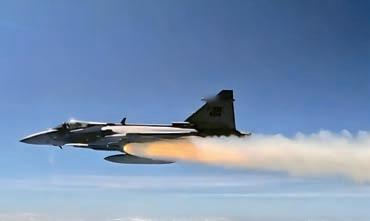
One of the Gripen E program’s 2025 highlights was the first firing of a Meteor air-to-air missile.
AirX Dreams
Eve’s v-p of services, operations solutions, strategic design, and ecosystem Luiz Mauad expanded on AAM demand in Asia-Pacific, where Eve forecasts a need for 12,200 eVTOLs—41% of the projected world fleet. Deeply congested cities will drive this demand, he noted.
Mauad said eight of the world’s 10 largest cities are in this region, with Tokyo at the top of the list. In addition, the population in Asia is expected to skyrocket from 2 billion in 2020
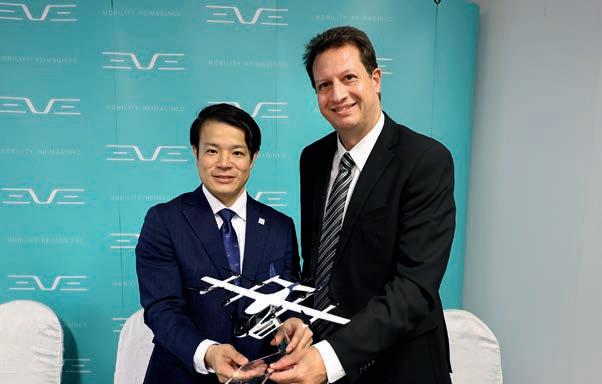
AirX founder and CEO Kiwamu Tezuka (left) and Eve Air Mobility v-p of services, operations solutions, and ecosystem Luiz Mauad celebrate the order for up to 50 aircraft.
to 3.5 billion at the end of this decade, leading to more urban congestion that eVTOLs can help alleviate.
According to Mauad, eVTOLs will greatly decrease travel times in cities such as Tokyo. For example, he said an Eve eVTOL aircraft could fly from Tokyo Haneda Airport to a city-center vertiport in 15 minutes, versus more than one hour by car. Eve’s aircraft has a baggage area that can fit two checked and two carry-on bags to facilitate such airport transfers, he added.
“Asia-Pacific has a huge appetite for eVTOL AAM, including passenger and light cargo flights,” Mauad said. z
LOI supports M-346F deal for Indonesia
Leonardo signed a letter of intent (LOI) with PT ESystem Solutions Indonesia and the Indonesian Ministry of Defence (MoD), paving the way for cooperation in supporting Leonardo’s M-346F Block 20 light combat aircraft/advanced trainer in Indonesian service. The aircraft was selected by the MoD to fulfill operational and training needs as part of a force-wide modernization e ort. The M-346F would replace the aging BAE Systems Hawk, among other types.
Included in the LOI are a range of support, maintenance, overhaul, and training capabilities, as well as human capital development. Following the signing, the three parties are now embarking on
discussions with the intention of signing a procurement contract.
Indonesia’s intended Block 20 M-346Fs are configured as light fighters with an AESA radar, Link 16 datalink, large-area cockpit display, electronic countermeasures, and new weapons systems. The aircraft will be equipped with aerial refueling capability and can conduct both air-to-air and air-tosurface missions.
At the same time, they are outfitted for the advanced training role as part of a comprehensive system that includes groundbased training tools and the ability to insert virtual and constructive elements into a live training scenario. D.D.
SINGAPORE AIRSHOW NEWS
JAMES HOLAHAN (1921-2015), FOUNDING EDITOR
WILSON S. LEACH, FOUNDER & CHAIR EMERITUS
EDITOR-IN-CHIEF – Matt Thurber
MANAGING EDITOR – Charles Alcock
PRESS ROOM EDITOR – Hanneke Weitering
THE EDITORIAL TEAM - Charlotte Bailey, David Donald, Jennifer Meszaros, Chad Trautvetter, Amy Wilder
PRODUCTION MANAGER – Martha Jercinovich
GRAPHIC DESIGNERS – Alena Korenkov, Grzegorz Rzekos
PHOTOGRAPHERS – David McIntosh
DIRECTOR OF VIDEO – Ian Whelan
EXECUTIVE CHAIR – Dave Leach
PRESIDENT – Ruben Kempeneer
HEAD OF PEOPLE & BRAND – Jennifer Leach English
SENIOR DIRECTOR EVENTS – Nancy O’Brien
ADVERTISING SALES
DIRECTOR OF SALES - Henry Specht
Victoria Tod – Northeastern U.S./Eastern Canada/United Kingdom, +1 (203) 733-4184
Michelle James – Western U.S./Western Canada, +1 (520) 343-0236
Our model, APCM, analyzes current and future aircraft/VTOLs, Develops operating costs and revenue margins for any mission Shows development and production costs for aircrafts/VTOLs