NBAA CONVENTION NEWS
DAY 3
OCTOBER 22, 2026
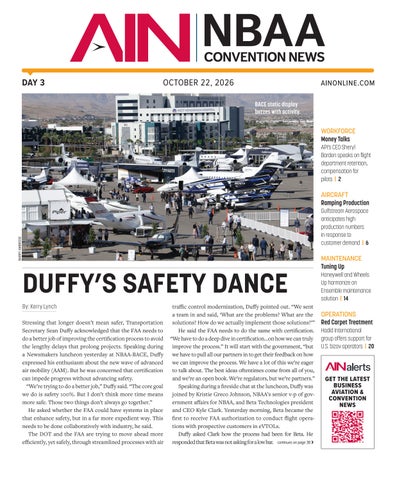
AINONLINE.COM BACE static display buzzes with activity.
WORKFORCE Money Talks API’s CEO Sheryl Barden speaks on flight department retention, compensation for pilots | 2
AIRCRAFT Ramping Production
BARRY AMBROSE
Gulfstream Aerospace anticipates high production numbers in response to customer demand | 6
DUFFY’S SAFETY DANCE By: Kerry Lynch Stressing that longer doesn’t mean safer, Transportation Secretary Sean Duffy acknowledged that the FAA needs to do a better job of improving the certification process to avoid the lengthy delays that prolong projects. Speaking during a Newsmakers luncheon yesterday at NBAA-BACE, Duffy expressed his enthusiasm about the new wave of advanced air mobility (AAM). But he was concerned that certification can impede progress without advancing safety. “We’re trying to do a better job,” Duffy said. “The core goal we do is safety 100%. But I don’t think more time means more safe. Those two things don’t always go together.” He asked whether the FAA could have systems in place that enhance safety, but in a far more expedient way. This needs to be done collaboratively with industry, he said. The DOT and the FAA are trying to move ahead more efficiently, yet safely, through streamlined processes with air
traffic control modernization, Duffy pointed out. “We sent a team in and said, ‘What are the problems? What are the solutions? How do we actually implement those solutions?’” He said the FAA needs to do the same with certification. “We have to do a deep dive in certification…on how we can truly improve the process.” It will start with the government, “but we have to pull all our partners in to get their feedback on how we can improve the process. We have a lot of this we’re eager to talk about. The best ideas oftentimes come from all of you, and we’re an open book. We’re regulators, but we’re partners.” Speaking during a fireside chat at the luncheon, Duffy was joined by Kristie Greco Johnson, NBAA’s senior v-p of government affairs for NBAA, and Beta Technologies president and CEO Kyle Clark. Yesterday morning, Beta became the first to receive FAA authorization to conduct flight operations with prospective customers in eVTOLs. Duffy asked Clark how the process had been for Beta. He responded that Beta was not asking for a low bar. continues on page 30
MAINTENANCE Tuning Up Honeywell and Wheels Up harmonize on Ensemble maintenance solution | 14
OPERATIONS Red Carpet Treatment Hadid International group offers support for U.S. bizav operators | 20 alerts
GET THE LATEST BUSINESS AVIATION & CONVENTION NEWS
Show me the money: API talks compensation As Aviation Personnel International (API) celebrates its 55th anniversary at NBAABACE this year, the staffing firm is seeing an evolving industry trying to keep on top of compensation and recruitment pressures within business aviation. Releasing results of its latest survey of 200 Part 91 flight department leaders, API reported that compensation and benefits led the list of top concerns. While 45% of flight department leaders pointed to those issues, 39% cited the ability to recruit qualified aviation professionals. Additionally, 39% listed work-life balance. Developing future leaders and retention followed at 38% and 36%, respectively. On the factors having the greatest impact on retention, 74% selected compensation and benefits, 54% said schedule predictability and time off, and 44% identified department culture. “Compensation is clearly top of mind, but a raise isn’t always the answer,” said API CEO Sheryl Barden. “Aviation leaders want to know what the market is paying and whether their people are being paid fairly. If not, they need help making the case to HR. And sometimes the job has changed so much that the title and salary haven’t kept up.” Beyond staffing services, API has found that flight department leaders have increasingly turned to the company for guidance on workforce issues. “Sometimes a leader calls and says, ‘Can I run something by you?’” said API president Jennifer Pickerel. “They might be worried about upcoming retirements, wondering what their employees really think, or dealing with a situation they haven’t faced before. They just want someone they trust to talk it through with.” This represents the continued broadening reach for the firm that Sheryl Barden’s mother, Janice Barden, founded 55 years
ago. Janice, an aviation psychologist and recruiter, established API in 1971 with the view that technical qualifications alone don’t determine whether someone will succeed in a flight department. Instead, she developed an approach that considered the whole person and the match between that person and the organization. Sheryl Barden joined the firm in 2001 and has since expanded the scope beyond recruitment to assisting with other workforce challenges, including adding
MARIANO ROSALES
By Kerry Lynch
aviation outplacement and compensation consulting, and custom benchmarking. More recently, it rolled out an organizational health and wellness program, API WorkWell, focusing on culture and employee engagement. “It’s been really fun to watch a company evolve and also stick to our core values,” Barden told AIN. “We haven’t gone a huge way out of what we started with: We started with trying to raise the bar of professionalism in Part 91 flight departments and doing that by finding the right people and curating the right teams of people and the right leaders to lead those people. When I think about what we do and what we’ve done for 55 years, I think we’ve really had a very good effect on professionalism in this industry and raising the bar.” z
Go Rentals rides again with car raffle tradition Yesterday at BACE, Go Rentals once again provided what has become one of the most anticipated moments on the show floor, when it raffled off a choice of a one-year lease on a Cadillac Escalade or the $12,000 cash equivalent. “This event gives us the opportunity to thank our partners, our friends in aviation, because without them we couldn’t be here,” company founder and CEO Kaye Gitibin explained. “It’s an opportunity for us to shake their hands, thank them, and appreciate the opportunity they’ve given us to serve the guests, serve the clients, serve the pilots, and serve the passengers.”
2 NBAA Convention News • October 22, 2 0 26 • a i n o n l i n e . c o m
www.amacaerospace.com
THE PERFECT PLACE FOR BUSINESS AIRCRAFT AUCH • L’ISLE-JOURDAIN • LONDON • BASEL • ZURICH • ISTANBUL • BODRUM • BEIRUT • RIYADH
Guinness World Record holding pilot Barrington Irving plans to fly around the globe a second time, hoping to inspire a new generation to join the aviation workforce.
MARIANO ROSALES
Irving does it again, for the next gen By Matt Thurber Barrington Irving, who holds two Guinness World Records as the youngest person, and first Black man, to fly solo around the world 20 years ago, is planning another world flight in 2027. This time the feat is aimed at encouraging more people to embrace aviation careers— and to expand support from companies for apprenticeships and training. Irving’s 2007 flight was in a Columbia 400 piston single, but next year’s trip will be faster in a business jet. As was the case for the first trip, Executive Air Services founder and CEO Fabio Alexander Vasquez will sponsor the 2027 flight, and the Aircraft Electronics Association and NBAA will provide additional support. Vasquez introduced Irving to NBAA before his first flight, and that led to broad support from the industry. Irving has founded three student-focused organizations to help fund scholarships, develop STEM curricula, and to provide technical training for future aerospace workers: Experience Aviation, Flying Classroom, and
Barrington Irving Technical Training School. “NBAA literally gave me my wings,” Irving said, “and Fabio Alexander was very core as a title sponsor behind that. Now to be back here again at NBAA…the first time I attended was thanks to Fabio.” The support he received “started right here at the show,” he said. “Now to be on the verge of flying around the world again, but this time with a different twist, where we want to focus on getting as many individuals into business aviation, manufacturing within aviation, as well as other opportunities in the industry. “I got into aviation due to a random chance meeting with an airline pilot,” he recalled. “That’s where my journey in aviation began, and I met Fabio and that took me to the next level. There are a lot of young people out there…who have interest in aviation, but they may not know how to access it. Where do I actually start? “There’s an abundance of resources in our industry. What we’re trying to do is streamline [the process]. How do I make those first steps? How do I get involved? Everyone sees the planes, but they don’t see the hands behind
Sustainability is key for future of biz aviation Sustainability continues to be an area of focus for many aviation businesses, and it served as the topic of three sessions yesterday at NBAABACE in Las Vegas. Sustainable aviation fuel (SAF) is the most recognized solution, but despite recent growth in production worldwide, it still represents approximately 4% of the U.S. jet fuel demand. However, SAF availability is spreading globally.
Just a few years ago, there was SAF availability at less than a dozen FBOs, all in California. Today, it is at more than 140 locations worldwide. The market is still dominated by Generation 1 SAF, which is produced from used cooking oils, fats, and greases. Using the HEFA process, companies such as Phillips 66—one of three major SAF producers in the U.S.—are adding hundreds of millions of gallons of blended SAF, fully mix-
4 NBAA Convention News • October 22, 2 0 26 • a i n o n l i n e . c o m
the planes, the logistics, and from business to the operation. “The first time we just wanted to inspire young people to pursue careers in aviation. Now we want to empower young people as well as adults to pursue these careers, whether it’s through apprenticeships, job shadowing, and so forth. We’re lining up different companies to sign up and say, ‘We’ll offer apprenticeship opportunities.’ “This time around, to have the tailwind of Fabio and others in industry, alongside NBAA and the Aircraft Electronics Association, we’re going to do it again. We’re very excited, but this time the purpose is to create one of the largest apprenticeship programs ever done for aviation.” “Barrington is a visionary leader with an inspiring mission,” said NBAA interim COO Dan Hubbard. “NBAA is proud to have supported him 20 years ago, and we’re proud of all that he has achieved since. His dedication to expanding opportunity reflects the very best of business aviation. His 2027 flight is an exciting platform to help us make the next generation part of the workforce of tomorrow.” z
able with conventional jet-A, into the supply. While a regulatory framework is emerging in Europe with several countries adopting emissions trading schemes, in the U.S.—the epicenter of the business aviation industry— there is no federal regulation regarding SAF, with responsibility falling on the individual states on matters such as tax credits. The panelists stressed that aviation companies make the decision to start on their individual sustainability journeys, even if they begin with one small step. C.E.
75 YEARS OF SAFER SKIES—AND COUNTING From a single Link Trainer to a global fleet of more than 1,200 flight training devices and a curriculum with over 3,000 courses, FlightSafety International (FSI) has continuously led the industry in safety and innovation.
VISIT US AT BOOTH 1545 TO DISCUSS OUR TRAINING SOLUTIONS OR SCAN TO LEARN MORE.
MARIANO ROSALES
Gulfstream aims for 200 bizjets annually
The ultra-long-range Gulfstream G800 flies up to 8,200 nm at speeds up to Mach 0.935. Demand is soaring for the G800 and other models, prompting the company to consider raising production rates.
By Kerry Lynch With a growing portfolio and lengthening backlog, Gulfstream Aerospace anticipates production will reach at least 200 aircraft a year in the not-too-distant future, which would be a record rate for the Savannah, Georgia airframer. Expressing confidence that Gulfstream would reach this production level, president Mark Burns said, “That’s a number. It’s not the number.” Speaking to reporters at NBAA-BACE, Burns noted that the production rate will be about 160 jets this year, but that the company has heavily invested in its facilities and designed them with scalability to accommodate growth. Supporting these optimistic plans is a Gulfstream backlog that extends multiple years. By mid-2026, the OEM’s backlog had topped $25 billion, up $4 billion from late 2025. “Barring any unforeseen catastrophe, I think it’s inevitable,” Burns said of the production increases. These ambitions are the fruits of a concerted plan dating back more than a decade to bring a new lineup of six business jets to market. “When we announced the G500 and G600 in 2014, we were actually working on six airplanes, not two,” Burns explained, referring to the G700 and G800 siblings, as well as the still-in-development G400 and G300. “We were just coming off a very successful entry into service for G650, and we said, ‘What can we do next?’” Creating a new family of airplanes under the philosophy of “a Gulfstream for every mission” was the plan, he said. While the G400 and G300 are still in development, Gulfstream has brought the other four models to market, most recently the G800 in 2025. The ultra-long-range G800 already has set speed records, including the 800th record the
Gulfstream fleet has collectively set. Gulfstream has already delivered 34 of the 8,200-nm, Mach 0.935 jets in less than a year. Meanwhile, the G700 preceded the G800, with its launch in 2019 and certification in 2024. More than 100 of these twinjets are in service, and the model has set 100 speed records. Burns added that the G800 and G700 could set records on almost any trip. Earlier this month, Gulfstream flew three legs from Savannah to Singapore and back. “All three were world-record runs,” he said. Meanwhile, he called the G600 “the foundation of this new family of airplanes.” With more than 200 of the 6,600-nm twinjets delivered since 2019, this aircraft has set more than 100 speed records. Since entering service in 2018, the 5,300-nm G500 fleet has grown to nearly 200 jets. With this new family, Gulfstream built two campuses in Savannah for production—one for the G700 and G800 lines and the other for the G400, G500, and G600. “The lines in those facilities are built to be flexible based on demand, so as we see more of one particular airplane, the lines flex.” Gulfstream continues to invest in its infrastructure as it supports the rapidly expanding fleet. This includes scaling its spare parts inventory, distribution capabilities, and its maintenance operations. Gulfstream’s inventory is now at a $3 billion investment, according to the company. “As our fleet continues to grow around the world, we are making strategic investments in inventory, infrastructure, and expertise that further strengthen our ability to support
6 NBAA Convention News • October 22, 2 0 26 • a i n o n l i n e . c o m
customers wherever they operate,” Burns said. “By increasing parts availability, we’re providing customers with greater confidence that the resources they need are available when and where they need them.” The airframer now has a dozen global distribution centers, and recently doubled its Atlanta warehouse, making it the largest in the network outside of its Savannah headquarters. The facility is housing some $190 million in spare parts, a 65% increase in inventory value this year alone. Gulfstream also has expanded its spares inventory by 25% over the past year, now housing $48 million worth of parts. Separately, Gulfstream expanded its in-house component support at its repair and overhaul center in the Dallas-Fort Worth area, with additional capacity for wheels and brakes, structures, paint, non-destructive testing, hydraulics, and Gulfstream G650 landing gear assemblies. That site is further expanding its capabilities to include Gulfstream G500 and G600 hydraulic and landing gear components and has boosted staff by more than 50%. Other investments have been directed toward Gulfstream Customer Support’s performance analytics program, which combines aircraft health monitoring information, operational data, and maintenance history to provide an overall picture of aircraft performance and system health and enable proactive support. At the same time, Gulfstream is continuing its sustainability drive, achieving reaccreditation through NBAA’s Sustainable Flight Department Accreditation Program. This recognizes continued leadership in advancing sustainability across its global operations, Gulfstream said. z
CAE adds four more bizav simulators across Americas
CAE’s Ready for Work program looks to ease newly minted A&Ps’ introduction to the workflow, and lessen the demands on veteran technicians supervising them.
CAE is ‘Ready for Work’ with online mx training By Curt Epstein Global aviation training provider CAE has launched Ready for Work, a computer-based initiative aimed at getting aircraft maintenance technicians trained faster, at a time when the industry faces skilled labor shortages. The two-year period after earning an airframe and powerplant certificate typically consists of learning through on-the-job training, according to David Bienvenu, general manager of CAE’s maintenance training division. “Historically, you had essentially nine experienced technicians for every one new technician in the building, so there’s a lot of on-the-job training, a lot of coaching to get the new young technician up to speed and get proficient on the aircraft,” he told AIN. “Fast forward to today, with some large demographic changes and a huge increase in business aviation, you end up in a situation where you have more like seven new technicians for three experienced technicians. This creates a lot of pressure on those first two years of getting those new techs ramped up.” With the Ready for Work program, CAE will provide online modules to increase newly-hired technicians’ knowledge base, while reducing demand on veteran mechanics. “You’re diminishing the pressure on the on-the-job training, freeing up your new techs
to keep billing on existing aircraft, but also you’re investing straight off the bat in these new hires,” said Bienvenu. He noted on-the-job training is not going away. “[Ready for Work] is meant to support on-the-job training, so it’s to support them with a solid structure, then connect with their veteran technician that can bring them along to show them also the cultural aspects of the employer. They just are better prepared, so they’re not ramping them up on some of the basics. They’re going immediately into some of the more advanced elements.” CAE noted the next generation of technicians is more comfortable with computer-based learning. “They went to school in a virtual format,” Bienvenu explained. “That is a learning divide that we have a challenge with every day as we teach some of our initial type courses, but it’s something where we’ve decided to really specialize the newer types of training.” Students in Ready for Work will have their progress monitored by a supervisor who can chart their progression, as well as their rate of absorbing the material. The platform is available in a variety of configurations ranging from à la carte to a full package. CAE has 10 courses available, and another 30 under development will be introduced over the next six to eight months. z
8 NBAA Convention News • October 22, 2 0 26 • a i n o n l i n e . c o m
CAE has added four more full-flight simulators across the Americas region to boost training capacity for several business jet types. The Canada-based group announced the investment on Tuesday at NBAA-BACE, saying its worldwide network of simulators for business aviation flight crews now exceeds 130 devices. The four new simulators will provide training for the Bombardier Global 6500, Embraer Praetor 600, Pilatus PC-24, and Cessna Citation CJ4. CAE, which did not specify precisely where these units will be installed, has business aviation training centers in the Americas in Dallas; Las Vegas; Morristown, New Jersey; Orlando, Florida; Phoenix; Toronto; Montreal; and São Paulo. Within the business aviation segment, CAE estimates it delivers more than 300,000 hours of pilot and maintenance technician training annually, led by around 1,000 instructors. According to the company’s 2025 Aviation Talent Forecast, the industry will require 102,000 new business aviation professionals worldwide by 2034, including 33,000 pilots and 69,000 maintenance technicians. North America will account for the lion’s share of new pilots needed, at 19,000, followed by Europe at 7,000. In addition, it foresees a need for some 44,000 additional maintenance personnel, supporting a worldwide fleet set to grow from 23,000 aircraft in 2025 to 27,000 in 2034. C.B.
CAE’s Bombardier Global 7500 simulator at its Las Vegas training facility.
A Home Base That Travels With You
Over 500,000 square feet of brand new, Class A hangar space is coming to the Signature network. This is your chance to establish a home base backed by the largest global network in private aviation, giving you peace of mind and convenience.
Find available space in your area
Enjoy exceptional facilities, dedicated support, exclusive Resident
Learn More
benefits, and the consistent service and safety you expect, wherever your travels take you.
SIGNATUREAVIATION.COM/SERVICES/AVIATION-REAL-ESTATE
Rolls-Royce is expanding its maintenance coverage to include minor foreign object damage, part shipments, and paint flexibility. These customer-focused additions come at no extra cost to operators.
Rolls fields five-star mx program upgrades By Hanneke Weitering Rolls-Royce is adding five benefits to its CorporateCare Enhanced engine maintenance program, without charging operators more per flight hour, the engine maker announced on Monday at NBAA-BACE. The additions extend coverage to minor foreign object damage (FOD) and time-expired parts on Pearl engines, among other changes. Lindsey Gillen, Rolls-Royce v-p of sales and marketing, said the changes grew out of feedback from operators on the company’s Corporate Customer Council, which meets annually in Europe and the U.S. This round brings “not necessarily huge coverage changes, but customer experience pieces,” she told AIN. On Pearl engines, Rolls-Royce will now pay to replace life-limited parts when they hit their time limits, not just when they wear out. The program also covers minor FOD that technicians can repair on or near the wing, which Gillen said should reduce unnecessary borescope inspections. Major FOD that forces immediate engine removal, such as a bird ingestion, is excluded from the program, so operators must file a claim with their insurer instead. Customers will no longer pay for technical variance documentation, even after “unqualified” events such as lightning strikes.
Variances that result from negligence, however, remain excluded. Nacelle components on BR710, BR725, and Pearl engines will now go to Rolls-Royce authorized service centers for repainting instead of outside vendors, giving owners more flexibility to match their aircraft’s finish. Rolls-Royce covers the cost of Matterhorn White paint, while owners pay the difference for custom designs. Operators also will no longer pay to ship removed line-replaceable units, known as cores, back to Rolls-Royce, and the company will assume liability for the parts in transit. Gillen likened the process to “almost an Amazon experience,” with return labels due by year-end. For AOG situations, Rolls-Royce sends members of its 85-technician On Wing Services team worldwide, Gillen said. When the company must choose who gets a spare engine, CorporateCare customers have priority over those who do not subscribe to the service. More than 4,300 business aircraft in service fly on engines from the UK-based company, and more than 3,000 of them are enrolled in CorporateCare, which covers about 86% of newly delivered Rolls-Royce-powered business aircraft. CorporateCare Enhanced, which debuted in 2019, comes standard for anyone signing up for CorporateCare, and operators with older contracts may qualify to upgrade. z
10 NBAA Convention News • October 22, 2 0 26 • a i n o n l i n e . c o m
Fasten-ating tool removes rivets easier than ever Perfect Point EDM is demonstrating technology this week at NBAA-BACE that simplifies the tedious process of removing fasteners from aircraft structures without damaging the fastened material and speeding up the removal process. The company’s E-Drill also eliminates shavings, heat, and foreign object debris that occur with twist drilling. The E-Drill uses electro-discharge machining (EDM), with a precision-sized electrode that matches the fastener size. To remove a fastener, the technician selects the fastener and material type on the E-Drill display, and positions the vacuum-locator over the fastener, using a “bombsight” to align it. Once aligned, the technician places the E-Drill into the locator tool and presses a trigger to activate it. The EDM uses water to keep the drilling surface cool. After the cutting process, the technician removes the E-Drill and the locator tool then places the Single-Shot air punch on the fastener and, holding it steady, activates the punch, which cleanly removes the cut fastener head. While the Perfect Point process is designed for the hardest materials, including titanium fasteners, it works on any type of riveted fastener, including blind rivets. The key advantage of the E-Drill, according to Perfect Point CEO Jim Becker, is speed compared to traditional twist drilling. M.T.
Perfect Point CEO Jim Becker
A Proven Vision Celebrating 10 years of innovation and more than 800 deliveries, the Vision Jet has redefined what’s possible in business aviation. Two Robert J. Collier Award-winning safety features, a relentlessly innovative and sophisticated design, and remarkable versatility define the Vision Jet as a proven performer.
Visit us at NBAA-BACE Las Vegas Convention Center West Hall, Booth #2505
©2026 CIRRUS DESIGN CORPOR ATION D/B/A CIRRUS.
FAA should regulate AI in the sky, says pilot rep By Hanneke Weitering The only member of Congress with both a pilot’s license and a graduate degree in artificial intelligence (AI) wants the FAA, not a standalone AI agency, to regulate the technology in aviation. Rep. Jay Obernolte (R-California), a 6,200hour pilot who has owned his Embraer Phenom 300 for 15 years, chairs the House Science Committee’s research and technology subcommittee. Speaking Tuesday afternoon at NBAABACE 2026, he said the European Union’s AI Act leaves companies in regulated sectors answering to two regulators. “If you set out to regulate something for the purpose of regulation, you’ve embarked on a fool’s errand,” he said. Obernolte instead favors a “hub-andspoke” model in which sector regulators such as the FAA write the rules, with testing tools
and expertise from the Center for AI Standards and Innovation at the National Institute of Standards and Technology. In aviation, he sees promise in sifting safety data for accident warning signs, optimizing flight paths, and forecasting hazards such as lake-effect fog. “AI makes mistakes the same way humans make mistakes,” he said. “You absolutely do not want AI making unmonitored, autonomous, safety-critical decisions.” When an attendee cited Garmin’s Autoland, installed on more than 2,500 aircraft, as AI flying an airplane, Obernolte disagreed. To his knowledge, the system runs deterministic software that regulators can test case by case, and “the FAA knows how to evaluate the procedural stuff,” he said. Because neural networks can’t explain their answers, he added, the agency will have to do “some more thinking” about AI.
SyberJet secures commitments for 50+ SJ36s After unveiling the SJ36 light jet at NBAA-BACE on Monday evening, SyberJet has secured letters of intent for more than 50 aircraft. Buyers of the single-pilot light twinjet include charter operators, corporate flight departments, and individual owners. With a projected Mach 0.88 Mmo, 3,000nm range, and a 49,000-foot ceiling, the SJ36
is a longer version of the FAA-certified SJ30-2. After Trevor Milton purchased the program last year, the company began working on the SJ36, and at the Monday event unveiled the SJ34, an upgraded SJ30-2 with more powerful engines and in-house-developed SyberVision Avionics. The SJ36 cabin has been redesigned to provide more space and accommodate up to SyberJet’s SJ36 light jet was unveiled Monday at BACE, and the company subsequently announced it has secured commitments for more than 50 of the aircraft.
12 NBAA Convention News • October 22, 2 0 26 • a i n o n l i n e . c o m
Outside the cockpit, AI agents are already shopping for charter flights on customers’ behalf. Donald Howell, president and CFO of Birmingham, Alabama-based Southern Sky Aviation, said Google’s Gemini has called the company twice for a quote. Obernolte predicted such agents will steer business toward the most efficient operators. He urged operators automating their quotes to add a second algorithm that checks each price. “I would use AI to safeguard my AI,” he said. Tuvoli president and CEO Greg Johnson moderated the discussion, a follow-up to the inaugural AI Symposium for Business Aviation held September 14 to 16 in Daytona Beach, Florida. The Nashua, New Hampshire-based company organized the symposium with the National Air Transportation Association and Embry-Riddle Aeronautical University’s David B. O’Maley College of Business. Organizers said Tuesday that the Florida event raised $15,000 for National Air Transportation Foundation scholarships and allowed 50 students and faculty members to attend for free. z
eight passengers. Like the SJ30-2, it can hold sea-level cabin pressure to 41,000 feet. SyberJet is designing its own fly-by-wire flight control system and SyberVision avionics for the SJ36, including a zero-emission auxiliary power unit. The company also announced plans to incorporate Bongiovi Aviation’s speakerless cabin audio system in the SJ36. Bongiovi’s digital power station technology delivers studioquality audio through transducers mounted on the backside of cabin interior panels. “SyberJet World was the first time our customers could walk up to the SJ36 and see what they have committed to, and the response was incredible,” Milton said. “More than 50 commitments tell us the market has been waiting for innovation. Light jet buyers have always had to choose between speed, range, and cost. The SJ36 lets them have all three. We are only on day one; imagine where we will be in a few months with orders.” M.T.
Garmin guides on visual approaches By Hanneke Weitering Garmin’s Guided Visual Approaches database has more than doubled since its 2025 launch and now includes 64 approaches at 48 airports, developed with instrument procedure designer Hughes Aerospace. The latest batch of 18 approaches, which Garmin released in July, added 13 airports. Sold as a Garmin database subscription, the “RNAV G” procedures provide lateral and vertical guidance on visual approaches to airports surrounded by terrain, obstacles, or bright city lights at night. According to the companies, the guidance helps crews in faster turbine aircraft fly stabilized approaches while keeping their attention outside the airplane and on the runway. Pilots can load the procedures into Garmin avionics with WAAS-capable GPS receivers and radius-to-fix capability, then fly them
Developed with Hughes Aerospace, Garmin’s Guided Visual Approaches now covers 64 approaches at 48 airports providing autopilot-coupled guidance that keeps pilots’ eyes looking outside the cockpit. coupled to the autopilot on supported systems, and georeferenced charts are available on the avionics and in the Garmin Pilot app for Apple devices. “These procedures address real operational constraints at specific airports and give pilots an additional tool for more consistent visual
approaches,” said Hughes Aerospace CEO Chris Baur. Garmin introduced the database in July 2025 with 31 approaches at 25 airports, then added 15 more approaches in March. Hughes provides inspection and IFR certification support to airports and heliports. z
COME SEE US AT NBAA-BACE BOOTH 1719
AIRCRAFT LIGHTING
IN TE R N ATIONAL
WWW.AIRCRAFTLIGHTING.COM • SALES@AIRCRAFTLIGHTING.COM • +1.631.474.2254
ALI-USA • FAA-PMA • ISO 9001:2015 • AS9100D
a i n o n l i n e . c o m • October 22, 2026 • N B A A Convention News 13
Honeywell’s Ensemble keeps Wheels Up in tune By Hanneke Weitering
Transport Canada has approved an acoustic soundproofing kit developed by aircraft interior specialist Skandia for Bombardier Challenger 600-series business jets. The regulatory nod announced on Tuesday at NBAA-BACE matches existing FAA and EASA permissions achieved four years ago by the Illinois-based company. According to Skandia, the soundproofing kit, which it engineered and tested in-house, can lower cabin noise by an average of 3.1 dB. The company said this roughly halves cabin sound energy from the forward to the aft portion of the cabin, with minimal added weight.
“Aftermarket services are evolving from reactive maintenance to data-driven support, and Ensemble is an important step in that shift,” said Honeywell Aerospace’s v-p of business aviation Taylor Alberstadt. “With Ensemble, operators have access to these crucial insights to identify potential problems early and reduce manual reporting.” Atlanta-based Wheels Up flies the super-midsize Challenger as one of two key types in its modernized fleet—the other being the Embraer Phenom 300. The charter operator expects to expand its Challenger fleet to meet demand. “In Q2, Wheels Up achieved the highest completion rate and on-time performance in our company’s history, and we expect this partnership will only continue to elevate our operational reliability,” said Wheels Up COO Dave Holtz. “The predictive insight from Honeywell Aerospace’s Ensemble, paired with its fleet maintenance service plan, gives our team the tools to keep our Challenger fleet flying at the highest standard, reinforcing the disciplined, data-driven operating model that has driven these record results.” z
A quiet ride is luxurious in a CL600 cabin.
MARIANO ROSALES
Wheels Up has signed on to Honeywell Aerospace’s fleet maintenance service plan to support its Bombardier Challenger 300-series jets. The deal was announced by Honeywell on Tuesday at NBAA-BACE 2026. The fleet plan builds on Honeywell’s traditional maintenance service plan, which provides fixed-price coverage for scheduled and unscheduled maintenance on avionics, control systems, engines, and auxiliary power units. Phoenix-based Honeywell tailored the fleet version for fractional, charter, and other multi-aircraft operators. As part of the agreement, Wheels Up gains access to Ensemble, Honeywell’s digital maintenance service that automatically downloads and transmits engine data after every flight to track engine condition and flag potential problems before they disrupt operations. Ensemble also links operational data with engine build records, maintenance records, and a digital engine logbook.
Challenger 600 soundproofing wins quiet jackpot with Canada nod
Ramping up the BACE experience at Henderson
As rotorcraft and business jets take center stage under the Nevada sky, Aircraft Connection visitors explore the newest airframes, advanced avionics, and vertical-lift innovations shaping the future of flight.
14 NBAA Convention News • October 22, 2 0 26 • a i n o n l i n e . c o m
The product is offered from an a-la-carte menu, with operators able to select options such as skin damping, floor damping, thermal acoustic insulation bags, and an overframe blanket. The kit is delivered with schematics and instructions for installation. Skandia believes this mix-and-match approach provides flexibility but added that it can also offer further customized solutions to suit an operator’s needs. The company already has soundproofing kits for turboprop aircraft such as the Beechcraft King Air 200 and Pilatus PC12, as well as for several other large-cabin business jets. “With Transport Canada approval, operators in the Challenger’s home market now have access to the same proven cabin noise reduction that FAA and EASA operators have had since 2022,” said Skandia site manager Manny Valtierra. C.B.
Piaggio Avanti owners come to PAPA By Charlotte Bailey The newly formed Piaggio Owners and Pilots Association (PAPA) held its inaugural meeting in Galveston, Texas, earlier this month. During the three-day event, owners, operators, pilots, and family members joined Piaggio Aerospace personnel, who led presentations and sessions. Sixteen Avantis flew into nearby Scholes International Airport (KGLS) for the event, including Piaggio’s own P.180 Avanti Evo, which the manufacturer is displaying here at NBAA-BACE 2026. Although PAPA was set up as an independent group to serve a U.S.-based community of owner-operators, Piaggio was highly engaged with the event. “The gathering provided an excellent opportunity to meet fellow P.180 owners, exchange experiences
The newly formed Piaggio Owners and Pilots Association hosted its inaugural meeting in Texas, drawing 16 Avanti aircraft and securing sneak peeks of the OEM’s Avanti NX. and operational knowledge, share ideas, and strengthen connections,” the company stated. Alberto Caruso, chief of design and brand at parent company Baykar, said “it was a real honor to unveil the first design studies of the future Avanti NX and offer an exclusive preview of [Piaggio’s] upcoming Portofino Design Edition.” Lead test pilot Lorenzo Villi flew that Evo to Galveston. At NBAA-BACE, the Evo is at
Henderson Executive Airport (KHND), and prearranged demonstration flights are available. Piaggio said its participation at NBAA-BACE comes “at an important time for the P.180,” which is celebrating four decades since its first flight. Noting that “interest in the aircraft continues to grow,” the manufacturer pledged to increase production to meet demand while also advancing the Avanti NX. z
IJSC party marks 20 years with MHI Intercontinental Jet Service Corporation (IJSC) held an open house to celebrate 20 years since its acquisition by Mitsubishi Heavy Industries (MHI). Tulsa, Oklahoma-based IJSC has long provided maintenance support for the MU-2 and, since being acquired, has expanded to offer service for the Piaggio P.180; Cessna pistons, Caravan and Conquest turboprops, and CitationJet and Citation 560-series jets; Beechcraft King Airs; and Cirrus SR pistons. The open house hosted employees, customers, partners, and officials. These included MHI America president and COO Rio Shindo, Tulsa mayor Monroe Nichols, and IJSC president Mark James. Fourth- and fifth-grade students from Owasso’s Bailey Elementary School, entertained the crowd with a Japanese taiko drum piece, followed by Kagami Biraki, the ceremonial opening of a sake barrel without a knife, performed on celebratory occasions in Japan. M.T.
a i n o n l i n e . c o m • October 22, 2026 • N B A A Convention News 15
ExecuJet Haite now provides ground handling support for business aircraft at both of Beijing’s main airports.
ExecuJet Haite spreads wings at Beijing Daxing By Charles Alcock ExecuJet Haite Aviation Services China is now providing ground-handling support for aircraft operators at Beijing Daxing International Airport (ZBAD). The company signed a partnership agreement for the new service on Monday with Capital Airport Holding Business Aviation Management (CBM).
The airport, located 37 miles south of Beijing city center, has become a popular choice for business aircraft following extensive investments. The site now includes a 3.2 million-sq-ft business aviation enclave, including an FBO, maintenance, repair and overhaul (MRO) facility, and ramp with space for 85 aircraft and hangars. ExecuJet Haite has an established MRO operation at Daxing providing line and base maintenance for Dassault Falcon, Gulfstream,
Embraer, and Bombardier business jets. The company also provides handling support from an air-conditioned 54,000-sq-ft hangar with space for eight large jets, in tandem with the services it has provided at Beijing Capital International Airport (ZBAA) under a separate agreement for the past two years. The joint CBM/ExecuJet Haite FBO building extends through three levels and includes 12 VIP rooms, offices, and several lounges. It has separate departure and arrival channels for domestic and international flights, and another for special-mission charter operations, including head-of-state aircraft. Four hangars are available for parking and can accommodate aircraft as large as an Airbus ACJ bizliner. “Providing ground-handling services at Beijing Daxing International Airport is a further extension of our award-winning maintenance and line services and demonstrates our unwavering commitment towards supporting customers while in China,” said ExecuJet Haite general manager Paul Desgrosseilliers. He has just been elected to chair the Asian Business Aviation Association, which on Friday honored the company with its Best MRO Provider Award for the region. ExecuJet Haite, a first-time NBAA-BACE exhibitor, was formed in 2010 as a wholly owned subsidiary of the Haite Group. The company also operates a business jet MRO at Binhai International Airport (ZBTJ) in Tianjin, China. z
TRU Simulation hooks up to Cessna Grand Caravan for virtual training Textron Aviation affiliate TRU Simulation + Training is introducing the Cessna Grand Caravan EX as the next aircraft to be simulated in its line of Veris virtual reality (VR) flight training devices. This TRU Veris training device joins those for the Bell 505, Cessna Skyhawk, and Airbus H125. At NBAA-BACE, TRU is offering demonstration flights in the Skyhawk Veris simulator. The Grand Caravan EX Veris simulator will be equipped with a fully configured cockpit that replicates the airplane’s instrumentation, controls, and Garmin G1000 NXi avionics. TRU will include a dual-seat configuration to support flight instructors teaching Caravan pilots
VR simulator options now extend to Caravans. and to accommodate single- and dual-pilot training needs. Trainers can run the simulator with or without the VR headset, depending on operational needs and learning styles.
16 NBAA Convention News • October 22, 2 0 26 • a i n o n l i n e . c o m
“The Veris platform was created to make high-fidelity simulation accessible to more operators and training organizations, helping to meet the growing need for efficient pilot training and proficiency development across the industry,” said TRU president and CEO Jerry Messaris. “The Grand Caravan EX serves a broad range of missions around the world, from cargo and commuter operations to special mission and utility flying, making it a natural addition to the growing Veris portfolio. This device gives operators another tool to enhance pilot preparedness while balancing training effectiveness, flexibility, and cost.” M.T.
Air Culinaire serves up additional pay options By Curt Epstein Business aviation provisioning provider Air Culinaire Worldwide has expanded its payment options with the acceptance of the Avcard by World Fuel, giving customers an additional option to pay for their catering orders. Flight departments, charter operators, and flight crews that already use the Avcard to pay for aviation expenses can now use the same card, simplifying expense management. Designed for aviation expenditures such as fueling, ground handling, and aircraft maintenance, World Fuel’s payment services offer consolidated billing, transaction information, and reporting tools to assist operators in tracking their spending. Customers enrolled in World Fuel’s rewards program can also earn points on qualifying purchases through Air Culinaire. “Our goal is to make catering easier for flight departments and crews,” explained Air Culinaire CEO John Lee. “Accepting Avcard by World Fuel gives customers a convenient
way to pay and an opportunity to earn rewards on eligible purchases.” At NBAA-BACE this week, the Evans Family Company—the parent of Air Culinaire—also announced it has fully integrated with Airplane Manager’s platform. This allows flight departments with existing Air Culinaire accounts to place catering orders via the same system they use to manage flight schedules, with no separate integration contract required. Users can now access the Air Culinaire ordering portal from their flight schedule to browse menus with pricing and dietary guidelines, and place orders without switching platforms. They will then receive order status updates, and the process requires fewer emails and less manual data entry, simplifying the catering process for schedulers, dispatchers, and flight crews. “Flight departments are managing a tremendous number of details for every trip, and catering shouldn’t require an entirely separate process,” said Lee. “By connecting our services with platforms like Airplane Manager, we can make the experience faster, easier, and more efficient for our customers.” z
Air Culinaire has a network of chefs and locations to simplify business aircraft catering orders.
18 NBAA Convention News • October 22, 2 0 26 • a i n o n l i n e . c o m
The first phase of the $24 million project includes 3.5 acres of ramp space.
California dreamin’ as Desert Jet adds more hangars Desert Jet, which operates the Desert Jet Center FBO and a Part 145 maintenance facility at Jacqueline Cochran Regional Airport (KTRM) near Palm Springs, California, has broken ground on a major facility expansion. The first phase of the $24 million project includes 3.5 acres of ramp and is expected to be completed by year-end. It will more than double the complex’s apron and pave the way for construction of two new 28,000-sq-ft climate-controlled hangars next year. Once finished, these additions will bring the company to nearly 80,000 sq ft of aircraft shelter and maintenance space on the field. Desert Jet is discussing the expansion with attendees this week at NBAA-BACE. “Breaking ground on this expansion marks an exciting milestone for Desert Jet and the continued growth of KTRM,” said Desert Jet CEO Jared Fox. “We’ve made a significant commitment to this airport because we believe strongly in its future and its growing importance to business aviation and the Coachella Valley. This expansion is another step in our long-term vision to develop worldclass aviation facilities that support our customers, attract new business, and contribute to the region’s economic growth.” C.E.
Jetsetters get a more user-friendly plan tool By Charles Alcock MyAirOps is offering private aviation passengers, executive assistants, aircraft owners, and other approved end users what it said is a more effective way to engage with their flight department. The UK-based group this week launched a public-facing portal integrated with its MyAirOps Flight platform for aviation professionals. According to the software specialist, requests from end users generally arrive with operators via separate forms, messages, emails, and standalone systems disconnected from scheduling platforms. MyAirOps said the integrated approach will support a more connected workflow, avoiding the need for
operations staff to manually transfer information before starting to plan a trip. “Business aviation software has traditionally focused on the schedulers, dispatchers, crew, and operations teams responsible for delivering a flight,” said MyAirOps president Tim Ford. “But the operational process begins before a trip reaches the schedule. Our portal is designed to connect the people requesting travel with the flight department managing it, without creating another isolated system or manual workflow.” According to Ford, many customers find that apps for scheduled airlines offer a more user-friendly experience than those for business aircraft operators. “I agree with their viewpoint, and at MyAirOps we are rethinking
MyAirOps launched a public portal this week. the problem from the ground up and giving business aviation users the experience they deserve,” he noted. MyAirOps said its portal aims to help aircraft operators provide a more accessible experience for their customers while retaining control of the workflow for each trip. It has sought to make this possible by supporting operators with fewer resources and technical capabilities than commercial operators. The new interface is being rolled out in phases. Some customers are already using the portal for specific operating requirements, with further capabilities being added later, in part based on client feedback. z
Veryon’s AI platform offers a launching pad for bizav mx to take off Software specialist Veryon has launched a business aviation-specific version of its aircraft maintenance tracking and management platform. Aircraft operators and maintenance providers using Veryon for business aviation will avoid having to coordinate between separate systems to proactively monitor defects and initiate repair work. The integrated platform for maintenance tracking, defect analysis, and managing technical publications, has been adapted from Veryon’s system for airlines and uses its Veryon Aire AI-augmented technology. According to the San Francisco-based company, its “conversational interface” can communicate actionable information via text or voice based on operational data and maintenance history to flag issues before an aircraft is grounded. “Veryon for Business Aviation is a single platform designed to fit how MROs already work, inclusive of maintenance tracking and shop floor work execution, with digital logbook data flowing into reliability and perfor-
Veryon now offers bizav mx tracking tools. mance insights,” Veryon CEO Bethany Little told AIN. “The Veryon platform is modular, and we have more than 50 API integrations, so we can connect to other MRO and business systems operators already use.” Users can check aircraft fleet history at the point a discrepancy is logged to see how the issue was fixed elsewhere through anonymous fleet data intelligence. OEM-authorized technical publications and parts availability are included, providing a holistic overview to support maintenance professionals.
The AI agent, which complies with both FAA and EASA data intelligence guidance, works within the maintenance workflow, rather than in a separate interface. This, the company said, allows personnel to open the work order and associated technical publications. According to Little, most other AI-based systems in the MRO sector are generic chat tools without a verified foundation, “or socalled AI, bolted on top of older technologies acting as glorified reporting tools.” Using Aire, a maintenance director can find out whether a fault is happening elsewhere in the fleet and get the matching history and the part associated with the fault. “They can then open the work order without leaving the record, with the technical publications right there,” Little explained. “Every discrepancy, work order, and part stays connected. This gives time back to the technician and allows them to do what they do best: keep aircraft safely flying.” C.B.
a i n o n l i n e . c o m • October 22, 2026 • N B A A Convention News 19
Collins Aerospace deals smooth flight data for planning Hadid International expands its network with support for U.S. ops with clearance, fuel help and more.
Dubai group paves the runway for U.S. ops By Charles Alcock Dubai-based flight support group Hadid International Services is emphasizing its extended U.S. connections this week at NBAA-BACE 2026. The company aims to help American business aircraft operators plan trips far from home through its network of staff and representatives across more than 70 countries in the Middle East and Africa. In June, the U.S. Customs and Border Protection (CBP) approved Hadid for its Reimbursable Services Program, which can facilitate arrival clearances for passengers and crews outside the agency’s regular operating hours. The clearance applies at the following airports: Bangor (KBGR), Cleveland Hopkins (KCLE), Fort Lauderdale (KFXE), King County-Boeing Field (KBFI), Los Angeles International (KLAX), Palm Beach (KDJT), San Antonio (KSAT), Teterboro (KTEB), and Westchester County (KHPN). According to Hadid, the CBP endorsement permits it to provide greater operational flexibility for clients flying in and out of the U.S. The company’s operations office in Houston also provides support for the eAPIS passenger information requirements, as well as arranging landing permits and other needs. Hadid commercial director Mohammed Al Osta said that the company’s support for
aircraft operators has been particularly critical in the context of geopolitical uncertainty in the Middle East, Africa, and South Asia. “Through proactive planning, local coordination, and alternative arrangements, the company has maintained access to essential services including permits, landing slots, parking, ground handling, fuel, navigation charges, and operational support,” he explained. For example, clients have turned to Hadid for help in dealing with fuel shortages at airports in Kuala Lumpur, Malaysia, where it has recently expanded its presence, and the Nigerian capital Lagos. The company responded by making arrangements for fuel to cover more than 25 flights in July and August in Malaysia, and finding alternative providers in Nigeria. Since the start of the Iran war in late February, jet A-1 prices have increased by an average of $2 per gallon, according to Hadid. Al Osta said the company provides its JetFuelX market intelligence platform to help operators find the most affordable fuel options and alternative supplies to deal with localized supply shortages. JetFuelX is now integrated with Jeppesen’s ForeFlight trip-planning service through the Premium and Business Performance plans. The platform is also integrated with the Fuelerlinx, Leon Software, and FuelAssist by Portside services. z
20 NBAA Convention News • October 22, 2 0 26 • a i n o n l i n e . c o m
Flight operations using Collins Aerospace’s ArincDirect service can integrate flight planning, trip, and performance information into their own digital platforms via the new ArincDirect OpenAPI. About 1,900 customers use ArincDirect flight planning. “This allows customers to consume data in a much easier manner,” said executive director of apps and connectivity Ian Galloway. Integrations with OpenAPI can be done with scheduling software and enterprise resource management platforms. “Operators have all sorts of other systems…and a lot either require or benefit from flight-planning data,” he said. “It has been cumbersome to try to move that, especially if you have to key it in. With OpenAPI, they can subscribe to it and their system can then go and pull this data automatically…easier, faster, and more accurately.”
ArincDirect works with other platforms. The ArincDirect portal enables access to OpenAPI starting this month, and customers can specify the information they need. “It’s useful for bigger and smaller operations,” Galloway said. Data available through OpenAPI includes flight-plan status, airspace information, trip performance, and logbook information. OpenAPI was designed to also preserve security. The OpenAPI portal key is specific to the customer’s account and connection, Galloway said, “and it is done in a very secure way.” M.T.
44 Years. One Mission. Countless Lives Changed. Since 1981, Corporate Angel Network (CAN) has been dedicated to one mission: helping cancer patients access the lifesaving treatment they need. Thanks to the unwavering support of our partners and donors, we recently completed our 70,000 cancer patient flight. But the need continues. Join us in making a difference. Because cancer is hard, but getting to treatment shouldn’t be.
C A N C E R P AT I E N T
107 Mill Plain Road
|
Suite 204
|
Danbury, CT 06811
|
(914) 328-1313
|
corpangelnetwork.org
Avinode: U.S. charter demand climbs 27% By Charlotte Bailey
to be involved in facilitating this sort of travel.” While this has brought renewed competiDomestic demand for charter flights in the tion among charter brokers, especially within U.S. grew by 27% between October 2025 and the U.S., he added that this period of stabilizalast month, according to global air charter tion is a good opportunity to focus on enhancsales and sourcing platform Avinode. How- ing efficiencies. Integral to this is embracing ever, while the overall number of departures the benefits technologies such as AI can bring: has stayed largely steady, seasonality remains being highly efficient and “facilitating this the largest driver of U.S. demand, assisted by demand effectively,” he said. more brokers facilitating travel requests. While Clarke believes a good relationship As the U.S. charter market gears up for its with an operator will remain an enduring annual peak period, Avinode predicts hourly factor in making bookings successful—espeair charter rates will also hit a record high cially in a “very crowded” broker space—user through the remainder of 2026 due to ele- expectations of technologically enabled soluvated holiday demand and rising fuel costs. tions are also on the rise. “People have higher However, Avinode director of expectations because more is commercial development Harry possible, and everyone is becomClarke cautioned that even ing more and more familiar with despite heightened seasonal what is possible,” he continued, interest, the number of actual pointing to the value Avinode departures remains “pretty flat believes its AI-augmented outin the U.S. year over year.” comes can offer. One example of this is a trend This is indicative of a “very competitive environment,” he towards dynamic pricing. While said, as evidenced by a record cost remains the number-one Harry Clarke number of U.S.-based charter factor for charter customers, brokers using Avinode’s platform. Avinode users continue to gauge pricing and The region is undeniably a key focus for a rising desire for “a more dynamic pricAvinode, with WingX data suggesting that ing philosophy.” around two-thirds of all air charter flights This strategy is perhaps a greater challenge occur in the U.S. Although Avinode’s charter for business aviation than for a commercial demand did see an expected uptick around carrier, with business aviation exposed to the FIFA World Cup in June and July, this more risk through fewer seats and entire airwas by no means equivalent to the spike sur- craft booked out for each trip. However, Clarke rounding 2022’s tournament in Qatar, in part reasoned that technological advancements because the U.S. is already responsible for a offer greater accuracy and clarity behind the comparatively larger share of market interest ability to make these decisions. year-round. “If you can price more dynamically…you’re “The market is flat overall right now,” said going to have more opportunity to increase Clarke, highlighting a demand pattern that has your profit margin, or secure a trip that maybe remained reasonably steady since the peak you weren’t going to get before,” he explained. post-pandemic interest in air chartering. “If even just a narrow piece of insight could Instead, despite ongoing geopolitical uncer- help an operator earn an extra $1,000 on a tainty, Clarke characterized the last few years trip, that is something that could really help as a “calmer situation, with more people trying the industry.” z
22 NBAA Convention News • October 22, 2 0 26 • a i n o n l i n e . c o m
IADA: preowned demand strong The International Aircraft Dealers Association (IADA) recently released its “20262027 Current Market Portrait & Forecast” report, which indicates strong demand for preowned business jets and a shrinking supply. IADA-accredited dealers closed 746 business aircraft transactions during the first half of this year, a 21% year-over-year (YOY) increase. At the same time, longrange and ultra-long-range jet asking prices have also risen. The association points to strong equity markets, bonus depreciation, solid financing, and the ongoing appeal of private travel as all buoying the business jet market. With OEM delivery backlogs extending out as far as three years, buyers who can’t wait are entering the preowned market, where they’re competing for a shrinking pool of late-model jets, particularly among midsize, supermidsize, and large-cabin models. “The preowned business aircraft market remains strong, but it is also increasingly selective,” said IADA executive director Lou Seno. “High-quality aircraft with the right pedigree, maintenance status, and equipment remain in short supply, making preparation, timing, and experienced representation more important than ever for both buyers and sellers.” IADA predicts a slight increase in transactional tempo over the next six months and more balanced conditions as OEM deliveries pick up—with more meaningful softening likely arriving in early 2027. Looking to increase its participation this week at NBAA-BACE 2026, IADA has nearly 50 members co-branding or partnering with its exhibit. The group is also providing its expertise at show panel discussions about business aircraft transactions, market conditions, and pre-purchase inspections. C.E.
MEMBERSHIP
SOMETHING NEW IS TAKING OFF. INTRODUCING AIN MEMBERSHIP The trusted source for business aviation news and data—now all in one place. LAUNCHING OCTOBER 26th
VISIT US AT
BOOTH 1925
TO LEARN MORE
AIN MEMBERSHIP BRINGS TOGETHER AIN’S ESSENTIAL NEWS, ARCHIVES, DATABASES AND RESEARCH IN ONE SEARCHABLE DESTINATION.
UNLIMITED ACCESS TO AINONLINE.COM ARTICLES
AIN MAGAZINE ARCHIVE ISSUES
BUSINESS AIRCRAFT ACCIDENTS AND INCIDENTS DATABASE
COMPLIANCE COUNTDOWN DATABASE
BUSINESS AIRCRAFT AIRWORTHINESS DIRECTIVES DATABASE
BUSINESS AIRCRAFT DIRECTORY
FBO SURVEY RESULTS
Flight Pro International has introduced several new features for its Flight Pro Connect trip management software.
Flight Pro Int’l upgrades trip-planning process By Charles Alcock Flight Pro International has introduced a pair of new features—Trip Planner and Trip Notifications—to its Flight Pro Connect trip management software that give aircraft operators a wider array of data and more focused awareness of changing circumstances that could affect flights. The Trip Planner platform for schedulers, dispatchers, and pilots now delivers searchable information from more than 25,000 airports across over 190 countries. The Houston-based flight-planning group said the data is continuously monitored by selected local partners across what it calls its Special Services Network. Information available on either desktop or mobile devices covers airport operating hours and requirements, as well as all relevant regulations for each country, such as landing permits and immigration formalities. Users can also quickly access local FBO and ground-handling options, as well as weather and notams. According to Roberto Cormack, FPI’s executive v-p and chief information officer, Trip Planner now shows precise maps and photos to help operators locate FBOs and other facilities. FPI has developed a list of approved
vendors for the operators it supports through its Special Services Network.
More Focused Alerts Clients can adjust the settings for Flight Pro Connect’s Trip Notifications feature so they receive actionable alerts in a format that suits their operations and role. The platform can support flight schedulers who need granular information, as well as senior executives who need only a high-level view of trip status. It covers factors such as airports, landing and overflight permits, slots, handling services, parking arrangements, fuel requests, and bookings for hotels and catering. “The Trip Planner provides a constant stream of refreshed and accurate data while Trip Notifications communicates trip management updates customized to the individual,” Cormack explained. “This ensures that users always have the right information at the right time delivered to the right person, empowering smarter, faster decisions when every moment counts.” FPI was formed in 2020 by a group of flight planning specialists who had previously been with Air Routing International before that company was shut down during the Covid pandemic by its parent company, Collins Aerospace, when it exited the trip support business. z
24 NBAA Convention News • October 22, 2 0 26 • a i n o n l i n e . c o m
Charter and Go touts ConnieAI, pricing tools Charter and Go is demonstrating ConnieAI, an AI tool that helps automate quoting from incoming customer inquiries, this week at NBAA-BACE 2026. For customer acquisition and retention, the platform supports loyalty and voucher programs, jet cards, and customer credits. Application programming interfaces connect it with accounting, payments, maintenance, fuel, and systems that aviation businesses already use. At its show booth, the company is showing a platform that connects sales, customer management, crew, scheduling, and dispatch workflows for Part 91, 135, and 121 operators and charter brokers. According to Charter and Go, ConnieAI is also designed to gather missing trip information and accelerate the sales process. COO Pamela Huff said, “AI becomes significantly more valuable when it understands the business it is supporting.” Aircraft recommendation models are designed to help sales teams decide which opportunities to pursue first, based on how likely each is to convert. Dynamic pricing and revenue management tools bring operational and commercial considerations into pricing decisions, while multi-quote features let teams put several aircraft or trip options into a single proposal. “Operators and brokers today are being asked to do more with the same resources while customers expect faster responses, greater transparency, and a more personalized experience. Our focus is on giving aviation businesses the technology and intelligence they need to operate efficiently, protect profitability, and create stronger customer relationships,” said co-founder and CEO Christian Huff. Charter and Go describes its strategy as helping aviation organizations shift from managing flights alone to optimizing the whole business. A.W.
EAP’s 10th anniversary sees more enrollments By Kerry Lynch Engine Assurance Program (EAP) is celebrating its 10th anniversary this year with hundreds of engines enrolled in its maintenance programs and a portfolio that now covers 34 models and auxiliary power units (APUs). EAP was founded in 2016 to fill a gap in the support of older turbine engines, offering lower-cost comprehensive and partial maintenance programs. Primarily targeting business aircraft powerplants that are at least 20 years old, the Dallas-based company offers maintenance programs for engine series that include the Honeywell CFE738, HTF7000, and TFE731; Pratt & Whitney Canada PW300 and PW500; GE CF34; and Rolls-Royce AE3007, BR710, and Tay 611-8, in addition to various Honeywell APUs. The PW535E/E1, which powers the Phenom 300/300E, and the Rolls-Royce Tay 611-8C, which powers the Gulfstream G450, were among the additions rolled out this past year.
To back this coverage, EAP has amassed a multimillion-dollar parts inventory it believes is critical to maintaining timely support of covered legacy engines. This has helped operators achieve a 99.98% dispatch reliability rate. “Over the past 10 years, we have provided TFE731 rental engines 100% of the time, including during [major periodic inspections]. We also have an excellent track record for quick
Pratt & Whitney Canada PW535E
turns on engine [line replaceable units], which commonly fail and are not always readily available. This is why EAP keeps them in stock,” said EAP managing director Sean Lynch. This has been especially important as the industry emerged from the pandemic and faced an unpredictable and unreliable supply chain. Lynch noted that this period reinforced the company’s decision to build its own supply stock. While expanding its portfolio, customer base, and supply inventory, EAP has continued to build up its team, adding two key industry veterans this year: Chuck Oberfield, who spent three decades with Honeywell, and Joe Vitulli, who had retired from Honeywell Aerospace after a 39-year career. Vitulli is the Northeast sales director, and Oberfield is director of APUs for EAP. Recently, the company has increased its APU support, as well as boosted its Rapid Team response for aircraft-on-ground situations and scheduled maintenance. “EAP is more than a program; it’s a partner,” Lynch said. “We have stayed true to the principles on which EAP was founded: listen to operators, respond when they need us, and provide straightforward support backed by people who understand their engines, their APUs, and their operations.” z
IADA raises prepartion requirements for certified broker program The International Aircraft Dealers Association (IADA) has redesigned its Certified Aircraft Broker program to further elevate standards in this unregulated discipline. Launching immediately after NBAA-BACE 2026, IADA Certified Aircraft Broker v2.0 adds a three-month IADA U preparation period and a more global focus in the examination of the two-year transaction experience requirement. These changes reflect the international nature of the marketplace and are intended to provide an expanded professionaldevelopment process around defined knowledge standards, required experience, and preparations for the complexities of domestic and cross-border transactions, IADA said.
Under the program, brokers must complete ation insurance program, with courses on airan extended Certified Broker Study Course craft finance, contracts, and aircraft appraisal and a minimum three-month preparation pe- in development. riod before taking the examination. Previously, IADA leadership worked with independent qualified candidates could register and test credentialing organization Joseph Allan and a without completing a prescribed course. IADA committee of dealers and brokers to develop said v2.0 shifts emphasis from exam prepara- the digital program. tion to developing lasting professional knowl“Aircraft brokerage has become an increasedge. Candidates will use a new digital Certi- ingly sophisticated and global profession, and fied Aircraft Broker Study Guide that outlines our certification standards are evolving with key terms, transaction pitfalls, and required this new complex marketplace,” said Lou skills, and provides supporting references. Seno, executive director of the association. Plans call to continue expanding the IADA “This program raises the bar even higher for U education program to support continuing professional knowledge while giving candiprofessional development. The initial IADA U dates a clear yet rigorous path to achieving Education Series includes a seven-module avi- IADA certification.” K.L. a i n o n l i n e . c o m • October 22, 2026 • N B A A Convention News 25
Business Jet rapidly expanding footprint at Love Field in Dallas By Kerry Lynch Dallas Love Field (KDAL) has been busy with construction in recent years, much of it ongoing as the aviation services company Business Jet has updated and expanded its facilities on both the east and west sides of the airport. With its latest construction projects, the FBO and aircraft maintenance, management, and charter company’s combined building footprint spans almost the size of nine football fields. Founded in 1993 by Bob Wright, Business Jet remains a family-run business and the only independent FBO on the field. Bob’s grandson, Chris Wright, now runs the business as CEO and partner, along with granddaughter Hannah Vincent as director of FBO operations. Meanwhile, Bob’s son Mike remains as managing partner. The Wrights have kept a watchful eye over the development, which most recently involved opening the company’s 18th and 19th hangars, as well as renovation of its flagship FBO terminal—all completed this year. “We’ve had a lot of changes in the last year,” said company director of marketing Alette Cook. “It’s so rewarding now to see it all together.” Hangars 18 and 19, recently completed, round out the edge of Business Jet’s expansive property, adding 70,000 sq ft and boosting the total space to some 475,000 sq ft at campuses spreading out among 53 acres on the east and west sides of KDAL. Located on Business Jet’s east campus, the new hangars have different purposes—one housing seven clients and the other a single client. As clients lined up for space before the hangars were built, Business Jet customized them for the upcoming tenants. Notably, the hangars each have 28-foot-high doors to accommodate the largest purpose-built business jets. Opened in February, these hangars have come as Business Jet has continued to pour more concrete for ramp space. Its ramp now covers about 26 acres, including
Business Jet’s newest hangars add 70,000 sq ft to the company’s Love Field facilities.
55,000 sq ft recently added on the west side. The anchor is Business Jet’s recently renovated main FBO terminal, which opened in 2000 on the east side. The three-floor building, with its triangle-shaped canopy to welcome visitors, was reconfigured to provide a more open lobby, a new desk, flooring, and furniture. The east side houses the executive offices and most of the FBO operations, while the west side is mainly for charter operations, the managed fleet, and Part 145 repair station. The different operations previously carried separate names, but the company rebranded in 2024 to Business Jet across all operations. Cook credited the Wright’s long-held relationships around the airport and in the Dallas community, for the FBO’s successful expansion. “This gave us these opportunities to expand and have this land,” she said, noting how hard it can be to find space around Love Field. Bob Wright, a developer long been involved in the Dallas community, decided to open his FBO in the early 1990s because he believed that services on the ground should match those found aboard business jets in the air. Business Jet added a facility on the west side around 2010. That’s where Business Jet has its management business and operates its charter and brokerage services—another expanding
26 NBAA Convention News • October 22, 2 0 26 • a i n o n l i n e . c o m
area. But recognizing that Love Field will have limits, “a natural growth for us is to grow off the field. We’ve been looking at management opportunities off of Love Field,” Cook said. In tandem, Business Jet has built up a maintenance facility on the west side. The FAA Part 145-approved station does everything from scheduled maintenance to heavy checks, modifications, and AOG Business Jet has continued to evolve since its founding, but its original goal—to provide a “great FBO experience” with reasonable prices—has remained, she stressed. “When Business Jet first started, we had around eight full-time employees, and since then, we’ve grown to over 180 employees. As companies scale, it can be challenging to maintain a close-knit culture and personal touch. However, we’re proud to say we have several employees who have been with us for more than 20 years, who have been instrumental in maintaining our core values,” Chris Wright said. “At the end of the day, our business is driven by relationships. When you’ve got the right people in the right positions...the daily operations take care of themselves and naturally lead to future growth.” As for its expansion, Business Jet is not done, she said. “We haven’t stopped growing. We don’t have any plans to stop, either.” z
NBAA SCHEDULERS & DISPATCHERS CONFERENCE (SDC2027) FEB. 22-24, 2027 // FORT LAUDERDALE, FL CLEAR SKIES AHEAD – COORDINATING TODAY, SHAPING TOMORROW The 2027 NBAA Schedulers & Dispatchers Conference (SDC2027) is the ultimate destination if you’re ready to build powerful connections while driving your career and business toward success. Whether you’re an aircraft scheduler, dispatcher, flight coordinator, or part of a charter operator or FBO, this is the event that puts you at the center of it all. Your network will be here—don’t miss out!
LEARN MORE
nbaa.org/sdc2027
MySky can help flight departments bypass rigid corporate procurement and easily access cheaper vendors.
Money for nothing with MySky revenue system By Charles Alcock Corporate flight departments are paying excessively high prices for goods and services simply because it is too hard for them to start using new vendors, according to spend and revenue management platform MySky. On Tuesday, the company launched its MySky Pay portal at NBAA-BACE 2026 to offer a payment
system that can approve a wider array of suppliers more quickly. According to MySky, many corporate flight departments operate under procurement rules set by their parent company. Because compliance reviews, credit applications, and contract terms can take months to complete, it can be easier to limit choice to a few companies, even if that means less competitive pricing.
Through the new platform, users approve suppliers at the start, and MySky Pay then pays them directly by card or invoice in multiple currencies. Each transaction is automatically recorded in the MySky Spend system to allocate costs to each aircraft, trip, and budget. The service runs with the Swiss company’s banking partners NomuPay and Yordex and relies on established payment networks such as Mastercard and Stripe. Because MySky doesn’t issue its own payment cards, like those used by fuel or trip service providers, it isn’t reselling anything and is neutral on choices. “For 10 years, MySky has shown operators exactly where their money goes: every invoice, every gallon, every fee, across more than 2,000 aircraft,” the company co-founder and CEO Kirill Kim said. “[MySky] Spend gave them clarity. Procure gave them leverage. The last missing step was the transaction itself. With MySky Pay, the platform that analyzes your spend now moves your money too, and the insight and the payment finally live in one place.” According to the company, operators in its early-adopter group are already seeing savings of 9%, which it said more than covers the cost of the service. The company developed the feature specifically for U.S. Part 91 corporate flight departments. z
Floating Fleet AI optimization helps charter fleets clear the runway Aircraft scheduling software provider Floating Fleet AI (FFAI) is debuting an agentic scheduling workflow system this week at NBAA-BACE 2026. It claims the workflow helps teams evaluate scheduling options over a chosen planning window, giving them a faster way to balance service, cost, and capacity as air charter demand, operating costs, and schedule disruption put increasing pressure on fleet performance. The White Plains, New York-based company uses agentic technology—autonomous or semiautonomous artificial intelligence (AI) systems that can plan, reason, decide, and execute multistep workflows to achieve high-level goals with minimal human supervision. FFAI’s optimization agents generate and
compare schedule scenarios and present the trade-offs side by side so schedulers can decide quickly. Unlike general-purpose AI assistants, which can occasionally offer options that break operational rules, FFAI’s optimization agents treat real-world constraints as hard rules, so every scenario presented is valid, and they show why each change is proposed. In a demonstration using a representative dataset of 40 aircraft and 116 trip demands over three days, the company’s highestperforming scenario identified 51 schedule changes and reduced projected operating costs by approximately $86,000, or 5.78%, from about $1.48 million to $1.4 million. The system calculated the schedules in seconds.
28 NBAA Convention News • October 22, 2 0 26 • a i n o n l i n e . c o m
According to the company, the product applies equally to home-base and floating-fleet operating models. Available now to FFAI customers, it extends aircraft scheduling, crew assignment, and crew rostering capabilities. “Operators are balancing cost, customer commitments, and aircraft availability in an increasingly dynamic environment,” said FFAI founder and CEO Roger Zhan. “Agentic scheduling gives teams the ability to evaluate more possibilities in less time and to see the operational and financial implications of each option. The AI informs the decision; the operator remains in control of what gets approved and implemented.” FFAI plans to launch more capabilities, like continuous reoptimization, next year. C.E.
A rendering shows Vantage Aviation’s first selfbuilt FBO, which is expected to open in December at Colorado’s Rifle Garfield County Airport.
Vantage eagerly awaits first homegrown FBO By Curt Epstein Vantage Aviation, which has acquired five FBOs since its launch as a chain in 2024, is eagerly anticipating the opening of its first new-build facility in December. The FBO will give aircraft operators a choice of service providers at Rifle Garfield County Airport (KRIL) in Colorado.
“Opening Vantage KRIL represents an exciting new chapter for [us] and for aviation on Colorado’s Western Slope,” said Michael Ingram, who will serve as the FBO’s general manager and is at the company’s NBAABACE booth this week. “We are building more than a first-class facility—we are creating a service-focused operation founded on safety, reliability, and genuine hospitality.”
Vantage announced the approval for the new location in late 2024, just weeks after it acquired its first FBO. The $53 million facility will feature a 6,730sq-ft terminal with glass walls offering ample natural light and expansive mountain views. Inside, it will offer a stone fireplace, spacious pilot lounge, eight-seat conference room, and concierge service. An adjacent 65,000-sq-ft heated hangar can accommodate ultra-long-range business jets. The complex also includes nearly 5 acres of ramp space and a 22,000sq-ft deicing pad with Type I and IV deicing capability. A Titan-branded location, the FBO will have a fuel farm with a capacity of 60,000 gallons of jet-A and 12,000 gallons of avgas, in addition to 1,000 gallons each of diesel and unleaded gasoline. “The December opening of Vantage RIL will be a major milestone for [us], bringing to life the vision we shared when we announced this investment,” said company CEO Ryan Maxfield. “From the outset, our goal has been to give Rifle Garfield County Airport the facilities and service to meet today’s demand and support tomorrow’s growth. We’re grateful to our team, our partners, and everyone who has worked together to make this project possible.” z
Flight departments can now rehearse an emergency and then manage a real one in an app module from business aviation manuals and safety management software developer Nimbl. The Emergency Response Platform, which is being demonstrated this week at the company’s NBAA-BACE booth, is designed to prepare flight departments for the worst and help manage and track tasks and responses in a real emergency. Simulations in the module are designed to let operators uncover gaps and get familiar with their roles in a crisis situation. Once an operator activates the module for a real emergency event, users are prompted to record details and update them as circumstances change.
A dashboard gives fast access to information including the operator’s emergency response plan manual, checklists, and contacts. Details such as incident type, elapsed time, and affected aircraft stay at the top of the screen, where the team can see them throughout. “Easy access to critical information, combined with familiarity with the procedures, can save valuable time when every second matters. Response simulations and resources in a centralized hub help flight teams build the confidence to act quickly and effectively when a real emergency occurs,” Nimbl CEO Mark Baier said.
MARIANO ROSALES
Nimbl module links emergency practice to real crisis response
Nimbl CEO Mark Baier Nimbl said operators can call its aviation experts for guidance and support, and attendees can meet them at the booth this week in Las Vegas. A.W.
a i n o n l i n e . c o m • October 20, 2026 • N B A A Convention News 29
“We’ve just asked for a consistent bar. Don’t move it while we’re jumping.” However, he added that the process is improving “because of clarity, consistency, and leadership intent.” Clark acknowledged that Beta is trying to do things that are hard. “We’re trying to certify electric propulsion that’s never been certified by the FAA, Part 23 airplanes that introduce much safer fly-by-wire systems, and batteries, which are a little bit spooky to some people.” This requires a close partnership, he said. The industry was a little nervous about the FAA downsizing, but instead the FAA is becoming more efficient. “It’s not perfect yet, and there’s a lot of things we have to do to advance that, but it’s been better more recently.” Clark also agreed with Duffy on certification timeliness. “It’s not only that more time doesn’t necessarily mean more safety. In many cases it’s just the opposite,” he said, pointing to safety-enhancing technologies that can prevent runway incursions and provide collision avoidance. Delays can be detrimental to public safety, he said. Duffy also urged the audience to consider working with the DOT or the FAA. “We have a lot of needs, and we need really smart people,” he said. He pointed to complaints about the government needing to operate better: “We want the FAA to operate more efficiently and smarter.” Duffy called the FAA “an amazing organization… This is the time where we need the smart people to come in and say, ‘I’m going to give back to my government—I’m going to pitch in.’” Duffy urged people to offer 18 months or two years of their time. “What we’re doing now is going to change aviation for decades to come, and this is one of the coolest times that we can be part of.” z
continued from page 1
HANNEKE WEITERING
The Iran war has reshaped flying in the Gulf. Asked about overflights, MEBAA chief Ali Ahmed Alnaqbi said air traffic controllers in the region are adept at rerouting aircraft on short notice.
MEBAA chief insists Middle East still open By Hanneke Weitering Even as U.S. and European regulators continue to warn operators about conflict risks in Middle East airspace, the head of MEBAA told NBAA-BACE attendees that the region is open for business and that his group’s December show in Dubai will be its biggest yet. Ali Ahmed Alnaqbi, chairman of the Middle East and North Africa Business Aviation Association (MEBAA), acknowledged during Wednesday’s “Ask the International Experts” session that regional events affect business aviation, though he argued that media coverage has overstated the danger. He urged operators to contact MEBAA directly for information about conditions on the ground. The war that began with U.S. and Israeli strikes on Iran in February has reshaped flying in the Gulf. EASA still advises operators to avoid Iranian and Iraqi airspace, as well as the airspace over Persian Gulf waters off Bahrain, Kuwait, Qatar, and the UAE. The agency narrowed that advice in August from those countries’ entire airspace to the Gulf waters, and it allows flights arriving at or departing from airports there, including Dubai’s, if operators keep their risk assessments up to date. For U.S. operators, the FAA prohibits flights in Iranian airspace. On October 11, a day after a strike claimed by Yemen’s Houthis killed 13 people at Riyadh King Khalid International Airport
(OERK), the agency told operators to use caution when flying to or over Saudi Arabia through December 10. In September, London-based consultancy IBA reported that Gulf traffic volumes remained suppressed by at least 3.5%. MEBAA Show is set for December 8 to 10 at Dubai Al Maktoum International Airport (OMDW). Alnaqbi said registrations so far point to 10,000 to 15,000 attendees and that the planned advanced air mobility pavilion will feature eVTOL aircraft and other emerging technologies. The show’s website lists about 130 exhibitors. In 2024, the show drew 10,000 attendees and 145 exhibitors. Bombardier, Dassault, Airbus, and Boeing Business Jets appear on this year’s exhibitor list. Asked about overflights, Alnaqbi said air traffic controllers in the region have grown adept at rerouting aircraft on short notice. Other panelists said governments often disagree on whether, and at what altitudes, operators can safely fly over conflict zones. EBAA chairman Juergen Wiese said European states set different minimum altitudes for overflying Iraq. IBAC director general Kurt Edwards said an ICAO effort to share risk information among states stalled because some governments did not want to be named or to take part, and that the Iran war has drawn attention away from other work there. Edwards is scheduled to speak at MEBAA Show’s BizAv Talks program. z
30 NBAA Convention News • October 22, 2 0 26 • a i n o n l i n e . c o m
DOT Sec. Sean Duffy
FLIGHTFOLIO KNOW THE AIRCRAFT. UNDERSTAND THE MARKET. AircraftPost provides business aviation professionals with aircraft-specific market intelligence to support smarter decisions. With AircraftPost, you can: • See aircraft currently for sale, including asking prices and broker details. • Access 12 months of actual sales transactions and sale prices. • Review aircraft specifications and market comparisons. • Track market time, pricing changes and historical activity. • Research individual aircraft by serial number.
EXPLORE OUR TRACKED AIRCRAFT Very Light Jet
Embraer Praetor 600
Citation CJ2/CJ2+
Gulfstream G200
Citation M2
Gulfstream G280
Embraer Phenom 100
Hawker 4000
HondaJet
Large Cabin Small Jet
Challenger 601-3A/3R
Citation CJ3/CJ3+
Challenger 604
Citation CJ4
Challenger 605
Embraer Phenom 300
Challenger 650
Learjet 40/40XR
Embraer Legacy 600/650
Learjet 45/45XR
Falcon 2000
Learjet 70
Falcon 2000S
Learjet 75
Falcon 2000EXy/LX
Pilatus PC-24
Falcon 6X Falcon 7X
Midsize
Falcon 900B/C
Citation Excel
Falcon 900EX
Citation Latitude
Falcon 900EXy/LX
Citation Sovereign
Global 5000/5500
Citation Sovereign+
Gulfstream G350
Citation X/X+
Gulfstream G450
Citation XLS/XLS+
Gulfstream G500
Embraer Legacy 450
Gulfstream IV
Embraer Praetor 500
Gulfstream IV-SP
Falcon 50/50EX Gulfstream G150
Ultra Long Range
Hawker 750
Falcon 8X
Hawker 800XP
Global 6000/6500
Hawker 850XP
Global 7500
Learjet 60/60XR
Global 8000 Global Express/XRS
Super Midsize
Gulfstream G550
Challenger 300
Gulfstream G600
Challenger 350
Gulfstream G650
Challenger 3500
Gulfstream G700
Citation Longitude
Gulfstream G800
Embraer Legacy 500
Gulfstream V
AIRCRAFT MARKET INTELLIGENCE BASED ON
FACT. NOT OPINION. AircraftPost.com/AIN
A PROUD PARTNER IN BUSINESS AVIATION
Created by nature. Certified by Bombardier.
Bombardier Global 8000 Smooth Flĕx Wing Technology. Engineered to flex for reduced turbulence.