

SHOWS: LATEST NEWS FROM SINGAPORE AIRSHOW
SAFETY: SPACE LAUNCHES ADD AIRSPACE RISK
FBOS: SIGNATURE STEPS UP DURING THE D.C. TRAGEDY
CHARTER: STOPPING THE APAC ILLEGAL CHARTER TRADE

SHOWS: LATEST NEWS FROM SINGAPORE AIRSHOW
SAFETY: SPACE LAUNCHES ADD AIRSPACE RISK
FBOS: SIGNATURE STEPS UP DURING THE D.C. TRAGEDY
CHARTER: STOPPING THE APAC ILLEGAL CHARTER TRADE
Rotorcraft technology continues to advance as manufacturers push forward with new programs


34 Pilot Report: Cirrus Aircraft unveils third-generation G3 Vision Jet
2 Pilatus Aircraft breaks ground on 18-acre Florida facility


38 A year after KDCA midair, FBO general manager recalls bizav’s role in response

4 HondaJet Elite II receives FAA approval for Autoland
6 Gulfstream confirms delay over Canadian type certificate
8 Textron Aviation logs record revenues, strong Q4 recovery
10 Special Report: Looking into the near and far future of the rotorcraft market
22 Singapore Airshow: News and highlights
26 FAA grounding places spotlight on proper trust selection
40 Illegal charters undercutting legitimate operators in Asia-Pacific
44 ACC report: Private aviation needs more financial transparency
DEPARTMENTS
46 On the Ground | 48 MRO | 50 Accidents
52 Compliance | 54 People in Aviation
On the cover: Leonardo's single-engine AW09


BY CHAD TRAUTVETTER
Pilatus Aircraft executives, along with airport and local officials, broke ground on January 23 on the company’s 70,000-sq-ft sales and service facility at Sarasota Bradenton International Airport (KSRQ), with opening set for fourth-quarter 2027. The $50 million project is the first of two, and possibly three, construction phases for the OEM at KSRQ, which will see a 110,000-sqft adjacent PC-12 production plant added by the end of this decade.
Pilatus holds an 18-acre leasehold on the north side of the airfield for the first two construction phases, and has an option for an adjacent lot that could be used to add an aircraft paint facility and training center. The MRO and sales facility—Pilatus’ fourth factory-owned service center in the U.S.— will have 40,000 sq ft of floor space, with the remainder holding shops, office space, aircraft design room, and delivery center.
According to Thomas Bosshard, president and CEO of Pilatus Aircraft USA, the KSRQ assembly facility will manufacture
all PC-12 turboprop singles for the North American market, an eventual rate of more than 70 aircraft per year. Markus Bucher, CEO of parent Pilatus Aircraft, said this marks the first time the company will produce aircraft outside of Switzerland.
Bucher noted that Florida was immediately identified as a key location when Pilatus started planning its U.S. strategy three years ago, citing a study that found wealth is moving from California to the Sunshine State. KSRQ was selected “because Pilatus wanted to be where other OEMs aren’t,” and the available land was sufficient for current and future needs.
He also pointed out that 50% of Pilatus suppliers are based in the U.S., adding, “So it makes sense to build airplanes here for North American customers.” Bucher said the plan is to “zero out” material exchange between the U.S. and Switzerland, meaning Pilatus’ component imports to the U.S. would equal exports of parts to its plant in Stans, Switzerland. z
Dubai-based private flight provider Vista placed a firm order for 40 Bombardier Challenger 3500s and options for another 120—a total value of up to $1.18 billion. Deliveries will start immediately and run over the next 10 years. According to Vista, the super-midsize jets will give it flexibility to support clients in its membership program worldwide. The jets will be delivered in Vista’s branded livery of silver with a red stripe and will be deployed for both its VistaJet program membership o ering and XO charter service. Their cabins will feature a pocket door for privacy, voicecontrolled cabin systems, and Nuage seats.
AOPA on February 4 named CFO Jill Baker and senior v-p of membership strategy and growth Katie Pribyl as acting copresidents to run day-to-day operations as the association searches for a permanent successor to fill the role of president and CEO Darren Pleasance. Pleasance, who took over AOPA’s helm in January 2025, stepped down last month, moving into an advisory role. The move sparked backlash from AOPA members, including petitions to reinstate Pleasance and membership cancellations.
Garmin has purchased a hangar complex at Arizona’s Mesa Gateway Airport (KIWA) to expand its flight-test and certification activities. It includes two hangars that span 75,000 sq ft and o ce space for up to 75 employees. The Mesa facility joins Garmin’s other airportbased flight operations centers in New Century, Kansas, and Salem, Oregon. Garmin has operated an engineering hub in Phoenix for 25 years. Favorable weather and KIWA’s three long runways and infrastructure provide “an ideal flight operations setting,” Garmin said.

BY KERRY LYNCH
The HondaJet Elite II has become the first twinjet to receive U.S. FAA approval for installation of the Garmin Emergency Autoland (EAL) system, Honda Aircraft announced in February. Previously certified on a range of single and twin-turboprop aircraft, as well as the Cirrus Vision Jet turbine single, EAL enables the aircraft to land autonomously in an emergency situation when a pilot becomes incapacitated.
Honda Aircraft noted that the system has been “highly anticipated” by its HondaJet Elite II customers and that it was pursuing similar approvals through other regulatory agencies. Approval follows certification of autothrottles in October 2024, which Honda Aircraft noted is a key technology related to the EAL system. The Greensboro, North Carolina-based airframer completed its certification testing on EAL in October 2025.
“Adding Emergency Autoland to the HondaJet Elite II demonstrates our commitment to delivering new value to our customers,” said Honda Aircraft president and CEO Hideto Yamasaki. “I’m proud that
our team is fulfilling this promise by offering Emergency Autoland and giving our HondaJet Elite II customers greater peace of mind during every flight.”
The HondaJet is the ninth application to receive approval, with a half-dozen more in the wings, including the Gen3 variants of Cessna Citation CJ3 and CJ4 twins. Many of the in-production turboprops are now equipped with the system, or are also working on installation.
Automated monitoring systems embedded within Autoland can detect pilot unresponsiveness and activate the system. In addition, the system can be activated manually through the push of a button. Once activated, EAL transmits an emergency code and conducts radio calls to alert air tra ffi c control of the emergency. The system is able to autonomously evaluate weather, terrain, fuel, and runway dimensions to select the optimal diversion airport. It can then configure and land the aircraft, including applying the brakes to a full stop on the runway. z

Gulfstream Aerospace logged its second-highest sales period in the fourth quarter, eclipsed only by second-quarter 2008, according to Phebe Novakovic, chairman and CEO of parent company General Dynamics (GD). The bizjet maker achieved a book-to-bill ratio of 1.2:1 for the year, catapulting GD’s aerospace backlog to $21.83 billion, up $2.2 billion from 2024. While it delivered two fewer aircraft in the quarter year over year (YOY), its 2025 total climbed to 158 jets, up from 136 in 2024. GD’s aerospace division, which includes Jet Aviation, saw 2025 revenues soar 17% YOY to $13.11 billion as earnings rose to $1.746 billion. Projections call for 160 aircraft deliveries at Gulfstream this year.
Honeywell and Flexjet have settled the latter’s lawsuit over costs and delays tied to a maintenance services agreement for Honeywell engines powering Flexjet airplanes. The settlement is worth more than $1 billion, Flexjet said. According to a Honeywell statement, “The agreement will resolve in full all pending claims among and between the parties, as well as related litigation involving StandardAero and Duncan Aviation. As part of the settlement, the companies extended their aircraft engine maintenance agreement through 2035.”
Airbus Helicopters has reported brisk market growth in 2025, citing a “strong performance across the entire civil and military range.” The company logged 544 gross orders from 205 customers in 50 countries last year, with Airbus noting that its uncrewed aerial systems are also gaining market momentum. This builds on 455 gross orders from 182 customers in 2024, which Airbus described as “stable growth in a complex global environment.”

Gulfstream displayed its G500 ultra-long-range model at the 2026 edition of the Singapore Airshow, vying to build on its Asian market base. In North America, it has yet to achieve the Transport Canada nod.
BY CHARLES ALCOCK
Gulfstream confirmed that applications for Canadian type certification of its G500, G600, G700, and G800 aircraft had been long pending, some for several years. However at press time, FAA Administrator Bryan Bedford told reporters he expects the certification issue to be resolved soon, according to Reuters, and Bombardier president and CEO Éric Martel added that tracked with what he was hearing on the Canadian side.
This came in the wake of President Trump’s declaration in late January that he intends to revoke certification for all Canadian aircraft, including Bombardier Globals, in retaliation for delays in Transport Canada approval for these large-cabin Gulfstream twinjets.
In a Truth Social post on January 29, the U.S. president specifically said that
revocation of approvals for Canadian aircraft would remain in force until Gulfstream’s jets are “fully certified” by Transport Canada. He also threatened 50% tariffs on any aircraft produced in Canada and sold in the U.S., accusing Canadian officials of blocking Gulfstream exports to the country.
A Gulfstream spokeswoman told AIN that the Savannah, Georgia-based company has had four FAA- and EASA-certified aircraft awaiting Transport Canada certification. The G500 and G600 applications had been pending for some six years, and applications for the newer G700 and G800 were made in 2024. The company said these applications had yet to be approved “despite the longstanding U.S.-Canada Bilateral Aviation Safety Agreement and its Implementation Procedure for Airworthiness.”
Bombardier is accruing validations for its flagship Global 8000. It received European Union approval for the 8,000-nm twinjet in late January, following type certification by Transport Canada and the FAA in November and December, respectively. “Attaining EASA certification illustrates the hard work and dedication of Bombardier’s highly skilled employees and suppliers,” said Stephen McCullough, executive v-p of engineering and product development at Bombardier Defense. “This further strengthens the momentum behind this business jet.”
Beyond Aero completed the first wind tunnel tests with a one-eighth-scale model of its BYA-1 hydrogen-electric business jet at the German-Dutch Wind Tunnels Low-Speed Facility in Marknesse, the Netherlands. The Toulouse-based company is developing a product it bills as “the first electric business jet powered by hydrogen propulsion,” focusing on fuel cell technology and gaseous hydrogen to transport six passengers up to 800 nm. Beyond Aero aims for the BYA-1 to enter service around 2030.
Business aircraft sales and acquisition company JetAviva is intensifying its focus on Brazil’s business aviation market by assigning managing director Timon Huber to lead operations in the region. Huber, a Brazilian native with four decades of experience at Embraer, will split his time between JetAviva’s Fort Lauderdale headquarters and Rio de Janeiro while maintaining oversight of Mexico and other Central and South American markets. The move positions JetAviva to capitalize on Brazil’s status as the world’s second-largest business aircraft market outside the U.S., with more than 1,100 business jets in operation.






A worldwide network, now with even more feld and airborne support teams near you.


































































BY JESSICA REED
Textron Aviation delivered 49 business jets in the fourth quarter of 2025, up significantly from 32 in the same period last year, capping a record-breaking year revenue-wise for the Wichita-based manufacturer. This marks a full recovery from production disruptions caused by a 2024 labor strike.
The division posted revenues of $1.7 billion in the quarter, up $467 million from fourth-quarter 2024. This increase reflected higher aircraft revenues of $400 million and aftermarket parts and services revenues of $67 million, according to parent company Textron Inc. Quarterly segment profit for Textron Aviation reached $208 million, up $108 million compared with the prior-year period.

Among the growing jet deliveries in the fourth quarter were three of the new Citation Ascends.
“Aviation had a strong year with revenue up 36% for the fourth quarter and 13% for the full year, reflecting higher aircraft deliveries and increased aftermarket volume as we recovered from the strike in late 2024,” said executive chairman Scott Donnelly during the company’s earnings. “In the quarter, we continue to see solid order flow and customer demand across our portfolio, ending the year with $7.7 billion of backlog.”
For the full year, Textron Aviation generated revenues of approximately $6 billion, up 13% from 2024, and segment profit of $694 million, up 23% year over year. The company delivered 171 jets for the year, up from 151 in 2024, and 146 commercial turboprops, compared with 127 the previous year.
The fourth quarter’s 49 jet deliveries included four Citation M2 Gen2s, nine CJ3+s, nine CJ4 Gen2s, three Citation Ascends, 13 Latitudes, and 11 Longitudes.
No XLS Gen2 or Sovereign+ jets were delivered. This compares with five M2 Gen2s, four CJ3+s, five CJ4 Gen2s, four XLS Gen2s, eight Latitudes, five Longitudes, and one Sovereign+ in fourth-quarter 2024.
As for commercial turboprop deliveries, 23 Caravans were delivered in the quarter versus 26 a year ago, and five SkyCouriers versus eight. Fifteen King Airs (eight King Air 260s and seven King Air 360s) were handed over in the fourth quarter of 2025— up significantly from the four King Airs (two King Air 260s and two King Air 360s) delivered in fourth-quarter 2024.
“In 2025, we delivered 171 jets, up from 151 last year [2024], and 146 commercial turboprops, up from 127 in 2024,” Donnelly said. “Also in the quarter, we continued to upgrade the product portfolio. Citation Ascend, CJ3 Gen2, and the M2 Gen2 with autothrottles all received FAA certification and beginning deliveries.”
EASA and the UK CAA have given their nods for a new level-D Gulfstream G700/800 simulator at FSI’s Farnborough learning center. Engineered and manufactured by FlightSafety, the device will be used for initial, recurrent, and advanced pilot training. Separately, the FAA has approved a similar G700/800 flight simulator at FlightSafety’s Singapore facility. Following regulatory approvals, FSI said the device is expected to also support training for Gulfstream G500, G600, and G800 type ratings later this year.
An unknown number of Jeppesen ForeFlight employees were laid o in January, according to former employees’ social media posts. Jeppesen ForeFlight is the new name for the company after private-equity firm Thoma Bravo acquired it in November. One Reddit user said, “ForeFlight laid o 40-50% of its employees with no warning.” The company disputed this, telling AIN, “Jeppesen ForeFlight made changes to streamline our operating model… While we are not sharing specific numbers, the current percentages being relayed through media are misleading and overstated. We are supporting all a ected employees.”
Bombardier annnounced a CA$100 million ($72 million) expansion project that will add a 126,000-sq-ft manufacturing center to its existing facilities in Dorval, Quebec. Scheduled to open in late 2027, the newest center will be located near Bombardier’s Challenger manufacturing center, but the OEM has not yet detailed what activity the center would house. The center is part of the company’s long-term strategy to boost productivity and capacity to meet growing demand for its business jets.

BY AIN STAFF

Legacy products are still the core of the rotorcraft market, but futuristic concepts such as Airbus’ speedy Racer are pushing the envelope.
While debate has waged over whether the market for new helicopters may be slowing, particularly in the face of the still nascent advanced air mobility sector, demand remains for new and upgraded products. Companies such as Bell, Leonardo, and Airbus Helicopters continue to work toward bringing these to market. Others see a growing opportunity to ramp back up on their legacy models. But all the while, several are looking into the distant future at far-reaching technologies and capabilities, such as speed, that may reshape the traditional helicopter in the future. AIN takes a look at what’s happening at many of these OEMs.
and new Safran Arrius 2E engines that will deliver around 7% more power for the same fuel burn at maximum continuous power than the current Arrius 2B2 Plus turboshaft. The H140 will share the same Helionix avionics suite as its siblings.
Currently pursuing EASA CS-27/FAA FAR 27 certification requirements, the helicopter is at the top end of the “small rotorcraft” designation with an mtow of 6,985 pounds, which is 429 pounds more than the H125.
As the upcoming Airbus H140 light twinengine helicopter is set to enter service in 2028—with the type already securing 61 firm orders since its unveiling last year during Verticon—Airbus Helicopters continues to push the technological advancements potentially applicable to its commercial offerings.
The H135-derivative features a range of innovations, including a new T-shaped tail boom with an optimized fenestron
With large windows and an optimized layout, the aircraft can seat six passengers. But it is also designed for accessibility, with large sliding cabin doors and rear loading capabilities that can accommodate various stretcher systems.
Airbus Helicopters has three prototypes in flight test and noted in December that

VOICE CALLS AND READBACKS AREN’T ALWAYS CLEAR. UPGRADE TO FAA DATA COMM FOR TEXT-BASED ATC CLEARANCES. AVAILABLE NOW ON SELECT GTN™ X i- AND TX i ™-EQUIPPED AIRCRAFT.

the program was “already picking up pace for the new year.” Prototype 2 headed north for intense cold weather testing in Finland and Norway. Prototype 4, meanwhile, is expected to join the flight test activities later this year.
Advancements in aerodynamic, powertrain, fuel economy, and other operational considerations are reflective of Airbus Helicopters’ ongoing research and development activities across its flying test benches. These include the modified H130 FlightLab and the H145-derived Racer (Rapid And Cost-Effective Rotorcraft) programs, each aiming to incrementally explore and validate a variety of innovations.
Currently emerging from a maintenance layup phase, the experimental Racer is set to restart flight test activity within the first quarter of this year: a campaign that will see the platform fly with its unique EcoMode technology for the first time. The system was developed in collaboration with Safran Helicopter Engines and will help Airbus achieve its target of demonstrating a further 15% reduction in fuel consumption. This will build on the 25% reduction already recorded in 2025.
Upcoming enhanced coamings will further reduce drag, while
autopilot-integrated software will also aim to demonstrate a noise footprint reduction of 30%, as perceived from the ground. Building on the compound-architecture aircraft’s cruise speed of more than 220 knots, demonstrations of winching and hoisting capabilities will enhance the platform’s value for future civil and military missions. Finnish, French, German, and Italian military pilots have been “really positively surprised” by their experiences at the flight controls, Racer chief engineer Brice Makinadjian told AIN. Meanwhile, flight testing of the H145- derived PioneerLab demonstrator—including additional aerodynamic improvements to the fuselage—is set to continue until around the third quarter of this year. This campaign will seek to refine PioneerLab’s automated takeoff and landing system, which combines a network of external cameras with an automated
path correction system and AI-enabled image recognition.
During a fully automated approach into Airbus Helicopters’ Donauwörth, Germany facility last year, “the helicopter was capable of recognizing [a simulated obstacle], detecting it, and then performing an avoidance maneuver before touching down,” explained project manager Dominik Strobel. Up next, the team plans to replicate the feat at an unprepared site.
Building on a preliminary design review conducted in 2025, Airbus is set to complete a critical design review for the PioneerLab mid-year. This design freeze will precede the installation of an experimental hybrid-electric propulsion system, substituting the existing two Arriel E turboshafts with a single Pratt & Whitney Canada

PW210S engine and two Collins Aerospace 250-kW electric motors and controllers. Strobel is confident that it remains on schedule to achieve its first flight in 2027, despite recognizing the “many dependencies with [project] partners” working across different sites. C.B.
Bell puts finishing touches in place for 525 certification
Bell continued to put the pieces in place for a smooth entry into service of its flyby-wire 525 super-medium twin in the
months in advance of Verticon as the Fort Worth, Texas manufacturer edged closer to certification.



In the works for well more than a decade, the 16-passenger 525 is poised to help nose up into markets such as oil and gas and search and rescue, as well as corporate/VIP applications with multiple seating configurations, including a high-density layout of up to 20 passengers.
But importantly, the 20,500-pound (mtow) 525 is the first traditional civilian helicopter design with a fly-by-wire system. The triple-redundant system is designed to ease pilot workload but provide maximum pilot control, the company maintains. Powered by GE CT7-2F1 turboshafts, the model has a 619-nm range and can fly at 160 knots. The cockpit features Garmin’s G5000 suite with four high-definition displays and two touchscreen controllers.
By this time last year, the 525 had checked off more than 60 certification deliverables and many key type inspection authorization flight tests. Those flight tests had continued through late last year as the program weathered a historically long government shutdown in October and November.
Concurrently, Bell has been expanding the helicopter’s capabilities with testing in areas such as cold weather and full icing. Bell senior v-p 525 program Mike Deslatte said both areas will be introduced after
initial type certification of the aircraft.
In addition, the company has made strides in other areas, such as training. The Bell Training Academy in November received FAA interim level-C training device qualification for the 525 simulator produced by sister company TRU Simulation. This enables Bell pilots to earn flight hours on the platform—which is being certified under FAA Part 29 and thus requires a type rating— ahead of type certification.

“This milestone is a great step toward preparing our teams for future operations with the Bell 525 and future pilots for type rating,” said Deslatte. “Now, our pilots can log Bell 525 flight hours and build on their aircraft knowledge from flight test operations.”
The fly-by-wire Bell 525 expands the technological capability of civil helicopters and will help the company move into new marketplace opportunities.
Bell has a joint offshore operational evaluation agreement with Omni Helicopters International for the 525 that will be conducted over several months in Georgetown, Guyana. Once certified, Bell will operate the helicopter in concert with Omni in a series of missions, visiting multiple offshore installations in the region, the companies announced during the 2025 Verticon event. Other previous contracts included a purchase agreement with Equinor for 10 aircraft that will be used in North Sea offshore operations.
As for when certification may happen, Bell is no longer projecting a date for the program that launched in 2012, which has encountered multiple setbacks, including Covid and a loss of a test vehicle, but many believe it may be imminent.
Meanwhile, Bell continues to progress and advance its other models. It has been involved in a sustainable aviation fuel test program of its 505 light single in collaboration with Safran Helicopter Engines. That teaming was announced in March 2022, and by the following year, the Arrius 2R-powered 505 had become the first single-engine helicopter to fly with 100% SAF during a demonstration flight. That test program has since continued with Bell racking up more than 700 flight hours using blended SAF in a Bell 505 at its Bell


Training Academy in Fort Worth, Texas.
The company added that its assessments of engine operability and aircraft performance, along with inspections, have yielded positive results to date.
Jean-François Sauer, executive v-p of programs for Safran Helicopter Engines, noted that the Arrius 2R is able to operate with up to 50% drop-in SAF and added, “Very soon, our engines will be capable of 100% drop-in SAF, paving the way for wider use of this type of fuel for increased sustainability of helicopter operations.”
In early January, the 505 was selected for the next phase of the Flight School Next competition for training U.S. Army aviators at Fort Rucker in Alabama. Contract award for the potential multi-decade program is anticipated later this year.
Bell also has been busy in multiple research programs, including last year’s down-selection for Phase 2 of the Defense
Advanced Research Projects Agency’s (DARPA) Speed and Runway Independent Technologies (SPRINT) vertical takeoff and lift X-plane.
The SPRINT program will study the ability of helicopters to operate at speeds from 400 to 450 knots and to hover in an austere environment without prepared surfaces.
Phase 1A and 1B involved the completion of conceptual and preliminary designs, while Phase 2 moves into detailed design and build, with flight test occurring in Phase 3.
Leading up to development, Bell had undertaken several initiatives to reduce risk in the program, including demonstrating folding rotor, integrated propulsion, and flight control technologies at Holloman Air Force Base in New Mexico. It has also conducted wind tunnel testing at the National Institute for Aviation Research (NIAR) at Wichita State University. K.L.
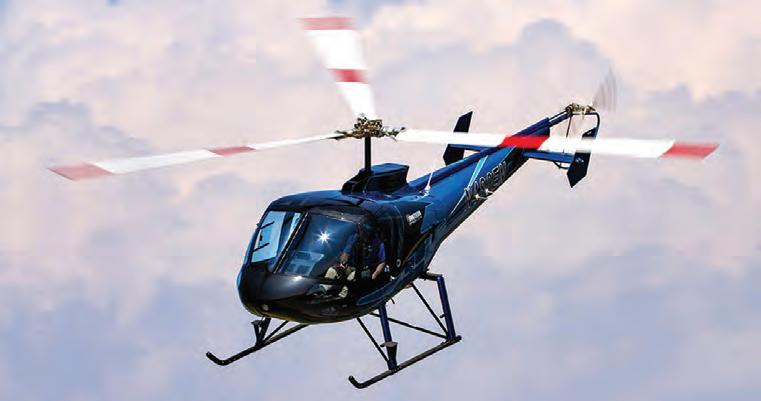
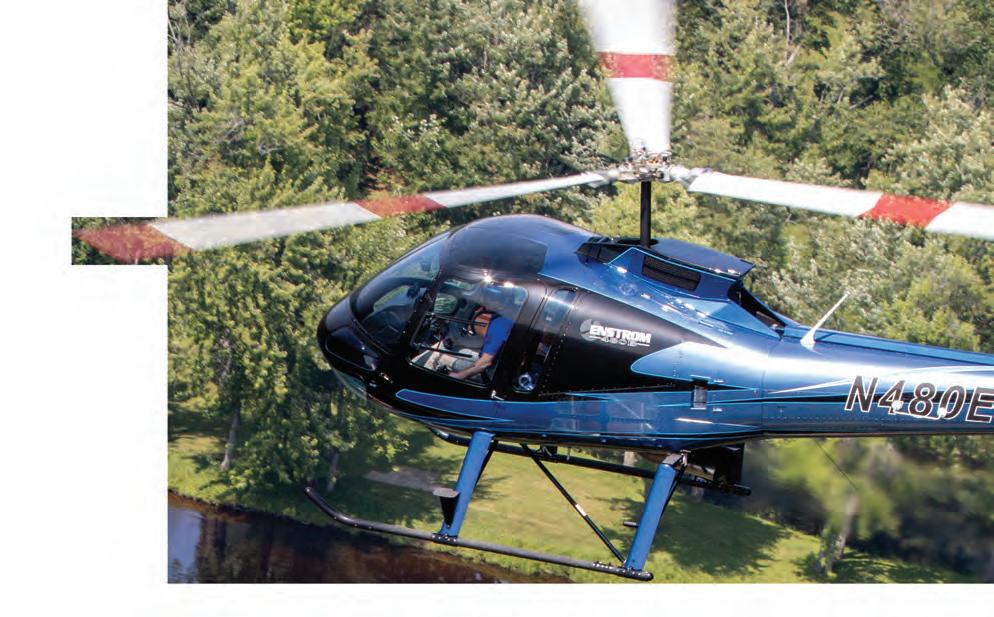
Following the FAA’s and EASA’s certification of its crash-resistant fuel system (CRFS) on the 480B turbine-engine helicopter, Michigan-based Enstrom
Helicopters is now gearing up to resume deliveries of new aircraft for the first time since it was sold out of bankruptcy in 2022.
“When the bankruptcy happened, the
FAA more than paused our production certificate,” explained Charles Wade, Enstrom’s senior v-p of product, sales, and customer excellence. “We had to earn it back, so there was a process we had to go through, and that took time.”
During that span, the agency had instituted a mandate that all OEMs integrate CRFS technology into their new-build rotorcraft to minimize the risk of post-crash fuel fires. Enstrom had partnered with Safran Aerosystems to develop the CRFS fuel bladders and other necessary components to achieve compliance. Safran also managed the CFRS testing program to support the recertification of both the 480B and the piston-powered 280FX, which is undergoing ground and flight testing in anticipation of FAA approval in the second quarter.
With the return of new aircraft production, Enstrom will now offer the three tiers of equipage on the 480B, first announced at last year’s Verticon. Analog instruments are included in the standard 480B, while the Signature and Elite versions will offer an all-glass Garmin cockpit, which is awaiting FAA certification. The Elite will feature custom paint schemes, upgraded cabin furnishings, Genesys three-axis autopilot, and cabin air conditioning as standard. The latter two features will be available as options for the Signature model. “Right now, the base model 480B, we can build and deliver them today,” Wade stated. “It’s really the Signature and the Elite models, because of the glass certification, that are a few months behind the standard.” FAA certification for the new avionics suite on those models is expected by mid-year. Wade noted that Enstrom currently has eight assembled 480Bs, including one standard model, while the other seven await authorization. Two more are under construction. Once the certifications are wrapped up, Wade said he expects production to ramp up on the 480B. “We’d like to produce about

CHARLES WADE
ENSTROM SENIOR V-P OF PRODUCT, SALES, AND CUSTOMER EXCELLENCE
15 or 16 of them this year; [this] is kind of what we are forecasting,” he explained, adding he expects to produce 10 piston 280FXs as the facility spools up. “Now that we have these certifications, we’re provisioning a line,” he told AIN. “If you count the 280 and 480 models together, we should be getting into that 40 to 45 range pretty easily.”
The span in which the facility was actually idled was a short one, according to
Wade. “We were very fortunate that the shutdown was only a couple of months long,” he said, adding that the OEM was able to bring back some of its key production staff. “That gave us a great foundation for managing the ramp-up, and we’ve just been building on that core competency since.”
While the company had not delivered new rotorcraft for the past several years, its production lines were kept busy producing parts to support the global fleet of more than 700 Enstroms in service. “We’ve been doing a lot with the aftermarket
business,” explained Wade, who joined the company in late 2024. “Obviously, the machines and the manpower are common between production and aftermarket. By virtue of having that aftermarket business, it’s been able to keep things running down there.”
At its booth at Verticon this year, the airframer will be displaying three of its helicopters, a Signature and an Elite 480B, and a 280FX, as it looks to grow its order book. “Enstrom is really excited, and I think 2026 is going to be a fun year,” concluded Wade. “We’re turning a big corner.” C.E.
Leonardo is pushing ahead with certification plans for two new aircraft: the twin-engine AW609, set to become the
first civilian tiltrotor when it enters service, and the single-engine AW09. Despite delays to both programs, both upcoming
Purpose-built and pilot-trusted, Enstrom helicopters move seamlessly from workweek to weekend getaway. Fly on your schedule, land where others can’t, and enjoy confident performance with refined comfort.
EnstromHelicopter.com Menominee, Michigan Start building the Enstrom helicopter for your flight needs. THERE’S BEING A PILOT. THEN THERE’S BEING AN ENSTROM PILOT. / All-Glass Digital Instrument Panel / Advanced Controls & Avionics / Custom Exterior Paint & Design / Premium Interior & Upholstery / Autopilot, Air Conditioning & More

aircraft could be set to receive regulatory approval this year.
In March 2025, FAA pilots began type inspection authorization flights on the AW609 tiltrotor from the manufacturer’s Philadelphia plant, a welcome milestone in an admittedly protracted certification campaign. Since finalizing its acquisition of the program (previously the Bell-Agusta BA609) in 2011, Leonardo stated that at the time it was initially targeting FAA certification “in the first half of 2016 and deliveries following immediately afterwards.”
However, the program has been dogged by a decade of serial delays and certification expectation extensions, in part attributed to the technical complexity of the AW609’s triple-redundant fly-by-wire flight controls. The tiltrotor configuration also presents its own certification challenges, with Leonardo explaining that the platform must meet “the highest FAA requirements for both fixed-wing airplanes and helicopters, including single-engine operation and autorotation.”
conventional helicopter at 270 ktas makes it ideally suited to missions including parapublic, medical, search and rescue, offshore energy, and executive transport. Sporting two Pratt & Whitney Canada PT6C-67A engines, the AW609 has a maximum range of 1,000 nm and a ceiling of 25,000 feet.
Although the OEM had hoped for EASA certification in 2025, this was hindered by a five-month pause in flight test activity from late 2024, attributed to gearbox issues.
In August, however, Leonardo reported that the program had taken a significant step forward with the first serial-production copy, S6, taking to the skies at the company’s final assembly line facility in Varese, Italy, where the aircraft was built. Leonardo has since shared that the campaign has been “demonstrating strong progress toward certification” with flight testing on the prototypes PS4 and PS5 completed.

In March 2025, a Leonardo representative stated that the company “won’t speculate on the AW609 certification date as [it continues] to work toward the end of development.” However, the Bristow Group has already been named as the type’s U.S. launch operator, ordering two units in 2016.
Leonardo states that the AW609’s cruising speed of almost twice that of a
In the single-engine space, Leonardo made the first flight of its production-representative AW09 in August. This was conducted from its main production site in Italy. At the time, Leonardo stated that “the program’s industrialization phase moves forward, while ground and flight certification tests proceed at a high pace.”
“All the Leonardo and Kopter teams are fully engaged as we advance through the AW09 certification campaign,” said Marco Viola, CEO of Leonardo’s Kopter Group. “We are performing extensive test activities, while S6 now plays a central role in validating the maturity of the design.”
The Safran Arriel 2K-powered helicopter has already garnered around 130 preliminary sales contracts globally.
Leonardo describes the eight-passenger AW09 as the “first all-new design in its weight class for more than 30 years,” adding that its flexible cabin layout helps equip it to perform multiple missions across different applications. The OEM also states it is the only single-engine helicopter to feature a “native connected aircraft” concept that enables seamless and automatic download of data at the end of each flight, together with advanced flight tracking capability.” C.B.
As Robinson Helicopter climbs out of a supply-chain crisis and engine delivery delays that slowed deliveries of its R66 turbine helicopter, the Torrance, California company has made significant progress in development of a new platform, the R88. Meanwhile, deliveries of the iconic R22 two-seat trainer are growing while Robinson is pushing forward on its effort to help owners and operators fly more safely. Rolls-Royce is recovering from delays in manufacturing a key engine component, the centrifugal compressor impeller, and engine deliveries are accelerating.
Unveiled during last year’s Verticon, the R88 is Robinson’s largest helicopter, capable of carrying 10 occupants, with a 275-cuft cabin for up to eight passengers or 1,800
pounds of payload with full fuel. Power is provided by a Safran Helicopter Engines Arriel 2W capable of producing 1,000 shp. Certification and entry into service are expected to take place later this decade, and the R88 will sell for about $3.3 million.
A key element of the R88 design is the input drive shaft, which connects the engine to the main transmission. “Input drive shafts are really tricky. That’s one of the hardest challenges on any helicopter, the ability to take relative motion between gear boxes and engines and throughout all sorts of maneuvers and transients,” Robinson president and CEO David Smith told AIN
Rather than adopt a conventional design, such as the Kamatics KAflex that Smith’s former employer, Bell, uses in many of

its helicopters, he wanted something less expensive that doesn’t require the complex overhaul process associated with a proprietary product. “It’s a fine product, but we want a different solution,” he said.
“The technology that we’re using for our input drive shaft is such an interesting improvement over the products that our competitors have used. Because we in the industry go to these single-source


Robinson’s largest helicopter, the single-engine R88, will accommodate up to 10 occupants.
operators that control the aftermarket and specialty intellectual property, we avoided all of that with this design, and it works really well. We’re hundreds of hours into testing, full speed, full power, and it’s working like a champ. I think we’ve got something good that’s going to cut the cost probably in half, maybe a third, for the competing product. This is going to be a design that operates well and doesn’t require an obscene overhaul cost.”
Also helping manage costs is further vertical integration, down to making its own fasteners for certain hard-to-source applications, more use of robotics for repetitive work like sanding rotor blades, and putting new five-axis milling machines to work making hydraulic components that Robinson used to purchase from vendors. “That accelerates our iterations through the design cycle and gets the parts in test sooner, and allows us to then make the next iteration on the design,” Smith said.
A new, larger water-jet machine will be used for cutting R88 sheetmetal parts, including rotor blade skins for blades that are three feet longer than the R66’s. Repetitive tasks such as machining, welding, and sanding are being augmented by dedicated robotic centers, Smith explained, “all areas where we have high injury risk
and repetitive motion injury risk.” The idea isn’t to replace workers but deploy them to more important work, like the final sanding of rotor blade bond lines that can’t be done precisely enough by machines. “There’s about 20% of the blade they can’t do with robotics,” he said. “The resolution of their movement isn’t sufficient to do some of the most critical bondline sanding.”
An in-house team developed a robotic process for manufacturing blade weights that eliminated a significant amount of
labor. “We tried working with third-party integrators for this stuff,” Smith said, “and they failed us. The guys have been really incredible because they learned to code the robot. This is stu ff that I would have loved to have done in my previous life, but work restrictions under the labor contracts at my previous employer made it difficult. Here, we have the flexibility to do end-to-end innovation. There’s still a lot of work for the same technician…so we’re hiring; we need probably another 75 to 100 people to do the things that are ahead of us.”
Robinson has also invested in inspection technology to speed quality control processes. R88 cabin assembly is well underway and in testing, along with many other components such as the landing gear and aircraft systems. “We have several reviews during the week with each system, [to] try to notice all the bottlenecks early,” he said. “We can fix, or we can change the path that we’re going through so we can deliver on time. I want the customer to know that we are doing our best to deliver them a product that they’re going to be happy with, and we’re not going to cut any corners.” M.T.
As it anticipates the certification of its S-92A+, the latest upgrade to its venerable large-cabin helicopter, Sikorsky is seeing renewed interest in the platform. The improved version will center around the OEM’s Phase IV gearbox, which it has been developing for more than a decade at an investment cost of more than $100 million.
A key feature of the new gearbox is an independent, auxiliary oil lubrication system with its own three-gallon reservoir that will kick in if the oil pressure in the primary
system fails. Another part of the A+ package benefits is a 1,200-pound increase in the helicopter’s capability, which will translate to extra fuel capacity, extended range, and/ or extra load weight. In addition, Sikorsky’s engineers anticipate a higher TBO than the previous Phase III gearbox.
While the Connecticut-based OEM has had low production rates for the S-92 for the past several years, that is about to change. “We’re seeing a lot more interest,” said Leon Silva, Sikorsky’s v-p of global commercial and
military systems, adding that the rotorcraft is viewed favorably for both VIP and utility transport. “Heads of state seem to be kind of the ones leaning first, but we have active proposal activity for offshore oil, and that’s the first time in a number of years that that has actually been a serious conversation.”
As well, the airframer sees new opportunities for the S-92 in the search and rescue (SAR) role. “We’ve seen this coming a little bit, customers around the world that were using Mi-17 and Mi-8s, Russian helicopters that are now very difficult to maintain, are now looking at alternatives,” Silva told AIN. “We have been doing work to improve the ability of the S-92 to carry external loads, which is important for those types of utility missions, and we expect later this year to have some further progress on that.”
Sikorsky anticipates deliveries of the first S-92A+ in 2028 and is establishing a new production line at a location that will be disclosed at this year’s Verticon show in Atlanta. Silva said the new assembly line will allow it to ramp up production to meet demand. “We’re going to go up to six [a year], we already have work for that, and we’re scaling up to be able to do 12 a year.”
“It gives us stability,” Silva continued, “the ability to be more price competitive because obviously building a larger number

gives us a better opportunity to work with the supply chain and get better pricing opportunities.” He added that supply chain improvements have also improved the availability of the existing S-92 fleet, which now totals around 270 in active use of the 310 it has delivered. Of those aircraft, Silva said approximately 75% are in use in offshore oil and gas transport, while VIP, SAR, and utility make up the remaining quarter.
At last year’s Verticon, Sikorsky showed off a new, later-stage life use for the platform developed by S-92 lessor Milestone Aviation in cooperation with operator VIH Helicopters. It marked the first aerial firefighting configuration of the helicopter available to the commercial market, and that program has been progressing, with the conversion of more airframes, including
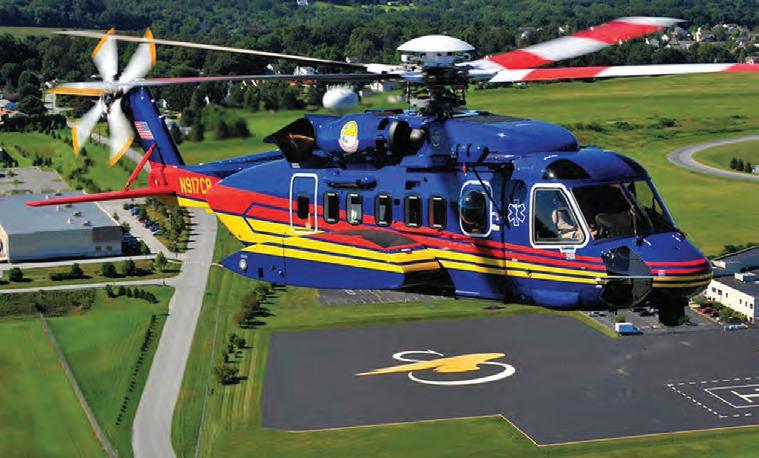
the first production S-92, delivered in 2004.
As for the S-92’s smaller sister, the S-76 ceased production in 2022, and the manufacturer has been weighing plans for a possible successor. “We’ve made more progress,” said Silva. “We’re pursuing about four possible paths, and I think 2026 is going to be the year that we define one of those that moves forward.” While he declined to provide further details, Silva did mention that he has now assigned a dedicated program manager to the project. The OEM has also established an industry advisory board to provide feedback on what any midsize rotorcraft should include in terms of capabilities.
One of the questions going forward with any new aircraft program is the type of propulsion system it will employ. The company has been working on new designs using hybrid electric propulsion systems that it is developing in-house. Sikorsky has successfully flown a blown-wing tailsitter uncrewed air system, which it views as both a possible commercial product as well as a stepping stone to a larger hybridelectric demonstrator (HEX) UAS, and eventually on to a commercial product.
“We’ve made a lot of progress on the power systems test bed,” said Igor Cherepinsky, director of Sikorsky Innovations, the company’s rapid prototyping group. Cherepinsky added that the unit is undergoing engine-on testing: “It’s been assembled, we’re planning to fly it this year.” In addition to the powertrain, the HEX is also expected to be an incubator for other technologies, such as additive manufacturing, which will eventually find their way into the airframer’s main product lines as a solution to expensive, long-lead-time parts such as forgings and castings.
Cherepinsky said it’s too early to speculate on future product architecture. “We definitely see more than one product coming out of it. “It’s not going to be whether we’re going to make a single main rotor, or whether we’re going to make a tilt-wing; it’s really which one is coming first?” C.E. z
BY CHAD TRAUTVETTER
Tokyo-based air charter broker AirX placed a firm order for two Eve Air Mobility eVTOL aircraft and options for 48 more under a deal potentially worth $250 million (at estimated list prices) announced on February 4 at the Singapore Airshow. AirX will use the electric aircraft mainly for transfer and sightseeing flights in Japan, with a focus on the Osaka Bay area. Its first two eVTOLs are expected to be delivered in 2029.

AirX has been arranging these types of flights throughout Japan in helicopters, flown by partner companies holding air operator certificates, for nearly 11 years via its Airos Skyview online booking platform. Bookings at the company are evenly split between transfer and sightseeing flights. An app planned for launch in the second quarter will provide a more user-friendly interface that would better facilitate ad-hoc advanced air mobility (AAM) bookings, AirX founder and CEO Kiwamu Tezuka told AIN
According to AirX supply innovation procurement specialist Masato Kikuchi, plans call for the company to lease the Eve eVTOLs to partner operators that will fly them. AAM service with the fourto six-passenger electric aircraft is set to begin in the Tokyo metropolitan area within the next five years, dependent on when it obtains certification, he noted.
Asked how much AAM flights would cost on an Eve aircraft, Tezuka said he and his team “are trying to figure that out right now.” However, he noted that demand is there: “We already get lots of requests for transfer flights using helicopters.”
Eve’s v-p of services, operations solutions, strategic design, and ecosystem Luiz Mauad expanded on AAM demand in Asia-Pacific, where Eve forecasts a need for 12,200 eVTOLS—41% of the projected world fleet. Deeply congested cities will drive this demand, he noted.
Mauad said eight of the world’s 10 largest cities are in this region, with Tokyo at the top of the list. In addition, the population in Asia is expected to skyrocket from 2 billion in 2020 to 3.5 billion at the end of this decade, leading to more urban congestion that eVTOLs can help alleviate.
According to Mauad, eVTOLs will greatly decrease travel times in cities such as Tokyo. For example, he said an Eve eVTOL aircraft could fly from Tokyo Haneda Airport to a city-center vertiport in 15 minutes, versus more than one hour by car. Eve’s aircraft has a baggage area that can fit two checked and two carry-on bags to facilitate such airport transfers, he added.
“Asia-Pacific has a huge appetite for eVTOL AAM, including passenger and light cargo flights,” Mauad said. z

Textron Aviation is seeing “strong demand” in Asia-Pacific for its turboprop and business jet o erings, Tony Jones, the company’s v-p of sales for the region, said during the 2026 Singapore Airshow.
While he noted that interest is across the product line, the manufacturer displayed its best-selling models at the show: a Cessna Citation Latitude twinjet and a Beechcraft King Air 360 turboprop twin. Demand is being buoyed by healthy economies and high business confidence and growth throughout the region, Jones said.
“Asia-Pacific is a strong turboprop market,” he told AIN. “Australia is a great market for us, and Southeast Asia is hot right now as well. The King Air and Latitude models we’re showing here in Singapore are aircraft that really suit this market.”
The company’s refreshed products—including the Citation M2 Gen 2 with autothrottles and newly FAA-certified Citation Ascend—are also gaining attention throughout Asia, according to Jones. “There is a lot of anticipation in this region” for Textron Aviation’s Beechcraft Denali turboprop single, which is expected to obtain U.S. approval soon.
Meanwhile, attitudes toward business aviation in Asia are changing, with more viewing it as a business tool rather than as a luxury, Jones said. C.T.
BY CHARLOTTE BAILEY
Singapore’s Nanyang Technological University (NTU) has revealed an eVTOL design that could become the country’s first domestically produced passenger aircraft. Although certification of a full-scale aircraft isn’t expected until after 2030, flight testing of the two third-scale model displayed at the show is taking place in Singapore and Germany.
The NTU technology demonstrator project, unveiled on February 3 at the Singapore Airshow, has been underway in secret for around three years, building on the Project Zero eVTOL concept first revealed in 2013. After initial conversations in 2019, government funding was allocated to the current project in 2023. A 30-strong team is led by NTU professor James Wang, whose rotary-wing experience includes a tenure as senior v-p of marketing and v-p of research and development at AgustaWestland (now Leonardo).
The lift-and-cruise-configured eVTOL features eight lift rotors atop four wingmounted pylons, along with a rear pusher propeller. Many components were developed by the project and its partners. These include proprietary rotors and a compact motor design, designed by NTU, while the
electric architecture is jointly developed with Eaton Aerospace. The use of new composite materials and magnesium alloys is also being explored.
After studying more than 20 initial configurations, Wang described this layout as having a “higher flight performance than a pure multirotor configuration and does not have the complexity of a rotor-tilting mechanism.” Revisions could be made to the final certifiable design. Expected to enter commercial operations after 2030, it is designed to carry one pilot plus four passengers or up to 500 kilograms of cargo.
The 8-meter wingspan scaled technology demonstrator has already conducted domestic tethered hover trials, although restrictive civil aviation authority permissions necessitated a second location. A month ago, a second scaled aircraft began a flight-test campaign in Germany, carrying a 25-kilogram payload.
Wang believes that the nascent eVTOL arena has room for at least half a dozen OEMs to share the commercial market, highlighting the benefits of inter-company collaboration. Technical learnings and regulatory collaborations informed by this project also have the potential to benefit the wider Singaporean aerospace industry, building on the country’s extensive MRO expertise. z

Nanyang Technological University’s lift-and-cruise eVTOL technology demonstrator is undergoing flight testing in Germany.
ST Engineering is building upon its engine nacelle expertise with a new thrust reverser unit (TRU) demonstrator, its first application for business jets. Designed to fulfill a perceived gap in ST Engineering’s engine o erings, the company hopes its unique design will o er enhanced aerodynamic e ciency and acoustic performance.

ST Engineering’s TRU demonstrator.
The ground demonstrator is the result of 18 months of development, taking the concept through design, construction, and testing. Noah Hughes, advanced design engineer at ST Engineering, told AIN that thrust reverser design idiosyncrasies provide “an opportunity to take shortcomings of existing thrust reverser systems and provide improvements.”
Notable di erences include electric actuators along the unit’s side, rather than the traditional 12 and 6 o’clock positions. This negates the need for the associated bracketry, which is detrimental to aerodynamic performance, with the experimental system instead employing a unique hinge design. A larger interior surface provides more area for acoustic treatment, helping mitigate noise, while a continuous seal facilitated by the novel setup also helps optimize e ciency. C.B.
BY MATT THURBER
WingsOverAsia, the long-time full-service FBO located at Singapore’s Seletar Aerospace Park, celebrated the groundbreaking for its new jet hangar during the Singapore Airshow. The facility will help WingsOverAsia, in partnership with equity investor MJets, to expand its business jet services at Seletar to include jet maintenance and management.
“Continuing WingsOverAsia’s decade-long reputation for sustained innovation within the regional general aviation landscape, this project serves as a prelude to many new business aviation frontiers to evolve from the recent strategic equity partnership with MJets,” said Ng Yeow Meng, founder and managing director of WingsOverAsia.
The hangar at Seletar will be integrated into MJets’ regional FBO network, which has facilities in India, Myanmar, Cambodia, and Thailand, enabling the company to support larger and more advanced aircraft platforms, according to WingsOverAsia.

The partners expect the new facility to create more than 50 new high-value jobs.
“This partnership ensures that advanced capability becomes dependable daily execution—delivers operational reliability, scalable capability, and end-to-end peace of mind through consistent performance,” said MJets CEO Natthapatr Sibunruang.
“JTC is delighted that Seletar Aerospace Park is providing the enabling infrastructure and ecosystems to support the rapid
growth of business and private aviation across the Asia-Pacific,” said Christine Wong, assistant CEO of JTC.
“We welcome WingsOverAsia’s latest hangar expansion, which will provide much-needed services for the sector to scale and develop in the region.” JTC (formerly Jorong Town Corporation) is a statutory board under the Singapore Ministry of Trade and Industry and promotes sustainable industrial development.
Vertical Aviation International (VAI) is expanding its rotorcraft events to Asia-Pacific with the addition of the inaugural VAI Southeast Asia Aviation Safety Conference (SAASC). Scheduled for May 27 to 29 in Bali, Indonesia, the new regional show “represents a proactive step in delivering critical safety support to regions historically lacking easy access to VAIhosted or -supported events,” which includes Verticon, European Rotors, and the Aerial Work Safety Conference.
“Southeast Asia is home to one of the fastest-growing vertical aviation markets, yet it faces persistent safety challenges: limited access to training, inconsistent regulatory
oversight, and a lack of structure for knowledge sharing,” the rotorcraft association said. “SAASC directly addresses these gaps by o ering a collaborative platform for operators, regulators, OEMs, insurers, and end users to come together and elevate the region’s safety posture.”
Modeled after VAI’s Air Tour Safety Conference held in Hawaii in 2024, the Asia gathering will serve as a hub for vertical aviation learning, sharing best practices, and showcasing innovation, according to the association. But it’s meant to augment, not replace, other local rotorcraft events, noted VAI president François Lassale. “We’re not here to compete
with local organizations—we’re here to support them, bring structure, and create a trusted forum for industrywide collaboration.”
SAASC will feature keynote speakers, targeted training events, and an open forum for exchanging operational knowledge. Its overarching purpose is “advancing safety through shared understanding,” VAI explained.
The association said the Southeast Asia show will serve as a model for future regional safety forums in underserved areas around the world. “As the vertical aviation community grows globally, so must its commitment to safety—and this event marks a decisive step in that direction,” VAI concluded. C.T.
BY KERRY LYNCH

The FAA took the business aviation community by surprise when it issued a notification in mid-January that all of the aircraft registration certificates under the trustee Southern Aircraft Consultancy Inc. (SACI) were invalid because the firm was in violation of U.S. citizen requirements when it submitted the registration applications. The net result was the immediate grounding of nearly 650 aircraft, including 52 turboprops, business jets, and turbine helicopters.
SACI, which was based in the UK, was instructed to surrender its certificates of registration (COR), and affected aircraft owners were told to re-register their aircraft through another country’s aircraft registry or through the FAA with evidence
of ownership that meets U.S. citizenship requirements before resuming operations.
The move raised several questions: Are FAA officials now probing more deeply into the U.S. aircraft registry? Is the agency cracking down on trusts? Is it particularly looking at offshore trusts? And, importantly, is this a systemic issue? In short, what does this mean?
Legal experts believe that this may have been a unique case. Seemingly, SACI got ensnared in an ownership change, and there does not appear to be a rash of new FAA enforcements or investigations.
“It’s definitely unusual in the aircraft trust world; it’s not something that we’ve seen happen very often,” said Scott McCreary, v-p for McAfee & Taft and
member of the NBAA Tax Committee and NBAA Regulatory Advisory Committee. “The FAA obviously has oversight over many companies. On any given day, they would be looking into investigations and enforcement actions. That’s not uncommon. I don’t want to call it a red herring, but this was a one-off for trust companies as far as we know.”
McCreary added that he was not aware of any sort of increased scrutiny beyond the agency’s normal course of oversight.
In fact, the agency worked collaboratively with the affected parties to resolve the issue. Following the notification. Casper, Wyoming-based Valiair stepped in to acquire SACI and retained Gilchrist Aviation Law to renew the registrations.
April 22 – 25, 2026
Friedrichshafen, Germany
Halls A1 – A3, Dome, Static Display




Within two weeks, the FAA began processing “fly-wires,” or temporary CORs, and Gilchrist anticipated that within several weeks, the re-registrations would be completed.
“The FAA has responded promptly to these submissions, allowing affected aircraft to return to service without unnecessary delay,” the law firm said. “The re-registration process is now moving quickly and efficiently. Gilchrist Aviation Law, working closely with SACI, Valiair, and the FAA, has been able to re-register SACI aircraft within a matter of days of receipt of the old COR.”
The process even gained momentum as time went on, noted Jack Gilchrist, founding director and shareholder of Gilchrist Aviation Law. “Much to the FAA’s credit, they’ve been very responsive and cooperative to the needs of these operators,” he said. “I think the operators have been at least pleased to see the quick resolution to what’s going on, or at least satisfied maybe to that extent because no one wants to deal with the grounding of their aircraft.”
Gilchrist added that the temporary CORs have aided the expediency. “The beauty of the temporary certificate of registration is that it comes to us in electronic form. It comes as a PDF, and we can deliver that document just as easily to the location of the aircraft,” he explained. The FAA issues the “hard card,” or permanent registrations soon after, but these take longer to get to the aircraft.
However, while the situation was being remedied with relative swiftness—especially for an agency that has a reputation of working sometimes at a glacial pace—aviation legal experts also believe that the incident has served as a critical reminder of the importance of diligence in registration and of meeting citizenship requirements.
“There has been a lot of discussion in connection with it, most of it speculation,” Gilchrist noted. “But I think valuable

information for the public at large is the importance of the issue of citizenship. That obviously was the case [with SACI]. The FAA cares about that issue, and they’ve always cared about it. But in the case of Southern Aircraft, they’re working through the process to get the situation satisfied.”
While many in the industry understand that citizenship of aircraft owners is part of the U.S. registration process, he added, “It’s something that has to be on the minds of most people.”
McCreary further noted that the SACI issue has “refocused” the business aviation community on the importance of carefully deciding which owner trustee to use.
“You can’t just rely on the trust companies. They’re not operating the aircraft for you; it’s still your aircraft, your asset, and you need to make sure that everything’s in order,” he said, continuing, “If you own an aircraft and you’re going to transfer title of the aircraft to an entity to hold title and register the aircraft in their name, you should understand who that entity is. You should do due diligence. You should check with the people in the industry about their reputation. You should probably run your own searches on that entity to make sure that it complies with the citizenship test,
and it looks like they’re operating their trust company legally.”
McCreary also warned that, “Cheaper is not always better. You have a valuable asset with an aircraft, and if you’re going to engage a trust company to be the registered owner, make sure you’re engaging a trust company that has the experience, the reputation, and the wherewithal to act as trustee. If it looks like they’re cutting corners or simply not asking questions—even if their trust and structure may be perfectly valid and the registration may be valid— you would rather have a trust company that’s actively monitoring their trust and making sure that they’re in compliance.”
He also reminded that the owner, rather than the operator, must meet the citizenship test for registration purposes. As for the citizenship aspect, McCreary explained: “Every entity that registers an aircraft with the FAA has to meet a citizenship test, and it’s rather detailed. [Regulation] requires that the individual or applicant for registration meet a number of objective tests as it relates to its officers, managers, and people who hold voting interests. It also has a subjective element that requires the entity itself to be under the actual control of citizens of the United States.”
Trust companies are a well-established means of registering aircraft that are accepted by the FAA. “It’s approved, covered by regulation, and it’s a process that works well and plays a significant role for people,” Gilchrist said.
“There are 10,000-plus aircraft registered under trusts, most to larger companies that are either banks or financial institutions or entities that are based in the United States with their primary offices and businesses in the United States,” McCreary added.
People turn to trusts for many reasons, but a key one is that many owners want their aircraft on the U.S. registry. With the U.S. being the largest market for business jets, having an FAA registry could open the door to sales possibilities, he explained. The FAA is known for its high standards for
regulatory compliance. “If aircraft have been operated and maintained under the FAA standards, they tend to hold their value well.”
There are numerous trusts ranging from large banks to small private entities. This underscores the importance that owners have a strong understanding of the role these companies play in the trust process, as well as their citizenship. Each case will be different, and sometimes it evolves, such as with SACI.
“There was a time, historically, that there’s no question that Southern Aircraft Consultancy met the requirements of citizenship, But over time there was a family succession of ownership through death and so on, and in that process, it’s always something that has to be paid attention to,” Gilchrist said “I think that’s where people have to be vigilant.” And trust companies must be equally so.
Gilchrist noted that not any person or company can sit as a trustee and that laws exist to put guardrails in place on trustee qualifications. “That’s a factor that people should pay attention to,” he said. Another factor is their experience in the industry.
“The less experience that a trustee has, the more people should pay attention to whether they qualify and how smoothly they’re going to be able to operate and respond to needs and requests from their beneficial owners. Owners should pay attention; they should be interested in the details.”
However, even while the FAA is clearly looking at citizenship—and SACI is a good example of it—“it’s not like they’re combing through and trying to do any gotchas. This just happened to be an unusual situation,” Gilchrist concluded. z
— Chad Trautvetter contributed to this article





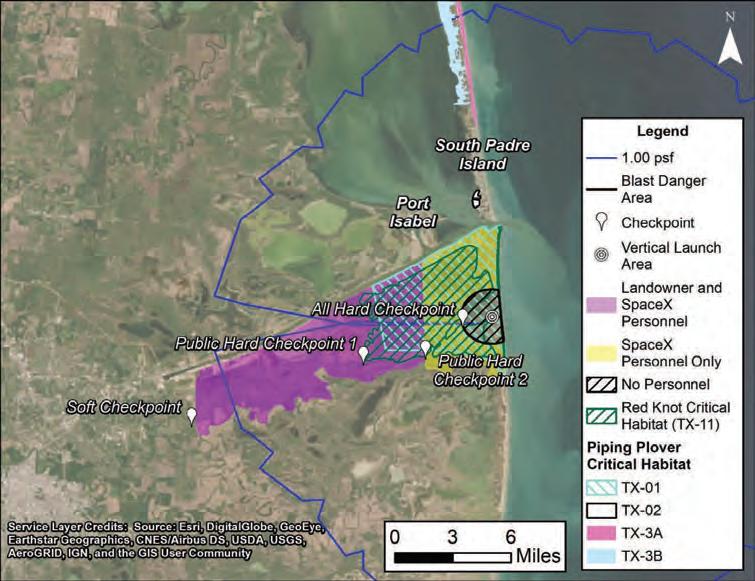
As the pace of large rocket launches from Texas and Florida is poised to increase, airline operators and air traffic managers are paying closer attention to how those launches intersect with operations over the Atlantic Ocean and Caribbean. That focus sharpened as SpaceX sought approval for higher-frequency Starship operations at Florida’s Kennedy Space Center (KSC) and Cape Canaveral Space Force Station (CCSFS) late last year, adding to ongoing launch activity from Boca Chica in south Texas.
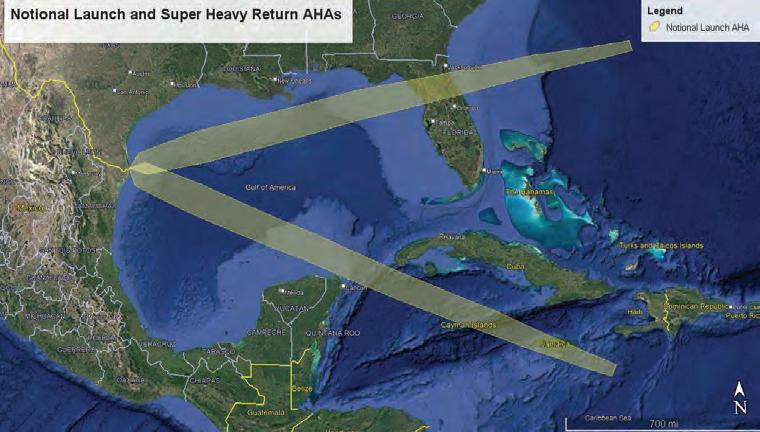
With plans advancing to launch Starship from Florida as early as mid-2026, environmental impact statements (EIS) for proposed sites at KSC and CCSFS outline substantial airspace closures tied to both launch and reentry operations. According to the analyses, launch windows could close Atlantic airspace for 40 minutes to two hours, affecting routes over the U.S., Atlantic, and Caribbean, with 133 to 400 aircraft potentially impacted during peak periods.
Reentry operations are also expected to be disruptive, following west-to-east trajectories similar to space shuttle landings that could shut down southbound domestic and international traffic into major Florida airports, including Orlando, Tampa, Fort Lauderdale, West Palm Beach, and Miami, as well as airspace over Mexico, Central America, and the Caribbean.
BY AMY WILDER

Those projected impacts have prompted formal concern from Airports Council International-North America (ACI-NA), which submitted comments on the Kennedy Space Center Draft EIS, citing FAA delay assumptions. ACI-NA estimated that proposed Starship operations could affect between 900,000 and 2.3 million SpaceX’s Falcon 9 rocket launched the ORBCOMM OG2 Mission 1 on July 14, 2014.
commercial air passengers annually, resulting in 600,000 to 3.2 million hours of cumulative delay and economic costs ranging from $80 million to $350 million per year.
In its filing, ACI-NA senior v-p of safety and regulatory affairs Christopher Oswald also questioned whether air traffic management measures such as ground stops, miles-in-trail restrictions, and dynamic reroutes can scale safely and practically as launch frequency increases, urging additional review and stakeholder engagement as commercial space operations expand into heavily traveled airspace.
The spotlight is shining more heavily on launch activity after three rocket breakups a ff ected air tra ffi c and attracted public attention:
• Jan. 16, 2025. A Starship vehicle launched from Starbase, Texas, and broke up in-flight during ascent. The FAA required and oversaw a mishap investigation, citing debris generation and subsequent airspace management actions.
• March 6, 2025. A Starship during a launch attempt from Texas failed and broke apart during ascent, prompting additional airspace restrictions and contributing to FAA requirements for revised flight safety analysis and expanded hazard areas.
• May 27, 2025. Starship Flight 9 launched from Starbase and broke apart during the reentry phase. The FAA activated a debris response area and later required SpaceX to conduct a mishap investigation, though the agency stated that debris remained within designated hazard areas.
Even when everything goes as planned, there’s an impact on air traffic in proximity to rocket launches. These launches have
long required temporary airspace closures, but Starship’s scale and energy profile have expanded both the size and geographic reach of those closures.
For operators, the challenge is not limited to planning around scheduled launch windows. Greater complexity arises during off-nominal events like those in 2025, when debris response areas must be activated and aircraft already airborne may need to be rerouted, held, or diverted in real time.
FAA records from 2025 show that even when debris remains within preplanned hazard areas, launch anomalies can still produce measurable airline impacts, including diversions and airborne holds.
Investigative reporting by ProPublica and The Wall Street Journal late last year described airline concerns, particularly over Florida and Caribbean routes that carry dense traffic. SpaceX has rejected suggestions that airline safety has been compromised, stating publicly that aircraft are routed around conservatively-sized hazard areas and that no aircraft have been put at risk.
FAA statements, while stopping short of that categorical language, describe an airspace management framework built around probabilistic risk modeling, expanded hazard areas, and coordination with domestic and international aviation authorities.
Those airspace implications are now also being examined by airport operators. In comments submitted to the FAA’s draft EIS for proposed Starship-Super Heavy operations at Launch Complex 39A, ACI-NA said the FAA’s analysis points to substantial systemwide airline disruption.
Using delay assumptions published in the Draft EIS, ACI-NA calculated that the 44 annual Starship launch, booster recovery, and reentry events analyzed would affect between 12,000 and 23,000 commercial aircraft operations per year, with delays ranging from 40 to 120 minutes per flight. From those figures, the group estimated that between 900,000 and 2.3 million passengers annually would experience a collective 600,000 to 3.2 million hours of delay.
Applying airline delay cost data from Airlines for America, ACI-NA’s Oswald wrote, “The costs of delays and disruptions

associated with the proposed Starship operations would range between $80 million and $350 million annually,” adding that the estimates should be considered conservative.
Oswald also questioned whether existing air traffic control mitigation techniques can scale as launch frequency increases, stating, “We believe the safety and practicality of using air traffic control initiatives such as ground stops, use of miles-intrail restrictions, dynamic reroutes, and other air traffic management techniques requires additional review and stakeholder engagement.”
FAA records show it has responded to recent Starship mishaps by expanding aircraft hazard areas, adjusting launch timing to avoid peak airline flows, and coordinating with international aviation authorities as closures extend beyond U.S. airspace.
In a safety alert for operators (SAFO) issued January 8, the FAA formally warned air carriers and flight crews to expect increasing airspace disruption tied to space launch activity, including the potential for debris-generating mishaps. The SAFO states that “as commercial and government space launch activities increase, it is imperative that airspace users account for potential disruptions due to launch operations.”
It further says that FAA air traffic control implements a range of hazard-mitigation measures to protect aircraft during both planned launches and unplanned anomalies.
The alert outlines that airspace management plans establish aircraft hazard areas, temporary flight restrictions, and debris-response areas (DRA). It explains that in the event of a catastrophic failure, ATC will reroute aircraft and issue alerts to affected flights.
“Past events have shown that when a mishap does occur, debris has fallen within or near the DRA,” the FAA noted, advising pilots to exercise “extreme caution near these areas.”
The FAA emphasized that operators should incorporate space launch impacts directly into routine flight planning, including accounting for delays, holding fuel, and possible diversions. The SAFO advises operators to anticipate air tra ffi c initiatives such as reroutes and ground delays, ensure compliance with fuel reserve requirements, and identify alternate airports should DRAs be activated.
It further cautions that “debris may extend beyond the designated DRA, requiring additional situational awareness,” particularly since debris DRAs are not issued in procedural oceanic airspace. The agency recommended that dispatchers and flight crews monitor launch-related notams, participate in FAA system command center briefings, and use real-time operational tools to stay informed as space launch activity increasingly overlaps with heavily traveled airspace.



EBACE26 marks a decisive step forward, bringing fresh energy and opportunity to the global Business Aviation community. The static display returns in a new dedicated location at Geneva Airport, designed to deliver the most secure, fexible and customer-focussed aircraft showcase in the event’s history.
Coupled with Geneva’s well-connected ecosystem, nowhere else in Europe brings together this calibre of key stakeholders, infuential customers and industry associations.
Be part of the new experience.
Find out more at ebace.aero

BY MATT THURBER

Cirrus Aircraft unveiled the G3 Vision Jet (generation 3) on February 3, with more than 30 new features, such as seating for six adults and one child, air traffic control datalink, new interior trims, and other refinements. Deliveries of the G3 are now underway.
AIN flew the G3 on January 26 and experienced many of the new features, including a series of controller-pilot datalink communications (CPDLC) messages during a round-trip flight from Hillsboro Airport (KHIO) near Portland, Oregon, to Jack McNamara Field (KCEC) in Crescent City, California. While the G3 Vision Jet performs the same as the previous model, the G2+, the new features add convenience, safety benefits, and an increase in maximum Mach operating number (MMO) at cooler temperatures.
Cirrus has delivered more than 700 Vision Jets since it entered service in 2016. Many of the new features are exclusive to the G3, although the avionics upgrades will be available on previous models, according to Matt Bergwall, Cirrus executive director for the Vision Jet product line.
The expanded seating area is made possible by a new bench seat for the rearmost row, and it can accommodate two adults on the sides and a child or small person in the center. This expanded seating is an option available with the Arrivée trim, the only one available with the G3 Vision Jet. Previous generations fit one adult and two children in that row. The two center seats are moved about 2 inches forward to give the rear-row passengers extra legroom,
and the center seats now have wells in the back for rear-seat passenger feet. As with earlier models, the center and third-row seats are easily removable if more space is needed with a lighter passenger load.
To make entering the cabin easier, both pilot and copilot seats have a new handle for moving the seat fully forward or aft with one hand.
Seats are bolstered for added support in the headrest, armrests, and knee area. New armrests fold away conveniently with a single move from deployed to tucked away. G3 seats are all fitted with a hardshell back and hand-wrapped Alcantara, a suede-like material. The Arrivée level trim adds carbon fiber.
The seat redesign eliminates what Bergwall called “the Cirrus crinkle,” something that passengers noticed when moving
in the rear seats. The original honeycomb under the seats, needed to absorb force in case of a Cirrus airframe parachute deployment, sometimes made a crinkling noise.
“We tightened up that honeycomb so we don’t have that crinkle anymore,” he said.
On the backs of the seats, a removable carbon fiber insert covers a cold-shoe mount that can be used for various types of mounting systems—for example, a Ram mount with a magnet to hold a phone, or a camera mount. The overhead TV screen is gone, because passengers usually use their own devices for entertainment purposes.
Space between the center seats opens up with tray tables that tuck into the sidewall, eliminating the bulky center console that houses the tray tables on earlier models. The new tray tables have a flip-up device holder to hold smartphones and tablets.
On the outside of the Vision Jet, a new feature is the Spectra wingtips with landing lights that are 2.7 times brighter and halo lights on the wingtip edge, something that was adopted from the SR series piston singles.
New deicer boots give buyers the option of silver or black rubber, and the black boots make it easier to maintain a clean appearance.


On the right side of the Vision Jet’s nose, the air conditioner door has been replaced with a vented louver that eliminates the noise change that was noticeable when the system switched on.
For pilots, new avionics features bring added safety and convenience. During our flight from KHIO to KCEC and back, Bergwall showed me how to logon to the CPDLC network after takeoff. We couldn’t test the digital clearance (DCL) capability because it’s available at just 65 U.S. airports that generally don’t include non-airline facilities like KHIO. DCL is available at nearby Portland International Airport (KPDX) and airports such as Teterboro (KTEB), and Bergwall has used that capability and appreciates being able to get IFR clearances sent directly to the avionics.
After getting a logon acknowledgment from air traffic control, we received frequent datalink messages for frequency changes, reroutings, and new altitudes. Once received, we could simply acknowledge the message and send it directly into the avionics—called push-to-load—and avoid having to type in the new frequency, altitude, or route.
The datalink messaging provided clear benefits, including not having to memorize or write down an instruction, avoiding asking “say again” if a radio call wasn’t understood, and a quick way to input the information into avionics. Of course, it’s still incumbent on the pilot to verify that the information is correctly entered and acted upon. Digital ATIS is another benefit of datalink communications capability.
Cirrus’ IQ Pro Advanced adds another convenience feature: Automatic Database Updates. Flight times are now all-digital, with no more analog Hobbs meter, and go right into the Cirrus IQ app.
A safety-enhancing feature is the alertslinked checklists. When a caution or warning message pops up on the primary flight display (PFD), it provides quick access to the relevant checklist. This will be a great help during a potential emergency situation and is a feature available on many larger business jets.
Other new avionics features include automatic switching to standard baro setting when climbing through 18,000 feet, and the ability to present the altimeter setting during descent, then automatically set it when descending through 18,000 feet. Runway awareness and advisory

system is another new feature, along with a best glide indicator.
While we received our taxi clearance from the Hillsboro ground controller, Bergwall showed me how I could plug into the taxi route. By touching the applicable button on the Vision Jet’s Garmin Perspective+ Touch touchscreen controller for each route instruction, I was able to build the entire route to the takeoff runway end. The route was also depicted on the Garmin 3D SafeTaxi display, which shows each leg depicted as arrows pointing the way. This would be a huge boon at an unfamiliar airport.
We didn’t climb to the Vision Jet’s maximum altitude of FL310, so I didn’t get to see the new MMO feature in action, but the new capability allows the engine to develop maximum power at cooler temperatures, boosting maximum speed in certain conditions by 7 knots. In the previous Vision Jets, Bergwall said, “When [conditions were] cooler, we were Mach-limited.”
During the flight to KCEC, we climbed to FL230, where we maxed out at Mach .538 and burned 83 gph with a cabin altitude of 4,520 feet. We picked up a bit of mild icing in the medium-level clouds that blanketed the area, but it quickly popped off when I switched on the new black deicer boots.
Pulling up the chart for the RNAV (GPS) Rwy 12 approach on the right pane of the PFD, it was soon time to descend. The vertical situation display on the multifunction display (MFD) showed our top-of-descent point and surrounding terrain, adding to the great situational awareness we were afforded, along with that available from the Garmin Synthetic Vision Technology.
Checklists are managed with a scroll wheel conveniently mounted on the subpanel between the PFD and MFD. Pushing the center of the wheel pulls up the

checklist, temporarily replacing the chart on the side pane of the PFD.
With the Vision Jet’s autothrottle and autopilot engaged, we descended along the VNAV path until intercepting the final approach course. After tracking along the RNAV approach’s vertical and lateral flight path for a bit, I clicked off the autopilot and autothrottle so I could get refamiliarized with the jet’s handling in the 90-degree, 12-knot crosswind before landing. With landing gear and flaps down, I followed the flight director guidance down to the runway, crabbing to compensate for the crosswind. I had to add a little power as I let the jet get a little slower than the green donut-bugged Vref speed, and the Williams International FJ33-5A engine responded promptly. Straightening out once near the runway, my touchdown wasn’t the smoothest, and I could have helped the nose drop slightly later to avoid clunking it down, but it’s better to have all the weight on the wheels, especially in windy conditions, to minimize runway used. Landing with a crosswind wasn’t completely necessary, but I wanted to experience the Vision Jet’s handling in the wind.
I taxied back for takeoff, this time into the wind on Runway 18. We took off VFR, then picked up our IFR clearance in the air
and returned to FL230 for the flight back to KHIO. During this leg, the datalink messaging from ATC came hot and heavy, again proving its worth and highlighting the great benefits of non-voice digital communications. More light icing clung to the deicer boots as we transited through the clouds and was easily dispatched, and we requested and then flew a GPS approach to Runway 31L. This time, I managed a smoother landing, a reminder of how easy the Vision Jet is to fly, even when compared to its piston-powered SR series siblings.
The new features in the G3 Vision Jet underscore the consistent improvement that Cirrus engineers have made to the platform. Existing and future Vision Jet owners are excited about upgrades, and this is evidenced by the fact that many return to buy the new model, while owners of SRs and other types keep the backlog healthy.
However, owners of earlier Vision Jets will be able to upgrade their avionics, including the datalink feature, which is becoming more of a requirement in European airspace.
The price of a new G3 Vision Jet with the Arrivée trim is about $3.6 million, roughly $160,000 more than the G2+ model. z


MARCH 31, 2026 | 12:00PM ET
Weather radar has changed. What was once an art, managing tilt angles, experimenting with views, and building a mental picture of the weather, has become a fully automated system with the RDR-4000 and RDR-7000. This session isn’t about revisiting legacy radar techniques. Instead, it’s a small but important reset in understanding the architecture and philosophy behind modern weather radar.
By understanding how the radar thinks and why it presents information the way it does, pilots can move beyond old habits, confidently trust the automation, and get the full operational benefit from their newer radar, especially in real-world weather scenarios.
In this session, moderated by AIN’s Managing Editor Charles Alcock, you’ll discover:
— Why not all weather radars are the same—and how those di erences impact what you see on the display
— How to better interpret your radar data, so you know when to trust it and how to act on it
— Common misconceptions operators have (and what experienced users do di erently)
— Real-world insights from a customer, including lessons learned and practical tips
Whether you're new to the system or looking to deepen your expertise, this session will help you get the most out of your weather radar.
Panelists:

ERIK TOBLER Technical Pilot, Honeywell Aerospace

FABIANO CYPEL Training Pilot for Undisclosed Customer
Hosted by: Sponsored by:

BY CURT EPSTEIN

After last year’s fatal midair collision near Ronald Reagan Washington National Airport, Signature Aviation’s FBO became an NTSB and FBI investigation site. Wreckage from both aircraft was trucked to the hangar, where investigators worked to reconstruct the tragedy.
A year after the skies over our nation’s capital bore witness to one of the most tragic aviation accidents in recent history, Adam Cope, the general manager of the Signature Aviation FBO at KDCA, looked back at the little-known but critical role business aviation played in the response.
On Jan. 29, 2025, an American Airlines CRJ700 regional jetliner on final approach to Ronald Reagan Washington National Airport (KDCA) collided with a U.S. Army UH-60L Black Hawk helicopter that transited across the approach path at an altitude of about 300 feet. All 67 lives aboard the two aircraft were lost in the disaster.
Cope recalled that night. “I happened to be here handling a high-profile customer out on Taxiway Bravo, which is a remote location kind of closer to [Runway] 33 than our ramp,” he told AIN. “Initially, it was thought that a helicopter had made an emergency landing on 33, so we started getting ready to recover a helicopter.”
The collision occurred at 8:47 p.m., and as the minutes ticked past, the information continued to change. “A few minutes later, we were told [there was] a helicopter in the water, and then another minute or two went by before it trickled in that there was a midair collision and that there was
a helicopter and an aircraft in the water. It became quickly apparent that there was going to be a mass response. When that happens, the airport gets shut down, and there’s no entry onto the airport other than the emergency response vehicles.”
Cope immediately focused on getting customer aircraft secured and their passengers and crews settled o ff the airport. The FBO staff used its shuttle vans to take them to a nearby hotel, where they could arrange their own transportation to their destinations. For the Signature facility, it would be more than a month before operations would return to normal.
Like every airport, KDCA has an emergency disaster plan in effect, and practices it in drills every three years. As part of that plan, the 33,000-sq-ft hangar at Signature’s facility was primarily assigned as a triage center, where accident victims would be taken and their conditions assessed for treatment and evacuation.
“Right away, we started getting the hangar prepared, getting everything emptied out,” Cope said. “Of course, its role changed around 11 that night. It was apparent that there weren’t survivors, and so the triage part wasn’t going to be necessary, so the hangar then became a collection point for the aircraft and belongings recovery.”
By midnight, the first loads of debris— which had washed up on the riverbanks of the Potomac and had been collected by airport personnel, the FBI, and first responders—had made their way to the hangar that, by then, was secured and access-restricted.
“The NTSB needed a place to set up, and neighboring us is Hangar Six, which is a governmental hangar as well as an FAA asset,” Cope explained. “We arranged for fencing to go up between their ramp door and our hangar entry so that people could go back and forth.” Once the fence went up, an airport police officer was stationed there 24 hours a day.
To accommodate the eventual arrival of trucks carrying pieces of wreckage and the cranes to move them, much of the FBO’s ramp space in front of the hangar was fenced off as well. Also, most of the FBO’s ground service equipment had to be relocated, and places had to be found to charge its electric equipment.
The airport reopened around 11 a.m. the following morning. “By noon, we were back in business handling our customers,” said Cope. As a result of the ramp activity, arriving and departing private aircraft had to park well away from the FBO’s terminal, requiring their passengers and crews to be shuttled to and from the facility.
As the larger portions of wreckage from the two aircraft were recovered from the river by the salvage contractor, they were trucked to the FBO. “I think it was about a week and a half later before the really large sections came out,” said Cope, adding that efforts were made to deter preemptive scrutiny by the press, as well as morbid curiosity from the public. In addition to the blackout fencing that blocked a view into the hangar when the doors were open, the FBO would also position its equipment to serve as a shield. “We would use our fuel trucks to strategically block when trucks were coming in and out, and cranes were moving wreckage to try and make it more difficult to view things.”

Cope—a veteran Signature employee for three decades—took measures to protect his staff in the aftermath of the tragedy. “It was impactful for everybody; there are huge flatbed trucks rolling in and personal effects being offloaded,” he stated, adding that he tried to save his employees from having to witness anything disturbing. “There was a large contingency of young ice skaters on board [the commercial flight], so there were all of the little ice skates, and all of that stu ff you saw that made it personal.” While some of the FBO’s equipment required storage back in the hangar every night, Cope delegated only himself and his operations manager, Conner Thoreck, to perform that task.
The situation was so fraught that, at times, emotional support dogs were brought in. “You saw the FBI folks and
NTSB folks and everybody just kind of take a break and come over and roll around on the ground with the emotional support dogs,” said Cope. “We had daily visits, sometimes twice a day.”
As the wreckage was recovered, the sections were then laid out on the hangar floor in an approximation of the intact aircraft, dripping with fuel, hydraulic fluid, and, of course, river water. While the protocol was for any human remains found at the accident scene to be taken directly to a temporary morgue set up at the North Capitol Street Heliport, a code word was established for if and when investigators encountered any during the hangar investigation. “The head investigator would notify me, and then we would make sure that everybody was out of the hangar,” said Cope. FBI recovery specialists onsite would then solemnly collect the remains and transport them to the morgue.
“It only took them about two weeks. They were done with the investigation by mid-February, and then we had to start planning on getting it all back out,” Cope noted, adding, “The NTSB folks are amazingly professional; it’s quite impressive what they do. The recovery team, after they removed everything, did a thorough hangar cleanup.” By early March, Signature finally had its hangar back, and its tenants moved back in.
For Cope and his staff, the memories are still strong a year on. “Everyone was affected by it somewhat,” he said. “You’re living in it every single day, and you’re seeing it all firsthand. Even though you know no one was in the hangar, they’re still attached to it.”
In November, Cope and Thoreck were honored by the National Air Transportation Association for their assistance in the aftermath. At the organization’s annual Aviation Business Conference in Dallas, they were both presented with the NATA Industry Excellence Award, recognizing “individuals whose professionalism and resilience exemplify the highest standards of general aviation.” z
BY JENNIFER MESZAROS

Available charter cannot keep up with demand, opening the door to illegal charter and placing pressure on legitimate operations, industry leaders fear.
Illegal charter continues to pose a major challenge for Asia-Pacific’s business aviation market, where demand for private flights consistently outstrips available aircraft on an air operator certificate (AOC). The supply-demand imbalance creates fertile ground for noncompliant operations, with industry leaders estimating that roughly 30% of the regional market remains illicit—a figure highlighted in a 2021 study by global law firm Holman Fenwick Willan (HFW) and the Asian Business Aviation Association (AsBAA), and which has shown little improvement despite repeated warnings.
For Brendan Toomey, CEO of Air Charter Service (ACS) Singapore, illegal charter is a direct challenge to Part 135 operators. Operating in 21 countries with 41 offices— including seven in APAC—the firm handles private and commercial charters, cargo flights, and time-critical missions, giving it a direct view of how illegal Part 91 flights undercut legitimate operators.
“Industry estimates suggest this is still around 30% or slightly less,” Toomey told AIN . “It has definitely improved in some countries like Malaysia, where the government has gone to some lengths to try and
crack down on it. Unfortunately, it’s normally as a result of an accident that draws a country’s government to the problem.”
The CEO cited several factors that allow illegal charter to persist, starting with a fundamental lack of understanding of the Part 91/135 distinction. He explained that this gap exists on both sides of a transaction—aircraft owners may not grasp the legal implications of filing a commercial charter as a private Part 91 flight, while clients often don’t realize they must secure an aircraft with a valid AOC operating under Part 135 rules. The
regulatory confusion significantly weakens safety oversight.
“An aircraft with a valid AOC for commercial charter must undergo significantly more stringent maintenance and safety checks than is required for Part 91 owner flights,” he explained. “Any accident on a flight where passengers have paid to be on board, and the flight is filed under Part 91 may potentially have insurance implications.”
ACS’ standard, Toomey said, is to request copies of relevant AOCs from operators. He sees private aviation demand rising across Asia-Pacific as awareness grows, with his Singapore office handling 25% more private jet flights in 2025. Still, compliant charter aircraft remain in short supply—a gap that, combined with exploitative brokerage, allows for illegal charters.
“Perhaps the worst area of the sector are unscrupulous aircraft brokers presenting illegal charters as options to their customers, with the customer kept in the dark on the fact that the aircraft does not have an AOC and is not permitted to carry out commercial charter.” He added that Indonesia and China are among the hotspots for non-compliant operations.
Like Toomey, Hibiki Umemoto, director of sales for Phenix Jet Hong Kong, has seen charter demand rise, especially after the third quarter of 2025. The JapaneseAmerican Phenix Jet Group, with additional offices in Singapore and the Cayman Islands, manages the region’s largest Bombardier Global 7500 fleet, along with Global 6000/6500s, Gulfstream G650s and G600s, and Boeing BBJs.
Umemoto noted that fleet growth of charter-certified jets has not kept pace, creating a supply-demand gap that is easily exploited. With insurance policies voided, parties can be exposed to major liabilities, and financing arrangements may be canceled. He emphasized that illegal chartering directly harms legitimate operators by
distorting the market, creating the false perception that chartering is cheap and instant while sidelining safety concerns.
“The surge in charter demand has opened a vacuum that illegal operators are ready to fill,” Umemoto told AIN, noting that “clean brokers” remain few. He added that digital platforms make booking flights easy, often without transparency on whether the flight is compliant.
The risks Toomey and Umemoto point to are real-world issues. In August 2023, a Beechcraft 390 Premier I, operated by Jet Valet and registered in the U.S., was flown under Part 91 despite carrying passengers for compensation. During the before landing checklist, the aircraft’s lift dump spoilers were inadvertently deployed, causing a loss of control. The Beechcraft crashed on a highway near Subang Airport in Kuala Lumpur, killing all eight on board and two on the ground.
The final report concluded that the operator appeared to be “exploiting regulatory gray areas, thereby avoiding stringent oversight and necessary approvals.”
“The main risks are the lack of insurance coverage—and, of course, death,” said Stefan Wood, CEO of Singapore Air Charter. As head of an aircraft brokerage and management company, he observes a market driven by simple availability.
“People want to fly, and they will take what is available,” Wood told AIN, noting that “the final end user has no idea they are flying on an illegal charter.” When a compliant aircraft cannot be found, he explained, the broker’s role becomes the critical gatekeeper.
“It is up to the brokers and the private aircraft management companies. The end user never asks if it’s a legal or illegal booking. As a broker, we sight AOCs prior to booking a new operator.” In this environment, Wood suggested, the lack of legal options can itself become a cover for bad actors.
“Ideally,” Umemoto added, “operators and brokers must refuse commercial Part
» Obtain a copy of Air Operators Certificate (AOC)
» Check if the operator is qualified to operate a Part 135 or Part 91 aircraft/ commercial or private aircraft
» Obtain the official document of the list of aircraft under the AOC
» Check if the charter aircraft registration number is Part 135 or Part 91/commercial or private aircraft
» Obtain pilot profile
» Check the total hours flown by the pilot on the specific aircraft to understand if it meets the regulatory requirement under the appropriate authority
» Check with the operator on the crew’s work and rest arrangement on the specific charter flight to understand if it meets Part 135/ commercial operation requirement under the appropriate authority
» Confirm with the operator that the charter is going to be declared as a Part 135 operation / revenue flight
» Ask for proof from the operator before the flight if unsure
Source: Asian Sky Group
91 requests, owners must understand the liability of accepting revenue, and regulators must actively enforce rules rather than just auditing paperwork. However, we
believe the critical gap stems from the specific scale of the industry in APAC. There is sufficient inventory to facilitate occasional ‘private charters,’ yet the market remains too niche for regulators to justify the heavy investment of resources required to strictly police it.”
Umemoto pointed out that some Southeast Asian markets are particularly exposed to illegal charters, often due to gaps in regulatory oversight. In certain regions, authorities or handling entities may even advise that flights be declared private. Broker involvement in such flights is usually a red flag, he explained.
“With so few commercially certified jets in APAC, it can be obvious when a private jet is operating commercially.” The challenge, Umemoto said, is legally confirming passenger affiliation or proving that the owner received revenue.
“Business aviation in APAC is a niche sector compared to the commercial airline market. The complexity of identifying and proving illegal charter requires significant investigative resources, acting as a major disincentive for regulators to prioritize it.”
According to Umemoto, regulatory fragmentation is a major hurdle, with each jurisdiction taking its own stance and limited cross-border cooperation, because regulators often lack the budget or methodology to coordinate. The absence of reliable statistics further complicates efforts, making it difficult for regulators and the industry to gauge the full scale of illegal charter.

HIBIKI UMEMOTO DIRECTOR OF SALES, PHENIX JET HONG KONG
“Whether the aircraft is from a local or foreign registry, the local enforcers should know that if the aircraft is to fly in their airspace, it is ultimately their responsibility, as the safety of the people flying through that airspace is their responsibility.”
Translating accountability into action requires a multi-pronged approach, Toomey argued.
Measures could include a public list to name and shame violators and better use of ground-handling networks that process flight permits. Raising passenger awareness about the necessity of an AOC could curb demand. He stressed that these efforts must be paired with visible enforcement—more ramp checks and public examples of violators— to create a meaningful deterrent.
Whether the aircraft is from a local or foreign registry, the local enforcers should know that if the aircraft is to fly in their airspace, it is ultimately their responsibility, as the safety of the people flying through that airspace is their responsibility. alerts
Wood agreed that the “APAC problem” stems from the fact that aircraft from multiple regulators operate across the region.
“Take Singapore alone, you have both charter and private aircraft operating under the American, Australian, Cayman, San Marino, Maltese, Guernsey, and Bermuda flags. The reason for this is that Singapore has no viable private aviation registration option, so legitimate operators operate under a foreign permit based on their country’s regulations. This then becomes very hard to police, as who polices it?”
Building on this, Umemoto emphasized penalties and cross-jurisdiction collaboration to tackle illegal charter. He called for harmonized ramp checks, stricter verification of passenger affiliations, coordinated tax audits, and streamlined regulatory bureaucracy. “Reducing the administrative lead time for charter permits would certainly lower the number of commercial flights being declared as private,” he said. z
“Given the vast array of registered aircraft across the region, enforcement is further complicated, and we have seen cases where authorities were reluctant to take action against non-local registered aircraft.”
Toomey added that authorities have historically shown little interest in pursuing illegal charters on foreign-registered aircraft. Still, he pointed to a shift over the past year, with increased ramp checks at Seletar Airport in response to tip-offs—a regulatory development he views as a positive step. He emphasized that jurisdictional complexity does not absolve regulators of their fundamental duty.
Get Up To Speed on the Latest Bizav News ! SENT



While privacy is a key attribute that private aviation delivers for its customers, from the outside, and even for insiders, the industry can appear opaque. According to consultants at ACC Aviation, the charter and fractional ownership sector in particular would benefit from much greater financial transparency—especially at a time when it seems to be in a state of flux.
In its recently published report,Private Aviation Business Models and Financing Strategies, the ACC team warns that investors and consumers are dealing with an industry that is “ripe for misinformation and misinterpretation, especially at this time of record capital investment and contrasting operator failure.” The authors, led by senior associate consulting Naishal Chag, say they have tried to generate greater transparency about the financial state of key players, but admit that this has proved hard due to gaps in available
BY CHARLES ALCOCK
information that make it hard to assess how resilient and sustainable the service providers are.
“ACC Aviation believes that private aviation customers should be very concerned about the financial foundations of service providers, because many aren’t just buying flights, they’re extending unsecured credit,” the UK-based group’s CEO, Philip Mathews, told AIN . “Jet cards, memberships, subscriptions, and fractional programs routinely require six- and sevenfigure upfront payments. In many cases, that money is not escrowed, not insured, and not protected. It’s used as working capital. When providers stumble—as several high-profile ones have—customers often discover too late that they rank last in line for reimbursement.”
ACC’s team focused its efforts on the business models of seven operators, which they concluded “set the tone for the rest of
the industry,” namely: NetJets, Vista, Flexjet, Wheels Up, AirX, FlyExclusive, and Jet Linx. Together, the consultants estimated, these companies control almost 10% of the global private jet inventory, more than 23% of all U.S. private jet hours, and 43% of all U.S. Part 91K and Part 135 hours flown.
Based on three key metrics—operating performance, financial leverage, and asset monetization—ACC ranked NetJets, Vista, and Flexjet as the strongest performers. The report said this is reflected in the, respectively, $1.3 billion and $800 million raised by Vista and Flexjet during the first half of 2025.
The report drills into the details of the differences between private aviation’s three main models: operator-owned aircraft, fractional ownership, and aircraft management. It seeks to illuminate
the associated risk factors with each of these models in terms of financial liability, concluding that “risk is never erased, just transferred.”
For fractional ownership businesses, the key risk comes from failing to consistently resell shares or losing revenue to early client exits. On the other hand, operators who directly own the aircraft they operate have to make strict debt repayments that require great financial discipline and rigorous asset management. In short, concluded ACC, some are better than others at dealing with these imperatives.
In determining the financial strength of service providers, ACC went beyond just examining credit ratings to assess “cash flow adequacy” to understand their ability to cover debt servicing from core operations. The report analyzed EBITDA to debt ratios, and concluded that Vista and Flexjet have maintained “adequate” ratios, while Wheels Up and FlyExclusive are dealing with “more challenging ratios.”
For another take on the resilience of private aviation providers, the ACC research assessed revenue per market value of aircraft to overcome disparities in how operators hold assets and how efficiently
they monetize their asset base in generating revenue. The report concluded that operator-owned business models generally have the edge in terms of asset efficiency.
ACC acknowledged difficulties in measuring operating performance and cash flows in terms of EBITDA or funds from operations due to limited disclosure by companies in the sector and variable public financial information. But the report does present an assessment of operating performance and leverage KPIs, with Vista coming out on top of the pack with an EBITDA margin of 27% and an EBITDA-todebt ratio of 19%.
“The risk isn’t theoretical. Private aviation operates on thin margins, volatile demand, and heavy capital costs,” Mathews concluded. “Providers dependent on growth, venture funding, or prepaid liabilities are especially vulnerable in downturns. When the music stops, flights cancel overnight, operators stop flying, and customers’ funds can vanish into bankruptcy proceedings.”
In his view, there is a strong case for a buyer-beware approach. “The smartest customers ask uncomfortable questions
before committing: Where is my money held? Are you profitable? What happens if you fail? Can I get out—and how fast? Providers that can’t answer clearly are telling you everything you need to know,” he explained. “The bottom line is this: if you’re prepaying for private aviation, you’re not just a customer, you’re a creditor, so you should act like one.”
According to ACC, its research signals that more consolidation in private aviation should be expected and indeed is already happening. “The economics of the sector increasingly favor scale, capital strength, and operational depth, making it difficult for smaller operators to compete independently over the long term,” Mathews said.
Across the board, operators are facing a convergence of rising operating costs, increasingly exacting customer expectations, and fluctuations in demand prompted by economic instability. While ACC does not expect to see a single dominant player emerge, it indicated that institutional investors chasing predictable cash flow and growth potential are seeking acquisitions of regional charter operators and aircraft management companies. z

Global private investment firm Bain Capital has entered the FBO ownership arena with the purchase of the APP Jet Center chain from Ridgewood Infrastructure, which held the company for the past four years.
APP has FBOs at Treasure Coast International Airport (KFPR); Stuart at Witham Field Airport (KSUA); Hayward Executive Airport (KHWD); and Manassas Regional Airport (KHEF). The company also owns and operates 65,000 sq ft of aircraft hangars at Denver Centennial Airport (KAPA).
The new owner said it will look to actively increase APP’s footprint and tapped former Signature Aviation CEO Mark Johnstone to lead the new business unit.
While the ground handling sector may be new territory for Bain, it has exposure to the industry with holdings in companies specializing in aircraft refurbishment, maintenance, financing and leasing, and special-mission modification and operation, as well as private lift providers Solairus Aviation and Wheels Up.
Signature Aviation has been tapped by airport operator Coriport to construct a general aviation terminal at Costa Rica’s Daniel Oduber Quirós International Airport (MRLB) and will operate it in partnership with Aerologística, one of the country’s leading ground handling service providers. This marks the FBO chain’s first entry into the country. Signature’s locally-based staff, along with Aerologística’s, immediately began servicing aircraft and guests at the airport.
The terminal, slated for completion later this year, will feature local materials in its modern interior design, with cues that reflect Costa Rica’s environmental mindset. The facility will include a private VIP guest lounge, conference room, direct ramp access from the terminal, and dedicated
customs and immigration service for private aviation customers. In addition, a private indoor garage for guest vehicles and electric charging stations will be available.
Fledgling FBO chain Jackson Jet Center has now increased its holdings to three western U.S. locations with the acquisition of Reeder Jet Center, the lone service provider at Idaho’s Magic Valley Regional Airport (KTWF). This marks the company’s second location in Idaho, joining Jackson Jet in Boise, Idaho (KBOI), as well as a facility at Phoenix Sky Harbor International Airport (KPHX).
The facility at KTWF includes a 4,500-sq-ft terminal, which its new owner will renovate with the addition of a conference room and the expansion of the pilot lounge. It also has a hangar that can accommodate midsize business jets.
Growing service provider chain Vantage Aviation has completed its acquisition of the Corporate Air FBO at Pittsburgh Allegheny County Airport (KAGC). Corporate Air had faced cash flow challenges in recent years, and Vantage provided support as it filed for Chapter 11 bankruptcy protection last year. As part of its restructuring plan, Vantage became the new equity holder for the company and its subsidiaries on January 2.
The rebranded facility includes nearly 110,000 sq ft of hangars that can accommodate the latest ultra-long-range business jets, as well as an 11,600-sq-ft FBO terminal and more than 24,000 sq ft of office space. Vantage—which plans to launch a $2 million renovation of the facility this year—also acquired Corporate Air’s Part 135 certificate and Part 141 flight school as part of the court ruling.

More than three years ago, Sweet Aviation took over the lone FBO at Indiana’s Fort Wayne-area DeKalb County Airport (KGWB). The airport authority had issued an RFP in 2022 after the existing service provider declined to pursue a lease renewal.
The company, a sister to Enstrom Helicopters and Aviation Specialty Insurance, is a large aviation player in the Fort Wayne area, o ering aircraft charter, maintenance, rental, and flight training.
At KGWB, Sweet moved into the existing FBO facility, which included 10,000 sq ft of space in the airport’s terminal. The building also houses the airport authority o ces. “I say the airport owns the buildings, they take care of the runway, and we’re the customerfacing side of it,” said Scotty Hepler, who manages the FBOs at both airports.
The terminal at DeKalb dates back more than half a century, but it has been regularly updated by the airport, with the next update slated for over the next two years. Among its amenities are a passenger lobby, pilot lounge with snooze room and showers, 16-seat conference room, kitchen, dishwashing and laundry facilities, a flight planning area, and a business center.
Rental cars can be delivered to the terminal from Enterprise, but the FBO has a trio of crew cars available to customers for free day use, or even overnight for a fee.
The facility has an adjoining 27,000-sqft hangar, which can accommodate up to super-midsize jets. It houses seven business jets ranging from a Citation II to a Gulfstream G280. An aeromedical provider based there has a trio of helicopters. The complex also has an 11,000-sq-ft maintenance hangar, and between the two, Hepler said, there is usually room to shelter a transient aircraft if needed.
An Avfuel-branded dealer, Sweet operates the airport’s fuel farm, which

holds 24,000 gallons of jet-A and half that amount of avgas. It is served by a 5,000-gallon jet refueler and a 1,000-gallon avgas truck operated by the location’s hybrid customer line technicians, who also run the customer service desk. According to Hepler, the location sees more than 2,000 fueling events a year and pumps around 200,000 gallons annually.
The FBO, which has a staff of nine, is open daily from 7 a.m. to 9 p.m. for most of the year, closing two hours earlier in winter. After-hours call-out is available for a fee.
Asked about his customer service philosophy, Hepler noted, “Our circle of things is wowing the customer, obsessing over the details, driving continuous improvement, getting things done, and at the center of it is do the right thing.”
While none of the major aviation caterers are available within range of KGWB, Sweet Aviation’s go-to is a local establishment, the Deli on Sixth and Main, for both in-flight and on-the-ground customer meals. “There hasn’t been anything yet that I have asked them for that they haven’t been able to do,” explained Hepler.
While the facility sees a mix of aircraft operators, the area’s steel manufacturing industry helps drive both transient and fieldbased aircraft.
As well, explained Hepler, in Auburn, automobiles can also push aircraft. The city is home to the Auburn Cord Duesenberg Automobile Museum, highlighting what many believe was the most stylish car ever made in the U.S.
In addition to the regular attendance among those who view the brand as the apex of automobiles from a century ago, every summer the museum holds a festival that attracts owners of these multi-million-dollar vehicles, many of whom ship the cars to Auburn and fly in on their private aircraft. Held later in the year, the Annual Auburn Auction & Show is one of the most prestigious car sales events in the world.
The airport authority has several projects lined up at KGWB. Following the extension of KGWB’s runway from 5,000 feet to 7,105 feet, which hampered operations on the field for four months back in 2023, on tap is a complete refurbishment of the older part of the runway, followed by the taxiways. Planned as well is a new T-hangar complex. C.E.

Oklahoma-based Omni Aircraft Maintenance has expanded its facility at Tulsa International Airport (KTUL) with the lease of a new 40,000-sq-ft hangar from Atlantic Aviation KTUL. According to the company, the move more than doubled its hangar space and enhanced its “ability to support a broader range of inspection, maintenance, and avionics work while maintaining [its] disciplined operating approach.”
The hangar—which can accommodate regional jetlinerclass aircraft—will support both single-aircraft operators and multi-aircraft fleets, with particular emphasis on aircraft segments where Omni has great familiarity, including Cessna Citations; Bombardier Challengers and Learjets; and Beechcraft King Airs. Located next to Atlantic’s FBO, the acquisition also includes an additional 18,000 sq ft of office and customer workspace. In addition, the MRO’s ramp has more than tripled in size, allowing for more efficient input, return-to-service, and aircraft towing operations.
Gama Aviation has received UK CAA approval to extend its Part 145 maintenance scope, authorizing it to offer line and base maintenance for the Learjet 40/45 and 60.
The approval authorizes Gama to perform line and base maintenance on Learjet 40s and 45s, as well as base maintenance on Learjet 60s, from its Bournemouth, UK facility. Gama’s extension of Learjet capability aligns with its “measured approach to expanding its approved maintenance scope.”
Meanwhile, the British aviation services company will open a purpose-built rotorcraft paint shop at Staverton Airport in Gloucestershire. An extension of existing capabilities at the site—which include airframe maintenance, avionics upgrades, structural work, and approved interior
modifications—Gama said the paint facility “reinforces Staverton’s position as a complete rotary support hub.”
DRF Maintenance has opened a new EASA Part 145 helicopter hangar at Straubing in Germany’s Bavaria state and completed the location’s first extensive maintenance contract. The location joins DRF’s maintenance facilities in Wilhelmshaven in Lower Saxony and Rheinmünster at Karlsruhe/Baden-Baden Airport, and it is ideally positioned to serve aeromedical helicopters operated by DRF Luftrettung and Austria’s ARA Flugrettung.
The first contract done at Straubing included software updates and detailed engine and avionics inspections. Aircraft serviced at Straubing include the Airbus EC155 and H145, and DRF plans to add the H135.
Turboprop performance specialist The Blackhawk Group has acquired Silver Sky Aviation in a transaction the former says “provides a tremendous opportunity to expand [its] support of Alaskan aviation.” The purchase of Silver Sky’s facility in Wasilla, Alaska, will add specialized service capabilities to Blackhawk’s network. Specifically, Silver Sky’s accreditation as an authorized service center for Cessna Caravan and Daher Kodiak turboprops “will accelerate capability expansion,” Blackhawk said.
Silver Sky is one of the few facilities in Alaska capable of supporting a demand that Blackhawk CEO Chad Cundiff calls “a lifeline for operators in the region.” Building on Silver Sky’s decade of experience, the newly rebranded Blackhawk Performance Center will continue to provide vital maintenance and performance upgrade capabilities.

In 1996, a young airline mechanic began an aircraft maintenance business at Miami Executive Airport (KTMB, then known as Kendall-Tamiami Executive Airport), out of the back of his Datsun pickup truck. This year, that company—celebrating its 30th anniversary—now occupies a 60,000-sq-ft hangar that can handle the latest ultra-longrange business jets and expects to do more than $15 million in business.
Propel Aviation has always had a presence at KTMB, moving from a 1,200-sq-ft hangar to a 12,000-sq-ft one, and having outgrown that facility on the southeast corner of the field, is now in its purposebuilt home on the northeast corner, part of a new $30 million complex that also houses its sister FBO, International Flight Center.
The FAA Part 145 repair station has a sta of 56, including 32 AMTs, six of whom have inspection authorization. Alex Amor, who runs the business as operations manager, noted their skill. “We have a number of what I would term ‘old timers,’ some guys that had probably been working on aircraft with the Wright Brothers,” joked Amor. “I know that’s a bit of an exaggeration, but most of the guys average at least 15 to 16 years of experience.”
In the shop, business is booming with up to a dozen aircraft under maintenance at a time and a four-week backlog. “Right now, we’ve been focusing on the [Bombardier] Challenger and [Dassault] Falcon markets,” said Amor. “We’ve gotten a good reputation with the Dassault products.” Currently, the company is in the midst of a major inspection on a Challenger 604, as well as a C check on a Falcon 7X, involving the removal of the engines, landing gear, and interior, which, along with a new cockpit avionics suite, will span four months. Propel can

Despite moving to a 60,000-sq-ft facility a little more than a year ago, Propel Aviation finds itself in need of more space to handle its growing workload.
perform OEM-approved repairs for both jet manufacturers and is a factory authorized service center for Textron, performing warranty work on its pistons and turboprop aircraft. “We have a lot of talent on King Airs and Citations,” noted Amor. “I have two techs who probably have 35 years of experience on Citations.”
Last year, the company’s revenues increased by more than 50% over the previous year, as a result of its move to the new hangar. Propel runs one work shift from 8 a.m. until 5 p.m., and it is looking to expand to a second shift, but like many in the aviation industry, it is encountering some sta ng headwinds. “The problem is finding enough A&Ps to run a second shift,” Amor acknowledged. “We have the work to justify it, absolutely; we just need the manpower, really.”
As well, the company is discovering that despite moving to a much larger facility little more than a year ago, its business is still growing to the point that its owners intend to build two additional 60,000-sq-ft hangars within the next two years.
“Miami Executive was a pretty quiet
little airport, and all of a sudden in the last year, year and a half, the jet tra c has just exploded,” Amor told AIN, adding that it is seeing spillover from crowded Miami–Opa Locka Executive Airport (KOPF). “Folks are now looking for another airport to go with, which can cater to them.” Also, he noted that KTMB is the closest airport with U.S. Customs and Border Control to the Miami area when arriving from the south, bringing airplanes from Central and South America.
In terms of its customers, Amor breaks it down to three general sectors: governmental agencies such as the DEA and the Florida Highway Patrol; Part 135 operators; and some Part 91 corporates. For variety, one long-time customer has a de Havilland Beaver on floats and an ex-U.S. military T-28 Trojan piston-engined trainer.
Late last year, Amor stood up Propel’s mobile AOG service. “We have a brand-new truck that we dispatch anywhere from Key West up to Fort Pierce,” about a 60-mile radius, he explained. “I think the van has been on the road for probably 30 to 40 trips already.” It can handle anything from line service to component replacement. C.E.
BY DAVID JACK KENNY
Right-seat Occupant Not SICqualified in CE-550 Crash
Cessna Citation II, Dec. 18, 2025, Statesville, North Carolina
The right-seat occupant of a Cessna Citation II that crashed near Statesville Regional Airport (KSVH) was not qualified to serve as second-in-command, according to the NTSB’s preliminary report. All seven people aboard were killed, including the pilot and six passengers—one of whom was seated in the right seat. The pilot-incommand had a limitation requiring an SIC.
The aircraft, registered N257BW to a holding company owned by Nascar driver Greg Biffle, was operating under Part 91 on a personal flight to Sarasota, Florida. It departed Statesville at approximately 10:06 under visual flight rules.
The NTSB determined the right-seat occupant held a valid pilot certificate and first-class medical but lacked the qualifications required under 14 CFR Part 61.55. His logbook showed 175.3 hours total time, all in single-engine land airplanes.
During taxi, the PIC, right-seat occupant, and another pilot-rated passenger (seated near the cockpit) noted that a thrust reverser indicator light was inoperative, though the reverser appeared to function. During the takeo" roll, a rear passenger commented that the left engine seemed to be producing more power than the right.
After departure, the airplane entered a climbing left turn and completed approximately 180 degrees of turn at 2,200 feet msl before descending in a continued turn. The right-seat occupant attempted to contact Atlanta Center to activate the IFR clearance, but controller workload prevented a response.
Cockpit voice recordings captured the pilot stating that his altitude indicator and
possibly other left-side instruments were malfunctioning. The autopilot disengaged at 10:10, and the pilot briefly transferred control to the right seat before later resuming it.
As the aircraft maneuvered back to the airport, the pilot configured for landing. A transmission over the CTAF stated, “We’re having some issues here.” The aircraft struck the approach light system 1,380 feet short of Runway 28 before impacting terrain and catching fire.
Investigators found no evidence of pre-impact structural failure or uncontained engine failure. The investigation remains ongoing.
Cessna 560XL, Aug. 14, 2025, Oakland Park, Florida
The two-pilot crew regained control of the airplane and landed safely after “a series of radical pitch-up events into one or more stalls followed by an uncommanded steep pitch-down event.” Neither was injured during an emergency landing at Fort Lauderdale/Hollywood International Airport (KFLL). The twin-engine business jet had departed from Fort Lauderdale Executive Airport (KFXE) on its first flight after release from a paint shop; its intended destination was Orlando Executive Airport (KORL).
Shop personnel advised that the airplane would not be ready in time for a planned 14:00 departure. After the work was complete and the jet was fueled, the airline transport pilot and commercial pilot assisted shop sta" in performing “multiple operational checks" including engine runs, flight control positioning checks, and cycling the flaps from 0 to 35 degrees. The ATP recalled that the controls seemed to move normally, though “the control column seemed a bit closer than he remembered when it was
full forward.”
The takeoff roll was uneventful, but once the ATP raised the landing gear, the jet assumed an unusually high pitch angle. He asked the commercial pilot to lower the nose, but “it became immediately obvious that she was unable to do this, so he assumed control of the airplane and placed full available forward pressure on the control column.” The crew declared an emergency and attempted to turn back, but were unable to arrest the climb before reaching 9,500 feet, “well above their assigned altitude of 2,000.” They were also unable to change frequencies to contact the Miami ARTCC because both pilots “had both arms pressing forward on the control column in an attempt to prevent a stall.”
Following a series of extreme pitch excursions, the captain made a 360-degree turn at idle power with the speed brakes deployed to set up for landing on Runway 10L at KFLL. The maneuver slowed the airplane by 120 knots, leaving it about 30 knots faster than normal approach speed. The jet pitched up again in ground e"ect, but the captain landed on the last quarter of the runway and then taxiied to the ramp. Post-flight inspection found a bent elevator pushrod “with evidence of contact with an adjacent structural member.”
Airbus Helicopters EC130T2, Oct. 6, 2025, Sacramento, California
Moments after taking off from the U.C. Davis Medical Center, the air ambulance lost engine power and crashed onto U.S. Route 50. The pilot, flight paramedic, and flight nurse all su"ered serious injuries; the nurse died four days later. ADS-B data showed that the helicopter reached a maximum altitude of 500 feet before beginning an 11-second
descent. The flight’s planned destination was Sacramento McClellan Airfield (KMCC).
The paramedic recalled that the helicopter entered autorotation shortly after takeoff. She had time to make a MAYDAY call on the company’s Flight Guard frequency before it struck the eastbound lanes of Highway 50 about 1,600 feet from the hospital heliport, coming to rest on its left side. Evidence of a main rotor blade strike was found on the residential side of the highway fence, and part of the outer section of one blade fragment was found embedded in the roof of a detached garage.
Socata TBM 700, Nov. 24, 2025, Monroe, Wisconsin
The pilot and pilot-rated passenger were both killed when the single-engine turboprop crashed into a quarry while apparently initiating a missed approach. Before receiving clearance for the RNAV approach to Runway 12 at the Monroe Municipal Airport (KEFT), the pilot told the controller, “If we can get in there it will be a full stop, if not we will go missed back to Oshkosh” where the flight had departed half an hour earlier. Category A minimums for the approach were 400-foot ceilings and one mile visibility; prevailing weather at the time included a 300-foot overcast and one-quarter mile visibility in fog.
The controller issued amended missed-approach instructions to climb on runway heading to 4,000 feet msl. ADS-B data showed that the airplane crossed the visual descent point at 1,500 feet msl (about 400 feet above ground level) at 110 knots, then began a climbing left turn to 1,800 feet while accelerating to 146 knots. Ground speed increased to 188 knots during a right-turning descent to 1,100 msl, followed by a right 270-degree climb to 3,000 before the track ended.
The 300-foot debris path included damage to portable rock crushers and a wheeled
loader in an orientation “consistent with a nose-down high-speed impact.”
The pilot had purchased the airplane 20 days earlier, and both he and the passenger completed the initial transition training required by his insurer the following day. Both were instrument-rated private pilots and had completed flight reviews and instrument proficiency checks on that same date.
Bell 206L-1, March 11, 2022, 20 km northwest of Jindabyne, New South Wales, Australia
The Australian Transport Safety Bureau (ATSB) concluded that a low-altitude, low-airspeed maneuver in a 45-degree right yaw created “conditions conducive to the onset of loss of tail rotor effectiveness” (LTE), resulting in the helicopter’s descent into the Snowy River.
Four officers of the New South Wales National Parks and Wildlife Service (NPWS) were on board, in addition to the pilot. The resulting high gross weight and corresponding demand on engine power increased LTE susceptibility.
The helicopter took off from the Jindabayne Aerodrome (YJIN) at 10:50 to conduct a weed survey flight along the riverbank, which required slow flight at low altitude. The pilot established a 45-degree right yaw to improve the officers’ viewing angle. At about 11:12 the pilot “touched” the left pedal to straighten the helicopter, and it yawed further right. Unable to gain forward speed, he attempted autorotation into the river, where the helicopter struck a boulder. The pilot and two officers were seriously injured; the two in the aft cabin seats sustained minor injuries. The company’s head of flying operations in the vicinity received an ELT alert, located the site, and coordinated rescue efforts.
The ATSB noted that one of the four NPWS officers was not actually required to conduct the survey. That person’s presence
also added weight, increasing the hazards of low-altitude flying and the risk of LTE.
de Havilland Canada DHC-6 Twin Otter Series 300, Dec. 27, 2023, Diavik Aerodrome, Northwest Territories, Canada
The pilots’ attempt to locate a landing zone on a frozen lake in half a mile visibility by plotting a course on an electronic flight bag ended in controlled flight into terrain when the wheel-ski-equipped Twin Otter struck the ground a mile short of the intended touchdown point. Two of the eight passengers were seriously injured; the remaining passengers and pilots suffered minor injuries.
The aircraft was one of two company Twin Otters assigned to transport workers and supplies from Yellowknife Airport (CYZF) to camps at Margaret Lake and Lac de Gras. The accident aircraft landed at the Margaret Lake camp’s improvised airstrip at 11:52. At 11:58, both crews restarted their engines with the intention of back-taxiing together. However, they lost sight of each other in blowing snow.
En route, ceilings decreased to 300-400 feet with ½-mile visibility. The Diavik Airport UNICOM reported winds from 300 degrees at 25 knots gusting to 32 with onehalf-mile visibility. The pilot monitoring loaded the improvised airstrip on the lake’s surface into their EFBs and extended the centerline of the landing area to provide lateral guidance.
They began their approach on a 2.5-mile final, flew a left-hand circuit, and configured for landing, only to go around after being unable to distinguish the shoreline. Two more attempts followed. On the fourth, they descended below 50 feet but lost visual contact. When a hill appeared in the windscreen, they tried to pull up, but struck the hillside at a 44-knot groundspeed. z — Amy Wilder contributed to this report.
BY GORDON GILBERT
March 19, 2026
NAT Document 007 is the new 2026 edition of the North Atlantic Operation and Airspace manual containing several important changes from the 2025 edition. For example, it introduces the more precise Estimated Time Over (ETO), a waypoint ETA when requesting a clearance (RCL) for entry into oceanic airspace. Also, the document now says that an RCL is not required for Reykjavik, and that if one is sent anyway, crews will be told it won't be needed. Additionally, Doc. 007 places much more weight on careful FMS programming and verification. Finally, there are expanded warnings about GNSS jamming and spoofing. Document 007 is e ective March 19, 2026.
March 1, 2026
Argentina’s National Civil Aviation Administration has amended civil aviation regulations to include removing a ban on nighttime VFR flying and for all general aviation flights to file a flight plan. The new rules will also allow Part 135 operators to request approval for single-pilot operations in aircraft equipped with a three-axis autopilot and carrying fewer than 10 passengers. Provisions to eliminate the flight plan filing requirement and allow night VFR come into effect on March 1, 2026.
March 9, 2026
The FAA has proposed regulations that would require all radio altimeters (RA) to withstand interference from wireless signals in neighboring spectrum bands and continue to provide accurate altitude readings to both pilots and integrated aircraft safety systems. A new industry/government committee will develop the required methodology and publish the recommended standards in June 2026 for public comment. A final publication is scheduled for March 2027. The FAA said the new regulations, to apply to all new and inservice aircraft that currently require RAs, anticipate the “initial RA performance deadline will be achievable between 2029 and 2032.” The agency estimated that
some 58,579 new or upgraded RA systems will be required for “all aircraft currently equipped with RA operating under Part 121; the majority of aircraft operating under Parts 91 subpart K, 125, 129, 135, and 194; and a minority of general aviation aircraft operating under Part 91.” Comments on the proposal are due March 9, 2026.
March 13, 2026
The FAA is seeking public comments on its draft Transition Plan to Unleaded Aviation Gasoline to “facilitate a structured, safe, timely, coordinated, and orderly transition to unleaded aviation gasoline alternatives while maintaining the operational efficiency of the general aviation fleet.” Building on years of collaborative efforts through the government-industry initiative, Eliminate Aviation Gasoline Lead Emissions (EAGLE), this plan aims to transition to lead-free aviation fuels for piston-engine aircraft in a safe and efficient manner by 2030 (2032 in Alaska). Comments on this notice must be submitted by March 13, 2026.
March 16, 2026
The UK DOT is seeking evidence, as well as broader feedback, on crop-derived sustainable aviation fuel (SAF). “This is to improve our understanding of the impacts
and interactions on areas such as feedstock availability, industrial development, sustainability, and regulation,” said the agency. Comments are specifically requested on the suitability of energy crops, cover crops, and food and feed crops. This request is in part to help support the UK's SAF mandate, which came into force on Jan. 1, 2025. The mandate seeks to gradually increase the percentage of SAF as jet engine fuel over the next 15 years. Responses to this request are due by March 16, 2026.
March 31, 2026
Starting March 31, 2026, Australianregistered aircraft operators will need to be equipped with radio altimeters that meet minimum performance levels to deter interference by mobile phone 5G service. Before this date, the country’s Civil Aviation Safety Authority (CASA) is working with the Australian Communications and Media Authority (ACMA) to prevent interference with radio altimeters. CASA is coordinating with ACMA so that the rollout of wireless broadband services, including 5G in the 3.7 to 4.0 GHz band, can be done in a way that ensures the safety of aircraft in Australia. Ongoing mitigations after March 31, 2026, will include a 200 MHz bu ff er between wireless broadband and radio altimeter frequencies as well as limits on power and unwanted emissions.
April 1, 2026
Washington state has enacted a 10% “luxury” tax on the sale of so-called “noncommercial” aircraft that exceed $500,000 in purchase price and adopted a similar tax on operators flying within the state in noncommercial aircraft exceeding a value of $500,000. The taxes, intended for general and business aviation, are scheduled to go into effect with sales transactions completed starting April 1, 2026. The state does not define “noncommercial.” But under the state’s definition of “commercial” aircraft as airplanes “certified by the FAA for transporting persons or property,” the bill doesn’t seem to cover any aircraft or operators. State lawmakers concede the bill has problems in this area and that they need to fix terminology and clear up ambiguities to make sure the taxes reflect their intended purpose.
Transport Canada has adopted a complete update of its standards for commercial air services. The revisions apply to all commercial air segments, including rotarywing and fixed-wing air taxi and charter operations. Transport Canada said this final set of standards incorporates suggestions submitted in response to a notice of proposed amendments published on May 22, 2025. During the consultation period, Transport Canada received comments from 23 stakeholders, including the Canadian Business Aviation Association. Several of the questions and comments referred to a lack of clarity of certain amendments. In response, the agency said that additional guidance material will be published in the coming months. The effective date of the revised standards was also extended from the proposed one month to six months: April 10, 2026.
For the most current compliance status, see: ainonline.com/compliance

BY JESSICA REED

After eight years in the role, Bruno Even is stepping down as CEO of Airbus Helicopters on April 1 and will be succeeded by Matthieu Louvot, who spent the past two years as the French OEM’s executive v-p of strategy. Announcing the shift, Airbus explained that Even had “decided to leave the company to pursue his next personal and professional objectives.” Airbus CEO Guillaume Faury said that “under his tenure, the [helicopter] division expanded its product portfolio, transformed its industrial system, and has been placed on a sustainable and profitable growth trajectory.” Even navigated Airbus Helicopters through the service entry of the five-blade H145 in 2021 and the H160 in 2024, as well as the 2025 launch of the H135-derived twin-engine H140. The latter is expected to enter service in 2028. Louvot has held a number of management positions since joining Airbus Helicopters in 2010. These include executive v-p of customer support and services and executive v-p of programs. Louvot’s “broad knowledge of the division’s operational and strategic priorities will enable a smooth transition,” concluded Faury.

Harlan Simpkins became president and CEO of the Canadian Business Aviation Association (CBAA) on January 12. His leadership experience includes more than two decades in global flight operations, regulatory compliance, and aircraft certification. Recently, he led aircraft flight and test operations for De Havilland Aircraft of Canada, and he also previously served as chief customer liaison pilot at Bombardier for several years. In the announcement from CBAA, the association specifically noted Simpkins’ “strong background in leadership and a deep understanding of the business aviation industry.” It added, “He brings a proven track record of collaboration with regulators and industry stakeholders, driving operational excellence, safety, and long-term value for the business aviation community.”
Bombardier made several changes to its leadership team. The company hired Sandra Hodgkinson to serve as senior v-p of strategy and mergers and acquisitions. Hodgkinson previously held positions in the U.S. Navy’s Judge Advocate General Corps, as well as other positions at the U.S. Department of Defense, the White House, and the Department of State. Most recently, she led strategy and corporate development at Leonardo DRS, where she steered multiple successful M&A efforts. It also tapped long-time employee Stephen McCullough as executive v-p of engineering, product development, and Bombardier Defense. The promotion expands on McCullough’s purview, formerly as senior v-p of engineering and product development. Meanwhile, Bombardier expanded the role of Paul Sislian under his new title of executive v-p of aircraft sales and aftermarket services. Sislian is a 17-year Bombardier employee who previously held leadership roles in business jet manufacturing operations, Bombardier’s aerostructures business, and, most recently, aftermarket services and corporate strategy. The company further named Mercedes Glockseisen to succeed Pierre Gagnon as senior v-p, general counsel, and corporate secretary. Glockseisen, who joined the company in 2011, was previously v-p of contracts and legal services for Bombardier.


Stewart D’Leon , former senior director of environmental and technical operations at NBAA, was hired as senior director of commercial aviation safety and regulatory affairs for the Aerospace Industries Association. D’Leon previously represented NBAA at ICAO’s Committee on Aviation Environmental Protection through IBAC, and he also chaired the Business Aviation Sustainable Aviation Fuel Coalition.
Jeppesen ForeFlight appointed three senior executives to its leadership team. Joe Ayers , now CFO, was previously executive v-p and CFO at Epicor Software. Toya Del Valle, named chief customer officer for Jeppesen ForeFlight,

recently held the same title at Cornerstone OnDemand and has also worked in leadership roles at US Airways and American Airlines. Richa Gupta, formerly chief human resources officer of CloudBees, is now chief people officer at Jeppesen. Gupta previously held leadership roles at PayPal and GE Digital, among others.
The National Aeronautic Association elected nine new members to its board of directors for 2026: Ronce Almond, managing director and head of international government affairs for American Airlines; Jeanie Engle, former chief information officer at NASA; Kate Fraser, director of regulatory and federal affairs at Zipline; Steve Morrissey, v-p of regulatory and policy at United Airlines; Martin Palmaz, nonprofit leader and air sports athlete; Cassie Redmyer, director of philanthropy for the Pensacola State College Foundation; Atif Saeed, CEO of Philadelphia International Airport; Greg Stone, president of the Academy of Model Aeronautics; and Katie Thomson, former FAA deputy administrator and founder of Duncan Park Strategies.
The National Aviation Hall of Fame named Bill Dolny and Douglas Walker to its board of trustees. CEO of MedAire Worldwide, Dolny has three-plus decades of experience in the aviation industry and is chair of the NBAA Advisory Board. Walker, Banfield Capital managing partner, has held senior leadership positions at Seabury Securities, SMBC Aviation Capital, and United Airlines.

Paul Bloom was tapped as president of renewable fuel and chemicals company Gevo. Patrick Gruber, former CEO, is now executive chair of the board, and board chairman William Baum became lead independent director. Gruber is retiring at the start of April. Bloom has been with the company since 2021.
FL3XX appointed Sergiy Tavanets as chief technology officer based on his experience in building resilient, scalable platforms. Jake Hansen also joined FL3XX as customer support representative on the company’s North American team.
Embry-Riddle Aeronautical University appointed Major General Jeannie Leavitt as dean of the College of Aviation at its Prescott, Arizona campus, starting in February. Leavitt previously served in the U.S. Air Force for 31 years, most recently as chief of safety for both the Air and Space Forces. She was the service’s first female fighter pilot and the first woman to command an Air Force combat fighter wing.

Cutter Aviation tapped Will D. Cutter as v-p of Texas operations. He recently led FBO operations at the company’s location in Georgetown, Texas. Cutter Aviation also hired Slava Levchenko as general manager at its Phoenix MRO facility. Levchenko brings more than 15 years of aircraft maintenance experience and is a licensed FAA A&P mechanic. z
Ryan Maldonado, line service supervisor at Del Monte Aviation, was recognized with the Leadership Impact Award at the 36th Annual Monterey County Hospitality Association (MCHA) Recognition Lunch in November. Maldonado supervises daily ramp and customer service operations at the Monterey, California FBO and also serves as a mentor to his team members.
Sam Bousfield, CEO of Samson Sky, received the GSA Global Innovator Award 2025 in December during a congressional ceremony on Capitol Hill. He designed the hybrid-electric Switchblade Flying Car, which first flew in November 2023.
Avfuel awarded $5,500 in funds to individuals pursuing careers and advancements in aviation as part of its 27th scholarship class. Amber Mielke received the $2,000 Avtrip scholarship, which she plans to use for training at Clear2Aviate as she works toward both her commercial pilot and CFI certificates. Receiving a $1,500 Pilot-in-Training Scholarship, Andrea Ritter—a student pilot training at Flex Air in Kansas—is working toward her instrument rating. Cooper Donaghy was awarded a $1,000 Pilot-in-Training Scholarship, which will go towards a career in aviation, with the goal of becoming a commercial helicopter pilot. A fourth scholarship went to Jacob Gentile, a high school senior pursuing his private pilot license; he plans to use the scholarship to continue his training at Eagles Nest Flight Services.
continued from page 6
In response to the Truth Social post, Canada’s transport minister issued the following statement: “I spoke with Bombardier’s CEO, and earlier today I had a call with senior leadership at [Gulfstream parent company] General Dynamics. We will remain in close contact. Transport Canada officials are in communication with their U.S. counterparts, and our government is actively working on this situation. Canada’s aviation industry is safe and reliable. We will stand behind it.”
Business aviation industry groups have had little to say publicly in response to President Trump’s declaration, many quietly taking a wait-and-see approach to how the situation unfolds. The White House maintained that the “decertifying” of aircraft would only involve new—not in-service—aircraft.
At a specially convened session during the CJI London conference, several legal and industry experts addressed the ramifications. The general consensus was that there is no legal basis for decertification of aircraft as proposed and that, as was the case last year, the scope for implementing any new tariffs is unclear.
However, speaking to reporters and analysts in mid-February, Martel said, “My understanding from when I read the message from the FAA and from what I’m hearing in Canada is that this is moving forward towards a conclusion I think that situation is going to get resolved, and we’re going to be back to normal business between now and then.”
Bombardier also recapped that it has extensive manufacturing activities in the U.S. The company has around 2,800 suppliers and 3,000 employees in the country. Revoking certification would harm the U.S. as much as Canada, if not more, Martel noted.
But ultimately, he further said: “This was an issue Bombardier is not involved in right now. It is between Transport Canada, the FAA, and our competitor. They need to work together to get this to the bottom line.” z

JAMES HOLAHAN (1921-2015), FOUNDING EDITOR, WILSON S. LEACH, FOUNDER & CHAIR EMERITUS
EDITOR-IN-CHIEF – Matt Thurber
MANAGING EDITOR – Charles Alcock
DIGITAL EDITOR – Chad Trautvetter
EDITOR AIN MONTHLY MAGAZINE – Kerry Lynch
BUSINESS AVIATION SERVICES EDITOR – Curt Epstein
SENIOR EDITOR – Hanneke Weitering – Technology Editor
COPY EDITOR – Jessica Reed
NEWS REPORTERS – Charlotte Bailey – Europe, Amy Wilder
CONTRIBUTORS – David Donald – U.K., Jennifer Leach English, David Jack Kenny – Safety, Gordon Gilbert, Jennifer Meszaros – Southeast Asia, Dale Smith, Richard Pedicini, James Wynbrandt, Robert P. Mark, David Hughes, Julie Boatman
PRODUCTION MANAGER – Martha Jercinovich
GRAPHIC DESIGNER – Grzegorz Rzekos
DIRECTOR OF VIDEO – Ian Whelan
SENIOR DEVELOPER – Cameron MacPherson
FRONT END DEVELOPER – David Lohmeyer
EXECUTIVE CHAIR – Dave Leach
PRESIDENT – Ruben Kempeneer
HEAD OF PEOPLE & BRAND – Jennifer Leach English
SENIOR DIRECTOR, INDUSTRY AFFAIRS AND EVENTS – Nancy O’Brien
ADVERTISING SALES
Victoria Tod – Northeastern U.S./Eastern Canada/United Kingdom, +1 (203) 733-4184
Michelle James – Western U.S./Western Canada, +1 (520) 343-0236
Joe Rosone – Midwestern U.S., Southeastern U.S./Caribbean/Brazil, +1 (301) 693-4687
Diana Scogna – Europe/Middle East, +33 6 62 52 25 47
DIRECTOR OF MARKETING AND CLIENT SERVICES – Lisa Valladares
AUDIENCE DEVELOPMENT DIRECTOR – Eileen Silberfeld
EVENTS SPECIALIST – Brien O’Brien
MARKETING SPECIALIST – Alyssa Barry
SOCIAL MEDIA MARKETING – Zach O’Brien
SALES ADMINISTRATOR – Cindy Nesline
FINANCE AND HR DIRECTOR – Tracy Britton
ACCOUNTS PAYABLE MANAGER – Mary Avella
ACCOUNTS RECEIVABLE MANAGER – Bobbie Bing
U.S. HEADQUARTERS
214 Franklin Ave., Midland Park, NJ 07432, +1 (201) 444-5075
Advertising Inquiries: +1 (201) 345-0085, adsales@ainonline.com
Circulation Inquiries: +1 (201) 345-0085, subscriptions@ainonline.com WASHINGTON, D.C. EDITORIAL OFFICE: Kerry Lynch: klynch@ainonline.com, Tel: +1 (703) 969-9195
EUROPEAN EDITORIAL OFFICE: Charles Alcock: calcock@ainonline.com, Tel: +44 7799 907595
Aviation International News (ISSN 0887-9877) is published twelve times per year (monthly). Periodicals postage paid at Midland Park, N.J., and additional mailing o ces. Postmaster: Send address changes to AIN Media Group, 214 Franklin Ave., Midland Park, NJ 07432. Allow at least eight weeks for processing. Include old address as well as new, and an address label from a recent issue if possible. Subscription inquiries: +1 (201) 345-0085 or email: subscriptions@ainonline.com.
Aviation International News is a publication of AIN Media Group, 214 Franklin Ave., Midland Park, NJ 07432; Tel.: +1 (201) 444-5075. Copyright © 2026 All rights reserved. Reproduction in whole or in part without permission of AIN Media Group is strictly prohibited. AIN Media Group publishes Aviation International News, AINalerts, AINonline, Business Jet Traveler, BJTwaypoints, ABACE Convention News, Dubai Airshow News, EBACE Convention News, Farnborough Airshow News, FutureFlight.aero, VAI Convention News, LABACE Convention News, MEBAA Convention News, NBAA Convention News, Paris Airshow News, Singapore Airshow News, Mobile Apps: Aviation International News; AINonline. PUBLICATION MAIL AGREEMENT NO. 40649046 RETURN UNDELIVERABLE CANADIAN ADDRESSES TO: PITNEY BOWES INTERNATIONAL MAIL, STATION A, P.O. BOX 54, WINDSOR, ON, N9A 6J5, returns il@imex.pb.com.
For feedback, letters to the editor, or other editorial needs, please contact AIN’s Editors at ainedit@ainonline.com





JULY 15 - 17, 2026
“The AIN CALS event has been a refreshing experience for leaders within the corporate aviation community and the vendors that support their businesses. 100% engagement for 2.5 days. Truly a working event that leaves us all a bit tired but very enthused!”
– CALS FLIGHT DEPARTMENT ATTENDEE
“The AIN CALS event provides excellent opportunities for high level interaction between vendors and clients. The one-on-one time and small group sessions are very valuable settings.”
– CALS SPONSOR

With three market-leading businesses, world-class operations and investments in research and development, we ofer capabilities no one else can. Together, our global team pushes the boundaries of known science—and fnds new ways to connect and protect our world.
Learn more at rtx.com








With three market-leading businesses, world-class operations and investments in research and development, we ofer capabilities no one else can. Together, our global team pushes the boundaries of known science—and fnds new ways to connect and protect our world.
Learn more at rtx.com