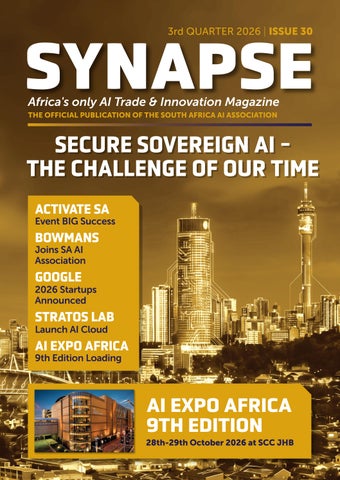
3rd QUARTER 2026 | ISSUE 30
SYNAPSE Africa's only AI Trade & Innovation Magazine THE OFFICIAL PUBLICATION OF THE SOUTH AFRICA AI ASSOCIATION
ACTIVATE SA
Event BIG Success
BOWMANS Joins SA AI Association
2026 Startups Announced
STRATOS LAB Launch AI Cloud
AI EXPO AFRICA 9th Edition Loading
AI EXPO AFRICA 9TH EDITION 28th-29th October 2026 at SCC JHB
GUEST EDITORS
Claude is a series of large language models developed by Anthropic and first released in 2023
Darlington Akogo (Ghana)
Learn more about Claude by Anthropic here
darlingtonakogo
W
e welcome Claude to the guest editor line-up. Claude by Anthropic is our latest addition to the editorial lineup and is able to capture 3 months of AI news across all 54 countries as and present them by region. It really helps us capture a truly continental view with all the key news.
INTERNATIONAL EDITOR
Deon Van Zyl (Norway) Senior System Developer Nordic Semiconductor
deonvanzyl
ii SYNAPSE | 3RD QUARTER 2026
CEO, minoHealth AI / KaraAgro AI & Member of United Nations ITU & WHO Focus Group on AI For Health
D
arlington Akogo is a global leader in Artificial Intelligence. He's the Founder and Director of Artificial Intelligence at GUDRA, and its subsidiaries; minoHealth; an AI Healthtech company based in Ghana.
Naomi Molefe
MSc, Manager: Strategic Sourcing and Research at Discovery & Co-Founder & Chapter Director Women In Big Data, South Africa
naomimolefe
N
aomi is the co-Founder and Chapter Director for women in Big Data SA; a registered NPO that is part of a global community of 17 000 women. The learning community works with strategic partners to cultivate tangible opportunities for women, unlock latent potential through accessible training and act as a catalyst for the advancement of women in Big Data fields.
F
or 25 years, I have been an accomplished IT professional who is skilled in multiple languages with a strong background in development, security, digital forensics, automation, AI, management, and teaching. Through my work, I have been exposed to various industries, influenced public opinion, and networked with innovative leaders. As a roving Guest Editor, I write about new technologies that are reshaping the world such as Artificial Intelligence, VR & AR, Cybersecurity, Web3 and more.
Read more editions 1st QUARTER 2022 | ISSUE 15
SYNAPSE
AI TECH INVESTMENT IN AFRICA
TALKING THE LANGUAGE OF AI IN AFRICA
Africa’s 4IR Trade & Innovation Magazine
reaches new heights INSTADEEP
$
£
Raises $100M
¢
2nd QUARTER 2022 | ISSUE 16
SYNAPSE VOXCROFT ANALYTICS
R
Raises $2 Million
Africa’s 4IR Trade & Innovation Magazine
LANAFRICA
creates centralised language hub
GOOGLE adds 10 African languages
AFRICAN TECH
AI LAWYER
Raised $4bn in 2021
helps Kenyans gain access to justice
GAUTENG SOUTH AFRICA,
BONANG.AI
the new Silicon Valley of Africa?
Fights Crime in the City
AI EXPO AFRICA 2022
AI EXPO AFRICA 2022
JOIN AFRICA’S LARGEST B2B AI EVENT
MOVES TO JOHANNEBURG
3rd QUARTER 2022 | ISSUE 17
SYNAPSE Africa’s 4IR Trade & Innovation Magazine
WELCOME TO THE AI TECH CAPITAL OF AFRICA BLUEPRISM LANAFRICA
4th QUARTER 2022 | ISSUE 18
SYNAPSE Africa’s 4IR Trade & Innovation Magazine
2022 SEES BREAKTHROUGH GROWTH OF AFRICAN AI COMMUNITY DSN Unveils AIpowered On-demand learning
Employee Experience creates centralised Boosted by Advanced language hub Automation
GOOGLE adds 10 NETHERLANDS African languages AI that EMBASSY
SOUTH AFRICA
To Launch Artificial Intelligence institute
Champions Inclusion AI LAWYER
ARM Extends Partnership Network in Africa
helps Kenyans SWITZERLAND
gain access toFruits Harvesting the justice of the AI Summer
Meta AI Develops
BONANG.AI tinyML is the next Fights in wave ofCrime Machine Learning the City
model to translate 55 African Languages
AI EXPO EXPO AI AFRICA 2022 2022 AFRICA
5TH ANNIVERSARY EDITION -
JOIN AFRICA’S LARGEST CELEBRATING THE RETURN B2B AI EVENTEVENTS TO IN-PERSON
AI AI EXPO EXPO AFRICA AFRICA 2022 2022 POST SHOW EDITION -
JOIN AFRICA’S LARGEST LARGEST GATHERING HAILED B2B AI EVENT A MASSIVE SUCCESS
WELCOME FROM THE EDITOR
W Dr Nick Bradshaw Editor & CEO AI Media Group
nickbradshaw
N
ick is a Tech focused Executive / Entrepreneur helping clients, communities, practitioners & start-ups understand the value of Artificial Intelligence, Automation & Digital solutions in EMEA region. With 25 years experience in Europe, North America & Africa Nick has worked with a diverse set of Multi $bn global clients seeking to deploy and mature Enterprise grade software & cloud solutions. He is founder of the AI Media Group a new hybrid media, events, consulting & trade community offering clients insights into the growing 4IR opportunity in Africa. AI Media publish Synapse Magazine and run Africa’s largest Enterprise AI Trade Show – AI Expo Africa."
ABOUT SYNAPSE MAGAZINE
Synapse Magazine chronicles the AI Revolution as it unfolds in Africa and plays a vital part in connecting the members of this rapidly growing trade community across the region. With a global readership, it puts Africa centre stage with a clear focus on the African 4.0 innovation & investment narrative. We cover a range of technologies including; artificial intelligence (AI), intelligent automation (IA), robotic process automation (RPA), internet of things (IoT), big data, analytics & devices, as well as emerging standards, ethics and privacy concerns. Now entering its 9th year of publication, this unique quarterly trade publication is FREE to read on the ISSUU platform.
elcome to the 30th edition of Synapse Magazine! Wow – this is our 30th edition since our launch way back in 2018 when we first announced the magazine at AI Expo Africa – feels like a real milestone.
What started as an event and ecosystem magazine is now the official publication of the South African AI Association that has over 5000+ members and a readership of 15k globally – feels like progress and here is to the next 30 editions!! The last quarter has seen yet more systemic shifts in the AI race with western frontier models creating security and regulation issues and models from China offering very lower price points and open weight / open source options as performance converges – is this the start of “AI Dumping” that we are reading about in the mainstream press – lets see? August saw the successful launch of the 1st edition of our new AI in Government and Society event called Activate SA in Cape Town which was a massive success forming part of the new / wider Western Cape AI Cluster project. All eyes are now on the 9th edition of AI Expo Africa in Johannesburg at SCC Sandton, 28-29th October which is shaping up for another great edition packed with global and local brands showcasing the latest cutting edge AI stack tech with in depth speaking / workshop and Board Room sessions - its going to be a BIG ONE! Tickets are still on sale for AI Expo Africa and you can also pay on the door. Finally, as a reminder, the association launched its FREE AI readiness assessment tool to help kick start your AI journey! We look forward to seeing you all soon. DON’T FORGET Join the South African AI Association, to secure your FREE membership here >> https://saaiassociation.co.za/ and check out the SA AI Association’s “Start your Journey in Responsible AI” FREE training and resources >> https://saaiassociation.co.za/start-your-journey-in-ai/ with content, training, guides, communities to help kickstart your adoption of Responsible AI.
OWNER SA AI Association Web www.saaiassociation.co.za
EDITORIAL & ADVERTISING ENQUIRIES Nick Bradshaw nick@saaiassociation.co.za
PUBLISHER AI Media Group Web www.aimediagroup.co.za
ACCOUNTS PAYABLE & ADMIN Mia Muylaert mia@aimediagroup.co.za
EDITOR Nick Bradshaw (South Africa)
LAYOUT, DESIGN & PRINT Karin Liebenberg iCandy Design Email: karinl@icandydesign.co.za
GUEST EDITORS Claude (Pan Africa) Darlington Akogo (Ghana) Naomi Molefe (South Africa) Deon Van Zyl (Global)
3RD QUARTER 2026 | SYNAPSE
iii iii
th
EDITION
Connect
Learn
Purchase
Transform
Grow
iv SYNAPSE | 3RD QUARTER 2026
Invest
www.aiexpoafrica.com
Contents SYNAPSE | ISSUE 30 | 3rd QUARTER 2026
p6 Africa Artificial Intelligence Q3 News Digest
p40 Grok Bot: The AI Teammate that wants to do the Work
2
Johannesburg South Africa Welcomes 9th AI Expo Africa
4
Flash Back to AI Expo Africa 2025
6
Africa Artificial Intelligence Digest
9
Bridging the Eligibility Gap: From Form to Function in Financial Inclusion
10 New Activate SA Event in Cape Town a BIG Success 12 Mitchells Plain Residents Learn about AI, Privacy and the Law 14 SA AI Association & Western Cape Government 16 SA AI Association Welcomes Pre-eminent African Law Firm, Bowmans, to Advisory Board 17 Ready 4 AI
p12
p46
18 Stratos Lab, ECOBLOX and Digital Parks Africa Partner to Launch Most Powerful African AI Cloud
21 YES Joins SA AI Association Advisory Board
Mitchells Plain Residents Learn about AI, Privacy and the Law
Don’t just Automate the Work. Reimagine How it Gets Done
22 Get AI.cc 25 The Number that wasn't There 26 The Magic was never in the Model 30 Introducing Our 2026 Cohort for the Google for Startups Accelerator: South Africa 31 Bowmans X Tech Week: Seizing Opportunities and Tackling Challenges in Innovation
p36
p48
AI Risk and the Human Element: Six Highstakes Situations
The Next Customer Experience Won’t Feel Like Automation
36 AI Risk and the Human Element: Six High-stakes Situations 40 Grok Bot: The AI Teammate that wants to do the Work 46 Don’t Just Automate the Work. Reimagine How it Gets Done. 48 The Next Customer Experience Won’t Feel Like Automation
3RD QUARTER 2026 | SYNAPSE
1
JOHANNESBURG IS AFRICA'S AI TECH CAPITAL
JOHANNESBURG WELCOMES 9TH Africa’s largest Artificial Intelligence & Intelligent Automation event, the highly acclaimed conference & trade show called AI Expo Africa will run the 9th edition at the Sandton Convention Centre, Johannesburg, South Africa 28-29 October 2026. This globally recognized event, the AI Expo Africa event unites regional and international AI thought leaders, suppliers, investors and start-ups to discuss and showcase the latest AI & Smart Tech innovations from the biggest global brands to newest Startups. The core focus of the show is real world applications you can deploy today with an audience comprised of Enterprise and Government buyers, deployment & service providers, start-ups, educators, NGOs, investors and AI ecosystem builders. Dr Nick Bradshaw, Founder of AI Expo Africa & Chairperson of the South African AI Association stated, "this is one of our biggest shows to date and we are really happy to be running this 9th edition show again in Johannesburg." Big themes range from Security and Sovereign Agentic AI and progress towards the autonomous Enterprise, Responsible AI, Data Centre investment, National AI strategies. With a community of 50k+ practitioners, the show format is built upon the phenomenal success of the previous seven events that have cemented AI Expo Africa as the largest AI and Intelligent Automation business gathering of its kind in Africa. Last year we hosted 3400 delegates, ran 72 talks, 15 CPD workshops and 12 CxO round tables. Some of the 100+ Exhibitor & sponsorship brands that joined us in 2025 included; AWS, Google, Pinnacle, Dell, Supermicro, Nvidia, WIOCC, OADC, Verint, ServiceNow, Salesforce, VAST Data, Zoho Corporation, Avochoc, Cyborg Intell , French Embassy SA, Interface Systems / Yooz, LRMG, Matogen Applied Insights, Mavin Powercube, NITheCS - National Institute for Theoretical & Computer Sciences (our 2026 Exhibitors and Sponsors are shown opposite). About AI Expo Africa 2026 Now entering its 9th year, the next edition of AI Expo Africa 2026 will be held in South Africa 28-29th October. It will again unite 1000s of regional and international AI thought leaders, suppliers and start-ups to discuss and showcase the latest AI & Intelligent Automation innovations, from the biggest global brands to the smallest and newest local Startups. The core focus of the show are real world applications you can deploy today with a senior level audience comprised of Enterprise and Government buyers, deployment & service providers, start-ups, educators, NGOs and ecosystem builders. Learn more at: https://aiexpoafrica.com/
2 SYNAPSE | 3RD QUARTER 2026
JOHANNESBURG IS AFRICA'S AI TECH CAPITAL
G SOUTH AFRICA AI EXPO AFRICA
3RD QUARTER 2026 | SYNAPSE
3
FLASH BACK TO AI EXPO AFRICA 2025
4 SYNAPSE | 3RD QUARTER 2026
FLASH BACK TO AI EXPO AFRICA 2025
3RD QUARTER 2026 | SYNAPSE
5
AFRICA AI DIGEST
AFRICA ARTIFICIAL INTELLIGENCE DIGEST A pan-African review of key AI announcements, policy, regulation, investment and events across all 54 countries Q3 2026 | 1 July – 28 September 2026
EXECUTIVE SUMMARY — KEY DEVELOPMENTS Q3 2026 Q3 2026 was the quarter in which Africa’s AI showed serious traction, with new AI data centres opening, cybercrime soaring, and two landmark governance moments framing where policy is heading with big news stories coming for all 4 corners of the continent; INTERPOL’s African Cyberthreat Assessment Report 2026 revealed AI now drives 55% of cybercrime on the continent, with losses doubling from $192m in 2024 to $484m — the most alarming AI-security finding in Africa to date. Deep Learning Indaba 2026 under the theme ‘Sovereign Intelligence’ convened 1,000+ researchers and practitioners from 45 countries The IMF warned that AI could boost sub-Saharan Africa’s GDP by 4% over a decade but only 0.2% under current electricity and connectivity constraints
CONTINENTAL & MULTILATERAL
IMF warns sub-Saharan Africa risks missing AI boom — GDP gain of 4% possible, but only 0.2% under current electricity and internet constraints (21 July 2026) #Africa #Policy #IMF INTERPOL African Cyberthreat Assessment Report 2026: AI drives 55% of cybercrime across Africa; losses double to $484m; East Africa is ransomware hub; Southern Africa most exposed due to digital maturity #Africa #Cybersecurity #INTERPOL CIPESA publishes ‘Rethinking Africa’s AI Governance and Regulation’ (July 2026) — identifies 16 countries with national AI strategies and calls for implementation budgets, not just frameworks #Africa #Governance #CIPESA
6 SYNAPSE | 3RD QUARTER 2026
Kenya opened public consultation on a comprehensive emerging technologies draft policy creating a national AI council, risk-based classifications and regulatory sandboxes Kenya took Africa’s AI case to the UN General Assembly in New York - President Ruto co-chaired the AI Middle Powers Roundtable with Finland and Sierra Leone, proposing bloclevel AI procurement terms Kenya then signed a Joint Declaration with Anthropic covering skills, research and public-sector AI. South Africa’s Minister Malatsi confirmed a new AI policy expert panel chaired by Wits professor Benjamin Rosman will deliver a revised draft to Cabinet by March 2027 Somalia launched its first National AI Centre at Somali National University among the quarter’s most significant milestones for a conflict-affected country with minimal prior AI infrastructure. Nvidia announced that four AI factories have been announced or commissioned in Africa in one year, with another 656 MW in the pipeline
Kenya co-chairs AI Middle Powers Roundtable at UN General Assembly (21 September) with Finland and Sierra Leone — proposes bloc AI procurement, joint compute testing and shared local-language datasets #Africa #Governance #UnitedNations Nvidia announces four AI factories commissioned or in the pipeline across Africa within one year, with 656 MW additional capacity upcoming; Nigeria is Deep Learning Institute’s second-largest global market (Cairo, September 2026) #Africa #Infrastructure #NVIDIA University of Michigan launches $6m African Faculty Fellows AI programme — two-year fellowship training African academics in AI research with return commitment to home institutions #Africa #Education #UniversityOfMichigan ITW Africa 2026 opens in Nairobi (7–10 September) — Interconnect and telecoms leaders discuss AI network applications and East Africa digital infrastructure expansion #Kenya #Telecoms #ITWAfrica Africa’s operational data centre capacity stands at 409 MW — less than 1% of the global total for a continent with 20% of the world’s population; Rest of World investigation tracks build-out pipeline #Africa #Infrastructure #DataCentres Launch Africa Ventures discloses 15 new Fund II early-stage AI investments in H1 2026 across AI, B2B commerce, embedded finance and future-of-work sectors across Africa #Africa #Investment #LaunchAfrica
AFRICA AI DIGEST
NVIDIA launches SIGNALS accelerator programme in Egypt with RiseUp, A15 and BitRoot — provides GPU credits, engineering support and global partner access for Egyptian AI startups (July 2026) #Egypt #Startups #NVIDIA Egypt launches national AI Competency Framework for Teachers with UNESCO — one of first countries to adapt UNESCO’s global AI framework nationally; includes Arabic resources and teacher training hubs (July 2026) #Egypt #Education #UNESCO Vercel (US) acquires Egyptian AI DevOps startup Stakpak — Egyptian engineering team joins Vercel’s global organisation; Stakpak built an open-source autonomous DevOps agent (July 2026) #Egypt #Startups #MandA Nvidia confirms four AI factories in Africa at Cairo event (21 September) — Egypt highlighted as a strategic AI infrastructure hub and cost-competitive market at $8–10 per watt for data centre development #Egypt #Infrastructure #NVIDIA Morocco partners with Capgemini under Digital Morocco 2030 strategy — MoU signed to strengthen AI skills across government, universities and research institutions; targets 240,000 digital jobs and 3,000 startups #Morocco #Skills #Capgemini Algeria joins Zimbabwe in rolling out national AI strategies in Q3 2026 — both countries formalising policy frameworks after earlier strategy development phases (Africa AI News, August 2026) #Algeria #Policy #NationalStrategy
Kenya co-chairs AI Middle Powers Initiative at UNGA (21 September) — President Ruto and Finland’s President Stubb propose pooled AI compute, joint procurement terms and shared local-language data infrastructure #Kenya #Diplomacy #UnitedNations Côte d’Ivoire approves $170m sovereign data centre and digital infrastructure project with Cybastion and Cisco — covers government digital platform, smart-border system and AI compute capacity (July 2026) #CotedIvoire #Infrastructure #Cybastion Deep Learning Indaba 2026 (2–7 August, Pan-Atlantic University, Lagos) — theme: ‘Sovereign Intelligence’; 1,000+ attendees from 45 countries; Africa’s premier annual ML research gathering returns to Nigeria #Nigeria #Research #DLIndaba Somalia opens first National AI Centre at Somali National University, Mogadishu (21 July) — supports ML, NLP, data science, computer vision, robotics and AI ethics for public and economic development #Somalia #Education #SomaliNationalUniversity Ethio Telecom opens talks with Inspur Software Technology and Shandong Hi-Speed Road on AI-ready data centres, highperformance computing and cloud platforms in Ethiopia (17 July) #Ethiopia #Infrastructure #EthioTelecom Rwanda: EAC AI Alliance and Regional AI Network launched in Kigali — 450+ stakeholders commit to coordinated education, research and AI innovation across East African Community member states #Rwanda #Regional #EAC Raxio Group hosts AFR-IX Telecom network expansion in Angola and Mozambique — Tier III data centres in both markets add backbone for cloud and AI workloads under carrier-neutral facilities (July 2026) #Angola #Mozambique #Raxio Botswana outlines new steps to strengthen AI adoption — government signals focus on local skills, responsible AI deployment and cross-sector collaboration (Africa AI News, Q3 2026) #Botswana #Policy #DigitalTransformation CIPESA publishes Uganda Digital Economy: Rights Trends, Regulatory Gaps and Policy Responses (8 September) — analysis of AI-related gaps in Uganda’s evolving ICT regulatory environment #Uganda #Policy #CIPESA
EAST AFRICA
WEST AFRICA
NORTH AFRICA
Kenya opens public consultation on 2026 Emerging Technologies Policy (July) — proposes national emerging technologies council, risk-based AI classifications, mandatory registration for high-risk AI and regulatory sandboxes; deadline 4 August #Kenya #Legislation #MICDE Kenya signs Joint Declaration with Anthropic (22 September, UN General Assembly sidelines) — covers AI skills, research, public-sector use and safety testing; data governed by Kenyan law; no funding disclosed #Kenya #Policy #Anthropic
Nigeria and China strengthen AI cooperation at Third Lagos Forum (5 August) — China pledges 5,000 AI training slots; Nigerian Institute of International Affairs warns against becoming permanent consumer of foreign AI #Nigeria #Diplomacy #China Nigeria’s 3 Million Technical Talent (3MTT) programme records 1.87 million registrations; Project BRIDGE fibre rollout expands digital connectivity backbone ahead of GITEX Nigeria #Nigeria #Skills #NITDA
3RD QUARTER 2026 | SYNAPSE
7
AFRICA AI DIGEST
Nigeria unveils Intelligence Shield: AI-powered military intelligence initiative for improved surveillance, threat detection and operational decision-making in national security (Q3 2026) #Nigeria #Defence #GovernmentAI Nigeria NITDA launches multi-stakeholder digital governance coordination group and sandbox technical working group to support AI regulatory innovation and underserved community inclusion (July 2026) #Nigeria #Governance #NITDA University of Benin launches 1 ₦ 00 billion trust fund (20 July) to support AI centre, infrastructure and research — Tom Ilube and Hakeem Belo-Osagie pledge backing for curriculum and AI education development #Nigeria #Education #UNIBEN Bosun Tijani Foundation opens second Gen AI Fellowship cohort (July 2026) — six-month programme with 5 ₦ 0,000 monthly stipend covering AI engineering and applications; training begins 1 September #Nigeria #Skills #BosunTijaniFoundation INTERPOL: East Africa emerges as hub for mobile-money fraud and infrastructure ransomware; West/Central Africa leads in business email compromise — AI enables industrialised, borderless cybercrime ecosystem #WestAfrica #Cybersecurity #INTERPOL Ghana: Women Techsters Sprint applications open (21 July) — Tech4Dev’s virtual AI, data science and cybersecurity programme for women aged 18–40 spans 30 African countries #Ghana #Women #Tech4Dev
“This digest covers publicly reported AI news for
the period 1 July – 28 September 2026, sourced from African and international media, development institution publications and government announcements. It is not exhaustive but represents the most significant developments identified across all 54 African countries. URLs were live at time of compilation. Sources include INTERPOL, IMF, CIPESA, UNESCO, African Development Bank, Innovation Village, Africa AI News, TechCabal, Morocco World News, CNBC Africa, Businessday Nigeria, Jurist, ITWeb Africa, iAfrica.com, Tech Crier, APC and others.
”
Native (US AI company) acquires South African marketresearch firm Frontline Research Group — data from 14+ African markets integrated into Native’s Store Graph and AI agent workflows (July 2026) #SouthAfrica #MandA #DataAI South Africa highlighted as most exposed to AI-driven cybercrime due to advanced digital economy — voice and video cloning used to impersonate Reserve Bank Governor Kganyago in investment fraud scheme #SouthAfrica #Cybersecurity #INTERPOL CROSS-CUTTING THEMES & SECTOR HIGHLIGHTS
SOUTHERN AFRICA
South Africa AI policy rewrite announced at GovTech 2026, Durban (21 September) — expert panel chaired by Wits professor Benjamin Rosman; Cabinet consideration by March 2027; Minister Malatsi frames AI regulation as growth tool #SouthAfrica #Policy #DCDT Cape Town data centre backlash: Housing Assembly and Foxglove file legal challenge against two Equinix hyperscale facilities (August) — groups warn 174 MW sites would consume 4.4 billion litres of water annually #SouthAfrica #Infrastructure #Equinix Cape Town approves two hyperscale AI data centres (174 MW combined capacity) — projects tie AI infrastructure growth to energy and water supply constraints in Western Cape #SouthAfrica #Infrastructure #DataCentres Cassava Technologies Africa Data Centres becomes Africa’s first Microsoft Azure ExpressRoute Metro peering location in Johannesburg (20 July) — Liquid C2 deploys Secure CloudConnect for redundant critical cloud workloads #SouthAfrica #Infrastructure #CassavaTechnologies Absa deploys AI and optical character recognition (OCR) platform across South Africa — part of Next-Generation AI banking rollout including Salesforce Agentforce enterprise AI agents (August 2026) #SouthAfrica #Finance #Absa
8 SYNAPSE | 3RD QUARTER 2026
IMF framework: AI leapfrog potential echoes mobile money — same preconditions apply (connectivity, energy, trust) but energy gap threatens to limit gains to elite urban users without infrastructure investment #Africa #Infrastructure #IMF CIPESA: Kenya’s AI strategy costed at KSh 152 bn over 5 years but 2026/27 national budget shows zero dedicated AI funding — implementation without budget remains continent-wide pattern #Africa #Policy #Funding Liberia: African Development Bank launches digital project supervision tool to strengthen monitoring (14 July) — signal of AI and digital tools expanding into smaller, lower-income African economies #Liberia #eGovernment #AfDB Mozambique: AfDB-Korea partnership drone programme graduates 30 certified local drone pilots (13 July) — AIenabled drone technology deployed for disaster response and post-flood monitoring #Mozambique #DroneTech #AfDB DRC uses anonymised phone records and AI to map population movement during 2026 Ebola outbreak — public health AI analytics applied in a conflict-affected, low-infrastructure setting #DRC #Healthcare #PublicHealth Notes & Methodology This digest covers publicly reported AI news for the period 1 July – 28 September 2026, sourced from African and international media, development institution publications and government announcements. It is not exhaustive but represents the most significant developments identified across all 54 African countries. URLs were live at time of compilation. Sources include INTERPOL, IMF, CIPESA, UNESCO, African Development Bank, Innovation Village, Africa AI News, TechCabal, Morocco World News, CNBC Africa, Businessday Nigeria, Jurist, ITWeb Africa, iAfrica.com, Tech Crier, APC and others. Compiled: 28 September 2026
INDUSTRY NEWS
BRIDGING THE ELIGIBILITY GAP
From Form to Function in Financial Inclusion For decades, the standard response to financial exclusion has been singular: "Improve Access." We treated it as a logistical and infrastructure challenge. The strategy was clear: build branches, open accounts, and push entire populations previously unbanked into the formal system. By our conventional metrics, the progress is inarguable. Millions are technically "onboarded". Digital wallets have proliferated. Entire communities that were once excluded now exist on the financial grid. And yet, after decades of working in the BFSI industry, and even launching some of these products and initiatives, I see a deeper, unchanging truth. The same individuals holding these new accounts frequently remain unable to access necessary credit, build assets, or meaningfully participate in the economy. They are included in form but excluded in function.
This is not a failure of intent. It is a limitation of decision-making architecture. Our modern financial systems were built for a stable, predictable world that required clean, structured signals: credit scores, formal income, established histories. The consequence is that the system defaults to what it knows best: rejection when presented with the "unknowable" data of gig workers, small merchants, and informal economy participants. We cannot blame traditional systems for this. The logical conclusion of their design is to exclude uncertainty. This structural exclusion persists decision by decision. To move from inclusion metrics to real progress, we must fundamentally update the definition of "eligibility." Working now in the AI industry, platforms like iTuring.ai are redefining that logic. We are moving from static, historical risk proxies to AI-driven decisioning that learns from a broader, more dynamic set of signals. The question is no longer, "Does this person fit an established profile?" It is, "What does their behaviour reveal about their reliability?" In this model, the barrier shifts. Inclusion becomes not just possible, but profitable and sustainable. AI changes the fundamental unit economics of serving low-income customers. When risk assessment,
underwriting, and monitoring are handled in real time, the marginal cost of serving an additional customer approaches zero. The small-ticket lending we once dismissed as unprofitable begins to make sound economic sense. We are also seeing a crucial shift in risk management. In the past, uncertainty resulted in exclusion. Today, with systems that continuously learn, detect anomalies, and adapt, risk is something we actively manage, and appropriately price. Uncertainty becomes navigable. The future of financial inclusion will not be defined by the next million accounts opened. It will be defined by how decisions within that system evolve. The levers that shape inclusion outcomes are data-driven, adaptive, and designed to be inclusive from the core. It is about making the system itself more intelligent. It is about a system capable of seeing, understanding, and ultimately, deciding fairly, consistently, and at scale.
3RD QUARTER 2026 | SYNAPSE
9
EVENT NEWS
NEW ACTIVATE SA EVENT IN CAPE TOWN A BIG SUCCESS - Championing Responsible AI in Government & Society From 25-26th August 2026 The South African AI Association launched Activate SA to champion Responsible AI in Government & Society as part of the new Western Cape AI Cluster (WCAIC). Activate SA aims to support and grow the Artificial Intelligence (AI) opportunity in the province as well as engage relevant stakeholders on key themes such as AI Policy, AI Governance, AI Infrastructure investment, AI Factories and Sovereign AI.
T
he 1st edition of the Activate SA AI Summit opened on the 25th August at CTICC, Cape Town and forms part of the flagship ecosystem support programme implemented by the Western Cape Department of Economic Development and Tourism (DEDAT). Activate SA seeks to strengthen the province’s AI ecosystem and play a pivotal role in advancing the AI technology sector to create an impactful and sustainable AI ecosystem.
Dr Nick Bradshaw, Chairman of the SA AI Association stated, “The Activate SA AI Summit will be the annual gathering of the newly created WCAIC with the ambition to strengthen AI innovation and unlock investment opportunities across the rapidly growing global Artificial Intelligence tech segment. We see USA, China, Europe and Middle East already spending heavily on AI as they gear up business, citizens and society to embrace the AI opportunity. Activate SA is a brand new AI Summit being held in Cape Town that will explore this massive opportunity, showcase the best of regional AI innovation and help attract investment. Activate SA and the WCAIC project is a multi-stakeholder vehicle geared to identify and achieve common objectives in a collaborative manner and help position the Western Cape as a globally significant AI Tech Hub while serving as the nation’s first government & societal AI forum dedicated to Responsible AI.
10 SYNAPSE | 3RD QUARTER 2026
Bradshaw concluded, “Sovereign AI is a big theme the WCAIC will engage on. It is a globally significant challenge for nations, provinces, cities & municipalities to develop, deploy and govern AI systems independently. Our aim is to also showcase new AI entrepreneurs, new AI infrastructure innovations and models that will benefit everyone, not just a few. Citizen AI is a new and evolving component where everyday problems faced by society are being solved by people using AI to develop the solution themselves. We want to find the brightest minds solving the hardest problems and match them to early-stage support, capital and AI compute services. Ultimately we want to develop a provincial “success blueprint” other provinces can utilise across South Africa and look forward to welcoming delegates to the Activate SA.” Check out the event photo album here
About The SA AI Association (SAAIA) The South African Artificial Intelligence Association (SAAIA) is an industry body focused on promoting the advancement of responsible AI in South Africa by uniting practitioners across Commercial, Government, Academic, Startup and NGO sectors. SAAIA seeks to encourage stakeholders in the adoption of responsible AI for the commercial and societal benefit of the citizens of South Africa with a primary focus on economic growth, trade, investment, equality and inclusivity. SAAIA runs Africa’s largest Enterprise & Startup AI community and trade event, AI Expo Africa, and offers insights and advisory on the growing AI opportunity in Africa. Learn more: www.saaiassociation.co.za
About Activate SA Activate SA 2026 is the nation’s first AI Summit dedicated to Responsible AI in Government and Society. This landmark AI event will explore how South Africa as a nation can harness AI to improve service delivery, education, and the everyday lives of its citizens, while establishing the policies, infrastructure, investments and frameworks needed for ethical AI adoption and economic growth. Convened by the SA AI Association 25-27th August at CTICC Cape Town, Activate SA 2026 focuses on 10 core topics addressing the challenges and opportunities required to make Responsible AI accessible to all and includes a hands-on CPD workshop covering AI Readiness, AI Policy, AI Factory and AI Centre of Excellence. Learn more www.activatesa.ai Press & Media enquiries: www.saaiassociation.co.za/contact
EVENT NEWS
3RD QUARTER 2026 | SYNAPSE
11
ECOSYSTEM NEWS
MITCHELLS PLAIN RESIDENTS LEARN ABOUT AI, PRIVACY AND THE LAW / Read original story here /
Community members were encouraged to embrace artificial intelligence (AI), share their knowledge, and critically assess the information generated by AI applications during a session on AI and the law.
T
he session was hosted by ENS in collaboration with Parrot6 at ENS’s offices in Mitchell's Plain on Thursday, August 27.
ENS technology lawyer Wilmari Strachan advised residents to use AI to improve their daily lives and support their businesses, while keeping pace with developments in the rapidly evolving field.
Use AI responsibly Parrot6 founder Deion Baatjies urged attendees to think critically, ask questions, protect their personal information, and use AI responsibly for appropriate real-world tasks. He encouraged community members to use AI tools with confidence while remaining aware of potential risks. He said not to upload sensitive personal information, to verify responses against trusted sources, and to treat AI outputs as assistance rather than fact. Baatjies said Parrot6 was working in libraries and schools to educate people about AI and help communities understand the technology’s benefits. “Most of our people are not aware of the advantages of AI. But what we want is for them to ask anything they put into AI. We train youngsters to train others. We say, each one teach one,” he said. He added that Parrot6 works with experts and non-governmental organisations in and around Mitchells Plain to support people who want to teach others about AI.
Yumna Ederies encouraged community members to scan the ENS QR code Image: Phiri Cawe
Access and digital literacy concerns While attendees welcomed the information shared during the session, they raised concerns about limited access to computers and gaps in digital literacy. They were encouraged to use public libraries and other community facilities where they can access computers and learn more about digital technology. The discussion highlighted the need to ensure that AI education reaches communities that could otherwise be left behind as the technology advances.
Community members after a session on artificial intelligence session at the ENS offices. Image: Phiri Cawe
More AI sessions planned ENS pro bono associate Taniesha Vaswani welcomed the work being done by organisations to prepare communities for an increasingly AIdriven world. In closing, pro bono assistant coordinator in Mitchells Plain, Yumna Ederies, said more information sessions would be held in the future. She also encouraged community members to scan the ENS QR code to access information and resources on AI ethics and the law. Parrot6’s published material describes AI and digital-literacy work aimed at South African youth and communities, including Mitchell’s Plain and surrounding areas.
12 SYNAPSE | 3RD QUARTER 2026
Parrot6 founder Deion Baatjies faced questions from the floor. Image: Phiri Cawe
VENDOR OFFER
3RD QUARTER 2026 | SYNAPSE
13
ECOSYSTEM NEWS
SA AI ASSOCIATION & WESTERN CAPE GOVERNMENT Launch AI Cluster Collaboration
C
APE TOWN, SOUTH AFRICA 18th May 2026 - The South African AI Association & Western Cape Government launch new provincial AI Cluster collaboration. The Western Cape AI Cluster (WCAIC) will research, support and grow the artificial intelligence opportunity in the province as well as engaging with relevant stakeholders on key themes such as AI Policy, Responsible AI, Governance, Infrastructure, AI Factories and Sovereign AI. Forming part of the Western Cape Department of Economic Development and Tourism (DEDAT) Technology Ecosystem Enablement Programme, WCAIC seeks to strengthen the province’s innovation ecosystem and play a pivotal role in advancing the AI technology sector. The collaboration will run for a period of three years and aim to create an impactful and sustainable AI ecosystem. Dr Nick Bradshaw, Chairman of the SA AI Association stated, “The WC AI Cluster will broadly follow the key tenants of the globally recognised Tech Cluster Model to create and orchestrate a robust AI ecosystem. This initiative is part of the province’s broader ambition to strengthen innovation, foster collaboration and unlock investment opportunities across key tech sub-sectors such as Artificial Intelligence which aligns with SA AI Association’s vision and mission. We see USA, China, Europe and Middle East already spending heavily on AI as they gear up business, citizens and society to embrace the AI opportunity and this forms a key part of the goals of the WCAIC collaboration.” WCAIC will be a collaborative multistakeholder vehicle geared to identify and
14 SYNAPSE | 3RD QUARTER 2026
/ Read original story here / achieve common objectives in a coherent manner and to help promote, co-ordinate and share opportunities that will result in jobs, FDI and regional growth as well as presenting the Western Cape as a globally significant AI Tech Hub. It will also convene a new annual AI conference called Activate SA to be held in Cape Town 25th-27th August 2026, the nation’s first citizen and government AI event dedicated to Responsible AI. Bradshaw concluded, “Sovereign AI and the soon to be launched AI Factory in Cape Town South Africa is a big theme the WCAIC will engage on. It is a globally significant challenge for nations, provinces, cities & municipalities to develop, deploy and govern AI systems independently. Our aim is to help guide and showcase infrastructure, data and models that will benefit everyone, not just a few, so Citizen AI is a key component. We also need to find the brightest minds solving the hardest problems and match them to early-stage capital and AI compute services. Ultimately we want to develop a “success blueprint” other provinces can utilise. We look forward to working on this collaboration with the Western Cape Government and DEDAT team over the next 3 years.”
About The SA AI Association (SAAIA) The South African Artificial Intelligence Association (SAAIA) is an industry body focused on promoting the advancement of responsible AI in South Africa by uniting practitioners across Commercial, Government, Academic, Startup and NGO sectors. SAAIA seeks to encourage stakeholders in the adoption of responsible AI for the commercial and societal benefit of the citizens of South Africa with a primary focus on economic growth, trade, investment, equality and inclusivity. SAAIA runs Africa’s largest Enterprise & Startup AI community and trade event, AI Expo Africa, and offers insights and advisory on the growing AI opportunity in Africa. Learn more: https://saaiassociation.co.za/ Press & Media enquiries: https://saaiassociation.co.za/ contact
IS YOUR DATA CENTRE
READY?
Powercube’s Modular solutions can get you there... fast.
E
xa mp
le R
DH
x @ 90kW per rac
k
✔ Powercube AI orientated HPC Containerised Modular Data Centre solutions deliver flexible, scalable,Tier 2, 3, 4 - Hybrid or pure HPC compute environments ✔ DX. RDHx. DLC. and/or IMMERSION technologies to suit your specific requirements/choice of vendor ✔ Design, build, plug-in & play with zero disruption to your existing datacentre ✔ Integrate your preferred technology partners
Powercube Custom Containerised Modular Data Centres are fast becoming the choice for mainstream RDHx, DLC and Immersion technologies. From 1 to 38 racks in a single Powercube container footprint. Co-join multiple Powercubes to create larger flexible DC environments. UK Designed & Built - Shipped, Installed and Commissioned wherever in the world it’s required
REACH OUT TO OUR TEAM TODAY: T: +44 (0)845 612 1155 . E: connect@mavin.global . www.mavin.global
ASSOCIATION NEWS
SA AI ASSOCIATION WELCOMES PRE-EMINENT AFRICAN LAW FIRM, BOWMANS, TO ADVISORY BOARD The South African AI Association welcomes Bowmans to its Advisory Board
T
he South African Artificial Intelligence Association (SAAIA) today announced that pre-eminent African law firm, Bowmans, has joined its Advisory Board. SAAIA is an industry body focused on promoting the advancement of responsible AI in South Africa by uniting practitioners across Commercial, Government, Academic, Startup and NGO sectors. With over 4 800 members it is the largest AI community in South Africa focused on Responsible AI adoption and dialogue. Bowmans supports its clients wherever technology touches their business, including solving the most complex legal challenges whenever they arise. The firm’s technology service offering is unique in the sense that it crosses sectors, practice areas and jurisdictions, and is delivered in partnership with its clients. Its expertise in AI covers the entire AI lifecycle from AI strategy, governance and policy design through to procurement, contracting, product development, workplace deployment, regulatory engagement, implementation, dispute resolution, and ongoing risk and compliance management. Bowmans leading position in advising on AI is recognised in that one of its technology
16 SYNAPSE | 3RD QUARTER 2026
experts, Heather Irvine, has been appointed by Minister Malatsi to the Independent Review Panel established to review the country’s AI Policy as it is drafted. Dr Nick Bradshaw, Chairman of the SA AI Association stated, “From global hype to local reality the SAAIA vision has been shaped by analysing the global and local landscape, identifying needs and filling the blanks with research. This has revealed both the challenges and opportunities AI and related smart technologies can bring to South Africa for both citizens and the wider economy. Our vision is evidenced based with responsible, human centric AI as its foundation. The legal, ethical and governance aspects of AI are now arguably the challenge of our time which is why we are very happy to welcome Bowmans to our Advisory Board.” Robby Coelho, partner at Bowmans, stated, ‘As a law firm advising local and international clients on their most complex technology-related transactions and initiatives in Africa, Bowmans is at the forefront of the developing AI ecosystem. We believe that being part of a respected industry platform like the SAAIA will enable us to contribute to the development and growth of the AI community as a whole and support the SAAIA in fostering the responsible adoption of AI in the interests of all stakeholders.’
Bradshaw concluded, “Having partners like Bowmans join helps cement the knowledge and skills we can draw on to steer the SAAIA vision and mission to a more human centric and responsible AI future where ethics, regulation and governance sit at the heart of the AI journey we are all on.” About Bowmans With over 650 lawyers, Bowmans delivers integrated legal services to clients throughout Africa from nine offices in six countries. Bowmans’ advice uniquely blends expertise in the law, knowledge of local markets and an understanding of clients’ businesses. Clients include corporates, multinationals, funds and financial institutions as well as state-owned enterprises and governments. Learn more: https://www.bowmanslaw.com Press & Media enquiries: https://saaiassociation.co.za/ contact
AI READINESS TOOL
READY 4 AI
SA AI Association Launches FREE AI Readiness Assessment Tool to Kickstart your AI Adoption Journey Benefits of AI Readiness Scoring
Are you Ready 4 AI? Is your company Ready 4 AI? Are you considering, adopting or building AI and automation solutions in your organization? Confused on where to start or feeling overwhelmed? Had a pilot project fail or just wanting some expert advice? If the answer is “yes” the SA AI Association can help connect you to our knowledge base, training offerings, deployment consultants and specialist vendors to ensure you achieve your desired goals and ensure success. We work with all sizes of company in both commercial, government and NGO sectors, startups, mid-size or large enterprises.
Baseline & Track your AI Journey Use our free AI Readiness Assessment Tool Whether you are starting from scratch or in the middle of a complex deployment, you can assess your AI Readiness via our curated questionnaire to analyze the foundations to building a successful AI capability in your organization.
How does it work? As a team (or via our facilitated workshops) you answer 36 basic questions focused on 4 key dimensions; Strategy, Technology, Process & Leadership. From this assessment your AI Readiness score is calculated. This baseline readiness assessment helps start and track your change journey, identify gaps and develop plans for improvement and success.
In addition to your score, you automatically generate a visual representation of your readiness maturity to help focus on gaps, inform management and develop plans for ongoing improvement and optimization. This can be scored and tracked over time at intervals to suit your change project tempo and reporting cycles. Using a basic readiness tool transforms subjective feelings about a change project into objective and actionable insights. It helps apply a uniform assessment methodology across your projects and business, reduce risk and avoid costly failures in your AI transformation project. This structured, numerical snapshot covering Strategy, Technology, Process & Leadership helps inform proactive actions before risks become insurmountable or costly roadblocks. Coupled to your own ICT maturity frameworks and standards, this tool is a useful addition to your CxO / PMO tool box and can also be tailored to suit your own business language and terminology.
Want your AI / Automation project to succeed? Download our AI Readiness Tool Complete the form below to gain access to our AI Readiness Tool today – you will be given the tool (Excel file) to use. It comes with basic guidance and is easy to understand. In addition – one of our team will contact you. Your answers help shape a picture of where you are on your journey and assist us in aligning to the best consultants / vendors to assist you achieve success.
CLICK HERE to complete the form to download our AI Readiness Tool
3RD QUARTER 2026 | SYNAPSE
17
INFRASTRUCTURE NEWS
STRATOS LAB, ECOBLOX AND DIGITAL PARKS AFRICA PARTNER TO LAUNCH MOST POWERFUL AFRICAN AI CLOUD - Groundbreaking Collaboration Establishes a New Benchmark for Sovereign AI Compute in Africa Powered by 50+ NVIDIA B300 Servers (400+ GPUs)
J
OHANNESBURG, SOUTH AFRICA and DUBAI, UAE — August 26, 2026 — As the global demand for high-capacity Artificial Intelligence compute accelerates, Africa stands at a pivotal threshold to establish sovereign AI capabilities with next-generation AI infrastructure. Joining forces in a landmark strategic partnership and joint deployment, Stratos Lab (a South African neocloud provider), ECOBLOX (a global innovator in AI compute infrastructure) and Digital Parks Africa (a premier South African open access, carrier neutral, data center) today officially announced the launch of Africa’s most powerful AI Cloud. Delivering Exascale-performance (7.2 EFLOPS) Sovereign AI for Africa, the implementation will be powered by 50+ high-performance NVIDIA B300 HGX GPU servers (400+ GPUs) from GIGABYTE, an ECOBLOX ecosystem partner.
18 SYNAPSE | 3RD QUARTER 2026
This groundbreaking collaboration establishes a new benchmark for AI Clouds in Africa, de-risking infrastructure investments and positioning South Africa as the continent's primary hub for Sovereign AI compute. By uniting leading experts across AI infrastructure, cloud orchestration, and Tier-3+ rated colocation facilities, the partnership directly addresses Africa's most critical AI scaling bottlenecks, including power density, high-density cooling, and extended hardware lead times. Furthermore, delivering a performance of 7.2 EFLOPS enables African businesses to deploy locally, delivering lower latency and reduced operational costs across the African continent and the global market.
A Comprehensive Ecosystem for Sovereign AI The joint deployment will deliver a fullstack, end-to-end framework purpose-built to handle complex high-performance
computing (HPC) and enterprise AI workloads across the region: ●Ecoblox: AI Infrastructure Solutions – Systems Integration, Modular Infrastructure & Cloud Software Stack: As an NVIDIA Preferred Partner, ECOBLOX brings industry-leading AI system integration, encompassing GPU cluster design, procurement, installation, performance optimization and MSP operations. ECOBLOX’s DCIM and HPC/ GPUaaS software stacks, combined with high-density, pre-fab modular infrastructure, deliver rapid turn-key deployment capabilities for cloud and enterprise AI customers. ●Stratos Lab: High-performance Compute & Ecosystem Orchestration: Leveraging deep technical competence, specialized GPU cluster management, and optimized regional logistics, Stratos Lab drives the service layer, delivering seamless
INFRASTRUCTURE NEWS
neocloud platforms with BMaaS to full GPUaaS and Managed PaaS capabilities for high-performance AI applications including model training, inferencing and Agent-as-a-Service. ●Digital Parks Africa: World-Class Colocation & Power Operations: Providing the physical backbone, Digital Parks Africa delivers a robust data center footprint, highly reliable power management, and carrier-neutral facility foundation required to sustain ultra-dense AI deployments safely and continuously. Giga Computing (a GIGABYTE Group company): a Taiwanese OEM providing GPU-centric server solutions for 25+ years, with the largest GPU server product portfolio worldwide and certification by AMD, Intel and NVIDIA. Known for its expertise in Tier-1 product quality, thermal and cooling design, GPU compute density scaling, and configuration flexibility, Giga Computing brings the fastest route to market with its innovations and best performance/price ratio for its partners. According to Chris Mostert, Stratos Lab CEO, "Deploying Africa's most advanced AI Cloud powered by NVIDIA B300 GPUs represents a quantum leap for regional innovation. By integrating our specialized GPUaaS orchestration and managed PaaS capabilities with world-class modular AI infrastructure, we are giving African enterprises and developers the raw, highperformance compute power needed to build world-class AI models locally." "Solving the AI scaling bottleneck requires a fundamental shift in how compute environments are deployed,” added Doug Makishima, ECOBLOX CEO. “As an NVIDIA Preferred Partner and NVIDIA MENA Rising Star award winner, ECOBLOX is proud to contribute our industry leading system integration capabilities, from design and deployment through operations. Together with our AI infrastructure software stack, we are establishing a rapid, scalable and sustainable foundation for sovereign AI." "Ultra-dense AI workloads demand an unyielding physical foundation, specialized power management, and pristine environmental controls. Digital Parks Africa is proud to provide the carrierneutral, highly resilient data center facility required to sustain these 50+ NVIDIA B300 clusters, ensuring local data remains secure, accessible, and truly sovereign," said Menno Parsons, CEO, Digital Parks Africa. “Giga Computing (a GIGABYTE Group company) has always been on the frontier of high-performance GPU compute solutions development, supported by its worldwide technology ecosystem and success stories. We are in a great position to support this strategic alliance with our R&D resources,
cost optimization through effective sourcing, and priority production commitment. Every bit of Stratos Lab’s GPU compute power will be capitalized at absolute maximum effort,” confirmed Hsueh-Li Wang, Senior Sales Director for Middle East, Turkey & Africa at Giga Computing.
About Stratos Lab Stratos Lab is South Africa’s leading AI Neocloud provider. Purpose-built as an AI Factory delivered as a service, Stratos Lab provides high-performance GPU-as-a-Service (GPUaaS), Managed PaaS, bare-metal orchestration, and specialized HPC infrastructure for enterprise, sovereign, and research applications. By pairing powerful GPU hardware with localized, energyefficient data center operations, Stratos Lab accelerates regional AI innovation with unmatched price-performance, radical transparency, and zero virtualization overhead. The company is headquartered in Johannesburg, South Africa, with operations in Dubai, UAE, and Istanbul,Turkey. To learn more, visit: www.stratoslab.co.za
About ECOBLOX ECOBLOX is shaping the future of AI Compute. By deploying advanced AI infrastructure projects, the company provides critical computing resources to support enterprise, government and cloud data center contracts, driving innovation in Sovereign Artificial Intelligence and high-performance computing (HPC). Through an ecosystem of leading hardware, software, and capital partners, ECOBLOX enables organizations to deploy cost- and energy-efficient AI infrastructure at scale. ECOBLOX is an NVIDIA Preferred Partner and “NVIDIA Star Performer” 2026 award winner for Middle East and Africa. Headquartered in Dubai, UAE, ECOBLOX operates globally across the Middle East, Europe, and North America. To learn more, visit: www.ecoblox.com
“ According to Chris Mostert,
Stratos Lab CEO, "Deploying Africa's most advanced AI Cloud powered by NVIDIA B300 GPUs represents a quantum leap for regional innovation.
”
About Digital Parks Africa Digital Parks Africa (DPA) is a premier, carrier-neutral wholesale and retail data center provider headquartered in South Africa. Designed to Uptime Tier III standards, DPA delivers highavailability colocation, power-dense hosting, and advanced connectivity solutions engineered for enterprise, high-performance computing (HPC), and artificial intelligence (AI) workloads. Backed by extensive power engineering expertise and a modular infrastructure approach, DPA provides secure, scalable, and power-efficient data center environments that empower organizations to maintain regional data sovereignty while accelerating digital transformation across the African continent. For more information, visit: www.dpa.host
About Giga Computing Giga Computing (a GIGABYTE Group company) is a leading global provider of high-performance computing and enterprise server solutions, with a strong focus on GPU-accelerated platforms for AI, HPC, and dataintensive workloads. Building on GIGABYTE’s decades of engineering expertise, Giga Computing has been developing GPU server solutions in close collaboration with AMD, Intel, and NVIDIA since the early days of GPU-accelerated computing, evolving its platforms alongside successive generations of GPU technologies. The long-standing partnerships and deep understanding of GPU architecture have enabled Giga Computing to consistently deliver highly optimized, reliable, and scalable GPU server platforms — from multi-GPU systems to rack-scale AI infrastructure. Combining advanced server engineering, thermal and power technologies, and rapid product innovation, Giga Computing continues to set a high standard for GPU server performance and quality, helping enterprises, cloud service providers, data centers, and research organizations accelerate AI and HPC workloads. For more information, visit: https://www.gigabyte.com/Enterprise
Media Contact: Elke Heiss, ECOBLOX Marketing Email: elke@ecoblox.com LinkedIn: https://www.linkedin.com/ company/ecoblox/
3RD QUARTER 2026 | SYNAPSE
19
INDUSTRY ANALYSIS
State of AI in Africa
CLICK HERE
to grab your copy TODAY
Analysis of the 4IR in Africa – A Foundation for Growth Report Commissioned by the AI Media Group
ASSOCIATION NEWS
YES JOINS SA AI ASSOCIATION ADVISORY BOARD SA AI Association Welcomes YES as a Platinum Sponsor YES is the highest impact private sector youth employment programme in South Africa. As a private sector led initiative, we address the country’s youth unemployment crisis by empowering businesses to create jobs for our unemployed youth. We’re a non-profit organisation that receives no government funding. We work with leading businesses in various sectors to provide 12-month quality work experiences for unemployed young people to become the future managers, skilled professionals, and entrepreneurs who will drive the economy forward. In return, businesses receive one or two levels up on their B-BBEE scorecard and / or integrate into their ESG strategies. Learn more about YES: https://www.yes4youth.co.za/
Dr Nick Bradshaw the Chairman and Founder of the SA AI Association stated, “We are very happy to welcome YES to our ecosystem as part of our Platinum Sponsor membership programme and also offer a warm welcome to YES CEO Ravi Naidoo who joins the SAAIA Advisory Board. We look forward to mutual partnering on our share vision and mission to help everyone learn, use and engage in the AI opportunity in South Africa.”
3RD QUARTER 2026 | SYNAPSE
21
ADVERTORIAL
AI without humanity isn't progress. Get AI. We are building a community for CX, contact centre and BPO leaders who believe AI should make work more human, not less. The world is racing to deploy AI. The real question is: who will show what responsible, people‑centred AI looks like in customer experience and contact centres? South Africa – with its Ubuntu culture, service talent and resilience – is perfectly placed to lead. Get AI exists to help turn that possibility into practice.
WHO IS GET AI? Get AI (getai.cc) is an independent, human‑centred, research‑led media, advisory and community platform for leaders navigating AI in CX, contact centres and BPOs. It bridges the gap between AI innovation and measurable business impact, keeping people at the centre of every decision. Independent Perspective
From Strategy to Execution
Focused on People & Outcomes
Neutral, research‑led insight
Playbooks, programmes and
A growing community of local
on AI in CX and BPO – beyond
frameworks that move AI
and global leaders shaping AI
hype and industry buzzwords.
from PowerPoint to
around human strengths.
production.
ADVERTORIAL
Who Get AI is for
CX leaders responsible for customer experience, loyalty and service design. Contact centre and BPO leaders managing complex operations at scale. Executives, AI, digital and data leaders looking for practical guidance on AI in customer operations.
WHAT YOU GAIN Clarity
Confidence
Capability
Understand where AI fits in
Build internal alignment
Equip leaders and teams with
your CX and BPO
around AI investments, risks
the concepts, frameworks and
environment, and what should
and opportunities with an
programmes needed to lead
remain human‑led by design.
independent voice in the
AI change responsibly.
conversation.
Rooted in South Africa, built for Africa and beyond. South Africa's CX and BPO sectors are known for strong service, resilience and human connection. Get AI builds on these strengths to develop people‑centred AI practices that work here, and that can travel into the rest of Africa and the world.
Explore people‑centred AI for your CX, contact centre or BPO. Visit getai.cc to: Subscribe to independent AI‑in‑CX insight. Explore community, programmes and partnerships. Connect with us about your AI journey.
©
Get AI · getai.cc
OPINION PIECE
THE NUMBER THAT WASN'T THERE What South Africa's withdrawn AI policy teaches about building AI you can trust
/ By Michael Msebenzi – Founder, Headless Oracle /
I
n April 2026, South Africa withdrew its draft National AI Policy. Not over ideology, not industry lobbying, not a leaked clause. It was withdrawn because at least six of its sixty-seven academic citations did not exist. They had been generated by an AI, and nobody caught it before the document was gazetted. Journal editors confirmed the papers were never written. Officials were suspended. A national policy on artificial intelligence was undone by artificial intelligence, by a model that, asked for sources, produced sources. Whether or not they were real. It is easy to read that as a story about carelessness. It is more useful to read it as a story about architecture. The model did exactly what most AI systems are built to do: it answered. It did not know the citations were false, because it was never built to know the difference between a fact it could support and one it invented. It had no mechanism to stop. Given a choice between a confident wrong answer and no answer, it produced the confident wrong answer. That is the default behaviour of a system optimized to be helpful and fluent, and never optimized to refuse. That default is the single most dangerous thing about deploying AI anywhere that being wrong has a cost. And the settings that matter most to a developing economy are exactly the settings where being wrong costs the most: government, courts, land, health, money. There is a different way to build, and it is not exotic. Call it verifiable AI: systems designed so that the failure mode is silence, not fabrication. The principle is old and boring and correct. An engineer would recognize it as fail-closed. A safe system, when it loses certainty, does not guess. It halts.
I build two companies on this principle. I mention them here only because they are proof it is practical, not theoretical. The first, Headless Oracle, is infrastructure for AI agents, the autonomous software now executing real trades, payments, and liquidations. Before an agent acts, it needs to know whether the market it is acting on is actually open, halted, or in one of a thousand annual edge cases. Headless Oracle answers that with a cryptographically signed attestation, and it is governed by exactly one rule: unknown means halt. Always. If the system cannot prove the market's state, it does not offer its best guess. It stops the agent. It has run since February across twenty-eight exchanges with zero execution errors. Not because it is never uncertain, but because uncertainty makes it stop rather than improvise. The second, Texas Entitlement, does the same thing for government data. It turns a decade of a city's land-use record, thousands of zoning hearings and council votes and planning decisions, into intelligence that developers and lawyers pay to rely on. The architecture has one law that would have saved South Africa's policy team a great deal of embarrassment: every number it publishes must trace to a source record, and anything it cannot verify, it does not print. The system is allowed to say nothing. It is not allowed to make something up. There is a gate that runs before anything ships, and the gate's job is to refuse. Neither of these is clever. That is the point. The failure in the AI-policy document was not a failure of sophistication. A more powerful model would have hallucinated more persuasively. It was a failure of design intent. Nobody had decided, at the architecture level, that the system's answer when it did not know should be to stop.
Michael Msebenzi is a South African founder building verifiable, fail-closed AI infrastructure. He founded Headless Oracle, whose open agent-verification formats are published as Internet-Draft families at the IETF, where he is an author, and Texas Entitlement, a governance-data business built on a citation-orsilence architecture. He works from Accra. Here is where I think the Global South has an advantage that is being badly underused. Wealthy AI markets are building fast and cleaning up later; they can afford the reputational cost of a hallucinated headline. Developing economies cannot, and that constraint is a gift. It forces the right question first. Not "how fluent can we make it?" but "what does it do when it doesn't know?" A country that insists on verifiable, fail-closed AI in its public systems does not have to choose between adopting AI and being embarrassed by it. It gets to skip the entire class of failure that just cost South Africa its policy. And then to export the method, because every city and ministry on the continent has the same problem and the same stakes. The lesson of the missing citations is not that AI is untrustworthy. It is that trust is a design decision, and it has to be made before the model is asked its first question, not after it has already answered. Build the halt in. Make the gate refuse. Let the system say "I don't know," and make sure it says it in the one moment that matters: the moment before it would otherwise have made something up. South Africa's policy will be rewritten, and it should be. But the more valuable rewrite is upstream, in how the systems underneath these decisions are built. The country that got burned by a machine that couldn't stop is unusually well placed to lead on machines that can. I'd like it to be us.
3RD QUARTER 2026 | SYNAPSE
25
ADVERTORIAL
THE MAGIC WAS NEVER IN THE MODEL / By Barry Buck - CTO, Saucecode, Architect of Roboteur, AI Expo Africa 2026 speaker /
Ahead of AI Expo Africa 2026, Saucecode CTO Barry Buck on the part of enterprise AI nobody puts on a slide — and why the future belongs to the harness.
T
his October, the Sandton Convention Centre will fill with thousands of conversations about artificial intelligence, and if previous editions are any guide, most of them will orbit the same subject: models. Which one is smartest. Which one is cheapest. Which one your organisation should bet its roadmap on. Allow me to offer a prediction from the production trenches: the conversations that end up mattering will not be about models at all. They will be about everything wrapped around them.
I say this as someone holding receipts. There is a recurring meeting in my calendar that no keynote has ever mentioned. It happens weekly, it involves genuinely senior people, and its subject is credits — not whether the AI can do the job, but whether we can afford to keep asking it. Enterprise AI is sold like transformation and billed like electricity, and on our current banking programme, where Roboteur runs alongside Power Automate and AI Builder, consumption credits graduated from a line item into a daily governance conversation. There is no vendor villain in this story. Metered intelligence is simply a new physics for solution design, and most solution designs were drawn up before anyone read the meter.
Here is what the meter teaches. The biggest model is a scalpel, not a default: we moved our everyday calls from a GPT-5-class model down to a GPT-4.1-class one and reserved the frontier for the steps that genuinely earn it. Work belongs outside the prompt wherever it can live there: the AI extracts and sanity-checks values from documents, and traditional Roboteur RPA applies the business rules deterministically — free, repeatable and auditable, three words no token can claim. And ceremony deserves deletion: we halved one production system prompt simply by removing pretty-print whitespace. Half the prompt was indentation. The architecture that survives contact with both the finance review and the audit review is hybrid. Then there is the invisible line item: safety. Getting a prompt flow through enterprise information security means injection protection, input sanitisation, output validation, permission scoping and a full audit trail — an enormous engineering effort, and a meaningful chunk of it consumes the very credits it protects, because every guardrail check is itself a call. By the time a prompt is safe enough to run inside a bank, there is not much budget left for it to actually do anything. The allocation enterprises were sold assumed the model spends its time working. In production, it spends a remarkable share of its time being supervised. Which brings us to the industry's favourite word: agentic. Count the agentic pitches you have seen since 2024, then count the implementations you know of that passed infosec and UAT and run in production today. The gap between those numbers is not a model ....continues to page 29
26 SYNAPSE | 3RD QUARTER 2026
ADVERTORIAL ....continued from page 26
problem — the models are extraordinary. The gap exists because the security review asks questions the pitch was never designed to answer. Where does customer data go? Which model sees it, on whose hardware? What stops a poisoned document from steering the agent? Who signs off an action that touches a live system? A demo is built to be impressive. Production demands accountable. All of those are questions about one thing: the harness — everything between a user's intent and the model, and everything between the model's answer and an audited action. What context is retrieved, what the model may see, what it may propose, who approves, what executes, what is validated, logged and versioned, and what the operator is told when the system declines to act. Sit with the uncomfortable truth underneath the entire industry: the model, frontier or on-premise, does not do the work. The harness does the work. The model advises it. This is the thesis Roboteur Next is built on, and the reason it behaves differently from general-purpose agents. A general-purpose harness must cater for infinite unknowns — any language, any codebase, any intention. Ours governs a finite, well-defined surface: the data stores, flows, dashboards and lifecycles of an automation platform. Every artifact the AI produces is validated against a schema before it can exist. Every action passes a gate. Every call has a budget. The
narrower the surface, the more the harness knows about it — and the more certain the surface, the stronger the experience. In enterprise AI, certainty is not a limitation. Certainty is the feature. It is what turns one practitioner plus a governed AI into a department — which is why we call the result the Hero Factory. So here is what we are bringing to Johannesburg. At stand S27 we will be running live demonstrations of Roboteur Next daily: watch the harness govern AI in real time as a flow is authored by chat, validated against its schema, gated through its lifecycle, deployed and reported — the whole delivery, not just the robot. And on stage I will be giving the session this article has been quietly rehearsing: The Gap Between the Keynote and the Keyboard: AI in Business, Unfiltered — production numbers, failed experiments, and the architecture that survived them. Bring your credit statements. Bring your most cynical architect. Come and disagree with me in person; it is the part of any expo I enjoy most.
The harness, defined Everything between a user's intent and the model, and everything between the model's answer and an audited action. The model does not do the work. The harness does the work. The model advises it.
About Saucecode
Saucecode is the Tactical Process Automation Company for scaling firms in Financial Services, Logistics, and Call Centres. The Roboteur platform combines full-suite RPA, AI-powered document intelligence, automatic API generation, and visual development — delivering operational results in weeks, not quarters. www.saucecode.tech | barry@saucecode.tech
MEET US AT
AI EXPO AFRICA 2026
28–29 October • Sandton Convention Centre, Johannesburg
STAND S27 THE TALK
“The Gap Between the Keynote and the Keyboard: AI in Business, Unfiltered” Live Roboteur Next demos daily • aiexpoafrica.com
saucecode.tech barry@saucecode.tech THE TACTICAL AUTOMATION COMPANY
3RD QUARTER 2026 | SYNAPSE
29
STARTUP NEWS
INTRODUCING OUR 2026 COHORT FOR THE GOOGLE FOR STARTUPS ACCELERATOR: SOUTH AFRICA
15 startups join the Google for Startups Accelerator: South Africa program, embarking on a journey to scale their AI solutions.
A
cross Africa, startups have become one of the surest ways that hard problems get solved. Where a large institution sees a market too small or too complicated to serve, a founder sees a neighbour, a parent or a classroom she knows well, and builds for them. South Africa has produced many such companies, and with AI, a small team can now do what once needed a large one. We started the Google for Startups Accelerator: South Africa to give these founders what they need to build with confidence: hands-on access to Google's AI models and cloud, one-on-one mentorship from Google engineers and industry experts, and, up to R1 million in equity-free funding, with no equity or fee taken. This year's cohort shows what that support makes possible. Why should a child learn to read in a language spoken nowhere in her home when an app could teach her in Sepedi or isiZulu? Why should a parent spend a Saturday hunting for stationery when the school list could arrive at the door? Why should a young person in a township wait for a mentor who never comes when advice could reach her on WhatsApp? And why should a working adult with a steady income still have no fair way to borrow? The founders below are answering these questions, and a dozen more like them, with AI.
Accelerator – South Africa Class of 2026:
30 SYNAPSE | 3RD QUARTER 2026
/ Read original story here / When applications opened in July, we received 1,057, our largest pool yet. From them we selected 15 South African-led, revenue-generating startups. Meet the 2026 cohort: Ambani Africa: An African language learning app that helps children connect with their mother tongue. Anvaya Legal AI: An AI legal assistant that speeds up research, drafting and document review. Boleka Africa: A community-based fintech helping underbanked adults access fair credit, savings and payments. Bro: A mobility platform connecting passengers with affordable transport. Buddy Learning: An AI tutor on WhatsApp that delivers low-data, multilingual tutoring. Daedalis: Verified data infrastructure and enterprise AI for supply chains. Dataseka: An AI analytics platform that turns scattered business data into usable insights. Fly n Pay Later: A travel fintech that lets people book flights and pay in manageable installments. Kasicoach: An AI mentorship platform on WhatsApp and Telegram for township and rural youth.
Muna Africa: Infrastructure that helps retailers run circular fashion resale programs. Propela Health: A marketplace connecting African healthcare professionals with global employers. Scale: A platform that lets startups launch and issue card products. Thuto: An edtech building AI tools to improve learning outcomes. Tradeflow: An AI platform that automates supplier invoicing and ordering for restaurants. Zumii: A WhatsApp platform that sources, packs and delivers school stationery to parents. Together they span education, financial services, legal, mobility, health, fashion and supply chains, and each has a clear view of a local problem and the confidence to solve it. Over the next three months, these teams will work closely with Google engineers and mentors, and they will leave with the tools, the network and the confidence to grow. They join a program that, since 2018, has supported more than 190 startups across 17 African countries, companies that have raised over $400 million and created more than 3,500 jobs. Congratulations to the class of 2026. We can't wait to see what you build, and we'll be cheering you on all the way to Demo Day in December.
EVENT INVITATION
BOWMANS X TECH WEEK: SEIZING OPPORTUNITIES AND TACKLING CHALLENGES IN INNOVATION Weds 21 October to Thurs 22 October 2026 | Starts 08:30 both days Bowmans, 11 Alice Ln, Sandhurst, Sandton 2196
We are delighted to invite you to Bowmans X Tech Week on 21 and 22 October 2026, our flagship client programme bringing together the people actually shaping the future of business in South Africa and beyond - business leaders, lawyers, investors, regulators, technologists, and founders - for two days of candid, practical conversation. This is not a programme of abstract panels. Every session is built around the decisions our clients are wrestling with right now: how to fund and govern a technologyenabled business, how to treat data as the asset it has become, and how AI, platforms and partnerships are transforming entire sectors. You have complete flexibility and are welcome to attend the full programme or select the sessions most relevant to you and your business.
Why should you attend? Technology is no longer a department, a project or a line item - it is the medium through which almost every business decision now runs. As organisations put AI, data, digital platforms and other technologies to work, the opportunities they open, and the commercial, legal and regulatory considerations that travel with them, increasingly cut across sectors, disciplines, borders and boardrooms. Understanding that change, and acting on it ahead of your competitors, has become a genuine source of advantage. Each day has its own focus, building from the big picture down to the sector detail.
Wednesday, 21 October: Innovating in South Africa and Beyond Morning seminar We open the week at altitude: a single morning, one room, and a plenary conversation that sets the theme for everything that follows - what it actually takes to build, fund, govern and grow a technology enabled business across Africa. Business leader perspectives African technology business leaders reflect on what building at scale on this continent really demands, and the thread that runs through the rest of the week.
Building, funding and governing Africa's digital future Where is serious capital moving, and on what terms? We get into the mechanics of technology investment in Africa - deal structures, IP management, governance foundations, the conditions that determine whether a business is investable. Regulators' perspectives on innovating with AI Straight from the people who set the rules: regulators on how they are approaching AI, what they expect to see in deployment, and where the direction of travel is heading. Essential, unfiltered intelligence for anyone building or backing AI-driven ventures. Scaling in Africa Growth across African markets rarely follows a single playbook. We tackle market entry, licensing and cross-border regulation through real expansion stories and the multijurisdictional regulatory realities that come with them. Global Tech perspectives on Africa Global tech giants are placing real bets on Africa, but on what terms? Senior representatives from some of the world's largest technology companies share how they are navigating regulation, infrastructure and market entry across the continent, and where they see the biggest opportunities and friction points for technology-enabled business in South Africa and beyond.
Thursday, 22 October: Data as an Asset and Sector tracks with the latest in Fintech, Health, Retail & FMCG Three concurrent morning sector tracks, one afternoon seminar Thursday engages you throughout the day and adjusts the lens from strategy to substance. We open the morning split into three sector tracks, built for key industries where technology is moving fastest, before coming together after lunch on the asset every business now depends on and increasingly fights over - data.
Bowmans X Tech. Where the right people meet the opportunities that matter.
Morning - HEALTHTECH AI is already influencing clinical decisions - so what does responsible, compliant deployment look like? This track gets into AI in healthcare businesses and healthcare delivery and management, and tackles the unique regulatory challenges associated with AI and Machine Learning enabled medical devices, and the use of generative AI. Morning - RETAIL & FMCG This session considers how technology is changing the whole ecosystem, including autonomous systems in supply chains and hidden exposure; the connected product: from batch code to digital passport; to how using algorithms and promotions to set the price can create a fine line between optimisation and co-ordination; and what happens when your customer's AI does the shopping. Morning - FINTECH From Disruption to Interconnection The story for South African fintechs has moved on from disruption to interconnection - banks, fintechs and third parties are now bound together in a single ecosystem, and this seminar is built to make sense of what that means in practice. We get into the regulatory foundations, liability and accountability questions that sit at each junction point, from bank-fintech partnerships and third-party dependency to what's really happening beneath the payment rails - practical intelligence for anyone operating at the intersection of finance and technology. Afternoon seminar - Data as an Asset Data is now core business infrastructure - and simultaneously an opportunity, a responsibility and, increasingly, the actual subject of a deal. We explore how to monetise data responsibly, structure licensing and data-partnership arrangements, address customer data and sector-specific considerations, and protect (or price) data value when it becomes the target in M&A.
We look forward to welcoming you. Seats are limited and available on a firstcome-first-served basis.
Register your interest → 3RD QUARTER 2026 | SYNAPSE
31
ASSOCIATION OFFER
Join the SA AI Association FREE TODAY Promoting responsible AI in South Africa www.saaiassociation.co.za
80% Cost Reduction
Easy. Powerful. Smart.
Real-Time Cloud Purchase-to-Pay Automation What makes Yooz unique
Simplicity
Savings
Speed
Traceability
Zero-risk
Collaboration
Security
All-in-One
400,000+ companies in 50+ countries are automating their P2P processes with Yooz
No Touch
Purchase
Capture
Review
Approve
Pay
Export
+250 connectors with existing software
Your contact in South Africa Interface Systems S.A. (Pty) Ltd The Block, Langhams Lifestyle Estate, 1 Tamchele Ave. Beverley, Fourways Phc +27-(0)11-706-8281 info@interfacesystems.co.za
Find out why Yooz is unique!
Request a Private Demo
getyooz.com
The Next Era of Finance: How AI Is Redefining Financial Operations
ADVERTORIAL
Finance teams are under more pressure than ever. AI is redefining the role of Finance. Finance has become a critical driver of business performance. Today’s finance leaders must balance operational excellence with strategic impact while navigating increasing complexity. They are expected to manage growing transaction volumes, maintain compliance, strengthen controls, support decision-making, and provide greater visibility into business performance. For years, automation helped finance teams improve efficiency and scale operations. But as expectations continue to rise, efficiency alone is no longer enough. The question is no longer how to process transactions faster. It’s how to anticipate risks, uncover meaningful insights, improve decision-making, and enable finance teams to deliver greater value to the business.
Moving Beyond Automation
manual review, particularly when transaction volumes are high or invoices contain multiple line items.
Automation transformed finance operations by removing manual tasks and streamlining processes.
Artificial intelligence is fundamentally changing this approach.
AI is taking finance transformation a step further. By analysing data, understanding context, identifying anomalies, and continuously learning from historical transactions, AI enables finance teams to make faster, smarter decisions.
Rather than relying on finance teams to manually compare and validate each transaction, AI can automatically analyse invoice and purchasing data, identify matches, detect discrepancies, and surface exceptions in real time. What previously required manual verification can now be performed continuously and at scale.
Rather than simply automating tasks, AI-powered solutions help finance teams anticipate risks, surface actionable insights, and focus their attention where it creates the greatest value.
But the value extends beyond automation.
The impact extends far beyond efficiency. It delivers greater control, visibility, and confidence across financial operations.
Intelligence Across the Entire Purchase-to-Pay Process AI is reshaping the Purchase-to-Pay process, not by replacing automation, but by making it smarter. Starting with invoice capture, AI can recognise suppliers, extract data with high accuracy, understand different invoice formats, and continuously improve its performance based on historical transactions. Unlike traditional OCR and template-based approaches, it adapts to new documents without requiring manual configuration. As invoices move through pre-established and personalised workflows, AI analyses transaction data in real time to detect duplicates, identify unusual spending patterns, flag pricing discrepancies, and surface potential fraud or compliance risks before payments are made. AI also improves the efficiency of approval processes. By learning from historical behaviour, it can automatically route transactions, predict the most appropriate approvers, identify bottlenecks, and prioritise invoices that require immediate attention. AI helps organisations build a more reliable and complete financial data foundation. By improving data quality and consistency, it enables more accurate reporting, stronger KPI tracking, deeper spend analysis, and greater visibility into supplier performance and cash flow. With access to trusted, real-time data, finance leaders can move beyond operational monitoring and gain the insights needed to make faster, more informed business decisions.
A New Standard for Invoice Reconciliation Invoice reconciliation has traditionally been one of the most timeconsuming and complex stages of the Accounts Payable process. Matching invoice data against purchase orders, contracts, goods receipts, and supporting documents often requires extensive
By combining intelligent matching with continuous learning, AI improves data accuracy, strengthens compliance, and provides a more reliable foundation for reporting and financial analysis.
How Yooz Is Bringing AI Innovation to Finance Teams At Yooz, AI is not an additional layer of technology. It is embedded across the entire Purchase-to-Pay process, helping finance teams automate routine work, strengthen controls, and make better decisions. From intelligent data capture and anomaly detection to workflow optimisation and advanced invoice processing, Yooz continuously leverages AI to remove friction, improve accuracy, and accelerate performance. One of the latest examples is AI-powered line-by-line invoice reconciliation. Traditionally, reconciling invoice details against purchase orders, contracts, and supporting documents has required significant manual effort, especially for organisations managing high transaction volumes. Yooz transforms this process by automatically analysing and comparing line-item data, validating matches, identifying discrepancies, and surfacing exceptions in real time. By improving data quality and accuracy at every stage of the process, Yooz helps organisations build a trusted foundation for financial reporting, spend analysis, KPI tracking, compliance monitoring, and strategic decision-making.
The future of finance isn’t defined by how efficiently transactions are processed. It’s defined by how effectively organisations transform financial data into insight, insight into action, and action into business value. As AI becomes embedded across financial operations, the organisations that embrace it today will be best positioned to gain greater control, deeper visibility, and a sustainable competitive advantage. With Yooz, every transaction becomes an opportunity to generate intelligence, drive better decisions, and create greater business value.
OPINION PIECE
AI RISK AND THE HUMAN ELEMENT: SIX HIGH-STAKES SITUATIONS / By Vanessa Jacklin-Levin, Partner, and Mbali Mnyandu, Senior Associate, Bowmans /
36 SYNAPSE | 3RD QUARTER 2026
Vanessa Jacklin-Levin
Mbali Mnyandu
OPINION PIECE
For a growing number of organisations seeking greater efficiencies and effectiveness, AI is proving to be a brilliant tool, but no matter how good AI gets, it won't replace the human element anya time soon. Here are six high-stakes business scenarios where human intervention should be non-negotiable for employers wanting to leverage AI while minimising the risks.
“
The organisation must designate a person able to understand, explain and defend the criteria and considerations the AI tools consider when generating outputs. In the South African context, every decision made with an impact on an employee must have a reasonable and justifiable basis that an employer can articulate and defend. Saying ‘the algorithm said so’ will not withstand scrutiny at the Commission for Conciliation, Mediation and Arbitration or the Labour Court.
”
such risks and spell out the consequences for employees who use AI in breach of those policies.
3. Disciplinary cases Using AI to make decisions Increasingly, employers are using AI to drive decision-making for human resources or employment relations processes, including recruitment and hiring, retrenchment selection, performance monitoring and even dismissals. The risk lies not in the use of AI, but in using it blindly. Employers must have policies that clearly define the parameters within which AI tools are used and must put boundaries in place before the tool is switched on, and not afterwards when disputes arise. In all instances, the non-negotiable requirement is that human beings must be kept in the loop. The organisation must designate a person able to understand, explain and defend the criteria and considerations the AI tools consider when generating outputs. In the South African context, every decision made with an impact on an employee must have a reasonable and justifiable basis that an employer can articulate and defend. Saying ‘the algorithm said so’ will not withstand scrutiny at the Commission for Conciliation, Mediation and Arbitration or the Labour Court.
2. Confidential information There is a surge in employees using AI tools in their day-to-day work. While this can create efficiencies, it can also give rise to risks like employees inputting companyconfidential information onto open AI platforms. It is critical for companies to have policies in place to proactively prevent
Employees are also using AI to produce arguments for internal processes such as disciplinary cases. Companies must then expend significant resources trying to debunk what seem to be sophisticated legal arguments but are actually AI hallucinations. Again, guardrails for this kind of practice need to be spelt out in company policies, and human judgement applied to distinguish fact from fiction.
4. Whistleblower complaints It can be problematic when employees or other parties use AI to compile whistleblower complaints. When used for this purpose, AI automatically searches for words and phrases that it has specifically been trained to identify. Sometimes the true nature of these complaints is lost in translation, with unintended consequences. Companies might then have to spend time and resources investigating complaints that should rather be dealt with as internal grievances or risk missing serious complaints because of AI’s choice of words or phrases. Again, there is no substitute for human judgement.
5. Legal privilege It is becoming common for individuals and organisations to use AI to check the professional advice they receive from human advisers. However, AI is not protected by privilege (as human advisers are), which can be problematic in disputes. Unlike legal advice obtained from a human lawyer, AI-generated advice might be discoverable and therefore must be disclosed in future litigation.
South Africa has already had at least one case where input and output were found in court not to be protected by privilege. Laws regarding privilege have changed over the years and it is essential in a dispute situation to be extremely careful about what information is inputted into or obtained from AI.
6. Accountability AI hallucination can be a major liability risk for businesses. The (now withdrawn) draft South African AI policy and framework talks about accountability for AI outcomes and mentions creating accountability lines that lead to a named accountability official or entity. This underscores the notion that using AI is not a way to avoid responsibility and accountability, and human intervention is critical. It raises the idea that accountability must be traceable. Liability can be difficult to trace given the number of players involved in the AI value chain, including developers, deployers and users, any of which could contribute to something going wrong with AI, making it unclear where liability lies. The best course of action is to take steps to safeguard the business. Companies should set up AI governance structures, review and amend policies, train staff and monitor the use of AI’s impact on assets. From an external perspective, it is important to be intentional when contracting for AI and clearly allocate responsibilities and liabilities.
Last word Business has moved from AI caution to adoption. Most important is to understand what AI tools do and how they are being used, and what the risks are and how to manage them. Adding an AI clause here and there to contracts and policies is not enough, and since the law is currently lagging, it is best to align where possible with international best standards and emerging local guidance. Finally, it is essential to remember the human element.
“AI hallucination can be a major
liability risk for businesses. The (now withdrawn) draft South African AI policy and framework talks about accountability for AI outcomes and mentions creating accountability lines that lead to a named accountability official or entity.
”
3RD QUARTER 2026 | SYNAPSE
37
BUSINESS LEADERS, YOUR NEXT TECH STARS AWAIT. We’ve trained the talent, now they’re ready to deliver value in your business.
Our digital skills graduates are: Skilled in Coding & 4IR
Tech-savvy & innovative
Problem solvers
Team players
What makes our graduates stand out?
Hands-on experience
Work-ready skills
Exposure to innovation
Entrepreneurial mindset
Africa’s next tech stars are made at mLab For over a decade, we’ve empowered youth with tech and digital skills, in collaboration with these partners:
Interested in hosting tech talent in your business? Scan the QR Code to express your interest.
Express Interest @mlab.sa
@mLab_SA
@mlabsa
mLab Southern Africa
ROVING REPORTER
GROK BOT: THE AI TEAMMATE THAT WANTS TO DO THE WORK What Is Grok Bot? Grok Bot is xAI’s move from AI that answers questions to AI that takes responsibility for completing tasks. The company describes it as a team of AI agents with access to cloud computers. Instead of waiting for every instruction, a bot can browse websites, use applications, work with files, run processes, and return when it needs approval. xAI’s introduction to Grok Bot explains the idea clearly.
40 SYNAPSE | 3RD QUARTER 2026
ROVING REPORTER
A normal chatbot produces an answer. An agent is expected to produce an outcome. Grok Bot belongs to the second category. When Was It Released? xAI introduced Grok Bot on August 11, 2026, as a beta product. The launch followed internal use of bots for sales, marketing, operations, finance, product work, engineering, and community tasks. The early release matters because it shows where xAI believes AI is heading: away from simple conversations and toward delegated digital work. The product is still evolving. Access, pricing, capabilities, and reliability can change as xAI gathers feedback.
How Grok Bot Works The concept is simple. You describe the result you want. Grok Bot breaks the job into steps, uses its cloud computer to perform them, checks progress, and continues until the task is complete or it needs your decision. Bleap’s Grok Bot guide highlights this task based approach. The cloud environment is important. Your computer does not need to remain open while the agent works. A bot can keep operating remotely, which makes longer jobs more practical. Grok Bot can also support repeatable workflows. Instead of explaining the same process every time, users can create routines that make recurring work easier.
Where It Is Useful The real change is that the unit of work becomes a task rather than a prompt. That creates a much bigger productivity opportunity. Developers can ask an agent to investigate a bug, modify code, test a solution, and prepare the next step. Researchers can delegate information gathering and organisation. Sales teams can research prospects, prepare outreach, and update records. Marketers can use agents for research, content preparation, campaign tasks, and monitoring. For everyday users, the benefits are easier to understand. Imagine asking an agent to compare products, organise information, prepare a report, monitor a website, sort files, or handle repetitive browser work.
“Grok Bot matters because
it makes AI agents easier to understand. The pitch is simple: give an AI teammate a job, let it work, and step in when judgment is required.
”
The Big Advantage Grok Bot’s biggest advantage is simplicity. Users do not have to build an elaborate automation system before getting started. The interface is designed around delegation: tell the bot what needs doing and let it handle the process. That makes Grok Bot potentially attractive to people who want automation without becoming automation engineers.
The Catch Autonomy brings risk. An agent can misunderstand an instruction, make a bad decision, or repeat an error across many steps. That means human oversight still matters, especially when money, confidential information, customer communication, or irreversible actions are involved. There is also platform dependence. A comparison of Grok Bot and OpenClaw points to a major difference: Grok Bot provides a managed environment, while open alternatives give users more control.
developers and power users who want model freedom, local control, and deeper customisation, Hermes and OpenClaw may be better fits. The decisive factor will be reliability. If Grok Bot can consistently finish useful work without constant supervision, it could push this AI agents beyond impressive demonstrations and into everyday digital labour which everyone can easily control.
“
There is also platform dependence. A comparison of Grok Bot and OpenClaw points to a major difference: Grok Bot provides a managed environment, while open alternatives give users more control.
”
Grok Bot vs Hermes Hermes takes a more open approach. It is designed as a personal agent that can learn from experience and turn completed work into reusable skills. Dervity’s comparison of Grok Bot, Hermes, and OpenClaw shows the philosophical difference. Grok Bot wins on ease of use. Hermes is more appealing to users who value ownership, model flexibility, customisation, and long term learning.
Grok Bot vs OpenClaw OpenClaw focuses heavily on flexibility. It can connect models, files, communication channels, tools, and community built skills. That makes it attractive to technical users who want to shape their own agent environment. Grok Bot is easier. OpenClaw offers more control. PCBuildAdvisor’s comparison makes the distinction clear: one is closer to a managed service, while the other gives users more of the machinery.
Why It Matters This is bigger than another chatbot feature. The battle is shifting toward agents that can operate independently. The winner will not generate answers. It will reliably complete useful work, recover from mistakes, respect permissions, and save people meaningful time.
The Verdict Grok Bot matters because it makes AI agents easier to understand. The pitch is simple: give an AI teammate a job, let it work, and step in when judgment is required. For users who want fast, managed automation, that is compelling. For
Deon van Zyl (Norway) BCom (Hons), Staff System Developer Linkedin: deonvanzyl Deon is a sophisticated technical IT professional with a solid history of effectively bridging the gap between Development, Security, Automation, and Artificial Intelligence. His track record of over 25 years, has a footprint that spans major corporations, academic institutions, and government.
3RD QUARTER 2026 | SYNAPSE
41
THOUGHT LEADERSHIP
AI EXPO AFRICA 2026 28-29 Oct, Johannesburg Sandton Convention Centre
Less Guesswork. More Uptime. The NOC just got smarter.
Altostrat Networks is exhibiting at AI Expo Africa this October. Join us in Johannesburg to see Studio in action. Every MSP and ISP has one. The engineer who knows which site has the temperamental CPE, whose router throws false alarms at 2am, and which fix sorted that recurring BGP flap. That knowledge lives in their head. That's the problem. When they're unreachable, on leave, or move on, so does everything they know. Your network shouldn't depend on one person's memory. Now it doesn't have to.
Ask Studio like you'd ask a colleague. Altostrat Studio lets your team manage the network in plain English. Ask it to check a client's link, investigate an outage, or walk a config change. No syntax. No tribal knowledge required. No digging. It connects to your devices, runs the diagnostics, and surfaces what matters. Your engineers stay in control while Studio does the heavy lifting.
It Remembers What Your Team Learns
Built for MSPs and ISPs
Every fix applied, every workaround discovered, every quirk noted. Studio retains it, so the context is already there when a similar issue surfaces.
Studio is designed for MikroTik-heavy ISPs, multi-site MSPs, and teams managing hundreds of devices across dozens of clients.
New engineer and night-shift teams have the history. Studio builds the institutional memory your team has never had time to document.
It works with the network you have, not an idealised lab environment. Available on Mac and Windows. Meet us at the EXPO See Studio live, ask us the hard questions, and discover what works on Monday morning.
SCAN TO LEARN MORE
altostrat.io
Hannes Kruger Founder & CEO Altostrat
The network operations system for teams and agents.
Taking Your Vision and Making it a Symphony You have the vision - the melody of a smarter, more innovative, more efficient business. But a melody on its own can’t fill the concert hall. To create something extraordinary, it needs to become a symphony with each player aligned, each part in tune. That’s where Bonisa AI comes in: the partner that brings every element together, turning your idea into a performance that delivers real impact, from first note to final ovation.
ADVERTORIAL
The Elements of Your AI Symphony onisa AI brings together the right instruments: expertise, insight, and technology, to turn your strategic score into a flawless performance:
Your Partner in the Performance: Bonisa AI We are a team of mentors, backed by decades of experience and multiple PhDs, dedicated to guiding your project. We ensure your business knowledge is perfectly harmonised with data and technology to craft a winning solution.
The Score & Tutor: Carys by Cogitait Carys, our intelligent AI engine, acts as a "copilot tutor," translating your strategic vision into a robust, auditable score (code).
This intelligent blueprint augments your existing team, providing specialist data science capability in a box, combining automation with human oversight and essential contextualization. It’s far more than a simple Business Intelligence tool or a mere AI chatbot, it is a data science team in a box.
“
It's far more than a simple Business Intelligence tool...it's a data science team in a box.
“
B
From Vision to Ovation
An orchestral metaphor for teamwork
With Bonisa AI, you don't have to conduct every instrument yourself. We craft your solution by perfectly harmonizing your business knowledge, diverse data, best-in-class software, and expert skills. You compose the score and we help you deliver the performance.
The Conductor: Altair® AI Suite Every great symphony needs a conductor — and in the world of AI, that’s Altair’s AI Suite. Built on the Altair® RapidMiner® platform, it brings order and rhythm to the complexity of data, models, and deployment. From uncovering hidden insights with Altair® Monarch®, to composing predictive and generative models in Altair® AI Studio, to ensuring secure, scalable performance through Altair® AI Hub — it unites every stage of the process. The result is an accessible, end-to-end ecosystem that puts the power of AI into your hands and turns data into clear, confident decisions.
The Concert Hall: Siemens Mendix Every great symphony needs the right auditorium. The Siemens Mendix low-code platform provides that modern, secure environment — the place where everything comes together. It enables teams to build, manage, and evolve AI applications quickly and confidently, ensuring each performance runs securely and in perfect sync with the rhythm of your business. Contact our team to bring your visionary symphony to life. m. +27 68 188 7051 e. info@bonisa.co.za
ADVERTORIAL
DON’T JUST AUTOMATE THE WORK. REIMAGINE HOW IT GETS DONE. AI gives businesses the opportunity to do more than make existing processes faster. It creates the chance to rethink how work should flow, and where people, AI agents and business systems can each contribute most.
For many organisations, the first question about AI is: where can it save us time? AI can analyse information, recommend next steps and automate repetitive tasks. But many business processes were designed around yesterday’s constraints, with information spread across systems, employees moving between applications and work passing through multiple hands. 46 SYNAPSE | 3RD QUARTER 2026
Adding AI can make processes faster. The bigger shift is to redesign them.
ADVERTORIAL
Rethink the flow Take a new sales opportunity. Today, a salesperson might research the company, review previous interactions, assess the opportunity, update the CRM and prepare for the conversation.
An AI agent gathers the relevant context. AI analyses the opportunity and recommends what to do next. The salesperson focuses on where their judgement, experience and ability to build a relationship matter most.
Now redesign that flow.
Who should do what? Human Bring judgement, creativity and empathy to the work that really matters.
Human + AI Combine human expertise with AI insights for faster, smarter decisions.
AI Agent Take on repetitive, data-driven work so your people can focus on higher-value work.
Bring all three together, with the systems and data they need, in one connected flow of work.
Make it practical For established organisations, reimagining work has to be practical. It shouldn’t mean replacing the technology that already runs the business or waiting on lengthy IT development every time a process needs to change. This is where Creatio comes in.
Creatio brings CRM, workflow automation and AI together across sales, marketing and service. It enables organisations to combine people and AI agents in workflows connected to their existing systems, data and knowledge. No-code capabilities make those workflows easier to create and adapt, reducing the reliance on traditional development cycles.
See Creatio at
AI EXPO As a Creatio Premier Partner, iNOVO brings regional expertise to help organisations identify where AI can add value, redesign workflows and turn those ideas into measurable business outcomes.
28 & 29 OCTOBER
Ready to reimagine how work gets done? See how Creatio can help →
Scan to learn more inovo.co.za/creatio
3RD QUARTER 2026 | SYNAPSE
47
ADVERTORIAL
THE NEXT CUSTOMER EXPERIENCE WON’T FEEL LIKE AUTOMATION As AI moves from answering questions to understanding, acting and resolving, the next generation of customer experience will be defined by how effortlessly customers can get things done.
But customers have also become very familiar with the other side of automation. The menu that does not quite fit their problem. The chatbot that answers the question but cannot do anything about it. The moment they have to start again with a person because the technology has reached the edge of what it can handle. We have spent years teaching technology to handle individual steps in the customer journey. Now AI is becoming capable of taking responsibility for much more of the outcome. 48 SYNAPSE | 3RD QUARTER 2026
“ Customers do not
want to experience your automation. They want to experience resolution.
“
F
or years, automation has promised a better customer experience. Shorter queues. Faster responses. More selfservice. Lower effort for customers and greater efficiency for businesses.
The opportunity now is to move beyond simple question and answer, and towards AI that understands what the customer is trying to achieve, can take action across systems, and stays with the problem until it is resolved.
ADVERTORIAL
From answering to acting Today’s AI can do more than respond. It can understand intent, draw on knowledge, and take action across systems to move an interaction towards resolution. That might mean updating an account, checking an order, processing a request or orchestrating everything in the background, all within a natural conversation. The result is a faster, simpler experience for customers, and a more efficient, end-to-end operation for businesses.
A different kind of automation A different kind of automation 01
02
03
UNDERSTAND
ACT
RESOLVE
What is the customer actually trying to achieve?
What information, systems and actions are needed?
Can the need be completed here, or does a person need to step in?
And when a person is the right answer? Not every situation should be automated. Some moments need empathy, judgement and human expertise. The right approach is AI working with people. AI can help route more complex or sensitive issues to the right human, with full context, so the conversation continues without the customer having to repeat themselves. The measure of good automation is changing Traditional measures such as containment, handle time and deflection will continue to matter. But they do not tell the whole story. The real question is simpler: Did the customer achieve what they came here to do?
AI that puts CX to work NiCE technology is delivered locally by iNOVO, combining leading CX capabilities with local expertise, strategy, implementation and ongoing optimisation.
They asked. It understood. It got it done. When AI is designed around outcomes, not just conversations, the customer experience stops feeling like automation and starts feeling like progress. Visit NiCE at AI Expo Africa, 28 and 29 October Scan to learn more inovo.co.za/ conversational-ai
See AI-powered CX in action →
3RD QUARTER 2026 | SYNAPSE
49
2nd QUARTER 2026 | ISSUE 29
SYNAPSE Africa's only AI Trade & Innovation Magazine THE OFFICIAL PUBLICATION OF THE SOUTH AFRICA AI ASSOCIATION
SOVEREIGN AI & POLICY DOMINATE THE NEWS SA AI ASSOCIATION Launches Western Cape AI Cluster Project
TELKOM
Launches AI Institute
ACTIVATE SA
New Event focuses on AI in Government & Society
Expands Africa Investment
SA WITHDRAWS AI POLICY
AI EXPO AFRICA 9TH EDITION 28th-29th October 2026 at SCC JHB
SYNAPSE
2nd QUARTER 2026 | ISSUE 29
SYNAPSE Africa's only AI Trade & Innovation Magazine THE OFFICIAL PUBLICATION OF THE SOUTH AFRICA AI ASSOCIATION
SOVEREIGN AI & POLICY DOMINATE THE NEWS
Africa's only AI Trade & Innovation Magazine THE OFFICIAL PUBLICATION OF THE SOUTH AFRICA AI ASSOCIATION
SA AI ASSOCIATION Launches Western Cape AI Cluster Project
TELKOM
Launches AI Institute
ACTIVATE SA
REACH AFRICA'S LARGEST ARTIFICIAL INTELLIGENCE & 4IR COMMUNITY WITH SYNAPSE MAGAZINE
New Event focuses on AI in Government & Society
Expands Africa Investment
SA WITHDRAWS AI POLICY
AI EXPO AFRICA 9TH EDITION
Published Quarterly
28th-29th October 2026 at SCC JHB
Official Publication of AI Expo Africa
RATE CARD AD SIZE
RATE*
Company Listing (logo, company description & hyperlink) 1/4 Page (includes 1/4 page editorial) 1/2 Page (includes 1/2 page editorial) Full Page (includes full-page editorial feature) Double Page Spread
R2500 R3500 R4500 R6500 R10,000
* All rates exclude VAT & agency commission. Rates are based on casual advertising. Discounted rates are available for longer ad / editorial runs
READERSHIP / SOCIAL MEDIA REACH Synapse Magazine is Africa’s first and only business quarterly publication covering developments across the continent in Artificial Intelligence (AI), Data Science, Robotic Process Automation (RPA) and Fourth Industrial Revolution (4IR) smart technologies. Synapse offers industry executives, practitioners, investors and researchers relevant news, in-depth analysis, and thought leadership articles on trends around 4IR innovation and digital transformation in industries that include banking, retail, manufacturing, healthcare, mining, agriculture, education, and government, among others.
Over the years the magazine has established a significant following across Africa as well as globally, with readers from as far afield as the North America, South America, Europe and Asia. This makes Synapse a great marketing platform for startups and established tech companies to reach a broader community of buyers, investors and partners.
Readers around the world
With its insights, interviews and case studies, the magazine aims to be a voice for African 4IR practitioners, researchers, innovators, thought leaders, and the wider African AI community. Since its launch in 2018, Synapse has amassed a combined readership of 31,300 across the Issuu platform (on which it is published), the AI Media Group’s email database, the AI Expo Africa Community Group on LinkedIn and the AI Media Group’s social media channels where the magazine is distributed. It also links to AI TV, Africa’s only dedicated YouTube streaming channel focused on 4IR business users and trade.
BOOK YOUR AD / EDITORIAL FEATURE
Advertising and artwork to be supplied as a high resolution PRESS-ready PDF of at least 300dpi. Art and editorial features to be submitted to: daniel.mpala@aiexpoafrica.com
54 SYNAPSE | 3RD QUARTER 2026