The AIA College of Fellows
Quarterly
Q3 2026
Together in San Diego In this issue:
AIA26 & Investiture Ceremony Recap Interview with the Leslie Boney Spirit of Fellowship Recipient 27th Annual Chancellors Cup golf open
The American Institute of Architects | 1735 New York Ave NW | Washington, DC 20006-5292
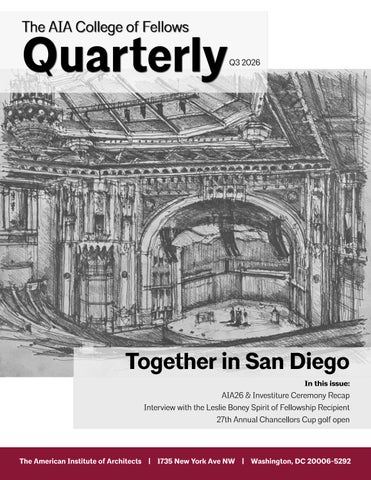
On the cover: 2026 Investiture sketch of the Jacobs Music Center by Tim Hawk, FAIA .
AIA College of Fellows Founded in 1952, the College of Fellows is composed of members of the Institute who are elevated to Fellowship by a jury of their peers. Fellowship is one of the highest honors the AIA can bestow upon a member. Elevation to Fellowship not only recognizes the achievement of the architect as an individual, but also elevates before the public and the profession those architects who have made significant contributions to architecture and to society.
In this Issue | Q3 2026 Message from the Chancellor
5
Announcements & Updates
8
Message from the AIA President: Mentorship & Fellowship - A Lifelong Exchange
10
Message from the AIA EVP/CEO: A Future Focus
12
Message from the COF Executive Director: Update on the Fellows Exhibition at GCAD
13
Fellows Remembered
14
Message from the Bursar: With Great Power Comes Great Responsibility
15
AIA26 Recap: San Diego Reflections
16
New Fellow Spotlight: Ginanna Pigford, FAIA: Building Future Through Mentorship
20
Visions in Practice: A Conversation with 2026 Honorary Fellows
24
Mentorship to Fellowship: COF and YAF
26
Celebrating Steven Spurlock, FAIA
30
Regional Representative's Message
33
Fellow Spotlight: Where Does Your Medal Live?
34
Investiture: Celebration and Commitment
35
2025 COF Component Grant Recipient: AIA Springfield
40
New Fellow Spotlight: Arjun Mande, FAIA: Connecting the Dots: Discovering the Architect I Had Already Become
44
Passing the Hard Hat to the Next Generation: 2026 Align Cohort and YAF Connection Article - Q2 2026
48
AIA26 Session Recap: 2 + 2 - Achieving Design Excellence
50
K12 Activations at AIA26
52
Interview: 2026 Leslie Boney Spirit of Fellowship Recipient Muza Conforti
54
27th Annual Chancellors Cup Gold Open
60
2025 COF Component Grant Recipient: AIA San Antonio Walk with a Fellow
63
Contributors to the COF Fund - 2026 Donors
66
3
COF RESOURCE GUIDE A publication of: The AIA College of Fellows 1735 New York Avenue, NW Washington, DC 20006-5292 www.aia.org/cof
Quarterly Mission to explore and communicate the activities and goals of the College of Fellows
THE PATH TO FELLOWSHIP
2026 Executive Committee Chancellor Jeanne Jackson, FAIA Vice Chancellor Steven Spurlock, FAIA Bursar William Hercules, FAIA Secretary Lisa Lamkin, FAIA
COLLEGE OF FELLOWS QUARTERLY & NEWSLETTER ARCHIVE
2026 Editorial Committee
Chair, Regional Representatives Jon Penndorf, FAIA Exec. Director, College of Fellows Muza Conforti
COLLEGE OF FELLOWS REGIONAL REPRESENTATIVE WELCOME PACKET
AIA FELLOWSHIP PREP CHECKLIST
AIA FELLOWSHIP STORY PLANNING GUIDE
Copyright 2026 by The American Institute of Architects. All rights reserved. Views expressed in this publication are solely those of the authors and not those of the American Institute of Architects. Copyright © of individual articles belongs to the Author. All image permissions are obtained by or copyright of the Author.
SEPTEMBER 2018
IN THIS ISSUE:
Investiture - St. Patrick’s Cathedral A’18 COF Recap
The American Institute of Architects | 1735 New York Ave NW | Washington, DC 20006-5292
Editor-In-Chief Jessica O'Donnell, FAIA Associate Editor John J. Clark, AIA
The AIA College of Fellows
NEWSLETTER
Message from the Chancellor
What a week we shared in San Diego! Jeanne Jackson, FAIA
Hi Friends! AIA26 reminded me once again that while architecture brings us together, it’s the people who make the College so extraordinary. From reconnecting with longtime friends to welcoming our newest Fellows, every event seemed to reinforce why this community is so special. Our week began with the Fellows Lunch at the gorgeous University Club San Diego, where the conversations were lively, the laughter came easily, and it was wonderful to see familiar faces alongside those joining us for the very first time. Then came Investiture. The Jacobs Music Center provided a magnificent setting for welcoming the 2026 Class of Fellows and our Honorary Fellows into the College. Beginning the ceremony by recognizing the Young Architect Award recipients, Associates Award recipients, our newest Honorary Member, and recipients of the Topaz Medallion, the Award for Public Excellence, the Edward C. Kemper Award, and the Leslie N. Boney Award reminded us that architecture is strengthened by leadership at every stage of a career. It was especially meaningful to recognize this year's Leslie N. Boney Award recipient, our exceptional Executive Director, Muza Conforti. For me, however, the most memorable moment was looking out at the faces of our 78 new Fellows and Honorary Fellows.
I couldn't help but think back to my own Investiture and the overwhelming feeling of gratitude I experienced that day. Seeing that same joy reflected back—multiplied seventyeight times—was something I won't soon forget. Listening as jury chair, Sanford Garner, FAIA—the first African American to serve in that role—read each Fellow's 35-word “zinger” was equally inspiring. From architect to architect, we heard stories of leadership, innovation, service, mentorship, advocacy, and design excellence. Together, they painted a remarkable picture of our profession at its very best. My sincere thanks go to Sanford and every member of the Jury of Fellows for the tremendous care and rigor they devoted to this year's review process. And once again, congratulations to the Class of 2026. The celebration certainly didn't end there. Convocation Dinner gave us time to reconnect with friends old and new, and Friday evening's Celebration with the Fellows fundraiser, hosted in a beautiful space that our friends at Carrier Johnson + Culture designed and made available to us, offered another opportunity to enjoy each other's company while supporting the important work of the College. And yes...there was golf. The Chancellor's Cup once again brought out plenty of friendly competition and camaraderie. Meanwhile, at the convention
5
Photo above courtesy of AIA: Chancellor Jackson giving remarks at the COF Luncheon at AIA26.
center, young visitors were discovering architecture firsthand at our Inspire booth, and our ever-popular 2+2 session on Friday drew such a crowd that attendees lined the walls and sat on the floor just to be part of the conversation. Lisa Lamkin, FAIA, captures these and many other conference highlights elsewhere in this issue. Beyond the conference festivities, your Executive Committee had a full agenda. Our Regional Representatives gathered under the leadership of Jon Penndorf, FAIA, to begin imagining how we will commemorate the College's 75th anniversary next year. The creativity and enthusiasm in that room made me even more excited for what's ahead. Jon shares more about that discussion later in this issue. We also enjoyed a valuable breakfast with our former Chancellors, whose wisdom, perspective, and institutional memory continue to guide the College. Both meetings were graciously hosted by our friends at Cannon Design in their beautiful offices overlooking Petco Park. Although AIA26 is certainly the highlight of our year together, the Executive Committee has remained busy on your behalf throughout the year. I'm pleased to report that, following months of careful review, the AIA Board approved revisions to the College of Fellows Bylaws prior to the Conference. Our goal throughout the process was straightforward: simplify the Bylaws, move operational matters into our annually reviewed Standard
6
Photo above courtesy of AIA: Chancellor Jackson giving remarks at the Investiture ceremony.
Operating Procedures, and create governing documents that are clearer, more flexible, and easier to maintain. Vice Chancellor Steven Spurlock, FAIA, continues to lead efforts to make Fellowship more accessible by expanding mentoring opportunities for components that need additional support and by increasing access to Pathway to Fellowship presentations tailored to different audiences. I encourage you to download the presentation, modify it as you think appropriate, and share it within your chapter.
Photo above courtesy of AIA: Former Chancellors at AIA26 Investiture. From left to right, Kate Schwennsen, FAIA, Ron Blitch, FAIA, Roger Schluntz, FAIA, John Castellana, FAIA, Chancellor Jackson, FAIA, Ed Vance, FAIA, John Sorrenti, FAIA, William Stanley, III, FAIA, Ed Kodet Jr, FAIA, and Betsey Olenick Dougherty, FAIA
As we look ahead, we are also preparing for the next leadership transition. The Nominating Committee is now at work identifying our next Bursar, as Bill Hercules, FAIA, prepares to become Vice Chancellor next year. Bill has also been leading an important review of the College of Fellows Fund investment policy and performance. As stewards of the generous contributions made by our Fellows, we have both a fiduciary responsibility and a commitment to ensuring those resources continue to advance research, mentorship, and the future of our profession. He has also initiated a new group, the COF Fund Expansion Task Force. The 2027 Fellowship cycle is now open. Congratulations to Julie Hiromoto, FAIA, who has been appointed by AIA President Illya Azaroff, FAIA, to chair next year's Jury of Fellows. I hope many of you will continue the tradition of serving as mentors, sponsors, and references for the next generation of Fellows. And finally, please save the date for our Annual Business Meeting on October 27, which will once again be held virtually. Serving as your Chancellor is one of the greatest privileges of my professional life. Thank you for your friendship, your generosity, and your continued commitment to advancing the profession we all love. I look forward to seeing you again soon. Jeanne Jackson, FAIA 2026 Chancellor
Photo above courtesy of AIA: Fellows and guests at Cheers! with the Fellows.
7
Announcements & Updates The American PATHWAY TO FELLOWSHIP Institute of ArchitectsMENTORSHIP HIGHLIGHTS College of Fellows Applications for the class of 2027 are open through October 1, 2026 at 5:00pm ET.
On March 19th, AIA Indianapolis hosted their annual YAF and Fellows Breakfast. This event gave the opportunity to network across generations, sharing experiences, practices and professional journeys. This has become a model mentoring event between emerging professionals and Fellows.
Get an overview and best practices for the Fellowship application directly from Julie Hiromoto, FAIA Chair of the 2027 Jury of Fellows.
Path to Fellowship The American Institute 2019 of Architects College of Fellows
2022
Latrobe Prize
The American Institute of Architects 1735 New York Ave NW Washington, DC 20006-5292
Call for Submissions
The American Institute of Architects 1735 New York Ave NW Washington, DC 20006-5292
2027 LATROBE PRIZE
Every two years, AIA College of Fellows Fund, Inc awards the Latrobe Prize to support research in architecture. Building on the 2025 focus on architecture’s contributions to human health and wellness, the 2027 Latrobe Prize will center on how design improves aging, a critical issue for an aging American population. The 2027 Prize will provide $150,000 in funding, with the call for proposals to be announced in the Q4 issue of the Quarterly.
8
AIA STRATEGIC COUNCIL UPDATE
We continue to explore the long-term future of the profession through research and dialogue on practice, housing, regenerative design, neuroarchitecture, and the value of architects. Study groups are transitioning from discovery to recommendations, with final recommendations due in early fall to the AIA Board. Thomas Hysell, FAIA, AIA Strategic Council Liaison to the AIA College of Fellows
2026 COF ANNUAL BUSINESS MEETING
PLANNING YOUR NEXT CHAPTER
Join us for our virtual business meeting on October 27, 2026.
Achieving Fellowship is a remarkable milestone that recognizes your leadership, impact, and service to the profession. As your career continues to evolve, it's important to understand how changes in your professional role may affect your Fellowship status and continued use of the FAIA designation. This guide provides an overview of key considerations to help you navigate career transitions while ensuring your Fellowship remains in alignment with AIA's eligibility requirements
Register in advance via Zoom! After registering, you will receive a confirmation email containing information about joining the webinar. Minutes from the 2025 AIA College of Fellow Annual Business Meeting can be found here.
A GUIDE TO NAVIGATING CAREER TRANSITIONS AFTER FELLOWSHIP
College of Fellows Annual Business Meeting
OCTOBER 27, 2026
NORTHWEST & PACIFIC
WESTERN MOUNTAIN
NORTH CENTRAL
MT
ND
NEW ENGLAND
CENTRAL
ME
WA OHIO VALLEY
MN
OR ID
SD
CA
AZ
CO
MA
IL
SC
AR AL
DE
VA
KY TN
MS TX
WVA
NC OK
NM
MD
OH
IN
MO
KS
NJ
PA
IA NE UT
NH CT RI
MI
WY
NV
VT
NY
WI
MID ATLANTIC THE VIRGINIAS
GA SOUTH ATLANTIC
LA
AK
FL HI
GULF STATES
NORTHWEST & PACIFIC
CALL FOR 2027-2029 REGIONAL REPS
Are you interested in strengthening the communication link between Fellows and the COF Executive Committee, as well as providing support for the various activities of AIA Fellows? New Fellows are welcome to apply! There is no requirement of minimum years as a Fellow. Elements of consideration for appointment as a Regional Representative include diversity of Object of Elevation, location of residence, gender, and ethnicity.
FLORIDA & CARIBBEAN
CALL FOR CONTRIBUTORS
The COF Executive Committee and editorial team invite you to contribute to the 2026 editions of the Quarterly. We welcome the submissions of relevant content that aligns with our theme for each issue (Q4 | Service to Society). If you are interested, please fill out this form.
Applications are available online HERE through September 15.
9
Message from the AIA President
Mentorship and Fellowship: A lifelong exchange Illya Azaroff, FAIA
W
e are all in a constant state of becoming. Mentorship is not a destination we reach once we have accumulated enough experience—it is a lifelong journey. Just as importantly, no matter our age, accomplishments, or title, we are never too experienced to be mentored ourselves. Remaining open to learning, growth, and self-reflection is the foundation of becoming a meaningful mentor. In every exchange, I find that I learn as much from those I hope to guide as they may learn from me. That reciprocity is where true mentorship lives. It continually shapes me into a better leader, a better colleague, and a better architect. For nearly two decades, I have taught at New York City College of Technology while maintaining an active architectural practice. Keeping one foot in education and one in practice was the model I admired as an undergraduate student, and it continues to enrich my work today. Recently, while attending the AIAS Grassroots Leadership Conference in Washington, D.C., I met student leaders from across the country. Listening to their aspirations, concerns, and ideas reminded me that mentorship often begins simply by opening a door, asking thoughtful questions, and continuing the conversation long after the conference ends.
10
I have been fortunate to learn from remarkable mentors whose influence continues today. Don Watson challenges my thinking on climate action and research. Brito Mutunayagam broadens my understanding of complete communities and culture. Ken Yeang inspires conversations on regenerative practice while reminding me, through his wonderful sense of humor, that joy should always be part of our work. Jane Smith still affectionately calls me “kid,” offering wisdom with generosity and perspective. Dr. Tusi Avegalio continually deepens my understanding of culture, identity, and living through the Five Wisdoms, reminding me that leadership begins with understanding oneself.
"Fellowship is, at its heart, an extension of mentorship. It is a commitment to listening as much as advising, to sharing experiences without prescribing outcomes, and to helping others discover confidence in their own path."
Above: President Azaroff, FAIA and AIAS Leaders at the 2026 AIA Grassroots conference in Washington, D.C. (Courtesy of Illya Azaroff, FAIA) Right: President Azaroff, FAIA at the AIA26 Fellows Luncheon (Courtesy of AIA)
In my experience, people often operate from one of two places: fear or love. Fear tells us our ideas are not good enough, that we won’t be heard, or that we don’t belong. Love fuels our curiosity, our passion for architecture, and our commitment to improving the lives of others through design. Understanding these parallel motivations makes us better listeners and, ultimately, better mentors. Whether engaging with students, emerging professionals, seasoned architects, or colleagues from other disciplines, mentorship becomes an exchange of life lessons. We recognize the fear behind what many call imposter syndrome, not by dismissing it but by building trust, reinforcing ideas, and creating space for growth. In doing so, we help others find the confidence to move forward while reminding ourselves that we, too, are still learning. That is the true spirit of fellowship: not simply passing knowledge from one generation to the next, but growing together through a lifelong commitment to becoming.
11
Message from the AIA EVP/CEO
A future focus Carole Wedge, FAIA, NOMA, LEED AP
Associates and young architects are crucial to our future. They help AIA remain connected to the needs of professionals who are developing their careers, progressing toward licensure, and shaping the next generation of architects. It was wonderful to see Young Architect Award Winners and Associate Award winners celebrated at the 2026 COF Investiture alongside the 2026 class of the College of Fellows.
This is a pivotal time for architecture, as our profession takes on complexities of a changing climate, volatile geopolitical landscape, and rapidly evolving technologies. It’s more important than ever to continue to build for the future by encouraging students to pursue careers in architecture, and to help young architects develop and thrive. FUTURE FOCUS AIA26 was a tremendous success with 13,000+ attendees, up 5% from 2025. One of my favorite events was “Bridging Generations,” hosted by the Young Architects Forum. This well-attended networking session connected emerging professionals, mid-career architects, and AIA Fellows to discuss career evolution, well-being, and mentorship. Many thanks to all Fellows who shared their time, listened deeply, and shared their personal experience.
K-12 In 2023, in an initiative championed by then-Chancellor Frances Halsband, FAIA, and Vice Chancellor Ronald Blitch, FAIA, the College invited children to the annual conference to spark their excitement about architecture. These successful sessions in San Francisco quickly built support for the program, which continues to be one of the most enjoyable parts of the conference. It is inspiring to see the enthusiasm of these young visitors on the show floor and recognize the pivotal role of COF leaders in building this bridge to our profession.
We thank the COF for contributing more than $30,000 to K-12 initiatives and helping AIA grow our K-12 engagement across the country.
You don’t need to have all the answers to be a mentor. My own experience as a mentor was more about empathetic listening and building relationships. This is also a two-way exchange: young architects and students have much to teach us. Their fresh perspective helps keep our profession future-focused, creative, and committed to the communities we serve.
April’s annual Architecture Week is one of our most visible and celebrated public events, receiving broad media coverage and community engagement. Your generous COF donations allow us to fund chapter grants, expanding our reach and inviting communities to see how thoughtful architecture shapes the places we live, work, and gather.
Let's each take the time to invite young professionals to find their place in our AIA community. AIA membership is completely free for new graduates for two years. Please share this opportunity with any students you may know!
Mentoring and attracting emerging architects remains a priority for our profession. We appreciate your leadership in this vital work and look forward to your continued contributions in shaping the next generation.
12
Message from the AIA College of Fellows Executive Director
Update: Fellows exhibition at at the AIA Global Campus Muza Conforti
EXHIBIT TASK FORCE Brian Dougherty, FAIA
Kate Schwennsen, FAIA
Dan Kirby, FAIA
James Walbridge, FAIA
Joseph Ruocco, FAIA
Liz York, FAIA
Showcase your book or a book by a Fellow that inspired you. CLICK HERE TO COMPLETE THE FORM BY SEPTEMBER 15, 2026.
I
am pleased to share an update on a special Fellows exhibition, developed in partnership with the Architects Foundation and opening at The Octagon in Q4 of this year. This is a Fellows-led effort in every sense—shaped by Fellows, enriched through Fellows’ contributions, and, we hope, sustained by Fellows’ support. First, I want to extend my sincere thanks to everyone who has donated a book—whether your own or one by a Fellow who has inspired you. The generous response has been remarkable, though not surprising. It is another powerful reminder of this community’s deep commitment to the College, the Institute, and to preserving and sharing the many ways Fellows have advanced architecture. Thank you for helping bring this exhibition to life. As you know, the College was founded in 1952 and has recognized architects whose vision, leadership, scholarship, and service have shaped not only architecture but also the communities we serve. This exhibition honors that legacy while introducing visitors to the many forms of architectural excellence that Fellowship represents. The vision for the exhibit was guided by a dedicated Task Force of Fellows, whose insights and commitment have been instrumental in shaping the narrative and ensuring the exhibition reflects the breadth of our College's legacy. I am deeply grateful for their thoughtful stewardship.
Rather than a chronological history, the exhibition explores the six Objects of elevation for Fellowship through representative architects, historic artifacts, photographs, drawings, models, and personal stories. Visitors will encounter influential figures such as I. M. Pei, FAIA, Paul Revere Williams, FAIA, Norma Merrick Sklarek, FAIA, Chloethiel Woodard Smith, FAIA, and Gertrude Kerbis, FAIA, alongside notable milestones including the elevation of the College’s first women and African American Fellows. The exhibition is curated by Craig Lee, assistant curator in Architecture and Design at the Art Institute of Chicago, who most recently co-curated Bruce Goff: Material Worlds and related exhibitions on photography and contemporary architecture. As we prepare for the opening, we are also launching a fundraising effort to support the exhibition’s production, programming, and long-term preservation. Your support— whether through direct contributions or by sharing this opportunity with colleagues—will help ensure this celebration reaches the widest possible audience. More details on how to contribute will follow in the coming weeks. I will continue to update you on dates, tickets, and fundraiser in the upcoming weeks. Thank you for your continued commitment to excellence, mentorship, and service—the very values that define our College.
13
Fellows Remembered
2026 Michael B. Caldwell, FAIA Linda Marie Ramsay, FAIA John Philip Goodman, FAIA George Loschky, FAIA Phil Bona, FAIA Fulton G. (Tony) Gale, FAIA David Kahler, FAIA Tom Nelson, FAIA Bill Valentine, FAIA Lorcan O’Herlihy, FAIA Laurin B. “Monk” Askew Jr. FAIA Donlyn Lyndon, FAIA Wayne Drummond, FAIA Laurin B. "Monk" Askew, FAIA Leon Bridges, FAIA I.S.K. Reeves, FAIA Joe Jordan, FAIA Norman Strong, FAIA Donald B. Goodhue, FAIA Larry Enyart, FAIA Todd Lee, FAIA William Ralph Dutcher, FAIA Hobart D. Wagener, FAIA Francis S. Oda, FAIA Leonard Volk, II, FAIA John H. Beyer, FAIA David Kahler, FAIA
2025 Phillip Markwood, FAIA John Rogers, FAIA Frank Gehry, FAIA Charles Clarence Barlow, FAIA Robert A.M. Stern, FAIA Adolfo Miralles, FAIA Fleming Wood Smith, Jr., FAIA David G. Jepson, FAIA Terry Farrell, FAIA Nicholas T. Grimshaw, FAIA Michael B. Burch, FAIA Joseph John Wisnewski, FAIA Robert Odermatt, FAIA Paula Burns McEvoy, FAIA Franklin T. Ferguson, FAIA Harry Granville Robinson III, FAIA Graham Gund, FAIA Robert Franklin Brown, FAIA Hugh Clark Miller, FAIA Jodi dan der Wiel, FAIA
Click on an individual's name for a link to their obituary.
14
Charles M. Davis, FAIA David M. Childs, FAIA Barbara (Bobbie) Goldberg Neski, FAIA John Edward Mahlum, FAIA Raymond ("Skipper") George Post, Jr. FAIA Danie Johnson, FAIA Ronald Gene Brown, FAIA David E. Sellers, FAIA James R. Grieves, FAIA Dean Bahr, FAIA Robert Stanley George, FAIA Gretchen K. Pfaehler, FAIA James D. "Jimmy" Tittle, FAIA
Message from the Bursar
With great power comes great responsibility Bill Hercules, FAIA, FACHA, FACHE
Donate or honor someone with a gift to the College of Fellows Fund. Donate Today!
M
idyear is generally a relaxing time. But as the summer closes and the planning for the year-end and the next calendar year ramp up, there are some critical opportunities that sharp investors may choose to consider. The College of Fellows Fund continues to grow and has remained strong since our Finance Committee, consisting of Betsey Olenick Dougherty, FAIA, Dan Hart, FAIA, the late John Rogers, FAIA, and me, recommended a more aggressive investment of the fund’s corpus. Our new fund advisor, Wilmington Trust Investment Advisors (who also serve the Architect’s Foundation and the AIA), has identified several avenues to responsibly accelerate our fund’s growth, and we have seen strong returns this year. The strength of those returns allows us to do more – to broaden the impact of the Latrobe Prize, to expand the purposes related to component grants, and continue to invest in various mentoring programs. Each of these investments has specific returns that measurably advance our profession. Fortified by this strong position, the Executive Committee has set a goal for the Latrobe Prize to be the largest in architecture globally, deepening the influence of the College of Fellows globally. Since the third quarter is also a business planning season, we strongly urge firms and individuals to consider strong
year-end investments, automated monthly contributions, or special estate gifts. Wilmington Trust Investment Advisors has agreed to conduct an educational session related to financial advantages, such as managing Required Minimum Distributions, tax advantages of Charitable Giving Funds, and simply investing in the Fund. Later this year, the Executive Committee will preview preliminary results from this cycle’s Latrobe Prize. This research, led by Doris Sung, AIA, Associate Professor at the USC School of Architecture, is exploring how building facades can function as air purifiers to improve community health. Their demonstration project will be panels on bus stations in Los Angeles during the 2028 Summer Olympics. The convergence of intriguing research, its direct architectural application, our AIA28 Conference in Los Angeles, and a globally broadcast event season allows the Latrobe Prize and its investors – YOU – to demonstrate the significant benefits that architectural research has on public health. Stay tuned as the results of this research continue to develop. The College of Fellows is financially strong and growing. But to quote contemporary philosopher, Spiderman, “With great power comes great responsibility” (a cheesy biblical paraphrase). Our purpose is not to grow a fund for its own sake, but to leverage its benefit for the good of society on behalf of our profession. Let’s keep the momentum going!
15
AIA26 recap: San Diego reflections Lisa Lamkin, FAIA
"Even the sunlight is carefully designed." — Jeanne Jackson, FAIA COMPETITION AND CAMARADERIE We launched the week with perfect weather and our traditional Chancellor's Cup Tournament. Some of us competed, some of us simply played, but we all had a great time supporting the College of Fellows Fund.
For a full recap, see RK Stewart, FAIA's remarks in the Chancellors Cup recap on page 58 in this issue. INSPIRE THE NEXT GENERATION Throughout the convention events and on the expo floor, there were many opportunities to engage with and support the next generation of leaders, including the AIA Community Hub and the NextGen Lounge. The lounge overflowed with attendees making connections and taking advantage of free professional headshots and valuable resources. Proudly sponsored by the AIA College of Fellows and hosted in partnership with AIA San Diego, the San Diego Architectural Foundation, and ACE Mentor San Diego - Future by Design provided the opportunity for students to immerse themselves in the world of architecture through firm visits, student-led presentations, and networking at the AIA26 Expo culminating in their presentation at the NextGen Theater on Thursday. The Bridging Generations workshop was rewarding for all
16
participants. Developed by Kaylyn Kirby, AIA, Young Architects Forum (YAF) Strategy Director, and the YAF Strategy Focus Group, the workshop brought architects from all career stages together through facilitated table discussions focused on the realities of practice and career growth. Thank you to the Fellows who contributed to these honest conversations and shared real-world perspectives from those who have already walked these paths. What a great opportunity for Fellows to help bridge the gap between today's challenges and a lifetime of experience while supporting and shaping the next generation of leaders in the profession!
"The College isn't simply a collection of individual accomplishments. It's a continuum... Each generation inherits something from those who came before and, in turn, leaves something behind for those who follow." — Convocation Dinner remarks, Chancellor Jeanne Jackson, FAIA
Photo above courtesy of the Young Architects Forum: Members of the College of Fellows, young architects and emerging professionals at the YAF's Bringing Generations workshop.
A DAY FOR CELEBRATION Thursday has become a traditional day of celebration for both new and longtime Fellows. Mark your calendars for Thursday, May 20, 2027, in Philadelphia, where we will celebrate the Class of 2027 and the 75th anniversary of the College.
always done best. Somewhere in those conversations and acts of generosity, something remarkable happens. Knowledge is passed along. Confidence is built. Opportunities are created. And the profession moves forward.
FELLOWS LUNCH We continued the tradition established over the last several years, inviting all Fellows to join in congratulating the new Fellows at the beautiful San Diego University Club, which offered expansive skyline views and perhaps the shortest walk on record to the Investiture ceremony at the revitalized, awardwinning Jacobs Music Center. Following congratulatory remarks to the new Fellows, Chancellor Jeanne Jackson, FAIA, announced the new College of Fellows Fund Legacy Donors (see the full list on page 57).
Thank you for proving, year after year, that the greatest legacy we leave isn't what we build ourselves—but what we make possible for others."
INVESTITURE CEREMONY - See page 33 CONVOCATION DINNER: CELEBRATING THE CONTINUUM After a brief break to reconvene in creative black-tie attire, the newly reinstated Convocation Dinner for Fellows and their guests capped the day's events with a moment of remembrance for Fellows who passed away this year, recognition of past Institute and College leadership, and a joyful celebration of the new class. "Every one of us can point to someone who opened a door, shared an idea, offered encouragement, or changed the trajectory of our career.
— Chancellor Jeanne Jackson, FAIA PERSPECTIVE AND PLANNING Early Friday, the Executive Committee joined several former Chancellors for a brisk walk to the nearby offices of CannonDesign, our gracious hosts, for a breakfast meeting convened by 2022 Chancellor John Castellana, FAIA. The discussion was wide-ranging and elevated by the perspective and wisdom of those in attendance. Later, the ExCom reconvened for the Regional Representatives Lunch, featuring a workshop led by Jon Penndorf, FAIA, focused on opportunities surrounding the College's 75th anniversary celebration next year. As one of many initiatives inspired by this wide-ranging brainstorming session, a commemorative pin is planned to mark the occasion.
For a full recap of the Regional Representatives Lunch, see Jon Penndorf, FAIA's Recional Rep Chair remarks on page 31 in this issue, and check out page 19 in this edition for details on the pin design competition.
Nurturing these relationships is what the College has
17
Photo above courtesy of AIA: Capping a day at Rosetti’s office hosted by Matt Rossetti, FAIA, and David Richards, FAIA, celebrating Detroit’s new Fellows.
LEARNING AND LEADING Friday afternoon, former Chancellor Kate Schwennsen, FAIA, returned to host the highly successful 2+2: Achieving Design Excellence session for another year. During this session, four architects, two members of the AIA College of Fellows and two recent recipients of the AIA Young Architects Award, all widely recognized for design excellence, shared their work and unique perspectives on achieving outstanding design. Thanks to its well-earned reputation for relevance and engagement, the room filled well before the session began, and check-in resembled a rush-hour traffic jam. A recap of this session can be found on page 48 of this issue. As planning begins for Philadelphia, we anticipate a larger venue and look forward to new hosts Jeanne Jackson, FAIA, and RK Stewart, FAIA, continuing this outstanding program. CHEERS! Friday events concluded with perfect weather and rooftop garden views during our Celebration with the Fellows Fundraiser. Once again, we toasted the new Fellows and award winners, made new connections, and reconnected with old friends while supporting the College's mission.
Photo above courtesy of AIA: (left to right) Wendy Ornelas, FAIA, Abi Brown FAIA, Jessica O'Donnell, FAIA, Jennifer Kretschmer, FAIA, and Bob Condia, FAIA, enjoying the Cheers! celebration.
STAY TUNED FOR WHAT'S NEXT Be sure to explore all available issues of the Quarterly, including our special issue highlighting your Regional Representatives and the special edition introducing the Class of 2026 Fellows: Find us on issuu.com. Connect with us on LinkedIn for additional news and updates, and mark your calendars for our Annual Business Meeting on Zoom on October 27, 2026. Photo above courtesy of AIA: (left to right) Connie Cravens, Roger Schluntz, FAIA and Max Underwood, FAIA at the Convocation Dinner.
18
Design competition for the 75th anniversary pin of your College As the College approaches its 75th anniversary, several opportunities to commemorate this important milestone are underway. To foster personal connection, encourage engagement, and celebrate the year, the College will offer a special, high-quality enamel pin with a metal backing in recognition of support for the College of Fellows Fund. We need your help creating a design that will be a coveted symbol of this anniversary and of support for the College. The winning design will be announced during the 2026 COF Annual meeting in October.
ELIGIBILITY Submissions are limited to members of the AIA College of Fellows.
SUBMISSION INFORMATION • Email a JPEG of your design to cof@aia. org by midnight ET on September 18, 2026.
DESIGN CRITERIA • Appropriate lapel-pin size, not exceeding 1" diameter. Designs are not limited to the octagon shape.
•
Email attachments must be named as follows: FirstName-LastName_75-Year-Celebration
•
Hand sketches are acceptable but may need to be converted to a vector image if selected as the final design.
•
JPEG is recommended to be 300dpi or 300x300 pixels.
•
A design clearly distinct from the COF member pin.
•
Potential to produce the pin in multiple colors to recognize varying contribution levels.
•
Incorporation of “75” and/or the anniversary years, “1952–2027.”
AIA College of Fellows | 1952-2027 Questions? Reach out to Muza Conforti.
19
New Fellow Spotlight | Gianna Pigford, FAIA
Building the future through mentorship Gianna Pigford, FAIA, NOMA, LEED AP BD+C
I
acknowledge that behind my accomplishments as an architect is a journey of continuous learning, guidance, and professional growth. A few months ago, I stood on the stage at the Investiture Ceremony and received formal recognition of the work I’ve done thus far in architecture. The applause and cheers were great to receive, but the moment, as great as it was, doesn’t eclipse the deep appreciation I have for those who have been with me through the tough moments that fueled my work, supported me, and listened when I just needed an ear. At the heart of my journey lies mentorship: the giving and receiving of such. I often tell people that I didn’t have a formal mentor until age 38, but as I’m now more reflective, I can say there were the quiet moments of mentoring, like when a supervisor asked a simple question, “are you letting things happen to you, or are you sitting in the driver's seat of your career?”, that made a profound difference in my trajectory.
designation. That number can make Fellowship feel distant, almost a museum-like artifact sitting high on an unreachable shelf and far removed from the day-to-day grind. But the work that leads to Fellowship usually happens in very ordinary rooms, over many years, through repeated acts of care, candor, and professional generosity. One thing that I’ve taught others over the years is that we use the word “mentorship” to cover several different roles. Coaching, mentoring, and advocacy are related, but they are not interchangeable. When we blur them together, people get disappointed. They think they have a mentor, but what they really have is someone offering occasional encouragement. Or they assume that they must constantly bestow flattery to receive the endorsements they want for their individual achievements. Or they think they are advocating for someone when actually they are giving advice from the sidelines while the room where decisions are made stays closed.
That is mentorship. Or at least one of its most useful forms. It is not a program name, a coffee chat, or a line item to check off in a professional development plan. It isn’t the direction or answer that I sought, but it was a question that gave me pause to think. Mentoring is the small transfer of discernment from one person to another, at the exact moment when the lesson can still stick.
Over the years, I’ve given several presentations on how to chart your career path, and why it is important to have all three (mentors, coaches, and advocates) as part of your bench as they all serve different purposes. Seek mentors, advocates, and coaches. Beyond obtaining licensure, this is one of the singular most important things to do in the early days of your career. In the midpoint of your career start filling these roles for others.
Around three percent of AIA members hold the FAIA
20
Graphic above from “Charting A Path: Defining Your Career in Architecture” by Gianna Pigford, FAIA
Coaching is about a task related to your specific job or project. It is direct, focused, and usually close to the work. A good coach helps someone sharpen a presentation, negotiate a consultant issue, prepare for a difficult owner conversation, or understand why a detail keeps failing in the field. The coaching process relies on “collaboration” and is based on three components: technical help, personal support, and individual challenge. Coaching says, “Here is what I noticed. Try this differently next time.” It is practical. Sometimes it is uncomfortable. The best coaching I received was from Johnny Hopper. A quick description of him is a modern cowboy from west Texas – technically sharp but also would not blink at clipping your wings with a terse quip like, “hey, don’t draw something unless you understand it,” which is a maddening sentence until you realize it is also a gift. Your coach helps you to overcome performance blind spots and refine your skillset. I’m forever grateful for Johnny and the technically savvy architect he helped me become.
Photo above courtesy of Gianna Pigford, FAIA: Mentor Johnny Hopper
Mentoring is wider. It is not only about the task in front of you; it is about the arc of your career. Mentorship is a “partnership”, where the mentor and mentee work together in a relationship based on mutual trust and respect. A mentor helps you see patterns before you have enough years to name them yourself. They notice what kinds of work energize you, where you are over-functioning, where you are waiting for permission, and where your ambition is hiding behind reliability. A mentor may not solve the immediate problem. In fact, a good one often refuses to. They ask the question that makes you sit in the discomfort a little longer: “What do you want to be known for?” or “What do you want – more money, a title, a significant project?”. These are the questions my mentor, Helen Heitman, asked me. I was at an inflection point of my career, and she saw me—really understood where I was as a recently licensed architect, newly minted as an Associate at my firm, but also lost in how to move my career forward. I look back at it now, and Helen did what I don’t believe most would in her position as a studio director and office leader. She provided an umbrella. She gave me space to vent, and about three months into our sessions she said, “this is it, your last time complaining – now tell me what do you want?” It took me almost a year to fully answer her – and upon her retirement, I finally gave her my career plan. Her brand of mentorship was not always a comfortable blanket that coddled me. But what she did was step into the gap, hold back the tides of the environment that was impacting me, and allowed me space to think about my career outside of people and their actions that I could not change and forced me to look at what I needed for my career to be fulfilling. Advocacy is different again. Advocacy uses positional power. It happens when someone says your name in a room you are not in, and not vaguely. Not “she’s great,” but “she should lead this pursuit because she has already navigated this
21
Johnny, Helen, and Charyl. Those testimonial notes from my program partners, mentees, proteges, former colleagues, and team members became the evidence of my leadership.
Photo above courtest of Gianna Pigford, FAIA: Mentor Helen Heitman
client type, she understands the technical risk, and she has the trust of the team.” Advocacy is specific, public enough to matter, and attached to an opportunity. It costs the advocate something: credibility, political capital, or at least the willingness to be accountable for the recommendation. Advocates are often senior leaders in the organization/office that speak highly of you and raise your visibility. That was Charyl McAfee-Duncan, FAIA, for me. I didn’t have the AIA College of Fellows on my radar, but she spoke my name to AIA Dallas for their nomination and to be accepted into the Fellowship Workshop—and Charyl subsequently told me that I was ready when I had no idea what arena I was stepping into. Charyl went on to become my Fellowship sponsor and supported me through three rounds of submissions. For those thinking about AIA Fellowship, this matters because Fellowship is not simply a retrospective scrapbook of beautiful projects, board roles, lectures, or awards. The AIA Fellowship process asks candidates to demonstrate distinction through defined objects of nomination, but underneath those categories is a more human question: did your work travel beyond you? After applying for Fellowship twice, I thought about my ripple effect and how my work had meaning – it was in those that I had mentored, coached, and advocated for, so I reached out to them. I’ll tell you, when I received responses to my query, I was moved and shed a few tears as in my doing the day-to-day work, I had become a
It wasn’t an organized speed mentoring session, lunchand-learn sessions, or a spreadsheet assigning a mentee to a preassigned topic of discussion. The real evidence is in the people who pointed to a moment when my involvement changed their trajectory: the now vice president who learned how to conduct a meeting; the senior architect who saw licensure as possible because I guided them through the process; the unsure colleague who recently became a nationally recognized AIA honor award winner; the associate who, by default, leads a practice with a similar dedication to the profession. I’m still pulling the wrapper off “Fellowship,” but my leadership did not end at FAIA. I’m still coaching, mentoring, and advocating – even more so. The College of Fellows exists not only to recognize excellence but to extend service, share knowledge, and mentor younger architects. This is also why Fellowship should not be treated as a finish line. If Fellowship becomes only a title after a name, it misses the point. The honor should make a person more porous, not less; more available to the profession, not more insulated from it. I’ve benefited from Fellows that are highly engaged even after their retirement. It is quite the feeling of defeat to have to again tell reference writers and advocates that you were not successfully elevated after your second submission. The frustration I felt wasn’t completely alleviated but it helped immensely to have others tell me about their process and path to Fellowship. They coached me through another submission, read my edits, made suggestions, and certainly advocated on my behalf with another round of reference letters. Every architect’s body of work is crowded with other people’s fingerprints. Teachers, critics, project managers, clients, contractors, administrators, chapter leaders, peers, and the person who pulled you aside after a meeting and told you the truth kindly. There is humility in that. A Fellowship submission may carry one name, but no career is built alone. The best candidates know that. The best mentors make sure others know it too. So maybe the question is not only, “Who helped me get here?” It is also, “Who is less alone because I paid attention?” Who understands the profession more clearly because I explained the unwritten rules? Who has a chance at leadership because I named their readiness before firm leaders noticed it? Who did I coach through the task, mentor across the career minefield, and advocate for when the opportunity was being decided?
Photo above courtesy of Gianna Pigford, FAIA: Gianna Pigford, FAIA with her mentor, Charyl McAfee-Duncan, FAIA, at AIA26.
22
That, to me, is the bridge between mentorship and Fellowship and how we build the future of architecture practice. It is not sentimental. It is not soft. It is disciplined, specific, and cumulative. It is the quiet work of turning experience into access. And if architecture is serious about its future, that work belongs at the center of how we define excellence.
Pathway to Fellowship
Apply for the Class of 2027! Be recognized with AIA’s highest membership honor for exceptional work and contributions to architecture and society! APPLICATIONS DUE October 1, 2026 at 5:00pm ET
SUBMIT HERE Notification to candidates and public announcement in early Feburary 2027.
CLICK BELOW FOR RESOURCES The AIA College of Fellows has developed downloadable toolkits to help members get organized and prepare for the Fellowship application process. If your Chapter does not have a robust Fellowship committee and/or you are looking for help from a Fellow to guide you through your application, please reach out to Muza Conforti for additional guidance.
23
Spotlight | Honorary Fellows
Visions in practice
A conversation with 2026 Honorary Fellows Mary Johnston, FAIA
"Their holistic dedication to sustainability, human-centric design, and cultural stewardship not only elevates the global built environment but also enriches our collective practice here in the states, reinforcing a deeply collaborative vision for the future of the Institute." — JOSEPH P. RUOCCO, FAIA
A
long with each new class of Fellows, the AIA recognizes a select group of Honorary Fellows, who represent the excellence of our international peers. Honorary Fellows are elevated for their exceptional work and contributions to architecture and society, but are not residents of the United States and do not primarily practice architecture within the domain of the Institute. Since 1952, almost six hundred Honorary Fellows have been elevated, among them such varied talents as Peter Zumthor, Freda Escobedo and Renzo Piano. Our profession has never been more global, with practices that truly “know no boundaries”, and, as a member of the COF Honorary Fellows Committee, it has been my distinct pleasure to nominate and guide through the process several of the brightest lights practicing today. In 2026 our small committee within the COF nominated a record eleven successful candidates. As the world becomes smaller, we anticipate growing our Honorary Fellows program and welcoming the diverse voices and experiences that our international colleagues bring to the COF. We are starting to take better advantage of the insight and inspiration that the newly minted Honorary Fellows bring to the AIA. We were honored to welcome several new Honorary Fellows to the AIA26 in San Diego this year. Among them were Dorte Mandrup, Hon. FAIA, from Denmark and Takaharu
24
Tezuka, Hon. FAIA, from Japan, who graciously agreed to take part in a moderated conversation about their work and design philosophy. It was a lively and thoughtful session that covered a wide range of subjects, including: • The physical, historical and cultural context in which both architects work and the care and sensitivity each brings to the design process • Materiality, and the importance of building materials that are both sensitive to the environment and culturally appropriate. • The importance of considering the well-being of the user and curating an experience that is comfortable and uplifting. Those who attended the session were moved by the dedication of Dorte and Takaharu to a humane way of creating architecture that is gentle on the land, and inspiring to those who move through their buildings. As the session progressed, the conversation took several meandering paths that touched on weather and climate, and how to celebrate snow instead of fighting it. Each discussed the part humor and play have in their architecture. Both architects use resources carefully and intentionally with a dedication to energy efficiency and renewable materials. Both take maximum advantage of the landscape and context of each project, letting users meander
13
Fernanda Canales redefines architecture by combining design and research to dissolve the boundaries between rich and poor, private and public, and resources and waste. Her buildings are places to foster wellbeing and collective life.
© Adam Mørk
© Adam Mørk
22
© Shinkenchiku-sha
© Tezuka Architects
© Shinkenchiku-sha
under, over and around the structures. One of the most resonant conversations was about the rigor it takes to really see the places we are privileged to work in, and to listen to the people we serve. The Committee on Design hopes to hold a similar session next year in Philadelphia with our new class of Honorary Fellows, and we look forward to another engaging discussion with world-class architects. We invite all of you to attend!
"Sharing a selection of projects, Mandrup and Tezuka reflected on architecture's capacity to deepen our understanding of place. Though shaped by different cultures and geographies, their work revealed a shared sensibility: a dialogue between building and landscape, where site, climate, and human experience are conditional to the design process." — KAREN LU, FAIA
25
Interview | Past YAF Chairs
Mentorship to Fellowship: COF and YAF Interview by John J. Clark, AIA
Since the Young Architects Forum (YAF) was established in 1990, 17 of its national chairs have been elevated to the AIA College of Fellows—a testament to their continued leadership and lasting connection to Fellows within the Institute.
Year
Chair
2022
Jessica O'Donnell, FAIA
2021
Abigail Brown, FAIA
That connection is intentionally fostered through the College of Fellows liaison to the YAF Advisory Committee, who provides mentorship, guidance, and a valuable bridge between the two groups. For many YAF leaders, this relationship offers a glimpse into the College of Fellows Executive Committee (ExCom) and its responsibilities, including that of supporting the next generation of architects.
2020
Ryan McEnroe, FAIA
2019
Lora Teagarden, FAIA
2017
Evelyn Lee, FAIA
2016
Joshua Flowers, FAIA
2014
Jonathan Penndorf, FAIA
2010
Sean Stadler, FAIA
2006
Soren Simonsen, FAIA
2004
F. Michael Ayles, FAIA
2001
Paul S. Woolford, FAIA
The Quarterly spoke with four of the elevated former YAF chairs to reflect on their journeys—from leading YAF to pursuing Fellowship—and to explore how mentorship, service, and continued engagement can strengthen the relationship between YAF and the College for the next generation.
From YAF Chair to Fellow 17 former chairs of the Young Architects Forum have since been elevated to Fellowship within the Institute
26
2000 John Harrison, FAIA 1999
Mary Katherine Lanzillotta, FAIA
1995
Brad Simmons, FAIA
1993
William Carpenter, FAIA
1992
Todd C. Voth, FAIA
1991
David Hart, FAIA
Ryan McEnroe, FAIA, ASLA, LEED AP, CDT Washington, DC Elevated in 2023; Object 3 - Led the Institute COF Liaison while YAF Chair: Frances Halsband, FAIA
Jessica O’Donnell, FAIA, NCARB Collingswood, NJ Elevated in 2026; Object 3 - Led the Institute COF Liaison while YAF Chair: Kate Schwennsen, FAIA
Jon Penndorf, FAIA, LEED AP BD+C Washington, DC Elevated in 2017; Object 3 - Led the Institute COF Liaison while YAF Chair: John Sorrenti, FAIA
Lora Teagarden, FAIA, LEED AP BD+C Indianapolis, IN Elevated in 2026, Object 3 - Led the Institute COF Liaison while YAF Chair: Roger Schluntz, FAIA John Clark (JC): As YAF Chair, who was your liaison to the COF? Describe the support the ExCom gave you and the YAF Advisory Committee? What insight into the College did you gain from him/her?
lives. Working with Jeanne Jackson, FAIA, as past chair, she gracefully supported challenging conversations and she emboldened me to stand firm in our core beliefs of what is best for a given demographic.
Ryan McEnroe (RM): Frances Halsband, FAIA was the liaison, but was more hands off on direct mentorship with me. Instead, Peter Kutner and Ed Vance were strong advocates for me applying for Fellowship, and not waiting till I became gray haired. Both Ed and Peter continually spoke about the positive impact the College has on the profession, specifically in regards to mentorship of the next generation.
Jon Penndorf (JP): John Sorrenti, FAIA, was our liaison for my year as YAF chair. John was an active participant in our YAF leadership meetings and was a wonderful, supportive presence to our group. John provided us great insight into how the College of Fellows functions and how many COF priorities truly aligned with those of the YAF. I still enjoy seeing John at COF events—always such a positive champion for the COF and the profession.
Jessica O'Donnell (JO): Kate Schwennsen, FAIA was the COF Liaison during my term as Chair in 2022. My year as Chair aligned with the 30th anniversary of the formation of YAF, which is celebrated quinquennially with YAF Summit events. The support from both Kate and the College in preparation of YAF Summit 30 was exceptional. Kate provided inspirational guidance from her wealth of understanding of AIA. She was a champion of our Summit 30 | Mission 2130 event along with the entire COF ExCom that year. I was fortunate to also have a close working relationship with the COF liaisons preceding and succeeding Kate while I was vice chair and past chair. Working with Ron Blitch, FAIA, as vice chair enabled me to better understand the COF ExCom structure and the College’s dedication to empowering the next generation of designers starting at the K-12 level. Ron encouraged me not to be afraid of asking AIA for big things, especially when there is the potential to positively change
JC: Is there a specific moment or Fellow that inspired you to become a Fellow? RM: My sponsor Helene Combs Dreiling, FAIA, was the strongest advocate for me beginning the application process as soon as I was eligible. We first met when I was still a student, so the inspiration to become a member of the College was groomed over a decade of continued mentorship and guidance. JP: My sponsor was probably who inspired me most—David Daileda, FAIA, and I served on the local AIA|DC board together as well as on the AIA Conference Planning Committee in 2012. His inclusive and approachable leadership style gave me something to both aspire to and learn from, and I followed in many of his footsteps in both local and national AIA leadership.
27
Photo above courtesy of Ryan McEnroe, FAIA: 2019 ALIGN Mentorship breakfast with John Castellana, FAIA; Lawrence Fabbroni, AIA; Lora Teagarden, FAIA; Ryan McEnroe, FAIA; Roger Schluntz, FAIA; Terri Stweart, Hon. AIA, Peter Kittner, FAIA, and Ed Vance, FAIA.
JC: When did you feel ready or confident to apply for fellowship? What resources were available to you to in the endeavor? RM: I applied for Fellowship as soon as I was eligible. I had various informal resources through a handful of mentors that are more familiar with the process of applying. I also used the AIA|DC schedule as a reference. JO: I don't think I ever felt ready or confident—but with encouragement from Fellows and members of the COF ExCom I did believe my contributions and service to date were significant enough to justify the time and effort to pull my application together. I reached out to several folks that I knew had applied recently to understand their process and then worked with my sponsor to determine what schedule would be best for me. The most helpful resource was my sponsor and getting extra eyes on my draft applications along the way. Lora Teagarden (LT): Due to quickly volunteering with YAF at a national level soon after my licensure, I felt confident enough to apply for Fellowship as soon as I met the time requirement. I had also regularly been asked by Fellows and AIA leaders when I was going to submit, surprised that I hadn’t yet because of eligibility. At that time, I had seen many of my peers performing important service and receiving elevation, so the path and process were clear. We regularly shared exhibit examples and otherwise had a group of Fellows and peers to ask questions of when unsure about a specific item. When it came time to begin the work of creating the submission, I connected early with my hopeful sponsor for their buy-in, quickly followed that with outreach to my letter writers, and then got to work. I performed all of the effort on my own, after hours from my work at RATIO, after we had put our toddler to bed. It was many long nights and weekends, but it was worth it.
28
JC: What advice would you give to current national and local YAF leaders that aspire to Fellowship? RM: It's not a matter of if, but when you will become a Fellow. As leaders of YAF, we have been and will continue to make a significant impact on the profession. JO: I recommend creating a living document to capture your speaking engagements, articles, awards, successful initiatives and their ripples. Adding to that document or folder each month, or after each event, will give you a head start when you start compiling your application because the data will be at your fingertips. One challenge I had to work through was determining what to include in my application and items did not rise to the level of needing to be included. Your application needs to tell a very specific and succinct story. Every item you list or dedicate space to in the application must reinforce your 35 word statement. If an initiative was meaningful to you but did not directly relate to your 35 words, then it should not be included. Sorting through a decade or more of meaningful work that you invested time and energy into is no easy task. JP: If you’re already in a position of volunteer leadership in the YAF (or elsewhere in the AIA), you’re already building that resume and portfolio that can someday support your application package for Fellowship. The potential for elevation to the College of Fellows can be closer than you think. In fact, the requirement for 10 years of licensed, AIA membership ironically coincides with the end of one’s “Young Architect” period. Take a moment to document your experiences as you go now; having photos, collateral materials, and graphics from your YAF experiences will be important components of your future application.Also, think about who you might ask to support you in your nomination process—you’ll need a sponsor, references, and others who can provide you with guidance and feedback along the way.
LT: Start tracking every effort now. Make a running list of interviews, articles, community meetings, whatever it is that you’re doing. And have people take pictures of you doing it! Keep all of that in a folder and it will make the creation of the application that much easier. Consider who can speak to different parts of your story and try to show geographic and industry breadth in those people via testimonials and reference letters. Otherwise, just keep doing the great work you’re already doing. You rarely get on this path accidentally, and the work you are doing is important for your community, our profession, and the industry. Believe in that good work. JC: You each are fruits of a strong relationship between the College and the YAF. Now as a Fellow, describe the importance of continuing to support emerging leaders, particularly those in the YAF. RM: The YAF are the next generation of leaders within our profession. Support and mentorship are foundational to anyone's success, as a Fellow we all need to be giving back and sharing our insight within the profession. JO: I see my elevation to the College as a launch pad for further engagement within AIA and with the broader profession. I have a deep appreciation for my journey to Fellowship and the fact that it was not something I accomplished by myself. Many, many people along the way helped inspire me, encourage me, and open doors for me. My goal is to keep those doors propped open for those who will come next and use every opportunity I have to support emerging leaders in any way I can. JP: One of the first things I sought to do after being elevated was to be a stronger, more consistent mentor to emerging professionals. It’s critical to lift others up and keep the pipeline for leadership of the profession strong. I’ve had meaningful mentorship experiences through the ALIGN program and through local AIA|DC mentoring programs. Supporting emerging leaders is critical to a strong AIA, and one that can reflect the times and communities in which we design. LT: As someone who earned their Fellowship on mentorship and equity initiatives within the Institute, I will always champion the importance of the COF/YAF relationship. When we support emerging leaders, we support our future. Everything as small as: "how do I properly detail this connection, or respond to this client;" or as big as: "I think I’m ready to pivot to a new job or volunteer role in a different part of the industry;" that mentorship happens via intentional connections and relationships. The support system not only trains and prepares young minds for their time as leaders in the future, but it also shows them that they are leading now by asking good questions and looking for mentorship. As mentors, you also have the ability to learn from them; to witness the energy and innovation that might spur you to think differently about how you approach a process in your own office. There is only upside to this relationship, for all involved.
Photo (top): Jon Penndorf, FAIA, with sponsor David Daileda, FAIA. Courtesy of Jon Penndorf, FAIA Photo (middle): YAF leaders at 2017 AIA Conference on Architecture. Courtesy of Ryan McEnroe, FAIA Photo (bottom): Lora Teagarden, FAIA, addressing YAF leaders. Courtesy of Lora Teagarden, FAIA
"The support system not only trains and prepares young minds for their time as leaders in the future, but it also shows them that they are leading now by asking good questions and looking for mentorship. " 29
Celebrating Steven Spurlock, FAIA Muza Conforti Click on this image for a video commemorating Steven's career of Design, Service and Mentorship
After nearly five decades of distinguished practice, service, and mentorship, Steven Spurlock, FAIA, has retired from Quinn Evans.
"Steven joined Quinn Evans in 2016 through the acquisition of Wnuk Spurlock Architecture, bringing with him tremendous experience across residential, cultural, diplomatic, and historic preservation projects. Over the years, his work ranged from nationally significant structures like the Lincoln Memorial and the Embassy of Estonia to smaller residential and community projects. No matter the project size, Steven always approached each project with the same passion, care, and attention to detail." - Quinn Evans News, May 2026 “As fellow architects in the Washington DC area, my close personal and professional relationship with Steven Spurlock began in 2012 when I became a new regional representative to the AIA Board of Directors. Steven was already serving as Middle Atlantic Director. I immediately benefited from his generosity of spirit and kindness as he guided me into my new role. As anyone who has served on the national AIA Board can attest, it is perhaps best remembered for the life-long friendships forged there. Steven was the first for me. In 2016, our connection grew even deeper when Steven joined Quinn Evans. We worked together on a number of projects, culminating in the just-completed Lincoln Memorial Undercroft Museum, a rewarding capstone project for us both. On my way to serving as AIA President in 2018, I was heavily involved in AIA throughout the most critical years of that project’s development. Steven’s keen design eye and evenhanded management of a sprawling client and project team elevated the project beyond measure. In both contexts, I owe Steven my deepest gratitude. I look forward to supporting him in his continuing service to the College of Fellows and deepening our friendship in whatever chapter comes next for Steven.” — Carl Elefante, FAIA. 2018 AIA President
30
Photo above courtesy of Wnuk Spurlock: House in Stinson Beach CA. Photo right: Artwork by Steven Spurlock and Steve Frietsch.
Steven’s impact extends far beyond his projects. He has been a dedicated leader within the AIA College of Fellows, and I first encountered him in 2022 in his role as Jury of Fellows Chair. From the beginning, he stood out as someone deeply committed to the work of AIA and consistently generous in supporting the profession and the College. His generosity was further recognized through Legacy 30, when his cumulative donations reached $30,000, and I had the pleasure of meeting him personally to deliver his gift in recognition of that milestone. What has stayed with me most is how grounded and genuine he is. With so many accomplishments to his name, he could easily have carried himself with distance or self-importance, but instead he is one of the most down-to-earth, wise, and generously spirited people I have met. Steven has had an enormous impact on me and my work with the College. His continued leadership in the College reflects his longstanding commitment to recognizing excellence, supporting future Fellows, and strengthening the profession through service.
I was fortunate to attend Steven’s retirement celebration and witness firsthand not only the many people he has influenced throughout his career, but also the lasting impact he has had on the profession. As he transitions away from architectural practice, Steven’s influence will continue through his leadership in the AIA College of Fellows, where he currently serves as Vice Chancellor and will become Chancellor in 2027. Thank you, Steven, for all that you do for the College and its Fellows. I hope you receive this article as a sincere and well-earned surprise celebration of you and your many contributions.
Most importantly, Steven has been a mentor to many. His willingness to share knowledge, encourage others, and invest in the growth of colleagues has left a lasting mark on the architectural community.
"Steven has always led with people first. That mindset is reflected not only in the thoughtful work he has done throughout his career, but also in his commitment to strengthening our profession through mentorship and service. I feel fortunate to have learned from someone who has shown that the most meaningful legacy an architect leaves is not only in the buildings they create/ preserve, but in the people they inspire along the way." — Saakshi Terway, Assoc. AIA
Photo above courtesy of Quinn Evans: Embassy of Estonia.
31
THE HERITAGE SOCIETY OF THE AIA COLLEGE OF FELLOWS What will your Legacy be? The primary purpose of the Society is to formally recognize those individuals who have demonstrated a life-long commitment to the mission and programs of the AIA College of Fellows with a revocable estate bequest. By virtue of having included a commitment in their estate plan of a bequest for the future benefit of the College and its programs, the following distinguished individuals are the Members of the Heritage Society of the AIA College of Fellows: Membership in the Society is conferred upon formal notification to the College of a planned estate gift with a minimum value of $10,000.
Joseph A. Boggs, FAIA Ellis W. Bullock, FAIA John A. Busby, Jr., FAIA Donald Wesley Caskey, FAIA John Castellana, FAIA William David Chilton, FAIA Carl D'Silva, FAIA Betsey Olenick Dougherty, FAIA Brian Paul Dougherty, FAIA Harry M. Falconer, Jr., FAIA Dr. Robert Allen Findlay, FAIA L. Jane Hastings, FAIA* Russell V. Keune, FAIA Ed Kodet, FAIA
Lisa Lamkin, FAIA Howarth L. Lewis, Jr., FAIA Ivenue Love-Stanley, FAIA Frank Lucas, FAIA* Robert Ooley, FAIA Burton L. Roslyn, FAIA Jeffrey Scherer, FAIA Roger L. Schluntz, FAIA John Sorrenti, FAIA Steven Spurlock, FAIA William J. Stanley, III, FAIA Ed Vance, FAIA William F. Vosbeck, FAIA
We cordially invite you to undertake a similar, revocable, commitment in your estate plan, and thereby becoming a member of the Heritage Society. It’s simple to accomplish. With additional Members the future support of our programs and long-term viability of the College will be substantially enhanced and extended well into the future. For additional information and application, please contact Muza Conforti, cof@aia.org.
*Denotes a deceased member.
32
Regional Representative Message
Q3 update Jon Penndorf, FAIA
T
he College of Fellows regional representatives communicate virtually for most of the year, but for those who attend the AIA Conference on Architecture and Design there is the opportunity to meet in person. It’s a time to make and renew friendships, talk more extensively, and think about how regions can also work with and learn from each other. The group manages to squeeze in this annual event over lunch amid all the other amazing COF and general events happening. This year, the regional reps lunch meeting was a little different. Rather than regional report-outs, the reps did some collective brainstorming to consider impactful ways to mark the upcoming 75th anniversary of the AIA College of Fellows. Next year that milestone will be realized, and the group had some fun imagining ways to enhance the COF presence both at conference as well as ways to bring more impact to Fellows all over the world. The conversation reflected the past work of the College as well as aspirational statements for the future. Since all regional reps were not able to attend in person, an online version of the exercises was created to give all an opportunity to participate. While all the ideas might take us years to produce and enjoy, many may make their way into planning for 2027. The COF regional reps will be a critical component to the roll out of the anniversary celebration, and we are all looking forward to commemorating this major moment in many ways.
INTERESTED IN GETTING MORE ENGAGED? The College of Fellows regional reps are volunteer members who serve a three-year term representing the AIA Fellows of a geographic region. This important role serves both as a conduit between members and the COF Executive Committee as well as a brainstorming and resource group for the advancement of the College overall. Being a regional rep puts you in direct connection with volunteer leaders from around the Institute and provides impact, and the COF is always looking for the next great regional rep! Several regions have representatives cycling off each year, and the College is always interested in hearing from Fellows from any region who have an interest in the immediate future. Applications are available online HERE through September 15. If you are interested, please fill out the application and contact your current regional reps to learn more (some regions have some additional expectations and application requirements which can be shared by the current representatives themselves). The COF requirements for the volunteer role are also listed on the application website.
33
Fellow Spotlight Series
Where does your medal live?
In the early spring of 2024, I was elevated to the College of Fellows at the American Institute of Architects. I experienced a feeling of extreme and surreal elation! As a newly minted member, I was incredibly proud to wear our two-toned ribbon. From what I understand, the two-toned ribbon was a new feature to help other FAIA members find and congratulate new members. I absolutely loved this idea and deeply appreciated the recognition. For the first time, I felt that my industry truly respected my life’s work. Fast-forward to this year’s conference in the spring of 2026. As I was packing, I realized I had placed my solid color ribbon in such a "sacred" place at home that I could no longer remember where it was! When I arrived at the conference, I ran into former AIA President Helene Combs Dreiling, FAIA. Knowing she was involved with the College of Fellows, I asked her if she knew how I could get a replacement ribbon. She immediately referred me to Muza. However, noting that there was little Muza could do in just one day, she suggested, "Why don't you try putting it on a necklace?" “Ah, good idea”, I thought to myself. As luck would have it, I had a necklace laced with a ribbon of a very similar color, which served as the perfect substitute. It went over very well. I received several compliments! I can say that I love my organization, an organization that years ago did not feel like anything I would be a part of; now it feels like my organization. Despite everything happening both nationally and globally, I think more people are starting to realize that there is no "us" versus "them." We are they, and they are we. While I am not familiar with the back-of-house politics, I recognize the effort the AIA has made over the years to purge any antiquated sentiments of bias of any kind. I am very proud to wear my FAIA medallion on my ribbonlaced necklace.
34
Photo Above: Courtesy of Nicole Hollant-Denis, FAIA, NOMA
Nicole Hollant-Denis, FAIA Class of 2024, Object 2 Do you have a story to share about where your medal lives? Contact the College's Executive Director at COF@ aia.org with your written description and photos for consideration in an upcoming spotlight!
Investiture: Celebration and commitment Lisa Lamkin, FAIA
I
nvestiture once again celebrated multiple generations. Following the processional, which included current and former AIA Presidents, current and former Chancellors, members of the College Executive Committee, and the Jury Chair, the event commenced with the Associates Award and Young Architect Award presentations, reinforcing the College's commitment to mentorship and support for emerging professionals and young architects. The proceedings continued with recognition of Honorary Membership recipients and the presentation of the Topaz, Kemper, and Boney Awards, culminating in the formal celebration of our newest class of Fellows with traditional, well-deserved pomp and circumstance. Remember to congratulate new Fellows throughout the coming year. They can be identified by the New Fellow double-colored burgundy and gray ribbon they will wear until the Class of 2027 is invested in Philadelphia next May. CHANCELLOR'S REMARKS Following welcome remarks by AIA President Ilya Azaroff, FAIA, Chancellor Jeanne Jackson, FAIA, reminded us all that we are part of something larger:
"When the College of Fellows was founded in 1952, it didn't arrive fully formed with a neat mission statement and a five-year strategic plan. It was, like any good design, the beginning of a process, one that became more refined over time. The College developed priorities: a commitment to research, to sharing knowledge, and to supporting the next generation. From early publications to today's Latrobe Prize, the College has consistently invested in ideas—not just buildings, but the thinking behind them. Architecture is always evolving—as our communities evolve, as our technologies evolve, and as our understanding of the world deepens. And right now, it's evolving quickly. Which brings us to you, our new Fellows. You're all being elevated to Fellowship not only because of what you have accomplished—though your work is extraordinary—but because of what you represent at this moment in our profession. You are now part of something larger than any one project, any one firm, or any one career. You're part of the accumulated wisdom, ethical leadership, and cultural stewardship of the profession of architecture. That may sound lofty—because it is.
35
Photo above courtesy of AIA:New Fellow John Johnston, IV, FAIA celebrating with family after the investiture ceremony.
Photo above courtesy of AIA: New Fellow Daimian Hines, FAIA and Former AIA President Bill Bates, FAIA .
Photo above courtesy of AIA: Jury Chair Sanford Garner, FAIA delivering his investiture remarks.
Photo above courtesy of AIA: New Fellows at the investiture ceremony.
JURY CHAIR REMARKS
OATH OF FELLOWSHIP AND CHARGE Chancellor Jackson concluded the ceremony with a call to optimism before leading the new Fellows in taking the original formal oath of the College—a new tradition.
Jury Chair Sanford Garner, FAIA, then shared personal reflections and a call to action before commencing the Investiture ceremony and inviting the new Fellows to the stage.
"Similar to the process of becoming an architect, you do not become a Fellow without help along the way. The reason you choose to apply for Fellowship probably varies from person to person. Was it a goal from early in your career? Were you encouraged by trusted colleagues or mentors? Did you feel it was important for representation, as was the case for me? We all come to the decision for different reasons. I view Fellowship as an honor, a privilege, and something that carries responsibility. It is an honor because you have presented your case to a jury of your peers, who found your contributions worthy of elevation to Fellow. Whatever motivates you, whatever excites you, I hope your elevation marks only the beginning of your next adventure."
36
"As Chancellor Walker reminded the very first class of Fellows in 1953, a class that poetically included Louis Kahn, this is not about creating an aristocracy. It's an accolade—and it comes with a charge. Which is a straightforward way of Congratulations... and also, we need you.
saying:
We're going to need your mentorship, because someone is watching how you lead and serve. We're going to need your curiosity, because the questions are becoming more complex. We're going to need your leadership, especially in moments when there isn't an obvious answer or a clear path forward. And yes, we're going to need your optimism, because this profession has always been about believing that things can be better than they are today. That's what Fellowship represents—not just individual achievement, but a collective commitment to guide the profession forward, especially at a time of profound social, ethical, technological, and environmental challenges. So... this is the part where it becomes real. I'd like to ask our new Fellows to stand..."
Photo above courtesy of AIA: President Illya Azaroff, FAIA delivering remarks at the investiture ceremony.
“Newly invested into the College of Fellows of the American Institute of Architects, I solemnly affirm that I shall uphold and advance the mission of this College, recognizing this honor as a call to greater leadership and service. I pledge to promote the purposes of the AIA, advance the profession, mentor young architects, and be of ever-increasing service to society.” "This moment connects you directly to those who stood in your place more than seventy years ago—and to every Fellow who has taken this step since. So carry this Fellowship with you: Not as a finish line, but as an opening. Not just as recognition, but as responsibility. And not as a title you hold, but as a promise you keep. Because in the end, the work we do is not just about what we build—it's about what we make possible, and what we leave to future generations. Congratulations, Fellows. Let's go create something that matters—to people, to place, and to what comes next." Photo right courtesy of AIA: Left to right - Chancellor Jackson, FAIA, new Fellow Sara Jazayeri, FAIA and President Azaroff, FAIA at the investiture ceremony.
37
Fellowship C
38
Class of 2026
39
Feature | Why We Give
Mentorship panel series 2025 COF component grant recipient AIA Springfield
Help make programs like this possible by donating or honoring someone with a gift to the College of Fellows Fund today!
T
he 2025 Mentorship Panel Series sought to provide the opportunity to have an open discussion with our consultants on how we can all be the best design teams possible to have a stronger end product. These panels connected young professionals, students, and experienced leaders with a range of speakers that are experts in their respective disciplines. The goal was to create an inclusive and supportive platform where participants can engage with experts, gain insights, and receive guidance on project development, project planning, and overcoming professional challenges as a team. The panel provided direct access to a wealth of knowledge from the consultants that we work with regularly. It also provided a platform to have an honest conversation on what all architects could better understand in regard to each discipline's scope of work. This event was also registered as a continuing education unit to provide additional value to our members. In 2024, AIA Springfield began these panels to add to our mentorship programming. Previously we have provided the opportunity for experienced leaders to mentor emerging professionals, as well as our emerging professionals to mentor the AIAS students. This was always a one-on-one mentorship connection, which has added value to each person involved,
40
however, with this setup we struggled to be consistent and intentional as an organization, since it was so dependent on individuals. Due to this we wanted to provide a structured format to continue to learn and connect with our entire component. In 2024, we held two panels with a limit on attendance to experiment with this format. The first one was “Pathways to Partnership” which focused on four different firm leaders, their career progressions and advice on how to grow and thrive in this profession. The second one was “Non-Traditional Career Paths”, this included individuals who started in architecture but have since shifted to a role that advances our profession in a different manner. We hosted a city plan reviewer, a door hardware specialist, an owner’s architectural representative and a construction project manager. This year we wanted to focus specifically on the projects that are being designed. Based on our member meetings and surveys about topics our component believes to be beneficial, we found a desire to focus on different disciplines and their expertise. We sought to ask what they wished we, as architects, better understood to work together more successfully. This is how our committee developed the idea of two panels, with one focused on structural and one centered on MEP.
TARGET AUDIENCE These Mentorship Panels are targeted to our entire component, but were open to all of our component members across the southwest Missouri region. These panels thrive due to the cross-section of experience, interests, project expertise, and leadership.
as well as actionable advice that boosts their confidence in interacting with their entire design teams.
The panelists themselves were comprised of four employees at our Allied member engineering firms.
Improved Job Readiness: With tailored advice and practical application, participants will develop some of the background they need to work closely with all disciplines within a project and understand how projects come together
PROGRAM STRUCTURE: Panel Discussions: A series of panel discussions took place, where our speakers shared their expertise on key topics through structured questions. Each panel included a Q&A segment, giving participants the opportunity to ask specific questions and receive tailored advice. Networking Opportunities: Following each panel, a networking session allowed participants to connect directly with other members, speakers, and other attendees in smaller groups. This will provide everyone with the chance to ask more personalized questions and form valuable professional relationships. Evaluation & Feedback: At the conclusion of the mentorship panel series, participants were asked to provide feedback on the sessions, panelists, and overall experience. This allowed for continuous improvement and better serve future events. OUTCOMES: Increased Career Confidence: Participants left with a clearer understanding of how to navigate their project teams,
Expanded Professional Networks: The event helped participants build connections with mentors, peers, and industry professionals, enhancing their access to career growth.
Long-Term Mentorship Relationships: Many participants were matched with mentors for sustained, one-on-one guidance, allowing for continuous personal and professional development beyond the event. PROJECT PERSONNEL This panel was organized primarily by our internal mentorship committee. This committee consists of Amber Summers, AIA and Ashley Feliu Rivera, AIA. We also had the support and assistance from our local board of directors, in particular Jennifer Wilson, AIA, the head of the Programming Committee. Our panelists were comprised of Structural and MEP engineers from local firms that are AIA Springfield Allied members. FUTURE PLANS If we were able to open this event with additional funding to the AIAS members at Drury University, we will engage
41
Photo above: AIA Springfield Mentorship Program
the Dean of the Hammons School of Architecture, Joshua Nason, AIA. It was also our desire to open this event up to our local ASHRAE chapter to further connect these organizations and learn from one another.
how things get installed, and keeping tolerances in check. Looping in construction voices early helps avoid surprises and headaches once you get to CA.” - Brian Vanne, Assoc. AIA
TESTIMONIALS: “My main focus is to encourage architects to see engineers as partners in the process. Whether it’s exposing structure, achieving long spans, or shaping form, structural strategies can help enhance the architectural story.” -Travis Miller, PE
“I primarily want to encourage young architects to ask questions and share concerns early. MEP engineers enjoy brainstorming options, whether it’s hiding ductwork, reducing noise, improving daylighting, or achieving clean aesthetics.”Allen Davis, PE
“My main take away from the panel discussion was that early coordination is key. Structural engineers pointed out that projects go much smoother when we loop them in early and keep the collaboration going. If we share big-picture ideas—like massing concepts or program goals—even before the design is fully formed, they can start thinking through structural options that support what we’re trying to achieve instead of limiting it later on. It was nice for this to be reinforced and reminded.” -Nicole Faloner, AIA
“I was reminded that MEP engineers work better when they understand why architectural decisions are made. Knowing the intent behind spaces helps them propose smarter, more integrated solutions.” - Jacob Nentrup, AIA
“The panel really drove home that great structural solutions aren’t just about running the numbers. They depend on realworld details—like practical connections, available materials,
42
“My key take away was that the industry's current shift to relying on the BIM model to coordinate the project for us has been leading to some issues that actual coordination and conversation between designers could resolve.” - John Cox, Assoc. AIA
AIA College of Fellows
ADD YOUR NAME TO THE DONOR SCROLL OR HONOR SOMEONE WITH YOUR GIFT.
DONATE TODAY https://cof.networkforgood.com/
43
New Fellow Spotlight | Arjun Mande, FAIA
Connecting the dots: Discovering the architect I had already become Arjun Mande, FAIA
W
aking up early on a misty morning to walk through a 600-year-old fortress set on a rocky outcrop, watching the sunrise through its sandstone arches while my father, Hemant Mande, an architect, eloquently described the form, proportion, materiality, and beauty of the landscape, unknowingly began my love affair with architecture at the age of eight. I am a fourth-generation architect in my family and the second Fellow. My father shared a testimonial published in 1932 documenting the work of my great-granduncle, D. A. Mande, FIAA (London), AIIA (Bombay), the first Fellow in our family, during the British Raj in India. After India's independence, my father's uncle, M. D. Mande, worked with Le Corbusier on the design of Chandigarh while serving the Government of India and later became Chief Architect for the state. In sharing these stories, my father was teaching me another lesson: that architecture was never about titles or accolades, but about a way of thinking, a way of serving, and a responsibility passed from one generation to the next. For my father, architecture has always been larger than life. It is the thread that connects his work, his purpose, and his beliefs. To him, architecture is one of humanity's highest expressions. It gives form to our values, shapes the way we live together, and helps define the world we leave to future generations. I did not realize I had been living these values
until I consciously connected the dots while preparing my FAIA submission.
"The submission did not validate my career; it revealed who I already was." I was fortunate to have many mentors during my academic years who profoundly shaped the way I think about architecture. Prof. Salkar (University of Pune, India) taught me the inseparable relationship between architecture and landscape through the paintings of Johannes Vermeer and Claude Monet. Prof. Varkey (Center for Environmental Planning & Technology, India) taught me the importance of context, the urban fabric, and the lasting impact of cityscapes. At Washington University in St. Louis, Prof. Donnelly encouraged technology transfer across industries, making the integration of building systems an integral part of design; Prof. Tatom challenged me to imagine cities through the lens of French poetry; and Prof. DeKay stressed the importance of designing in harmony with natural systems to create healthier, more resilient communities.
44
Photo above courtesy of Arjun Mande, FAIA. Mentoring the next generation to think boldly, take risks, and understand the lasting impact of design.
Photo above courtesy of Yoon Soo Byun: ngaged in conversations at Goody Clancy, inspiring young minds to find their voice, embrace lifelong learning, and see themselves as changemakers through design.
If academia taught me how to think, professional practice taught me how to create together. Architecture is built on a shared vision achieved through collaboration between clients, consultants, and design teams, united by a commitment to design excellence and a belief in design's power to enrich lives, minimize ecological impact, evoke beauty, and foster a sense of belonging. Roger Goldstein, FAIA; Alice Raucher, FAIA; Michael Schrier, AIA; John Scherding, AIA; Lisa Ferreira, AIA; Todd Symonds, AIA; Ted George, AIA; Bernard Dooley, AIA; Elaine Hoffman, AIA; and Michael Joyce, AIA are just a few of the remarkable peers, clients, and mentors who have shaped my professional journey. Through their guidance, collaboration, and friendship, I learned that the best architecture is never created alone. Together, we have crafted learning environments where creativity, purpose, and performance converge to elevate student success, advance sustainability, and strengthen communities through transformative design. Together, they taught me that architecture is not simply about buildings, but about seeing the world differently. More importantly, they showed me that the greatest lessons in architecture are passed through mentorship, between teachers and students, among peers and collaborators, and from one generation to the next. It is a responsibility I now strive to carry forward.
Image above courtesy of Chuck Choi/OTTO. Irving Institute at Dartmouth College, a catalyst and model for climate action, energizing student learning and advancing interdisciplinary collaboration.
45
The Fellows Collection The College is pleased to offer the following items for purchase through the AIA Design Shop!
A
B COF CUFFLINKS The FAIA Cufflinks each measure 5/8 inch in diameter and contain 1/10 10K Yellow Gold.
COF PENDANT NECKLACE The FAIA Pendant Necklace measures 1/2 inch in diameter and contains 1/10 10K Yellow Gold.
Purchase these cufflinks
Purchase this necklace
2-BALL SLEEVE WITH POKER CHIP Perfect for gifting, each clear tube contains 2 COF Titlest TruFeel balls, and 1 COF single side resin domed Poker chip.
COF POLO SHIRT These soft, durable polo shirts are made to handle any job with the professionalism you expect.
COF BASEBALL CAP Represent the College of Fellows in style with this fine twill hat from Port Authority.
Purchase these golf balls
65/35 Polyester/Cotton Pique, moisture-wicking, Wrinkle, Shrink & Fade Resistant S i z i n g : M e n’s & Wo m e n’s, XS -3 XL Purchase this polo shirt
Now available in: Putty, Burgundy & Black.
A. SMALL FAIA PIN The small COF lapel pin measures 1/2 inch in diameter and contains 1/10 10K yellow gold. B. LARGE FAIA PIN Same material as the small pin, but this large lapel pin measures 5/8 inch in diameter. Purchase these lapel pins
TRI-FOLD GOLF TOWEL This tri-fold golf towel with our COF embroidered logo features 100% Turkish ultra-soft cotton velour. Dimensions: 16" x 24" Purchase this towel
46
COF NOTEBOOK Smooth, vinyl like material and perfect-bound spine, with flexible wraparound cover, and 100 sheets of ruled paper. Dimensions: 5.5" x 8.5" Purchase this notebook
65/35 poly/cotton twill fabric with selffabric slide closure with buckle & grommet. Purchase this cap
12OZ COF MUG OR BUZZ CUP FAIA DRESS SOCKS The mug has natural clay variations AIA + Sockrates premium dress in the base to give each piece unique socks are the ideal choice for both artisanal character. Microwave safe. everyday wear and formal occasions. The Corkcicle insulated stainless steel cup keeps beverages cold for 9 hours and hot for up to 3!
Fabric: 80% Mercerized Cotton, 17% Polyamide, 3% Elastane; One unisex size
Purchase this mug Purchase this buzz cup
Purchase these socks
Books Written by Fellows
ARCHITECTURAL EPIDEMIOLOGY
DESIGNING COMMUNITY
HOUSING DESIGN
THE ARCHITECTURE OF PERSISTENCE
CREATING THE REGENERATIVE SCHOOL
FROM MIND TO PAPER
IMPACT 2030
CONTEMPORARY SOUTHERN VERNACULAR
FOUNDATIONS
NO EXCUSES
THE WOMAN IN THE ROOM
DESIGN
DESIGNING ASPEN
GOING FOR ZERO
RESPECTING THE LAND
TRANSFORM
GREATNESS
SALTY URBANISM
Visit the AIA Design Shop for the full catalogue of College of Fellows related merchandise. 47
Feature | 2026 YAF-COF ALIGN Cohort
Passing the hard hat to the next generation Rona G. Rothenberg, FAIA
I
’m always honored and privileged to know and work with the pipeline of diverse and talented professionals at all levels, from all backgrounds and in a wide variety of career paths. As a mentor for many years through AIA California, AIA San Francisco and AIA East Bay, work-related mentorship programs in California state and local government and the COF Nexus and ALIGN Mentor programs, I never cease to be impressed by the smart, optimistic, hardworking and truly inspiring participants across generations, races and cultures, genders, abilities and careers. I have been delighted and impressed to work with Jack Whalen, AIA, ACE Mentor Program, Delaware, Lauren Miller, AIA, BRR Architecture, Arkansas, Gabriella Bermea, AIA, PerkinsEastman Architects, Texas, and Brooke Godinez, AIA, PRIME AE, Florida. Each of these very capable professionals brings their own experience, goals and lens to our lively interchange across differences and miles. While each cohort, group or pod has its own pace and content, in this unique 2026 COF/YAF team, we’ve drawn from collective ideas from other successful mentorship programs such as Nexus to frame our time together. This has included topical focus on the general topics of Leadership; Team Dynamics; Management Tools; and Life-Work Balance. We’ve been fortunate to be able to meet monthly since the
48
February 2026 kickoff. After spending our first meeting in March for introductions, I shared my own personal story with a “Brief but Spectacular Take on my Life and Career,” in April. Everyone embraced the idea of guest speakers or personal presentation to bring the topics to life. In May, our colleague David Trevino, FAIA, City Architect City of Dallas (Ret.) warmly shared his heartwarming journey as a firstgeneration Mexican-American architect and Distinguished Alumni of Texas A&M College of Architecture (Go Aggies!). In June, those of us who were in San Diego for AIA26 had a (somewhat unexpected!) heartwarming meet-up in the NextGen Lounge where we learned about Lauren’s practice focused on the Walton legacy buildings, and the wonders of things to see in Arkansas, Jack’s important work as a Southeast regional leader for the ACE Mentor program and Gabriella’s leading work in K-12 and aspirations to be an architect in elected office! We were indeed fortunate to meet in July with Kyle Gray, AIA, DBIA, LEED AP, LCI-CPD, Senior Design Integration Manager-Turner Construction at SFO and 2025-26 Chair, AIA Project Delivery Knowledge Community Advisory Group. As an architect with focused education, training and a developed career within the construction sector, Kyle took us on a quick-paced visual tour of the complexity of his responsibility for management of a large-scale airport
design and construction project. We had a lively and crucial conversation about his insights into skills that grow success in our business, among them: Dream Big; Be Genuine; Ask Questions; Change Course; Be Open; Be Bold; Do the Work; Control What You Can. Good advice for mentees...and mentors! We look forward to our forthcoming meetings of this very special AIA COF/YAF POD in 2026, and hopefully beyond. We hope to grow our connections by learning from the depth and breadth of our diverse colleagues in diverse career paths including meetings over the coming months with architects with focused careers in the military, with subject matter expertise in accessibility and in justice architecture. We may conclude our year together with capstone or personal PechaKucha presentations by our team members or others, stimulating reflection, and growing trust, all skills integral to our successful lives and work in our business sector.
Image Above: Crucial conversations about our business sector can provide good advice for us at any age and any point! Our pod meeting with Kyle Gray, AIA, DBIA. From top left clockwise: Rona G. Rothenberg, FAIA; Brooke Godinez, AIA; Jack Whalen, AIA; Gabriella Bermea, AIA; Kyle Gray, AIA; and Lauren Miller, AIA.
WANT TO KNOW MORE ABOUT THE 2026 ALIGN COHORT? Check out the Align Mentorship Program article in the Q2-2026 issue of YAF Connection to meet the Fellows and Young Architects that joined this mentorship program in 2026.
49
Feature | AIA26 Session Recap
2 + 2: Achieving design excellence Kate Schwennsen, FAIA
O
n Friday June 12th at AIA’26, and for the fourteenth time, the College of Fellows organized and moderated a continuing education session focused on design excellence, “2 + 2: Achieving Design Excellence”. The 2 + 2 program asks two members of the College of Fellows and two recipients of recent Young Architects Awards, each recognized for design excellence, to present their work as members of a panel. The program supports the core missions of the College of Fellows to advance the profession and to mentor young architects. This year’s session was inspiring, as always, with a standingroom only crowd. Each of the speakers shared recent work that addressed: 1) How their work engages with, inspires, and advances the interests of clients, occupants, and communities; 2) Design innovation in design process and collaborators, sustainable and resilient practices, building systems and materials, and/or building programs. 3) How firm culture supports design innovation and inspiration. 4) How design excellence is supported by evidence-based design, research, and/or performance metrics. ZGF Partner Kathy Berg, FAIA, led off the panel. She is a passionate advocate for change in the building industry, striving to enrich the human experience and elevate environmental performance through thoughtful design. Her process begins with deep listening and research to consider
50
diverse perspectives, climate, context, and cultural influences. From the PAE Living Building, Portland’s first Living Building, to the Seattle Storm Practice Facility, Kathy leads teams to: Make projects better (not more expensive); Drive impact (and innovation); Elevate design and human performance (they are complimentary); Reflect client ethos (design as part of the story); and Lead with a vision of stewardship. Kathy was followed by Carlos Augusto Garcia, AIA, Firm Principal, Brooks Scarpa Huber Architects in Los Angeles, California. He believes that designing environments is a powerful tool for social change. Through the Hollywood Art & Culture Center and other projects, Carlos showed how “Good design is the ultimate sustainability strategy”. The Rose Apartments illustrates “the Science of Human Flourishing”, with measurable outcomes. He shared examples of the importance of the firm as an investigative design research studio, and the critical importance of advocacy and communication, through projects including the Vista and Breeze projects, and the Next LivingHome Toolkit. Elissa Morrison, AIA, believes that design must support the common good through spaces that are equally engaging, inspiring, and equitable. Project Manager and Associate Principal with Liollio Architecture, Charleston, SC, Morrison regularly leverages engagement tools to connect with users
Image Above: Asheley River Park Pavillion, Liollio Architecture.
Image Above: El Cerrito Permanent Supportive Housing, LPA Design Studios.
Rose Apartments, BrooksScarpaHuber
Image Above: Rose Apartments, Brooks Scarpa Huber.
and stakeholders. From the Asheley River Park to the Charlotte Museum of Nature, the firm’s benchmarks begin with listening first and drawing later; pursuing thoughtful restraint; and approaching issues with optimism. Community engagement strengthens design in all of the work, as does creating big ideas using less resources. Culture is always a guide for Elissa and Liollio. The fourth speaker, Matthew Porreca, FAIA, LEED AP BD+C pushes the envelope of sustainability and passive design approaches across a diverse portfolio to achieve design excellence. As Design Director, LPA Design Studios, Matthew defines high performance design as the integration of 4 key design principles: performance, wellness, community and experience shaping a design process that embraces project constraints while expanding project opportunities to elevate design. As examples, El Cerrito Housing in San Diego brings high-performance housing to unsheltered San Diegans, and the budget innovation focus for FHCSD Integrated Medicine results in an inclusive high-performance wellness environment. The College has submitted a proposal for the AIA27 version of the program, and looks forward to hosting another important discussion by a panel of exceptional architects about design excellence.
Image Above: PAE Living Building, ZGF Architects."
Image Above: 2+2 Panelists at AIA26: Kathy Berg, Carlos Augusto Garcia, Elissa Morrison, and Matthew Porreca.
51
Feature | Why We Give
K12 activations at AIA26 Devon Davis
The AIA's K12 IDEA (Integrating Design Education through Architecture) Group would like to express deep appreciation to the College of Fellows for the contributions to our K12 student activations at AIA26. This year we built on the successes of our collaborations in 2024 and 2025 by enhancing the elementary age activations with a boom town immersion and expanding our high school activation to include local firm tours. We look forward to inspiring another generation of designers partnership with the College at AIA27 in Philadelphia.
Help make programs like this possible by donating or honoring someone with a gift to the College of Fellows Fund today!
D A Y 1 : 3-hour symposium Hour 1: K-12 Outreach Hour 2: High school design competitions Hour 3: Mentoring
D A Y 2 : High school program Activity 1: Student presentations Activity 2: Firm tours Activity 3: Expo Floor
D A Y 3: Middle school program Activity 1: BoomTown Activity 2: Neighborhood sketching tour Activity 3: Expo Floor
52 52
K-12 Initiatives
F U T U R E B Y D ESI G N : H I G H SC H O O L ACE Mentor students present design projects, visit local firms, and explore the expo floor with guidance from volunteer architects. Partners: ACE Mentor San Diego, AIA San Diego, Steinberg Hart, Gensler Participants: ~45 students + 10 volunteers
F U T U RE BY D ES I GN : MI D DL E S C H O OL Local middle school students participate in walking tours, hands-on activities, and an interactive expo floor scavenger hunt that introduces architecture through creativity and play. Partners: San Diego Architectural Foundation, YMCA Summerbrige Participants: ~50 students, 12 volunteers
Program implementation: AIA K-12 IDEA Group Sponsor: The College of Fellows
53
Interview | 2026 Leslie N. Boney Spirit of Fellowship Recipient
Get to know Muza Conforti Lisa Lamkin, FAIA
The Leslie Boney Spirit of Fellowship award recognizes outstanding service and commitment to the College. Lisa Lamkin, our 2025 recipient, recently interviewed 2026 recipient Muza Conforti to talk about her path to AIA, the College of Fellows, and what this recognition means to her. __________________________________________________________ Lisa Lamkin, FAIA (LL): How long have you been working with the AIA and when did you begin your role as Executive Director of the College? Muza Conforti (MC): I have been with AIA for over 10 years now. I started with the College in 2017 and took over as the staff person in the summer of 2023. LL: As the Boney Award winner we know your impact goes way beyond doing your job well! Tell those who don’t know – how you have worked to impact the success of the College Mission. MC: I first got involved with the College in 2017, working with Terri Stewart when she was Executive Director, and it gave me a great foundation in how the College operates and what Fellowship really means to members. Later, when I took over, I partnered with the Executive Committee to strengthen communications, raise visibility, and expand how we support the profession. A big focus for me has been growing and supporting the pipeline of future leaders, which is a big part of why this work matters so much to me.
54
I also want to take a moment to really applaud the Executive Committees over the past years, they’ve been incredibly encouraging, consistently supportive of my out-of-the-box ideas, and treating me as a true partner in helping expand awareness of the College and the impact of our work. LL: What was your initial reaction when you learned you were named the award winner? MC: My initial reaction was a mix of surprise and deep gratitude, maybe with a fleeting thought of “well, it’s about time,” quickly followed by “are they sure they have the right person?” In all seriousness, it’s a tremendous honor to be recognized for work that has meant so much to me. At the Investiture Ceremony, I was especially moved by the standing ovation from Fellows and colleagues I’ve had the privilege to work with over the years. It was a genuinely humbling moment, and one I’ll always treasure. LL: Your journey from Tajikistan to the United States comes with a great story—can you tell us what inspired that path? MC: I owe it all to Michael Jordan! I was born and raised in Dushanbe, Tajikistan, where my earliest memories were of a childhood that felt safe and familiar. That changed dramatically after the fall of the Soviet Union, when the country experienced profound upheaval and civil war, and daily life became uncertain. The world I knew shifted overnight, and simple things like going outside, attending
LL: In the early years of one’s career there is often someone who influences us as a mentor or an inspirational figure. Who was that person for you? MC: I have been fortunate to have had a few influential mentors along the way. One person who had a particularly meaningful impact on me was Mike Carr, my first boss at AIA. What stood out most to me was the way he believed in my abilities and consistently encouraged me to step outside my comfort zone. He often asked for my input in meetings and in other settings, where I would have never spoken up, which helped me gain confidence in my own voice. Though he may not realize it, his support had a lasting impact on me and helped shape my belief that my perspective mattered. Photo above courtesy of Muza Conforti: Photo from a visit home to Tajikistan in 2024. This is the Nurek Reservoir.
school, and having teachers present could no longer be taken for granted. At age 10, I was forced to change schools and, after spending my first five years in a Tajik-language school, I suddenly had to adjust to a Russian school with an English specialty — despite speaking neither Russian nor English. It was a very difficult period. I was a huge basketball fan, mainly NBA, and my hope was to one day come to the United States and see Michael Jordan play. That dream gave me focus and motivation, and I poured my energy into learning both languages and doing well in school. Eventually, that determination helped me earn the opportunity to come to the U.S. as an exchange student in high school, and I was honored to be one of only 24 students from my country selected that year. I was placed with a host family in a small village in Kentucky outside of Lexington, and that experience opened an entirely new chapter in my life. It gave me a firsthand understanding of American life, while also teaching me resilience, adaptability, and gratitude in ways that continue to shape who I am today. After my year in the United States, I applied to college and was accepted to Roanoke College with a scholarship. After graduating, I pursued a job in Washington, D.C., where the company sponsored my H-1B visa. It was there that I met my husband.
Photo above courtesy of Muza Conforti: Wedding Day!
Another person at AIA whom I have deeply admired and learned so much from is Terri Stewart, Hon. AIA. After Mike left AIA, I was fortunate to work for Terri for about four years, and her influence on me has been truly great. The way she worked with Fellows and supported the College set a powerful example for me and has shaped how I lead, how I approach my work, and how I think about serving others. Even today, when I need guidance or feel uncertain, she remains someone I turn to for mentorship and perspective. And then there are the people who have really shaped me along the way. Ron Blitch, FAIA, opened my eyes to what’s possible; Kate Schwennsen, FAIA, showed me how to be both impactful and incredibly diplomatic (a skill I’m still working on); and Graciella Carrillo, FAIA, and Josh Flowers, FAIA, have been not only trusted colleagues but true friends in making AIA better. Honestly, I could go on and on—there are so many Fellows who’ve left their mark on me. I just hope you all know that every one of you has pushed me to do better, think differently, and occasionally color outside the lines—with full encouragement. LL: You have a special gift for getting members engaged and helping them make an impact – how did you build those skills or is it a natural gift? MC: Honestly, some days it feels like I have the easiest job in the world because Fellows are so committed and inspiring, it makes it easy to stay energized. I’ve found that by really listening and understanding what motivates people, I can help connect the right individuals, encourage future leaders, and nudge those who may not yet see their own potential for Fellowship or leadership roles within the Institute. That’s where I think I’ve been able to make a meaningful difference: helping create pathways and momentum that didn’t always feel as visible or accessible before. Much of that approach comes naturally to me. I was raised by parents who instilled in me the importance of showing up for others and going the extra mile without expecting anything in return, and I am deeply grateful for the example they set. That is how I have always approached this work. At the same time, being able to contribute to the growth and strength of the College—and to see more people step into leadership and Fellowship along the way—has been incredibly rewarding, and something I take a great deal of pride in.
55
LL: What is “spirit of Fellowship” to you? MC: To me, Fellowship is really about community. It’s not just a distinguished group of individuals who’ve reached the highest levels in the profession, it’s about the relationships, the shared purpose, and the responsibility to lift each other up. Spirit of Fellowship means recognizing the value Fellows bring to the Institute and to society, and doing everything I can to help that value grow and be seen. Whether it’s guiding the Jury of Fellows through the thoughtful process of elevating a new class or working with the Executive Committee to expand how the College gives back, it’s all rooted in service to something bigger than ourselves. I’ve also felt strongly that Fellows have sometimes been an underutilized voice within AIA, and part of my role has been advocating for that, bringing more visibility not just to the path to Fellowship, but to the impact Fellows can continue to have long after the are elevated. That’s where I believe we can keep growing together.
LL: You have key insights from your support of the Fellowship Jury and its feedback process. How do you work with the Jury and what would you want every candidate to understand about the process? MC: Working with the Jury of Fellows over the last couple of years has given me a deeper appreciation for the Fellowship process. For many years, I worked with Fellows after they had already been elevated, but this experience has allowed me to support members as they navigate the process itself, understand what is needed for a strong portfolio, and ultimately witness the joy and gratitude that comes with elevation. Putting together a 40-page portfolio is no small task, and I am always struck by how humbled members feel when they engage in the process. I am also deeply impressed by the Jury’s commitment. The members dedicate countless volunteer hours to reviewing portfolios, and again and again I hear how meaningful and humbling that responsibility is for them. Serving on the Jury is often one of the highlights of their careers, and they approach it with great care and significance. What I would want every candidate to understand is this: study the guidelines carefully, review the best examples available, ask Fellows to review your portfolio before you submit it, and be open to feedback. Do not hold back in telling your full story, and do not assume the Jury already knows you or your work. A Fellowship portfolio takes time, thought, and commitment, so it should not be rushed. Give it everything you have, because the opportunity to be elevated to the College is worth every bit of effort you put into it. LL: Each year the class of new Fellows is cautioned at their Investiture that their membership in the College is NOT the capstone of the career but a stepping stone to their career's next chapter. How do you see that in action? MC: Over the past few years, I have made a real effort to engage our newly elevated Fellows in giving back to the profession, whether through mentoring the next generation, sponsoring other members to apply for Fellowship, contributing financially to the Fund so the College can continue making meaningful contributions, apply to be on a Jury of Fellows or other AIA Award juries, or sharing their voices in the Quarterly and beyond. What has been so encouraging to witness is how eager Fellows are to help and to do more. The Executive Committee and I are always grateful for that enthusiasm, and we are equally eager to hear how we can help support the ways you want to contribute. LL: You are incredibly dedicated to the AIA COF and its mission - Do you have any spare time? If so tell us about your hobbies.
Photo above courtesy of AIA: Chancellor Jackson, FAIA and Spirit of Fellowship Recipient Muza Conforti at the AIA26 Investiture Ceremony.
56
MC: Yes, I do! I love sports, especially basketball, American football, and tennis. I played basketball when I was younger, but I never played tennis myself I just really enjoy watching
it, and I could spend far too many hours following matches. I also love to travel, and I always try to have a trip on the calendar, so I have something to look forward to. When my husband and I plan trips, we usually focus on going somewhere interesting and meaningful rather than simply choosing a popular destination. We try to visit at least one new country each year; this year, we visited Costa Rica, Spain, and Portugal, and later this summer we have a fun trip planned to Albania and Turkey.
Since working at AIA, I have developed a much deeper appreciation for buildings, so it is especially meaningful to visit places with architectural significance. On my recent trip to Paris, I was starstruck by the beauty of Notre-Dame and the incredible renovation work. I have visited before, but I now look at places like that very differently through the lens of an architect.
Photo above courtesy of Muza Conforti: Family trip to Spain.
Photo above courtesy of Muza Conforti: Muza with her parents celebrating their 50th wedding anniversary in Alberobello, Italy - Summer 2026.
Photos above courtesy of Muza Conforti: Muza and her husband on a trip to the Rafa Nadal Museum in Manacor, Spain.
57
Call For Proposals
2027 Leslie N. Boney Jr. Spirit of Fellowship Award The College of Fellows Executive Committee is soliciting candidates for the Leslie N. Boney Jr. Spirit of Fellowship Award. Nomination of interested members should include a single pdf that includes the following items: • A one-page nomination letter with bullets outlining qualifications; • May be self-nominated or nominated by others; • Include three letters of support; The Jury is composed of a former Chancellor of the AIA College of Fellows, who serves as Chair, the sitting Chair of the COF Regional Representatives, and one of the most recent recipients of the Boney Award. The Jury will review the qualifications of all candidates and recommend a nominee to the Executive Committee. The recipient will be awarded at the AIA27 Investiture Ceremony. FORMER RECIPIENTS 2000 Leslie N. Boney Jr., FAIA, Wilmington, NC 2001 Ernest H. Hara, FAIA, Honolulu, HI 2002 Raymond P. Rhinehart, Hon. AIA, Washington, DC 2003 L. Jane Hastings, FAIA & Norman Johnston, FAIA, Seattle, WA 2004 Norman L. Koonce, FAIA, Washington, DC 2005 Paul Barkley, FAIA, Falls Church, VA 2006 Robert A. Odermatt, FAIA, Berkeley, CA 2007 Albert W. Rubeling, FAIA, Baltimore, MD 2008 Eugene J. Mackey, III, FAIA, St. Louis, MO 2009 Pauline Porter, Alexandria, VA 2010 Robin Lee, Hon. AIA, Washington, DC 2011 Paul Welch, Hon., AIA, Sacramento, CA 2012 Gretchen Penney, AIA, Charleston, SC 2013 Robert I. Selby, FAIA, Champaign, IL 2014 Harold L. Adams, FAIA, Baltimore, MD 2015 James D. Tittle, FAIA, Abilene, TX 2016 Terri Stewart, Hon. AIA, Arlington, VA 2017 Frank E. Lucas, FAIA, Charleston, SC 2018 Barry Johns, FRAIC, FAIA, Edmonton, AB Canada 2019 Rebecca Edmunds, AIA, Roanoke, VA 2020 John R. Sorrenti, FAIA, New York, NY 2021 Edward J. Kodet, FAIA, Minneapolis, MN 2022 Edward A. Vance, FAIA, Las Vegas, NV 2025 Lisa W. Lamkin, FAIA, Dallas, TX 2026 Muza Conforti, Manassas, VA
HISTORY In 2000, then Chancellor of the College of Fellows, Robert A. Odermatt, FAIA, presented the first Spirit of Fellowship award to Leslie N. Boney Jr., FAIA, for his outstanding service and commitment to the College. Later that same year, the Executive Committee (ExCom) of the College voted to name the award after the first recipient, and thus it became known as the Leslie N. Boney Spirit of Fellowship Award. PURPOSE The award recognizes continuous, exceptional service and dedication to the College. APPLICATIONS DUE December 13, 2026 at 5:00pm ET
SUBMIT HERE Questions should be referred to the attention of Muza Conforti at muzaconforti@aia.org.
"At my undergraduate graduation in 1979, I received the Leslie N. Boney Book Award for greatest promise in design, and I am pleased to see another namesake award established in his honor. His influence on the careers of so many clearly continues. During graduate school, I worked in Boney's firm Wilmington, N.C.. His direct, personal approach to communication strongly influenced my professional practice. Observing his conversations with clients, community leaders, and colleagues—as well as the handwritten notes through which he recognized others’ accomplishments—taught me the lasting value of genuine personal connection." --Kevin B. Utsey, FAIA
58
Legacy Donors of the AIA College of Fellows LEGACY DONORS ($10,000 and above cumulative donations) List below includes donors through the end of 2025. New 2025 Legacy Members shown in Bold Face.
LEGACY 50 ($50,000 and above)
Edward J. Kodet Jr., FAIA S. A. Klatskin, FAIA Frank E. Lucas, FAIA*
LEGACY 40 ($40,000-$49,999)
L. Jane Hastings, FAIA* Jeanne Jackson, FAIA Victor A. Regnier, FAIA Roger Schluntz, FAIA Steven L. Spurlock, FAIA
LEGACY 30 ($30,000-$39,999)
Harold L. Adams, FAIA John R. Klai II, FAIA* Peter P. Marino, FAIA Donald E. Neptune, FAIA Robert L. Ooley, FAIA Ronald L. Skaggs, FAIA Joseph G. Sprague, FAIA John Sorrenti, FAIA
LEGACY 20 ($20,000-$29,999)
Betsey Olenick Dougherty, FAIA Brian P. Dougherty, FAIA Donald J. Hackl, FAIA Ivenue Love-Stanley, FAIA Lenore M. Lucey, FAIA George H. Miller, FAIA Robert A. Odermatt, FAIA Ted P. Pappas, FAIA
William J. Stanley, FAIA RK Stewart, FAIA William F. Vosbeck, FAIA
LEGACY 10 ($10,000-$19,999)
Ronald A. Altoon, FAIA Louis D. Astorino, FAIA Paul H. Barkley, FAIA Sigmund F. Blum, FAIA* Joseph Boggs, FAIA Ronald Blitch, FAIA Ellis W. Bullock, FAIA John A. Busby Jr., FAIA Donald W. Caskey, FAIA John J. Castellana, FAIA William D. Chilton, FAIA Gary B. Coursey, FAIA Sylvester Damianos, FAIA Helene Dreiling, FAIA William A. Edgerton, FAIA Michael Enomoto, FAIA Thomas B. Gerfen, FAIA Debra Gerod, FAIA Manuel G. Gonzalez, FAIA Graham Gund, FAIA* Daniel Hart, FAIA David Haresign, FAIA John F. Hartray Jr., FAIA Russell V. Keune, FAIA Stephen J. Kieran, FAIA Peter G. Kuttner, FAIA Norman L. Koonce, FAIA Lisa Lamkin, FAIA Carroll J. Lawler, FAIA Lawrence J. Leis, FAIA
Rev. Howarth L. Lewis, FAIA Paula J. Loomis, FAIA Steven Loomis, FAIA William Mahan, FAIA Marvin J. Malecha, FAIA Clark D. Manus, FAIA Judsen R. Marquardt, FAIA David Metzger, FAIA Amy Miller Dowell, FAIA John Pearce, FAIA Thompson E. Penney, FAIA Raymond G. Post Jr., FAIA* William A. Rose Jr., FAIA* Burton Roslyn, FAIA Albert W. Rubeling Jr., FAIA Harry Rutledge, FAIA John A. Ruffo, FAIA Jeffrey A. Scherer, FAIA Bruce Sekanick, FAIA Robert I. Selby, FAIA Jim M. Singleton IV, FAIA Kalavati Somvanshi, FAIA Jonathan Sparer, FAIA Douglas L. Steidl, FAIA Kim M. Tanzer, FAIA James D. Tittle, FAIA Edward T. M. Tsoi, FAIA Edward A. Vance, FAIA R. Randall Vosbeck, FAIA Chester A. Widom, FAIA Douglas Wignall, FAIA Joseph J. Wisnewski, FAIA F.M. Wong, FAIA Enrique A. Woodroffe, FAIA Hofu Wu, FAIA Raymond Ziegler, FAIA *Denotes a deceased member.
59
27th Annual Chancellor's Cup golf open RK Stewart, FAIA
A
beautiful Southern California sunrise greeted us on Wednesday, June 10, 2026, in San Diego. As the 68 golfers prepared for the Chancellor's Cup they could tell we were going to have a fantastic day on the golf course! The Maderas Golf Club was in excellent condition, providing a great setting for the comradery and friendly competition that is always part of the tournament. Yes, the trash talk started as players completed registration, found their golf carts, and make their way to the driving range to warm up for the round ahead. It was easy to see that the elevation changes, trees and water hazards would be good challenges for our golfing skills. The signs warning us of rattlesnakes and poison ivy made it clear that staying in the fairway would be a smart strategy, and that searching the underbrush for a lost ball would be a really bad idea. Following welcome comments from Chancellor Jeanne Jackson, FAIA, and a review of the "rules" from tournament commissar, Walt Galanty, we gathered for the traditional group photo. Then it was time to load up the carts and head off to a group start! The course lived up to its reputation. While challenging it was a fun test for everyone. That lovely sunrise turned into rising temperatures quickly. Iced beverages were much in demand all day. Occasional cheers heard from around the course
60
Photo above courtesy of Ed Vance, FAIA. From left to right - Vice Chancellor Spurlock, FAIA, Chancellor Jackson, FAIA, Secretary Lamkin, FAIA and Bursar Hercules, FAIA.
indicated that some folks were scoring well. As Commissar Galanty circulated the course, assuring the "rules" were being strictly observed, teams appreciated him pointing out opportunities for them to "improve" their scores.
Photo above courtesy of Ed Vance, FAIA. Lunch at the 2026 Chancellors Cup.
Photo above courtesy of Ed Vance, FAIA. From left to right - Salvador Carrazco, Sara Kilburn, Charles Banks, Scott Jones, Brian Smith, Mark Stearns .
Photo above courtesy of Ed Vance, FAIA. From left to right - Patricia Fellows, AIA with Ruby Vance.
Photo above courtesy of Ed Vance, FAIA. From left to right - Chancellor Jeanne Jackson, FAIA with Secretary Lisa Lamkin, FAIA.
As the teams finished their rounds and gathered in the banquet room for lunch, the buzz of conversations rose rapidly. The level of trash talk also rose as teams bragged about their scores! When team scores were posted, it didn't seem to diminish the bragging, which was all in good fun. After lunch we announced the winners: Ladies Longest Drive Noriko Mitsui (who traveled from Japan to join us) Ladies Closet to the Pin also Noriko Mitsui! Men’s Longest Drive Todd Van Voast.
Photo above courtesy of Ed Vance, FAIA. From left to right - RK Stewart, FAIA with Bob Lamkin, AIA
Men’s Closet to the Pin Mark Stearns! Second Place Team: Donald Hodson, Fred Kimotsuki and James Ogden (Score 55.3) First Place Team Richard Denzer, Brooks Hawkins, Frank Salana and Ed Vance (Score 53.2)
Congratulations to all the winners! Sadly, no one won the Former Presidents Hole in One Challenge. Maybe next year!
Photo above courtesy of Ed Vance, FAIA. 2026 Chancellors Cup participants.
61
THANK YOU 2026 SPONSORS!
Photo above courtesy of AIA: 2026 Chancellors Cup participants.
I want to thank our Sponsors for their support of the Tournament. We could not have had such a successful event without you. And thanks to the players! It was clear that everyone enjoyed the challenging course and each other’s company. A good time was had by all. All funds raised will support mentoring the next generation and helping ensure the profession remains strong and well supported. We will continue to build on next year’s total, and we hope you will join us through your sponsorship and participation. So, mark your calendars for May 19, 2027, when we'll gather in Philadelphia for next chapter in the Chancellor’s Cup Tournament. The planning has begun for another great day on the golf course.
Photo above courtesy of Ed Vance, FAIA. 2026 Chancellors Cup participants.
62
SILVER SPONSORS Wright Structural Engineers IMEG BRONZE SPONSORS PCNA Group Consulting Engineers Light Solutions HOLE-IN-ONE SPONSOR Former Presidents Challenge (RK Stewart, FAIA) DRIVING RANGE SPONSOR Corgan GOLF BALL SPONSOR Glenn Fellows, FAIA FOURSOME SPONSORS Oldcastle Building Envelope Owens Corning TJK (40 Years) EPIC Metals Helix Electric (Constructors • Engineers)
Photo above courtesy of Ed Vance, FAIA. 2026 Chancellors Cup participants.
Feature | Why We Give
Walk with a Fellow 2025 COF component grant recipient AIA San Antonio Help make programs like this possible by donating or honoring someone with a gift to the College of Fellows Fund today!
A
IA’s 2025 College of Fellows Component Grant supported the growth of AIA San Antonio’s Walk With a Fellow (WWAF) program. This program was developed to strengthen connections between members of the College of Fellows and local Emerging Professionals through immersive, project-based mentorship experiences rooted in storytelling and shared professional exploration.
GRANT OBJECTIVES • Objective 1: Expand the Walk with a Fellow program. The funding provided by the grant enabled AIA San Antonio to plan programming that introduced Emerging Professionals to transformational projects designed by members of the College of Fellows in cities beyond San Antonio’s boundaries.
With the assistance provided by the COF grant, AIA San Antonio was able to broaden the scope of WWAF to include field trips to significant architectural projects in Austin, San Antonio and Marfa (postponed to 2026). The opportunity to personally experience these projects with COF members deepened individual appreciation for architecture, the profession, and offered insight and inspiration for career development.
• Objective 2: Create an accessible and affordable mentorship program that meaningfully connects Fellows and Emerging Professionals. This is an inclusive way to strengthen our chapter’s intergenerational bonds and cultivate a culture of shared professional legacy.
The ripple effect of this innovative mentoring program is already being felt in our region. The WWAF events grew EP participation across chapter lines, with attendees joining AIA San Antonio members from the AIA Austin, and ASLA Central Texas. Texas Architect Magazine will feature an article about the WWAF events in Winter 2025. Emerging Professional leaders will present a program on WWAF at TxA’s Annual Conference & Design Expo in San Antonio in October of 2026.
• Objective 3: Establish ongoing access to mentorship that is not limited by financial constraints, ensuring that Emerging Professionals have opportunities for community, knowledge exchange, and high-level learning that supports their long-term engagement in the profession. USE OF FUNDS AIA San Antonio utilized the funds provided by the COF Grant to diversify our Walk with Fellows program with site visits led by COF members to prominent, award-winning projects. Grant funds were carefully allocated to support the event activation including site admission fees, food and beverage,
63
printed materials and signage, and logistical coordination. The average cost was $65–$85 per person to each activation. We established a modest registration fee of $25 per person and structured the grant and matching funds to offset the activity costs thereby enabling us to keep the fee for participants affordable. The grant also afforded equitable access by minimizing costs for the target audience — Emerging Professionals. The funds enabled us to cover the costs for the participating Fellows, Staff, Committee Chairs, and Committee members who helped facilitate the event. The proposed initial breakdown of expenses indicated a budget of $2900 per session – $1,500 grant / $1,400 matching funds ($25 reg fee + sponsorship). PROGRAM ACTIVITIES Activity 1: Walk With a Fellow Part 4 – The Story of Lady Bird Johnson Wildflower Center (April, 2025) Fellow: Rick Archer, FAIA | Overland Partners This activation took a group of 27 EPs to see Overland Partners award-winning Lady Bird Johnson Wildflower Center in Austin. This project was designed by Rick Archer, FAIA. During the trip to Austin, Rick shared stories of his collaboration with Lady Bird Johnson to design and build this unique
Activity 3: Walk With a Fellow Part 6 – Where Landscape and Architecture Meet Fellows: Brian Korte, FAIA | Clayton Korte Christine Ten Eyck, FASLA | Ten Eyck Landscape Architects Completion Date: September 13, 2025 This unique session brought together two long-time collaborators - one FAIA and the other an FASLA - to highlight the critical relationship between landscape architecture and architecture. A group of 35 met at Pease Park in Austin for an intimate conversation on the cottage patio, where both Fellows shared reflections on their careers, collaborations, and design values. Participants then embarked on a guided tour of the park grounds, learning about key design decisions, environmental strategies, and the multi-disciplinary process that shaped the award-winning project. The day concluded with a group lunch and a book signing by Brian Korte, FAIA, offering an additional touchpoint for personal connection and mentorship.
public project. His narrative gave participants a unique perspective about the project’s genesis, and the profound influence it had on both his professional career and his commitment to sustainability. The on-site walking tour allowed participants to explore the Wildflower Center’s design intent, materiality, and environmental innovations. Rick highlighted the project’s lasting contribution to LEED and sustainability practices. The session concluded with a group lunch and informal conversations, further strengthening the connections between Archer and EPs. Activity 2: Walk With a Fellow Part 5 – The Story of Confluence Park (July 2025) Fellow: Tenna Florian, FAIA | Lake Flato Our second WWAF activation offered lessons learned about the impact of urban development on local watersheds. For this, 25 EPs gathered for a morning tour of Confluence Park led by Tenna Florian, FAIA. Set on the banks of the San Antonio River, this important public project has been recognized with AIA’s 2019 Honor Award for Architecture and was a spotlight project at the 2025 Venice Biennale. Ms. Florian highlighted the collaborative design process, technical challenges, and the interdisciplinary teamwork required to bring the project to fruition. An optional session followed the tour, during which Tenna shared construction logistics and behind-the-scenes insights that enriched participants’ understanding of large-scale, community-centered design.
64
Photo above: AIA San Antonio Walk with a Fellow 2025 participants.
Photo above: AIA San Antonio Walk with a Fellow 2025 participants.
OUTCOMES AND IMPACT The AIA College of Fellows Component Grant significantly increased the program’s reach, quality, and accessibility, enabling AIA San Antonio to deliver immersive mentorship experiences that directly supported Emerging Professionals in pivotal stages of their professional development. BENEFICIARIES Over 90 participants engaged in the 2025 program, representing AIA San Antonio, AIA Austin, and ASLA Central Texas The majority of attendees were Emerging Professionals and Young Architects seeking mentorship, professional insight, and a sense of community. KEY ACHIEVEMENTS • Texas Architect magazine will feature The Walk with A Fellow program in its Winter 2025 issue. • The program has gained statewide visibility, and the 2026 Texas Society of Architects Conference (San Antonio) will include a dedicated session on meaningful mentorship programming, spotlighting WWAF as a model initiative. LONG-TERM IMPACT AND FUTURE PLANS The program has cultivated sustained mentorship relationships, improved cross-chapter collaboration,
and strengthened awareness of the Fellows’ legacy work. Participants have expressed increased confidence, professional clarity, and a heightened sense of belonging within the architectural community. The visibility generated through statewide publications and conference features ensures the program’s influence will extend well beyond the grant period. AIA San Antonio plans to continue expanding the Walk with a Fellow program in 2026 and beyond. Planned strategies include: • Increasing the number of sessions offered annually • Strengthening partnerships with AIA Austin, ASLA chapters, and other regional components • Incorporating additional disciplines (engineering, planning, and historic preservation) for a more holistic mentorship ecosystem • Potentially developing a digital storytelling archive to document Fellows’ legacy projects for future generations • Establishing sponsorships to maintain accessibility and reduce participant cost. The chapter is committed to sustaining this program long-term as a signature mentorship initiative to support Emerging Professionals throughout their licensure and early career development.
65
Contributors to the College of Fellows Fund 2026 donors to date (Contributions of $500 or more shown in BOLD FACE)
Every organization draws its strength from the dedication and vision of those who invest in its future, and the AIA College of Fellows truly exemplifies this commitment. The remarkable generosity shown by our Fellows enables meaningful progress, fostering new discoveries, supporting rising talent, and advancing our profession. With each contribution, you directly help shape the future of our field and make a real difference in the lives touched by our work. To celebrate and sustain this powerful momentum, the Executive Committee now highlights individual Fellow’s generosity in every issue of the Quarterly. The impact of your investment inspires others to join in and amplifies our collective achievements—giving together helps us accomplish even more. Our Executive Director maintains records of lifetime investments, allowing Fellows to measure their journey toward Legacy status, a distinction that honors lasting commitment. If you would like to learn how close you are to reaching this special milestone, please do not hesitate to contact Muza Conforti at cof@aia.org. Let us continue to invest with generosity and purpose, confident that every contribution fortifies our community and unlocks new opportunities for mentorship, innovation, and the advancement of leadership in our field. By supporting these initiatives, we help inspire future generations and amplify the collective voice of the profession. The more we give—and encourage others to give—the greater our shared impact becomes, empowering us all to achieve and sustain excellence for years to come.
Invest Today
CALIFORNIA Gordon Chong Francis Zwart Paul Menard Paul Woolford
Sylvia Kwan
GEORGIA Mark Levine ILLINOIS Carl D'Silva
CONNECTICUT Jonathan Humble
IOWA Tim Schroeder Kate Schwennsen
DISTRICT OF COLUMBIA Jonathan Penndorf
KANSAS Wendy Ornelas
FLORIDA Ignacio Reyes Nathan Butler
LOUISIANA Ronald Blitch
MASSACHUSETTS Britt Lindberg Carol Bruns Emily Grandstaff-Rice Justin Crane Laura Wernick Ludmilla Pavlova-Gillhman Sherif Anis Thomas Hartman MARYLAND John Mott Lance Davis Karl Stumpf
MICHIGAN Jeffrey Hausman John Castellana Sutart Pettitt NEW MEXICO Tina Reames Roger Schluntz NEW JERSEY Jessica O'Donnell
66
Contributors to the College of Fellows Fund NEW YORK D. Michael Hellingshausen John Sorrenti Joyce Hwang Laura Heim Raymond Beeler NORTH CAROLINA Dennis Stallings OHIO Greg Mare Bruce Sekanick John Senhauser
PENNSYLVANIA Christine Mondor
UTAH RK Stewart
RHODE ISLAND Erik L'Heureux
VIRGINIA Karl Stumpf Muza Conforti William Vosbeck
TEXAS Daimian Hines Fernando Brave Gregory Luhan Paul Dennehy Lisa Lamkin
WASHINGTON Anne Schopf Douglas Ito J Todd Scott Olson Kundig
67 67
1952
2026
COLLEGE OF FELLOWS Celebrating over 70 years of MOVING THE PROFESSION FORWARD