
THE OPTIMIST

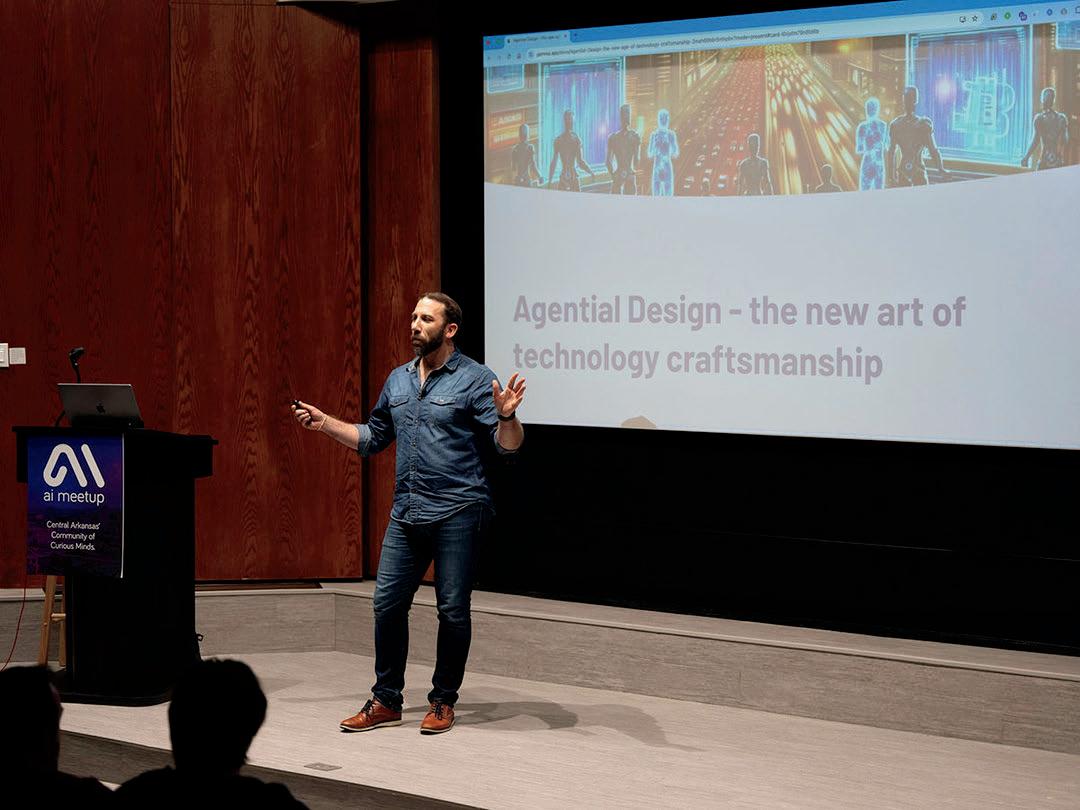
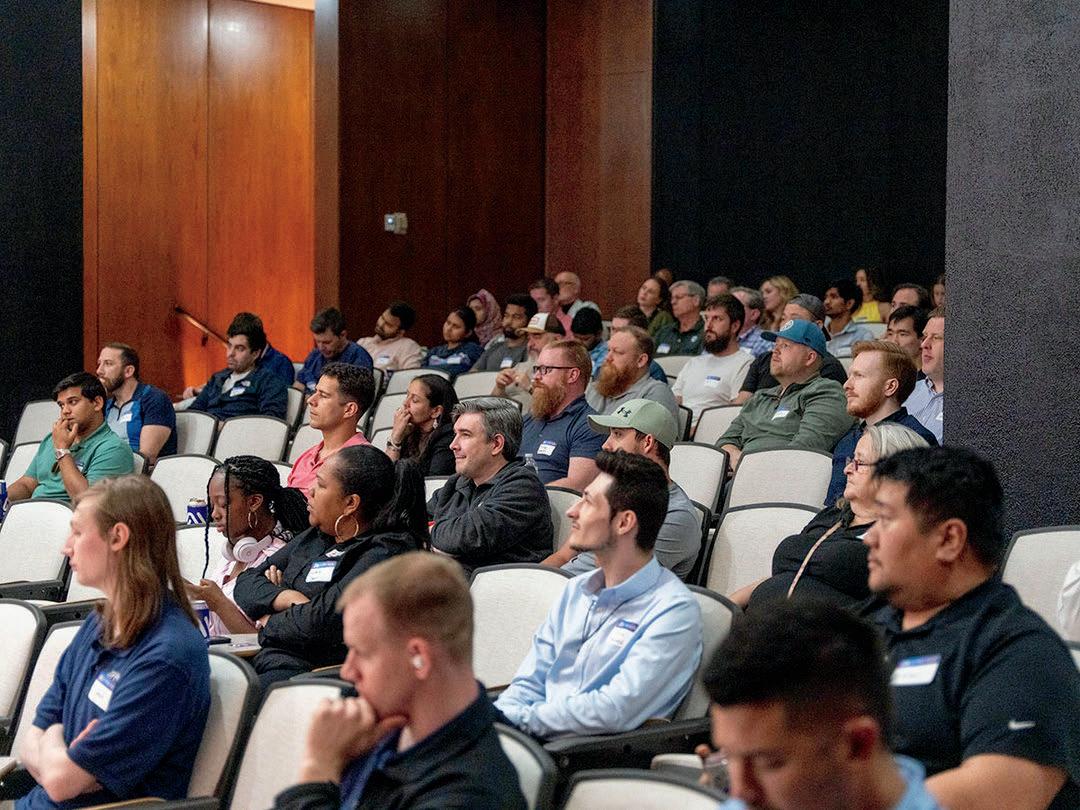
AI InTheRock is Central Arkansas’s fastest-growing AI community, bringing together business leaders, developers, creatives, researchers, and students for monthly meetups that spark connection, conversation, and real progress.



Publisher’s Letter

If you’ve found yourself thinking more about AI, its promises, and risks, you’re not alone.
When I first began writing about AI, it wasn’t about chasing trends or chasing attention. It was about trying to understand something more meaningful. Like many of you, I was curious. Not just about what this technology is capable of, but about how we, as people, will choose to use it.
That curiosity led to the creation of InTheRock, an AI-focused monthly mini-conference. A place where Arkansans can come together to ask better questions, exchange knowledge, challenge assumptions, and prepare for a future that is already unfolding around us.
This magazine is an extension of that effort, a space for those who build, teach, wonder, and question. It is for people who want to witness AI as it unfolds and who value progress rooted in conversation, collaboration, and continuous learning.
AI is not just another tool. It reflects our values and shifts the systems we rely on. In doing so, it invites us to reconsider how we work, how we lead,
how we care for one another, and what kind of future we are building.
Whether this is your first step into the world of AI or you’ve been exploring it for years, I hope what you find in these pages sparks new ideas, meaningful connections, and a desire to engage more deeply. I also hope to see you at one of our upcoming meetups. There is real power in showing up.
We are not here just to watch what happens. We are here to help shape it together.
“AI is not just another tool. It reflects our values and shifts the systems we rely on.”
Olson
aiarkansas.com

Publisher Matt Olson matt@matmon.com

Editor Kody Ford kodyford@gmail.com

Creative Director
Kevin Waltermire kevin@matmon.com
Contributors
John
Marla
Brian
Madeline
Moshen Rafiei,
Bahareh Jozranjbar, Ph.D.

The Automation Advantage
How n8n Empowers Small Businesses
by John Kelley

In 1958, economist Willard Cochrane introduced the technological treadmill theory to explain why farmers had to continually adopt new tools just to stay competitive. Early adopters — usually larger, better-capitalized farms — gained efficiencies that smaller farms struggled to match. Those who couldn’t keep pace were often forced to sell, consolidate, or shut down.
Today, that same treadmill is back in a new form: artificial intelligence.
According to The State of AI in 2025 from McKinsey & Company, large companies are far more likely to scale AI across their operations, while small businesses lag behind due to limited resources, staffing, and technical expertise. Analysts estimate that more than $1 trillion in AI-related infrastructure investment will be required in the coming years—investment led almost entirely by large corporations.
But for smaller businesses, opportunities abound without such major investment. A growing community of local automation builders and solopreneurs are using a powerful class of tools — especially n8n — to help small businesses adopt AI without enterprise budgets.
n8n (pronounced “N-eight-N”) is an open-source workflow automation platform that allows businesses to connect apps, automate processes, and build custom AI-driven systems without writing complex code.
It acts like a digital employee that works 24/7 — reading emails, processing data, triggering AI models, updating spreadsheets, sending alerts, and coordinating entire business processes automatically. And the impact is real.
At Intrivo, for example, we built an automated resume analyzer using n8n that transformed the hiring process. When a candidate applies, the workflow:
• Scores the resume using a custom
AI rubric
• Saves the applicant to the correct folder
• Updates a live hiring tracker with all candidate scores
• Generates a resume scorecard for the hiring team
• Suggests tailored interview questions based on candidate strengths and gaps
• Sends automated Slack alerts when a high-quality applicant appears
This single workflow now saves our team hours every day and provides quantifiable KPIs that bring more clarity and confidence to hiring decisions. What once required multiple people and inconsistent judgment is now fast, standardized, and data-driven.
These same kinds of efficiencies are now available to Arkansas small businesses — salons, HVAC contractors,
retailers, accountants, restaurants, clinics, and service providers. With n8n, a single automation can replace repetitive tasks and unlock new capacity:
• Salons: automated appointment confirmations, reminders, and follow-up marketing
• Contractors: instant quote generation and job-status updates
• Retail shops: synced POS + online inventory and automated end-of-day reports
• Clinics: reduction in no-shows with AI-enhanced patient reminders
• Accountants: auto-categorized receipts and real-time financial dashboards
What used to require custom software or an IT department can now be built by a local automation expert in a few hours — and maintained at a fraction of enterprise cost.
Instead of being pushed off the treadmill, Arkansas small businesses can step onto it confidently by partnering with local specialists who understand both the technology and the culture of doing business here.
AI doesn’t have to widen the gap between large and small companies. With accessible automation tools like n8n — and the local talent ready to deploy them — small businesses across Arkansas can thrive in a rapidly changing economy.
The Applied AI Learning Curve
by Marla Johnson
How can I work smarter, faster, and more creatively with AI?
At UA Little Rock, we’re helping professionals and companies in Central Arkansas ride the AI wave instead of getting swamped by it. We are also training our students to lead in AI software development, but that’s another topic. Through our new Corporate and Community Applied AI courses, we’re teaching how to use cutting-edge chat and agentic tools ethically and competitively so you can make AI work for you today, not someday.
We designed hands-on workshops to help participants gain practical confidence with AI—starting from how chatbots really work to how to integrate these tools into daily operations for immediate impact. These courses are born from real business challenges I’ve heard directly from Arkansas leaders who need practical, fast, and affordable ways to upskill their teams.
How do I teach myself AI skills?
Whether you are taking courses at UA Little Rock or watching YouTube videos to learn more, keep these things in mind to keep your AI Learning Curve on track:
• PICK A LANE. Chances are you will not become an expert in every aspect of AI. There are many sub-fields of AI and new applications daily. Choose a field of AI that will have the biggest impact on your personal or professional goals. Do you want a promotion? Do you want to research the use of AI in architecture to help your firm compete?
• Think STRATEGICALLY. It’s easy to go down rabbit holes or waste your time unless you ask from the start, “What impact do I want my learning to have?” Metrics go hand in hand with strategy, so have some metrics in mind that will guide your education.
• SET ETHICAL GUIDELINES for your AI use. Ask yourself questions about your ethical usage of AI. Do your colleagues need to know that you wrote a response to them using AI? How will customers feel if they find out you used AI to respond to them?
Did you maintain your own voice and point of view or disengage and give it all up to AI? Is there a governance model you have to follow at work?
• DEAL WITH THE OVERWHELMING SPEED OF CHANGE. You are entering the fast lane when you commit to learning about AI. Nothing in our history has changed so fast. It can be dizzying, so prepare yourself. You will have to plan to maintain your education. Try to take it one day at a time because each day new AI capabilities are unleashed.
• DEDICATE WHAT YOU CAN AFFORD. Gauge the time and money you can afford to upskill in AI. Be realistic about what learning you can scaffold over the period of time you can devote.
How affordable is this?
Thanks to the Arkansas Office of Skills Development (OSD), companies with at least seven participants may qualify for Customized Technical Underwriting—meaning the state helps fund your team’s training in AI. So, if you take advantage of UA Little Rock’s AI courses and workshops for companies, you can be reimbursed a majority of your company’s costs.
How affordable is this?
Thanks to the Arkansas Office of Skills Development (OSD), companies with at least seven participants may qualify for Customized Technical Underwriting—meaning the state helps fund your team’s training in AI. So, if you take advantage of UA Little Rock’s AI courses and workshops for companies, you can be reimbursed a majority of your company’s costs.
Scan QR Code to earn more about Workforce Training Grants.

Course Lineup at UA Little Rock
Here is the lineup of AI courses/workshops you can take at UA Little Rock right now. These can be mixed and matched and reswizzled based on your time availability. You can also request custom AI education.
Foundational AI Courses:
• AI Fundamentals • Prompting Best Practices
• Boosting Daily Productivity with AI • Building and Deploying AI Agents • Legal and Ethical AI Use • Protecting IP When Using AI • Your AI Adoption Plan
AI Productivity Courses:
• Data Analysis with AI • Financial Analysis with AI • Market Research with AI • AI-Assisted Human Resources • AI-Assisted Supply Chain & Inventory Management • AI-Assisted Sales
Job Role Specific Courses:
• AI & Marketing, AI & Sales (more coming!)
Sector-Specific Courses:
• Architecture • Real Estate • Healthcare
• Education • Government • Video Production
• Software Development • Nursing
Scan QR Code to ask questions or sign up for Artificial Intelligence Courses.

Scan QR Code to explore more Workfronce grant resources.


About the Author
Marla Johnson is Tech Entrepreneur-inResidence at UA Little Rock and a pioneer in digital innovation. She founded Smart Media, LLC to help companies leverage AI and previously co-founded Aristotle, Inc., one of Arkansas’s first internet companies.

Disruption in the Academy Gen AI at UA Little Rock

by Brian Berry, PhD
Vice Provost of Research and Dean of the Graduate School University of Arkansas at Little Rock
Photo provided by UALR
The calculator, the personal computer, the Internet–all of these technologies were disruptive and altered the course of society. Education was not spared from these disruptions. No need for slide rules, the explosion of personal computing power, and the instant ability to access the knowledge of the world forced academia to adjust, shift, learn, and adapt. These seismic disruptions pale in comparison to the disruption that generative artificial intelligence (Gen AI) is causing and will continue to cause in the world of education.
For centuries, the use of written language has been the hallmark of the educated human. Traditionally, the ability to read, understand, synthesize, and disseminate knowledge in the written form takes years of study. Gen AI can do all of these with the push of a button. In fact, it can do it so well that it has become incredibly difficult for teachers to assess whether students have learned these required skills or if they are just using Gen AI. This adds significant work and stress to the lives of educators. For two years now, they have been wrestling with redesigning assessments, changing the format of their classes, or, in some cases, reverting to pencil and blue books to ensure that students complete the assessments in their own words. The term “disruption” almost seems inadequate to describe the current state of the academy.
Students are also experiencing significant challenges. They have been “gifted” the most powerful tool that they have ever seen. A magic genie that, if prompted correctly, will grant their wish of easily completing an assignment that would have previously taken hours. That temptation is real and challenging for students who are juggling school, work, and life. Yet most students want to learn the right way. But what is the right way? Can they use Gen AI to ideate? Should they use it to
edit? Can they use it to help code? A lack of policy and training creates confusion for students. We must find a way to provide them with clarity and equip them to use this amazing and powerful tool in ways that support their learning, rather than diminishing it.
At UA Little Rock, we are committed to helping faculty and students develop AI skills that enhance teaching and learning. Our Academic AI Task Force focuses on providing a clear landscape for students and faculty regarding appropriate and acceptable uses of Gen AI. Several faculty groups are working on developing AI literacy tools that will help students understand the ethics, limitations, and incredible opportunities of AI. Our AI Council focuses on creating guiding principles, as well as data protection and acceptable use policies, so that AI can be deployed ethically and responsibly across campus to improve efficiency, student experience, strategic decision-making, and more. For those in our community outside the university, we are developing community and corporate education courses that address the current and ever-increasing need for AI upskilling.
There is no doubt that Gen AI is dramatically altering the educational landscape and will continue to do so in ways that we cannot yet imagine. While the full impacts of Gen AI are unknown, this moment presents an opportunity for Higher Education to examine its primary charge and mission. We must challenge the perception of education as a mere transaction, where learning is reduced to accumulating points for grades, which are then exchanged for degrees and, ultimately, employment. UA Little Rock is stepping up to the challenge of Gen AI, and we are adapting, growing, learning new skills, and thinking outside the box. It is a fitting response given that it is what we constantly demand from our students.
Photo: AI generated

A FOUNDATION FOR THE FUTURE
Harding University Launches AI Degree for Undergrads
by Kody Ford
Artificial intelligence is everywhere, shaping everything from business decisions to medical breakthroughs and even the way art is made. Now, Harding University is giving its students the chance to get in on the ground floor with the school’s Bachelor of Science in AI degree.
Harding’s AI program goes beyond teaching coding, blending computer science, mathematics, and advanced AI coursework with a strong emphasis on ethics. Students begin with the fundamentals—programming, data structures, and algorithms—before progressing to machine learning, computer vision, generative AI, and deep learning. They also explore real-world applications and ethical questions: How should AI be used? Who is impacted by its decisions? What does responsible innovation look like?
“Even in these early days, we’re seeing strong excitement for courses like Intro to Machine Learning, Deep Learning, and AI in Business,” said Joe Faith, the lead architect of the Bachelor of Science in Artificial Intelligence program. “Students are eager to not only understand the mathematical and computational foundations of AI but also explore its applications across industries.”
Harding plans to disrupt typical bureaucratic restraints to navigate the rapidly evolving AI
landscape for its curriculum. Core foundational courses teach timeless principles, such as linear algebra, probability, and algorithms, while upperlevel AI courses are reviewed annually to ensure they align with industry demand. “The goal is to have the AI courses looked at each academic year to see what should be changed and if any upperlevel AI course should be swapped out or modified to meet market demands,” Faith said Harding is also making sure students from other fields can benefit. Computer science majors can take the same AI courses as AI majors, giving them a competitive edge in today’s market. The university has also launched an AI minor, which faculty expect will grow in popularity as interest in AI spreads across disciplines.
But Harding’s vision goes beyond technical skills. Faith said, “At Harding, we frame AI not just as a technical tool but as part of a broader human story; how we design, deploy, and govern systems that affect real people. Students don’t just leave with coding skills; they leave with the ability to think deeply about responsibility, creativity, and long-term impact. That’s the differentiator.” To learn more, visit harding.edu
Photo provided by Harding University
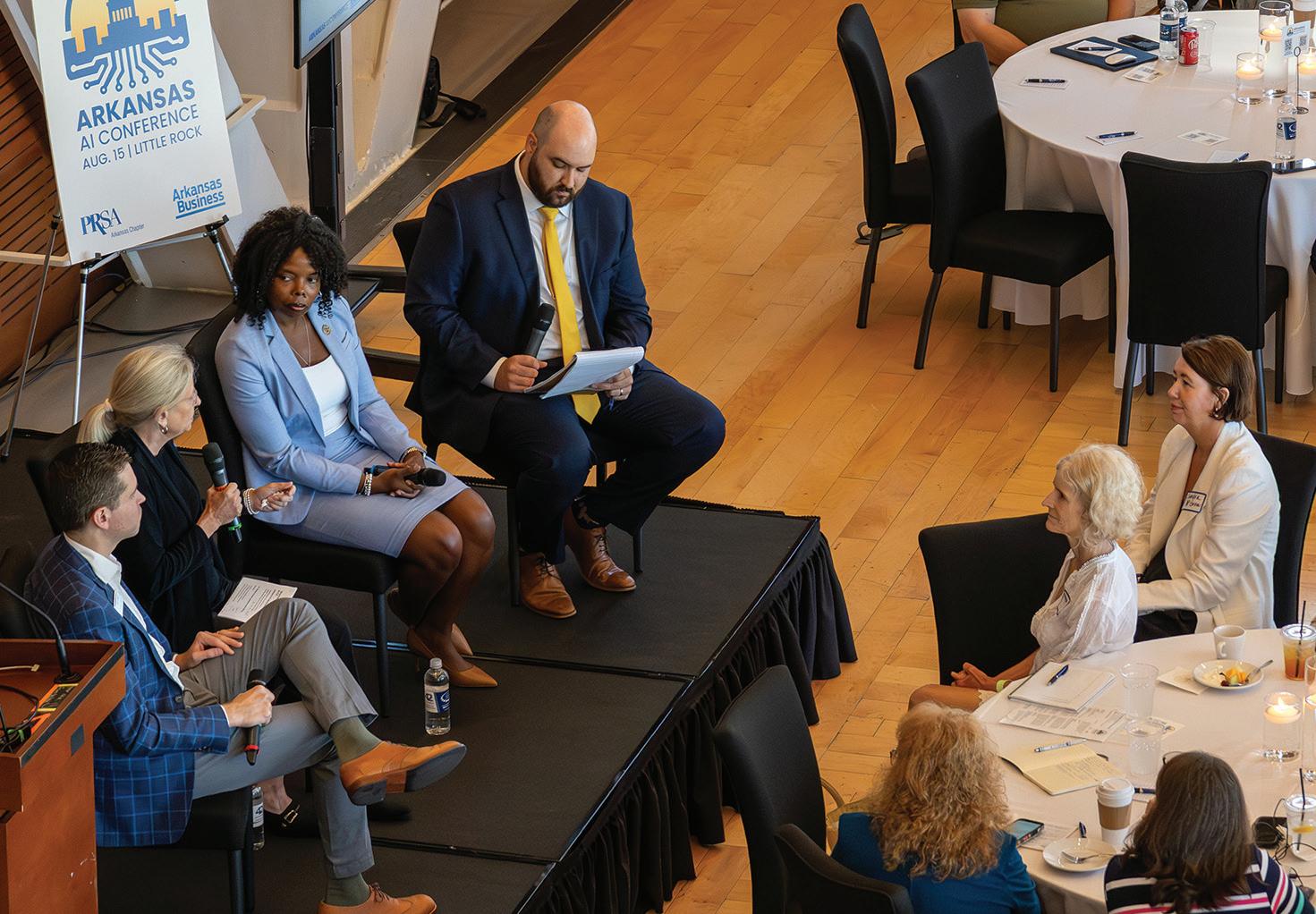
REFLECTIONS ON THE INAUGURAL
Yes, We Talked About the Environment
by Madeline Roberts | photos by Arkansas PRSA
When we pulled off the inaugural Arkansas AI Conference this August, I had to laugh at myself a little. I’ve been the person reminding every friend and coworker about the environmental impact of artificial intelligence, how much water is used per ChatGPT query. So, the idea that I helped with the state’s first AI conference? A little ironic, given how much energy AI consumes and how obnoxious I was to tell you about it (Side note: if you want to tell it “thank you,” do it in your initial query to save energy).
But here’s the thing: resisting technology doesn’t slow it down. And if Arkansas businesses don’t engage with AI now,
AI
CONFERENCE

we risk being left behind. That’s why I made peace with it. With Arkansas PRSA and Arkansas Business as our co-hosts, we didn’t just put on an event — we created a statewide conversation about how AI can drive innovation responsibly. And yes, we made sure the word “responsibly” was more than a buzzword. Alongside sessions on productivity and growth, the agenda included a keynote on ethics and a fireside chat on the environmental impact of AI. Because while it’s exciting to imagine new efficiencies and revenue streams, someone also has to ask the harder questions: What is this doing to our energy grid? How will this impact communities? How do we balance speed with sustainability?