Young at Heart April

Page 1


Young at Heart

SUPPLEMENT TO THE ALPENA NEWS • WEDNESDAY, APRIL 8, 2026

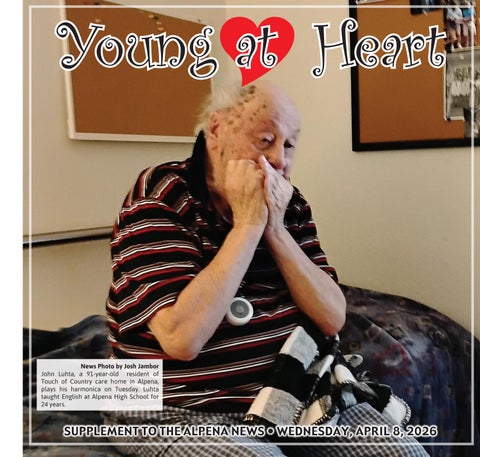
News Photo by Josh Jambor John Luhta, a 91-year-old resident of Touch of Country care home in Alpena, plays his harmonica on Tuesday. Luhta taught English at Alpena High School for 24 years.

Finding solace in music

ALPENA – As the sun shined bright through his curtains on Tuesday afternoon, John Luhta, a resident of Touch of Country care home in Alpena, lifted his harmonica and played a song similar to “Long Train Running,” by the Doobie Brothers.

For the 91-year-old, playing the harmonica has never been something Luhta was particularly interested in doing in front of a crowd, it’s always been more like therapy for the former Alpena High School English teacher.

“The best way to describe how I feel when playing the harmonica is peaceful, it’s always been a form of therapy for me personally,” Luhta said.

After completing high school, Luhta worked in a mine, before he was laid off, which presented him with an uncertain future.

That is when he decided to enlist in the military.

“I got laid off from the mines. They based it off seniority and I was one of the newer guys, so there was a period of time where I had nothing to do,” Luhta said.

“That is when I decided to enlist in the Army.”

After enrolling in the Army, Luhta used the money provided via the G.I. Bill attended Northern Michigan University and earned a degree in English.

After graduating from NMU he taught English for a total of 27 years, 24 of them with Alpena High School.

Luhta began playing the harmonica at the age of 10 years old, he said and to the best of his recollection, he described what made him pick up the instrument.

“That is going back about 90 years,” Luhta joked. “Somebody got it for me as a birthday present, and I remember it had an instruction sheet, so I started practicing,” Luhta said.

The owner of Touch of Country care home, Charlotte Vassallo, encourages her residents to participate in any hobbies that will put them in better spirits.

“We love to hear John play the harmonica, unfortunately he does not like to come out and entertain,” Vassallo said. “He is

more reserved, however, if you ask him to play it for you, he is usually more than willing to play a tune or two.”

Although Luhta was never a big fan of performing the harmonica for a crowd, whenever there was a family function it wasn’t uncommon for John to entertain his family and friends.

“I was never a fan of performing for a crowd, but my family and close friends heard me play the harmonica quite often throughout the years,” Luhta said.

Luhta does not have one particular genre of music he likes more than others, overall, he just appreciates any and all forms of music.

“I think it’s just a natural thing that people have an appreciation for music, and whatever it might be it brings people joy,” Luhta said.

Josh Jambor can be reached at jjambor@TheAlpenaNews.com

How to plan a memorable, celebratory retirement party

Professionals spend years saving for retirement. Many enroll in an employer-sponsored retirement plan the moment they begin their careers in their early twenties, and continue to build their nest egg until the day they officially call it quits.

The effort people put into retirement planning makes the moment individuals call it a career worthy of an extraordinary celebration. The following retirement planning party tips can ensure a celebration that suits an occasion as significant as the day professionals call it a career.

• Pick a unique venue. Whether the party will be a sizable affair with a guest list that includes long-time colleagues and friends or a smaller gathering with a retiree’s close knit inner circle, a unique venue underscores how significant a moment and achievement retirement is. For larger affairs, shop around for venues in much the same way you might when celebrating other milestones, such as a child’s graduation from college or a wedding. If the guest list includes just a handful of friends and family

members, consider planning a trip to a resort locale or renting an impressive home through a site like Airbnb or Vrbo.

• Take a stroll down Memory Lane. In the months leading up to the celebration, work with the retiree to identify key moments and people in his or her career. A photo montage of those notable moments and individuals can be a great way to commemorate a lengthy career and simultaneously thank and honor the people who helped along the way. Play the montage for guests at a key moment during the party.

• Ask colleagues to share well wishes. Brief messages from colleagues, whether they’re delivered via handwritten letters or videos each individual films, can be a great way to show the guest of honor how much he or she meant to others throughout their careers. Messages can be incorporated into a montage video or shared privately with the guest of honor.

• Kick the curfew to the curb. It might have been a while since a newly minted retiree had a late night, but

a retirement party can stretch into the wee hours. After all, the guest of honor won’t need to wake up for work the next day (or any other day), so let invitees know that the party will keep going well into the night. If booking a venue for the party, plan an after party at your home for a handful of guests who are particularly close with the guest of honor.

• Keep the focus on fun. While reaching retirement is a celebratory moment that merits a good party, many retirees also feel a degree of sorrow because they’re leaving be-

hind rewarding careers they worked so hard to build. Such sentiments may not be entirely avoidable, but party planners can emphasize fun and a festive atmosphere to ensure the night is celebratory and not sorrowful. Book a band and submit a play list of the retiree’s favorite songs, and encourage guests to dance the night away.

The day professionals reach retirement merits a celebration that’s worthy of the years of hard work and dedication individuals put in over the course of their careers.

Travel tips for the over-50 crowd

Travel has long been viewed as a positive hobby that can pay shortand long-term dividends. Some of those benefits may surprise even the most devoted jet-setters. For example, a joint study from the Global Commission on Aging and the Transamerica Center for Retirement Studies found that women who vacationed twice a year had a considerably lower risk of heart attack than women who vacationed once every six years. The same study noted men who did not take

an annual vacation had a 30 percent greater risk of heart disease than men who did vacation each year.

Traveling after 50 may necessitate a slightly different approach than it did when individuals were younger. Though adults over 50 can reap the same travel-related rewards they did when they were younger, some additional safety measures may be necessary at this point in travelers’ lives.

• Determine vaccination requirements if you plan to travel overseas. The Health In Aging Foundation urges older travelers hoping to go overseas to identify vaccination requirements in countries they plan to visit. Make this part of your early planning, as the HIAF notes some countries require vaccinations be administered at least six weeks prior to entry. Information regarding travel-related vaccinations can be found on the Centers for Disease Control and Prevention website at https://wwwnc.cdc.gov/travel/

• Get a pre-trip medical checkup. A pre-trip medical checkup can ensure adults over 50 are healthy enough to travel. A doctor visit also can be a great opportunity to update vaccinations and discuss medications. It can be tricky to manage medications when crossing time zones, and travelers can work out a schedule with their physicians to ensure they don’t miss any doses. This also can be a good time to renew prescriptions to ensure you don’t run out while away from home. Work with your physician and pharmacist to create a list of prescription and over-the-counter medications you take, which the HIAF notes will make it easier to get through customs and get replacement medicines should you need them while traveling.

• Beware of deep-vein thrombosis (DVT) and how to avoid it. The Mayo Clinic notes DVT occurs when a blood clot forms in one or more of the deep veins in the body, typi-

cally in the legs. Lack of movement is a risk factor for DVT, which can affect immobile travelers during long flights, train rides or road trips. DVT risk can be reduced by getting up and walking around when allowed to do so on long flights or train rides. If you’ll be driving long distances, make frequent pitstops to get out of the car and stretch your legs.

• Stay hydrated. The Cleveland Clinic notes that dehydration can cause dizziness, elevate a person’s heart rate, contribute to swollen feet and muscle cramps, and result in fatigue, among other side effects. Travel is exciting, and it can be easy to forget to hydrate during engaging trips. But the HIAF recommends individuals bring a large bottle of water with them and drink even if they do not feel thirsty. These simple safety precautions can protect travelers 50 and over from health issues that might not have posed as significant a threat when they traveled in years past.

page/travel-vaccines.

Enjoyable ways for seniors to savor spring

After a cold winter, there’s often nothing better than the arrival of spring. From the moment those first crocuses and tulips peek their heads out of the soil to the days of cherry blossoms in full bloom, spring is a time of sunshine, warmth and a renewed sense of vitality.

Seniors who may have spent much of the winter cooped up indoors often are inspired by warmer temperatures to venture outside once again when spring has sprung. According to UC Davis Health, time outdoors provides a host of health benefits, and seniors who embrace the great outdoors can reap those rewards. Studies show that nature has a positive effect on the body by reducing cortisol levels and demands on the cardiovascular system and relieving muscle tension. Being outside in sunshine (with the use of sunscreen) can increase vitamin D levels, which is important for a healthy immune system and strong bones.

Embracing the many ways to enjoy spring is relatively easy to do. The following are some ways seniors can make the most of spring.

• Plant a garden. Spring is a time when the ground has thawed and the soil is warm enough to begin planting a garden. Individuals should refer to their particular agricultural zones to determine when to plant. Certain plants need a specific number of hours of sunlight and minimum temperatures to grow. It’s important to wait until the threat of overnight frost has subsided. Gardening can be a thorough workout, so it’s important for seniors to go slowly as they acclimate to this type of activity.

• Relax outside. Seniors can soak up vitamin

D and enjoy the sounds of nature by spending time on a deck or the front porch. Any activity that was typically done indoors, such as reading a book, listening to music, engaging in a hobby, and more, can be moved outside.

• Explore local wildlife. Trees and flowers are not the only things renewed by spring. Many animals give birth in spring and there might be little ones frolicking. Seniors can look for bunnies, fledglings chirping in bird nests, spotted fawns, and young foxes around their neighborhoods.

• Attend an open-air event. Whether it’s a concert or an outdoor theater performance, seniors can look to local entertainment as a way to get outside and have a little fun.

• Bike or walk the neighborhood. Seniors can find serene paths to bike or walk. Dog owners can take their pooches for a stroll, or meet up with other friends and begin a walking club for camaraderie and exercise.

Seniors can make the most of the warm weather and extended daylight hours of spring to enjoy many outdoor activities.

Orchard Manor Adult Foster Care

“Welcome

Home”

Located in the Farmlands of Posen, Michigan.

• State Licensed and Insured.

• Owners live in home o ering a personal family atmosphere.

• Private and Semi-private rooms with space for personal items.

• Bedroom furnishings available or bring your own.

• Ground oor entrance.

Room

• Antique and Traditional furnishings.

• High speed internet access & Satellite TV

• Beautifully landscaped yard with expansive deck with a retractable canopy and a year round sun room.

• We o er day care and respite care.

• Air Conditioning.

How to Live to Be 100 Years Old

(StatePoint) Living to 100 may sound extraordinary, but research suggests it’s more achievable—and enjoyable—than many people think. Studies show the majority of centenarians rate their health as good, and large numbers of people in this age group are mobile, active and optimistic.

According to the American Medical Association, adopting these seven habits can improve longevity and quality of life:

1. Eat healthy. Think of food as medicine. Choose nutritious, whole foods. Eat more fruits that are dark in color — blue, purple and red — to get the most nutrients, as well as fiber-rich vegetables, especially non-starchy vegetables such as broccoli, carrots and leafy greens. Incorporate whole grains, nuts, seeds, lean meats and fish. Drink more water, or as an alternative, flavored or sparkling water with no added sugar.

Reduce your intake of sugar-sweetened beverages and unhealthy ultraprocessed foods, especially those with added sodium and sugar. Drinking sugary beverages, even 100% fruit juices, is associated with a higher mortality risk, according to a study published in JAMA Network Open. Eat fewer processed meats, which tend to be high in fat and heavy on added salt and preservatives. Limit your intake of refined grains, such as breads, crackers, baked goods and white rice. Drink less alcohol.

2. Exercise. Adults should aim for at least 150 minutes of moderate-intensity activity or 75 minutes of vigorous-intensity activity weekly. A recent study published in JAMA found that putting down the television remote and walking can improve healthy aging — highlighting the importance of small everyday habits.

3. Get enough sleep. Adequate sleep

improves memory, reduces stress, improves mood, and primes the body’s natural defenses against disease. But sleep quality decreases with age. Improve your sleep quality by setting a regular bedtime and wake-up time, insulating your bedroom against noise, avoiding exercise within an hour of bedtime, maintaining a cool and dark bedroom, and limiting fluids within two hours of bedtime. Also avoid alcohol before bedtime and make your bedroom a tech-free zone as screen-time can impact your ability to fall asleep and stay asleep.

4. Live with purpose. A sense of purpose can lead to increased energy, motivation, emotional stability and resilience. Take time for self-reflection and try meditation or yoga. Prioritize your values and beliefs and put them into action toward a goal that’s meaningful to you and benefits others.

5. Stay positive. To bust stress, take a break from decisions, connect with others, pet your dog or cat, write a to-do list (stick to three items), take time to recharge, laugh, sing, curb clutter, set boundaries, perform mindfulness exercises, practice gratitude, and seek help from a professional when stress becomes overwhelming.

6. Stay connected. Research shows that having social connections is a significant predictor of longevity and better physical, cognitive and mental health, while social isolation and loneliness are significant predictors of premature

death and poor health. Unfortunately, there is a nationwide loneliness epidemic that medical experts consider a major public health concern. Combat loneliness with social clubs and community groups, or by taking up a hobby, learning something new or volunteering. If you’re struggling with loneliness, reach out to a professional, your doctor, family member or friend. You can also call the 988 crisis helpline for support

7. Get screened. Schedule preventive care, tests and health screenings to help your doctor spot certain conditions before they become more serious. Your doctor can recommend needed tests based on your age, gender and health conditions — including colonoscopies, mammograms, gynecological and prostate exams, and vision screenings.

Today, there are many at-home screening options available. Some are more effective than others, and all work best – and minimize stress around results – when taken in consultation with a doctor.

“Everyone strives to live longer, but the goal should be to live as healthy as possible for as long as we live,” says AMA CEO John Whyte, MD, MPH. “Simple steps today – eating well, staying active, sleeping enough, and seeing your doctor – can add quality years, or even decades, to your life.”

(StatePoint) Retirees become eligible to claim Social Security benefits at age 62, but the timing of when you claim can drastically impact your benefit amount. Still, when to claim will be entirely dependent on your unique situation. As you approach retirement, it’s important to understand the impact that timing has on your benefits.

“The timing of when you elect to receive your Social Security benefits warrants thoughtful consideration,” said Rich Guerrini, head of PNC Wealth Management. “This decision can significantly influence not only the total benefits you receive, but also the trajectory of your investment income, your tax obligations, and even your healthcare premiums.”

How Your Benefit is Calculated

Your benefits are based on your top 35 years of earnings, adjusted to account for changes in wages from the year they were earned. The Social Security Administration then applies a formula to those figures to arrive at your specific benefit amount at full retirement age (FRA), also referred to as your primary insurance amount (PIA).

There are three options for when to claim your benefits: claim early, claim at your FRA, or claim at age 70. Each comes with its own benefits and risks.

Claim at age 62

You can begin claiming your benefits

The Great Timing Debate: Should I Claim Social Security Early or Late?

as early as age 62, but your benefits will be permanently reduced. Still, there are instances when claiming early makes sense:

• You’re in poor health – The benefit of receiving Social Security early may be worth it, particularly if you’re unsure if you’ll live beyond your break-even point;

• You’re maximizing benefits with a spouse – Timing your claim to Social Security with your spouse can help you maximize a long-term benefit, while fulfilling cash flow needs in the present;

• You no longer want to work – The lifestyle benefits of not working may outweigh a larger future financial benefit from Social Security; or

• You want to preserve assets with growth potential – Claiming Social Security early may preserve investment or savings accounts.

Claim at your full retirement age

The primary benefit of waiting until your FRA is that you are then entitled to 100% of your benefits, without possibility of reductions over time. Your FRA for purposes of Social Security is based on the year you were born. For those born between 1943-1954, their FRA is 66. For those born between 1955-1959, there FRA is 66 + 2 months for every year after 1954 until 1960. For those born 1960 and later, their FRA is 67.

Delay your claim to age 70

You can delay claiming your benefits until the maximum age 70, with the primary advantage of increasing your benefits for the remainder of your life. Delaying a Social Security claim may make sense if:

• You have other forms of income –You may realize tax benefits from pulling from sources such as retirement accounts or savings;

• You’re still working – Working beyond your FRA may allow you to meet lifestyle expenses while increasing your future benefit; or

• You’re concerned about spousal or survivor benefits – When you delay claiming your Social Security, your spouse may be entitled to a larger spousal benefit and/or survivor’s benefit as well.

Further, cost-of-living-adjustments (COLA) begin giving your potential benefit a boost at age 62 – and that boost will continue to compound every year you delay making your claim.

Tax and Other Impacts

Generally, your Social Security income will be tax dependent on your “combined income,” which factors in gross income, nontaxable interest earned, and half of your Social Security income. Potential effects on healthcare premiums should also be factored in.

While the question of when to claim Social Security benefits will be unique to your individual financial situation, it’s a decision that warrants careful consideration – and potentially even a professional opinion.

Rides to Wellness is a premium, non-emergency medical transportations program throughout Alpena, County

Hours: Monday-Friday, 8am to 4pm

$15 a ride, one-way in Alpena county One Additional Stop is an extra $10 A Companion can ride along FREE For additional information, or to book a ride, please contact Mobility Coordinator, Brandi Anderson at 989-354-2487or andersonb@thunderbaytransportation.com

Turn static files into dynamic content formats.

Create a flipbook
Young at Heart April by AhallAlpena - Issuu