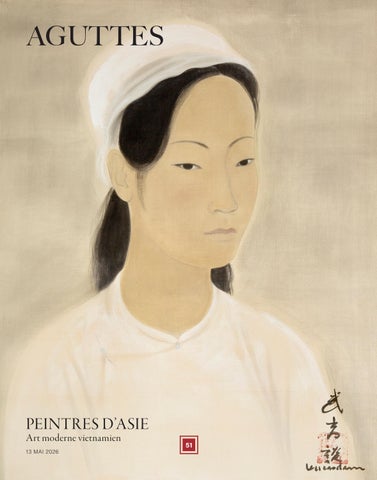
PEINTRES D’ASIE
Art moderne vietnamien
Art moderne vietnamien
Art moderne vietnamien
HỌA SĨ CHÂU Á • NGHỆ THUẬT HIỆN ĐẠI VIỆT NAM
ASIAN PAINTERS • MODERN VIETNAMESE ART
Chers amis et collectionneurs,
Quel honneur de présenter dans cette nouvelle vente des productions toujours plus inédites et surprenantes de l’École des beaux-arts de l’Indochine. Témoignages vibrants de la créativité des artistes vietnamiens du début du XXe siècle, leurs sujets ne sont que délicatesse et leurs techniques sont riches de multiples influences. Nous nous attachons, par ces quelques pages, à rendre hommage au talent de ces peintres. J’espère que ce travail de documentation vous permettra une meilleur compréhension de cette histoire méconnue.
Je vous engage à profiter d’une visite guidée sur rendez- vous pour découvrir ces œuvres récemment découvertes.
Bonne lecture !
Quy bạn be va nha sưu tầm than mến, Thật vinh hạnh khi được tiếp tục giới thiệu tại phiên đấu giá mới này những tác phẩm đáng kinh ngạc và chưa từng được biết đến của Trường Cao đẳng Mỹ thuật Đông Dương. Là minh chứng
sống động cho sức sáng tạo của các nghệ sĩ Việt Nam đầu thế
kỷ 20, các tác phẩm gây ấn tượng với những đề tài tinh tế và kỹ thuật phong phú, được kết hợp từ nhiều ảnh hưởng khác nhau.
Qua những trang viết này, chúng tôi mong muốn được tôn vinh tài năng của những nghệ sĩ ấy. Tôi hi vọng rằng tư liệu được tổng hợp sẽ giúp các bạn hiểu hơn về giai đoạn lịch sử này.
Tôi trân trọng mời cho các bạn đăng ký tham quan có hướng dẫn theo lịch hẹn để có thể khám phá những tác phẩm mới được phát hiện gần đây.
Chúc các bạn đọc vui vẻ!
Dear friends and art lovers,
It is an honor to present, in this new auction, an ever-more unique and surprising selection of works from the Indochina School of Fine Arts. As vivid testaments to the creativity of early 20 th century Vietnamese artists, their subjects are characterized by delicacy, and their techniques are rich with diverse influences. Through these few pages, we aim to pay tribute to the talent of these painters. I hope this documentation will give you a better understanding of this little-known history.
I encourage you to take advantage of a guided tour by appointment to discover these recently unearthed works.
Please enjoy these pages!
CHARLOTTE AGUTTES-REYNIER
Directeur et expert du département
Giám đốc và chuyên viên của phòng
Head of department and expert

LIÊN HỆ CHO ĐẤU GIÁ NÀY
CONTACTS FOR THIS AUCTION
本次销售的联系人

Expert
Chuyên gia
拍卖鉴定专家
Charlotte Aguttes-Reynier
+33 1 41 92 06 49 • +33 6 63 58 21 82 reynier@aguttes.com

Documentaliste
Chuyên viên văn thư lưu trữ 目录编制员
Lucie Bigarré +33 1 47 45 93 03 bigarre@aguttes.com
Enchères par téléphone
Ordre d’achat
Đấu giá qua điện thoại
Đơn mua đấu giá 电话竞拍订单 bid@aguttes.com
Relations acheteurs
Quan hệ khách hàng
买家联系人
Marie du Boucher
+33 1 41 92 06 41 duboucher@aguttes.com
Département Marketing & Communication
Ban truyền thông 传媒部
Claire Certain certain@aguttes.com
Relations médias
Quan hệ báo chí 媒体关系
Anne-Sophie Philippon pr@aguttes.com
P résident Claude Aguttes
Directeur général Philippine Dupré la Tour
Associés
Directeur associé
Charlotte Aguttes-Reynier
Associés
Sophie Perrine, Gautier Rossignol, Maximilien Aguttes
Aguttes (SVV 2002 - 209)
Commissaires-priseurs habilités
Claude Aguttes, Sophie Perrine, Pierre-Alban Vinquant, Jessica Remy-Catanese, Juliette Rode
SEINE OUEST
Commissaires de justice
Je m’inscris
Tôi đăng ký tham
I sign up
我报名
Visites guidées par l’expert - Sur inscription
VIỆT NAM
ASIAN PAINTERS • MODERN VIETNAMESE ART
• 越南现代艺术
Aguttes Neuilly
164 bis, avenue Charles de Gaulle 92200 Neuilly-sur-Seine
Exposition publique
Du lundi 4 au mardi 12 mai : 14h à 17h30 (sauf du jeudi 8 au dimanche 10 mai)
Visites guidées par l’expert, sur inscription : Mardi 5 mai à 11h30 et lundi 11 mai à 16h
Vente aux enchères
Triển lãm công cộng
Th ứ Hai ngày 4 đến Thứ Ba ngày 12 tháng 5, từ 14h đến 17h30
(trừ từ Thứ Năm ngày 8 đến Chủ Nhật ngày 10 tháng 5) Tham quan cùng chuyên gia theo lịch hẹn:
Thứ Ba ngày 5 tháng 5 lúc 11h30 và Thứ Hai ngày 11 tháng 5 lúc 16h
Phiên đấu giá
Thứ Tư ngày 13 tháng 5 năm 2026, lúc 14h30
Public exhibition
Monday, May 4 to Tuesday, May 12, from 2:00 p.m. to 5:30 p.m.
(Except Thursday, May 8 to Sunday, May 10)
Guided tours with the expert, by registration:
Tuesday, May 5 at 11:30 a.m. and Monday, May 11 at 4:00 p.m.
Auction sale
Wednesday, May 13, 2026, 2:30 p.m.
公开展览
5月4日(周一)至5月12日(周二),每日14时至17时30分 (5月8日周四至5月10日周日除外) 专家导览参观须提前报名:5月5日(周二)11时30分及5月11日(周一)16时拍卖会
2026年5月13日(星期三)14:30拍卖会
讷伊奥古特拍卖行 164 bis, av. Charles-de-Gaulle, 92200 塞纳河上的讷伊
2026年05月13日(星期四)下午2:30
SCANNEZ OU CLIQUEZ : l'ensemble des lots et des vidéos est accessible sur aguttes.com
QUÉT MÃ HOẶC NHẤP VÀO : tất cả các lô và video đều có thể truy cập tại aguttes.com
SCAN OR CLICK: all lots and videos are available on aguttes.com
扫描或点击:所有拍品~和视频均可在 aguttes.com 上查阅
PRÉCISION IMPORTANTE À L’ATTENTION DES ENCHÉRISSEURS
THÔNG TIN QUAN TRỌNG DÀNH
IMPORTANT NOTICE TO BUYERS
Les conditions et termes régissant la vente des lots sont fixés dans les conditions générales de vente figurant en fin de catalogue dont chaque enchérisseur doit prendre connaissance. Ces CGV prévoient notamment que tous les lots sont vendus « en l’état », c’est-à-dire dans l’état dans lequel ils se trouvent au moment de la vente avec leurs imperfections et leurs défauts. Une exposition publique préalable à la vente se déroulant sur plusieurs jours permettra aux acquéreurs d’examiner personnellement les lots et de s’assurer qu’ils en acceptent l’état avant d’enchérir. Les rapports de condition, ainsi que les documents afférents à chaque lot sont disponibles sur demande.
Nous attirons votre attention sur les lots précédés de +, °, *, #, ¤, ~ pour lesquels s’appliquent des conditions particulières.
Aguttes se réserve le droit de demander aux potentiels enchérisseurs de verser avant la vente une caution de 80 000 euros, ainsi que toutes autres garanties et/ou références bancaires, dont Aguttes aurait besoin, à son entière discrétion. Les clients doivent contacter Aguttes en amont de la vente et au plus tard 3 jours ouvrés avant le jour de vente afin que Aguttes puisse vérifier les garanties financières fournies. Les dépôts de garantie sont à effectuer en euros par virement ou carte bancaire sur https://www.aguttes.com/ depot-caution.
Si l’enchérisseur n’est pas adjudicataire lors de cette vente, Aguttes procédera au remboursement du dépôt de garantie, sans intérêts (sous réserve de tout droit de compensation), dans un délai maximum de 5 jours ouvrables après la vente. Les pertes engendrées par les variations des taux de change ou les frais bancaires liés à ces transferts ne sont pas à la charge de Aguttes.
Aguttes se réserve le droit de refuser de façon discrétionnaire les enchères d’un enchérisseur qui ne se serait pas préalablement manifesté en fournissant au préalable la caution et les garanties demandées par la législation.
định trong các
khoản
điều kiện bán hàng chung ở cuối danh mục mà mỗi người đấu giá phải đọc. Các GTC này đặc biệt quy định rằng tất cả các lô được bán “nguyên trạng”, tức là ở tình trạng mà chúng được tìm thấy tại thời điểm bán với các khiếm khuyết và khuyết điểm của chúng. Việc trưng bày công khai trước khi bán diễn ra trong vài ngày sẽ cho phép người mua trực tiếp kiểm tra các lô và đảm bảo rằng họ chấp nhận tình trạng của chúng trước khi đấu giá. Báo cáo tình trạng, cũng như các tài liệu liên quan đến từng lô, có sẵn theo yêu cầu. Chúng tôi xin lưu ý bạn đến các lô có dấu +, °, *, #, ¤, ~ đứng trước các ký tự này thì áp dụng các điều kiện đặc biệt.
Aguttes có quyền yêu cầu khách hàng tham gia đấu giá đặt cọc khoản tiền 80.000 euro trước phiên đấu giá, cũng như bất kỳ khoản bảo đảm nào khác và/hoặc thông tin ngân hàng mà Aguttes cần, theo quyết định riêng của nhà đấu giá. Khách hàng cần liên hệ với Aguttes trước phiên đấu giá và muộn nhất là 3 ngày làm việc trước ngày tổ chức đấu giá để Aguttes có thể kiểm tra các bảo đảm tài chính được cung cấp. Các khoản đặt cọc cần được thực hiện bằng euro qua hình thức chuyển khoản hoặc trả bằng thẻ ngân hàng tại: https:// www.aguttes.com/depot-caution.
Nếu người tham gia đấu giá không thắng được lô hàng nào trong phiên đấu giá này, Aguttes sẽ tiến hành hoàn trả khoản đặt cọc, không có lãi suất (với điều kiện không có khoản khấu trừ nào), trong thời hạn tối đa 5 ngày làm việc sau cuộc đấu giá. Aguttes không chịu trách nhiệm về bất kỳ tổn thất nào phát sinh do biến động tỷ giá hối đoái hoặc phí ngân hàng liên quan đến các giao dịch này.
Aguttes có quyền tự do từ chối lời để nghị đấu giá của một khách hàng tham gia đấu giá không tuân thủ quy định của nhà đấu giá, khi không đặt cọc hoặc không cung cấp các khoản đảm bảo khác được yêu cầu theo luật.
The terms and conditions governing the sale of the lots appearing in the catalogue are set out in the general terms and conditions of sale appearing at the end of the catalogue, which each bidder must read. These GTC provide in particular that all the lots are sold “as is”, i.e. in the condition in which they are found at the time of sale with their imperfections and defects.
A public display prior to the sale taking place over several days will allow buyers to personally examine the lots and ensure that they accept their condition before bidding. Condition reports, as well as documents relating to each lot, are available on request.
We draw your attention to lots preceded by +, °, *, #, ¤, ~ for which special conditions apply, which can be seen at the end of the catalogue.
Aguttes reserves the right to ask potential bidders to pay a deposit of 80,000 euros before the sale, as well as any other guarantees and/or bank references that Aguttes may require, at its sole discretion. Clients must contact Aguttes in advance of the sale and no later than 3 working days before the day of the sale so that Aguttes can verify the financial guarantees provided. Security deposits must be made in euros by bank transfer or credit card on https://www. aguttes.com/depot-caution.
If the bidder is not successful at this sale, Aguttes will refund the security deposit, without interest (subject to any right of set-off), within a maximum of 5 working days after the sale. Aguttes shall not be liable for any losses caused by variations in exchange rates or bank charges relating to such transfers.
Aguttes reserves the right, at its own discretion, to refuse bids from a bidder who has not previously provided the security and guarantees required by law. Các điều khoản và điều kiện chi phối việc bán các lô
BẢN TÓM TẮT CONTENTS
CONDITIONS GÉNÉRALES DE VENTE 93
ĐIỀU KHOẢN BÁN HÀNG
GENERAL TERMS AND CONDITIONS OF AUCTION
一般销售条款和条件
COMMENT VENDRE CHEZ AGUTTES ?
LÀM THẾ NÀO ĐỂ BÁN TẠI AGUTTES ?
TO SELL AT AGUTTES ? 如何在 AGUTTES 出售
Trấn Đắc est un artiste vietnamien actif au cours de la deuxième moitié du XXe siècle. Il livre ici un ensemble d’œuvres qui illustrent un certain idéal au Vietnam au début du XXe siècle. Ces représentations font écho à la douceur d’une vie quotidienne rythmée par les grandes fêtes traditionnelles célébrant le lien entre les mondes terrestre et divin et invoquant la protection du foyer et la prospérité. L’artiste dépeint des scènes qui symbolisent à la fois l’abondance, l’harmonie familiale et le bonheur.
Trần Đắc là một họa sĩ Việt Nam sáng tác vào nửa sau thế kỷ XX. Ông cho ra đời một loạt tác phẩm khắc họa một lý tưởng về đất nước Việt
Nam buổi đầu thế kỷ XX. Những bức tranh ấy vọng lại nét êm đềm của đời sống thường nhật, được điểm nhịp bởi những lễ hội cổ truyền, ngợi ca sự giao hòa giữa cõi trần gian và cõi thần linh, đồng thời nguyện cầu sự chở che cho mái ấm gia đình và phúc lộc dồi dào. Người nghệ sĩ phác họa những khung cảnh vừa tượng trưng cho sự sung túc, vừa gợi lên niềm hòa thuận trong gia đình và hạnh phúc viên mãn. Người nghệ sĩ khắc họa những cảnh tượng tượng trưng cho sự sung túc, niềm hòa thuận gia đình và hạnh phúc viên mãn.
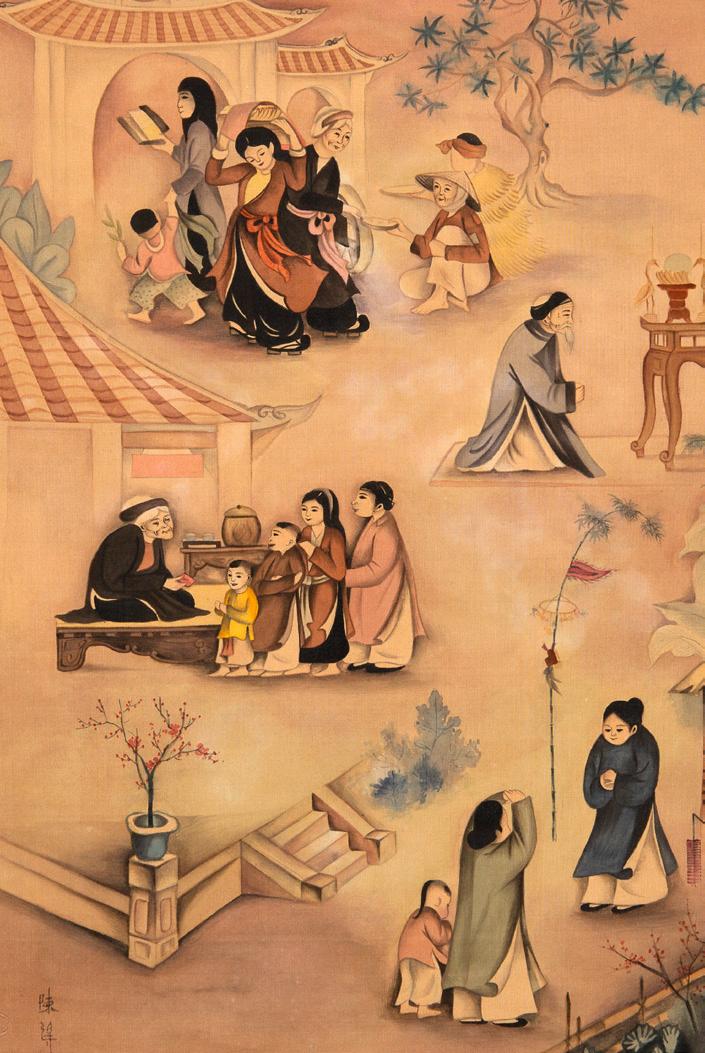
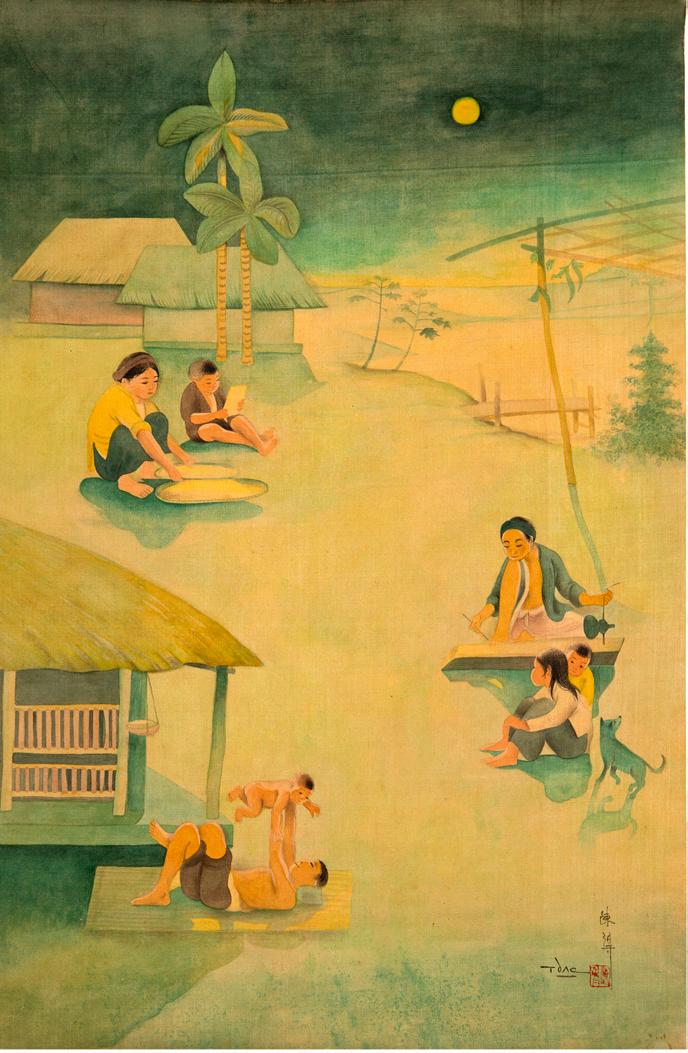
1
TRẤN ĐẮC (1922-1980))
Scène villageoise, fête du Têt dans le Nord du Vietnam, Bắc Ninh
Encre et couleurs sur soie, signée en bas à gauche
61 x 38 cm - 24 ¾ x 15 in.
Ink and color on silk, signed lower left
700 - 1 000 €
PROVENANCE
Collection privée en Isère, acquis dans les années 1990
2
TRẤN ĐẮC (1922-1980)
Scène familiale, village du Nord du Vietnam
Encre et couleurs sur soie, signée en bas à droite
58,7 x 39,7 cm - 23 x 15 ½ in.
Ink and color on silk, signed lower right
600 - 800 €
PROVENANCE
Collection privée Isère, acquis dans les années 1990
Trấn Đắc was a Vietnamese artist active during the second half of the 20 th century. Here, he presents a collection of works that illustrate a certain ideal in Vietnam at the beginning of the 20th century. These depictions evoke the tranquility of daily life, punctuated by major traditional festivals that celebrate the connection between the earthly and divine realms and invoke protection for the home and prosperity. The artist depicts scenes that symbolize abundance, family harmony, and happiness.
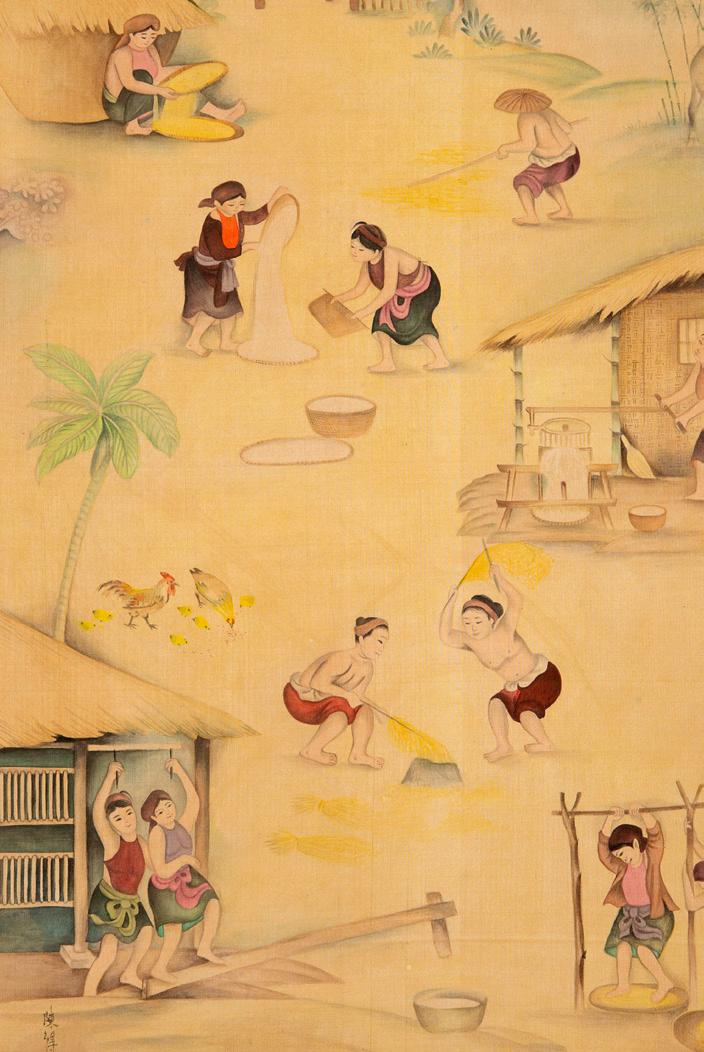
3
TRẤN ĐẮC (1922-1980)
Scène villageoise, paysans travaillant dans la rizière du delta de Sông Hông
Encre et couleurs sur soie, signée en bas à gauche
63 x 37,7 cm - 24 ¾ x 14 ¾ in.
Ink and color on silk, signed lower left
600 - 800 €
PROVENANCE
Collection privée Isère, acquis dans les années 1990
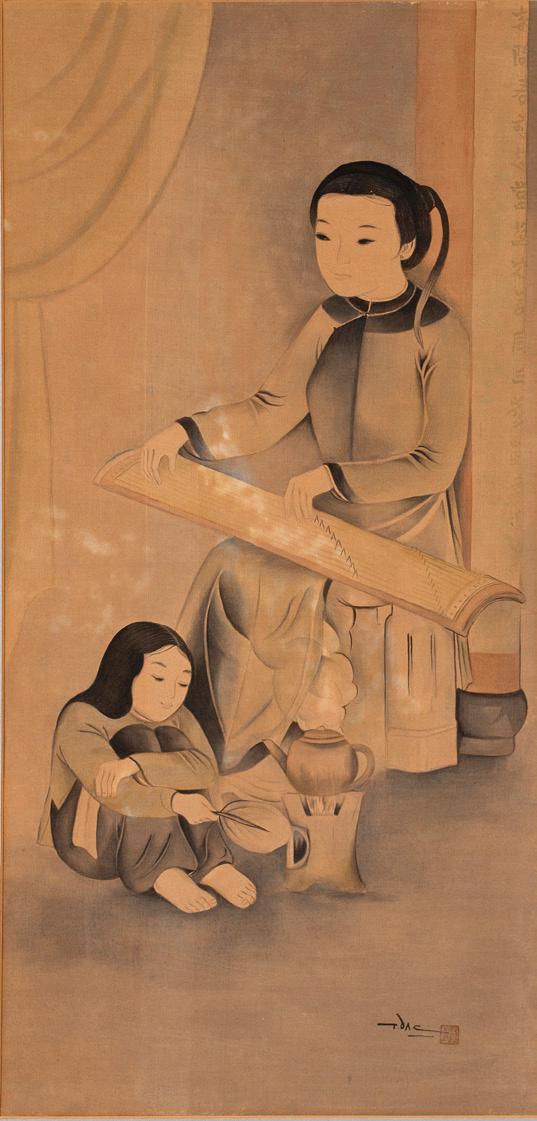
4
TRẤN ĐẮC (1922-1980)
Femme jouant du đàn tranh
Encre et couleurs sur soie, signée en bas à droite
66 x 37,8 cm - 26 x 14 ¾ in.
Ink and color on silk, signed lower right
900 - 1 200 €
PROVENANCE
Collection privée en Isère, acquis dans les années 1990
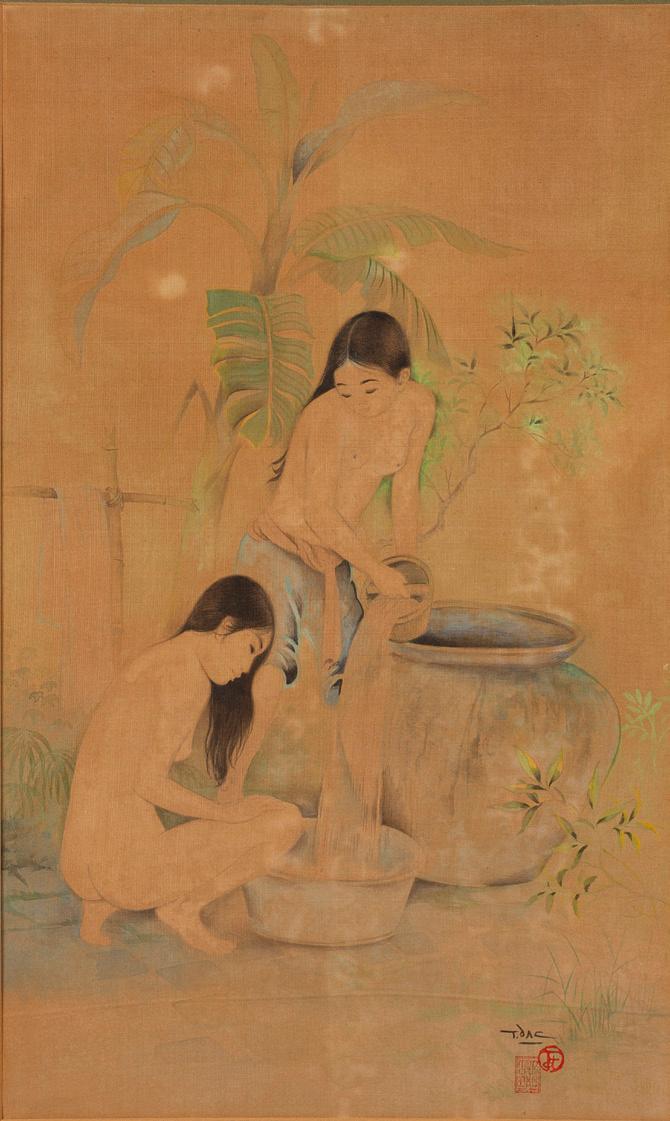
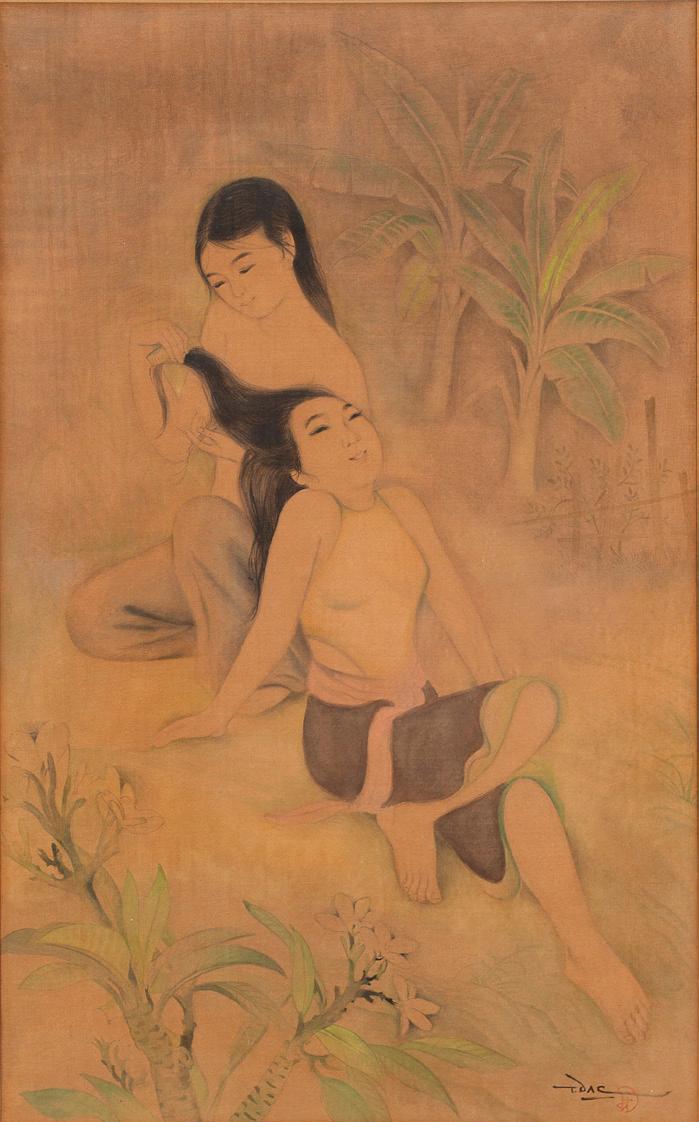
5
TRẤN ĐẮC (1922-1980)
Femmes à la toilette
Encre et couleurs sur soie, signée en bas à droite
64 x 38,5 cm - 24 ¾ x 14 ¾ in.
Ink and color on silk, signed lower right
1 000 - 1 500 €
PROVENANCE
Collection privée en Isère, acquis dans les années 1990
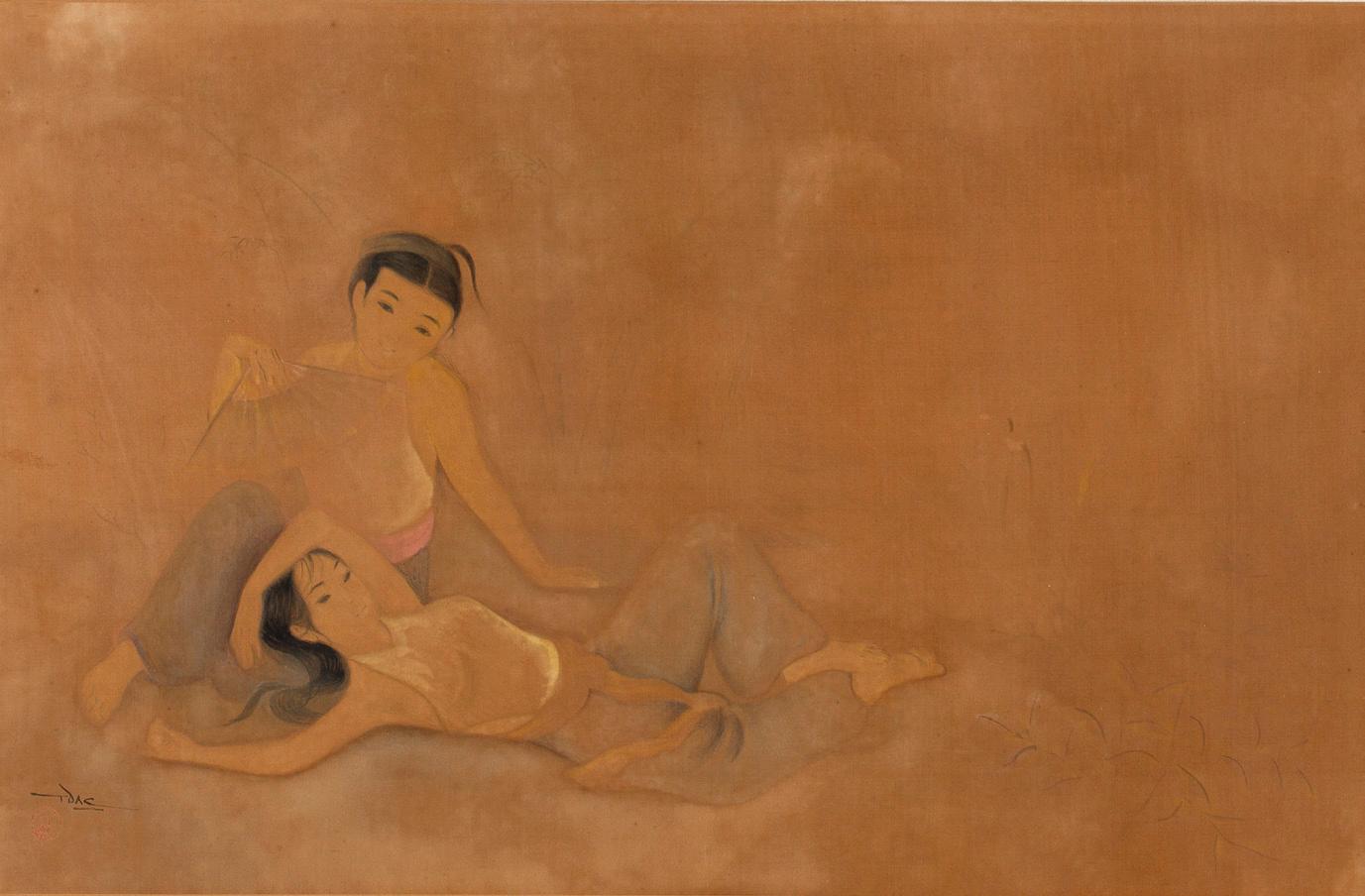
7
TRẤN ĐẮC (1922-1980)
Femmes lascives, delta du Sông Hông
Encre et couleurs sur soie, signée en bas à gauche
38,5 x 64 cm - 24 ¾ x 15 ¾ in.
Ink and color on silk, signed lower left
800 - 1 200 €
PROVENANCE
Collection privée en Isère, acquis dans les années 1990
6
TRẤN ĐẮC (1922-1980)
Femmes à la coiffure dans un paysage luxuriant
Encre et couleurs sur soie, signée en bas à droite
62,8 x 40 cm - 24 ¾ x 15 ¾ in
Ink and color on silk, signed lower right
800 - 1 200 €
PROVENANCE
Collection privée en Isère, acquis dans les années 1990
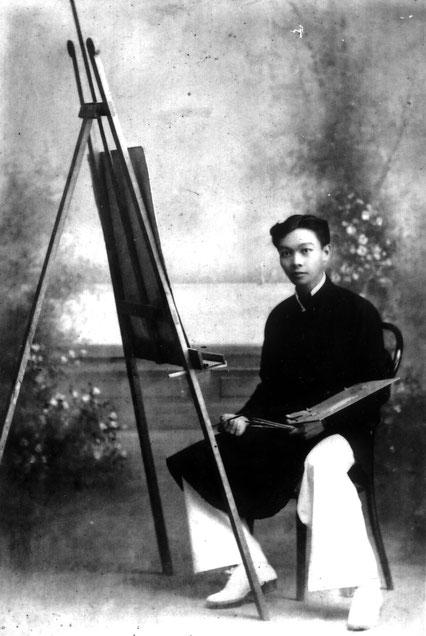
Nguyễn Văn Thọ, plus connu sous son nom d’artiste Nam Sơn , naît à Hanoï en 1899. Si les lettrés de sa famille le sensibilisent jeune au dessin et à la calligraphie, c’est au sein du lycée du protectorat de Hanoï qu’il est initié à l’art occidental. Montrant une certaine prédisposition pour les arts graphiques, Nam Sơn commence sa carrière en côtoyant le monde de la presse et de l’édition, et collabore à l’illustration de nombreux manuels, journaux et revues.
L’artiste évolue à partir de 1922 aux côtés de Victor Tardieu. Il accompagne ce peintre accompli, lauréat en 1920 du Prix de l’ Indochine, dans plusieurs projets d’envergure, dont notamment la création de l’École des beaux-arts à Hanoï en 1924. La formation de Nam Sơn en calligraphie et caractères chinois a très probablement contribué à son goût pour le dessin, qu’il enseigne aux candidats au concours d’entrée de l’École dès 1925, avant d’y être nommé professeur technique des arts décoratifs.
La carrière personnelle de Nam Sơn en tant qu’artiste prend véritablement son essor à partir de 1929. Il participe alors, sous l’impulsion de celui qui est devenu directeur de l’École des beaux-arts de l’Indochine, à de nombreuses expositions organisées à Hanoï, à Paris ou à Rome, dont l’importante Exposition coloniale de 1931. Il expose en 1932 et en 1933 rue La Boétie à Paris, au sein de l’Agence économique de l’Indochine (Agindo), ainsi qu’au Salon des artistes français. En 1932, son travail, ainsi que celui de ses pairs Lê Phổ et Vũ Cao Đàm, est récompensé au Salon des artistes français par une médaille d’argent.
Nguyễn Văn Thọ, được biết đến với nghệ danh Nam Sơn, sinh tại Hà Nội, năm 1890. Nếu các bậc nho sĩ trong gia đình đã sớm khơi gợi nơi ông niềm say mê hội họa và thư pháp, thì chính tại Trường Trung học Bảo hộ Hà Nội ông được làm quen với nghệ thuật phương Tây. Bộc lộ thiên
hướng đối với nghệ thuật đồ họa, Nam Sơn khởi
đầu sự nghiệp bằng việc bước vào thế giới báo chí và xuất bản, đồng thời góp phần minh họa cho nhiều sách giáo khoa, nhật báo và tạp chí.
Từ năm 1922, Nghệ sĩ sát cánh cùng Victor Tardieu. Ông đồng hành với bậc danh họa từng
đoạt Giải thưởng Đông Dương năm 1920 trong nhiều dự án có tầm vóc lớn, trong đó nổi bật là việc sáng lập Trường Cao đẳng Mỹ thuật Đông
Dương tại Hà Nội vào năm 1924. Vốn liếng thư pháp và Hán tự của Nam Sơn ắt hẳn đã hun đúc nơi ông niềm say mê đối với nghệ thuật đồ họa, môn học mà ông đảm nhiệm giảng dạy cho các thí sinh dự thi vào trường ngay từ năm 1925, trước khi được bổ nhiệm làm Giáo sư kỹ thuật ngành mỹ thuật trang trí tại đây.
Sự nghiệp của Nam Sơn với tư cách một họa sĩ thực sự đơm hoa kết trái kể từ năm 1929. Dưới sự dìu dắt của bậc thầy nay đã giữ cương vị Hiệu trưởng Trường Cao đẳng Mỹ thuật Đông Dương, ông tham gia nhiều cuộc trưng bày tổ chức tại Hà Nội, Paris hay Rome, trong đó có kỳ Đấu xảo Thuộc địa danh tiếng năm 1931. Năm 1932 và 1933, ông giới thiệu tác phẩm tại đường La Boétie ở Paris, nơi là trụ sở của Cơ quan Kinh tế Đông Dương (Agindo), cũng như tại Salon des Artistes Français (Triển lãm Nghệ sĩ Pháp). Năm 1932, tác phẩm của ông, cùng với tác phẩm của những bậc đồng môn Lê Phổ và Vũ Cao Đàm, được trao tặng huy chương bạc tại Salon des Artistes Français.
Nguyễn Văn Thọ, better known by his artist name “ Nam Sơn,” was born in Hanoi in 1899. While the literati in his family introduced him to drawing and calligraphy at a young age, it was at the Hanoi Protectorate High School that he was first exposed to Western art. Showing a certain aptitude for the graphic arts, Nam Sơn began his career by working in the world of journalism and publishing, and contributed illustrations to numerous textbooks, newspapers, and magazines.
From 1922 onward, the artist worked alongside Victor Tardieu. He assisted this accomplished painter – winner of the 1920 Prix d’Indochine – in several major projects, notably the founding of the Hanoi School of Fine Arts in 1924. Nam Sơn’s training in calligraphy and Chinese characters most likely contributed to his love of drawing, which he taught to candidates for the School’s entrance exam starting in 1925, before being appointed there as a technical professor of decorative arts.
Nam Sơn’s personal career as an artist truly took off in 1929. At the urging of the man who had become director of the Indochinese School of Fine Arts, he participated in numerous exhibitions held in Hanoi, Paris, and Rome, including the major Colonial Exhibition of 1931. In 1932 and 1933, he exhibited on Rue La Boétie in Paris, at the Indochinese Economic Agency (Agindo), as well as at the Salon des Artistes Français. In 1932, his work, along with that of his peers Lê Phổ and Vũ Cao Đàm, was awarded a silver medal at the Salon des Artistes Français.
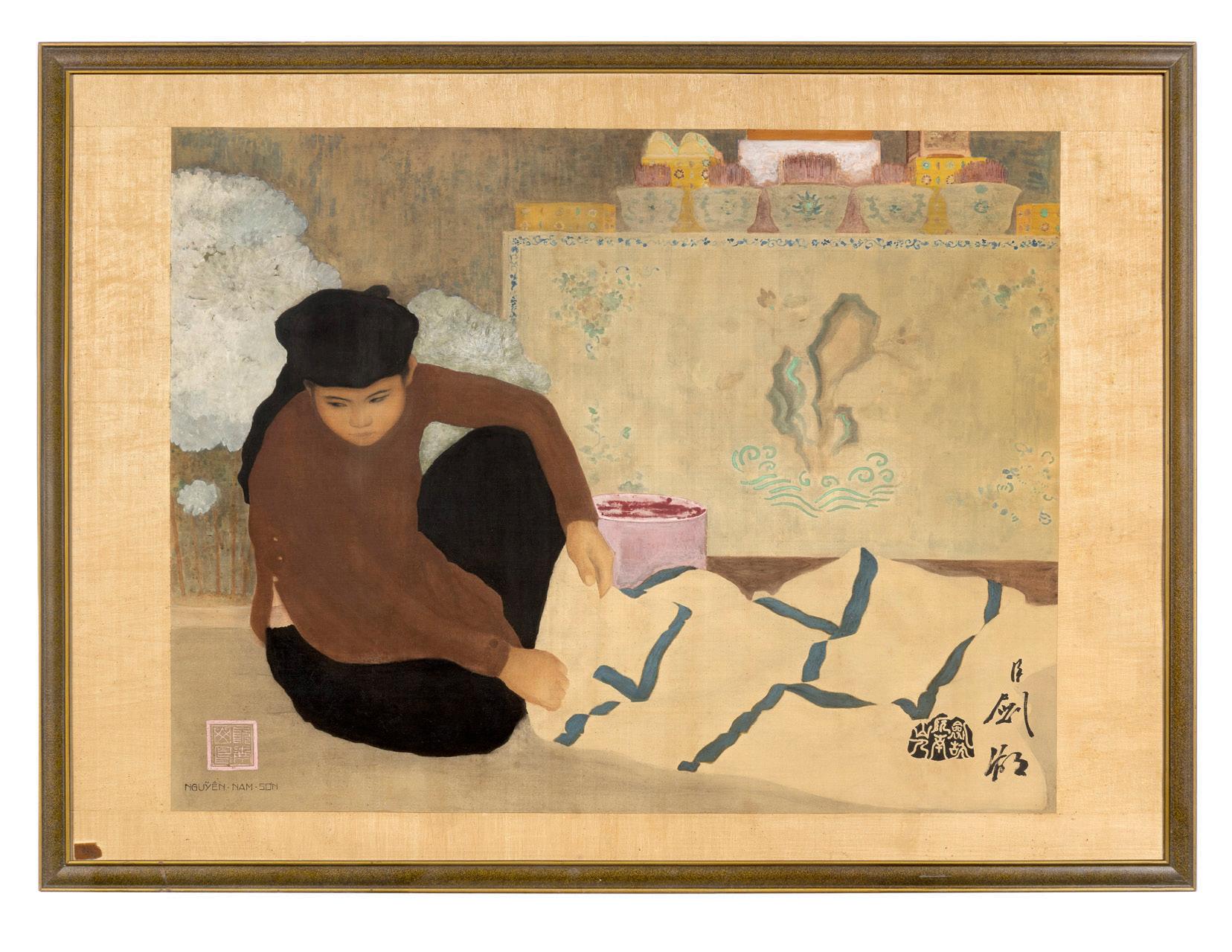
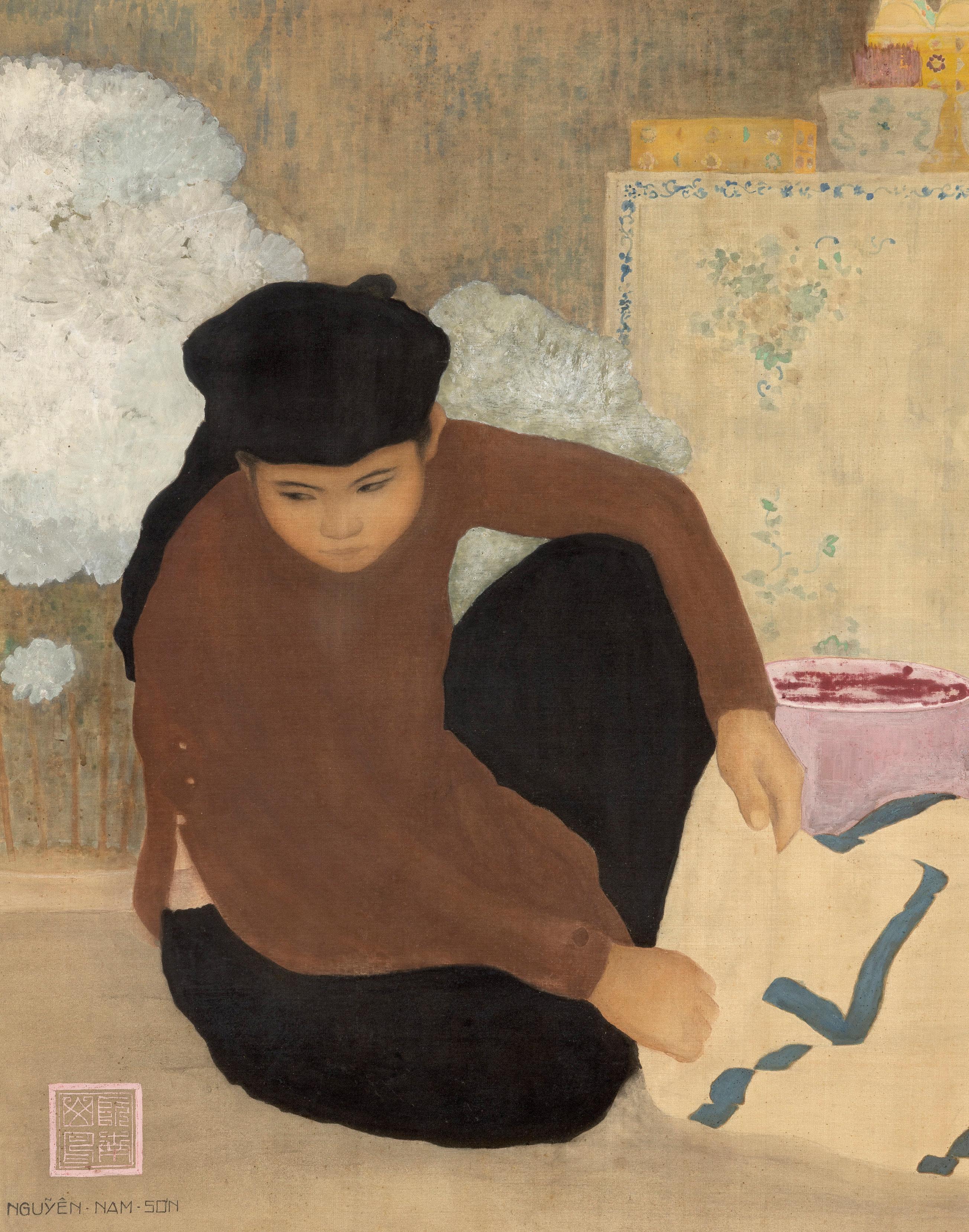
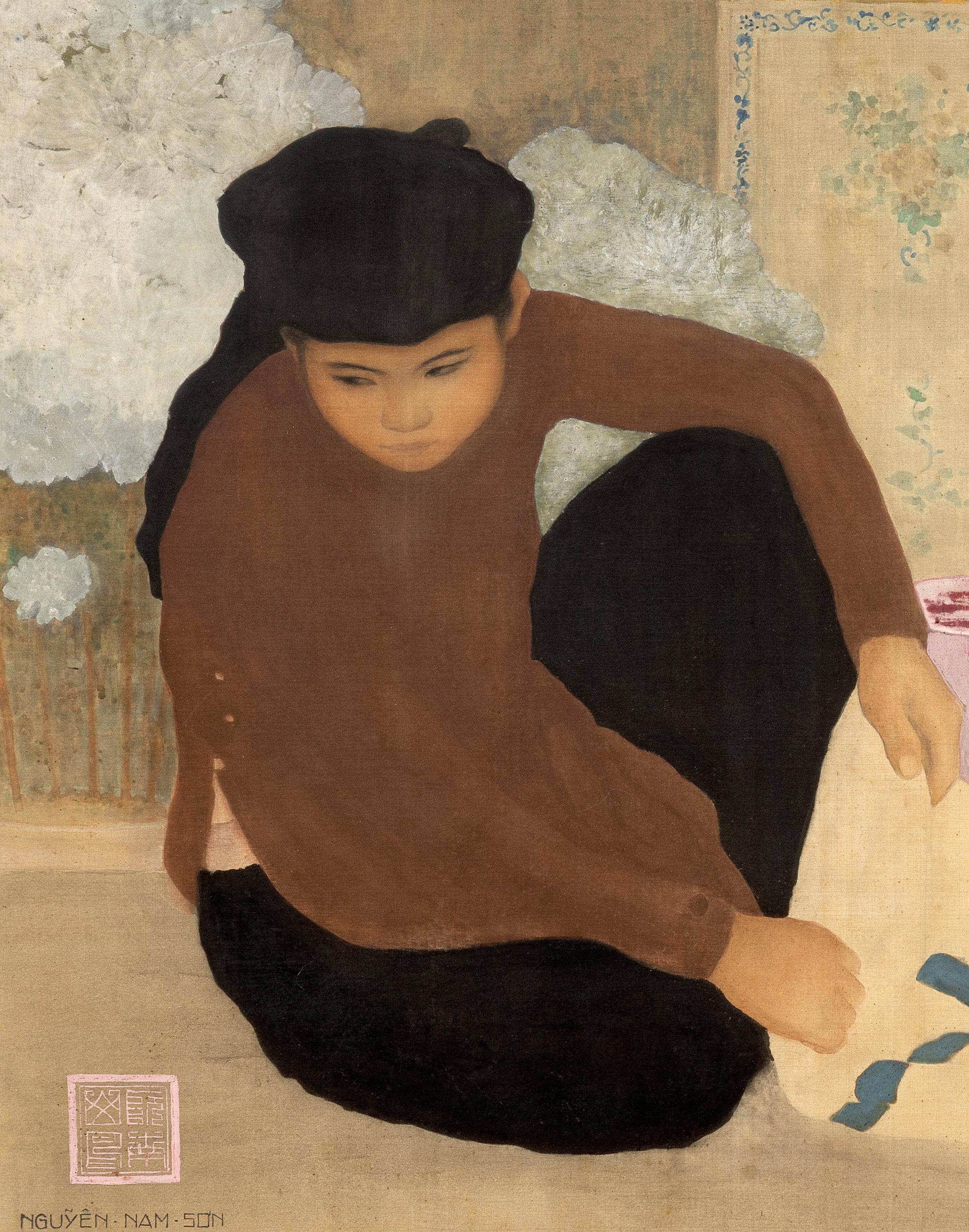
NGUYỄN VĂN THỌ DIT NAM SƠN (1899-1973)
Vêtement sacré de la pagode, 1932
Encre et couleurs sur soie, signée et datée en bas à droite et en bas à gauche
63,8 x 82,5 cm - 25 1/8 x 32 ½ in Ink and color on silk, signed and dated lower right and lower left
300 000 - 500 000 €
PROVENANCE
Collection du Ministre des Colonies
Albert Dalimier (probablement acquis le 21 octobre 1933, à l’Agindo, 3 000 francs)
Collection particulière d’un artiste peintre actif dans les années 1930, Paris
Collection particulière, France (par descendances successives du précédent)
BIBLIOGRAPHIE
Clapassier, « A L’affiche du gouvernement d’Indochine, nouvelles peintures indochinoises », Le Monde colonial illustré , n° 116, Avril 1933, p. 63, repr., titré « Vêtement sacré de la pagode » « L’École d’Hanoï à Paris », Dépêche Coloniale , 10 Avril 1933, p. 2, titré « Vêtement sacré de la pagode »
« Une nouvelle exposition des peintres tonkinois », La République , n°1364, 6 mars 1933, p. 2, titré « Le Vêtement lumineux de la pagode »
Ngô Kim - Khôi, Nam Sơn (1899 - 1973), Di sản Mỹ thuật Đông Dương qua tư liệu, lưu trữ và báo chí, vol. I, Hanoï, Hà Nội : Nhà xuất bản Mỹ thuật, 2025, pp. 470-477, repr., titré « Vêtement sacré de la pagode »
EXPOSITION
1933, « Le Salon des artistes indochinois », Agindo, Paris (du 3 au 15 mars), titré « Vêtement sacré »
1933, Exposition André Maire & La galerie des Artistes indochinois, Agindo, Paris (octobre)
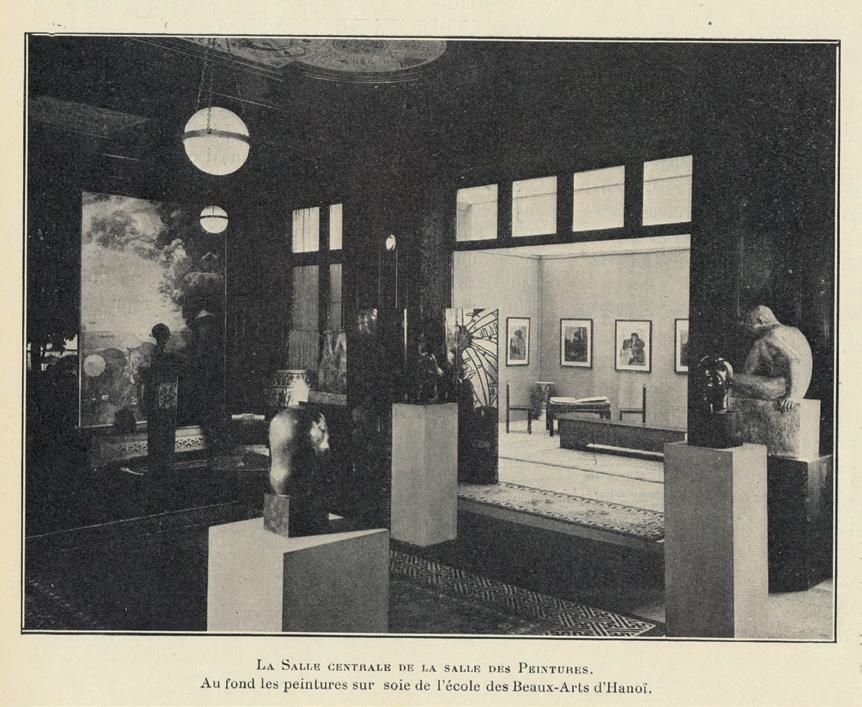
La salle d’exposition des peintures sur soie de l’École des beaux-arts d’Hanoï à l’Agence économique de l’Indochine © Fonds Victor
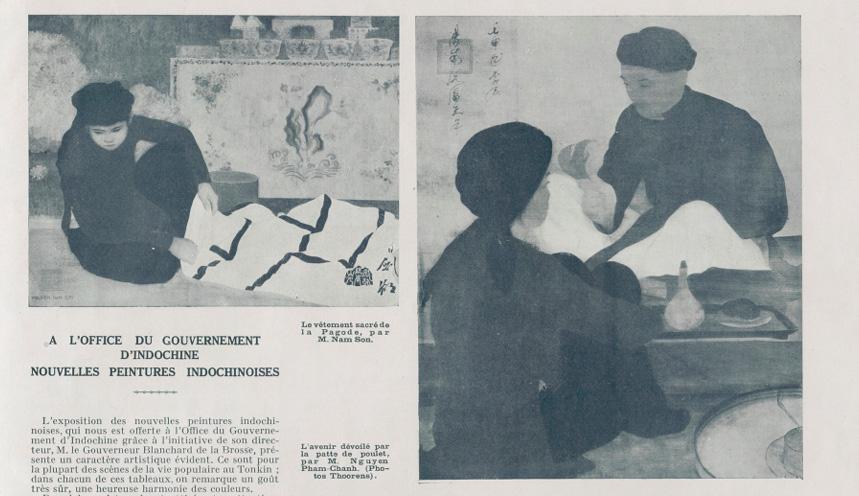
Le 12 décembre 1932, à la demande de Blanchard de la Brosse, directeur de l’Agindo, qui projette une quatrième exposition rue de la Boétie pour mars 1933, Victor Tardieu dresse la liste des 14 peintures sur soie qu’il envoie à Paris1. Sous le numéro 5 figure Vêtement sacré de la pagode , soie d’envergure qui rassemble toutes les qualités ayant fait de Nam Sơn un maître en cette technique. L’œuvre est exposée aux côtés de 13 tableaux majeurs tels que Les désabusées et Les brodeuses de Tô Ngọc Vân, d’émouvantes soies par les peintres Nguyễn Phan Chánh ou Lưu Văn Sìn ainsi que quelques bustes du sculpteur Vũ Cao Đàm
1 Fonds Victor Tardieu, INHA, espace Jacques Doucet, archives 125/5-9.
Ngày 12 tháng 12 năm 1932, theo lời mời của Blanchard de la Brosse, Giám đốc Agindo, người có dự định tổ chức cuộc triển lãm thứ tư tại đường La Boétie vào tháng 3 năm 1933, Victor Tardieu lập danh sách 14 bức tranh lụa gửi sang Paris1. Mang số 5 là Vêtement sacré de la pagode (Y phục thiêng nơi cửa chùa), một bức tranh lụa có tầm vóc lớn, hội tụ mọi phẩm chất đã làm nên một bậc thầy
Nam Sơn trong kỹ thuật này. Tác phẩm được trưng bày bên cạnh 13 bức tranh trọng yếu khác như Les désabusées (Những kẻ vỡ mộng) và Les brodeuses (Những cô thợ thêu) của Tô Ngọc Vân, những bức lụa lay động lòng người của các họa sĩ Nguyễn Phan Chánh hay Lưu Văn Sìn, cùng một số pho tượng bán thân của nhà điêu khắc Vũ Cao Đàm.
On December 12, 1932, at the request of Blanchard de la Brosse, director of Agindo, who was planning a fourth exhibition on Rue de la Boétie for March 1933, Victor Tardieu compiled a list of the 14 silk paintings he was sending to Paris1. Number 5 on the list is Vêtement sacré de la pagode, a large-scale silk painting that embodies all the qualities that made Nam Sơn a master of this technique. The work is exhibited alongside 13 major paintings such as Les désabusées and Les brodeuses by Tô Ngọc Vân, moving silk works by the painters Nguyễn Phan Chánh and Lưu Văn Sìn, as well as several busts by the sculptor Vũ Cao Đàm.
« C’est toute la nostalgie des terres basses et gorgées d’eaux, des villages surpeuplés, des existences grégaires et pourtant chargées de poésie. On remarque particulièrement le ’Vêtement sacré’, signé Nam Sơn... »
La Dépêche Coloniale, 10 Avril 1933
« Đó là trọn vẹn nỗi hoài niệm về vùng đất trũng đẫm nước, về những thôn làng đông đúc, về những kiếp sống quần cư mà đậm
“It evokes all the nostalgia of the low-lying, waterlogged lands, the overcrowded villages, and lives lived in community yet imbued with poetry. Of particular note is the ’Vêtement sacré,’ signed by Nam Sơn...”
La lecture du volumineux recueil publié récemment par Ngô Kim Khôi, petit-fils de l’artiste, nous apporte par ailleurs des renseignements intéressants sur les vêtements et objets illustrés sur cette composition.
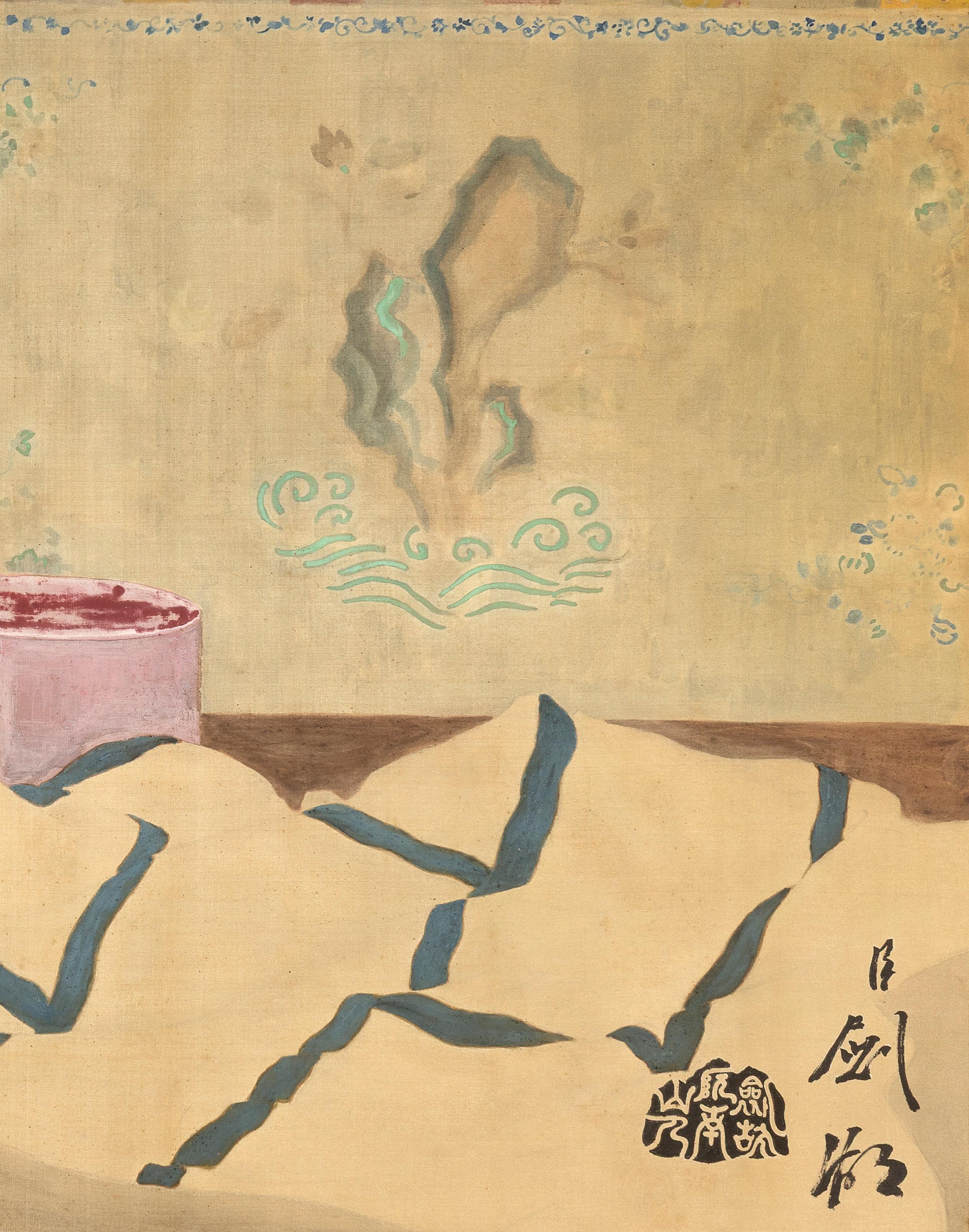
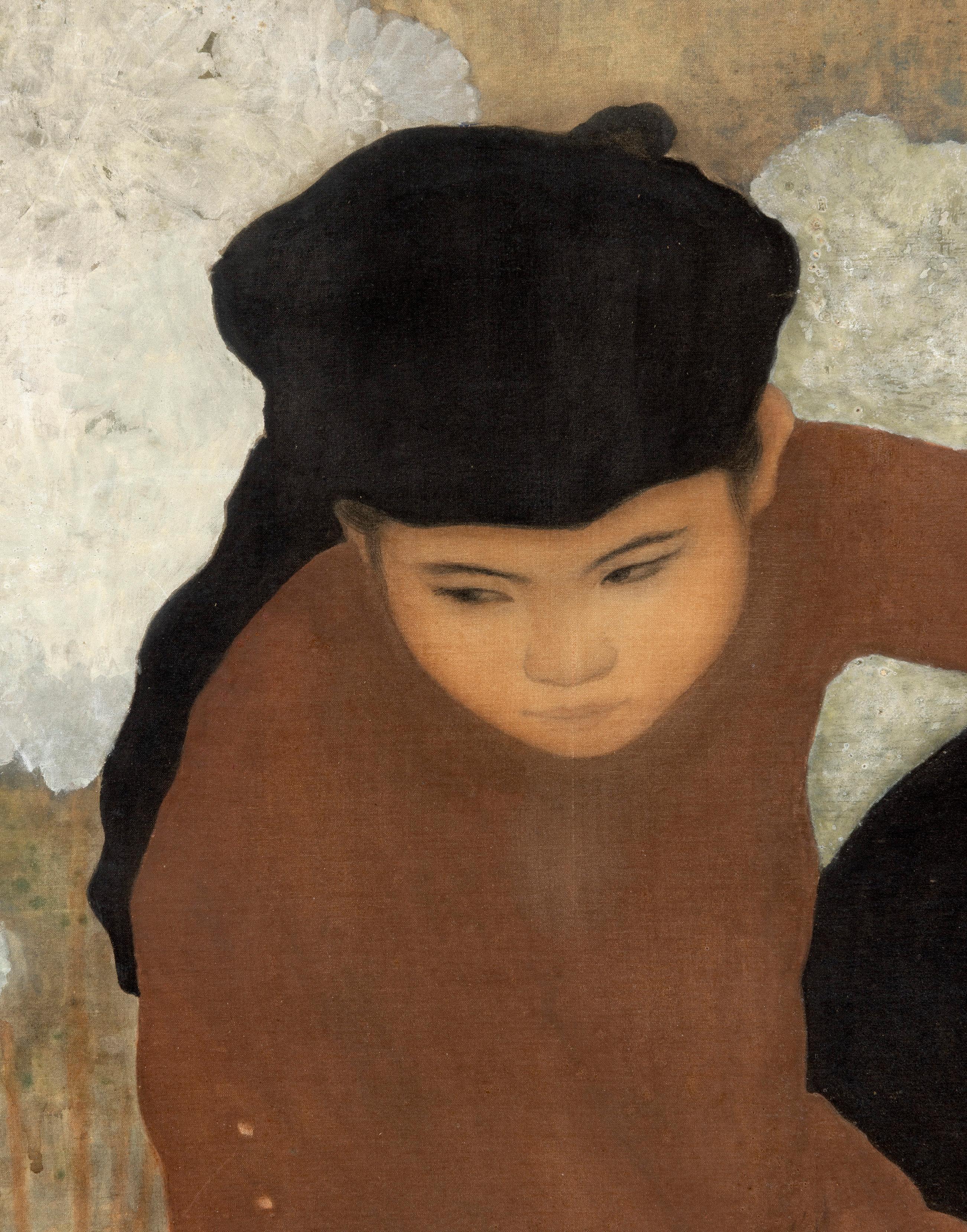
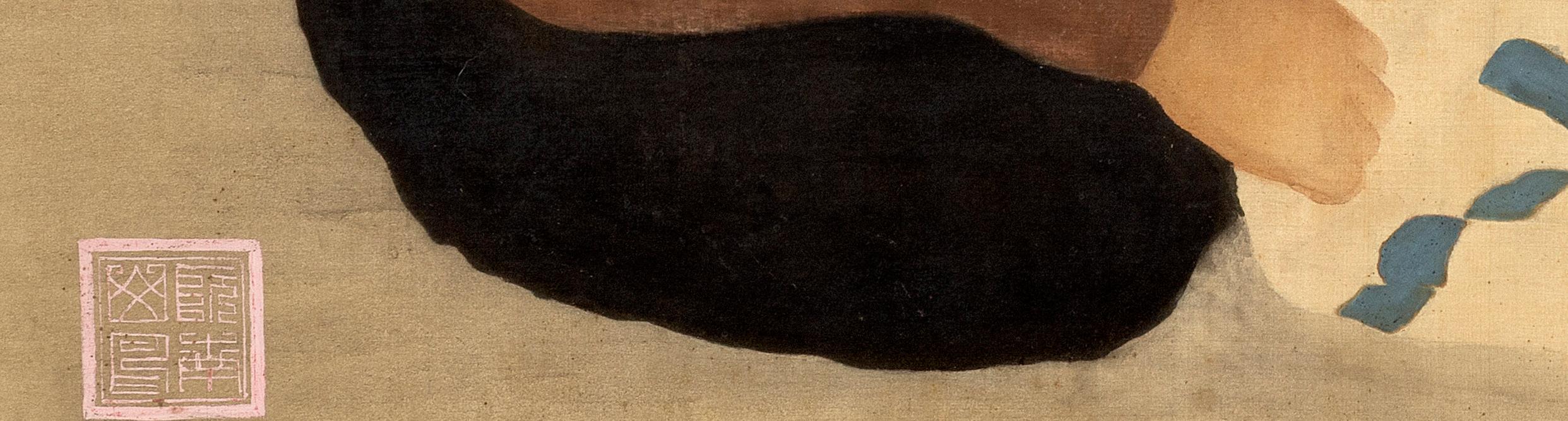
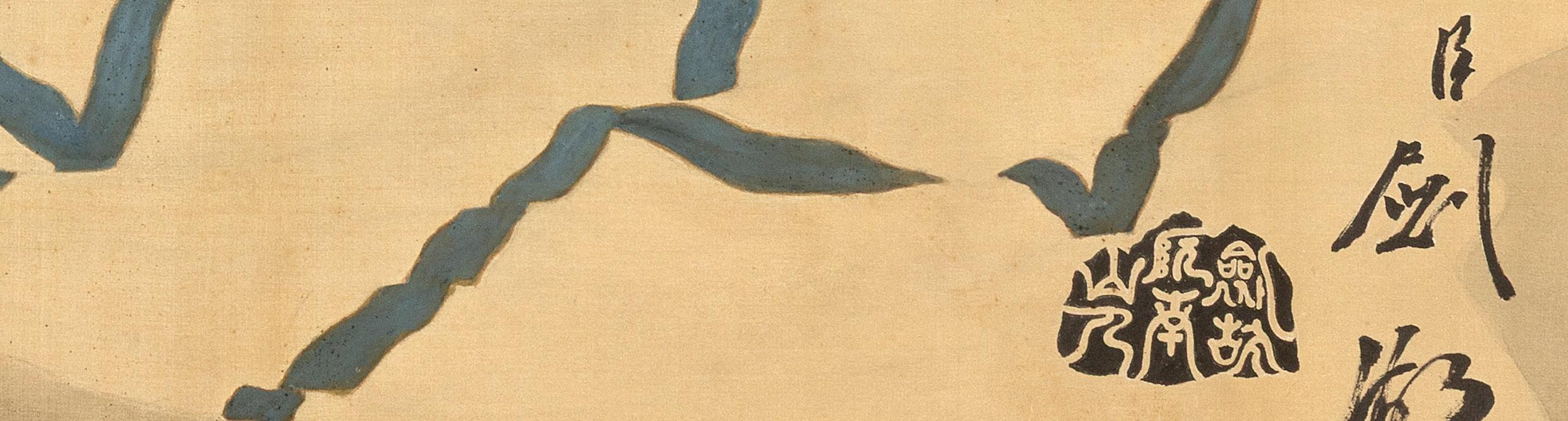
La jeune femme est représentée assise de profil devant l’autel d’un temple, occupée à la reprise d’un vêtement sacré de couleur claire et aux bandes d’un bleu profond, le kesa , provenant du sanskrit kasaya , signifiant teinté (de « couleur trouble »). La coiffe en forme de bec de corbeau de la jeune femme, sa tunique et son pantalon foncé lui permettent de localiser cette scène dans le Nord du Vietnam. Dans le bouddhisme, le kesa est porté par ceux qui suivent le Dharma (les enseignements) du Bouddha. Composé de bandes de tissu teintes en ocre, ce vêtement sacré est constitué de plusieurs pièces assemblées selon le dessin des rizières et permettant de distinguer les disciples de Bouddha des autres religieux. À l’arrière-plan, l’autel est recouvert d’un panneau de brocart orné en partie centrale de rochers et de vagues et égayé en ses quatre coins par des guirlandes de fleurs. Sur l’autel sont placés cinq bols d’encens dont le décor évoque le dragon de la lune, également connu sous le nom 兩龍爭珠 , « deux dragons se disputent une perle ». Dans le coin inférieur droit, sur le kesa , l’inscription chinoise : « 臣劍 湖 » (« l’humble personne du lac de l’Epée ») et juste à gauche, un estampillage le « Win Shou Zhang » (引首章), également connu sous le nom
de « Sui Xing Zhang », un sceau qui est conçu selon la forme naturelle de sa base. Il symbolise ainsi la chaîne de montagnes à trois pics, avec à l’intérieur les caractères : « 劍湖阮南山人» (« la personne du lac de l’Epée, nommée Nguyễn Nam Sơn »). Selon une lettre de Blanchard de la Brosse, directeur de l’Agindo, adressée à Victor Tardieu en date du 24 octobre 1933, la soie aurait été acquise par le ministre des Colonies Albert Dalimier (1875 - 1936) le 21 octobre 1933, lors de sa visite de l’exposition pour la somme de 3 000 francs.
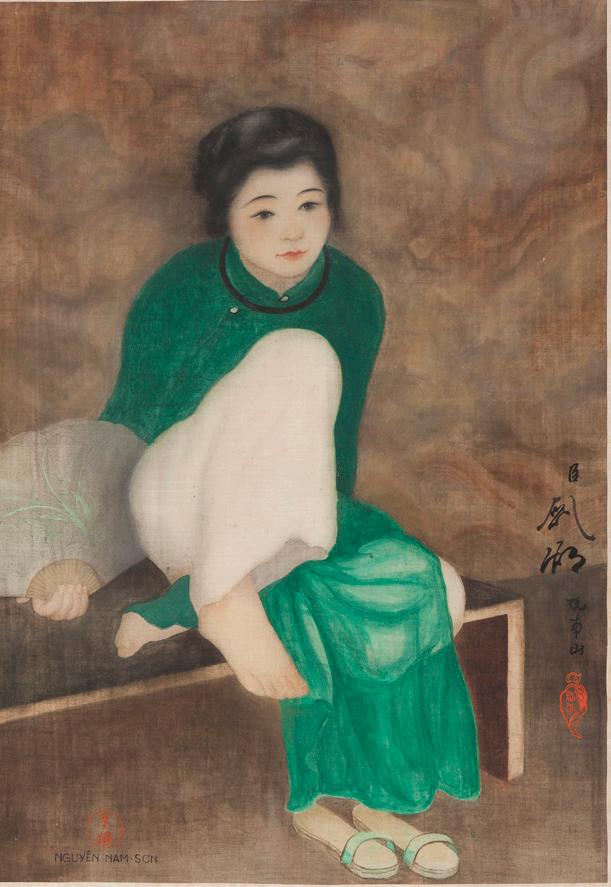
Représentant cette petite raccommodeuse avec le regard tourné vers l’avant, détaché de son ouvrage, l’artiste insuffle à la scène une atmosphère calme et de méditation, reflétant la philosophie bouddhiste. Avec cette ravissante scène traditionnelle évoquant la vie religieuse au Vietnam, Nam Sơn démontre sa dextérité sur le médium de la soie et nous livre un chef d’œuvre qui n’est pas sans nous rappeler la belle Tonkinoise à l’éventail que l’artiste réalisera peu après (repr. p.19).
Ngô Kim Khôi, cháu của họa sĩ, vừa cho xuất bản một bộ khảo cứu đồ sộ, mang lại nhiều thông tin
đáng chú ý về trang phục cũng như các vật dụng được thể hiện trong tác phẩm.
Người thiếu nữ được khắc họa trong tư thế ngồi nghiêng trước bàn thờ của một ngôi đền, chăm chú vá lại một pháp y màu sáng, điểm những dải xanh thẫm, gọi là kesa. Thuật ngữ này bắt nguồn từ tiếng Phạn kasaya, mang nghĩa “màu nhuốm đục”.
Chiếc khăn vấn đầu hình mỏ quạ, cùng với áo dài và quần sẫm màu của người thiếu nữ, cho phép định vị bối cảnh của cảnh tượng này ở miền Bắc Việt Nam.
Trong Phật giáo, cà sa là y phục dành cho những người phụng hành giáo pháp của Đức Phật. Được may từ những dải vải nhuộm sắc thổ hoàng, pháp y thiêng liêng này gồm nhiều mảnh ghép lại theo hình thửa ruộng, nhờ đó phân biệt hàng đệ tử Đức Phật với các tu sĩ thuộc những tôn giáo khác. Phía hậu cảnh, hương án được phủ một tấm gấm, ở phần chính giữa trang trí hình núi đá và sóng nước, bốn góc được điểm tô bằng những tràng hoa. Trên hương án bày năm bát hương, hoa văn trang trí gợi lên hình tượng rồng nguyệt, còn được biết đến dưới danh 兩龍爭珠 (« lưỡng long tranh châu » – hai con rồng tranh giành viên ngọc ». Ở góc dưới bên phải, trên hình cà sa, có dòng lạc khoản chữ Hán « 臣劍湖 » (« Thần Kiếm Hồ » –« kẻ bề tôi nơi Hồ Gươm »), và sát bên trái là một dấu ấn « 引首章 » (« Dẫn thủ chương », phiên âm bính âm « Win Shou Zhang »), còn được biết đến dưới tên gọi « Tùy hình chương » (« Sui Xing Zhang »), một loại triện được khắc theo hình dáng tự nhiên của phần đế. Triện này tượng trưng cho dãy núi ba đỉnh, bên trong khắc các chữ « 劍湖 阮南山人 » (« Kiếm Hồ Nguyễn Nam Sơn nhân » – « người chốn Hồ Gươm tên Nguyễn Nam Sơn »).
Theo một bức thư của Blanchard de la Brosse, Giám đốc Agindo, gửi Victor Tardieu đề ngày 24 tháng 10 năm 1933, bức lụa hẳn đã được Bộ trưởng
Bộ Thuộc địa Albert Dalimier (1875-1936) mua lại vào ngày 21 tháng 10 năm 1933, nhân chuyến thăm
cuộc trưng bày, với giá 3.000 franc.
Khắc họa cô bé vá áo với ánh mắt hướng về phía
trước, tâm như không còn vướng bận vào công việc đang dang dở, người nghệ sĩ phả vào khung
cảnh một bầu không khí an tĩnh và thiền định, phản chiếu triết lý nhà Phật.
Với khung cảnh truyền thống duyên dáng gợi lên
đời sống nơi cửa thiền của Việt Nam, Nam Sơn chứng tỏ tài hoa trên chất liệu lụa và gửi đến chúng ta một kiệt tác không khỏi khiến ta nhớ đến La belle Tonkinoise à l’éventail (Thiếu nữ cầm quạt) mà người họa sĩ thực hiện ít lâu sau đó (repr. p.19).
1 Fonds Victor Tardieu, INHA, espace Jacques Doucet, archives 125/5-9.
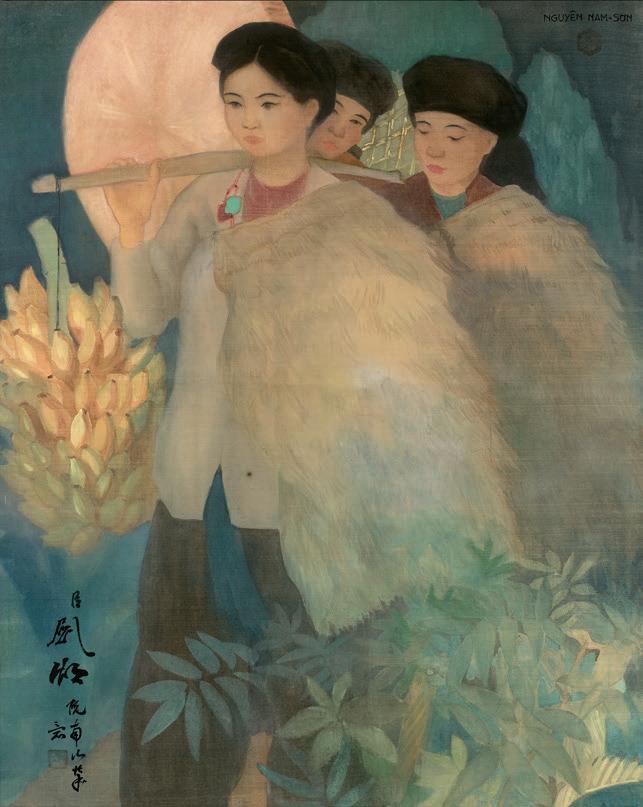
Reading the voluminous book recently published by Ngô Kim Khôi, the artist’s grandson, also provides us with interesting insights into the garments and objects depicted in this composition. The young woman is depicted sitting in profile before a temple altar, busy mending a sacred garment of light color with deep blue bands, the kesa, derived from the Sanskrit kasaya, meaning “dyed” (of “murky color”).
The young woman’s crow’s-beak-shaped headdress, her tunic, and her dark trousers allow us to place this scene in northern Vietnam. In Buddhism, the kesa is worn by those who follow the Dharma (the teachings) of the Buddha. Made of strips of ochre-dyed fabric, this sacred garment is composed of several pieces sewn together in a pattern resembling rice paddies, allowing Buddha’s disciples to be distinguished from other religious figures.
In the background, the altar is covered with a brocade panel adorned in the center with rocks and waves and brightened at its four corners by garlands of flowers. On the altar are placed five incense bowls whose decoration evokes the moon dragon, also known as 兩龍爭珠, “two dragons fighting over a pearl.”
In the lower right corner, on the kesa, is the Chinese inscription: “ 臣劍湖” (“the humble person of Sword Lake”), and just to the left, a stamp bearing the “Win Shou Zhang” ( 引首章), also known as the “Sui Xing Zhang,” a seal designed according to the natural shape of its base. It thus symbolizes the three-peaked mountain range, with the characters inside: “ 劍湖阮南山人” (“the person of Sword Lake, named Nguyễn Nam Sơn”).
According to a letter from Blanchard de la Brosse, director of Agindo, addressed to Victor Tardieu dated October 24, 1933, the silk was reportedly acquired by the Minister of Colonies Albert Dalimier (1875-1936) on October 21, 1933, during his visit to the exhibition for the sum of 3,000 francs.
By depicting this young seamstress gazing straight ahead, her mind detached from her work, the artist infuses the scene with a calm, meditative atmosphere that reflects Buddhist philosophy. With this enchanting traditional scene evoking religious life in Vietnam, Nam Sơn demonstrates his mastery of the medium of silk and presents us with a masterpiece that is reminiscent of the beautiful Tonkinoise à l’éventail, which the artist would create shortly thereafter (repr. p.19).
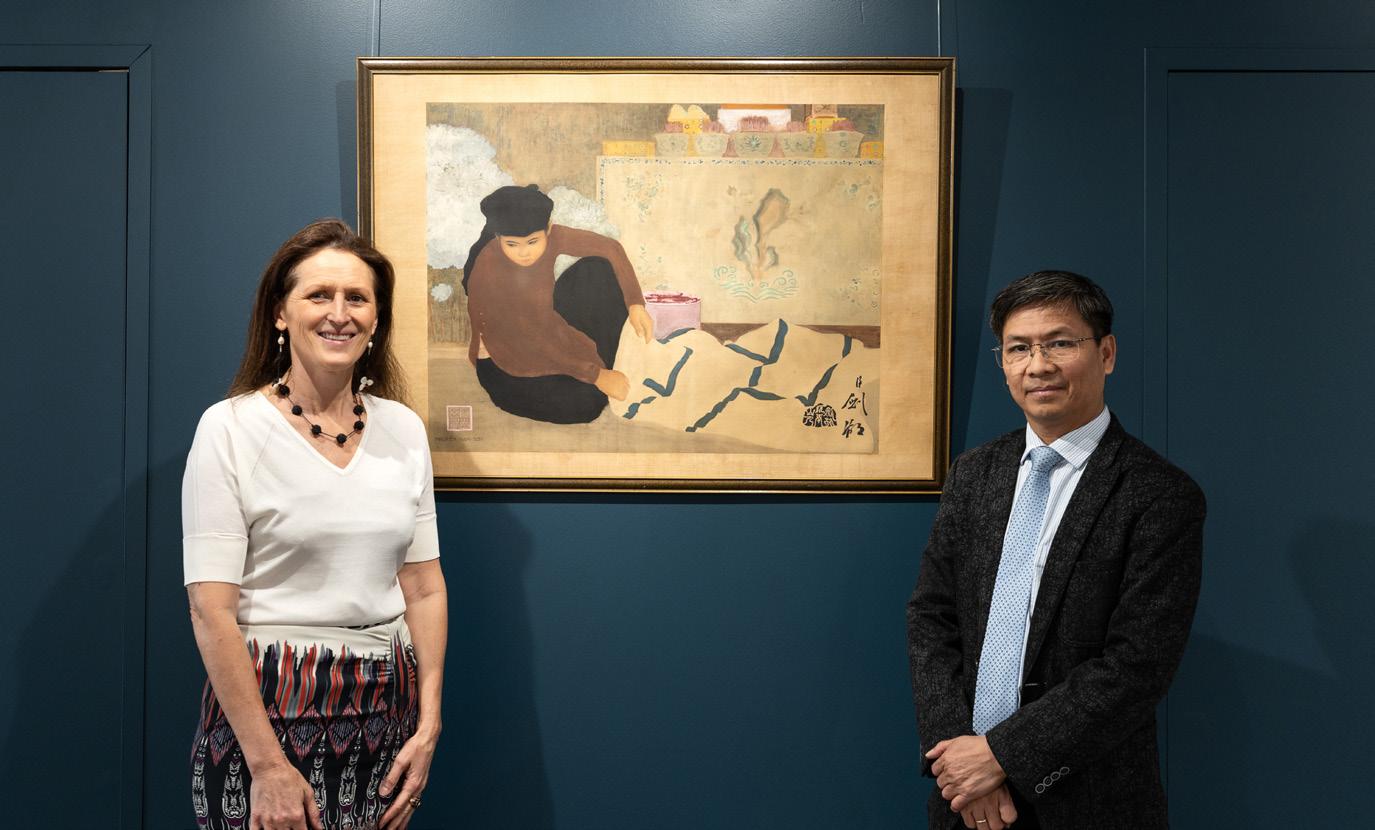
Aguttes, 27 avril 2026 - Visite en avant-première de l'exposition avec Monsieur Đinh Ngọc Đức, Conseiller auprès de l'Ambassade du Vietnam en France, Directeur de Centre Culturel du Vietnam en France (CCV)
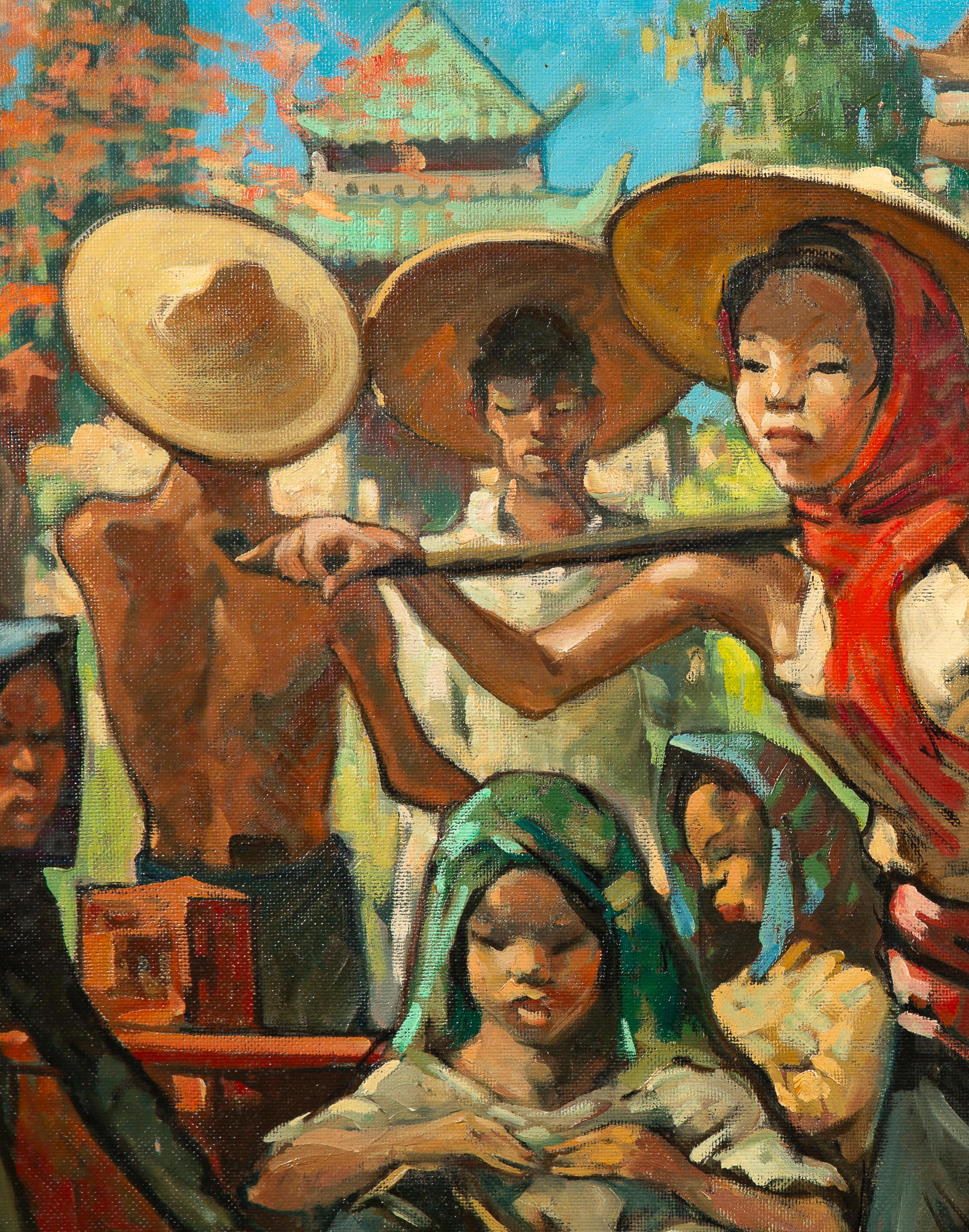
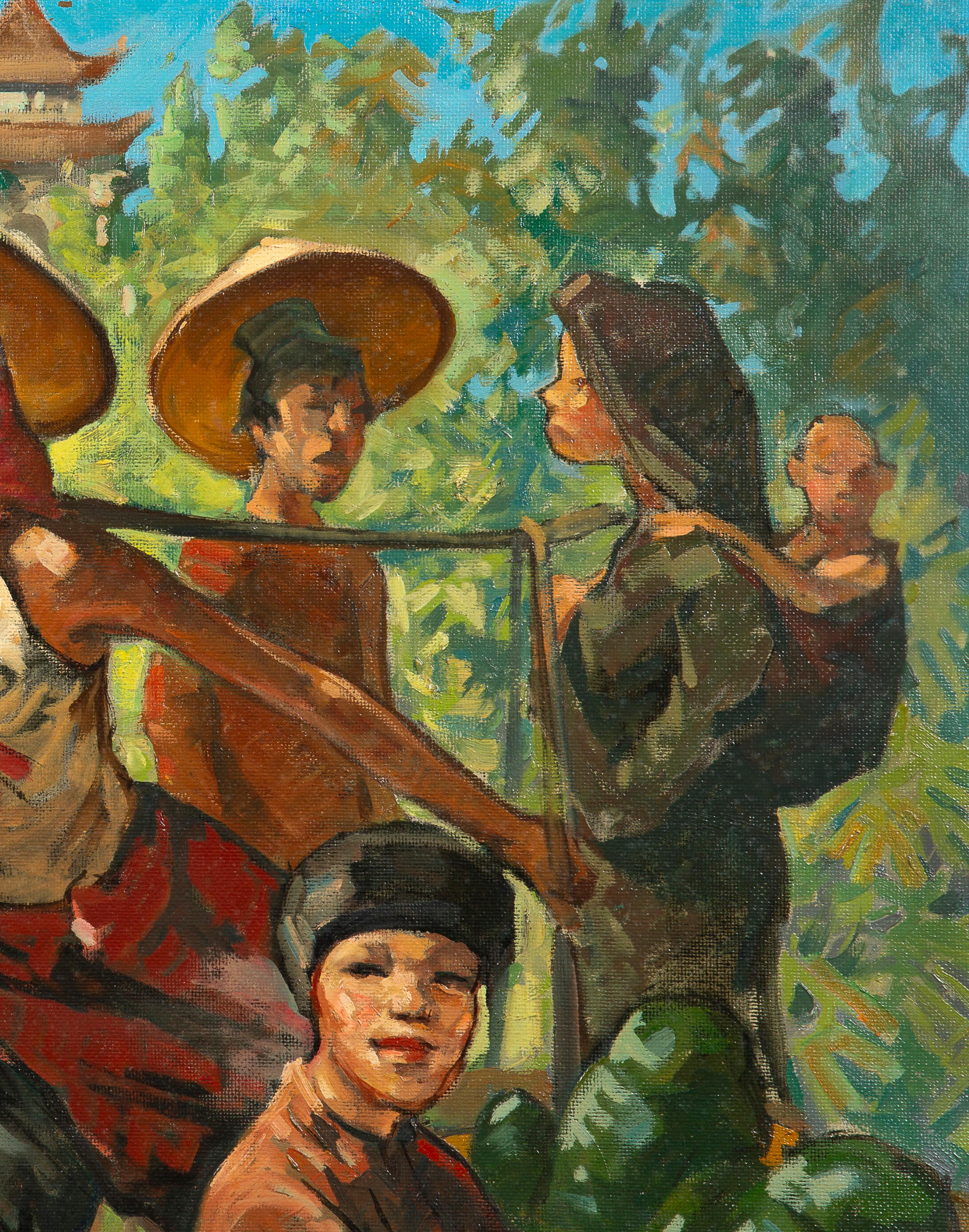
Né le 3 mai 1895 à Paris et mort le 16 janvier 1988 à Tours, Louis Rollet est un paysagiste français et un peintre orientaliste, dont l’œuvre reflète une passion pour le voyage héritée de son maître Charles Fouqueray (1869 - 1956). Il fait ses débuts au Salon des Artistes Français à Paris en 1921, où il est récompensé par une médaille d’or. Dès 1926, il présente également ses œuvres au Salon des Indépendants et au Salon de la Société Coloniale des Artistes Français. Il se présente pour le Prix d’Indochine en 1930.
Ce Prix d’Indochine, créé à Paris au sein de la Société coloniale des artistes français en 1910, a évolué à la demande de Victor Tardieu en 1925 et sera remis jusqu’en 1938. Il prévoit pour le lauréat une bourse de voyage de deux années consécutives à hauteur de 350 piastres par mois, ainsi que le remboursement de ses frais de déplacements (occasionnés sur place, en plus de l’aller-retour entre Paris et l’Indochine). Disposant de sa première année pour parcourir la région, chaque lauréat se doit d’être à Hanoï la seconde année afin d’enseigner au sein de l’École des beaux-arts de l’Indochine. C’est ainsi que Louis Rollet, lauréat en 1930, est amené à occuper à Hanoï le poste de professeur de dessin pour les promotions III et IV et à assurer les cours de peinture à l’huile auprès des promotions V et VI. Il compte parmi ses élèves de futurs grands maîtres de la peinture moderne vietnamienne tels que Lê Thị Lựu, Trần Bình Lộc, Nguyễn Tuong Lan ou encore l’artiste méconnu et aujourd’hui révélé, Vũ Đình Ngọc (Cf. lot 14 de la vente). Louis Rollet s’immerge profondément dans la culture locale lors de son séjour. L’observation attentive dont il fait preuve, lui permet de renouveler aussi bien ses sujets que sa technique, notamment par un travail plus poussé dans son traitement de la lumière, qu’il rend par de larges touches contrastées.
Sinh ngày 3 tháng 5 năm 1895 tại Paris và mất
ngày 16 tháng 1 năm 1988 tại Tours, Louis Rollet
là một họa sĩ phong cảnh người Pháp đồng thời là họa sĩ theo trường phái Đông phương , sự nghiệp của ông phản chiếu niềm say mê những cuộc viễn du được kế thừa từ người thầy Charles Fouqueray (1869-1956).
Ông ra mắt tại Salon des Artistes Français ở Paris năm 1921 và được trao tặng huy chương vàng. Ngay từ năm 1926, ông cũng giới thiệu tác phẩm tại Salon des Indépendants (Salon Độc lập) và Salon de la Société Coloniale des Artistes Français (Salon Hiệp hội Họa sĩ Thuộc địa Pháp). Ông dự thi Giải thưởng Đông Dương vào năm 1930. Giải thưởng Đông Dương này, do Société coloniale des artistes français (Hiệp hội Họa sĩ Thuộc địa Pháp) sáng lập vào năm 1910, đã được điều chỉnh theo đề nghị của Victor Tardieu vào năm 1925 và được trao đến năm 1938. Giải dự kiến cấp cho người đoạt giải một học bổng du học kéo dài hai năm liên tiếp, ở mức 350 piastre một tháng, đồng thời hoàn lại các chi phí đi lại (phát sinh tại chỗ, ngoài chuyến đi khứ hồi giữa Paris và Đông Dương). Người đạt giải có quyền du hành khắp khu vực trong năm đầu tiên phải có mặt tại Hà
Nội vào năm thứ hai để giảng dạy tại Trường Cao đẳng Mỹ thuật Đông Dương. Chính nhờ đó mà
Louis Rollet, người đoạt giải năm 1930, đã đảm nhận chức vụ giáo sư hình họa cho các khóa III và IV tại Hà Nội, đồng thời đảm trách các lớp sơn
dầu cho các khóa V và VI.
Trong số học trò của ông về sau có những bậc thầy lớn của nền hội họa Việt Nam hiện đạị, chẳng
hạn như Lê Thị Lựu, Trần Bình Lộc, Nguyễn Tường Lân, hay bậc nghệ sĩ chưa được biết đến đúng mức và nay được công nhận – Vũ Đình Ngọc (Xem lô 14 của phiên đấu giá).
Louis Rollet đắm mình vào văn hóa bản địa trong kỳ lưu trú . Óc quan sát tinh tế giúp ông đổi mới cả đề tài lẫn kỹ thuật, đặc biệt qua cách xử lý ánh sáng được đào sâu hơn, mà ông tái hiện bằng những nét cọ rộng đầy tương phản.
Born on May 3, 1895, in Paris and died on January 16, 1988, in Tours, Louis Rollet was a French landscape painter and Orientalist, whose work reflects a passion for travel inherited from his mentor Charles Fouqueray (1869-1956).
He made his debut at the Salon des Artistes Français in Paris in 1921, where he was awarded a gold medal. Beginning in 1926, he also exhibited his works at the Salon des Indépendants and the Salon de la Société Coloniale des Artistes Français. He entered the Prix d’Indochine in 1930.
This Prix d’Indochine, established in Paris within the Société Coloniale des Artistes Français in 1910, was revised at the request of Victor Tardieu in 1925 and was awarded until 1938. It provided the winner with a travel grant for two consecutive years amounting to 350 piastres per month, as well as reimbursement of travel expenses (incurred locally, in addition to the round-trip between Paris and Indochina). With the first year set aside for exploring the region, each winner was required to be in Hanoi during the second year to teach at the Indochina School of Fine Arts. Thus, Louis Rollet, the 1930 laureate, was appointed to the position of drawing professor in Hanoi for the third and fourth cohorts and taught oil painting to the fifth and sixth cohorts.
Among his students were future masters of modern Vietnamese painting such as Lê Thị Lựu, Trần Bình Lộc, Nguyễn Tuong Lan, and the previously overlooked artist Vũ Đình Ngọc, who has since come to prominence (see lot 14 in the sale).
During his stay, Louis Rollet immersed himself deeply in the local culture. His keen observation allowed him to renew both his subjects and his technique, notably through a more refined treatment of light, which he rendered with broad, contrasting brushstrokes.
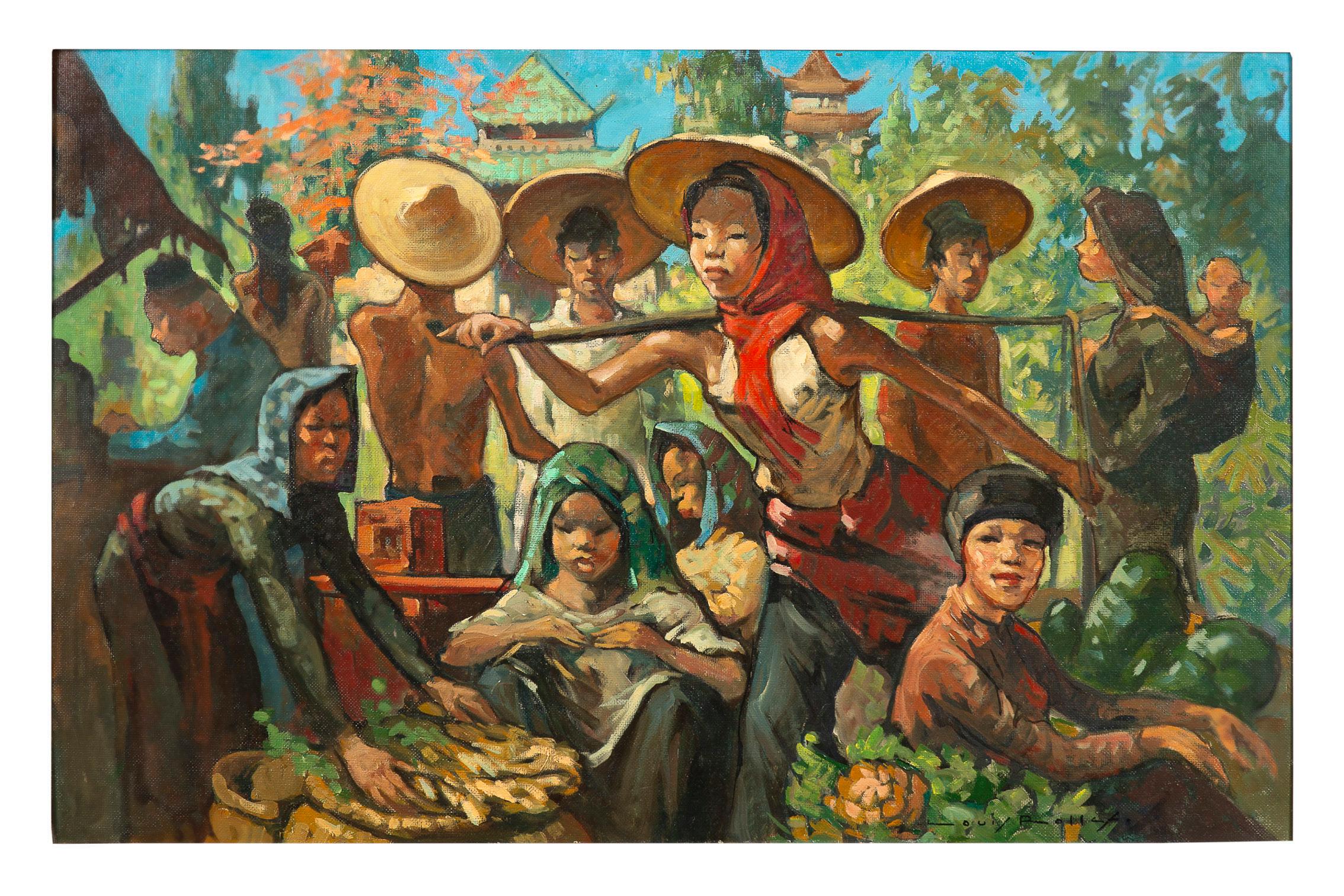
LOUIS ROLLET (1895-1988)
Scène de marché
Huile sur isorel, signée en bas à droite
64,9 x 99,5 cm - 25 3/8 x 39 ¼ in
Oil on isorel, signed lower right
8 000 - 12 000 €
PROVENANCE
Collection particulière de la famille de l’artiste
Collection particulière, Centre de la France (acquis auprès du précédent propriétaire en 2000)
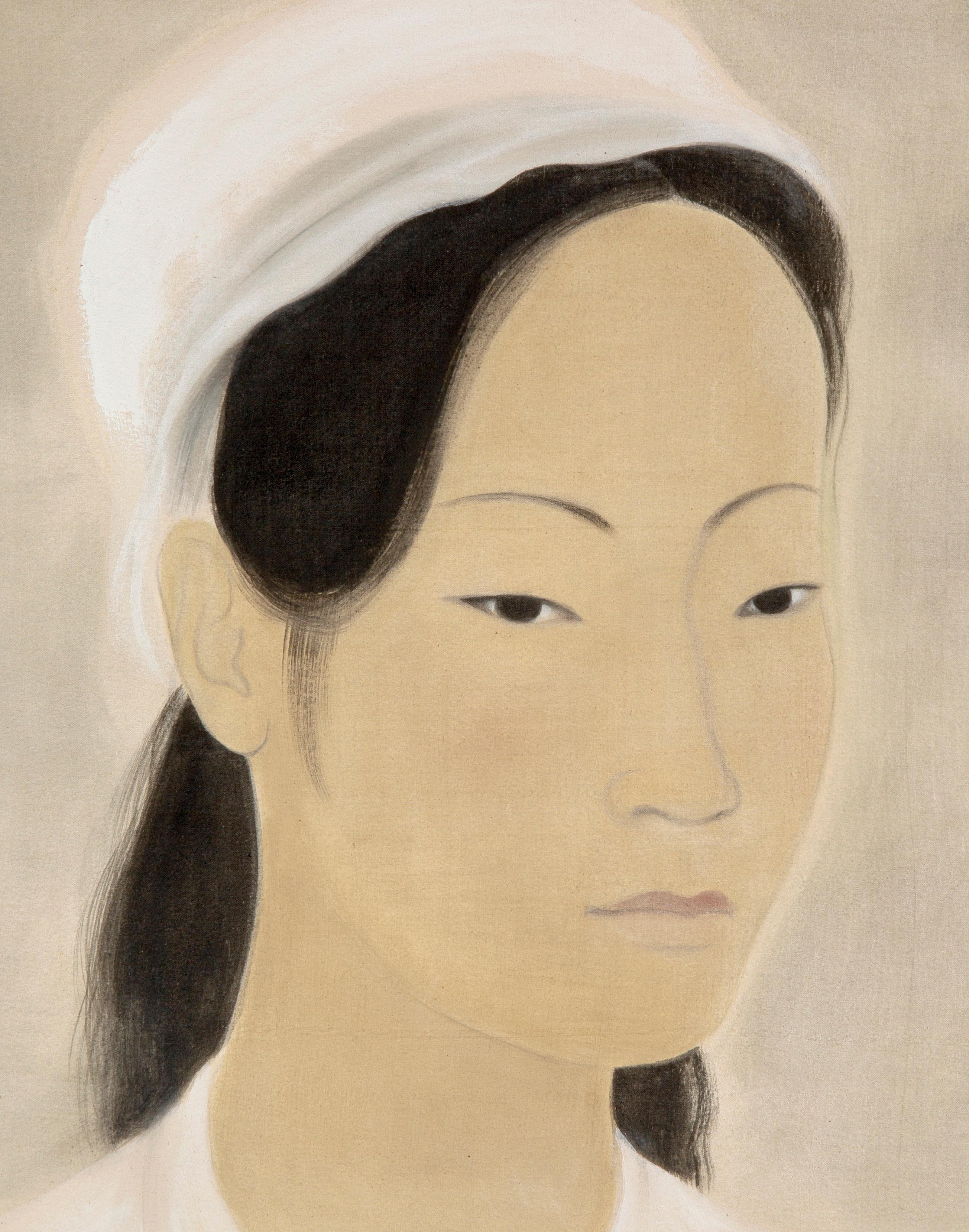
Par Yannick Vũ, sa fille
La présentation de ce portrait Jeune femme à la robe blanche est pour moi l’occasion d’évoquer des souvenirs émouvants, car il renvoie incontestablement à l’histoire de ma famille paternelle. Très expressif, il est réalisé au moment de ma propre naissance. Les éléments que je livre ici proviennent de notes biographiques de mon pè re Vũ Cao Đàm prises lors d’un séjour en novembre 1999 et complétées par des conversations téléphoniques, ainsi que d’autres propos de son frère Vũ Công Thuyết et de ma cousine Anna. Mon père était très proche de sa sœur Vũ Thị Thục (1906 - 1994) et, lorsque la fille aînée de celle-ci, Nguyễn Thị Kim Ngân, dite Anna, se rendit en France avec son mari et leurs deux filles, mon père décida d’habiter à Béziers avec eux. C’est ainsi qu’à partir de fin 1949, il peignit de nombreuses Maternité et Jeunes femmes qui ressemblaient beaucoup à ses nièces. Ce portrait antérieur pourrait avoir été inspiré par la sœur d’Anna, Nguyễn Thị Kim Thoa, Catherine. Son vêtement indique qu’elle porte le deuil d’un proche, ce qui est alors fréquent dans ces familles nombreuses. En effet, au cours de ses 53 années de vie, ma grand-mère eut quatorze enfants, dont neuf seulement atteignirent l’âge adulte. Ma grand-mère est décrite par mon père et sa cousine comme une femme très intelligente,
bien qu’elle n’ait jamais été scolarisée. Elle était aussi très charitable : elle habillait les nécessiteux et leur donnait de quoi subsister. Avant son mariage, elle tenait un commerce de céréales, puis elle s’est consacrée au commerce du riz. D’après le mémoire de mon oncle Vũ Công Thuyết , la famille Vũ est originaire du village de Trịnh Xuyên (aujourd’hui Liên Bãi), district de Vụ Bản , province de Nam Định . Dès sa tendre enfance, mon grand-père apprit à lire les caractères chinois et également le français si bien qu’il eut l’occasion de se rendre à l’exposition universelle de Paris en 1889. Mes grands-parents ont ensuite déménagé à plusieurs reprises à Hanoï (rue Hàn Cót, puis rue Hàng Mành), avant de nous installer définitivement en 1922 dans une grande maison au 108 route de Huế. La famille a également vécu un temps dans la province de Thái Bình entre 1923 et 1929.
Lorsque mon grand-père a décidé de s’installer au centre de Hanoï, ma grand-mère a exigé que la maison soit située le plus près possible de la cathédrale (Phố Ngô). Ils ont ainsi acheté un terrain rue de la Porte des Briques, près du marché du riz (Chợ Gạo), où ils ont construit deux maisons successives, dont la dernière fut achevée à la naissance de mon père Vũ Cao Đàm. Ma cousine Anna, se souvient d’avoir visité sa grand-mère rue
de la porte des Briques et que cette dernière l’a reçue allongée sur un lit-bas sculpté, très élégante, vêtue d’une tunique de velours violet et chargée de bijoux.
Mon père décrit la maison paternelle comme une construction en brique et tuiles de style traditionnel dont une grande partie servait à stocker le riz. Toutes les femmes faisaient la cuisine et ma grand-mère qui avait une machine à coudre, habillait tout le monde. Au milieu de la cour se trouvait un bassin avec des poissons rouges, quelques ruches pour le miel, quelques pigeonniers pour les œufs. Il y avait, bien sûr, les petits chiens chinois très intelligents de ma grand-mère qui ressemblaient à des loups miniatures, et ses chats gracieux au poil très court. Quelques arbres donnaient de l’ombre fraîche à ce lieu de réunion. Dans une autre cour ou plutôt un petit jardin clos de murs, on pouvait aussi rencontrer des poules, des canards et même des oies.
C’est avec beaucoup d’émotion que mon père Vũ Cao Đàm me parlait de son pays auquel il était si attaché. Par ce portrait d’une beauté pure au caractère affirmé, il rend hommage non seulement aux femmes de sa famille mais également à toutes les femmes vietnamiennes.
Yannick Vũ, fille du peintre, propos recueillis le 27 mars 2026
Việc giới thiệu bức chân dung Thiếu nữ mặc váy
trắng đối với tôi là dịp để nhớ về những kỷ niệm
đầy xúc cảm. Thật vậy, tác phẩm này gắn liền với
lịch sử gia đình bên nội của tôi. Giàu sức biểu
cảm, bức chân dung được thực hiện đúng vào thời điểm tôi chào đời.
Những tư liệu tôi trình bày ở đây xuất phát từ các ghi chép tiểu sử của cha tôi, họa sĩ Vũ Cao Đàm, được thực hiện trong một chuyến đi vào tháng 11 năm 1999 và được bổ sung qua các cuộc gọi điện thoại, cũng như từ những lời kể của em trai ông, Vũ Công Thuyết, và của chị họ tôi, Anna. Cha tôi rất gần gũi với chị gái của ông, bà Vũ Thị Thục (1906–1994), và khi con gái cả của bà, Nguyễn Thị Kim Ngân, thường gọi là Anna, sang Pháp cùng chồng và hai con gái, cha tôi đã quyết định chuyển đến sống tại Béziers cùng họ. Chính vì vậy, từ cuối năm 1949, ông đã vẽ nhiều tác phẩm Maternité (Tình mẫu tử) và Jeunes femmes (Thiếu nữ) có nhiều nét tương đồng với các cô cháu gái của ông.
Bức chân dung được vẽ ở giai đoạn sớm hơn này có lẽ đã được lấy cảm hứng từ em gái của Anna, Nguyễn Thị Kim Thoa, tên Pháp là Catherine. Trang phục mang trên người cho thấy cô đang để tang một người thân, điều thường gặp trong những gia đình đông con khi đó. Trên thực tế, trong suốt 53 năm cuộc đời, bà nội tôi đã sinh mười bốn người con, nhưng chỉ có chín người sống đến tuổi trưởng thành.
« Qua bức chân dung mang vẻ đẹp thuần khiết mà vẫn cá tính
này, ông không chỉ tôn vinh những người
phụ nữ trong gia đình mình,
mà
còn
tôn
vinh tất cả phụ nữ Việt Nam. »
Bà nội tôi được cha tôi và chị họ của ông miêu tả là một người phụ nữ rất thông minh, dù chưa từng được đi học. Bà cũng là người giàu lòng nhân ái: bà thường giúp người nghèo có cái ăn cái mặc. Trước khi kết hôn, bà buôn bán ngũ cốc, sau đó chuyển sang kinh doanh gạo.
Theo hồi ký của chú tôi, Vũ Công Thuyết, gia đình họ Vũ có nguồn gốc từ làng Trịnh Xuyên, nay là Liên Bãi, huyện Vụ Bản, tỉnh Nam Định. Ngay từ thuở nhỏ, ông nội tôi đã học đọc chữ Hán, đồng thời học cả tiếng Pháp. Ông giỏi tiếng pháp đến mức đã giành được cơ hội đến dự Triển lãm Quốc tế tại Paris năm 1889. Sau đó, ông bà nội tôi đã nhiều lần chuyển nhà tại Hà Nội, từ phố Hàng
Cót, rồi đến phố Hàng Mành, trước khi chuyển hẳn đến một ngôi nhà lớn tại số 108 phố Huế vào năm 1922. Gia đình tôi cũng từng có một thời gian sống ở tỉnh Thái Bình từ năm 1923 đến năm 1929.
Khi ông nội tôi quyết định định cư tại trung tâm Hà Nội, bà nội tôi yêu cầu ngôi nhà phải nằm càng gần nhà thờ Lớn càng tốt (phố Ngô). Vì thế, ông bà đã mua một mảnh đất trên phố Porte des Briques, gần chợ Gạo, nơi họ lần lượt xây dựng hai ngôi nhà, trong đó ngôi nhà sau cùng được hoàn thành vào thời điểm cha tôi, Vũ Cao Đàm, chào đời. Chị họ tôi, Anna, nhớ lại từng đến thăm bà ngoại ở phố Porte des Briques; khi ấy, bà nằm trên chiếc sập gỗ chạm trổ, mặc chiếc áo dài nhung tím và đeo nhiều trang sức, trông rất thanh lịch.
Cha tôi miêu tả ngôi nhà bên nội là một công trình bằng gạch và ngói theo phong cách truyền thống, trong đó một phần lớn được dùng để chứa gạo. Tất cả phụ nữ trong nhà đều nấu nướng, còn bà nội tôi may quần áo cho mọi người bằng chiếc máy khâu của bà. Giữa sân có một hồ nước nuôi cá vàng, vài tổ ong lấy mật, vài chuồng bồ câu để lấy trứng. Tất nhiên phải kể đến những chú chó giống Trung Quốc nhỏ bé và rất thông minh của bà nội tôi, trông chúng giống như những con sói nhỏ; cùng những chú mèo lông ngắn duyên dáng. Một vài cây xanh tỏa bóng mát xuống nơi sum họp của cả gia đình. Ở một góc sân khác, hay đúng hơn là một khu vườn nhỏ có tường bao quanh, còn có cả đàn gà, đàn vịt, thậm chí là cả ngỗng.
Với rất nhiều xúc cảm, cha tôi, Vũ Cao Đàm, đã kể cho tôi nghe về quê hương mà ông vô cùng gắn bó. Qua bức chân dung mang vẻ đẹp thuần khiết mà vẫn cá tính này, ông không chỉ tôn vinh những người phụ nữ trong gia đình mình, mà còn tôn vinh tất cả phụ nữ Việt Nam.
Yannick Vũ, con gái họa sĩ, lời kể được ghi lại ngày 27 tháng 3 năm 2026
‘‘Through this portrait of pure beauty and strong character, he pays tribute not only to the women of his family but also to all Vietnamese women.’’
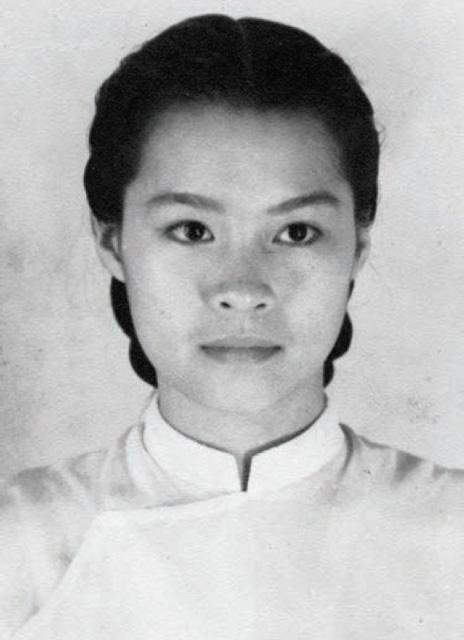
The presentation of this portrait, Jeune femme à la robe blanche, gives me the opportunity to recall some poignant memories, as it undeniably evokes the history of my father’s family. This highly expressive work was created around the time of my own birth.
The information I am sharing here comes from biographical notes on my father, Vũ Cao Đàm, taken during a visit in November 1999 and supplemented by telephone conversations, as well as additional accounts from his brother, Vũ Công T huyết, and my cousin Anna.
My father was very close to his sister Vũ Thị Thục (1906–1994), and when her eldest daughter, Nguyễn Thị Kim Ngân, known as Anna, moved to France with her husband and their two daughters, my father decided to live in Béziers with them. Thus, beginning in late 1949, he painted numerous paintings of Maternité and Jeunes femmes that bore a strong resemblance to his nieces.
This earlier portrait may have been inspired by Anna’s sister, Nguyễn Thị Kim Thoa, Catherine. Her clothing indicates that she is in mourning for a loved one, which was common in such large families at the time. Indeed, during her 53 years of life, my grandmother had fourteen children, only nine of whom reached adulthood.
My grandmother is described by my father and his cousin as a very intelligent woman, even though she never attended school. She was also very charitable: she clothed the needy and gave them enough to live on. Before her marriage, she ran a grain business, and later she devoted herself to the rice trade.
According to my uncle V ũ Công T huyết’s memoir, the V ũ family originated from the village of Trịnh Xuyên (now Liên Bãi), in Vụ Bản District, Nam Định Province. From a very young age, my grandfather learned to read Chinese characters as well as French, which enabled him to attend the World’s Fair in Paris in 1889. My grandparents then moved several times within Hanoi (first to Hàn Cót Street, then to Hàng Mành Street), before settling permanently in 1922 in a large house at 108 Huế Road. The family also lived for a time in Thái Bình Province between 1923 and 1929.
When my grandfather decided to settle in central Hanoi, my grandmother insisted that the house be located as close as possible to the cathedral (Phố Ngô). They thus purchased a plot of land on Brick Gate Street, near the Rice Market (Chợ Gạo), where they built two successive houses, the last of which was completed upon the birth of my father, Vũ Cao Đàm. My cousin Anna remembers visiting her grandmother on Brick
Gate Street and that her grandmother received her while lying on a low, carved bed, looking very elegant, dressed in a purple velvet tunic and adorned with jewelry.
My father describes our family home as a traditional-style brick-and-tile building, much of which was used to store rice. All the women did the cooking, and my grandmother, who had a sewing machine, made clothes for everyone. In the middle of the courtyard was a pond with goldfish, a few beehives for honey, and a few dovecotes for eggs. There were, of course, my grandmother’s very intelligent little Chinese dogs, which looked like miniature wolves, and her graceful cats with very short fur. A few trees provided cool shade for this gathering place. In another courtyard – or rather, a small walled garden – one could also find chickens, ducks, and even geese.
It was with great emotion that my father, Vũ Cao Đàm, spoke to me of his country, to which he was so deeply attached. Through this portrait of pure beauty and strong character, he pays tribute not only to the women of his family but also to all Vietnamese women.
Yannick Vũ, the painter’s daughter, interviewed on March 27, 2026
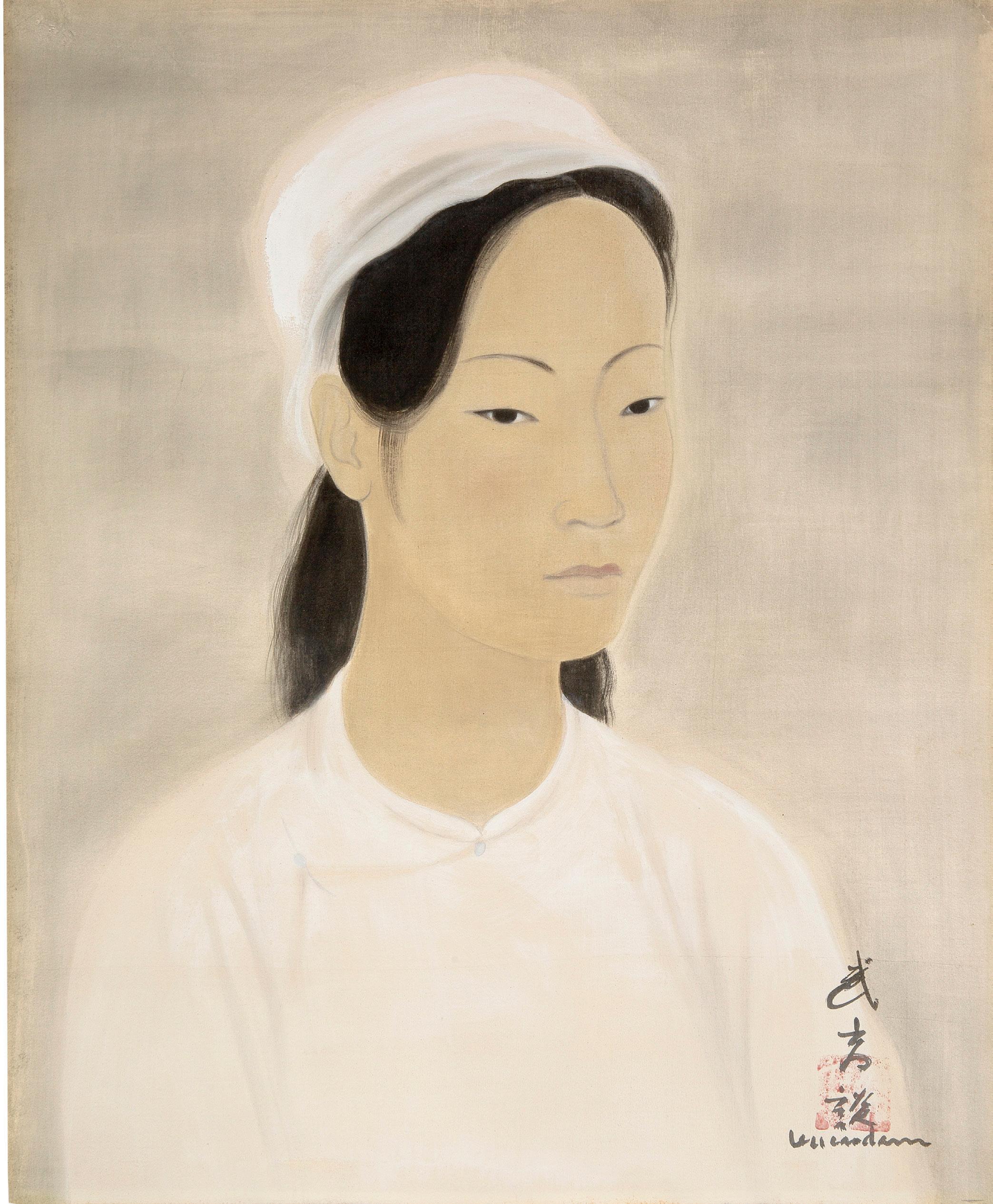
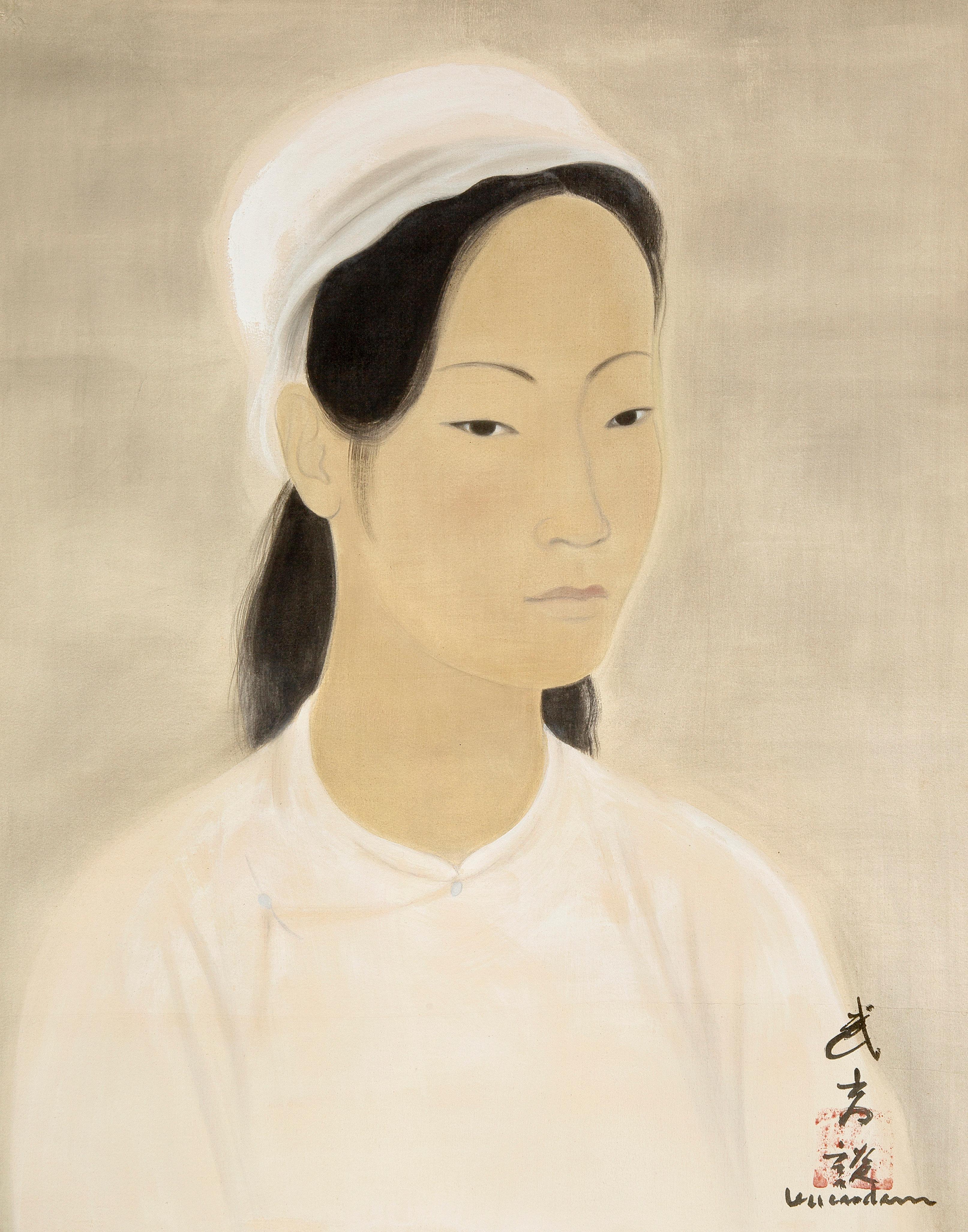
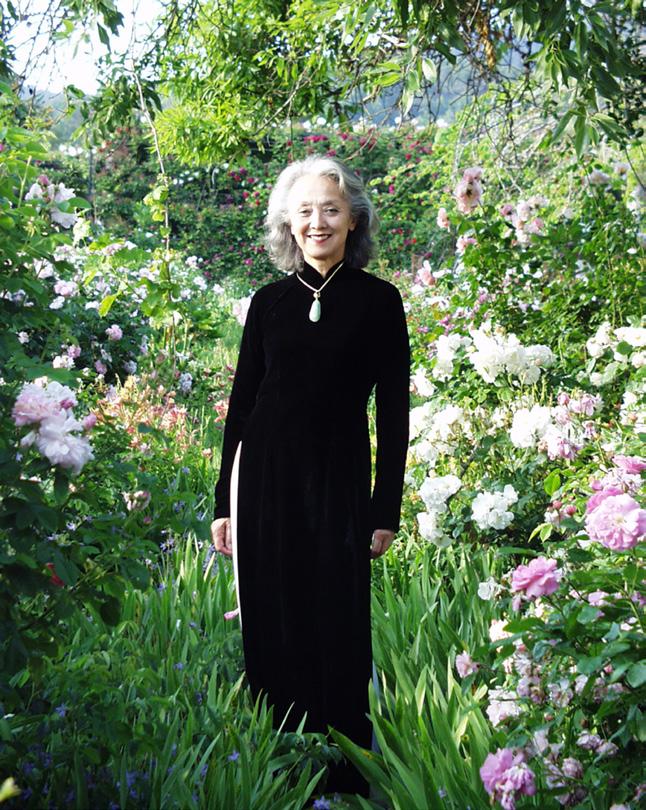
VŨ CAO ĐÀM (1908-2000)
Jeune femme à la robe blanche, circa 1941-1943
Encre et couleurs sur soie, signée en bas à droite
55 x 45 cm - 21 5/8 x 17 ¾ in
Ink and color on silk, signed in lower right
400 000 - 600 000 €
Une attestation d’inclusion au catalogue raisonné de l’artiste actuellement en cours de préparation par Charlotte Aguttes-Reynier pour l’association des Artistes d’Asie à Paris sera remise à l’acquéreur.
PROVENANCE
Collection particulière, Ouest de la France
Vente Rossini S.A, Drouot, Paris, 8 décembre 2020, lot n°70
Importante collection particulière d’art moderne vietnamien, Paris (acquis à la vente précédente)
BIBLIOGRAPHIE
Yannick Vu, Vu Cao Dam , Gent, Graphius NV, 2024, repr. p. 186-187
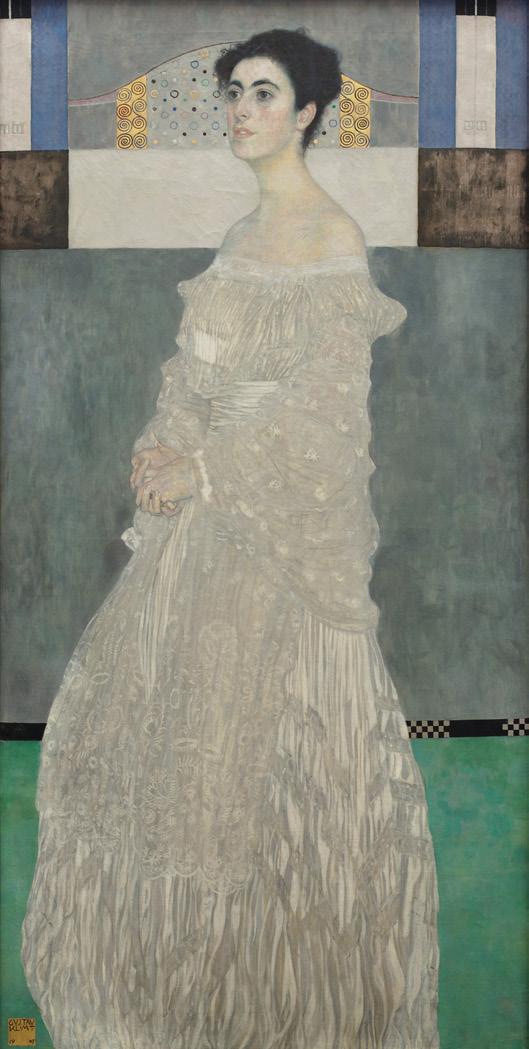

œuvres en rapport
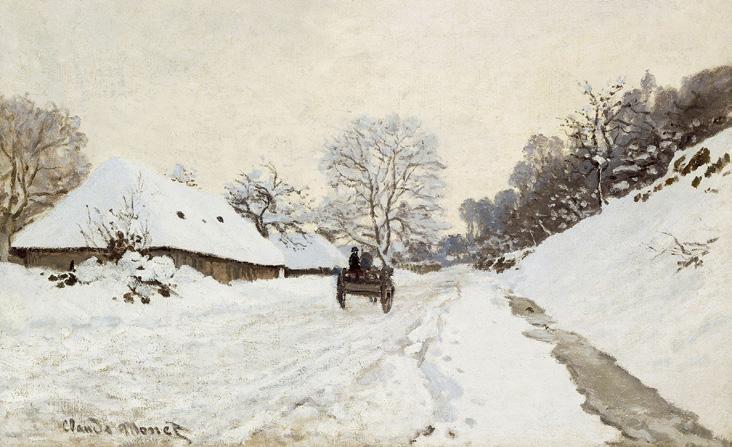
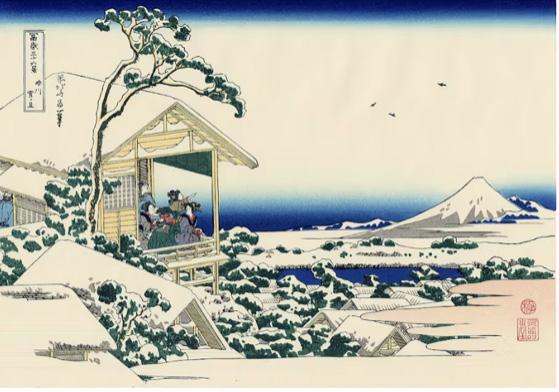
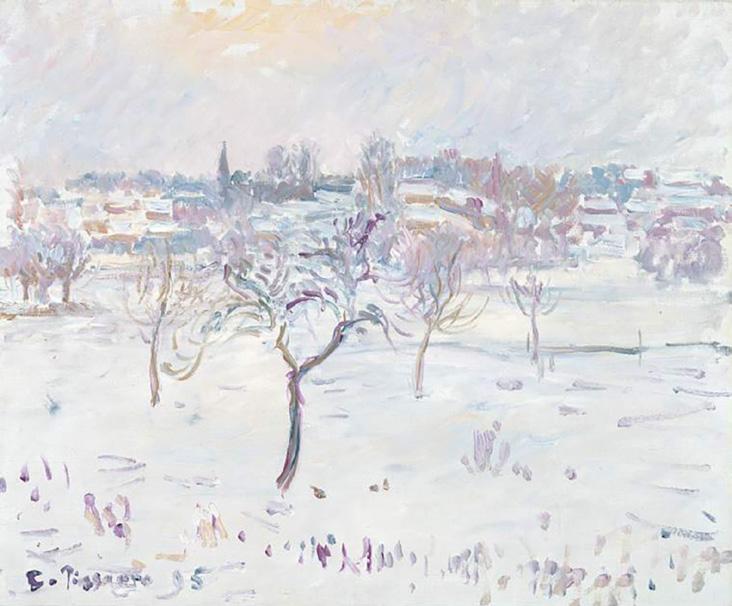
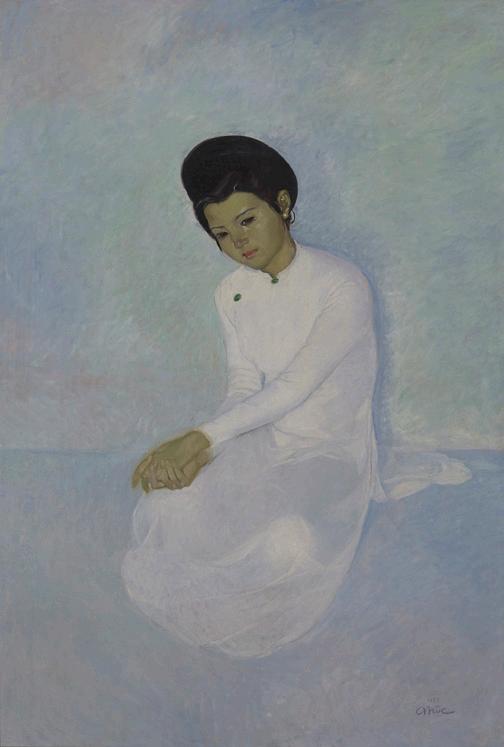
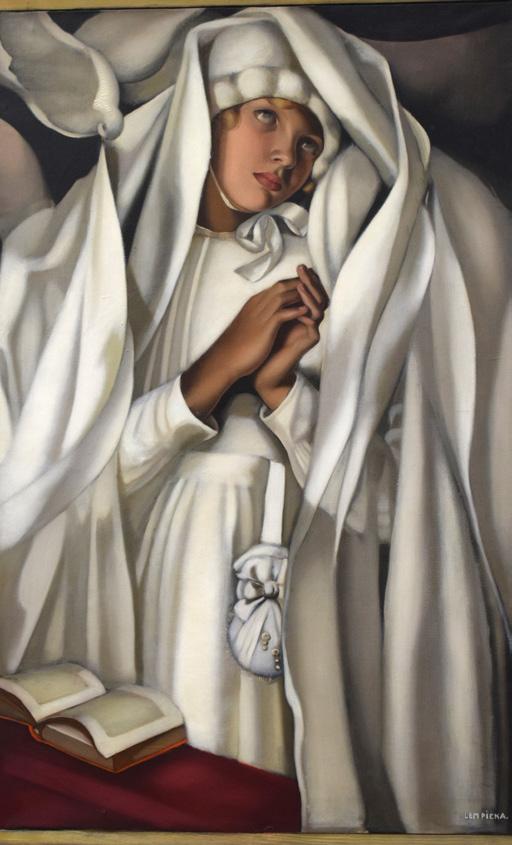
Il.1 Gustav Klimt, Portrait de Margarethe Stonborough-Wittgenstein , 1905 © Neue Pinakothek, München - Ill.2 Kasimir Malevitch, Carré blanc sur fond blanc, 1918 © 2026 The Museum of Modern Art - Il.3 Claude Monet, La Charrette Route sous la neige à Honfleur, vers 1867 © Musée d'Orsay, Dist. RMN-Grand Palais / P. Schmidt - Il.4 Katsushika Hokusai, Koishikawa yuki no tan , série des trente-six vues du mont Fuji © Rijksmuseum, 2026 - Il.5 Camille Pissarro, Paysage enneigé à Eragny avec un pommier (détail),1895 © 2026 The University of Cambridge - Ill.6 Trần Bình Lộc Portrait d'une élégante, 1937 © Museum PasifikaIl.7 Tamara de Lempicka, La Communiante, 1929. Centre Pompidou © Tamara de Lempicka Estate, LLC / Adagp, Paris.
Le blanc ne laisse pas indifférent et son traitement par les artistes a été, de tous temps, l’occasion de faire preuve de virtuosité picturale. Qu’il évoque le bruit sourd d’une journée enneigée telles celles de Monet, Pissarro ou Hokusai, qu’il rende hommage à la pureté du teint d’une élégante au vêtement immaculé avec Klimt ou Lempicka, ou qu’il provoque une révolution artistique avec Malévitch, le blanc présente quelques nuances que nombre d’artistes sondent dans leurs moindres subtilités.
Sans être réellement une couleur mais plutôt une nuance dans le cercle chromatique, le traitement du blanc et de sa matière permet au peintre d’évoluer d’un blanc chaud, presque ocre, à un autre plus froid et légèrement bleuté, et de présenter un éclatant jeu de lumière tout en contraste.
Avec Jeune femme à la robe blanche , circa 1941-1943, Vũ Cao Đàm réussit avec brio cet exercice délicat. Arrivé en France en 1931, et étudiant de l’École du Louvre en 1936-1937,
il continue tout au long de sa carrière à intégrer l’ensemble principes académiques de la peinture occidentale. Le peintre vietnamien fait ici le choix d’une composition, volontairement épurée, pour mettre en lumière la dignité et la sobriété de son modèle, probablement inspiré de sa propre nièce, Nguyễn Thị Kim Hòa (Yannick Vu, op.cit., p. 186).
Vũ Cao Đàm accorde une place centrale au portrait, considéré comme l’un des genres majeurs depuis la classification établie par l’Académie
royale de peinture et de sculpture en 1668. S’appuyant sur une iconographie héritée de la Renaissance italienne, il représente une figure féminine vietnamienne idéalisée, conforme aux canons de beauté asiatiques : teint ivoirin, cheveux d’un noir profond, visage aux traits doux, empreints de retenue et de sensibilité.
La jeune femme est vêtue d’un áo dài blanc et coiffée du khăn tang , cette coiffe constituée d’un long tissu blanc portée au Vietnam lors des funérailles familiales. Au moyen de ce subtil camaïeu de blancs et de gris, la figure se dessine avec finesse, faisant naître des contrastes entre l’intensité des cheveux et du regard avec la douceur du visage, dont l’élégance est renforcée par la solennité de son habit. Elle s’inscrit dans une lignée d’œuvres majeures de la peinture moderne vietnamienne, à l’instar de La Femme du Mandarin de Lê Phổ ou du Portrait d’une élégante de Trần Bình
Lộc, où le blanc devient à lui seul un véritable langage pictural pour évoquer des figures féminines empreintes de raffinement.
Màu trắng chẳng để lòng ai thờ ơ, và cách xử lý màu trắng trong tay người nghệ sĩ, qua mọi thời đại, là dịp để thể hiện tài hoa hội họa bậc thầy.
Dù là gợi lên tiếng vọng trầm đục của một ngày
tuyết phủ như ở Monet, Pissarro hay Hokusai, dù là tôn vinh sự tinh khiết của làn da một giai
nhân trong y phục trắng tinh như ở Klimt hay
Lempicka, hay dù là tạo nên một cuộc cách mạng nghệ thuật như ở Malevich, màu trắng mang những sắc thái mà biết bao nghệ sĩ thăm dò đến tận những tinh tế tinh vi nhất. Không thực sự là một màu sắc mà đúng hơn là một sắc thái trong vòng màu sắc, cách xử lý màu trắng và chất sơn của nó cho phép người họa sĩ chuyển dần từ một sắc trắng ấm, gần như thổ hoàng, sang một sắc trắng lạnh hơn và phảng phất màu xanh, đồng thời phô bày một vũ điệu ánh sáng rực rỡ, đầy chất tương phản. Với tác phẩm Jeune femme à la robe blanche (Thiếu nữ áo trắng), vào khoảng những năm 1941-1943, Vũ Cao Đàm đã hoàn thành một cách tài hoa thử thách tinh tế này. Đến Pháp năm 1931 và là học viên của École du Louvre trong hai năm 1936-1937, ông tiếp tục, trong suốt sự nghiệp của minh, lồng ghép toàn bộ các nguyên tắc hàn lâm của hội họa phương Tây. Người họa sĩ Việt Nam chủ động lựa chọn một bố cục tinh giản, nhằm làm nổi bật phẩm giá và vẻ thanh thoát của người mẫu, có lẽ được lấy cảm hứng từ chính cháu gái ruột của ông, Nguyễn Thị Kim Hòa (Yannick Vu, op.cit., tr. 186).
Vũ Cao Đàm dành vị trí trung tâm cho thể loại chân dung, được coi là một trong những thể loại quan trọng kể từ hệ thống phân loại do Académie
royale de peinture et de sculpture thiết lập năm 1668. Kế thừa ngôn ngữ biểu tượng của truyền thống Phục Hưng Ý, ông khắc họa một hình tượng người phụ nữ Việt Nam được lý tưởng hóa, thuận theo quy phạm cái đẹp châu Á : làn da trắng ngà, mái tóc đen huyền, khuôn mặt nét dịu, đượm vẻ kín đáo và chiều sâu cảm xúc. Thiếu nữ mặc áo dài trắng và đội khăn tang – chiếc khăn đội đầu được làm từ một dải vải trắng dài, đội trong các tang lễ gia đình ở Việt Nam. Qua dải màu đơn sắc tinh tế giữa trắng và xám, hình tượng dần hiện ra với những đường nét tinh vi, làm nảy sinh những tương phản giữa chiều sâu của mái tóc huyền và ánh mắt với vẻ dịu dàng của khuôn mặt, nét đài các được tôn lên bởi vẻ trang nghiêm của y phục. Bức tranh hòa vào dòng chảy những kiệt tác lớn của hội họa hiện đại Việt Nam, cũng như La Femme du Mandarin của Lê Phổ hay Portrait d’une élégante (Chân dung một giai nhân) của Trần Bình Lộc, nơi chỉ riêng màu trắng đã trở thành một ngôn ngữ hội họa đích thực để gợi lên những hình tượng phụ nữ đượm chất thanh tao.
White never fails to make an impression, and artists have always used it as an opportunity to demonstrate their painterly virtuosity. Whether it evokes the muffled sound of a snowy day, as in the works of Monet, Pissarro, or Hokusai ; pays homage to the purity of an elegant woman’s complexion in immaculate attire, as with Klimt or Lempicka ; or sparks an artistic revolution, as with Malevich, white offers nuances that many artists explore in their finest subtleties.
Without being a true color but rather a shade on the color wheel, the treatment of white and its texture allows the painter to shift from a
warm, almost ochre white to a cooler, slightly bluish one, and to present a striking play of light full of contrast. With Jeune femme à la robe blanche, circa 1941-1943, Vu Cao Dam brilliantly succeeds in this delicate exercise. Having arrived in France in 1931 and studied at the École du Louvre in 1936–1937, he continued throughout his career to incorporate the full range of academic principles of Western painting. Here, the Vietnamese painter opts for a deliberately minimalist composition to highlight the dignity and restraint of his model, likely inspired by his own niece, Nguyễn Thị Kim Hòa (Yannick Vu, op. cit., p. 186).
Vũ Cao Đàm places a central emphasis on portraiture, which has been considered one of the major genres since the classification established by the Royal Academy of Painting and Sculpture in 1668. Drawing on iconography inherited from the Italian Renaissance, he depicts an idealized Vietnamese female figure, conforming to Asian standards of beauty: ivorytoned skin, deep black hair, and a face with soft features, marked by restraint and sensitivity. The young woman is dressed in a white áo dài and wears a khăn tang, a headdress made of a long white cloth worn in Vietnam during family funerals. Through this subtle monochrome of whites and grays, the figure is rendered with finesse, creating contrasts between the intensity of the hair and the gaze and the softness of the face, whose elegance is enhanced by the solemnity of her attire. It follows in the tradition of major works of modern Vietnamese painting, such as Lê Phổ’s La Femme du Mandarin or Trần Bình Lộc’s Portrait d’une élégante, where white alone becomes a true pictorial language to evoke feminine figures imbued with refinement.
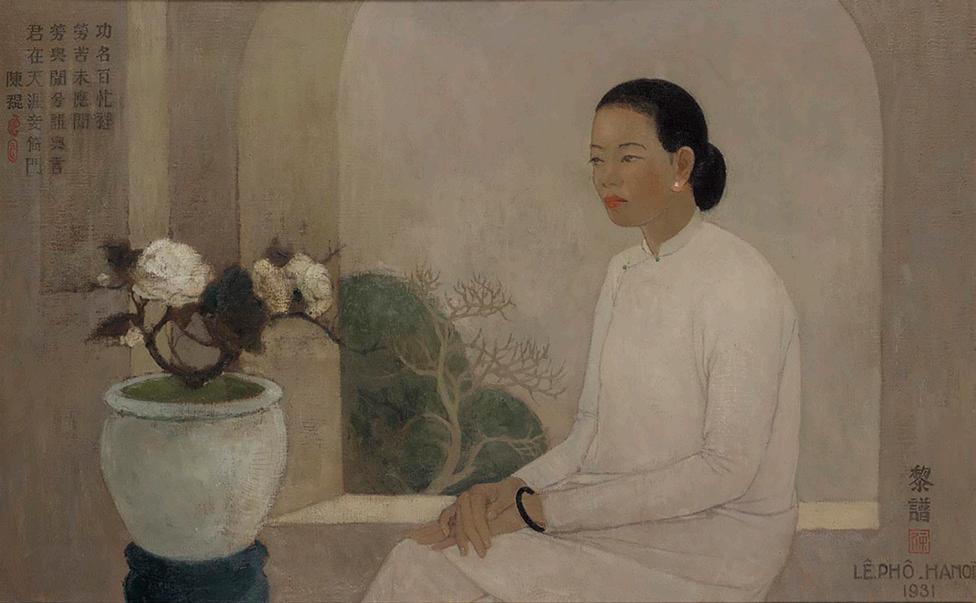
Lê Văn Đệ, artiste venant de la province de Bến Tre, sort diplômé major ex-aequo de la première promotion de l’École des beaux-arts d’Indochine en 1930.
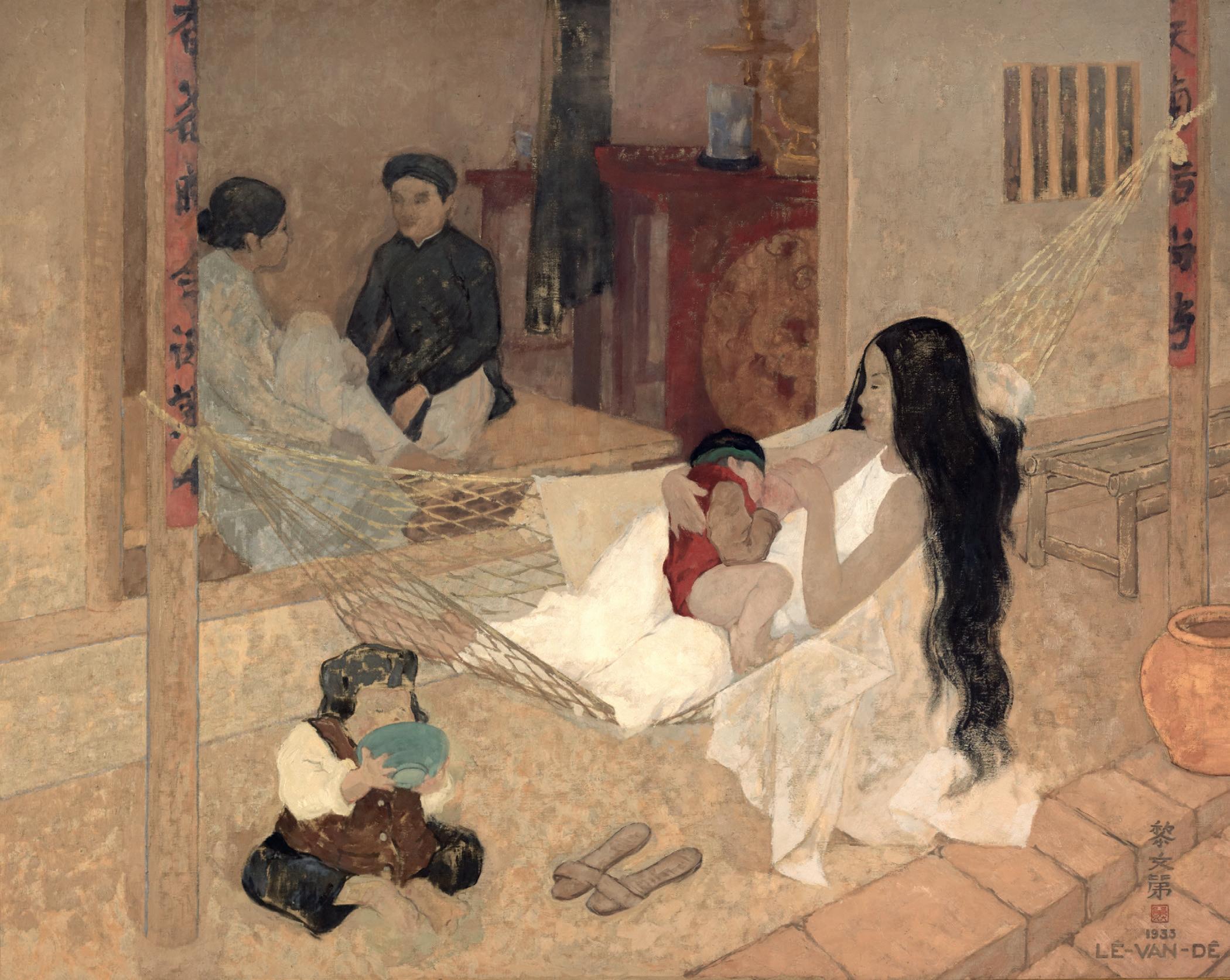
Boursier de la S.A.M.I.P.I.C., il rejoint la France à la fin de l’année 1931, alors que l’Exposition coloniale installée à Vincennes s’achève. Il intègre les beaux-arts de Paris où il devient l’élève de Jean-Pierre Laurens (1875 - 1932). Dès 1933, ses œuvres sont admises à la salle d’honneur du Salon des artistes français ; sa présence y est remarquée par le président de la République et le ministre Albert Sarrault. L’État français acquiert l’année suivante, à la suite des expositions de Paris, de Milan puis de Naples, sa toile monumentale L’Intérieur familial au Tonkin, ou En famille, 1933, aujourd’hui exposée au musée des Années 30 à Boulogne-Billancourt.
« Cher Maître, Il y a 2 mois que je suis en Italie. Je viens d’arriver il y a une quinzaine à Rome ; Il fait un temps superbe à Rome… La ville éternelle apparaît à mes yeux avec toute sa splendeur… Les fresques, les primitifs, les terres cuites m’intéressent le plus. Je crois que je n’aurais jamais le temps suffisant pour… Et j’ai encore la Grèce, l’Algérie, la Tunisie et l’Espagne à visiter. A bientôt cher maître (…). Rome 29-1-33 Le Van De1 » Les fresques… nous y voilà.
Subjugué, Lê Văn Đệ n’ira pas au-delà de cette Italie qui l’inspire tant. L’artiste expose régulièrement. Ébloui par les fresques italiennes qu’il vient de découvrir, il s’essaie à des travaux sur éternit, dans une recherche novatrice qui remporte un beau succès lors des expositions qu’il donne alors à Naples et à Milan.
« …le peintre annamite Le Van De a exposé du 10 au 25 mars un certain nombre de tableaux à la Galerie Pesaro la plus importante de Milan (…). Cette exposition (…) comporte trois catégories d’ouvrages : des peintures à l’huile, des peintures sur éternit, des xylographies, aquarelles et dessins (…). L’idée des peintures sur éternit a été inspirée à M. Le Van De par la vue des fresques italiennes. Les portraits qu’il a réalisés d’après ce procédé ont été très appréciés (…). L’Exposition Le Van De a été très visitée et le jeune peintre annamite a vendu une douzaine de ses œuvres, ce qui est beaucoup par les temps actuels2 » Lê Văn Đệ se met au service Vatican qui lui commande le décor des salles d’Asie et d’Australie de l’Exposition internationale de la presse catholique de 1936. Baptisé par Monseigneur Celso Constantini, il choisit le prénom « Celso-Léon » et devient le premier artiste vietnamien reçu par le pape.
Victor Tardieu écrit à son sujet : « Il a passé deux années en Italie où il a obtenu de grands succès et les lettres ci-jointes de M. le Consul général de France à Milan adressées en date du 29 mars et du 4 avril 1934 à M. le Ministre des Affaires étrangères à Paris et à M. le Gouverneur Général de l’Indochine au sujet de l’exposition particulière de ses œuvres à la galerie Pesaro [...] montrent nettement l’intérêt que l’Art de Le Van De a suscité en Italie. Il prépare actuellement une exposition à Londres3 »
En 1937, Lê Văn Đệ participe pour le Vatican à l’Exposition internationale des arts et des techniques appliqués à la vie moderne, qui se tient à Paris du 25 mai au 25 novembre. Il obtient,
en 1938, une mention honorable au Salon officiel des Artistes Français et l’Agindo lui offre une rétrospective personnelle rue de la Boétie ; L’artiste rentre en Indochine en 1939. Fidèle aux enseignements de son maître Victor Tardieu, il se consacre alors à la transmission de ce qu’il a reçu et prend en 1954 la direction de l’École des beaux-arts de Saïgon nouvellement fondée.
Lê Văn Đệ, họa sĩ quê tỉnh Bến Tre, tốt nghiệp thủ khoa đồng hạng khóa đầu tiên của Trường Cao đẳng Mỹ thuật Đông Dương năm 1930. Ông được hưởng nhận học bổng của S.A.M.I.P.I.C và sang Pháp vào cuối năm 1931, khi cuộc Đấu xảo Thuộc địa tổ chức tại Vincennes vừa bế mạc. Ông theo học tại École des beaux-arts de Paris, trở thành môn sinh của Jean-Pierre Laurens (1875-1932). Ngay từ năm 1933, tác phẩm của ông đã được chọn vào phòng danh dự của Salon des Artistes Français ; sự hiện diện của ông tại đây được Tổng thống Pháp và Bộ trưởng Albert Sarraut chú ý. Năm sau đó, sau các cuộc trưng bày tại Paris, Milan rồi Naples, Nhà nước Pháp mua lại bức tranh lớn của ông, L’Intérieur familial au Tonkin, ou En famille (Nội thất gia đình ở Bắc Kỳ, hay Trong gia đình), 1933, hiện đang được trưng bày tại musée des Années 30 ở Boulogne-Billancourt.
« Kính thưa Thầy, Con đã ở Ý được 2 tháng. Con vừa đến Rome khoảng hai tuần nay ; thời tiết tuyệt đẹp ở đây… Thành phố vĩnh cửu hiện ra trước mắt con với tất cả vẻ rực rỡ của nó… Những bức bích họa, những bậc họa sĩ tiền Phục Hưng, những tác phẩm đất nung là những gì cuốn hút con nhất. Con nghĩ con sẽ chẳng bao giờ có đủ
1 Dans une carte postale de l’artiste Lê Văn Đệ adressée à Victor Tardieu, directeur de l’École des beaux-arts de l’Indochine à Tonkin, Hanoï, Indochine française, conservée dans le Fonds Victor Tardieu, INHA, espace Jacques Doucet, archives 125/5-9.
2 Dans une lettre de René Dollot, Consul général de France à Milan à Son Excellence le Ministre des Affaires Étrangères, 29 mars 1934, Fonds Victor Tardieu, INHA, espace Jacques Doucet, archives 125/5-9
3 Dans une lettre de Victor Tardieu conservée dans le Fonds Victor Tardieu, INHA, espace Jacques Doucet, archives 125/5-9.
thời gian để… Và con vẫn còn Hy Lạp, Algérie, Tunisie và Tây Ban Nha chờ được khám phá. Hẹn sớm gặp lại Thầy (…). Rome, 29-1-33. Lê Văn Đệ1 » Những bức bích họa…
Đó là điều. Bị chinh phục hoàn toàn, Lê Văn Đệ sẽ không đi xa hơn nước Ý đang cuốn hút ông đến vậy. Người nghệ sĩ thường xuyên tham dự các cuộc trưng bày. Bị mê hoặc bởi những bức bích họa Ý mà ông vừa khám phá, ông thử nghiệm vẽ trên tấm éternit (vật liệu xi măng) – một hướng tìm tòi sáng tạo gặt hái thành công lớn tại các cuộc triển lãm ông tổ chức tại Naples và Milan. « …họa sĩ An Nam Le Van De đã trưng bày từ ngày 10 đến ngày 25 tháng 3 một số tác phẩm tại Galerie Pesaro, phòng tranh quan trọng nhất tại Milan (…). Cuộc triển lãm (…) gồm ba loại tác phẩm : tranh sơn dầu, tranh vẽ trên tấm éternit, tranh khắc gỗ, màu nước và bản vẽ (…). Ý tưởng vẽ trên tấm éternit đã được gợi lên cho ông
Le Van De khi chiêm ngưỡng những bức bích họa Ý. Những bức chân dung ông thực hiện theo kỹ thuật này được đánh giá cao (…). Triển lãm Le
Van De thu hút đông khán giả và người họa sĩ
An Nam trẻ tuổi đã bán được khoảng chục tác phẩm, điều không nhỏ trong bối cảnh hiện nay 2 »
Lê Văn Đệ đặt tài năng phục vụ Tòa thánh Vatican, nơi đặt hàng ông trang trí các phòng
Châu Á và Châu Úc tại Triển lãm Quốc tế Báo chí Công giáo năm 1936. Được rửa tội bởi Đức ông Celso Constantini, ông chọn thánh danh « Celso-Léon » và trở thành người nghệ sĩ Việt Nam đầu tiên được Đức Giáo hoàng tiếp kiến.
Victor Tardieu viết về ông : « Ông đã trải qua
hai năm tại Ý, nơi ông đạt được những thành công lớn, và những bức thư đính kèm đây của ông Tổng Lãnh sự Pháp tại Milan gửi ngày 29 tháng 3 và ngày 4 tháng 4 năm 1934 cho ông Bộ trưởng Bộ Ngoại giao tại Paris và ông Toàn quyền Đông Dương về cuộc triển lãm riêng tác phẩm của ông tại galerie Pesaro [...] cho thấy rõ ràng sự quan tâm mà nghệ thuật của Lê Văn Đệ đã khơi gợi tại Ý. Hiện ông đang chuẩn bị một cuộc triển lãm tại Luân Đôn. »3
Năm 1937, Lê Văn Đệ thay mặt Tòa thánh Vatican tham gia Triển lãm Quốc tế về Nghệ thuật và Kỹ thuật Ứng dụng vào Đời sống Hiện đại, tổ chức tại Paris từ ngày 25 tháng 5 đến ngày 25 tháng 11. Năm 1938, ông được trao bằng khen danh dự tại Salon officiel des Artistes Français, và Agindo dành tặng ông một cuộc hồi cố cá nhân tại đường La Boétie. Người nghệ sĩ trở về Đông Dương năm 1939. Trung thành với di huấn của người thầy Victor Tardieu, ông dành tâm huyết trao truyền những gì ông đã lĩnh hội và năm 1954 đảm nhận chức vụ Giám đốc đầu tiên của Trường Quốc gia Cao đẳng Mỹ thuật Sài Gòn mới thành lập.
Lê Văn Đệ, an artist from Bến Tre Province, graduated at the top of his class (tied for first place) in the first graduating class of the Indochinese School of Fine Arts in 1930.
As a recipient of a S.A.M.I.P.I.C. scholarship, he arrived in France at the end of 1931, just as the Colonial Exhibition in Vincennes was drawing to a close. He enrolled at the École
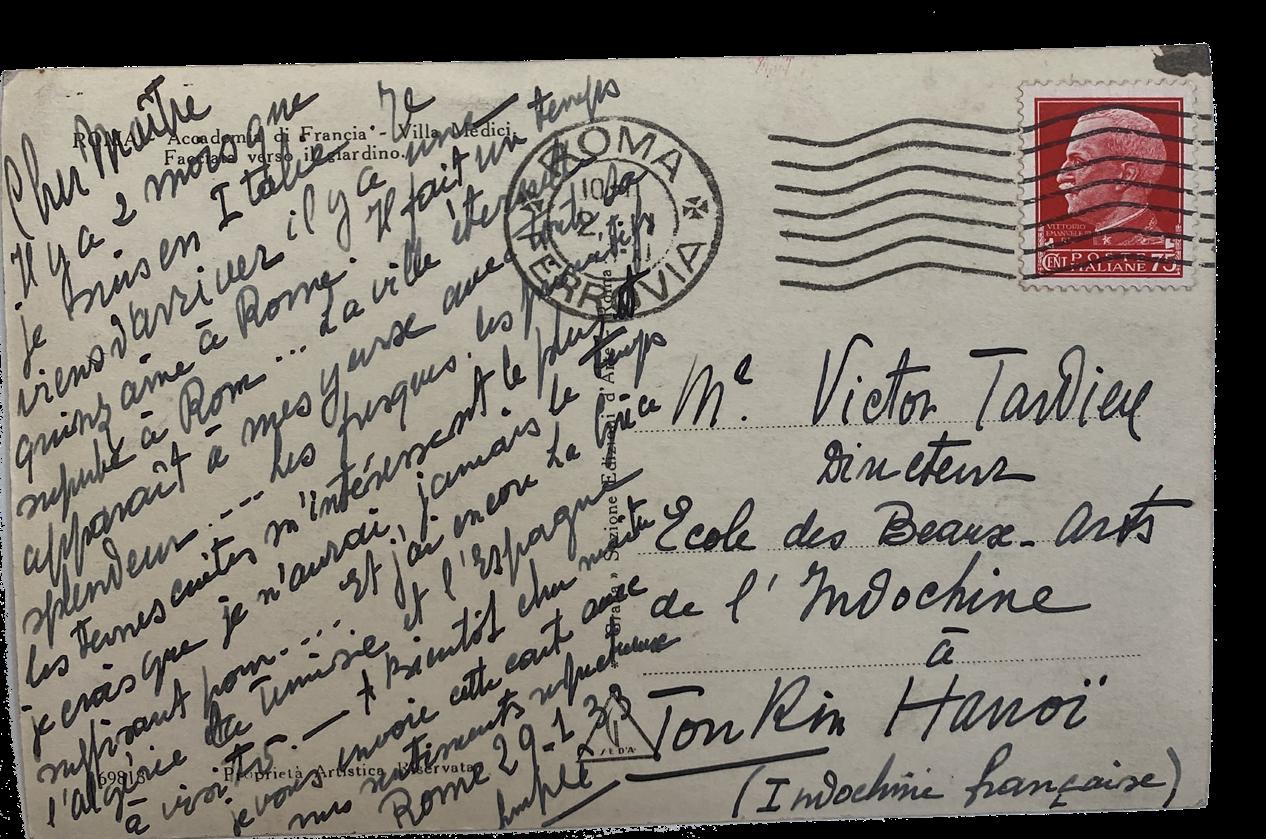
Carte postale de Lê Văn Đề à Victor Tardieu, Rome, 29 janvier 1933 © Fonds Victor Tardieu, INHA Paris
des Beaux-Arts in Paris, where he became a student of Jean-Pierre Laurens (1875-1932). By 1933, his works were admitted to the Hall of Honor at the Salon des Artistes Français; his presence there was noted by the President of the Republic and Minister Albert Sarrault. The following year, following exhibitions in Paris, Milan, and then Naples, the French government acquired his monumental painting L’Intérieur familial au Tonkin, ou En famille (1933), now on display at the Musée des Années 30 in Boulogne-Billancourt.
“Dear Master, I have been in Italy for two months now. I arrived in Rome about a fortnight ago; the weather in Rome is superb… The Eternal City appears before my eyes in all its splendor… The frescoes, the Primitives, and the terracotta works interest me most. I don’t think I’ll ever have enough time to… And I still have Greece, Algeria, Tunisia, and Spain to visit. See you soon, dear master (…). Rome, January 29, 1933, Le Van De” The frescoes… here we are.
Captivated, Lê Văn Đệ will never venture beyond this Italy that inspires him so much. The artist exhibits regularly. Dazzled by the Italian frescoes he had just discovered, he experimented with works on Eternit, in an innovative endeavor that met with great success at the exhibitions he held at the time in Naples and Milan.
“…the Annamite painter Le Van De exhibited a number of paintings from March 10 to 25 at the Pesaro Gallery, the most important in
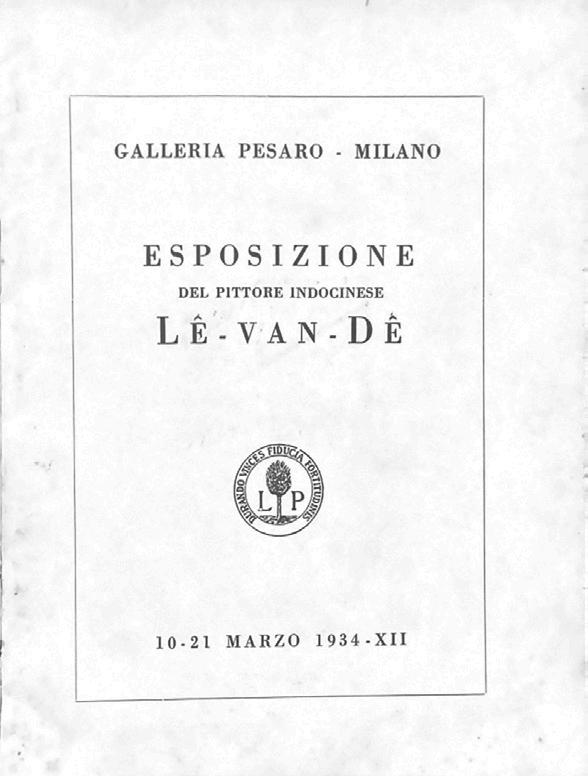
1934, Livret de l’exposition Lê Văn Đệ, Galleria Pesaro, Milan (du 10 au 21 mars), p.16.
œuvre en rapport
Lê Văn Đề. L’Intérieur familial au Tonkin , 1933. A cquis suite aux expositions en Italie. Collection du Centre national des arts plastiques, en dépôt au musée des Années Trente, Boulogne-Billancourt © DR
Milan (…). This exhibition (…) features three categories of works: oil paintings, paintings on Eternit, woodcuts, watercolors, and drawings (…). The idea for the paintings on Eternit was inspired in Mr. Le Van De by the sight of Italian frescoes. The portraits he created using this technique were highly appreciated (…). The Le Van De Exhibition was very well attended, and the young Annamite painter sold a dozen of his works, which is a great deal by today’s standards.”
Lê Văn Đệ entered the service of the Vatican, which commissioned him to decorate the Asia and Australia halls for the 1936 International
Catholic Press Exhibition. Baptized by Monsignor Celso Constantini, he chose the first name “Celso-Léon” and became the first Vietnamese artist to be received by the Pope. Victor Tardieu writes about him: “He spent two years in Italy, where he achieved great success, and the attached letters from the French Consul General in Milan, dated March 29 and April 4, 1934, addressed to the Minister of Foreign Affairs in Paris and the Governor General of Indochina regarding the special exhibition of his works at the Pesaro Gallery [...] clearly demonstrate the interest that Le Van De’s art has generated in Italy. He is currently preparing an exhibition in London.”
In 1937, Lê Văn Đệ participated on behalf of the Vatican in the International Exhibition of Arts and Techniques Applied to Modern Life, held in Paris from May 25 to November 25. In 1938, he received an honorable mention at the Official Salon of French Artists, and Agindo organized a solo retrospective for him on Rue de la Boétie; the artist returned to Indochina in 1939. True to the teachings of his mentor Victor Tardieu, he then devoted himself to passing on what he had learned and, in 1954, took over as director of the newly founded Saigon School of Fine Arts.
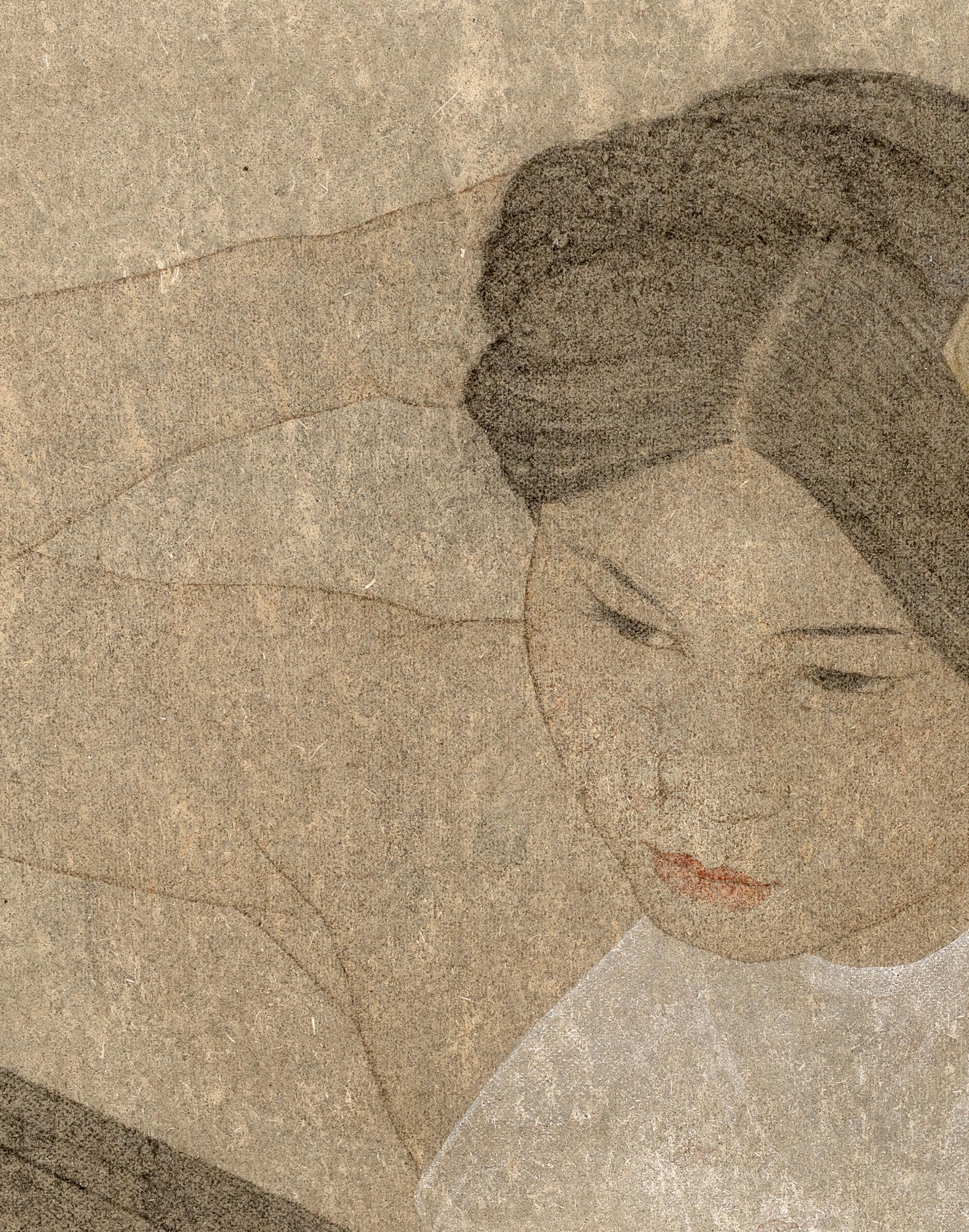
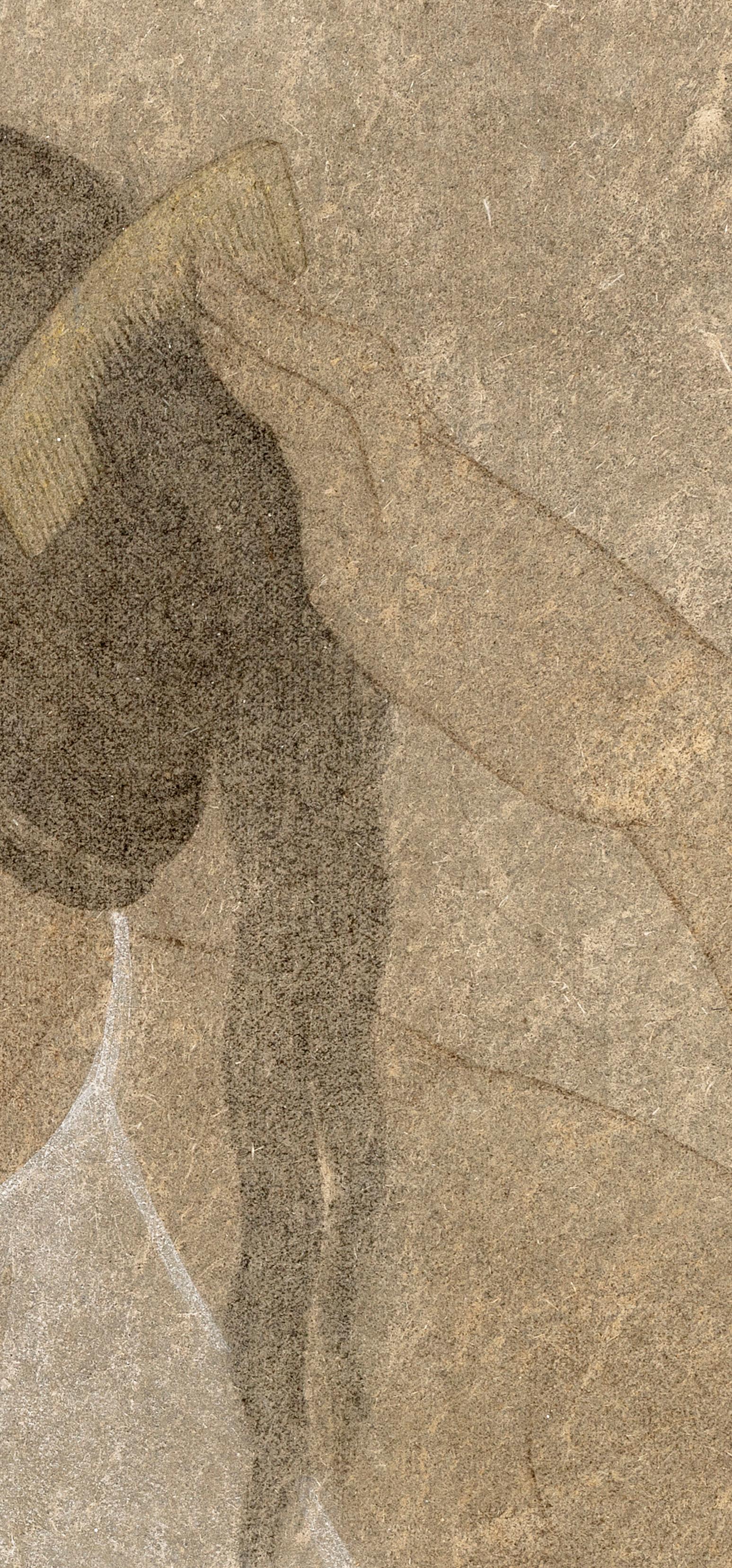
Pour la première fois depuis les années 1930, il nous est donné de voir le travail de Lê Văn Đệ sur éternit. En parfait état de conservation, elles sont présentées dans leurs cadres d’origine au dos desquels sont apposés les étiquettes de la Seconda Mostra Internazionale d’Arte Coloniale qui se tint à Naples en 1934.
Ces deux peintures sur éternit constituent un témoignage rare de cette période italienne, source de tant d’inspiration pour le jeune artiste alors âgé de 28 ans. Ce choix de support démontre une démarche profondément moderne, rupture délibérée avec les supports traditionnels qui anticipe, vingt-cinq ans avant, les préoccupations de l’Arte Povera italien que l’on retrouve chez Gilberto Zorio ou Alighiero Boetti.
Lần đầu tiên kể từ thập niên 1930, chúng ta được chiêm ngưỡng tác phẩm vẽ trên tấm éternit của Lê Văn Đệ. Được bảo tồn hoàn hảo, những tác phẩm này được trình bày trong khung nguyên bản, mặt sau có dán nhãn của Seconda Mostra Internazionale d’Arte Coloniale (Triển lãm Quốc tế Nghệ thuật Thuộc địa lần thứ Hai) được tổ chức tại Naples năm 1934. Hai bức tranh trên tấm éternit này là chứng tích hiếm hoi của thời kỳ Ý – nguồn cảm hứng dồi dào cho người nghệ sĩ trẻ khi ấy mới 28 tuổi. Việc lựa chọn chất liệu nền này thể hiện một hướng tiếp cận nghệ thuật hết sức hiện đại, một sự cắt đứt có chủ ý với những chất liệu nền truyền thống, báo hiệu trước hai mươi lăm năm những mối quan tâm của Arte Povera Ý mà ta bắt gặp trong tác phẩm của Gilberto Zorio hay Alighiero Boetti.
For the first time since the 1930s, we have the opportunity to view Lê Văn Đệ’s work in its entirety. In perfect condition, they are presented in their original frames, on the backs of which are affixed labels from the Seconda Mostra Internazionale d’Arte Coloniale held in Naples in 1934.
These two paintings on Eternit provide a rare insight into this Italian period, which was a source of such inspiration for the young artist, then aged 28. This choice of medium reflects a profoundly modern approach – a deliberate break with traditional materials – that anticipated, twenty-five years ahead of its time, the concerns of the Italian Arte Povera movement, as seen in the work of Gilberto Zorio and Alighiero Boetti.
11
LÊ VAN DÊ (1906-1966)
La Toilette, circa 1933
Technique mixte sur une plaque d’éternit, signée en bas à droite
33,2 x 43,8 cm à vue - 13 1/8 x 17 ¼ in.
Mixed media on an Eternit board, signed lower right
20 000 - 30 000 €
PROVENANCE
Collection particulière, Italie Collection particulière (acquis dans les années 1990 et transmis familialement)
EXPOSITION
1934, Seconda Mostra Internazionale d’Arte Coloniale, Naples, Italie (octobre)
œuvre en rapport
Inspiré du dessin préparatoire que l’artiste réalise en 1930 à Hanoï et qu’il conserve quand il réside à Capri au début des années 1930 (voir vente du carton à dessins du 11 avril 2026)
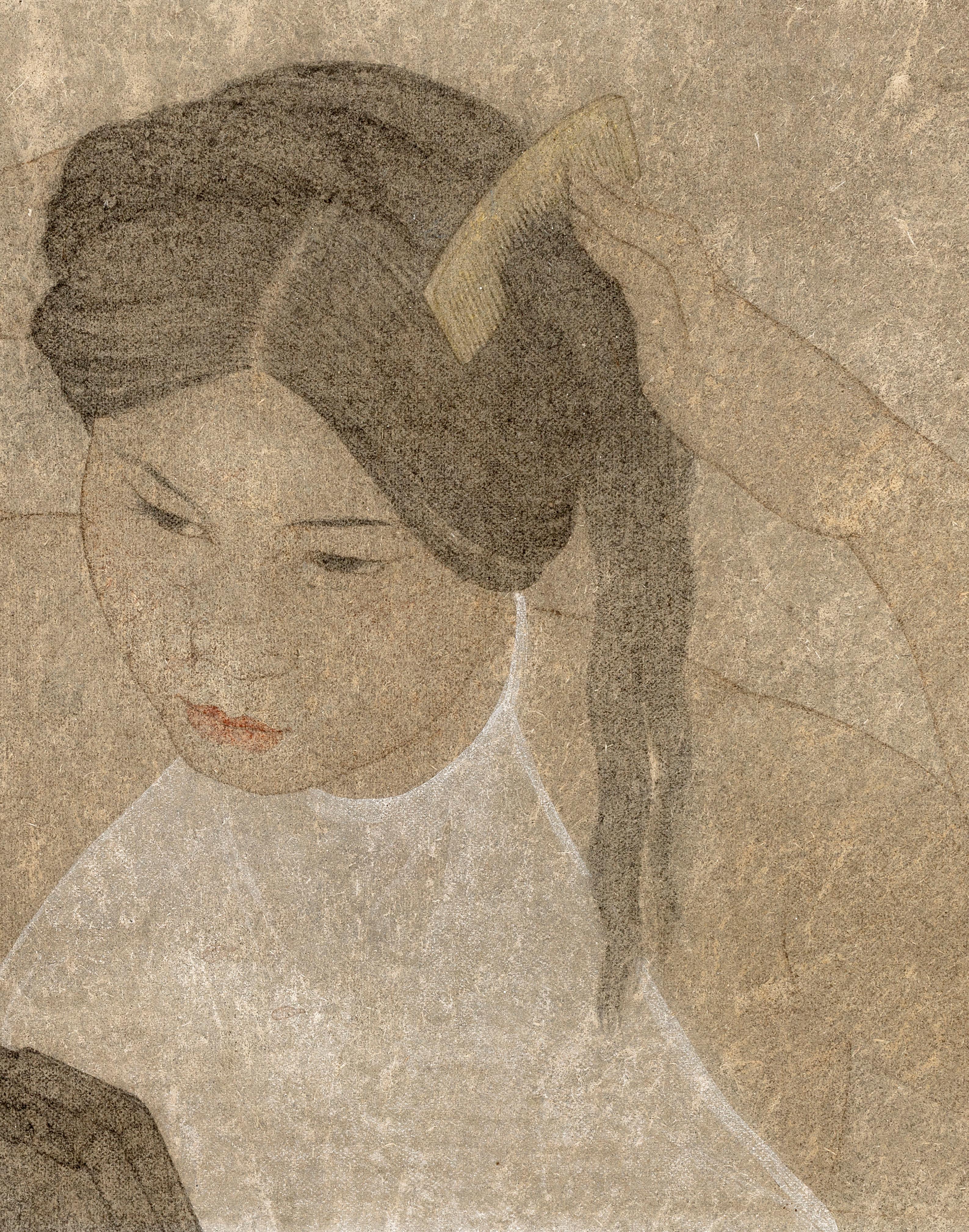
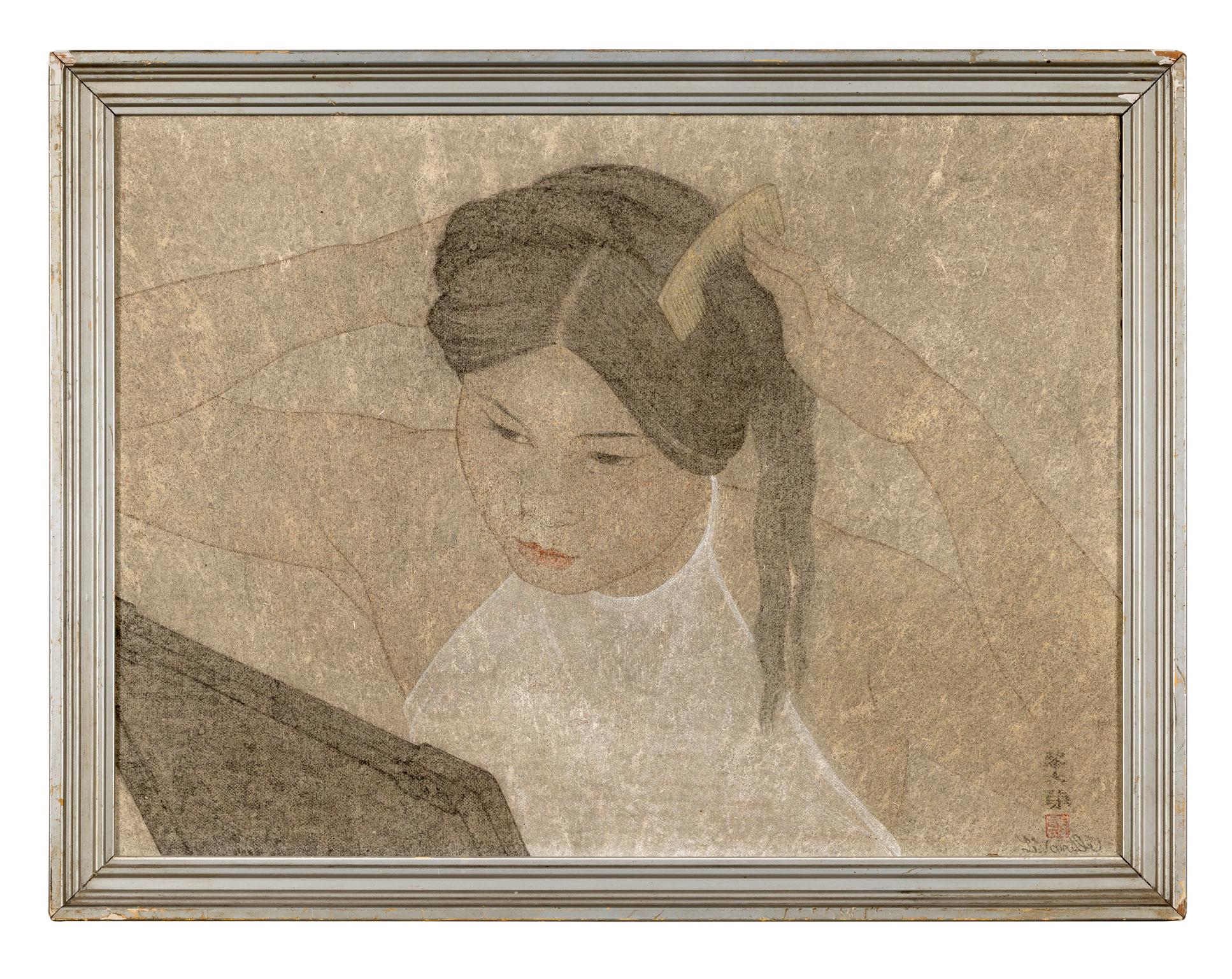
L’artiste s’inspire pour La toilette d’un dessin préparatoire conservé dans ses malles qu’il vient de poser à Capri (Naples). Intitulé Femme se coiffant , réalisé à Hanoï en 1930, ce dessin représente le modèle agenouillé en pied, rassemblant ses longs cheveux noirs à l’aide d’un peigne. Dans la composition finale sur éternit qui est dévoilée aujourd’hui, l’artiste fait le choix d’un cadrage resserré sur le visage et le buste de la jeune femme. Par l’introduction d’un miroir, Lê Văn Đệ permet au spectateur une proximité avec le modèle affairé à sa coiffure, insufflant à la scène une intimité palpable.
Le gris du support éternit sert de fond neutre que rehaussent avec sobriété quelques touches de couleur sur la bouche et la tunique. Le dessin, épuré et rigoureux, trahit l’intérêt de l’artiste pour l’École d’Avignon et les Primitifs italiens.
Người nghệ sĩ lấy cảm hứng cho La toilette từ một bản phác thảo sơ bộ còn cất trong hành lý vừa đặt xuống tại Capri (Naples). Mang tên Femme se coiffant (Thiếu nữ vấn tóc), được sáng tác tại Hà Nội năm 1930, bản phác thảo này khắc họa người mẫu đang quỳ toàn thân, dùng chiếc lược gom mái tóc đen dài. Trong bố cục cuối cùng trên tấm éternit được vén màn hôm nay, người nghệ sĩ lựa chọn cắt sát vào khuôn mặt và phần bán thân của thiếu nữ. Qua việc đặt một chiếc
gương vào bố cục, Lê Văn Đệ đưa người xem
đến gần nhân vật đang mải mê vấn tóc, phả vào khung cảnh một sự thân mật như chạm được. Sắc xám vốn có của tấm éternit đóng vai trò nền trung tính, được tôn lên một cách tiết chế bởi vài vệt màu trên đôi môi và áo dài. Đường nét tinh giản và chặt chẽ hé lộ niềm say mê của người nghệ sĩ đối với École d’Avignon (Trường phái Avignon) và những bậc họa sĩ Tiền Phục Hưng của Ý.
For La Toilette, the artist drew inspiration from a preparatory sketch kept in his trunks, which he had just unpacked in Capri (Naples). Titled Femme se coiffant, created in Hanoi in 1930, this sketch depicts the model kneeling fulllength, gathering her long black hair with a comb. In the final composition on Eternit, unveiled today, the artist chooses a tight framing focused on the young woman’s face and bust. By introducing a mirror, Lê Văn Đệ allows the viewer to feel close to the model busy with her hair, infusing the scene with a palpable intimacy. The gray of the Eternit panel serves as a neutral background, subtly enhanced by a few touches of color on the mouth and tunic. The clean, rigorous linework reveals the artist’s interest in the Avignon School and the Italian Primitives.
12
LÊ VAN DÊ (1906-1966)
Paysage, Capri, 1933
Technique mixte sur une plaque d’éternit, signée en bas à droite
51 x 25,4 cm - 20 1/8 x 10 in
Mixed media on an Eternit board, signed lower right
5 000 - 6 000 €
PROVENANCE
Collection particulière, Italie
Collection particulière (acquis dans les années 1990 et transmis familialement)
EXPOSITION
1934, Seconda Mostra Internazionale d’Arte Coloniale, Naples, Italie (octobre)
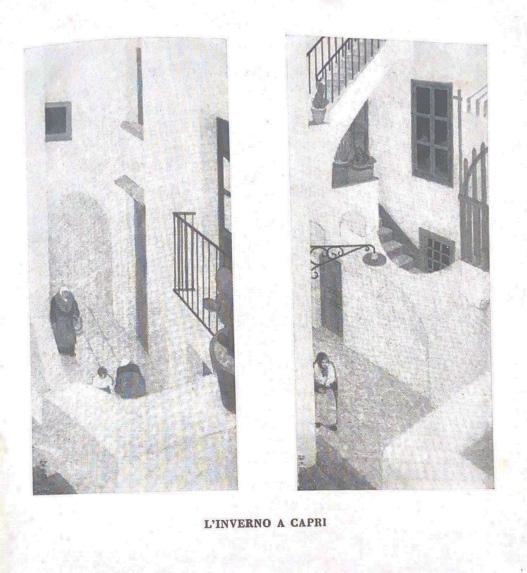
en rapport
Paysage – Capri est envoyé par Lê Văn Đệ à la Seconda Mostra Internazionale d’Arte Coloniale qui se tint à Naples en octobre 1934. Il s’agit d’une version similaire à celle qu’il a présentée quelques mois plus tôt à l’Esposizione del pittore indocinese Lê Van Dê à la galerie Pesaro de Milan et qui est connue grâce au catalogue publié à l’occasion.
Il est intéressant de remarquer que la version « Pesaro » est présentée avec un pendant, de format similaire, sous le titre L’Inverno a Capri , comme reproduit par la galerie en page 15 de son catalogue.
La composition repose sur le fond gris en éternit, que de vives touches de couleur viennent ponctuer et animer. Dans le catalogue de l’exposition, le peintre Anselmo Bucci (1887-1955) compare ces touches à des « braises rouges dans les cendres »1. La scène de rue dégage ainsi une atmosphère à la fois calme et onirique, accentuée par un point de vue singulier, obtenu grâce à un cadrage étroit et resserré.
Tranh Phong cảnh – Capri được Lê Văn Đệ gửi
đến Triển lãm Quốc tế Nghệ thuật Thuộc địa
lần thứ hai tổ chức tại Naples vào tháng 10 năm 1934. Đây là một phiên bản tương tự bức tranh
ông đã trình bày vài tháng trước đó tại Triển lãm
họa sĩ Đông Dương Lê Văn Đê tại phòng tranh Pesaro Milan, được biết đến nhờ catalogue xuất bản nhân dịp này.
Thật thú vị khi nhận ra rằng phiên bản « Pesaro »
được giới thiệu kèm một bức tranh đối xứng,
cùng kích thước, mang tựa đề L’Inverno a Capri, như được phòng tranh tái bản tại trang 15 của catalogue.
Bố cục dựa trên nền xám éternit, nơi những nét màu rực rỡ điểm xuyết và làm sống động. Trong catalogue triển lãm, họa sĩ Anselmo Bucci (18871955) so sánh những nét này với « than hồng trong tro tàn ». Cảnh đường phố vì vậy toát lên một bầu không khí vừa yên bình vừa mang tính mộng ảo, được nhấn mạnh bởi một góc nhìn độc đáo, tạo ra nhờ khuôn hình chặt và khép kín.
Paysage – Capri was submitted by Lê Văn Đệ to the Second International Exhibition of Colonial Art, held in Naples in October 1934. It is a version similar to the one he had presented a few months earlier at the Esposizione del pittore indocinese Lê Van Dê at the Pesaro Gallery in Milan, which is known thanks to the catalog published for the occasion.
It is interesting to note that the “Pesaro” version is presented alongside a companion piece, of similar format, titled L’Inverno a Capri, as reproduced by the gallery on page 15 of its catalog. The composition rests on a gray Eternit background, punctuated and enlivened by vivid touches of color. In the exhibition catalog, the painter Anselmo Bucci (1887–1955) compares these touches to “red embers in the ashes.”
The street scene thus exudes an atmosphere that is both calm and dreamlike, accentuated by a unique perspective achieved through a narrow, tight framing.
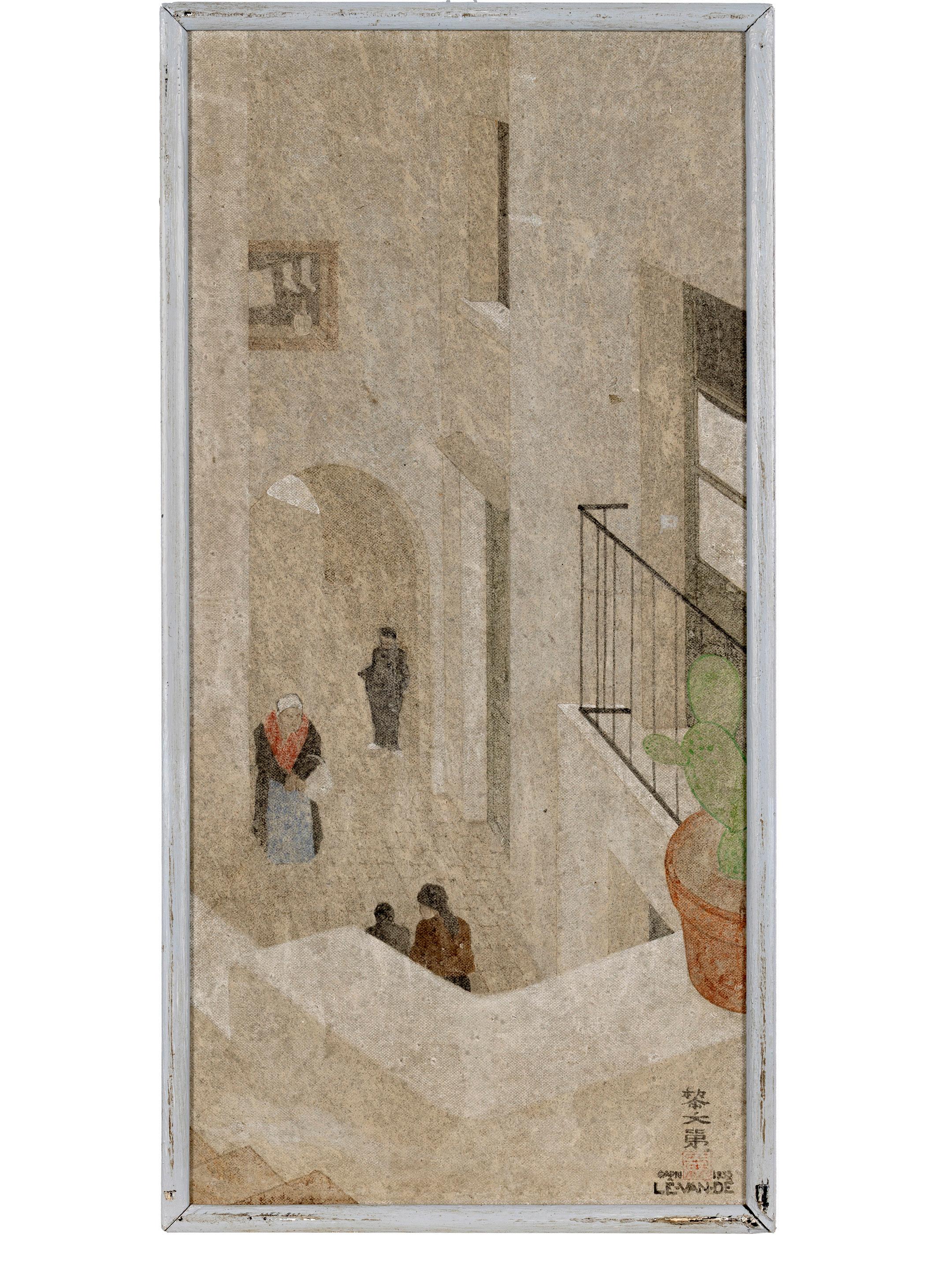
13
LÊ PHỔ (1907-2001)
Les pivoines roses
Gouache sur soie, signée en bas à droite 80 x 48 cm - 31 ½ x 17 ½ in.
Gouache on silk, signed lower right 80 000 - 120 000 €
Une attestation d’inclusion au catalogue raisonné de l’artiste actuellement en préparation par Charlotte Aguttes-Reynier pour l’association des Artistes d’Asie à Paris sera remise à l’acquéreur.
PROVENANCE
Galerie Romanet, Paris Collection particulière, France (acquis avant 1960)
Collection particulière, France (par transmission du précédent vers 2000)
Le marchand André Romanet découvre le travail de Lê Phổ en 1941 lorsque des œuvres de ce dernier sont présentées par la galerie Lorenceau à Vichy. André Romanet rencontre alors l’artiste et devient son galeriste. Propriétaire de la galerie d’Art Pasteur à Alger et d’une autre galerie à Oran, il organise plusieurs expositions à partir de 1942 et l’expose également à Paris.
Les Pivoines roses s’inscrit dans la période après-guerre et témoigne de manière admirable des recherches picturales du peintre qui est alors en pleine mutation. Le tableau manifeste de la synthèse de ces diverses influences. Lê Phổ choisit de conserver la soie comme support, un médium très difficile à maîtriser qui ne permet aucun repentir.
De plus, l’artiste reprend un motif très significatif de son pays.
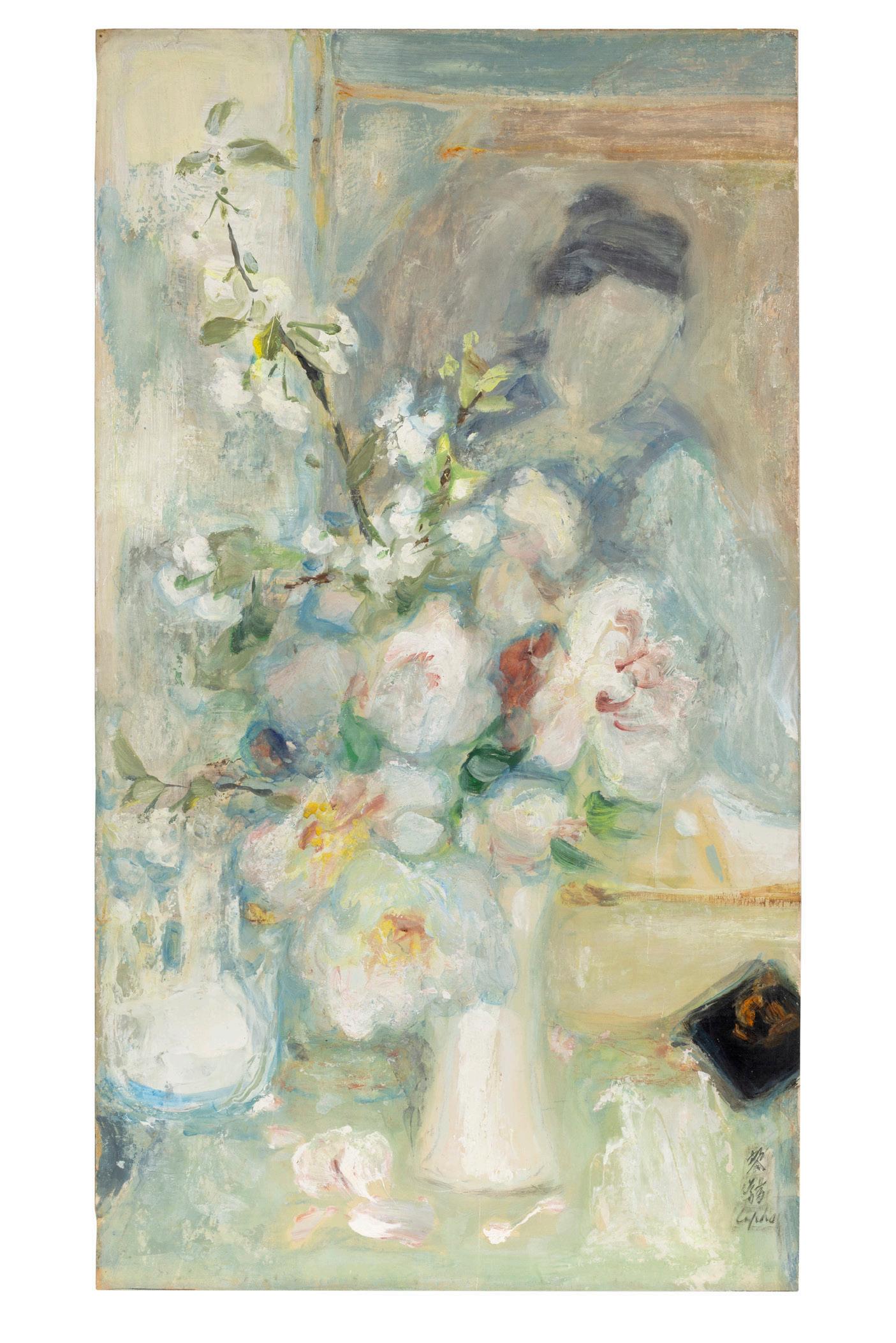
Chủ phòng tranh André Romanet phát hiện tác phẩm của Lê Phổ vào năm 1941 khi các tác phẩm của ông được trưng bày tại phòng tranh
Lorenceau ở Vichy. André Romanet sau đó gặp nghệ sĩ và trở thành người đại diện phòng tranh của ông. Là chủ phòng tranh Art Pasteur tại Alger và một phòng tranh khác ở Oran, ông đã tổ chức nhiều cuộc triển lãm từ năm 1942 và đồng thời giới thiệu tác phẩm của Lê Phổ tại Paris
Les Pivoines roses thuộc giai đoạn hậu chiến và thể hiện một cách thuyết phục quá trình tìm tòi hội họa của họa sĩ trong thời kỳ đang chuyển biến mạnh mẽ. Tác phẩm biểu hiện sự tổng hòa của nhiều ảnh hưởng khác nhau. Lê Phổ lựa chọn tiếp tục sử dụng lụa làm chất liệu nền, một chất liệu rất khó kiểm soát và không cho phép sửa chữa. Đồng thời, ông khai thác một mô-típ mang ý nghĩa tiêu biểu của quê hương mình.
The art dealer André Romanet discovered Lê Phổ’s work in 1941 when the Lorenceau Gallery in Vichy exhibited some of his pieces. Romanet then met the artist and became his gallerist. As the owner of the Galerie d’Art Pasteur in Algiers and another gallery in Oran, he organized several exhibitions beginning in 1942 and also exhibited Lê Phổ’s work in Paris.
Les Pivoines roses belongs to the postwar period and admirably reflects the painter’s artistic explorations during a time of profound transformation. The painting clearly demonstrates the synthesis of these diverse influences. Lê Phổ chose to continue using silk as his canvas, a medium that is very difficult to master and allows for no second chances. Furthermore, the artist incorporates a motif that is highly significant to his homeland. détail
14
VŨ ĐÌNH NGỌC (XX e SIÈCLE)
Le tricot
Encre et couleurs sur soie, signée en bas à droite et au centre à gauche, annotée d’un poème en haut à gauche
72,3 x 43,5 cm - 28 ½ x 17 1/8 in Ink and color on silk, signed lower right and centre left, with a poem inscribed in the upper left corner
60 000 - 80 000 €
PROVENANCE
Collection particulière d’un médecin français actif au Vietnam entre 1936 et 1937
Collection particulière, France (transmis par le précédent en 1937)
Collection particulière, France (transmis par le précédent en 2008)
Vũ Đình Ngọc intègre la promotion VI (1930 -1935) de l’École des beaux-arts de l’Indochine dans laquelle il se spécialise en peinture. Il fait donc partie de cette génération d’artistes qui renouvellera l’art moderne vietnamien. Durant sa formation, il côtoie plusieurs figures majeures telles que Trần Bình Lộc (promotion V), Trần Văn Cẩn et Lưu Văn Sìn (promotion VII) ou encore Lương Xuân Nhị (promotion VIII).
Vũ Đình Ngọc gia nhập khóa VI (1930-1935) của Trường Cao đẳng Mỹ thuật Đông Dương, chuyên ngành hội họa. Ông thuộc thế hệ nghệ sĩ đã góp phần làm mới nền mỹ thuật hiện đại Việt Nam.
Trong quá trình học tập, ông tiếp xúc và giao lưu với nhiều tên tuổi lớn như Trần Bình Lộc (khóa V), Trần Văn Cẩn và Lưu Văn Sìn (khóa VII), cũng như Lương Xuân Nhị (khóa VIII).
Vũ Đình Ngọc enrolled in the Class of 19301935 at the Indochinese School of Fine Arts, where he specialized in painting. He was thus part of the generation of artists who would revitalize modern Vietnamese art. During his studies, he rubbed shoulders with several major figures such as Trần Bình Lộc (Class V), Trần Văn Cẩn and Lưu Văn Sìn (Class VII), and Lương Xuân Nhị (Class VIII).
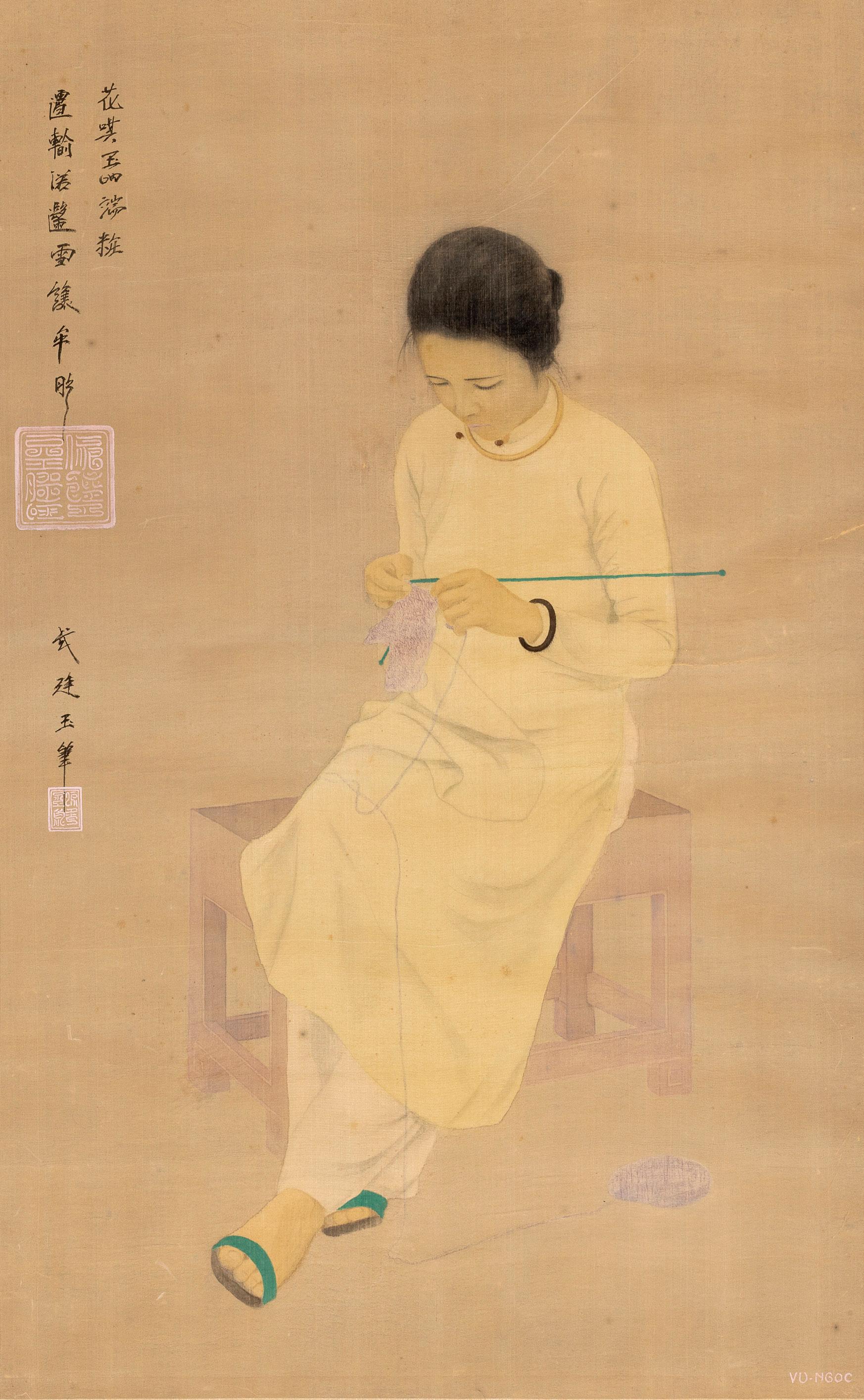
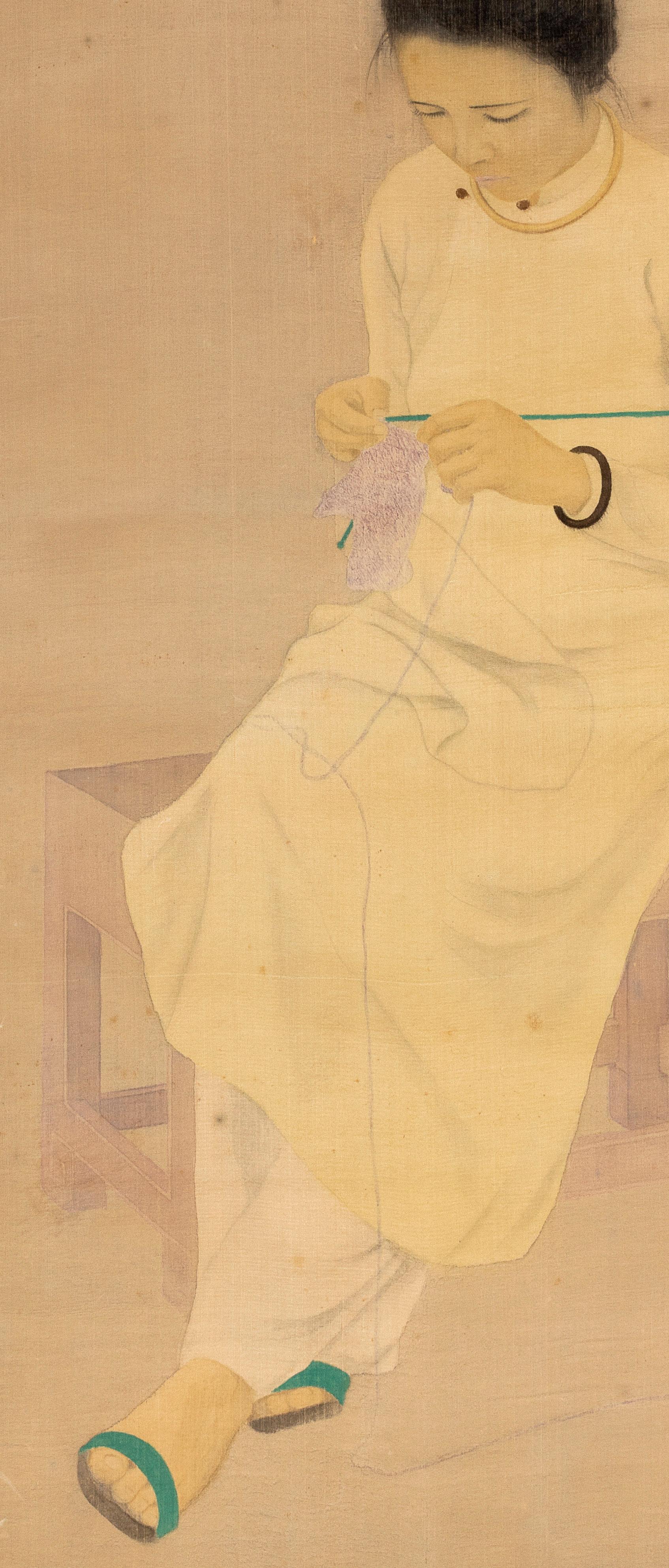
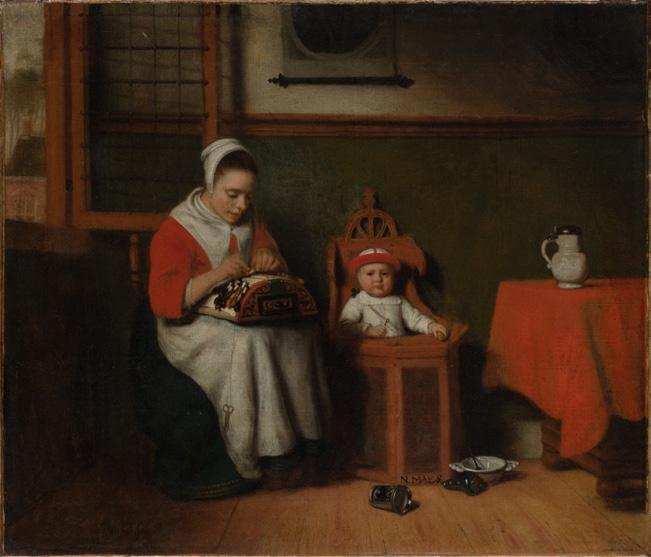
œuvre en rapport
Nicolaes Maes (1634-1693). The Lacemaker, circa 1656
The Metropolitan Museum of Arts, New York © The Friedsam Collection, Bequest of M. Friedsam, 1931
C’est probablement en 1937, lors du IIIe Salon de la Sadeai que Le tricot de Vũ Đình Ngọc est acquis par l’aïeul du propriétaire actuel. Alors médecin à Hanoï, l’amateur d’art témoigne par cette acquisition de l’intérêt des Français venus en Indochine pour cette nouvelle génération d’artistes1
La Société annamite d’encouragement à l’art (Sadeai) a été créée en 1935 à Hanoï, sous l’impulsion de Victor Tardieu, fondateur et premier directeur de l’École des beaux-arts de l’Indochine, afin de promouvoir la création artistique et de soutenir les étudiants par une démarche artistique professionnalisante. La soie représente une femme vêtue d’un áo dài jaune, occupée à tricoter dans un intérieur. Quelques touches vertes apportent raffinement et élégance à la composition. La scène est centrée sur le geste appliqué du travail. L’attitude du modèle, absorbé par sa tâche, contribue à transmettre une atmosphère calme et paisible, presque méditative. Cette sérénité est renforcée par une composition épurée sur un fond gris duquel la figure se détache.
Le tricot, activité domestique traditionnelle, est ici associé à une forme de noblesse et renvoie au statut d’une femme dont les occupations se déroulent à l’abri des contraintes du monde extérieur. De tous temps, ce sujet inspira abondamment les peintres, à commencer par les hollandais du XVII e siècle, à l’image des nombres toiles de Nicolas Maes consacrées à cette thématique. Cette tradition picturale se perpétuera jusqu’aux maîtres modernes, tels Félix Valloton et trouve un écho dans la peinture vietnamienne, notamment chez Lương Xuân Nhị , camarade de classe de Vũ Đình Ngọc , qui en livrera plusieurs très beaux exemples.
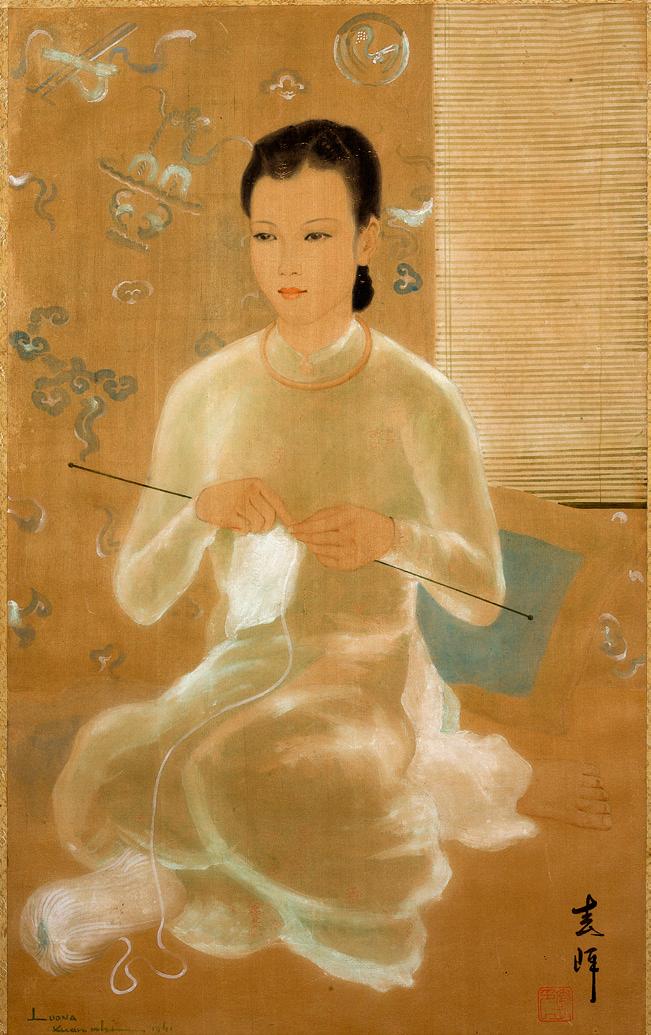
Vente [30] Aguttes, 30 septembre 2021, lot 7
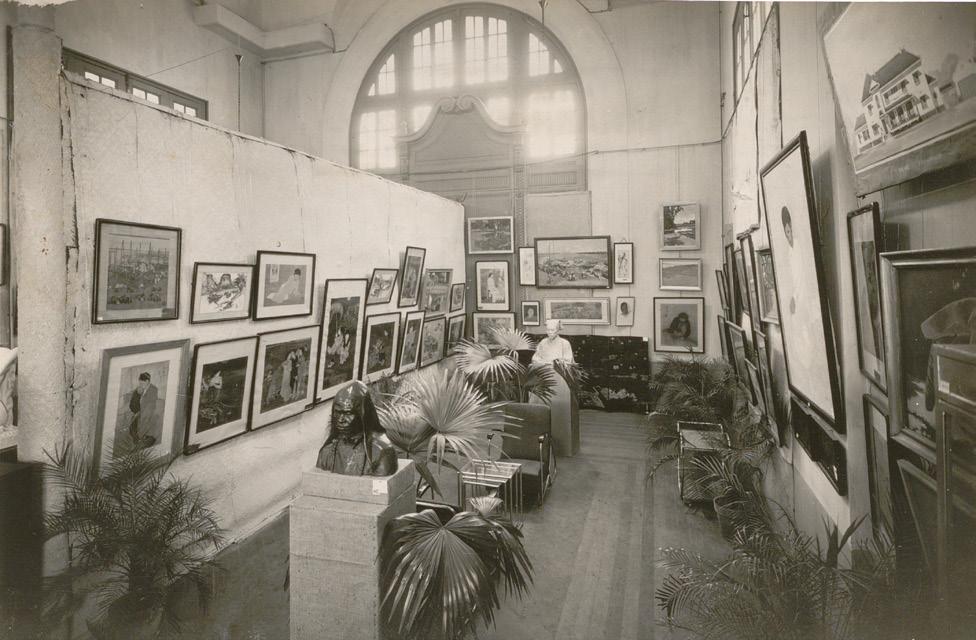
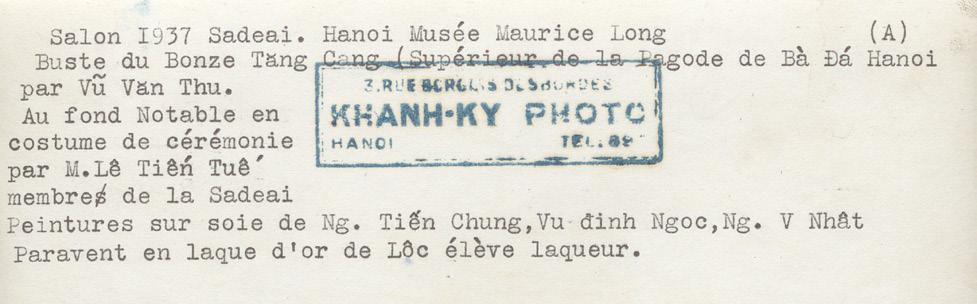
Có lẽ vào năm 1937, nhân dịp Salon Sadeai lần thứ III, tác phẩm Le Tricot của Vũ Đình Ngọc đã được ông tổ của chủ sở hữu hiện nay mua lại. Khi
đó là bác sĩ tại Hà Nội, nhà sưu tập này, thông qua việc mua tác phẩm, đã thể hiện sự quan tâm của người Pháp tại Đông Dương đối với thế hệ nghệ sĩ mới này.
Hội Khuyến khích Mỹ thuật (Sadeai) được thành lập năm 1935 tại Hà Nội, dưới sự khởi xướng của Victor Tardieu, người sáng lập đồng thời là Hiệu trưởng đầu tiên của Trường Cao đẳng Mỹ thuật Đông Dương, với mục đích thúc đẩy sáng tạo nghệ thuật và hỗ trợ sinh viên theo định hướng chuyên nghiệp hóa thực hành nghệ thuật. Tác phẩm tranh lụa khắc họa một thiếu phụ trong tà áo dài vàng, đang chăm chú đan len trong một căn phòng. Vài điểm nhấn xanh lục được tiết chế tinh tế, góp phần tạo nên vẻ thanh nhã và duyên dáng cho tổng thể bố cục. Trọng tâm đặt vào cử chỉ cần mẫn của đôi tay đang làm việc. Tư thế của nhân vật, hoàn toàn đắm mình trong công việc, gợi nên một bầu không khí tĩnh lặng, an tịch, phảng phất tính chất thiền định. Sự tĩnh tại ấy càng được nhấn mạnh bởi bố cục giản lược trên nền xám, từ đó hình tượng nổi bật một cách rõ ràng. Việc đan len, một sinh hoạt gia đình mang tính truyền thống, ở đây được nâng lên thành biểu tượng của nét thanh cao, gợi liên tưởng đến địa vị của người phụ nữ có đời sống khuôn mình trong không gian riêng, tách biệt khỏi những ràng buộc của thế giới bên ngoài. Từ lâu, đề tài này
đã gợi cảm hứng phong phú cho hội họa, khởi đầu với các họa sĩ Hà Lan thế kỷ XVII, tiêu biểu là nhiều tác phẩm của Nicolas Maes dành riêng cho chủ đề này. Truyền thống tạo hình này tiếp tục được kế thừa qua các bậc thầy hiện đại như Félix Vallotton, và tìm thấy sự cộng hưởng trong hội họa Việt Nam, đặc biệt họa
It was likely in 1937, during the 3rd Sadeai Salon, that Vũ Đình Ngọc’s Le tricot was purchased by the current owner’s grandfather. Then a doctor in Hanoi, this art lover’s acquisition attests to the interest of the French who had come to Indochina in this new generation of artists1
The Annamite Society for the Encouragement of the Arts (Sadeai) was founded in 1935 in Hanoi, under the leadership of Victor Tardieu, founder and first director of the Indochinese School of Fine Arts, to promote artistic creation and support students through a professionalizing artistic approach.
The silk painting depicts a woman wearing a yellow áo dài, busy knitting indoors. A few touches of green lend refinement and elegance to the composition. The scene focuses on the concentrated gesture of the work. The model’s posture, absorbed in her task, helps convey a calm and peaceful, almost meditative atmosphere. This serenity is reinforced by a minimalist composition against a gray background from which the figure stands out.
Knitting, a traditional domestic activity, is here associated with a sense of nobility and evokes the status of a woman whose daily life unfolds sheltered from the constraints of the outside world. Throughout history, this subject has been a rich source of inspiration for painters, beginning with the Dutch artists of the 17th century, as evidenced by the numerous paintings by Nicolas Maes devoted to this theme. This pictorial tradition continued through to modern masters such as Félix Valloton and found an echo in Vietnamese painting, particularly in the work of Lương Xuân Nhị, a classmate of V ũ Đình Ngọc, who produced several beautiful examples of it.
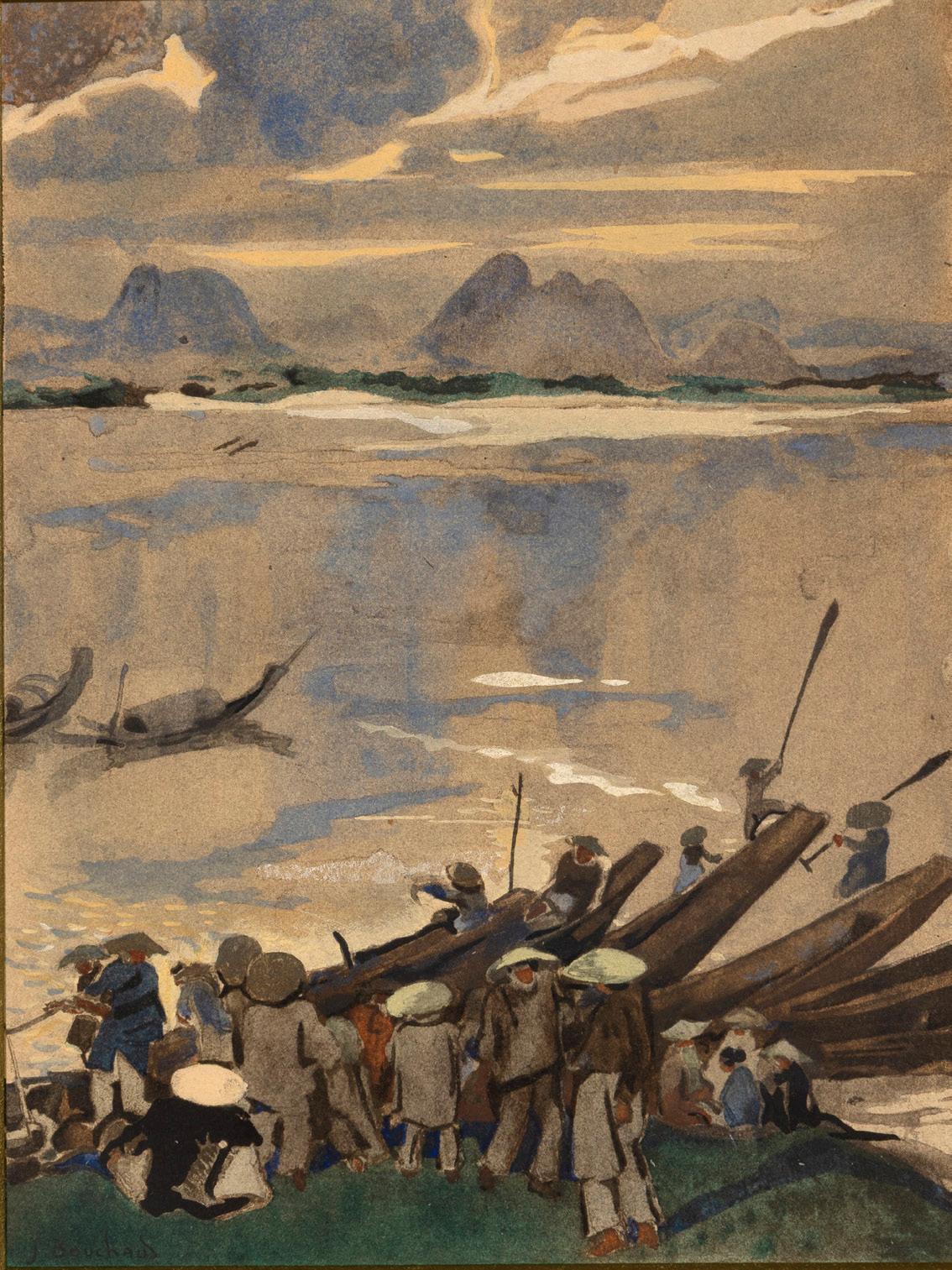
Ces expériences de voyage, et plus particulièrement son immersion au Viêt-Nam, nourriront durablement son corpus. À son retour, les commandes prestigieuses de décoration se succèdent, aussi bien pour l’Exposition
Coloniale internationale de 1931 que pour des paquebots luxueux de la Compagnie Générale Transatlantique dont le célèbre Normandie
Sinh ra trong một gia đình họa sĩ tại Nantes, theo một cách tự nhiên, Jean Bouchaud cũng đi theo con đường nghệ thuật như ba người anh em của ông. Sớm bị cuốn hút bởi những chuyến du hành, ông tới Bắc Phi vào năm 1921 nhờ một học bổng cho phép ông lưu trú tại villa Abd-el-Tif ở Alger. Năm 1924, Hội Thuộc địa các Nghệ sĩ Pháp trao cho ông Giải thưởng Đông Dương, mở đường cho những chuyến đi của ông tới Đông Nam Á, đặc biệt là tới Campuchia, Lào và Việt Nam. Hành trình nghệ thuật của ông được ghi dấu vào năm 1928 với Huy chương Vàng tại Triển lãm các Nghệ sĩ Pháp cho tác phẩm Laveuses cochinchinoises (Những người phụ nữ Nam Kỳ giặt giũ). Trải nghiệm từ những chuyến du hành này, đặc biệt là quãng thời gian sống tại Việt Nam, đã nuôi dưỡng một cách bền vững các sáng tác của ông. Khi trở về, ông liên tiếp nhận được các đơn đặt hàng quan trọng, cả cho Triển lãm Thuộc địa Quốc tế năm
JEAN BOUCHAUD (1891-1977)
Pêcheurs au bord de la rivière des Parfums de Hué, circa 1928
Aquarelle et gouache sur papier, signée en bas à gauche
17 x 13,5 cm - 6 ¾ x 5 ¼ in Watercolor and gouache on paper, signed lower left
500 - 700 €
PROVENANCE
Vente Schmitz-Laurent
Saint-Germain-en-Laye, 16 mars 2008, lot 358 Collection particulière, France
Étude préparatoire à l’huile sur toile, de grand format, pour Les bords de la rivière des Parfums, Hué, datée de 1929 et conservée en collection particulière.
Né dans une famille de peintres nantais, Jean Bouchaud s’oriente naturellement vers la pratique artistique à l’instar de ses trois frères. Très tôt attiré par le voyage, il découvre l’Afrique du Nord en 1921 grâce à une bourse qui lui permet de séjourner à la villa Abd-el-Tif à Alger.
En 1924, la Société Coloniale des Artistes Français lui attribue le Prix de l’Indochine, ouvrant la voie à ses séjours en Asie du SudEst notamment au Cambodge, au Laos et au Viêt-Nam. Son parcours est couronné en 1928 par la médaille d’or du Salon des Artistes Français pour Laveuses cochinchinoises
1931 và cho những con tàu viễn dương sang trọng của Compagnie Générale Transatlantique (Công ty Hàng hải Đại Tây Dương), trong đó có con tàu nổi tiếng Normandie
Born into a family of painters in Nantes, Jean Bouchaud naturally turned to art, following in the footsteps of his three brothers. Drawn to travel from an early age, he discovered North Africa in 1921 thanks to a scholarship that allowed him to stay at the Villa Abd-el-Tif in Algiers. In 1924, the Colonial Society of French Artists awarded him the Indochina Prize, paving the way for his
travels to Southeast Asia, notably to Cambodia, Laos, and Vietnam. His career reached its peak in 1928 when he was awarded the gold medal at the Salon des Artistes Français for Laveuses cochinchinoises. These travel experiences, and more particularly his immersion in Vietnam, would provide lasting inspiration for his body of work. Upon his return, prestigious commissions for decorative art followed one after another, including work for the 1931 International Colonial Exposition as well as for the luxury liners of the Compagnie Générale Transatlantique, including the famous Normandie
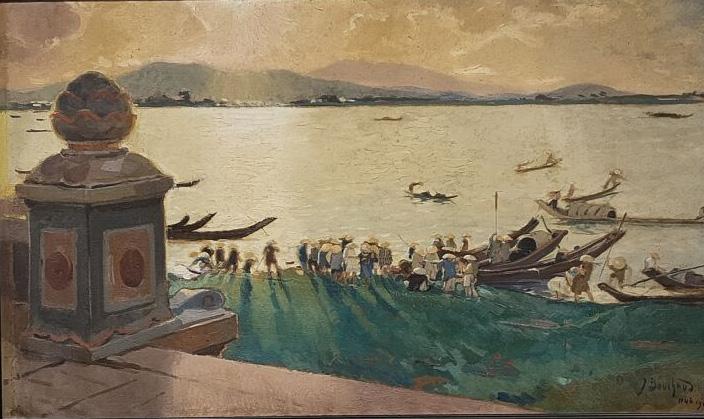
œuvre en rapport
Jean Bouchaud (1891-1977). Les bords de la rivière des Parfums Hué , 1929 Collection particulière © Ivoire Nantes
16
ÉMILE BOUDON
(NÉ ENTRE 1884 ET 1885)
Visage de jeune fille vietnamienne
Sculpture en bronze, patine noire sur socle en bois, signé en bas à droite 14 x 11 cm - 5 ½ x 4 3/8 in Bronze sculpture with black patina on a wooden base, signed lower right 800 - 1 200 €
Émile Boudon est né à Lyon entre 1884 et 1885. Très jeune il intègre l’École des beaux-arts de Lyon et devient l’élève de Thomas Lamotte (1866-1951) qui l’initie à l’art du modelage. Sculpteur talentueux, le jeune artiste se spécialise dans la fonte de bronzes d’art et participe à plusieurs reprises à des salons à Lyon en exposant notamment un buste de fillette en plâtre et un portrait d’enfant en bronze. Bénéficiant d’une bourse de voyage, il se rend en Indochine en vers 1910, en particulier à Hanoï où il élabore des portraits en plâtre dont il fait par la suite réaliser plusieurs tirages en bronze à la cire perdue.
Récompensé en 1924 de la mention honorable par la SAF, Boudon réalise par la suite plusieurs bustes en bronze dont un exemplaire actuellement présenté dans les collections du musée du Quai Branly à Paris.
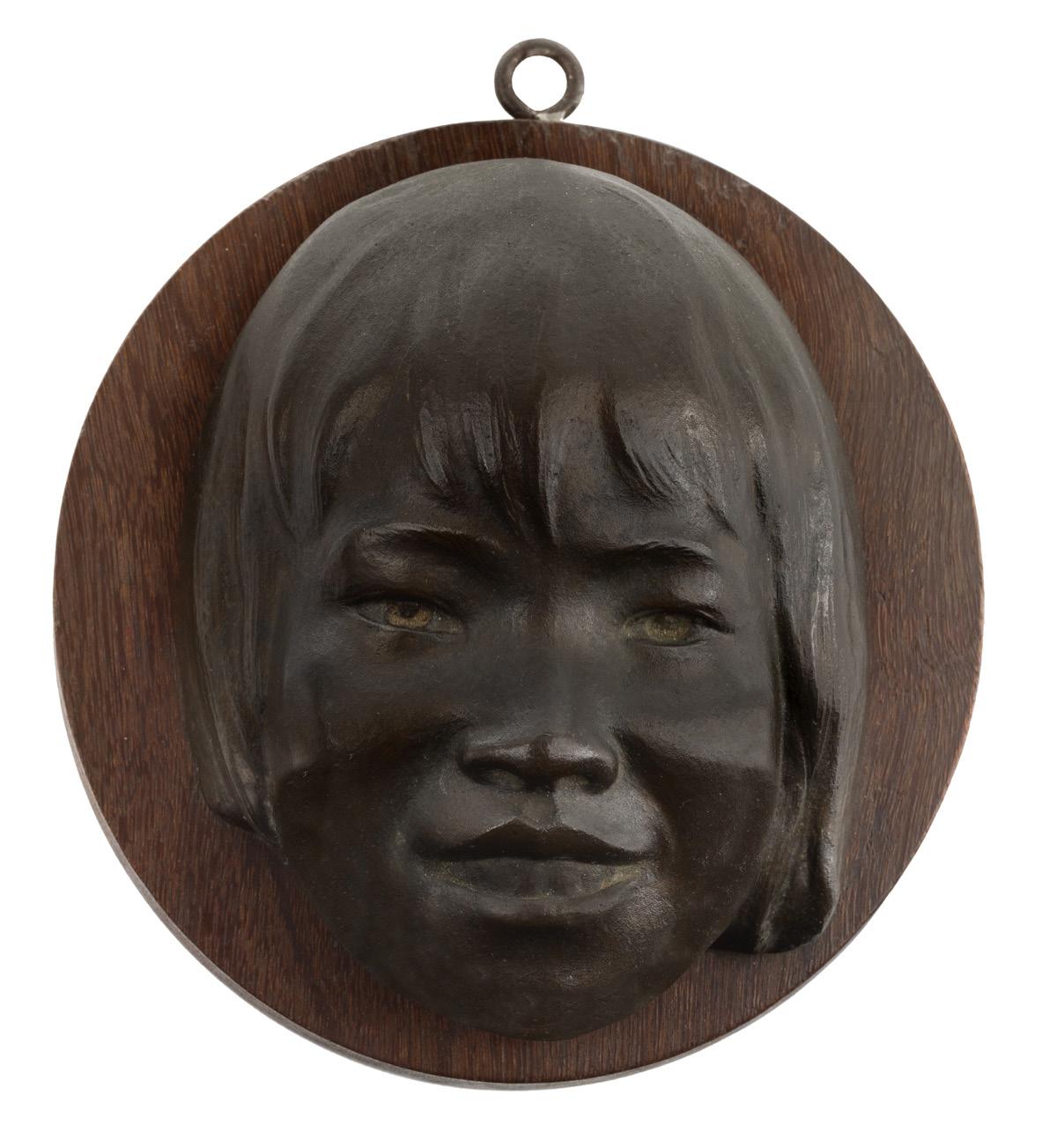
Émile Boudon sinh tại Lyon vào khoảng năm 1884–1885. Ông theo học Trường Mỹ thuật Lyon từ rất sớm và trở thành học trò của hoạ sĩ Thomas Lamotte (1866–1951), người đã truyền dạy cho ông nghệ thuật tạo hình. Là một nhà điêu khắc tài năng, Boudon nghiên cứu chuyên sâu về kỹ thuật đúc đồng mỹ thuật và nhiều lần tham gia các Triển lãm tại Lyon, giới thiệu chủ yếu các tác phẩm tượng bán thân thiếu nữ bằng thạch cao và chân dung trẻ em bằng đồng.
Nhờ giành được học bổng, ông đã đặt chân tới Đông Dương, đặc biệt là Hà Nội vào khoảng năm 1910, nơi ông thực hiện các tác phẩm chân dung bằng thạch cao, sau đó thực hiện nhiều phiên bản bằng đồng thông qua kỹ thuật đúc đồng mất sáp.
Được SAF trao Giải thưởng danh dự năm 1924, Boudon tiếp tục thực hiện nhiều tác phẩm bán thân bằng đồng, trong đó có một tác phẩm hiện thuộc bộ sưu tập của Bảo tàng Quai Branly, Paris.
Émile Boudon was born in Lyon between 1884 and 1885. At a very young age, he enrolled at the School of Fine Arts in Lyon and became a student of Thomas Lamotte (1866-1951), who introduced him to the art of modeling. A talented sculptor, the young artist specialized in casting bronze artworks and participated several times in salons in Lyon, exhibiting in particular a plaster bust of a girl and a bronze portrait of a child. With the help of a travel grant, he traveled to Indochina circa 1910, particularly to Hanoi, where he created plaster portraits, which he later had cast in bronze using the lost wax technique. .
Awarded an honorable mention by the SAF in 1924, Boudon went on to create several bronze busts, one of which is currently on display in the collections of the Quai Branly Museum in Paris.
17
LÊ PHỔ (1907-2001)
Porte à double battant, conçue et réalisée sous la direction de Lê Phổ
Acier doré à la feuille et verre sablé, dégagé à l'acide.
Commande unique
Dimensions complètes : environ 212 x 220 cm
Overall dimensions: approx. 83 1/2 × 86. 5/8 in. Gold-leafed steel and sandblasted glass, etched with acid.
One-off commission
150 000 - 250 000 €
PROVENANCE
Collection particulière parisienne d’un couple d’amateur d’art vietnamien proche des peintres Lê Phổ et Vũ Cao Đàm dès le début des années 1940 à Paris. Collection particulière, France (par descendance, transmis des précédents suite au démontage vers 1975)
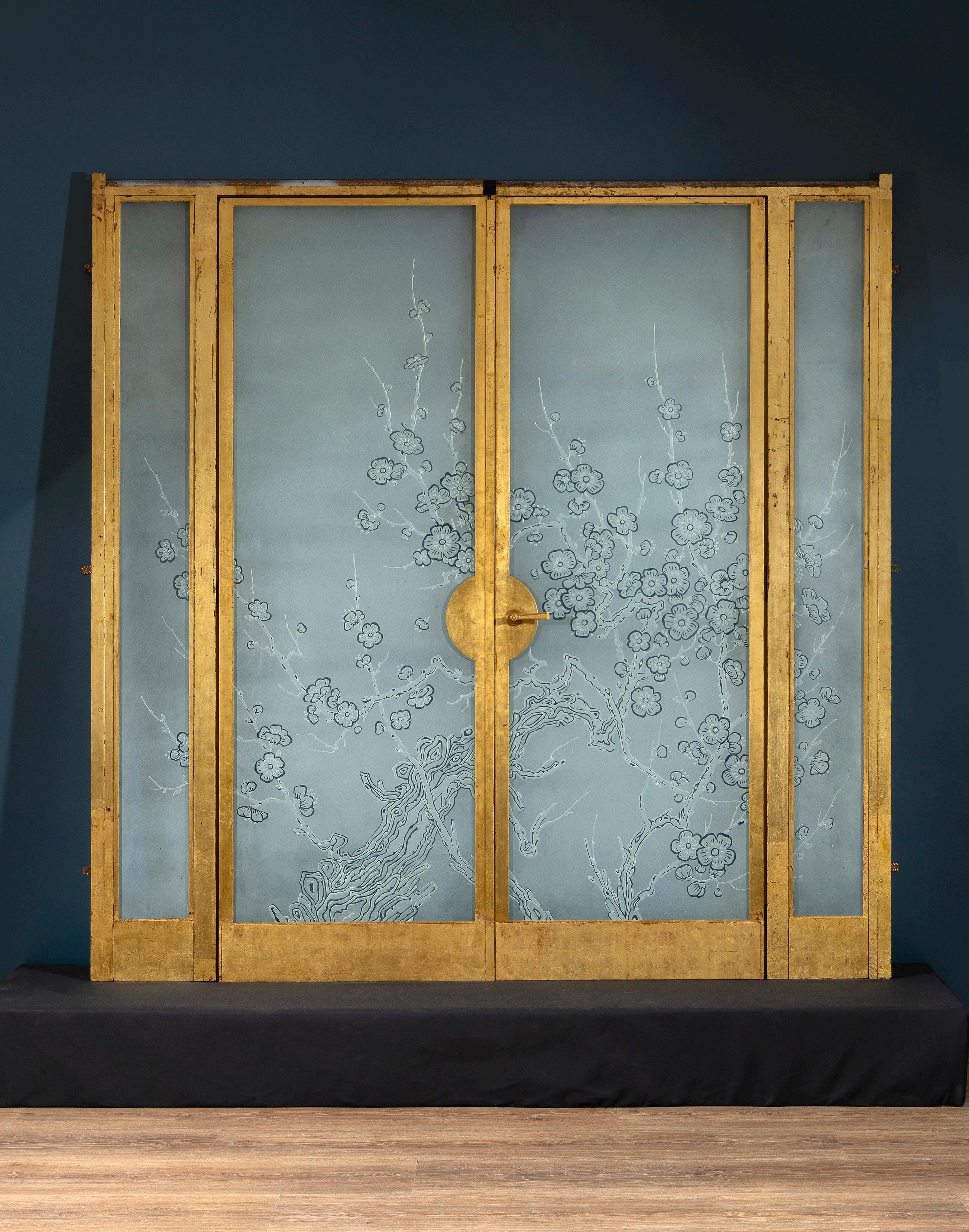
Formé à l’École des beaux-arts de l’Indochine sous la direction de Victor Tardieu, avec la spécialité Peinture , Lê Phổ reçoit un enseignement où les arts décoratifs occupent également une place essentielle. Durant les trois premières années, ses après-midis sont entièrement consacrés à ces disciplines ainsi qu’au dessin architectural, avant que celui-ci ne laisse place, en quatrième et cinquième années, à l’étude du mobilier et des ensembles décoratifs. Cette formation complète lui confère très tôt une maîtrise approfondie de l’espace, des formes et de l’harmonie.
Elle trouve une première application concrète lors de la supervision de la décoration des pavillons de l’Indochine aux expositions internationales de 1931 et 1937 à Paris. C’est alors sous la direction artistique de Victor Tardieu, qu’il s’affirme officiellement dans cette spécialité. Au cours des années 30, il livre plusieurs paravents en laques inspirés des travaux de Jean Dunand qu’il a rencontré à Paris en 1931. Dès le début des années 1940, il pratique, pour un cercle proche, cette activité de décorateur d’intérieur en parallèle de sa pratique picturale. Il compte parmi ses commanditaires, les Tholance, le prince Bửu Lộc ou encore Mme Bùi Mộng Điệp, l’une des concubines de Bảo Đại…
Được đào tạo tại Trường Cao đẳng Mỹ thuật Đông
Dương dưới sự hướng dẫn của Victor Tardieu, chuyên ngành Hội họa, Lê Phổ tiếp nhận một nền
giáo dục trong đó nghệ thuật trang trí cũng giữ một vị trí thiết yếu. Trong ba năm đầu, các buổi chiều của ông được dành trọn vẹn cho những bộ môn trang trí cũng như cho vẽ kiến trúc, trước khi môn học này nhường chỗ cho việc nghiên cứu đồ nội thất và các tổ hợp trang trí vào năm thứ tư và năm thứ năm. Một nền giáo dục toàn diện đã sớm mang lại cho ông khả năng nắm bắt sâu sắc không gian, hình khối và sự hài hòa. Tài năng ấy lần đầu được áp dụng một cách cụ thể trong việc giám sát cách thức trang trí của các gian hàng Đông Dương tại các Triển lãm Quốc tế năm 1931 và 1937 ở Paris. Khi đó, dưới sự chỉ đạo nghệ thuật của Victor Tardieu, ông chính thức khẳng định mình trong lĩnh vực này. Trong những năm 30, ông đã thực hiện một số bình phong sơn mài lấy cảm hứng từ các tác phẩm của Jean Dunand, người nghệ sĩ mà ông đã có dịp gặp gỡ tại Paris năm 1931. Từ đầu những năm 1940, ông nhận trang trí nội thất cho một số khách hàng thân thiết, song song với việc sáng tác nghệ thuật.
Trong số những người đặt hàng ông có gia đình Tholance, hoàng thân Bửu Lộc, cũng như bà Bùi Mộng Điệp, một trong những thứ phi của cựu hoàng Bảo Đại…
Trained at the Indochina School of Fine Arts under Victor Tardieu, with a specialization in painting, Lê Phổ received an education in which the decorative arts also played a central role. During his first three years, his afternoons were entirely devoted to these disciplines as well as architectural drawing, before this gave way, in his fourth and fifth years, to the study of furniture and decorative ensembles. This comprehensive training gave him, at a very early stage, a deep mastery of space, form, and harmony.
This knowledge found its first practical application when he supervised the decoration of the Indochina pavilions at the 1931 and 1937 International Exhibitions in Paris. It was then, under the artistic direction of Victor Tardieu, that he officially established himself in this specialty, a role entrusted to him by the director of the school. During the 1930s, he produced several lacquered screens inspired by the work of Jean Dunand, whom he had met in Paris in 1931. From the early 1940s onward, he practiced this activity for a close circle of friends. It was then during the 1950s that Lê Phổ expanded his work as an interior decorator alongside his painting practice.
Among his clients were the Tholances, Prince Bửu Lộc, and Mrs. Bùi Mộng Điệp, one of Bảo Đại’s concubines…
Lê Phổ imagine chaque détail de ses ensembles : du mobilier, réalisé par des artisans locaux à partir de matériaux exotiques, jusqu’à l’organisation des espaces. Il produit des gouaches d’une grande précision, révélant l’atmosphère future des différentes pièces. Soucieux d’une parfaite harmonie, il accorde une attention particulière à la recherche d’antiquités chinoises et vietnamiennes destinées à dialoguer avec les objets déjà en possession du client.
Artiste profondément ouvert aux influences de son temps, Lê Phổ découvre lors de ses séjours parisiens, notamment en 1931, les grandes figures de la création du début du XXe siècle. Il est ainsi très probablement sensible à l’œuvre de René Lalique, dont l’hôtel particulier, conçu en 1904 par Louis Feine, illustre l’esthétique Art nouveau inspirée de la nature. La célèbre porte d’entrée, dessinée par le maître verrier lui-même, déploie un décor de ramures et de motifs végétaux qui se prolongent dans les vitraux, dans un dialogue subtil entre architecture et arts décoratifs.
Lê Phổ hình dung từng chi tiết trong các tổng thể nội thất của mình: từ đồ nội thất, được các nghệ nhân địa phương chế tác từ những vật liệu ngoại lai, cho đến cách tổ chức không gian. Ông thực hiện những bản vẽ bằng màu gouache có độ chính xác cao, hé lộ không gian thiết kế của từng căn phòng. Lưu tâm tới sự hài hòa hoàn hảo, ông đặc biệt chú trọng tìm kiếm các cổ vật Trung Quốc và Việt Nam, nhằm tạo mối liên kết với những đồ vật mà khách hàng đã sở hữu. Là một nghệ sĩ có tinh thần cởi mở sâu sắc với những ảnh hưởng của thời đại, trong các chuyến lưu trú tại Paris, đặc biệt là vào năm 1931, Lê Phổ đã khám phá những gương mặt tiêu biểu trong sáng tạo nghệ thuật đầu thế kỷ 20. Vì vậy, rất có khả năng ông đã chịu ảnh hưởng từ các tác phẩm của René Lalique và tư dinh của ông - được Louis
Feine thiết kế năm 1904, minh họa cho mỹ học
Art nouveau (Tân nghệ thuật) lấy cảm hứng từ thiên nhiên. Cánh cửa ra vào nổi tiếng, do chính bậc thầy chế tác pha lê thiết kế, thể hiện một bố cục gồm những nhánh cây và họa tiết thực vật lan toả trong các ô kính màu, thể hiện sự kết hợp tinh tế giữa kiến trúc và nghệ thuật trang trí.
Lê Phổ envisions every detail of his designs: from the furniture – crafted by local artisans using exotic materials – to the layout of the spaces. He creates highly detailed gouache paintings that reveal the future atmosphere of each room. Committed to perfect harmony, he pays particular attention to sourcing Chinese and Vietnamese antiques designed to complement the objects already in the client’s possession.
An artist deeply open to the influences of his time, Lê Phổ discovered, during his stays in Paris – particularly in 1931 – the leading figures of early 20th-century design. He was thus very likely influenced by the work of René Lalique, whose mansion, designed in 1904 by Louis Feine, exemplifies the Art Nouveau aesthetic inspired by nature. The famous front door, designed by the master glassmaker himself, features a design of antlers and plant motifs that extend into the stained-glass windows, creating a subtle dialogue between architecture and the decorative arts.
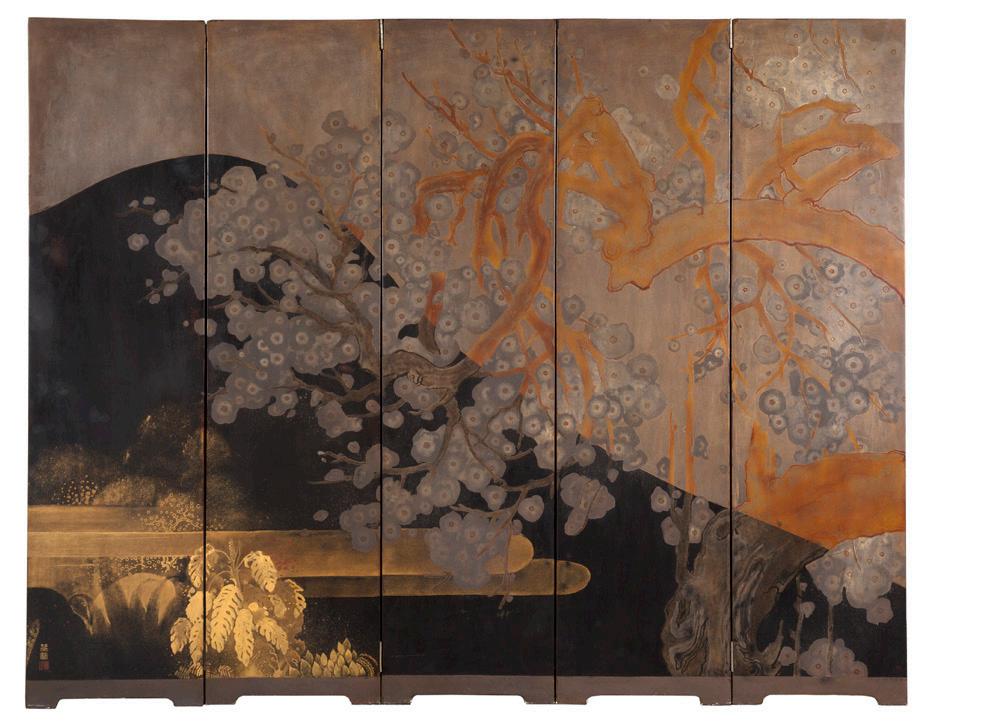
œuvre en rapport
Lê Phổ (1907-2001) Paysage du Tonkin. Vente [48] Aguttes, 9 septembre 2025, lot 4 © Aguttes
Dans cette filiation, Lê Phổ conçoit pour un ami vietnamien qu’il a rencontré à Hanoï dans les années 30 et qu’il a retrouvé à Paris quelques années plus tard, une paire de portes remarquable, où la modernité occidentale se conjugue avec une sensibilité asiatique. Il s’agit d’une commande unique, dessinée par l’artiste pour cet intérieur parisien et exécutée en acier doré à la feuille d’or, encadrant des panneaux de verre ciselé et sablé. Lê Phổ livre un décor de branches fleuries qui n’est pas sans rappeler celui du paravent Paysage du Tonkin (Fig.1) réalisé à Hanoï pour le Gouverneur général Auguste Tholance (1878-1938).
Ce décor évoque également les motifs traditionnels sino-vietnamiens d’un grand raffinement observés dans des projets d’ameublement et conservés dans les archives familiales du peintre (dessin préparatoire pour une armoire, réalisé pendant ses études vers 1926-1927 (cf. P. Scott (dir.). City of Others: Asian Artists in Paris, 1920s–1940s Singapore, National Gallery Singapore , 2025, n° 1.82, p. 91)).
Cette paire de portes de Lê Phổ apparait aujourd’hui comme la seule connue à ce jour et donc la première réalisation de ce type jamais présentée aux enchères pour cet artiste. Longtemps restée à l’abri des regards, récemment redécouverte, cette œuvre monumentale dispose de toutes les qualités nécessaires pour reprendre ses fonctions et intégrer le décor d’un collectionneur privilégié, dans le sillage des commandes prestigieuses du prince Bửu Lộc ou du général Tholance.
Trong mạch ảnh hưởng ấy, Lê Phổ đã thiết kế cho một người bạn Việt Nam mà ông từng gặp tại Hà Nội vào thập niên 1930 và hội ngộ ở Paris vài năm sau đó một cánh cửa đáng chú ý, nơi tính hiện đại phương Tây kết hợp với cảm quan Á Đông. Đây là một đơn đặt hàng độc nhất, do nghệ sĩ vẽ mẫu cho không gian nội thất mang phong cách Paris này. Cánh cửa được làm bằng thép thếp vàng lá bao quanh các tấm kính được chạm khắc và phun cát. Lê Phổ tạo nên một bố cục trang trí với những nhành hoa gợi nhớ đến bố cục trên bức bình phong Phong cảnh Bắc (Fig.1) Kỳ, được thực hiện tại Hà Nội cho Toàn quyền Auguste Tholance (1878-1938). Bố cục trang trí này cũng gợi đến những họa tiết truyền thống Trung-Việt vô cùng tinh xảo, từng được thấy trong các dự án trang trí nội thất và hiện được lưu giữ trong kho lưu trữ của gia đình họa sĩ, chẳng hạn bản vẽ thiết kế một chiếc tủ, được thực hiện trong thời gian ông còn đi học vào khoảng năm 1926-1927 (xem P. Scott chủ biên, City of Others: Asian Artists in Paris, 1920s-1940, Singapore, Phòng Trưng bày Quốc gia Singapore, 2025, số 1.82, tr. 91).
Ngày nay, cánh cửa này của Lê Phổ dường như là tác phẩm duy nhất thuộc thể loại này được biết đến cho đến thời điểm hiện tại, vì vậy đây là sáng tác đầu tiên của nghệ sĩ trong lĩnh vực này được đưa ra đấu giá. Mới được phát hiện gần đây sau một thời gian dài vắng bóng, tác phẩm hoành tráng này hội tụ đầy đủ những phẩm chất cần thiết để hòa nhập vào không gian sống của một nhà sưu tầm được ưu ái, tiếp nối tinh thần của những đơn đặt hàng danh giá dành cho hoàng thân Bửu Lộc hay tướng Tholance.
In this vein, Lê Phổ designed a remarkable pair of doors for a Vietnamese friend whom he met in Hanoi in the 1930s and reunited with in Paris a few years later, where Western modernity blends with an Asian sensibility. This is a one-of-a-kind commission, designed by the artist specifically for this Parisian interior and crafted from steel gilded with gold leaf, framing panels of engraved and sandblasted glass. Lê Phổ created a design of flowering branches reminiscent of the Paysage du Tonkin (Fig.1) screen made in Hanoi for Governor-General Auguste Tholance (1878-1938).
This design also evokes the highly refined traditional Sino-Vietnamese motifs already seen in other similar furniture projects and preserved in the painter’s family archives, as evidenced by the preparatory drawing for a cabinet, created during his studies around 1926–1927 (see P. Scott (ed.). City of Others: Asian Artists in Paris, 1920s-1940s Singapore, National Gallery Singapore, 2025, no. 1.82, p. 91)).
This pair of doors by Lê Phổ appears today to be the only known example to date and thus the first work of this type ever offered at auction by this artist. Long hidden from view and recently rediscovered, this monumental work possesses all the qualities necessary to resume its original function and now stands as a unique piece, destined to become part of a privileged collector’s collection, following in the footsteps of prestigious commissions by Prince Bửu Lộc or General Tholance.
œuvre en rapport
Lê Phô. Projet pour la décoration intérieure de l’appartement du prince Bửu Lộc à Paris, vers 1950 © Archives Alain Le Kim
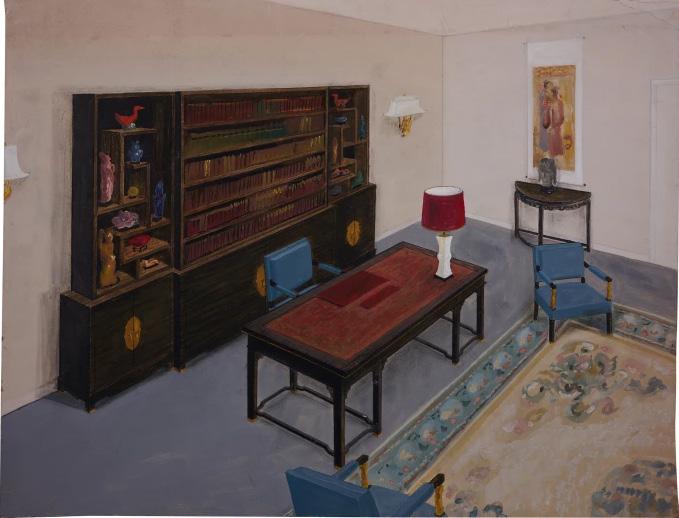
18
VŨ CAO ĐÀM (1908-2000)
Fleurs de pavot
Encre et couleurs sur soie, signée en bas à gauche
45,6 x 37,7 cm - 18 x 14 ¾ in.
Ink and color on silk, signed lower left
70 000 - 100 000 €
Une attestation d’inclusion au catalogue raisonné de l’artiste actuellement en cours de préparation par Charlotte Aguttes-Reynier pour l’association des Artistes d’Asie à Paris sera remise à l’acquéreur.
PROVENANCE
Collection particulière d’un couple d’amateurs d’art, ami proche des peintres Lê Phổ et Vũ Cao Đàm dès le début des années 1940 à Paris. Collection particulière, France (par descendance, offert par les précédents dans les années 1980).
Cette composition de jeunesse illustre une période de transition dans la carrière de l’artiste Vũ Cao Đàm , major en 1931 de l’École des beaux-arts de l’Indochine avec la spécialité sculpture. À partir de 1940, les contraintes économiques liées à la seconde guerre rendent très difficile la fonte du bronze en France. Đàm écrivait à Victor Tardieu en 1931 : « La crise est de plus en plus prononcée ici. Et c’est un véritable miracle que nous parvenions encore à vendre à l’Agindo »1
Đây là một tác phẩm được sáng tác khi nghệ sĩ còn trẻ, minh họa một thời kỳ chuyển tiếp quan trọng trong sự nghiệp của họa sĩ Vũ Cao Đàm - Thủ khoa năm 1931 của Trường Cao đẳng Mỹ thuật Đông Dương, chuyên ngành điêu khắc. Từ năm 1940, với những khó khăn về mặt kinh tế, hậu quả của Thế chiến thứ hai, khiến việc đúc đồng tại Pháp trở nên vô cùng khó khăn. Vũ Cao Đàm đã viết cho Victor Tardieu vào năm 1931: “Cuộc khủng hoảng ở đây ngày càng trở nên trầm trọng. Thật là một phép màu khi chúng em vẫn còn có thể bán được các tác phẩm tại Agindo.”¹
This early work illustrates a period of transition in the career of artist Vũ Cao Đàm, who graduated in 1931 from the Indochina School of Fine Arts with a major in sculpture. From 1940 onwards, the economic constraints of World War II made it very difficult to cast bronze in France. Đàm wrote to Victor Tardieu in 1931: “The crisis is becoming increasingly pronounced here. And it is a real miracle that we are still managing to sell to Agindo.1”
1 Vũ Cao Đàm, lettre à Victor Tardieu du 20 décembre 1932 , Fonds Victor Tardieu, INHA, espace Jacques Doucet, archives 125/5-9.
¹ Vũ Cao Đàm, thư gửi Victor Tardieu ngày 20 tháng 12 năm 1932, Quỹ Victor Tardieu, INHA, espace Jacques Doucet, archives 125/5-9.
1 Vũ Cao Đàm, letter to Victor Tardieu dated December 20, 1932 , Victor Tardieu Collection, INHA, espace Jacques Doucet, archives 125/5-9.
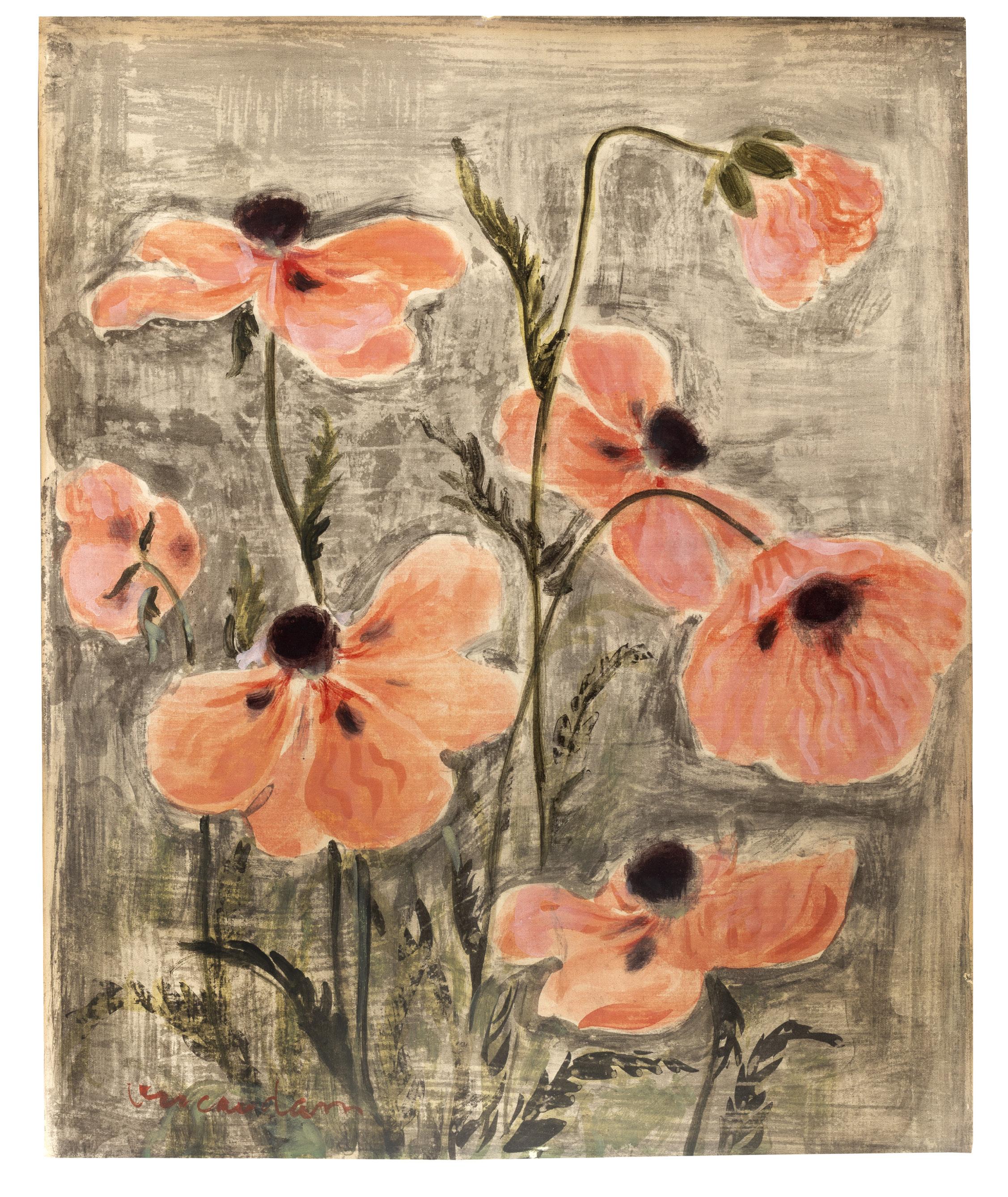
Tout au long de la décennie, les peintures sur soie furent plus faciles et moins coûteuses à produire que la sculpture, situation qui l’incite à revenir vers la détrempe sur soie, support exigeant enseigné à l’École des beaux-arts de l’Indochine, ne permettant aucun repentir et dont il avait acquis une maîtrise parfaite lors de sa formation à Hanoï. Il apprécie la finesse du grain et la douceur d’absorption de la couleur et confie à son même professeur deux ans plus tard, en 1933 : ’Je suis heureux de constater que mes camarades comprennent désormais le grand intérêt qu’ils portent à la peinture sur soie’ 2
En effet, avec l’arrivée à Paris de ses compatriotes, Mai Trung Thứ et Lê Phô, à la fin des années 1930, Vũ Cao Đàm ne fut pas le seul à s’engager dans cette voie, les trois artistes exposant souvent ensemble. Ils présentèrent des peintures sur soie au Salon des Tuileries et au Salon des Indépendants en 1939, et continuèrent à le faire tout au long des années 1940, ainsi qu’à Agindo, l’Agence Économique de l’Indochine.
Cette œuvre incarne une décennie incontournable dans son corpus : celle d’un étudiant talentueux devenu artiste à Paris, qui s’oriente alors vers une voie plus indépendante lui permettant de tracer son propre sillage artistique et de s’épanouir dans son pays d’accueil. Les fleurs, symbole de la féminité, sont parmi les sujets de prédilection de l’artiste. Plusieurs tiges feuillues traversent la toile, dynamisant et structurant la composition, tandis que sept belles fleurs sont reproduites dans un rose orangé délicat. Gracieuses et rondes, tantôt ouvertes, tantôt fermées, aucune fleur n’a la même position qu’une autre, ce qui, associé au cadrage resserré, donne dynamisme et liberté à la composition. À travers une palette nuancée et harmonieuse, il parvient à insuffler une grande douceur à cette nature morte. L’œuvre représente des fleurs de pavot, traditionnellement associées au sommeil, à la paix et à la renaissance. Au Vietnam, et plus particulièrement en Cochinchine au XIXe siècle, le pavot est également associé au commerce de l’opium, donnant à ses fleurs une portée à la fois historique et symbolique.
Trong suốt thập niên đó, hội họa trên lụa dễ thực hiện và ít tốn kém hơn so với điêu khắc, điều này đã thúc đẩy ông quay trở lại với các sáng tác tranh lụa – một chất liệu có trong chương trình giảng dạy tại Trường Cao đẳng Mỹ thuật Đông Dương, đòi hỏi phải có kỹ thuật cao, không cho phép sai sót, và là kỹ thuật mà ông đã đạt đến trình độ hoàn hảo trong quá trình đào tạo tại Hà Nội. Ông đánh giá cao độ mịn của bề mặt lụa cũng như
khả năng thẩm thấu màu sắc, và hai năm sau, vào năm 1933, ông chia sẻ với chính người thầy của mình: *“Em rất vui khi nhận thấy rằng các
bạn đồng môn của mình giờ đây đã hiểu được tầm quan trọng to lớn của hội họa trên lụa.”*²
Thực tế, khi những người đồng hương của ông là Mai Trung Thứ và Lê Phổ tới Paris vào cuối thập niên 1930, Vũ Cao Đàm không phải là người duy nhất lựa chọn con đường này; cả ba nghệ sĩ thường xuyên triển lãm cùng nhau. Họ đã trưng bày các tác phẩm hội họa trên lụa tại Triển lãm Tuileries và Triển lãm của các Nghệ sĩ tự do năm 1939, và tiếp tục triển lãm trong suốt thập niên 1940, cũng như tại Agindo, Đông Dương Kinh tế cục.
Tác phẩm này tiêu biểu cho một thập niên then chốt trong toàn bộ sự nghiệp của ông: giai đoạn một sinh viên tài năng trở thành nghệ sĩ tại Paris, hướng tới con đường sáng tác độc lập hơn, cho phép ông xác lập dấu ấn nghệ thuật riêng và toả sáng ở đất nước nơi ông sinh sống.
Những đoá hoa, biểu tượng của tính nữ, là một trong những đề tài ưa thích của nghệ sĩ. Những nhành lá cắt qua mặt tranh, tạo nên cấu trúc và sự linh hoạt cho bố cục, trong khi bảy đoá hoa lại được thể hiện với sắc hồng cam dịu nhẹ.
Tròn đầy và duyên dáng, có những đoá hoa nở rộ, có những đoá lại khép hờ. Sự khác biệt của từng đoá hoa kết hợp với khung hình được thu hẹp mang lại cảm giác linh động và tự do cho bố cục. Thông qua một bảng màu tinh tế và hài hòa, nghệ sĩ đã đưa tới sự dịu dàng sâu lắng cho bức tĩnh vật này.
Tác phẩm thể hiện hoa anh túc, loài hoa thường gắn liền với giấc ngủ, hòa bình và sự tái sinh. Tại Việt Nam, đặc biệt là ở miền Nam (Cochinchine) vào thế kỷ XIX, hoa anh túc còn gắn với hoạt động buôn bán thuốc phiện, từ đó mang loài hoa này có ý nghĩa vừa lịch sử vừa biểu tượng.
Throughout the decade, paintings on silk were easier and less expensive to produce than sculpture, a situation that prompted him to return to tempera on silk, a demanding medium taught at the Indochina School of Fine Arts, which allowed for no corrections and which he had mastered perfectly during his training in Hanoi. He appreciated the fineness of the grain and the softness of the color absorption and confided to his same teacher two years later, in 1933: “I am happy to see that my classmates now understand the great interest they have in painting on silk.” 2
Indeed, with the arrival in Paris of his compatriots Mai Trung Thứ and Lê Phô in the late 1930s, Vũ Cao Đàm was not alone in pursuing this path, as the three artists often exhibited together. They presented paintings on silk at the Salon des Tuileries and the Salon des Indépendants in 1939, and continued to do so throughout the 1940s, as well as at Agindo, the Economic Agency of Indochina.
This work embodies a decade that is essential to his body of work: that of a talented student who became an artist in Paris, then turned toward a more independent path that allowed him to forge his own artistic trail and flourish in his host country.
Flowers, a symbol of femininity, are among the artist’s favorite subjects. Several leafy stems cross the canvas, energizing and structuring the composition, while seven beautiful flowers are reproduced in a delicate orange-pink hue. Graceful and round, sometimes open, sometimes closed, no two flowers are in the same position, which, combined with the tight framing, gives the composition dynamism and freedom. Through a nuanced and harmonious palette, he manages to infuse this still life with great softness. The work depicts poppy flowers, traditionally associated with sleep, peace, and rebirth. In Vietnam, and more particularly in Cochinchina in the 19th century, the poppy is also associated with the opium trade, giving its flowers both historical and symbolic significance.
2 Vũ Cao Đàm, lettre à Victor Tardieu du 26 avril 1933, Fonds Victor Tardieu, INHA, espace Jacques Doucet, archives 125/5-9.
² Vũ Cao Đàm, thư gửi Victor Tardieu ngày 26 tháng 4 năm 1933, Quỹ Victor Tardieu, INHA, espace Jacques Doucet, archives 125/5-9.
2 Vũ Cao Đàm, letter to Victor Tardieu dated April 26, 1933, Victor Tardieu Collection, INHA, espace Jacques Doucet, archives 125/5-9.
19
LÊ PHỔ (1907-2001)
Baigneuses, 1947
Crayon sur papier, signé et daté en bas à droite
48 x 63,5 cm - 18 ¾ x 25 in.
Pencil on paper, signed and dated lower right
25 000 - 50 000 €
Une attestation d’inclusion au catalogue raisonné de l’artiste actuellement en préparation par Charlotte Aguttes-Reynier pour l’association des Artistes d’Asie à Paris sera remise à l’acquéreur.
PROVENANCE
Collection particulière d’un couple d’amateurs d’art, proches amis des peintres Lê Phổ et Vũ Cao Đàm dès le début des années 1940 à Paris.
Collection particulière, France (par descendance, offert par les précédents dans les années 1980)
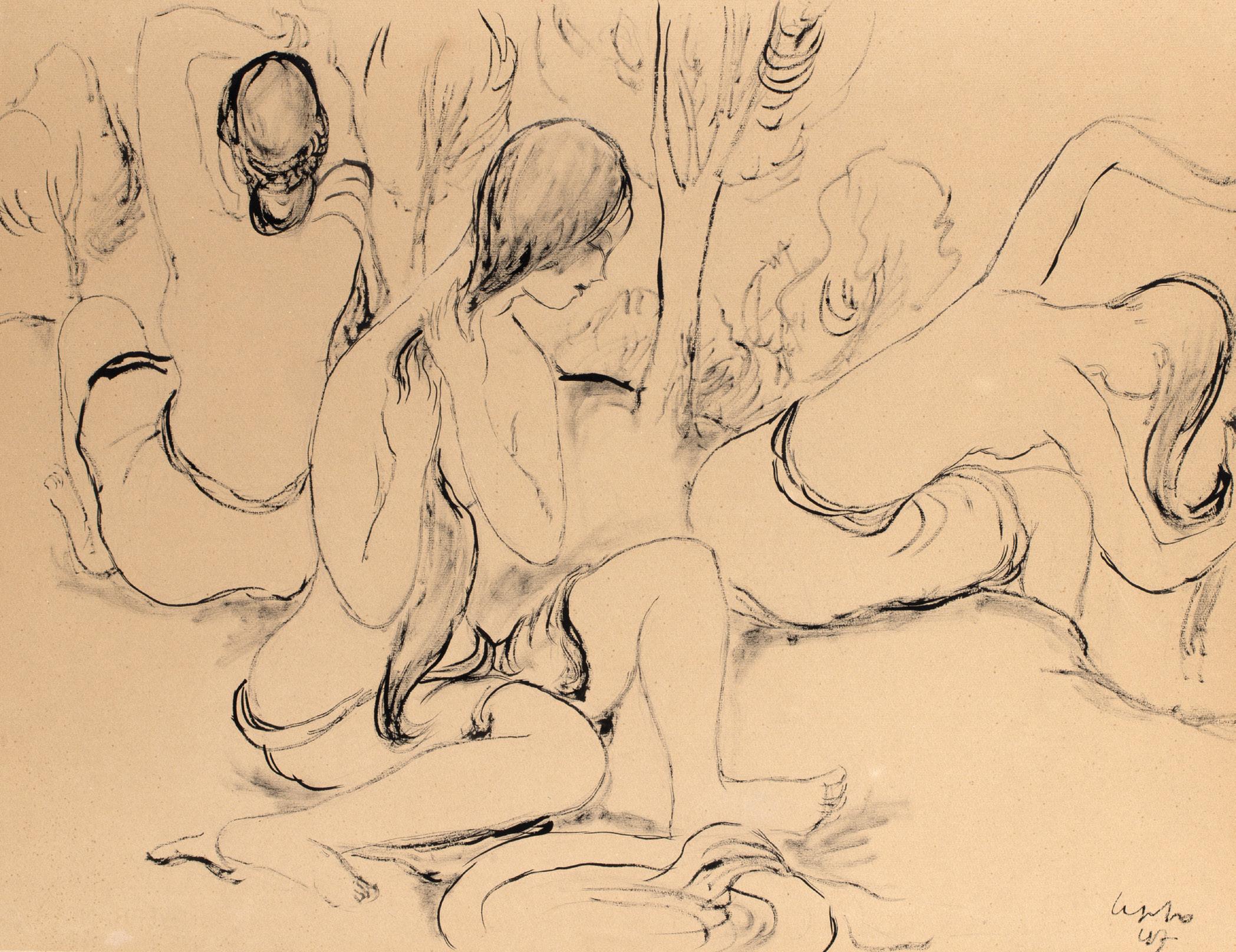
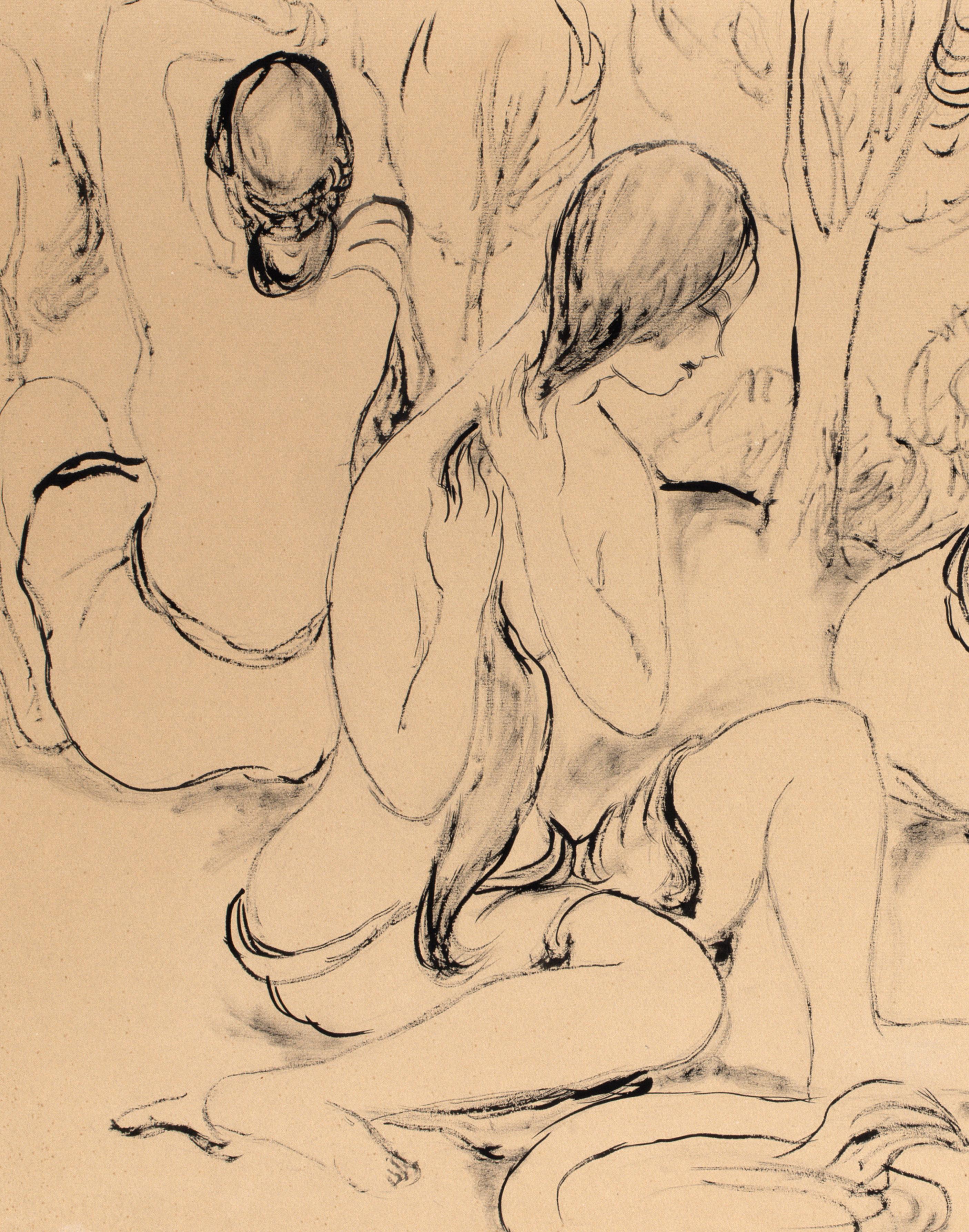
Baigneuses illustre la pluridisciplinarité de Lê Phổ et son talent précoce de dessinateur. C’est en effet sous la direction d’un sculpteur diplômé des Arts décoratifs de Paris, que le jeune Lê Phổ acquiert au début des années 1920 un solide niveau en dessin. Cet enseignement lui permet d’être admis lors du premier concours d’entrée à l’École des beaux-arts de l’Indochine en 1925. Diplômé en 1930, il devient ensuite chargé de cours de dessin et assiste Victor Tardieu, directeur de l’École, dans la préparation de la section indochinoise de l’Exposition coloniale prévue pour mai 1931.
Cette feuille témoigne de la quête constante de l’artiste d’un équilibre entre héritage vietnamien et influences occidentales. Datée de 1947, la composition se rapproche par certains aspects de l’approche de Paul Gauguin à Tahiti, notamment dans les positions allongées ou languissantes des figures féminines insérée dans un contexte d’une nature. Il est intéressant de noter que Et l’or de leurs corps, peinte par Gauguin en 1901, intègre les collections du musée du Louvre à Paris en 1944, où elle est exposée en 1945 et, à nouveau, en 1947, aux Tuileries cette fois-ci. Connaissant la curiosité artistique et le goût pour les musées de Lê Phổ, alors installé à Paris, il semble plausible que son dessin s’inscrive dans un dialogue conscient avec l’œuvre de Gauguin.
Le soin apporté des modèles de beauté asiatiques à leur chevelure, longue et noire, accentuée par un trait d’encre plus appuyé et intense, souligne l’attention du dessinateur à l’élégance et au détail dans ses compositions. L’œuvre traduit une vision idéalisée de la femme, en fusion avec la nature environnante. Les jeunes femmes semblent en harmonie entre elles et avec le courant de cette rivière esquissée, dégageant une impression de sérénité et d’équilibre.
œuvre en rapport
Paul Gauguin, Et l’or de leurs corps, 1901 © RMN-Grand Palais (Musée d’Orsay) / Hervé Lewandowski
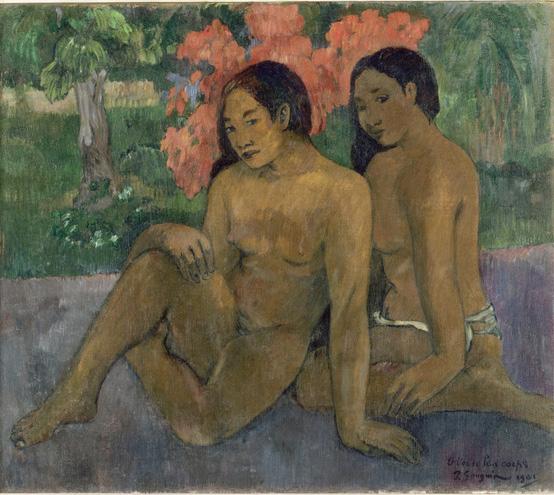
Baigneuses (Những người phụ nữ tắm) minh
họa rõ nét tính đa dạng trong thực hành nghệ
thuật của Lê Phổ, đồng thời cho thấy tài năng hội họa sớm nở rộ của ông. Thật vậy, dưới sự
hướng dẫn của một nhà điêu khắc tốt nghiệp
Trường Nghệ thuật Trang trí Paris, Lê Phổ khi
còn rất trẻ đã đạt được nền tảng vững chắc về hội họa vào đầu những năm 1920. Chính quá trình đào tạo này đã giúp ông trúng tuyển kỳ thi đầu vào đầu tiên của Trường Cao đẳng Mỹ thuật Đông Dương năm 1925. Tốt nghiệp năm 1930, ông tiếp tục đảm nhiệm vai trò trợ giảng môn vẽ, đồng thời hỗ trợ Hiệu trưởng Victor Tardieu trong việc chuẩn bị khu trưng bày Đông Dương cho Triển lãm Thuộc địa dự kiến tổ chức vào tháng 5 năm 1931.
Bản vẽ này cho thấy hành trình tìm kiếm sự cân bằng giữa di sản Việt Nam và các ảnh hưởng phương Tây của nghệ sĩ. Được sáng tác vào năm 1947, ở một số khía cạnh, bố cục tác phẩm gợi liên tưởng đến phong cách của Paul Gauguin tại Tahiti, đặc biệt qua tư thế của người phụ nữ trước thiên nhiên. Đáng chú ý là tác phẩm Et l’or de leurs corps (Và vàng trên thân thể họ), do Gauguin sáng tác năm 1901, đã được đưa vào bộ sưu tập của Bảo tàng Louvre tại Paris năm 1944, được trưng bày vào năm 1945 và một lần nữa vào năm 1947 tại Tuileries. Với sự am hiểu nghệ thuật và niềm say mê các bảo tàng của họa sĩ Lê Phổ, khi ấy đang sinh sống tại Paris, có thể nói rằng ông đã thực hiện bức vẽ dựa trên nguồn
cảm hứng sáng tác lấy từ tác phẩm của Gauguin.
Sự chăm chút dành cho những chuẩn mực vẻ
đẹp Á Đông, thể hiện qua mái tóc dài đen nhánh
được nhấn mạnh bằng những nét mực đậm và
dứt khoát, cho thấy sự quan tâm đặc biệt của
người vẽ đối với sự trang nhã và chi tiết trong bố cục. Tác phẩm truyền tải hình ảnh lý tưởng hóa
của người phụ nữ đang hòa mình với cảnh sắc thiên nhiên, với dòng chảy của con sông, tạo nên một cảm giác tĩnh lặng và yên bình.
Baigneuses (Bathers) illustrates Lê Phổ’s multidisciplinary approach and his precocious talent as a draftsman. It was under the guidance of a sculptor who had graduated from the Paris School of Decorative Arts that the young Lê Phổ acquired a solid foundation in drawing in the early 1920s. This training enabled him to be admitted to the Indochina School of Fine Arts in 1925. After graduating in 1930, he became a lecturer in drawing and assisted Victor Tardieu, the school’s director, in preparing the Indochinese section of the Colonial Exhibition scheduled for May 1931.
This sheet bears witness to the artist’s constant quest for a balance between Vietnamese heritage and Western influences. Dated 1947, the composition is similar in some respects to Paul Gauguin’s approach in Tahiti, particularly in the reclining or languid positions of the female figures set against a natural backdrop. It is interesting to note that Et l’or de leurs corps (And the gold of their bodies), painted by Gauguin in 1901, was added to the collections of the Louvre Museum in Paris in 1944, where it was exhibited in 1945 and again in 1947, this time at the Tuileries. Knowing Lê Phổ’s artistic curiosity and taste for museums, while living in Paris, it seems plausible that his drawing is part of a conscious dialogue with Gauguin’s work.
The care taken with the Asian models’ long, black hair, accentuated by a more pronounced and intense ink line, highlights the artist’s attention to elegance and detail in his compositions.
The work conveys an idealized vision of women, at one with the surrounding nature. The young women seem to be in harmony with each other and with the flow of the sketched river, giving an impression of serenity and balance.
COLLECTION DE MME X.
à l’entrée de la salle de réception. Celui-ci est conservé comme un souvenir cher de ce moment amical.
Ce dessin élégant à la sanguine, médium et architecture représentée rappelant tous deux le XVIII e siècle. Le choix de la sanguine souligne également l’aisance de Le Tan dans le dessin académique et sa sensibilité aux variations de trait, qui lui permettent de moduler l’intensité et de créer des effets de profondeur dans la représentation architecturale. Cette affiche montre qu’il s’agit pour la famille d’un évènement important, qu’ils se plaisent à célébrer en grandes pompes et qui témoignent encore une fois des liens amicaux et profonds liés avec la famille Lê Pho.
Sinh năm 1950 tại Neuilly-sur-Seine, Pierre Lê Tân là một trong những người con của Lê Phổ một trong những bậc thầy lớn của hội họa hiện đại Việt Nam.
Pierre Lê Tân lớn lên tại Paris và đã theo học nhiều bộ môn nghệ thuật đa dạng: ông là họa sĩ, họa viên, hoạ sĩ vẽ tranh minh họa, biếm họa và nhà thiết kế. Lê Phổ, người thầy đầu tiên của ông, đã đưa con trai mình đi thăm các cửa hàng đồ cổ và cả chợ trời ngay từ khi Pierre mới bảy hoặc tám tuổi. Gắn bó sâu sắc với Paris, Lê Tân chưa bao giờ quên quan điểm thẩm mỹ cũng như niềm đam mê sưu tầm di truyền lại từ cha mình. Ông
đã bày tỏ sự tri ân vừa sâu sắc ấy trong cuốn
Quelques collectionneurs (Một vài nhà sưu tầm) xuất bản năm 2013.
Sự nghiệp của Lê Tân khởi đầu rất sớm, khi mới
17 tuổi, khi một trong những bản vẽ của ông được
chọn làm bìa cho tạp chí The New Yorker. Sau đó, ông cộng tác với nhiều ấn phẩm danh tiếng như
The New York Times, Madame Figaro, Harper’s Bazaar và Vogue. Song song với đó, ông khẳng
định vị trí của mình trong lĩnh vực quảng cáo thông qua hợp tác với các thương hiệu danh tiếng như Lanvin, Gucci, Hermès, cũng như với nhiều nhà xuất bản. Một triển lãm hồi cố dành cho ông đã được tổ chức năm 2004 tại Bảo tàng
Reina Sofía.
Pierre Lê Tân còn được biết đến với gu thẩm mỹ của một nhà trang trí nội thất. Căn hộ tại Paris của ông là nơi ông thể hiện trọn vẹn cảm quan này, sự tinh tế trong việc kết hợp và sắp đặt vải vóc, tranh vẽ, các tác phẩm hiếm có và độc đáo… theo tinh thần của một “cabinet de curiosités” (phòng sưu tập kỳ thú).
Nhân dịp kỷ niệm ngày cưới của vợ chồng ông X, những người yêu nghệ thuật và cũng là bạn thân của gia đình Lê Phổ, Pierre Lê Tân đã vẽ thực
đơn được trưng bày tại lối vào sảnh tiệc. Tác phẩm này được lưu giữ như một kỷ vật quý giá
của tình bạn ấy.
Bức vẽ thanh nhã này được thực hiện bằng chì sanguine (chì màu đỏ nâu), cả chất liệu lẫn cách
thể hiện đều gợi nhớ đến hội hoạ thế kỷ XVIII.
Việc lựa chọn chì sanguine còn cho thấy sự điêu
luyện của Lê Tân trong lối vẽ hàn lâm, cũng như
độ nhạy cảm trong việc xử lý đường nét, cho phép ông điều chỉnh cường độ và tạo ra hiệu
ứng chiều sâu khi thể hiện kiến trúc. Tác phẩm này cho thấy một sự kiện quan trọng đối với gia
đình, được tổ chức một cách long trọng, đồng thời một lần nữa phản ánh mối quan hệ thân thiết và bền chặt giữa hai gia đình.
Born in Neuilly-sur-Seine in 1950, Pierre Le Tan is one of the sons of Lê Phổ, the artist mentioned above, one of the greatest masters of modern Vietnamese painting.
Pierre Le Tan grew up in Paris and received artistic training as a painter, draftsman, illustrator, caricaturist, and designer.
Lê Phổ, his great mentor, took him to antique shops and even flea markets from the age of seven or eight. Deeply Parisian, Le Tan never forgot the aesthetic heritage and origins of his atavistic passion for collecting, both passed on to him by his father, to whom he pays a glowing and intimate tribute in his book Quelques collectionneurs (Some collectors), published in 2013.
Le Tan’s career began at the age of just 17, with the publication of one of his drawings on the cover of The New Yorker magazine. He then worked for publications such as The New York Times, Madame Figaro, Harper’s Bazaar, and Vogue. The artist made a name for himself in advertising by collaborating with prestigious fashion houses such as Lanvin, Gucci, and Hermès, as well as publishing houses. A retrospective was dedicated to him in 2004 at the Reina Sofia.
Pierre Le Tan is also known for his taste in interior design. His Parisian apartment allows him to express this sensibility with talent, mixing and arranging textiles, drawings, rare and unusual objects... in the spirit of a cabinet of curiosities.
On the occasion of the wedding anniversary of the X couple, art lovers and friends of the Lê Phổ family, Pierre Le Tan drew the menu that was displayed at the entrance to the reception hall. It is kept as a cherished souvenir of this friendly moment.
This elegant drawing in red chalk, medium and architecture both reminiscent of the 18th century. The choice of red chalk also highlights Le Tan’s ease with academic drawing and his sensitivity to variations in line, which allow him to modulate intensity and create effects of depth in architectural representation. This poster shows that this was an important event for the family, which they enjoyed celebrating in grand style, once again demonstrating their deep and friendly ties with the Lê Pho family.
20
PIERRE LE TAN (1950-2019) Menu pour un déjeuner d’anniversaire, circa 1970
Sanguine sur papier, signé en bas à gauche 50,2 x 32 cm - 19 ¾ x 12 ¾ in.
Sanguine on paper, signed lower left 1 500 - 2 000 €
PROVENANCE
Collection particulière d’un couple d’amateurs d’art, ami proche des peintres Lê Phổ et Vũ Cao Đàm dès le début des années 1940 à Paris. Collection particulière, France (par descendance, offert par les précédents dans les années 1980).
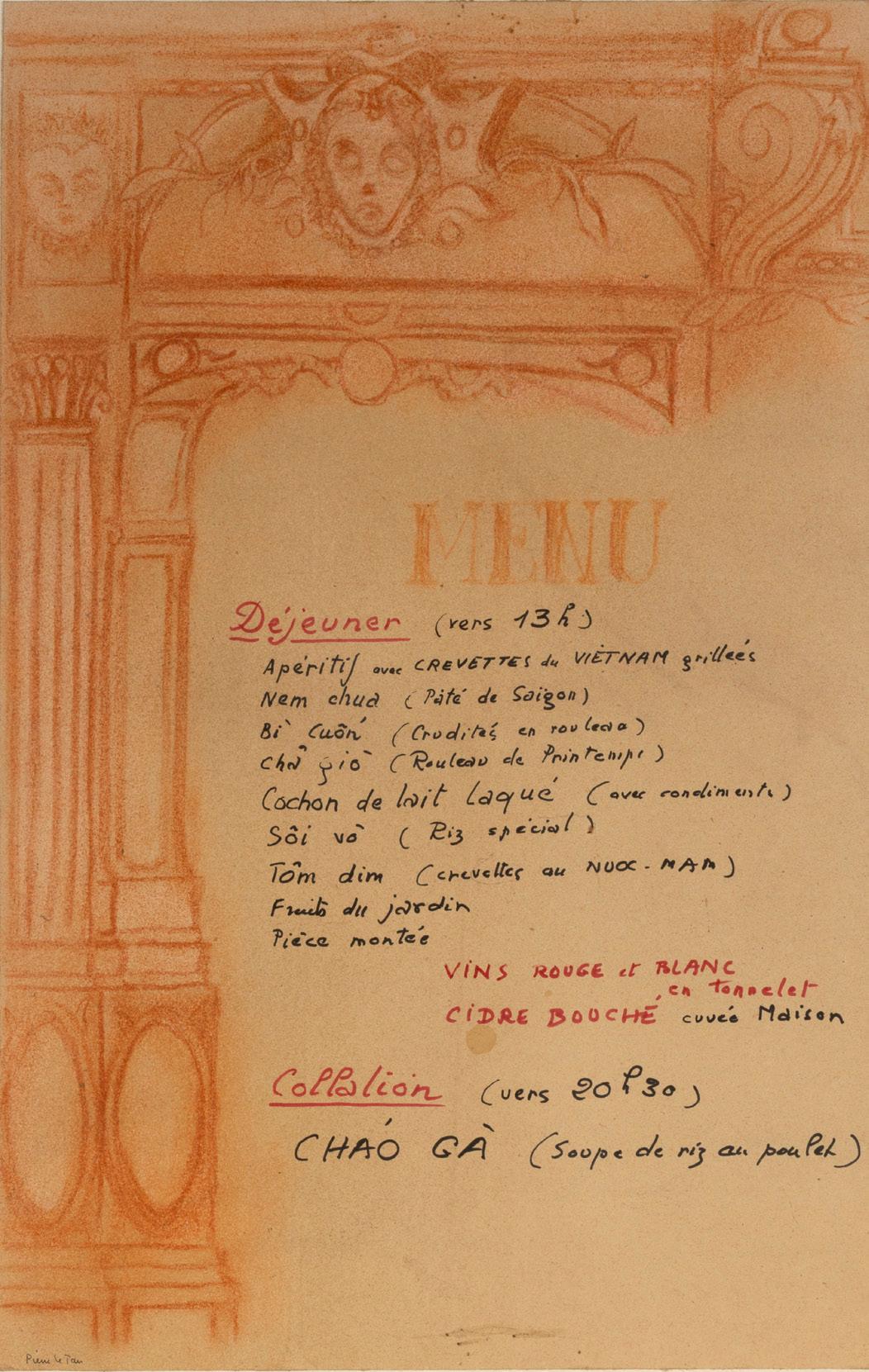
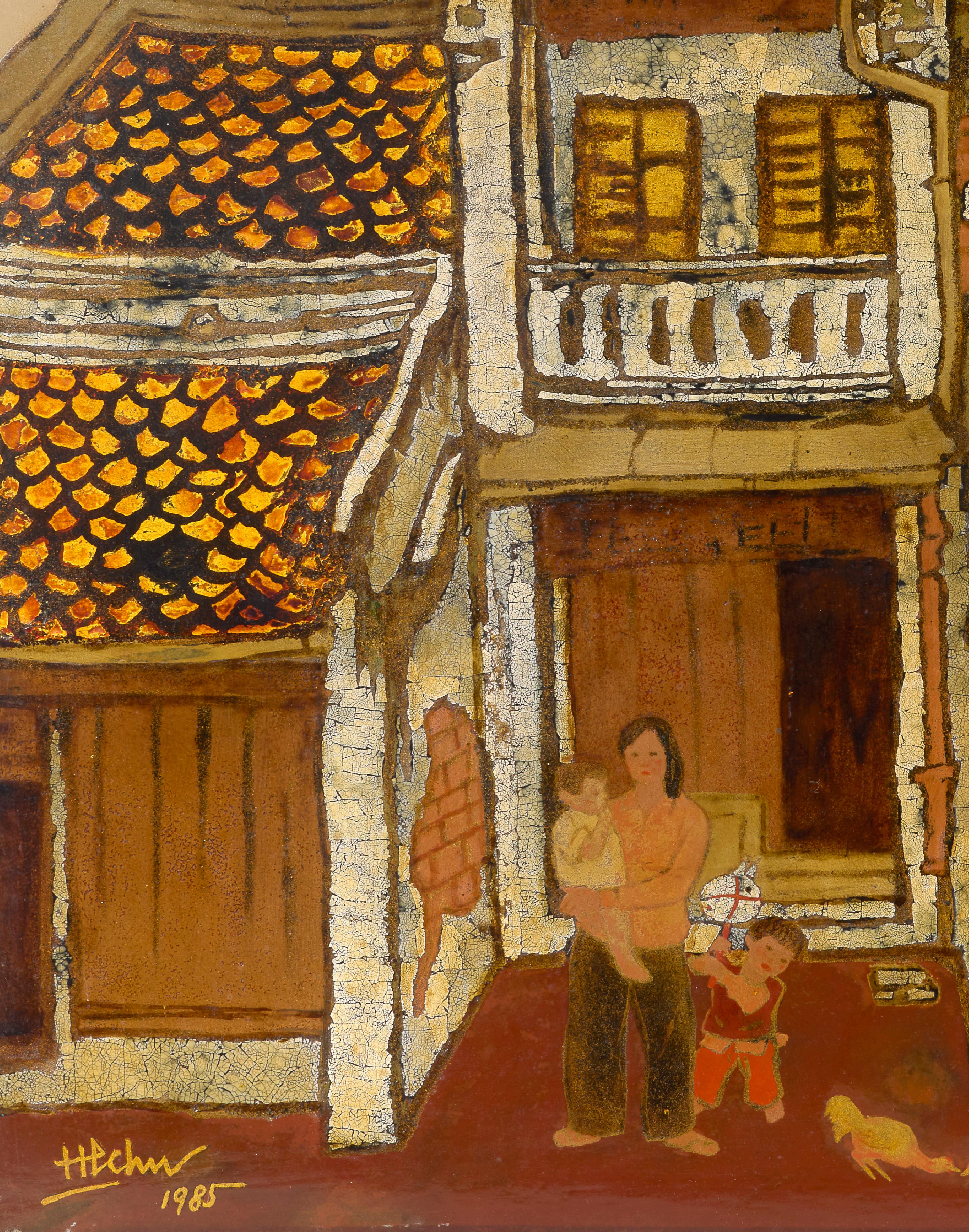
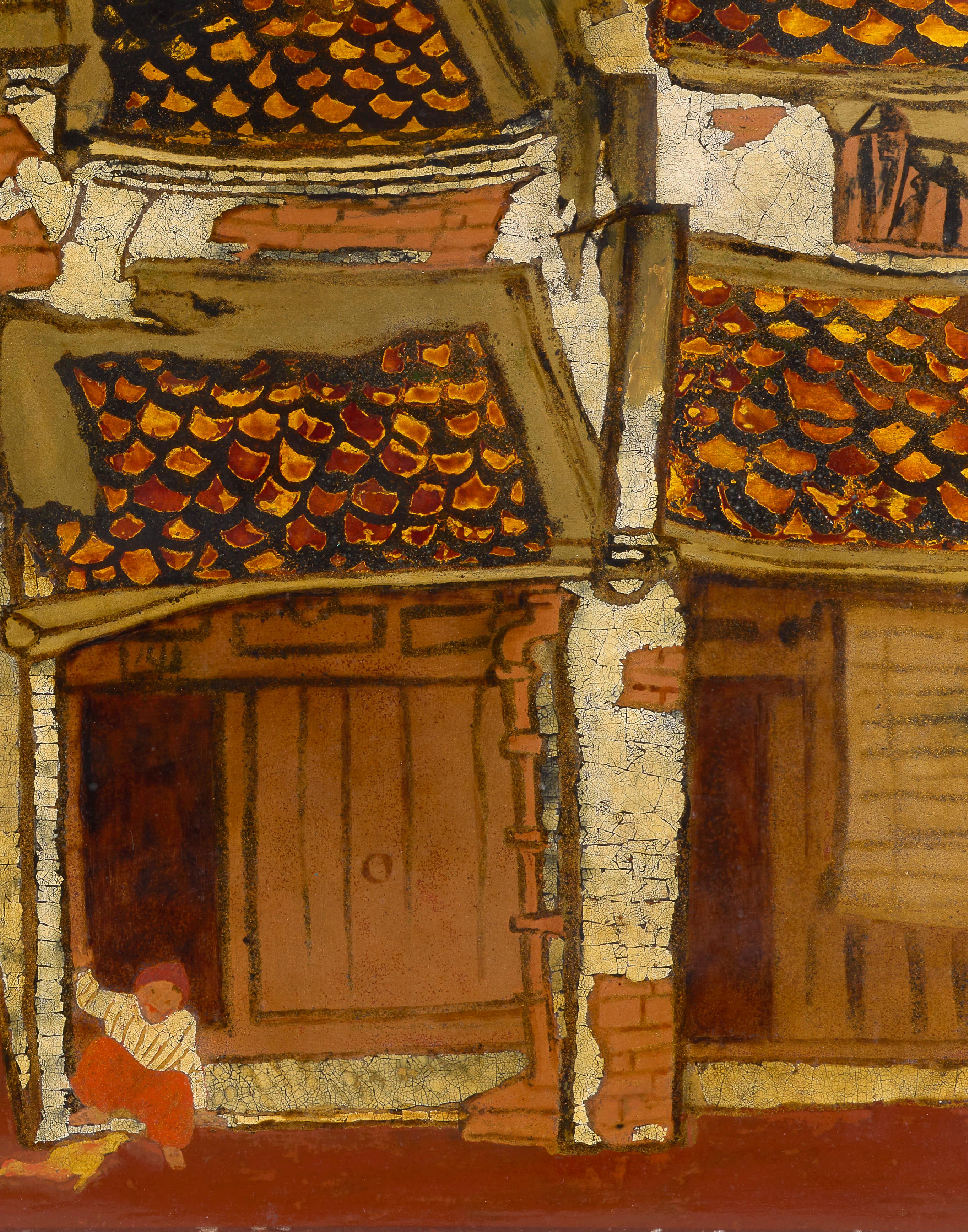
HOÀNG TÍCH CHU (1912-2003)
Rue de Hanoï, 1985
Laque à rehauts d’or et de coquilles d’œuf, un panneau, signé et daté en bas à gauche
51 x 65 cm - 20 1/16 x 25 9/16 in.
Lacquer with gold highlights and eggshells, one panel, signed and dated lower left 25 000 - 45 000 €
PROVENANCE
Collection particulière, France (acquis dans les années 1980 auprès de l’artiste et conservé depuis)
Le renouveau de l’art de la laque
La peinture sur laque est au Vietnam un art majeur, indissociable de l’histoire culturelle du pays. Art traditionnel par excellence, il rayonne également à l’étranger et fait du Vietnam un bastion de cette technique ancestrale. Si ce savoir-faire remonte au XVe siècle, son rayonnement actuel doit beaucoup à l’impulsion de Joseph Inguimberty, professeur dès 1925 au sein de l’École des beaux-arts de l’Indochine et qui introduit des cours de laque dès 1927. Traditionnellement, seuls le rouge, le noir, le brun mais aussi l’argent et l’or sont représentés. Grâce à l’introduction de matières nouvelles comme la coquille d’œuf, le sulfure de cadmium ou encore l’oxyde de chrome, d’autres couleurs telles le blanc, le jaune ou encore le vert apparaissent. Les efforts entrepris au sein de l’École des beaux-arts à Hanoï à partir de cette date permirent un véritable renouveau dans la pratique de cet art.
Sự đổi mới của nghệ thuật sơn mài
Tranh sơn mài ở Việt Nam là một nghệ thuật lớn, gắn bó mật thiết với lịch sử văn hóa dân tộc. Là một nghệ thuật truyền thống tiêu biểu, sơn mài đã vươn ra tầm quốc tế, góp phần khẳng định vị thế của Việt Nam như một cái nôi của kỹ thuật sơn mài cổ truyền. Dù kỹ thuật này đã xuất hiện từ thế kỷ XV, nhưng sự phát triển rực rỡ hiện nay phần lớn nhờ vào ảnh hưởng của Joseph Inguimberty, giảng viên tại Trường Mỹ thuật Đông Dương từ năm 1925, người đã đưa nghệ thuật sơn mài vào giảng dạy chính thức từ năm 1927. Theo truyền thống, tranh sơn mài chỉ sử dụng màu đỏ, đen, nâu, cùng với những mảng thếp bạc và vàng. Tuy nhiên, nhờ việc du nhập các chất liệu mới như vỏ trứng, sunfua cadmi hay oxit crôm, bảng màu đã được mở rộng với sự xuất hiện của trắng, vàng và xanh lục. Những nỗ lực cải tiến
The revival of lacquer painting
Lacquer painting is a major art form in Vietnam, inseparable from the country’s cultural his tory. A traditional art par excellence, it also shines abroad, making Vietnam a bastion of this ancestral technique. Although this know how dates back to the 15 th century, its current influence owes much to the impetus of Joseph Inguimberty, who taught at the Indochina School of Fine Arts from 1925 and introduced lacque rware courses in 1927. Traditionally, only red, black and brown, but also silver and gold, were represented. With the introduction of new materials such as eggshell, cadmium sulfide and chromium oxide, other colors such as white, yellow and green appeared. The efforts of the Hanoi School of Fine Arts from this date onwards led to a genuine revival in the practice of this art form.
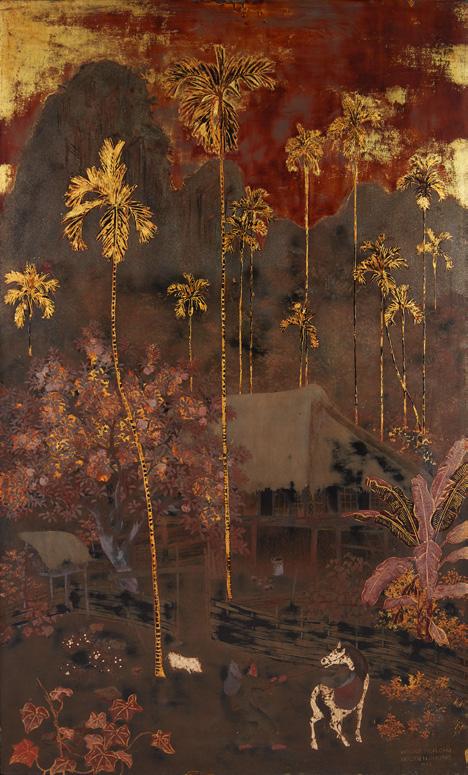
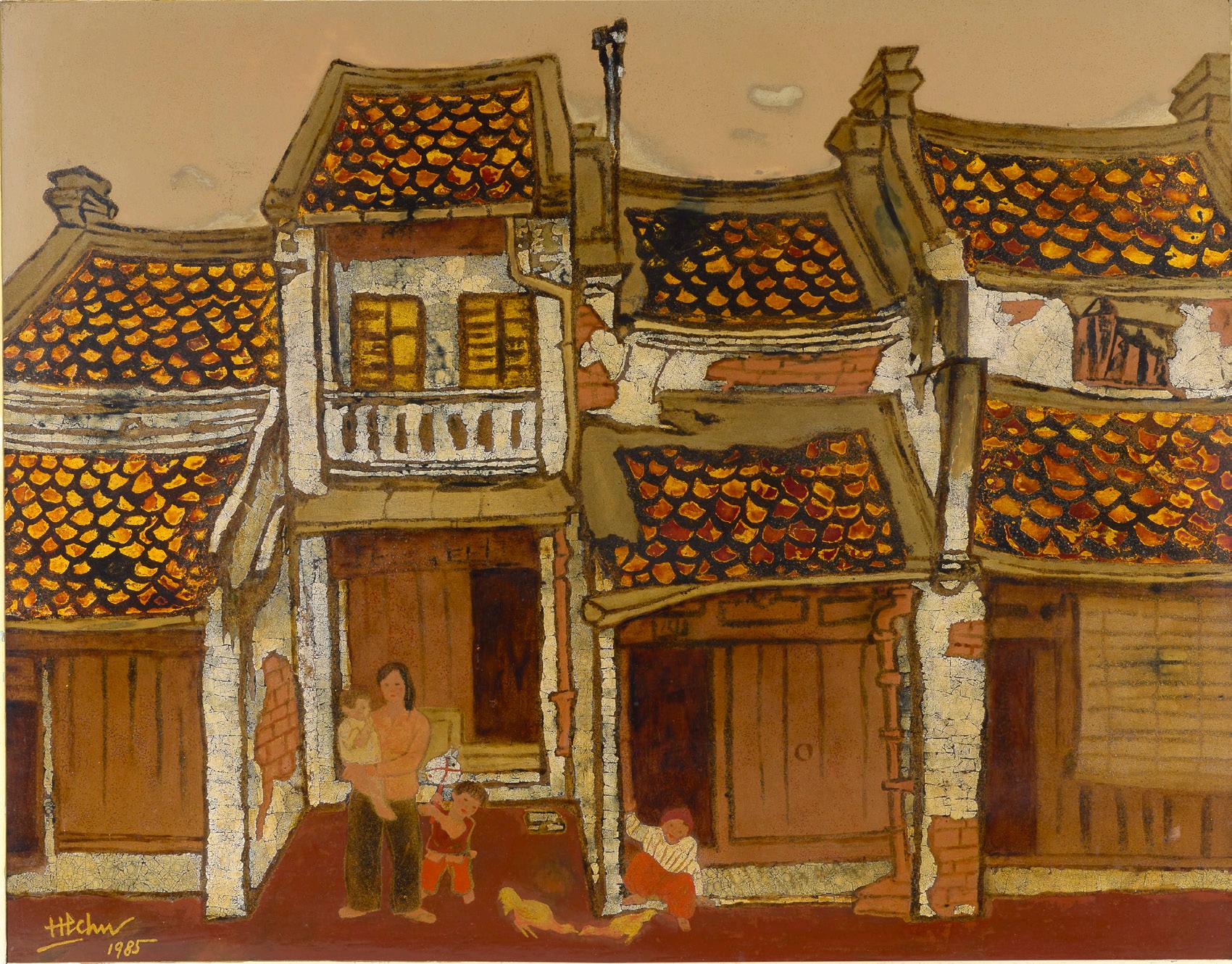
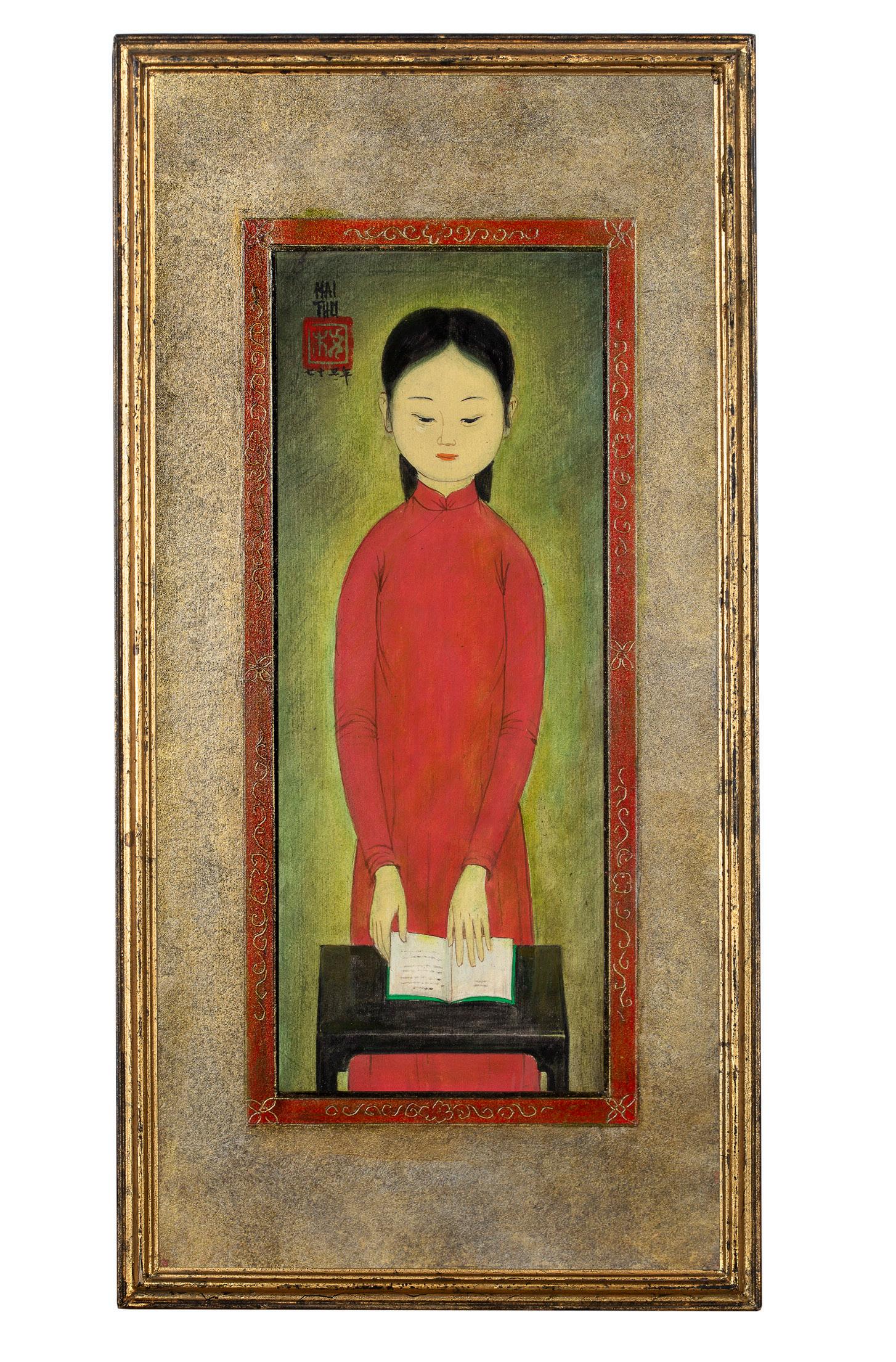
22 MAI TRUNG THỨ (1906-1980)
Tunique rouge, 1973
Encre et couleurs sur soie, signée et datée en haut à gauche, titrée et monogrammée au dos et sur le carton par l’artiste Dans son cadre d’origine réalisé par l’artiste
31,1 x 14 cm - 12 ¼ x 5 ½ in
Ink and color on silk, signed and dated upper left, titled and monogrammed on the reverse and on the carboard by the artist In its original frame made by the artist
35 000 - 50 000 €
Une attestation d’inclusion au catalogue raisonné de l’artiste actuellement en préparation par Charlotte Aguttes-Reynier pour l’association des Artistes d’Asie à Paris sera remise à l’acquéreur.
PROVENANCE
Galerie Vendôme, Paris, circa 1974-1975 Collection particulière, Paris (acquis vers 2020)
EXPOSITION
1975, Exposition collective, Galerie Vendrôme, Paris
Élève de la première promotion de l’École des beaux-arts d’Indochine, Mai Trung Thứ s’est imposé comme l’un des artistes les plus appréciés et reconnus de sa génération. Incarnant avec brio le savant mélange des cultures occidentales et extrême-orientales, ses œuvres ont très vite connu une certaine renommée.
Si l’évolution stylistique de l’artiste peut être marquée par trois périodes, ses sources d’inspirations restent constantes. Parmi elles, le sujet féminin est particulièrement traité. Leurs silhouettes graciles et leurs chevelures ébènes apportent à ses compositions la vision d’un Vietnam traditionnel. Peintre de la féminité, Mai Trung Thứ s’est appliqué à retranscrire la beauté de ses modèles à la manière de portraits posés.
Mai Trung Thứ expose régulièrement en France. À la fin de sa vie, la Galerie Vendôme lui consacre plusieurs manifestations majeures : l’exposition « Le Monde d e Mai- Thứ » en 19741975, puis une rétrospective collective, avant de présenter « L’Univers poétique de Mai-Thu » de décembre 1979 à janvier 1980, dernier témoignage public de son œuvre avant sa disparition le 10 octobre 1980, alors qu’une exposition intitulée « Cent petits tableaux » était en cours de préparation. Ce succès auprès des galeries tient en grande partie à l’engouement de la clientèle privée, pour laquelle l’artiste adapte ses formats, privilégiant des compositions de plus petits formats afin de répondre à une demande toujours croissante des collectionneurs.
Là sinh viên khóa đầu tiên của Trường Cao đẳng
Mỹ thuật Đông Dương, Mai Trung Thứ đã khẳng định vị thế là một trong những nghệ sĩ được yêu mến và nổi tiếng nhất trong thế hệ của mình. Thể hiện một cách xuất sắc sự kết hợp tinh tế giữa nền văn hóa phương Đông và phương Tây, các tác phẩm của ông nhanh chóng đạt được những danh tiếng nhất định. Vào cuối những năm 1950, ông bắt đầu thực hiện các bức tranh khổ nhỏ, qua đó giúp tác phẩm của mình được phổ biến rộng rãi hơn. Mặc dù phong cách của nghệ sĩ có thể được chia thành ba giai đoạn phát triển, nhưng nguồn cảm hứng sáng tác của ông vẫn luôn nhất quán. Trong đó, hình ảnh người phụ nữ được ông đặc biệt tập trung khai thác. Những dáng hình mảnh mai, những mái tóc đen tuyền như mun của họ mang đến cho các tác phẩm của ông hình ảnh về một Việt Nam truyền thống. Là họa sĩ chuyên vẽ về phụ nữ, Mai Trung Thứ đã tái hiện vẻ đẹp của những nữ người mẫu theo lối vẽ tranh chân dung. Mai Trung Thứ thường xuyên triển lãm tại Pháp. Vào cuối đời, phòng tranh Vendôme đã dành cho ông nhiều sự kiện lớn: triển lãm “Le Monde de Mai-Thứ” (Thế giới của Mai Thứ) vào các năm 1974–1975, sau đó là một triển lãm hồi cố tập thể, trước khi giới thiệu “L’Univers poétique de MaiThu” (Vũ trụ thi ca của Mai Thứ) từ tháng 12 năm 1979 đến tháng 1 năm 1980, triển lãm cuối cùng trong sự nghiệp trước khi ông qua đời vào ngày 10 tháng 10 năm 1980, cùng thời điểm triển lãm mang tên “Cent petits tableaux” (Một trăm bức tranh nhỏ) đang được chuẩn bị. Thành công này tại các phòng tranh phần lớn đến từ lòng yêu mến của các nhà sưu tầm tư nhân; và để đáp ứng nhu cầu ngày càng tăng của nhóm khách hàng này, nghệ sĩ đã điều chỉnh kích thước các tác phẩm của mình, ưu tiên những bố cục nhỏ hơn.
A student in the first graduating class of the Indochina School of Fine Arts, Mai Trung Thứ has established himself as one of the most admired and acclaimed artists of his generation. Brilliantly embodying a masterful blend of Western and Far Eastern cultures, his works quickly gained widespread recognition. While the artist’s stylistic evolution can be divided into three distinct periods, his sources of inspiration remain constant. Among them, the female figure is a recurring theme. Their slender silhouettes and ebony hair lend his compositions a vision of traditional Vietnam. A painter of femininity, Mai Trung Thứ strove to capture the beauty of his models in the style of posed portraits. Mai Trung Thứ exhibited regularly in France. Toward the end of his life, the Galerie Vendôme dedicated several major exhibitions to him: the exhibition Le Monde de Mai-Thứ in 1974–1975, followed by a collective retrospective, before presenting L’Univers poétique de Mai-Thu from December 1979 to January 1980, the last public showcase of his work before his death on October 10, 1980, while an exhibition titled Cent petits tableaux was in preparation. This success with galleries was largely due to the artist’s adaptation of his formats, favoring smaller-scale compositions to meet the ever-growing demand from collectors.
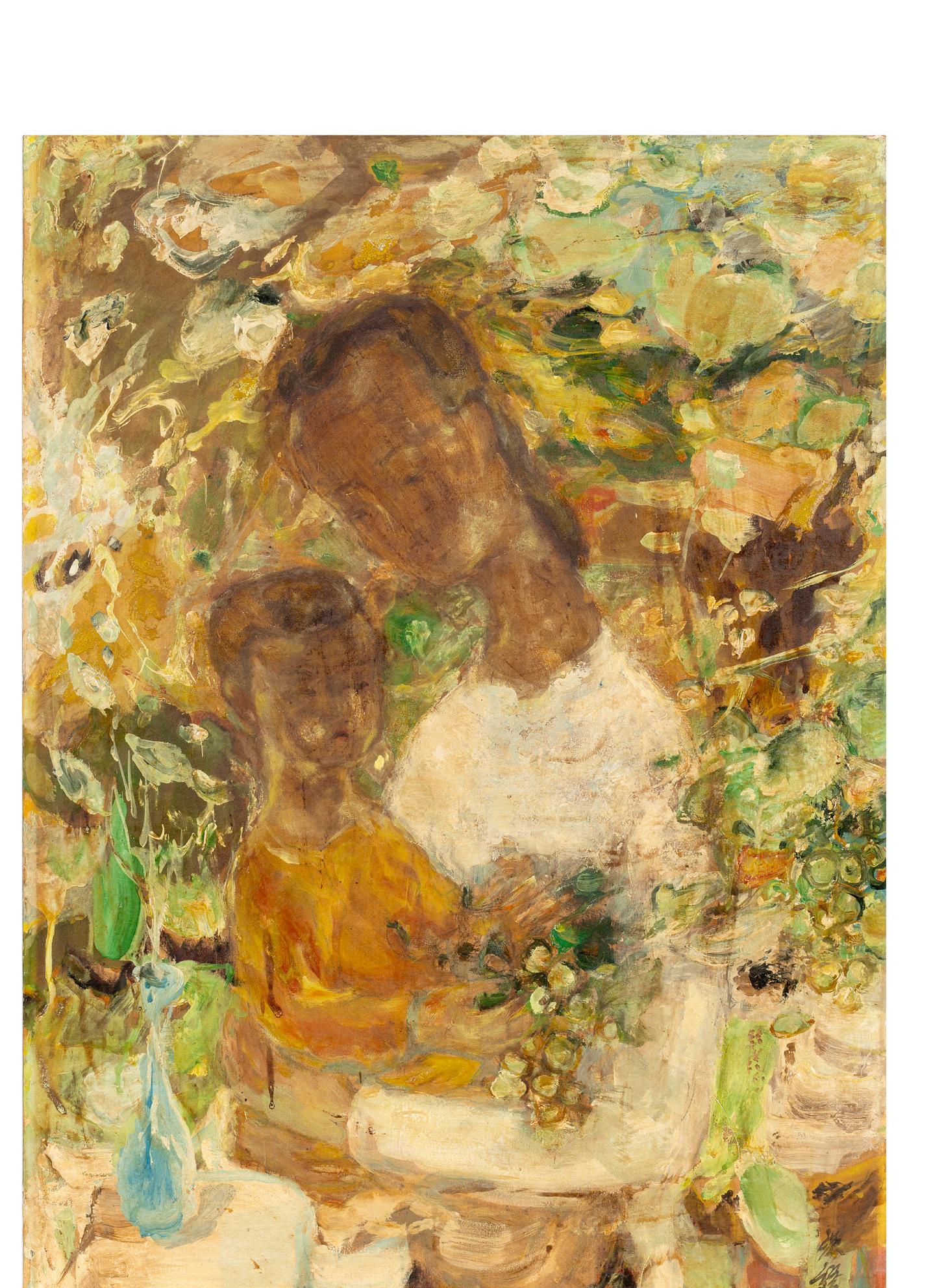
23
LÊ PHỔ (1907-2001)
La maternité aux raisins, circa 1963
Huile sur soie, signée en bas à droite, titrée au dos
72,5 x 50,3 cm - 28 ½ x 19 ¾ in.
Oil on silk, signed lower right, titled on reverse 50 000 - 80 000 €
Une attestation d’inclusion au catalogue raisonné de l’artiste actuellement en préparation par Charlotte Aguttes-Reynier pour l’association des Artistes d’Asie à Paris ainsi qu’un certificat d’authenticité rédigé le 4 décembre 2025 par Alain Le Kim seront remis à l’acquéreur.
PROVENANCE
Galerie Romanet, avant/circa février 1963 (comme en témoigne les images d’archives) Probablement envoyée à la Galerie Findlay en 1963 (comme en témoigne les inscriptions au verso)
Collection particulière A sie
Cette huile sur soie fut réalisée au début des années 1960, ainsi qu’en atteste les documents d’archives conservés dans la famille du peintre Lê Phổ. C’est dans ces mêmes années que ses expositions à la Galerie Romanet commencèrent à susciter l’intérêt du galeriste américain Wally Findlay, qui prit contact avec lui en 1963.
Installé depuis 1937 en France, Lê Phổ fait évoluer son travail vers un travail à l’huile, avec une palette plus nuancée, tout en gardant le support de la soie, médium difficile à maîtriser. Ce choix pictural lui permet d’abandonner la ligne et de travailler plutôt par aplats de couleurs vives. Cela se traduit par une modernisation de la touche et le choix d’une palette vive et lumineuse, évoquant la peinture nabis et impressionniste et insufflant une atmosphère douce et chaleureuse.
This oil on silk was created in the early 1960s, as confirmed by archival documents preserved in the family of the painter Lê Phổ. It was during these same years that his exhibitions at Galerie Romanet began to attract the attention of the American gallerist Wally Findlay, who contacted him in 1963.
Lê Phổ est particulièrement sensible aux maternités de tendresse de la Renaissance italienne, tel que La Vierge à l’Enfant avec le petit saint Jean Baptiste de Raphaël (INV 602 ; musée du Louvre, Paris). La peinture proposée s’inscrit dans la continuité de son corpus. Ici, une femme debout enlace son enfant qui tient une grappe de raisin. Référence évidente à l’iconographie de la Vierge à l’Enfant, Lê Phổ choisit de placer ce motif dans un décor domestique et luxuriant. Ainsi, une petite table surmontée d’une fleur dans un vase bleu se détache sur un fond extérieur lumineux. Tác phẩm sơn dầu trên lụa này được thực hiện vào đầu những năm 1960, như các tài liệu lưu trữ của gia đình họa sĩ Lê Phổ đã xác minh. Cũng chính tại thời điểm đó, các triển lãm của ông tại phòng tranh Romanet bắt đầu thu hút sự quan tâm của ông chủ phòng tranh người Mỹ Wally Findlay, người sau đó đã liên hệ với ông vào năm 1963.
Having settled in France in 1937, Lê Phổ gradually evolved his practice toward oil painting, adopting a more nuanced palette while continuing to use silk as a support, a medium that is difficult to master. This pictorial choice allowed him to abandon line work and instead work through flat areas of vivid colour. This results in a modernisation of his brushwork and the selection of a bright, luminous palette, evoking Nabis and Impressionist painting, and infusing the work with a soft and warm atmosphere. Lê Phổ was particularly sensitive to the tender depictions of motherhood in the Italian Renaissance, such as Raphael's The Virgin and Child with the Infant Saint John the Baptist (INV 602; Musée du Louvre, Paris). The present painting continues within his established body of work. Here, a standing woman embraces her child, who is holding a bunch of grapes. An obvious reference to the iconography of the Virgin and Child, Lê Phổ chooses to place this motif within a domestic and lush setting. Thus, a small table topped with a flower in a blue vase stands out against a bright outdoor background.
Định cư tại Pháp từ năm 1937, Lê Phổ dần thay đổi phong cách theo hướng sử dụng sơn dầu, với một bảng màu nhiều sắc độ hơn, đồng thời vẫn giữ chất liệu lụa, một phương tiện biểu đạt rất khó nắm bắt. Lựa chọn này cho phép ông từ bỏ việc chú trọng đường nét và thay bằng những mảng màu tươi sáng. Điều này thể hiện qua những nét vẽ hiện đại và một bảng màu rực rỡ, tươi sáng, gợi nhớ đến trường phái hội họa Nabis và Ấn tượng, đồng thời mang đến cho tác phẩm một bầu không khí dịu dàng và ấm áp. Lê Phổ đặc biệt nhạy cảm với những hình tượng mẫu tử đầy dịu dàng của thời Phục hưng Ý, chẳng hạn như bức Đức Mẹ và Chúa Hài Đồng với Thánh Jean Baptiste lúc nhỏ của Raphaël (INV 602; Bảo tàng Louvre, Paris). Bức tranh được giới thiệu ở đây nằm trong mạch tiếp nối nhất quán của toàn bộ các sáng tác của ông. Trong tác phẩm này, một người phụ nữ đứng ôm lấy đứa con, trong tay cầm một chùm nho. Lấy cảm hứng từ hình tượng Đức Mẹ và Chúa Hài Đồng, Lê Phổ lựa chọn đặt mô-típ này trong một khung cảnh gia đình ấm cúng và rực rỡ. Trên chiếc bàn nhỏ, đoá hoa trong chiếc bình màu xanh nổi bật trên nền ngoại cảnh đầy ánh sáng.
24
MAI TRUNG THỨ (1906-1980)
Femme du peuple, 1973
Encre et couleurs sur soie, signée et datée en haut à gauche, titrée et monogrammée au dos et sur le montage par l’artiste
Dans son cadre d’origine réalisé par l’artiste 31,1 x 14 cm - 12 ¼ x 5 ½ in
Ink and color on silk, signed and dated upper left, titled and monogrammed on the reverse and on the mount by the artist
In its original frame made by the artist 35 000 - 50 000 €
Une attestation d’inclusion au catalogue raisonné de l’artiste actuellement en préparation par Charlotte Aguttes-Reynier pour l’association des Artistes d’Asie à Paris sera remise à l’acquéreur.
PROVENANCE
Galerie Vendôme, Paris, circa 1974-1975 Collection particulière, Paris (acquis vers 2020)
EXPOSITION
1975, Exposition collective, Galerie Vendrôme, Paris
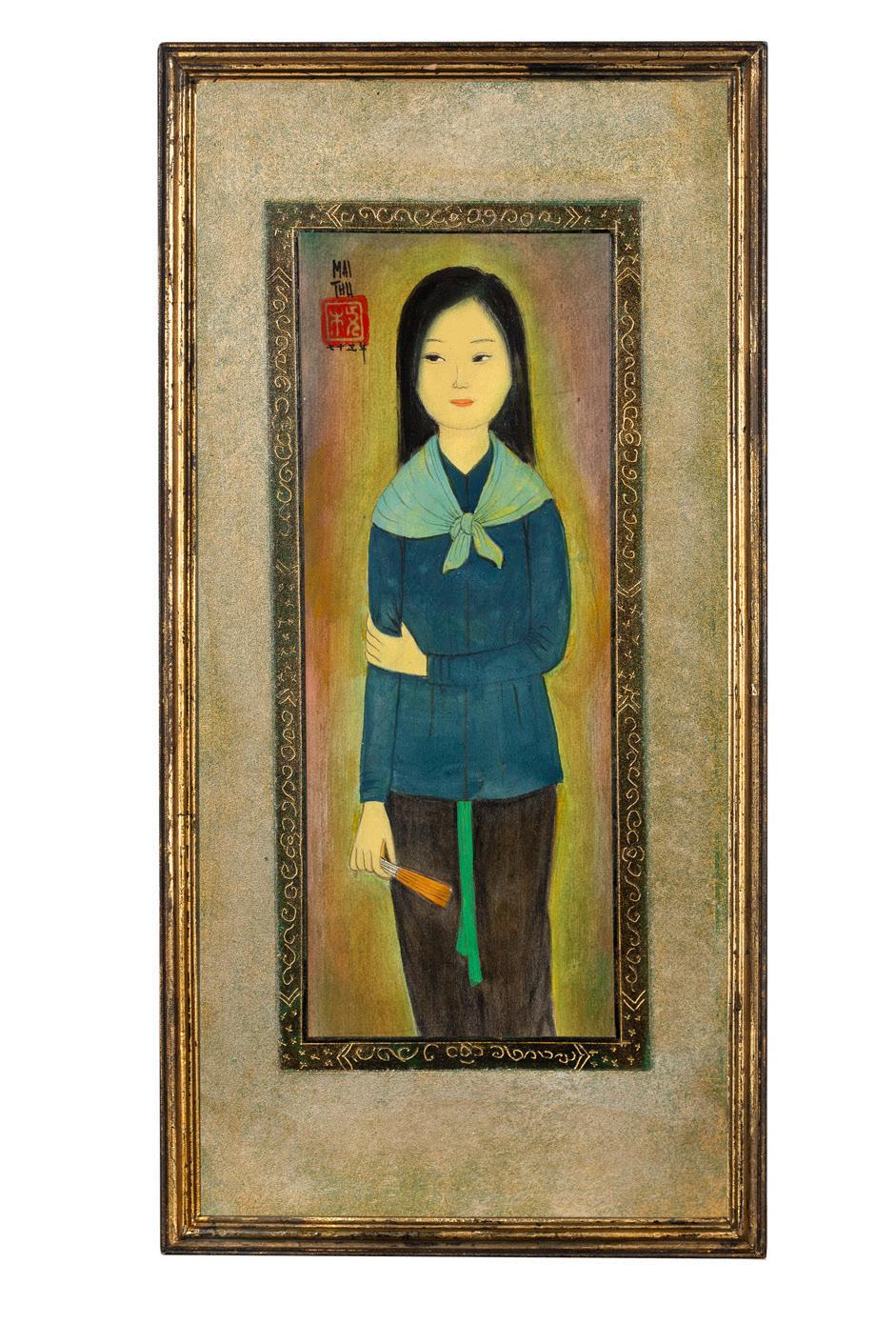
Mai Trung Thứ apporte également un soin particulier à la présentation de ses œuvres. Dès les années 1940, il fabrique lui-même ses cadres, d’abord dans le goût occidental, puis, à partir des années 1950, selon des encadrements d’inspiration asiatique en parfaite harmonie avec l’esthétique de sa peinture. Il confectionne également ses passe-partout : gravés au stylet, ornés au pochoir et rehaussés de couleurs et de poudre métallisée, ils sont décorés de rinceaux et de vagues stylisées empruntés au répertoire décoratif traditionnel chinois et vietnamien, tel qu’il s’exprime dans les arts textiles et l’orfèvrerie. Les baguettes du cadre, patinées de plusieurs couches de peinture à l’effet laqué, renforcent le caractère précieux et raffiné de ces encadrements, qui se marient parfaitement avec la précision de son trait.
Mai Trung Thứ cũng đặc biệt chú ý đến việc trình bày các tác phẩm của mình. Ngay từ những năm 1940, ông đã tự tay đóng khung tranh, ban đầu theo thị hiếu phương Tây, sau đó, từ những năm 1950, ông lấy cảm hứng từ phong cách châu Á, hài hòa tuyệt đối với thẩm mỹ trong hội họa của ông. Ông cũng tự làm các tấm bo viền tranh: được khắc bằng bút sắt, trang trí bằng khuôn trổ, rồi điểm thêm màu sắc và bột nhũ kim. Những tấm bo viền thường được trang trí bằng họa tiết hoa lá, dây leo và ngọn sóng cách điệu, lấy cảm hứng từ những mô-típ trang trí truyền thống trong nghệ thuật dệt may và kim hoàn Trung Hoa và Việt Nam. Viền khung được phủ patine bằng nhiều lớp sơn tạo hiệu ứng sơn mài, càng làm nổi bật sự quý giá và tinh tế của những chiếc khung tranh, như một sự kết hợp hoàn hảo cho các tác phẩm của ông.
Mai Trung Thứ also pays particular attention to the presentation of his works. As early as the 1940s, he made his own frames, initially in the Western style, and then, starting in the 1950s, using frames of Asian inspiration that were in perfect harmony with the aesthetic of his paintings. He also crafts his own mats: engraved with a stylus, decorated with stencils, and enhanced with colors and metallic powder, they are adorned with scrollwork and stylized waves drawn from the traditional Chinese and Vietnamese decorative repertoire, as expressed in textile arts and metalwork. The frame moldings, weathered with several layers of paint to create a lacquered effect, reinforce the precious and refined character of these frames, which blend perfectly with the precision of his line work.
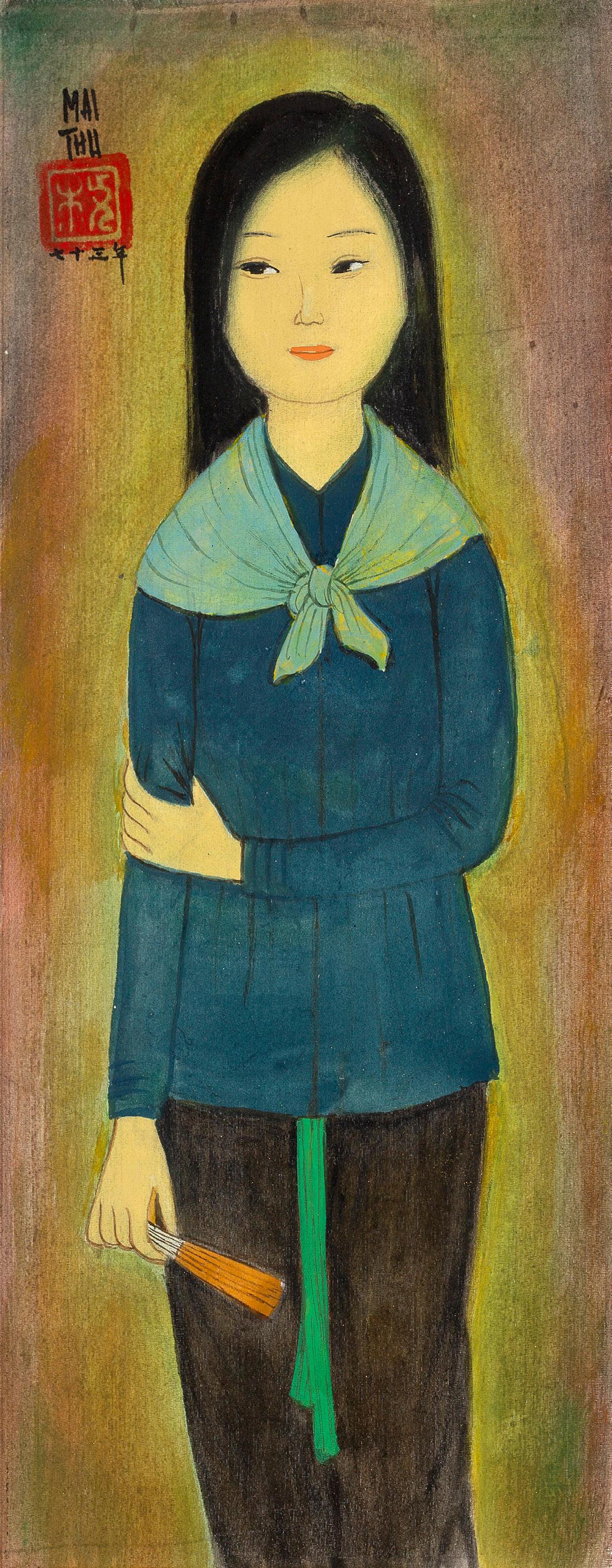
La SAS AGUTTES (« AGUTTES ») est un opérateur de ventes volontaires aux enchères publiques, déclaré auprès du Conseil des maisons de vente et régi par les articles L.321-4 et suivants du Code de commerce. En cette qualité AGUTTES agit comme mandataire du vendeur qui contracte avec l’adjudicataire.
Les présentes Conditions Générales de Vente (« CGV ») régissent les rapports entre AGUTTES et les enchérisseurs pour les ventes aux enchères publiques et les ventes de gré à gré organisées par AGUTTES. En participant à une vente aux enchères organisée par AGUTTES, y compris par l’intermédiaire d’une plateforme en ligne, l’enchérisseur accepte d’être lié par les présentes CGV. En s’enregistrant pour participer aux enchères et/ou en enchérissant lors d’une vente, l’enchérisseur accepte d’être lié par les présentes CGV. Il lui est donc recommandé de les lire attentivement.
Les CGV pourront être modifiées occasionnellement à la discrétion d’AGUTTES. Les Conditions Particulières de Vente relatives à une certaine vente et contenues dans le catalogue de vente peuvent également être modifiées par écrit et/ou oral par AGUTTES préalablement à la vente. Ces modifications seront mentionnées au procès-verbal de la vente. En tant qu’opérateur de ventes volontaires, AGUTTES est assujetti aux obligations listées aux articles L.561-2 14° et suivants du Code Monétaire et Financier relatifs à la lutte contre le blanchiment d’argent et le financement du terrorisme, qu’il est tenu de faire respecter.
MENTIONS PARTICULIÈRES DANS LE CATALOGUE
Les mentions particulières figurant dans le catalogue ont les significations suivantes :
+ Lots faisant partie d’une vente judiciaire à la suite d’une ordonnance du Tribunal Judiciaire assortis d’honoraires acheteurs à 14.40 % TTC ;
° Lots dans lesquels AGUTTES ou un de ses partenaires a des intérêts financiers ;
* Lots en importation temporaire : soumis à des frais de 5,5 % TTC du prix d’adjudication pour les œuvres et objets d’art, de collection et d’antiquité (20 % pour les vins et spiritueux, les bijoux et les multiples), à la charge de l’acquéreur en sus des frais de vente et du prix d’adjudication. Ces frais peuvent être exonérés sur présentation de documents douaniers attestant que le lot a été réexporté hors Union Européenne dans les délais légaux et conformément aux nouvelles dispositions de la réforme de la TVA entrée en vigueur le 1er janvier 2025 ;
¤ Biens vendus sous le régime général de la TVA (sur la totalité) ;
# Lots visibles uniquement sur rendez-vous ; ~ Lots fabriqués à partir de matériaux provenant d’espèces animales. Des restrictions à l’importation sont à prévoir ; = Lots dument identifiés et soumis à caution.
Description des lots : Les indications portées au catalogue réalisées par AGUTTES et son expert sont effectuées sur la base des éléments fournis et des connaissances existant le jour de la rédaction du catalogue. Seules les indications en langue française engagent AGUTTES. Elles peuvent faire l’objet de modifications ou de rectifications jusqu’au moment de la vente par écrit ou oral. Ces modifications seront consignées au procès-verbal de la vente, lequel aura force probante. Les traductions sont libres. Aucune autre garantie n’est apportée par AGUTTES, étant rappelé que seul le vendeur sera tenu à la garantie des vices cachés et à l’éventuelle garantie légale de conformité (exclue pour les biens d’occasion). Un certificat d’authenticité du lot ne sera disponible que si mentionné dans la description du lot. Les dimensions, poids et autres renseignements des lots sont donnés à titre indicatif avec une marge d’erreur raisonnable. Les conversions en unité impériale (inches) sont fournies à titre informatif et sont libres.
Les restaurations effectuées à titre conservatoire, n’altérant pas le caractère original du lot, notamment en ce qui concerne l’ancienneté et le style, et n’apportant aucune modification au caractère propre du lot ne seront pas mentionnées dans le descriptif. L’absence d’indication d’une restauration, d’un accident, d’un manque ou d’un incident dans le catalogue ou les rapports de condition, n'implique nullement que le lot soit exempt de tout défaut présent, passé ou réparé. Inversement, la mention de quelque défaut n’implique pas l’absence de tous autres défauts. Seules les dispositions du catalogue pourront constituer un fondement valable à engager la responsabilité d’AGUTTES. Les déclarations ou promesses formulées oralement par un représentant d’AGUTTES mais ne figurant pas dans le catalogue ne sauront en aucun cas constituer un fondement valable à engager la responsabilité d’AGUTTES.
État des lots : Les lots sont vendus dans l’état dans lequel ils se trouvent au moment de la vente avec leurs imperfections et leurs défauts. Les lots étant des biens d’occasion, aucune garantie ne peut être offerte par AGUTTES concernant leur état. Il revient aux acheteurs potentiels de s’assurer personnellement de la condition de l’objet.
Les références à l’état d’un lot dans un catalogue, une image, une description ou dans un rapport de condition (fourni à titre indicatif) ne pourront être considérées comme une description exhaustive de l’état dudit lot. Les descriptions, les rapports de condition, ainsi que les photographies des lots quant à leur état sont fournis uniquement à titre indicatif et ne peuvent en aucun cas remplacer l’examen personnel du lot par l’enchérisseur préalablement à la vente dans les conditions mentionnées ci-après. Les rapports de condition et les photos seront envoyés sur demande et à titre indicatif.
Exposition des lots : Les enchérisseurs potentiels sont expressément invités à examiner personnellement les lots et la documentation disponible avant la vente lors d’un rendez-vous privé ou de l’exposition publique préalable à la vente afin de vérifier l’état des lots. Il leur est conseillé de se faire accompagner par un expert du secteur concerné par la vente pour apprécier de manière détaillée l’état des biens.
Reproduction des lots : Tous les défauts et imperfections des lots ne sont pas visibles sur les photographies des lots reproduites dans les catalogues, en ligne ou sur tout support de communication. Les photographies peuvent ne pas donner une image entièrement fidèle de l’état réel d’un lot et peuvent différer de ce que percevra un observateur direct (taille, coloris, etc.).
Estimations : Les estimations sont fondées sur l’état des connaissances techniques, la qualité du lot, sa provenance, son état et le cours du marché au jour de l’estimation. Elles sont fournies à titre purement indicatif et ne peuvent être considérées comme une garantie que le lot sera vendu au prix estimé. Les enchérisseurs sont informés que les estimations peuvent fluctuer en fonction des évolutions du marché et des caractéristiques particulières du lot.
Rapports de condition : Des rapports de condition, photos complémentaires et documents afférents aux lots sont disponibles sur demande jusqu’à 24 heures avant la vente. Ils doivent être consultés avant d’enchérir.
INSCRIPTION À LA VENTE
Important : le mode normal et prioritaire pour enchérir consiste à être présent dans la salle de vente.
À titre de service complémentaire, AGUTTES offre aux acheteurs potentiels d’autres moyens d’enchérir, moyennant une inscription préalable au plus tard à 18 heures le dernier jour ouvré avant la vente :
- Par téléphone : Toute personne aura la possibilité de s’inscrire auprès de bid@aguttes.com pour porter ses enchères à voix haute par téléphone pendant la vente. L’ordre devra avoir été communiqué par écrit, à l’aide du formulaire dûment rempli, de coordonnées bancaires, d’une copie de la pièce d’identité de l’enchérisseur et de son Kbis. AGUTTES accepte gracieusement de recevoir les enchères par téléphone. L’enchérisseur potentiel devra avoir reçu un mail de confirmation préalable de la part d’AGUTTES pour être appelé.
- Sur ordre d’achat : Toute personne aura la possibilité de transmettre des ordres d’achat à AGUTTES. L’ordre devra avoir été communiqué par écrit à l’aide du formulaire dûment rempli et de coordonnées bancaires, d’une copie de sa pièce d’identité. AGUTTES accepte gracieusement de traiter ces ordres. En cas de demande par mail à bid@aguttes.com , l’enchérisseur devra avoir reçu un e-mail de confirmation de la part d’AGUTTES. Aucun ordre illimité ne sera retenu. Si AGUTTES reçoit plusieurs ordres d’achat pour des montants d’enchères identiques sur le même lot, l’ordre le plus ancien sera préféré.
- En ligne via les plateformes Live : Toute personne aura la possibilité de s’inscrire auprès de diverses plateformes Live pour participer à distance, par voie électronique, aux ventes aux enchères. L’enchérisseur via le Live est informé que les frais facturés par ces plateformes seront à sa charge exclusive et s’additionneront à la commission d’achat. Les frais des plateformes sont habituellement les suivants* :
1,80%TTC pour Drouot Digital,
• 3%TTC pour Invaluable,
• 3%TTC pour 51Bidlive,
• 1,80%TTC pour Interenchères sur tous les lots (à l’exception des automobiles, facturés 72€ TTC par véhicule).
Procédure d’identification des enchérisseurs : Au regard de ses obligations en matière de lutte contre le blanchiment des capitaux et le financement du terrorisme (LCB-FT), les acquéreurs potentiels sont invités à se faire connaître auprès d’AGUTTES afin de permettre l’enregistrement de leurs données personnelles. AGUTTES se réserve le droit de demander, à son entière discrétion, à tout enchérisseur potentiel : - personne physique, de justifier de son identité et personne morale, de fournir un extrait Kbis de moins de 3 mois (étant précisé que seul le représentant légal de la société ou toute personne dûment habilitée pourra enchérir), - et, en tout état de cause, d’effectuer un déposit et communiquer ses références bancaires ainsi que l’origine des fonds reçus au regard des obligations en matière de lutte contre le blanchiment des capitaux et le financement du terrorisme (LCB-FT).
Tous les lots vendus seront facturés au nom et à l’adresse du donneur d’ordre et aucune modification postérieure ne pourra être faite après l’adjudication. L’enchérisseur est réputé agir en son nom propre et s’engage à régler personnellement et immédiatement le lot. Il sera seul responsable de l’enchère portée sauf information préalable de sa qualité de mandataire dans les conditions indiquées ci-après. Toute fausse indication engagera la responsabilité de l’adjudicataire. En cas de manquements aux procédures d’identification et aux obligations de LCB-FT, AGUTTES se réserve la possibilité d’interdire à l’enchérisseur de porter les enchères, d’annuler ou de résilier la vente du lot.
Caution : Pour certains ventes ou lots dûment identifiés, AGUTTES se réserve le droit de demander aux potentiels enchérisseurs de verser avant la vente une caution d’un montant déterminé, ainsi que toutes autres garanties et / ou références bancaires jugées nécessaires. Il est demandé aux enchérisseurs de contacter AGUTTES au plus tard trois jours ouvrés avant la vente afin de procéder à la vérification des garanties données. Les dépôts de garantie sont à effectuer en euros par virement ou carte bancaire sur : https://www.aguttes.com/depot-caution Dans le cas où l’enchérisseur ne serait pas adjudicataire lors de la vente, AGUTTES procèdera au remboursement de la caution perçue dans un délai de 5 jours ouvrables après la vente, sans intérêt sous réserve de tout droit de compensation. L’enchérisseur reconnait et accepte que seront à sa charge exclusive les éventuelles pertes engendrées par les variations des taux de change ou les frais bancaires liés à ce transfert.
Mandat par un tiers : Tout enchérisseur est censé enchérir pour son propre compte et est tenu pour seul responsable de l’enchère. L’enchérisseur disposant d’un mandat devra informer AGUTTES de l’existence de celui-ci lors de la procédure d’identification et d’enregistrement et produire une copie du mandat et tous autres documents sollicités par AGUTTES. Dans un tel cas, l’enchérisseur et le mandant seront solidairement responsables.
Direction de la vente : Le commissaire-priseur dirige la vente en veillant à la liberté et à l’égalité entre les enchérisseurs, tout en respectant les usages établis par la profession. Le commissaire-priseur assure la police de la vente et se réserve le droit d’interdire l’accès à la salle de vente à tout enchérisseur potentiel pour justes motifs. Il se réserve le droit de refuser toute enchère, d’organiser les enchères de la façon la plus appropriée, de déplacer, retirer, réunir ou séparer tout lot de la vente.
Adjudication : Le plus offrant et le dernier enchérisseur sera l’adjudicataire, tous moyens admis confondus (ordre, internet, téléphone, sur place, etc.). L’adjudication se matérialise par le prononcé du mot « Adjugé » lequel forme le contrat de vente entre le vendeur et l’adjudicataire. Chaque lot est identifié avec un numéro correspondant au numéro qui lui est attribué sur le catalogue de la vente. Il est interdit aux vendeurs d’enchérir directement sur les lots leur appartenant. En cas de « double-enchère » simultanée reconnue effective par le commissairepriseur, le lot sera remis en vente, tous les enchérisseurs présents pouvant concourir à cette deuxième mise en adjudication.
Rétractation : Chaque enchère portée et chaque adjudication sont définitives. Chaque enchère engage celle ou celui qui l’a portée, étant rappelé que l’adjudicataire ne peut se rétracter qu’il soit en salle, au téléphone, en ligne ou sur exécution de son ordre d’achat.
Transfert des risques et de la propriété : Le transfert de propriété et des risques entre le vendeur et l’adjudicataire s’opère par le prononcé du mot « adjugé » par le commissaire-priseur. AGUTTES décline toute responsabilité quant aux pertes et dommages que les lots pourraient subir à compter de l’adjudication, l’adjudicataire devant faire assurer les lots acquis dès l’adjudication.
Commission d’achat : L’adjudicataire devra s’acquitter en sus du prix d’adjudication, par lot, des honoraires acheteurs applicables à chaque lot (cf. article VI- CONDITIONS PARTICULIÈRES).
Outre le prix d’adjudication et les honoraires acheteur, l’adjudicataire devra régler toutes les taxes incluant la TVA ainsi que les éventuels frais de dossier, de manutention et de stockage ainsi que toutes les autres sommes qui seraient dues en cas de retard de paiement mentionnées ci-après.
Les acquéreurs via les plateformes Live paieront, en sus des enchères et des frais acheteurs, une commission complémentaire qui sera intégralement reversée aux plateformes (cf. article II- LA VENTE : Inscription à la vente).
Conditions de paiement : Le paiement des sommes dues devra être effectué « comptant » par l’adjudicataire, dès l’adjudication. Le paiement est effectué en euros. Les commissions bancaires éventuelles sont à la charge de l’adjudicataire et ne sont pas déduites des sommes dues.
Retard de paiement et pénalités : Aucun délai de paiement ne sera accordé à l’acheteur sauf accord exprès du vendeur. Tout délai de paiement accordé par le vendeur entrainera l’application des pénalités suivantes qui seront acquises à AGUTTES et s’ajouteront aux montants prévus ci-dessous pour l’adjudicataire défaillant, à savoir : - Si le délai de paiement est inférieur ou égal à 3 mois à compter de la vente : 3% HT soit 3,6%TTC du montant total du bordereau acheteur
- Si le délai de paiement est supérieur à 3 mois à compter de la vente : 5% HT soit 6%TTC du montant total du bordereau acheteur.
TVA : Le taux de TVA est de 20% (ou 5,5% pour les livres). Par principe, les lots non marqués seront vendus sous le régime de la TVA sur la marge. La commission d’achat et les frais annexes seront majorés d’un montant tenant lieu de TVA, lequel ne sera pas mentionné séparément dans nos bordereaux.
Par exception, et à la demande du vendeur, le régime général de la TVA pourra être appliqué pour les biens mis en vente par un professionnel de l’UE. Ces biens seront marqués par le signe ¤.
Cas de remboursements possibles de TVA à l’acquéreur : Le professionnel de l’Union Européenne, (i) sur communication de son numéro de TVA intra-communautaire et (ii) fournissant la preuve de l’export du lot depuis la France vers un autre État membre ; Le non-résident de l’Union Européenne sur communication (i) du document douanier d’export hors Union Européenne sur lequel AGUTTES figure comme expéditeur (ii) dans un délai de 3 mois suivant la date de vente aux enchères ou la date d’obtention de la licence d’exportation.
Modalités de règlement : Les moyens de paiement légaux acceptés (les paiements par carte bancaire ou virement étant vivement recommandés) :
- Virement bancaire : provenant du compte de l’acheteur et indiquant le numéro de facture :
IBAN FR76 3006 6109 1300 0203 7410 222 -BIC CMCIFRPP
Titulaire du compte AGUTTES
Domiciliation CIC PARIS ETOILE ENTREPRISES 178 RUE DE COURCELLES - 75017 PARIS
- Espèces : en vertu des articles L.112-6 et D.112-3 du Code monétaire et financier : (i) jusqu’à 1000 € pour les résidents fiscaux français ou les personnes agissant pour les besoins d’une activité professionnelle ; (ii) jusqu’à 15 000 € pour les particuliers qui ont leur domicile fiscal à l’étranger (sur présentation de passeport et de justificatif de domicile) ;
- Carte bancaire sur le terminal ou à distance (sur https://www.aguttes.com/paiementen-ligne). Les frais bancaires, qui oscillent habituellement entre 1 et 2,5%, ne sont pas à la charge de l’étude. Les paiements fractionnés en plusieurs fois pour un même lot avec la même carte ne sont pas autorisés ;
- Chèque (en dernier recours) : Sur présentation de deux pièces d’identité. Aucun délai d’encaissement n’est accepté en cas de paiement par chèque. La délivrance ne sera possible que vingt jours après le paiement. Les chèques étrangers ne sont pas acceptés.
Conformément à ses obligations de lutte contre le blanchiment de capitaux et le financement du terrorisme en application de l’article L.561-2 du Code Monétaire et
Financier, AGUTTES se réserve le droit d’obtenir un justificatif des fonds. En tout état de cause, en cas de paiement par un tiers, des justificatifs sur le lien avec le tiers payeur devront être fournis par l’adjudicataire. AGUTTES se réserve le droit de refuser le paiement en espèces effectué par un tiers.
Adjudicataire défaillant : À défaut de paiement comptant par l’adjudicataire, le bien pourra être remis en vente sur réitération des enchères à la demande du vendeur conformément à la procédure de l’article L.321-14 du Code de commerce. Si le vendeur ne formule pas cette demande dans un délai de trois mois à compter de l’adjudication, la vente sera résolue de plein droit. En tout état de cause, l’adjudicataire défaillant ne peut invoquer la résolution du contrat pour se soustraire aux obligations qui sont les siennes.
Responsabilité de l’adjudicataire défaillant : Dans tous les cas l’acquéreur défaillant sera tenu, du fait de son défaut ou retard de paiement, de payer à AGUTTES :
• En cas de revente sur procédure de réitération des enchères, (i) la moins-value subie par le vendeur du fait de la deuxième vente, (ii) la perte d’honoraires subies par AGUTTES, (iii) les frais engagés pour cette deuxième vente ;
• Tous les frais et accessoires engagés par AGUTTES relatifs au recouvrement des factures impayées (incluant les frais d’avocat, les frais administratifs et tous autres frais liés au recouvrement), ainsi que les dommages et intérêts permettant de compenser le préjudice subi par AGUTTES ;
• Les pénalités de retard calculées en appliquant des taux d’intérêt au taux directeur (taux de refinancement ou Refi) semestriel de la Banque centrale européenne (BCE) en vigueur, majoré de cinq points sur la totalité des sommes dues ;
• Les dommages et intérêts permettant de compenser le préjudice subi par AGUTTES (frais, honoraires et commissions d’achat, TVA, stockage, etc.).
AGUTTES se réserve la possibilité de :
• Communiquer le nom et les coordonnées de l’acquéreur défaillant au vendeur afin de permettre à ce dernier de faire valoir ses droits ;
• Conserver à titre de dommages et intérêts toutes les sommes qui auraient été versées par l’adjudicataire préalablement à l’annulation de la vente ; Procéder à l’encaissement de la caution versée par l’adjudicataire, à titre de compensation avec toutes les sommes dues par l’adjudicataire et / ou à titre de dommages et intérêts ; Exercer ou faire exercer tous les droits et recours, notamment le droit de rétention, sur tout bien de l’acquéreur défaillant dont AGUTTES aurait la garde jusqu’au règlement complet par ledit acquéreur, et saisir les tribunaux compétents pour recouvrer les sommes dues ;
Procéder à la compensation de tout montant dû à l’adjudicataire avec tout montant impayé par l’adjudicataire concernant un lot ou tout dommage subi par AGUTTES à la suite d’une violation des présentes CGV par l’adjudicataire ; Interdire à l’adjudicataire défaillant d’enchérir dans les prochaines ventes organisées par AGUTTES ou bien de subordonner la possibilité d’y enchérir au versement d’une provision préalable ; • Procéder à l’inscription de l’adjudicataire défaillant sur un fichier des mauvais payeurs partagé entre les différentes maisons de vente adhérentes. AGUTTES est en effet adhérent au Registre central de prévention des impayés des Commissaires-priseurs auprès duquel les incidents de paiement sont susceptibles d’inscription. Les droits d’accès, de rectification et d’opposition pour motif légitime sont à exercer par le débiteur concerné auprès du Symev 15, rue Freycinet 75016 Paris. AGUTTES est également adhérente du service Témis permettant la consultation et l’alimentation du fichier des restrictions d’accès aux ventes aux enchères. Aguttes se réserve le droit d’inscrire au fichier Témis l’adjudicataire défaillant ou son représentant, ayant pour conséquence de limiter la capacité d’enchérir de l’adjudicataire défaillant auprès des Opérateurs de vente volontaires adhérents et de lui interdire l’utilisation de la plateforme Interenchères. En outre, AGUTTES se réserve le droit de bloquer l’accès de l’adjudicataire défaillant à la plateforme Drouot et à d’autres plateformes de vente en ligne partenaires.
Retrait et stockage des lots : Un lot adjugé ne pourra être délivré à l’acheteur qu’après paiement intégral du bordereau d’achat et de toutes les sommes / pénalités qui seraient dues par l’adjudicataire, encaissés sur le compte bancaire d’AGUTTES. En conséquence, dans le cas où le bordereau acheteur comporterait plusieurs lots et en cas de paiement partiel du bordereau acheteur et/ou à défaut de paiement total ou partiel des autres sommes/pénalités dues par l’adjudicataire, aucun des lots inclus dans le bordereau acheteur ne sera délivré par AGUTTES à l’adjudicataire. Tous les lots seront délivrés à l’adjudicataire le jour du paiement total du bordereau acheteur et des sommes/pénalités dues par l’adjudicataire.
Les lots seront délivrés à l’acquéreur en personne après présentation de tout document prouvant son identité ou au tiers qu’il aura désigné et à qui il aura confié une procuration originale et une copie de sa pièce d’identité. Le retrait des lots est réalisé aux frais et aux risques de l’adjudicataire uniquement.
Les lots qui n’auront pas été retirés le jour même après la fin de la vente seront à enlever sur rendez-vous par l’acheteur auprès de la personne mentionnée à cet effet sur la page de contacts qui se situe au début du catalogue. Le lieu de délivrance sera indiqué dans l’email accompagnant l’envoi de la facture.
Les frais de stockage applicables sont mentionnés ci-après (cf. article VI-CONDITIONS PARTICULIÈRES).
Revente des lots payés et non récupérés : Dans le cas où un ou des lot(s) adjugé(s) et payé(s) en cours d’une vente aux enchères n’aurai(ent) toujours pas été enlevé(s) par l’acquéreur dans les délais convenus dans les « conditions particulières » ciaprès et que les frais de stockage, de garde et de conservation applicables en viendraient à dépasser la valeur d’adjudication du ou des lot(s), AGUTTES se réserve la possibilité de les vendre afin de se rembourser l’intégralité des frais lui étant dus.
IV- DROIT DE PRÉEMPTION
L’État français peut exercer sur toute vente publique ou de gré à gré de biens culturels un droit de préemption. L’État dispose d’un délai de 15 jours à compter de la vente publique pour confirmer l’exercice de son droit de préemption et se subroger à l’acheteur. À défaut d’une confirmation écrite par l’État de son intention d’exercer ce droit dans le délai imparti, la vente sera considérée comme définitive et irrévocable.
V- EXPORTATION
Dans le cas d’un bordereau acheteur libellé à une adresse à l’étranger, il est précisé que certains lots sont assujettis à des formalités d’exportation (demandes de certificat pour un bien culturel, licence d’exportation). Ces lots ne pourront être délivrés qu’à un transitaire dûment habilité. Les formalités sont du ressort de l’acquéreur et peuvent requérir un délai de 4 mois. AGUTTES est à la disposition de ses acheteurs pour les orienter dans ces démarches ou pour transmettre les demandes à l’administration concernée. Cependant, AGUTTES ne pourra être tenu responsable des retards, refus ou autres décisions administratives défavorables, ni de tout manquement à la réglementation en matière d’exportation. Les délais d’exportation ou les refus de l’administration ne pourront en aucun cas justifier une absence ou un retard de paiement par l’acheteur, ni entraîner une annulation ou modification de la vente. L’acquéreur est seul responsable de l’ensemble des formalités et des délais administratifs applicables, qu’il s’engage à respecter.
VI- CONDITIONS PARTICULIÈRES
1 - CALCUL DES HONORAIRES ACHETEURS
L’adjudicataire devra s’acquitter, en sus du prix d’adjudication, par lot, des honoraires acheteurs suivants :
26 % HT + TVA au taux en vigueur soit 31,2 %TTC sur les premiers 900 000 € ; 23 % HT + TVA au taux en vigueur soit 27,6 %TTC au-delà de 900 001 € ;
2- FRAIS DE STOCKAGE
Le stockage des biens ayant fait l’objet d’une adjudication dans le cadre d’une vente aux enchères ou d’une vente de gré à gré qui ne seraient pas enlevés par l’acheteur à l’expiration d’un délai de 15 jours suivant la vente (jour de vente inclus), sera facturé comme suit (chaque journée ou semaine commencée étant due) :
- Bijoux et / ou articles d’horlogerie : 30€ HT / jour de stockage ;
- Vin : 1 € HT / col et par jour, sans préjudice des frais éventuellement appliqués par iCave ;
- Véhicules : frais de stockage et de transport forfaitaires de 350 € HT, augmentés d’un montant de 40 € HT / jour à partir du mercredi suivant la vente inclus ;
- Autres lots : 3 € HT / jour pour les lots de moins de 1 m 3 et 5 € HT / jour pour les lots de plus de 1 m 3
3- OBJETS MÉCANIQUES ET ÉLECTRIQUES
Les objets mécaniques ou électriques proposés à la vente par AGUTTES sont exclusivement proposés à titre décoratif. En tant que biens d’occasion, AGUTTES ne certifie en aucun cas leur état de fonctionnement et n’offre aucune garantie quant à leur performance. Nous recommandons aux acheteurs de venir voir les lots lors des expositions publiques avec un expert en la matière, et de faire vérifier le mécanisme électrique ou mécanique par un professionnel avant toute mise en marche.
4- MONTRES ET HORLOGES
Les articles d’horlogerie que nous vendons sont tous des biens d’occasion, ayant pour la plupart subi des réparations engendrant le remplacement de certaines pièces qui peuvent alors ne pas être d’origine. AGUTTES ne donne aucune garantie
sur l’authenticité, la condition, ou le caractère original des composants d’un article d’horlogerie.
Les horloges peuvent être vendues sans pendules, poids ou clés et sauf mention expresse contraire, leur présence n’est pas garantie. Les bracelets de montres peuvent ne pas être d’origine et ne pas être authentiques.
Les montres de collection nécessitent un entretien général et régulier : des réparations ou révisions peuvent s’avérer nécessaires. Toutes ces réparations et révisions et tous les contrôles d’état de fonctionnement sont à la charge exclusive de l’acheteur, AGUTTES n’offrant aucune garantie sur leur bon état de marche. AGUTTES recommande aux acheteurs de faire vérifier les montres par un horloger qualifié avant toute utilisation.
5- BIJOUX, PIERRES, OR ET MÉTAUX PRÉCIEUX
Certains lots contenant de l’or, du platine ou de l’argent peuvent être soumis à un contrôle par le bureau de garantie territorialement compétent afin de les soumettre à des tests d’alliage et de les poinçonner préalablement à la vente. AGUTTES n’engage en aucun cas sa responsabilité sur les conclusions du bureau de garantie. Les pierres précieuses de couleur (comme les rubis, les saphirs et les émeraudes) peuvent avoir été traitées pour améliorer leur apparence, par des méthodes telles que la chauffe ou l’huilage. Ces méthodes sont admises par l’industrie mondiale de la bijouterie mais peuvent fragiliser les pierres précieuses et/ou rendre nécessaire une attention particulière au fil du temps.
AGUTTES ne peut savoir si un diamant a été formé naturellement ou synthétiquement s’il n’a pas été testé par un laboratoire de gemmologie. Si le diamant a été testé, un rapport gemmologie sera disponible. Tous les types de pierres précieuses peuvent avoir été traités pour en améliorer la qualité. L’acheteur peut solliciter l’élaboration d’un rapport de gemmologie pour tout lot, dès lors que la demande est adressée à AGUTTES au moins deux semaines avant la date de la vente, et que l’acheteur s’acquitte des frais afférents.
AGUTTES ne fait pas établir de rapport gemmologique pour chaque pierre précieuse mise à prix dans ses ventes aux enchères. L’absence de certificat ne garantit pas que les pierres n’ont pas été traitées. Lorsqu’AGUTTES fait établir de tels rapports auprès de laboratoires de gemmologie internationalement reconnus, lesdits rapports sont mentionnés et décrits au catalogue. En raison des différences d’approches et de technologies, les laboratoires peuvent ne pas être d’accord sur le traitement ou non d’une pierre précieuse particulière, sur l’ampleur du traitement ou sur son caractère permanent. Les laboratoires de gemmologie signalent uniquement les améliorations ou les traitements dont ils ont connaissance à la date du rapport qui reflète leur opinion. AGUTTES ne garantit pas et n’est aucunement responsable des rapports ou certificats établis par un laboratoire de gemmologie qui pourrait accompagner un lot.
6- MOBILIER
Sans mention expresse indiquée dans le descriptif du lot, la présence de clés n’est aucunement garantie. L’acheteur reconnaît que l’absence de clé ne peut en aucun cas justifier un refus de paiement ou une réclamation.
7- ESPÈCES VÉGÉTALES ET ANIMALES PROTÉGÉES
Les objets composés partiellement ou entièrement de matériaux provenant d’espèces de flore et de faune en voie d’extinction et/ou protégées sont marqués par le symbole ~ dans le catalogue. Le législateur impose de règles strictes pour l’utilisation commerciale de ces matériaux, en particulier en ce qui concerne le commerce de l’ivoire. Les acheteurs sont informés que l’importation de tout bien composé de ces matériaux est interdite par de nombreux pays, ou bien exigent un permis ou un certificat délivré par les autorités compétentes des pays d’exportation et d’importation des biens. Les acheteurs sont entièrement responsables du bon respect des normes réglementaires et législatives applicables à l’exportation ou l’importation des biens composés partiellement ou totalement de matériaux provenant d’espèces en voie d’extinction et/ou protégées. AGUTTES ne sera en aucun cas responsable de l’impossibilité d’exporter ou d’importer un tel bien, et cela ne pourra être retenu pour justifier une demande de résolution ou d’annulation de la vente. L’acheteur est seul responsable de l’obtention de toutes les autorisations nécessaires pour l’acquisition ou le transport de ces objets.
8- VIN
Les bouteilles anciennes peuvent naturellement être fragilisées avec le temps et les transports. AGUTTES ne pourra être considéré comme responsable de l’état du bouchon.
Les ventes de vins sont des ventes sur désignation, c’est-à-dire des ventes d'objets désignés au moment de la vente, mais non exposés. Le retrait des lots directement après la vente est donc exclu. Leur retrait est uniquement possible sur rendez-vous. L’acheteur doit envoyer un courriel accompagné de son bordereau acquitté à l’adresse
électronique suivante : retraits.aguttes@icave.eu. Les lots seront disponibles dans les locaux de la société iCave, située au : 5, Chemin des Montquartiers – 92130 ISSYLES-MOULINEAUX – FRANCE.
9- AUTOMOBILES
Description des lots : Pour des raisons administratives et sauf indication contraire, les désignations des véhicules (modèle, type, année…) reprennent, sauf exception, les indications portées sur les titres de circulation.
État des lots : Il est précisé que :
- L’état d’une automobile peut varier entre le moment de sa description au catalogue, celui de sa présentation à la vente et jusqu’au moment de la prise en main du lot par l’adjudicataire.
- Des véhicules peuvent être vendus sans contrôle technique en raison de leur âge, leur état non roulant ou de leur caractère de compétition.
- Les véhicules provenant de l’étranger sont présentés sans contrôle technique français.
Les véhicules proposés sont d’une époque où les conditions de sécurité et les performances étaient inférieurs à celles d’aujourd’hui. Une grande prudence est recommandée aux acheteurs lors de la première prise en main. Il est notamment conseillé, avant toute utilisation, de procéder à une remise en route et d’effectuer toutes les vérifications nécessaires au bon fonctionnement du véhicule (niveau d’huile, pression des pneus, etc.).
Obligations supplémentaires de l’adjudicataire
- L’adjudicataire devra accomplir, sous sa responsabilité et à ses frais, toutes les formalités nécessaires dans les délais légaux pour le changement d’immatriculation du véhicule acquis.
- L’adjudicataire devra organiser le transport du lot acquis qui s’effectuera à ses risques et à ses frais.
Retrait et stockage des lots : Les véhicules sont stockés dès le lendemain de la vente dans un local fermé et sécurisé à toute proximité de Paris. Ils pourront être retirés sur rendez-vous, à partir du mardi suivant la date de la vente et après règlement intégral du montant d’adjudication et des frais, du lundi au vendredi jusqu’à 16h30 au plus tard. Il est rappelé que le transfert de risques s’opère dès l’adjudication. AGUTTES décline toute responsabilité quant aux dommages que le véhicule pourrait subir postérieurement à l’adjudication.
VII- DONNÉES PERSONNELLES
Les enchérisseurs sont informés qu’AGUTTES est susceptible de collecter et traiter les données les concernant conformément au Règlement Général sur la Protection des données n°2016/679 du 27 avril 2016 (RGPD) et à la loi « Informatique et Libertés » n°78-17 du 6 janvier 1978 modifiée par la loi n° 2018-493 du 20 juin 2018 relative à la protection des données à caractère personnel.
Les données sont collectées aux fins de gestion de leurs relations contractuelles ou précontractuelles (enregistrement à la vente, facturation, comptabilité, règlements, communication…). Ces données sont constituées d’informations telles que : noms, prénoms, adresse postale, adresse électronique, numéro de téléphone, coordonnées bancaires. Les enchérisseurs sont informés qu’ils disposent d’un droit d’accès, de rectification, d’effacement, à la portabilité, d’opposition et de limitation à l’égard de ces données auprès d’AGUTTES. Les demandes doivent être exercées par écrit à l’adresse : communication@aguttes.com . Toute réclamation sur la législation applicable en matière de protection des données peut être portée devant la CNIL : www.cnil.fr
VIII- PROPRIÉTÉ INTELLECTUELLE
AGUTTES est propriétaire de tout droit de reproduction des biens vendus avant et après la vente. Toute reproduction de celui-ci est interdite et constitue une contrefaçon. La vente d’un lot n’implique en aucun cas cession des droits de propriété intellectuelle éventuellement applicables (représentation et / ou reproduction) sur l’œuvre.
IX- LOI APPLICABLE ET TRIBUNAL COMPÉTENT
Les présentes CGV et les droits et obligations en découlant seront régis par la loi française.
Toute action en justice relative aux activités de vente d’AGUTTES sera tranchée par le Tribunal Judiciaire compétent en France, conformément à l’article L.321-37 du Code de commerce. En particulier, toutes les actions en justice impliquant des adjudicataires et / ou enchérisseurs ayant la qualité de commerçant seront tranchés par le Tribunal judiciaire de Nanterre.
Les enchérisseurs, adjudicataires ainsi que leurs mandataires reconnaissent que Neuilly-sur-Seine est le lieu d’exécution des prestations exclusif d’AGUTTES.
Les actions en responsabilité civile engagées à l’occasion des prisées et des ventes volontaires et judiciaires de meuble aux enchères publiques se prescrivent par cinq ans à compter de l’adjudication ou de la prisée.
Pour toute difficulté, le Commissaire du Gouvernement près du Conseil des maisons de vente peut être saisi gratuitement en vue de parvenir à une solution amiable. Les réclamations se font par voie postale au 19 avenue de l’Opéra, 75001 Paris ou en ligne sur le lien suivant : https://conseilmaisonsdevente.fr/fr/reclamation
Il est également possible de déposer une demande de règlement à l’amiable sur une plateforme européenne de règlement de litiges en ligne entre consommateurs et professionnel, accessible sur le lien suivant : https://ec.europa.eu/consumers/odr/ main/index.cfm?event=main.home2.show&lng=FR
X- SATISFACTION CLIENT
Si un client estime ne pas avoir reçu de réponse satisfaisante, il lui est conseillé de contacter directement, et en priorité, le responsable du département concerné. En l’absence de réponse dans le délai prévu, il peut alors solliciter le service clients à l’adresse serviceclients@aguttes.com , ce service est rattaché à la Direction Qualité de la SVV Aguttes.
AGUTTES SAS (“AGUTTES ”) is a voluntary public auction operator, registered with the French Auction Market Authority and governed by Articles L.321-4 et seq. of the French Commercial Code. In this capacity, AGUTTES acts as the seller’s agent, who enters into a contract with the successful bidder.
These General Terms and Conditions of Sale (“ GTCS ”) govern the relationship between AGUTTES and the bidders for public auctions and private sales organised by AGUTTES. By taking part in an auction organised by AGUTTES, including via an online platform, the bidder agrees to be bound by these GTCS. By registering to participate in the auction and/or placing a bid during a sale, the bidder agrees to be bound by these GTCS. They are therefore advised to read them carefully.
The GTCS may be modified from time to time at the discretion of AGUTTES. The Special Terms and Conditions of Sale relating to a particular sale and contained in the sales catalogue may also be modified in writing and/or orally by AGUTTES prior to the sale. These modifications will be recorded in the official sale report. As a voluntary sales operator, AGUTTES is subject to the obligations listed in articles L.561-2 14° et seq. of the French Monetary and Financial Code relating to the fight against money laundering and the financing of terrorism, which it is obliged to enforce.
SPECIFIC INFORMATION IN THE CATALOGUE
The special notes in the catalogue have the following meanings:
+ Lots forming part of a judicial sale following an order from the Court of First Instance, subject to a buyer’s fees of 14.40% incl. taxes;
° Lots in which AGUTTES or one of its partners has a financial interest;
* Lots under temporary import: subject to a fee of 5.5% incl. taxes of the hammer price for artworks, collectibles, and antiques (20% for wines and spirits, jewellery, and multiples), payable by the buyer in addition to the buyer’s premium and the hammer price. These fees may be waived upon presentation of customs documents proving that the lot has been re-exported outside the European Union within the legal time limits and in accordance with the new VAT regulations that came into effect on 1 January 2025;
¤ Goods sold under the standard VAT regime (on the full amount);
# Lots visible by appointment only;
~ Lots manufactured from materials derived from animal species. Import restrictions are to be considered;
= Lots duly identified and subject to a security deposit.
Description of the lots: The information provided in the catalogue by AGUTTES and its expert is based on the details supplied and the knowledge available on the date the catalogue was prepared. Only information in French is binding on AGUTTES. It may be amended or corrected up to the time of sale, in writing or orally. These changes will be recorded in the sale report, which will have evidential value. The translations are free. No other warranty is provided by AGUTTES, it being stated that only the seller will be liable for hidden defects and any potential legal warranty of conformity (excluded for second-hand goods). A certificate of authenticity for the lot will only be available if mentioned in the lot description.
The dimensions, weights and other information of the lots are given as an indication with a reasonable margin of error. Conversions to imperial units (inches) are provided for information only and are free.
Restorations carried out as a precautionary measure, which do not alter the original character of the lot, particularly with regard to age and style, and which do not modify the character of the lot in any way, will not be mentioned in the description.
The absence of any indication of restoration, accident, shortage or incident in the catalogue or condition reports in no way implies that the lot is free of any present, past or repaired defect. Conversely, the mention of any defect does not imply the absence of all other defects. Only the provisions of the catalogue may constitute a valid basis for engaging the liability of AGUTTES. Statements or promises made orally by a representative of AGUTTES but not included in the catalogue shall under no circumstances constitute a valid basis for engaging the liability of AGUTTES.
Condition of the lots: Lots are sold in the condition they are in at the time of sale, with all imperfections and defects. As the lots are second-hand goods, no guarantee can be offered by AGUTTES concerning their condition. It is up to potential buyers to check the condition of the item themselves.
References to the condition of a lot in a catalogue, image, description, or condition report (provided for informational purposes) should not be considered an exhaustive description of the condition of the lot. Descriptions, condition reports and photographs of the condition of the lots are provided for information purposes only and may under no circumstances replace the personal examination of the lot by the bidder prior to the sale in accordance with the conditions set out below. Condition reports and photos will be sent on request and for information only.
Presentation of the lots: Potential bidders are expressly invited to personally examine the lots and the documentation available prior to the sale during a private appointment or the public viewing prior to the sale in order to verify the condition of the lots. It is advisable to enlist the help of an expert in the sector concerned to assess the condition of the property in detail.
Reproduction of the lots: All the defects and imperfections of the lots are not visible on the photographs of the lots reproduced in the catalogues, online or on any communication medium. Photographs may not give an entirely faithful image of the actual condition of a lot and may differ from what would be perceived by a direct observer (size, colour, etc.).
Estimates: Estimates are based on the state of technical knowledge, the quality of the lot, its origin, its condition and the market price on the day of the estimate. They are provided for information purposes only and cannot be considered as a guarantee that the lot will be sold at the estimated price. Bidders are informed that estimates may fluctuate according to market trends and the particular characteristics of the lot.
Condition reports: Condition reports, additional photographs and documents relating to the lots are available on request up to 24 hours before the sale. They must be consulted before bidding.
REGISTRATION FOR THE SALE
Important: the standard and preferred method of bidding is to be present in the auction room.
As an additional service, AGUTTES offers prospective buyers alternative ways to bid, subject to prior registration no later than 6 pm on the last working day before the sale:
- By telephone: Anyone may register at bid@aguttes.com to place live verbal bids by telephone during the sale. The order must be communicated in writing, using the duly completed form, bank details, a copy of the bidder’s identity document and the bidder’s company registration certificate. AGUTTES accepts telephone bids free of charge. The potential bidder must have received a prior confirmation email from AGUTTES in order to be called.
- On a buy order: Any person will be able to send purchase orders to AGUTTES. The order must be communicated in writing, using the duly completed form, together with bank details and a copy of their identity document. AGUTTES graciously agrees to
handle these orders. If you would like to send a request by e-mail to bid@aguttes. com, the bidder must have received a confirmation email from AGUTTES. No unlimited orders will be accepted. If AGUTTES receives several purchase orders for identical bid amounts on the same lot, the oldest order will be preferred.
- Online via the Live platforms: Anyone may register on various Live platforms to participate remotely in the auctions via electronic means. Live bidders are hereby informed that the costs invoiced by these platforms shall be borne exclusively by them and shall be added to the purchase commission. Platform fees are usually as follows*:
• 1.80% incl. taxes for Drouot Digital,
• 3% incl. taxes for Invaluable,
• 3% incl. taxes for 51Bidlive,
• 1.80% incl. taxes for Interenchères on all lots (with the exception of cars, which are charged €72 incl. taxes per vehicle).
Procedure for identifying bidders: In view of its obligations regarding anti-money laundering and counter-terrorism financing (AML-CTF), prospective buyers are requested to identify themselves to AGUTTES in order to allow the registration of their personal data. AGUTTES reserves the right, at its sole discretion, to ask any potential bidder: - in case of natural persons, to provide proof of their identity and legal entities, to provide a company registration certificate less than 3 months old (it being specified that only the legal representative of the company or any duly authorised person may bid), - and, in any case, to make a deposit and provide banking references as well as the origin of the funds received, in light of obligations relating to anti-money laundering and counter-terrorism financing (AML-CTF).
All lots sold will be invoiced in the name and address of the purchaser and no subsequent changes may be made after the auction. The bidder is deemed to be acting in their own name and undertakes to pay for the lot personally and immediately. They will be solely responsible for the bid placed, unless they have previously informed AGUTTES of their status as an authorised representative under the conditions set out below. Any false indication will engage the liability of the successful bidder. In the event of non-compliance with identification procedures and AML-CTF obligations, AGUTTES reserves the right to prohibit the bidder from placing bids, or to cancel or terminate the sale of the lot.
Security deposit: For certain sales or duly identified lots, AGUTTES reserves the right to require prospective bidders to pay a security deposit of a specified amount before the sale, as well as any other guarantees and/or banking references deemed necessary. Bidders are asked to contact AGUTTES at least three working days before the sale in order to verify the guarantees given. Security deposits must be paid in euros by bank transfer or credit/debit card to: https://www.aguttes.com/depot-caution.
If the bidder is not successful at the sale, AGUTTES will reimburse the security deposit received within 5 working days after the sale, without interest and without prejudice to any right of set-off. The bidder acknowledges and accepts that any losses caused by variations in exchange rates or bank charges relating to this transfer will be borne exclusively by the bidder.
Mandate by a third party: All bidders are deemed to be bidding on their own behalf and are held solely responsible for their bid. A bidder with a power of attorney must inform AGUTTES of its existence during the identification and registration procedure and produce a copy of the power of attorney and any other documents requested by AGUTTES. In such a case, the bidder and the principal shall be jointly and severally liable.
Management of the sale: The auctioneer conducts the sale, ensuring the freedom and equality of bidders, while adhering to the established practices of the profession. The auctioneer maintains order during the sale and reserves the right to deny access to the auction room to any prospective bidder for just cause. The auctioneer reserves the right to refuse any bid, to organise the auction in the most appropriate way, to move, withdraw, combine or separate any lot from the sale.
Auction sale: The highest and final bidder will be the successful bidder, regardless of the method used (order, internet, phone, in person, etc.). The auction sale is confirmed by the pronouncement of the word “Auctioned”, which forms the sales contract between the seller and the successful bidder.
Each lot is identified with a number corresponding to the number allocated to it in the sale catalogue.
Sellers are prohibited from bidding directly on lots belonging to them.
In the event of a simultaneous “double-bid” recognised by the auctioneer, the lot will be reoffered for sale, with all bidders present being able to bid for this second auction.
Withdrawal: Each bid placed and each auction sale are final. All bids are binding on the bidder, who may not withdraw their bid whether in the auction room, on the telephone, online or upon execution of their purchase order.
Transfer of risk and ownership: The transfer of ownership and risks between the seller and the successful bidder takes place when the auctioneer pronounces the word “auctioned”. AGUTTES declines all responsibility for any loss or damage that may occur to the lots from the time of the auction. The successful bidder must insure the lots purchased from the time of the auction.
Purchase commission: In addition to the hammer price, the successful bidder must pay the buyer’s fees applicable to each lot (see article VISPECIAL TERMS AND CONDITIONS).
In addition to the hammer price and the buyer’s fees, the successful bidder must pay all taxes, including VAT, as well as any administration, handling and storage fees, and any other sums that may be due in the event of late payment, as mentioned below.
Buyers via the Live platforms will pay, in addition to the bids and buyer’s fees, an additional commission which will be paid in full to the platforms (see article II- THE SALE: Registration for the sale).
Payment terms: Payment of the sums due must be made “immediately” by the successful bidder as soon as the sale is completed. The payment is made in euros. Any bank charges are payable by the successful bidder and are not deducted from the sums due. If the successful bidder is not physically present at the sale, they will receive their invoice by email.
Late Payment and Penalties: The buyer will not be granted any payment extension unless expressly agreed by the seller. Any payment delay granted by the seller will result in the application of the following penalties, which will be due to AGUTTES and added to the amounts specified below for the defaulting successful bidder, namely: If the payment delay is 3 months or less from the sale: 3% excl. taxes, i.e., 3.6% incl. taxes of the total buyer’s invoice amount
If the payment delay is more than 3 months from the sale: 5% excl. taxes, i.e., 6% incl. taxes of the total buyer’s invoice amount.
VAT: The VAT rate is 20% (or 5.5% for books). As a matter of principle, unmarked lots will be sold subject to VAT on the margin. The purchase commission and ancillary costs will be supplemented by an amount representing VAT, which will not be separately listed in our invoices.
By way of exception, and at the seller’s request, the general VAT system may be applied to goods offered for sale by an EU professional. These goods will be marked with the sign ¤.
Possible cases for VAT refunds to the buyer: The professional from the European Union, (i) upon providing their intra-community VAT number and (ii) supplying proof of export of the lot from France to another Member State;
The non-EU resident, upon providing (i) the customs export document outside the European Union showing AGUTTES as the sender and (ii) within 3 months following the auction date or the date of obtaining the export license.
Payment terms: Legal means of payment accepted (payment by credit/debit card or bank transfer is strongly recommended):
- Bank transfer: from the buyer’s account, quoting the invoice number:
IBAN FR76 3006 6109 1300 0203 7410 222 - BIC CMCIFRPP
Account holder AGUTTES
Direct debit CIC PARIS ETOILE ENTREPRISES 178 RUE DE COURCELLES - 75017 PARIS
- Cash: pursuant to Articles L.112-6 and D.112-3 of the French Monetary and Financial Code: (i) up to €1,000 for French tax residents or individuals acting for professional purposes; (ii) up to €15,000 for individuals whose tax residence is outside France (upon presentation of passport and proof of address);
- Credit/debit card at the terminal or remotely (at https://www.aguttes.com/paiementen-ligne). The bank fees, which typically range between 1% and 2.5%, are not the responsibility of the auction house. Partial payments in multiple installments for the same lot with the same card are not permitted;
- Cheque (as a last resort): On presentation of two identity documents. No payment processing time is accepted in the case of payment by cheque. Delivery will only be possible twenty days after payment. Foreign cheques are not accepted.
In accordance with its obligations to combat money laundering and the financing of terrorism under Article L.561-2 of the French Monetary and Financial Code, AGUTTES reserves the right to request proof of the funds. In any event, in the event of payment
* These % may change, so it is up to the platform user to check them before bidding
by a third party, proof of the link with the third party payer must be provided by the successful bidder. AGUTTES reserves the right to refuse payment in cash by a third party.
Defaulting bidder: In the event of non-payment by the successful bidder, the item may be re-auctioned at the seller’s request in accordance with the procedure set out in Article L.321-14 of the French Commercial Code. If the seller does not make this request within three months of the auction sale, the sale will be cancelled by operation of law. In any event, the successful bidder may not invoke the termination of the contract to avoid its obligations.
Liability of the defaulting bidder: In all cases, the defaulting buyer will be obliged to pay AGUTTES:
In the event of resale through the procedure of re-auction, (i) the loss incurred by the seller due to the second sale, (ii) the loss of fees suffered by AGUTTES, (iii) the costs incurred for this second sale;
All fees and costs incurred by AGUTTES related to the recovery of unpaid invoices (including legal fees, administrative fees, and any other recovery-related expenses), as well as damages to compensate for the harm suffered by AGUTTES; Late payment penalties calculated by applying interest rates based on the European Central Bank (ECB) semi-annual refinancing rate (Refi), plus five percentage points on the total amount due;
Damages to compensate for the loss suffered by AGUTTES (fees, charges, and purchase commissions, VAT, storage, etc.).
AGUTTES reserves the right to:
• Communicate the name and contact details of the defaulting buyer to the seller so that the latter can assert its rights;
Retain as damages all sums paid by the successful bidder prior to the cancellation of the sale;
Collect the security deposit paid by the successful bidder, by way of set-off against all sums owed by the successful bidder and/or by way of damages;
Exercise or have exercised all rights and remedies, notably the right of retention, over any property of the defaulting buyer held by AGUTTES until full payment is made by said buyer, and to bring legal proceedings before the competent courts to recover the amounts due;
Offset any amount owed to the buyer against any unpaid amount relating to a lot or any damage suffered by AGUTTES as a result of a breach of these GTCS by the buyer;
• Prohibit the defaulting buyer from bidding in future sales organised by AGUTTES or make bidding subject to the payment of a prior deposit;
• Register the defaulting buyer in a shared defaulters list used by various affiliated auction houses. AGUTTES is a member of the Central Register for the Prevention of Non-Payments maintained by Auctioneers, where payment incidents may be recorded. Rights of access, rectification and opposition on legitimate grounds may be exercised by the debtor concerned at Symev 15, rue Freycinet 75016 Paris. AGUTTES is also a member of the Témis service, which enables both the consultation and contribution to the database of restrictions on access to public auctions. Aguttes reserves the right to register the defaulting bidder or their representative in the Témis database, which may result in restricting the bidder’s ability to participate in auctions held by member Voluntary Sales Operators and in prohibiting them from using the Interenchères platform. In addition, AGUTTES reserves the right to block the access of the defaulting bidder to the Drouot platform and other partner online sales platforms.
Collection and storage of lots: An auctioned lot will only be released to the buyer after full payment of the purchase invoice and any amounts/penalties owed by the successful bidder have been received in AGUTTES’ bank account. Consequently, if the purchase invoice includes several lots and only partial payment of the invoice and/or full or partial non-payment of other amounts/penalties owed by the successful bidder are received, none of the lots listed on the purchase invoice will be released by AGUTTES to the successful bidder. All lots will be delivered to the successful bidder on the day of full payment of the buyer’s invoice and the sums/ penalties due by the successful bidder.
The lots will be delivered to the buyer in person upon presentation of any document proving their identity or to a third party designated by them and entrusted with an original power of attorney and a copy of their identity document. The lots are collected at the sole expense and risk of the successful bidder.
Lots that have not been collected by the end of the sale on the same day will be collected by appointment by the buyer from the person mentioned for this purpose on the contact page at the beginning of the catalogue. The place of delivery will be indicated in the e-mail sent with the invoice.
The applicable storage charges are set out below (see Article VI-SPECIAL TERMS AND CONDITIONS).
Resale of lots paid for but not collected: In the event that one or more lots awarded and paid for in the course of an auction sale have still not been collected by the buyer within the deadlines agreed in the “special terms and conditions” below and that the applicable storage, custody and preservation costs exceed the auction value of the lot(s), AGUTTES reserves the right to sell them in order to be reimbursed for all costs due.
The French State may exercise a right of pre-emption on any public or private sale of cultural property. The State has 15 days from the date of the public sale to confirm that it has exercised its right of pre-emption and to substitute itself for the buyer. In the absence of written confirmation from the State of its intention to exercise this right within the time limit set, the sale will be considered final and irrevocable.
In the case of a buyer’s invoice addressed to a foreign address, it is specified that certain lots are subject to export formalities (requests for certificates for cultural property, export license). These lots may only be delivered to a duly authorised forwarding agent. The formalities are the responsibility of the buyer and may take up to 4 months. AGUTTES is at the disposal of its buyers to guide them through these procedures or to forward requests to the relevant authority. However, AGUTTES cannot be held liable for delays, refusals or other unfavourable administrative decisions, nor for any failure to comply with export regulations. Under no circumstances may export delays or administrative refusals justify a failure or delay in payment by the buyer, nor lead to a cancellation or modification of the sale. The buyer is solely responsible for all applicable administrative formalities and deadlines, which they undertake to comply with.
1 - CALCULATION OF THE BUYERS ’ FEES
In addition to the hammer price, the successful bidder must pay the following buyers’ fees per lot:
26% excl. taxes + VAT at the current rate, i.e. 31.2% incl. taxes on the first €900,000;
23% excl. taxes + VAT at the current rate, i.e. 27.6% incl. taxes above €900,001;
The storage of items sold at auction or through private sale that have not been collected by the buyer within 15 days following the sale (the day of the sale included) will be charged as follows: (each day or week started will be due):
- Jewellery and/or watches: €30 excl. taxes per day of storage;
- Wine: €1 excl. taxes per bottle per day, without prejudice to any fees that may be applied by iCave;
- Vehicles: flat storage and transport fees of €350 excl. taxes, plus an additional €40 excl. taxes per day starting from the Wednesday following the sale, including that day;
- Other lots: €3 excl. taxes per day for lots smaller than 1 m³ and €5 excl. taxes per day for lots larger than 1 m³.
The mechanical or electrical items offered for sale by AGUTTES are exclusively for decorative purposes. As second-hand goods, AGUTTES in no way certifies their working order and offers no guarantee as to their performance. We recommend that buyers attend the public exhibitions with an expert in the field and have the electrical or mechanical mechanism checked by a professional before any operation.
The timepieces we sell are all second-hand items, most of which have undergone repairs resulting in the replacement of certain parts, which may therefore not be original. AGUTTES gives no guarantee as to the authenticity, condition or original character of the components of a timepiece.
Clocks may be sold without pendulums, weights, or keys, and unless expressly stated otherwise, their presence is not guaranteed. Watch straps may not be original and may not be genuine.
Collector’s watches require general and regular maintenance: repairs or overhauls may be necessary. All these repairs and overhauls and all checks on the state of operation are the sole responsibility of the buyer, as AGUTTES offers no guarantee as to their proper working order. AGUTTES recommends that purchasers have their watches checked by a qualified watchmaker before use.
Some lots containing gold, platinum, or silver may be subject to control by the territorially competent assay office in order to undergo alloy tests and be stamped prior to the sale. AGUTTES accepts no responsibility for the conclusions of the assay office. Coloured gemstones (such as rubies, sapphires, and emeralds) may have been treated to enhance their appearance, through methods such as heating or oiling. These methods are accepted by the jewellery industry worldwide, but can make precious stones fragile and/or require special attention over time.
AGUTTES cannot know whether a diamond has been formed naturally or synthetically unless it has been tested by a gemmology laboratory. If the diamond has been tested, a gemmology report will be available. All types of gemstone may have been treated to improve their quality. The buyer may request the preparation of a gemmology report for any lot, provided the request is made to AGUTTES at least two weeks before the sale date, and the buyer covers the associated costs.
AGUTTES does not draw up a gemmology report for each precious stone offered at its auctions. The absence of a certificate does not guarantee that the stones have not been treated. When AGUTTES arranges for such reports to be drawn up by internationally recognised gemmology laboratories, these reports are mentioned and described in the catalogue. Due to differences in approach and technology, laboratories may not agree on whether or not a particular gemstone should be treated, the extent of the treatment or whether it should be permanent. Gemmology laboratories only report improvements or treatments of which they are aware on the date of the report, which reflects their opinion. AGUTTES does not guarantee and is in no way responsible for any reports or certificates drawn up by a gemmology laboratory which may accompany a lot.
6 - FURNITURE
Unless expressly stated in the lot description, the presence of keys is not guaranteed. The buyer acknowledges that the absence of a key can under no circumstances justify a refusal of payment or a complaint.
7
Items partially or entirely made from materials derived from endangered and/or protected species of flora and fauna are marked with the symbol ~ in the catalogue. The legislator imposes strict rules on the commercial use of these materials, particularly with regard to trading ivory.
Buyers are informed that the import of any item made using these materials is prohibited by many countries, or requires a permit or certificate issued by the relevant authorities of the exporting and importing countries. Buyers are entirely responsible for ensuring compliance with the regulatory and legislative standards applicable to the export or import of goods made up in whole or in part of materials from endangered and/or protected species. AGUTTES will in no case be responsible for the impossibility of exporting or importing such an item, and this cannot be used as grounds for requesting the cancellation or termination of the sale. The buyer is solely responsible for obtaining all necessary authorisations for the acquisition or transport of these items.
8
Old bottles can naturally become fragile over time and during transport. AGUTTES cannot be held responsible for the condition of the cork.
The wine sales are sales by designation, meaning they are sales of items identified at the time of the sale, but not on display. The wines sales are sales on. Lots may therefore not be collected directly after the sale. The collection of the items is only possible by appointment: the buyer must send an email along with their paid invoice to the following email address: retraits.aguttes@icave.eu. The lots will be available at iCave’s offices at: 5 Chemin des Montquartiers – 92130 ISSY-LES-MOULINEAUX – FRANCE.
9
Description of lots: For administrative reasons, and unless otherwise indicated, vehicle designations (model, type, year, etc.) are based on the information given on the vehicle registration documents.
Condition of lots: It is specified that:
The condition of a car may vary between the time it is described in the catalogue, the time it is presented at the sale and the time the buyer takes possession of the lot. Vehicles may be sold without a roadworthiness test because of their age, their nonrunning condition or their competitive status.
Vehicles from abroad are presented without French roadworthiness tests. The vehicles on offer are from an era when safety conditions and performance were inferior to those of today. Buyers are strongly advised to exercise great caution when handling the item for the first time. It is advisable, before any use, to restart the vehicle and perform all necessary checks to ensure the proper functioning of the vehicle (oil level, tyre pressure, etc.).
Additional obligations of the successful bidder: The successful bidder must complete, under its own responsibility and at its own expense, all the necessary formalities within the legal deadlines for changing the registration number of the vehicle purchased.
The successful bidder must organise the transport of the lot purchased, which will be at its own risk and expense.
Collection and storage of lots: The vehicles are stored the day after the sale in closed, secure premises very close to Paris. They may be collected by appointment, from the Tuesday following the sale date and after full payment of the hammer price and costs, from Monday to Friday until 4:30 pm at the latest. It should be noted that the transfer of risks takes place as soon as the goods are auctioned. AGUTTES declines all responsibility for any damage to the vehicle after the auction sale.
Bidders are informed that AGUTTES may collect and process their data in accordance with the General Data Protection Regulation (EU) 2016/679 of 27 April 2016 (GDPR) and the French Data Protection law No. 78-17 of 6 January 1978, as amended by law No. 2018-493 of 20 June 2018 regarding the protection of personal data.
Data is collected for the purposes of managing their contractual or pre-contractual relations (sales registration, invoicing, accounting, settlements, communication, etc.).
This data includes information such as surnames, first names, postal address, email address, telephone number and bank details.
Bidders are informed that they have a right of access, rectification, erasure, portability, opposition and limitation with regard to this data which they may exercise by contacting AGUTTES. Requests should be made in writing to: communication@aguttes.com. Any complaints concerning applicable data protection legislation may be made to the CNIL (French National Data Protection Authority): www.cnil.fr
AGUTTES owns all rights to reproduce the goods sold before and after the sale. Any reproduction is prohibited and constitutes an infringement. The sale of a lot in no way implies the transfer of any applicable intellectual property rights (representation and/ or reproduction) on the work.
IX-
These GTCS and the rights and obligations arising therefrom shall be governed by French law.
Any legal action relating to the sales activities of AGUTTES will be decided by the competent Court of First Instance in France, in accordance with article L.321-37 of the French Commercial Code. In particular, any legal actions involving bidders and/or buyers who are commercial entities will be settled by the Court of First Instance of Nanterre.
Bidders, successful bidders and their representatives acknowledge that Neuilly-surSeine is the exclusive place for AGUTTES to perform its services.
Civil liability claims arising from auctions and voluntary and judicial sales of furniture by public auction are subject to a limitation period of five years from the date of the auction.
In case of any difficulty, the Government Commissioner attached to the Council of Auction Houses can be contacted free of charge in order to reach an amicable solution. Complaints can be made by post to 19 avenue de l’Opéra, 75001 Paris or online at the following link: https://conseilmaisonsdevente.fr/fr/reclamation. It is also possible to submit a request for amicable settlement on a European platform for settling online disputes between consumers and professionals, accessible at the following link: https://ec.europa.eu/consumers/odr/main/index.cfm?event=main.home2.show&lng=FR
X- CUSTOMER SATISFACTION
If a customer feels that they have not received a satisfactory response, they are advised to contact the head of the relevant department at AGUTTES directly, as a matter of priority. If no response is received within the specified time, the customer may contact the customer service department at serviceclients@aguttes.com. This department is part of the AGUTTES Quality Department.
4 VENTES PAR AN
Les départements Peintres d’Asie et Arts d’Asie leaders historiques sur leurs marchés ont cumulé un résultat de plus de 20 millions d’euros en 2022. Pionnière historique sur le secteur très spécialisé des peintres d’Asie du XXe siècle, notre expert, Charlotte Aguttes-Reynier s’attache à donner quatre rendez-vous annuels en France aux collectionneurs internationaux.
Présents fidèlement à chaque vacation, les acheteurs, de grands collectionneurs vietnamiens, chinois ou encore taïwanais, sont très actifs lors des ventes, mais aussi, États-Unis, Europe... En quelques années, Aguttes s’est positionné comme un acteur incontournable mondialement reconnu sur ce secteur. Les résultats remarquables se succèdent et font émerger de nombreux records mondiaux. En 2020, le département inscrit le 2e record mondial pour Lê Phổ avec sa Jeune fille aux pivoines vendue à plus d’1 million d’euros. En 2021, un double record mondial récompense deux laques de l’artiste Phạm Quang Hậu, vendues 833 000 euros chacune en juin et en octobre. En 2022, l’œuvre En plein air de Mai Trung Thứ est classée 3 e record mondial sur le marché des peintures modernes vietnamiennes. Avec la découverte de Jeune élégante se coiffant, la maison Aguttes a permis une nouvelle avancée dans la connaissance de la peinture de cette période et notamment de l’œuvre de l’artiste Trần Tấn Lộc. Inédite et magistrale, elle s’est envolée à 335 000 euros en mars 2022. Elle prépare en ce moment ses grandes ventes de la rentrée 2026, avec notamment sa 50ème vente dédiée à l’art moderne asiatique qui se tiendra fin février 2026.

Directeur du département
Expert
Charlotte Aguttes-Reynier
Demande d’estimation
+33 1 41 92 06 49 • +33 6 63 58 21 82 reynier@aguttes.com
Prochaine vente en préparation 9 septembre 2026
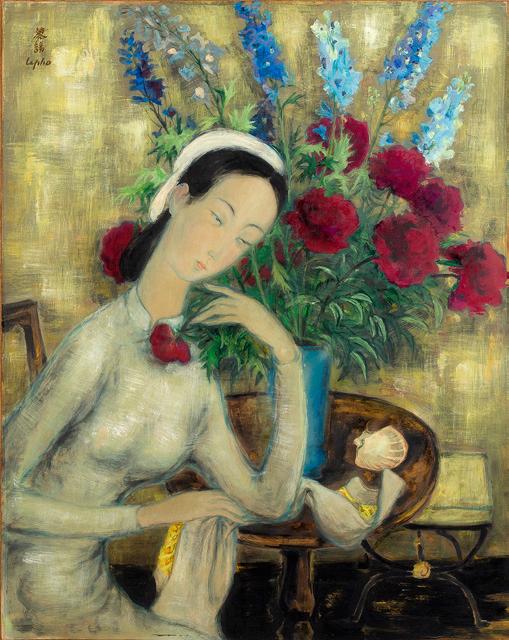
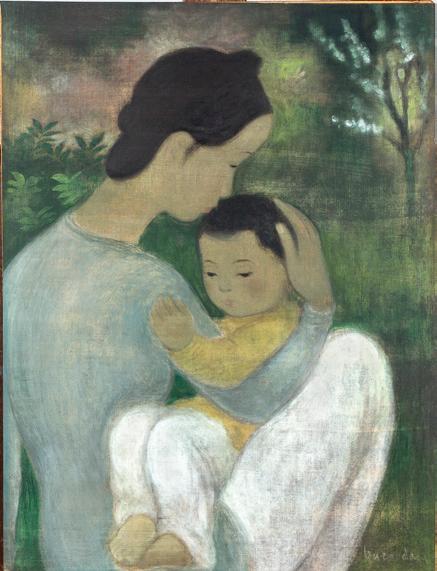
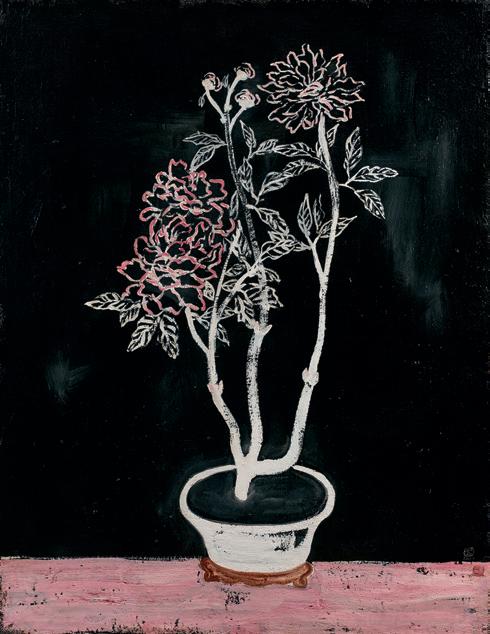
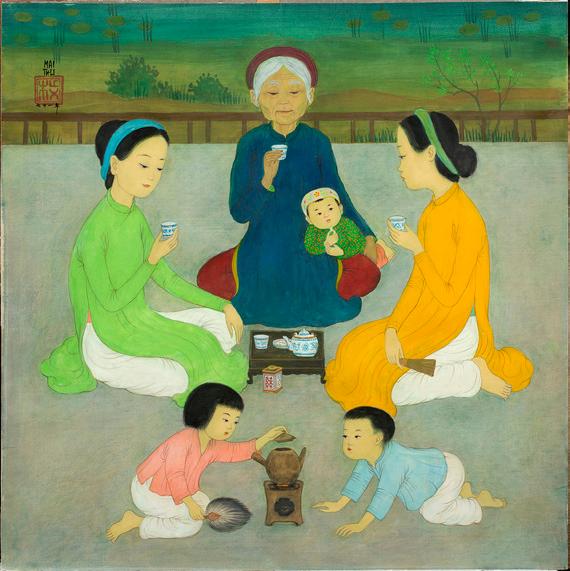
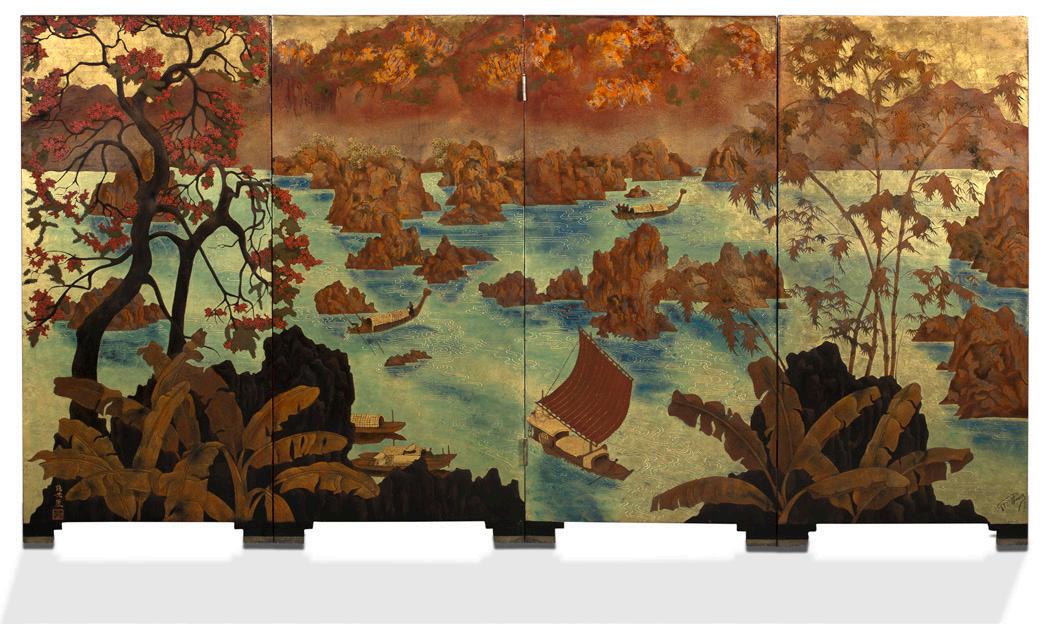
a. Lê Phổ • Vendu 1,16 million d’euros. 2e record mondial le 6 octobre 2020. b. Sanyu • Vendu 8,8 millions d’euros. Record européen le 18 décembre 2017. c. Vũ Cao Đàm • Vendu 470 000 €. d. Mai Trung Thứ • Vendu 718 000€. e. Phạm Quang Hậu • Vendu 833 000 €. 2e record mondial le 7 juin 2021
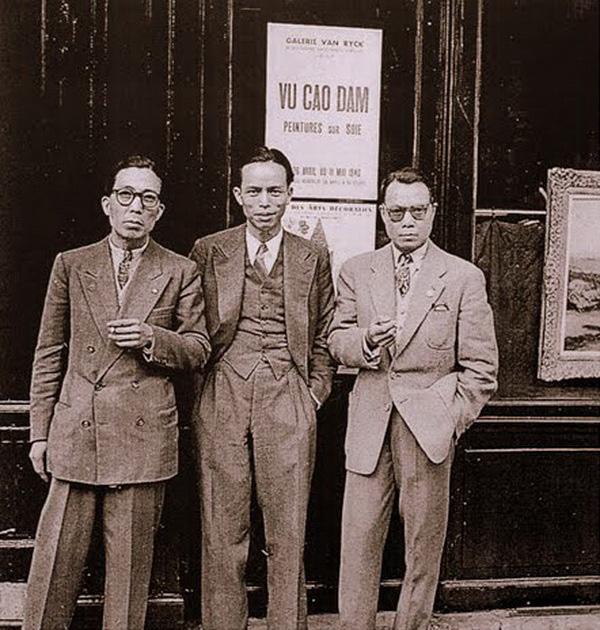
CATALOGUE RAISONNÉ DES PEINTRES
Mai Trung Thứ, Vũ Cao Đàm et Lê Phổ
Les catalogues raisonnés des peintres d’Asie venus en France au début du XXe siècle Lê Phổ, Mai Trung Thứ et Vũ Cao Đàm, sont en préparation par Charlotte Aguttes-Reynier.
Toute personne possédant des œuvres de ces artistes est invitée à la contacter en vue d’insertion au catalogue raisonné concerné : +33 6 63 58 21 82 • catalogues.aap@gmail.com
Plus d’informations sur catalogue-raisonne-aap.com
2027
Première édition - 2026
du Prix de la Route Mandarine
Giải thưởng - 2026
Con đường Thiên lý lần thứ nhất
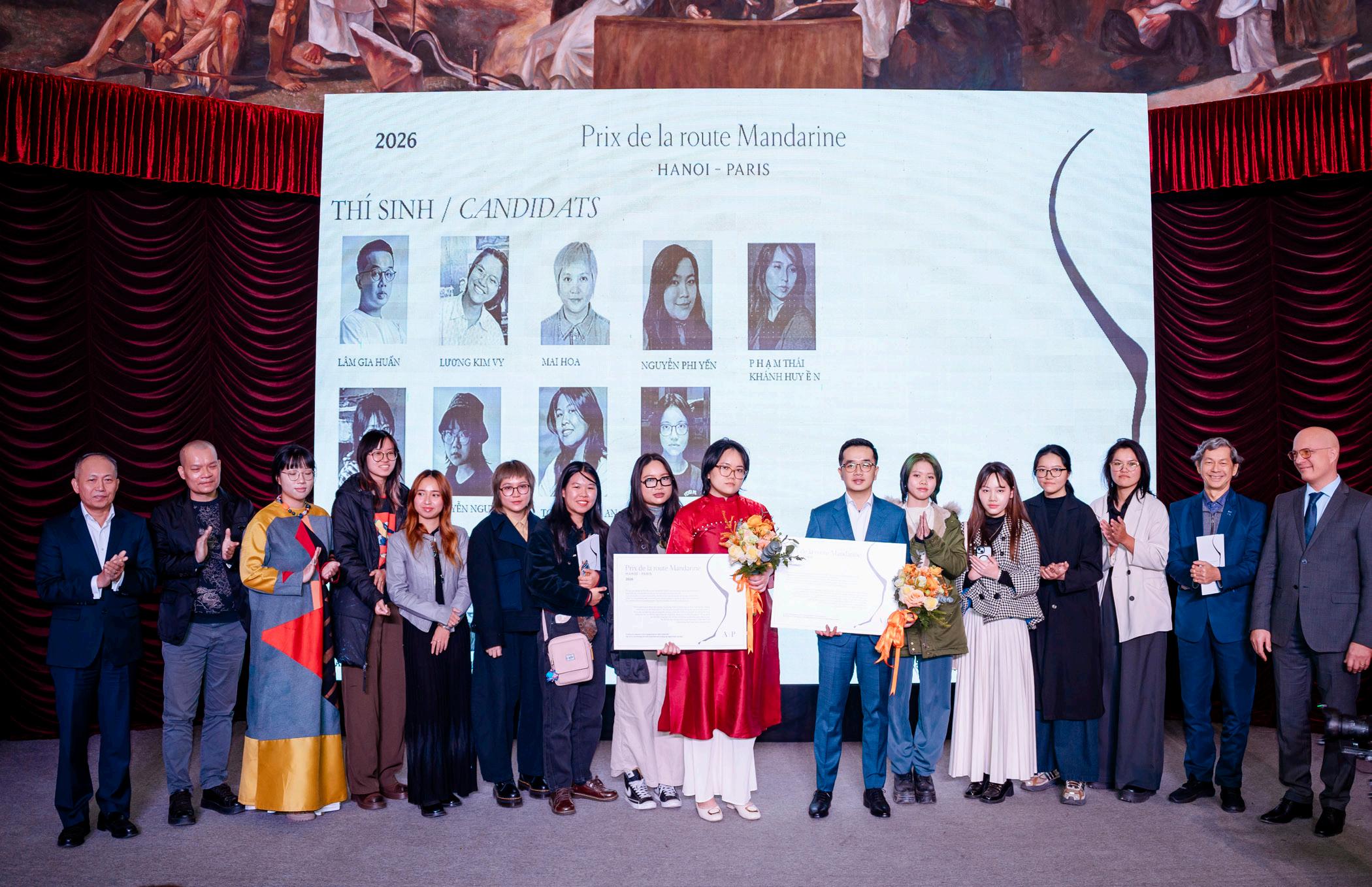
Soutien à la jeune scène
artistique vietnamienne
Nomination des deux lauréats
Lâm Gia Huấn, étudiant à l’Université des beaux-arts d’Hô Chi Minh-Ville, et Nguyễn Nguyệt Anh, étudiante à l’Université des beaux-arts du Vietnam ont reçu, le 7 janvier 2026 à Hanoï, le Prix de la Route Mandarine.
Sous l’égide de l’Association des Artistes d’Asie à Paris qu’elle préside, Charlotte Aguttes-Reynier, expert, avait initié, il y a un an jour pour jour, la création de ce prix. Elle avait saisi l’occasion du centenaire de l’École des beaux-arts de l’Indochine pour annoncer cette récompense vouée à soutenir aujourd’hui la créativité artistique au Vietnam.
Hỗ trợ thế hệ nghệ sĩ trẻ
Việt Nam
Công bố hai thí sinh đoạt giải
27/04/2026 16:13
Ngày 7 tháng 1 năm 2026 tại Hà Nội, Lâm Gia Huấn, sinh viên Trường Đại học
Mỹ thuật TP. Hồ Chí Minh, và Nguyễn Nguyệt Anh, sinh viên Trường Đại học
Mỹ thuật Việt Nam, đã vinh dự giành được Giải thưởng Con đường Thiên lý. Dưới sự bảo trợ của Hiệp hội các Nghệ sĩ châu Á tại Paris, do chuyên gia
Charlotte Aguttes-Reynier là Chủ tịch, giải thưởng này đã được khởi xướng cách đây đúng một năm. Nhân dịp kỷ niệm 100 năm thành lập Trường Cao đẳng Mỹ thuật Đông Dương, bà đã công bố việc sáng lập giải thưởng với sứ mệnh hỗ trợ và khích lệ khả năng sáng tạo nghệ thuật của giới trẻ Việt Nam.
HANOI − PARIS
2027
Chúng tôi hẹn gặp quý vị vào ngày 15 tháng 9 năm 2026 , cổng đăng ký sẽ được mở trên nền tảng aap.art
We look forward to seeing you on September 15, 2026 , when registration opens on aap.art
Rassembler vos informations
Afin de réaliser une estimation précise de vos biens, n’hésitez pas à nous fournir toutes les informations en votre possession (photos, dimensions, date, signature, caractéristiques techniques, provenance, état de conservation, etc.).
Nous contacter
Pour inclure vos biens dans nos prochaines ventes ou demander conseil, n’hésitez pas à contacter directement nos départements spécialisés basés à Neuilly-sur-Seine. Vous pouvez également vous rapprocher de nos représentants locaux, à Aix-en-Provence, Lyon, Lille, Bruxelles ou Genève afin de bénéficier d’un service de proximité.
Si vous êtes disposés à proposer à la vente un ensemble important comportant plusieurs spécialités, le département Inventaires & collections particulières est à votre disposition pour coordonner votre projet. Nos estimations sont gracieuses et confidentielles.
Organiser un rendez-vous d’expertise
Pour donner suite aux éléments reçus et à une première analyse de votre demande, nous déterminons avec vous le type de vente le plus adapté. Un rendez-vous s’organise afin d’avancer dans l’expertise et vous donner plus de précisions sur nos services.
Nous sommes joignables par e-mail ou par téléphone.
Contractualiser
Les conditions financières (estimation, prix de réserve, honoraires) et les moyens alloués à la mise en vente (promotion, transport, assurance...) sont formalisés dans un contrat. Celuici peut être signé lors d’un rendez-vous ou à distance de manière électronique.
Vendre
Chacun de nos départements organise 4 ventes aux enchères par an ainsi que des ventes online Après la clôture des enchères, le département vous informe du résultat et vous recevrez le produit de celles-ci sous 4 à 6 semaines.

Thu thập thông tin
Tất cả các hình ảnh, kích thước, chi tiết và các yếu tố xuất xứ mà bạn có thể thu thập đều rất hữu ích cho chúng tôi để ước tính giá trị hàng hóa của bạn.

Liên hệ với chúng tôi
Để đưa hàng hóa của bạn vào đợt đấu giá tiếp theo của chúng tôi hoặc để yêu cầu tư vấn, đừng ngần ngại liên hệ trực tiếp với các bộ phận
chuyên môn của chúng tôi.
Nếu bạn sẵn sàng chào bán một bộ sưu tập quan trọng với một số món đồ quý hiếm, Phòng phụ trách Bộ sưu tập đặc biệt sẽ sẵn sàng điều phối
kế hoạch cùng bạn.
Hãy liên lạc với chúng tôi bằng e-mail hoặc qua điện thoại.

Tổ chức một cuộc họp thẩm định
Sau liên hệ của bạn và phân tích ban đầu về yêu cầu của bạn, chúng tôi xác định với bạn mức độ hấp dẫn của cuộc bán đấu giá.
Một cuộc hẹn được tổ chức để thúc đẩy quá trình thẩm định và cung cấp cho bạn thêm chi tiết về các dịch vụ của chúng tôi.
Các ước tính và thẩm định của chúng tôi là miễn phí và bảo mật. Chúng ta sẽ cùng nhau xác định
các điều kiện giao dịch.
Hợp đồng hóa
Các điều kiện tài chính (ước tính, giá khởi điểm, phí) và phương tiện được phân bổ cho việc bán hàng (khuyến mại, vận chuyển, bảo hiểm ...) được chính thức hóa trong hợp đồng. Điều này có thể
được ký trong một cuộc hẹn hoặc gửi qua các phương tiện điện tử.
Bán hàng
Mỗi phòng ban của chúng tôi tổ chức 4 cuộc
đấu giá mỗi năm cũng như bán hàng trực tuyến.
Sau khi kết thúc phiên đấu giá, bộ phận thông báo kết quả và bạn sẽ nhận được tiền thanh toán trong vòng 4 đến 6 tuần.
汇总您的藏品信息
为了对您的艺术品做出准确的估价,请不要犹
联系我们
将您的藏品纳入我们的下一次拍卖会中,如果 您想了解更多关于拍卖会或咨询鉴定等方面的 信息,请随时联系我们的专业部门。
如果您提供的是一系列罕见或者特色的大量 收藏品,我们的特别收藏部将随时为您提供 服务,协调您的委托拍卖项目。
您可以通过电子邮件或电话联系我们。
预约鉴定面谈
在与您联系并初步对您的请求进行分析后, 我们与您确认可以将您的藏品纳入我们的拍 卖会。
我们将为您安排一次预约面谈,以便于向您 提供有关我们服务的更多细节。
我们的评估和鉴定是免费的,而且绝对保密。
我们将与您一起决定 拍卖的所有相关条款。
合约化
拍卖财务条款(估价、底价、佣金),以及 拍品推广方式 (广告营销、运输、保险等)都 将在一份合同文件中正式确定。
合同可以在预约时进行签署或以电子方式远 程签署。
拍卖
豫地向我们提供您拥有的所有信息(照片,日 期,签名,工艺特点,尺寸,保存状况......) 1 2 3 4 5
我们每个部门每年都会组织4场拍卖会以及多 个线上拍卖会。
拍卖会结束后,该部门将告知您拍卖结果, 您将 在4至6周内将收到您的拍卖货款。
In order to make an accurate estimate of your property, please provide us with all the information you have (photos, dimensions, date, signature, technical characteristics, provenance, state of preservation, etc.).
Contact us
To include your property in our next sales or to ask for advice, please do not hesitate to contact our specialist departments based in Neuilly-sur-Seine. You can also contact our local representatives in Aix-en-Provence, Lyon, Lille, Brussels or Geneva to benefit from a local service. You can also contact our local representatives in Aix-en-Provence, Lyon, Brussels or Geneva to benefit from a local service.
If you are willing to offer for sale an important ensemble comprising several specialities, the Inventories & Private Collections department is at your disposal to coordinate your project. Our valuations are free and confidential.
Based on the information we receive and an initial analysis of your requirements, we will work with you to determine the most suitable type of sale. We will then arrange a meeting with you to discuss the valuation further and give you more details about our services, which you can contact by e-mail or telephone.
The financial conditions (valuation, reserve price, fees) and the resources allocated to the sale (promotion, transport, insurance, etc.) are formalised in a contract. This can be signed during an appointment or electronically from a distance.
Sell
Each of our departments organises 4 auctions a year, as well as online sales. Once the auctions have closed, the department will inform you of the result and you will receive the proceeds within 4 to 6 weeks.
S’abonner à notre newsletter et nous suivre sur les réseaux sociaux
• S’inscrire à la newsletter (QR code) pour être informé des Temps forts chez Aguttes, suivre les découvertes de nos spécialistes et recevoir les e-catalogues.
• Être informé de notre actualité sur les réseaux sociaux.
Avant la vente, demander des informations au département
Nous vous envoyons, sur demande, des informations complémentaires par e-mail : rapports de condition, certificats, provenance, photos... Nous vous envoyons des photos et vidéos complémentaires par MMS, WhatsApp, WeChat. Chaque lot présenté a été préalablement examiné puis décrit en application du décret Marcus (3 mars 1981). La responsabilité d’Aguttes, selon la législation en vigueur, quant à l’authenticité du bien présenté est engagée.
Échanger avec un spécialiste et voir l’objet
Nous vous accueillons pour une visite privée sur rendez-vous. Nous vous invitons systématiquement aux expositions publiques quelques jours avant la vente. Si vous ne pouvez pas vous déplacer, nous programmons une conversation audio ou vidéo pour échanger avec vous.
Enchérir
• S’enregistrer pour enchérir en salle.
• S’enregistrer pour enchérir par téléphone auprès de bid@aguttes.com.
• S’enregistrer pour enchérir sur le Live (solution recommandée pour les lots à moins de 5 000 €).
• Laisser une enchère maximum auprès de bid@aguttes.com.
Payer et récupérer son lot
• Régler son achat (virement ou paiement en ligne par carte bancaire recommandés).
• Venir ensuite récupérer son lot ou missionner un transporteur.
Đăng ký nhận bản tin và theo dõi chúng
tôi trên mạng xã hội
Để được cập nhật tin tức của chúng tôi trên mạng xã hội.
Đăng ký nhận bản tin (quét mã QR) để được thông
báo về các sự kiện nổi bật của Aguttes, để theo dõi những phát hiện mới từ chuyên gia của chúng tôi và để nhận catalogue trực tuyến.

Trước phiên đấu giá, hãy liên hệ với bộ phận phụ trách để hỏi về thông tin của
một lô hàng
Chúng tôi sẽ gửi cho bạn những thông tin liên quan
đến: tình trạng, giấy chứng nhận, nguồn gốc xuất xứ, hình ảnh... của lô hàng qua email
Chúng tôi cũng có thể gửi hình ảnh và video bổ sung qua MMS, WhatsApp, WeChat.

Trao đổi với một chuyên gia và xem hiện
vật
Chúng tôi sẽ tiếp đón bạn đến tham quan theo lịch
hẹn riêng.
Như thường lệ, chúng tôi mời bạn tới dự buổi triển
lãm các hiện vật - mở cửa tự do một vài ngày trước khi phiên đấu giá được tổ chức.

Nếu bạn không thể đến được, chúng tôi sẽ đặt lịch hẹn để trao đổi với bạn qua điện thoại hoặc video call.
Đấu giá
Đăng ký đấu giá qua điện thoại với bid@aguttes.com.
Đăng ký đấu giá trực tuyến (khuyến nghị cho các lô
hàng có giá trị dưới 5.000€)
Đặt giá đấu tối đa qua bid@aguttes.com
Đăng ký đấu giá trực tiếp tại sàn.
Thanh toán và nhận lô hàng của bạn
Thanh toán hóa đơn mua hàng (hình thức thanh toán
lý tưởng nhất là thanh toán trực tuyến / bằng thẻ hoặc bằng chuyển khoản ngân hàng) Sau đó, trực tiếp đến lấy lô hàng của bạn hoặc ủy quyền cho một đơn vị vận chuyển.
注册我们的新闻简讯并关注公众号 注册新闻简讯了解奥古特“亮点时刻”;跟随专 家们发现最新拍品并获取电子拍品目录 通过公众号获知拍卖行最新动向。
在拍卖会之前联系相关部门获取拍品信息 我们将把详细信息以邮件方式发送给您:品相报 告、鉴定证书、来源、细图等 我们将把更多细图、视频通过彩信、WhatsApp、 微信的方式发送给您。
与专家交流并观看拍品实物 通过预约方式,我们将单独接待您的来访。
您也可以依照常规方式在拍卖会前的公开预展进 行参观。
如果您不能亲自前来,我们可以为您安排一个音 频或视频电话交流。
竞拍
提前致电 bid@aguttes.com 注册电话竞拍。
注册参与线上竞拍(建议拍品竞拍价格低于5000 欧元时使用本方式)。
致电bid@aguttes.com 留下您的最高出价。 提前注册然后前往拍卖厅进行现场竞拍。
支付并提取拍品
支付拍品(最理想方式为线上以银行卡或者 银行转账方式进行支付) 随后来拍卖行提取拍品,或者委托一个货运 代理。
1 2 3 4 5
Subscribe to our newsletter and follow us on Social media
• Subscribe to our newsletter (QR code) to keep up to date with the highlights at Aguttes, follow our specialists’ discoveries and receive e-catalogues.
• Keep up to date with our news on social networks.
Request the Specialized Departments for information on a Lot Prior to Sale
On request, we can send you additional information by e-mail: condition reports, certificates, provenance, photos, etc. We can send you additional photos and videos by MMS, WhatsApp or WeChat. Each lot presented has been examined and described in accordance with the Marcus Decree (3 March 1981). Aguttes is responsible for the authenticity of the items presented, in accordance with current legislation.
Talk to a specialist and see the object
We welcome you for a private viewing by appointment. We systematically invite you to public exhibitions a few days before the sale. If you are unable to attend, we can arrange an audio or video chat with you.
Place Your Bid
• Come and register in order to bid.
• Register to bid by telephone at the email: bid@aguttes.com.
• Register to bid on Live (recommended for lots under €5,000).
• Leave a maximum bid at bid@aguttes.com.
Pay and Receive Your Property
• Pay for your purchase (bank transfer or online payment by credit card recommended).
• Then collect your order or arrange for a courier to collect it.
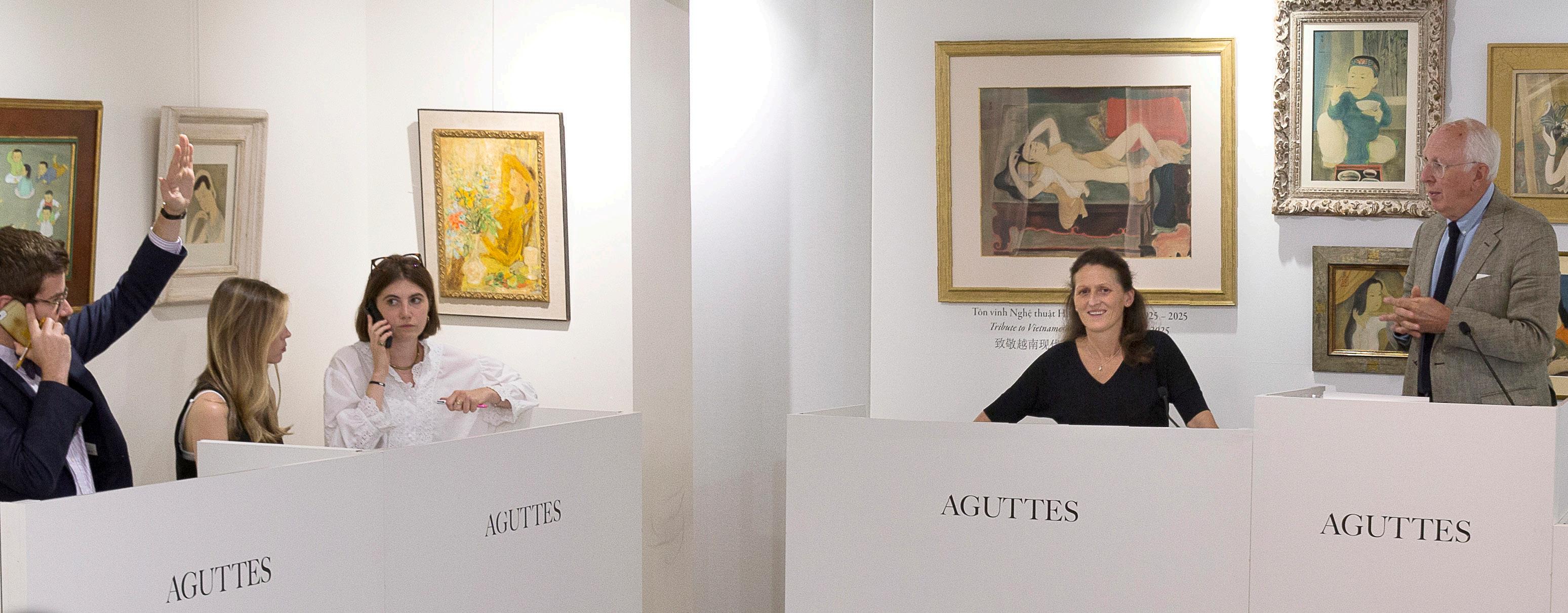
Vente Hommage à l’art moderne vietnamien en septembre 2025, totalisant 6,2 millions d’euros
Fondée à Clermont-Ferrand en 1974 par Claude Aguttes, la maison de ventes aux enchères Aguttes se compose aujourd’hui d’une équipe de 60 personnes, passionnée et qui constitue sa qualité première. Elle s’est hissée au fil des années, au rang d’acteur majeur du marché de l’art. Restée indépendante et familiale, avec trois enfants actifs, elle est au service de la transmission. Avec une salle des ventes située dans l’ouest parisien et des bureaux de représentation en régions, à Bruxelles et Genève, Aguttes se distingue par son service personnalisé et sa réactivité. Ses 19 départements, portés par des experts et spécialistes internalisés, permettent la valorisation et la vente de grandes collections, de tableaux, de bijoux et d’automobiles, d’objets d’art et d’exception. Avec sa force de frappe en promotion et sa culture de la performance, la maison vise l’excellence et enregistre régulièrement des records mondiaux. Consciente de la confiance que lui accordent ses vendeurs, elle reste au service de ces derniers avant tout.
L’ensemble des collaborateurs de la maison sont au service du beau, de la transmission émotionnelle et intellectuelle entre les collectionneurs. Chaque œuvre d’art ou bien d’exception doit être défendu au mieux sur le marché. L’obtention du meilleur prix d’adjudication est l’objectif intrinsèque de la vente aux enchères. Nos responsables de départements s’engagent personnellement à honorer la confiance de leurs clients en les conseillant et en garantissant leurs intérêts. C’est l’ADN de notre maison familiale.
POURQUOI AGUTTES ?
Expertise 19 départements spécialisés
Accompagnement personnalisé
Agilité pour la vente de lots à fort potentiel
Records à l’international
Plus de 50% d’acheteurs étrangers
Culture de l’excellence
Pour des lots allant de 10 000 à 2 millions d’euros
Fréquence des ventes
4 ventes aux enchères annuelles par spécialité
Pour inclure vos biens, contactez-nous ! Estimations gratuites et confidentielles sur rendez-vous
Art impressionniste & moderne
Pierre-Alban Vinquant
+33 1 47 45 08 20 +33 7 64 41 09 04 vinquant@aguttes.com
Arts d’Asie
Clémentine Guyot
+33 1 47 45 00 90 • +33 7 83 19 05 89 guyot@aguttes.com
Arts décoratifs du XXe & Design
Jessica Remy-Catanese
+33 1 47 45 08 22 • +33 7 61 72 43 19 remy@aguttes.com
Automobiles de collection
Automobilia
Gautier Rossignol
+33 1 47 45 93 01 • +33 7 45 13 75 78 rossignol@aguttes.com
Bijoux & Perles fines
Philippine Dupré la Tour
+33 1 41 92 06 42 • +33 6 17 50 75 44 duprelatour@aguttes.com
Cartes de collection
Sports
François Thierry
+33 1 41 92 06 69 thierry@aguttes.com
Collections particulières
Sophie Perrine
+33 1 41 92 06 44 +33 7 60 78 10 27 perrine@aguttes.com
Grands vins & Spiritueux
Pierre-Luc Nourry
+33 1 47 45 91 50 • +33 7 63 44 69 56 nourry@aguttes.com
Instruments de musique & Archets
Hector Chemelle
+33 1 41 92 06 68 • +33 7 69 02 70 85 chemelle@aguttes.com
Livres anciens & modernes
Affiches, Manuscrits & Autographes
Sophie Perrine +33 1 41 92 06 44 • +33 7 60 78 10 27 perrine@aguttes.com
Mobilier & Objets d’art
Haute époque
Grégoire de Thoury
+33 1 41 92 06 46 • +33 7 62 02 04 72 thoury@aguttes.com
Mode & Maroquinerie
Agathe de Drouas
+33 7 62 87 10 69 drouas@aguttes.com
MAISON DE VENTES AUX ENCHÈRES
Aguttes Neuilly
+33 1 47 45 55 55
164 bis, avenue Charles de Gaulle 92200 Neuilly-sur-Seine
Aix-en-Provence
Adrien Lacroix +33 6 69 33 85 94 • adrien@aguttes.com
Lille
Pauline Boddaert +33 6 99 02 22 63 • boddaert@aguttes.com
Lyon
Haude Le Roux
+33 4 37 24 24 24 • leroux@aguttes.com
Montres de collection
Claire Hofmann +33 1 47 45 93 08 +33 7 49 97 32 28 hofmann@aguttes.com
Peintres d’Asie : Chine & Vietnam
Charlotte Aguttes-Reynier +33 1 41 92 06 49 • +33 6 63 58 21 82 reynier@aguttes.com
Pop Culture & Memorabilia
Arthur Perault +33 1 47 45 91 59 • +33 6 66 58 95 62 perault@aguttes.com
Post-war & Art contemporain
Ophélie Guillerot +33 1 47 45 93 02 • +33 7 60 78 10 07 guillerot@aguttes.com
Tableaux & Dessins anciens
Victoria Damidot +33 1 47 45 91 57 damidot@aguttes.com
Inventaires & Partages
Claude Aguttes et Sophie Perrine, commissaires-priseurs
+33 1 41 92 06 44 • perrine@aguttes.com
Régions Ouest & Est
Marie de Calbiac +33 7 60 78 08 77 • calbiac@aguttes.com
Bruxelles
Ernest van Zuylen +32 487 14 11 13 • vanzuylen@aguttes.com
Genève Côme Bizouard de Montille +41 225 196 884 montille.consultant@aguttes.com
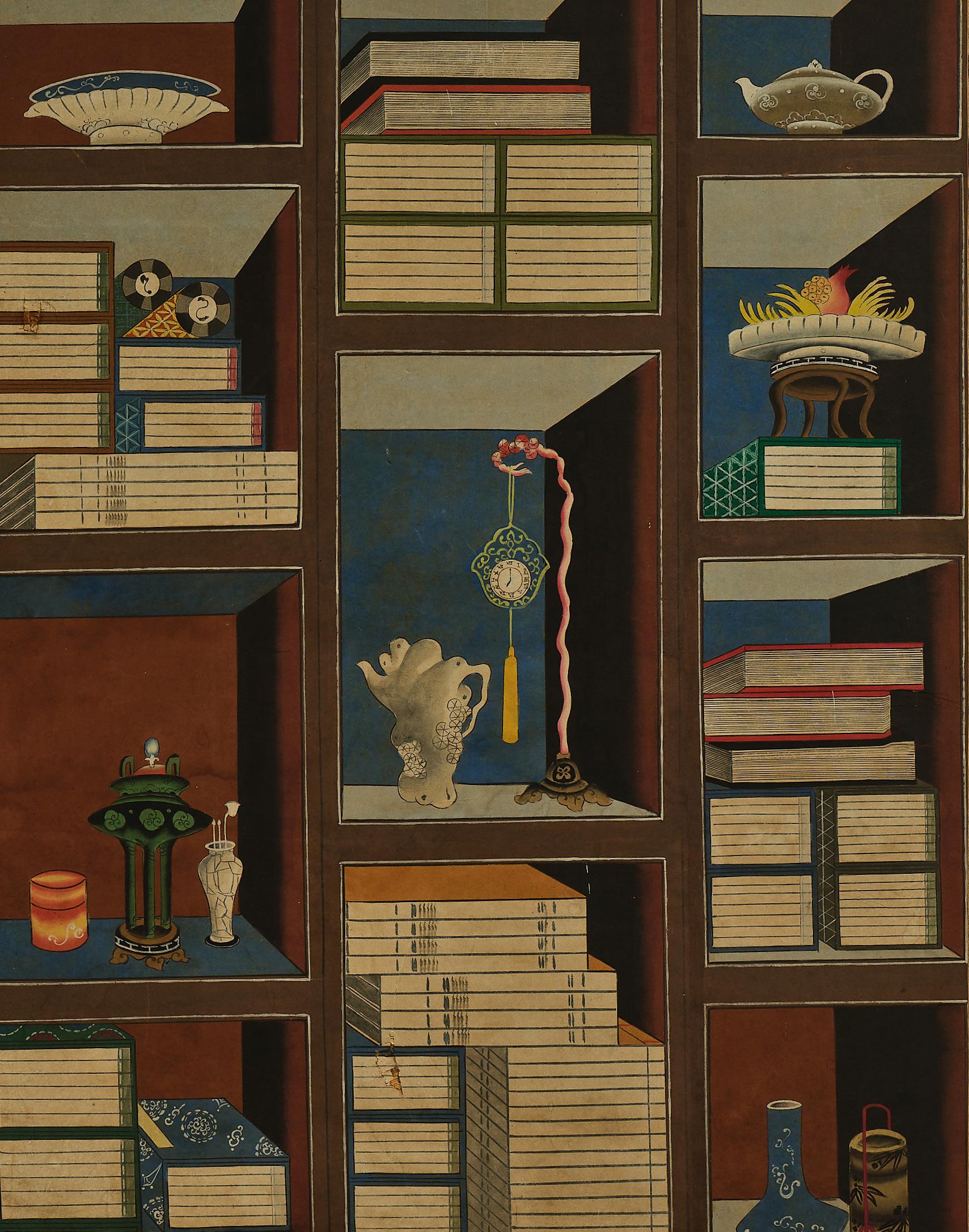
Aguttes s’intègre aux parcours composés par les galeries d’art asiatique et dédiés à la découverte d’expositions et de sélection d’œuvres d’exception, au cœur des adresses les plus emblématiques de la capitale.
La maison de ventes Aguttes vous invite à un voyage printanier au cœur de l’art asiatique dans une conférence dédiée à la représentation de la nature. Découvrez comment la faune et la flore ont inspiré les grands maîtres du continent à travers les siècles, transcendant le simple motif décoratif pour devenir un langage symbolique d’une infinie richesse.
Conférences, expositions, ventes aux enchères, publications, dédicaces… se succéderont chez Aguttes, mettant l’Asie à l’honneur, à l’occasion de la neuvième édition du Printemps Asiatique qui se tiendra du 3 au 12 juin à Paris.
Parcours St Germain des Prés : le 3 juin 18h - 21h
Bureau Aguttes, 147 bd. St Germain, 75006 Paris
Depuis plus de 12 ans, Aguttes témoigne de sa passion pour la mise en lumière d’objets et peintures asiatiques oubliés dans les collections particulières. Ce vernissage sera l’occasion de découvrir des objets rares et inédits prêtés par des particuliers.
Parcours galeries : le 3 juin 18h - 21h
Bureau Aguttes, 3 rue Davioud, 75016 Paris
Depuis plus de 12 ans, Aguttes témoigne de sa passion pour la mise en lumière d’objets et peintures asiatiques oubliées dans les collections particulières. Portes ouvertes dans son nouveau bureau avenue Mozart pour découvrir des objets rares et inédits prêtés pour l’occasion par des particuliers.
JUIN 18H – 21H
INSCRIVEZ-VOUS DÉS AUJOURD’HUI
AUX ÉVÉNEMENTS AGUTTES...
Conférence : le 8 juin 2026 à 14h30 - 15h30
Aguttes Neuilly
Le Printemps en Asie, faune et flore dans l’art asiatique
La maison de ventes Aguttes vous invite à un voyage printanier au cœur de l’art asiatique dans une conférence dédiée à la représentation de la nature.
Découvrez comment la faune et la flore ont inspiré les grands maîtres du continent à travers les siècles, transcendant le simple motif décoratif pour devenir un langage symbolique d’une infinie richesse.
Avec la collaboration de Laurent Colson, auteur de L’Art des jardins en Chine, Art chinois des jardins
Animé par Clémentine Guyot, directrice du département Arts d’Asie Aguttes
La seconde partie de cette rencontre sera l’occasion de présenter la nature comme source de créativité artistique en Corée, de la période Joseon à nos jours.
Animé par Charlotte Aguttes-Reynier, expert art moderne asiatique Aguttes
JUIN 14H30
Je m’inscris
Tôi đăng ký tham I sign up 我报名
Arts d’Asie : le 9 juin 2026 à 14h30
Exposition le lundi 8 juin de 10h à 17h30
Aguttes Neuilly
Clémentine Guyot
Responsable des Arts d’Asie + 33 7 83 19 05 89 • guyot@aguttes.com
JUIN 14H30
MAI À SEPTEMBRE 2026
04
MAI À 15H
Tour Auto 2026 | La Vente officielle
GRAND PALAIS, PARIS
JUIN À 14H30
Arts d’Asie
AGUTTES NEUILLY
MAI À 14H30
Peintres d'Asie
Art moderne vietnamien
AGUTTES NEUILLY
MAI À 14H30
Arts classiques
AGUTTES NEUILLY
JUIN À 14H30
Art impressionniste & moderne
AGUTTES NEUILLY
JUIN À 14H30
Mode & Maroquinerie
AGUTTES NEUILLY
29
MAI À 14H30
Instruments & Archets du quatuor AGUTTES NEUILLY
JUIN À 14H30
Pop Culture & Memorabilia :
Michael
AGUTTES NEUILLY
JUIN À 10H
21
JUIN À 14H30
Automobiles de collection
La vente d'été
ESPACE CHAMPERRET, PARIS
JUIN À 14H30
Arts décoratifs du XX e & Design AGUTTES NEUILLY
JUIN À 15H
03 04 09 17 18 23 24 30 01 02 08 09 13 21
Grands vins & Spiritueux
AGUTTES NEUILLY
Post-war & Art contemporain
AGUTTES NEUILLY
Ce calendrier est sujet à modifications. Retrouvez toutes nos dates de ventes sur aguttes.com
JUIN À 14H30
Bijoux & Perles fines
AGUTTES NEUILLY
JUILLET À 17H
Montres de collection AGUTTES NEUILLY
JUILLET À 14H30
Maîtres anciens
AGUTTES NEUILLY
08
JUILLET À 14H30
Haute époque AGUTTES NEUILLY
SEPTEMBRE À 14H30
Bijoux AGUTTES NEUILLY
SEPTEMBRE À 14H30
Peintres d’Asie Chine & Vietnam AGUTTES NEUILLY
PROCHAINE VENTE 9 JUIN 2026
Contact : Clémentine Guyot +33 1 47 45 00 90 • guyot@aguttes.com
PROCHAINE VENTE 17 JUIN 2026
Paolo Troubetzkoy (1866 - 1938)
Angelina seduta col cane ou Ritratto di Angeline Troubetzkoy, 1906 - 1909 Vendu 72 500 €
Contact : Pierre-Alban Vinquant +33 1 47 45 08 20 • vinquant@aguttes.com
PROCHAINE VENTE
24 JUIN 2026
David Hockney (né en 1937)
Lillies, 1971
Vendu 32 500 €
Contact : Ophélie Guillerot
+33 1 47 45 93 02 • guillerot@aguttes.com
PROCHAINES VENTES
30 JUIN ET 8 SEPTEMBRE
Boucheron
Bague Saphir
Vendue 106 000 €
Contact : Philippine Dupré la Tour
+33 1 41 92 06 42 • duprelatour@aguttes.com