Esthétiques du Sacré en Asie Orientale
Aesthetics of the Sacred in East Asia
东亚的神圣美学
Clémentine Guyot & Marine Bassal-Biron
Esthétiques du Sacré en Asie Orientale
Aesthetics of the Sacred in East Asia
东亚的神圣美学
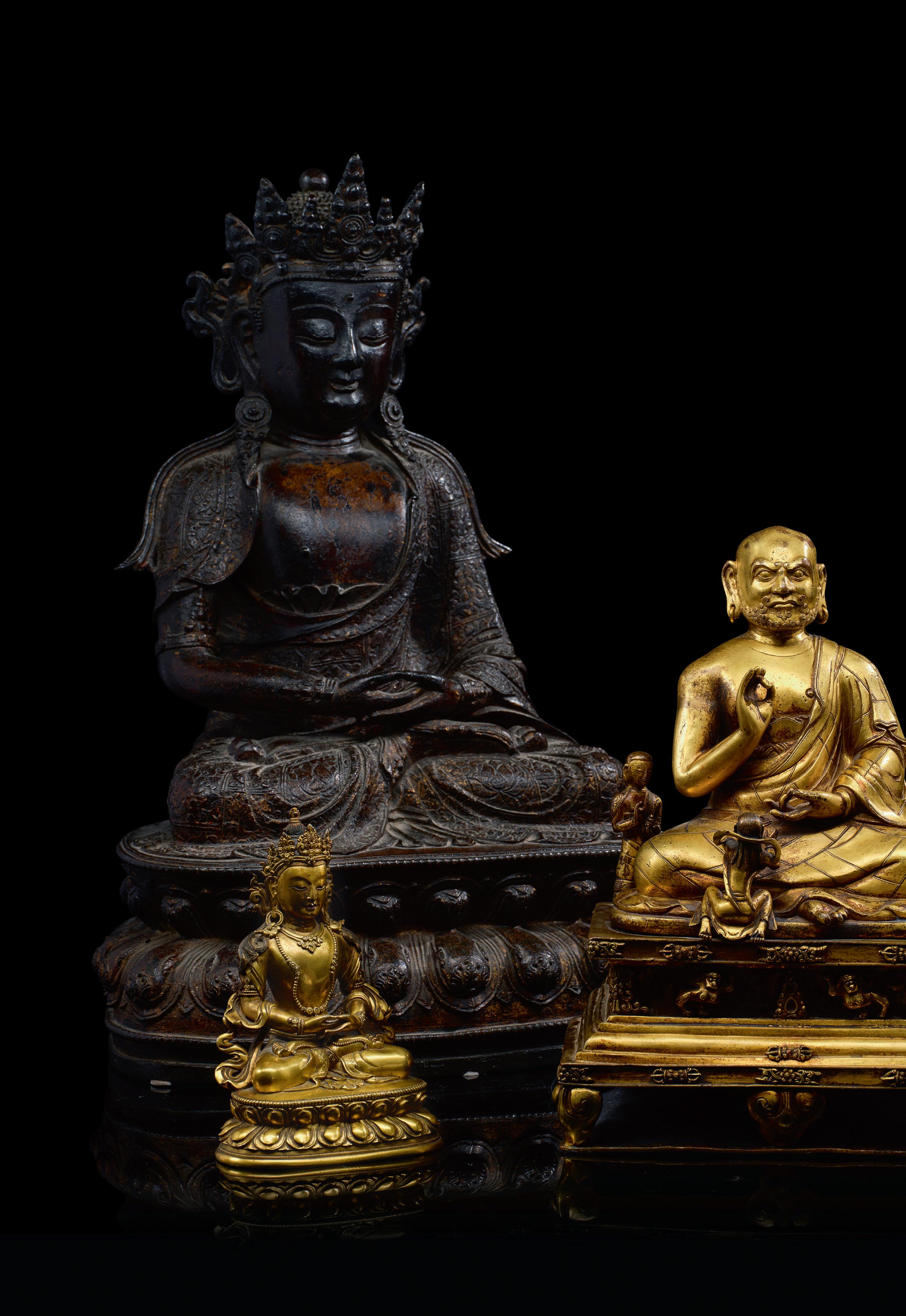

Figure de la sérénité, le Bouddha incarne l’être parfait dans son essence absolue.
Si la sacralité de sa perfection est le cœur même de son existence, l’Éveillé n’en demeure pas moins un être de compassion, proche des hommes et de leurs fragilités.
Il est fascinant de considérer à quel point chaque peuple a pris soin de s’approprier la représentation du Bouddha donnant ainsi naissance à la divinité parfaite selon sa culture, ses besoins et ses désirs.
Plus qu’une conquête, l’essor du bouddhisme en Asie orientale est l’histoire d’un enracinement. Tel un arbre qui étend lentement ses racines et se développe à travers la multiplicité de ses nombreuses branches, le bouddhisme croît pour devenir l’arbre de sagesse auprès duquel les civilisations grandissent et viennent trouver refuge et spiritualité.
Nous sommes heureux à travers ce travail de vous partager notre admiration pour le travail précieux et singulier réalisé avec ferveur par des artistes du bout du monde, qui ont su lentement, à travers les siècles, fait naître leur dieu sous leurs doigts silencieux.
A figure of serenity, the Buddha embodies the perfect being in his absolute essence.
While the sacredness of his perfection lies at the very heart of his existence, the Enlightened One remains a being of compassion, close to humanity and its frailties.
It is fascinating to observe how each culture, over time, has embraced and reinterpreted the image of the Buddha, giving rise to a divine figure shaped by its own values, needs, and aspirations.
More than a simple spiritual expansion, the rise of Buddhism in East Asia is, above all, the story of deep-rooted growth.
Like a tree slowly extending its roots and branching out in all directions, Buddhism has flourished, becoming a tree of wisdom under which civilizations have grown, seeking refuge and spirituality. Through this work, we wish to express our deep admiration for the precious and unique creations of the artists from these distant lands.
With devotion and humility, they have, over the centuries, brought forth the image of the Buddha with their silent hands — a sublime expression of the divine ideal.
作为宁静的象征,佛陀体现了至高本质中的完美存在。
尽管其神圣的完美是其存在的核心,觉者依然是一位充满慈悲的存在,贴近人 类与其脆弱。
令人着迷的是,各个民族都细心地将佛陀的形象本土化,从而根据自身的文化、 需求与愿望,塑造出心中的完美神祇。
佛教在东亚的发展,与其说是一次征服,不如说是一段深深扎根的历程。
如同一棵树,缓慢地伸展根系,通过繁茂的枝干不断生长,佛教成为一棵智慧 之树,让文明在其荫蔽之下成长,寻求庇护与灵性。
通过这项简朴的工作,我们怀着喜悦之情,与您分享我们对这些来自世界尽头 的艺术家们的敬意。他们以无声之手,在漫长的岁月中,虔诚地塑造出了自己 的神明。
Clémentine Guyot, directeur du département Arts d’Asie, Aguttes
AVANT-PROPOS
Le bouddhisme des origines à sa diffusion en Asie orientale : genèse, doctrines et courants
Le bouddhisme voit le jour autour du VIe siècle avant J.-C., sur les contreforts de l’Himalaya autour de la figure de Siddhārtha Gautama, prince du royaume himalayen des Shakya. Son destin bascule alors qu’il expérimente une série de rencontres avec la souffrance, la vieillesse, la maladie, la mort qui le bouleverse. Il renonce alors à sa vie de confort pour chercher un sens profond à l’existence. Après des années de quête, il atteint l’éveil sous un arbre à Bodhgayā et devient le Bouddha, « l’Éveillé ». Son premier sermon à Sārnāth fonde le bouddhisme, une voie spirituelle centrée sur la compréhension de la souffrance et la libération intérieure. Ce chemin, né en Inde, se diffuse progressivement en Asie centrale puis vers l’Est, empruntant notamment routes commerciales et réseaux diplomatiques. En Asie orientale, son implantation se fait au prix d’une transformation et d’un syncrétisme qui lui permet d’intégrer des sociétés dont les systèmes philosophiques, religieux et esthétiques préexistaient largement à son arrivée. À partir du Ier siècle de notre ère, le bouddhisme connaît une diversification doctrinale marquée par l’émergence du Mahāyāna, qui se distingue progressivement du courant ancien — désigné plus tard comme Theravāda — par une nouvelle vision de l’éveil, centrée sur l’idéal du bodhisattva et une relecture des textes canoniques.
Sur le plan géographique, la division entre Mahāyāna et Theravāda se traduit par une diffusion différenciée en Asie. Ainsi le Theravāda (« Doctrine des Anciens »), issu du courant ancien Sthaviravāda, s’implante en Asie du Sud et du Sud-Est (Inde, Sri Lanka, Birmanie (Myanmar), Thaïlande, Laos et Cambodge…) tandis que le Mahāyāna (« Grand Véhicule ») se diffuse plus largement en Asie centrale puis orientale, à partir de l’Inde du Nord, via l’Himalaya, gagnant la Chine dès le Ier siècle, puis la Corée, le Japon. À cela s’ajoute un troisième grand courant, le Vajrayāna (« Véhicule du foudre-diamant ») ou bouddhisme ésotérique, souvent considéré comme une forme du Mahāyāna, qui se développe principalement au Tibet, en Mongolie et dans certaines régions de l’Himalaya (Bhoutan, Népal,...). La particularité principale du Vajrayāna est le recours aux tantras ou autres méthodes de méditation yogiques , transmises de maître à disciple. Ils auraient ainsi été enseignés par le Bouddha historique, mais tenus secrets . Le vajrayāna dispose d’un panthéon de déités multiples : bouddhas, protecteurs ou gardiens courroucés, et bodhisattvas. Il ne s’agit pas de « déité » au sens habituel, mais de supports de méditation, auxquels le pratiquant doit s’identifier, et ainsi développer plus rapidement la « Nature de Bouddha » présente en chacun.
PREFACE
Buddhism from its Origins to its Spread in East Asia: Genesis, Doctrines and Schools»
Buddhism was born around the 6 th century BC, in the foothills of the Himalayas, around the figure of Siddhārtha Gautama, prince of the Himalayan kingdom of Shakya. His destiny changed when he experienced a series of encounters with suffering, old age, illness and death that shook him to the core. He gave up his life of comfort to search for a deeper meaning to life. After years of searching, he attained enlightenment under a tree at Bodhgayā and became the Buddha, ‘the Awakened One’. His first sermon at Sārnāth founded Buddhism, a spiritual path centred on the understanding of suffering and inner liberation. This path, which originated in India, gradually spread to Central Asia and then eastwards, using trade routes and diplomatic networks in particular. In East Asia, it took root at the cost of a transformation and syncretism that enabled it to integrate societies whose philosophical, religious and aesthetic systems had largely pre-existed its arrival.
From the first century AD, Buddhism underwent doctrinal diversification, marked by the emergence of the Mahāyāna, which gradually distinguished itself from the ancient current – later known as Theravāda – by a new vision of enlightenment, centred on the ideal of the bodhisattva and a re-reading of the canonical texts.
Geographically, the division between Mahāyāna and Theravāda is reflected in a differentiated spread in Asia. The Theravāda ‘Doctrine of the Elders’, derived from the ancient Sthaviravāda current, took root in South and South-East Asia (India, Sri Lanka, Burma (Myanmar), Thailand, Laos and Cambodia, etc.), while the Mahāyāna ‘Great Vehicle’ spread more widely in Central and then Eastern Asia, from Northern India via the Himalayas, reaching China from the first century, then Korea and Japan.
Added to this is a third major current, the Vajrayāna ‘Vehicle of the Diamond Lightning’ or esoteric Buddhism, often considered to be a form of the Mahāyāna, which developed mainly in Tibet, Mongolia and certain regions of the Himalayas (Bhutan, Nepal, etc.). The main feature of Vajrayāna is the use of tantras or other yogic meditation methods, passed down from master to disciple. They are said to have been taught by the historical Buddha, but kept secret. The vajrayāna has a pantheon of multiple deities: Buddhas, protectors or wrathful guardians, and bodhisattvas. These are not ‘deities’ in the usual sense, but supports for meditation, with whom the practitioner must identify, and thus develop more rapidly the ‘Buddha Nature’ present in each of us.
引言
佛教从起源到在东亚的传播:起源、教义与流派 佛教起源于公元前六世纪左右,诞生在喜马拉雅山麓,以释迦牟尼 (Siddhārtha Gautama)为核心人物,他是喜马拉雅地区释迦族王国的 王子。他的命运因一系列遭遇——苦难、年老、疾病与死亡——而发生 转折,这些经历深深触动了他。他遂舍弃王宫中安逸的生活,踏上追寻 人生深层意义的道路。经过多年的修行与探索,他在菩提伽耶的一棵 树下证得觉悟,成为佛陀,即“觉者”。他在鹿野苑(Sārnāth)所作的第 一次讲法,标志着佛教的创立——这是一条以认识苦难与寻求内在解 脱为核心的精神道路。
佛教诞生于印度,逐渐传播至中亚,再经由商贸路线与外交网络东传。在 东亚,它的传播伴随着重要的转化与融合,逐步融入到那些早在佛教传 入前就已经拥有成熟哲学、宗教与审美体系的社会中。
从公元1世纪开始,佛教教义发生多样化演变,标志性事件之一是大乘 佛教(Mahāyāna)的兴起。大乘佛教逐步与原始佛教(后称上座部佛 教 Theravāda)区分开来,提出了以菩萨理想为核心的觉悟观,并重新 诠释经典内容。
从地理角度来看,大乘佛教与上座部佛教之间的分化反映在其各自 不同的传播区域。上座部佛教(意为“长老的教义”,源于古老的部派 Sthaviravāda)主要传播至南亚与东南亚地区,包括印度、斯里兰卡、缅 甸(今称“缅甸”或“缅甸联邦共和国”)、泰国、老挝与柬埔寨等国。 而大乘佛教(意为“大乘之道”)则从印度北部出发,沿喜马拉雅山脉 广泛传播至中亚与东亚地区,早在公元1世纪便传入中国,随后传至朝 鲜、日本等地。
此外,还有第三大主要流派,即金刚乘佛教(Vajrayāna,意为“金刚之 乘”或“金刚乘”),也被称为密教,通常被视为大乘佛教的一种形式。
它主要在西藏、蒙古及喜马拉雅部分地区(不丹、尼泊尔等)发展。金刚 乘佛教的一个显著特征是运用密续(Tantra)以及各种瑜伽式的禅修 方法,这些方法通过师徒之间的口耳相传加以传授。据说,这些法门曾 由释迦牟尼佛亲授,但长期保密。金刚乘具有丰富的神祇体系,包括佛 陀、护法神、忿怒守护神及菩萨。这些“神祇”并非通常意义上的神, 而是冥想时的观想对象,修行者需通过观想与之认同,从而加速开发 自身本具的“佛性”。
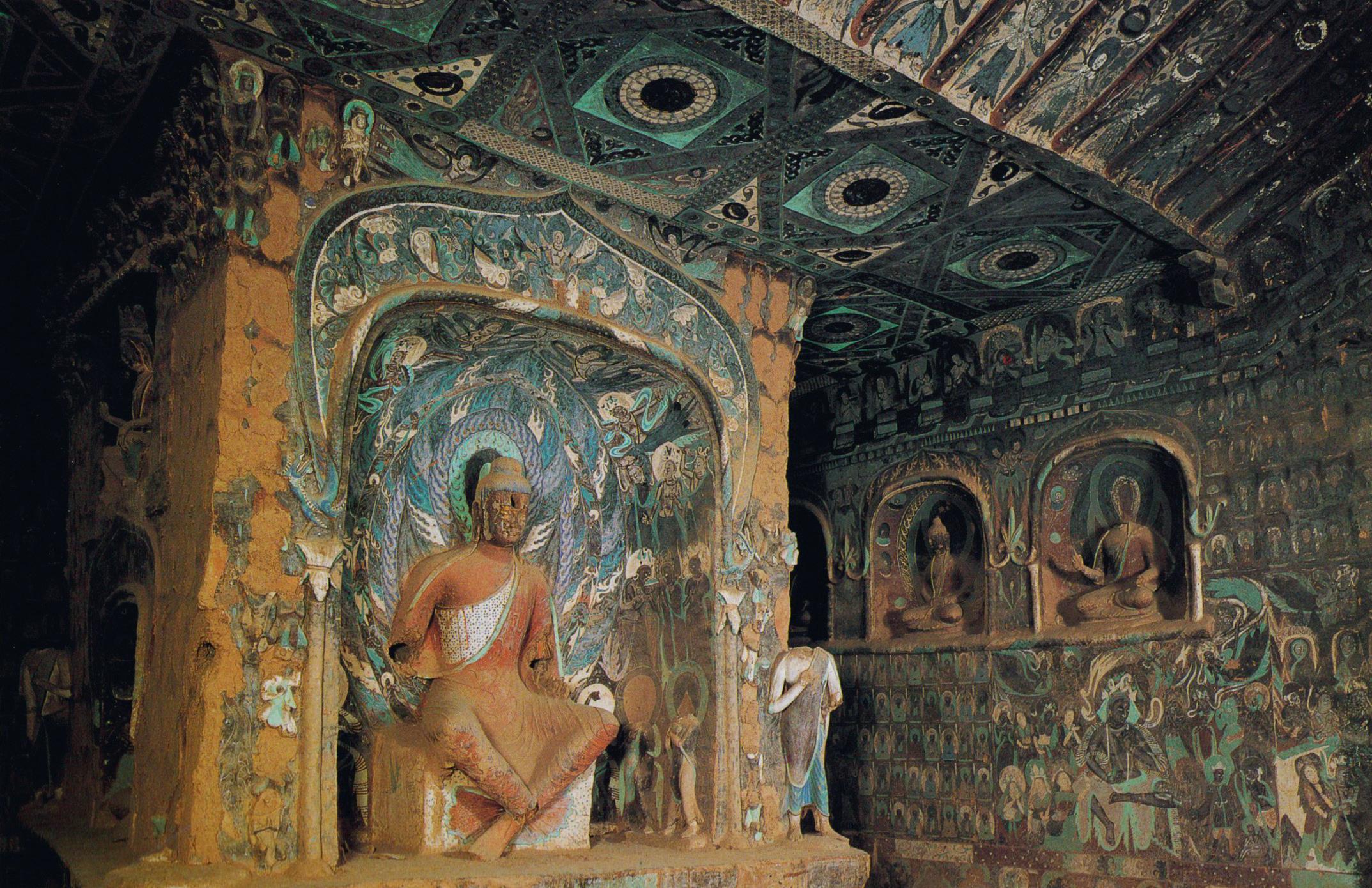
Sculpture peinte et peintures murales - Dynastie des Wei du Nord (386-534). Chine, Gansu, grottes de Mogao, grotte n°254, pilier central et mur Nord.
SOMMAIRE
INDEX
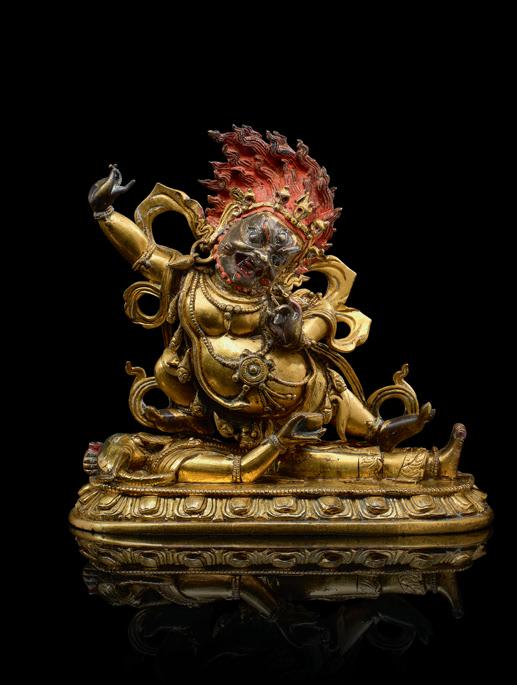
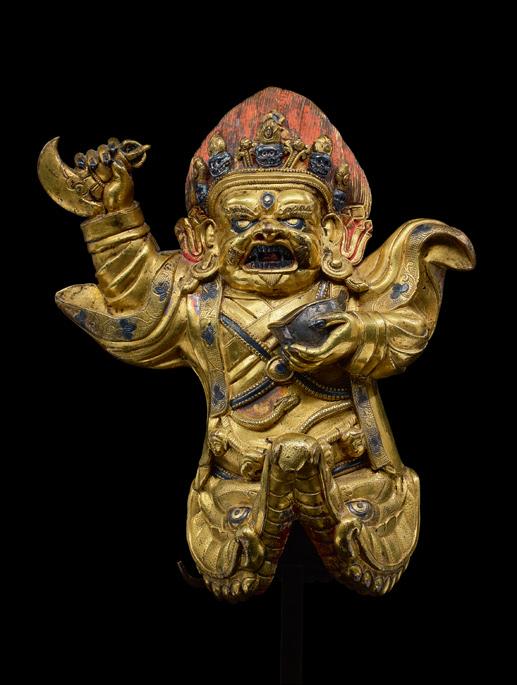
Dynastie Sui (581-618) et dynastie Tang (618-907) p. 12
Dynastie Song (960-1279) p. 14
Dynastie Yuan (1279-1368) p. 18
Dynastie Ming (1368-1644) p. 20
L’Himalaya Sacrée : le Tibet p. 34
Dynastie Qing (1644-1911) p. 52
32 PAGE 40 PAGE
PAGE
PAGE
INTRODUCTION
Syncrétisme et sinisation : genèse du bouddhisme chinois
Introduit en Chine via les routes de la Soie dès milieu du Ier siècle de notre ère, le bouddhisme est alors considéré comme une religion étrangère dont certaines caractéristiques étaient en désaccord avec l’idéal moral et social façonné par le confucianisme. À l’inverse, il offre des similitudes extérieures avec le taoïsme de sorte que les deux spiritualités ne cesseront de voir leurs cultes dialoguer et s’entremêler.
Il faut attendre le IIIe siècle pour qu’il commence à s’enraciner durablement, notamment grâce à un fort soutien institutionnel, qui favorise l’implantation de grands monastères, et offre de nombreux avantages pécuniers aux temples et lieux de cultes. Le bouddhisme fait de plus en plus d’adeptes, qui n’abandonnent pas systématiquement leurs autres pratiques religieuses. Son implantation repose également sur une intense activité de traduction des textes bouddhiques, avec de nombreux moines-missionnaires sillonnant les routes pour rejoindre l’Inde, contribuant ainsi à faire naître un canon bouddhique chinois.
Durant cette même période, de nouvelles écoles naissent autour des premières traductions de textes bouddhiques, commençant ainsi un processus de sinisation du bouddhisme en assimilant et synthétisant des écrits et concepts bouddhiques, afin de dégager un corpus en harmonie avec les notions métaphysiques, philosophiques, morales, politiques et culturelles chinoises. Treize écoles verront ainsi le jour entre le Ve et le IXe siècle, dont la plupart disparaîtront avec la grande persécution du bouddhisme à la fin de la dynastie Tang, ou seront supplantées par d’autres courants proposant des doctrines plus complètes. On peut néanmoins citer l’école Tiantai (天台宗 Tiāntāizōng), qui s’appuie sur le Sûtra du Lotus (Saddharmapuṇḍarīka Sūtra) et dont l’interprétation des sutras et les élaborations spéculatives exercèrent une grande influence sur le développement du bouddhisme en Chine, au Japon et en Corée. L’école de la Terre Pure (淨土宗 Jìngtǔzōng), qui repose sur le Sutra de la Vie-Infinie (Sukhāvatīvyūha Sūtra), mettant le bouddha Amithaba au centre de la dévotion et est resté d’un des principaux courants du bouddhisme contemporain. Enfin, l’école Huanyan (華嚴宗 Huáyánzōng), fondée sur le Sutra de l’Ornementation Fleurie (Avatamsaka Sutra) qui articule le dharma bouddhique avec des concepts issus du taoïsme, notamment d’harmonie de l’Univers et de bonté fondamentale du monde et de l’humain, ajoutant une dimension ontologique à la philosophie bouddhiste, concept qui sera repris par l’école Chan ( 禅 chán), ancêtre du Zen japonais. Sur le plan artistique, le Bouddha devient une figure divinisée, hiératique et majestueuse entourée de bodhisattvas, de rois célestes et autres divinités gardiennes. L’éloignement des sources originelles d’inspiration permet aux dynasties chinoises de développer des modes de représentations symboliques et abstraits, intégrant des éléments décoratifs chinois.
INTRODUCTION
Syncretism and Sinicisation:
The Formation of Chinese Buddhism
Introduced to China via the Silk Roads in the middle of the first century AD, Buddhism was seen as a foreign religion, with certain characteristics at odds with the moral and social ideals shaped by Confucianism. On the other hand, it had external similarities with Taoism, so that the two spiritualities continued to see their cults interact and intermingle. It wasn’t until the 3rd century that Buddhism began to take root, thanks in particular to strong institutional support, which encouraged the establishment of large monasteries and offered numerous financial advantages to temples and places of worship. Buddhism is attracting a growing number of followers, who are not systematically abandoning their other religious practices. Its establishment was also based on the intense translation of Buddhist texts, with many monk-missionaries travelling the roads to India, thus contributing to the creation of a Chinese Buddhist canon.
During this same period, new schools were born around the first translations of Buddhist texts, thus beginning a process of sinicising Buddhism by assimilating and synthesising Buddhist writings and concepts, in order to produce a corpus in harmony with Chinese metaphysical, philosophical, moral, political and cultural notions. Thirteen schools emerged between the 5th and 9th centuries, most of which disappeared with the great persecution of Buddhism at the end of the Tang dynasty, or were supplanted by other schools offering more complete doctrines. Nevertheless, we might mention the Tiantai school (天台宗 Tiāntāizōng ), which was based on the Lotus Sutra (Saddharmapuṇḍarīka Sūtra) and whose interpretation of the sutras and speculative elaborations exerted a great influence on the development of Buddhism in China, Japan and Korea. The Pure Land school (淨土宗 Jìngtǔzōng ), based on the Life-Infinite Sutra (Sukhāvatīvyūha Sūtra), placing Amithaba Buddha at the centre of devotion and has remained one of the main currents of contemporary Buddhism. Finally, the Huanyan school ( 華嚴宗 Huáyánzōng ), based on the Flowery Ornament Sutra (Avatamsaka Sutra) which articulates Buddhist dharma with concepts derived from Taoism, The concept was later taken up by the Chan (禅 chán) school, the ancestor of Japanese Zen.
In artistic terms, the Buddha became a divinised figure, hieratic and majestic, surrounded by bodhisattvas, celestial kings and other guardian deities. The distance from the original sources of inspiration enabled the Chinese dynasties to develop symbolic and abstract modes of representation, incorporating Chinese decorative elements.
导言
融合主义与中国化: 中国佛教起源
佛教于公元1世纪中叶通过丝绸之路传入中国,当时被视为一种外来 宗教,其某些特征与儒家所塑造的道德与社会理想不相契合。相比之 下,佛教在外观上与道教存在相似之处,因此两种信仰之间的交流与 交融从未停止。直到公元3世纪,佛教才开始稳固地扎根中国,特别是 在强有力的国家支持下,兴建了大型寺院,并给予寺庙和宗教场所经济 上的诸多优惠。这一时期佛教的信徒日益增多,但信徒们并不一定完全 摒弃其他宗教实践。
佛教的传播还依赖于大量经典的翻译工作,许多僧侣和传教士往返于 中国与印度之间,促成了汉传佛教经典体系的诞生。
在这一时期,基于早期译经活动,不断有新的佛教学派产生,开始了佛 教的中国化进程。这一进程通过吸收、整合佛教典籍和思想,与中国 本土的形上学、哲学、伦理、政治和文化观念相融合,逐步形成契合中 华文化的佛教学术体系。自公元5世纪至9世纪,共有十三个佛教宗派 相继兴起。多数宗派在唐末大规模的灭佛运动中消亡,或被其他理论 更为完备的宗派所取代。
值得一提的宗派包括:天台宗:以《妙法莲华经》(Saddharmapuṇḍarīka Sūtra)为基础,对经典的诠释与哲学推演对中、日、韩三国佛教的发展 均产生深远影响;净土宗:依《无量寿经》(Sukhāvatīvyūha Sūtra)建 立,奉阿弥陀佛为信仰核心,至今仍是主要佛教流派之一;华严宗:依 据《华严经》(Avatamsaka Sutra)建立,融合道教中“宇宙和谐”与“人 性本善”等概念,赋予佛教哲学以本体论维度,为后来的禅宗(禅,亦 即日本的“禅宗”)所继承。
在艺术方面,佛陀逐渐成为神圣而威严的形象,常被描绘为端坐于诸 菩萨、天王及守护神之间。随着佛教传播与原始形象的疏离,中国历代 王朝发展出具有象征性与抽象化的艺术表现手法,融入中国传统装饰 元素,形成独特的汉传佛教艺术风格。
Mongolie,
DYNASTIE SUI (581-618) ET DYNASTIE TANG (618-907)
SUI DYNASTY (581-618) AND TANG DYNASTY (618-907)
隋朝(581–618年)与唐朝(618–907年)
Le Bouddhisme en Chine sous les Sui et les Tang : Apogée doctrinale, rayonnement artistique et retournement politique
La période qui s’étend du début du VIIe siècle à 845 est considérée comme l’âge d’or du bouddhisme en Chine. Ainsi, sous la dynastie Sui, le bouddhisme devient religion d’État. Les empereurs Tang se tourneront par la suite vers le taoïsme mais le bouddhisme conserve leur soutien et les différentes écoles passionnent les élites cultivées. Le cosmopolitisme qui caractérise la première moitié de la période Tang favorise le bouddhisme Mahayana tant sur le plan doctrinal qu’artistique. Il s’enracine ainsi profondément dans la société chinoise, au point de devenir une composante essentielle de la vie religieuse, intellectuelle et esthétique de l’époque.
Après une période de transition sous la dynastie Sui, la sculpture bouddhique de la dynastie Tang évolue vers une expression plus réaliste permise par l’ouverture aux influences étrangères et la reprise des échanges avec le monde indien, notamment lors des voyages de moines chinois en Inde entre le IVe et le I X e siècle. Les sculptures Tang adoptent les corps souples et harmonieux, les drapés fluides et les visages aux expressions sereines, caractéristiques de la période Gupta. Cependant, l’art Tang intègre ces éléments dans un style plus robuste et réaliste, avec une attention particulière aux détails ornementaux et aux textures. Les artistes privilégient alors la grande statuaire en pierre et la peinture d’immenses fresques, au sein de grands complexes bouddhiques, à la fois temples et monastères où affluent des fidèles venus de tous les horizons. Le travail du bronze, médium traditionnel en Chine, maîtrisé depuis 2000 avant J.-C., est également privilégié mais pour de plus petites pièces destinées à la dévotion privée, dans une société Tang toujours en mouvement.
La fin de la dynastie Tang est marquée par un rejet du bouddhisme par le pouvoir impérial et des persécutions qui font disparaître un nombre certains d’écoles. En effet, en 845, l’empereur Wuzong interdit toutes les religions « étrangères », qui avaient fleuries le long des routes de la Soie, afin de promouvoir le taoïsme. La confiscation des possessions bouddhiques force la religion à se replier dans la clandestinité pendant presque deux ans.
Chine, dynastie Tang (618 - 907). ©Aguttes, vente du 27 mars 2021
Buddhism in China under the Sui and Tang Dynasties:
Doctrinal Zenith, Artistic Influence, and Political Reversal
The period from the early 7th century to 845 is considered to be the golden age of Buddhism in China. Under the Sui dynasty, Buddhism became the state religion. The Tang emperors later turned to Taoism, but Buddhism retained their support and the various schools of Buddhism fascinated the educated elite. The cosmopolitanism that characterised the first half of the Tang period favoured Mahayana Buddhism, both doctrinally and artistically. As a result, it took deep root in Chinese society, becoming an essential component of the religious, intellectual and aesthetic life of the period.
After a period of transition under the Sui dynasty, Buddhist sculpture in the Tang dynasty evolved towards a more realistic expression, made possible by openness to foreign influences and the resumption of exchanges with the Indian world, particularly during the travels of Chinese monks to India between the 4th and 9th centuries. Tang sculptures adopted the supple, harmonious bodies, flowing draperies and faces with serene expressions characteristic of the Gupta period. However, Tang art integrated these elements into a more robust and realistic style, with particular attention paid to ornamental details and textures. Artists focused on large-scale stone statuary and the painting of immense frescoes, within large Buddhist complexes that were both temples and monasteries attended by worshippers from all over the world. Bronzework, a traditional medium in China, mastered since 2000 BC, was also favoured, but for smaller pieces intended for private devotion, in a Tang society that was always on the move.
The end of the Tang dynasty was marked by the rejection of Buddhism by the imperial authorities and persecutions that led to the disappearance of a number of schools. In fact, in 845, the emperor Wuzong banned all ‘foreign’ religions, which had flourished along the Silk Roads, in order to promote Taoism. The confiscation of Buddhist possessions forced the religion to go underground for almost two years.
隋唐时期中国的佛教: 教义鼎盛、艺术辉煌与政治转折
从7世纪初到845年,这一时期通常被视为中国佛教的黄金时代。隋朝确 立佛教为国教,为其发展奠定了坚实的基础。尽管唐朝 皇帝后来逐渐倾 向于道教,但佛教依然受到朝廷支持,各个宗派引发了文人雅士的极大 兴趣。唐代前期的文化兼容并包的特点,极大地促进了大乘佛教在教义 和艺术上的繁荣。佛教由此深深扎根于中国社会,成为宗教、思想和审 美生活的重要组成部分。
经历了隋朝的过渡阶段后,唐代佛教雕塑在艺术上趋向写实风格,这 种转变得益于对外开放以及与印度世界交流的恢复,尤其体现在4至9 世纪间中国僧人前往印度求法的过程中。唐代雕塑吸收了笈多时期艺术 的风格特征,如柔和匀称的体态、流畅自然的衣纹以及宁静端庄的面容 表情。然而,唐代艺术家在此基础上发展出更为厚重写实的风格,尤其 注重装饰细节与材质质感的表现。艺术创作集中于大型石雕佛像与巨幅 壁画,这些作品多见于庞大的佛教建筑群中——这些庙宇与寺院吸引了 来自各地的信众。青铜工艺作为中国自公元前2000年便已掌握的传统媒 介,也在唐代广为运用,主要用于制造小型佛像,供私人供奉之用,服务 于一个始终处于流动与变革中的社会。
唐朝晚期,佛教遭遇了来自皇权的排斥,并在845年经历了一场重大迫 害,导致若干佛教宗派的消亡。当年,唐武宗下令禁止一切“外来宗教”, 以提倡道教。这些沿丝绸之路传播而来的宗教被视为威胁,佛教寺产 被查封,僧侣被迫还俗,使得佛教不得不短暂地转入地下近两年之久。
C hine, dynastie
DYNASTIE SONG (960-1279)
SONG DYNASTY (960-1279)
宋朝(960–1279年)
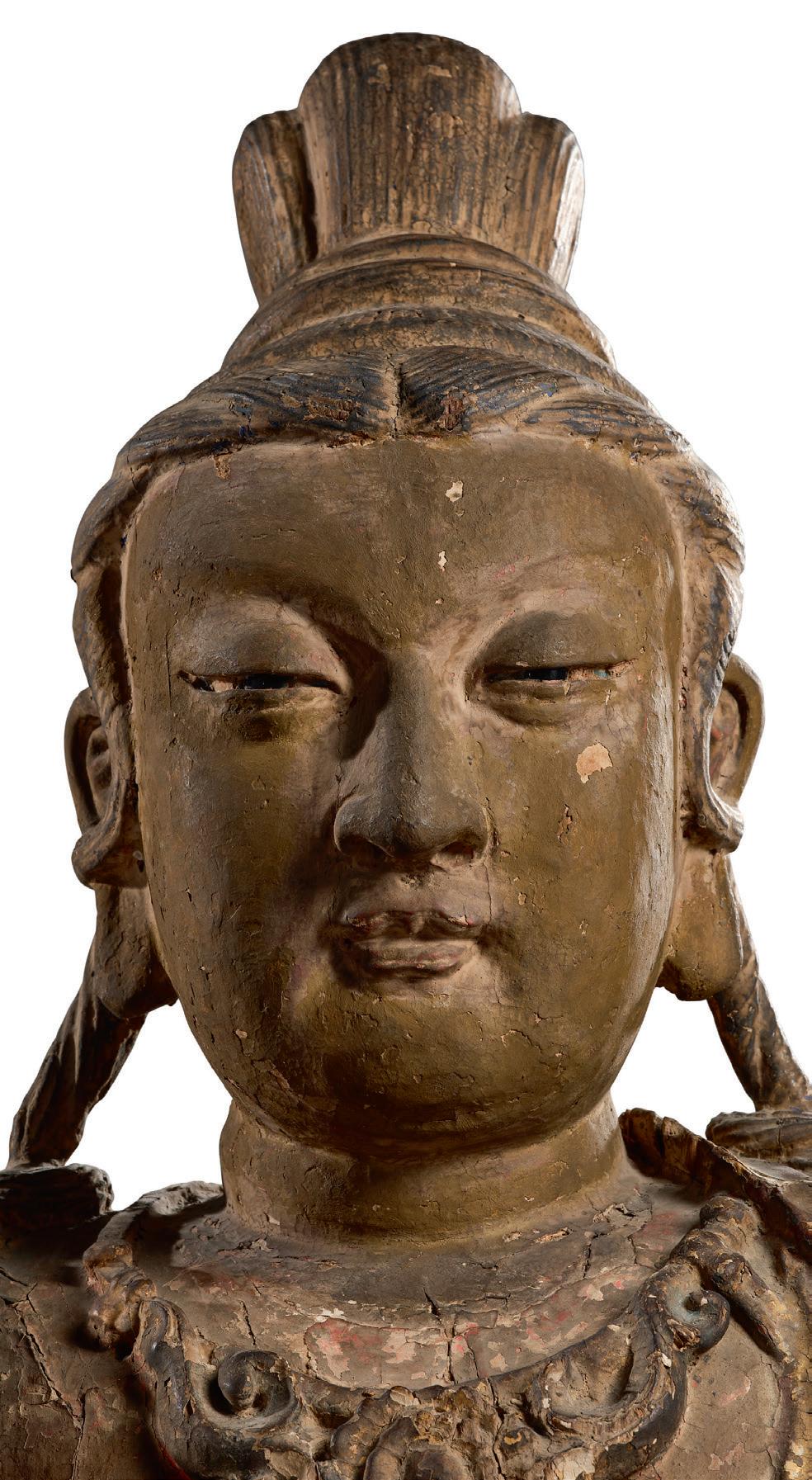
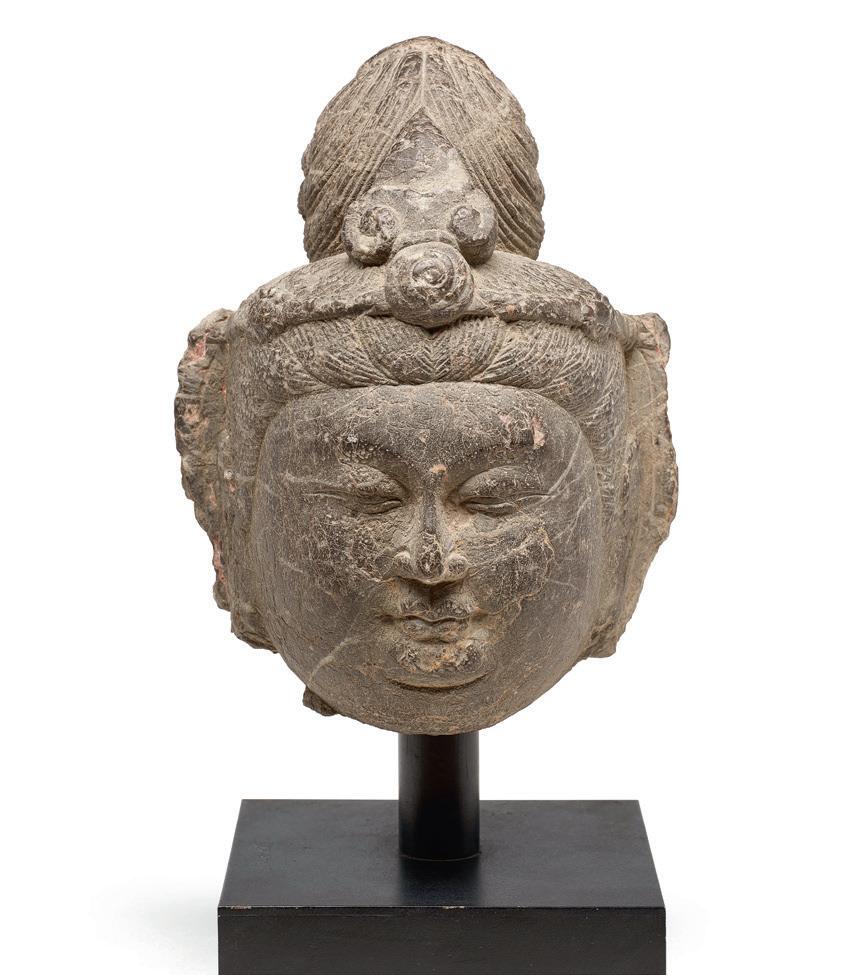
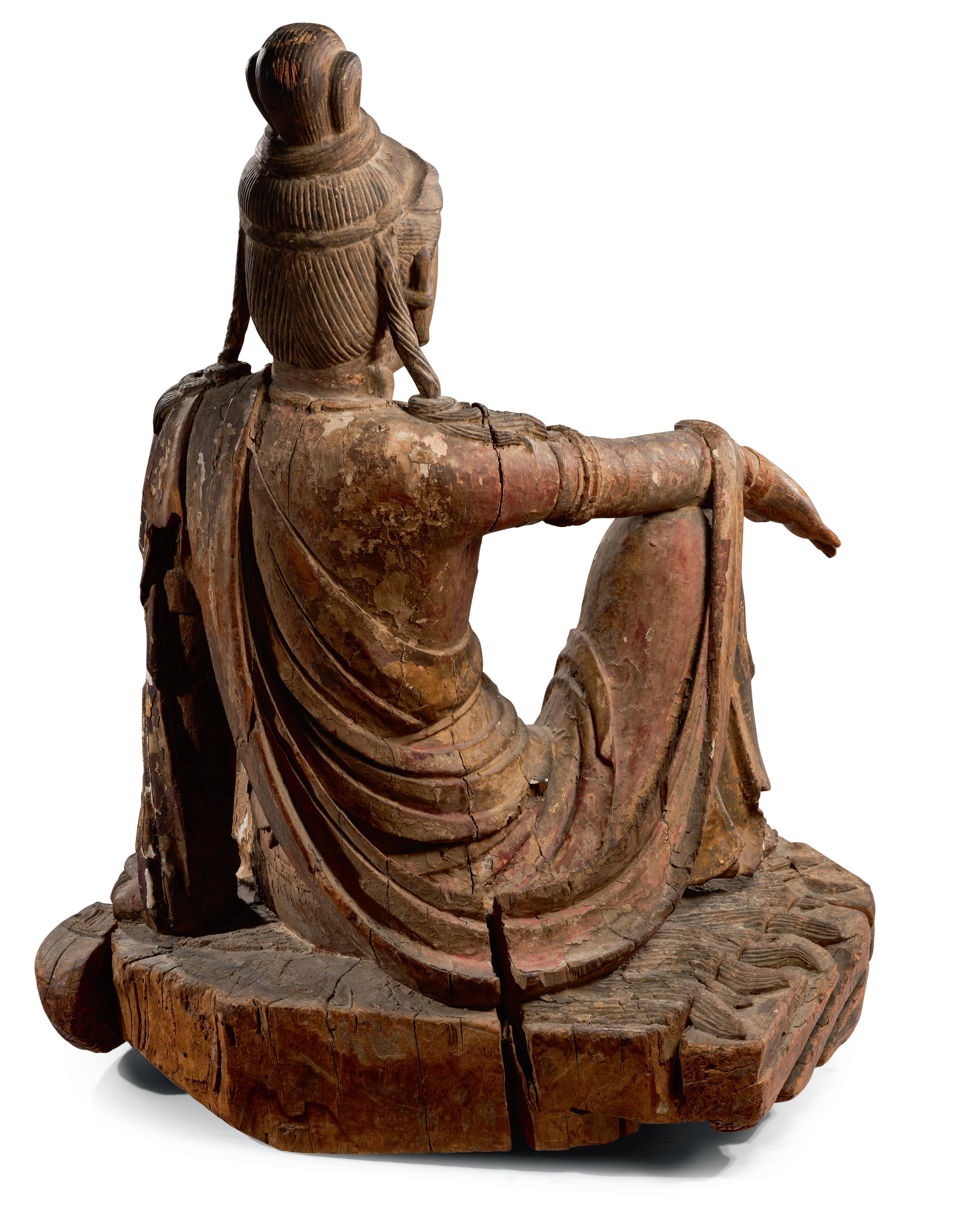
Raffinement et vision intérieure : art et pratiques bouddhiques sous la dynastie Song
Sous la dynastie Song, le bouddhisme regagne en influence, représenté en majorité par les courants Chan et Jingtu, mais ne bénéficie que d’un faible soutien institutionnel. La période est caractérisée par un intérêt renouvelé pour les idéaux confucéens antiques. L’art bouddhique connaît alors une évolution significative : il s’intériorise et intègre les codes esthétiques de la culture lettrée, sous l’influence du néo-confucianisme et du bouddhisme Chan à l’esthétique simple et dépouillée.
Cette évolution vers une esthétique plus raffinée et introspective, qui privilégie la délicatesse, l’expression intérieure et la simplicité, s’accompagne de mutations religieuses où se syncrétisent doctrine bouddhiste et traditions locales. Ainsi, la figure d’Avalokiteshvara, bodhisattva masculin, traditionnellement représenté comme un jeune prince indien, connaît une transformation profonde au contact de la culture chinoise, devenant au fil des siècles une divinité féminine, révérée comme une déesse de la Miséricorde. On voit ainsi émerger de nouvelles iconographies de Guanyin, toutes féminines, telles la « Guanyin des mers du Sud » (南海 Nanhai Guanyin), « Guanyin à la robe blanche » (白衣觀音 Baiyi Guanyin) ou « Guanyin à la lune sur l’eau (水月觀音 Shuiyue Guanyin) largement diffusées au travers des arts, de la littérature et de la tradition.
La fin du mécénat impérial et la disparition des grands complexes étatique marque aussi un changement dans les techniques artistiques, avec l’abandon de la pierre au profit du bois, matériau moins onéreux, plus facile d’accès et plus aisé à travailler. On voit notamment fleurir une grande statuaire en bois, emblématique de la période, figurant le bodhisattva Guanyin, dans un subtil équilibre entre réalisme et idéalisation, traduisant à la fois la présence divine et une profonde humanité. Ces statues en bois illustrent parfaitement la manière dont la sculpture bouddhique se fait porteuse d’une spiritualité apaisée, privilégiant l’intériorité et la sobriété.
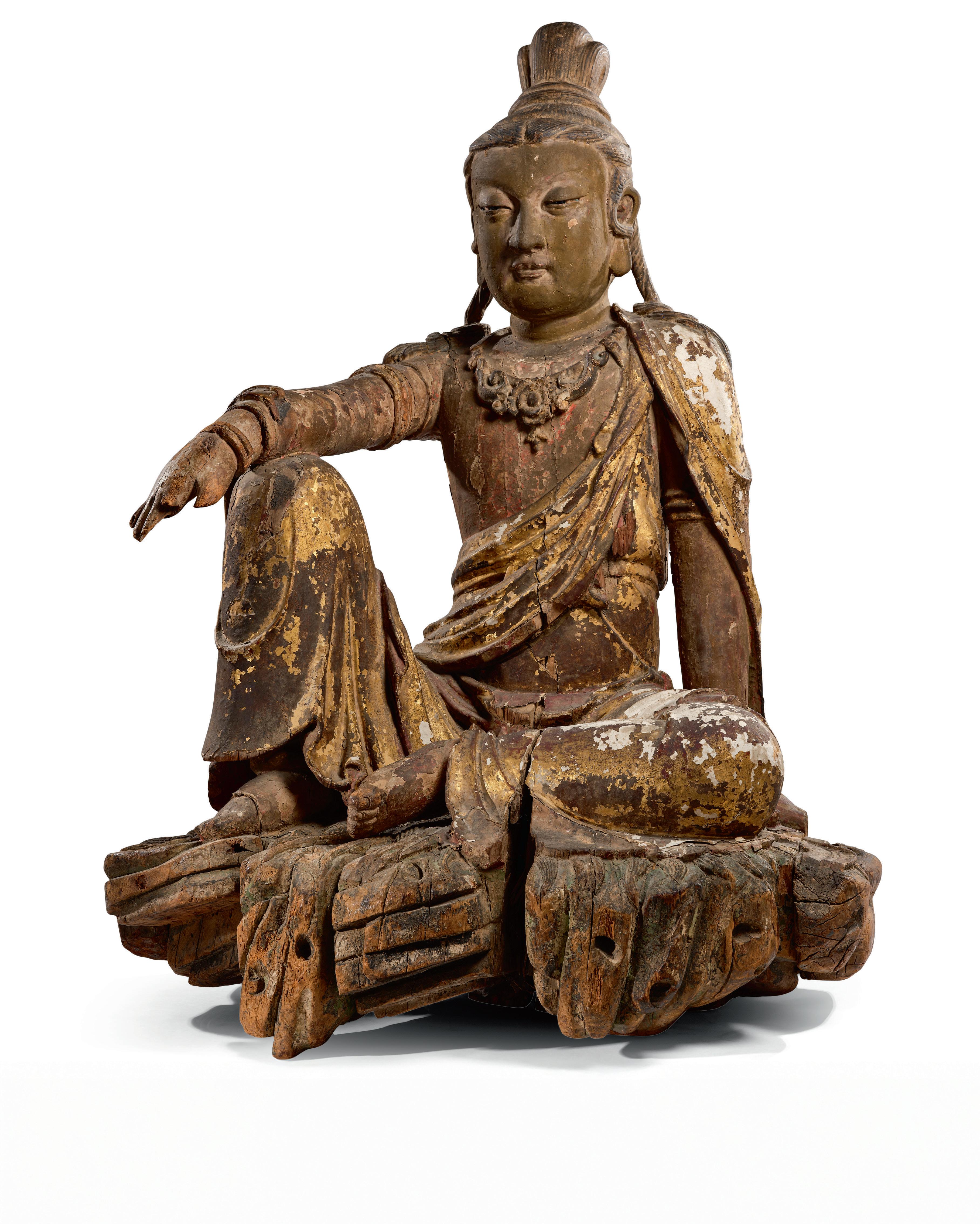
Chine, dynastie Song (960-1279). ©Aguttes, vente du 4 décembre 2024 Record mondial d’adjudication en 2024
Refinement and Inner Vision: Buddhist Art and Practice under the Song Dynasty
Under the Song dynasty, Buddhism regained influence, represented mainly by the Chan and Jingtu currents, but received little institutional support. The period was characterised by a renewed interest in ancient Confucian ideals. Buddhist art underwent a significant evolution at this time: it became more internalized and integrated the aesthetic codes of literate culture, under the influence of neo-Confucianism and the Chan doctrine of simple, uncluttered aesthetics.
This evolution towards a more refined and introspective aesthetic, which favoured delicacy, inner expression and simplicity, was accompanied by religious changes that brought together Buddhist doctrine and local traditions. For example, the figure of Avalokiteshvara, a male bodhisattva traditionally depicted as a young Indian prince, underwent a profound transformation on contact with Chinese culture, becoming over the centuries a female divinity revered as a goddess of Mercy. This led to the emergence of new iconographies of Guanyin, all of them feminine, such as the ‘Guanyin of the South Seas’ ( 南海 Nanhai Guanyin), Guanyin in a White Dress‘ (白衣觀音 Baiyi Guanyin) and ’Guanyin with Moon on Water » (水月觀音 Shuiyue Guanyin), which were widely disseminated through art, literature and tradition.
The end of imperial patronage and the disappearance of the great state complexes also marked a change in artistic techniques, with the abandonment of stone in favour of wood, a less expensive material that was easier to access and work with. In particular, the great wooden statues of the bodhisattva Guanyin, emblematic of the period, struck a subtle balance between realism and idealisation, conveying both the divine presence and a profound humanity. These wooden statues are a perfect illustration of the way in which Buddhist sculpture became the bearer of a peaceful spirituality, favouring interiority and sobriety.
精致与内省的追求: 宋代的佛教艺术与实践 在宋朝 时期,佛教重新获得一定影响力,主要以禅宗与净土宗为代表,
然而却未获得强有力的国家支持。这一时期社会上重新兴起对古代儒 家理想的关注。佛教艺术也在此背景下发生了重要转变:它逐渐内化, 吸收文人士大夫文化的审美规范,受到理学(新儒学)和讲究简洁清 静的禅宗美学的双重影响。
这种转向更加精致与内省的艺术风格,强调细腻的表现、内在精神的表 达与简洁朴素的形式,同时伴随着宗教层面的转化与本土文化的融合。 在此过程中,观世音菩萨(Avalokiteśvara)的形象发生深刻演变:原为印 度王子形象的男性菩萨,在与中国文化长期交融中逐渐女性化,最终成 为广受崇敬的慈悲女神。
因此,众多女性形象的观音新图像陆续出现,并广泛传播于艺术、文学 与民间传统之中,如“南海观音”、“白衣观音”以及“水月观音”等,成 为宋代佛教图像的重要代表。
随着皇室对佛教赞助的终止与大型国家寺院工程的停止,佛教艺术的表 现方式也随之发生变化:石材逐渐被成本较低、易于获取与雕刻的木材 所取代。宋代木雕大像由此大量出现,尤其以观音菩萨为代表,其艺术 风格在写实与理想化之间取得微妙平衡,既体现神性,又展现深切的人 性。这类木雕作品充分体现出宋代佛教雕塑所承载的平和精神世界,强 调内心体验与简约之美。
DYNASTIE YUAN (1279-1368)
YUAN DYNASTY (1279-1368)
元朝(1279-1368)
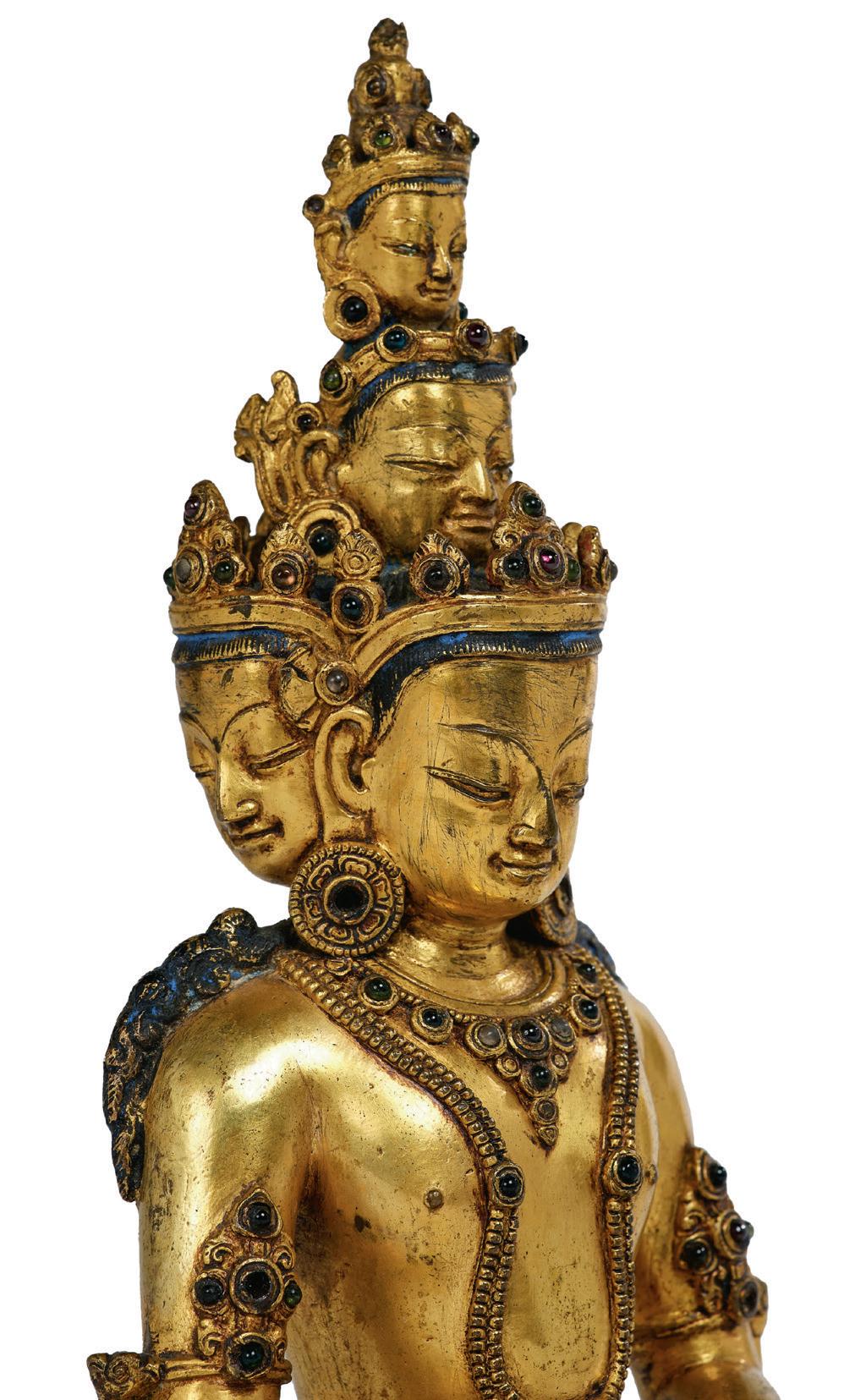
Le Bouddhisme Tibétain à la Cour des Yuan : Renaissance du Vajrayāna et échanges sino-mongols En 1276, l’empire Song s’effondre face aux Mongols menés par le petit-fils de Gengis Khan, Kubilai Khan. Celui-ci prend le contrôle définitif de tout l’empire en 1279 et fonde la dynastie Yuan. L’arrivée des Mongols au pouvoir en Chine marque un important renouveau mais également un profond changement pour le bouddhisme en Chine. En effet, à partir de 1269, Kubilai Khan, lui-même déjà adepte du bouddhisme tibétain, donne le contrôle de l’ensemble des bouddhistes à Drogön Chögyal Phagpa, chef de la lignée Sakyapa (« École des bonnets rouges »), une des quatre écoles du bouddhisme tibétain. Le vajrayana (密宗mìzōng), quasiment disparu à la fin des Tang après une première tentative d’implantation, fait à nouveau son apparition et devient la religion officielle de l’empire. Parallèlement, le bouddhisme Mahāyāna chinois continue de cœxister avec les écoles Chan et Jingdu, mais la présence et l’influence du bouddhisme tibétain modifient profondément le paysage religieux chinois. Il en résulte d’importants échanges artistiques et culturels entre la Chine, le Tibet et l’empire mongol qui s’étend alors jusqu’aux marges de l’Europe.
L’essor du Vajrayana tibétain et la présence de nombreux hauts dignitaires tibétains à la cour de Khanbalik ont profondément influencé les arts, notamment la sculpture en bronze. En effet, ce médium est un des matériaux de prédilection de l’art tibétain, où les artistes sont passés maîtres dans les techniques de fonte et de dorure. Ces bronzes bouddhiques Yuan se distinguent par une grande finesse et une complexité iconographique issue des pratiques tantriques tibétaines, reflet d’un goût pour le mysticisme et la puissance rituelle. Cette période voit aussi une sophistication technique accrue, avec des alliages plus raffinés et des détails minutieux permis par le mécénat impérial.
Chine, dynastie Yuan (1279 - 1368). ©Aguttes, vente du 1 juin 2023
Tibetan Buddhism at the Yuan Court:
Revival of the Vajrayāna and Sino-Mongol Exchanges
In 1276, the Song Empire collapsed under the assault of the Mongols led by Kublai Khan, the grandson of Genghis Khan. He took full control of the entire empire in 1279 and founded the Yuan dynasty. The rise of the Mongols to power in China marked both a significant renewal and a profound transformation for Buddhism in the region. From 1269 onwards, Kublai Khan, himself already a follower of Tibetan Buddhism, entrusted authority over all Buddhists to Drogön Chögyal Phagpa, head of the Sakyapa lineage (« Red Hat School »), one of the four main schools of Tibetan Buddhism.
Vajrayana Buddhism (密宗 mìzōng ), which had virtually disappeared at the end of the Tang dynasty after an earlier attempt at introduction, re-emerged and became the official religion of the empire. Alongside it, Chinese Mahāyāna Buddhism continued to coexist with the Chan and Pure Land (Jingdu) schools, but the presence and influence of Tibetan Buddhism profoundly reshaped China’s religious landscape. This led to significant artistic and cultural exchanges between China, Tibet, and the Mongol Empire, which at the time stretched as far as the edges of Europe.
The rise of Tibetan Vajrayana and the presence of numerous high-ranking Tibetan dignitaries at the court in Khanbaliq had a deep impact on the arts, particularly bronze sculpture. Bronze was one of the preferred materials in Tibetan art, where artists had mastered casting and gilding techniques. Yuan Buddhist bronzes are characterised by their exceptional refinement and the complex iconography derived from Tibetan tantric practices, reflecting a taste for mysticism and ritual power. This period also witnessed an increase in technical sophistication, with more refined alloys and meticulous detailing made possible through imperial patronage.
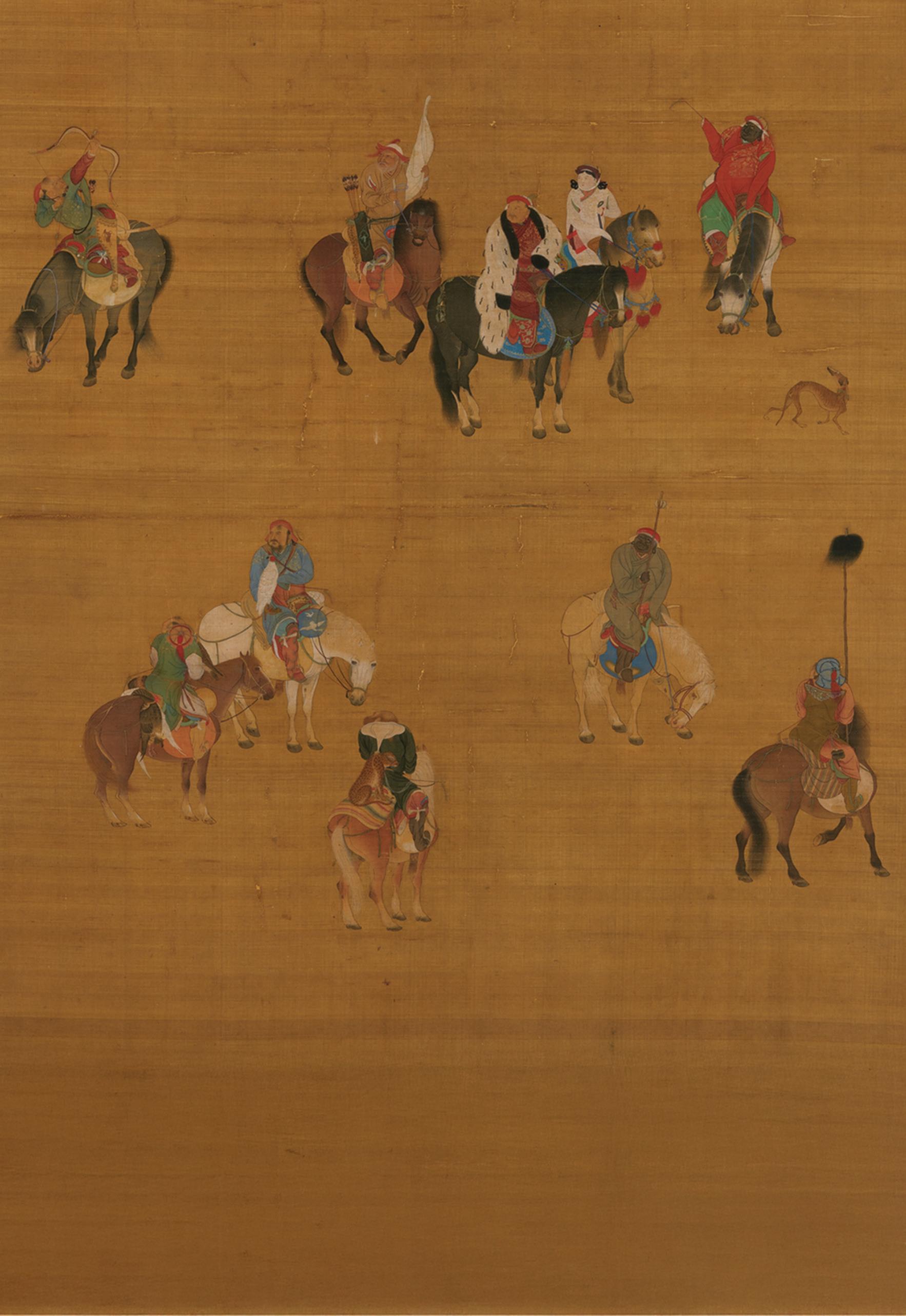
元朝宫廷中的藏传佛教: 密宗的复兴与中蒙交流
1276年,宋朝在蒙古军的攻势下崩溃,蒙古军由成吉思汗的孙子忽必烈 领导。1279年,忽必烈彻底掌控全境,建立元朝(1279–1368年)。蒙古人 入主中原,标志着佛教在中国的重要复兴,同时也带来了深刻的变革。 实际上,从1269年起,已信奉藏传佛教的忽必烈汗,将全国佛教事务 交由萨迦派(“红帽派”四大藏传佛教教派之一)领袖八思巴(Drogön Chögyal Phagpa)统管。密宗(藏语称“金刚乘”,汉语称“密宗”)在唐 末几近消失后,重新出现,并被确立为元朝的官方宗教。
与此同时,中国本土的大乘佛教仍在延续,并与禅宗、净土宗并存发展。
然而,藏传佛教的广泛传播和影响深刻改变了中国的宗教格局。这一时 期,中国、藏地与蒙古帝国之间开展了频繁的艺术与文化交流,而蒙古 帝国的疆域更是延伸至欧洲边缘。
藏传密宗的兴盛,以及大量藏族高僧在大都(今北京)朝廷中的活跃,使 得艺术创作深受影响,尤其表现在青铜雕塑领域。青铜是藏传佛教艺术 最常用的材料之一,藏地工匠在铸造和鎏金技术方面造诣极高。元代的 佛教铜像因其精美细腻的工艺以及源自藏密修行的复杂图像体系而独树 一帜,展现出对神秘主义与宗教仪式力量的浓厚兴趣。
这一时期的艺术风格也趋于更高的技术复杂度,得益于帝室的大力支 持,铸造使用的合金更为精致,细节表现也更加精密,反映出元代佛教 艺术高度的发展水平。
DYNASTIE MING (1368-1644)
MING DYNASTY (1368–1644)
明朝(1368–1644年)
Le Bouddhisme sous les Ming : Entre Renouveau Chan et Continuation du Vajrayāna
La dynastie Ming s’ouvre par une période faste après un siècle de domination mongole. Elle est marquée un retour à un pouvoir impérial Han, avec la montée sur le trône de Zhu Yuanzhang devenu Ming Hongwu (r. 1368-1398), un des chefs de la révolte des Turbans Rouges. Ses successeurs, les empereurs Yongle (r. 1402–1424) et Xuande (r. 1425–1435) assoient le pouvoir dynastique en adoptant une politique centralisée et expansionniste. Sous l’empereur Yongle, la capitale est transférée à Beijing et débute la construction de la Cité interdite. Le paysage religieux se transforme également car le confucianisme est adopté comme idéologie d’État, et le taoïsme a les faveurs de la dynastie.
On observe un retour au bouddhisme Mahayana, rejetant totalement les modèles du bouddhisme vajrayana, de la dynastie précédente. Les écoles traditionnelles chinoises Tiantai, Huayan et Chan ont ainsi les faveurs du pouvoir impérial.
Sur le plan diplomatique, Yongle lance les expéditions maritimes de Zheng He, établissant des relations tributaires avec l’Asie du SudEst, l’Inde et l’Afrique de l’Est, projetant ainsi l’influence chinoise. Des liens diplomatiques perdurent néanmoins avec le Tibet et l’Asie centrale. Sous Xuande, la politique se stabilise, avec une administration plus efficace et une consolidation du pouvoir impérial. Ces règnes incarnent une période de rayonnement culturel et politique intense pour l’empire chinois.
Malgré ces importants changements dynastiques, l’art bouddhique reste profondément imprégné des modèles de la dynastie Yuan, et ce jusqu’au tournant du XVIe siècle. Ainsi sous les règnes des empereurs Yongle et Xuande, les bronzes bouddhiques empruntent encore des éléments au vocabulaire stylistique tibétain, avec des statues richement parées, au canon fin et souple rappelant les modèles indiens. L’empereur Yongle, en particulier, entretient des relations étroites avec les écoles tibétaines et commande des statues aux maîtres du Népal et du Tibet. Certaines statues portent des inscriptions en tibétain, en chinois, voire en sanskrit, témoignant d’un syncrétisme spirituel et diplomatique. L’art bouddhique de la dynastie Ming connaît une maturation stylistique lente, ponctuée de changements iconographiques et techniques tenus.
Buddhism under the First Ming: Between Chan Revival and Continuation of the Vajrayāna
The Ming dynasty began with a prosperous period following a century of Mongol domination. It was marked by the restoration of Han imperial rule, with Zhu Yuanzhang, a leader of the Red Turban Rebellion, ascending the throne as Ming Hongwu (r. 1368–1398). His successors, Emperors Yongle (r. 1402–1424) and Xuande (r. 1425–1435), consolidated dynastic power through a centralised and expansionist policy. Under Emperor Yongle, the capital was moved to Beijing and construction of the Forbidden City began. The religious landscape also changed significantly: Confucianism was adopted as the state ideology, and Taoism enjoyed imperial favour. There was a return to Mahāyāna Buddhism, with a complete rejection of the Vajrayāna models of the previous dynasty. The traditional Chinese schools of Tiantai, Huayan, and Chan were thus favoured by the imperial court. On the diplomatic front, Yongle launched the maritime expeditions of Zheng He, establishing tributary relations with Southeast Asia, India, and East Africa, thereby projecting Chinese influence abroad. Diplomatic ties nonetheless continued with Tibet and Central Asia. Under Xuande, policy became more stable, with a more efficient administration and further consolidation of imperial authority. These reigns represent a period of intense cultural and political brilliance for the Chinese empire.
Despite these major dynastic shifts, Buddhist art remained deeply influenced by Yuan models until the turn of the 16th century. During the reigns of Emperors Yongle and Xuande, Buddhist bronzes still drew on Tibetan stylistic vocabulary, featuring richly adorned figures with slender and supple proportions reminiscent of Indian prototypes. Emperor Yongle, in particular, maintained close ties with Tibetan schools and commissioned statues from Nepalese and Tibetan masters. Some statues bear inscriptions in Tibetan, Chinese, or even Sanskrit, reflecting a syncretic spiritual and diplomatic approach.
Buddhist art under the Ming dynasty underwent a gradual stylistic maturation, marked by subtle iconographic and technical developments.
明代佛教: 禅宗复兴与密宗的延续 明朝 的建立,标志着经历了百年蒙古统治后的繁荣重启。随着朱元璋 登基为明太祖洪武皇帝(在位1368–1398年),一个由“红巾军”起义领袖 出身的皇帝,汉族皇权得以恢复。他的继任者永乐皇帝(在位1402–1424 年)和宣德皇帝(在位1425–1435年)通过推行中央集权和扩张政策, 进一步巩固了王朝统治。永乐年间,首都迁至北京,并启动了紫禁城的 建设。与此同时,宗教格局也发生了变化:儒家思想被确立为国家意 识形态,道教受到皇室青睐,而佛教则在摒弃前朝元代密宗模式的背 景下,回归到大乘传统。此时,天台宗、华严宗与禅宗等中国传统佛教 宗派再次受到朝廷支持。
在外交层面,永乐皇帝派遣郑和七下西洋,与东南亚、印度及东非建 立朝贡关系,彰显中国的海外影响力。尽管如此,与西藏和中亚地区的 外交联系仍然持续。宣德年间,政治趋于稳定,行政体系更加高效,帝 国权力得以进一步巩固,这一时期也成为中国在文化与政治上高度繁 荣的时代之一。
尽管政权更替剧烈,明代早期的佛教艺术依然深受元代风格的影响, 直到16世纪初期才逐渐形成自身的艺术语言。在永乐与宣德年间,佛 教青铜造像仍保留着大量藏传佛教的艺术特征,如体态纤细柔和、衣 饰华丽、神态庄严,均源于印度传统造像风格。永乐皇帝尤其与藏传佛 教诸派关系密切,曾委托尼泊尔和西藏的艺术大师铸造佛像。这些造 像上常刻有藏文、汉文,甚至梵文铭文,体现了宗教上的融合与外交上 的多元性。明代佛教艺术在这一时期逐步发展,风格趋于成熟,其间虽 变化缓慢,却呈现出细腻的图像创新和工艺演进。
如果您还需要繁体版本、用于图录的注解形式,或想整合至其他朝代的 叙述中,我也可以继续协助。
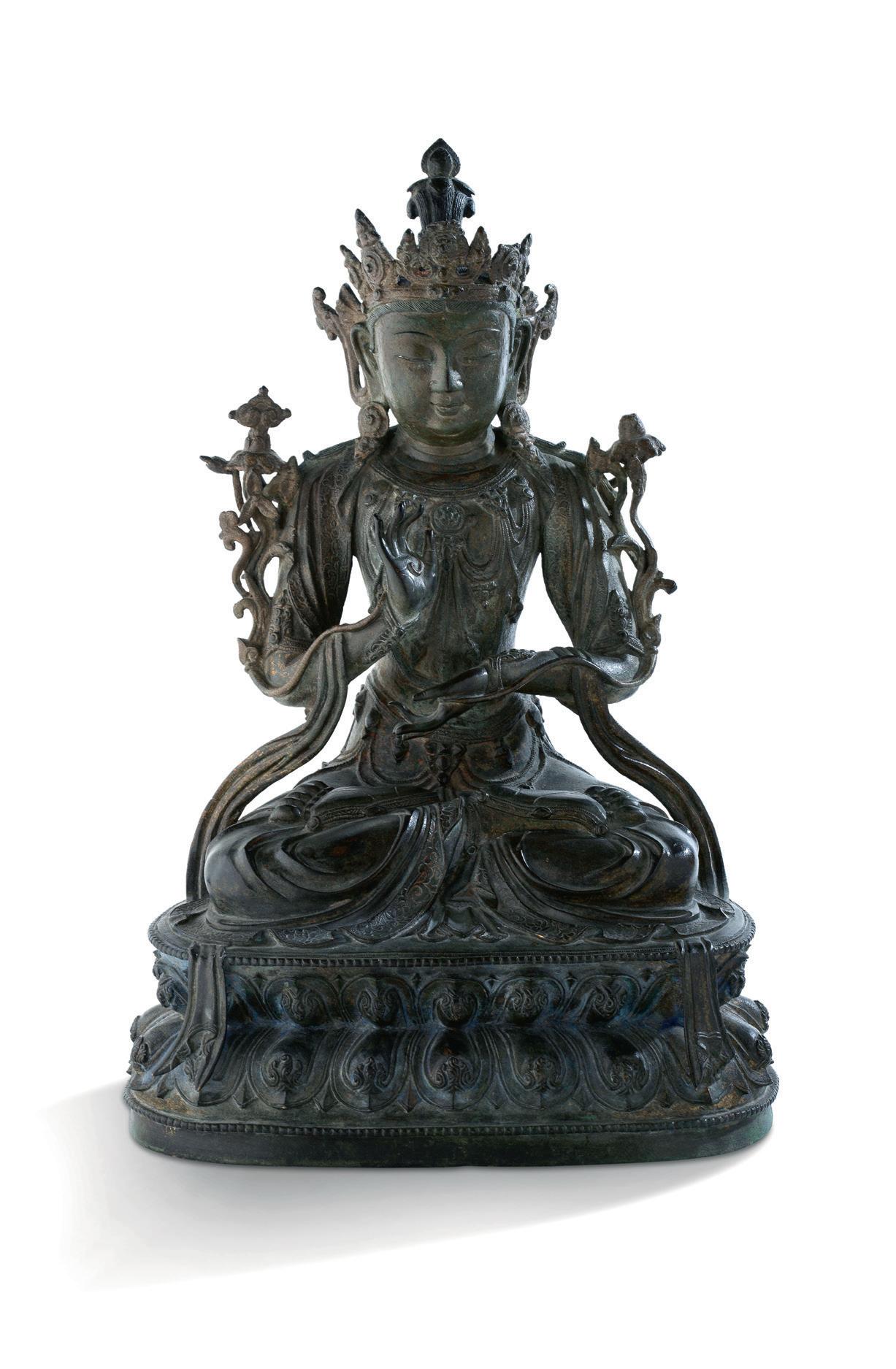
Chine, dynastie Ming (1368-1644). ©Aguttes, vente du 9 mars 2023
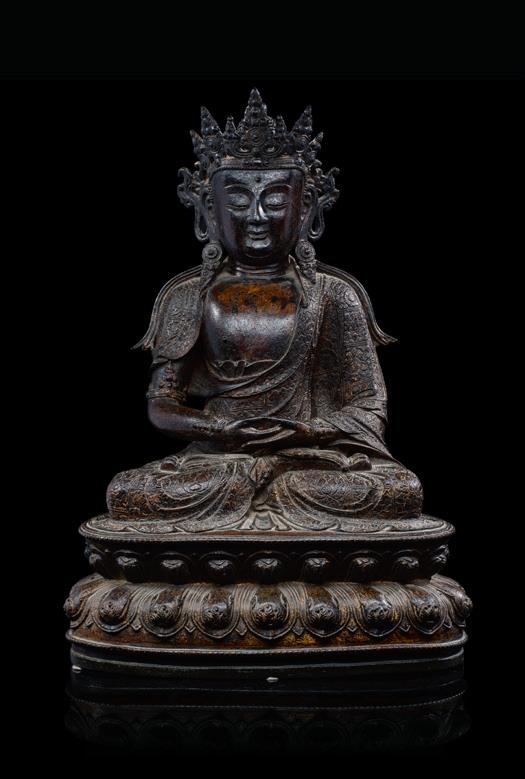
CHINE
DYNASTIE MING, XVIe SIÈCLE
IMPORTANTE STATUE D’AMITABHA EN BRONZE LAQUÉ DORÉ
CHINA
MING DYNASTY, 16th CENTURY
A LARGE GILT-LACQUERED BRONZE FIGURE OF AMITABHA
明代,16 世纪
大型鎏金漆铜阿弥陀佛像
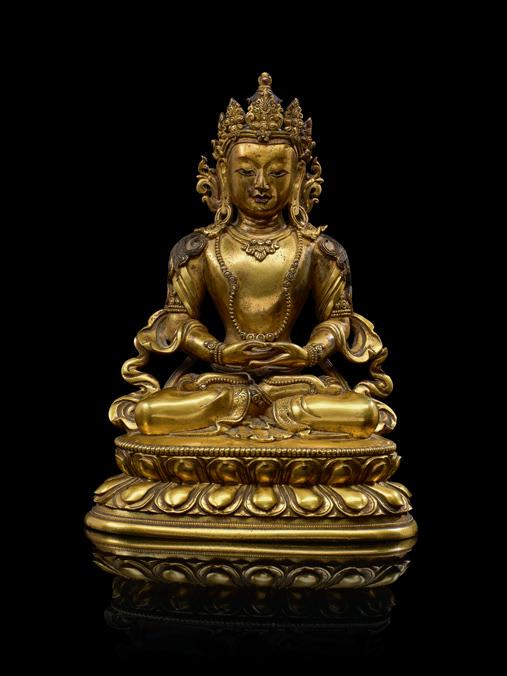
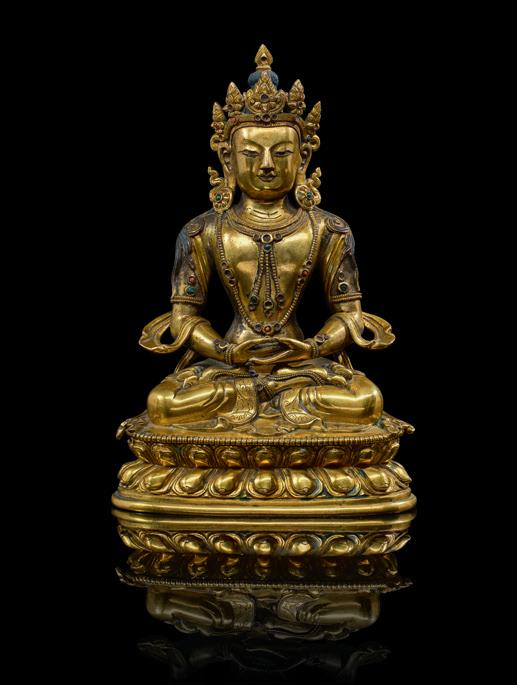
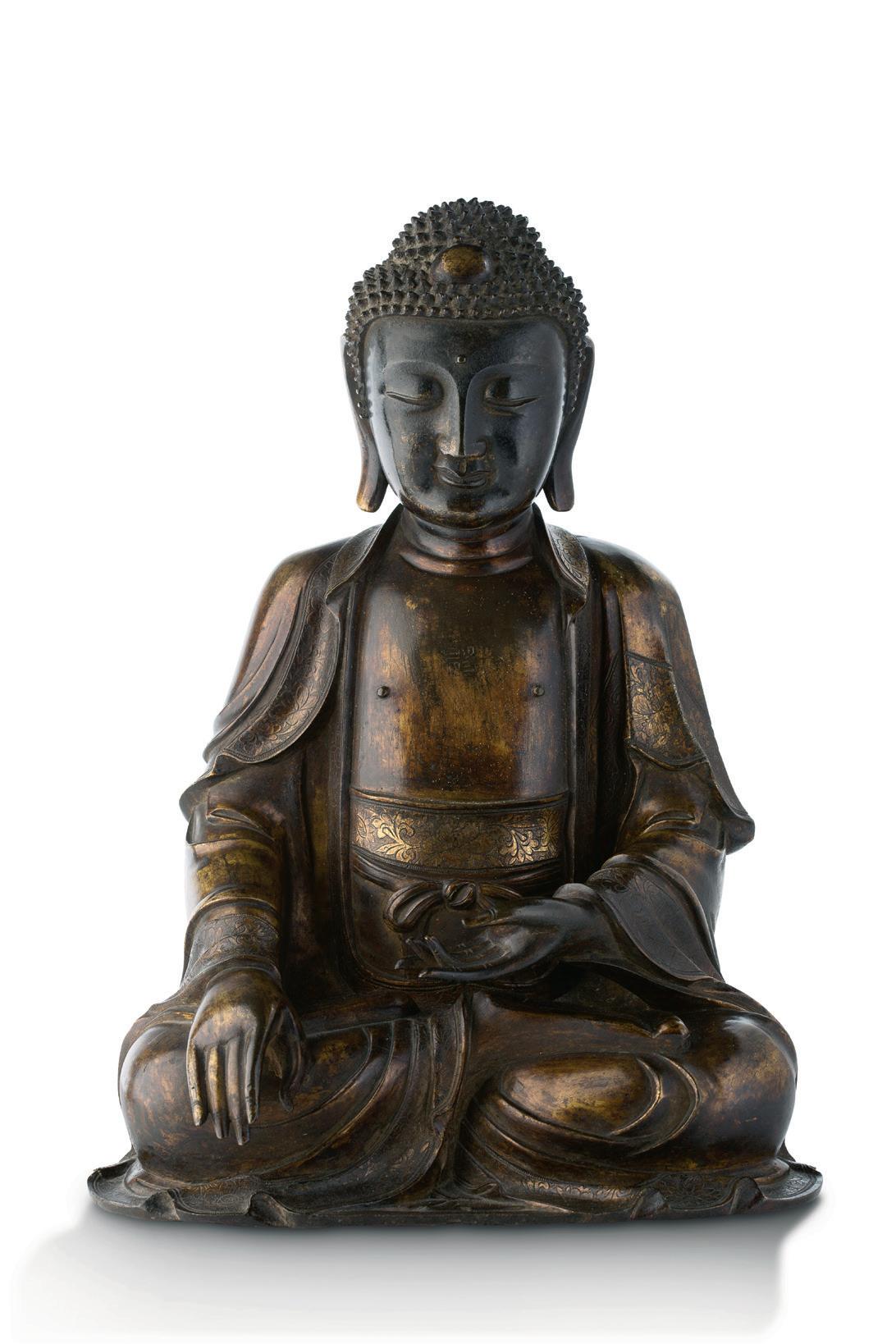
Importante statue d’Amitabha en bronze laqué doré, assis en padmasana sur une double base lotiforme aux pétales ouvragés, les mains en dhyanamudra reposant sur les jambes. Le bouddha de l’Ouest, vêtu d’une robe monastique lui barrant la poitrine et couvrant les deux épaules, richement décorée de lotus épanouis dans un quadrillage. Le visage plein au doux sourire et aux yeux mi-clos, encadré par une couronne à fleurons et rubans retombants. La chevelure détaillée en petites boucles et l’ushnisha surmontée d’un joyau. Il est paré de larges boucles d’oreilles, le bras découvert avec un bracelet et un brassard. H. 54 cm
A large gilt-lacquered bronze figure of Amitabha, seated in padmasana on a double-lotus base with intricately adorned petals, his hands resting in dhyanamudra on the legs. The Buddha of the West, wearing a monastic robe chased with a ‘rice paddy’ design enclosing lotus blossoms, crossing the chest and covering both shoulders. The face with a serene smile and half-closed eyes, framed by a crown with floral motifs and cascading ribbons. The tightly coiled hair covering the head and prominent ushnisha topped with a jewel. The figure is adorned with large hoop earrings, an exposed arm bearing a bracelet and armband. H. 54 cm
重要的棕色青铜阿弥陀佛像,阿弥陀佛坐于莲花座上,莲花座上有精致的花瓣,阿弥陀佛 双手合十,放在双腿上。西方佛像身着僧袍,袈裟横跨胸前,覆盖双肩,袈裟上饰有丰富的 莲花图案。他面容饱满,面带微笑,双目半闭,头戴花冠,身披飘带。头发以小卷发为细节, 乌纱顶端镶有宝石。他戴着大耳环,手臂上戴着手镯和臂章。 高 54 厘米
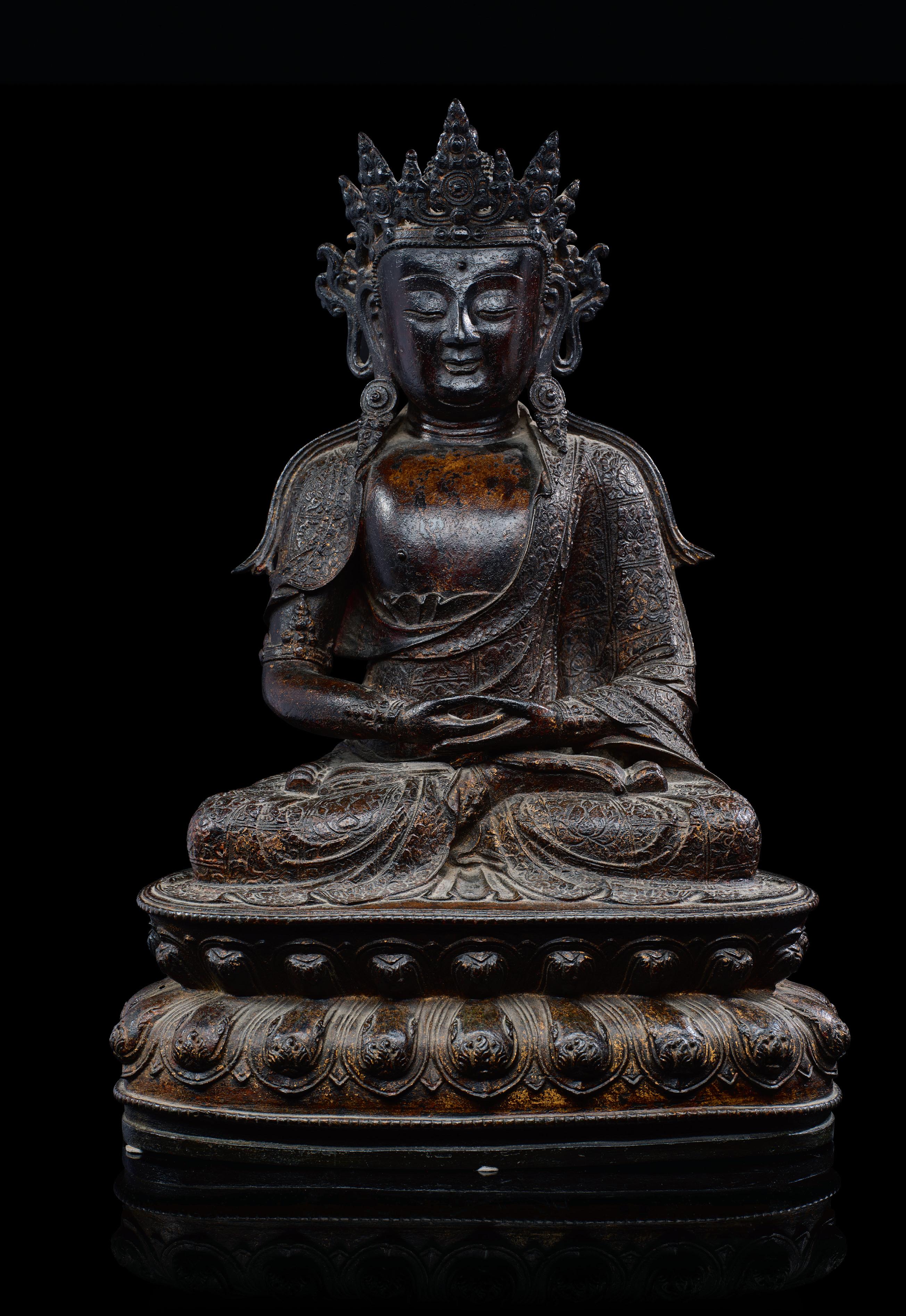
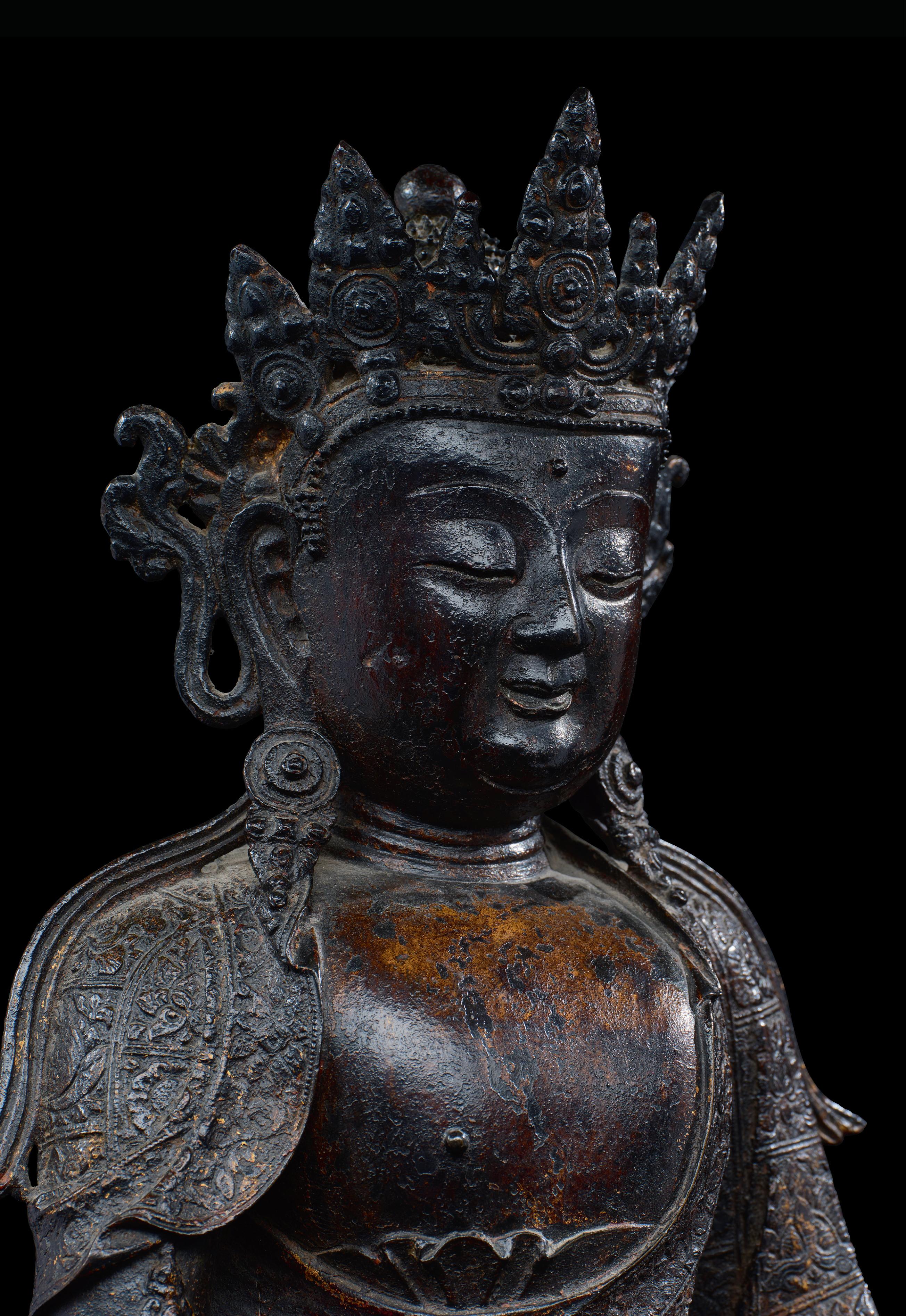
Cet impressionnant bronze représente le bouddha Amithaba paré de nombreux bijoux et couronné, les yeux perdus dans la méditation, une douce expression sur les lèvres, dans une image de spiritualité intérieure et de calme résolution qui sied à un des bouddhas de sagesse. En effet, Amithaba (« Lumière sans mesure » en sanskrit) est un des cinq Dhyani bouddhas ou Tathagatas, représentant l’Ouest et la sagesse de l’observation, symbolisé par le lotus. Il règne sur la « Terre Pure de Sukhavati » ou « Terre pure Occidentale de la Béatitude », un monde merveilleux, pur, libre de mal et de souffrances, un refuge en dehors du cycle des transmigrations, où les êtres qui se souviennent de lui avec foi peuvent renaître et atteindre rapidement l’illumination. Il est l’un des principaux bouddhas de la tradition Mahayana et une des figures les plus populaires du bouddhisme extrême-oriental.
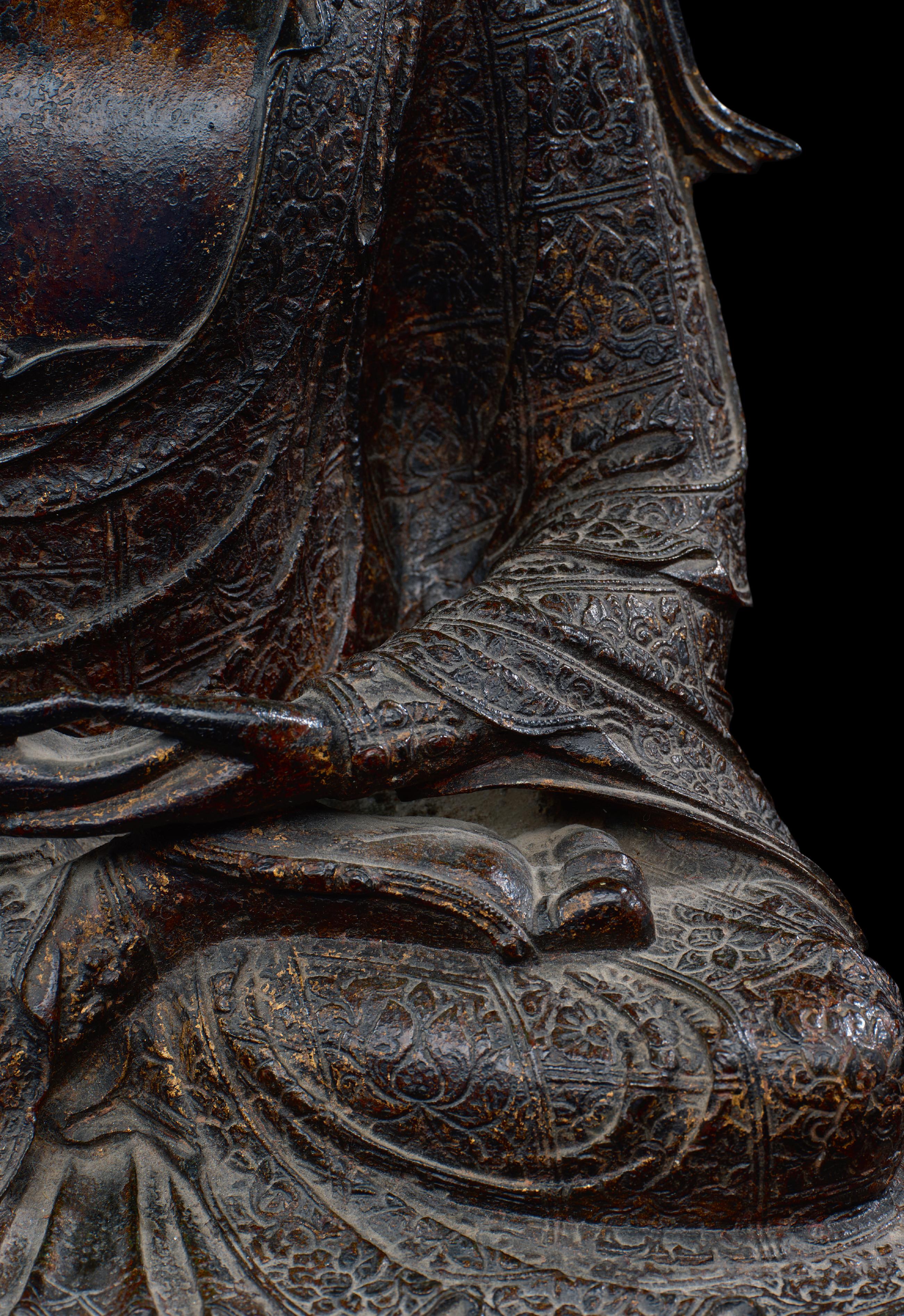
La statue, de grande qualité, est un document historique particulièrement intéressant pour retracer l’évolution stylistique de la sculpture métallique bouddhique de la dynastie Ming (1368-1644) car elle présente de nombreux éléments formels hérités du XIVe -XVe siècle mais également des nouveautés stylistiques s’affranchissant des canons du début de la dynastie, eux-mêmes hérités de la dynastie Yuan et fortement influencé par les modèles tibétains et indiens. Ainsi, la base lotiforme emprunte ses pétales, au traitement épais et rehaussés de nombreuses ornementations, aux exemples des règnes Yongle (r. 14021424) et Xuande (r. 1425-1435). Il en est de même pour les parures du bouddha, notamment les bracelets et brassards à palmettes, les boucles d’oreilles et couronne formées de fleurons et rosettes concentriques. A contrario, la robe de dessous (antaravasaka), nouée haut sur le torse, et la robe de dessus (sanghati) couvrant les deux épaules, s’éloignent des archétypes étrangers du début de la dynastie, insufflant une nouveauté
stylistique inspirée par la tradition chinoise. Il en est de même pour la posture yogique droite du bouddha, s’opposant à la souplesse des modèles indiens. Pareillement le canon épais, le visage plein, sont des nouveautés formelles. Le corps commençant à disparaitre sous une lourde robe dont l’épaisseur gomme les formes. On notera l’inhabituelle richesse de la sanghati ornée de lotus et dont le quadrillage évoque les origines du bouddhisme lorsque les robes des moines étaient assemblées à partir de chutes de tissus.
Cette imposante figure illustre un style de transition, mêlant les formes élégantes du début de la dynastie à une esthétique émergente, puisant son inspiration dans la tradition chinoise. Cette fusion reflète l’évolution dynamique de l’art bouddhiste au cours de cette période mais également le développement et l’affirmation d’une esthétique propre à la dynastie Ming.
This impressive bronze figure represents the Buddha Amitabha, adorned with numerous jewels and a crown, eyes lost in meditation, a gentle expression on the lips, embodying an image of inner spirituality and calm resolve befitting one of the wisdom Buddhas. Indeed, Amitabha (“Infinite Light” in Sanskrit) is one of the five Dhyani Buddhas or Tathagatas, representing the West and the wisdom of discernment, symbolized by the lotus. He reigns over the “Pure Land of Sukhavati,” or “Western Pure Land of Bliss,” a marvelous, pure world free from evil and suffering, a refuge beyond the cycle of transmigration, where beings who remember him with faith can be reborn and swiftly attain enlightenment. He is one of the principal Buddhas of the Mahayana tradition and among the most popular figures in East Asian Buddhism.
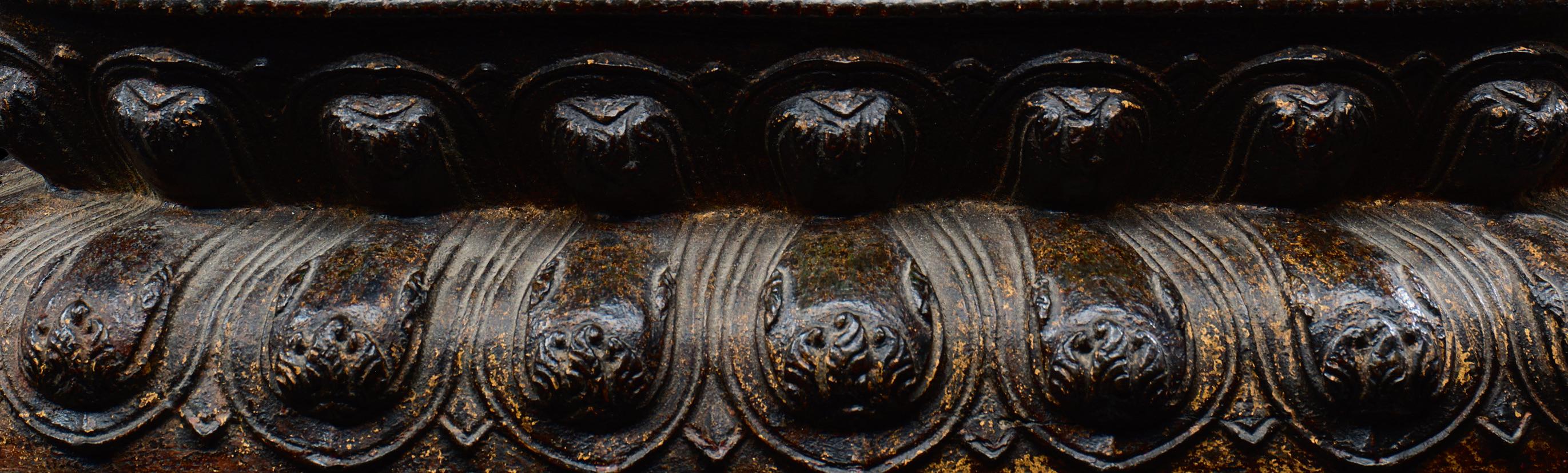
This high-quality statue is a particularly significant historical document for tracing the stylistic evolution of Buddhist metal sculpture during the Ming Dynasty (1368–1644). It features numerous formal elements inherited from the 14th and 15th centuries while also introducing stylistic innovations that break from the early dynasty’s canons, which were themselves derived from the Yuan Dynasty and heavily influenced by Tibetan and Indian models. Thus, the lotus base, with its thick petals enhanced by abundant ornamentation, draws from examples of the Yongle (r. 1402–1424) and Xuande (r. 1425–1435) reigns. The same applies to the Buddha’s adornments, notably the palmette-decorated bracelets and armbands, hoop earrings, and crown formed of floral motifs and concentric rosettes. Conversely, the under-robe (antaravasaka), tied high on the torso, and the outer robe (sanghati), covering both shoulders, diverge from the foreign archetypes of the early dynasty, introducing a stylistic novelty inspired by Chinese tradition. Similarly, the upright yogic posture of the Buddha contrasts with the fluidity of Indian models. The thick proportions and full face are also formal innovations. The body begins to disappear beneath a heavy robe, its thickness softening the forms. Notably, the sanghati is unusually ornate with lotuses, and its checkered pattern evokes the origins of Buddhism, when monks’ robes were assembled from scraps of fabric.
This imposing figure illustrates a transitional style, blending the elegant forms of the early dynasty with an emerging aesthetic rooted in Chinese tradition. This fusion reflects the dynamic evolution of Buddhist art during this period and the development and affirmation of a distinct Ming Dynasty aesthetic.
这件令人印象深刻的青铜器描绘了阿弥陀佛的形象,他头戴王 冠,身披无数珠宝,双目沉思,嘴唇上带着温和的表情,表现出 与智慧之佛相称的内在灵性和冷静的决断力。阿弥陀佛(梵语 “无量光”)是五大陀罗尼佛之一,代表西方和观察智慧,以莲 花为象征。他统治着 “须菩提净土 ”或 “西方极乐净土”,这是 一个美妙、纯净的世界,没有邪恶和苦难,是轮回的庇护所,在这 里,怀着信心忆念他的众生可以往生,并很快获得证悟。他是大 乘佛教的主要佛陀之一,也是远东佛教中最受欢迎的人物之一。
这尊高质量的佛像是追溯明代(1368-1644 年)佛教金属雕塑 风格发展的特别有趣的历史文献,因为它包含了许多从 14-15 世 纪继承下来的形式元素,但同时也具有突破早期王朝标准的风 格创新,这些标准本身继承自元代,并深受西藏和印度模式的 影响。例如,莲花形底座的花瓣就借鉴了永乐(1402-1424 年)和 宣德(1425-1435 年)时期的作品,花瓣处理得很厚,并饰有大量 装饰。佛像的饰物也是如此,尤其是带掌纹的手镯和臂章,以及 带同心飞花和莲座的耳环和头冠。
相比之下,高高束在躯干上的下袈裟 安陀会 和覆盖双肩的上袈 裟 僧伽黎 则脱离了王朝早期的外国原型,引入了受中国传统启 发的新颖风格。佛陀直立的瑜伽姿势也是如此,与印度造型的柔 软形成鲜明对比。同样,厚重的桶身和丰满的面部也是形式上的 创新。身体在厚重的袈裟下开始消失,袈裟的厚度抹去了形体。
要注意的是,僧袍上的莲花装饰异常丰富,其网格图案让人联想 到佛教的起源,当时僧侣的袈裟是用碎布拼接而成的。
这件气势恢宏的雕像展现了一种过渡风格,将早期王朝的优雅 造型与从中国传统中汲取灵感的新兴美学融为一体。这种融合 反映了这一时期佛教艺术的动态演变,以及明代独特美学的发 展和肯定。
DYNASTIE MING (1368-1644)
MING DYNASTY (1368–1644)
明朝(1368–1644)
Vers un style impérial chinois : Réinvention esthétique et religieuse sous les derniers Ming
Le XVIe siècle marque un tournant important pour la dynastie Ming, qui se replie sur son territoire et limite ses échanges avec l’extérieur.
La Chine connaît une période de stabilité mais adopte néanmoins une politique isolationniste, renforçant la Grande Muraille pour contrer les menaces mongoles au nord. Les relations diplomatiques sont limitées et s’appuient sur le système tributaire, où ses voisins reconnaissent la suprématie chinoise en échange de relations commerciales. Le pouvoir impérial exerce un contrôle très strict dans le domaine du commerce maritime. On observe une sinisation et une laïcisation accrue du bouddhisme dans un mouvement syncrétique avec le taoïsme.
Le néoconfucianisme reste la doctrine d’État.
Cet isolationnisme contribue à l’émergence de styles et d’iconographies typiquement chinois qui perdureront jusqu’à la chute de la dynastie en 1644. Ces choix stylistiques s’inscrivent dans une volonté dynastique d’un retour à un classicisme chinois, à la fois politique et culturel, poursuivant les modèles initiés notamment sous la dynastie Song. Le taoïsme est l’un des deux grands systèmes de pensée qui se sont développés en Chine, aux côtés du confucianisme. Les notions et idées qui en virent à être spécifiquement associées au taoïsme, s’agrègent progressivement entre le VIIIe siècle et le Ier siècle av. J.-C. pour former un courant que l’on nomme taoïsme ou « La Voie » (道教 dàojiào). Doctrine à la fois philosophique et religieuse, il met au centre de sa pensée l’individu, sa conscience, sa vie spirituelle et sa quête d’harmonie avec la nature et l’univers. Ses fondements philosophiques se trouvent dans deux œuvres majeures : le Lǎozi (ou Dàodéjīng 道德 经) et le Zhuāngzǐ (莊子). Le Lǎozi , attribué au sage éponyme, est un bref recueil de 81 aphorismes, mêlant prose rythmée et vers libres, exposant les principes du Dào et du non-agir (无为wúwéi). Le Zhuāngzǐ développe une métaphysique riche et poétique du Dào, prônant le retour à la nature transcendé par la culture.
Chine, dynastie Ming (1368-1644). ©Aguttes, vente du 1 er juin 2023
Towards an Imperial Chinese Style: Aesthetic and Religious Reinvention under the Late Ming
The 16th century marked a significant turning point for the Ming dynasty, which withdrew within its own borders and limited external exchanges. China then experienced a period of stability, but nonetheless adopted an isolationist policy, strengthening the Great Wall to counter Mongol threats from the north. Diplomatic relations were restricted and based on the tributary system, whereby neighbouring states acknowledged Chinese supremacy in exchange for trade relations. The imperial authority exercised strict control over maritime trade. One can observe a growing Sinicisation and secularisation of Buddhism, in a syncretic movement with Taoism. Neo-Confucianism remained the state doctrine. This isolationism contributed to the emergence of distinctively Chinese styles and iconographies, which would endure until the dynasty’s fall in 1644. These stylistic choices reflect a dynastic ambition for a return to Chinese classicism—both political and cultural—reviving models notably initiated under the Song dynasty.
Taoism is one of the two major systems of thought that developed in China, alongside Confucianism. The concepts and ideas that came to be specifically associated with Taoism gradually coalesced between the 8th and 1st centuries BCE into a current known as Taoism or “The Way” (道教 dàojiào). As both a philosophical and religious doctrine, it places the individual, their consciousness, spiritual life, and quest for harmony with nature and the universe at its centre. Its philosophical foundations lie in two major works: the L ǎozi (or Dàodéjīng , 道德经) and the Zhuāngzǐ ( 莊子). The Lǎozi , attributed to the eponymous sage, is a brief collection of 81 aphorisms, combining rhythmic prose and free verse, expounding the principles of the Dào and non-action (wúwéi 无为). The Zhuāngzǐ develops a rich and poetic metaphysics of the Dào, advocating a return to nature, elevated by culture.
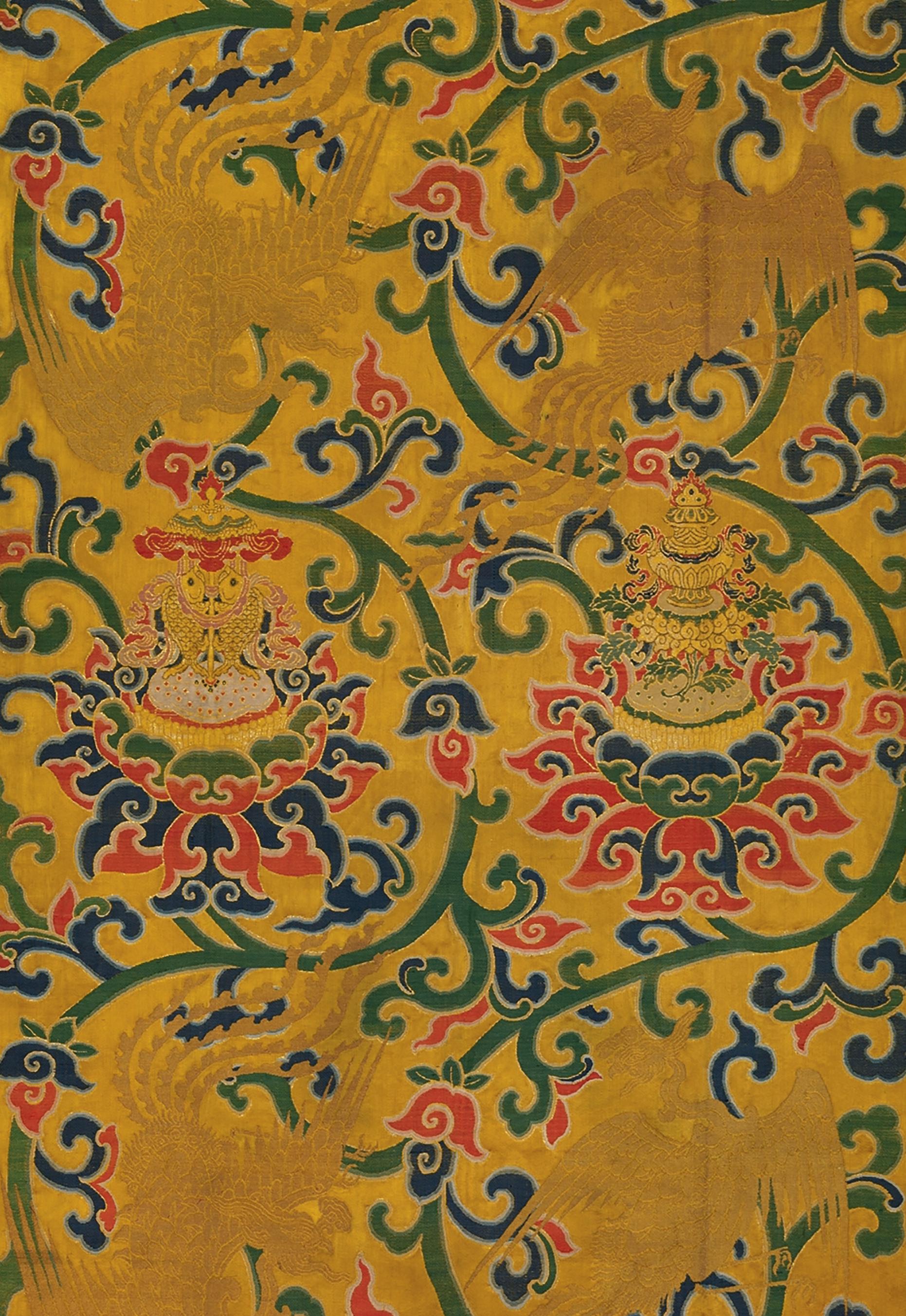
走向中国帝国风格: 明代晚期的美学与宗教重塑
明朝(1368–1644年)的建立,标志着经历了百年蒙古统治后的繁荣重 启。随着朱元璋登基为明太祖洪武皇帝(在位1368–1398年),一个由“ 红巾军”起义领袖出身的皇帝,汉族皇权得以恢复。他的继任者永乐皇 帝(在位1402–1424年)和宣德皇帝(在位1425–1435年)通过推行中央 集权和扩张政策,进一步巩固了王朝统治。永乐年间,首都迁至北京, 并启动了紫禁城的建设。与此同时,宗教格局也发生了变化:儒家思想 被确立为国家意识形态,道教受到皇室青睐,而佛教则在摒弃前朝元 代密宗模式的背景下,回归到大乘传统。此时,天台宗、华严宗与禅宗 等中国传统佛教宗派再次受到朝廷支持。
在外交层面,永乐皇帝派遣郑和七下西洋,与东南亚、印度及东非建 立朝贡关系,彰显中国的海外影响力。尽管如此,与西藏和中亚地区的 外交联系仍然持续。宣德年间,政治趋于稳定,行政体系更加高效,帝 国权力得以进一步巩固,这一时期也成为中国在文化与政治上高度繁 荣的时代之一。
尽管政权更替剧烈,明代早期的佛教艺术依然深受元代风格的影响, 直到16世纪初期才逐渐形成自身的艺术语言。在永乐与宣德年间,佛 教青铜造像仍保留着大量藏传佛教的艺术特征,如体态纤细柔和、衣 饰华丽、神态庄严,均源于印度传统造像风格。永乐皇帝尤其与藏传佛 教诸派关系密切,曾委托尼泊尔和西藏的艺术大师铸造佛像。这些造 像上常刻有藏文、汉文,甚至梵文铭文,体现了宗教上的融合与外交上 的多元性。明代佛教艺术在这一时期逐步发展,风格趋于成熟,其间虽 变化缓慢,却呈现出细腻的图像创新和工艺演进。
如果您还需要繁体版本、用于图录的注解形式,或想整合至其他朝代的 叙述中,我也可以继续协助。
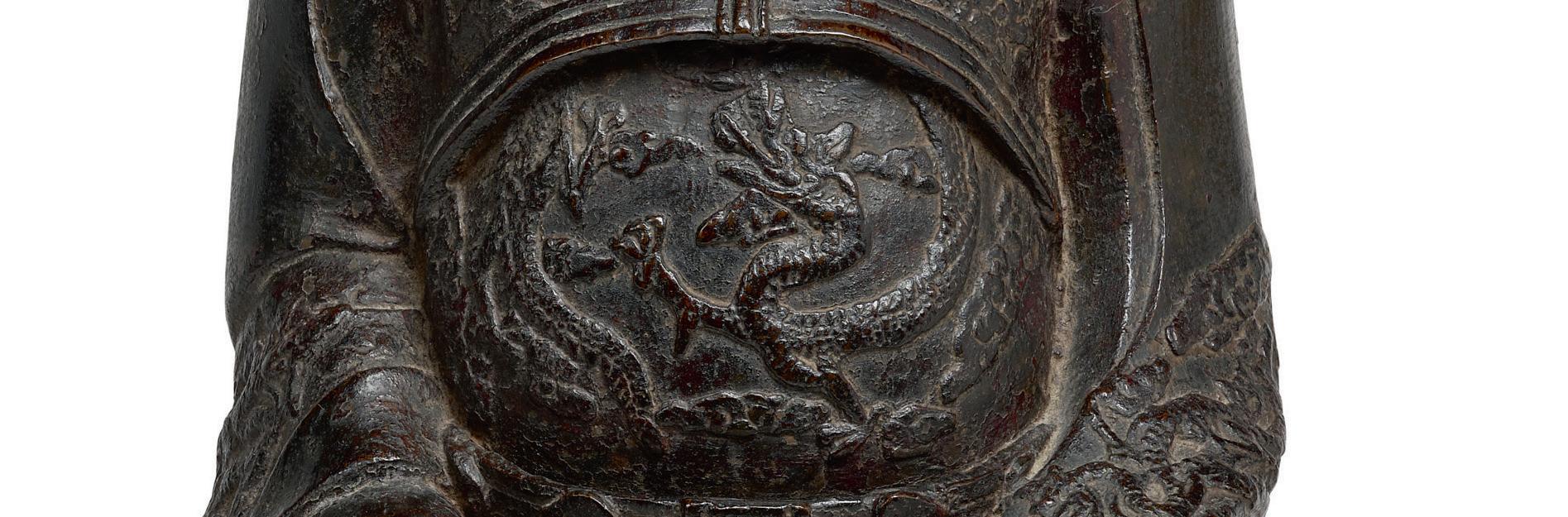
Entre ciel et terre : le taoïsme au fil des dynasties chinoises À la fin du IIe siècle, le taoïsme prend une forme religieuse institutionnalisée avec l’émergence de la « Voie des Maîtres Célestes » (天師道 Tiānshī daò). Cette école crée un clergé structuré, un calendrier rituel et un ensemble de pratiques codifiées. Le taoïsme religieux intègre progressivement des éléments de médecine, d’alchimie, de méditation, et de cultes aux immortels. Face à la montée du bouddhisme, introduit en Chine autour du Ier siècle, les maîtres taoïstes adaptent leurs doctrines, empruntant certains concepts comme la transmigration des âmes, la notion de karma. Le taoïsme cherche à se structurer et s’institutionnaliser, développant des monastères ou employant des scripturaires comparables aux sutras. Entre le IIIe et le VIe siècle, les relations entre bouddhisme et taoïsme deviennent conflictuelles, les deux doctrines rivalisant tant sur le plan rituel que théologique. Sous la dynastie Tang (618-907), le pouvoir impérial promulgue la doctrine de la coexistence des « trois enseignements » (三教 sānjiào), reconnaissant le taoïsme comme un enseignement orthodoxe et soutenu, à ce titre, par l’État. La tradition taoïste connaît son âge d’or au VIIIe siècle, activement soutenue par l’empereur Xuanzong (685–762), adepte du taoïsme. Un canon taoïste est établi, intégrant des textes révélés, des prescriptions rituelles, des règles d’hygiène corporelle et mentale, des talismans, ainsi que des cartes topographiques sacrées. Durant les dynasties Song (960–1279) et Yuan (1279–1368), le taoïsme poursuit son évolution, en intégrant de nouvelles écoles comme celle de la « Parfaite Réalité » (全真 Quánzhēn), qui prône une synthèse entre taoïsme, bouddhisme chan et confucianisme. Cette école accorde une place centrale à la méditation, à la morale et à l’ascèse personnelle, tout en rejetant les pratiques alchimiques plus anciennes. Au début de la dynastie Ming (1368–1644), le taoïsme bénéficie encore d’un certain prestige, notamment auprès de l’élite lettrée et des empereurs. Le taoïsme s’inscrit dans un programme religieux dynastique avec des rites publics et impériaux. Le canon est réorganisé en un vaste corpus encyclopédique réunissant des milliers de textes et largement diffusé grâce à l’imprimerie. Mais son influence diminue considérablement à partir du XVIe siècle, et les rapports entre les élites et le monde taoïstes deviennent de plus en plus tendus. Malgré cette mise en retrait de la vie politique, il reste cependant très populaire et implanté auprès de la population, avec un vaste panthéon canonique mais également local.
Between Heaven and Earth: Taoism Through the Chinese Dynasties
At the end of the 2nd century CE, Taoism took on an institutionalised religious form with the emergence of the “Way of the Celestial Masters” (天師 道 Tiānshī dào). This school created a structured clergy, a ritual calendar, and a codified set of practices. Religious Taoism gradually incorporated elements of medicine, alchemy, meditation, and the worship of immortals. In response to the rise of Buddhism, introduced into China around the 1st century CE, Taoist masters adapted their doctrines, borrowing concepts such as transmigration of souls and the notion of karma. Taoism sought to organise and institutionalise itself further, developing monasteries and scriptural texts comparable to sutras. Between the 3rd and 6th centuries, relations between Buddhism and Taoism became conflictual, with both doctrines competing ritually and theologically.Under the Tang dynasty (618–907), the imperial authority promulgated the doctrine of coexistence of the “three teachings” (三教 sānjiào), recognising Taoism as an orthodox teaching, thus enjoying state support. The Taoist tradition experienced its golden age in the 8th century, actively promoted by Emperor Xuanzong (685–762), himself a devotee of Taoism. A Taoist canon was established, incorporating revealed texts, ritual prescriptions, rules for physical and mental hygiene, talismans, and sacred topographical maps. During the Song (960–1279) and Yuan (1279–1368) dynasties, Taoism continued to evolve, integrating new schools such as the “Perfect Realisation” school (全 真 Quánzhēn), which advocated a synthesis of Taoism, Chan Buddhism, and Confucianism. This school placed emphasis on meditation, moral conduct, and personal asceticism, while rejecting older alchemical practices. At the beginning of the Ming dynasty (1368–1644), Taoism still enjoyed a certain prestige, particularly among the literati elite and the emperors. It was incorporated into the dynastic religious programme through public and imperial rites. The canon was reorganised into a vast encyclopaedic corpus comprising thousands of texts, widely disseminated thanks to printing. However, its influence declined significantly from the sixteenth century onwards, and relations between elites and the Taoist world became increasingly strained. Despite its withdrawal from political life, it remained highly popular and deeply rooted among the general population, with a vast canonical—and also local—pantheon.
天地之间:中国历代的道教 道教是中国两大主要思想体系之一,与儒家并列发展。其特有的观念和 思想在公元前8世纪至前1世纪逐渐汇聚,形成了道教或“道”(道教)这 一思想流派。道教既是一种哲学体系,也是一种宗教信仰,核心关注个 体的意识、精神生活以及与自然和宇宙的和谐共生。
道教的哲学基础主要体现在两部经典之中:《老子》(或称《道德经》 )和《庄子》。《老子》被归功于同名的古代圣人,是一部包含81篇短文 的经典,融合了节奏感强的散文和自由诗句,阐述了“道”和“无为”的 原则。《庄子》则发展出一种丰富而诗意的“道”的形而上学,提倡回归 自然并超越文化的束缚。
公元2世纪末,道教在“天师道”的兴起中逐渐形成了有组织的宗教形式。
这一学派建立了结构化的神职体系、仪式日历和一套规范的实践方式。
道教宗教逐步融入了医学、炼丹术、冥想和对“仙人”的崇拜等元素。
面对公元1世纪左右传入中国的佛教,道教大师们调整了他们的教义,借 鉴了如灵魂转世和业力等概念。道教努力实现结构化和制度化,发展出 修道院或使用类似佛教经典的经文。
在公元3至6世纪之间,道教与佛教的关系变得紧张,二者在仪式和神 学上展开竞争。然而,在唐朝(618–907年)时期,帝国政府提倡“三教 共存”的理念,承认道教为正统教义,并得到国家的支持。唐朝的皇帝 如玄宗(685–762年)积极支持道教,建立了道教经典的规范体系,涵 盖了启示性文本、仪式规定、身体和心理卫生规则、符箓以及神圣的地 理地图等内容。
在宋朝(960–1279年)和元朝(1279–1368年)期间,道教继续发展,融 入了新的学派,如“全真道”该学派主张道教、禅宗和儒教的融合。全 真道强调冥想、道德和个人修行,同时摒弃了传统的炼丹术等实践。
明朝初期(1368–1644年),道教仍然享有一定的声望,尤其在士人阶 层和皇帝中间。道教成为一种宗教体系,与国家的宗教仪式相结合。道 教经典被重新组织成一个庞大的百科全书式的文献体系,并通过印刷 技术广泛传播。然而,从16世纪开始,其影响力显著下降,士人阶层与 道教界的关系变得日益紧张。
尽管在政治生活中有所退居,道教仍然在民间保持着广泛的影响力,拥 有庞大的神祇体系,并在地方上深深扎根。
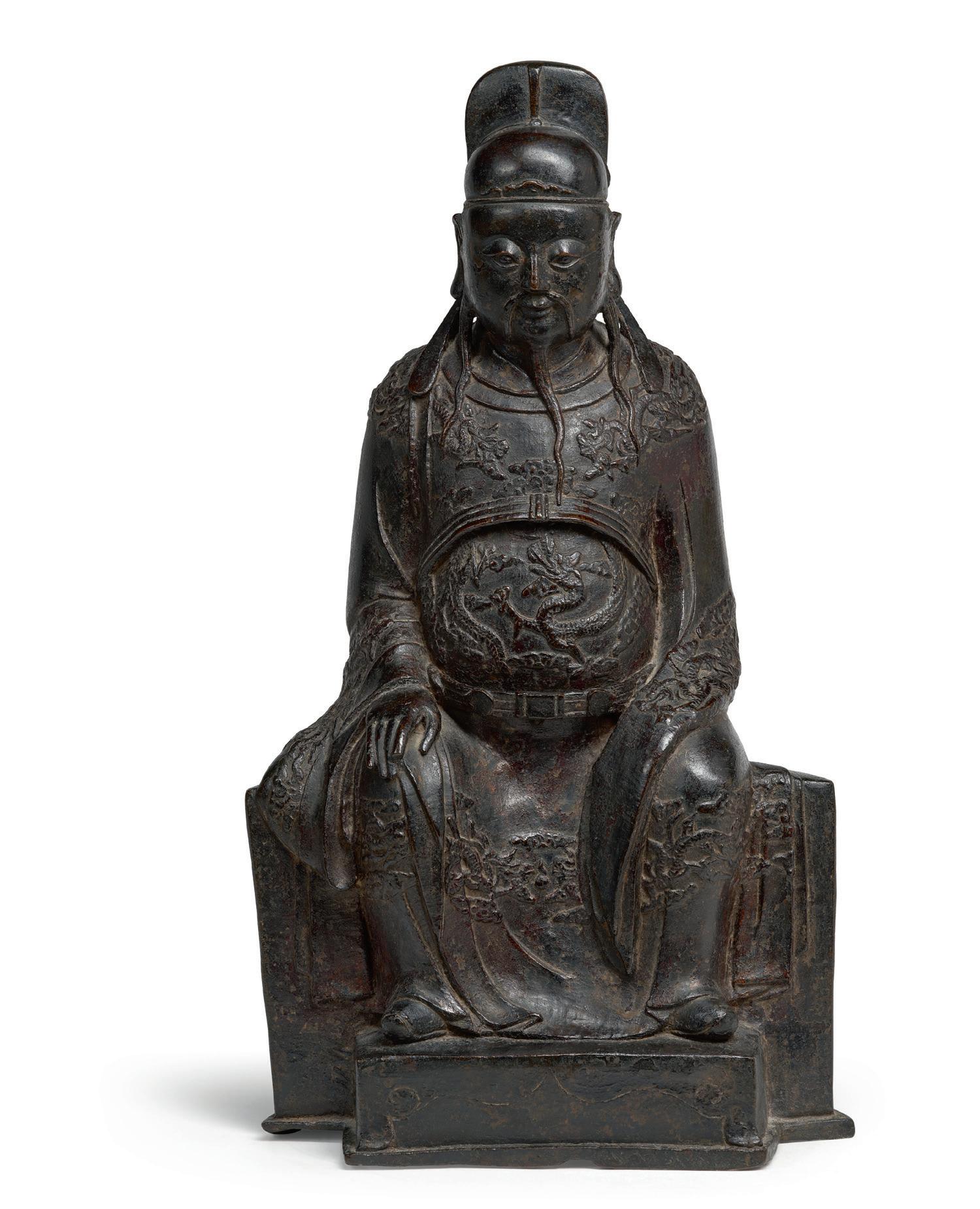
Chine, dynastie Ming (1368-1644). ©Aguttes, vente du 4 décembre 2024
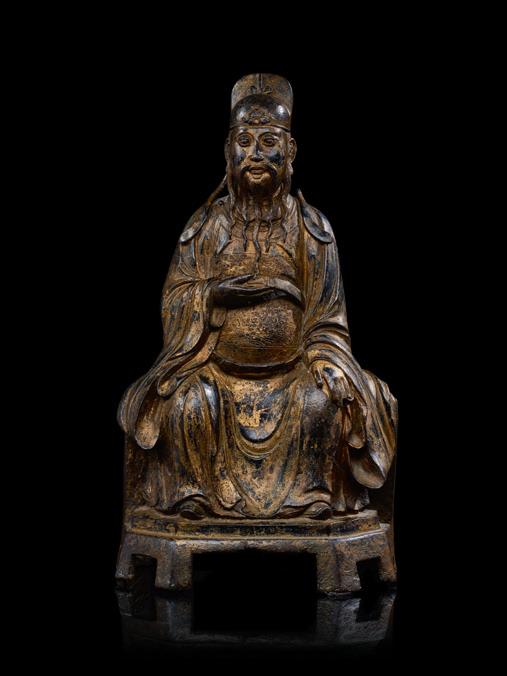
CHINE
DYNASTIE MING,
XVIIe
SIÈCLE
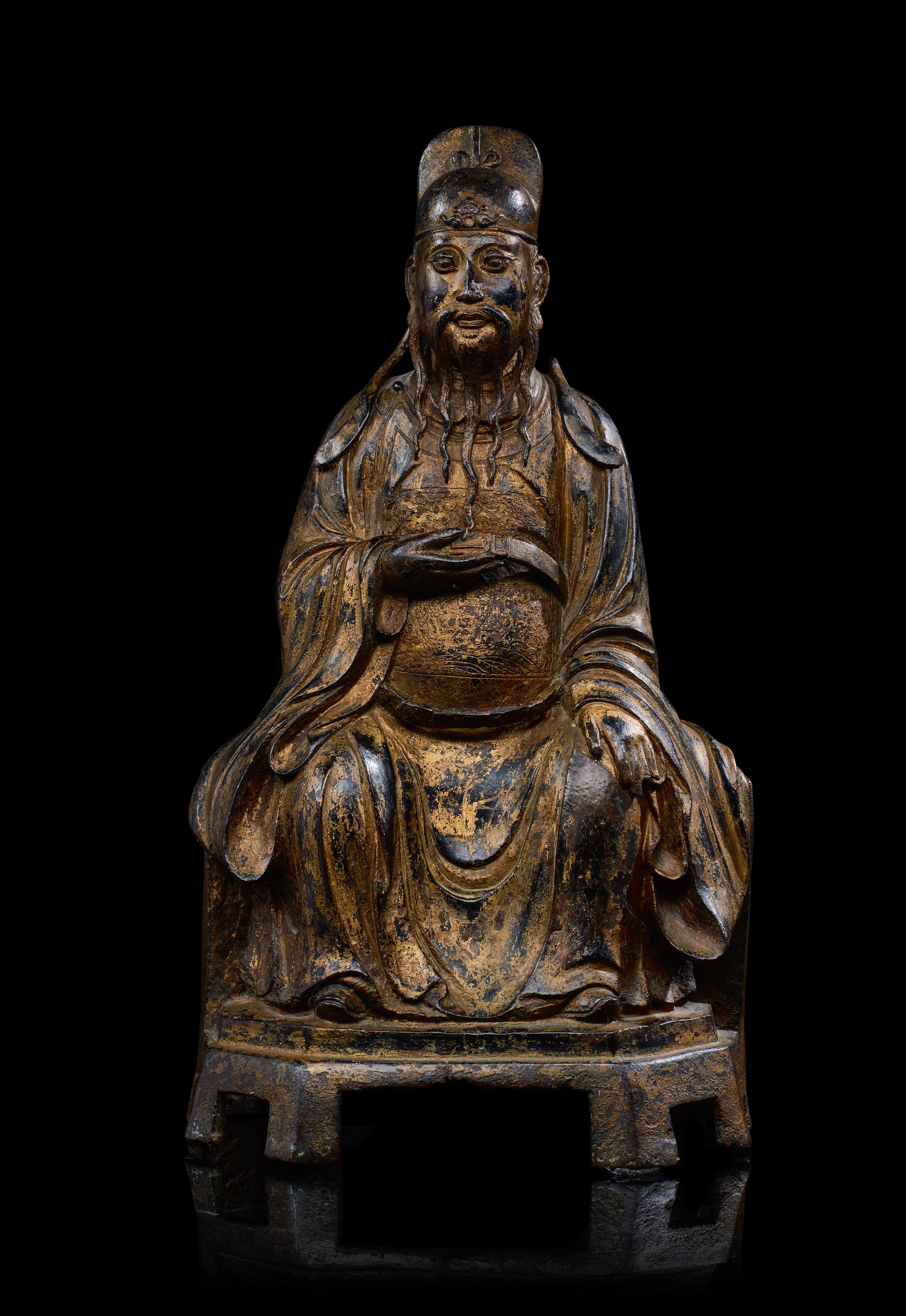
IMPORTANTE STATUE D’OFFICIEL CÉLESTE EN BRONZE LAQUÉ DORÉ
CHINA
MING DYNASTY, 17th CENTURY
A LARGE GILT-LACQUERED BRONZE FIGURE OF A DAOIST OFFICIAL
明代,17 世纪
重要的鎏金漆青铜道教天官像
Importante statue d’officiel céleste taoïste en bronze laqué doré, figuré assis sur une base ajourée, sa main droite retenant sa ceinture contre le torse, sa main gauche reposant sur son genou. Il est vêtu d’une longue robe ceinturée retombant en plis souples, le visage encadré par une longue barbe ondulant sur son torse et coiffé d’un bonnet de lettré aux ailettes retombant sur ses épaules.
H. 49 cm
An important gilt-lacquered bronze figure of a Daoist celestial official, seated on an openwork base, his right hand holding his belt against his torso, his left hand resting on his knee. His face is framed by a long beard waving over his torso, and he wears a scholar’s cap with wings falling over his shoulders.
H. 49 cm
重要的鎏金漆青铜道教天官像,坐于镂空底座上,右手紧握腰带,左手放在膝盖上。他身着 束腰长袍,长须飘拂胸前,头戴书生帽,双翼垂于肩上 高 49 厘米
L’HIMALAYA SACRÉE : LE TIBET
THE SACRED HIMALAYAS: TIBET
神圣的喜马拉雅: 西藏
Le « Pays des Neiges » : entre isolement et influences Le bouddhisme arrive au Tibet sous le règne du roi-conquérant Songtsen Gampo (r. 614-648). Bien que favorable au chamanisme tibétain bön, il fonde les deux temples bouddhiques du Ramoché et du Jokhang, sous l’influence ses épouses chinoise et népalaise Wencheng et Bhrikuti, ferventes bouddhistes. L’invention de l’écriture alphasyllabaire tibétaine, à la même période, favorise également la traduction de textes du canon sanskrit vers la langue tibétaine.
C’est à partir du règne de Trisong Detsen (r.755–794/804) que le bouddhisme s’implante définitivement au Tibet. L’empire tibétain est alors à son apogée, contrôlant de nombreuses oasis des routes de la Soie. Le roi invite de nombreux maîtres indiens et chinois, parmi lesquels Padmasambhava (Guru Rimpoché en tibétain), considéré comme le fondateur du bouddhisme tibétain. Le bouddhisme devient religion d’État et le roi fait fonder le monastère de Samye, premier monastère bouddhiste du Tibet. Rapidement, le bouddhisme tibétain développe ses particularités, issues de la tradition indienne tantrique, dans laquelle les rituels, les initiations, les pratiques de visualisation et l’iconographie ésotérique occupent une place centrale. Le bouddhisme continue son expansion au Tibet, malgré les aléas politiques et survit, notamment dans sa partie orientale, à la chute de l’Empire du Tibet à la fin du IXe siècle.
Le Xe siècle est marqué par un renouveau du bouddhisme au Tibet central et occidental, notamment grâce la figure de Yeshe Ö, premier roi-lama du royaume de Gugé. L’historiographie tibétaine classique lui attribue la restauration d’une tradition organisée et monastique du bouddhisme tibétain. Cette seconde diffusion du bouddhisme est également rendue possible par l’arrivée de nouveaux enseignements, favorisant l’éclosion de riches courants de pensée et l’apparition de plusieurs écoles. Progressivement, pouvoir politique et religieux deviennent indissociables. Les principales écoles tibétaines – Nyingma, Kagyu et Sakya – se structurent autour de lignées de maîtres et de transmissions orales, où la figure du lama prend une importance considérable.
The “Land of Snow” : Between Isolation and Influences
Buddhism arrived in Tibet during the reign of the warrior-king Songtsen Gampo (r. 614–648). Though favourable to the indigenous Tibetan shamanic tradition of Bön, he founded the two Buddhist temples of Ramoché and Jokhang, influenced by his Chinese and Nepalese wives, Wencheng and Bhrikuti, both devout Buddhists. The invention of the Tibetan alphasyllabic script during the same period also facilitated the translation of Sanskrit canonical texts into Tibetan. It was during the reign of Trisong Detsen (r. 755–794/804) that Buddhism truly took root in Tibet. At the time, the Tibetan Empire was at its zenith, controlling numerous Silk Road oases. The king invited many Indian and Chinese masters, including Padmasambhava (known in Tibetan as Guru Rinpoche), who is regarded as the founder of Tibetan Buddhism. Buddhism became the state religion, and the king founded Samye Monastery, the first Buddhist monastery in Tibet. Tibetan Buddhism rapidly developed its distinctive character, rooted in the Indian tantric tradition, in which rituals, initiations, visualisation practices, and esoteric iconography play a central role.
Buddhism continued to spread throughout Tibet, despite political upheavals, and survived—particularly in its eastern regions—the collapse of the Tibetan Empire at the end of the 9th century. The 10th century marked a renewal of Buddhism in central and western Tibet, notably through the figure of Yeshe Ö, the first monk-king of the kingdom of Gugé. Classical Tibetan historiography credits him with restoring an organised and monastic tradition of Tibetan Buddhism. This so-called “second dissemination” was also made possible by the arrival of new teachings, fostering the emergence of rich philosophical movements and the establishment of several schools. Gradually, political and religious power became inseparable. The main Tibetan schools—Nyingma, Kagyu, and Sakya—formed around lineages of masters and oral transmissions, where the figure of the lama took on enormous significance.
Until the 13th century, Tibet had no central authority; power was shared among local potentates, either allied with or belonging to religious lineages.
雪域之地:在孤立与影响之间 佛教在吐蕃王松赞干布(614–648年在位)统治时期传入西藏。虽然他 本人支持本土的苯教萨满传统,但在其中国与尼泊尔王后——文成公主 与布里库提的影响下,修建了拉姆切寺与大昭寺这两座佛教寺庙。与此 同时,藏文字母表的创制也大大促进了佛教梵文经典向藏文的翻译。 在赤松德赞(755–794/804年在位)时期,佛教在西藏真正扎根。彼时的吐 蕃帝国达到鼎盛,控制着丝绸之路上的多个绿洲。赤松德赞广邀印度与 中国高僧前来弘法,其中包括被尊为藏传佛教奠基人的莲花生大师(藏 语称为“咕噜仁波切”)。佛教被立为国教,王室还创建了桑耶寺——西 藏历史上第一座佛教寺院。随后,藏传佛教迅速发展出自身特色,深受 印度密教传统影响,注重仪轨、灌顶、观想修行及密宗图像体系。
尽管政治局势波动,佛教仍持续传播,特别在帝国灭亡后的东藏地区 得以延续。公元十世纪,在古格王国第一位僧王益西沃的努力下,佛教 在西藏中部与西部迎来复兴。据传统记载,益西沃恢复了有组织的僧 团制度,并推动佛教重建。这一“后弘期”也得益于新教义的引入,促 使思想流派繁荣,诸多教派纷纷建立。此后,政教合一逐渐形成,主要 教派如宁玛派、噶举派与萨迦派,皆围绕上师传承与口传系统建立,其 中喇嘛的地位尤为重要。
13世纪前,西藏并无统一政权,权力由地方势力与教派共享。部分寺院 体系与中亚王朝建立起“施主与护法”关系(藏语称“恰炯”Chö-yon) 。随着蒙古人征服亚洲,噶举派与萨迦派高僧先后归顺成吉思汗,并与 其孙忽必烈建立密切关系。忽必烈征服中国后建立元朝,册封萨迦派 为帝国宗教领导者。然元朝仅存不足百年,明朝取而代之,蒙古帝国也 因内部纷争日渐衰弱。此后西藏摆脱蒙古统治,获得事实上的独立,在 某种程度上进入两个世纪的相对封闭状态。
帕竹王朝(1351–1435)在这一时期建立世俗政权,宫廷生活则围绕丹 萨替与泽当两大寺院展开。寺院再次成为艺术创作中心,集中赞助人、 工坊与技艺。
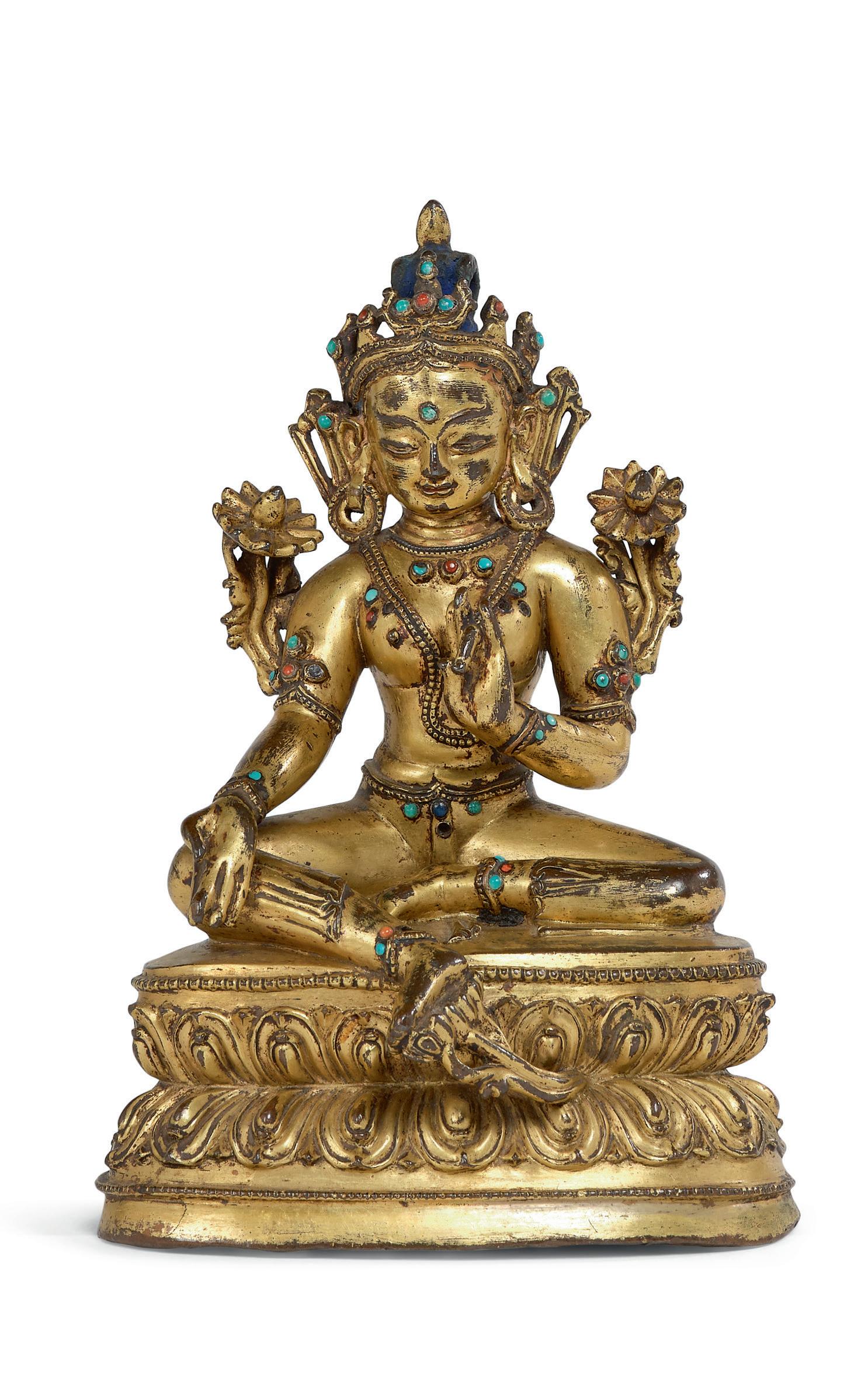
16世纪末,蒙古人再次对西藏政局产生决定性影响。统一漠西蒙古的首 领阿勒坦汗信仰藏传佛教,并扶持格鲁派(意为“善律派”或“黄帽派”) ,该派由宗喀巴大师(1357–1419)于14世纪创立。他将“达赖喇嘛”这一 称号授予宗喀巴的第三代转世——索南嘉措(1543–1588),意为“智慧 之海”。在蒙古和硕特部的军事与政治支持下,五世达赖喇嘛阿旺洛桑 嘉措(1617–1682)于1642年建立甘丹颇章政权,确立政教合一体制。他 定都拉萨,开始修建布达拉宫。此后西藏与刚建立清朝(1644–1911年) 的满族皇帝建立起外交联系。
T ibet, XV XVI siècle. ©Aguttes, vente du 1 juin 2023
Jusqu’au XIIIe siècle, le Tibet ne connaît pas de pouvoir central, l’influence étant partagée entre des potentats locaux alliés ou appartenant à des lignées religieuses. Certaines branches monastiques sont engagées dans une relation dite « chapelain-protecteur » (Chö-yon) avec des dynasties d’Asie centrale. Le déferlement des Mongols sur l’Asie pousse les dignitaires religieux Kagyupa et Sakyapa à se soumettre à Gengis Khan puis à nouer des relations avec son petit-fils, Kubilai Khan qui conquiert la Chine et y prend le pouvoir en fondant la dynastie Yuan. La lignée Sakya se voit alors confier l’autorité sur tout l’empire. Mais après moins d’un siècle d’existence, la dynastie Yuan disparaît au profit de la dynastie Ming, suivi par l’empire mongol qui se délite petit à petit, au fil des rivalités dynastiques. Le Tibet, affranchi de la tutelle mongole, devient de fait indépendant et vit dans une certaine autarcie pendant deux siècles.
La dynastie tibétaine Phagmodrupa (1351-1435) instaure une gouvernance laïque mais avec une vie de cour centrée sur les monastères de Densatil et Tsetang. Les monastères redeviennent des principaux centres de production artistique, concentrant commanditaires, ateliers et savoirs.
Mais l’union des Mongols autour de la figure Altan Khan, chef des Mongols Dzoungars, convertit au bouddhisme tibétain, transforme durablement le paysage politique et religieux tibétain. Il fait de l’école Gelugpa (« les Vertueux » ou « Ecole des Bonnets Jaunes »), fondée au XIVe siècle par Tsongkhapa (1357-1419), la lignée dominante politiquement et confère au troisième successeur du maître, Sonam Gyatso (1543-1588), le titre de « dalaï-lama » (« Océan de sagesse »).
Avec l’appui politique et militaire des Mongols Qoshots, le cinquième dalaï-lama, Ngawang Lobsang Gyatso (1617-1682), instaure en 1642 le gouvernement du Ganden Phodrang, une théocratie marquée par la suprématie absolue du clergé. Il installe sa capitale à Lhassa et fait débuter la construction du Potala. Les années qui suivent sont marquées par un rapprochement avec les premiers empereurs mandchous de la nouvelle dynastie Qing (1644-1911), qui vient de monter sur le trône chinois.
Some monastic branches engaged in so-called “chaplain–protector” (chöyon) relationships with Central Asian dynasties. The Mongol invasions across Asia compelled Kagyupa and Sakyapa religious leaders to submit to Genghis Khan and later forge ties with his grandson, Kublai Khan, who conquered China and established the Yuan dynasty. The Sakya lineage was then entrusted with authority over the entire Tibetan realm. However, after less than a century, the Yuan dynasty fell, giving way to the Ming dynasty, and the Mongol Empire gradually disintegrated amid dynastic rivalries. Tibet, freed from Mongol rule, effectively became independent and experienced two centuries of relative self-sufficiency. The Phagmodrupa dynasty (1351–1435) introduced a secular form of governance, though court life remained centred around monasteries such as Densatil and Tsetang. Monasteries once again became major centres of artistic production, concentrating patrons, workshops, and knowledge. Yet the unification of the Mongols under Altan Khan, chief of the Dzungar Mongols and a convert to Tibetan Buddhism, had a lasting impact on the Tibetan political and religious landscape. He elevated the Gelugpa school (“the Virtuous” or “Yellow Hat” school), founded in the 14th century by Tsongkhapa (1357–1419), to political dominance and bestowed the title of “Dalai Lama” (“Ocean of Wisdom”) upon the third successor of the master, Sonam Gyatso (1543–1588). With the political and military support of the Qoshot Mongols, the fifth Dalai Lama, Ngawang Lobsang Gyatso (1617–1682), established the Ganden Phodrang government in 1642—a theocracy marked by the absolute supremacy of the clergy. He set his capital in Lhasa and began the construction of the Potala Palace. The subsequent years saw increased contact with the first Manchu emperors of the new Qing dynasty (1644–1911), who had just ascended the Chinese throne.
The history of Tibetan sculpture is intrinsically linked to the political and spiritual history of Tibet, as well as to its geography—a region both isolated on the high Himalayan plateau and situated at the crossroads of major Asian cultural centres. Tibet’s geographic isolation, combined with its autonomy from neighbouring empires, allowed it to develop a sacred art that retained a distinct artistic identity, with Buddhist spirituality taking precedence over external influences.
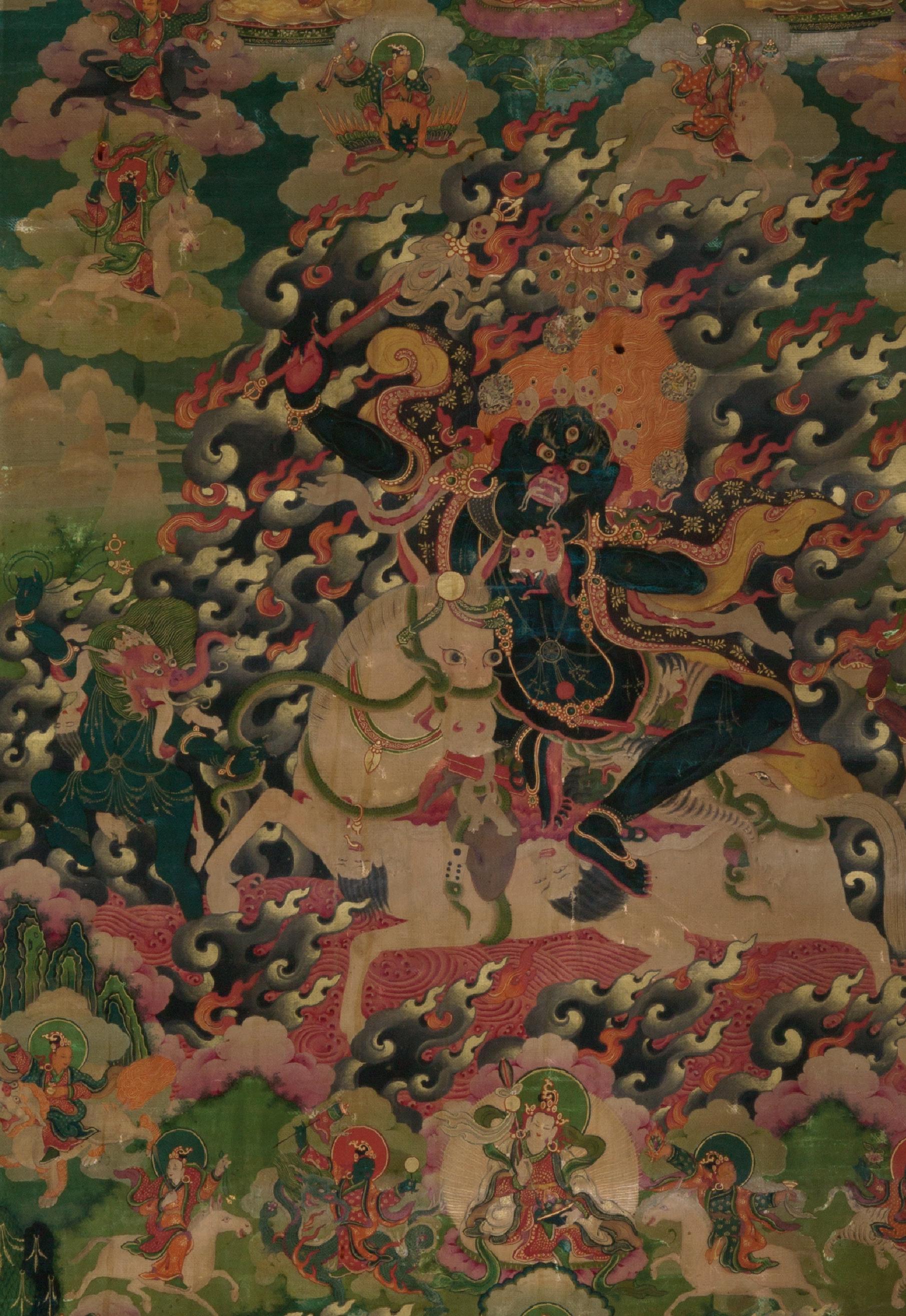
藏传佛教造像艺术与西藏的政治与宗教历史密不可分,也深受其地理 环境影响。西藏位于喜马拉雅高原,虽地处偏远,却也是多元亚洲文 明的交汇点。这种地理隔绝性以及长期的政治自主,使西藏发展出一 种独具特色的宗教艺术,在保持精神纯粹性的同时,有选择地吸收外 来影响。工匠代代相传严谨的图像体系,在符号与象征结构下,也不断 融入新的形式语言。
尽管藏传佛教雕塑深植于金刚乘传统,其风格却在数世纪中日趋多样 化。与印度的交流,特别是笈多与帕拉艺术风格,引入了更为柔和的塑形 与流畅的衣褶线条。唐代与元代的中国艺术影响,则体现于雕像的庄严 性与纪念性。来自尼泊尔的尼瓦尔工匠擅长青铜铸造与鎏金工艺,他们 对藏地金铜佛像艺术的发展具有深远影响。由于寺院与工坊多建于喜马 拉雅偏远山谷,各地区风格逐渐形成,艺术家在保持传统的基础上,融 合当地审美与材料条件,使统一的藏传风格中显现出丰富的地域变体。
藏传佛教的金铜艺术绝非单纯的形式表现,它是人间与神圣之间的桥 梁,是修行者内在视觉的物质化显现,是“以形载道”的神圣媒介。这 种艺术融合精准造型、内在力量与宗教精神,堪称亚洲佛教雕塑艺术 的高峰之一。
在藏传佛教中,金铜佛像远不止是供奉图像,更被视为“觉悟之具”。
通过开光仪式,被赋予神圣“灵性”,佛像成为有神圣实在存在的对象。
每尊佛像的内部都需安置咒轮、经文卷轴、舍利与圣物,方为完整。
这类雕塑被广泛用于家庭佛坛、寺庙与庙宇中,作为禅修观想、供养或 护法的核心。通过凝视神像,修行者得以观想佛菩萨的神圣德行,在密 宗修法中与之“合一”,实现觉悟之道。
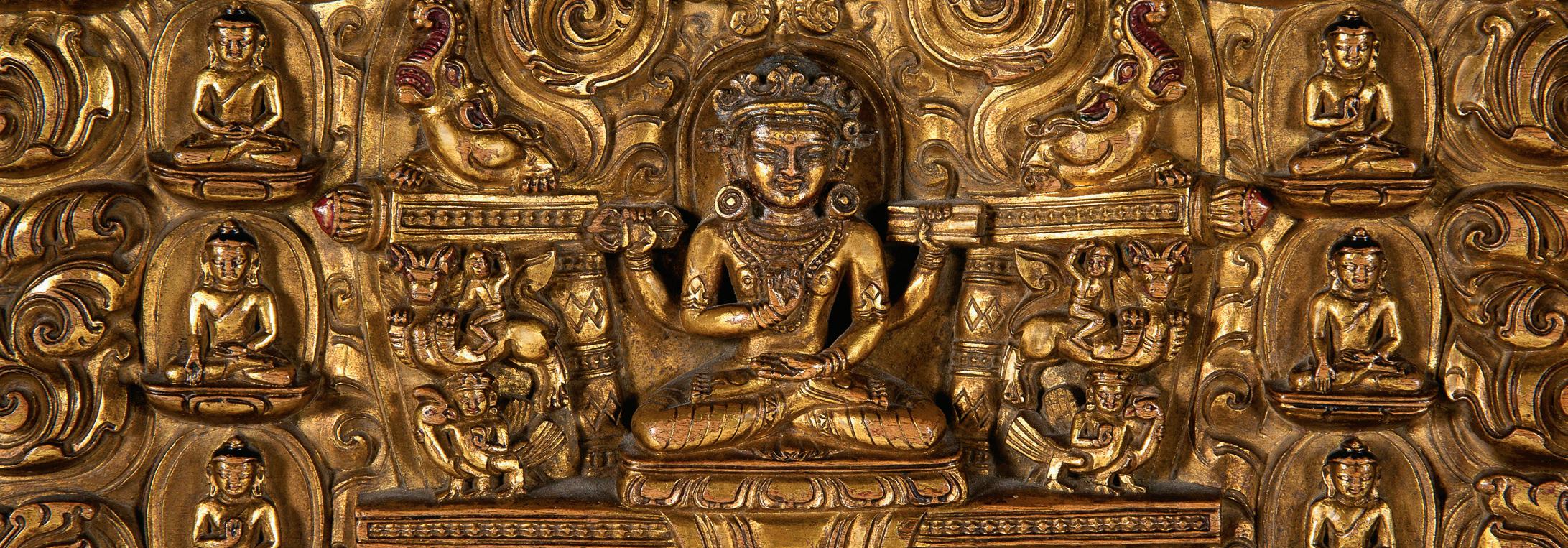
L’histoire de la sculpture tibétaine est éminemment liée à l’histoire politique et spirituelle du Tibet mais également à sa géographie, région à la fois isolée dans les hauts plateaux de l’Himalaya mais également au carrefour de grands pôles culturels asiatiques. Cet isolement du Tibet, lié à sa géographie singulière mais aussi à son autonomie face aux empires voisins, lui a permis de développer un art sacré où se maintient une identité artistique distincte, et où la spiritualité bouddhiste prime sur les influences extérieures. Les maîtres-sculpteurs travaillent ainsi selon des schémas iconographiques rigoureux transmis de génération en génération, intégrant parfois des innovations formelles sans jamais rompre le cadre symbolique.
Bien que profondément enracinée par les spécificités du bouddhisme Vajrayana, la statuaire tibétaine se diversifie au fil des siècles sous l’effet de multiples influences étrangères. Les contacts historiques avec l’Inde, notamment à travers les styles Gupta et Pala, apportent une souplesse dans les modelés et une fluidité dans les drapés, tandis que les influences chinoises, particulièrement sous les dynasties Tang et Yuan, introduisent une certaine monumentalité et un hiératisme. Les artisans Newar du Népal transmettent leur goût pour l’emploi du bronze dans la statuaire et leur savoir-faire dans les domaines de la fonte et de la dorure. L’isolement géographique des monastères et ateliers, disséminés dans les vallées reculées de l’Himalaya, favorise, quant à lui, l’émergence de styles régionaux distincts, où les artistes adaptent les canons iconographiques à des matériaux locaux et à des sensibilités esthétiques propres, renforçant ainsi la diversité au sein de l’unité stylistique tibétaine.
Master sculptors worked according to rigorous iconographic systems handed down through generations, occasionally incorporating formal innovations without breaking the symbolic framework.
Though deeply rooted in the specificities of Vajrayāna Buddhism, Tibetan statuary diversified over the centuries due to multiple foreign influences. Historical contacts with India—especially through the Gupta and Pāla styles—introduced suppleness in modelling and fluidity in drapery, while Chinese influences, particularly during the Tang and Yuan dynasties, brought a sense of monumentality and hieratic presence. Newar artisans from Nepal contributed their fondness for bronze statuary and their expertise in casting and gilding techniques. The geographic isolation of monasteries and workshops, scattered across the remote valleys of the Himalayas, encouraged the emergence of distinct regional styles in which artists adapted iconographic canons to local materials and aesthetic sensibilities, thereby enriching the diversity within the broader Tibetan stylistic unity.
The art of Tibetan Buddhist bronze is not merely a formal exercise. It is the visible incarnation of an invisible world—an interface between human and deity—aimed at stabilising the practitioner’s inner vision and anchoring the sacred in material form. This art, combining precision, power, and spirituality, remains one of the pinnacles of Buddhist sculpture in Asia.
In Tibetan Buddhism, bronze statues are far more than images. They are perceived as supports for enlightenment, imbued with real spiritual presence once they have been “awakened” during consecration ceremonies. A statue is not considered complete without the insertion of mantras, sutra scrolls, relics, or sacred substances within its inner cavity.
Bronze sculptures are used in domestic altars, monasteries, and temples as objects of meditation, offering, or protection. They enable the practitioner to contemplate the qualities of the deity and to identify with it within the framework of tantric practice.
Tibet, XIVe XVe siècle. ©Aguttes, vente du 1 er juin 2023
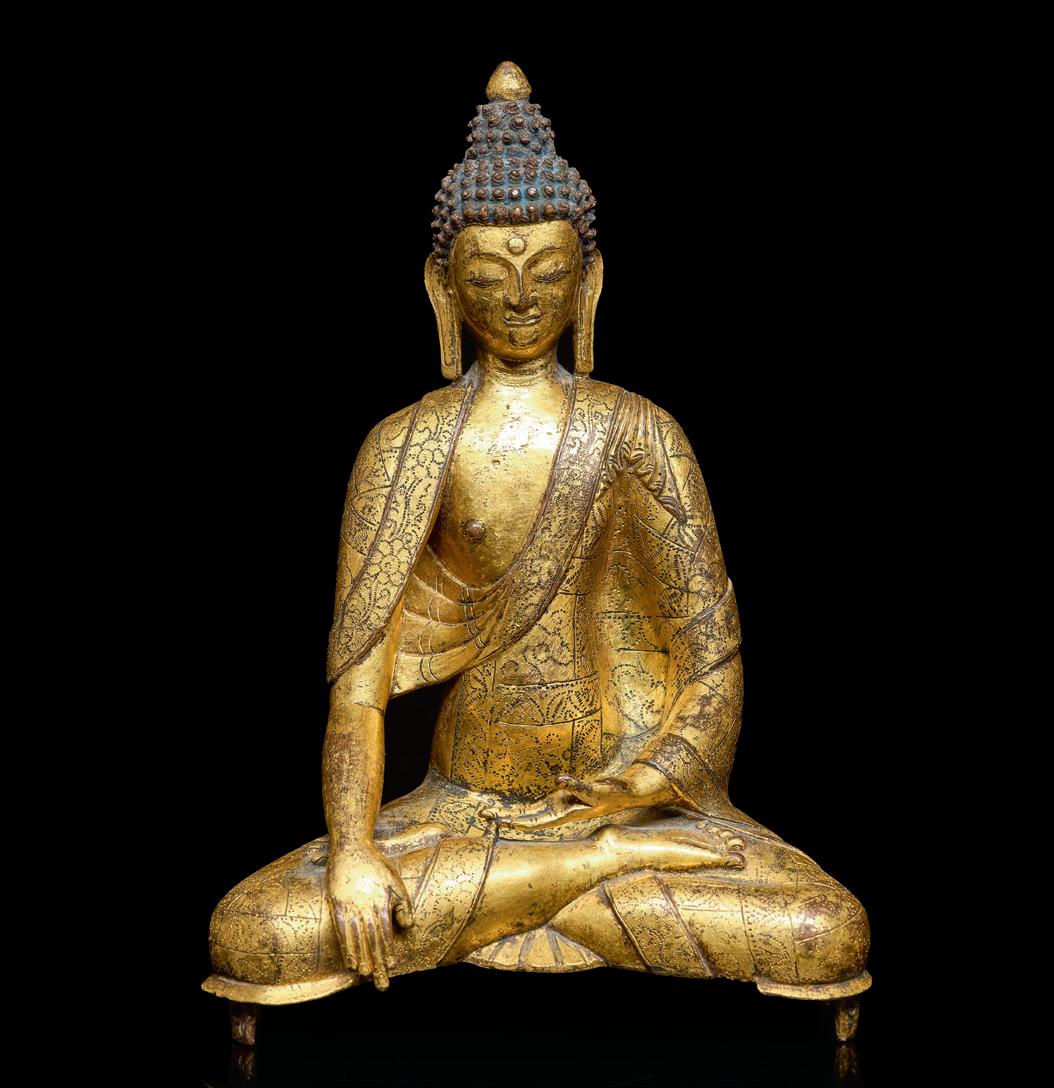
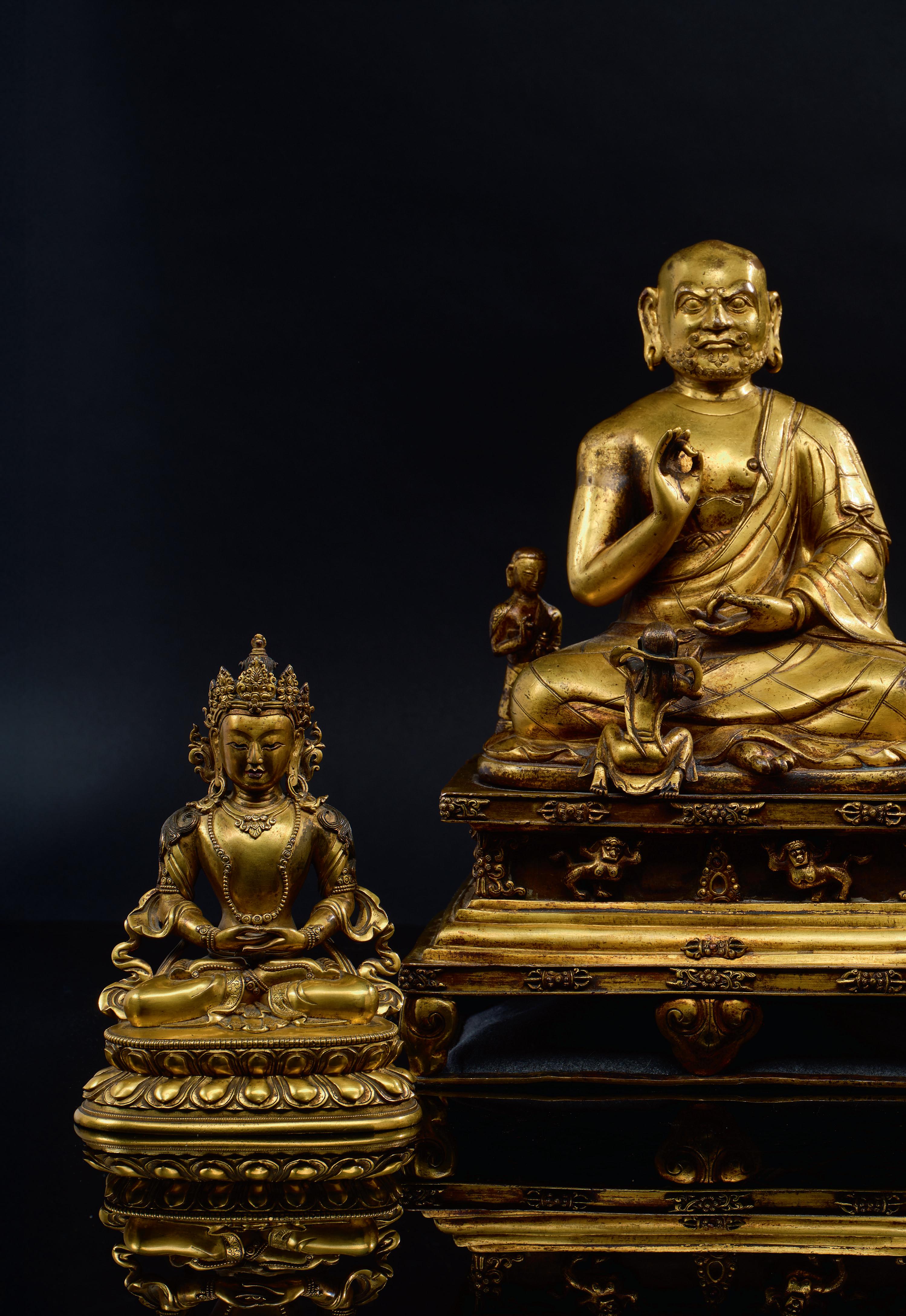
TIBET
XVIe SIÈCLE
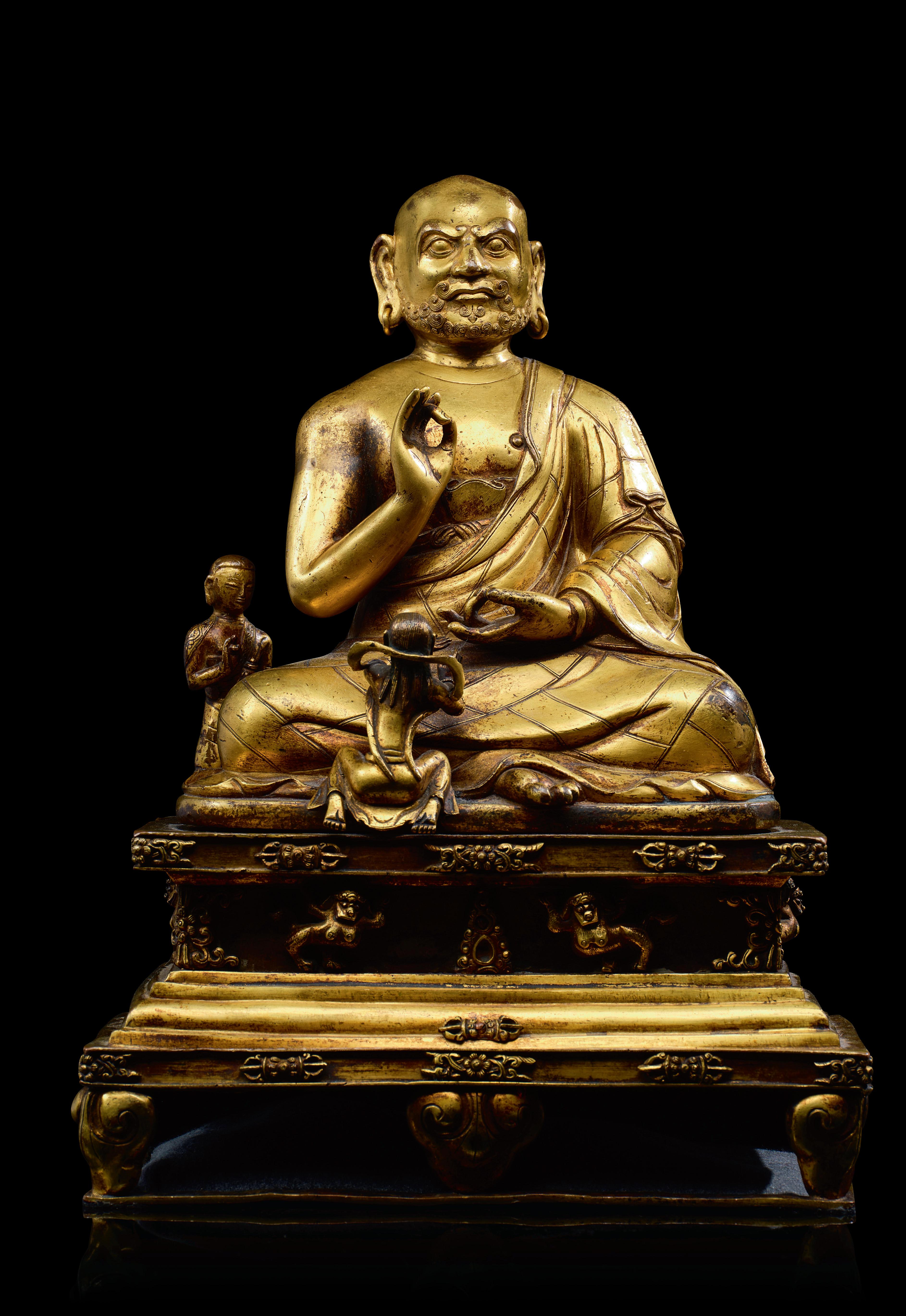
RARE STATUE DE L’ARHAT BHADRA EN BRONZE DORÉ
TIBET
16th CENTURY
A RARE GILT-BRONZE FIGURE OF THE ARHAT BHADRA
西藏
16 世纪 罕见的鎏金铜跋陀羅尊者像
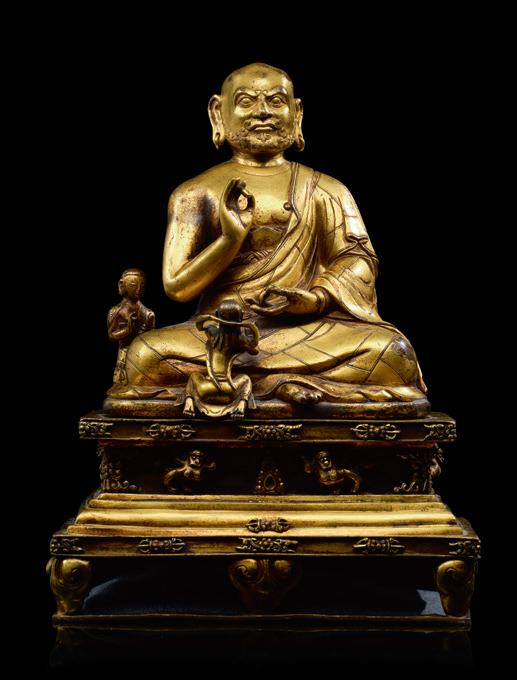
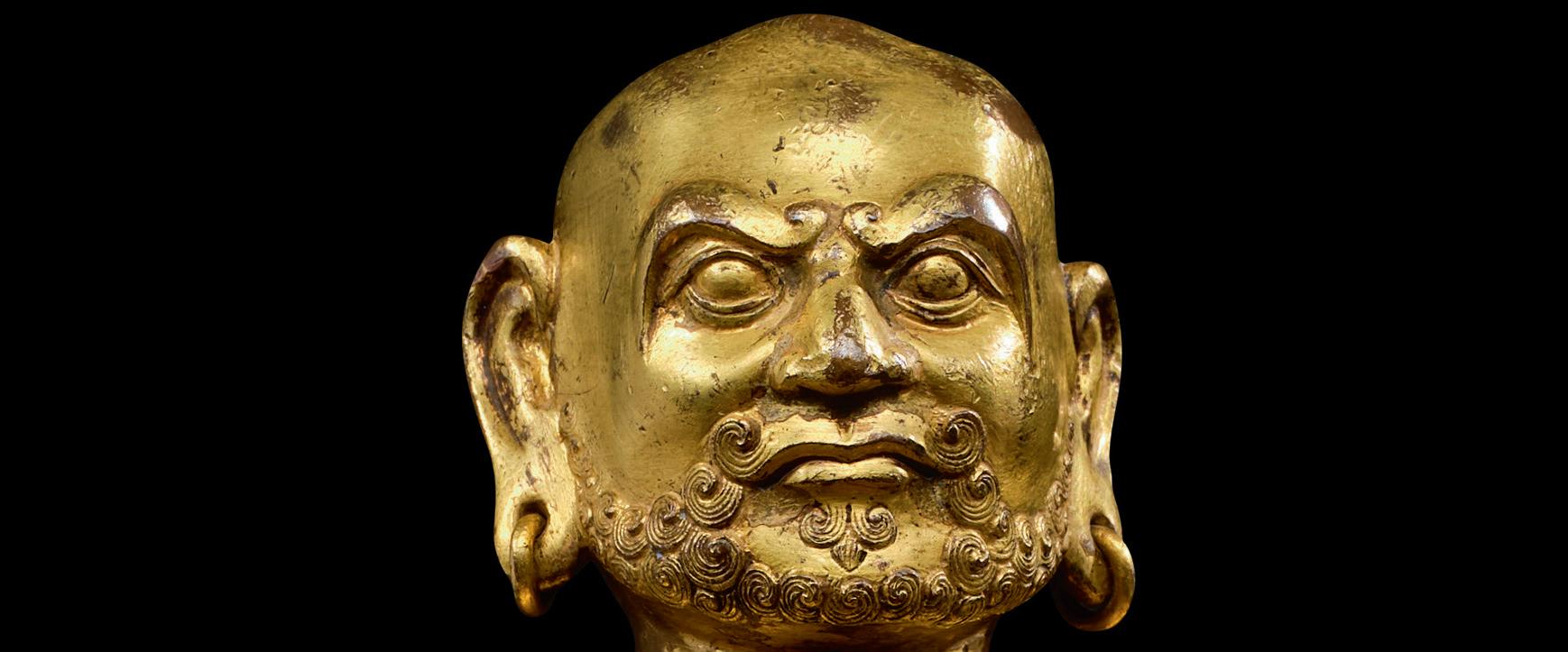
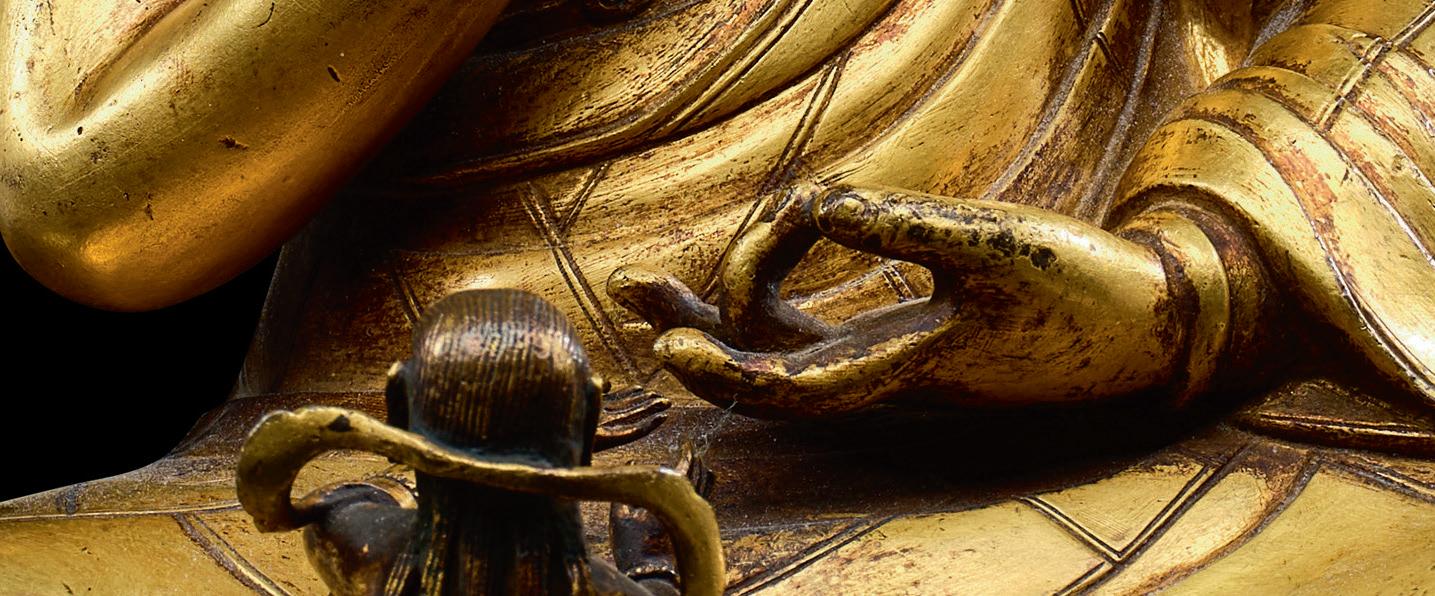
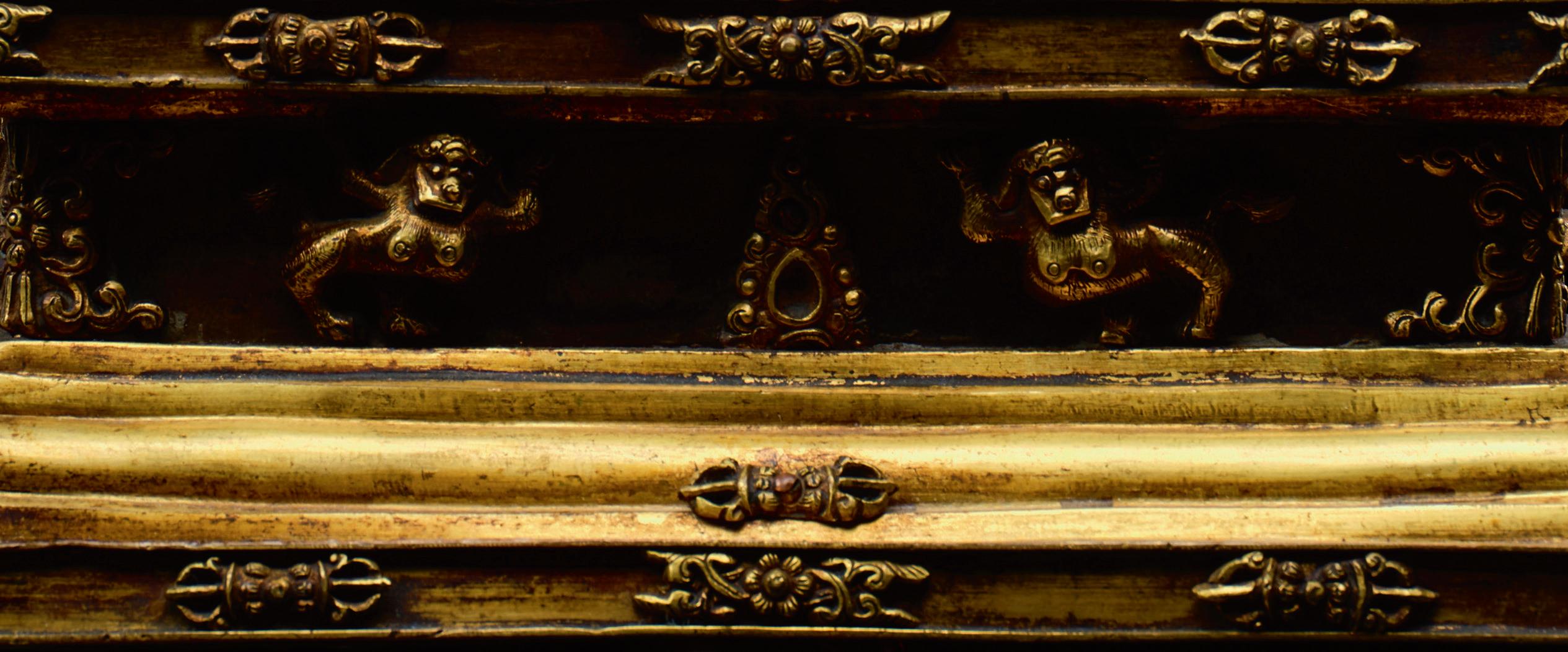
Rare statue de l’arhat Bhadra en bronze doré, assis en méditation, sur une haute base quadrangulaire à degrés, rehaussée de vajra, lions des neiges et rinceaux appliqués. La main droite levée en vitarka mudra, la gauche reposant en dhyana mudra sur les jambes. Il est vêtu d’un long manteau monastique quadrillé découvrant son épaule droite. Le visage aux traits acérés, les sourcils froncés, des yeux à l’expression intense surmontant un nez aquilin. Les oreilles avec deux larges anneaux. Il est accompagné de deux petits adorants, l’un tendant les bras, agenouillé devant l’arhat, l’autre, debout à l’arrière tenant une offrande. La base scellée incisée d’un double vajra. H. 32 cm
A rare gilt-bronze figure of the arhat Bhadra, seated in meditation on a high stepped quadrangular base, with vajra, snow lions and scrolls. His right hand is raised in vitarka mudra, his left hand resting in dhyana mudra on the legs. He wears a sanghati chased with a ‘rice paddy’ design, revealing his right shoulder. The face has sharp features, frowning eyebrows, intensely expressive eyes and an aquiline nose. The ears with two large rings. He is accompanied by two small worshippers, one stretching out his arms, kneeling before the arhat, the other, standing behind, holding an offering. The sealed base is incised with a double vajra. H. 32 cm
罕见的跋陀羅阿罗汉塑像,坐于高阶梯状的四方形底座上,正在冥想,饰有金 刚杵、雪狮和贴面树叶。佛像右手以 “说法印”姿势举起,左手以 “禅定印”姿势放在腿上。 他身披长长的方形僧袍,露出右肩。脸部轮廓分明,眉头紧 皱,双眼有神,鼻梁高挺。耳朵上有两个大环。他身边有两个小供奉,一个伸出双臂,跪在阿 罗汉面前,另一个手持供品站在后面。密封底座上刻有双金刚杵。 高 32 厘米
Les arhats sont des personnages ayant atteint l’illumination par l’enseignement, et vénérés comme des modèles de sainteté. Le canon bouddhique originel décrit leur groupe comme étant composé de dix disciples du Bouddha Shakyamuni mais leur nombre variera au fil du temps et des traditions bouddhiques.
« Sur une île de la rivière Yamuna se trouve le noble aîné Bhadra, entouré de 1 200 arhats ; hommage à celui qui accomplit [les gestes] d’explication du dharma et de méditation », c’est ainsi qu’est décrit dans les textes, l’arhat Bhadra. Selon la tradition, le père de Bhadra servait le roi Suddhodana, père de Siddharta Gautama, comme conducteur de char. Lorsque le prince Siddharta atteint l’Eveil, le père de Bhadra fit le vœu que son enfant à venir devienne moine. Bhadra naquit et grandit pour devenir un érudit renommé, puis devint un moine selon la promesse de son père. Accumulant les mérites et pratiquant avec diligence, il devint un arhat réputé pour ses actions méritoires et son enseignement clair et simple.
L’iconographie des arhats, qui trouve ses racines en Inde, connaîtra un épanouissement sans précédent en Chine, où les premières représentations, inspirées du canon pali et sanskrit, fleurissent sur les routes de la Soie, à l’image des fresques et sculptures des grottes de Dunhuang. Sous la dynastie Tang (618-907), les artistes chinois s’emparent de ce thème iconographique, à l’instar des « Seize Arhats » du moinepeintre Guanxiu (832-912), qui introduit une stylisation marquée, avec des visages expressifs et exagérés, marquant durablement leur représentation. Le transfert de cette iconographie vers le Tibet s’opère notamment lors de la conquête de l’Asie au XIIIe siècle par les Mongols, ceux-ci entretenant des liens politico-religieux complexes avec le « Pays des Neiges ».
Au XVIe siècle, le Tibet est un centre majeur de l’art bouddhiste, où les nombreux et riches monastères commanditent des œuvres, à l’image de la présente statue, à la fois objets d’art et objets de culte, pour orner les autels et soutenir la pratique spirituelle.
Cette statue de Bhadra fusionne avec une grande finesse les influences stylistiques et conventions iconographiques étrangères avec la tradition
locale. Le modelé du visage, particulièrement soigné, témoigne d’une maîtrise technique remarquable : les traits sont sculptés avec une grande précision, les yeux écarquillés rehaussés d’épais sourcils froncés accentuant la force du regard tandis que les pommettes saillantes et le front lisse soulignent la noblesse spirituelle de la figure, renforçant son aura de détachement et de sagesse. Le visage est encadré par une barbe finement ciselée, se déployant en bouclettes spiralées évoquant les représentations d’arhats des XIVe et XVe siècle chinois, à l’instar de la statue en bronze doré de l’arhat Bhadra conservée au Musée National des Arts Asiatiques Guimet, Paris (MG 9729) et datée du XIVe siècle. La robe monastique couvre l’épaule gauche tout en laissant l’épaule droite dénudée, un détail iconographique hérité de la tradition indienne, qui rappelle les conventions des thangkas de la même période. Les plis de la robe cascadent en lignes souples, soulignant les contours du corps.
Le motif de quadrillage évoque les origines du bouddhisme lorsque les robes des moines étaient assemblées à partir de chutes de tissus. Cette draperie, à la fois fonctionnelle et symbolique, reflète le statut ascétique de l’arhat tout en mettant en valeur l’habileté des artistes tibétains à capturer la matérialité du tissu dans le métal.
La statue repose sur une base rectangulaire à gradins, soutenue par cinq petits pieds formés de fleurons aux enroulements spiralés, et est rehaussée de motifs de rinceaux, vajra et lionnes des neiges appliqués.
Cette base s’inspire directement des modèles plus élaborés du XVe siècle, tels qu’illustrés dans « The Complete Collection of Treasures of the Palace Museum. Buddhist Statues of Tibet », 2003, n°151 et 153, ou dans « Cultural Relics of Tibetan Buddhism Collected in the Qing Palace », 1998, n°37-1. Ce piédestal est également à rapprocher d’un modèle du XVIe siècle supportant une statue de Simhavakta et conservé au Musée de l’Hermitage, Saint Pétersbourg et illustré dans « Wisdom and Compassion : The Sacred Art of Tibet. Expanded Version », 1996, New York, n° 117.
Cette statue, incarnant spiritualité profonde et excellence de la technicité des artistes tibétain, témoigne également des échanges artistiques, culturels et politiques qui parcourent ce siècle.
L’Himalaya Sacrée : le Tibet
The arhats are figures who have attained enlightenment through the teachings and are revered as models of holiness. The original Buddhist canon describes their group as composed of ten disciples of the Buddha Shakyamuni, though their number would vary over time and across Buddhist traditions. “On an island in the Yamuna River resides the noble elder Bhadra, surrounded by 1,200 arhats; homage to the one who performs [the gestures] of explaining the dharma and meditation,” so is the arhat Bhadra described in the texts. According to tradition, Bhadra’s father served King Suddhodana, the father of Siddhartha Gautama, as a charioteer. When Prince Siddhartha attained Enlightenment, Bhadra’s father vowed that his unborn child would become a monk. Bhadra was born and grew up to become a renowned scholar, later fulfilling his father’s vow by becoming a monk. Through accumulating merits and diligent practice, he became an arhat known for his meritorious actions and clear, simple teachings. The iconography of arhats, rooted in India, would see unprecedented development in China, where the earliest representations, inspired by the Pali and Sanskrit canons, flourished along the Silk Roads, as seen in the frescoes and sculptures of the Dunhuang caves. During the Tang Dynasty (618–907), Chinese artists embraced this iconographic theme, notably through the “Sixteen Arhats” by the monk-painter Guanxiu (832–912), who introduced a distinctive stylization with expressive and exaggerated faces, leaving a lasting mark on their depiction. The transfer of this iconography to Tibet occurred particularly during the Mongol conquest of Asia in the 13th century, as they maintained complex politico-religious ties with the “Land of Snow.”
By the 16 th century, Tibet was a major center of Buddhist art, where numerous wealthy monasteries commissioned works, such as the present statue, serving both as art objects and subjects of worship to adorn altars and support spiritual practice.This statue of Bhadra masterfully blends foreign stylistic influences and iconographic conventions with local tradition. The finely modeled face demonstrates remarkable technical skill: the features are sculpted with great precision, with wide-open eyes accentuated by thick,
furrowed brows that emphasize the intensity of the gaze, while prominent cheekbones and a smooth forehead highlight the figure’s spiritual nobility, enhancing its aura of detachment and wisdom. The face is framed by a finely chiseled beard, curling in spiral loops reminiscent of Chinese arhat representations from the 14th and 15th centuries, such as the gilded bronze statue of the arhat Bhadra held at the Guimet National Museum of Asian Arts, Paris (MG 9729), dated to the 14th century.
The monastic robe covers the left shoulder while leaving the right shoulder bare, an iconographic detail inherited from Indian tradition, recalling the conventions of thangkas from the same period. The robe’s folds cascade in fluid lines, outlining the body’s contours. The checkered pattern evokes the origins of Buddhism, when monks’ robes were assembled from scraps of fabric. This drapery, both functional and symbolic, reflects the arhat’s ascetic status while showcasing the Tibetan artists’ skill in capturing the materiality of fabric in metal.
The statue rests on a stepped rectangular base, supported by five small feet shaped as spiraling floral motifs, and is adorned with applied designs of rinceaux, vajra, and snow lionesses. This base draws directly from more elaborate 15th-century models, as illustrated in The Complete Collection of Treasures of the Palace Museum. Buddhist Statues of Tibet (2003, nos. 151 and 153) or Cultural Relics of Tibetan Buddhism Collected in the Qing Palace (1998, no. 37-1). The pedestal is also comparable to a 16th-century model supporting a statue of Simhavakta, held at the Hermitage Museum, St. Petersburg, and illustrated in Wisdom and Compassion : The Sacred Art of Tibet. Expanded Version (1996, New York, no. 117).
This statue, embodying profound spirituality and the technical excellence of Tibetan artists, also bears witness to the artistic, cultural, and political exchanges that characterized this century.
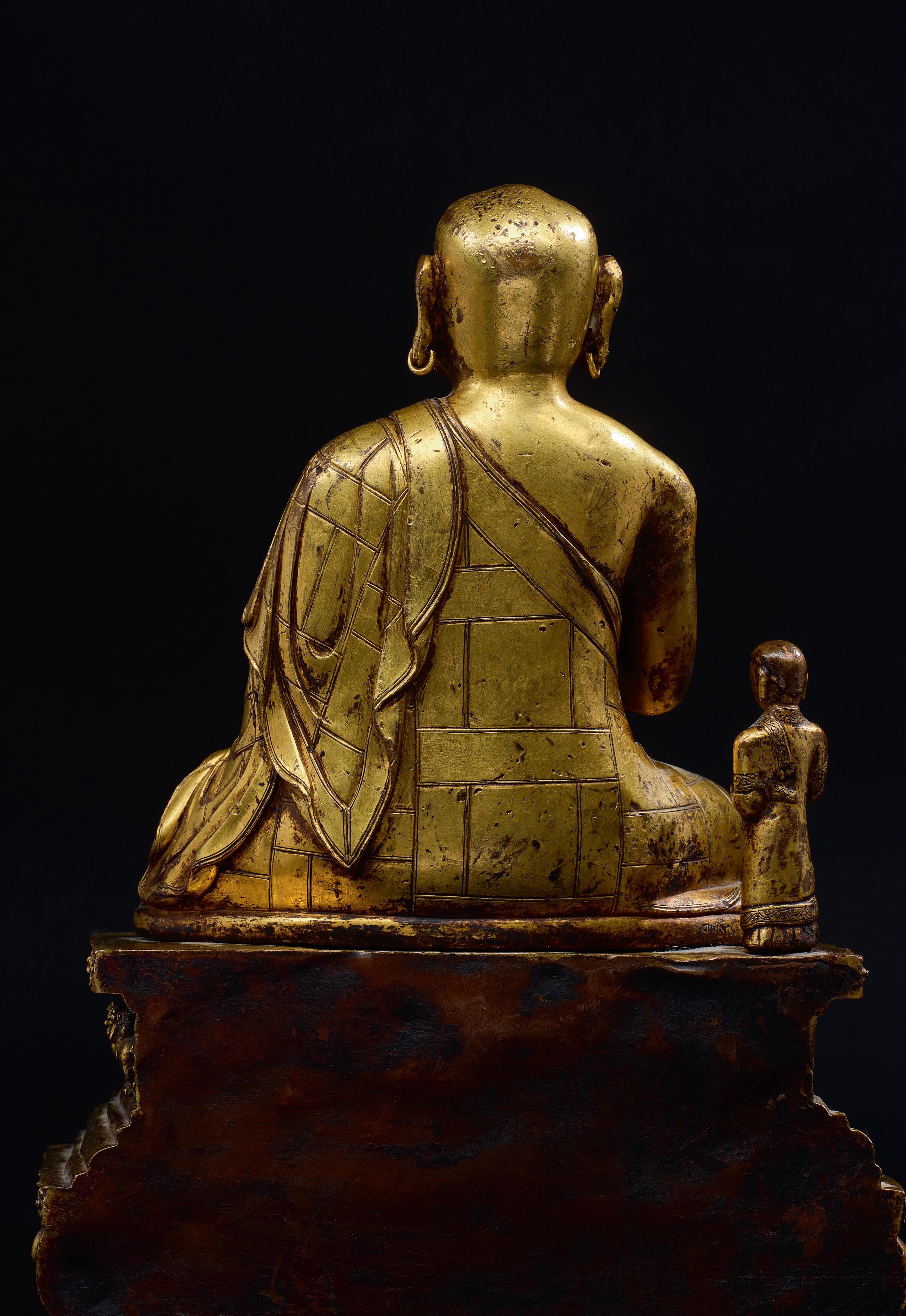
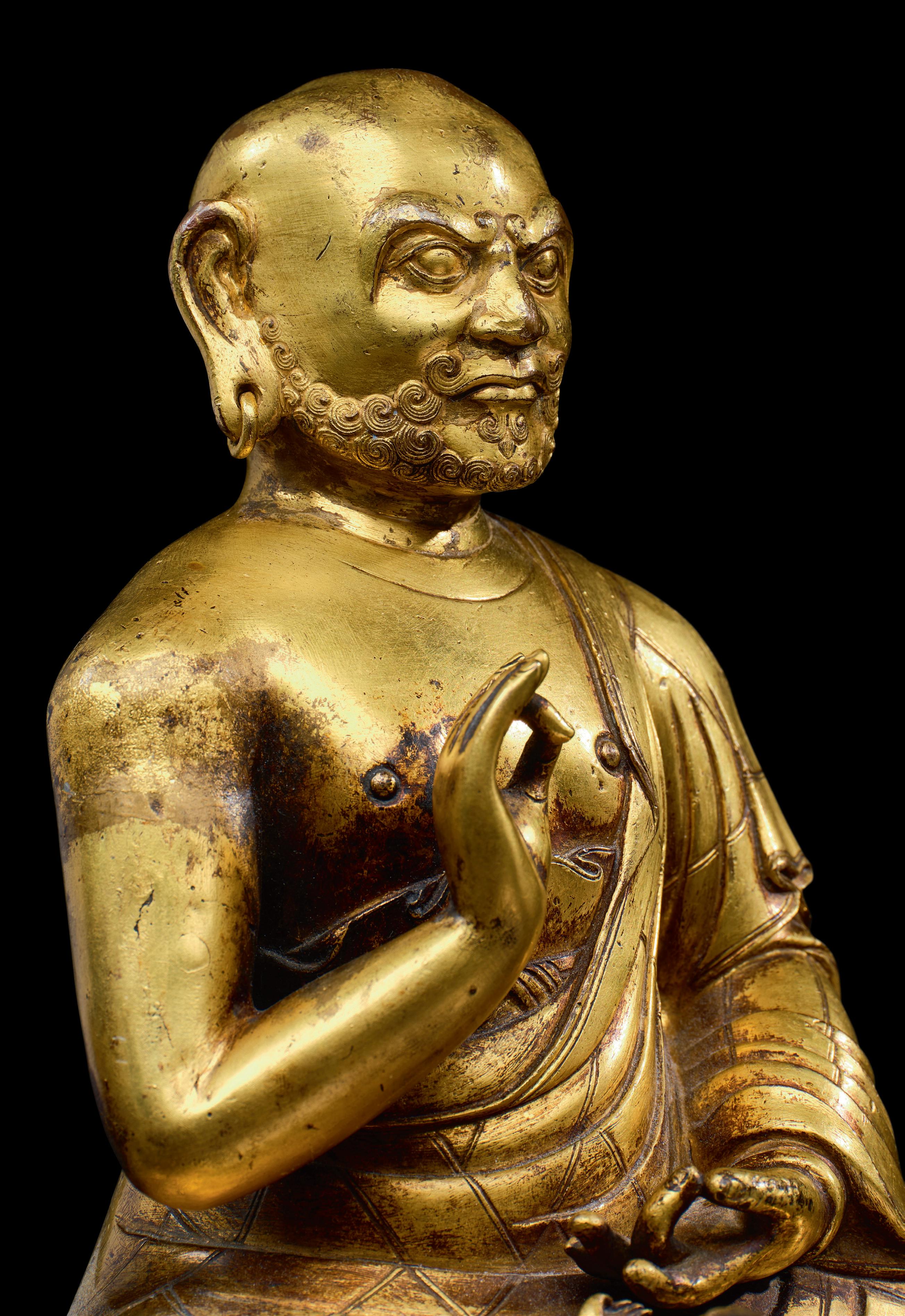
阿罗汉是通过教导获得证悟的人,被尊为神圣的典范。原始佛典中记 载,他们由释迦牟尼佛的十位弟子组成,但其人数会随着时间和佛教 传统而变化。
“在亚穆纳河的一个小岛上,坐落着高贵的长老巴德拉,周围围绕 着 1,200 名阿罗汉;向他表示敬意,向他做出(解释佛法和冥想的)手 势 ,这是经文中对阿罗汉巴德拉的描述。根据传统,巴德拉的父亲曾 为悉达多-乔达摩的父亲须菩提王(Suddhodana)当车夫。悉达多太子 悟道后,巴德拉的父亲发誓要让未出世的孩子出家修行。
巴德拉出生 后长大成人,成为著名学者,然后按照父亲的承诺出家。他不断积累 功德,勤奋修行,成为了一名阿罗汉,以功德无量的行为和清晰简洁的 教导而闻名于世。
源于印度的阿罗汉画像在中国空前繁荣,受巴利文和梵文教典的启发, 最早的阿罗汉画像在丝绸之路沿线盛行,如敦煌石窟的壁画和雕塑。在 唐朝(618-907 年),中国艺术家以僧侣画家贯休(832-912 年)的 “十六 罗汉 ”为范例,继承了这一图像主题,并引入了明显的风格,表现力丰 富、夸张的面孔在其表现形式上留下了持久的印记。13 世纪蒙古人征 服亚洲时,这种图腾艺术传入西藏,因为蒙古人与 “雪域 ”保持着复 杂的政治和宗教联系。
到 16 世纪,西藏已成为佛教艺术的主要中心,许多富裕的寺院都会委 托他人制作像这尊雕像一样的作品,这些作品既是艺术品,也是供奉 对象,用于装饰祭坛和支持修行。
这尊巴德拉雕像巧妙地将外来风格的影响和圣像惯例与当地传统融为 一体。雕像的五官被雕刻得非常精确,浓密的眉毛使宽阔的眼睛更加有 神,突出的颧骨和光滑的前额突出了雕像精神上的高贵,强化了其超脱 和智慧的气质。脸部的胡须雕刻精细,呈螺旋状卷曲,让人联想到 14 和 15 世纪中国的阿罗汉形象,如巴黎吉美国家亚洲艺术博物馆收藏的巴德 拉阿罗汉镀金铜像(MG 9729),其年代为 14 世纪。
僧袍遮住左肩,右肩裸露在外,这是从印度传统中继承下来的一个图 像细节,让人联想到同一时期唐卡的传统。衣服的褶皱以柔和的线条 层叠,突出了身体的轮廓。网格图案让人联想到佛教的起源,当时僧侣 的袈裟是用碎布拼接而成的。这种既实用又具有象征意义的袍服反映 了阿罗汉的苦行僧身份,同时也彰显了西藏艺术家用金属捕捉织物材 质的高超技艺。
雕像安放在一个阶梯状的长方形底座上,由螺旋卷花形成的五只小脚 支撑,底座上点缀着树叶、金刚杵和雪山狮子图案。如《故宫博物院藏 珍品全集》(The Complete Collection of Treasures of the Palace Museum 西藏佛教造像》,2003 年,编号 151 和 153,或《清宫所藏藏传佛教文 物》 ,1998 年,编号 37-1。此基座还可与圣彼得堡冬宫博物馆收藏的 16 世纪辛哈瓦克塔雕像模型进行比较,图解见《智慧与慈悲:西藏的神圣 艺术》,1996 年,增订版,圣彼得堡,圣彼得堡,圣彼得堡,圣彼得堡,圣 彼得堡,圣彼得堡,圣彼得堡,圣彼得堡,圣彼得堡,圣彼得堡,圣彼得 堡,圣彼得堡,圣彼得堡,圣彼得堡。增订本》,1996 年,纽约,第 117 号。 这尊雕像体现了西藏艺术家深邃的灵性和精湛的技艺,也是这一世纪 艺术、文化和政治交流的见证。
TIBET
XVIIe-XVIIIe SIÈCLE
MANCHE DE POIGNARD RITUEL PHURBA EN BRONZE DORÉ
TIBET
17th-18th CENTURY
A GILT-BRONZE AND SILVER PHURBA RITUAL DAGGER HANDLE
西藏
17-18 世纪
鎏金铜银普巴杵杵柄
Manche de poignard rituel phurba en bronze doré rehaussé d’argent figurant Mahakala Bernagchen, le bras droit brandissant un couperet rituel kartika, tandis que la main main gauche tient un coupe kapala. Le visage féroce, surmonté par une chevelure hirsute orange et couronné de crânes, vêtu d’un manteau à larges manches, paré de nombreux bijoux, d’un long collier de têtes coupées et d’un serpent autour de la taille. La partie inférieure du corps se finissant en tête de makara. H. tot. 23 cm ; H. 16 cm
A gilt-bronze and silver phurba ritual dagger handle, in the form of Bernagchen Mahakala, his right arm brandishing a kartika ritual knife, while his left hand holds a kapala cup. The fierce face, framed by a mane of flaming orange hair and crowned with skulls. a great black cloak as his unique characteristic, and is adorned with numerous jewels, a long necklace of severed heads and a snake around the waist. The lower part of the body ends in a makara head.
Tot. h. 23 cm ; H. 16 cm
普巴杵杵柄仪式匕首手柄亮点描绘的是 黑斗篷大黑天,他右臂挥舞 着一把 卡提卡刀,左手拿着一个 嘎巴拉碗。狰狞的面孔顶着蓬松的橙色头发,头戴 骷髅冠,身披宽袖斗篷,饰有无数珠宝、一串长长的断头项链,腰间缠着一条蛇。身体下部 的末端是一个马卡拉头。
总高 23 厘米;高 16 厘米
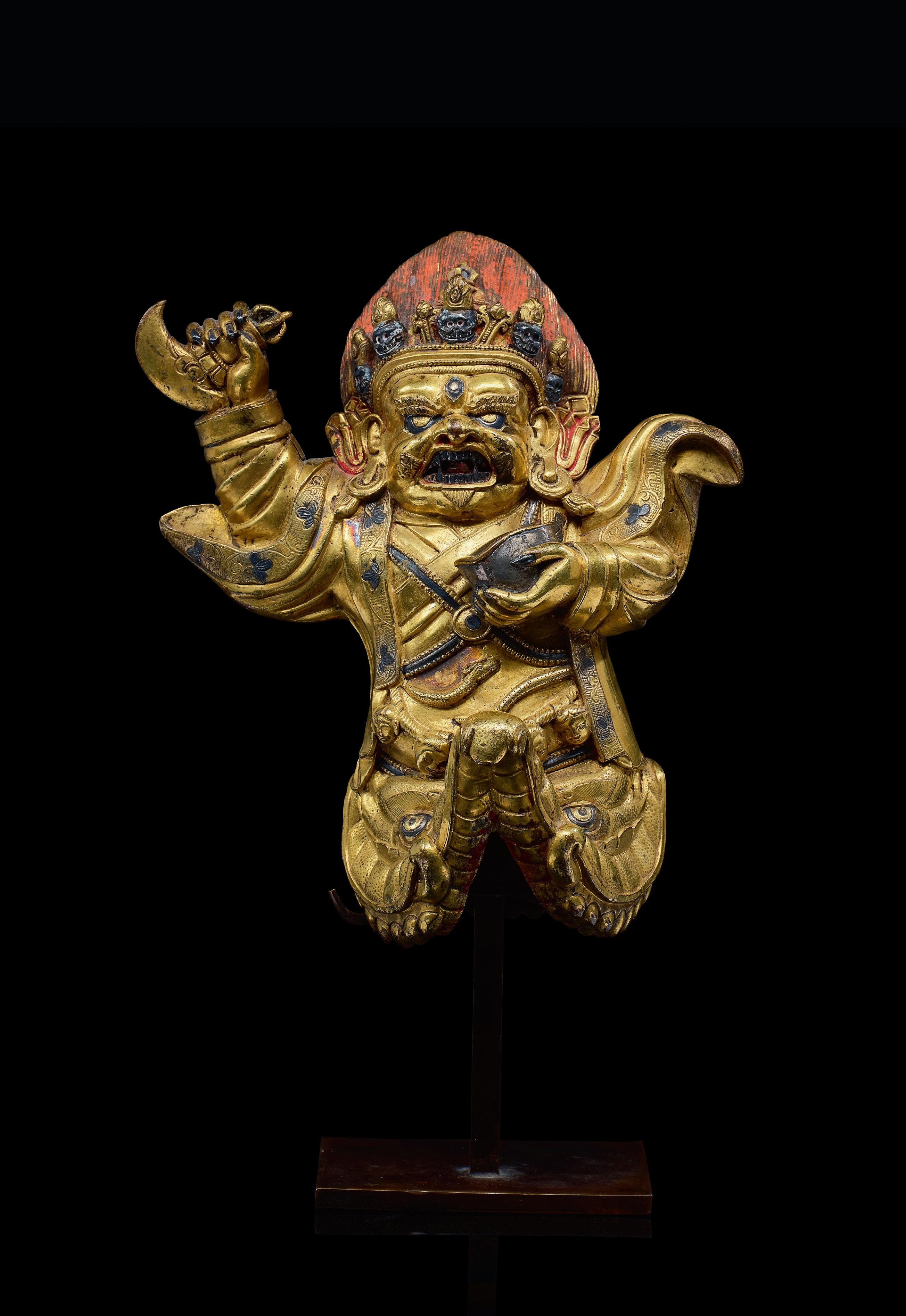
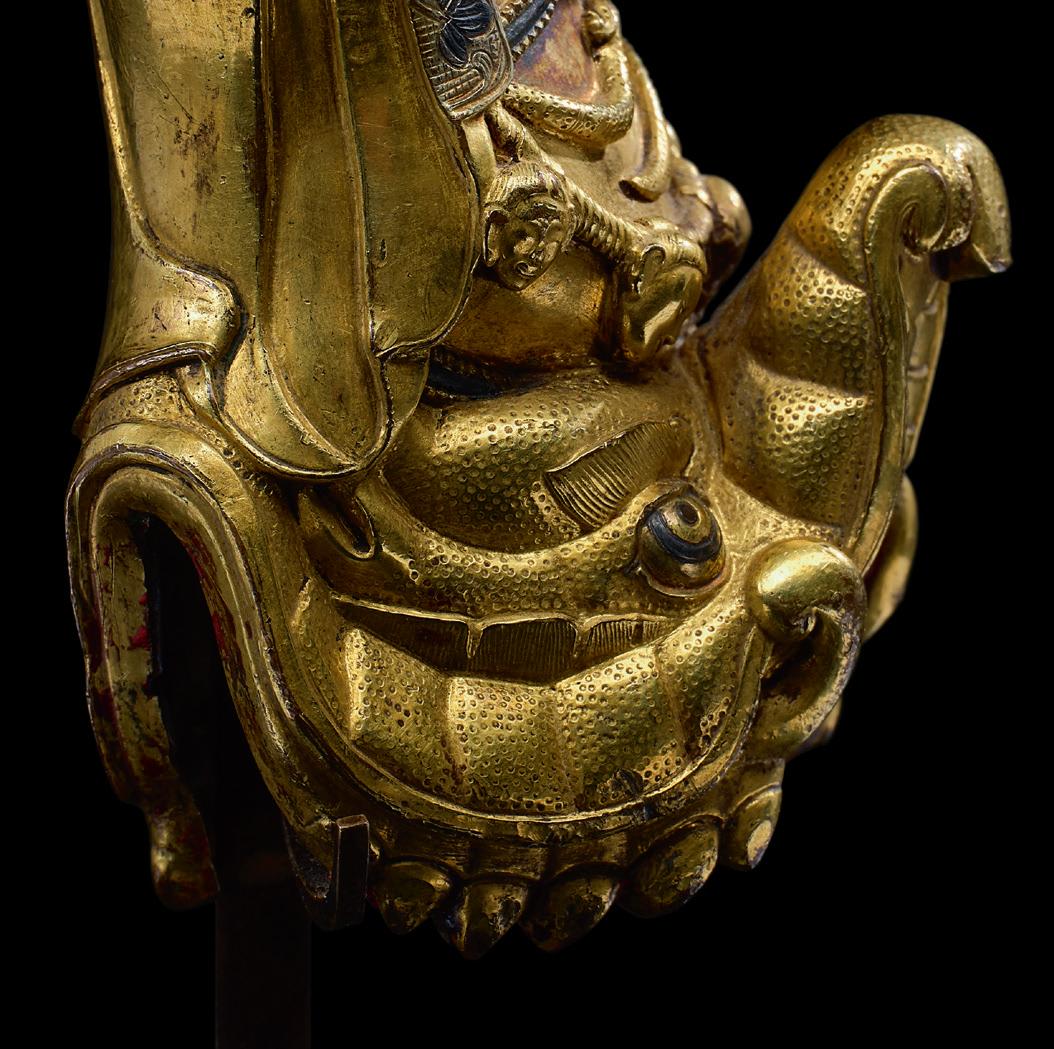
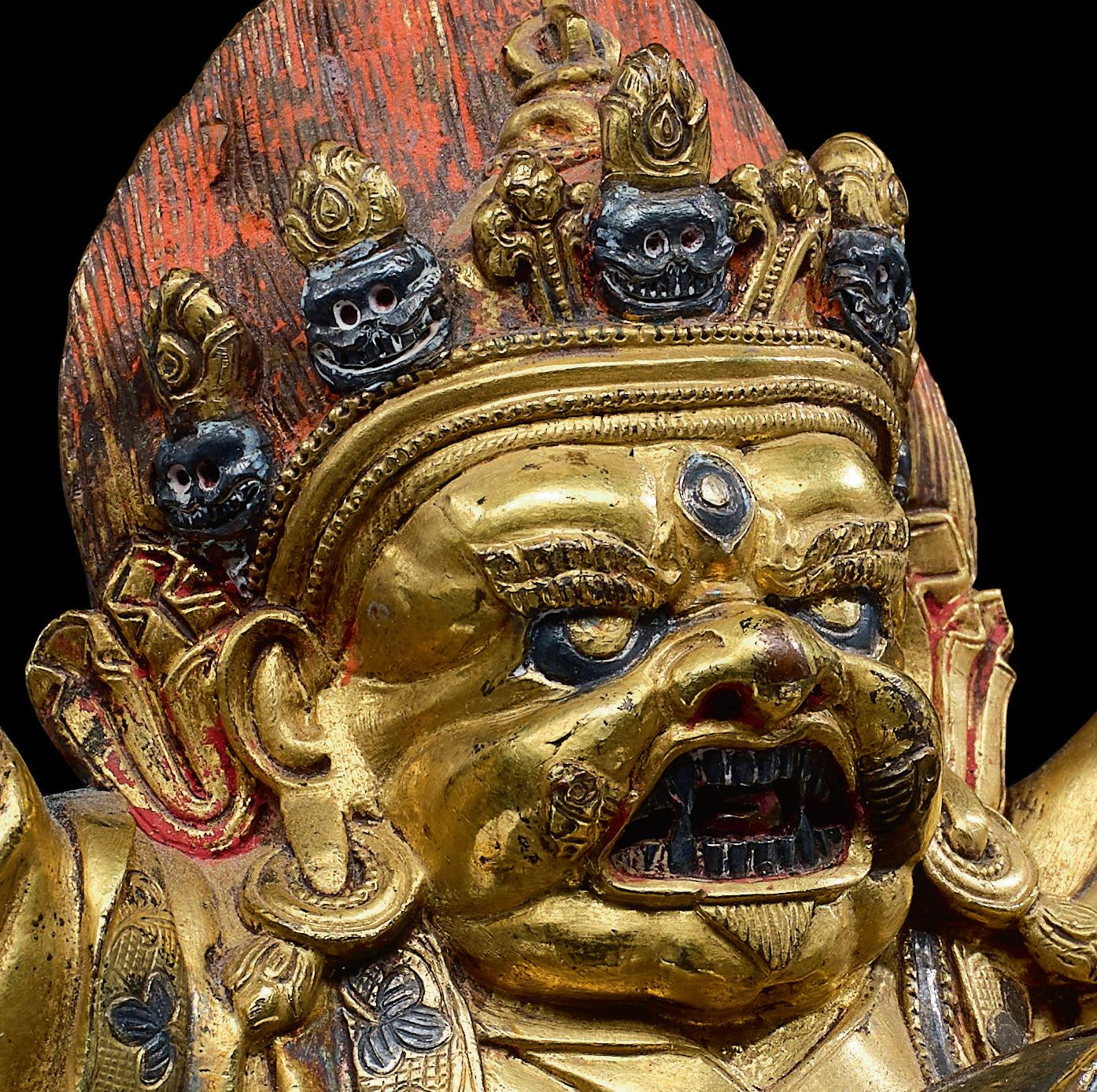
Bernagchen (« Manteau noir ») est un gardien de la Loi Bouddhique, considéré comme une forme spécifique de Mahakala. Il est issu de la tradition Nyingma, spécialement attaché à l’école Karma Kagyu (Kamtsang), et plus particulièrement à la protection personnelle des Karmapa. Il fut introduit dans le culte Karma Kagyu par le deuxième Karmapa Karma Pakshi (1206-1283). Les Karmapa, chefs spirituels de l’école Karma Kagyu, une des quatre traditions majeures du bouddhisme tibétain, sont une lignée d’enseignants successifs reconnus comme la première lignée de lamas réincarnés dans le bouddhisme tibétain.
Bernagchen (“the Great Black-Cloak”) is a guardian of Buddhist Law, considered as a specific form of Mahakala. He is especially attached to the Karma Kagyu (Kamtsang) school, and more specifically to the personal protection of the Karmapas. It was introduced into the Karma Kagyu cult by the second Karmapa Karma Pakshi (1206-1283). The Karmapas, spiritual leaders of the Karma Kagyu school, one of the four major traditions of Tibetan Buddhism, are a line of successive teachers recognized as the first line of reincarnated lamas in Tibetan Buddhism.
黑斗篷(« 黑衣 »)是佛教律法的守护者,被认为是大黑天的一种特殊 形式。他来自宁玛派传统,尤其依附于噶玛噶举派(堪桑派),特别是 噶玛巴的个人保护。它是由第二世噶玛巴噶玛白秋(1206-1283 年)传入 噶玛噶举派的。噶玛巴是藏传佛教四大传承之一噶玛噶举派的精神领 袖,是藏传佛教中公认的第一代转世喇嘛。
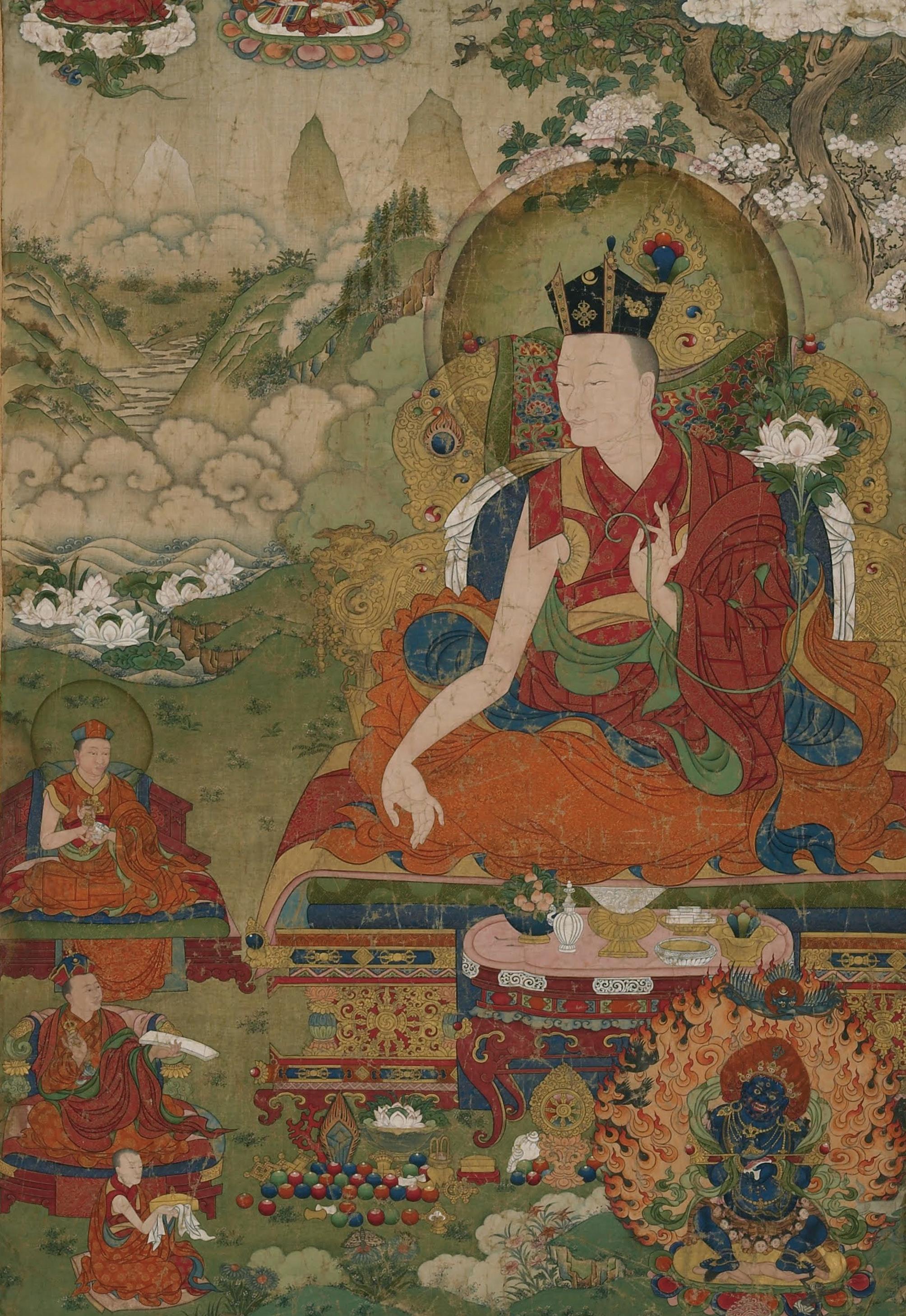
DYNASTIE QING (1644-1911)
QING DYNASTY (1644–1911)
清朝(1644–1911)
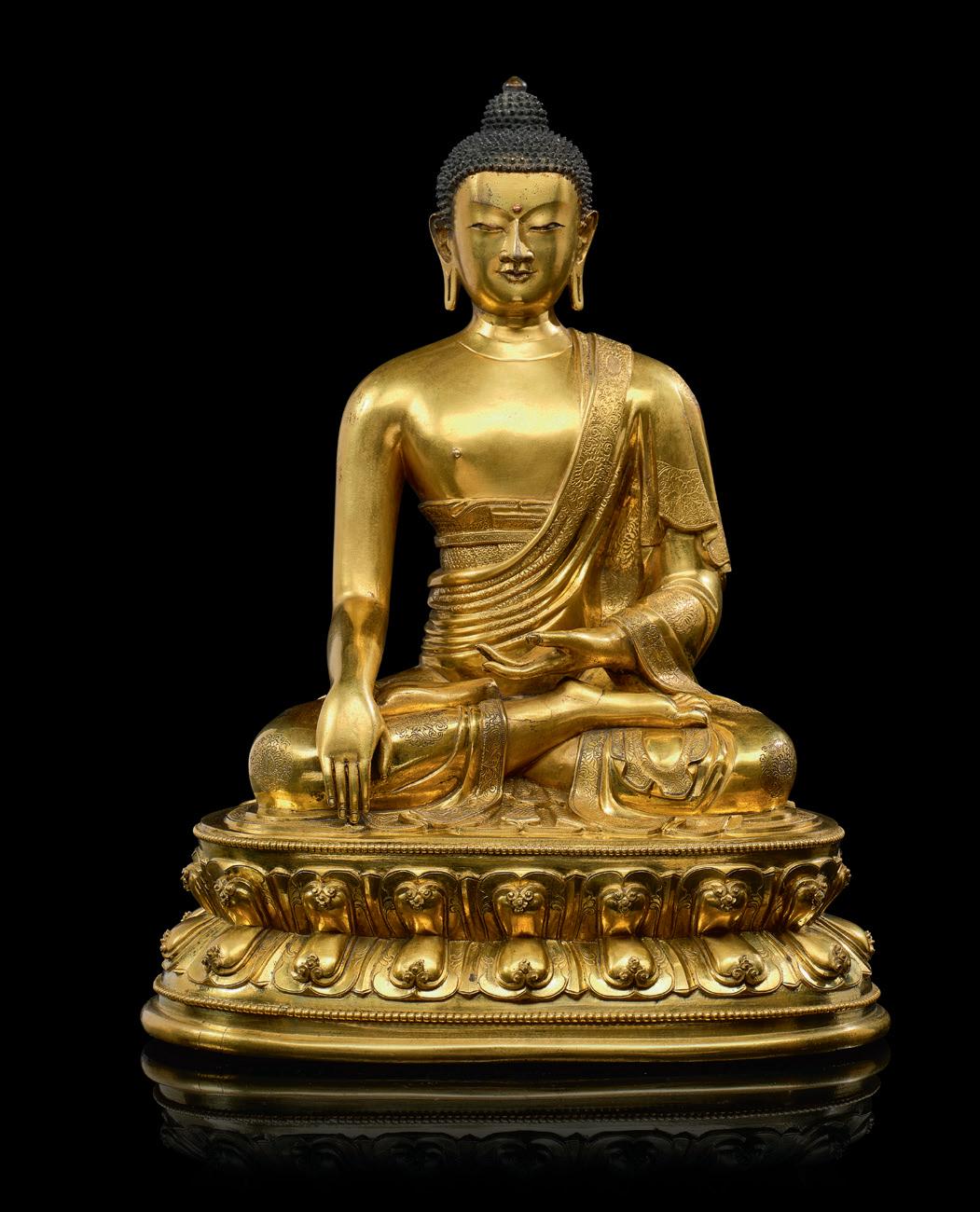
Art sacré et autorité impériale : le renouveau de la statuaire bouddhique sous la dynastie Qing En 1644, les Mandchous unis sous la bannière de Nuharchi, prennent le contrôle de Beijing, chassant l’usurpateur Li Zicheng, après le suicide de Chongzhen, dernier empereur de la dynastie Ming. Le tout jeune Shunzhi (r. 1644-1661), petit-fils de Nurhaci, monte alors sur le trône chinois et fonde la dynastie Qing. Les Mandchous sont issus d’un peuple nomade, les Jürchens, installés dans le nord de la Chine depuis le VIIIe, et ayant fondé l’éphémère dynastie Jin qui contrôla le nord-est du pays de 1115 à 1234.
Bien que d’origine étrangère, les empereurs Qing se sinisent très rapidement, reprenant les structures et les institutions bureaucratiques créées par les Ming, mais divisant le pouvoir entre Mandchous et Hans. Ils manient avec habileté les traditions religieuses chinoises pour légitimer leur autorité impériale, dans un empire multiethnique où l’empereur patronne et assume la responsabilité de toutes les religions et systèmes de croyance. Ils favorisent, comme leurs prédécesseurs Ming, les courants religieux qui se montrent utiles au maintien de l’ordre social et de la morale. Ainsi, le confucianisme encadre toujours la vie politique et morale de l’empire, dans la continuité du modèle Ming. Le taoïsme est délaissé par le pouvoir impérial à partir du règne de Qianlong (r. 1735-1796) mais il reste influent auprès de la population. Les Qing soutiennent activement à la fois le bouddhisme Mahāyāna chinois et surtout le bouddhisme tibétain Vajrayāna, qu’ils considèrent comme un outil de cohésion politique dans les régions frontalières (Tibet, Mongolie), se présentant donc comme des protecteurs du Dharma. Ils sont également attachés à cette doctrine d’un point de vue plus personnel. Ainsi, les empereurs Kangxi et Qianlong pratiquent le bouddhisme tibétain comme l’une de leurs religions familiales, édifiant de nombreux temples, et faisant de Beijing l’un des centres de cette religion. D’importants échanges se nouent entre l’empire chinois et le Tibet, via des ambassades diplomatiques et la venue de hauts dignitaires bouddhistes à la capitale. A partir de 1720, supplantant les Mongols, les Qing exercent sur le Tibet une influence politique désormais proche du protectorat.
C hine,
Sacred Art and Imperial Authority: The Revival of Buddhist Statuary under the Qing Dynasty
In 1644, the Manchus, united under the banner of Nurhaci, seized control of Beijing, ousting the usurper Li Zicheng following the suicide of the last Ming emperor, Chongzhen. The young Shunzhi Emperor (r. 1644–1661), Nurhaci’s grandson, ascended the Chinese throne and founded the Qing dynasty. The Manchus were descended from the Jurchens, a nomadic people who had settled in northern China since the 8th century and had previously established the short-lived Jin dynasty, which ruled the northeast from 1115 to 1234.
Though of foreign origin, the Qing emperors quickly adopted Chinese customs, reinstating the bureaucratic structures and institutions established under the Ming while dividing authority between the Manchus and the Han Chinese. They skilfully employed Chinese religious traditions to legitimise their imperial authority in a multi-ethnic empire, where the emperor was expected to patronise and assume responsibility for all religions and belief systems. Like their Ming predecessors, the Qing favoured religious traditions that contributed to maintaining social order and morality. Thus, Confucianism continued to shape the political and moral life of the empire in accordance with Ming precedent.
Taoism, although losing favour with the imperial court from the reign of the Qianlong Emperor (r. 1735–1796) onwards, remained influential among the general populace. The Qing actively supported both Chinese Mahāyāna Buddhism and, above all, Tibetan Vajrayāna Buddhism, which they regarded as a tool for political cohesion in the border regions (Tibet, Mongolia). They thus presented themselves as protectors of the Dharma. On a more personal level, emperors such as Kangxi and Qianlong practised Tibetan Buddhism as one of their household religions, commissioning the construction of numerous temples and establishing Beijing as a major centre of the faith. Significant exchanges took place between the Chinese empire and Tibet, through diplomatic missions and the arrival of high-ranking Buddhist dignitaries at the capital. From 1720 onwards, having supplanted the Mongols, the Qing exercised a form of political control over Tibet approaching that of a protectorate.
神圣艺术与皇权: 清代佛教造像的复兴 1644年,满族在努尔哈赤的旗帜下统一,由其孙顺治皇帝(在位1644–1661 )登上中国皇位,正式建立清朝。他们攻占北京,驱逐篡位者李自 成,此前明朝最后一位皇帝崇祯自尽。满族起源于女真,是自8世纪以 来居住在中国北方的游牧民族,曾建立短暂存在的金朝(1115–1234), 统治中国东北地区。
尽管属外族出身,清代皇帝迅速汉化,沿袭明朝所建立的官僚体系与制 度,并在权力分配上维持满汉共治的格局。他们巧妙运用中国宗教传统 来巩固自己的皇权合法性。在这个多民族帝国中,皇帝是各宗教与信仰 体系的庇护者与守护者。与前朝明朝类似,清廷鼓励那些有助于维持 社会秩序与道德的宗教流派。因此,儒家思想继续规范帝国的政治与 道德生活。自乾隆皇帝(在位1735–1796)起,道教逐渐被皇权边缘化, 尽管在民间仍具影响力。
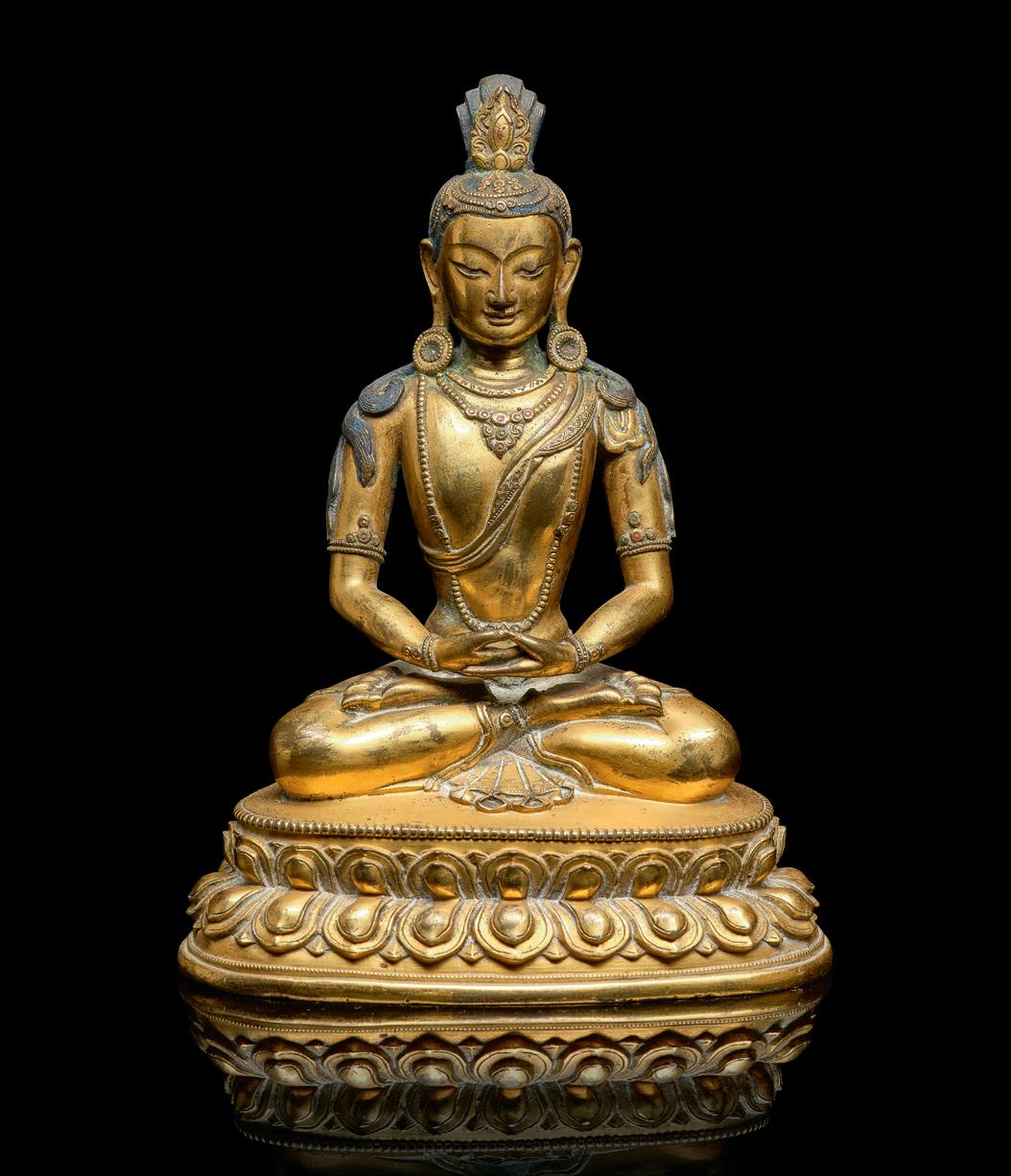
C hine,
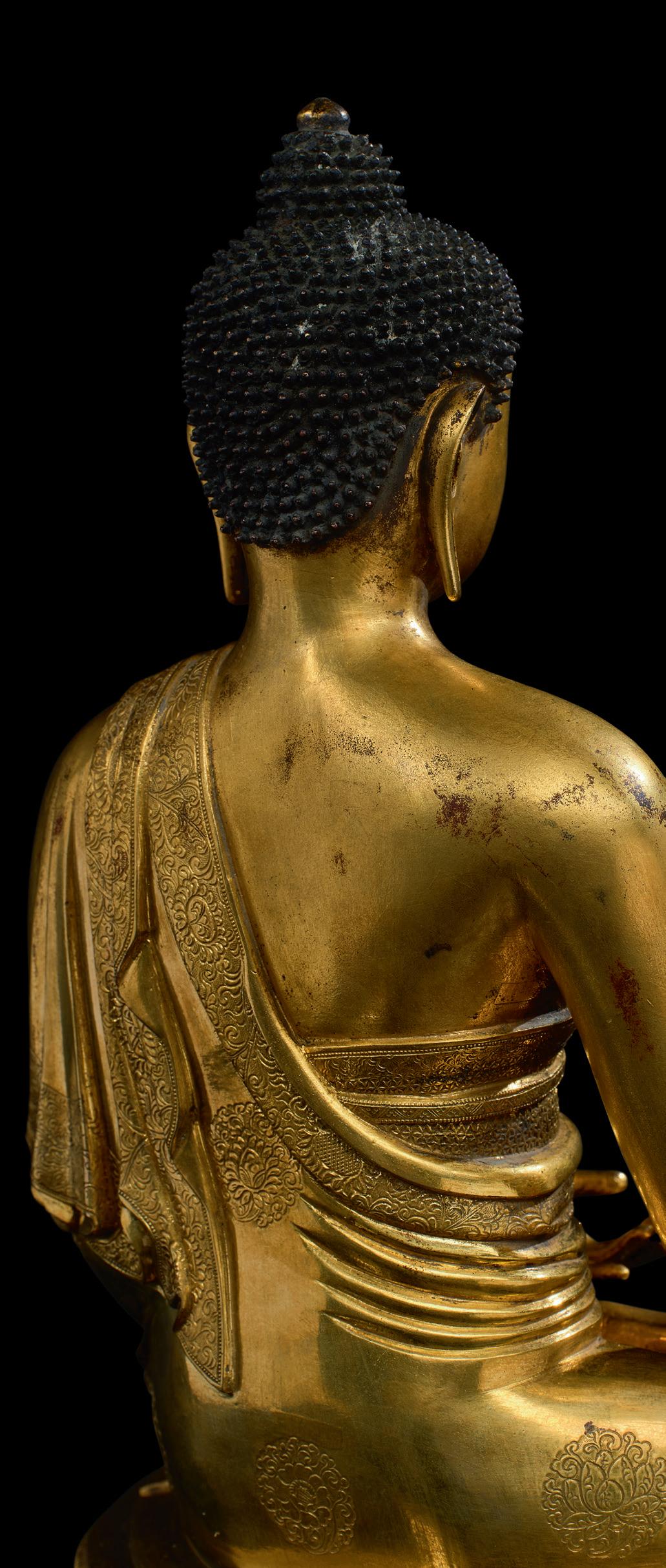
Durant le XVIIIe siècle, l’art du bronze bouddhique connaît un renouveau marqué, nourri par le mécénat impérial et les prouesses techniques des ateliers de cour. La sculpture religieuse en bronze devient un vecteur privilégié de l’expression du sacré, mais aussi de l’affirmation du pouvoir impérial et du syncrétisme religieux au sein de l’empire multiethnique des Qing.
Dans ce contexte, les statues de divinités bouddhiques en bronze doré se multiplient dans les chapelles privées des palais, les temples impériaux, et les centres religieux comme le Yonghegong à Beijing. Les bronzes bouddhiques des Qing se distinguent par un style très maîtrisé, souvent hérité des modèles tibétains du XVe siècle, mais adapté aux goûts de la cour manchoue. Les bronzes peuvent varier en taille — de petites statuettes de dévotion privée à des figures monumentales de plusieurs mètres — mais répondent toujours à une iconographie standardisée et à une finition luxueuse.
Pour répondre à une demande grandissante, l’empire développe un vaste réseau d’ateliers dédiés à la production d’art sacré, avec des ateliers impériaux au sein même de la Cité Interdite, mais également dans les marches de l’empire, notamment à Dolonnor, grand centre de production d’images bouddhiques en Mongolie Intérieure.
L’empereur Qianlong lui-même participe à cette effervescence : il commande d’importantes séries de bronzes pour des temples chinois, tibétains et mongols mais également pour des évènements à la cour (anniversaires, ambassades…). Cette pratique témoigne du rôle politique que joue l’art sacré bouddhique dans la stratégie impériale Qing.
Chine, dynastie Qing, XVIII e siècle. ©A guttes, vente du 12 juin 2025
During the 18th century, the art of Buddhist bronze sculpture experienced a marked revival, nourished by imperial patronage and the technical virtuosity of court workshops. Religious bronze sculpture became a privileged medium for expressing the sacred, as well as for asserting imperial power and religious syncretism within the Qing’s multi-ethnic empire.
In this context, gilt-bronze statues of Buddhist deities proliferated in private palace chapels, imperial temples, and religious centres such as the Yonghegong in Beijing. Qing Buddhist bronzes are characterised by their highly refined style, often drawing upon 15 th -century Tibetan models while being adapted to the aesthetic preferences of the Manchu court. The bronzes vary in scale—from small devotional figures for private worship to monumental statues several metres high—but always adhere to standardised iconography and exhibit a luxurious finish.
To meet the growing demand, the empire developed an extensive network of workshops dedicated to the production of sacred art, including imperial workshops within the Forbidden City itself and regional workshops in the empire’s frontier areas, most notably at Dolonnor, a major centre for the production of Buddhist images in Inner Mongolia.
The Qianlong Emperor personally contributed to this cultural effervescence: he commissioned significant series of bronze sculptures for Chinese, Tibetan, and Mongolian temples, as well as for court occasions such as birthdays and diplomatic missions. This practice illustrates the political role played by sacred Buddhist art within the Qing imperial strategy.
清朝尤其大力扶持汉传大乘佛教与藏传佛教(金刚乘),将后者视为在 西藏、蒙古等边疆地区实现政治凝聚力的重要工具,自诩为佛法的护持 者。这种支持并非单纯出于政治考量,也反映了皇室成员的个人信仰。康 熙与乾隆皇帝皆将藏传佛教作为家族宗教之一,主持修建大量寺庙,并 使北京成为该宗教的重要中心。中藏之间展开频繁交流,既有外交使团 往来,也有高僧大德前往京师。自1720年起,清朝取代蒙古势力,在西藏 确立起接近保护国地位的政治影响力。
18世纪,佛教铜造像艺术在清廷的扶持与宫廷工坊的卓越技艺推动下, 迎来显著复兴。铜制宗教雕像不仅是神圣性的象征,也成为皇权显现与 帝国多元宗教融合的重要媒介。
在这一背景下,镀金佛教神祇铜像广泛分布于宫廷私室佛堂、皇家寺庙 与诸如北京雍和宫等宗教中心。这些造像在风格上极为精致,常借鉴15 世纪的藏地典范,同时融合满洲皇室的审美趣味。铜像尺寸不一——从 用于私人供奉的小型神像到高达数米的巨大雕像——但始终遵循规范 化的图像体系与华丽的制作工艺。
为满足日益增长的需求,清帝国构建起庞大的神圣艺术生产网络,在 紫禁城内部设有御用造像工坊,边疆地区如内蒙古多伦诺尔(今多伦) 亦成为重要的佛像制造中心。
乾隆皇帝本人也积极参与这场艺术热潮。他为汉地、藏地、蒙古等地 寺庙大规模订制铜像,并将其作为宫廷庆典(如寿辰、外交使团访问) 中的重要礼物。这种做法充分体现了佛教圣像在清朝政治策略中所扮 演的独特角色。
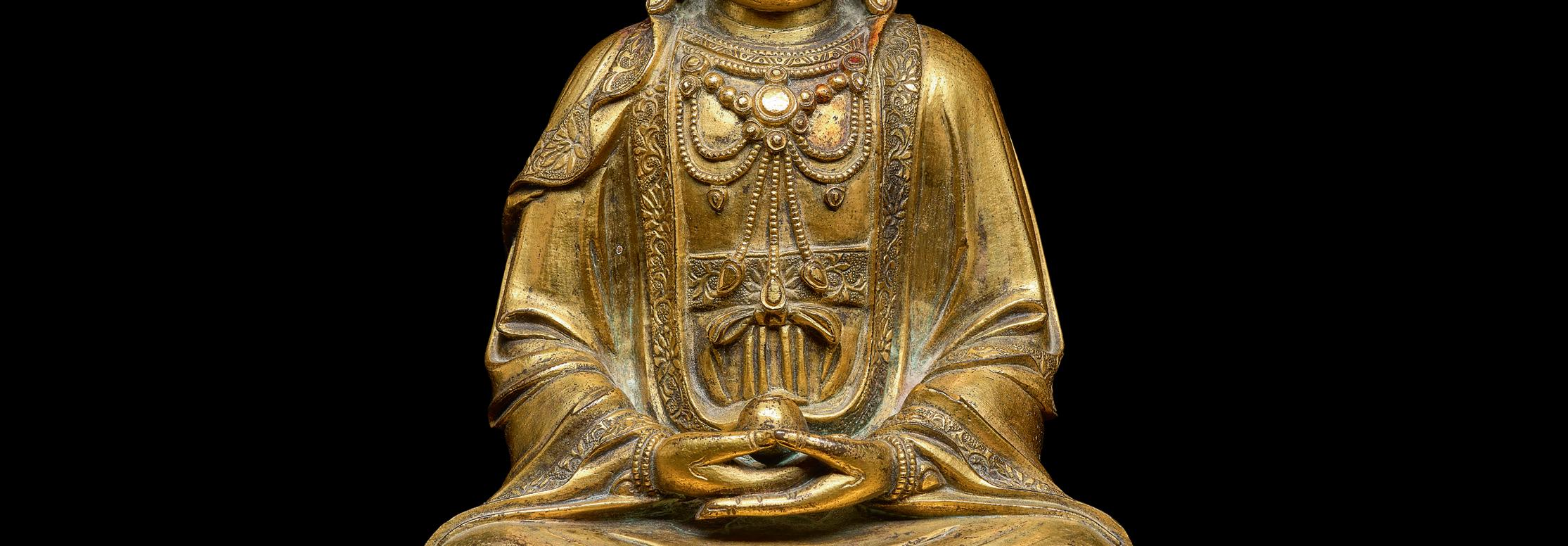
SINO-TIBETAIN
DYNASTIE
QING, XVIIIe SIÈCLE
STATUE D’AMITAYUS EN BRONZE DORÉ,
SINO-TIBETAN
QING DYNASTY, 18th CENTURY
A GILT-BRONZE AND SILVER PHURBA RITUAL DAGGER HANDLE
清代
18 世纪
无量寿佛鎏金铜像
Statue d’Amitayus en bronze doré, le bouddha assis en vajrasana sur une double base lotiforme, les mains reposant en dhyanamudra sur les jambes, paré de nombreux bijoux et d’écharpes flottantes, la tête ceinte d’une couronne à cinq fleurons, le visage rond, la bouche petite, les yeux mi-clos étirés.
La base scellée et gravée d’un double vajra.
H. 17,5 cm
A gilt-bronze figure of Amitayus, seated in vajrasana on a double-lotus base, his hands are resting in dhyanamudra on the legs, he is adorned with numerous jewels and floating scarves, the head crowned with an elaborate crown, with a round face, small mouth and half-closed eyes. The base is sealed and engraved with a double vajra.
H. 17.5 cm
阿弥陀佛鎏金铜像,佛像坐于金刚座上,双层莲花形底座,双手结禅定印于腿上,头戴五花 冠,面部圆润,嘴巴小巧,眼睛半闭伸直。底座密封,刻有双金刚杵。 高 17.5 厘米
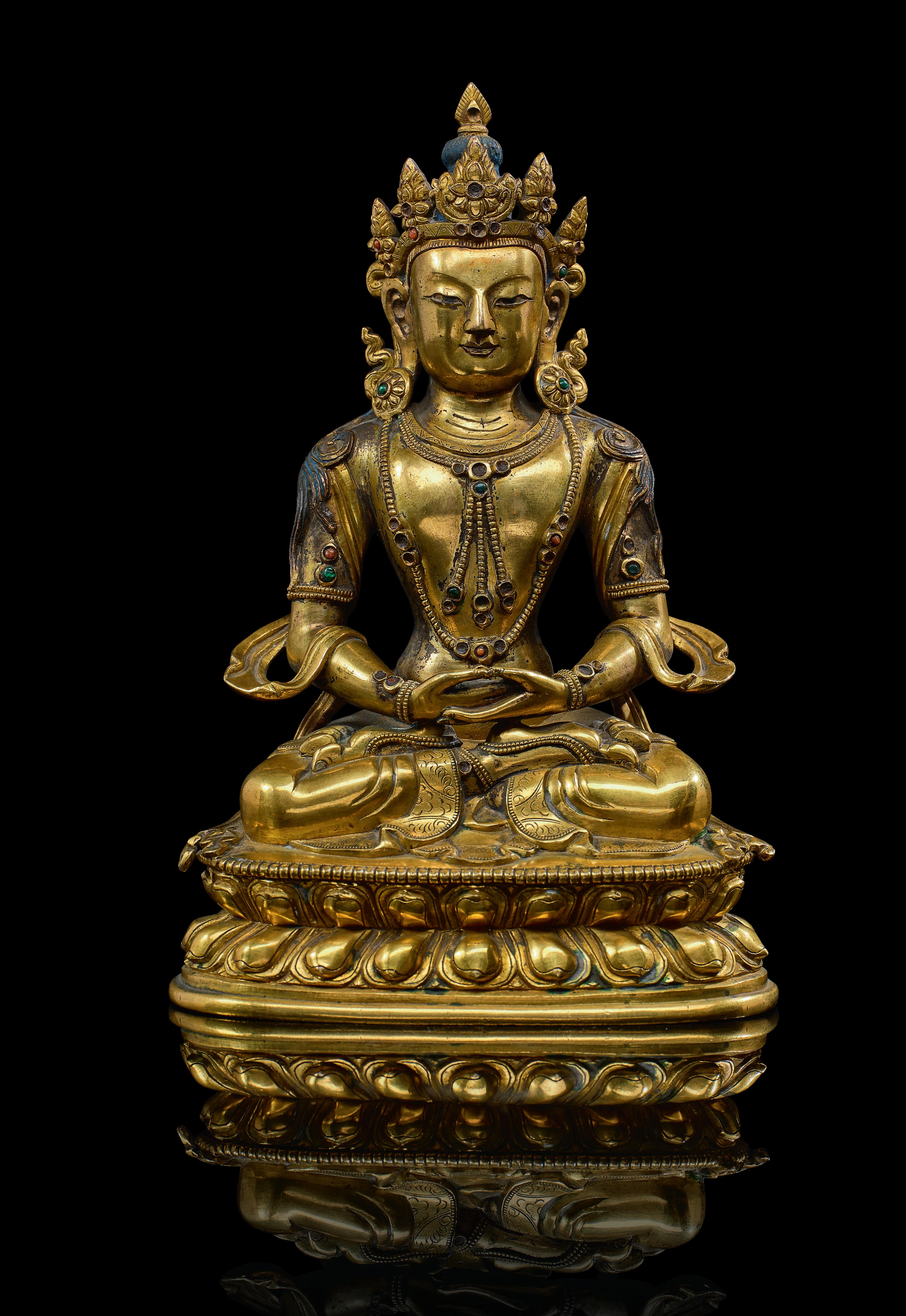
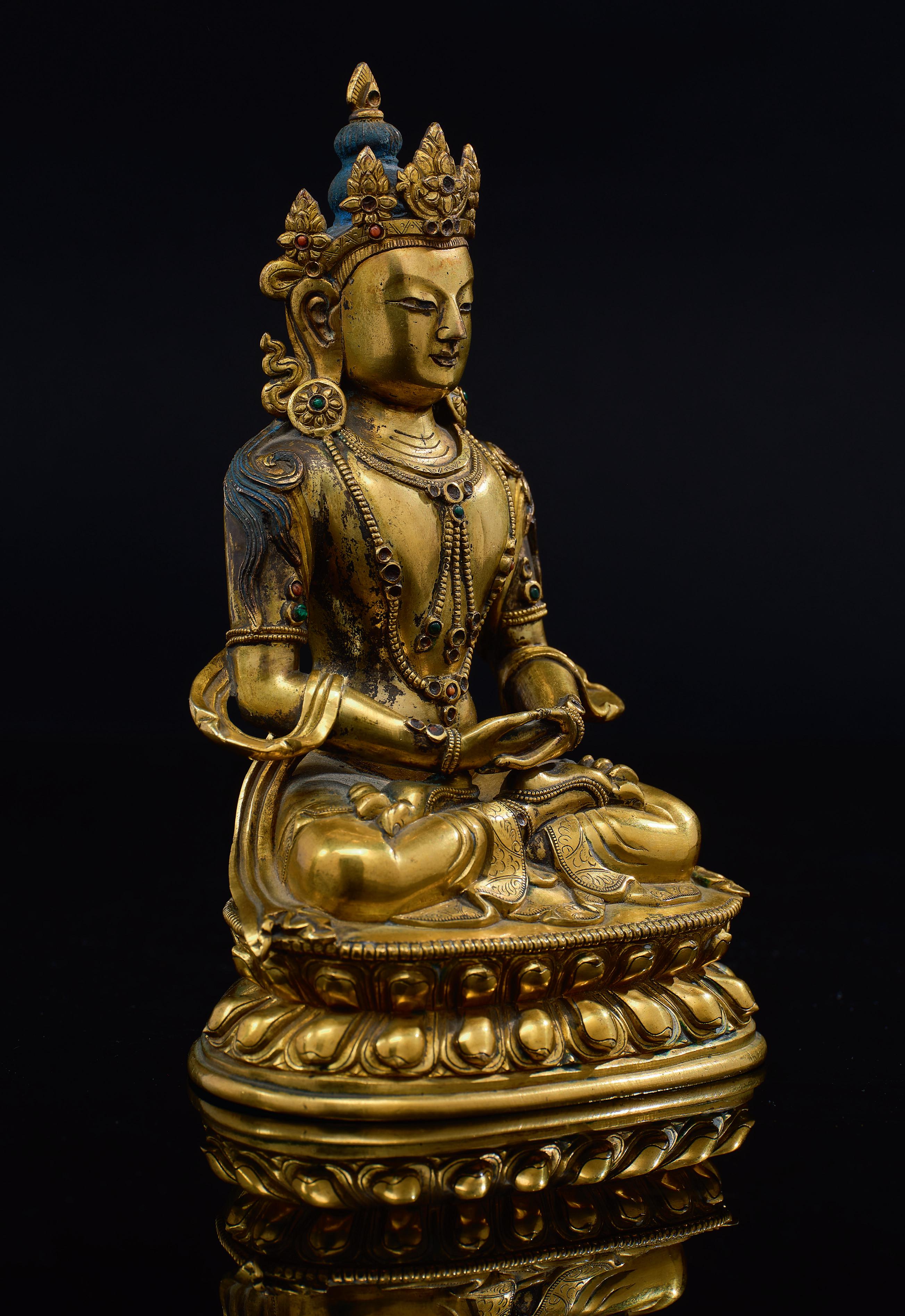
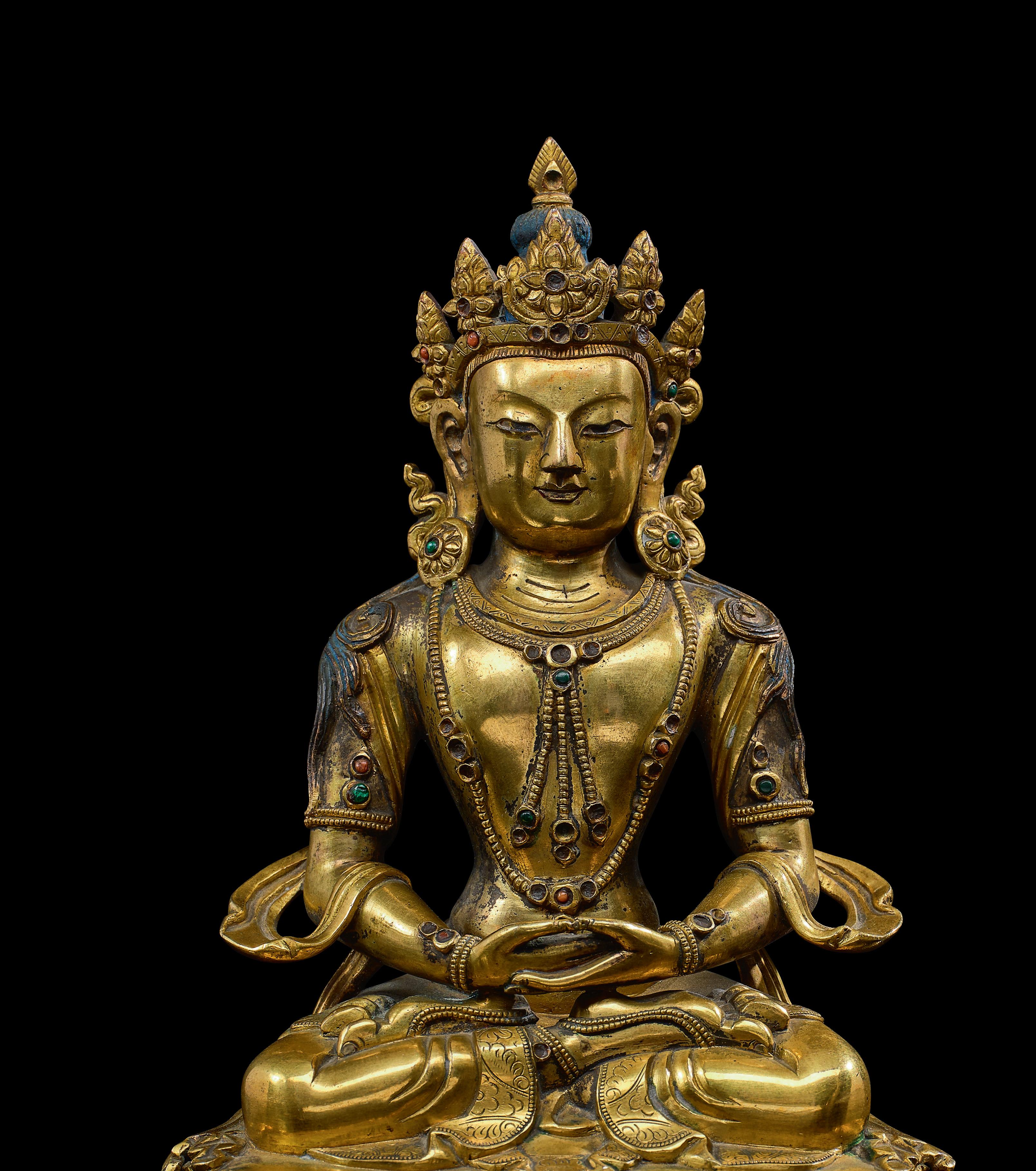
SINO-TIBETAIN
DYNASTIE QING, XVIIIe SIÈCLE
STATUE D’AMITAYUS EN BRONZE DORÉ
SINO-TIBETAN
QING DYNASTY, 18th CENTURY A GILT-BRONZE FIGURE OF AMITAYUS
清代
18 世纪
无量寿佛鎏金铜像
Statue d’Amitayus en bronze doré, le bouddha assis en vajrasana sur une double base lotiforme, les mains reposant en dhyanamudra sur les jambes, paré de nombreux bijoux et d’écharpes flottantes, la tête ceinte d’une couronne à cinq fleurons, le visage rond, la bouche petite, les yeux mi-clos. La base non scellée.
H. 17 cm
A gilt-bronze figure of Amitayus, seated in vajrasana on a double-lotus base, his hands are resting in dhyanamudra on the legs, he is adorned with numerous jewels and floating scarves, the head is crowned with an elaborate crown, with a round face, small mouth and half-closed eyes. The base is unsealed. H. 17 cm
阿弥陀佛鎏金铜像,佛像坐于金刚座上,双层莲花形底座,双手合十于双腿上,头戴五花 冠,面庞圆润,嘴很小,眼睛半闭。底座未密封。 高 17 厘米
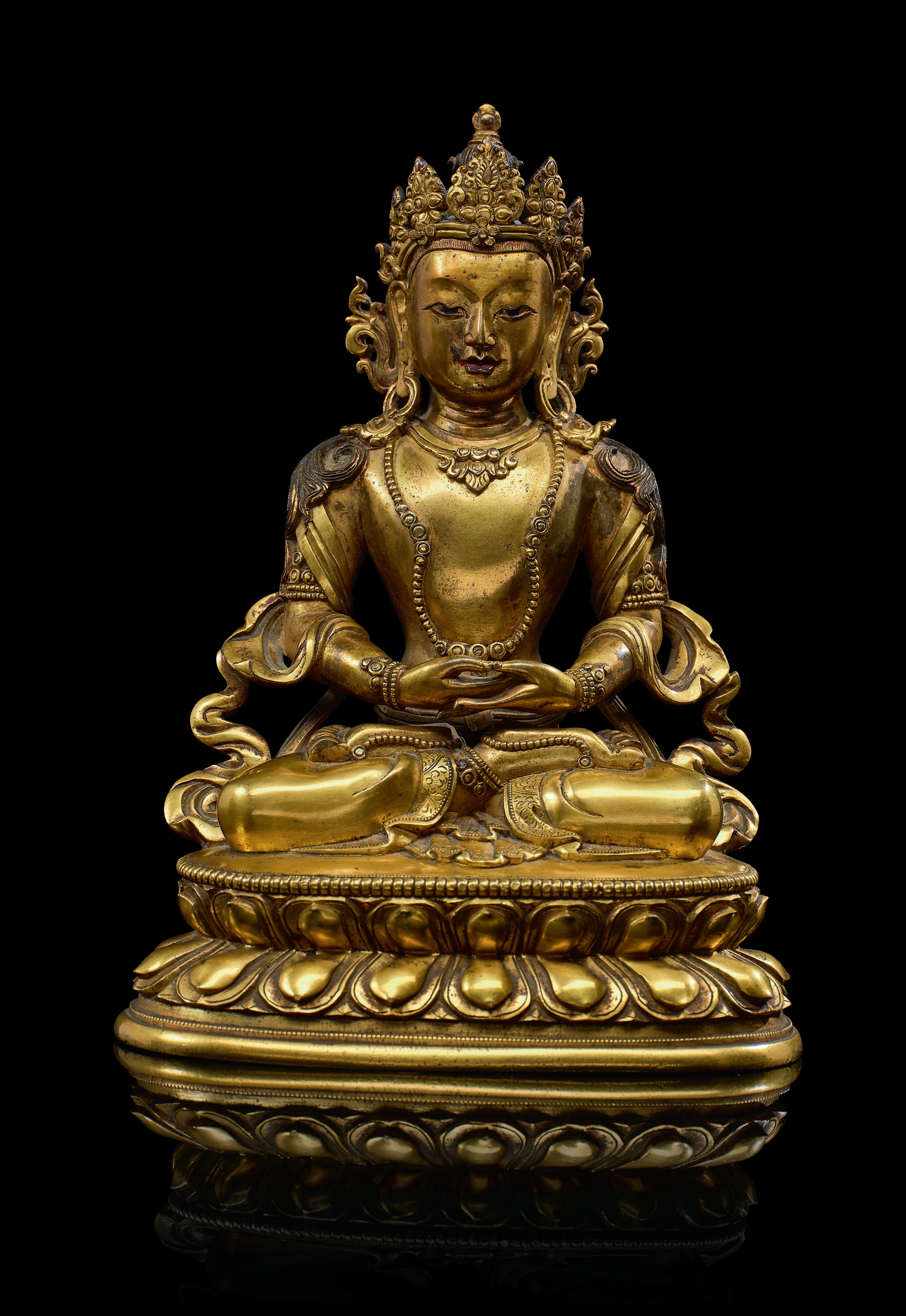
SINO-TIBETAIN
XVIIIe-XIXe SIÈCLE
STATUETTE DE VAJRAPANI EN BRONZE DORÉ
SINO-TIBETAN
QING DYNASTY, 18-19th CENTURY
A GILT-BRONZE FIGURE OF VAJRAPANI
清代
18-19 世纪
镀金青铜金刚手菩萨像
Statuette de Vajrapani en bronze doré, le bodhisattva figuré dans sa forme courroucée, debout en pratyalidhasana sur une base lotiforme, piétinant un démon à tête d’éléphant tenant un kapala, la main droite brandissant originellement un vajra, la main gauche en karana mudra. Le visage féroce, surmonté par une chevelure hirsute orange et couronné de crânes, vêtu d’une peau de tigre et d’une longue écharpe flottante, paré de nombreux bijoux, un serpent et d’un long collier de têtes coupées autour du cou. La base scellée incisée d’un double vajra.
H. 12,5 cm
A gilt-bronze figure of Vajrapani, in his wrathful form, standing in pratyalidhasana on a lotus base, trampling an elephant-headed demon holding a kapala, the right hand originally brandishing a vajra, the left hand in karana mudra. The fierce face, framed by a mane of flaming orange hair and crowned with skulls, dressed in tiger skin and a long floating scarf, adorned with numerous jewels, a snake and a long necklace of severed heads around the neck. The sealed base is incised with a double vajra. H. 12.5 cm
镀金青铜金刚手菩萨像,菩萨呈忿怒状,以 反曲站立姿势 站立在莲花形底座上,踩踏着一 个手持卡帕拉的象头恶魔,右手原本挥舞着金刚杵,左手则是 "驱魔印"泥菩萨式。狰狞的面孔 顶着蓬松的橙色头发,头戴骷髅冠,身披虎皮和飘逸的长巾,脖子上挂着一条蛇和一串长长 的断头项链,饰有无数珠宝。密封底座上刻有双金刚杵。 高 12.5 厘米
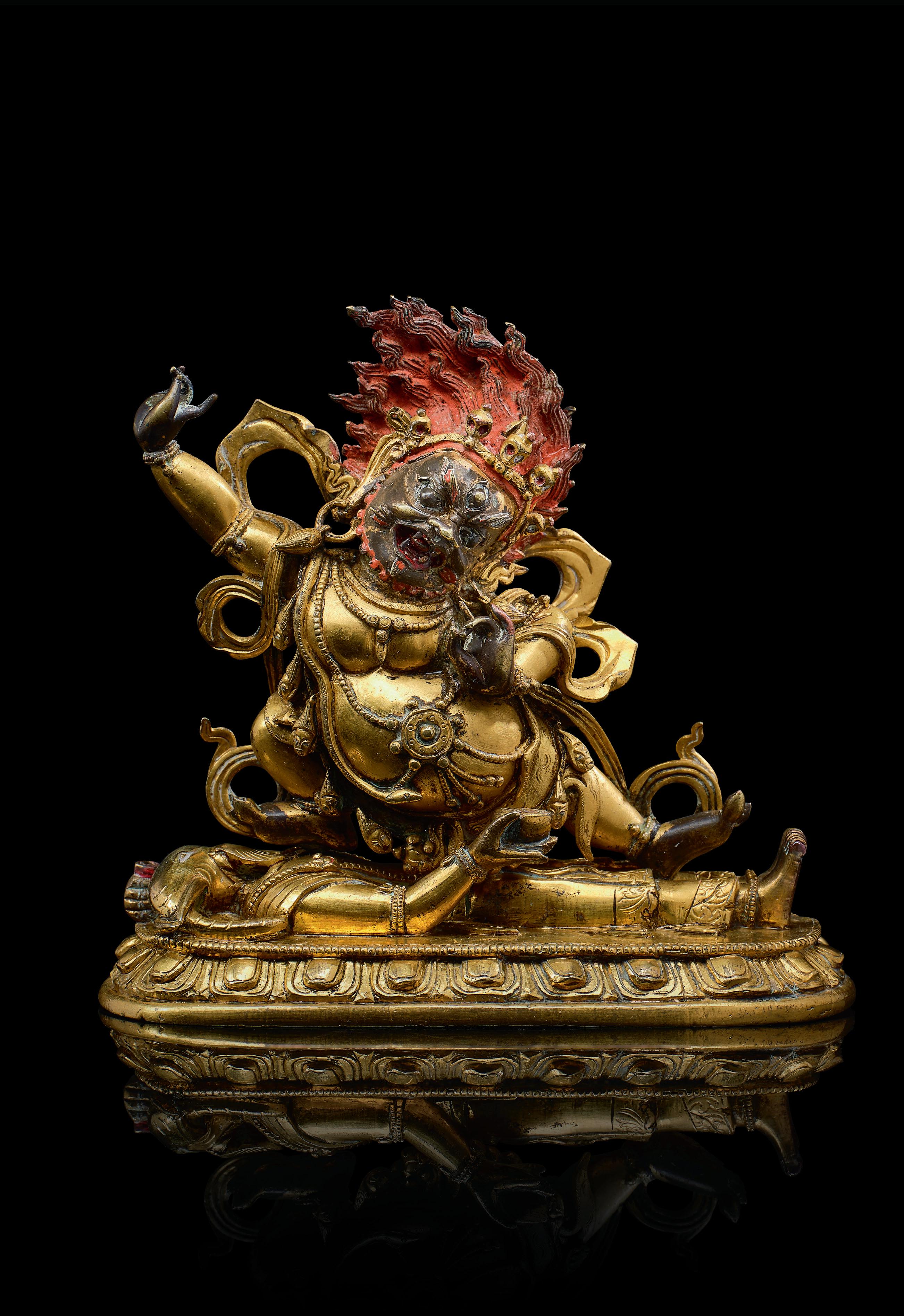
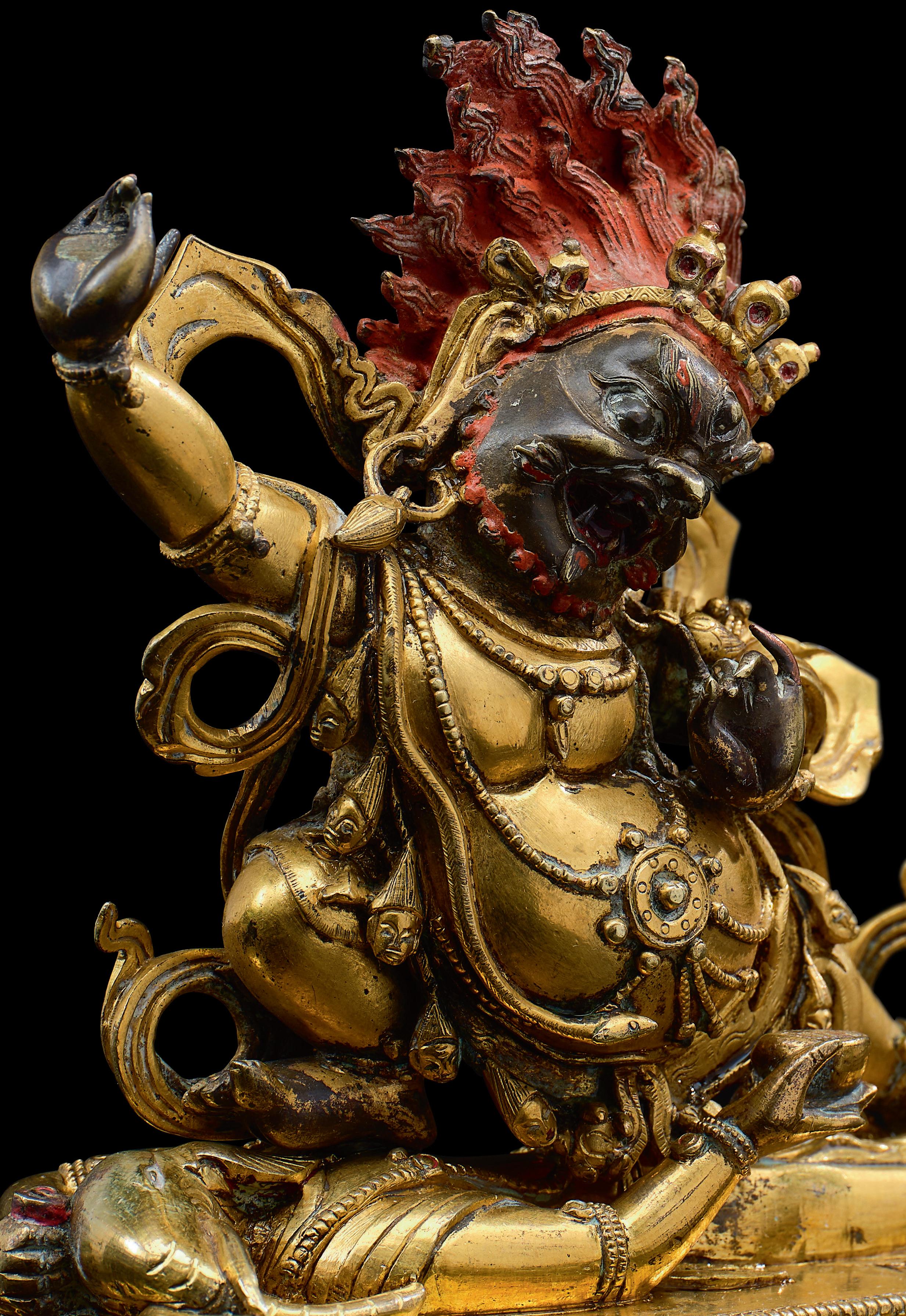
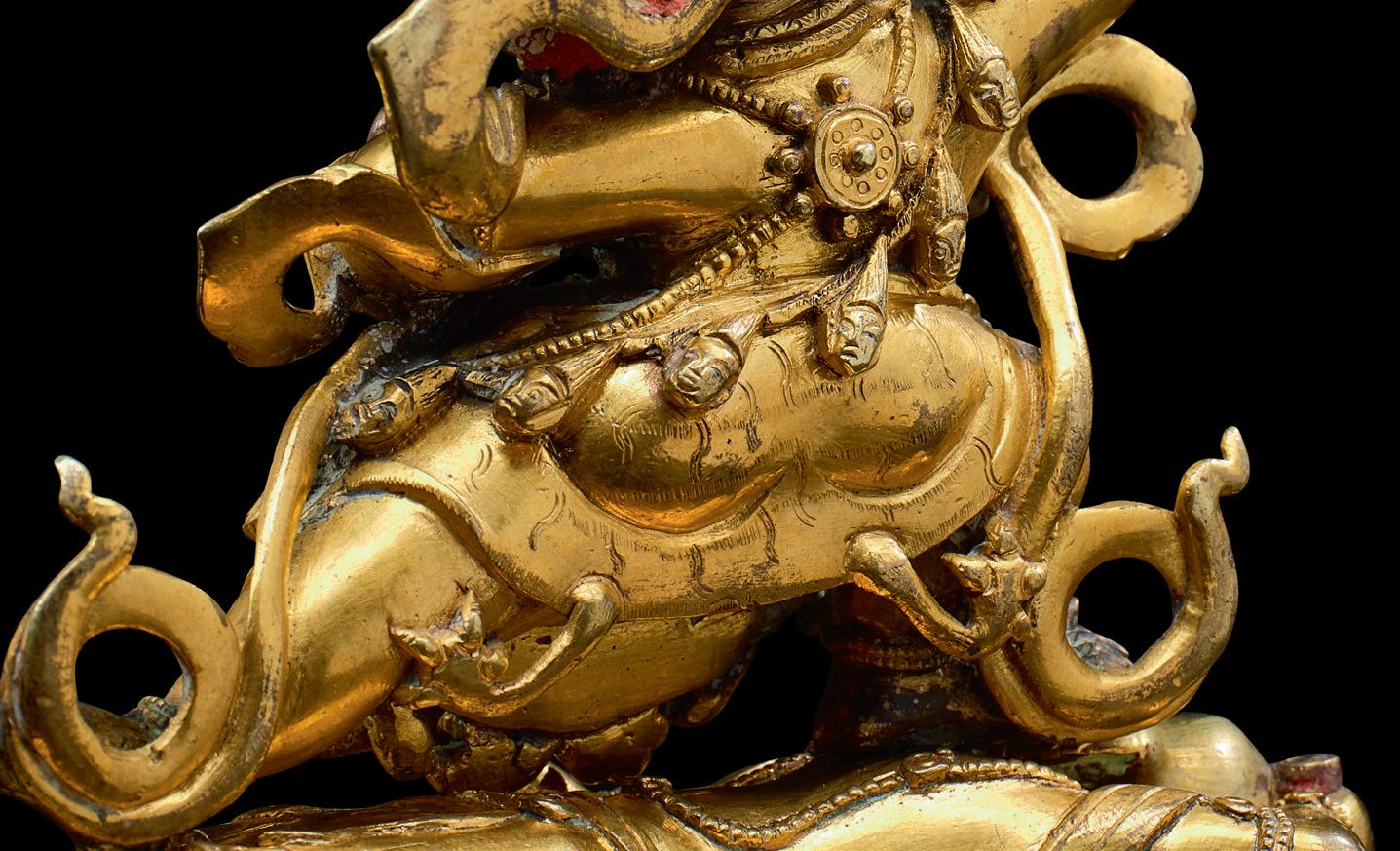
Vajrapani, littéralement « Porteur de vajra », est d’un des grands bodhisattvas du bouddhisme vajrayana. Il est reconnu comme une émanation d’Akshobhya, l’un des cinq bouddhas de méditation, porteur de la force et du pouvoir des bouddhas. Il peut aussi être considéré comme la forme courroucée du Bouddha primordial Vajradhara ou Vajrasattva, et est connu alors sous le nom de Guhyapati, le « Seigneur des secrets ». Il est regardé comme le principal destinataire, détenteur et protecteur de l’ensemble des textes, de la littérature et des enseignements tantriques reçus du Bouddha Shakyamuni.
Vajrapani, literally “Vajra in [his] hand”, is one of the great bodhisattvas of Vajrayana Buddhism. He is an emanation of Akshobhya, one of the five Buddhas of meditation, and the bearer of the strength and power of the Buddhas. He can also be seen as the wrathful form of the primordial Buddha Vajradhara or Vajrasattva, and is then known as Guhyapati, the “Lord of Secrets”. He is regarded as the principal recipient, holder and protector of all the texts, literature and tantric teachings received from Shakyamuni Buddha.
金刚手,字面意思为 « 金刚持»,是金刚乘佛教的大菩萨之一。他被认为 是禅定五佛之一阿閦佛的化身,是诸佛力量和法力的承载者。他也可以 被视为原始佛陀金刚手或金刚萨埵的忿怒形态,被称为 “秘密之主 ” 古亚帕提(Guhyapati)。他被视为从释迦牟尼佛那里接受的所有典籍、 文献和密宗教义的主要接受者、持有者和保护者。
REMERCIEMENTS
Nous tenons à remercier infiniment les personnes qui ont participées au succès de cet évènement et tout particulièrement nos généreux collectionneurs particuliers pour leur confiance dans ce prêt ponctuel.
Cette exposition, organisée à l’occasion du Printemps Asiatique a été le témoin d’une conférence qui s’est tenue le 11 juin 2025 et nous tenons à remercier chacun pour sa participation et notamment :
Charlotte Aguttes-Reynier pour sa ferveur inaltérable envers les Arts d’Asie.
Philippine Dupré La Tour, directeur général Aguttes pour son hospitalité et son soutien.
Pour leur sérieux et leur implication Alice Gourier - Kuczynski et Isabelle Sery, graphistes.
Rodolphe Alepuz et Henri Ducray, photographes pour leur talent et leur disponibilité.
Jade Belgrand, administratrice pour son enthousiasme et sa bonne humeur.
Et bien évidemment l’ensemble des équipes Aguttes et tout particulièrement, Clémence Lépine, directeur communication, Romane Clayeux, catalogueur, Laurent Prisse, logisticien.
致谢
我们衷心感谢所有为本次活动成功举办作出贡献的朋友,特别感谢慷慨 出借藏品的私人收藏家们,感谢他们对我们的信任与支持。
此次展览是为“亚洲艺术春季周”特别策划,并于2025年6月11日举办了 一场专题讲座。在此,我们诚挚感谢所有参与者,尤其是:
Charlotte Aguttes-Reynier 对亚洲艺术始终如一的热情
Philippine Dupré Latour,Aguttes拍卖行总经理,感谢她的热情接待与 坚定支持
Alice Gourier – Kuczynski 与 Isabelle Sery(平面设计师)对工作的认 真投入
Rodolphe Alepuz 与 Henri Ducray(摄影师)展现出的专业才华与配合精神 Jade Belgrand(行政协调)带来的热情与阳光心态 当然,我们还要感谢 Aguttes 全体团队成员,特别是:传播总监 Clémence Lépine、图录编辑 Romane Clayeux、物流负责人 Laurent Prisse
ACKNOWLEDGEMENTS
We would like to extend our heartfelt thanks to everyone who contributed to the success of this event, and in particular to our generous private collectors for their trust in agreeing to this special loan.
This exhibition, organised on the occasion of Printemps Asiatique, was marked by a conference held on 11 June 2025, and we would like to thank all participants, including:
Charlotte Aguttes-Reynier, for her unwavering passion for Asian Art
Philippine Dupré Latour, Managing Director at Aguttes, for her hospitality and support
Alice Gourier - Kuczynski and Isabelle Sery, graphic designers, for their dedication and commitment
Rodolphe Alepuz and Henri Ducray, photographers, for their talent and availability
Jade Belgrand, administrator, for her enthusiasm and cheerful spirit
And of course, the entire Aguttes team, with special thanks to Clémence Lépine, Communications Director, Romane Clayeux, cataloguer, and Laurent Prisse, logistics coordinator
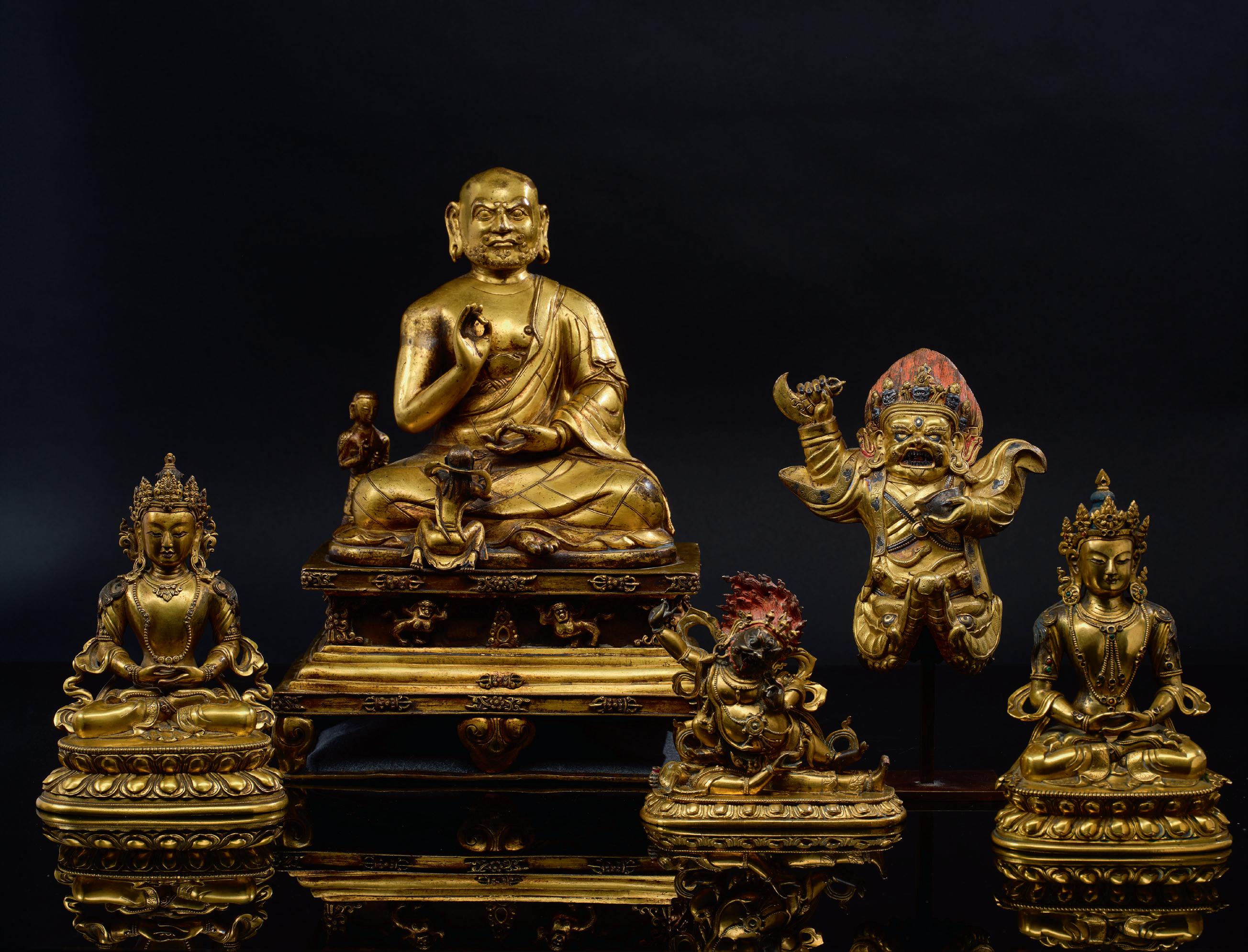
BIBLIOGRAPHIE
BIBLIOGRAPHY
BÉGUIN Gilles. Art sacré du Tibet Collection Alain Bordier, [Catalogue de l’exposition du 14 mars au 21 juillet 2013, Fondation Pierre Bergé – Yves Saint Laurent, Paris]. Editions Findakly, 2013. A. K., “Artistes français d’Indochine, Joseph Inguimberty”, Indochine, hebdomadaire illustré, 4e année, n°132, 11 mars 1943, p. I.
BEIJING PALACE MUSEUM (sous la direction de). Buddhist Figures [The Complete Collection of Treasures from Palace Museum], n°60. Hong Kong : The Commercial Press, 2003. Charlotte
BERGER Patricia Ann. Empire of emptiness : Buddhist art and political authority in Qing China Honolulu : University of Hawai Press, 2003.
BIGLER Robert R.. Art and Faith at the Crossroads Tibeto-Chinese Buddhist Images and Implements from the 12th to the 15th Century [Catalogue de l’exposition du 15 au 24 mars 2013, Asia Week New York]. Zürich, 2013.
BIGLER Robert R.. Art and Faith at the Crossroads Tibeto-Chinese Buddhist Images and Implements from the 12th to the 15th Century [Catalogue de l’exposition du 15 au 24 mars 2013, Asia Week New York]. Zürich, 2013.
CHANG FOUNDATION. Buddhist Images in Gilt Bronzes. Taipei 1993. Cultural Relics of Tibetan Buddhism Collected in the Qing Palace [Qinggong cangzhuan Fojiao wenwu] Beijing : The Forbidden City Press, 1992.
DELACOUR Catherine (sous la direction de). La voie du Tao : un autre chemin de l’être, [Catalogue de l’exposition du 29 mars au 5 juillet 2010, Galeries Nationales, Grand Palais, Paris]. Paris, RMN, 2010.
HSU Eileen Hsiang-Ling. Monks in glaze : patronage, kiln origin, and iconography of the Yixian Luohans Leiden ; Boston : Brill, 2017.
MCLOUGHLIN Kevin (curator). Ming The Golden Empire, [Catalogue de l’exposition du 27 juin au 19 octobre 2014, National Museums Scotland, Edinbourg]. Edinburg : NMS Enterprises Limited, 2014.
MEI Ninghua. Buddhist Statues I [Gems of Beijing Cultural Relics Series]. Beijing : Beijing Publishing House, 2001.
MEI Ninghua. Buddhist Statues II [Gems of Beijing Cultural Relics Series]. Beijing : Beijing Publishing House, 2004.
RAWSKI Evelyn S. et RAWSON Jessica (sous la direction de). China The Three Emperors (16621795), [Catalogue de l’exposition du 12 novembre 2005 au 17 avril 2016, Royal Academy of Arts, Londres]. Royal Academy Publications, 2005.
RHIE Marylin Martin, THURMAN Robert A.F..A shrine for Tibet : The Alice S. Kandell collection New York : Tibet House US, in association with Overlook Duckworth, 2009.
RHIE Marylin Martin, THURMAN Robert A.F.. Wisdom and Compassion : The Sacred Art of Tibet (Revised and Expanded). Harry N Abrams Inc, 1996.
Tibetan Buddhist Sculptures [Classics of the Forbidden City] Beijing : Forbidden City Publishing House, 2009.
UHLIG Helmuth. On the path to enlightment : The Berti Aschmann Foundation of Tibetan Art at the Museum Rietberg Zürich. Zürich : Museum Rietberg, 1995.
VON SCHROEDER Ulrich. Buddhist sculpture in Tibet, vol. I et II. Hong Kong : Visual Dharma Publications, 2001.
VON SCHROEDER Ulrich. Indo-Tibetan Bronzes, Hong Kong : Visual Dharma Publications, 1981. WATT Jeff. Himalayan Art Ressources [en ligne]. Jeff Watt. Disponible sur : https://www.himalayanart. org/
ZHANG Hongshi, HSU Panpin. Buddhist Art from Rehol: Tibetan Buddhist images and ritual objects from the Qing dynasty Summer Palace at Chengde, [Catalogue de l’exposition du 16 janvier au 14 mars 1999, The Chang Foundation, Taipei]. Taibei : Guan xiang wen wu yi shu you xian gong si, 1999.
© Aguttes Cet ouvrage a été achevé d’imprimer sur les presses de Corlet (Union européenne) en mai 2025.
L’Asie chez Aguttes Asia at Aguttes
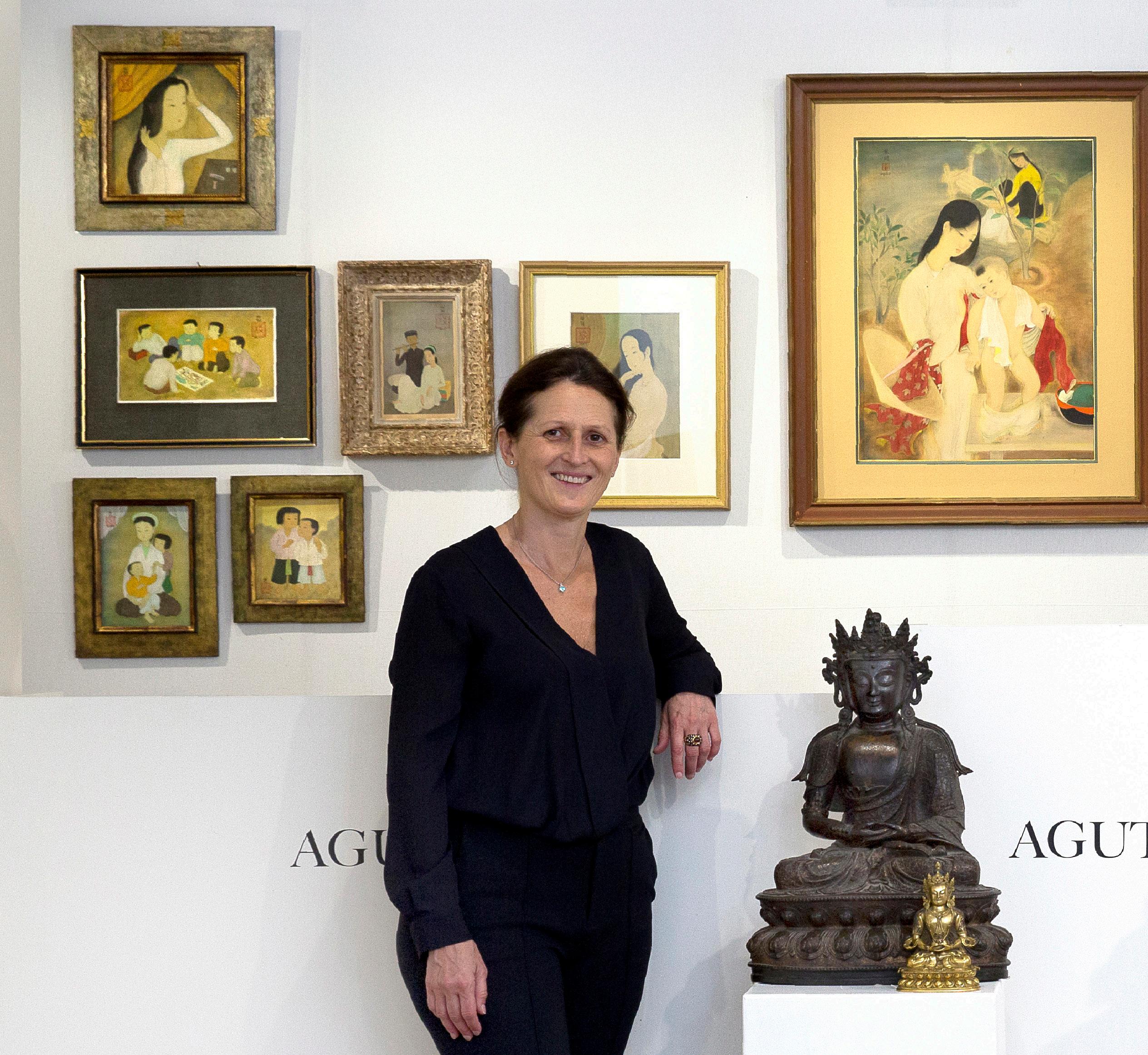
En 2024, l’Asie chez Aguttes, avec ses 10 ventes aux enchères dédiées, à totalisé près de 15 millions d’euros.
Leader historique pour la section « les peintres d’Asie », Aguttes défend particulièrement les artistes vietnamiens ou chinois.
La maison de vente familiale et française se positionne également activement sur la mise en lumière des arts plus traditionnels comme en atteste, en cette fin d’année 2024, l’adjudication d’une Guanyin à 988 000 € (reproduite p. 14 à 17), classée meilleure enchère enregistrée pour les sculptures asiatiques pour l’année 2024 dans le monde (dans le classement publié par le magazine Cans février 2025, p.137.)
In 2024, Asia at our auction house, with its ten dedicated auctions, totalled almost 15 million euros.
The historic leader in the Asian Painters section, particularly champions modern Vietnamese and Chinese artists.
The family-run French auction house is also actively involved in highlighting more traditional arts, as evidenced at the end of 2024 by the sale of a Guanyin for €988,000 (reproduced p. 14 to 17), ranked as the highest bid recorded for Asian sculptures in the world in 2024 (in the ranking published by Cans magazine, February 2025, p.137).
Charlotte Aguttes-Reynier, expert en Art Moderne Asiatique, directeur du pôle Beaux-Arts et Arts d’Asie & Clémentine Guyot, directeur du département Arts d’Asie, mai 2025.
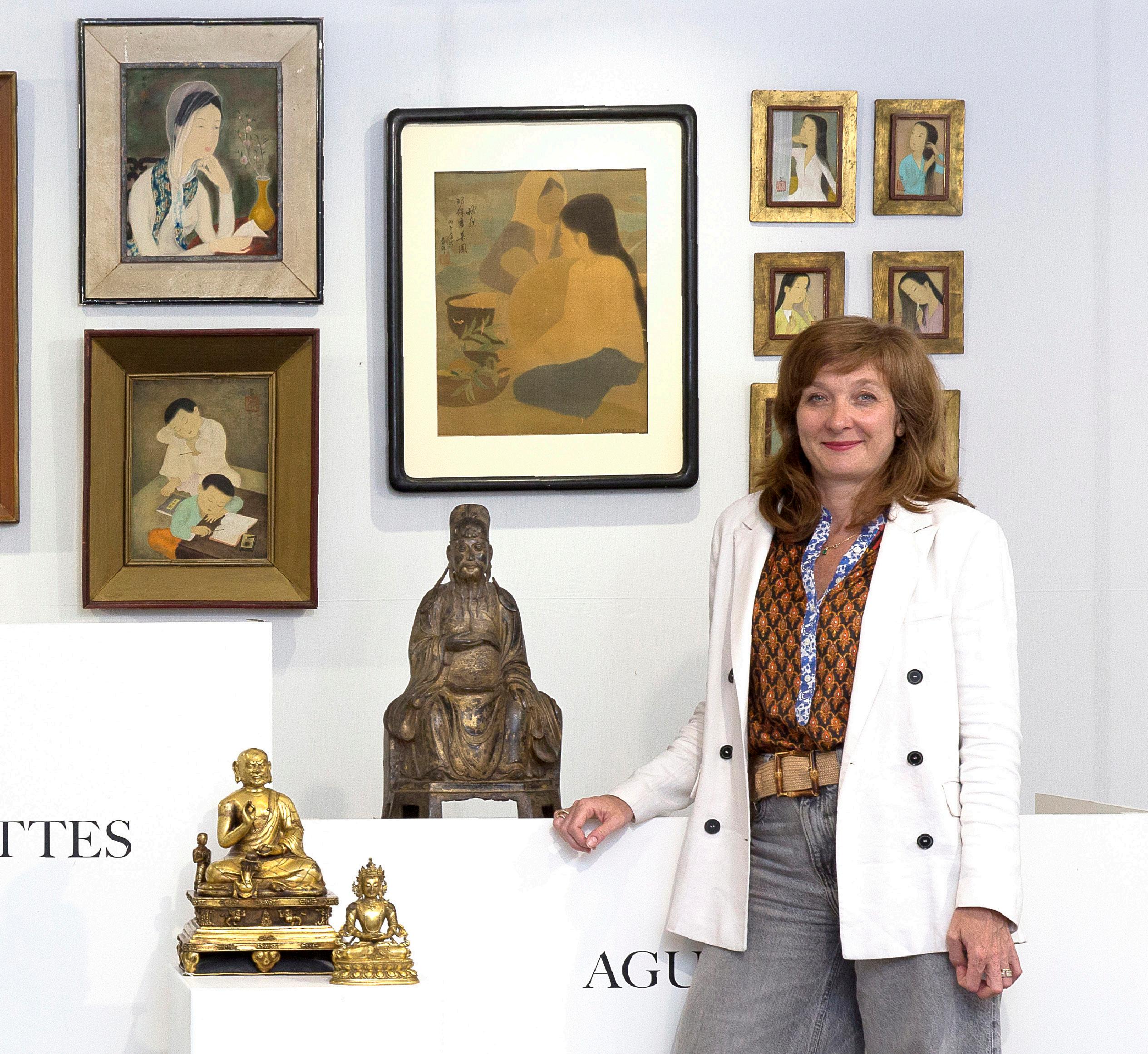
2024 年,我们拍卖行所举办的十场亚洲艺术专场拍卖会的总成交 额接近 1500 万欧元。
作为亚洲画家领域的历史性领导者,我们特别坚持现代越南和中 国艺术家。
作为家族经营的法国拍卖行,我们也在积极推广更传统的艺术,今年 年底以 988 000 欧元售出的 (第 14-17 页 ) 一尊观音像就证明了这一 点,这尊观音像的拍卖是 2024 年全球亚洲雕塑拍卖的最高纪录(根据 《Cans当代艺术新闻》杂志 于2025 年 2 月发布的排名,第 137 页)。
En savoir plus