THE ©tammat Sc~ool ffiaga3ine.
Vol.V.
OcTOBER, 1901. No. 1.
''Hail,
Horrors, hail !"
ALTHOUGH the editorial chair 0£ the Grnmmci1· School Ma_qazine can hardly be said to be as hot as the In£ernal Regions, yet it is with a feeling 0£ apprehension almost akin to dread that we -write these our first words from it, and we £eelthat few quotations could be more apt to greet it with than the one we have chosen. However, we manfully take up om pen, resolved to do our best, which is the most man can do. Now, having got over our first note, we can proceed more easily.
We regret to lose from om midst G. S. Russell, Th. "\Vatt,and T.B. Robertson, who have previously conducted this Magazine. Their departure is a grea.t loss, and will be felt by all connected with the School. 1,re shall do our best to keep the Maga :::ine at the high standard to which they brought it. • G. S. Russell and Th. Watt are also missed from the Library, and T. B. Robertson, as our late Football Captain, will leave a name :forfootballplaying in the School which will £or a long time remain unparalleled. Our heartiest good wishes go with them all on their £uture careers.
In this issue we have an article entitled "Remember the Days of Old," by John Johnston, Esq., of Milwaukee, one of our "Old Boys." This article is much upon ~he same lines as the series "'IVhen We were Boys," and ought to prove very interesting. 'IVe have also an article from another "Old Boy," entitled "The Salmon Pool." The author is a well-known local angler, and, unlike some others of our acquaintance, he not only fishes but catches fish.
Our frontispiece will, we are sure, be welcomed by all our readers, but especially by those in the School. Mr. Middleton has not been with us for much more than a year, but that has been long enough for him to win a unique place in the hearts of his pupils. His College career was most distinguished. He is a graduate of Aberdeen and Cambridge, with First Class Honours in Classical Literatlue at the former and First Class in the Classical Tripos at the latter Uni,ersity. He has held the Fullerton, Ferguson, Simpson, and Liddel Scholarships and Prizes, and proxime accessit for the Chancellor's Uedals at Cambridge in 1890. Hehas been Lecturer and .Assistant in Humanity at .Aberdeen, and Lecturer in Sanskrit at St. .Andrews; and is joint author of Middleton and Mills' Student's Guide to the Classics, as well as having published several educational works of his own. He is a worthy successor of his much regretted predecessor, Dr. James Moir, and we can hardly say more than that.
We reproduce in this number a sketch of Mr. J. 1'1. Morrison, M.A., drawn by Allan Sutherland, one of our leading caricaturists. Sutherland recently won a prize in a drawing competition in the Captain.
An exceedingly ingenious drawing has been supplit>d to us by L. J. Smith. It will figure in subsequent issues as a heading for School Football Nates. We beg to thank this promising artist for this drawing, which will, we are sure, be,highly ornamental to our pages.
We have received a very kind letter from the Right Hon. Lord Justice Stirling, a prominent "Old Boy," and our only Privy Councillor, from whom we shall expect an article for one of our issues. At present Lord Justice Stirling has no time on his hands, but he very kindly writes
that if he has he will remember the Magazin e. We have also received a kind letter from Sir "William }Iacgregor, K.C.M.G., Governor of Lagos.
'\Ye have received a letter from Principal Donaldson (F.P.), of St. Andrews, promising us an article for a subsequent number.
·when we brought out the Register of the School we little thought that we should ha;-e an article on it. Such, however, we have, and to most of us it will prove very interesting. The "Highland Brigade's" innsion of the Lowlands is one of the most prominent features of it.
The Cricket Season is again over, and most of us are lamenting the fact. A few loyal supporters of Football. however, are hailing with delight the coming Football Season. The 1st XI. has not been quite so successful as in previous years, but we had such a good Football team that we could not expect a good Cricket team, for an authority says that Cricket and Football do not go well together, and that where there is a good Football team you cannot get a good Cricket team. The crop of windows, we are glad to say, has not been so heavy this year. The probable reason is that we have a fence round the field, which prevents most of the balls from soaring into Leadside Road. We wonder why a 2nd XI. has not been formed this year, for we heard that a pitch had been rented at )1annofield for the 1st and 2nd XI.'s to practise on. Surely we should have a 2nd XI., and we hope to see one next year. One remark we should like to make about the 1st XI. is that one or two of the team do not turn out in flannels, far less the 1st XI. colours. If Cricket is worth playing, it is worth playing in cricket "togs."
The election of officials for the Literary and Debating Society has once more taken place. In room of the late Professor Robertson, Professor Paterson was elected a patron, while Sir James Reid, K.C.B., G.C.V.O., Sir Thomas Sutherland, G.C.M.G., Sir James Westland, K.C.S.I., Sir George Reid, P.R.S.A., and the Right Hon. Lord Justice Stirling - all" Old Boys "-were unanimously added to the present list. As President, A. R. Williamson will, we are sure, preside ably over the meetings of the Society. His acceptation of the office came as an agreeable surprise to many, as they thought that he would be
too busy to enter School "politics ." As Secretary and Treasurer, for the second time, James G. Danson may be expected to once more "make things hum," as the Yankees say; it is a good thing that the Society is to have the benefit 0£ his experience again. The rest 0£ the officebearers have not so much on their shoulders as these two gentlemen ; but they, too, seem eminently fitted for their respective posts. ,Ve wish the Society a most success£ul session, and we are exceedingly glad that it shows no sign 0£ getting weaker as it grows older.
The Litera.ry and Debating Society has received a contribution 0£ £.2 2s. from Sir James Westland, K.C.S.I., LL.D., whose portrait appeared in our February number, and who has been elected a patron of the Society.
The Millennium and our new field, we are beginning to think, will come at one and the same time. Surely there is some field within the broall limits 0£ the Granite City suitable for om purpose. vVe hear that the dam adjoining Osborne Place is going to be filled up. Why not try to get this and the potato field next it? It would be better than nothing, supposing it did sink a little. Certainly we should be in a better state i£ we had it, as our present field is a disgrace to the School.
.A. curious edition of Chaucer's works has been discovered among the books of the Re£erence Department 0£ the Library. It was published by George Bishop in 1598, and edited by Thomas Speght. The title-page reads ns follows:-
THE
Worlces of ou1· Antient and lerned English Poet, Gejfrey Ghauce1·, newly Printed.
In this Impression you shall find these Additions
1. His Port1·aiture and Progenie shewed.
13. His Life collected.
3. Argwrnents to every Boolcegathered.
4. Old and obsciire Words eX[Jlaned.
5. Authors by him cited, decla'red.
6. Difficulties opened.
7. Two Bool.:esof ltis,neve,· before1n·inted.
LOKDINI
hnpensis Geor. Bishop. Anno. 1598
It is dedicated "To the Right Honorable Sir Robert Cecil, Knight, P,·incipal Secreta,·ie to the Queen's 1lfost Excellent Majestie, Chciuncello1·of the Duchie ofLancaste,·,and one ofhis HiglmeRmost honoiircible Privie Counsel."
~Ir. Ward has been installed as a Deacon in the Episcopal Church by the Bishop 0£ the Diocese. We hope that this will not necessitate )Ir. ·yvard's lea,ing us.
:MissDuffus has left us £orthe Girls' High School. \\e hope she will ha,e as pleasant a stay there as she had with us. :lliss A. C. Adam, L.L..l., formerly l[istress 0£ Lower III., has taken her place.
"\Ve welcome 1Iiss Gordon, who has come to fill the Yaca~cy caused by these changes, and hope that she -will remam with us for a long time, and reap much fruit from her labours.
Mr. Hector G. Duthie, ~LA., has also taken his departure, and gone into a strange land, by name Rhodesia, to be headmaster 0£ a school. "\\re,,ish him e,ery success in his new command.
O~lrLending Library has been once again opened, and promises tohave agoodseason. )fany ne-w books ha,e been added, and altogether it ought to pro,e a big attraction to the School. The membership is nothing to what it should be, and £or the benefit of new boys who are n·Ji s:1,ppo_sedto know much about it we add that the subscription. 1s ?nly one shilling a year- not a ,ery large sum cons1dermg the selection 0£ books and reser,e on them.
A very handsome addition to our Museum has been presented by James Masson Hector (F.P.), consisting of a loyalty to the School whatever. On the other hand when cobra and a chameleon (in spirits), an elephant's tooth, boars' tusks, fossils, shells, beetles, a.nd butterflies, &c., mostly from India. ---
A set of unused Fiji postage stamps has been received from Kenneth Allardyce (F.P.).
The School as a. whole must feel justly proud of its achievements in the Leaving Certificate Examinations, which, the masters tell us, were rather more difficult than in former years. Even though this was the case, the '·Grammar " came out at the top of the list, beating the rest of Scotland by a considerable percentage. Out of eleven Honours in Greek, one comes to us ; and our last year's du:s:, John )f. Robertson, has won Honours 111 English, Latin, Greek, and French, which is almost unprecedented. In English wehave fom Honours, in French two, and in Latin and Greek one each. In the Higher and Lower Grades the results are correspondir.gly satisfactory, and, as "e ha,e sa.id before, the School is quite justified in being proud of itself.
Our Sports have again passed, and to most of us the results are very satisfactory. We would congratulate the successful competitors, who are many in number. The success of the Sports is mainly due to the strenuous exertions of Rev. Mr. ·ward, who was ably seconded in all he did by the members of the Games and Sports Committee. In the name ofthe School, webeg to thank Mr. C. Davidson for his senices as Referee, and )Iessrs. )fackie and J. DaYiclsonwho acted as Judges, and we must not forget )Ir. Joseph, who so ably wielded the diminutive ''Long Tom." \Ve would particularly congratulate J. T. Soutter and W. \V. Jameson, who especially distinguished themselves in the Open Competitions. Our Sports have not in the least deteriorated, as we were half afraid they would, and the energy of this yea1·'sCommittee will compare fa,ourably with the exertions of any of their predecessors.
In the early part of the year Lord Strathcona instituted examinations all over Scotland on the Geography and Resources of Canada. He thought that solittle wasknown of our great Colony, so rich in its produce and so great in its political importance, that he would give every scholar
a chance of learning as much as he cared, and for the best paper in each School he presented a medal. In our School this wasgained by H. Adam, whom wewould heartily congratulate.
We strongly recommend all of our readers who intend to enter the 'Varsity this session to join U Company, 1st V.B. Gordon Highlanders. Every young man should be able to help in the defence of his country, and besides the excellent physical exercise there is also a great amount of fun to be got out of volunteering, especially when a camp is held, which we are informed will almost certainly be the case next year. :Membersof U Company have also an excellent opportunity of meeting their fellow-students, as it numbers over one hundred all told. All other information may be obtained from the notice boards at King's or Marischal a few days after the opening of the session.
The Swimming Club is to be congratulated on its past season, which has been one of the most successful it has yet enjoyed. This must be gratifying to the officials, who ha,e done so much to make it a success. The rlub will miss T. B. Robertson, who has so ably acted as Secretary; but D. H. Williamson, who was Captain, is still with us, as also are many of the Committee, so that the Clul1 has bright prospects before it for its ne:s:tseason.
Our main corridor has begun to lose its chilling aspect, caused by the stone-pa,ed floor, since the photos. of the School Football XY.'s, for several years, ha,e been hung there. The boards, on which are inscribed the names of the XY.'s, ha,e also been added to the walls.
The portraits of Admiral Sir Arthur Farquhar, K.O.B., and Dr. Dey (late of '·The Darn"), both "Old Boys," ha,e been added to the walls of the Hall.
The Captain of the :Football Team for this year is 11. 11:. 1Iacrae, an old member of the team. We little thought that we should see }Iacrae with us again, but his return was an agreeable surprise to many, as he will make the best Captain, having had the most e:s:perience. ,V. '\V. Jameson will act as Secretary, and between these two a good team ought to be raised.
We would call attention to the Report of our F.P.'s Rugby Football Club meeting, and particularly to that part dealing with a ma.tter which they do not consider creditable to former pupils of this School. At the meeting referred to it was stated that not only had several oltl School football players cast in their lot with other teams. but that two players-one of them an old School Captain - had during the fortnight previous to the meeting been engaged in an all too successful canvass of former pupils. The F.P.'s are of opinion that the only way to· stop this leakage is to appeal to the honour and loyalty of our present players. To a great extent we agree with them: it is not right that football players who leave here should enter the ranks of any team in town. The 'Shire and Nomads, for example, are·excellent teams, but a fellov, leaving this School is bound in honour to give the F.P.'s the chance of his services, that is if he has any feeling of loyalty tothe Schoolwhatever. It ismost distressing toour F.P.'s that matters should be in this condition, and we svmpathise with them very deeply. To know that in one t~arn alone the F.P.'s will be playing against four old Grammar Captains is a great misfortune, especially when we are told that three of these are deserters from the ranks of the F.P.'s. vVe should, however, like to hear the reasons for their desertions. We appeal, therefore, to our " Old Boys" to "stick up" for the School, and, when they leave, to join the F.P. XV. in preference to every other.
We would advise all the boys to see the Cinema.tognph of the School, taken by Messrs. Walker &Co. in June. It is a splendid picture, and every face isclearly depicted .
As we g·oto press we have received the July number of '' The Yellow Dragon." The only fault that the staff seems to have is a slight lack of geographical knowledge. Scotland is divided from U.S.A. by the Herring Pond, :Oiessieurs.
AT the Alfred celebrations at Winchester, where representatives of the whole Anglo-Saxon race have been present, our School has taken its place, £or the University of Aberdeen has been represented by two 0£ our "Old Boys," Professor W. L. Davidson, LL.D., and Professor Alex. Ogston. We observe that in the great procession 0£ dignitaries and representatives "\iVinchesterSchool took a leading place, the Headmaster, }'!asters, and representative Scholars being present. Professor Davidson has kindly consented to address the Debating Society on his visit to Winchester.
Dr. John Brebner, late }finister 0£ Education for the Orange Free State, paid a visit to our School lately. He is an " Old Boy" who left us as First Bursar (Marischal College) in 1848. He was Classical iiaster with us for ten years, and was, we understand, an applicant for the v~cant Rectorship 0£ the School. Being unsuccessful in his candidature he went to South Africa, where he was soon appointed Inspector of Schools in the Orange Free State. Afterwards he became ~Iinister of Education, anrl as such was on intimate terms with the Boer leaders.
J. Campbell Smith, as a boy, had a marked talent for drawing, and was this year honoured by haYing a picture h~mg on the line in the Royal Academy, London. The picture was much admired, and was sold a few days ago f?r 100 guineas. ~Ir. Smith has adopted art as a pro£ess1on, and his early success (he is about twenty-one years of_a&'e) justifies the expectation that he has before him a bnlhant career as an artist.
The King has been graciously pleased to confer on Col_o~el Alexander John Forsyth Reid the rank of K.O.B. (Military Division). Well done, Sir Alexander.
John Gray, who was Captain of M.erchiston XV. last season, has passed into Sandhnrst. G. Forrester Thomson has been appointed Lieutenant in the Rand Rifles.
George Stewart, M.A., B.Sc., who was master with us for some years, has been appointed :Mathematical :llaster in Campbeltown Academy.
Frank ,V. Michie, Dundee High School, has been appointed a Junior Inspector of Schools in Scotland. After passing out of the Grammar School he graduated with first-class honours in Science at Aberdeen Uni,ersity. 1Vhile at Dundee he organised successful and interesting excursions for Natural History purposes in connection with his classes. He was secretary of the Dundee NaturalistB' Society.
Fred. W. Galloway has gained an appointment in the India Police Service. This service approximates very closely to the Indian Army, and is considered one of the best appointments in India.
In the department of brawn our successes ha,e been 8.S remarkable as in that of brain, for at the recent Uni,ersity Sports we scored the following successes:-
Long Leap-2, J. M'Hardy.
100 Ya,·ds (Final)-2, A. J. :Milne.
Hu,·dle Race-2, A. S. Wilson. Qua,·ter-mile-2, J. M'Hardy. 'l'h,·owing the 0,-icket Ball-2, F. H. Fraser. Half-11:file(Handicap)-1, J. M'Hardy. Golf Drive-1, K. Melvin; 3, E. Legge. 100 Yards (Handicap) Final-1, J. M'Harcly. Egg-and-Spoon Race-3, G. E. Shand. One Mile (Open)-2, J. M'Harcly; 3, H. Watson. Obstacle.Race-I, F. H. Fraser ; 2, G. E. Shand. O:fficials'Race- I, J. W. Milne.
The death occurred rnddenly of Henry Angus Paterson , who, since 1842, was minister of the U.F. Church at Stonehouse, Lanarkshire. ~Ir. Paterson, who was a distinguished Hebrew scholar, was the author of "The Bards of Bethlehem," an interesting and notable work.
R. B. Crabb, Agent for the North of Scotland Bank in Peterhead, died recently.
The Rev. 1Villiam Stephen, D.D., of St. ~~ugustine's Episcopal Church, Dumbarton, is dead. Ten years ago he issued in two large ,olumes the history 0£ the Church in Scotland.
Ale:s:.v\"'hincup, :.U.A., B.L., met a most tragic death during the holidays. While hill-climbing in Skye he fell over the cliffs at Sligachan, death being instantaneous. We beg to tender our sympathy to his relati,es. At his funeral, which waslargely attended, the Rector represented the School.
In Skye also has died Dr. Sutherland, :lredical Officer of Health for Broadford, where he also had a large private practice.
vVe regret to announce the death of ,Villiam Brown, M.A., LL.B., Ad·-rncateat the Scots Bar. The eldest son of Sheriff Brown, he had a distinguished career at School and College. He was a farnurite pupil of the late Professor Minto, and when he graduated in 1888 he won the Bain Gold :lreclaland gained First Class Honours in Philosophy. Proceeding to Edinburgh }Ir. Brown took the degree of LL.B., and was called to the Bar in 1892. As counsel he had been employed in many leading cases, and was_admittedly one of the leading juniors at the Bar. His po~1t~onwas recognised in his being appointed Lecturer in Orimmal and Civil Law in Edinburgh University. He had also acted as Interim Sheriff-Substitute at Aberdeen and Ban:ff. His early death at the age of 33 has been called a distinct loss to the Bar in Scot.land and to a profession in which he would have attained the highest distinction.
3-n ffiemoriatn.
The R.everend JAMES R.OBER.TSON, M.A., D.D., Professor of Church History and Pastoral Theology, United Free Church College, Aberdeen.
To say that the news of Professor RoBERTSON'sdeath took the city by surprise is totally inadequate to express the feeling akin to stupefaction with which the melancholy tidings were received. At our Prize Distribution in June few, if any, of the gentlemen on the platform looked more robust than he. His address was characterised by more than his usual thoroughness and vigour, and was indeed pronounced by many to be the best they had ever heard him deliver on such an occasion. By his death the United Free Church has lost one of its most devoted ministers, the City is deprived of an eminent and loyal citizen, and the Grammar School has to mourn a distinguished "Old Boy," as well as one of its best friends and wisest counsellors. Dr. Robertson's interest in our School was not confined to Prize Days ; he was to be seen on our cricket field, and his face was a familiar one at our Annual Sports. ,Ve would offer our deepest sympathy to the bereaved family, and especially to those who during their schooldays here have won the love of many and the respect of all.
- "The elements Somix'd in him that Nature might stand up And say toall the world, 'This was aman !' "
Addressing the School after prayers in the Hall on the first day of the session, the Rector paid the follow-
ing graceful tribute to the memory of the deceased gentleman: -" I had hoped to welcome you back with nothing but pleasure in our re-union, chastened always at such times by the feeling that we miss the £aces of many who have been endeared to us for years as pupils and schoolfellows. That, ho•wever, isaregret of parting, tempered by the hope that if their years here ha,e not been misspent, and their opportunities not neglected or misapplied, their future at the University, in the public services, in trade and commerce, may continue the promise of their earlier years, bringing fresh successes to themselves and new honours to the old School. But to-day we meet under the shadow of a great loss which has befallen our School and City, one which would throw us wholly back on retrospective consolations, were it not for the crnwning hope which bids us look forward, even on the margin of a grave. It is barely two months since we were honoured by the presence of Professor Robertson as our Chairman at the distribution of Prizes. ·who that then saw him in his last public appearance, admiring his commanding figure, listening to his Yigorous eloquence, rich in matter and ripe in wisdom, could have dreamed that a few short days before we answered his summons to reassemble, we should be stricken with the news of his death? Sorrows such as this, on the whole, happily, touch the young but lightly. Kor would we, in general, bid you dwell on such melancholy reflections. You are still too young, eYenthe oldest of you boys, to realise all that Professor Robertson was for our S_chools, and might yet have been in the difficult times that lie a.head. But your personal perception of this sorrow is no doubt quickened by the thought that he was not only Chairman of our Board, not only himself an old Grammar boy, whose honours added lustre to our record, but the father of your school~ellows, past and present , to whom our hearts go out m warmest sympathy in their clay of heayy bereaYement. In his untiring deYotion to duty, in his voluntary subordination of all selfish interests to his own high ideals of public sen-ice, he has left us an example which shall long survive and blossom in the
dust, 'So teach us to number our days that we may apply our hearts unto wisdom.' "
OnSunday, 1stSeptember, a Memorial Sermon was preached in Ferryhill United Free Church by the Rev, Principal John Hector, D.D,, of the Duff College, Calcutta, Dr. Hector was probably Dr. Robertson's oldest friend-in fact, they were at the Grammar School together-and the tribute that he paid to the deceased Professor was noble indeed,
The Literary and Debating Society, of which Dr. Robel'tson was one of the Patrons, instructed their Secretary to convey to }frs. Robertson and family their deepest sympathy with them in their grievous affliction.
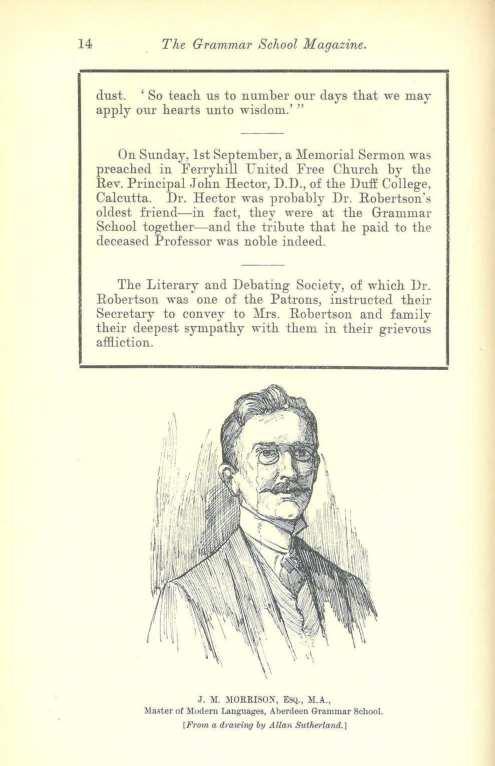
I J. M. )lORRISO!I, ESQ., M.A., )laster of ::Uudern Languages, Aberdeen Grnmmar School. [From a drawi,rg by Allan S-14therland.]
"REMEMBER
THE DAYS OF OLD!
"-I.
BY Jo1-rn JoHNsroN, 'VICE-PRESIDENT OF THE :ll.unNE 1\ATIOKAL BAKR OF MILWAUKEE.
IN 1848 the schoolmaster 0£ the qiwad sacra parish 0£ Savoch told my parents that it was time I went into Aberdeen to School, as he did not £eel that he could take me any farther in the study 0£ Latin: and on a chilly morning my mother and I took the " Banks of Ythan " coach at Burngrains, and in about three hours we crossed the new Bridge 0£ Don and were feasting our eyes on the wonders 0£ King Street.
It was not quite settled whether I should go to the Gymnasium 0£ Old Aberdeen, or to the Grammar School, but the bursary-winning record 0£ the latter carried the day, and my mother took me to call on Dr. Melvin at his house in Belmont Street.
Being but a twelve-year-old laddie from the country, it was with some trepidation that I was ushered into bis library. My recollection is that it was dark and gloomy. It may have been that the gas 0£ the ·'braif" city of Aberdeen was not sogood as it is now, while the book-cases were dark, and the bindings 0£ the books seemed all dark. There were certainly none 0£ the gilt and tinsel on his volumes 0£ Horace and Scaliger which are to be seen on many 0£ the volumes 0£to-day. The Doctor treated us most kindly, and took as much interest in me as if he had never had anothe_rboy asking £or his guidance . Finding that I had mastered the Rudiments, and had wrestled successfully with Cornelius Nepos, he ga,e it as his opinion that I should go into the Second Class, then taught by the ,eteran teacher Mr. John Dun. Kext morning I entered the Second Class, and never spoke to Dr. .Jielvin again till two years after, when I entered his Fourth Class.
After a few weeks I found my le,el in the Class, which was about the middle, and I am not sure but it would really have been better had I entered the First Class, £or then I might have been able to maintain a place in the first or second factions. I never got a prize till I left the Grammar School, when, our Class being divided, one half or n_i.ore going to King's College, and the remainder to Manschal, I carried off a small bursary at the latter. Our Class went through the bonnet fights mentioned by Sir James Westland in your February number, the Third Class attacking us from time to time at our door on the
quadrangle. Occiisionally some of the braver or more reckless spirits of the Third would :fight their way through our ranks into our class-room, where, being cut off from their fellows, they suiierecl se,erely for their boldness.
Occasionally we would ha,e a snowball :fight with the "Sillerton loons," as the Gordon's College boys were then called, and on a few occasions the Combworks lads came as far as the Schoolhill to attack us.
'l'he most memorable e,ent of our Second Class year was the arrival of the late Queen Victoria at Aberdeen, when, away behind all the dignitaries - civil, educational, ecclesiastica.l, and military-we were allowed to march to the Quay to see Her Maje;ty come ashore with the Prince Consort, accompanied by a little boy and girl, seven and eight years old- the one being now King Edward YII., and the other the late Empress-Dowager of Germany. On the occasion of the hanging of Christie or some other criminal the School was called in an hour or more earlier than usual, so that none of us might have an opportunity to witness the sad spectacle.
Mr. John Dun- or "Dunnie" as we called him- was a good specimen of the teacher of the old school. He was far from brilliant, but he was wise and safe. ..While he was not a strict disciplinarian he always maintained good order in his class, because the boys liked him. He would frequently joke with us, and occasionally he would get c,:ff what he considered a good pun. He was accustomed to wear a blue dress-coat "ith brass buttons. In order that we might have no idea of who was likely to be called out to " say his lesson" he had a pack of cards with the names of his class written thereon, which he would shuffle every day or two, and then call the names off as they ca.me, beginning at the top. The plan worked well, and although the boys once in a while got hold of the pack, they were never successful in any of their attempts to trick the good old master. He taught us History, ancient and modern, and, knowing how troublesome it is to remember dates, he had a scheme to assist us in this, of which he was very proud. He made certain letters represent certain figures as follows :-
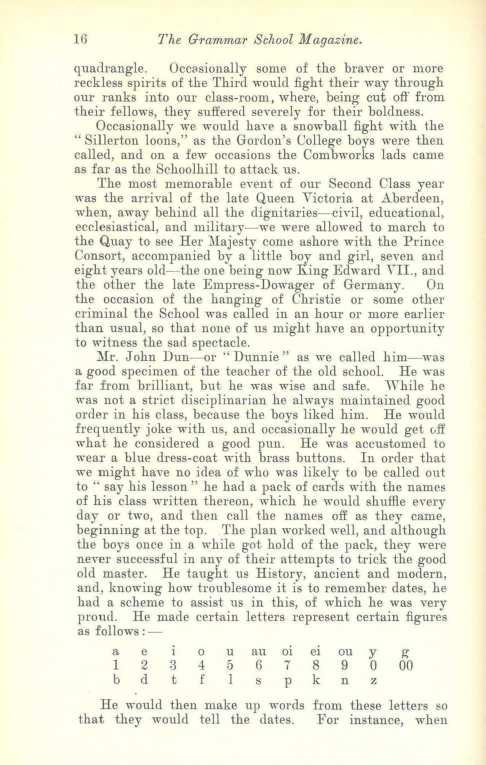
He would then make up words from these letters so that they would tell the elates. For instance, when
studying the hist01y of England, he had a sentence like this:-
Wil-con-sau; Ruf-koi; Hen-pr-ag; &c.
This means ,Villiam the Conqueror, 1066; Rufus, 1087; Henry Primus, ll00. I must say I could remember the dates better than his words.
For a week or two before the summer vacation our Class was in an ecstacy of glee. In the morning and afternoon we pounded the desks with our clenched fists, and the floor with our feet, singing-
" Friday is the day, boys, When we will get the play, boys," varied with
" What's a' the steer kimmer What's a' the ste~r ; ' Jamie he is landing, And soon he wiH be here."
The class-room was in great confusion when Mr. Dun came in, but he was very lenient, and we could see that he enjoyed the prospect of a vacation as much as any of us.
A prize was gi,en annually to i.he best-behaved boy in the Class, and it was decided by a ,ote of the scholars. The most popular boy was apt to get it, if he was not too unruly.
We were all sorry to leave 1Ir. Dun with his easy ways, and entered the precincts of Dr. Melvin's class-room with th~ feeling that there was good reason, perhaps, for his bemg called "Grim." At the same time we felt that a new dignity was ours, and the childish things of the three lower classes were far beneath us.
The Doctor told us what text-books to buy, and among them was " Buchanan's Psalms." We found that they were out of print, but those of us who had not received them from their older brothers or friends managed to get them in the book-stalls of the New Market or some of the second hand book-shops elsewhere. In maturer years I have often felt amused to look back and think how the Do?tor got around the Scottish ideas regarding the most strict observance of the Sabbath. Of course it was wicked to_ study Latin phrases and idioms in Cicero, Horace, or Livy, but it was all right to do so in Buchanan's Psalms of _David! Again, it would have been very wicked to write a ,ersion during sacred hours about Caesar, Pompey, or Agricola; therefore the good Doctor gave us what he called "sacred" versions about Peter, Paul, and even
Judas Iscariot, which met the most hearty approval of the Fathers and Brethren of the Kirk.
I need not speak of the famous Melvin. Some of the ablest writers of our century have described him, his character and methods. I do not know but it may be sacrilege to mention it, and I do not remember having seen it mentioned, but I cannot forbear stating that the Doctor was but human, and more than once showed favouritism. I clo,not mean favouritism to the best scholars onaccount of their scholarship, butfavouritism to those who were poor scholars but whose parents were leading citizens of Bon-Accord and friends of the Doctor. He would say "Oh, Wullie, Wullie" to one boy when he made an egregious error, while to another making the same error he would give a scowl such as may have led to his being called "Grim Pluto." I remember on one occasion, when he was walking up the aisle, and turning suddenly on his heel,as was his custom,he saw one of his favourites doing something very bad, and e:s:claimed "Et tu Brute." Had it been some other boy he would have been sent out into the Public School. During the last quarter, before the· Competition £or Bursaries at the Universities, the size of Dr. :Melvin's classes was almost doubled by "Extraneans " coming from all over the orth of Scotland to get their final equipment for the great contest.
Many a "lad o' pairts " came from the country parishes, followed by the prayers of the whole countryside for their success- and they were often successful. The numbers were so great that on version days we had to go into the Public School. It was a strange feeling for us who had been together for three or four years to find among us such an influx of strangers, and it was with a nervous interest and curiosity that weawaited the result of the first version. Some Mac from some Glen crowded hard upon our first faction, and after a few weeks was at the top.
On looking back over nearly half-a-century, I cannot but think tha.t many a young man studied too hard during those fateful three months. I trust the Gramma.r School boys of to-day are not injuring their health from overstudy. Three of the best scholars of our class died young from the effects of too hard study and too little recreation; others have attained high places in the Church, Army, and Stale, both at home and abroad. Only a few of us are left, scattered in the• various zones of earth ; time has , whitened our hair and dimmed our eyes, but I am sure our hearts beat with renewed warmth when we think of the old Grammar School.
THE SALMON POOL.
THE grey old bridge spans the riYer at the rocky gorge. Below, the stream broadens out into a semi-circular, crescent-shaped pool, of wide expanse, and so deep that in the brightest sunlight no eye can pierce to the bottom. Though elsewhere the water is clear as crystal, here the depths look gloomy, and disclose a taint of organic, mossy matter in solution, which in shallower waters is imperceptible, but sufficient in ten feet to obstruct and defy thP human vision. Just a place for salmon to lie in; and here, at the neck of the pool, thirty or forty yards down from the rapid stream which rushes wild and foaming through the bridge's single arch, and just a little above the sullen, silent, lake-like bulging expanse beyond, the salmon choose to rest. On a bright day you see them, one, two, three, their dim shadowy outlines swaying gently in the stream, always in the same place, under the shelter of a projecting piece of rock that rises sharp and jagged from the river bed. I£ you could poise for a few seconds a suitable fly on the square foot of water directly in front of them, you could not fail to hook some one of the silent trio. So you think as, leaning on the bole of a sturdy Scotch :fir, you peer down on them from the lofty right bank of the river. But after all, it is not so easy. For one thing, it is hopeless from this side, which is precipitous ancl steep and tree-covered. The other bank is more hopeful. 'l'hat is the shallower side, with a fringe of golden gravel shelving to the water edge. But a thicket of spruces is close behind you, and it will tax all your skill to make a proper and enticing cast. However, the situation is ioo tempting, and you will try. Once, twice in the full <laylig·ht you have made the attempt, and failed to stir a :fin. A third time you will essay them. There has been some rain up amongst the hills, and the river has just that dash of pale sherry tint that helps to tone down the glaring colours of your fly-feathers, and hide the too obtrusiYe steel of your hook. You think the moment opportune for athird attack, and you time your assault for the half-light ofthe dawn, before broad day has lent her garish distinctness to natural objects.
So you are up before the lark, and lifted high in hope, you make your way by a short cut through the fields. "Brushing with·hasty steps the clews away," the rabbits scuttle off at your approach, and run to cover; you are plump into a resting family of partridges before you are
aware, and their shrill clutter 0£ alarm as they scatter in a fan-like cloud before you distUTbsthe peaceful morning. One of the parent birds dogs your footsteps for a time, hovering on the flank o:£ the scattered covey, and in her maternal anxiety for her progeny attempts by wellmimicked disability to lure you from pursuit. But you are used to this little device 0£ maternal instinct, and besides you have other game in view, and do not deviate from your route. A young colt, lusty and full of grass, charges down upon you :full-tilt from an outlying part of the field; he either resents yoUT untimely intrusion, or perhaps £eels the loneliness of his solitary life, and is craving for companionship. But you have no time to be sociable, and wave him aside with your fishing-rod, and he gallops off,his long, unkempt tail flying wildly behind him. A lone heron, disturbed at his morning meal, flies lazily away with broad grey wing, his long legs stretched with comic awkwardness in a straight line behind.
But now you are at the edge 0£ the ravine, and the rising sun is kissing the tops 0£ the western hills as you plunge into the spruces on your way to the water-brink; here he will not penetrate for an hour or two. The water looks ideal ; there is enough 0£ wind to ru:fflethe surface, but not enough to worry your casting, so you silently put up your rod, select a small and sombre " dusty-miller " :fly, and make a few preliminary casts up into the stream above to straighten your gut, and make everything shipshape. Then when you judge the moment £or serious action has come, you gradually work clownupon the patch where_you know the three grey shadows should be waiting. You note the ripple caused by the projecting rock, and there, just a foot to the left, is the deadly spot. Quite a short line will suffice, but you keep your rod well down to sink the fly effectively and bring it round at an enticing angle. Once over the spot, but no sign. At the second throw, however, the line suddenly tightens, a broad tail is seen distinctly, and you have a momentary vision of a vague and dimly-outlined form near the surface. You strike, and the hook goes home. It has done its duty ; now for your part. Up with the rod, and await contingencies. Will he go up or down? There are dangers both ways, but you are alert and hopeful , and prepared to act decisively. He elects to move up stream, which is exactly to your mind, for he cannot breast that heavy cunent without wearing himself out. Slowly and steadily he forges onward, into the boiling, tumbling, narrow
A Bl'RMESE ll"GRIAL CEREMOXY.
" THE Hon'ble the Kin Woon :Mingyee, C.S.I., begs to announce that the preliminary funeral ceremony of the late Queen Shimbyumashin will take place in the Win of the Kyoungwye Sawbwa, South lfoat Road, at noon on the 9th }fay, 1900, and that on the 13th May, 1900 (9 A.M. ), the 1·emains of the said Queen will be remove<l for interment from the said Win to the Palace grounds, where the late King ~lindoon's (her Consort) mausoleum is situated. The Kin ·woon :lfingyee will be obliged if you will be pleased to attend these ceremonies."
So runs the im-itation to the Colonel and Officersof our Battalion at l1andalay . It was received in our Mess in due course, and a number of us were "pleased to attend" the final ceremonies as arranged for the 13th May. In order to locate the sepulchre of the dead Queen, it may be interesting to remember that in 1860 l1andalay (in Burma it is ~lundlay) became the chief seat of Government when the ~:Iindoon::llin transferred his capital to that place from Ama.rapoora, and it remained as the headquarters of Upper Burma until the fall of King Theebaw in 1885. The deceased Queen Consort of :Mindoon was the mother of 'L'heebaw's Queen, of whom it is recorded that she was the chief instigator of the massacre which inaugurated Theehaw's accession to the throne in 1878-a massacre which in,oh·ed all the direct descendants of his predecessor.
Quite close to the old Palace, which is now the home of the Upper Burma Club, and at the same time provides quarters for some of the British officers, is situated the mausoleum of King lfindoon, and it was there, and in the immediate neighbourhood, that a great assembly of Mandalay folk gathered together on the morning of the 13th --a Sunday. 'l'he funeral pror.ession of the late Queen Shimbvumashin was timed to leave the Win in the South }Ioat Road at 9 A.M., and probably it did so; but it was not till 11 o'clock that the place of final interment was reached. Long before 11 o'clock, the space of ground adjoining the sepulchre was thronged with an ever-increasing crowd of Sahib-lo_g, Burmans, and natives of India, all anxious to witness the obsequies of Queen Soupyalat's mother. An adoptf,dson of the late Queen was responsible for, and had undertaken all the arrangements for the burial, and the decorations presented a truly Oriental scene of striking picturesqueness, the effect being greatly enhanced by the brilliant colouring of the crowd, in which
Burmans, 0£ co1.use, prerlominated. In one part 0£ the ground an open sort 0£ Shamiana had been erected, and in this the Chinese community were "At Home." Ices andiceddrinks werepassed round, and, as themorning was hot and sti ing, they were partaken 0£ freely; while to each guest were presented a small bottle 0£ scent anrl a handkerchief, for reasons which were not explained, but which were no doubt connected with the punctilious etiquette 0£ Oriental ceremonial. A short distance apart from the S amiana there was an enclosure specially prepared for the last halt 0£ the co n, and in this enclosure was a sarcophagus or casket ready to receive it before it was committed to its last resting-place. In another Shamiana a large number 0£ princesses were gathered together; all were dressed in spotless white, and presented apleasingcontrasttothekaleidoscopicrichness and variety of thecoloured silks worn by theother Burmansassembled. Here and there in the crowd, ex-Ministers and o cials in the old Court dress wended their way about, accompanied by satellites whose chief function was to support umbrellas over the heads 0£ their august superiors. he procession was formed in two sections, and the rst part to arrive was composed 0£ about a dozen loads of presents for the hz;oongees or priests. Each load was carried by four bearers, and consisted generally of a respectable assortment of rugs, door-mats, cushions, umbrellas, reels of cotton, meat safes, potato strainers, and other articles too numerous to mention, without forgettingacoupleof bottles of beer! Not longafterwards, the main processionarrived, hea�ed by a two-man white elephant, and accompanied by amiscellaneous crowd of Burman mourners and bandsmen, and other persons more or less connected with the business on hand. Amidst much discordant music the co in was unloosed from the long crimson-covered pole by which it had been carried along; it was then placedinthereceptacle referred to above, and, after various further ceremonies, was conveyed to the place prepared for it, a £ew yards in front 0£ the tomb of Mindoon Min. 'l'hree guns were now red, a Maid 0£ Honour lifted up her voice in lamentation, and, after the casket had been lowered into the velvetli�ed tomb, the great assembly leisurely and quietly dispersed.
A. K. R. (F.P.)
LEAVING CERTIFICATE EXAMINATIONS, 1901.
THE very satisfactory results on which we were able to congratulate the School lMt year have not only been maintained, but imprO\red to a very remarkable extent, as may be seen at a glance from the following tables:1900. 1901.
83 Number of candidates - 92 305 Pape s taken 372
3·2 Average of Papers per candidate + 228 Certi cates gained 303
2·65 Aver e numberof Certi cates per ndidate, 3·3 including-
It is pleasant to note that this great incre e of 75 more Certi cates than were gaineJ last year is only to a very small extent accounted r by the cre e of 9 more candidates.
Comparing our percentages of passes with those given for (1) All Schools of Scotland and (2) the Higher Schools (both, of course, including the Grammar School results). the gures are as follows :-
l Highe1· S tland. Schoo .
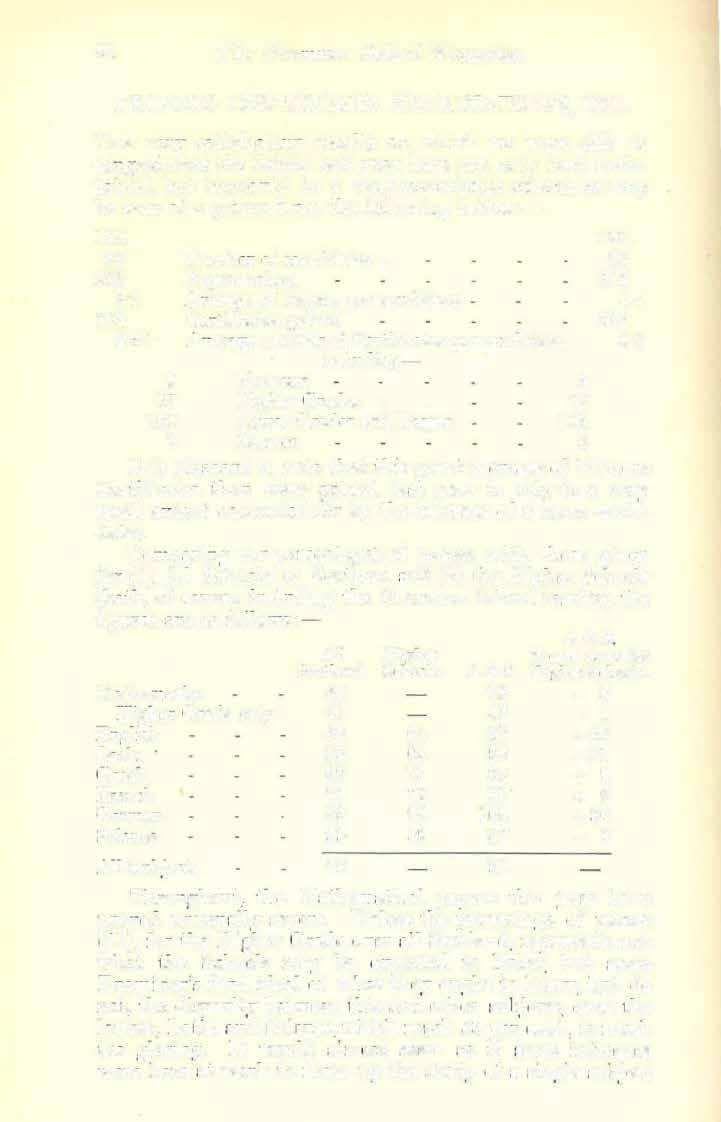
Throughout, the Mathematical papers this year have proved unusually severe. Unless the percentage of passes (41), r the Higher Grade over all Scotland, represents not what the Schools may be expected to know, but some Examiner's fond ideal of what they ought to know, but do not, the disparity between this and other subjects, even the lowest, Latin and Science,which reach 53 per cent., is much o glaring It would almost seem as if some influence were here at work to force up the study of a single subject
by forcing down the candidates. This bears all the more hardly in the case of Mathematics, as a mysterious regulation does not albw a candidate in this, as in other subjects, failing the Grade he aims at, to console himself with a Lower Certificate; it is a case of "aut Cresar,aut nullus," and,for Honours candi<lates,without even the poor consolation of a pass in Arithmetic . The regulation must tend greatly to discourage the ambition of teachers and pupils. Had our candidates for Honours in Mathematics been content to repeat their former successes, our percentage in Mathematics also would have been no less satisfactory in relation to the average for all other schools.
The Honours were gained by:-
John M. Robertson, English, Latin, Greek, French. George Dawson, English (Higher Latin, Gk., Germ., pass Anal. Geom.).
Wm.S. Mackie, English (Higher Latin).
Ian M. M'Laren, English (Higher Lat., Gk., Fr.).
Andrew R. Williamson, French (Higher Math., Eng., Lat., Gk.).
Summcirised:-
In 1900 by 13 18 13
In 1901 by 22 27 16 10 13 Candidates.
The claims for "Group" Certificates have not yet been adjudicated; but it is expected that they will show over 50 per cent. increase on last year's results.
ART CERTIFICATES.
(Freehand, Light and Shade, ModelDrawing.)
ADVANCED
COURSE.
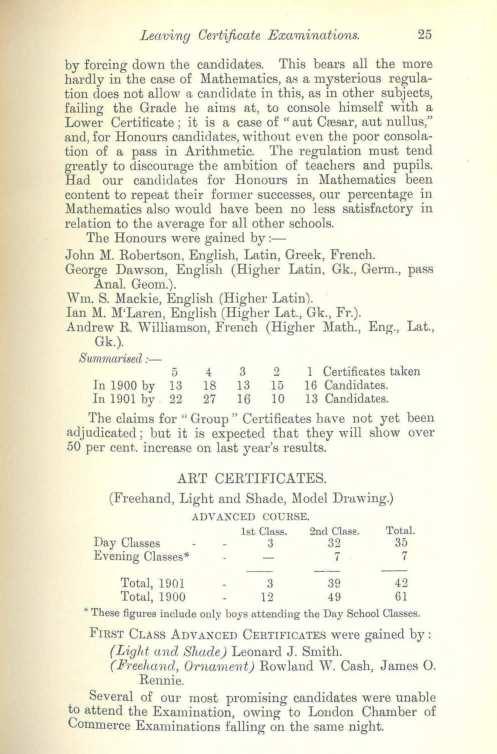
* These figures include only boys attending the Day School Classes.
FIRSTCLASSADVANCED CERTIFICATESwere gained by : (Light and Shade) Leonard J. Smith. (Freehand, Ornamerit) Rowland W. Cash, James 0. Rennie.
Several of our most promising candidates were unable to attend the Examination, owing to London Chamber of Commerce Examinations falling on the same night.
THE l'WO PRHIROSES .
I.
SHIELDEDfrom icy winds by hawthorn screen
A lusty primrose raised its petals pale, Drinking the sun; and children sought the Yale From crowded city, and this gem was seen.
Anon they plucked both root and leafage green, And bore it hence; its :frondswere limp and frail, And life seemed ebbing when, with noisy tale
Of how 'twas found, they gaye it new demesneA draughty plot and grimy-where it stroYe
The summer long to keep its head on high, But dust and soot upon its visage wo,e
A darksome net that dimmed its eye; It dwindled, sickly, and keen Winter drove His knife within its heart and saw it die.
u.
About her father's rustic door she played, And roamed the fields, chasing the butterflies-
A sunny child, with merry twinkling eyes
That caught the lark as in mid-air he strayed; And when five Aprils had their journey made, Her hearth was planted unde1·smoky skies
Of squalid mart from which the sunlight flies.
Anon each rosy cheek began to fade, And life to shed its sweetness from her heart; In miry street she could no pleasure see, Tho' sallow playmates stroYe with ready art
To lure her to their pastimes full of glee.
A lurking fe,er shot its fiery dart, When glades were green, and set the prisoner free.
THE A.L,~UAL ATHLETIC SPORTS.
'l'HE Annual Athletic Sports took place on Friday and Saturday, the 27th and 28th of last month. Friday, the day on which the Jumping and Trial Heats took place, came, bringing with it wind and rain, and just as we had resigned ourselves to the almost annual meeting of the Games and Sports Committee, when, seated on lemonade
cases, they order with rueful countenances the indefinite postponement of the Sports, the gods became fairly propitious, and we got, if not the '' ideal day" that the local daily press is so fond of, at any rate a day for which, considering the late season of the year, we ought to be very thankful. It is most unfortunate that the Sports cannot be held at a better time of the year, when we ca.nbe fairly sure of fine weather; but we suppose that so long as Examinations are so numerous and so pressing nothing can be done to improve matters. Of Friday we need say but little, as the events of that day are almost insignificant compared with those of the next. On both days the entries were eminently satisfactory, somewhat more so than last year. The winners of the Trial Heats on Friday were loudly cheered, and one competitor who ••went in for everything," largely in order to make up the number requisite for the a_yVardingof a third prize, recefred quite an ovation on his first appearance. Among the spectators we noticed, in addition to many of the Staff, John Clarke, Esq., Lecturer on Education at the 17ni,ersity, and the Rev. Gordon J. }1:urray. There was also a large number of the gentle se:s:, who seemed deeply interested in the proceedings.
On Saturday the Final Heats were run amid the greatest enthusiasm, and on that <layalso a greater number of parents and friends were present, including the Rev. 1Iaxwell J. Wright, of St. Xinian's, Rev. Robert Semple, Alex. Ledingham, Esq. (F.P.), and Dr. }fair. Refreshments were to be ha.cl in the Yeranclah attached to the Lower School Playground. One of the noticeable things this year was the number who entered for the :Mile-no fewer than twel,e. The race was won by J. T. Soutter, who, in spite of a maimed leg, managed to quit himself like a man in all the races that he competed in. We obser,ed that in the Obstacle Races the ,Vater Jump had ?een dispensed with, and although this is one of the most 1~teresting items, we were not altogether sorry. At this time of the year chills are very easily caught, and, as they are the forerunners of so many of the ills that afflict the human race, we think it best to avoid even the possibility of catching them. The record for the High Jump is not altered, the height this year being one inch less than last. 0ne of the features of Saturrlay afternoon was the Collection_ for the Band. A prominen t and Yery energetic o~c1al of the Literary and Debating Society took in hand this not altogether enviable duty, and, having gone round
with the box, squatted down just inside the ropes to count his money, while a number of small people peered over his shoulder, wondering what on earth he was doing. vVewere sorry, by the way, to see one or two officious individuals, who are not on the Games and Sports Committee, figuring on the course. "'iiVhatthey were doing there is not quite evident, but they should have remained in the place·for ordinary spectators - outside the ropes. Oha.rles Davidson, Esq. (F.P.), acted as referee, J. Davidson, Esq., and :;\L H. :llackie, Esq., as judges, and :M:r.H. Joseph as starter. Not a little of the undoubted success of the Sports is due to Rev. "'iV.H. Kirwan Ward, who, in addition to being timekeeper, had, in his capacity of Honorary Secretary of the Games and Sports .Committee, the general management of affairs. The Committee were unwearied in their exertions, and deserve the thanks of the School for their energy. It is a most healthy sign when such a Committee as this does its work with a will and not as if it were a great bother, to be got over as quickly as possible.
LIST OF PRIZE-W IKKERS.
High Jump (Class V.)-1 J. Ellis, 2 R. M. Ledingham a,nd I. L. F. Macbeth (equal). Height, 4 feet 8 inches.
H igh Jump (Class IV.)-1 J. B. M. M'Hattie, 2 J. Giles. Height , 3 feet 8 inches.
High Jump (Class III.) -1 G. E. Scroggie, 2 R. A. WaJker. Height, 4 feet 1 inch.
High Jump (Class II.)- 1 A. S. Johnson, 2 S. M. Robertson. Height, 4 feet 4 inches.
High Jump (open)-1 W. W. Jameson, 2 J. T. Soutter. Height, 5 feet 2 inches.
Broad Jump (open)- ! J. T. Soutter, 2 W. W. Jameson. 16 feet 7¼ inches.
Hurdle Race~ (Class II.)-1 A. S. Johnson. Time, 17 4-5 seconds.
Hurdle Race (Class III.)-1 W. L. Oxford, 2 A. S. Catto. Time, 18 4-5 seconds.
Hurdle Race (open)-1 J. T. Soutter, 2 A. S. Johnson, 3 H. Macpherson. Time, 17 seconds.
80 Yards Race (under 7)- 1 W. Wyllie, 2 D. Meston. Time, 16 seconds.
80 Yards Race (und~r 6)-1 K. Robson, 2 A. Rose. Time, 19 seconds.
100 Yards Race (Class V.)-1 J. Ellis, 2 J. M'D. Walker, 3 A. Ledingham. Time, 16 seconds.
100 Yards Race (Class II.) - 1 A. S. Johnson, 2 M. J. Williamson. Time, 13 seconds.
100 Yards Race (open)-1 J. T. Soutter, 2 W. W. Jameson, 3 D. B. Nicol. Time, 11 seconds.
100 Yards Race (Class TV.)-1 J. M'Hattie, 2 A. Ledingham, 3 H. Finlayson. Time, 14 1-5 seconds.
100 Yards Race (Class III.)-1 E. P. Barnett, 2 D. R. Macdonald, 3 W. L. Oxford. T e, 18 seconds.
Putting the Weight (open)-1 W. W. Jameson, 2 H. M'Phcrson, 3 A. R. Williamson. 28 feet G inches.
Half-Mile Race (Class II.)-1 H. G. M. Wilson, 2 D. Whamond. Time, 2 minutes 37 1-5 seconds.
Half-Mile Race (Class III.)-R. A. Walker and W. A. B. K. Ward (equal). Time, 3 minutes 3 2-5 seconds.
Half-Mile Race (open)-1 J. T. Soutter, 2 J. A. Davidson, 3 W. Grant. Time, 2 minutes 26 seconds.
150 Yards Race (Class VI.)-1 D. M. Bisset, 2 N. Stott. Time, 28 2-5 seconds.
Thro ng the Hammer (open)-1 A. R. Williamson, 2 M. Mackie, 3 W. M'M. Ande on. Distance, 54 feet.
Throwing the CricketBall (open)-W. W. Jameson. Dist ce, 83 yards 9 feet.
300 Yards Race (Class V.)-1 J. Ellis, 2 R. Lawrence, 3 G. Stephen. Time, 53 seconds.
300 Yards Race (Class IV.)-1 J. M'Hattie, 2 H. Finlayson, 3 G. A. Finlayson. Time, 49 2-5 seconds.
300Yards Ra.ce (Class III.)-1 E. P. Barnett, 2 W. P. Ba on, 3 W. L. Oxford. Time, 46 seconds.
Quarter-Mile Race (open)-1 J. T. Sautter, 2 J. A. Davidson, 3 D. B. Nicol. Time, 45 seconds.
Qu er-Mile Race (Class II.)-1 D. Whamond, 2 H. G. M. Wilson. Time, 63 seconds.
100 Yards Race (F.P.) . Clarke. Time, 11 seconds.
Sack Race (open)-1 W. A. B. K. Ward, 2 J. A. Davidson, 3 C. D. Peterkin. Time, 21 4-5 seconds.
Sack Race (Classes IV. and V.)-1 J. B. M. M'Hattie, 2 C. Reid, 3 D. C. D can. Time, 24 5 seconds.
Sack Race (Class III.)-1 W. A. B. K. Ward 2 and 3 (equal) E. P. Ba ett and D. Cruikshank.
Thre Legged Race-1 C. F. G. Crawford and J. T. Soutter, 2 D. C. Duncan and W. A. B. K. Wai·d.
One-Mile Race (open)-1 J. T. Sautter, 2 J. A. Davidson, 3 J. Lamb. Time, 5 minutes 35 seconds.
Tug-of-War (Seventh v. Sc ool)-Won by Seventh..
Obstacle Race (Classes III. and IV.)-1 W. A. B. K. Ward, 2 B. Saunders 3 W. L. Oxford.
Obstacle Race (Classes I. and II.)-1 J. M. Walker, 2 L. J. Smith, 3 F. M. Greig.
Consolation Race-D. Watson.
LIST OF PRIZE-DoxoRS.
Mrs. H. F. Mol'land Simpson, }Irs. W. H. Kirwan 1Vard, }Irs. Crawford, Mrs. Saunders, :MissJ. B. T. Davidson, )Iiss )Iackie, )Liss Anderson, Miss E. W. Davidson, :lliss Adam, Miss Gordon, Alex. W"alker, Esq., LL.D., J.P. (F.P.):W.H. Williamson,Esq., 11.D.(F.P.); Alex.Ledingham, Esq. (F.P.)- 2; S.Pope, Jun., Esq. (F.P.); J. Smith, Esq.; Robert Gall, Esq.; the Rector; George }Iiddleton, Esq.; :ll. H. )Lackie, Esq.; C. )Iacleod, Esq. ; I\. :llurison, Esq.; S. Pope, Esq.; W. Brownie, Esq.; Re,. W. H. Kirwan Ward; J. DaYidson, Esq.; C. Davidson, Esq. (F.P.); A. Spiers, Esq.; P. Edward, Esq.; G. X. Ritchie, Esq.; J. }I_ lforrison, Esq.; J. C. Knox, Esq.; and P. G. Allan, Esq. (F.P.). G. S. R.
THE AQCATIC SPORTS.
OuR Annual .Aquatic Sports, which were held in June, were in the opinion 0£ all the most success£ul we ha,e e,er had. Their success was due not only to the presence 0£ so many boys and their friends, but also to the large number 0£ entries for the rnrious races. :llore boys, we think, ha,e entered this time for the races than on former occasions. We are glad to see this, because it shows that such a manly sport is not decreal:ling in favour in the School, and it also shows to those of the School Board who were present the great need we have 0£ Baths of our own. We feel confident in saying that many more boys who have not the time to go as far as the Beach would learn to swim if we had Baths 0£ our own.
Our Rector, as usual, kindly acted as Chairman, and sharp to the hour the Sports commenced. The first event was the race for the Rector's Cup. This was the chie£ race, and showed who was the best swimmer in the School. It was won by )Laurice J. Williamson (time, 1 minute 45 seconds), who holdsthe cup £or oneyear, and gets his name inscribed on it.
The next item was the Junior Handicap, which was won by 1Y. Shepherd (time, 67 seconds).
As many predicted, ~- J. Williamson won the neat dive, though not by very much, his brother D. H. Williamson being only a half-point behind him. We heard un expert say that :ll. J. 1Villiamson was one of the neatest boy divers he had seen.
L. J. Smith, another of our promising swimmers, won the Senior Handicap with 17 seconds of a handicap, J. Ellis being second.
Only two entered for the Beginners' Race, but a hard race was swum and won by W. Mackintosh.
There were large entries for the "Plunge," which always proves an interesting item, and, after an e:s:citing struggle between W. Paterson and D. H. Williamson, the former was the winner. Several of our ,isitors got a taste of salt brine when a particularly heavy or clumsy fellow took to the water, but they seemed to enjoy it as much as the youngsters who,watched from a distance.
One of the most laughable races was the Tub Race. This is a new feature at our Sports, but it was such a success that it would be worth while having it again. There were 3 entrants, and each having procured a coffinshaped tub, proceeded to get into it. But this was not such an easy matter, and only W. Shepherd got safely away. The others allowed water to get into theirs, and consequently began to sink. But Shepherd managed to turn, and get well back before any accident happened. Then his boat shipped water too, and it was thought that he would sink, but, with only a part of his boat above water, he safely landed before his comrades had got well away.
The most entries, 25 in number, were made in the Blindfold Race, which is another of our old fa,ourites. Everybody laughed greatly when a panting boy, having been instructed in the right course, promptly went the other way. After much fun in the various heats, I. K. Burnett won the final.
After the Object Diving, which was won by D. H. Wi~liamson, came the last event, the Greasy Pole. The excitement over this event was intense. After several tries each, L. J. Smith proved the victor.
The judges were-A . Johnstone (T.S.C.) and D. }I. Bridgeford (T.S.C.); Starter and Referee, Scarborough (A.C.S.B.); Timekeeper, Rev. W. H. K. Ward, B.A. (Cantab.). The Stewards were-G. S. Russell (G.S.C.), T. Watt (G.S.C.), J. G.Danson (G.S.C.), A. Mortimer (G.S.C.), and R_. Bruce (G.S.C.). •
Prizes were kindly presented by Dr. ,:v. H. ,:villiamson (rP_.), H. F. Morland Simpson, Esq., M.A. (Cant.ab.), ,v. Murison, Esq., }f.A., and )I. Mackay, Esq., }I.A.
A.G.S.C.C.,
1901.
OWING to the scores of the Turriff match having been lost and a copy of them not having yet reached us from Turriff, we are unable in the present number to give the batting averages of the First XI. The season was not successful, the School only winning two matches out of eleven played, but some of the games were very closely contested, and the team showed a decided improvement towards the end of the season. The chief weakness was in the bowling. It is a not uncommon failing with young captains to be afraid of changing the bowling, and this has been the case with the Grammar School for, at least, the last three seasons. There was a want of smartness and dash in the Jielding,'too,many a run having been given toour opponents by lack of a clean pick up and a sharp return; in this respect, we are glad to say, A. S. Johnson is a brilliant exception, his fielding being always neat and clean, and he is a safe catch.
April 27. May 4. ., 18. " 25. ., 29. June 1. 11 15. ,. 22. 11 26, " 29. Sept. 14.
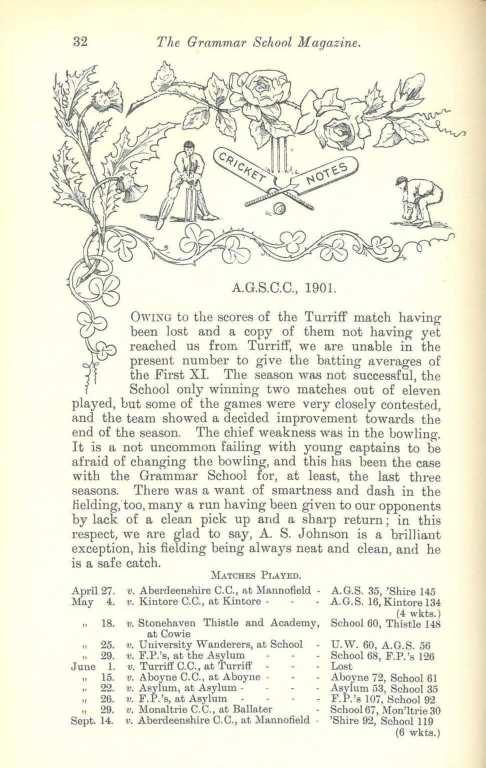
School 60, Thistle 148
U.W. 60, A.G.S. 56 School 68, F.P. 's 126
Lost Aboyne 72, School 61 Asylum 53, School 35
F.P. 's 107, School 92
MATCHES PLAYED, v. Aberdeenshire C.C., at Mannofield - A.G.S. 35, 'Shire 145 v. Kiutore C.C., at Kintore - A.G.S. 16,Kintore 134 v. Stonehaven Thistle and Academv, at Cowie • v. University Wanderers, at School v. F.P.'s, at the Asylum v. Turriff C.C., at '.rurritfv. Aboyne C.C., at Aboynev. Asyl~m, at Asylumv. F.P. s, at Asylumv. Monaltrie C.C., at Ballater v. Aberdeenshire C.C., at Mannofield{4 wkts.)
School 67, Mon'ltrie 30 'Shire 92, School 119 (6 wkts.)
The principal scorers for the School were: v. Stonehaven, D. Reid, Esq., 34; 'tt. University Wanderers, A. S. Johnson 30; v. Aboyne, H.M'Pherson 15(not out); v. F.P.'s, R. S. Clark 17, T. B. Robertson 12, D. Reid, Esq., 10; v. Asylum, A. S. Johnson 10, A. R 'Mortimer 10; v. F.P.'s (return), R. S. Clark 46; v. l\fonaltrie, A. S. ,Johnson 23; v. Aberdeenshire, C. Walker 32 (not out), Rev. W. H. K. Ward 22, A. R. Mortimer 19, R. S. Clark 15.
WHAT'S IN A NAME?
ANALYSISof the names in our school list of last May yields some interesting and curious results. Of chief historical interest, when compared with our lists, say 150 years ago, we note how the Highlander has invaded our Lowlands: we have 31 "Macs," and some 71 other Highland or clan names, notably of the local clans. Go1·don,Farquluirson, Forbes,Leslie, &c., not including such well-known Border and Lowland tribes as Johnston(e), Scott, Ell-is,Crawford, Hay. The great historical names of William Wallace, Robert B1·uce,and James SfP'Wa'rtare well represented.
0£ counties and districts we have Angiis, Lothian, Ma1·r, lrlu1Tay, Harris, Ross, and Sutherland; of towns and hamlets, Beverley, Ommond, Fyvie, and Johnston; while England has sent us Oxford.
0£ the -o names so common hereabouts we have only Catto and Durno. Names ending in -son number 68; many of these, however, were Saxon for genuine clans,such as Robertson, Fa1·quha'i'Son. We note with pleasure that the Cumming race has more than one representative. Macbeth and Dimcan meet ominously in one class, and Coulc naturally follows BtLtcherinanother. In a third, A.B.C-leads off the alphabet, and W. A. B.K. X. Y.Z. W-- useR up most of what is left.
Trades and occupations have given us Baxter, Bmnde1·, Coolc,Cooper,Cox, Fishe1·,Gillies, Hunter, J.1fa1·shall,Mille1·, Porter, Smith-with the variant Smyth-Souper, Soutter, Taylor, Webster, Wriqht. There is one Slessor (Germ. Schlosser= locksmith),~ Cheyne, and a Key; five Shepherds to one Lamb. Three Lyons, a herd of five small Stots, and one Turnbull complete our menagerie. The church is represented by two Elders, four Clarks, one Dean, and a Pope. Our choir has but one Srmgste1·; our orchestra two Hcwpers and a Horne. Eight Wallcers have but one Legge amongst
them. We boast of a Ga1·den, a Park, Hay, and Fildes; two Lillies, one Biir1·, many Reids, and a Garland; but only two Roses, each "left blooming alone." Our munitions 0£ war have been reduced to a single Gunn, since our only Cannon went offand was taken from us.
0£ various initi11ls we have ASH, OAilf, and HOP; ART, JAM, and JAW twice each; WAR, RAW, GAD, JET; a J.P., an M.P., and an .A.D.C.
Colours are represented by Blaclcwood,Whyte, Snowie, Brnwn, Green, and Rust; personal peculiarities and qualities by Cruickshank, Skinnie, Sharp, Wyllie, Aitken, Wiseman, and Wishart, Ohrystall, Still, Piclcford, Mer1--ilees. Mutch, .Jllair, and .llfest-on invite comparisons. The number of Raes is X.
LIBRARY.
THE Library has once more started, and as yet promises to do well. During the summer months, workmen have been doing wonders, and now we are prepared for as many books as kind donors wish to gfre us. A reference department will soon, we hope, be started, under the charge of }fr. "\Vard, who, for the last few months, has been ,ery busy classing and arranging the books. Thanks to Theo. "\Vatt (F.P.), the books in the lending department ha,e been carefully numbered and arranged, and we are now sitting like Patience on a monument waiting for the expected crowd of members.
Xmv Boon:s.-,Ve ha,e obtained the following new books:-" ~apoleon: the Last Phase," "Quisante," '' "\Vhat Cheer! " "The Little 1Iinister," "City d Refuge," "A Son of Hagar, " "Dono,an," "Victoria R. et I.," ·' Secrets of the Courts of Europe," "The Humour of the Scot."
ST.-1.FF.- J. )Iacpherson has taken Theo. Watt's place, and D. G. Robb has been added to the Staff.
A.. L.
$ cbooI ©ff icials.
SESSION 1901-1902.
Garnes and Sports Committee.
President, The RECTOR. Hon. Sec,·etary, Rev. W. H. K. WARD, B.A. }Ir. JAMES DAVIDSON (representing Lower School).
W. M. AxDEIIBON (Football). A. LYON (Magazine).
C. CRAWFORD(Football).
W. L. M. GRAliT (Football).
W. W. JAMESON'(Football).
A. S. Jom,sox (Cricket).
J. LILLIE (Football). Captain, Secretary,

Football.
H. MACPHERSO:< (Football)
J. MACPHERSON(Football).
D. B. NrcoL (Football).
C. WALKER (Cricket).
D. H. w. WILLIAMS0:S. (Swimming). :i\L M. MACRAE. W. W. JAMESOK,
Literary and Debating Society. President, A. R. WILLIAMS0K. rice-P residents.
J. RAE, J. T. S0L'TTER, ~- :\I. llIACRAE, Secr eta,·y anrl Trea,urer, Committee. <,. E. ILw. \V. W, ,JA)!ESOK.
A. LYO:S., J. :\lACPHERSON,D. G. ROBJl. M.agazine.
ALEXASDER LYO:<. w. G. CRAIOEN.
D. H. WILLIAllISO:<. D. G. ROBB.
Library. JAMES G. DAXSON. J. 11. :i\1ILNE. J. URQUHART, Reference, Lending, Rev. W. H. K. WARD, B .\. Editor-in- Chief, Litera,·y, /':,port, Business .llfanag e,·,
The Secretary of the Former Pupils' Club is Mr. ALFRED W. EDWARDS, 267 Union Street, Aberdeen.
THE Annual General Meeting of ' this Club was held in the Reading Room of the School on Thursday, 26th Sept. There were 25members present. Mr.Kenneth l\Iackenzie was called to the chair, and, after congratulating the Club on the large attendance, called on the Secretary for his Report. The Report bore that the membership ofthe Club was being fully maintained, that both :X:V.'shad had a successful season-the 1st :X:Y. ha,ing won o out of 8 matches-the 2nd XV. having won 9 out of 12-an.d that the Club was in a strong financial position, there being a considerable balance in hand. Attention was called to the growing-practice of players leaYing School, and players who haYeappeared in the ranks of the F.P.'s, joining other clubs, and the hope was expressed that old School players would look upon it as their duty to play for the F.P. Club in preference to any other.
It was intimated tha.t the surplus Bazaar goods would be raffled in the course of a few weeks, and members were urged to use their best endeavour to dispose of tickets.
The meeting then proceeded to the nomination of officebearers for the ensuing season, when the following were elected, subject to their acceptance of office:-
Hon. PresidentH.F. Morland Simpson, Esq., M.A. (Cantab.).
Hon. Vice-President.<-
James Crombie, Esq., M.B., C.M., L.D.S.
Charles Da,vidson, Esq., M.A.
Francis Kelly, Esq., M.A., M.D.
A. M. Mackay, Esq., M.A.
R. Whyte Mackay, Jun., Esq
Some Gems of Tra.,nslation.
William A. Pope, Esq.
H. F. Menzies, Esq., M.A., B.Sc.
Ernest Rennet, Esq., C.A., B.L.
Alex. Walker, Esq., M.A., M.B., C.M., D.Ph.
Rev. W. H.K. Ward, B.A. (Cantab.). John Webster, Esq., M.A., B.L.
E. \V. Watt, Esq., M.A.
W. R. Butchart, Esq.
Lieut. James A. Butcha.rt.
G. 0. Gauld, Esq., M.B., Ch.B. James Ogilvie, Esq.
Captain,..--Mr. A. B. Butchart. Vice-Captain--Mr. Pat. Barnett.
Secretary ancl Treasurer-Mr. Samuel Pope. Committee-
Mr. John R. Pope. Mr. Harry Butchart.
Mr. Andrew Wilson.
Mr. F. R. Johnston.
2ND XV.
Captain-Mr. Robson.
Vice-Captain-Mr. F. Michie.
Secretary-Mr. Bryan Wright, 54 Stanley Street. Committee-
Mr. A. Giles.
Mr. R. Anderson.
Mr. John Clark.
Mr. Frank Watson.
SOME GEMS OF TRANSLATION.
THEVirgilian saevu,mJunonis ob iram, according to Professor Ramsay of Glasgow, was translated by a Pupil Teacher-iram, "I will come," ob, "on," saevam Junonis, "the seventh of June." The well-known line in the second Aeneid-infandum regina, jubes renovare dolorem, a Yankee Professor told me was rendered by a student, "wicked queen,you bidme change a dollar." Apupil in the Grammar School of Aberdeen gave for Virgil's florentesaere Oate1·vasthe rendering" blooming·brass bands." This he gave with the same unconscious humour as the clergyman showed who spoke of" age with its hoary locks, and youth
with its bloomin_q cheek." I once got an amazing trnnslation of Virgil's Cocytusque sinit labens circiimvenit atro"Cocytus prowls about with fish-hooks." This was from a candidate for Medical Preliminary Examination. One more, a chestnut-Horace's Qui fit, Maecenas,ut nemo quarii sibi sorte1nis said to have been translated by a Dublin student, "Who made Maecenas? how, nobody? what a lucky fellow was he!"
M.
The meeting £or the election of officials took place on the 11th of last month. Mr. Middleton, Hon. Vice-President, occupied the chair and conducted the elections, the result of which will be in the list of Rchoolofficials. A vote of thanks to Mr. Middleton concluded the proceedings. 1901.
Oct. 4. LEOTURE-" Can you speak?"
ALFRED MACLEOD, Esq.
11. l:!IPRO!IIPTU. ,, 18. MAGAZI:-'E NIGHT.
25. LECTURE-" Winchester and the Alfred Millenary "-with Limelight Views.
Prof. DAVIDSON, LL.D. (F.P.).
1. HECKLING Nrm-1T.
C01uervative, J. RAE; Liberal, J. MILNE.
8. DEBATE-" Ought the Franchise to begranted to Women?" Alf., M. 11ACRAE; Neg., J. URQUHART. ,, 15. LECTURE-" Our Homes, andhowtomake themhealthy "-with Limelight Views.
J. N. CARMICHAEL, Esq.
Nov. 22. DEBATE-" Which is better for the young man, manual or intellectual labour?"
Parmer, A. R. vVILLIAMSON; Latter, J. RAE. ,, 29. DEBATE-" \\'ill the,Carnegie :rust dogood or harm? "
Former, J. G. DANSON, Latter, J. T. SOUTTER.
1901.
Dec. 6. PARLIAMENTARYNm11T.
13. LECTIIBE-" TheVicar of,,,akefield." A.MACKIE,Esq.,M.A.
20. PAPER-"TheAnakims ofLiterature." J.M. ROBERTSOX(F.P.). 1902.
Jan. 10. PAPER.
M.H. MACKIE,Esq., M.A. ,, 17. DEBATE-" (.;anamangetrich honestly? " A.ff., C.B. SmPsoN; .Ne!]., J. M .\fIL1'E.
24. DEBATE-"AretheShips oftheNavywhat they ought tobe?"
Afj:, G.H.MAIR; Neg., W.W.JAMESO:S-.
31. MAGAZL'IENIGHT.
Feb. 7. DEBATE-"Should Trial byJury beabolished?"
A.ff., G.HAY; Neg., W.A1'DERSON.
14. LECTUR}J-"TheElectric Tramway."
OH.>RLESMACLEOD,Esq., M.A.
21. LECTURE-''TheElectric Tramway" (continued). CHARLESMACLEOD,Esq., 1'.LA.
28. LECTURE- -with Limelight Views. H.F. M.SrnrsoN, Esq., M.A.,F.S.A. (Scot.).
Mar. 7. Fr:S-ALE.
CORRESPOKDE~CE.
To the EDITOR of the ABERDEEN GRA'11MAR SCHOOL MAGAZDIE.
Sm,-I am aware that the members 0£ Cl.and )Iod. IV. are somewhat disappointed with the action of the Literary and Debating Society Committee in the matter 0£ their nonadmission to the membership of the Society. I venture to say that while the admittance 0£ those who are too young to appreciate the benefits 0£ membership is calculated to injure the utility 0£ the Society as an educati-rn power, nevertheless I consider that the sooner the '' apprenticeship" 0£ a member is over the better, in order that he may be fitted to take upon himself his proper share 0£ the responsibilities 0£ full membership in later years.
When in the Fifth, the average member should begin to "feel his feet" ; in the Sixth he should certainly be in office as an ordinary member of Committee, if nothing m?re; while in the Seventh, in his first year he should be Vice-President, and in his second- if duly qualified and approved of by his fellows-President.
I.confess that I made a mistake at the meeting for the election of officials when I said that it was not very likely that the Fourth would be admitted; but that remark was due to the £act that a prominent member of that Class was
School Magazine.
71roposecl as Presi mt by one who should most certainly have known better, and also to the fact that I had not had s 1 cient time to consider my course o action in thi matter. I considered that if the candidature of a member of these Classes be endorsed by his English Master, for e ample, and i no member of Committee can produceand ubstantiate-any objection to his admittance, he should most certainly be allowed all the privileges of ull membership.
Trusting that the Committee will even now, at this eleventh hour, reconsider their decision, with a view to ettling this annually debated point once and for all.I am, &c., J uEs RAE, Vice-P1·esiclent.
[We think that r. Rae has done very well to stancl up for the rights of Cl. and Mod. IV., who, in our opinion, ought to be allowed some, if not all, of the bene ts which accrue to the membership of the Literary and Debating Society.-ED. A.G.S.M.]
OUR CO�TE PORARIES.
1VE ha·rn recei,ed, and beg to acknowledge with thanks, the llowing }Iagazines :-
" High School Sentiment" (Kansas), "Edinburgh Academy Chronicle" (3), 'Ola,ian " (2), " The Yellow Dragon" (2) (Queen's College, Hong-Kong), "WashingtonJe ersonian" (U.S.A.), "St. Andrew's College Magazine" (Grahamstown, S. frica), "Spier's School agazine' (Beith).
THE GRAMMAR SCHOOL MAGAZINE
Published Quarterly throughout the School Year.
'he Ma azine may be obtainedfrom the Janitor, at the School; James G. Bisset, Bookseller, Broad Street; and D. Wyllie & Son, Booksellers, Union Street.
The Annual Subscription to the Magazine is 2s.; or, post free, 2s. 6d., at home or abroad. subscriptions should be rwarded to the Business anager o the M a az-ine, Grammar School, berdeen.
Back numbers of the Ma,qazine since 1885 may be had on application to the Business anager.
ll literary communications should be sent to the Editor, Grammar School, berdeen. Correspondents must enclose their names, not necessarily r publication.
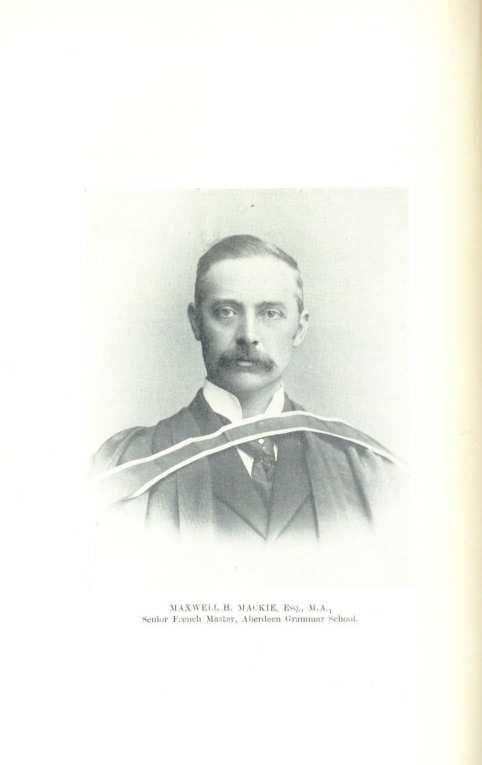
~xwr:rr. 11. IIA< KIF. , i::,~ ~1. 1., :-ic11it11· J·,ench :i.1,1~tel', \IJenl~ t,•11 1:r;1111rna r :-:.c:hool.
~I