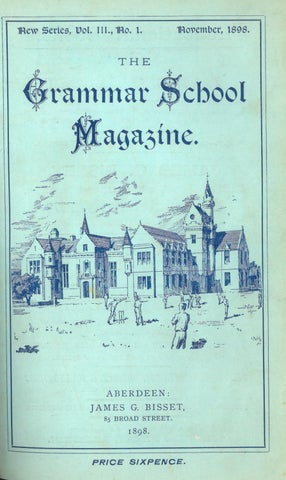
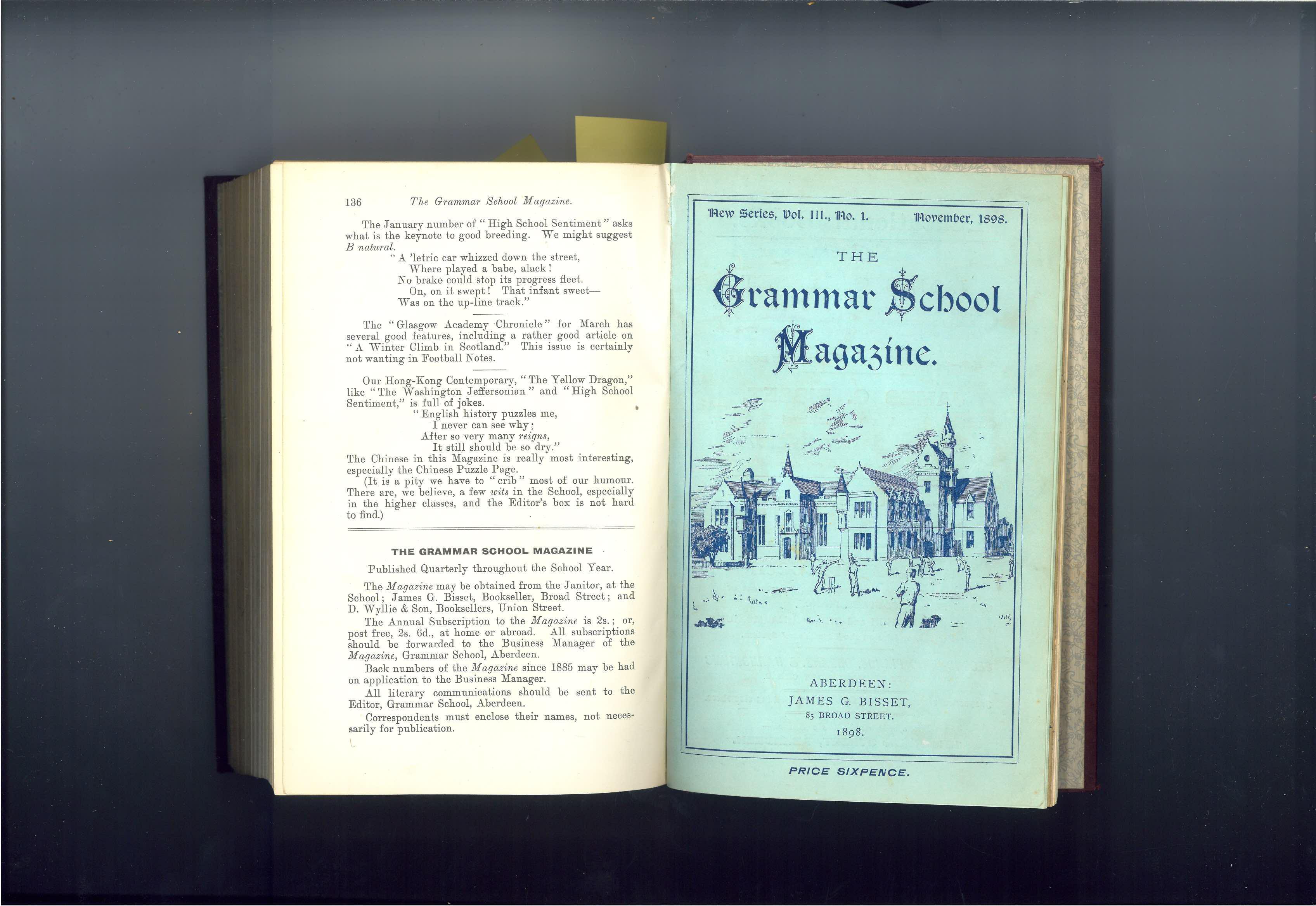
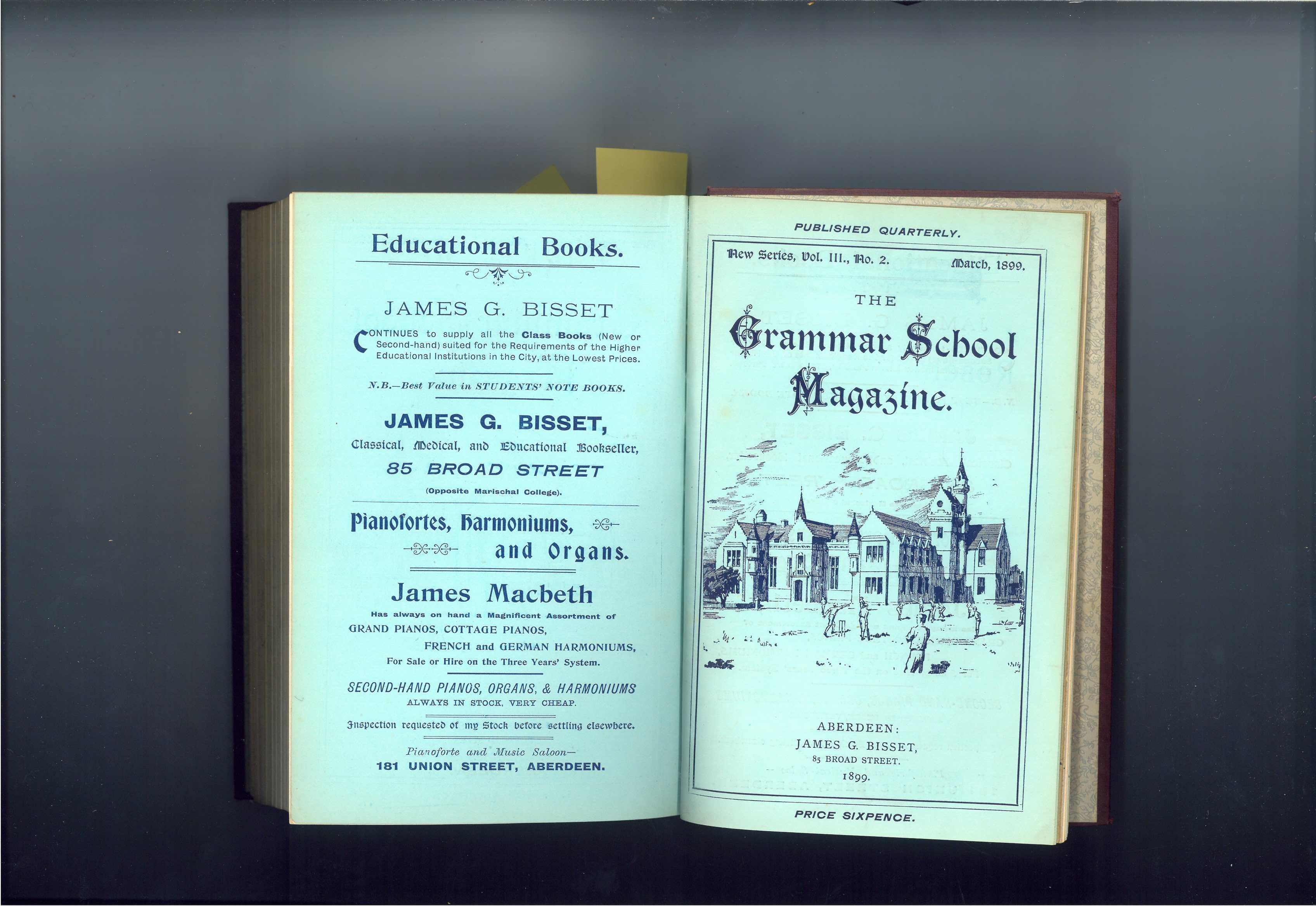
THE ©rammat School ffiaga3ine.
New Series, Vol. III. NovEl\IBER, 1898. No. 1.
THE BYROK STATUE.
LETTER FRO:vI THE POET LAUREATE.
!SOLA S. GIOVANY!, LAGO MAGGIORE, 7th Nov., 1898.
To the EDITOR of the GRAMMAR SCHOOL MAGAZINE.
DEAR Srn,
I am afraid that, in appealing to me to express an opinion concerning the controversy that you tell me divides the citizens of Aberdeen on the question whether a statue should be erected t h ere to Byron, and in saying, as you are good enough to do, that I should speak with authority, and should therefore be listened to, you exaggerate the influence any individual can exert over publicly expressed differences of opinion; nor have I the right to assume that anyone in Aberdeen will waive his own ,iews in deference to mine.
Sti ll, since you have appealed to me, perhaps I may, without presumption, venture to point out, that when memorials are raised to men of genius, such homage is paid, not to their weaknesses, but to their strength ; not to their lapses from virtue, but to the qualities by which they ha,e delighted, encouraged, or consoled their fellow-men.
Two years ago, I had the honour to unveil a statue to Burns at Irvine ; and I believe there is one to the Poet whom the Scottish people have selected to be almost their national hero, in Aberdeen. But surely the moralist who can forgive Burns, would with difficulty discover the poet from whom he could consistently withhold the indulgence of generous absol ution.
Believe me, yours faithfully,
SCHOOL MATTERS.
WE haYe, :first of all, to congratulate Dr. Moir and th e school on the additional honour which he has obtained. As most of our readers know, h e has had conferred on him by the University of Aberdeen th e d e gree of Doctor of Letters. Dr. Moir is the first to receive the honour. We understand that there were several candidates for the aegree, but their theses did not come up to the required standard of excellence. The d egree is conf erred, not hono1·is causa tant·um, as in the case of the degree of LL.D ., but for special original work.
"'\Ve have also to congratulate }fr. John Clarke, our late Classical }faster, on his promotion to the L ectureship in Education i n the University. }fr. Clarke was in " the Grammar" for ten years, and his presence amongst us is much missed. It is to be hoped that, in a few y ears, th e Lectureship will de,elop into a Professorship.
:Mr. Brownie :fills the blank caused by Mr. Clarke' s d eparture, and the other niasters haYe been moYed up in their respectiYe order.
A rather curious incident happened i n the sfaff just after the holidays. )fr. Edwards r eceiY ed an appointm ent in Edinburgh, and held it £or a fortnight or so, but, like th e prod i gal son, he soon came back to us.
nfr. "'\Yatt, from Galashiel s ~lcademy, joined our sta:ft at the beginning of the session as a Master in th e Middle School.
We must congratulate }Ir James Davidson on his marriage, wh i ch took place during th e holidays. "'\Ve understand that th e happy couple sp ent th eir hon eymoon on the "\Vest Coast.
The )Iasters, as a sign of th ei r a ppreciation of }fr. Davidson a s a colle ague, presented him with a handsom P dining-room clock.
"'\Ve haYe p l easur e in recording our thanks to }Ir. P. .T. 4.\..nclerson, LL.B., U niversity Librarian, for his g en erosity in presenting four portraits of e min ent old boys of th e s chool. They have been hung up in the School Hall, aml
the Dramatic Society of the Former Pupils' Club has set apart £2 2s. from its funds to get these valuable portraits framed.
In this connection we heartily invite old boys of the school, or friends of th e school generally, to follow Mr. Anderson's e:s:ample . We have a roll of illustrious names in connection with our school, but the University steps in to claim many, though by no means all, of them. Thus, in biographies of some of our eminent former pupils, you will spe "Educated at King's or :lfarischal College, Aberdeen," &c., &c., but often there is no mention of the Grammar School. T~ey manage these things better in England.
Bur saries or scholarships are founded in the University in memory of such and such a one, but very rarely does any such luck fall to the Grammar School.
A beginning has, however, now been made by our Former Pupils' Club. It has been determined to institute a book prize, of the annual value of £2 or thereby, for the best English scholar in the school.
The conditions for holding this prize will be made public soon.
"Verbum dat sapienti "-" Bis dat qui cito dat."
In regard to the Library, we have much pleasure in announcing a donation of £6 from Sir Thomas Sutherland, K.0.)LG., )LP., Chairman of the P. & 0. Company, a former pupil of the school; also a donation of £3 3s. from the Dramatic Society of the F.P. Club. Lawrence :llackenzie has sent one volume of the "B.O.P."
Although the Library has received these generous donations, and has now added many splendid volumE's to its shelves, we are sorry to hear that it does not yet recei.-e that support from the Upper and Middle Schools which it deserves. Only one boy out of every six joins the Library. ~ow, seeing that the subscription is 'but ls. a year, it is not Yery creditable that this should be so.
The indefatigable Librarian informs us that he has latel y added many new "attractions"; but why mention them. here, for are they not all written on the lists in the Readmg-room? So, come in your hundreds.
. The school rejoices in its freedom from examinations this quar~er. We hope the e:s:periment of half-yearly exams. will be a successful one, for we simply groaned
The
School Magazine.
under the excess of ex aminations last year. They are a burden hard to be borne both by Masters and boys.
In the last Bursary Competition the 2nd place was taken by C. M. Kerr; ·w. W . Gauld was 13th; W . P. :Milne was 18th; James A. Gunn was 28th ; Alfred :lleh·in 41st; William Stephen 42nd; Robert Bain 44th; J. hl. Macqueen 48th; George E. Thomson 53rd; W . W. Low 58th; P. T. T. :MacDonald 59th; D. Richards 61st; ,v. C. Souter 62nd; James Shirran 64th; S. M. Chrystall 65th.
In conclusion, we earnestly ask old boys, present pupils of the school, and all interested in our prosperity, to send articles to the Magazine. Especially welcome are letters from old boys abroad. Stories of adventure, original poetry, &c., are i nvited . We would draw uur readers' attention to an article in the present issue by our only Admiral, and to another by our only Oxford Blue.
Several interesting contributions are crowded out. Ife expect to publish in our next number an article-specially contributed by a friend of ours in Cyprus-on' the SpiritWrestlers, an obscure religious sect, who were banished from Russia to that island, we believe. ,ve shall ha,e another from H.111.S. "Bri tannia"; others from Oxford and Cambridge; Glenalmond and Fettes Colleges; another from Sandhurst-all from former pupils. We are promised an article from the Editor of The Sl\,etch, and from an Old Boy on the staff of Black and White we arc looking for a short story.
~OTES OX OLD' BOYS.
Sm J.-DIES \VESTLA::SD, K.C.I.E., at the request of the Secr etary of State, will retain his post of Member of Finance of the -Viceroy's Council in India till :March next.
Sir William Macgregor, Governor of British X ew Guinea, has retired from that post after holding it for ten years. It has been said of him by the late Permanent Under-Secretary of State £or the Colonies that "one of the most able administrators ever appointed by the Colonial Office was Sir William Macgrego r." The Pall Mall Gazelle has a long and flattering account of Sir \Yilliam's go,ernment in that far-distant colony of our Empire.
Mr. John Gray, the British Consul at Cartagena, Spain, had an extremely difficult task to perform during the late Spanish-American War. He informs us that Cartagena (the "Carthago No,a" of the ancients, needless to say), which ranks along with Ferrol and Cadiz as the chief Spanish arsenals, was several times in imminent danger of being attacked by insurgent bands of hungry miners. )Iartial law was proclaimed. Mr. Gray had, in addition to his usual duties, to undertake the work of the American Consul, who had perforce to demit office. Several times a night the alarm was given that the American fleet was outside the harbour, preparing £or bombardment of the town. The more timid fled with all their belongings to the hills.
Mr. Gray's brother-in-law is Commander of "La Giralda," the Spanish Royal yacht.
Dr. ""\Vm. Bisset Berry, who has been raised to the high position of Speaker of the Cape Parliament, is a son of the late Baillie James Berry, Aberdeen. He passed through the hands of our famous 1lelvin, and, after graduating in .Arts, took the degree or 11.D. H e finally settled in South .Africa, and, after b eing thrice elected :Mayor of Queenstown, was returned as a Progressfre member to the Cape Parliament in 1894.
Brigade-Surgeon-Colonel "Williamson died at Lucknow on 21st June. .After a very distinguished career, he was ultimately appointed Brigade-Surgeon and principal medical officer of Lucknow- a post which he held till his death. He was well known throughout the Eastern Empire.
The Rev. X. K. MacLeod, Rector of S. Mary-on-theRock, Ellon, died last month. He was well known as an antiquary.
Arthur L. Danson, after an unusually brilliant career at i.he Grammar School, Rugby, and Oxford, both in the world of athletics and in the schools, took his B.A. degree at O_x:forcl, and gained tht 18th place in the India Civil Service Examination.
We remember him well at our last year's sports.
T. W. Hector has been admitted a law agent by the Lords of the Council and Session.
The Rev. ,V. W. Reid, B.D., has been appointed assistant to the Rev. A. Wallace Williamson, S. Cuthbert's, Edinburgh.
James Moir, M.A., B.Sc., has been appointed assistant to Professor Japp in the University 0£ Aberdeen. He had an excellent record when he was a student.
Charles Lyall Grant, M.A., took the First Place in the exam ination for Indian Woods and Forests, August, 1898.
James Georgeson, B.A., a£ter a distinguished career at Aberdeen and Oxford universities, has been appointed an Assistant Master in t he Girls' High School. He was for some time Assistant Pro£essor 0£ Greek.
The Rev. Fred. Hendry, M.A., has just been appointed assistant to the Rev. Hugh Cameron, Newington Church, Edinburgh. He was a brilliant student at the Grammar School, and at Aberdeen, Oxford, and Edinburgh Universities.
John Forbes, Q .C., Bencher 0£ Lincoln's Inn, Recorder 0£ Hull, has retired from practice at the Bar. He was leader 0£ the North-Eastern Circuit, and A.ttorney- General for the County Palatine 0£ Durham. He le£t the school about 1854.
T. 0. ,Vilsone has passed into H.11.S. "Britannia" as a Na-ml Cadet. He took the 17th place in the examination.
,Villiam Alexander Hunter, LL.D., late 111.P. for North Ab erdeen, died in July. After being called to the English Bar, he was appointed Pro£essor 0£ Roman Law in U nivers i ty College, London, and also Examiner for the U ni,ersity 0£ London. He is, however, best known for his efforts to secure Free Education for Scotland.
vVe offer our heartiest congratulations to Pro£essor S. D. F. Salmond, D.D., on the signal honour he has had con£erred on him, to wit, the Princip alship 0£ the Free Church College in Aberdeen.
~Ir. Peter Duguid, 0£ Bourtie and Auchlunies, died last summer. He was a pupil when George the Fourth was Ring.
THE BYROK MEETING .
A PUBLIC MEETING, convened by the Lord Provost, was held in the School Hall on Saturday, 15th October, for the furtherance 0£ the mo,ement to erect a statue to Byron. The platform was decorated in a manner highly creditable to the taste 0£ the lady members 0£ the school staff. There was a ,ery representatfre attendance, and occupying seats on the platform were the L ord Provost, Sir W. D. Geddes, Mr. H. F. Morland Simpson, our R ector; Sheriff Brown, Dr. Alexander Walker, Mr. Pirie, M.P. ; Baillies Edwards, Lyon, and Taggart; Rev. Alexander ,Vebster, Professor Hamilton, Colonel Charles Leith-Hay, Mr. Forbes Robertson, Dr. Dey, Dr. 1Ioir, Admiral Sir Arthur Farquhar (a former pupil), and several other well-known gentlemen. There were also a number 0£ ladies present.
On the call 0£ Dr. Alexander Walker, the Lord Provost took the chair. A number 0£ apologies for absence were read by the Rector, and se,eral 0£ the writers enclosed handsome subscriptions.
The Lord Provost, a£ter expressing an earnest wish that t~e statue might be erected, gave a sketch 0£ Byron's early h£e, and enlivened his remarks by several apt quotations from the poet's works. The Lord Provost also referred to the "I-am-thankful-I-am-not-such-as-he" class 0£ people, w~10 try to belittle Byron by dragging e,ery little fault 0£ Ins before the public. ,Ve cannot waste paper in writing 0£ them. How does Harrow School honour th e memory 0£ the poet? He is its greatest glory. Are we to be behindhand?
Sheriff Brown moved: - " That, in the opinion 0£ this meeting, it is desirable and proper that the connection 0£ the poet Byron with our school, city, and county should be commemorated by a public statue as an honour and ornament to our city and neighbourhood." He paid a welldeserved tribute to the Rector's energy in the movement.
Colonel Leith-Hay seconded the motion in a ngorous and ~loq~ent ~peech. Colonel Hay's fine ,oice and power of using it, kindled an enthusiasm which spread over the whole meetinrr like wildfire In £act many looked as i£ th O
• ' ey would gladl y haYe paid a twenty-pound subscription on the spot.
of 1Ir. }'orbes Robertson, the eminent critic (a former pupil the sc_hool), in a lengthy speech "slated" Byron's detractors m a trenchant manner, an'd kept the enthusiasm
of the au dience at :fever heat. He a l so seasoned his speech wi th some telling quotations, which he uttered with a £.ne, dramatic effect, as became the father of such an eminent family of actors.
}fr. Pirie, M.P., supported the motion, and read the names of the Committee who are to make all the arrangements.
On the motion of Admiral Sir Arthur Farquhar, K.C.B., seconded by Dr . James Moir in a happy and characteristic speech, the Lord Provost was thanked for presiding.
The meeting then terminated.
J. s.
THE BRITISH NAVY.
BY
O!\"'E WHO JOINED IT IN THE REIGN OF WILLIAM THE FOURTH.
THE following may be of some interest to the young p eople of the Grammar School (of which I was once a pupil), as, at the age of the boys, there may b e some who are thinking of the navy as a profession, and to them especially a short narration of the progress of the navy since I had the honour of joining it, nearly 70 years ago, may be interesting. I think it a glorious profession, as it safeguards th e shores of our dear native land, defends the vast dominions of our beloved Queen, on which the sun never sets, and protects our enormo us commerce.
At no period of our history has the navy been so powe rful or so popular. I do not for a moment wish to lessen the value of our gallant army, which has covered itself with glory in many a hard-fought action, and very lately in the splendid victories achieved on the burning plains of Africa -of which the nation is justly proud; but I am simply giving a sketch of the navy from the date of my joining it to the present time, showing the tremendous changes that have taken place in our ships, armaments, speed, &c.
When I joined the navy, nearly 70 years ago, the glorious termination to our war with France gave the navy a period of rest, reposing on its laurels. In 1829 there was not a steamer in the navy-the white sails alone propelled our ships; but shortly after this a few small paddle-wheel steamers were built and put in commission. We had a large numb er of ship s, but they were rotting at their moor-
ings- many quite unfit for service. But no stirring events took place until 1840 (if I except the bombardment of Algiers in 1816, when the piratical fleet of the Dey was destroyed). Then Mehemet Ali rebelled against his sovereign, the Sultan of Turkey, and occupied a larg e portion of Syria with his troops- instigated, I believe, by the French. It being our policy to guard the interests of the Sultan, we sent a strong fleet to the coast of Syria, and, aided by a contingent of '11 urkish troops, drove the forces of Mehemet Ali from the country, and regained possession of its fo r tified towns, culminating in the bombardment and capture of the strong fortress of St. Jean d' Acre by the British fleet, under the command of that fine old veteran, Admiral the Honourable Sir Robert Stafford. In 1 798 Sir Sydney Smith defended the fortress against the great K apoleon, and prevented him going to attack our Eastern Empire. The French chafed under our success, but dared not declare war. After this the navy reposed peaceably, except a brush with the Chinese, which end ed in our capturing Canton. But changes were taking place. The screw or propellor was invented, and gradually our vess els were fitted with this mode of propulsion, though auxiliary still, sails being used as heretofore.
In 1854 war was declared against Russia. Our fleet :vas strengthened, and -though during the war, which ended m 1857, no great naval action took place, the Baltic Fleet, under the command of Admiral Sir Charles Napier, bombarded and took Bomarsund, but the Russian fleet nev er left the shelter of their fortified positions. Gallant work, however, was done in the Sea of Azov by Captain Lyons and others. This can hardly be called naval war, as th e enemy never dared to meet our fleets, always remaining under the shelter of their fortresses. But when Sebastopol fell the Russian Black Sea Fleet was destroyed.
The g1~eat Indian Mutiny in 1857 gave opportunity to a _nava~ ~ngade to distinguish itself, und er the command of Si~ Wilham Peel (son of the great Sir Robert), who, alas! bemg wou_nded, was placed in a "dhooly," caught smallpox:, and died. During the Crimean ·w·ar the first ironclads were used, but they were merely floating batteri es p r opelled by the screw, and wit h very little speed . Then th e French built a real ironclad v essel the " Loire " and shortly afterwards we built the ",V·a/rior," but th; y were ~ooden ves sels, thinly plated. Now our iron fl ee t rapidly ~nckaded; first wooden ships plated , th en iron v essel s ac e by wood. Changes, in fact, progresse d rapidly;
The Gmmrna1· School .Magazine.
sails a£ter a time became almost a thing 0£ the past in the navy, powerful engines, with double screws, propelling the huge monsters 0£ the deep at the rate 0£ 18 to 20 knots an hour. ~fasts and sails ha,e been neady abandoned, and the ships ha,e become huge castles, foll 0£ machinery, and armed with immense guns, some 0£ even 100 tons weight, and discharging projectiles 0£ 1800 lbs., with a range 0£ fi,e miles. Then torpedoes haYe been invented, and can be directed to pass unerring ly under water, to strike a vessel a considerable way off, destroying her, probably with all her crew. Then there is a small class 0£ vessels fitted especia1ly with these destructiYe engines, and ha,ing a speed of 30 to 31 knots-equal to 35 miles- per hour. Some of them were lately in the harbour 0£ Aberdeen.
Our fleet is now the most powerful in the world, and is supposed to be equal to the fleets 0£ the na,ies of the two greatest naval Powers in EuropP combined. I£ war should unhappily brPak out, Britannia will still "rule the "Wa,es." OLD SALT.
[We hope to have the pleasure of publishing more articles from the same distinguisbed pen.-En.J
THE CHOICE OF A CAREER.
0:NE of the most difficult questions which occur in every boy's li£e is the choice 0£ his future occupation. It is perhaps the most important decision which he has to ta1.;:e, and the need for it comes at an age when he has little experience and his judgment is still immature. Sometimes inclination gives a lead so strongly in one direction that thtl difficulty is not felt ; and where this kind 0£ instinct is shown the best comse is usually to follow it. But to those who are leaving school or college the next turning is often .a matter 0£ great embarrassment, and sometimes the want of any definite preference for one occupation to another leads to the haphazard selection of what ultimately proves to be the wrong one.
To those who cannot make up thei,r minds upon tlw shaping 0£ thPir future li,es, two counsels may be gi;-en, which are well tested, and will be upheld by every person of experience. The first is that, all things being equal in the matter 0£ liking and capacity, a commercial li£e is better than a professional one. .A.£ter going through a Uni,ersity course there is no small repugnance felt sometimes
towards a" business" life, with its severe drudgery to begin with, and its absorption in details which are not precisely intellectual. The last thing that a derelict Master of Arts .would dream 0£, in most cases, would be to open a shop or serve in one. And to enter one of the manufacturinµ: trades seems to him not a whit better. 'l'hat is one of the prejudices for which we are su:ffering as a nation in the eompetition with more sensible and clear-sighted rivals. In Germany such whims are not allowed to prevail. TherPare thousands of Germans employed in business in England and Scotland, and there is a constant wai] owr the £act that they are crowding out Englishmen and Scotsmf:'n. But they are doing so for the simple reason that, being armed with a good education, trained often both in the German army and in the Un iversity, they find it easy to outstrip English lads who left school when they were fourteen, and have never since read anything but popular no,els and illustrated magazines. It is quite a mistake to think that the Grammar School or the Unixersity unfits men £or business. The succPss of the German clerk in all large English cities proves the contrary e,ery day, and in many cases the sign-plate of the English Pmployer has been known . to disappear, while that 0£ his former and foreign employe arose to take its place . At every stage the man who selects commerce £or his livelihood has an ad,antage o,er the man who steps into an already :full profession. In his early years he is happy, because h e is always busy, feeling his growing capacity, and steadily realising its fruits. He has no dreary waiting £or clients or patieJ?.ts or hearers. With ~n equal amount 0£ brains and industry, he will b e soone r m the enjoyment 0£ a comfortable in come; he will be to a greater degree the master of his own time; and in his old age h e will be able at a nearer distance, and with o-reater t . b cer amty, to look forward to the pleasur es of retir ement. The second fundamental counsel is time -honoured in Scotland in a ,ernacular form which cannot b e improv ed upon. It is simply the traditional injunction of the dy ing :fat~er to" Haucl Sooth." . Scotland furnishes her sons with bodily strength and a £air measure 0£ talent, but she e:s:pects Xlarge propo~tion 0£ them to find employment el sewhere . - ? one who 1s prepared to do his best need be afraid of migrating to England on a favourable opportunity. The prdesumption is always in a Scotsman's £a,our in respect of lll ustry st d" cl • .1 . . , ea 1ness, an JUJ.gment. Some firms make a pomt of adYertising their vacancies in the leading Scotch papers. The insuranc e business is ,ery largely in the hands
of Scotsmen, and they are much sought after as accountants. In every trade they are largely represented in the best positions. There are two characteristics of the English commercial classes which almost invite this form of competition . In the first place, bu siness talent is seldom hereditary, and the enterprise of a skilful father is often handed over to muddling or indolent sons. It is not unusual to see the guidance of an old-established firm fall in this way into the hands of predatory Scotsmen, Germans, or Jews. In the second place, the average Englishman will ne,er deny himself a regular and usually liberal allowance of amusement, to which h e dedicates a certain amount of time and money, let business come or business go. The need of recreation is a Yaluable truth, which does England, upon th e whol e, good ser,ice, but it needs only half an eye to see that the l o,e of sports is carried to great excess, and particularly by the classes in whom the commercial interests of the country are vested. And the result is that a man who can give up a football mate~ for an extra half-day at business is always at a premium.
There are two directions in which a large field for men of sound ed ucation and ability will soon be opened in English commerce, and they may b e worth indicating for any one who takes these remarks to heart. The first is that of scientific manufacture. In all the i ndustries concerned with chemicals, metals, and textiles English makers are being hard pressed by the superior methods of German and American competitors. It is not entirely a matter of commercial or inventive cle,erness, but largely of the knowledge and education brought to bear upon th e processes concerned. In Germany e,ery large firm of manufacturers keeps a sta:ff of trained chemists or metallurgists occupied in studying and experimenting on the materials employed, and their discoveries are used in improving the quality or diminishing the cost of the finished article. They knowbetter there than to take b oys from the Sixth Standard £or their assistants. The wry best men from the high schools and colleges are pressed into the ser,ice of national industry, and the result is an eyer-increasing mastery of the arts of production, and corresponding advantage in the markets of the world. This has been brought home to thoughtful Englishmen by their own obsenation, by the reports of British Consuls, and by the results of Commissions sent abroad £or the purpose of examining the facts upon the spot; and the conviction is forcing itself
upon the country that we must do likewise if we are to retain our place as a great mercantile Power. .And it is further recognised that the German advantage lies not merely in what we know as "technical education," but in the possession of a thoroughly good general ( or "liberal") education to begin with, which prepares the mind £or application afterwards to some specific branch of knowledge. The second opening to which reference has been made is also the result of German competition. The great basis of wealth and comfort in this country is our foreign trade. We sell to other nations about £250,000,000 worth of our manufactures every year, and according as that total rises or falls we are so much the richer or poorer. But to keep it up we have to be constantly :finding new customers. A £ew years ago we manufactured and sold to foreign countries articles which they can now make £or themselves, and we must, therefore, keep forcing our wares into the notice of new buyers. Here again the Germans are before us. All over the world the German commercial traveller is to be found, carrying his samples, :finding out the requirements of the natives, learning their manners of life and trade customs, and establishing a permanent traffic with his own country. You :find the English traveller too, but he is in the ratio of one to ten. The German speaks the language of his customers, calculates in their coinage, uses their weights and measures, has studied the cost of carriage and the Customs tariff, and has equipped himself in such a way as to make the operations of trade as easy as possible. The Enghshman speaks no language but his own (and that very badly), and in his monetary reckoning cannot go beyond the familiar columns of pounds, shillings, and pence. The na~tu-al re_sult is that his adept rival clears the ground. This, too, is a situation to which En()'lish merchants are at last awakening, and £or versatile and well-equipped candidates the years now coming will offer a very promising and profitabl~ career in the export trade of this country. H a commercial traveller's lifo is monotonous in a small area, that cannot be said when he has to cover half the world in hi·\~' journey-'.' There is a great opportunity already, and ~ 1 the ?Penmg up of China, the expansion of Russia, and bhe irowm~ prosperity of South America, it must almost . e ?ubled m !he visible future. The special preparation ~:\1~:ed :fa~ ~hi~ life . is a thorough tra~ning in comm~rcial . , fam1hanty with means of transit, and all the mformat~o~ ~~at can be acquired as to the resources, habits, and possibilities of foreign countries. Foreign languages must,
0£ course, be made a chief branch of study, and not one, but three or four. French is always useful; Russian introduces you to 100,000,000 people; Spanish and Portuguese between them open up the whole of South America.
To sum up the whole matter, there need be no lack of work for educated men. Instead of an over-educated, we are only a half-educated nation. The whole world is waiting to absorb the energies of those who are qualified to minister to its requirements, and our sorely-pressed commerce is anxiously calling for their services.
How.mn A. GRAY.
"CO}DIE.U."
WEEK A.T OXFORD.
"Nee dulces amores Sperne puer neque tu chor eas."
WHEN your Editor asked me to write some impressions of modern U niv ersity life at Oxford, he suggested to me the choice of two subjects to deal with-Oxford Athletics or Commemoration. I ha,e chosen the latter, partly as representing that side of our University career which seems to be wholly absent from the Scottish seats of learning, and partly as being free from the taint of o,er-seriousness, which is ineYitably bound up with all our athletic hopes and fears. Modern Oxford, it must be said, and we are proud to say it, is ne,er over-serious, and "Commem.," with its flOunds of revelry by day and night, its balls and picnics, its rambles through court and cloister, and the pleasant hours of peaceful friYolity on the shady banks of the Cherwell, is consequently more characteristic of Oxford, as ci whole, than the toil of the labouring oarsman and the harsh, croaking ,oice of his coach. "Xot without dust and heat," though indissoluble from an athletic career, is inapp licable- no phrase m ore so-to the dolce .fa1· niente which young Oxford loves. This side, I fear , you do not enjoy in Aberdeen, where Alma :l1ater seems rarely to smile upon her alumni: perhaps the shades of :Melvin haunt the place, and remind you relentlessly that life is gra,e and l ife is earnest; but, whate,er the cause, the fact is, I think, undeniable. Compared with our sombre acarlemic garb, your scarlet gowns raise hopes that we shall find in the High Street of Old Aberdeen that the sprightlier :l1uses have their devotees as well as their more serious sistel'S. But the s::arlet gown is, we fear, but a lying witness, like the old crumbling fronts of Oriel or
Lincoln, which, though scarce a century old, seem to betoken the presence of none but the poor student of the Middle Ages, who burnt his spare candle to the small hours in his untiring quest of the elusive truth. Such alumni live now only in the imagi nation of the historian, or in the garrets of some of our smaller colleges. At "Commem." we are all set on ·bei ng happy and young: none need stay in Oxford who cannot throw themselves into the spirit of the week, when, obedient to old Horace's precepts, we do not despise the winsome pleasures of Love, nor turn a con-· temptuous back upon the joys of the dance. ·we strive to be men, but we read our Horace, and do not forget the art of being boys.
Thus the summer terms are the most typical periods of our 'Varsity career; and in Eight's week, and again at Commemoration, the su mmer term reaches its zenith. Eight's week, however, has an alloy of athleticism : the river distracts us; and our guests, who know little of serious boating, and care less, are apt to be piqued by what seems to them neglect, even t hough our guilt extends only for the few seconds when a bump is imminent.
At" Commem .," however, we give ourselves up to enjoyment, and to enjoyment alone. And our opportunities are excellent. To help us, we have the crowd of sisters and cousins, who then make Oxford more lovely than ever. Our guests , I think, cannot complain of Oxford hospitality: for the time we are their slaves, and are proud to be so, for they do us credit. ;rhe UniYersity, it must be admitted, does not always extend the warmest of welcomes to the other sex. Perhaps we are not to blame. K ature cannot be accused of haying strewn her charms with too lavish a hanll upon those estimable women whom we haYe always with us here. They invade our Alma Mater with the laudable intention of making up in usefulnPss what they lack in ornament, but at times they show themselves aggressiYe as well as uncomely: they have a soul aboYe gloves and other such trammPls of convention; and, from their appearance, WP should neYer guess that they are the ardent disciples of c,ulture which their spokeswomen would have us beliew. So naturally at" Commem." we turn :from these good l adies, who terrify us perhaps more by their apparel than their a~quirements, and choose to share our pleasures (and pe1·ance mu heartaches) with those who like to appear their est e,en before the i r most humble slaves . t h Commemoration, howev er, is supposed, presumably by e maturer dons, to have a serious aspect. ,Ve say
"maturer" designedly, for there is no one to whom the light side of things appeals more strongly than the young don. His schools are over, and his greater experience and (sometimes) his nimbler wit makes him compare favourably in the eyes of our fair guests with his juniors and pupils, while the susceptibility of his years makes his position the more dangerous. So much so is this the case that in the meteoric ebullitions of undergraduate literature which always appear at these festive seasons, the pieces de resistance have come to be the tales of Cherwell flirtations. in which the "Blue" is discomfited, and the young don triumphs in his stead.
The interest, however, of the Seniors centres at "Commem." upon the Encaenia-a function which takes place in the Sheldonian Theatre, where Oxford greets those whom Alma Mater delights to honour. We juniors do not share their interest in this, nor do we think that our fair guests would choose the Encaenia before quite all the other festivities; but the victims or heroes of the occasion will doubtless contemplate with complacent self-satisfaction the conferring of august degrees or the recitation of prize compositions. The antiquary may perhaps be fascinated by the impressive robes of the Doctors and H eads of Houses; the lover of architecture will revel in the rest£ul corners of the old schools and the courts of the Sheldonian, but to us undergraduates the Encaenia is not "Commem.," but simply a waste of three precious hours. Moreover, it has degenemted. Time was when we all sat en masse in t he Upper Gallery, whence all the wits and jesters of the 'Varsity hurled down winged words and jibes at the expense o:f the pompous senio r or the self-conscious scholar below. But the Proctors ha,e changed all this : we no longer sit in a serried body, but are scattered about among our :fair charges; our ranks are thinned, and our wits seem also to have grown thinner.
The Encaenia is usually held on the Wednesday or Thursday after the summer t erm. The la tter day-N uneham Thursday, as it is called, from the frequency of picnics to N uneham-marks the end of our gaieties. The first three nights of the week are taken up with balls. The large colleges take turns in giving a "Oommem." ball, and usually one of the 'Varsity clubs also entertains its visitors with a dance. Indeed, we claim to have perfected such entertai nments. No doubt the conditions are quite unique. We ha,e aheady spoken o:f our visitors: such visitors in such surroundings would melt even a St. Anthony. Doubt-

less some colleget;; are more favoured than others, but nowhere could more congenial haunts be found for a ball than those which abound in Oxford. The gardens o:f New College or o:f W adham, the cloisters o:f Magdalen, and the great back quadrangles of Balliol or Trinity are enough to make any ball a success. Even the Examination Schools, with their cool, marble corridors, and their small, re stful court, at such times as these lose all their terrors. Hard indeed must be his heart who can resist the fascinations o:f the warm moonlight night, amid the antique battlem ents and cloisters that simply breathe romance, where :£airy lamps but make the darkness visible, and the cunning bowers that nestle in the groves of rhododendrons would lead the stoniest anchorite to give vent to the tender feelings he has so nearly crushed-
"Tunc lenes sub noctem susurri Composita repetantur hora."
A "Commem." ball is conspicuous above all :for its heartiness. The town girl who is blasee, or thinks it fine to affect a, boredom which she does not :feel, is here completely out of place. She must leave her ennui at home, or at least take _decent pains to disguise it from us. The ordinary conve_nt1ons which limit the number o:f dances to be enjoyed with one partner, are here relaxed; and everyone has his ~hanc~ of unburdening himself to his heart's content, so be it he 1s not too serious; for, as Mrs. Browning has told us-
" When the viols play their best, Lights above and laughs below, ' Love me' soundeth like a jest, Fit for ' yes' or fit fo r ' no.' "
The energy of you ng Oxford is hard to sate: at no time more than at "Commem." From nine to five th e dance goes on, till the lights wane and the dawn has come, making the ravages of the night's rev elry all too plain. 'rhen, as the last blare o:f "John Peel" dies away, a weary group gathers for the photograph, and then we scatter-our g~ests to seek repose, the m en for a morning dip in the Isis or the Cherwell. h So much :for the night: what o:f the day? Perhaps I Oavfe dwelt too long upon the balls for th ere is another rd amusement, which also kno~s no rival. ,Yho ha s nbo hleard of our river picnics wh ere no one is neglected e e e • ' ' picure or gallant? ,Vhat mor e entrancin"' scheme
{a1\ any poet give us for a broiling day in Jun: than to azi Y paddle up the Cherwell, with one fair companion for
The Gra1mnar School Magazine.
choice, ensconced in a "Canader," past :Magdalen's square grey tower, the path that Addison loved, through Parson's lea£y Pleasure, and by Marston village? On either side the bank lures us to land and lunch, and, once l\farston is le£t behind, the tempting fields do not find us loath to obey their summo ns. Like the genial old Roman, we are not above stealing a "part 0£ the too solid," stretched on the sward beneath the arbutus, or near the hallowed pool 0£ the whispering stream. Then in the cool evening we glide homewards by the flickering light 0£ a Chinese lantern, while the tinkle 0£ the mandoline lulls us to dreamy repose, and not till the towers and spires 0£ Oxford reappear, do we remember that we are not in fairyland, but only in the £airest of English cities. Dulce est desipe1·e in loco.
A.
L. D.L,SO:'<.
RILL-CLDIB IXG NEAR ABERDEE~-
BY A CAIRNGORM CLUB F.P.
RILL-CLDrnrnG as an exercise in the freshest possible air does not get the attention it deserves from the younger generation. The Aberdeen boy has no excuse £or not acquiring a love for this form 0£ exercise. There are expeditions 0£ a £ew hours that may occupy a Saturday afternoon, a very much larger number that may profitably occupy a whole Saturday, and, 0£ course, some longer expeditions, such as to the Cairngorms, requiring a minimum 0£ three clays to accomplish from Aberdeen. There is thus quite a sufficient supply 0£ hills to form a good course 0£ training.
The writer's first visit to the Cairngorms took place when about ha1£-way through the curriculum 0£ the Grammar School, more than thirty years ago- a somewhat ambitious walk from Bridge 0£ K ethy, on Strathspey, to the Shelter Stone, BPinn l\fuick Dhui, and thence by Mar Forest to Braemar. There is no physical reason why a lad of fourteen or :fifteen should not undertake such a walk, and enjoy it thoroughly. It is perhaps desirable that he should gain some experience in minor hill walks before going so far, unless in the company 0£ older and more experienced friends. A sort 0£ preliminary training, and a Yiew 0£ the more distan t hills, might be got by ascending some 0£ the heights near the 'town. The Baron's Cairn, about a mile t o the south-west 0£ the Bay 0£ Kigg, com-
mands a good view. A better one is to be had from the Blue Hill, about four miles :from Aberdeen, and lying to the west of the road leading to Stonehaven by the Bridge of Dee. The most conrnnient way of reaching it is by turning to the right off the Stonehaven road about a mile and a half from Bridge of DeE', and, after going about half a mile, a flag - post in a wood to the left indicates the cairn. The hill is now somewhat o,ergrown with trees that interfere with the near new; but, thanks to the kindness 0£ Sir David Stewart of Banchory, on whose property the hill is situated, a well-built cairn raises the spectator to a height of thirteen feet or so, and enables one to see over the tree tops. The new from here is very extensfre. The coast line is visible as far north as Dunbuy, nPar Peterhead, and as far south as Dunnottar Castle. Up Deeside the range of hills ,isible includes Cairn-man-Earn, Kerloch, Sco1ty, Clochnaben, Mount Battock, Cock Cairn, )fount Keen, Lochnagar, and lrorrone on the south side of the nlley; and the Hill of Fare, Cushnie Hill, and Culbleen on the north side; and the distant peaks of Ben .A.'an, Beinn na Bhuird, Cairn Taul, and Beinn Bhrotain. Korth-west on the horizon is the Buck of the Cabrach, 35 miles distantthe inter,ening distance showing also a number of hills in t~e A.Hord neighbourhood. Further to the right is a fine Yiew of Bennachie, and still further to the right, and much nearer, is Brimmond Hill, which might profitably form the object of a subsequent half-day excursion.
Ilnmmond Hill is about six mil es north-west 0£ Aberdeen. It can be most conwniently reached from Bucksb~rn Station by following the In,erurie Road for a short distance to where a road strikes oft on the left to the Kirk of X ewhi_U~. Both the Kirk and the hill beyond it being clearly Y1s1ble, the road cannot be mistaken. Brimmoncl c:3-n also be reached from the Skene Road by turning to the l'lght op1~osite the Free Church of Kingswells, and going by ~logh11l and Brimmond side. Brimmond Hill, from its position, affords a better ,iE'w of the Deeside hills than can ?e obtained from the Blue Hill, and the ,iew from here bn~ludes :'.IIorven, which is not set>n from the Blue Hill, eu,~r shut out by the west end ?f the Hi'.l of Fare. t· e may take the three pomts of view already men• 10necl as forming a sort of "Lower School" of hill-climbmg, and put in the ":lliddle School" a number of hills the tps of which can be reached in a single day's E'xcursion th~m ;berdeen.. For if the young hill-climber has in him P aper feelmgs that go to make a mountaineer, the
visions he has had of the distant hills will now have made him ready to sing-
" Oh for the hills where the heather cock springs, From his nest in the bracken, with dew on his wings ! "
With a wider radius the number of hills increases, and one can only note a few of those that occur most readily to the memory. To the north Bennachie (to be reached from Oyne or Pitcaple, or, better still, via Oyne, returning by Pitcaple) and the Tap of Noth and the Buck of the Cabrach (from Gartly) are the most outstanding. Up Deeside, Cairn-mon-Earn (from Park or Crathes), Kerloch, Clochnaben and Mount Battock (from Banchory), the Hill of Fare (which by going to Echt may be combined with a visit to the hill fort on the Barmekin of Echt), Mount Keen (from Aboyne by Glen Tana), Cushnie Hill (from Aboyne by Tarland), Morven (from Dinnet by the Braes of Cromar, from Cambus o' May by the Tullich Glen, or from Ballater by Glen Gairn), and Lochnagar (from Ballater by Glen Muick or by Glen Gelder), will form a reasonable programme for a "Middle Scl10ol."
With intelligence and observation trained by this experience, and having now had an opportunity of becoming thoroughly accustomed to the use of the map and the compass, t he aspiring hill-climber will not be deterred from ascending the highest points of the Cairngorm range. There are several well-established rights of way through this range of mountains : from A viemore to Braemar by the Larig Pass, either down Glen Dee or by Glen Lui Beg and Glen Lui to Linn of Dee. The roads from Linn of Dee eastwards are public on both sides of the river. Another right of way leads from Bridge of N ethy up to the foot of Loch Avon, and continues through Glen Derry down to Glen Lui; whil st a third from.. the Linn of Dee goes up the Geldie and through Glen Avon to Kingussie to the east of the Caimgorms. The road from Tomintoul by Inchrory and Loch Builg is also a public one. By one or other of these roads most points of the range can be reached. There is a variety of other roads over the hills- from Braemar to Blair Athole, by Glen Tilt, from Braemar to Glen Clova, by Glen Callater and Glen Doll; besides other roads crossing from Deeside to Glen Esk. But these are all leading into other districts, and are somewhat beyond the scope of this paper.
Space does not permit a:ri.y detailed reference to the mountains " that guard the infant rills of Highland Dee."
Besides its special interest £or the naturalist and the botanist, that region 0£ red deer and ptarmigan and alpine plants is a most instructive field £or the geologist. A..s to the attractions 0£ its scenery, one must £all back upon Goethe's dictum that" the last use to which scenery should be put is to describe it," and urge the reader to go to see the Cairngorms £or himself. Their wild scenery, frowning precipices, and rock-strewn corries, forests, and lochs, deep glens, and open mountain plateaus-with their wonderful effects 0£ light and shade, and sunshine and mist--can only be realised in their own exhilarating atmosphere.
OLD SCOTTISH SUPERSTITIONS.
" Somnia, terrores magicos, mirncula, Sagas, Nocturnos lemures, portentaque Thessala rides?"
- HoR. 2, Ep. ii., 207, S.
IF one were to study the history 0£ a nation, it would be found that superstition appears first in the form 0£ religion. 1fen have certain ,ague ideas 0£ the existence 0£ superior agencies, who work £or their good or for their hurt; and they generally think it necessary to propitiate the e,il deities in some way or other, while the good ones, being naturally well- disposed towards them, are considered unw?rthy 0£ notice. From this, other ideas spring up, until a wide and comprehensive system 0£ superstitious beliefs has been firmly established. In short, superstition is anothe1· name £or a people' s religion, and even when Christianity has been introduced they cling to their former notions with great tenacity .
. The Scotch are no exception, and as they possessed, and stil~ to a certain extent possess, many such ideas, it might be mteresti n g to note a £ew 0£ the principal ones.
B Most 0£ these superstitions are in connection with death. efor~ a death there was heard a fanciful drop-dropdroppmg-called the dei1,th-drop; while in other cases it • fas betokened by an ominous knocking, by mysterious ights, or by the distant and mournful howl 0£ a dog. Before a body was interred a certain number 0£ feople ~;J 1up all night to watch it. This was called a ' Like" a ~e."
t] . _-\. curious belie£ e::s:isted, even as late as the middle 0£ ns ce~tury, that if a cat jumped owr a corpse, the first i~ers;t it met would turn blind. For this reason one 0£ 1 1e1 r st d uties after a death was to shut up the cat in some CE' ar.
There were likewise many curious notions relating to marriage. )Iany young ladies of doubtful age, who hacl brcome rather uneasy in their minds in regard to their matrimonial prospects, had recourse to many plans in their endeavours to dis cover the fortunate ( ?) young man. They consulted the witch and the gipsy, or themselves pulled and threw o;-er the house kale stalks. These showed, by the ,direction in which they pointed after they fell, from what quarter the future husband was to come.
After this had been satisfactorily settled, the ne:s:t important step was the wedding itself. Before this took place the bride and bridegroom got their feet thoroughly washed - not, as is the usual custom, with soap, but with soot, ashes, and other substances, which, in the eyes of the cleansers, sen-ed the purpose equally well. It can scarcely he decided, however, whether this is a relic of some old superstitious custom, or whether it was simply done for amusement's sake.
Again, it was thought unlucky to appear at a wedding in a black coat ; and if nothing was broken, this was a sure sign of some future misfortune.
ThHe was no such thing as a honeymoon then, but the bride and bridegroom, with all the marriage guests, walkerl to the bouse which was to be their future home. If a rabbit crossed their path, this betokened certain disaster. The brst man o:ffered whisky to every person whom the marriage party met on the road. The rrfusal to accept any boded no good, but such an extraordinary occurrence rarely happened.
Let us now briefly glance at a few other superstitious notions which existed on general subjects . The first person met on a New-Year's morning was called the "first-foot," and was supposed to bring good fortune or calamity, as the case might be.
On the first )fonday of the Kew Year people went to one another's houses with small presents, or "hansel," to show the desire on their part that their neighbours m ight have plenty through th e coming year. This day was called · " Hansel Monday."
It was likewise supposed to be a bad omen if nothing was broken during a "flitting," so that the cautious housewife, contrary to her usual practice, genf'rally contriwd to get a plate or bowl broken, in order to ensure happ(ness and good fortune in her new abode.
Ori the same principle 0£ luck, a horse-shoe was hung above the door, and an0ther superstitious practice is commemorated in these lines-
" R'antree and woodbine,
To had the witches on cam' in ; R'antree and reicl threicl, To had the witches on cam' speed."
The following custom was discontinued much earlier than any of these. Outside every town was a small patch of ground standing amidst culti,-ated fields, and coYercd with broom and thistles. 'rhis was called the "Gudeman's Croft," being set aside as the special abod e of the E,-il One, in token of the curse pronounced upon Adam, that the earth should bring forth thorns and thistles.
These are only a very few superstitions, but still they inay be interesting to those who like to learn the customs and habits of our forefathers.
W1LLL\lf P. MrLXE.
AK
IXTERVIKW vVITH THE GER)IA~ E)IPEROR.
1\'IIEN the great and influential Magazine Committee commanded me to inten-iew the Emperor of All the Germans, I turned pale. I admit this frankly, for I had read many accounts of the eccentric character of the Kaiser; and I hardly expected he would grant me an interview.
I set out for Berlin, however, with this very purpose, and arrived there in due course.
I made the necessary application, through the British Ambassador, and, after many yards of " red tape" had been unwound, I receiYed a telephone message from the Kaiser's secretary giving me permission to subject the Emperor to the to,·tures of being interviewed. I cannot say how glad I was when he did not send a telegram, for the German Empe~·or'~ telegrams are apt, as all the world knows, t-0 be comphcatmg, and I had no desire to be the innocent means of starting a European war.
I :was det ermined to do the thing in style, as befitted thP occasion, so I rolled up to the gate of the palace grounds in a hansom.
d.ffiBut here I was encountered by an entirely unexpected 1 culty. Thouo-h prepared to interYiew an ]~mperor I was t 1· 0 ' f , . no a 1ttl e taken by surprise when the head porter- 01 1 t was no less a dignitary- stopped my entrance. . £ pulled forth my credentials, and held them up proudly m rant f h. and I _ 0 i m. But he was not to be o,ercome so easily, "as, for a moment, at a loss what to do .
Then I remembered a medicine that I had never known to :fail in the case of a disagreeable official. It was not iron and quinine, but silver, without the quinine. I tried it in the present emergency, and found it a complete success.
Instead of being treated with cold disapproval, I was now honoured in every possible way, and the chief obstruction-I mean the chief porter-o:fi?ered to take me to the palace.
After much winding through beautiful avenues, we reached the palace, and I was shown into the august presence of William II .
This celebrity at once struck an imposing attitude, looking more like the hero of a melodrama than anything else I can think of.
I did my homage, and told him my mission. " Oh, yes," said he. "It is not usual, as I suppose you know, for me to grant interviews to newspaper men, but in your case I make an exception, on condition only that the interview is published in no other magazine than the one of your school."
I bbwed. " Now to business ! " said William (he seems to have an eye to business) . "Put your questions." This was a trifle embarrassing. I waited a moment before I answered, as if I were considering a question, though, of course, I had prepared quite a long list beforehand. "What does Y 01u· Majesty think of the Concert of Europe?" I ventured.
"It seems to be slightly discordant," he answered.
"What of the attitude or the French in Fashoda?"
He answered immediately, " Those Frenchmen are too anxious to increase their territory at the expense of their neighbours."
"Et tu, Brute," thought I; but I said that he had put into words exactly my opinion of the matter.
" I care little to discuss political matters," said the Emperor. "Is there nothing else? What did you say was the name of the town you came from ? "
"Aberdeen, sire," I answered proudly.
"Oh, yes!" said he; "that's where the herrings come from."
""\V Pll, Your Majesty," I protested, "we flatter ourselves that we produce something better than herrings. From the school which I have the honour to now represent has arisen one of our most famous poets-Byron."
"Ah! I have heard of him, and I hope your school will produce many like him."
I bowed my acknowledgments, and £elt fit .to write a paper for the Debating Society in favour of the AngloGerman alliance. After some more conversation, we had luncheon tete-a-te"te.
There was soor-kroot (I am very doubtful about the spelling, but I was much more doubtful about the stuff). I understand the Emperor is very fond of it.
During the meal the Kaiser gave me some description of his coming journey to the Holy Land. There is to be a perfect cavalcade of servants. The management has been entrust ed to Cook, an Englishman. Altogether, I understand, the e:s:pedition will be as magnificent as everything is to which the Emperor turns his mmd. He did not ask me to accompany him, which was very unkind of him.
His Majesty then chopped a hint (not on my toes, thank you), and I took my leave, having thanked him for his courtesy, and· shaken the mailed fist.
So ended my interview with the most eccentric of all monarchs.
EXTRACTS FROM ~iN F.P.'S LETTERS.
I.-E:V ROUTE FOR I:-."DIA. ON BOARD S.S. "CITY OF VIENNA."
Sunday, 7th Ko,., 189-.
DEAR J.,-I am afraid I ha,en't much to tell since I las~ ':rote. We have just finished luncheon, so I am fimshmg of£ this l etter to-night, to get it posted at Malta, where we arrive at 6 a.m. to-morrow. You have no idea how we are all looking forward to getting on shore for si:s: hours, and to those who like myself are a-oing out fo r the fi t • ' ' b rs time it is splendid. A fe llow- B. and I are going th rough ~Ialta together. To-day we have had two ser,ices -o~e at 10 a.m., and the other at 4 p.m. The morning service was in the saloon, and the other on deck for the crew' b fi ' h" h ene t. The desk was covered with a Union Jack, w 11 made the service very impressive and simp l e. t t ~ :Malta we are going to do some shopping. We are s ar ma- at 6 d ·11 k h d • thf' b a.m., an w1 ma e, our pure ases, an will 1 11 come back at 8 for breakfast ,;ve will then go on :, lore to see th 1 I h b • ld . . . teresf e P ace. ave een to 1t 1s a most 1n-" mg place, there being a splendid cathedral and a J.amous orang d d ma nifi e gar en ; an , as we are sure 0£ getting g cent weather, something like a hot spring day in
Scotland, with a fine breeze, it will be most enjoyable. The weather has been splendid.
We got into llalta about 6 a .m. on llonday morning, and we were all up on deck then. .Nfalta is a most extraordinary place from the harbour. The harbour itself is a magnificent inland one, and where we were moored we looked right on to the town o:f Valetta, the capital. This is built right round the inlets o:f the harbour, and is perfectly white, being built o:f white stone, with the roo:fs o:f the houses all fl.at. Right round the town are tremendous fortifications, but which are very picturesque. Immediately on anchoring we were besieged by a small crowd o:f :lfaltese hawkers, who came on board by their gondolas. By thi s time we were all dressed and ready for breakfast, and for an hour or so we haggled away with men for lace, brooches, cigarettes, and cigars-all o:f which you get very good and very cheap, i:f you only haggle long enough. ]?or instance, a man will ask 4s. for a brooch. You immediately take off about 60 per cent., and offer him about ls. 10d. He will then })l'Otest, with a tremendous amount o:f gesticulations, tha t he cannot sell it :for a J_Jenny less, and that he only makes 3d. profit. H you stick to your own figure, however, in spite of reductions in his price, it ends up "ith his saying, "Take it, gi,e me the money, I am ruined, " and he makes a jolly good profit o:f it even then. The town o:f V-aletta is, I am told, one o:f the most interesting in the world, and I can well believe it. We all breakfasted in a great state of excitement, and I, after carefully donning my light tweed suit and Terai hat, appeared on deck (a sight for gods and m en) , and prepared to do the British tra,eller down to the ground. It was a most magnificent morning as we le:ft the ship about 9.30 a.m. Four of us went together, and got into one of the gondolas, in which we were rowed to the jetty. It was now exceedingly hot, and "We were very glad of our hats. One parson who was with us, who could not b e persuaded to wear anything but his black clothes, got very hot, and perspireJ under a black umbrella, looking like an Englishman on tour.
Immediately we reached the jetty, the said parson, a very cautious man, consulted a native policeman as to the charge for the boat, and then we stood surrounded by a jostling crnwd o:f natiws whilst we squared up. Immediately this was done we were b esieged by a perfect horde o:f guides, hawkers, and cabriol et men, and, after getting wry much jumbled, we selected a guide, who turned out to be a splendid man. I wish I could describe
the town, but I am afraid I could not do justice to it. The streets were simply crowded with people of every nationality; and the strings of very peculiar cabs that followed us, cabmen shouting, and the b eggars by hundreds, who would not leave hold of us, was most bewildering. The streets are most picturesque; all pure white or yellow, very high, steep, and narrow, and most of them having steps right up them. You meet priests every five yards, and fearful looking men they are ; most of them fat and half-shaven, and some with £aces that made me shiver. It is a town that you need to see to realise. W"e went firs t to St. John's Cathedral- a famous old place. It is the old church of the Order of St. John. It is a most magnificent place. 'fhere were hundreds of people in, saying their Paternosters-beggars, :Maltese gentlemen, and eve ry kind of foreigner, each nation having their own chapels. They were muttering their prayers, holding out their hands, and at the same time looking in the most uncon cerned way at us as we passed, or anything else that interested them. ·we then went to see the chapel of bones, in which 2300 skulls are exhibited, and then to the Governor's Palace. After that we went to the h eights, and got a fine view of the harbour, with the shipping. \Ve then went and made a lot of purchases. By the time we left we had an army of camp :followers, one shouldering my chair, the guide cram~ed with parcels, and various beggars and cabdriwrs :followmg us about. The women have a peculiar headdr ess . At first I thought they were nuns, but e,eryone wears the head-dress. ::Hules are used a lot there; and splendid oranges are grown-we saw one or two o-rowino• • b b lil the town itself. K e.s:t letter I shall give you the news about Port Said, etc., etc. E.
CRICKET SEASON 1898.
Tim past season was one of the most successful :for manv years O t f h " • d • u o t irteen matches played nine wer e won two rawn (b th ' ' 1 t , 0 very much in favour of the School), and two •ed opening ~atch with the 'Shire could not be )r/ the wing to the mclemency of the weather. On 7th 'l'h{stl cfc:ool travelle~ to Stonehaven, and defeated the C'lark du. on. the Cowie Ground by 77 against 36. -n-. lG-th a six w 1 ckets :for 19 runs, and J. Robertson fi,e :for e match was twe h- e a-side. For the School th e
principal scorers were Mr. Reid (23), R. Sharp (21), and :Mr. ·ward (10), while for the Thistle only A. I. Wood (12) reached double :figures. The next match was at the Grammar against the Fountainhall, who were disposed of for 29 runs, of which G. Duguid made 21. The School then ran up the fine score of 168, of which Mr. Reid and J. Hunter each made ·27, J. Robertson 26, J. Brebner 20, and T. B. Robertson 17. On 21st May we went to the Asylum, and received our first defeat. After having disposed of our opponents for 50- of which 11'Gilvray made 18 (not out) and Milne 14-we utterly collapsed before the bowling of Rankin and Dr. Matthews, and were all out for the paltry score of 16. On the evenings of 24th and 25th }fay we played the Gilcomston, and defeated them by 82 runs to 9. ,J. Robertson took five wickets for 4 runs, and J. Brebner four £or 4. These were also the chief scorers, Robertson making 36 runs and Brebner 18. On 28th May we added to our victories by defeating the U niversity Wanderers, who scored 45 (A. F . Spence 13). The School score was 15G, the principal contributors being J. Brebner 28, R. Sharp 21, J. Hunter 19, S. H1mter 18, J. Robertson 16, Mr. Reid 14, and Kerr 14 (not out). The next was an evening match wi th II. St. Ronald. The Saints scored 54 (Kynoch 25 not out), an!'J. the School 151, of which Stephen had 40, J. Hunter J4, Munro 23, J. Robertson 20, and Kerr 15. On 4th June the School journ eyed to Turri:ff. The weather was stormy, and a late start was made, play being further interrupted by a heavy shower. Owing to this, and also to a misunderstanding as to the time of drawing stumps, what should have b een an easy victory proved a draw. The School, going first to the wicket, put on 122 nms for se,en wickets, when the closure was applied. Turri:ff scored 39 for eight wickets. For the School, J. Hunter scored 64 (not out), Mr. Ward 21, J. Robertson 13, and Kerr 12 (not out). On 11th June we defeated Balgownie, scoring 123 £or four wickets-Mr. Reid 67, J . Brebner 35, and J . Robertson 15 (not out)-to our opponents' 26. Clark took six wickets for 11 runs and Robertson £our for 9. On 18th June we again left home, this time going west to Ballater, where we defeated the Monaltrie Club. 'rhe Monaltrie scored 64 and the School 91 (:Mr. Reid 38, R. Sharp 21, and hlr. ·ward 10). On 25th J 1me we su:ffered our second-and last-defeat, and a gain at the hands of the Asylum. After scoring 58 , we had got rid of eight of our opponents for 25, when W. ,,. Reid (fatal initials!) completely mastered our bowling, and brought the total to 76 before he was caught for a fo·ely 39.
After the holidays the first match was the return with the Fountainhall, whom we again defeated, scoring 53 to their 21. S. Hunter (13) was the chief contributor £or the School. On 10th September we playfld the 'Shire at Mannofield. Having disposed of them for 106-of which Mack intosh h ad a lucky 48- we compiled 85 runs for three wickets- R. Sharp 26, Mr. Reid 16 (retired hurt), and J. Hunter 11 (not out)- time preventing an almost certain victory. The last match of the season was against the II. Braemar, when, in spite of their playing some of their 1st men, the School was again victorious, scoring 58-Stephen 13 (not out)-to Braemar's 24. •
The average bat, presented by Messrs. Playfair & Co., was won by the Captain, J. Hunter, who, with proper attention and coaching, should become a really first-cl ass bat. Of the otheTS, J. Robertson is a hard-hitting left-hand bat; R. Shar p cuts well, but is too much given to running away from leg balls; J. Brebner is a promising young bat, and, if he will learn to ro u se himself more, should do well next season. Of the bowlers, ,V. Clark and J. Robertson had P:actically all the work: the former taking 51 wickets for 2o5 runs, the latter 49 for 231. Clark, on his day, is a deadly bowler. Robertson requires to bowl with h i s head, and not rlepend so much on pace, brfn1•r, hr. can become a really good bowler. Brebner, on the few occasions when he bowled, did well, and promises well for next year. It is to be h_oped that the Captain next season will pay especial attention to the discovery and development o:f new bowlers, and try more frequent changes than was done this season. In 01;1-e or two matches the scores might have been lessened, and ~n one match defeat averted, by a judicious change o:f bowlmg. In conclusion, one word as to the :fielding. This on several occasions-notably at Ballater and Mannofielcl,,as very slack, and was seldom on a level with the batting bnd bowling o:f the team. Without good, smart :fielding no oy can hope to ever become a first-class cricketer.
To be Continued.
CRICKET ELEVEX,
1898.
T. H';TE;R has been a very successful Capta.in; is a pretty and ~. ~~Ive bat, and smart and relia,ble in the field. With geed tmmg should develop into a, first-class cricketer. Winner 0 average bat. Has left.
:Magazine.
R. SHARP.-A very fair bat; cuts well, but is weak on the leg side. Must learn to stand up to, all his balls. Fair field. Has left.
.J. RoBERTSON.-A fast left-hand bowl er; has been very successful, but must learn to bowl more with his h ead, study the l ength, and trust le,s to pace. A very fair bat, and hard hitter. Has left.
·w. Cr.ARK.-An excellent medium-paced 1;gh!rhand bowler.
S. HuNTER.-A promising young bat, but requires to be much smarter and brisker in the field.
C. M. KERR-A fair bat and field . Has left.
.J. BREBNER.-A very steady a.nd promising bat, and very fair medium-pace bowler, but must learn to be more alive· in the field, and to back up.
\V. STEPHEN.-A painstaking a.nd careful ba.t, but lacks freedom . of action. Plays too much from the shoulder; must learn to use his wrists more. Fair field.
N. M uNRo.-A fair bat. With practice should make a good wicketrkeeper, but must learn to stand up closer to the wicket for slow and medium bowling.
T. B. ROBERTSON.-Must learn to watch the bowling. Is a.pt to play rather blindly. Should do better next season.
J. CLARI< did fairly on the few occasions he pla:Yed . Should come on next season.
A.G.S. SWDDIIXG CLrB.
A MEETING was held soon after the session commenced with the object of reviving the, Swimming Club. The following officebearers were elected : - H. Butchati, (captain), V. Stephenson (secreta r y), M . Ritchie (trea.surer), aJJ.ci J . Edwards, J . Kyd, J. Lyon, T . Robertson, A. Thompson (committee). The subscription is ls., and cards of memb er ship ha.ve been issued, which admit members into the Corporation Baths at the reduced rate of 2d. NoTICE.-The secretary would like to get the names of those desirous of learning to swim, so tha,t he can arrange for them to have lessons from some of the office,.bearers.
CINCIXXATUS.
AT the plough £t ood Cincinnatus, Singing as he till ed the ground, And the sound of the sweet numbers Made the frosty air resound.
Hark ! from far across broad Latium Comes the thud of horses' feet; And Racilia to her husband Brings the raiment she thinks meet For him to don with aU his speed Those, messengers to greet. ·when he donned his finest toga, Those envoys told him there The Senate bad made him Dictator, Him of the curly hair. Then away from Rome they bore him, To rule amid the war; From his wife and babes they tore him, To heal his country's sore. Then by midnight march advancing, Dro,ve he back the foernan's might; And so saved the Roman army From defeat in woeful plight. When the war at last was over, Rome ga.t vict'ry in the strife, Cincinnatus, simple farmer , Went back to· his country life. Happy was he, and contented To return now to, his home : Me.n Wee this it was who helped And won victories for Rome.
LUCIFER.
[We publish the above, hoping that it will be an example to the rest, of the schoDL-En.]
OUR VERSE CO}IPETITION.
SEVEN!EE~ _competitors entered for this competition, but two were d1squahfied. We award the prize to "Stunner." "H2 So." is a very good second. "c:,_ n O'l"UNNER says : -
There was an o,ld Cossack from Iran, Who went mad on the statue of Byron. And with a big hammer Re knocked down the Grammar, H And raised the bard' s bust in wrought iron. " s )) 2 o, sa.ys :-
There was a brave man at Omdurman, Who taught all the niggers a sermon; When they tried to a;xe him
Re turned on a Maxim
And now there are gra~es at Omdurman.
JJ,fugazine.
The r e was an ol d fellow called Noah, Who thought he would sleep on the floah; But millions of fleas Came and sat on his knees ; So he slept on the top of the doah. . I. N. SANE.
There's a donlrny who teaches at Goo le, Who's reckoned no end of a fool; But then there are asses Who attend all his classes, So he hasn't to shut up the school.
PRIMUS.
Mary had a little bike, You should have seen it go; And everyone that Mary met Ejaculated " Oh ! "
One day while coasting down a hill She had an awful smash; And Mary tearfully did say-(You' d better put a dash!). BIKE.
NOTES TO OORRESPO:NDEXTS .
H1s'TOR1cus.-No; we would recommend Oman's or Green's. CLASSICAL VI.-In our day we u sed Edward's Harlene. A little cream applied at night is said to be useful. We ourselves use Sprcck's hollow-ground.
QUEEN'S Cnoss.-There is absolut€>ly no truth in the report.
WELT5CHMERZ.-No, sir! ,ve decline to answer any questions on the Westfield School. L oo k for yourself and judge.
DroGENES.-(1) We're not in competition with the Harmsworlh publications. (2) Yes; thank you.
Goon OLD JEFF.-Your "trombone" will be sounded in our next numb er.
DEBATING SocIETY.- Thanks for suggestion. Notes will appear next time. If they are noisy. why don't you eject them 1 Appoint stewards.
MERCHISTON CASTLE ScHOOL.-Your very interesting contribution came too la.te. It will appear in our next. We shall call it "The Royal Review of the Public School Volunteers."
SANDHURST.-Yours just received. And we telegraphed you last week!
MOUNT STREET. -Your thrilling story of a crime is crowded out. AssAM.-Your letter will appear in our batch of F.P.'s letters in our next.