THE
©rammar School ffiaga3ine.
Vol. X. i\hnc11, UJ07. :Xo.2
.\. FTER a carf'ful pernsal of fody-fi,c l.>acknullll>Prs of the i-;c•hool ,U 11qaz111( and ::,l'YPraloth«,-1·rlassics, I or, ratlwr, \\"C havr found that il is thP 1•01Tectthing for an (•clitor to g-1·epthis 1·eaclpn,in thP opening p.1ragrnph of his pul>liC'ation. G-entlc 1·eadrrs, this is our first appearauc·e a1-1 an ediior, aucl unless the phenollH'U.'1su<'('essof this issue• thrnsts fame ancl a gcn<'t·ous otfr1· from sn111t• leacling JJPwspaprr upon us, it is also our last. All that is nece11sa1·_,·,then, is to wish success lo our readPrs, our 1ll11'71l::.i1u, aucl our successor in office.
"Coming PVPnts cast their shaclo"·s bPforc.'' 'l'hc• l~ursary (~omprtition is casting its ~haclow over ('la~s~i,, \ I. and \ II., and tl1e mrmbers then•of' ma, U(' sC«'ll 1n ~ILC' i_utervals wandering listlessly in thl' co1Ti;lors, muttermg m strange languages, and repeating rngu<' -formula<' about sines and cosines. Let us hope that they ma_, reap _1}tt> fruits of labour, aud, in so doing, bring honour to the School and fame to tbemsPlvPs.
Thr C'hristmas holiclavs are now a thing of the past they_ are gone, but not forgotten. Xo one (';\11 forget tl1P glorious fortnight of skating that was enjo_Yt>rl,and the number of A.G.S. b°'·s who were seen indulging iu this healthy pastime was 'quite abnormal. E,en some of for ~Pve11th forgot tl1eir \\"orldly cares, and enjo)·eclthemsPhes.
:Magazine.
..The best laicl schemes,'· etc. 'l'he case of the two t,ehool Hockey Clubs afforcls another example of the truth of this saying. The two captaius hacl arranged a nice set of fixtures for tLe holidays, in which their opponents were uut museulini geueris. \\"e extend our e<litorial syrnpathies to theru iu their sacl llisappuintment s. There was a time whe11 a smile from a sch·oulgirl woulcl have brought a blush tu the cheek of any Grammar School boy, uut...tempura mutantur."
A uew society has beeu formed in the School, whose aim and object is tu proruute the kuowledg·e of Natural History. A pro1uisi11gstart has been rua<le,uud the rueetiug for the electing of uttice-be.1rers was largely attended. A report of this meeting wi11 be ±ouncl among the .. 2\atural History Society Kotes." "\\'e hear from a trnstmll'tLy source that rnembern are requested to take charge of any hapless gastropods, isopoLls,amphipods, and peapods (Goo<l words these, eh! 'l'homsou?) which they may have the good fortuue to come across.
The .. Debater" meeti11gsare not so well patronised as they ought to Q<', and ii is rnther hard ou the " genial an<l pver-courteous •• ::,ecrehn'.Yto fincl himself ruaking puns to an au<lieuce-lamentably small, if very appreciative .
The ..J)ebater '' Finale ,Yas a great success, and even those ,Yhoput a sixpcuce in the plate (these generous souls numbered thrne) got more than value for their money. 'i.. foll accouut ufthe performanee will befouud ou another pag<', and for this we must thank Jfr. Pringle -Tameson, one of the few F.P.·s who are always willing to lend their likrary t.alents to the School Jlfagaz·ine.
Uur prospects in the Bursary Competition are 1tot exceptionally bright, as we shall only have about sixteen eandidates. (lnly oue-half of these are in the Seventh. Let us hope that D. C. Rees, who did so well last year, will unt fail us in our hour of need.
L. F. 1Ienylees has clisappointPd us. "\Ve expected him to contribute a poem to this munber, but, unfortunatelv, he has not clone so. His poetry at the ".Judicial )fight" proved too much for several of tLe witnesses,
whocollapsed on hearing the Judge's poetic oaths. There isstill another number of this Afa_qa::incto come out, and, perhaps, )Ierr~·lees will oblige us.
The frontispiece needs no introduction. Everyone will recognise the talented company who performed so successfully at the '·Debater" Finale.
It is not often that a scholar onthe :Modernside obtains llonour~ in the Lea,ing Crrtificate Exams. The youthful prodigy in )Ioclern Y. \\·ho, at the Finale, quotecl so fluently and frequently from Latin, Grerk, and English authors, bids fair to achie,e this distinction. Trulv, 1Ir. Knox hn not laboured in Yain. •
Long haw we waited £or a ne,,· Librar~· an<l Reading Hoom; but the Rooms we haYPgot ,ne worth waiting £or. The Reading Room is always well stocked with papers nncl readers, but, sall to say, the Library is not in a very flourishiug conclition. The Librarians are not being overworked, and we hope to see many more subscribers before long. Let us inform the bovs in Classical Y. aud Modern Y. that the two doors to the Reading Room are not kept open in order that the:,· 11rn~· chase one another through them.
The infant in Classical Y. who thought to enliven the proceedings at the" -TudicinlKight" by his performan~es on a penny trumpet affords another sad case of genrns unappreciated. The sava~e breast of Police Oonstable Adam was not to be soothed by the charms of music, and the musician soon found hin'iself serenading the night breezes iu the playground.
The Football Fifteen has not had a very brilliant season. The team has been changed nearly every week, and good results ca·nnot be lookea for when this is the case. The Yictorv over Gordon's F.P.'s and the defeat by the_1st Nomads are things to be proud of. It is not every J~nior team which can boast of having defeated one sent0r team bv six points to n·il and of ha,in"' suc<'Umbedto another· by five points to six. 0
4o The Grarnmar School Magazine.
In this issue we publish a criticism of the 1st .:X:Y. This ought to be vny intel'esting to the players. 'l'hose members 0£ the team who do not like the remarks made about them will kindly not make any nasty remarks about the editors 0£ this 111u.gnzine. 'l'he team was criticised by nn F.P. ,,ho is also a 'Varsity Blue.
Let us congratulate Ian Burnett, sometime editor of tbis Magazine, on his appointme11t ns editor 0£ " Alma )later.' ' The last tom·editors haxe all been F.P.\,, and, '·mirabile <lictu," all had something to c1o with the School :Afrw while they wPre at ~chool.
\Ve are greatly indebted to t.he Hector £or his poem, which is published in this issue.
Ever hath Satan, wilful and wild, ('urse<lhigh ILeaven and Goel reviled. Yet once in a hour strange and rare This cry was wruu~ from his heart's despair: ••\Vere Heaven as high above Hell's pit A thousand times, And a ladder of flame stret.chf'd up to it, 'Which, whoso climbs, Each jagged round must mount in woe Beyond imagination -oh, Give me a million years of such pain, But once to gaze on His £ace again! "
H.F. M. S.
(F1·orn tlu German of •· Frida l,chanz.")
!)t.hFebruary, 1907.
WE congratulate :.Ir. G. 13. Esslemont on his election as Member of Padiament for South Abrrdeeu. Ile is an llonorary ,ice-President of the F.P. Club, and takes a general interest in all matters relating to the School.
Professor .James Hobertson, D.1)., of Glasgow UniYersih-, where he fills the Chair of 11ebrew an<l :Semitic La'nguuges, has been made LLJ1. of St. Andrews.
P. Chalmers }Iitchell, D.Sc. (Oxon.), Secretary of the Zoologiral Gardens, London, has receive1l the LL.D. degree from thr 1Yestern L,"11iYersityof Pennsylvania.
\\.e regrnt. to record the death of Dr. Duncan }lncGregor, Inspector-General ofllospitals, ewZealand. He left School in 1862, graduating }I.A. in 1866. He was Ferguson Scholnr in Philosophy, and then took his 1.LB. legree at Edinburgh. Then he became Professor of Mental Rrience in the 'Cniversitv of Otago. He was LL.D. ofA.berdeen. "
\Yill_iam.Alexander Ugg, who has just. completed an apprenticeship of fh·e years, has passed with Honours in ie _recent ('hartered Accountants' Final Examination. He 1s the_only_Ab~r~leen cancli~lnte_who has ever taken onours Ill tlus ,lifficult exammahon. He has left to take up an appointment in Xe" York at a commencing salary of £2GO. Good luck to him. ,Ye expect to hear soon tl:at he is one of the captains of industry on the other side of the Atlantic-.
,Alec Thomson, B.Sc., has also gone to Anaconda, U.R.A., to study rapper-smelting and mining generally at
the best-equipped station in the world. Even our best schools of mines in this countrv are, we are told, far behind that of Anaconda. Ua-iiig learnt all he can, he will then join the great copper concessions of )fr. Robert l'iTilliams in South Africa.
.James ,Yebster, who left School in 1894, has gone to Redlands, California, where he is to settle as an orangeplanter. His younger brother, .John, who was one of the Maqazinc editors, 189G-,, and left School in 189,, is now settled in Philadelphia as Secretary, United States Drug )filling C'ompan:·· Ile was married in Philadelphia on 10th October, 190G, to }Iiss Kelty, of Keith, X.B.
It is with much pleasure that ,Ye record the brilliant successes of A. R. ,Yilliamson and ,J. Lrquhart. The first named has gained the Fullarton Scholarship in Classics, all(l the second has gained the same Scholarship in :\Iathematics .
.James Greig has been made Lieuten ant m the 1st London Royal Engineers.
Alec ,Yatt, who left )Iodern IY. last :·ear, ,uites us a cheer, letter from Port Elizabeth, South Africa. He is appre.ntice aboarcl a large sailino- Yessel bound for Australia. He likes the life Yerv we11. Another )Iodern, I1Tine Stewart, is learning busii1ess methods in Binningharn, preparatory to leaving for Trinidad, where his relatives ha,e ~Teat interests at stake. He is busy learning Spanish, which is quite necessary in Trinidad. .John D. )IcGaYin, from 2\Iodern IV., has been lucky to get nominated for a post in the Eastern Telegraph Company. The life is an interesting one, and we belie-vethat he may be sent to spend a yeal' in the lovely but lonely Coco~ Keeling Islands. . How many _of our :'eaders could tell at once where these islands a.re situate<l ?' Perhaps a dusky princess may fall to his lot. Quien sabe?
C. )Iarr has got an appointment in a bank in Bueno·s Aires. Our readers may remember that Charles Sleigh lately left for a similar post in )Ionte Yideo.
Manson Rennie, )LB., has passed the examination for the Indian )Iedical Ser,ice.
Not e, about Old Boys. -t9
Hcl'bcrt. S. A. Dunn has passed the third examination of the H.oyal l'ollegr of Yeterinary ~urgeons, Edinburgh, with Second Class Honours.
Ilarry J. "\Vatt, )1.A., Ph.D., has been appointed Professor of Experimental Psychology in the Gniversity of Liverpool.
Dr. A. Rose is now liedical Officer 0£ Health for the Bermudas.
Dr. Arthur liilne is also filling the same position in the liauritius. In connection with his appointment there were several candidates, b11t preference was to be given to one who could speak some French. Dr. :llilne, the only caudidate with a knowledge of that language, produced his Lower Leaving Certificate in French, and got the post.
Lieutenant .J. W. F. Cruden, of the -!th Scottish Rifles, has passed 28th in the examination for )Iilitia candidates for the Army, and has been attached to the Black Watch.
G. S. Russell, lI.A., who was offered the pastorate of Pontefract Congregational C'hurch, has not accepted it.
:We regret io read that Alistair Keith has died in California. Ile had a banking appointment there.
. The University of Alwrcleen has conferred the degree ofD.l).on the Ilev. .James Forrest, lI.A., liinister ofLonTUay. It has also honoure<l the Lord Rector's Assessor, )Ir. -James E. Crombie, and lir. Robert Walker, M.A. (~berdon . et l'antab. ), Registrar and Clerk of the Council of tl1e"Gniversity, with the degree of LL.D.
Archer Irvine Fortescue, )LB., has passed 6th out of 78 candidates for the Ro~·al Army liedical Corps, and A. D. Fraser is =3rd in the same examination.
Rev. Alexander BrowniP, lLA., who was Headmaster ofBelliP School for -1:-1: year~, has clieclat the age of 77.
James lI. )Iilne, }LA., is Lecturer in English in the ~ycee of RP1111rs,France. TTPhns sent us a verv interesting article on life in a French boarding-school.·
Mr. Mackie, of the Albyn Place School, who gave our Natural History Society a delightful lecture a few weeks ago, met with au unfortunate acciclent when leaving our grounds. He stumbled on the awkwardly-placed iron stanchion at the 8keue Street gate, aud dislocated his arm. Several nasty falls haYe been got at the same place. It is high time for the stanchiou t-0 be rrmoved. A bolt could easily be substituted.
As we are going to press, we notice that Dr. A. B. "\Valker has been injured in a motor accident in Edinburgh, arnl has since died.
,Ye have to record the death 0£the Rev. .Tohn Duncan, Vicar of Calne, "\Vilts, aud one of the Uauons 0£ Salisbury Cathedral. He was at School from 18-11-45.
,T. "\V.Barclay of GlPnbuchat, ex-:lf.P. for Forfarshire, has died sucldenly in Algiers. It is only a £ew mouths siure he became a life member of our F.P. Club.
l{AXDO}I NOTES.
IT is with ,ery great pleasure that we welcome yet another Society to our midst. This, we need hardly mention, is. the atural llistory Society. "\Ye wish the members all success in the studv of the Flora in the School Grounds, a very large vnriety 0£ which they will no doubt find, especially in, and around the '·footer" pitch. "\Ye hear that, besides plants, they are going to take up the study of animals, but we should advise them to go farther afield for that purpose, fOl' seldom have any animals, e:s.cept an occasional spnrrow or crow, been seen in thr School Groun<ls. They know better.
,Ve got rathei· a shock the other day to hear that the Vice-President of this same Society was ignorant of the meaning of a " cetacean." The question now i~-" Is this member fitfor the post of Yice-President :' •• W c sny, "Certainly not'." but, of course, that is a mattrr entirely for the Committee of the Society. If the question is brought up at the ne:s.tmeeting, weshould like Yerymnch to hear the £ate of this deficient official.
A clay or t"·n ago "·e were very much surprised to see a species of the canine order walk into the Library . '\Ve "·erenonplussed as to where it coulrl h:we come from, but now the explanation is dear. 'l'his eYPnt,without doubt, happenpd through the zeal of some of the younger (we hope) members of the above-named Society, who were desirous of prosecuting their studies of uatural history, P'l"Pllduring the lunch hour. 1Yeadmire their enthusiasm, but advise thPm in £uturp to choose somr other place for ll1Pirresearches.
ThP ••])ebatP1·•• Finale \\·as a grpat success. "Dr. Paugloss,. was ,·ery amusing,and,as a result, for a couple of \Yeeks after tlw PYent, tlw "·hole School seemed to do nothing but quote ShakPspeare, Terence, Cicero, etc. The adnrs all acquitted tl1Pmselves aclmirably, and special praise must be giYeH to " )Iiss )Iackenzie ·, and " )Liss E1lwarrls.. for pla:,ing their parts so well as to dt>ceivethe worthy representatiws of thP "Evening Express" and the "Bon-Accord.·' ·\re arr sure the actors must haYe hPPnvery proud at getting their names put into thP "Free Press" after the first performa11ce as )!asters So-and-Sn. That is doubtlrss win- thr,· plawd so well thr second night. • • •
Have vou heard
That the ,,eats i11 t-he Sixth l'lassicnl are cli,ided into sixpenny and otherwise':'
That there is a certain member n-f that class wbn taki>a grrat tlPal of pedestrian exerrise ':'
That be also 1lnesa huge amount of work:,
That after the •·Debater·· Fiuale the actors and stewards had a " spree ·•?
That_ most of them managed to get home by two . oclock on the following ~unclay morning?
1hat se,eral hunclrPdweights of s,rnsage rolls and jam buns, washed dmn1 by refreshing drnughts, WC'l"P COllSUlll('(l:'
Thnt it is 0111,v a £ortnight till the '' Bursary Comp."?
th Th.e 8cho?l is surely very dull just now, for certainly <'reis ":ot~mg that "·e c,111 think 0£worthy 0£record; or, pethaps, :t 1s that the " C'omp.'' is hangino- like a pall ovf't' u •and <listractiug our thoughts from ever7thing but work. At nn_,.rate, wp fef'l ronstrninerl to sa, with Chaucer: "Xow wol I ~top ; ther is no mo"to seye.,.

REv. JOHN BREBNER, 1I .A.., LL.D.,
LATE SuPERIXTB:G>EN'I' OF Encc.-1.T10x 1x THE ORANGE FREE STATE.*
·'Ix conv1v11s, says Yano, ..pueri motlesti ut cautarent carmina antiqua, in quibus laudes ernnt maionuu, et a~su voce et cum tibicine.'' This Romau custom has its analogues all the world over; and the commemorating of the heroes 0£ old is oue 0£ the most b:udable 0£ humau traditions. The praising of famous men has ever been reckoned a potent influence in inspiring to noble deeds. Happy is a School like ours that can look back on ,t noble bead-roll 0£ great men, and link the past with the pre~ent. In recent years, one 0£ our most distinguished •• Old Boys'' was John Brebner, 0£ whom an excellent biography has been written. A copy has been presented to the Library, and wc hope mauy a present pupil will read it. .Jnhu Brebner was born in 183=~ on the small :farm nf Spuniemuir, near .\.uchinblae. His father was blacksmith as well as £armer; :rn<l the account 0£ his early days shows a household 0£ the fine Scotch type as portn1yed by :Uurns in "The Cottar's Saturday ~ight.·· His first school he thus describes: _ ..The school buildings stood bleak and bare, without a single tree, in one long, narrow rnw. .\.t one en<lwas the schoohoom; nP:xt it the dwelling-house, with two rooms, a ·but· and a •bt>u·; then a byre or stable for the cows; and, finally, the barn . . . the playground, a plot of some twenty yanh square. The schoolroom was a long, uarrow apartmeut, ,,ith an immense fireplace at. one end, ::tllll the entrance-door from a short passag(' ::1t. the other. A.long each wall was a long table, ~vith a narrow form. guiltless 0£ u back, along each si<le. Each tabl(' was divided into two parts, leaving ,1 Yery narrow passage, by which the children would squeeze through to thr back seats, when they did not choose, as they usually clid, to creep through below. The schoolbooks nnt in use wern stowed away on the top of the wall, uuder the thatch. Alongside the foe stood the tr,1cher·s desk and there were kept the paper for writing, some schoolbooks, quills (for making pens), inkpots, alll1 other miscellaneous articles, not forgetting the forruirlable .. )lemoir of the Lifo and Work of RR,·. John Br-ebner. )I.A .. LL.D. Edinburgh: Printed by Lorimer & Charles. 1903.
'taws.· ]LP, of course, made all U1epens hims<'lf, nnd it was amusing enough tn watch him in the procrss, h1·isting his mouth at Her,\" cut of the knifr. Every morning befme II inP, youngsters of all ages, both boys and girls, would be seen wen<linir their wa.r, some from great distances, to t.he school, each carrying a bag with his books, an<l, in most cases, his dinner, ancl, in the winter time, a piec·e of 1wat m· turf u111ler his arm, to supply the roaring fire "·hich was kept hlaziJJg 011 the hearth.'' The ,,hole account i,; n faithful and viYiil description of the rural school of the period.
In Noveruber, 1845, .John ]3rebner came to thr .\..bertleen Grammar :-4chool, when' hr coutinuecl, with some months' intenal, till OctobPr, 18-1-'i, when he entered 1Iarischal Collrge -then, of course, a (.TniYersity-as First Bursar. After a distinguisl1ecl career, he graduated with Ilonours in 1852, and obtaiul'cl the Town Council Gold 1Irdal as thP first graduate of his year. Xext year he gained, b~- competition, the appointment of one of the masters in the Grammar Sehool, where be did excellent work. The hours thP11 were 9-12 and !1-5, and so he was able to study cliYinitYnt th!' Free Church •Uollege. Ih~appoillted i11 i8:)(i in 1{otbeing made Rector of the School, he began to think of }pa...-ingAberdeen. This he was ablr to do in 18(il, ,,.hen he wns offered the rectorship of the .Albert Academ~·, Burgl1ersdorp, Capp Colony. 'I'he voyage to the Cape took Lim seYenty-eight cl_ays'. '\Yhell ht' arriYed nt Hlll'ghersdorp, lrn founcl his ht~e ~bout th<' biggest part of tlw school. There was 110 bu1lchng, and BrPbner begai1 in a wretched r·ottage, with earthen floor, to tPaeh a senre or so of infants. But hP soon work!'d a rrfonnation, ancl the acncl!'mYhet'ame thr lll_otlelfor the whole northern part of the· Colony. Ile lnmself learned Dutch, ancl taught it. ll<' also helped to" civilize·, th!' i11hnbita11t~b~·stnrti11g a chnrnl socirt_,·. f. passa~e, too long for quotation, from the 1w11 of one of lls pupils shows his wisdom in his teachin"' and th!' ~ffection he inspired in his pupils. To thP~n he wns 18 t~e clear old baas,.. />1' " J)p Ou :· (thP old one). In P,U~ ~e re~oYed ~o Gill ('o~lege, n~ Somrrset East, as rnf~ssor of Classics. In 111s openrng lPcture, to emph~size the duty of thorough work, ht' quotPClthe linPs: -
" If a cobbler by tmde I will mako it my J)l'illt· The best of nil cobblers to be : And if I'm a tinker, no tinker beside Shall mencl an old kettle like me.·,
Brebuer's fame quickly spread, and in 1874 the Volksraad of the Orange Free State invited him to organize their system of education, or, rather, establish a system for them. The few schools they had were taught by a mi:s:ed lot of Hollanders, Englishmen, and Germans, mostly untrained, and many with ·a queer past. In some places English was the medium of instruction on three days of the week; Dutch on the other two. In some places, especially where the English were numerous, the difficulty of religious instruction arose. Brebnrr's clecision was that the Government paid not for any set of religious opinions, but for the education of the people; and, in consequencr, all dogmatic religious instruction was e:s:cluded. In 187-1- the Free State contained only ten Government schools, with twelve teachers and ;{+8 pupils; in 1899, when Dr. Brebner - Aberdeen University gave him LL.D. iu 1893 -resigned, there were 199 Government schools, with 293 teachers and 8,157 pupils- a great transformation, and the transformation was great in quality ns well as quantity. vVe have no space to follow Dr. Brebner's career in detail, but we may notr tliat in the stirring times of 1895- the days ·of the .Jarneson Raid-when the Free State, in its alliance with the 'l'ransvaal, might have bern at war with Britain, he was temporarily Government Secretary, and had to do with the nrgotiations of the moment. ·when he resigned office as Superintendent of Education, the Volksraad eulogized him for the zeal and eminent conscientiousness which he hacl displayed in his great work. Returning home, he settled in Edinburgh for a time. In 1902 he went to South Africa, where he died and was buried.
vVeregurd Dr. Brebner's life of strenuous and successful work as e:s:emplifying the best type of Grammar School boy, educated "non scholae sed vitae," not crammed with what wi.11pay in this or that examination, but trained to think and act, to perform his share of the world's work-often a distinguished share-to do what Ibsen says is characteristic of the strongest men- " to stand alone."
LIFE AT A FRENCH LYCEE.
'rHE position of " Lecteur anglais '' in a French Lycee is all but a sinecul'e. The duties consist in talking English with some of the best pupils of the school for an hour and a half or two hours per day-functions which necessitate no extraordinary talents. The educational advantages, on the other hand, are of the best; and every opportunity is afforded the "lecteur" of pursuing his studies in the language, habits, and customs of the people amongst whom he lives.
'rhe life is extremely agreeable, but there are initial difficulties to be overcome before one begins to feel at home. Before leaving Aberdeen, I flattered myself I knew some French, but somehow it was not until I tried to manipulate the language in a fractical manner that I discovered the extreme paucity o•my vocabulary. The words refused to come at the right moment, and whilst I stood on the pavement considering the correct "tournure " by which I might express my sentiments 0£ the exorbitant charge made by the Freuch cabby, the la_tterwas well on his return journey with the money in his pocket, and a well-satisfied grin overspreading his features. At the Custom House, the opposite side 0£ the question was brought to light-the difficulty of understanding. To the question of whether I had any tobacco to declare, I answered with the truthfulness of a W~shington, giving the precise amount. The question which followed I did not understand, but answered with au emphatic "Non," whereupon the official chalked my luggage and allowed me to depart to the greedy clutches of the porters. I discovered later, to the intense relief ?f my conscience, that he had asked whther I had any 'ea_u-de-vie," and that my ans"er had therefore been again thoroughly Washingtonian.
On the morning after my arrival at the Lycee, I presented myself to the Proviseur, and succeeded, by means ?f a carefyl scrutiny of facial expressions, and a judicious interpolation of " oui" an<l ·'non," in passing through the ordeal. of half an hour's conversation -with some ap- f1arance of intelligence. I almost spoiled everything at the en~ of the interview, however, by gravely asserting at_ I mtencled to give a course of lectures at the UniVer t h • SJ Y, w en I only meant to attend tl1em. It is
dangerous to make too much use of "faire. ,! The Censeur- next in importance to the Proviseur, who, as a Chevalier of the Legion of Honour, is a personage of some political stant1iug- had next to be seen, but the interview with him was entirely of a business nature, and more easily understood. DPscending another step iu the ladder of officialdom, I comp to the Sun-eillant general, and, after him, made the acquaintance of the repetiteurs. All these functionaries are entirely distinct from the teaching staft of the school the professeurs. The Proviseur is at the head of affairs, but imparts no knowledge, and is seldom seen outside his room. The Censeur comes more in contact with the pupils, in that he superintends discipline and distributes punishments - -not corporal, by the way, that the law of FrancP forbids. 'l'he Surveillant general combines the duties of librarian and oYerseer of the repetiteurs, whose duty consists in taking charge of the pupils all the time they are not with the professeurs.
As regards the pupils themseh·es, there are hrn species the " intern es., and the " e.xterues." The names expluill themselves, and the life of the "externes '' requires no comment, bPing practically the same as elsewhere. The habits of the "inlerncs · , may, however, contain something of interest to Grammarians. They rise- or, rather, are forced to rise- at five o'clock e,ery morning, and proceeil to the study to prepare the day's lessons. At seven they descencl for breakfast, and are allowed to disport themseh-es in the playground £or half an hour afterwarcls, under the watchful Pye of an usher. At eight, the professeurs arri,e, and classes commence, continuillg till twelve, with a short inter,al at ten. Then follows dimwr tlw '' repas des fauves " - and play till two, when classes recommence, and finish at £our. Another small repast is followed bv another half-hour of play, after \,hich the pupils rf'tuni to the study for preparation. iiupper comes at eight, and aftn that to bed. :Kight or <lay, tlie pupils are 11eYerleft without a repetiteu1·! one of ':hom patrnls _each playground when the 1rnpils nre outside, and supermtends ])reparation insidP.
From the point of view of those accustomed to the freedom of home-life after school hours, such a system would seem to be monotonous. Thursday and Sunday arc holidays to the "e:s:ternes,'' but the "internf's" ha,·e to work in the study on these days as on others. The afternoons of these <la}·snre, howpver, given up to walks
Life at a French Lycec. into the country, under the charge of t.he repetiteurs, or the pupils adjourn to a field outsi1le the tom1 to play football- the sole sport in connection with the school. There is no field attached to the school, the playgrounds consisting of wide, sandy quadrnnglcs, cast into gloom by the high walls which flank them on every side, where such games as football, cricket, or hockey arc entirely out o:f the question. Formerly, football was played in the quadrangle, but the heary expenses cntailc<l by broken winclo\,Scaused the authmities to forbid it. Ruch as are interested in football and the~· are many -have to content themselYes with practising 011 Thursday aftemo011s, and playing their matches on Sunday- the weekly jour de fete. Xothi11g is pla:ved but .Association, Rugby being discreclitecl as more thmgerous and less exciting. Such is the life of the French schoolboy. It must not be supposed, howeYer, that they do not relieve the monotony by the pranks inherrnt in the nature ot the species. Occasionally the Sur,eillant general is to be seen hunting through the corridors in search of some lost "birds," whom he usuall_yfinds in au obscure corner enjoying the sweets of a forbidden pipe. These are not to be seen on th~ football field next holi1lay. On the whole, the disciplm~ is strict, and, in spite of the absence of corporal pumshment, perfectly maintainrd.
'l'he pupils are wry strong in English , and mnnage to keep_ up quite a brisk conversation. llo<lern languages are m the ascenclant on this side of the Channel, whilst Greek is almost an uuknom1 quantity, and Latin is taught only to a -few. •· YVe learn Latin,'' explained a pupil, "but we are forbidden to try to remember the words. ·when w_e haw to translate, ,,e ahYays get a dictionary! " School-h£e and customs o-f Scotla111l uatmally intrrest them ~reatl_., and many and varierl are their questions regardmg the functions inherent in a strap, how it is eU?-ployed? and \,here. 'l'hey uaturally make frequent ~istakes m pronunciation, for the ~,,garies ofour l:mguage 1 ; 1 tl~at respect is the despair of the foreigner. 'rhe E~ghsh "i_" proves a frequrnt siumbli11g-block; and one ;nght_ pupil, who hurl been to England during the vaca-
• } 011 , mformerl me that he crossed the Channel on a Q,leetle sheep." Another volunteered the information that ueen Alexandra was King Edward"s "woman." ~::0n ~vordsas "fifth,'' " twelfth," and " enthusill~~ • are utter nnpossibilities.

58 The Gmmma1· School M a_qazine.
From the point of view of the "lecteur,'' the life presents a more pleasing aspect than from that of the pupil. He is not compelled to rise at five a.ID.; nor is his liberty in any way interfered with outside working hours. There is an unlimited opportunity of talking and listening to French as it is spoken in ordinary life, especially at meals. Fifteen 0£ us dine together in the school-all students preparing £orexami11atio11s.'l'wo are avowed philosophers, and the majority of the others are interested in philosophical discussions, and as all creeds are represented, the fun somrtimes waxes furious. Occasionally the "lecteur anglais" an<l the "lecteur allemand" get pitted against rach other as holding diametrically opposite tenets of belie£, and when the discussion gro·ws warm, the others seem to deri,e more pleasure from listening to the mutilation 0£ their own language than from the exposition 0£ ideas.
Outsid~ school, a l1earty welcome is extended by professors and stuclents to the stranger within their gates. The latter have a splendidly-organised association, where all the advantages of a club are found in perfection, and which organises concerts during the winter months, and, in summer, excursions into the surrounding country. Theatres and concerts are numerous, and the music and plays which are presented are 0£ the highest class. The surrounding country is rich iu folk-lore and historical associations, and we impatiently await the advent 0£ spring, when it will be possible to explore it more fully.
J. hl. ~I.
GoRDON's COLLEGEv. GRAMMAR ScuooL.- This match ,,as played on Saturday, 10th Xovember, on the School Grounds before a large turn-out of spectators. The School kicked oil', but Gordon's returned the ball, and rushed towards the School goal. J. Stewart stopped the rush, and the School were soon in the Gordon's twenty-five. Play continued here for a time, and Robson and ,J. Stewart were conspicuous by good runs. The School then got tlw ball over the line, but the Gordon's back kicked it out of bounds. The kick-oft brought no relief to Gordon's, ancl thP School were soon on their line again. Unfortunately, they £ailed to score. At half-time there was no scoring. Gordon's again attacked at the restart, but they wne soon driven back. 'l'he School werp having all thP game, and despite the tremendous punts of Jobnston, the Gordon·s full back, Gordon's could not brPak away. ).IacUa,in almost got over for the School, but ,Johnston again saved his side. Gordon's then rushed away, and, from a touch near the Grammar line, Moi1·scorpd. Johnstone cou,erted with a splendid kick. llanll:· bad the Grammar captain restarted the game wbPn timP was callr<l, with the scores:~01:don's, 5 points (1 goal); School, nil. 1'he scarp hardly 1nd1ca~esthe l'lln of the play, and Gordon's would have }ern ll1 a sall plight bad they lacked the services of •0hnston and Pringle. The School forwards played extremely well, and outclassed their College opponents. Bad
passing spoilt the efforts of the Grammar three-quarters, who "·pre better than Gordon's ,Hre. }lr. 'I'. B. Robertson artec1 as rPferee.
lsT Xm.r.uls v. Sc1100L. Pla)·er1 at the School on SaturclaY, 17th Xown1her. i11 11ull \YPathrr. The 8f'110ol wpre 011e man short, while only twrlvi> of thP Nomads turneel up. 'l'he Xomads kicked· off, an(1 "·en• Roo11 at the :-ld1ool t"·enty-fi.ve. lfrre pla)· continued until .f. Stewart hrokr awav and clribblerl thi> ball ovrr the Xomads' line. The Xo111a~ls'hack saved his si(le by kicking out of play. Frnrn thP kick-out thr Xomncls pressecl the School, an<1 from a touch in the School twe11h-five, Hannochie scored. 'I'hf' try was not convedetl. 'L'he kiek-oif brought no l'elif'f to the School, anc1 lhe Xoma(ls almost scnl'rrl again. Then ~~dam ancl :\IcAllnn rushed awa,·, and took the hall lo thP Xo111ads" twrnt_,·-fiyp, where i,,rn· joine(1 in and scnrN1. .f. Str,rnrt rnnYPdr<l the try. IIalf-time was thrn cal1Pc1. Seores: 8l'hool, .j points (1 goal ); Komads, :: points (l fry ). In the se<•oll(lhalf pht_v was fairly even, and nPiiher sitlc• 1nokc•d like ,woring. Robson arnl -T. :-ltewart were oftrn prominrnt h:· their goorl defrnsive work, but in the last minutr o-f the game thr latter was foulNl on t11P Nchool line, nn<1 from fop mnnl which resulted, lhP Xomarls' for"·,uds l'ns1w1l over thr linr an(l score<l. The kick "·ns unsnrressful. 'l'imP wns then rallec1, with thP scorPs: 1st Xomacls, (i points (2 tries); SPhool, ij point s (1 ·goal). 'l'hP prrf01·111tlll<'Pof thP Sf'hool X:Y. w.1s little short of mirnc·ulous, nncl thP 1·Psult of the game just i11<lientes thP run of thr p1a~-- The School forwards ought to have tnkru mm·r ndv.mtnge of the weakness of thr opposing park. :\Ir. F. Wishart "·ns rrfPree.
CLA~'-ICAL v. :\IonER.\'. 'L'his mnlr·h wa~ playrc1 on "\\Tec1nPsr1a~,,:21st XovPmbPr . 'l'he ganH' "·as very uninterrsting, for n fog env<'lopecl tl1e field, an<l the referer saw little o-f the play, while the sprctators saw less. At halftime the seo1·es "·err: - f'lassi.eal, :1 points (1 tr~·); ~Iodern, :i points (1 try). FP11tn11 scorc<1lfor the ('1assirals, and -Tolrnston for thP ":\Io<lrrns. In the secon<I half the :\Ioclerns had the most o-f thP game, but in the dosing minutPs the C'lassicals seorerl, but did 110t convert their try. Reores: C'lassical, !l points ('2 tries): Modern, points (1 try ). "'p l10pe to sPe this game replayed nnder mote favourable eonclitions, ancl both sides more ,-trongly 1'epresentec1.

i:rn 'Snnrn Y. ScnooL. -Played at the School on Saturday, 24th Xovember, in fine weather. 'l'he 'Shire kicked off, and the School, who were playing with the wind, rushed dmn1 on the 'Shire goal. The 'Shire got a free kick near their owu line, and from the kick Adam marked. 1lis kick was quite successful, and the early success eucourage < l the School. After this the School combination was spoilt by too big kicking, which gave the three-quarters no chance, and overtaxed the forwards, who were always vainly rushing upon the 'Shire back. Xotwithstand i11g this, the 'Shire were outplayed, and Jiilne and .J. Stewal't scored for the School. -Xeither 0£ the tries was convertecl. Half-tirne scores: - School, 9 points (:1 tries); 2ml 'Shire, nil. AftPr the kick-otl', the 8chool played well against the wiml, and Jlilne and Ingram scored good tries, the second of which was converted by Ingram. The 'ShirP now bPgan to play up well, and scored three times. Two 0£ these tries ,vere converted by ,J. ll. Sim, who failed to convert the third. Time was then called, ,,ith the scores: - School, 17 points (1 goal, 1 marked goal, a tries); 'Shire, 1:3 points (2 goals 1 try). The School halves did not give their tbree-quarters enough chauces, ancl this spoilt the good work 0£ the forwards, and gave the three-quarters 110 opportunities £or combining. }Ir. Uruickshank was referee.
PANMURE A v. ScuooL.- The School travelled to Du~1dee on 1st December to play this match. After a delightful run, we anivecl at Dundee up to time. The Panmure Secretary met us at the station, and conducted us to the hotel "·hich he had wr,v kindly looked out for us. The match was time<l to start at 2-.30, and, after dining ancl changing, the School took train to Broughty Ferry: Aftpr some tedious hill-climbi11g, we arrived at Forth11l, where the match was to be played. Panmure wonthe toss, and }Iacrae kicked ofttowards the west goal. Before the g·,mie was many minutes' old, Panmure had scored h·o tries as they were playinO' with sixteen mrn Th ' . . e School gaiuec1 some ground after this, and were awarded a free-kick near the Panmure twenty-five line, but the kick £ell short. Play then ranged in the School t~rnto_ry £or a time, but Robson rPlieved with a lovely fick: mto tou~h, whi_chearned thP nppla.!1-se 0£ the spect tois (about fifteen m number!). The School got down he field, and Ingram scored after some scrambling play on the Panmnre line. l\facGavin failed with the kick.

Score at hal£-time :- Panmure, 14 points (1 goal 3 tries); School, 3 points (1 try). In the second half the School played much better, and the forwards frequently mauled the Panmure pack, who were much heavier. Ghee was conspicuous by his fearless tackling, and, when in the Panmure twenty-five, kicked across the goal. J. S. Stewart caught on, dodged round the back, and scored between the posts. The kick failed. Panmure broke away after this, and one of their " threes " raced down the field and scored. Final result: - Panmure, 20 points (1 goal 5 tries); School, 6 points (:2 tries). The School played far below their usual standard, but they were opposed by a much heavier side. Ingram, Marshall, and "\Yalker were prominent among the forwards. McAllan played well at back, considering that he was new to the position. The weather was all that could be desired, and should have drawn a larger '' crowd " to see the match. ViTe would thank the Panmure team very heartily for taking us to such a palatial hotel. The School team will doubtless retain vivid memories of their repast there. We had teawhich was beyond criticism-about si:s:,and spent the time in various ways till 8.12, when we left for home. We arrived at A.bercleen about ten, after a journey more or less melodious.
lsT GoRnoK's COLLEGE F.P.'s v. Sc1100L.-This match was played at the School iJ?. cold weather on Saturday, 8th December. )Iacrae won the toss, aud Gordon'skicked off. Play was almost entirely in the School twenty-five, until lVIilnebrought relief with a tremendous punt, which found touch well down the field. The School now kept their opponents in their own twenty-five, and after some passing by the three-quarters, Milne got over and scored. The kick was not successful. Gordon's became desperate after this, and almost scored, grand tackling by the School hacks alone averting the danger. Gordon's were on the School line, when Robson got the ball from a scrum, and, rushing through the opposing defence, passed to )Iilne, who scored. Again the try was not convPrted. Halftime arrived with the scores :- School, 6 points (2 tries); 1st Gor<lon's F.P.'s, nil. In the second half, Gordon's had most of the play, but failed to score. This was due to their lack of combination and to the good work of Stewart, the School back, who played very well. Time was callecl, with the scores :- School, 6 points (2 tries) ; 1st Gordon's F.P.'s, nil. The School forwards played well
against their heavier opponents, while ~Iilne and Robson were the best of the backs. W. A. Williamson, Esq., made a capable referee.
'VARSITY A v. ScnooL.--This match was not player\, owing to the stnie of the ground.
'VARSITY v. :-;cuooL.-This match did not come off, as both sides were anab1e to raise teams.
2ND F.P.'s v. ScnooL.-Played at the School on Saturday, 12th Jauuary. • The ground was very hard, owing to the frost, aud the superior speed of the F.P.'s backs was greatly against the School. At first the play was pretty even, but about the middle of the first half, the F.P.'s backs got away, and Merrylees scored, after somefine " dodging. " The School were now held in their own half of the field, and from fine passing amongst the F.P.'s three-quarters, Johnston scored. .Tenkins repeated this performance a few minutes later. The School now had a look in, and F. K. Robson succeeded in scoring a fine try, which was converted. Fortunately , none of the F.P.'s tries were con-..-ertec1. At half-time the scores were:- 2nd F.P.'s, 9 points (::1 tries); School, 5 points (1 goal). In the second half, the F.P.'s were all over the School, and Jenkins scored soon after the kick-off. The ~chool playecl heroically, but the F.P.'s succeeded in scoring four more tries, none of which were converted. The scorers were11Iurrnv, Dunn, A. Hobson, and someone else, whose name we <liclnot kntw. At time the scores were: 2nd F.P.'s, 24 points (8 tries); School, 5 points (1 goal). Butchart and Simpson were the best of the F.P.'s forwards, while A. :M. Johnston and A. Hobson were invaluable amongst the backs. For the School, l\frAllan, -Tohnston, and Adam playe<l well.
ScrrooLv. 2:rn Q"C"EEN's CRo,;~. Un 19th Januarv thf' School met 2ml Quef'll's at the Rchool. ThP grounrl was very hard, and, in fact, hardly playable. ThP School had •'. weakened team, while Queen's turned out a strong ~ftee_n. The opening stages werP very quiet, play being 111 midfield. At length the Rchool w'akenPc1up, and, after somefine passing, )Iilne scored a gnm<l try. F. K. Robson converted with a goo<1kiek. Queen's scored shortly afterhards ~hrough Ogs!ou, who! ho,,e,Pr, fail~cl to b_rin_gout bill pomts. P1'.1yfor a while a~ter was ,nthout mc1dent, ut_thPball agam cnme out to }hlne, who scored. Robson again convertPd. (~ueen's score<l another rather luckv try, which was ronverted, ,111cl half-time arrived with th 0 e
The Gramnwr School llfa_qazin e.
seores: School, 10 points (:2 goals); Queen's Cross, 8 points (1 goal 1 try). 'l'he second half ,,as much faster than the first, l-hieeu 's, if nnything·, having the best of matters. Hobson time and agai11 sani,l the School by his splendid play at back. (1uePn's prrssed hard, and the ball crossed thr t,chnol line two or three times, but was always touched clown. Time arrived without a11y change in the scores. The School thoroughly clesrn-ecl their win. Hobson 11layed very "·ell at back, and Stewart (.T.) and jfilne at three-quarters. The forwanls "·ere onl_v fair, Ingram ,11111 -Johnston being fop best. Mr. .)Iillar rrteree<l Yrry satisfa<,torily.
FimHu.un: 2o.- At Inst, after a long spell of inactivity, the School XY. wer<' able to play the return match with Gordon's ('ollege. Amid favourable weather conditions, and before a large crowd of spectators, the game was commencr<l. From the outset, they had us at a disadvantage, for both our ('aptain (.)Iacrae) and )lilne ,Yere unable to play, the lattrr having hurt his thumb in a practice game the day before. Throughout the game, which was keenly contestetl, considerable enthusiasm was displayed. -:From the kick-off , the School pressed well in the opponent's hal£, nnrl many forward rushes were stoppe<l only in time to 8ave from scoring. .A decided feature of thP game was the improvement shown in the combination of our threequarter liue. Robsou played a, good game at threequarters, finding touch wr_v well when t]}('re was nothing better to be dour. _Aftpr u good m:111y mnuls and rushes by both si1les, Hobson cle,necl wPll from nne side of the field, and .A. Ste,rnrt succreclecl in rnshing in and scoring near the touch-line on tl111 other sirle. 11e failed to convert from a tlifiicnIt position. Play continued to be of an exciting nature for somP time sincr there wrre attempts on both sides to break awny, but tlw would-be scorers were always laid low pretty soon. Then ,Yhen half-time e,une, thr score stood still at :1 points to nil in favour of the Srhnol. In the second half, Gordon's "bucked up" with a "·ill, and very exciting tiruP,; w-Pre experienced when Pringle got away well, but was brought down in t.ouch, and whi>n, in spitr nf rrnew-<'d efforts on the pnrt of the Scl1ool, Gordon's presse<l well ,Yithin the home twenty-five, and a seriPs of mauls at five yards took plnce, which at length resulted in Fnr11uhar scoring just behind the posts. .Johnston <'Onverted, making the score 5 points to 3 in favour of Gordon 's C'ollege. • It wns not
long until the. end of th~ game, bu~ both..sides en<leavoured, frmtlessly, to rn1prove their pos1t10n. A. Stewart mad<' some good .. drops •• in the course of the game, which alwa~·sgained ~round for th<' School. '.fhe final score was 5-:l for Gordon's College. There 1s a sayin.gthat tlw result is cha~1geclat the ~hird attempt.. I£ this 1s the case, then we w111 surely wm rn the commg game at King's College.
MARCH 2.- The return match with the 2nd Queen's Cross was played at the School on this date. (,!ueen's Cross kicked off, and Robson secured the ball for the School. The School pressed eagerly, but for some time they were repulsed. At length .J. S. Stewart broke away, and ran in, scoring a sph•ndid fry just behind the posts. He converted it himself with a good kick. For a while after this the play w,1s very c>Ycn,neither side doing anything exceptionally brilliant. During this time it was noticed that oncPwhen the players were forming up into two mauls iustea<l of one, half the forwards went to onr and half to the other. This incident caused some meniment amongst the spectators, who, by the way, could not have exceeded fifty in number. In the Queen's ~am was Gilbert, a former pupil. lie had Yery hard ~mes. SeYeral times whrn hP was getting away, he ran rnto touch, anclso spoilt what would Yerylikely haYe been good.nms. Thr rnthusiasm displayed was great, and especially so when, a little while beforr half-timr, a fast forward nu,h rrsultrd in a try bv 8aunders, which Hobson failed to conwrt. In the ser01ulhalf, the game was much more c~oselyconteste(l. Gilbert again had hard attempts a~ sconng, and somrtimes it sPemed as though hr or some bf the Qurrn's Cross team must break away and scorrut no, they were always kept back, ancl itt last we got away. As a result of a succession of forwanl rushes, iValkcr ran iu and scored bel1ind the posts. '['he try was C?nverted, ancl brforr therr was further scoring, it was thme,when the score stood at 13 points to nil in favour of t e School. )Ir. D. C. Duncan rrfereed in the absr11ceof any other suitable person.
~ARCII (i.-A match was played with a team repre:eutmg the Bankers. A. Ledingham, a former pupil of ·heSchool, played cPntre forward for the School, asMacrae w~s still nnable to play. The School XY. was also deprive~!of the ser,icrs of )Iilne. The School pressed, and rerta1nl_, barl the brst of thP game -from the beginning.
The passing and combination of their three-quarters were notable features of the play. After a splendid run, with good passing, 1Valker ran in and scored behind the posts. He couverted. Thus the score was already 5 points to nil. After a spell of active but unproductive play, Cheyne broke away, and scorecl for the Bankers . He failed to couvert his try. The School pressed hard, and F. Robson marked, gaining ground for the School. No further scoring took place this half. In the second half, the Bankers kicked off, and followed up the opening, but their rush was stopped. The play was fast and of an exciting nature, although no scoring took place for some time. At last, however, as the result of a forwar<l rush, McAllan scored for the School, and converted. 'l'he Bankers kicked off again, and pressed, but within a minute or two of the last scoring, arun, with splendid passing by the three-quarters, resulted in F. Robson crossing the line and scoring a try, which he converted. The score was now 15 points to 3 iu favour of the ~chool. After a short exchange of play iu the centre of the field, Cheyne again broke away, scoring behind the posts. His try was converted, making the score 15 points to 8. No further scoring took place, although the Bankers continued to press. R. Robson played a safe game at back. Mr. J. Kelman refereed.
The School XV. have had rather rough luck since Christmas, for of the matches arranged, only three have been played as originally arranged. These were those with the 2url Grammar Srhool F.P.'s, 2nd Queen's Cross, and the return match with the 2nd Queen's Cross. Of the matches played, three were won and two were lost. Appended are accounts of what took place on the days for which fixtures were arranged.
JANDARY26.- 0n this date we were to have played the return match with Gordon's College at King's, but owing to the fact that the ground was covered with snow, the match was postponed, and a friendly game took place.
Fmmu.rnY 2.- The 2nd City were to have played the 2nd Grammar F.P.'s. Out of the School XV., Macrae, Ingram, Adam, Robson, and Milne were selected to play for the 2nd City. The match was abandoned on account of the state of the ground.
FEBRUARY9.- 'l'he fixture for this date was with Panmure A., who were unable to come north, and so no match was played.
F:i,;nRUARYlG.-The return match with the 2nd 'Shire wasarranged to beplayed, but the condition 0£the ground again rendered play impossible.
FEBRUARY23.- 0ur second game with the 1st Nomads had to be put off owing to weather conditions.
MARCH 9.-The fixture £or this date was with 2nd F.P.'s, but the state 0£ the ground was such that play wasimpossible.
2~D :XT. FIXTURES.
:2xn (~nmx's CRoss v. :2xn ScnooL. •-'fhis match was played at the School 'on Saturday, 1st December. The pitch was Yerywet, nn<l the (lueeu's heavy forwards took full avantage 0£this. Queen's were continually pressing, ~ut grand tackling by Bannochie and Saunders kept them from scoring. The 2nd School then played up, and £or a time held their own. The :2nd Queen's forwards, how<'Ver, were too heavy £or the School pack, and they rushed over the School line and scored. Sim £ailed to convert t~e try. The School kept their opponents out until halitime was called. 1Ial£-time scores: - 2nd Queen's, 3 points (1 try); 2nd School, 1111. In the second half the Queen's Cross team combinecl much better, and first 1IcGavin anrl then ~Iair scored. Sim converted 1IcGavin's try, while the second was not convt>rted. The School XV. then had most of the game, and o£ten looked like scoring. unfortunately, looks were deceptive, and they never scored, while Ogg dropped a beautiful goal £or (~ueen's. The scores at full-time were: - 2nd Queen's, 15 points (1 goal, 1 dropped goal, 2 tries); :2nd Rchool, nil. The £eat~re .0£ the game was the tackling 0£ B. T. Saunders . BenJamrn was present at the Springboks' match about ten days previously, ancl that, of course, accounts for a great deal. Bannochie rendered him able assistance in ' E~ithstanding the attacks 0£ the enemy. G. 11. .Tohnston, sq., was referee.
2:'°n~oRnox's v. 2::rnScnooL. This match was played at K11:gs on Saturday, 15th December. -Gordon's turned ~ut with a full team, while the Rchool could only raise helve. Bannochie scored in the first five minutes £or t e School, then marked and dropped a goal. Gordon's became downhearted at this, but, nevertheless, the School tuld not score again, although they were in the Gordon's wenty-five during the whole of the first half. Iron-
monger playe<l well for Gordon's, but Bannochie was always ready to receive him. At half-time the scores were: 2ud 8l'hool, (j points (1 matked goal 1 tl'y); 2nd Gordon's, 7111. At the beginning of the second half, Gordon's got a free-kick, and scored from it. After this they played well, and Ross and Ironmonger were prominent by bold rushes. The Rchool then pressed, and J. Mackenzie scored, but the try was not converted. The scores remained unaltered, and at time stood :-2nd School, 9 points (1 marked B'oal 2 tries); 2nd Gordon's, a points (1 penalty goal). 'l'he play of the School halves was weak, giving no support to the three-quarters. Saunder's kicking was weak, but his tackling was good. ::\lr. Johnston (Gordon's F.O.) refereed.
lIARcII 9.- The return match with :Zncl Gordon's was arranged for this date, but the grou1ul was unpla~·ablP.
:1,rnXY. FI:S:.'rcrrns.
:inn G-onno:-;·,-Y. dRJ> Sc1100L.- l'laved at the School ou Satunla\·, 8th J>ecrmber. 'rhe Srh;ol kicked off, and were soon JH"essing Gorclon·s back to their own line. A ~rries of mauls on the, G-orclon'slinA looked well for the School, but they foiled to score. From a punt by thP Gordon·s back, Ritchie got the ball and srored. Sorley conwrtPd. After this the School had all the game, and InkstPr and Lawrpnce score<!, while Abbey kicked a penalty goal. Half-time scores :- :lrd 8chool, 16 points (2 p:rrnls,1 pPnalty goal, 1 try);0nl Gordon's, nil. In the 8PC'Oll(]half Gonion·s played much better, and for a time hel<ltheir own with the School. Towards the Pnd 0£ the game, howe,rr, the School scmed twice through ::Uarrae and Lawr<>nce. 8orley cou,Prtecl both these tries, and at time the scores wet'<':- 3rd School, 26 points (4 goals, 1 pPnalty goal, 1 try); !3rd Gordon's, 11il. Leith astounded thr 1st XY. playcl's who wen' present by kicking a goal from lh<> touch-linr. 1Ye ha,r not Yet seen this done in any 1st XY. match. •
CRI'l'H 'l81I OF 'L'IIE h.r XV.
B. 'l'. Saunclers. -A plucky !·oung player and a sure turkle, but too light for a full back. -T. S. Stewart. -An excelle11tthree-qua~·ter, a good kick and s,1fe tacklr, ancl a trick!· playPr.
F. K. Hobson. The scorer of the team; plays a hard ",uue, and shines equally in attack and defence. " 11. J. .11ilne.--.A. powerful kick, a strong runner, au unselfish player; is a tower of streugth to the School.
"\V. G. \\'alker. -Out of his place among the backs; a good kick, but takes too many risks.
A. T. .A.darn.-Opens out the game by parting well to his " threes ••; altogether an ideal half.
G. S. Lawreuce.-Combines well with .A.dam; an untiring worker and a sure tackle.
.A. Stewart.- .\.. good kick, but forgets he is one of a team, and should distribute the play more.
F. :llacrae.- "\Vorkslike a Trojan, and uses his weight well in the scrum, but is a poor kick, and too slow on the ball.
W. Ingrarn.-A good dribbler and place kicker, but is evidently afrnid to let himself go.
G. ::U..JohHston.- Shines both at touch and in the open, and shoves hard in the scrum.
-1. E. Law.- \-ery useful in the maul, but might use his speed to better vantage iu the open.
,J. }Ic.Allan. -One of the best men in the pack; gains a lot of ground at touch, but is apt to overrun the ball when dribbling·.
\V. \Yillinmsou.-A plodder; works harel, but is too slowand lighi for the 1st XV.
1Iarshall. Goocl in the open, but might make better use of his weight in the srrum.
C.:. Mann.- .A strong showr in the maul, but is rather slack in following up.
~OTES ON THE FOH~IER PUPILS' CLUB.
T1!E membership of the l'lub has been largely increased this ~•ear, and now something like adequately represPnts ~he ol~ School. It has, approximately, a membership of ?00 hfe members, 70. -:\Iuch of the success of the Club ~s_due.to the energy of the Ilon. Secretary, hlr. J. W. Jiine. The Club seems to have taken a new lease of life. (' ne,,_feature is the weekly meetings. 'l'he idea of the 13:omnuttee in engaging a private room in the Palace otel, where members might meet to renew old School
acquatntanres , engage in ngame of cards, etc., has proved a decidecl success, and will, in all likelihood, be continued next year. A large number of entries were obtained for the Bridge Tournament, which is no" nearing completion, and for whtchthe Club are awarding handsome prizes.
The first Club Dance was held in the Palace Hotel rm 12th December, aml proYecl a great success, about 50 couples being present.
'fhe Club Ball was this veai- held in thr Ballroom of the )Iusic Hall on thP PW1;ing of 29t.h .January. The pfforts of thP Committee were rewarded, for the ball was indeed a sucres!>,and was enjoyed, we feel quite sure, by P,ery person preseut on that occasion. 'l'here ·wereabout 80 couples present.
The Annual ~moking Concert was held in the Palace 1lotel on Saturday, 16th February, Dr..T. Scott Riddell, 111.V.O.,President of the Club, being in the chair. About 100 members of the Club were present, and the programnie w·as one of the best the Concerts Committee ha,e ever arranged. ])urinO' the evening the Chairman proposecl the toast of ·'The School," which was most heartily pledged, and the evening was brought to a close by a hearty vote of thanks being n·warded to Dr. Riddell and the singing of ..Auld Lang ~yne."
The Annual Concert :mu Dramatic Entertainment took place in the School Hall on 8th )larch, and for the evening a splendid concert prog-ramme had been arranged. A nrngnifi.cent orchestra of about twenty instruments, under the leadership of Mr. Riach, gave selections. A representati011 n£ the farce, '·Chiselling," was given -with great success.
The Club winds up its winter programme by a Prog1·essiYe·whist Tournament in the Palace llotel on 29th )larch, when handsome prizes will be given to the successful 1ndies and gentlemen present on that occasion.
The Hon. Secretary of the Club will take it as a great favour if all boys leaving School will send him a note of their names and addresses, in order that they may be kPpt in touch with the Club. His address is 46A Union Street.
Mu. CHARLES DAvrnsoKhas ambition, '·that last infirmity of noble minds " - ~Iilton, ahem !-but somehow or other, unlike most ambitious folk, his ambitions are nearly ahYaysrealised. It di<lseem a pretty daring thing for an lmtried company of amateur actors to produce such a long play as Coleman's "11eir-at-Law,'' and one would not have wondered if the performance of that piece had halted somewhat. Yet, despite all difficulties, that c?medy was chosen £orthe annual dramatic entertainment given by the Debating Society, and was acted in a most successful manner.
The ••Heil'-at-Law ·• is not a particularly effective plny. Its plot is rnthet weak and con,entional, its sentiment is commonplace, and the clrnracters --excepting, perhaps, Dr. Pangloss, and he is almost a caricatureare_not very noteworthy creations. But with the play ns apiece ot literature 'Ilehaw nothing to do. It issufficient !o say that in parts it is decidedly humorous, and that tn th~ character of Dr. Pangloss a good opportunity for arou~mg laughter is o:ftPretlto a capable comedian. :\otwithstanding its defects, ho,Yever, the comedy, a~ ''"e haYe sai<l, was well acted. 'rhe interest, it is true, fiaggecl a little towards the encl, but this was probably a~ much due to looseness of the plot as to a slight want of resomce in introducing variety into their parts, "·hich ~lmost all the actors showed. It is not our intention to mstitute c?mparisons among the players- it nrny be said that practically all were equally good; in<leed, we have tarely seen at the School theatricals a more e,enlyala~ced company. ·n-. A. "\Yillinmson, as Dr. Pangloss, ?btamed, perhaps, the greatest share of applause, but then it must_be remembPrec1that his part was undoubtedl.- the most mtrth-prornking- in thP pla~·- C<'l'i,1i11l:, "\Yilliam~on
The Gra1nma1· School 1lfagazine.
took as much fon out of that character as he could, and he quite deserved the hearty reception that he got.. As Daniel Dowlas, J. E. Law was also successful, especially in the first scene. As the action proceeded, he seemed iu get sleepy, and became less interesting. The Zekid !Iornespun of H. ,J. l[ilne was good, and he acted with considerable force in se,eral scenes, although it was evident at times that Aberdeenshire, not Devonshire, was his real home. A rather thankless part-that of Dick Dowlas- was well presented by F. K. Robson, who lookeil !he " buck •• or the period in a most satisfactory manner. By the way, though, we never remember yet having set>11 a young lover in these Debating Society theatricals who ~eemed really to enjoy and give his whole heart to the love scenes. \'iTe wonder why this should be so. The •'ladies ,. of the play were K. 11 Mackenzie and D. Edwards, and both played those most difficult roles 1emarkably well. ,Ye have rarely seen a neater little ..girl ·,than Cicely take part in the School performances, and }Iistress, or, rather, Lady Deborah, was, in her own ~tatel_v way, admirable. The minor parts of -Joh11 and the ·waiter were wrll filled by R. Lyon and G-. )1. .fohnston. .Tohnston '8 " gt>t-up'' was especially wonderful. lh. Davitlson almost surpassed himself on the horsey waiter, although all the performers were painted to pt>rfection. In foct, the "hole performance was ••totus in toto, et totus in qualibet parte "-Horace, ahem !-as Dr. Pan~loss would have said.
The Stage-lranager needs no praise. Mr. Davidson has now produced so many plays at School that we all lmo"· that the whole sucress of the productions is due Pntirel~· to his extraordinary ability for ••making things hum." 'fo say more were mere impertinence. Before the curtain rose, and between the acts, a very e11joyableconcert was given by lradame Kathleen ,Yatts, )Iiss Frances Stronach, 1Iiss 11Iinnie11Iearns,11lr.Craigen, ,111d ::\Ir. D. C. Rees.
XA'l'"C'RAL HISTORY SOCIETY XOTES.
( lx the 18th DecembPr, l!)0G,a very enthusiastic meeting took place in Room I. for tht> purpose of -forming ·L Xaturnl History Society. lfr. Charles Davidson pre-;iclecl,and t hr Rector was also present. Offirials wP1 e
elected, and a list of these will LP found elsewhere. }fr Charles Davidson was elected Hon. President, ancl the :following gPntlemen were asked to become patrons:the Rector, ProfPssnr Thomson, Professor Trail, Dr. }[acLeod, Mr. ,J. B. Philip, and Mr. Seton P. Gordon.
A book for Kature records is being kept, am1 all notes and observations of members should be given in to the 8ecretary . It has also been proposed to haYP an album for photographs taken by membPrs at the excursions or at any other time.
11th J an11r1ry, 1901.--The first meeting took placr 011 this date, whPn Professor Trail delivered a most interPsting lecture on "Frnits. '' 'l'he Rector presided, and introduced the lecturer. Professor Trail explained how fruits are formed, and described different kin<ls of fruits, and, in conclusion, advised the members to make a collection of the different mPthods of fruiting. The Rector, in proposing a Yote of thanks, said that such a collection might be made for the :\Iuseum. The lecture, which was highly instructive, was i-llustrated by excellent diagrams and pictures, and ,yas in every ,ny a splendid beginning for the new SocietY.
'25th January, i907.- 0n this date the Society met to hear a paper b:, }fr. A. G. Davidson on "Local Cliff Haunts.' ' The chief place described was Cruden Ba.y,and }Ir. Davidson spoke of the many birds to be found there. Tie discussed all the points of importance with regard to the birds themseh-es, their nests, and their eggs. His paper afforded many subjects for discussion, and the chief sl?eakers were }Iessrs. Fenton and Ewing. After the discussion, several specimens were shown, including a puffin and a.guillemot from the }Iuseum, kindly lent by the Rector. The meeting closed with a hearty vote of thanks to Mr. Davidson for his p_aper.
, 8th Feb1'uary, 1907.-On this date Mr. Alex. Mackie, tI:.A., favoured the Society with a paper on "·white's l\ a~ural History of Selborne.'" Mr. Charles Davidson presided. _Before touching on the subject of his paper, }Ir. _iliack1e gave several of his own experiences while i·ngling. These were nll very interesting, and were 1sten~d to with rapt attention by the audience. Mr. Mac_lne then gave a short sketch of the life of Gilbert rh 1te, after which he described the book, which, he said. as ~ecome a classic. He read several passages, commenting on the easy and attractive style of the author.
and strongly advised every member to get a copy for himself. Mr. Thomson proposed a vote of thanks to Mr. :Mackie, and this was accorded most heartily. Mr. Charles Davidson also gave some of his experiences in the country , and brought a very enjoyable evening to a close.
".JuBICLlL
~IGH1
1 "
Tm:: Annual School Assizes 11·ere hPlcl in Room Y. on Friday, l.+th December, at 7 p.m. Only one case had to be dealt with- a charge of assault and battery, and it was evicleutly 0£ more than usual importance, for the Court was packed ,,ith a mob of eager ancl excited schoolboys, who -were anxious to le,lrn the fate of the two accused. Punctually to the hour, the .Juclge and the (1ounsel for the prosecution and the defencp werP ushered in, and a .Jury was empanelled. The charge was then read, and the prisonPrs, 1Villiam Angel and Peter llo<lge, pleaded " Xot Guilty .•, Then the Counsel for the prosecution opened his case. Ile asked the .Jury to note the ruffianly appearance of the two accused, and maintained that they, along with a certain Timothy Blackley, were the three men who had assaulted }I. Parbleu Sapristi, }Ille. Gran<lswelle, and a German pro-fessor (whose names and clegrees are too numerous to mention) 011 the night of the :27th September near Hazelhead Ilouse. The first witness for the prosecution was }I. Parbleu Rapristi, who seemed very uncPrtain of his Paris address. Ue swore that ht> recognised the prisoners as the rneu who had assaulted him, and iairl that there was a third man, whose description tallied with that of Blackley. Inspector Fairyfeet. then gave his evidence, which consisted chiefly of statistirs about his age, his wi-fe, his family, his length of service in the force, and, last but not least, his connection "ith the assault.. All he knew was the number of the cab which had containerl the plaintiffs, and he swore that tlw road to Uazelhead House had been blocked by a hanow. }Ille. Graudswelle was ne:s:ts-worn in, with the aicl of }I. Parbleu Sapristi. She corroborated }I. Sapristi's evirlPnce, but, unfortunately, she contradicted hersf'l£ once or twice, and the Judge found it his painful duty to order her to stand down, and instructed the intelligent .Jurymen to blot out her evidence from their mimls. }Ir. .Tehu }l'Whippemup,

cab-driver, s,Yol'ethat he tlroYethe assaulted personRfrom the Palace ITotel towards TIaxelhead ITouse, and that tbs horse fell over a harrow. lle swore, also, that he recognised the prisoners as the ruen who ha<l rnshetl out and attacked the foreigners. Uonstahle Tietilsquosh gave evidence as to being called to the scent> of the assault, and read the notes which he had ma<le upon the case. Thesenotes threw no light upou the case, hut they showed that P.C. Betilsquosh had clone his (luty. )Ir. Liveatease )Iuchmouey, the host of the plaintiffs, ,-worethat he was expecting his guests home, and, as they <li<l not come, he went out to meet. them. He went about twenty ~-arcls, and, meeting them_be!ng car~·ie<lhome, he telephone(~ fo~· Dr.Bloodrushhackito:ff. Dr. Sawbones Bloodrushhack1toff, who was not ,l Russian, testified to tl1e injuries of the plaintiffs, and said that violence must have been offered before these injuries coulcl have come about. The Counsel for the <1efeucetheu openrtl hi;; rase. Re maintainecl that DlarklPY ancl two other JlH'll wPn• the villains who had assaulted· the three foreigner~. lleY. Obadiah Malachi )luggins, 11.A., ]).])_, aged "threescore yP::irs and ten,·' \Yas the first ,Yitness for the clefonce. lie saw the three ruffians who assultecl ihe £oreigner~, and from his <1escription,onP 0£ the men must have been Blackley; the others, lie swo1·P,were not thP nccuse<1. '\.Ym.Button~, door-portei: at thP Palace JIotel, swore that the plaintiffs ()Ille. GranclswPlle excepted) "·pn• drunk, but 110t <1isol'derly, when they left the hotel ,tt 10 p.m. on the :27th Sep_tP~lber. )Iary ~inn Shrny testifiPc1 to erving the plamb:fts with much strong <lrinkon the night in question . •Ur. ~1ckrneup 'l'ightboy, barman m1<1 proprietor of tlw "'\Yh1stling Pig;• testified to acrusech' good character, and swo~-ethat they hac1 been in his bar up till 10 p.m. 0n_the night of the crime. lle also s,,nre (but this is noi evidence) that he was famed for a blen<1 of •• n1t1 ~~ort," which only connoisseul's (witness pronounce<l it _kouossers") like his lordship and hirusrlf cou1<1 appreci~te. 1Iaria Leatherbarrow corroborated Tightboy's ev:idence, and swore that both the accused wnlkecl home w~th her after 10 p.m. 1Irs. :Xathaniel II. Kipper, of Little Grubb Street, Torry, was testifying to the accuse<ls' go?d character, when a tremendous roar from thP p:1soner Angel atracte<l everyone's attention. A bottle in t'.1j haud, which smelt strongly of vinegar, told its own a e. 1'he label on the bottle was '·'l'ightboy's Special
76 Tlte Grammar School Afa_qazine.
Old Port." Evidently Angel was not a connoisseur of old port. )Irs. Kipper then continued, an(l said that both the accused were home at 11.15 p.m., while Blackley did not come home till midnight on the night of the crime. The accused then entered the wituess-box, and testified to their own good characters, ,vhich were too good to be true. After the learned Counsel and the .1udge had summed up, the -Tury retired, to reappear subsequently with a verdict of .. Guilty." 'l'he Judge the11 sentenced the prisoners to four >·ears' hard labour, with the option of a fine- 2½d.
A. F. L.
AXOKY)IOU8 COXTRIB r·TIOXR.
Master (marking attendance register) -" -Tones, were vou absent at all last week~ .. ' Jones -" Yes, sir.''
Master-'' ·what davs? ,.
Jones-" Saturdav and Sunday, sir." )faster-" Come out here, sir~"
Three black men and three white men come to a riYer where there is onl,- one boat to ferry them across. All the white men can row, but onlv one of the black men. The boat onl~· holds two persons. The black men are deadly enemies of the white, and the white men must never be left in the minority, or the blacks ,,ill attack them and kill them. The pu~zle is to take them all across safeh-.
N.B.--A black and a white man must never go to a shore where a black man alone is, or the white man would be killed.
. The answer to this puzzle "·ill be published in our next issue.
Scene-The School ·workshop.
Excited Metal-'\Vorker- "Please, sir; please, sir.''
Instructor -" Virell, what is it?"
Excited Metal-Worker -" Please, sir, .Jones is trying to make a bolt.''
·what would Xeptune say if he werP deprived of his kingdom the sea?
I haven't a notion.
Uriginality is certainly the leading feature in the lollowing translations : .. Uu la maree manque-t-elle :' " wastranslated once by a buy in .Modern \T by: - ..Ur has your wife nlll away i',. The same linguist translated "U-ens, qui saveut se laisser vuler, sont rares ·• by, .. ~ieu who know hu11· tu fly are rare ..; a ud the teacher coldly reruurke<lthat thut wus the case.
UGH ('<J.:,.;Tl£_\lPUH,AHlE~.
\YB beg tu adrnoll'ledge with thanks the receipt of ..'l'he 1elsoniau,·· ..The Edinburgh Ac-atlemy Chronicle," ..The Yellow Dragon .. (JJ, "St. Andrew's ('allege ~lugazine" (Grnhamstown) (:2), •• The Ulavian,.... The :Fornm,·• '' 'rhe 'l'ooter," ..'l'he Kero,"•· The lllade" (:2), The C. .A.. I." (Coleraiue ), " tit. Andrew's College .llagazine, ·, (])ubliu J 1'.!), •· Glasgow ILigh Schou] _\fogaz'iuP,.. ...At·b1·onthlligL ~choo_l.llagar.ine,'' "Iligh 8c-hool('irele" (:2), ..The Portmutbtan,·, ..8colch Collegian •• ('.~), .. Orange uud Purple.·
THE GRAMMAR SCHOOL MAGAZINE.
Published three times <lming lhe Rchool Year.
'l'he Magazine may be obtained from the .]auitor, at the School: James G. Bisset, Bookseller, Broad Street: autl D. ·Wyllie & 8ou, Booksellers, 1·uion 8treet.
9 _'rhe Annual Subsc-ription to tbe Ma_qazinc (4 Nos.) is -s.: 0~, post free, 2s. !i1l., nt home anrl abroad. All subsitpilons should be fonrnrcled to the 13usiness lranager 0 lhe .lla_qazinr, Grarnwar School, .Aberdeen.
Back numbers of the Maqazinc si11ce1885 may be had 011 application to the Business )fa11agel'.
E<litll literary communications Rliould be sent to the . 1·, Grarnmar School, Aberdeeu.
_C'orrPspo1Hle1rlsmust enclose their names, 110t 11rcessanly for publication .
SESSION 1906-7.
l'ri:s1iie11t, Hon. Sccrd11ry, J. C. K:-.1ox, Esq. \V. [:,./(;RA, !. J.E. LAW. G. VC. J OHNSTON.
C,1jJt.ti11, Secretary,
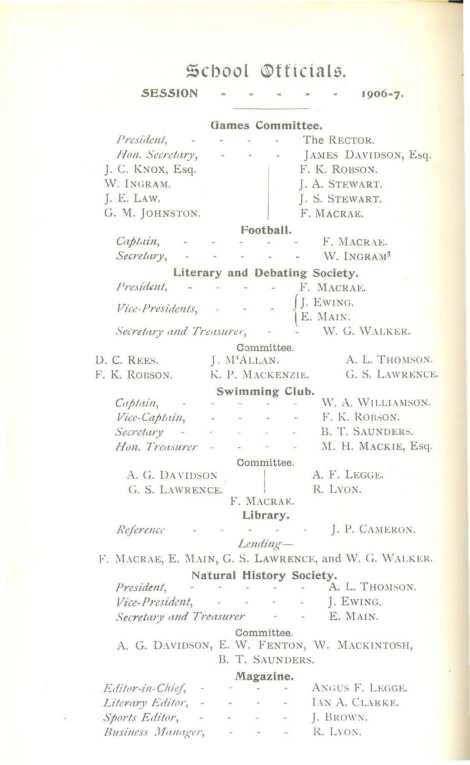
Games Committee. Football. The RECTOR. jA~lES DAVIDSON, E ~q. F. K. ROHSON. J. A. STEWART. J. S. Sn;W ART. F. MACR.\I,.
F. :\l.\CR \~,. W. [NGRA~I ! Literary and Debating Society. l'reJLitent, Vici:-Preside11ts, F. ;\1.\CRAE. JJ. EWINC;. lE. ;\[All);. St!cretnry and Tri:nsurt1,, \V. G. \V.\I.KER.
D. C. Ri,:i,;s. F. K. Roeso:-,;. Committee. J..\l'ALL \N h:. I'. :\1.-\CKl•:NZII::.
A. L. TIIO,I S0N. C. S. L.\W IU:XCI·,. Swimming Club.
\\'..\. \Vi Ll.l.\\l~ ON. I-'. K. Ro11,;o:-.1. C11j)tai11, Vice-Capt,,i11, Sccrd,uy Hon. 7i·i:,1wrcr
A. (;. DA \"(()SQ'.\ C. S. L.\WRI,;:\"CE. Committee. I ' F. :\1.-\CRAE. Library.
Lendi11g-
ll. T. SAUNDI,;R:,. :\[. H. MACKIE, Esq.
A. F. LEGGi,.. R. LYO X. J.P. C,\\ l blW:\".
;\l.\1N, G. S. LAWRENCE, and W. C. \V \1.Kl sR Natural History Society. Presidu1t, Vil"e-Presidml, A. L. TH0\IS0:--'. J. EWING. Secretary ,111d Tr,Msurer E. MAI N Committee.
A. G. O.\VIDSOX, E. \V. fE:slTO:-1, \V. :'11.\CKINT0SH,
Editor -in-C!tief, Literary 1--:ditor, Sports Editor, H11si11ess Jfa11a,1;-er, ll. T. SAUN UERS. Magazine.
A:--1; L"-, F. Li-:c;c1-:. I\:\" A. CL.\RKF. J. UiW\\':\". R. L\0:\".
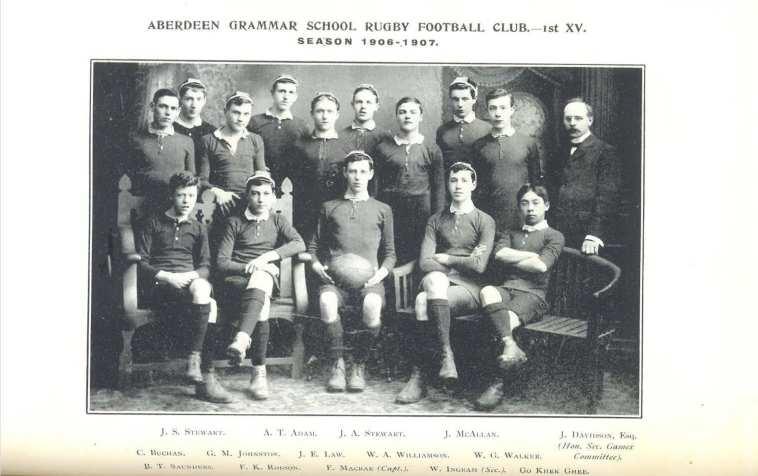
SEA:soN 1906- .1907 ,