THE ABERDEEN GRAMMAR SCH® L MAGAZINE
She's powerful. Displacement 6,250 tom. Length 520feet. And her Seaslug missiles can blast an aircraft out of the &kybefore it comesintosight. Shebristleswith SeaCatmissiles,4.5 inchguns, and the latest anti-submarine weapons -including a Wessex helicopter.
This is the kind of srup you'll find in today's Royal Navy, prepared co meet the new challenges ofthe Missile Age. It offers one of the great careers open to a man. It gives youimportant work, a worthwhile future, travel, and a chance co goto University. (6o%of new Full Career commission officers now get adegree).
There arcover 10,000 officersin the Navy; and we believe in giving early
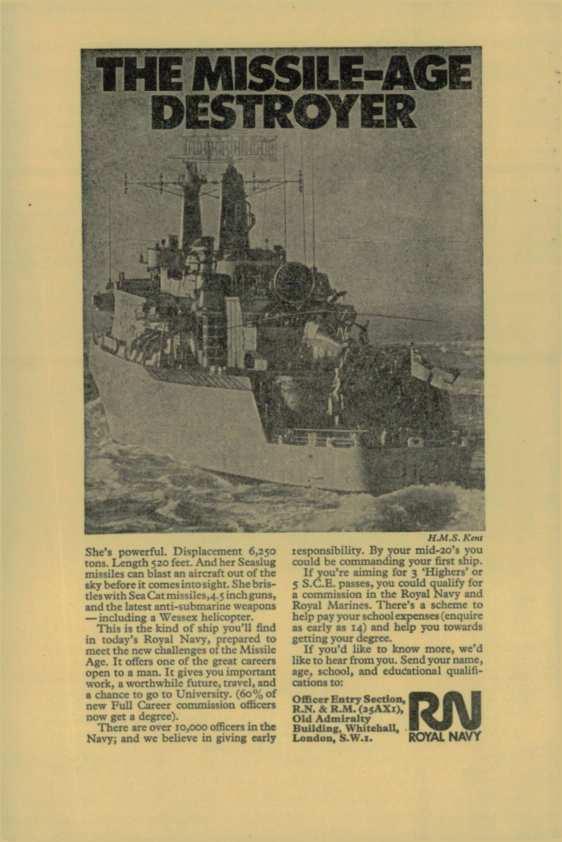
H.M.S.Kms tesponsibility. By your mid-20's you could be commanding your first ship.
If you're aiming for 3 'Highers' or 5 S.C.E. passes, you could qualify for a commission in the Royal Navy and Royal Marines. There's a scheme co help payyour schoolexpenses(enquire as early as 14) and help you cowards getting your degree.
If you'd like co know more, we'd like to hear from you. Send your name, age, school, and educational qualifications to:
OffleerEntry Section. RN R.N. & R.M. (25A.XJ:),:. Old Admiralty Bulldin1, Whitehall, London, s.w.1. ROYALNAVY
SUPPLIERS OF THE FINEST GRADES OF COAL

AUTHORISED
DISTRIBUTORS FOR SHELL & BP SCOTLAND LTD.
HEAD OFFICE

SINCE 1947
INDUSTRIAL Blast Freezers : Plate Freezers
Cold Storage
Ice Making Machines
COMMERCIAL Supermarket and Self Service
Display Cases: Storage Cabinets
Coldrooms, etc : Milk: Coolers
Bulk Milk Tanks : Farm Freezers
Ice Machines and Storage
Deep Freezers
DOMESTIC Refrigerators : Deep Freezers
AIR CONDITIONING Packaged or Central Systems
• NORTH-EAST DISTRIBUTORS OF 'PRESTCOLD'
• Agents for APV CLARKE-BUILT PLATE FREEZERS
• Agents for 'SHOWRAX' SHOPFITTINGS and SHELVING
• Agents for CHRYSLER , PRESTAIR, POTTERTON and WHITE AIR CONDlTIONING

COLOUR TV
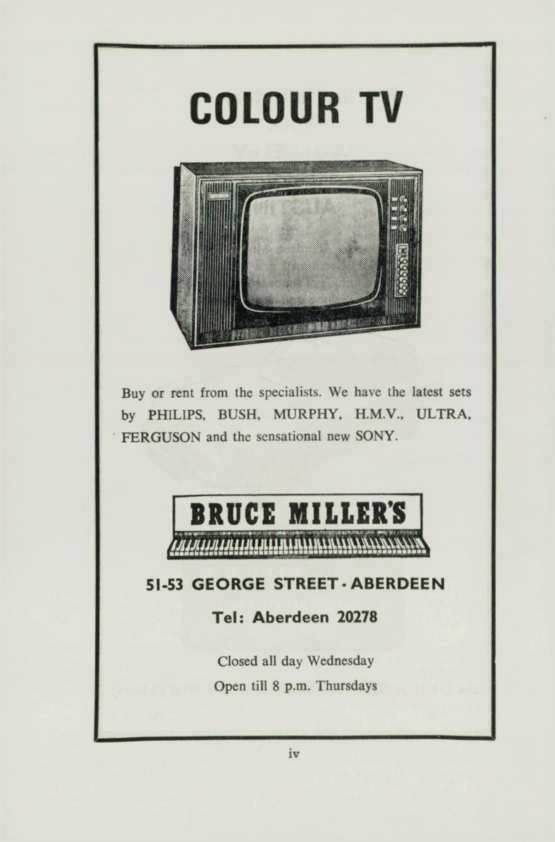
Buy or rent from the specialists. We have the latest sets by PHILIPS, BUSH, MURPHY, H.M.V., ULTRA, FERGUSON and the sensational new SONY.
Closed all day Wednesday Open till 8 p.m. Thursdays jv
UNDER ONE ROOF
• Savings Accounts
• Special Investment Accounts
• Government StockTransactions
• Cheque Accounts • Unit Trust Investment
• TraveJler's Cheques and Foreign Currency
• Save As You Earn • GIRO Transactions
• Periodic Payments • SafeDeposit Facilities
WITHDRAWAL FACILITIES AT 1500 OFFICES IN U.K
ABERDEEN SAVINGS BANK
53 BRANCHES THROUGHOUT NORTH OF SCOTLAND
• A TRUSTEE SAVINGS BANK •

When the time comes to think of a reliable watch. remember the name, Jamieson & Carry. We have a selection of watches second to none including many fine models by Rolex.
Give us a call and ask for our free catalogue.
Jamieson&Cany

AUSTIN MORRIS M.G. WOLSELEY DEALERS
ILWSTRATION: LOTUS VELDTSHOEN "STIRLING"
Famous shoe within a shoe, one of the complete range of top quality Veldtshoen Footwear always available
131 HOLBURN STREET, ABERDEEN
(Comee or HoUyb&llk Place) NO PARKJNO PROBLEM
New Cars - Used Cars - Servicing - Parts - Accessories - Petrol Oils - Tyres
Come in and see us-it's so convenient!
Distributors for Austin, Wolseley and M.G.

Aberdeen
Grammar School Magazine
8Jthytar No. 2r 1 (New Series 7Jth ; •ear No. 202)
Vol. LXXVI Jum 1973 No. 1
The Magazine i• published under the auspice, of The Former Pupil•' Club in June each year
General Editor
Edito r ofthe School Section
Editor of Notes, Obituaries and Marriages
Advertisements Secretary of the F.P. Oub
Alistair G. Gracie, Sa Arnhall Drive, Wcsthills, Skene, Aberdeenshire.
Alexander Tait, M.A.
Alan G. Campbell, LL.B. 178Mid Stocket Road, Aberdeen.
] A G Mearns, Mearns and Gill Advertising Ltd., 7 Carden Place, Aberdeen.
Brian K. Crookshanks, T.o., M.A , LL B 15 Crown Street, Aberdeen.
The General Editor invites contributions from P.P s for the next iu ue of the Magadne and requests that all copy, both for him and for the Notes Editor, be 1ubmittcd by May 15, i:974 Readers are asked to suppon the 1dveni1era, without whoae suppon publication ofthe Magazine would not be poaaible.
Printed for The Former Pupils' Club at The University Press Aberdeen
Wueuations-
General Scction-
Jobn Vass Skinner
Headmaster's Message
Robert D. Gill
"Bon Record?"
Switzerland 1972
School Section-
Office-bearers
Random Notes
House Notes .
StaffChanges
Meet the Prefects
Sporting Activities
School Societies
Photography in the School
The School Play
Music Notes
C.C.P. Notes . Literary Section
F.P. Section-
Officc-bca.rers
An asterisk.• appearingafttr tb, nam, of an F.P. indi,alts that ht ir a ,mmbtr of th, F.P. Club. Theytarr apptaring afltr the name of an F.P. art thott of hir alltndanfl al S,hool.
John Vass Skinner (1959-72)
When Sir James Robertson retired from the Rectorship of the Grammar School in 1959, the educational scene was deprived ofa man of stature. Anyone coming after him could be excused for feeling somewhat overawed.
John Vass Skinner came to the School from Alloa Academy where, during his ten years as Rector, he washeld in the highest regard within and without the gates. It seemed a felicitous choice and the passage of time was to confirm the wise judgment of the Education Committee. Assuming the headship ofa new school is a difficult task at any time, calling for diplomacy of a high order, ability to adapt oneself to a new situation, a respect for old and tried ways and a readiness to compromise. Mr. Skinner met these requirements admirably, quickly revealing qualities which commanded the respect and loyalty of his staff. He came with a particularly fine academic background A man of wide culture, he was nurtured in the classics but with a deep and abiding interest in modern languages both of Europe and the Middle East. He was as happy with German mystics as he was with arabic writings. Like the true scholar, he was humble and unassuming, never parading his learning.
One might be tempted to ask if there is any role for the scholar in the modern, educational set-up. Is a headmaster to be nothing more than an administrator, firmly anchored in his study, wrestling with time-tables, placating unreasoning parents or organising examination schedules? All these things Mr. Skinner did, almost unobtrusively. In his case, however, his cultured mind with its deep respect for the human personality, informed his day-to-day attitudes . To his staff he was alwayscourteous, sympathetic, tolerant and helpful, well aware of the many problems that beset the teacher but reluctant to impose his will in any dictatorial manner. To the boys he displayed a humanity which overlay a certain aloofness, born of shyness; a humanity which could challenge and rcproYe but also gladly forgive. There were moments when righteous anger burst into flame, but few saw this side of the man. His concern for the boys about to enter the University manifested itself in the conscientious writing of an ever-increasing number ofindividual reports. Here was no irksome duty perfunctorily discharged but a task in which head and heart had their due shareand to which he gave himself with untiring zeal.
In the life ofan institution whose origins arc lost in the mists oftime, thirteen years may not seem a long span. But these were no ordinary years, packed as they were with seismic events of far-reaching importance. To enumerate in any detail allthe changes that took place would produce a long and perhaps tedious catalogue. There was the vast building programme which made the School look like the target of an air-raid. Slowly and painfully there emerged the complex of strictly functional accretions in evidence today. Then about 1966the winds of change began to blow with increasing intensity and Mr. Skinner had to steer his old, weather-beaten vessel between the Charybdis of deeplyentrenched traditions and the Scylla of partially-digested educational
theories. Comprehensive Education was in the air. After a period of uncertainty about the future of the School (one tier, two tier), the officialpronouncement was made and the proposed change of name of the Grammar School was approved.
In 1970 the first intake of pupils from the catchment area swarmed through the gates and settled in. Much time and thought had been given to planning for this moment. Mr. Skinner saw it as a challenge. Uncertainty there was, to be sure, as to how things would turn out but he was determined to make Comprehensive Education work. No one can suppose that it is an easy matter to change overnight an ancient establishment with its peculiar ethos. But it did happen, quickly, painlessly. That the transition was made so smoothly and, to all appearances, effortlessly, is due in no small measure to the Rector's commitment to this new way of life for the School.
What riled him, and he was far from being alone in this, was the change ofname for the School, rather pointless and petty. Admittedly a name does not make or mar aschool and he accepted the change with resignation and, as ever, with that dignity with which he always comported himself on those occasions when the School was being made the object of barbed attacks.
The Lower School was allowed to languish and die; changes in the curriculum called for readjustment; the relentless stream of staff changes (there were well over 200 during Mr. Skinner's Rectorship) flowed unabated. These are but a fewofthe problems which confronted him and which were faced with quiet resolve.
Now Mr. Skinner has left the School, taking with him the ancient style of Rector, for he was the last of that long and distinguished line. A man of integrity, he would not readily sell his soul to any political or pseudo-educational Mephistopheles; aman who felt deeply but kept his emotions in check; a man who thought deeply but did not peddle his ideas in the market place.
As Sir James, in his day, made his contribution to the life of the Grammar, so John Skinner, in his quiet way, made his distinctive contribution, perhaps not easily categorised, but evident in the liberal attitudes abroad in the School.
In his retirement, mayhe enjoy the pursuit ofthose interests close to his heart and share more fully the companionship of his wife who supported him so admirably throughout the years, at School functions or staff social occasions. To them both we wish long years of health and happiness. l\fr. Skinner's portrait will eventually join that of his predecessors in the Library, reminding us all of a fine scholar, an able administrator and, above all, the complete gentleman.
Headma ster's Message
As the recently appointed first Headmaster of the School, I welcome this opportunity of expressing my sincere hope that Former Pupils of Aberdeen Grammar School will continue to support the School in every way possible, even although the name has changed and the School is being transformed into a comprehensive school for boys and girls.
Inevitably some Former Pupils will find it no longer possible to look upon the School as the same school to which they belonged, and I respect their feelings. On the other hand I would appeal to all Former Pupils to accept, as I do, that changes are inevitable in a quickly changing society.
The School is most appreciative of the continuing generosity and good will extended to it by Former Pupils, whether as individuals or through the many committees of the Former Pupils Club and I personally hope that the links between the Club and the School will continue to be strong, because present and future pupils can derive much benefit from the traditions and ties, whether academic or sporting, built up over the years.
In conclusion I should like to extend a cordial invitation to all Former Pupils to revisit their old School from time to time and to assure them that the Staffare always pleased to learn how their former pupils are faring since leaving school.
Mr. Robert D. Gill
Coming to Aberdeen to assume the headmastership of Rubislaw Academy Mr. Gill is-in no far-fetched sense of the phrase-returning home. For it was in Aberdeen that he was born and had his effective schooling in the then Central Secondary School; and it was in the war circumstances of 1940 when that school shared the buildings of the Grammar School that he sat and passed his Higher Leaving Certificate examinations. Aberdeen alsowas his Universiry, from which in 1942 he was called up and commissioned into the 6th Battalion of the Royal Scottish Fusiliers in the 1 sth Scottish Division, rising to the rank of Staff Captain at S.H.A.E.F ., first as a Field Press Censor and later attached to the Control Commission in Germany. Immersion in a cosmopolitan army life, coming as it did at that most impressionable period of young manhood, and combining as it then did a military discipline with the daily opportuniry to appreciate the effectsonmilitary and civilian communities ofthe grandeurs and miseries ofwar, cannot but have widened and deepened his human sympathies. It was with that experience behind him, absorbed but not forgotten, that he came back home to resume his studies and eventually to graduate with honours in French and German. The University from which he graduated was Aberdeen.
Electing to become ateacher Mr. Gill progressed from a first posting in Larbert High School to Robert Gordon's College as Special Assistant, thence to Peterhead as Principal Teacher of Modern Languages, s
Abtrdetn GrammarS,hoolMagazine
to Perth Academy as Principal Teacher of German, and in 1969to the Rectorship of Beath High School. His longest period of service in any one school-it must now seem inevitable in the retrospect of his career- was in Aberdeen, in Robert Gordon's College where he taught for eleven years and was, perhaps significantly, commanding officerof the Combined Cadet Force for a period of three years.
The record speaks for itself. Mr. Gill has made a progress through all the staging posts of the teaching profession, establishing his mastery at every step; professionally he possesses all the skills. At the same time, while he has consistently recognised that the School is the central fact of the educational process he also realises that it is part of a larger complex, and has made it his business to get to know the controlling institutions. For many years, for example, he served as setter of examinations in German for the S.C.E. board, and from 196s to 1969was Principal Examiner in ~fodern Languages to the board. And that his interest is not merely a matter of paper, ink and theory, may be deduced from the fact that from his earliest years in teaching he has chosen to share in and then to lead many educational trips abroad. His easy authority and unflappable control brought him in this last year 1971-73 to the position of Commandant for the Scottish Schools' Travel Trust.
This record, curtailed as it necessarily is, suggests that the Education Committee in appointing !\fr. Gill to be head of the school at thts precise point in time was wisely inspired. By virtue of his Aberdonian inheritance he cannot but be sensible and proud of the distinguished history of rhe Grammar School and ofthe immense contribution it has made to the economy and manners of Aberdeen and the larger community. It is also clear that he is admirably qualified to cope with the stresses that must attend the change from the selective to the compre- hensive mode. His words and actions in the short period since his appointment indicate that he has the will, the insight, and the energy to make the bridging period decisive for future harmony. We may well have confidence that in the cruciallyimportant yearsthat lieimmediately ahead those qualities ofheart and mind willelicit the respect and loyalty of both staff and pupils and so help to forge a tradition that will be comparable in its respect for the proper humanity of its subjects with that old Grammar School tradition whose alleged passing is so much bewailed.
We welcome !\fr. Gill to the school. We hope that his period of service here will be long and prosperous, and that he and his wife and family, having come back to Aberdeen, will find again in this northern city pleasure and fulfilment. They are welcome indeed.
"tBon
Record?"
It is perhaps appropriate this year, when the School stands ready to face another change in its development, to look back. and see what happened in the School 100 years ago, when as a result of the Education Act of 187z, Aberdeen Town Council surrendered its long control over its Grammar School and passed it into the care of the new Aberdeen School Board.
Contrary to what many may think, the School Board inherited an institution which was to become a centre ofgreat controversy, rousing among the press and public as violent and bitter an outcry as we have ever heard in our own time. Indeed, from the very start of its control the School Board found the School facing many serious problems. For example, the School was supposed to be self-supporting through its endowments and fees, and for many years after 1872. different groups in the community pbyed about with figures to prove that the School was very well (or badly) endowed, selecting their interpretations to suit their own designs. What is certain is that the Board was handicapped from the outset by shortage of money and this made it very difficult to plan or undertake any development of the School to meet the educational needs of the time.
Moreover inside the School there reigned a kind of academic anarchy under the headmaster, Mr. Martin, who claimed it was neither his right nor duty to interfere with individual teachers' conduct of their classes. This unhappy state of affairs the Board attempted to put right by setting up a Board of Masters which was to settle matters of general concern and by insisting on each department keeping a record of punishments. This "soviet" was not a success and was abandoned after a few years for much more drastic remedies, as we shall see. Inside the palatial new building (opened in 1863) on Cherryvale there were in 187z-3 only 22.0 boys in surroundings which were capable of accommodating many more (estimates varied from 600 to 1,000 boys). One of the surprising facts about this select group was that seventy-four of the total came from outsidethe town, from as far away as Caithness. In trying to see who, in general terms, came to the School, it was a simple matter to find that most Aberdeen parents were classified in the Aberdeen Directory of the time, which seemed a fairly safe way of establishing that they were reasonably prosperous. This lack of broad social representation was confirmed from two sources. The School Board itself expressed unhappiness about this statf' ofaffairsand said it was anxious to open the School to boys from all social classes, and the controversy about the School in the early 1880s furnished many complaints about the socially exclusive nature ofthe School at that time, caused by the rising cost ofeducation. The School Board was by then blamed for this state of affairs but the evidence ofthe registers suggests this was something they inherited rather than created.
Before looking at what did happen in the early 188os it is perhaps worth noting that two "avant garde" educational practices of the twentieth century seem to have been well established in the Grammar
School even in 1872.-3-"family grouping" was practised by having brothers ofvarying ages sitting in the same class and "total education" allowed pupils of very mature years (one exceptional case was z.5 years of age) to enrol in the School when they wished. (N.B. Teachers salaries were largely made up of fees from pupils.)
However, when looking to see how the School had developed in the first ten years of control by the School Board, it emerged that a drastic reorganisation had taken place under a new rector, James Moir. When looking to see why the School had been changed so drastically the critical factor seemed to be the report on the state of the School issued by Professor Fuller and Dr. Donaldson on z.8 June 1880.
Donaldson had interesting connections with the School. He was a former pupil and had been on the short leet for Rector when Evans, the Irishman, was appointed, but his Established Church connections were unacceptable to the Free Church majority then controlling Aberdeen Town Council, and he had risen instead to be Rector of the Royal High School in Edinburgh. (Later he was to be Professor of Humanity at Aberdeen and Principal of St. Andrews University.)
The report produced by these two men was very detailed, and criticised many aspects of the School situation though Donaldson made the surprising general comment that "On the whole I consider that the Grammar School is doing good work in the departments in which I have examined it". This conclusion is surprising not only because of the many criticisms they made but also because of the bombshell which followed in the shape of the general report.
The general report again was detailed and here space allows only a summary of what was said. The basic trouble they claimed was "want of organisation and unity" where they pointed out the lack of supervision of the staff and the conflicts of interest among the staff. On the first point they recommended that "a real rector" should be appointed and the whole curriculum and internal organisation of the School should be revised. On the staffing side, it was pointed out l:ow pcor the salaries were and how weak were the financial arrangements for making up salaries. They made the point that "curriculum must be controlled by educational value rather than financial arrangements". Later, again, they made the point that "The Aberdeen Grammar School has no right to expect it will have a supply of good teachers so long as the incomes arcso low.... In other burghs smaller than Aberdeen the salaries are nearly double those of the Grammar School and in larger towns they are more than double" (It was suggested that the Rector's salary should beat least £500 per annum.)
One of the suggestions for reorganisation on more "comprehensive" lines was that a Modern side should be introduced though this was done with little enthusiasm because it was "too frequently composed of boys who have failed in Classicsand in nearly everything else!"
The School Board accepted most of the General Report and began bygiving Mr. Martin the "golden handshake" , at £2.00per annum. The financial arrangements were settled on the more generous Jines suggested, and James Moir, another F.P., came from Glasgow Academy to undertake a massive reorganisation. But the real trouble
started when the Board explained how it was to meet the additiona l expenditure . They calmly announced chat this extra cost would be met by (a) raising the School fees and (b)putting some of the burden on the School rate, i.e. the general tax for educational purposes in the town. It would cake more space than is available to do justice tO the abuse which was then poured down from all directions on both the School Board and the Grammar School. In the local press there were three main organs at this time, The Aberdeen]011mal,the Dai(y Free Prus and what might be loosely described as Aberdeen's own "Private Eye" the Bon Accord weekly. They were usually divided on all matters but for once they made common cause in condemning the School Board for its social injustice and extravagance in forcing the many to pay for the education of the wealthy few. A letter in the Aberdeen ]011N1al spoke about "the depressed state of the school". The editorial in the Aberdeen]011n1alon 4 March 1881 compared the state of the School unfavourably with the rival institutions in Old Aberdeen, the Old Aberdeen Grammar School and the Gymnasium and ended with the lament "Why should what the Gymnasium and the Old Town Grammar School do every year be impossible to the Aberdeen Grammar School any year?"
The Free Press,its arch-rival, contributed a long editoria l tracing the beginning ofthe decline back tot heappointment ofthe aforementioned Irishman, Evans, who had been later dismissed, and pursued the sad story down to 1881. The Bon Accord in its usual forthright and near libellous way reinforced this hmtile atmosphere in the space it devoted to the state of the School. "This institution", it wrote, "has been for years steadily 'running to seed' owing, as the most superficial observer could not fail to see, co the feebleness and inefficiency of the Rector and his teaching staff." .After slating the School Board for its negligence and incompetence, the Bon Auord makes the point \\,hich is supported by the other p:ipers and the School register itself. "The number of 'poor parents', who send their sons to the Grammar School is almost nil and the Grammar scholars are with one or two exceptions exclusively composed of those whose parents are in good circumstances and well able to pay handsome fees."
Under the heading "A Nut for the School Board" the attitudes of the community at large was summed up:
"Is it right to retrieve our scholastic disgrace, By taxing the workman and grinding his face While the doors of the school only open to gold And the working man's family stands out in che cold."
So the storm roared and then abated. James Moir came, re-organised the School. The total roll rose, the Modern side was introduced and the Lower School was started. Ten years later Moir, too, fell foul of the School Board and was replaced by Morland Simpson, and again the School was subjected to a major reorganisatio n.
History suggests that every social institution, be it church, school or the like, which has survived for a long time has had to change itself surprisingly frequently to meet changing requirements and circumstances, and Aberdeen Grammar School was no exception.
Switzerland
27 June-8 July 1972
The Joint Station on a dreary and wet Tuesday evening was not the most promising departure point for forty-two boys and four members of staff en route for Switzerland, but the dismal overhead conditions could not dispel the enthusiasm and optimism of the party for what lay ahead.
The first leg of the trip, the overnight train journey to London, \Vas probably the most tedious section, but feelings of weariness were soon dispelled by an early morning breakfast and a highly entertaining conducted tour of the capital city.
The party then made its way byrail to Dover where we embarked on the cross-channel ferry for the three-hou r crossing to the Belgian port of Ostend, where we met Carlos who was to be our guide and coach driver for the next nine days. He was to prove an excellent driver, but he was so frugal that he tended to make the music hall Aberdonian resemble a latter day prodigal son I
Our first overnight stop was Bruges, a beautiful city distinguished by a number of Gothic buildings, a number of vile smelling canals and considerable quanuties of what appeared to be man-eating mosquitos. It was a matter of some regret that we could spend so little time in Bruges, but amplecompensation was provided in the form ofa tour of the Belgian capital, Brussels, including a visit to a lace factory and a "certain famous statue" which served as a timely reminder to many of our party before we departed for Luxembourg en route for rhe French industrial city of Nancy. Nancy proved to be a rather undistinguished city but it did provide us with a magnificent evening meal and a hotel which could well have been the setting for a Marx Brothers filmI By the third day, our parry was becoming somewhat travel weary, but flagging spirits were revived as we passed into Switzerland along fine motorways and through superbly engineered tunnels until we reached the tourist centre of Interlaken which lies on a silted area between Lakes Thun and Brienz in the Bernese Oberland.
Our stay in Interlaken was not blessed with the best ofweather, but nevertheless we continued with our programme which provided so many highlights that the writer finds it difficult to decide on what to leave out. One remembers with glee the disbelief of the locals as the party set out, in torrential rain, to ascend the 4,H7 foot Harder Kulm which dominates lnterlaken. On subsequent days the weather remained bad, but further trips were undertaken to Lucerne and Kandersteg.
The journey to the former included the scenic splendour of the Briinig Pass while Lucerne itself contained a transport museum which must be unsurpassed in Europe. The beauty of Kandcrsteg was unfortunately concealed behind a low cloud base, but on our return we stopped at the famous trout hatchery and petrified forest situated at Blausce. Here a rather elderly boatman was encountered who obviously feared that his craft, laden with Rubislaw Academy pupils, would meet a fate similar to that of the TiJanicl

SwitzerlandI972 II
The highlight of our stay was reserved however, witil our last complete day in Switzerland, when the swi at last shone on us and we visited the world famous ski-centre of Grindelwald and ascended by chair lift to the First station situated at 7,II 3 feet. From this point we had a superb view of the north face of the Eiger and the other peaks, the Monch, the Jungfranjoch and the Jungfrau.
Regrettably, our stay in Switzerland was now at an:end and we had to take our leave of Interlaken which had proved a most congenial holiday centre, and set off on the long journey to Aberdeen.
This last section of our trip proved wieventful but it once again provided the party with the opportunity of seeing the French and Belgian countryside and such famous cities as Bruges, Brussels and Ostend. Nevertheless, despite such delights it was a very weary group of travellers who arrived home in Aberdeen, intent on 24 hours rest in their own beds.
In conclusion it can be said that the entire trip went off without a hitch and was greatly enjoyed by all who participated. This state of affairs was made largely possible by the efforts and organisation of Mr. Spence who was a "rower of strength" throughout.
School Office-bearers
Prefects
LESLIE W. Ross (Senior Prefect)
RONALD M. WALLACE (Dep11ty Senior Prefect)
THOMAS s. ADAMSON
DAVID J.M. ANDERSON
ERIC J. ANDERSON
JOHN N. ARMOUR
STEVEN J. BARNETT
IAN M. CARRY
RONALD L. CRUICKSHANK
JAMES W. L. DAVIDSON
STEPHEN J. DAVIDSON
GRAHAM K. DEANS
BRIAN R. DURWARD
MICHAEL c. FLETT
MALCOLM T. FOLEY
DOUGLAS T. HENDRY
IAN B. KEITH
DOUGLAS H. KENNEDY
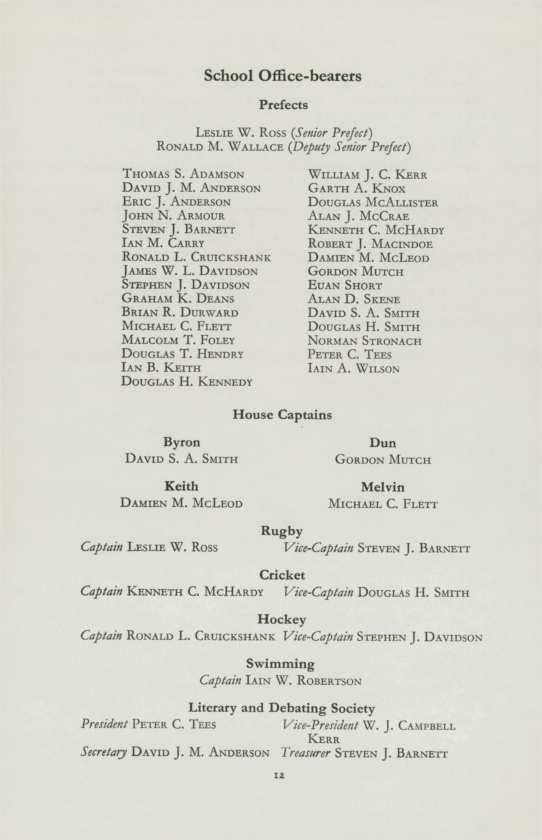
WILLIAM J. c. KERR
GARTH A. KNox
DouGLAs McALLISTER
ALAN J. MCCRAE
KENNETH c. MCHARDY
ROBERT J. MAcINDOE
DAMIEN M. McLEoo
GORDON MUTCH
EuAN SHORT
ALAN D. SKENE
DAVID s. A. SMITH
DOUGLAS H. SMITH
NORMAN STRONACH
PETER c. TEES
IAIN A. WrLSOK
House Captains
Byron Dun
DAVID s. A. SMITH GORDON MUTCH
Keith Melvin
DAMIEN M. McLEOD
MICHAEL C. FLETT
Rugby
Captain LESLIE W. Ross Vice-Captain STEVEN J. BARNETT
Cricket
Captain KENNETH C. McHARDY Vice-Captain DOUGLAS H. SMITH
Hockey
Captain RONALD L. CRUICKSHANK Vice-Captain STEPHEN J. DAVIDSON
Swimming
Captain IAIN W. ROBERTSON
Literary and Debating Society
President PETER C. TEES
Vice-President W. J. CAMPBELL KERR
Secretary DAVID J.M. ANDERSON Treas11rer STEVEN J. BARNETT IZ
Dramatic Society
PresidentDAVID GORDON Viu-PresidenJLESLIE CRESWELL
SecretaryW J. CAMPBELL KERR Treawrer RAMSAY G. R. MILNE
Cadet Force
F/Sgt. JAMES MUNROE
Editors of the School Section
D AMIEN M. McLEOD
ALAN D. SKENE
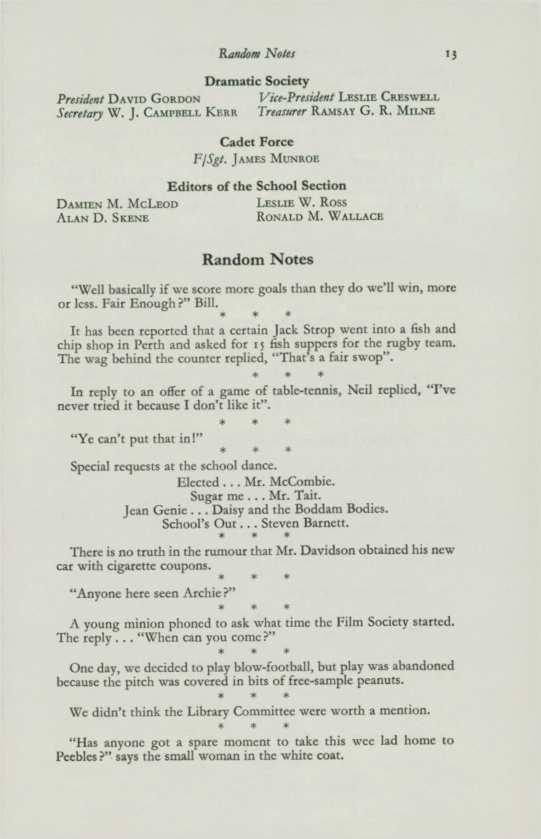
LESLm W. Ross
R ONALD M. WALLACE
Random Notes
"Well basically if we score more goals than they do we'JI win, more or Jess Fair Enough?" Bill.
It has been reported that a certain Jack Strop went into a fish and chip shop in Perth and asked for 1 fish suppers for the rugby team. The wag behind the counter replied, "That's a fair swop".
In reply to an offer of a game of table-tennis, Neil replied, "I've never tried it because I don't like it".
"Ye can't put that inl"
Special requests at the school dance. Elected ... Mr. McCombie. Sugar me ... Mr. Tait. Jean Genie ... Daisy and the Boddam Bodies. School's Out Steven Barnett
There is no uuth in the rumour that Mr. Davidson obtained his new car with cigarette coupons.
"Anyone here seen Archie?"
A young minion phoned to ask what time the Film Society started. The reply ... "When can you come?"
"' *
One day, we decided to play blow-football, but play was abandoned because the pitch was covered in bits of free-sample peanuts.
We didn't think the Library Committee were worth a mention.
"Has anyone got a spare moment to take this wee lad home to Peebles?" says the small woman in the white coat.
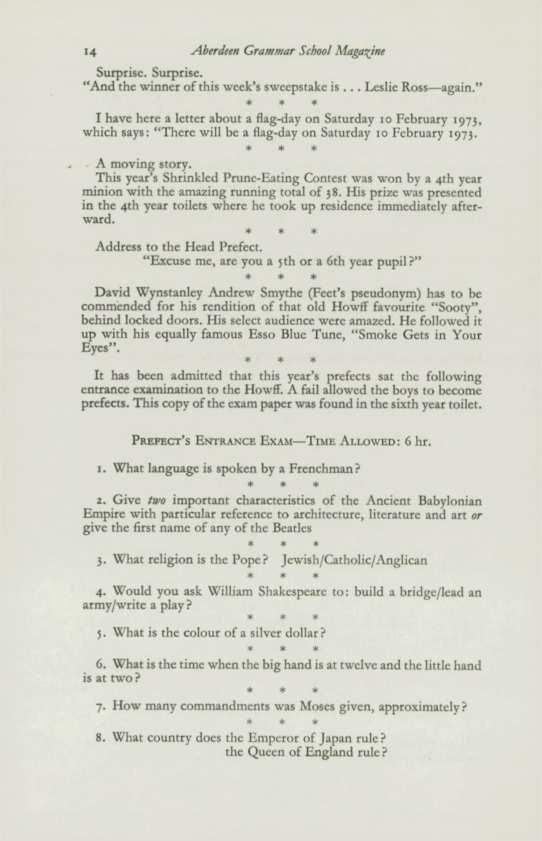
Surprise. Surprise. "And the winner ofthis week's sweepstake is ... Leslie Ross- again."
I have here a letter about a flag-day on Saturday 10 February 1973, which says: "There will be a flag-day on Saturday 10 February 1973.
A moving story.
This year's Shrinkled Prune-Eating Contest was won by a 4th year minion with the amazing running total of 38. His prize was presented in the 4th year toilets where he took up residence immediately afcerward.
Address to the Head Prefect. "Excuse me, are you a 5th or a 6th year pupil?"
David Wynstanley Andrew Smythe (Feet's pseudonym) has to be commended for his rendition of that old Howff favourite "Sooty", behind locked doors. His select audience were amazed. He followed it up with his equally famous Esso Blue Tune, "Smoke Gets in Your Eyes".
It has been admitted that this year's prefects sat the following entrance examination to the Howff. A fail allowed the boys to become prefects. This copy ofthe exampaper was found in the sixth year toilet.
PREPEcr's ENTRANCE ExAM-Tn.m ALLOWED: 6 hr.
1. What language is spoken by a Frenchman?
2. Give two important characteristics of the Ancient Babylonian Empire with particular reference to architecture, literature and art or give the first name of any of the Beatles
3. What religion is the Pope? Jewish/Catholic/Anglican
4. Would you ask William Shakespeare to: build a bridge/lead an army/write a play?
5. What is the colour of a silver dollar?
6. What is the tintc when the big hand is at twelve and the little hand is at two?
7. How many commandments was Moses given, approximately?
8. What country docs the Emperor of Japan rule? the Queen of England rule?
9. Six Kings of Great Britain were called George, the last being George VI. Name the other five.
10. Who won World War II? Who was second?
1 t. Who invented Stevenson's Rocket? Winston Churchill/ Bammon Andrews/Michael Parkinson/Stevenson?
1 2. Can you explain Einstein's Theory of Relativity? Yes/No.
13. Which of the following is not a pop group? Trex/ The Sweet/ Slade/London Philharmonic Orchestra.
14. Spell: LONDON: DUBLIN : BELFAST: EDINBURGH.
1 5. Football is played with the arm/stick/foot ?
16. A. Baxter is a famous soup-maker or a prefect's best friend?
17. What time, approximately, is "News at Ten" broadcast?
House Notes
Byron
The following officials were elected to represent the House: Hou.re Captain, Stephen Davidson; Vice-Captain, David Smith; RNglryCaptain, David Smith; Vice-Captain, Douglas Smith; Hockey Captain, Stephen Davidson; Vice-Captain, Ronald Cruickshank; Swimming Captain, Graham Falconer; Vice-Captain, David Smith; Football Captain, Ian Buthley: Vice-Captain, James Hannah.
As usual, the Swimming Gala developed into a fight with Dun to escape last place, Byron proving the victors-for the first time in many yearsIAlthough the Rugby and Football sides had little good fortune, the Hockey Teams won all their matches to take both the Six-a-Side and Eleven-a-Side Trophies. After the great success enjoyed in the Sch~ol Sports over recent years, we are quietly confident of once more com1ngfirst.
Dun
Our performances in the Senior House Rugby and Hockey were mediocre as both teams were placed ;rd, but the hockey team did put up a good fight in the last game only losing to the winners Byron 2-1.
AberdeenGrammarS,hoolMagazine
Our swimmers and football team fared much better and we must congratulate them on their victories in the School Gala and Senior House Football respectively.
The prospects for the Summer Term augur well as we are ably represented in both athletics and cricket.
Our thanks to Mr. McLeod for the help which he has rendered throughout the year.
HouseCaptain,Gordon Mutch; Vice-Captain,Steven Barnett; R.llgby Captain, Steven Barnett; Vi,e-Captain, Ian Carry; Hock~ Captain, Gordon Mutch; Vi,e-Captain,Graeme D. Yackimini; FootballCaptain, Neil J. Shepherd; Vice-Captain, Robert S. McAnalty; Swimming Captain,Hugh Osbourne; Vice-Captain,Alistair Sim.
Keith
At the annual meeting the following were elected to represent the House: House Captain,Damien McLeod; Vice-Captain,Ian Macindoe; R.llglry Captain, Alan Skene; Vice-Captain, John Murray; Ho,ke_y Captain, Graham Sutherland; Vice-Captain, Ian Macindoe; Somr Captait1, John Miller, Vice-Captain, Alan Rose; Swimming Captain, Damien McLeod; Vice-Captain,John Murray.
Our dominance on the soccer-field was finally broken. Having won the previous four competitions, our depleted team showed great spirit to finish a commendable second in the league. The lack of experienced players gave us little hope of winning the rugby tournament, but the enthusiasm of everyone concerned earned us the distinction of being runners-up in both the seven-a-side and fifteen-a-side competitions. The House also took second position in hockey eleven-a-side but slipped to third place in the six-a-side championship. Our hopes of achieving a hat-trick of Swimming Gala wins were denied us due to a lack of senior swimmers, although the number of younger swimmers taking part augurs well for the future .
Our thanks to Mr. Stephen for all his help throughout the year.
Melvin
The following officials were elected to represent the House this year: Holl.ft Captain, M. C. Flett; Vice-Captain, L. W. Ross; R.llglry Captain, N. Stronach; Viu-Captain, L. W Ross; Ho,kq Captain,K. C. McHardy; Vi,e-Captain, D. N. Howie; Soccer Captain, I B. Keith; Vice-Captain,G. Macdonald; SwimmingCaptain,D. Fleming; Athletiu Captain,L. W. Ross; CricketCaptain,K. C. McHardy; Vice-Captain,P. Tees.
This year has again proved to be profitable for the House. The rugby teams won both Senior and Juoior fifteen-a-side, and both Senior and Junior seven-a-side competitions. A pleasing aspect of the Senior team's performance, was that in both competitions no points were scored against them.
Sta.ffChanges
The soccer team came a good second to Dun in their House League. Unfortunately the Hockey team did not meet with as much success. They finished last in both the eleven-a-side and six-a-side tourneys.
After last year's success in the House cricket seven-a-side, we hope to do as well again this year at all levels.
Although lacking in senior athletes we should come up with a good performance in the School Sports, thanks to some promising younger boys.
We would like co thank all boys who have represented and done so well for the House and hope these results encourage the younger boys to become more interested in the House.
Finally, we are indebted to :Mr. Will for his help during the elections, and his assistance and guidance during the year.
M. C. FLErr
Staff Changes
Staffchanges this last session have been so numerous that we can du little morethan give alist ofnames withthe very briefest ofexplanatory detail. One obvious reason for the length of the list is that there was no December issue of the Magazine,and so this one number carries what would normally have been spread over two. But there are other causes, and chiefly, perhaps, the implementation by the Education Committee of legislation governing the nature and number of promoted posts in Scottish Schools, and the erection thereby of a whole new hierarchy within our own school. This superstructure, to the casual eye, might appear so to dominate and overweight the non-promoted section that the ship-to indulge in nautical metaphor- might appear to be in danger of sinking under an excessive weight of avoirdupois and gold braid. But, of course, schools are not ships, nor schoolboys a bunch of jolly jack-tars; neither do we have equivalents of bo'suns and bo'sun's mates, quartermasters and supercargoes, powder-monkeys and fourringed admirals-not at least so obviously as to provide easily recognisable material for a new Gilbert and Sullivan opera, or at least not yet.
Another reason for the number of changes is the merging of Rosemount Secondary School into Rubislaw with the consequent transfer of some of its staff.It is also the case that school numbers are once again rising.
First of all we have to mention a number of staff members who in the course of last session passed into full retirement. Outstandingly, of course, the Rector. The Magazinecarries elsewhere in its pages a fuller, personal tribute to Mr. Skinner and, at the same time, reviews with pride and gratitude the innumerable services that he rendered to the School. The writer ofthese notes would like to add his warm appreciation of the many virtues of Mr. Skinner- particularly his evident concern for the maintenance of scholarly standards, his patience and his
AberdeenGrammarSchoolMagazine
courtesy-and to wish him and 1\-irs.Skinner long and happy years to come
He would express the same wish to those others who also have retired since the last number of the Magazine appeared-Mr. Eric Duncan from the post of Principal Teacher of Religious Education, 1\fr.Robert Wilson from the ClassicsDepartment, MissMary1-.fatheson from the Geography Department and Miss Nan Boyd from her post as Librarian. They were all proud to have worked in and for the school; they all before leaving spoke with obvious feeling of what the name and tradition ofthe Grammar meant to them; and they were all closely linked by the strong, continuous interest they always manifested in the welfare of pupils and members of staffand in all the institutions of the place.
Others left for promoted posts elsewhere. Mr. John Wiseman, Principal Teacher of Physics left to become Assistant Headmaster in Harris Academy, Dundee; Mr. Andrew Dinnes to become Principal Music Teacher in MackieAcademy, Stonehaven; .Mr.John A.Morrison to be Principal English Teacher in Thurso High School; Mrs. Proudfoot to go to the Music Department of Brechin High School, and Mr. Gordon Paterson of the Mathematics Department resumed his links with the Army. We alsohave to record with regret the departure from the Office staff of Mrs. Margaret Johnston.
The following newappointments were made to the Staffin the course of the session.
To the English Department-Mr . Adam Findlay, Mr. John Craig (sharing with Religious Education) and Mrs. Helen Mackie (temporary appointment). To the Mathematics Department-Mr. Ian Gray, Mr. Robert Duncan, and Mr. William Barber (appointed also as House Master). To the Physics Department-as principal teacher Mr. Andrew Lowe, Mr. Robert Newton and Mr. Robert Traill. To the Geography Department-Mr. James Rodwell. To the Biology Department-Mr. John Masseyand Mr. Graeme Ross. To the Spanish Department-Mr. William R. Scott, and to the French Department Mrs. Helen 1.faycock.
J\.Ir.Roy Prentice and Mr. Alan Smith came to the Art Department, Mrs. Amelia Brown and Mrs. Isobel Houlding to Music, Mr. Lindsay Mitchell to Business Studies, Mr. Ronald Lawson to the Physical Education Department; and to the Technical Department Mr. John Cruickshank and Mr. Douglas Bruce.
At the beginning of November Mr. Alastair R. Marr took up his duties as head of the Religious Education, coming from Stirling University, where he was Chaplain, to succeed Mr. Eric Duncan. And at the beginning of December Mrs. Patricia Fraser became School Librarian in succession to l\Iiss Boyd.
Mention has been made of new promoted posts. All the city academies have now a top hamper of such posts; they include house or year masterships, assistant headmasterships and deputy headmasrerships, and practically all the effective appointments to Rubislaw have been made from the existing staff. Mr. Barber appointed as Year master in August came from Summerhill Academy, but the other two such
Meet The Preftct1
posts have been filled by Mr. Patrick Scott (also in August) and by Mr. 'Tom Henderson more recently from an assistantship in our English department. Mrs. Downie, Mr. James Murray and Mr. Arthur McCombie were promoted to assistants to the headmaster; and when subsequently the successful candidate for the post of a Deputy Headmastership withdrew his acceptance l\1r. McCombie was promoted to that vacancy. To all these the congratulations of the School are due. Finally a word of appreciation is also due to a number of teachers who have throughout the session, for shorter or longer periods, helped out in a temporary capacity. Longest serving of these is Mr. James Lessells, whose vitality and interest in his subject and in all educational matters might well be an object lesson to us. We would extend our thanks to them all.
Meet the Prefects
Leslie W. Ross. Les thought he was this year's Head Prefect and also pretended that he was Rugby Captain. Les's abundant reserves of energy and good health gave him remarkable consistency on the games front. He not only skives classes but goes to great lengths to skive exams. Les plays cricket well (honest!) and isin the running to become the ducks of the School. Ex.ternally flaunting his ire he secretly welcomed the opportunity to relate his true life adventures with a cockroach, at a most silly Debating Society novelty event. Les is always full ofthe party spirit, and this accounts for his insistent good-humour. Les almost appeared at the School Dance but his partner cried offat the last minute. Dislikes black power and water pistols.
"There'll be trouble o'er the heids o' this." L.W.R.
"My, but you're looking well, Les." Stevie Baby "Great heights are hazardous to the weak head."
Robert Blair
Ronald M. Wallace. This year's D.S.P. (Dirty Silly Prefect) Ron was Pres. of the Photographic Society where he learned to charge extortionate prices for various poses. Has acquired an older newer motorbike, complete with soggy helmet. Let's hope this one doesn't fall to bits. His partner for the School Dance was unable to attend in person but was kind enough to send her fridge instead; needless to say this received a cold reception. Displayed his talents at the Swimming Gala ... in a canoe. Failed in his attempt to conquer the South Face of the Howff.
"Everything is funny as long as it happens to someone else."
Will Rogers
"To have not only clean hands, but clean minds." Thales "You, Sir, are a loonic."
L.W.R.
David J. M. Anderson. Gets his teeth into rugby matches and his nose into his hankie, frequently. Can be seen wandering aimlessly
Aberdeen GrammarSchoolMagazine
round the Howff trying to find people to speak in debates. Sings well on rugbytrips and badlyin the choir, but blames this on school dinners. Often "Pict" up interesting volumes from the library.
"To lose a rotten member is a gain."
Richard Baxter "Ladies and gentlemen, um .. . um ... " D.J.M.A.
Eric J. Anderson. The only prefect to prop up the Keith House rugby scrum while rying his boot-lace. One of the Howff's more serious artists, he soon learned to feel his way round the darkroom, much to Alan Skene's dismay and :t,.1ikeFlett's delight. As drum sgt. he soon found playing in the pipe band was a draughty business for a true Scotsman. His charity party was a great success and many articles of clothing were donated to a worthy cause.
"Blessed are the innocent, for theirs is the k'dom of art."
George Moore
"Pluck-tic-ti-zup."
E.J.A.
J. Neil Armour. For Neil the grass seemed greener on the hockey field, but a bruised pinky, so he told us, denied the 3rd XI of his services. Wrote to the Records Book of Guinness claiming to have penned the longest "Spam" line in the world. However, his glory was short-lived, as we couldn't get the Howff through the door to send for verification. The Howff's answer to Peter O'Sullivan he also plays cricket at Roobislair, Bridge in the Howlf and a fiddle in the tuck shop. "Gamesters and Racehorses never last long."
George Herbert "I'm playing cards, get somebody else to do it." J. .A
Steven J. Barnett. A late riser who dreads the morning post, Stevie Baby has risen to greater heights due to his fashionable footwear. Being assistant captain of the rugby team is one of his lesser vices, for which he got full colours, an award which promoted frequent visits to Hi~h places. "Divoted" to the furtherance of the Howlf's decor; he waus in bars to make some money.
"Fine clothes are good only as they supply the want ofother means of procuring respect." the late Samuel Johnson "Thlee thlupenny stamps please." S.J.B.
"Better late than never, but better never late."
C. H. Spurgeon
Ian M. Carry. Harry to all his friends, Cud has shown himself to be one of the more enterprising prefects. A back injury kept him from displaying his talents on the rugby field, but he was amply compensated during several therapeutic sessions wirh a "Cuddly" masseuse. After these remedial rubbings he has recovered sufficiently to occupy the "long-on" boundary for the 1st XI. Goes to Mr. Guthrie's classes as can be seen in his official time-table.
"A rich person ought to have a strong stomach."
"Yer a chuncer, mini" J.G.
Walt. Whitman
Ronald L. Cruickshank. Had a good season as hockey captain and made the final trial for the Scottish Schoolboys. Was awarded Fool
Meet The Prefects
Colours at Christmas and a cap (dunce's?) at Easter. His hair band and appearance of a rampaging apache belie his (Wild) Western ancestry; soo Clifton Road. Has the distinction of being the winner ofthe School Dinner League The steadiest going prefect- by a few days.
"Eat enough and it will make you wise." John Lyly "Aw, c'mon a've goat a' this ti dae." R.L.C.
Stephen J. Davidson. Must be highly commended on his being capped three times for the Scottish Schoolboy's Hockey team. Enhanced his international playboy image with a 3-second appearance on Reporting Scotland as a businessman. One of the more talented Bridge players, Steve likes to play with Iain Wilson. "This is a sport which makes the body's very liver curl with enjoyment."
Mark Twain
"Bridge, Iain." S.J.D.
James W. L. Davidson. Another of the rugby (2nd XV ha! hal) playing choristers, Danny has a few habits ... One of the queerer things about James is that he volunteers to take the first year on train journeys. Among his many loves arc himself, Tyrone, James and Danny. Being a real "Tyriant" with the minions of the school, his ego was deflated after a ski-ing accident: the mountain hit him, so he says. "You can do anything with children, if you only play with them."
von Bismarck
"Take 300 lines."
J.W.L.D.
Graham K. Deans. Greaser Deans is somewhat of a disappointment to the Prefecture since we have discovered to our cost that it is impossible to combine the virtues of a prefect with the vices of a librarian. Graham has patented his system of procuring official skives. He projects his personality on many school socs. and depts. As far as the Games Dept. is concerned is heard of but never seen.
"Meek young men grow up in libraries." Emerson "Graham's a fine lad."
D.McL.
Brian Durward. Did better as hockey znd XI player than in the Keith House rugby team where he kept "putting his head in the wrong holes." Makes money out of pretending to teach people how to play the guitar, but, in truth, the only decent tune he can play is the "Howff Stomping Song." Brian is also a pray leader in the Scripture Union but this did not mar his trading enterprise in the tuck-shop. This we thought was taking his Economics lessons too far and took the lid off the profits.
"Religion hides many mischiefs from suspicion." Marlowe "I'll do the tuck shop."
B.D.
Michael C. Flett. Takes people for rides in his car and explains his hand slips offthe gearstick due to an old war wound. Michael saveshis razor blades for emergencies and for slitting open refusal letters from potential employers. Nearly did us proud by becoming the Howff's 1st sailor but chickened out at the last moment. The low point of his illustrious football career wascaptaining the Howff Dodgems to defeat against Gordon's prefects.
AberdeenGrammar S,hoolMagazine
"I journeyed far, I journeyed fast, I'm glad I found the place at last."
Joel Chandler Harris "Na, Na ye canna dae 'at." M.C.F.
Malcolm T. Foley. Blessed with the ability of being caught in the wrong place at the right time, Fuzz is becoming a talking point among his more learned friends and is sure to cop it sooner or later Speaks and drinks Auld Russian. Goes to classesfrequently and in the summer term sprints to get there.
"Those athletic brutes whom undeservedly we call heroes."
"Are you coming to Latin Doug?" M T F
Douglas T. Hendry. Hopefully the last in a long line of Bumbles, the only reason Douglas was made a prefect was to continue what has come to be accepted asa school tradition (undesirable though itmaybe). Bumble must be commended for his fearless, single-handed raids on the Vth year toilets- but why does he lock the door Holds his head high over his conquests of the fair sex. Bumble is the most popular prefect in the Howff . . . when he's absent. Keeps Howff Dodgems "stripped" throughout the year. The sole Vth year prefect with a sense of humour-warped though it may be. Wears funny white shoes sometimes
"The smiler with the knife under his cloak " Chaucer "Bumble may damage your health." H.M. Government (adapted)
Ian B. Keith. Almost a happily married man this didn't overcome his temperamental outbursts on the football field. Goes to Miss Carter's French classeson request. Ian is one of the more intelligent members of the "Crombie -coat Brigade", and has been known to talk intelligible English on occasion. He has yet to decide where his loyalties lie, as recently Rangers for some unknown reason returned to his favour. "Love's a malady without a cure." Dryden "Take an early bath, son." R.E.F.
Douglas H. Kennedy. We have received information to the effect that Douglas H. Kennedy was a prefect from 1971-1973. "Absence makes the heart grow colder." Adapted ." D.H.K.
William J. C. Kerr. Campbell, as called by his friends, only joined the elite half-way through the season, although we now see him less often than before his appointment. When questioned about this, he told us that the coffee tasted better at the Albyn. A dramatic sort of person, he tends to dream of reaching greater heights, e.g. Aviemore or President ofthe Lit.and Deb. Society. Sometimes has a strange smell about him, but it's probably just his Feet.
"He multiplieth words without knowledge."
Old Testament
"A fine volley of words, gentlemen, and quickly shot off."
Shakespeare
Garth A. Knox. Gaily cycles to school every day on his sister's bike- sidesaddle. Prefects tremble ,vhen he enters the Howff as he is
often a violent person. Another one of the 5th year who regularly attends classes and could be the 5th year answer to Doug. Kennedy. Doesn't socialise much but was seen at the school dance with a girl who seemed to be quite a handful. Doesn't often have a twinkle in his eye. "You make as good music as a wheelbarrow."
Thomas Fuller "Hello, Garth." Iain Wilson
Douglas McAllister. Yet another Bridge player. A man of no vices he even refused to take someone to the School Dance. He did come but spent some of the night arguing with a chair, to the Rector's amusement. Is a shining light in the Dramatic Society and is also fool back in the 1st XV. OfficialHowff decorator, he is a pin-up with the lads. His locker door tends to wander about and is sometimes used as part of the mural decor. Sings soprano for the choir, but only if his tongue doesn't get in the way. Douglas started at the bottom and has now worked his way up to being a solid citizen and prefect. "Celebrates replace sentiments by habits." George Moore "Coo-ee."
D.McA.
"Sap, sap, sap, sap, sap, ...... sap, sapI" Bumble
Kenneth McHardy. His introduction to Yvonne through the RentA-Wench Agency for the School Dance, has formed the only lasting and potentially fruitful relationship to result. Disputes violently his near miss to cha-cha fame at the said dance. Kenny is basicaUya good hockey player and keeps the cricket team's wickets (we don't know if they want them back yet). The Howff's answer to Peter Fonda, hecanbe seen racing Ron the Loony down Holburn Street any evening. "He dances like a (Hell's) angel." Adapted "The md bell hasn't gone yet, has it."
K.C.M.
Robert J. Macindoe. His true name is Robert J. but by some quirk of fate he is called Ian. In between getting his hair permed weekly, he combs it. Plays hockey for the Howff Dodgems and football for the Hockey rst XL He combs his hair. Tends to have tiffs with Spiny Norman over a certain maiden. He combs his hair. Has had several trials and tribulations throughout the year and feels affectionately about the Howff couch. He combs his hair.
"Long hair, little wit." John Ray "Mirror, mirror on the wall, Who's the £airiest of them all?"
The evil Queen in Snow White
Damien M. McLeod. Queen ofthe Loonies: Due to an unfortunate error Damien was not included in last year's prefects notes, so we will try and make up for it next year I
Dameyin shared the Loony of the Year Award with Ronald Wallace (who???), although there were faint murmurings in the McLeod camp that he should have won it outright. He also won the Hype Hairy Chest of the Year Award. (Hype hairy chest by courtesy of the Toy Bazaar.) A stalwart of the Howff Dodgems and 1st XI football team Daimian continued his sporting activities in the racing-car world. His casecomes
SchoolMagtrz_illl
up next week. Also on the motoring side Daimler can be seen chasing mopeds with a water-pistol and his weak-bladdered pet camel, Tony. A staunch believer in going to classes except when the call of nature camefrom on high. Made up for his divoting ofthe Howff by bringing in plenty of souvenirs especially from Garthdee Road, which could be said to be a sign of the times. "He that will not command his thoughts, Will soon Jose the command of his actions."
Thomas Wilson
"Damien, you just can't go about saying that." L.W.R.
Alan J. McRae. Wears a leather jacket. Hasn't been in to see his Ma recently. Just an ordinary, nondescript, aggressive, loveable, vociferous prefect. (P.S. Played once for Howff Dodgems- we were beaten.)
"Man is not born for happiness." Samuel Johnson "Great head and little wit." Thomas Fuller "I'll kick yer heid in, pal." A.J.McR.
Gordon Mutch. A believer in the great outdoors, Gordon tends to forget about school in his pursuit of aquatic creatures. The other prefects have formed a committee to stop him drowning worms. Fancies himself as the Prince of Wales. Star winger for the Howff Dodgems and a disaster for the hockey team. "All fisharc not caught with flies." John Lyly "Stop playing football at interval." L.W.R.
Euan Short. The Howff was slightly apprehensive when it came to our notice that a little chap with 7 A's was about to join the ranks. Regularly attended Mr. Will'slunch-time sleep-ins.From his journalistic exploits on the stage his imaginative writing in apublication ofdubious quality proved too strong to provide a sensible and realistic attitude towards his colleagues. Is Douglas Kennedy's friend. "It is much easier to be critical than to be correct."
Benjamin Disraeli "Does over-act prodigiously." Ben Jonson
Alan D. Skene. The Hugh Heffner of the Howff, Alan is always waiting for further developments in the dark room. But as any young lad will tell him (and they do!) he looks a pretty picture himself. Quite a card at the bridge table he is also pretty funny while playing for the 1stXV. Les's right-hand man but only because hewalkshimhomeevery night. Avant-garde Alan goes to French when he's not eating his country loaves. CrumbsI Always elegantly dressed, even his shoes are hand-made-well at least he keeps the Upper Clyde Shipbuilders in work Outside of school he goes to places where he can get plenty of elbow room or where he can wear his slippers of Cameron tartan.
"Art may make a suit of clothes." David Hume "Art is the right hand of nature." Schiller "Watch the birdie."
A.D.S.
David S. A. Smith. Byron's house captain he led them to glorious defeat and a commendable 4th placein the House League. Theinfamous
Meet The Preftds
animal impersonater, Feet lays claim to having once enticed a Tom cat into the Howff. Was surprised to find that his father's car had an even greater liquid capacity than himself. Was the life and sole of Eric's party. Goes through gardening like a shed on fire. His little piggy went to technical.
"With the mad it is necessary to be mad."
Patronius Arbiter
"Make your feet your friend." John M. Barrie "Moo-00-00."
D.S.A.S.
Douglas H. Smith. Fly-half for the rnd successive season, Doug certainly got a few kicks out ofthe game. At the prospect ofthe coming season Doug's hair will probably stand on end and his toes curl up, but he can always have another operation. A curious lad by nature, Doug rivalled Mike Flett for the Nosiest Person of the Year Award. Being a very articulate and verbose person, he can reduce people to tears with his speech, as the debating society found out to their cost.
"Fair fall the bones that took the pains from me."
"Aah-well itslikeis "
Shakespeare
D.H.S.
Norman Stronach. Reputed to have the sexiest legs in town, Spiny uses them to great effect on the sports-field. Norman never raises his eyebrow at anything - its too heavy. Popular with the minions, he's always being asked to autograph things. Another one with claims to Royalty, he is summoned to the Palace every week. Thanks to his sister he now has a close relationship with Stevie Baby. He sometimes combs his hair and eyebrow. Is very jealous of the Athletic prowess of Ian Keith.
"You base foot-ball player." Shakespeare "Dinsdale, where arc you?" Spiny Norman "Doug-catch! ... " Sl\fASHI N.S.
Peter C. Tees. The Howff Dodgems goalkeeper, has sung soprano in the choir ever since he lost two goals against Gordon's Prefects. Has annoying habit of singing in pubs. Had transport problems in Brechin, the key issue having been lost in a moment of excitement. Went on a gayholiday to London with Les, where he met a Red Indian of the Sioux tribe. Known as P.C. Plod among other things. Plays bridge badly.
"His very foot has music in't." W. J. Mickle
"Anyone want a game of Newmarket." P.C.T. "Aw, sharrup Tees." The Howff
Iain A. Wilson. The fan of the Flying Burrito Brothers (? ?). Runs around Uazlehead at great speed attributing his success to the consumption of vast amounts of bananas. Claims it was envy that turned him green at the school dance. Forgot to speak to D.H.K. and thus forfeited his last year's award.
"If dirt was trumps, what hands you would hold."
Charles Lamb
"Look there's an 'I' in Iain." 1.A.W.
School Sporting Activities
Rugby
Although the School XV had a poor season as far as results were concerned, it was very gratifying to see an exceptionally young and light team struggle through to establish an encouraging spirit and understanding. A lack of maturity was still sometimes apparent in a certain lack of consistency, but the e.'tperiencegained should provide the backbone for next year's side.
Because the 1st XV was so young this meant that the 2nd XV and the 4th Year XV were constantly being plundered for players. Nevertheless they were able to soldier on with a nucleus of keen and loyal players who should get their rewards playing in the potentially much stronger teams of next season.
The Colts XV was in some respects the most successful of all this year. They were a side with talent, determination and team spirit. In some very closely fought matches they needed all those qualities to produce very creditable results and, once again, their future potential is a pleasant prospect.
The Juniors played some attractive football and, apart from a big defeat at the hands of Dundee High School, their performances were neat and showed that concentration on mastering the basics pays off in the end, esrecially against sides who rely on purely physical assets. Our team wil grow and still have the skills.
Enthusiasm and not a little ability marked the I\Unors' season. Everyone seemed to enjoy themselves thoroughly and competition for places was keen. It seems likely that they too have a bright future ahead.
Anyone playing for a School team will readily concede that they owe a lot to members ofstaffwho devote much time and energy to coaching, advising, administration and travelling etc. Their job is sometimes mundane, but often rewarding too. Everyone who participates, whether as a player or on the sidelines, gets something out of it. Perhaps there is a message there.
IStXV
This season we were hampered by the fact that only five players with any first-team experience remained from last year, we were therefore forced to throw young and inexperienced players in at the deep-end from the outset. While this was by no means a successful season, it must be hoped that the team will benefit by experience gained and things augur well for ne,ictseason.
Traditionally we opened the season against a 2nd F.P. side which was to show to the full our problems, especially in the forwards, where our lack of height and weight was to plague us throughout the year. In losing 32-0 we diagnosed and to some e,ictentcured various problems. In our first school game against Dundee High School things looked a little brighter with the School playing well and defending stolidly;
however a slightly fitter Dundee side snatched a try in the second half to clinch the game at 16-6.
Losing heavily in our next three outings to Glasgow Academy, Gordonstoun, and Dollar Academy, we turned in a good performance against Wednesday Club only to be beaten 10-6 despite sustained pressure in the second half. The team's first win waschalked up against Hazlehead Academy (this is also becoming somewhat traditional) scoring 2.8 points with no reply, playing well in stages. One of the season's biggest disappointments was losing 14-12 to St. Aloysius' College through, literally, a last minute try. There could be no complaints of bad luck in our first clash with Robert Gordon's College which we lost 32.-3 to a much superior side
We met Abbey School at Fort Augustus next, and playing by no means as well as we could we won 1 5- 10. We lost the following match against Perth Academy 2.8-16 and really had only ourselves to blame, as this was a game which was there for us to win.
Then, travelling to Edinburgh, we met the illustrious George Watson's College side and I'm afraid there was really no comparison between the teams- I shall not distress you with the score IRoyal High School, our next opponents, had a similar reputation and went on to show us why. In this game, however, we can claim the distinction of being probably the only school side to play on two pitches in one match; the visiting pack in their zeal, knocking over one of the uprights.
After the Christmas break, we turned out for our second fixture with Wednesday Club, and, playing very well, won 2.0-18. Following this we met Hazlehead again in atrocious weather which lent itself more to the Academy side's style of play than our own and we disappointingly lost 3--0.\Y/eplayed some of our best rugby of the season to gain a fine, though narrow 12-10 win over Trinity College at Rubis)aw. Our second match with Dundee High School was one in which we expected to continue our success, but in losing 32.- 9, I'm told we played rather badly.
We won our match against Glasgow High School 10-9, but did not really play as well as we might have, against a side with a very poor record this season. Seeking revenge in our midweek return against Gordon's College we played strongly and well and although we never allowed Gordon's to play at their best we could only hold them to a 12.- 7 defeat We played poorly in our last two games losing 2.1-4 and 37--0 to Morrison's Academy and Hutcheson's Grammar School respectively. In our final fixture against 1st F.P.s we were greatly overpowered in the forward ranks and any pressure that we could sustain was commendable.
I would take this opportunity, finally,on behalf of the team to thank Mr. Falconer for the time and effort he expended on the training and organisation of the side. Also, of course, we must thank Mr. Mathew and Mr. Milne for their hard work and for keeping the Rubislaw sward in its usual excellent condition.
L. W. Ross
Who's Who in the 1st XV
L. W. Ross (Captain) (5 ft. 8in., 10 st. 9 lb.). As a captain he put a great deal into the administration side and was most concerned for the welfare of the team. As a prop, like most of that unsung breed, his absence through illness at the end of the season, showed just how valuable his contribution was.
S. J. Barnett (Vice-Captain) (5 ft. 7 in., 9 st. o lb.). A willing and thoughtf ul vice-captain. Behind a beaten pack he was always prepared to take his beating, then get up and cover for everyone else. After all, anyone can get up-in the morning!
D. J. M. Anderson (5 ft. 10 in., 1 I st. 7 lb.). A hard working forward who was more gentle with his opponents than himself. Gives his hobby as "altering the shape of his face".
C. D. Campbell (5 ft 10 in., 11 st o lb.). A hard running winger who has not yet resorted to advertising for a spare leg.
M. Cavanagh (6 ft. 1 in., 1 1 st. o lb.). As an apprentice boiler house man he did very well and with the experience gained and the gain of a few pounds he should be good for a year or two yet! Playing with a broken arm is permissible, but not once you put a plaster on it!
J. W. L. Davidson (5 ft. 9 in., 11 st. 5 lb.). A utility forward whose versatility was an asset to the team, but perhaps wasn't so good for himself.
A. M. Kay (5 ft. 9in , 10 st. o lb.). Reliable in direct and cover defence. Unfortunately he missed part of the season because of illness. Remarkably he missed nothing because of the odd broken limb!
D. McAllister (5 ft. 9in., 9 st. 10 lb.). A full back who likes to go forward is always an asset to a team especially if he's against the opposition doing the same thing .
A. W. Martin (5 ft. 10 in., 11 st. 6 lb.). A very good servant to the team, but rumour ofa pension must bedenied. "In the landofthe blind the one eyed man is king."
P. D. Midgley (5 ft. 10 in., 10 st. 9 lb.). A late comer to the side, but performances in the IVth Year XV deservedly earned him promotion and the experience gained should be invaluable.
A. J. Milne (5 ft 7in , 10 st. 6 lb.). Changed positions to help improve the flow along the backs. Has the potential toplayanimportant pan in next year's team Plays in teams from fifteen to two1
M. Morrice (6 ft. 1 in., 11 st. 12 lb.). This year's experience should be put to good use in the coming season. Lock forwards are not supposed to understand words like avoirdupoi s, but they appreciate what the lack of it means1
J. D. Murray (5 ft. 7 in., 10 st. 4 lb.). A hooker who gets the strike against the push can't be bad. When he gets about the field as this one does he is a great asset. A long playing record of a dialogue between him and John Wiseman failed to make the charts 1
A. D. Skene (5 ft. II in., II st. o lb.). A o. 8 who knew what to do, but didn't often get the chance. It is not true that he had to learn to run faster backwards than forward.
I. R. Simpson (5 ft. 7in., 10 st. 7 lb.) Chasing about looking for 2.8
SIMPSONS' FOR SPORTS
SWIMMING
SPEE.DOTRUNKS ALWAYS IN STOCK
FOOTBALL
BOOTS by:- PUMA - ADIDAS - PATRICK
HUMMEL - MITRE
ALL OTHER SPORTS CATERED FOR. INCLUDING - BADMINTON - SQUASH
SKIING - TABLE TENNIS
Large Selection of Toys and Games including Subbuteo and Spirograph
Also Fancy Goods and Lighters
PHONE 21094
Open Thursday till 8 p.m. and all day Saturday
AberdeenGrammarS,hoolMagazin, crumbs is hard work for someone who prefers cake, but there is some consolation in keeping the enemy on toast.
D. H. Smith (5 ft. 10in., 11 st. o lb.). Developed an ability co read the game which created chances for himself and others An early aberration to lose contact with his team mates (and reality!) disappeared when he learned a good dummy.
N. Stronach (5 fi:. 10 in., II st. 4 lb.). A good back who steadily gained m confidence and stature as the season wore on. He should have a key part to play in next year's team.
J. Wiseman (5 ft. 10 in., 10st. 7 lb.). A young player whose experience plus talent and determination should add up to a promising future. Incidentally it was only after six games that the rest of the team found out he could talk!
Hockey ISt XI
Six members of the team had played regularly for the 1st XI in season 1971-72.,and two others had turned out on occasion for the 1st XI. A large proportion ofthis season's team, therefore, having had experience of 1st XI hockey, the players embarked on the season with a proper confidence that they would have a greater success than had been the case for several years. This confidence in their own abilities produced much very attractive, fast, open hockey; it also engendered a determination to win, an aim laudable in itself. But, under pressure, the team too often tended to forsake their effectiveopen hockey and have spells of attacking down the middle, with consequent lack of room to manoeuvre the ball easily and lack of time to think and to pass constructively.
In goal Reid played creditably and with courage. On the line he had many fine saves and was never found wanting in courage . But, in spite ofhis real ability as a goalkeeper, he lacked the full conlidence and that essential assertiveness which allows a goalkeeper to dominate his circle.
Of the team as a whole the backs ,vere the least experienced part. This inc.i..-perienceled totheunnecessaryconcessionof anumber ofgoals, partly from indecision, partly from the backs being caught square too often, wingers being marked at the expense of depth in the circle. But it is easy to criticise a defence as any mistake on their part can lead to a goal. Mutch came into the team in the second part ofthe season to play behind the other backs and rightly concentrated on clearing the ball with the minimum of fuss.
In mid-field Davidson and Macindoe made a fine partnership. Davidson showed consistent stickwork and positional play of a high quality; Macindoe contributed throughout the season a tremendous amount of work and, as the season progressed, his stickwork and positional play attained fine standards.
It was as an attacking force that the team showed its strength. Macindoe and Davidson so often controlled the middle of the field
that they were able to push up with the attack and sustain its momentum.
This season the side was doubly blessed in its wingers. Cruickshank, at outside right, had acceleration to beat most backs, good ball control and a strong hit across the goal. His only fault was a tendency to fall back and become too deeply involved in defence-but it is difficult for a captain to remain Jong isolated on the wing when his own team is under pressure. At outside left, Henderson was fast and direct. With two good wingers the team was able to attack quickly down either side of the pitch.
In the centre Johnstone was a vastly improved team member from the previous season. He was still inclined to do too much on his own, but he used the width of the pitch to much better effect, gave more support to the man on the ball and was readier to part with the ball. He scored acreditable number ofgoals and could have had more. McHardy improved out of all recognition in the second half of the season. He found confidence to take on defences and to shoot. He made a large contribution to the team's success as he allied to this confidence, unselfish passing and excellent supporting play.
Record
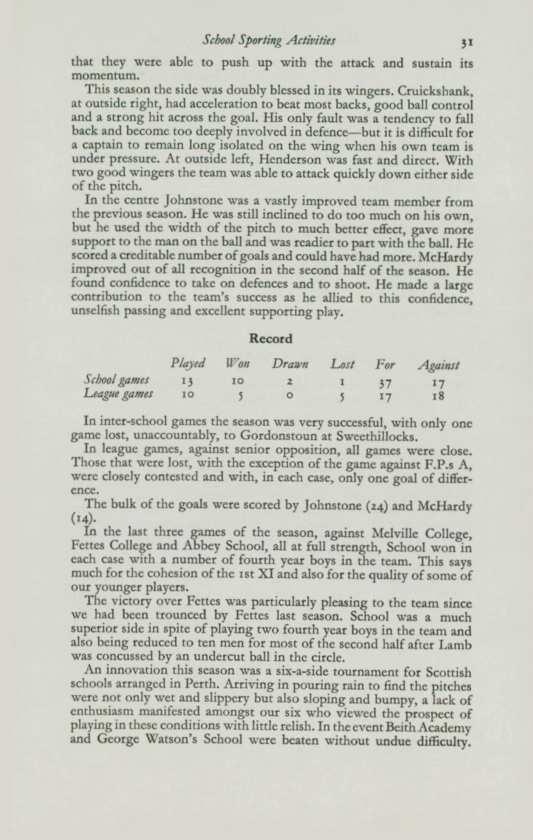
In inter-school games the season was very successful, with only one game lost, unaccountably, to Gordonstoun at Sweethillocks.
In league games, against senior opposition, all games were close Those that were lost, with the exception of the game against F.P.s A, were closely contested and with, in each case, only one goal of difference.
The bulk of the goals were scored by Johnstone (2.4)and McHardy (r4).
In the last three games of the season, against Melville College, Fettes College and Abbey School, all at full strength, School won in each case with a number of fourth year boys in the team. This says much for the cohesion of the 1st XI and also for the quality of some of our younger players.
The victory over Fettes was particularly pleasing to the team since we had been trounced by Fettes last season. School was a much superior side in spite of playing two fourth year boys in the team and also being reduced to ten men for most of the second half after Lamb was concussed by an undercut ball in the circle.
An innovation this season was a six-a-side tournament for Scottish schools arranged in Perth. Arriving in pouring rain to find the pitches were not only wet and slippery but also sloping and bumpy, a lack of enthusiasm manifested amongst our six who viewed the prospect of playingin these conditions with little relish. In theevent Beith Academy and George Watson's School were beaten without undue difficulty.
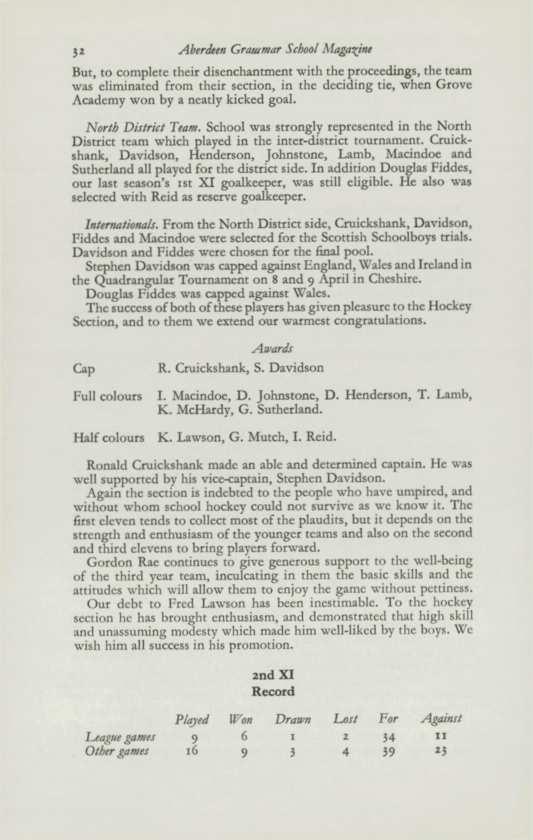
Abmken Gramn,arSchoolMagazine
But, to complete their disenchantment with the proceedings, the team was eliminated from their section, in the deciding tie, when Grove Academy won by a neatly kicked goal.
North District Team. School was strongly represented in the North District team which played in the inter-district tournament. Cruickshank, Davidson, Henderson, Johnstone, Lamb, Macindoe and Sutherland all played for the district side. In addition Douglas Fiddes, our last season's 1st XI goalkeeper, was still eligible. He also was selected with Reid as reserve goalkeeper.
Inltrnalionals.From the North District side, Cruickshank, Davidson, Fiddes and 11acindoe were selected for the Scottish Schoolboys trials. Davidson and Fiddes were chosen for the final pool.
Stephen Davidson was capped against England, Walesand Ireland in the Quadrangular Tournament on 8 and 9 April in Cheshire.
Douglas Fiddes was capped against Wales.
The success ofboth ofthese players has given pleasure to the Hockey Section, and to them we extend our warmest congratulations.
Awards
Cap R. Cruickshank, S. Davidson
Full colours I. Macindoe, D. Johnstone, D. Henderson, T. Lamb, K. McHardy, G. Sutherland.
Half colours K. Lawson, G. Mutch, I. Reid.
Ronald Cruickshank made an able and determined captain. He was well supported by his vice-captain, Stephen Davidson.
Again the section is indebted to the people who have umpired, and without whom school hockey could not survive as we know it. The first eleven tends to collect most of the plaudits, but it depends on the strength and enthusiasm of the younger teams and also on the second and third elevens to bring players forward.
Gordon Rae continues to give generous support to the well-being of the third year team, inculcating in them the basic skills and the attitudes which will allow them to enjoy the game without pettiness. Our debt to Fred Lawson has been inestimable. To the hockey section he has brought enthusiasm, and demonstrated that high skill and unassuming modesty which made him well-liked by the boys. We wish him all success in his promotion.
2nd XI Record
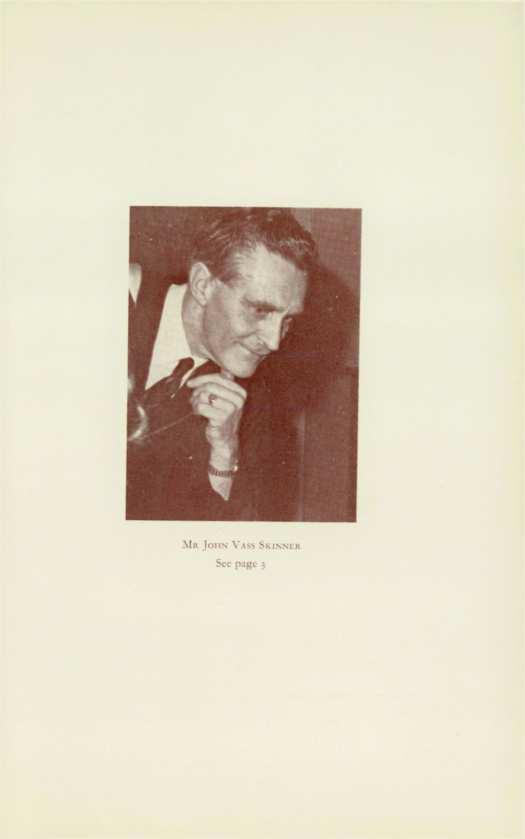
~h\ Jou, \ ~,, ~1,.1,~1 R Sc p.1g~ 3
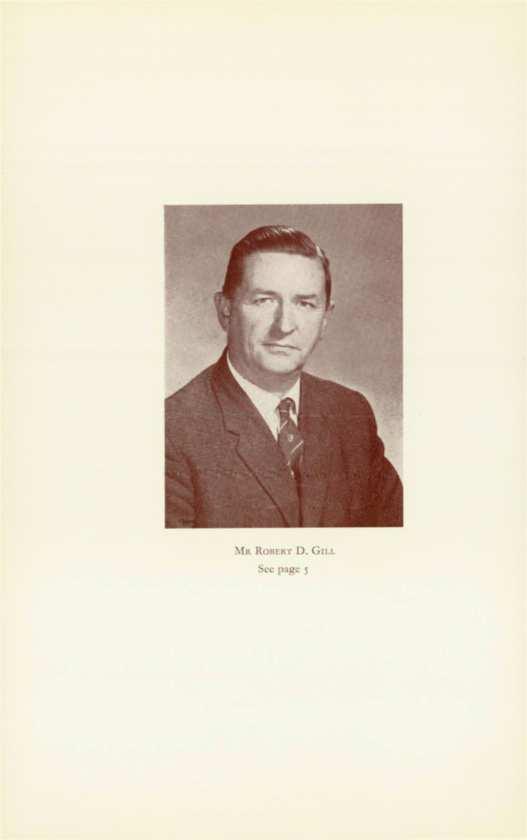
;\[ R RORFRT D. G1 l
Sec p31,:~ S
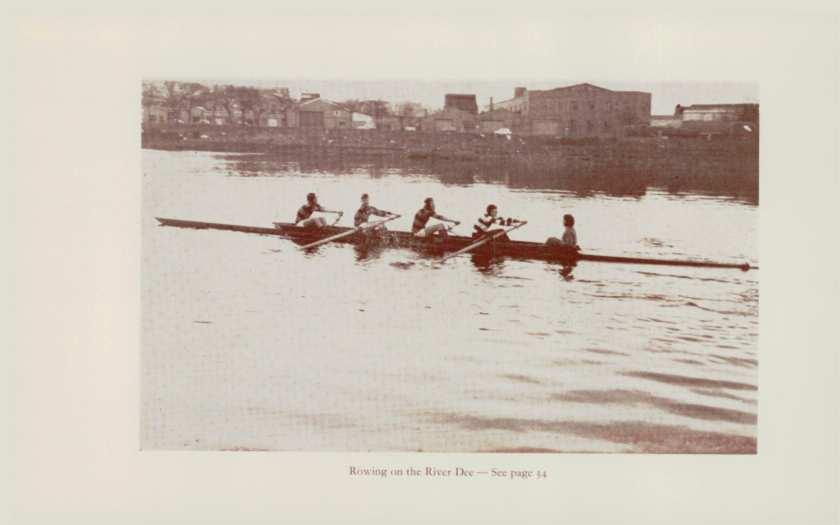
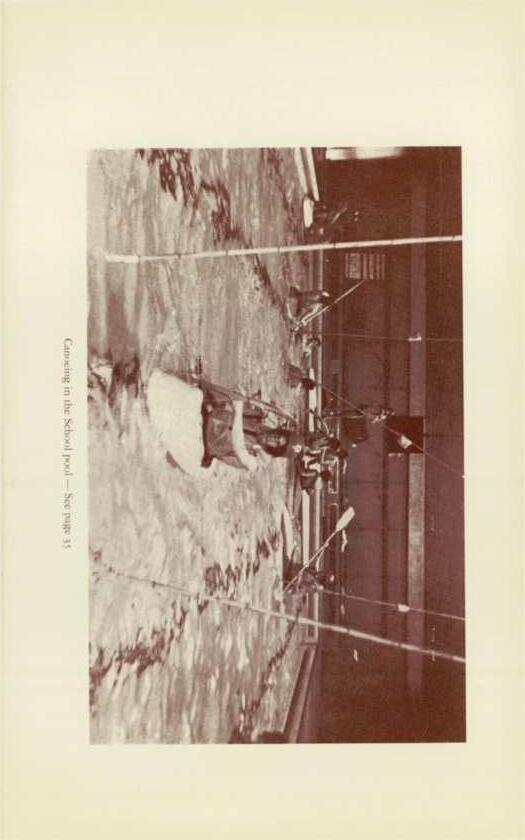
R1g11/ar players. A. Milne (captain), B. Durward (vice-captain), T. Adamson, G. Yackiminie, D. Howie, R. Lewis, M. Youngson, T. Knights, F. Hay, N. Gibb, N. McKclvie, G. Mutch, A. Young. This was the strongest 2.ndXI for manyseasons. They wererunnersup in Section 4 of the North District League, and had they won one more game they would also ha,·e won the league.
In many previous years a number of this team could well have held their placesin the 1st XI. On several occasions Alex Milne played for the first eleven with distinction. A. Young held his place in the first team for the first part of the season, but decided to ski during the second term. For this reason he played for the second team when available.
Fourth Year
If the game is to be measured by results then there is no doubt aboul the success of the 4th year team. Their goal average was quite remarkable at 6.7(goals for divided by goals against) showing that there were competent players in all positions . The team quickly adapted to formation hockey and could call on players who could fit into both 4: 3: 3 and 4:2:4 systems. In both cases their strength lay in midfield and in the circle. Strikers J. Sutherland and M Matthews scored 40 goals, the former knocking in 2. of these and failing to score in but one game-a notable feat for a fourth year player. G. Truscott and D. Bruce were the midfield men whose endless energy and game reading contributed largely to the team's success. As captain and vice-captain respectively they led by example and by encouragement both on and off the field. The team would do well to emulate them and remember that good hockey skills can only develop from continual hard practice. Despite the fact that the team lost two good goalkeepers after the first term, a very able replacement was found in G. Wilson who is proving that he can be quite fearless in the circle. The defensive four varied because there was little to choose between the abilities of G. Beedie, J.Bisset, D. Cooper, D. Moir, J. Moir and G. Skinner. After initial problems of marking and defensive patterns, these players soon found they were able to contain most attacks. Apart from regular pool players, all boys participating in hockey showed an enthusiasm for the game and some willingly assisted senior hockey teams by turning out for them on Saturday afternoons.
PlayerPool. G. Becdie, J. Bisset, D. Bruce, D. Cooper, I. MacLeod, M. Matthews, D. Moir, J. Moir, A. Mutch, G. Ritchie, G. Skinner, J. Sutherland, G. Truscott, G. Wilson. p 15 w 13
Record D L F 80 A 12.
After a shaky start to the season the 3rd XI developed inco an enthusiastic and energetic, if not very fluent side. Under the able captaincy of John (I'm the greatest) Blacklaws, who must be destined for greater things, they went on to register several very good results, and keenly anticipate the start of next season.
Third Year Hockey
At the start of the 1972.-73 season, the third year team were very unsure about the game, but by the end of the first term there was greater enthusiasm, and the team were blending well. Under the competent guidance of Mr. Rae and Mr. Spence the second term looked very promising. The boys did very well considering it was their first year of Hockey, and are looking forward to the coming season with every confidence.
Rowing
After a break ofsome yearsthe sport ofcompetitive rowing has been revived at the Grammar mainly due to the arrival of11r. Newton at the School. Mr. ewton acts as an efficient organiser, instructor, driver and general coach to the rowing team and his efforts are greatly appreciated by everyone.
At present only two schools in Aberdeen have rowing teams, Rubislaw and Hazlehead. It was decided at the beginning ofterm that no attempt would be made to have separate school teams but mixed crews would row under the name of Aberdeen Schools' Rowing Association (A.S.R.A.).
Most of the rowing is done in coxed fours, of which the Education Department owns two and the rest of the boats used arc borrowed from the University.
The crews have had little success in the competitions to date and the main problem in the senior crews has been finding a combination of oarsmen that will form an efficient, fast crew. However, a crew stroked by Ronald Wallace of Class VI and coxed by Keith Moir of Class VI, with the rest of the crew from Hazlehead, won the novice pennant at the Aberdeen Head-of-the-River. School crews have competed in three other "away" regattas to date but no outstanding results were achieved.
The inevitable examinations have severely interrupted training and we all look forward to the summer term when serious training for the Scottish Schools' Championships in June may be resumed. However our best chance ofsuccessprobably liesat our forthcoming home event, the Aberdeen Regatta.
Canoeing
This newly formed Club has proved to be so popular that, for the present, membership has had to be restricted to Upper School pupils. The main problem islackoftime for training, sinceit is only practicable to have eight canoes in the pool at one time and the pool is only available for two nights per week.
The eight small, training canoes (known as bats) which are used in the pool were built earlier in the year by Messrs. Lawson and Lobban with assistance from Neil Lawrie and Ronald Wallace. Moulds and materials for KW 7 canoes have arrived in the School and, after the exams, work will probably start on these larger canoes which can be used on rivers or in the sea.
Most pupils have successfully mastered the "Eskimo roll" and other support strokes and it is hoped to have advanced pupils canoeing on the river later in the term.
Our sincere thanks must go to the aforementioned members of staff for undertaking most of the construction work and instruction. The co-operation of the janitors in our use of the huts is also greatly appreciated .
Ski-ing
Although weather conditions during the winter season left far less than a constant abundance of snow, the Club has expanded and we were fortunate in that on every outing there wasample snow to ensure a good day's ski-ing.
A keen interest was shown by pupils from all years, and the number attending our outings increased as several members have managed to buy their own equipment which meant that wehad more skis and boots to hire to other people.
Our hopes of racing success were extinguished for this session at least, as we could not muster a really competitive team. Our failure here is mainly due to the fact that most School Ski Club members do not start ski-ing before the age of twelve, and for good race potential a pupil has to start earlier.
In spite of the weather and a reduced grant from the Education Committee, the Club managed to remain solvent, and was able to purchase two new sets ofskis and boots through a generous grant from the School Sports Fund
.Mr. Ritchie and Mr. Duncan of the Science and Mathematics Departments took an active part in the Club's activities, and accompanied us on almost all our outings.
Finally I wish to thank Mr. P. Henderson and his wife for their help and guidance in preparing and organising our outings.
Office-bearers for this Session were: Pre.ridml, David Smith; Suretary,Campbell Kerr; TrtaJ11rer,Ramsay Milne.
Badminton
Despite lack of support from senior pupils, the badminton club is alive and well, albeit in Rosemount. Congratulations are due to Stanley Rae and George Thomson, both of whom did well in local events and also helped the team to an actual victory over a (weakened) Gordon's College team. The enthusiasm of the 4th year pupils augurs well for the future of the Oub.
School Societies
Motor-Cycle Club
This Club was originally formed in the Winter Term ofthis Session and has two basic aims: first, to give members an idea of the construction, maintenance and rebuilding of motorcycles and secondly (a long term aim) to find some way ofgiving members some riding experience before they arc old enough to take a machine on to the road.
In the first place, the Club was short ofa workshop, tools, money and of course motor-cycles. We now have the use of a large shed in the school playground and have been fortunate to acquire two machines and rwo engines. The first bike, a 350 c.c. Triumph twin is, at eleven years of age the youngest piece of machinery we have. It is on longterm loan since it was stolen from its Aberdeen home and returned with the big end bearings knocking. The owner is paying for all parts needed in rebuilding. At the time of writing we are just starting reassembly, having taken it apart to the last nut and bolt. Our second, more recent bike was recemly saYed from an untimely end on one of the Corporation tips by thrusting a small sum ofmoneyinto the owner's hand. It is a 98 c.c. Excelsior in a dilapidated state, but we should be able to rebuild it or at any rate have fun trying!
Our two engines are both non-runners, used for practice and demonstration only. The first, a single cylinder ex W.D. Triumph of 35o c.c. capacity was donated by ahelpful Aberdeen dealer. The second, a 350c.c. single cylinder Royal Enfield was obtained from the School Motor Club in return for an old Ford Classiccar engine which had been given to us by a helpful parent.
Over the years ithas been shown time and time again that youngsters given "off-road" experience on motor-cycles, then expert tuition on the road, turn into safe,capable, responsible riders. Many people regard motor-cycles as unsafe and motor-cyclists as anti-social thugs. Motorcycles are neither safer nor less safe than cars; they are different. Accidents are higher amongst young riders due to inexperience and ignorance. As the law stands any 17-year-old can purchase and ride a 250c.c. machine with a top speed of 100m.p.h. and acceleration to match. Recently, in an effort to cut accidents, the minimum licence age was raised from 16 to 17 years. Accidents did not fall in the slightest, indicating that inexperience and lack of training, not the rider's age, are the main cause of accidents. Recently, motor-cyclists have taken
some hard legal knocks from the Department of the Environment and unless something is done voluntarily to cut accidents, then it is likely that further restrictive legislation will be introduced, possibly robbing youngsters of much fun to be had riding motor-cycles.
Once we have some functional machinery in the school, we must look hard for some private ground for pre-rider practice. Any pupil aged 17 years or over can join the scheme run by the R.A.C. and the Scottish Auto-cycle Union, which holds courses in theory and practice. The cost is very low and learners need not have their own machine. Details may be obtained from school notice boards or the City Police H.Q.
In the near future the Club will need tools and workshop equipment (e.g. a bench and vice) and of course money. Quite often old bikes, engines and workshop equipment can be obtained at little or no cost from people no longer requiring them Obviously we will jump at the chance of any such acquisition, and will be glad to hear from anyone who could help.
Finally, if any pupil is interested in joining the Oub, we meet on Thursdays from 4. 5 p.m. to 5 p.m. and Saturdays from 10 a.m. until noon. Prospective members can contact me in Room 10.
J. S. RoowELL, Teacherin Charge
Motor Club
Committee: Pruidmt, Graham J. Russell; Se.retary/Trta111rtr, Douglas Maskew.
Work commenced soon after the start of first term and the engine of the Club's A.; 5 car was restored.
A major change inside the Club took place before Xmas. Before then the Motor Club had incorporated motor-cycle work but in December the Motor-cycle Club was formed in its own right.
Films were shown in the second term, the favourite being "a weekend at Le Mans". Anillustrated talk was given by a member ofthe Automobile Association on "how the engine works". Later a talk from a guest speaker, Mr. Morrison of the Harper Motor Company, was given, iJ!ustrated by films. This produced a good turnout and an enjoyable evening. Finally the Parabug was displayed, after much delay, which in all contributed to a successful session despite a shortage of members. To conclude I'd like to thank Mr. McIntyre for all his help.
GRAHAM RusSELL,President
Literary and Debating Society
The Society this year has enjoyed a fairly successful season, although the fall-offin attendances towards the end of the Spring Term should serve as a reminder to next year's committee that a great deal of effort is needed to sustain interest in the Society.
AberdeenGrammarSchoolMagazme
As usual, it was the "novelty" items, plus the Inter-School Debate with Harlaw Academy, which attracted the largest attendances and at times most interesting results were _produced. Of the "home-front" meetings, perhaps the Forum on Racialism, the Debate on the T.U.C., and the Debate "Dulce et Decorum est pro patria mori" stood out as the most lively and heated, and it is in debates like these that perhaps the old "posterity" of the Society should be maintained.
The Annual General Meeting was held before the Easter Break this year, so as to allow next year's Committee to have an "introductory" period ofoffice.In this time it is hoped that the new Syllabus, including Inter-School debates, which, after the experiences of this year should be dealt with and organised well in advance.
It only remains to wish the best of luck to next year's Committee, who are: President,W. J. Campbell Kerr; Viu-Presidmt, Peter Midgely; Secretary,David J. M. Anderson; Treatnrer,David Pitt-Watson.
Many thanks to this year's Committee, and to all masters who lent a hand, especially l\fr. McIntyre.
Geographical Society
Pruident, David Soutter; Secretary, Martin Fraser; Projeclionitt, Graham K. Deans.
Once again the membership of the Society has been well over the hundred mark. Although numbers attending meetings have declined towards the end of the session, a basic twenty to thirty members can be expected at most meetings.
This session the number of illustrated talks exceeded the number of 6lms shown. It has been proved that talks are more popular than films by the numbers which have attended in previous years.
Various members of staff and several pupils have given the talks. The topics included Aberdeen (Mr. Will), Aspects of Europe (M.iss Carter, Mr. Hawksworth, :Mr. Spence) and the U.S.A. (Mr. Duncan). All the talks were of the highest standard and very informative. There was a wide variety of topics in the 61m programmes. The last .61m shown entitled "Long Haul", was perhaps the most interesting. It dealt with road transport in Europe and was very enlightening.
An excursion isplanned for the Summer Term, but as yet the destination has not been decided.
Finally on behalf ofmembers of the Society may I express our thanks to Mr. Gelly and his staff for their help in running the Society.
MARTIN
Railway Society
FRASER, Secretary
Membership of the Society has continued to rise. This year there are eighteen members, although usually only ten turn out each Monday. Most of the members are from the Middle School; and while this is
causing difficulties at the moment, it is perhaps a healthy sign for the future.
Work has continued slowly on the layout due to lack of experience on the part ofthe junior members, a state ofaffairswhich we arc trying to rectify.
The highlight of the year's activities was undoubtedly a most enjoyable trip to Glasgow in February to visit a large model railway exhibition. We went down by train, of course. On the same occasion seven of us visited British Railways' Eastfield engine shed.
Our thanks as usual to Mr. Bruce for keeping an eye on things and for giving us encouragement.
M. YEOMAN, President
Historical Society
This year (1972-73) has been a very good one for this Society. There were some very successful items which could well be repeated next year. We had a number of historical films such as "Julius Caesar" and "The Crusades" shown; especially popular were the three films on the Second World War.
There were also two panel events (again very popular), a "Going for a Song" type ofgame where a pupil from each year was selected to join a panel which had the unenviable task ofidentifying various historical objects such as a Sudanese war hammer. There was also an inter-class history quiz. The winners of this quiz were class 1L who beat class 1:M in the final.
It is hoped that we will have many new members next year, and that it will be as successful as this one has been. RoBERTHowm
Junior Drama Club
A Drama Club for boysin years 1, 2 or 3 was founded in February: although the membership is quite large all those boys (and girlsI) interested are invited to come to the first meetings of next session.
The first play to be presented is A. A. ?lfilne's "Toad of Toad Hall" in its musical form, which has the merits of providing good parts for a lot of actors and of being fun to rehearse. As perhaps befitsa comedy, school holidays, Highers and so on meant that it was mainly rehearsed in places like Rosemount School, St. Katherine's Club, the Students' Union and on Aberdeen BeachI
The most worthwhile aspect of the Club has been the members themselves, whose hard work, enthusiasm and humour were always a source ofpleasure to the producers . Particularly valuable contributions to the Club and the play were made by Peter Kelly, whose instinctive feelings for stage action and stage sets left its mark on the production, and by Stephen Illsley; they ensured that there was less drill and more active improvisation than there would otherwise have been.
The Club was also lucky in the teachers who made the production possible, especially l\fr, Ord (Art) who designed and painted the set, giving up an inordinate proportion of his free time, Mr. Tulloch (Music), Mr. Cruickshank (Technical), Mr. Smith (Art) and Mrs. Mackie (English), as well as the headmaster who made a room and money readily available.
Our greatest wish for the future of drama in this and other schools remains that the enthusiasm and talent which children bring with them from primary schools should beproperly catered for byfull-time drama teachers. Despite our own mounting of a play we feel strongly that drama should play a far more integral part in school life than a mere annual school play-fo r the children's sake. It would be a pity if this most "comprehensive" of activities, which breaks down barriers in the social structure ofthe school and within the individual, should receive less than comprehensive support from those, who, on a theoretical level,at least, are committed to the education ofallthe children and not just a few.
Club Officials (until December, 1973); President,Peter Kelly; VkePresident, Stephen Illsley; Suretary, Leslie Forsyth; Committee, Alex Parker and David Cowie.
Angling Club
The School's Angling Club has always been a good one and this year is no exception.
This year the Club members have been on a few very enjoyable outings, especially to the Aboyne Loch where we fished for pike and perch under ideal conditions. However the sea-6shing at Skatey Shores on the Stonehavcn coast did not quite work out as expected. The weather was atrocious and only a few members turned up, but eventually some boys went to the River Carron in Stonehaven where several trout were caught. The majority of members have decided that this year's main outing should go to Elion to fish on the Ythan.
Also the Oub has purchased several books which have been put into the School library.
In March the Club received a grant of£7 with which we purchased a trout fly-tying outfit. The Club also possesses another fly-tying outfit used in School on Tuesday evenings when the Club meets. The trout fly-tying outfit is already being loaned out to enthusiastic Club members.
MARTYN GouGH, Joint-Presidentand Setrelary
Boys' Library Committee
It would have been difficult to follow last year's School Fair in the wayoffund-raising efforts, so this year we decided to rest and consider how best to spend the money. A suggestion book has been opened and a steady flow of book titles has resulted.
It should, I think, be pointed out though that the work of the Committee is quiet and unobtrusive; yet much is done both in the administrative and the practical side of library tending, and the smooth running of the library is thereby much helped.
GRAHAM K. DBANS
R.A.A.C. (Rubislaw Academy Art Club)
In response to several requests from boys in the first year regarding the formation of a club within the Art Department, it was decided to make a room available once a week after school; the idea being that, as far as possible, the boys should decide on the sort of activities they wish to pursue. The presence of a teacher is mainly in an advisory capacity, to help with such techniques as printing, pottery and ceramics, jewellery, various forms of 3D constructions, sculpture, etc.
We hope to sketch and paint out of doors as often as the weather permits, and possibly visit one or two places of character and visual appeal, such as Old Footdee and Aberdeen Harbour.
The Club meets on Mondays, from 4.05 p.m. until approximately 5.40 p.m.
ALAN SMITH
Chess Club
Chessin the School this year hasseen awelcome upsurge with a large increase in attendances at Club meetings. However, due to a lack of experienced players, we found difficulty in fielding a strong team for competition Indeed in the schools league, which we have won for the past two years, we cannot hope for better than second place, having suffered a big defeat at the hands of Robert Gordon's College I in our first game and another against Cults I later in the season. Nevertheless, we hope for better resuJts next year when we will have allour first team players back. The regular team was drawn from the following: D. McAllister, G. Crook, I. Robertson, I. Simpson, S. Walker, A. Parker, A. Gibson, H. Gilmour. Finally, I would like to thank Mr. Galloway for his help and advice, Mrs. Mackie for the use of her room and the Janitor for his assistance and forbearance.
DOUGLAS McALLISTER, Pruide11J
Film Society
The Society came of age this year when it entered its 21st season. To celebrate this fact eight films were presented as well as several short-length cartoons. The films maintained their usual high quality with the highlights perhaps being "When Eight Bells Toll", a classic
Aberdeen Grammar S,hool ~Magazine
thriller from the book by Alister McLean, and "Battle of the Bulge", a re-enactment of the battle of the same name. Altogether the films catered for most people's taste-there was adventure, drama and documentaries .
Attendances were somewhat down on last year but it is hoped that there will be a revival of interest in the Society next year.
Finally I would like to thank Mr. Will for the time and effort he put in, Mr. Ba...xter,Graham Deans and Peter Kelly for taking care of the technical side of things and the prefects for running the tuck-shop and supervising things in general (and boosting the attendances I).
STEVEN BARNETI, Se(rela,y
Ornithologi cal Society
The Society met for the first time on 19 April 1973, with a good response from first and second year boys. Three meetings have been held in which we have looked at some of Mr. Will's slides. Mr. Hawksworth and Mr. Scott have taken some boys to the Ythan estuary, these outings having proved a great success.
Many thanks are due to Mr. Will and Mr. Scott for getting the Society "off the ground". We are all looking forward to a few outings next term.
LoGAN STEELE, Sureta,y
Shelter Set
This term, after a long rest, our Shelter Set took part in several discussion meetings with representatives of other Aberdeen schools. A proposed joint dance project unfortunately had to be dropped because of unforeseen arrangement difficulties.
It was later decided that there should be a sponsored walk in June, and a dance probably in July. It is hoped that these events will be well supported.
Office-bearers this session are: President, James W. L. Davidson; Suretary, Graham K. Deans; Treasurer, Ian Watt.
GRAHAM K. DEANS, Suretary
Photographic Society
Throughout thelast session the Society has continuedtohold weekly meetings, after school, in the projection room where we often discuss each other's work. The Junior members of the society have been divided into small groups and taken for instruction in many aspects of photography by the senior members of the Society. This system seems to be successful as there have been more Junior members using the
darkroom, and Society equipment, in the past year than have been for a long time. A suggestion was made in the 1971 edition of the Afagazine that people were drinking developer. They still seem to be at it, but now they supplement their menu by eating thermometers.
The School Dance, once again, provided us with some interesting photographs and, although sales were not up to past records, the production ofthe proofs and prints provided some senior boys with useful experience in "mass production". Slideappreciation sessions have been run by Mr. Willfor the senior group and have often given us a basisfor many interesting discussions.
An exhibition of some of the Society's work will take place. At the moment it is being prepared.
As always we are deeply indebted to Mr. Will and Mr. McCurrach for their invaluable advice and assistance.
NEIL I. G. LAWRIE, V
Photography in the School
There has been a tradition of photography in the School for many years, and now this session marks its introduction into the Art curriculum.
Originally photography came under the wing of the Science Department and has continued its affiliations to this discipline up to the present day. For several years, however, there has been growing interest in photography as a craft and art form in its own right. Much ofthis interest grew from the acquisition ofa darkroom in 1956as part ofthe Art Department. A photographic society was then formed under the direction of Mr. James Will, allowing pupils to produce prints in extra-curricular time. Projects varied from the recording of the opening of the new building by Princess Alexandra, co Cadet Inspections; School Sports; Continental visits; and hill-walks. Enthusiasm for the subject was also stimulated by illustrated lectures given by l\fr. Will encompassing both architecture and painting; and themes of a more general interest.
In recent years it has been the policy of the Art Department to diversify the range ofcraft subjects being taught; this being ofparticular significance with the raising of the school leaving age. The time was ripe therefore for the introduction of photography into the Arl curriculum. The first tentative steps were taken by a group of senior boys, following the completion of their S.C.E. Examinations in May, of last session. We concencratcd on the basic techniques so that confidence in the operation of the camera, film exposure and de\•elopment and production of the final print was established. From this grew an awareness of and a sensitivity towards the aesthetic aspects of photography. I tried to avoid atall costs the didactic re-iteration ofthe "rules of composition" such as can be heard at many camera clubs, which tends to lead to rather stereotyped, if albeit, technically proficient, work.

AberdeenGrammarSchoolMagt1z.ine
I would rather that an interest in the history ofwhat after all is still a recent art form, be encouraged. However, such problems did not really arise since the boys soon found material which was of particuJar interest to them individually, and which they followed through with a great deal ofwork. A selection ofthis featured in their portfolios for Art College presentation.
The response by pupils in general classes in first, second and third forms to the option of photography as a craft subject, has been good. Some pupils have been particularlyenthusiastic. It is these pupils, who in their passage through school, wm sustain and benefitfrom aninterest in the subject at their own level; and in this be helped by the Photographic Society.
We can be optimistic therefore for the future of Photographic Art in the school.
I. McCuRRACH, Mas/erin Chargeof Photography
The School Play
Galsworthy and Gogol, Sheridan and Ben Jonson, Wesker and Shakespeare, and Shakespeare again and once again-the authors whom the Dramatic Society have drawn upon for the School play arc not immoderately low-brow. The plays have been pretty demanding- and even a piece like "The Long and the Short a.adthe Tall" which the Society played fur the entertainment of the School population only-a lengthy divcrtissement as it were-calls for a fair measure ofinformed skill in the speaking and acting. Last year, reverting to Shakespeare, they tackled (characteristically perhaps) the third part of Henry VI, an unknown and difficult quality indeed, and managed to expose in the play a valid pattern of berserk Yiolcncc and contrasting pathos that would not be out of place in some of our contemporary blood-anc.llanguage-lctting melodramas. Far removed indeed from the moonlight of "A Midsummer Night's Dream" or the well-trampled periods of "The Merchant of Venice".
This year Henrik Ibsen. Not too attractive a sound about that name, nothing homely or romantic or decently elevating- and certainly nothing funny This grim-faced destroyer ofillusions, rising out of the orwcgian night to expose in all their meanness the greed and pre- judice of provincial bourgeoisdom, gives little promise of a pleasant evening's entertainment, and certainly not the man you would choose to provide a piece in which unpolished schoolboys would be able to pretend to their own satisfaction and that oftheir bemused parents and girl-friends that they can prance and posture with a not-too-distant approximation to the style of Laurence Olivier or Andy Stewart. Yet they chose Ibsen. The play was "The Enemy of the People", and the event showed that they chose well.
The play is set in a Norwegian provincial community, real Ibsen country. Recently appointed superintendent of the town baths, that arc highly reputed for their health-giving qualities, is Dr. Stockmann, brother to Peter, the chief magistrate of the place, and chairman of the Governors of the Baths. The doctor-scientist, freshly come in out of the cold from a northern outpost where he had long fretted in impotent poverty, has all the ingenuous exuberance of a man who has found a satisfying and welJpaid job that will allow him to use his talcnrs for the benefit of his fellow men and at the same time free him and his family from the stultifying penury that they haYc so long known. He 1s, undisguiscd ly, a happy man, disturbed only, when the play begins, by the suspicion that the water supply of the baths is tainted. When analysis confirms his suspicions he has no doubt what he mu~tdo. He must make the facts public, and ensure that the source of pollution is removed, and to that end he is happy to enlist the support of all right thinking men. But how this publicity and this solution will affectsome members ofthe community it never occurs to him to ponder, for in his honest ignorance he cannot conceive that there can be any clash of interest between what is right and what on the other hand is profitable for a few. Consequently he is nonplussed and eventually outraged when he descovers that his brother the mayor (whom he knows to be
AberdeenGrammarS,hoo/Magazine
narrow in his sympathies, cold and joyless, but whom he cannot believe to be dishonest) opposes his action. The mayor opposes it on the grounds that it will disquiet public opinion, will not advance the well-being of the community and should be a matter for the properly constituted authorities to deal with-not for subordinates no matter how knowledgeable they claim to be.
Otherrepresentative figures, when they see what the implications of Dr. Stockmann's action are likely to be, align themselves with the mayor-Hovstad, editor ofthe local newspaper that claims to stand for liberal, progressive thought and action, Billing his colleague and echo, and Aslaksen, printer and spokesman for the Householders' Association. When the mayor puts the case that to do as his brother requires will mean loss of money and good name for the town, a decline in status and dividends for themselves, and higher rates to be levied on all householders, they combine with the ragtag and bobtail of the town who are gathered to a public meeting to shout the doctor down, vilify him and ostracise him as an enemy ofthe people. It is now, in the hour of seeming defeat, that Doctor Stockmann, speaking we can hardly doubt with Ibscn's own voice, rises to the occasion. He sees rallied against him all the forces of "progressive liberalism" headed by "Leading Citizens", who claim that the greatest of all virtues arc prudence, temperance and moderation, and sanctified by their own self-awarded title "the great solid majority"; heseesthem for what they arc, and in the last words ofthe play puts the matter in perspective for his family and himself, "The strongest man in the world is the man who stands most alone" . We cannot entirely beHeve that or him. Dr. Stockmann is a man valiant for truth, but there is an emptiness in the rhetoric ofthe phrase. Yet that is in keeping with the part too The play did not come over as a propaganda piece, where the characters are merely mouthpieces for abstract and general truths . Dr. Stockmann holds our sympathy as much by his weakness as his strengt h. He certainly is not pompous, over-serious, or conceited, but at times he does seem well underballasted with common foresight and common sense. He minimises difficulties, and he is outrageously optimistic in his idealism. But he is human, a man who has found proper fulfilment in the work he feels called to do and in the happy atmosphere of his family life. And he doesn't conveniently equate whatever personal ambitions he may have with the so-called welfare of the community. Derek Ross conveyed all this very well. His natural vitality carried him through the whole length of the play, including scenes that called for great intensity in playing and power in speaking. The exuberant child-like pleasure that he took in his own success and ,vhich he radiated around him warmed the audience towards him. In the scenes with the 11ayor he kept to pace and mounted co the clima.-.:esquite splendidly, and altogether made a splendid job of the pan.
The part of the .Mayor is a difficult one, and Douglas Kennedy played it with great incelligcncc. He registered, from his first entry suspicion and arrogant impatience hovering on hysteria, qualities that he kept throughout the play, and which he developed later into a
brutal biting antagonism to all his brother's thoughts and actions. He has not a naturally strong or resonant voice; and because he is very obviously a quick-thinking boy his words tend to come quickly and in spates. It is the more creditable therefore that he gave his words a clipped decisive precision that was in keeping with the (usually) controlled venom of the Mayor's feelings; and the nervous rigidity of his stance when speaking was a good image of the bitter, rigid and power-hungry character that he portrayed.
These were the dominating characters, but a few others call for mention. Euan Short as Hovstad, the editor of the Ptoplls Herald, played with a mature assurance ofmanner that well suited the part. His voice perhaps did not sufficientlyfluctuate. It is true that Hovstad as a character gives away little or nothing of his deepest intentions. As a character he conceals his selfish and revengeful purposes beneath a veneer of high liberal pretensions and a suavely persuasive manner, but the audience needs a little assistance to see all this, and a little more variation in weight and pitch would have helped. On the other band the essential selfishness masquerading as something other came over all the time, and to do this without any meretricious bravura was a fine achievement.
Aslaksen is a real Ibsen character, and a far from pleasant one. He speaks as one who represents "the great solid majority", the equivalent, one assumes, of the "silent majority" that we read so much of today. Of course he believes in "progress", but it must be slow, moderate, and backed by the right kind of people. He knows, because he has learned it all in the school of life. He is in fact the epitome of all cant and humbug. Hugh Osborne did well when he was registering the hysteria just below Aslaksen's constrained and timid features- that was well done. At times, on the other hand, his speed of delivery gave the effect of a high-pitched twitter that made it difficult to distinguish exactly what was being said. And again he handled the big meeting very well.
This meeting ofthe town's citizenry, called to hear Dr. Stockmann's case, was a very effective piece of theatre. The crowd did their parts manfully. What was particularly striking was the fact that the main speakers had their say and were interrupted and then resumed their speeches; and all this came over with a very "natural" effect. Such an effect is most difficult to achieve on a rather cramped stage and with a smallish cast. It says much for the producer that it came over so well. The producer of this act was David Gordon, the Society's president who elected this year not to take a speaking part in the play, but to co-operate with Mr. Tinto and the other masters on production. That this act was wholly his and was certainly a high light of the evening is a pleasure to record. David also put his signature on the scene by his pantomimically amusing playing ofthe drunk member ofthe audience. Altogether it was a fine presidential contribution.
The thanks ofthe School are due to all those we have mentioned and to all the other members of the cast whom space will not allow us to mention. The staging was effective- non-fussy, but realistic enough and meticulously timed. The Society can be assured that the long
AberdeenGrammarSchoolMagaz/ne
winter haul was worth it all. It was afine production achieved primarily by the boys who make up the School Dramatic Society. But two outstanding contributions still remain to be acknowledged. Jan Anderson in the part of Mrs. Stockmann and Marion Forsythe as Petra brought more than competence to the playing. The natural warmth and togetherness of Dr. Stockmann's family was registered very well, and this difficult achievement was essentially due to the two girls. We thank them: as lastly we thank Mr. Tinto whose insight into the play's heart and ability to give his insights form and body we cannot be too grateful for.
Music Notes
June 1972 saw the fourth visit by a section of the School Choir and Orchestra to our home from home, Regensburg. Our large party of seventy-six boys and ten adults was given wonderful hospitality by our German friends, all the boys being accommodated in German homes. The staff, and the pupils and their parents of the Werner von Siemens Gymnasium went to endless trouble to make our stay worthwhile, and we owe a great debt of gratitude in particular to the Headmaster, Herr Kessel. The Civic Authorities of Regensburg were also very generous, and gave us a Reception and Luncheon in the Altes Rathaus, besides footing the bill for a whole day excursion into the Bayerischer Wald. The musical side of the venture proved most successful, a very fine concert being given in the Neuhaus Saal on 27 June. After a choral/ orchestral first part, the second part consisted in the main of Scottish music, includin~ dancing, Gaelic Songs with Oarsach (sung by Anne Macdearmid, ahas .\lrs. Brown of the .\lusic Department!), and the first performance of Mr. Hawksworth's Fantasia on Songs of Robert Burns. It is most fitting that the German children and their teachers are to pay us a return visit this summer, when, from 6 to 14 June, we shall be acting as hosts to over eighty of them. Our visit to Regensburg included the usual tours to places of interest, swimming, football matches, and a 6.nalall too brief glimpse of Austria, when we spent a few days at Youth Hostels in Salzburg and Vienna. All in all, a memorable holiday, well up to the standard of our earlier visits.
Immediately after the summer holidays, we were thrown in "at the deep end" with a weekend visit to Edinburgh. Assisted by Former Pupils Neil Mackie (tenor), and Alistair Smith (French Horn), and by Peter Inncss (organ), we gave two concerts in St. Mary's Cathedral of music by Benjamin Britten, including the "Children's Crusade". The audiences were disappointingly small, but it was none the less a thrilling experience to sing in a great Cathedral, as part ofthe unofficial Festival "fringe". We also enjoyed visits to the Tattoo and the Zoo.
In October, an impressive Service was held in Beechgrove Church to commemorate the Centenary of the 1872 Education (Scotland) Act. Mr. Roger Young, Headmaster of George Watson's College, preached the sermon, and the School Choir and sections of the Orchestra figured prominently in the Praise.
Our Carol Service was also held in Beechgrove Church, on 18 December, drawing the usual large congregation, and enabling the school to make a donation to the "Save the Children Fund".
Among the various "sundry events" that have taken place, mention must be made of the concert given by senior pupils to the British Federation of University Women, in the Debater, Marischal College, on 14 February, and also the continuance of the happy relationship with the Haddo House Choral Society, some of our tenors and basses participating with success and enjoyment in the recent production of "William Tell".
Lunch Time Recitals still attract discerning and enthusiastic audiences, highlights this year being a visit by the Aberdeen Early Music Consort, and the Staff Recital which brought the series to a close. Various unexpected members ofstafftook part in this, including one of the P.E. Teachers, who proved that, in spite of his bulk, he still has a delicate touch on the piano I ext season, our recitals wrn be able to feature our new harpsichord. On 10 March the Music Department held a most successful CoffeeMorning and Fair in the School Hall, with a view to raising funds for the purchase of a harpsichord. Boys, parents, and staff rallied round to make the occasion go with a swing. The weather also played its part, and the sunshine brought along a large number of people. Background music was provided by Mr. Spittle and his concert band, and two performances were given (in the Library) of Bach's CoffeeCantata. About £300 was realised, and, along with generous financial help fron the F.P.s Club and the Endowments Trust, we were able to commission Mr Basil Almond of Atholl Harpsichords to make up a Zuckerman Kit for us. The instrument arrived in the school at the start ofMay, and it will be officially"baptised" at a concert to be given on 1; June, for our Regensburg friends.
Before their arrival, our Annual Concert will have taken placein the Music Hall, on 31 May, when the main work will be Haydn's elson Mass. Choirs from local Primary Schools will take part, and the first Aberdeen performance of Mr. Hawksworth's Burns Fantasia referred to earlier in these notes will be given.
C.C.F. Notes
This has been another year of change. The late intake of recruits, which was agreed to at the instigation of the Cadet Training Team, has given us the smallestnumber of new boys ever but it is hoped that the gain will be on the side of efficiency. The change in uniform will eventually see the disappearance of B.D. from the C.C.F. although it is evident onlyin the Army Section so far as there has beenno issue yet to R.A.F. Cadets, as the regular service is just in the process of changing to the "woolly pully" .
In retrospect, last year's highlight was undoubtedly the visit to the school and review of Cadets by the school's most distinguished airman, Air Marshal Sir Leslie Mavor, K.C.B., A.F.C. who was then .t\.O.C. in C., Training Command. We would wish to thank Sir Lesliefor making
Abtrtktn Gra111111arS,hool Magazine
it such a memorable occasion and, as he has now reored from the service, we send our good wishes with the happy thought that we caught him just in time. To complete a cycleof three years which started with Brigadier J. J. G. Smith, we are to have another distinguished F.P. as our Inspecting Officer on 15 June, Air Commodore D. B. Ross, D.F.C., who is Director of Personnel Services to the Royal Air Force. We anticipate another pleasant occasion. Last summer's camps were quite outstanding. ChilwelJ and CranwclJ laid all their tremendous resources at the disposal of our Cadets. Seven Cadets, with the Contingent Commander, went to Germany at Easter to R.A.F. Bruggen. In spite of the rather indifferent weather, it was a most enjoyable camp and, in addition to the normal training, the visits to Cologne, Dusseldorf, Eindhoven and Overloon were much appreciated by the Cadets who gave a good account of themselves and were highly thought of there.
The Contingent Commander wasawarded the Cadet forces Medalin February.
R. McLEOD,Squadronuadtr
Army Sect.ion
Several changes have occurred in the Section during the past two terms. First of all we changed our intake date for boys joining and we did not ha,e any new recruits in until January. Then another change took place, as they were issued with the "new style" uniform, i.e. jerseys and lightweight trousers instead of the "old faithful" battledress which is being phased out completely. This last mentioned change surely marks the end of an era which former cadets, and the like, will look back on with a great variety of mh:ed feelings.
Yet another change has taken place with us starting to use the short range at Robert Gordon's College for some rifle training on Thursday evenings. We used to use the range at Ponthill but several problems were involved in getting there and setting it up and I must say at this point that we are very grateful to Major Dow and all concerned at R.G.C. for allowing our liaison between the two schools to bestrengthened by allowing us use of their facilities.
Asfar as cadets themselves arc concerned we have had to change our policy as far as numbers are concerned and curtail ourselves to a certain number peradult ratio. We could certainly benefit all round by an increase in the number of adults in the Contingent as a whole and let's hope that in the not too distant future some more of the school staff will join us in what must be one of the most enjoyable school clubs.
At the moment most ofour cadets in this Section are in the younger bracket but we have just started a new thirty-week training programme at the end of which we will have promoted several of the older cadets to the rank of sergeant and corporal, which will slightly alleviate the present imbalance.
C.C.F. Notu
We had a very successful summer camp at the Central Ordnance Depot in Chilwell last July and our sincere thanks and gratitude go to Brigadier J.J. G. Smith, a former pupil ofthe School, who did so much to make this such a most enjoyable camp. During Easter 1973 we went to Crathie for our Adventure Training Camp and not even the weather managed to detract from an otherwise reasonable week's training. At the moment we are busy preparing for this summer's sojourn, when we are going to the Cameron Barracks at Inverness for our Annua l Summer Camp, during the first week in July.
We have also during the past two terms managed to maintain our liaison with other local branches of the T.A.V.R. We had a very interesting and informative evening at the 1st squadron of the Signals Regiment and other outside demonstrations included a visit to the School of the Recruiting Team of the 1st Battalion the Gordon Highlanders. To all involved in the organisation of such meetings we extend our thanks .
This term there is planned yet another liaison link when cadets from both our own C.C.F. and also some from Robert Gordon's College have been invited to participate in a joint training weekend with the Aberdeen University Officers Training Corps. The other main event during this term will be the Annual Inspection which will take place in mid June.
Finally I would like to express our thanks to all those people at Foothill Barracks who have helped us in the administration and training of the cadets, and especially to the 22 Cadet Training Team, under Captain Kenneth Lumsden, who bear the brunt of much of the hard ,vork which goes into our year's activities .
R. GRAY, Captain O.C. Amry Section
Pipes and Drums
Both sections have again practised fairly regularly throughout the year. Enthusiasm, however, is noticeably less than in the past year or two and at this point it looks doubtful whether the band, as such, will make any appearances this session. A number of younger members are making progress and this augurs well for the band's future.
Jack Taylor of Aberdeen University has continued his post as piping tutor; Mr. Gray is band manager and he and Drum Sgt. Anderson have acted as drumming tutors. To all three we are grateful for the time and effort which they have given us.
Pipe Major K. C. McHARDY VJ
Literary Section
Waiting for the End
The following are some extracts from the diary of Gavino, a Pompeiian judge, who died in A.O. 79.
August 18: Today has not been a day of any note. I, Gavino, have not had a busy day at the Law Courts. Just a few minor thefts and three assaults. Oh, for a mass murder, or the like. Something to arouse my interest 1Here I must confess that twice I nearly fellasleep listening to the evidences.
My summing up of today is that it was of little interest to me, except for the slight earth tremor in mid afternoon.
August 20: I open today's entry in a mood of deep sorrow. My nephew was kj))edtoday when one ofthe pillars in the Forum collapsed on top of him during an earth tremor. All Pompeii and Herculaneum are full of stories as to the origins of these tremors. Why, even my granddaughter has an answer. She says that it is the Souls of the Dead trying to escape from the Underworld by coming up through Mount Vesuvius. I am inclined to agree with her in that it has something to do with Mount Vesuvius. But why should I worry? Vesuvius is an extinct volcano and is likely to remain like that for the rest of time.
August 23: Once again a day of little consequence but again the monotony was broken by a severe tremor. I am now worried about these tremors. How long will they last? and what is more, will they get worse?
August 24 A.M.: Tragedy 1May the Gods have mercy on our Souls1 Vesuvius bas erupted and spewed its very heart over both Pompeii and Herculaneum.
The day started normally, a cloudless sky, glassy sea, with little warning of what was to happen. The festival was in progress and the town packed with people. The Forum was so full I hadto take the long way round to the bronze maker's shop. (The Law Courts were closed today.) I was just admiring the new bronze statue being made for me. I picked it up in admiration.
Suddenly a violent cracking sound split the air. An acrid smell of sulphur gripped my lungs. The ground heaved and shook and roars came from the very earth itself. from Vesuvius there issued forth a mushroom-shaped cloud. All around people were running and screaming in blind panic. It was the seventh hour. The burial of my town had begun.
P.M.: May the Gods give me strength to finish this, what shall be the last entry I will write in this diary. I have not escaped and I am now trapped in my house. The falling ash is slowly smothering the town. Those in Herculaneum must be suffering the same fate as I. The town
is still being racked by earthquakes. Poisonous gases are asphyxiating meslowly. I pray that mywife and familyare safe. This holocaust must seem like the end of the world.
I must now light a lamp: the darkness is like that of a sealed room. My breathing is becoming laboured. I must die soon. I will use my last energy to pray for myself and for people of the Future, of all races and creeds. I pray that they may never have to go through an ordeal such as this.
A. GARDEN, UIS
Blues
I was livin' lonely
I'm a lonely man
Time was passin' slowly
Doin' what I can
I've got such crazy habits
Kissin' Pigs and whippin' rabbits
They don't mind
Three weeks spent in Holland
Didn't so do much
Conversing with the Natives
In Scottish double Dutch
ALAN DAVIDSON, V
Autobiography Chapter I
Myearly recollections are, for the most part, muddled and confused. There are very few incidents I remember with any coherency at all. The only memory left from pre-school daysis one ofthe more readable. I was on a carpet, which was on the garden-path. It was very early in the morning. The rosy light came sparkling and blazing from behind a tree, on the other side of the road.
There were some toys on the carpet, a Oark's shoebox full of old toy cars and two pandas whose heads turned if you mauled their tails.
Down the street came a tall elderly lady, walking very carefully, with small jerky steps. As I saw her walkdown the pavement, the word "cripple" came into my mind. I thought a cripple was an old person who walked slowly.
Once I went to school there was more scope for things to happen, thus more things to remember. When the teacher was explaining things I would put my hands in my school-bag, feeling around until I found what I wanted, which was a bag containing my playpiece. Opening it very carefully,so as not to make a noise, I would take out two chocolate biscuits. I would then slide offmy chair until I was lying under the table where I would eat the biscuits, then silently appear on my chair again.
IAIN PRICE, IIR
Freedom : A short poem on leaving Schoo)
I'm going to join all the books and read a few clubs
Sit in a poem and write a few pubs
Short poem on staying Young
The people in the Gree n room softly whisper And my friends tend to agree with a grin Growing younger daily is a struggle But I'm told that staying old is a sin
ALAN DAVIDSON, V
There are more hells in Heaven and Earth . ..
As the young man came over the hill, the first thin blowing of rain met him. It blew into his face and moistened it with small finedroplets. He gritted his teeth, took a deep breath ofthe cold wet air and began to walk on. The gravelly soil crunched under his feet and sometimes a sharp pebble would prick into his sole. Frosty patches lay to each side of him like silvery pools, and they glistened in the weak winter sunlight.
The Sun itself laylow on the northern horizon hanging like a golden red ball offire just above the dark line ofhills that marked his horizon. It seldom rose far beyond that in this wintery season, but lay just below the horizon, sleeping, till the dawn forced it out into this winter world to shine for yet another short day.
The young man walked up the shallow rise in front ofhim and then a further slope to the waiting summit.
As the young man came over the hill, a thin blowing ofrain met him. It blew into his face and moistened it with small fine droplets. He gritted his teeth, took a deep breath of the cold air and walked on. He was an odd figure in this stony landscape, this wilderness pulled by frost fingers and torn into broken jagged stones. The man looked tired and haggard, and his thinning raven black hair blew softly in the wind. He was wearing a scruffygrey raincoat and kept his hands deep in the torn pockets to preserve a little warmth. Below the raincoat a pair of black flannels peeped, slightly ragged at the ends, which fell over apair of old muddy black leather shoes, with a little remaining sheen in places but beginning to fall to pieces.
They crunched over the sharp pebbles with a crisp frosty crackling, and sent loose pebbles running and skipping over the stony landscape into small frost hollows where they lay on their sides, coldly silent again. The young man walked up a rise, which gave way to a further slope, to a waiting summit.
Uterary Sution
As the young man came over the hill, a thin blowing rain met him. He gritted his teeth and walked on down the slope. This cursed place, he thought, is going to get the better ofme. But he had nothing elseto do but keep trying. He had lots of time, all the time in the world. He had got to escapefrom this celestial merry-go-round. In the path there must be a joint, the point where the original circle had begun. If he could find it he could escape. A smooth slide through space-time to the freedom of the universe.
A thought assailedhim. How had he come to this wild prison? The answer was in a dull memory hidden deep inside his skull. A memory he could not find, and which troubled him when he thought ofescape. He had a momentary vision of high dark walls and bars, and also of humming machinery. The memory passed, and then another came. A quotation from a text he had read, it went "Here on this bank and shoal of time ..." that was all he could recall. It fitted his present predicament however, very well. Too weJI almost. He was marooned on a shoal in time, becalmed forever.
Then it had caught him again.
As the young man came over the hill, the first thin blowing of rain met him. Ile cursed in a rage. He had missed it by milliseconds. A fleeting glimpse, and then it was whipped away from him by the inexorable forces which ruled this world. He would catch it next time. He trudged wearily on across the broken plain, the frost cracked stones sticking into his shoes and rattling across the bare landscape to liein hollows. The sun had begun to set in the northern sky, exactlyas he had seen it the last time he had been that way. That small orange circle was the only thing keeping him from a cold death.
Now his senses were tensed and ready for the next interval between the cycles. Or was there only one piece to a cycle?
He put the thought out of his mind and turned to his task. Now, now, now allhis brain screamed. He walked up the slope to the silently waiting summit and ...
A jolt as time slipped out of joint. A scream that seemed to be himself.
Then he was falling in a dark void.
Below him a red fire, bathing the very atmosphere in a baleful red glow. Slowly he tumbled towards it, very slowly like a slow motion picture. The light pounded in a rhythm like aliving creature. It waited for its prey. He was pounded, hammered by its living, sensual power. His body began to beat with it.
He was being ground to pulp by this immense baleful power. He was going, going, going. He fell into a web of red beams lacing the void, tumbling off them, only partly conscious, and finallyhit. He was in a dark void falling.
Below him a red fire bathing the very atmosphere in a baleful red glow. And he knew there was no way out.
"There are more hells in Heaven and Earth than are dreamed of in your philosophy."
NEIL MCKELVIE, V2
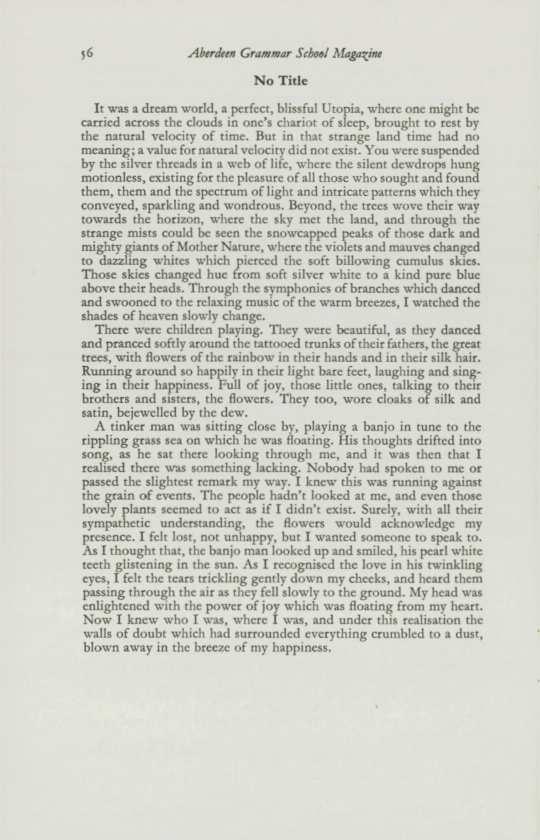
No Title
It was a dream world, a perfect, blissful Utopia, where one might be carried across the clouds in one's chariot of sleep, brought to rest by the natural velocity of time. But in that strange land time had no meaning; avalue fornatural velocity did not exist. You weresuspended by the silver threads in a web of life, where the silent dewdrops hung motionless, existing for the pleasure ofall chosewho sought and found them, them and the spectrum oflight and intricate patterns which they conveyed, sparkling and wondrous. Beyond, the trees wove their way towards the horizon, where the sky met the land, and through the strange mists could be seen the snowcapped peaks of those dark and mighty giants ofMother Nature, where the violets and mauves changed to dazzling whites which pierced the soft bilJowing cumulus skies. Those skies changed hue from soft silver white to a kind pure blue above their heads. Through the symphonies ofbranches which danced and swooned to the relaxing music of the warm breezes, I watched the shades of heaven slowly change.
There were children playing. They were beautiful, as they danced and pranced softly around the tattooed trunks oftheir fathers, the great trees, with flowers of the rainbow in their hands and in their silk hair. Running around so happily in their light bare feet, laughing and singing in their happiness. Full of joy, those little ones, talking to their brothers and sisters, the flowers. They too, wore cloaks of silk and satin, bejewelled by the dew.
A tinker man was sitting close by, playing a banjo in tune to the rippling grass sea on which he was floating. His thoughts drifted into song, as he sat there looking through me, and it was then that I realised there was something lacking. Nobody had spoken to me or passed the slightest remark my way. I knew this was running against the grain of events. The people hadn't looked at me, and even those lovely plants seemed to act as if I didn't exist. Surely, with all their sympathetic understanding, the flowers would acknowledge my presence. I felt lost, not unhappy, but I wanted someone to speak to. As I thought that, the banjo man looked up and smiled, his pearl white teeth glistening in the sun. As I recognised the love in his twinkling eyes, I felt the tears trickling gently down my cheeks, and heard them passing through the air as they fell slowly to the ground. My head was enlightened with the power of joy which was floating from my heart. Now I knew who I was, where I was, and under this realisation the walls of doubt which had surrounded everything crumbled to a dust, blown away in the breeze of my happiness.
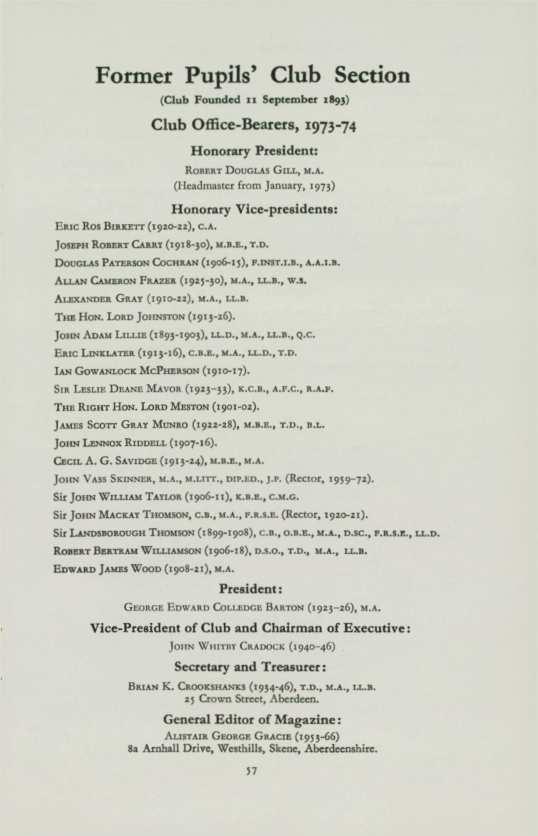
Former Pupils' Club Section
(Club Founded u September 1'93)
Club Office-Bearers, 1973-74
Honorary President:
ROBERT DOUGLAS GILL, M.A. (Headmaster from January, 1973) Honorary Vice-presidents:
ER1c Ros B IRKETT (1920-:n), c.A.
JOSEPH ROBEII.T CAP.RT (191 S-30), M.B.E., T.D.
DoUGLAS PATEII.SON CocHRAN (19o6-15), P.INST.l.B., A.A.I.B.
ALLAN c.u.rae.oN FRAZER (192.5-30), M.A., LL.B. , W.S
ALEXANDER GRAY (1910-u), M.A., LL.B.
THE HON. LoRD JOHNSTON (1913-26).
JoHN AJJAM LtLLill (1893-1903), LL.D., M.A., LL.B., Q.C.
EI\IC LIN!t.LATBR (1913-16), C.B.B., M.A., LL.D., T.D.
IAN GowANLOCK McPHERSON (1910-17).
S1R LESLIE DEANE MAvoR (192.3-33). K.C.B., A.P.c., R A.P
THE RIGHT HoN. LoRD MBsToN (1901-02.).
)AMES SCOTT GRAT MUNRO (19u-2.8), M.B,E,, T.D,, B,L, JoHN L!!NNo x RIDDBLL (1907- 16).
CBclL A. G. SAVIDGE (1913-2.4) , w.e.E., M.A.
JOHN VASS SKINNER, M.A., M,LITI'., DIP.l!D,, J.P. (Rector, 1959-72).
Sir JOHN WII.LlAM TAYLOR (19<>6-11), K.B.E., C.lf.G.
Sir JOHN MACKAY TltOMSON, C,B,, M.A., P.R.S.B, (Rector, 1920-21).
Sir LANDSBOROUGH THOMSON (1899-1908), C.B., O.B,B,, ll.A , D.sc., P.ll.S.I!:. , LL.D.
R o11UT BuTRAM WrLLIAMSON (1906-18), D,s.o., T.D., M.A., LL.B
EDWARD J AMJ!S Woon ( 1908-n), M.A.
President :
GEORGB EDWARD CoLLEOGE BARTON (192.3 - 26), M.A. Vice-President of Club and Chairman of Executive:
Jo11N WmTBY CRAOOCK (1940-46)
Secretary and Treasurer:
BI\IAN K. CROOKSHANKS (1934-46), T.o. , M.A., LL.B. 15 Crown Street, Aberdeen.
General Editor of Magazine :
ALISTAIR GBORGB GRACIB (1953-66) Sa Arnh211Drive , Westhills, Skene, Aberdeenshire. n
Abmken GrammarSGhool~Magazine
Secretaries of Centres :
Central ACrica-GEO&GI!M. GaoAT (1927-40), 2 Cornwall Lodge, Umplllli Road, Beams Station, Salisbury.
DundeeEdinbu.rgh-DAvm A. B&ITTAIN(1943-49), ~I.A., LL.B., 2 Circus Gardens, Edinburgh.
Glasgow-Jo1rn G. M. B1ass (1926-38), 1.1.c., M.A., A.c.w.A., n \'<'hittingehame Drive, Glasgow W 2.
London-RoBl!RT FALCONER(1944-s8), s6 Hilland Rise, Headley, Bordon, Hanrs. Malaysia -G. MURRAYMtLNI!,Diamond Jubilee Estate, Jasin, Malacca.
Yorkshir e-]. A. N. WATT The Croft, Heads Lane, Hessle, Yorks.
lreland -.ANo&l!W M. M. STBVl!N (1936-so), M.A., LL.B., c/o Secretary's Office, The Queen's University of Belfast, Belfast.
Secretaries of SectioM :
Cricket -ALl!X.ANDl!ltM. DAVIDSON(1937-4s), B.L., 18 Golden Square, Aberdeen.
Golf-CouN C. ALLAN (1936-4s), c.A., 63 Gray Street, Aberdeen.
Hockey -STEWARTL. Fo&Bl!S(196o-66), III King's Gate, Aberdeen.
Rugby-CHAlU.l!SRrrcHm (194s-s1), 2s Nethermains Road, Muchalls, Kincardineshire.
Executive Committee
The Vice-President of the Qub, Chairman. Vice-Chairman - NmL I. W. MELDRUM(192s-37), M.A., LL.D.
The Secretary and Treasurer, and General Editor of the Magazine, ex olfi,ii1
The Headmaster of the School, ex olfim.
ALAS G. CAMPBJ;LL(19i9-6s)
A. KEITH CAMPBELL(1944-B)
RoNALDR. Co1.1sl!a(1947-s2)
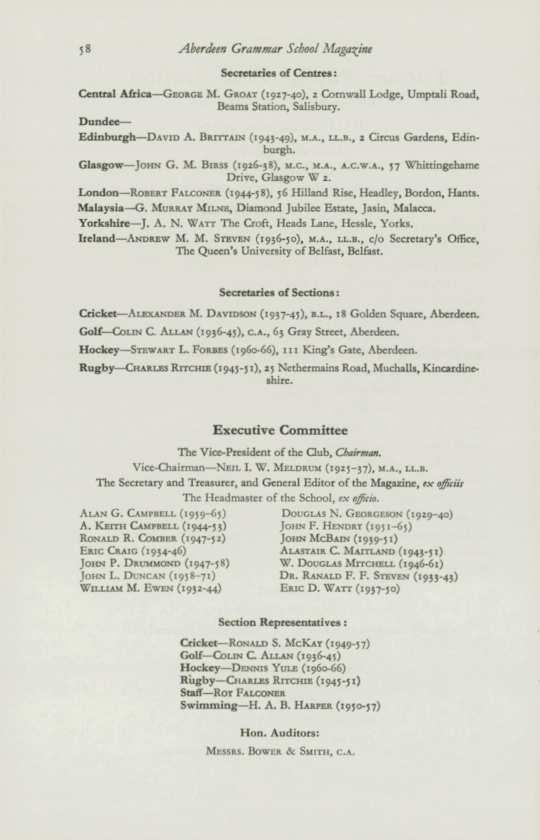
DouGLASl\. GEORGF!ION(1929-40)
JoFINF. HENDRY(19p-6s)
JoHN McBArn (1939-s1) fuuc CRAIG(1934-46)
ALASTAIRC. MAITLAND(1943-jt)
JOHN P. DRUMMOND(1947-sS) W. DOUGLASMITCHELL(1946-61)
JOHN L. DUNCA!'I(19i8- 71)
DR. RA..~ALDP. F. STl!VEN(1933-43) WILLIAl,IM. EWEN(1932-44) ERICD. WATT(1937-so)
Section Representllti ves :
Cricket-RONALD S. McKAY(1949-n)
Golf-CouN C. Au.AN(1936-4s)
Hockey-Dl!NNis YULI! (1!)6<>-66)
Rugby- CHAIU.ESRrrCHll! (194s-s1)
Staff-Rot FALCONE&
Swimming - H. A. B. HARPER(19so-n)
Hon. Auditors:
MlosSRS. BowLR & SMITH,C.A.
Ammal GeneralMeeting
Club Centre
Management Committ ee
PHILIPN. Lovs (19p-58) Chairman. BRIANK. CROOKSHANKS(1934-46) Surelary and Trta1ur1r.
CoLINc. ALLAN(1936-45)
Ax.AN G. G.u!PJU!LL (1959-05)
RONALD R. CowBER (1947-p)
JoHN W. CRADOCit(1940-46)
ERIC CRAIG (1934-46)
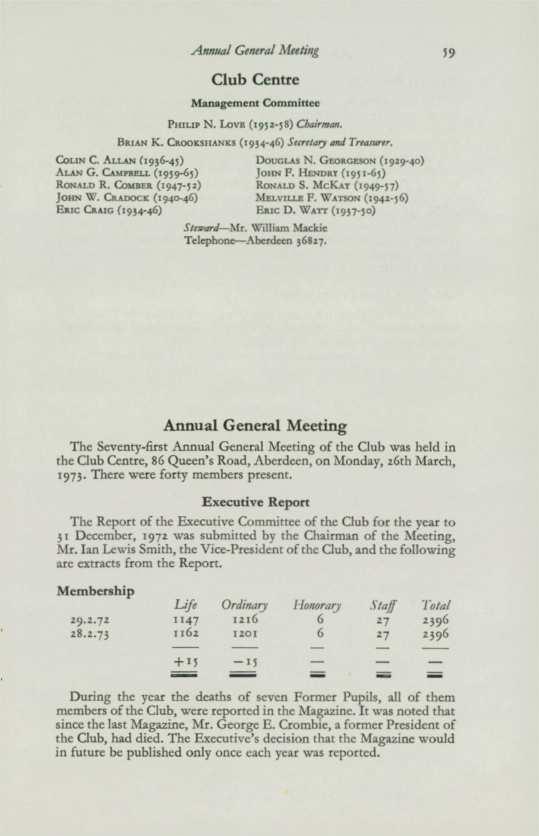
DOUGLAS N. Gl!ORGBSON (1929-40)
JonN F. HnNoRt (1951-65)
RONALD s. McKAt (1949-57)
Mfil.vrLLBF. WATSON (1942-56)
ERIC D. WATT (1937-50)
Stu·,ml-Mr. William Mackie Telephone-Aberdeen 36827.
Annual General Meeting
The Seventy-first Annual General Meeting of the Club was held in the Club Centre, 86 Queen's Road, Aberdeen, on Monday, 26th March, 1973. There were forty members present.
Executi ve Report
The Report of the Executive Committee of the Club for the year to 31 December, 1971. was submitted by the Chairman of the Meeting, Mr. Ian Lewis Smith, the Vice-President ofthe Club, and the following are extracts from the Report.
Membership
During the year the deaths of seven Former Pupils, all of them members ofthe Club, were reported in the Magazine.It was noted that since the last Magazine, Mr. George E. Crombie, a former President of the Club, had died. The Executive's decision that the Magazine would in future be published only once each year was reported.
General Business
The Accounts for the year, duly audited and certified, were submitted and approved. Reports on the year's activities were submitted on behalf of the various Athletic Sections, and on behalf of the Club Centre.
The appointment ofOffice-bearers then took place, and the Chairman expressed the Club's thanks to Air Marshal Sir Leslie D. Mavor, the retiring President, for the happy manner in which he had conducted the various duties which fell to him, and for his keen interest in the affairs of both Club and School. Mr. George E. C. Barton was appointed President in succession to Sir Leslie. Mr. John W. Cradock was appointed Vice-President of the Club and Chairman of the Executive in succession to Mr. Ian Lewis Smith, who was warmly thanked for his sterling work during the past two years.
Change in Club Constitution
The meeting considered and approved an alteration in the Club's Constitution, the effectofwhich is to give the Chairman ofthe Management Committee of the Club Centre a seat on the Executive on the same basis as the representatives of the various Athletic Sections.
Section Reports
Golf
Owing to the Magazinenow being produced annually in June, news of the Section's activities will be very limited after the Winter break.
Forty-eight members and guests attended the first outing to Ballater on 6 May, which is believed to be a record attendance. It turned out to be a wet outing for the late starters.
It was very pleasant to welcome the return of the Club President, Mr. G. E. C. Barton, to the activities of the Sect10n after a few years absence. Other long service regular attenders included Messrs. J. L. Riddell, '. R. Beattie, W. Thow, G. \. C. Walker, W. ~1iller, G. Ra/fan, .\. Straine and Dr. ~L Gibb. In recognition of the support these "youngsters" have given the Section over the years, it has been decided to form a Veteran Section.
As can be seen from the Prize List, the Section is not lacking in quality golfers. Further outings have been arranged for Ballater, Fraserburgh and Braemar on the first Sunday of each month until October.
The Captain of the Section for this season is Mr. E. D. \\att, with Mr. R. L. Mackinnon as his deputy.
The Annual Dmner has been arranged for Friday, 9 November 1973 in the orthern Hotel.
Prize 117imrers
CategoryI
R.H. Cradock 69 4 65 (scr.)
W. D .Mitchell 74 9 - 65 (5)
Dr. R. Craig 77 9 68 (8)
Revised handicaps in brackets.
Alliso11FowlieTrophy-
I. Philip N. Watt
Categoryll
I. Philip 81 18 - 63 (12)
N. Watt 82 18 64 (13)
H. McLean So 15 65 (11)
Bogey Competition -6 -t 5
\YI. D. Mitchell ..L4
COLIN C. ALLAN, Ilon. Surelary
Rugby
We have just completed our first season as an Op1:n Section and although our results have been very disappointing I am sttll firmly of the view that the decision to go Open (to a limited extent) was the correct one. Our non-r.P. Members have fitted in very well and if any- thing are playing a more active roll in the Section than many of the F.P. members. Although our results have not been as good as we would have wanted them to be I think that they would have been so much worse had it not been for our non-f.P. members.
On a brighter note, I am pleased to be able to report that with the coming of League Rugby next season, our already fine fixture list has been made even more attractive. In our officialfixtures in League II we shall be playing Hillhead High School F.P., Edinburgh Academicals, Royal High School F.P., Kelso, Hutchesons, Edinburgh University, Dunfermline, Stewarts/Melville, Ayr, Jcdforest and Selkirk. We shall also be playing non-league matches against Watsonians, Edinburgh Wanderers, Jordanhill, Boroughmuir F.P., Glasgow High School F.P. and Glasgow Academicals who arc all participants in League I.
There has again been a general lack of commitment to the game by many players in all XV's and I do hope that during the coming season steps will be taken to ensure that all players attend official training sessions regularly throughout the whole season so that the section will be well placed in League II at the end of the season. Floodlights have now been installed at Rubislaw and were in use towards the end of last season. I feel sure that the move to go Open will pay dividends during the coming season.
On the representative front, I have to report that our hooker, Alan Hardie, obtained a Scottish "B" cap against the French "B" XV and he also played for the North Midlands XV in all district championship matches. Ian Gray, our Vice Captain, also played for the North Midlands XV against Edinburgh.
The playing records of our 3 XV's were as follows:
The Section's thanks arc due to Davie Matthews, the Groundsman at Rubislaw, for all his good work on behalf ofthe Section and for the cheery manner in which we arc all received at Rubislaw every week. Neil Meldrum, our very active President, is deserving of great praise for the keen interest he has taken in the Section's activities throughout the season and for "master-minding" and arranging the Section's highly successful excursion to Kyle of Lochalsh on 19th May, 1973.
Lastly, but by no means least, our active and hard working Ladies' Committee arc very worthy of our thanks for providing teas every Saturday at the Club Centre for visiting teamsand for arranging a most excellent Disco Dance and a Sherry Party which enabled them to hand over the sum of approximately £90 to the Section.
Section full colours have been awarded to Ian Gray and Richard ("Tufty") Duncan while half colours have been awarded to BillDavidson, Phil Love, Campbell Paterson, John Short and Fraser Webster.
PHILIP N. LovE, Captain
James Andrew Banks (19n-63), M.A. has been appointed Head of the Physical Education Department at Queen's College, 1 assau, Bahamas. His continued enthusiasm for, and ability at, rugby have been maintained and he has represented the Bahamas against an English touring side and been elected captain of the local "Buccaneers" team.
Michael Alastair McDonald Beattie (1943-57), who has been closely involved in the pig industry, including seven years' advisory work in Kenya, has been appointed pig-fce<lspecialist with S.A.I. at Leith.
Angus Ian Lionel Campbell (1959 65), LL.B.(Hons.) and Alastair Moyes Lessells (1963-65), \f,B., CH.n. have been appointed Lecturers on Probation at Aberdeen University in the faculties of Law and Medicine, respectively.
Alexander Keith Campbell (1944- 53), has been installed as a Burgess of trade by Aberdeen Town Council.
Ian Shand Colvin and Garry Anthony Joss (both 1953-66) have recently travelled "oYerland" to Australia via Turkey, Iran, Afghanistan, India, Nepal, Thailand, \falaysia and Indonesia. In Australia Ian has met brother Michael Bruce Colvin, n.sc. (19p 65) who has been prospecting for precious stones.
Bramwell William Harold Cook (1936-39) is now Director of Music, Walthamstow Hall, Sevenoaks, Kent and Organist and Choirmaster at St. Pancras Parish Church, London.
John Whitby Cradock (194~46) who is Vice-President of the Club has been appointed a member ofAberdeen Harbour Board asanominee of Aberdeen Fishing Vessels Owners' Association.
Norman Esslemont (1948- 52) who is ,\lanaging Director of Esslemont & Macintosh Limited, Aberdeen has been appointed President of Aberdeen Junior Chamber of Commerce. Rae Colledge Barton (1942-55), M.A., LL.B., AdYocate with Alex. Stronach & Son has been appointed Vice-Chairman and is also Secretary of Aberdeen Business and Professional Club.
James Keith Farquharson (1945-49) has been appointed Head of the Highlands and Islands Development Board- Industrial Development Division. He joined the Board in 1968as Regional &onomist in the Planning and Resources Division, after fourteen years with Shell International, and became Deputy Head of the Industrial Development Division in 1970
Alastair Moir Fyall (1953- 62), c.A., has taken up an appointment as Financial Controller of Century Aluminium, Sanquhar. Qualifying
AberdeenGrammarSchoolMagazine in 1967 he had experience with a Gla~gow fum of accountants for two years before taking up an appointment with Babcock and Wilcox, Renfrew ~·here he was promoted to Company Secretary of Porterfield Foundries, Renfrew.
Kenneth Spark Raining (1943-48) ,vho has been with the Royal Insurance Group since 1948, the last five years as Deputy Manager at Leicester, is now Manager of the Aberdeen branch at 208 Union Street.
Alastair George Brand Halliday (1923-32), '1.C., M.A., has been called to his first charge, Trinity Presbyterian Church of England, Srreatham, South London after studying for the Presbytenan Church at Westminster College, Cambridge.
Charles Ross Irvine (1922 26), ~I.A., B.Sc., has now retired to Basingstoke after nearly thirty years as Senior Master of an Independent Public Boarding School in Hampshire.
Athol Jermieson (r954-67) is presi:ntly in Manama, Bahrain working for the Inchcape Shipping Group as a General Assistant following a spell with the Prm & j otfmal.
Alexander Durward Johnston (1945-54) has left Aberdeen to take up the post of Assistant Trustee Managt:r at the Clydesdale Bank Head Office in Glasgow. Tie has been elected a Fellow of the Institute of Bankers in Scotland.
Richard Kitson (1947 58), M.A., is now Buyer in the Services, Maintenance and Contracts Department of the Ford Motor Company Central Purch asing Dept. in Wauley. A keen hockey player for school, F.P.sand 'Varsiry he graduated T\1 A. from Aberdeen University in 1968.
Colin Moffat Kynaston (1960-66) has just returned to this country after two years with the British Survey Team in the Antarctic where he studied meteorological problems
Dr. Gordon Forbes Lindsay (1931-39), \f.D., CH.»., who is in general practice at Aboyne has been appointed the Queen's Doctor at .Balmoral.The son of an Edinburgh-born schoolmaster who was Head at both Bucksburn and Bankhead schools he graduated from Aberdeen University in 1944. After a year as a house doctor at Chase Farm Hospital, Enfield, he served three years with the Royal Army .Medical Corps before moving to Aboyne in 1948.
Francis Lyall (1944- 57), \f..~., LLD., LL.,r., who is a Lecturer in Law at the University of Aberdeen has been awarded a doctorate. The subject of his thesis was "Church and State in Scotland".
Maitland Mackie (1926-28), C.B.E., has recently been re-appointed Convener of Aberdeen Count}' Council. Very active in local government and farming spheres his many public appointments have bet.:n increased to include membership of the Committee for European Investment in Scotland and memb..:rshipof the Scottish Telecommunications Board. ,\s Chairman of the !\orth-East Scotland Dcn:lopmcnt Authority (NESDA) he recently led a trade mission to Houston, Texas which was successful in establishing business links between companies involved in 1'.orth Sea Oil developments and local 6.rms.
Neil Mackie (1963-66) has won a Countess of Munster Scholarship enabling him to take a course of advanced study with Peter Pears, the internationally famous tenor. Neil studied at the Royal College of Music

Notts About OldBoys
in London following graduation from the Royal Scottish Academy of Music and Drama and has performed before Queen Elizabeth, the Queen Mother, at Birkhall and made recordings for both British and Swiss record companies.
Alastair Merchant Mathieson (1943- 57), M.A., LL.'B., has been elected Director for Aberdeen, Inverness, Elgin and Fraserburgh by the Federarion of Scottish Junior Chambers of Commerce. He is a partner in the Aberdeen firm of Messrs. Paull & Williamsons, Advocates.
Dr.John Poskitt Paul (1939-43) has been appointed to a Professorship in Bio-Engineering at Strathclyde University.
David James Peters (1957-63), B.Sc., recently graduated l\l.sc. in Public Health Engineering at Strathclyde University. A chartered engineer and a member of the Institute of Civil Engineers of Scotland he has just taken up a senior post in the City Engineer's Department at Dundee.
James Reid (1924- 34) of James Reid & Son, Sheriff Officers, Aberdeen, has been elected President of the Society of Messengers-atArms and Sheriff Officers. He was previously President from 1953- 55 and his re-election makes him only the third member to be appointed for a second term. Well known in swimming circles he has twice been President of the Scottish Amateur Swimming Association.
Charles Pirie Skene (1940-47) of Studio Morgan, Aberdeen has been awarded an Associateship of the Royal Photographic Society for colour portraiture. He is among the first to gain this honour for colour work.
Capt David William Smith (r9s4- 65), ,1.n., CH B., Royal Army Medical Corps has distinguished himself by winning five medals in recent examinations on a postgraduate medical officers' course. He is presently serving with the British Army of the Rhine at Miilheim and has represented the Army at rugby. lie is a former captain of both the School and F.P. XV's.
Donald Rohen Stewart (1945 s8), M.A.(Hons.),who for the past six years has been a Lecturer in German at the University College of North Wales, Bangor, has now taken up appointment as Assistant Secretary at the University of St. Andrews.
Rev. James Lindsay Wilkie (r946 52), the "partner missionary" for the Presbyteries of Deer, Dunfermline and Kinross, recently visited this country. He now works for the Christian Council of Zambia as Chaplain to students at the University of Zambia in Lusaka.
Graeme Joss Wilson (1938-40; 1944-48) who is Chairman and Managing Director of William Wilson & Co. (Aberdeen) Limited has been elected a member of the Scottish region executive committee of the National Federation of Builders' and Plumbers' Merchants.
Sub. Lieut. Thomas Albert Winton (r96z- 66)has completed training at the Royal Naval College, Dartmouth and has been appointed to the Frigate H.M.S. Whitlry.
Marriag es
Batchelo r (1959-65).-At St. Peter's Maney, Sutton Coldfield, Warwickshire, on 25 March 1972,MARTYNAUBREYBATCHELOR,elder son of Mr. and Mrs A. R Batchelor, 44 Angusfield Avenue, Aberdeen, to Lindsay Faulconbridgc, daughter of Mr. and :Mrs. R. C. Faulconbridge, Dinas Pov:is, Glamorgan.
Buchan (1951- 65). -At New Marnoch Church, Abcrchirder, on 29 July 1972, ERICALEXAKDERBuCHA."-,younger son of Mr. and Mrs. Alex J. Buchan, 56 Hammerfield Avenue, Aberdeen, to Fiona Isobel, eldest daughter of l\.Ir. and Mrs. James Durno, 9 Wellfield Terrace, Aberchirder.
Cameron (1960-65). At King's College Chapel, Aberdeen, on 23 November 1972, Cou:-. JAMES CA\IERON,elder son of Mr. and Mrs. Alex. Cameron, 17 'ewlands Crescent, Aberdeen, to Hazel, only daughter of Mr. and ~frs. S. G. Hay, 29 Hamilton Place, Aberdeen.
Cameron (1958-67).- At King's College Chapel, Aberdeen, on 14 July 1972, 'EIL Au:xA:-.DERCAMERON(brother of Colin-see above), to Helen Christian, only daughter of :Mr. George Crawford and the late Mrs. G. Crawford, 86 Morningside Avenue, Aberdeen.
Draper (1950-59).- At Ferryhill North Church, Aberdeen , on 7 October 1972, ALAN MACLEANDRAPER, son of Mr. and i\irs. Hugh F. M. Draper, 41 Gilcomstoun Land, Aberdeen, to Elizabeth, only daughte r of Mrs. E. Beattie and the late Mr. E. Beattie, 7 Portland Street, Ferryhill, Aberdeen.
Edwards (1946-60). -,\t King's College Chapel, Aberdeen, on 28 October 1972, MELDRUM BARCLAY EDWARDS, only son of Mr. and Mrs. A. J. M. Edwards, 50 Bccchgrove Terrace, Aberdeen, to Kareen, only daughter of Mrs. Beryl Anderson and the late Mr Richard Anderson, 61 Powis Place, Aberdeen.
Forbes (1958-64).- At Gilcomston St. Colm's Church, Aberdeen, on 26 July 1972, DAVIDFORBES,son of the late Mr. D. Forbes and of 11rs. A. Forbes, 5 Morrison Drive, Garthdee, Aberdeen, to Lorna May, elder daughter of :\fr. and Mrs. Robert Gall, 58 Mid Stocket Road, Aberdeen.
Gauld (1956-62).- At King's College Chapel, Aberdeen, on rr October 1972, JAMES HENDRYGAULD,son of Mr. and Mrs J. Gauld, Laurelwood, Hamilton Drive, Elgin, to Lesley, daughter of Mr. and Mrs. W. A. Baxter, 72 Springfield Road, Aberdeen.
Gudim (1958-65).- At Pollokshields Kenmure Church, Glasgow, on 15 December 1972,ASDJl'.>RNHARALDGuDrM,only son of the late Captain C. A. Gudim, Oslo, Norway and of Mrs. C. R. Gudim, 20 Viewfield Gardens, Aberdeen, to Mairi Gordon Maclean, onlydaughter of Mr. and Mrs. Donald Macdougall, 179 Nithsdale Road, Pollokshields, Glasgow.
Hay (1951 64).- At Dunnottar Church, Stonchaven, on 1December 1972,!ArisALE.XANDERHAY,only son of :t\fr.and Mrs. Ernest M. Hay, 15 Viewfield Gardens, Aberdeen to Carol Linda, elder daughter of Mr. and Mrs. Thom.is A. W. Baucutt, Dane End, Old Inn Road, Findon, Kincardinesh1re.
Marriages
Kite (1955-67).- At St. Peter's Church, Peterculter, on 8 December 1972,CuFFORDRANALDWILLIAMKm, son of Mr. and Mrs. G. H. S. Kite, 97 Springfield Road, to Elizabeth, elder daughter ofMr. and Mrs. J. Gregory, 66 Malcolm Road, Culter, Aberdeenshire .
McKenzi e (1964-66).- At Cults West Parish Church, on 5 May, 1973, JOHNMACFARLANEMcKEKZIE,elder son ofDr. and Mrs. John McKenzie, 6 Bayview Road, Aberdeen, to Priscilla Margaret, only daughter ofMr. William H. Hogg and the lateMrs. Margaret D. Hogg, Balvenie, 5 .Marchbank Road, Bieldside.
Murdoch (1952-66).-At St. Mary's on the Rock, Elion, on It July 1972, ROBERT IAN DoKALD MURDOCH, son of the late Mr. J. B. Murdoch and Mrs. S. Murdoch, 16 Abbotshall Place, Cults, to Gail Cooper, daughter of Mr. and Mrs. R. E. L. Ferguson, 43 Craigton Terrace, Aberdeen.
Reid (1954-65).- At King's College Chapel, Aberdeen, on 18 August 1972,IAN IC0LRun, elder son of Mrs. F. K. Reid, Beckhill, Contlaw Road, 1\-Ulltimber,and the late Mr. J.C. N. Reid, to Jacqueline Anne, eldest daughter of Mr. and l\1rs. R. J. A. Fraser, 64 Rubislaw Den North, Aberdeen .
Shirreffs (1951-65).-At King's College Chapel, Aberdeen, on 18 April 19i;, RICHARDCA11ERONSHIRREFFS,only son of Mr. and Mrs. A. G. Shirreffs,6 Rubislaw Den South, Aberdeen, to Gillian 1\1argaret, only daughter of Mr. and Mrs. J. W. Fisher, Chelwood, Oak Drive, Oswestry, Shropshire.
Sim (1956-69).- At St. Mary's Cathedral, Aberdeen, on 19 August 1972,ANnREwMILNE S1i.1,grandson of Mr. and Mrs. Alexander Sim, 126 Auchinyell Road, Aberdeen, to Anne, younger daughter of Mr. and Mrs. James Bracelin, 65 Blenheim Place, Aberdeen.
Stott (1954-67).-At St. Bartholomew's, Sutton-cum-Louod, Nottinghamshire, on 19 August 1972, JOHN STOTT, only son of Mr. and Mrs. J. Stott, 14 i\1arischal Court, Aberdeen, to Elizabeth Mary, daughter of Rev A. F. and Mrs. E. A. Morton, St. Bartholomew's Vicarage, Sutton-cum-Lound, Nottinghamshire.
Walker (195~5).-At West Church of St. Andrew, Aberdeen, on 21 October 1972, DEREK JAMES WALKER, son of Mr. and Mrs. A. Walker, 27 Rubislaw Park Crescent, Aberdeen, to Rosemary Anne, younger daughter of Dr. and Mrs. N. S. Clark, 374 Great Western Road, Aberdeen.
Walker (1945-59).-At King's College Chapel, Aberdeen, on 27 July 1972,PETERANTHONYWALKER,M.n., F.R.c.s.Ed.,son of the late Dr. R. J. and Mrs. Walker, Aberdeen, to Gillian Ursula, elder daughter of the Rev. John A. and Mrs. Price, Manse ofKintore, Aberdeenshire.
Obituaries
Major Robert George David Bruce (1944-46) died at the age of 35 in the Royal Northern Infirmary, Inverness on 24 April, 1973. An officerin the First Battalion Gordon Highlanders and son of Col. and Mrs. George W. Bruce, Belhelvie Lodge, Balmedie he was commissioned into the Gordons after Sandhurst.
He had been ill since the Battalion completed a tour of Cyprus in 1971 as part of the U.N. Peace Keeping Force.
George Fraser Chrystal (1927-38) died suddenly at his home in Guildford on I December, 1972at the age of 51. The only son of the late Mr. and Mrs. Gray Chrystal, formerly ofForest Avenue, Aberdeen he flewwith the R.A.F. asapilot during World War II. On return from service he studied at Gray's School of Art, Aberdeen before taking up a full-time appointment with Aberdeen Journals Ltd. His cartoons, illustrations and sketches featured in the "Evening Express", "The Press & Journal" and the old "Weekly News". He will be particularly remembered in the North-East for the creation of the much-loved "Green Final" character- "Wee Alickie". His work won awider public and he moved first to Edinburgh and then to England where he was a regular conttibuter to "Punch", the "News ofthe World" and also the specialist press, particularly the farming journals.
George Edmond Crombie (1916-21) C.M.G., M.A. A former President of the Club, (1969-70), he died at his home in Aberdeen on 8 December, 1972 at the age of 64. After completing his schooling at Fettes College, Edinburgh, he proceeded to Aberdeen University where he graduated M.A. with First Class Honours in Classics in 1930. lie then joined the Colonial CivilService and was with the India officefrom 1931to 1942and againfrom 1945 to 1947.During the intervening years he served in the :MiddleEast and in Italy with the First Frontier Force Regiment of the Indian army and was mentioned in Despatches.
In 1947Mr. Crombie was appointed United Kingdom Deputy High Commissioner in Rangoon and during the difficult years 1948-49 following the withdrawal of Burma from the British Commonwealth, he held the key appointment of Counsellor at the British Embassy in Rangoon. There then followed successively appointments as United Kingdom Deputy High Commissioner in Madras 1951-52, Counsellor at the British Embassy, Ottawa 1955-5 8, a period as assistant secretary in the Commonwealth Relations Office and then an appointment as High Commissioner for Kuala Lumpur in 1959. Mr. Crombie was also Counsellor at the British Embassy in Dublin and prior to his retiral in 1967he had the distinction ofbeing the first to be appointed to the post of British High Commissioner in Bathurst, Gambia when that country attained independence in 1965.
In 1950he was created a Companion ofthe Order of St. Michael and St. George.
Alexander MarrGeddes (1897-1903) M.B. died athis home in Aberdeen on 10 January, 1973 at the age of 89. Dr. Geddes graduated in medicine at Aberdeen University in 1909and left for South Africa the following year. He settled there asa medical practitioner until 1938and
Obil11aries
for part of that time was Club Consul for CapeProvince. On his return to this country he practiced in Kirkcaldy before his retirement.
Dr. Geddes was the donor to the School ofthe Geddes Silver Medal for Science. His brother Godfrey Power Geddes (1903-u) o.s.o., o.B.B.,T.o., n.L. who had a distinguished military career died in 1964. Ian Farquharson Henderson (1923-31) died at his home at Bieldside on 24 October, 1972.at the age of 59. After qualifying as an Engineer he became assistant engineer and agent for William Tawse Ltd., Aberdeen and was engaged on large drainage contracts and harbour reconstruction. In 1941 he was appointed assistant resident engineer for Princes Pier reconstruction at Greenock and in 1944took over supervision of a large shipyard development scheme, including reconstruction offitting out berths, rail sidings and dredging contracts in Aberdeen. He was later appointed chief personal assistant to his father, the late Mr. Archibald Henderson, who founded the firm of Arch. Henderson & Partners. Mr. Henderson assisted in preparing many harbour improvement schemes in the North and designed slipway installations in Iceland. He became senior partner in Arch. Henderson & Partners in 1947and advised on numerous harbour and coast protection schemes for authorities in Scotland. In 1948he visited the Faroe Islands to advise and report on the installation of modern slipways for trawlers.
He was president of the orth-East District of the Scottish Golf Union and was a past captain of Deeside Golf Club of which he had been a member for nearly fifry years.
Charles Leith-Barron (1907-19) M.B., CH.B. died at his home at Dunblane on I December, 1972.. After graduating at Aberdeen University in 1931 he was house surgeon for a time at the Royal Northern Infirmary, Inverness and then an assistant at Blackpool. Thereafter he was in practice at Armadale, West Lothian and in 1934 he moved to Buckie for two years. After serving as a flying officerin the R.A.F.V.R. during World War IIhewasappointed assistant medical officer to the Education Authority of the city of Birmingham and was industrial medical officer at Derby. In 1944 he was appointed chief surgeon and head ofthe British Rail Accident Hospital in Crewe, which post he maintained until his retiral in 1966.
Brian Ludwig (192.2.-2.9)M.A. died on 11 January, 1973at the age of 55 in Aberdeen. Also a former pupil of Fettes College, Edinburgh he served in World War II with the Royal Signals seeing service in North Africa and the Middle East. After graduating in Arts at Aberdeen University he took up a post as English teacher at Robert Gordon's College where he produced many plays and, for a time, commanded the Army Cadet Force unit.
In 1961 he moved to Bankhead Academy as principal teacher of English, taking on the additional post of Deputy Rector in 1963. He played a leading part in the building up of the school during a time which saw a change in status from a Junior Secondary to a Senior Secondary.
Andrew Milne (1903-09) M.A. Principal classicsmaster in the school till his retiral in 1955, died at Bloemfontein in South Africa on II
July, 1972 at the age of 81. Born at Kingswells he was Oassical Dux and Gold Medallist of the school in 1909 and graduated in 1913 with first class Honours in Classics. Appointed Assistant to the Professor of Humanity at Aberdeen University he then served inFrance and Belgium with the 256th Siege Battery of the Royal Garrison Artillery. On his return from active service he was appointed Principal teacher ofclassics at Montrose Academy and three years later, in 1926,he returned to the Grammar School. In 1929 he was appointed to the post of Senior Classics master which appointment he held until his retirement in 195s. After "retirement" and emigration to South Africa he became Lecturer in Oassics at Rhodes University, Grahamstown from 19n-61 and external examiner in Classicsfor Rhodes B.A. degree examination from 1962-69.
At the time of Andrew Milne's retirement from the School in 19ss the then Rector, the late Sir James J. Robertson, in saluting a master of his craft referred, in a written appreciation to .Mr.Milne's "outstanding teaching and ungrudging service" and set down his conviction "that in all the long centuries of the School's history few indeed ofher sons can have served her with so many talents and so steady a devotion".
Dr. Phili p Rene Mitchell (1916-22) o.n.E., T.D., R.A.M.c.,F.R.c.o.G. died on 8 January, r973 at the age of 61 in Galmpton, South Devon. He graduated M.B., CH.n. at Aberdeen University in 1936 and was a general practitioner at Forres from 1936-38 during which time he became champion of Forres Golf Club.
He went to France with the British Expeditionary Force in 1939and was medical officer with the Fourth Battalion Gordon Highlanders being evacuated from Dunkirk. He reached the rank of full Colonel in the R.A.M.C. and was holder of the Territorial Decoration. He was Senior Registrar in the Department of Obstetrics and Gynaecology at the Post Graduate i\Iedical School in London for two years before becoming Consultant Obstetrician and Gynaecologist at the Royal Hampshire hospital from which post he retired a year before his death. Dr. Mitchell, an o.n.E. was a fellow ofthe Royal College of Gynaecologists. He is survived by his brother, Alexander Lessel Stephen Mitchell (1911-19) and his wife who is a sister of J. S. G. Munro, the Aberdeen advocate and former Club President.
The story of how the pipes and drums of the Gordon Highlander s were saved from falling into the hands of the advancing Germans at Dunkirk during World War II has been recalled by the death of Dr. Mitchell. As he waited to be evacuated from Dunkirk, while a medical officer with the Gordons, he decided that the regimental band instruments were too bulky to be waded through the surf to the boats and that they should be buried near the dunes. There the pipes and drums lay unspotted by the enemy during the years of occupation but due to the careful way in which Dr. Mitchell had marked the hiding spot the instruments were recovered intact and were first played in public after the war at the Gordons' homecoming march down Union Street, Aberdeen.
John Stuart Panto n (1921-27) M.A., n.sc. died at his home in Aberdeen on 10 February, 1973only a few weeks before he was due to retire
Obit11ariu
as Head ofthe Horticultural Division ofthe North ofScotland College of Agriculture. A double graduate of Aberdeen University he gained his M.A. in 1931 and his B.Sc. with Honours in Agriculture two years later. After ten years with commercial horticultural firms he became horticultural adviser to :Middlesex Agricultural Executive Committee and was two years with the National Agricultural Advisory Service in North Wales before being appointed senior horticultural adviser at the North of Scotland College of Agriculture in 1952. Well known and respected as a judge, writer and broadcaster on gardening matters he had a long association withthe Royal Horticulrural Society ofAberdeen serving as a director, chairman and president.
Frank Salmond Taylor (192.3- 28) died suddenly on 29 September, 1972 in hospital in Edinburgh. He joined the Bank of Scotland at Stonehaven in 1928and was transferred to Aberdeen three years later. During the 193o's he was an active member of Aberdeen Bankers Literary and Debating Society and in 1935 he was transferred to the Inspectors Department in Edinburgh in which city he was based for the rest ofhis career. After war servicein the Royal Artillery from 1940 to 1946,he became the first full-time secretaryoftheInstitute ofBankers in 1947. He retired in 1971and at the time ofhis death was in the course ofwriting a history of the Institute of Bankers for their centenary year in 1975.He was elected President of the Edinburgh Centre in 1955.
Since the last edition ofthe magazine the deaths of two former members ofstaffhave been reported. Miss MaryA. F. Creighton who was born at New Deer and who graduated with Honours in Arts at Aberdeen University in 1912 has died at the age of 87. She taught at Queen's Gate School, Aberdeen and at St. Andrew's Ladies' College, Aberdeen before joining the Grammar School staffin 1920. Six years later she went to the Central School where she remained until her retirement in 1950.
Mr. Eric Tyson who was one of the North-East's most popular cricket personalities has died at the age of 80.A Yorkshire-man and one of Scotland's best known cricket professionals in the 193o's he joined Aberdeenshire as a coach and after the war became groundsman-coach at the Grammar School. He played regularly for Grammar F.P.'s and in the 19n/54 season, at the age of 6r, he performed two hat-tricks within a month. His retirement years were spent at Brechin and Monifieth.
New Members of the Club
(1s
May 1972- 31 May 1973)
Life Members
(Including conversions from Ordinary to Life Membership)
ADAM, Terry (1966-72), 133 North Anderson Drive, Aberdeen.
BAIRD,John Ross (19p-64), 2Redmoss Tenace, Nigg, Aberdeen.
CutF.llON,Colin James (196o--<15),17 Newlands Crescent, Aberdeen.
CARRY,Michael Robert (1953-66), 26 Woodburn Avenue, Aberdeen.
Dow, James (1919-28), M.B.,CH.B.,M.P.C.M.,D.P.H.,11 Barnton Pa.rkView, Barnton, Edinburgh.
DowNs, William Gordon (195o-63), I Tremenbeere Road, Penzance, Cornwall.
FINDLAY,George Alexander John Reid (1943-49), 348 Queen's Road, Aberdeen.
FORBES,Stewart Lumsden (196o--<16),111 King's Gate, Aberdeen.
GLl!NDINNING,Ian Archibald (1948-62), 1 Kirk Crescent North, Cults, Aberdeen.
GRANT,John Philip (1936-45), 78 Queen's Road, Aberdeen.
GRIEVE,Alcnnder Millar (1951-64), w.e., CH.B., R.A.M.c.,29 French Road, Catterick Camp, Yorks.
HALL, Robert Kellas (1928-38), The Manse, Roslin, Midlothian.
HoDGI!,Charles Scott (1942-54), 142 Hamilton Place, Aberdeen.
JoNES, John George Watkin (1937-47), 36 Westle1gh Drive, Sonning Common, Reading, Berks.
L111PBR,John Robertson Wood (1939-48), Strathbeg, Picfodels, Aberdeen.
MILNI!,Arthur Donald (t9i 1-58), 26 Fountainhall Road, Aberdeen.
MuRRAY,George W. McLcman (1939-53), 8 St. Thomas Street, Orpington, Kent.
REID,James Dures (1954-65), 5 Woodburn Avenue, Aberdeen.
RENNIE,Robert Knowles (1960-66), 2 Prospect Terrace, Aberdeen.
SMITH,David William (19s4-6j), M.B., CH.B.,R.A.M,c.,Clifton Lodge, BanffRoad, Keith.
VALENTINI!,Nicol Stewart (1948-59), p Bailheswells Drive, Bicldside, Aberdeen. WALKER, 1\1.ichacl Grant (1946--57), F,R,C,S., j8A Spylawbank Road, Colinton, Edinburgh.
Ordinary Members
ALLAN,James Andrew (1966--72),io Spiral, Aberdeen.
ALLAN,Robert Douglas (19J9-72), 19 Albert Terrace, Aberdeen.
ANDERSON,Colin Graham (1966--72),71 Cornhill Gardens, Aberdeen.
BARLOW,William (r960-72), ro Eday Drive, Aberdeen.
BELL,John Graeme (1967-72), 47 Argyll Place, Aberdeen.
BucnAN, Gordon llcruy (19J9-72), II .l\,!argaretStreet, Aberdeen.
CAMPBELL, David Archibald (1954-62), 8 Angusfield Avenue, Aberdeen. CARSON,Richard John, (19i9-72), 162Mid Stocket Road, Aberdeen CHBYNB,Graeme McCulloch (1966--72),84 Mastrick Drive, Aberdeen.
CHBnra, Raymond Sinclair (1966--72),29J Springhill Road, Aberdeen.
DoIG, Robert Cameron (1967-72), 18 Redmoss Terrace, Nigg, Aberdeen
DoWNi:s, Norman William (1951-62), toj Buckingham Gardens, Hurst Park, East Molesey, Surrey.
Duc.i::woRTH,Malcolm (1958-6x), 18 Belvidere Crescent, Aberdeen.
DUTm.e,Garry Graeme (19i9-71), I Gladstone Place, Aberdeen.
ERSKINE,Thomas John Dunbar (1955-i8), 240 King Street, Aberdeen.
FARQUHAR,Hugh Malleny (1966--72),24 Cummings Park Crescent, Aberdeen.
FINNIE,Brian James (1959-72), 122Faulds Gate, Aberdeen. FRASE&, Graham {x96J-72), 16o Skene Street, Aberdeen.
72
New Members of the C/11b
HAMILTON,Douglas Marshall (1967-72), 15 Ashley Park South, Aberdeen
INGLIS,John Edward (1957-64), 2 Seafield Avenue, Aberdeen.
K1L011,Alan Edward (1966-72), 87 Mastrick Road, Aberdeen.
KINLOCH,Desmond, J. C (1966-72), 86 Strathmore Drive, Aberdeen.
LAwsoN,Keith William (1966-72), 4 Manor Walk, Middlcfield, Aberdeen.
LEIGHTON,David Stewart (1959 72), 6 Braeside Avenue, Aberdeen.
McCRAE,James (1950-56), 4 Somerset Road, North Harrow, Middlesex:.
McKAY,Douglas W. (1966-72), 114 Osborne Place, Aberdeen.
McKENZIE,David (1966-72), 4 Polwarth Road, Torry, Aberdeen.
McKERRON,Charles William (1966-72), 5 Kaimhill Gardens, Aberdeen.
MACKIE,Donald Elrick (1951-53), Upper Eastertown, Oldmcldrum.
McLENNAN,Hamish Gordon (1966-72), 21 Osborne Place, Aberdeen.
MCRAE,Roderick Justin (1966-72), 56 Montrose Drive, Aberdeen.
MARTIN,Herbert (1934-45), 99 King's Gate, Aberdeen.
M1LNE,Peter J. (1959-72), 6 Gaitside Crescent, Aberdeen.
M1TCUELL,James Forbes (1966-72), 279 Clifton Road, Aberdeen.
N1COLSON,Alan (1966-72), 33 Dcevale Gardens, Aberdeen.
NOBLE,Alistair William (1959-72), 4 St. Ninian Court, Aberdeen.
PATERSON,Campbell Ross Fordyce (r959-72), 26 Osborne Place, Aberdeen
Rll.BKIE,John Allan (1960-72), 29 Sanday Road, Aberdeen.
RoSE, Edward Charles (1966-72), 79 Ivanhoe Road, Aberdeen.
RusSELL,Derek M. (1966-72), 76 Hilton Road, Aberdeen. RussELL,Neil (1964-72), 43 Grove Crescent, Aberdeen.
Sm,ARER,John Michael (19l}-68), 545 Holburn Street, Aberdeen.
SLEIGH,David A. (1965-70), 4 Talisman Dri¥e, Aberdeen.
SMITH,John Andrew (1966- 72), 58 Broomhlll Road, Aberdeen.
SPllNCE,John Rognvald (1962-64), 7 Crathie Terrace, Aberdeen.
SWEENEY,David Gordon (1966- 72), 26 Stanley Street, Aberdeen.
THOM,Gordon Grant Erskine (1900-73), 16 Cairnie Gardens, Aberdeen.
THOMSON,Allan l\,farshall(1959-72), 94 Tollohill Crescent, Aberdeen.
WATSON,David.
WALUR, George Burnett (1966-72), 261\fastrick Land, Aberdeen.
Wooo, Brandon Stewart (1966-72), q Palmerston Road, Aberdeen.
Wooo, John Jamieson (1966-72), 158 Gardner Drive, Aberdeen.
Wooo, Kenneth Alexander (1959-72), 5 Airyhall Drive, Aberdeen.
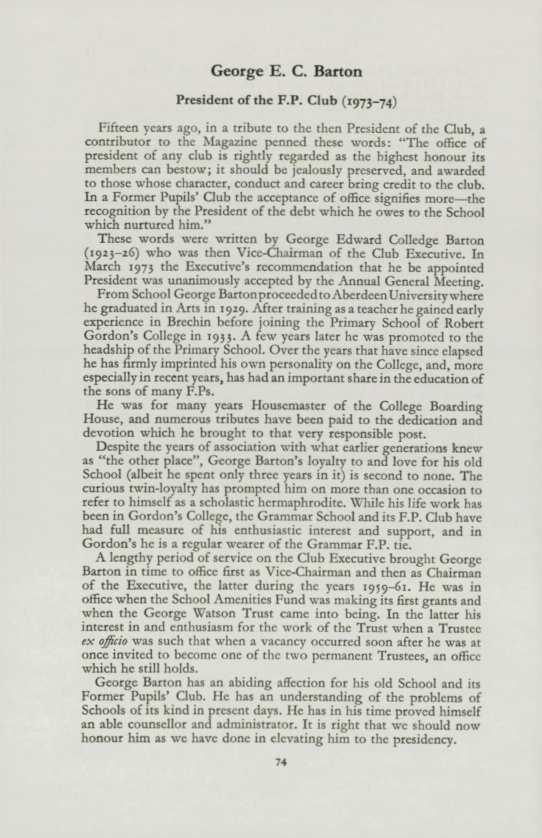
George E. C. Barton
President of the F.P. Club (1973-74)
Fifteen years ago, in a tribute to the then President of the Club, a contributor to the Magazine penned these words: "The office of president of any club is rightly regarded as the highest honour its members can bestow; it should be jealously preserved, and awarded to those whose character, conduct and career bring credit to the club. In a Former Pupils' Club the acceptance of officesignifies more-the recognition by the President of the debt which he owes to the School which nurtured him."
These words were written by George Edward Colledge Barton (19z3-z6) who was then Vice-Chairman of the Club Executive. In March 1973 the Executive's recommendation that he be appointed President was unanimously accepted by the Annual General Meeting. From School George Barton proceeded toAberdeen University where he graduated in Arts in 1929.After training asa teacher he gained early experience in Brechin before joining the Primary School of Robert Gordon's College in 1933. A few years later he was promoted to the headship of the Primary School. Over the years that have since elapsed he has firmly imprinted his own personality on the College, and, more especiallyin recent years, has had an important sharein the education of the sons of many F.Ps.
He was for many years Housemaster of the College Boarding House, and numerous tributes have been paid to the dedication and devotion which he brought to that very responsible post.
Despite the years of association with what earlier generations knew as "the other place", George Barton's loyalty to and love for his old School (albeit he spent only three years in it) is second to none. The curious twin-loyalty has prompted him on more than one occasion to refer to himself as a scholastic hermaphrodite. While his life work has been in Gordon's College, the Grammar School and its F.P. Club have had full measure of his enthusiastic interest and support, and in Gordon's he is a regular wearer of the Grammar F.P. tie.
A lengthy period of service on the Club Executive brought George Barton in time to office first as Vice~Chairman and then as Chairman of the Executive, the latter during the years 1959-61. He was in officewhen the School Amenities Fund was making its first grants and when the George Watson Trust came into being. In the latter his interest in and enthusiasm for the work of the Trust when a Trustee ex ojjiciowas such that when a vacancy occurred soon after he was at once invited to become one of the two permanent Trustees, an office which he still holds.
George Barton has an abiding affection for his old School and its Former Pupils' Oub. He has an understanding of the problems of Schools of its kind in present days. He has in his time proved himself an able counsellor and administrator. It is right that we should now honour him as we have done in elevating him to the presidency.
THE INSTITUTE
consists of 15 Schools from Architecture to Social Studies awarding Certificate. Diploma and C.N.A.A. Degrees, and Post graduate courses.
There is our own Central Library having about 50,000 books plus 800 periodicals taken regularly.
TEACHING
We believe in personal contact with our students so we keep classes to reasonable sizes. At present, there ..,re 1,800 full time students taught by 210 lecturers Facilities and equipment are excellent, including analogue and digital computers. sophisticated instrumentation ; anechoic and reverberation chambers, semi• conductor Labs,etc.. etc.
CAREERS
We have a Careers Advisory Service operated by the Welfare& Lodging Officer who also advises on any personal problems you may have. Interviews are arranged with prospective employers Interested? Want to find out more?
Tht11 /,JI in the coupon below We'll send on your Institute Brochure (detailing all courses, expenses,etc.} and also our book · let 'Careersand Opportunir,es ' It costs you a stamp to write - it could decide your future.
.:JArt lJ Bu,lding CJBusiness Management D ElectronodElectncalEngineering Economics &lnstotutionalAdministration C!Marketing O Mechan,calEngoneerong D NauttcalStudies &Ooetetocs Managfmtnt Science O Ouant1ty Surveying Work Design
NAME ___
ADDRESS
Thesetwo newspapers coverall11 countiesof North Scotland
•ThePr.. aod Jo11rnal'
Circulation: 105,213 (A.B.C, J~-0..: 1970)
Readenbip: 307,000--68 ¾of all ad,1111 in Norlh Scotland
•E,ellllll Expr•• •
Circulation: 74,757 (A,B.C. Jul1-Dec:. 1970)
Readanhlp: 186,000-120,000 in AberdCity-86 ¾ ol all lbe adult, In Aberdeeo

For furlher informadoo contact Georp Durward, Markotinc Senic" Mana1ar, Aberdeen Jolll'llJllo Ud., Lana Stracbt, Aberdeen, AB9 8AF. Tel. Aberdooa40222.
Source: Norib Scotland Roadanbip S11n17 1970
Thomson Or1anlsatlon Lid. Ruearcb Senkeo Ltd,
MAINFORDDEALERSSINCE1911

HA,.-RPER
THE HARPER MOTOR CO LTD
Car & CommercialVehicle Department
HOLBURN JUNCTION, & 180HOLBURN STREETABERDEEN
Tractor& ServiceDepartmmt
UNION GLEN, ABERDEEN
depotsat Elion& LAtmncekirk
ApPoinimen
The House for Cutlery
SCHOOLHILL&
UNIONST.,ABERDEEN



TV'S· RADIOS·GRAMS·HI-FI· STEREOSOUND· TAPE. RECORDERS·RECORDS·WASHINGMACHINES·FLOOR POLISHERS • SPIN DRYERS • CLEANERS • FRIDGESIn fact, everything for the modern home !