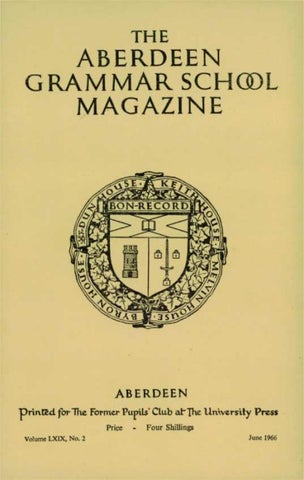
THE ABERDEEN GRAMMAR SCH®L MAGAZINE

pn.ntld fen-~ Form~ Pupils' Clu.barlhe Un,versity Press
Price - Four Shillings
Volume LXIX, No. 2 June 1966
pn.ntld fen-~ Form~ Pupils' Clu.barlhe Un,versity Press
Price - Four Shillings
Volume LXIX, No. 2 June 1966
In choosing its officers the R.A.F. is, naturally, sc:lective.It doesn't ask for supermen, or expect them. What it docs ask for, and get, is young men "'ho \\ill be hlely to respond to the advanced and intensive training which they undergo. Three main things arc ncces<;ary.First, character: you must be able to keep calm under pressure, ~nd be ready to take responsibility. Second, you must have the aptitude for whichever of the R.A.F.'s many specialities )OU \\ish ro rake up. And third, you must meet the academic requirements. Your Careers .\faster can give you
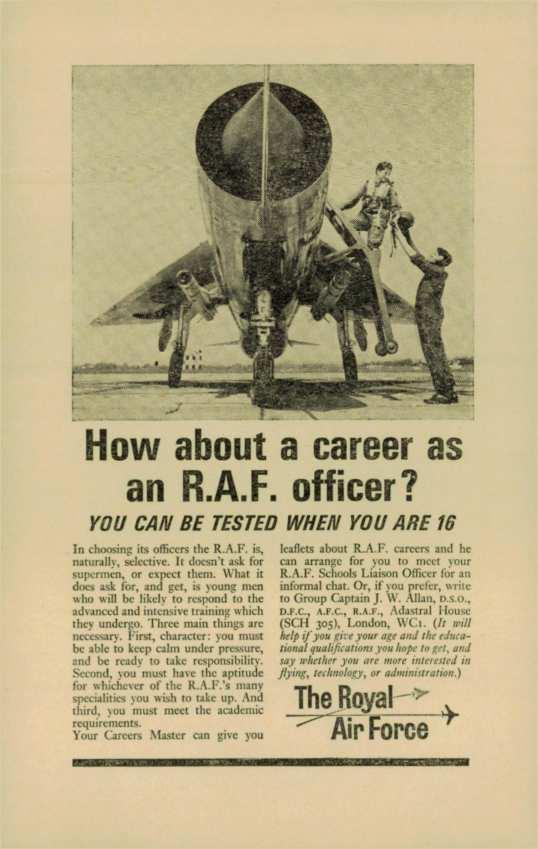
leaflets about R.A.F. ~reer~ and he can arrange for you to meet )our R.A.F. Schools Liaison Officer for an informal chat. Or, if)OU prefer, 11ritc to Group Captain J. \\;. Allan, o s.o., D.F.C., A.F.C., R.A.F., Adastrnl House (SCII 305), London, \\'C1. (ft will helpi/you g,re your age a11J tire educationalqualificationsyou /ropelo grl, a11J say whetherJ'Ou are more i11tere.1tt'di11 flying, ttdmology, or ad111i11i11ratio11.)
Thelifeofanofficerin theRoyalNavyhasneverbeen morechallengingandexciting.
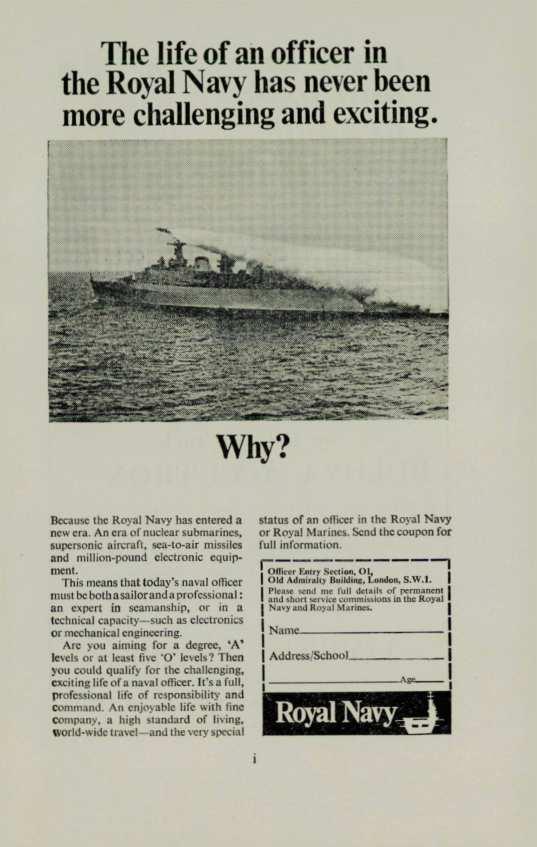
Becausethe Royal Navy hasentereda newera. An eraofnuclearsubmarines, supersonic aircraft, sea-to-air missiles and million-pound electronic equipment.
This meansthat today's naval officer mustbebotbasailorandaprofessional: an expert in seamanship, or in a technical capacity- such as electronics or mechanicalengineering. Arc you aiming for a degree, 'A' levels or at least five 'O' Je.,.els? Then you could qualify for the challenging, excitinglife ofanaval officer. It's a full, professionnl life of responsibility and command. An enjoyable life with fine company, a high standard of living, world-wide tra,cl and theveryspeeial
status or an officer in the Royal Navy or Royal Marines. Sendthecoupon for full information.
IOfficer Entry Section, 01, I Old Admiralty Building, London, S.W.1.
I Please <end me full details of permanent I and short !>ervicecommissionsin the Royal INaYyand Royal Marines. I IName __ I I I IAddress/School _ ,
.. . there's such a vast range of top quality furnjture and furnishings for you to sec. We're open all day on Sarurday and until 8 p.m. every Thursday.
Don't eveo call this timepiece • watch. All the parts that make • watch or 1low have been left out of it. BULOVA ACCUTRON time i1 kept by the vibration, of • tiny tuning fork which divides every 1ccond into 350 equal part,. (Your present watch dividf'1 • 1ccond into only 5 parta.) It i1 the only wrist timepiece guaranteed in wriling for accuracy. It's worth the time to you to look ioto BULOVA ACCUTRON. Prices from £65 in 1tainle11 1teel
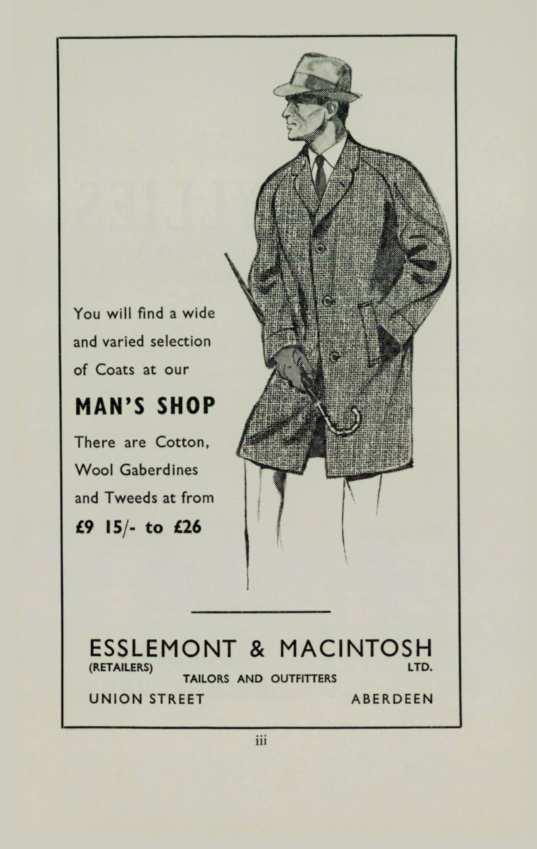
You will find a wide and varied selection of Coats at our MAN'S SHOP
There are Cotton, Wool Gaberdines and Tweeds at from £9 I5/- to £26
"If a man empties his purse into his head, no one can take it away from him. An investment in knowledge always pays the best interest."
Franklin.
We agree... . . and would add that the best interest on your savings is obtained through an account in the Aberdeen Savings Bank. If you do not already have a Savings Account, start now~ither through the School Bank or through an account with your local branch of the

il'e iuviteyou to come a111/visitourShowroomat z Queen'sRoad where you ca11 see a huge selectio11of thefinest kitche11 plumbin~ ,md domesticequipment. Make your choice a11d we will arrange to charge through yo11r 11sual trades111a11.
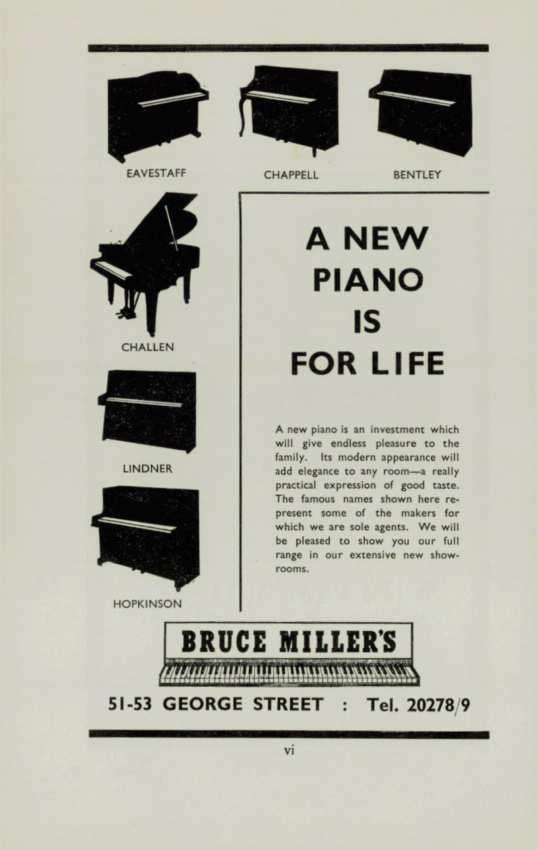
A new piano is an investment which will give endless pleasure to the family. Its modern appearance will add elegance to any room-a really practical expression of good taste The famous names shown here represent some of the makers for which we are sole agents We will be pleased to show you our full range In our extensive new showrooms.
Without the support of Advertisers it would be a financial impossibility to produce the Magazine. May we suggest that in return you patronize them.
Enquiries regarding advertising in the Magazine should be addressed to :
FRANK C. CONNON, ADVERTISEMENT MANAGER,
58 DEE STREET, ABERDEEN (Telephone 52525) X
82ndy,ar No. 198 (N,w Serie; 7211dyear No 189)
Vol. LXIX No 2.
The Magazine is published under the auspices of The Former Pupils ' Club twice during the year, in December and June
General Editor
Joint Editors of the School Section
Editor of Notes, Obituaries and Marriages
Advertisements
Secretary of the F.P. Club
Rae C. Barton, M.A , LL B., 2.0 Belmont Street, Aberdeen
{ Alexander Tait, M.A. Ronald Henson, M A.
Charles Ritchie, 348 1lardgate, Aberdeen.
Frank C. Connon, M.A., LL.B , 58 Dee Street, Aberdeen.
Brian K. Crookshanks, T.o , M.A., LL B 2.5 Crown Street, Aberdeen.
The General Ed.itor invites contributions from F.P.s for the next issue and requests all those with information for the Notes etc. Section to communicate the same to him. All copy should be sent to the Editors by is November 1!)66.In view of the cost of publishing the Magazine new advertisements are earnestly sought

Illustraci ons-
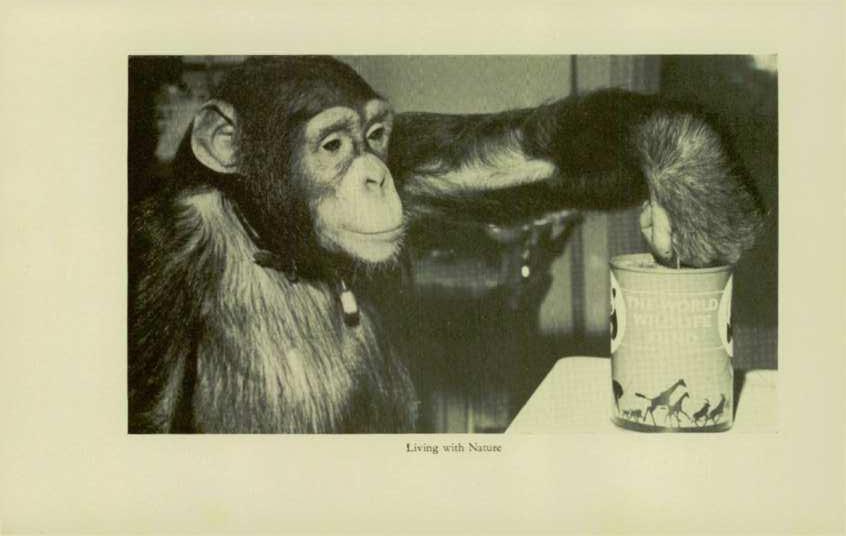
Living with Nature
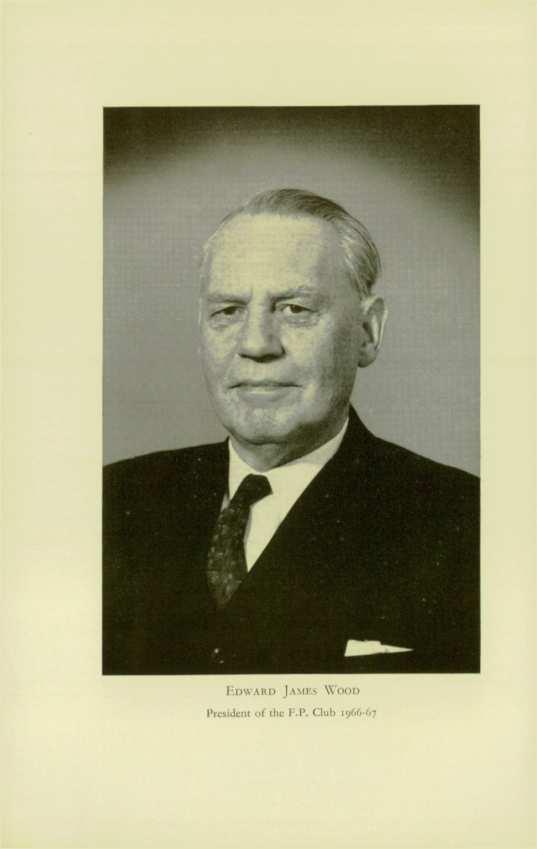
The New Club President
School Rugby and Hockey Teams, 1965-(16 F.P Rugby 1st XV, 1965-66
General Section -
Living with Nature
Testimonial to Mr. J. S. MacLachlan
Changes in the Labs.
Random Reflections on Retirement
Special Entertainments ·ouce
Comprehensive Educauon Fiftieth AMivernry of Rubislaw
Notes about Old Boys
Obituaries
Marriages
School
School
School Societies' "\;mes
Music Notes.
School Sporting Acuvi1ic, Lower School 1'otes
C.C.F. ~otcs
Scout 1ores
Death of Grammar Boy
F.P. Club Section
Oub Office-Bearers
Edward James \\oo<l \nnual Gener.ii Mee1inR
Centre Report~
Section Repons
Kew
An a1/rri1k • a/Irr a M'ftt thr""!)!o11Ilht .\lagaz.11:t1Niiralt1Iba/ /lit F.P. it a mtmbrr of I~ F. P. Cl,J,. 1 lt Jt<rrs appt11ring ,n bra,kt/1 a(ltr t!Jt ,u,,,, i"nliiralttht yarJ of alltndanct al tk 'irhool.
I have called this little essay, "Living with Nature", but perhaps it would have been more accurate if I had called it, "Co-existence with Nature" because a kind of cold-war situation exists between man and nature. Man is getting too big even for his jct-propelled seven league boots. Man is getting ideas above his station-a station which may end as his Waterloo ! He is the only predatory animal who knows the difference between right and wrong. He is the most dangerous animal in the world and yet he is also the most creative. He has given the world Shakespeare, Bach, Leonardo da Vinci, Chartres Cathedral, the Great Pyramid, the Empire State Building and the thermonuclear bomb.
As far as his relations with nature are concerned there is, in the words of my old school reports, "great room for improvement". He has almost complete dominance over nature except when nature hits back with flood, earthquake and typhoon . He certainly dominates the wild creatures with whom he shares the planet because he now has the power of life or death over them.
The past sixty years have given him machines and techniques which, when used against nature, are weapons against which there is no defence. Let him unleash that mechanical predatory monster the bulldozer and a woodland can be cleared av:ay in a day. Turn loose the cement mixers and the cranes and, hey presto, a Bingo hall appears on the site- "housie housie" for the bored rather than houses for heroes. Houses are important - too many people are still living in disgraceful conditions-bu t a thoughtlessly chosen site means the eviction of thousands of wild creatures and a successful takeover bid by the concrete jungle. \Vhiter than white detergents may be the housewife's boon, but when poured away as waste they can turn a lovely stretch of water with its fish, birds and plants into a stench-ridden open sewer. Insecticides may be just the answer for the greenfly on your roses but their abuse can result in the "Silent Spring" about which Rachel C'\rson has warned us so eloquently and movingly.
Man m.'ly be the most exciting and fascinating member of the Animal Kingdom but he is also the most thoughtless, careless and absent-minded . How many of us are aware of the silent and sinister invasion which is going on at this very moment? The wilderness is no longer as Omar Khayyam said "paradise enow" but is becoming a bewilderness of steel and glass and concrete slowly advancing and eroding our countryside and coastline. We must not stand in the way of progress but anything that eventually destroys our real habitat, the countryside, cannot be called progress.
THE WONDER OF THE COUNTRYSIDE
I suppose all of us appreciate the countryside and all that nature means when we are away from it, just as that great Irish poet did during his exile in London: do you remember the words of \Y/. B. Yeats in his poem, "The Isle of Innisfree":
7J
Abtrdem Gra111111ar School ,\fn,~azi11e
"I will arise and go now, for always night and day, I hear lake water lapping with low sounds on the shore. \\bi le I stand on the roadway or on the paYcment grey I hear it in the deep heart's core."
1low many of us remember our first glimpse of nature-of the countryside, the birds, the beasts, the flowers, the trees? My first memory is still very vivid-a speckled thrush singing its heart out high on a still bare tree-a blue sky and a rainbow as a back cloth. As I recall this picture, Browning's words come back:
"That's the wise thrush
Jle sings each song twice over Lest he should never recapture That first fine careless rapture."
l3ut never, as long as I live, will l forget the first time when, as a young boy playing truant from school, I heard a curlew crying to its mate. As a keen ornithologist it was necessary to play "hookey", however deplorable, because time, tide and wild birds wait for no man-nor boy! One day, ha\'ing cycled to Blacktop- a loYelypiece of moorland near W'est Cults-I was overcome with the sheer beauty of both bird and cry which seemed the very embodiment of the wildness of free creatures. Blacktop, the Loch of Skene, Burnbanks with its nesting Fulmars and the Sands of Forvie with its migrant Terns were all important natural areas for my early studies in natural history.
Since then I have travelled round the world many times and have visited the truly wild places and heard many wild sounds: elephants, lions, hippos, monkeys and many kinds of birds, but never anything quite so wild as that first fine careless rapture of the curlew's bubbling cry.
As I think of wild nature and the countryside, my mind goes out to a great Englishman who is not with us any more and I remember him especially as a country lover. 1[e could haye joined the greatest heroes, poets, painters and musicians amid the architectural pageantry of the greatest cathedral in the land-yet he directed that he should lie modestly alongside the "mute inglorious Miltons" and the "village 1Iampdens" in a simple country churchyard.
From earliest childhood the countryside was always meaningful to him, especially in times of stress when he would turn gratefully to it for refreshment and inspirati on and strength. It was to the countryside that the great warrior went to lick his wounds when, after a life of selfless service to his country, he was scorned and rejected for speaking braYelyabout unpopular things. When his prophecies came true and he was recalled to rally the nation, it was always to the country that he went for rest and to gather strength for each new assault.
Not only the countryside but animals too he loved. He acquired many wild pets during his travels and gave most of them to the London Zoo, of which he was an Honorar 1 fellow. 1lis rare black Australian
swans, perhaps the most famous, are now at the Wildfowl Trust. He also had many tame pets, including Toby the budgerigar which was a gift from Lord Montgomery. During the war when convalescing after an illness he said jokingly of his black cat Nelson, "This cat does more for the war effort than you do. Jle acts as a hot water bottle and saves fuel and power." One constant companion during the last days of his life was Ginger his marmalade cat who seldom left his master's bedroom.
His poodle Rufus usually saw him offon foreign visits and invariably was the first to welcome him home. He once said, "I am owned by my dog, I think he likes me, he has taught me to throw sticks".
One of the first supporters of the World Wildlife Fund he saw with that farsighted clarity ·which was one of his greatest gifts that what \\-c are trying to do is FOR man and the long term betterment of mankind. Man without the countryside is only halfalive. 1le knew this. "O more than happy countryman!"
But we can no longer take the countryside for granted for a crisis faces wild life. Sometimes I think that if you go outside on a still starry night you can, if you listen very carefully, hear a strange eerie sound- if you strain your ears and listen to the silence you will be hearing the sound of the sand running out for wild life- the death knell of nature I
For this is surely the eleventh hour for wild life all over the worldthe eleventh hour for the birds, the beasts, the flowers, the trees, for the wilderness itself. It's more than the eleventh hour- it's three minutes to midnight and each second ticks monotonously ominously by. But to digress for just one moment. I can remember talking to 2,000 children in Thailand. I was told that they could understand English perfectly, but you can imagine my surprise when I got to the bit in my talk about it "not being the eleventh hour, but more like three minutes to midnight" when 2,000 little wrists were lifted and twisted and 2,000 little shoulders shrugged in surprise as it was only 3.30 in the afternoon!
Crisis is an overworked, unpopular word. Crisis in Vietnam, in Ghana, igeria, Indonesia, India-but crisis is the only word to describe what is happening to the other living creatures with whom we share this planet.
A state of emergency is now facing wild life everywhere. Since the time of Christ one hundred different species of mammals and about the same number of birds have become extinct at the hands of manwild creatures which had taken millions of years to acquire their unique and exquisite adaptions to their environment. Although little can be served now by crying over spilt blood, let us take a backward look at history and some of our crimes against other living things. Only a century ago the \merican bison, or buffalo as it is more generally called, roamed the orth American plains in tens ofmillions, providing food, clothing and shelter for the conquering white man
as they had always done for the Red Indians. One of the most famous herds was so large it was said to measure so miles wide by 2 5 miles long. The new coast-to-coast railway ran through the middle of this vast herd, dividing it into a northern and southern half. In 1887, 100,000 of the southern herd were shot and by 1889 it was completely exterminated. When alarm was expressed at this pointless slaughter, General Sheridan remarked that it was the surest way of dealing with the Indians who defended on the buffalofor almost all bis needs, thus killing two pests with one bullet I By the early 189o's only about nine hundred survived out of the tens of millions which were there when the white man arrived. Just in time common sense and humanity won a victory over the Generals, and today the buffalo roams in National Parks in hundreds instead ofmillions.
Abundance ofa species is no guarantee ofits survival. The Passenger Pigeon, once the commonest bird in orth America, was reckoned in thousands ofmillions and individual flocks were said to darken the sky. Their destruction was appalling: in 1869, one small :Michigan town shipped three carloads of pigeons a clay for forty days-about twelve million birds at a halfpenny each.In 1907, the last free Passenger Pigeon was shot and on 1 September 1914, the last living survivor died in a cage in the Cincinatti Zoo.
Just after the war, the Ground TutScheme in Tanzania was put into operation in spite of expert advice against it. It became a music hall joke in Britain, but this fiascowas no laughing matter for wild life. To clear the land for plantations thousands upon thousands of giraffes, rhinoceroses, elephants and other animals were shot.
But all is not lost. All over the world, thinking people are becoming concerned about the destruction of wild life, about the plundering of our planet. People are beginning to realise that our survival depends not only on having the sense not to blow ourselves up, but on seeing the need to stop making deserts and dustbowls, to preserve and replant the forests, to husband the earth's renewable resources; in short to protect our own habitat-the earth itself.
For it was when man evolved a conscience that his basic relationship with other animals began to change. Until then, the other animals were divided into those which ate hi111 when they got the chance, those which he ate when he got the chance, and a third group which competed with him for food or were otherwise a nuisance to him in the business of keeping alive. In this primitive situation, man was basically against nature, but as the battle was progressively won, conscience crept in; the awareness of responsibility, and a failure to meet it, produced in him feelings of guilt. Those \vho now live in cities and need no longer do battle with nature are nowadays most activelv_fornature. What was not so long ago regarded asanattitude ofthe lunatic fringe is beginning to be seen to be part of the mainstream of human progress.
Five years ago the World Wildlife rund a modem oah's Ark was launched. Our crew consists of men, women and children of all
races and creeds from all over the world, who believe that the conservation ofwild lifeand wild placesisfor man and for the long term benefit of mankind. Our task is to raise money to help stem the flood-tiJc of human thoughtlessness, apathy and ignorance, and to help preserve these wonderful creatures for the delight of our children's grandchildren.
\X,'e certainly do not belong to the lunatic fringe. \\ e are not a group of escapists disenchanted with the human race and exposing the cause of the animals because "they don't let you down". \\'e may be a little cranky to some, but I \vould remind you that a crank is a small object which causes revolutions. We like to think that we have our feet on the ground, and are certainly not as fanatical as the game warden's daughter. She was passionately fond of wild animals, and it broke her heart when she was sent to school in England. The teachers could do nothing with her. She didn't seem to be learning anything. Then one day during the Scripture lesson when the class was looking at pictures of the early Christian martyrs being tortured in the Coliseum, she burst into tears. The teacher, delighted that at least she \\as paying attention, said, "There, there, Jessica dear, Christians don't get eaten by lions any more." She replied, "That's not why I'm crying There 's a poor lion in the bottom left hand corner which hasn't got a Christian!'
It was Prince Philip, President of the British Appeal of the \\'odd \X'ildlife Fund, who said recently:
"The extermination of a species of animal is like the destruction of a rare work of art. Just imagine a group of vandals going round the world every year and solemnly taking down all the works of two or three masters and carefully and deliberately destroying them."
Yet this is rather like what is happening tod.1r. ,\t this moment something like one thousand kinds of vertebrate animals (animals with backbones) can be said to be in danger of becoming as dead as the Dodo. A few have been reduced to this precarious position by extensive killing, but the majority are disappearing only as fast as the particular kind of country they need for existence is itself disappearing and all this at the hands of man, as often as not by mistake. To destroy their habitat is as unnecessary as it would be to pull down a great cathedral in order to gro,\· potatoes on the site.
I hope that I have convinced you that we should try and li, e with nature. Certainly this is just as important as saving human beings from all kinds of suffering and misery. It is clear that when there is an unavoidab le collision between the survival of man and the survival of wild life, human interests must prevail. \X'e believe, however, that such collisions are rare, that in most cases a little thought, ingenuity and good\\ill can permit the co-existence of man and wild life without which man himself is so much the poorer. There are responsibilities for adding something constructive and uplifting to human lives as well as for saving them; responsibilities which in the field of conservation
grow daily more urgent, for the wild creatures cannot protest and, once a species becomes extinct like that Dodo, nothing can ever re-create it.
I hope that I am not a Yoicecrying in the wilderness and that we are all agreed that without the wilderness, without the countryside, without nature, life would not be worth living.
I would like to end by quoting from an essay Elspeth JIuxley wrote for us:
"Man is the Lord ofCreation, King ofallhe surveys. A good Lord does not destroy his fellow creatures, nor a King reduce the world he surveys to a wasteland spattered with clusters of brick, steel, concrete and a network of arterial roads. It will be a sad day-sad for man-if, looking through the window, he can see nothing but reflections of his own weary, baffled and disillusioned face."
Perhaps as this is a serious subject the last word should go to that great humourist, Mark Twain, who said:
"Man is the only animal that blushes--or has toI"
IAN s. MACPHAIL. (1933-40)
Editorial Note: As readers 111ay hal'egathered, Mr. Ma,Phail iJ Director General of the World IPildlife Fund and the foregoing article »•as written espuial!Jfor the Magazine. Ho1v beller can »•e exprus our thanks than by mpporlinghis u•orkand that of the Fund? Tho1e interuted in doin,~ 10 1ho11/d cov11111111icalell'ilh the GeneralE.tlitor.
Following the appeal which went out with the last issue of the J\1agazinefor a testimonial to provide recognition for the devoted and valuable services rendered to the Club by "Scottie" during his nineteen years as Secretary and Treasurer, there was an excellent response from members throughout the world.
After consulting with Mr. MacLachlan who expressed the wish that his gift take the form of a tape recorder and that the Executi,·e might also consider taking into account the support which his wife had given the Club, the Executh ·e happily agreed with his suggestion and, at a meeting of the Executive held in the Caledonian Hotel, Aberdeen, on 14 June, there was handed over to Mrs. MacLachlan a gold watch and to Mr. ~[acLachlan a suitably inscribed tape recorder together with a cheque for the balance of the appeal fund after purchasing these gifts.
W/e would again record our appreciation of "Scottie's" services and would thank all those who responded to the appeal.
The Scottish Certificate of Education in science now includes:
1. ]J,e OrdnraryC,rade Certifimlr. This is a fourth 1ear certificate and can be taken in any branch of the subject.
2. I ligherGrade(Science).Pupils are presented for this certificate in the fifth or sixth year. Two branches of the subject must be studied as for example physics and chemistry and one paper is taken in each branch.
3. Il(l!,herGrade (Airy one branchof mence). Pupils are presented in the fifth or sixth year. Two papers must be taken in the one branch of science selected, Physics, or Chemistry or Biology. This certificate is attempted by the more able pupils.
The following gives some idea of the work undertaken by each of the science departments:
The teaching of chemistry tended to present the pupil with a collection of facts and principles which he then related to everyday life. It was obvious that this approach was completely outdated and in r962 the Scottish Education Department introduced an alternative syllabus In this syllabus emphasis is lnid on the most enjoyable part of chemistry, namely experimentation; and from the laboratory work the principles are developed. The syllabus has to take account of three factors: (1) some pupils will drop chemistry at the end of the second year, (2) some pupils will go no further than the Ordinary grade, and (3) the more able pupils will continue the study of the subject to the Jligher grade and beyond.
For the first two years all pupils study the subject and the course must therefore be a complete entity. It is designed to inculcate a scientific approach to the investigation of reactions associated with the common elements and compounds found in the air, the sea and the earth.
The Ordinary course includes a study of electro-chemistry which is intimately connected with atomic structure. From this knowledge the pupil can im·estigate chemical bonding and energy changes associated there,, ith. In addition by the end of four years the pupil will haYea good knowledge of the chemistry associated with everyday life, as for example fuels, foods, synthetic fibres, etc.
For the Jligher course the depth of treatment of the work for the Ordinary course is greatly increased and the course becomes much more academic. for the more able pupil some of this \\'Ork will have been incorporated during the first four years and these pupils will sit the Higher grade in the fifth year. The pupil ofaverage ability who decides to continue the study of the subject beyond the Ordinary grade will usually require a further two years before attempting the Higher grade. Many of the best pupils who have passed the Higher grade in the fifth year return for an adYanced course in the sixth year. This course is largely governed by the requirements of the University Bursary Competition.
One result of the launch of the first sputnik by the Soviet Union was that the United States looked again at the teaching of sciences in her schools and colleges. Physics was understandably the first subject to be reviewed and a large textbook with further volumes of source material was produced. This gave impetus to those in Scotland who felt that change was necessary here also.
As a result of much work by teachers and the inspectorate the Alternative Syllabus for Physics was published in 1961. Since then Memoranda have been produced on apparatus and methods of teaching the syllabus.
It was felt that the previous syllabus was too restricted in scope and that the groupings heat, light, sound, mechanics, electricity and magnetism were artificial. A further fault was that too much time was spent on details of a limited number of experiments and on numerical exampleswhich \\·ereonly mathematical exercises.
The ordinary grade syllabus was designed to give pupils a much wider look at the subject and an insight into what was happening. The course requires a minimum of mathematics. A few unifying concepts and theories- the kinetic theory of matter, force, energy and wave motion run through the course which is concentric in treatment. The concepts are elaborated as the pupils' understanding grows.
What then will the boys be doing at the various stages? First year boys find out about the different ways of measuring temperature, use drops and oil films for molecular forces and sizes, and look at the properties of air.
In the second year the Van de Graaff machine livens up the study of electrostatics with its 2.~0,000 volts, and later a variety of simple electrical circuits are examined.
Dynamics is no longer a textbook subject. Class experiments use small trucks or trolleys which are accelerated or allowed to collide. One method of measuring acceleration uses photoelectric cells and electric stop clocks. The path ofprojectiles is studied using stroboscopic photography-the camera shutter is left open and a lamp provides a known number of flashes per second.
In the fourth year further electrical work is undertaken including Alternating currents which provide the basis of radio and television tube circuits. Finally radioactiYity with Geiger tubes and counters. The strength of the radioactive sources is strictly limited by the Scottish Education Departmen t so that no possible radiation hazard \\·ill occur.
The course thus makes the boys familiar with instruments \\'hich are actually used in Physics research and in industry. The new treatment means that the brighter the pupil the more he will discover; while for all pupils the essential basis for further experiment and research \\"ill have been laid.
The scope being wide, note-making and note-taking are cut down. Printed notes which help to summarise the work are issued. \\"ith a very large number of class and demonstration experiments the increase in the amount and variety of equipment has been considerable.
Aberdu11 Grafllmar School Afagazi11e
To conclude, the change in method and content has been drastic. Evidence so far suggests that the new approach is more welcome at all levels of ability and ,vc hope that all boys will benefit from it.
,\II pupils in their first two years have a single period of biology each week. As many pupils pursue the study of biology no further in school, this brief course, in addition to providing a basis for further study for those who do continue with the subject, has to present some of the concepts of biology to those who take the subject no further As time is limited no one topic can be pursued for very long or to any depth; but as the most important organism to man must be man himself the course is based on human biology. The main organs and systems of man are discussed brieflyto give some idea oftheir position, appearance and main functions. Charts, models and films are used, as are demonstration dissections on suitable mammalian material as it becomes available.
There being noexamination requirements to be met nor any necessity to cover a rigid syllabus, there is opportunity to digress and follow topics ,vhich interest any particular class.
Some botanical work is also covered, mainlv concerned with the flowering plant, and with emphasis where possible on the relationships between man, and other animals, and plants.
Boys who continue with biology after the second year begin the "O" grade curriculum. In this, emphasis is laid on the mammal, with particular reference to man. This continues the work of the previous years and takes it to a greater depth the elementary anatomy and physiology of man; his relationship to other organisms and dependence on plant life for food and other necessities; useful and injurious animals and plants.
The botanical aspects of the "O" grade course are largely related to the physiology of plants and their adaptations to their modes of life, with only enough anatomy taught to correlate structure and function .
Only at the level of the higher grade course are botany and zoology taught as separate subjects. Although it would be preferable to teach biology at this stage as well, to continue the stress on the similarities, differences and interdependence of living organisms, yet for nrious reasons, mainly arising from time-table difficulties, we find it more practical to treat the subjects separately.
In biology new adYances are being made rapidly and this must inevitably influence the content and emphasis of new syllabuses which prernmably \\'ill be introduced into schools. The Nuffield roundation has financed trials of a new ordinary grade syllabus, and the publication of the material derived from experience gained in the pilot scheme will take place in the middle of 1966.
The introduction of a new syllabus would bring the teaching of biology into line with chemistry and physics.
!\oft. In the study of biolog.,:pupils re9uire to see .md to han<lleas much and as diverse material as possible. The Biology Department would be very grateful to receive any material which might help to build up its collection of plant and animal material.
Three score years and ten is the allotted span, and since, broadly speaking, we spend the first twenty years learning, the second twenty building and maintaining a home and family, and the third twenty consolidating and providing for the comfort of our declining years, it is not unreasonable to hope that we shall be able to devote our last decade to the things ·which ,ve haYe found most interesting and pleasurable. While at the age of sixty years most of us wish or find it necessary to take things more easily, we are still young enough in mind and spirit to take great pleasure in shaping a new way of life.
I well remember my father's words, "The indiscretions of our youth arc drafts upon our old age, payable with heavy interest". This, of course, was intended as advice to me to exercise an intelligent and reasonable restraint upon my youthful passions and desires. Happily, I followed his advice (though probably more by good luck than by conscious management) with the resulting possession of excellent health, moderate aspirations and a large measure of contentment . \'fe all know of individuals, suffering from cruel disabilities, accidental or otherwise, who have led useful and valuable lives, but there can be little doubt that a generous degree of physical fitness and good health is a helpful prerequisite to a happy retirement.
Another piece of parental exordium which I remember was, "Never be afraid of change, but never change without adequate preparation". This advice I have found to beinvaluable and it is of particular significance to the man contemplating retirement in the near future. Anticipated with keen pleasure, and a goal for which most of us have long striven, retirement achieved can nevertheless present problems of its own.
The question is often asked ofan envied elder, "1 [ow do you occupy your time ?" The answer is usually that the days are not long enough and that the "Old Boy" has never been so busy in his life.
This, ofcourse, is true but it is not always the whole truth. Breakfa~t at 9a.m., followed by perusal ofthe newspapers, meansthat hisworking day cannot now commence much before eleven o'clock which, as we all know, is the time for morning coffee. Having washed the coffee dishes and perhaps pruned the roses, or fitted a set of modern castors to his spouse's heavy arm-chair, he finds that lunch is now upon him and the clay half gone \X'ith his evenings dedicated to baby-sitting, or the occasional visit, or the entertaining of an old friend, and, of course, putting his feet up in order comfortably to encircle the globe with "The Man in Room 17'', he finds that there is only the afternoon left for such essential tasks as writing the odd letter, or perhaps an article for this Magazine, or fixing that tile that has been loose for years. He has long ago discarded his dream of reducing his golf handicap, and realises that he can get all the exercise he requires in the execution of his new-found household chores. If he has taken the trouble to acquire a few books on "Do It Yourself", he will slip into his new life with graceful ease and satisfying pleasure.
ss

I understand now the infinite wisdom of yet another of my father's oracular contentions when, pointing the finger in m1 direction, he said, "If you would live a long and healthy life, my boy, take you care to watch your diet. Stop living to eat and start eating to live." At the time I thought this a harsh indictment of my body-building efforts but, alas, my reflection in the mirror now illustrates his penetrating observation and the accuracy of his thinking.
Another of my father's profundities was, "Cse your brains, my bo,·. Think all round an intended move and make a firm decision. Then, and only then, DO IT xow. If, after that, you take advice, you will usuallv regret it." Like all prophets, it is sad to relate, my father was not sufliciently honoured in his own country. This has turned out to be my loss, for long e,perience has taught me that his tenets were ,vise and a helpful guide to useful behaviour, providing a means of side-stepping and dodging most of the worries of a difficult and confused ·world. The wrong action is better than no action at all, for it can usually be corrected and seldom, ifever, rums out as badly as at first feared and, strangely enough, our mistakes provide us with most of our interesting memories.
It is perfectly true th.1.t, as we get older and older, the "·eeks get shorter and shorter and it becomes more and more difficult to take decisions and adjust to a new way of life. The retired man has ample time for reflection and very often the inclination to philosophise, and so can still be a useful citizen, if only in an ad,·isor) capacity l\fy considered acldce to anv colleague who cares to ask it is, "Retire at sixty if at all possible, for it is later than you think."
The attention of all members 1s drawn to the circular enclosed with this issue of the .\l,~r.azme regarding the Annual Dinner and Ball. In \'ie,\ of the increasing costs of sending out this circular, it was last year decided b, the Lntertainments Committee that adequate notice would he given of these functions if the circular were to be sent out with the June issue of the .\fa,e,azi11eevery year.
You are therefore requested to preserve carefully the circular (which is the only intimation which will be given) until you decide to submit your application for tickets to PHILIP 1\/. Lo\E, .\dvocate, 58 Dee Street, Aberdeen. In addition you should note these dates:
\nnual Dinner: Thursda) 2.0 October 1966
\nnual Ball: \'\'ednesday, 2.8 December 1966
On/y membm of the F.P. C/11b flltJY applyfor licketJ.
At the time of publication of the last issue of the M11g,1zi11!,no final decision had been taken by the Local Education Committee in this matter but, as many readers will be aware, that decision has now been reached and it is to the effect that a one-tier system of Comprehensive Education will be introduced into all schools under the control of Aberdeen Corporation at a date which has not yet been finally determined but which it is thought will be in or about 19n.
The subject of Comprehensive Education is a vast and complex one and there is insufficient space here to enter yet again into the arguments for and against the system. Suffice to say that the decision which has been taken will obviously have far-reaching effects so far as the School is concerned and, although the Club has already expressed its , iews (see Mt1gllzineof June 1965), it is at present thought that it is neither politic nor expedient to make any further comment until such time as the Education Committee has made known its plans for re-organisation of the citv's educational system in depth and detail.
To date all that has happened is that a decision has been taken and, although it is belie, ed that the result of this decision will be the disappearance in due course of the School as it has existed to date, it would be neither right nor proper for censorious comment to be made until such time as the final plans ha, e been made public. Members of the Club will be kept fully informed of developments and, in the meantime, they can rest assured that the Executive ,viii keep matters fully under review and will do all that is possible to safeguard the interests of the School and the Club.
The attention of readers is drawn to the fact that the fiftieth anniversary of the opening of Rubislaw l ield falls on 16 September 1966. At the time of writing the various Sporting Centres of the Club, as also the School, ha, e in hand plans for the suitable celebration of this event and all interested in participating in, or spectating at, the various games and matches which will be arranged should communicate either with the Section Secretaries or the School. It is also anticipated that publicity will be given locally nearer the time.
The matter will befully reported on in the next issue of the ,\f11J"Zi11t together \\ith, it is hoped, a short history of the Field.
( 0 \IM ANDER 01· THEO RDER OFT Ill: ll Rl rISH EMPIRE ( C. B.E.)
Robert Gray Sangs ter (1919-30), n.~c., was created a Commander of the Order of the British Empire in the New Years 1lonours List. lie went to Uganda in 193i as a member of the Colonial SerYice and transferred to Tanganyika in 19i2 where he was promoted Deputy Chief Conservator of Forestry and later Chief Conservator. He has represented that country at two Commonwealth Porestry conferences and at one World Forestry conference and the Forestry Commission for Africa before he retired in March of last year. *
Andrew Riddel Abercromby* (1903-13) has been appointed chairman of the Scottish Stock Lxchange. l le is a partner in the firm of Abercromby & Stott, stockb rokers, Aberdeen, another partner being Francis Floyd Scott* (1918-30).
George Gordo n Allan· (1939-j!) has joined The Times in London as a Sports sub-editor and reporter. He started with Aberdeen Journa ls and since leadng them in 1960 has been a sub-editor with the Dai!J Ttltgmph, The Scolsf/Janthe North Londo11 Press, and the Press Association News Agency.
John Ingram Archibald (1930-42), B.~c.,is manager of the trainer and simulator division of Elliot Brothers London Ltd., a member of the Elliot-Automation Group. He graduated from Aberdeen University in 1948 and went as a research worker to the outfields of Iraq, before joining the Atomic Energy Commission in Cumberland. Jle was also with the English Electric Co. and Decca Radar before joining Elliot Brothers Logie Samuel Bain* (1919-31), T.O., M.B., c11.o., D.PHYS. and ~1ed. Chairman of the Aberdeen Branch of the British Rheumatism and 1\rthritis Association hasinitiated a schemefor setting up aholiday centre in Scotland for patients suffering from rheumatism and arthritis. He suggested the scheme as it is too far for patients to travel to Kent where the only holiday centre is operating successfully. Dr Bain has also recently been appointed President of the North District Rugby Union in succession to Dr. John Robert Stephen Innes (1923-35), M,U., CH.B.
John Kinniburgh Blair· (1927-37) has retired from the Scouting movement after twenty-five years ofservice. During the war he served in Africa and Italy with the Armoured Corps. Scoutmaster of the 1st Troop on his demob, in 19i I he became Scoutmaster of the 17th Troop aod has been with them for over thirteen years.
Peter Sinclair Brown (1935-46), a sub-editor with Aberdeen Journals was presented with the Sporli11gChronicle'sGold Cup and £too cheque for his feat in beating fifty-five other competitors in the Sporting Chro11icle's racing contest during the National Hunt Season. Under the name of "The Colonel" he was twenty-three points better than his nearest rival. Also included in his varied activities is the writing of the Press and]011rnalrugby articles.
Frederick George Bull (1949-55), who, for the past eighteen months, has been an Art teacher at ·orthfield Secondary Schoo l will shortly be leaving to take up a Lectureship at the Craigie Teacher Training College in Ayr. He previously taught in Dunfermline.
Richard Cowling * (1959-65) is now on a course in mining engineering with the President Steyn Gold Mining Company in the Orange Free State. The course is that of a learner official leading to mine management at the end of four years.
Richard Henry Whitby Cradock• (1943-51) is now managing director of Richard Irvin and Sons Ltd. , at 'orth Shields. 1Ie joined the firm as a salesman on leaving School and moved to Fraserburgh in 1951, later to become managing director there. He was a prominent member of fishing circles being chairman of the local Lifeboat Branch and Fish Salesman Association and connected with the Shipwrecked Mariner s Society, Herring Producers Association and Round Table. His brother, John Whitby Cradock* (1940-46), C.A., is a director in Aberdeen.
John Martin Dalby (1946-60)who recently joined the B.B.C.'s music division in London has been awarded the prize of £50 by the Broadcasting Council for Scotland in a competition for Scottish Composers. Jlis winning entry "Waltz Overture" was broadcast by the B.B.C. Scottish Orchestra.
Kenneth Stroud Duncan * (1948-54), A,A.c.c .A., has been living in Glenrothes since 1960, being employed as an Executive, Inland Revenue, Inspector ofTaxes, Cupar. He qualified asa Certified Accountant in 1965 and was promoted to IL~L Inspecto r of Taxes in January of this year.
Also in the lnland Revenue and now serving in the Penrith District, Cumberland is Ian Howie (1948-54).
Arthur Hugh Dunnet (1927-35), M.B., CL.B ., has been appointed Medical Superin tendent of Darwin JIospital, Australia. During the second World \X'ar he serYed in the R.A.M.C. and for ten years was Medical Officer in charge of hospitals in Ghana. He was in General Practice at Unst, Shetland, before leaving for Australia where he became Medical Officer at NorfolkIsland, then Medical Superintendent of Katherine llospital since 1963.
John Parkinson Drummond :+- (1947-58), :.r.A., of Eddie & Drummond and Secretary ofAberdeen & District Advanced Motorists, has instigated a scheme for the instruction of disabled people in the driving of invalid and other motor vehicles.
Meldrum Barclay Edwards* (1946-60), B.Sc., who was School Athletic Champion in 1960 and is the only f.P. cross-country internationalist, has become a double "Blue" of Cambridge University -
Aberdeen Gran1111ar School Magazine
cross-country running and athletics. Only one other F.P., Alexander James Grant (1939-46), B.A., has been awarded Full Blues for two sports at Cambridge. A long jump specialist, who finished his schooling at Fettes College, Grant represented the l;niversity at both athletics and golf in 1957-58. At Oxford University in 1913 Ian Anderson Clarke (1902-8), ~.A., B.SC., won Blues for both athletics and rugby football.
John Alexander Simpson Emslie* (1905-17), 11.B., CH.B., has recently retired from the ational Health Service and is engaged in private practice. He was chairman of the local medical committee and vice-chairman of the Health Service ExecutiYe Council in Eastbourne. He is a member of the Hailsham Group Hospital Management Committee and was for some time president of the Eastbourne Scottish Association. His son Michael was with his father in practice, and \\~illiam Brodie Brown a son of the late Dr. William Baxter Brodi e Brown (1915-18) of Aboyne has now joined the practice in place of Dr. Emslie.
Charles Gillespie* (1910-18) who was referred to in the last issue as being one of the untraced members of the Class Ill photograph has been in touch with the Secretary. He is resident in London and is a producer for amateur operatic societies.
Ian Drysdal e Hallida y* (1952-58),c.A., has been appointed General :Manager of Robert Fraser and Partners (Northern) Ltd and has moved to Li•,erpool to open a new office for the Company which is a subsidiary of one of the .Merchant Banks in the City of London .
N orman John Home (1950-56), ~I.A., \\'ho graduated with fi.rstclass honours in Classics in 1960 and has been for the past five years assistant teacher at Hamilton Academy, has been appointed principal classics master at the 'icolson Institute Stornoway.
N orman Hutchiso n (1927-29) isretiring as President ofthe Scottish Association of Master Bakers. Both his father and grandfather also held this office.
Arthur Roy Handasyde Kellas (1926-32) has been appointed \mbassador Extraordinary and Plenipotentiary to Nepal. Jle moves to 'epal from the British Embassy at Tel-Aviv. He was made a C.M.G. in 1964.
Colin John Maciver (1902-3), 11.,\., recently retired from Aberdeen Town Council on which he has served since 1949. During the last fourteen years he has been Education Committee Convenor. Before his retirement :.\fr.Maclver was headmaster of Frederick Street Junior Secondary School and prior to that "·as assistant Mathematical master at Grammar from 1927-39.
At the recent Municipal Elections held on 3 May 1966: Arnold Marischal Burns* (1920-25) was returned to Aberdeen T.C. asrepresentatiYe ofHolburn Ward and John Middleton (1954-61)

·waselected as representative for \X'oodside. At a subsequent meeting of the Council Robert Middleton (1944-48) was appointed convenor of the Lducat ion Committee. Three other (unsuccessful) c:mdidates were George Park (195z-55), Ian Robertson (1937-41) and ichol Thomson (1952.-58).
James Scott Gray Munro '"' (19zz.-2.8), B.L , advocate in Aberdeen, at a group meeting was elected to the leadership of the Town Council ProgressiYes.
*
Dr. Stephen McPherson • (1944-50), ~LB., c.n.n , has emigrated to Australia and is in general practice and in charge of Obstetrics at the Medical Centre and Hospital, Mudgee near Sydney. l lis brothe r Harry McPherson * (1947-53) M B , CH.B. is in practice in Aberdeen. Air Vice Marshall Leslie Dean Mavor* (192.3-33), c.n., A.P.C., who was Air Officer Commanding No. 38 Group R.A.F., has been appointed Assistant Chief of the Air Staff (Policy and Planning) from March 1966.
Michael Wilfred Moir (1962.-65) has joined the Royal Signals and is training to become a technician
Gordon Shaw (19l6-59) on leaving School served his apprenticeship with C. Bruce Miller & Co. Ltd. as a Radio and T.V. Lnginee r and emigrated to Australia in April to become a T.V. Engineer in Brisbane.
Charles Pirie Skene * (1940-47)is nmY vice-president of the Junior Chamber of Commerce, Aberdeen.
The Rev. George Scott Skakle * (192.7-39), M.A., has been elected moderato r of the Presbytery of Aberdeen. He graduated in 1\rts in 1942. and was appointed assistant at St. Machar Cathedral. On completing his di, inity course in 1945 he was ordained by the Aberdeen Presbytery and has been minister of Powis Church since 1947.
*
Peter James Nielson Stewart'" (1952.-63) is the present editor of Ga11die,the L'niversity newspaper.
ABERDEE:--: SOLI C ITOR S
Mario Luigi Vicca (195z-56) and Gavin Bruce Wilson"' (1945-59) were recently admitted to the Society of Advocates in Aberdeen.
* *
Kenneth Brebner Williams '"' (1938-46) was home in Aberdeen recentlyfrom \ enezuela wherehe completed a second tour ofduty·with the Royal Insurance Co. Ile departed earlier this year to take up a similar post in the \\'est lndies.
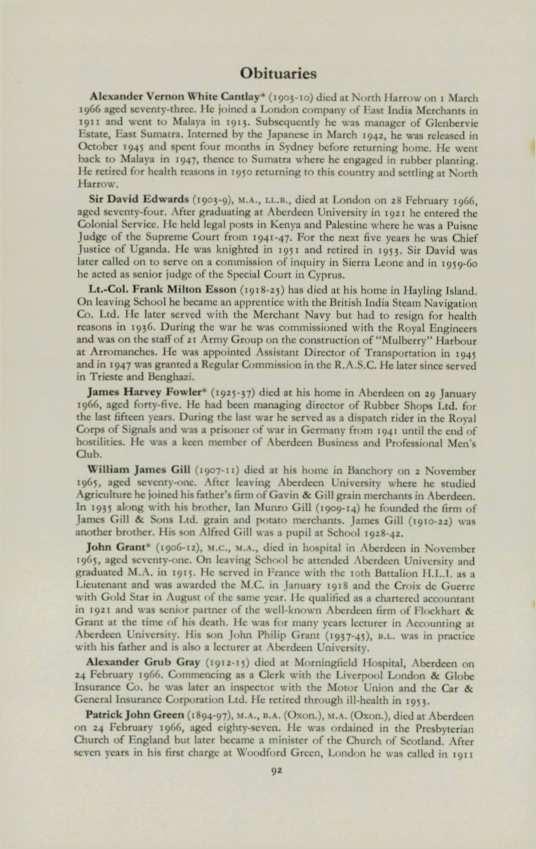
Alexander Vern on While Cantlay" (1903-10)died at l\orth I!arm" on 1.\larch 1966aged se,·enty-threc. llc joined a London company of I:as1 India Merchancs in 191I and went to Malaya in 1913. Subsequently he was manager of Glcnberv1e Estate, East Sumatra. Interned by the Japanese in March 1942, he was relea~ed in October 1945 and spent four momhs in Sydney before returning home. He wenl back to Malaya in 1947,thence to Sumatra where he engJgcd in rubber planting. He retired for health reasons in 1950returning to this country and sccclingat l\:onh Harrow.
Sir David Edwards (1903-9), ,u., 1.1..B.,died at London on 18 February 1966, aged seventy-four ,\fter graduating ar Aberdeen University in 1921 he emered the Colonial Service. I[c held legal posts in Kenya and Palestine where he was a Puisnc Judge of the Supreme Court from 1941-47. For the next live years he was Chief Justice of Uganda. fie was knighted in 19p and retired in 19i3. Sir David was later called on to sen·e on a commission of inquiry in Sierra Leone and in 1959-6o he acted as senior judge of the Special Court in Cyprus.
Lt.-Col. Frank Milton Esson (1918-15) has died at his home in llayling Island. On leaving School he became an apprentice with the British India Steam Navigation Co. Ltd. fk later served with 1he Merchant Navy but had to resign for health reasons in 1936. During the war he was commissioned with the Royal Engineers and was on the staffof 21 Army Group on the construction of ".Mulberry" I!arbour at Arromanches. Jfe was appointed Assisrnnt Director of Transportation in 1945 and in 1947 was gramed a Regular Commission in the R.A.S.C. l[elater since served in Trieste and Benghazi.
James Harvey Fowler· (1925-37) ,.hed at his home in Aberdeen on 19 January 1966, aged forty-five. He had been managing director of Rubber Shops Ltd. for the last fifteen years. During the last war he served as a dispatch rider in the Royal Corps of Signals and \\:CS a prisoner of war in Germany from 19.p until the end of hostilities. Jle was a keen member of \berdeen Business and Professional .\fen's Club.
William James Gill (1907-11) died at his home in Banchory on 2 l\:ovember 196,, aged sc,enty-onc. -\ftcr leaving \berdeen Vniversity where he studied Agriculture he joined hisfather's firm ofGavin & Gill grain merchants in -\berdeen. ln 1935 along with his brother, Ian l\fun.ro Gill (1909-14) he founded the firm of James Gill & Sons Ltd. grain and potato merchants. James Gill (1910-22) was another brother. His son .-\lfred Gill ,,a~ a pupil at School 1928-42.
John Gram~ (1906-11),~r.c., ,1.A., died in hospital in .\berdeen in ,ovcmber 1965, aged seventy-one. On leaving School he attended \bcrdeen University and graduated M.,\. in 1915. Ile served in 1:'ranccwith the 101h Battalion I1.1..1.as a Lieutenant and was awarded the .M.C. in January 1918 and the Croix de Guerre with Gold Star in August of the same year. !Ie qualified as a chartered accountant in 1911 and was senior partner of the well-known .\berdeen firm of rtockhart & Grant at the time of his death. He was for many years lccrnrcr in ,\ccounting a1 Aberdeen University. His son John Philip Gram (1937-4s), B.L. was in practice with his father and is also a lecturer at -\bcrdeen University
Alexander Grub Gray (1911-rs) died at ~lorningficld Hospital, Aberdeen on 24 Februar,· 1966. Commencing as a Oerk with the Liveqxw,l London & Globe Insurance Co. he was later an inspector with the ~Iotor Union and the Car & General Insurance Corporation Ltd He reured through ill-health in t9H·
Patrick John Green (1894-97), . ,u., B.A.(Oxon.), M.A.(Oxon.), died at .\berdccn on 24 February r966, aged cighty-se\'Cn. lie was ordained in the Presbyterian Church of England but later became a minisrer of the Church of Scotland. ,\fter seven years 1n his first charge nr \'foodford Green, London he wa~ called in 1911
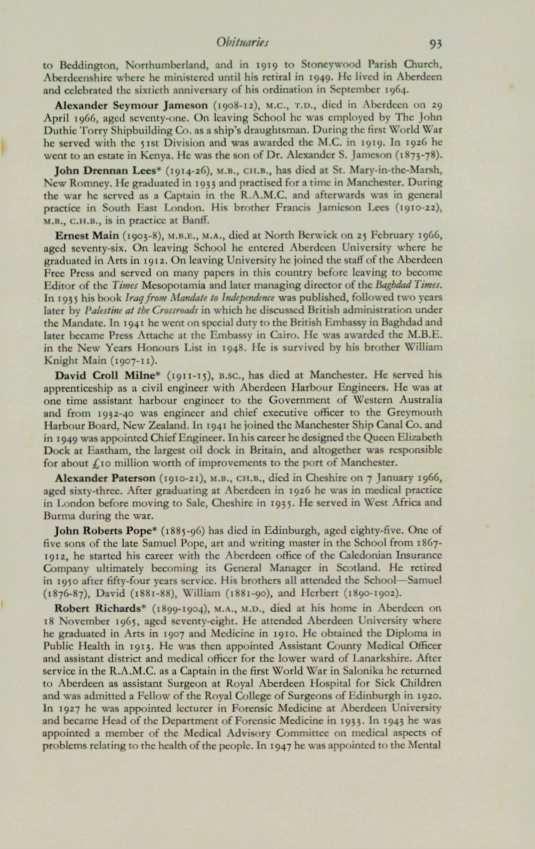
to Beddington, "1orchumberland, and in 1919 to Stoneywood Parish Church, Aberdeenshire where he ministered until his retiral in 1949. He lived in Aberdeen and celebrated the sixtieth anruversary of his ordination in September 196.1.
Alexander Seymour Jameson (1908-12), M.C., 1'.D,, <lied in Aberdeen on 29 April 1966, aged seventy-one. On leaving School he was employed by The John Duthie Torry Shipbuilding Co.as a ship's draughtsman. During the first World War he served with the 51st Division and was awarded the J\f.C. in 1919. Jn 1926 he went to an estate in Ken)•a. He was cheson of Dr. Alexander S. Jameson (1873-78).
John Drennan Lees* (1914-26), M.B., CII.B., has died at Sr. J\£ary-in-thc-i\farsh, New Romney. He graduated in 1933and practised for a time in Manchester. During the war he served as a Captain in the R \.M.C. and afterwards was in general practice in South Ease London. Hi5 brother Francis Jamieson Lees (1910-22), ,1.0., c.11.0., is in practice at Banff.
Ernest Main (1903-8), ,r,B.F., M.A., died ac orrh Bcn>·1ckon 25 February 1966, aged seventy-six. On leaving School he entered .Aberdeen UniveC1iirywhere he graduated in Arts in 1912. On leaving University he joined the staffof the Aberdeen Free Press and served on many papers in this country before leaving to become Editor of the Times Mesopotamia and later managing director of the BaghdadTi11m. In 1935 his book Iraqfrom Mandatelo lnd,j>tndtn<twas published, followed two years later by Paluli11eal tbt Cro11road1in which he discussed British administration under the Mandate. 1n 1941 he went on special duty cothe British lembassyin Baghdad and later became Press Attache at the Embas~y in Cairo. JIc was awarded the M.B.E. in the New Years Honours Lise in 1948. IIe is survi,ed by his brother William Knight Main (1907-11).
David Croll Milne* (1911-15), n.sc., has died at Manchester. He served his apprenticeship as a civil engineer with Aberdeen Harbour Engineers. He was at one time assistant harbour engineer to the Government of Western Australia and from 1932-40 ,vas engineer and chief executive officer to the Greymouth Harbour Board, New Zealand. In 1941 he joined the Manchester Ship Canal Co. and in 1949was appointed Chief Engineer. ln his career be designed the Queen Elizabeth Dock at Eastham, the largest oil dock in Britain, and altogether was responsible for about £10 million worth of improvements to the port of Manchester.
Alexander Paterson (1910-21), ~1.e., c11.B., died in Cheshire on 7 January 1966, aged sixry-thrcc. After graduating at \berdecn in 1926 he was in medical practice m London before moving to Sale, Cheshire in 1935. He served in\\ est Africa and Burma during the war.
John Roberts Pope* (1885-96) has died in Edinburgh, aged eighty-five. One of five sons of the late Samuel Pope, art and writing master in the School from 18671912, he started his career with the \bcrdccn office of the Caledonian Insurance Company ultimately becoming its General Mamger in Scotland. Jle retired in 1950 after fifty-four years scr,icc. His brothers aU atu.-nded the School-Samuel (1876-87), David (1881-88), \\.1lliam (1881-90), and Herbert (1890-1902).
Robert Richards"' (1899-1904), \l,A., ,1.0., died at his home in .Aberdeen on 18 ovember 1965, aged seventy-eight. l fe attended Aberdeen Univet1iirywhere he graduated in Ans in 1907 and ,\.led1cine in 1910. He obtained the Diploma in Public Health in 1913. He was then appointed Assistant County Medical Officer and assistant district and medical officer for the low·er ward of Lanarkshir e. After service in the R.A.M.C. as a Captain in the first World War in Salonika he returned to .Aberdeen as assistant Surgeon at Royal Aberdeen Hospital for Sick Children and was admitted a Fellow of the Royal College of Surgeons of Edinburgh in 1920. In 1927 he was appointed lecturer in Forensic Medicine at Aberdeen 1.Jnivers1ry and became Head of rhe Department of Forensic Medicine in 1933. In 19.u he \\as appointed a member of the l\ledic.'ll Advisory Committee on medical aspects of problems relating to rhc health ofthe people. In 1947he was appointed to the Mental
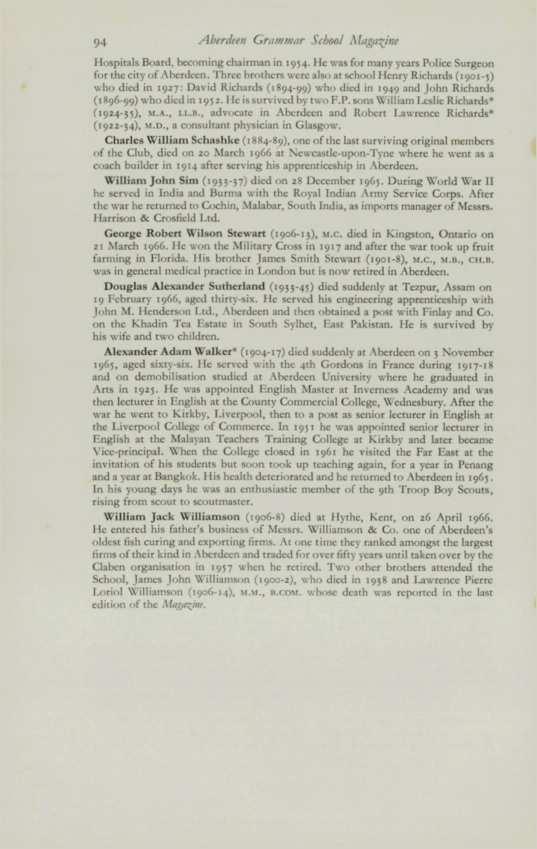
Aberdm1 Gr,111111111r School ,\l,1t,t1z.i11e
Hospitals Board. becoming chairman in 1954. llc \\3S for many years Police Surgeon for the ciry of,\hcrdccn. Three brothers \\ere also at school Ifenry Richards (1901-i) \\ho <lied in 1927: David Richu<ls (1894-99) who died in 19.19and John Rich:tr<l\ (1896-99)who died In 19)2. llc issurvived by two F.P. sons\\ 1lliamLnlic Richard,• (1924-31), \I.A., 1.1..R., advoc11c in Aberdeen and Robert Lawrence Richards• (1922-34), ,1.0., a con.,ulrant phrsician in Glasgow.
Charle s William Sehashke (1884-89), one of the last surviving original members of the Club, died on 2 .\forch 1966 at ~ewc:mle-upon-Tync where he went as a coach builder in 1914 after ser.ing his apprenticeship in .\bcrdcen.
Will iam John Sim (1933-n) died on 2ll December 196j. During World War II he ser.ed in India and Burma with the Royal Indian ,\rmy Service Corps. After the war he returned to Cochin, .\lalabar, South India, as imports manager of l\fessrs. I brrison & Cmsficld I.td.
George Rohen \l;ilson Srewan (1906-13), M.c. died in Kingston, Onrario on 21 \larch 1966. He won the \lilit:uy Cross rn 1917and after the war took up fruit forming in Florida. Ilis brother fames Smith Stewart (1901-8), M.C., ,r.u., r n.n. was in general medical practice in London but is now retired in Aberdeen.
Douglas Alexander Sutherland (1933-45) died suddenly at Tczpur, Assam on 19 Pcbmary 1966, aKc<l thirt} ""· He served his engineering apprencic~-ship with John \f. Hender~on I td., Aberdeen and then obtained a post with Finlay and Co. on the Khadin Tea ]•.state in South Sdhct, E-ist Pakistan He is surv ived b\' his wife and two children. • •
AJe,-ander Adam Walker• (1904-17) died suddenly at \berdccn on 3 '\:ovcmber 1961, aged sixty si.,. lfe served \\ith the 4th Cordons in France dunng 1917-18 and on demobilisation studied at .\bcrdeen University where he graduated in Ans in 1925. He was appointed English Master at lnvcrncss \cademy and was then lecturer in English at the County Commercial College, Wednesbury. After the war he went to kirkby, Liverpool, then to a post as senior lecturer in English at the I.l\·erpool College of Commerce. In 1951 he was appointed senior lccrurcr in English at the Malapn Teachers Training College at Kirkby and later became \'ice-principal. \\ hen the College dosed m 1961 he visited the Far East at the inviration of his students but soon took up teaching again, for a year in Penang and a year at Bangkok. His health deteriorated and he returned to Aberdeen in 1965. In his young days he \\as an enthusiastic member of the 9th Troop Boy Scouts, ris111g from scout to scoutmaster.
Willi am Jack William son (1906-8) died a1 llythc, Kent, on 26 April 1966. Ile entered his father's business of Messrs. Williamson & Co. one of Aberdeen's oldest fish curing and exporting firms. \cone time they ranked amongst the largest firms of their kind in \bcrdeen ,rnd traded for over fiftyyear~until taken over by the Clabcn organisation in 19n when he retircJ. Two other brothers attended the School, James John\'\ illiams11n(1900-2), \\ ho died in 1938 and Lawrence Pierre l.nriol \\ illiamson (1906-1;), "\I,, n.ro\J \\hose death was rcportnl in the last edition of the ,\faguz.ine.
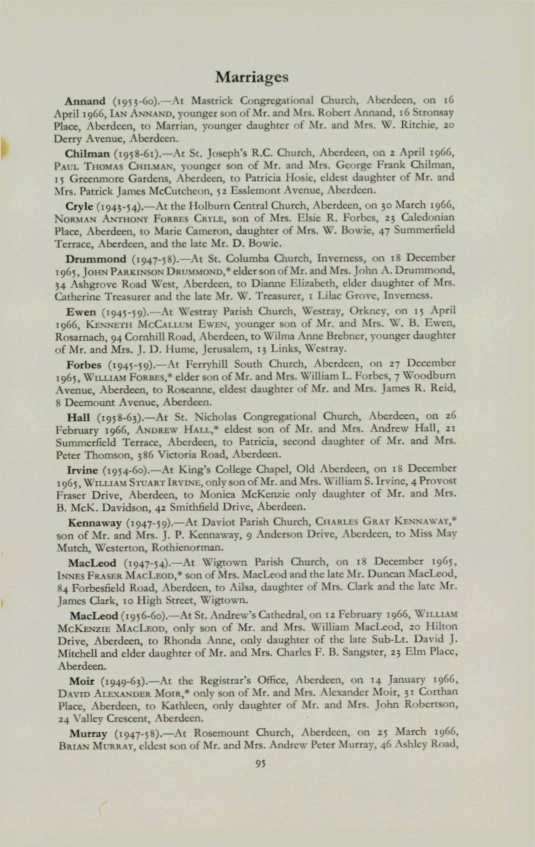
Annand (19B-6o). \t Mastrick Congreg;itional Church, \berdeen, on 16 April 1966,lA.'lJ\1'.'NAND,younger son ofI\lr. and \lrs. Robert .\.nnand, 16 Stronsay Place, Aberdeen, co Marrian, younger daughter of Mr. and Mr~. W. Ritchie, 20 Derry Avenue, Aberdeen.
Chilman (1958-61).-At St. Joseph's R.C. Church, Aberdeen, on 2 April 1966, PAt:LTHOMAS Cmu1AN, younger son of Mr. and Mrs. George Frank Chilman, 15 Greenmore Gardens, Aberdeen, to Patricia Ho~ic, eldest daughter of Mr. and Mrs. Patrick James McCutcheon, sz Esslemont Avenue, Aberdeen.
Cryle (1943-54).-At the I lolburn Central Church, Aberdeen, on 30 March 1966, NORMAN ANTHONY FORBES CRYLt;, son of Mrs. Elsie R. Forbes, 23 C'\lcdonian Place, Aberdeen, to Marie Cameron, daughter of Mrs. W. Bowie, 47 Summerfield Terrace, Aberdeen, and the late Mr. D. Bowie.
Drummond (1947-58).- \t St. Columba Church, Inverness, on 18 December 1965,JOHNPARKINSONDRu\lMO"ID,'elderson ofMr. and.Mrs. John .\. Drummond, H Ashgrove Road West, .\bcrdecn, to Dianne Elizabeth, elder daughte r of ;\[rs. Catherine Treasurer and the late ;\lr. \'(/_ Treasurer, 1 Lilac Grove, Inverness.
Ewen (1945-59). .\t Westray Parish Church, W'escray, Orkney, on 15 J\pril 1966, Kc..,-.,-.r;T11l\lcCAt LU~t Cwn-:, younger son of Mr. and \ lrs. \X' B. Cwen, Rosarnach, 94 Cornhill Road, Aberdeen, to Wilma Anne Brebner, younger daughter of i\Ir. and Mrs. J. D Ilume, Jerusalem, 13 Links, Westray.
Forbes (1945-59) -At FerryhiU South Church, Aberdeen, on 27 December 1965,WtLLIA!>fFORBES,*elder son of ~[r. and Mrs. William L. Forbes, 7 Woodburn ,\venue, Aberdeen, to Roseanne, eldest daughter of Mr. and Mrs. James R. Reid, 8 Deemount Avenue, Aberdeen.
Hall (1958-63).-At St. Nicholas Congregational Church, \berdeen, on 26 February 1966, A.'IDRllW HALL,A eldest son of Mr. and Mrs. Andrew Hall, 21 Summerfield Terrace, Aberdeen, to Patricia, second daughter of :\fr. and \[rs. Peter Thomson, 386 Victoria Road, Aberdeen.
Irvine (1954-6o).-A t King's College Chapel, Old Aberdeen, on 18 December 196s, WtLLtA\ISTUARTlRVIM.,only son of~1r. and Mrs. \X'illiamS. lrvinc, 4Provost Fraser Drive, Aberdeen, to Monica McKenzie only daughter of :-1r. and Mrs. B. McK. Davidson, 42 Smithfield Drive, Aberdeen.
Kennaway (1947-59).- At Daviot Parish Church, C11ARUs GRAY KENl'AWAY,* son of Mr. and .l\1rs. J. P. Kcnnaway, 9 Anderson Drive, Aberdeen, to ::\1iss l\hy \futch, \X'estenon, Rothienorman.
MaeLeod (1947-54).- At \\ligtown Parish Church, on 18 December 196s, INNESFRASERI\iACLF.OD,*son of\ frs. ::\lacLeodand the lace\lr. Duncan MacLeod, 84 Forbesfield Road, .\berdeen, to Ailsa, daughter of Mrs. Clark and the late .\fr. James Clark, 10 High Street, Wigtown.
MacLeod (1956-6o).- At St. \ndrew's Cathedral, on t2 February 1966, \X'11.LtA\I McKENzIB \IAcLEOD, only son of Mr. and Mrs. William l\facLeocl, 20 llilton Drive, Aberdeen, to Rhonda Anne, only daughter of the late Sub-Lt. David J. Mitchell and elder <laughter of Mr. and Mrs Charles P. B. Sangster, 23 Elm Place, Aberdeen.
Moir (1949-63).- At the Registrar's Office, Aberdeen, on 14 January 1966, DAVIDAu•.XA1'.DLR \forR,* only son of ~fr. and :\irs. \lexandcr .\1oir, 31 Corthan Place, Aberdeen, to Kathleen, only daughter of \fr. and Mrs. John Robenson, 24 \'alley Crescent, \berdeen.
Murray (1947-sS).- At Rosemount Church, Aberdeen, 011 25 March 1966, BRIANMt•RRAY,eldest son of Mr. and Mrs. Andrc,v Peter \lurray, 46 \shley Road, 95
lbtrdm1 Grt1111111ar 'frbool Ma,f!.azi11e
Aberdeen, to l:lsie \VJ., only daughter of.\fr. and ;',frs.Harold Urquhart, uo Wallace Crescent, Turnff.
Mulvey (1945-59). -At Dublin, on 28 January 1966, CHARLES .Mn.VEY, ,t.A., eldest son of .Mr. and Mr11. C. Mulver, 51 \\ oodcnd Place, Aberdeen, to Gerarda \'ermeulen, second daughter of Mr. and '\frs. A. \'ermeulen, Amsterdam and Dublin.
Nicol (1939-52). \t King's College Chapel, Aberdeen, on r6 April 1966, ANDRLwG1tAEMENicor., elder son of the late Mr. Andrew Nicol and of Mrs. R. E. Nicol, 50 \Y/hitehallRoad, Aberdeen, to Christine Fotheringham, cider daughter of 1'-fr.and Mrs. Robert Walker, 152 Watson Stn.-et,Motherwe ll.
N orrie (194(,-p).-.\t All Sainrs' Church, Cholo, ;\falawi, younger son of the late l\fr. .'\. E. Julius Norrie and ofMN. A.Norrie, 5Caimview Crescent, ,\berdeen, presently in Hong-Kong, to Britta Gunvor, only daughter of l\fr. and Mrs. _]. R. Sahlin Molndal, Sweden. \ddress Box 2 Cholo Malawi.
Primrose (1946-p).- At Chelsea Old Church, London, on 31 March r966, ROBERTC11AL\1ERSPRt\lROSf,only son of '\fr. and Mrs. R. R. Primrose, Newhill~. Bucksburn, to June Kathleen, only daughter of .Mr. B. and the late Mn. Wilson, Southampton.
Rassmuss en (1958-59). -At Rutherford Church, Aberdeen, on 25 December 1965,ERICRASSMUSSEN,son of./lfr.and Mrs. Joseph T. Rassmussen, 7r Gray Street, Aberdeen, to Mary Smart, daughter of the late Mr./\. Dalgity and of Mrs. Elizabeth Dalgiry, 130 Provost Rust Drive, Aberdeen.
Ritchie (1947-61).- \t Ruthricscon South Church, \berdeen, on 2 ,\pril 1966, Cr.r,·EFRASfRRncuu, only son of Mr. and Mrs. James F. Ritchie, 82 Angusfield Avenue, \bcrdeen, to Sandra Eleanor, only daughter of Mr. and Mrs. Alexander S. Forbes, 44 Garthdee Crescent, Aberdeen.
Robertson (1945-p). -\t Mayfield and Pountainhall Church, Edinburgh, on 18 May 1966, Jlt·c11DosATD RoBERTsos; son of Mr. and Mrs. Hugh Robertson, 82 Rosemoum Place, Aberdeen, to Kathk-en Cowen, <laughter of l\fr. and Mrs. William J. Gray, 17 Redford Drive, Colinton, Edinburgh, ,3. Stevenson (1953-57). i\t St. Nicholas Church, Union Grove, Aberdeen, on 29 October 1965, P1cn.R./lf1rc11FLLSTFVF.NSON,only son of~fr. and Mrs. Stevenson, 11 Seamount Road, \berdccn, to Kathleen Margaret, only daughter of~[r. and MM. C. A. .McDonald, 36 \shlcy Road, Aberdeen.
Stewan (1944-55). On 1 \pril, 1966, Douet.AS I.1·N.\NSrrwART, elder son of Mr. and ~frs. J D. Stewart, 9 King's Cross Road, Aberdeen, to Lesley Jane, only daughter of '.lr. and ;\frs. Lewis Watt, 105 Sunnysidc Road, Aberdeen.
Wilson (1938-48). \t Fetteresso Parish Church, Smnchaven, on 23 February 1966,GRAL\11 Jo" Wu ,,)s, • cider son of \1r~. L. _]. \\ 1lsonand the btc \lr. G. G. \\'.'ilson, 37 \ndcrson Drive, \berdeen, m Kmhleen, cider daughter of \lr. & Mrs. ITugh Ramsay, 18 Market Square, Sronchavcn.
Prefects
ST!'AR T C. G wvc1 l (Smior Prtftcl)
KL'INITII A. HAY (Dtp11ty 'i'mior Pnfut)
D E.'-'lslS G. C. Asm RSON D E.'INIS W. Ixi.:so'I ALAN C. Mo1R
SrnWARr G. D ORWARD BRucc A. K11:1. LLSLIEA. MORR IM>N Jo11N H. Ducmo RooERICK W. 11. TERENCE D R RYAN PETEil ), FRASER McGREGOR .\LAN S1MPSO'I A LISTAIR G. GR.ACII! ALEXA..'IOER M cNAY Jmrn !3. SMITH I AN GRAY J011N S. MAcPm~ IAIN I. Wor.s TEN110 1.,m
w. G ORDON IILNDRY D AVID L. M ANN CoLIN J. YouNGSON
J o 11"1 R lNc1.1s

Eo,1UN0 J. M AY D FN1s N. Yn" R11~S~..LL:M 11.NL
Byron D ENS!$ \YI. INKSO'I
Keith I AN GRAY
Copla1i1 ALISTAIR G. GRAcrr
Coptai11 KENNETHA. H AY
House Captain s
Dun STUART c. GIOYFR
Melvin KEl',"NETHA. TIAY
Rugby
Virt-Captai11 STUART C. GLO\'f'R H ockey
Vict.Cop tai11 Gr:ORGll L. McCRAW Swimming
Caplom IAI N I WOLSTEN IIOLMll Viu-Coplom W ILLIAM SCOTT
Cricket
Caplai11 D F'INIS \YI. l NK<;()N Viu-Cpala1i1 KF'<'-"FTII A. IIAY
Athl etics
Caplom DE 'I'll> \\. TNICS()N T"iu-Caploin KE,..,.,"FTII •\, HAY
Tennis
C,1ploi11 \'i. G\\"IN GRAY I?1u-Coplai11 GoRDOS \, CIIRl~Tll
Literary and Debating Society
Pruidml ALA'< C. Morn
Suntary ALM M. Cowir
Pruidm t ALAN M. Cow1r
Sttrt lary Al.AN C. MOIR
Vice-Pruidml D Avm TAYLOR
Trta111rtr IAN TELITR
Dramatic Society
Vice-Pruidmt KENNTTll A. IIAY Trta111rer DENI~ N. YuLF
Cadet Force
C.S.M . Jo1rn S. MAcPnrn W.O.
Edito rs of the School Section
jOllN H GARVIE l AN TELn::R
KF.NNFTII A. I IA\ DJ::.N1sN Yuu-
H llat C sharp natural ...
\\c arc proud to announce, that, unlike Rhodesian new,papcrs, this magazine has not been c•ns •r•d.
For all jet-set, in-set and even off-set people, here is a news flash: next session the Jannie's Box is to reopen as "Mack,e's .Mod Boutique", wich, we suggest, stunning effecton theappearance ofthe staff.(\\'ho invcntcd the Pin-stripe, anyway?) The jannies themselves will surpass the grc.,ser outfits of British Rail b>· adopting /lower patterned hipsters and up-art T-shirts. Masters' gowns will be worn eight inchesabove the kneeand the mod. handbag willsupersede the briefcase.\'('ho knows, if members of staff start coming to School by scooter, the sixth year might cHn find space co park theit cars in the pla>ground.
.\mong the exhibits in the new corridcr under the \rt Department arc several curious glass cao;cs, purpose unknown. 1lowever, judging by the contents of similar cases in the area, we are willing to bet they will end up holding stuffed birds of one sort or another.
"l say, Tsay, Isay, what sings and can't walk in a straight line?" "Gee!"
fly-tying, once the bane of kindergarten mistresses' ltvcs, has now become the province of Mr. Stewart's Angling Club. Often we've seen them having a whale of a time on the front lawns, casting flies into imaginary trout streams. knowing our plaice, we don't want to carp, but the only things we think they're likely to catch are hadd,cs off passing fish lorries. One member did claim to have seen a barracuda, swimming in the ornamental pond that'll teach him to swim in the ornamental pond.
.\ cold-bloodcJ attitude towards pupils has developed during the summer term. There 1s a car in the playground with a window-sticker proclaiming 'T\'C got a hunting licence!" and there were rumours during chc session concerning Mr. Patterson's starting-pistol. \\'e were disappointed to hear, however, that chose \\ho fell in the obstacle race in this year's Sports were not destroyed.
As soon as spring had sprung (Mr. \Villiams)1 was out gathering daffodils to be dissected for scicmifie purposes. \\,ill 1t he the Daisy's turn next?
And now a conducted tour of the new Jibrary. One most unusual fearurc 1s that it contains books about 17,000 of them, in fact. Said a spokesman, "\\'ell, it seemed a good idea at the time". But chc weightier tomes do come in useful for propping up those eccentric tables on the balconies, thereby keeping upper six Iliston 's roulette wheel "on the lc\'cl''. The two balconies of cour<e arc reser\'ed for uprcr VI to "study" in while lower \'I are confined to the ground floor a "class" distincti on, you might say. 'fhe colour scheme of chc library is discreetly harmonious -black, yellow, lime, grey, purple, red and three shades of blue. Walking across the library these days can be quite an experience \\ 1ththe floor in its prc,ent condition, no wnnder \fiss Boyd keep~humming" \ l.ifc on the Ocean Wave" Cnle,s matters improve drastically, she may rhrcaten to dispense seasickness pill, instL-adof sweets at interval.
~fr. Tait has as usual been kept waiting till the last possible moment for these rand<Jmnotes. However, when they eventually appeared, the relief wasso great chat he pulled his car, whereupon his face flushed.
Apres nous le deluge.
Arrivals . ..

Three additions to the permanent stafffallto he recorded. Mr Richard Gallow ay, B.MUS., P.R.c.o., appointed to the Music Department to fill the vacancy created by l\lr Hunter's departure, took up duty in January of this year. He comes to the School well qualified by natural talent, training and experience. EduClted at Kirkcaldy High School and Edinburgh University, he has the distinction of being awarded the Harding Pri1e at his F.R.C.O. examination and of holding the James Smart Memorial Organ Scholarship at Edinburgh University for 1961-63; for two years he was assistant music master at Brechin JIigh SchonI and organist and choirm.'lSter at Brechin Cathedral; and now his easy, happy temperament has already made a pleasing impression in staffroom and classroom. KirkClldy, Edinburgh and Aberdeen .Mr. Galloway it would appear 1s much attached ro the Scottish east-coast, whose winds, sea-fogs and brittle sunlight reputedly breed a rather sharp-nosed acerbity. We sense in him the opposite, warmth and cheerfulness, qualities that we hope will long continue to mellow our Aberdeen granite.
Mr. Murray McAIJan, M.A. Clime to the English Department in March. Mr. McAllan is an Aberdonian who oscillates between his birthplace and more southerly parts of Scodand. His secondary schooling was at Penh ACldcmy, his university was Aberdeen, where he graduated with Honours in English. ,\fter the year's professional training course at Aberdeen College of Education, he went south to Dollar Academy, where he taught successfully for three years and now is back for what we hope will be a prolonged stay. Interested in many sports and in drnma and debate he will be welcome in many fields by many people, and by none more, perhaps, than the School's Debating Society.
Mr. Ian C. Spen ce sub tantially fills the place in the Physical Education Department that \fr. ~fort1mcr held. llis schooling was at "the other pbce", since when he has been around and accomplished much, finitat Jordanhill College ofEducation, afterwards in the R.A.r., where out offive years' service he spent four as parachute jumping instructo r, and finally back in Aberdeen where, before coming to the Grammar School, he spent six teaching years. Impressive in figure and style .Mr. Spence 1s equally impressive in achievement. Between the years 1950 and 1956 he swam for Scotland, and in 1954 was one of the Great Britain team at the European Championships. In rugby-he plays or has played for Gordonians and Barbarianshis powerful skill has also been recognised, and honoured, for he was a final trialist for his country in 1962and 1963.Well-being and cheerfulness is written into Mr. Spence's frame, and wehope that he likes usas we have already come to like him. . . . and
In this section there is more to report, regrettably much more. Little need for poliricians and sociologists to preach co Grammar School masters the virtue of mobility in twentieth-century Britain; close on a d02en will soon be packing their bags and leaving for other niches or for superior ledges, there to poise again for further nights. We thank them for services well rendered and wish them well in their new places, and then turn to lick our wounds and ruminate a little ruefully on the emptiness of the immediate furore. \nd bcCluse the list is so long we shall have to be briefer in our record than we would sometimes wish.
Mr. Andrew L. Steven son has been appointed Lecturer in Physical Education at ,\berdcen College of Education. When he joined the Grammar staff nine years ago no mention of the fact appeared in the Mngaz/tu--a peculiarly ironicil omission when we consider how trenchantly he has since written his signature into the School records. That omission must now be remedied.
Educated at Spiers School in Beith, Ayrshire, l\,fr Stevenson went on to the Scottish School of Physical Education and from there to national service in the
R \.f'. Tu these qualifications he added hy external study the Diploma in Public .\dnunist ration of Glasgow University and the LL.B. with Honours of London lJnivcrsity . In addition he taught in .\yrshirc, then at St. Dement Danc's Gramma r School in London, and in GL1sgow \cademy before being promoted to his present post in the Grammar School. Such a record of application and of varied experience is further evidence, did we require it, that Mr. Stevenson is a man of energy and resolution and has a well-stocked mind and a discip]jned will. We know too how good an organiser he is, how everything at the School annual sports meeting "as at its proper time in irs proper place, and how intensely concerned he is that what he feels to be rhc true spirit and tradition of the School should not suffer any decline. Particularly in rugby rhc School's successes must be largely credited m his insistence on training and teamsmanship and the development of the will-to-win. The new pond, long asked for and now much appreciated, has brought further calls on the patience and organising talent of the P.E. staff; and now swimming is an important part of the School's life, bringing with it much pleasure as well as a ,pate of proficiency certific:itcs 10 the many keen hoys. All will recognise Mr. Stevenson's unsparing services and wish him well in hjs ncu·, important sphere of work.
Mr.John Lockie, will teach in Gordon's College after the summer vacation, and that "other place" will be the richer for his acquisition. Jn the Grammar School he has had experience in the teaching of physics and chemistry, and since the splitting of Science teaching into departments he has been able to make the fullest use of his degree in botany in teaching biology with Mr Williams. Jn his new post he will have similar opportunity and will, we know, continue the effective teaching which has so marked his service here. .Mr. Lockie touched on many sides of school life, on rhe games field, on the badminton court and in the master's soccer team. Particularly we shall remember his quiet, unforced manner of speech, and his easytempered accc:.sibilicy,the outward evidence ofa deep, natural courresy. These, we should say, are the signs of a good master.
Mr. R. H. G Anderson after four years as an assistant master in the Chemistry Department has accepted an appointment to Grantown Grammar School as a Special .'\ssistanc. !'.fr. Anderson came to the School ,·cry opportunely, for as a young scientist with some experience in industry as wclJas in teaching he was nicely qualifiedto get the new Chemistry curriculum off to a good start, and his knowkdgc ,111d fluency in exposition helped to make the subject attractive co many boys. lie will be missed in the staffroom t0<,, where his elaborate tales and easy laughter brought relaxation into the air. In his new placehe will find good fishing and skiing and opportunity for philosophic discou rse, and we arc sure he will be happy.
Mr. Peter Keith has elected to return to Sum111crhillSchool from which he came to the Grammar justa yearago. \'.:'earc snrry to lose him; for this kindly and obliging teacher has in the short time made himself popular with bt>}• and staff, and has passed on to many lus strong intcre~t in metal work and some of his own great skill. .And we hope he wilJ come and , ,sit us.
The ,\Iodcrn Language Department ,11 rhc moment of\\ rmng stands in depleted disarray, with rhrce of its members leaving. Mr. F. Macklin is going overseas. ,\fter sixand a half years in the Gramn·,:,rSchool he hasaccepted an appointment for three years to teach French, Spanish and Russian inthe Queen's Schcxll,Rheindahlen, m Germany. lbc headquarters of 8 •\.0.R. is in Rheindahlcn, so in going there \ lr. \lacklin u·ill ha,·e the admntai,:c of meeting and talking u·irh people of many tongues and yet of being in touch with a large British community. :.rr. \facklin looks and is a harpy man; his smile .1rd contours should help 10 disabuse the Continent of the idea that the Scots are a nation of knobbly-kneed kilt wearers or of long-nosed caming Calvinists. He should make a good ambassador.
Mr D lvor Sutherl and also goes over the seas though not so far. After four years here, in his first teaching appointment, he \\ ill after the summer holidays, be
taking up the appointment of Lccrurer in Education at Stranmillis College, Belfast. He will be missed on many counts for he has concerned himself with a number of the School's activities; in particular the R.A.F. section ofthe C.C.F., the Motor Oub and the hockey teams ofthe school" ill regret the lack of his help and guidance. lie \\'ill be missed also for his knowledge and teaching ability, qualities which have helped him to cam this early promotmn.
Mr. Michael Slater, after a year's service here has taken a post in Aberdeen Academy as Assistant in German, the language in which he is particularly qualified and interested . But the Academy is not all that far away, and we look forward to seeing Mr. Slater again in the staffroom and at social gatherings both in and outside School.
Mr. Daniel J. Ryan joined the Lnglish staff in October 1961, already a \\'ell qualified and tested teacher. 1':ow after four years of most valued service, he ha~ accepted the highly desirable post of Senior Lecturer in Education in Avery Ifill College ofEducation in London. Avery Ilill has made a sound choice, and we must congratulate it on its judgment as we congratulate \[r. Ryan on his election; though we may be allowed more than a twinge ofregret that another good man is lost to us, drawn to the great, deep South. Jn the library, at the Debating Society meetings, in the classroom and elsewhere it was apleasure to converse with him and appreciate his balanced judgment and tolerant humour. He will be much mi;scd by staffand pupils alike, and mosr affection.-itclyremembered by the Cnglish department in particubr.
M.r. James Hood, our youngcsr member of staff has made a short stay with us. Ilehaslong feltattracted to journ.-ilismasa profession, and now after ayear's teachmg has decided that writing is nearer to his heart's desire than teaching others to wme. He will shortly be going to the firm of D. C. Thomson of Dundee for training. We look forward to seeing him in print as we shall always be glad to see him in his own person.
\Xlith Mr Ronald Watson it's a case of hail and farewell. He was appointed to the School in January of this year and now leaves to lecture in Arts and Crafts in the new College of Education in Hamilton. A pity he couldn't stay longer, he has so much to commend him. He is a former pupil of the School (1949-55)used to its ways; he has taught in and out of Aberdeen, including a period of part-time work at Cray's School of Art and three years (1961-65) at Hilton Secondary School; and he has shown his talent as a painter 111 many exhibited works. But obviously he is wise to take opportuniry when it offers, and in this new work in a new college he should have scope for his energy and rc.-ilability.
As we go to press we learn that MI. Fordyce has been appointed Principal Science master in Albyn School for Girls. And so, wryly, we have to admit that a kind of even-handed justice has been dispensed, for the Physics Department of the School joins the Chemistry and Biology Departments in losing a master. The lucky ones arc the girls of Albyn, for ,\[r. Fordyce in his two years' stay here has Jmply shown that he knows his subject, instructs his pupils, and communicates to many of them his own high sense of its worth. Queen's Road is not, geographically speaking, far off, and so we hope still to sec Mr. Fordyce frequently on social and educational occasions.
To them all the School would offer its best wishes
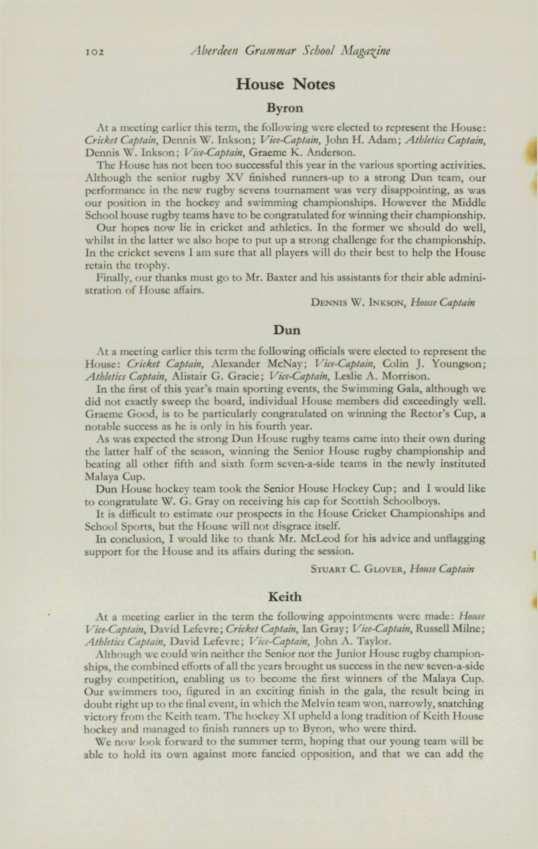
,\t .i mc~ttng c.trl1,r 1h1sterm, the followmg were elected to represent the IIouse: Crid:tt Captain, Dennis\'\'. lnkson; Vi.e-Captain, John II. Adam; Atbletm Captain, Dennis \V. lnksnn; Lice-Captain, Graeme 1-- >.ndce1;0n.
The Ilouse has nnt been too successful this year in the ,·arinus sporting activities. ,\lthough the senior rugby X\ finished runners-up to a strong Dun team, our performance in the new rugby sevens tournament was very disappointing, as was our position m the hockey and swimming championships. However the Middle School house rugby teams have to be congratulated for winning their championship. Our hopes now lie in cricket and athletics. Jn the former we should do well, whilst in the latter we also hope to put up a strong challenge for the championship In the cricket sevens I am sure that all players will <lo their best to help the I fousc retain the trophy.
Finally, our thanks must go co Mr. Baxter and his assistants for their ahlc administration of ! louse affairs.
,\ta meeting earlier this term the following oflicials were elected to represent the Hou,c: Cri&ktl Captam, \ lcxan<lcr .Mc!'>:ay; L'ire-Captam, Colin J. Youngson; Atblttiu Captain, Alistair G. Gracie; Vice-Captain, Leslie A. Morrison.
In the first of this year's main sporting events, the Swimmmg Gala, although we did not exaetly sweep the board, individual Ifou.se members did excccdmglr u·ell. Graeme Good, is to he p;1r1icularlycongratulated on winning the Rector's Cup, a notahlc success as he "11nly in his fourth year.
,\s was expected the strong Dun House rugby teams c.ime into their own during the l,1tterhalf of the season, winning the Senior House rugby championship and hcatmg all other fifth and si,ah form seven-a-side teams in the newly instituted ~1alayu Cup.
Dun Ifouse hockey team took the Senior House Hockey Cup; and I would like to congratulate W. G. Gray on receiving his cap for Scottish Schoolboys.
Lt is difficult 10 estimate our prospects in the House Cricket Championships and School Sports, but the ITousewill not disgrace itself.
In conclusion, I would like to thank ,\lr. ,\lcLcod fur his advice and untlagging support for the House and JtS affairs during the SCSSlon.
STUART C. GwvLR, llatm Captain
,\ta mcetmg earlier 111 the term the following appo1mmems were made: House L·",.Captai11,Dn·id Lefevre; Cri,ktt Captain, Ian Gray; Vice-Captain,Russell Milne; .;Jtblrt"s C,ptm,,, David Lefevre; f "icc-Captai11,John .\. Taylor.
Although we could win neither the Senior nor the Junior! louse rugby championships, the combined efforts ofall the years brought us success in the new seven-a-side rugby competition, enabling us t1J become the first wmners of the Malaya Cup. Our swimmers too, ligurcd in an c~ciring finish in the gala, the result being in doubt right up to the finalevent, in which the Melvin team won, narrowly, snatching victory from the Keith team. The hockey XI upheld a long tr.idition of 1'.cithIlouse hockey and managed to finish runners up to Byron, who were third.
\'fc now ],)f,k forward to the summer rerm, hoping that our young team~\ ill be able tu hold its own ag.1inst more fancied opposition, and that we can add the
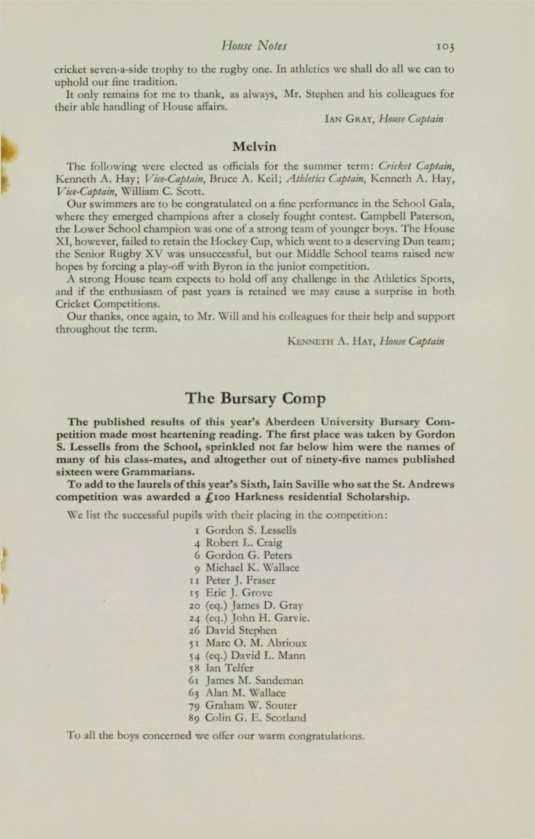
cricket seven-a-side trophy to the rugby one. In athletics we shall do all we can to uphold our fine tradition.
It only remains for me to thank, as ah\ ,\ys, .\fr. Stephen and his colleagues for their able handling of llouse affairs.
IAN GRAY, Ho1m Cnplaill
The following were elected as officials for the summer term: Crlfkrl Captain, henneth A. Hay; Vice-Caplom, Bruce A. Keil; AthltlicrCaplain, henneth A. Hay, Viu-Coptam, \\illiam C. Scott.
Our swimmers arc tu be congratulated on a fine performance in the School Gala, where they emerged champions after a closely fought contest. Campbell Paterson, the Lower !x:hool champion was one of a strong tcam of younger boys. The Ifouse :XI,however, failed to retain the Hockey Cup, which went ena deserving Dun team; the Senior Rugby X\' was un~ucccssful, but our Middle School teams raised new hopes by forcing a play-off with Byron in the junior competition .\ strong House team expects to hold off an>·challenge in the Athletics !:>ports, and if the enthusiasm of past years is retained we may cause a surprise in both Cricket Competitions.
Our thanks, once again, to Mr. \viii and hb colleagues for their help and support throughout the term.
KL'-'-LTll \. HAY, llo,ue Coploi11
The published results of this year's Aberd een University Bursary Competiti on made most heanening reading The first place was taken by Gordon S. Lessells from the School, sprinkled not far below him were the names of many of his class-mates, and altogether out of ninety-five names published sixteen were Grammarians.
To add to the laurel s ofthis year's Sixth, Iain Saville who sat the St. Andrews competiti on was awarded a £100 Harkness residential Schola rship \\e list the successful pupils with their pbcmg in the compctmon:
1 Gordon S Lessells
4 Robert L. Craig
6 Gordon G. Peters
9 ~iichael .1-... \\ allace
11 Peter J. Fraser
15 Eric J. Grove
20 (eq,) James D. Gray
24 (cq.} John H. Ganie
26 David Stephen
51 ~fare 0. ,\f. \brioux
54 (cq.) David L. \Jann
58 Ian Telfer
61 James 1\1. Sandeman
63 \Ian M. \\allacc
79 Graham \X'. Souter
89 Colm G. I. Scotland
To all the boys concerned we offer our warm congratulations.
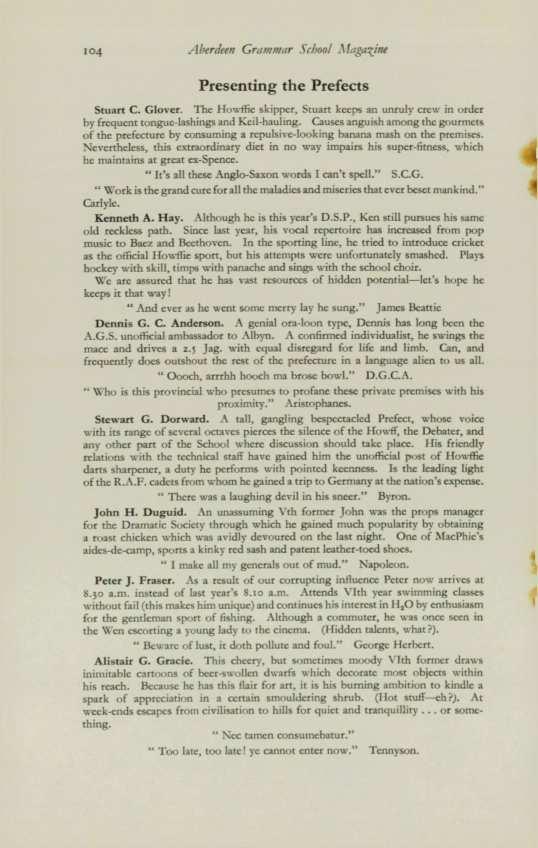
Stuan C. Glover. The IIO\dlie skipper, Sruan keeps an unruly crew in order by frequent tongue-lashings and Keil-hauling. Cau~csanguish among the gourmets of the prefecture by consuming a repulsive-looking banana mash on the premises. Nevertheless, this extraordinary diet in no way impairs his super-fitness, which he maintains at great ex-Spence.
"It's all these Anglo-Saxon words I can't spell." S.C.G.
" Work is the grand cure for all the maladiesand miseriesthat ever beset mankind." Carlyle.
Kenneth A. Hay. Although he is this year's D.S.P., Ken still pursues his same old reckless path. Since last year, his vocal repettoire has increased from pop music to Baez and Beethoven. In the spotting line, he tried to int.roduc.ecricket as the official Howffie sport, but his attempts were unfortunately smashed. Plays hockey with skill, timps with panache and sings with the school choir.
We arc assured chat he has vast resources of hidden potential-let's hope he keeps it that way l
"And ever as he went some merry lay he sung." James Beattie
Denni s G. C. Anderson. .\ genial ora-loon type, Dennis has long been the A.G.S. unofficial ambassador to Albyn. A confirmed individualist, he swings the mace and drives a 2.5 Jag. with equal disregard for life and limb. Can, and frequently does outshout the rest of the prefecrure in a language alien to us all.
"Oooch, arrrhh hooch ma brose bou·I."
D.G.C.A.
" Who is this provincial who presumes to profane these private premises with his proximiry." Aristophanes.
Stewan G. Dorward. A tall, gangling bespectacled Prefect, whose voice with its range of several octaves pierces the silence of the Howff, the Debater, and any other part of the School where discussion should take place. His friendly relations with the technical staff have gained him the unofficial post of Howffie darts sharpener, a duty he performs with pointed keenness. Is the leading light ofthe R.A.F. cadets from whom hegained a trip to Germany at the nation's expense.
" There was a laughing devil in his sneer." Byron.
John H. Duguid. An unassuming Vth former John ,vas the props manager for the Dramatic Society through which he gained much popularity by obtaining a roast chicken which was avidly devoured on the last night. One of MacPhie's aides-de-camp, sports a kinky red sash and patent leather-toed shoes.
" I make all my generals out of mud." Napoleon.
Peter J. Fraser. As a result of our corrupting influcnc.e Peter now arrives at 8.30 a.m. instead of last year's 8.10 a.m. Attends Vlth year swimming classes without fail{this makes him unique) and continues hisinterest in H,O by enthusiasm for the gcncleman sport of fishing Although a commuter, he was once seen in the Wen escorting a young lady to the cinema. (Hidden calcnts, what)).
" Beware of lust, it doth pollute and foul." George Herbert
Alistair G. Gracie. This cheery, but sometimes moody Vlth former dra\\s inimitable cartoons of beer-swollen dwarfs which decorate most objects ,vithin his reach. Because he has this flair for art, it is his burning ambition to kindle a spark of appreciation in a certain smouldering shrub. (Hot stuff-eh?). At week-ends escapes from civili-.ation co hills for quiet and tranquillity ... or something.
" "-:cctamen consumebacu.r.n "Too late, too late! ye cannot enter now." Tennyson.
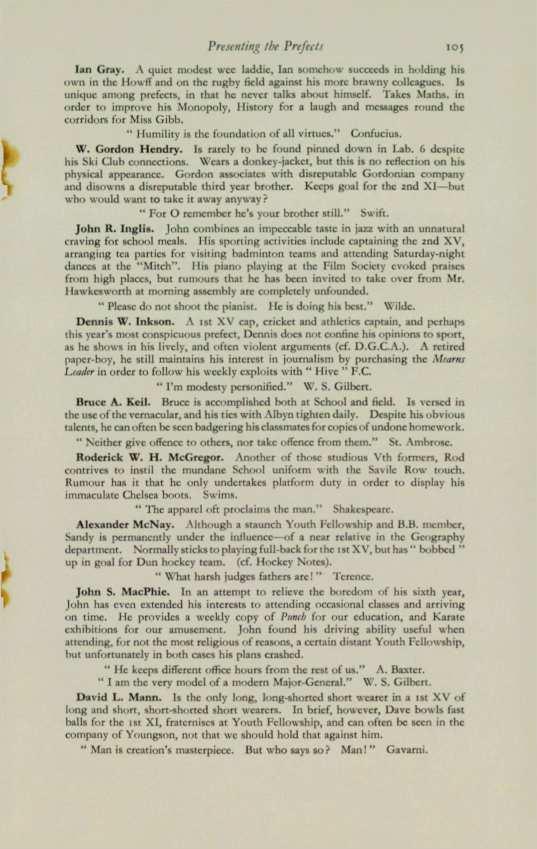
Ian Gray. ,\ quiet modest wee laddie, Ian somehow succeeds in holdu1g his own in the Ho\\ ff and on che rugby field against his more brawn y colleagues. Is unique among prefects, in that he never talks about himself. Takes Maths. in order to improve his ;l.lonopoly, History for a laugh and messages round the corridors for Miss Gibb.
" J[umility is the foundation of all vittucs." Confucius.
W Gordon Hendry Is rarely to be found pinned down in Lab. 6 despite his Ski Club connections. Wears a donkey-jacket, but this is no reflection on hi~ physical appearance. Gordon associates with disreputable Gordonian company and disowns a disreputable third year brother. Keeps goal for the 2nd Xl-but who would \\ant to take it away anyway?
" For O remember he's your brother still." Swift.
John R. Inglis. John combines an impeccable taste in ja7.Z with an unnatural craving for school meals. Tlis sporcing activities include captaining the 2nd XV, arranging tea parties for visiting badminton teams and attending Saturday-night dances at the "Mitch". His piano playing at the film Society e,·oked praises from high places, but rumour~ that he has been invited co take o,er from Mr. 1lawkesworch at morning assembly are completely unfounded.
"Please do not shoot the pianist. He is doing his best." \'filde.
Dennis W lnkson. ,\ 1st XV cap, cricket and athletics captain, and perhaps 1h1syear's most conspicuous prefect, Dennts does not confine his opinions to sport, as he shows in his lively, and often violent arguments (cf. D.G.C.A.). A retired paper-boy, he still maintains his interest in journalism by purchasing the Mear,u Leaderin order to follow his weekly exploits with " Hive" F.C.
"I'm modesty personified." W. S. Gilbert.
Bruce A. Keil. Bruce is accomplished borh at School and field. Is ,·ersed m the useofthe vernacular, and his ties wirh Albyn tighten daily. Despite his obvious talents, hecanoften beseen badgering hisclassmatesfor copies ofundone homework.
"r-.either give offence to others, nor take offence from them." St. Ambrose.
Roderick W. H. McGregor. \nother of those sn,dious Vth formers, Rod contrives to instil the mundane School uniform with the Savile Row couch. Rumour has it that he only undertakes platform duty in order co display his immaculate Chelsea boots. Swims.
"The apparel nft proclaims the man." Shakespeare. Alexander McNay. \hhnugh a staunch Youth Fellowshi(>and B.B. member, Y.tndy is permanently under the influence-of a near relative m the Geography department. Normally sticks to playing full-back for the 1stXV, buthas" bobbed " up in goal for Dun hockey team. (cf. Hockey Notes).
" What harsh judges fathers arc!" Terence.
John S. MacPhie. In an attempt to relieve the boredom of his sixth year, John has even extended his interests to attending occasional classes and arriving on time. Jle provides a weekly copy of Pu11th for our education, and Karate exhibitions for our amusement. John found his driving ability useful when altendmg, for not the most religious of reasons, a cettain distant Youth Fellowship, hut unfortunately in both cases his plans crashed.
"He keeps different officehours from rhc rest of us." 1\. Baxter.
" I am the very model of a modern Major-General." W. S. Gilbert.
David L. Mann. ls the only long, long-shorted short wearer in a 1st XV of long and short, short-shorted short wearers. In brief, however, Dave bowIs fast balls for the 1st XI, fraternises at Youth Fellowship, and can often be seen in the company of Youngson, not that we should hold that against him.
" Man is creation's masterpiece. But who says so? Man1" Gavarni.
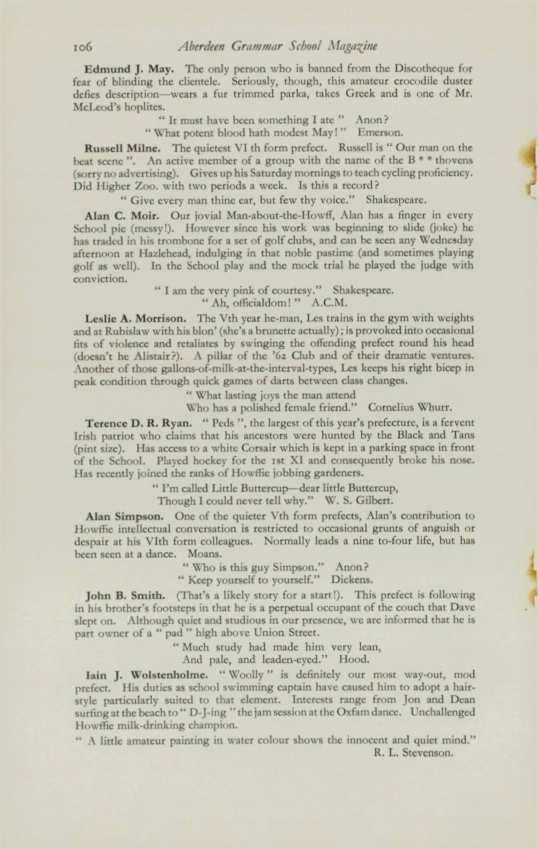
Aberdetn Grammar School .\fngazi11e
Edmund J. May. The only person who is banned from the DiscOLhequefor fear of blinding the clicntcle. Seriously, though, this amateur crocodile duster defies description-wea rs a fur trimmed parka, takes Greek and is one of l\lr. McLeod's hoplites.
" It must ha"e been something l ate " ,\nrm? "\\'hat potent blood hath modest May!" I.merson. Russell Milne. The quietest \'Ith form prefect. Russell is" Our man on the beat scene". \n active member of a group with the name of the B • + chovens (sorry no ad\'Crtising). Gives uphis Saturday mornings to teach cycling proficiency. Did Higher Zoo. •a:ichtwo periods a week. ls this a record?
" Give every man thine car, but few thy voice." Shakespeare. Alan C. Moir. Our jovial Man-about-the- IIowff, Alan has a finger in every School pie (messy!). Ifo.,.-e..,crsince his work was beginning to slide (joke) he has traded in his trombone for a set of golf duh•, and C.'ln be seen any \'(edne~day afternoon at Ilazlehead, indulging in that noble pastime (and sometimes playing golf as well). In the School play and the mock trial he played the judge with conviction.
" I am the very pink of courtesy." Shakespeare. "Ah, oflicialdoml" .A.C.M.
Leslie A. Morrison. The Vth year he-man, Les trains in the gym with weights and at Rubislaw with his blon' (she's a brunette actually); is provoked into occasional fits of \'iolcnce and retaliates by swinging the offending prefect round his head (doesn' t he Alistair?). \ pillar of the '62 Oub and of their dramatic ventures •\nother of those gallons-of-milk-at-the-interval-types, Les keeps his right bicep in peak condition through quick games of darts between class changes. " \\ hat lasting joys the man attend \\ho has a polished female friend." Cornelius Whurr.
Terence D R. Ryan. " Peds ", the largest of this year's prefecture, is a fervent Irish patriot who claims that his ancestors were hunted by the Black and Tans (pint size). Has access to a white Corsair which is kept in a parking space in front of the Sch,xil. Played hockey for the 1st XI and consequently broke his nose. Has recently joined the ranks of Ilowffic jobbing gardeners.
"I'm called Little Buttercup-dea r little Buttercup, Though I could nc,er tell why." \\. S. Gilbert.
AJan Simpson. One of the quieter \'th form prefects, \Ian's contribution to l lowflic intellectual com·ersation is restricted lO occasional grunts of anguish or despair at his VIth form colleagues. Normally leads a nine to-four life, but has been seen at a dance. ~foans.
"Who is this guy Simpson." .\non? " Keep yourself to you=lf ." Dickens.
John B Smith (That's a likely story for a start!). Thi, prefect is followlllg in his brother's footsteps in that he is a perpetual occupant of the couch that Da\'C slept on. ,\!though quiet and studious in our presence, we arc informed that he is part owner of a " pad " high above Union Street.
" Much study had made him very lean, And pale, and leaden-eyed." lloo<l.
fain J. Wolstenholme. "Woolly" is definitely our most way-out, mo<l prefect. ll1s duties as scl<KJl swimming captain ha,·e caused him to adopt a hairstyle particularly suited to that clement. Interc,ts range from Jon and Dean surfing at the beach to" D·J•ing "the jamsession at the Oxfam <lance. Unchallenged l lowffie milk,drinking champion
" \ little amateur painting in \\atcr colour shows the innocent and quiet mind." R. L. Stevenson.
Colin J. Youngson. A History scholar who took all hi~ Highers in his \ th form, Colin cnn often be seen mouthing nt the Froth in Room J6. Playsfor both 1st Xls, and his knobbly knees, once tht! terror of the Slug Road Yog-walkcrs, come into prominence over the mile distance. Disgusted his fellow prefects hy working after the Bursary Comp.
" A little of what you fancy does you good." Marie Lloyd. Denis N . Yule. This long-playing, folk-singing hockey-playing prefect continues to amaze us by his extensive stock of stolen wit. (fas no c1ualmsabout repeating his complete joke collection over and over-11nd over ag:iin. JlolJs office in the Dramatic Society and tenuous links with the T.C. "A man of wit would often be at a loss, were 1c not for the company of fools." La Rochcfoucauld.
"The Government Inspe ctor" by Nikolai Gogol
It has long gi,en a kind ofglum consolation to the English staffof the School to claim that even if they, in the classroom, should murder, dissect and finally bury under mountains of commentary the bodies of Shakespearean plays, one at least would come to life in the annual dramatic performance. I'or Shakespeare, or the Elizabethan play, is our traditional fore. So regular ha,e hcen the Elizabethan billings these last few years that unsophisticated Grammar boys mighr well be excused for thinking chat drama and blank verse were, for gum! or ill, indissolubly wedded, or that Sb.1kespcareand hjs contemporaries, fore~eeing and foreknowing all, had tailored their plays to the requ1remems of the Grammar School Dramatic Socicry and the undersrandings of an i\\x;rdeen audience. Well, of course, we know that is not so, and we know that the Dramatic Society knows it too. Bue it was refreshing this year to have confirmation of that knowledge in the Society's presentation of a play from another dramatise from another country from another century. The playwas Gogol's "Government Inspect0r", presented once again, after a lapse of fifteen years on 2.8 I'cbruary, 1 and 2. March, 1966.
And of course we may and in fact did-11Sk, "\\ hy Gogol? If not Shakesp.:arc why not Shaw? Or indeed why not Pinter, or Pir:mdello, or a potted version of a paraphrased Prouse? Indeed, if we're tO have a go at Satire- and the Government Inspector falls within the wide embrace of that blessed, cotcmiscic term-why not string together a few outrc gags of blatam political reference, put them amateurishly on a blatantly improvised stage, and so prove to ourselves- ifto few people elsethat we're very clever fellows?"
The proof of the pudJjng is in the eating; che Society ,,as wise in 11s choice. The play has many obvious advantages. It calls for a fairly large cast, it conm,ns a numhcr ofbroadly marked, clearlydistinguished characters, and ithas manyentrances and e,rns, so that mm·ement on the smge and changes of tempo and (lf mood arc hoth necessary and frequent. The play also, as it proved, is beautifully conscnictecl: it has a first act which calls into effective play a whole galaxy of contrasting types, and it riseslater to two resounding climaxes. And as the play deals with a section of Russian society in che early nineteenth century the producers arc not bound In a pedantic accuracy in matters of setting, dress and manner of speaking. A general impression of Muscovy will do, for the satirical exposure of humbug, charlatanrv and greed depends not on any specificlocal colouring but on the actors' ability to get inside their pares and co play with the requited speed and verve.
To come to instances and to details. The play is an expose of bureaucracy in nineteenth-century Rui.~ia. \\'hen first presented ir may have served well the political purpose ofshowing up the ineptitude and skulduggery ofofEeialdom in the Russian st:iteofthat time, but its tclevance for us is not that limited historical one. Obviously
--11nd how strongly we feel this as the play develops it is not only petty Russian officials who arc willing, who rush, in face, like G.1darcne swine to sell such souls as they have for money, position or protecti on. It 1s human nature that is Gogol's target, and as we laugh we recognise the truth of his sharp insights. Self-importance, greed, the fear of being found out, all come to frantic life when Illcstakov, a junior official with ideas above his station and far above his ahilities, stranded and at the end of his resources in this Russian provincial town, is taken for the great government inspector who is due soon to pay a visit. It is a town where graft and incompetence go hand in h.~ndwith ,·:miryand greed \II the important functionaries in government service, the District Judge, the School Superintendent, the Police Superintendent, the Charity Commissioner and, in lesser degree being a lesser official and so nor quite within the back-scratching circle, the Postmaster, arc permanent ly eng,1gedin lining their own pockets at the expense of the community; and chicAyinvolved because he is in all the rackets and also finally responsible is the Mayor. These wise men cake Hlescakov for the Chief Jnspector. 1llestakov is a young man, empty of pocket and very lightly ballasted with brains, full at the same time of a vase unrealised vanity; and it is to him that the men of substance and public standing expose themselves as sycophant~, embezzlers and pimps. Yet it is no mechanical dialeccic, this exposure; the play is not a mere reforming tract in dramatic guise. One of its great triumphs is that we see 1lle~rnkov's vanity raking charge, moving him stage by stage from petulant despair to the conviction that he is what his tongue, taking charge, claims hun co be. Dormant dream has for the moment come crue, and l llcscakov, in hi, own eyes as well as in those of all the others, is translated to nun of fashion and infinite wealth, darling of society and creator of the world's literary masterpieces. This, u·e feel, as we see the plar, 1s, gigantically enlarged, ho\\ human narurc works. It is a moment of sheer delightfarce of a sort, but permeated with an extraordinary sense of life as it really is. I flestakov cakes them all in, because they wane to be raken in.
Two characters straddle the play; Illestakov is one, the other is the .\layor. The latter is a man u ho seems co have succeeded in being all things to all men--<,r at least to most men, for if he can't gee his way by smooth words and easy promises he is not above using effrontery or violence. He is the plausible man of the world, in easy control of his household as of his province; his assumption that every man of sense has his price so obvious ly works that he can afford to be most bland "hen he is most the tyrant. Denis Yule played the part with a line intelligence. I thought, till I saw his performance, that a more obviously dominating physique, a him of massive brutality, and a deeper, more reson.~nr voice would have been necessary to give the pan authority. I was wrong. IIis intelligent appreciation of che part's worth was evident in his every word and movement. Ile used the scageto make his points, to suggest or underline the movements of his feelings and his reactinns ro the developments of the play-not, as many others noticeably did, just to make a change. As events followed one upon the other, bringing him satisfacuon or at che end apprehension, dismay and exposure, he reacted as if thc;,e things were really happening to him and for the first time. ~uch a sustained impression of spontaneity could be chc result only of long thinking over the part and of intelligent rehearsal. A ·very good performance indeed.
JIlestakov's is perhaps the role most difficult to act with full effect. He might reasonably be played as a kind of catalyst, intruded into the play just to speed up and give intensity to the reactions of the other characters, while himself remaining a human cipher-and the pby might still beeffectivesatire. But itwould be mechanical. Gogol's achjevement is to make a nullity become great- great because of the charge of psychic energy released in him and, through him, released in others when the great illusion is practi ed. Ignorant, vain, stupid, he is all these things; bur as we laugh at him we rejoice in his effrontery. More than that, we recognise his swing from fear to acceptance of a r6le and then to exultation to be akin to our own fantasies, and we too exult in his succcs~. Alan Cowie had some inkling of the

part's possibiliiies. He has a strong, carrying voice, and a convincingly auchoricaci\'c strut, and when these were needed he was passably effective. Very loud and very explosive, he gave che feeling at times that he might be a young British subalcern of yesteryear who had lose his way and was most querulously looking for his rights. Probably he started off at too high a pitch, was too outraged too early, so that by the time he had to register the dcrnnged euphoria of his drunken climax a compound of vodka and unbridled imagin.ition he was already well over the cre,r. Yee to sustain so demanding a part and even to hint at such a range of emotions was quite an impressive thing in icsdf.
The support ing bureaucrats were a variegated company. Dennis Anderson was a sturdy, handsome school superintendent. J\lan 11oir as district judge showed a practised stage technique, and added to a persuasive fa!;adeof judicial mannerisms an odd manner of speech, frufry yet somehow dry. J\ good performance, with some intimations of strain. ln fact a pu7.zlingrange of accents was on di>play,as if each character had elected to create for himself a distinctive manner of speaking that had to be sustained at all coses, sometimes at the expense of all naturalness. Kenneth Clark made the Charity Commissioner a caricature of senile greed and splenetic impotence, a strong performance, marked by an excess of mannerism. Eric Turberville pbyed easily the part of the large-bodied, pleasantly featured, clearspeaking Police Inspector. And John McIntosh, in tones as deep as his colouring and ns curling as his mustachios, looked and sounded remarkably like a West Country pirate caking a grating delight in exposing villains blacker than himself. J\t the play's end he had the audience hanging on his every darting glance and welltimed pause as, with arm and head peculiarly contorted, he read Illcstakov's nilrevealing letter.
Praise also is due to "the ladies". Marrin Orkin as the Mayor's ..,_-ifeacted wich manful resolution and sustained a quality of voice and a prodigy of elegance that brought him deserved applause. A most difficult part. Graeme Salter in the pan of the daughter played with a nonchalance that was, if scarcelygirlish, all his own, and was found amusing by the audience.
Of the very Large number of other boys in the cast there is little space left to speak individually. Stewart Dorward 's voice lingers pleasantly in the memory, as do Alastair Scotland's stage gesrures, large and dignified as of a Chinese mandarin, confecting a little oddly with the accents of Strathclyde, and the easycorrespondence of speech and gesture by I£ugh McLeod in the role of :i retired officialcome to play his obliging part at the great function. But enough has been said to show that Messrs. King, Murph y and Cramb chose their play and their cast well, and ga\'e a worchy presentation of a dramatic masterpiece. To them and ro all the many boys on the stage and behind the scenes who helped the production to come alive we O\\C a large debt of gramude. And we now also know chat while Shakespeare ,., great there ARF mhers. Of whom Gogol 1s one.
A.T.
British Bus Fleet s. No. 21. Scottish Municipal s and Independent s.
By FORBES MrAuuM and ERrc J. GRO\I,.
(Ian \)Ian London)
This isacapcivaring!rule book. lefillsaneed and does itwith acharming precision. Students and schoolboys who elect to write for publication tend co hinge deeply into the subjective- to become involved, to favour the purple patch or to offer inflated manifestos of intent. The result is often murky and messy. This little work is very different: it is calm, orderly and lucid, full of facts and figures to be pored over as one does o,er a detailed map that can never be coo much scanned and referred to, and it is all held together by informative paragraphs written in a clear straightfo rward prose. Yet of the authors one Eric Grove is still at Schon! "-Ith us, and the other Forbes McJ\llum left only l:m year.
This, the latest of the series British Bus Fleets covers ScotLlnJ outwith Glasgow and its environs. It gives details of the Scottish munici1>nlbus !lccts and the fleetsof major and some minor independent companies. There they arc all listed, the buses, their types and numbers, when they were added to the fleets, how many of them have been adapted; in some cases details of their careers. A brief history of each company or group dealt with preface, each deui lcd list. These histories are models of succinct orderly prose; it is a pleasure to read such well-turned summaries of
whnc must, in many cases, have been pretty indigestible material. .\nd there 1s a number of well chosen illustrations.
The transport-know ledge addict will welcome the book, and the social historian will find much to hold his attention. The antiquarian too might find some little snippet, for not all the buses listed arc of this or last year's vintage. The School library has a copy of the book, but it deserves to be bought, and kept, and we sincerely hope it w,11, and m large numbers. \\e offer our congratu lations to the authors on this wdl-curned piece of work; and we hope and may confidently believe char this is for them only the first step in book authorship.
The Society may justly claim that this has been a successful year. Attendances at meetings have varied, but the standard of speaking has remained consistent ly high. The first meeting ofthe Faster Term was the Annual StaffDebate in which ..\fessr,. Mc.'say, Paterson, King and McLean debated the motion "That in this school too much emphasis is placed on sport". This was a li\·ely and amusing debate, one of the highlights of the year.
Due to the "Highers" beginning almost immediately after the end of the E.'lSter holidays the Ritchie Bishop Public Speaking Competition was brought forward to february. ln this competition nine competitors spoke on the subject "My Philosophy of Education". Once agajn the Rect,,r, Mr. King and .\ tr. Henson acted as judges. Asiscustomary weheld debates with ,\lbyn, the High, the Academy and Gordon's , while in March the .\cademy acted as host school for the Six-Schools Debate. ,\t the beginning of the \\ inter Term the Society was invited to take pan in a dcbaring competition organised jointly by Glasgm\ University and the Doi!J E.-.:pru1 \ftc r consideration it was decided not to enter as we were once again entering the competition run by the English Speaking Union, and it was felt that as this was only our second ume in this competition we would be wiser to concentrate on it. Jn November the Society, represented by the President and Secretary won the local heat and went onto the Divisional Finals held in Dundee. Unfortunately in this round we were eliminated, but we were very plca.sedthat twenty supporters travelled to the contest to "cheer us on"
Since the Christmas holidays the Society has been meeting in the llC\\ ' library. The transitional ,rage was a difficult one as the old library had a familiar quality which the new one at present lacks. However thi, temporary disadvam,1ge is more than compensated for by the fact that in our new premises the members are grouped together rather than dispersed the length of the room as was the case in our former "home".
This session topics for debate have ranged from Christianity to Council Housing, from Sport to Penal Reform. After the completion of the G.C.E. exams. the Society hopes to arrange several meetings during the Summer Term. A "Mock Trial" ha~ been arranged, as has a "One Minute Please" and a debate on Britain's Foreign Aid policy.
In conclusion I would like to thank ;\[r. Tait who5e help and advice to rhe Society throughout the year has been 1m aluablc.
ALAN ?.1.
Cow11•.,Surtlory
On 28 fcbruar y and r and 2 i\farch the Society presented "The Government lnspector" by Niko lai Gogol, and the si1cof the audience at all three performances proved that the choice of play was a popular one, and was enjoyed by spectator and actor alikc.
The success of this production was mainly due to the work ofour three producers Messrs. King, Murphy and Cr:imb who welded the members of the Society into a working team.
Thjs year the Society madea profit for 1hesecond consecutive year,an encouraging sign for the future.
During the Summer Term we hope to stage a small exhibition for the School "Open Day". The form of this meeting has not yet been decided on but we hope that it will illustrate the work of the Dramatic Society.
So far a decision on next year's production has not been taken and whether the Shakespearian league \\ill triumph remains to be seen.
The membership of the Society has increased from the lower years but we regret to note that we have no acting members from the present \'th form, so that the success of next session's production would appear to rest solely on the IVth year and the younger members. One can only hope that there will be an influx of new recruits into the Society from pupils in their final year.
Ar.AN C. MOIR, S errelary
At the end of the session we can look back on a series of successful meetings. The programme has included regular film shows on all aspects of motoring, talks by members of Aberdeen City Police and two well-known local rally drivers, visits from our technical instructor, Mr. Melville, and an excursion to the Scottish Motor Show in Glasgow. Although there has been no club vehicle, the money we have saved has bought books for the comprehensive library that is being assembled. The end of the session will find the Motor Oub busily preparing for irs Treasure Hunt on 7 June, whlch looks Hke being a huge success, the Parents' Day at the end of the month, and the second Cycling Proficiency Test to be taken by about fifty boys from the Lower School. Once again we would like to thank Mr. Sutherland for his help and encouragement in the running of the club.
DONALD A GRANT, Stcrtlary
This session sees the end of the thirteenth season of the Society,during which we have had an increased membership and a consistently high attendance at our meetings.
In the Spring Term we held the second successful "Parents' ~ight", much ofthe credit for this success being due to Miss Boyd and Miss Matheson who organised the catering.
At the end of last term we organised our traditional "Popularity Poll". "The Long Ships" was voted the most popular film with "Harold Lloyd's World of Comedy", "The Bridge on the River Kwai" and "Barabba~" also scoring high ratings from our members.
During the Summer Term we arc having another film show thanks to the help of the C.C.F. and Mr. McLeod. .\ small group of boys are also involved in producing ashort filmabout the life ofthe school.
We once again thank the Rector, Mr. 13axtcf and Mr. Hemingway for their real support and interest in the Society.
ALA'l C. M OlR, 'iurtlan•
Once again the outings this term have been very successful.
In January there was an enjoyable traverse over the Hill of Fare despite the wet snow. This was followed in February by an outing to Kerloch which was rather spoiled by the deep snow, very poor visibility, and high wind. However in March we had glorious sunshine and very little snow\\ hen we climbed Morvcn.
Our annual outing to Loch Morlich in May was as usual well attended. There were two parties; the younger boys climbing ,\facdhui and Cairngorm and the older boys climbing BenMheadhom, A'Choinneach and Bynack More. The weather was g()()Jdespite intermittent snow showers and fifty knot gusts.
The other hillwalk in May was a traverse from Glen Clova to Glen Callater. Once again there was a wide choice of routes.
The other two hillwalks this year arc the Glen l\evis trip at the beginning of June aild the "all nighter" to Glen Tilt at the end of June.
I should like to take this opportunity t<> thmk all the masters \I.ho have taken p.ut in the outings.
Bai.;u; l\1cLAc1tLAN, V
\~ m recent years the activities of the Arts Club came to a <Juict close at the !~aster break. A fair amount of intercscing work was done in both the Craft Section and the Drawing and Painting Side. The three members of the third year who had taken the "raw" film for a "short", to be called "The Monster", spent mmy laborious hours cutting and splicing and the finished work was shown at the Film Society Meeting of 4 .\larch along with Chaplin and Harold Lloyd. It was well received.
,\gain we have to thank the \rt Staff for advice and encouragement.
H ERBERT CLAGUE, l'rttidt11I
The Club has completed its most ambiuous season since its foundation three years ago. The growing interest in ski-ing, which is evident 10 Britain as a whole, 1s rctlccted in all sections of the School and has resulted in a considerable increase m club membership. It now stands at fifty-five, many of whom have their own equipment.
The Club was able to meet the demmds of its members by nrgamsmg excursions to the slopes at Glcnshee. Some twenty-five bo)s took part in each of the five trips and, thmks to a generous Education Committee grant, did so at half the normal cost. The weather was reasonable md snow conditions generally good, allowing both beginners and the more experienced members to benefit by these outings. This 1s the first time the Club has had sufficient support to make such a venture pracllc.'lblcand we feel that this enthusiasm is an encourag~ sign for the future.
Once again, eight boy~ from the School took part in the ski course orgmiscd by the Fducation Committee. This excellent scheme provides transport to the slopes and profcss1onalinstruction, :u a very reasonable cost, for pupils of many secondary schools in \bcrdecn and we hope that it will continue 1nfuture seasons. Our thanks arc due to \fr Grmt who took charge of the Grammar pany.
Fin.illy, we must record our thmks to .\fr. Anderson for his help and advice in the organisanon of Club affairs. A.s we go 10 press, we learn that he will be leaving us at the end of term. He leaves a thriving duh behind and we wish him every success in his new appointment.
JOHN R. lNcus, Stcrtlary
This session we have played only two matches. The School team's career 111 the J11111foyTimu Tourney was cut short by Glasgow High School in Febru.1ry.Despite an outstanding performance by Duncan Fowler on first hoard, we lost the match on handicap after adjudication. In March we again enjoyed the hospitality of Invcrurie Academy, whom we defeated heavily with a "B" team. This match has now become a regular fixture.
The Club decided this year to award a prize for the lop tournament, and the final will be played shortly between Michael Futchcr (V) and either Alan Wallace or Ian Telfer (both VI).
We have temporarily acquired a Bridge section, but since its members are all from the sixth year and refuse to pay subscriptions, it seems unlikely that this will continue next year.
Finally, we should like to thank the Endowments Trust for a generous grant. The committee has decided co use the money co extend our chess library.
IAN TELFLR, Jt<rtlorya11dTrtaJllrtr
Thi~ year, due to the lack of a darkroom, we have been unable to develop our own film or compete in the annual competition organised by the Photographic information Council. We hope the new room will be ready by the end of this term.
During the winter term, the Society organised an extremely enjoyable outing on Donside, and plans were made for othersimilar excursions; but these, regrettably, have come to nothing.
Meetings this year were pleasurably punctuated with intermittent slide shows by M Vernon, the French assistant and Mr. Will of French and Scottish landscapes. Parents' Day will give the Society an opportunity to display numbers of this year's and of previous years' photographs.
Out thanks arc, as always due to Mr. Will and Mr. Anderson for their encouragement and help in the administration of the society.
DENNI S G.
C. ANDERl>ON, Jurtlary
The ~ociety has continued to flourish in the past term, perhaps the high spot being the long-awaited quiz with Gordon's College Railway Society, held at the "other place", where a team of senior and junior members successfully upheld the honour of the School in winning by a close margin. It is hoped to arrange a return match to be held at the School later this term.
More British Transport films were shown during the term, with, perhaps, a too great emphasis on modernisation for our more dyed-in-the-wool steam enthusiasts. We were pleased to welcome M.r. X. Forrest of Robert Gordon's In~titutc of Technology, who, incidentally, made up the questions for the quiz, to give us a most informative talk supported by sLidcs on the "Porrpatrick and Wigtownshirc Joint Railway" and Mr. T. Sinclair of the Scottish Railway Preservation Society who also gave a most interesting slide show.
The model railway continued to make progress and has finally reached the stage that we are able to run trains. It is hoped to give a display of our model layout at the encl of term parents' open day.
The committee du.ring the past session was: Prtsidml, E. J. Grove; Secrtlary, K. G. Jones; Tmrmrtr, M. Wallace. We would all wish to express our thanks to Mr. Druce and Mr. Smith for their great help during the term.
E. J. GROVE, Pruidml
In terms of attendance this has been a poor year for the group, and ahhough the content of discussion has been good it would be encouraging to sec a better attendance, especially from form I\'
Since Christmas the group has discussed subjects ranging from modern archi1ccrure to ch•il defence, and throughou t all these 11r. Duncan has (somehow) managed to keep contro l of an often vigorous discussion and to him we accord our grateful thanks.
S.G.D.
The meetings of the Society this year consisted of a number of lectures on such varied topics as chromatography, computers and colour. The highlight of the present session was a lecture delivered by the well-known scientific author, Magnus Pike, on "The History and Philosophy of Science".
The outing this year will take the form of a visit to a glass-works.
-\salways, we arc indebted to Mr. Bruce for his co-operation and helpful advice.
M. \VAt.I.A( 1., Vru-J>ruid,11/
The weekly meetin~ of the Scripture Union have continued tn attract mcmlxfb; in fact our membership is higher than at any time in the last three year,.
We ha,·e listened to a number of C.."!:ccllcntspeakers, including the Rev. 1. II. Marshall, ofAberdeen Vniversity, and an F.P. of the School.
Our thanks go once again to 1fr. Duncan for his C\'Ct-willing assistance.
RAYMO~O A. OA\ 1,, Jur,tary
Though membership has fallen slightly during the present ~cssion th~ Club, activities ha, c not been curtailed in any '\.Yay The projects started hst term arc well under way, as arc the tr~nsistor radio kits undenaken by the Middle chclOI.
Once again the Club wishes to express its gratitude cowards the members of the technical staff who take an active part in its activities.
L. ,\11L,n., l'rtsidwt
Smee the last issue of the .Uo.~az.ine, the Club has held several matchc5, includmg one against Rosemoum School which we lost by 9 games to 7. Thi, contest, the first between the schools, wasenjoyed by all who took part and it ishoped to continue the fixture in future seasons.
An excellent mixed doubles march with the girls of Aberdeen ,\c.1demy was also played,asw·cllastwo enjoyableand entertaining contests wilh thestaff.Unfortunately, two matches arranged with Albyn School and St. M.1rgaret's had to be cancelled, the first because of the influenza epidemic and the other due t<> pressure of work from approaching exams.
The standard of badminton by individual players was often high but the Club as a whole suffers from a lack of regular playing members. llo,\·evcr, the presence of several fifth year boys is an encouraging sign for next season.
) 0111' R. INGLIS, Captain

1966has bO far been a year oflively and varied musical acnvity. Last year ended with a performance of the Christmas music from Ilandcl's " Messiah" in St. Machar's Cathedral. The solo parts were sung by two former members of the music staff, Mr. James Hunter and Mr. John Wilson, and by Miss Pamela Mavor, a teacher in the Lower School. A gramophone record of excerpts from this performance has since been produced.
As mentioned in the last MagazJne, the School had been invited by the 8.0.C. lo take part in a series called" A Kew Sound". This programme was to have been recorded in February, but because the 'flu epidemic had decimated the choir, ir had to be postponed until March. The programme, which consisted largely of modern works by John Gardner, icholas Maw, .Martin Dalby, and l\foeran, \\as broadcast on 24 April, and drew very favourable comment.
\nmhcr broadcast involving three pupils of the School had prenously taken place l>n 13 ,'.larch, when Christopher Brown, L'lchlan Mackenzie and Alistair Robertson, all of the founh year, played in a recital given by young local artistes.
The School has taken part in a number of events sponsored by outside organisations. On lj January, Haddo House Choral Society produced ".\mah! and the Night V1s1tors" by ~fcnotti in St. Margaret's Church. Alistair Duthie, of the first year, sang the difficult title role in this short opera w1ch great assurance. On 17 April, a choir of about thirty trebles and altos, conducted by Mr. Fca, took part very successfully in another Haddo production the first performance in ,\bcrdccn ofBritten's" War Requiem". On 6 March the strings of the orchestra gave a recital to the Aberdeen and District Organists' Association in St. Ninian's Church, the greater part of the programme being two Handel Organ Concertos, in which Mr. Fea was the soloist.
1\lthough this involvement in the musical life of the ciry is an c.xcellentthing, the musical life of the School itself must not be neglected, and since the" Messiah " performance, a Lower School C.oncert has taken place, on 22 March. The Lunch Hour recitals were quite well supported, the audience attaining to record breaking proportions on 29 March, when the staff choir entertained with part songs and a new" Toy" Symphony (with parts for vacuum cleaner, typewriter, buckets, etc.), Mr. Galloway providing Russian songs, and a certain kilted Frenchman bringing the house down with songs and imitations. At the recital on 28 January, Ewald W'eitzdotfer from Regensburg, who wasspending two terms at Aberdeen University, r,laycd cello in .Mozart's Oboe Quartet along with three of our pupils- further link in the chain of friendship and mutual music-making between our cities and schools. This series of recitals was featured both in the loc.'11 press and in the Timu btfuralional Srtppl1111e11t. Perhaps the most unusual recital was the one on 18 March, when Mr. J.B. Dalby directed his percussion pur,ils in a programme of music for xylophone, drums, etc.
The climax of the session's music making will be on 21 June, \\hen a Choral and Orchestral concert will be given in the Music Ifall. Engagements for next session arc already coming in, in particular an invitation from the organist of St. Giles's Cathedral, Edinbu rgh, to provide arecital in the" Music m St. Giles" series. \ return visit to Regensburg is also a strong possibility m a year's time.
Since the last "i\lusic Notes", Mr. Hunter's place has been finally filled hy 1he appomtment of Mr. Richard Galloway, who has already become a popular member of staff with boys and masters alike. Our best wishes go to him, and also to the many choir and orchestra members who are leaving school this summer may their love of and interest in music be a lifelong source of pleasure and inspiration to them.
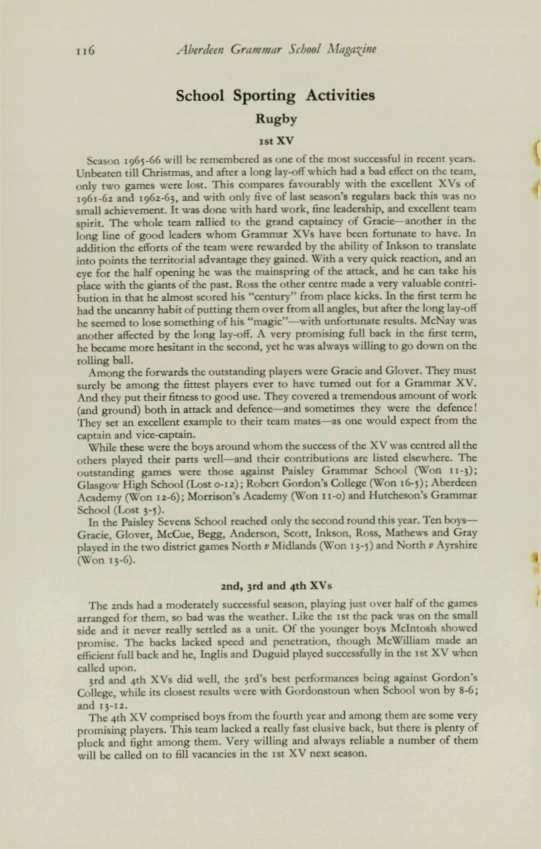
~cason 1965-66 will be remembered as one of the most successful in recent year.,. Unbeaten till Christmas, and after a long lay-o!Twhich had a bad c!Teecon the 1cam, <>nly two games were lose This compares favourably with the excellent XVs of 1961-62and 1962-63, and with only fi"e of laseseason's regular.. back this was no small achievement. le was done \\'Ith hard work, fine leadership, and excellent team spirit. The whole team rallied to the grand captaincy of Gracie another in the Jong line of good leaders whom Grammar XVs have been fortunate to have. In addition the e!Toru of the team were rewarded by the ability of Inkson to translate into points the territorial advantage they gained. With a very quick reaction, and an eye for the half opening be was the mainspring of the attack, and he can take his place with the giants of the past. Ross the other centre made a very valuable contribution in that he almost scored his "century" from place kicks. ln the first term he had the uncanny habit ofputting them over from all angles, but after the long lay-o!T he seemed to lose something of his "magic"-with unfortunate results. Mc1'ay was another affected by the long lay-off. A very promising full back in the first term, he became more hesitant in the second, yet he wasalways wilHng 10 go down on the rolling ball.
Among the forwards the outstanding players were Gracie and Glover. They must surely be among the fittest players ever 10 have turned out for a Grammar XV. And they put their fitness to good u~c. They covered a tremendous amount of work (and ground) both in attack and defence-and sometimes they were the defence! They set an excellent example to thcir team matcs--as one would expect from the caprnin and vice-captain.
While these were the boys around whom the successof the XV was centred allthe others played their parts well-nd their contributions are listed elsewhere. The outstanding games were those against Paisley Grammar School (Won 11-3); Glasgow High School (Lost 0-12); Robert Gordon's College (Won 16-5);Aberdeen i\eademy (Won 12-6); Morrison's Academy (\'\'on 11-0)and Hutchcson's Grammar School (Lost 3-5).
In the Paisley Se,·ens School reached only the second round this year.Ten boysGracie, Glover, McCue, Begg, Anderson, Scott, Inkson, Ross, Mathews and Gray played m the two district games North P Midlands (Won 13-5)and North• Ayrshire (Won 13-6).
The 2nd, had a moderately succes~ful season, playing just over half of the games arranged for them, so bad was the weather. Like the 1st the pack was on the small side and it never really settled as a unit. Of the younger boys McIntosh showed promise. The backs lacked speed and penetration, though ;\[cWilliam made an efficientfull back and he, Inglis and Duguid played successfully in the 1st XV when called upon.
3rd and 4th XVs did well, the 3rd's best performances being against Gordon's College, while its closest results were with Gordonstoun when School won by 8-6; and 13-12.
The 4th XV comprised boys from the fourth year and among them arc some very promising players. This team lacked a really fast elusive back, but there is plenty of pluck and fight among them. Very willing and always reliable a number of them will be called on to fill vacancies in the 1st XV next season.
These arc just a few of the many Models of Golf Clubs which you can view at your leisure in our Showroom
Jack Nicklaus JN67
Peter Thomson
Henry Cotton
Ben Sayers Crown
Sam Snead Signature
Sam Snead Blue Ridge
Nicoll Pinsplitter
Leyland Powercraft
Flagside
Jean Donald
Jessie Valentine
Leyland Ladies

Woods 139/6d. 126/133/132/6d. 112/100/113/9 88/9d. 88/9d. 129/6d. l19/6d. 93/-
Irons 115/105/l13/9d. I07/6d. 103/84199 9d. 67/9d. 62/9d. 109/6d. 99/6d. 72/3d.
Short Sets by John Letters, Auchtcrlonic , Tom Morri s, St. Andrew Golf Co. and Swilken, from £24 I ls. 3d.
Golf Bags from 35/- Caddy Cars from 99/6d. Umbrellas from 44/9d. Nylon Suits from 71/ IOd.
Large selection of Balls, Tee Holders, Sponges, Gripwax and all other accessories
DUNLOP
Maxply Fort Blue Flash Gold Wing
Matchpoint Alpha J79/6d. I19/6d. 90/84/67/6d.
SLAZl:NGER
Challenge 159/6d. Meteor I29/6d. Victory l 19/6d. Jupiter 89/6d. Royal Crown 67/6d.
Sec our range of inc>.pensive Rackets. Holdalls, Presses, Headcovers, Shoes, Balls, etc.
For the Swimmer, we have a large range of Swimwear by Jantzen , Bukta and Speedo. All your Camping Requirement s in stock.
Taylor's Bowls
Henselite Bowls
'Phone 21094
Open on Thursdays until 8 p.m. and All Day Saturday.
It is very disturb ing to find that an e\'er increasing number of boys, u-hosi: ability is such that they could easily be playing for the 20d XV (and in some cases the 1st) are not prepared to do so. (And it would appear that this would be so no matter what games the School played).
Colts had a season fullof experiments in team composition, and thts led to mixed fortunes. Robust forward phy was the side's main asset and this carried it rn some surprisingly good results, but weaknesses behind the scrum were glaringly revealed against the stiffest opposition including unfortunately Gordon's College who beat them 18-3
The Juniors 1-mda successful season and were defeated once only, by an exceptionally good Glasgow Academy side, early in the season. The team's strength lay in a strong mobile pack of forwards who created most of the scoring opportunities which were efficiently taken by the back division This excellent nucleus plus several promising reserves bodes u·ell for the future
Despite their record of games won and lost, minors enjoyed a comparatively successful season without reaching the standard of play of which they were capable. This can only be explained by the long break in the season due to the severe winter. A very keen side, showing great willingness to learn, they possess the ability to become a most competent side.
Once again we must thank all masters who refereed and supervised games. ,\lso Mr. Mathews whose work at Rubislaw is greatly appreciated.
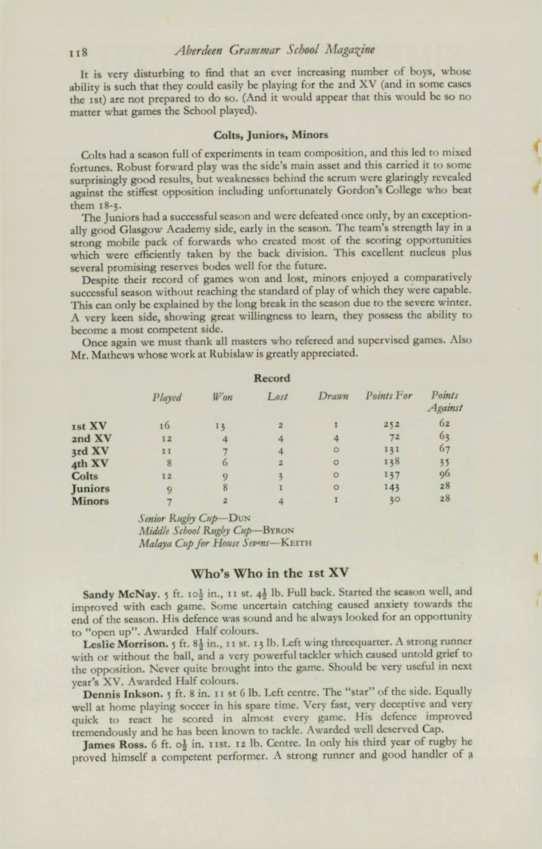
Jmior R11gbyCup Dus
MiddlrS,boolRl1gbyCup-BYRO"Malaya Cupfor HoustJt,,.nr Kr•n11
Sandy McNay. l ft. 10½ in., 11 st. 4½ lb. Full back. Started the season well, and improved with each game. Some uncertain catching caused anxiety cowards the end of the season. His defence wa~ sound and he always looked for an opportunity to "open up". Awarded Half colours.
Leslie Morrison. l ft. 8! in., 11 st. 13lb. Left wing thrcequart er. A strong runner with or without the ball, and a very powerful tackler which caused untold grief to the opposition. :r:-.;evcrquite brought into the game. hould be very useful in next year's XV. Awarded !Ialf colours.
Dennis Jnkson. l ft. 8 in. 1I st 6 lb Left centre. The "star" of the side. Equally well at home playing soccer in his spare time. \'ery fast, very deceptive and very quick to react he scored in almost every game. His defence improved tremendously and he has been known to tackle. \warded well deserved Cap.
James Ross. 6 ft. o½ in. 11st. 11 lb Centre. Jn only his third year of rugby he proved himself a competent performer. A strong runner and good handler of a
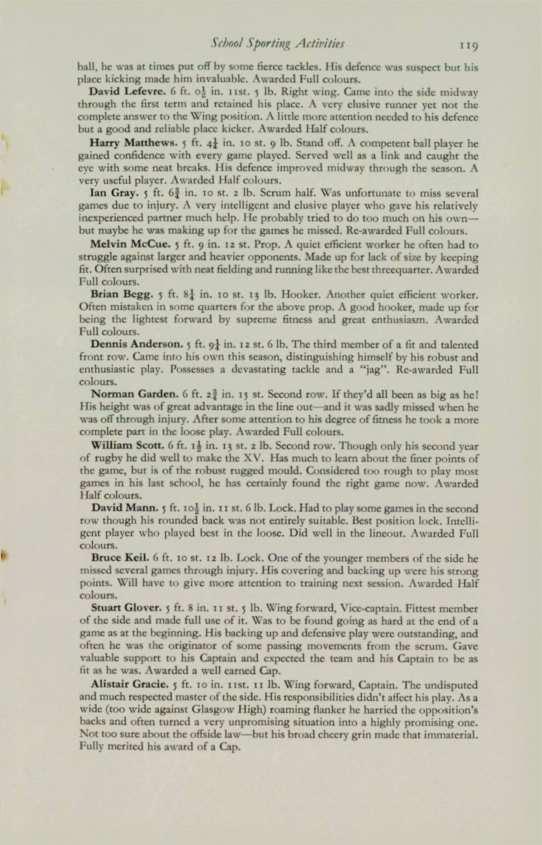
ball, he was at times put off by some 6erce tackles. Ilis defence was suspect but his place kicking made him invaluable. \warded Full colours.
David Lefevre. 6 fc. o1 in. 11st. 5 lb. Right "ing. Came into the si<lc midway through the first term and retained bis place. A very elusive runner yet not the complete answer co the \Ving position. A little more attention needed to his defence but a good and reliable place kicker. Awarded Half colours.
Harry Matthews. 5 ft. 4¼ in. 10 st. 9 lb. Stand off. ,\ competent ball player he gained confidence with every game played. Served well as a link and caught the eye with some neat breaks. llis defence improved midway through the season A very useful player. Awarded Half colours.
Ian Gray. 5 ft. 6i in. 10 st. 1 lb. Scrum half. Was unfortunate to miss several games due to injury. A very intelligent and elusive player who gave his relatively inexperienced parmer much help. IIc probably tried to do too much on his ownbut maybe he was making up for the games he missed. Re-awarded Full colours.
Melvin McCue. 5 ft. 9 in. 11 sr. Prop. A quiet efficient worker he often had co struggle against larger and heavier opponents. Made up for lack of size by keeping fit. Often surprised with neat fielding and running l1kethc bestthrcequarter. A\\·arded Full colours.
Brian Begg. 5 ft. 8} in. 10 st. 13 lb. Hooker. Another quiet efficient worker. Often mistaken in some quarters for the above prop. A good hooker, made up for being the lightest forward by supreme 6mess and great enthusi:ism. Awarded rull colours.
Dennis Anderson. 5 ft. 9¾ in. 11 st. 6 lb. The third member of a fit and talented front row C~me into his own this season, distinguishing himself by his robust and enthusiastic play. Possesses a dcvnswting wckle and n "jag". Re-awarded Full colours.
Norman furd en 6 ft. 21 rn. 15 st. Second row. If they'd all been as big as he! IIis height was of great advantage in the line out and it was sadly missed when he wasoff through injury. After some atcemion to his degree offitness he took a more complete part in the loose play Awarded Full coloun;.
William Scott, 6 ft. 1! in. 13 st. 2 lb. Second row. Though only his second year of rugby be did well to make the XV. Has much to learn about the finer points of the game, but is of the robust rugged mould. Considered too rough to play most games in his last school, he has certainly found the right game now. \warded Half colours.
David Mann. 5ft. 10; in. 11 st. 6 lb. Lock.Had to playsome games in the second row though his rounded back was not entirely suitable. ilest position lock. Intelligent player who played best in the loose Did well in the lineout. Awarded Full colours.
Bruce Keil. 6 ft. ro st. 12 lb. Lock. One of the younger members of the side he missed several games through injury. His covering nnd backing up were his srrong points. Will have to give more attention ro training next s~sion. Awarded Half colours.
Stuart Glover. 5 fr. 8 in. 11 st. 5 lb. Wing forward, Vice-captain. Fittest member of the side and made full use of it. Was to be found going as hard at the end of a game as at the beginning. His backing up and defensive play were outstanding, and often he was the originato r of some passing movements from the scrum GaYe valuable suppon to his Captain and expecred the team and his Capwin to be as fit as he was. Awarded a well earned Cap.
Alistair Gracie. 5 ft. 10 in. 11st. 11 lb. Wing forward, Captain. The undisputed and much respected masterof the side. IIis responsibilities didn't affecthis play. As a wide (too wide against Glasgow Jligh) roaming flanker he harried the opposition's backs and often turned a very unpromising siruation into a highly promising one. ~ot too sure about the offside law-but his broad cheery grin made that immaterial. Fully merited his award of a Cap.
1st XI
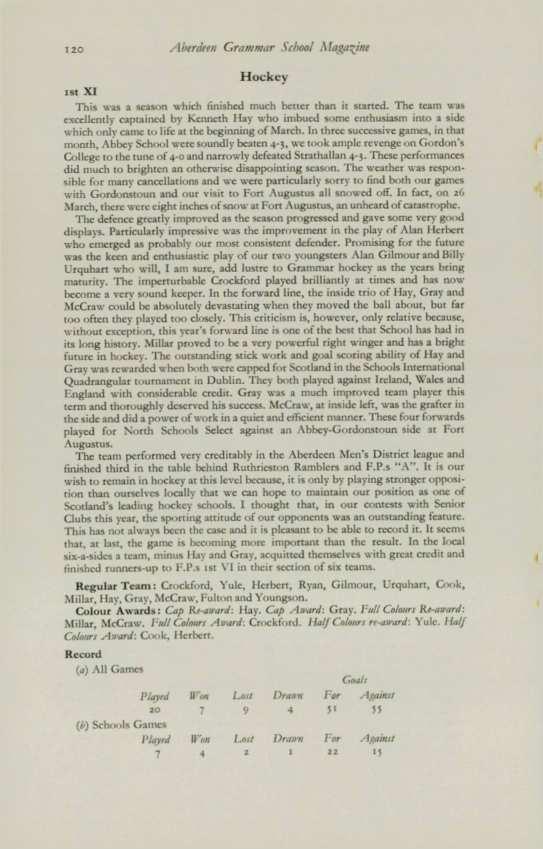
This was a season which finished much better than it started. The tom was excellently captained by Kenneth Hay who ,mbue<l some enthusiasm into a side which only came to life at the beginning ofl\larch. ln three successive games, m that mooch, Abbey School were soundly beaten 4-3, we took ample revenge on Gordon's College to the tune of4-0and narrowly defeated Strathallan 4-3.These performances did much to brighten an otherwise disappointing season. The weather was responsible for m.-my cancellations an<l we were particular!>•sorry to find both our games with Gordonstoun and our visit to Fort ,\ugustus all snowed off. In fact, on 26 ~farch, there were eight inchesofsnow at Fort .\ugustus, an unheard ofcatastrophe.
The defence greatly improved as the season progressed and gave some very good displays. Particularly impressive was rhe improvement 111 the play of Alan Ilcrberc who emerged as probably our most consistent defender. Promising for the future was the keen and enthusiastic play of our two youngsters \Ian Gilmour and Bill) Urquhart who will, I am sure, add lustre to Grammar hockey as the years bring maturity. The imperturbable Crockford played brilliantly at times and has now become a very sound keeper. In the forward line, the inside trio of Hay, Gray and MeCraw coul<l be absolutely devastating when they moved the ball about, but far roo ohen they played too closely. This criticism is, howe\'er, only relative because, without exception, this year's forn·ard line is one of the be,c that School has had in its long history. Millar proved to be a very powerful right winger and has a bright future in hockey. The outstanding stick work and goal scoring abiliry of Hay and Gray was rewarded \\'hen both were capped for Scotland in the Schools International Quadrangular tournament in Dublin. They both played against Ireland, Wales and I'.ngland with considerable credit. Gray was a much improved team player this term and thoroughly deserved his success. McCra,,, at inside lefr,,ns the grafter in the side and did a power ofwork in a quiet and efficientmanner. These four forwards played for North Schools Select against an \bbey-Gordo11-stoun side at Fore Augustus.
The team performed very creditably in the Aberdeen Men's District league and finished third m the table behind Ruthricston Ramblers and F.P.s "A". It is our wish to remain 111 hockey at this level because, it is only by playing stronger opposition than ourselves IOC1lly that we can hope to maintain our position as one of Scotland's leading hockey schools. 1 thought chat, in our contests with Senior Oubs this year, the sporting attitude ofour opponents was an outstanding feature. This has not always been the case and it is pleasant to be able co record it. It seems that, ac last, the game is becoming more important than the result. In the local six-a-sides a team, minus Ilay and Gray, ac<1uittedthemselves with great credit and finished runners-up to F.P.s 1st \ I in their section of six teams.
Regu lar Team: Crockford, Yule, Herbert, Ryan, Gilmour, Urquhart, Cook, Millar, llay, Gray, McCraw, Fulwn and Youngson.
Colour Awards: Cap Rt-aJJ'ard: Hay. Cap All'ard: Gray. Full Colours Re-mmrd: Millar, McCraw. F11//Colours Au•ard: Crockfor<l. 1-lalfColoursrt-aTl"ard:Yule. Half Colours Au·ard: Cook, 1 lcrbcrt.
Record
(a) .\II Games Goalt Playd U 011 U/f/ /)raRII /·or ,1 eainrt 20 7 9 4 51 H (/,)Schnnls Games
l'/aytd ll"m1 Lost J)ra1r11 For Againtt 7 •I 2 22 I 5
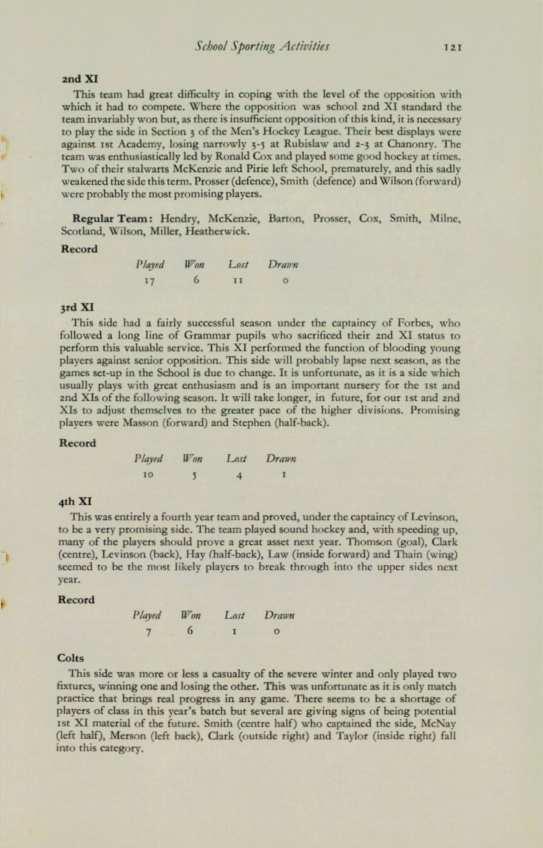
2nd XI
This team had great difficulty in coping with the level of the opposition with which it had to compete. Where the oppositi on was school 2nd XI standard the team invariably won bur, as there is insufficientopposition of this kind, it isnecessary ro play tbe side in Section 3 of the Men's Hockey League. Their best displays were against 1st Academy, losing narrowly 3-5 at Rubislaw and 2-3 at Chanonry. The team was enthusiastically led by Ronald Cox and pbyed some good hockey at time!.. Two of their stalwarts McKenzie and Pirie left School, prematurely, and this sadly weakened the side this term. Prosser(defence), Smith (defence) and Wilson (forward) were probablythe most promising players.
Regular Team: Hendry, McKenzie, Harton, Pro~~er, Cox, Smith, \1ilnc, Scotland, \\'il~n, Miller, Heatherwick.
Record 3rd XI
This side had a fairly successful season under the captaincy of Forbes, who followed a long line of Grammar pupils who sacrificed their 2nd Xl status to perform this valuable service. This XI performed the function of blooding young players against senior opposition. This side will probably lapse next season, as the games set-up in the School is due to change. It is unfortunate, as it is a side which usually pbys with great enthusiasm and is an important nursery for the 1st and 2nd XIs of the following season. lt will take longer, in future, for our 1st and 2nd Xls to adjust themselves to the greater pace of the higher divisions. Promising players were Masson (forward) and Stephen (half-back).
Record 4thXI
This wasentirely a fourth year team and proved, under the captaincy of Levin.~on, to be a very promising side. The team played sound hockey and, with speeding up, many of the players should prove a great asset next year. Thomson (goal), Cbrk (centre), Levinson (back), Ifay (half-back), Law (inside forward) and Thain (\I.ing) seemed to be the most likely players to break through imn the upper sides next year.
Record Colts
Th.is side wa~ more or less a casualty of the severe winter and only played cwo fixtures, winning one and losing the other. This was unforturuite as it is only match practice that brings real progress in any game. There seems 10 be a shortage of players of class in this year's batch but several are giving signs of being potential 1st XI material of the future. Smith (centre half) who captained the side, McNay (left half), Merson (left back), Clark (outside right) aod Taylor (inside right) fall into this caregory.
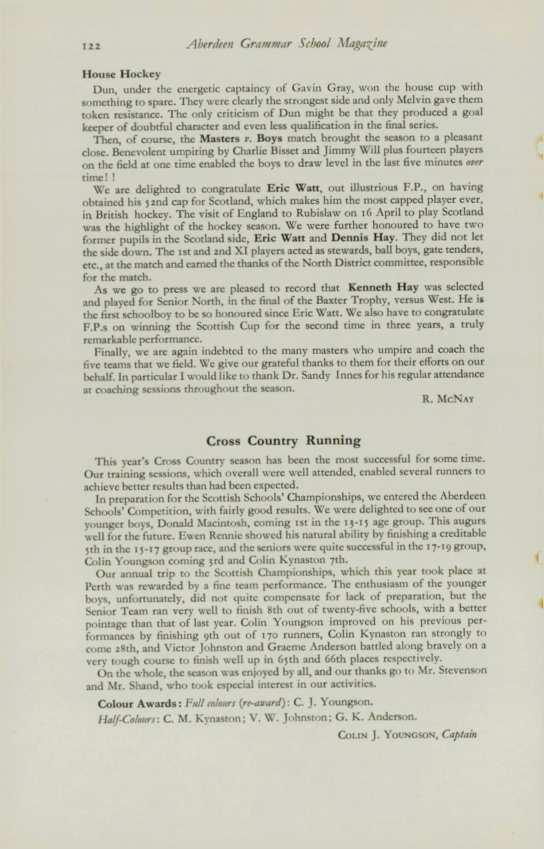
House Hockey
Dun, under chc energetic captaincy of Gavin Gray, won the housc cup with something to spare. They were clearly the smmgest side and only Melvin gave them token resistance. The only criticism of Dun might be that they produced a goal keeper of doubtful character and even less qualification in the final series.
Then, of course, the Masters P. Boys match brought the season co a pleasant close. Benevolent umpiring by Charlie Bisset and Jimmy Will plus fourteen players on the field at one time enabled the boys to draw level in the last five minutes ot•tr rime! 1
We arc delighted to congratulate Eric Watt, out illustrious r.P., on ha\ ing obcained his 52nd cap for Scotland, which makes him the most capped player ever, in British hockey. The visit of England to Rubislaw on 16 April co play Scotland was the highlight of the hockey season. We were further honoured to have two former pupils in the Scotland side, Eric Watt and Denni s Hay. They did not let the side down. The 1stand 2nd XI players acted as stewards, ball boys, gate tenders, etc., at the match and earned the thanks of the North District committee, responsible for the match.
As we go to press we arc pleased to record that Kenneth Hay was selected and played for Senior !',;orth, in the final of the Baxter Trophy, versus West. He is the first schoolboy to be so honoured since Eric Watt. \X'ealso have to congratulate F.P.s on winning the Scottish Cup for the second time in three years, a truly remarkable performance.
Finally, we arc again indebted to the many masters who umpire and coach the five teams that we field. We give our grateful thanks to them for their efforts on our behalf. In particular I would like to thank Dr. Sandy Innes for his regular attendance at coaching sessions throughout the season.
R. McKAY
This year's Cross Counrry season has been the mosr succe«sful for some time. Our training se,sions, which overall were well attended, enabled several runners to achieve better results than had been expected.
In preparation for the Scottish Schools' Championsh ips, we entered the Aberdeen Schools' Competition, with fairly good results. We were delighted to seeone of our younger boys, Donald Macintosh, coming tst in the 13-tsage group. This augurs wdl for the furure. Ewen Rennie showed his natural ability by 6mshing a creditable 5th in the q-q group race,and the seniors were quite successful in the 17-19group, Colin Youngson coming 3rd and Colin ls.ynaston 7th.
Our annual trip to the Scottish Championships, which this year took place at Penh was rewarded by a tine team performance. The enthusiasm of the younger boys, unfortunately, did not 4uite compensate for lack of preparation, but the Senior Team ran very well to finish 8th out of cwenry-fivc schools, with a better rxiintage than that of last year. Colin Youngson improved on his previous performances by finishing 9th out of 170 runners, Colin Kynaston ran strongly to come 2Rth,and Victor Johnston and Graeme Anderson battled along bravely on a ,cry tough course to finish well up m 6~th and 66th places rc,pectivcly.
On the whole, the season was enjoyed by all, and our thanks go to \fr. Stevenson and :-.fr.Shand, who cook especial interest in our activities.
Colour Awards: Full ro/011r1(re-au·ard):C. ]. Youngson.
llalf-Co/011r1:C. 1\1. Kyn~ston; V. W. Johnston; G. Is:. \nderson.
Cous J. YouNCSON,Captain

With the School pond in its third year, swimming acrivirics are progressing ~readily.
We are pleased to announce that due to the outstanding number of life-Sa\'ing a\vards gained by pupils, the School has been awarded the Wilson Troph}" for Lifesaving for the year 1965.This trophy is awarded, on a points oosis,to the school which gains the greatest number of Elementary and Intcrmc<liare Certilicares in Scotland. The list ofawards so for isas follows: \\rnrd ofMerit 4; Bron7e Cross 7; Instructor's Certificate 6; Bron7e ~fcdallion H; Intermediate Certificate 78; Hlementary Certificate 100.
The Annual Gala was held in the Bon-Accord Baths on Friday, 21 January and yet again Melvin House emerged victorious.
The latest step in the development of the School's swimming activities is competitive swimming. Last term in the Scottish Schools' Swimming Championships at Kirkintilloch, the School produced two medallists in J. C. Smith, who was first 111 the under 16, 55 yards backstroke event and G. Good who came second in the corresponding butterfly event. The relay team, entered to compete for the Sladcn Trophy, came in second and all mher individual and team competitors swam well.
The SchrK,1 is represented in two gaL1sin the summer term. ,\t the time of going rn press a relay ream has been entered for a gala on 30 ~fay, in connection with "Learn co Swim \Xfeek" and out first direcr competition with another school, Robert Gordon's College, is set for 15 June. evening training sessions in the School pond have been arranged for the Grammar team.
To all masters concerned with the supervision and instruction of swimmer we offer our thanks. However, special mention must be made of Mr. Stevenson, :\lr. Paterson, Mr. Clark and Mr. Spence, who has continued so ably where '\fr. :\lortimer left off. \Ve would end by thanking .\lr. Stevenson for all his work in connection with swimming and offering him our congratulati ons on his new appoincment.
JA1r-; I. \\ Ol.SJL1'110LML, Captai11
The annual cvcnt at Rubislaw, held this year on ro and 11 June was lucky 111 its weather, unexpectedly so indeed. For days before Aberdeen was swathed in the familiar case-coast mist, and though it wasn't cold, rain fell or hung dankly in the air; c,·en on the rriday and Saturday the forenoon sky was low and grey. Buc hr rhe afternoon on both days the sun had taken over, drying the grass and bringing brighmess into the air,among orher things appreciablr helping the sale of ice-cream and lemonade. Saturday was particularly pleasant, conditions were ideal for con• te~tants and spectators, and though few records were broken, eYerybody was ob\'1ously relaxed and content.
I'or Mr. Stevenson it \\'aS a particularly unportant and poignant occasion, his last Grammar School sports meeting as master-in-charge; and once again we saw, what we have so long taken for granted, how everything was impeccably planned and efl,ciently executed, with time for everything and with everything done on time.
Melvin, always in the lead, repeated their last year's win over Byron in the House championship, this time by the narrow margin of 4 points. An exciting finale, for which Byron deser\'C the highest credit.
Through the generosity of our Former Pupils Ill .\lalay.i (\\:ho also presented us with the cup for 7-a-sidc rugby) we were able this year co replace prize vouchers wich special school medals for winners. These were awarded on the following basis:
Each Group champion (in groups 1, 2, 3, 4 and ,) was given a silver medal. Each runner up in these groups was given a bronze medal. Eacb boy in these groups who gained 3 or more points (i.e. got at least one 1st or a 2nd and a 1sr; or three 3rds) in ch.11npionsh1pevents was given a gilt medal. The medals arc 1¼ inches in diameter; on the one side they have the School crest and on the other a laurel wreath. The design was the work of Mr. Will.
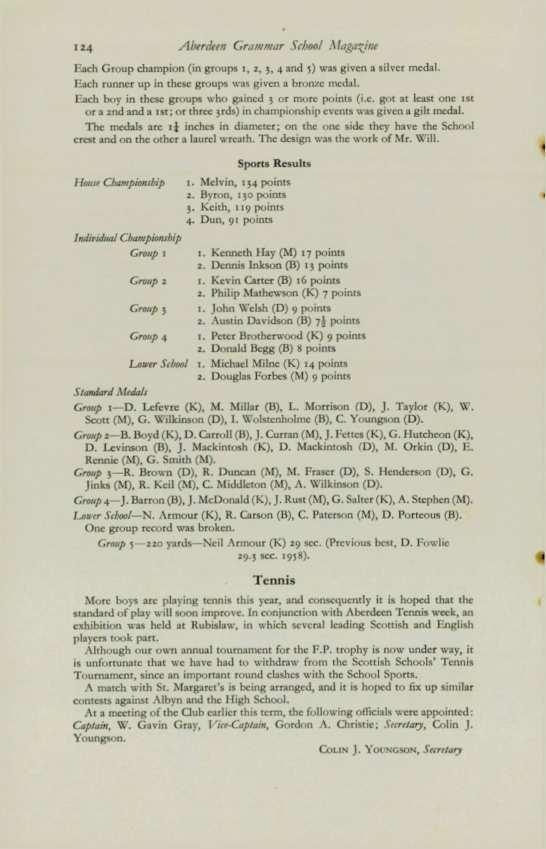
Ho11stChan,piomhip
1. Melvin, 134 points
2. Byron, 130 points
3. Keith, 119 points
4. Dun, 91 points Indit-id110IChampionship
Gro11p 1 1 Kenneth Hay (M) 17 points
2. Dennis Inkson (B) 1 3 points
Group 2 1. Kevin Carter (B) 16 points
2. Philip Mathewson (K) 7 points
Gro11p 3 1. John Welsh (D) 9 points
2. Ausun Davidson (B) 7! points
Gro11p4 r. Peter Brotherwood (K) 9 points
2. Donald Begg (B) 8 points
Lowtr Sthoo/ 1. Michael Milne (K) 14 points
2. Douglas Forbes (M) 9 points StandardMtdals
Gro11p 1-D. Lefevre (K), M. Millar (B), L. Morrison (D), ]. Taylor (1'.), W. Scott (M), G. Wilkinson (D), I. \'<'olstenholme (B), C. Youngson (D).
Group2-B Boyd (K), D. Carroll (B), J. Curran (M), J. Fettes (K), G. IIutcheon (K), D. Levinson (B), J. Mackintosh (K), D. Mackintosh (D), M. Orkin (D), E. Rennie (M), G. Smith (M).
Group 3-R. Brown (D), R. Duncan (.M), M. Fraser {D), S. Henderson (D), G. Jinks (M), R Keil (M), C. Middleton (.M),A. Wilkinson (D).
Group4- J. Barron (8), J.McDonald (K), ]. Rust~I). G. Salter (K), A.Stephen (M). Loutr S,hool-N. Armour (K), R. Carson (8), C. Paterson (M), D. Porteous (8).
One group record was broken.
Group 5 220 yards -Neil \rmour (K) 29 sec. (Previous bc11t, D. Fowlie 29.3sec. 1958).
More boys arc playing tennis this year, and consequently it is hoped that the standard of play \\ ill soon improve. In conjuncrion v.·ith Aberdeen Tennjs week, an exbibiuon was held at Rubislaw, in whjch senral leading Scottish and English players took part.
Although our own annual tournament for the F.P. trophy is now under way, it is unfortunme that we have had to withdraw from the Scottish Schools' Tennis Tournament, since an important round clashes with the School Sports.
A match with Sr. Margaret's is being arranged, and it is hoped to fix up similar contests against J\lbyn and the High School.
At a meeting ofthe Oub earlier this term, the following officialswere appointed: Captain, W. Gavin Gray, Virt-Captain, Gordon A. Christie; Sm·ttary, Colin J. Youngson.
CoL1N J. Yot·'-GSO", Suntary
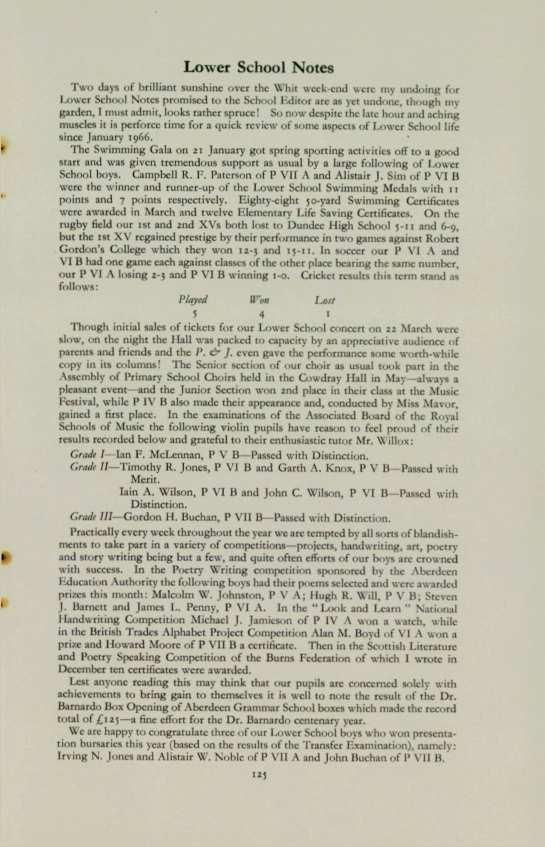
Two days of brilliant sunshine over the \'v'h1t week-end were my uncloing for Lower School Notes promised to the School Editor are as yet undone, though my garden, I must admit, looks rather spruce! So now despite the late hour and aching muscles it is perforce time for a quick review of some aspects of Lower School life since January 1966.
The Swimming Gala on 21 January got spring sporting activities off to a good start and was given tremendous support as usual by a large following of Lower School boys. Campbell R. F. Paterson of P VTT A and Alistair J. Sim of P VI B were the winner and runner-up of the Lower School Swimming Medals with 11 points and 7 poinrs respectively. Eighty-eight 50-yard Swimming Certificates were awardecl in March and twelve Elementary Life Saving Certificates. On the rugby field our 1st and md XVs both lost to Dundee High School 5-11 and 6-9, but the 1st XV regained prestige by their performance in two games against Robert Gordon's College which they won 12-3 and 15-11. Jn soccer our P \ l A and VI B had one game each against classes of the other place bearing the same number, our P VI A losing 2-3 and P VI B winning 1-0. Cricket results this term stand as follows:
Played IFon Los/ 5 4 l
Though initial sales of tickets for our Lower School concert on 22 March were slow, on the night the Hall was packed to capacity by an appreciative auclience nf parents and friends and the P. & ]. even gave the performance some worth-while copy in its columns! The Senior section of our choir as usual took part in the \sscmbly of Primary School Choirs helcl in the Cowdray Hall in ,\lay-always a pleasant e,·ent-nd the Junior Section won 211d place in their class ac the .Music Festival, while P l\' B also made their appearance and, conducted by Miss :.\favor, gained a fuse place. In the examinations of the Associated Board of the Ro}al Schools of Music the following violin pupils have reason to feel proud of their results recorded below and graceful to their enthusiastic tutor Mr. \\'illox:
Gradt /- Lan F. McLennan, P V B Passed with Distinction.
Grade II-Timothy R Jones, P Vl B and Garth A. Knox, P V B Passed with Merit,
Iain A. Wilson, P VT B and John C. Wilson, P VT [3 Passed with Distinction.
Grade Ill Gordon H. Buchan, P Vlf B-Passcd with Distinction.
Practicallyevery week throughout the year weare tempted byall sorts of blandishments to cake part in a variety of competitions-projects, handwriting, art, poetry and story \\-riting being but a few, and quite often efforts of our boys arc crowned with success. ln the Poetry Writing competition sponsored by the .\berdl.-en Education Authority the following boys hacltheir poems selected and were awardcJ prizes this month: Malcolm W. Johnston, P V A; Hugh R. Will, P \' H; Steven J. llarnctt and James L. Penny, P VI J\. ln the "Look and Learn" ::-..:ational Handwriting Competition Michael .J Jamieson of P IV A won a watch, while in the llritish Trades Alphabet Project Competition Alan M. Boyd of \'I A won a prize and Howard Moore of P Vll Ba certificate. Then in the Scottish Literature and Poetry Speaking Competition of the Burns redcration of which 1 wrote in December ten certificates were awarded.
Lest anyone reading this may think that our pupils arc concerned solely with achievements to bring gain to themselves it is well to note the result of the Dr. Barnardo Box Opening ofAberdeen Grammar School boxes which made the record total of £125-11 fine effort for the Dr. Barnardo centenary year.
We are happy to congrarulare three ofour Lower School boys who won presentation bursaries this year (based on the results of the Transfer Examination), namclv: Irving N. Jones and Alistair \V/.1':oble of P VII A and John Buchan of P VII H.
\X'ith 2 June being an Open Day f,,r parent, we must ,tart thinking now of how to di,crt them on the afcernoon and cnning of chatday" ich Pupp,:try and Spanish, rrcnch and Mathematics, .Art endca, ours and Ifandwnrk. It loob as though the next three weeks 111:1.ybe rather bu\}"in preparation.
Summa term has alwa}s been synonymous with intcm,ting outings for our senior classes. ,\ lrcadr one class P \ 11 ,\ has been privilcged to be pre~ent at the launching of a heavy load transporter at Ifall Ru<sell's }.lrd, the Kmgmor/b ]'11/J,r, and were shown \\Orking mo<lcls<>fa Diesel-I:lecuic Refrigerated Stern Tra\\ lcr. \\~alks hnc been arranl(ed over Clc,ch-na-&:n and from the runglc to the Fore5t of Bin.c, while the two cnior classc hope to spend a day at the ancient palace of Scone and an evening at the Marine l.ab<,ra1oryat Torry.
School Camp is again to be held at Torphins from 16 to 13 July and already the members of the Primary \'II contingent attending arc simmering with excitcmcnr in an11cipation. I.et\ hope that the weather organiser looks upon us a 1;1tJe m, re kindly than he did last year.
J. D. l\l
The work of the Contingent, an all its manifold aspecu, continues most succ~-,,sfully as the result of euminations •how and, although '": arc below strength, our efficiency can 1:111d comparison with any other contingent. It ha, alw.l}S been a matter of concern that the extra numl><.:rsdo not come forward and give the C.C.L its due status in the School. ,\ trL-mcndous amount of work is necessary m the summer term in order to get through the inspection and the planning of the t\\·o camps. This would not be poi,siblc without a maximum ctfort on the part of all N.C.O.s and Cadets, \\ ho can always be relied on to give of their best when it is required. Jn retrospect , it must be stJtcd that the Senior .C.O.s have, at times, carried an almost intokrnble burden this session and the Section Commanders especially arc to be congratulated on their magnificent results..\t the time of writing it seems highly prnhablc th.11we shall be without !'lying OITiccrSuthcrbnd next session. ,\lchough he had no experience of the Ro).il ,\ir Force when he \\as commissioned, under the acgi of the O.C., he so,,n assimilated the traditions of the junior scrncc and he has given four )"L'lll'l>of such vah1.'lblcservice that he \\ ill he very hard to repbcc. It is further noted th.u 1Ir. Sutherland's departure leaves onh· one truck-driver on the strength. In conclusion, my sincere thanks to all member, of the C,ntingent \\ho hJ\ c acquitted themsehcs well and curicd the good name of the Scho ,I with them where,er the1 have been.
~me cadets \\ert: prL-Sentedf,,r t c \rn v Prohc1cncy exam. in February. 'Ibis exam., held at the Bridge of Don Barracks, is a test of nll that a cadet has h.:cn taught in his two, or three, years in the Force. To pass, he must have a thorough grasp of all the fact,, and be able to present them confidently for both written and verbal tests. Of the nine cadets who "-ll the exam., rwo passed with credit, and the rcm:under all made very good pa"es. Promotions after the proficiency exam. were as follows:-Cdcs. ,\brioux and Thomson to Corporal, and Cdt,. ,\ndcrsun, Dickson, I-Iughcs, McLeod, \luirhcad, Shank, and Ta11 to I.ancc (...,rP",ral. ,\rduous Truntng was ag.un hclJ in the Caimgorms area with base camp in Granton--on-Spcy, during the tirst ,, cck of the Easter holidJ) , .\£any exercises \\·erecarried out ver} successfull>·by the ten cadets and three ollicc" who were there. I would like w congratulate all the cadets ,,tho attended for the hr~t time, a\ they put up an excellent performance during exercises which were much tougher than is usual.
Rauge has been neglected this year and so we were unable to enter any teams for the Cadet \\'apinschaw held in l\Iay. However, plans are now under way for regular practice on the 25 metre range at Dyce, and we hope that a number of cadets will compete in the T. \. Wapinschaw in June.
The Contingent will parade before Group Captain Scandrett, Station Commander at R.A.I'. Buchan, who will be arriving by helicopter to c.1rt')' out the annual inspection on 17June. Both sections will then give demonstrauons of their activities to the inspecting officer.
Plans have already been formed for Summer Camp, which will be held again at W.E.T.C., Cultyhraggan near Comrie. The Camp authorities have arranged two "live firing" demonstrations, one of a Parachute Regiment platoon in an airborne auack, and the other of section tactics as an Infantry platoon from 1st Gordon Ilighlander,; attacks an objective.
\ point wonh noting by potential recruits of the Army section is 1hat"Summer camp '67'' is definitely being held "somewhere in Germany".
I would like to thank FI.-Lt. McLeod for his continued support of the Contingent, ,ind Lt. Gallowar and F.O. Sutherland whose acti,·e participation <luring.\rduous Training did much to encourage the younger cadets.
J. S. \I H: 1'111F (C.S.\I.)
,\ttcndanccs this term have been very good, and <luring,\larch this w.1s reflected by the high pass rate of over 90 per cent success obtained in rhe Proficiency and advanccd proficiency boards.
In April two cadets, F /Sgt. Dorward and Cpl May visited the R.A.P. in Germany for a week, while meantime C1dets Dickand .Morrison were successful in trying for their "A" and "B" gliding licences at 662 Gliding School, Arbroath, chus bringing our qualified glider pilot strength to five. W/ehope that this high number ofqualified glider pilots will prove useful on the day of our annual inspection on 17 June, for we are putting on our usual gliding display for it.
•'\part from the gliding at Rubislaw and Dyce we hope during the summer ccrm to visit R. ..\.S. Lossiemouth, as well as getting our younger cadets airborne in the aircraft of twelve A.E.F. Turnbouse. Also planned is an overnight hill-walk through the L1irig Ghru, with an R.A.F. ream competing with an army team and one or more civilian teams. The annual camp this ye:,r is to be held at R.A.F. :-.fanswn, Kent, an erstwhile Battle of Britain and U.S.A.P. airfield now operated under Bomber Command
In conclusion l would like to thank our officers, P./Lt. :\fcLcod and EO. Sutherland and also l\lr. Brown for their help in our gliding sessions at Ruhltslaw.
ST!'WARTG. DORWARD(F./Sgt.)
Pracuces have been held regularly this term and, although there is s111!a shonagc ofexperienced pipers, we have a large number ofproficient drummers. r-..everthclcss our younger members certainly make up in enthusiasm what they perhaps lack in experience.
Thjs term sees the usual list of engagements, namely the Annual inspection and Sports day.
Thanks must inevitably go to Me..srs. Ian and Russell Grlly for their very competent tutoring. Finally I would like co thank Mr. Macleod fnr the enthusiastic way in which he has devoted so much time and energy to the admmistratinn of the band.
DE1'NISG. C. ANDI R<;ON, Orum Major
G.S.M. ,\. Hunter Cums, 414 Gt. \\~cstern Road, Tel. ·o. 36321.
C.M. (acting) ;\1issDiana Ldwards, "Inglcside ",Cults.Tel. "-o. 47229.
S.M. (acting) ;\fichael L \'\"olkoff, 37 Lcggart Terrace, Tel. "-:o. 24585.
R.S.L. (acting) Alistau R. Smith, 1oz Desswoo<I Place, Tel. No. 25180.
The June edition of Scout Notes always brings a touch of sadness as old friend, lca\'e us to take up appointments away from Aberdeen, and this year isno exception. !~~diesfust, Diana fdw:uds is leaving to get married and settle down in America. Diana is the second Cubmastcr to leave us through matrimony, so we have promised the girls remaining that wewill do our best for them! Peter Jeffrey has relinquished hii. responsibility for the Rover Crew, to concentrate on work for his M.Sc., and in face has left the Scout Movement after an association of some fifteen years -All the best Pete! Mike \'v'olkoffhas had to lay down the burden of the Troop through pressure of work, hue Tshould like to offer to all three my sincere thanks for the tremendous work they have done.
1966is our fund raising rear once more, and at our A.G.J\t. the Group Commiuec ,oted to raise money by individual effort and set a target of £10 per family. Consequently the term has been packed with successful functions, as well as the act1v1tv of Scouting . \ few events from the Scout calendar: firstlv the Rover Crew winter retreat to Glen Doll at :--cw Year when they linked up with the 23rd Midlothian Crew to go climbing, ski-mg, mboganning and socialising.... Easter c.~mp at Clinterty for the Troop was blessed with very poor weather but the spirit of the thirty-five boys present was excellent. \lso at Laster the Rover expedition to J\lallaig found good condnions in the West but not so good whilst cra,·elling there and back. The ::-.orth•East Rover/Ranger Moot at Ulon was a great success despite shocking weather, and a strong team from the 1st Crew was placed second in the North-East Rover Challenge I like. The Cub Pack IIoliday at Clinterty, in contrast to the above, had magnificencly clear skies for the whole weekend, and the enthusiasm " as terrific.
Looking ahead, the third mammoth Motor Treasure Hunt and Barbecue (finishing ,11 Oincerty) is planned for the middle of June. The Troop Summer Camp for the first two weeks of July will be held at Dufftown on a site visited exactly ten years ago to the day.
The Group Scouters' and Rovers' Summer Holiday excursion (and believe me, we need it!) is scheduled for three weeks in September -destination - the Bay of aples.
\ Group :--cwslctter, to be published thrice yearly, has been started, and among other things we hope to keep in touch with the 1stGroup Associates, our supponers' association of Old Boys announced in the lase edition of the School M11~a::,m~ (life membership 3~ guineas, tie mcludcd). ..\nybody wanting to join, drop me a line,
Lastlya reminder that when our Cub Pack re-opens in \ugust , itwill be recruiting from non-Grammarians, as well as Grammar School boys. We arc particularly anxious to ha\'Csome more sons of former 1st Group members, M> let's have them rolling in to our first meeting on 27 \ugust in our Ifeadqttarters, Porbesfield Lane.
G.S.M. C.M.
S.M. (acting) A. !Iu:,rtl!R CAtRNS
Dr. P. E. G. M1tchcll, 2 Pinewood Road, Tel. "-o. 35418. \[iss Sheila Fraser, 17 .\rgyll Place, Tel. ~o. 20400. bin \. Reid, p \X'h11challPlace.
Due to the closure of the Primary Depanment of the School and the subse<1uent dimtnishing supply of members, the Pack has been planning ahead and has already
accepted quite a number of boys from the Mannofield area. This has resulted in a sharp rise in numbers from 16 to 33, which augurs well for the furure.
Recently one or two of the older members of the Pack succeeded in gaining their Leaping Wolf excellent achievement. This is Cub Jubilee Year and there ha,•e been quite a number ofadditional activities arranged. \'i/e are all looking forward to the National Pack Meeting being held at Templars Park on 4 June. Aberdeen's contribution to the Jubilee celebrations is to take the form of a play "The Quest of the Golden Cord" which will be presented in the Civic Ans Centre in October. The Pack is well represented in the cast
In the past few months rhe progress of the Troop has been gratifying if not meteoric. At the present time there is a severe Jackof camping experience amongst the Troop but preparations are already well in hand for this year's Summer Camp which will mean a return co one of the best sites we have visited in recent years, It is to be held near Newtonmore on the banks ofthe River Calder in the foothills of the Monadhliach Mountains lase visited in 1962. If this camp is as successful as in 1962 it will be a great boost for the t--inth. Although our Patrol Leaders are quite experienced in orher fields they have had Little chance to lead boys at camp We arc sure they can rise to the occasion.
Although handicappcd by having no regular Scoutmaster and a lack of Scouters the Troop is now in a position to accept more recruits anyone mtcrested should attend any Friday evening meeting. After this, his final year at University, Hunter Will should be able to take over as Scoutmaster. Recently Iain and Tony Burns gained their warrants as A.S.M.s.
•\t the Scoutcrs' Conference in the Beach Ballroom following the appointment of Colonel A. L. Stalker asCounty Commissioner, Ian Colvin, Mike Carry, Alan Cowie, and Douglas Boyne were presented with their Queen's Scout Certificates, while more recently Keith Finnie has received his Queen's Scout Badge. Wdl done, ladsl
During the Easter Holidays a number of the Troop members took part in the Aberdeen Gang Show and as usual found the experience most enjoyable.
\X'e have high hopes of success in two coming events- the Fi\'C-a-Sidc Football on 30 May to t June and the County Flag which, this year, will be a Troop contest rather than a Patrol one Let's see how well we can do I
G.S.M.
C.M.
S.M. (acting)
IAIN A. REm
1-. R. Paterson, 26 Osborne Place, Tel. o. 51013. Miss Joyce Park, 270 Union Grove. David W. Morgan, 89 Duthie Terrace, Tel. No. 35616.
,\s usual, at this time of year, we are busy preparing for Summer Camp. We are going to Glen Esk. The Troop has held rwo week-end camps at Monymusk this year; one was held at the beginning of the year and the second during the Easter holidays. Both were enjoyed by those who attended,
We would like to congratulate Philip Edwards and Douglas Simpson who have been promoted to Patrol Leaders, and also ~fartin Kiltie, Edward Cruickshank and Lawrence Gove who arc now seconds.
During the Easter holiday week-end, the Cubs held a Pack holiday at Monymusk. Ten boys attended and enjoyed themselves very much. Since February ten boys have taken the places made available by those who went up to the Troop, and so the Pack is once more at full strength.
On 25 June we arc holding a Cub Picnic with the 5th and the 9th Packs. We hope that it will be very successful.
We would like to congratulate Miss Pat Cruickshank on gaining her warrant as A.C.M.
,\s many people know, our coutmaster, John Blair, retired from Scouting at the beginning of this year, We wou ld like to take this opportunity to thank him for all that he has done for the 17th while he was in our Group. Our very best wishes go with him for the future.

The closing weeks of the session were marred this war b1· the tragic dca1h of one of our pupils. Brian G. Scott of ,\[1ddle ll while out cycling during the laseweek-end m \lay was involved in an accident from which he died a day later.
\n only child, Brian was fortunate m that he had parents who took scrmusly and lovingly the business of Christian upbringing and who were prepared to make sacrifices to give him every opportunity. His life at every point was a spontaneous response to this line concern. He was a quiet boy, finding his enjoyment to a great extent in his own aeth·itic,, yet always happy in himself and popular with his fellows. liis manners were exemplary and, though he had the usual boy's interest in, and enjoyment of life, he had a seriousness about him beyond his years.
Jl1s stay m the Grammar SchOQl, tragically brief though it was, was yet long enough for him to have shown ample promise ofgrowing up into what we all like co think represents the best in the life and traditions of the School. This was a young life we could ill afford to lose and the School 1s a poorer place by his passing.

(C lub F ounded II Septe m ber 1893)
Honorar y President:
JOHN VASS SKINNl!R, M.A., B.UTT., DTP. l!D. (Rector since 1959)
Honorary Vice-president s:
Hl!NRY J ACKSON fiUTCHART (1890-99), D.S.O., 0.D,ll., T,D, , B,L,, LL.D., 0 .L.
DoUGLAS PATll RSON COCHRAN (1900-15).
/u.BXANOl!R GRAY ( 19 10-21), M.A., LL,B, THB HoN. LoRO JOHNSTON (1913-26).
jAMl!S GRAT Km (1891-98) , C,B.E , F,P,A., P.R.S.E.
JOHN ADAM LII Llll (1893-1903), )f.A., LL.B., Q.C.
ERIC LINKLATER (1913-16), C.B E., )f,A., LL O., T.D, lA."1 GoWANLOCK :'.\[CPHLRSON ( 1910-17).
The Right Hon. Lord .MESTON (1901-02).
GEORGI! GORDON NICOL (1894-1903), D.S.O., IJ.I. C.B., IJ.CONS.E.
JOHN LENNOX RIDDELL (1907-16).
Sir JAMBS JACKSON ROBERTSON, O B.E., LL.D., M.A., e.o., P.R.S.E., P.l!.I.S. (Rector 1942-59).
UCIL A G. SAVIDGE (1913-24), M.B..E., IJ.A.
WILLIAM DOUGLAS S1)fPSON(I90l-13), C B.E., M.A., LL.O., D.LITT., P,S,A,(SCOT,), P.S.A. S ir JOHN WILLIAM TAYLOR (1900-11), 1.B.E., C.M.G.
Sir WILLIAIJ ROBl!RT T ENNANT (1904-10), C.I.E., M.A., LL.D, Sir J OHN MACKAY THOMSON, C.B., )f.A., P.R.S.E. (Rector, 1920-21).
Sir LANDSBOROUGII THOMSON (1899-1908), C.B., O.B.I'., M.A., O.SC., P,R,S,ll,, LL,D, ROBERT BERTltA)I WILLIAMSON (1900-18) , D.S.O , II.A., LL,B, President :
EDWARD J A.~fES WooD ( 1908-21 ).
Vice-President of Club and Chairman of Executive
WILLIAM LEWIS U>NNON (1930-40), ll,L, Secretary and Treasurer :
8RJAN K. CROOKSHANKS (1934-46), T.O., M.A., LL.D. 25 Crown Strecc, A bcrdccn.
General Editor of Magazine :
RAE C. BARTON (1942-55), M.A., LL.B. 20 Belmont Street, Aberdeen. 131
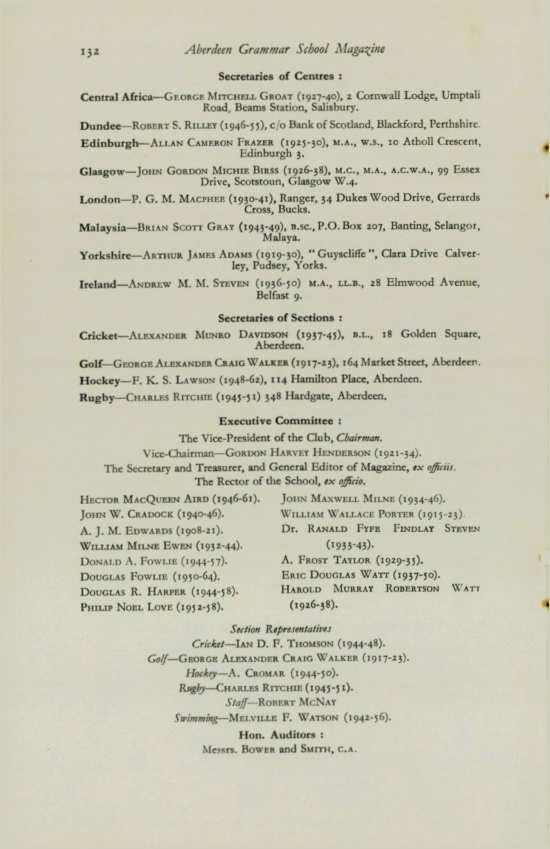
Secretaries of Centres :
Central Africa-GEORGE M1TCHELLGROAT(1927-40), 2 Cornwall Lodge, Umptati Road, Beams Station, Salisbury.
Dundce--RoeFRT S. R1LLEY(1946-55),c,o Bank of Scotland, Blackford, Perthshire . E dinbur gh-ALLAN CAMERON FRAZER (1925-30), M.A., w.s., 10 AthoU Cresccni, Edinburgh 3.
Glasgow- JonN GORDONM1CHIEB1RSS (1926-38), M.C., M.A., A.C.W.A., 99 Essex Drive, Scotstoun, Gllll!gow W-4-
London-P. G. M. MACPIIEB(1930-41), Ranger, 34 Dukes \Vood Drive, Gerrards Cross, Bucks.
Malaysia-13RtAN ScoTT GRAY (1943-49), e.sc., P.O. Box 207, Banting, Sclangor, Malaya.
Yorkshire-ARTHUR JAuEs ADAMS(1919-30), "Guyscliffe ", Oara Drive Calverley, Pudsey, Yorks.
lreland-ANDRLW M. M. STEVEN (1936-50) Id.A., LL.B., 28 Elmwood Avenue, Belfast 9.
Secretaries of Sectio ns : Cricket-ALEXANDER MUNRO DAVIDSON (1937-45), B.L., 18 Golden Square, Aberdeen.
Golf- GEORGEALEXANDERCRAIGWALl:ER(1917-23), 164Market Street, Aberdeen
H ockey- F. K. S. LAwso:-,(1948-62), u 4 Hamilton Place, Aberdeen.
Rugby-CHARLES R1Tc111E(1945-51) 348 Hardgate, Aberdeen.
Executiv e Committee :
The Vice-President of the Club, Chairman. Vice-Chairman - GORDONHARVEYHENDERSON(1921-34)
The Secretary and Treasurer, and General Editor of Magazine, i x oj/i"is. The Rector of the School, 1x oj/irio.
II.ECTORMAcQuBBN AIRD (1946-61). Jo11?<. MAXWELL.l\hL-,E (1934-46). jOHN W. UtADOCK(1940-46). W1L1,IA~I WALT.ACE PORTER(1915-23)
A.]. M. EDWARDS(1908-21). Dr. RANALD FYFE FINDLAY STEVE.., WrLLJAJJM1LNEEwEN (1932-44). (1933-43).
DoNAJo A. FowL1ll (1944-57). A. FROST TAYLOR (1929-35).
DOUGLAS FowLlll (1950-64).
BRIC DOUGLAS WATT (1937-so).
DOUGLAS R. HARPER (1944-)8). HAROLD MURRAY ROBERTSON WATT PnruP NOEL LovE (1951-58). (1916-38).
Sution R1pr11mlali111J
Crid:el-1.AN D. P. THOMSON(1944-48).
Go/f-GllORGE .ALEXANDERCRAIG WALKER(1917-z3).
Ho.hy-A. CROMAR (1944-50).
~i!,-CHARLllS RITCJIIE(1945•) 1).
Staff RoeERTMc. AY
S11•immi11g-MELVILI..I!. P. WATSON (1942-56).
Hon Auditors : llic~~rs. BOWERand SMmt, c.A

Edward James Wood
Edward James Wood was born in 1902. and entered the Grammar School in 1908 leaving in 192.1 to attend the University of Aberdeen. From there he graduated M.A. four years later with first-class honours in Classics having previously been awarded the Fullerton, Moir and Gray ClassicalScholarship. Thereafter he had a distinguished career at Trinity College, Cambridge, being placed in Class 1 of the Classical Tripos, Part 1, 1926 and in the same class in Part II in 1928. In the same year he graduated B.A., proceeding to M.A. (Cantab) in 193 2
•
After holding the position of Lecturer in Classics at Manchester University, our new President in 1932. became Professor of Latin in the University of England and Wales, .Aberystwyth. In 1938 he became Professor of Latin in the University of Leeds to which he has ever since rendered devoted and distinguished service being a Pro\'ice Chancellor in 1957 and 1959. One of the most popular members of the University, Professor \X'ood's interests and activities are numerous and, in addition to being curator of the University Coin Collection, his literary and poetic abilities are utilised in the placing on record of University functions.
Our new President has retained a dose interest in the affairs not only of his old School but also of his University and he is this year's President of the Yorkshire Branch of the Aberdeen University Graduates' Association, a unique distinction in that he is also a former President of the Association. Professor Wood has been a stalwart member of the Yorkshire section of the F.P. Club of which he is an ex-President and it is a matter of great satisfaction to r.P.s in that part of the country that his devotion to the School has been recognised in his election to the Presidency.
For our part we in the Club are honoured to have as our President such a distinguished classical scholar and a man who, in the midst of an energetic life, has still always found the time to keep intact his links with the School, changed though it may now be. We look forward to welcoming our President to our various social gatherings and trust that he will find his year of office pleasurable and rewarding.
The Sixt)•founh Annual General Mcet1nRof the Ouh ins held in the Calcdonian Hotel, Aberdeen on Tue<day, 22 :\larch 1966. The aucndancc w2s slightly beuer than in the prc,i ous )car with ab, ut 1hirt) ti,e mc1T1hcr,pre,cnt.
The Rq,ort by the l·xccu1i1e Committee< fthe Club for the y<.-arto 31 December 1965 ,,as submitted hy the Chairman of the Meeting, Mr. William L. Connon, the Vice-President of the Club, and the following arc extracts from the Report.
Membership
1be following is an analysisof the mcmhcr,,,hipofthe Club as at 28 February 1966 with compauble figures at 28 February 1961.
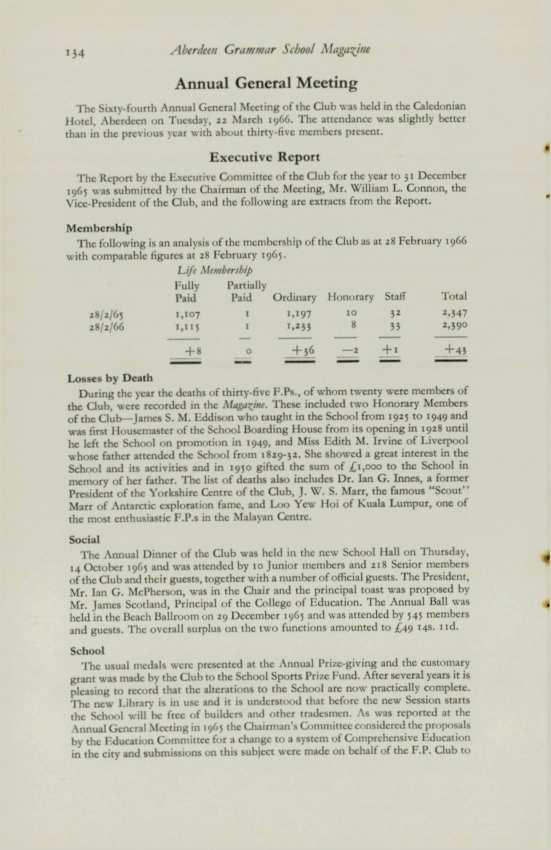
Dunng the year the deaths of thirty-live F,Ps., of whom twenty were members of the Club, were recorded in the Magaz.int . These included two l lonorary Members of the Club-James S. M. Lddison who taught in the School from 1925 to 1949and was first Ilousemaster of the School Boarding House from its opening in 1928undl he left the School on promotion in 1949, and Miss Edith M. Irvine of Lil'erpool whose father attended the School from 182.9-p. She showed a great interest in the School .ind its actil'ities and in 1950 gifted the sum of £1,000 to the School in memory of her father. The Im of deaths also include$ Dr. Ian G. Innes, a former Pre,ident of the Yorkshire Centre of the Club, J. \\, S. Marr, the famous "Scout" .Marr of Anrnrctic exploration fame, and Loo Yew 1101 of Kuala Lumpur, one of the most e111husias1icF.P.s in the .\ lalayan Centre.
The .\nnual Dinner of the Club was held in the new School Hall on Thursd.11·, 14 October 1965 and was attended by 10 Junior members and 218 Senior mcmbe~s ofthe Club and their guests, together with a number ofofficialguests. The President, ~lr. Ian G. McPherson, was in the Chair and the principal toast \\'as propnsed by \fr. James Scotland, Principal of the College of Education. The Annual Ball was held in the BeachBallroom on 2.9 December 1965 and was allcndcd by 545 members and guests. The overall surplus on the t110 functions amounted 10 £49 14s. 11d.
The usual medals were presented at the Annual Prize-giving and the customary grant was made by the Club to the School Sports Pri1c I'und. After several years it is pleasing co rcc,,rd that the alterati"ns to the School arc now practically complete. The new I,ihrary i, in use and it 1~ undcrsi," ,J that h.;fore the new Session starts the ~ehool will he free of builders and other tradc:,rncn. A, was reported at the \nnual Gcncr.11~1ecting in 1965 the Chairn1an·, C, ,mmiucc c..nsidcred the:proposals by the I ducauon Comm111cefor a change to a system of Comprehcnsil·e Fd11ca1ion in 1hecity and submissions on this subject\\ ere made on behalf of the r.P. Club co
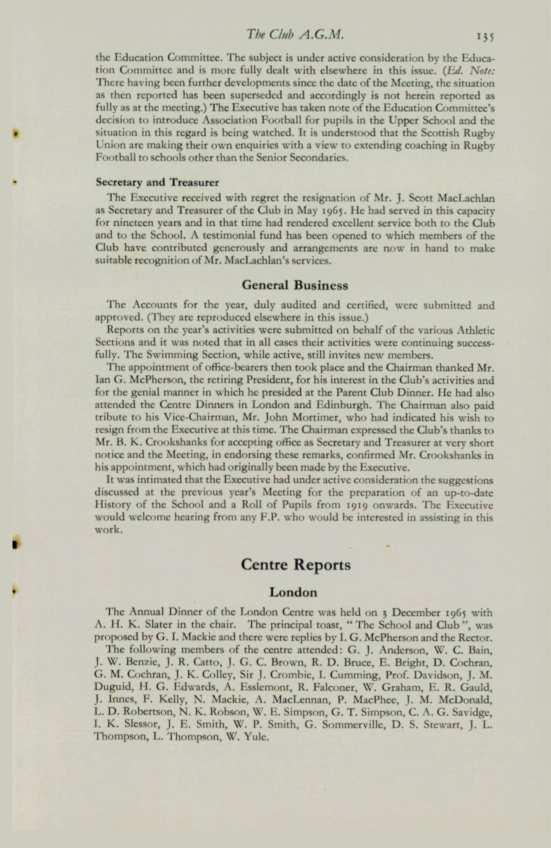
the Education Committee. The subject is under active consideration by the Education Committee and is more fully dealt with elsewhere in this issue. (l::.d.•Votr: There having been further devclopmcnrs since the date ofthe i\ketmg, the situation as then reported has been superseded and accordingly is not herein reported as fully as at the meeting.) The Executive has taken note ofthe CduC1tionCommittee's decision to introduce Association fumball for pupils in the Upper School and the siruation in this regard is being watched. It is undcn,tood that the Scottish Rugby Union are making their own enquiries with a vie,, ro extending coaching in Rugby f ootballto schools other than the Senior Secondaries.
The Executive received with regret the resignation of :-tr. J. Scott l\facLachlan as Secretary and Treasurer of the Club in May 196j. He had sened in this capacity for nineteen years and in that time had rendered excellent service both to the Club and to the School. A testimonial fund has been opened to which members of the Club have contributed generously and arrangements arc no\\' in hand ro make suit:tble recognition ofMr. MacL1chlan'sservices.
The J\ccotints for the year, duly audited and certified, were submitted and approved. (They arc reproduced elsewhere in this issue.)
Reports on the year's activities were submitted on behalf of the various Athletic Sections and it was noted that in all cases their activities were continuing successfully. The Swimming Section, while active, stillinvites new members.
The appointment of office-bearers then rook place and the Chairman thanked Mr. Ian G. McPherson, the retiring President, for his interest in the Club's activitiesand for the genial manner in which he presided at the Parent Club Dinner. He had also attended the Centre Dinners in London and Edinburgh. The Chairman also paid tribute to his Vice-Chairman, Mr. John Mortimer, who had indiC1ted his wish to resign from the Executive ar this time. The Chairman expressed the Club's thanks to \fr B. 1'..Crookshanks for accepting officeas Secretary and Treasurer at Yeryshort notice and the Meeting, in endorsing these remarks, confirmed .\lr Crookshanks in his appointment, which had originaJlybeen made by the Executive.
It was intimated chatthe executive had under active consideration the suggestions discussed at the previous year's ,\Jecting for the preparation of an up-to-date llisrory of the School and a Roll of Pupils from 1919 onwa rds. The E.xccunve would \\Clcnmc hearing from any F.P. who would be interested in assisring in this work.
The Annual Dinner of the London Centre was held on 3 December 196s with A. Ir. 1'.. Slater in the chair. The principal roast, "The School and Club", was proposed by G. r. Mackie and there were replies br J. G .\IcPhersonand the Rector.
The folio\\ ing members of the centre attended: G. J. Anderson, \'<'. C. Bain, J. \'\'. Bcn7ie, J. R. Catto, J. G. C. Brown, R. D. Bruce, E. Bright, D. Cochran, G. l\f Cochron, J. K. Colley, Sir J. Crombie, I. Cumming, Prof. Davidson, J. l\f. Duguid, JI G. Edwards, A. Esslemom, R. Falconer, \X' Graham, E. R. Gauld, J. Innes, F. Kelly, ' . Mackie, A. .\lacLennan, P. MacPhee, J. M. McDonald, L. D. Robertson, N. K. Robson, \VI. E. Simpson, G. T. Simpson, C. A. G. Saddgc, J. K. Slcssor, J. E. Smich, \V. P. Smith, G. Sommerville, D. S. Ste\\art, J. L. Thompson, L. Thompson, \'i' Yule.
GF'IIERAL RECEIP rs AND PAVM ENTS ACCOUNT RLCL t l''IS
Ordinary Sul>ieupl i<)lb rec~I\Cd p11,J1 to J.t.nuary1•1b.S
Receaved m 1954 - - - - -195<, 1qs7 195~ 1959 196o 1~01 1961 1q61 19~~
Ordin2ry 5ul)--niption, rN:f'i\"f"J. io 19(,1 .\rn-ar-r.re<.·overe,lin 19<,5
Re\.·enue Croll\ Investment,:, ((;r~,)
lntere-.,lat 3 pe.r ceut ou Lile ~temhrr C:tpital fund
Surplus nn tntertainmt"nls Arrouut
Income Tax Re:Cund-19'11-65
Rollj of Honour
Prim.arics Protest C'onunittN" :\11scclbueo1.U l'k-fic1t for Yf'ar -

'\fAGAZI
SalesAtht.rti ..-.rmenhTran~ferre<l lo Gentral H.r<~ript, ancl P,l'y111rnt-. ,A.,·r1111nt -
\;,..() f.lADII
I. L1F1t ~f £MIIFR C APITAL Fu.so
Amount at credit at 3I~t lfflf' ml>1•r , 196_.Life \lember.i' Substriptiong re<el\·,~t,n 1965: 15 Full Life \l,mbei,; at ~15 ln~t.1lnwnt!\ for 1.ift \[rmhc~hip at£• b -
Us.s Tran,frrreil to Rttt:apts and l'avm<nlJ \rrount
JI. ORDl~AR Y St·a,;,c...RJP-TI0SS PAID 1, \D\'"-"'-'(P: Halan,·eof S11hscript1on, rt-cr1,ed m 19,--1 19571958196o19611960Tt,')J196~!-,u\,-.c:-npuon'l rt-'<"e1vrclin 1qft3 f,,r lutur,· }'\.':\f~
III. SwU,lYl'iG 1'001 . ft.:,n I\". L, c,t1r:'.'> Uvu1,tlas f. 1. Jault(', on C,mplwll Connon
Y. Oo"SAT10,"'-Pri11l.1rit"' Prnte=-.t\ommitfN'
n n 4 4 O
AHRDUN , 3nl Marrh 1966.-W• have namln td tbo lon:1oln1 Accounts for the year ending 31 December the Accounts com,cl. We are of the opinion that lbe Balance Sh,e l correctly 111te1 tbe position of the Club of the Accounts.
30 CARD& N' f>t.ACR, A8£RDl:SN'
tor year endlnQ 31 Decemb er 1965 1964
J14 \Vorki ng E.xfl('n,rs, including I loumJrium to Secretary and 1'1cdsurcr
S Honorarium lo Auditors for Year lo 31 December 1964J l11comeTax Schedu.le'l)'
zoo Income Tax paid by deduction from lovestme11t Income
u School and Trophy MedalsCapitation Grants )D London
9 lidinburgb9 Glasgow -
44 Club Development
20 Sports Prize Fund
71J Transferred from \ faga1.ine .\('('Ount
4 l Primaries Prolt:31lCommill~
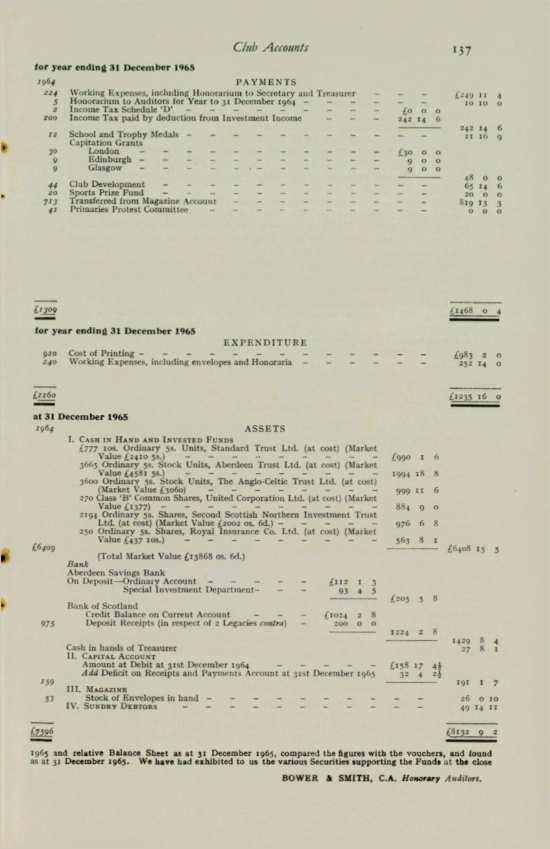
for year endln!l 31 December 1965
910 Cost of Printing -
: 40 \\~orking F:xprn~, induding enH•lope-s3..Dd Hooora.rLa
at 31 December 1965
19(,4
I. CAs 11 1s- H Asn AND INvF.sTEo Fuses
£777 109, Ordinary 5<, Units, Standard Trust Ltd. (al cost) (Market Value {.2410 ss.) -
3665 Ordmary ,,. Stock Units, A~rdeen Trust Lid (at ro,t) (\larket Value £45d1 5•.)
3/ioo Ordinary ~•- Stock Units, The Anglo-Celtic Trust Ltd. (al co-,l) (lfarkct Value £3o6o)
070 Class •B' Common Shares, Unite<l Corporation Ltd. (al cost) (\larkcl Value £1377) -
2194 Ordinary 5s. Shares, Second Scottish Northern Investment Tru,t Ltd. (al r.ost) (Market Value [2002 os. 6d.) -250 Onlmary 5s. Shares, Royal 1n,uran re Co. I.Id. (at ro,.t) ('larkrt \'alue £437 ios.)
(Total Market Value £13868 os. 6d.) BaKk Aberdeen Saving• Oank On JJeposit-Ord inary Account - -Sp('riat l11\'t;>,,lt11f'ntDepartrnf'ntlla11kof &:otlanc.l
Credit Oalanrf' on Cu..-rtnl Ac-count
97.S Deposit Rl'<'eapt (in rMpNct o( , u-gacies rnnl r,,)
Ca,h in bands of freasurcr II. C>..PITAL ACCOUNT
Amount at Debit at 3ut Dt>rrinber 1964 - - - -
AU Deficit on .k.eceipts and PaymPnt, Arrount at 31-.t lwrtntbf'r JQfi,'i 32 2½ 111. !tfA.CAZlN'S jJ Stock of En,~lope5 in bandIV. SUNDRY DHTORS -
1965 and relative Balance Sheet as at 3r December 1965, compared the figures wltb the vouchers, and found as at 31 December 1965. W1 bno bad ublblted to us tbe various Securities 1upport ln1 tbe Fund, at Iba close
The Annual Dinner was held in the Roxburghe Jlotcl, l .dmburgh on Friday, 4 I'cbruary, and there was an excellent attendance offifry-,c\'en membersand gu<.'StS The principa l guest w,1sour old friend Sir James Robenson "ho 01.~dethe Journey down from .'\berdccn to be with us. Other gu~ts at the top uble were Dr Ian :\fclntosh, IIcadrnastcr of Fettes, The Rector, \lr. Tan \lcPhcrson, Pres,Jcnt of the Parent Club, Mr. J. R. D. \ lurray, President of Fdinbu rgh Gordonians and Dr. Berrie Christie, President (,.f the Glasgow Centre, The T•:dinburgh President, .\lr. Ferrier \lavor was in the chair.
\II on all, tt was a buoyant evening, the one disappointment being the last-minute absence of the Centre secretary, Mr .\llan Frazer, because nf a sudden virus infcc11on.It was strange, indeed, to sit down at an Edinburgh dinner without Allan. Perhaps we should mention also that, despite an excellent menu, the Roxburghe Ifotcl need a lesson in the making of skink soup.
Among familiar face, \\·ewelcomed Sheriff Lillie, Q,c., present for his twenty• eighth successi\"cdinner, and our Ilnnorary \!ember, "gamC)'" to so many of us, T.r. Cnlonel Duncan \facGrcgor.
Speeches were piqu.rnt and racy, with both Dr McIntosh and our own "J.J."in sparl.ling wit. It was, in veritable fact, an ncning of memorable and enjoyable fcllo",hip.
1.n pass:1111,,~e might say that the annual golf match between the Edinburgh and Glasgo\\ Centres take, place at Canl\\:uh on Sunday, 16th; all hopers should not.: this tl.1te.
Ten members of the Yorkshire Centre sat down to dmner with their guest of honour, .\fr. J. V. Skinner, Rector ofthe School, in the Senior Common R<>om,The University, Leeds, on Thursdav, 19 \lay 1966.
Prior to the dinner \{r, Skinner pr~cntcd the new President of the parent cluh, Profcuor E. J. Wood, w1rhthe Presidential Mcdillion and Badge of Office
Jn his toast to the School and the F.P. Club Dr. Ian Innes, President ofthe Ccnrrc, said how pleased he was that one of the founder members of the Yorkshire Centre had been recognised by being elected t<> fill the Presidential Chair. o one deserved this hnnour more than Professor Wood and his election would give especial pleasure co all Yorkshi re F.P.s
.\ fr. Skinner responded on behalf of the School and gave an interesting account of it as it" as now and then went ()11 to speak pf the chanReSlikely to come in the near future.
Professor Wood thanked Mr. Skinner for bringing the medallion to him and for the imercq he had ,ho\\ n in the Yorkshire Centre. His presence certainly added ffi<.·•,rning to the c\'ening, and all present appreciated the fact that a man as busy as he would rake the rroublc, anJ spare the time, to visit this outpost in Yorkshire. IIc himself was very conscious of the honour done him by his election co President. Jle looked forward to meeting the club officials and members in Aberdeen anti I.ond,,n.
Then followed a period of informal reminiscing m·cr the traditional "Birse Cup'' and anmher enjoyable reunion came to an end.
The following is a Im of tho~ pre cnt: J. \'. ~kinner, Rector, J.E. •\ndcrvm (19< 6-10), Dr. 0. G. Prosser (19, 7-18), E. J. \\'o<.J (1908-21), II. J Strachan (191824), A. J. Adams (1910-30), Dr. \'<'. J. finnic (1918-31),J. \ , 1\;, \Vatr (1927-39), .\ \\ !\klntosh (1931•.u , Dr I D Innes (1933-3R}, P G. lnuc 1935-49).
School 1st XV
B,c Row 1/,ft lo r,~bt): ;\lr, AL. Ste,enson, \tclvyn R L. .\fcCue, Da,id I \lann, James Ross, \'filliam C. Scon, !\orman Garden, David Lefevre, Bruce ,\_ ~cil, .\lexander ;>,fcNay, Lcslrc \. l\lorr ison.
F1<0,, Row (lr/t lo ri_~bt): Jan Gray, Harr) \fathc,1,, Dennis \\. Tnkson, ,\listair G Gracie (Captain), Stuart C. Glover, Dennis G. C. \nderson, l:lrian G. Bcf:g,
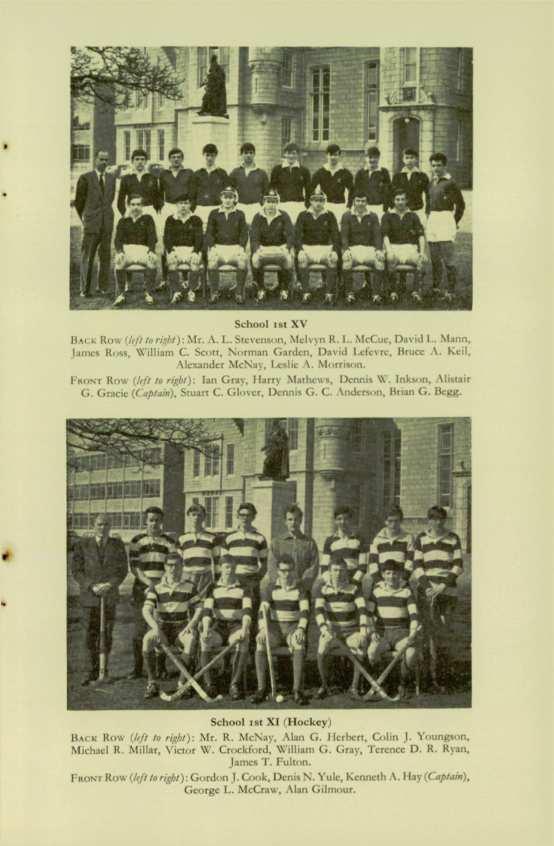
School 1st XI (Hockey )
l:lACK Row (11ft lo ri,l!,hl): Mr. R. Mc.:S.ay, Alan G. Herbert, Colin J. Youngson, Michael R Millar, Vicmr W. Crockford, William G. Gray, Terence D R. Ryan, James T. rulton.
f'R01'T Row (left to right): Gordon J. Cook, Denis K. Yule, Kenneth,\, llay (Coptom), George L. 1fcCra,1, \bn Gilmour.
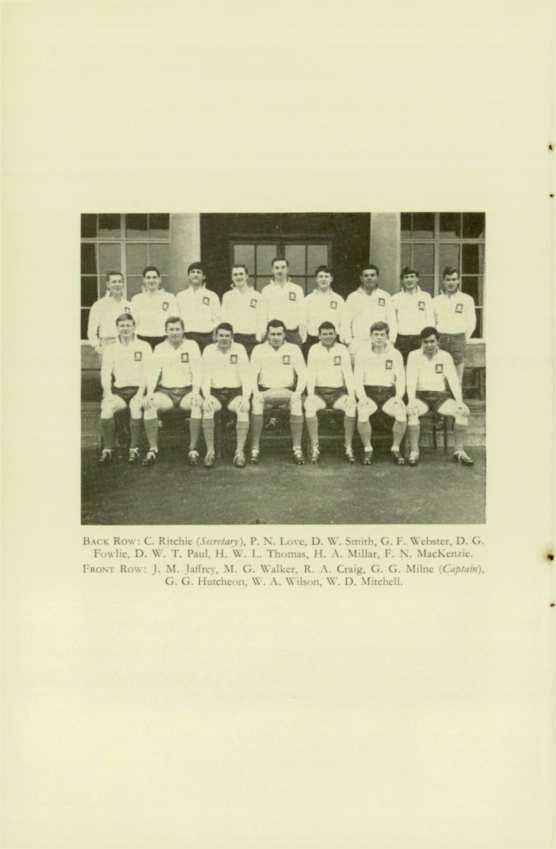
IIM i,: Rm,: C. Ritchie (\r.r tar1), I'. ::--. l.<,,c, D \\ ~m eh, (, I \\ ch,tcr, D ( , r0\d1c, D. \\ f P.1ul, II. \\ . I.. Thoma,, JJ. \. \lill.tr. I 's \lac Kenne.
I Ro,T Rm, I \I l:1tire1, \(. C. \\alker. R \. Cra1~. G. (, \1 lne ((apta11: ) G . (,. 1lmchcnn, \\. \ . \\ 1lv,n. \\. D. \ luchdl.
The Ann112lDinner of tbc Ccmrc u-as held in Kuala Lumpur on 7 .May and was reponcd to be a very fine evening. Only seven F.P.s were present due not only to a dccrea•e in F.P.s in the area but also to the fact that Se\"er,alwere on leave. However, nineteen guests were present and festivities lasted from 7.30 p.m. until s.oo a.m.-the Secretary, pedups understandably, reports that it was one of their bestnights I
The members continue to meet every two momhs or thereby althou~h the Secretary reports that it is sometimes difficult to ensure that eight people can be .in the same place on the same night. :--umbers ha.-e been depicted by the departures of George Crombie and Roderick Macl..enrun (as previously reported .in the Magaz.i,u)but there have been no other changes and W. S. Benton continues as President of the group.
All Centre members were sorry to hear ofthe proposed changes in the School and the Secretary suggests that we follow the example of English public schools who, according to rumours circulating in the Dublin bars, arc reported to be buying up land in Ireland so that a complete move can be made if there is governmental interference with their present status!
Smee the last issue of the Ma1,az.int,the activit1e~of the Rugby section have been seriously curtailed by the weather. The znd and 3rd XVs suffered most in this respect, having over thirty matches cancc11cdbetween them. Indeed, after Christmas, the 2nd XV played only seven times, and the 3rd XV fullilled only two fixtures. The 1st XV was not so seriously affected,having only six matches cancc11ed,but the early promise was not maintained, and several of the defeats might have been avoided However, it must be added that of the seven defeats received in the unofficialchampionship, on four occasions the side was not at full strength, due to injuries, inability to travel, or trial calls Nevertheless, we again managed to finish with so per cent in the championship.

A fourth XV was fielded on t\~O occa;,ions,an<l won both times. Unfortun,ttcly the other eight fixtures arranged were cancelled.
All of the existing championship fixtures have been confirmed for the coming season, and an additional match has been arranged to commemorate the 50th anniversary of the opening of Rubislaw Field. This will be •~ainst an International XV and is scheduled for 10 September. There will be a Jubilee Supper Dance in the evening, but further details of this \\·ill be advised separately. As our numbers will be limjtcd, and as there will be a large number of guests, all members wi,hing tickets are advised to make early application.
,\n innovation this <eason has been the forming of a Ladies' Committee u ho undertook the organising of teas for visiting team , In addition, they ran a Coffee :-.forning and a fashion Parade, and handed over to the Section a cheque for £12s \\hich has been transferred to the Clubhouse Development account. This now tNals well in cxCCl.>of £800.
Several suggestions have been considered for the propo~d building ofa Clubhou c, and just recently we have had the offer to purchase a piece of ground. The situation seems ideal, but the matter is fully reported on elsewhere in the Maxaz.mt,and we shall be glad to have any suggestions or offers of assistance of any description what,;,,ever.
The following awards \\ere made for the season
Full Colours: R. A. Craig, G. G. llutcheon, P. N. Love, G.G. Milne, D. \v. T. Paul, C. Ritchie, 11. WI. l. Thomas, :\f. G. Walker
Half Colours: D. G. l'oul1c, H \. :\lillar, \\. D. :-.titchcll, D.\\ Sr7tith,G. r:. \X'e~tcr
The following players represented the 1'-orth Midlands against Glasgow: R. A. Craig, C. Ritchie, and 11. \Y/. J,. Thomas.
Fixtures in the "Outh at the start of the sc:ison 1966-67 arc:
26 September Stev.art's College F.P. Invcrlcith
1 October Dunfermline Dunfermline
29 October Trinity Accics Bangholm
19 November Greenock Wanderer, Grcenock
3 December Wats0nians Myrcside
17 December Glasgow University Edinburgh
Propos ed Rugby Section Club House
For _,,me}car, a lot ha, hccn said but little done about the acquisition ofpremises for a Club House for the Rugb,· Section.
\\'c find chat in almost eHry ~sc where we travel to play sides in the Fdinburgh and Glasgow arC:ISthe club~ have their own facilities and can offer refreshments in the form of a bar, meals and very often dances and other social event , The benefits to the section from such a project would go a long way to help the succes ful running of a ,;cction fielding four XVs and would greatly rclic\'c the heavy burden of travel costs.
We \\Ould hope that the ,·cnture would supply a convenient meeting ground for all F.P.s returning to the city both from the ~outh and overseas and eventually it might e,·en be pos ible to use the facilities for any of the normal functions.
To this end we organi•ed a Spring Fair in May c96s which raised over £650 clear profit. This money has been specially earmarked for Oub House development, has been placed in a separate Club Hou,c De~clopmcnt Account, and can be used for that and no other purpose.
,\r the start of last sea on, a Ladies' Committee was formed and they have, by holding a Coffee Morning and Fashion Parade, raised the Club House development fund, t<> well over £800. The ccrion have v2rious ploys tn mind for increasing this fund considerably during the forthcoming season.
1'cgot iations are meantime proceeding apace for the acquisition of a piece of ground convenient for Rubl'law Field on which a Club House could be erected. Certain legalform.1litiesrequire to becomplied wHh before building may commence but we hope to overcome thck! in c:irl)•course.
'Ibis project \\ ill require a considerable amount of money, and assistance from all F.P.s interested in this project would be most helpful ifnot essential. ~uggestions as 10 the form and creation of the Oub IJ..,u,;c arc invited from all interested in thi project,
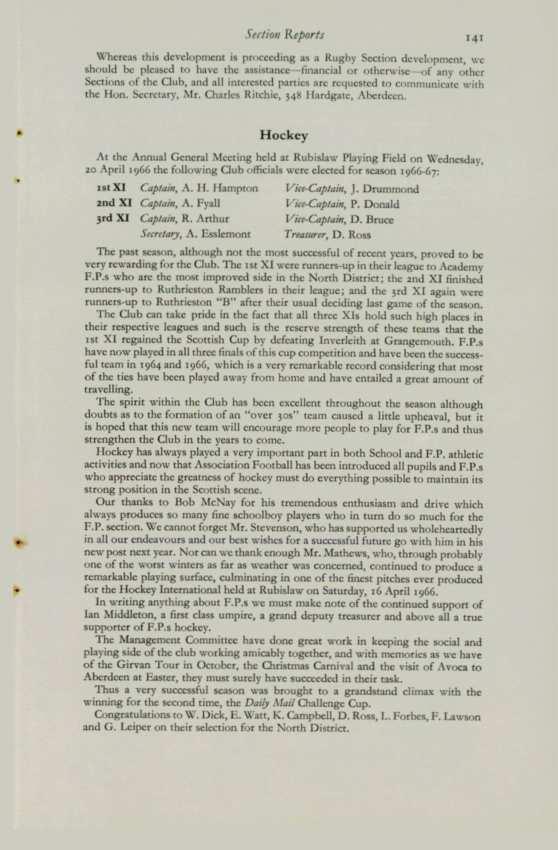
\'(/}tereasthis development is proceeding as a Rugby Section de\'elopment, we should be plc,1sed to have the assistance- financial or otherwise of any other Sections of the Club, and all interested parties are requested co communicate with the Hon. ~ccrctary, J\lr. Charles Ritchie, 348 l Iardgatc, Aberdeen.
Ac the Annual General ,'\lceting held at Rubislaw Playing Field on \'i'ednesday, 20 April 1966the following Club officialswere elected for season 1966-67:
ISl XI Captai11,A. II Hampton Viet-Captain, J. Drummond 2nd XI Captam, A. Fyall Vi<t-Captain,P. Donald 3rd Xl Capta111, R. Arthur Viet-Captain, D Bruce Surttary, A. Esslemont Trtasurtr, D Ross
The past season, although not the most successful of recent years, proved co be very rewarding for the Club. The 1st XI were runners-up in their league to Academy F.P.s who are the most improved side in the Nonh District; the znd XI finished runners-up to Ruthrieston Ramblers in their league; and the 3rd XI again were runners-up co Ruchrieston "B" after their usual deciding last game of the season.
The Club can take pride in the fact that all three XIs hold such high places in their respective leagues and such is the reserve strength of these teams that the uc XI regained the Scottish Cup by defeating Invcrlcith at Grnngemouth. F.P.s have now played in allthree finalsofthis cup competition and have been the successful team in 1964 and 1966, which is a very remarkable record considering that most of the ties have been played away from home and have cnt:.tileda great amount of travelling.
The spirit within the Club has been excellent through out the season although doubts as to the formation of an "over 30s" team caused a lictle upheaval, but ic is hoped that this new team will encourage more people to play for F.P.s and thus streng then the Club in the years co come.
Hockey has always played a very important part in both School and F.P. athletic activities and now that Association Football has been introduced all pupils and F.P.s who appreciate the greatness of hockey must do everything possible to maintain its strong position in the Scottish scene.
Our thanks to Doh McNay for his tremendous enthusiasm and drive which always produces so many fine schoolboy players who in turn do so much for the F.P. section. Wecannot forget Mr. Stevenson, who hassupported us wholeheartedly in nil our endeavours and our best wishes for a successful future go with him in his new post next year. Nor can we thank enough l'llr.Mathews, who, through probably one of the worst winters as far as weather was concerned, continued to produce a remarkable playing surface, culminating in one of the finest pitches ever produced for the Hockey Imernariona l held at Rubislaw on Saturday, 16April 1966.
In writing anything about F.P.s we must make note of the continued support of lan l'lliddleton, a first class umpire, a grand deputy treasurer and abo\'e all a true supporter of F.P.s hockey.
The .Management Committee have done great work in keeping che social and playing side of the club working amicably together, and wJth memoncs as we have of the Girvan Tour in October, the Christmas Carnival and the visit of Avoca to Aberdeen at &aster, they must surely have succeeded in their task.
Thus a very successful season was brought to a grandstand climax with the winning for the second time, the Dai!JMail Challenge Cup.
Congratulations to\','. Dick, E. Watt, K. Campbell, D. Ross, L. Forbes, F. Lawson and G. Leiper on their selection for the North District.

"Daily Mail" Scottish Cup 196s-66
ror the third year running F.P.s Hockey Section found themselves in the final of the Daily Mail Scottish Cup Final, which was again played at I.CJ. Grangemouth. This yearit proved to bea much more difficulttask to gain a placein the Finaland it required three matches to go to extra time. But once again with only one home game F.P.s were in the finaland against our friends from Edinburgh, Inverleith.
The conditions were perfect on Sarurday, 7 i\fay when a team was fielded containing thiec reserves against Inverleith with one reserve. F.P.s were happy to sec A. Philip, an cx-F.P. captain playing at outside left against us but were sorry that J. Wight, another F.P. had to call off at the last moment.
F.P.s settled quickly with the half back line ofD. Ross, J. Milne and J.Drummond taking complete command of the game and the inside forwards J. Leiper and F. Lawson foraging very hard in the centre ofthe field. P. Donald at centre forward using his speed and determination to harass and upset the opposition defence, left the other forwards ,vith more room to manoeuvre than in previous matches. The wing men L. Forbes and S. Leslie when they kept out on their wings were full of running and caused lnverleith to clear in desperation manytimes. With the remaining defenders E. Watt, \'i/. Gatt and W. Dick covering each other exceptionally welland giving the opposing forwards little or no chance t0 play constructive hockey, the result was never in doubt. This was in fact a 100 per cent team effort with every player giving everything to make amends for last year's defeat at the hands of Clydesdale.
The opening goal cameafter only fiveminutes playwhen P. Don.'lldforced his way through on the right and, when the ball broke to the back of the circle, J. Leiper gave the goalkeeper no chance with a tremendous shot into the top corner of the net. This early goal obviously upset Inverleith but as half time approached they came more and more into the game and F.P.s were becoming too content with their slender lead.
After half time F.P.s were much more enthusiastic and determined and continuous pressure was maintained on the lnverlcith goal and it wasnot surprising when goals came from J. Leiper and S. Leslie.
Just before full time Inverleith claimed a consolation goal when S. McMinn at inside right weaved his 'llray into Lhe circle and srumbling his way goalwards, luckily saw the ball enter the net over the outstretched foot of goalkeeper W. Dick.
There was no doubt that this performance by F.P.s was their best display so far, and play of this standard will have done much to improve the image of club hockey in the North District and thioughout Scotland.
The team for the final wasas follows:\\'. Dick,\\'.', Catt, E. Watt, J. Drummond, J \[ilne, D. Ross, L. Forbes, F. Lawson, P. Donald, J. Leiper, S. Leslie, and our thanks must go to Avoca Hockey Club for the lrish whisky which they most gcncr, lUSI)·gifted to us to fillthe Cup'
1\t the ,\nnual General ~fceting the following officialswere appointed: Pruidm l : Mr. Is.. J. l'ecers. ftralbmore l.J11io11 SI-Caplain, J. B. Rennie; Viu-Caplain, G. F. Webster. GriUk JI -Caplain, James Lobban; Viet.Captain, F. K. S. Lawson; Trtamrtr, \\. :'.\1. Ewen; Strrtlary, ,\. M. Davidson.
At the ume of writing only one game of cricket has taken place and that in the Strathmore Union against Perthshire, whom we beat.
It appears from the numbers who have now rumed up at the commencement of this season that there is as lively an interest in the game as ever and it is hoped that throughout the season it will be possible to field cwo strong sides with resultant success.

The Golf Section commenced the 1966season with an outing at Ballater on 1 May. The attendance and weather was very good. Unfortunately the Captain was in Oslo and was unable to bepresent but his Deputy Douglas Patterson, acted as Captain and did so exceptionally well. We were very pleased to welcome three new members to the Section, Eric Watt, D. H. Chapman and C. C. Allan-and any others interested in doing so should get in touch with the Section Secretary: they will have a good chance offiguring in the prize-list before their handicaps are reduced I
Prizes were won by the following at the above outing: Handicap: 1-11 12 and over
1. R. J. Armstrong 79- 9 = 70 1. D. II. Chapman 81 - 14 = 67
2. J. W. Craddock n - 4 = 71 2. A. G. Scott 85 - 16 = 69
3. G. E. C. Barton So- 7 = 73 3. C. C. Allan 86- 13 = 73
Since the Swimming Section has not, as yet, engaged in competitive swimming it is not possible to give the same kind of report as is given for the other sporting sections of the F.P. Oub. It is pleasing to note, however, that the Section has a nominal membership ofabout sixty of which a fair proportion are regular attenders during the Session.
This year, on 14 June, we are having a family night when members will be bringing their wives and children. If this evening is a success it is hoped to repeat it in the future.
The Section will still be very pleased to welcome new members at any time.
(15 November 1965-15 May 1966)
ANNAND,Dudley Nicolson (1938-51),M.A., LL.11.,77 Forest Avenue, Aberdeen. B&IITAIN,David Anthony (1943-49), M.A., LL.B., 2 Circus Gardens, Edinburgh. DELEuv£RE,George Harley (1957-58),P.O. Box 338, Kitzmiller, Maryland, U.S.A. LAMB,Leonard McKewney (1942-45), 27 Harold Road, Burton-le-Clay, Beds. LESLIE,David Carnegie (1947-62), 58 Bonnymuir Place, Aberdeen. MACRAE,Edward J. (1934-47), 52 Springfield Avenue, Aberdeen. M1c1m:, Charles Alexander (1946-6o), 110 Queen's Road, Aberdeen. M1c11m,John Charles Alexander (1944-58), 110 Queen's Road, Aberdeen. ScoRGIE,Leonard Dunn (1946-59), 144 Forest Avenue, Aberdeen. STEPHEN,Henry Gordon (1920-30), Villaficld, Bieldsidc, Aberdeenshire.
ANDERSON,Brian G. (1963-65), 24 Hammerfield Avenue, Aberdeen. ANDERSON,William Francis (1958-64), 41 Byron Avenue, Aberdeen. BLAIR,Donald C. (196o-65), 95 Cromwell Road, Aberdeen . BYTHEWAY, David (1952-63), 263 Birkhall Parade, Aberdeen. CowuNG, Richard (1959-65), Protea House, Jan Hofmeyer Road, Welkom, Orange Free State, South Africa.

DocGLAS,Geoffrey Andrew (196o-65), 24 Roschill Place, Aberdeen.
EASTON,David Stuart (1953-62), 415 Clifton Road, Aberdeen.
FITE, Porcst M. (1949-55), 1447 Edward Street, Halifax, Canada.
LoNGMUIR,Wilson Shivas (1956-6o), 9 Ord Street, Aberdeen.
J\f1TCHELL,Joseph Ronald Andrew (1939-48), 168 .-\nderson Drive, Aberdeen.
MoRISO~,Michael Charles (1947-57), 39 Ann Street, Edinburgh, 4.
MORRICE,Gavin Philip Alfred (196o-64), Police Training Centre, Pcrshorc Road, Edgbaston, Birmingham, 5.
NOBLE, Andrew (1952-62), H Great Southern Road, Aberdeen.
R£m, James A. (1963-65), 17 Craigievar Crescent, Aberdeen.
R.ENN1E, John Bain (1947-53), 2.8 Woodend Place, Aberdeen.
ScoTT, James 'orman Gallic (1959-65), 12. Salisbury Terrace, Aberdeen.
SMITH,David W. (1954-65), 1 Market Street, Aberdeen.
So=, Ian Alexander (1962.-65), 111 Queen's Road, Frascrburgh.
TAWSE,Ian Sinclair (1959-65), 55 Short Loanings, Aberdeen.
WLBST:ER,Keith M. C. (1959-63), 98 Burnieboozlc Crescent, Aberdeen.
WILL, Hugh Oliver (1959-65), 686 Great Northern Road, Aberdeen.
WILSON,Alexander John (1959-65), 130Bon-Accord Street, Aberdeen.
-
1. That the Annual Subscription for Ordinary Members has been increased to the sum of £1 per annum with effect from 1 January 1967. The Junior rate will be 10/-
2. That the best way to offset increasing costs is to have a substantial rise in the Club membership: if any of your F.P. friends arc not members, why not introduce them?
ABERDEEN
UNIVERSITY PRESS FARMERS HALL
-scoTTnt ABERDEEN recommend their 'SPECIALIST' FLY ROD
The most advanced Hri•s of nr rocb y•t produc•d by any ma.ker demonstratin& perfect aulon. Oesisned by experts and produc.d by crafumen to &••• impr•cnated excellenc._th• fly rods for the 1pecial11t.
t ft. 2-pce DRY FLY Action; SI oz.
£IS : IS: 0
,1 ft. 2-pce. WET FLY Action ; SI oz.
£IS I IS I 0
II ft. J.pce SEA TROUT and LOCH Action; 71 oz. £It 1 10: 0
(Spare top £4 : 10: 0 extra) 111 ft )-pee. SALMON Action; 16 oz. £U. (Spare top £5 extra)
Call in a.nd••• these rods, or write to the Sales Director for illunrated leaftet.

With Its powerful, east-west mounted engine, velvet smooth Hydrolastic suspension, fresh-air ventilation, and ample room for five, the
Why not let us quote you for a new 1800. Your present car taken In part exchange.

One of the stlmulat lng trends of the times Is the enlightened approach to the pleasures of the table Wines, which have become a topic of conversation are discussed knowledgeabl y and select ed with discri mlnation . Here you can choose from a select ion which for variety and value Is unsurpassed In Scotland .
\VhatC\·er rour tastes, whether you seek educational, Teach Yourself Books, or leisure reading, you will enjoy spending a happy hour choosing where you want from our crowded shelves.
Books
Stationery
Fountain Pens
Maths. Sets
Gifts
Greeting Cards
Games
Toys
Educational Magazines
Newspapers
Periodicals

Our other styles are Rax, Cortina , Llenz, Eskimo, Lizum and Bozen. Warm , bold and elegant All Bernhard Altmann's clothes are.

For each a11d every occasion " The Caley " offers all the facilities a11d seroi.ces expected of a first dass hotel
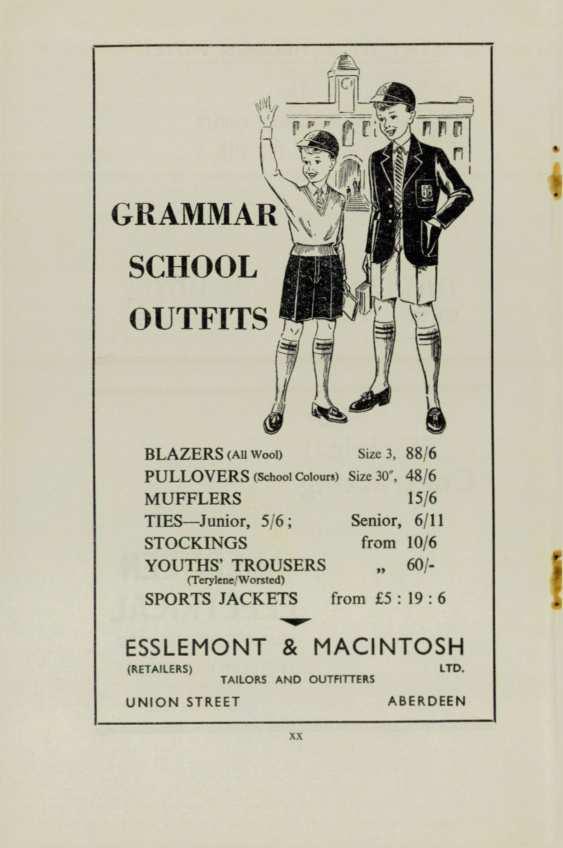
BLAZERS(All Wool) Size 3, 88/6
PULLOVE R S (School Colours) Size 30*, 48/6
MUFFLE RS 15/6
TIES-Junior, 5/6; Senior, 6/11 STOCKINGS from 10/6
YOUTHS' TROUSERS ,, 60/(Tcrylcnc/Worstcd) SPORTS JACKETS from £5 : 19 : 6

'Northern' by name and 'Northern• in ongm, The Northern Assurance Company Limited was established in Aberdeen in 1836 and takes lasting pride in its Scottish ancestry
all classes of Insurance