THE ABERDEEN GRAMMAR SCH®L MAGAZINE

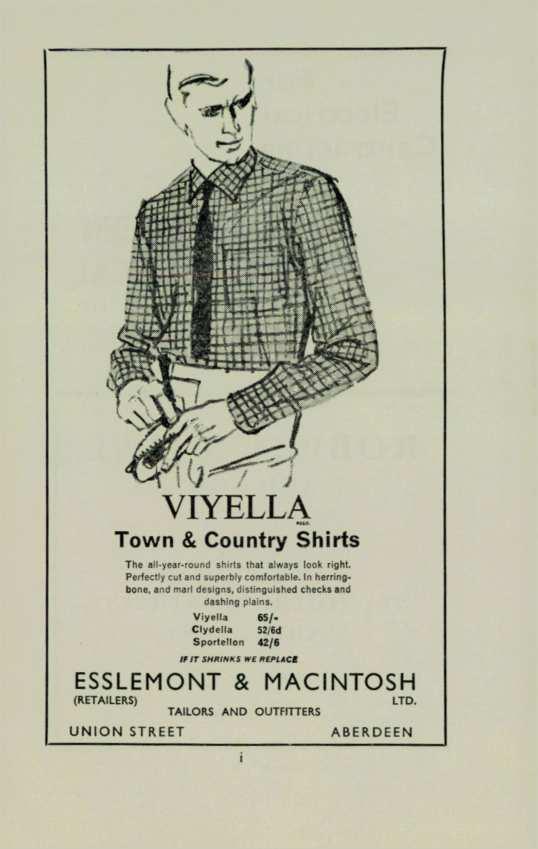
Town & Country Shirts
The all-year-round shirts that always look right Perfectly cut and superbly comfortable. In herringbone, andmarl designs, distinguished checks and dashing plains.
* for the newest works of fiction sport pastimes memoirs travel biography adventure and other books of many varied interests
A&BMILNE
BOOKSELLER
&
STATIO ER
also for gifts writing materials and the easy exchange of book tokens
229 Union St. Aberdeen

WINES FOR ALL OCCASIONS
One of the stimulating trends of the times Is the enlightened approach to the pleasures of the table. Wines, which have become a topic of conversation are discussed knowledgeably and selected with discrimination Here you can choose from a selection which for variety and value is unsurpasse d In Scotland .
THE NORTH E RN -ASS U RANCE COMPANY LIMITED
•Northern ' by name and •Northern ' in ongm. The Northern Assurance Company Limited was established in Aberdeen in 1836 and takes lasting pride in its Scottish ancestry
For all classes of Insurance
ACCIDENT • ENGINEERING • FIRE HOUSEHOLD LIFE • LIVESTOCK
MARINE • MOTOR • PENSIONS
You will be on good terms with The Northern Head Offices
UNION TERRACE, ABERDEEN MOORGATE, LONDON, E.C.2 A MEMBER OF THE ORTHER & EMPLOY ERS GROUP OF ASSURANCE COMPANIES
3S FOVNTAINHAU aoAD THESQUA~E CULTS P>tONI 21n4 ONI Auo •• CHURCH SQUARE, IALLATER ,HOHi JI
recommend their
'SPECIALIST' FLY ROD
The most advanced series or fly rods yet produced by any maker, demonstracinc perfect action. Oesiined by 1xp1ru ;and produced by crartsmen to 1iv1 impr•c· natod excellenc-•h• Oy rods for the speci1l11t.
9 ft. 2-pce. DRY FLY Action ; Sj o:a:.
£1S: IS : D
91 ft. 2-pce, W ET FLY Action ; SI oz.
£15 1 IS : 0
10 ft 3-pce. SEA TROUT and LOCH
A ction; 71 o:i:. £19: 10: 0 (Spare top 10 : 0 extra)
121 ft. 3-pce. SALMON A ction; 16 o:i:. US. (Spare top U extra)
Ca.JI in and see these rods, or write to the Sales Director for Illustrated leaOet.
J. S. SHARPE
(FISH I NG TACKLE ) LTD, 35 BELMONTST •ABERDEEN
Shoes correctly fitted by X-AAY pedoscope
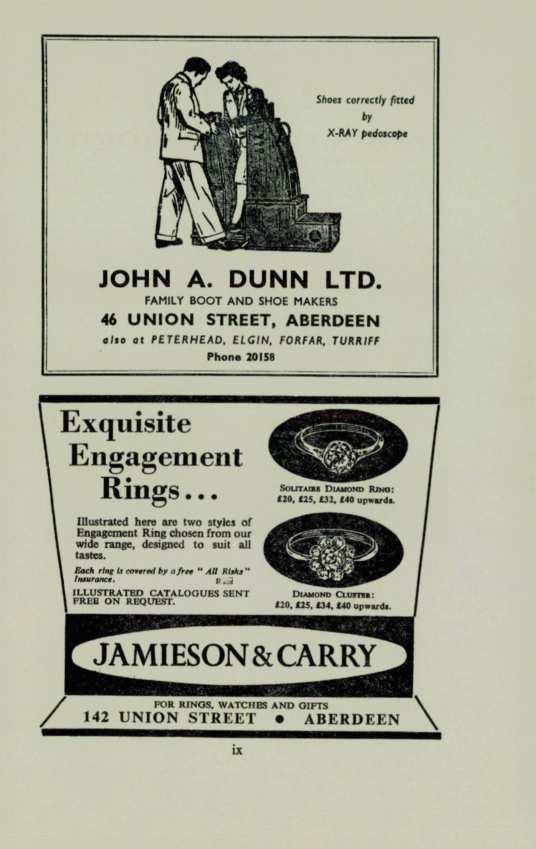
JOHN A. DUNN LTD.
Exquisite
Engagement Rings
The go-ahead LIFE of a NAVAL OFFICER
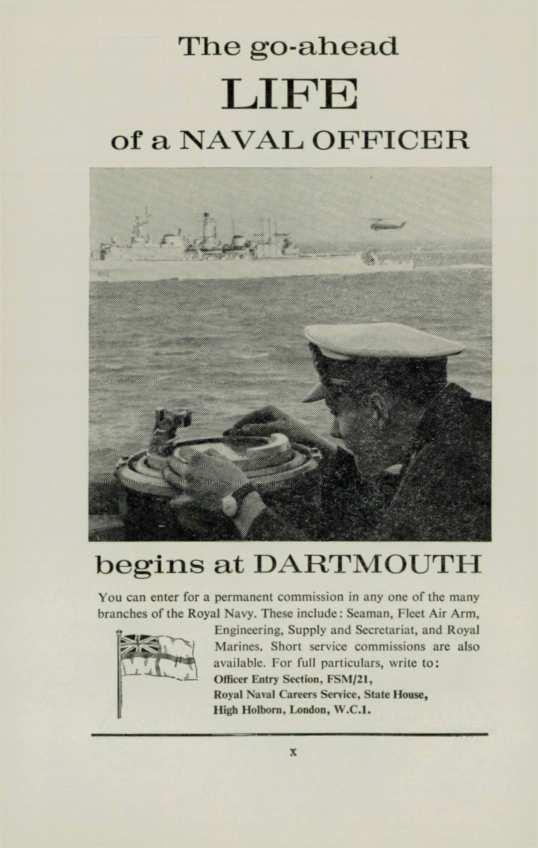
begins at DA RTMO UTH
You can enter for a permanent commission in any one of the many branches of the Royal Navy. These include: Seaman , Fleet Air Arm, Engineering, Supply and Secretariat, and Royal Marines. Short service commissions are also available. For full particulars, write to: Officer Entry Section, FSM/21, Royal Na~al Careers Service, State House, High Holborn, London, W.C.l.
Aberdeen Grammar School Magazine
Sul year No. 196 (New Series 7ut year No. 187)
Vol. LXVIII
No. z.
The Magazine is published under the auspices of The Former Pupil s' Club twice during the year, in December and June
General Editor Editor of Totes, Obituaries, and Marriages
Joint Editors of the School Section
Advertisements
Rae C. Barton, M.A., LL.B., z.o Belmont Street, Aberdeen
Brian K.Crooksbanks, T.D.,M.A., LL.B., 1 z. Bon-Accord Square, Aberdeen.
Alexander Tait, M.A. Ronald Henson, M.A.
Frank C. Connon, M.A., LL.B., s8 Dec Street, Aberdecn.
The Genera l Editor invites contributions from F.P.s for the next issue and requests all those with informat ion for the Notes Editor to communica te the same to him. All copy should be sent to the Edito rs by 1.5 November 196.5.In view of the cost of publishing the 1'1ai,:atine new advertisemen ts are earnestly sought.
CO TE TS
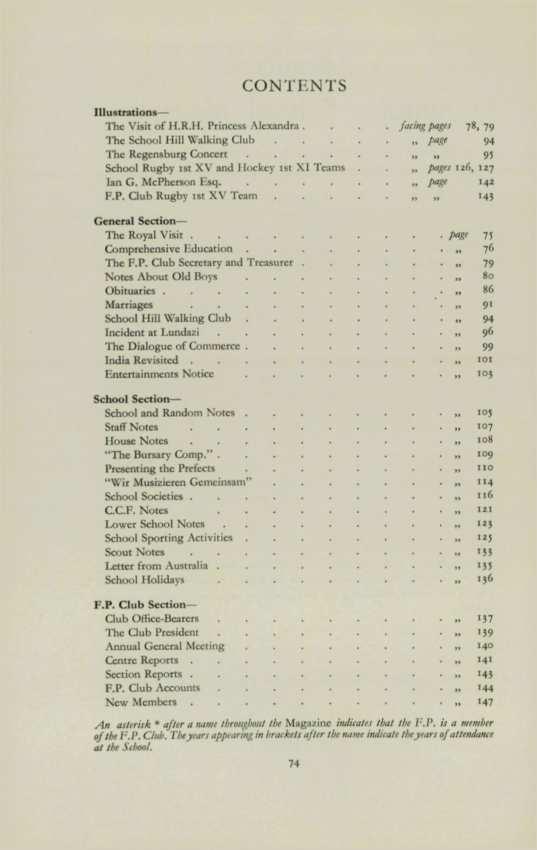
Illustrations-
The Visit of H.R.11. Princess ,\lcx.mdrn
The School Hill Walking Club
The Regensbu rg Concert
School Rugby at XY and I locke> 1<t Xl TC'.lms
Ian G. McPherson Esq.
F.P. Oub Rugby 1st X\ Team
General Section -
The Royal Visit
Comprehensive Education
The F.P. Club Secretary and Treasurer '-iotes About Old Boys
Obituaries .
Marriages
School Hill Walking Club
at Lundazi
The Dialogue of Commerce .
Entertainments
SchoolSection
School
C.C.F. Notes
Lower School Note.s
School Sporting Activities
Scout Notes
Letter from Australia
School JIolidays
F.P. Club Section
Club Office-Bearers
The Club Pres ident
Annual General Meeting
Centre Reports
Section
A ,, aslerisle* afltr a 11amt lhro1(~ho11tthe Magazine i,u/iratu that the F. P. is a mtmbtr oftht F.P. C/11b.They,ars apptarillJin bratktlJ ajitr th, nameindicateII.Ityearsofatltndanet af tht School.
The Royal Visit
On Wednesday, 2 December 1964, the School had the honour of receiving a visit from Her Royal Highness Princess Alexandra. This is the first time, so far as we have been able to ascertain, in the long history ofthe Grammar School that it has been accorded the distinction of a Royal visit and the occasion must for that reason be regarded as a unique and memorable one.
The object of the visit was to perform the officialopening ofthe new extensions to the School and, in accepting the invitation to carry out this duty, Her Royal Highness had expressed the wish that her visit be accompanied by the minimum of formality. As she had a similar function to discharge at the Royal Hospital for Sick Children in the forenoon, it was decided to restrict the formal side of the proceedings to a Civic Luncheon, at which she would receive an official welcome from the Lord Provost and would be given an opportunity of dealing with both aspects of her visit in the course of a single reply.
Grammarians will be interested to know that her remarks displayed a considerable familiarity with the history of the School. As an honorary graduate of Queensland University, she said, she had been particular!yinterested to learn that the founder ofthat University, and indeed the first Governor of Queensland, had been a former pupil of the Grammar School, Sir William McGregor.
At the conclusion ofthe meal she was presented by the Lord Provost with two lengths of tweed from the Grandholm Mills, one for herself and one for her husband.
At 2. 30 p.m. the Princess, accompanied by Lord Provost Norman Hogg, arrived at the School where she was welcomed by the boys of the Lower School, lining the approach from the gate to the new entrance between the main building and the West Wing. The school Pipe Band, dressed in their scarlet uniforms, provided music on the front lawns.
After a briefceremony at which the Rector, the Depute Rector and a number of officials and their wives were officially presented, the Princess proceeded to the new Assembly Hall, where the bulk of the boys of Middle and Upper School were waiting. Here a brief recital of Scottish songs was given by the School choir and orchestra, following on which the Princess was called upon by the Lord Provost to open the new extensions to the School. This duty she discharged with an admirable economy of words: in fact, she used only two sentences. In the first she asked the Rector to give the boys a holiday to mark the occasion. This was greeted with loud applause. In the second she declared the new extensions to the School officially open. The Senior Prefect called for three cheers from School, and immediately thereafter the Princess left the Hall with the Rector on a tour ofthe new buildings. The Dining Room and the new Kitchen were the first to beinspected. This was followed by a visit to the new Technical Department, the Swimming pool, and, finally, the Mathematics and Science Block. In no case was the visit a casual or perfunctory one. In each room she entered, the Princess made a point of speaking to the Masters in charge and to several ofthe boys, questioning them about the work they were
Aberdeen Grammar School },,fagazi11e
doing and showing obvious interest in their replies. It had, indeed, been thought that she might not feel inclined to climb to the upper floors of the new building to see the Chemistry and Biology Departments, but she accepted the suggest ion with alacrity and was clearly fascinated by the experiments which she saw in progress there. The dissection of cockroaches, upon which a number of boys were engaged in the Biology Laboratory, provided her with an opening for her own impish turn of humour. Where, she inquired of the boys, did they obtain their supplies? Were they by any chance caught on the premises?
Tea was provided at the end of the visit in the Rector's room, with a magnificent spread of delicacies prepared by girls of the High School and Aberdeen Academy. Especial thanks are due to Miss Kerr and Miss Ross of the School Meals Centre, and to Miss Gibb and Miss Glashan for the efficient way in which they coped with this side of the arrangements.
The visit ended at 4 o'clock and, as the Royal car made its ·wayslowly out to the gate, the Prince ss was given a tremendous ovation by the boys of the School lining both sides of the carriage-way.
All who had the privilege of meeting her and speaking with her on this historic occasion were deeply impressed by the charm and ease of her manner and by the interest she showed in everything connected with her visit. It has been a signal honour for the School to have welcomed her within its gates and the page in the official Visitors' Book bearing the simple signature "Alexandra" will long remain one of our most treasured possessions.
Comprehensive Education A New Threat to the School?
As many readers will be aware, the Education Committee of Aberdeen Corporation earlier this year approved in principle the introduction into the city of a system of Comprehensive Secondary Education.
In a Report prepared by the city's Director of Education, the following reasons were interalia put forward for considering a change in the present structure:
(a) The increasing dissatisfaction over the policy of segregating pupils into different schools at the end of the primary stage.
(b) The idea that "intelligence" was fairly static has now been largely discredited, and consequently using the examination results as prognosticators of academic success has become suspect.
(c) The increasingly bad effect of the Transfer Examination on the work of some primary schools .
The Director also put forward a draft proposa l for Comprehensive Secondary Education in Aberdeen in which the following are the salient features and which might come into effect in session 1970-71:
(i) All pupils at the end of the primary school course will transfer to the area Secondary School.
(ii) At the end of the second year of the secondary course, parents will have the option of having their children transferred to the senior secondary schools, after receiving educational guidance. The senior secondaries would start at the present third year stage and provide a full range of Scottish Certificate of Education courses.
(iii) The secondary school will provide the present range of courses, including those leading to presentation in the Ordinary grade of the Scottish Certificate, and also a selection of the new "work-based" courses, arising, from the recommendations of the Brunton Report, in the third and fourth years.
(iv) Any pupil completing the fourth year in a secondary school who wishes to continue at school as distinct from going to a further education college will be admitted to a senior secondary school.
(v) A limited proportion of the able pupils might be transferred to the secondary school a year earlier than normal.
According to the Report, the merits of this proposed system are:
(a) It provides a wide variety of courses in both types of school with a large amount of flexibility.
(b) There will be two bridges to the senior secondary school, after two and four years.
(c) It safeguards the development of suitable cou.rses for the nonacademic child by leaving these in the secondary schools.
(tf) The system of segregation by examination is eliminated.
(e) The primary schools will be freed from Transfer Exam requirements.
(j) Able youngsters may be transferred a year early provided they are considered "mature" enough.
The foregoing, of course, relates to a "two-tier" system and the Director was also instructed to report on a "one-tier" system. Under the latter, each one-tier school would be the only secondary provision for a defined geographical area of the city. It would take all pupils of both sexes from twelve years to leaving age and beyond except those requiring special education or attending non-Authority schools. Under such a system, the Grammar School would become one of thirteen or thereby co-educational one-tier area comprehensive schools in the city each with a roll of about 900.
The Director, however, pointed to two major criticisms of this system, namely, the educational one, that, although an adequate curriculum can be provided for the more able pupils, the chances are that in most schools there will be an impoverished diet for these pupils compared with other alternative re-organisation proposals; and the economic one- both in finance and man-power - arising from some inevitable duplication of accommodation, expensive equipment and staff.
These proposals obviously greatly concern both the School and the Club and, in company with various other interested bodies, the Club was invited to submit to the Director its observations. Following consideration of the matter by the Chairman's Committee and the Executive, the Secretary was instructed to reply with these observations:
1. It is felt that there is no need for any change in the existing educational arrangements in the city, and
2.. If a system of Comprehensive Education is introduced the Club would favour the two-tier system.
The reasons for this arc:
(1) The aims of comprehensh·e education can be achieved only if all Schools in the city are within the Scheme and the Direct Grant Schools are, of course, outwith this.
(2.) Under the comprehensive system the "ironing out" of pupils would take place in the Third Year which is late in the Secondary Course with "O" Level exams only a year ahead.
(3) In any comprehensive system there will be an inevitable loss of status for the existing Senior Secondary Schools and may affect recruitment of teachers.
(4) Many school activities would be adversely affected, e.g. Rugby and Music.
..c\s between a two-tier and one-tier system the Club is decisively and unanimously against the latter for the following reasons:
1. There would be a gross wastage of staff with a one-tier system.
2.. At present it is difficult to attract staff of the best quality to the existing Senior Secondary Schools. It would be much more difficult to attract such staff to one-tier Schools. There would be a complete loss of status for the Senior Secondary Schools.
3. There would be in the case of the Grammar School a complete loss of identity and it is felt that 700 years of history should not be thrown aside.
4. It is presumed that all Secondary Schools would become coeducational area schools.
5. The standard of class in the one-tier system would inevitably fall. All pupils do not have equal ability and to mix the best with the worst brings the former towards the latter. This also has a bearing on the question of attracting staff.
6. The establishment ofarea schools would involve a loss ofthe present type of class to be found in the Senior Secondary Schools where pupils from all parts of the Gty and from varying homes and backgrounds meet.
In addition meetings ofparents ofboys presently at School have been held at which there was a general feeling that not enough information was available and that they were against any change in the present system until such information was forthcoming. Again, it was clear that all were against a one-tier system and there was concern also about the difficulties of finding teachers and the whole costs which would be involved.
There the matter rests for the moment and is it too much to hope that educational wisdom will prevail over political expediency and allow the School to continue with its primary function of educating boys of all social groups and from all parts ofthe city, a function which it has been carrying out for centuries and still does, if the Bursary Competition results this year are any criterion bv which to judge?
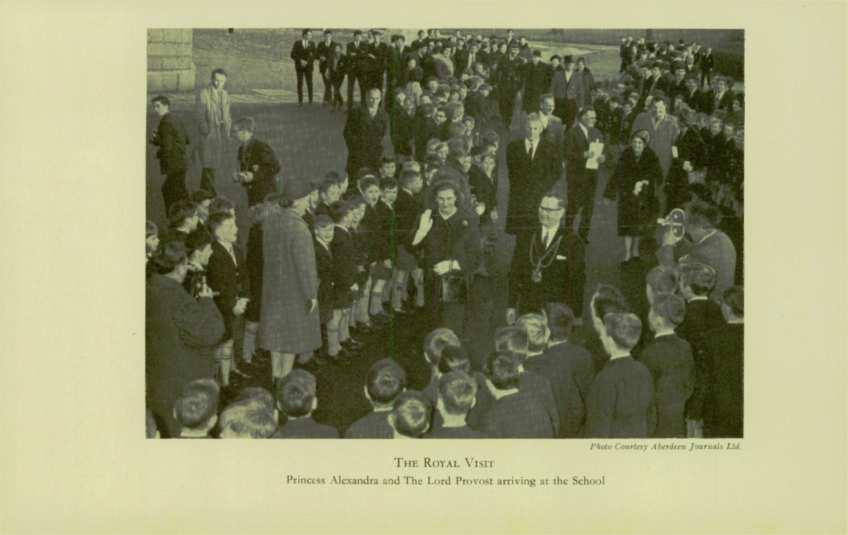
l'holo Comt~y i btrJun }9Mrnab UJ
Tm: ROYAL v,~11
Princ, ss \lcxandra :'.'Id The Lord Pro,·o,t arriving at the Sch<~>l

T11F RoY ,1. Yhtr
Princess .\lc,.111dra during her insnccri<,n .,f 1hc nc\\ hhoratoric.,
We shall, regrettably perhaps, hear more of this subject but, in the meantime, it is well worth noting the remarks of the last President of the Club, Mr. Cecil A. G. Savidge, which he made at the London Centre Dinner:
"What I cannot go along with and cannot stomach at any price is the attack on the whole system of grammar school education which is being currently made in this country. The doctrinaire faddism for the so-called comprehensive school seems to blind its protagonists to all the qualities, built up and matured over long ages, which have made Schools like ours such a great and rich repository of real learning. If ever there ,vas comprehensive education of the widest and best kind, it was that \\'hich was imparted in the School we knew."
The Club Secretary and Treasurer
At a special meeting ofthe Executive held on r8May 1965, there was submitted a letter of resignation which the chairman had received from the Secretary and Treasurer of the Club John Scott Maclachlan, ~I.A., LL.lJ. Mr. Maclachlan, or "Scottie" as he is known to all F.P.s, has been Secretary and Treasurer of the Club for the past nineteen years and it is to be hoped that at some future date appreciation can be shown for the services which he has rendered to the Club during that period.
Pending confirmation by the next Annual General Meeting of the Club, the Executive have appointed Brian Kerrington Crookshanks, T.o., M A., LL.B., Advocate in Aberdeen, to be Secretary and Treasurer. The son of an Aberdeen headmaster and a pupil at the School from 1934 to 1946, Mr. Crookshanks graduated M.A. from Aberdeen University in 1949 and LL.B. (with distinction) in 1952, serving his legal apprenticeship with the Aberdeen firm ofJ. D. Mackie & Dewar . Thereafter he underwent a period of National Service in the Royal Corps of Signals, being commissioned in 1953, and since then has continued his interest in the army through the 51st Highland Signal Regiment T.A. in which Mr. Crookshanks presently holds the rank of Major. This service was recently recognised by the a·ward of the Territorial Decoration .
After completion of National Service, the new Secretary joined the firm of Cooper & Hay, Advocates, r2 Bon-Accord Square, Aberdeen, which has a long-standing connection with the School and in which Mr. Crookshanks is now a partner. He has taken a very active interest in Club affairs, having been a member of the Executive for a number of years and having already rendered excellent service to the Club as Entertainments Secretary and as Magazine Notes Editor. We have every confidence in his ability to continue that service in bis new and even more arduous task, we are grateful to him for having accepted its responsibilities and we wish him well in it.
Honours and Awards
COMPANION OF TIIE BATH (c.B.)
Major-Gen eral Robert Alexander Stephen (1919-25), c.B.E., M.D., F R.c s ., was made a Companion of the Bath (Military Division ) in the New Year Honours List. IIe is a graduate of Aberdeen University, and received the degree of Master of Surgery from his Alma Mater in 1960. He has served with the R.A.M .C. since 1937. During World War II he commanded 157 (Lowland ) Field Ambulance, and from 1945 to 1946 he was A.D.M.S. of 51st (Highland) Division. He is at present director of surgery in the Ministry of Defence (War). He was made an O.B.E. in 1954, and raised to C.B.E. in 1958. He has been an honorary surgeon to the Queen since 1960
COMMANDER OF THE ORDER OF THE BRITISH EMPIRE (C.B.E )
Maitland Mackie* (1926-28),well known Aberdeenshire farmer and administ rator, has been awarded the C.B.E. in the New Year Honours List. The award is in recognition of his services to agriculture and education. He is a member of the Scottish Agricultural Advisory Board, chairman of the Aberdeen and District Milk Marketing Board, and one of the most progressive farmers in the North-East Jie is vice-convener ofAberdeenshire, and has for many years been convener of the County Education Committee.
OFFICER OF THE ORDER OF THE BRITISH EMPIRE (o.n.E.)
Robert Alexander Lillie * (1896-1905), M A., PII.D., was created an Officer of the Order of the British Empire in the New Year Honours List in recognition of his services to modern Scottish art. He has awide reputation as a connoisseur in the fields of art and music, and he has a fine collection of modern Scottish paintings.
COMMANDE R OF THE ORDER OF ST. JOHN
Major Richard Reginald Maitland Porter* (1895-1906), M.A., M.B. , CH.B., F.R c s.E., has been promo ted to the rank of Commander of the Order of St. John IIe retired some years ago from the Indian Medical Service, but has been actively engaged in the ,,·ork of the North Eastern Regional IIospital Board.
So
l'ERl\lTORIAL
FFFICIENCY DECORATION
(T . n.)
Majoc Brian Kerrington Crookshanks· (1934-46), 11.\., u.u., has recently been awarded the Territorial Etficiency Decoration. After graduating at Aberdeen University, where he was a member of the O.T.C., he carried out National Service training and was granted a commission in the Royal Corps of Sign.'lls. On demobilisation he joined pst (Highland) Signal Regiment (T.A.) in Aberdeen in 1954. IIe was promoted Major last year and now commands the regiment's I Ieadquarter Squadron.
GENERAL SERVICE MEDAL
Malcolm George Lyall (19n-48), M.A., M.n., c11.n., who was an opthalmologist in the Aden Protectorate, has been awarded the General Senice medal with Arabian Peninsula Clasp for his services there. Since returning to this country in 1961 he has been in medical practice in Aberdeen.
DOCTOR OF LITERATURE (D.LITT. )
Professor Percival Robson Kirby (1892-1901), M A., o.LJTT., F.R.C M., who h.'l.s been in South Africa since 1914, is to receive the honorary Degree of Doctor ofLiterature from Rhodes University, Cape Province. Ile studied at Aberdeen University and at the Church of Scotland Training College for Teachers in Aberdeen. He was professor of musicand history ofmusic in the University of\'\;'itwatersrand from 1921-52. Professor Kirby is a specialist inethnomusico logy, and he is recognised as one of the world's leading authorities on Afric.'l.n music. He owns a valuable collection of aboriginal musical instruments now housed in the African ~foseum in Johannesburg.
Thomas Meld rum Arnott· (1937-50)has recently been promoted area manager for the Marley Tile Company Ltd. and is resident in Kirkintilloch .
James Peter Cairns* (1943-57), A.I.B. (Scot. and Eng.) has been seconded by the ClydesdaleBank Ltd., Overseas Department, for a two year appointment with the Bank of Zambia. Jle is resident in Lusaka.
George Edmon d Crom bie• (1916-21), M .\., is British High Commissioner in Bathurst, and is the first holder of that officefollowing the granting of independence to Gambia last February. After graduating at Aberdeen he went to the India Office,where he spent tweh c years. After the last \Var he held appointments in Rangoon, Canada and .Malaysia,and prior to his new post he was counsellor at the British Embassy in Dublin.
John Martin Dalby (1946-60) has now completed his studies in ltalyon a Caird Travelling Scholarship. One of his new compositions, "Laudate Dominum" for choirs and orchestra, was performed at the recent combinedconcert of the choirs and orchestra of the School and boys from Regensburg in Germany, as more fully reported elsewhere in this issue.
82.
Aberdem Gra111111ar School 1\!agazine
Tom Gilbert Connon Dutton· (1950-56) is a mechanical engineer with the Roll Royce Scott1~h group of factories and is resident in Jlainilton.
Meldrum Barclay Ed,, ards • (1946-60), 11.sc., since graduating from .\berdeen Universit} 1n July 1964 has been in residence at Churchill College, Cambridge, where he has been engaged in research. School 1\thletics Champion in 1960, and the first r.P. to rcpres~nt Scotland in a cross-country international, he was Scottish Junior cross-country champion in 1964 and ~!so rast of Scotland three-mile title-winner. JJc represented Cambridge Unin.rsit} against Oxford 1n the annual Rcla}s ::\fatch and in the Cross-country Race at Roeh:unpton in December, finishing second in the latter event.
DISTl?--.GUisllllD SCOUT
John Connon Esslcmont· (1910-2.2.),managing director of John E. Esslcmont Ltd., Aberdeen, has been awarded the Silver Acorn in recognition of his distinguished scr\'kes to the Scouting movement. He has been connected "ith Scouting for the past twenty-five years and was appointed ,\ssistant County Commissioner for ,\berdeen in 1959. 1le is the holder of the long service decoration.
orman EssJcmont " (1948-52), ~LA., is engaged in business training 10 a larµe department store in Bradford. Jle intends entering the retail dr.ipcry trade. After leaving School he went to Loretto, and then to :\herdeen Lniversity where he graduated in arts last summer. \\ rule at the Lnh·ersity he \\as a member of the swimming team and earned his Swimming Blue.
Neil Davidson Forrest· (1947-64) has joined the Hect Air J\rm and is meantime training as a na,·al air cadet at Britannia College, Dartmouth. Jle hopes to qualify as a pilot.
Neil McCallum Fraser· (1953-60) left .;\ottingham] ligh School in September 1963 and joined the .Metropolitan Police Cadet Corps, stationed in Jiendon, London. lle graduated as Top .\cademic Cadet but left the force in 11arch 1964. Jle is now employed as a trainee cost and works accountant with British Gypsum Ltd., l•ast Leake, Loughborough, Leicestershire.
Alan Whyte Gillies· (19q-59), after a spell \\ ith the Scottish ,\micable Life \ssurance Snoety as an agency inspector in Glasgo,,, has rejoined the Phoenix \ssurance Company in Glasgow as chief clerk in the life department. 1\nother F.P., Michael Robertson (195359) is also on the Glasgo,\ staff of the Phoenix.
Robert Imra} Alexander Gray· (19p-3 5), who has been regional director for !\orthcrn Europe for the Singer Company has no,,· mo, cd to !\ew York as an assistant Yicc-prcsident of the company. ,\fte r \\ odd \\ .ir II he served with the Ch.trtcred Bank of India, .\ustra lia and China in Ceylon before joining the Singer organisation in 1951.
Donald Gavin Jamieson (1944-52), M ll., u1.u., ~r R.C:.P., is registrnr in neurology at Smethwick, Birmingham. }le graduated at Aberdeen in 1958and qualified for membership ofthe Rm·al College ofPhysicians of Ldinhurgh in 1963. Larher this year he became a member of the London College.
Notes abol(f Old ~s
Emmanuel Buckland Kelbie* (l945-p ), n.•w.(Eng.) is now with \Iessrs. Rendel Palmer & Tritton, heating engineers in London, and is living at Leatherhead, Surrey.
John Lowell Kilgour· (1936-41),,1.n.,c11.l!.,Lt.-Colonel R. \.M.C'. has just returned from \\hat he describes as an interesting and exciting three )Cars as .\.D.M.S. at Headquarters, Far Eastern Land Porces, in Singapore. The Brunei rebellion and the Borneo operations have occupied his time fully but he was able to fulfil a boyhood ambition to go to Khatmandu and walk in the Jlimalayan foothills. He has since completed a six-month course at the Joint Senices Staff College and is the first army medical officer on this course for thirteen years. Ile has now taken up a post as chief instructor at the R. \.:\LC. Depot.
l ORMER SCHOOL CHAPLAIN
Philip Douglas Lawrence* (1900-16), M. \., was recently honoured by the congregation of Rubislaw Church, Aberdeen, to mark his semiiuhilee as their \linister. .\Ir. Lawrence was until recently School Chaplain. Among the speakers at the ceremony was another F.P., Dr. James Fraser McLuskey· (1920-31), M.c:., a.o., minister of St. Columba's Church, Pont Street, London.
Robert McDougall· (1894-1902),who has been resident in Victoria, British Columbia for many years, has recentlybeen corresponding with the Club Secretary and h.'lS made a most generous donation to F.P. Club funds and to the F.P. Rugby Section.
James Mcilwain (1956-58) has joined the Bermuda Police force. Since leaving school he has worked as a garage mechanic. An enthusiastic member of the Aberdeen Spartan Club and an expert s,\itnmer, he should be well fitted for his new work.
Alexander Wilson Mclntosht (1931.-45), ,r.n., n.r.11., who for the past few years has been senior assistant medical officer for Aberdeen has taken up an appointment as depute county medical officer and deputy principal schools medical officer for the r-..;orth Riding of Yorkshire.
John Harvey McLaren· (1946-59) was :l.\varded an honourable mention in the Aberdeen Corporation competition for eh ic architecture. The subject of this year's competition was a design for a marine aquarium and museum.
Ronald Stanley Malcolm (1940-52) is now editor of the Industrial and Commercial Recorderof Central Africa. After lea\ ing School he embarked on an engineering apprenticeship in Aberdeen. Later he was a parachute instructor with the R.A.F. during 1955-58. On demobilisation he took up journalism and worked in Im erness, Elgin, Grimsby, Chesterfield and Sheffield before going out to ·orthern Rhodesia in 1964.Jle has been based on Salisbun, Southern Rhodesia since rebruaff last. Ile actually succeeth:d a dose School friend, James Gibb Taylor (19.15-5~) as Chief Reporter on the :,.:orthmrNtll'.r in 1'-iorthcrnRhodcsi,tafter the latter waskilled in ,t car crash in ,\ugu st 1963 (Magazine, December, 1963).
Aberdeen GraHJmar Schcol Magazine
Norman Gray Marr (1949-55) has passed the final examination of the Royal Institute of British Architects. 1le is employed in the Aberdeen City Architect's office. l'or the last few years he has been organist at Gilcomston St. Colms Church, Aberdeen.
John Campbell Marsh· (1950-63)has joined the R.,\.F.as anofficer cadet and is meantime undergoing pilot training at the R. \.F. College, Cranwell.
ABERDEE~ ADVOCATE~
Alastair Merchant Mathieson· (1943-57), 111..\., LL.ll. and Stephen Andrew Cormack Robertson · (1939-51), ,r.A., l.L.n., were both recently admitted to membership of the Society of Advocates in Aberdeen.
Peter Carmichael Millar* (1933-44), ,r.A., 1.1..n., w.s., has been appointed clerk to the Society of \X'riters to H.M. Signet. Ile has been in legal practice in Edinburgh since 1952.
Ronald Douglas Milne (1935-48), n.sc.(Lng-.), n.~c., has been appointed lecturer in aeronautical engineering at Queen :\fary College, London University. After graduating at Aberdeen in 1952 he went to Cranfield Aeronautical College, Bedford, where he obtained a first class diploma. He was employed for a time with the English Electric Company before becoming alecturer at Queen Mary College, where he obtained his doctorate last year.
John Suttie McKay Morrison (1959-62) has recently completed training in the Junior Tradesmen's Regiment at Troon , where hewas a junior Lance-corporal. He has now joined the Gordon Highlanders.
Alastair Macarthur North* (1937-50), n.sc., Plf.D., has won the Faraday Society's Marlow Medal, one ofthe highest awards for physical chemistry. The medalis awarded annually in recognition ofoutstanding work published by a scientist not over thirty years of age. Dr. North is a former dux of the School and an honours graduate of Aberdeen University,where he is to receive his doctorate in scienceat the forthcoming graduation. He is meantime lecturing at Liverpool University.
Lawrence \Villiam Ogilvie (1952-63) has now qualified as a senior aircraftsman, having joined the R.A.P. in September 1963. He has been awarded a Ministry of Defence prize in respect of his trade examination as a clerk in the Boys' Service of the R.A.F.
Edward Birnie Reid *(1902-13), O.B.E., T.D., c.A., has been elected vice-president of the Institute of Chartered Accountants of Scotland. Senior partner of the Aberdeen firm of James l\feston & Co., Chartered Accountants, he has been a member of the Institute since 1922. Another F.P. elected to the council of the Institute is John George Wilson Davidson· (1922-28), r..A.
Douglas Campbell Sangster• (1906-13) who for the last nine years has been manager of \Vatt & Grant's store in ,\herdeen, retired earlier this year. He has been connected with the retail drapery trade all his life haYing joined Harrods in 1925. I le was in that company's service in Buenos ..:\iresuntil 1931,and for the next thirteen years he ,,as with Messrs. Lewis Ltd. in Glasgow. Since then he has held various executi\'e appointments "'ith Ilouse of Fraser Ltd.
Nolu ubo11t Old Boy1
FORESTRY EXPFR'r
Robert Gray Sangster (1919-30) has recently retired from the post of Chief Conser\'ator of Porests in Tanzania. He has completed thirty years in forestry in ..\frica. Jle went to Uganda in 1935 as a member of the Colonial Service, and transferred to Tanganyika fas it was then) in 1952., becoming head of the forestry department there in I9H· During the last ten years he has represented that country at t\\o Commonwealth forestry conferences, one world forestry conference, and the forestry commission for Africa.
Alastair Sharp (1918-24), ~1.n.E., Q.C., has been County Court Judge of County Durham since January 1963...\part from war service in the Gordon Highlanders he has practised at the English Bar since 1936, and took silk in 1961.
Gordon Bruce Singer (1949-50) whose marriage is reported elsewhere in this issue, c1ualifiedas a chartered accountant last October and is no\\ \\orking in Glasgow. \Veil known as an r.P. rugby player, he has been playing for the \\ est of Scotland durini;; the past season.
Robin Arthur Smart* (1919-31 , < 11.r., ll!.D., CH.n., Brigadier R.A.~J.C., has been admitted to membership of the Royal College of Physicians of London. As was reported in a recent issue he is meantime director of army health with the \
Obituaries
Patri ck John Diack* (1912-23) died suddenly in Gipe Tcl\\n on 28 hbruary 1965,aged fifty-se\'cn. lle was the son ofthe late Charles Di.tck, advocate, Aberdeen. In 1926 he joined the! ,\ssJm Du,,.1rs Tc:1 Company and worked on ,·ariuus tea cst.ttcs. In 19.p, after training at an O.C.T.t;. 111 India he was commissioned in the Ro)al v>rps of Signals and continued to scnc in India. Ile w:1, later invalided out .md rctu1ncd to tca-pbnting but his hL-althbroke down and he wcnr our to ,\ustral1a. In rcc.:nt years he had hccn in, atious parts of,\frica. l le was a member ofthe Bengal Ct.-ntn,, ,f the F.P. Club and was assocfatcd "ith the prL'Scntationof the l.cctcrn to the! School in 1946.
George Forbes· (1902-04)died suddenly at his home in ,\hcrdcen on 13 December 1964, aged scvent)-four. ,\f1cr leaving School he qu:ilitied as a solicitor, and" .,sfor many y~.ir, an assistant to the btc George Tait Duncan, before setting up m practice.: on his own account in 1936. lie \135 admitted ro n,cmhcrship of the Society of ,\dvocatcs in .Aberdeen in 1938,and in 1940 he was assumed as a partner m the firm of Sinclair & Forhcs, \dvootes. "\ few )cars ago he amalgamated his practice" ith th.tt of Messrs. E~slcmont & Cameron and he was scninr partner of the comhincd pr,1cticc.Ile was secretary nf Proctor's Orphanage, Skene, and\\ as ,ttone time secretary of the former lhlnag.t,k Golf Club. Since 1951 he had hcen procurator-lisctl of \bcrdecn JU\cntle Court, In 194~ he was one nffour brothers \\ho were together admitted as burgesses of guild by \bcrdccn To11.nCouncil.
One ofhis bri ••hersis William Forbe s (1904-06), -..,1.
Thomas Guthrie Forbes (1898-1902) died in Dundee on 4 December 1964. ,\ficr an apprenticeship with the Bank of !Scotland in .Abcrdcrn, he joined the C.uudian Bank of Commerce in 19t1. f_1tcr he took up farming at :\farshall, S.1skatchewan. In 1939 he rctumed to Britain as a member ofthe engine-room ere\\ of the l:.mprtJf of Bntni,,, and then sen..,d for o, er three }e:trs \\ ith rhe Rnpl ~co1s until he" as wounded in an accident. 'I hereafter he had ehirgc of stores for cantt·ens 11n,I hostel~ in central Scotland. After the ,,ar he held a similar post und..,r the DcpartntL-it of Agriculture fnr Scntl,nd
Both his hrothcrs prc<lccc.1scdhim Arthur Keith Forbes (1908-1z) ,, as kilkd in an accident in 1932, and James Sutherland Balkwill Forbes (r903-10), '1,A., M.11., c:11.11., dic<l in 1910.
John French Gauld• (1919-31) d,c<l tn \\est Bengal 1>n z :\lay 1963, aged fort}• nmc. lie scned his cnginccrmg apprenticeship with .:\1cssrs.John .\f, Ikn<lcrson 1.t<l., \bcr<lecn, and in 1936 he went to India as a tea-planter \\Ith the Goodrich Company. He was man..1gcrof several estates in \'\"est Bengal until 1940. During the 1939-n war heserved in Burma with the Ghurk.t Rifles. Ile returned m lndii after the,, .ir and resumed his carcn as a planter. I le was a keen and ahlc cricketer, polo pl.1verand big game shr,t, and his early death is regretted b} a wide circle offriends.
\\'illiam Lothian Gilbert (1902-06)dic<l at Sunningdalt:, Berkshire on 3 l'chru:uy t965, aged sc~cnt} fi,c. fk \ms for a time assistant m:in.1~crnnd treasurer of the T1H1li Theatre an<l later acting m.,n.1g.:r. In \\ orld \\ ar I he mobilised with the l.on<lt>nRegiment hue was later c<>mt11i"11mcdm the 4th 11.mal,nn G,,rdon ITighlanders. I!is father \I .is for some years k,see ot' l lis :\bjcMv's 'I heatre, ,\hcrdcen, and when th.: theatre was ac11uircdby the Don.t!d famil)' in the 193o's \fr. Gilhert becune office manager.
CharlebHeimrich (1880-8s)d1e<lat\'\'"stditfc on-Sea, I•sscx,on 6.:\hrch 1961,ngcd ninctv-two, lIe was in bus11css for fort\ •!\\ o }C,trsm \hcrd<.:<'nin the firmnfCh.1rlcs l lcln;rich & '.sons,, holcsale m.1nufactur 1nl.!' "'~Pnncrs. lle retir,·d in 193~, 10,l 1.nt,rl} h.1d'. 1li, ·.,!?ir1 tlic sourh, r 1gh 1, P h hi, Im thcr, \Hn: ar School hut died m:111) ye.If~ :tgo Loui, James Hclmridt c1b81-85), \f,H.,, ,\I ,, who died 111 1H98 and Talbert Heimrich (1885-92) who died in 1916.
Obil11ariu
Sl RVl\'OR O J'\ IITll
CLASSIC.AL
Ian George Innes· (1905--08),o.B.L., M.A., B.\c ., n.,c.(Agri.), \l,D., died at his home in Ilull on 18Fehruary 1965,aged seventy-four. Son ofa former schoo lmaster at Strathdon,John Bremner Innes (1862-64), M.A., Dr. lnncs was a member or the last\' 11thCh<sical at School. From that distinguished class he wcnc on to Aberdeen Cnivcrsit), where he graduated in arts in 1911,in science in 19u and in agricultu re in 191~- During the next five yea,cs he contrh·ed to he assistant in agriculrural chemistrY at the University in 1914, a house-surgeon at .\bcrdeen Royal lnlirmar) in 1917-18, and a medical graduate in the spring of 1918. At once he joined the R.,\.l\l.C.as a subaltern, and went co'\!onh Russia as bacteriologist to 86th Genera l Hospital. \ftcr demobi lisation he was for a short time lecturer in experimental physiology at .\bc rdcen University before semng up in general medical practice in Hull in 1921. lie spent the rest of his life there, hcing jnincd in the practice in 1948 by his son Ian Dunbar Innes·· (1933-38), ,1.11., u1,u. Dr. Innes was twice president of che !Iull hranch of the B.i\f..\ , and scned nn many other medical comm mecs. He became chairman of 1he Hull executive committee of the National Heal1h Service in 19p. ln 1962he,,as honoure d \\ ith the ,l\\ ard of the O.B.L. in r1.:cognition of his scrvice:, to medicine.
\ n enthusia~tic F.P., Dr. Innes was one of 1he tirst comnmtec mcmhcrs of the Yorkshire Ccmre when it was formed in 1947. lie \\·as president of the Centre in 1951-52,and in 1963only ill-health at the last mon,cnt pre, .:ntcd him from attending the Centenary Dinner in the School Ifall.
Francis Henry King ' (1916-26)died in hospital ac l.;ckficld, Sussex, on 12 February 1965, aged lift) fi\"e. :\frer an apprenticeship with the old Lnion lhnk of Scotland in \ berdecn he joined the Hong h ung & Shanghai Banking Corporation, and in 1930 he held an appointment in the \\'all Street, 1'ew York, branch of the Bank. In 1933 he was posted to Hong Kong. Ile was a prisoner of the Japanese at Stanley Camp, Hong Kong from 1942-45. After his release he returned to th e Bank and hccame chief accountant at Bombay, and L1ter in Calcutta. Ile returned to Hong Kong for a spell hcfore retiring a few years ago. During all his life in the Far East he was .11\\ a~s happy to make contact ,, ith P.P.s either ,·isiting or working there.
Ile was< neof three F.I'. brothers Charle s Forrester King (1912-23)is now the sole survi,or. Robert Leslie King (1912-24)died in Cairo in 1952.
Robert Mainwaring Laing· (1909•14) died suddenly at his home in lnverurie on 1 No\'embcr 1964, aged sixty-eight. lie was mobilised with che 6th Battalion, Gordon Highlanders, soon after leaving SchQOl,and served witb the Battalion in cheU.K. a,d in Prance. \fcer the war he joined the old-established famih business of James I ~ing & Sons, plumbing and electrical contractors, lm•erurie. Jle was associated with his father and latterly with his brother in the business until his retiral a few years ago. Jle was a keen golfer. J[is son, who survives him ,, ith his widow and daughter, is a Lieutenant-Commander in the Royal :-;:avy. Alexander Manson (t901-04), J.P.,died suddenly.it Oldmddrumon 8 ,\ pril 1965, aged ,event\ -eight. IIe srudicd at \hcrdcen Lniversity and obtained his diploma in agriculrure 111 1906.Two years hter he took his national diploma in agriculrure with honours ar Leeds. He wa~ commissioned in the ~th Battalion, Gordon Highlande rs in r914, serving with them in France. \ftcr the barcleat Beaumont Jlamcl in 1916 he was missing, presumed dead, hue was later found semi-conscious in a shell-hole, se\"erelywound1.:d,his right arm shot off.After chewar he was for ashort rime on the staff of the ,orth of Scotland College of \griculturc until taking over the famil)· farm at 1'.ilbtcan, Oldmeldrum. He was president of the Scottish Farmers' Union in 193S-39. ITc \\'as a founde r member of the Oldmcldrum British Legion.
"scot 1" M \llll tHS 'l'I NGU I Slll.ll I Xl'I ORI.R A1'1> ZOOLOG I ST
Jame~William Slesser Marr' (1913-19), M. ,., n.,< ., di1.:dat his Surrcr home on 29 \ pril 1905,aged sixt}-two. Son of a farmer at G~rtly, he ,,as one of the "se~cn
Aberdeen Gram111ar S,hool Magazine
Marrs ofCoynachie"-a llF.P.s. He devoted his life to zoological and oceanographical research, but probably he is best ccmcmbeccd with pride and affection as "Scout Marr" of Shackleton's last expedition to the ,\ntarctic in the discovery ship Quul. \ !ready the recipient of the Scout Silver Medal and the Bronze .\fcdal of the Royal Humane Society foe saving bathers from drou·ning in 1919, Marr was chosen by the famous explorer from several thousand Boy Scouts who applied, and was a member of the 1921 Shacklecon-Rou-ett Expedition during which Shackleton died. Marc was described byhim as " a real sailor" and "one ofthe most efficientmembers ofthe ship's company". On hisreturn Marrstudied atAberdeen Uni\·crsity,graduating in arts and science. He was given special pe1mission to sit the degree examinations for his science degree a term earlier than normal so that he could join the ,\lgarsson North Pole Expedition in 1925. It was a condition that he covered all the prescribed work of the course, but he succeeded, graduated, and went on the Expedition. During 1926-27he ·wasa C1rncgic Tmst Scholar with the Scottish Fisheries Board. Until the outbreak of war in 1939 .\farr took part in several expeditions, notably the British, .\ustralian and 'cw ZeaLmd Antarctic Expedition of 1929-31, and he was three times auc-ardedthe Polar Medal. In 1935-37 Marr was senior wologist <•n the Diuovtry. During the early part of World War II Marr served with the Royal Navy as a Lieutenant-Commander, R.N.V.R., in Icctind, Scapa Flow, the Eastern rlcct and South Africa. In 1939-,H he was seconded for special duty as organiser and commander of advanced parties of the Falklnnd Islands Dependencies Survey in the Grahamland region of Antarctica. :Marr,vas forced by ill-health ro relinquish command in 1945, but his work was recognised by the Royal Geographical Society. In 1946 he was off on exploration again, this time in search of uranium. Although best known for his work in the Antarctic his achievements in the field of marine biology are outstanding, and will be his lasting memorial. In 1949he was appointed principal scientific officer in marine biology at the National Institute of Oceanography and was engaged on oceanographical research of every kind.
Marr also enjoyed distinction as an author, his books including Into tht I'roz.cn South, The S01t1h Orlatty IJ/a,:,lrand numerous publications on the results and conclusions of his extensive researches in marine bi< lngy.
Pour of the Marr brothers survive Neil George Marr (1915-21), ,1.R., t:11.R.; Thomas Ogston Marc (1917-20); Donald Middl eton Marr· (1919-26); and William Alastair Lovie Man: (1919-23). John Alexander Marr (1913-18) died in 1960 and Douglas Stuart Sandeman Marr (1919-32), M.A., LL.u., died 111 1961. Herbert John Manscfield Milne• (1900-05), M.A., R.A. (C1nuh.), died in hospital in London on 1 I February 1965 after a shore illness. He was aged seventy seven. \ former classical dux of the School he graduated with first class honr,urs tn classics from Aberdeen University in 1909. He went on to Cambridge lJnivcrsity where he took the first part ofthe first classtripos inclassicsand the first class tripo:. in modern languages. He joined the Department ofManuscripts in the Briti,h :\fuseum in 1912 and apart from a period in 1916-18in the Mili1ary Intelligence Department of the \'far Office, he worked in the Department until his retiral in 1953.•\n expert linguist, there were few European languages which he was not prep3red to tackle, and he was one of the greatest authorities nn Greek palacograph}', IIi, knowledge ofclassical literature and in particular ofthe Greek lyric poets led him to pap}·rolngy. Another special interest wa, the history of shortlund and when the Museum acquired two papyrus codices containing the system of ancient Greek shorthand he wa~ selected as editor an<l his Grte.l: Shorlha11d.\f,muals published in 1934 u-as an epoch-making work. He was assigned the task of re-e.xamining the manuscript of the Codex Sinaiticus of the Bible when it was purchased from the Russian Government in 1933. Few schol.irs had had access 10 this manuscript and the resultant volume, published in 1938, was a work offun<lamental importance. llis real achiev~ ment is, of course, his numerous contributions to volume after volume of the cata• loguc of additions to the manuscripts of the British :\foseum. This was his main
Obitl(ariu
life's work. In 1932 he was offered the post of Deputy Keeper, and it is most probable that he would have advanced from that to become bead of the Department, but he declined promotion and continued to the end, as he had begun, ~ssistant Keeper.
George Angus Mitchell * (1902-13), T,o., 1-.11.1.B.A., F.R.r.c.s., died at his home at Kcwburgh on 6 December t964, aged sixty-eight. He was one of the firot two students to enrol at the Aberdeen School of Architecture when it opened in 1913. His studies were interrupted by World \'i'ar l, in which he scn•cd with che 4/2nd Highland l'ield Company, R.E. at home in 1915-17,in I:gypt in 1917and in france in 1918. On completing his training at the School of Architecture, he joined his father, the late George Bennet Mitchell, in practice in Aberdeen as an architect and surveyor. He wasassociated wiih the great variety ofwork which the firm undertook not only in the Aberdeen area, but throughout Scotland. The building and reconstruction of mansion houses like Haddo and Candacraig, hospital extension at the Sick Children's Ifospital, Aberdeen and 01almcrs Hospital, Banff, school building in Aberdeenshire, extension and redevelopment at both Marischal and King's Colleges all these and many more bear the imprint of his skill. One of the major projects of recent times in which he found particular interest was the new Taylor Building at King•~, housing the Arts and Law Faculties. Between the two world war• he served continuously in the Territorial ,\rmy in command of R.E. units, first with 239 field Park Company as a captain, and then 236 Field Company as a major. On the outbreak of war in 1939 he was promoted J.icutenant-Coloncl and became C.R.E. 9th Divisional Engineers. He was later in similar appointments with 51st Highland Division, North Highland Arc:i, and finally Lothian and Border Are2. After the war he was for a number of years honorary colonel of the pst Highland Divisional Engineers.
Among his many interests was the Rotary movement, and he was president of the .Aberdeen Club ii1 1947-48.He was three times president of the .'\hcrdeen Chapter of the Royal Incorporation of .Architects,and he was the first secretaryof the Aberdeen sub-branch of the Royal Institute of Chartered SurYeyors.He was chairman of the branch immedi:ucly following \'i'orld \\'ar TI.
Alistair Nicol-Smith* (1919-29) died suddenly in Aberdeen on 28 February 1965,aged fifty-two. He was the son ofthe late Alexander G. icol Smith (188088), a former president of the F.P. Club. On leaving School he entered the family business of A. & J. Smith Ltd., jewellers, Aberdeen, founded by his grandfather Mr .AlexanderSmith and :\[r. John Smith. Prior to the 1939-45war he joined the 75th Regiment, Royal \rtillery (T.A.), and he later served with the Regiment in the 51st Highland Division. He took part in the Burma Campaign, and rose to the rank of captain. Ile was a former president of the Aberdeen Junior Chamber of Commerce. I Ie was the holder ofa Royal Humane Society parchment in recognition of his part in rescuing a boy from drowning in the River Dec in 1935.
His brother Julien Nicol-Smith (1909-16) died in Canada in 196o.
David Main Ross* (1884-88; 1893-?) died at Bexhill-0n-Sca, Sussex on 20 April 196~.He spent his entire working life in the drapery business ofRoss & Ledingham, of which he was a partner, until the firm was acquired by a multiple millinery concern in 1944. He was a prominent member of the Weaver Trade of the Seven Incorporated Trades of .\berdeen. He had been living in the south for several years.
I!is son, David Forbes Ross* (1924-35),~1.n.,c11.11., D.M.R.D., has been consultant r-.tdiologistto the Ilastings Group of liospit.-ils since 1952.
James Douglas Scott *(1904-15) died at London on 27 December 1964, aged sixty-four. After leaving School he commenced an apprenticeship as a chartered accountant in Aberdeen, but in 1917 he became a driver with the Dritish Red Cross Society, Scottish \fobile Unit in Prance. JJc was invalided home towards the end of the w;, and joined his father's firm of Guthric's Stores. Later he joinedthe Northern Aluminium Company as their London representative. During the Second World
Aberdem Gran,mar School 1\lagazine
War he was scwnded to the Ministry of \ircraft Prnduction Light Metals Control as accountant and mill controller. In 1946 he was appointed London manager of Reynolds Tube Company T.td.and Reynolds Rolling :'-.!illsLtd. •\t the time of hi\ death he "as credits accountant with a firm of aluminium distributors. He was an enthusiastic member of the London centre of the F.P. Club. His brother William Walker Scott (1903-13) died a few year,;ago. Alan Smith· (1923-28), o.r.., died on 13 Pebruary 196i, aged fiflr•fnur. ,\fter leaving School he studied law at \berdeen University, graduating in 1931.Ile serYcd hi, :ipprenticeship \\'ith Messrs. Joseph Johnston & Co., advocates, ,\berdccn, and in 1934 took up a post wirh a firm of solicitors in rort \X'illirunwhere he""' al,o depute fiscal for Inverness and \rgyll. After holding a number of similar po,i. he set up in practice on his own account in Aberdeen in 1937. In 1939 the hte \\'illiam .\lnllison assumed him as a partner in the firm of \\'illiam ;\follisnn & Smi1h.C.allcd up in 1941 to the R.\.S.C. he wascommissioned in 194) and after the end r,f the wnr, "ith the r:tnk of Lieutenant-Colonel, he was presiding over military coum in Singapore at the 1rial of Japanese criminals. ,\fter the war he practised as a partner of Messrs. Smith & Sutherland, ad,Tocates,,\berdcen, until his retiral a few years ago. Douglas Gordon Stewart (1924-33), C.A., was killed in an air crash in Pakistan un 12 December 1964, aged forry-nine. l lc served an apprenticeship "ith Messrs. Bower & Smith, chartered accountants, ,\bcrdccn, and on qualifying in 1939 he was admitted tn member hip of the Society nf Chartered \ccountants in \berdccn. During World \\'ar ll he scn·cd with the R. \.S.C. in India, and in 1947he took up a post in Pakistan. At the time of his death he \\-:lS assistant general manager of the ,\ttock Oil Company in R.1\1 alpindi.
Laurence Gardiner Tulloch (1921-33), lt.n., died ,cry suddenly 111 .\fanchcstcr on 4 January 1965, aged forty-dght . He studied at \bcrdccn Unh·cr,iry where he graduated in medicine in 1939. lie served in the medical branch of the R..\S. from 1910-46in the United Kingdom and the J\ltddle I:ast. Ile specialised in diseases of the skin and after a short period at Aberdeen Ropl Infirmary he went in 1947 to J\IJnchcster and Salfnrd I[nspital for Diseases of the Skin. Sc,·en year, later he \\11' appointed !'l:nior registr:ir in the department of derma1ology of the l nitcd Bristol Ilo,pitals. 1.attcrly he was again in the .\lanchcster area at ,\shley / lospital. lie obtained his d<x:tnratcof medicine from Aberdeen University in 19io.
Laurence Pierre Loriol William son (1906-14), ,r.,1., e.co,1., <lied at \shli>rd, :\liddlesex. on 21 December 19'>4,aged sixty-nine. Sn<•n after leaving School he m,,bilised with the 4th 8.uult,,n, the Gordon l Iip:hlandcrs. He later transferred to s1st DiYision.11Signal Company, R.E., and s~rvcd in r-r.mcein 1915-17until invalided humc as a result of wounds. He was awarded 1he .\Iilitary :\fedal for his valour at this time...-\fterthe war he studied at Aberdeen Uni\ crsitr, graduating in commerce in 1926.He joined the famil} bu,iness nf \\ illiamson & Co., exporter,, in \bcrdecn . During World \\ar II he ,cn·ed in patrol boats on the Sussex coast, and took pan in the Dunkirk c,acuation. In 1946he joined the Over,cas SalesDepartment of I.C:I. at Blackley, :\fanchcsrer.
Two brothers \\crcalsoat School - James John Willi amso n (1900-02) who<lied in 1938, and William Jack Williamso n (1906-08,. LeslieWishan(1901 05)<l1cdatOldmcldrumon 1; \pril 19'55,aged5c,cnt }•t\\o . Ile had been in poor health for the last three years. One of Abcrdccnshin:'s hcst known farmers he hcgan forming at Fovcr,111when he \\-:1S twenty and until rcccml> he person.'lllysupervised thirteen farms to1.1llingncarlr 3,000acres in ,\bcrdccnshire and Moravshirc. Ile won sc, crnl awards :it the Smithiidd Shn\\ and a• the Scollish Kational Fatst, •ck Sh ,w.
Only one of l1is f,, r F P. bmthcrs no\\ sun ivcs, Alexander\"( ishart (1897-<;h ,md 1901-oi): the others ere Edward George \Vish;1rt (19< 2-q) \\h<> died of \\mind, in 1918; Frederick Wbhart (1897-1900), 0.11.1., ,1.A., 11 11 , \\ho died 111 19i t; and James Murra y Wishan (190.1-05), who died in 190) "lulc a schoollx•)·
110-.;oRAR\ LADY \IF.~181 R
Miss Edith M. Irvine· of Liverpool died recently. Jn 19so she gifted to the School the sum of £1,ovo in memory of her father, who was a pupil at the School from 1829 to 1832and on the strength of an affection for the School,, hich she had inherited from him. During her lifetime Miss Irvine took a keen inceresr in the School and shortly before the time that she made her gift met the then Rector, and inquired keenly about the ,·arious School acti'<"ities.•\s a result of her generosity, :\liss lrrine was made an Honorary ~fember of the Oub and, on hearing of her death, the Secretary wrote to her representatives conveying the Oub's sympathy on their loss and again expressing our thanks for her kindness to the School.
Marriages
Archibald (1946-n). .\t Trinity Church, Aberdeen, on 12 December 1964, W11.11A,1GRAK• ARn1111.,1.u,*only son of Mr. and Mrs. A. Archibald, 31 Stanley Street, Abertkcn, to Jean Ellis, younger daughter of Mr. and Mrs. WI. Bremner, 60 Union Street, ,\berdccn.
Banks (1940-53). ,\t Jlol hurn Central Church , Aberdeen, on 3 April 1965, SrLWARTCow11 BASKS,only son of the late Mr. Jame, Banks and of Mrs. Banks, 97 J\lorning,ide Avenue, ,\berdeen, to Eleanor, only daughter of ~lr. and Mrs. George Grimmon<l, 194 Uni,,n Grove, .\bcrdcen.
Ewen (1944-n). ,\t King's College Chapel, Aberdeen, on 21 .\pril 1961, SrA"IJ.t:Y\\1J.1.1A\t HARUAY E"L", M.B., cu.s., cider s,,n of .\1r. and ~frs. \\. B. l"wen, 94 C,,rnhill Road, Aberdeen, to Doreen Jane Robertson, younger daughter of :'\fr. and \[rs \lexandcr Morrice, 112 Balnagask Road, \berdeen. Fraser (19.tz 15). ,\t King's College Chapel, Aberdeen, on 9 January 196~, .Jo11N Gl'oRGt ,1.\·11.1 FRASl.R, x1.A., I.I .B., younger son of Dr. and J\lrs. J. F. Fraser, GoWhitd1all Road, ,\berdeen, to Helen l'lorcnce, onlydaughter of .\lr. and Mrs. \,. Simpson, ~7 Crrm n Crescent, Petercultcr. Gillan (1934-46). \t King's College Chapel, ,\benkcn , on 15 March 1965, Jons T110M<O"IC1.1HORDG1LLA.'-',*~1.A., U B., cider son of Mr. and J\frs. John F. Gillan, 47 Gladwmc Place, Aberdeen, to Isabel, younger d:lllghter of the late J\fr. rrcderick J. \\'ood, London, and of Mrs. \X'ood, 530 King Street, Aberdeen. Halliday 1952-58).- ,\t King's College Chapel, ,\bcrdcen, on 14'so\'ember 1964 lA?S DRYSDAI.J\IfA11.m.u,• only son of ~Ir. and .:'-,[rs.J.J. Halliday, 22 '\!orningside Road, \berdccn, co Rosemary Jill, only daughter of \ lr. and .\frs. J. r. Carne, 10 Scafield Road, \berd een Hampton (19.15•l9),-At King's College Chapel, ,\herdccn, on 11 September 1964, \11 xAi-.m.R \\'1Lt.1A,rMAITHLW I-lA.\tPTo:s;,• \! \.,son of the late ,\lr. and Mrs. A. J. C. I!ampton, 147 .\1idstocket Road, Aberdeen, to 1'.athlcen, daughter of .\lr. and .\frs. \'it. S:mgstcr, 19 Halgownie Crescent, Bridge of Don, Aberdeen. Heddle (1916-52). \t Beechgrnve Church, Aberdeen, on 11 March 1965, GEORGI MA1.c.;01\I IfLl)uu., only son of the late Lt.-Col. C 1. Jieddle and of Mrs. ICcddle, 103 Hamilton Place, Aberdeen, to Jean, only daughter of !\lr. and Mrs. J. F. MacGillivray, Woodbine, Ardcrsier, Inverness-shire. Hender son (1949-52). .\t St. Mary's Episcopal Church, Aberdeen, on 15 February 1965, RKIIARD L,·AsS Jifu-.;OERSON,25 Rosemount Pince, Aberdeen, to \udrey, only daughter of ~fr. and .\frs. A. P. Murray, 46 Ashley Road, Aberdeen. Hunter (19.t3•l7). \1 1'.ini,;'sCollege Chapel, Aberdeen, on 71'm·ember 1964, ALFXA>IDl.RFREI 1.Asu CA1RMHn,,ER, \I.A. , u.n., cider son of the late ~lr. II. A. C. Hunter and of .\[r\. llunter , 20 Richmondhill Place, ,.\bcrdcen, to Wilma Elizabeth Bruce, daughter of the late Dr II. B. \\'ilsnn and of Mrs. \\ilson, 199 Queen's Road, .\berdcen.
Abtrdm1 GrPflllllOr SrhooJ Magazine
Keith (1951-61). ,\c Grcyfriars Church, Aberdeen, on 2 January 1965, IAN U\11 RON hL1T11,* son of the htc '\lr. Jame, F. J-;:<·1thand or J\lrs. Keith, 151 Duthie Terrace, ,\bcrdecn, to Katrina, daught.r pf Mr. :md .\frs. \ngus McKillop, 5 Wallficl<lCrCM:Cnt,Aberdeen.
Lawre nce (1938-47).-.At Carhall) Church, Co. \\atcrforc.l, on 30 May 1964, I.1,1.1a \,teRO>EU\\R.C,;Cr,* son of \lr llarcf)urt Just I a\\rcncc (1901-04) and of :\fr;. La...rence, Rowan Bank, ,\uchc.,hl 1c, Kincardincshire, to PJtricia, daughter of the late \lr. W'illiam Power, ~loor.1ay II, ,o~. Tramorc.
Leiper (1946-57).-.At Becchgrovc Church, \berc.lccn, on 10 June 1964, DA\ ID Jo11N Lt IPI R, younger son of ::\[r. and \fr;, \'\ 11lia111 Leiper, 121 King's Gate, \lx:rdccn, to ::\faurcenJean, yo mgc t d;,11Khternf the late :\fr. and Mrs. Ian Bums, Stornoway, Isle of Lewis.
McAllibter (1959).-At \\'est Church of Sc. \ndrew, .\berdccn, on 27 February 1965, LAWRJNCE LAwsos \fc \Lusn.R, c.A., cider son of Mr. and Mrs. P.. C. Mc.\llistcr, 10 Moray Place, Aberdeen, to 1-:athlccn, younger daughter of Mr. Fred Grimme r, 23 Cotton Street, Aberdeen, and of the bte Mrs. Grimmer.
McBain (1939-p). ·At King's College Chapel, Aberdeen, nn 7 April 1965,Jo11N Mc.BAIN,*C.A.,cider son of the late Mr. Alan \fcI3ain (1903-14) and of Mrs. Ella \1cBain, 282 King's Gate, Aberdeen, to Jean Gibb, only daughter of Mr. and .Mrs. W. P. ~orric, 76 Dcsswood Place,.Aberdeen.
McDougall (1957-63).-At Trinity Congregational Church, ,\bcrdccn, on 9 December 1964, J.urES ALE.xANDLRMc.Dol.GA1r., son of Mc. and Mrs. James ·\, McDougall, 59 Caiesd>·kes Crescent, Kincorth, ,\bcrdccn, 10 Lesley, c.laughterof Mr. and Mn.. Jack Goldie, 174 Crown Street, Aberdeen.
Malco lm (1943-56).-,\t King', College Chapel, .\bcrdecn, on 30 December 1964, RoNAln 1'-srs .\UI.c<>ur,* son nf .\lr, nnd ::\frs. r·d\\-ard C. J\lakolm, 22 Harcourt Road, Aberdeen, to Christine Jane, d.iughtcr of Mr ~nd Mrs. Charks \\ ,11,amwn, Southvi~·w,Dollar.
Manley (1926-31).-At Rubisla\\· Church, Aberdeen, on 28 '\ovember 1964, Jous $1\11•,os.MANLEY,* 38 Harla\\· Road, ,\bcrdcen, to Betty 1luntcr Marshall, 71 lkacon.ficld Place,.\berdcen.
Manson (1939-40).-Ac Mannoficld Church, .\bcrdccn, on 27 Fcbruuy 1965, R~1 Pll ~lANSON,younger son of ~fr. and .\frs. J. Manson. n Carlton Place, ,\bcr- dccn, to J.m, youngest daughter of the late \lr. and :\[rs. A. ::\lilnc, Friockhcim, \ngus.
Munro (1951-56).-- \1 King's C<>IlcgcO1apcl, Aberdeen, on 23 December 1~4. Ro111RT J~,11, ~fu:-<tto,younger son ,,r the late Group Oiptain J. G. Munro, 2nd of .\fr,. \fonrn, 2 Carlton Road, Oxford, 10 f:hm \nn, younger daughter or.\fr. and \frs. G. T. Lamb, 14 Grampian Road, ,\bcrdccn.
Robertson (1942-4-1).-,\1 Kirkliston Parish Church, on 1. ,\pril 1965,,\u XA?-.l>1R hAY Rom R,sos,• M.A., B.A.(Oxon.), mP.1 u., only son of Sir Jam~-s anc.l I at.ly Robertson, 10 Hamilcon Place, ,\bcrdccn, 10 Pamela, <laughter of Mr. and Mrs. George S. J\11llcr,7 The Square, Kirkliston.
Ross (1941-48). \c Sc. Fittick's Church, ,\bcrdeen, on 28 November 1964, DA\ 10M< D<>SALDRoss,only son of \1r. Mitchcll C:. Ro s •(1914 21)and l\lrs. Ro,s, 38 Rubi~lawDen South, Aberdeen to Doris Guthrie, youngest &1ughterof Mr. 3nd \fn...\lex:mdcr I. :\filne, 4-1 Tull,,s Crescent, ,\bcrdcen.
Shirriffs (t947-57).-.\t \\ est Church of ~1. ,\ndrcv,, .\bcrdccn, on 12 March 1965, G1ORC,L GJ.DDLS S111RRIII'S,• cider "'n of ,\lr. \\. S. Shirrilis, 10 Mayfield Gardens, ,\bcrdccn, and of the late Mr . Sh•rritfs, tc, J:inc \ :ilcric, cider daughter of the I.ate.C:.,pt.J. L. Sinclair, and of ;\fr Srncl1ir, 30 Cranford Terrace, Aberdeen. Sinclair (1947-59).-.-\t \\ est Oturch of St \ndrcw, ,\bcrdccn, on 29 Dcccmh<:r 1964, Jo11NI.P.ASK S1:-<CLA1R,son of the LueCapt. J. J.. Sinclair and .\frs. R. Sinclair, 30 Cranford Terrace, Aberdeen, 1n D,,ri , daughter of :\fr. and .\[rs. Garden, 2 Gros\'cnor Terrace, Aberdeen.
Singer (1949-50),- ,\t King's College Chapel, Aberdeen, on 9June 1964,GoRoos DRuC1;S1sc1 R, son nf Sq.I <lr.an<l Mrs. A. Singer, 9 Cairnview Crescent, Aberdeen, to Patricia \nn Janel, <l.·wghterof \lr. and \lrs. Robertson, Corpach, Fort William. Skene (1940-.17). .\t J....ing'sCollege Chapel, Aberdeen, on 9May 1964,C11ARL.bS PIRIESK1SL,"' only son of Mrs. Norah Skene, 6 Queen's Gardens, Aberdeen, and of the late \lr. CecilSkene, to ,\lison Jean Kacheru1c,only daughter ofMr. and Mrs. Alexander Lamont, 24 C'lrlton Place, Aberdeen.
Slater (1949-59) \t l'llannoficld Church, Aberdeen, on 6 March 1965, EDWARD SLATLR,son ofMr. and Mrs. E. J. Slater, 23 Balmoral Road, Aberdeen, to .Maureen, younger daughter of l\lr. and .Mrs. G. J. Philjp, 16 \\"cllbrac Terrace, Aberdeen.
Steven (19H-41). Ac St. Michael's, Chester Square, London, on 30 Januar y 1965,ROBERTCLD10,T Sn\'l:.'I," LL.B.,w.s., eldest son of Professor and :Mrs. H. l'IJ. Steven, 8 Gladstone Place, Aberdeen, to Judy Clare, daughter of the late Mr. J. W. D. Locker, and of Lady Mallaby, "Down-the-Lane", Chevinton, W. Suffolk
Stewart (1952-59). -.\t King's College Chapel, Aberdeen, on 10 April 1965, CLF:~11•.NTALLAN STEWART,"'only son of Mr. and Mrs. II. T. Stewart, 83 Stanley Street, Aberdeen, to Sheena :Mary, cider daughter of the late Mr. W. C. Phillip, Schoolhouse, Cove Bay, and of '.\(rs. Phillip, 171 Union Grove, Aberdeen.
Stewart (1957-58). -,\t King's College Chapel, Aberdeen, on 13 March 1965, HEcr0R McLL,sAN Sn,wART,' son of J\.lr. and Mrs. John Stewart, 4 Anderson Drive, .\berdeen, to Edna Barnett Kelson, only daughter ofl'lfr. and l\Jrs. Allan G. Ifamilt on, 24 Beechgrovc Avenue, Aberdeen.
Stuart (1945-47). At West Church of St. Nicholas, Aberdeen, on JO April, 1965, M1c11Ai:LRor.LOSrUART,elder son of Mr. and l'llrs. Roderick A. Stuart, 29 Westholme Avenue, Aberdeen, to Kathleen Margaret, second daughter of Mr. and Mrs. Robert Urquhart, 114Oifton Road, Aberdeen.
Tait (1936-44).-At St. Philip's Church, !Io,e, on 20 March 1965, Major Jo11N BARCT.AYTAIT, Queen's Own Highlanders, elder son of Dr. and Mrs. J. B. Tait, 144 Hamilton Place, Aberdeen, to Pauline Elizabeth, younger daughter of Mr. and :Mrs. Frank B. Notley, 103 ~cw Church Road, Hove, Sussex.
Taylo r (195s-sS).- At Ruthrieston West Church, Aberdeen, on 26 March 196s, DA,m A1rcmsos T\YLOR,"cider son of Mr. and Mrs. David H. Taylor, 12 Harcourt Road, •\berdccn, to SheilaElizabeth, elder daughter ofMr. and .Mrs.Alex.'lnder Fraser, 2 Ramsay Place, Aberdeen.
Thomson (195,-j6). -•At Torry lJnitcd Free Church, Aberdeen, on 9April 1965, IA'< T110,1sos,* only son of Mr. and Mrs. Thomas D. Thomson, 44 l\fidstocket Road, Aberdeen, to Lillian,onlydaughter ofMr.and Mrs. John Stuart, 51 Caimgorm Crc.,;cent,Aberdeen.
Thomson (1944-57).- At Erskine Parish Church, Bishopcon, on 8 March 1965, KENNLTII ALEXAr-01-.R THOMSON,"son of Mc. and Mrs. D.R. Thomson, Machrie, Bieldsidc, 1\berdeen to Marar, daughter ofMr. and Mrs. R. Duckering, Newarthill, Bishopton, Renfrewshire.
Walker (1958-59).- At King's College Chapel, Aberdeen on 19 December 1964, ALLXANDF.RLYELL\\AI.KLR, son of :'-lr. and l\1rs. A. Walker, 21a Rosebery Street, Aberdeen, to Ann Ogilvie, daughter of ,'\[r and .Mrs. J. S. Anderson, Hillside, St. Leonards Road, Porres.
W:illace (192.9-32). In London, on G:-.farch1965,:\lnjor Jo1tNLYON W.ALucr, to Elizabeth Meciel Parsons (nit Holloway).
Whyte (1946-58). -.\t King's College Chapel, Aberdeen, on 31 March 1965, Ro11LRTCLARKW11nE,• younger son of :,,1r.and Mrs. Robert Whyte, 25 Osborne Place, Aberdeen, to Margaret Ann, daughter of Mr. and Mrs. James F.. Cormack, Ilazledenc, Newmachar.
Wood (1951-61). At Aberdeen Registry Ollice on 13 June 1964, STUART WAKEFIILO Wooo,• cider son of Mr. and l'llrs. George \\ ood, 53 Deansloch Crescent, Aberdeen, ro Dorothy June, only daughter of l'lfr. and Mrs. Adam C. McKay, 44 !\folcolm Road, Bucksburn.
The School Hill Walking Club
ln the December 1955 edition of the School M,~P,azim the R,1ndom Notes section proclaimed-"yet another school society has succumbed to nationalisation. \\ ho dreamt that the Rambling and .\fountaineering Club ofolden days would be transformed into the 1lill \'\ alking Club~ \X ho eYer heard of hills walking anyway ... ?" Then followed a few years' silence until June 1958 when an article appeared in the Jl,1c~11zi11e reporting a Cairngorm hill walk; and in December of that year three further expeditions were described. On one of these a glorious September day on the slopes of Glas Maol-a fe\v masters from the School, accompanied by o,·er fifty boys, were enjoying an especiall} clear panorama. One master was heard to remark to another-"Surcly these outings ought to be held more than once or twice a year ... ?" \nd so it was that the I lill \\'al king Club was re, h·c<l;and from a fe\,· sporadic excursions, held mainly during the Summer Term, have emerged the regular monthly expeditions which havemarked the Club's acti,·ities OYerthe past six years.
I·or many years before this revival, generations of Grammar boys had been introduced to local hills and gi,·en a taste of the wide open spaces by former members of staff. The names of many of these spring readily to mind- \\ . .\1. Hendry, Ian Park, Bill Stewart, Bill Cunningham, Lwan McDonald, JIarold Gordon and others . . . and todav their tradition continues. •
The Club's regular stamping, or tramping, grounds are the Cairngorms and their foothills, which are all ideally situated for day expeditions Lochnagar, Deeside's Royal mountain; Ben Avon; Beinn-iBhuird; i\Ir. Keen in all her moods; Glas 11aol; and the twins, ::-.layar and Driesh. Shorter climbs for winter days have included Kerloch, J[illof Fare, Clochnaben, Bennachie and ::'\Iorvcn..\t the beginning of June, on each ofthe past fi, e years, an all-night expedition has provided such marathon ventures as climbing the four 4,oon ft. Cairngorms; walking from the Linn o' Dee to Blair .\tholl , ia Glen Tilt and Beinn-a-Ghlo; Glen Peshic to Linn o' Dee via Sgornn Dubh and the Monadh Mor group (\\bile a group of younger boys tra,·ersed the Larig Ghru:; the most recent of these all night expeditions-in the Spital of Glenshee area- had one particularly noteworthy incident. \t 7 a.m. on the summit of Glas Tul.tichean a hearty cheer greeted the glad (?) tidings (by transistor radio) that Aberdeen schools would be closed until further notice because of the typhoid epidemic! On only one of the all-night excursions so far has there been any rain and that only a slight shower.
The local September holiday week-ends afford opportunities to concentrate on more distant regions such as Glencoe, Glen NeYis, J\rrochar, Kintail. In ;\fay a Middle School week-end is spent at Loch .\lorlich Youth Jlostcl to introduce the younger boys to the delights of hostelling and hill walking. EYen a Yicious blizzard on the Cairngorm plateau on one of these week.ends did not depress the youngsters' spirits for long and certainly gaYe ample scope for tall tales when they returned home. But the highlight of the hill walking
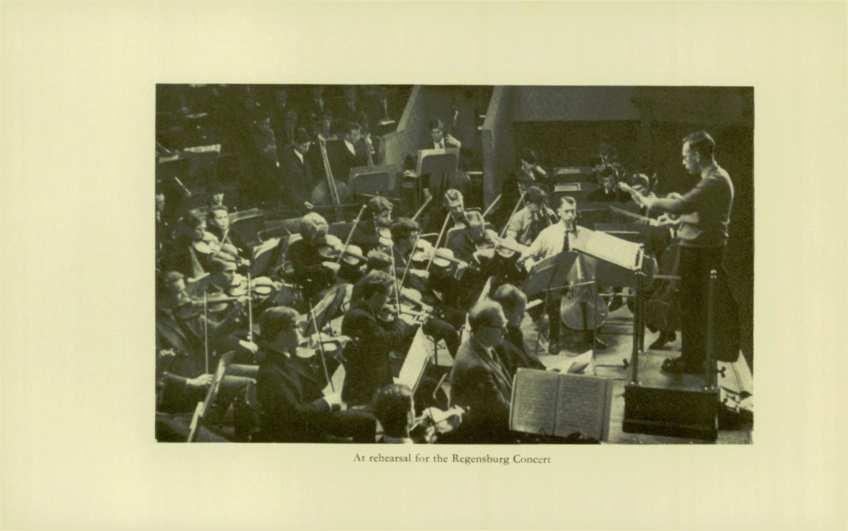
\r rd1c::1rs\l 1;,r the Rcl(c:n,hur~ C.:onccn
year, thanks to two enlightened Rectors, have been the four-day excursions to the hills in late June. The headquarters on these occasions have been conYeniently situated youth hostels. Jlow can one forget forty-seven hours of continual rain at Ratagan made bearable by the pleasant company of that soft-spoken raconteur Dom Capaldi? At Glencoe, of course, even the weariest hill walker is gah anised into activity by that human dynamo, Ingrid Feeney. Those tired boys who found hot soup awaiting them at 11 p.m. (after a bus breakdown) know well her kindness.
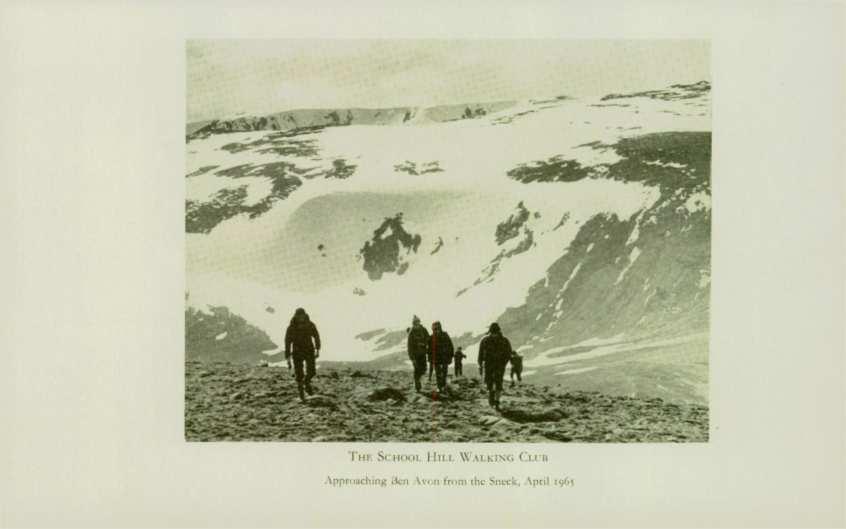
Those who limit their wanderings on the hills to summer only miss much of the colour, the beauty of light and shade and the atmospheric effects offered at other times of the year. Seasons and weather conditions play their part in making the journey to a mountain summit a great thrill for those who keep their eyes open as they wend their way upwards ... the majestic fury of ature unleashed in a gale-tom mountain summit in snow and icy hail Ben Anm in March negotiating a steep, glazed ice slope ... \\·hy so fe,, ice axes ... ? A great expanse of silent whiteness, broken only by commando sole bootprints, or occasionally by those of deer, ptarmigan or grouse. Pantastic forms fashioned by wind, sun and frost on rocks and boulders snapped fence posts and twisted wires. The glitter and sparkle of frost encrusted tufts ofgrass and heather ... the rose-tinted sno\\ slopes of a January afternoon on Clochnaben. :\ December traverse from Glen Mark to Ballater over ~lount Keen deep snow ,isibility only a few yards ... blizzard conditions ... early darkness ... a sudden clearing of cloud a glorious finale to the day a full moon bathing Ballater and the Dee in beautiful sih·er light. Sixty boys ploughing, in single file, through drifted snow on their way to l\lorven one clear, crisp Februar} day-a School holiday to mark the birth of Prince ~'\.ndrew... and on and on they flow ... memories and impressions of winter climbs.
Apart from a small, select group of rock climbing seniors, under the strict supervision of one experienced master, the Club remains true to its name, confining itself to hill walking. But of course on man} ofour !:>cottishmountains, in order to reach the top, one must indulge in a little easy rock scrambling. There come to mind here exhilarating days on Buchaille L:tive l\for, the Saddle, the Aonach Lagach ridge, the Cobbler, and the Carn Mc'>r Dearg arcte, on the way to Ben Nevis.
Much criticism is levelled nowadays at hill walkers and climbers alike who meet with unnecessary accidents, take foolish risks, refuse to listen to advice and are inadequately clad or equipped. Most of this criticism is unfortunately quite justified in far too many cases. It is therefore the aim ofthe masters-in-charge that boys should avoid these errors and graduall} develop a healthy respect for Scottish mountains and hills in all their moods. Thus they can acquire a thorough knowledge of the Yarious aspects of mountaincraft so that they ma~" gain experience and confidence to cn1oy the glories and wonders of these high places in safety and comfort in all weathers and at all seasons.
••
Incident at Lundazi
[be .,1/tre Lenshi11aRiots
Our charter plane touched do,\ n on Lundazi airstrip exactly 12 hours after more than 150 revenge-crazed Lumpa Church supporters had charged across the same strip of land heading for the small town, bent on destruction and murder. A police vehicle took us along the path the Lenshinas followed: past the police headquarters where the religious fanatics claimed their first victims five children clubbed to death and past the poJice station where they beat three police officers to death, smashed windows, locks and doors to steal a few rifies and about 300 rounds of ammunition.
\nd so to the Boma (TO\\ n Jlouse), where the first man to greet us \Vas r,, enty-sevcn-ycar-ol<l Police Inspector Paul Gillies. Tall, and strongly built, Inspector Gillies was the man to \\ horn all Lundazi turned for protection at 2 o'clock on 1\fonday morning 3 August 1964 as the marauding Lensh.inas stormed through the town.
Inspector Gillies borrowed a bicycle and rode through the small town dressed only in his pyiama trousers warning people and trying to organise a defence. Ile managed to find five muzzle loading shotguns and \\ith these he armed five Boma messengers and launched a counte r attack. The attack was successful and the I,umpa.s Red into the bush-only to continue their rampage of murder and arson. They left in their wake twenty-three corpses-among them fifteen childrenand two people later clied from injuries. 1fow m,wy more they killed as they tore through the bush sacking villages, burning isolated homes and kiUing wanton ly may never be known.
At the Lundazi Hotel we met Dr. Frank Kanweka, a Milawian, who told us of the suffering of those in the small Lundazi Hospital. J le interrupted his evening meal to check on a patient and conducted us round the three wards. The injuries and sutforing was unbelievable. The doctor's soothing hand and comforting words did much to alle, iate the pain and misery, hut as we left we wondered ifsome of them might have been better off had they nor sun-i, ed the att.1ck. ...
\\ e returned to the airfield and watched three Dakotas flycontingents of the I st Battalion 1\;orthern Rhodesia Regiment into the trouble spot. In the ttuiet African evening the great planes swooped low oYcr the airfield, their engines throbbing and their tail lights flashing It was dit1icult to believe that these silent, grim faced men who filed oil the planes had come to take part in one of the most blood) battles in thl! histor) of .Africa.
\\ e spent a sleepless night in the bar of the T.undni Jlotcl talking to memhcrs of the Mobile Police Lnit, assigned to garrison the Ilotcl. Fveryone talked in hushed undertones discussing what might happen the following day, wondering if the Lenshinas would actually stand and fight or if they \\'ould again adopt their delaying tactics and \'anish into the bush to attack again some other defenceless town.
By I o o'clock the followinR morning the press corps had increased to four. Geofl Gillies of '\i.R.T. \ ., Ronald Robson of the B.B.C., ,l member of the C.B.C. news team and myself. \\'e toured the Yillage and were amazed to find that the refugees, who had numbered 2.00 the previous eYening, now numbered well over 3,000. They were huddled together in a field behind the Boma, whole villages sitting round their Chief, small family groups, single men and women, and always the small helpless children er) ing through tiredness and hunger.
The soldiers did \\ hat they could for them, but it was little enough. We handed out those cigarettes we had,-..ventto the hotel, bought more and handed them out as \\-'ell.Geoff Gillies had three cakes ofchocolate. Each was divided into as many squares as possible and handed to children. The thanks offered by the fear stricken parents was pitiful and heart warming. Some of these minute pieces were split into even smaller particles to be distributed to all the children in a family.
At tT.15 a.m. two companies of the 1st N.R.R. and a detachment of :-.IobilePolice pulled out of Lundazi heading for the Lumpa fortified village of Chipoma. \\ e followed behind in the battered old car belonging to White father, Claude Galmiche
.\t 11.4 5, the first resistance was met. As the com·oy of eight vehicles moved towards Chipoma, it was "ambushed" by about a dozen men. \\ ith cries of "Jericho" and "I fallclujah" on tlu:ic lips they rose from the bush and rushed the convoy. ,\ burst of lire, Lasting less than a minute, and all was again quiet
The soldiers and police detachment left six of the vehicles and moved forward on foot spread out in a large crescent. No further opposition was met until the village, with its unfinished church in the middle, came into sight at the bottom of a slight incline.
A small group of soldiers, with Colonel Baker and the Provincial Officer, C. L. Ling in the lead, moved slowly forward. Provincial Officer Ling called for the surrender of the village on a loud-hailer . Jlis call brought the first signs of life from the village-a small group of spear-waving Lumpas rushed out.
\-lr. Ling again called for their surrender. Colonel Baker took the loud-hailer, and also called for the villagers to lay down their arms. But it was useless. The Lumpas intended to fight and the leading villagers were already climbing over their stockade and rushing towards the thin line of waiting soldiers. A sharp order to fire rang out on the loud-hailer and three Lumpas fell Still they came on, yelling, shrieking and brandishing primitive arms of every description. They were met by a withering hail of small-arms fire. Those behind leaped 0Yer the bodies of their fallen friends and continued to attack the Goyernment forces only, by now their simple plan had become obvious.
As some rushed straight into the withering lire, others ran out to the left and right in an attempt to outflank the army. Their plan was partially successful, for they forced the Government troops to form a tight ring round their , ehicles, with the medical orderlies, the \Xrute Father and we pressmen in the middle.
There followed sporadic attacks as each group of outnanking
Lenshinas came 1n contact \\ith the ring of security forces. A heavy attack was mounted on the left, an<l then, after Ji,·e minutes, on the right. btch ferocious attack lasted from two to live minutes long enough for all the Lumpas to he felled, for they would not retreat.
Then the Lumpas mounted one last desperate suicidal attack from the direction from which the convoy had come but it too was doomed and after five minutes of heavy fire from the concentrated fire-power of the security forces Colonel Baker called a " cease-fire".
~fany Lumpa men were seen escaping into the bush unscathed. By this time everyone hoped that they would vanish into the bush for e, er but they re-grouped and again charged headlong into the centre of the security forces. Col. Baker maintained his "cease-fire" order to the very last minute and then ,, ith a signal to a corporal stationed with his Bren gun on the dridng cab of one of the lorries, a short burst of heavy fire brought an end to each of the fifteen li,·es. A lone Lenshina woman came out of the bush at the rear of the Government forces, her left arm hanging limp a useless stump supported by a few strands offlesh. The bone was shattered and could be seen fiftyyards away. After much coaxing over the loud-hailer she was persuaded to give herself up and receive immediate medical treatment.
The security forces mm·ed slowly towards the village. As they advanced another lone Lumpa woman was seen cl.toeing clown the main street, a spear in one hand, and piece ofpaper in the other. It was her "passport to hean:n", given by her leader .\lice Lenshina.
After several warning shots she darted behind one of the many houses. \vhether she made use of her "passport" will never be known . •\s the troops mo, ed into the village, and each row of houses ,,as flushed, the villagers moYed back into a straw built compound . They were finally cleared from there into the open by smoke bombs. At first only a fe,, children-some of them terribly wounded came forward to gi\'e themselves up. The}' were followed by ,, few older women, and one old man. After repeated calls for their surrender from Col. Baker the flo,, of, illagers became faster.
It looked as though the action \\·as o-ver. But then one womanwith crazed eyes an<l one of those pieces uf paper clutched in her hand ran amok. IIer action starred the rest, and quiet surrender changed in a second to mass, terrifying defiance. Lumpas ran 1n all directions ·with cries of "Jericho" on their lips. One wom.-in ran on in spite of bullets hitting the dust all around her feet-she , anished behind a pile of stra\\. Jler hody ,, as carried out a few minutes later, and laid on the pile of dead. i\ young man made a dash for a house. Three bullets thudded into his bod,· before he fell- less than 12 inches from a loaded hlundcrbuss. •
The turmoil finally subsided and once again the beaten I .umpas became a slow, ragged file of dejected people, shorn of their religious fen our. They were pushed mto the waiting "cage" lorries. Soldiers came to the ambulance lorry carrying naked babies taken from the dead bodies of their mothers. These were phced in the care of White Father Claude Galmiche. At one time he had three in his arms while he gave the last sacraments to a dving man.
A small womnn, her child strapped to her back, lay beneath the lorry. She was considered beyond medical aid. She beckoned to the father and told him she was about to say her last prayer. from her blue dress, horrib ly stnine<l with blood, she pulled her "passport", read it through, passed it to a friend, smiled and fell sideways.
The, illagers had no fight left in them-seventy-four oftheir number had been killed in the forty minute battle- and they came forward, no,,· submissive, to be herded into the church they had started to build as a token of their faith, and which was now to be their prison. The injuries were horrifying. Arms and legs shot off, a young woman lay with the top of her head completely blown off. l lcr child was shot between the eyes. There was a small child, with a bullet hole near its heart, still clutching a toy bow-he had no arrow. An old man, nlready crippled, with his left side torn open, a tiny baby suckling at the breast of its dead mother.
The Lumpa church, in Chipoma, was dead.
Ro~ALD S. M.ucou1 (1940-52)
The Dialogue of Commerce
As a boy I used to spend much of my time in the Public Library in Aberdeen, and one of the authors I read was Ibsen, perhaps because of some sort of sympathy that exists between all those who live on the borders of the t\orth Sea. And one of the things Ibsen said about hts prose plays was, "I ha,e got rid of the monologue". This was Ibsen's way of saying, as Shaw later pointed out, "l have discovered the dialogue." Certainly as I look at my life, coming from Aberdeen, living among rnglish actors, acting in English plays, I have seen mv life as a continually changing dialogue. Lven the inventions that have completely altered my profession in my own lifetime, films, radio, television are examples of the way the boundaries of the dialogue are extending under the pressure of science.
In fact, I would suggest to you that unless we learn to conduct some sort of dialogue in all our activities we shall be missing what I might call the ciYilisingfactor. Businessmen, for instance, might analyse their activities into market resenrch, production, and salesmanship, but unless their processes are fertilised by the dialogue of meo and places they will ultimately pro\'e hostile to the aim of all business which I take to be increasing enjoyment by nn increasing number of the joys of li"ing.
I am acutelv aware at the moment, for instance, that the Tannochbrae of 1928 {ms one period in the historr of Scotland when the purpose of the dialogue h,td been forgotten, because men had been forgotten. There \\ as little possibility of conversation between those ,, ho li,·ed in our distressed areas and the central authority: the dialogue had broken down.
Today you have before you an example of the persisting dialogue. My native to\\ n is stretching a finger to the south, prodding the metropolis as it were, and saying, "Look here, I want to talk to you". 1\Jotin a , oice like bull; Bottom's impersonating the lion, but rather as a gentle, sucking dove. My people think this is urgent. I can assure you it takes a strong desire for an Aberdonian to emerge from his city and that sacred area of 1 2 miles round. It is a commonplace of politics that trade follows the Rag,and even last ct:ntury \\ hen Llnngstone sought to com-ert .\fricans to Christianit}, the Scottish brand, the great cry was "Commerce and the Bible". ,\nd as an actor I can assure you that the history of culture in Europe is in direct proportion to the success of the merchants. And when I ask myself \\·hydid Greek drama collapse so signally at the end of the fifth century one reason would seem to he the battle of \egospotami in 405 when the Greek fleet was destro} ed and as a result Greek trade in the eastern \fediterranean \\as crippled.
This enterprise is a reminder of the importance of tht: dialogue of commerce: the basic dialogue which sustains all other sorts of conversations. L'nless this were a thriving, thrusting area would you have ski lifts at .\ viemore? If vou had mentioned the possibility of" inter sports at Braemar when l went to the Grammar School they'd ha, e said you were "gleckit". But there it is, silence and pertinacity have done it..\herdet:n and the surrounding area of Buchan is what is now called a ,iable communitr, that is balanced, as between commerce and culture, its university as old as any in England, balanced between sea and shore, fish and cattle, between mountain and river, granite and agriculture.
Between vocations and , acauons. Even the climate has proved a virtue in these days when our population is extending its life and finds "the heat o' the sun" in the ::\kditerranean too much to endure . The hotelkeepers of ;\berdeenshire might say like the theatre managers of London, "Thank God for the buses!" Because their seasons have been extended at both ends \nd there is manv a home in England during the winter months where the talk is not of the Bay of Kaples, but the superb vie\\ that lies before you as the bus carries you over the Spital of Glenshee into Angus.
\nd not just the middle aged. If you \\ander off the beaten track you will find the young following the tracks that ~1ontrnse took over 300 years ago and \\ hen night comes there \\ill be a youth hostel to welcome them, as good and as enjorable as any you will find in Ba, aria or Switzerland ..\nd a new thing, you ma\ come upon groups ofyoung people on ponies tracking- the Cairng-orms.
There is this too about the dialogue. \\ e eat, \\e all drink, \\C all sleep, and II\ e in houses. There \\<lUldbe no point 111 the dialogue if it did not concern itself'\\ ith the di\ ersity ofliving as people settle down in their environment in their \'aried conditions.
There is .1 baleful line in Macbeth, "Stands Scotland where it did:" J\nd back comes the answer, ..Alas, poor cuuntr), almost afraid to know itself!"
\\'ell, this is one p;irt of Scotland that kncrns itself, and these ladies and gentlemen are bubbling over to tell you so and show you why. I am merely here to su~gest to you that this dhlogue you will find worth pursuing, with them, and by openin~ this enterprise may I hope that your conversation and your imagination \\ill thrive.
[The lorcgning is the text of the speech "i1h \I hich 1h<1t well-known F.P. actor ~[r. ,\ndrL'V. ' Cruickshank alias Dr. Cameron ol B.8.C. T.\ . t,pened a recent .\bcrJ.:.:n anJ ::-;ur1h-t:.1st Tr,uk E..-.chibitionin !....,nJon- Fd.]
India Revisited: Look Back With Pride
lndJ.a, since the earliest days of "John Company" and the Bm1sh "Raj", has cast a magnetic spell O\er successive generations of Grammarians and the annals of the School are filled with the names of Former Pupils who have answered her compelling call. '\io doubt each past generation couldhear witness to great changes in the sub-continent but none has been so basic as those ushered in by the ending of British rule in India in 1947. How does the country appear no\\ to the eyes of an old "colonial" returning to the land of his adoption for an all too brief, isit after an absence of seventeen years?
The impact of returning to India was tremendous, all the more so perhaps, because the transition from Europe to the Fast by air was made without a break-Rome to Bombay: how different from my leisurely three weeks by P. & 0. from London thirty-live years ago! Stepping once more on to the soil oflndia it was the physical sameness of things which swept away the intervening years as though they had ne,·er been. The same early morning freshness before the sun rose really high; the same bullock carts loaded with vegetables for the city, the oxen mo,;ing slowly to one side at the tap of a stick on their necks; the same trees; the same bright orange marigolds and tall cannas in the gardens; the same stray dogs (only fewer); the same cyclists (only many more), hent on selfimmolation weaving their way between cars and lorries; the same blending of smells different from our own; the same chatter of tongues all around one; the same faces and the same smiles, only this time expressing astonishment and delight at being addressed in the1r O\\ n language, as few visitors now do so.
In ·ew Delhi, the capital of the Republic, the imprint of British imperial architecture is still predominant e\'erywhere: what a superb example this spacious city is of enlightened planning. It is difficult to believe th:\t this great metropolis of nearly three million inhabitants only cameinto being less than forty years ago. The capital has ofcourse mushroomed enormouslv under the stress of a burgeoning population. ~Iany ne\\ bungalows have gone up, many secretarial quarters, new offices, a new Supreme Court of Justice, a superb international conference hall, innumberable shops, glossy modern hotels, a complete diplomatic enclave with vast embassy compounds and a very fine
~ational Stadium. I"ortunatcly, for geological reasons, sky-scrapers are not practicable here, and so the new buildings harmonise with the earlier ones of the late 1920s.
The former Viceroy's llouse, now Rashtrapati Uhavan, the residence of the President of India, is maintained in its previous splendour. The procedure at a formal reception there with the bodyguard standing round and the procession of \.D.C.'s in front of the President is as it ah\ ays was. The gardens too a,re just as well kept. The dignity of all these is well suited to the President of a great nation and the Residence and Secretariat buildings flanking it, with the Parliament Jlouse to one side, are a superb blend of modern with ancient 1lindu and Muslim architecture and in no way alien to the independent India of today. They are a legacy worthy of a capital and one which we can feel proud and happy to have bequeathed to them. Many of our traditions too have become a part of the new nation the games, the mess nights in the armed fores, the beating of the Retreat by the massed bands of the forces, which takes place twice a year, terminating by the very mO\ing playing of " \bide with ?\le"-?\lahatma Gandhi's favourite hymn. Sunday remains the weekly otficial holiday.
Outside Delhi along the main trunk roads there arc miles of new factories in the process oferection and industrialisation proceeds apace. More schools have been built in the villages and more dispensaries opened. Teachers and medical staff are, ho,\ e\-er, badly paid and are in very short supply. Uut one is struck by the fact that the public conscience is aroused. One sees huge posters saying "Get rid ofcorruption" and "Keep beggars off the streets - gi,·e alms to beggars' homes, not to beggars", and teams of workers do go into the villages to help on matters of hygiene and family planning . This unfortunately can only be long-term work an<lme.rnwhile the population continues to outstrip the increased food production. It is an awesome fact that the population of the Republic is increasing each year by more than 10 millions and this on top of a hasic figure of 450 millions.
One meets numbers of young men busil;- studying "planned economics", "the psychology of management" and so on, and only hopes that much talk and many theories will not dhert them from applying their energies to the practical hard work ofgetting something actually done. The educated women of India have come out tremendoush in the field of public service and some hold ministries in the gO\ernment. Education in missions and convents is much sought after and prized. English remains the common language of the educated man e\-crywhere and this passport to so much further education available from the English speaking parts of the world is one of the most valuable legacies which we have left to India.
Freedom ofspeech prevails everywhere; ho,, happily different from the situation in many other newly independent countries. It was increasingly interesting to find how many people of all classes, from the young civil servant to the taxi-dri\-er, the uni\ crsit\· student to the old guide, in fact people of every type, were anxious to talk and how freely they\\ ould talk. Their daily press is very well written, free in its criticism of governmental short-comings, but constructive also. The
o,·erriding impression of the opinion of the average Indian that one brought awa> was that the ideals of the new Republic were excellent, but that a strong and impartial government was needed to see them implemented. The los~ of the central figure of Pandit Nehru last year was a tremendous blo\, to the unity and coheren ce of the States and dh·erse peoples who compose India. The danger of a reversion to the fragmentation which British rule halted and remedied is Yeryreal, and while there is great and justifiable pride in what they have achieved in the last seventeen years, there is a feeling of uncertainty as to what the future holds.
The civil administration, the roads, the railways, the irrigation canals, the medical and educational sen-ices, the police, the armed forces, the common language of English , all these things from British days form the basis on which India today has built and expanded. \'v'e can be humbly proud to have laid the foundations so soundly, but perhaps abO\'e all we can find our greatest reward in the very real friendship for the British people, which is shown so frankly and sincerely on e\'ery side.
C. A. G. S.
Special Entertainments Notice
The attention of all members is drawn to the circular enclosed with this issue of the Ma,l!,azi11e regarding the ,\nnual Dinner and Ball. In view of the increasing costs of sending out this circular, it was recently decided by the Entertainments Committee that adequate notice would be given of these functions if the circular were to be sent out with the June issue of the Ma.~azi11t.
You are therefore requested to carefully preserve the circular (which is the only intimation which will be given) until you require to submit your application for tickets. In addition you should note these dates:
Annual Dinner: 14 October 1965 \nnual Ball: 29 December 1965
Only members of the P.P. Club may apply for tickets.
JOHN , \DA\IS
SCHOOL SECTION
School Office-Bearers Prefe cts
HFNRY R. 1'111.LAR (Jrmor Priful)
DoNAI.D A. LAMONT (Dtp1,ty Stnior Prcful)
\ L1sT\IR J. Cr \RK
P ut.R M UlLLLLR
P ErnR j, fRASf'R
Sr uART C. GLC>VLR
ALISTAIR G. GRACIE
Rus~Et.L GRAY
Kr:NNLTII \. lIAY
JOHN l·. II, '.'.DRY
BRIAN B LAW
\LisoA1R G. ~IAcK1JsLIE
1',;n1 l'.fAcLmo
Jom, S. t<.fAcP111L
D Ol:GJ.AS M ARR
Russ1.LI, Mu NI, /It.AN C. MOIR
RlCllARD B. RAJ
JA\IF.S D Ruo
M.-u.COLM F. RF NNII:
D Avrn J. r. Ronrnrsos
ALLXANDl'R F. S 111,ARLR
RICHARD C. S111RR I.PFS
DAvrn w. s,11111
1I ARVl.Y E. MoRRP,os H. OuvcR W11.L
D Avrn K. Yu1
Byron
DAVID W. S~llTII
Keith
~EIL MACLl'OD
Captain D.\\ JO \v. S\llTII
Caplai11
A1.1STAIR J. CLARK
Captain MARTYS BATCHLLOR
Captain l!AR\ 'LY E. MORRhON
Captain IAIN \'i/. T110,1so-..
Captain DRIA.'-1 R. MORGAN
House Captains
Dun Ihvm J. F. RoRERT~N
Melvin HE.'lRY R. MILLAR
Rugby
l 'iu-Captam HE.'-RY R. M ILLAR
Hockey
Vi&e-Captai11 Kl::NNETll ,\, IlAY
Swimming
l 'iu-Captain Au:XA..NDLR F. S11EARLR
Cricket
I "ut-Captain H. OLI\'ER \\ I LL
Athleti cs
1,- tee Captai,, DAHD J. r. ROBLRTSOS
Tennis
l ice-Cap/am \V. GAv1s GRAY
Literary and Debating Society
J>ruidml DONALD A. LA,IONT
Suretary MALCOLM F. RENNrn
Pruidrnl .MALCOl.\l F. RLNSII , .\'urelary R ,n,mso c\, HAROIL
Vice-Prnidml ALAS C. MOIR
Trta111nr HAMISH T. E. !'-ORBROOK
Dramatic Society
I ·;, I'raid ,nl Rt'"LLL GR.\Y l'rta111r,r DA,·10 .h: Yt•1.1, Cadet Force
C.\. \f, JOHN -\nA\I, Editors of Schoo l Section
DONAl.D ,\. L,~\IONT
Ilr 1-.RY R. MILL~R HAMc;11 T. E. '-.:oReRooK o~vw K. YcLE
School and Random Notes
If in read111gthese Random ~otcs )OU derive h.1lf1he pleasure we got 111wming them you have our heartfelt sympathy.
• *
Early one morning, a Littlebefore cle,·en o'clock, as we unsuspectingly plodded our "·cary ,vay into School, lo! we beheld an object standing on the grass between the science block and the gymnasium. Closer inspection later revealed that it was a uee. \\'.'hat,wewonder, can be1here~son for its sudden appearance? Are there plans afoot for the reafforestation of the School grounds? I~ it a branch of the Botanical Society? Arc we co believe rumours chatMr. Mortimer has bought adog? Questions raised at the Prefects' Joint Committee have provided no satisfactory explanauon of this phenomenon. \\'.'hatcan Authority be concealing from us?
Contrary to what was wriuen in the School and Random '\;otes of June 1964,the alterations in the main building arc anything but complete.
\Vhile carrying our experiments co test the toughness of 1heflooring in the room where we were writing these notes, the editors were interrupted by the Head of the Classics Department who was under the erroneous impression that we were playing football. Disturbed lest he should still have this impression, we must take this opporruniry ofpointing out to him, and others, the true nature ofour apparently flippant exercise.
The following was held over from the last issue, due to lack of space: \'1,'ewish all our readers a .Merry Christmas and a Happy '.\cw Ycar.
It is with deep regret thm we have to report the passing of that much-lo,·cd and very ancient friend (and stock random note), The Howff. This regret is, however, tinged with a certain relief, for the danger ofdeath by falling masonry was becoming daily more and more a certainty. Our land-use survey expert assures us, h()wever, that even if this horrible facewere a,·ertcd, with a population density of 2~ miUion per square mile, twenty-eight B.O. sufferers could not have held out until the end of term. In fact, there is only one disadvantage in the demolition of the dump-they haven't built us a new one. Our feeling ofdisappointment at this breakdown in the School's Rchowffing Scheme was made more intense by the gleeful word~ of a certain prominent languages master. "-...:incyears", he said (as he perched his spccs on his forehead in a Glasgow accent) "nine years I've lobbied, and now at last ye're gone." Yes indeed at last we're gone. 0 mournful day! It is proposed to have a memorial service on the site on the last day of term.
\ta meeting of the choir and orchestra just prior to the Regensburg concert, the members were informed by one of the music staA that only those who had been "regular" could expect to go on the Decside trip w,rh the German pupils. Judging by the enthusiasm which preceded this c,·ent the editors can well believe that the Aberdeen chemists' \lay sales of mild laxatives sho"ed a marked incrcase- "Ycs, hm, good, a•ha-ha-ha " (D. lI.) .. •
Talking about laxatives, the cadet store needs a good clean-out.
Aberdeen Gra111n1ar School Magazine
The newly construc1ed ornamental pool has hitherto proved to be of lmle practical use. However, when the pool was iced-0\er in winter, 1hesecretary of the Ski Club decided to test its suitability for use by a proposed Skating Cluh. \\ e regret to report that his plans fell through. And so did he.
The new .\laths and Science bl<>ek,described hya Labour candidate in the recclll municipal elections as "one of the finest buildings in ,\berdecn", provides an imcrcs1 for boys as they examine the widening cracks in the \\alls. \\"e also have our doubts about the choice of linoleum tiles outside the Janny's box, which keeps a workman in foll-time employment "rippin' it up and stickin' it <loon again".
\s we have mentioned, 1hey h,ive not yet found us a permanent howff. \\ e urge the authorities to provide one as soon as possible, since our present quarters nee too near the gymnasium for comfort. Just as the prefects ar~ warming to a particularly thrilling game of .\1nnnpnly, the soft tread of gym-shoes in the passage sends the players diving for the bog. Those who arc a hit slow, however, are selected as vicrnns by the intruder, and arc dragged off m be chained to a heavy roller \\ hich they are forced to haul over the run-up to the long-jump pit.
"The l lun is at the gate." R. Kiplini.
\t last science is making inroad, into the 1c.1chingof modern languages. The old s1affroom has been converted into a language laboratory, but unfortunarcly has lain idle since its completion, as none of the languages staff has had sufficient technical training to enable him tn operate a tape recorder. The room, howc,·er, has been put to good use by the janitor asa temporary garage for the School lawnmo\\ er.
The helplessnc:,s of the languages staff when faced wi1h such scientific developments, is in sharp contrast to the linguistic abilit)" of the science staff. During the visit by the Regcnshurg boys Mr. .\[ay proved, to our surprise, to have an excellent command of German, extending to such advanced idit>matic expressions as "Frilulcin" and "\ olkswagcn".
We should like m take this opportunity of congratula1ing .\Jisrnir J. O.trk on gaining a cap for the Scottish Schoolboys' Hockey XI, and \lcxandcr G. \\ 1lson and Kenneth A. Hay on their selection for the National Youth Orchestra.
E,·cr,·day a certain Irish patriot and cricket fanatic in upper \'Ith goes up IO the roof of the science block and attempt> to lob stones into the ornamental pond. So far, he has only succeeded in hitting the rest of Upper \'I sunbathing on the front lawn, Lord Byron, rhe .\fotor Club car (which explains its appearance), and a\\ oman hanging out her washing in ,\lbert Terrace.
If,afrer reading these Random !\mes, anyone wishes to contact the editors, he'll have a job finding us. Norbrook has Aedto the jungles ofCentral Africa to compile a Pcn11:u1nDictionMy of Puns, Lamont is attempting tu flog l\lercedes Hcnzcars to 1lhtcrate Russian peasants, .\iilbr \\:IS last seen sm.1shingcmp1r beer bottles agains1 the '\orth Face of the higcr and Yule is tramping all over the 11imalayasin the hope that his huge footprint, \\ ill foster belief in the ,\bominable !snowman.
I (J(j/1101,. If all rhi, )'c,tr's prcfcch lay head w toe al,,ng 1hc m:1incorridor, 1hey'd look no more ridiculous than usual.
Arrival . ..
Staff otes
\frcr over a year's delay, a successor has now been found for Mr. John Cullen. Mr. Cullen was a graduate of Cambridge Universiry: Mr. Frederick C. Fea who cook up his duties on the School staff in January stud ied at 1--eblcCollege, Oxford, and he holds the M.A. and B.l\Ius. degrees of that University, and is a Fellow of the Royal College of Organists into the bargain. l\Jr. Fea has held several school and church appointments in England, notably at Gainsborough, Torquay, and most recently at Sherbornc in Dorset, where he was Organist and Clioirmaster at the Abbey and music master in Sherborne School. He has now taken over both of .\1r. Cullen's posts, at the School and at St. Andrew's Cathedral. Although it seems a long way from Sherburne tu Aberdeen, Mr. Fca assures us that his great grandfather came from this city, and that, going back still further, his family hails originally from Orkney. ot that we need evidence of Scottish blood before accepting into our circle of friends a gentleman who not only has the highest acndemic qualific.-:uionsand experience as church mus1c1anand teacher, but combines with this a quiet charm and sense of humour. \'>:'e hope that J\1r. Fca, and his w·ifeand family will spend many happy years with us.
Departure s ...
Two years ago Mr Eric Kennedy came to the School to his first teaching appointment, and very quickly and in a number of languages m,1dc his brisk, assured presence felt. ~"" he has accepted an appointment as an assistant master in George Heriot's College and will be lea, ing us for Edinburgh at the end of the se~siun. Short though his stay has been, the School has learned to wonder at and admire his elfulgenc energy and physiC:Jl dri, e, and cannot doubt but that like Alexander and Hurns's bonny Lesley he goes "to spread his conquests farther". With his native Abcrdonian shrewdness fortified by his teaching experience here, he must do well down south; the towers of l [eriot's will capitulate, the rocks and ramparts of the Castle itself perhaps. \X'e wish him all success in his new post.
Industry has claimed Mr. Ian Gordon. Jic leaves the Technical Department, not for another school, but to become the technically qualified representative of an internatioml firm specialising in the materials and techni<1uesof welding. After a brief training course in London, he will return to Aberdeen to cover this nonh-cast corner of Scotland. Mr. Gordon will be remembered for his firm handling in the classroom and hi, firm tackling out of 1t; the masters' footba ll team will be woefully the weaker for his leaving. But as Mr. Gordon will be continuing to liYein Aberdeen just over the W3)' from the School 111 fact- we\\ ill sec him frequently and hear how the new life suits him.
There arc otheh who, though not permanently appointed to the staff, have scf\'ed the School well and should be mentioned. The Classics Department 111 particular is much indebted co two ladies, Mrs. Good and Mrs. Duthie. They have this last year, pleasantly and efficiently,taken the place of .\lr. Galloway who was given a year's leave ofabsence to gain a qualification in Russian. Mrs. Good was here till Christmas, when she had to leave on her husband's taking up an appointment at Prestwick, Mrs. Duthie has filled the position since then; friendly, sympathetic and feminine they reminded us by their presence and practice that the barbarian ofour day, who lives not beyond the mountains or over the seas but in our midst, can be tamed by a firm civilised gentleness.
'J he Physicnl J·.ducation Depanment has also profited from the services of t'\\ o people, Mr John Clark and Mr John Calder. \1r. Clark ,,i1h a background of teaching and adminmra tive practice both m i\berdeen and m the south, has brought to his instructi on in swimming and athletics a quiet kindliness chat is much appreciated.The younger boys particularly have \\elcomcd and hencfitcd from his courteous,
Abtrdem Gra111111ar Srhoo/ Magazine
patient co,1ching. i\lr Clark has t1111c also for other rhythms than curhy1hmks, and has obviously cnjnycd, as he has gi,cn pk.m,rc to others, singing with the School choir and taking part in all the activities 11fthl· Regensburg visit..Mr. John Calder, a former pupil, who is permanent I} placed in :mother city school hasover the last few >·carsbeen giving his services one day each week at the field, in the gym. or at the pool and these too are much appreciated.
The school is also in the debt of Mr. John Robbie who, returning 10 ,\ber<lcen after eight years in Annan ,\cadcmy, has been nf much assistance in the Technical Department at a time when the change to new premises and to new examinations has made greater demands on the srnff.
The School would thank all these ladies and gentlemen.
House Notes
Byron
At a meeting earlier this term, the following boys were elected to represent the Ifouse: Cricket Captain, Harvey I· \fnrrisnn; 1 'icr-Captain,H. Oliver Will; Ath!eliu Captain, Dennis \X'. lnkson; l "ir,-Captain,David W. Smith.
As was expected we won the Rugby Cup for the third consecuti,e year. Our strong team defeated Dun and Melvin, but we only managed to draw with Keith. In the Hockey Championship we were unlucky to finish second, being beaten by Melvin in the last game. In the Swimming Gala, however, we were last.
In the coming Summer term w·carc strongly favoured to win the Cricket Cup. In the first game we easily <lisp<><edof 1'.eith, winning by 9 wickets. We should win the Senior section of the cricket seven-a-side tournament, but in the lo\\er classes, our prospecrs do not seem so bright. Our hopes in the _\thletic Sports arc quite high, especially in the Senior groups, and I am sure that the younger boys will give of their best to help us do well.
Our thanks must go to Mr. 8a'.'Cterand his assistants for their able administration of House affairs.
DAV
ID \YI. SMITH, Ho11It Captain
Dun
In the inter-house rugby competition, the lfnuse finished in second place. The hockey XI failed to combine as a team, and finished in third place.
In the Swimming Gala, we did better than we thought we would, and, thanks to some fine swimming by our younger members, we lifted ourselves into Jrd place.
\t a meeting held t.-arlicrthis term, the folln\\·ing officials were elected: CrfrJ:.tl Caplain, Da,-id Robertson; Viu-Captam, Douglas Marr ; Athlrtiu Captain, Alistair Gracie; Viu-Captai11, Da, 1d Robenson.
The cricket team, de,;pitelosing the sen icesofthe captain through ostcochon<lritis expects to do well. We ha~c a sm,ng athletics team and our prospects in the Sports are promising.
[n conclusion, I would like to thank Mr. :\lcLeod for his advice and support during my spell as House C~ptain.
D.wm J. F. RonERT,;Q?S", l lorm Captain
Keith
The following officials were decte<l for the Summer Term: Crid:rt Captain, Graeme Davidson; t ·,a-Captain, Russell \1ilnc, lthl,tiu Capta1i1, John Hendry; Vice-Captain, Graeme D.1vidson.
The Senior House rugby tt.-am was extremely unlucky to finish in third place after defeating Melvin and drawing with Byron, the eventual champions. Against Dun, we lost by the only score nf the game.
"The B11ria1J• Con,p"
In hockey we finished lase,hut, by way ofcontrast,in the S\, imming Gala\\ ewere narro" ly beaten for first pi.cc.
Prospects for the C.nckec Championship and for the ne,~ seven-a-side crtcket tournament for the Robertson Cup do not seem too bright. In athletics we hope to continue the unequalled success the House has enjoyed in pose-war spores meetrngs.
\'feare, as always,greatly indebted to Mr. Stephen and his assistants for their help and encouragement throughout the session.
MACLEOD, Houst Captain
Melvin
The following were elected as House officials for the Summer Term: Cricket Captai11, Kenneth A. llay; Virt-Capla1i1,Richard A. Uisset; A tblttiu Captain, Iain W. Thomson, Virt-Caplain, Richard A. Bisset.
Although ~felvin finished, as expected, last in the Senior Rugby Championship, we held the winners, Dyron, to 9-6 in our final game. Our hockey ream lived up co cxpccrnuons and won the Hockey Cup. In the Swimming Gala Melvin won the Championship and William Scott is co be congratulated on winning the Rector's Cup
In the Schnol Sp<>rts we hope that under Jain Thomson, the School athletics captain, Melvin will be strong contenders for the Inter-House Championship and the Group I championship. \Ve do not expect co win the Senior Cricket Cup, but hope m put in a strung challenge for the new sc,·en-a-~idecricket cup.
Our thanks, once again, go to Mr. \'>;'illfor his verycapable handling of the House affairs.
IIARRT R. MILLAR, Ho111t Captain
"The Bursary Comp"
The School made a very good showing in th.is yc:ir's University Entrance Bursar y Competition. Of the eighty-three candidates appearing in the award list no fewer than fifteen were Grammar boys, and particula rly warming is the fact that the second, third and fourth awards came to the School.
The successful pupils are here listed in their order. It is to be noted that this year the University autho rities havc reverted to the old practice ofgivingt heresults inone list, with no division into Ans, Science and Medical faculties, and the value of the individua l:twarcls"'as not puhlished.
2 Richard C. Shirreffs
3 Richard B. Rae
4 Alistair M. Lcssells
16 Donald A Lamont
31 Alexander F. Shearer
40 Ian R. Hepburn
41 Henry R. Millar
50 (cq.) Michael J. Strudwick
53 Gordon W. Hay
54 Richard H. G. Bradford
58 John Adams
61 (eq.) George Angus
64 George G. Reid
72 Ewan D. \facPherson
80 Geoffrey G. Lewis
To all these boys the School would offer their warmest congratulations.
Presenting the Prefects
Henry R. Millar. Jl.ury's c.cll<,rts nn the rujl;b) ticld h.1ve met with considerably greater success than his attempts to gi, c up cards- rhe former c.1rned him a cap, whereas the latter ended in dismal failure. 1'c, crthelcss, by selling "New Scientists" at grossly exorbitant prices, he is able IU keep up appearances b) driving around, much co 1.amnm's disgust, in. a luxurious aucornacic \'(estminster. Besides being a prominent member of the Sccmcs,Harry, this vcar's senior prefect is baron-twirler for the School pipe band.
"The suicide rate at Oxford is four times the l'\auonal \nthem." II.R .\I. "lam not over fond of resisting temptation." \\. Heckford.
Donald A. Lamont. This year's 0.S.P. spends most .\lon<lay mornings of the Winter Term deploring the fact that hrs appearances for the 3rd XI have not }Ctearned him full colours. 1-fcis, however, acnply compensated in chat he hnlds the presidency of almost all rhe Schnol's more ch·iliscd socret1cs. His achie,·emcnts of the term include the quelling of rife rebellion in the debating society, and his record breaking sale of tickets for rhe school play. With his bursary he intends to pay off the huge petrol bills which he incurs by rolling up to school in his Morris 1100. frequently expn:.ssesexasperation at the leadership of his bclm·ed Tory party.
"Sir Alce must go." D.\.!.. ":\fy patience is no" at an end." \. Hitler.
John Adams ln a howffful of car-driving prefects, "Parmer John" is unique 111 that he acquired his pilot's licence before his llri, ing licence. Jli~ othcrv. i~c shining example on C.C.f. parades is marred b) the somewhat grubby appearance of his boots, brought about, we believe, by time spent "in among the kye". Thwarted in his attempts co bring a tractor to School (sec AG.S \la~azJnt, June 1964), he has no\\ threatened ro bring a co\\' to cwp the grass around the ornamental pond. "Cows arc all my passion." C. Dickens.
Alistair J. Clark. \nother of those khaki-garbed t)-pcs, ,\I, despite his utter deprecation of the card school in the old hm, ff, undertook to protect cheparticipants from any unwanted interference, by securing the door with a stout \\'OOdenbar. As hockey captain and a skilled fencer, frequently brings swords and hockey sticks to the howtf to join batcle with .\!arr on the relall\c mcrm of rugby and hockey. ",\ml no' a bonny fighter?"
R. L. Stevenson.
Peter M. Collier. used 10 exist on a staple diet of 'Har Sixc,, but thc proxinmy of the new h.iwff to the dining hall, bringing the tempting aroma of soggy cabbage to his nostrr Is.has made him succumb to the succulent scduct111nsof school meals Play, hooker for the 1st X\', Gadshill for the Dramatic Society, badminton for a laugh, and cards for a livclrhoo<l. In addition to this wide range of activities, Pete 1s che on!\ baby-sitting, cig.1r-smoking bar-tender in the howff.
•· \ \\ oman is only a woman. but a goc>d crgar is a smoke." R. Kipling.
Peter J. Fraser. \rriving in the h<l\\ffpromptly at 8,10 each morning, this quiet Ytb )car howifite d,><:snotreturn thither unttl 4 p.m., and since all good prcfcc1s arc 111 therr beds at the formcr time an<l h.l\·,:left School hy the latter, nobody seen, to ha,c found out much about him. \\'c ha,·e heard from him ,ague murmurings about the forming of a school angling club, and so ,, e a~sumc that he fishes or angles ... or something?
"Be quiet; and go a-.\ngling." I. \'\.1lron.
Presenti,~~ lht Prt[ttls
Stuart C. Glover. \nswers to ",\lisca ir". Full colours for rughy. Quiet type. One ofthe demolition gang in the good old <fays"upstairs", Stuart may not have equalled the utter devastation achieved by the senior members of the howff, but his methods were by far the most specrncular. His vicious h.aracechops through whole rows of lockers held the entire prefecture in abject terror for at lease a month. "fa·cr been filled in?" S.C.G. "In quietness and in confidence shall be your strength." Isaiah.
Alistair G. Gracie. Answers co Stuart. Full colours for rugby. I\'ot a quiet type. ls thought to be the only pupil in Ii, ing memory co have our-shouted tbe occupant of Room 24. A fervent Irish Nationalist and folk-song enthusiast who joined the choir with the sole purpose of enticing the memhcrs to sing Irish rehcl songs at the Regensburg concert following the unfortunate discm·ery ofthis subterfuge, he was, however, immediately ejected.
"Ireland shall be free!" Anon.
RusselJ Gray. The only howffie member of the pipe band to have attended a practice so far this year. "Rusty" also successfully stage-managed this year's School play the first in the new hall. His principal claim to fame, however, is the fact that he is the sole survivor of the "white coat brigade" (sec A.G.S. 1\fagaz.i11e,December 196o).
"Thou art not for the fashion of these times." \\,. Shakespeare.
Kenneth A Hay. \!though only in his fifth year, Kenny has gained considerable hockey-ball-painting experience in his capaciry as vice-captain of the hockey team. Ilaving frequently been afflicted by his rendering~ of pop songs, we find it hard to believe that he is also a member of St. Machar's choir. His musical talents arc not confined to these spirited voc.-ilperformances: healso playsthe drums in the ational Youth Orchestra. Remarkable in that he laughs at Yule's jokes (or is it just at Yule?) . " \nything awful makes me laugh." C. Lamb.
John F. Hendry. \!though Jock is possessed of considerable athletic talents, we are informed that his appointment as secretary ofthe Tennis Club was secured simply because he is in an ideal position to re-introduce tennis fixtures with Albyn, with which he has close connections. llis time is diviJed between relating to spellbound prefects lurid tales of life in the raw as a petrol-pump attendant, and spending hours at the printing press in the g) mnasium. This, he assures us, is not for the purpose of counterfeiting notes for use in the howllic card games in which he plays a prominent part.
"I like not this unnatural dealing." W. Shak<:speare.
Brian B. Law. ls bound in friendship with Hay because of their common suffering- both cakeschool meals. ~or is this the only suffering which Brian inflicts upon himself. He takes An,and has even been known to stay after school forexrraclasses. But he's not a bad chap really, and his guitar playing in rugby buses is a welcome relief from Gracie's never-ending folk-songs.
"Law is a ass-a idiot" C. Dickens. "Law is the true embodiment of eYcrything th~t•s excellent." \X'. S. Gilbert.
Alisdair G. MacKenzie Aliscbir is a \ Ith year prefect with certain orienta l leanings in that he rides a JIonda motor-bicycle, is a member ofMr. Munro's Russian class, and goes to the Mitsukoo daily at 4 p.m. 'Exhausti\'e scientific experiments carried out by seYcral members of the prefecture have proved chat his crash helmet doesn't hounce (any mon:). In the old howff, Alisdair, an outstanding clarinettist, used to entertain us (and l\lr. Davidson) with recitals of old :\ckcr Bilk favourites. "But you'll look sweet upon the seat of a bicycle made for two." H. Dacre.
II?
Neil MacLcod. During the <hrt craze in the old ho" ff, Keil ",1s frequent!) en be seen \\ ith a dare in his eye and glc.,m in his hand sorry, a due in his hand and a gleam in his eye. I[owe,er, when we ran out of dart boards, l\eil withdrew from howff society, and only occasionally returned to gaze in ama7ement at the card players seated round the rapidly diminishing table.
"Lookers-0n 1111ny tirn,-ssec more th.,n the gamesters." F. Bacon.
John S. MacPhie. John, a prominent \'th year member of the cadets, zealously discharges his duues \\ ith an enthusiasm which is looked upon with utter distaste by the re,t of the prefecture. He has succeeded, ho,..·e,·er, in vastly improving his position in the howtlic popularity poll by providing a transistor radio 10 brighten up the weary hours the editors spent writing these notes.
"1 never expect a soldier to think." G. B. Shaw.
Douglas Marr. .\!though he never ceases to assure us that the Ist XV revolves around him "Jam the 1st X\'!"-Doug's main love is football which he plays with great fer.our for some wam called .\nchorians. Since the "Flitting", he h.,s dc,·clnpcd all the symproms of the frustrated locker-destroyer, and has often been noticed menacingly cydng the full-breadth "all-mirror in the new ho\\ff. Doug stubbornly refuses to perform any of :\lillar's odd jobs, engaging our sympathy with a heart-rending: "l'~c got Jeb John Flcrtthis period'" "You base football player." \\. Shakesp..-arc.
Russell Milne. A quiet Vth year prefect, with a ready smile, Russell mnues most of the prefecture and half the School by carrying his books from class to class in a cover-with-pop-group-names-sling-over-shoulder type bag, and not returning to the howff after each period. IIe is111'0 the only pcr,on we kno" who is not in the Boys' Brigade for the sole purpose of playing football, and has in fact gained a Duke of Edinburgh gold a" ard.
"Silence is golden." T. Carlyle.
Alan C. Moir. .\ large, loq1.13cious\'th former who, despite much criticism from various quarters, manages to defend, with scintillating wit, the present leader of the Tory party in the howff, the Debater, and l\lr. Tait's. In his attempts co reduce his waistline he rook up the trombone, but defeats this noble aim by refusing 10 walk home and instead cadging lifts in Lamom's car.
"The staid, consenati,c, cime~>vcr-with the Conqueror type of mind."
Sir W'illiam \X'atson.
Harve y E. Morri son. 1larvey's touch-judging for the 1st XV at Rubisla\, may account for the team's comparativdy good home record. In summer, Harvey, captain of the tst XI, indulges in his favourite sports: cricket, cricket, cricket, cricket and cricket. \\ c don't know how many runs he gets on the cricket field, but he is known to be adept at getting runs from various members of the Maths. Staff with whom he has contrived to be on cordial terms.
" \farhcm:uics make men subtle." P. Bacon.
Richard B. Rae. \\"on a burs.,ryof some immcnsity,and ,at so many Highers that we feel he is aiming at double:figures. He has cultivated the oddest gait by frequent excursions to the hills, but when in town he prefers mntorised transport, being licensed for both t\\ O· nnd four-\\ heeled ,chicles , One of the highlights of the year was his week of Bihlc-rcaJing~ in hall, wh,ch he intoned in his own inimitable manner.
"Neither having the accent of Christians nor the gait of Christian, pagan, nor man." W. Shakespeare.
James D Reid. J11111•1y cakes great pride in being the only \'Ith year Greek scholar and III being treasurer of the Ra1h,;ty Society, ;\ posiunn which he justifies by spending weeand windy Saturday mornings searchmg for antiqu.,ted locomotives at Kittybrewster engine sheds. \p.trt from these pursuits, he spends his ume frightening the swJns :at the \\ :aIker Dam w·ithhis playing of the French horn and tcmfring ~1oir w·ichhi, erratic driving.
"J'aimc le son du cor." \. de \'igny.
Malcolm F. Renn ie. Scar of the Dram:aricSociet}'s oumanding production of Henry IV, ~l:alcolm1sto be congr.,culatcd on gaining entry 10 the Central School of Dramatic Art. The leading left-winger in the howfT, ',\ lk is confirmedlyanti•bomb- capitalism<onscrvatism-P. T.-dutyand-school. Frequently adds variety to our tedious howffic periods with a sudden impassioned outburst against the injustice, of the world, followed by a dramatic exit and a slam of the door.
"On the stage he was 11atural, simple, affecting, 'Twas only that, when he was off. he was acting,"
0. Goldsmith.
David J. F. Robenson. Dave, the acknowledged game.-mastcr of the howff, not only organised sweep,takes and dans matchc.,, but is :alsothe originator and record holderofeverygame imaginable :and some others. f low·evcr,a promising career in cross<ountry running was brought to an end when he was forced to retire tempor- arily from the sporting •cene to a well-worn p:iirof~a1ional Health Suvicccrutchcs. Jl1s present condition docs not seem to have dampened his spirits; on the contrary his c,cpericncc,,in ho•pital ha\'c provided him with a store ofsullicitnd}· disgusting and rcgrenably unprintable ralcs for his rich vocabulary.
"Though I'm anything but clever, I could t~lk like that for ever." W. S. Gilbert.
Alexander F. Shearer. Sandy Shearer is Secretary of the Secondary Schools Scientific Society. Ifc docs not sell •ea-shells on the sea-shore, but swims surreptiti- ously in tbe salubrious School pool. Skis in season on steep sno"'y slopes. Sandy insist>he speaks Sparush superbly, and has succeeded in seizing the secretaryships of several supertluous School Societies. Seeminglystrums asix-stringed instrument at Saturday social soir~cs.
"For we ore all like S\\. immcrs in the -<ea." ;\f. ,\rnol,l.
Richard C Shirrcffs. \!though he play, the 'cello with some skill, this has no connection with the big fiddle he works to skive most afternoons. On the pretext of going on a Land Use Survey or something, he sets off in one of his cars for the countryside, and thus contrives to spend only one afternoon a week in School. Despite these absences, and the long periods he sr<:nds on the roof, his academic performances continue to be distressingly brilliant.
" all declared ho\\.·mucb he knew; 'Twas certain he could ,uicc, and cypher 100." 0. Goldsmith
David W Smith. This brawny (not brain}) second-row forward, who is to be cnngrarulated on being aw·ardeda cap, is rumoured once to have gone coa physics class, but this alarming disclosure has nor been substantiated. Captain ofthe 1st X\', Dave gets his exercise hy playing the big drum in the School's much-maligned pipe b;md. Spends his many free periods sprawled over the couch in the prefects' room.
"But w•howould fight this wondrous beast? I wouldn't for a kick-olT."
J. Lennon. M.11.F..
H. Oliver Will. One c,fthe 4uietcr \Ith yeac prcCec1s(a fact" h1chdistinguishes him from 1hc mass of the Great L,nwashcd), Oily 1s unique ,n being the only person this year to have won full colours for both cricket and rugby. 1\parr from the fact that he is a member of the Boys' Bti!(adc \\e don't know much about J1.0. except that he was bitten by a dog m second year (Quesuon: Ilow did it pass the eleven plus?)
"The man recovered nf the bite, the dog it was that died." 0. Goldsmith.
David K. Yule. Last but by no means least, Dave without question holds the distinction of being this year's tallest prefect. Ga¥e a moving performance in rhe School pla}-We congrntulate him on his great fccr. Keep, us highly amused by his rnlcnted mimicry of various non-scientific members of the staff. Sings, talks and laughs fonissimo. Hismain vices seem to bea liking for the most unhygienic-looking mince sandwiches and a passion for losing at cards.
"~o man who has once hc:trtily and wholly laughed can be altogether irrecla,mably bad." T. Carlyle.
"All's over, then; does truth sound bitter as one at first believes?"
R. Browning.
"Wir Musizieren Gemein sam"
Scene the Railway Station at Regensburg: Date 12 Julr 1963. The train for Munich and Ostend is ahout to leave with a large group t>f young musicians from Aberdeen Grammar Sch,w,I \\ ho ha, c just come co the end of a \H1nderful holiday as guests of the ciry and Obem:alschule of Regensburg. Those on the platform tn sec us off strike up a song as the whistle blows and the traio move, 3\\ ay. Someone is heard to say that this is just a beginning but, all the same, we are not a little sad at saying "auf wiedersehen" to our ne\\ ly found friends, and we\\, ,nder ifthey will ever come to ,\bcrdeen, or we return to Regensburg to meet them ai-,-ain.
Now, ne.uly two years later, we can look back with pkasure on a fine sequel to this scene. for on the evening of 12 '>fay 1965, the skirt of the pipes could be heard at Aberdeen Station as the l,ondnn train drew in bearing a large party of pupils and teachers from Regensburg here to pay us a return visit at the invitation of our 1.ord Provost. Their leader was J!err Jlaltcr, who had brought his wife and two sons with h,m. The remaining adults were I!err and Frau ',,lullcr, I"raulcin ,\chhammcr, and Herr Kessel. Six,:y-sixGerman pupils and former pupils had come- 6~ boys and , girl' - and some of our pupils \\ere at the Station to welcome to ,\bcrdccn friends with whom they had corresponded since our visit to Regensburg in 1963.
On the following morning, the sun shone for their rour of the city. ,\fter ,·isiting Rubislaw Quarry, the party were otlicially welcomed to ,\berdeen by the Lord Provost at the Town f louse, \\ here, after morning coffee,their ho,t \\-:Issn delighted with the German choir's performance of Bavarian folksongs as to rc<1ues1an encore. Thereafter, Dr. Douglas Simpson conducted them round Old Aberdc.:n .\n afternoon visit to Girdlene,s Lighthouse and the Beach pmvcd very popular, and 1hcir first day w~s brought to a most succc.ssful conclusion at an evening social in the School.
The week-end was largely devoted to rehearsal for the concert. Many ofour Choir and Orchestra members cook a German boy home with them for lunch and tea during the week-end, and this wa~ imaluable in fostering deeper friendships. Two special events were arranged for our vi~itnrs. On Saturda), 15 May, a sizeable crowd gathered on the from b\\ n of the School to listen to the Pipes and Drums of the pst(fl) Divisional R. \.S.C., and the ,\bcrdcen Schoob' M,litary Band conducted
Il I by ,\1r. Spittle. Once again, the dancers of Primar, 7,\ showed us their paces, mo<t appropriately perhaps in the Reel of the 51sr.
Monday, the day of the concert, saw che whole party, with a few representatives of the Gramm.,r School Staff and pur,ils, at the Town House by mvitarion of che Lord Provost for a Civic Luncheon. The concert in the evening racked the Musie Hall and was an unqualified success. Towards the end of the concert, Mr. Skinner presented to Ifcrr Kessel two shields suitably inscribed co commemorate the occasion. One ,hield bore the arms and motto of the Ciry of Aberdeen, and the other those of the Grammar School. ,\fter a moving reply by I Icrr Kessel, he in turn made a presentation of a gold coin co boch Mr. Skinner and Mr. Ila\\ kswonh.
The following apr,rcciarion of the concert which appe:irt:d in Th, l'rol1ma11following on the performance is printed with the happy consent of the writer, Mr. James Reid, and by the councsy of the editor of rhc newspaper:
"The programme was framed by an extended excerpt from Haydn's 'The Creation' and Handel's Coronation anthem, 'Zadok rhe Priest', which brought forth the full splendour of the choral and orchestral ruui.
"&tween those t\\u items we were shown many different aspccts of their musicmaking. The combined string sccnons gave superb performances of a concerto grosso by Vaughan Williams, ingeniously composed to include a part on open strings for beginners, some 'Festliche \Iustk' by Schroeder in a br.icmg Hindemithian vein, and the slow movement from Bach's Concerto for Two \iohns in "hich Alexander Wilson and \'folfgang Weidmann \\ere the accomplished soloists. \lisdair Mackenzie, with the combined orchestras gave a marvellously assured performance of che first mo,·cment of \fozart's Clarinet u,ncnto and, for good measure, there was some delightfully played ballet music from Schubert's Rosamunde.
"The Regensburg Choir contributed generously with two groups of German folk-songs. Here was highly disciplined singing, finely blended voices (their tenors and hasscssound Ycry macure) and a keen sense of rhythm. The younger boys' choir was equally good and much more spontaneous than their widely publicised cousins in \ienna.
"TheGrammar School is fortunate in having a composer among its former pupils, and one ofthe most interest ing features of the concert was the first performance of a work specially written for them by Martin Dalby 'l-'ludate Dominum' for tenor solo, four-part chorus :ind orchestra, with liberal extras in the percussion section. Based on Psalm 1 50 with intcrr,olated passages chosen from Christopher Smart's 'Rejoice in the Lamb', ir embraces within its relacivclyshort ~pan(ten minutes or so) cwo canrilenas for tenor voice, of somewhat Bnttcnish contours, a galumphing waltz and a quietly flowing pol)phonie coda which, at the end, allows the sounds of praise to recede into the innermost recesses of the unt\'ecse.
"These seemmgly disr,arate elements arc held firmly together bya recurring quaver figure which thrnws itself across the bar lines at various angles and keeps the orchestra on the hop. It is a very effective work indeed and makes considerab le demands on the performer. David Haggart made a good job ofthe solo part, and the Grammar Schon! choir and orchestra, with cool heads and enthusiasm in their hearts, presented the work in a most convincing way".
It is regretted that lack of space prevents us from fully reporting on the remainder vf che nrious actinties arranged for our visitors. These, howeYer, included an excursion up Dees,de at the generous expense of the Corporation; appearances on B.B.C. and Grampian Television; a football match and a musical visit to Haddo I£ouse.
A large crowd gathered at the station on 20 May to bid fare\\cll to our visitors and we hope that we shall soon make music together again and that, i,1doing so, we shall renew and strengthen our fricndshir, ,1,iththese wonderful people from Regensburg.
School Societies
Literary and Debating Society
This year the !:>ocietycont nued to flourish and attendances especially for inter~chool debates were good. The first meeting in January was the annual StaffDebate in which '.'-kssrs. Caie, Kennedy, Duncan, and \fcLcod battled manfully and wittily with the motion "That the Government should spend more on the Arts than on .\rmaments''.
This year we have had inter-school debates with the Iligb School, the Academy, Gordon's, .\lbyn, and in March wewere the hn,t school for the Six Schools Debate. In April (with the "Highers" about a week away!) we held the Bishop Public Speakmg Competition witb Messrs.Skinner, King and 1fenson, as in previous years,acting as judges.
\X'e tried out experimentally some new dchating techniques in our own debates this year, and next year it may be decided to alter the form of some meetings. No decision has yet been madeastowhethcrmeetings·will beheld in rhe Summer Term, but as the first half of that term is largely taken up with examinations, it seems unlikely that meetings will be held.
In conclusinn, l must thank Mr. Tait whose services to the Society arc appreciated by all members.
Dramatic Society
On t, 2 and 3 \larch of this yeu, the Society presented an abridged version of "Henry IV", Pans I and II, by \\'illiam Shakespeare. This was the first productioo to be held in the new Hall and, despite the increased capacity, the Hall was "ell filled each night by audiences who had diffenng levels of apprcciat10n and vastly different ways of expressing their sentiments. But all seemed appreciative.
We arc hoping to present "The Long and the Short and the Tall" by WillisHall towards the end of this term before an audience comprised solely of pupils and members ofstaff. It will be very hard work fur all concerned because of the shortage of time, but il has long been our ambition to establish the precedent of a second production.
It is my pleasure to thank ,\lcssrs. King, ;\forphy and Cramb for all their hard work and patience and let me say,on behalf ofall departing members of the Society, that I wish the Society e,cry succc., in the future and feel great confidence in the wealth of young talent which I have seen emerge during the last t\l·o years.
R .A. llARDir,
"Henry IV"
'irrrtlary
Of all Shakespeare's Ilmoncs "I lenry I\ " 1s the mo~t fluid. The formal and the ceremonious, uppermost in the earlier plays, are here at a minimum and in painting 1hepicrurc ofOrder/Disorder Shakespeare has supplied us with a canvas ofglowing characters lndct:d, when we come to a presentation of IIenry I\' h it not in anticipation of savouring decplr the gusto of Sir John Falstaffand his merry band rather than of h:wing unfolded to us the kingly type of the Elizabethan world picture in Prince I!al? In makinii;their adaptati•m of the rwo pans ofthe I [istory fnr this year's School Dramatic Society prc,cntation on 1, 2 and 3 ;\larch, the producers ackno\1ledged this principle and prcsent<:dFalstaff as the central fi1,,'l1re,severely limiting the background ofcourt and rebdlinn. The pity ,ms that therd,v we were robbed of the fiery Ifotspur spirit but the nc.tr capacity audience of each night can still look back with pleasure upon a play of freshness .tnd vigour, a credit to the producers, \fessrs. king, Murphy and Cramb
The society is fortunate in having the considerable talent of Raymond Jbrdie to unleash upon the character of the Fat Knight. With a beautifully dilapidated face and a grotesquely enlarged paunch he (illed the stage, especially in the opening scenes at the Bo3r's Head, holding the attention of all with a "gravel-pit" voice which must have called for much sack to mainrain. This was an impressive performance but perhaps, in such an extended portrayal, a less one-sided character might have been attempted. Is Falstaff no more than a coward, liar and thief a "foolish compounded clay man"?
As Hal, perhaps the least svmpathetic of Shakespeare's major characters, Malcolm Rennie struggled valiantly. Princely in bearing, confident in delivery, and employing great variety of voice and gesture he infused as much life as possible into the figure of the heir-apparent. D:wid Yule in the much more clearly defined role of the King was, indeed,every inch a king regal in speech and in dress. Of the minor courtly characrers this was the most convincing potrayal.
Of the remaining players a few brief mentions. John ;\fclntosh was a sufficiently mean Poins despite the handicap of a strange "Cockney" accent: Harald Gudim in the truncated part of lforspur had much of the force hut little of the soul of the northern rehel: Stewart Dorward ranted and foamed as Pistol, conveying all the meaning ofthe character without any ofthe meaning ofthe completely indistinguishable u·ords: and Francis as played hy Brian Thomson, was an exquisite piece of Fli7.abethan "goonery".
\nd what of the ladies? For me, the summit of the evening's entertainment was the scene in which Mistress Quickly and Doll Tcarshcet commandeered the Boar's licad. '\s Doll, \Ian Moir was magnificent in hisdehauchery. Aided bya "beautiful" face, perpetrated upon him by the make-up ealent of ;\liss ;\fatheson, he winked and leered to perfection. And !\Iistress Quickly whether cajoling or bullying or simply clucking coyly in the wings was a superb characterisation by Denis Yule
In the wholehearted submergence of self in their roles, these two boys epitomised the spirit ofthe entire castof this fine production, the first to grace the boards of the new School Hall.
D. J. R.
Scripture Union
Although attendance at our meetings this year has not been large, numbers have been fairly constant; and also, it has been good to see a good attendance from the Middle School.
\Ve have had a wide variety of very interesting meetings this year including talks, quizzes and discussions. ln February, Mr. :\leiklcjohn, secretary of the S.L. Interschool Fellowship in Scotland gave us an excellent talk, illustrated by slides, entitled "Journey of a Lifetime".
l would like to thank Mr. Duncan and Mr. C. Stewart for their valued advice and guidance.
f\11(, HALL J. S1RUDWt( K, )urclory
Senior Discussion Group
,\!though this year so far has been fairly quiet, attendances ha\'Cremained steady though small,and it would be heartening to secsome more boys, especially from the fourth year, coming along to our meetings.
Ours is neither a strictly constitu tionaliscd group nor docs it seek to establish itself as a rival to the Literary an<l Debating Society. It is a small informal group trying to establish contact between individuals through conversation and discussion.
Our thanks must go to ;\fr. Duncan whose enthusiasm and energy are an example and source of inspiration to usall.
M. F. R.
Music N otes
The Regensburg visit and concert over,hado\\ s c,cr)'thing else, but equall) exciting in a different" ayisthe new C()mp<1sition"rttten for and dedicated to his old school by ~lanin Dalby, who is making a name for himself as a young composer of considerable promise. \Yearc ,·cry grateful to him for the honour he has shown us in "riting this choral and orchestral u·ork, which makes few concessions to the )Oung performer and is in a genuinely contemporary idiom. \Ve were delighted that he was able to come nonh to hear its first performance, and rn conduct its second performance a few da)S later during an evening service at St. !\lachar's Cathedral.
Other musical activities since the last issue ,,r the .\lag,r:;:Jminclude the Annual Carol Service in Bcechgro'l"eChurch, the Lower Concert, and the participation by about eighteen of our younger pupils in the performance of "Carmen" gi,cn at liaddo House in ,.\pril. The Lower Sch<>olconcert sa" the debut as conductor (so far as our school is concerned) of !\lr. Fca, who stei:red his young performers safely and well through Rayn1flnd\\:"arren's opera "Finn and the Black Hag". At this same concert, our Junior Orchestra Jl<:rfnrmcda group of pieces under the expert direction of Mr. Hunter, whose versatility as musician has been brought into full play this term, his varied activitb ranging from playing the bagpipes to singing the pan of the \ rchangcl Raphael.
Our usual season of \1idday lusic Recitals brought a good number of boys into the New Hall where the recitals were being held for the first time. lt would be fine to see more senior pupils along at these recitals-besides gi, ing encouragement to the performers listening to music is a pleasant and ci\'ilised way ofspending a spare half hour.
For the sake ofthe record, here is the list of recitals held during the Spring Term this year:
15 Jan -Scring Quanet by David Stone: String Trio by Hummel.
2.2 Jan. Brahms L Aat Clartnct Sonata f J\lisdatr Mackenzie).
29 Jan. Mozart Horn Quintet (James Reid, rrench Horn).
5 Fcb.-French Piano \ 1usic (l'.Iarc .\br10u and Derek Buchan).
12 Feb. -Vivaldi Concerto fnr four violins and J-lnydn Trumpet Cllnccrto (Ian Hepburn).
19 Feb.-Schum,rnn Violin Sonata in A minor (Alexander \Xiilson).
26 Feb.-M usic for recorder and strings and fur Piano Trio (l\ei l Mackie, Recmder).
5 Mar. Bach's 5th Brandenburg Concrrto (directed by Mr. Iluntcr).
12 J\iar.-Recital by the girls of St. Margaret's School.
19 Mar. Haydn's "To}" Symphony.
26 Mar.-Songs and Cello Music by Mr. and Mrs. Stilwell.
Motor Club
As the session comes to an end we can look back on chc \'car with the sntisfac11on of seeing this new club firmly established amongst the older clubs of the School. The programme has included regular filmshmn on the technical and sporting s1<lcof motoring, talks by visiting s)lt:akcrsand technical instruction by at1u:1lifiedmechanic. This year .\berdeen City Police haYckindly pro"ided us wich speakers, and we haYe had talks by two of \bcrdcln's leading rail) drhcrs as well a~ the regul.1r,·isits of our technical instructor :\fr. \lclvillc to whom we are deeply indebted. Work on the Club car was susp,.:ndcd during the winter months hut it is hnpcd that this will restart after the c.xams are m er. The main e, cnt of the year was the Club Treasure Hunt which \I as held on Tuesday, 8 Jun.: and which as \\c hoped pro,·ed a financial and sr,cial success. \\ c arc extremely ii:rateful to ~lr. Sutherland for all he has done for us and \\itl, 111~ guid 111n: and the rrescnt nucleus of enthusiasts in chc School, the future of the Club should be assured. ,\. l !>11L~RLR
Film Society
The Film Society has completed its thirteenth successful session with increased membership. In January "3.10 To Yuma" proved rather "slow" as a \Vestern for younger members in contrast with the March showing ofthe action-packed but also informative "H.M.S. Defiant" presented on our new full-scale cinemascope screen on which all future programmes will be shown . Behind the scenes much time and effort is being expended to acquire the best available projectors and equipment. Perhaps a word of thanks to a generous Education Committee would not be out of place.
For the first time parents and friends were invited to attend (in bulk) the double feature "Serengeti Shall not Die" and "Boy on the Bridge" on 12 February. Miss Matheson, Miss Boyd, Mrs. Will prepared tea for the occasion. It was generally agreed that the event was a happy one-perhaps the first of many more to come.
On 18 June the School contingent of the C.C.F. is showing "Dam Busters" -a combined effort.
Thanks as always to Messrs. Hemingway and Baxter, to members of staffand to the Rector for his very real interest and encouragement.
BRIAN LAw, Secretary
Aberdeen Schools' Scientific Society
The series oflectures which began in October has now ended, and only the outing remains to complete an extremely interesting session. It began with a lecture on Scientific Research in the new University Physics Department and was foUowed by a most interesting and amusing talk on the Histor y of Surgery by an Aberdeen neurosurgeon. A film programme was arranged for the December meeting and in January, members of the Society were shown round the new University Botany Department. This was followed in February by Professor Fraser's lecture, "Some Experiments in Psychology" and in March by a lecture provided by the British Association entitled "Genes and Viruses". The series of programmes ended fittingly with what proved to be the best lecture of the session. It was provided by the Royal Institute of Chemistry who brought a lecturer from Belfast to give a fascinating and highly amusing talk on Forensic Science. The outing, bigger this year to make up for last year's cancellation, will take the form of a Geology excursion on Tuesday, , 5 June led by Dr. Pringle of the University Geology Department. In conclusion I would like to convey my thanks to Mr. Bruce for his ready help and advice and to Michael Wallace our Vth year representative.
A. F. SHEARER
Radio Club
The club, augmented by many younger boys, has spent a very profitable year in the salubrious surroundings of the new technical block. The highlight ofthis session was the visit by Princess Alexandra. For this visit the members feverishly embarked on a number of varied projects, most of which have since been completed. These hasty preparations proved in the event to be excessive, since her Royal Highness was unable to spend much time in the department.
We are deeply grateful to Mr. Murray, and also to Mr. Gordon who has taken a keen interest in the club and whose experience and knowledge have proved invaluable. \Ve regret that he has decided to leave School to take up other work, and we do appreciate the scope these masters have allowed us in pursuing our various tasks.
CHARLES H. SHEPHERD
Photographic Society
\\;1th a ~ight re-shuffle of gr•"•P• 'II er Or ,. c. •·h scmor boy Wlh able 10 concentrate on one particular a•pcct <>f photography. 'Jhis prm·ed to be a lx:ttcr s~srcrn, from the point of vie"' of both the instructed, and the instructor 1
In January, we \\ere dcliRhrcd to ht.-ar of }Cl another success in the "Junior Photographers of rhc Year"'competition. Sandy\\ ilson <>f\ 'I and ,\ndrc"'· Bennetts ofI\' both had highIvcommended entries. (This \\a, Andre\\ 's ccond such n"'·ard,} -\mong the slide <hn\\< this term have lx:cn "Persley" hy :\lr. \\ ill and , rans• p0rt" by members of the SocJcty, the:latter coHring cv~ry aspect of transport from bus..--s10 jcc planes. \ "Brains TruM" \\AS held 111 l"c:bruary"'hen a panel ofscmor boys attempted to ans\\ er the queries of the le s l'Xpcricnccd.
Prniccts for the summer han: 111cludedthe coverage:ofthe visit, ,f the Regensburg boys, work for the Geography Department, photographing styles of hair and foot• wear in School, and the orchestra.
For me and the other sixth )car committee t11l·mhcrs,this is perhaps the time to remember the:c:njoyahlehours we ha,e <pent at the Photographic Society mcr the last few years with Mr. \\ill.To him and to .\fr. ,\nderson we exccndour thanks for their help and advice so freelygiven.
JAMLS D. Run
Chess Club
The membership nf the Ch<"ss Cluh " 1<1\\ at ab-.,uttifry alth,,ugh actual atten• dances have hecn much smaller. The tournaments have brought to light a few promising young play,·rs. So for this season 1wo matches have been played against Gordon's College resulting inadraw ofs•sin each case.A team ofsevenalsotravelled to lnveruric .'\cadcmy, and won with :1 score of forty-two games co two, a few extra games having been played. Now we look forward to playing against Dundee High School and ,\bcrdeen Uni,·ers1ty,Our th~nks go again to \lr. Smith for his ,-aluablc assistance.
Dur,..c~:-1 D. Fow,, R, Pruidtnl
Arts Club
Due cothe S.C.I•.examsthe,\ rts Cluh w·a~dr.t\l n to acl1,schefore Faster and after another succa;sful and intcre-,ting term.
,\!though the number,; tnterested in p.,intin1-tdiminished as the term drc\\ coan end, there\\ as as ever a keen interest in the cr.1f1s.
,\s we look for\\ard to scssi<>n1965-(,6and hope that our members will he once ag:tin incrl-:tcd, our th.tnks go to ~fr. Ikm1ng\\ay and Mr.\\ ood for their \\1lltng assistance.
R ,nm:-.o .\. DA\ 1s, \ u rdary
Railway Club
Both the mo,klltng and phntugraph1c sides of the cluh have settled down to an organised routine. \!though the c,ams called a halt to any immcdtatc plans, an ncursion to Path i, pl.mncd for the summer. \Xc hope tO ,·1s1tthe ne\\ signalling installations and the moch·c-powcr d,po1. This idea was welcomed hr the members as, in the \\ inter Term, the Oub had an cujoyahlc and mteresting visit to one cf ,-\bcrdeen's own signal l,oxcs.
111,,c outin'-,"icould not hav< been nude possible without the hdp of.Mr. Bruce and Mr. Smith of the xknce dcpartrr un. \\ c arc indebted to them for thi, antcre~t and help.
RoBI Rr DA\ wsor,..
Hill-Walking Club
The activities for 196~ began in an agreeable if unspectacular manner with a traverse of the Hill of Fare. This was followed a momh later by an outing to Ben Rinncs, which lies outside our normal climbing grounds because ofits distance from Aberdeen. However, the ascent in April ofBen Avon proved, despite its comparative nearness to Aberdeen, to be one of the longest day's climbing we have ever had on a day trip. After the party had split up into two groups at Slugain Lodge, the ten senior boys present crossed the Quoich and proceeded to climb up to the snow covered summit of Beinn-a-Bhuird. Although it snowed for a while, the weather wasclear both when we lunched on aChioch, from where we had a Cineviewof the others toiling up the valley, and when 1hetwo parties Jinall} me1on the top of Ben ,\ von. The Middle School Weekend at Loch ::'\forlichagain pro,•cd a great success, and introduced many of the younger boys 10 the hills. There remain now only two more cx-pc:ditions-the most ambitious midnight hike for six years, and 1he June weekend at Cannich. If we manage to survive our nocturnal perambulations over Cairngorm, Ben MacDhui, Braeriach, Cairn Toul and the Devil's Point, I think it quite likely that we will be fit for the Hills of Glen Affric. finally, I should like to take this opportunity to thank all the masters who ha..-e helped, by their presence on our outings, to keep the club ali,·e; and I especially thank Mr. Will and ::'\lr. Stephen, without whose leadership it would not have tlourished as it has.
HAMISII T. f:.. l\oRBROOK
Ski Club
Unlike last year snow conditions 1his season have been quite favourable. As a result the Ski Clubhire facilities have prospercd,enabling us probably to purchase more equipment. However, due to our honorary president's unfortunate mishap, the number of pairs of skis has been reduced 10 three.
Eight of our members attended the School's Ski Tuition Course, run by Mr. JCunter of the Education Committee. This excellent scheme h.'ls introduced many '\berdeen pupils to this exciting hut initially expensive sport, and those who sanctioned and planned it arc to be congratulated.
Once again our thanks arc due to \1r. '\ndcrson for his help in running the club.
JAMES Scorr
C.C.F. Notes
General
We arc now nearing the end ofwhat has been a rather difficult year. Initial recruitment has been good but there has been further up the School a legion of the faintheartcd. It has been an almost Herculean task to impress on some Cadets the virtue of regular attendance. With theofficerstrength now reduced to half, training has been difficult to carry through, but it is hoped that the situation will improve ne.xtsession. Ifowc..-cr, what has been achieved in Proficiency Exams and Courses by both Officers and Cadets has been of a high standard and the possession of a three-con truck (shared, of course, by that other local C.C.F. Contingent) gives greater scope for field exercises than we have ever h,td before. In February, Mr. Brown finally hung up his arms as a votive offering on the wall of the Deputy Rector's room and the concmgent takes its leave ofa valuable and trusted servant. The V.l.P. Inspection and the summer camps loom now ahead a~ fences to be taken in our stride.
"Angustam amice paupcriem paci robuscus acri militia puer condiscat."
R. McL.
Army Section
Promotion.~: G:lts. Long and Coulton to Cpl., and Cdts. ,\loir and Duguid to I.. Cpl.
\\e met with succe~s in this ,·c:tr's Cert. ",\" exam ,, i1h Long, C,,ulton and Duguid gaining credit passes, and Moir just missing a credit by a fc\\ marks. This exam was held at Rubisla\\' in February and as usual the cadets gaming a pass were promoted from the ranks.
This year's inspection will be held ,,n 18 June when the inspecting officer \\'ill be ~laj.-Gen. I. A. R,>bcrtson, ,uu ., ,1.A., General Officer Commanding pst Highland Di,·ision.
Recruiting figures have shown a marked improvement this year and with a larger number of interested younger c.1dc1s the training programme has progressed satisfactorily. The next few weeks will begiven up to preparation for the inspection.
We have at present several junior 1',,C.0.s attending a Motor Transport Course, which leads to a Cert. "T" exam, at s1(11)R.E.M.I'.. workshops. Cpl. Long successfully tried the exam to which the course leads; he sar the exam before the rest of the cad~ts since he has to leave :\berdccn before the completion of the course. \\'c had ten cadecsat Gramown-on-Spcy for a week on ,\rduou, Training during the Easter holidays. ,\lso therewasaweekend at .\!ford in.:\farch,when, as usual,the programme was planned by the junior '\.C.0.s. This is a most valuable experience for them.
This year's camp will be held at Cultybraggan in Perthshire from 3 to 10 July. Four cadets have been on visits IO R.M.:\.. Sandhurst this year; Cpls. MacPhie and Johnston were there to watch the Sovereign's Parade at Christmas, and Cpls. Long and Coulton were 0n a three.Ja} visit during which they were sh<>\\n round the whole establishment. We arc indebted to Brigadier Proudlock, n.s.o. for arranging these visits to Sandhurst for members of the C.C.l'. throughout Scotland.
The Contingent had two teams entered in this year's C~dct Wapinschaw, but we did not fare as well as last yc.~rwith the R.A F. team coming in sixth and the Army team fourteenth in the All Comers' Cup. The teams were· \rmy- C./Sgt. Clark, Sgt. Christie and Cpls. MacPhic and Coulton; R.A.f.-F.t';gc. Clark, Cpls. Dorward, Campbell and :\kKcnzie.
\X'emust thank our officers F.{Lt. .:\lacLeodand r.O. Sutherland for the rime and effnrt they give to the Contingent. Our thanks are also due to R.S.\L RPgcrs from T.,\. and \.F \. who helps keep our stores in order, and to R.S.;\f. ·\dams of the University O.T.C. who has helped with the drill side of the training.
Jon,-; An,rns, C.S.\L
R.A.F. Sectio n
Throughout this session we have been greatly indebted to our two officers, F.{ Lt. McLeod and f.O. Sutherland, for the interest they have shown in the Section's welfare and training, and it would be safe to say chat without their help the Section could not have gained its 100 per cent pass in the proficiency exams. lt is regretted that only one senior .C.O., F./Sgt. Clark, sat the advanced exam; but it is hoped thar the others will follow his example in June.
Just before Easter F./Sgt. Jcrmicson left us ro take up work in London and Cpl. Davidson was promoted to the rank of Sergeant.
During the Easter holidays four members of the R.,\ .I'. Section (I'./Sgr. \'\ hire, Cpls. Campbell, Dorward and McKenzie) attended the Arduous Training week at Grantown-0n•Spcy from which they returned "bloody but unbowed".
\t the moment, Thursdays arc being spent training for the ,\nnual Inspection in June. Gliding has been arranged for Friday evenings.
This year two N.C.0.s, F./Sgt. Clark and Sgt. Dwi<lson, h.'l\'c~pplicd for Flying Scholarships and we wish them every success even although it may mc:in their absence from summer camp which is being held near the end of July, at R..\.F. Binbrook. Al.AN \-.:'mTr, fl./Sgc. •
Lower School 'l\·01es
Pipes and Drums
This year the band has a fairly large but inexpcoenccd piping section, and the usual full complement ofdrummers, who have all been preparing cnthusiasticilly for our usual engagements in June. In addition we had the pleasure of playing at the football match between the Regensburg boys and a team from our own choir and orchestra.
I would like to cakethis opport unity of thanking a former pupil, Lt.-Col. J. M. Edmond, who donated a stand of bagpipes and a cheque for [,5 to the band. It is encouraging 10 receive this material supporr, which 1 hope we will justify in our performances this year.
Mr..1luntcr and Russell Gray must again be thanked for their piping and drumming instruction respectively. Our thanks also go to ~1r. \fcLco<l for his running of the h:rnd finances.
lfARRY .\hi.I.AR, Drum Major
Lower School Notes
"My true love hath my heart and I have his, By just exchange one to the other given: I hold his dear and mine he cannot miss, There never was a better bargain driven. My true love hath my heart and I have his."
,\n appropriate enough verse this for two ladies of Lower School staff to be singing in harmony, for both Miss l\fathesonand Miss Mackinnon areleaving us this term w be married. To our bestwishes for their fururc happiness weadd our thanks for the great good work they ha,·e both accomplished with their little boys during their period ofservice in the Lower School.
Though there are no outstanding successes 10 report in our sporting activi1ies, rugby, soccer and cricket have continued co be played in their appropriate seasons with un.1ba1e<lenthusiasm by our seniors, and swimming forms a most important part of 1he P.E. curriculum. The rugby XV had much 10commend it in i1s stalwart and determined play, and in matches against Robert Gordon's College, Dundee 1ligh School and Blairmore the results were as follows
W'o11
Six soccer games took place against Robert Gordon's College nnd city primary schoob with varying degrees of success, during the spring. Despite the grey skies and the unprepossessing nature of the weather in April and Maysix cricket matches ha,calreadybeen phtycd this term and we hope to have at lcn~tas manyagain during 1hc month of June. Scores to date arc as given below:
,\t the Swimming Gala on 22 January, Lower School bop as e,·cr gave a good accnunt of themselves and Euan Lawrence and Ranald Ford yce both exccllenr swimmers-were the winner and runner-up ofthe Lower School Swimming :\icdals. 11 is worthy of record that not only have se,enty ~o-yard Llemcntary Swimming Ccrtiticitcs been awarded 10 Lower School pupils this session, but thirty-eight Elementary Life Saving Cerri6ca1es ha\'e also been presented to our pupils. Once again may I say how fortunate weare to have Dr. RanaId Steven as a friend and how very graceful weare to him for devocing so much time, energy and interest in helping with the training ofour boys at Rubislaw.

Aberdeen Grav1111ar S(hool Magazine
One of the main highlights of nur second semester\\ as the Lower ~ch<K_>)Concnt ,d1ich took place on \'fcdncsday, 24 ~brch. The prernm, weeks of prcparatinn, often frustrating admittedly, "ere amply re\\'1lrdcd on the final night. ,\n audience of some 700 saw the Junior Choir and Orchestra at their best, the short sketch "FI Cafe de la Plaza" which dcmon.scratcd the standard of fluency in Spanish attained by our P VU A boys, was well received, while "Sea Change" and "Finn and the Black I fag" were a tribute to the unflagging energy of our ,\fusic staff and the natural ability of our boys in the .\ and B Sections of the Lower School Choir. It never cc.1scs 10 amaze me how they can contrive to sing such difficult, untunefol music with such adegree of aplomb, skill and tunefulness! I l'm so lacking in musical appreciation of course that I prefer Mozart to Raymond Warren or the uncomplicated cadences of the Reel of the 51st and the Eightsome. The spirited dancing of these two reels by our P Vll bo}'s, judging by the appL1use,I'm sure must have given tremendous pleasure to their audience, and to :.'111~J!ill and Mr. Stevenson I chink it appropriate chat I should record here a word of thanks for the time they spent in coaching thedancers. l\ty grateful thanks arc also due to :.'lfiss Coutts who supplied the "uncomplicated cadences" in such expert fashion.
Much will have been written elsewhere hy ;\fr. 1fawks\\·onh concerning our concert with the Regensburg boys in the Music llall on 17 \ lay. Sufficeit for me to say that here again the soprano voices and strings of the Lower School played a very important part, and on rhe afternoon of 15 May the nimble foot-play and swinging kilts of our Lower School dancers were displayed to full advantage on the School lawn and captivated e,·ery German heart (this rime to the rhythm of Mon:y\ Pipes and Drums I).
While writing this I have just been informed that the Juni_ocSection ofthe Lower School Choir has won the silver trophy for being first in their class at the .l\lusic Festival while Miss l\favor'sclass P III B were placed second equal in their group-strangely enough second equ:il with a class conducted by \fiss Mavor's mother.
This semester, training for seniors, leading to the gaining of Cycling Proficiency Certificates, has again been undertaken by ;\fiss Cooper and Miss Matheson -a worthwhile cask, the accomplishment of which i~ fully appreciated by the trainees l'm sure.
In exactly five weeks' time our camp ar Torphins school will bestaning and<1uite a large contingent of Primary VJI boys have expressed the wish to attend. Let's hope that no typhoid outbreak occur, as happened last year to cause a disruption of our pbns.
Only one hill \\·alkas yet has been arranged for Primary\ II boys this term, and in the lateafternoon of r6 June they will be viewing the Gadieand rhcsurrounding landsc.1pcfrom the top of Be=,chic a landscape concerning which they were singing so sweetly at the Rcgcnshurg concert.
,\II boys who had Mrs. Booth as an Art t~s1chercwo to three years ago will be happy to hear that on 9 May she became the proud mother ofa baby girl-\'irginia ,\nne. ,\[rs. Booth says that \'1rginia ,,as meant to be a boy bur now has no hope of going ro the Aberdeen Grammar School. Obviously Mrs. Booth has not been reading our local news, el~e she might be entertaining high hopes for her daughter acrcnding a new "c~d" Grammar - this brain child of some of our visionaries 1
!'or many years now, Grammar School pupils have contributed towards Dr. Barnardo's Homes and this year the total realised from the Grammar School Box Opening was £ 111 17s. quite n record sum. Juhn Dennis of Primary \11 13 has alsn been conducting a fund raising campaign throughout the session for Oxfam in his own class. Since bst l~1stcr the contributions from Primary \'II B boys (including proceeds from a class Jumble Sale) amounted Ill £27 13s. ;d. \Veil done, John!
Inspired by so much talk and "ricing concerning :.'lfarhcmaricsin the Prinury School and with a new sylbbu, in the subject pending, se,·eral member~ nt Stall
Srhon/ Sporlir{f. Actil'itiu
have hccn c.urying out exp.::rimcnul work introducing their pupil<; to the <;implc mysteric, ofhistograms, graph~..,lgcbra, shaJk:sand the imricaci..:sofcu, vc sr11ch111~. and in w doing have met with acomnu:ndablc mc.1sureof success and ltvclv interest in this field of work and study.
We were narurnlly elated by the recent news chatthe two Open Competitive Grammar Schon! Bursaries had been awarded to two ofour own boys Alistair G. Grant of Primary Yll ,\ and Andrew 11. \'i'att of Primary \'II Band th~t another presentation bur«at} l1.1dbce11awarded to \\'ilfrid J. \1itchell ofPrimary \ "II l\. \X'c offerour very hc.1rrycongrarulations co the boys concerned and wish them great success and happine<\ in their future scudic, and schooling.
J.D.M.
School Sporting Activities
Rugby
1st XV. Played 16, \\"on 8, Lost 7, Dra\l·n 1: Points for 203, Points against 118. The standard nf rugby was much higher than the fi1-,>urcsabove might suggest. Given a back division ofgreater physique behind the very excellent pack, this would surely have been an outstanding X \'. Courageously though the "wee chaps" tried, there was rarely any real penetration, and most ofthe attacks were isolated individual efforts. As a whole the side made strenuous effons to play open rugby when it wouldhave been so easyto follinto the morass of"touchline rugby". Akeen,dependable, enthusiastic XV, they can look back with satisfaction on this past season. There was a very fine team spirit and much intelligent experiment in practice matches. Socially a very entertaining lot, but the suggestion that they are to replace "Ingle Neuk" has been denied.
The 2nd XV had a very successful season against very varied opposition. Due to a low "mortality rate" in the Pin.t XV, few players had the opportunity ofan outing in white shirts. B. Begg, a hooker of promise and J..Adamsasolid prop performed well in the pack, while M. Pcrguson, a comparative newcomer to School, was a very competent scrum-half. ,\, \fc,ay \\·asrepeatedly asked to play out of position and ah,ays responded with maximum effort and a cheery(?) grin.
We acknowledge a debt ofgratitude to the young ladies who so gracefully served teas to our visitors. \X'e arc also indebted to l\Ir. Marthews, our groundsman, who watches phlcgmacically the weekly destruction ofhis grass. \'fe hasten to assure him chat, although each week we play on beautifully prep:ired pitches and make no comment, the amount of work to provide these ideal pl:tying conditions is fully realised.
The 3rd and 4th XVs had satisfactory seasons. The strength of their opponents varies considerably and these results do not give a true reflection of furure success. Though the forwards were on the light side, these teams were quite speedy and both had excellent team spirit. A 5th XV had two games against their opposite numbers from Gordon's. Doth were excellent games and honours were even.
In the middle school, Colts and Juniors disappointed. They lacked the necessary qualities for successful XVs, yet among their number are boys of considerable talent who should show up well once they marure. Minors had a successful season, though here the "sorting out" procc.<sprnvide; some difficulties in the early part of the season.
It would not be possible for the school co have &o m.1nygames if it were not fnr che willing help and co-0pcration of members ofstaff, both in refereeing and travel• ling with teams. To all members of sratf who have assisted in this way the School offers ics sincere thanks; and this especially to Messrs. Stevenson, Paterson and Mortimer who looked after the senior sides. Juniors and \linor,; and to l\lr. McCombie who looked after the Colts.
Full Rcsuhs
Ji-'"011 Lo,/ Dra~n I'll.for I'll. a,~ainsl
Paisley Sevens
The annual excursion to the Pa1sle>·sevens cook place again chi~year. The se\'en: D. Smith, H. Millar, S. Glover, I. Gray, G. Davidson, D. Inkson and R. Bissett, acquitted themselves very well indeed. In the fuse round they put out St. "\loysius College, and in the second a very strong Glasgow Ac.1.dcmyseven, but they fell to the PaisleyGramma r seven in thesemi-final. Royal 1lip;hSchool w<>n the tournament.
1st XV Who's Who
David Smith 6 ft. 2 tn., r3 st s½lb. Captain and second row forward. A phyer of experience, he set a magnificent example by his powerful scrummaging and energetic backing up. llas the physique and attitude co ensure a successful rugby career. Without provocauon, will recall with nostalgia his games as a hooker when young .\w·arded 1st X\' Cap.
Harry Millar 6 fr., 11 st. 10 lb. \"ice-captain and lock forward. The be t player in his position School has had for a very large number of seasons.•\ thoughrful, supremely lit player, his dcfem1ve covering was sheer excellence.•\ssumes a "Puckish" expression when some piece of "gamesmanship" is imminent.,\ 1st X\ Cap.
H. O. Will . 5ft. 11l in., 11 st. 9 lb. Full back .\ wonderful all-round gam~, player, he more than offsets his slight lack of pace by sound positional sense. His catching and timely kicking cleared many dangerous situations . •\ prodigious goal kicker, he has scored over too pts. full colours.
J. Hendry. 5 ft. 11 in., 1 t st. 9-i lb. Wing threequarter. A steady player who served the side well throughout the season. "-ot robust, he never shirked a tackle or hesitated to drop on the ball. Trained by carrytnp; a slip of paper round the corridors. Iblf colours.
D. Inkson. 5 ft. 1l in., 10 st. 1}l lb. Centre thrcequartcr . •\ fast elusive runner, difficult to stop, he was the outsrandtng attacker. Tended to do too much so that he isolated himself. Taught himself to tackle late in the S<.,-asonand immediately became a more complete player. Should have a good season next year. Full colours.
R Bisset 5 ft. 6! in., 10 st. 101 lb. Centre chrcequartcr. The irrcprcs,ible Richard is a most \\ hole hearted player who makes up for the lack of inches and pounds by sheer determtnation. Ilis tackling, though not always effective, ranged from enthusiastic to impcruncnt. ;\n excellent team member. Saving for a haircut. l lalf colours.
A. Daw. 5 ft. 9½ in. 11 st. 4 lb. Wing threequarccr. \Ian joined the side late in the season and showed great enterprise and directness in attack. 1'.ot yet completely dependable in defence he possesses a fine temperament. Stoically w11hstood the tcasing of a "ccr1:1inmember of the games staff".
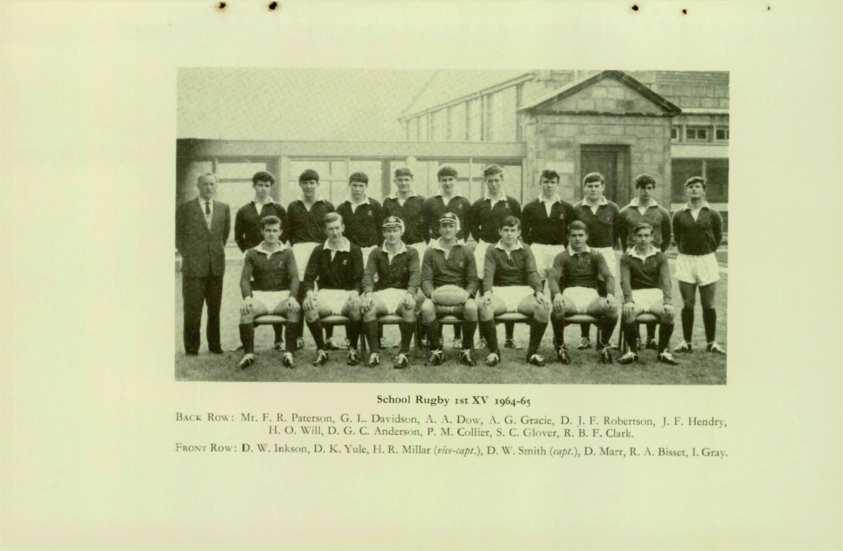
School Rugby ] SI x,· 1964-65
lh," l(cl\\. :\It. I·. R. l'accrs11n,G. I.. Da,·icls1,n,.\..\. Dow, \. G. Gracie, D. J. I". R11hcns11n, I. I . 1lcncln, 11. 0. \\ ill, D. C,, C. _\nd~rsnn, P. \ I. Colli~r, ~- C. ( lmcr, R. ll. r. Cl.uk.
hw,, Rm, D.\\ . lnk-1111. D. h. Yule, ff. R. \Jillnr (1m-.-ap1.), D.\\. Smich (tap!.), D. \ l.n, R. \ lli,sct, I. Gra, .
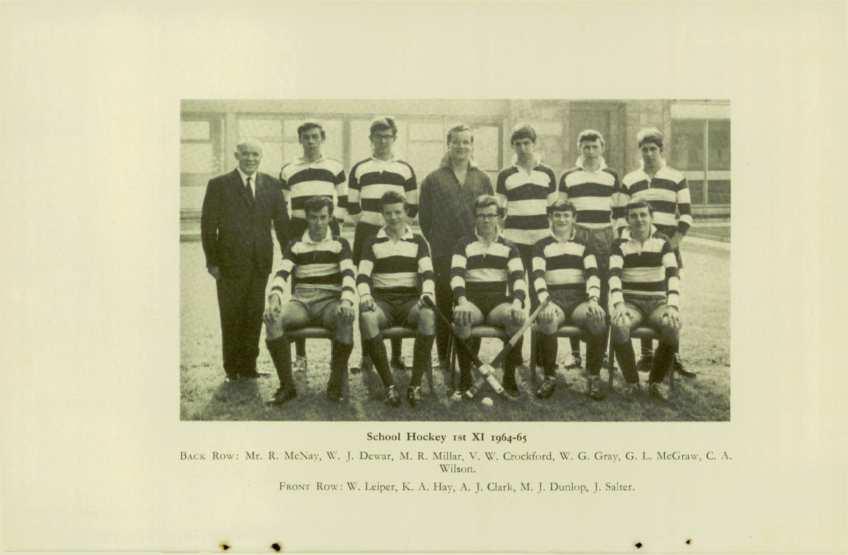
Schoo l Hockey rst Xl
r964-6s
ll\c i. Hm, \ lr R \lc'-,1·, \\. J. Dewar, .\I. R \lillar, \'. \\. Cr11ckford, \'i. C,, Gr.I\, C I. \Jc(,r,1\1, C. \, \'\'ilson.
I R0'-1, Ro\1 \\. Lctpcr, K. \. Ilay, \. J. Cbrk, \I. J Dunl11p , I. ~1•ccr,
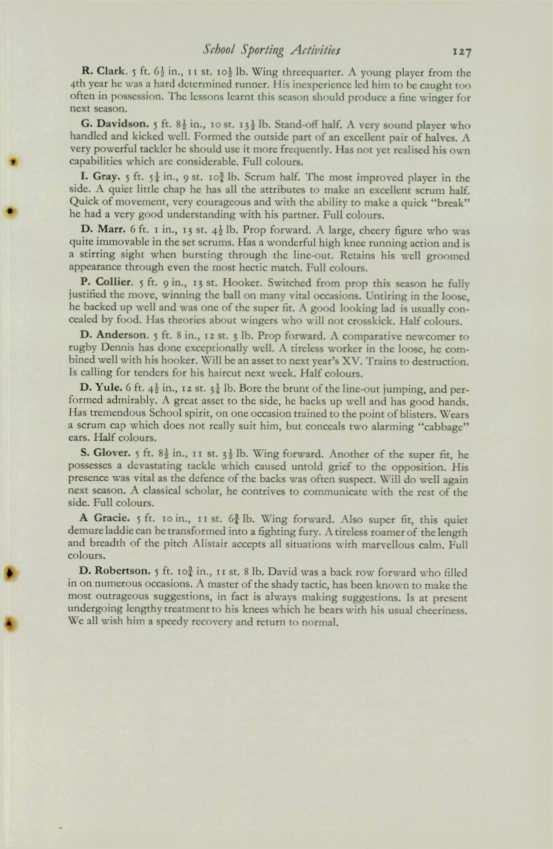
School Sporting Arlil'iliu
R Clark. 5 ft 6~ in., 11st 1ol lb. Wing thrcequartcr. A young player from the 4th year he wasa hard <lc1crmincdrunner. IItsmexpericncc led him to he caugh1 wo often in possession. 'J"he kssons lc.irnt this season should produce a fine winger for next season.
G. Davidson 5 ft. 8i in., 10 sr. 13! lb. Stand-off half \ very sound player who handled and kicked well. Forined the outside part of an excellent pair of halves. \ very powerfu l tackler he should use it more fre<1uently.Has not yec realised his own capabilities which arc considerable. Full colours.
I. Gray. 5 fr. l tin., 9 st. 10f lb. Scrum half. The most improved player in the side. A quiec linle chap he has all the attributes co make an excellent scrum half. Quick of movement, very courageous and with the ahility to make a quick "break" he had a very good understanding with his partner. Full colours.
D. Marr. 6 ft. 1 in., 13 st. 4½ lb. Prop forward. A large, cheery figure who was quite immovablein the set scrums. Has a wonderful high knee running action and is a stirring sight when bursting through the line-out. Retains his well groomc, I appearance through even the most hecc:c match. Full colouh.
P. Collier. 5fr. 9 in., 13st. Hooker. Sw·itchedfrom prop this season he fully justified the move, winning the ball on many vital occasions. Untiring in the loose, he backed up well and was one of the super fie. \ good looking Ind is usually concealed by food. Ifas theories about wingers who will not crosskick. Half colours.
D. Anderson. 5ft. 8 in., 12 sc. 3 lb. Prop forward.•\ comparative newcomer co rugby Denni, has <lonecxccpm,nally well. .\ tireless worker in the loose, he combined well wichhis hooker. \\"ill bean asset to next yc.-ar'sXY. Tr.iins t,, destruction. ls calling for tenders for his haircut next week. Half colours.
D. Yule. 6 fc. 4! in , 12sc. 3} lb. Bore the brunt of the line-out jump111g,and performed admirably. A great asset to the side, he hacks up well and has good hands. Has tremendous Schoolspirit, on one occasion trnine<lto the point of blisters. \Years a scrum cap which docs not really suit him, hue conceals two alarming "cabbage" cars. Half colours.
S. Glover. l fr. 8j in., 1 1 st. JJlb. \\:.ing forward •\nochcr of the super fit, he possesses a devastating cackle which caused untold grief co the opposition. His presence \\"aS vital as the defence of the backs was often suspect. \\'ill do well again next season A cl.lssical scholar, he contrives to communicate with the rest of the side. Full colours.
A Gracie. l fr. 10in., 11 st. 6¾ lb. \Xing forward. Also super fit, this quiet demure laddiecan betransformed into a fightin~ fury. ,\ tircle.ssroamerof the length and breadth of the pitch Alistair accepts all situatin11swith marvellous calm. Full colours.
D. Robertson. l ft. 10i in., 11 st. 8 lb. David was a back row forward who filled in on numerous occasions \ master ofthe shady tactic, has been known to make the most outrageous suggestions, in fact is always making suggestions. Is at present undergoing lengthy treatment to his knees which he bears" ich hi~ usual cheeriness. \\ call wish him a specdr recovery and return lO nnrnt1I.
1'/ayrd 10 l'layrd 16 11 on 6 W'on 3 Fixtures
Hockey 1st XI Results School Matches Lori Draa.,, 4 0 Senior Matche Lost 11 Dra»n 2 Rrmll
19 ~cpt. I', Aberdeen ,\cadcmy F.P. 2-7
26 ., "· Gro\'e ,\cademy
3 Oct. r. Grnmmar F.P. "B"
10 11. Ruthric.tnn Ramblers
17 ., "· Morgan ,\cadcmy
24 ., •· Gordon's 0Jllcgc
31 ,. •· ,\berdcen Acidcmy
4 Nov. r. IIighland Brig:tde
7 r. lI.:\LS. FuImar
II ,. JI. University "_.\0
14 I'. Abcrdccn
2r ,. r. Perth .\cadcmy
28 ., r. Grammar F.P. "\"
12 Dec. 19
9 Jan.
23 " r. Gordonians ",\" r. \berdccn Acadcm>·r.P. "\" 1•. Gramm:ir F.P. "\" ,•. Ruthrieston
6 Feb. r. Gordonians "A"
10 .., r. Univcr ity "..\11 20 ,•. Gordonstoun
27 ,. ,,. Ruthrit-ston Ramblers
10 :',far. 1•. Gordon•~ College
13 ,,. Strathallan
20 ., 1•. T'ettci;College
27 ., ,•. Abbey Sch0<,I
30 ., r Grammar I .P. 1s1 XI
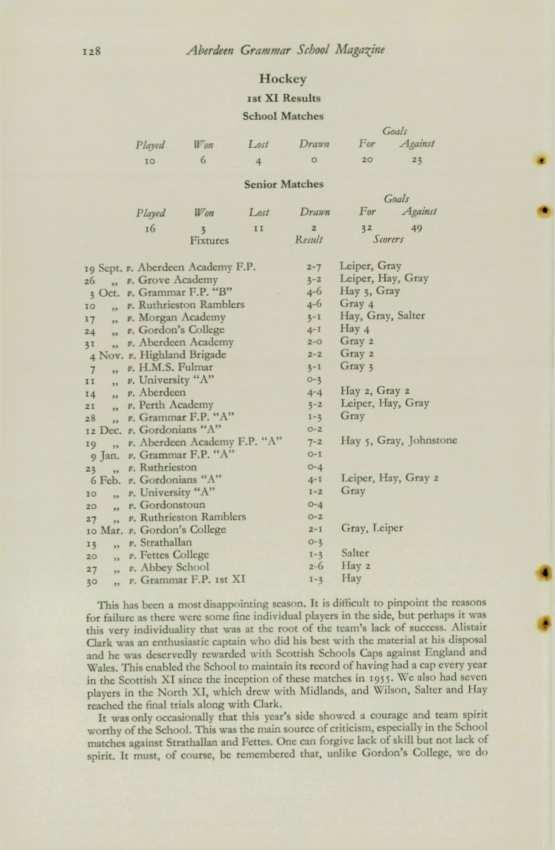
3-2 4•6 4-(, 3-1 4-1 2-i 2•2 3-1 0-3 4-4 3-2 1•3 0-2 7•2 0-1 0-4 4-1 1•2 0-4 0-2 2•1 0-3 1-3 2 6 1•3
Goals 1 or Ag.,inrl 20 23
Goals For Aga:iul 32 49 S,orrrr
1.cipcr, Gr:iy
Leiper, Hay, Gray
Hay 3, Gray Gray 4
Hay, Gray, Salter
Hay 4 Gray 2
Gray 2
Gray 3 lfay 2, Gray 2
Lcipcr, Ifay, Gray
Gny
Hay 1, Gray, Johnstone
Leiper, Hay, Gra) 2 (;ray
Gray, f cipcr
S.1lter Iby 2 )fay
This has been a most d1sapp»iming •c:i~on.It is d,flicult IO pinpoint the reas,,ns for failure \~ there \\Crc ~omefine indi, idu:11player, in the side, but pcrhap, it ":1> this ,cry indi,idU311ty tha1 was at the root of the team's lack of succc s. .\listair Oark was an emhusb tic-cir,tain \\ ho did his best u 1th the material :at his dispos.11 and he was dc,cn·cdly rcu·ardcd \\ ith Sc•>ttishSchools Caps against England and Wales. This en.1blcdthe School to maintain its record ofhaving had a c.1pevery ye.1r in the Scottish XI since the inception of these matches in 1955. \\ c also had seven players in the 's;onh XI, which drew with Midlands, and \\ilson, Salter and llay reached the final trials along u·ith Cfark. It was only occa innallr that this }Clr's side showed a courage and team spirit worthr ofthe Scr.o, I. Thi...\\as the m:iinsource ofcritici,m, especially in the Sch ol matches ag:110.,tStra;ftallanand Fettes. Ooc can forgive lack ofskill but m : lack of spirit. It must, of course, be remembered that, unlike Gordon's College, wc do
Simpsons' for Sports
Visit our Golf Showroom to see our large selection of GO LF EQUIPMENT
These are just a few of the Models in stock
WOODS IRONS
Powercraft 84s 6d 64s 6d
Tom Morris Summit 87s 68s 9d
Tom Morris Ace 97s 6d 80s
Bobby Lock-e 99s 6d 79s 6d
Peter Thomson 119s 6d 99s 6d
JIenry Cotton 126s 108s6d
Ben Sayers Crown 126s 105s
Ben Hogan PT4 135s 109s 6d
Max Faulkner 129s 6d 102s6d
Arnold Palmer 137s6d ~-107s 6d
Kcl Nagle 135s 110s 3d
Short Sets of 2 Woods, 4 Irons and Putter by Tom Morris at £24 8s 6d, and John Letters at £24 16s
There is also a large range of Caddy Cars, Bags, Shoes, Umbrellas, Clothing and other Golf Accessories
BOWLS
Taylor's Club Quality £10 3s set
Taylor's 1st Quality Black £12 3s 8d ~et
Taylor·s Tayloid Composition £11 Is 8d set
Henselite Black £12 12s 8d set
Bags for pair or set, Shoes, Measures, and Wax Polish in stock
CAMPING
Tents, Sleeping Bags, Camp Beds, Air Beds, Rucksacks, Stoves a"ailablc for your camping holiday
We can, of course, supply all your other Sports requirements
Telephone 21094
Abtrdt, •1 Gr,,wmar S,hool },fagaz.ine
undertake a strenuous list of tixturcs agJinst adult opposition and ndvcr e results arc 1lmost certain to Pccur. Perhaps ns a stimulus 10 our morale \listair Philip. Cap11in of F.P.~ h:i~ infnrrncd me th,r in all l,,rnl club marches. onh• School and one ,•ther lc,calclub scored 31,!ainstthe ist F.P. XI
Regular Team: Crockford, Dewar, Clark, Dunlop, Wilson, McCraw, Leiper, Hay, '\1iller, Gray and Salter.
Colour A" .i.rds. Re-a\\ ard Full Colouh: A. Clark, K. H ,1>, W. Leiper. Full Colour: J. Salter, C. Wilson. Re-a\\ard Half-Colour : G. Gr-.1), G. McCraw.
2nd XI. 1 his team under the excclknt capt:1incyof Colin Cameron ga,c a ,cry good account of themselves. The defence played some splendid matches and, if there·h:1dlx.cn :1 better r<.-spon~t•fr0111 the forwards, the results would have beenmuch better. Cameron, C.1mpbcll,Ilay and Johnston should do\\ ell in senior hockey ne~t season. It is ~cry unfortunate that Cnmcron should he lea'- ,e,g u, hecmse he \!/:'IS, undoubtedly, in g,»I the most rmpr<ncd phycr in the l Inckey Scc·t1nn.
Regular Team: Cameron, Yule, Camphcll, Cook, Ryan, Hay, Scotland, Chri~tie, Co,, John ton and Youngs on 1'/ayrd 21 II '011
Results
f)ra11·1r /.,n1I I 3 Goa,, I N lg,ii1111 27 S9
3rd XI. 'Thisteam, under thesplcnd d Cllptainc, , 1 Str "!wick, h.1shad a ,cry goc,d sca$on. \X'ith the change in school games' arrangLmcnt, the structure of this tc'3m bas changed from a mainly fourth and fifth )c-:tr team t\> a fifth and six1h }·car sck'Ction. This has itsdrawbacksas thc 3rd XI inthe p:1 t has hcena pro\'inganJ improving ground for the ynun1,1crpla}ers. On the other hand it has 111c~1ntnstronger side with .1 \'cry good team spiri1 and h.1s given II game 10 players who cnjor their hc,ckcy but don't ~pirc t, ""-.,er things.
Regular Team: Blair, Strudwick, Lamont, Caie, Forbes, Crail., \\ ii on, Dick, Batchelor, Henders on, Herbert and Fulton.
l'laird II II 011
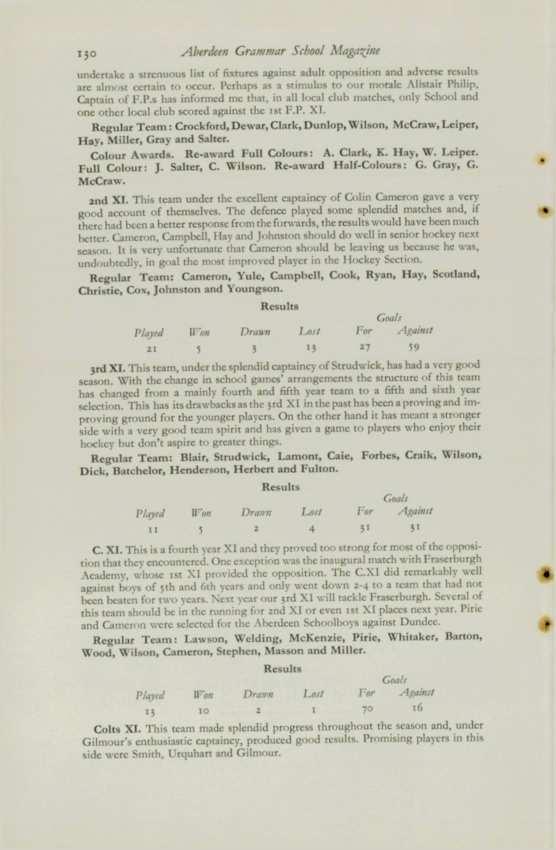
Results I>rmnr 2 Lost 4 I or 31 GMlt .,,J,f!.ai11,t
C. XI. This is a fourth )c'3r XI and ,hey proHd 1oostrong for most ofthe oppo,ition that they encountered. One exception Wlb the inau~ral match u ith Frn5erhurgh ,\cadcmr, u hoi;e 1st XI prO\1dcd 1he oppo,mon. The C.XI did remarkably well against bo)s of ~th and 6th )C:lrsand onl} ucm down 2-4 10 a ream th.-ithad not bcx-nbeaten for two yc.irs. =-:cx1yc':lrour 3rd XI \\111t3chle fraserburgh. ScHrnl of this team should be in the runninl! for 2nd XI or cnn ut XI plac,'s nL-xtyL-ar. Pirie and ( ""11eff•tlwere selected fn1 the \hcrdeen Sch, nil· ,,, against Dundee.
Regular Team: Lawson, Welding, McKenzie, Pirie, Whit.11..er , Barton, Wood, Wil,on, Cameron, Stephen, Masson :1nd Miller .
Results
LOIi 10 ror 70 Goals Ar.aim/ 16
Colts XI. This team made splendid progress 1hroughout the season and, under G I 'lour', cnthu,b.stic captaincy, produced good rt-suits. Promi~ing pbyt'r, 111 thi, side \\ere !-,mith,Urquhart and Gilmour.
House Hockey
Melvin were cle.1r winners of the l fouse Trnphy, despite a shnck defeat from Dun, who could only finish third. Tn the decisive nutch with llyron, l\fd\'in were obviously the better side. The l Iou5e matchc, were keenlycontested but the standard of hockey was not particularly high
Finally, we haveto thank the numerous masters who make possible the running of hockey in the School, by giving up their time and energy to both coaching and umpiring \gain, we are indebted to Dr. lnnc, (now President of ?\:orth District Ifockcy \s,, ,ciatinn) for his coaching on \'fcdnesdays and this year we were joined by Eric \\att at seYcralsessions.
R. J\lc·NAY
The School Sports
,\ttcr the break in the continu t) nf t~e series of \nnual !:>chr,olSpon~ meetings brought about by last year's typhoid-caused cancellation of the event, we had particular rcasnn to look for kind!> weather this )C.1r. The hope was nnt realised. Friday and Saturday, u and 12 June ran for the most part to a common pattern, and that not an accommodating one. Rain during the night ,,as succeeded by da)S that promised further min. The ground ,vas very wet, affordiny; little grip to runner, jumper or hurdler, and the sky was depressingly grey. On Saturday the dankness th.it h.1d so l<mg hung in the air changed to a quiet but steady foll nf \\'ater, not sufficiently distressing or spectacular to compel cancellation of eYcnts but enough co make conditions for competitors and spectators very unplcas;111t, No records were broken. 1n the circumstances it would have been minculous if any had, but the cheerful resolution of all who took part w.1s most commendable. \'fh.1t should perhaps be most remembered is Byron's almost successful attempt on the lfou<cchampionship, coming up from behind to overhaul Keith and tu1<ct,, ithin 5 p<imtsof \1clvin who were alw·aysin the lead; and alsn, towards the end, Kdth's great spurting effort in the relay events. Melvin, consistent throughout, were worthy winners.
Results
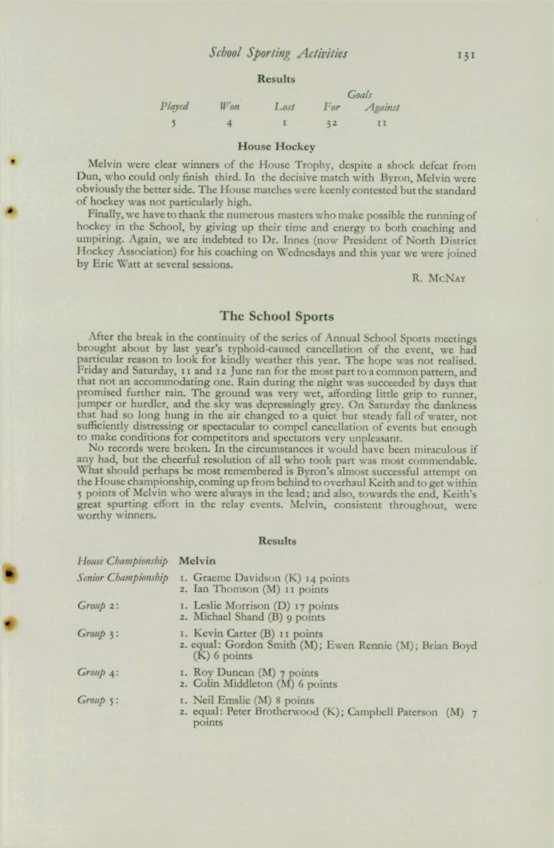
/-1011s1 Cba111piombip Meh in .\wior Cba111pi01uhip
Group 2:
Group 3: Gm ,p 5:
1. Graeme D.1Yids,,n(I-.:) 14 points
2. Ian Thomson (M) 11 points
1. Leslie .\1orrison (D) 17 points
2. Michael Shand (B) 9 points
I. Kevin Carter (B) 1I points
2. equal: Gordon Smith(.\(); E,\ en Rc1U1ic (.\[); Brian Boyd (K) 6 points
x. Roy Duncan (.\l) 7 points
2. Colin ~fiddleton (\I) 6 points
,. Neil Emslie(.\[) !I points
2, equal: Peter Brothcrwood (!...:);C1mphcll Pater~on (,\I) 7 points
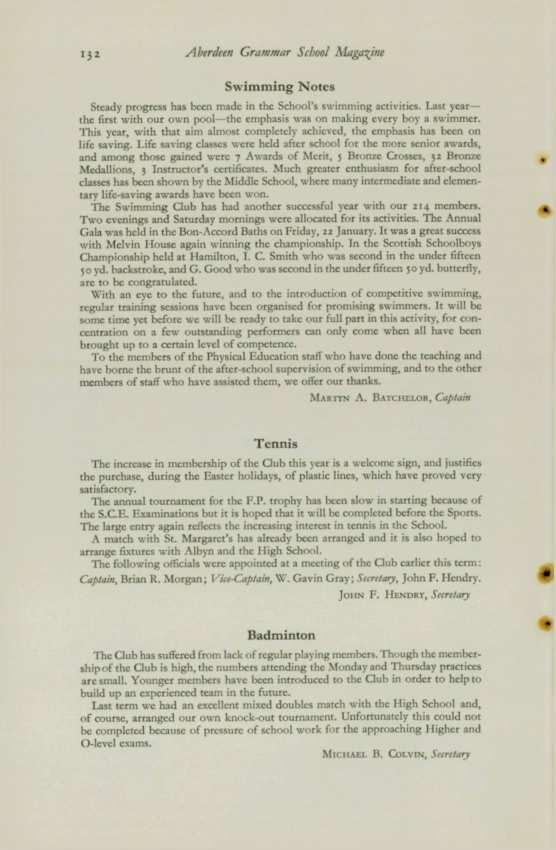
Aberdeen Gra111fl1ar School
Swimming otes
Steady progress has been made in the School's swimming activities. Last year-the first with our own pool the emphasis was on making every boy a swimmer. This year, with that aim almost completely achieved, the emphasis has been on life saving. Life saving classes were held after school for the more senior awards, and among those gained were 7 Awards of ;\fcrit, ) Bronze Crosses, 31 Bronze Medallions, 3 Instructor's certificates. Much greater enthusiasm for after-school classeshas been shown by the Middle School, where many intermediate and elementary life-saving awards have been won.
The Swimming Club has had another successful year with our 214 member,;. Two evenings and Saturday mornings were allocated for its activities. The Annual Gala was held in the Bon-Accord Baths on Friday, zz January. It was a great success with Melvin House again winning the championship. ]n the Scottish Schoolboys Championship held at 1Iamilton, l. C. Smith who was second in the under fifteen )O yd. hackstroke, and G. Good who wassecond in the under fifteen 50 yd. butterfly, are to be congratulated.
\'v'ith an eye to the future, and to the introduction of competitive S\\ imming, regular training sessions have been organised for promising swimmers. Jt will be some time yet before we will be n.-adyto take our full part in this activity, for concentration on a few outstanding performers can only come when all h:ne been brought up to a certain level of competence
To the members of the Physical Education staffwho have done the teaching and have borne the brunt of the after-school supervision of swimming, and to the other members of staff who have assisted them, we offer our thanks.
;\IARTTN ,\. 8.HCHLLOR, Captain
Tennis
The increase in membership of the Club this year is a uelcome sign, and ju~tilic,, the purchase, during the Easter holidays, of plastic lines, which have proved very satisfactory.
The annual tournament for the P.P. trophy has been slow in starting because of the S.C.E. Examinations but it is hoped that it u·illbe completed before the Sports. The large entry again re!lects the increasing interest in tennis in the School.
A match with St. Margaret's has already been arranged and it is also hoped to arrange fixtures with Albyn and the IIigh Sch0<1I.
The following oflici.11swere appointed at a meeting of the Club earlier this term : Captain,Brian R. Morgan; Vice-Captain,W. Gavin Gray; Scmtary, John F. Hendry.
Jo11N F. HENDRY, Sttrttaf)
Badminton
The Club hassuffered from lack ofregular play,ng members.Though the membership of the Club is high, the numbers attending the Monday and Thursday practices are small. Younger members have been introduced to the Club in order to help to build up an experienced team in the future.
Last term we had an excellent mixed doubles match with the High School and, of course, arranged our own knock-out tournament. Unfortunately this could not be completed because of pressure of school work fnr the approaching IJigher and O-le,·el exams.
l\hcHALL 8. CoLVL'I, .lurttary
School Notes
Cross-Country Running
Following last year's successful attempt in the Scottish Schools Championship, we entered a team again this year. The competitors in the 13-15 age group were too strong for our two boys, but we gained valuable experience for future years In the 4 mile senior race, Colin Youngson and David Robert~on kept up with the leaders for the first 2 miles, but fell away when the pace warmed up. Youngson finished nineteenth, while Robertson, running with an injured leg, did well to finish twenty-sixth In the senior team event, wefinished eighth out oftwenty-five schCX>ls.
As a warm-up for the Scottish 01ampionships, several boys were entered for the Aberdeen Championships. Colin Youngson again starred and finished fourth in the 15·I7 age group. The conditions were ideal, with snow in the ditches and icy-water on the roads, and favoured R. Rae who finished third in the 17-19 age group, sprinting past Robertson in the finishing straight. Of the younger boys, Ewen Rennie was well up in fourth place in the 13-15 group.
All things considered, the season was enjoy.,d by boys of all age.~.and our thanks go to the members of staff who gave up their time to supervise the athletes. The following colour awards were given: H alf-Colours: D. J. F. Robenson (re-award); C. J. Young~on,
Scout Notes
xst Group
G.S.M
C.M
S.M.
A.R.S.L.
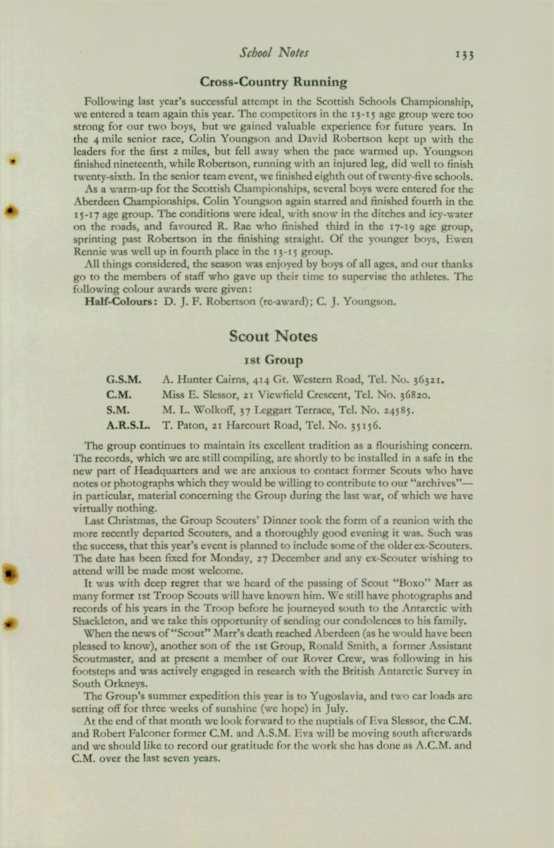
A. Hunter C1irns, 4q Gt. \X.'csternRoad, Tel. '\.o. 36321 1),fissE. Slessor, 21 Viewficld Crescent, Tel. ~o. 36820.
M L. Wolkoff, 37 Leggart Terrace, Tel. No. 24585.
T. Paton, 21 Harcourt Road, Tel. No. 35q6.
The group continues to maintain its excellent tradition as a flourishing concern. The records, which we arc still compiling, are shortly to be installed in a safe in the new part of Headquarters and we arc anxious to contact former Scouts who have notes or photographs which they would be willing to contribute LO our "archivcs"in particular, material concerning the Group during the last war, of which we have virtually nothing.
Last Oiristmas, the Group Scouters' Dinner took the form of a reunion with the more recently departed Scouters, and a thoroughly good e\"cning it was. Such was the success, that this year's event is phnne<l to include some of the older e.x-Scouters. The date has been fixed for Moncby, 27 December and any ex-Scouter ,,:ishing to attend will be made most welcome.
It was with deep regret that we heard of the passing of Scout "Boxo" llfarr as many former 1st Troop Scouts will have known him. We still have photographs and records of his years in the Troop before he journeyed south to the \ntarctic with Shackleton, and we take this opportunity of sending our condolences to his family.
When the news of"Scout" 1Carr'sdeath reached .Aberdeen(as he would have been pleased to know), another son of the 1stGroup, Ronald Smith, a former Assistant Scoutmaster, and at present a member of our Rover Crew, \\as following in his fontstcps and was actively engaged in research with the British Antarctic Survey in South Orkneys .
The Group's summer expedition this year is to Yugoslavia, and two car loads arc setting of£for three weeks of sunshine (we hope) in July.
At the end ofthat month we look forward to the nuptials of fo.vaSlessor, the C.M. and Robert Falconer former C.M. and A.S.M. Eva will be moving south afterwards and we should like to record our gratitude for the work she has <loneas A.C.M.and C.M. over the last seven years.
Aberdem Gra111111ar School Magazine
~ow a brief i<X>k at the three Sections. The Pack is really thriving and a busy programme of activities has hcen undertaken includinl-(a week-end camp at the end of May for the oldest boys in the Pack. The Pack's Open afternoon in January and the Troop's Open night in :\farch allowed a large turnout of parents and friend, tu havea glimpse at our wccklyaetivities. The Troop's r:as1crc:~mpwns blessed,, uh almost unbelievably fine ,n-ather, and an excellent turnout of almost f<,rtv Scout; took full advantage of it. The site for the Summer Camp is at Dcllicfure,a f~w miks outside Grantown-on-Spey. ·n1eCrew, with a membership of1,, enty-fivc, held their customary expedition at Kew Year to the hills, their l,ase this year being at Glcndoll Youth Hostel. ,\t Easter eight hardy members of the Crew ventured to the wild wastes of the \Vest Coast and were quite obviously not so fortunate as the Troop in the choice of weather. The Crew's other activities ha,·e included a Burns Supper, a rugby match against an F.P. team, ski-ing, challenge hikes, v1sn to a Rifle Range and the stagini.: of an orphan's parry at Clinterry for the children of Primro~ehill House.
17th Group
G.S.M. F. R. Paterson, 26 Osburne Pl~cc, Tel. l\u. j 1013.
C.M. Miss Joyce Park, 270 Union Grove.
S.M. John K. Blair, RPitstruan Pl:tcc.
Prcp:1r:11innsf ,r our Summer Camp which this year is hcing held in Glen Pro,cn, .-\ngus, arc now well in h.~ndand iris expected that a good proportion of the Troop will auend.
Since the last i,sue, the Group have acquired a cottage at Monymusk, and a number of successful and enjoyable week-ends have been held including one over the New Year when fifteen Scouts attended and had a tremendous timc,even although the ground was deep in snow. The Pack too have made use of the cottage and over the Easter week-end the sixers and seconds were taken there on a Pack Holiday. So succe:;sful was it th3t another is hcing phnncd for the July holiday week-end, \X'c have gained yet annthcr Queen's Scout badge. Our heuticst ct>ngratulations to P.L. Gregory Strange on achieving this award.
Romance has blossomed bctwccen Troop and Pack when ,,n Saturday, 29 .\tay, ,\Ian Rurkc, ,\ssistant Scoutmaster and ;\fi,s Freida Leslie,.Assist.~ntCuhmastcr were married in llolburn \X'estChurch. t:nfonunately for the Group they arc to he resident near Plymouth and they will hoth be sadly missed here. Ifowc, er wcoffer thcn1 our very best wishes for the future. The P.L.s and Sixers were delighted to form a Guard of Ifonour for two ,·cry popular and respected Scoutcrs.
Another loss to the Troop is \X'illiam Kemp who, having finished \'ahity, i, no,, working in 1.ondnn. To him also we offer our very hc,t wishes for the future.
1be Pack is still very active, and despite the faci that ten Cubs mcl\ed up into Scouts in March the nurnhcrs arc once again up to f"rtY, with boys Mill on a \\-airinglist.
The Pack inter-six Totem Pole competition was won this year by the Blue !:>ix, and we offer our congratulations to Gordon Buchan and his Six.
The end of the year sees the retiral as S.M. of John Blair. Por the last twentyfive years John has been associated with Scouting in .\berdecn. He was S.:-Lof the 1st Troop in r939 before leaving for \X'arService. On his return to .\berdeen heonce again took nvcr the 1st Troop and was their S.:-L to 19p. The 17th Troop was indeed fortull~te in p.:r<uading him to cnme h~ck once again, and J11hnhas hecn the S..\L since 19B, In 19i9 the ChrcfScQut recognised his work when he was presented with the Medal of .\krit. The pr<.<Scnthealthy state of the Gmup is due in no ,mall \\ay to his unstinting devotion; and his position as S .\l. will indeed be hard lO fill.
Letter from Australia
The Rector,
Aberdeen Grammar School.
Dear Sir,
I've never been much good at writing, but I'd jusr like to suggest that you tell your pupils that they should emigrate out here after they've finished their education. At a time like today when the skills of professional men are at a premium, Australia offers more opportuniries than any other country. Despite what folk think about Australia being just one huge primary producing country, it has got considerable secondary industry and even greater potential: there are the steelworkers of Broken Hill Proprietary Ltd. (the largest steel producer in the Commonwealth), the huge copper and lead complexes of Broken Hill and Mount Isa and they've also discovered oil in Queensland while l.C.I. and some other firms have started plastic and petrochemical iudustries.
So far, Australia hasn't gone in much for shipbuilding although they have some big shipbuilding yards in \'v'hyalfa, South Australia, which have built a ship of 22,000tons and also about a dozen 18,000 ton bulk carriers, which means they're larger ships than any built in Aberdeen. :t-:!ewcastle,in New South Wales, has built quite a number, one being the "Princess of Tasmania",a 4,500 ton ferry boat (more like a small passenger boat, larger than the "St. Ninian" or "St. Magnus") which goes between Tasmania and Melbourne. Adelaide builds tugs and Brisbane builds some larger ships too.
The largest deposits ofbauxite have been discovered in CapeYork Peninsula in the far Nortl1 of Queensland and these, I think, are the largest aluminium ore deposits in the world. This is taken down to Tasmania to BellBoy not far from Launceston for smelting, since Tasmania has unlimjted hydro-clccLric power, and they're building another smelting plant in Gladstone, Northern Queensland. Lately, too, there have been discussions on botl1 sides of the Tasman Sea as to 1':ew Zealand joining Austral ia as another state. At the moment we're sending several million tons of coal to Japan, now out best customer for making steel. In coal too, they have several different varieties, from the anthracite of New South Wales to the brown coal of Victoria. Upin the Snowy Mountains ofVictoria they're building the greatest hydro-electric complex this world has ever seen and reckon it will be one of the modern wonders of the world. Around Gippsland, the brown coal area of Victoria to0 is expanding, using opencut methods with dredges cutting out 2,soo tons per hour each. The holes they've dug arc such that you could drop Rubislaw Quarry in and you'd never notice it. Besides these, vast new deposits of iron ore have been discovered in West Australia and Japan is now buying several million tons of that per year too. Japan, by the way, is now our best customer supplanting Britain which is a close second. Other minerals being mined include tin, gold, silver, molybdenum, sapphires in Northern Queensland, zinc and uranium: in fact this count ry has everything
The main reason I sent this letter is because 1\ ustmlia needs as many skilled men as possible, and a grammar school is the training ground of the professional men of the future. Here too they would have opportunities undreamed of back home; doctors would get between £A5,ooo and £A10,ooo per year, and all kinds of engineers, chemists and scientists in general are on a good wicket. Even I, after being here six years, have now a car and a bank account in four figures. Taxation is much lighter, even the supertax only taking 66 per cent but that's only if you're f(Cttingover £16,000 per yc.:ar.Cigarettes cost between 2s. 10d.and 3s.4d. Australian per 20 and petrol is about 3s. 6d. per gallon. Person:1llyI think you can buy about as much for an Australian pound as a British. Rcnt5 are dearer here rhan in Britain but most folk arebuyingtheir own houses. Since my familyand l cameout, my uncle,
Aberdeen Gra11Jn1ar School Magazine
who was a works man.,ger in Britain getting £2,500 per year, has come out and he is now getting £A4,500 per year and says he'll never want to go back. Likewise my cousin, who came out, about a year ago, \\as getting £1sper week as a toolmaker in Britain but is now getting £ \ }O per week and, despite the fact that he has a family of two, he's managed to get a car and he's paying ofThis house.
I think I'm doing fine too and am s:n ing up co buy a farm. So far l'\'e been to most ofthe main ,\ustrali :m cities apart from Geraldton and Darwin. You've no idea of the beauty of sailing along the Queensland coast seeing sundrenched beaches kissedbythe scnwith the GlassMountains looking likesomething out ofthe Brothers Grimm and the sun beating down on limpid waters with dolphins frisking in the waves thrown up by the bows of the ship, or Caims, which at times resembles nothing so much as a cow town just out of the Western movies although the palms don't quite fit in with that picture.
Actually, I think the Australians have a terrific inferiority complex for you can't tell them what still need5 to be done here and, if you do, they're inclined to think you're denigrating their beloved motherland. Jn other words they find it very hard to take criticism, not like in Scotbnd, where we just agree with most of what they say and go off without saying much but knowing finewhoever saysanything against Scotland is absolutely mad. ,\dmincdly, this country has some problems but not many. Austr.llbns and Scots normally get on fine. They seem to look on Scots as just -\ustralians who were unfortun.1teenough to be born in another country. They don't like Italians, looking on them as "useless wops". They reckon Dutchmen arc dead arrogant with nothing to be arrogant about. Englishmen they think are whingers (in orher words moaners). Irishmen arc nice blokes but "no hopers". Peculiarly enough, they get on O.K. with Germans but I think they like the Scots best,which is reallysaying somcthing,considering theinsularcharacterof Australians
Teachers are among the qualified personnel who are much ncc<ledand, if you decide to tell your pupils what I've written, please impress on them that they should get some degree or diploma before coming out, for otherwise they won't have much chance of getting anywhere out here.
Yours sincerely,
Terence Lunan, Radio Officer, M/V "\\'yuna", Queensclilfc, \ ictoria.
School Holidays
Session 1965-66
School Commences
Autumn Holiday
Mid-Term Holiday
Christmas and Ne,, Year Vacation
Easter Vacation
Session Ends
Tuesday, 24 August 1965.
:\Ionday, 27 September 1965
Friday, 29 October to Monday, 1 ~o, ember 1965.
Thursday, 23 December to \\ cdnesday, 5 January 1966 (both dates inclusive).
Monday, 4 April to l\londay 18 April 1966 (both dates inclusi, c).
Friday, 1 Jui) 1966.
Former Pupils' Club Section
(Club Founded II September 1893)
Club Office-Bearers, 1965-66
Honor ary President:
J o n N V Ass SKINNER, ~t.A , B Lil'T , DIP eD (Recto r since 19J9)
H onorary Vice-pres idents:
H E.S:RY J ACKSON B UTCHART (1890-99) , D,S.O., 0,11.P.., T,D,, 11,L., L1 .D., D.L.
DOUGLAS PATERSON CoC HRAN (19o6- 1J),
A LEXANDER G RAY (19 10-u), M,A,, LL 11.
Tun H ON, LoRD }OIINSTON ( 19 13-26).
}Aims GRAY Krn (1891-98) , c.e.E., r.P.A,, r.R.s.n.
J onN ADAM L ILLII! (1893-1903), M.A., Lr.n. , Q,C.
ERIC L INKLATER ( 19 13-16), C,B,l!,, ll.A., LL.D., T.D.
The Right IIon. Lord MESTON ( 1901-02.)
G EORGB GORDON NICOL (1894-1903), D,S.O , ll l,C.B., ll,CONS.B.
J OHN L ENNOX RmDELL (1907-16).
Sir j Al,IBS JACKSON R OBERTSON, 0,8.B,, LL,D. , M.A., B.D., P.R.S,E., P E.1.S (Rector 1942.-J 9). •
UCIL A. G. SAVIDGE (1913-24), M.11 C., M.A. WILLIAM DOUGLAS SatP,ON (190 1- 13), C.B,E., lf.A., LL,D, , D.LITT., P,S.A.(SCOT,), P,S, A.
Sir JOHN W ILLIAM TAYLOR ( 1906-u), K,B.E ., C.M.C.
Sir WILLIAM ROBERT TENNANT ( 1904-10), C,l.l!,, M.A , LL.D.
Sir Jo11N :-.IAcKA Y T HOMSON, C.B., M.A., P,R S.IJ. (Rector, 1920-21)
Sir L ANDSBOROUCII T 11o~ISON ( 1899-1908) , c.11., O.B.l! , M.A , D.SC., P,R S.P., LL.D, ROBl!RT i3ERTRAll \V'U. LIAl4S0N ( 1906-18), O.S.O,, ~I.A., LL B, President :
I.AN GowANLOCK M cPu.LRSON (1910-17)
Vice-Pre sident of Club and Chairman of Executive \'VJLLIA~I LLWIS CoNNON (1930-40), B.L, Interim Secretary and Treasurer :
URIAN K. CROOK)HANKS (1934-46), T.D., M.A., LLB. u Bon-Accord Square, Aberdeen.
Genera l Editor of Magazin e :
RAl! C BARTON (1942-H), M.A., LL.D., 2.0 Delmont Street, Aberdeen.
Aberdeen Grammar School Magazine
Secretaries of Centres : Bengal and Assam-DR. \\ n 11AM GLORGI'MAcJ\!11rAN (1916-22), c ·o Indian Jute l\lills Re~arch Institute, 3 Taratala Road, Calcutta, 27.
Cenual Afric:a-G1·011c,1.!\ftTClll'l.LGROAT(1927-40),P.O. Box 394, Salisbury. Dundee -RouLRT S. Rn 1.F.Y(1946-55), c o Bank of Scotland, Blackford, Perthshire. Edinb urgh-Ar 1.AN CA\ILRONF'RAZFR (1925-30), M.A., w.s., 10 Atholl Crcscc,nt, Edinburgh 3.
Glasgow-Jo11N GoROON l\hcHrn B1Rss (1926-;8), ~1.c., M.A., A.C.W.A., 99 Essex Drive, Scotstoun, Glasgow W.4.
London-P. G. M. MACP11rn(1930--41),Ranger, 34 Dukes Wood Drive, Gerrards Cross, Bucks.
M.alaysia-DRtAN Sco-r1 GRAY (1943-49), n.sc., P.O. Box 207, Bantin~, Selangor, Malaya
Yorkshire-ART HUR ] Alms ADAMS (1919-30), "GuyscliJfe ", Clara Drive Calver• Icy, Pudsey, Yorks
Ireland-Ar-.DRLW M. M. STEPHEN (1936-50) M.A., LI D., 28 Elmwood Avenue, Belfast 9.
Secretaries of Sections :
Crickct -AU:XANDER MUNRO DAVIDSON (1937-45), B.1.., 18 Golden Square, Aberdeen.
Gol(-CF.ORCE ALcxANDt.RCRAIG\\?ALKER(1917-13), 164l\larket Street, Abcrdeen. Hockey-II. K. LAWSON,114 Hamilton Place, Aberdeen. Rugby-C1L~RLllS RITc1m (1945-51) 348 Hardgate, Aberdeen.
Execut ive Committee : The Vice-President of the Club, Chairman. Vicc-Chainnan-JOHN MORTI\ILR (1923,27).
The Secretary and Trca~urcr, and General Editor of Magazine, ,x oj/i,111. The Rector of the School, tX oj/icio.
HECTOR1fAcQl!El!N AIRD (1946-61).
Dot:GLAS R. IIARPJ'R (194.l'58). Jom-i WI. CRAOOCK(1940--46). JouN McP. MUTc11(1932-45).
A.]. M. EDWARDS(1908-21).
\'\'11.J.JA.M Mn.NE EwLN (1932-44).
Dot:GLASFow1.rn (1950--64). GORDONHARVl:YIILNO!lRSON(1921-34).
Dr. RANALD fYFil FINDLAY STP.VEN
{t9H·4;).
A. l'R0ST TAYI.OR (1919-;5), ERIC DOUGLAS WATT(1937-50). HAROLD l\lURRAY ROBERTSON (1926-38).
Sec/ion R,pr11tnlalfrt1 Crifktl-lAN D. F. Tno~tSON(1944-48).
Go!f-GroRGP. ArP.XANDFRCRAIG WAI.UR (1917-23), 1lo,hy _-\11'T.UR H. PmuP (19.n-56). fu~b-7-C11.\Rt 1, Rm mi.(1945-51).
s,.,ff-ALEXAND"-RBRucE, T.o., M.A.,n.sc. S1rimmi11~ Mi J.\ 11.11 r. \\ .\r,os (1942-1(,).
Hon. Auditors : Messrs. BoWERand SMITH,C,A,
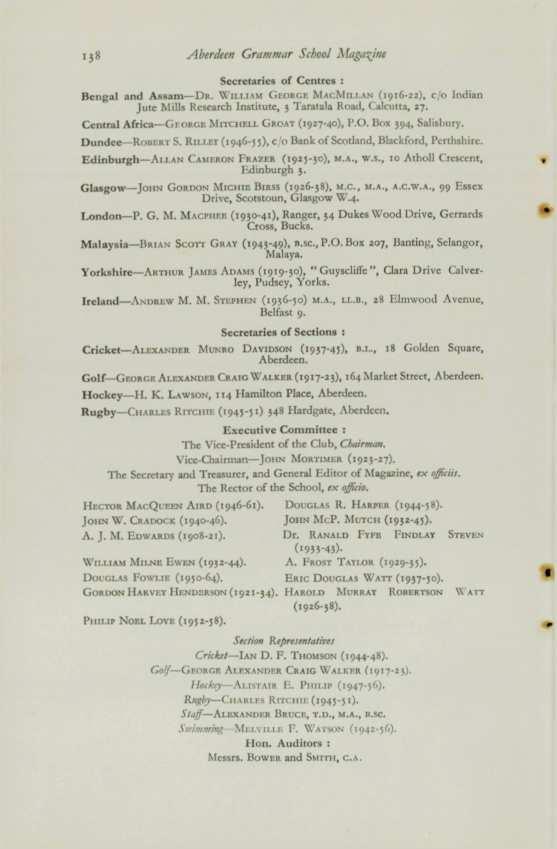
\\'ATT
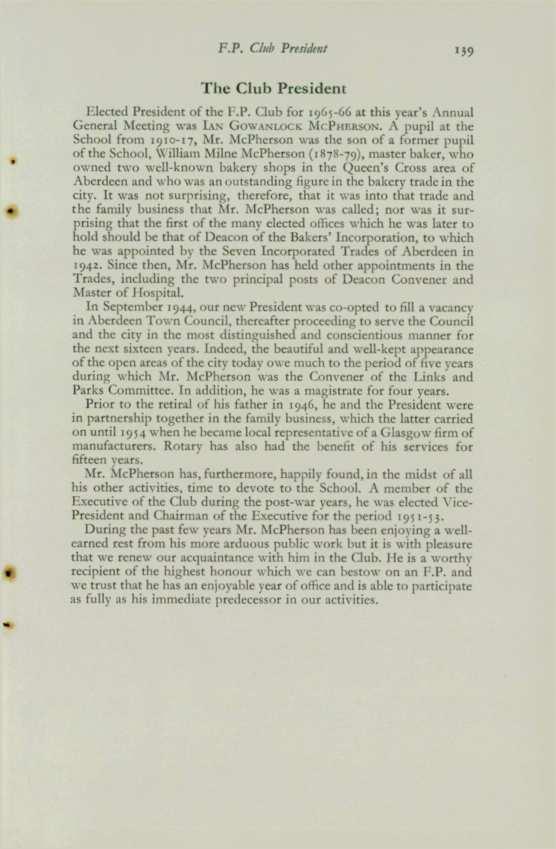
F.P. Ch1b Pruidmt
The Club President
Elected President of the l .P. Club for 196s-66 at this year's Annual General Meeting was h, GO\"\,A:--LOcKMcPHP.Rso:-:.J\ pupil at the School from 1910-17, Mr. McPherson was the son of a former pupil ofthe School, \\ illiam Milne McPherson (r878-79), master baker, who owned two well-known bakery shops in the Queen's Cross area of Aberdeen and who was an outstanding figure in the bakery trade in the city. It was not surprising, therefore, that it was into that trade and the family business that Mr. McPherson was called; nor was it surprising that the first of the many elected officeswhich he was later to hold should be that of Deacon of the Bakers' Incorporation, to which he was appointed b) the Seven Incorporated Trades of Aberdeen in 1942. Since then, Mr. \fcPherson has held other appointments in the Trades, including the two principal posts of Deacon Com·ener and Master of I fospital.
In September 1944,our new President was co-opted to fill a vacancy in Aberdeen Town Council, thereafter proceeding to serve the Council and the city in the most distinguished and conscientious manner for the next sixteen years. Indeed, the beautiful and well-kept appearance ofthe open areas of the cit~ today owe much to the period of live years during which .\fr. McPherson was the Conyener of the Links and Parks Committee. In addition, he was a magistrate for four years.
Prior to the retiral of his father in 1946, he and the President were in partnership together in the family business, which the latter carried on until 19S4when he became local representatiYe ofa Glasgo\\ firm of manufacturers. Rotary has also had the benefit of his seryices for fifteen vears.
:\fr. ~IcPherson has, furthermore, happily found, in the midst of all his other activities, time to devote to the School. A member of the Executive of the Club during the post-war years, he was elected \'icePresident and Chairman of the Executive for the period 19p-53.
During the past few years Mr. McPherson has been enjoying a wellearned rest from his more arduous public work but it is with pleasure that we renew our acquaintance with him in the Club. I le is a worthy recipient of the highest honour which we can bestow on an F.P. and we trust that he has an enjoyable year of offi.ceand is able to participate as fully as his immediate predecessor in our actiYities
Aberdeen Grammar School Magazine
Annual General Meeting
The Sixty-third ,\nnual General Meettng of the Club "as held in the Caledonian Hotel, Aberdeen, on Thursday, 25 March 1965. There was a very poor attendance, only twenty-t,\ o members being present.
Executive Report
The Report by the Executive Committee of the Club for the year ending 31 December 1964 was submitted by the Chairman of the Meeting, Mr. Alan C. R. Watt, the Vice-President of the Club and the following are extracts from the Report.
Membership
The following is an analysis of the membership of the Club as at 28 February 1965 "1th comparable figures at 28 I'cbruary 1964.
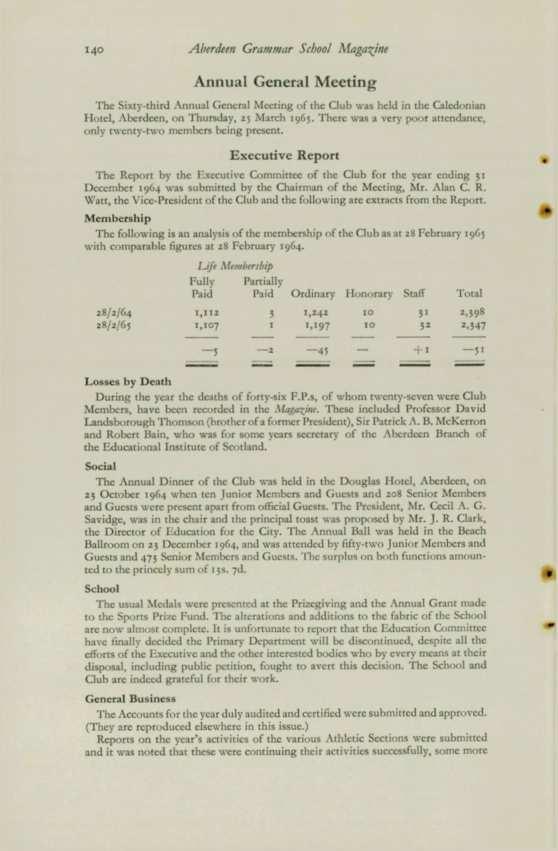
Losses by Death
During the year the deaths of forty-six F.P.s, of whom twenty-~c,en were Club Members, have been recorded in the MagazJ11,. These included Professor David Landsborough Thomson (brother ofa former President), Sir Patrick,\. B. l\fcKcrron and Robert Bain, who was for some years secretary of the .\l:x:rdeen Branch of the Educational Institute of Se<,tland.
Social
The Annual Dinner of the Club was held in the Douglas Hotel, Aberdeen, on 23 October 1964 when ten Junior :\1embers and Guests and 208 Senior Member~ and Guests were prtscnt apart from officialGuests. The President, :\fr. Cecil.\. G. Savidge, was in the chair and the principal toast was proposed by Mr. J. R. Clark, the Director of Education for the City. The Annual Ball was held in the Beach Ballroom on 23 December 1964,and was attended by fifty-two Junior Members and Guests and 473 Senior Members and Guests. 'J'he surplus on both functions amounted to the princely sum of r3s. 7d.
School
The usual \lccbls were presented at the Prizcgiving and the \nnual Grant made co the Sports Prize Fund. The alierations and additions to the fabric of the School arc now almost complete. It is unfortunate to report that the education Committee haYe finally decided the Primary Department will be discontinued, despite all the efforts of the Executive and the other interested bodic.swho by every means at their djsposal, including public petition, fought co aYert this decision. The School and Club are indeed grateful for their work.
General Business
The Accounts for the yearduly audited and certified were submitted and approved. (They are reproduced elsewhere in this issue.)
Reports on the year's activities of the various Athletic Sections were submitted and it was noted that the~ were continuing their activities successfully, some more

F.P. Cl11b Centre Report1
so than others. It was hoped by the Swimming Section representative th.u they might ohtain more acci\""elyparticip~nt members.
The appointment of office-bc.uers then took pbcc and the Ch:iirman th:\nkcd .Mr. Savidge, the rettring President, for his interest in the Oub's activities and for his attendance at the Dinners of the London, Glasgow, Leedsand Dund.:e Centres, he having been unable to attend that of the Edinbucgh Centre. The new Chairman of the Executive, on taking the chair, paid tribute to Mr. \Vatt for his services to the Club during the past t\vo years.
It was noted that the retiring President, Mr. Savidge, had suggested that as the present School history "Bon-Record" by the late Dr. Morland Simpson and a small booklet by Mr. Fenton Wyness were both now out ofprint, it might be appropriate that a new History be printed. It was agreed to remit this matter to the new Executive. A suggestion had also been made by.Mr. H. )\f. R. \Vatt that theexistmg Roll of Pupils (179~-1919) be brought up co date and this was also remitted to the new Executive.
Finally, Mr. Alan Watt reported on a Meeting of the Chairman's Committee which had considered Reports by the Director of Education on the question of the proposed change of the educational system in .\bcrdecn to incorporate the comprehensive scheme. (This matter isdealt with fullyelsewhere in this issue.)
Centre Reports
Malaysia
The Annual Dinner of the Centre was held in the Adelphi Hotel, Singapore, on 2.7 :\(arch. There was an attendance of eleven l'.P.s and six guests, the chic[ guest being a Gordonian, Angus McKay of the Singapore Port Authority.
The following F.P.s were present : Loo Yew llooi, B. S. Gray, V. G. R. Stephen, D. L. Cowie, R Jones, J. R. G. Smith, G. Fcarby, R. Booker, M. Milne, N. McLean, G. G. Benton.
Edinburgh
The Annual Dinner of the Edinburgh Centre of the Club was held on Friday, february in the Roxburghe Hotel, Edinburgh. Douglas Reith, Q.C., presided genially over a record attendance of sixty-seven members and guests. The principal guest was 2\lr. Alexander Thomson, Q.C., Dean of the Faculty of Advocates, who proposed the toast of"The School and the Club" with the felicityone expects from the holder of his high office. The replies by the Rector and l\Ir. Alan C. R. \\'att reached the same level. The toast of the Guests was responded to by Dr .Albert Christie, the Prc.~ident-Electof the Glasgow Centre, whose witticisms convulsed the company. Mr. James Craig paid trihutc to Douglas Rcith's services to the Cluh in a speech which had both warmth and grace.
The following members of the Club attended the function: E. Ros Birkett, Esq., C.A.; :-..iclsonC. Bmnnan, Esq.; Stewart Boyd, Esq; David I. C~ldcr,faq.; D.R. B. Cay, Esq., M.A., I.L.e.;T. Gordon Omtts, Esq.,LI..B.; James Craig, Esq., w.s.; Dr. A. il. Donald; James Fiddcs, Lsq., B.A.,LL.n.; A. C. frazer, Esq., w.s.; J. R. Guy, Esq.; I. lfenden;,,n, Esq; Douglas Jamieson, Esq.; The Hon. Lord Johnston; SheriffJ. R. Lillie; D. I. K. Macl.co<l,Esq., M.A., LL.B.;George A .\facnab, Esq., A.K.1.11.A.;A. S. Matheson, Esq.; \v. Ferrier Maver, Esq.; Dr. G. M. l\1. .\[enzies; Peter C. Millar, hsq., LL.B.,w.s.; Michael F .\1orison, Esq.; A. S .M Porter, Esq; C. Duncan Rice, Esq., M.A.; George A. Robb, Esq ; Revd. George Sangster; R. G. C. Smith, bq.; .\fajor A. Spark, M.c.; Alastair Tosh, Fsq.; Roy A. Wilson, Esq., w.s. The following were Official Guests: Alexander Thomson, Esq., Q.c.; the Rector; Alan C. R. Watt, Esq., M.A., LL.B.; Dr. Ronald Gordon (Edinburgh Gordonians); Dr. '\Jberr Christie (Glasgow Centre) and Robert S. Rilley, Esq. (Dundee Centre).
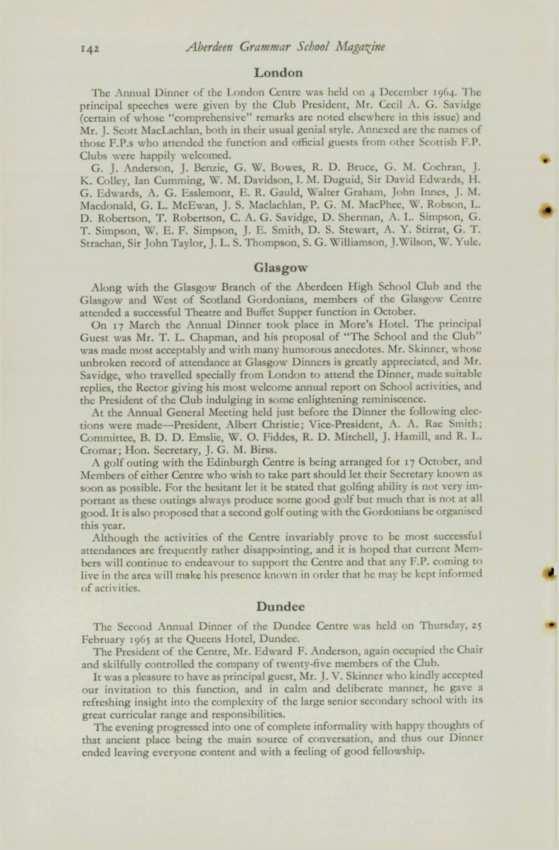
Aberdeen Gra111111ar School Magazine
London
The \iumal Dinner of the l.ondon Ccmr~ was held ,,n 4 Dccc111l,er 19(>4, 'Ihe principal speeches were given by the Club President, J\lr. Cecil \. G. Savidge (certain nf whose "comprchcnsi"e" remarks arc noted elsewhere in this issue) and .\1r J. Scott .\lacl.achlan, both in their usual genial style. ,\nncHd arc the names of those F.P.s who attended the function and official RUC,csfrom mhcr .;conish l'.P Club, were happil)' ,,clcomed.
G. J. .\nderson, J. Benzie, G. \V, Bowes, R. D. Bruce, G. \f O>ehran, J. K. 0-,lky, fan Cumming, \\. \ I. David5nn, I \ L Duguid, Sir Da, ,d I d"·ards, II. G. l.d\l.mls, ,\. G. Esslemont, r:. R. Gauld, \\alter Graham, John Innes. J \I Macdonaltl, G. L. !\1cEwan, J. S. \laclachlan, P. G. \ I. \ lacPhec, \X1 • R,,bs,•n, I D. Robertson, T. Robertson, C. .\. G. Savidge, D. Sherman, ..\. l .. Simpson, G. T. Simpson,\\. E. F. Simpson, J. E. Smith, D. S. Stewart, ,\. Y. Stirrat, G. T Strachan, Sir John Tavlor, J. L. S. Th )mpson, S.G. \'filli.1mson, J.\'filsnn, \\'. Yule.
Glasgow
Along with the Glasgow Branch of the \bcrdeen High School Club and the Glasgow and \\'esc of Scotland Gord,,nians, members of the Glasgow Centre attended a successful Theatre and Buffet Supper function in October.
On 17 ,",farch the \nnual Dinner took place in \lore's Hotel. The principal Guest was Mr. T L. Chapman, and his proposa l of "The School and the Club" was made most acceptably and with many humorous anecdotes. Mr. Skinner, ,, hose unbroken record of attendance at Glasgow Dinners is grL-atlyappreciatcd, and .\Ir. Savidge, who travelled specially from London to attend the Dinner, made suitable replies, the Rector giving his most welcome annual report on Schc~JIacti\'icies, and the President of the Club indulging in some enlightening reminiscence.
At the Annual General .!\fecting held just before the Dinner the following elections were made President, .\lbcrt Christie, \'ice-President, A. ,\. R~c Smith; C.,mmittee, B. D. D. Emslie, \v. 0. l'iddes, R. D .!\titchcll, J. Hamill, and R. L. Crom.1r; !Ion. Secretary, J. G. 1\[. Birss.
A golf outing with the Edinburgh Centre is being arranged for 17 October, and Members ofeither Centre who wish to take part shou ld let their Secretary known a, soon as possible. For the hesitant let it be stated that golfing ability 1s not \'ery important :is these outings always produce some good g,)Jf hue much char is not at all good. It isalso proposed that a second golf outing with the Gordonian, be organised this year.
Although the activities of the Centre invariably pro\'c to be most successful attcnd.1nccs :ire frequently rather di,appointing, and it is hoped that current :\lcmbers will continue to cndca\'our to support the Centre and that any F.P. coming tn live in the area will make his presence known in order th:lt he may he kept infornwd of ncri, itics.
Dundee
The Second ,\nnual Dinner r,f the Dundee Centre was held on Thursday, 2~ Fehruary 196) nt the Queens IIotcl, Dundcto.
The President of the Centre, Mr. Edward I'. Anderson, again occupied the Chair and skilfully controlled the company of twenty-five memhcr, of che Club.
le\\ as :i pleasure co h:wc as principal guest, .'\(r. J. \'.Skinner\\ ho kindly accepted our invitation to this function, and in calm and deliberate mnn11cr, he gn\'c :i refreshing insight into the complexity of the large senior secondary school with its great curricular r,1ngeand responsibilities.
The evening progressed into one of complete informality with h:tpp)' thoughts c,f that ancient place being the m.-iin source of com·ersation, and thus our Dinner ended leaving everyone content and with a feeling of good fellowship.
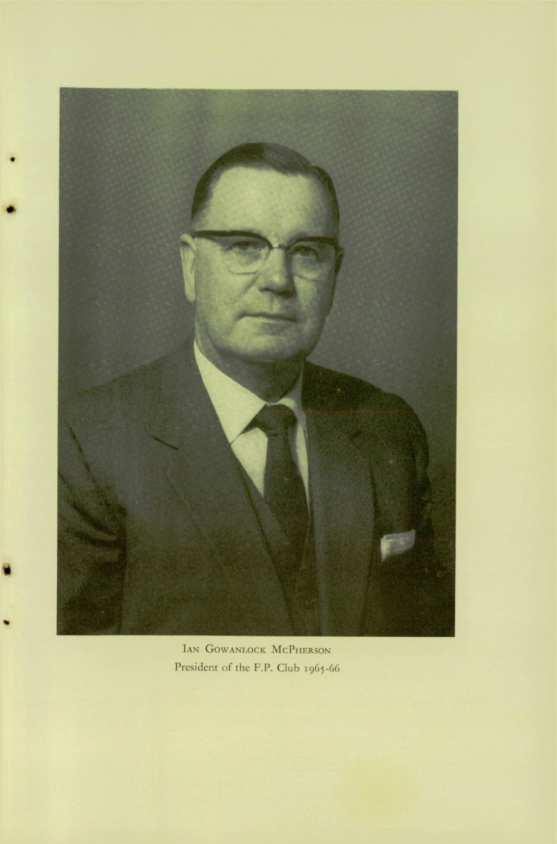
IA, Gow,\!'<I.OC:K J\fcP11rRso, President of the- r.l'. Cluh 19<,~-66
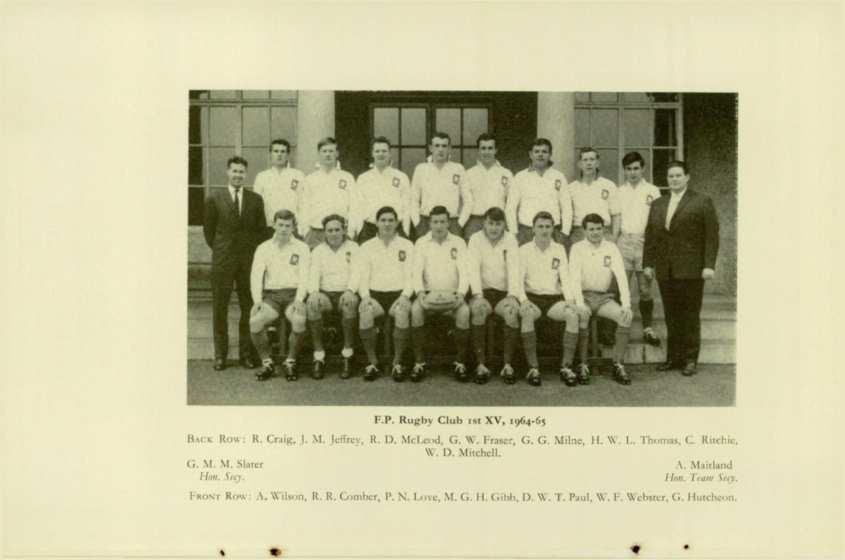
l
F.P. Rugbv Club rs1 XV, 1964-65
IIH 1' Ro\\. R. Cr.,ig, I. :\I. ktfrcy, R, D. \le I.cod, G.\\. I r~scr, C. G \11lne, 11. \\. I. Thoma,, C. Ri,d:ic, \\', D. \llcchcll.
C. \1. \f. ~Lnc:r \, \l.11iland
ln11. fu1111 1,n
I Ro-.; 1 Ro" : \,\\ii,, ,n, R. R. Comher, P "-· I.ovc, \I C. 11. C:ihh, D.\\. T. Paul,\\. I. \\ch~ta, C:. I lu1rh,·.,n.
Section Reports
Rugby Results
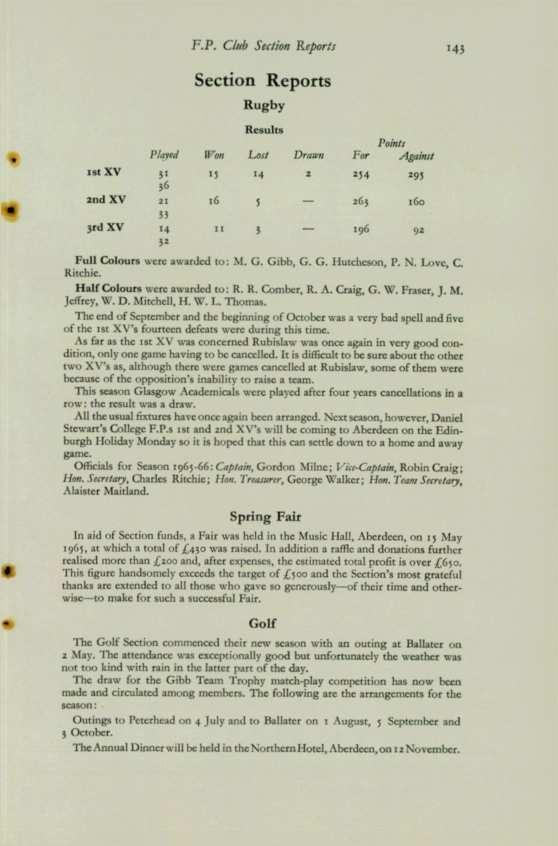
Full Colours were awar<led to: M. G. Gibb, G. G. Hutcheson, P. . Love, C. Ritchie.
Half Colours were awarded to: R.R. Comber, R. A. Craig, G. W. Fraser, J.M. Jeffrey, W D. Mitchell, H \YI. L Thomas.
The end of September and the beginning of October was a very bad spell and 6ve of the 1st XV's fourteen defeats were during this time.
As far as the 1st XV was concerned Rubislaw was once again in very good condition, only one game having to be cancelled. It is difficultto besure about the other two XV's as, although there were games cancelled at Rubislaw, some of them we.re because of the opposition's inability to raise a team.
This season Glasgow Academicals were played after four years cancellations in a row: the result was a draw.
All the usual fixtures ha\•eonceagain been arranged. Nextscason,however, Daniel Stewart's College P.P.s 1st and znd X\I's will be coming to Aberdeen on the Edinburgh Holiday Monday so it is hoped that this can settle down to a home and away game.
Officials for Season 1965-66:Captain, Gordon Milne; Viet-Captain, Robin Craig; Hon. St&rtlory,Charles Ritchie; I !011. Trtai1mr, George Walker; Hon. Ttan, Stmlary, Alaister Maitland.
Spring Fair
ln aid of Section funds, a Fair was held in the Music Hall, Aberdeen, on 15 May 1965,at which a total of £430 was raised. In addition a raffieand donations further realised more than [,zoo and, after expenses, the estimated total profit is over £650 This figure handsomely exceeds the target of £500 and the Section's most grateful thanks are extended to all those who gave so generously-of their time and otherwise-to make for such a successful Fair.
Golf
The Golf Section commenced their new season with an outing at Ballater on 2 May. The attendance was exceptionally good but unfortunately the weather was not too kiod with rain in the latter part of the day.
The draw for the Gibb Team Trophy match-play competition has now been made and circulated among members. The following are the arrangements for the season:
Outings to Peterhead on 4 July and to Ballater on 1 August, 5 September and 3 October
The Annual Dinnerwill beheld in the •orthem Hotel,Aberdeen, on 12 November.
l>'5 l 0 •74 u 6 6J 7 o
f.56• o 6 501 10 R •09 l 5 r, 4f 16 4 6 IJ 10 0 0 0 0 0 0 :6 1 .J ll
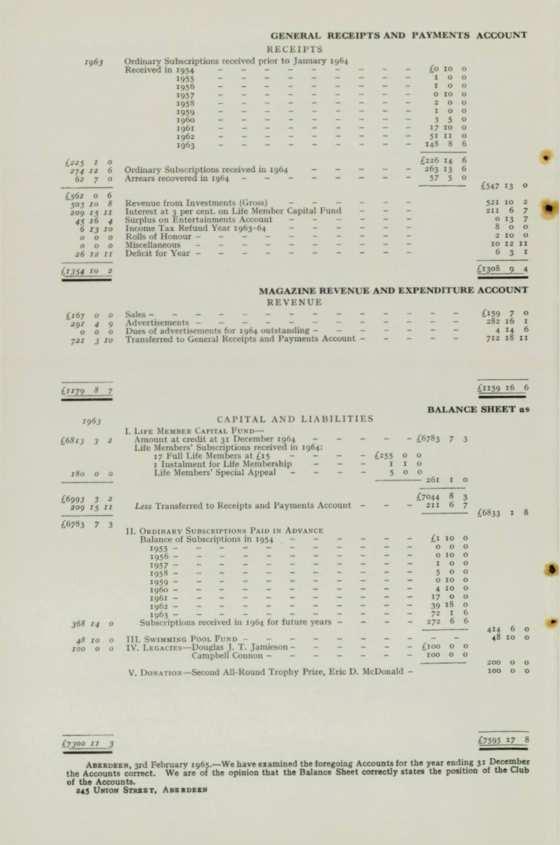
£167 0 0 .l')l 4 ') 0 0 0 7~1 J 10
£6~1) J J
Ordmary ~ulbcnpllonii rtt<'tvcci prior to J,111uary 196,4
Received m 19~4 - -
l9SS 19s6 19s7 19s~ 19s9 196<> 1961 1962 1963
Ordinary Sub-.rriptio~ recei\-eJ in 196.• Arrean, recovered in 1964 - - -
Revenue from Jnv~tmenb ((;ross) lntcrr.-st at 3 per ce~t. ou Life \1cml>crC.1pit,1l l"uml Surplu~ on Entertammenu Acc'.ouut lnco111eTax H.e(und Year 1963 b4 Rolls of Honour - -,ti~·ellanoou~ Def1c1t for Year -
~le~\d\'rrti'-OntuhDues or ad\'f"rfr•.r.m('11h for 1q64 <,Ut~t;,uuh11« -
Trau,Cerred to <...eneralRC4'<'1ptsaml Palywtu~ Account -
I. La:£ M1t.a.1nt R l.APITAL Ft·,uArnount at credit at 31 D('("rmh{'r1964 Life Mcmbc~·. Subscriptiotb received in 196.1: 17 Full Lile ,1eml><'r,;at £1, -l Jnstalment for Life \(rmh<-1""-hlpLife Member,;' Special Appeal Us, Trans[crrcd
11 ORDINARY StJRSCR lrT t0N~ PAil> I N Al.'IVA'SCr n..1lanfe of Sut,suiplions in 195,1 195519561957195~J QS9196<>19611962I 963 - - - - - - -Suh!-<:riptions received iu 1964 for futum )"tars
41i ro o Ill. Swuuo1.1:,.GPooL Fti-.,;o 1 00 o u 1\'. l.t<<ALIF.~-l>ougla~ J l. J.a.miNton(Jmpbell Connon -
V. Do~,110,i-Sewud All-Kounrl Troph)' Pnzr, Frie D Mcl>onald -
£7300 11 3
A•••LD&&lf,3<d February 1965.- We have eumlned tbo fottg oing Accounts for tb• year encting 31 December the Accounts corteet. We are of tbe opinion that tbe Balance Sheet correcUy atates the poslUon of the Club of tbe Accounts.
2•, U,noM STu&T, Aa1aoa11r
for year ._ndlnQ 31 De<:embu 1964
J>,\ \'~lh:-'I :-, \\"01k11u;h1:pcnses, including Houor.irium to S(.-c.1d,1ry ,wd l'n·,hUlt:r
Honorarium to Auditor!-for year to 3l Dcn•mber 19h3lnmmc 1a• Schedule D Year 1Q64 h~lucome Tax Paid by deducuou frorn ln\1·"1tment ha<olllf'
S<-hoolan<l Trophy lletlab C.ipitation (.;raut~; Londou (.la<gow Edmburgh -
Club Development
~~<~;~1; ;1r!~,,Pun~ Transfrrr ed from Magazine Account - - -P,un arit>"I Prote~t Commillre (Payuwnt-, m,ule by Club to <lat~)
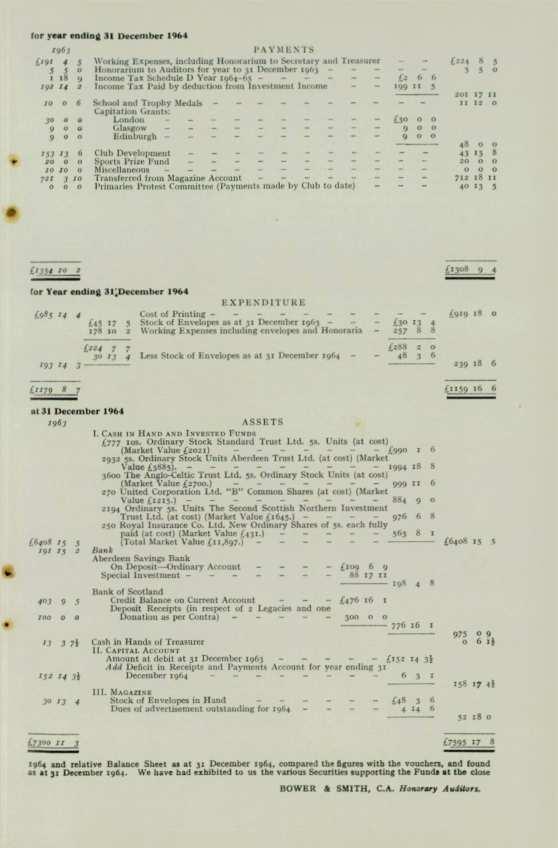
!or Year
14 4
3l~De~ember 1964
£45 17 178 JO 2
193 ,., 3----
Co,t of PrintingSt<, k of Envelopes as at 31 l>.-1ember 1963 -\\ 01 king Expen~ incluclm~ t'n,·doph and Houorari:l
4 :57 ij 8 {.:8~ 2 0 Lr<• St0<k of F.nclopes A< at 31 J)('ccmb<·r1Qf•1
I. CA~n 1N IIAr,,;o A?\o I svsst1-:D ru~oi
£777 1os. Ordinary Stock ~tandard Tru~t Ltd 5<. Uuits (at cost) (Market Value f.2021) - - - - - - [990 1 Ii
2932 5s, Ordinary Stock Unit• Ab<rdttn Trust Ltd. (at cost) (~larket \'aJue £3885). - - - - - - - - - 1994 16 b
3(,00 The Anglo-Celtic Trust Ltd. 5., Ordinary Stock Units (at co;t) (\larket Value {.2700.) - - - - - - - 999 11 6
2;0 United Corporation Ltd, "B" Common Shares (at coot) (Market \alue £1215.) - 8S4 9 o
2194 Ordmarv 5s. Units The Second Sc<>tli•h :Sortbern lu,estment Tnt<t Ltd. (at cost) (Market Value [1645.) - - - 976 6 8
250 Koyal ln,urauce Co. Ltd. l\ew Ordinary Sharr, of 5,, rnrh fully paid (at cost) (Market Value f.111,) 563 8 1 (Total Market Value £11,897,JBonk
A1X"rdttn Savin~ Bank
On Dcpo<tt--Ordinarv Acc:ouot Sp•<1.1llu,e,tment - • -
Bank of Scotland
trcdit Balance on Current Account - £476 16 1 D~it Rt'<'cipts (in rcsJ}('Cl or 2 J..('gtl(it"S and cme-
as per Contra) -
Ca,h in Hands or Treasurer
JI. CAl)l't'A l ACC.'OtJNf
or 3d\·~rtbe:ment outstanding for 1q64
1964 and relative Balance Sheet u at 31 December 1964, compared the ligures with the vouchers, aod fouod u at 31 December 1964 We have bad exhib ited to us the various Securi ties suppottlnc the FuodJ at the close BOWl!R & SMITH , C.A, H ott0ruy Audilon
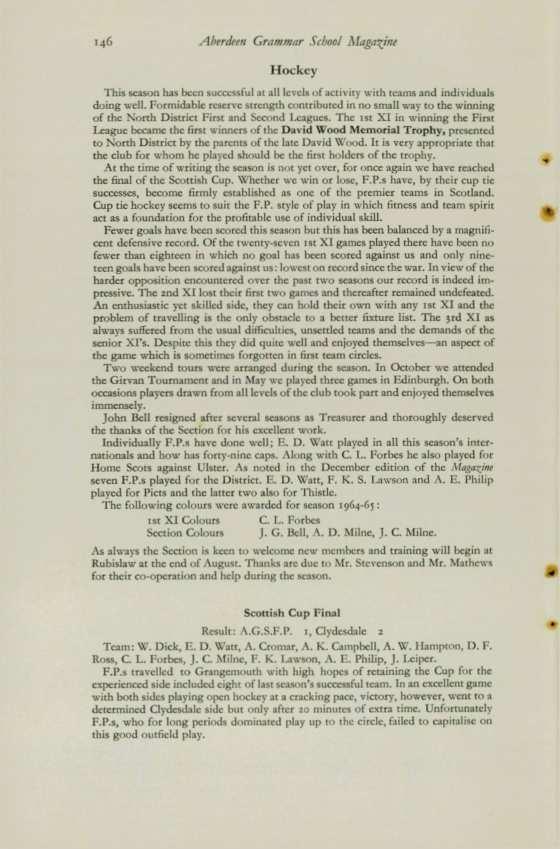
Hockey
This season has been successful at all levels ofactivity with teams and individuals doing well. Formjdable reserve strength contributed in no small way to the winning of the North Disuict First and Second Leagues. 'Ibe 1st XI in winning the First League became the 6rst winners of the David Wood Memorial Trophy, presented to North District by the parents of the late David Wood. It is very appropriate that the club for whom he played should be the first holders of the trophy.
At the time of writing the season is not yet nver, for once again we have reached the final of the Scottish Cup. Whether we win or lose, F.P.s have, by their cup tie successes, become 6rmly established as one of the premier teams in Scotland. Cup tie hockey seems to suit the F.P. style of play in which fitness and team spirit act as a foundation for the profitable use of individual skjll.
Fewer goals have been scored this season but this has been balanced by a magnilicent defensive record. Of the twenty-seven rst XI games played there have been no fewer than eighteen in which no goal has been scored against us and only nincreen goalsha-.e been scored against us: lowest on record since the war. In view of the harder opposition encountered over the past two seasons our record is indeed impressive. The 2nd XI lose their first two games and thereafter rcmajned undefeated. An enthusiastic yet skilled side, they can hold their own with any rst XI and the problem of travelling is the only obst"lcle to a better fi.xrurclist. The 3rd XI as always suffered from the usual difficulucs, unsettled teams and the demands of the seruor XI's. Despite this they did quite well and enjoyed thcmselvcs-ftn aspect of the game which is sometimes forgotten in first team circles.
Two weekend tours were arfllilged during the season. In October w·eattended the Girvan Tournament and in May w·eplayed three games in Edinburgh. On both occasions players drawn from all levels ofthe club took part and enjoyed themselves immensely.
John Bell resigned after several seasons as Treasurer and thoroughly deserved the thanks of the Section for his excellent work.
Individually F.P.s have done well; E. D. Watt played in all this season's internationals and how has forty-nine caps. Along with C. L. Forbes he also played for Home Scots against Ulster. As notc<l in the December edition of the Mogaz.i11t seven F P.s played for the District. E. D. Watt, F. K. S. Lawson and A. E. Philip played for Picts and the latter two also for Thistle.
The following colours were awarded for season 1964-65: 1st XI Colours C. L. Forbes
Section Colours J. G. Bell, \. D. Milne, J.C .Milne.
As always the Section 1s keen to welcome new members and training will begin at Rubislaw at the end ofAugust. Thanks arc due to Mr. Ste'l'enson and Mr. Mathews for their co-operation and help during the st-ason.
Scottis h Cup Final
Result: A.G.S.F.P. 1, Clydesdale 2
Team: W. Dick, T:. D. Watt, A. Cromar, A. K. Campbell, A. W. Hampton, D. F. Ross, C. L. Forbes, J. C. Milne, F. K. Lawson, A. E. Philip, J. Leiper.
F.P.s travelled to Grangemouth with high hopes of retaining rhe Cup for the experienced side included eight of last season's successful ream. [nan excellent game with both sides playing open hockey at a cracking pace, victory, however, went to a determined Clydesdale side but only after 20 minutes of extra time. Unforrunately F.P.s, who for long periods dominated play up to the circle, failed co capitalise on this good outfield pla}'·
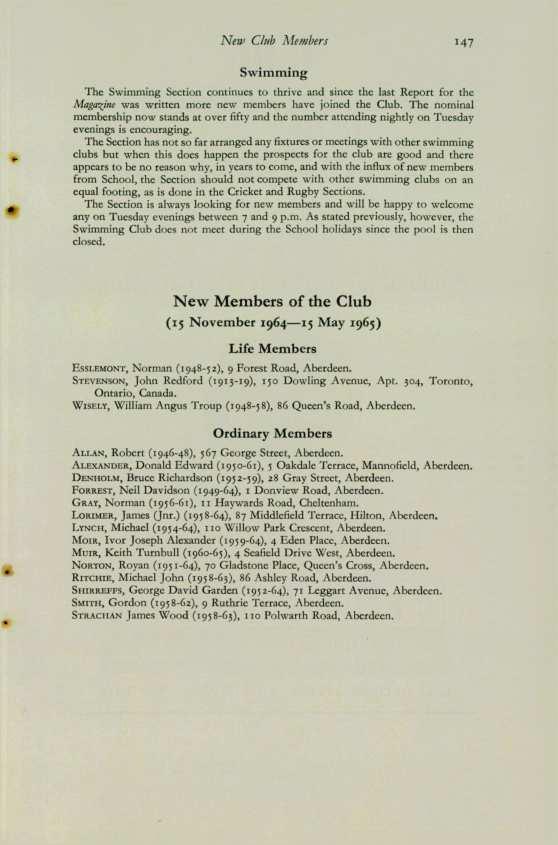
Swimmin g
The Swimming Section continues to thrive and since the last Report for the Magazine was written more new members have joined the Club. The nomina l membership now stands at over fifty and the number attending nightly on Tuesday evenings is encouraging.
The Section has not so far arranged any fixtures or meetings with other swimming clubs but when this does happen the prospects for the club are good and there appears to be no reason why, in years to come, and with the influx of new members from School, the Section should not compete with other swimming clubs on an equal footing, as is done in the Cricket and Rugby Sections.
The Section is always looking for new members and will be happy to welcome any on Tuesday evenings between 7 and 9 p.m. As stated previously, however, the Swimming Club does not meet during the School holidays since the pool is then closed.
New Members of the Club
(15 November 1964-15 May 1965)
Life Members
EssLEMONT,Norman (1948-52), 9 Forest Road, Aberdeen.
STEVENSON,John Redford (1913-19), 150 Dowling Avenue, Apt. 304, Toronto, Ontario, Canada
WISELY,William Angus Troup (1948-58), 86 Queen's Road, Aberdeen.
Ordinary Members
ALLAN,Robert (1946-48), 567 George Street, Aberdeen.
ALEXANDER,Donald Edward (1950-61), 5 Oakdale Terrace, Mannofield, Aberdeen.
DENHOLM,Bruce Richardson (1952-59), 28 Gray Street, Aberdeen.
FORREST,Neil Davidson (1949-64), I Donview Road, Aberdeen.
GRAY , Norman (1956-61), II Haywards Road, Cheltenham.
LORIMER,James (Jnr.) (1958-64), 87 Middlefield Terrace, Hilton, Aberdeen.
LYNCH,Michael (1954-64), uo Willow Park Crescent, Aberdeen. MoIR,Ivor Joseph Alexander (1959-64), 4 Eden Place, Aberdeen. Murn, Keith Turnbull (1960-65), 4 Seafield Drive West, Aberdeen.
NORTON,Royan (1951-64), 70 Gladstone Place, Queen's Cross, Aberdeen .
RITCHIE,Michael John (1958-63), 86 Ashley Road, Aberdeen.
SHIRREFFS,George David Garden (1952-64), 71 Leggart Avenue, Aberdeen.
SMITH, Gordon (1958-62), 9 Ruthrie Terrace, Aberdeen.
STRACHANJames Wood (1958-63), rro Polwarth Road, Aberdeen.
HARPER
THE HARPER MOTOR CO. LTD
Car & CommercialVehicle Department
HOLBURN JUNCTION, ABERDEEN
Tractor& ServiceDepartment
UNION GLEN, ABERDEEN
depotsat Elion& l.Aurencekirk xii
THE AUSTIN 1800
All the tried and tested revolutionary features of the Mini and 1100 with more power, more space and Austin elegance
Front wheel drive. Transverse engine. Hydrolastic suspension. Wide wheelbase. Pininfarina lines.
1800Saloon (including £133 . 17 . I P.T.)
£768 . 17 . I ex works.
1800de Luxe (including £140 . 14 . 7 P.T.)
£808 . 14 . 7 ex works.
W. J. MILNE
Men's Outfitters
UNION STREET
ABERDEEN
Established 1901, TeJ. 23950 'Gallow scs'
" W e are moving soon to 27 Albyn Place"
For SEA, RIVER or LOCH
get yourself a
MOULDACRAFT DINGHY
Our glass fibre dinghies for rowing, outboard, fishing or sailing, and our new 'HIAWATHA' CANOE are the complete answer-
• EXTRAORDINARILY LIGHT
e and require practically NO MAINTENANCE
For full details sendfor illustrated leaflet to:
HOWTOAPPLYFOR ACOMMISSION INTHEROYALAIRFORCE
As an officer in the R.A.F., you are a member of one of the most important, well paid and most truly satisfying professions. You will see the world, you will always be in the best of company, and your work will be absorbing. So it is only sensible to read this advertisement with some care.
If you expect to gain Higher Grade S.C.E., you may apply for entry to Cranwell, the R.A F College which trains cadets for a full career in the Service. When you enter Cranwell, you must be berneen 17½ and 19½, ,,ith S.C.E. in English, mathematics, science or a foreign language, arithmetic and two other acceptable subjects. Three subjects must be at Higher Grade.
If you have 8 '0' grades including English, arithmetic, mathematics and three other acceptable subjects, you may apply for a Direct Entry commi~sion as an aircrew officer This gives you guaranteed sen ice until you are 38, with good prospects ofserving on untilyou are 55. Alternati1elv, you have the rirht to leave at the 8 or 12year point" ith a tax-free gratuity of up to £5,000. Commis, ,ons are also available in certain ground branches, including those dealing with air trafficcontrol, logistics and administration . .Minimum age at entry is 17½,
If you plan to be an engineer, and c~pect to gain l ligher Grade passes w;th at least 6o%in mathematics, physicsand dynamics, you may be eligible for an R.A.F. Tcchnie:tl Cadetship pro, iding youalsohave'0' grade passesin English and oneother subject. You would serve your c:idetship at Cran\\CII,\\here a nc" and superbly equipped Institute of Technology has just been built at a cost of £2lm. IIere you would read for the B.Sc.• and train for a full career in the R. \.F. Technical Branch.
If you have a provisional University place you c:in apply for an R A.F. University Cadetship in the flyingor technical branches. Ifyou arc selected you arc commissioned asan Acting Pilot Officerand receiveR \ F. payas wellas certain allowanceswhileup at Uni,·crsity.Apart from this you live and "orL. lilc any other undergraduate. When you have taken your degree and completed your profc,siona.l training you have an assured career ahead of you as a permanent officer.
If youare15 years 8 months or over, you mayapplyfor anR.A F. Scholarship worth up to £26o a year. The idea ofthis is that you should stay on at your present school and take the necessary IIigher Grades to quJlify you for a flying or technical c:idetship.
If youwould like any further information asl your Careers J\faster to arrangefor you to havean informal talk \I ith the R \. F. Schools Liaison Officer; or write, w;th details of your educational qualifications, saying "hich method of entry most interests you, to Group Captain J. \V Allan, o.s.o., D1'.C., A.r.c., R.\.P., Adastral House (SOI 224), London W.C.1.
Books
Stationery
Fountain Pens
Maths. Sets
Gifts
Greeting Cards
Games
Toys
Educational Magazines
Newspapers
Periodicals
GRAMMA SCHOOL r~ I
BLAZERS (All Wool) from 78/6
PULLOVERS (School Coloun) ,, 38/11
MUFFLERS 14/11
TIES-Junior, 5/6; Senior, 6/11
STOCKINGS from 9/6
YOUTHS' TROUSERS ., 60/(Tcrylcnc/worstcd)
SPORTS JACKETS from £5: 19 : 6 ESSLEMONT
&
"If a man empties his purse into his head, no one can take it away from him. An investment in knowledge always pays the best interest."
Franklin. We agree... . . . and would add that the best interest on your savings is obtained through an account in the Aberdeen Savings Bank.
(f you do not already have a Savings Account, start now--either through the School Bank or through an account with your local branch of the
"
Up to the neck}} in knitwear
It doesn't spell danger - sensible girls have a collection of Scottish knitwear to suit every occasion. Our beautiful range offers just this: simple classic and near-exclusive dressmaker styles by world famous knitwear houses - Braemar, Pringle, Ballantyne, Glenmac, Munrospun, etc.
T,VLirr&GRANT
UNION STREET, ABERDEEN: OPEN TILL 8 P.M. EVERY THURSDAY

Illustrated: Pringle'sTudor lardiganill spindriftlambswool. In light or dark blue,pineapple,pink, stone,red, grey,green, turquoiseand na1!J, To ftt 36-42 buit. 82./6