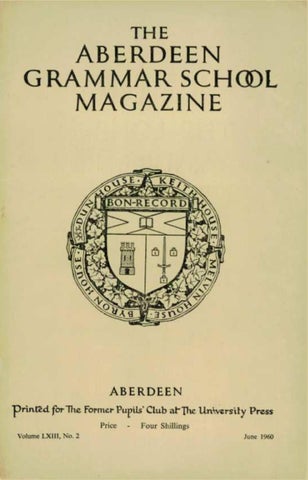

THE ABERDEEN GRAMMAR SCH<DL MAGAZINE
?BON-ACCORD CRESCENT
is the Aberdeen address of
LONDON ASSURANCE
The Resident Secretary, MR.j. F.JOHNSTON , will be glad to see you and to talk over any kind of insurance you may need.
I I i I
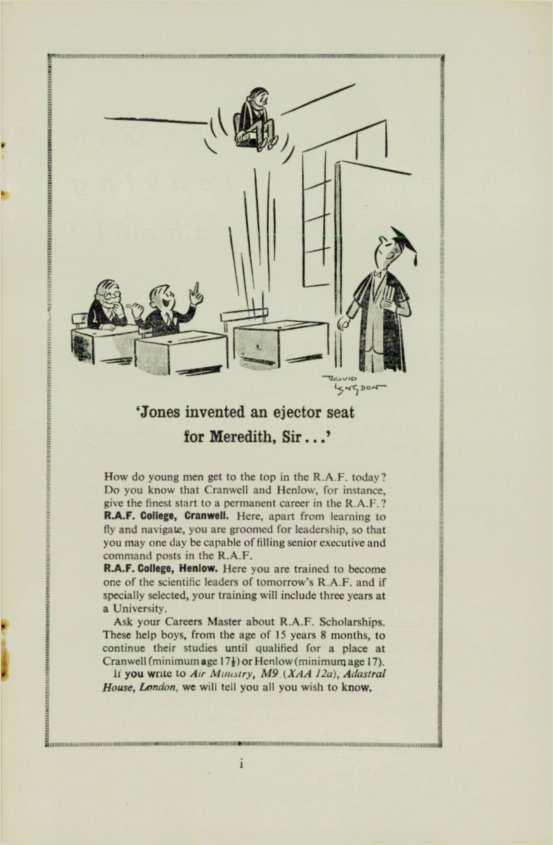
'JOneSinvented an ejector seat for Meredith, Sir...'
How do young men get to the top in the R A F today? Do you know that Cranwell and Henlow, for in~tancc, give the finest start to a permanent career in the R.A I .? R.A.F. College, Cranwell. Here, apart from learning to fly and navigate, you are groomed for leade~h ip, so that you may one day becapable offillingsenior executiveand command posts in the R.A.F. R.A.F,College,Henlow. Here you are trained to become one of the scientific leaders of tomorrow's R.A.F. and if specially selected, your training will include three years at a University.
Ask your Careers Master about R.A.F . Scholarships . These help boys, from the age of 15 years 8 months, to continue their studies until qualified for a place at Cranwell (minimum age 17r) orHenlow(minimumage 17) 1J you wnlc to Air M 1111,1ry, M9 tXAA l]u), .Adaslral House, London , we will tell you all you wish to know. i I i I l
PRE-UNIVERSITY COURSES
A series of Correspondence Courses in certain subjects has been prepared to help the student who is about to go up to the University
FRENCH & GERMA
Proses & Unsecns
ENGLISH LlTERATURE LATIN PROSE & VERSE
CHEMISTRY Organic & Inorganic AT. PHILOSOPHY MATHEMATICS and Other Subjects
Particulars of Courses and Fees from College Registrar
13 BATH STREET, GLASGOW C.2
Telephone: DOUglas 1251
"The Complete House Furnishers"
J. & A. OGILVIE
UN IO N ST R EET
ABERD EEN
We can offer you extensive ~ervice in the following spheres :
e 1''1JRN1SHING FOR THE HOME, HOTELS AND INSTITUTIONS.
e DECORATING AND APPOINT• ING SCHOOLS , SHIPS AND RESTUARANTS.
e FlJR,',flSHING AND RESTORJNG CHURCHES AND CHAPELS.
e CABINETMAKING AND UPHOLSTERY REPAIRS.
e REMOVING , STORING , SHIP· PI 'G HOUSEHOLD EFFECTS.
e PROVIDING COMPLETE UNDERTAKING SERVICE.
THE AUSTIN ASS

With the latest ASS Cambridge , AUSTIN breaks new ground in family car design Here are a few of its attractive features. New sleek line designed by Pinin Farina. Luxurious seating for four, or on occasions five, adults. Giant boot. Wide range of exterior and Interior colours. All-round unrestricted view for the driver. + speed gearbox permitt ing high ratio third gear for safe overtaking . Central floor gear change (or alternat ive steering column change). Il litre 4-cylinder engine. Top speed over 75 m.p.h. Up to 34 m pg. Hydraulic brakes. Prices (ex works): Standard Model, £801 IOs. IOd. De Luxe, £829 17s. 6d. (Inc. P.T)
THE AUSTIN DISTRIBUTORS
G W RAFFAN &SON, LIMITED
82 UNION S TREET ABERDEEN Tel. 20462
Aaenc. for Ordnance Survey Mapa
Established
Aitents for H M. Stationery Office
Carrying your secretary ?
If possible, yes. What is handier, easier and quicker than having an Imperial 'Good Companion' portable at hand ? Letters, reports and memoranda are a pleasure. There's a booklet to help you learn to type quickly.
Two mt>d,t, £25 and £34 compt,1, with carrylnr ea,,. H.P. T,rm, avallabl,.
Imperial 'Good Companion' Portable Typewriters
C. H. WEBSTER LTD.
Tel. 26381
For the discerning man
who relies on accurate timekeeping, distinctively styled watches in steel - - TUDOR £13. 10. 0 in 9ct. gold - TUDOR £21 10. 0
Large selection of ladies' and gents' watches from £6 upwards
Send for illustrated catalogue. All our watches arc issued with a written guarantee and one year's free insurance.
We are Specialists in Engagement Rings
A GOOD RADIOGRAM
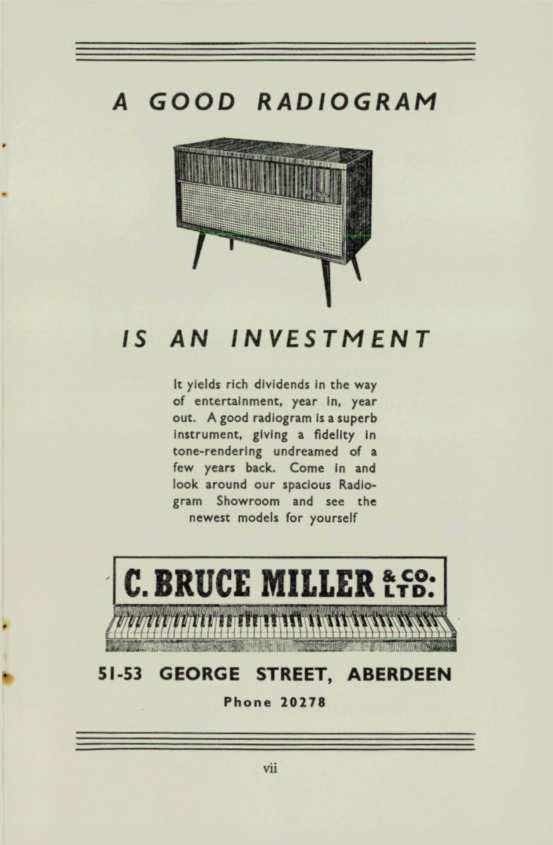
IS AN INVESTMENT
It yields rich dividends In the way of enterta inment, year In, year out. A good radiogram Is asuperb Instrument , giving a fidelity In tone-rendering undreamed of a few years back Come In and look around our spacious Radiogram Showroom and see the newest models for yourself

In cellar cool
Wines there are for all palates and purposes and so discriminating are we in stocking our cellars that, whatever the occasion, you can choose here from a selection which for variety and quality is unsurpassed in Scotland.
Fashions
furniture
Whilst contemporary designs in furniture, fabrics and carpets arc becom;ng increasingly popular-indeed fashionable-there arc still many who prefer traditional designs. In our Showrooms you will find the selection reflects the best trends in both contemporary and traditional designs. And the values arc quite exceptional.
MASSIES of BROAD STREET
Home and Hotel Furnishers

JOHN MENZIES & CO. LTD. BOOKSHOP
alwqJJ
wel,omtJ a visit from the p,,p,lr, pas/ and present, also the staff of Aberdun Grammar S,hool. [P'~ not stroll around and stt what a real!JgoodBookshop ,an s11pp!J?
• Quick service Newspaper and Magazine Counter
• All the latest Books-F1ction,Travel, Biography etc.
• An excellent selection of School and Personal Stationery
• Fountain Pens to suit every pocket
Copusof ourillustrottdMonth!, Book Lisi ar1 111,•oilobk,grotis, OIi request

FISH • GAME BUTCHER MEAT
Whether you shop in person or by telephone your requirements in either or both of our Departments will be looked after with care. Our delivery system too exists for your convenience.
Town-and-Country Shirt
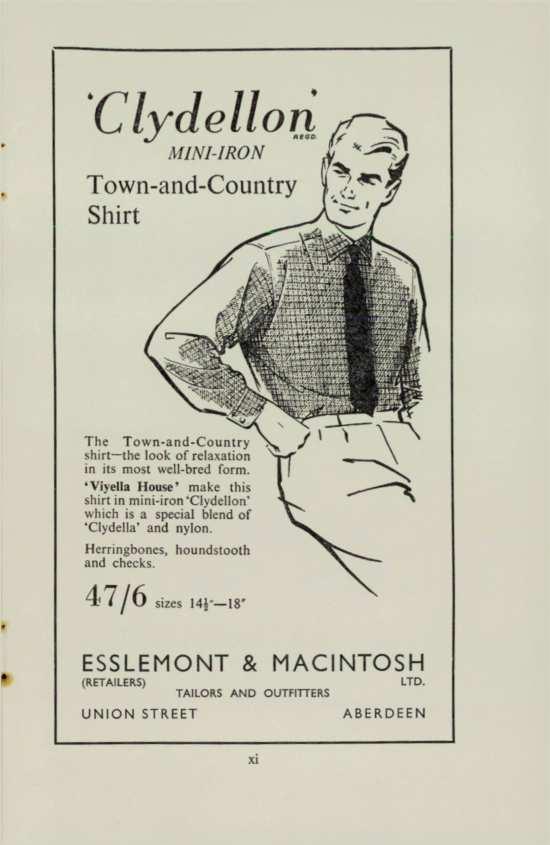
The Town-and-Country shirt-the look of relaxation in its most well-bred form. 'Viyella House' make this shirt in mini-iron 'Clydellon' which is a special blend of 'Clydella' and nylon.
Herringbones , houndstooth and checks.
47/6
sizes 14½"- 18*
Aberdeen Grammar School Magazine
76fhJtar N1J. 186 (New Series 66thyear N1J. 177)
Vol. LXIII JUNE 1960 Ko. 2
The Magazine is published under the auspices of The Former Pupils' Club twice during the year, in Decemb er and June.
The Magazine Committee
Rector ofthe School
General Editor
Editor of Notes, Obituary, and Marriages
Editor of the School Section
Chairman of the F.P. Club Executive
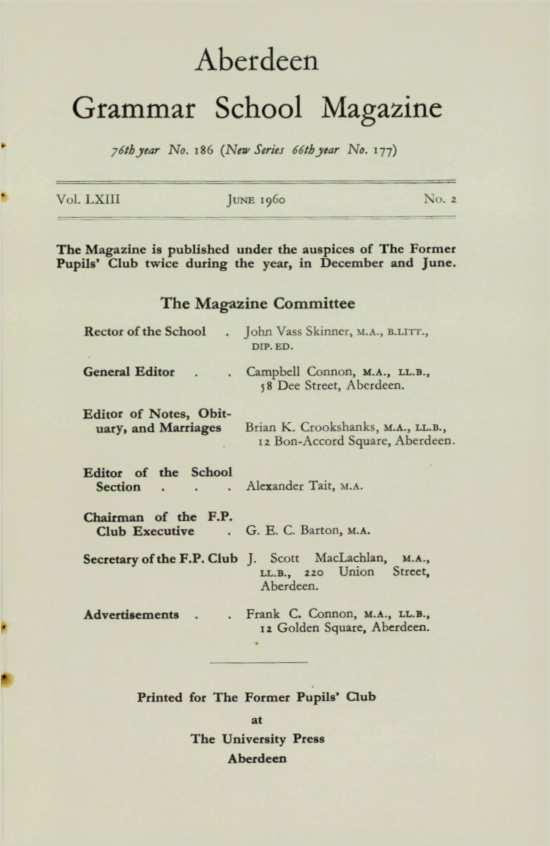
John Vass Skinner, 11.A., B.Lirr., DIP.ED.
Campbell Connon, M.A., LL.B., 58 Dee Street, Aberdeen.
Brian K. Crookshanks, M.A., LL.B., 12 Bon-Accord Square, Aberdeen.
Alexander Tait, M.A.
G. E. C. Barton, M.A.
Secretary ofthe F.P. Club J. Scott MacLachlan, M A., LL.B., .220 Union Street, Aberdeen.
Advertisements Frank C. Connon, M A., LL.B., u Golden Square, Aberdeen. Printed for The Former Pupils' Qub at The University Press Aberdeen
CONT EN TS
lLLl,STRATJO]:\,S
R. B. Williamson , Esq., President of the F.P. Uub (196o-61)
School Teams-1st X\., ., - 1st XI
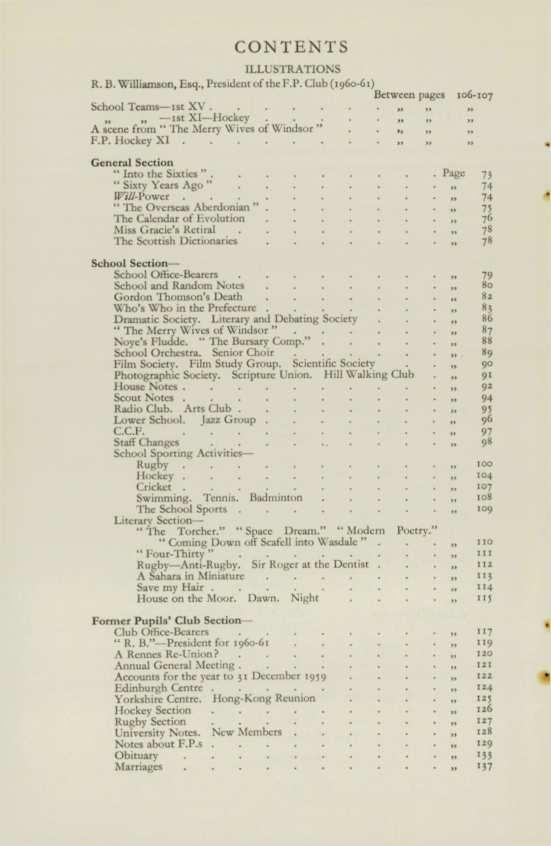
Hockey . . .
A scene from" The Merry \'{'i,cs of W'mdsor" F.P. Hockey XI
General Section " Into the Sixties " " Sixty Ycars Ago "
Wi/1-l'ower
" The Overseas Abcrdonian "
The Calendar of evolution
Miss Gracie's Retiral
The Scottish Dictionanes
School SectionSchool Office-Bearers
School and Random 1'.otcs
Gordo n Thomson's Death
\\ ho's \\'ho in the Prd'ecturc
Dramauc Socic~y. Literary and Debating Society " The \ terry \Vives of Windsor" . . .
l\oye's Fludde. " The Bursary Comp."
Between pages
School Orchestra Senior Choir ..
film Society. Film Study Group. Sc1ent1ficSociety
Photographic Society. Scripture union. Hill\\ alking Club House l\otcs
Scout Notes
Radio Club. Arts Club
Lower School. JazzGroup
C.C.l
Staff Changes
School Spomng ActivitiesRugby Ilocke} . Cricket . Swimming. Tennis. Badminton
The School Sports . L11erarvSection" 'fhe Torchcr." "Space Dream." "Modern Poetry." " " Comingpuwn t tl Scafcll into\\ asdalc" I our-Tlurty
Rugby-An ti-Rugby. Sir Roger at the Dentist A Sahara in Miniature Save my Hair House on the J\loor. Dawn. Night
Form er Pupil s' Club SectionClub Office-Bearers
"R. B." Prcsi<lcntfor 196o-61 A Rcnnes Rc-Lnion?
Annual General \Iecting . .
Accounts for the year to 31 December 19s9
Edinburgh Centre
Yorkshire Centre Hong-Kong Reunion
Hockey Section
Rugby Section . . .
uni'<'crsity Notes. l\cw \!embers
Notes about F P.s
" Into The Sixties "
(reproduced from The S11nd9Times of 3 January 1960)
Like the driver of a racing car, mankind sits behind the wheel and speeds into the sixties. Ahead lie testing curves. According to his skill the driver will either crash in a shriek oftwisting steel or accelerate to new horizons.
For mankind the alternatives are simply these: either to annihilate himself in the holocaust of atomic war, or to enjoy a decade of unparalleled technological progress.
Man cannot live without hope, and we must assume an age of peace through saruty. The challenge is as simple as that.
Two vast problems cast their shadows across the road ahead. Looking to the East we see the rising power of China. Will she come to dominate the whole of Asia? For us in the West, this is an economic as much as a political or military issue. If peace is to be preserved and the uncommitted saved for democracy, the nations of plenty must share their wealth among those who live on the edge of hunger. This is a lesson the sixties seem certain to drive home.
Nearer at hand stands the second great problem of the decade, the huge dark continent of Africa, where the peoples of many countries struggle through racial conflict towards a dream of self-dominion. The decade will show quite quickly, not only whether nationalism will rapidly advance, for there can be no doubt of that, but whether multi-racialism is a viable political concept or but a pallid ideal against the realities of black or whire racial supremacy.
And what ofthe role Russiawill play? IIow, in the next ten years, will growing prosperity shape the Soviet society? Russian leaders may be as incalculable as ever, but there is continuing hope in the prospect of a succession of Summit negotiations and in the belief that a less repressed and better provid ed Russian people will hold their leaders to a rational and peaceable course.
For the people of Britain the Sixties seem certain to bring an age of plenty. The optimists conjure up a picture of two cars to every garage, of a shorter working week, and greater leisure to be steered to fruitful employment. Here is the opportunity to ease the hunger of the spirit. Can the philosophers, the educationists and the clerics find the answer the sixties will demand ?
As for our physical welfare, medicine advances to heal the wounds of man. Even cancer may in this decade begin to surrender its secret.
Most of all, perhaps, the sixties will bend the discoveries of science to the service of man. There is scarcely a physical want that new technological advances will not supply more easily. We stand on the threshold of a new decade. What will be its epitaph? "
"Sixty Years Ago"
The article, " Photography at Aberdeen Grammar School " in the issue of December 1959, mentions Bentley Philip as a pioneer of photography and ofbotany for boys. Forthe botany I think" martyr " would benearer the mark. Boys have not changed since St. Augustine and his gang robbed thepear trees ofCarthage and are not made lessunruly by learning that a pear is the obovoid fruit of pyms communiJ. Bentley gave us apples to dissect but they were too hard and sour for natural dissection. Those who took a bite werekeptin to write anessay on dicotyledons. That isthe most vivid memory that remains to me of Bentley's sacrifices in the cause of science.
Of photography in those days it may be worth recording that the fuammar School got into " movies " long before Hollywood. It happened that when we were " loosed " from school to celebrate the relief of Mafelcing some pioneer made a newsreel of our flag-waving procession, more spotty than newsy, but authentic cinema; a crowd scene. It might be viewed now as a procession from the nineteenth to the twentieth century but with no thought of progress on our part.
Unspoken but implicit in Bentley Philip's teaching was the idea that " God first made a garden " which the Devil and the Victorians, with their steam engines, factories and Manchester economics, had disfigured. Living so close to the garden of Deeside, then unspoiled by internal combustion engines, we were mostly of the romantic school. Judging by the prize poems you publish that school still prevails. Long may it flourish. The alternative is the discord and despair of rock an' roll I
Will-Power
In our last issue we mentioned the great feat of a sixty-two-year old Edinburgh master in swimming the Firth of Forth when everything, especially the tide, turned against him.
We would again dwell on the theme of a man's strength being the strength of his Resolution, and this time we pay tribute to the fifry-six-year old Dr. Barbara .\toore of London who reached London Just before midnight on 24 December last, hal'ing walked from Edinburgh, 373 miles away, in seven and a half days almost "non-stop", and that on a diet of fruit juices and nuts!•
\Ye believe that there are few who can afford to disregard the lessons of this achievement as focused in the following (abbreviated) leader from the ScolJman of 2l December 19i9: "\~"hen Dr. Barbara \foore began her long walk from Edinburgh to London just over a week ago many people were asking what the pomt ofsuch an undertaking could be. Through the mud and the niin, through the foulest, coldest weather, she has kept on. The more difficult things became, the more determined became
[• The above was, of course, written before Dr. Barbara achie\'ed the even more remarkable success of dotng the 890-mile John-o'-Groats to Land's End Walk in 23 days (13 January to l February), and ofcourse after her the winner ofthe" Billy Burlin Marathon "did this same walk in just over 15 days; but whereas Dr. Barbara was seeking to prove a scientific theory, the Budin walkershad a more materialistic spur. Ne,·ertheless, what is above written applici; equally to Dr. Barban's sub5equeot epic, and, in a lesser degree, perhaps, to the Budin records.J
Dr. \foore that she would reach London whalt11erhappmtd--and thts is the point of 1t all. To do the encirdy meanmgless thing because it is difficult is to provide on<.-sclfwith an exercise m pure pcn;istcnce, in pure endurance without reference to other moti\ cs. The value ofthe attempt gcows just in proportion to the difficulties. "Dr. nloore set out originally to prove something about the calorific value of honey am! fruit. The one incontestable point is tbat food acquires the most marvellous properties after Dr. llarbara .\foore has eaten it. She belongs to the rradition of the great experimenters, not the cautious ones who experiment on other people, but those who throw themsclvesinto the scale. The men ofthe Kon Tiki expedition staked their li\'Cs on a point of academic interest. Less dangerously, but with equal resolution Dr. :\loore gave ben;cJfup to the uncertainti<.-sof the Great North Road m the dead of winter. Such remarkable endurance mdkes the nation wonderwonder perhaps most ofall at the great unused resources of individual coorngc and fortitude for which modern society provides no natural outlet. Perhaps it is because our society ismcch:i.nicaland so much work is repetiti\ e and dull that people seek advenrurc by climbing Himalayan peaks, scaling precipitous rock faces, crawling through deep caves, and in other ways pitting their strength and nerves agamst heavy odds. To set oneself an e,-acting task and lo µnu/ in tbe face of great obstacles, summoning all one's stamina and will-power, is the way to selffulfilment. An achievement like Dr .\foore's is its own reward."
S,0Jsma11 leader 25 December 1959
Early Pedestrian Records
ln an article in the S,olsman of 13 lebruary John Y. L. Hay* ( 1943-55) recalled the walkin~ feats of two members of the famous family, the Barclays of Ury. Father Barclay h.\d considerable acbie\cmcnts to his credit, e.g. 81 miles in 16hours walking, and 210 miles in 3 days, while it is recorded that he" frequently" did the 510-milewalk fwm Ury to London in 10 days; but bis son Robert Barclay-Allardicc (1779-1854) made an e\'en greater name fur himself as a long-distance walkermostly for wagers, most of these walks being done on turnpike roads - 300 miles in 5 days, 150 miles in z days and 64 miles in 10 hours; but his greatest achie'l"ement was when he in 1809 performed the amazing feat of walking r,o oo milts in r,ooo JtMtssiu /;ours (i.e. one mile for every hour of 6 weeks I) This walk took a great toll on him, physically and mentally, but he soon rcco,er<.-dafter it.
Bot who today could emulate the following ?-when staying with a friend at 13memaron one occasion he left the house at 5 in the morning for the grouse moors and walked about 30 miles during shooting; r~turoed to Braemar in the evening, he had a meal and then set out for l,;ry, 6o miles away, which be reached next morning after 1 I hours walking. The day was then folly spent in attending to business matters before he walked to L.·mrencek1rk16 miles away for a ball that evening, danced the whole night through and walked home again, arrivtng at seven next morning I
Those trt the days!
" The Overseas Aberdonian "
This is the name of" A Miniature 'ewspaper for the many Aberdeen folk abroad or o,er the Border" published quarterly by the Aberdeen Corporation Publicity Department. It records a great deal of inten:st1ng information about matters and men in :\berdcen. It is under~tood that anyone wishing to receive a copy has only to ~rnd hi5name and address to the Director ofPublicity, .zo Cnion Street, Aberdeen and he will be put on the mailing list without more ado.
" H yslopiana "
This is definitely promised for the next is~ue.-Ed.
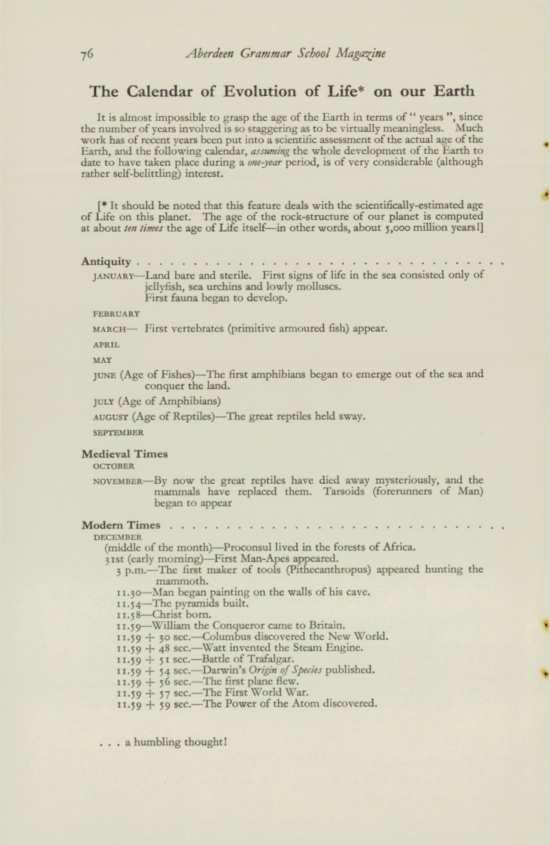
The Calendar of Evolution of Life* on our Earth
It is almost impossible to grasp the age of the Earth in terms of" years ", since the number of years involved is so staggering a5 to be ,·ircuallymeaningless. \luch work has of recent years been put into a scient1ficassessment ofthe actual ao;eofthe Earth, and chcfollowing calendar, au11111111Jthe whole de,·dopment of the !:-.arch to date to ha\'e taken place during a Dllt--Jtar period, is of very considerable {alchough rather self-belittling) interest.
[• It should be noted that this fearurc deals with the scientifically-estimated age of Life on this planet. The age of the rock-structure of our planet is computed at about /en limu the age of Lite itself-in ochcr words, about s,ooo million ycarslj
Antiq uity
JANUARY Land bare and sterile. First signs of life in the sea consisted only of jcll,fish, sea urchins and lowly molluscs. hrst fauna began to dcYclop.
MARCIi APRJL First \'Crtcbrates (primitive am1oured fish) appear.
MAY
JUNE (Age of Fishes)- 'Ibe first amph1b1ansbegan to emerge out of the sea and conquer the land.
Jt;LY (Age of Amphibians)
AUGUST (Age of Reptiles)-The great reptiles held sv,,ay.
SEPTEMBER
Medieval Times
OCTOBER
:-:ovurn1,R lly now the great reptiles have died away mysteriously, an<l the mammals have replaced them. Tarsoids (forerunners of .\Ian) began to appear
Modern Times
OECDIIIER
(middle of the month)-Proconsul li, ed in the forests of Africa. 31st (early moming)-First Man-Apes appeared.
3 p.m.-The first maker of tools {Pithccanthropus) appeared hunting the mammoth.
11.30- l\fan began painting on the walls of his cave.
11.S4- The pyramids built.
11.sS-Christ born.
11.s9-\\ illian1the Conqueror came to Britain.
11.19 + 30 scc. Columbus discovered the New \\'orld.
11.19 + 48 sec.- Watt invented the Steam Engine.
11.19 -I- p sec.-.l:3attle of Tr.Ifalirar.
11.59 + H scc. Darwin's Origmof S~eies published.
11.19 + s6 scc.- The first plane flew.
11.19 + n sec.-The First World \Var.
11.19 + 59 sec.-The Power of the Atom discovered.
a humbling thought I
The Calendar of Evoh,tion
[The information for this feature has been compiled principally from information obtained from" B.B.C.-T.V. programme' Tonight'" but with some amplification from articles by Professors Pancth and Dehm of Mainz and Munich respcccivcly, and from " The Story of Life " in the S1111dayTimu, to all of whom due acknowledgement is made.]
A Calendar of the Differe nt Ages
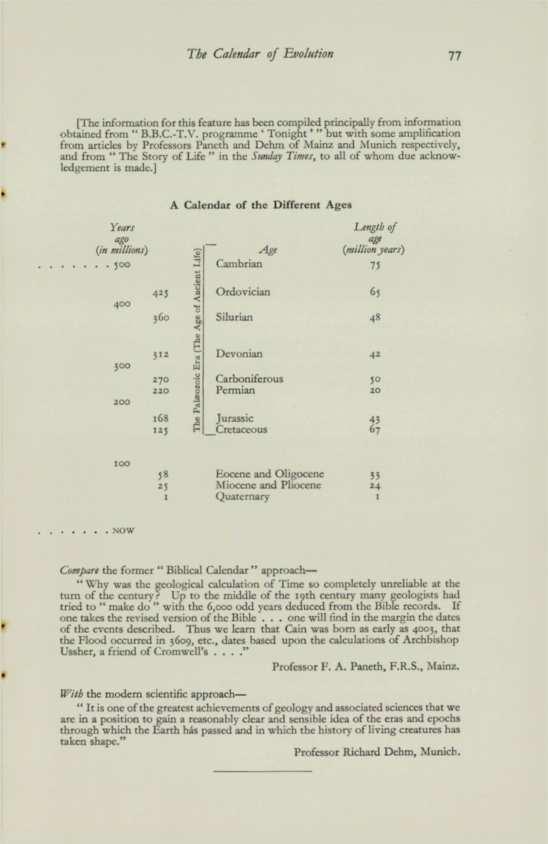
NOW
Comparethe former "Biblical Calendar" approach" \\'.by was the geological calculation of Time so completely unreliable at the tum of the century~ Up to the middle of che 19th century many geologi,ts bad tried to "make do " with the 6,000 odd years deduced from the Bible records. If one takes the revised version ofthe Bible one will find in the margin the dates of the events described. Thus we learn that Cain was born as early as 4003, that the Flood occurred in 3009,etc., dates based upon the calculations of Archbishop Ussher, a friend of Cromwell's . ..."
Professor F. A. Paneth, F.R.S., Mainz.
With the modem scientific approach"It is one ofthe greatest achievements ofgeology and associatedsciencesthat we are in a position to gain a reasonably clear and sensible idea of tbe eras and epochs through which the Earth h:l.spassed and in which the history of living creatures has taken shape."
Professor Richard Dehm, Munich.
Aberdeen Grammar School Magaz_ine
Miss Gracie's Retiral
"Time is- time was-time is past "and so no doubt it would seem for Miss Kate M. Gracie who, I am sad to say, willbeleaving ourLower School at the end of this session to start her well-merited n.:tirement.
September 1919 saw her first installed in the Lower School as an assistant mistress in charge ofLower IB following a period ofnineteen months teaching nperience in Angus. I am certain that none of the many pupils who have since satin her well-ordered classroom have anything but happy memories of their sojourn with her. Here always an atmosphere of calm prevailed. J!ere never was heard the caustic tongue or loud voice raised in anger. Here all pupils were regarded as being of equal worth by discerning gn.:yeyes, often twinkling, and guided aright through the intricacies ofthe four rules by her perceptive brain. The end product passed to the next stage could be nothing but a group of uninhibited, happy and wdl-behaved young men. \'{'ould that allmembers ofour profession had those God-given powers, to inspire, control, cajole, to comfort and to bless.
It is commonplace to say that no one isindispensable, but for us the Lower School will not seem quite the same without this quiet, stable, trustworthy, just and efficient lady in our midst.
The past and the present salute you, ;\liss Gracie, and may your retirement be long, happy and serene.
J. D. M
* * *
The Scottish Dictionaries
In the Spring a national appeal was made for funds to help with the cost of completing two mammoth works of vital interest to Scotland.
r. The Dictionaryof the Older ScottishTo11g11e "an exhaustive record of the nationa l and literary language of Scotland up to the year 1700 ", to be published in forty-two parts, of which eighteen have already appeared and
2. The Scottish Natio11ai Dictionary,which records "not only the literary language of Ramsay, Burns and Scott . . . but also the Scots dialects as they have changed since 1700, and as they still exist in many regions of the country today", to be published in forty parts, of which nineteen have already appeared.
These works are intended to cover the whole field of Scottish lexicography, and to provide" a record of Scots ofpermanent and national value which is unlikely ever to be superseded".
Some idea of the costs invoked may be gathered from the fact that one part of the Scottish National Dictionary costs £1,875 to print . . . and there are to be forty parts!
1\nyone interested in subscribing to these great projects of scholarship should send his donation to:
The Scottish Dictionaries Joint Council, Old College, South Bridge. Edinburgh
School Section
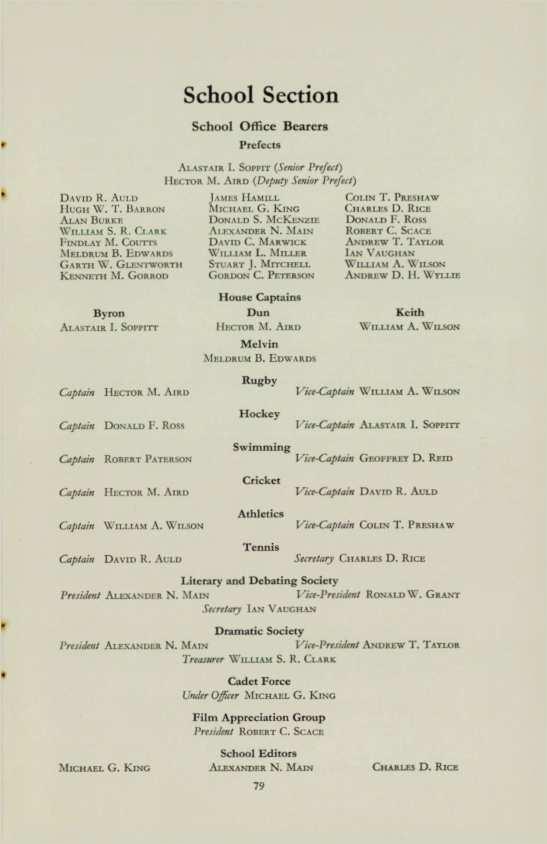
School Office Bearers Prefects
ALASTAIR I. SoPPIT (Senior Priftct)
IlLcTOR M. Arno (Dtp111j• Stnior Prefect)
DAVID R. Au1,D
l l UGII w. T. BARRON
ALAN BURKE
WILLI A.\! s. R Ct ARK.
FINDLAY M. Cou-rr,, ::'111:.1.DRl-.\fB. EDWARDS
GARTH \V GLF"ITWORTH
KF-'lNETH M. GORROD
Byroo
ALl.loTAlR l. Sorr1TT
Captain HECTOR \I. AIRD
Captain DosALD F. Ross
Captain ROBFRT PAT1'RSON
Captain HECTOR .\I. AIRD
Captain W1LLIA~l A \X/11 SON
Captain DAVID R. AULD
jAMLS IlAI>ULL
MicrrAa G. KING
DONALD S. ::'lfcKENZlli .A1 I XANDER N. ::'If.Arn
DAVID C. MARWICK
\\'ILi IA\! L. 11rLLER
STUART J. i\IrrCIIELL
GORDON c. PETERSON
House Captains
Dun
I h:CTOR :-r. AIRD
Melvin fl lELDRUM 8. EDWARDS
Rugby
Hockey
Swimming
Cricket
Athletics
Tennis
CouN T. PRESIIAW C t1ARLP.S D. RICE
DONALD F. Ross
ROBERT c. SCACE
ANDREW T. TAYLOR
IAN VAt:GHAN \Xl1LLIA\t A. Wn SON
ANDREW D. 11. WYLLIB
Keith WILLIA}[ A. \v"tLSON
Viet-Captain WILLIAM A. WILSON
Viet-Captain .ALASTAIR I. SoPPITT
Viet-Captain GEOFFREY D. RErn
Viet-Captain DAVID R. AULD
Vie1-Caplai11 CoLIN T. PRESHA w
Surttary C11ARLES D. Rice
Literary and Debating Society
Prt.tidml A.u:.x.4.SDER • .\JAIN
Vict-Prt.tidmt RONALD W. GRANT
Strrttary lAN VAt:G H.-\N
Pruidmt .ALEXANOLR N. MAIN
Dramatic Society
Vict-Pruidml ANDREW T. TAYLOR
Treasurtr WLLLIA}I S. R. CLARK
Cadet Force
Under OJli&1r M1CHAEL G KTNG
Film Appreciation Group
J>ruidtnt ROBERT C. SCACI!
School Editors
\hcHAEL G. KING
Al.ExANoER N. ?>1.uN 79
CHARLES D. RICE
School and Random Notes
After some time in the\1adivostock chip shop (sec last issue), we izavein to the continual ,.kmands of our fan club, and arranged a free transfer to the ..\11tsukoo. However, on the cattle boar, one of our members was stricken with chickenpox, and put in quarantine for some time. Since neither ofthe others has yet learned to write, we had to wait until he recovered to begin on the production of the Ma.~az.ine. Before we begin the notes, we warn our readers that our income from bribes for the prefect's notes has already been used to buy one-way tickets on the Nauli/11J to somewhere under the polar ice-cap.
* *
There seems to have been fantasticallylittle to write about inthe last few months, but one of the highlights of the School year was the appearance in the School play of a hockey centre forward and a C.S.1\1. Although the 121:tcris known to have consumed an alarming quantity of the Janny's straws, he refuses to pa.rt with the original, which now lies at rest in one of the drawers of ..\liss Boyd's new filing cabinet.
*
Since the Editors have seldom been in School and never in class over the: past few months, we have lost track of the comings and goings in the staff. Mr. Tait is better informed than us and has written on this subject elsewhere in the ,\fagaz.111e. \'\'e would, however, like to thank those members who have come temporarily and commiserate with those who are here for good.
One departure which will bea material loss to Upper VI is that ofl\l. Dufaure de Lajarte. There will be no more cigarettes offered (and refused) in the quiet of the Projection Room. On the other hand there will be no more collections to buy the man bottles ofliqueur whisky. We wonder if he'll give his bike to Mr. Paterson as a parting present. *
For a few weeks the Athletics Captain kept fit for the sports by sprinting along the corridor to the office two or three times a period Ile forcibly denies that this has any connection with the new poni-tailed secretary. Jle also refuses to confirm that she has any relation to a certain young lady from High who happens to be fair haired and is at least 2 feet taller. Anyway, the Iligh SchorJIone has an Oxford accent. (" I IIATE the English!" \X'. A. W.)
Perhaps the 1st XV wasted so much of their energy spreading margarine sandwiches for packed lunches on the Border Tour, that they had little left to play rugby. Other activities ranged from "doing" three abbeys in one day to pub-crawls m Gala. .Mclro~el lostel supplied four women (all of them every day of thirteen) who had to be divided up among thirty players and three members of staff. \'iolcnce followed. On this occasion ;\fr ..\fortimer was not accompanied by his new Hillman.
They tell us that ..\fr. \X,'ilson intends to take some of the classical enthusiasts of the School down to lladrian's wall at the end of June. Probablv this is to escape from the clutches oflippcr \"I Greek (all three ofthem) who must be more trouble to him than all the rest of his pupils put together. B} the by, a Lower VJ member of the 1st XI ispassing the time during the \ liddle School exams writing a biography of this same gentleman But will it be a best seller "Nac chaunccl"
A few weeks ago we had our usual visit from the students. They were very lucky indeed if they managed to get anything out of the prefecture. Much tQ our annoyance the female one whom we abducted for the use of the Ilowff was rescued by a counter-attack of jealous F.P.s. As a slight compensation we managed co throw Leonard's hat out of the window and plant his collecting can in David's locker. \ {uch to our surprise, Aird's babes succeeded in learning up a few tunes for the night of the procession.
Shades of Black Bartlemyl One fine April morning the good ship Schola Grammatica Aberdoniensis, manned by her stalwart crew of early morning cleaners, set offfor her maiden voyage down the Denbum, and at her mast-head Rew-the" P. and J." was right-the Jolly Roger! Ever since, the Janny bas been seen digging furiously in the garden, just where the shadow of Byron falls at the foot of the old oak at high noon, but he has uncovered precious little, only a car for ::\lr. King, which, we must admit-goes!
The arm of the law has askc<l us to deny all rumours that the Howff is to be turned into a barber-shop: we don't have enough tools.
Disgusted with the performance in the ::\,!aMcrs-Hoyssoccer match, the hockey team decided that the only player who had gi~·cna good account of himself should begiven the chance ofseeing some realprofc-,ivnal stuffat 1fampden. Accordingly, Mr. i\lcNay joined the crowds of escaping Sixth year boys who felt it their duty to attend their grandmother's funerals in Glasgow.
" Fings ain't woe they used tcr be!"
'The School's really topsy-turvy now. A squad of cager beavers who arrived sometime at the beginning of the year, complete with an assortment of gah anizcd sheds, have now taken complete possession of the gym area. The masses are up in arms against the crafry clerk of works who had the brilliant idea oferecting an eight foot high fence to keep them from pursuing the democratic British pastime of watching the workmen at play. All the same, Melvin supporters are delighted with his choice ofpaint. Now the Kmderganen playground occasionally echoes to the ring of hammer on stone or the tearing of timber, and even the Librarian's typewrita cannot drown out the noise. Note that we say "occasionally", for Union rules seem very lax. Somcdays the stalwarts don't appear till 10 o'clock, some days they <lon't appear till .1, some days they don't appear. .I lowever, we have refrained from rcponing the matter to J\Ir. Cousins, since it has been divulged that work has ceased bec~usethe Pipe Band's instrumen ts arc trapped under all those mighty stones. But, of course, that may just be wishful thinking ... I
Aren't we cultured these days? Upper \'I thoroughly enjoyed a television session recencly, planned to extend their appreciation of the life and letters of that man of the world, Andy Pandy. Unfortunately, other commitments pre,cnted us from viewing some of the less intellectual programmes of the afternoon (yes, we saw you creeping in to watch the racing, ;\lr. H.) but we would like to thank the I .nglish staff for this delightful opportunity of broadening our minds
Popular opinion has it that the Howff is only being held together by what little paint there is left on the walls. Eroded by constant bombardment from water pistols, shaken by Scace swinging hisway through the .13rd Psalm, and shattered by the impact of huge second-row forwards, not even the strongest wall could be inan,• other state. '\lr. Flett has told us that he woul<l be delighted if the whole thing fell in in such a way as to obliterate IV.1 maths and the prefects at the same rime. However, Taylor's patent glue (Bank's adhesive) has temporarily averted such a disaster.
No, no, no---those weren't grizzly heads you saw on the back gate of the School last u•cck, but lovely, mysterious pies impaled on the spikes. .\tore frec<lom has been taken from us and our favourite fruit-slices now appear with an all-through wire-mesh pattern. At interml every day (or most days) the Janny faithfully closes the doors against the mass exodus of cream doughnut lm•ers. Now the baker has to employ an adventurous youth who scales the gate with a handful of assorted cookies, while hungry Grammarians hang precariously on the other side, tongues lolling. However, it has not yet been found necessary to summon the Fire Brigade to extricate Nicol of Middle II.
[Talking of Nicol, Byron Athletics Captain wants us to ask this little gentleman not to interrupt him in the" Curzon ", when he bas enough on his hands already.)
Aberdeen Grammar School Magaz/lle
What pains we men of culrurc gi,e the Schooll The last retreat of peace an<l quiet was inva<leddurin!! the Spring Tenn by that conglomeration of toot, flute and mellow cello, the School Orchestra, and neither the chatter of the Library Discussion Group, nor the ominous crunching, of select boilings could drown it out Li,ing up to 1ts motto of" I'm all right, Jack", this highly-strung group ignored completely the passionate pleas from the tcw folk who were trying to catch up on lost slc<·pamong the shelves, and proceeded to serenade the Librnrian until she too was forced m retreat to the cyclc-shc<l. :'llcanwhile, the School's actors, oblivious of the drama upstairs continued to drool in the Hall which they had so neatly usurped, though we must admit that, berdt of the inspiration provided by .\liss Boyd, they were not up to their usual standard.
* * *
It looked as if there was going to be a serious re, olt among the plebs. _\II had armed themselves with water pistols, ranging frum ultra-modern automatic supersquirt guns to squcc7.c:-until-you'rc-bluc-in-thc-faee-lxfor~'-:J.•<lripcomes-,•ut types, and it was un~afe for any prefect to emerge unescorted. The situation looked ,cry gra,·e, but prompt action byour shock troops sa,·cd the day. The weapons changed hands. The Ilowff armoury was modernised: water-pistols tollk the place of rubber bands. Ilowevcr, durin!;!the planning of a raid on the gym after the colour awards had been announced, ci\'tl w-ar broke out. During one skirmish ,\uthority entered: quite apart from all} thing else, a locker was open, with pictures (female, shapely) at eye-level. [Curtain.]
Gordon Thomson's Death
Gordon s\. J. Thomson came to the Grammar School as a boarder to No. 8 Queen's Road at the age of seven-a fair-haired, blue eyed, spirited boy. After a long and weary illness, lasting for eight months and most bravely and cheerfully borne, he passed away on r 1 January 1960 at the early age of fifteen.
His contemporaries will surely remember him for his great good humour and friwdlincss, his sportsmanship and Yigour, for in his last year at School he was a valued member of the i\finors 1st XV. And I, who had some small part in his upbringing in the Grammar School J[oust", shall hold in my heart only pleasant memories of the comely smiling boy with his colt-like Yitality,and of the youth with high hopes for the future eYen at the height of his illness, discussing a career which was not to be. Particularly l shall remember his oh.I-fashioned kindliness engenden:d hy his close ties with chose good country folk who held him most dear.
The Rector, several members of Staff, Senior Boys and many ofhis class fellows saw Don laid to rest in the ~faryculter graveyard and gave their silent support and comfort to his parents and grand-par..:nts in their great sorrow
"To live in hearts we lcavl' behind is not to die."
.J. D. ?II.

SchoolSection
Who's Who in the Prefecture
"Men's men: gentle or simple, they're much of a muchncss."-Gcorge Eliot.
Alastair I Soppitt. Curly-haired, blue~yed, and with a neatly-polished badge, our IJcad Prefect is quite the picture of innocence. Dilettante, man of letters, scientist and sportsman, be is at home anyv.here from Ma Can1's to a Scientific Society lecture-room. On the cricket field, he believes in playing himself in wellso much so that he is usually out long before he has time to do so.
"Women were created for rhe comfort of men." Howell.
Hector M. Aird. Has managed to retain bis faith in spite of rwo years in the company of prefects like \\ ilson and Soppitt. Ilc is outstandini in pmctically all U-sports, but disapp roves of footballers in general and Nome in particular (q.t•. Barro11). Ilis ncrtions on Saturday morning are so r,haustin!!' that be seldom manages to cover more than a few yards per hour on Saturday eight.
" r orwards are thinking I " ~!.M.A.
"And I learned about women from 'er." Kipling.
David R Auld
This fifth year husky is one ofthe few i;>refcctsofhis year who have ever had sports kit on. His great delight is to orgamse ultm-fricnclly tennis matches to promote amicable relations with our sister schools. [iis ,·ocabulary is limited and his usual contributions to Ilowlf conversations on philosophy arc roars of" JO-oh! " and " Muriel AnnE I"
" And !at see which of you shal here the belle To spekc of love! " Chaucer.
Hugh W. T. Barron. Plays proi;>-forwardfor the 1st XV although he docs not show the tmditional conical physique. He practically lives by Maths. alone, and can be found at any tinlc in the Howff scrawling dynamics problems with a stub of pencil (6B)on a huge expanse ofgrubby paper. Has cgalitarian views in politics, and each year clings pathetically to the belief that the Dons will top the table in the season to come.
"Fit's wrong wi' Norrie?" JI. \V.T.B.
Alan Burke. This hard-living Scout of the old school leads the 1st X\ pack and is one ofthestars ofGarth's cricket team. Nevertheless, there is a soft streak in his nature which makes him distribute clove-rock to his starrin~ mates(" Put one of them back, Bob! ") A confirmed misogynist, his other amusements arc confined to festooning the Howff with chains made out of Marwick's old lines (from Lower \ 'l).
" He bath denied the faith and is wo~ than an infidel." Timothy V.
William S. R. Clark Long, lanky and very, very theatrical. Presented with a cricket bat or a rugby ball, he probably wouldn't know what they were. Spends most of his spare time with Mr. Sawdcn's Thespians. lias had a dislike for baskets ever since the School play. Goes to \ ladame's about once a year, and appears in the liowff almost as regularly.
" Acting b therefore the low~-stof the arts, if it is an art at all." Moore. Findlay M Coutts. According to Wilson, he has rhe sexiest face and the most fabulous hairstyle ever seen in the fIowff. Bullies his innumerable brothers incessantly, and at one point teasing about a poetess in fourth year High induced him to break little Graham's ankle We find it difficult to keep trace of the kaleidoscopic changes mhis romances, but at the time of going to press he is comfortably fixed up in Union Grove
" Out upon it! I have loved Three whole days together." Suckling.
Meldrum B. Edward s. What time he doesn't spend running round the track at Rubislaw is passed playing snooker at Andy's. Originally had a system of one woman per three weeks, but circumsunccs have since forced him to abandon it, and once again we hear Graham's cry of" \\ cc ;\lorag's some niceI" echoing round the Ilowff. Jlis suc<lcsand ca\'alry twills make him the idol of the Middle School. "Youth calls for pleasure, pleasure calls for love." Akenside. "Let's to billiards " Shakespeare.
Aberdeen Gra111mar School .Magazine
Garth W. Glentwonh Sixfeet and thirteen stone ofcherubic bone and muscle, this stalwart second-row forward answers co Grimble, Jumbo, Hunk, etc. Despite his size twelve boots, hecan trip alight fantastic to the delight ofmany ayoung lady, althou~h too modest to wear his full-colours in public. We ha\"ea sneaking feeling that it 1s only his inherent good nature which stops him knocking Wilson through the wall.
" Still waters run deep." Lydgate, "Those athletic brut~ whom undL-scrvcdlywe call heroes." Dryden.
Kenneth M. Gorrod. \X'hen he is not leading Huntly to victory against his own 4th XV, he may be found beating his gloves together in support of Ilugh Baird under the pylons at Pittodrie. Has used his knowledge of mechanics to construct a streamline cwcnc1cch-ccncurydrawbridge complete with gleaming \\7oolworth's chains for his locker. Plays tennis with the nice young ladies of Mr Stephen's club.
"Rare compound of oddity, frolic, and fun I \\'ho rclish'd a joke, and rejoiced in a pun." Goldsmith.
James Hamill. 1las taken over Aird's place as the B.B. \X'all.th of the fifth year prefects. Is the proud poss.:,sor of a gleaming brown leather case which accompanies him on his travels from the Greek cla~s to the L:icin cla~s and back. Is known to patroni ze the B.13.dancing, but sinc-ebe takes cue that there arc ncycr any wicocss<:sand never boasts about it, we never hear much about what he docs there.
" A man so various chat he seemed to be not one, but all mankind'~ epitome." Dryden.
Michael G King A kilted umkr-offic-erwhose intellectual Upper VI interests range from spmning a coin on his desk in Room 31 co following the adventure~ of his hero Jim Ilard1c on T.V. Disapproves c,f alcohol, and drinks grape fruit to keep fit. Is an absolute fiend for all sports from poker co rugby.
" She's a bitch." \1.G.K., C.S.\L "One can be a soldier without dying, and a lover with ,ut sighin!?." -•Arnold. Donald S. M cKenzie. Another of Mr. Stephen's mathematical maniacs, he spends what spare time he has thinking up excuses co arrive lacefor dynamic.,. I!as perfrcced the art of growing side bums and assures Coutts that their raceof growth is governed by the Binomial Theorem "l\fuch learning doth make thee mad." .\cts XXVI
" Scicnc.:is for those who learn, poetry for those who know." Roux. Alexand er N . Main. One of the incellcctuals of Upper \'I En~lish, he seems ro have little interest in practical sex, but nevertheless studic:s Dr. Sigmund Freud. Although physically small, he managed to control the hordes at the Six Schools' Debate, and practically has a monopoly of all the non-sporting offices in the S,·hool. I!as recently acquired a typewriter and now produces an alarming numher of postage-stamp notices. The pattern of his gold-buttoned waistcoat hides beer and Russian tea stains very dfcctivcly.
"Ne\·er meddle with actors, for they arc a favoured class." Ccnantes. David C. Marwick. English, an tndividualist, and the only prefect sporting a Lord I!ailsham hairstyle. Althoui;b the religious man of the Howff, he makes considerable: worldly gain at prize-i,iving. lncidrntally, a bicycle abandoned at \lannot1dd 1s suffering from metal fatigue.
" The memorv of the just is blessed, But the name'of the wicked shall roe." Proverbs X. William L. Miller. "Snaky" to his friends, he left us for Roval Il1~h.lea\ ing in his wake a disappointed branch ofGaitskill's fan club in the Debating Society all h.llf-dozcn uf them. At the General Election, he gave up all for the good of the party, dunned a red rosette, and had to be forciblyejected from Lady Twcedsmuir's election meeting.
" 1 tell you folks, all politics is apple sauce." \-X'ill Rogers
Smart J Mitchell Four feet of bespectacled, enthusiastic little hillwalker, is rumoured to have volunteered (?) to cake the roll at cadets; he docs 1t anyway. I!is cadet training expeditions lead co Toots bctng left to her own devices on many Saturday nights, much to her disgust , Wears waterproof brccks and an anorak. Ilas entered for the mile.
"The hills are dearest which our childish feet have climbed the earliest." Whittier.
SchoolSection
Gordon C. Peterson. Has his finger in practically all the School society pies. Was the first Scientific Society member ever to ask a question after a lecture. Also has the distinction of being the first Dramatic Society stage manager to succeed in gcttin!$the stage staffto do some work. Yet another prop forward. Now that the Howfiie Ih's hurst, he sometimes comes into the 1!owffat lunch time. Greases his hair.
" Science is the topography of ignorance." Jlolmcs. "A lover of himself without any rival." Cicero.
Colin T. Preshaw. Goes to Pittodrie with Hughie, but is a Rangers supporter at heart. Somctuncs goes to cadets. Captam of the" Syckond "XV, although he vows to give up the h'llllleever second week. Ilas only two pairs of socks, both hairy, woolly ones, but is still one of the sucdcs and twills brigade. Used to have a passion for swimming, but bis hopes sank. Moans.
"You base foot-ball player." Shakespeare.
Charle s D. Rice. This disillusioned, broken, physical and mental wreck is an interesting rs,chological case, who suffers from an inferiority complex, tempered by bouts o ' folic de grandeur", when he imagines he knows something about rugby(!) Jealous of Scacc's physique and King's hairstyle. llates practically all bis fellow prefects, except those who drink coffee (black, one lump) at the Mitsukoo at four.
" I hate mankind, for I think myself one ofthe best ofthem, and I know how bad I am." Samuel Johnson.
Donald F. Ross. Plays hockey with great skill, and played in the final trial. \Xiorks a good system for colour awards-one Fats Domino E.P. half-colours, one l:ats Domino L.P. full-colours. IJas enjoyed a great deal of popularity ever since he learned to drive and got access to the family car.
"I Jove men, not because they arc men, but because they are not women." Christina of Sweden.
Robert C. Scace. first front-row forward to be capped since the war. His idol is Ilughic McLeod, whose autograph he got on the border tour, and he hopes one day co rake his place in the Scottish XV. Finding the cost of licentious ,isits to Hilton beyond his means, he was recently forced to sell off his paperbacks. Although his Yolume is still ¼rrr 1h he is athletics captain of Byron. Delights his frien<lsb) ballet dancing.
"Obi No-one. r-.:o-one in particular. A woman of no importance ." Oscar Wilde.
Andrew T. Taylor. In charge oflighting at the School Dance- luckyfellow!and occasionally works the lights for the Dramatic Society as well. .\lay be found on Thursdays wandering round the School equipped with cadet wirelesses and hundreds of feet of yellow cable. Has nerves of steel, an<l nearly gayc \'v'ilsoo a nerYous breakdown by playing " Hitler" on his trombone at full blast with a maths class next door.
"When the military man approaches, the world Jocks up its spoons and packs offits women." Shaw.
Ian Vaughan. The Ilowff's number one ladykiller, he spends his Saturday 0111:htscncan1pcdon the banks ofthe Rh·er Dec beside Culter Is billed as a leading attraction at inter-school debates, and uses bribery of all sorts to gain votes. Has the distinction of being the only cadet who has eyer Jost a rifle. " What cannot a neat kna,e with a smooth tale l\iake a woman belie,·e." \\'ebstcr.
illiam A. Wilson. \'\"e predict a rosv future for this up-and-tbrough-tbemiddle centre threequaner. Escapes the clutches of his female admirers by going to Templar's on most Saturday nights. Smokes and drinks only ai other people's expense. Although he beat Taylor up on the last day of the Spring Term, fights only rarely now that he has got his full colours blazer. Also moans.
"They drink with impunity, or anybody who invites them." Ward.
Andre w D. H. Wylli e. Poet, musician, and 3rd XI hockey player, he is the ~uietest member of the Howff. Although he is disarmingly intellectual, and is bcheYed to know most of T. S. Eliot's works by heart, he manages not to make himself obnoxious among the less educated members of the ~refccture. " Let us be moral. Let us contemplate existence.' Dickens.

Dramatic Society
1t is with some sense ofachievement that the Society reviews this session's work. Asforeca~tinthe December issueofthe ,\lagazi11e , we presented TheMerryWives of Windsor by William Shakespeare during the last week of ~farch. The play was well rcc~ivcd by the public, who lilied the hall almost to capacity on all three nights: press notices were favourable and personal criticisms more than generous.
After a somewhat ill-fated session, we found ourselves seriously under-rehearsed as the last week ofterm approached, and the prospect of a very mediocre production seemed imminent, but our producers, ;\fr. King and ~Ir. ~kGee, managed to remedy this by their hard work and perseverance. 1Iowever, I doubt ifeven then would the play have satisfied our critics had not their efforts been supported by the great enthusiasm of the cast. Such enthusiasm has always been a feature of our Society, and this year, though it did not appear till the last stages of rehearsal, it was again in evidence. An efficient and keen stage-staff, ably directed by our new-found enthusiast l\lr.•\forphy , ensured an all round achievement.
It was hoped to present two short f lays, including Molihe's " The Mock Doctor ", to a School audienceat the end o June, but the number ofSchool activities towards the end ofterm made this impracticable. Ilowcver, it seems likely that we will find some alternative ptoject for rhe remaining months of the School year.
A. N J\.IA1r.;, Pruidm l
Literary and Debating Society
Towards the end ofthe aurumn term the committee decided that both Upper and Middle School members might profit from separate meetings. Junior members seemed rather O\·erawcd and often uncomprcbencling in the presence of senior members. Seniors were hesitating co attack the less considered statements of small boys lest they discourage them from speaking and were often wasting time simplifring their arguments for the benefit of younger members.
Thus on the occasion of the meetings to discuss, "Bums, the Poet", " The Colour Problem" and " Nationalisation" and to debate " \Vhether it is better to have lo,-cd and lost than never to have loved atall" with St. \largarct's, first and second year boys met elsewhere to debate the "Effects of Television", "Four Slams on Man " , the " School Examinati on System" and to hold a hat night.
Although this arrangement worked extremely well with members of V and VI, the mettings of I and II boys, deprived of th<: inuiative and leadership of the senior members, lacked purpose and direction. However, the partial success of these experiments suggests that occasional separate meetings should henceforth be a regular feature of debating society activity.
The fine princiJ?,alspeaking at the debates with Gordon's College, St. \fargaret's and High was spoiled by slow open debates which 10 the case of the last two were disappointingly male-predominated .
The Society has had a fair share oflighter and heavier activities. On the lighter side the \lock Trial of Mr Galloway, the Staff D.:hate on the Supernatural and a meeting which bore the dubious title of" The Brains Trust " all prov idcd considerable amusement. Talks on Scotland by the Principal of the University ::,1rThomas Taylor, on the Literature of Arabian Travel by the Rector, l,uthanasia and the ~lodcmisation of Church music supplied opportunities for more ~rious discussion, while the younger hoys have been able to express their ,iews on co-education and School Prefects.
On :u April the Society acted as host to the six senior schools for th<: Annual Six Schools Debate . lt was pleasant to note that, while leading the speaking from the floor Grammar School members by no means monopolised it.
As the year's debating activities draw to a close the President and myself prepare to take our leave of a happy, competent society, with which we have thoroughly enjoyccl wc,rkinir, and in which we have the gre.1.tcstconfidence for the future.
I A:--1 VAt'GllAN, Jurelary
SchoolSection
" The Merry Wives of Windsor ,.
.\[r. King (aided and abetted this year b>· \[r. McGee) has done it again. A Shakespeare play, acted b} schoolboys will always recchc a meed of praise; a represcntauve audience at such a pcrfomuncc 1s surprised and warmed not chat 1c 1s done well, but that it is done at all. But \lr. ~ inµ;and his players ha"e never been content with this patronising accolade; what they do is done, quietly, effecci,ely with an obvious delight in the playing, and success is caught because the piece has been conceived and realised as a unity co which the players contribute their parts; and played throughout not only with the gusto which we arc entitled to CJ<pcctfrom robust schoolboys but with intelligence which we accept as a gift of grace.
" The l\lerry \'\'ives of \~incisor" is a farce, and to many a "high-serious " critic is consequently anathema. Its ralstaff is a different creature from the great I alstaffof" Ilcnry I\'", and so the play has, in its history, been the target ofmuch carping criticism from those who seem to rake it as a personal affront chat Shakespeare did nor always write at the top of his bent. The ambiguities in the play arc nol of the type on which the academic critic leaps with an arid ferocity, intent only to wrL--St from them a metaphys ical essay or a Ph.D. degree. Ther arc more simple and more earrhy; they arc pointed with a nudge and a k:cr; they arc in fact, the common fare o( farce, which is as it should be The" \lcrry \X'ivcs " is a farce.
It is an intricately constructed play. Characters have to be got on and off the stage, sometimes quickly and quietly, sometimes with pomp and ceremony, someumcs in a bumb-baskct or in a fancastic disguise. All this was done nimbly and efficiently. The siruru:ions are amusingly conceived, and the actors in their Elizabethan stage-uniforms spoke and acted as if the languaJ;l:eand the jokes had flavour and pomt. It was pleasant to sec the Elizabethan middle-class atmosphere realised pleasantly, satirically but never cynically. The whole thing was suited to the boys. Yet what lingers in the memory are the very effective characte r studies. \\ illiam Clark's I'alscaff was not out of the critics' book. Ile, wisely, did not attempt to give us a mercenary Falstaff, trading meanly on his self-regarding attracttvcness for the ladies of \Vindsor. The strength of bo<li•and voice was that of a young man in an older man's trapping~; he was never really put down, and almost gave the lie to the common interpretation of the part which says that he is merely a dupe and buffoon properly worsted by \lisrresses Ford and Pa,:ie. He dominated the stage when he was on it; his very silences were eloquent of strength and resilience; at times he overshadowed the others on the stage b>·chc mere natural power of his voice. Ford is a complex part; there is more co it than the conventional husband's jealousy of farce. He tortures himself with his suspicions, and his delusions have a him of self-destroying intensity more natural co a tragedy than to a comic farce. Alex \ lain rcalised this, and got much of it over. Perhaps the fitsand starts of passion werc in places O\"erplaycdwithin the context of the whole play, but as pieces of acring in their own right they were very good. S,r Hugh Evans , the comic \Vclshman and Dr. Caius, the comic Frenchman contrasted and combined very well. Robert Scace, in his first part, had, on occasion, a pretty \'v'"elshcadence and a large puzzled innocence in his face and eyesthat was most endearing. Nigel .Matthews lashed the air with a more than Gallic fury; the violence of his actions registered, but the meaning of his words was sometimes hard to find because he shouted too much from the back of his throat. George Robb got himself into the part of Justice Shallow with a remarkable authorit}'; the modulated qua,·erings of senility, querulous, foolish, but still with a barb to it, was most realistically done. Slender's is a difficult part, absurd and pathetic, fearful and foolish, yet innocent with youth's inexperience and longings; and to express this and have no words to express it is not easy. \tichael Henderson acted very well indeed, and we shall not quickly forget his plangent cry, "Oh sweet Anne Page." Charles Duncan was a hearty host and his increasingly confident stage manner suggest s that he will do well in future productions.
There remain the merry wives themselves. Peter Stewart acted with a quite extraordinary authority. He was exprcsshc in gesture, usually muted rather than exuberant, in movement and in voice. Ile speaks his words admirably, and delight and cunning, affected anger and affected pleasure, the feeling,; hinted at or expressed in the words of the play, shone in his eyes and were registered in his bearing. Anthony Kent also was Yery effective in the less vibrant part of .\listress Page. They were a fine pair.
1 cannot mention all the characters. It is enough to say chat chc longeurs were few, the laughs were many, and the play remains pleasantly in the memory as a consis tent whole All arc to be commended. A. T.
Noye's Fludde
A LOWER SCHOOL TRIU.tl'H
from the side gallery of Bccchgrove Church we looked down on an expectant congre~ation, packed in fact to the doors. ·n,e occasion? " Noye's Fludde " by Benjamin Britten presented bv the Lower School.
For weeks we had heard ofit -in scraps ofstrange sound from the \{usic Rooms, through the acti\·1tyin the Art Rooms and in the building of a pre-fabricated Ark in the Technical Department, all by the boys ofthe Lower !:>chool. Strange assortments of musical instruments had been assembled and made to sound; the piles of animal and bird head-dresses and trappings had mounted with the general excitement.
Now we were all assembled for the e\'ent.
From every aspect the performance wa~ a triumph, and caught exactly the spirit of the original ,\lorality Play, a copy of which the Ilistory .\!aster of the School put into my hands before the play be~>an. .\1usically rich and lively, the boys sang and played with a gusto and light delicacy by tum which Benjamin Britten demands, helped out b>·organ and, ofcourse, by a noble adult Noah and .\Irs. Noah, vigorous and shrewish as tradition demands. 1'oah's recitatives and the answering disembodied voice were intensely moving against the lighter musical accompaniment of boy's voices and instruments.
As a picture and pageant-enchanting. The Ark with detachable sections and movable mast was most ingeniously fitted and hoisted apart by a band ofcharming hands. Even if the Rainbow stuck or failed to close completely in the middle, it enfolded fine groupings most effectively in a grand old compositional device. The engineers of the stormy seas almost sweated waves in their urgency to sink the Ark. In dim light, the Birds and the Animals in procession along the nave of the church brought a catch to the breath and a brightening of the eye to many an adult as did the flight and return of the Dove, quite expertly mimed.
Almgethcr, then, it was a famous evening. How much organisation and hard work it demanded only those behind the scenes can know. Their reward was in the audience's hushed appreciation (there was no applause at the end) perhaps most of all in the \'cry evident relishand enjoyment by the young singers and instrumentalists and allthe host ofperformers. Indeed, a pcrfonnancc to be proud ofand one which would certainly have delighted the composer himsdf.
"The Bursary Comp."
Jn the Aberdeen University Bursary Competition David C. Marwick won the top £70 award in the Sci(;nce Section; and eight other Grammar boys won bursaries. \'\'e congratulate them on their success. The list of Grammar successes runs thus:
ArlJ Science Medicine
Alistair I. Soppitt
Roger D. Callie
C. Duncan Rice
David C. 1far.vick
l famish D. 1funro
Donald S. McKenzie
Eric R. Allan
Hugh W. T. Barron
Oliver T. Phillipson
SchoolSection
School Orchestra
The cffortS of the winter term culminated in a highly successful production of Benjamin Britten's " Noyc's Fludde:" an appreciation of this performance, which was hdd in Becchgrove Church, may be found elsewhere in rhc ,\fa.~azine.
On 7 :.\lay, the School assim:d in no small way ar the performance of Britten's "Spring Symphony" at Hacldo llousc, which was conducted by the composer and aided by some of the most accomplished musicians in the country. Several senior pupils, as well as no fewer than six former pupils, played in the orchestra, while fifty-one boys from the l•in,t Year formed an indispensable part of the choir. To take part in such a concert was a wonderful experience for all concerned
The annual concert will be held on r4 and r5 June. An ambitious programme will include" Rio Grande", a modern work by Constance Lambert, for orchestra, choir, ru,d solo piano, :\lozart's overture " The Impresario ", and a work called "On Yonder Hill" by .\lartin Dalby, one of the members of our own sixth year. .\fart inhasdistinguished himself in many fidds ofmusical actiYity,his latest successes being the award of a scholarship to the Royal College of ;\lusic for composition, and of a Caird scholarship. We wish him well in his furore career at College and thereafter. The final item of the Concert programme will be Parry's " Blcst Pair of Sirens", the wci~hty orchestration of which will appeal to the brass section. The arrival ofsixty girls from the Iligh School to sing with us in this piece is looked forward to by all.
'lbe orchestra now contains twenty eight players, all sections being complete except the 'cellos. Our brass section has been brightened in more ways than one by the arrival of a nry "'clcome trumpeter from the U.S.A.
The continued high standard of our players .,.-as macle evident by this year's Music l·cstival awards, not to mention our old lmk with the National Youth Orchestra, which we arc sure will be maintained in future years. rinally we must express our sincere thanks for the support of the music srnffand instrumental teachers. The trouble and time which these gentlemen put into making our ,vork a success is inestimable, and without their help and co-operation we could achieve nothing.
0. T. PHILLIPsON, (Upper VI)
Senior Choir
The Carol Service in Rubislaw Church, in which the choir sang their carols with stirring sincerity, proved to be a great success. An innovation ro this annual event wa~the use of handbclls which were gr<.-atlyappreciated by the congregation. The bellnngcrs, six members of the Choir, who had used them in the Lower School production of Britten's" Noye's Fludde ", were so enthusiastic and had become so expert in this field of campanolo1;w,that thcy were able greatly to enhance the perfonrnrncc oftwo famous carols with ingenious obligati. The silvu collection taken at this service was part ofthe School's effort in aid of the \X'orld Refugee Year rund. 14 .Uld 15 June arc the scheduled dat<:s for this year's Concert in which the School Choir and Orchestra v.·illperform Constant Lambcrt's " Rio Grande", a contemporary work using the jazz idiom, full of life and Yigour; the intricacies of this work arc slowly being mastered by our ever-increasing band of enthusiasts This year, sixty nightingales from the High School arc coming to inspire us we hopc-m the performance of an eight part work, Parry's " Blest Pair of Sirens ". \\ c arc looking forward co rh1s choral collaboration, and to these talented young ladies we extend a ,·cry wann welcome.
We wish co thank those members of staff who have assisted us in both performances, and especially to .\1r. Nicholson, our choir master, and the Music Staffwho have made this a most interesting and successful musical year.
Tf.RL,CE MORIUSON (Upp,r
V)
" All that is wanted for the triumph of Evil in one generation is that good men should do nothing."
Film Society
The foilm Socicq• has jw.t completed Its eighth successful SL-ssion. Smee the last issue there ha, c been four mcetit1E,.-,;,at each of which there has been an encouraging attendance. The December mL-cting featured two classical films, " The Road to ,\lorocco ", and ".\1arx Brothers at the Circus " it was interesting to contrast the different styles of American comedy. ln January "\Vinchcster '73 " shot its way in as the first Western ever to be shown lO the socicty. Sea and air provided the themes for the February and March me.:tings, at which " The Cruel Sea" and " Reach for the Sky" were shown. Appropriate shorts accompanied each fcature film.
The Societ)' has thus presented a varied progran11ncof popular appeal, without sacrificing the quality which we wish to teach our members to appreciate. The discussions held after each showing have been well attended, and rewarding. \\,c arc much indebted to the Rector and Staff for their continued support, and especially to our projectionist \lr. Baxter. From a co-operative and enthusiastic Art Staff, we must single out \lr. Hemmingway, without whose unfailing help the Societ)' could not continue.
Gi:oRGT A. ROBB, Se,rtlary
Film Study Group
The enthusiasm shown in the Film Study Group this term by members of Upper School is an encournging si~ that the aims of the Group arc being achieved. Such attendances arc all the more noteworthy when one remembers that meetings arc held on Friday evenings-that period of many outside attnctions.
Our programme this season consists of tive meeting~, the first ofwhich was held on u April. On that evcninµ-,in response to m.-u1yrequests, we saw Eisenstein's masterpiece, "The Bacdcship Potemkin " . The originality and brilliance of directing and edit inµ;was fully appreciated hy the audience and the lack of music did not detract from our enjorment . Chaplin's" Behind The Screen", was also shown but man)' felt that this was not Chaplin at his best.
".\n American in Paris" ,i..1s chosen as representative of American music.al filmsand wasshown on 29 April. The dclicacc,colourfu lsc.:nery drew appreciative comments from an audience who were, however, unanimous in their decision that the story ~-as rhrcadharc and ineffective.
The 'boarding-school revolt in" Zero de Condu1tc ", is an excellent example of the satire employed by Jean Vigo in his work. Along with this somewhat " difficult" film we saw three shorts-" Rhythm ofa City" (Sweden); " Muscle &-ach ", (U.S.A.) and" hxercisc Movie" (G.B.).
India has become the source of many outstandmg films and one of the finest, "Pather Panchali" (19i6), has been chosen for 20 .\1ay. The last meeting will enable us to view " The Cranes Arc flying", that excellent modem Russian work.
All Societies rc4uirc a guidmg hand and in this rL-spcctwe arc indebted to .\[r. Hemingway and to \lr. Baxter, our projectionist. It is also hL-artening to ha\c present mcmb<:rsof Staff, and we welcome che constant visits of Messrs. Walker, Atkinson, \\ 1IJ and Duncan.
ROBERTC. ScACP
Aberdeen Schools Scientifi c Society
The Scientific S<>c1cty has completed another highly succc,sful session, though attendances dwindled somewhat towards the end of the year.
This was unfortunate, for the highlight of the session was undoubtedly the final kctun-a talk on water power by \lr. \Iatthcw This year, there has been a c0t1Sc1ousattempt to add local interest to the lectures. \Vith this end in view, we have had lectures on the fishing industry, the new University ~atura l Philosophy building, and the St. Nini.-ui lsle excavations. Judging b) the response these lectures drew, this policy has been successful.
In conclusion, I should like to thank ~lr. Cook who has taken over tbc rc:;ponsibiliq· for the Grammar School Section, and Gordon C. Peterson, our enthusiastic fifth-year representative.
ALASTAIRI. SoPPITT,Jd}()()/Rtprt1t11/alit·1

Photographic Society
Throughout this session it has been the aim of the Society, both on Fmlay evenings and at four o'clock on certain afternoons, to cater for complete beginners in the art of photography and to encourage the younger boys to become familiar with camera manipulation and the taking ofgood photograph~. This has resulted in a consid.:rablc increase in members from first and second years
As a result of this emph:lS1Son the younger group of boys, the senior group of "experts " ha,·e been slightly neglected and have been left to carry out their own research and small projects. 'I his has giYcnthem a good opportunity to display the true measure of their interest and enthusiasm. Some have proved their worth, while a few ha,·e fallen by the wayside because no one has prodded or pushed them into action. l'-.ecdlessto say the loss is theirs!
\r the time of writing the Society looks forn;.ud to joining forces with other School departments in many exciting projects and ,is11s. These include the combined geography, lxmuiy and hill wall..ing expedition tu Glen N,;>is, the Cl.1,,sics department's cxplor.1tion of Jladrian's Wall and surrounding countryside, and the ..-isitto Strasbourg and Paris in July.
J. \\,.
Scripture Union
This year we .uc plca.scdto welcome \lr. Duncan, who u·as delighted to find a group such a,, the Scripture Cnion Branch in the school, and has willingly given us his help and support, in spite of his naturally being so busy after appointment to a new post in a new t0wn.
The numbers arc slightly less than last term, but we arc plea_scdto sec a small group of first year " regulars " who, after all, have a greater potential value to the Scripture Cnion-and to God- than anyone else.
The small number of bo)S who haYe managed to t<.-ar themselves away from their booh one night per month to attend the winter rallies, have been privileged to hear, among others, the Re\·erend D. P. Thomson give practical talks on the Christian Life.
DAVID C. \IARWICK,
Winter with the Hill Walking Club
BranchSecrtlar.7
During the season we undertook three exp1.-<lit1ons,experiencing snow cxtensl\·cl) on all climbs-snow of different type, m varying weathers .\fount Kccn gave us the deep, wet, newly-fallen snow of December. On the ascent the leading climbers ~non packed the snow hard, turning a hillside into a giant staircase, on the de.scentwe found that fc,;tof soft snow is not easr going 1 In the white snow, cnvclopc..t by a thick, white mist, we experienced a feeling of utter desolation (t0 say nothing of cold) at the snow-encrusted summit c-.iim.
On \lorvcn repeated frosts had gi\'cn the snow a hard crust which took one's weight till the last moment when it broke with a definite crack, jarring one's ankles. But the brilliant sunshine more than compensated for any feeling of drudgery.
Br the ttme we climbed J.!cnAvon, approaching spring had pushed the snowline above 2,000 feet. The snow was now very hard, making the going almost as easy as on a springy turf, except when we were traversing the higher slopes where icy snow gave us a few anxious moments.
However, let no-one be deterred by the prospect of mists and gales; the winter season has been deeply rewarding. \'i/e have proved our ability in map reading and navigation by compass, we ha,·e enjoyed a healthy outdoor activity and, most important, we ha, e learned that mountains must always be treated with respect This docs nor mean that hill-walking is necessarily dangerous; we ha,•c ne\er had an accident, and probably ne,·cr will, if we take the necessary precautions (which the staff ensure we do). For those who are still unconvinced that hill-walking is fun in winter, summer lies ahead, with, we hope, clear skies for our coming expeditions to Lochnagar (for the First Year), Glen Doll (for the Second Year), the 4,000 feet Cairngorms and, as a fitting conclusion to an eventful season, Ben Nevis
In conclusion, may I express our perhaps hackneyed, yet nevertheless sincere, thanks co those masters who so willingly give of their rime to plan and lead our expeditions.
STUART J. MITCHELL, V .
Aberdeen Gran1111arSchool Aiagozfne
House Notes
Byron
At a house meeting earlier this term, the following officialswere eleete<l: Cmht Captam, David R. Auld; ! 'ia--Captain, Alastair l. Soppitt; Atl.,/etiu Captam, Robert C. Scace; Viet-Captain, I. Net! :0-lcKenzic. The House has not been too successful this year in the ,·arious sporting activities. The rugbr X\' always fought hard, but had to admit defeat to strong Keith an<l Dun sides. The lighting spirit displayed by this team might well ha,·c been copied bv the hockey XI. There can be littlt.:excuse for a side ,nth four 1st X.l members linlsbing at the foot of the league. Our swimmers <lid a little to raise the House's reputation. All gave of their bc.~t, and they rcap,:<ltheir reward m com1ngsecond tu the strong .\1eh·in tt.·.un. In the new .\liddle School Rugby championship the various Bvroo sides turned in se,cral fine performances but did not quue maintain the all-round consistency that isessential in this competition. In spite of this indiflercnt record there have been several oucsranding individual performances. \\e shoul<l congratulate Robert Scace on gaining a 1st X\' cap, and Donald Ross an<lStanley Smith on being awarded 1st XI caps. The last-mcnuoned was also picked for the Scottish Schoolboys Hockey XL This was a fitting reward for a very fine player.
Our prospects in the Annual Sports arc little brighter than in recent years. \\ c can only hope that the younger boys perform well enough to compensate for the dearth of top-class athktcs in Upper School. On the other hand, our cricket team would appear to have an excellentchance ofcarrying offthe championship. \',;'eha\"e almost a complete monopoly of 1st X.l bowlers, while our batting is well balanced. \X e can only hope that our potential is fully realised.
1-'inally,J must thank :.\fr. Baxter and bis colleagues who take such an interest in the affairs of the House.
Al.AJ.TA.IR I. Sopprrr, House-Captai11
Dun
Officials appointed for the summer term were: Smi~r Crirktt Captam, Hector :.\L.Altd; Vire-Captain, Terence .\lorrison, .\liddlt SrboolCrirht CaptamJ, P. Stephen, J. Duncan and .\L Borthwick; Athlttia Captam, W. Douglas \litchell; Vice-Captain, ..\lalcolm \\. R. Gauld.
Dun House has experienced mixed fortunes in the field of sport during the winter months. The Senior Rugby XV won tbc lnter-House Rugby Trophy, defeating Byron (u-3), .\lclvin (•~-~) and Keith (3-0). In this last match, Dun recorded a narrow victory mer a far heavier, more mature, and more skilful side. Although the side included only four members of the School 1st XV, team spirit and determination contributed much to its success. ~ow that a more satisfactory system of deciding the award of the Junior Cup has been introduced, the third year X\' was so successful that 1t won all three of the games it played, although the first and second year did not fare so well.
Witlt only one member of the 1st X.l in the House Hockey team, Dun found it impossible to hold its own against stronger s1des--a.lthough we must congratulate Ian .:-.lacklandon his selection for Scottish Schoolboys.
ln the Annual Gala, although the 1lousc finished third, the fine performance of the younger swimmers is a good omen for the future.
\X'e seem to have a ,·crygood chance ofsuccess in cheinter-housecricket matches, which will have to be played, since we have many experienced players at our disposal; although the situation in the ,\liddle School seemed to beuncertain. Under an enthusiastic athletics captain, the House should m,u1ageto give a good account of itself in the Annual Spores.
Last..ly,I must, on behalf ofthe llouse, thank ,\Jr. J\lcLco<lfor the great amount of work he has done for the House both on and off the licl<l. fuCTOR !1J, AIRD
Keith
Officials elected at the commencement of the term were as follows: Cricket Captai11,Ian Vaughan; Vire-Captain, Douglas \YI, T. Paul; Athlefia Captain, \YI Alan Wilson; Vice-Captain, Colin T. Presbaw; Midd/1 Srbool Cricket Captain1, Co/lJ, Ian Armstrong; ]1111ior1,George E. Duncan; Mi11or1, Gordon Riddell.
SchoolSection 93
Since the last House Notes went to prim, there have been a few surprises, some pleasant, others not. At the School Swimming Gala, despite fine performances inthe Senior relay and Tug-o'-\'v'ar, we finished last, a couple ofpoints behind Oun. The cause of our failure lay in our lackofswimmers from the Lower and Middle Schools. However, never to be left out of anything in the way of honours, Andrew Leach came up from behind towin the Rector's Cup inbrilltant style. Our congratulations to him on this performance.
The recent innovation of the Junior Rugby Cup becoming a general .Middle School trophy, helped us to win easily. A walk-over in Minors, a first equal place in Juniors, and a third place in Colts left us high and dry at the top. Our younger rugby players never fail to please us. \X'e almost completed the rugbydouble when, after good wins 0\'er Byron and .Mcl"in, we lost 3-0 to Dun in a hard-fought final. It was the fourth successive rugby final we have reached; but we have failed co win the last three, and in each case we have we believe fielded the better team. That we have good material was shown by the fact that we bad rhe largest House rcpr=mation in both the successful 1st XV and tbe very successful Border Tour party.
The Hockey team ran Melvin close to first place before falling away slightly near the close of the competition. Ilowcvcr, they finished a good second, like their rugby counterparts. Manin Campbell, the regular School 1st XI centreforward, must be congratulated on bemg chosen for both the 1'.orth of Scotland and the Scottish Boys final trials.
This term, we hope to be rid of the cricket wooden spoon once and for all, and the team looks a reasonable one on paper. We are also looking for our fourth successive athletic chan1pionship, for the all-over standard seems as high as ever.
Again, our sincere thanks are due to l\1r. Wilson, Mr. Stephen, and House officials for their unfailing support.
W. A.LANWILSON, Ho11-11Captain
Melvin
The officials elected for the summer term are: Athlttic.r Captain, Meldrum Edwards; Vice-Captain, Geoffrey Reid; Stnior Critlut Captain, Brian Henders on; Vice-Captain, Mddrum Edwards; Colts Cmht Captain, Graeme Ilutcheon; ViceCaptain, Alan Stephen; ]1111iors Cru/ut Captam, Douglas Fowlie; Vit1-Captai11, William Downs; Minors Crit/uJ Captam, George Angus; Vm-Captain , George Crawford.
The winter term pro"ed to be, on the whole, very successful, .\lclvin winning the Swimming Gala with 47 points, 8 points more than Byron, the runners-up, and being first in the Hockey Championship, with fi,e wins and one draw from six games played. Our rugby ccamfully came up to expectations 1
We can look forward to a bright cricket and athletics season however, being holders of the Cricket Cup and with more than a chance at the Athletic Sports
May I finally add that we deeply appreciate the conscientious work our house masters, l\lr. Lawson, Mr. \X!alker,and their assistants have done for us throughout the session.
MEL EDWARDS, Ho11seCaptain
School Holiday Arrangements,
Session Commences
Autumn Holiday
Mid-Term Holiday
Christmas and New Year Vacation
Easter Vacation
Session ends
19<>0-61
Tuesday, 23 August, 196o :Monday, 26 September, 1960
Friday and Monday, 28 and 31 October, 1960
Friday, 23 December 1960 to \\cdncsday, 4 January, 1961 (both dates inclusive)
Friday, 31 March 1961 to Monday, 17 April 1961 (both dates inclusive). (This period includes Good Friday and the Spring Holiday, 31 March and 17 April 1961 respectively.)
Friday, 30 June 1961

Aberdeen Grammar S(bool
Scout Notes
1st Group
Scout Section . Following the winrung of the County Commissioner's Challenge by our 'l'roop last year, we arc again entering a strong team for this year's c,cnt. The Patrols arc meantime working very hard at badge work, an<l the P.L.s arc very busy orianizing week-end Camps. The boys have put in a great deal of hard work for thts and 1 hope they have every success.
Our " Open Night " was held at the end of March, when a good tum out of parents saw maoy of the Troop's winter activities together wtth a t 5-minutc colour film of last year's Summer Camp.
Easter Camp was held as usual at Climerry , where for the first time we were able to make use of the new Hut, and due to the rather indifferent weather at the outset, it proved to be very much worth while. \'\'e had a large turn out ofcampers, the best in the Troop's history (at an Easter Camp), and a great deal of work was done on the site itself, which is now looktng better than it has ever done. The Troop also worked very hard at badge work, and several first class badg.:s were gained.
At the moment we arc working on the arrangements for Summer Camp which is to be held at Clunymorc Hough, near Dufftown, and we hope the weather will stay line for the duration of the Camp.
We are pleased to welcome back Mike Ikrrow to the Troop as .A.S.M. \like, who has returned for a further spell of work at the \!acaulay Institute will be of great assistance to me, and a great asset to the Troop.
I am also happy to announce that A.S .\f. Hamish .\1itchell has become S .\f. of the new 38th Troop, attached to Rubislaw Cburch. We wish bun every success. Due to the departure of two Senior Scouts to the Rover Crew the following promotions have been made: P.L. David Clark to T.L., Second .Alistair \lcLeod to P.L. and Second George Nicol to P.L.
A. Ht'NTER CAIRM S.M
Rover Section. The Crew continues to flourish and with the arrival ofGordon Milne and Rory\\ atson from the Troop, the numbers are up to eight. All the lads have been very busy m recent weeks helping the Troop with its money raising activities.
Ronald Smith the Rover Mate, who attended the Queen's Scout parade at Windsor Castle in .April, has been ably assisting at the Troop meetings.
\lore recently the Crew spent a very interesting if somewhat restful week-end at the Nonh of Scotland Rover Moot, held this year at Parkhill.
R. ]01-L'ISTON, R.S.L.
The Pack continues to thrive and prosper as ever, with thirty-five membersa very healthy total. Frequent visits have been made to the Group's own campsite at Clinterty during the summer term, and this bas done much to encourage outdoor Cubbing in the Pack. Badge awards, etc, have been fewer this year, but this is only to be expected when more than half the Pack joined since September 1959. Nevertheless the number of badges gained, particularly of Second Scarsand Leaping Wohes (Cubbing's highest award), has been very gratifying The Pack is run by C/M Mr. Robert Falconer, assisted by .A.C..\1.'s Miss Eva Slessor, ?\1r. William Yule and 1fr. Peter Jeffrey.
R. FALCONLR, C..U.
9th Group
Since the last notes appeared there has been an tncrcase in numbers due both to boys coming up from our own Cub Pack, and to those coming from other Packs and from outs ide. The Troop, including the Senior Patrol, now stands at about forty.
Badge work since the i cw Year has been steady and progressive and whereas it would be impossible to mention all the passes here by name, it is interesting to
SchoolSection 95
note that for the first time in the Troop four boys gained the Quest Emblem, a badge for religious knowledge.
April wasa busy month for the Troop; there weresix boys in the" Gang Show " , Bob-a-Job \X'eek was immediately after, and at the same time the Troop was preparing for an Open r-ight on rri<lay 22nd. This was a considerable success with a goodly number of parents and friends in attendance. An interesting programme was arranged by the Court of IJonour and the Senior Patrol which included Patrol dJsplays of first aid, pioneering, emergencies, mapping, and a demonstration of a scout transporter over an imaginary river. After a tea inter\"al during which our guests were able to inspect camp log-books and trophies the evening concluded with a Camp Fire.
Also in April Troop Leader Alan Wilson attended the Queen's Scout Parade at Windsor Castle. Alan has now ceased to be T.L. but has taken on duties as A.S.\f.
The Swnm er Camp this year is to be at Loch Achilty, and preparations are well under way. 1be Troop camped there in 19i6, but in view ofthe fact that it is a very good site and few of the boys now in the Troop have been there before, the Court of Honour decided to return there this year.
KENNEDY THOMSON, J.M.
17th Group
No Notes received.
Radio Club
Just before Christmas, seven boys of the Senior School decided to form a radio club to give the more technically minded a chance to get together. Since then, this small group of enthusiastic amateurs, who have been given the use of the technical deparuncnt, have been meeting regularly on Friday evenings. The Club made rather an unambitious start, since we did not want to clash with any of the established School societies, and since we were, to begin with, hampered by lack of specialised equipment Howe, er, boys who ha,·e few facilities for construction at home have been enabled to make chassis and cabinets under the best possible conditions, and most of the members have by now produced at least one serviceable set, using either transistors or valves. The he detector produced by Andrew Leach, ifnot completely accurate, hasgh•en agreat deal ofamusement to the other members. Recently, the generosity of the Rector has enabled us to purchase an avometcr and signal generator which would be invaluable to any l!roup of radio enthusiasts.
We would like to take this opportunity of thanking \{r, Baxter for his series of mtercst1ng talks which were much appreciated by a small but attentive audience.
Above all, our gratitude is due to Mr. Murray, first for being so kind as to allow us to use the technical rooms, and secondly for the amount oftime he has given up to supervise and encourage our work. In fact, without his co-operation, there would have been no Radio Club in the School.
ANDREW G. LEAcH, Pruidtnl
PETE R Bnu-irn,Secretary
Arts Club
The Arts Club continued to meet during the Easter Term, with a lively interest maintained in the various activities of the craft room.
Numbers fell again slightly this year, but we are hoping for a revival of interest after the summer.
l\,fc. Hcmrninb'Wa), who has given us plenty of scope has patiently guided the artists of the club, while \lr. Atkinson looked after the potters, wood-carvers and printers.
Our thanks arc due to both these members of staff for the help and encouragement which ensured the smooth running of the Club.
l vAN W1SELT,
Se,relar.J
Aberdeen Grammar School
Lower School
Yet another six months offull and varied activity in the life ofthe Lower School has gone quickly past with stealthy tread. Sad am I to say that there is one very gloomy cloud on our horizon at present for the end of June marks for \!iss Kate .\I. Gracie the conclusion of her long period of much valued service to our Lower School. A staff chanl[c, and then we have a staff change of name. On 12 July we all trust that there will no clouds, or only clouds with silver linings in a blue sky, for ~liss Hilda j\J. Chapman, when she becomes l\lrs. Alexander \\"hite at King's College Chapel. I am happy to say that the future .\frs. \X'hite will still be with us next session.
Rugby in the spring term was ofa very high standard and rwo good wins were scored against Gordon's College and another over the Blairmore 2nd X\-. Soccer Xl's from Primary V and \'I had many enjoyable matches with teams from a number ofcity Primary schools, while this term, ofthe nineteen cricket fixtures arranged ten have already been played and nine won. The only defeat was at the hands of the A.G.S. Minors XI.
'Inc 19 February saw the swimmers of Lower School taking a very active part in the Swimming Gala but had we a pool of our own how much better would be out support of this unpnrtant event. Shades of the "Auld Alliance " - .\!arc 0. ,.\1. Abrioux (P. VII B) won the Lower School Swimming .\fedal and his brother Yves (P. VI B) was the runner up. Vive la France I
With the usual heavy entry for school sports .\lr. Stevenson and his staff arc busily engaged in organising the running of heats, and with this and the many other distractions which occur at this time in the school year it hecomcs inerca~ingly difficult to convince the average Lower School boy that the end of term has not yet come.
All our classes from Primary I\' up took part in the Ft."Stivalof the Spoken Word last week, with varying measures of success in their plavs, mimes and choral verse speaking. The Music Department as e\'er keep workin11; enthusiastical ly with our boys, and the fruits of their labours arc always worthwhile. In 0..-ccmber Benjamin Britten's " Noye's Fludde " was well received by two packed audiences, while in \lay the Lower School Choir took part in the Aberdeen and North-East Music Festival, the Junior section being placed third in their class. l\!any of our individual instrumentalists play in the Junior Orchestra and five of our classes arc now being given tuition in Recorder playing. It is hoped in course of time to extend this activity to all classes.
Raising of money for the World Refugee Fund was undertaken by all cla~se~ by means of auctioning old books and comics and scllinp;home made toffee and biscuits. By such efforts in conjunction with the proceeds from a film show and the sale of badges the Lower School contributed £41 ss. 7d. towards the fund.
T"o competithe bursaries are now available for entrants to :-tiddle I and I am happy to record that both of those were awarded this year to Lower School boys namely Ian Telfer (P. VJJ A) and Iain D. Sa,·ille(P. VII B).
As is customary, our Primary VII classesthis term have made various excursions to places of interest in the city•- the Fish Market, the Marine Laboratory, a modem bakery, a lemonade factory--and have carried nut a conducted tour of the town and new housing estates. If time permits a hill walk cum Geography excursion is hcing planned for the end of term.
]. D .\!.
School Jazz Group
This spring, certain members of the sixth year decided to form a jazz band in co-operation with the Academy. Led by Leonard Pindlay on trombone, the other personnel of the band are \1ike Cooper (clarinet) Murmy Macritchie (trumpet} Donald Ross and Dave Marshall (guitars) Ian Ross (banjo) and John Ray (drums). The practices so far held in the Lower School Music Room have shown considerable promise, and we hope to be allowed to play during the interval at the School Dance.
LEONARD FINDJ..AT
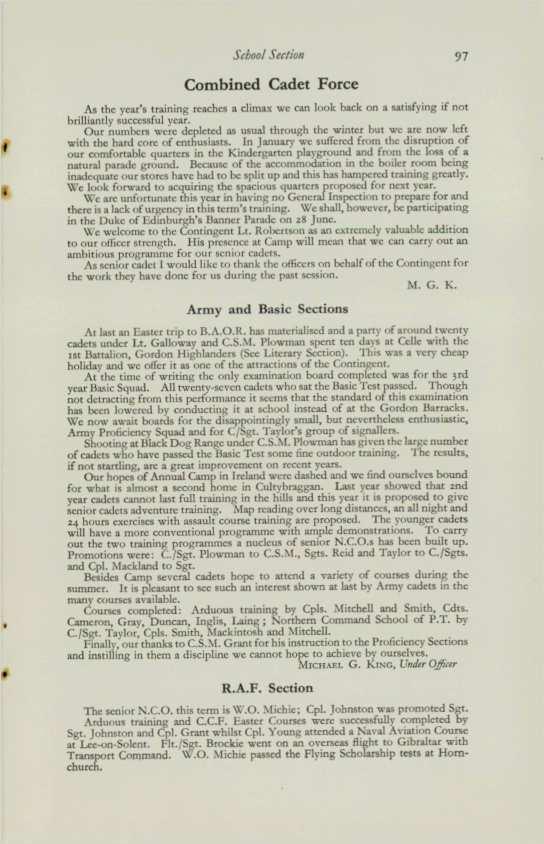
Combined Cadet Force
As the year's training reaches a climax we can look back on a satisfying if not brilliantly successful year.
Our numbers were depleted as usual through the winter but we arc now left with the hard core of enthusiasts. In January we suffered from the disruption of our comfortable quarters in the Kindergarten playground and from the loss of a natural parade ground. Because of the accommodation in the boiler room being inadequate our stores have had to be split up and this has hampered training greatly. \Ve look forward to acquiring the spacious quarters proposed for next year.
We are unfortunate this year in having no General Inspection to prepare for and there is a lack ofurgency in this term's training. We shall, however, be participating in the Duke of Edinburgh's Banner Parade on 28 June.
\Xc welcome to the Contingent Le. Robertson a:, an extremely \·aluableaddition to our officerstreng th. His presence at Camp will mean that we can carry out an ambitious programme for our senior cadets.
As senior cadet I would like to thank the officerson behalf of the Contingent for the work they have done for us durin~ the past session.
1\1. G. K.
Army and Basic Sections
At last an Easter trip to B.A.O. R. has materialised and a party (>faround twenty cadet~ under Lt. Galloway and C.S.:\L Plowman spent ten days at Cclle with the 1st Battalion, Gordon Highlanders (Sec Literary Section). This was a very cheap holiday and we offer it as one of the attractions of the Contingent.
At the time of writing the only examination board completed was for the 31d }•earBasic Squad. All twenty-seven cadets who sat the Basic"J'estrasse<l. Though not detracting from this performance it seems that the standard o this examination has been lowered by conducting it at school instead of at rhe Gordon Barracks. We now await boards for the disappointingly small, but nevertheless enthusiastic, Army Proficiency Squad and for C/Sgt. Taylor's group of signallers.
Shooting at Black Dog Range under C.S.\I. Plowman hasgiven the lari,:enumber of cadets who have passed the Basic Test some fine outdoor training. The results, if not startling, are a great improvement on recent years.
Our hopes of Annual Camp in Ireland were dashed and we find ourselves bound for what is almost a second home in Cultybraggan. Last year showed that md year cadets cannot last full training in the hills and this year it 1s proposed to gh•e senior cadets adventure training. .\lap reading over long distances, an all night and 2-1 hours exercises with assault course trainin$ arc proposed, The younger cadets will have a more conventiona l pmgrammc with ample demonstrations. To carry out the two training programmes a nucleus of senior N.C.O.s has been built up. Promotions were: C./Sgt. Plowman to C.S.\L, Sgts. Reid and Ta>•lorto C./Sgts. and Cpl. Mackland to Sgr.
Besides Camp several cadets hope to attend a variety of courses during the summer. It is pleasant to see such an interest shown at last by Army cadets in the many courses available.
Courses completed: Arduous training by Cpls. ~!itchell and Smith, Cdts. Cameron, Gray, Duncan, Inglis, L:ung; Northern Command School of P.T. by C./Sgt. Taylor, Cpls. Smith, Mackintosh and \Iitchcll.
Finally, our thanks to C.S.i'>LGrant for his instruction to the Proficiency Sections and instilling in them a discipline we cannot hope to achieve by ourselves
.MICHAEL G. KING, UnderOfficer
R.A.F. Section
The senior ~.C.O. this term is \\.0. \lichic; Cpl. Johnston was promoted Sgt. Arduous training and C.C.F. .Easter Courses were successfully completed by Sgt. Johnston and Cpl. Grant whilst Cpl. Young attended a Naval Aviation Course at Lce-on-Solent. Flt.JS~. Brocloe went on an overseas flight to Gibraltar with Transport Command. \X .0. \Iich1e passed the Flving Scholarship tests at Homchurch.
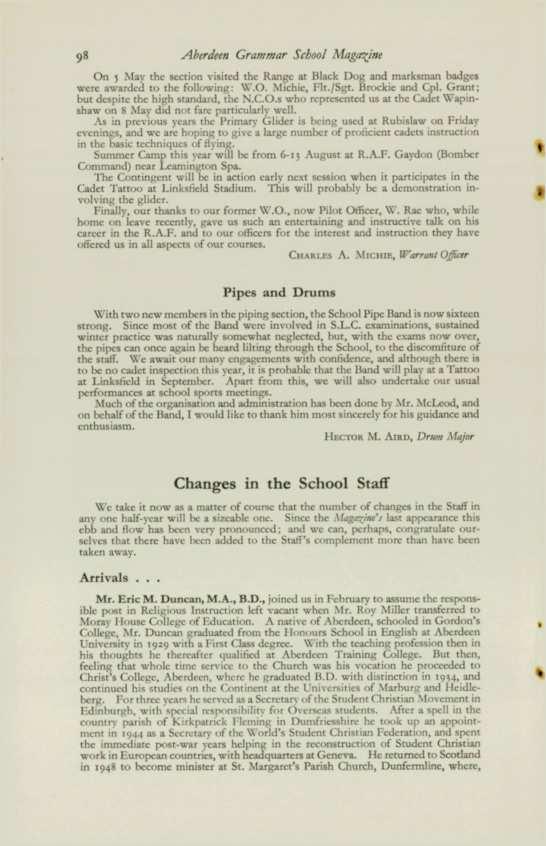
Aberdeen Gral!Jl!Jar School MagazJne
On l May the section visited the Range at Black Dog and marksman badges were awarded to the followin~: \\'.O. ~lichie, rlt./Sgt. Brockie and Cpl. Grant; but despite the high standard, the KC.O.s who represented us at the Cadet Wapinshaw on 8 May did not fare particularly well.
,\s in previous years the Primary Glider is being used at Rubislaw on Friday evcninJ,...,;,and we arc hoping to giYca large number of proticient cadets instruct ion in the basic techniques of flying.
Summer Camp this year will be from 6-13 August at R.A.F. Gaydon (Bomber Command) ocar Lcamington Spa.
The Contingent will be in action early next session when it participates in the Cadet Tattoo at Linksfield Stadium. This will probably be a demonstration involving the glider.
Finally, our thanks to our former \'CO., now Pilot Officer,\'('. Rae who, while home 1,n leave recently, J,.."1Ve us such an entertaining and instructive talk on his career in the R.A.F . and co our officers for the interest and instruction they have offered us in all aspects of our courses.
CHARLE> A. \hCHII!, lVarrofll Ojjic,r
Pipes and Drums
With two new members in the piping section, the School Pipe Band isnow sixteen strong. Since most of the Band were involved in S.L.C. examinations, sustained winter practice was naturally somewhat neglected, but, with the exams now over, the pipes can once again be heard lilting throuih the School, to the discomfiture of the staff. \'\ e await our many cnb,agcmeots with confidence, and although there is to be no cadet inspection this year, it is probable that the Band will play at a Tattoo at Linksficld in September. Apart from this, we will also undertake our usual performances at school sports meetings.
\foch ofthe organisation and administration has been done by ~Ir. 1kLcod, and on behalf ofthe Band, I would like to thank him most sincercl>•for his guidance and enthusiasm.
HECTOR. M. AIRD, Dr11nJ ,\fojor
Changes in the School Staff
\\ c take it now as a matter of cour-c that the number of changes in the Staff in any one half-year will he a sizeable one. Since the \fo,1°',inr's last appearance this ebb and flow has been very pronounced; and we can, r<:rhaps, con~ratulate our• selves that there have hcen added co the Staff's complement more than have been taken away.
Arrivals .
Mr. Eric M Duncan, M.A., B.D., joined us in February to assume the rc5ponsible post in Religious lnstructJOn left vacant when \I r. Roy Miller transferred to Moray Ilouse College of Education. A natiyc of Aberdeen, schooled in Gordon's College, ~fr. Duncan graduated from the Honours School in English at Aberdeen Unh-ersity in 1929 with a First Class degree. \\ ith the teaching profc,:sion then in his thoughts he thereafter quali6cd at Aberdeen Training College. But then, feeling that whole time service to the Church was his vocation he proceeded to Christ's College, Aberdeen, where he graduated B.D. with distinction in 19,4, and continued his studies on the Continent at the Universities of \Iarburg and Ileidlcber!,"(. for three year,;he<ervcda.~a Secretan· of I he Student Christian \lovcment in Edinburgh, with <pccial respon,ih1l1n· for O\crsca.~ students. After a spell in the country parish of Kirkpatrick I"Jcming in Dumfriesshir<• he took up an appoint • mcnt in 1944 as a Secretary of the\\ orld's Student Christian Federation, and spent the immediate post-war years helping in the reconstruction of Student Christian work in European countries, with headquarters at Geneva. He returned to Scotland in 1948 to become minister at St. \largarct's Parish Church, Dunfermline, where,
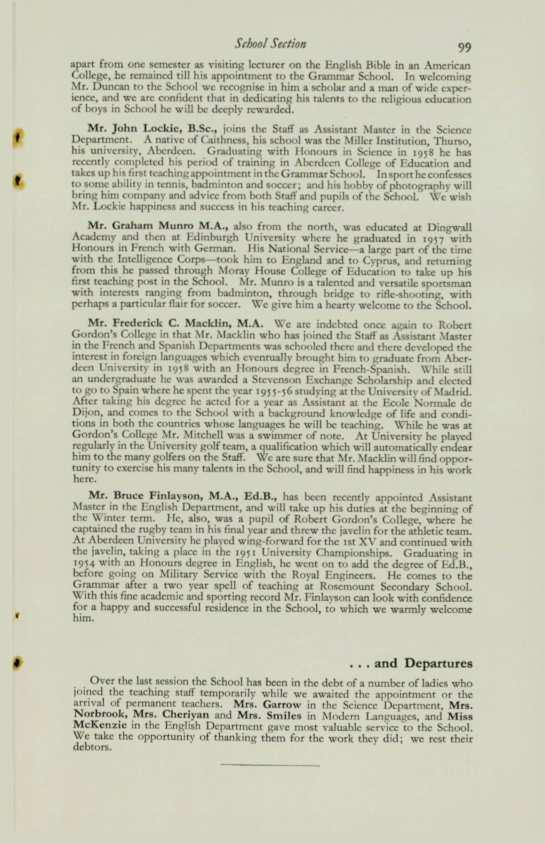
SchoolSection
apart from one semester a~ visiting lecturer on the English Bible in an American College, be remained till his appointment to the Grammar School. In welcoming :\fr. Duncan to the School we recognise in him a scholar and a man of wide experience, and we are confident chat in dedicating his talents to the religious education of boys in School he will be deeply rewarded.
Mr. John Lockie, B Sc , joins the Staff as Assistant ,'I.fasterin the Science Department. A native of C.aithncss,his school was the \iiller Institution, Thurso, his uni,·ersity, Aberdeen. Graduating with Jlonours in Science in 1958 he has recently completed his period of training in Aberdeen College of Education and takes up his first tc:ichingappointment inthe Grammar School. Jnsport heconfesses to some ability in tennis, badminton and soccer; and his hobby ofphotograpby will bring him company and advice from both Staffand pupils of the School. We wish :\lr. Lockie happiness and success in his teaching career.
Mr. Graham Munro M.A., also from the north, was educated at Dingwall Academy and then at Edinbur1-th University "·here he graduated in 1957 with Honours m French with German. Jlis National Service-a large part of the time with the Intelligence Corps- took him to England and to Cyprus, and returning from this he passed through \foray House College of Education to take up his first teaching post in the School. :\fr. \[unro is a talented and versatile sportsman with interests ranging from badminton, through bridge to rifle-shootin1,:,with perhaps a particular flair for soccer. \X'egive him a hearty welcome to the School.
Mr. Frederick C Mackli n, M.A. \\;c arc indebted once a~ain tu Robert Gordon's College in that \lr. \lacklin who has joined the Staffas Assistant ,\!aster in the hcnch and Spanish Departments wa.~schooled there and there de,·cloped the interest in foreign languages which e,·enrually brought him to graduate from Aberdeen l'niversity in 1958 with an Ilonours degree m f'rench -Spanish. \'fhile still an undergraduate he was awarded a Stevenson Exchani:teScholarship an<l cll'ctcd to go to Spain where he spcnr the year 1955-56 scu<lyingat the University of !\la<lrid. After caking his degree he acted for a year as Assistant at the Ecole "-ormale de Dijon, and comes to the School with a background knowledge of life and conditions in both the countries whose lan1-,"Uap;eshe will be tcac-hing. \X'hile he was at Gordon's College \fr. \ fitchell was a swimmer of note. At University he played regularly in the University golf team, a qualification which will automatically endear him to the many golfers on the Staff. We are sure that ;\lr .\facklinwillfind opportunity to exercise his many talents in the School, and will find happiness in his work here.
Mr. Bruce Finla yson, M.A., Ed.B., has been recently appointed Assistant l\laster in the English Department, and will take up his duties at the beginning of the W'inter term. Jle, also, was a pupil of Robert Gordon's College, where he captained rhc rugby team in his finalvcar and threw the javelin for the athletic team. At Aberdeen Uni,·ersitv he played wing-forward for the 1stXV and continued with the javelin, taking a place in the x951 University Championships. Graduating in 1954 with an Honours degree in English, he went on to add the degree of Ed.B., before going on Military Service with the Royal Engineers He comes to the Grammar after a two year spell of teaching at Rosemount Secondary School. With this fine academic and sporting record l\lr. f'inlayson can look with confidence for a happy and successful residence in the School, to which we warmly welcome him.
and Departures
Over the last session the School has been in the debt of a number of ladies who joined the teaching staff temporaril}' while we awaited the appointment or the arrival of permanent teachers. Mrs. Garro w in the Science Department, Mrs. N orbrook, Mrs. Cheri yan and Mrs Smil es in J\lodem L-inguagcs, and Miss McKenzie in the English Department gave most valuable service to the School. We take the opportunity of thanking them for the work they did; we rest their debtors.
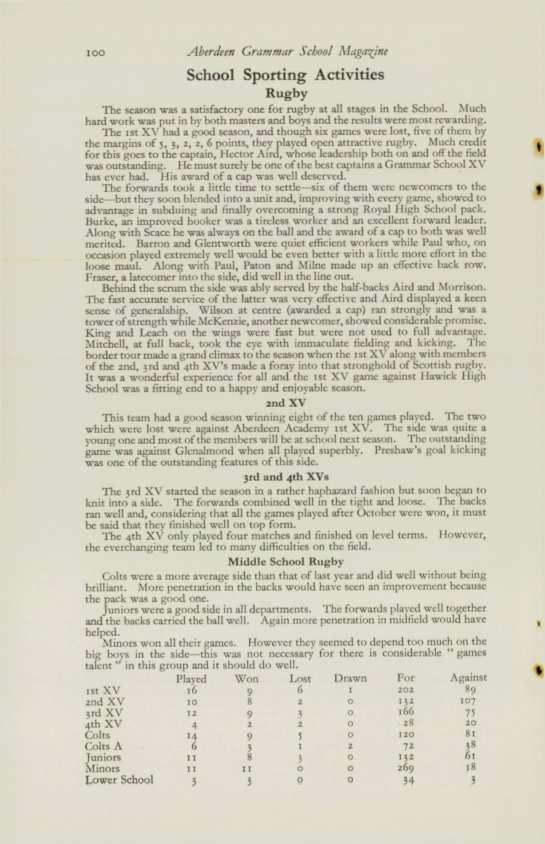
School Sporting Activities
Rugby
The season was a satisfactory one for rugby at all stages in the School. .\luch hard work was put in hy hoth masters and hoys and the results were most rewarding. 1be 1st XV had a gooc:lseason, and thouirh SIX games were Jost, fiveof them by the margins of 5, 3, z, 2, 6 points, they played open attractive rugby. Much credit for this goes to the captain, Hector Aird, who,;e leadership both on and off the field was outstanding. Ile must surely beone ofthe best capt:iinsa Grammar School XV has ever had. I(is award of a cap was well deserved.
The forwards took a little time to settle-six of them were newcomers to the side- but they soon blended into a unit and, improvinii; with every g:imc,showc<lto ad,·antage in subduing and finally o,·crcoming a strong Royal High School pack. Burke, an improved hooker was a tireless worker and an excellent forward leader. Along with Scace he was always on the ball and the awar<lofa cap co both was well merited. Barron and Glentworth were quiet efficient workers while Paul who, on occasion played extremely well would be even better with a little more effort in the loose maul. Along with Paul, Paton and .\Iilne made up an dfcctin- hack row. Fraser, a latecomer into the si<le,did well in the line out.
Behind the scrum the side was ably served hy the half-backs ,\ird and ,\lorrison. The fast accurate sen·ice of the latter was very clfccti,e and Aird displayed a keen sense of generalship. Wilson at centre (awarded a cap) ran strongly and was a tower ofstrength while ~kKer12ie,another newcomer, sbowc<lconsi<lerahlepromise. King an<l Leach on the wings were fast but were not used to full a<lvantaJ.'.e. ).litchell, at full hack, took the eye with immaculate fielding an<l kicking. The horder tour made a gran<lclim."lXto the season when the 1stX\' along with mcmlx rs of the rod, 3rd and 4th X\"s made a foray into chat stronghold of Scottish rugby. Jt was a "\\'onderful experience for all and the 1St XV game against llawick lligh School was a fitting end to a happ\' an<lenjovablc season.
2nd XV
This team had a good season winning c.igbt of the ten games played. The two which were lost were against Aberdeen Academy 1st XV. The side was quite a young one and most ofthe members will be at school next season. The outstanding game was against Glcnalmond when all played superblr. Preshaw's go,11 kicking was one of the outstanding features of this side.
3rd and 4th XVs
The 3r<l XV started the season in a rather hapha;,arc.lfashion but soon began to knit into a si<le. The forwards combined well in the tight and loose. The backs ran well and, considering that all the games played after October were won, it must be said that they finished well on top form.
The 4th X\' only played four matches and finished on level terms. However, the everchanging team led to many difficulties on the field.
Middle School Rugby
Colts were a more average side than that of last year and dtd well without being brilliant. \lore penetration in the backs woul<lhave seen an improvement because the pack was a good one.
Juniors were a good side in all departments. '!be forwards playc<lwell together and the backs carried the ball well. Again more penetration in midfield would have helped ..\linors won all their games. However they seemed to depend too much on the big hoys in the side-this was not necessary for there is considerable " games talent" in this group and it should <lo well.
1st XV
2nd XV
3rd XV
4th XV
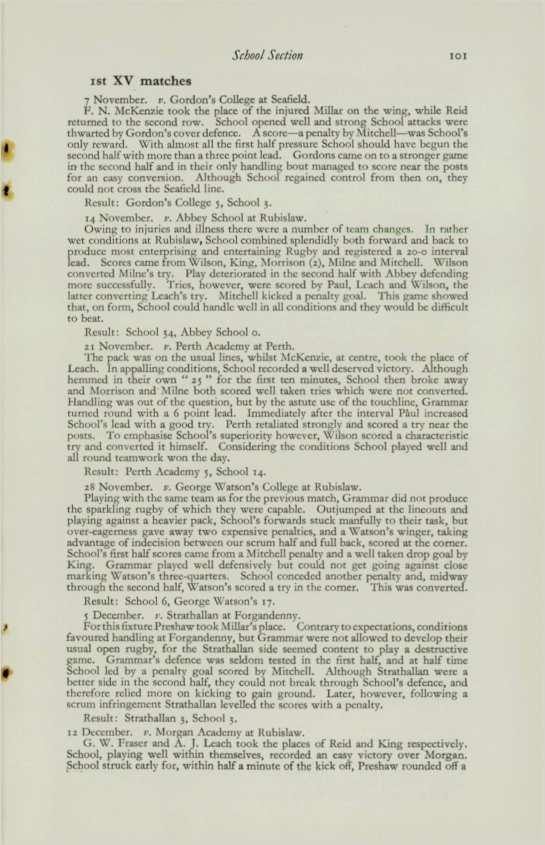
1st XV matches
7 November. v Gordon's College at Seaficld F. N. 11cKenzie took the place of the injured 11illar on the wing, while Reid returned to the second row. School opened well and strong School attacks were thwarted byGordon's cover defence. Ascore-a penalty by\ litchcll-was School's only reward. With almost all the first half pressure School should have begun the second half with more than a three point lead. Gordons came on to a stronger game in the second half and in their only handling bout managed to score near the posts for an easy conversion. Although School regained control from then on, they could not cross the Seaficld Iine.
Result: Gordon's College j, School 3.
r4 November. v. Abbey School at Rubislaw
Owing to injuries and illness there were a number of team changes. In rather wet conditions at Rubislaw, Schoolcombined splendidly both forward and back to produce most cnterprisinii; and entertaining Rugby and registered a 20-0 interval lead. Scores came from \Xlilson,Kini?, \lorrison (2),1lilne and \ litchell. \'7ilson converted \lilne's try. Play dl'terioratcd in the second half with Abbey defending more successfully. Tries, howe,·er, were scored by Paul, Leach and \'\'ilson, the latter converting Leach's try. 1litchell kicked a penalty goal. This game showed char,on form, School could handle well in all conditions and they would be difficult co beat.
Result: School 34, Abbey School o
2 t No'l"ember. "· Perth Academy at Perth.
The pack was on the usual lines, whilst 11cKenzie, at centre, took 1he place of Leach. In appalling conditions, School recorded awell deserved victory. Although hemmed in their own "2, " for the first ten minutes, School then broke away and ,\lorrison and 11ilne both scored well taken tries which were nor converted. Handling was out of the question, but by the asrute use of the touchline, Grammar turned round with a 6 point lead. Immediately after the interval Paul increased School's lead with a good try. Perth retaliated strongly and scored a try near the pos1s. To emphasise School's superiority howe, er, \\"ilson scored a characteristic try and con,erted it himself. Considering the conditions School played well and all round teamwork won the day
Result: Perth Academy 5, School 14.
28 KO\ ember. v. George Watson's College at Rubislaw.
Playing with the same team asfor the previous match, Grammar d,d not produce the sparkling rugby of which they were capable. Outjumpcd at the lineouts and playing against a heavier pack, School's forwards stuck manfully to their task, but over-eagerness gave away two expensive penalties, and a \X'acson's winger, taking advantage of indecision between our scrum half and full back, scored at the comer . School's first half scores crunefrom a :!\fitchellpenalty and awell taken drop goal by King. Grammar played well defensively but could not get going against close markin~ W'atson's three-quarters. School conceded another penalty and, midway through the second half, Watson's scored a try in the comer. This was converted.
Result: School 6, George Watson's 17.
5 December. i·. Strathallan at Forgandenny.
For this lixrurcPreshaw took \lillar's place. Contrary toexpectations, conditions favoured handling at I'organdenny, but Grammar were not allowed to develop their usual open rugby, for the Stratballan side seemed content to play a destructive game, Grammar's defence was seldom tested in the first half, and at half time School led by a penalty goal scored by Mitchell. Although Strathallan were a better side in the second half, they could not break through School's defence, and therefore relied more on kicking to gain ground. Later, however, following a scrum infringement Strathallan levelled the scores with a penalty.
Result: Strathallan 3, School 3.
12 December. v. Mor~ Academy at Rubislaw.
G. \'<:'. fraser and A. J. Leach took the places of Reid and King respectively. School, playing well w:ithin thcrnsclves, recorded an easv victory over :Morgan. School struck early for, within half a minute of the kick off, Preshaw rounded offa
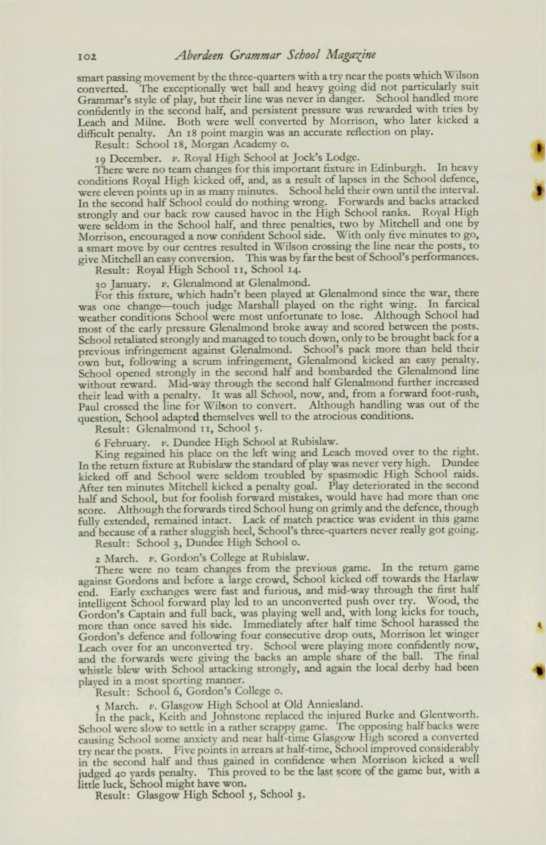
smart passing movement bythe three-quarters with atry near the posts which Wilson convened. 'Jbe exceptionally wet ball and heavy going did not particularly suit Grammar's St>·leofplay, but their line was never in dan~er. School bandied more confidently in the second half, and persistent pressure was rcw:udcd with tries by Leach and .Milne. Both were well converted by \1ornson, who later kicked a difficult penalty. An 18 point margin was an accurate reflection on play.
Result: School 18, .\lorgan Academy o.
19 December. ,•. Royal High School at Jock's Lodge.
There were no team changes for this important fixture in Edinburgh. In heavy conditions Royal High kicked off, and, as a result of lapses in the School ddence, were eleven points up in asmany minutes. School held their own until the interval. In the second half School could do nothing wrong. l'orwards and backs attacked strongly and our back row caused havoc in the High School ranks. Royal High were seldom in the School half, and three penalties, two by !'.litchcll and one by Morrison, encouraged a now confident School side. W1thonly five minutes to go, a smart move by our centres resulted in \'i:'ilsoncrossing the line near the posts, to give .\litchell an easyconversion. This was by far the best ofSchool's performances.
Result: Royal High School 11, School 14.
;o January. v. Gknalmond at Glenalmond.
For this fixture, which hadn't been played at Glcnalmond since the war, there was one change--touch 1·udge.\farshall played on the right wing. Jn farcical weather conditions Schoo were most unfortunate to Jose. Although School had most of the early pressure Glenalmond broke away and scored between the posts. School retaliated scrongl>·and managed to touch down, onlyco be brought back for a previous infringement against Glcnalmond. School's pack more than held their own but, following a scrum infringement, Glcnalmond kicked an easy penalty. School opened strongly in the second half and bombarded the Glenalmond line without reward. .\lid way through the second half Glenalmond funher increased their lead with a penalty. It was all School, now, and, from a forward foot-rush, Paul crossed the line for Wilson to convert. Although handling was out of the question, School adapted thcmsel vcs well to the atrocious conditions.
Result: Gknalmond tt, School l·
6 f'ebruary. t·. Dundee High School at Rubislaw. King regained his place on the left wing and Leach moved over to the nght. In the rerum fixture at Rubislaw the standard ofplay was never very high. Dundee kicked off and School were seldom troubled by spasmodic High School raids. After ten minutes \licchcll kicked a penalty goal. Play deteriorated in the second half and School, but for foolish forward mistakes, would have had more than one score. Although the forwards tired School hung on grimly and the defence, though fully extended, remained intact. Lack of match practice was evident in this game and because of a rather sluggish heel, School's three-quarters never really got going.
Result: School ;, Dundee High School o.
2 March. t'. Gordon's College at Rubislaw.
There were no team changes from the previous game. In the return game against Gordons and before a large crowd, School kicked off towards the Harlaw end Early exchanges were fast and funous, and mid-way through the first half intelligent School forward play led to an unconverted push over try. Wood, the Gordon's Captain and full back, was playing well and, with long kicks for touch, more than once saved bis side. Immediately after half time School harassed the Gordon's defence and following four consccuti\'C drop outs, Morrison let winger Leach over for an unconverted try. School were playing more confidently now, and the forwards were giving the backs an ample share of the ball. The final whistle blew with School attacking strongly, and again the local derby had been played in a most sporting manner.
Result: School 6, Gordon's College o.
l !\larch. 11. Glasgow High School at Old Anniesland.
In the pack, Keith and Johnstone replaced the injured Burke and Glcntworth. School were slow to settle in a rather scrappr game. The opposing half backs were causin~ School some anxiety and near half-tune Glasgm•• Iligh scored a convened try neii'i-the posts. Five points in arrears at half-time, School improved considerably in the second half and thus gained in confidence when .\1orrison kicked a well I .udged 40 yards penalty. This proved to be the last ~core of the game but, with a ittle luck, School might have won.
Result: Glasgow Iligh School 5, School 3.
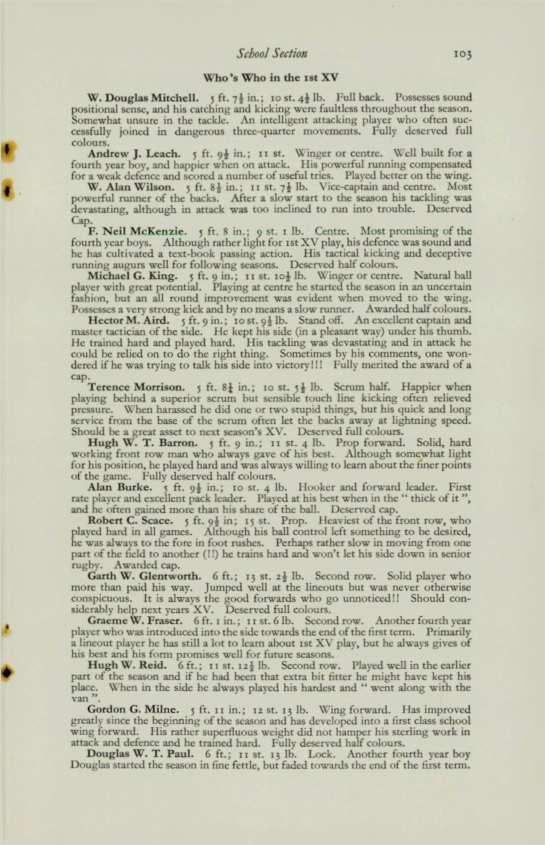
Who 's Who in the 1st XV
W. Douglas Mitchell. 5 ft. 7½ in.; 10st. 4½ lb. Full back. Possesses sound positional sense, and his catching and kicking were faultless throughout the season. Somewhat unsure in the tack.le. An intelligent attacking player who often successfully joined in dangerous three-quarter movements . Fully deserved full colours.
Andre w J Leach. 5 ft. 9½ in.; 1I st. Win~er or centre. Well built for a fourth year boy, and happier when on accack. Ilis powerful running compensated for a weak defence and scored a number of useful tries. Played better on the wing.
W. Alan Wilson 5 ft. 8½ in.; II st. 1½ lb. \ 'ice-captain an<lcentre. Most powerful runner of the backs. After a slow start to the season his tackling was devastating, although in attack was too inclined to run into trouble . Deserved Cap.
F. N eil McKenzie. 5 ft. 8 in.; 9 st. I lb. Centre. Most promising of the fourth year boys. Although ratherlight for 1st XV play, hisdefence was sound and he has culti\'ated a text-book passing action. His tactical kicking and deceptive running augurs well for following seasons. Deserved half colours.
Michael G. King. 5 ft. 9 in.; 1 r st. 10½ lb. Winger or centre. Natural ball player with great potential. Playing at centre he started the season in an uncertain fashion, but an all round improvement was evident when moved to the wing. Pos~esscsa very strong kick and by no means a slow runner. Awarded half colours.
Hector M. Aird 5 ft. 9 in.; 10st. 9½lb. Stand off. An excellent captain and master tactician of the side. He kept his side (in a pleasant way) under his thumb. He trained hard and played hard. His tackling was devastating and in attack he could be relied on to do the right thing. Sometimes by his comments, one wondered if he was trying to talk his side into victory I11 Fully merited the award of a cap.
T erence Morrison. 5 ft. 8¼ in.; JO st. 5½ lb. Scrum half. Happier when playing behind a superior scrum but sensible touch line kickmg often rehe\'ed pressure. \'vhen harassed he did one or two stupid things, but his quick and long service from the base of the scrum often let the backs away at lightning speed. Should be a great asset co next season's XV. Deserved full colours.
Hugh W T Barron. 5 ft. 9 in.; 11 st. 4 lb. Prop forward. Solid, hard working front row man who always gave of his best. Although somewhat light for his position, he played hard and wasalways willing 10 learn about the finer points of the game. Pully deserved half colours.
Alan Burke 5 ft. 9½ in.; JO st. 4 lb. Hooker and forward leader. First rate player and excellent pack leader. Played at bis best when in chc" thick of it", and he often 1,rainedmore than his share of the ball. Deserved cap.
Robert C Scace 5 ft. 9t in; 15 st. Prop. Jleavi(.'Stof the front row, who played hard in alJ games. Although his balJcontrol left something to be desired, he was always to the fore in foot rushes. Perhaps rather slow in moving from one part of the held to another (I!) he trains hard and won't let his side down in senior rugby. Awarded cap.
Garth W. Glentworth. 6 ft.; J 3 st. 2½ lb. Second row. Solid player who more than paid his way. Jumped well at the lineouts but was never otherwise conspicuous. It is always the good forwards who go unnoticed! I Should considerably help next years XV. Desen,cd full colours.
Graeme \V. Fraser. 6 ft. 1 in.; 11st. 6 lb. Second row. Another fourth year player who was 1ncroducedinto the side towards the end ofthe first term. Primarily a lineout player he has still a lot to learn about 1st XV play, but he alwa>s gi\'CSof his best and his form promises well for future seasons.
Hugh W. Reid. 6 ft.; r I st. 12} lb. Second row. Played well in the earlier part of the season and if he had been that extra bit fitter he might have kept his place. \'\°hen in the side he always played his hardest and "went along with the van,,_
Gordon G Milne. 5 ft. 1 c in.; 12 st. 13 lb. Wing forward. Has improved greatly since the beginning of the season and has developed into a first class school wing forward. His rather superfluous weight did not hamper his sterling work in attack and defence and he trained hard. Fully deserved half colours.
Douglas W. T. Paul . 6 ft.; 11 st. 13 lb. Lock. Another fourth year boy Douglas started the season in fine fettle, but faded towards the end of the first tcm1.
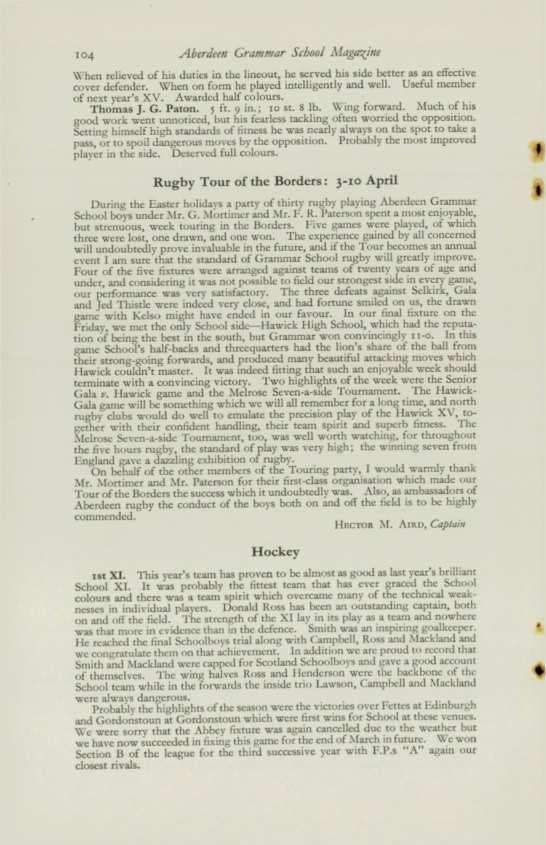
Abtrdmr Crt1111111ar School ,\l,1gaz.i11e
\\ hen rclicveJ of his dut,c:. in the hncuut , he served his side better as an effective cover dcfcmlcr. When on form he played intelligently and well. Useful member of next ,ear's XV. Awarded half colours.
Tho·mas J. G. Paton l ft. 9 m.; 10 st. 8 lb. \\ .ng forward. :\!uch of his ~oo<lwork went unnoticed, but his fearless tackling often worried che opposition. Setting himsclf high standards of fitnL-Ssbe was nearly always on the spot to take a pass, or to spoil Jangcrou, mo, c, by the opposiuon. Probably the most impron:J pla).:r m the side. Deserved full colours.
Rugby Tour of the Borders: 3-10 April
During the Easter holidays a p..rt} ot th1rt) ,u ·b) playing c\bcrdccn Gramnu.r School boys under \lr. <,. \lortimcr and .\lr. r. R. Paterson spent .1 most enjoyable, but strenuous, week touring in the Borders. 1ive i;a1111:s were played, of which three were lost, one drawn, and one won. The experience gained b)·all concerned will undoubtedly prove invaluable in the future, and if the 'J'our becomes an annual evcm I am sure that the standard of Granunar School rugby will grcadv improve. Four of the five fixtur<-Swere arranged ag:unst teams of twenty years of age and undcr, and c,,nsidermg it v.-as nut possible tu field our strongest side ,n every ,:;ame, our perfonnance was very satisfactory. The three dcfi:ats agam,t Selkirk, Gala and Jed Thistle were indeed very close, and had fortune smiled on us, the drawn game with Kelso might have cnJ.-d in our favour. In our final hxture on the Friday, we met the only School side.; llaw1ckIIigh School, which had the reputation of bcin~ the best in the south, but Grammar W(ln convincingly t 1-0. In this game School's half,backs and thrcequarters had the lion's share of the ball from their trong-going fon1,ards, and produced many beautiful acra.:king mon:s which IJawick couldn' t mm.ter. It was indeed fitting that such an enjorahlc week should terminate with a convincing victory. Two highlis,;htsof the week were the Senior Gala "· llawick game and the Melrose Seven-a-side Tournament. The JIawickGala •aine w,U be something which we will all remember for a )(Ing time, and north rugbr clubs would do well to emulate the precision play of the Iu.wick XV, to~cth.-r with their confident handling, their team spirit and superb fitness. The .\lclr<>s.:~,en-a-side Tournament, too, ,,,a~well worth watching, for throughout the fi, e I,,,urs rugby, the stanJard nfrlar was very high; the wcnning se,en from England gave a dazzling exhibition o rugbr.
On behalf of the other members of the Touring party, I would warmly thank Mr..\lortimcr and :\Ir. Paterson for their fust-cla\S organisation v,hich made our Tour nfthe Borders the success which it undoubtedly was. .\lso, asambassadors of Aberdeen rugby the conduct of the b<•}s both on and off the licld is to Ix. highly commended.
HP.CTOR :\I. AIRD, Captain
Hockey
1st XI. This year's team has proven to be almost as good as h~t year's bril .int School XI. It was probably the fitte.t team that has ever graccd the Sc: , ,! eoloun and there was a team spirit which overcame many of the technical weaknesses 111 indiddual players. Donald Ross has been an outstand111gcaptau1, both on and off the tio:ld. 'J'he strength of the XI lay in its play as a team and nowhere was th.11more Ill e, idencc than rn the defence. !imith \l.'asan inspm111,tgoalkeeper. He rc,u:hcd the fin3l Schoolho)s trial along with C.1mpbcll, Ross and \Lackland and we congmtulate thcm on thar ach1cvem~11t. In a..l<11t1onwe .ire proud 1(1 record char ~mith and ,\lackland werecapr<:dfor Scmland Sehoolbo) s and g,wc a good accoum of themselves. The wing halves Ross and Henderson were the backbone of tlw Schon! team while in the forwards 1hc 111sidetrio Lawson, C.1mpbdl and :\fackland were always dan~crous.
Probablv rhe hi~hliglm of the season were the victories m er hues at r.dinburgh and Gordonstoun at Gordonstoun which were ht',t wms for School at these nnu~-s. \\ c were sorry that the Abbey fixture wa.~ aga.incancelled due to the weather but we have now succeeded in tixing this ,::amcfor the cn,I of :\larch m future. We won Section B of the league for the third successive year with P.P.s "A" a~ain our closest rivals.
It was pleasant to meet so many " old " faces m the matches with other clubs. F.P.s are to be found nowadays in most ofthe hockey clubs in the city. Partitularly enjoyable were our matches with our own F.P. club at all levels.
4 ror 4) Sr
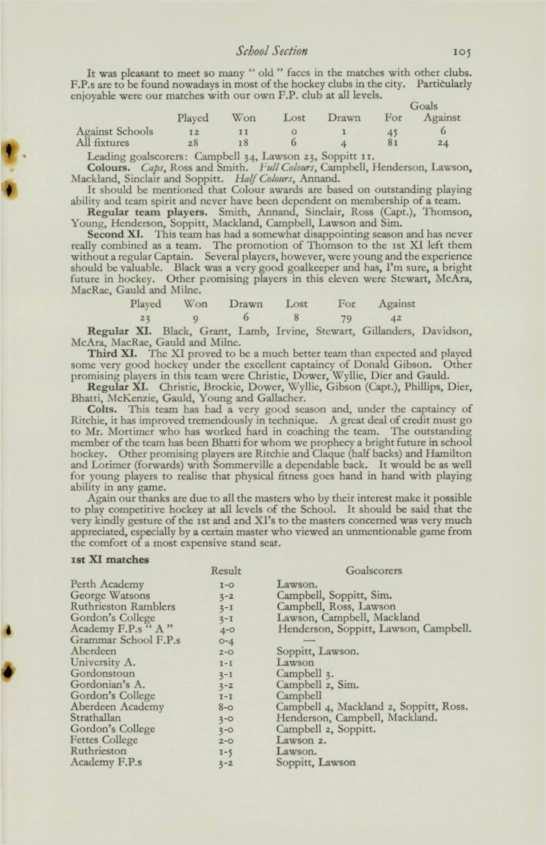
Goals Against 6
Leading goalscorers: Campbell 34, Lawson 23, Soppitt t r. Colours. Caps, Ross and Smith. 1 u/1Colours, Campbell, l Ienderson, Lawson, :\tack.land, Stnclair and Soppitt. Half Colours,Annand. lt should be mentioned that Colour awards arc based on outstanding playing ability and team spirit and never have been dependent on membership of a team. Regular team players. Smith, Annand, l>inclair, Ross (Capt.), Thomson, Youn~, Henderson, Sopp1tt, :\!ackland, Campbcll, Lawson and Sim. Second XI This team has had a somewhat disappointing season and has never really combined a~ a team. The promotion of Thomson to the 1st Xl left them without a regular Captain. Several players, however, were young and the experience should be valuable. Black was a very good goalkeeper and has, l'm sure, a bright future in hockey. Other p,omisiog players in this eleven were Stewart, .\lcAra, \laeRae, Gauld and .\lilnc.
PLlyed \\on
23 9 Drawn 6 Lost 8 For 79
Regular XI. Black, Grant, Lamb, Irvine, Stewart, .\lcAra, .\lacRae, Gauld and .\lilne.
Against 42 G1llanders, Davidson, Third XI. The X1 proved to be a much better team than expected and played some very good hockey under the excellent capta.ioey of Donald Gibson . Other promising players in this team were Christie, Dower, Wyllie, Dier and Gauld.
Regular XI. Christie, Brockie, Dower, Wyllie, Gibson (Capt.), Phillips, Dier, Bhatti, .McKenzie, Gauld, Young and Gallacher. Colts. This team has had a very good season and, under the c.'\ptaincy of Ritchie, it ha~improved tremendously in technique. A grL-atdeal ofcredit must go to Mr. Mortimer who has worked hard in coaching the team. The outstanding member ofthe team has been Bhatti for whom we prophecy a bright furore in school hockey. Other promising players are Ritchie and Claque (half backs) and Hamilton and Lorimer (forwards) with Sorrunerville a dcp<:ndableback. It would be as well for young players to realise that physical fitness goes hand in hand with playing ability in any game.
Again our thanks are due to all the masters who by their interest make it possible to play competitive hockey at all levels of the School. It should be said chat the very kindly gesture ofthe 1st and 2nd Xl's to the masters concerned was very much appreciated, especially by a certain master who viewed an unmentionable game from the comfort of a most expensive stand scat.
u t XI matches
Result
Penh Academy I-0 Lawson.
Goalscorers
George Watsons 3-2 Campbell, Soppitt, Sim.
Ruthrieston Ramblers 3-1 Campbell, Ross, Lawson
Gordon's College 3-1 Lawson, Campbell, Mackland
Academy F.P.s "A" 4-0 Henderson, Soppitt, Lawson, Campbell. Grammar School F.P.s 0-4
Aberdeen 2-0 Soppitt, Lawson. University A. 1-1 Lawson
Gordonstoun 3-1 Campbell 3.
Gordonian's A. 3-2 Campbell 2, Sim.
Gordon's College I-1 Campbell
Aberdeen Academy 8-o C.'\mpbell4, Mack.land2, Soppitt, Ross. Strathallan 3-0 Henderson, Campbell, Mackland.
Gordon's College 3-0 Campbell 2, Soppitt.
Fettes College 2-0 Lawson 2.
Ruthrieston 1-5 Lawson.
Academy F.P.s 3-2 Soppitt, Lawson

Abtrdeen Grahl111ar School Magazi"e
Outstanding Matches
12 December. 1·. Ruthricston Ramblers. Scorc: 3-1.
1n an almost continual downpour School gave their best all round display of the season in uvercominl-( a strong Ramblers team. The defence, after a shaky start, 11npro\'cdsteadily and, hythe second half, had cnmpkte mastery with the result that, although RuthnL-,;ton attacknl fur long spells thq did not look like scoring. At half-time 1-1 v.·as a true reflection of play. The School attack were particularly sprightly with Lawson in grand form and they pressed home their a,:.hantagc with two smart goals in the second half. There were no weaknesses in a splendid School side.
30 January. ,•. Gordonscoun. Score: 3-1.
In an enthusiastically contested match School, by virtue of a late rally, have at last succeeded in defeating a Gordonstoun 1st Xl at Moray. The playing surface was hard and very treacherous. The Gordonstoun team with si,c of last years ele\·en played hard hittmg hockey but School always seemed co possess that little bit extra cohesion and finesse. School opened the scoring in seven minutes from a long corner and v.•ithany luck should have increased their lead, both Campbell and Soppitt hitting wood. Gordonstoun came more into the game towards half time hut the School defence was compact and safe. In the second half School were mainly on the defensive and after 10 minutes Gordonstoun e4ualised with a good goal. Gordonstoun now piled on the pressure and it seemed that yet another School team would be beaten at ;\foray. School, however, weathered the storm and gradually got on top but it was 4 minutes from the end before School Wt.'fltinto the lead. Grammar scored another goal and missed a penalty hully in the hectic closing stages. Campbell was the outstanding forward ruid 111 defence ,\nnand and Thomson were very safe.
12 ~larch. v. Gordon's College. Score 3-0.
In a hard fought enioyable match, School at last manal!cd to display their true form against College. School got off to a good start with a well-taken Soppitt goal in the opening minutes. After this College attackt.-d strongly without any success. In the second half School's forwards, receiving good service from their half backs, showed many neat touches and the final margin of three 1-(<>als was a fair rctlection of the run of the play. Ross was outsrnndin,; in defence and in attack Lawson and .\lackland u·ere most prominent.
19 .\larch . 1·. Fettes College. Score: 2-0.
A large crowd attended this match in the hope that Fettes would avenge last year's defeat at Aberdeen. The Fettes team were physically much stronl!er than the School team and their tactics were to swing the hall about with powerful quick hming. During the first 15 minutes School were completely on the defensive. Fettes had some narrow misses but with the defence plaring magniticencly the rest of the team took heart. The forwards chased every hal and after some near misses they scored a fluke goal which was just the tonic that School needed. Jn the second half, ~ith School playing downhill, they were much more conlidcnt and although attacking less often than Fettes they were much more dangerous. (Campbell drove one shot over the bar imo a nearby pond causing con5ternation among the swans.) ,\Jidway through this half Campbell mis5ed a pcn,1.lty bully but fi\'e minutes from time Lawson made the game safe by converting another penalty bully award. This was a memorable victory that will long be remembered by those who participated.
30 .\[arch. v. Academy F.P.s. Score: 2-3.
School got off to a had start and were two goals down in 10 minutes. The team recovered to play excellent hockey and reduced the leeway shortly after half time. :-;carthe end Academy F.P.s scored a third goal and in the last minute Lawson scored from a short comer. In a very good all round team Smith, Annand, Ross and .\fackland were outstanding. This was a splendid match in every way and we thank Academy F.P.s for making this fixrure possible.
The season ended on a happy note with the .\!asters,. Boys match. The \fasrers contrived to win 4-2 by playing with twelve" men" and with help of the umpires, C. D. Bisset (Ruthricston) and G. Wilson. We welcomed the brief return of .\[r. Grant and Dr. Innes co playm this match contested 111 splendid spirit. A tineending to a fine season. R. }.lcNAY
Prc~idcnt
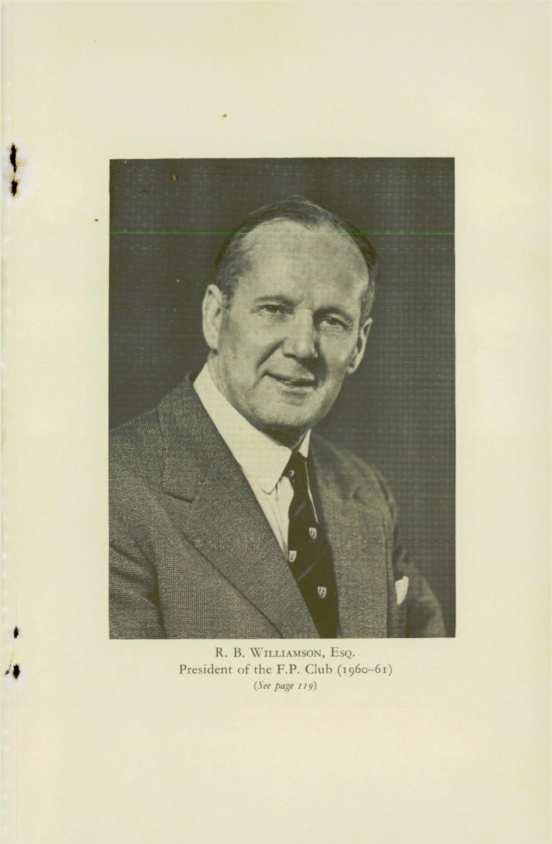
(.\u pagt 119)
R. B. \\ ILLIA\IS01'., L,Q.
of the F.P. Club (1960- 61)
1st XI Hockey

/lark: Rr,w \l r. _I \. Sk111n<:r (l{ulor), I. \nnand, \I. A. L1mphcll, R. B. Y, ung, S. I) B. Smith, I. Thomson, \I. Sincl.1ir, II. J\, Iltndcr~un \lr. R. \lc:---a\. I ronl Ro11 \. I. S1•pp1t I. \lacklanJ, D. ·1 Ro,s ~(.,,pt). I 1-,,, l.,w,on, .f. \1. S·m.
1st XV Rugby
lt"k Rm, \fr. J.\ Sk,nnc:r (Rr(lor), \. J. l.c.,ch, G.\\. Clrnrnouh, 11.\\'. Reid, G.\\ I "''"'• D.\\. 'J'. Paul, G. c;. \I dnc·, 11.\\ T. Barron, \lr. I. R. Patu,on, \fr. A. L. Stn-cnson \l1ddlt Rou-T. J. c;, l'.11on, \I. C. Kmg, \\. \. \\ ,Ison (I 'ia-Capl.), 11. \I. Aird (C,pt.), ,\. Burk<:, R. ( Scan, 'J'. \lorris1,n, Fron/ ){011 D. \l11chdl, r :--.. \lcKcruic.
"The Merry Wives of Windsor"
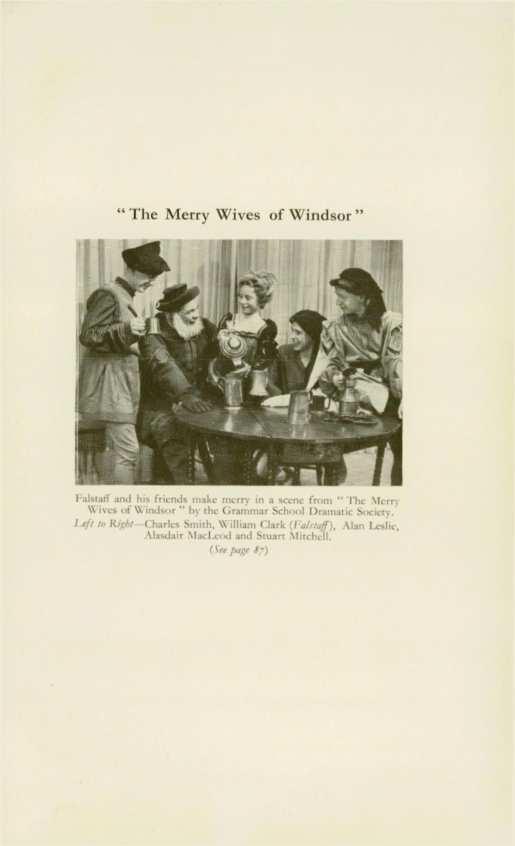
Iul,tatf and his friends l'l'lhc mc.:rn 1n a scene from •· f'h< \tern \\ l\t:S of\\ indsor" h, 1hc Cr,1111mar School Drat iatic !:,ocict~.
I .t/1 to Rtt.hl Chari<:, !:,1 •1h. \\ ill 111 rlark (/ a f , \ 11 !..<:site, \l,"da,r \J.,d .L·nd ,md !:>mart \lirchdl, (\eepair J-)
F.P. Hockey XI- 1959-1960
(" ho lost onl} :i gam es in the whole scason-rrr P.,.s< 126)
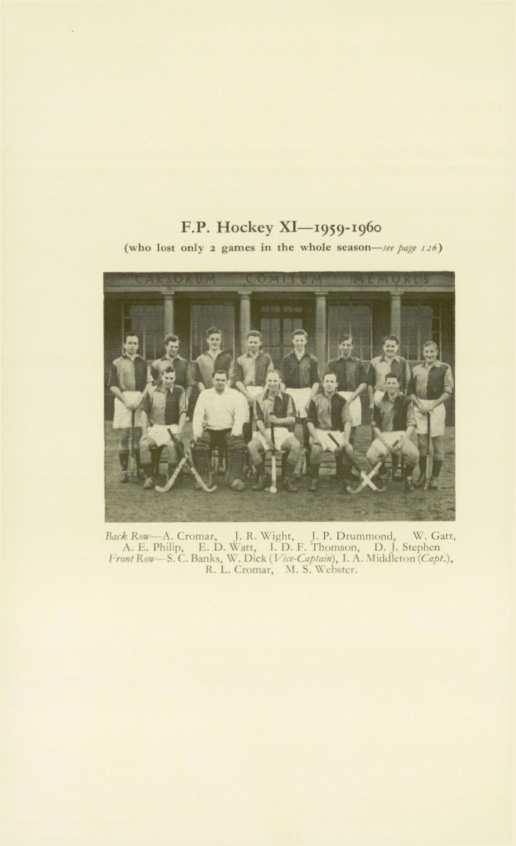
/l,1r.k J{,,u \. Cro111;1r, J. R. \\ 1ghr, _I. P. Drumn1<,nJ, \\. Gan, ,\. I~. l'h1l1p, I·. D. \\ au, I. D. I. Th11111,1111, D. J. Sr<:.-,hcn I ro111 Roii :,,._(. B.mks. \\. I) ck ( I 1rt-Cap1~ "l• I. \ \J1ddlcr,>n Capl.J, R. L. ( rom:,r, \I. S. \\ chsrcr.
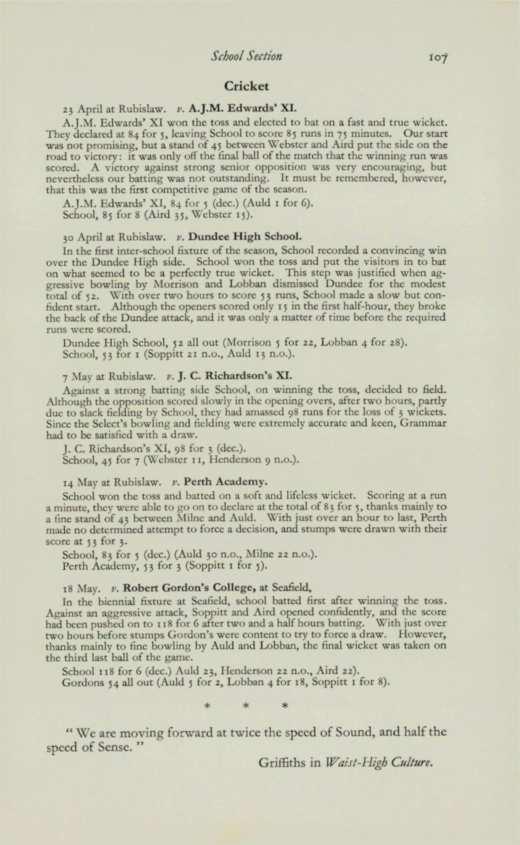
SchoolSection
Cricket
23 April at Rubislaw. 11. A.J.M. Edwards' XI.
A.J..\L Edwards' XI won the toss and elected to bat on a fast and true wicket . They dcclaroo at 84 for 5, leaving School co score 85 runs in 75 minutes. Our start was not promising, hue a stand of 45 between \X'ebsccr and Aird put the side on the road co victory: it was only off cbe final ball of the match that the winning run was scored. A victory against strong senior opposition was very encouraging, but nevertheless our batting was not outstanding. It mu,t be remembered, howe,·er, that this was the first competitive game of the season.
A.J .\L Edwards' XI, 84 for 5 (dee ) (Auld 1 for 6). School, 85 for 8 (Ami 35, \X'cbsccr15).
30 April at Rubislaw. 11. Dund ee High School
In the first inter-school fixture of the season, School rccordoo a convincing wm over the Dundee High side. School won the toss and put the visitors in to bat on what seemed to be a perfectly true wicket. This step was justified when aggressi,·e bowling by Morrison and Lobban disrnissc<l Dundee for the modest cotal of 52. \\'ith over two hours to score 53 runs, School made a slow but confident start Although the openers scored only t j in the first half-hour, they broke the back of the Dundee atcack, and it was onl>•a matter of time before the required runs were scored.
Dundee IIigh School, p all out (Morrison j for 22, Lobban 4 for 28).
School, j 3 for 1 (Sopp1tt 21 n.o., Auld 13 n.o.).
7 .\lay at Rubislaw. v. J. C Richardson's XI.
Ag:unst a strong batnng side School, on winning the toss, decided co field. Although the opposition scored slowly in the opening overs, after two hours, partly Jue to slack ticlding by School, they had amassed 98 runs for the loss of 3 wickets. Since the Select's bowling and fidding were extremely accurate and keen, Grammar had to be satisfied with a draw.
]. C. Richardson's XI, 98 for 3 (dee.).
School, 45 for 7 (\\,cbsccr 11, Jlcndcrson 9 n.o.).
14 \lay at Rubislaw. ,, Perth Acadcm)',
School won the toss and batted on a soft and lifeless wicket. Scoring at a run a minute, they were able to go on to declare at the total of 83 for j, thanks mainly to a fine stand of 43 between .\hlnc and Auld. \Vich just over an bour to last, Perth made no determined attempt to force a decision, and stumps were drawn with their ~core at 53 for 3.
School, 83 for j (dee.) (Auld 30 n.o., ~Iilne 22 n.o.). Perth Academy, 53 for 3 (Soppitt 1 for 5).
18 \lay. i·. Robert Gordon's College, at Sealield, In the biennial £ixrurc at Scafield, school batted first after winning the toss. Against an aggressive attack, Soppitc and Aird opened confidently, and the score had been pushed on to 118 for 6 after rwo and a half hours batting. With just o,er two hours before stumps Gordon's were content 10 try co force a draw. However , thanks mainly to fine bowling by Auld and Lobban, the final wicket was caken on the third last ball of the game.
School 118 for 6 (dee.) Auld 23, Henderson 22 n.o., Aird 22).
Gordons 54 all out (Auld j for 2, Lobban 4 for 18, Soppitt t for 8).
* * *
"We arc moving forward ac twice the speed of Sound, and half the speed of Sense. "
Griffiths in WaiJt-HighCulture
Swimming
In this year's gala, .l\lclvin soon c,,cablishe<la lead, thanks mainly to the fine swimming ofthe Abrioux brothers of rhe Lower School. Both Byron and Dun then challenged their superiority, bur ne,·erthclcss \felvin eventually won the Gala by a safe margin of eight points.
Although Keith came m fourth and last, it was they who produced the winner of the Rector's Cup, namely Andrew Leach, of the fourth year. The Middle and Lower School Champions, George \'\;·'ilson and .\tare Ahrinux respectively, were both from \leh·in.
R. PATERSON, Captain G. RErn, Viet-Captain
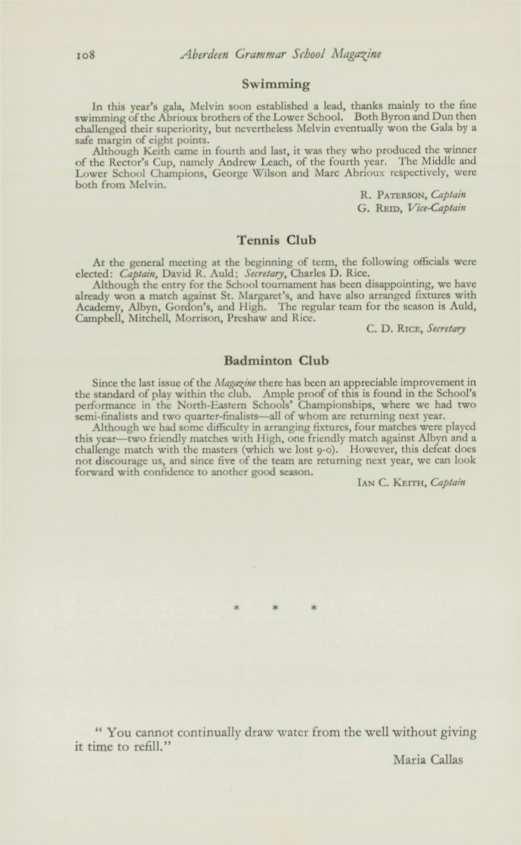
Tennis Club
At the general meeting at the beginning of term, the following officials were elected: Captain, David R. Auld; Sttrtlary, Charles D. Rice.
Although the entry for the School tournament has been disappointing, we have already won a match a1-,.-ainstSt \largarct's, and ha.-c also arranged fixru.rcswith Acac.lemy , Albyn, Gordon's, and High. The regular team for the season is Auld, Campbell, Mitchell, Morrison, Preshaw and Rice.
C. D. Rrcl', Secrttary
Badminton Club
Since the last issue of the Afaiaz/11ethere has been an appreciable improvement in the standard of play withm the club Ample proof of this is found in the School's performance in the Nonh-Eastcm Schools' Championships, where we had two semi-finalises and two quarter-finalists-all of whom are returning next year.
Although we haJ some difficulty in arranging fixtures, four matches were played this year-two friendly nutches with lJigh, one friendly match against Albyn and a challenge match with the masters (which we lost 9-0). However, this defeat docs not discourage us, and since five of the team are returning next year, we can look forward with confidence to another good season.
IAN C. Krrn, , Captain
" You cannot continually draw water from the well without giving it time to refill."
:\IariaCallas
The School Sports
On both Friday and Saturday 10 and 11 June there was a large attendance of p,uents and friends at Rubislaw tO watch the School Sports. On Fnday the threat of rain from massing clouds came.:to nothing; but on Saturday a lengthy interlude of some thunder, a little lightning and a heavy downpour of rain seemed as if it might quite wreck the programme. But this passed, the sun shone warmly again and the meeting was satisfactorily complt:tcd.
Keith continued its run of sccccsscs m the House Championship Competition; it wasalways in the lead and ran out more than 50 points ahead of \lelvin, the runnerup.
A number of new record s were set up. Outstanding was the achievement of Andrew Leach who broke existing records in four events and also helped Keith House co break the existing Group 2 Relay record.
The following new records were set up:
Group 2: 100 yards: A. Leach-10 •5 sec.
220 yards: A. Leach-23•7 sec.
440 yards: A. Leach-54 sec.
Hurdles: A. Lcach-12 ·3 sec.
Relay: Keith Housc-1 min. 14•7sec.
Group 3: 880 yards: G. :1\fclnrosh- 2 min. 18•5 sec.
Relay- Byron House equalled the record 5r6 sec.
Group 5: 80 yards: G. Davidson - 10·1 sec.
Relay: Keith House- -58 7 sec.
The Inter-House Champi onship : (1) Kcith-169½ points. (2') Melvin-II6 points.
Individual Champion ship Results :
Group 1: M. bdwards (.\Iclvin) 1 points.
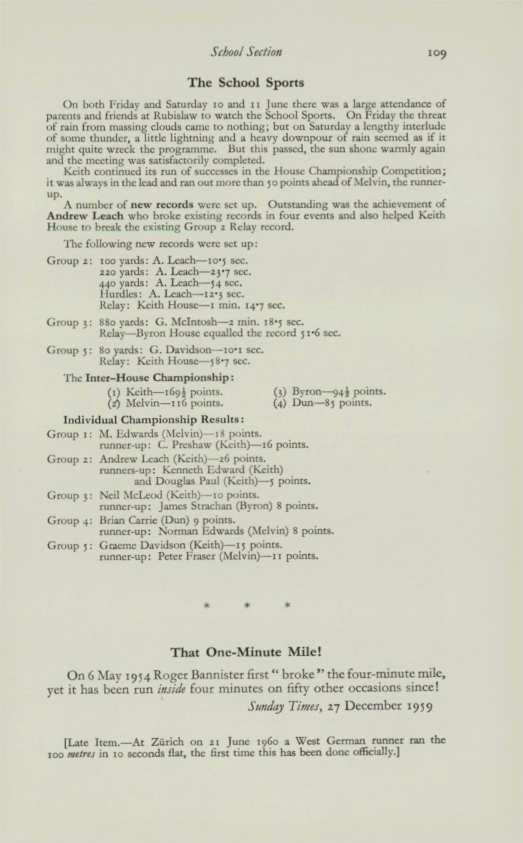
(3) Byron-94 ! points. (4) Dun- 85 points.
runnt:r up: C. Prcshaw (Kcith)- 16 points.
Group 2: Andrew Leach (Keith) 26 points.
runners-up: Kenneth Edward (Keith) and Dougla.~Paul (Kmh)-5 points.
Group 3: l\.eil \IcLeod (Keith) 10 points.
runner-up: James Strachan (Byron) 8 points.
Group 4: Bnan Carrie (Dun) 9 points runner-up: Norman Edwards (\[clvin) 8 points.
Group 5: Graeme D,n·idson (Keith)-15 points. runner-up: Peter Fraser (Melvin)-t I points
That One-Minute Mile!
On 6 May 1954 Roger Bannister first" broke" the four-minute mile, yet it has been run insidefour minutes on fifty other occasions sinceI S1111dayTimes, 2.7 December 1959
[Late Itcm.-At Zurich on 21 June 196o a West German runner ran the 100 1t1tlrtJ in 10 seconds flat, the first time this has been done officially.)
The Torchec
Literary Section
.Flickering flames in the gathering shades, Swarthy/irates, dusky maids, llighlan chiefs with gleanung blades: The Torcher's on its way.
Capering clowns, the smdl of tar, Prancing horses, sounds of war, Citizens from near and far: The Torcher goes its way.
Rattling cans, running feet, Rumbling vans, the drum's beat, Throw your money into the sheet; The Torcher's gone away.
JAMt.s KEITH sn.wART, Mid. r.s
Space Dream
One night I dreamt, while in my bed, That l was up in space, Speeding through the heavens, First of the human race.
On and on through space I went Toward the brilliant stars I paid a call on Jupiter, And had a look at Mars.
And as I left for home again In the sun's rays glowing red I made a bad crash landingFor I'd fallen out of bed.
DAVID
Modern Poetry
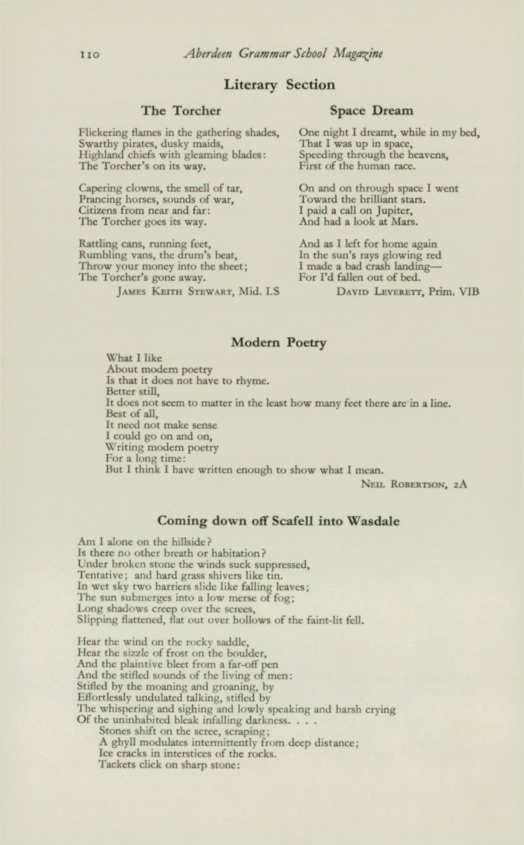
LEYFRETT, Prim. VIB
\XibatI like
About modem poetry Is that it does not have to rhyme. Better s11ll, lt docs not seem to matter in the least how many feet there are in a line Best of all, It need not make sense I could go on and on, Writing modem poetry For a long time: Bue 1 think I have written enough to show what [ mL-an.
NuL ROBERTSON, zA
Coming down off Scafell into Wasdale
Am I alone on the hillside? ls there no other breath or habitation? Lndcr brohn stone the winds suck suppressed, Tentative; anti hard grass shivers like 11n. Jn wet sky two harriers slide like falling leaves; The sun submerges into a low merse of fog; .Long shadou s creep over the screes, Slipping flattened, flat out over hollows of the faint-He fell.
Hear the wind on the n>ckvsaddle, Hear the sizzle of frost on the boulder, And the plaintive bleet from a far-off pen And the stifled sounds of the living of men: S11tledby the moaning and groaning, hy Effortlessly undulated talking, stifled by The whispering and sighing and lowly speaking and harsh crying Of the uninhabited bleak infalling darkness.... Stones shift on the scree, scraping, A ghyll m<;><I~tesintermittently from deep distance; Ice cracks in interstices of the rocks.
Tackets click on sharp stone:
SchoolSection I II
Wasdalehead, when the crofter clatters a bucket at the farmyard tapMetal on metal, steel on iron from the dim knot of buildings in the blue-grey 6clds\v'asdalehew is far away \X'ith Wastwater's indigo splash in the great rut of the valley.
Two thousand feet. Somewhere, Somewhere below in the dale trees an owl quavers, llesieating faiody over uncertain notes: Look up.
Out over Styhcad, majestically walking imo sight, llright like a Harnein the firmament, Big like a lamp off the hillside Vega bursts from the north, And the depth of the night is unfurled. All is very still.
The heavens declare the glory of God, And the firmament showeth his handiwork. Day unto day uttereth speech And night unto night sboweth knowledge. Their line is gone out through all the eanh And their words to the end of the world.
Four-Thirty
I woke at dawn the other morning: Four-thirty, when it was neither light nor dark, When the sky was quite colourless, Perhaps slightly darker in the west.
In the cast, above the silhouette of the city, Silver more than any other shade, translucent,
A. WYLLIE, Upptr
V
\Vith one or two flecks of cloud, dark and clear cut: All very still- no sound but the sulky silence of the city. Waking birds singing in harmonious discord, Thrilling liquid arpeggios like a mountain stream As it flows over its grave l bed- tremulous
Dut somehow joyful, and very sure of itself.
And then the peace of the velvety spring air was tom apart As a train climbing north slipped on the wet rails: A motor-bike started somewhere: the neighbour's washing, Hanging limp sad on the line, became very sordid. Suddenly I shivered in the cold of the dawn.
The spell was broken and the morning became harsh and grey, Forbidding, almost repellent.
C.
D. RICE, Upptr VI
The Sir James Robertson Prize
Our hope that the initiation of this award would stimulate boys to write for the Magazinehas been fully justified. What has appeared in print in this and the previous Magazine is only a selection of what was received, and we hope that as time goes on we shall continue to receive and to print contributi ons of comparable quality. It has not been easy to decide who should receive the prizes; after much consideration the selecting panel decided that they should go to Andrew D. H. Wyllie of Upper V and to Robin Cook of Middle II.
Rugby-Anti-Rugby
There is Art with its masters and as cult, with Its fervent admirers and eloquent minstrels, who sing of its glories from book to book and archive to archi,c. Hut there is also .Anti-an. It too has its masters led by :\larcel Duchamp and a tailwagging donkey, aided and abetted by certain nameless Grammarians.
There is also anti-matter, but scientists arc wa1tin~ tu decide what matter is before they sav what anti-matter can be.
IIowever, there exists much nearer home something which affects Grammarians for more than anti-art or anti-matter and that is dare I mention it?-anti-rugby. This is a trend which is often found embodied in the individual. The symptoms of a person suffering from anti-rugbyism can usually be seen very easily. Such a person will hang on the edge of the fray and tackle nothing but the empty air a safe distance behind his quarry. Such a person will give the ball a wide berth and handle it as if it were molten lead.
How then do these bravadocs succeed tn maintaining their position in a merely moderately poor team? The answer is simple. The .tirstrule to he obserrcd is the shouting oforders at alland sundry. Anti-rugbyists always give more superfluous instructions than any orher on the field. The second is never to rise up immcd1atclr should you he unforrunate enough to betrcxldcn into the ground. Writhe and !:(roan and scream until someone ob'\Crvcsyour dire plight. It issurprising how even afaked injury can boost a player in the estimation ofhis comrades. The drawing of blood is the ultimate, although painful, accomplishment and can compensate for a game in which the hall has ne,-er been touched.
Despite these allowances the anti-rugbyist never l<,sessight of the golden ruk,
"He who promptly passes away, Lives co play another day."
Strange as it may sound, anti•rugbvism is also subtly embedded in the laws of rugby, itself. f'or example, the law of ncYcr passinl,(forward is devised to defeat the object of the game. If you wish to get the hall to A, who is in front of you, the sane thing would be to pass the hall to A and not to B, behind you, who has to run in front of A before passing. There is also the stratagem of constant kickin,11; into touch, thereby bringing the game to a hair at every opportunity.
Should the former rule be extended I foresee the day when we shall be pcnnittcd only to run backwards, kick b:ickwards, and eventually finish up scoring a try over one's own line. This would be the vcn· summit of anti-rugbyism. Surely then it were better that Rubislaw f'icld lay at the bottom of Rubislaw Quarry.
ROBlN
Sir Roger at the Dentist
UX)K :\f. HA
RodiIv Pain is of two kinds, either that to which one 1ssubmitted in the course of illness and disease, or that which one must endure co effect the eradication of the aforementioned pain. A man must needs bear the latter form of pain unless he would wish the former to continue.
I am engaged in these speculations on account ofan occurrence which befell me last month and which I shall gi,e my reader an account ofat large. In the course of my frequent visits to mv good friend Sir Roger'.rcountry seat, I was aroused from my nocturnal meditations by a series of sorrou·ful groans proceeding from mine llost's hcdehambcr. On inquiry 1 found my friend in the throes of a most dire toothache, When neither \fn/1 lr'hilt'.r rhubarb paste nor red flannel and mustard had effected any amelioration in my friend's condition, a visit to the dentist was decided upon for the next day.
The following morning discovered Sir Roger, supported by his trusty, faithful retainer and myself, seated in the waitini:t-room of Dortor Toothpull. On perusing some maj:!azincson a table, my friend declared that the dress and equipage of certain ladies within their glossy conrs showed , ice and folly in abundance, and that the publisher of such outrageous literature should be prosecuted. At this juncture a young child entered, emitting, amidst loud howls of grief, several

SchoolSection
protestations of extreme an~uish. ::\[yfriend produced from his pocket a bag full of Da,11e Green's comfits, with which he was wont to assuage the grief, whether genuine or counterfeit, of any urchin who crossed his path.
The comely secreta.rynow announced that it was Sir Roger's tum to consult the physician, and we three repaired to the surgery. Sir Roger was greatly impressed by an intri~ing piece of equipment, the dental chair, and exhibited great pleasure in causing 1t to nse and fall alternately. l le ne~t glimpsed the goblet of coloured mouth-water, an<l proceeded to imbibe its disinfected contents, affirming he had not partaken of such E.-iu-de-viesince he last had occasion to dine with Sir Andrew. The erudite doctor now desired of his patient whether he wished the use of gas or the prick of an hypodermic needle. At first Sir Roger would have none of the latter, for, as he said, it might ferment the humours and cast them out of their proper channels, but I took up the cause of this form of pain-deadener, for I conJecrured that the other might cause an unsteadiness in the gait of the knight, which the widow might perchance attribute to a state of inebrianon . \'Chile we waited for the physic to take effect, my friend indulged in much engaging conversation. Ile affirmed that the many-drawered receptacle would make a perfect receptacle for TVi/1 W'imble'sflies, and compared Dr. Toothpull's fine white hands to those of the widow," who", he observed," had the finest hand of any \X'oman in the \X'orld ". He noted with much satisfaction that the eminent surgeon's tools were of Swedish manufacrure, and remarked that this manifestation of Pree Trade would much please Sir Andrew. Eventua lly, when the reason for our visit had been removed, Sir Roger asked if he might retain the objL-ct,which he had lately been so desirous of having rcmo, ed, as a souvenir.
::\Iyworthy friend wished co settle the reckoning there and then, and, on being told that it cost but one ~ inea, and chat heowed the small charge to a \~'big reform, viz. The Xational IJcalrh Scheme, he resolved to congratulate Captain Sentry most heartilr at his next attendance at the Club. The knight, in great glee, descended to his wrutmg carriage, still praising the National Health System he had made use of. I was Yerywell pleased with this display of !(mtitude in my friend on this novel and somewhat alarming occasion, and should be still more pleased if the horror at the thought of a ,·isit to the dentist were to disappear, and with it a quick end to all quackeries such as \ loll White's rhubarb paste and red flannel.
Ai AN Rl'TD, Upper IV 2.
A Sahara in Miniature
.\lent ion the Sands ofForvie to the man-in-the-street, and if he is, or has been a soldier, he will immediately recall it as having been an army practising area during the ,,,.ar. The Sands were recently made into a narure reserve, so that the other man-in-the-street when asked the same question will respond, "Ah yes! that was the place where two boys were caught stealing terns' eggs". Quite so, but be· ncath its ever-shifting mask of sand, Forvie hides and preserves objects akin neither to mortar-bombs nor the eggs of terns and eider-ducks .
.\1an is always following something, whether he be following the instructions in the current issue of" The Handyman ", or his father's footsteps; indeed to live successfully he must follow. After the last ice-~e, when the ice bad started to recede, all species of herbivorous animals followed the ice in the perpetual search for food. :\fan likewise in his pcrpuual search for food followed the deer and the elk. But 1'ature seemed to forbid it, and to impede the progress of man she started making trees grow. Trees-hundreds of them, nay thousands of them, started cropping up all over Scotland, until our forebears were forced to keep to the coast and the margins of the rivers.
An ideal place for these .\lcsohthtc peoples llJ ~crtle was the mouth of Ihe River Ythan, an area fruitful u·ith fish, wildfowl, lesser game, and a few miles to the north the most important factor, an abundant supply of flint for making artifacts such as arrow and lance-heads, scrapers, borer~ and chisels for removing limpets from the rocks. These objects are to be frequently found lying among the sand.
As one generation disappeared, another followed it, till at Forvie the Iron Age succoedcd the Stone Era. To be seen at Forvie arc two but-circles pf this period,
but there arc probably manv more entombed beneath the sand. Did the Romans traverse the Sands ofForvie 1n their unsuccessful Scottish journey, or more probably did Roman influence just reach the area? This question was born when a friend of mine found a Roman fibula brooch at the Sands.
Time winged on, Christianity came to Scotland, and a church was erected. Qutte a small church, but sufficient for a community which appeared to be slowly decreasing because the sand had started coencroach upon the small fields and houses, one by one, until in August 1413, according to one authority, or in 1688 to another , a fierce gale blew up which quickly tammated the slow work started by the sands This ~ale lasted for nine days, chokmg, blinding, smothering, entombing e"crything in the area. \X'hen it had abated, instead of a church, people, houses and anim,1ls, 1hcrc lay, with a guiltk"Sslook upon its face, a new shroud of sand, covering an old corpse. Pares of this shroud hne been removed by subsequent gales to display the gaunt walls of the parish church, which may at this moment be again half-buried in the dust.
According to an old legend, the storm arose by the hand of God to avenge an act of treachery Early in 1413 the proprietor of Fon·ie died and left the estate to his three daughters But because they were under age the estate was put under the temporary care ofa brother. This brother wasdesirous ofFon·ie, and so hemanaged to get his three sisters onto an old lcakv ship which, after it had gone a few miles from the coast, broke up and sank, drowning all the people on board. But before the ship bad gone down, the three sisters prayed that their deaths might be a\cnged . Thus, says the legend, the storm arose, burying Forvie, bnck and brother, who, feasting in his small private tower, was drunk and incapable of escaping.
" If ever the maiden's 1nalison Did licht upon dry land, Let nocht be found in Forrie's glebcs, Bot thistle, bent and sandl "
ERIC GRANT, Middl, III A
Save my Hair
Somehow I have never had much success with hairdressers. Thev never seem to cut my hair ,·cry well. Not that 1want a Perry Como, Yu! Brynner or any other foreign import. I simply want an honest to goodness Peter Stewart. Perhaps if I were to ask for a Perry Como I would have more luck as the barber would at least h:t\'C 1he prototype co work from; hut l don't like Perry Como or his hair, and anyway to have your hair" styled "costs more. \Vhat I want is a little off the top, a little of! the sides and then my hill.
1bc trouble with havinit a haircut is that when I sec the barber shaving straight up the back and sidu Idon't like to say anything. After all he has the scissors and goodness knows what he would do if I were to annoy him. One angry stroke with his shaver and I might have a path across my head rather reminiscent ofthe l\l 1. (An interesting effect but not quite " me ".)
No! The only thing to do is to find a barber who is capable of pruning my hair l ha, c not yet succeeded in doing this but I live in hope
Perhaps I should tell you what exactly happens to me when the barber starts to work. I don't know whether I look as if l'm not going to gh e him a tip but he really does mutilate my appearance. In the first thrill of the kill he shaves away all round the base, then, becoming more tired, he becomes more subtle. A chop here, a chop there, all carefully engineered to make the unchopped areas stand on end. 'ow comes the death blow. He leaves an enormous " wollup" of hair at the front. \\ here co put 1t l do not know. The easiest thing to do would be to chop it off -.·hen 1 reach home hut I ha,·e nc, er had the courage.
1be result of all this is that I pretty nearly have to hide myself away afta havmg a hair-cut until my hair has grown again.
Someone, anyone, PLEASE tell me where I can have my hair cut proper!}.
PETLR Sn WART, M,dd/, Ill A
House on the Moor
It was about 10.30 p.m when I saw the deserted house on the moor. The door of the house hung crazily on one creaking hinge which secmt:d to give the house a voice. No window pane was intact as far as my torch could make out. The walls, once white-washed, were covered in dead i\'y. A terrible feeling of loneliness came upon me. l felt as though the huge black trees which loomed menacingly behind me were watching waiting.
I wanted to run from the horrible place but the boulders which seemed to encircle me looked so formidable, as though they were imprisoning me.
Fur what seemed hke eternity I stood tern.tied and horrified. At last 1 could not bear it any longer. The feeling of loneliness ... real loneliness was dnvtng me insane. Everything was silent, dead. 1'.othang stirred or broke the deathly silence. Even the door was quiet. I tried to run but I stood frozen to the ground, hypnotized by the eerie silence. '.\ly mind began to wander. In my delirium I could sec the house disappear into the darkness.
Next morning I found myself lying on the moor, shivering and sweating. l thought l had dreamed it all. Theo I saw an old, rusty hinge
LAWRFSCE BARRO>I , PrimaryVII B
Dawn
As I watched, the pure blackness of the night faded, and the stars paled. A slight breeze rose, playmg over the ngging, but barely audible above the sound of the water under our bows.
The east wok on a rosy tinge, feeling with bright fingers across the sky, and, as 1 watched, it grew visibly brighter, the golden colour turnin!,(to a deep copper.
The foremast could be seen silhouetted against the brightening horizon.
Then the sun rose, paving-a golden path across the sea, and it was <la},
ROBLRT CRAIG, Primary VII B
Night
Slowly the darkness de~ccnded as if a great bird had gradually spread its wings over the golden ball of fire that shone brightly down upon us by day. On the moor all was pitch black, nothing mm•ed except a mouse which scurried from a ditch to a ripening field of corn The world was enveloped by inky blackness and a str.inge unearthly silence. Suddenly silver beams penetrated the darkness as the sihc:ry maiden who rules the ni'1;htemerged from behind a dark, foreboding cloud. Soon her subjects, the stars, appeared from their hiding placesto twinkle down upon the earth. An owl hooted, its low mdanchuly tone adding to the ghostlike stillness of the night. A pheasant stirred uneasily in its sleep as a fox, out hunting, padded softly by Later the first streaks of dawn appeared, the moon and stars vanished. The night was over.
PETP.R rRASFR, Primary VII B
(End of Literary Section)
" The people who impress one as possessing most the gift of happiness are those who have measured desires and ambitions against possibilities and have come to terms with life. They make the most of what life bring s to them and in consequence get the most out of it. They have learned the art of inward content, which is perhaps one of the most difficult arts to master, and their reward is happiness."
Dr. Sidney M. Berry
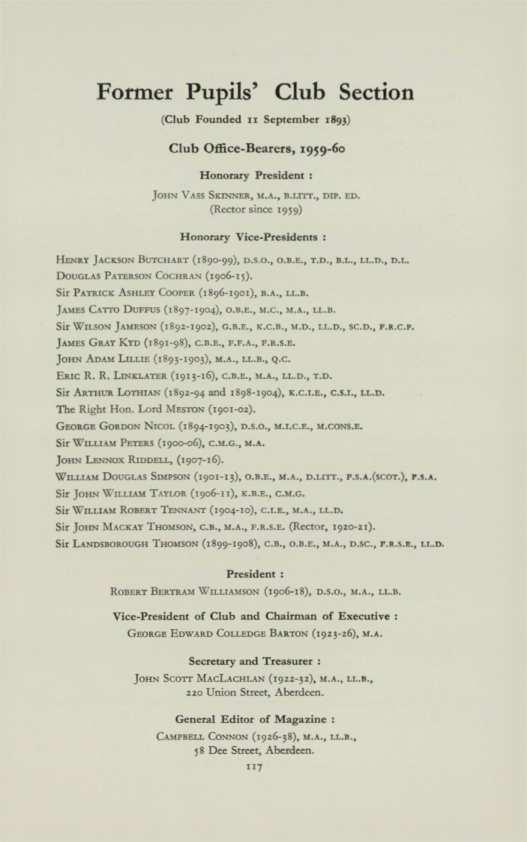
Former Pupils' Club Section
(Club Founded u September 1 893)
Club Office-Bearers, 1959-6o
H onoraty President :
JOHN VASS SKTh"'NER, M.A., B.LITT., DrP. I'D. (Rector since 1959)
H onorary Vice-Pre sidents
l l£NRY JACKSON BUTCIIART (1890-99), D.S.O., O B.ll., T.D., D.L., LL.D., D.L.
0oUGLAS PATERSON CocHRA::-1 (1906-15)
Sir PATRICK ASIILllY CooPER (1896-190 1), B.A., LL.D.
]AMES CATTO DUFFUS (1897-1904), O B.E., M.C , M.A., LL.B.
Sir W'1Lsos JAME.SON (1892-1902), G.B.E., K.c 11., M.D., LL.D., sc.D. , P.R.C.P
JAMES GRAY KYD (1891-98), C B.E., P F.A , F.R.S.E.
JOHN ADAM LILLIE (1893-1903), M.A., LL.B., Q.C.
ERIC R.R. LINKLATER (1913-16), C.B.E., M A., LL.D., T.D
Sir ARnWR LoTH1AN ( 1892-94 and 1898- 1904), ic.c.1.e., c.s.r., LL.D.
The Right Hon. Lord MESTON (1901-02).
GEORGE GORDON NICOL (1894-t903), D.S.O., M.I.C.E., M.CONS.E.
Sir WILLIAM PBTERS (r900-06), c.!>I.G., ~1.A.
JOHN LENNOX RIDDELL, (t907-16).
WILLIAM DOUGLAS SnrPSO"I ( 1901-t3), O.B.E., M.A., D.LlTT., P.S.A.(S COT.), P.S,A.
Sir JoHN \X'rLLIAM TAYI-OR {t9o6-n), K.B.F'., C.M.G.
Sir WILLIAM ROBERT TENN.A.!',, (t904-ro), C.I.E., M.A., LL.D
Sir Jo,m MACKAY THOMSON, c.e., M.A., P,R.S.E , (Rector, 1920-21).
Sir LA.'IDSBOROUGH THOllSON (1899-1908), C.B , O.B.E., M.A., D.SC., P.I\.S.t!., LL.O
President :
ROBER'I' BERTRAM WILLIAMSON (1906 - 18), D s.o., M A , LL,B.
Vice-Presiden t of Club and Chairman of Executive :
GEORGE EDWARD COLLEDGE B ARTOS (t9 23-26), lf.A,
Secretary and Treasurer :
JOHN SCOTT MACLACHLAN ( t 922-32), M.A., LL.ll. , zzo Union Street, Aberdeen.
General Editor of Magazine :
CAMPBELL CoNN0::-1 (1926-38), M.A., LL,11,, 58 Dee Street, Aberdeen.
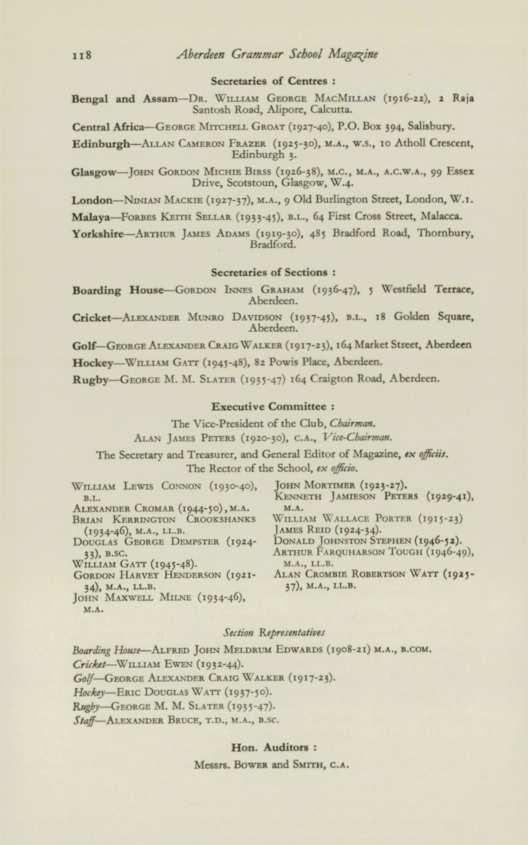
Aberdeen Grammar School Magazine
Secretaries of Centres :
Bengal and Assam -DR. WILLIAM GEORGE 1'1AcM1LLAN (1916-22), 2 Raja Santosh Road, Alipore, Calcut ta.
Central Africa -GEORGE l\hTCHELL GROAT (1927-40), P.O. Bo:r 394, Salisbury. E dinburgh -ALLAN CAMERON FRAZER (1925-30), t.A., w.s., 10 Atholl Crescent, Edinburgh 3.
Glasgow-JOHN GoROON MtcHre BIRSS (1926-38), M C., M.A., A.C.W.A., 99 Essex Drive, Scotstoun, Glasgow, W.4.
London -NINIAN l\iAcKm (1927-37), M.A., 9 Old Burlington Street, London , W.1.
Malaya -FORBES KEITH SELLAR (1933-45), B.L., 64 First Cross Street, .Malace a Y orkshirc--ARTHUR J~ti;s ADAMS (1919-30), 485 Bradford Road, Thornbu ry, Bradfor d
Secretari es of Sections :
Boarding Housc--GoRDON INNES GRAHAM (1936-47), 5 Westfield T errace, Aberdeen.
Cricket - ALEXA.'IDER ~fUNRO D AVIDSON (1937 -45), B.L., 18 Golden Square, Aberdeen.
Golf-GEORGE ALEXANDER CRAIG WALKER (1917-23), 164 Market Street, .Aberdeen Hocke y-WILLIAM GATT (1945-48), 82 Powis Pia.cc, Aberdeen.
Rugby-GEORGE M. M. SLATER (1935-47) 164 Craig ton Road, Aberdeen.
Executive Committee :
1be Vice-President of the Club, Chairman. AL!,c."I JAMES PETERS (1920-30), C.A , Vic1-Chair111an.
The Secretary and Treasurer, and General Edito r of Magazine, ,x oj/friis T he Rector of the School, ex oj/i,io.
WILLIAM LEWIS CO:S"NON (1930-40), JOHN MORTIMER (1923-27)
B,L. Ki!NNI!T II JAMIESON PETERS (1929-41), ALEXANDER CROMAR (1944-50), M.A. M.A. BRIAN KFRRrNGTON CROOKSIIANKS \'1/tLLIAM WALLACE PORT! R (1915-23) (1934-46), M.A., LL.B. JAMES REID (1924-34). DOUGLAS GEORGE DIDrPSTER (1924- DONALD JOHNSTONSTEPHEN (1946-52) 33), B.SC ARTHUR l:-'ARQU!IARSONTOUGH (1946-49), W tLLIAl,I GA'l"T (1945-48). M.A , LL.B. GORDON IIARVBY HENDERSON (1921- ALAN CROMBIE ROBERTSON W A'l"T (192534), M.A., LL.D. 37), M.A., LL,B JOUN MAXWELL M.!LNB (1934-46), M.A.
Sttlion Reprntnlati11u
&arding Ho1m-- ALFPJID Jom~ MJ'l.DRtn { EDWARDS (1908 -21) ,, .A., a.co,, Cric.l:lt-W1LLIAM. EWEN (1932-44).
G<>/f-GEORGE Al.r.xANDER CRAIG \X1ALKER (1917-23).
H«hy-ERtc DouGLAS WATT (1937-50)
Rpg~EORGE M. M. SLATER (1935-47).
Staff- ALEXANDER BRUCE, T.D., )!.A., B.SC.
H oo Audit ors : Messrs. BoWER and Su ITH, c.A.
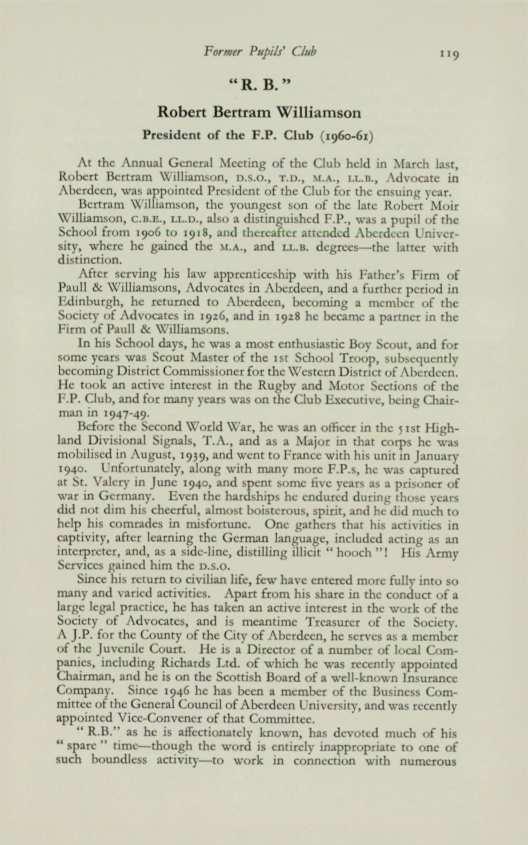
"R. B. ,,
Robert Bertram Williamson President of the F.P. Club (1960-61)
At the Annual General Meeting of the Club held in March iast, Robert Bertram \'v'illiamson, o.s.o., T.O., \I.A., LL.n., \d,·ocate in Aberdeen, was appointed President of the Club for the ensuing year. Bertram Williamson, the youngest son of the late Robert Moir Williamson, c.n.E., LL.D., also a distinguished F.P., was a pupil of the School from 1906 to 1918, and thereafter attended Aberdccn CniYersity, where he gained the 1f.A., and LL.B. degrees-the latter with distinction.
After serving his law apprenticeship with his Father's Firm of Paull & \'v'illiamsons, Advocates in Aberdeen, and a further period in Edinburgh, he retu.i:ned to Aberdeen , becoming a member of the Society of Advocates in 1926, and in 1928 he became a partner in the Firm of Paull & Williamsons.
In his School days, he was a most enthusiastic Boy Scout, and for some years was Scout l\laster of the 1st School Troop, subsequently becoming District Commissioner for the Western District ofAberdeen. He took an active interest in the Rugby and :Motor Sections of the F.P. Club, and for many years was on the Club Execuri, ·e, being Chairman in 1947-49.
Before the Second World War, he was an officer in the 51st Highland Divisional Signals, T.A., and as a Major in that corps he was mobilised in August, 1939, and went to France with his unit m January 1940. Cnfortunately, along with many more F.P.s, he was captured at St. Valery in June 1940, and spent some five years as a prisoner of war in Germany. Even the hardships he endured during those years did not dim his cheerful, almost boisterous, spirit, and he did much to help his comrades in mbfortune. One gathers that his activities in captivity, after learning the Germ.1n language, included acting as an interpr eter, and, as a side-line, distilling illicit "hooch "J His Army Services gained him the n.s.o.
Since his return to civilian life, few have entered more fully into so many and varied activities. Apart from his share in the conduct of a large legal practice, he has taken an active interest in the work of the Society of Advocates, and is meantime Treasurer of the Society. A J.P. for the County of the City of Aberdeen, he serves as a member of the Juvenile Court. He is a Director of a number of local Companies, including Richards Ltd. of which he was recently appointed Chairman, and he is on the Scottish Board of a well-known Insurance Company. Since 1946 he has been a member of the Business Committee ofthe General Council ofAberdeen l.,niversity, and was recently appointed Vice-Convener of that Committee.
"R.B." as he is affectionately known, has devottd much of his " spare " time-though the word is entirely inappropriate to one of such boundless activity- to work in connection with numerous
120 Aberdeen Gramn,ar School Magazine
charitable bodies: he is a Director and 1Ionorary Legal Advisor of Aberdetn Association ofSocial Service, and he serves on the Committee of Aberdeen Town & County Association for Teaching the Blind in their Homes, Dceford Home for Working Lads, etc.
Apart from these many and diverse activities, and all the others to which space docs not permit me to refer, our President has or had a number of Hobbies which he himself once stated to include Hillclimbing, Golf, Cine Photography, and Caravanning; and more recently I understand he has taken an active interest in Gardening, Bee-Keeping, and all forms of" Do-ic-yourself ".
Added to all these interests,-and perhaps accountable in no small measure for his success in so many and varied activities,-Bertram has a most approachable, genial, and kindly disposition, and I have no hesitation in saying that in appointing him to be President of our F.P. Club, we are honouring one who is most worthy to have his name added to the Roll of chose distinguished F.P.s on whom the Club has bestowed its highest honour.
School Trips to France 1924-32
A Rennes Re-Unio n-1961?
le is regretted that Dr. Cormack's comprehensive account of the above trips has again required to be held over, but he has written us an interesting account of" Renncs Rc,isited, 1960", narrating the main changes which struck him on , i~iting Rt·nnes after an absence of twenty-five years; unfortunately pressure of other material has prevented our incorporating this in this issue but (recalling the visits of Grammarians to that town in the 1920s) he wonders - " could we have a re-union in Rcnnes amid the apple blossom of 1961?"
Any Grammarians who participated in one of Dr. Cormack's French excursions and who would be interested in joining such a reunion should contact Dr. Cormack direct at "Dcnside ", Peterculter, Aberdeenshire.
Annual General Meeting, 1960
The Fifty-eighth Annual General Meeting ofthe Club was held in the Caledonian Hotel on 29 l\larch 1960, with Mr. Geo. E. C. Barton as Chairman.
Executive's Report for 19s9
The Secretary read the Report from which the following information is caken:-
Member ship and Subscriptions
The following is an analysis of the membership of the Club as at 28 february 1960 with compacable figures at 28 February 1959.

During the year the deaths of forty-three Former Pupils of whom twenty-three were Members of the Club, have been reported. They included four Former Presidents of the Club, Mr. Charles Davidson, Colonel Archer lrvine-Fortescue, Mr. A. G. Nicol Smith and Dr. Clark Souter.
Social
The Annual Dinner ofthe club was held in the Calcdonian Hotel on 30October when 15 Junior Members and 171 Semor l\lembers and Guests were present.
1be Annual Ball was held in the Beach Ballroom on Wednesday 2.3 December and attended by 78 Junior l\lembers and 368 Senior l\lembers and Guests
Swimm ing Pool
le has now been finally decided that a Swimming Pool will be provided for the School and no callis to be made on the Oub funds. le is understood that the School will be given full use of the pool at all times when required and that the Club will be given reasonable facilities if they so wish.
Magazine
The l\faga2ine continues to be published twice yearly although the expense of producing it is ever-increasing.
During the year Mr. Ian Shinnie had to give up duty as Editor of the Notes Section and the Executive recorded their appreciation of his work. We have been fortunate in obtaining i\lr. Brian K. Crookshanks to take over the duties.
Rector
Sir James J. Robertson retired in July and the Club presented him with his Portrait and Replica and a cheque. In return Sir James handed over a cheque for £100 to establish Prizes for contributions co the School Section of the Magaz_ine. The Trust Deed has been completed and the first awards will be given in June.
Sir James's successor, Mr. J. V. Skinner, has taken up his appointment and graciously accepted office as Honorary President of the Club. He attended the Parent Dinner ofthe Club and has also attended the Dinners ofthe London, Glasgow and Edinburgh Centres and has had an early opportunity of making contact with Club i\lembers throughout the country. The Executive assure him of full support at all times.
RECEIPTS
Ordinary Subscriptions received prior to January 1959. • Ordinary Subscriptions received in 1959
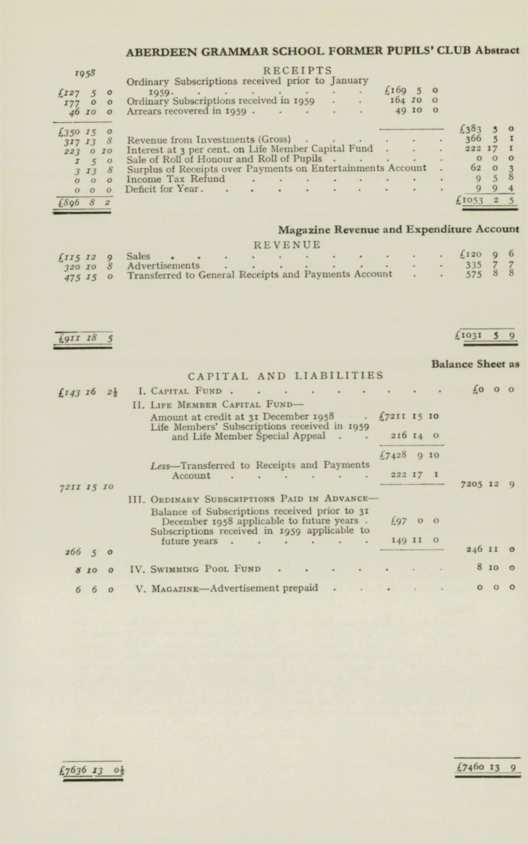
I. CAPITAL FUND .
II. LIFE MEMBER CAPITAL FUNDAmount at credit at 31
Ill. ORDINARY SunSCRIPTIONSPAID IN ADVANCEBalance of Subscriptions rccei,·ed prior to 31 Vecember 1958 apphcable to future years £97
Subscriptions received in 1959 apphcable to future years
of General Receipts and Payment, Account for year end.Ing 31 December 19,9 r958 PAYMENTS [ra6 r6 8 Working t:xpenses 5 I0 6 Income Tax, Schedule D, year 1959-6o . . Income Tax paid by deduction Lrom Investment r30 6 6 Income
Miscellaneous Expenses-llcdals, Capitation Grants, Club l.)e. II5 I3 a velopmcnt, etc.
475 I5 0 Transferr ed from Magazine Account . . . . r6 r6 II Depreciation on Addressograph Machine and cost of Plates 25 9 5 Surplus for year
year ending 31 December 19j 9 EXPENDITURE
£705 r7 r Cost of Printing 68 ra a Stock of .Envelopes as at 31 December 1958 . £35 16 II
9 8 Working Expenses and Honoraria to Editorial r73 6 r Committee
I5 4 35 I6 II £9rr 18 5
I. CASH 1s HAND ASD 1s INVESTED Fusos ~Iarket Value of Invested Funds as at 31 December, 1959
Ill. MAGAZINEStock of Envelopes in hand Cash in Hands of Editor
IV. ADDRl!SSOCRAPH~lACHINE-
AoERDl!l!N,18 February 1960.-We have examined the foregoing Accounts for the year coding 31 December 1959 and relative Balance Sheet as at 31 December 1959, compared the figures with the vouchers, and found the Accounts correct. \Ve aie of the opinion that the Balance Sheet correctly states the position of the Club as al 31 DeccmbeI 1959. We have bad exhibited to us the various Securities supporting the Funds al the close of the Accounts.
245 UNION STRl!l!T, ABERDl!ES.
BOWER & SMITH, C.A., Honorary Auditors.
Edinburgh Centre
The Annual Dinner of the l .d,nburgh Centre wa.~ held m the Roxburghe Ilotd on 8 January 1960. Major A. Douglas Spark, Pr~sident of the Centre, was in the Chair and tbe principal guest was the IIon. Lord Cameron. The Centre welcomed for the first time .\lr. J. \. Skinner, the Rector of the School. The Toast of" the School and the Club" was proposed by Lo1d Cameron and responded to by the Rector.
Lord Cameron said that it was an honour for one educated at a mere smpling like c<linburgh Academy to be asked to propose the toast of a school 700 years old. I!is thoughts turned co The ugmd of ,\[011/rose,m which Scott depicted the character of Dugald Dalgctt:y, who at the age of 18 left .\1anschal College with a certain amount of classical knowledge, some of which he must have acquired at Aberdeen Grammar School. The School had ht.-ar<l the pipes and drums of Prince Charles Edv.ar<l's army, and had ruso S<:en the Duke of Cumberland's. Kingdoms and Empires had flourished and collapsed, but the School had survi"<"edchem all. !\lore recently it had survi"<"ede, en a doctrinaire egalitarianism.
\'fhy was it that the School had flourished, and was flourishing to this <lay? Ile thought the reason must be chat its practice was 111 accordance with principles deeply rooted in the Scotti$h character-a fiercely democratic spirit, a concentration on accepted fundamentals, and a peculiarly Scottish love of learning The Scots had alwa}S insisted on the fundamental equality of all men; that was one nf the most sterling quruiues of our way oflife. The pattern of our cducacion was grounded in the classicrutradition, which had sulliced our need, for many ccnruncs, a tradition which cl1uated the ethical with the practical. l',;o school could survi\'e unless its curriculum balanced these two factors. To-day there was much unca.~inessabroad because of a feeling that the mould of education had been broken. J.ducation no longer fitted the needs of the modem scientific world. The aim and purpose of Education must be co train Scottish bo}·sto become men ofprobity ofoutlook and honour m thought and deed; I<"ers of wisdom and heauty, and conscious heritors and trustees of a living tradition, liberal in outlook and with an understanding affection for the land of their birth. '!bat purpose would not be achieved by the total sum:ndcr of the humanities before the demands of science and technology. ror that task there was no school better equipped than this northern foundation. The School was fortunate in its pupils; in its tr.l<l.1tion,which was canalised in its far-flung Club; and not lea.~tin its Rector.
The Rector, 1n reply obscn cd that this was the founh time he had replied to this toast in the space 1 .fa frw months, and sa,d that his speech must oc in the nature ,,f, ariations on a wcll-krn,wn theme. l11s first impr.ssic,ns of the Sch••ll were of its sense of history; the, 1p;ourand purpose of its bo)S; the liberalit, of its cumculum, in which science and the humanities were not mutually exclusive; and the debt which the School ow,<l tu the l·.P. Club.
A tl'Sting decade had just begun, a period of change resulting from the va~t increase in the frontiers of knowk<lg,, and, to an even greater extent, from the changes due in the Leaving Certificate by 1962. There would no longer be any fixed curriculum for senior secondary schools. 1'0 subject would be compu lsory. lle viewed this as a challenge, providing opportunities for thinking things out anew. The School was better equipped than most to deal with changes, by the length of its tradition, by the fact that its population was sufficiently homogenous to keep that tradition ali, e, and by the fact that it aimed at education ratha than mere book-learning. It provided a training for the physical and moral wcll-ocing of youth.
The Toast of" The Guests" was proposed by the Chairman and responded tu by Mr. John Rankin: "The Othu Place" proposed by George A. Macnab was replied to by the Rev. Stanley .\lair. The health of the Chairman was proposed hy David A. \\ est.
Forty-six members of the Club and their guests were present. The following are the names of the r.P.s:
L. Ros Birkett, Peter C. i\lillar, G. A. Buyers, Dr. A. B. Donald, John A. Lillie, Sydney Cruden, Douglas Johnston, Robert A. Lillie, K. A. :\I. Tomory, T. G. Coutts, J. R. fiddcs, D.R. B. Cay, David\\ est, Ceo. A..\IacNah, \"'·Ferrier .\favor, R. G. C. Smith, Ernest R. Mitchell, David Donald, Roy A. \\ryilson,Douglas Reith, J. R L. Cruickshank, Allan C. rrazcr, James Craig
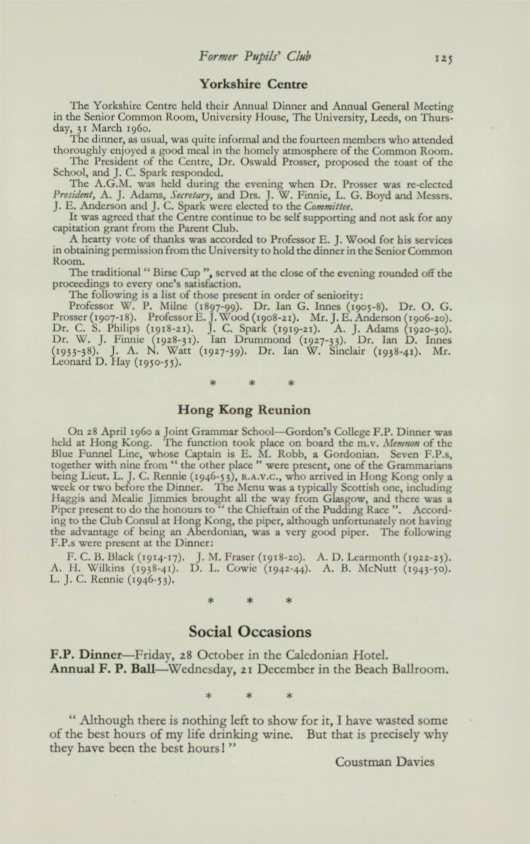
Yorkshire Centre
The Yorkshirc Centre held their Annual Dinner and Annual General Meeting in the Senior Common Room, University Jlouse, The University, Leeds, on Thursday, 31 March 1960.
The dinner, as usual, was quite informal and the fourteen members who attended thoroughly enjoyed a good meal in the homely atmosphere of the Common Room.
The President of the Centre, Dr. Oswald Prosser, proposed the toast of the School, and J. C. Spark responded.
The A.G.).1. was held during the evening when Dr. Prosser was re-elected Pruitknt, A. J. Adams, Stmlary, and Drs. J. W. Finnie, L. G. Boyd and ).lessrs. J. E. Anderson and J.C. Spark were elected to the Commilltt.
It was agreed that the Centre continue to be selfsupporting and not ask for any capitation grant from the Parent Club.
A hearty vote of thanks was accorded to Professor E. J Wood for bis services in obtaining permission from the University to hold the dinner in the Senior Common Room.
The traditional" Dirse Cup", served at the close ofthe evening rounded off the proceedings to every one's satisfaction.
The following is a list of those present in order of seniority: Professor \Y/. P. Milne {1897-99). Dr. Ian G. Innes (19oi-8). Dr. 0. G. Prosser (1907-18). Professor E. J. Wood (1908-:u). Mr. J.E. Anderson (1906-20). Dr. C. S. Philips (1918-1.1). J. C. Spark (1919-1.1). A. J. Adams (1920-30). Dr. W. J. l'innic (1928-31). Jan Drummond (1927-33). Dr. Ian D. Innes (1933-38) J. A. N. Watt (1927-39). Dr. Ian W Sinclair (1938-41). Mr. Leonard D. IIay (19jo-jj).
Hong Kong Reunion
On 28 April 196oa Joint Grammar School-Gordon's College F.P. Dinner was held at Hong Kong. The function took place on board the m.v. Mt11mon of the Blue Funnel Line, whose Captain is E. M Robb, a Gordonian. Seven F.P.s, together with nine from " the other place " were present, one of the Grammar ians being Lieut. L. J.C. Rennie (1946-i3), R.A.v.c., who arrived in Hong Kong only a week or two before the Dinner. The Menu was a typically Scottish one, including Haggis and .McalieJimmies brought all the way from Glasgow, and there was a Piper present to do the honours to" the Chieftain ofthe Pudding Race". According to the Club Consul at Hong Kong, the piper, although unfortunately not ha,·ing the advantage of being an Aberdonia.n, was a very good piper. The following F.P.s were present at the Dinner:
F. C. D. Black (1914-17). J. \I. Fraser (1918-20). A. D. Lcam1onth (1922-1.5). A. II. Wilkins (1938-41). D. L. Cowie (1942-44). A. B. ,\lcNutt (1943-io). L. J. C. Rennie (1946-i3)
Social Occasions
F.P. Dinner -Friday, 2.8 October in the Caledonian Hotel.
Annual F. P. Ball-Wedne~day, 2.1 December in the Beach Ballroom.
"Although there is nothing left to show for it, I have wasted some of the best hours of my life drinking wine. Bur that is precisely why they have been the best hours!"
Coustman Davies
F.P. Hockey Section
1959-60 has been one of the best seaso ns in our history. The First XI, in particular, can claim to be the outstanding team North of the Tay, for in addition to winning the local league, all outside teams were defeated by most convincing margins. 112 goals were scored from twenty-seven games and the defence conceded only 24-a most remarkable perfonnancc.
'The two matches lost were b)' the narrowest of margins, on each occasion the score being z-1, These defeats have since been revenged. Gordoni:ui~ suffered heavily, losing all four matches to us, totalling 16-2, while Aberdeen Ilockcy Club, also defeated in four matches, lost 23-2. The crack ~fidland side, Grove Academy F.P.s, were routed 5-2 and 5-0, while the Service XI, IL~f.S. Fu/ma,-,was defeated 7-0. Aberdeen Cni,·ersity, so difficult to defeat in the pasr, had their colours lowernl twice---5-2 and 4-1. These are examples of the standard reached by the 1st XI this season. The 2nd and 3rd XIs returned very creditab le results, includtnJ,!;the defeat of several senior sidt.-s. Both teams contain young players of great promise.
North District won the Scottish District Championship for the second year running,\~. Dick, I:.. D. Watt, J. R. Wight and I. A. ;\liddleton being members of the viccorious team. I D. \\ att was also honoured by being chosen for Scotland in all the Internationals.
The NewJ Gaztlle is now an established favourite, and iswidely read. Members' contributions and ideas will be gratefully received.
Next March the club celebrates its Jubilee year. Preparations arc well advanced and the Trish Hockey Club, Avoca, will be our guests. The Scottish llockey Association arc to send a Scmtish XI to play F.P.s, thus ensuring a feast of first class hockev next I•.aster.
The club hopes.to run four Xls next season. All I'.P.s, and in particular those le:ffin~ school, arc ,.-armly 1nvttcd to Joto us. Those interested should contact \\. Gatt, 8 Campcr<lown Road, AberJ~cn - Tel. 1'.o. 52955.
In conclusion, I wish to thank everyone associated with the club for working so hard and especially those who represented the 1st XI.
Their successful efforts were an example ofskill, fimcssand, aboYcall, team spirit. Goa/J
Pla_1·td lr'on LJJJt JJ,-a1.-n I'or Against 27 25 2 0 tl2 24
Colours Awards for Season 1959-6o. 2nd XI ColomJ: J. E Donald, P. B. Donald, A Esslemonc, G. Johnston, C. \I. Spence, I. B. Stephen.
Officials for Season 1960-61 arc: 1st Xl Captai11, W. Dick, Vut-Captain, W. Gate; 2nd Xl Captam, I. Il. Stephen, l ·u, Captain, D. G. Ness; 3rd XI Captain, J. G. Bell, Vice-Captam, I. \\'. llowic; Sttntary andTrtaJttrtr, J. F. Donald; Mat,h Su,-etary, W. Gatt.
Results
JSt XI
19s9
: 1 Nov. t:. Academy F.P.•
18 11 11. St. Andrt-w'~ Unnt~ity .s Dec. 11. Univtr-ity
1 2 ,, , Gordc,nians
19 ,, t'. A.G.S. F P.~ •• .\ II
26 ,, t·. Gordon1an,
I 96o
2 Jan. v. A.G.S.
9 " v. A.G.S. F.P.s "A"
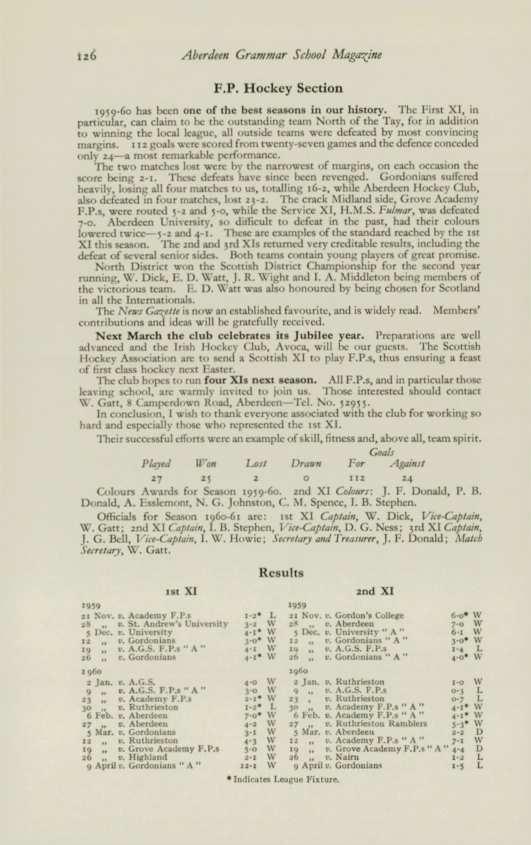
2nd XI
l9S9
21 No"·· t'. Gordon's CoUeic :x ., v. Aberdeen S Dec. 1.1• uruve~ity H A tt J.: t'. Gordonians '" A " 10 ,. ,•. A.G.S. F.P.s 2b ,. t:. Gordonians " A 11
196o
30 v. Ruthricston
23 " v. Academy F.P.,
6 l'~b. v. Aberdeen
27 ,. 11. A~rdeen
s )la.r. v. Gordonians
2 Jan. v. Rutbrieston Q .. t•. A.G.S. F.P.s 23 t·. N.utbrieston 30 ,. 11••'\.cadem)' F.P.s .. A " t, ht>. v. Academy F.P.," ~" 27 ., v Rutbriest on Karubler>
•
4-1 • w s-3• w .., D 5 \lar. t•. A'herdeen
12 " v. Ruthri eston
19 .. v. Grove Academy J,. P.s
26 " v. Highland
9 April t:. Gordonians II A "
12 " t·. Ac,ademy F.P.s II A ,. 7-1 II' D IQ .. t·. Grove Academy F.P.1 " A" 4-4
26 v. Nairn t·.l L
9 APril v. Gordooian, l·S L • Indicates Lcjgue Fixture.
3rd XJ
1959
21 Nov. 11. A.G.S. "A" Dec. v. Gordon's Coll~~e jt B " 12 ,. v. UnJvcnlty II B 11
I Q v. University " B,. 26 " u. Cordonians " B "
196o
2 Jan. v. RulhriestonRamblers
Q ,, v. Academy t·.P.s •• A " 16 ., t•. Ruthneton Rambltrs 23 ,, c. Univerc.ity " D " .30 ,, v. Gordoru.ius " 8 "
6 Feb. v. Gordon·~ Collegr II A 0
1 2 'far. i.•. Univcri;ity H A '' 10 ,, v. CoUegeof Education
26 " v Abe.rd(.-cnAcatlem)
• Indicate~ League Fidurc
F.P. Rugby Section
3·1• \V ,-o \V 5-1• \V 0·5 I, 5-3• W 1-1 D ,., \V 2·2 I) 2-2• l) 6-2 • W IO-?. \V 0-3 L 2-z• I) 1-3• I.
IAN Mmm.PTON Coplai11.
The 1st XV ha<l its poorest sca.~on since the war, winnin~ only nine out of twenty-nine matches. Both games against Gordonians were lost, this being the first time in ten years the "auld enemy" have inflicted defeat on us. While a certain amount of individual skill -.as always present, on very few occasions did the side combine as a team, and the usual apathy was present when odd players were required to travel. On no occasion was a full strength XV fieldc<l for a match either in Glasgow or Edinburgh.
The 2nd XV, on the other hand, enjoyed considerable success. Team spirit was good, and the side always endeavoured to play open ru~by. Unfortunately, the gap in playing standards between the senior and znd XV is still present, though much credit is due players in the latter XV for turning out for the senior side at extremely short notice.
The 3rd XV suffered in that a good number of their games were cancelled either through ground conditions or failure of opposing sides to raise a team. On the whole this XV experienced an average season.
Playing records of the various XV's: Played Won Drawn Lost
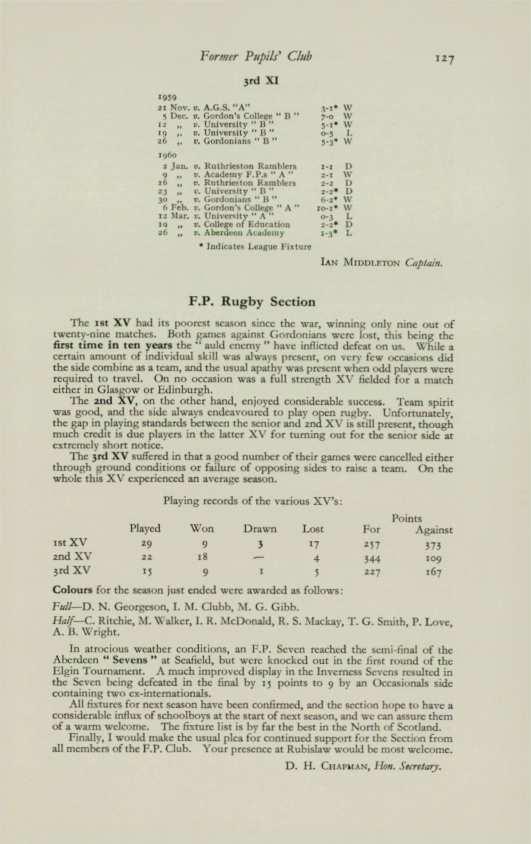
Colours for the season just ended were awarded as follows;
Full-D. N. Georgeson, L M. Clubb, \L G. Gibb.
Holf-C. Ritchie, :\1.\\alker, I. R. \ lcDonald, R. S. :\lackay, T. G. Smith, P. Love, A. D. Wright.
Jn atrocious weather conditions, an F.P. Seven reached the semi final of the Aberdeen " Sevens " at Seafiel<l, but were knocked out in the first round of the Elgin Tournament. A much improvc<l display in the Inverness Sevens resulted in the Sc\'cn being defeated in the final by 15 points to 9 by an OccasionaJs side containing two ex-internationals.
All 11xturesfor next season have been confirmed, and rhe section hope to haYea considerable influxof schoolboys at the start of next season, and we can assure them of a warm welcome. The fixture list is by far the best in the 1'orth of Scotland.
Finally, I would make the usual pica for continued support for the Section from all members of the F.P. Club. Your presence at Rubislaw would be most welcome.
D. H CJJAP l lAN, H,;11. Setrelary.
University Notes
At the Graduation Ceremony on 16 December 1959 the Degree of PH.D. was conferred on Keith Robert McMillan Elder * (1946-52) for his thesis: " Some Aspects of Polymerisation Kinetics ". On the same day the degree of M.A. was conferred on John McMurtrie* (1944-5 ;).
Boxing
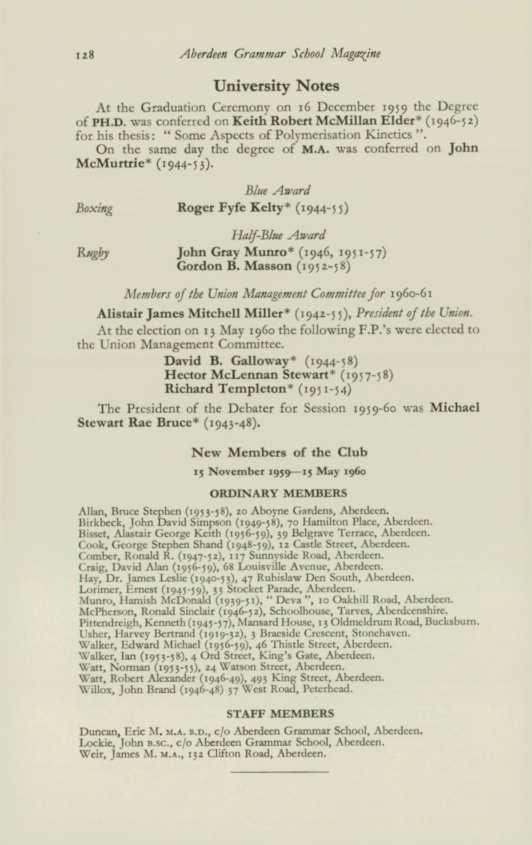
B/11e A1J.•ard
Roger Fyfe Kelty * (1944-55)
llalf-Bl11eAward
John Gray Munro * (1946, 19p-57)
Gordon B. Masson (1952.-58)
MunberJ of the Union ManagementCo111mitteefor 1960-61
Alistair James Mitchell Miller * (1942.-55), Pruidentof the Umo,,. At the election on 1; :May 1960 the following F.P.'s were elected to the Union Management Committee.
David B. Gallowa y · (1944-58)
Hector McLennan Stewart* (1957-58)
Richard Templ eton ~ (1951-54)
The President of the Debate r for Session 1959-60 was Michael Stewart Rae Bruce* (1943-48).
New Members of the Club
15 N o,ember 1959-1 5 May 1900
ORDINARY MEMBERS
Allan, Bruce Stephen (t9H-58), 20 Aboyne Gardens, Aberdeen. llirkbeck, John David Simpson (1949-58), 70 Hamilton Place, Aberdeen. Bisset, Al:istair George Keith (1956-59), 39 Bclgra,e Terrace, Aberdeen. Cook, George Stephen Shand (1948-59), u Castle Street, Aberdeen. Comber, Ronald R. (1947-52), 117 Sunnyside Road, Aocrdeen. ( raig, David Alan (1956-59), 68 Louisville Avenue, Aberdeen. Jlay, Dr. James Leslie (1940-53),47 Rubislaw Den South, Aberdeen. Lorimer, Ernest (1945-59), 33 Stocket Parade, Aberdeen. \lunro, Hamish McDonald (1939-51), "Deva ", 10 Oakhill Road, Aberdeen. McPherson, Ronald Sinclair (1946-52), Schoolhouse, Tarvcs, Aberdeenshire. Pittendrcigh, Kenneth (1945-57},Mansard House, 13 Oldmcldrum Road, Bucksburn. Usher, ]Jarvey Bertrand (1919-32), 3 Bracside Crescent, Stonchaven. \\'alker, Edward l\ficbacl (19s6-59}, 46 Thistle Street, Aberdeen. \\'alker, Ian (1953-58), 4 Ord Street, King's Gate, Aberdeen. \\att, ?-sorman(1953-s5), 24 Watson Street, Aberdeen. Watt, Robert Alexander (1946-49), 493 King Street, Aberdeen. \villox, John Brand (1946-48) 37 West Road, Peterhead.
STAFF MEMBERS
Duncan, Eric :\f. ~I.A. n.o., c/o AberdeenGrammar School, Aberdeen. Lockie, John B.Sc., c/o Aberdeen Grammar School, Aberdeen. Weir, James l\f. M.A., 132Clifton Road, Aberdeen.
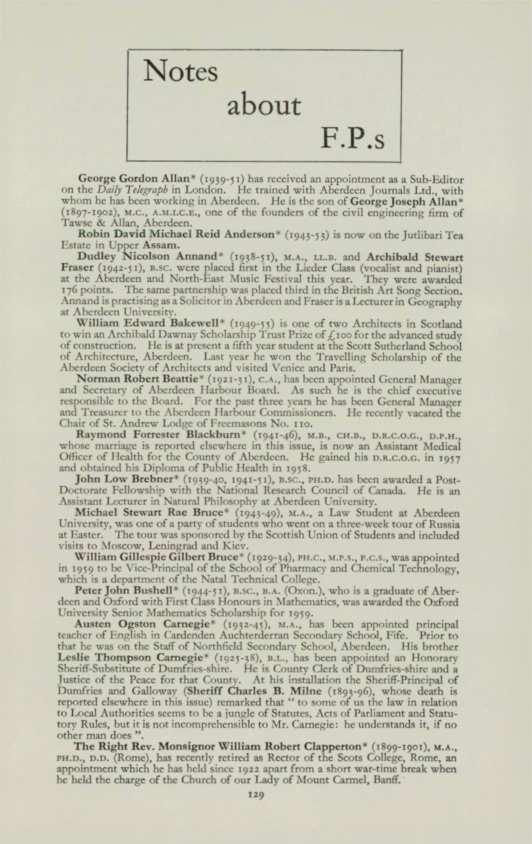
Notes about F.P.s
George Gordon Allan• (1939-, 1) has received an appointment as a Sub-bdito r on the Daily Telegraphin London. He trained with Aberdeen Journals Ltd., with whom he has been working in Aberdeen. He is the son of George Joseph Allan * (1897-1902), M.c., A.M.I,C,L.,one of the founders of the civil engineering firm of Tawse & Allan, Aberdeen.
Robin David Michael Reid Anderson · (1943-n) is now on the Jutliban Tea Fstatc 1n upper Assam.
Dudley Nicolson Annand · (1938-51), M.A., LL.D. and Archibald Stewart Fraser (1942-51), B.sc were placed first in the Lieder Class (vocalist and pianist) at the Aberdeen and North East .\fusic Festival this year. They were awarded 176points. The same partnership was placed third in the British Art Song Section. .\nnand ispractising asa Solicitor in .Abcnlccn and Fraser isaLecturer in Geography at Ahcrdccn Univcrsitv.
William Edward Bakewell • (1949-ss) is one of two Architects in Scotland to win an Archibald Dawnav Scholarship Trust Prize of£100 for the advanced study ofconstruction. He is at present a fifth year student at the Scott Sutherland School of Architecture, Aberdt•('n, 1.ast year he won the Travelling Scholarship of the Aberdeen Society of Atchitccts and visited Venice and Paris.
Norman Robert Beattie· (1921-31), C.A.,has been appointed Gt·neral l\lana~er and Secretary of Aberdeen I[arbour Board. As such he is the chief executive responsible to the Board. For rhc past three )Tars be has been General 1lanager and Trt·:isurcr to the Aberdeen llarbour Commissioners. He rt-ccntly vacated the Chair of St. Andrew Lodce of I rcemasons Nu. 110.
Raymond Forre ster Bl:tckburn * (1941-46), M.D., CH.D., D.R.c.o c., o.P.H., whose marriage is reported elsewhere in this issue, is now an Assistant .Medical Officer of Health for the County of Aberdeen. He gained his D.R.c.o.c. in 1957 and obtained his Diploma of Public Health in 1958.
John Low Brebner• (19w--10, 1941-p), n.sc., Pn.o. has been awarded a PostDoctorate Pcllowship with the -._;ationalRescarch Council of Canada. He is an Assistant Lecturer in i'.atural Phtl0sophy at Aberdeen University.
Michael Stewart Rae Bruce· (1943-49), \I.A., a Law Student at Aberdeen l;nivcrsity, was one ofa party ofstudents who went on a three-week tour of Russia at Easter. The tour was sponsored by the Scottish Union of Students and included visits to i\loscow, Leningrad and Kiev.
William Gillespie Gilbert Bruce· (1929-34),PH.c., M.P.s.,F.c.s., was appointed in 1919 to be Vice-Principal of the School of Pharmacy and Chemical Technology, which is a department of the "\JatalTechnical College.
Peter John Bushell· (r9-14-5r),n.sc., D.A. (Oxon.), who is a graduate of Aberdeen and Oxford with rirst Cbss Honours in :\fathematics, was awarded the Oxford Univcr-;°tvSenior :\fathematics Scholarship for 1959.
Austen Ogston Carnegie' (1932-41), M.A., has been appointed principal teacher of l•.ng-lishin Cardendcn Auchterderran Secondary School, l'ifc. Prior to that he was on the Staff of Northfield Sccondarv School, Aberdeen. His brother Leslie Thompson Carnegie· (r9z5-~R), B.r., has been appointcd an Honorary Sheriff-Sul,<;tituteof Dumfrit-s-shire. He is County Clerk of Dumfries-shire and a Justice of the Peace for that Count\'. \t his installation the Sheriff-Principal of Dumfries and Galloway (Sheriff Charles B. Milne (189,-96), whose death is reported elsewhere in this issue) remarked that " to some of us the law in relation to Local Authorities seems to be a jungle of Statutes, Acts of Parliament and Statutory Rules, but it is not incomprehensible to Mr. Carnegie: he understands it, if no other man does".
The Righ t Rev Monsigno r William Robert Clapperton " (1899-1901), M.A., PH.D., o.o. (Rome), has recently retired as Rector of the Scots College, Rome, an appointment which he has held since 1922 apart from a short war-time break when he held the charge of the Church of our Lady of 11ount Carmel, Banff.
129
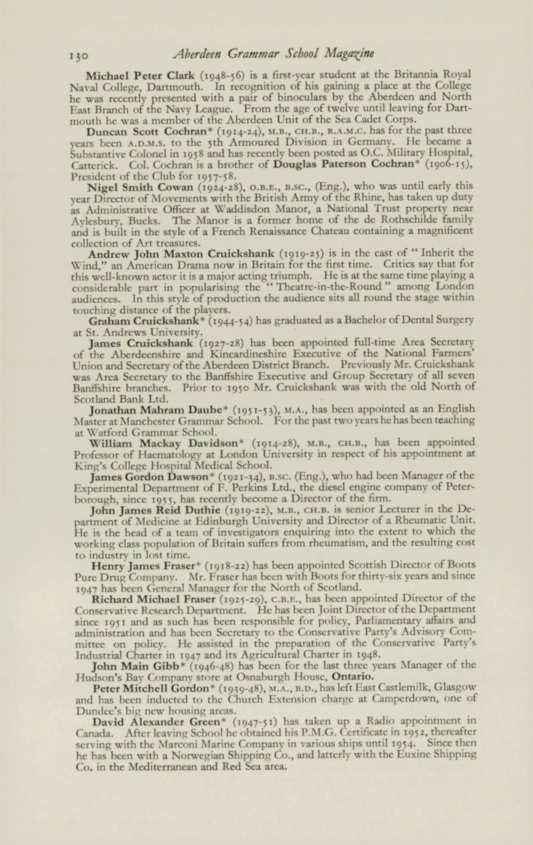
Aberdeen Grammar School Magazine
Michael Peter Clark (1948-56) 1s a first-year student at the Britannia Royal Na,·al College, Dartmouth. Jn recognition of his gaining a place at the College he was recently presented with a pair of binoculars by the Aberdeen and North Fast Branch of the Navy League. From the age of twelve uotil leaving for Dartmouth he was a member of the Aberdeen Unit of rhe Sea Cadet Corps .
Duncan Scott Cochran "' (1914-24), ~1.D., c11.B., R. ~.,1.c.. has for the past three vcan; been A.O.ll.S. to the 5th Armoured Division in Germany. fie became a Substantive Colonel in 1958and has recently been posted as O.C.. :\ltluary Ho,;pital, Catt<rick. Col. C,,chran is a brother of Douglas Paterson Cochran · (1900-15), President of the Club for 1957-58
Nigel Smith Cowan (1924-28), o.B.E., B.Sc., (Eng.), who was unti l early this year Director of :\lovemcnts with the British Arm)· of the Rhine, has taken up duty as Administrative Officer at \\ addisdon ~fanor, a ?\ation al Trust property near J\yksbury, Bucks. The :\fanor 1s a former home of the de Rothschilde family and is built 10 the style of a f rench Renaissance Chateau containing a magnificent tolkction of Art treasures.
Andrew John Maxton Cmiekshank (1919-25) is in the cast of" Inherit the \\ ind," an American Drama now in Britain for the first time. Critics say that for this well-known acror it isa major acting triumph. ] le is at the same time playing a considerable part 10 popularising the " Theatre-in-the-Round" among London audiences. Jn this style of production the audience sits all round the stage within touching distance of the players.
Graham Cruickshank· (1944,54) has graduated as a Bachelor of Dental Surgery at Sr. Andrews Ln1' ersity.
James Cmickshank (1927-28) has been appointed full-time ArC'iJ. Secretary of the Aberdeenshire and Kincardinesbire Executive of the ?-,;ational farmers' Union and Secretary of the Aberdeen District Branch. Previously :\fr. Cruickshank was ArC'il. Secretary to the Banffshire Executive and Gn,up Secretary of all seven flanlfshire branches. Prior to 1950 \Jr Crnickshank was with the old North of Scotland Bank Ltd.
Jonathan Mahram Daub e~ (1951-53), M.A., has been appointed as an h1glish :\[aster at \lanchcstcr Gran1mar School. For the pa.sttwo yearshehas been teaching at \'\ atford Grammar School.
William Mackay David son· (1914-28), \l,B., c11.s., has been appointed Profel'sor of l lacmatoloin at London Universi ty in respect of his appointment at ~in,-,'s Colle~c Hospital :\kd1cal School.
James Gordon Dawson • (1921-34), B.Sc.(Eng.), who had been :\fanager of the Experimental Department of r. Perkins Ltd , the diesel engine company of Peterborough, since l9ll, has recently become a Dirccror of the firm.
John James Reid Duthie (1919-22), ,1.11., c11.B. is senior Lecturer in the Department of \kdicine at l .dinburi::h University and Director of a Rheumatic L'nit. Ile is the head of a team of investiga tors enquiring into the extent to which the working class population of Britain suffers from rheumatism, and the resulting cost to industry in lost time
Henry Jame s Fraser· (,918 22) has been appointed Scottish Directorof Boots Pure Drug Comrany. \ Jr. J"rascr has been with Boots for thirty-six years and since 1947 has been Gc·ocral \ lanagcr for the North <>fScotland.
Richard Michael Fraser (192j-29), C.B,1., has been appointed Director of the Cnnservati,·c RC!'oc·archDepartment. He has been Joint Director ofthe Department since 19j I and as such has been responsible for policy, Parliamentary affairs and administration and has been Secretary to the Conservative Party's Advisory C<•mmittee on policy. Jle assmcd in the preparation of the Conservative Party's Industrial Charter in 1947 and its Agricultural Charter in 1948.
John Main Gibb * (1946-48) has been for the last three years :\fanagcr of the ] Judson's Ba} Company store at Osnaburgh Ilouse, Ontario.
Peter Mitchell Gordon' (19,9-48), ~1.A,, 11.u., has left I·.astCastlcmilk, Glasgow and has been induc ted to the Church Extension c-harp-c at Campcrdown, one of Dundee's big new housini-::trcas.
Da, id Ale,-andcr Green · (19.17-51) has taken up a Radio appointment in Canada. Afccr kavmg- Sch1,ol he nhtaincd his P.\1.G. Certificate in 1952, thereafter serving with th, \farn,ni .\larine Company in ,arious ships until 1914. Since then he has been with a 1'orwegian Shipping Co., and latter!\' with the Euxine Shipping Co. in the :\fediterranean and Red Sea area.
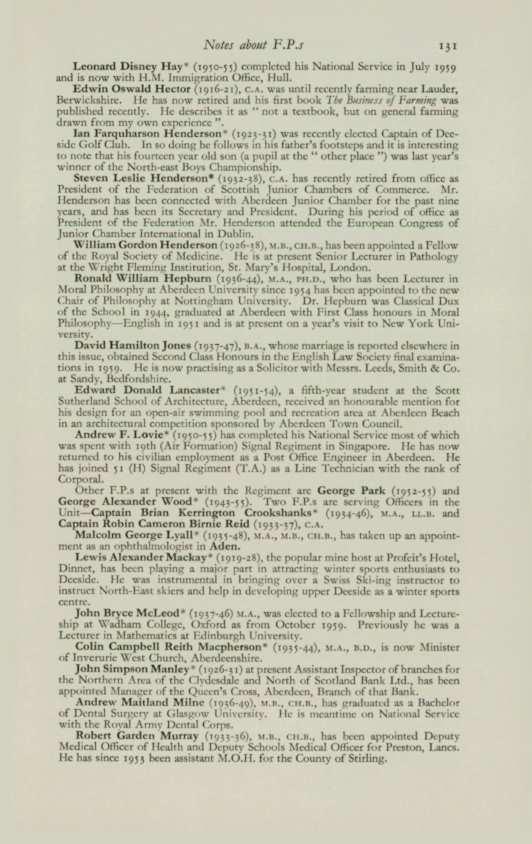
Notes abo11t F.P.s
Leonard Disney Hay• (1950-55) completed his 'ationa l Service in July 1959 and is now with H.\{. lmmigration Office, Hull.
Edwin Oswald Hector (1916-21), c.11.was until recentlv farming near Lauder, Berwickshire. lle has now retired and his first book 1he Bt1Ji11euof rormin.~ was published recently. He describes it a~ "not a textbook, but on general farming drawn from my own experience".
Ian Farquhar son Henderson· (1923-31) was recently dccted Captain of Decside Golf Club. In so doing he follows in his father's footsteps and it is interesting to note that his fourteen year old son (a pupil at the" other place ") was last year's winner of the r-.:onh-east Boys Championship.
Steven Leslie Henders on• (1932-38), c.A. has recently retired from office as President of the rederat1on of Scottish Junior Chambers of C.ommcrcc. \lr. Henderson has been connected with Aberdeen Junior Chamber for the past nine years, and has been its Secretary and President. During his period of office as President of the rederation \lr. Henderson attended the European Congress of Junior Chamber Jnten1ational in Dublin.
William Gordon Henderson (1926-38), \!,B., c11.n.,has been appointed a I'cllow of the Royal Society of \fedicine. lle is at present Senior Lecturer in Pathology at the\\: rigbt rlemmg lnstitution, St. \fary's IJospital, London.
Ronald Wi11iam Hepburn (1936-44), M.A., Pn.o., who ha.s been Lecturer in \(oral Philosoph,· at AbcrdtTn l,niversit) since 19H has been appointed to the new Chair of Philosophy at Nott ingham Uni,ersity. Dr. Hepburn wa.s Clas~ical Dux of the School in 19.H, graduakd at Aberdeen with First Class honours in \fora! Philosoph} English in 1951 and is at prc·cnt on a year's ns1r to '\;cw York l,niverstry.
David Hamilton Jones (1937-47), n ,., whose marriage is reported clscwhere in this issue, obtained Second Class Honours in the English Law Socictv final examinations in T9l9· He is now practising as a Solicitor with .\lessrs. Leeds, Smith & Co. at Sandv, Bedfordshire.
Edward Donald Lancaster · (19p-5-1), a fifth-year student at the Scott Sutherland School of Architecture, Aberdeen, rcccin:d an hnnourable mention for his desi)!Jl for an open-air swimming pool and recreation area at ,\hcrdecn Beach in an architccrural compdition sponsored hy Aberdeen Town Council.
Andrew F. Lovie" (1950-55) ha.scompleted his National Scr\'ice most of which was srxnt with 19th (Air Formation) Si1mal Regiment m Singapore. IIe has now returned to his civilian employment as a Post Office Enwncer 10 ,\berdcen. IIe has joined 5r (II) Sigml Regiment (T.A.) as a Line Technician with the rank of Corporal.
Other r.P.s at present with the Rc1>;imcnt arc George Park (19i2-55) and George Alexander Wood· (1943-55). Two F.P.s arc scn mg Officers in the l,nit- Captain Brian Kcrrington Crookshanks· (19H-46), ,1. ,., LLB, and Captain Robin Cameron Birnie Reid (1933-37), c.,. Malcolm George Lyall• (19H-48), \!,A., ,1.B., c11.B ., has taken up an appointment as an ophthalmoloc:ist in Aden.
Lewis Alexander Mackay· (1919-28), the popular mine host at Profcit's llotel, Dinner, has been playing a major part in attracting winter sports enthusiasts to Deesidc. Ile wa.s instrumental in bringing o,cr a Swiss Ski-ing instrnctor to instruct ,orth-rast skiers and help in dcnloping upper Dccside as a winter sports centre.
John Bryce McLeod· (19n-46) ,1.A., was clcctc<l to a hllowship and Lectureship at Wadham Collc11;c, Oxford as from October 1959. Previously he was a Lecturer in Mathematics at l'dinbur'(h Gnivcrsitv.
Colin Campbell Reith Macpherson· (193~-.14), ~t.A., B.o., is now .\linistcr of lnvcrurie West Church, Aberdeenshire.
John Simpson Manley· (1926-31)at present Assistant Inspector of branches for the orthcrn .\rca e>f the Ch·dC'ldale and North of Scotland Bank Ltd., has been appointt"d .\lan~c:cr •.fthe Quern's Cross, Aberdeen, Branch of that Bank.
Andrew Maitl and Miln e (1Q,6-.i9), ,r H., (' tl.ll,, has graduatld a.s a Bachclnr of Dental Sur~Cr\' at Glasvow Uni,asitY. Ile is meantime <•n l\i.1ti11nalSen ice with the Roval Arm} Dtntal Corps. •
Robert Garden Murray (1933-36). \l.u c11.B., ha.~ been appointed D,·puty \1cdical Officer of Health and D~puty Schools Medical Officer for Preston, Lanes. He has since 1953 been assistant \f.0.11. for the County of Stirling
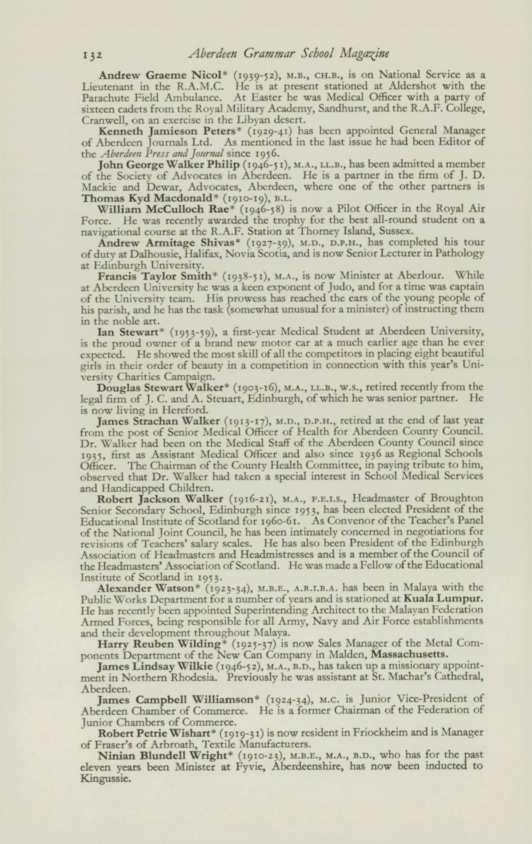
Aberdem Gran1111arSchool Magazine
Andrew Graeme Nicol * (1939-p), M.n., cn.e., is on National Service as a Lieutenant in the R.A.\1.C. He is at present stationed at Aldcrshot with the Parachute Field Ambulance . At Easter he was Medical Officer with a party of sixteen cadets from the Royal \lilitary Academy, Sandhurst, and the R.A.P. College, Cranwcll, on an exercise in the Libyan deserc.
Kenneth Jamieson Peters * (1929-.p) has been appointed General \lanager of Aberdeen Journals Ltd. As mentioned in the last issue he had been Editor of the Abmlun Pras andJournal since 1956.
John Georg e Walker Philip (1946-51), M.A., LL.B., has been admitted a member of the Society of AdYocatcs in Aberdeen. He is a partner 1n the firm of J. D. l\lackie and Dewar, Advocates, Aberdeen, where one of the other partners is Thomas Kyd Macdonald * (1910-19), n.L.
William MeCulloch Rae* (1946-58) is now a Pilot Officer in the Royal Air Force. He was recently awarded the trophy for the best all-round student on a naYigational course at the R.A.F. Station at Thorney Island, Sussex:.
Andrew Armitage Shiva s~ (192.7-39), ~r.o., D.P.n., has completed bis tour ofduty at Dalhousie, Halifax, Novia Scotia, and is now Semor Lecturer in Pathology at Fdinburgh University.
Franci s Taylor Smith* (1938-51), ~! \., is now \linister at Aberlour. \\ hile at Aberdeen Uni,·ersu:y he was a keen exponent of Judo, an<lfor a time was captain of the l:niYcrsity team His prowess has reached the ears of the young people of his parish, and he has the task (somewhat unusual for a minister) of instructing them 1n the noble art
Ian Stewart· (1953-59), a first-year Medical Student at Aberdeen t:ni,·ersity, is the proud owner of a brand nev.• motor car at a much earlier age than he e,·er expected. He showed the most skill ofall the competitors in placing eight beautiful girls in their order of beauty in a competition in connection with this year's Cniversity Charities Campaign.
Douglas Stewart \Valker • (1903-16), M.A., LL.B., w.s., retired recently from the legal firm of J.C. and A. Steuart, Edinburgh, ofwhich he was senior partner. lle is now living in Hereford.
James Strachan Walker (1913-17), At.D., D.P.11., retired at the end of last year from the post of Senior :\fedical Officer of Health for .Aberdeen County Council. Dr. \'\'alker had been on the :\Iedical Staff of the Aberdeen County Council since 1935, first as Assistant :\fedical Officer and also since 1936 as Regional Schools Officer. The Chairman of the County Health Committee, in paying tribute to him, observed that Dr. Walker had taken a special interest in School :\ledical Services and Handicapped Children.
Robert Jackson Walker (1916-21), M.A., P.F..r.s., Headmaster of Broughton Senior Secondarv School, Edinburgh since 1953, has been elected President of the Educational Institute of Scotland for 196o-61 As Convenor of the Teacher's Panel of the National Joint Council, he has been intimately concerned in negotiations for rensions of Teachers' salary scales. He has also been President of the Edinburgh Association of Headmasters and Headmistresses and is a member ofthe Council of the Headmasters' Association ofScotland. He was made a Pellow ofthe Educational Institute of Scotland in 1953.
Alexander Watson"' (1923-34), M.B.F , A.R.l.B.A. has been in \lalaya wnh the Public \\·orks Department for a number ofyears and is stationed at Kuala Lumpur. Ile has recently been appointed Superintendin g Architect to the :\lalayan Federation .Armed Forces, being responsihle for all Army, Navy and Air Force establishments and their development through out \falaya.
Harry Reuben Wilding* (192.5-37) is now Sales Manager of the Metal Components Department of the New Can Company in Malden, Massachusett s.
James Lindsay Wilkie (1946-52), l.f.A.,B.D.,has taken up a missionary appointment in Northern Rhodesia. Previously he was assistant at St. :\lachar's C.athedral, Aberdeen.
James Campbell William son• (1924-34), M.C. is Junior Vice-President of Aberdeen Chamber of Commerce. He is a former Chairman of the Federation of Junior Chambers of Commerce.
Robert Petrie Wishart* (1919-31) is now resident in Friockheim and is :\lanager of Fraser's of Arbroath, Textile :\fanufacrurers.
Ninian Blundell Wright * (1910-23), M.B.E., M.A., s.o., who has for the past eleven years been Minister at Fyvie, Aberdeenshire, has now been inducted to King\lSsie.
Obituary
Eric William Beattie • (1921-28), c.A., died suddenly in Nottingham on 13 March 1960, aged forty-nine. After leaving School he served his apprenticeship as a Chartered Accountant with Messrs. Flockhart & Grant, C.A., Aberdeen, and after qualifying in 1939 joined a professional firm in London. Jle later took up an appointllll"lll in 1bc Statistical Department of a large firm of Stockbrokt:rs. As a member of the Auxiliar}' Fire Sen ice he was called up on the outbreak of War for full time sen ice with the London Fire Brigade and later with the National Fire Service. lie served throughout the London blitz with the fire Service and was later appointed an Arca l°tnancc Officer under the London Civil Defence Organisa• tion. After the War he joined Messrs. Tumey Bros. Ltd., Leather Manufacturers, 1'.ottingham, and at the time ofhis death was Secretary of the Company and a member of the Hoard. \\hilc at Nottingham he was for a number of years a Special Constable and was a member of the Carnaervon Lodge of Freemasons.
llis thn,e brothers were also at School- Norman Robert Beattie • (1921-31), c.A., Ronald James Beattie· (1927-36) and Colin Strachan Beattle • (1931-40), A.M.!.C.L.
James Gordon Bisset· (1919-20, 22-29)died suddenly at Cults on 2 \lay 196o, aged forcy-sc,cn. After leaving School he was employed for a time with \Jcssrs. Osborne, SteYcns & Cu., Ltd., Timber .'.\ferchants , Uxbridge. Ile was commissioned tn pst ll1ghland Divisional Signals (T.A.) and was mobilised with them in 19~9. lie served in francc with the rank of Captain and was taken prisoner at St. \alery 111 1940. After repatriation and demobilisation at the end of the war he joined the family timber business in Aberdeen. He had latterly nut been in the best of health.
William Chalmer s Bowie (1890--97),M.A., died suddenly at Aberdeen on 22 February 196o. After leaving School he attended Aberdeen Cnivcrsity graduating M. ~- in 1901. After a year as an assistant co the Professor of Classics at Aberdeen University he held teaching appointments at Dunfermline and Arbroath before being appointed Classics ,',!aster at the then Central School, Aberdeen in 190}. Latterly he wa.s principal Classics Master there until his retiral in 1943. ;\lr. Bowie was the author of" Cacsar's \X'arswith the Germans", a textbook widely u..secl in Secondary Schools. Cntil the time of his retirement .'.\Jr. Bowie was a keen golfer and was a former member of \lurcar Golf Club, Aberdeen.
Alexander James Christie (1883-87)died at Aberdeen on 13 January 196oaged eighty-six. After kaving School he was employed for some time with the Seaton Brick & Tik Co. and th(.-nspent a short time in the coal trade in Glasgow, before joining the lirm of John f~-fe & Son, Brush Manufacturers, Aberdeen in 1897. He retired from business after completing fifty years as a Paitner in this lirm in 1947. He was for many years a member of Rubislaw Church Choir and took a keen interest in the :-:orthcm Arts Club and Decside Golf Club. He was a contemporary and golfinR"friend of the late Alexander George Nicol Smith (1880--88)a former President of the ( lub who died in July 1959.
William Dilling · (1882 89) died at Northwood, ;\fiddlcsex in November 1959. After leaving School he joined The Scottish Employers' Liability Company in Aberdeen, later moving to London. IIe was thereafter with the Guardian Assurance Company, the Standard Assurance Society and later The British Dominions Insurance Co. Ltd., all in London. After his retiml he liv<.-dat Northwood, J\liddlcscx. Along with Charles \'filliamson* (1883-85), whose death is reported elsewhere, William Dilling was one of the original members of the Club, joining some time between the inaug-uralmeeting in September 1893 and the end of that year.
Ernest Seyton Ducat• (1898-1906)died in Vancouvcr,B.C. on 2 April 196o in his seventieth year .After leaving Schoel he was for a short time in Rhodesia before joining the Aberdeen Jute Co. During the 1914-18 Wai he served with various Signal Companies of the Royal Engineers, being demobilised in 1919with the rank of sergeant. He later studied at the School of Metalliferous ;\lining at Carnbome, Cornwall. In 1930 he wa.s in Alexander, \(anitoba, and spent the rest of his life in 1':orth Americ.-i.
Douglas Ross Dugan· (1902-8) M.B., cn.B., died suddenly while on a visit to H.M. Theatre, Aberdeen on 15 January 196o,aged sixty-three. Ile served durinp; the first World War with the Royal Engineers in France, being eventually invalided out in 1918. He graduated ,r.n., CH.B., at Aberdeen in 1921 and was for a time a 133
Aberdeen Grafl/111arSchool Magaz/ne
Physician at Aberdeen Royal Jnfinnary. Thereafte r he went into private practice in Aberdeen being still so engaged at the time of his death. He was a keen cricketer, golfer and tennis player and during his Univcrmy CJreer he captained Aberdeen University Football Club.
Alfred James Find lay (1897-1901)died at Abc1decn on 22 \larch 1960. After lcaYing School he ser\'cd his apprenticeshi p as an Engineer with the Strath Hnginecring Co., Aberdeen. Jn 1908 he joined the Napuk Tea Estate Co. at Suffr), Assam and continued as a Tea Planter until his retiral.
A distingui shed R.A.M.C. officer
Alexander Donald Fraser (1898-1900), M.c. o.s.o. M.ll CH.D died in Edinburgh on 8 January 196o. lie was the son of the Rev. Hugh Fraser 11anse of Ahab, Bantl and was born in 1884 After leaving School he studied at Aberdeen lJni\'ersity graduating ~t.B., CH.B. in 1906. Ile was commissioned as a Lieutenant in the R..\..\t.C. in 19<>7and was promoted to Captain in 1910. He served insleeping sickness c-ampsand laboratories in Uganda under the Colonial Office from 1908-1t. During the 1914-18 \\'ar he sened in l·r:rncc bcin11:awarded the M.c. in 1916, the o.s.o. for " conspicuous gallantry and de\!>tion to duty " and Croix de Guerre 111 1917 and a Bar tu his I).s.o. in 1919. lle "as four times mentioned in Dispatches. After the war he sencd with the l\orth Russian Espcditionary Force in 1919 and thereaf ter with the .\ksopotamian I·.xpcditionary I'orce. lie was promoted Colonel in 1934 and commanded the Medical Corps Depot and Training Establishment ar ./\ldcrshor. Ile wa.~ promoted to the rank of \ lajor-Gencral in 1937 and posted as Deputy Dirt:ct<>rof ,\kdical Sen ices in India. I"rom 1939-41 when he retired from acci,c sen·ice he was an Honorary Surgeon to the king. IJe married in 1942 and 1s sun I\ cd b> his wife and three daughters.
James Georgeson· (1883-86} died at Aberdeen on 30 May aged nincty-0ne. Born in \\ 1ck \lr. Georgeson completed his schooling at the Grammar being third Bursar in 1886. Ile graduated ~r.\. at Alx:rdn:n L'ni,·crsityin 18()0with First Class Ilonours in Cla.ssKsand was thereafter senior scholar at Pcmhroke College Oxford from which he ohta1ncd second cla~s honours in Cl.i~sical \ lodcrations and Literae Humaniorcs. Ile was f,.r a time a Lecturer and Assistant in Greek at Aberdeen Cni\'crsity. l"rom 1898 until his retiral in 19p he was head of the Classics Department at the 11igh School for Girls in Ahcrdeen.
His snn \Villiarn Wares Georgeson• (1911-23) writes: "An ailment of the eyes in youth left a weakness that made reading arduous In old age this weakness increased until in the last few years of his life he was unable to read at all. Ile retained a keen and wide interest in affairs and his wise and incisive intellect w1til almost the <lay of his death. ln 1904 he married Charlotte Gordon who until her marriage wa.~ a teacher at the Gran1rnar School. Iler brother Alexander was a first Bu1sar from the School."
John Peter Grant· (19H-42), 11.A. (Oxon.) died at Porest Row on 511arch 1960. Ile was a son of George Grant of Glenfarcfas, Grantown and while at School lived at the Boarding House. After leaving School he read law at University College, Oxford, and on graduating B.A. he read Scnts Law at Edinburgh. Thereafter he was for a time in the family business at Glenfarclas, and latterly was fanning at Fon-st Row.
William Grei g (1899) died at Calcutta on 7 1'ovember 1959, aged SC\'Cnty-fivc. lie was the son of the Rev. \\'illiam Greig, \linister of Rayne. After sen·ing an apprenticeship with the Town & County Bank, Aberdeen, he entered the Far Eastern Sen 1ccofthe Jntcrnational Banking Corporation of New York and London in 1904. He joined the Indian service of the Alliance Bank of Simla in December I 920. After h1s ruiral he remained in India.
Allan Cruickshank H endry * (1907-14), ~1.c.,~t.D , CH D., J P., died at Aberdeen on 21 \larch 1960, a_i;:cdsixt\'-four. Afkr kavin)! School he joined a Signal Companv of the Roy.ii Lngim·crs in 1914,tbem1ft,·r lx·1n! commissioned in the Gordon }lij!hlandcrs in 1915. I I.: w:,s awarded the M.<. in 1916 for what the Citation described :is" turning into a !,treatsuccc-sswh•t would otherwise haYebeen a failure". At the time he ·wasthe younge5t F.P. to be ,kcorated for 1-,,allantry. Dr. Hendry was later seconded to the Ro\'al Fl\'in)! Corps fnr the remainder of the war. After demobilisation he studied at "Aberdeen University, graduating M.B. , CH.D in 1924. He was thcrafter in private practice at Bucksbum. In 1938 he was commissioned
Obi/1,ary
as aFlying Officer in the .\lcdical Branch ofche Royal Auxiliary Air Force and postc<l tc the 612 (County of Aberdeen) Squadron. On the outbreak of war he became a Flight- Lieut. with the .l\k<lical Branch of the R.A.F. After the nationalisation of the l!ealth Services in 1948 he was appointed to the Board of Management for Aberdeen Special 1lospita ls, and was later P,esidcnt of the Aberdeen Branch l,f the British ,\lcdical Association
His two brothers were also P.P.s: George Fred erick John Hendr y (1889-911) ~1.B., c11.n., D.P.IJ. who died in 1947 and William Hendry (188)·90), ~1.A., OJP.LO. who died in I9H·
William James Hogg$ (1908-21), M.D., D.P.11., died at Aberdeen on 27 ,\pril 196o, aged tifty-~evcn. After ka,ing School he attended Aberdeen Uni\'cn,ity graduating \l,B., u1.o. in 1926with disttncuon 111 l11sfinal profossional examination. After a pemxl in Ireland and in Warwickshire he returnc<l t0 Aberdeen and was in private practice from 1931 until gaining his 1.1.0. in 1936. He obtained his Diploma of Public Health at Abudeen in 1937 beinl{ thereafter appointed Deputy \lcd1cal Officer of Health for Torquay in 1938. In the following year he was ap()<Hnted Assistant Medical OHicer of I lcalth for Ross-shire and in 1939 he became a Regional 1lcdical Officer to the Department of Health for ~coclan<l.
Norman Macdonald Johnstone (1895-1905)died atAberdeen on 5January 196o. IIe serred his apprenticeship with the Union Bank of Scotland, Aberdeen, later joining the London & Brazilian Bank with whom he served as Accountant at Santos, l3razil in the 1920s. Later he was resident in Canada.
George Phillips Laird (1893-98) <l1cJ at Aberdeen on 4 ;\fay 196o. After lea\'ing ~hool he scn'ed his apprenticeship w11h \lcssrs. Anderson & Thomson, \\-holcsale \\:'oollen .',lcrchants, ;\berdcen, later becoming assistant sales manager and buyer with them. lle was thereafter a partner in the firm of Lurd Bros., \'varehouscmen, Aberdeen, travelling extensively for the firm in the ~orth of Scotland. At the time of his death he was sole proprietor of the business although latterly he had been in ill-health. IIc was an hider of the South Church, Aberdeen.
William Jamie son(" Fyvie ") Lawren ce (1920-21), M.B.,c11.a., <liedin London on 23 February 1960, aged lifty-six. On graduatmg ~J.B., cn.n., at Aberdeen in 1926 he was appointed Jlou sc Surgeon at thc Roy:ll Hospital for Sick Children, Aberdeen. Soon after he wok up Gcncnd Practice first in Newcastle anJ later in Guildford. Jlc was for a time a Ship Surgeon with the P. & 0. line on the Australian run. After the war he gave up the sea and went back ro General Pracuce 111 London until his death. A keen sportsman with rugby his special interest in which he exa,lle<l, Dr. Lawrence 1s survi\'e<l hy his wife and .\ young <laughter. Alfred Scott Mackie• (1905--09),,r.n., t.11.n.,diL-d at Bournemouth on 8 t-:,J\'ember 1959, aged sixt) eight. Dr. \1.ickic was burn in Antigua, British \\ Indies where his father was a \[e<lical Otlicer in the Colonial ~ledical Sen·icc. Ile recch·ed his t.-arlyeducation at Antigua Grammar School before coming home tu this country to complete his education. Dr. \lackie scr\'cd with the 1st Highland Field Ambulance at the outbreak of war in 1914. 11.: gra<luatoo M.D., CH.B., at Aberdeen in 1915 and thereafter served with the Royal !\avy as a Surgeon-Lieut. until 1919. lie then joined the East African .\fcdical Service serving at Lanrn and in the !\orthern Frontier Province of Kenya. Promoted en Senior ,\ledical Ofticcr in 1929 he was transferred to .\[wanza, Lake Victoria but ill-health forced his retiral in 1942. After sanatorium treatment he rcsumc<lmedical practice in South Devon and in 1Iampshirc later mm·ing to Boume.mouth. Jle retired from practice at the end of 1958.
Charles B. Milne (1893-96), M.A., LL.lt., died at l.drnburgh on 17 February 1960. He was the seec,nd son of the late James \l1lnc, ,1.0., L.R.c.s. cf lluntly and after leavmg Schc.ol attended h.linbur~h U1mcrsity where he graduated M.A., LL.B. He was called to the Bar in 1904 hum 1925-28 he was Junior Counsel to the Secretary of State for Scotland. He was appointed Lecturer in Scots 1.aw at Edinburgh University in 1930 and took Silk in 1932 From 1931-35 he was Conservative .i\l.P. for Wt.-stFife, a notoriously left wing Constituency, being succeeded in 1935 by the famous Willie Gallacher who was communist member for the next ten years. In June 1939he was appointed Sheriff ofDumfries and Galloway an appointment which he held unti l his death. His last public duty was the installation in January offour new Honorary Sheriffs-Substitute at Dumfries, one of whom was an F.P. Leslie Thomp son Carnegie" (1925-38). Sheriff Milne never fully reco,,ercd from the injuries sust.'lined in a fall later that day
Aberdeen Graftlfl/Or School Magazi ne
Sherill Milne's brother Alfred Erne st Milne (1894-97), w.s. died tn 1954. A sccond brother was James Rohen Milne (1887 ?) o.~c., Lecturer in Physics at Edmburgh Unjversity from 1912-46.
Benjamin Theodore Saunder s· (1~96 190~). M.B., c11.B., D.P.H, died on IS .\farch 196o in his scvcnciech rear, After leaving School he studied .\1cdicinc al Aberdeen Gruversicy graduating M.D., c11 ,R., 1n 1913. \\ bile at the l,;niversity he captained the University Rugby team. After a short spell at the Cicy Hospital, AberJcen hewas commissioned in the R.A.\I.C. and scr\'ed with chemfrom 191s•19 being mc;nt1oned in dispatches while serving in .\lcsopotamia in 1919. ln 1920 he entered general pracace in Bolton with another Aberdecn graduate. llc was joined in practice in 1947 by Dr. Frank Northman Forster · (1y21-2s), M.B., CH.B. Dr. Saunders retired on account of111-healchin 19sS• George Alexander Thomson· (1903-6) died at Aberdeen on 3 January 196o, aged seventy-one. Meer leaving Sch()(JI he was apprenticed with the .1\orth of Scotland & Town & County Bank, Aberdeen , later joining the foreign staffof the Chartered Bank of India, Australia and China. lie ser\'ed at various times in China, Japan, :-lalaya and India, being with the Bombay branch in 1922. While there he acted as Oub Consul at Bombay. In 1936 he became Agent at Delhi, chercafccr moving coAmritsar. l·rom 1940until his retiral in 1948be was in charge of the Bank .Agency at Kaopur (Cawnpore), India.
An original F.P.
Charle s Williamson "' (1883-8s), c.A., d1..-<l on 8 .\fa) 196oat the age of ninety. M eer lcavu,g School be studied at Aberdeen Univcrstt} , graduatmg M.A. in 1899. Ile qualified as an Accountant in 1894being the lirst accountant Ill Scotland to pass the examination and become what is now known as a " Chartered " Accountant. Uc then joined t he firm of Whyte & Williamson and on Mr \\'hy tc's death went into partnership withMr. J. McLeod Dunn to fow1<llhc firm of Williamson & Dunn , Stockbrokers and Chartered Accountants IJe was active in the firm until a few months before his death lle was Treasurer of the Aberdeen Business and Professional Club from its inception in 1932 and was made an Jlonorary Member in 1953 m recognition of his services. He was a keen golfer, bemg a former Captain of the Royal Aberdeen Golf Club where he played until he was eighty: he was in his latter golfing years frequcncly partnered by the late Alexand er George Nicol Smith (1880-88).
With the death of Charles \Villiamson only three of the original members of the L P Club arc now surriving. The only survivor of che first mc<:tin~of the Club is William A. Pope· (1881-90). Of tho,;c who Joined between chc inau1.,'llral meeting in 1893 and January 1894, Charles \\illiamsoo was one. Tne sun·l\·ors arc Adam Fyfe Findlay " (1879-l>s)and Alexander Findla) • (1882-91).
A nephew of Charles Williamson 1s the Club President Robert Bertram William son• (1906-18) who writes of his uncle: "..\[r. Charles \\ ilhamson was brought up at the family farm of Shcmpston in the Laich of .\1nray. In the 1880,;, .:ducation, for those whose parents wished them co go forward to University was more dilftcult than at present. :-lr. \\: 11liamsonreceived his earliest education at the small village school of Duffus in:\forayshire, and thereafter followed hisbrothers to the Schoolhouse of King Edward. Here, the Dominic, l)c,ccor John \ film·,a very kam1.-<lscholar and historian, in addition to teaching at the local school, took as boarders a few' sons ofgentlemen '. Ilecoached them in tbc rudiments of Latin and Greek, a grounding which enabled them to proceed to schools like Aberdeen Grammar School and bold their own a~ainst all-corners.
"The death of Charles \'i, illiamson breaks anotha link in the lorn1association of this family with the School. I !is grandfather, James Williamson : his father, George Williamson (1829-34)and his son, Charles Whyte Williamson (1910-17), T.D., D.A., c ~.,were former pupils ofthe School. Ifone hnks him with his brothers, the late Alexand er Morri son William son (1871-73), M A., LL.D., who died in 19n, George Williamson (1877-78), ~1.A. ~1.n. cu.». c.M. r.R.C.P.F.. , who died in 1949, Innes Cuthbert Williamson (1886-91) who died in 19H and Robert Moir Williamson (1882-83), M.A LL,B. u. o., who died in 195s, and with the children and grandchildren of the latter, there was a direct link for five generati ons with the School."
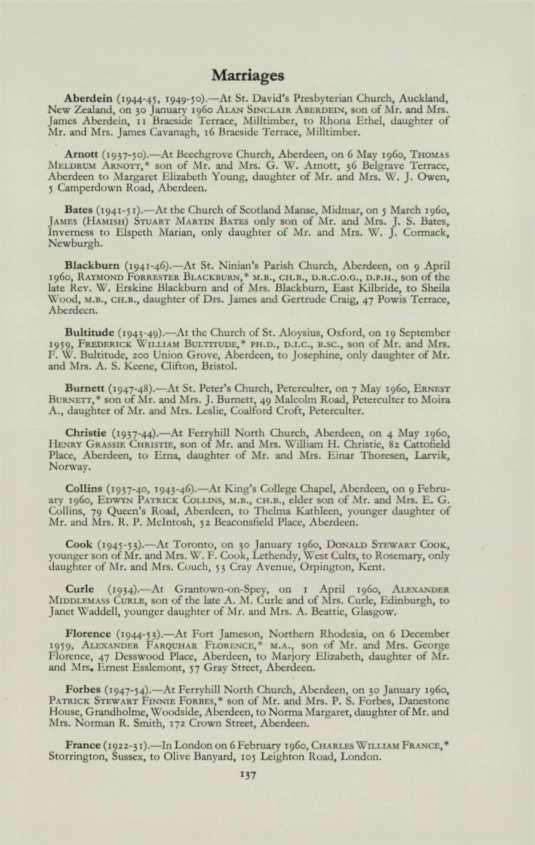
Marriages
Aberdein (1944-4h 1949-50).-At St. David's Presbyterian Church, Auckland, New Zealand, on 30 January 196oALAN SINCLAIRAeuoEN, son of l\Jr. and Mrs. James .Aberdein, 11 Bracside Terrace, l\11lltimber, to Rhona Ethel, daughter of Mr. and Mrs. James Cavanagh, 16 Braesidc Terrace, .:\hlltimbcr.
Amott (1937-50).-At &cchgrove Church, Aberdeen, on 6 \lay 196o, THOMAS ;\ILLDRUM Aiu.on,~ son of \lr. and \lrs. G \Y/. Amott, 36 .Belgrave Terrace, Aberdeen to .:\largarct Elizabeth Young, daughter of l\lr. and Mrs. \V. J. Owen, 5 Camperdown Road, Aberdeen.
Bates (1941-j 1).- At the Church of Scotland .Manse,l\Iidmar, on 5 March 1960, JAYES (I.LuusH) STUART ;\IARTINBATLS only son of .\Ir. and .:\frs. J. S. Bates, Inverness to Elspeth Marian, only daughter of Mr. and Mrs. \Y/. J. Cormack, i:-.:cwburgh.
Blackburn (1941-.;6).-.At St. Ninian's Parish Church, .Aberdeen, on 9 April 1960, RAYMONDFORRESTLRBLACKDURN, M.D.,CII.D.,D.R.C.O.G.,DP.H., son of the late Rev. W Erskine Blackbum and of .:\1rs.Blackbum, East Kilbride, to Sheila Wood, M.B., c11.B.,daughter of Drs. James and Gertrude Craig, 47 Powis Terrace, Aberdecn.
BuJtitude (1943-49).- At the Church of St. Aloysius, Oxford, on 19 September 1\159,FREDERICK\'(n .LIAM BULTITUDE,'PH.D., D.I.C., D.SC., son of l\lr. and Mrs. I'. W. Bultitudc, 200 Union Grove, Aberdeen, to Josephine, only daughter of Mr. and .Mrs. A. S. Keene, Clifton, Bnstol.
Burnett (1947-48).-At St. Petcr's Church, Petcrcultcr, on 7 i\lay 1960,ERNEST Bl!R2'ETI,• son of Mr. and i\1rs. J. Burnett, 49 .:\lalcolm Road, Peterculter to Moira A., daughter of .:\fr.and Mrs. Leslie, Co,1lfordCroft, Peterculter.
Christie (1937-44).-.At I'erryhill North Church, Aberdeen, on 4 May 1960, 11L.'1RYGRASSIECHRISTIE,son of Mr. and ,\lrs. \v'illiam II. Christie, 82 Cartofield Place, Aberdeen, to Ema, daughter of Mr. and Mrs. binar Thoresen, Larvik, Norway .
Collins (1937-40, 1943-46).- At King's College Chapel, Aberdeen, on 9 February 196o, Eown; PA1RICK CoLJL'1S, M.D., CH.B., cider son of .\lr. and .:\lrs. E. G. Collins, 79 Queen's Road, Aberdeen, to Thelma Kathleen, younger daughter of l\fr. and Mrs. R. P. l\lclntosh, 52 Bcaconsficld Place, Aberdeen.
Cook (194i-n).-At Toronto, on 30 January 196o, DoNALD STEWARTCooK, younger son ofMr. and Mrs, \X. F. Cook, Lethendy, \X'estCults, to Rosemary, only daughter of Mr, and Mrs. Couch, 53 Cray Avenue, Orpington, Kent.
Curle (1934).-At Grantown-on-Spcr, on I April 196o, A1EXA.>,;DER M1001.EMA\sCURLi!,son of the late A. .:\f.Curle and of .:\lrs. Curle, Edinburgh, ro Janet Waddell, younger daughter of ~1 r, and l\lrs. A, Beattie, Glasgow.
Florence (1944-i3).-At Fort Jameson, Northern Rhodesia, on 6 December 19)9, ALLXA1'DER F.\RQUHAR I'LORL',CE,. M.A., son of ~lr. and ~lrs. George Florence, 47 Desswood Place, Aberdeen, to Marjory Elizabeth, daughter of Mr. and \lrs Ernest Esslemont, 57 Gray Street, Aberdeen.
Forbes (19.n-H). - At Ferryhill North Church, .Aberdeen, on 30 January 1960, PATRICKSTEWARTFn,"JSLEF0RDES,"'son of Mr. and Mrs. P. S. Forbes, Danestone House, Grandholme, Woodside, Aberdeen, to Norma ~1argaret, daughter ofMr. and l\Irs. Norman R. Smith, 172Crown Street, Aberdeen.
France (1922-31).- In London on 6l·ebruary 196o,CHARJ.E:,\Y/ru1AM FRANCE,* Storrington, Sussex, to Olive Banyard, 10) Leighton Road, London.
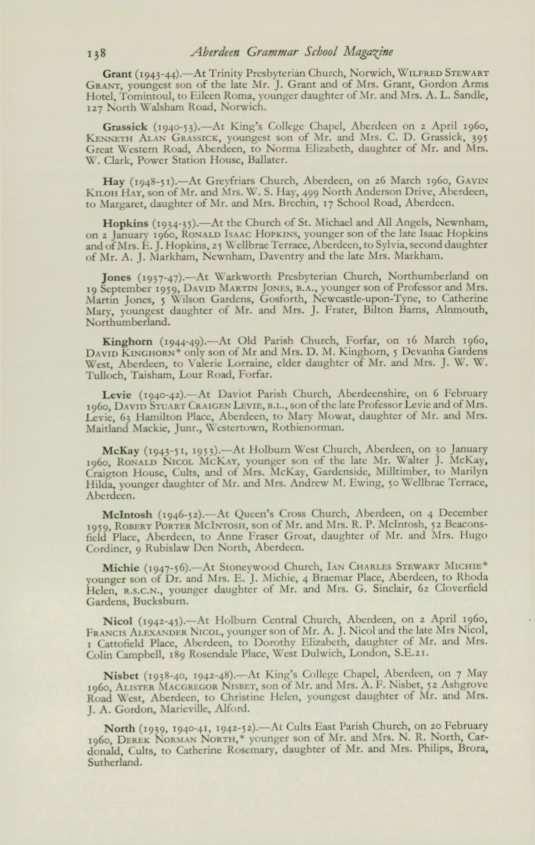
Aberdeen Gran1111ar Srhool Magazine
Gr-.int(1943-4-1). At Trinity Presbyterian Churd1, Norwich, \X'1Lnu:oSTLWART GRANT, )·oungcst son of the late .\lr. J. Grant and of \lrs. Grant, Gordon Arms lluccl, Tomintoul, to I ilccn Roma, )"<>Ungerdaughter of \lr. and .\Irs. A. L. Sandie, 127 ::-..onh\\ alsham Road, "-urwich.
Grassick (19-1, i3). -At King's College C.h.1pd, Aberdeen on 2 April 196o, kl ,i,.1,.111 At\" GR.w,tn:, )oungcst sun of \fr. and \lis. C. D. Grassick, 395 Great \\ (;Stem Road, Alxrdccn, to r--.om1a 1-lizab..:th,daughter of \lr. and \lrs. \\. Clark, Power Station House, Ball;1tcr.
Hay (1940-51).-.\t Grcyfriars ( hurch, .Aberdeen, on 26 :-.farch 196o, G.w1--: Kn 01111.w,son of \lr. and \b,. \\. S. l lay, -199 r--.orth \nderson Drive, Abcrdecn, to \largarct, daughter of :Mr. and .\lrs. Brcchin, 17 School Road, .Aberdeen.
Hopkins (193-1-35).-At the Church d St. \l1chacl and .\U Angel,, Newnham, on 2 Januai, 1960, Ro~ALD hAAC Hor1,.r....,,)<>Ungerson of the late Isaac Jlopkins and of.\Irs. I..J. Hopkins, 2~ \\ dlbrac 'Icrracc, ,\bcrdccn, w Syh-ia, second <laughter of .\fr. A. J. ,\larkham, 1'.cwnham, D.1untry and the late i\lrs. i\larkham
Jones (1937-47). \t \\ arkworth Pn,,byternm Church, Northumberland on 19 September 1959, Dwm \IARTN jo,-.;1,, B.A.,)uunger son <•fProfcs,or and \lrs. \lartm Jones, 5 \\ ilson Gar<lu1s, Gosforth, l\ewcascle-upon-Tyne, co Catherine \lary, youngest <laughter of \lr. and .\lrs. J. I ratcr, Bilton Barns, Alnmouth, t-:orthumberland.
Kinghorn (194-1--19). - At Old Parish Church, Forfar, on 16 \larch 196o, DAVID J<...1NCIIORN• only son of \lr ru1d \ lrs. D. ,\I. 1'.inrhorn, 5 Dc,anha Gardens \\est, Abcr<lecn, to\ alerie Lorraine, cltlu <laugh1cr ot .\lr. and \lrs. J. \\. \\. Tulloch, Taisham, Lour Road, forfar.
Levie (1940-42). Ac D.wiot Parish Church, .Abudcenshirc , on 6 fcbruary 196o, D.w10 STL~llT ( 1u1(.1" LLHJ.!,u.r..,sun ofth.: late J'rofcssnr Levie and of \lrs. Levie, 63 !Jamilton Place, AhcrJecn, to .\lacy .\ lo~J.t, <laughter of .\lr. am! .\lrs. :.taitland \1ackie, Junr., \\ <..Stcrtown,Rothicnnrman.
McKay (1943-p, 1953),- .At Jlolbum \\est Church, Aberdeen, on w January 196o, ROSAi I> r-;icoL .\ld(AY, )Oun~cr snn .,f the late \(r. \\ alter J. ,\\c},;:ay, Crai!,\'ton li<,usc, Cults, and of .\irs. ,\lcls.ay, Gard<..nsitlc, .\lilltimbcr, co \lanlyn I lilc.la,}ounger tlaugh1cr of ,\lr. and ;\fr.,. Andrew \1. Lwing, 50 \\ellbrae Terrace, Aberdeen
McIntosh (1946-52).- At Queen's Cross Church, Aberdeen, on 4 Decemhcr 1959, RoB1RT l'OR'llR\ ld,-..To,11,son of \lr. and .\lrs. R. I'..\lclntosh, l2 &aconsficld Place, Aber<lew, to .Anoe Fraser Groat, <laughter of i\lr. and ,\[rs. Ilugo Cordincr, 9 Rubislaw Den '.'.orth, Aberdeen.
Michie (1947-56). At Swne) w0<>d Church, h--: C11\RLL, STLWART .\[J(;H11 • younger son of Dr. and i\lrs. 1\. J. .\lichic, 4 Bracmar Place, Aberdeen, to Rhoda j lclcn, R.s.c.r,.;.,younvcr daughter of \1r. anc.l \Irs. G. Sinclair, 62 Clovcrficld Gardens, Bucksburn.
icol (1942-45).- At 1-lulbum Central Church, Aberdeen, on 2 ,\pril 196o, FRANCISA1.u.AN01R1',;1co1,younger son of;-rr. A. J.Nicol and th(" late ~Irs Nicol, 1 Cattolidd Place, l\.lxr<ltccn,to Dorothy Elinh.:th, daughtcr of ~lr. and \lrs. Colin Campbell, 189 Rosendale Phcc, \\est Dulwich, London, S.E.21.
isbet (1938-40, 1942-48). \t 1'.ing's Collcg" Chapel, .\bcrdccn, on 7 \lay 196o, Au,TFR \1.KGRJ.GOR 1,m ,, son of \Ir. and ,\lrs. ,\. l . Nisbet, 5z .'\sh •ro, e Road \\ c,r, Aberdeen, t0 Christine Ikkn, )11un1,;cstdaughter of \I r. and :.rrs. J. A. Gordon, i\lar ievillc, Alford.
North (1939, 1940-p, 1942-)2).-At Cults East Parish Church, on 20 February 196o, DLRLK oR,r\s ;s;oRTII,• , ounv<:rson of :-.tr. and ~Irs. :-;_ R. :S:orth, Cardonald, Cults, to Catherine Ros<..mary,daughter of :-.lr. and Mrs. Philips, Brora, Sutherland.
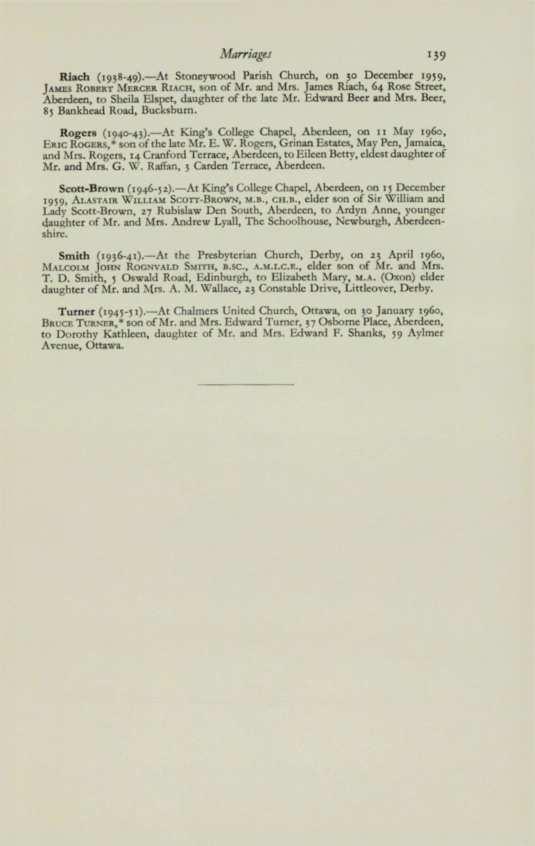
Marriagu
Riach (1938-49),-At Stoncywood Parish Church, on 30 December 1959, JAMES RoBBRTJ\iBRCERRIACH,son of Mr and Mn. James Riach, 64 Rose Street, .Aberdeen,to Sheila Elspct, daughter of the late Mr. Edward Beer and Mn. Beer, 85 Bankhead Road, Bucksbum.
Rogers (1940-43).- .At King's College Chapel, Aberdeen, on u May 196o, ERICROGEP.S,• son ofthe late :.fr. E.W. Rogen;, Grinan Estates, May Pen, Jamaica, and Mrs. Rogers, 14Cranford Terrace, Aberdeen, to Eileen Betty, eldestdaughterof ~fr. and Mrs. G. W. Raffan, 3 Carden Terrace. Aberdeen.
Scott-Brown (1946-p ).-.At King's College Chapel, Aberdeen, on 15 December 1959, .ALASTAIRWrLLIA~l Scorr-BRoWN,M.B., cn.B., elder son of Sir William and Lady Scott-B rown, 27 Rubislaw Den South, Aberdeen, to Ardyn Anne, younger dauRhter of ;\[r. and Mrs. Andrew Lyall, The Schoolhouse, Newburgh, Aberdeenshire.
Smith (1936-41).-At the Presbyterian Church, Derby, on 23 April 1960, MALCOut J01IN ROG~VALO SMITH, B.Sc., A.M.r.c.E., elder son of J\fr. and :.lrs. T. D. Smith, 5 Oswald Road, Edinburgh, to Elizabeth Mary, MA. (Oxon) elder daughter of Mr. and Mn. A. .M.Wallace, 23 Constable Drive, Littleovcr, Derby.
Turner (1945-51).-At Chalmers United Church, Ottawa, on 30 January 196o, BRUCETulll'.'Ell,*son ofMr. and \{rs Edward Turner, 37Osborne Place, Aberdeen, to Dorothy Kathleen, daughter of Mr. and Mn. &!ward F. Shanks, 59 Avlmer Avenue, Ottawa.
Advertisements
Without the support of Advertisers it would be a financial impossibility to produce the Magazine. May we suggest that in return you patronize them.
Enquiries regarding advertising in the Magazine should be addressed to :
FRANK C. CONNON, ADVERTISEMENT MANAGER, 12 GOLDEN SQUARE, ABERDEEN
This Is a BLACKBURN N,A.~ strike aircraft now urukr de•·elopme11tfor rite Royal Navy .
To fly the Mach-a ge aircrnfl "hlcb fonn the spearhead of Britain's "le" avy, the Fleet ir Arm needs young men who are capable and intelligent, and "ho ha~e a high sense of respoll'libility.
f lying in the Royal ~avy offers a fine life, status and high pay.
A t\\enty -five year-old married Pilot or Observer may, for example, receive £1,700 a year, "ith a £4,000 gratuity al the end ofhis 12 year engagement. There 1s a lower gratu ity for those who leave after 8 years.
The age limits are 17to 23 for Pilots and Observers and, 1f you are serving for 12 years, you may apply for a permanent commission.
Wri•e for your free copy of the booklet 'Fly with the Fleet Air Arm' to:
The Admiralt y, D.N.R. ( Officers ) Dept FSM/11
QULl'I ANN! 0 S MANSIONS, LONDON, S.W.I.
Ask the man who knows about FISHING TACKLE
Ask the veteran angler, the man who almost lives on the river, and he will unhesltat• lnglytell you that the 'Scottie' Trademark stands for the highest quality In fishing tackle.
471 UNION STREET
ROSEMOU 1 T VIA.
Head Office:and Works: 40 CLAREMOJ',ff SfREET
PHONE: 52255
J. GEDDES IRVINE
JAMES BLAKE LTD.
- Jolncn andBuildln1 Contractors
30-32 Gt. Western Road
Enquirle, courteoualv aolldt cd
ALL CLASSES OF BU1LD1NG WORK
Telcphonc 24382
Telearam, "Blake Buildcra"
Estimates Free Phone 20163 for ... Raiowear
Umbrellas
Travelware
Rubberware
Games and Toys
Sports Equipment
Leather and Fancy Goods
BE FIRST ON THE ROAD WITH O~OGI

THE ALL-NEW ANGLIA
There's a car for you in Britain's greatest range, in our Showrooms now ! It's " focus on Ford " time, and especially on the New Anglia, New Prefect, New Popular. They're all here. Make sure you come and see them at our Ford Show- to-day!

and Snack Bar: 468

FOR FRESH IDEAS-IT'S PRESTCOLD
Perishable foods need safe stora,o and PRESTCOLO provide it, with handsome servi<• cabinets. We.JI-known for their reliability they are lxtremely economical. savin& on space, sa"in& on runnln& costs
The SC. 141 Service Cabinet (see ,llustration)
Capamy 1402 tu ft. 1rou-takn less than I sq ya-rd of floor space, The frozen food lotker holds 35 lb of pukased food and m:<kes 9 lb. of it• In on• day. The door ahelvn an hold 20 milk bottles The sealed refri11ratin1 system i.s cuaranteed for five years, the whole SC. 141 for one year.
SPARK'S
1:'ALCONERC I'OF ABERDEEN t)
THE NORTHERN ASSURANCE COMPANY LIMITED

•Northern ' by name and ' Northern ' in origin, the Northern Assurance Company Limited was established in Aberdeen in 1836 and takes lasting pride in its Scottish ancestry
For all classes of Insurance
ACCIDENT • ENGINEERING • FIRE HOUSEHOLD • LIFE • LIVESTOCK MARINE • MOTOR • PENSIONS
You will be on good terms with the ' Northern' Head Offices
UNION TERRACE, ABERDEEN MOORGATE, LONDON, E.C.2
Group Assets exceed £94,000,000
STRACHAN
Commercial and Portraiture
Ph otography
13ot UNION STREET
ABERDEEN
Telephone 20851
ROBERT MlLNE AND SON
Fellow
DECORATOR
ABERDEEN
Telephone No. 24556
Estimates Free
A. & R. Milne
AT YOUR SERVICE with all Stationery Req
FOR SCHOOL OR AT HOME
The Premier Bookshop for NOVELS, BIOGRAPHIES , POETRY, GARDENING, SPORTS AND TRAVEL BOOKS
EXCHANGE YOUR BOOK TOKENS HERE where the Best Sellers are always obtainable
There is a wonderful selection of all the famous makes in Fountain Pens and Ball-point Pens. Look in any time and see them at the Pen Counter - A Pen is a gift anyone would appreciate.
229 UNION STREET ABERDEEN
ABERDEEN'S FOREMOST FASHION SHOP
Hove Morning Coffee, Lunch or Afternoon Teo in-
THE RESTAURANT
Good service Is one of the salient features of our Restaurant on the Third Floor. We use our best endeavours to treat you with courtesy, to serve you with deftness, while the daintiness of the appointments appeals to men as much as to women-and, above all, It is noted for Its good food personally supervised by our Chef de Cuisine
THIRD FLOOR (Elevator Direct)
GRAMMAR SCHOOL OUTFITS
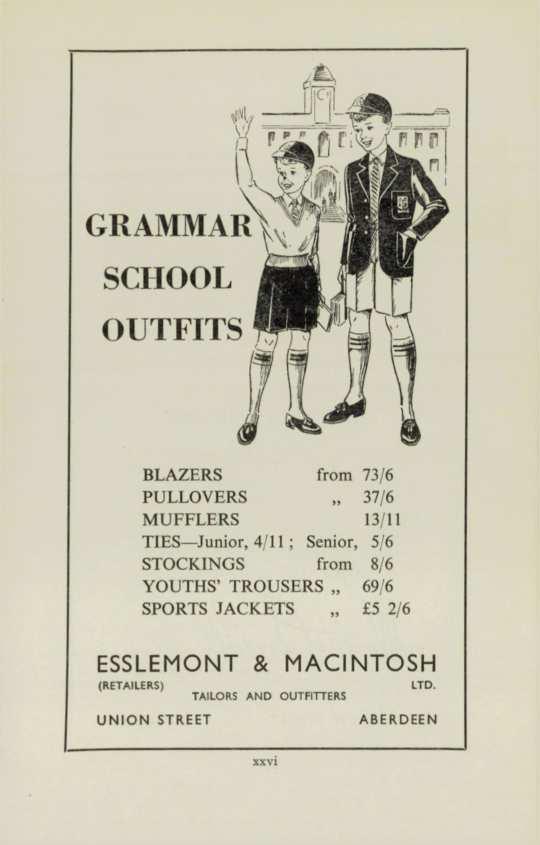
BLAZERS
PULLOVERS
MUFFLERS from 73/6 ,, 37/6 13/11
TIES- Junior, 4/11 ; Senior, 5/6
STOCKINGS from 8/6
YOUTHS' TROUSERS ,, 69/6
SPORTS JACKETS ,, £5 2/6
We have been in business for almost a century and our unchangeable policy has been to offer fine quality jewellery at competitive prices. The engagement ring is of supreme importance and when the occasion arises we invite you to ei-amine our stock which we are sure you will find interesting and reasonably priced.
19 1 UNION STREET ABERDEEN ESTABLISHED 1863
DIAMOND!>, SAPPHIRES, Rumrs, EMERALDS, ZIRCONS, OPALS