THE ABERDEEN GRAMMAR SCHffiL MAGAZINE
EMISSILE~ · DESTROYER
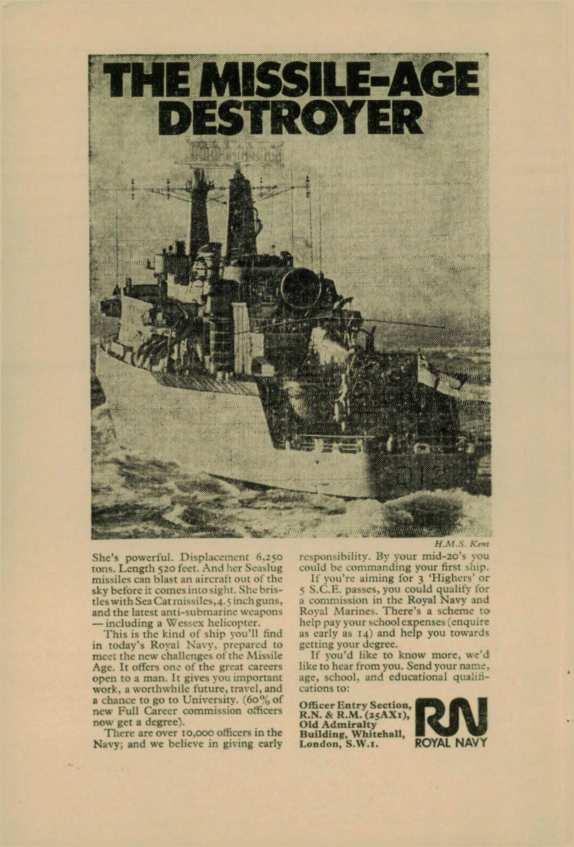
She's powerful. Displacement 6.250 tons. Length 520 fret. And ~er Sc,1,lug missiles can blast an .1ircralt out of the ~kybefore it comes imo,ight SI c bristles with SeaCat rm,sik,,4., md1guns, and the latest anti-subm.1rme wcapon, - including a \Ve,• ex hclicorccr.
This is the kind of ship you'll find in today's Royal l,a,·y, prt·parcd to meet the new challenges 01 the ,\\is,ik Age. It offers on~ of the great careers open to a man. It gives you important work, a worthwhile future, tra,·cl, and a chance to go to University. (6o0;. of ncv. Full Career commission officer, now get a degree).
There are over 10.000 officers in the Navy; and we bclie,·e in giving early
H~\l ,S Krnr n.·,p<msihilitv. By your mid-20"s you could be wmmanding your first slnp
If ,·ou're aiming for 3 'Higher,' or '>.<....E.pa,,cs, you could quality for a com1111,s1onin the Royal Navy c1nd Royal .Marines. There's a scheme to help pay your ,chool expense,, (enquire as early as 14) and help you coward, getting your degree.
If you'd like to know more, "'.:'d like to hear from you. Send your name. age, school, and educational qua!ifications co:
Officer En try Secti on, RN R.N. & R.M.{, sAX1), Old Admiralt y Build.i n,;, Whiteh all, London, s.w.1. ROYAL NAVY
ROBERT GORDON'S INSTITUTEOF TECHNOLOGY
ABERDEEN
Wo provide a wide range of courses and quHhf1cmions. Entry requirements generally 3 'H' 2 ·o· Grades.
Details and applic ation forms : Tick courses of interest , clip this adverti sement and send to (or writ e or visit) The Registration Officer, Robert Gordon 's Institute of Technology , Schoolhill, Aberdeen AB9 1FR (Telephone 29384 )
L.. Architecture .J Management
Art :i Mechanical Engineering
Chemistry
Child Care
Commerce
D1ete11cs
Domestic Science
l, Electronic Engineering
Hotel Administration
lnst11u11onalHousekeeping
lns11tut1onalManagement
L1branansh1p
OTHER SUBJECTS (state)
NAME
Nauucal Studies
Personnel Management
Pharmacy
Physics
Physical Science
Planning (Postgrad Course)
Probation
Quantity Surveying
Social Work

ADDRESS __ ___

Get the inside story from William Wilson
We specialise in interior fitting . Our howrooms al 505 Great Western Road. Aberdeen. offers architects. the trade and the general public the opportunity to see all the latest in lighting fillings. kitchen and sanitary equipment. domest ic appliances, and of course centra l heating equipment. At our showroom you can be sure you're seeing the very best which these markets offer, so call in and get the
inside tory for yourself. Simply make your choice of home fittings and we will give you fast, efficient suppl} through 1our usual trade men.
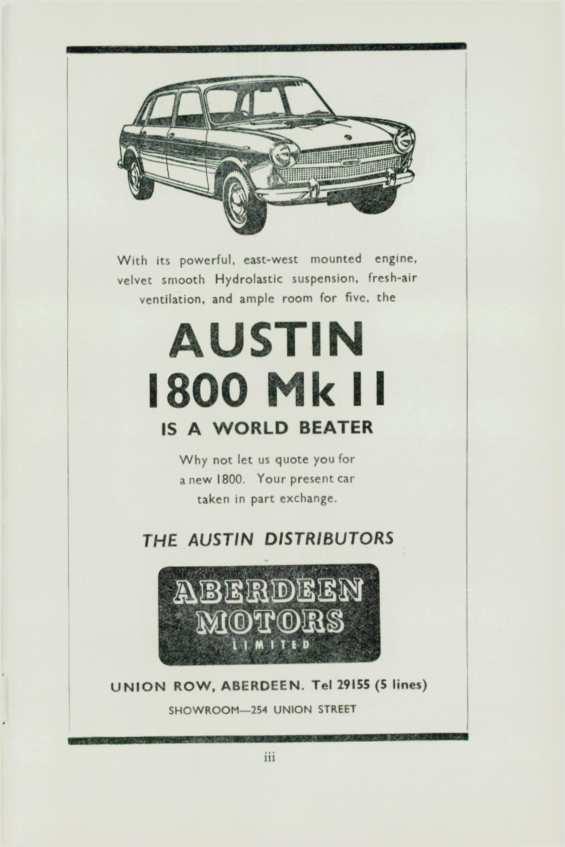
With its powerful, cast-west mounted engine, velvet smooch Hydrolastic suspension, fresh-air ventilation, and ample room for five, the
AUSTIN 1800 Mk 11 IS
A WORLD BEATER
Why not let us quote you for a new 1800 Your pre~cnc car taken in part exchange
The Aberdeen Savings Banl. is always in the forefront of Banking and is looking ahead now to the day when our currency 'goes decimal'. Planning ahead is Just one of the ways the Bank ensures that it always gives you a personal service
You too should be looking ahead. Open a School Savings Bank Account now and make provision for the future. Regular saving gives you security, confidence and an appreciation of the value of money

AUSTIN MORR.IS
M.G. DEALERS
Shoes corr,ct/y fitted by X-R.AY pcdoscopc
MOTOR BODY, PANEL & WING REPAIRERS, CAR UPHOLSTERY, ACETYLENE WELDING, CELLULOSESPRAYING UNDERSEAUNG & SELF-DRIVE HIRE CARS
Telephone
and always of course for stylish Business and Sports wear . ..
131 HOLBURN STREET, ABERDEEN
(Comer or Hollybao.k Place)
William Scorgie
13 & 17
Rose Street
Aberdeen Tet. 23731
Grain and Potato Merchant
VISIT OUR PET SHOP
NO PARKING PROBLEM
Skilled anglers agreeThe SHARPE '
SPECIALIST'
-is a rod with a real difference
Th• Sharpe "Specialis t" range or Fly Rods combine all tbal's best in the latest materials and fittings, plus the proved advantaaes of Split Bamboo, to produce the most up.to-date Fly Rods on the market. The"Specia list" Is the rod ror the knowled&u,ble fisherman who can'"'prcciate the real di.lferencehe finds in this new rod. Come to our Showroom and handle these new rods- act the proper "feel" or them.
Sharpe's OF ABERDEEN
J.S. . SHARPE (Fl1hlncTaeklt) Ltd 35 Belmont St Aberdeen
"Books of the hour and the books of all time" RUSKIN
Whatever your taste in books, whether you're looking for literary, educational or light reading, whether you require Teach Yourself or text books, you'll find Bissetsare the bookshops which fulfil your particular needs
Jam
es 6.
Bisset Ltd.
in Association with Blackwells of Oxford 12-14 Upperklrkgate, Aberdeen
99 High Street, Old Aberdeen Now at College of Education Bookshop, Hilton, Aberdeen

CHINA:CRYSTAL: POTTERY
SUPPLIERS

AUTHORISED
DISTRIBUTORS FOR SHELL & BP SCOTLAND LTD.
ROBERT MILNE AND SON
Fellow Institute British Decorators
Decorator
Telephone No. 24556
By Appointment T o H•• MAJESTYTue QUEfN Jronmong:crs
The House for Cutlery
The superb selection, eminently suitable for the home, for gifting or presentation reflecu the latest In British and Continental designs.
SCHOOLHILL&26S UNIONST.,ABERDEEN
Telephones: Schoolhlll 25242 • Union Street 28ll0
Aberdeen Grammar School Magazine
87th y·ear No
Vol. LXXIV
207 (New Series 77/h )'tar No. IJS)
DECEMl:lllll. 1970 No. I
The Magazine is published under the auspices of The Former Pupils' Club twice during the year, in December and June
General Editor
Editor of the School Section
Editor of Notes, Obituaries and Marriages
Advertisements
Secretary of the F.P. Oub
Alistair G. Gracie, 12 Fernielea Crescent, Aberdeen.
Bruce Finlayson, M.A., M.Eo.
] D. Rennie, uo Union Street, Abt:rdcen.
]. A. G. Mearns, Mearns Publicity, 7 Carden Place, Aberdeen.
Brian K. Crookshanks, T.o , M.A., LL.B. 2~ Crown Street, Aberdeen.
The General Edj1or invites contributions from F.P.s for the next issue of the Magatine and requests that all copy, both for him and for the Notes Editor, be submhted by 15 May, 1971. Readers arc asked to support the advcrusers, without whose support publication of the Maga:,ine would not be possible.
Printed for The Former Pupils' Club at
The University Press Aberdeen
CONTENTS
IUustrations-
The School 1st XV in action
The Ridge of An Teallach
9th Group Re-union
197011.A.R. Trophy winners
General Section-
Rector's :Message
The New Aberdeen Grammar
91h Group Re-union .
Sir James J. Robertson
Choir's Tour
Summer Excursion
School Section-
Officc-bearcrs
Random Notes
House No1es
Staff"l'-.otes
Sporting Act1v11ies
.MusicNotes
Lower School "l'-.otcs
C.C.F. Notes
School Societies
F.P. Section-
Office-bearers
The Annual Dinner
Section Reports
Club Centre
Notes /\bout Old Boys
Obituaries
Club Consuls
Ne\!. Members
Missing .Members
A11 aJttri;/,:* appeari11gafter tht name of an F.P indicattJ that he u a mtmbtr of Jh, F P. 0111,. Tht _Jtan appearing after tht name of an F.P. art Jho1t of bi1 allmdan" al School.
Rector's Message
Owing to the change in the date ofthe Annual Dinner ofthe forme r Pupils' Club I find myself this year compiling my report for the Magazine and my reply to the time-honoured toast of the School almost simultaneously. Inevitably for that reason there must be a good deal of overlap in the content of both reports and I can only crave the indulgence of those of you who attended the Dinner in Aberdeen while I repeat for the benefit of the large body ofF.P.s who "·ere unable to be present some of the points I propose to make on that occasion.
Last year, you may recall, I devoted some space in my report to two decisions which lud just been made by the Education Committee and which were clearly fraught with great significance for the future of the School. The fust of these was the decision to advance the date for the introduction of comprehensive education into the Grammar School to the present session instead of 1975 as was the original intention. The second was to alter the name of the School.
Effect has now been given to both these changes. The official name ofthe School is now Rubislaw Academy (,\berdeen Grammar School), the decision being that the original name of the school be retained as long as we have pupils who were admitted to the Grammar School in their own right. While it can hardly be said that the new name comes trippingly off the tongue, I would suggest that a valid point has been conceded and that e,ery effort should be made during the transitional years ahead to insist on the use of the original name of the School alongside the new one and not to let it lapse by default.
What now of the new comprehensive intake? The total number of boys admitted into the First Year in \ugust was 176. Some 50 of these were pupils from our own Lower School; the remainder came from :.'\file End, 1\shley Road, Skene Street and Skene Square Primaries. Initial impressions of the way in which they have settled in to the School are very encouraging and augur well foe the future Certainly there has been little consciousness among the staff that the School has undergone any radical change
We have, of course, as was only to be expected, a broader spectrum of ability to deal with, including a small minority who will have difficulty with the basic skills and may require for that reason remedial assistance. That apart, there is little overt difference between this First Year and any of its recent predecessors. Indeed, there are some indications that we may have compensations . There is, for examplepossib ly as a result of the fact that the intake is now based to a large extent on the "neighbourhood" principle-some evidence ofa stronge r team-spirit among the new pupils, a greater sense of belonging and a willingness to accept and take pride in the traditions of the School. Admittedly this can only be regarded as a very tentative impression and time alone will tell whether it is justified. '\[eanwhile we arc glad to know that the change-over has been achieved with so little disturbance to the life of the School.
To saythat these changes, particularly the change in the School name, have been received with indignation and dismay by Former Pupils
would be to understate the case. Inevitably they have raised in the minds of many the whole question of the future relationship of the f'ormer Pupils' Club with the School. This is a very natural reaction and I must confess that I ha\·t e\~crysympathy with the doubts and misgivings felt by many f .t>.s about the future . Perhaps, however, I may be allowed to make the following points.
In the first place no one can say-and this holds good for me as Rector ofthe School as well as for others-what effectthe new changes arc likely to have on the School in the long run Our impressions of the new comprehensive intake this year, while not unfavourable, arc, as I have just said, only tentative and in my opinion it will take several years before a reasonably clear picture emerges. Brains, after all, are not synonymous with character and it may very well be that at the end of the day the School, despite the broader spectrum of academic ability it has to cope with, will be found to have absorbed the changes that have been thrust upon it without the loss of its essential spirit It is after all a tough and tenacious organism which has undergone many transformations in its long history and yet has preserved throughout a unique quality and an identity of its own.
All that can be said at present is that we are entering upon a transitional period which may extend over the next four or five years. During that period the School will need, to a greater extent than ever before, the support and encouragement ofits Former Pupils and I am confident that we shall not look for such support in vain. At the end of the day I would expect a reasonably clear picture to have emerged. Ifthe School weathers the storm without the loss of its most distinctive qualit ies, then there would appear to be no good reason why the link between it and the Former Pupils' Club should be severed. There arc, after all, many good precedents for a change of name ,vithout loss of identity. If, on the other hand, the changes prove so far-reaching and so-deepscatcd that it is no longer recognisable as the Grammar School, then it will clearly be open to the Club, if it so desires, to sever its connection with it.
I hope I have not laboured this point too much but I haYe found in my meetings with former Pupils in the past year that it is one that exercises them very much and I can only trust that these observations may put the matter in perspcctiv-e for many who arc unable;.to attend anv of the Club Centre Dinners.
For the remainder ofthis report 1t may suffice to say that in all other respects the School in the current session presents a picture very similar to that which has been characteristic for a number of years now. \\'e have a roll ofapproximately 1,200 boys, with over 300 in the Fifth and Sixth Years alone, including some 70 in Gppcr VI. The staffing position remains very favourab le and the creation oft ,vo new posts of responsibility to cope with the general oversight and what may be described as pastoral care ofpupils in a given year has proYed a"·elcome innovation. The first two appointments to the post of Year ]\faster, as already intimated in the June issue of the Afaga,::ine,were those two veterans of the Staff, Mr. Stephen and :\fr. Flett. ~lr. Stephen has taken over responsibility for the I'irst Year and ~lr. Flett for the Fourth . It is
hoped that further appointments will be made n(;Xt session and m subsequent years.
l inally, let me once again take this opportunity of extending to all readers of the 1\Iagazinemy warmest gn.:etings for Christmas and the ~ew Year ahead
The ew Aberdeen Grammar
The article which prefaced the June issue of the .\la,gazi11e,entitled "The Changing School", will surely arouse widespread interest among former Pupils everywhere The revolutionary and excinng idea it proposes, that the new Former Pupil Centre in Queen's Road shou ld beconsidered as the nucleus ofa new and reborn independent .\be rdeen Grammar School, will bring a ray of hope to those who still bdie, c in indi\'idual liberty and freedom of choice in cducarion.
For the fact is that the great driYe towards egalitarianism in education as in other things, which is one of the outstanding (and commendable) features of modern times, can, if it is not carefully watched and controlled, get out of hand and end by steamrollering Oatmany of the fascinating hillocks, highways and byways that give our liv<.:s such value as they have. And in any case, the philosophy of egalitarianism carried to its ultimate conclusion is an absurdity-there is really no good pretending that everyone is the same as everyone else. It is of use only insofar as it can lead to the elimination of the grosse r injustices.
With the abolition ofthe name ofthe School and other changes, the present School bears little or no resemblance to the one we knew in the past. But it is no mere nostalgic sentiment which desires its rebirth in a contemporary setting . There is something in the atmosphere and "feel" of a school with a long and notable history behind it which affects deeply even the most modest of its pupils. I write as a relatively undistinguished Former Pupil. I was not the Classical Dux, was never in the 1st XV or 1st XI, ,vas not even a Prefect or someone who came in first in the final of the 100 yards on Sports Day.. everthelcss I always look on the thirteen years I spent at the School as perhaps the most enriching period of my life-not easy, not always pleasant-but tremendously enlightening about human nature and the bringing about ofa realisation ofvalues in lifemore significant than mere moneygrubbing or the necessity to out-smart your neighbou r.
It is certainly not the fault of the present extremely capable Rector that this situation has arisen. But it seems like shying from the truth not to recognise that the Aberdeen Grammar School that we toast in our annual dinners no longer exists, and that within the next few years the hope must be that a move towards its rebirth, along the lines suggested by J\fr Robenson, will take place.
Those of us who would wish this to happen can promise wholehearted support for those whom we hope will emerge to take the lead in this matter.
9th Group Re-union
A re-union of some 60 former members of the 9th Group was held in the Caledonian Hotel on Friday, 23 October 1970. The re-union, the first for thirty-six years, took the form of a dinner, followed by a "get together" when old group records and photographs were on display and attracted a great deal of interest and were the source of much amusement .
The gathering was under the Chairmanship of W. Wallace Porter who gathere d together a small committee to make the arrangements .
After the dinner the toast of "The 9th" was proposed by Stewart Wilson, B.sc., County Commissioner, and replied to by .Michael R. Carry, Scout Leader of the Troop . James S. G. Munro, M B E , T.D., J.P., D L., proposed the toast of "The School" which was replied to by Mr. John V. Skinner, J.P., ~r.A., B.LITT , Rector . The toast to "Absent Friends" was proposed by Douglas P. Cochran . Former members who attended were :
George Anderson
Graham Anderson
James Alexander
Leslie Boyd
Ian Brown
Michael Carry
Peter Carry
Albert Christie
D. P. Cochran
Norman Clark
Fred Cartwri ght
David Craig
Robert Duguid
Philip Dawson
W. W. Dickie
.J. B. Davidson
Ian Donald
]. C. Esslemont
B. D. D. Emslie
A. J. M. Edwards
D. B. Galloway
J. F. Galloway
R. M. Gibb
W. S. Gibb
Ian Glendinning
D. R. Harper
S. L. Henderson
J. Y. L. Hay
J. R. S. Innes
Brian Jones
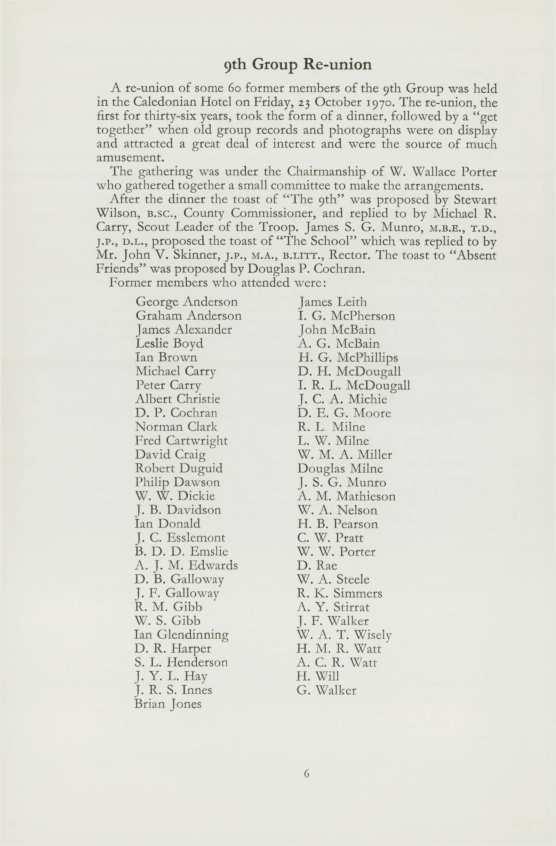
James Leith
I. G. McPherson
John McBain
A. G McBain
H. G. McPhillips
D. H. McDougall
I. R. L. McDougall
J. C. A. Michie
D. E. G. Moore
R. L Milne
L. W Milne
W. M. A. Miller
Douglas Milne
J. S. G. Munro
J\. M. Mathieson
W. A. Nelson
H. B. Pearson
C. W. Pratt
W. W. Porter
D. Rae
W. A. Steele
R. K. Simmers
A. Y. Stirrat
J. F. Walker
W. A. T. Wisely
H. M. R. Watt
A. C. R. Watt
H. Will
G. Walker
SirJames Jackson Robertson
O.B.E., J.P., M.A., B.D., LL.D., F.E.I.S.
Grammarians past and present were deeply shocked and saddened by the news of the death of Sir James J. Robertson in a road accident in London on 9 June 1970. That a life so full and so purposeful should be thus ended seemed to us all so inappropriate -a thought which, had it been voiced to Sir James, would have brought the rejoinder that it would be impossible if not improper to find an "appropriate" end to anyone's life. The feeling which most affected us was surely one of helplessness, an inability to grasp that this had happened, an anger that fate could deal in this way with one so well beloved by us all, and a realisation that, this having happened, there was nothing at all to be done.
To a whole generation the School was Sir James (or "J.J."as he was more frequently and affectionately known). From the dark wartime days of Icbruary 1942.until his retiral in the summer of r9)9 the adYanccment of the School and the good of its pupils and staff were his prime concern. or did his interest cease when a well-earned retiral came, for he was often in touch with his successor, he was regularly at Rubisla\\" for the Annual Sports, and less than a year before his death he addressed the boys of the School once more at the Prizegiving. Who among the Former Pupils present can forget the joy of hearing him speak at the Centenary Dinner of r963 when the Hall echoed once more to his eloquence?
Scholars and administrators of the calibre of Sir James are few (what other Scottish schoolmaster q11a schoolmaster hasbeen knighte d?) and while he often expressed his pleasure at his appointment to the Grammar we are infinitely more proud of our good fortune in having head him as our Rector .As time goes by, surely our clearest recollection, and our highest tribute to him, is that despite all the honours that came to him Sir James remained human, approachable and unspoiled: a lesser man would have been affected by these honours, but not Sir James.
At the London cremation service the London Centre of the Club was represented. In Aberdeen a Memorial Service was held in the West Church of St. icholas on Wednesday 17 June at which a large number of Former Pupils gathered along with representatives of civic and othe r bodies, colleagues, relatives and friends. A wreath in red, white and blue from pupils and staff lay beside another in the Club's magenta and green colours "in affectionate remembrance." The School choir rendered Vaughan Williams's anthem "Let us now praise famous men". The hymns sung during the service have all been heard many times at ..\1orning Assembly-"Praise my soul, the King of Heaven", "Immortal, invisible, God only wise" and "Be Thou my vision, 0 Lord of my heart" and one could readily recaptu re the devotions which Sir James conducted each morning in Hall.
Addresses were given by the Rector and by the Rev. Professor A. 11. Hunter, PH.o., o.PHIL., o.o., Master of Christ's College, Aberdeen. We arc grateful to them both for allowing us to reproduce these addresses. The Rector, ~fr. J. V. Skinner, said:
"In any given field of human endeavour there 1s likely to emerge from time to time a man destined to become in som1,; measure an interpreter and spokesman for his own generation. More sensitive than most of his contemporaries to the trends and influences stirring in the intellectual atmosphere around him, he has more often than not a gift for orderly and lucid exposition which will give these new ideas validity and currency for his O'.\·nage. Such a man, in the field of education, was James Jackson Robertson, whose memory we honour here today
"He was unusually well 1,;quipped,both by his native talents and by the width and range of his prokssional experience, to discharge such a role Of comm.,nding intellect and born, if ever mortal was born, with the sih-er tongue of eloquence in his mouth, he would undoubtedly have achieved eminence in whichever profession he chose to enter All who are involved in education must rejoice that it was in this field that he found his vocation ..\nd in an age when education has become so diversified, so split up into water-tight compartments, when the gulf between the theorist and the practitioner is becoming dangerously wide, how refreshing to find an educationist concerned with the ultimate values, yet with both feet firmly planted on the class-room floor and with the opportunity for daily and invigorating contact with the practising teacher and the infinitely various taught!
"Headmaster in his time of four Secondary Schools, in areas as diverse as Fort William, Falkirk, Edinburgh and Aberdeen, he was unique ly qualified to speak with authority on all aspects of Scottish education and it is hardly surprising that the Advisory Council Report on Secondary Education which appeared in 1947should have carried so clearly the impress of his mind and personality and should have exercised such a profound influence on post-war educational thinking in Scotland.
"It was, of course, inevitable that he should become increasingly involved as time went on in educationa l planning. The Advisory Council, School Broadcasting, the Training of Teachers, Commonwealth Education - to name only a fe,v of the fields in ·which he was active-benefited from his participation and not infrequently from his chairmanship. In 19i6 his outstanding services to education were recognised by the award ofa Knighthood from her \1ajesty the Queen -an honour neYer before accorded to a serving Scottish l lcadmaster and one which for that reason received its warmest acclaim from the rank and £ileofa profession all too rarely vouchsafrd such recognition. In the same year an honorary Doctorate was conferred upon him by the University of \berdeen, and in •9l9, the year in which he retired from professiona l life, he achicYed the double distinction of Presidency of the Education Section of the British Association and appointment as Assessor to the \X'aters Tribunal.
"For the last ~eventeen years of his professional career, as Rector of Aberdeen Grammar School, he was also im·oh·cd in the day to day problems of schoolmastering. Many of this audience here today will have sat under him as pupils or served under him as teachers. To all such, I would suggest, the catalogue ofhonours and offices must seem
Robertson 9 of secondary importance and it is to the man rather than to the educationist that their thoughts will turn at this time and in this place. For his true greatness resided in the last analysis not so much in intellect or eloquence but in his essential humanity - a humanity rich in tolerance and understanding, which permeated indeed all his educ..'\tionalthinking but which was most clearly and unequivocally displayed in the day to day personal contacts oflifc and, above all, in his contacts with young people, with his boys of the Grammar School.
"The last ele\"en years since his retiral can in no sense be regarded as twilight years. Not for him the 'vita umbratilis', the cloistered life. His interests in School Broadcasting were maintained and were recognised by chairmanship of the Scottish Committee. So too was his interest in Commonwealth Education and in the work of the Advisory Council. At the same time he kept in regular touch with the Grammar School, dropping in from time to time for a friendly chat or in search of information and putting in an appearance whenever he could at school functions. Certainly, as all who knew him in these years will testify. there was no evidence that his eye was dim or that his natural force of mind and personality was abated.
"The end when it came was sudden, the circumstances attending it distressing. And yet, if we may be allowed to set these aside for a moment, we may well ask ourselves whether this was not he)\\ he would have wished it to be. He more than most men ,rnuld have found it dull 'to pause, to make an end,
To rest unburnished, not to shine in use'
For us who are left there remains the memory ofa life ofdevoted service and of unflagging energy, of a legacy of achievement on which others will no doubt build in days to come. He. I Yenture to say, with his abiding interest in religion and the mystics might have looked further and quoted with apprO\ al that great visionary, William Blake: 'Every mortal loss is an immortal gain. The ruins of time build mansions in eternity.' "
THE REV. PROFESSOR HUNTER'S TRIBUTE
When a week ago, the news of the untimely death of Sir James came early over the wireless, ho,\ many of you must have felt, as I did, that a dark cloud had suddenly come over the brightness of that June morning. "The noted Scottish cducationist" was how the announcer described him; and of course he was pre-eminently that, with a fame not confined to Scotland, or even Britain. Many of us knew him also as an accomplished scholar and a master of the spoken and written word.
Yet, when the immediate numbness ofshock and sorrow had passed, it was not primarily the educationist, or the scholar, or the silvertongued orator that we remembered. It was the gracious human being, at once "good and gay", whom we had known in school, in this church, in his home, or on the streets of Aberdeen, oftener than not arm-in-arm with Lady Robertson: the man who was supremely
happy in his married life, the man devoted to his children and grandchildren, the man who was ever ready, by word or deed, to help a friend in trouble . (Some of us to-day must be remembering his little nameless acts of kindness and of love to those whom life had dealt heavy blows.)
But for those of you who did not know him personally, he, being dead, can yet speak, in the style that was the man.
I have in my possession a letter dated 16 June 1956, which he wrote to my son in reply to a letter from fifteen medical students at Aberdeen University who had sent their congratulations to their old "Head" when the Queen made him a Knight.
"I need hardly say" he begins, "that a big part of my joy and pride is for the sake of the old School". Then, characteristically, he goes on: ".\nd here's a new comfort for me: signatures of fifteen good men and true, all to be knights of the stethoscope in due time. \X:'hy,I should live to be a hundred with all you fine fellows at my summons, whenever I get a touch of wind or a gouty toe Bless you all."
If that letter reveals the man, the next utterance reveals his attitu de to the riddle of the world. The date is 16.\pril 1962; the place Glasgow Cathedral; the occasion Founders' Day for Hutchesons' Grammar School -his school and mine. "\'\'hat should run like a golden thread through this day's proceedings" he says, "is the thought of the diversity ofgifts, of our dependence on one another, ofthe generations linked each to each in a recurrent cycle of service, gratitude, and service again; and of all this as enacted under the overarching power and presence of God".
"Science", he goes on, "confronts us with an Either-Or: either it presents itself to us in bleak and pitiless self-containedness: or else, it points beyond itself to a creative and directive hand far more august than that of puny man, and then, like St. '\ugustine, we hear 'all the things of sense cry, He made us'".
Ilow Sir James solved this dilemma we know. "Some of us", he says, "see our little purposes as elements within a mighty purpose, and ourselves as under-labourers in the service of that love which, for Dantc's vision, 'moves the sun and the other stars'".
To that Love, the Love from which (Paul tells us) neither death nor life can separate us, we commend the spirit of this great and good man. for the rest, we say Ave atque Vale: and hereafter "in that world where all arc pure", may we meet again before high God and that Saviour who, in the communion of saints, is his and ours.
The Choir's Tour of Germany
PART I: BAVARIA
The party of musicians which reached :.Iunich on I July this year was the smallest yet to haYc been organised. However, this compactness proved to be a great advantage, since it meant that a large number of adventurous outings and excursions took place, which would have been impractical with a larger group.
The Choir'sTo11r II
The first thing which impressed us in Munich was the cosmopolitan nature of the Youth Hostel where we were staying- every nationality was represented, and multi-lingual folk singing soon became a familiar sound. The preferential treatment which we received from the warden, Herr Stratz, also ensured that we carried many happy memories of the hostel.
In the city of ~Iun.ich itself, we saw mainly its famous group of art galleries and museums; the Pinakothck, the Dcutsches Museum and the Haus Der Kunst, but culture did not occupy all our time. There were strolls to the nearby "\:ymphenburg Palace, shopping excursions, and even an extended visit to Hellabrtinn Zoo, a place memorable for its lack of bars on the animals' enclosures. But I think everyone on the trip would give pride of place to our day-trip to the Zugspitze, the highest mountain in West Germany. It was a memorable day-first we visited a school for violin makers in the village of .Mittenwald, where the craftsmanship of boys our own age made us feel extremely clumsy, before crossing into Austrian territory to ascend the mountain on their side. It is unlikely that anyone who made the cable-car journey up the 9,000 feet of the mountain will ever forget it, or the outrageous prices at the restaur ant on the summit. We were in Germany to sing, so sing we did I-9,000 foet up, in the middle ofa cloud the strains of"Loch Lamond" could be heard, to the amazement ofthe other people on the mountain.
After Munich we moved to Rothenburg Oh der Tauber, a busy city which has changed litlle since the i\1iddlc Ages (the hostel we slept in was built in 1632), and which is still surrounded completely by its defensive wall. Although its beauty did not escape us, with true Aberdonian perception the first place we visited was the chip shop. It is a town for tourists, and it was here that most of our shopping was done. \X'e did have one excursion, howe,·er; a walk to the Bavarian woods which, although pleasant in retrospect, seemed very hot and dusty at the time. The municipal swimming pool was a welcome haven after that. It was a great contrast, after the death-defying streets of ;\funich, to stroll round the walls in the evening, and watch the almost traflic-free streets of Rothenburg, or to cat one's chips on cobbled streets it was sometimes difficult to know whether it was real, or merely an illusion put up for the flocks of tourists who go there from Germany, 1\mcrica and Scotland.
A. CRATG CLUNAS
l'ARI' i; RhGE;\SUURG
For the thir<ltime, a p:irty of Grammar School boys visited Regensburg, on the Danube. Regensburg is Aberdeen's sister city in Germany . The biggest thrill, on the <layafter our arri\'al was being received by the '\Iayor of Regensburg , in the Town Hall. His speech lingered mainly on the fact that Regensburg is our "sister city" . In reply to his speech we sang a song, which possibly jeopardised Aberdeen's chances of remaining Regensburg's sister city. However, he put on a brave face, and smiled goodbye, as we left to sec the torture chamber anticipation perhaps?
Then we saw round the famous Regensburg cathedral, in which \\'e sang the equally famous Domspatzen, or "Cathedral Sparrows" . This is the name given to the choir of boys who sing regularly in the cathedral. They attend their own school, known as the l\lusik gymnasium.
In the da}S that followed we saw many famous landmarks including the Beifrciungshalle-a great monument on a hill top. It was built by the mad king Lud\\·ig, and houses busts of famous Germans. \X'ealso \'isited the church in Kclheim, a monastery town farther up the Danube. Emhedded in the wall, in the entrance hall there is a skull, reputed to be that of an abbot. On the roof of the actual church hall there is a magnificent painting, at one side of which a face peers mocking ly through. The face is said to be a self portrait of the artist, who did not share the monks' strict beliefs. We also had a lovely trip through the Danube Gorge, in small boats. The scenery was magnificent!
One of the most enjoyable parts of the stay in Regensburg ,\·as the trip to the Goethe Gymnasium, the school, were we met the pupils. Here we dared to air our German, which few understood. \X'e were taken into a classroom and deposited ne)..i:to some German boys, in the ratio of one Scots bov to two Germans. The teacher was gi,·ing an English lesson. The boy beside me had great difficulty in pronouncing Southend . Ile kept saying "Sowsend" ..\fter the lesson we charted for a while, before leaving.
We also had our sporting moments and we played a few football matches. Our record reads Played ;, \Von o, Drawn o, Lost;, Points o, a record no team would be proud of.
\X'e left Regensburg at two o'clock in the morning, four days after our arrival. \X'e enjoyed the trip very much, especially the time we stayed in Regensburg .
Au, D.wroso:-:, III H1
The Highlights of the Aberdeen Grammar School Excursion to Belgium and Holland , Summer 1970
This year we decided to organise:.a School trip to Holland, a country which is attracting an ever increasing number of school parties. This is partially due to the high standards ofaccommodation at such reasonable cost, although it c.mnot be denied that the wealth of attractions which this small country presents, so close to England, makes it a fascinating study for boys of all ages.
The aims of the tour were as follows: (1) Introduction to the culture (especially Art) of the Dutch people; (2) Visits to historical sights, e.g. J\rnhem; (3) Visits to places of well-known geographical and ecological interest; (4) Visit to the main Dutch centre of Art and Science \msterdam, and (~) To escape from the hum-drum life in ;\berdeen.
The trip was to last ten days, our headquarters being Schcveningen, near The IIague, with a one-night stay at Blankenberghe on the Belgian coast on both the outward and homeward journeys.
At 7.30 p.m on Tuesday, 30 June, our train left Aberdeen amidst a cloudburst but the whole party was in good spirit . No luxuries such as sleepers were included in the cost as che excited young trn\ellers wen: unlikely to sleep anyway. This is the most boring part of the journey but the staffcan at least relax, although on a previous trip one boy, well warned previously, decided to look out of the open ·window and lost his glasses before the train had reached Stonehavenl But, we carry all kinds of spares. It was "all systems go" and on reaching London at some unearthly hour, we had breakfast (the infallible ham and eggs) at Chatham Restaurant, Victoria Station.
By 1 p.m. the ferry cast off for Ostend absolutely crowded, mainly with American students, who looked like something out of "The Virginian" . Our pupils, however, were dressed in school uniform while travelling or when on organised excursions on the Continent, and their smartness of appearance ·was admired by many Group Leaders and tounsts . This helps organisation. too I~o psychedelic garb here, only the occasional green face on a flat calm.
Ostend was rather dull and cold on arrival but, t\venty-four kilometres along the coast, the boys spent the evening in Belgium's most popular seaside resort, Blankenberghe, with its wide promenade and gay atmosphere. They toured the town on hired bicycles, tandems and machines which carried up to six at a time, and, believe me, they had some fun. The rest here was most welcome after the long journey.
Next morning we set off c.,rly by coach for Holland via the new Delta Route which took us to Middelburg on the Island of Walcheren. \1iddclburg is the central market town on the island, its characteristics being typically Dutch-the clogs, the baggy pantaloons, the halfgabled houses bordering the canals, the dog-carts delivering the churns of milk, the bonnets and the aprons delicately worked in lace.
During the afternoon, while enjoying the catchy music of some pirate radio station lying offshore, it was full speed ahead for Rotterdam -an ancient city- but the Rotterdam standing today is nor a city of age-old architecture . Early in World War II the heart of the city was torn out and destroyed by deYastating bombing.
Undaunted, the Dutch began to think ahead and rebuild. Today, it's hard to sec where the old city stood, for the new Rottcrda111has been created as a living monument to modern architecture and city planning. Rotterdam's citizens are highly ambitious. '\'ot being satisfied with possessing the largest harbour in Europe, they aimed at making Rotterdam the largest in the world, and they succeeded. It is a most interesting city but its attraction does not depend on reconitruction. Many other things are well worth seeing including fine old buildings, canals and windmills, ,vhere the most famous one, "de Noord", still stands . We visited the 392 feet high Euromast, an observation tower for tourists, and, in the midst of a howling gale while viewing Rotterdam, one boy lost his sunglasses over the top.
The boys, however, were all keen to reach their headquarters at Scheveningen - Hotel \an Zee, where dinner awaited us. The seaside resort, ScheYeningen, is usually associated with The Hague from which it is only ; kilometres distant. It possesses a fine beach, a magnificent
Aberdeen Gra111111.irSchool Magazi11e
promenade, pier, aquarium, and all the usual attractions of a worldfamous resort. Ics sizeand closeness co The Hague make it easy to visit the many historic buildings and museums and thus makes for a wellbalanced holiday.
Beside the fashionable resort, we have the old fishing cown, where the inhabitants, despite frequent contacts with summer visitors, have managed to uphold their traditions and way of life (rill we arrived I). The heart of "with-it" Scheveningen is the Gevers Dcynootplein around which night life is fairly intense. The boys, in their free time, found a fine discotheque called "Pam Pam's" so that we at least knew where to find them. The different age-groups had to report back to the hotel at specific times each night but for those who preferred an evening "at home" there was a comfort.1ble lounge with a T.V. in good working order, commentaries being in Dutch, or Double Dutch, depending on one's linguistic ability.
Scheveningen itself was at various periods in its long history either completely or partially submerged by the sea. Since the catastrophe of 1 November 1570, the Protestant Church, once behind the dunes to the east of the village, is now at the extreme west. The Scheveningcn Woods separate the town from The Hague.
The local fisherman, clogs complete, is not very communicati\Te and does not pay much attention to the summer set. He goes in for large families and his customs and mode of living are rather patriarchal.
The traditional costumes arc still \\·orn by both sexes, the women wearing a Breton-type shawl together with a very curious bonnet and a flared midi-plus style skirt -all black, which when fully unfurled would probably co,·er the best part of an acre.
The setting of Scheveningen inspired most of the great Dutch artists. The moment the tourist lcayes the town-centre there lies before him "the flat, grey, fading white-<:rcsted ::-..:orthS1.:a,"which the Aberdonian is quite accustomed to. Imagine a few paintings of the Dutch school (van Goyen, Ruisdacl and Co.) and you know what the place is like. Its personality has rem:tined the same, and it is simply a small but picturesque locality.
During tht: war the dyke was made into a defence line and became a large air-raid shelter, and although the town suffered badly no trace of destruction is now visible. The promenade is overlooked by a huge reddish-brown festiYal or entertainment hall called the J-.:.urhaus.
Beside this famous building stands the tram terminus for The Hague. In five minutes the boys were in the unforg1.:ttable ~lidgct City of Madurodam in the Schevcningen Woods. The party was highly impressed with the miniature to\\'n which presents a living picture of a Netherlands town from the year 1000 up till nO\\.
Another few minutes in the tram (same fare regardless of length of journ1.:y approximately si.xpencc) and the boys found themselves rn The Hague, a modern internationally-minded town with a wealth of historic buildings and many beautiful parks. The centre ofthe "ancient" Hague is the Binnenhof, former residence of the Counts of Holland. Nearby is the Maurithuis Museum with its collection of matchless paintings, including a number of Rcmbrandts. A comparatively recent
building is the Palace of Peace built on proposal of The Hague Conference of t 899 with funds made available by Andrew Carnegie. It accommodates not only the original Permanent Court of ,\rbitration but also the International Court of Justice set up to solve disputes between participating countries in a peaceful and leg.tl way The interior is magnificent, with its furnishings, ornaments, tapestries and chandeliers presented by the various countries, but, the day we were there, a cluster of light bulbs went out of commission .Made in England, of course.
The shopping centre consists ofstreets accessible to pedestrians only and we spent a few hours pleasantly shopping. Hoogstraat, Nordeinde and Passage had many well-stocked shops. Travelling in the city was simple to the boys, as, like most other Dutch cities, The Hague is well-planned and traffic problems are non-existent, quite unlike Kittybrewster on a friday.
Our first excursion from Scheveningen was to \rnhem, this district lying north of the Rhine and its branch, the Ijssel. Here ,,·evisited places of historical interest-Oosterbeek with irs immaculately-kept \'far Cemetery followed by The ,\irborne l\Iuseum at Doorwcrth Castle, which commemorates the Battle of ,\rnhem and Britain's first heroic Airborne Division . Numerous guns and tanks were available for inspection rn the Castle grounds
Lunch was served at the \X'estcrbouing Terrace oYerlooking the Rhine and its attractions included a cable-car, a playground (with the inevitab le non-paying one-armed bandits) and a fair-sized party of English schoolgirls .
In the afternoon we visited Burger's Zoo, the country's largest, where the animals have been given natural settings and most of the zoo looks open and uncaged. An excellent Lion Park is included where the party saw the "free-range" lions being fed. Although some of the saddle-backed larger ones looked their age, nobody ventured out ofthe bus, and as no one had misbehaved on the trip, it would have been most unkind to throw anyone out at this stage.
Another excursion and we were in Amsterdam-a city of surprises The canal and bridge network, shaped like a fan, gives the city its own peculiar charm and appearance There are over ninety islands, 400 bridges, 600,000 bicycles, and it is said that the national drink, which looks like water, packs a handsome wallop. llow de vliegende JIollander (The rlying Dutchman), like the "Pacific Glory", well-oiled and under the weather, could possibly find his own way home on a dark and foggy might, must be another story . .. and, ifone happened 10 land in any of the canals of enchantment, it is an odds-on bet that he would poison before he drowned.
This tou r, however, was most memorable : a boat trip on the canals, visits to a diamond factory (no free samples) and the Rijksmuseum, where all the boys were guite impressed by the works of the great artiHs, especially Rembrandt's "Night \Vatch". It measures 14 feet 2 inches by t 1 feet 7 inches and is admirably illuminated by screens with the rest ofthe room in darkness . Definitely worth visiting, though, regardless of your own artistic talents. \X'e then spent an hour or two
Gra111111arSchoolllfagazi11e
in the shopping centre beside Dam Square, where the hippies were gathered in their hundreds around the War 11emorial. The problem is solved now and then, I believe, by the police force and a few fire engines.
A visit to Ratterman's clog factory was one of the day's highlights and the expert craftsman's sales were really brisk. To my amazement, nobody yet had shown any signs of hayfcver after the early morning visit to the Aalsmecr flower markets. It was then back to Scheveningen -and leisure time.
Unfortunately, thc holiday was coming to an end and we returned to Blankenberghe and Ostend, visiting the famous potteries at Delft on the way.
We had a perfect holiday in Holland. The hotel was very clean and comfortable and the Dutch people did their best to make us welcome. As an extra bonus the weather was quite good.
Pupils and staff enjoyed the trip immensely and agree it is an ideal place for future excursions. The boys, a finer bunch we couldn't have wished for, made life ,cry easy for us by adhering to our many instructions, 497 in all, and a special mention must be given to my good friend and colleague, i\lr. W. Walker of the Physics Department, for his very efficient ser,ice as treasurer .
•\ social evening for the boys, their parents, family members and friends, was held in September and the attendance ofover 300 was most encouraging. Prom the large collection of slides taken by the party during the trip, two of our senior members, John Duncan and Kevin Rennie, were mainly responsible for producing a most interesting and entertaining slide show with full supporting commentary and music. Pina.Uy,I take this opportunity of thanking the Rector, \[r. Skinner, for his encouragem<.;ntand support of the excursion.
\\', S. 11AY
School Office-bearers
Prefects
Jon's L. Dt''-CAN (Senior Prefect) IAN GooorELLOW (Depul_) 1 Senior Prefect)
GORDON s. ADA\! ALISTAIR COOK KENNETH F. PARK
KEITH .M. ANDERS01' ERIC 11. CROCK \RT CA\IPBJ::LL R. F.
WILLIAM BARLOW R A'sAT.O ] fORD\CE PATERSON
DAVID Bmo \YLA'- GrLES JA~IES ~[. RAE
KENNETH S. Born EuA"- J. L.-1.wnr-,;cr. G1uEME W.R.
GORDON A. BUCHAN ] 011-... R. :MACOO',AI D SALTER
R1cH,1.Rn J. CARSON D 1:.REK McLEoo DAVID G. s,,r:1:.NE\ GRAr.~m l\L CLARK \X'ru,nEo J. Mncnr.r.L RAv,10-..:D \X:',\1.KER
A. CRAIG CLUNAS
A1'.DREW D Nrsui,r JOHN WATT
House Captains
Dun Byron GORDON 1\. BucnA, JoHs L. DuNcA.-..
Keith
R ANAL D J. FOROYCE
Melvin
EuAN J. LAWRENCE
Rugby
CaptoitJ Jon, L. DuNCAN Vice-Coptoi11 L" GOODFELLOW
Hockey
Captain KEN-..:ETH F. PARK Vice-Captain \NDRFW D. 1suET
Swimming
Captain R ANALD J. FORDYCE Vice-Captain EPAN J. LA,~RE:--.CE
Literary and Debating Society
President ERIC H. CROCKART Vice-President A. CRAIG CLUNAS Secretary Doucus R. WrLT,IA\ISON Treasurer GORDON A. BLCHA"<
Dramatic Society
Prnidmt A. CRAIG CLUNAS Vice-President DAVID J. PoR1Tous
Secretary D ouGLAS R. WrLT,IAMSON Treasurer Wn LTAM BARLOW
Cadet Force
11·.o. R\\ A"- G. L. RnD
Edito r of School Section JOH"< L. Du.:--.-CAN
School and Random Notes
the only true record of life in this School, and a has-been for a long time.
Featuring: \II things bright and beautiful (with backing by Duncan and the Dominoes).
A seagull called" elson". What Byron is writing on his notepaper. Another seagull.
The awful truth behind the sixth year the fifth year. A pole on the turret, a nip in the air, and a bearded glaswejyin in the sheds. ;\fiss Boyd's bicycle . . . and lots, lots more.
A noteable addition to the School furniture is the contribution box for the Pupils' Magazine Kot to be outdone, the F P. Magazine also has a contribution receptacle; it solicits articles with a rapacious avariciousness, scratches the back of its head frequently, and lives in Room 14.
The kitchen staff have decided to black Baxter's Soup.
On our annua l wander round the classrooms we have observed a remarkable lack of curtains. Apparently those which were there last session were taken down, dyed red, cut into strips, and sold at great profit to the Sixth year.
Where is Boddam, anyway? \Xe have been told that you can get there but that you May be faced with a large Bill.
This notice was found pinned to the door opposite the janitors' box: "Come back Bob, all is forgiven!" We think it \Vas the first XI
We would like to announce that this year's Film Society has a will of its own.
And now a selection ofdiscs from Jeff's Disc, with their dedications: For Mr. Falconer from the first XV- Sympathy for the Devil.
Random Notn
To the cooks Beggars' Banquet.
A1r. C. Stewart's favourite L.P.- J\famrna C1ss's Greatest Hits. Written for i\lr. Baxter by G. F. Handel-And the government shall be upon his shoulder.
For Mr. Spence- \fonster Mash.
To Mr. Paterson from an admirer- New York State l\lining Disaster, 1941.
To Mr. Galloway from the Kremlin Gee but it's great to be back home
And for the Biology Department Climb the ladder to the roof.
With the coming of Christmas, the School again takes on its now familiar odour. :--:everfear, it's only the janitors having their annual "brew" up!
Do Russians eyer shave?
l\femo: ... and in 1970 a dart finally went straight through the wall of the Prefects' Room into the office, to the extreme discomfort of the occupants therein.
Ori one of our conducted tours of the School we noticed the large number of broken windows all over the whole building. This set us thinking; had somebody been trying to get in, or had a lot of people been trying to get out? Supposing the School was burgled. What choice valuables would the felons steal? So we made a list of the absolutely irreplacable and priceless articles which the School harbours.
A "borrowed" Bullworker.
A bag of peppermcnts, all neatly stamped "Library".
A relief map of the Holy Land.
A treasured rubber stamp saying "Abcrdoncnsis Grammarus Schoolus".
1\ cup of beef soup with extra sugar.
A gaudily worded litter bin (the metal ones arc ah\ ays empty).
The fantastically accurate Hall chronometer. and last, but not least, Lesley.
However, we doubt the sa~ity of the person who suggested that they might take one of the Prefects.
Finally, we arc pleased to announce another Library Walk next year. However, participants arc asked not to wear tackity boots, as they made an awful mess of the linoleum on the last Walk.
House Notes
Byron
The following ollicials han: been chosen to represent the I louse this year: II011se Captai11, Gordon Buchan; T-ice-Captai11,James Rae; R11gl!J Captai11, John Watt; Vice-Captai11,James Rai.:; 1lod;q Captain, Derck Johnston; l ice-Captai11,Fulton Draper; S11·i111111i1{f!,Captai11, Ian Goodfello\\"; Foo/hallCaptai11,Gordon Buchan.
Por the secon<l year running the House won the Athletic championship, while last year's House Captain, Jon Christiansen, lifted the senior indi,·idual championship at the Sports. The Ilouse enjoyed success in the Rugby field also, winning the seven-a-side tournament, and coming a close second in the XV-a-side, and prospects look bright for continued success this year. Hockey met with moderate success, while our cricket teams excelled in winning both the seven- and clcvcna-sidc tou rnaments. \X'econtinued our remarkable run ofdismal failures in the Gala, occupying our now expected position of last: this year promises no better, although greater participation and support might help.
This term sees the adYcnt of House football and it is to be hoped that the IIouse will distinguish itself in this field.
GORDO, i\. Bt:CHA:--1
Dun
At a meeting earlier this term, the following officials were elected : House Captai11, John L. Duncan; J,, ice-Captain, Andre,, D. Nisbet; Rt{t!,i!} Captai11, John L. Duncan; Vice-Ct1ptai11, J\listair Cook; flockry Captain, Alfred G. Brock; Vice-Captai11,Andrew D. ishct; S111i11111Jin,!!. Captain, Christopher J. S. Wardle; Vice-Captain, fan L. l\lilne, Football Captain, Alan \1cLelland.
In the Sports last year we managed to beat only Keith but successes lower down the School in Group 4 and l augu r wt.:11for years to come. The rugby teams arc all quietly confident especially the senior seven-aside team where somi.: strong forwards should gi,·e us an advantage In hockey, the senior elcn:n-a-sidc team should put in a strong challenge and the six-a-side team has a strong defence which should stand us in good stead. The Swimming Gala will, as usual, develop into a fight with Byron for last place although greater support might help. The football team also intends to put in a determined effort to gain the House trophy.
Jou:-- L. Du,cAN
Keith
The following officials were elected to represent the house: IIowe Captain, Ranald fordycc; [ 'ic•-Captai11, John \ [acdonald; Rt(~k;· Captain, ,\llan Giles; [ ·ice-Captai11,Ranald fordycc; Jlock.q Captain, John Rennie; r ice-Captain, Brian Cockburn; S1l'i111111i,(t!, Capta1i1, Ranald Fordyce; L ice-Captai11,Ed,nrd Rose; FootballCaptai11,1':enneth Boyd.
Hopes are high for this year's rugby team especially in the seven-asides where we ha,c a particularly strong team. \X'e hold great hopes for our hockey XI as many of our team haYe returned from last year. Our football is also of a ,·cry high standard an<l again we hope to lift the trophy The swimming team, which is virtually the same as last year's, has a tremendous chance of retaining the cup for the fourth year in succession. On the whole this year could, with a little bit ofluck, be the most successful eyer had by the House.
I inally I would like co thank all those masters ,vl10helped the house during the term.
RA"-ALD FoRmcE, I loHst Captain
Melvin
At the house meeting the following officials were elected : Howe Captain, G. Lawrence; I ice-Captain,K. Park; Rt{~l?;•Captain,J\. Stephen; 1 'ice-Captain, E. Lawrence; IJockey Captain, K. Park ; T'ice-Captain, D. ~kLeod; 511'i111111i11!,Captai11,G. La,vrence; I ice-Captain,C. Paterson; I'oolba/JCaptam, T. DaYidson.
This year should proYe more successful for the House; with an experienced hockey team, under the captaincy of the school hockey captain, we should regain the hockey cups; in the swimming gala, we should manage to win as none oflast year's swimmers have left; and on the rugby pitch we should be serious contenders for the trophies because of the large number of good rugby players in the Vth year.
J:Uo\"1 j. LA\\ REKCE
Staff Notes
Rapid change-ove r in staff in the teaching profession seems these days almost an accepted and normal feature of teaching life. Over the bst fiyeor six years, there has been quite a steady current of movement in the staff at School and the pattern this session is no different. Seven members have left and there are twelve newcomers. A greater note of change this session is struck with School being renamed Rubislaw .\cademy and the first year intake representing the unselected product of our area. Both of these changes are in keeping with the town's commitment to comprehensive education. However , all changes apart, it is very much business as usual and one has but to walk through the corridors to catch the atmosphere of great activity. The ship has merely s11iftedcourse a degree or t\\'o.
;\fr. John T. Waters, Head of Commercial Subjects, retired from reaching at the end of last session. Jack \X'aters came to Grammar in 1961 from Dollar Academy, where he had also been Head of his Department. It was almost inevitable that he should be in charge of Careers in School as he had a most genuine interest in young people and their problems. rervcnt young teachers often become so wrapt in the academics of their subjects that they are inclined to lose sight of their pupils as persons. \fr. \'v'aters was of great value to the School in this respect, that he had a basic and true wisdom which allowed him to
overstep the sometimes narrow confines of subject teaching and see boys as individuals . This is a kind of real professional integrity which is a most valuable quality in senior members of staff. He had, of course, great zeal for his own subject; prior co retirement, he was Chief Examiner in Commercial Subjects for the Scottish Education Department, a post of great responsibility . But here too his essentially human quality shone through, \\·hereby he could master and interpret the intricacies of the stock market, economic history, statistical reports, trade figures and trends, and so on, but at the same time would delight us by discussing what these things meant to ordinary people.
:;\fr. \'vaters has been moving northwards ever since his youth spent in ·ewcastle. Ile has left Aberdeen as well as the Grammar and has now taken up house in Findborn, on the Morayshire coast, where we send to himself and his family our most hearty good wishes for a long and happy retirement.
The Lower School has been running down now for several years and at the moment there arc only two classes left. A note of finality is struck with the departure of \[r. James Niddrie, the Lower School \faster, who has left to become Deputy Headmaster of Westerton Primary in Aberdeen .A Gordonian, ~Ir. '\!iddrie succeeded in October T967 Mr. James Morrison as Head of the Lower School, having previously taught for six years at Fermelea Primary, Aberdeen. \Ve shall miss his quiet efficiency and his easy, friendly manner. He was a most popular master with the boys and with his comrades on the staff. We wish him the best of good fortune in his new post.
Mr.Clement A. Stewart ,vas a pupil himself at Grammar but returned to teach in the Mathematics Department in August 1963, after his spell at University. An excellent mathematician, with a special interest in statistics, and a first-rate teacher, he nevertheless had many interests outside his own subject. lle was a hockev player for the F.P. team and is also an active member of the Scottish Hockey _ \ssociation representing Scottish Schoolbop. His interest in church work led him to take part in the School's Scripture Union and he has also been seen out with the Hill Walking Club. Mr. Stewart has left to take up the post of Head of the ~Iathematics Department at Dunoon Grammar School and, while lamenting his departure, we also extend to him our best wishes in his new post.
~fr. David Scott has been an assistant in the Physics Departm ent for two years and in this relatively short space of time he has fully participated in the life of the School. An F P. of Morgan Academy, Dundee, he took part in the activities of several of the School clubs, especially the Hill \X'alking Club, the folk Club, in which he played the guitar, and he also went on two of the School's continental trips, to Holland and to Brittany. A quiet and reserved person, Mr. Scott worked very hard for his department and his dependable nature made him popular with staffand boys. Mr. Scott has left to attend Birmingham University to study for his l\f.Sc. It isnot likely that he will return to the profession. \ school can ill afford to lose masters of this calibre.
\fr Ian S. Reid taught Commercial Subjects and also Arithmetic. He came to School in August 1969from the College of Commerce and
Staff Notes
has now gone south to teach in Cumbernauld Such is the scarcity of teachers of this subject that, when Mr. Reid and also Mr. Waters left, no replacements for the beginning of the present term could be found.
Last of the leavers arc Mrs. Patricia A. Falconer and Mrs .Marion T. Petrie of the \Iodern Languages Department who arc both about to tackle the problems of motherhood. While here for only a short time, they have added a welcome femininity to our rather austere environment. The School unites in wishing them the best of good fortune with their events .
And now the brighter side ofthe coin. There are twclvc new members this session and " e accord them a most sincere welcome to the School with the genuine wish that they will have a long and enjoyable stay here They arc
Stanley Watson (English)
William Gordon (English)
Gordon Cruickshank (Geography )
Gordon Duguid (Commercial Subjects)
Kenneth .Mclvor (Science)
Stephen Parry (Mathematics)
Ian M. McCurrach (Art)
\[iss Sheila iven (Remedial Subjects)
Mrs. Ann Robb (Biology)
James Gilbert (Technical Subjects)
Robert A Minett (Modern Languages) and
Alfred I. D. Cruickshank (Modern Languages) .
Finally, a brief mention of new internal appointments. With the departure last session of l\lr. Robert l\icNay to become Rector of Dumfries Academy, the post of Deputy Rector is now held by Mr. 1\rchibald G. Baxter, formerly Head of Mathematics .Mr. Baxter already has a long period of service to the School and we offer him our hearty congratulations as he tackles the thorny problems ofadministration. 1le is incidentally continuing to act as Head of the Mathematics Department pending the appointment of his successor.
School Sporting Activities
Rugby
.\11 signs seem to indicate that this will be a succc;ssfulseason. But "·hilc it is indeed desirable to hn.Yea winning 1st XY, it is much more important to have as many teams as possible competing and performing at high level. This is not to say that the School 1st XV is not successful. In fact, the boys haYc started well and arc learning all the time. They should do \\"ell unless bad weather curtails the season
Enthusiasm for the game is very high and there is keen competition for places. The ;\Linors have shown great promise and large numbers turn up to the practices. They show obvious ck:termination to win a place in the first team and this is a good pointer to the future.
\'\'bile there is much activity on the part of the boys and, I may add, groundsmen, referees and staff as well, there could however be a considerable improvement in the amount of spectators who tum up to watch the matchLs.
R. S. F.
I St XV
\\'e returned to School with only fo·e first ream regulars from last year but these five have provided a strong basis on which to build the side \'\ e are as usual light but mobile in the forwards with our backs, hO\\'e\·er, showing they arc capable of making the most of any possession. We have also strength in reasonable depth ·which has helped to circumvent injuries to key players.
Our first game was against Dundee High School at Rubislaw which we won by 14-9. It ,vas a pleasant change to start well and we were eight points up within five minutes through a drop goal by Porteous and a try by Paterson converted by Davidson We allowed Dundee to come back into the game, howc,·cr, with a drop goal and a penalty In the middle of the first half mainly through a lack of experience in the forwards. Davidson kicked a penalty to make the score at the interval 11-6. The second half was untidy, Dundee scoring a penalty goal, until in the last ten minutes our fitness proved itself and Fordyce scored a try from the base of the scrum \X'ewon the game basically on our possession gained in the second phase and not from the set piece. This possession was not as good as it could have been although we usually had a numerical superiority of forwards at the break down.
Our next game was against Glasgow .\cademy at :--..cw ,\nniesland where we lost 11-3 Here the forwards did not dominate in an} phase of play and it was not until the Inst guarter of the match that we began to show our potential but they defended well and held out till the end.
\X'e returned to Rubislaw to play Gordonstoun where we won 9-8. The game was not as close as the score would suggest with School once again starting well, Paterson scoring a try and Porteous dropping a goal. \[id-way through the first half Gordonstoun scored a conYerted try when an awkwanlly bouncing kick ahead wrong-footed our defence. Just before half time, D.1vidson kicked a penalty after an
infringement at a ruck to make the half time score 9-s. At the beginning ofthe second half, however, the school forwards allowed the Gordonstoun pack to dominate and this pressure ga,·e them a try in the corner. Once again it was in the last quarter that the pack took control and gave us the pressure for the rest of the game but there was no score to show.
It \\'as at Dollar that we found our best form to date when we drew 8-8 with a very strong Dollar Academy XV. The whole side played well, especially the front five forwards who gave our backs a sometimes embarrassing amount of ball from both set scrums and rucks. The set piece ball, however, tended to be slow because of our pack's inability to do much more than hold the considerably stronger and heavier opposition. Our points were all in the second half; a Porteous drop goal and a try by Clark com·erced by Davidson.
We managed to improve our "for and against" points ratio in beating Hazelhead 1\cadcmy 33-0 at Rubislaw. School dominated all through the game, the forwards winning a large amount of second phase possession. The scon:rs were Paterson (3 tries), Goodfellow (2 tries), C. Duncan (try), Fordyce (try) and Porteous (try and drop goal).
Our final match to dare ,,.-asagainst .1\berdcen Wednesday Club at Rubislaw where we won 18-8. W'e managed to dominate early on, our forwards being much more mobile and our backs penetrating well. In the second half we allowed them to come back into the game but again towards the end our forwards took command and began to giyc the backs quality possession. Scorers were DaYidson (s penalties) and Paterson (try).
As for the rest of the season, we arc quietly confident, and if our backs can maintain their form, and the for\\'ards continue to give them possession, we should haYea successful season.
Jou:-.:L. DUNCAN, Captain
2nd XV
This year, the 2nd XV have proved thcmsch-es ro be a reasonable challenge to the first XV on \X'ednesday afternoons . We arc basically a small team but with determination and regular training we have played well and, what is equally important, haYeenjoyed our rugby.
We have relied on mobile forwards and running the ball to the wings from where many of our scores have come, as against Gordonstoun "·horn "·c beat 20-0 at Rubislaw. \X'irh fierce competition for places in the 1st XV and because of injuries, we ha,·e been unable to keep a completely regular team, but this has been compensated for by the fact that we have a large pool of willing players who arc always cager to play.
Our first match, against Dundee IIigh School, is always a close match but we started off well and had a , 3-3 lead by half time. In the second half, however, with the slope and wind in Dundee's favour, they reduced our lead to r3-11. We produced our best rugby in the last few minutes of the game, with resolute tackling and forceful forward play, and we were glad to hear "no-side" and chalk up our first victory.
Aberdem Grann11arSchoolMagazine
The match against Gordonstoun at Rubislaw was another close one. They were a big and brawny team and both our forwards and backs had to mo,Tc quickly before we ,von by 20-0.
We next travelled to Glenalmond on a cold, blustery Saturday morning The opposition were again huge physically but we played well. On a sloping, sodden pitch we stayed level, each team having scored a try. But with only a few minutes to go, we conceded another try and we lost.
Our next match against Inverness Academy was cancelled and the following Wednesday, the 1st XV had a fi.'Cture.\fr. falconer arranged 'ln extra match for us against Robert Gordon's College rnd XV. We started badly but led 8-o at half time. In the second half we played better and seven tries and four conversions gave us a finalscore of 29-0.
And so with our attractive matches left in the fi.'Cture list we arc hoping for continued success and few cancellations during the winter months.
IVth Year
Results this session so far have been disappointing . .:---e,·ertheless, keenness and enthusiasm are high although physique is lacking . For endeavour ther arc to b1. commended
Colts
A very keen and enthusiastic group who have so far enjoyed a successful season. With the exception of the match against Glasgow .\cademy, which was no contest because of the disparity in size, they have shown the ability to play good combined rugby. When weather conditions worsen, the side should continue to do well as the forwards, who pack well and have good mobility, are certainly equal to any task they are set. The tackling of the backs, ho,,·ever, must be a little more resolute to compensate for their evident lack of physique.
2nd Year
Because of a spell of bad weather all znd year boys this term lost valuable rugby time. The team, however, is beginning to settle down and a good result was the win over Robert Gordon's College znd year. With the confidence gained from this match, I am hopeful that their future has good promise. Enthusiasm is there; ability is there; results will come.
1st Year
The Minors' practices at the start of the season were very well attended and this enthusiasm has been maintained. The team has had little opportunity of showing its paces in matches so far but a narrow defeat from a bigger an<l more experienced Gordon's College team and a victo ry over the Junior "A" team promises well for the rest of the season.
SIMPSONS' FOR SPORTS
Hockey
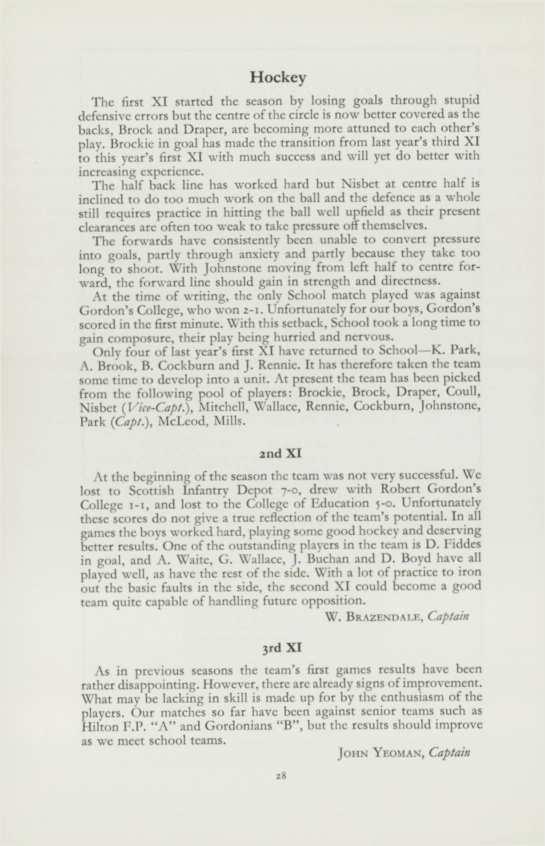
The first XI started the season by losing goals through stupid defcnsiYe errors but the centre ofthe circle is now better covered as the backs, Brock and Draper, are becoming more attuned to each other's play. Brockie in goal has made the transition from last year's third XI to this year's first XI with much success and will yet do better with increasing experience.
The half hack line has worked hard but . isbet at centre half is inclined to do too much \York on the ball and the defence as a whole still requires practice in hitting the ball well upfield as their present clearances arc often too weak to take pressure off themselves
The forwards haYe consistently been unable to convert pressure into goals, partly through anxiety and partly because they take too long to shoot. \X'ith Johnstone moving from left half to centre forward, the forwa rd line should gain in strength and directness.
At the time of writing, the only School match played was against Gordon's College, who won 2-1. Unfortunately for our bovs, Gordon's scort:d in the first minute. \X'ith this setback, School took a long time to gain composure, their play being hurried and nen·ous.
Only four of last year's first XI have returned to School K. Park, \ . Brook, B. Cockburn and J. Rennie. It has therefore taken the team some time to develop into a unit. At present the team has been picked from the followi ng pool of players : Brockie, Brock, Draper, Coull, • isbet (Vice-Capt.), Mitchell, Wallace, Rennie, Cockburn, Johnstone, Park (Capt.), McLeod, Mills
20dXI
\t the beginn ing ofthe season the team was not very successful. \X'c lost to Scottish Infantry Depot 7-0 , drew with Robert Gordon's College 1-1, and lost to the College of Lducation 5-0. Unfortunately these scores do not give a true reflection of the team's potential. In all games the boys worked hard, playing some good hockey and deserving better results. One of the outstanding players in the team. is D. riddes in goal, and A. \\"aite, G. Wallace, J. Buchan and D. Boyd have all played well, as have the rest of the side. With a lot of practice to iron out the basic faults in the side, the second XI could become a good team quite capable of handling future opposition.
W BRAZESDAT F, Captain
3rd XI
As in pre\'ious seasons the team's first games results have been rather disappointing . HoweYer, there arc already signs ofimpro\'ement. What may be lacking in skill is made up for by the enthusiasm of the players. Our matches so far have been against senior teams such as Hilton F.P. ".\" and Gordon ians "B", but the results shou ld improve as we meet school teams.
JonN
YEO\IAN, Captain
IV Year
It is very pleasing to see so many fourth year boys interested in hockey and willing to turn out on Saturday mornings. As a result, the \\·eekly team is continual ly changed to give as many boys as possible a game. Frome these, two promising goal-keepers, T. D,1\'idson and I. Read, ha,·e emerged while R. Cruickshank, . DaYidson, T. Lamb, K. :\fcJlardy, C. 11ills arc out-field players with considerable talent. Of the five matches so far, the most interesting games haYe been against Northfield where theteam fought back from 3-0down to a 5-4 win and against Gordon's College where the winning goal was scored twc, minutes from time after a tense game.
Colts
There has again been a most enthusiastic group ofthird year players keen to learn the game of hockey, and large numbers have attended the Saturday morning practices. It is too early to pass judgment on the standard of play as the boys arc just learning the skills ofthe game, but after a victory oYerthe IV year reserve side, the Colts can look forward with confidence to the start of fixtures with other schools.
School Sports- 1970
For the first time in many years the weather let us dow·n for our Finals Day. .\ftcr a glorious start on Friday it was all the more disappointing that heavy rain on Saturday meant that nine events had to be postponed for safety reasons until Monday. This year saw the introduction of metric measurements and, although there were some times which would have been records under the old system, for the time being they will have to be known as best performances only.
Result s
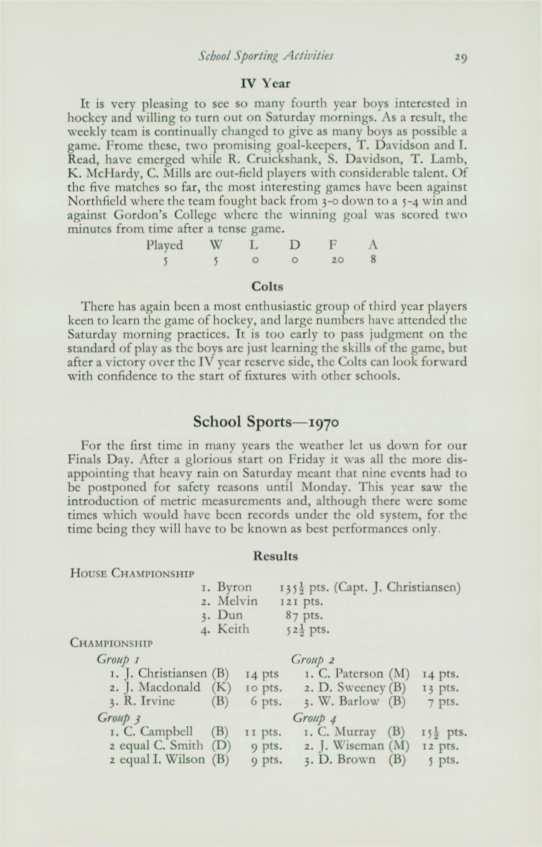
Housn CttMIPIONSHIP
I. 1. Byron Melvin
3· Dun 4. Keith
CHAMPIO:r-.SIIIP
Grolfp I
,.J. Christiansen (B)
1. J. \Iacdonald (K)
3. R. Irvine (B)
Gro11pJ
1. C. Campbell (B)
1 equal C. Smith (D) 1 equal I. Wilson (B)
135! pts. (Capt. J. Christiansen) I 21 ptS.
Gro11p 2
1. C. Paterson (l\l)
1. D. Sweeney (B)
3. W. Barlow (B)
Group 4
I C. \[urray (B)
1. J. \X'iseman (J\1)
3. D. Brown (B)
Gro11p J
I. S. Brady (D)
2. Coutts (.8)
3. G. \llan (K)
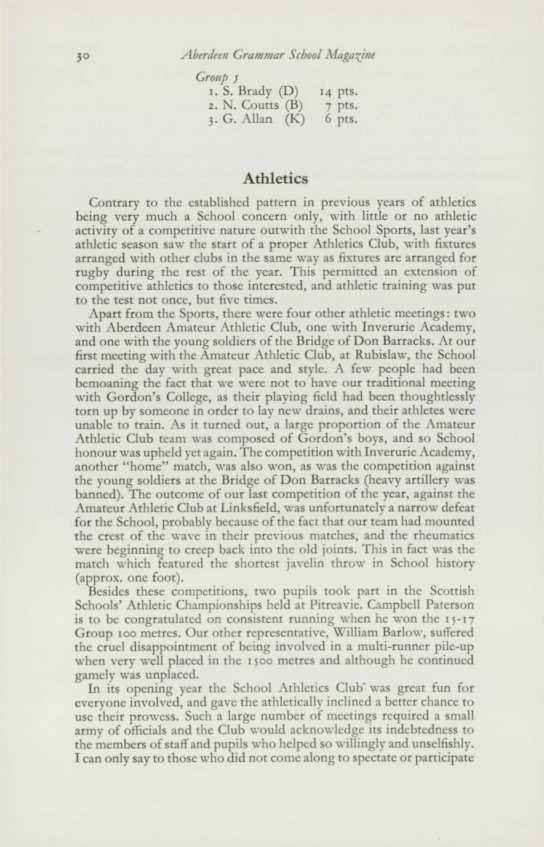
14 pts. 7 pts. 6 pts.
Athletic s
Contrary to the established pattern in previous years of athletics being very much a School concern only, with little or no athletic activity of a competitive nature outwich the School Sports, last year's athlctic season saw the stare of a proper Athletics Club, with fixtures arranged with other clubs in the same way as fixtures are arranged for rugby during the rest of the year. This permitted an extension of competitive athletics to those interested, and athletic training was put to the test not once, but fi,·c times.
1\part from the Spores, there were four other athletic meetings : two with Aberdeen Amateur .\thlctic Club, one with Inverurie Academy, and one with the young soldiers of the l3ridge of Don Barracks. At our first meeting with the Amateur \thletic Club, at Rubislaw, the School carried the day with great pace and style. ,\ few people had been bemoaning the fact that we were not to have our traditional meeting with Gordon's College, as their playing field had been thoughtlessly torn up by someone in order to lay new drains, and their athletes were unable to train. \s it turned out, a large proportion of the .\mateur Athletic Club team was composed of Gordon's boys, and so School honour was upheld yetagain. The competition with Inverurie Academy, another "home" match, was also won, as was the competition against the young soldiers at the Bridge of Don Barracks (heavy artillery was banned). The outcome of our last competition of the rear, against the Amateur Athletic Club at Linksficld, was unfortunately a narrow defeat for the School, probably because of the fact that our team had mounted the crest of the waYe in their previous matches, and the rheumatics were beginning t0 creep back into the old joints. This in fact was the match which featured the shortest ja\'elin throw in School history (approx. one foot).
Besides these competitions, two pupils took pan in the Scottish Schools' Athletic Championships held at Pitreavie. Campbell Paterson is to be congratulated on consistent running when he won the 15-17 Group 100 metres. Our other reprcscnrntiYe, \X'illiam Barlow, suffered the cruel disappointment of being involved in a multi-runner pile-up when very well placed in the 1500 metres and although he continued gamely was unplaced.
In its opening year the School .\thktics Cluli was great fun for everyone involved, and gave the athletically inclined a better chance to use their prowess. Such a large number of meetings required a small army of officials and the Club ,,·ould acknowledge its indebtedness to the members ofstaffand pupils who helped so willingly and unselfishly. I can only say to those who did not come along to spectatc or participate
SchoolSportingActivities
that you missed an entertaining time, if those who did come have not already told you. The Club was such a success that come Hell, high water, or comprehensive education, its futur e place in the School would seem to be assured.
ERIC Il. CROCKART, SchoolAthletics Captain
Swimmin g
Since the School has adopted the new JOtnt Scottish Schools Swimming 1\ssociation /Scottish Amateur Swimming Association award scheme it has been a great success. The School has the fourth best total in Scotland with 2 n awards. This, in the Club's first year, is quite an achievement and, I hope, an indication of greater things to come.
Euan Lawrence and Ranald Fordyce both swam for Scotland against Iceland in Iceland and the former swam against Denmark in Edinburgh. Since then he has not been swimming Yery much but made a return during late October and is to take part in the Scottish Schools Championships. I le made his return with a time which was only one tenth ofa second outwith his personal best and this after a five-month lay-off.
Only four members of the Club ha,e qualified for the Scottish \gcGroup finals at Dundee this year. They are D. Murray, E. Rose, D Fleming and G. J\llan 1\II four stand a very good chance ofgaining a medal at least.
As was promised in the July ,\tap,azi11ehere arc che results of our swimmers' progress in the ~orthcrn District Age-Groups which were held in May. Those who collected medals were G. Allan, in the 12year-old group, who gained asih·erinthe 80yard breaststroke, C Gallon, in the r3-year group, who gained a bronze, D. Fleming, in the 14-year group, who won a bronze, and J. :\lurray, in the same group, who won a bronze in the So yard breaststroke. In the 1~-yeargroup, D :.\forray and E. Rose almost made a clean swe<;pof the gold medals, failing only in the breaststroke . D. .Murray won five firsts and one second while E. Rose won one first, three seconds and t\VO thirds Other competitors were '. Begg, J\. Milne, I. Robertson, R. l\lilne, C. Murray, . Gubby, C. Falconer and J. \X'yness.
RONALD FORDYCE, S11•i111,11i11,f!, Captain
Both Euan La,Hencc and Ranald fordycc have been regular members of the Scottish Internationa l Swimming Team during the past two seasons and it was to be expected that both would be members of the Commonwealth Garnes Team.
Much to the disappointment ofall connected with North Swimming, Euan was not included in the final squad. The excuse that finances were limited is not valid when this unique opportunity of encouraging the sport in Scotland presented itself at comparatively low cost with Scotland a host nation.
Euan more unfortunate was the case of Ranald, selected as the School's first ever Commonwealth Games S\, im representative, who
AberdeenGro111111arSchoolMagazine
contracted glandular fever and was unable to compete. Although generously allowed by the S\\ imming authorities to :lttend the Games and live in the competitors' village, Ranald was not allowed to swim.
For both of these young :uhlcres, months of dedication and practice culminated in disappointment.
I.C.S
Cricket
Under the able leadership of Richard Gamblin, the 1st XI had another short yet lucrative season, finishing unbeaten in six matches. The fact that only two of these fixtures ended in a win does not detract from the general performance, as it was only some dour defensive work by tail-end batsmen and a slight inability to penetrate these batsmen which denied us much desen·ed Yictories.
Our bowlers must take much of the credit for out two victories against Inverurie Academy and \berdcen Academy. Here the accurate and penetratiYe bowling of Eric Davidson and ,\Ian Christie left our batsmen with meagre totals to pass. In both cases , ictory was accomplished by 10 \\ JCkets.
Dundee High School at Rubislaw proved more difficult opposition than was anticipated and with our bowlers again well on top they were shot out for a mere 51. However, on this occasion our front line batsmen did not prove e9ual to the task and at the close we failed to win by 1 run and had to be content with a dra,\. Our batsmen atoned for this failing at Perth against a weak Pc.:rth,\cadcmy XI and scored 121 for 5 declared, Ian Gooclfcllow, D.n id :\Iilne and Eric Davidson leading the run scoring. However, on an awkward wicket \\e failed to take advantage ofour early break through and allowed Perth to hold on for a draw.
Against Gordon's College our batsmen failed in their quest for a high total and had to be content with 63 runs. Thanks to some fine bowling and fielding Gordon's were reduced to 49 for 9 when rain interrupted and thwarted our, ictory chanccs. ,\g:iin we h:id to scttle for a draw.
Our final match, a trip to J\bbey School, Fort ,\ugustus, ended in a draw also. ,\bbey declared for a total of :iround 10 0. There was some fine fielding, inciuding three run ours in the last over. It \\as m:iinly because of our own stupidity that we threw away any chance of victory and had to be content with a clra\\'.
..\fcntion must be made of the fact that Richard Gamblin, a\lfred Robertson, Ian Goodfcllm\ and Eric D:ividson pl:iyed regularly for the P.P. 1st XI in Strathmore Union cricket, and also that the first three mentioned were selected to play for Aberdeenshire Colts along with "'-.;eil.\rmour. Our thanks must go to the F.P. cricket club who ha...-eencouraged and helped all cricketers in the school.
Colour Awards. Full Colours: Rich:ird Gamblin, Ian Goodfellow. Ilalj Colours: Eric Davidson, Alan Christie.
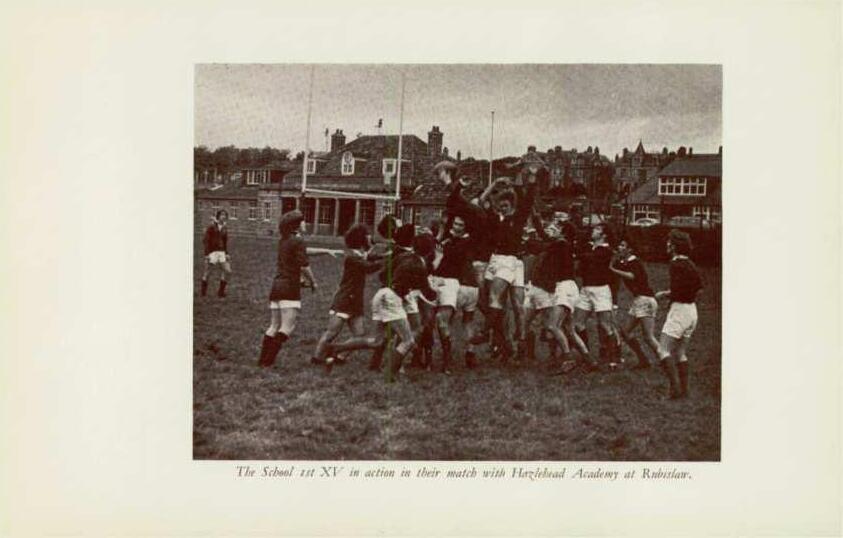
The fchMJI III xr Ill t1r/ir,11 Ill their 11101.-h •l'il/J / !tt::;ltltad Ar,1de111r al R11lmlm1·.
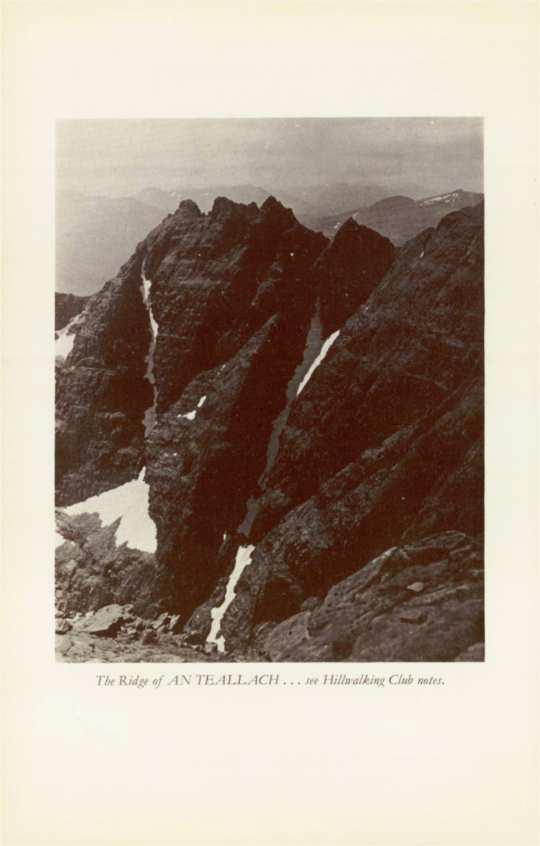
The Ridf!l 1J/ I\ Tl; ILL 1CJJ .
.rrr l lil/11a/J:.'"~ Club 11ote.r.
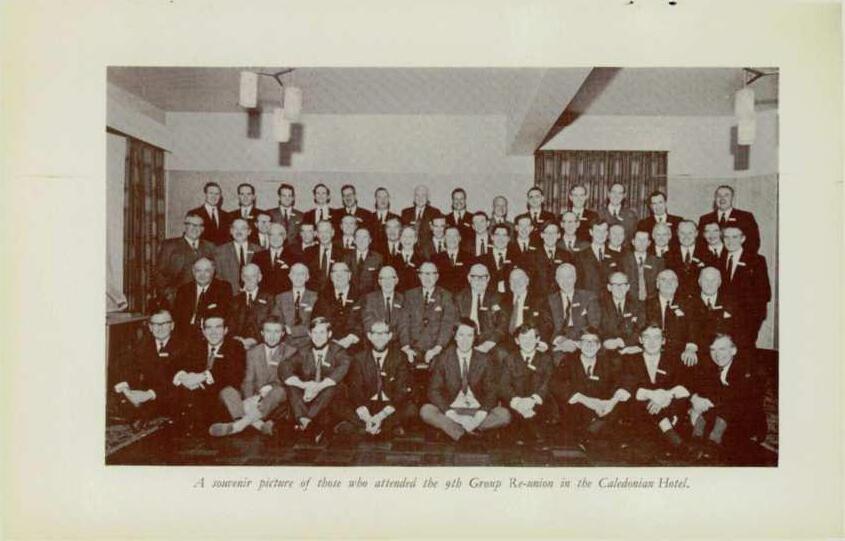
. I som·mir pirtflrr r,,I Jh,,se ll'h(J 111/mded the Jib Gro•tp i{ r-1mio11 m the C1.',dr,11i,111llotel.
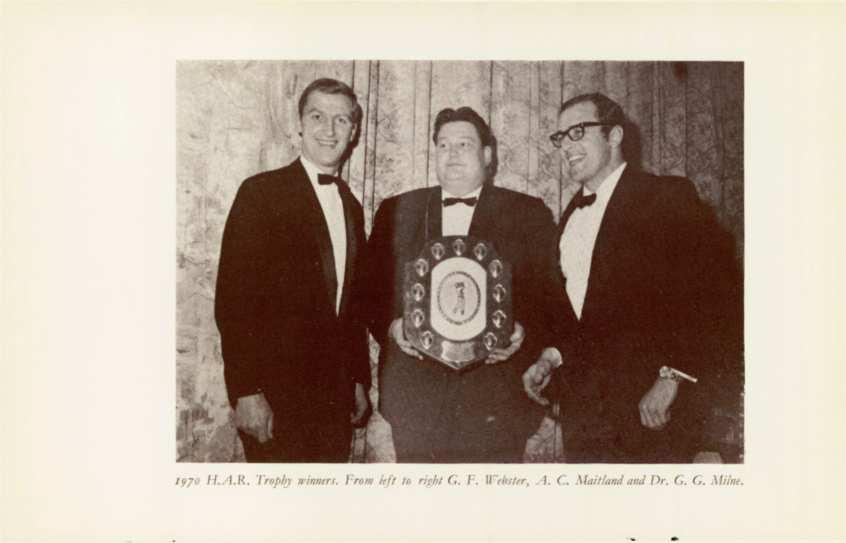
1970 I I. l.R. 'f'ropl!J 11·11111trs. l ·ro111 left fr, m:ht
G. F. ll~thslrr, 1. C \laitland allfl Dr. (,. G. \lil11r.
Music otes
Richard Rodney Bennett's opern "All the King's Men" tells of the siege of Gloucester in 1643 by the Royalist army of King Charles I. Dr. Chillingworth, an eccentric invento r, suggests to the King that a war machine be built, after the manner of the Roman "Muscul us", to span the Severn River. The Roundheads and Citizens of Gloucester, led by Colonel :\fassey, foil this plan by widening the right at night, \\'ith the result that "Humpty-Dumpty", as Chilling,,·orth's monstrosity was mockingly nick-named, "had a great fall"- hence the title of the ,,·ork.
The School Choir gave two Yery successful performances of this work in the \rts Centre on 26 and 27 :\lay. ,\ section of the School Orchestra provided the accompaniment Five separate groups ofsingers were needed Royalist Generals, Soldiers, and Ladies; and Colonel Massey's Soldiers, and the people of Gloucester. Outstanding among the solo singers was James Crockett as Chillingworth, who acted and sang with splendid assurance. Able support was given by Ste,·en \ llan (King Charks ), Graeme Yackaminie (Queen Henrietta), Graham Dale (Drummer Boy), and Malcolm Johnston (Colonel Massey). The Producers were 1Ir. James Tinto, of the English Department, and Mr. Ronald Sawdon, of the College of Education . :\frs. Grant and Mrs. May gave valuable help in advice about costumes and other props.
The same concert also included songs by the Tenors and Basses of the Choir, and by the Lower School Choir, the latter conducte d by Mr. George Swalwcll. Mr. Swalwell also declaimed, with considerable panache, the narration of "Tom Sawyer's Saturday", by Johnnie Dankworth, forsaking his .\ustralian accent for a convincing 1\mer ican one. Everybo dy seemed to enjoy this humorous jazz-styled piece, and both this and "All the King's :\fen" were given at a special matinee performance for the boys of most of the Primary Schools of our area. Members ofthe ;\fusic Department are this year for the first time going into these schools to teach the older Primary classes, and this link between Primary and Secondary might in the long term help partly to mitigate the serious loss of the Lower School.
The Orchest ra made a further contribution to the Beethoven BiCentenary celebrations by playing the Finale of his 5th Symphony . In this connection, quite a number of boys of the School were able to visit the interes ting Beethoven exhibition in the Art Gallery last June. The "discotheque" of the composer's works proved the most fascinating attraction.
After the May concert, musical activities for the term ceased, except for the small group going to Germa ny, \\ ho prepared a numbe r of Scottish folk songs for this occasion.
The new session has so far been mainly concerned with preparation for our Annual Carol Services \n added excitement has come from an invitation by the B.B.C. to tele-reco rd this service, and this will be done 9 December, in St. ~tachar's Cathedral. The en-ice will be repeated for the general public on the following evening, and the transmission of the programme will be on Sunday evening 20 December (B B.C. 1)
The strings of the orchestra "launched" their season on 21 and H 1ovember by providing the accompaniment for St. Machar's Cathedral's performance of Brinen's "Noye's Fluddc", in whlch James Crockett and Steven Allan also participated as Scm and Jlam, N·o of the sons of Noah.
Future prospects include lunch hour recitals, and visits to give concerts in Peterhead, Stirling, and St. Giles, Edinburgh. Britten's "St. 'icholas" will be given sometime in ~1ay or early June, so this session promises to be one of considerable musical activity.
Lower School otes
Approx imately fifty boys attended Lower School camp at Tarland during the first '.,·eekof the summer holidays. The weather was pretty mixed, but the boys made the most of their week and took part in various activities golf, li.shing, tennis, football, cricket, hill-walking, etc. The fishing competition was won by Gordon Laird and the golf competition by Stephen Brady.
The session commenced with fifty-two boys occupying rooms ; 3 and 34 in the Lower School. All were glad to know that our wellloved Lower School master, Mr. iddric, was to be with us for a time.
His departure has now become a fact as, at this mid-term break, he has been promoted to the post of deputy-head at Westerton School. Boys and staffwish him all happiness and good fortune in his new post. We shall miss him very much.
As usual, games afternoons have been much enjoyed. The boys have received instruction in rugby from Mr. Spence and Dr. Steven but, so far, no matches have been played.
A P. VII soccer team has played two matches against Cults Academy team and Mile-end rnd XI. Results were: a defeat by Cults \cademy and a win against Mile-end.
The monitors arc performing their duties well. They are Alexander Milne VII.-. (Head), John Adam VIIn (Deputy Head), Cameron Munro, Gordon Graham and John :-.1ilneof VIIA, Peter J. Mitchell, Ian Kay and Gordon Lamont of Vlln.
Some Lowe r School boys lent their support to the School Orchestra which took part in a performance of "Noye's f'ludde" in St. ;\fachar's Cathedral in October. They will be participating in the forthcoming Carol Service also in St. ~fachar's Cathedral on 10 December and in the Music Hall on 13 December.
C.C.F. Notes
The Contingent has had a good start to the year with a Yery satisfactory number of recruits. Training has been going ahead slowly and their have been some interesting outdoor expeditions at the ,,·eck-ends, including a walk through the Cairngorms and a signals exercise on Bennachie.
On 27 October, fourteen Cadets from the Army Section sat the Proficiency Exam; all passed except four, who will have to re-sit a single subject sometime later this term.
Three Cadets from the R.A.F. Section arc, at present, doing the Gliding course at Dyce and should all qualify soon .A number ofR A.F. Cadets will be flying Chipmunks at Dyce this term. .\long with the large number of flying hours done at R. \.F. Topcliffe during the summer, it seems that we are now making up for the lean time we had in the previous year.
On the Army side, it seems strange to reflect that we now have our third Cadet Training Team and we wish success in the days ahead to Captain Lumsden and his merry men. Already arrangements for all the major e,·ents of next year are well ahead and we are delighted to learn that our next Inspecting Officer will be Brigadier J. J. G. Smith from II.Q. Western Command, who is a former pupil of the School.
R. McLEOD
R.A.F. Section
As a prelude co the new term, a number of cadets were actively involved in various courses during the summer holidays.
Three of our N.C.O.s were awarded flying Scholarships at Scone Aerodrome, Perth. Two completed the course, obtaining 20 hours dual and 10 hours solo in Cessna light aircraft. Unfortunately, because of illness, the other cadet was not able to finish the programme.
Four other cadets started their A and B Gliding course with 661 Gliding School at Kirkncwton. However, because of bad weather, the training programme had to be abandoned, but it is now being completed at 663 Gliding School, Dyce.
The annual camp was at R.A.F. Topcliffc in Yorkshire, where 1 7 cadets and 2 officers spent a very successful week. All the cadets flew in Varsity and Chipmunk aircraft, as well as visiting branches of the station, York Railway :Museum and Rippon Swimming Baths.
Earlier this term the section, together with the Army Section and Robert Gordon's College C.C.F., took part in an inter-cadet Sports at Gordon Barracks, Bridge of Don. The combined contingent did well in face of stiff competition from the J\ir Training Corps, the Army Cadet Force and the Sea C,dets.
Encouraged by the large number of recruits this year, the section can look forward to an interesting training programme, several exercises and, we hope, adequate flying. 31
W/0 E. REm Sgt. W BRAZENDALE
Army Section
The 1970 annual inspection was taken this year by Colonel Crouch who after inspecting the contingent watched an exercise which illustrated the section's knowledge of fieldcraft and banlccraft . Annual camp this year was held at Cultybraggan Camp, Perthshi re and activities included seYeral section exercises, a night exercise, periods on the range firing .303 and .22 rifles and instruction in the handling of assault boats on Loch Earn
This term the section received an adequate number of recruits and a number of senior cadets sat the Proficiency Exam.
Thanks are due to the 22 Cadet Training Team, who giYe valuable assistance to the Section throughout the year, and the Section's officers.
Pipes and Drums
Despite the shortage of money and equipment, enthusiasm in the band has never been better .
There are fourtee n piping pupils, the majority ofwhom are beginners showing keenness and promise . This year they are receiv ing regular tuition from four of the best pipers in the ·orth East : W. Donaldson, J. Taylor, E. Ross and W. Wotherspoon all from the University. There is a full drumming corps plus a full team of reserves and much work has been done by the drummers in painting and repairing the drums. Under :\[r. Gray's supervision weekly practices take place Various fund-raising schemes are i n the air and if these materialise, we hope they \\·illmeet with wide participation. Provided the necessary funds can be obtained the band will be anilable for any future engagements.
Pipe :--.fajorK. ~lcllARDY, IV
Schoo l Societies
Folk Club
This year the Folk Club has flourished well with a core of between fifteen and twenty regular members and several new performers from the School. Because of the informal nature of membership , attendances vary widdy. \Y/eare interested in the proposal that folk groups of the senior schools in Aberdeen should amalgamate which should help co improve performances. \Xiewould like more enthusiasm in the fifth and lower years in order to ensure the Club's continuance
G. TAYLOR, Pruidmt
Bridge Club
This Club is still in its infancy but it shows a most promising enthusiasm which should serve it well in future years. A faithful dozen come each Thursday evening after School and some most interesting hands have been played (if not bid) by all. We hope to run a tournament before the end of the first term.
DAVID BOYD ANDREW NISBET
Badminton Club
With most ofthe membership leaving at the end oflast session, there was a possibility that the Club might fail this term, but surprisingly there \\ as a dramat ic influx of new players to the Junior Section of the Club. The Senior Section docs not have such a good record; except for the good support of the VI year, there is but one member from the V and IV years It is hoped for the Club's sake that this can be remedied by some forceful advertis ing.
At the time of writing there have been no matches or tourname nts because of the difficulty in arranging suitable times but several matches arc now to be played before the end of term, supplying good practice for the r.E. Schools Christmas Tournament at which the school should be well represented
D AVID BOYD, Se.retary
The Scripture Union
Atten dance this year has so far been disappointing with no new members from the first year. I Iowever, it is hoped to rectify this by having a squash for first year pupils in December. The programme arranged has been very interesting and has included talks from ~Ir. Dick Saunders, Radio Evangelist, and Mr. David Catto, who is studying at London Bible College. We have also had quizzes and a film strip entitled "House of Clay", but a meeting for Bible srudy had unfortunately to be cancelled because oflack ofattendance. In the weeks to come, ,,·e hope to have more guest speakers and to have a "Fact and Faith" film.
ALAN BROWNHILL, Secretary
Photographical Society
The Society made a very quick and enthusiasuc start to the session, there being already an unusual scramble to obtain the use of the darkroom . This has been brought about by a change in organisation of the Society. The Senior Section now work independently rather than by holding weekly meetings. The Intermediate Section is under the able guidance of ?\lr. ~fcCurrach, a new member of the Art staff who has a particular interest in Photography The beginners are instructed by i\lr. Paterson. .\fr. Will oversees the whole operation and to these members of staff we offer our thanks for the time and energy they expend .
Film Society
At the time of writing final arrangements have been completed concerning this year's programme. Among the outstanding films to be shown are "Custer of the \Vest" which will be shown on t 5 January, Parent's ight.
Unfortu nately increased cost of running the Society have had to be passed on to the members, but we hope that this will not deter them from supporting the Society, in this, its 19th season.
IAN GOODFELLOW, Secr,tary
Film Study Group
following many years absence from the School, this society was re-introduced last year and there has been a keen interest shown this year to continue it and emulate the success it had last session. \Ve again hope to cover a wide range of films and themes, ranging this year from the classic, "Battleship Potemkin", to the modern comedy, "Bedazz led". Other films we hope to obtai n include, Bunuel's "Simon of the Desert", "Wonderwa ll", and "The Wild Angels", featuring Peter Fonda.
Greater emphasis will be placed this year on detailed study of the films, thus making maximum use of our excellent facilities.
GORDON A BUCHAN
The Angling Club
Attendance has increased in the Club this year, with keen support from the first and second year. In September, a competition was held at Inverurie but few fish \\·ere caught because of poor river conditions. Other outings had to be cancelled because of bad weather, but we intend to visit Aboyne Loch early in the new year, in pursuit of pike and perch. This, coupled with many planned competitions and quizzes, should make the next term a very interesting one
C. Ai-.STOCK, S ecretary
Shelter Set
This year we ha-ve great hopes for the Set and we have a target of £500 to raise. We are going to raise the money by holding a sponsored
"hand-shake" (people contribute a certain sum of money per hundred hand-shakes) and at Christmas ·weintend to have Carol singing .
We must thank all those who sponsored someone on the Shelter Walk in June and we hope that they will continue to help us raise money which goes towards housing the homeless. The main diifcrcnce from last year is that, instead of having a rushed five-minute meeting during the morning inten-al, ~fr. Ramsay has kindly consented to allow us to use his room at four o'clock for our meetings. Attendance at the moment is not very regular but we feel that, once we have an event organised, more pupils will come along to participate in the event.
The School OfficeBearers for this session are: President,James W. L. Davidson; Vice-president,Douglas M. Fleming; Treas1Jrer,Ian Watt.
J\ ,irs DAvmso-.:
Geographical Society
The remarkable, continuing enthusiasm of the Middle School, along with an increased number of Upper School members has brought about the firm establishment of this fairly recent society, which now meets most weeks, on ~fondays. The membership, approaching 1 jo, is still increasing.
Already we have had illustrated talks from J\Ir. Stone of Aberdeen University on "The Cities of South-East Asia" and \Ir. Cook from the Fish Market . A series of films on modern achievements in Canada has been shown between lectures.
Further speakers have been invited includin g Mr. Smith of the University, giving a talk on the faroe Islands; a programme of films has been arranged and an excursion in the summer term is a near certainty .
Our ever-necessary thanks to members of the Geography Department for their unselfish help.
ANDRF.W ISBET, President
Dramatic Society Notes
After one year without any production, the Society has recovered and is producing "Strife" by John Galsworthy. It is planned to put the play on in March and a large cast will be required. Despite enthusiasm in the Middle School, casting is proving a difficulty, because of apathy in the Upper School.
A. c. CLUNAS, V
Radio and Aero-modelling Club
The Club continues with its varied activities The more so this session since a number of boys are taking part in a Schools Council investigation into Project Briefs. These are assignment sheets drawn up (alas by the English Schools Council) show details of such things as water propelled rockets together with appropriate reading references. l\Ir. ~1urray, .\1r. Morrison and \.fr. Brocks arc there in attendance fo r guidance.
Chess Club
We start the competitive season with high hopes after the good results obtained by club members in the Scottish Championships in 1\berdcen during July. The best performance was by D. Watson (Ill) who finished 3rd in the under-r4. D. Sweeney (V) and JAlexander (V) finished 5th and 7th in the under-18.
These players form the nucleus of a strong team which we hope will win the Schools League and do well in the S11nda.J ' Ti111t1Championship. We arc participating in three new competitions -the .\berdeen Senior League, the Scottish Team Championship and Correspondence Team Championship. A combined team with Gordon's College is being sent to the S.J.C.A. Jamboree in Johnstone.
\X'ith a membership of about forty-five, we have started domestic competitions. There have already been some shock results in the knockout tourney. Interest among the Upper School is greater than usual this year and this is reflected by the increasing attendances.
A simultaneous display, several friendlies, and some novelty events have been arranged for this term and nc:Kt.
DAVID G. S,, l:.ESEY, President
Motor Club
The Club started the year rather well. \X'ecan only hope the enthusiasm shown can last for the rest ofthe year. _\ttendance has bcen good, perhaps helped by the acquisition ofa Standard 10, which is in working condition.
There was also an outing, by mini-bus to the motor racing at Ingleston, which turned out to be one of the best meetings of the season, although unfortunate for Aberdon ian Willie Forbes who crashed his Lola T142 in the Formula Libre E,·cnt. We would like to thank ~[r. I Cormack for his help in obtaining a mini-bus and willingness to drive to Edinburgh, despite adverse weather conditions.
\X'eare in the process of obtaining films to sec us through the winter months, when it may b<!impossible to use the car.
J,urns :\f. RAE, Secretary
Stamp Club
The Stamp Club began this session with a fair number of members, as usual. The syllabus, this time, is quite varied including t\\'o film strips and a visit to the G.P.0. \X'e now have a better source of stamps to sell at the Club from J. Young ofthe Stamp Shop in Summer Street.
The first talk this session was given by ~fr Will, who also presented a :\lap of the Postal Ilistory of Britain and a Stanley Gibbons Stamp C-italogue to the club. \s always the members of the Stamp Club would like to thank "\lr. P. Scott for his great help in organising the meetings .
Historica l Society
,\s the University term docs not commence until October, the Society found difficulty in acquiring speakers. Thus we relied upon novelty events for the first two meetings . The 1listorical Quiz prO\ ide<l an entertaining evening, and the Balloon Debate was enjoyed by those possessed of a bawdy mind.
The highlights of this term were the lectures by .Mr. Paul Dukes on "Aberdonian Influences on Peter the Great" and Dr. 11. Langton's talk on the "History of .\stronomy".
The state of the Society as a whole is not as healthy as the committee would like. The low turn out at meetings is probably due to the fact that last year we tended to have too many lectures which did not always appeal to the younger members. To remedy this the society intends to present four filmsin ·ovember, \\·hich we hope will stimulate membership.
Hillwalking Club
As always, the Club got off to a great start with a trip to Lochnagar, mainly for l\1iddk School. Two busloads of enthusiastic boy:; (many new to the Club) reached the summit foe their first taste ofthe magnificence of Scottish hills. "Hooked", many of these now attend regularly.
The September \\eck-end this year \ms at Glencoe, an old fayouritc. Unfortunately much of the inspiring scenery could not be seen on a misty Saturday on Buachaille LtiYe. HoweYer, glorious sunshine on Sunday on Ben Vair ensured a very pleasant week-end .
A more recent trip to the Fungle also enjoyed sunny weather (two clear days in a row? l\[ust be a record I)
Plans for the futu re are materialising and it is hoped to run the Invitation weekend in Glen Torridon, one ofthe most exciting areas in Scotland .
Once again, our thanks to the many masters whose keen participation makes the Club one of the most successful in the School. Finally we would like to offer our congratulations to all the masters and boys" ho have reached fifty or one hundred ,\[unros.
ANDRl \V TSBET
Former Pupils' Club Section
(Club Founded 11 September 1893)
Club Office-Bearers, 1969-70
Honorary President:
JOHN VASS S1t1NNl!R, ~I.A,, B.LIIT., DIP. l!D. (Rector since 1959)
Honorary Vice-presidents:
ER1c Ros B1RK£TT (1920-2.2), c.A.
Hm<IIY JACIUON BUTCHART (1890-99) , D.S o., 0.11.E., T.D., B.L., LL.D., D.L.
JOSEPH ROBERT CARRY (t9 18-30), M B.E., T.D.
DouGLAS PATERSON Coc11RAN (1906- 15), P.INST.I B., A.A.J.B.
GEORGb EDMOND CRO~IBU: ( 1916- 21), C.M.G., M.A.
AI.1DCANDER GR.Ar ( 1910-22), M.A., LL.B.
TH.II HON. loRD JOHNSTON (1913-26).
JOHN AoAM LILLI E (1893-1903), LL.D , M.A., LL.B., Q.C.
ERIC LINKLATER (1913-16), C.R.I!., M.A., 11 D., T.D.
IAN GowANLOCK McPHERSON (1910-17).
The Right Hon. Lord MllSTON (1901-02).
JOHN LENNOX R10Dl!LL (1907- 16).
UCLL A G. SAVIDGE (1913-24), M.B.l!., M.A.
Sir JOHN W1u1AM TArLOR (1906-u), K.B .I!., c.i1.G
Sir JOHN l\lACICAY THO~ISON , C.B., M.A., P.R.S.E. (Rector, 1920-21).
Sir LANDSBOROUGH THO~JSON (1899-1908) , c.n., 0.8.1!., ll,A., o.sc., P.R.S.P •• LL.D.
ROBl'.RT BERTRAM WILLJAMSON (19()6-18), D.S.O., M.A., LL.B
EDWARD JAMES Wooo (1908-2t), M.A.
President:
Vice-President of Club and Chairman of Executive
Jo11N MAXWELL M 1LN8 (1934-46), M.A.
Secretary and Treasurer : BRIAN K. CROOKSHANKS (1934-46), T.O., M.A., LL.11. 25 Crown Street, Aberdeen.
General Editor of Magazine
ALISTAIR GEORGI! GRACIB (1953-66) u Fcrnielea Crescent, Aberdeen.
Secretaries of Cenues :
Central Africa GEORGEM. GROAT(1927-40), 2 Cornwall Lodge, Umptali Road, Beams Station, Salisbury.
Dundee-R onLRTS. R1LLET(1946-55), c/o Bank of Scotland, Blackford, Perthshire.
Edinburgh - DAVID A. BRITTAIN(1943-49), M.A., LL.B., 2 Circus Gardens, Edinburgh.
Glasgow -Jo11N G. M. Bmss (1926-38), M.C., M.A., A.c.w.A., l7 Whittingehame Drive, Glasgow W 2.
London -R. A. E. Mennie (1924-36), Rookery Cottage, Duck Street, Wendens Ambo, Saffron Walden, Essex.
Malaysia - BRIAN S. GRAT (1943-49), B.Sc., P.O. Box 207, Banting, Sclangor.
Yorkshire -ARTHUR J. ADAMS (1919-30), "Guyscliffe", Clara Drive Calverley, Pudsey, Yorks.
Jreland-ANDRBW M. M. STEVEN (1936-50), M.A., LL.B., c/o Secretary's Office, The Queen's Universiry of Belfast,Belfast.
Secretaries of Sections :
Crickec - ALEXANDERM. DAVIDSON(1937-45), n.L., 18 Golden Square, Aberdeen.
Golf-CoL1N C. ALLAN (1936-45), c.A., 63 Gray Street, Aberdeen.
Hockey-$. FORBES (196o-66), 111 Kings Gate, Aberdeen.
Rugby-CHARLES R1TCHIB(1945-51), 25 Nethermains Road, Muehall s, Kincardineshire.
Executive Committee :
The Vice-President of the Oub, Chairman. Vice-Chairman-IAN L.ew1sSmTJI (1918-30)
The Secretary and Treasurer, and General Editor of Magazine, tx ofji,iis. The Rector of the School, ,x officio .
ERICCRAIG(1934-46)
WILLIAMM. EWL.'I(1932-44)
DONALDA. FOWLIE(1944-57)
OR. DOUGLASR. IIARPER(1944-58)
]OIIN F. HENDRY(1951-65)
PHILIPN. LovE (1952-58)
Jo11NMcBArN(1939-51)
!\°UL1.W. MELDRUM(1925-37)
JOHNc. A. M1CH1E(1944-59)
\YI. WALLACEPORTER(r91 5-23)
jOIIN B. RF-'INTE (1947-53)
A. FROSTTAYLOR(1929-35)
MELVJLLllF. WATSON(1941-56)
ERIC D. WATT (1937-50)
Stc/1011 l<tprt1t11lalivc1
CricMt- N1G1:.LG. M. WAT1"(1963-69)
Golj- CouN C. ALLAN (1936-45)
HMkty-JoHN P. DRUMMOND(1947-58)
R,1gby-C11ARLESRITCIIIB(1945-51)
Staff ROBERTMCNAY
Swimming-II. A. B. HARPER(195ern)
Hon. Auditors :
Messrs. Bowi:R and SM1T11,C.A.
The Annual Dinner
Remarkable bonhorrut:, lashinµ;s of scintillating humour, a stirring speech from the Pn:sident and the sausfaction of good food and choice wine WLrc the keynotes of th<.. Club dinner in the Treetops Iiotc..lon Thurs<lay, 12 '\ovcmber, .in<lattrndccl by a company ofover 190 I .J>.s and guests.
The President, ;\[r. Allan C. Prazer, \1.,., 1.1 .n., carried out his <lutit:s as chairman\\ ith a fine bkn<l offirmness and good humour, and set the tone for the excelkm camaraderie of the en:ning.
Guest speak<..rwas the Rt. Hon. Lord Twt:edsmuir. In an absorbing toast to "The Club and School", Lord Tweedsmu1r recalled humouroush his associauons with Grammarians ... like Patrick Ashlcv Cooper, 1\kx '\icholson and J. \\. \nderson. •
He dwelt on J. \\. AndLrson for some time, recalling his talent on the rugby lidd for both the School and later J\hcrdcen University, and paid him the tribute "a grutcr and more splendid fellow I have never met".
Lord Twcedsmuir said he had long had a regard for the products of the Grammar, and said many of its pupils had had a profound effect on him.
He humorously r<..calkd how he was working in the middle of Labrador and had four (,r.mm1.1ri.msalong with him.
He had gone for a ,, alk and found a signpost in the middle of nowhere with the inscription "1\berdcen 4440 miles". ,\mid gaks of laughter, he added: "The F.P.s had got there a little nhead of me".
Lord Twccclsmuir rcpentedly referred to the qunlity of the Scottish educational system, and spoke of h(l\\ the school hns had ovu 700 years of "enormous distinction" in this respect.
He stressed how Scots had travelled the world over, distinguishing themselves in many spheres.
And the value of the mobilit\' of our education had alwavs been recognised outsidt Scotland, he s.1id, instancing hm, .\Iclbourne, Palmersron and Lord John Russell had come north to Scottish Universities, and a quarter of the students at \berdecn Unt,·crsny came from south of the Border.
".And we take this education to all the ends ofthe earth", said Lord Tweedsn,uir. "Scotland's our home but the world is our opportunity."
The one tl11ng that really mntters in educatmn today, he said, was that it put a nitting edg1..• on your mind. Ik ,,as disturbed at the current "peculiar worship of the a,·cragc", but went nn: "The really lucky thing of the average man is that he dot:s not exist. It is the most checrin}' thin~ 1n the world of education today."
The Russ1ans,he said, r<..,ilisingthat they need a great programm1..of education, think thcv can educate half a man's mind but of course the,· cannot.
''This indepcndence of mind of nun which has been so much nourished by this School has been sustained o,·er tl11: p:tst 700 years, and I hope will be in the future."
THE PRESTOENT'S REPLY
In his speech the President, 1\llan Frn1er, said: "I need not tcllJofl that \\ hen I was elected President of the Club I was immediately o\·ercome by a most agreeable euphoria and began with some complacency to seek out in 111_yelf. those l'irt11uwhich, in the first flush of excitement, I felt certain you must have discerned in me before you chose me for this most coveted of all offices for a Grammarian.
"\1y self-congratulation was short-liYed. .,\ study of the list of my famous predecessors in this Chair their peerages, knighthoods, doctorates and other emblems of worth and distinction-soon cut me down to size. I felt simultaneously a desperate sense ofinadequacy, and a sensation described by the I·rench, I am told, as 'Deja vu', which roughly translated means, 'I seem to ha\c been through this beforl!'. And then I remembered. I was in Classical III and there was one occasion and one only when the late Duncan :\kGregor, in one ofthose moods of p11cl::.i1h/1111aq to which he was occasionally addicted, picked me to plar for the First EleYen. Then, as now, I had the same feelings of mingled pride and terror; pride that for once I. one of the humble and meek, had been exalted to take my place among the mighty; terrorin the certain knowledge that my incompetence would soon be all too brutally exposed.
"Honesty compels me to admit that it was. I made a duck. Vanity prompts me to add that I was not out; truth that T\Yent in last at the end of one O\er and succeeded in getting the Captain run out off the first balI of the next.
"The punishment for vanity is self-distrust. Could it be, I began to wonder, that J was the victim of some wry joke? How fitting that I, of all people, should achieve oflice in the very year in which the Grammar School had been abolished. Ilo\,. ironic that the Both ocmpantofthis Chair, should bethe non-President ofa non-School Club celebrating a past without a future, a soul without a body.
"And then like the prodigal son I took my nose out of the trough and came to myself; coming to sec, as I now do, that the real glory of the office which J am so proud to hold in this year of all years, lies in the fact that I am not famous, that I am not a peer of the Realm or a Judge in the Court of Session or a fellow of the Royal Society, but a typical prit-ate soldier in that great, anonymous arnry of \[erchants, Doctors, Traders, Bankers and others such, to which Lord Tweedsmuir has so eloquently referred, and which it has been the genius of the Grammar School to draw from every class in the community, to 11urt11re,and to send to the four quarters of the globe.
"It issaid that the new arrangements for the School have been de,iscd to abolish class distinctions. l lo\\ co11/dthe}'? There never 1nre any.
"In the name of Grammarians past and present I reject the bogus egalitarianism of those local educational pygmies Yes, and titled educational pundits Lady \lay Baird for example or Lord Snowwhose practice in this field is so notably at variance with their public professions. I assert \\ ith the authority of seven centuries behind me the vigourof the equality and fraternity which have for generations been
the hall-mark ofthe Gram mar School as weand our fathers have known it.
"Last summer, when I had the honour of presenting the .All-Round Trophy at the School Prize-Giving, I addressed the company in the traditional manner as 'Boys of the Grammar School', adding, 'You'd better respond to it now, for you may not get the chance a!,ra.in.'
"The response, as those of you who were present will remember, was immediate, tumultuous and prolonged.
"The name of tht School is still cherished and revered by its pupils. !hat name, as I then said, has been »·011/on!y cast au·a). But the sp1nt which it enshrined 1s still as lively as ever. The present gcnerauon of schoolboys will pass it on to those who come amongst them, and it will conti11ue to be nourished and sustained bv the Rector and the members of his staff.
"Is there any encouragement that we as a Club can offer you, Mr. Rector, and your colleagues, in the different and perhaps difficult days that lie ahead? Just I think three things.
"first, you are .S,hool111as/trs, not Town Councillors, and your concern is with bqp, not tributaries from a catchment area. 'Catchment \rea' is a phrase which in the municipal mind had in the past and perhaps still has only one connotation. Even now I can easily imagine thirsty Town Counc1llors enthusiastically turning up to the School Prizeg1ving 10 the expectation of taking part in another annual water inspection with all its attendant cordial perks.
"In fact the phrase embodies a view of life in which the individual is no longer a person but a umt, and Society no longer an organic whole but something to be measured by polls and samples. This pernicious doctrine has infected politics; it's the mainspring of ad,cnising; tt's creeping into the professions-medicine for example- anti if we're not careful it will corrupt education.
"Don't be discouraged ,f some of the boys arc short on academic merit The Grammar School has an enviable record in the production of unacademic eccentrics.
"The final word of encouragement I'd offer you, ;\Ir. Rector, is this. 'Don't lose heart'. The Grammar School has seen off a few Town Councils 10 its time and will doubtless sec off a few more. Remember, the Club is solidly behind you. \\,c know your worth and the worth of those who serve the School with you. Its future is in .J'Ollr keepi,{~, and 10 your strong, scns1t1,·cand steady hands we arc well co11ft11/to lea,·e it."
The toast, "Our Guests", was proposed by ~[r. Harold \I. R. \\ att, \I.A.
full of humour and literary allusions, it was a masterpiece in its own right, and the Gordontan guests present cnj,,yed I,is insights on his associations with .\lr. John Reid of the Gordon1an ,\ssociauon.
The reply came from Dr. Jl. Gordon Smylie, ,1.D., who attended Gordon's College from 1939 to 1942
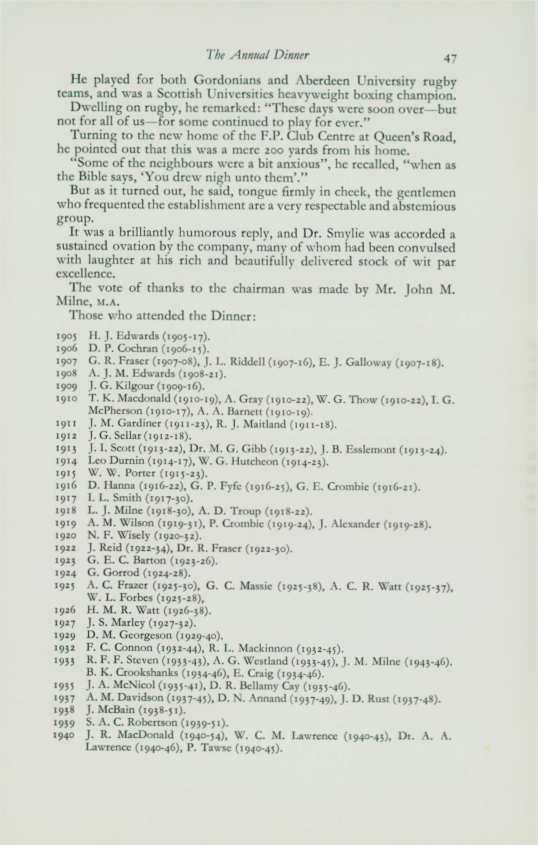
He played for both Gordonians and Aberdeen University rugby teams, and was a Scottish Universities heavyweight boxing champion.
Dwelling on rugby, he remarked: "These days were soon over but not for all of us for some continued to play for ever."
Turning to the new home of the F.P. Club Centre at Queen's Road, he pointed out that this was a mere 200 yards from his home.
"Some of the neighbours \Verea bit anxious", he recalled, "when as the Bible says, 'You drew nigh unto them'."
But as it turned out, he said, tongue firmly in cheek, the gentlemen who frequented the estab lishment are a very respectable and abstemious group.
It was a brilliantly humorous reply, and Dr. Smylie was accorded a sustained ovation by the company, many ofwhom had been convulsed with laughter at his rich and beautifully deliYered stock of wit par excellence.
The vote of thanks to the chairman was made by Mr. John M. Milne, M.A.
Those who attended the Dinner:
190s JI. J. Edwards (19os-17).
1900 D. P. Cochran (1906-q).
1907 G. R. Fraser (1907-08), J. L. Riddell (1907-16), E. J. Gallu~a) (1907-18).
1908 A. J. i\1. Edwards (1908-21).
1909 ]. G. Kilgour (1909-16),
1910 T. K. Macdonald (1910-19), A. Gray (1910-22), W. G. Thow (1910-22), I. G. McPherson (1910-17), A. A. 13arnett (1910-19).
19n J.M. Gardiner (1911-23), R J Maitland (1911-18).
1912 J. G. Sellar (1912-18).
1913 J. I. Scott (1913-22), Dr. M. G. Gibb (1913-22), J.B. Esslemont (1913-24).
1914 Leo Durnin (1914-17), \V./. G. Hutcheon (1914-23).
19q \'II.\'<'. Porter (191s-23).
1916 D. Hanna (1916-22), G. P. fyfc (1916-2s), G. C. Crombie (1916-21).
1917 I. L. Smith (1917-30).
1918 L. J. Milne (1918-30), A. D. Troup (1918-22).
1919 A. M. Wilson (1919-31), P. Crombie (1919-24), ]. Alexander (19t9-28) .
1920 N. F. Wisely (1920-32).
1922 J. Reid (1922-34), Dr. ll. Fraser (1922-30).
1923 G. E. C. Barton (1923-26).
1924 G. Gorrod (1924-28).
192s A. C. Frazer (192s-30), G. C. Massie (192s-38), .\. C. R. \v'att (192s-37), W. L. Forbes (192s-28),
1926 H. M. R. Watt (1926-38).
1927 J. S. Marley (1927-32).
1929 D. M. Georgeson (1929-40).
1932 F. C. Connon (1932-44), R. L. Mackinnon (1932-4s).
1933 R. F. F. Steven (1933-43), 1\. G. Westland (1933-45), J.M .\[ilnt! (1943-46). B. K. Crookshanks (1934-46), E. Craig (1934-46).
19H ]. A. Mc icol (19,s-41), D.R. Bellamy Cay (193s-46).
1937 A. M. Davidson (1937-4s), D.::---. \nnand (1937-49), J. D. Rust (1937-48).
1938 J. l\fcBajn (1938-p).
1939 S. A. C. Robenson (1939-s 1).
1940 ]. R. MacDonald (1940-H), \YI. C. .M. Lawrence (1940-43), Di. A. A. Lawrence (1940-46), P. Tawse (1940•4)),
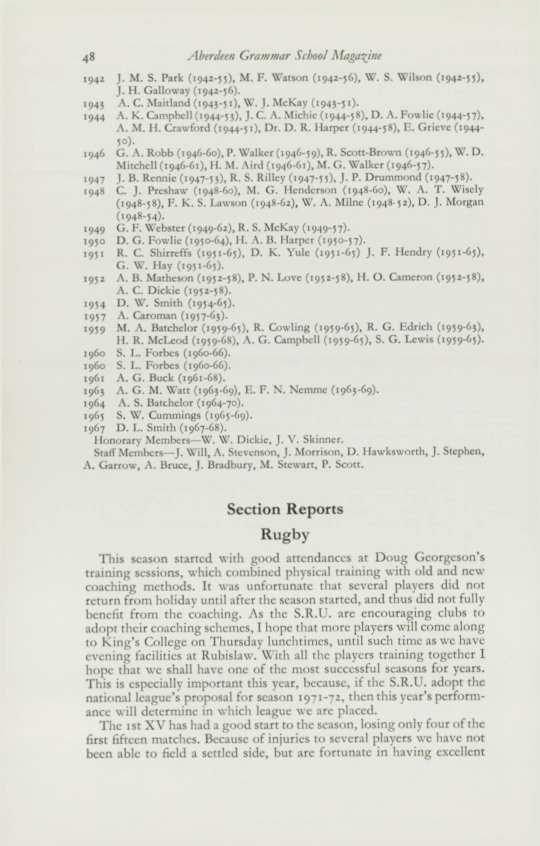
1942 J.M. S. Park (1942-55), M. F. \X'atson (1942-56), W. S. \\iilson (1942-55), J. H. Galloway (1942-56).
1943 A. C. Maitland (1943-51), W. J. McKay (1943-51).
1944 \. K. Campbcll(1944,53), J.C..\. \lichic (1944-58), D. •\. Fo\\lic (1944-n), .\. M. 11. Crawford (1944-51), Dr. D. R. 1larpcr (1944-58), I Grieve (194450).
1946 G..\. Robb \1946-6o), P. \X'alker(1946-59), R. Scott-Brown (1946-55), \\~.D. \litchcll (1946-61), H. \I. \ird (1946-61), M. G. Walker (1946-n).
1947 .J.B. Rennie (1947-53), R. S. Rilley (19.t7-55), J.P. Drummond (1947-58).
1948 C. J. Preshaw (1948-60), \I. G. llcndc rson (1948-60), W. \, T. Wisely (1948-58), F. K. S. L:,wson (1948-62), W. 1\. Milne (1948-51), D J. Morgan (1948-54).
1949 G. r. Webster (1949-62), R. S. McKay (19.19-n).
1950 D. G. Fowlie (1950-64), 11. .\. B. IIarpcr (1950-n).
1951 R. C. Shirrcffs (1951-65), D. K. Yule (1951-65) J. F. Hendry (1951-65), C. \\. Hay (1951-65).
1952 .\. B. Matheson (1952-58), P. N. L<J,·c(1952-58), II. 0. Cameron (1952-58), .\. C. Dickie (1952-58).
1954 D. W. Smith (1954-65).
1957 \. Caroman (1957-63).
1959 M..'\. Batchelor (1959-65), R. Cowling (1wr65), R. G. Edrich (1959-63), II. R. McLeod (1959-68), .\. G. Campbell (1959-65), S. G. Lcu·is (1959-65).
196o S. L. Forbes (196o-66).
196o S. L. Porbes (1¥,0-66).
1961 A G. Buck (1961-68).
1963 A. G. M. Watt (1963-69), E. F.~- Nemme (1963-69).
1964 A. S. Bate.helot (1964-70).
1965 S. W. Cummings (1965-69).
1967 D. L. Smith (1967-68).
J[onorary Members W W. Dickie, J. V. Skinner. Staff Mcmbers-J. \'('ill, \. Stevenson, J..\[orrison, D. 1lawksworth, J. Stephen, A. Garrow, .\. Bruce, J. Bradbury, .\I. Stewart, P. Scott.
Section Reports
Rugby
This season started with good attendances at Doug Gcorgcson's training sessions, which combined physical training "ith old and new coaching methods. It was unfortunate that several players did not return from holiday until after the season started, and thus did not fully benefit from the coaching. 1\s the S.R.L are encouraging clubs to adopt their coaching schemes, l hope that more players will come along to King's College on Thursday lunchtimes, unti l such time as we have evening facilities at Rubislaw. With all the players training together I hope that we shall haYe one of the most successful seasons for years. This is especially important this year, because, if the S.R.U. adopt the national league's proposal for season 19~1-72, then eh.isyear's performance will determine in which league we arc pbced.
The I st XV has had a good start to the season, losing only four ofthe first fifteen matches. Because of injuries to several players ,,·ehave not been able to field a settled side, but arc fortunate in having excellent
SectionReports
reserve strength which has usually kept the side up to standard. "Cnfortunate losses occurred at the hands of Dunfermline and Edinburgh J\ccies, the latter match being played when F.P.s were without their six district representatives. However, good ,,ins have been recorded against Broughton F.P.s, Stewarts F.P.s, Allan Glens, Gordonians and a strong Perthshire side.
With the many enforced changes in all sides, the 2nd XV has also been unsettled. However, \\'ith a mi.xture of enthusiastic youngsters and older players with a lot of 1st XV experience, the side has set up a good record.
The 3rd XV has played some fine rugby in beating most opposition, and it is very encouraging to note that the Club has been able to field a 4th XV most Saturdays. Unfortunately, opposition cannot always be found for this side, but the games which h:wc been played have been enjoyed by all.
Our thanks must go to Charlie Ritchie for his efforts in arranging fixtures for all the XVs, and especiallyfor retaining Heriots P.P. 1st XV fixture for Rubislaw on 20 March.
After several seasons of Yirtual non representation, F.P.s had six players in the '\orth XV this season-R. A Craig, D. G. rowlie, I. Gray, P. • Love, R. A. McDonald, II. R. Millar. The first five were subsequently selected for the ~forth Midlands district side and Harry Millar (still ignored by the selectors) for the President's XV in a match to commemorate the University Rugby Centenary. Our congratulations go to all, especially to Doug Fmdie who played several games for R.A.F. and also Combined Services, including the recent match against the Fijian tourists.
We would like to take this opportunity of congratulating Dr. D. W. C. Smith on his nomination as manager for the forthcoming British Lions tour of New Zealand, and of wishing him and the team every success.
fixtures in the south for early 1971 arc as follows: Feb. 6 z•. Royal J:ligh School F.P.s at Jock's Lodge. I 3 v. Leith Accies at Hawkhill.
27 v. Hutcheson's G.S.F.P.s at Edinburgh March 6 v. West of Scotland at Burnbrae.
27 v. l\.Iusselburgh at Stoneyhill.
Golf
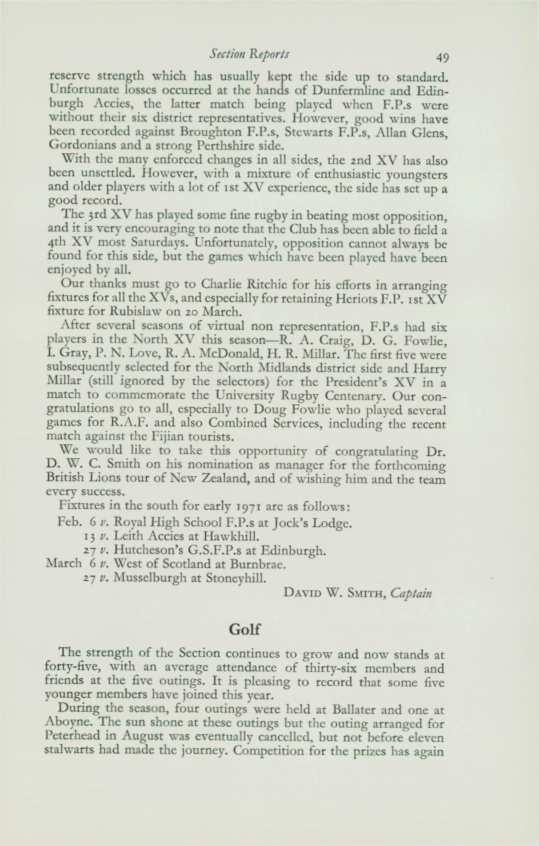
DAVID W. s~uTH, Captain
The strength of the Section continues to grow and now stands at forty-five, with an average attendance of thirty-six members and friends at the five outings. It is pleasing to record that some five younger members have joined this year.
During the season, four outings were held at Ballater and one at Aboyne. The sun shone at these outings but the outing arranged for Peterhead in August ,vas eventually cancelled, but not before eleYen stalwarts had made the journey. Competition for the pri7cs has again
AberdeenGra111111arSchooll\[agazine
been very keen at all outings and it has not been uncommon for a player to have his handicap reduced by five. At the l3allater outing held on 6 September, the "H.A.R." Trophy was competed for with Gordonians. The Section was represented by G. G. Milne, G F. Webster and;\. C. 1laitland, whose combined net score of 196 strokes was sufficient to retain, by three strokes, the Trophy once again for F.P.s.
The Section sent a team to compete in the Queen Elizabeth Coronation Schools' Tournament at the Royal Burgess Golf Club, Edinburgh. The team was J. W. Cradock, W. D. Mitchell, R. H. Cradock , D. JI. Chapman, R L. Mackinnon and C. C.AUan The match was played in near perfect sunshine and we again suffered a second round defeat at the hands of 1ovocastrians by two matches to one, having gained a bye in the first round. The result in each match was very close and the team thoroughly enjoyed the company and hospitality of our conquerors.
The annual Dinner of the Section was held on Friday, 13 November 1970,in the Northern Hotel, with an attendance offifty nine. Considering that it was the night after the F.P. Dinner, the attendance was very gratifying and demonstrates the popularity ofthis function The 10astof the Club was proposed by Mr. J. G. II. Edwards and suitably replied to by the Club Captain, Mr. J. \YI. Cradock. l\lr. R. L. Mackinnon proposed the toast of the Guests, to which 11r. R. J. Simpson replied in a humorous and fruity vein.
The trophies for 1970 were won as foUows:
R11m/L Hmderso11Cup
lf7alkerCup
JeffrtJ Mug
Gibb Thou• Tropl~
Allison Fo111/ie Troph.J•
Carr_)'Cup
Craig Spoon
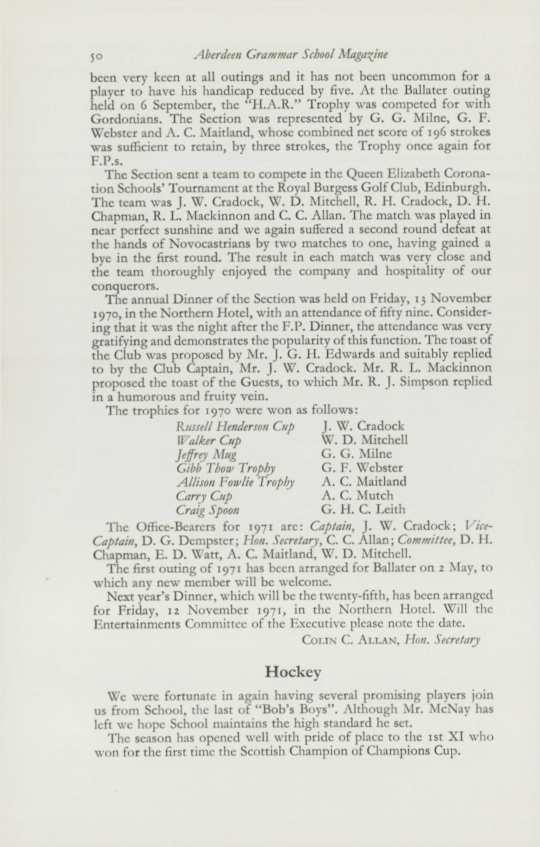
J. W. Cradock
W. D. 1fitchell
G. G. ~lilne
G. F. \X'cbster
A. C. Maitland
A. C. Mutch
G. H. C. Leith
The Office-Bearers for 1971 arc: Captain, J. \V. Cradock; I ·1aCaptai11,D. G. Dempster; Hon. Secretar_J,C. C. Allan; Committee,D. ll. Chapman, E. D. Watt, A. C. Maitland, W. D. Mitchell.
The first outing of 1971 has been arranged for Ballatcr on 2 11ay, to which any new member will be welcome.
Next year's Dinner, which will be the twenty-fifth, has been arranged for Friday, x2 November 1971, in the Northern Hotel. Will the Entertainments Committee of the Executive please note the date.
COIT"-(. ALLA'!--1, H1111. SNrtfa']'
Hockey
We ,,·crc fortunate in again having several promising players join us from School, the last of "Bob's Bors" ..\!though ~lr. Mc"'lay has kft we hope School maintains the high standard he set.
The season has opened well with pride of place to the 1st XI who won for the first time the Scottish Champion of Champions Cup.
SectionReports
Tours to Ayr and Edinburgh proved successful and enjoyable with several of the younger players putting in useful performances. Congratulations are due to, J. Lyon, .A. K. Campbell, J. Fraser, J. Drummond, A. Hampton, J. Gauld, C. L. Forbes and F. Lawson .\!though the rnd XI have a very keen and talented side this season they have been enjoying mixed fortunes so for. This we hope will be remedied by being able to play a settled side. 1st XI Results.
September 5 v Harris Acad. F.P.
12 v. Grove Acad. P.P. r3 v. Edin. Civil Ser.
October r 3 v. Inverleith
16 v. North District
19 v. Morgan Acad. F.P
26 v. Highland 3 v. Ayr Tournament
10 v. .\cademy LP.s
17 v. I.C.I. Grangemouth
24 v. Gordonians
31 v. Ruthrieston
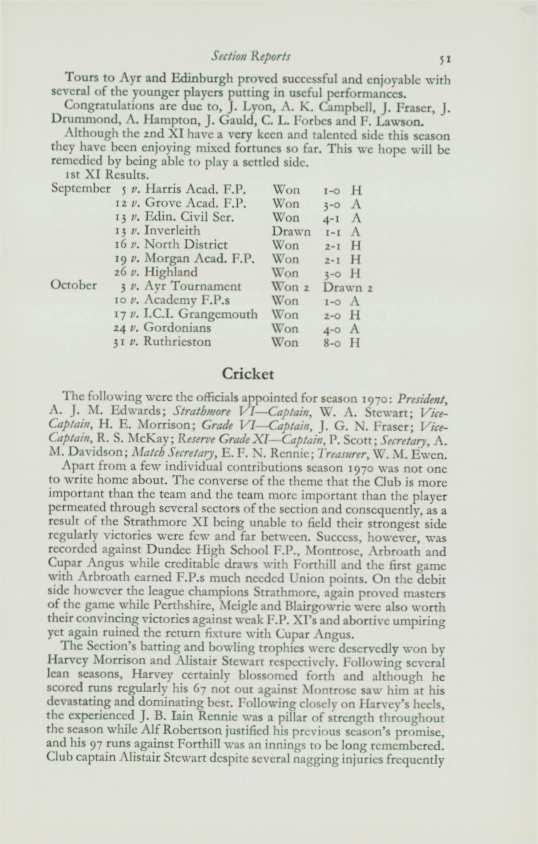
The following were the officialsappointed for season 1970: President, A. ]. ::\[. Edwards; Strathn1ore VI-Captai11, W..\. Stewart; ViceCaptai11, H. E. ::\Iorrison; Grade VI-Captain, ]. G. , Fraser; ViceCaptni11,R. S. l\fcKay; Rum•e GradeXI Captain, P.Scott; Secretary,A. M. Da,·idson; Match Secretary,E. r. •. Rennie; Treamrer, \X'. M. Ewen.
Apart from a few individual contribuuons season 1970 was not one to write home about . The converse of the theme that the Club is more important than the team and the team more important than the player permeated through several sectors ofthe section and consequently, as a result of the Strathmore XI being unable to field their strongest side regularly ,·ictories were few and far between. Success, however, was recorded against Dundee High School FP., Montrose, .\rbro.ith and Cupar :\ngus while creditable draws with Forthill and the first game with :\rbroath earned F.P.s much needed Onion points. On the debit side however the league champions Scrathmore, again proved masters of the game while Pertl1shire, Meigle and Blairgowrie were also worth tl1eirconvincing victories against weak F.P. XI's and abortiYe umpiring yet again ruined the return fixture with Cupar Angus.
The Section's batting and bowling trophies were deservedly won by Harvey Morrison and Alistair Stewart rcspecri,·cly. Following several lean seasons, Harvey certainly blossomed forth and although he scored runs regularly his 67 not our against ::\Iontrosc sa,\ him at his devastating and dominating bcst. Following closclr on Harvcy's heels, the experienced J. B. Iain Rennie was a pillar of strength throughout the season while Alf Robertson justified his previous season's promise, and his 97 runs against Forthill was an innings co be long remembered. Club captain Alistair Stewart despite several nagging injuries frequently
justified his many marathon bowling spells and George Murray, when available, proved yet again to be a great asset
The Second XI under the experienced and enthusiastic captaincy of John rraser did not fully live up to expectations in their first return to Grade 3. Four wins, four defeats and six creditable draws earned a respectable fifth position in the league, and it is hoped with more luck and application on the part ofa few ofthe players, promotion to Grade 2 will be a reality next season Team performances were rather inconsistent but John Praser, Gordon Smith and frank Black held the batting together while forbes Stuart and Eric Da\'idson regularly claimed their due reward ofwickets The experience of Ronnie Mackay had a steadying influence on the younger players of whom Raymond Binner, Alan Christie and Stephen Davidson gave notable contributions. Also the irregular appearances of OIiy Will and David Robertson were more than welcome.
Stewart Forbes deserves special mention for his leadership of the 3rd XI and a warm invitation is extended to all schoolboys who arc willing to play regularly next summer to support this side as it was introduced primarily to give the younger boys a game of cricket on a Saturday and to act as a necessary for the F.P. Senior Sides.
The Section's gratitude is again extended to Mr. \fatthcws and his able assistant Mr. \filne for their weekly "strip in the middle", to the girls who willingly assisted with the teas at Rubislaw, to Bill Ewen for his quiet but very efficient management ofthe Section's finances and to the other Club officials who work so hard behind the scenes with many duties which arc taken so often for granted by so many.
WFRAGES
Strathmorc XI Batti11,I{ Tm11. 'Y.O.
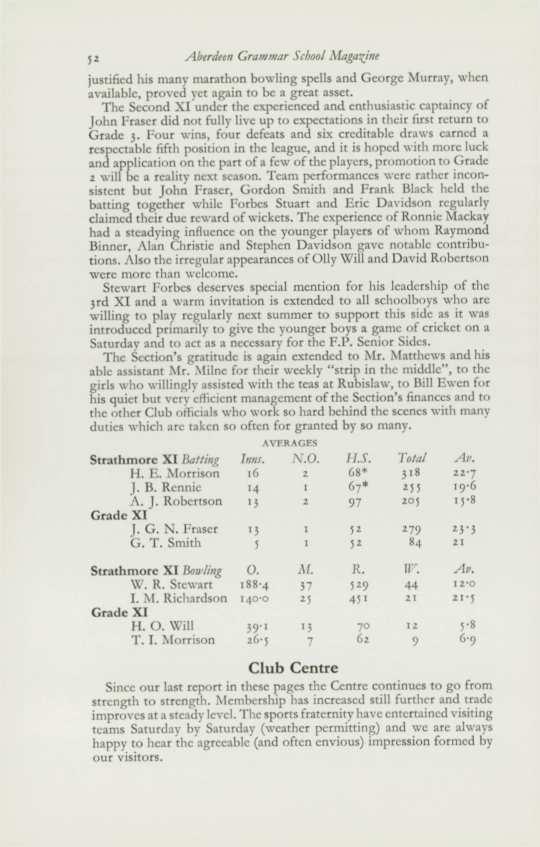
Strathmorc XI Bo1vling
\X:'ill
Club Centre
Since our last report in these pages the Centre continues to go from strength to strength. \lembership has increased still further and trade improves at asteady level. The sports fraternity have entertained visiting teams Saturday by Saturday (weather permitting) and we are always happy to hear the agreeable (and often envious) impression formed by our visitors.
At the end of September our first steward and his wife, Mr and i\Irs Joe \Vatson, left us. We count ourselves fortunate to have secured the services of Mr. and Mrs. William Mackie, who have come to us from Keith. Bill has rapidly establi~hed himself as a popular ste\\'ard and his \\'ife presides over the catering arrangements with much success. We hope that they and their family enjoy their association \\'ith the Club as much as we appreciate all that they arc doing for us.
Our first financial year (co,·ering some sixteen months) ends at the end of December and we will then be able to paint a clearer picture for members of the Club as a whole of just how this venture is working The Committee is confident that given continued (and preferably increasing) support the Centre will be shown to be the viable project its founders foresaw.
May we remind members that subscriptions for the Centre are renewable at 1st January and that failure to renew automatically excludes a member from the Centre. Subscriptions are £5 Ordinary (£2. if under 25), £2 (Wives) and £6 (Associate).
Henry Gavin Alexander * (1932-40) who was formerly Headmaster of Guisborough Grammar School, has since January of this year been 1leadmaster of Hampton Grammar School, Middlesex.
William RogicAngus "' (1915-21), ,1 A., o.sc., PH.D., F.R.1.c., retired on 30 September 1970 from the post of Senior Lecturer in Physical Chemistry at University College of North Waks, Bangor after thirtyfour years' service
Rodney Gretton Esslemont Barclay* (1953-66), \I.A. who recently graduated from Aberdeen UniYersity has started work in the Data Processing Department ofthe British Aircraft Corporation at Weybridge.
Norman Robert Beattie * (1921-31), c.A., J.P., earlier this year undertook a three months Consultancy Assignment in Venezuela for the Food & Agriculture Organisation of the United •at.ions. A Chartered Accountant and Justice of the Peace, he joined Aberdeen Harbour Board as Assistant General Manager in 1946 and became General Manager in 1957.
Ronald James Beattie* (1927-36), F.c.r.r. is Agency Superintendent ofthe Royal Insurance Group Branch at Dumfries. On leaving school he joined the Liverpool, London, Globe Insurance Co. at Aberdeen and was appointed to his present post in 1954. He is the brother of Norman R. Beattie, c.A., Colin S. Beattie, A.M.r.C .E., and the late Eric W. Beattie, c.A., all F P.s.
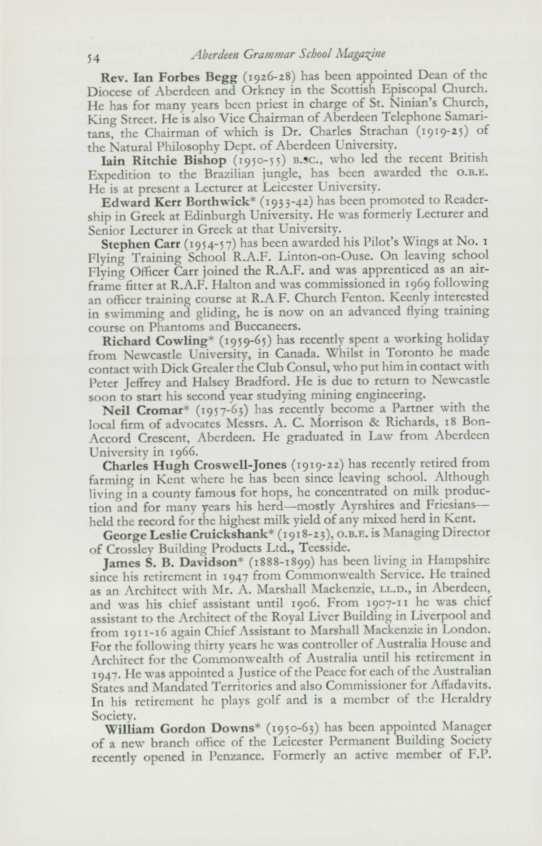
AberdeenGra111t11arSchool.\f.agazi11e
Rev. Ian Forbes Begg (1926-28J has been appointed Dean of the Diocese of .Aberdeen and Orkney in the Scottish Episcopal Church. IIc has for many years hu:n priest in charge of St. 'inian's Church, Krnj?Street. He is also Y1ceChairman of J\herdeen Telephone Samaritans, the Ci,airman of which is Dr. Charles Strachan (1919-25 of the t's.aturalPhilosophy Dtpt. of Aberdeen Lniversity.
lain Ritchie Bishop (1950-n) n.~c., who led the n:cent British Expcd·r 10n tO tl e Br.•.11-an jungle, has bt:cn awarded the o.n.1. He 1s .,t present a Lecturer at Leicester ni~ersity.
Edward Kerr Borthwick'· (1933-,1-2)has been promotcd to Readership in Greek at Edinburgh University. He \\",\S formerly Lecturer and Senior Lecturc,;rin Greek at that University
Stephen Carr(1954-p) has been a,vardcd his Pilot's\\ mgs at o. 1 flying Training School R.A.F. Linton-nn-Ouse. On leaving school l lying Officer Carr joined the R.A.F. and was apprenticed as an airframe fitter at R._\,F. Halton and was commissioned in 1969 following an olliccr training course at R.AF. Church renton. Keenly interested in swimming and gliding, he is now on an advanced flying training course. on P1,antoms and Buccaneers.
Richard Cowling * (1959-65) has recenth spent a working holiday from ewcastle Lni,·ersity, in Canada. \Vhdst in Toronto he made contact with Dick Gn.:.ilerthe Club Consul, who put him in contact with Peter Jeffrey and Halsey Bradford. He is due to return to .:--=ewcastle soon to start his second year studying mining engineering. eil Cromar* (1957-63) has recently become a Partner with the local lirm of advocates :'-[essrs..\. C. ~lorrison & Richarch, 18 Bon\ccord Crescent, \bcrdeen . He graduated in Law from ,\herdeen lJnivers1ty in 1966.
Charles Hugh Croswell -Jones (1919-22) has recently retired from farmin~ in 1'"ent where he has been since leaving school. Although living in a county famous for hops, he concentrated on milk production and for many y.:ars his herd-mostly \yrshires and Friesiansheld the record for the highest milk vield of any mixed herd in !-...ent.
George Leslie Cruickshank* j 1918-23),o.n.r:. is Managing D rector of Crossley Bu ldm~ Products Ltd., Tees~ide.
James S. B. Davidson* (1888-1899) has been li,·ing in Il:lmpshire since his retirement in 1947 from Commonwealth Scn·ice. Ile trained as an \rchitect with :\lr. A Marshall :\lackenzie, 1.1..0 , in J\berdecn, and was his chief assistant until 1906. r-rom 1907-11 he was chief assist:int to the Architect ofthe Royal Liver Buildini-:in Liverpool and from 1911-16again Chief \ssistant to l\farsh:ill ~fackenzie in London. For rhc follow1•g thirty years he was controller ofJ\ustralia l louse and ,\rchitcct for the Commonwealth of Australia until his retirement in 1947. Ilc was appointed a Justice ofthe Peace for each ofthe ,\ustral ian States and \fandatcd Territories and also Commissioner for J\tfadadts. In his retirement he plan golf and is a member of tl:e IIcraldry Society.
Wiliiam Gordon Downs· (1950-63) has been appointed Manager of a new branch otlicc of the Leicester Permanent Building Society recently opened in Penzance. formerly an acti\'e member of r P.
i:'{otesAbout Old Bf!YI 5)
Rugby and Cricket Sections, he was previously 10 the employment of the British Linen Bank.
AHred George Emslie~ (1914-24), T.n., M.D., r .R.C.P., o.P.H., is Ih-ing in Eastbourne and is consultant physician to the Eastbourne and Hcllingly Groups of I Iospitals He graduated l\f.B., Ch.B. at Aberdeen in 1929and took the Doctor of \fcdicine (J\LD.) and D.P.H. in 1933. He obtained the i\1.R.C.P. London in 1956and was elected a Fellow of the Royal College of Physicians in 1969.
Douglas Christian Fraser• (1907-17) has been living in retirement in Almondbank since 1966. Having served an engineering apprenticeship with Messrs. Ilarry Henry & Cook Ltd. in Aberdeen, he ,vas a tea planter in Assam from 1923-37,where he was P.P. Club Consul from 1930-37. From 1937 until his retirement he was a Technica l Officer at the Admiralty. I le is one ofseYenbrothers who all attended Grammar. Robert Falconer* (1944-58), has become a Director of Communication Research Ltd., a new Market Research Company with offices just off Trafalgar Square, London. He graduated i\f.A. (Hons) in Psychology at Aberdeen in 1963 and for the next nvo years was a market research executive with Cadbury Bros. Ltd., and from 1965-69 was employed as an advertising agent with the London Press Exchange.
Major General Rudolf William Galloway * (1902-08) c.n., c.n.E., o.s.o ., ~1.n., cu.n., who retired in 1950 is living in Kingston Hill, Surrey. Serving in both World Wars, he was decorated and mentioned in Dispatches on several occasions, and included in his duties in the Second World \."{'ar,were those of A D.M S. 51st Highland Division, Alamcin, and also British \fcdical Adviser to General Eisenhower at Supreme H.Q. In 1937, he had published "The Anatomy of Physiology of Physical Training."
Alan Whyte Gillies* (1954-59) has become Resident Inspector with the Phoenix Assurance Co. based in Elgin. Earlier this year he was elected Associate of the Chartered Insurance Institute (A.C.I.S.)
George Scott Grant* (1935-40) is Managing Director of J. & G. Grant, Glenfarclas Distillery, Ballindalloch. He is President of the Pot Still Malt Distillers Association of Scotland, a Council Member of Scotch Whisky Association and a Council Member of the Royal Caledonian Curling Club.
Brian Scott Gray• (1943-49), n.sc., DIP. AG. scr., PH.D. joined the Plantations Department of Hannsons & Crosfield Ltd. in ~\Ialaysiain 1954, and since 1964 has been Director of Research at their new Oil Palm Research Station in Selangor, \falaysia. He was awarded the Ph.D. at the December 1969Graduation of the University of Aberdeen for a thesis concerning "The factors affecting the yield ofthe oil palm on the West Coast of Malaysia". In April 1970, he was awarded the Fellowship of the Incorporated Society of Planters for outstanding services to the Planting Industry of Malaysia. He is Club Centre Secretary in Malaysia.
Peter J. Green~ (1947-57)is at present studying at the Un.iYersityof Western Ontario for the degree of Master of Business Administration (1\1.B.A.).On leaving school, he joined the IIudson's Bay Company in the Arctic and thereafter was Administrator for the Nonh West
Terricories from 1963-67. He reports meeting Halsey Bradford and Peter Jeffrey on their tr:n-cls and also playing rugby against Willie Balfour.
Richard A. F. Grieve'!<(1948-61), n.sc., 1>11.0., has taken up a post as Research \ssociate with the Unh·ersity of Oregon, Eugene, Oregon, U.S.A Ile graduated B.Sc. I Ionours, Geology at Aberdeen University in 1965, 1\LSc. at Toronto Cniversity in 1967 and has this year graduated Ph.D. at Toronto Uni,·crsity. His present position entails working on analysis of lunar material returned by the Apollo missions.
Richard Irvin• (1914-18) C.B.F., received a presentation recently to mark his retirement as Chairman of Isaac Spencer & Co. (Abdn.) Ltd. Head of the local Trawling Firm of the same name, he is also Chairman of the Aberdcen Branch of the R.N.LI.
Thomas Thoburn Irvin (1945-57), M.ll., CH.n , PH.o., has taken up an appointment as Lecturer in Surgery at Leeds University . Ile graduated M.B., Ch.B. at Aberdeen in 1964 and Ph.D. at Aberdeen in 1968. He was elected a Fellow of the Royal College of Surgeons of Edinburgh in 1969 and prior to his present post, was surgical registrar at Aberdeen Royal Infirmary .
John Peter Jeffrey* (1944-59) and Richard Halsey Gordon Bradford* (1961-65) who set off in the summer to work their way round the world, have split up and temporarily settled in North America. Peter is working with an electronics firm in Los Angeles and Halsey in systems analysis in Toronto where he has joined a local rugby club called the Barbarians11
John J. (Jan) Johnston· (1905-6) has seulcd in Western Australia. He served his apprenticeship with the Royal Insurance Co. in Aberdeen before becoming a Sugar Planter in British Guiana in 1912. He then served with the British West Indies Regiment from 1916-19 in Egypt and Palestine. On being demobbed as a Lieutenant he then became a Rubber Planter in \falaya where he was interned by the Japanese in Singapore from 1942-45.
James Brian Kenworthy (19s4-67) has just commenced PostGraduate research into the Pn:history of North East Scotland at University College, Cardiff. !le graduated at Cardiffearlier this year with Pirst Class Honours in Archaeology.
Norman H enri Lyall (19r2-16) c.A., retired in 1965 and is li,·ing in retirement in Pinetown, 'atal, S ..\. Ile qualified as a Chartered Accountant in 1923 and after spells in Colombo, Lisbon and Calcutta, he settled in South \frica in 1936. \fter serYice in the South African Forces he returned to his pre-war employers in 1946 and when he retired he was Secretary of the Company, one of the largest chain stores in South Africa.
Forbes M. McCallum (19s9-6s), \I.A., GRAD. T.P.\t. is Assistant Personnel Officer at the \[ontrose factory of Glaxo Laboratories. He stood as Liberal Candidate for t,.;orth ,\berdcc:n in the 19.,0 General Election.
Ronald Will iam McDonald+' (1947-50) on leaving school qualified as a Radio Officer. Returning to University he has recently graduated M A., and will shortly enter the College of Education.
Charles Stewart McLeod* (1908-20), o.B.E., attended the last School prize giving on the 50th Anni,·ersary of his being School Dmc. In 1968 he retired from the post of Chief Industrial Relations Officer, British Railways and since his retirement has had a book published All Change describing the course of Tndustrial Relations on the railways during the 1960s.
Peter George Mitchell Macphee (1929-41) is currently Treasurer, and a past Secretary of the London \rts Centre. He has been Production '\fanagcr for Readers Digest for the U.K., South Africa and India for fifteen years.
Brian A. Mair (1953-65), \I. ,\. has taken up a ne\, post as a subeditor on the English Sports desk of \gence france-Presse, in Paris. A graduate of ~\berdeen l'ni,ersit), Brian previously worked for the H~l!,hland '\.tJJJI in Inverness.
Ivor J. A. Mair (1959-64), c.A. has taken up a post as Systems 1\nalyst "ith the Scottish Widows Fund Life \ssurancc Society in Edinburgh. He 9ualified as a C.,\. in 1969 and was a member of the Scottish Nort.h District JIockey Umpires ,\ssociation
James Cameron Masson,. (1938-46) is currently employed as Technica l Director at Robinson Willey Ltd., Liverpool, and would be interested to contact any member of the Club of his vintage who m.'ly be in the Li\'erpool an::a. IJe is a former playing member of the F.P. Hockey and Cricket Sections.
James Milne* (1935-4.,), \I.A., D.A., is now Principal Teacher of Classics at _ \irdrie Academy. He graduated M. \. at Aberdeen in 1951, and B.A at Cambridge in 1953 Prior to his present appointment he has taught at Gordon's College, .\forgan Academy and Kirkcaldy lligh School.
Gordon James Morrison· (1960-66;, 'I.A. is employed as an Accountant ~fanagement Trainee) with Uniroyal Ltd in Edinburgh.
Harvey Elmslie Morrison· (19p-65), LL.D., who is now sening his apprenticeship as a Chartered Accountant \\"ith Messrs. \XTilliamson & Dunn is one of two candidates in Scotland gaining the Sir \X'illiam McLintock Prize in Part 10fthe examinations for Chartered Accountants. A keen cricketer he has been Vice-Captain ofthe r.P. Strathmore Union side for 1970 and won the Batting Cup for the best batting average over the season.
Thomas Ian Morrison· (1934-47) T.D., n.sc., will shortly take up the post of Head of the \fiddle School of Brech.in High School. At present a Lecturer in Chemistry at Jordanhill Training College, he has represented the 1st XI's ofthe F.P. 1Iockcy and Cricket Sections. llc was also recently appointed Junior Vice President of the Scottish Hockey Association and is still active in the Territorial Army holding the rank of Major.
James Lawso n Mowat~ (1915-16), ~I.A., Croix de Guerre, is spending his retirement in Geneva, Switzerland. He was awarded the Croix de Guerre with palm during sen icein France and Belgium in the First \X'orld War and graduated ~f..\. in 1922. from 1928-64 he has served in various capacities at the lntcrnational Labour Office, Geneva, as Translator/Interpreter, Chief of Maritime Division and Chief of
AberdeenGram111arSchoolAfagazine
Administration. In his retirement he still works periodically as free lance translator or interpreter.
Thomas H. Murdoch• (1921-27) has since leaving Aberdeen in 1962 been Speech and Drama Specialist for Hawick and Roxburghshire Schools. He is much involved in examining in Spoken Engli~h for London University, the English Speaking Board and L'Organisation Scholairc rranco-Britanni9ue.
Gibb Niven Pennie"' (1923-26) \I.A., B.D., is Canon of St. Mary's Cathedra l, Glasgow. He graduated ~t.A. from Aberdeen University in 1930 and after a sojourn in the teaching profession he entered the Theological College of the Scottish Episcopal Church in 1934 and was ordained in Edinbu rgh in 1936. He became a lecturer in the New Testament at the College and from 1942-..u started Parish life at Dalbeattie thereafter, followed by terms at Hamilton and Greenock. He was President of the Glasgow Centre (1956-57).
Richard R. Maitland Porter· (1895-r9os) M A , M.n., CH.B., F.R c s., is living in retirement in \berdeen. He graduated from Aberdeen University in 1912 and for some time was on the Staff of the Pathology Department of that Univemty. He then entered the Indian Medical Service and saw active service in the First World War. IIe obtaine d his F.R.c.s. and was Professor of Surgery at the University of Patna, India. On retirement from the Indian Medical Service he was for twenty years on the Surgical Staff of Southport Infirmary and, when retiring to Aberdeen, was for some time Convenor of the i\ledical Service and Supplies Committee of the General Hospitals Board in .\berdeen.
Iain Andre w Reid · (195r-63) is now \ssistant Estates Manager for the '\Jational Coal Board, Scottish South \rea in Edinburgh. He 9ualified as a Chartered SurYeyor in 1969.
Donald Forrester Ross• (1946-60), \I.A ., C.A., has been appointed \ssistant Treasurer of the Church of Scotland in Edinburgh. He graduated ~LA. at Aberdeen University in 1963 and 9ualified as a Charten :d Accountant in 1967,serving his apprenticeship with G. & J. McBain in Aberdeen . Whilst in Aberdeen, he played Hockey for P.P.s and North District playing in F.P.s Scottish Cup winning teams of 1964 and 1966. Whilst in Glasgow from 196~-,o he played for Western, West District and Thistles (Scottish Touring Side).
Roy Reid (1947-p) has been appointed British Rail's electrical engineer in Lh-erpoo l. On lea, ing school, he joined the Torry Research Station and won a scholarship to Robert Gordon 's Technical College ~aining his I ligher [ ational Degree in mechanical engineering. He became a graduate trainee with British Ra.ii in 1956 and berthed at Liverpool and Derby before becoming assistant electrical engineer at ::\fanchester in 1968. Married \\'ith three children, he is at present residing in Cheadle Hulme, Cheshire.
Major General Robert Arthur Smart (1920-26) c.n.E., Q11.s., ,1.R.C.P., D.PII , took up the appointment of director of medical services to the British Army ofthe Rhine in September.
Douglas William Cummin g Smith · (1930-41) M.B., CH.B., has been appointed ::\tanager of the British Lions Rugby Touring Party
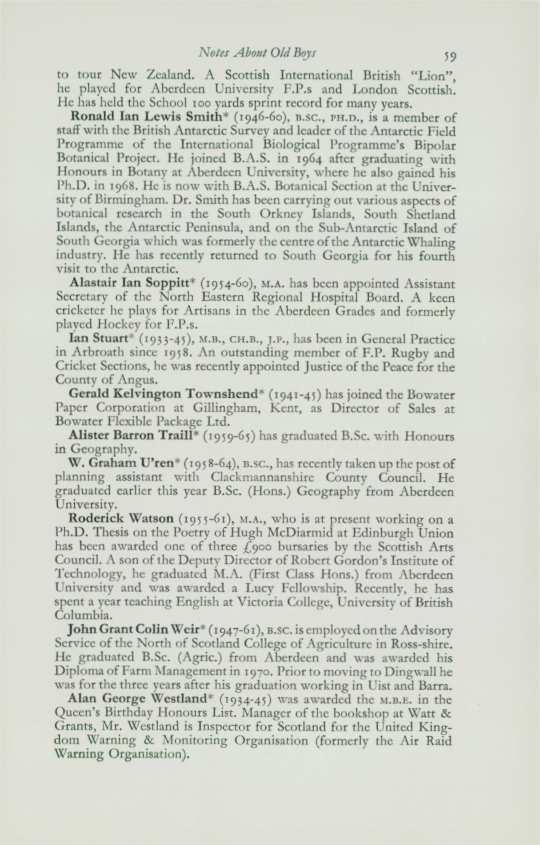
Votes Abotil Old B?)'S 59 to tour New Zealand. A Scottish International British "Lion", he played for Aberdeen Uni, ersity F.P s and London Scottish He has held the School 100yards sprint record for many years
Ronald Ian Lewis Smith * (r946-60), n.sc., 1>1-1.0., is a member of staff with the British Antarctic Survey and leader of the Antarctic Field Programme of the International Biological Programme's Bipolar Botanical Project. Ile joined B.A.S. in 1964 after graduating with Honours in Botany at Aberdeen University, ,vhere he also gained his Ph.D . in 1968. He is now with B.A.S. Botanical Section at the University ofBirmingham. Dr. Smith has been carrying out various aspects of botanical research in the South Orkn,;:v Islands, South Shetland Islands, the Antarctic Peninsula, and on the Sub-Antarctic Island of South Georgia which was formerly the centre ofthe Antarctic Whaling industry. IIe has recently returned to South Georgia for his fourth Yisitto the Antarctic .
Alastair Ian Soppitt* (1954-60), 11.A has been appointed Assistant Secretary of the orth Eastern Regional Hospita l Board. A keen cricketer he plays for Artisans in the Aberdeen Grades and formerly played Hockey for F.P.s.
Ian Stuart · (1933-45), ~f.n.,CH.n., J.P., has been in General Practice in Arbroath since 1958. An outstanding member of F.P. Rugby and Cricket Sections, he was recently appointed Justice of the Peace for the County of Angus.
Gerald Kelvington Townshend"' (1941-45) has joined the Bowater Paper Corporation at Gillingham, h.ent, as Direcror of Sales at Bowater flexible Package Ltd.
Alister Barron Traill"(1959-65) has graduated B.Sc. with Honours in Geography.
W. Graham U'ren• (1958-64),n.sc., has recently taken up the post of planning assistant \\ith Clackmannanshire County Council. He graduated earlier this year B.Sc. (Hons.) Geography from Aberdeen University.
Roderick Watson (19n-61), M A , who is at present working on a Ph.D. Thesis on the Poetry of Hugh McDiarmid at Edinburgh Union has been awarded one of three £900 bursaries by the Scottish Arts Council. ,\ son ofthe Deputy Director of Robert Gordon's Institute of Technology, he graduated ~L\. (First Class Hons.) from \berdeen Cniver$ity and was a,\·arded a Lucy fellowship. Recently, he has spent a rear teaching English at Victoria College, University of British Columbia.
John GrantColin Weir• (1947-61),B.Sc.isemployed on the Advisory Service of the orth of Scotland College of .\griculrure in Ross-shire. He graduated B.Sc. ( \grie.) from Aberdeen and was awarded his Diploma of Farm \Ianagement in 1970 Prior to moving to Dingwall he ·wasfor the three years after his graduation working in Cist and Barra.
Alan George Westland* (1934--1-5)was awarded the M.B.L. in the Queen's Birthday Honours List. Manager of the bookshop at Watt & Grants, Mr Westland is Inspector for Scotland for the United Kingdom Warning & \fonitoring Organisation (formerly the Air Raid Warning Organisation).
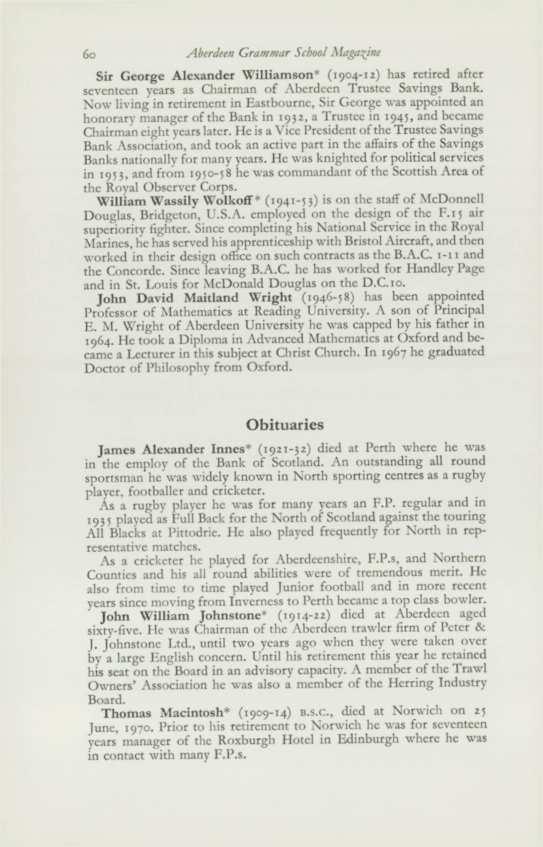
Sir George Alexander Williamson • (1904-12) has retired after seventu:n years as Chairman of \berdcen Trustee Savings Bank. :'.\ow living in retirement in Eastbourne, Sir George "·as appointed an honorary m:rnagcr of the Bank in 1932, a Trustee in 1945,and became Chairman eight yearslater. He is a\' 1ccPresident ofthe Trustee Savings Bank \ssociation, and took an acuve part in the affairs of the Savings Banks nationally for many years. He was knighted for politica l services in 1953, and from 1950-58 he was command.1nt of the Scottish ~\rea of the Royal Observer Corps.
William Wassily Wolkoff • (1941-53) is on 1he staff of .\kDonnell Douglas, Brid~ton, l .S. \. employed on the design of the f.1 5 air supuiomy fi~hter. Smee completing his :\ational Service in the Royal \Iarines, he has served his apprenticeship with Bristol Aircraft, and then \\·orkcd in their design office on such contracts as the B.A.C. 1-1r and the Concorde. Since lc:iving B \.C. he has worked for Handley Page and in St. Louis for \kDonald Dou~las on the D.C.ro.
John David Maitland Wright (1946-58) has been appointed Professor of J\Iathcmatics at Reading UniYersity. A son of Principal E. i\f. \X'right of .\berdeen University he was capped by his father in 1964. He took a Diploma 10 Adnnced \lathematics at Oxford and became a Lecturer in this subject at Christ Church. In 1967 he graduated Doctor of Philosophy from Oxford.
Obituaries
James Alexander Innes· (1921-32) died at Perth where he was in the employ of the Bank of Scotland. \n outstanding all round sportsman he was widely known in ·onh sporting centres as a rugby player, footbalkr and cricketer.
As a rugby player he was for many years an F.P. regular and in 1935 played as Full B:ick for the '\orth of Scotland against the touring All Blacks at Pittodrie. He also played frequently for ~orth in rcpresentatiYe marches.
As a cricketer he played for .1\bcrdeenshire, F.P.s, and '\orrhern Counties and his all round abilities were of tremendous merit. He also frot" •in·e to time played Junior football and in more reccnt years since mm·ing from InYerness to Perth became a top class bowler.
John William Johnstone· (1914-22) died at Aberdern aged sixtv-live. He was Ch:urman of the Aberdeen trawler firm of P..:ter & J. J~lmstone Ltd., until two years ago when they were taken o\'er by a large English concern. Until his retirement rhis year he retained his seat on the Bo:ird in an adYisory capacity. A member of the Trawl Owners' Association he was also a member of the Herring Industry Board.
Thomas Macintosh· (1909-14) n.s.c., died at Norwich on 25 June, 19~0. Prior to his retirement to '\orwich he was for seventeen years manager of the Roxburgh IIotcl 111 Edinburgh where he was in contact with many I .P.s.
Frank Reid " (19.24-28)diec.l suddenly on 6 July whilst on business in Rothes. On leaving school he joined the local firm of G. & J. McBain, Chartered Accountants, in Aberdeen . Apart from five years in the Army during the war years he was with the same firm all his working life.
A keen churchman he was an elder of Ruthricston \Vest Church . Mitchell Cumming Ross· (1914-21) n.sc., PH.o., died at Aberdeen on 21 July 1970.,\ graduate of \berdeen niversity and a pharmacist, he became head of William Paterson & Sons, Wholesale Chemists at an early age on the death of his father. Until retirement two years ago, he remained a director of the firm which is now a branch of the Glaxo organisation. Mr. Ross was a former captain ofRoyal Aberdeen Golf Club.
Bryce Valentine "' (1913-18) died on 5 September, 1970. He succeeded to the family butchery business of William Valentine & Co. Ltd., on Ihe death of his father in 1940, and although he ran five farms in Aberdeenshire as well as the butchery business he was also involved as a Director of two Smithfield Market butchery firms and divided his time between Inverurie and Londoo . He was one ofthe principal figures behind Inverurie's new slaughterhouse.
James Strachan Walker (1913-17) MB.Cun , ,r.n., D.I'.11 , died on 21 October, 1970, aged seventy at Aberdeen Royal Infirmary. Dr. Walker graduated ~m.cHn., from Aberdeen University in 1922 and took his Diploma in Public Health in 1933, and four years later became an ~r.n.
Jle was appointed resident physician at Queen ;'.\fary's Hospital, London, after graduation and went on to become house surgeon, casualty officer and obstetric house surgeon In 1935 he was appointed Assistant ;'.\1edicalOfficer of Health for Aberdeenshire. During the war years he was administ rntively responsible for the establishing, cguipping and staffing of all Brnnches of the casualty senrices in the country and for the supervision and training of personnel, including their contro l while in operation during enemy action.
Jn May, 1945, Dr. Walker was appointed Regional School Medical Officer, which post he held until retirement in 1959.
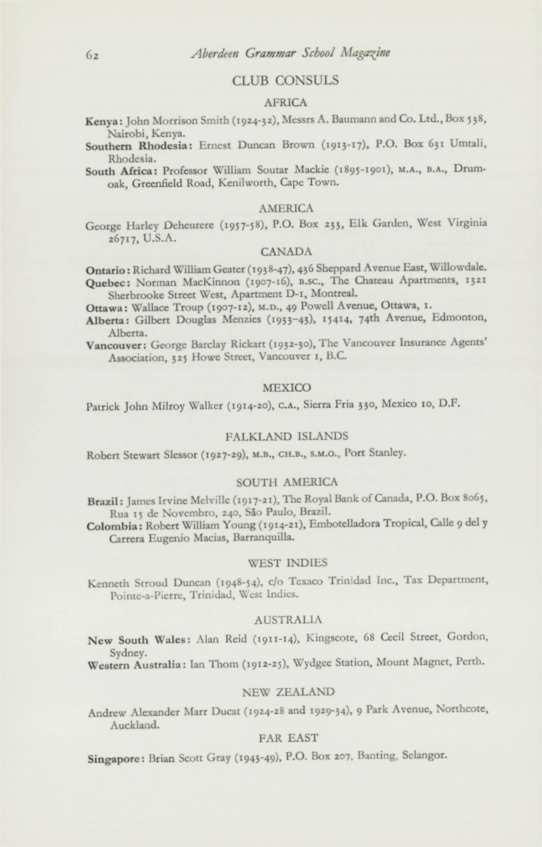
CLUB CONSULS
AFRICA
Kenya:John Morrison Srr tl: (1924-32),;\lessrs A. Baumann and Co. Ltd., Box HS, Na.irobi, Kenya.
Southern Rhodesia: ErM t Duncan Brown (1913-17), P.O. Box 631 Umtali, Rhodesia.
South Africa: Professor William Soutar .Mackie (189s-1901), ~t.A., e.A., Drumoak, Greenfield Road, 1'..ernlworth, Cape Town.
AMERICA
George Ilarlcy Deheurere (19i7-s8), P.O Box 233, L·lk Garden, We,t Virginia 26717, U.S.A.
CANADA
Ontario : Richard \Villwn Geater (1938-47),436Sheppard Avenue East, W1UowcWe.
Quebe c: "-orman !\facKinnon (1907-16), n.sc., The Chateau Apartments, 1321 Sherbrooke Street West, Apanment D-1, Montreal.
Ottawa: Wallace Troup (1907-12), M.O., 49 Powell Aven ue, Ottawa, t.
Albert:1: Gilbert Doug~ .\[enzics (1933-43), 15414, 74th Avenue, Edmonton, Alberta.
Vancouver: George 13arcby Rickart (1932-30),The V.mcouvcr Insurance Agents' Associ:u,nn, PS llo"'-c Strc<.:t,\'ancouver 1, 13.C.
MEXICO
Patrick John Milroy Walker (1914-20), c A., Sierra Fria 330, Mexico 10, D.F
FALKLAND ISLANDS
Robert Stewart Slcsso r (1927-29), M.B., CH.B., S.M.O., Port Stanley.
SOUTI I A!\fERICA
Bra;.i;il: Jar'1cs lrvme ,\kh-rllc i1~-17-21),The Royal Bank ofCanad.1,P.O. BQ,c So6s, Rua tj de Novcmbm, 210, ~a') Paulo, Brazil.
Colombia: Robert Willi:un Young (1914-21),Embotelladora Tropical, Calle 9 de! y CarreraEugenio Macias,Barranquilla.
WEST L'-.;DIES
Kenneth Stroud Dune.in (1948-54), cfo Tcx.,co Trin:dad Inc., Tax Department, l'oimc-a-Pierrc, Trinidad, \\ e,c Indies.
AlJSTRALI \
New South Wales: Alnn Reid (1911-14), Kingseotc, 68 Cecil Street, Gordon, Sydney.
Western Australia: Ian Thom (1912-2s), \'X'ydgceStation, Mount Magnet, Perth.
~EW ZEALA!'\D
Andrew ,\lexander Marr Ducat 1924-28and 1929-34),9 Park A,·enue, ~vrthcoce, Auckland.
FAR EAST
Singapore: Brian Scott Gr~y (194J-49), P.O. Box 201 lhn1in1t Sclangor.
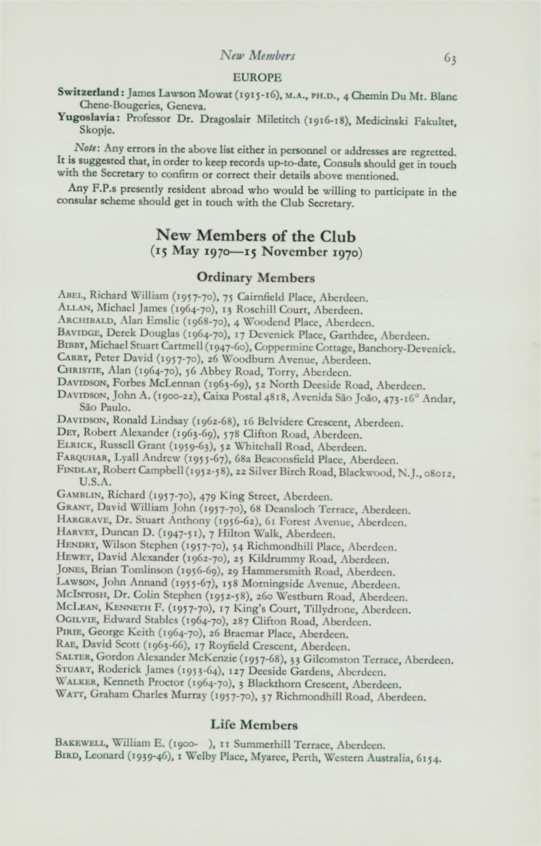
EUROPE
Switzerland: James Lawson Mowat (1915-16), \l,A., Pll.o., 4 Chemin Du Mt. Blanc Oicne-llougerics, Geneva.
Yugoslavia: Professor Dr. Dr2goslair Milctitch (1916-18), Medicinski Fakulter, Skopje.
Nol,: Any errors in the above list either in personnel or addresses arc regretted. It is suggested that, in order to keep records up-to-date, Consuls should get in touch with the Secretary to confirm or correct their details above mentioned.
Any F.P.s presently resident abrood who would be willing to participate in the consular scheme should get in touch with the Club Secretary.
New Members of the Club
(15 May 1970-15 November 1970)
Ordinary Members
Aon, Richard\\'. illi:1m(19n-70), 7S Giirnfield Place, \bcrdecn.
ALLAN,Michael James (1964-70), 13 Roschill Court, Aberdeen. \RCIIIBAIo, \Ian f'.mslie (1968-70), 4 \Yoodcnd Place, \bcrJcen.
BAVJDGL,Derek Dougla~ (1964-70), 17 Dcvcnick Place, Ganhdee, \berJecn.
BIBBY, Michael Stuart Cartmell (1947-60),Coppcrmine Cottage, Banchory-Dcvcnick. CARRr, Peter D:ivid (19n 7u), 26 \\oodbum .\venue, .\berdeen. C11R1s·r1P.,Alan (1964-70), 56 Abbey Road, Torr)', Aberdeen. DAVIDSON,Forbes McLennan (1963-69), j2. l:'•forthDeeside Road, Aberdeen. DAVJosos, John A. (1900-21),Giixa Postal 4R18,Aveni.Ja Sa,, Joao, 473-16 And:1r, Sao Paulo.
DAVlDSON,Ronald Lindsay (1962-68), 16 Bclvidere Crescent, Aberdeen.
DEY,Robert .Alexander (1963-69), ns Clifton Road, Aberdeen. ELRICK,Russell Grant (19j9-63), j2. \\bilchall Road, .\berdecn.
FARQUHAR,Lyall .\ndrew (19j j-67), 68a Bcaconsti.cld Place, Aberdeen. FINDI.Ar,Robert Campbdl (19j2.-j8), 2.2 Silver Birch Road, Blackwood, ;:,.::.J.,08012, U.S.A.
GAl1Dt.1N,Richard (19n-70), 479 ls.ing Street, .\berdccn. GRANT, Da~id William John (19n-70), 68 Dcansloch Terr~ce, ,\berdecn. HARCRAn, Dr. Stuart \nchony (19j6-62), 61 Forest ,\vcnU<:,.\berd~cn. HAR\FT, Duncan D. 1947-p), 7 ll1lton Walk, Aberdeen. 11.LNoRr,Wilson Stephen (19n-70), H Richmondhill Place, \bcrdccn. I.IEWFT,David .Alexander (1962-70), 2.j Kildrummy Road, .\bcrdeen. Jo:-i:,,, Bnan Tomlmson (t9j6-69), 2.9 Hammer mith Road, .\berdecn. LAWSON,John Annand (19jj-67), 1j8 .Morningsidc .\venue, \bcrdccn. MclNTos11,Dr. Colin Stephen (19sz-58), 260 \\!estburn Road, Aberdeen. McLEAN, KLNNLTIIr. (19n-70), 17 King's Court, Tillydronc, Abcrdccn. OG1Lv11,Edward Stables (1964-70), 287 Clifton Road, .\berdcen. P1R1F,George Keith (196.l-70), 26 Braemar Place, Aberdeen. RAE,David Scou (1963-66), 17 Royficld Crescent, .Aberdeen. SALTIR,Gordon .\kxandcr \lcls.cnzie (19n-68), 33 Gilcom,ton Term:.:, \berdeen . STUART,Roderick James (19i3-64), 12.7 Decside Gardens, Aberdeen. WALKLR,Kenneth Proctor (1964-70), 3 Blackthorn Cre=nt, Aberdeen. WATT, Graham Charles Murray (19n-70), 37 Richmondhill Road, .\berdccn.
Life Members
8AUWLLL,\'Cilliam E. (1900- ), 11 Summerhill Terrace, Abcrdccn. B1RD,Leonard (1939-46), 1Welby Place, \[yarce, Perth, We.tern Australia, 61H·
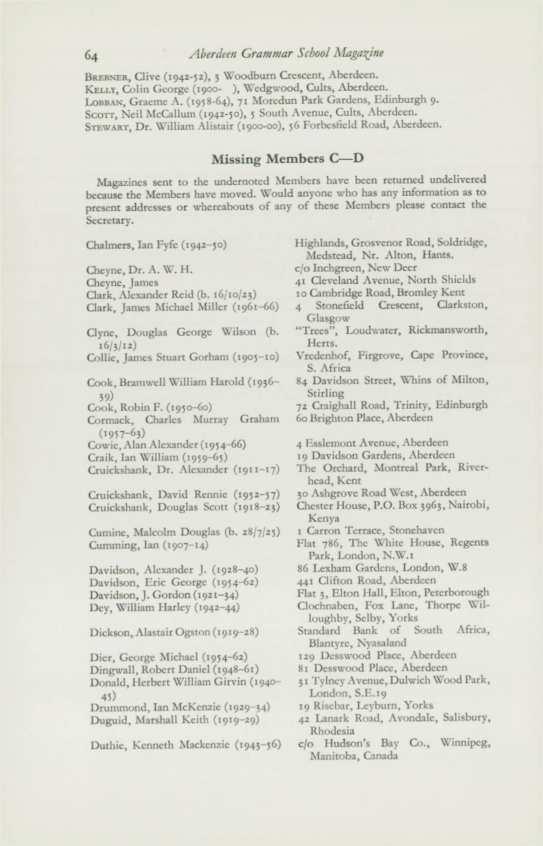
Aberdw1 Gra111111arSchoolAfagnzine
8RJ'RS1'-R,Cli,·e (1942-52), 3 \\oodburn Crescc.nt, \bcrdeci
KELLY, Colin (;corgc (1900- ), Wedgwood, Cults, Aberdeen. LonnAN,Graeme \. (1958-6.1),71 \forcdun Park c;ardcn,, Edinburgh 9. ScoTT, Neil \!cCallwn (1942-jo), j South ,\venue, Cults, ,\hcrdccn.
STI'WART,Dr. \\'illiam \listair (1~,, j6 ro,h.:,tidd Road, ,\berdccn.
Missing Members C--D
?'-.bgazines sent to the undernotcd \[ember, have been returned undelivered because the .\[embers have moved. Would anyone who has any information as to present addresses or whereabouts of any of these Member, please contact the Secretary.
Chalmers, Ian Fyfe (1942-jo)
Che)ne,Dr .•\. \\. H.
Che}ne, James
Clark, ,\lcxandcr Reid (b. 16/10/23)
Clark, James l\Iichacl :\lilkr (1961-66)
Clyne, Douglas George \\ ilson (h. 16/3/12)
Collie, James Stuart Gorham (1905-10)
Cook, Bramwell William Harold (193639)
Cook, Robin L (1950-6o)
Cormack, Charle• ,\lurra 1 Graham i9p--63
Co.,.ic,,\lan \kx.~ndcr{1954 66)
Craik, Lrn \X'illiam (1959-65)
CruicLhank, Dr. Alcx,ndcr (1911-17)
Cruickshank, David Ren• ic (1952-n)
Cruickshank, Douglas Scott (1918-23)
Cumine, MalcolM Dou,i;l.1s(b. 28/7/zSJ
Cumming, Ian (1 7 14,
Davidson, \lcxandcr J. (1928-40)
David,on, I.:.ric Gcorg.: (19S4~2)
Davidson, J. Gordon (1921-34)
Dey, William Harley (194:-.H)
Dickson, Alastair Ogston (1919-28)
Dier, George :\{ichael (19M•62)
Din1-,•wall,Robert Daniel (1948-61)
Donald, Herbert \\'.'illiarnGin·in (194045)
Drummond, Ian ;\kKcnzic (1929-34)
Duguid, Marsli;1llKeith (1919-29)
Dutluc, Kenneth .Mackenzie (1943-56)
Highlands, Growcnor Rood, Soldrid..:.:, Mcdstead, Kr. 1\lton, Hanes. c/o lnchgrecn, ~e\\ Deer
41 Cleveland Avenue, North Shields
10 Cambridge Rood, Bromley Kent
4 Stonefield Crescent, Clarkston, Glasg w "Trees", Loud\\atcr, Rickmanswonh, l lcrts.
Yrcdcnhof, Firgmvc, Cape Province, S.•\frica
84 Da,·idson Street, \\"luns of ;\liltou, Stirling
72 Craighall Road, Trinity, Edinburgh
6o Brighton Place,, \bcrdcrn
4 Es,lcmont .\ven ue, .\bcrtleen
19 Davidson Gardens, Aberdeen
The Orchard, \fontrcal Park, Ri,·crhcad, Kent
30 \shgrove Ro.id \\est, .\berdecn
Chester Ilouse, P.O. Box 3963, Nairobi, k cnya
1 C.1rron Tcrrncc, Stonchavu1
flat 7 G, ThL \\ h c House, Regent, Park, London, 1'.\V.1
86 Lexham Gardens, London, W.8
441 Clift<>n Road, ,\bcrdccn
Flat 3, Elton I!all, I'lton, Peterborough
Clochn.1bcn, !"ox L:rnc, Thorpe \\'i llnughby, Selby, Ynrks
St:in,l.1rtl BAnk of South ,\frica, Bfantyrc, ~ya,aland
129 D~,--wood Place, .-\hcrdccn
81 Desswood Piao:, Aberdeen
31 Tylncv h-cnue, Dulwich Wood Park, Lond"n, S.I 19
19 Risch1r, l.qburn, Yorks
42 L1n:irk Road, .\,·ondale, Salisbury, Rhodesia
c/o Hudson\ B2y Co., Winnipeg, ,\l,111itoba,C.-inad.1

HARPER

Achieve your aim!
Our advertising men are geared to help you promote your sales or project your company's image. You can have their advice just by lifting the phone to:
Mr. Derek Robb, Display Advert isement Manager, "The Press &Journa l", Tel. 40222 Ext. 240
Mr. Kenneth Robb, Display Advertisement Manager, " Evening Express", Tel. 40222 Ext. 250
Mr. William Gordon, Classified Manager, Tel. 40222 Ext.230

Spence Alsop Lid.


J. R. W. LEIPER InsuranceBroker
Insurance is a very necessary part of modem life. It is wise to ensure that families and business organisations are adequately protected against all reasonable risks.
Here the Insurance Broker can be of great assistance in advising on all aspects of insurance. Lack of experience and detailed knowledge on the part of the insured can lead to difficulties when negotiating a claim.
The Insurance Broker's services cost nothing and it is his job to know what kinds of insurance are best suited to individual needs.

TV'S· RADIOS·GRAMS·HI-FI· STEREO SOUND· TAPE RECORDERS·RECORDS·WASHINGMACHINES·FLOOR POLISHERS • SPIN DRYERS • CLEANERS • FRIDGESIn fact, everything for the modern home !

For SEA, RIVER or LOCH
GRAMMARSCHOOL OUTFITS FOR BOYS
BLAZERS(All Wool) s,,c7, £7 : 6: 0
PULLOVERS WOOL/NYLON (School Colours)
MUFFLERS
TIES
SHORT SOCKS
YOUTHS' TROUSE RS (Tcrylcnc/Worsted)
Size 30•, 58/19/9/from 8/6 ., 68/-
SPORTS JACKETS from £7: 12: 0
ESSLEMONT & MACI NTOSH (RETAILERS) LTD. TAILORS AND OUTFITTERS
UNI ON STREET ABERDEEN
VICTAFLEX
Popular Raglan coat in Gannex Ganflex
Feature~ flap pockets, strap cull\ and , ICC\C and bugg) lining.
Colour: lovat.
£10.0.0
ACOAT FOR ALL SEASONS ONE OF MANY ESSLEMONT & MACINTOSH (RETAILERS) lTD. TAILORS AND OUTFITTERS
MITCNlllS SPE IA .ISE
EIITIHL Y IN Sllf •DlllVENII[ tltal'• tl,a BIG diff1r111c.!
• Widest choice of cars. ctl da luxe models. M,nls, 1100 ,. Corunas. M.G and Riley 1100's. Zephyr 4's.. 1aoo·s.Automat,cs
• Everycar tho!oughly checked before each h<re
• You book with comp'•t• conl:dance-Mttchellt nave, let you down at the lut minu te
• Proper insurance. so important when you I •re a car.
FltEECOLOUltIIDCHIIIIE
11i111ng full 1nlor-11on and ratu can. wr1111 phone for • cor v
12 & 17twl, Vans for bu..neu or pr,vate uu.