•Northern' by name and 'Northern' in ongm, The Northern Assurance Company Limited was established in Aberdeen in 1836 and takes lasting pride in its Scottish ancestry
all classes of Insurance
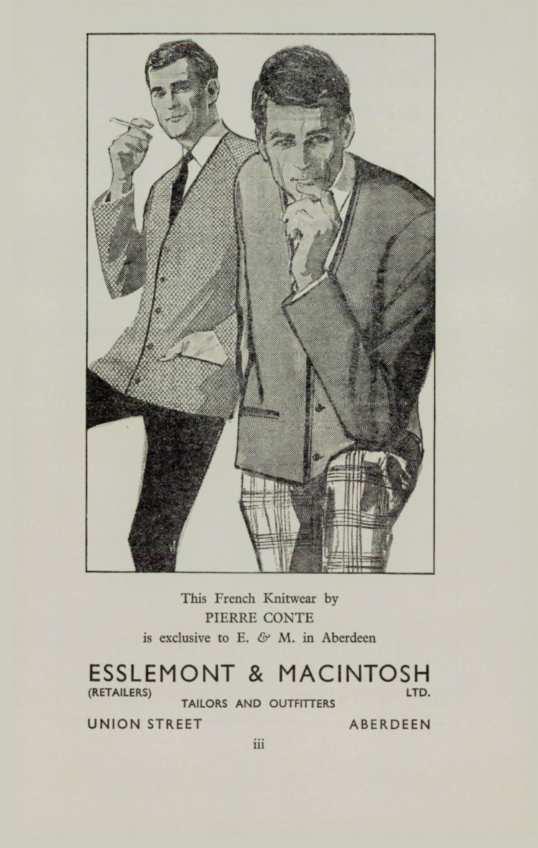
This French Knitwear by PIERRE CONTE is exclusive to E. & M. in Aberdeen
ESSLEMONT & MACINTOSH (RETAILERS)
TAILORS AND OUTFITTERS LTD.
UNION STREET ABERDEEN
. . there's such a vast range of top quality furniture and furnishings for you to see. We're open all day on Saturday and until 8 p.m. every Thursday.
Don't even call this timepiece a watch. All the parta that make a watch fast or alow have been left out of it. Bl,LOVA ACCUTRON time is kept by the vibratiom of a tiny tuning fork which divides every 1econd into 350 equal parts. (Your present watch divides a accond into only S parta.) It is the only wri,t timepiece guaranteed in scri1ing for accuracy. It's worth the time to you lo look into BULOVA ACCUTRO:'.'I'. Prices from £65 in 1tainless steel.
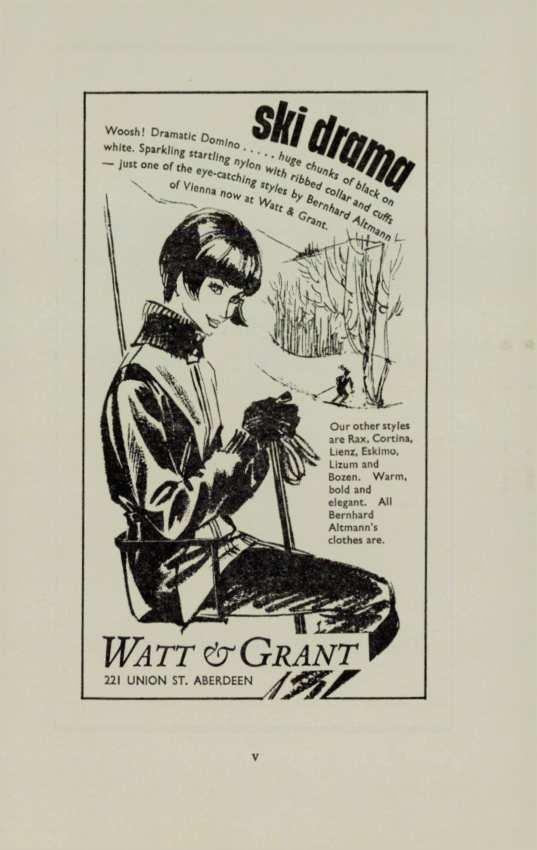
Our other styles are Rax, Cortina, Lien%, Eskimo, lizum and Bozen. Warm , bold and elegant All Bernhard Altmann's clothes are.
MAIN FORDDEALERSSINCE1911
HARPER
Advertisements
Without the support of Advertisers it would be a financial impossibility to produce the Magazine. May we suggest that in return you patronize them.
Enquiries regarding advertising in the Magazine should be addressed to :
FRANK C. CONNON, ADVERTISEMENT MANAGER, 58 DEE STREET, ABERDEEN
(Telephone 52525) X
Aberdeen Grammar School Magazine
8211dytar No. 197 (New Seriu 72ndytar No. 188)
Vol. LXIX No. 1
The Magazine is published under the auspi ces of The Former Pupil s' Club twice during the year, in December and June
General Editor and Interim Editor of Notes, Obituaries and l\farriagcs
Joint Editors of the School Section
Advertisements
Secretary of the F.P. Club
Rae C. Barton, \I.A., LL.ll., 20 Belmont Street, 1\berdeen { Alexander Tait, M.A. Ronald Henson, M.A.
Frank C. Connon, M.A., LL.B , 58 Dec Street, 1\berdeen.
Brian K. Crookshanks, 1.0., M.A., LL.B. 12 Bon-Accord Square, ;\berdeen .
The General Editor invites contributions from F.P.s for the next issue and request s all those with information for the Notes etc. Section to communicate the same to him. All copy should be sent to the Editors by IS May 1966. In view of the cost of publishing the litagaz,ine new advenisements are earnestly sought.
Printed for The Former Pupil s' Oub at The University Press Aberdeen
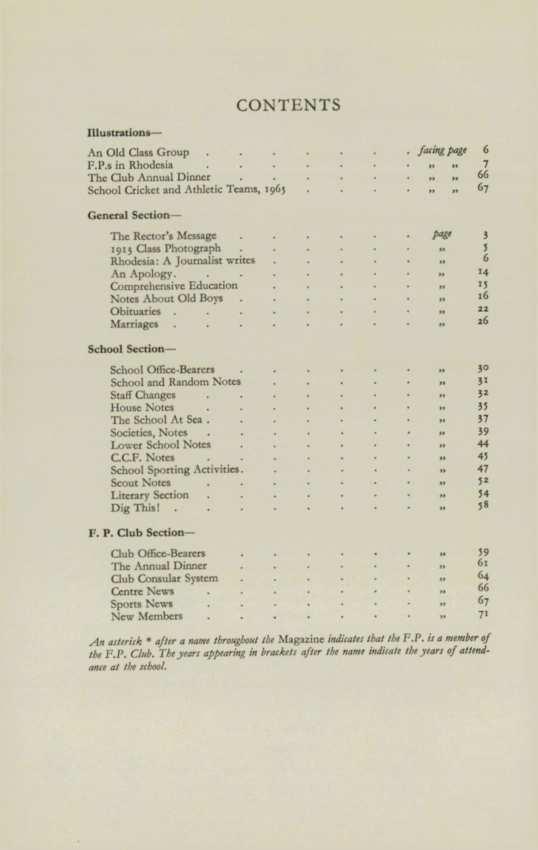
11Jusuallon1-
An Old Oass Group
P.P.s in Rhodesia
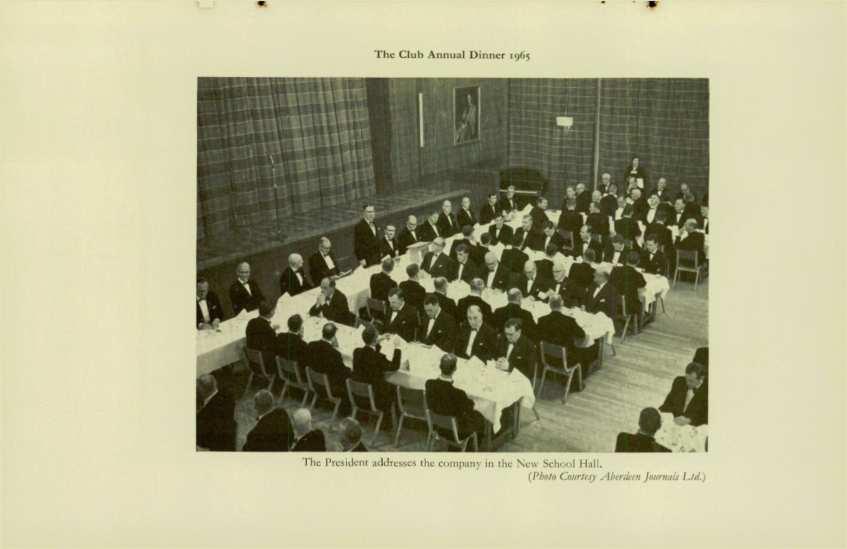
The Oub Annual Dinner
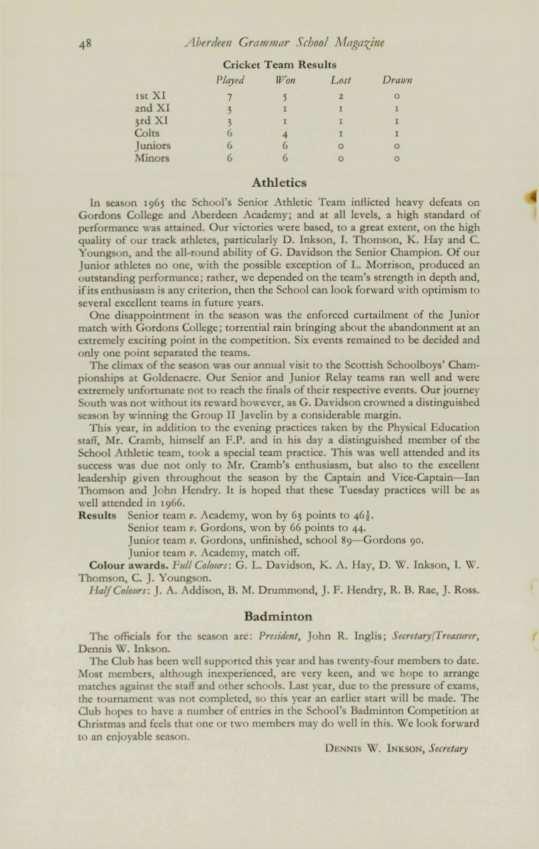
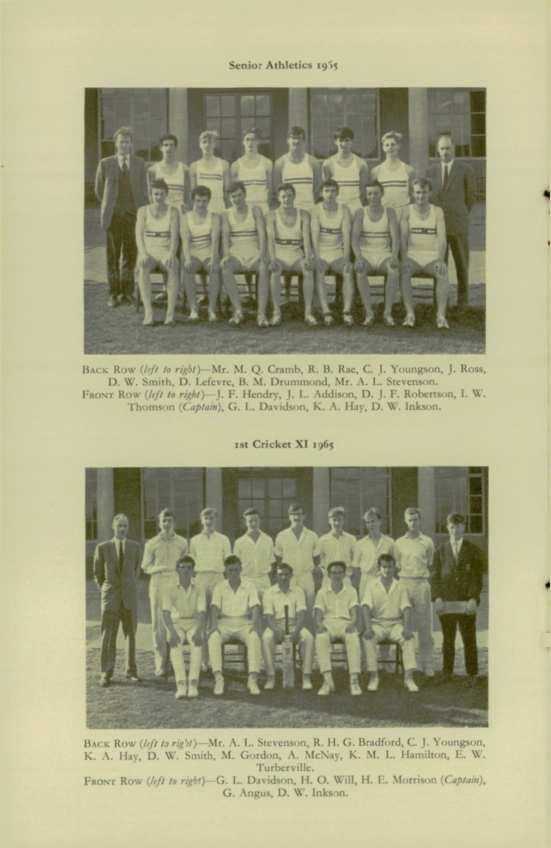
School Cricket and Athletic Teams, 1961
General Section
The Rector's :'.\fessage
1913Class Photograph
Rhode ia: A Journalist writes An Apology.
Comprehensive Education 'otes About Old Boys
Obituaries
Marriagfi
School Section-
School Office-Bearers
School and Random Notes StaffChanges
House ?s;occs
The School At Sea . Societies, Notes
Lower School 'otes
C.C.P. l'\otes
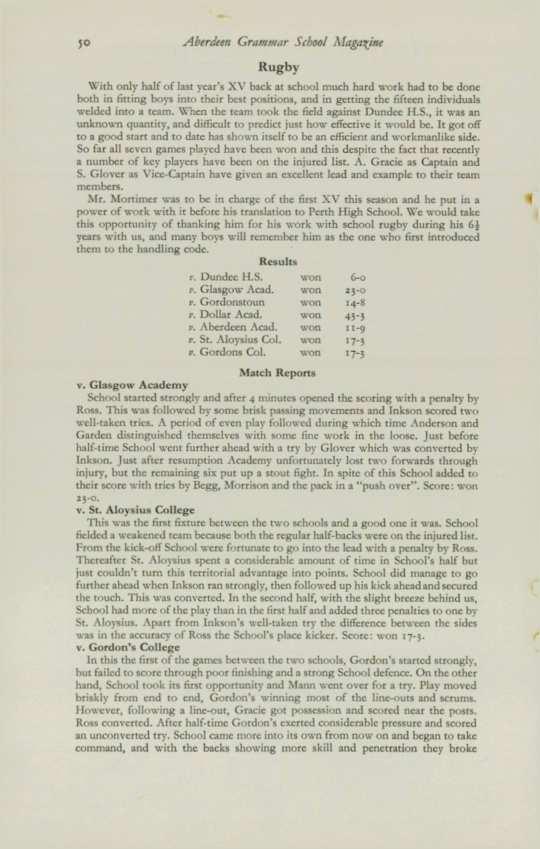
School Sporting Activities.
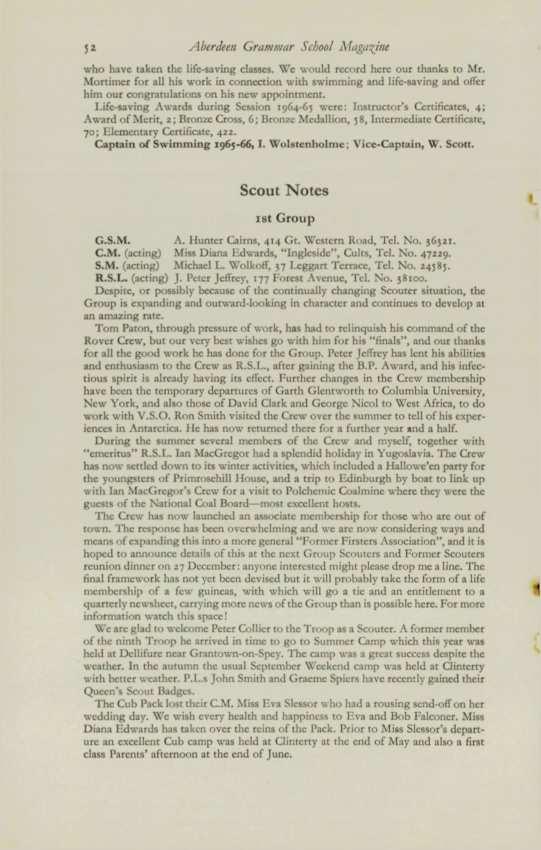
Scout ~otcs
Literary
F.
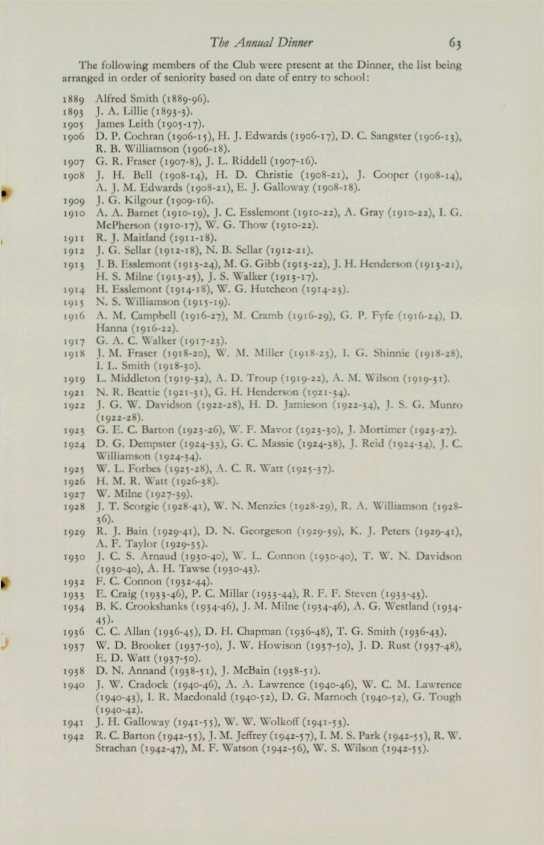
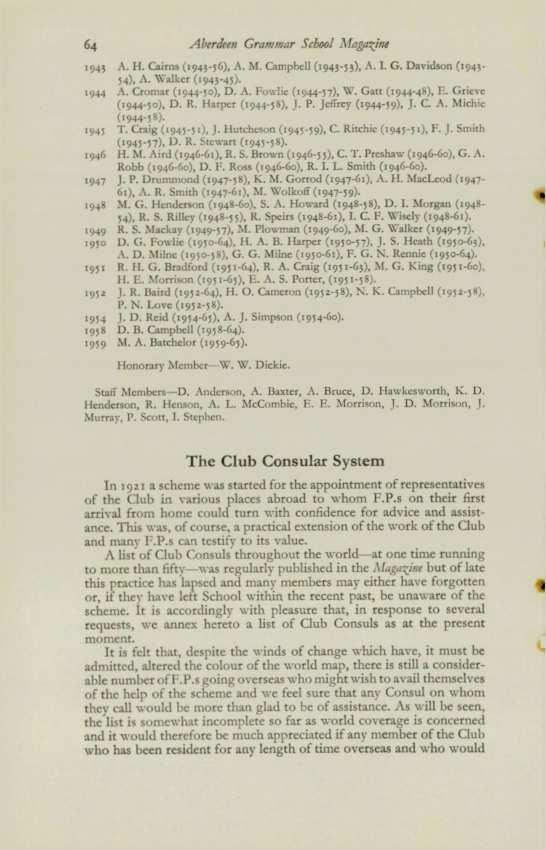
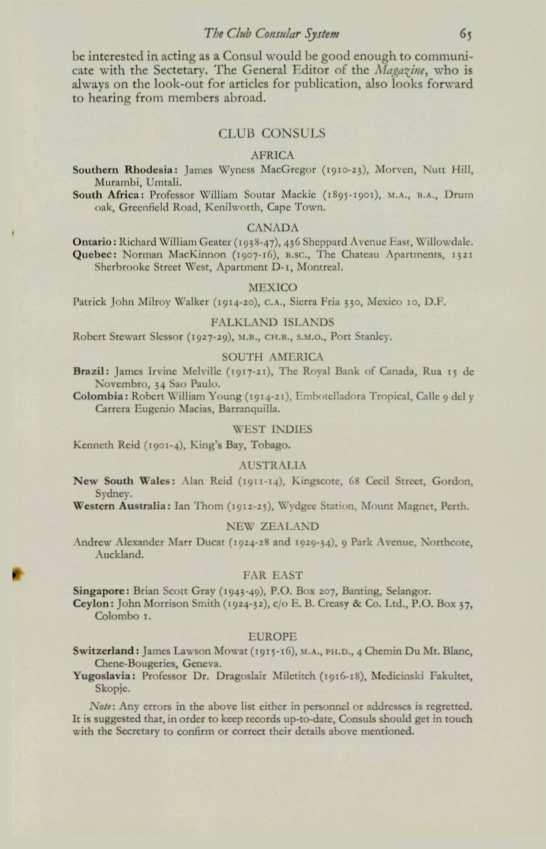
An asltrisle * afltr a name througbo11Ith, Magazine indfralu that th, F.P. is a mtmbtr of th, I'.P. C/11b. Th, ytarr apptaring in bra,letlr afltr lht nam, indi,ale lbt ytarr of alltndan&1 al lht J&hool.
The Rector's Message
'TI\e Editor has very kindly suggested that I write a short report on the lines of the one I submitted this time last year to bring readers up to date with what is happening in the School. I am very happy to accept the invitation. Early November, as it happens, is probably as good a time as any in the school year to pause and take stock of the situation. The birth-pangs of the new session are over, the timetable has bedded itself down for the year, clubs and societies have their winter programmes well under way and, albeit the thought is a sobering one, term examinations are still a few weeks away.
Last year I referred to the fact that the School, with a population of 1,500, was larger than it has e,er been in its long history. Today although the total roll isapproximately the same, the apparent flattening of the curve is explained by the disappearance of the two first Kindergarten classesfrom the scene rather than by the fact that we have at last reached high-water mark. In fact the roll of the Senior School has risen again this year and now stands at r,050 boys. Last year's record of thirty-five boys in Upper VI has been surpassed this year by a figure of just over fifty, all of them possessing the minimum qualification of a University entrance group gained in theScottish CertificateofEducatio n Examination in the 5th year. This has necessitated the creation, for the first time in the history of the School, of two Upper VI classes. Somewhere between 90 and 100 boys are applying for admission to the University this session and it can be safelyassumed in the light of past experience that the vast majority of these ·willbe successful.
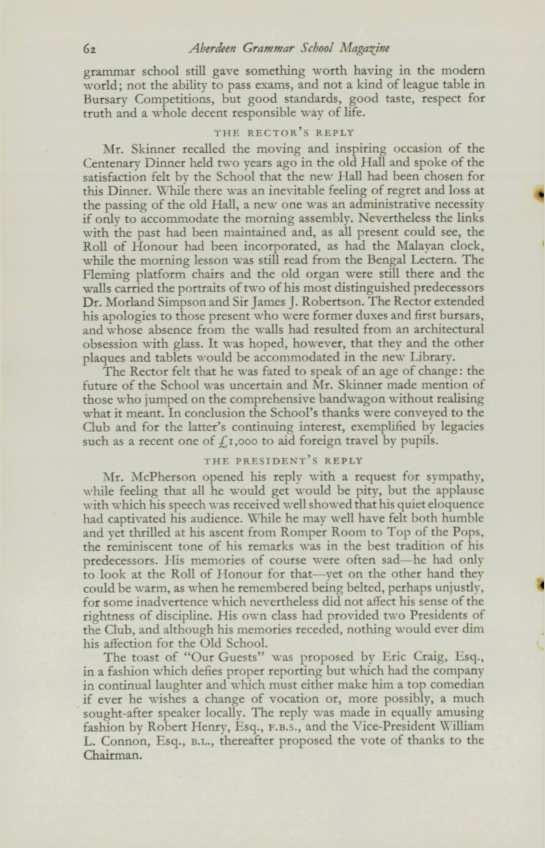
The programme of expansion and modernisation of the school building has now entered its la.st phase and it is gratifying to record that the end isin sight. In recent months efforts have been concentrated on the reconstruction of the old Ifall and we have been promised access to the new Library before the end of this month. The general impression conveyed by it, even in its present unfinished state, is very favourable and all the indic.1.tionsare that it will prove a worthy home for what is probably one of the finest school libraries in the country. The incorporation oftwo galleries, one at each end of the Hall, for use by Senior boys during study periods, has left an open space on the floor of the Library which can be made available for smaller and more intimate gatherings than those normally accommodated in the new Assembly Hall. Staff meetings and meetings of the Literary and Debating Society, for example, will continue to be held in the Library as has been the practice in the past. It is also proposed to have the recess situated on the outer wall above the central door of the main building converted into something in the nature of an inner sanctum which will contain the laru et penatu of the School- the Book of Remembrance, the old School Bell, the cups and trophies and similar treasures For the design and lay-out of this part of the Library we are deeply indebted to Mr. Hemingway of the Art Department.
Aberdeen Gra111111ar School .\!agazine
The area below the new Library is, ofcourse, completely windowless but this defect has been turned to advantage by converting it into two attractively-designed projection rooms adapted for film or television lessons, a dark room for photography, a stack-room for the Library and a laboratory technician's workshop. One of the ad\·antages of reconstructing an old building is that the accommodation must be accepted as given and has to be used to the best advantage. There can be little doubt that, had we been erecting a ne\\' building from scratch, we should have come off much worse.
The last phase of the programme will be the connrnon of the old Library into two new classrooms. This, it is hoped, will be completed by Easter and it is my intention as soon as possible thereafter to throw the School open for one or two days to enable parents, F.P.s and others interested to visit the School and see the ne\\ accommodation for themselves. It is appreciated, of course, that many F.P.s residing forth of Aberdeen may not be able to avail themselves of this opportunity and I should like to assure all such that we shall be delighted to see them in the Schoolshould they wish to visit it \\'hen next they happen to be in Aberdeen.
;\1ention of the Library reminds me that the \\riting of this report offers a welcome opportunity of expressing our thanks to the many F.P.s and friends who have responded in recent months to our appeal for hooks for the ne\\' Library. These have been coming in at fairly regular intervals and have ranged from donations of a single bookpresented in some cases by the author. joint author or editor-to gifts of several volumes. Occasionally, too, we have receh-ed a list from which we have been asked to select whatever is of interest to us-a method ,vhich has much to recommend it in the case of donors living some distance from Aberdeen. '\eedless to say, the imitation is still open and we shall he delighted to receive further contributions from any who may be thinking of reducing their stock or clearing space on their sheh-es for new accessions to their own libr:mes.
The past year has in fact been unusually rich in benefactions to the School, most of them presented by P.P.s or associated with the names of r.P.s. It may be of interest to readers if I mention in my concluding paragraphs some of the more noteworthy. The first of these in order of time was a gift of £90 received from the .\falaysian Branch of the f.P. Club for the purchase of an Inter-I Iouse SeYen-a-SideRugby Cup, the residue of the money to be used for the proYision of Sports Medals. Then a new Cricket Cup, to be awarded on the results of a Six-a-Side tournament im·olving boys at all leYelsof the Senior School from the 1st year upwards, has been provided by the bequest of £100 from the late Mrs. ?\faryJ. Robenson in memory of her son, John ;\loir Robertson (1923-29), who was killed in action in Africa in 1942. The balance left over after the purchase ofthe cup is being used at the request ofthe donor to endo,v a prize in Commercial Subjects. Another donation, also of£1oo, has been received from \fr. E. M. McDonald of Keighley (1909-13) to provide a prize in memory of his mother. The prize, which will be known as "The Agnes Durward :..icDonald Prize" will be awarded each year to the runner-up for the All-Round Trophy.
1913 Cla11 Photograph
Towards the end of last session we received a gift of £80 from Mr. and Mrs. Mark Mitchell, whose two sons, Stuart and Gordon, were Duxes of the School in 1961 and 1964 respectively. The money will be used to endow a prize in Science, a subject which is less well provided for in that respect than most of its rivals in the curriculum.
Pinally, and more recently, intimation has been received ofa bequest of£ 1,000from the estate of the late Mr. K. G. Mackintosh in memorr of his son Kenneth (1923-35) The revenue from this sum is to be used at the discretion of the 1feadmaster to assist deser\'ing boys who might otherwise be unable to afford the cost of school trips abroad or elsewhere.
This imposing list testifies once again to the close hnks which exist between the School and its r.P.s and to the warm place it continues to hold in their affections. lt is a great pleasure to me to have this opportunity ofconYeying to a much more widely dispersed body off.P.s than I can hope co meet m Aberdeen, or even in Club Centres forth of Aberdeen, our warm thanks and appreciation for their continued interest in the School.
J. \'. S.
1913 Class Photograph
Avon Alexander Barnett· (1911-19), o.s.c., R.D.,R.~.R.(Rtd.) has retired from the \ferchant ~avy and is resident in Aberdeen.
Eric Robertson Garden Bruce (1909-18) has retired from Malaya where he was a rubber planter.
David Cairns· (1912-16), D.D., is Professor of Practical Theology at .\berdeen Lruversitv.
George Murray Cochrane· (1909-22) is with the l\;auonal Bank of India in London, and resides at \'<'imbledon.
Andre~ Dickson (1911-22) ,1.n., CH.n., has retired from general practice: he was formerly at \\'allsend and latterly for many years at Old Deer
Ronald Grant Dingwall (1912-21), o.u.E., ~J.B., c1-1.n., was killed m action in 1941.
Eric Edmon ston Duthie (1910-17), ~I.A., ,,as seruor book editor and joint editorial manager of Odhams Press Book Department during 1946-57.
Kenneth Macdonald Finlay son (1910-21), ,1.n., c11.n., has been m general practice at bast Dulwich, London, since 1932.
Chari es Gordon Graham (1911-18) died in 1959.
Alexander Gray· (1910-22), ,1.A., 1L.B., is an Advocate in Aberdeen.
Herbert Charles Thomson Gunter (1910-19) died in 1959.
John Hartley Henderson- (1913-21) is a tea and coffee merchant in Aberdeen.
William James Hogg (1908-21), 11.0., o.P.H.,cliedin 1960.
Aberdeen Grammar School Magazine
Ian Gowanlock McPherson* (1910-17) is retired and resident in Aberdeen.
Alexander Wallace Michie (1910-22), M.n., CH.n., died in 1956.
Francis Kelly Nicol (1908-21)is at Longnidd ry, where he is planning superintendent ofa firm making steel building frames.
AlexanderPaterson (1910-21), M.n., CH.JI., is in general practice at Sale,Cheshire.
David HerbertRennet(1910-21)died in 1934.
ErnestGraeme Robertson* (1910-19)has retired as a tea planter in Malaya,and is resident at Kintore.
Julien Nicol Smith (1909-16)died in Canadain 1960
Alexander McGregor Thom (1911-22), n.sc. (Eng.), is with Associated Industrial Consultants at Carnoustie.
Charle s Whyte Williamson (1910-17), T o., u.A., c.A., died in 1948.
No up-to-date information is available about the following members of the Class, and the Club Secretary would be glad to hear from anyone who can assist in making our records accurate: Harry Ironside Davidson (1910-17), :-,1,n E., James Bisset Davidson (1912.-18),George Deans (19II-21), William Dunningham (1910-16: 1917-19), Charles Gillespie (1910-18) (an actor during World War II), Frederick William Hutchison (1910-19), Lawrence J\laxwcll Stanley Knight (19u-13), Alexander Stronach Marr (1913-14) (manager of a laundry chain in ~faryland, U.S.A, in 1949), William Stephenson Murray (1910-17), Patrick Buchan Robertson (1910-16), Frederick Smith (19n-15), and James Douglas \'food (19n-22) .
RHODESIA
A ]01,rnalist111rilesJrol/J Sa/isb111y
As a general rule, journalists are a dedicated group of professional men, guided by a code of conduct which, although un-written, is every bit as binding on them as the codes and ethics followed and adhered to by other professional bodies. No one can be so naive as to suggest that none of the professions have their " black sheep" but, through the media ofpopular fiction, filmsand television the journalist is often thought of as a thoroughly unprincipled character.
'othing could be further from the truth. Journalists do have a code of honour, they do have principles and, above all, they have a fierce protective pride in their ability to be impartial in everything the, write. However, and this is where one might get the impression that they are not ah1:ays as impartial as one might like them to be, they can only report on what they see, what they learn and the impressions they can form in a very short space oftime. These are the limits within which they can ply their trade.
In the light of what I have just said it is perhaps possible to answer the mystery of how so much legend, and at best, so much error, has come to be mixed up in reports written by foreign correspondents visiting Rhodesia during the momentous period of the past few weeks.
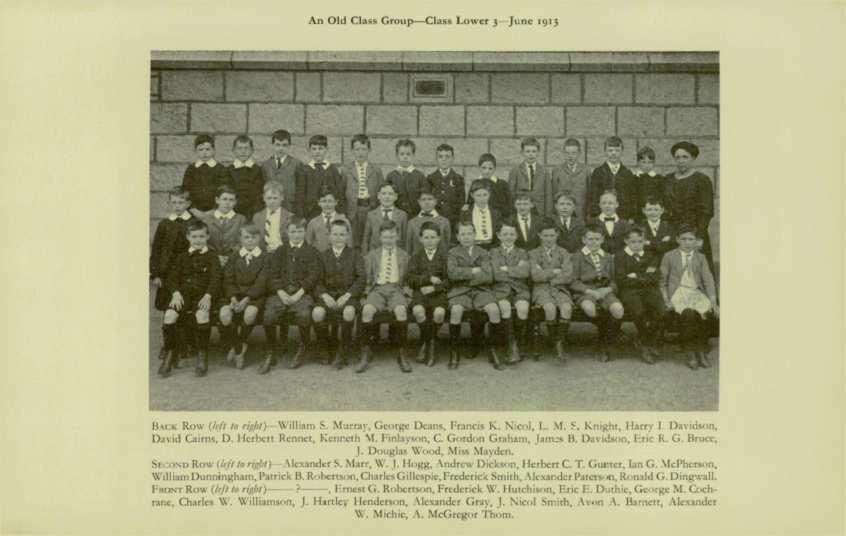
II""' Row [Ml In rigbl) \\'illiam ~- !\I.ma,. GenrgL DL'llm,. Francis h. ', col, L. .\1. ~. Knight, llarry I Dandson, Da, td Ca rns, D. Ikrlx11 Rennet, Kcnrcth \I. h nlav, m, C. Gord, •n Gr,,·a!ll, lam.:s B. Da, idson, l·ric K G. Bruce. f. Drn,glas \\'ood. Mi,, \ fa,<lcn. s, ,i,o Ro" .lrji In righ1) \Ic,.arul.:r S..\brr,\\. J. Ilogg, \n<lrc\\ D,~kson, Ilcrberc C. T. Gurrcr, bn G. \kPhc:r,nn, W1lliamDunningham, Patrick B.R,,herr,011,CharlcsG,llcspic, r rcdcric:. Smith, \lnander P,11L,s•,n,R, n1ld (;, Ding,.,all. rRn,T Row (/fl lo righl) ? , l.ni<St G Rolx.rrson, Frederick\\. Ilutchi<nn, Eric h. Duthie, Ge ,rgc M. Cnchr:inc, Charles \\' \\ 1lliam,.,n. J. H~rtlc~ Ilrnder,on, \ kxander Gray, J. :\ic,,1 Smith, \\un \, lbrn~tt, .\kxandcr \\. Michie, .\. McGregor Thom.
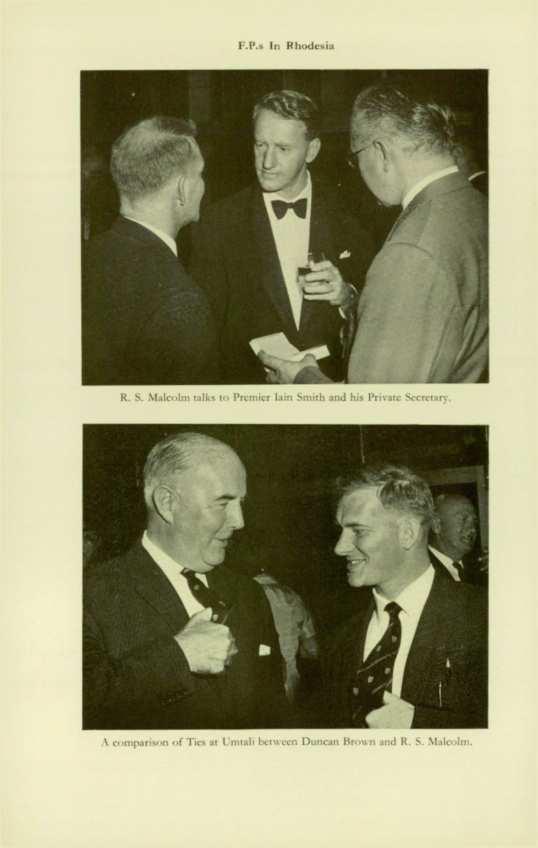
R :, \f.llcolm talks 10 Premier lain Smith and his Prharc Scnctar).
\ comp,1ri,on of Tic, ,u l mtali hu\\ccn Duncan Hrown and R S \lalc olm
There are, of course, many other reasons for the complexity an<l divergence of opinion expressed by these journa)jsts. In a straight report of some incident there is no room or indeed any need, for comment. The Rhodesian situation, however, cries out for comment from every aspect.
A CO~IPLICA I LD IS~{ JE
ln political reporting it is simplr a matter of which side you happen to be on. The Rhodesian problem is not, howeYcr, a cut and dried political issue, although there are any number of political overtones and, one could be excused for thinking, a good deal of political expediency being exercised in the handling of it. 'l'he Rhodesian issue can much more readily be described as a racial and i<leological one and this is one of the most difficult situations on which to report or comment.
This 1s not a matter of using words to illustrate the subtle, but reall) simple, difference in shades of opinion on the same subject. This is not a case where one can s;ty, ",\II roads lead to Rome". There is no common purpose, nu common aim, with only a difference of opinion on how these should he attained. It is a case \\·here opiniom ,rnd ideologies arc Yiolentl} opposed - and l choose the word "violently" with care and where they are so di,1metrically opposed that the\" are almost utterh- irreconcilable.
What·each man has said, and \\ ritten, about Rhodesia must haYe come from his heart, for this is a ~ituation where honesty, morality and personal ethics are concerned. 13y reason of this it would be utterly ,, rong, and indeed unprofessional of me, to tn to contradict anything which has already been written.
This is wh) I haYechosen to try and assess the situation from a point of Yiew and angle which, I feel, has been totally neglected by the journalists coYering the eYents of the past few weeks; and also, I am inclined to say, ignored by e,eryone concerned, including those involved in the high level negotiations.
At this point let me say that I have no feelings on the matter at all, and hope that I can present my opinions in an. impartial and noncontroversia l way. T have no wish to sv.-ay the reader. I hope he will assess \\hat I sa> in the ljght of his own kno,\·ledge and morality. If by expressing my opinions and views l can throw some light on an alreadr troubled problem I shall be satisfied. If the reader cannot accept my \ iews I am willing to defend them by discussion but I am not prepared to try and uphold them by "violent" discussion.
T II E LESSOSS 01' Tills PAST
It appears to me that a failure to understand the lessons of the past is leading con.temporary man into grave error. The chief of such lessons is one of genetics, common to all animals, including man.
Segregation of types began gradually jn prehistoric days. This segregation was especially marked in Africa where various tribes developed specific characteristics \\ hich anyone li\'ing in Africa can still easily recognise. These characteristics developed as a result of
tribal exclusiveness and inbreeding to an extent never found in white communities. The Luropean (as all white people of whatever origin are called in Rhodesi,1) is a master at changing his em ironment by technological progress.
One man's meat, howc\ er, is another man's poison. Permanent housing instead of" igwams, for example, killed off thousands of Red Indians. The Australian Aborigine has all but disappeared in the face of advancing western civilisation. A close study of these people will show that they were far from being unintelligent or lacking in mental reasoning power. They developed complex social and local government organisations and acquired skills ideallr suited to their environment and way of life: until someone came along and changed that environment. They have succumbed, as did other prehistoric peoples, and are now regarded as being part ofa long forgotten race destined in the course of time to wither away completely.
When it comes to Africa, howeYer, these lessons are either completely forgotten or ignored. The black races of Africa are not regarded, as are their Australian and American counterparts, as peoples who must perish iffound incompetent to meet the challenge ofchanging times and conditions.
They are in fact treated as though they possess some intrinsic, but undefined, merit which atall costs (to everyone else) must be preserved. If an epidemic threatens them, immediate and massiYe medical aid is mobilised. If famine stalks the land, thousands of tons of free food are flown from America as a gift from Uncle Sam. Jf the black man is lacking in schools. hospitals, bridges, roads or sewers, then Uncle Sam's helping hand again stretches across the seas -in the form of the Peace Corps-and the missing items arc pro\'ided, free and without any effort at all on the part of the recipients.
~IUT.-\110.S .-\.SU SELI! C ]'JO-..:
Surely two factors, aboYe all others, are necessary for life to exist in the form we know it: mutation and selection. Mutation provides for an individual differing from his p,ircnts and capable of passing these differences on to his offspring. Thus a new type arises.
\\hcther that new type sun ives depends entirely on whether or not he is suited to his surroundings anJ, if he is not, whether he is capable of adapting himself to suit them. These surroundings may differ as widely as the Dorchester Hotel in London, and similar establishments patronised by those who .-ould try to teach Rhodesians how to deal with the bushman, and the Kalahari Desert. I would be unwilling to predict how a Kalahari bushman would fare in the Dorchester but there are grounds for doubting the suitability of the diet. On the other hand, I have no doubt about the fate of an oYerseas politician in the Kalahari Desert, for he would not even know which caterpillars and bugs are edible.
This is an extreme example, but it "ill nevertheless show how dangerous it is to judge the merits of a human type placed in a foreign environment, with nothing but the skills learned in his own natural environment to aid him in his survival.
ls it surprising then that \frica is torn from end to end ·withtrouble and strife? E\'en where trouble is not immediateh obvious, it is simmering just beneath the surface and is liable to bml over at any moment. It must naturally be so, for the most intelligent ,\frican is on!,· little more than a hundred years, or two generati~ns, a\\ ay from th~ Kalahari bushman in deYelopment. _\t best then, the black politicians of Africa ca.n only call upon experience gained by two generations of forbears with a.ny contact with the urban communities created by western civilisation.
TJIJ ; \fl!,J'AJ.:F OF I:S:DEPl' 1'DEISC1-
This is \\ h, it is a mistaken bdief that handing o,·er independence to ,\frican n.'ltions, for them to continue by democratic rule, ,, ill be successful. On the "one-man-one-vote" for which millions in \frica constantly howl, it is o,·crlooked that the type of econom ic and cultura l k\'cl reached by a democracy must depend ultimately on the achieYements a.nd capacity of those \\ho determine the goyernment the electorate .
Let us take the example of another nation not so far away from Rhodesia, and on the same continent . lt was granted independence and launched on the democratic way of life. Lp till then 80 ptr cent of its exports were deri\'ed from white enterprise and a like proportion of its revenue.
The predatory urge of the blackelectorate is so strong, howeYer, an<l their economic un<lerstanding so slight, that a policy of swift Africanisation is the order of the day. The results ha, e n.orbeen encouraging. The only valid reason for changing staff is th~t a better man may have the job but the black men replacing the white are not better. The average understanding of the electorate has not been great enough to apprecfate this, and catastrophe and suffering are the outcome .
Jlistory shows that the e,olution of modern western man has been a worldwide struggle for domination, as in the animal worl<l. But a most peculiar thing is happening in the world toda}, particularly in \frica. ,\ race which established its dominance over the greater part of the globe and certainly over the \)hole of the continent of Africa by reason of superior technology is being encouraged to abdicate its position to another race of completely <lifferentstock. And that race, mark you, in a million years did not progress sufficiently in technology to produce so much as a wheelbarrow and who in this dar and age still regard cannibalism as wholesome.
It follows then that the pressure brought on white men, by other ,,·hite men, to give up their position in .\frica runs contrary to every natural instinct, instincts that \\·ere born into our ancestors millions of years ago. These same instincts, of self preservation a.nd dominance, have governed the creation of our species.
\Vestern man has, a.s a result of two world wars and countless other minor conflicts, deYeloped a dread of physical , iolence and indeed of conflict of any kind. To aYoid this in his own environment he has developed for himself the democratic principle of majority rule. \X'hat most people forget, howe, er, are the factors that make this system
.1lberdeen Gra111111ar School ,\fagazine work. \\'estern man considers the key to the system to be the counting of heads, when, in fa.et,what makes the system work is wh.it is inside the heads.
•
J HE l0N5EQL'l::1'CE~ 01 I Rlll,DO\J
Let us take up another point: the case of certain .\merican and European communities who claim to subscribe to a "liberal" outlook and indeed in many cases operate one.
The black man does not subscribe to these ideas, and most certainlv never puts them into operation. 1[e adheres to those primeav:tl instincts which have contributed to man's e,·olution from lower forms oflife, and who can blame him for doing so, for to lose these instincts or to abandon them must, as we have seen, sooner or later result in extinction. The black man knows the value and importance of the territory which the white man has given up; he strives for the dominance the white man casts off; he believes in status and regards any suggestion that all men are equal as so much moonshine, \\'hich of course it is.
Too many politicians, in their ignorance, think th,it Africa can be wisely ruled by dark-skinned men who, ha, ing obtained their so called "freedom", will multiply and prosper so that the o\'erseas industrialist can be provided with an e, er-gro,, ing market and supply of raw materials In point of fact nothing of the sort \\ ill happen. Present day e, ents show that quite clearly for those willing to see. There ,, ill always be those who are still prepared to explain a\\ ay starvation and uncontrolled disease, tribal war and banditrv, the murder and mutilation ofmen, women and children (the Lumpa affair on which I reported in the last issue of the MaJ!,az.i11ebeing but one example) the raping of nuns, not to mention acts of cannibalism, as mere "teething troubles". These are the people who would ha, e us believe that, with a little help here and there, and an infuswn of aid (the more millions the better so far as the \ frican Governments are concerned) things \\ill settle down. This is not the case; it has not and will not happen.
WIIERL THE DIFl'lll\llN( ES LIE
IIowe,er, hack to the main theme. \\hen the white man arrived in Africa, not so very long ago, he found a primitive people, very similar in type and development to the prehistoric m.in of \\ estern Furope . The level of culture and technology permitted for a population of about tweh-e soub per square mile and that population was liable at any moment to be wiped out by a quirk of nature, be it disease, pestilence, drought or Hood.
The white man's presence has since provided a basis for a population explosion. l {e has brought with him every skill known to western ci, ilisation and the J\frican has had every possible opportunity to avail himself of these skills and to learn of their operation and uses. But, despite all this, every scrap of evidence points to the fact that, far from catching us up, the J\frican is falling further and further behind ,,ith each succeeding year.
It is obvious, again to those who ,,ill see it, that the gap is an everwidening one and, with the widening of that gap, the African's ability
to control a modern society, in competition with other fully developed societies of a similar type, becomes less and less.
TIIE CIIOICE FOR Tlil' \l·RI( AN
Indeed, if the truth were really known, one would find that the "ordinary .\frican" wants nothing at all to do with "nationalism" or "freedom". By nature he wants to be left alone to live his own life.
There are some who wish to play their part in the urban and industrial development of the countries in which they live, for they arrived in these geographical locations at roughly the same time in history as did the white man.
There are many more,\ ho ,dsh to continue li\·ing in the "bush" as the,· have done for countless centuries. Doubtless, and no doubt the\· realise this, they will e\·entually be overrun by expanding civilisation . They may even follow the path of the \mcrican Red Indian and the Australian Aborigine and vanish as a race from the earth. This is their choice and, if one helie,·es in human rights, it is a choice they should be permitted to make.
From where, then, does ,\frican :::\ationalism come?- It is a question that many have asked, and fe"· have been able to answer. However , I am inclined to agree \\'ith the opinion ofa small minority of students of Africa and say that it stems in the main from the partial education of a simple and backward people by religious missions ofevery denomination. A glance at e\·ery i\ationalist Leader in Africa will show an early primary education in mission schools. ln most cases they have carried it further, but not much further.
It should also be clear!\' understood that .\frican tribal societv has no universal suffrage and the ordinary \frican people thus become an easy prey for political demagogues and agitators who are well trained by outside powers in stirring up racial animosities and hatreds.
The a...-owedpromises of these "nationalist leaders" are seldom kept. They are directed at a gullible and unsophisticated mass. \\ hen it is seen that their promises cannot be kept and there is no moYe on the part of the masses to an acceptance of the philosophies of these so called "nationalist leaders", they ha, e resorted to terrorism, thugery and gangsterism. They exhort their mobsters to beat, stone, petrol bomb and e,·en murder in an attempt to (?ainsupport and achieYe their aims.
It is therefore incomprehensible that, whilst this atmosphere preYails there should be any contemplation of abandoning the moderate peaceloving African who number countless thousands and represent the majority of the African peoples-to rule by the small minority who are bent upon measures aimed at creating animosity, fear and terrorism, and whose only real ,iim in the ultimate is personal power for themselves.
1'01 1•1
JCS A::-:D 1 HL YOl ~G
In the past we have come to expect, and indeed accept, that political ideologies and philosophies are reserved for the adult only. Alas, this is not the case in emergent Africa. The unfortunate state ofaffairsis that
Grammar School Ma,~flzint
politics have permeated into the lh-es of almost eyery African home in urban areas, and has left its ugly scar indelibly imprinted on the minds of impressionable children. In fact, the tragic consequence is that it has spread e\'en into the schools.
\\ hen the then Rhodesian GoYernmcnt hsc \"ear announced their plans to introduce fees for all races in all schools throughout the country, this policy was sei7ed upon by the \ frican political leaders and was regarded as yet another weapon with which they could create terro rism and racial hatred. It was their object to instill in the young on v\'hom they must rely for any future support- a feeling of prejudice and hatred and, to achieve this, they organised a boycott of all schools. The outcome of this boycott was that gangs, composed mainly of youths (with a sprinkling of adolescent girls) \I ho were unable to complete their own primary education, picketed entr,inn:s tn schools to preYent other pupils from attending. Those who were able to slip through the cordons were thn:,\tened and tensions rose to tremendous heights when these hooligans entered school premises, smashed windows, threatened school teachers, drove children home and, in rnmc cases, threw petrol bomhs which set fire to the premises. These acts of violence did not stop there. ~fany of the children were followed to their homes and their parents threatened and in the majority of cases beaten-up hy these adolescent youngsten.
This series of events brought about a further complexity in an .dread\· troubled arena, and the effects \di! cloulitlcss hccnme firm!\' implanted in the minds of children and\\ ill be somc.:thingthey\\ ill not rcadih- forget or forgh·e; especLilly when one considers the importance the urban African pi.tees upon improvin g his education and learning. \\'hat is e\'en more disturbing is the fact that almost eYcry urban African is prom: to apportion guilt in the wrong direction and is quick to blame the authoriti es, without fully appreciating how the uphea\'al arose in the first place.
-\mong urhan ;\fricans , attitudes arc now spreading that arc dyna mic, purposeful and emotional in cha.meter, and th•~ stimu li rec1uircd h:we now heen provided by the wave of cxtn:mc \frican nationalism which is doing little more than engendering racial h:itn.:cl.Experience has revealed that the urban dweller is on an:rage an extreme charattcr and one who readily explodes emotionally and this l.ttcnt a_ggres,ion t,ln change "ith astonishing r:ipiditv into uncontrolkd \'iolcnce.
l>l.llsS'IIO:--. l."\:PLAJ:--:J I>
lt must be understood that, if this latent aggression i, allm, ed to fester and e:-.plode, it can bring in its "ake untold horrors, for it c1uicklybecomes indi~criminate, uninhibited and op~nly sadistic. This is why, and it i, the only rcas,rn, that nationalist lc,Ldcrsarc placed in restriction. ThL)' arc not there for the protection ofthe white community but to protect the peace•lm·ing African whose only real amhition i~ to lead a c1uict,unmolested life, which is \vh:~the will do if he is left to it.
1t \\ asc'lmmon until tjuite rcccntly. when e\ cnts prm·ed otherwi ,e. to comidcr that the short period of instruction which the black man has
Rhoduia
had from the white man would make him fit to rule both himself and his country, provided that he could have the benefit of European assistance for a limited period of time. It was believed that the black rulers would not only appreciate the value of such assistance, but encourage those prepared to give it.
In the case of Kenya, it was stated that the white farmers were so obviously essential to the economy ofthe country that no government, whatever its colour, would dispose of them for many, many years to come. \\'hat the people who subscribed to that theory and made long involved public pro:i.ouncements about it think now, can only be guessed at, but what is sure is that those same "indispensible" skills have been thrown away. Those possessing them have been expelled and their places and salaries taken by men ignorant of the problems im-oked. At this time. only a few years after, even the black governments have to admit that production from these formerly extremely profitable farms has dropped by more than two-thirds and, in many cases, have ceased to be viable business operations at all.
The people who mouthed all this unmitigated rubbish in the past are now trying desperately to draw a smoke screen over their abject failures by suggesting that there was nothing ,,·rong with the policy of granting independence and that the only thing wrong was the timing . "A few more years", they say, "and things would have been different, black men will haYe learned to rule white men." This argument rests on the assumption that the black man is progressing at a speed that will permit him to catch u~ up in the foreseeable future. In my opinion this is just another politician's theory which can be looked upon with the same degree of credence as we can now place on their former utterings. Ill" l'Rl' ~L:-..1 ,1J'l.\ 0110,
Indeed, a seems to me that a great cleat of what is being said hy politicians about the present Rhodesian situation can be regarded a, nothing more than "politic.ii utterings" without a single scrap of thought for the real, underlying problems.
There c:i.n be little doubt that by placing economic sanction~ on Rhodesia the country\\ ill be brought to its knees \·erys,\·iftly and, in a fairly short period of time, to ruin.
There is also no doubt in my mind th.lt by handing over government of the country to the "nationalists" - and here we must remember that there are two rival nationalist organisations even more "violently" opposed to each other than they are to the white man ruling exactly the same result will be achie\.·ed,although it may take slightly longer.
Rv the time this article is printed I shall be surprised if there has not been a unilateral declaration of independence. We will then see if the race of people bred from Rhodesian stock are hardy enough to withstand and overcome the organised opposition of their own kith and kin in other parts of the world.
There can be no doubt that for an African government to be succes~ful, in this day and age, it must have more aid than the British Government (or indeed the Commonwealth) can afford to give for the
Abtrdm, Gra111/llarSrhool Magazint
return. If they cannot have that aid they will turn to the Communist Bloc who will aid them whether the,· can afford it economicalh· or not for, as I have already said, this is not a political or moral probl~m, it is an idealogical one.
If we could but return to basic pnnciples and rely on our instincts Rhodesia would be granted unconditiona l independence immediately. There can be no long-term supression of a developing race for the dominant \\ill eventually o,ertake and displace the weaker. Lea,ing aside the rights and wrongs of CD.I., and all the nrious issues involved, f:uropeans in this colony albeit their small numbers haYe the ability to govern. If the Africans wish to govern, let them prove their worth by development: nothing stands in their path other than, perhaps, the muddled thinking of conrcmporan m-rn and his chosen leaders.
(f<..d,torial~"\'otr: The foregoing arncle \\as ,uitten a short time before 11 '\.o,emher when, as forecast, ;\[r. hn Smith announced Rhodesia's so-called independence. The, ie,\ s expressed by :\lr. l\falcolm are not necessaril) consistent with those of the Cditor.)
Apology
The :'.\otes I ditor regrets an error in an Obituary tn the June issue of the _\la,yzi11r relating to Francis Henry King (1916-2.6. Reference was made to Charles Forrester King (1912-2.3 as being the sole sun·ivor of three F.P. brothers, \\ hereas in fact he died on 24 1\pril 1957 (see MaJ?,11z111t,December 1957). The :\otcs l ditor wishes to place on record his apology to the rclati, cs of both ;\fr. I rancis JI. 1'.mg and ;\fr. Charles I'. King for any emharassment which this unfortunate error has caused them.
School Holidays
Session 1965-66
Chri,1ma, and C\\ Year Thurs<la), 23 December 1965 10 \\ e<lncsday, j Vacation January 1966(bo1h <laces inchl'1,-c).
Readers will recall that in the last issue of the \f,~~11z.inr this subject and, in particular, the Club's observations on the proposals ofAberdeen Corporation l:ducation Committee regarding the introduction of such a system were dealt with in some detail. Since then the onh· further de,elopment has been the publication by the Scottish (ducation Department of a circular entitled "Reorganisation of Secondarl' Education on Comprehen~i, e Lines". In this, under rcfrrence to the governmental policy in support of such reorganisation, ways arc indicated in which local authorities may implement this policy and, in addition, authorities arc asked to re, iew the position in their areas and to report on their future plans by 3I March 1966.
The circular, while emphasising that the type of organisation will depend upon local considerations, including the degree of concentration of the population, the extent to which existing buildings can be adapted and the number of aYailable teachers, nevertheless makes it clear that the "all-through" comprehensh·e school, which prm ides a full range of courses for all pupils from a particular district throughout their secondary careers, is the t~pe desired by the present Secretar~ of State. This is, of course, the one-tier system so deplored b) th<.: Club in its obserntions on the proposed Aberdeen scheme and which, if introduced, would in all probability so radically and, in the opinion of many, so detrimentally alter the School that its continued existence as ,\berdeen Grammar School and as it has been kno,,·n for seYen centuries would be in jeopardy.
This then is the decl.ued .tim of the circular although it is suggested that initially steps be taken to enable all pupils from one primar) school to proceed to the same secondary school for their first two years with transfer thereafter to c<.:ntral schools prO\iding certificate and noncertificate courses: this being the two-tier system pre, ioush described.
J\s is usual, pious hopes are expressed in the circular that teachers will be consulted and parents and the genera l public informed of plans for reorganisation, it being \\'Orthy of note, however, that the wishes of these most interested parries are not asked to he taken into con~ideration. ,\ further matter which is not mentioned in am· detail is the cost of reorganisation although it is stated that the den1ands for new schools from an increasing population and the higher leaving age are unlike!) to allow any increase in building programmes solely to permit the introduction of comprehensiYe education. Perhaps, for once, shortage of money will be a good thing! In any e,ent, perhap~ it is time that the general public, who, when all is said and done, foot the bill for educational experiments, took more interest in the question of costs, particularly when, ha, ing seen extensive and expensiYc alterations carried out to the School, they may shortly be asked to pay for knocking the whole building do,, n again so that it can be re-erected as an area "all-through" comprehcnsh·e.
It is understood that, by the time this issue goes to press, the matter will again have been considered by the local Lducation Committee, on whose views, when published, we hope to report and comment in due course.
Ian Francis George Baxter* (192.1-33), \f.A., LL.11., Professor of Law at Osgoode 1fallLaw School, Ontario, is now engaged on research directed to the review and codification of all aspects of "family law" in Ontario. The review covers adoption, illigitimacy, the consequences of divorce, judicial separation, property rights, and indeed the whole complex field of relationships between husband and wife, and parent and child. The actual research is under the direction of Professor Baxter, and extensive studies are being made as to the nature and operation of this branch of law in other countries, including several in Western Europe.
Norman Robert Beattie* (192.1-31)has been appointed a Justice of the Peace for the County of Aberdeen.
l"ISl RA:-;CE INSTl'fuTh St C CESSES
Ian Wilson Brodie (1952.-57)of the Norwich Union Fire Insurance Society, Brian John Hadden (1951-54)ofthe Northern and Employers Assurance Group, Joseph Leiper ~ (1953-59) of the Commercial Union Assurance Group, and Kenneth Edward Pirie (1948-58) ofthe General Accident, fire & Life Assurance Corporation, have all completed their examinations and been elected Associates of the Chartered Insurance Institute of Scotland. In addition Gary Young Muir (1948-n) has been elected a. Fellow of the Institute. He is a member of the staffof the Glasgo" office of the Norwich Union.
William McIntyre Broomfield (1945-54), B.,c.,., general serYices manager ofthe Town & County Garage, Aberdeen, has been appointed to the council of the Scottish :Motor Trade Association. I[is younger brother Alexander Bryan Broomfield (1945-55) i$ sales manager with the company.
William J:unes Leslie Buyers· (1941-55), n.sc., has been awarded a post-gr~duate fellowship by the National Research Council of Canada. He is now carrying out reaserch at the neutron physics plant at Chalk River operated by Atomic Energy of Canada, Ltd. A science bursar from School in 1955, he is also a keen musician, having toured Belgium as a member of the National Youth Orchestra.
Michael Peter Clark (1948-56) has become a pilot in the fleet Air .\rm, with the rank of Lieutenant. After leaving School he attended
Notes about Old Boys
Gordonstoun, and joined the Fleet Air Arm in 1962.after completing a scholarship course at Dartmouth.
Alexander Bothwell Donald· (1922.-28), \1.D., 1>.1•.11., spent the latter half of 1964in India as visiting Professor in \fedical .\dministra• tion at the Medical College at Baroda, in the state of Gujerat. He assisted at the College, and spent a month in New Delhi assisting in a training course on medical administration for doctors and ci, il sen ants from the ,·arious states in the country. The visit was under a scheme whereby the \\ orld Health Organisation and Edinburgh UniYcrsit} send out a team of six doctors every year for six years to assist at Baroda, ·whichis a comparatively new college started as a result of the Indian government's desire to produce a larger number ofdoctors. The College has an acute probltm in regard to the supph· of teach1.:r~. \\ hile in India Professor Donald visited medical colleges in '\e\\ Ddhi, Bombay, Madras and Trinndrum. He was also ahle to ,i~it the Vellore Christian ?\Icdical College, the Game Rcscn·e at Thekaddv, the Hill Station at Ootacamund, and to take a short holiday in Kashmir. }le found the experience in India extremely interesting ami enlightening especially as to the difficulties now being encountered by the Indian government.
Allan Cameron Frazer" (192.5-30),w.s., theenergetic secretary ofthe bdinburgh Centre of the l<P. Club, was recently appointed Consul for the ~etherlands in Edinburgh. Shortly after his appointment he wa~ imited, along with the other honorary Con$uls throu ghout the ,,·nrld, to be the guest of the Dutch GoYernment. 'flit consuls were most royally entertained in I [olland, and were receivtd b:, the Queen of the '\Jetherlands. \mong those present was anr,ther r.P., James Ritchie Leith· (1917-2.4),C.A., \ ice-consul for the '\etherlands in Aberdeen.
Arthur Grant* (1948-51), Captain R. \.O.C., has recently taken up a ser\'ice staff ::tppointment at 1LQ., n. \.O.R. l"rom r919 until 1964 he was seconded to the Iedcration of .\falaya ,\rmed Forces, eventually holding a similar post at the Ministry of Defence in Ku::tlaLumpur. At the end of his tour he returned to the l .K. Yi:i. ]long Kong, Japan, Jionolulu, \'ancou,·er, and finalfr, r,fter a ft\\' months in Canada, b,· way ofthe lJnited States and ~Iexico. Jle then attended a long technical supply course, much of it at the ~ational Cn1lege of 1ood Technology at \\'eybridge. L'ntil recently he was in the Royal Arm! Service Corps, but on the re-organisation of the army's "Q" services he was transferred to the Ordnance Corps. \\rule in ;\falaya he met se\era l F.P.s in the area, and attended two f.P. dinners.
Brian Douglas Miller Grassick (1938-52.), ,1. 11., c11.n., has t,ikcn up a medical post,, ith the Govi:.-rnmentof the Bahamas. J\ fc,\. years ago he spent some time in Borneo, and recently he has been attached to the Highland Brigade Depot at Aberdeen as a medical officer.
Charles Ronald Gray (1956-61) is nm\· seITi~g in Germany ;is .i radio technichn in the Royal Corps of Si_gnals.He pa$sed out from hi$ trade training course as top student, and i$ now a lance-corporal. He has taken part in an "Outward Bound" course, and has played both rugby and hockey for his Corps.
Gramhlar School Afagazine
Richard Andrew Francis Grieve* (1948-61), B.Sc.,who graduated at Aberdeen Cniversitv this summer with second-class honours (Division I• in geology ·is now in Canach where he is studying for a doctorate at Toronto UniYersit,·.
E rnest Lorimer* (1948-59) is sening with 45 Marine Commando in Aden. After Jeadng School he began an apprenticeship as a chartered accountant, hut in 1963 he enlisted in the Royal :\farines.
Roderick Ross Forrest Maclennan ...(I 909-1 8)retires at the endofthe year as area manager of I.CJ. in orthern Ireland, where he is one of the best known b~siness figures. 1le joined the company in 1929, and held appointments in Leeds, London, ::--..cwcastle,Sheffield and Bradford before transferring to '\'orthern Ireland fi, e years ago. A native of Glasgow, he is to spend his retirement at Croy, lnverne<s-shire. JIe is a keen sportsman, and as a schoolboy he won the public schools' middleweight boxing championship. Jle played in the first ( alcutta Cup match at Murrayficld in 1925 Ile is one of the founder members of the recently formed 1orthern Ireland Centre of the f.P. Club.
Ian Angus Sh:n\ McPhail (193\-401 has for the last four years been director-general of the \\ orld \\ ild-life hind. \\ orking in association with Peter Scott, the naturalist, he set about raising money on a worldwide scale for the conscn-ation and protection of ,did life all over the globe. In the four years since the I"und was opened he has heen responsible for raising £675,000. His work takes him on extensive trawls. but he still tries to return to \berdccnshire each) car and go bird-watching on the Moor of Drnnct.
Colin Campbell Reith Macpherson· (1935-44), ~1. \., n.o., has been elected moderator of Garioch Presbytery. 1Ie is minister of Inverurie \\ est Church.
Brian James Mackie (1959-6.l) left \bcrdeen for \ustrali:i. in 1964, and is settling there under the auspices ofthe" Big Brother" movement. Junior champion of both the .Aberdeen Sp.irt Ill Club and the ,\bcrdeen Judo Club, and a keen swimmer, he hopes to find plent, scope for his sporting intere~ts. Jle intends to make an his career.
George Yule Mackie (19;, -35), Liberal i\Iember of P.1rli,1mentfor Caithness and Sutherland, has hcen elected chairman of the Scottisn Liberal Part\.
\Ill RDfE:S ROl \RY I 11 11
lour r.P.s .ire among the ollicc-bearen of the .-\bcrdec.:n Rot.try ( lub for the current year. Robert James Maitland * (1912.-18), o.n.l'., is first vice-president, with Norman Robert Beattie* (192.1-31) as second Yicc-president. Lawrence Walker Milne* (1939-.u ) continues in office as secretary, and Ian Gray Shinnic* (1918-28) is a member of committee.
Ronald Stanley Malcolm (1940-j2), the writer of an article on Rhodesia which aprears dsewhere in this issue, has recently taken up an appointment as a senior sub-editor in the combined newsroom of Rhodesia Radio and Television. He has met a number of J'.P.s, including Ernest Duncan Brown· (1913-17), the managing director
.\oles abo"t Old R(lp
of B.~LC. in Rhodesia, who is in Umtali; James Wyness MacGregor"' (1910-23), who has just been elected 1fayor of Umtali for the second year; John Dunn* (1946-48) who ·wasuntil recently with the ~Iinistry of Agriculture hut returned to Britain a fe\v months ago; and Jeremy Neil Kemsley (1941-51), who is with the Power Corporation
Ian McPherson Matthews· (1932-38), u.sc., who for the past few years has been a senior design engineer with lnttrnational Telephones and Telegraphs in Canada, has now been transferred to the company's federal Laboratories in '\.ew Jersey, as a senior engineer.
Gilbert Douglas Menzies (1934-44), \.R.t.n.~., ~.R.r.A.s., has been appointed assistant to the Deputy .\1inister of ,\lbcrta, Canada. After leaving School he studied at the Edinburgh School of Architecture, and qualified in 1950. !Ie joined the Ministry of Public\\ orks in \lberta in 1954. Four years later he \\as appointed a Super, ising .\rchitect. A member of the Royal Architectural Institute of Canada, he is presently chairman of the ;\lberta 1\ssociation of Architects.
Stuart John Mitchell (1948-61), B.,c., has been awarded a research 1,cholarshipby the Carnegie Trust. He graduated in science this summer with first-class honours, and he is to continue his research at Aberdeen Lnh·ersitv.
Lieutenant-Colonel James D. Morrison,· of the Lower chool, was commander of a historic parade in Perth recently to mark the formation of the 51st (1lighlandJ Divisional Regiment, Royal Corps of Transport (T.A.) This follows the re-organisation of certain army services and the re-designation of the R..-\.~.C. as the Royals Corps of Transport. Commanding one of the detachments on the parade was Major Thomas Ian Morrison 11.sc.,'!he Honorary Colonel of the regiment is Colonel George Francis Collie· (1916-26), c.B.r., 11.L.
George Ferguson Ritchie• (1917-24), after more than thirty years abroad, ha~ now returned to this country, where he is living in retirement at Cringleford, Norwich.
Ronald McIntyre Robb*(1943-48)has beenappointed area manager for British Rail, Scotland, at ,\H. A former clerk in the )..orth-East area, he successfully completed· a management training course a few years ago, and has since hclu a number of appointments in Scotland, latterly in Glasgo,\ as an assistant projects officer.
John Kirton Smart (1916-52.), B.sc. (ror.), \\·ho emigrated to .'\ustralia in 19~8, has been elected president of Margaret River (\,'estcrn Australia) Rotar, Club.
Ronald Ian Lewis Smith· (1947-60),n.sc., since graduating in 1964 has been \\·ith the British Antarctic Survey as a research botanist. In October 1964 he left to spend five months in the South Orkney Isles. J{e visited a number of bases in the area obtaining biological data. For a month he camped on various islands in the group collecting botanical specimens, and recording previously unknown colonies of seals, penguins and other birds. The work carried out on Signy Island (the main base in the South Orkneys) was principa.11)a detailed ecological survey of the vegetation, \\ hich is almost entirely mosses and lichens, relating it to soil types, exposure, microclimate, etc. 1[e returned to
2.0
Abtrdun Gr11n1111ar School Magazi11e
\berdccn in ,\lay and spent the summer months working up the materi.il and darn at the Lnivcrsity, before returning to the 1\ntarctic again in October. On this occasion the trip w ill last cighte<;n months . fan Lewis Torvaney (19,B-•l 8) has been app<,inte<lrepresentative of \\ igs,ins Teanc I td. tor half ot the city of Gla~gow. Since 1952 he has hcen a saks n::presentati\'e for Pi1ie \pplcton Ltd., a subsidiary of the \\ iggins Teape Group.
Roy Deans \X'eir (1932-4-4),,1.u., <..H.u., D.P.lJ., has been appointed senior lecturer in the Department of Social i\le<li,ine at Aberdeen Lniversity. Ile has been a lecturer in the Dep:trtment since 1954.
Ivan Charles Fraser Wisely· (1948-61), now studying medicine at \ berdeen l,niYe rsit\, has n:ccntlv been appnintetl secretary of the L nivcrsitv union
Alexander Douglas Young (1945-4~), B.~(. ( \gri.), has been appointed agricultural ath iscr for Invcrness-shirc under th,· ~orth of Scothn<l College of \griculturc. After graduating .it \berdeen Gni\'ersity in 195 7 he \\as for a time a farm manager at \\ hitdiridge. l le joined the College in 1961,and was an assistant in Ross-shire before moving to a simihr post in Inverness-shire three year~ago.
University Notes
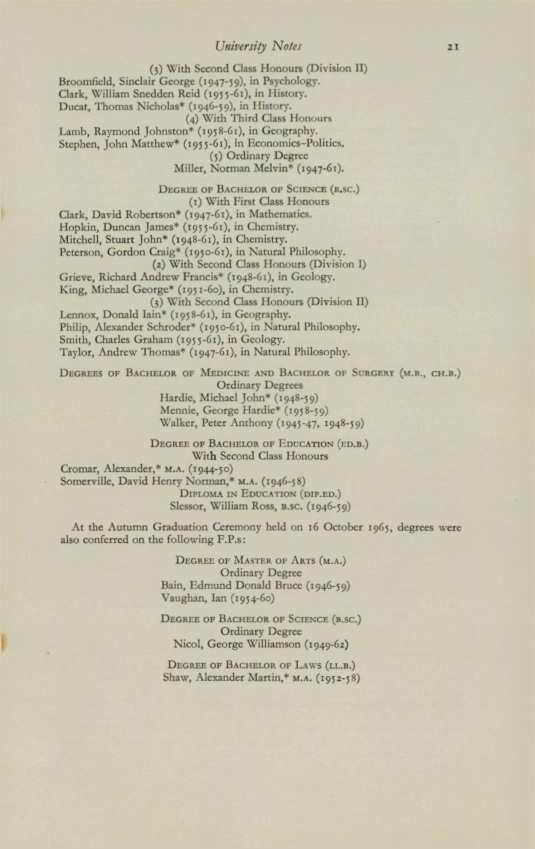
\t the !>ummcr Gr:1duatwn Lcrcmonics at the l.,nl\Crlill} of \bcrdc:cn held on l> and 9 July 196,, d~~rces ucrr conferred on the folio\\ in~ F.P.,:
D1.G1<11 01 Doc 101< OJ MEmc:tNI. (,1.1>.) \\'ith Honours \fackic , Robar ::--.;orrie,*M.r., c rr.n., ,\bcrdcen (1941-5-1). Thesis "The Tcratogcnic \ctic n of Jlidrn-corti«>nc."
D1-GRI I 01 .\l.\~IER OJ StRGJ:R\ (, ll.M.) \\'ith llo11ours
Da,·idson, Anhur Ian Grcc:mn,od,* :tJ.n., c11.n.,.\berdcen. (1943-54). Thcsis-"J.cit Heart B}-Pass in Cardiac R~su<ci1ation: \n I xpcrimcntal Study."
Honours and Ordinary Degrees
1)1 GRI I OI \f ~'11 I\ 01 ,\Rl> (~1 \.) (1) \\ ith J'irst Ch,s Honours \\'a1,on, R,><1 rick Bruce (1955-61), in J ngli,h (LanguaRc and Literature). (2) \\Tith Second Cla JIonours (Di, i,ion I) J 11116, Robert J 5SOll (19ll 61), in Gc0grarhr. Glentworth, Ganh \\ 1llia111*(1948 61), Ill l·.con<>mics-P,,litics.
Unil:er.ri(yNoles
(3) \'(!ith Second ClassHonours (Dh·ision 11) Broomfield, Sinclair George (1947-59),in Psychology. Oark, William Snedden Reid (1955-61),in History. Ducat, Thomas Nicholas* (1946-59),in History. (4) \\'ith Third ClassHonours Lamb, Raymond Johnston* (1958-61),in Geography. Stephen, John Matthew* (1955-61),in Economics-Policies. (5) Ordinary Degree Miller,Norman Melvin• (1947-61).
DEGRLE OP BACHLLOR OP SCtENCll (B.SC.) (1) With First Class Honours Clark, David Robertson* (1947-61), in Mathematics. l-fopkin, Duncan James* (1955-61),in Chemistry. Mitchell, Stuart John* (1948-61),in Chemistry. Peterson, Gordon Craig* (1950-61),in Natural Philosophy. (2) With Second ClassHonours (Dh·ision I) Grieve, Richard Andrew Francis* (1948-61),in Geology. King, Michael George* (1951-60),in Chemistry. (3) With Second ClassHonours (Division II) Lennox, Donald Jain• (1958-61),in Geography. Philip, Ale.xanderSchroder' (1950-61),in 1':atural Philosophy. Smith, Charles Graham (1955-61), in Geology. Taylor, Andrew Thomas* (1947-61),in Natural Philosophy.
OEGREF.S OF BACH£LOR OP l'-.f£orc1KE A.'ID BACHELOR or St;RGERY (,r.n., CH.B.) Ordinary Degrees Hardie, Michael John* (1948-59) Mennie, George Hardie* (1958-59) \X'alker,Peter Anthony (1945-47,1948-59)
DEGREE OP BACHELOR OP EDuCATION (ro.B.) With Second ClassHonours Cromar, Alexander,* M.A. (1944-50) Somerville, David Henry Norman,* M.A. (1946-58)
DtPLOM.A IN EDUCATION (DIP.ED.) Slessor, William Ross, n.sc. (1946-59)
At the Autumn Graduation Ceremony held on 16 October 1965, degrees were also conferred on the following F.P.s:
Dt;GRU: OP l\fASTER OP ARTS (M.A.) Ordinary Degree Bain, Edmund Donald Bruce (1946-59) Vaughan, Ian (1954-60)
DEGRLE OP BACHELOR OP SCtEKCE (B.SC.) Ordinary Degree Nicol, George Williamson (1949-62)
D£GREE OP BACIIELOR OP LAWS (LL.B.) Shaw, Alexander Martin,* '1,f.A. ( 1952-58)
Obituaries
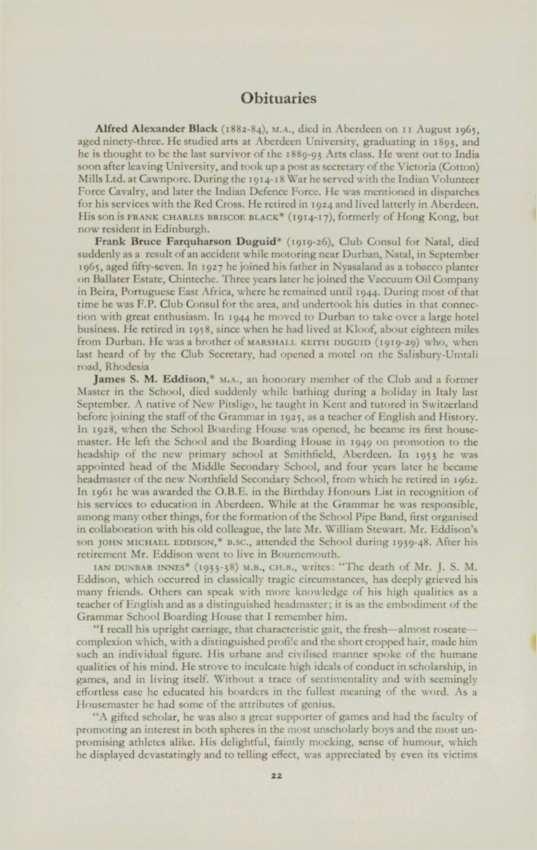
Alfred Alexander Black (1882•84>,,1,\., d1c<l m Aberdeen on 11 ,\ugust 1965, agc<lnmc1v-1hrcc. He studied arts at \hcr<lcen Cni,crsit~, graduating in I h93, and he is thoui,:ht co be the last survivor of the 1XS9-93 \rts chss. Ile went out to India soon after ka\'ing University, and t<M>k up a pn,r as secretary of thc \'ictnri.-i (Cotton) \Iills Ltd. at Cawnporc. Durin1-tthe 1914-1 \\ arhe served wi1h the Indian\ ,,Junceer f nrce Ca,alr}, and later the Indian Defence h,rcc. Ile \\as mentioned 111 dispatches for his scrvin, with the Red Cross. I fe rcmed in 1924and ll\Td hnedy in ,\ber dccn. His son is J I\A..,K CHARI H llR!SCOI BI ~CK. ( 191.1-17),fnrmerl~ nf l long Kong, hut n<>\\'resident in [dinburgh.
Fronk Bruce Farquhar son Duguid • 1919-26), Club Con,ul for c\atal, died suddenly as a result <>fanacc1<lentwhile motoring r1<.-arDurban, :\atal, in September 1965,aged lift) seven In 1927 he Jome<lhis father in ::--.:yasabnda~ a toh. ccn planter on lbllarer F,1a1c, Ch,meche. 'Jhree )'L-arslater he joined the\ ~ccuum 011 C.,mpan~ in lk1r.1, Portugue,e I ast \fric,1, \\ here he remained until 1944. During mo,t of that time he was P.P Club Consul for the area, :tnd undcrtnok his durks in that cnnnec tion with great enthu~i.tsm. ln 194.1he 010\'cd to Durh·1n to tah "'-er a I1rge hnrcl businc,s. He rcurcd in 1958, ~ince when he h.1<l h\'cd at Kloof, abour eighteen mile, from Durban . lie w:is a br..rher of \1\R~H.\11 Kl 1111 DLGUD (1919-29) ,,ho, when b,r heard of hv rhe Cl 1h Secrcrarv, had opened ,1 motel on tht· S·1lishury-Umrali n ,cl, Hh ~c •:t
James S M Eddison,• \!,\., an honur,11) member of the Uuh .u1d :t former \l.i,ter in the School, <lied ~uddcnly "hilc h,11h111g during a holiday Ill Italy last September. \ n.11iveof 1'c,,. Pitsligo, he taught in Kent and tutored in S,, 1vcrlan<l before joining the staff nf the Gr,tn1111arin 1925.u, :1 re1chcrof l·nglish ,m<lIliston . In 191~. \\hen the Sch ••I li•Y.ltdng House wn, opened, he became its first hou<c• master. lk left the Sch• ol and the Hoardin!J; Ilouse 111 1949 on prnmotion to the hL-a<l,htp of the ne,, pnmar) ,eh,,. ,I at Smithfield, \bcrdcen. In 195 he \\'as appointed head of the \ li<ldle Sccnn<lary School, and f,,ur n 1rs lakr he hccame hea<lma,rcr 11f the new .:S::onhfiddSecond.try School, fm1.1 which h rct1rc<l1n 1962. In 1961 he w,1s awarded the O.H.h. m rhe U1nh<l,1>·Jlonours List in recognition of his service, to education in •.\berdcen. \X'hik at the Grammar he,.,,_ responsible. among man} other things, for the formation of the Sch, M>I Pipe 8.111d,tir,t or11;:1nise<l in coll.1bora1ion with his old colleague, th,· lat~ \lr. \\11liam Sre-..art. \lr. l·ddison\ s"n 1011, ,11< 11~1 L 1.001,m,,* n.5c ., attended the Sch,,ol during 1939-~8. \ftcr his ret1tcn•ent ,\lr. l•ddison \\Cfll m li,e in Bournemouth.
1\,-; DL B•R 1:---..:r~• (t9H·~8) ,1,11., <11.n., \\rites :" l'hc death of .:\lr. J. ':>. \I. l d<lisrnt, \\ hich occurred tn cl.1,,icall} cra1siccircumstances, has ,kepi\· griev<·<lhis many friends. Others c.111 speak\\ irh mnrc kn•l\\lcdgc of his high 4uali1ics as a tcachc, of I nglish and as a distinguished headmaster; it is as the ,·mbodiment of tht· Grammar School &Jarding Ilou,c thu I rem mber him.
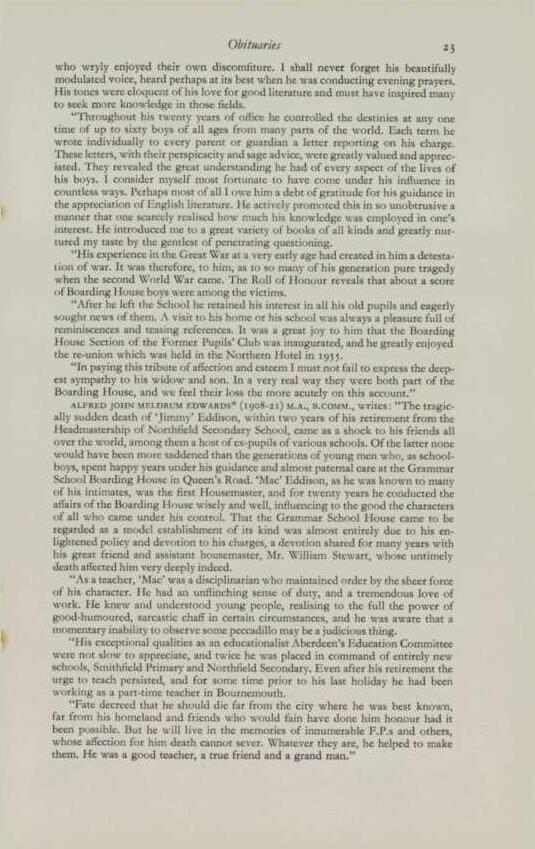
"I recall his upright carriage, that characteristic gJ11, the fresh !most roseate complexion,, hich, \\ith a<l1stingu1She<lproti\· ·rndrhe shore cropped h.1ir,made him such an indi\idual figure. Jlis urhanc and c1, rh,cd rr.mner spokl' ,.f che humane 4ualitics of his mind. He strove to inculcate high i<lc:1ls,,t conduct in schnbrship, in game,, and m Ii, mg itself. \~ ith!lut a trace nf ,cnt1mu1tality and \\ ith seeming!) effortless case he educated his ho,1r<lcrs in thc fullest meaning of the \\nr<l. \s a J[ouscmastcr he had some of the attributes of genius.
" \ g1f1c<lscholar, he "as abn a great supporter, f games and had thc faculty of prornottng n interest m both sphere, in them ,1 unschobrly bo), :ind the must unpronusing a1hlc1Lsalike. J!is dcliglirful, fa1ntl)' mockrng, sense of humour, which he displaYcd <lnastacingl) and 10telling cftcct, "'" appreciated b) even us, ictims
who wryly enjoyed their own discomfiture l shall never forget has beautifully modulated voice, heard perhaps at its best when he was conducting evening prayers. His tones were eloquent of his love for good literature and must ha,e inspired many to seek more knowledge in those fields.
"Throughout his twenty years of ollice he controlled the destinies at any one time of up to sixty boys of all ages from many parts of the world. Each term he wrote individually to every parent or guardian a letter reporting on his charge. These letters, with their per,;picacityand sage ad, ice,were greatly valued and appreciated. They revealed the great understanding he had of every aspect of the lives of his boys. I consider mysdf most fortunate to have come under his influence in countless ways. Perhaps most ofall I owe him a debt ofgratitude for his guidance an the appreciation of hnglish literature. 1Icactively promoted this in so unobtrusive a manner that one scarcely r~alised how much his knowledge was employed in one's mcerest. He introduce d me to a great variety of books of all kinds and greatly nurtured my taste by the gentlest of penetrating questioning.
"His experience in the Great ~far at a ,ery early age had created in him a detesta11,>n of war It \\as therefore, 10 him, as to so many of his generation pure tragedy when the second \'v'orld War came. The Roll of Jlonour reveals that about a score of Boarding House boys were among the victims.
"After he left the School he retained his interest in all his old pupils and eagerly sought neu'Sof them \ visit cohis home or his school was alway, a pleasure full of reminiscences and teasing references. It was a great joy to him that the Boarding House Section of the Former Pupils' Club \\'3S inaugurated, and he greatly enjoyed the re-union which was held in the Nonhern Hotel in 1955.
"In paying this tribute ofaffection and esteem I must not fail to express the deepest sympathy to his widow and son. In a very real way they were both pan of the Boarding House, and we feel their loss the mnre acutely on this account."
AURJ.mJOIP.< MF.LDRC\tLDWARDS"(1908-21) M.A., B.C0\1\1,, writes: "The tragically sudden death of 'Jimmy' Lddison, wichin two years of his retirt:ment from the !Icadmastership of Northfield Secondary School, came as a shock to his friends all over the world, among them a host ofex-pupils ofvarious schools. Ofthe latter none would have been more saddened than the generations ofyoung men who, as schoolboys, spent happy years under his guidance and almost paternal care at the Grammar School Boarding House in Queen's Road. '~fac' Lddison, as he was known co many of his intimates, was the first Houscmaster, and for twenty years he conducted the affairsof the Boarding Ilouse wisely and well, influencing to the good the characters of all who came under his control. That the Grammar School House came to be regarded as a mo<lcl establishment of its kind was almost entirely due to his enlightened policy and devotion to his charges, a devotion shared for many years with his great friend and assistant housemaster, :\fr. \'filliam Stewart, whnse untimely death affectedhim very deeply indeed.
"As a teacher, '.\fac' was a disciplinarian who maintained order by the sheer force of his character. Ile had an unflinching sense of duty, and a tremendous love of work. He knew and understood young people, realising to the full the power of good-humoured, sarcastic chaff in certain circumstances, and he was aware that a momentary inabilny to ob,crve some peccadillo may bea judicious thmg.
"His exceptional qualities as an educationalist Aberdeen's Educat ion Committee were not slow to appreciate, and twice he was placed in command of entirely new schools, Smithfield Primary and Northfield Secondary. Even after his recirement the urge to teach persisted, and for some time prior to his last holiday he had been working as a part-time teacher in Bournemouth
"Fate decreed that he should die far from the city where he was best known, far from his homeland and friends who would fain have done him honour had it been possible. But he will live in the memories of innumerable F.P.s and others, whose affection for him death cannot sever. \'('hatever they are, he helped to make them. He was a good teacher, a true friend and a grand man."
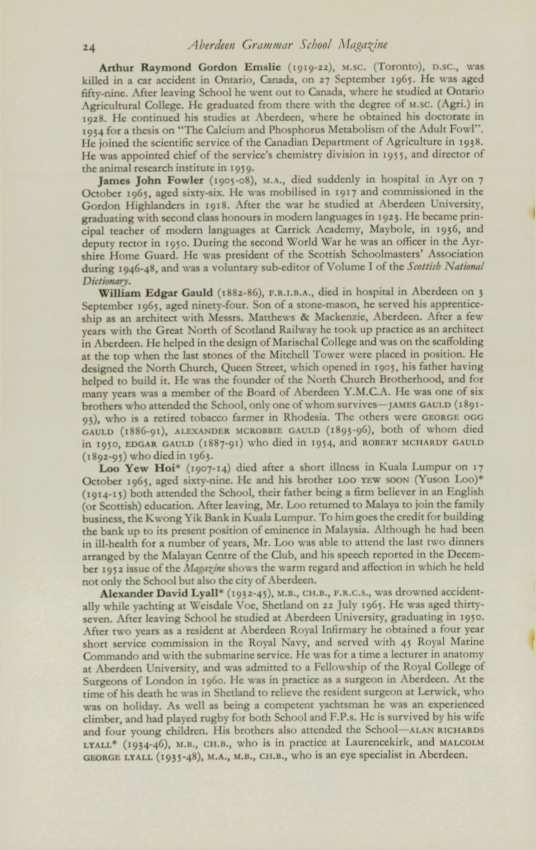
Arthur Raymond Gordon Emslie (1919-22), ,1.~c. (Toronto), D.~c., was killed in a car accident in Ontario, Canada, on 27 September 1965. He was aged fifty-rune. ,\fter leaving School he went our m Canada, where he studied at Ontario Agricultural College. He graduated from there wich the degree of M.SC. (.\gri.) in 1928. He continued his studies at Aberdeen, where he obtained his doctorate in 1934 for a thesis on "The C'llcium and Phosphorus Metabolism of the .\dult Fowl". He joined the scientific service of the Canadian Department of .\griculture in 1938. He ,,:as appointed chief of the service's chemistrv division in 1955,and director of the animal research institute in 1959.
James John Fowler (1905-08), M.A., died suddenly in hospital in Ayr on 7 October 1965, aged sixty-six. lie was mobilised in 1917 and commissioned in the Gordon Highlanders in 1918.•\fter the war he studied at Aberdeen University, graduating with second class honours in modern languages in 1923.He became principal teacher of modern languages at Carrick Academy, Maybolc, in 1936, and deputy rector in 1950 During the second World War he was an officer in the Ayrshire Home Guard. He was president of the Scottish Schoolmasters' Association during 1946-48,and was a voluntary sub-editor of Volume I of the Srollirh ,·a1ionol Dictionary.
William Edgar Gauld (1882-86), F.R.1.e.A.,died in hospital m Aberdeen on 3 September 1965, aged ninety-four. Son of a stone-mason, he served his apprenticeship as an architect with ~lessrs. \1atthews & 1fackenzie, .\berdeen .•·\fter a fe\\· years with the Great "-onh of Scotland Railway he t0ok up practice as an architect in Aberdeen. He helped in the design ofMarischal College and wason the scaffolding at the top when the last stones of the Mitchell Tower were placed in position. Ile designed the :--;orthO:turch, Queen Street, which opened in 1905, his father having helped to build it. He "\\.':IS the founder of the ~Orth Church Brotherhood, and for many years was a member of the Board of Aberdeen Y.\i.C..\. He was one of six brothers who attended the School, only one ofwhom survives-JA~ffS GAWo (189193), who is a retired tobacco farmer in Rhodesia. The others were GEORGF OGG GAULD (1886-91), ALCXANDLR MCROBBIE GAULD (1893•96), both of whom died in 1950, EDGAR GAULD (1887-91) who died in 1954, and RODLRT MCHARDY GAULD (1892-95) who died in 1963.
Loo Yew Hoi· (1907-14) died after a short illness in KuaL-i Lumpur on 17 October 1965, aged sixty•nine. He and his brother LOO YEW soos (Yuson Loo)• (1914-15) both attended the School, their father being a firm believer in an English (or Scottish) education. ,\fter leaving, Mr. Loi returned to Malaya to join the family business, the Kwong Yik Bank in Kuala Lumpur. To him goes the credit for building the bank up 10 irs present position of eminence in ~lalay~ia. Although he had been in ill-health for a number of years, Mr. Loo was able co attend the last two dinners arranged by the Malayan Centre ofthe Club, and his speech reported in the December 1952issue of the M<1.~az.ineshow, the warm regard and affection in which he held not only the School but also the city ofAberdeen.
Alexander David Lyall• (1932-45),M.B,, c11.n.,•·.R.c.,., was drowned accident• ally while yachting at \\.eisdale Voe, Shetland on 22 July 1965.He was aged thirtyseven. After leaving School he studied at Aberdeen Uni\ersity, graduating in 1950. After two years as a resident at Aberdeen Royal Infirmary he obtained a four year short service commission in the Royal Navy, and sen•ed ,\·ith 45 Royal \farine Commando and with the submarine service. Ile was for a time a lecturer in anatomv at .\berdeen University, and was admitted to a Fellowship of the Royal College ~f Surgeons of London in 196o. He mis in practice as a surgeon in Aberdeen. At the time ofhis death he was in Shetland to relieve the resident surgeon at Lerwick, who was on holiday. As well as being a competent yachtsman he \\-as an expcnenced climber, and had played rugby for both School and F.P.s. He is survived by his wife and four young children. His brothers also attended the School ALAS RlCIIARDs LYALL* (1934-46), ~r.e., c11.a., who is in practice at Laurencekirk, and MALCOLM GEORGELYALL(1935-48), M.A., M.e.,c11.e.,who is an eye specialist in Aberdeen.
Pa1rick Taldo Pirie (1906-07), "·c., Colonel (Retired), died at \ngers, T'rancc, on 29 April 1965. He joined the Gordon Highlanders as a 2nd Lieutenant in 1914, and after sen-icc at home \\cm 10 France in 1916 \\ ith the 3rd 8.111.1lion.During 1918-19 he was in FrJnce and Germany \\Ith the 1st Battalion. He was mencioncd rn dispatches in 1917and 1919,an<lwas awarded the Military Cross. In the mid-twenties he was attached tu the French Scaff College, and later served in Turkey, .\Calta, Egypt and India. I[c commanded the 6th (Banffshire) H,malion in 1hc early part of \X'orld War II, and wa~ evacuated from Dunkirk, having again been mentioned 111 dispatches. He retired at the end of the \'<'arwith the rank of Colonel, and thereafter lived in france.
John Charles Nicol Reid• (1925-37), A.LL, died in hospital in Grumby on q .\ugust 1965 as a result of injuries recei,cd ,nan accident at work the previous day. l le \\as forty-four years of age. On lC:IvingSch,,<JI he joined his father 111 the ,\berdccn fish-curing business of J. & G. :\I1ch1c. He served throughout the second World War in the R.,\.f. ,\f1cr gaining his "\\'.'ing," m 1940he served with Fighter Command, before lx:ing transferred to Tra1111ngCommand, when he six:nt some time as an instructor at :\funtrose. He resumed operational Oying in 1944, sen·ing in Non h-,1cst Europe and Germany, and was awarded the Air Force Cross. After the war he rejoined the business, taking O\'Cr from his father who died shortly afte rwards. Latterly he ,1as in chJrge of the salmon processing department of the Ross Group factory at Grimsby, lnd had been resident there since 1962. Both his sons :mended the School 1'" "IICOLRUD (1954-63) and FR~r-;c:isJOH-.: Rl!JD (c958-63), and both have resumed their education there since returning co ,\lxrdcen following their father's death.
Robcn Salmond Reid 1903-04), died in hospital at ,\bcrdccn on 6 .\ugll',t 1965, aged scvcnty-sen:n. He served his apprenticeship as a marine engineer at ,\bcrdcen before going to sea. Later he went to Canada, where he worked in a lumlxr camp and on lake steamers. In 1914 he returned to Britain, joined the 1\.,1\')', and spent most of the war 1111 destroyer patrols. _\ficr the \\ar he took up farmmg in Hampshire, and later worked 111 various parts of the country before retirmg to ,\lxrdccn in 1936.His brother GI.ORGt "-LITII REID(1905-06)died in 1952. Ramsay Roger Russell·• (1923-35) died in hospital at Aberdeen on 15 September 196), aged forty-seven. lle was a member of the well-known ,\berdeen firm of S. B. Rus~ell & Sons I.td., building contractors, m which he was associated with his brothers THOMAS TIL"-DI RSOS Rt;SSELL (1926-37) and SAMUFI BOYD Rl'SSEI.L (1919-28). He joined 612 Squadron R.A.F. as a pilnt when it was formed at Dyce in 1937, and he mobilised with the Squadron in 1939. Earlr in the war he was mentioned in dispatches. Ile joined Coastal Command as a Oightcornm.1ndcr, and in 1943 became operations controller with 18 (Coastal) Group Headquarters as a Wing Commander. He was again on operational flying as commanding officer of an antisubmarine patrol squadron, and saw service in Norch-\\cst Europe after D-Day. ,\fter the war he was appointed commanding officer of the re-formed 612 Squadron, and retired in 194S. Two other brothers also attended the School-JA\IES "-'-OX Rt.;SSHL (1917-28), an accountant with South ,\mcrican Railways, and DOUGLAS THO,1J\S HENDERSO~RUSSELL (1921-32), who 1s a builder in South Africa.
John Tower Sorley (1936-45), M.s., c11.u., D.T.,1., n.T.H., died very suddenly in .\berdecn on 6 .May 196), aged thirty-four. He graduated at Aberdeen in 1955, and after a year as a resident at 1he Royal Infirmary he took up a post as medical officer to the Cameroons De, clopmenc Corporation. He returned to this country in 1959 to take diplomas in tropiC:Ilmedicine and tropic.11hyg1tnc. ,\fter a further spell in the Camcroons he came back to Scotb nd, where he was in general practice in lnvcrbcn icfor ayear, before being appointed medicalofficertoatyre company in Indonesia. 1-Ie \\,is invalided home early in t96+ He had since been studying for a diploma in public health, and at the rime c,fhis death he was making arrangements to start work as an assistant t0 the Medical Officer of Health for i\bcrdeenshirc. He was the third generation of bis family to attend the School, his father being JOHN TOWER SORLEY,..
(1904-17), M.A.,M.B.,CH.B.,formerly ofthe West .\frican Medical Service, now resident at Crathcs. His grandfather was JOH:-:TOWLRSORLEY(1871-74).
Ian Hamilton Williamson (1917-21)died at Camberley on 25 May 1965, aged sixty. Jn 1926 he joined \1cssrs. J-farrisons & Crossfield as assistant manager of Strathisla Rubber Estate, Perak. In 1931 he came back to Britain and was employed in London by D. & T. A~ery Ltd., Soho Foundry, Binningham. Later he was a representative ofa firm ofperfume manufacturer.. in London. IIe was commissioned in the Gordon Highlanders in 1940, and served with them and with the Scots Guards before taking up an appointment at the War Office. His younger brother, STA?-.JIY Gf"ORGI! WlUHMSos* (1922-25), is "i1h the Chanercd B:ink Ltd. in Colombo.
Marriages
Baird (1936-46).- .\1 ~1. Giles Pamh Church, Totternhoe, on 17 July 1965,Jo11r\\'i11.s0NBAIRD,"M.A.,son ofthe late Rev. Dr. J. \'filson Baird and of \frs. Baird, 16 Cmigiebuckler Dri..-e, ,\berdecn, to Julia, daughter of \fr. and Mr. A. R. Bates, Mapscdge, Tmternhoe, Bedfordshire.
Beaton (1949-51).-.\t Patna Parish Church, ,\Jrshirc, on 31 July 196s, _101 s BFATOs,only son of Mr. and Mrs. John Beaton, 47 O,bome Place, Aberdeen, to M:arion, only daughter ofthe late Mr. \'X'.Auld and of .\Irs. M. Auld, 7 Main Street, Patna.
Begg (1951-59).-At St. \ndrew's Cathedral, .\berdccn, on 24 Jui} 1965, ::,..;oRMA'<Root.RICK DARRO<11 Bree,• \I.A., 1.1.11., elder son of the late 1'0RMAN DARRoc.11lkcc; (191s-24), M.D., and of Mrs. C. M. F. Ronaldson, 33 .\lbcrc Terrace, Aberdeen, to Eli7abcth Jean, daughter ofMr. and Mrs. 1\. J\lilne Dav,dsnn, l\iicras, Pitfodcls, Aberdeen.
Broomfield (1947-s9).- At Rubislaw Parish Church, Aberdeen, on 13 ,\ugus1 1965, S11-,;cLAIRGEORGr llR00\11H.LD, M.A., youngest son of l\fr. and :,.1rs. \Y/. P Broomfield, 67 King's Gate, Aberdeen, to Ha7cl Isobel, only daughter of Mr. and Mrs. L. \V. Campbell, 144 !:x:afieldRoad, Aberdeen.
Burke (1953-(,0).- .c\tllolburn \\est Church, :\berdeen, on 29 May 1965 \1 AS BuRKE," younger son of J\1r. and Mrs. James J. Burke, 21 Ramsay Gardens, Aberdeen, to Freida Millicent, onl}' daughter of Mr. and Mrs. Alfred \X'. Leslie, 378 Great \'\'.'csternRPad, Aberdeen.
Cheyne (1947-p).-.\t Cults \\c~t Church, on 16 October 1965,Jo11s .\loRRICE C11.cn-;r:,only son of Mr. and Mrs. J. B. Cheyne, 35 Ilillvicw Terrace, \\'est Cults, Aberdeen, to Anne \\'alker, younger daughter of J\lr. and l\lrs. Harry Sim, 37 Hillview Terrace, \\ est Cult,, .-\berdcen.
Chris1ie (19s5-61). At St. Fittick's Church, ,\bcrdeen, on 24 July 196s, MALCOLMLR'-11-:STC1m1sn1.,cider son of Mr. and J\Irs. F. C. Christie, 30,\shgrovc Court, Aberdeen, co Rita \nne, younger daughtu of:.\fr. and Mrs. \\'illiam .\fcBay, 65 J\forvcn Phcc, .\berdccn.
Cook (1948-s6). .\t llolburn \\"est Church, \ht;rdccn, on 27 \ugust 1965, l\iARTIN RonLR1 Com,, younger son of :\[r. and .\Irs. J. G. Cook, 31 Dccsidc Gardens, ,\berdeen , to \\ilma, only daughter of the l:11e Captain \\ illiam J\I. Duncan, l\LB.L., and of .\fr,. Duncan, 4 Ilillcrcst Pbce, \herdecn.
Donald (1944-48).- .\t Craig1chuckler Parish Church, ,\berdecn, on 7 July 1965, P1TERBRANDDONALD,younger son of Dean of Guild James R. Donald, H Rubislaw Den South, Aberdeen, and of the late Mrs. Donald, to :Margaret, daughter of Mr. and Mrs. Carnpbcll, Torncss, Inverness.
'Edward (r948-55). ·At King's College Chapel, Aherdccn, on 16 July 1965, NmL EDWARD,*M.11., c.11.11.,younger son of Mr. Charles E. Edward, 13 Woodh ill Pl:tcc, Aherdeen, and of the late Mrs. 1-:d\\"ard,to Vivien I velyn \lark, eldest daughter of :Mr. and Mrs. Louis Smith, orthcote House, Northcote Road, \berdeen.
Falconer (1944-jS). ,\t King\ C.illcge Chapel, _\herdcen, on 31 July 1965, Ro111.RTFALCONER,* \l,A., only srin of .Mr. and .Mrs. D. I'alconer, 13 Devonshire Road, .Aberdeen, to Eva Margaret, daughter of ::\[r.and Mrs. WI. l\I. K. Slcssor, 21 Vicwlicld Crescent, .\hcrdeen.
Gibb (1942-46).-.\t King's Colkgc Chapel, Aberdeen, on 13 July 1965, l\fH.IIAI1 C,1-.0RGF HARROW G1en; eldest son of MAX'\\LLLGRA?>., Gum* (1913-22), ,,.n., CH.11.,and oL\frs. Gibb, 14Queen's Road, ,\berdcen, to Elizaheth, second daughter of JA\IESBRYCE EssLw.1o~r• (1913-24), M.ll.l!., ll.L., and of Mrs. Esslemont, King's .\ere, King's Gate, Aberdeen.
Graham (1945-59). !\t Mastrick Parish Church, Aberdeen, on 4 August 1965, Gt:ORCE PATERSO:-.GRAIIAM,' M.A., only son of Mr. and l\frs. George Graham, 27 Springhill Crescent, Aberdeen, to Jennifer ,\nn, only daughter of Mr. and Mrs. Douglas Pyper, 31 Arnagc Drive, \berdecn.
Hadden (1950-63).- \t Ruthrieston South Church, .\berdccn, on 3 September 196j, Jo11N W1LLIA.~1 lIAllm '-,• younger son of .:'lir.and ,\[rs .J. W. IIaddcn, .p Craigiebuckler Avenue, \bcrdeen, to ~orma younger daughter of )fr. and \frs. G. \. \fackic, 23 Summerhill Terrace, ,\bcrdeen.
Hall (1946-50).-At St. Mary's, \X'olYertnn, \\'arwickshirc, on 28 \ugust 1965, DA\10 _1011~ HALL,' only son ofthe Lttc:\fr.•\. G. IWiand of;\trs. Ifall, 109 King's Gate, Aberdeen, m Heather Llizabcth, cider daughter of:\fr. and .:\frs.G. I ,\dams, \lcad Fnd, Snitterficld, near Stratford -upon-.\vnn.
Hunter (t9H·n)- \t St. Man·'s EpisCop!llChurch, Aberd~cn, on 30 June 1965, T'mtllL>GRAHAM IlLNn R,• ddcr son of .:\fr.David Hunter, 11 Bcechgrovc \venue, l\berdccn, and of the late :.\frs. Hunter, to Alison Jean, cider daughte r of Mr. and \lrs. J. \Y/. Morrice, 22 Hamilton Place, Aberdeen. Irvin (1945-57). \t King's College Chap,:!, Aberdeen, on 7 ,.\ugust 1965, T110\IAS T11ouu11.s !Rn:-.,' only son of \[r. and Mrs. Thomas 'f. Irvin, 13A King's Gate, Abcrd<.-en, lo Joan .!\£arr,younger daughter of Mr. and :\[rs James R. Reid, h Deemount .\venue, \bcnlccn.
Jamieson (1944-52) \t Kinifs College Chapel, Aberdeen, on k Ocmber 196s, Dos.,u> GA\·r~ jA)llhO'- , \1,11., <11.u., \I.R.C.P., younger son of .:\lr. and l\1rs. Thomas Jamieson, 33 Becchgrovc Terrace, ,\berdecn, t0 Grace Kathleen RMlyn, only daughrer of :\lr. F. G .\facRae, H Gladstone Place, _\berdccn, and nf the lace \frs. M~cRac.
Kelty (1944-55).- \1 King's College Chard, ,\berdeen , on 1 July 196s, JA\11, \ hTnti;:t r Knn, twin son of the late \fr. John I. 1'.elty and of .:\Jr,. E. Kelty, 14 \X'oodhill Place, Aberdeen, to Elinor .:'lfargaret,onl} daughter of Mr. Robert Reid, 11 East Main \ venue, \bcrdecn, and of the late )frs. Reid.
• Knight (1946-5s). At New Pitsligo Parish Church, on 5 June 1965,A1.1,A>iDFR F1<ASJ·R Kis1G11T,son of Mr. and Mrs. Knight, 1 Brebner Terrace, ,\berdeen, co Im Ch~lmcrs, youngest dauithter of \fr. and :.\frs. \X'illiam Pirie, 95 I figh Street, 'se" Pitslign.
Leslie (1944-58) ,\t St. Jnhn's Parish Church, hirkcaldy, on 21 \ugust 191\5, S II WAlll THO\IAS l.r'111. younger son of \lr. G. Leslie, 12• Huntly Street, \berdeen, to Jeanie \'citch, youngest da111(hrcrnf \fr. ~nd \[rs. \. \X'illiamsPn, 63 Ifcndry R,,ad, Kirkc,1ldy
Lyon (1953-59).- \t St. \Ian's Episcopal Church, Aberdeen, on 8 Jui} 1965, I\,1rs Cw Lrn:--, onlr son nf the late Mr. Mitchell Lyon and of \frs Lynn, 6 C-raimshiclPlace, .\bcrdcen, to Shiela Jean, younger daughter ofthe Rev. c.~nnnand Mrs. George C. C. Wilson, 40 Osborne Place, ,\herdeen.
Abtrdun Gra1111nar School Jfagazine
Mackie (19i4•6o). ,\t Rutherford Church, Aberdeen, t>n 9 July 196J, .hA'-' \u.,A"m R.\fAC'Kll,son of Mr. and .!\!rs. Alexander 11. .\lack1e, 3\X'ilkie,\venue, \bcnkcn, to \ alerie .\nn Douglas, <laughter <-•f \fr. and Mrs. George \\'. Park, 28 South .\fount Street, ,\bcrdecn.
~lcLe an (11141·16.:. \r .\bcrdccn Registry O!nce, (>I\ I .\l.tr 1961, r1r,1 Otnctcr !Ar- :O.kT.1~:-.:. cider son of .\lr. and !\lr,. \\ illiam :0.kl.can, 30 \bbu1s,,cll Dri,c, \hcrdccn, IC> \lys, daughter nf .\[r. and \ frs. \\-illi:1mYeoman, I Smithtidd Dive, \berdecn.
Menzie s (1913-19).- ln 1.ondon, on 14 \ugust 196i, _1011,-.; Bi.:c11A"' \ IJ ,szu ,, only son of J\Ir. and Mrs. J. 11. J\lcnzies, 53 Skene Street, ,\ bcr<lccn, 10 '\largarct Petric Scott, eldest daughter nf J\lr. and :\irs. S. I . Johnston, sI r-.;oran \venue, Craigicbank, Dundee.
Miller (1942-55).- \1 Kmg's College Chapel, \bcrdecn, on 1S ,\ugu\t 1961, .\1.1,T~•R J \\I" .\111111111 \1111111,' only son of Mr. and \ lrs. \ . 1. .;\tiller, 180 k ing\ Gate, ,\bcrdcen, to Barbara Shand, daughter of .\lr. and .\l rs. J. Young, {,4~ Queen's Road, ,\bcrdccn, Milne (19in.iR). \t King's College Chapel, \bcrdccn, i,n 16 Jui) 196j, ,\ r A'D1·CA1Mu"' ,· ,1.s., 1.:11.n.,cider son of Dr. and .\[rs. G. I' \lilnc, 3~ ,\lhyn Place, \hcrdeen, 10 '\anet tc I 1lian,'\largaret, only daughter of she late .\fr. II. G. Cordon and of .\fr,. Gordon, 41 Po\\ is Terrace, Aberdeen Milne (19n-6 1). \t \II Saint's, Hilton, ,\hcrdccn on 2~ Jui, 1961, hnRI.\\ CoM;o" J\111 -.:r, only snn of J\lr. and ;\lrs. Andrew .\lslm:, 387 :-.:onh Anderson Drive, \hc:rdccn, ro Le,lcy ,\nne, only daughter of .\lr. George Duguid, 1 Fnrhcsfield Road, Aberdeen, and of the late :O.lrs. DuRU1d. Munro (1946: 1951-p). \t ,\II Saints', \\ra,c.111, ~rnncrset, on 26 June 1965, Jons GRAY.\It NRO,* cider sun of the late Group Captain Jons GR 1\ \I l'NRO (19203r), and of Mrs. \lunrn, O,-ford, to Elizabeth Rae, onl} daughte r uf t>lr. and Mrs. Eric Scmulehury, Larchwoud, CL1pton-in- Gordano, Somerset. Ogg (L9)2-J8). - ,\l ~ ing's College Chapel, .\ hcrdccn on 20 July 1961 T110,1A, \',;'r'-< 111,11R Oc,G,* ,1,n., c11.n.,son of .\lr. and '\frs. Tom Ogg, 76 Uracs1dePlace \hc:rdecn, to \ lnnic.a;\lary, daughter of :\lr. and .\1rs. lames 0. \'fil•<>n,Cclh-hill, Banff
Porter (1911-1~).- \t St. \fachar's Ca1hedral, \hcr<lccn, on l June 1961, FR1i\1.1,As DJ RSrL\1..s PoRn R,• younger son of .\lr. and \lrs , \. \\. Porter, \\ indcr• mere, \f11ltimhcr, to .knnifer, y< ungcst daughter c.>f \fr. and \frs. G. I' Forrest. \\''esthn!111e,l Iilldcw Tcrran, Cul:s, .\berdeen.
Raitt (1938-4-:>: 1944•11). \ t St. L1\\ rence Church, Bourton •nn•thc-\\ atcr, Glouccstcr,hirc, nn 4 Scptcmhcr 196), \\ 1Lu.n1 l.1snHY RAITT,eldest son of the late Dr.\\, J. Raitt and nf ;\!rs . Raitt, 30 !:,caficldDrhc Fast, ,\bcrdccn, to Diane, y, ur gcr daughter of .\lr. and \ lrs. ILJ. Th, ,me. H \!eh illc I state, Bourtt ,n-orHhc\X'ater.
Ramsay (1913•16). \t Ru1hricston \\'est Church, \lx-rdccn, on 1 \la\ 1961, (;1.oRGI \ l HTIII\I CKO\\ LlJR R~w,A1, (,<, Sprmgtidd \,cnm·. \hcrri~cn. ,., Margaret Milne, 10S Jf\111c Place, \bcrdeen
Ritchie (19)2 16) \1 St l\tachar's Ca1hcd1.1l, \bcrdccn. nn t) \lay 1961. JOH" l.1rT11 R11ci111.son nf 1'.h. and Mr~. John\\'. R1tch1r,49A Elmbank Tcrrac". \berdeen, tlJ ls0hcl, daugh ter of the late Mr \lc,anck1 Pn,I .111d .-,f l\h s. Paul. 1 Straclu n Cottages, Strachan.
Robertson (1910-61) \t \l.iryculter Pn1sh Churd1, nn I Ortobcr 1961. DoLC,I\\ Ro11LRT,;os.,,nly :son r f \ lr ~nd \lr, 'I. Robcrt~on, 9 C.sdcnhcad Road, \berdecn, tn lnn3 l.arr>nnt. daughter of l\lr. -md \lr . \~'. IJail. z Fernv,lack. BIJ1r,, \hcrdccn . Robertson (19i1•<>0), \t l"orr) U.F. Church , \lxrdccn, on 18 September 1961. \\11 11\M Ro"1R1,o-.:,• r,\ ,, ~on c,f ,\fr, and \lrs \\;1ll1am Robenson. 73 Walker Road, Aberdeen, to !Iden, d,ught(r of \fr. and \ l1s, I ui~i Si,1,tnnrin1,11 \ lbcrt Street, Aberdeen.
Simpson (1950-55). \t St Mary's Episcopal Church, Aberdeen, on 31 July 1965,'-:OR\JANLEw1, S1,1P'-O:--I,cider son of the late Mr. Arthur L. Simpsoit, and of \[rs. Simpson, 33 R1chmondhill Place, Aberdeen, co Teresa Roberta, cider daughter of Mr. and Mrs. Andrew G. Barron, 8 Scafield Drive West, Aberdeen. Somerville (1946-58). _\t 1':ing's College Chapel, Aberdeen, on 10 August 1965, D.wrn 1l1..1sRYNOJUIA"So"FR\ 111.1::,* only son of the late 1fr. David JI. P. Somerville, Johannesburg, and of Mrs. r. L. J\lackic, 15 Bclvidere Street, Aberdeen, to Patricia Ruth, only daughte r of Mr. and .Mrs. Peter C. Annan d, 2 Woodburn Crescent, Aberdeen.
Still (19.17-6o) \t Crathic Churcb, on I October 1965, Jo11N ~facKo:z11:. SrtLL, c.A., son ofl\tr. and Mrs. James S1ill,81 \\'cstburn Road, \berdecn, to Ida, daughter of Mr. and l\Irs. Lrncst 1-'raser,Balnault, Crathie.
Sutherl and (1952-58).-.\t King's College Chapel, Aberdeen, on 9 Septembe r 1965, I ,t·RF'-KF.:\i-.oLRS0'-1S1TIIERLAND,younger son of the late Mr. John D. Sutherland and of Mrs. Suthcrl.md, 37 Bedford Place, .Aberdeen, to Angela Mary, daughter of Dr. and '\frs. Joseph Tinsley, 52 Victorin Street, Aberdeen.
Thoms on (1954-58). \t St. ?-:icholas (Union Grove) Church, Aberdeen, on 5 \ugust 1965, DA,10 JoHs THOMSON,' elder son of Mr. and \{rs. Edward R. Thomson, Broomfold, \\'cstfidd Road, lnvcrurie, to Thelma 1[ilne, daughter of the late Mr. Eric T Glennie, and of M~. Glennie, lnverey, 362 :S:orth Deeside Road, Cults, \berdecn.
Thomson (1952-58). \t 1'.mg's College Chapel, -\berdeen, on 29 June 1965, '\;1c110LT110,1so,-;,son of the late ~fr. ~ichol Thomson, and of Mrs. Thomso n, 14 llollybank Place, 1\bcrdccn, to Lorna \1ary, daughter of Mr. and Mrs. David Burnett, 93 Argyll Place, Aberdeen. Wallace (1945-55). \t Rubislaw Parish Church, .\bcrdeen, on 4 September 1965, JA,11.s WALLA<'!,only son of :\fr. and .'.\lrs.James S. \\"allace, 20 13clgra,c Terrace, .\hcrdcen, to \nnc Veronica, only daughter of\fr. and \[rs. Basil Ironside, 85 .\shley Road, Aberdeen.
Watt (1952-54).-.\t ~orwocd Cnitcd Church, \ lomrcal, 1,11 31 July 196s, '\;oR,1.V<\'fATT,elder s,,n of l\tr. and Mrs."- \'fact, 24 \\'atson Street, Aberdeen, to Shirley Ann, daugh ter of Mr. and Mrs. J. ?\le \dam, 1445 Painter's Circle, Montrea l. Webster (1949-57). l\t Roscoonk Church, Nairn, on 10 July 1965, :'lfALCOLM ScoTT \X.'rR\rFR,*A.R.J.ll.A.,son of Mr. and Mrs. D. J. \X'ebstcr, 14 Beaconsfield Place, \berdeen, 10 \largarct Simpson, onlv daughter of Mr. and ,\frs. G. Burnett, \\"ellbrac, Queen S·reel, '-:aim.
Williams (19n-46).- .-\r Wilmslow Parish Church, on 24 July 1965, GoRoo...ScoTT \X'11.1.1.H1s,"' eldest son of 11r. and \ lrs. J. I.. Williams, 1n Desswood Place, \ berdeen, 10 Jean Christina, elder daughter 1,f Sir Douglas and Lad}' Oarke Greenways, Hollies Lane, Dean Row, W'ilmslow, Cheshire. William son (1939). -\t GHhcart South Church, Glasgow, on 28 .\ugust 1965, DAVID 81RTRA\I Wu I JAW,()'-1,cider son of ROBLIU BIRTRA'I\X1JLI I.\\J\(),-.;•(190618), o.s.o 1.0 ,1 \. 11 R., and of \ frs. \'filliamsnn. Glebe Ilouse. Durris, tn Diane Brown \nderson. of 24 Queen Square, Glasgow. Williamson (1945-50),- \t St Oemcnt's Churcb, Toronto, on 19 June 1965. RoRtN GFoRc;F \X'JLLtA'1'-0...-,vounger son of RoBFRT BERTRAM \X'111.JA\1S0,-;' (1906-18), o.~.o., T.D.,"··'·• LL.B.,and of Mrs. \X'illiam•on, Glcbe House, Durris, to \{argaret \nne, only daughter of .Mr.and Mrs. John C. Denison, Toronto. Wright (1946-58). l\t 1-..mg'sCollege Chapel, ,\berdcen, on 17 September 1965, lo11N DAvm l\1AtTIAND WRIGHT,only son of Principal and Mrs. E. l\{. Wr1gh1, Chanonry l.odge, Old \berdcen, tn Ilelcn, only daughter of \ lr. and :\frs. Bueler, 119 Western Road, Abcrdcen. Young (1941-49). \t the Pamh Church of St. J\!ary, Deane, on 7 August 1965, 1'.L>NE-i n Mo1R Y0t·,-.;c;,n.5c., voungest ~on of Prnfc~sor and :\1rs. J. S. Young, 16 Rubislaw Den South, _\berdcen, tn Anne, daughter nf Mr and "\frs. J. Partington, Breeze Hill, Junction Road, Deane, Bolton.
STEWART G. DOR\\ .,Ru BRUCT ,\. Ku.L I I SLIF \ \foRRrso, Jm-tN II. DLGLm Rom 111<:K \\'. 11. T1 RF"'-F D. R. Rn, PETER J. FRASER '\le GREGOR \r A,-,; SJ\fl sO'\LISTAIR G. GRA< 11 .\1. f x,NDER .\tc~ w _1011,-,; B. Smn, !AN GRA\ Jo11N S. l'>[ AcP11w IAr" I. Wo1.sTF"1101 ,11 \'\'1LLIA\ I G. H1 NL>Rl D,w 1u L. \ [ AN" Cow, J. YoLNGso:s: j OIIN R. i l'<GI.IS Et>\IUN U j . \ [.\y Dt.NIS ,. Yu.F Rt·ss1 1L Mn NI
House Captains
Byron D1 s-..1s \X l:...1<~,-; Keith IAI'< GRAY
Caplai11 ALISIAIR G. GRACII
Dun S11°,R1 C. GLO\LR Mehin K1 NNLl'II ,\. H,H
Rugb y
I ,r,-Capta111 Sre ,R C G1.o, LR H ockey
Captain Kn,:...1 .1H , \. lLn I 11 -(t:plam (,u>RGL L. \lcCRA\\
Swimmin g
Cap1a111 LAIN I. \\ 01srEN 11m Ml 1 ·;rt Captain \\ 11 U.\'1 Srorr
Literary and Debating Society
Pruidwl \1.t1N (.. '\1otR [ m-Prt 1 Ill DA\ II) 'I ,\LOR Srrrtlar; ALA'-\[. Cow1F frramrcr 1 N T1 u eR
Dramatic Society
l'ruidmt \LA..., .\f. Co\\ n. Jr&rclar; Ar.AN C. :Morn
r ·w-Prwdmt !-..,-...,s1111 \, HA\ frenmrrr D rs1, "'· YeLL
Cadet Force
C.S. \I. _]011:... S. \IAd'"t~ \\ .0.
Editor~ of the School Section
Jo11:s: 11. GAR\ 1r K1:.,...,,1n \. HA\ IAN TnFER
Dr:...,~ ?s:. YLLE
Schooland Random Notu
School and Random Notes
Two of this year's editors are Greek scholars, and smcc all the best random notc·s arc satyr.ttcd (1ic) with classical allusions they thought that "-:r.x.•,l,vE!L,:,v, i-:oil,-, m: li-:r,; <;)IJYE'Icpxr,:;l.,8/,11-:c~11"(Free translation Hey, kiddo! What a dashed silly thing to say),, nuld not be.: out <lf place. "lt's all Greek to us", we said, invoking the spirit ofroom C (1ick) and rushing for che windm,·s. 1be matter having been brought up, was duly dropped.
In response to Mr. (George) llrown's cry for m1Jre cfficicnq we arc ple.iscd to note the patriotic fervour demonstrated recently by members of Staff. It 1s revealed that in the last quaner: Mr. Anderson visited L~b. 5 on 50 per cent more occasions. The Chemistry department as a whole broke 30 per cent more test tubes.
It's commercial time, folks.
Have a break, have a quick-fag -in-the-bog-,, hen-the-preft:ct's-nm-look1ng.
I wondered why I was making so little progress with my Latin. Then my beM friend told me "B.0.... DO." * *
Have you seen the mysterious <lnorin the wall fifteen feet above the ma111corridor? Our visions of it being a last retreat for prefects on the Day of the Revolution were dispdlcd when one of the jannics mid us it was "some b·*•••stupid st0rc". llut the only means of access he C<Juld suggest were by rope ladder or .\lr. Stevenson's trampoline.
Editors of p.1st years have used :\[r. \k\:ay's tower to skivc away .:Slr. Tait's English periods. The all-knowing jannics informed us it had been bricked up in the recent reconstructions. "In that case", ,,e said, "hm\' do you run the flag up?" ,\nswcr ... "We eat goldfish food for a week and swim up the drainpipe." This prompted the thought,"! low docs .:Sfr.Baxter get into his room when the corridor is llooded ?"Fasy ... "Ilc cats chicken-feed and flies in the window".
It's curtains for the swimming pool! The gym staff must havc heard ahnut the rush for binoculars by middle-aged spinsters in \'fhitehall Place.
'J he School has acquired a Joan Baez ,\pprcciation Sncicty..\fotto - "l\lcth111ks the lady doth protest too much."
"Find the Master." C,n you guess the well-known teachers who lurk behind these quotes?
"Now we've got rid of our draughty knees we c.,n forget about chicken feed."
"Like I mean it varies but "
"Pretty good, eh? Eh?"
"Dy Jo\'e, laddie, you won't even snitl Higher German at this rate."
"Well, in a sort of a sense, I think you'll find, m-hm, mhm."'
0 Er, um, n1nm1,,vcll, em yes and u1n no."
"Wee!, lads, how are ye doin'. Tell your m1thers 1was asking for them ," "\'qeJJ, of course, Samuel Johnson would have none of that "
Aberdu11 Gra111t11ar Srhool ,\fagazint
Send us your answer~, inscribed on a fruit square (unused) and wrapped in an ,\narchist le:ifict(used). Prizes include: a genuine autographed peppermint from the library, a spare tyre from M. Vernon, and a lock of c'.fr.Henson's hair.
It has come to our notice chat Miss Glashan 1s in che habit of coming to School each morning with a small Prefect.*
*Its registration number is LRS 8o6
\\here has chat immemorial standby of school editors, rhe Smokers' union, gone? !fas perhaps "Thrush" or "Smersh" got co knO\r of their talents? \Ve looked up old School magazines to find out their usual hideouts. We searched under the stage, in the store~, lavatories and boiler-room. Kothing. What detectives those past edttors must have been! At last somebody "grassed" that they might be in the Staff Room, hut when \\e arri,·ed we couldn't sec a thing for smoke.
To keep our final note in the controversial spirit of the others, we should like 1n end with a four-letter word: Help.
Staff Changes
As the School gro\\ slarger in its physical bulk \\·ichacorresponding increase in the number of its pupils, so more staff must correspondingly be recruited to ics service. This year sees a momentous addition. Eight new teachers joined the staff at the beginning nf this term, some adminedly to replace masters who have left for other posts, but other~ additional to previous complcrncnc. In the present more than cool c<luc.uinnal climate, when many schools find it hard or indeed impossible to till vacancies satisfactorily it is comforting to be able to record that the Grammar School still has pm,·cr coattract staff more or less adequately. Yet at the moment of writing one mathematical post still remains unfilled, even although it has been well advertised; it is a remjndcr that schools are more than buildings no matter how ample or lavish these be, and schools to he good must have good masters.
Arrivals
The Modern Languages Department has three new members. Mr H. J. Calder, M.A. joins us from \lloa Academy where he taught for four years in his first full teaching appointment. 1Ie is native to the North. Born in Keith and educated at h:eith Gr.1mmar School and Aberdeen University, he graduated in 1959 with honours in French-German, and after a year in che South of France as assistant at Villefranchc-de-Rouerquc he returned to Aherdeen for his teacher-training course. l'\n\\, with the Dip. Ed. quahfic.'ltion already obtained and four years' praccic:il te.1ch1ngexperience hehind him, he is "·orking towards the M.Ed. degree at his old un1vcrs1ty.
Mr M Slater, ,1.A. has more southernly ongms. He graduated B.A. m the German Ilnnours school at Birmingham t.;niversity in 1959and spent the following year as L:.nglishassistalll at the JTclmholczSchule in Frankfurt-am-Main. Granted a scholar,h,p hy his Uruvcrsity he did research into the "'onh Frisian dialect and was in 1962awarded the degree of M.A. for this ,vork. Between 1961 and 1963 he taught 111 Birmingham and then for the first six months of 1964 at Turriff Academy. •\ ye.tr's attendance at \berdcen College of Education gave him his teaching diploma dnd brought him to the Grammar School. That a man may easily ;ind happily go to
Birmingham hy way of Beachy ITc.'ldwe have the word of chat good man G. K. Chesterton; all ,,nc need do is to folio\\ the rolling I:nglish road .\fr. Slater ha\ reversed the process, on a tl)ute as indirect and maybe as jolly, but now may well feel inclined to re,c t.,r a while and be thankful, as \\e arc thankful to l1.1vc him.
Mr. John S Stewart, ,r.A. has ranged farther. The far-flung spaces of the J:ast, its oc<--:insand 1ts islands ha,·c been his stamping-ground, and he brings to a more iron clime mcm,,cics, mcmentoc, and manners of the vanishing glories of r 111pin:. Ifailing from Spcy,i<le he had his early education at ,\bcrlour Secondary School before proceeding co .\bcr<lcen Um,crsity. Tn 1941 he exchanged the scholarly life for a military c.~reer which to,>k him in general and s()(!cial .\r111yserv ices ro l\.orth .\fnca, Sicily, che Balkan, and Southern Europe ..\ftcr the war he compkced his degree and, entering Col<>nialService, worked ,1s District Comm issioner in the Sudan and lacer in the Solomnn Islands. Then returning home Mr. Stewan entered teaching and no\\ after a r<=ri1,d at Bankhead ,\cadcmy come, to the Grammar Sch00I. This far-travelled man admits to a corresponding range of intc,cst, and talents. Jle is a go~•dshot, an expert angler. has many a tale to tell \\ hich will hold his young pupils, and is prcSc·nth·engagcd in \\ riting his memoirs nf sen kc abroad. \\'c ma) \\di murmur, "Noe one. hut all mankind's epitome".
M.r.Peter H. Keith join, rhc School's Technical Department \ pupilof,\lx:rdccn \cadcmy he left the c11vfnr .in \cronaurica l F.ngu,ccring apprentireship which cook him to the De If.wiland ,\ircraft C11111panyfor three years and a furtht:r t\\ o years with British European Airways. Jn the course of this onerous trn1111nghe gained the 1lighcr National Ccrrific.'ltcin \1cchanical }:ngineering \\irh an endorsement by the \eronautical Soc1ct\", •\.fcer two \ca.s• Natim1al Service .\fr. Keith ckct,d co return t<> -\berdccn, \\!>rk~d for his cc;ching diploma at the I,,cal College of Lducatinn, .111d,fnllnwing on four years' work in Secondary Schools in the city comes acceptabl) tu the Gram111arSchool.
J\.fr. James G. Shand ha, ~!so hccn appointnl to the Techn1e;1lDepartment. He wnrked as a jr,,ncr fwn 19n co 1919. and then, after tw<· year.·, ·a1i1>nalService \\'Ith the R,,y.tl,\ir hirce he. like \fr. Keith, entered .\bcrdeen College of Fducation where he gained his diploma Since then he ha, caught in Dumbartonshirc and in Glasgow. He and ,\fr Keith come to the Grnmmar School at \\ hat \\'lluld seem a most promising time. The recently completed additions co their dcparrmenc's equipment and teaching space should give them scope and encouragement in 1hc work for which they arc s11 qualified. rhcir interests and abilities ,1 ill he nntcd and \,elcomcd in other places t,,o. \ lr. Shand', rangy high-,rLpping look, for example, is an outward c,·1du1cc of a n1ore th.111adequate athletic talent; he \I as an Achlccics blue at the College of Eduauion, jumping high and broad, and is abn keen on hadmintr,n. '\;o doubt such abilitv will not be .1llo\,cd to rust unused.
M.r. Lawrence 0. M. Murray; \I.A . \I as appn1nced co the vacancy m the 11,storJ Dcpartmt·nt created by the departure of Mr. R.imsay. Mr. l\lurr,,y lt.1scome into the teaching pmfrssi on ,fter , aricd experience 111 nrhcr fields. After leavmg Aberdeen ,\c:.1dcmy111 1941 he scncd hrietly m the Audn section of the City Chamberlain\ Office before war scn-ict", first 111 the Royal \ tr f'orcc and btcr m the Royal Armoured Corps, took him to different rlaces and J..111dsofwork, ma111lyin the .\Iiddle East. Returning to civilian ltfc 111 , 9-H he cho,c to work for the Scnttish Ga, Board. with\\ horn he was engaged till 1960 111 accnunc.anc) work at the Dn·1s1onal Office. But he was attracted to teaching, and OO\\ after gradu ttion from \ berdeen University and training at the College of Fducation he takes up his firM appointment in his new profes<inn. Already Mr.Murray is 111vol\'cdin the newly-formed .\ngling Club, and in thi llUtw1th-School amvity as in his ~chnlastic duti, s his friend!} manner and mature judg111cntshould serve him and the !:ichool \\ell.
Mr. I. H. W. M. Grant, n,\c. is a young and valued acquisition nf the Mathcm.1tics Department If1s life has bc~n spent in these p.irts. -\ftcr leanng his old school, Banchory \c.1dcmy, he proceeded m ,l(h·"need Study at .\ hcrdcen t.,;mverstt)', from \\.hich he graduated with an honours degree in 1964; and then, electing to
Aherdem Gr,11111!/ar School .\f,{1!,azine
teach, hecompleted his professional training course atAberdeen College ofEducation. The promise he shm,·ed as a student was ohsen·ed and noted. That promise he is now fulfilling, and at the same time giving evidcnCl' of his interest in most kinds of sport.
Mr. James W. H ood, '1,\. is a ne\\, }Oung and welcome ncniit to the Englbh Srnlf. I[c hails from ..\fontrose, wu, educated at ..\fomrose ,.\c,dcmy, and thcrt.-aftcr at Alx:nkcn Um,crs1tr where he &tu<lk<l J•nglish. Gruluati11g ,,ith an hr,nour, degree in 1964 he chose t.> work for his tL-achingdiploma at \foray House in I.dinburgh, where at the s:ime time he ne<1uircda Dip. l .d. 1I..:has, of cnurse, good and snflicient reason for returning 11> ,\henken afc.:r a year in Fdinburgh and we welcome him to the School. In time hb interest in sp<>rt and in the playing of the ~itar will no douht lead him into ,,ays profitable to the Sc-h ,ol and enjo}able to himself.
. .. Departures
School I,fc has its Jassm1dcs and longueu r,, but sometimes it reminds us of a \pcedcd-up film. Staff come, they stay briefly, and then with a whiz and a kind of melodious twang thcy have gone.
During this term n number ofour roungcr and ,·alucd members ba\'e departed on their different wa}s to new p,,sts..Mr. Graham Munro has gone as Princip:tl Teacher nf Modern Languag.;s to I'onrose \cademy. \X'hile at the Grammar ScliV<,I he combined learning with discipline and made a success (lf both, and there 1sno doubt th:it he will bring culture and widl·r hmizons to the )oung linguists of the '\;orth. I!is vit.1lityand hi, chcerfuln,,s will be missed in our staff-rooms and cl.iv. m, ,n•s, as will his purposi\'c encrg,• in the Staff's football n::itchc:, ab'llinst the h,•)s. \II these qualities must bring him esteem in his new post in a countryside where he will be brc.1thinit hi, nati, c air.
Mr. Simon Smith has hc:c:npromoted to the post of Principal Teacher of .\larhcmatics at Banchorv 1\cadcmr. During his six years at the Gr,unmar Sc-hnnl he instilled enthusiasm in his pupils for his subject in his own quiet war, and his <JU,1lities as admini,tr:itnr :ind m:ith,matici.m were fully c~idcnt as master-in-charge of the p.Ut)," which \\ent Qll the D,: ·nia cruise Listsummer. ,\nd the absence of that imperturbable profile and impeccable swing w11! be felt in the masters' golf team.
Mr. James M Hunter has left teaching and gone to join the B.13C. as :\lusic Reprcscntati\'e 111 ,\bcrdcen after a humoni, us spell of three :u d a half }l"ars m the (,r,tmm,ir School. During his time 1s assistant music master Ic· brought Hn·c and ,.igour to his tc.:achingand to numerous sr,cialocca.sionswhen his rich bass voice and music,tl :ibilicy-and perhaps especially on the bagpipes gave pleasure tn manv l><•that home and abroad.
The ,\re Department 'l\tll certain!~ fed the loss of Mr. James T. Wood who has I,ft after three yc-.irs sen·ice in the School to bccorre a kcturcr at the new College of G,mmercc. ln that short time he made his mark both by hi,;cheery presence and by " ,-ariety of .,nisuc talents of:i high order. Ilas ~killon the tennis court al,n won our respect ·.tnd admiration. Ntrn· in hi, new post .\lr. \\7ood's ability, his happy n:llun: ,111d helpful wavs \\ ill bring light and colour into the lives ,,f 111.•111yof his s111dcnts.
October saw the departure of Mr. fan Ramsay, ~hn c intention it was to study for the priesthood at the lkda Colkg,·, Rome. 11,sscholorlr and kindly approach tn h,s work in the Hiscorr Dcpanmem at School should beofmuch ,-alue to him in hi, 11,w-carc~r. Unfortunatcl) unforeseen circumstances ha,e thwarted his immediate pbns, hut whatenr his future \\'C h,,pc that tt pro,·cs ~, cccssful nnd satisfactory for him.
\t the beginning of ::--:o,ember 11:r.George Mortimer left to take up the appoint ment of Principal Teacher of Physical l!duation at Perth Iligh School. Sraffand pupils alike will miss his cheery, unruflkc.l personality in the gymnasium, tlll ~wimming pool and c>n the field, \\here he contributed •o muc-h ro the well-beinp;
of the boys. His evident pleasure in the business of being alive and active is infectious; and it is certain that Perth High School in appointing Mr. ;:\fortimer to this important post will be adding to its store of happinc<s as well as to its sporting cffectivenc."5.
Now, as we to go print, \I c arc informed that Mr. Kenneth D. Hender son has been appointed a lecturer in Aberdeen College of J ducation. 1le will be much missed. T\I eh e years, the period of hissen icein the School,is now, as the catalogue of staff departures witnesses, a comparnth·ely lengthy talc, though in the not-sodistnnt past it might well have hccn but a prologue. Over that span of time Mr. IIenderson's bright and bustling nature, his interest in all the School's activities and his concern for its name and stanuing have been very evident. JJchelped to organise and took part in a host of)=hool excursions both at home and abroad, and in those matter,, he \13S most effcct1,c as he was la\'ish with his time and energy. The bookstore, with its immense number of texthooks, at once the pride and the bane of the En(,(lish Department, was his especial pro, incc and his particular care. And he gav" freely of bis time to tr.wtllir:g ,, ith School teams and to the organising of Staff social functions. But in goinK to the College of Lducation he 'l<ill nor be abandoning all School wnncction~; on the Staff there he will join Mr. H~rlcy Turnbull, a scholarly former pupil and former English master of the Grammar.
To all those masters coming and going the School would wish to con\'ey its good wishes for happiness and fultilmcnt in their nc\\ spheres.
The School would also wish to congratulate 1\,lr Ian GaHoway who, granted a year's leave of absence, has returned \\ ith a qualiticauon in Russian and been appointed to the po~tofteacher of that language in the Sch,,ol. This course invoh ed a period of residence in 1-Iosco\\, as wdl as a main period of language srudy m Gl.sgow.
And finally the School is indebted co Mr. Willi am Scou Brown, who was temporarily appointed to fill the ,·aeancr in the \rt Departme nt caused by J\fr. \\food's departure, and who filled the post with calm, with case and with success, He goes in the New Year to Uganda to teach Art and other subjects. \'fe hope he has profited, as we have, from his stay in the Grammnr School.
House Notes
Byron
The officialselected to represent the House, this term, arc: Ilnust Captain,Dennis \'I,. lnkson; Vict-Coptain, Dennis G. C. Anderson, R11th·Coptai11,Dennis W. Inkson; Viu-Captai11,Dennis G. C. Anderson; Horkey Coptam, \'icror W Crockford; ViuCaptain, John C. Milne; S11immi11•Captai11,lam I. Wolstenholme; Viu-Captai11,Ian C. l, rquhart.
As was exp<.cted""e won the Senior Cricket Cup quite easily and were also the winners of the new Robertson Mcmnrial Trophy for seven-a-side cricket. Jn the school sports our athletes excelled themselves on the second day and must be congratulated for coming from behind and almost snatching ,·ietory from Melvin. Our hopes of retaining the Senior Rugby Cup, for the fourth year in succession, received a hard blow when we were narrowly defeated by the strong Dun team in the opening Rame.Ilowever we arc confident offinishing runners-u p Our hockeyeleven appeared to be quite strong, but did notcombine wellris ateam, and arcnowout of the running for the Cup. Our chances ofwinning the swimminR gala appear rather slim, but l am sure that all our swin,mcrs will do their best for the House finally I would like to thank Mr. Ba,ctcrand his assistants for their help during the term.
D ENNIS W. lz-;KSON, House Captain
Abtrrfre/1 Graf!/11/(lf' 'irht10/ ,.\f,~e.azi11e
Dun
The fc ,llo-..ing 11tlic1:1ls were elected to rcp«-.cm the Ilou<c: ll~IIJt Caplam. Stu:trt C. Glmcr; Vi,t•Caplain, .\listair G. Gr.,cic; Rugby Captain, ,\listair G. Gracie; Viu-Cap tam, Stuart C. Glo,cr; llorko Cap"1m. \\' Gmin Gray; I 'ict-Captai,:, Colin .J. Youngs. ,n; \"11·immi11g\.1J/1tai11.(;cotTrq \\'ilkinson; l "ut-Captain, Stuart C. Glover. Despite :1 poor sumn,cr term, the House looks forward to II m<,rc succcsful ",mcr term. Our pn,sp.:cts in the rugh)" tourn.,mcm• this )C:tr art· c:1.cccdinglr bright , a< we have alreadr narrowly beaten our nearest and strongest rivals, Brron I!oust•, \\'e look fnn, ard to the newly instituted sc, en-a ~,de tourn:tment in which we should do "ell. I:qually successful this te11n 1s the Ilou,c hockey tL"am whn h:t\ e beaten all-comers so far. Our swimming prospects :ire uncertain, but we shall do our best ro counte r the strong effort c>.pcctcdfrom :\!eh in !louse. l'imll y I \\ould like to th:111k l\lr. \ k l.cod for his help nnd encourngrn1cnr over the last term.
!'i. C.. ( , wvi R, Ilo111r Cupt<1i11
Keith
The folio-..ing oflici.1ls were elected to reprc'!\ent the Ilouse: Ilo1ut Captain, Graeme I.. I):wid~on; r.r,a-Captai11,Jan Gray; Rugl!)·Captai11,Grnemc I.. D.widson; r 'iu-Captam, Jan Gray; 1forko Captam, .\Ian .\. Ikrlx: rt; l 'ia-Ca,~t.iin, Ronald C. Cox; I·,.'m111i1,gCaptam, John ,\. Taylor; l ·,re-Captain, Raymond 8. r:. Clark.
Since the election Graeme Davidson has left School. llis all-round sporting .1bility i, certain tn be missed. lan Gray t,1kcs0\'Cr the po,rs ,~cated hy him.
Although G I. Da,·idson \\ on the Senio r ,\thlctics Championship, the House could do no be11u than rake third place. The efforts of our senior cricket eleven met "ith no grc:ucr success. This term, the Senior Ilouse rugby team has met with n ixcd fonum:s, hut given much effort and some luck we may yet cause a surprise w·c look forward to doing well in the new seven-a-side rugby competition. Our young and inexperience d hockey XI has yet IO record :1 victory.
Jn sw,mmmg we shall do our lx:st to maintain the highstanda rd cxpcctc<lof the Ilouse.
Our thanks to i\l r. Stephen for his friendly and helpful suppo11 and advice.
I.\-.: Gitw, 1/0111tCaptai11
Melvin
.\ta meeting carly this term, the follow,ng officials" ere elected to rcprc,cnt the house: Hnus, Captain, Kenneth \ Hay; "I/ire.Captain, \Ian C. \luir; R11ghJ Captain, Robert 11. \\ 'hyte; r 'i<r-Captam,\\ ill,am C. Senn; 1fnckty Captain, Kenneth ,.\ . 1lay; l ·,re-Caplam, George L. ?\lcCraw; f. ,j,,,,,,inJI,Caplai11,\\ illiam C. Scott; Via-Captain, lam C. Sm,ch.
J~,st term the House capped a very successful year by winntng the ,\thlctics Trophy to add to the l!ockey and Swinurnng Curs gained earlier in the session. 1\lthough the cricket XI pl,1ycd with great enthusiasm, both trophies somehow managed to escape us.
Our sportsmen will indeed do well to uphold last year's high sr.1ndards. Our s"·immus ha\'c high hope, of retaining the champmnship. The hockey team is at the moment in close pursuit ofa strong Dun XI, and our Rughy \'.\' arc sure to maintain a long est.1bli,hed tradition in the field of football
Our tlmnks go to \lr. \\111 and his c11lkagucs f.,r thc1r help anti cmhu,iasm 1hrnughnut the term.
Kr~-.:, 111 \. JIAY, l1011u Cap1ai11
The School at Sea
Eastern Mediterr anean Cruise
Towards the enc.I of lase June, c.ghteen pupils accompanied by rwo masters for security, and for safety former pupil Dr. Ran.aidSteven, set offon a journey which was to rake chem from ,\bcrdeen , ia London, Calais, Basic, and Milan to Venice, where they were 10 begin a fortnight's cruise through four seas w lsrael and back ag.iin - in all, a distance <.falmost 4,000 miles through se,·endifferent countries, and offering excursions to such places as Split and Dubrovnik m Yugoslavia, Athens, the i,lands of Corfu, Crete, Rhodes nnc.l Cyprus, Nazareth, Capcrnaum and the Sea of Gal Ice in Israel. \ fairly extcnsi, c itinerary, for only Iwenty days, you will agree.
On board T.S.S. 1J, rvus there ,,...isplenty co do, to cat, .rnd to observe, as the ship proceeded easilyon i1ssouthward track through the Adriatic co the Ionian Sea. ,\nd there was certainly no lack of excitement or interest ,,hen the ship docked at the various pores of call. ,\s for example ac Split where we adequately toured the town, visited the crumbling ruins ofthe Palaceof Dinclctian and b:tthed in the warm sea. Thereafter through che narrow Corinth Canal to .\thens, where by 9 a.m. we were alrc:idyclimbing lahoriously towards the ancient .\cropolis of \chens, b:tsking cYcnat that hour in 90 degrees of bright, enervating sunshine. This was the first of several excursions we were to make to witness the splendid relics ofancient civilisations, and ic prepared us for our visit on the following day co the island of Crete "'·here, at Knossos, a most devoted Greek guide led us through the partial reconstruction of the PaLiceof the ~Iinotaur, the centre of che Minoan Civilisation of 3000 B.C. From Crete to Cyprus, and so co Haifa.
,\t Haifa we were warmly welcomed by representat ives of the Haifa Junior Chamber of Commerce who had been forewarned of our \'isit by F.P. Mr. Stephen IIenderson, past president of the Aberdeen Oiamber of Commerce. The boys were entertained by Israeli boys and girls in their own homes, while the adults were trc.1ted by members of the Haifa Chamber. Later, at a camp.fire gathering far up in the country, the young Israelis entertained the party with their vivacious national songs. Undoubtedly this opportunity to meet the young people of a new and thriving nation was the highlight of the "·hole excursion, and to mark the occasion a plaque of the Aberdeen Grammar School insignia was presented, soon to hang in the new Headquarters of che Israeli Youth Organisation in Haifa.
The following day we went on a bus excursion to -....:azarech,Cana, Capernaum, Tibcrias and the Sea of Galilee co visit some of the places, the names of which remain co most little more than references found in the Bible. To some this part of cheitinerary was most inspiring; to others, perhaps, the most disappointing, though ics fuller significance may be more appreciated with the passage of cime. At least that there is much more to see in Israel, much more to do to assist the people of that country, was recognised by one or two of the older boys.
Once more we sec sail, again for Cyprus, but now on the homeward route. Because of the tense policic.11s1c1L1tionthen prevailing, it was thought inadvis.1ble to take the whole party on a tour of the island, but three masters and one boy who had spent two years in Cyprus joined m the excursion from Famagusta to ~icosia and therefrom to Limassol where they met the boat.
There remained three visits, to Rhodes, to Corfu, and to Dubrovnik, each of them oflcring imposing glimpses of the past and pleasant ones of the present, before the train journey across Europe. And so back to .\berdec.n.
All the boys behaved well, and willingly accepted the necessary restrictions on their liberty, such restrictions as muse be on board ship or in foreign travel. Their conduct was commented favourably on by many, and by none more than the three adults in charge.
lberdem (,ru111111,u• \rhool ,\lri/!..izinr
Western Europe Cruise
On the aftcrnoc,n of Saturday, 31 July, the Brmsh India liner .\I.S. D,,011ia,on charter 10 the Scottish Secondary :-chools Tra,cl Trus1, left Prin~ss Pier, Greenock and sailed south. On Friday morning a fortnight Luer she tied up ac che same pier. ln the interval she had, with her full passenger complement of boys and girls from Scottish schools called at Lisbon, Tangier, Gibraltar and Coninna. Included in that complement was a party of forty b"ys from the School, under the charge of Mr. Simon Smith assisted by :\fr. Ilcnson and :\lr. T,tit.
le had been a goc,d trip, for the regular ship's company pleasantly free of unto>,1,ardincident atloacor ashore; f,,r mo<tofthe young people and their accompanying teachers a first expcrience of life on board ship and a hrsc glimpse nf the life and background of the countries on the ,\dantic edge of Europe. At sea lectures and films on the geography, history and customs of the puces to be vi~ited were pro, idcd by the permanent educational staffof the ship. On shore trips were laid on to major places of interest, while tin 1e was also m.-ide anilable for imfo·idual sight• bCcingand shopping, and for bathing\\ here it was possible.
The School party returned with utan, lnaded with exotic souvcnir,, and, m some cases, almost obscured by cxtra\'agam pieces of headgear and ironmongery picked up from the baz,rnrsof Tangier or the sidewalks of Gibraltar. They also claim to be cduc.-itionally improved, having seen bridges, seafarers' monuments and football Madia in I.i,lx,n, apes in Gibraltar, camels and C.isbah in Tangier, and having ca\'orted in the empty bull-ring of Corunna. The DayofBiscay twitched and heaved a lmlc nn the \\":l}' out to the discomfort of quite a number, bucafter that all was sun and smoothness, so that the memory of e,en temporary malaise was forgotten by the end of the trip. The whole forty returned intact, mainly resohcd to do the same sort of thing another time. 'I he) enjo}ed themselves, and in deportment and chcerfulnc,s they <lid the Sch,,oJ credit.
An ll11pru1io11,i?J 01:e of the b(lj·s
Lisbon we found an extremely sophisticated city which venerates the past. On our conducted tour wesaw and admired th e Prince IIcru:ythe Navigator Monument, the Belcm Tower, built on the site from which \ asco de Crtma set sail in 1497, the Coach Museum and the Monasterio dos Jeronimns. 'This last building best typifies I.isbnn. It is a temple t0 cbe Portuguese explore,- and their d1scoveric.:.s,and on its pillars and its walls are carwd, in meticulous detail, each hird, animal and plant which these men discovered.
,\fter visiting these shrines of history, we were taken through the extensive and impressive "ne\\ city" co cbe great sports stadium. The stadium is a fantastic feat of engineering which ,us completed for the 194~ Olympics, an event, which the \'far prevented from taking place. I'3ving left the ~t;1tliumand the horde ofsouvenir vendors l:x:hind, "e returned to the ship. \\ c were, incidentally, c.xrrcmclylucky in our berth position as we were docked at the.: pier nearest the great new road bridge across the Tagus. It seems almost a replica in size and in detail of the I'onh road bridge.
Compared with Lisbon, Tangier \\as a great disappointment. The C-i,bah, I found, was a rather odoriferou, Ycrsion <f \\ hitb)' and the l·uropcan quarter seemed to con,i,t m.1inlyof hotels. It had, howe, er, a not unpleasant &mcllof warm lc.:athcrand a m.'lgnificempalm•trcc-line<lboulc, ar,I. '!besc trees 'IIc found not only attractive to look at but also functional, as they atfor<la wclc,Jmc &hde from the almost ovctpO\\cring heat.
These two to\\ ns, I feel, gi,·e almost a cross~scction of our cruise, for Gibr'.lltar and Corunna both had some of the qualitk'S of l.ishon and some of 1 angier. NElL ~1c8F.ATII, Upper l\'1
Railway Society
The Society has met with considerable success this term, and our regular Thursday afternoon meetings ha"c embraced a wide variety of acti, itics including railway modelling and filmshows. Howc\'er, for most ofour members, th:: highlight of this seasons's activities was the excursion made by the society in mid-October to Perth Signal Box and Motive-Pm, er depot. \X'cwere conducted round the Sign.11 Box, one of the most modern in Scotland, by the District Signalling Inspector, and were given a fascinating insight into the methods used to ensure railway safety. Under his supervision, members themselves '\.\erepermitted to signal certain trnins through Perth Stauon.
In the near future it is hoped to arrange a series of talks on various aspects of Scottish Railways, while a joint quiz with the rival Railway Society at Gordon's College may also beorganised. Films, supplied by British Raih,ays, arc being shown at monthly intenals. These, we hope, will cater for both the steam enthusiast and the advocate of modernisation and the Diesel locomotive. Fe\\ members, however, admit to holding the latter point of view!
In conclusion, we must express our thanb to Mr. Bruce :ind Mr. Smith of the Science Department for their interest and assistance in running this Sr,ciety.
KEITII G. jOt,;F.S
Motor Club
The Club has got off to a tlymg start m th1~,its second full >car. So far, there has been a varied and interesting programme of monthly tilms, with talks by Constable Senior 0f Aberdeen City police on road safety, by Mr. Farquhar on rallying, and by Mr. Melville on the mechanical aspects of motoring. A visit to the Scottish Motor Show has been arranged for '\:ovcmbt:r an<l many of the Club's thirty members will be caking part. Although we ha\'e no vehicle of our own at the moment for inscruc tional purposes, the Club hopes to purchase an elderly motor-cycle or motor car in chenear future.,\ successful Cycling proficiency Training Schemehas been operating under the auspices of the Club; and by Ouistmas over forty boys from the First and Second yearswillhave undergone the test. Immediately after Christmas club members will be busy with preparations for the annual "Treasure Hunt", to take place in June. Once again we are very grateful to Mr. Sutherland for his great interest in the Club. Oflicials elected for this year arc: l'ruidrnt, John Gunn; Stcrtlary, Donald Grant; Trea111rtr,Rodney Barclay; rijlh }·rarCommillu R,prurntativt, Neil c~meron. Doi,,;uo GRAN·1
Angling Club
This October (thanks to the enthusiasm of Mr. J. S. Ste\1art. and Mr. L. ,\iu.rray) the inaugural meeting of the new society, whose aim is to increase the angling knowledge and skill of the members, was held. There wasa gratifyingly high turnout of about thirty-five boys, an<l a large number of suggestions for future activiries of the Club were received. Both the masters in charge are excellent fishermen, Mr. Stewart having actually fished as a Scnttish reprcscntati\'c in internationa l competition, and so we hope for frequent practical demonstration,. \\"c also intend to in"itc guest speakers frnrn all branches of angling to our future meetings, and perhaps to organise competitions with other school, Talks on the biology nf game fi~h and their food may be given. ,\II this 1s, howe, er. ,·cry much in the future. as regular meetings have only just begun. W.: hope for a large measure of support for u·ha1 promises to be an excellent cluh, and lonk fnrn ard to a Inn~ and successful career for it.
L\I.N D. SAVILLE
Lower School Notes
The beginning of this term saw no 1-,.indergartcn l classes entering our portab and brought home to us very clearly the sad realisation that the wind of change was indeed blowing bleakly fmm the north. So is das leben I Despite this change no major d1fficultic, ha,e arisen in staffing..\1iss Margaret Brown (pre, iously ofthe KG) and \liss Phyllis Scott have joined the ranks ofLower School staffand I consider we are fortunat~ indeed 10 have the services of two such competent, happy young teachers. Just the other day one of our former Primary lll teachers, Mrs. White (nit Miss Ililda Chapman) paid us a visit with her doctor husband and three healthy looking young sons. They arc on furlough and transit from ,\ustralia to Malaysia and will be staying in Aberdeen for the next three months.
\Xith the recently published memorandum on Primary Educ.~tion in Scotland pomung to new paths of exploration m curriculum, staff and boys have found themsch·cs mdulging in a numl-x:rof new acth·itic p~rticularly in mathematics and science, and sensor classrooms contain a diverse array of Gen Boards and abacuses, polyhedra of earhoard and of straws, .rngle measures, endless hclts and cog wheels, Moenius strips, elegant curve stitchin~, histograms and graphs, etc.
This year we arc continuing our experiment in the teaching of modern language, but commencing at the Primary \'I stage instead of Prim.uy V, Primary \IA receiving instruction in Spans,h and Primary \'I Bin French-the latter bythe Tavor method. Eady this cerm we decided to enter the Scottish Literature Competition of the Burns Federation and so many of llUr boys from Primary I\' to Primary VII have been attempting to recite what must be to m,>st a foreign wngue, some with surprisingly good result,
Our school camp at Tnrphms for some fnrty-fi,c boys \\as enjoyed by all in spite of the chilly, ovcrc.~,t \\cather of the lirst week of July. The 1ennis courts - which incidentally we lined and rolled ourselves - the golf course and pleasure park nf the ,·ilbgc, the plc.-a,amwalks kn11wn tn m)self as ah<>}, the journey by diesel tram to B.1llatcr,gruesome bedtime ,torics and excellent food will be remembered \\ ichout doubt for m.~ny )c,trs to con~. To all members of Maffwho hy their help made it possible for 111c 10 organ ise the camp I know the boys would wish me co say a very hearty "Thank )ou" \lr. D.wid ,\nderson, ,\lr. Sandy Farquhar (now of "the •>1her place" hkss him), Mr .James lluntcr, ?>lr. James \fcRoberts, ?>lr. l lamish Patcrs<•n and \lr. \ndrc\\ Tait.
On the sporting side this tum our rughy and soccer teams ha, c played hard and well though the following results may appear disappointing:
The boys I know arc fully appreciative of all the intere~t and time which members of staff and friends such as Dr. Ranald Steven devote to chem in these acth·itics. To Mr. Charles Watt our , isiting teacher of Art I must say a special word of thanks for giving of his time in coaching, refereeing and in the encouragement of the boys in their soccer.
The swimming pool understandably continues en be a source of wonderful pleasure and healthful exercise for our bo,·sand already this term thirteen Elementary Life S.wing Certificates have been presented to pupils of Primary \ II.
Though the School suffered a great loss by the departure of .Mr. James l luntcr to an appointment with the B.B.C. this term, the ::\Iu,ic Deparrment in its usual resilient fashion still wields an enthusiastic baton over our Lower School Choirs (Senior and Junior) and it 1s interesting tO note th:u sixteen Lower School pupils at present take individual tuition on the violin. No free periods for Mr. \X'illox! We arc hoping co have a Lower School Concert in the Spring Term two items of which \"Viii be the productions ".\hmet the Woodscllcr" by Gordon Crosse and "The Midnight Thief" by Richard K. Bennett.
\nd as Lower School '-otcs would not be complete without a detail of members of my peace keeping force, here they arc the \fonitnrs for 196j-66: Peter J. Milne (Dep111y Head), Campbell R. F. Paterson and Robert D. \llan of Primary VII \; Keith M. Anderson (Htad), John Buchan and 1\lastair J. Waite of Primary Vil 13; Steven J. Barnett and John.-\. Reekie of Primary VI A; ,I. '\;cil Armour and lain A. \X'ilson of Primary \ '1 B.
J. D. ~f.
C.C.F. Notes
General
After two most successful summer camps, th" Conungcnt 5culed down <1u1ckly to a new session. Recruiting has been somewhat less than last year and a falling off further up has left a marked shortage of~.C.O.s for training as instructors. This isall the more disappointing when we consider that this has been a }car of remarkable achievement, both from the point of \'iew ofexamination results and the number of outdoor exercises completed. Perhaps the return of Mr. Galloway and the appearance of Mr. J. Stewart on the .\rmy officer strength will bring a crop nf recruits in their Section. To both we extend our good ,vishcs a~ we bid them welcome. Looking ahead, both sections will be having the Proficiency examinations early in the year. The \rduous Training will be at Faster in the Cairngorms' area and plans arc already laid down to try the ingenuity and endurance of the older Cadets. .\ warm word of thanks is due to the small band nf dedicated '-..C.O., "1thout whnm little would be possihlc, R. \tcL.
Army Section
Promouons this year were as folln\\.s· Cpl \bcPh1e tn C.S.M., Cpl. John~ton 10 C. Sgt., and I..ICpl. Dugu1d to Sgt. These are nmr the only 1'.C.O.s w11hm the \rmy Section and they are kept husy preparmg the cadets for the Profic1cncv eumination in February. lt has been decided to change the general pnlicy and present the 3rd year cadets as well as the 1th year, in order tn incrc.ise our numhtrs at the exam1na11on.
Annual camp\\ as held this year at Cult:,.braggan, an ,\1my camp near Cnctf. The climax ofa most successful week wasa narrow win in the mtcr-secunn cnrnpetl!tnn hy
Aberdeen Gram1JJar School Magazine
1'0. t Section under the command of Cpl. Johnston. We were again disappointed when our request for a camp with B.A.O.R. was turned dou·n. However, a return Yisitto Cultybraggan helps ro compensate slight!>··
The red and gnld hadges wqrn n0\\' by most members of the C1>ntingentarc on issue throughout the country. They scn-e as a mark of recognition hctwcen cadets when not in uniform.
A field day was held at Alford during the third wcek•end in October for cadets in the .\rmy and pre-C.C.F. Sections. The exercises held there were \itluahle in that rhcy enabled the cadets to put theory inm practice.
\\-e arc pleased to announce that .\lr. Galloway will be returning with the rank ofCaptain t<>supplement the Conringent's officerstrength. \Vewould like to welcome R.S.:\L Leslie, Scots Guard~, \\ ho replaces R.S.l\l. \da1rs, cots Guards, as the Omcingem drill instructor.
Jo11N S. MAcP11 tL, C.S.M.
R.A.F. Section
,\ very successful .1nJenjny.1blec,1mpwas held at R. \.I Binbrook, I.incc,lnshire this year, this being attended by scYenteen cadets.
The following promotions took place at the start 11fthe term: Sgt. Dorward u, Flt 'Sgt., Cpls. ..\facKenzie and Forbt.-,,to Sgt., and cadets Barton, !\fa>, ~furdoch, and Stephen tn Cpl. I'our cadets, Cpl,,. lbrton, ..\lay,:\furdoch, and Stephen attended a gliding c11ursc at the R \.l•.s numlx:r one Gliding Centre at R.,\.I'. Swanton .\lorlcr, "-.orfnlk in Scptemlx:r and, apart from this, the Section has attended two successful ficl<l•<laysat R.,\.F. Lcuchars, first in September for the Battle of Britain day, and second at the end of Nol'cmber when cadets got the opportunity to nv in Chipmunk aircraft of the R. \.F.
During the term c~<lctshaYebeen able t<• take pan in hoth gliding 1ndChipmunk tl) 111gfrom Dyce, and \\e hope that this clo~er bond with the practical flying side of the Air Cadet organisation "ill continue 10 Aourish 111 the future. Looking ahead, ,,11r.etwenty cadet. in the Section arc being prepared to sit the Proficiency examinarion early in the ne\\ year, while our four junior '-..C.O.s ,, ill be sitting their \d. vanccd Prolicicnq examination at the same time.
Our thanks arc, as alwa)S, due to Flt./Lt. McLeod and F. Ofl. ',u1hcrland, thnut wh,i,c cnminucd elforts the S,ction would surely decline.
s, I\\ ART G. DOR\\'~Rt>, l•/1. I.~,.
Pipes and Drums
This year h,is stxn the sad departure of ..\1r.Hunter \\ ho, during his brief sta,·, <le,otcd much time and enthusiasm to the tutoring of the pipinp;section. Ian c:ra\', a tnrmcr pipe majnr ha, taken oycr the Yacancpost.
\!though mllH <>f, ur piper, h:l\'c had li11lcexperience, ,1 c haYC a nucleus \\hich 111111neshould shnw. \ l.1rgenumber still attend drumming practice nn Frida~·under the ,uperdsinn of Ru"d Grw, hst v<.':lr'sdrum <er11;cant,whn ha, taken n\Cr the positinn from \lr. Simpsnn.
Finally, I would hkc tn 1hn11k \lr. 7\ld end f"r his help 1n rn1111111p;th(' affairs .,f 1h,·pipe hand.
Dr."?SIS G. C. Ar-,;OfRSON, Drum Major
School Sporting Activities
Cricket
The first Xl started the season showing great promise it won the first four games outright This included the first win over the Glenalmond XI for a number of years. The XI was a well balanced team playing under a very knowlcc.lgc.~hleand efficient captain in Ilan·ey ~forrison. He along with Hay, lnkson, Will and Hamilton had some good knocks with the b:it and, except in the t\l,-ogames they lost, substantial scores were made. Will bore the brnnt of the bowling. He did a fine job, keeping a good length and accurate direction all the way through. He was ably sup()Orted by Davidson and lnkson both of whom tended, at times, to bowl more hopefully then expectantly, yet they did wdl. The slow bowlers Angus and Hay- the latter used probably less than he might have been- were not as devastating as had been expected.
This season the lidding w.is very good. It was probably the best fielding side of reccnr years due to much practice-and this in spite ofthe S.C.E. examin.~tions I The ground fielding was ,·cry effective while some difficult and almost impossible c.~tchcswere securely held.
Of the other XIs, Colts, Juniors and Minors distinguished themselves u ell with the last two having unbeaten records-no mean achic.,.ement. Much of the credit for this must go to the enthusiasm and endeavour of the boys.
Apart from the inter school matches, the season is memorable for the vast amount of cricket played, especially in the eleven-a-side and the seven a-side inter-house matches, and in class matches, sometimes against staff.The new John Moir Roberts,m trophy for seven-a-side cricket provided the opportunity for "brighter-cricket", and for a great deal of fun and pleasure-some 140 boys took part.
This amount of cricket is only possible because of the "'<illingassistance of many people. Our thanks arc due to l\fr. Stevenson who organised these tournaments and who looked after the senior elevens; to Mr. Paterson who was match secretary; to Messrs. McCombie, Scott and Mortimer who looked afcer Colrs, Minors and Juniors; and to the many members of staff, and boys, who gave of their time to umpire and supen-ise these games; not forgetting .Mr. i\fathews and his assistant for their excellent work in the preparation of the field.
Results
24 April ~. Invcrur1e ,\c. Won
1 May 11. Dundee H.S. Won
8 May 11. Gordonstoun .Matchoff
22 May v. Glenalmond Won
29 May 11 Perth Ac \Von
l June v. Morgan Ac. Match off
8 June 11. Aberdeen Academy Lost
19 June 11. Abbey School \'fon
23 June 11. Gordons O,llcge Lost
lnverurie l4• School l l for 3
School I 17 for 8 decl. Dundee 7 0
School n8. Glcnalmond 88
Perth 42. School 43 for 6
.\cadcmy 44. School 43
School 166for l decl. _.\bbey 76
School ll· Cordons 56 for 6
Full Colours Re-awards to G. Angus and H. 0. Will. Awards to II. E. Morrison and D. W. lnkson.
Half colour s. G. L. Davidson and K. M. L. Hamilton.
Athletics
Jn season 196s the School's Senior .Athletic Team inflicted heavy defeats on Gordons College and Aberdeen Aodemy; and at all levels, a high standard of performance \\":IS attained. Our victories were based, co a grea1 extent, on the high qualiry of our track athletes, parucularly D. Jnkson, I. Thomson, K. Hay and C. Youngson, and the all-round ability of G. Davidson 1he Senior Champion. Of our Junior a1hletes no one, with the possible exception of I.. Morrison, produced an outstanding performance; ra1hcr, we depended on the team's strength in depth and, ifits enthusiasm is any criterion, then the School can look forward with optimism to several excellent tc.·unsin future years.
One disappointment in the season was the enforced curtailment of the Junior match with Cordons College; torrential rain bringing about the abandonment at an extremely exciting point in the competition. Six events remained to be decided and only one point separated the teams.
The climax of the season was our annual visit to the Scottish Schoolboys' Championships at Golden.'lcre. Our Senior and Juntor Reby reams ran well and were extren,cly unfortunate not to reach the finals of their respective events. Our journey South was n•Jtwithout its reward however, as G. Davidson cro"'ned a distinguished season by winning the Group II Ja,·elin by a considerable margin.
This year, in a<lditmn m the e, ening practices taken b} the Physical Education stall, Mr. <..ramb, himself an r-.P. and in his <lay a distinguished member of the !ichool .\thletic team, t<K>k a special team practice. This was u·ell attended and its success was due not only to .Mr. Cramb's enthusiasm, but also to the excellent leadership given throu!(h<>ut the season by the Captain and \'ice-C.1ptain-Ian Thomson and John IIcndr)•. It is hoped that these Tuesday practices will be as well attended in 1966.
Rcsuhs Senior team v. \cadcmy, won by 63 points to 461
Senior team v. Gor<lons, won by 66 points to 44.
Junior team v. Gordons, unfinished, school 89 Gordons 90.
Junior team 1• \cademy, match off.
Colour awards. 1·111/Colours: G. L. Davidson, K. A. llay, D. \\,. Inkson, l. ,x·. Thomson, C. J. Young,on.
llolf Coloun: J. A. ,\ddison, B .\!. Drummond, J. F. Hendry, R. B. Rae, J. Ross.
Badminton
The officials for the season arc: Pruidmt, John R. Inglis; Surtlnry j fr,a11mr, Deruus W. lnkson.
The Club has been well supported this year and has twenty-four members to date. \lost members, althou!(h inexperienced, arc ve.ry keen, and we hope 10 arrange matches against the staAand other schools. Last )~ar, due to the pressure of exams, the tournament \\as not completed, so this year an earlier seart will be made. The Club hopes to ha, c a number of entries in the School's Badminton Competition at Ouistmas and feels that one or cwo membcr11mav do well in this. \Vic look forward tn an enjoyable sc~sc,n • DtNN J\ W. ] NK:.ON, Srcrelory
8impsons' :for· S1•01~ts
SKI-ING
These are just a few of the large range of Skis in stock
Champion £6 15 0 pair
Champion Super 8 5 0 pair
Fischer's Touri st 8 11 6 pair
Silvano Kandahar Combi 9 19 6 pair
Alpen Hawk 12 5 0 pair
Pioneer Master 17 12 6 pair
Blizzard Consul 19 19 6 pair
Fischer Senator 21 17 6 pair
Kncissl Reisenslalom 26 15 0 pair
Blizzard Reiscnslalom 29 19 6 pair
Combi Alu 46 16 6 pair
BI DINGS
Titan Toe Irons 27/6d. pair
Tyrolia Skimeister Toe Irons 55/- pair
Marker Simplex 64 Toe Pieces 67/6d. pair
Tyrolia Skimeister Safety Tractions 62/6d. pair
MK TV Cable Assemblies 47/9d. pair
Tyrolia 773 Toe Pieces 67 6d. pair
Tyrolia 730 Heel Pieces 105/- pair
Children's Toe Pieces 9/6d. pair
HIRING FACILITIES AVA ILABLE
RUGBY AND HOCKEY
F.P. Rugby and Hockey Outfits in Stock
Nylon Stretch Hose are now available in official Hockey Team colours. -
BADMlNTON AND SQUASH
Rackets for both Sports by the Leading Makers.
Clothing byFred Perry and Slazenger Footwear by Return and Dunt
GOLF
At all times, we have our usual large selection of equipment for the Golfer. For the Winter Season, choose your Sunday Type Golf Bag from 29/6d., with Stand 91/6d. Telephone 21094
Abtrdun GrafllJRarSchool Alagar/nt
Rugby
\'fith only half of lase year's X\' back at school much hard work had to be done both in fitting boys into their best positions, and in getting the fifteen indh·iduals welded into a team. \Yhen the team took the field against Dundee H.S., it was an unkno\\n quantity, and difficult to predict just how effective it would be. lt got off coa good start and to date has shown itself to be an efficient and workmanlike side. So far all seven games pfayed have been won and this despite the fact that recently a number of key players have been on the injured list. A. Gracie as Captain and S. Glover as Vice Captain have given an excellent lead and example to their team members.
;\fr. Mortimer was to be in charge of the first XV this season and he put in a power of work -u·ithit before his translation to Penh High School. We would take this opportunity of thanking him for his work with school rugby during his 6i years with us, and many boys will remember him as the one who first introduced them to the handling code.
Results
, Dundee H.S. \\·on 6-o ,,. Glasgow Acad. won 23-0 ,,. Gordonstoun won 14-8
r. Dollar Acad. won 43-}
•· .\berdcen :\cad. won 11-9
~- St. Alo}sius Col. won 17-3
•· Cordons Col. won 17-3
Match Reports
v. Glasgow Academy School started strongly and after 4 nunutcs opened the scoring with a penalty by Ross. 1his was followed by some brisk passing movements and Tnkson scored tw,, well-taken tries. .\ period of even play followed during which time .\nderson and Garden distinguished themselves with some fine work in the loose. Just before half.time School went further ahead with a try by Glover which was converted bv Inkson. Just after resumption ,\cademy unforrun:uely lost two forwards through injury, but the remaining six put up a stout fight. In spite of this School added to their score with tries by Begg, ~forrison and the pack in a "push over". Score: won 23--0.
v. St. Aloysius College
This was the first fixture between the two schools and a good one it was. School fielded a weakened team because both the regular half-backs were on the injured list. from the kick-off School were fortunate to go into the lead with a penalty by Ross. 1hcreaftcr St..\loysius spent a considerable amount of time in School's half but just couldn't turn this territorial advantage into points. School did manage to go further ahead when Jnkson ran strongly, then followed up his kick aheadand secured the touch. This was converted. In the second half, with the slight breeze behind us, School had more of the play than in the first half and added three penalties to one by St. \loysius. ,\part from lnkson's well-taken try the diffeccnce between the sides was m the accuracy of Ross the School's place kicker. Score: won 17-3.
v. Gordon's College
In this the first of the games between the two schools, Gordon's started strongly, hut failed to score through poor finishing and a strong School defence. On the other hand, School took its first opportunity and ;-,.rannwent over for a try. Play moved briskly from end to end, Gordon's winning most of the line-outs and scrums. Hm, ever, following a line-out, Gracie gm possession and scored near the posts. Ross converted. After half-time Gordon's exerted considerable pressure and scored an unconverted try. School came more into its own from now on and began to take command, and with the backs showing more skill and penetration they broke
'lchoof rporti11gAclil'iliu
through to let Inkson score. School's lighter but mobile pack began to get more of the ball, and after a penalty was scored by Ross, Mathews capped a '"cry sound display by going m·er in the comer. School fought hard all the way through, especially when a regular prop, a second row and the scrum half were on the injured list. Gracie and Glover put in a great deal of elTcctiveeffort in covering and in spoiling work here. Score: won 17-3.
Hockey
·1his year's 1st XI h,1s Crockford, Gray, \£cCraw, 1fillar and Ilay of last year's side ,w~ilable but ha~ failed completely to se11ledown as a team, The defence is very ponderous and Gray\ failure to play a team game at centre half has thrown coo much\\ eight on to the hacks. \\'e arc hoping to solve this problem by playing young Urquhart, a very promising fourth year pupil at centre half. In the forward line we ha,e been rather weak in certain positions and some changes will have to be made there.
In :iddition the t<.-am has failed to score goals when they were most needed. Perhaps, then, it is not so surprising that, 31 Scalicld, on 23 October 1965 Gordon's College defeated ,1 School side for the first time since 19 J3nu3r}' 1957. We can't grudge the ":rnld enemy" a viemry after such a long lapse of time but, it is 3 defeat, which this side will take a long time to "live down". The College adapted their play far hctrcr to the conditions and, wich an outstanding goalkeeper in D. Wilson, they thoroughly deserved their 3-1 victory. lt is a long time since J saw a schoolboy give such a magnificent displa\' ofgoalkeeping, and Gordon's ha\'e aSco111shInternacional in the making.
'Ihe 2nd XI and 3rd XI h:l\'e got off 10 satisfactory stans and have returned some g,xid results. The 4th XI, which is cvmp,Jsed of 41h Year pupils has made a n,ry 11:oodstart to the season. This is the first time that a full fixture list has been compiled at this level. The Colts are making gnod progress \\ ith the skills and will make a start to their programme in January. Lack of pace is apparent 31 all levels in the hockey section and all players should rc:1li,c that, to play any game well, fimcss and speed are two e,scnciab. Congratulations arc due to our captain Kenneth Hay, who \\.1sselected for the senior ~orth Di.trict Tri.1Iand was indeed bv the Scortish 1-fockcy \ssociation co attend a special week-end coaching course ~t Largs, for promising Set,ttish players under cwent}•thrcc yc.1rsnf age.
Swimm ing
,\ full programme of out-of-school ~,,imming is again in operation this session. h,·enings have been set aside for team swimming, life-saving and beginners, while on Saturday mornings the pond is open to nKmbcrs of the swimming club for free prac11cc.,\II chc,c cla<Sel>arc bcmg well attended, and alrcadr a number of boys han: raken the more senior lifc-sa,ing a\\ ards. P" ards of coo boys have been making use of the facilities on Saturday mornings.
'Ibe School is "ell represented in rhe ~orth Schools' team taking part in rhe Scot11sh Schools' Swimming Cnampiomhips at Kirkimilloch, while the Sladen 1rophy team qualified for the ftnal. Those selected are: G. \lcxander, R. Davidson, R. 1-ordyce, G. Go,,d, \. liargre.wes, I. Hastie, "-. Imrie, G. Reid, D. Robb, G. R<>bertson,W. Scott, J. Smith, I. Urquhart, 1. Wolstcnh<>lme.
In the ~cottish \matcur Swimming ,\ssociacion Age Group championships Euan Lawrence; won the 1 year old 100 yard Back Crnwl.
Full use of the pond could not be made but for the services freely given by members of the staff in supervising and teaching. Special mention must be made of l\fr. Paterson who is looking after the team swimmers, Mr. Clark whose work with rhc "beginners" class has been most successful and to Messrs. Mortimer and Stevenson
52. Aberdeen Gra11111/l1r School 1\fag11zi11e
who h.we taken the Life-savingclasses. \\'e would record here our thanks to ~fr :.fortimer for all his work in connection with swimming and life-saYingand offer him our congratulations on his new appointment.
Life-saving .\wards during Session 1964-65 were: Instructor's Certificates, 4; Award of Merit, 2; Bronze Cross, 6; Bronze \fcdallion, 58, Intermediate Certificate, 70; Elementary Certificate, 422.
Captain of Swimming 1965-66, I. Wolstenh olme, Vice-Captain, W. Scott
Scout Notes
xst Group
G.S.M. A. Hunter Cairns, 414 Gr. Western Road, Tel. !\o. 36321.
C M. (acting) Miss Diana Edwards, "Ingleside", Cults, Tel. ~o. 47229.
S.M. (acting) ~fich.1elL. \X'olkoff, H J.cggarc Terrace, Tel. No. 24585.
R.S.L . (acting) J. Peter Jeffrey, 177 I'orest .-\venue, Tel. ~o. 38100.
Despite , or possibly because of the continually changing Scouter situation, the Group is expanding and outv;ard-looking in character and continues to develop at an amazing rate.
Tom Paton, through pressure of work, has had to relinquish his comrmnd of the Rover Crew, but our very best wishes go with him for his "finals", and our thanks for all the good work he has done for the Group. Peter Jeffrey has lent his abilities and enthusiasm to the Crew as R.S.L., after gaining the B.l'. Award, and his infectious spirit is already having its cfTccc. further changes in the Crew membership have been the tempora ry departures of Garth Glentwonh to Columbia University, New York, and also those of David Clark and George "Jicol to West Africa, to do work with V.S.O. Ron Smith visited the Crew over the summer to tell of his cxpcr• icnccs in Antarctica. He has now returned there for a further year and a half.
During the summer several members of the Crew and myself, together with "emeritus" R.S.I.. Ian MacGregor had a splendid holiday in Yugoslavia. The Crew has now settled do'wn to its winter activities, which included a Hallowe'en party for the youngsters of Primrosehill House, and a trip to Edinburgh by boat to link up with Ian ~facGregor's Crew for a visit to Polchemic Coalmine where they were the guests of the ~ational Coal Board-most excellent hosts.
The Crew h.u now launched an associate membership for those \\·ho arc out of town. The respon~e has been overwhelming and we arc now considering \\.l}'Sand means ofexpanding this into a more general "I'ormer Firsters ,\ssociation", and it is hoped to announce details of this at the next Group Scoutcrs and Former Scourers reunion dinner on 27 December: anyone interested might please drop me aline. The final framework has not yet been devised but it will probably take the form of a life membership of a few guineas, with which will go a tic and an entitlement to a quarterly new~hect, carrying more news of the Group than is possible here.For more information watch this space!
\X'eare glad to welcome Peter Q,llicr to the Troop as a Scouter. A former member of the ninth Troop he arrived in time to go to Summer Camp which this year was held at Dcllifure near Gramown-on-Spcy. The camp was a great success despite the weather In the autumn the usual September \X'cekcnd camp was held at Ointcrty with better weather. P.1..sJohn Smith and Graeme Spiers have recently gained their Queen's Scout Badges.
The Cub Pack lost their C.~f. Miss E"a Slcssor \\ ho had a rousing send-off on her wedding day. We wish every health and happinc~s to Eva and Bob Falconer Miss Diana Edwards has taken over the reins of the Pack. Prior to Miss Slessor's departure an excellent Cub c.1mp was held ac Clinterty at the end of May and also a first class Parents' :iftcrnoon at the end of June.
S'co:il Notes
In conclusion I should like to say a word here about membership, since this must cvcnrually change, with the clo~ing of the Primary Dept. It would be unwise of us suddenly to throw open our doors to a different form of recruiting . The change must be gradual, and a, a scamng p,iint I sh,,uld like to intimate that wewould welcome the sons of I'.P.s into the Group, at all levels, even though the boys arc not pupils ofthe Gramrr1.-irSchool. This move has the appro,·al ofthe Rector, and anyone wishing their son to join the 1st Group should cont,1ctme.
.i\. Hum-F.R CAIRNS
9th Group
G.S.M. Dr. P. E. G \litchcll, 2 Pincwood Road, Tel. No. 3l428.
Despite the infrequent transmission of news to this Magaz.i11e,the Troop is still 1nainuining its tr:iditions, and is as active a~ it has e,er been. ln the last few months many badges h:n c lx·cnprc:scntcd,culmin.uing in the presentation of the Bushman's 'Jlv,ng to O.,uglas Boyn.:.
Unfortunately, for only the second yc3r in the Troop's history, no Summer Camp \\·ashdd. Permission to camp, which had been received from the tenant previously, was at the last minute refused, le.wing insufficient time to make alternative arrangements However the summer acrivities were not unduly hampered by this inconvenience, aseach boy had ample opportunity to go to several shorter camps arranged by 1he Patrol Leaders.
It is with regret tlrnt l must inform you of the resignation, owing to pressure of business, of Colin :Mackenzieas ~coutm:mer of the Troop. Colin has been associated "tih the 9th Tro.>pfor many years as Cub, Scout and latterly as Scoutmaster, and his loss mu,1 be felt by us all. ln the meantime, the Troop is being run by 1[unter Will. Pbnning is alrt."11dyl\111.lc.:rwayfor our Summer Camp at a site near "\:ewtonmore. \t the time of\\ riring the TrOQpis somewhat low in numbers, and although it is building up stc,1dily,it is expected that there will sriU be vac.'\Ueicsat Christmas.
The Cub Pack has been working hard at badge\,·ork, \\ ith twenty-nine badges attained in the last few months, the ultimate accomplishment being the award of the Leaping Wolf, the highest b1dge in Cubbing, to Peter Duffus.
Sheila frascr, the Cuhmastcr, is now being helped by :\lary \\'att as well as by :,..;ancy1\-farjoribanks,who h.-i, been assi,ting f"r some time now. Keith Finnie, one of the Patrol Leaders has also been helping the Pack meetings for the service qualification of his Qe1ccn'sScout Badge. I would also like ro take this opportunity of congratulating Sheila •' a, 1 mg her \X'nnd Badge. There .,re abu ,ncmci<s in 1' c Pad:, and any boy interested should get in touch with She.la Fraser.
17th Group
G.S.M. F R. Paterson, 26 0 borne Place, Tel. Ko. s1013.
C.M. Miss Joyce Park, 270 Union Grove. H. WILL
S.M. John K. Blair, R Pimruan Place. Thjs yc.-ir's Summer Camp in Glen l'roscn, Angus, was extremely successful. •\fter last year's camp cancclhtion there was evident a certain lack of experience at the bcgmning of the c.-imp. This was more than compensated by keenness and enthusiasm, and hy the middle of the fi1st week everything was running extremely well and smoothly. E,,pcditions were held into the hills and neighbouring glens and numerous tests were passed. An excellent ladder bridge was built across the river and was crossed by not only the rathcrs but also hy the Mothers. \'feather on the whole was reasonably kind and the camp was thoroughly enjoyed by all present.
September camp was held at our cottage at .'\fonymusk with twenty-four boys attending \\~ewere delighted when the Troop took part in and gained 2nd place in the swimming gala. \\'e arc very proud of the bo}s who took part and who swam so well. The Troup once again took pJrt in the CouJ11yHag Comp.:cidon in which our Patrol led by P.L. Leslie Ilcnderson <lid ntrcmcly well.
The Cub Pack is still being led \'cry capably by i\liss Park, and her assiMants .\ Pack Holiday was heltl at the cottage during the July holiday weekend when twelve boys attended. The Pack were alw delighted when, taking part in the swimming gala, they tPo gained 2nd place
.\s this is the lase occasion on which I shall be writing the ::--.:ocesI should like to thank all the boys, past and present, for the most enjoyable and interesting lime I have spent with them. A ,pccial ,,·ord too for all my a~istants without whos11help the Tro<>pw,iuld never have reached the standard that it is at t<Klay.La,tly, to all the Parents who over the last thirteen years ha\"egiven me tremendous support I shou ld like to say thank-you. I shall be lca,·ing \\ ith many happ) memories of the 17th.
Literary Section Trawl
Now fades the se4uined vel\"et 11fthe night Before relentless dawn's encroaching light, s\s drowsy hclmsnL'lnturns a salc-rimm'd C\'C
To scan the distant bounds of SL-a and sk\'. • l lis \'essel borrow, fmm the long-trough~d ocean
The lazy tempo of its slothful motion.
He:t\')"with trawl, as droning <licsclsweats. lt steers the course the l·cho-s<>undcrscb, Till weary skipper cries, "Stan<l by to ha.ul!"
,\nd weathered men from drow,,· hunk-bed, crawl. - - Multi-coiled around the n1<;nstcrwinch, The taut and straining hawser, inch hr inch, Through creaking block, protL'Stingpulley, drawn. Brings to the listing deck, for seamen\ brawn, First, om:rhoards, and then, pot-hclliL·dnet, \Yhose gluttony, hdn\\', no bounds had sec. •\ well-aimed blow upon the cod-end neck Spills forth a thousand ti,hcs on the deck, Skate an<l turbot, hake and barbdkd c,,d And nthcr stranger crc"1turcS made by Go<l. Brushing 1heenemy sleep from b]O(,<l-shoteyes, "Trawl overboard I" "I lnlf ahead I" the skipper cries.
J. l.ACIILA.--; \f.\CK1 ,zu,, IT',
J. K. BLAIR
T..i!m11ySulio11
A Premier's Prayer
Oh Lord save me from the Opposition
And keep me in my high position
Protect me from the coming crisis Of import figures and rising prices
Let me look good on television .\nd save the party from derision
Please help me on thnse tours abroad
To tread where those before have trod 1 must be as others have been Kind to the nation good to the queen
Keep my health hale and hearty
To be a good leader of the party.
Reflections
I sit on a b uldcr by the ri,·er side, Watching the midges dancing
Over the slow-swirling waters, .\nd the swallnws, swooping low,
G. W.u,, JI A , Hawking for Hies in the t1.-ilitsummer evening; And as dusk deepens into night, I begin to wonder who else
Has sat like this, and watching the ageless river flowing silent on, has let himself Drift away in itli deep current, Imo the night, the kingdom of sleep and dreams, \\°here there is no time, .\nd the mind \\ anders through a confusion Of half-remembered fears and hopes
A Summers Day
rhe sea laps against the harbour wall. Gulls arc perched on m.~stsso tall. The Sun shines wi,h incessant heat. \'\'omen walk on aching feet. Children play "n sands of gold, Burying the sore feet of the old. Lunch-time comes; it's time to cat,
E. J. MAY, F, But who could feast in such great heat. The people have been there so long, But by night they will all be gone. ,\nd still the sea will lap against the harbour \I all.
ROY KE,r., II A
Aberdeen
Byron and I
The clean, white sheet of paper lies Before my vacant, staring eyes. My br::iinis numb, my mind quite dead, For you must write a poem, they s~id.
A poem? I, on whom mere prose An agonising burden throws, :.\Iustnow the path of Byron tread: For you must write a poem, they said.
0 Byron I help this first-year kid, To write a poem as he was bid. 0 Byron! thank you! I'm for bed! For I ha.e 'Writ the pncm they said.
J. LF-"-'!',<JX :.\[ACKL"-711', ,1. IG.
On Lamps With Bending Stems
We all know That lamps with bending stems Are useful, highly useful.
You know the lamp I 1r.ean, \X'iththe supple, unbreakable stem, Sometimes gold, sometimes silver.
It's useful for bendmg the ump·s Top down or up, or round ahout, Ingenious, fascinating.
If you v,ant to read a book, or find a thing you've dropped Under the tablebend the lamp.
You'll be able to get the light Under the table, and yet I feel That these lamps could be Made Redundant
If you didn't drop things nr read books under table.,; Useless, foolish.
So let's not pr:1isewithout inves11gatin11 Or be deceived by nm·eltyBring back non-bending bmrs, Symbols of care.
J.E. MclNw,11, /I ' ,
Epitaph
Here is a gallery of poets, squatting like cskimos round an icehole, hoping to hook up the great images of death, perfection.
This one trod the highway of rebellion and exile: spat in the world's eye (and called it a compliment) but did not realise the death he wrote of, wondering, was only a means to an end.
for the hurt always died on paper; when he discovered this, necessity acquired its own rewards: art for starvation's sake.
I AN Tn FER, Upper VI1
Reflection s o' a Country Loon
\'('eel div I min' the day, three years sync, fan the news was broken tac me that we were flittin' frac the country tae the toon. Nac that it cam' as a bombshell a' thegithcr, for I had ha'cn an inklin 'o' this for acum months aforehan'. A' the same it soon't awfu' final-like tac mc--a loon o' fourteen year auld.
I will admit I wis e.xcitcd,an' half looki,1' fora't til't, bit on the ither han' I wis rale scared at whit it micht be like. llooi\'er, flittin' day cam' and gaed by, leavin' us tac redd up an' get ~attlcdin. The first mornin' I wis wauken't up by the bangin' o' dust bins, the tidin' o' milk bottles an' the clatterin' o' early mornin' trafficootside my bedroom window different kind o' music a' thegithcr tac fit l'd been ees't wi' It jist taks a country-bred body tac unnerstan' the differenceatwcen the likes o' that an' the lowin' o' the coos, the baa-in' o' the lammics, the hoast o' an early mornin' tractor, an' abecn a' the sweet singin' o' a larkie hine up in the blue sky.
Bit wrut I wis saircst made wi' wis the sma' bit spacie we rud at the back o' the hoose that wis oor "vegetable garden". Guid be here! I hid nae sccncr ta'cn twa steps ootside the back door fan l wis jist aboot trespassin' on oor neepor's plot. That's maybe an exaggeration like, bit it shows hoo 1 felt aiftcr roamin' ower twa hunner acres for fourteen 'ears.
And that brings me tac entertainment, in ither wirds somctrung to occupy my leisure time an' tak' ma sillcr. J:s:oothere's plenty tae dee i' the toon, providin' ye ha'c the wherewithal. There's the picters, snooker, ten-pin bowlin', skatin' an' a hale host o' ithcr things, a' tccmin' wi' mere humanity. Compare this wi' a leisurely stravaig' throu' a girsy park i' the early gloamin' o' a fine spring cvenin', the nowt !yin' chowin' their cwccd wi' their caUics by their sides, content jist tac lie there.
Doon by the burn acovey o' pairtricks tak' the air wi' a sudden whirr o' wings, an' a watcrhcn steps cannily near the weedy bank. A hare, witin' in its hidey-hole till the hinmost mecnit, scurries awa' fraeancth ycr very feet Nooadays a' that I seeo' a hare or a pairtrick is whan they're hingin' by the heels in a butcher's shop.
Ocb, div ye winner that J hac mair than a touch o' nostalgia noo an' than?
DlNNIS G. c. ANDERSON, L V I,
Dig This !
This summer, three members ,,f the Vth year participated in an archaeological excavation at Castlcpoint, Troup Ilead, near lfantf {othcrnise known a, Cullycan). This dig was organised by the College of I:duc.,tion \rch.1col<>gicalSociety and the directors were :\fcssrs. Greig and Cairns of that c11lkgc,;\!any of the diggers came from Banff .\cademy.
A fascinating story is being gradually exposnl to modern eyes. On a small peninsula, on a coast of cliffs and caves, lyinjl;about half-\\ay hcrnecn Banff and Fraserburgh, a peri,>dof4,000 years from Early Bronze Age (or perhaps ~eolithic) times to modern times is covered. The peninsula lends itself" ell to defence, the only approach being a narrow causeway, 4 feet wide in places, so it was only to be expected that someone would decide to fonifr this natural srrnnghold
.After one has crossed the c.u,seway, the first ofthe t\\o sires which arc being dug is reached. It is an Iron ,\gc \'itriticd fort; this has le\"clsunderneath it which ha,c yielded much intere<.ting material, including pottery. The Scottish ;\fuseum of Antiquities believes this to be Kcnlithie, and this lies on top of pchhling, \\·hich is similar to that which is found rare!>·in Denmark in '\:c11lithicsites, alLhough we belieYe there is no other el<amplein Scotland. llere also ,, as found a secondary rampart of the Dark .Ages. J'inds include a lot 11fpotsherds, iron and tin crucibles, a stone ornament, a spindle whorl and a corkscrew (modern)!
The next site being dug is beyond the [ron ,\gc one. It is an early Medieval building, probably nca~tlc, with a fine cobbled courtyard. This site was occupied by squatters later in the Middle Ages. The finds here include some glass, pottery, many animal bones and metal slag. The last site, which is at the end of the peninsula and is not being dug, is reachcd by crossing a seventcenth•century bowling green. This site is a Star l'ort of the same date as the bowling grcen. I!ere also is a concrete block in the ground which is where the obserntion post ,,~1s during the ,rnr.
The more interesting of the two sites being dug is the Iron ,\ge fort and ics associated levels, as it is the first fort of this type to he cxc:w.1tcdscientificallr,
One of the less well-known, but by no means the ka r enj<l)able aspects of archaeology is the social life of the diggers. For the tir~t three wccks of the dig, we were housed in a sch,x,l. This had three ad\"antage~: a c.,nreen where meals could be cooked easily, plenty of room, and the presence of two pi~nos, around which singsongs cook place ncarlr e\"cry night. However, the last three weeks saw the dig housed near the village of Pcnnan, the boys in an empty ~chool and the girls in the Pennan Hall where the evening meal was cooked under \"Cryprimitive conditions nn running water and an unreliable electricity supply. Breakfast was cooked separately. The advantage of this accommodation was that there was an "Inn" in Pennan which was a focus for the diggers in the evenings, l'ennan is .1 tiny village which nestles at the foot of precipitous cliffs and which 1s approached hy a steep, bending road. Jc has c,n]yone street, with houses on one side, and the ~ea on the other. In the Inn (pardon) the diggers would spend a cosy evening, and, \\ hilc ahscnt,mindedJy avoiding the darts that were aimed rheoretically at an old d.irt•bo:ird, would discuss the problems of the dig and just talk to the people who were there-fishermen, artists, tourists - an cxtra-0rd111arycollection of people as \\ ere tht: diggers, who came from many places, and from many different backgrounds .•\nother feature of the dig was the parties that \\ere held, and which dro....cthe directors mad. All in all, digging was a Hry interesting experience for all three ofus; we hope to go to any "digs" which may be held next year. The dig ;11 Cullyc:m is expected to last for another six }C:trs,and, if possible, \\c will continue the story in next year's Magazine.
D. M. F. T. V2 J.B. K. V 1 E. J.M. V,
Former Pupils' Club Section
(Club Found ed 11 September 1893) Club Office-Bearers, 1965-66
Honorary President:
jOIIN VASS SKIN1'E R, M.A. , B.Llrr., DIP. P.O. (Rector since 19s9)
BRIAN K. CROOKSTIAKKS (1934-46), T.D., M.A., LL.B. u Bon-Accord Square, Aberdeen.
General Editor of Magazine :
RA!! C. BARTON (194 2- 55), M A., LL.B., zo B elmon t Street, Aberdeen. ,9
Secretaries of Centres :
Central Africa -GPOP.c;1 M1TCHLLLGROAT (1927-40), 2 Cornwall Lodge, Umptali Road, Beams Station, Salisbury.
Dundee RosERTS. R111.EY(1946-55), c 10 Bank of Scotland, Dlackford, Perthshire. Edinburgh -ALLAN CAMI RON FRAZI11 (1925-30), M.A., w.s., 10 Atholl Crescent, Edinburgh 3.
Ireland-ANDRJ w M. ~i. STrVI·"" (1936-50) M.A., LL.B., 28 Elmwood Avenue, Belfast 9.
Secret aries of Sectio ns : Cricke1 -AusxANDI I\ l\lu,110 DAVIDSON (1937-45), n.1., 18 Golden S9uare, Aberdeen.
Golf GFORGEAuxANf)I RCRAIG\'(AJ.KIR(1917-23), 1641\larkct Street, Aberdeen. Hockcy - F. K. S. Lw·sos, (1948-62) 114 Hamilton Place, Aberdeen. Rugb y C1HRLI'S P1Tc.111i;(1945-51) H8 lfardgatc, Aberdeen.
Executive Committee : The \ ice-President of the Club, Cfuirman. \'ice-Chairman-Jo11N MoRTIWiR (1923-27).
The Secretary and Treasurer, and General F,ditor of Maga:,inc, ,x olfirirs. The Rector of Lhc Schoo l, ex oj/itio.
IIFClOR M Al.QLLLN AIRD (19~6-61). DOUGLAS R. HARP ER (1944-58). Jo11N \'ii. CRADOCK (1940-46). Jons McP. Mu1·c11(1932-45).
A.]. M. EowARDS(190R-z1). Dr. RA.'-IALD FYFL r,:-.101.AT Sn v,:-
\\'.'11LIAM l\f11.r-BtWEN (1932•,!4),
DO\JG!.AS FowuE (1950-64).
GoRno:-.iH <RVEYHr,..'-ID!R,QN(1921-34).
Pmc1P ~OF.1.Lon- (19p-5R).
(1933-43) ,\. FROST TAYLOR (1929-35).
ER1c Doucu s \\'.'Arr (1937-50)
ITAROLD l\lURR\Y ROBERT>O'I (1926-38)
J,, linr, R,prtsenlalivu
Crfrktl l.,:-.i D. P. T11o~so:-.1(t944-48).
Go/f-GrnRGB A, FX,NDI'R(RATG W'ALKER(1917-z3).
Jlockry-A. CROMAR (1944-50).
Rlftl9~Cn~RLES R1Tnnr (1945-51).
\'/nff-Ar.~v.ANDLR BRUCE,T.n., M.A.,B.Sc. ,r,,;,.,,,,i,,;.~-MF.L\'ILl.11 F. \XIATSO!>I (1942-56).
Hon. Auditors : i\Je~srs. BowER and 5111TH, c.A.
\\ nr
The Annual Dinner
The President of the Club Ian G. McPherson, Lsq. presided at the Dinner, which was held in the new School Hall on 14 October 1965, with an attendance of 243 members and guests.
"THE SCHOOL ANO TJIH CLL'B"
This, the main toast of the evening, ·was proposed by our chief guest, James Scotland, :r.sq., ,1.A., LL.ll., ED.n., the Principal of Aberdeen College of Education, in a manner which showed not only his skill as an amusing raconteur but also his feeling for the value of good education.
Posing the question of why an institution such as the Club flourishes, Mr. Scotland proceeded to give us the answers. The most ob\·ious was that it provided an excuse, if any were needed, for convivial occasions such as the Dinner. At the same time it acted as a reminder that the distinguished men around us were ordinary mortals like ourselves, and who many years ago had shared ,vith us in those early boyhood pranks and acti-dties. J\gain the Club provided us with the chance to return to that simpler world of our own youth with all its enthusiasms and, as for our interest in the School, this could be explained by the fact that it was a place where we spent many years at a time when we were mopping up impressions like a sponge. And that School, in addition to gi\·ing us friendships for often a lifetime, also gave us education, which could be summed-up as a process which makesit possible for a man to spend more than two hours with himself.
Turning to the School, many would say, "It is not the school it was". Ofcourse not, thought Mr. Scotland, and, ifit were, it would be a useless placein the modern world. In that world, and one not notably addicted to learning, it was a place of learning. lt was also a place stressing intellect at a time when there is an assault on intellectualism and when the word "academic" is scornfully used as meaning divorced from reality. The attackers included those lessable people who resented the primary place given in Scotland to mental ability; the clever revolutionaries who must be <lifferentat any price and look for newspaper head1ines; the restless innovators who want change merely for the sake of change; and the sentimentalists who might be clever themselves and feel obscurely uncomfortable at the priority they got in the Scottish schools of their time.
This assault was probably inevitable in time of educational cxpan~ion,but the School was still a place with real status in the community. Indeed, a Yery large number of "comprehensiYe education" fanatics want it, not so that e,·eryone sh.1llhaYe a fair ch:\nceaccording to his ability but so th:\t their sons can somehow get into the Grammar School.
If the grammar schools \\ere under attack, \[r. Scotland thought that they should not defend by retreating into an hory tower and clanging up the drawbridge, or by knuckling under to the rabid egalitarians, for either course would lead to a defeat in which, as far a~ bra.ins were concerned, the weak would inherit the earth. The good
grammar school still gave something worth having in the modern world; not the ability to pass exams, and not a kind of league table in Bursar} Competitions, but good standards, good taste, respect for truth and a whole decent responsible '-\'aYof life.
'J'l!F, RF.GTOR's REPLY
"'.\Ir. Skinner recalled the moving and inspiring occasion of the Centenary Dinner held l'-i.-oyears ago in the old IIalJ and spoke of the satisfaction felt by the School that the new 1Iall had been chosen for this Dinner. \\ hile there was an ineYitable feeling of regret and loss at the passing of the old Hall, a new one was an administratiYe necessity if onl~·to accommodate the morning assembly. 1evertheless the links with the past had been maintained and, as all present could see, the Roll of Honour had been incorporated, as had the Malayan clock, while the morning lesson was still read from the l3engal Lectern. The Fleming platform chairs and the old organ were still there and the walls carried the portraits ofl'-\"Oof his most distinguished predecessors Dr. Morland Simpson and Sir James J. Robertson. The Rector extended his apologies to those present who were former duxes and fir~tbursars, and ·whose absence from the walls had resulted from an architectural obsession with glass. It was hoped, however, that they and the other plaques and tablets would be accommodated in the new Libran·.
The Rector felt that he was fated to speak of an age of change: the future of the School was uncertain and :.'\fr.Skinner made mention of those who jumped on the comprehensive bandwagon without realising what it meant. In conclusion the School's thanks were conveved to the Club and for the latter's continuing interest, exemplified b)· legacies such as a recent one of £1,000 to aid foreign traYel by pupils.
THE PRF.SIDFST'S RF.PLY
;\[r. '.fcPherson opened his reply with a request for sympathy, while feeling that all he would get would be pity, but the applause with \\·hich his speech was received well showed that his quiet eloquence had captii;ated his audience. \\'hile he may well have felt both humble and yet thrilled at his ascent from Romper Room to Top of the Pops, the reminiscent tone of his remarks was in the best tradition of his predecessors. His memories of course were often sad he had only to look at the Roll of 1Ionour for that- \·et on the other hand the,· could be ,\·arm, as when he remembered befng belted, perhaps unjust!):, for some inadvertence which ne,·ertheless did not aficct his sense ofthe rightness of discipline. His own class had provided two Presidents of the Club, and although his memories receded, nothing would eYerdim his affection for the Old School.
The toast of "Our Guests" was proposed by 1:ric Craig, Esq., in a fashion which defies proper reporting but which had the company in continual laughter and which must either make him a top comedian if ever he wishes a change of vocation or, more possibly, a much sought-after speaker locally. The reply was made in equally amusing fashion by Robert Henry, Esg., F.B. s., and the \'ice-President \\'illiam L. Connon, F.sq., n.L., thereafter proposed the vote of thanks to the Chairman.
Tbe Annual Dinner
The following members of the Club were present at the Dinner, the list being arranged in order of seniority ba~ed on date of entry to school:
1889 Alfred Smith (1889-96).
1893 J. A. Lillie (1893-3).
190) James Leith (19os-17).
1906 D. P. Cochran (1906-1s), II. J. Edwards (1906-17), D. C. Sangster (1906-13), R. B. Williamson (1906-18).
1907 G. R. l'rascr (r907-8), J. L. Riddell (r907-16).
1908 J. Jr. Bell (1908-14), II. D. Christie (1908-21), J. Cooper (19?8-14), \.J.M. E<l,\ards (1908-21), E. J. Galloway (1908-18).
1909 J. G. t-..ilgour(1909-r6).
1910 ,\,.\.Barnet (1910-19), J.C. Esslemont (19ro-22), -~- Gra} (1910-22), l. G McPhcr;on (r9ro-q), \',;'.G. Thow (1910-22).
1911 R. J. .\faitland (1911-18).
1912 .J. G. ~cllar (1912-rS), N. B. Sellar (1912-21).
1913 ]. B. hslcmonc (r913-24), l\L G. Gibb (r913-22), J. H. Henderson (1913-21), 11. S. Milne (1913-2)), J. S. Walker (1913-17).
1914 II. I sslcmont (19q-18), \\"'. G. Hutcheon (1914-23).
19q '\, S. \Yilliamson (1915-19).
191<, \ \I. Gmpbcll (1916-27), .\I Cr;imb (1916-29). (;. P. T\·fc (191(,-24), D Hanna 1916-22).
1917 G \. C. \\alker (1917-23).
1918 .J. \I. Fnscr (1918-20), \\. \1. .\filler (191s-23), I. G. Shinnit: (1918-2!!), 1. L. Sn,1th (1918-30).
1911 '-J. R. Beattie l19H-31), G. H. Henderson (1921-34).
1922 J. G. \\. Davids on (1922-28), If D. Jamieson (1922-34), I. ~- (,. \funro (1922 28).
1923 G. r C. Bam•n (1923-26), \\" F. :\Iavor (1923-30), J. :\lonimcr (1923-27).
1924 D. G. Dempster (1924-33), G. C. .Massie (1924-3b). J. Reid (1924-;4). f. C. \\ ill1amson 11924-34).
1925 \X. L. Porbc, 192s-28), \. C. R. \X"att(1925-37).
1926 H. \f. R. \\a11 (1926-38)
1927 \'\°.:\filnc (1921-39).
1928 .f. T. Sc11rg1c(1928-41), \\. '\ .\fenz,cs (192S-19), R. \. \X ·11,armon(192836).
1929 R. J. Bain (1929-41), D.'\. Georges on (1929-39), J,.,.. J. Peter, (1929-,p), \. r. Taylor (1929-3s).
1930 _I. C. S. \rnaud (1930-40), \\. L. Connon (1930-40), I. \X. "'-· Da,1dson (1930-40), A. II. Tawsc (1930-43).
1932 F. C. Connon (1932-44).
1933 r. Craig (19n-46), P. c. :\Iillar (1933-44), R. F. F. StC\Cll(1933-43).
1934 B. K. Cwohhanks (193.1-46),J. ,\I. 1\lilnc (1934-46), s\. G. Westland (19344j).
1936 C. C. Allan (1936-45), D. 11. Chapman (1936-48), T. G. Smith (1936-43).
1937 \VI. D. Brooker (1937-50), J. \'C Howison (1937-jo), J. D. Rust (1937-48), E. D. \Vatt (1937-io).
1938 D. N. Annand (1938-51), J. ;\IcBain (1938-51).
1940 .J. W'. Cr.1dock (1940-46), \ \.Lawrence (1940-46), W. C.:\[. La\\rcncc (1940-43), I. R. \[acdonald (1940-52), D. G. Marnoch (1940-)2), G. Tough (1940-42).
1941 J. II. Gall0\\,1} (1941-ss). \\. \Vl. \X"olkoff(1941-n).
1942 R. C. Barton (1942-s5), J.:\I. Jeffrey (1942-n), I. M S. Park (1942-si), R. \\'. Strachan (1942-47), ,\I. F. \X"ats0n(r942-56), \\'. S. \'i'ilson (1942-si).
19.n ,\. H. Cairns (1943-56), .\. ~f. Campbell (1943-53), ~- I. G. Davidson (194,54), A. \\"alkcr (1943-45).
194-+ .\. Cromar (1944•50), D. A. Fowlie (1944-n), W. Gatt (1944-4S},I:. Grieve (1944-50), D. R. Harper (1944-56), J. P. Jeffrey (1944-59), J.C. A Michie (1944-58).
1945 T. Crail!;(1945-51), J. Hutcheson (1945-59), C. Ritchie (1945-51), F. J. Smith (1945-57), D. R. Stewart (1945-58).
1946 H. M. Aird (1946-61), R. S. Brown (1946-55), C. T Prcshaw (1946-60), G. \. Robb (1946-60), D. f. Ross (1946-60), R I. L. Smith (1946-60).
1947 J. P. Drumm0nd (1947-58), K. ~I. Gorrod (1947-61), A. H. ~facLeod (194761), A R. Smith (1947-61), M. \Volkoff(1947-59).
1948 J\I. G. Henderson (1948-60), S \. Howard (1948-58), D. I. ~forgan (194854), R. S. Rilley (1948-si}, R. Speirs (1948--61),I. C. F. Wise!}·(1948-61).
1949 R. S. '.llackay (1949-57), ~1. Plowman (1949-6o), ;'11. G. \\-alker (1949-57).
1950 D. G. Fowlie (1950 6,1), H. A. B. Harper (1950-57), J. S. HC:ltb(1950-63), A. D..\tilnc (1950-5S), G. G. Milne (1950-61), F. G. ~- Rennie (1950-64).
19p R. II, G. Bradford (1951-64), R. A. Craig (1951-63), ~I. G. King (1951-(,0), 11. 1:. Morrison (19p-65), E.,\. S. Porter, (1951-58).
1952 J. R. Baird (1952-64), H. 0. Cameron (19p-58}, ~- K. Campbell (1952-5H}, P. N. Love (19p-58}.
1954 J. D. Reid (1954-65), J\. J. Simpson (1954-6o).
1958 D. B. Campbell (1958-64).
1959 M.A. Batchelor (1959-65).
Honorory Member W. \YI. Dickie.
Staff Members D. Anderson, A. 13axter,A. Bruce, D. Hawkcsworth, K. D. llendcrson, R. Henson, A L. l\kCombie, F. E. Morrison, J. D. Morri~nn, J. Murray, P. Scott, I. Stephen.
The Club Consular System
In 192. 1 a scheme\\ as started for the appointment ofrepresentatives of the Club in various places abroad to whom F.P.s on their first arrival from home could turn ,-.:ithconfidence for advice and assistance. This was, ofcourse, a practical extension ofthe work of the Oub and mam I.P.s can testifr to its value.
A list of Cluh Consuls·throughout the world-at one time running to more than fifty-was regufarly published in the ,\la.P,.az.inebut of late this practice has lapsed and many members may either have forgotten or, if they have left School within the recent past, be unaware of the scheme. It is accordingly with pleasure that, in response to several requests, we annex hereto a list of Club Consuls as at the present moment.
It is felt that, despite the winds of change which have, it must be admitted, altered the colour of the world map, there is still a considerable number ofF.P.s going overseas who might wish to avail themselves of the help of the scheme and we feel sure that any Consul on whom they call would be more than glad to be of assistance. As ,,ill be seen, the list is some,Yhatincomplete so far as world coverage is concerned and it would therefore be much appreciated if any member of the Club who has been resident for any length of time overseas and who would
The Club ConmlarSyste111
be interested in acting as a Consul would begood enough to communicate with the Sectetary. The General Editor of the 1\f,~r.azi11e,who is always on the look-out for articles for publication, also looks forward to hearing from members abroad.
South Africa: Professor William Soutar Mackie (1895-1901), M.A., 11,A., Drum oak, Greenfield Road, Kenilworth, Cape Town.
CANADA
Ontario : Richard William Geater (1938-47),436Sheppard Avenue rast, \X'illowdalc. Quebec: Norman MacKinnon (1907-16), ».sc., The Chateau \panments, t 321 Sherbrookc Street West, Apartment D- t, Montreal.
MEXICO
Patrick John .\filmy \'<'alker (1914-20), C A., Sierra Fria 330, \fcxic o 10, D F
P,\LKl. \ND ISL.\:\DS
Robert Stewnrt Slcssnr (1927-29), ,1.B., c11.n.,s.-.1.0.,Port Stanler.
SOL,TJI nn RTC.\
Brazil: James Irvine \fclville (1917-21), The R1wal Bank of Canada, Rua 15 de ~ovcmbro, H Sao Paulo.
Colombia : Robert\\ 1lliamYoung (1914-21),Emho1clbdnra Trnpic1l, C~llc 9 <lei r Carrera Eugenio .\facia~, Barrnnqu1lla.
\\ EST !:\DIES kcnncth Reid (1901-4), King's Bay, Tobago.
\L'iTR \LIA
New South Wales: \Ian Reid (1911-q), Kingscot~, C,S Cecil Street, Gordon, Sydney.
Western Ausualfa: lan Thom (1Q12-2i), \\)'dgce S1a1ic,n,.\fount Magnu, Penh.
1'L\\ ZL\I \'\D ,\ndrew Alexander ,\farr Ducat (r924-28 and 1929-3-1),9 Park ,\venue, '\nrthcotc, ,\uckland.
F\Rr,\ST
Singapore : Brian Scmt Gray (1943-49), P.O. Box 207, Bannng, Selangor. Ceylon: John Morrison Smith (1924-32), C/O F. B. Creasy & Co. Ltd., P.O. Box 37, Colombo 1.
EUROPE
Switzerland: James Lawson Mowat (1915-16),~I.A.,PH.D., 4 Chemin Du Mt. Blanc, Chcnc-Bougerics, Geneva.
Yugoslavia: Professor Dr. Dragoslair :\liletitch (1916-18), Medicinski I'akultct, Skopje.
Solt: .Any errors in the above list either in personnel or addresses is regretted. It 1ssuggested that, in order to keep records up-to-date, Consuls should get in touch with the Secretary to confirm or correct their details aboYe mentioned.
Centre News
London
Ac the 1\nnual General Meeting of the centre held in the Calcdonian Club in London on 14 October the following members were present: G. J. Anderson, J. \VI, Benzie, R. D. Bruce, I. Cumming, H. G. Edwards, R. Falconer, E. R. Gauld, 1. D. Halliday, F. C. Kelly, N. 11aekie, P. MaePhee, T. Robertson, \VI. F. F. Simpson, G. T. Simpson, A. II. K. Slater, A. Y. Stirrat, W. Yule.
During the meeting elections were held for the Committee for the year to ~o September 1966and the following were elected: Pruidml, A. 1I. K. Slater; Stcrtlory, P. G. M. MacPhee; Co111111it1u,~. Mackie, I. K. Slessor, I. D. I folliday, G. Gowes, R. Falconer, G. J. Anderson, Dr. K K. B. Robson, J. W. Benzie, T. Robertson, F. Cohen, \'"'ing. Com. R. D. Bruce, G. T. Simpson, G. Cochran.
The Centre secretary, whose address will be found elsewhere in this issue, would be more than glad to hear from any F.P.s arri\'ing in the London area.
Glasgow
011 Thursday, 14 Occober a most successful Social E,·cning held in Burlington llousc, GlasgO\v was attended by about fifty members of the C,bsgm, Centre, the Glasgo\\ Branch of the Aberdeen High School I'.P. the Glasgow and \\ est ofScotland Gordonians, and their guests. This yL-arGordonians were in charge nf all the arrangements and their efforts produced a very enjoyable evcrung.
\ Golf Outing ,vas held with the Edinburgh Centre at Camwath on Sund.1y, 17 October, but the day was marred by bad weather and heavy rain persuaded c\'ef}body to rerurn to the club house before completion of the morning round. \\ ith prospects still unpromising after lunch it wa~ agreed co call it a day, Glasgow endeavouring to give the impression that they would have been prepared to continue but for Edinburgh's reluctance to risk losing the advantage they had gained in the morning. How is it that Edmburgh Centre golfers always appear to have more time to keep in practice than the hard-worked Glasgow members?
I'inal arrangements for the .\nnual Dinner of the Centre have not ycr been made, but it is proposed chm it should be held in March again this year.
~[embers of the Club becoming resident in the Glasgow area are invited to let the Centre Secretary kno\\ of their presence in order that they may be kept informed nf activities.
Edinburgh
The .-\nnual Dinner ofthe Centre will take placein the Roxburgh Hotel on Fridar, 4February 1966and any F.P.s in Edinburgh at that time will be made most welcome as, of course, will Centre members. One of the features of the function will be the presence, it is hoped, of Sir James Robertson making his first appearance with the Centre since his retiral.
The annual golf match with che Glasgow Centre held in mid-October had to be abandoned through bad weather but the latter could not affect the joint wine and cheese Parry held ,vich Gordonians and Girls High School F.P.s on December in the Caledonian United ,en·iccs and '-.orthcm club.
Dundee
At the time of writing the Annual General ~leeting of the Centre was due to be held on 25 '-.ovember in the Queens Hotel, Dundec. At chat Meetinii:, in addition to attending to the election of office-bearers, it was hoped to extort on the spot any outstanding subscription<. The :\nnual Dmncr, which is expected again to be the highlight of the year, will be held sometime in February and those wishing to attend should communicate with the Centre Secretary, who will also be glad to hear from F.P.s resident in the distriet and who may not yet have been able to attend meetings.
The Club Annua l Dinne r 1965
The l'rcsidc111 addresses the cnmpan~ in the '\cw Schou! I!all. (Ph~to CourftJJ ..-lllfr,i.·111}011m11/J I .Id.;
ll\CK Row (/•ft In rigbl) .\fr .\f. Q. Cr.1mb, R B. Rae, C. f. Younii;son, J. Ross, D. \\'. Smith, D. Lefevre, B. \1. Drummond, .\fr.,\. I.. Stc, cnson. F1w-.;r Ro\\ (left to right) J. F. Ilcndrr, J. I.. \Jd1son, D. f. I". Robertson, I.\\. ·1homson (( aplarn), G. I Da, 1dson, 1-:. \. Hay, D.\\. lnkson.
1st Cricket XI , 96s
lhu; Row (/,ft I, rigVi \lr. .\. L. Stc,cnsnn, R. 11. G. Bradford, C. .f. Youngson, i-.:.•\. Ilw, D. \V Smith, M. GorJ,,n, ,\. .\lc~ar, K. .\I. I.. Il.1m1lton, ,~. \\. • ·1urbcn illc. FRo,, Row (lift lo rig~t} G. I.. DI\ 1dson, H. 0. \\~ill, II. I \lorrison (Captain), G. \ngus, D. \\. Inks in.
Sports News Cricket
At the Annual General Meeting of the Section the following Officials were appointed: Hon. Prmiltnt, Mr. K. J. Peters; S1ralhmDr1XI: Caplain, H. M. Aird; Vitt-Caplain, G. F. Webster; Grade XI: Captain, J. C. Milne; Vire-Caplain, F. K. Lawson; S"rtla,y, Mr. A. M. Davidson; Trta111rtr,Mr. W. M. Ewen.
Once again we have had to tolerate a dreadful summer and it is surprising that the Strathmore XI managed to complete seventeen of the twenty-two fixtures. Unfommatcly, due to the inal,iJjty to retain a regular side, our fortunes in this League were not as successful as in former years. Although several excellent performances were turned in by inuividuals but, when this did happen, the side failed to support any particular effort.
The Grade XI narrowly mis.ed gaining promotjon and in this side there was usually a keen turn-out of members. May we hope that the following season will be an improvement both so far as weather and results are concerned.
This year's Meeting was again held prior to the Annual Dinner of the Section which was attended by thirty members and their friends. It was a most enjoyable evening and we were entertained by.Mr.A. J.M. Edwards with his reminiscencesof touring with the F.P.s and with o•her sides. Our President Mr. Peters presented the batting and bowling cups to R. Bain and A. M. Davidson respectively.
Again this year we have made a provisional booking at the Douglas Hotel for the Dinner on 4 March and we hope anyone connected with the Section will keep this date in mind as circulars will be going to the members shortly before that date.
Agajn our appreciation must be 1ecorded to those who ha, e helped with the teas and with the other incidental and onerous rasks entailed in rurining the Section. It was disappointing that we were u.1ableto obtain more ladies to assist with the teas but it is hoped that in this forth.:oming season a small Ladies Committee can be formed whereby two ladies could aeend to the teas every third or fourth week and thus relieve the heavy burden now imposed upon those few who kindly do this at present and whom we readily appreciate must give up so many Saturdays.
1\fr.Matthews the Gronndsman has as usual given us excellent wickets on which to play, although in this past season, with the very damp conditions, his task could not have been an easy one and all the members appreciate his efforts and his enthusiasm on our behalf
In anticipation ofsome summer,, (ather nc.xtyearand with a growing membership of younger players we look forward to a more succcs~fulseason and it is hoped any F.P. who is interested in continuing to play the game after leaving school will come up to Rubislaw in April to the net p•-acticeswhen he will be made most welcome by the Section members.
Suathmore Union average, RATTING
H. 0. Will
A. J. Simpson
J.M. Milne
W. A. Stewart
A .\I. 0Av10SON , Hon. Surtlary
Rugby
,\t the \nnual General ~lccung held in May, the following officialswere elected: Pmident, \ J. '\I. Ldwards, Captain, Gordon G. Milne; Vice-Capt., Rohm A. Craig; Ho11. Surtlary, Charles Ritchie; Ho11. Tram Stcrtlary, Alistair Maitland; Ho11. Trta111r", George \~alker.
The season 1965-66 has got off to a good start with all the teams showing creditable records. 1bc 1st X\' has lost only 3games this season ha,·ing registered among others, good victories over lleri ots f.P.s and Scewarts College F.P.s. The znd X\ has scored cwo very creditable victones o,·er University of Strathclyde 1st X\' and ;\foray 1st X\', It is also worthy of note that one of their defeats was at the hands of 2nd Aberdeen Acadcmicals who were considerably strengthened by the presence of about ~If a dozcn F.P.s!
The 3rd XV has a less impressive record, but are now settling down to a very good game, and have in their ranks many players \l·ith considerable 1st XV experience. le is a very healthy ,ign that on occasion a 4th X\' has been fielded and they arc, as yet, undefeated. Indeed the problem of providing rugby for all our So or thereby playing members is acute
Despite the 1st X\ \ very good rccord thts season it is disappointing co report that spectator attcndancc h:1s not been good. \X'eare always pleased to see a large crowd and, to a ccrtain extent, the largcr the crowd, the more exciting the rugby. \\'elook forward to seeing you nn the touchline an<l,over acup of tea, inthe Pa,·ilion after the game.
The following players have played in representauve matches this season.
,Yorth v .\Iidlamis - R. \. Craig, D. G. Fowlie, C. Ritchie, :\L G. \\'alker. i\'ortb-,\11dla11d1v. South C. R11chit:. Ho111t Seo/! v. A11,gloScols-C. Ritchie. Sortb-.\fidla, uls v T:Lfinb"r~h C. Ritchie.
Congra1ulat11Jt1S to them all, but in particular to Charlie Ritchie. .\fay his selection for the llome Scots be the stepping stone to greater achievement!
For the benefit ofexiled F.P ~the folhwing isa list ofour Edinburgh and Glasgow fi~turcs fnr 1966.
J.in I~ 19 Feb 12 March I? ,\lclv1llc Coll. F.P.-Ferryficld .\yr R.F.C.-Edinburgh Glasgo\1·Il.S.F.P.-Old Anmesland Boroughmuir F.P.-M eggctland ffutcheon G.S.F.P.-Edinburgh
GORDON G. MILNE, Capt<Jm
F.P. Sports Ne111s
Hockey
At the Annual General Meeting held at the end of last season the follow,ng officials were appointed for 1965-66: Capla1i1, E. D. Watt; Vire-Capl01i1,A. W Hampton; Trea111rer,D. F. Ross; Secretary,F. K. S. Lawson.
The start of the season saw many changes in the 1st XI. The selection committee decided on a youth policy and right from the start the younger members ha\"e been given a chance to play in the 1st XI.
This "drastic" measure has meant that the teams have been unsettled for many weeks and some members have been moved from position to position and even team to team. Already, however, a more balanced and confident 1stXI has appeared and in the near future results more in keeping with our past record should be forthcoming.
At the beginning of the season tweh•e members of the Club had an enjoyable weekend at the "Girvan Hockey Festival", where the results, although on paper not very good, were remarkable as the team comprised many 3rd XI players. This experience gained by the younger members will be of great value tn them in rhe future and it is hoped char many of them will soon be seen either in the 2nd Xl or 1st Xl.
The results overall rh1s season arc slightly below the usual standard but our positions in the leagues are very promising with the 3rd XI outstanding so far. The club have battled through ro the "District Final" of the Scottish Cup by beating University 2-0 in the first round and Academy 1-0 in the second round afcerprobably the longest hockey match ever: the winning goal was scored in the 51h period of extra time after nearly two hours of hockey.
The Club welcomes back fan Middleton, unfortunately not as a player but as a \'cry enthusiastic council member and umpire.
Our thanks are due to the umpires who turn out in all weathers to help us enjoy our hockey every week and co Bob McNay who gives the Club so much support both on and off the field.
Ablrt!e,n Grammar S,hool Magatine
Golf
The winners at the various outings held by the Section during this summer arc as follows, all outings having been held at Ballatcr except for that in July when there was a visit to the Peterhead course:
Handicaps: scratch-II 12-24
May Dr. W. :Milne 75-6 = 69 A. G. Scott 87-16 = 71
June J. C. Renfrew 76-11 = 65 J. N. Kerr 86-18 = 68
July Dr. W.Milne 79-6 =73 A. G. Scott 94-17 = 77
August Dr. M. G. Gibb 74-7 = 67 W. Milne 83-16 = 67
September G. B. Masson 75-8 = 67 A. Currie 81-24 = 57
October A. M. Fowler 82- 11 = 71 W. Milne 82-15 = 67
As usual, the Section sent a team to the Royal Burgess Golf Club, Edinburgh, to play in the Queen Elizabeth Coronation Schools Trophy at the end of September. Unfortunately, having reached the second round through the luck of the draw, we were then beaten, although on the following Sunday we were successful in our customary game at Gullanc against the Old Laurcntians. The team was G. A. C. Walker, W. Ferrier Mavor, G. \V/, Henderson, C. S. Beattie, \Y/. L. Connon and Dr. A. Donald.
During this season there have been a few new members joining the section but the committee would like to sec more of the younger members of the club taking an active interest: golf is not, after all, an old man's game! All interested, therefore, should get in touch with the Secretary.
At the time ofwriting the Annual Dinner was due to be held on 12November in the Northern Hotel, Aberdeen. Principal guest, l\ir. George Lawrence, was expected to propose the health ofthe Club in racy and entertaining manner the reply to which wasscheduled from Section CaptainMr. W. Milne who, according to the Secretary, is never short of words (and the latter, of course, is one renowned for the brevity of his remarks !) The toast of the Guests was due to be given by Mr. D. G. Dempster, one of the newer members, with the reply from l\ir. G. B. Masson, both of whom possess a good volume of amusing anecdotes.
The winners of the various trophies are as follows: The Walker Cup (best 3 net rounds), W. S.:Milne--71-2; Rt1m// Hendtr1onTrophy(best 3net rounds handicap 1-11) D. G. Dempster-73-2; Jeffrey Mwg (best 3 net rounds handicaps 12-24),72-6; Gibb Tbow Tropqy (under match play), R. J. Armstrong; Al/iron Fowlie Stapleford Trophy, W. M. Miller; The H.A.R. Tropf?y(for competition with Gordonians) was once again won by F.P.s.
Swimming
The Swimming Section continues to thrive with the membership still increasing. At the A.G.M. on 19 October it was felt that the Section was strong enough now to allow more detailed organisation of its activities and it is hoped that in the near future members of the Section might act as hosts to members of other Swimming Clubs, and in particular to our counterparts from "the other place".
The Section will still be very pleased to welcome new members between 7 and 9 p.m. on Tuesday evenings during the School terms. It is regretted, however, that at the moment it does not seem possible to arrange for members of the Section to &wimin the School pool at any other time during the week.
New Members of the Club
(15 May 1965-15 November 1965)
Life Members
A.NGus,David Nicol (1943-53), 10 Westbourne Park Villas, London, W.2.
CRUICKSHANK., Andrew John Maxton (1919-.25), M,B,ll,, H Carlisle Mansions, • Carlisle Place, London, S.W.1.
LAwRENcl!,Albert Alexander (1940-46), M,B., CH.D., Heathcote, 95 High Street, Buckie.
Li!SLIJl,Ian (1927-39),M,B., CHB, 14 Starunillis Road, Belfast. MARR, Roy Skinner (1959-63),5 Torgyle Crescent, Glerunoriston. PHILLIPS, George McArtney (1950-55), 1 Nursery Road, Bittersy Park, Southampton.
Th• most advanced aeries of fly rods yet produced by any maker, d1monstntin1 perfect action. OHl1n1d by expertJ and produced by c:rafum•n to impr•c· nated •xc1ll1nce-th• fly rods for the specia.list.
t ft. l •pu. DRY FLY Action; Sl oz.
£lS , 1510
tl ft. l•pce. WET FLY Action; SI o L
£15 115 I 0
10 ft. 3-pce. SEA T ROUT and LOCH Action; H oz. £It 1 10 I 0
(Spue top : 10 : 0 extra)
Ill ft. 3-pce. SALMON Action: 16 oz.
£U. (Spare top £5 extra)
Ca.IIin and SM these rods,or writ• to the Salu Director for Illustrated leaflet, J. S. SHARPE
(FIIHING TACKLI) LTD.
35 BELMONTST •ABERDEEN
ABERDEEN
UNIVERSITY PRESS FARMERS HALL
Reliable,well in/onned, helpfulserving the needs of the University
By Ap1><>intme11t
To Hn MIJEStY TuE QtJUN lronmonaen
The House for Cutlery
The superb selection, eminently suluble for the home, for gifting or presentation reflects the latest in British and Continental designs.
SCHOOLHILL&265UNIONST.,ABERDEEN
Telephones : Schoolhlll 25242 • Union Street 28130
The Socialcentre of the city
For each and every occasion " The Caley" offers all the facilities and services expected of a first class hotel
We i11viteyo11 to come a11dvisit011, Showroomat 2 Q11em's Road whereyo11 ca11 su a l111ge selutio11 of the.fi11estkitchenp/11111bi11g a11J domestictq11ipmet1t. Make yo11r choice a11d we will a"a11ge to charge through yo11r 11mal tradesman.
8y appointment to
H.M. TheQueoo Suppller, of Eleccm:al aod Plumbrn1Malerials
discussed knowledgeably
and selected with discrlml-
nation . Here you can choose from a selection which for variety and value Is unsurpassed In Scotland .
For SEA, RIVER or LOCH
get yourself a
Our glass fibre dinghies for rowing, outboard, fishing or sailing, and our new 'HIAWATHA' CANOE are the complete answer-
• SEAWORTHY
• STRONG
• EXTRAORDINARILY LIGHT
e and require practically NO MAINTENANCE
For full details sendfor illustrated leaflet to:
Stationery
Newspapers
Periodicals
Haveyou gotwhatittakes to be an R.A.F.officer?
In choosing its officersthe R.A.F. is, naturally, selective. It doesn't ask for supermen, or expect them. What it docs ask for, and get, is young men who will be likely to respond to the advancedand intensive training which they undergo. Three main things are necessary. First, character: you must be able to keep calm under pressure, and be ready to take responsibility. Second, you must have the aptitude for whichever of the R.A.F.'s many specialities you wish to take up. And third, you must meet the academic requirements. Your Careers Master can give you leaflets which explain R.A.F. careers
in detail, and he canarrange for youto meet your R.A.F. Schools Liaison Officerforan informalchat. Or, ifyou prefer, write to Group Captain J. W. Allan, D.S.O., D.F.C., A.F.C., R.A.F., Adastral House (SCH 248), London, WC1. (It 11Jillhelp if you give your age and ed11catio11alqualificationsyou hope toget,andsaywhetheryouaremoreinterested in flying, tech110/ogy, or administration.)