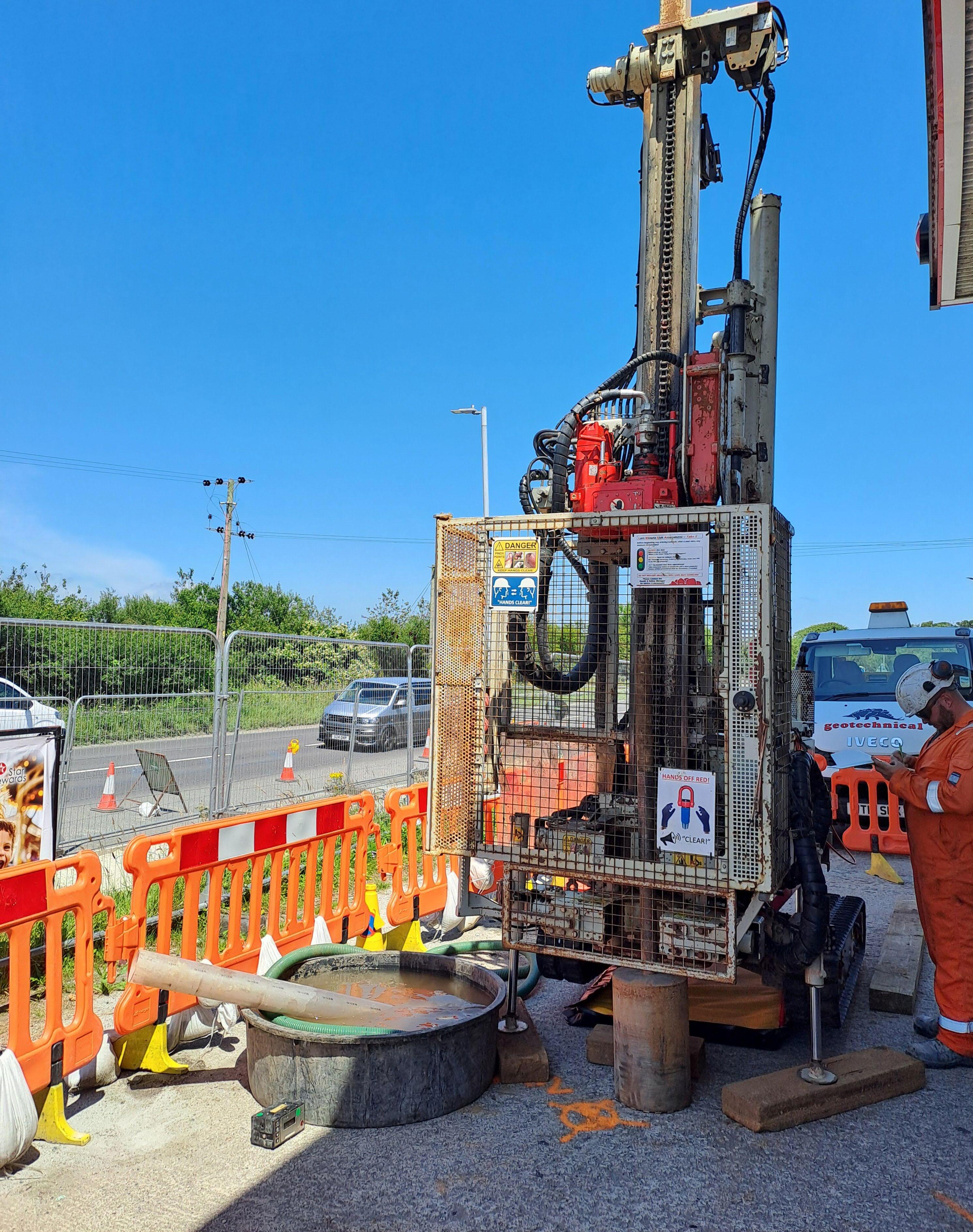
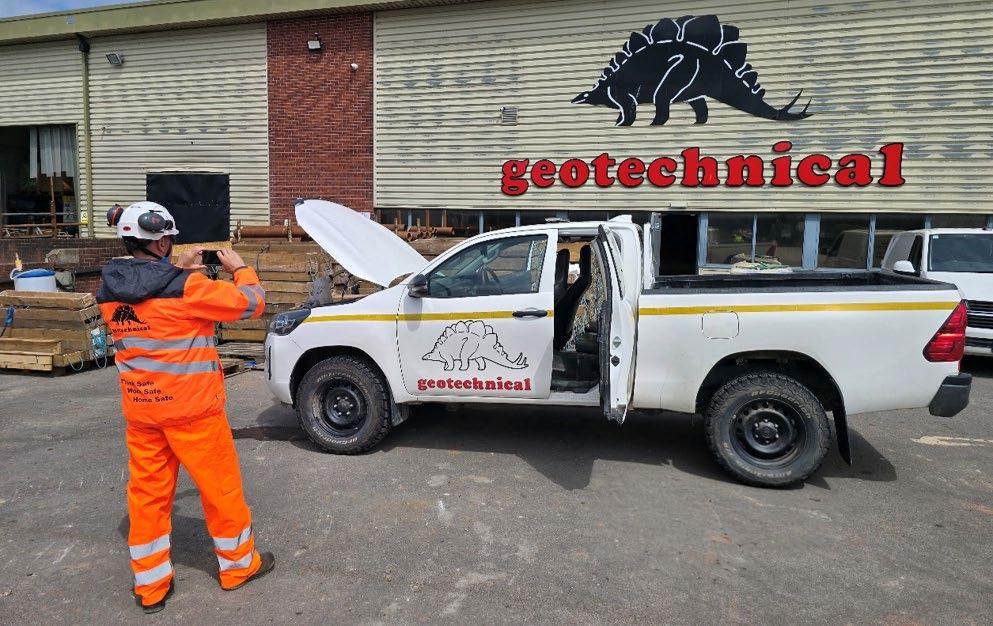
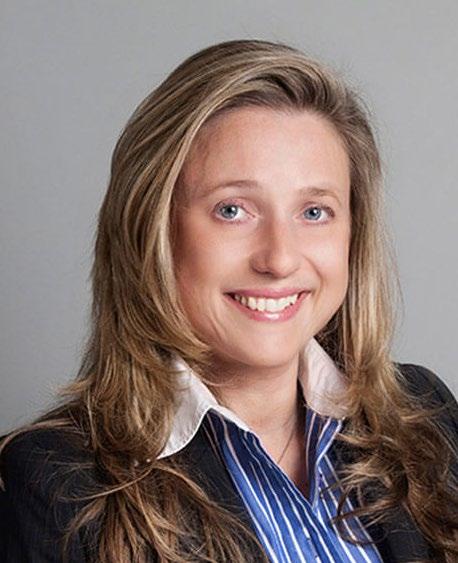
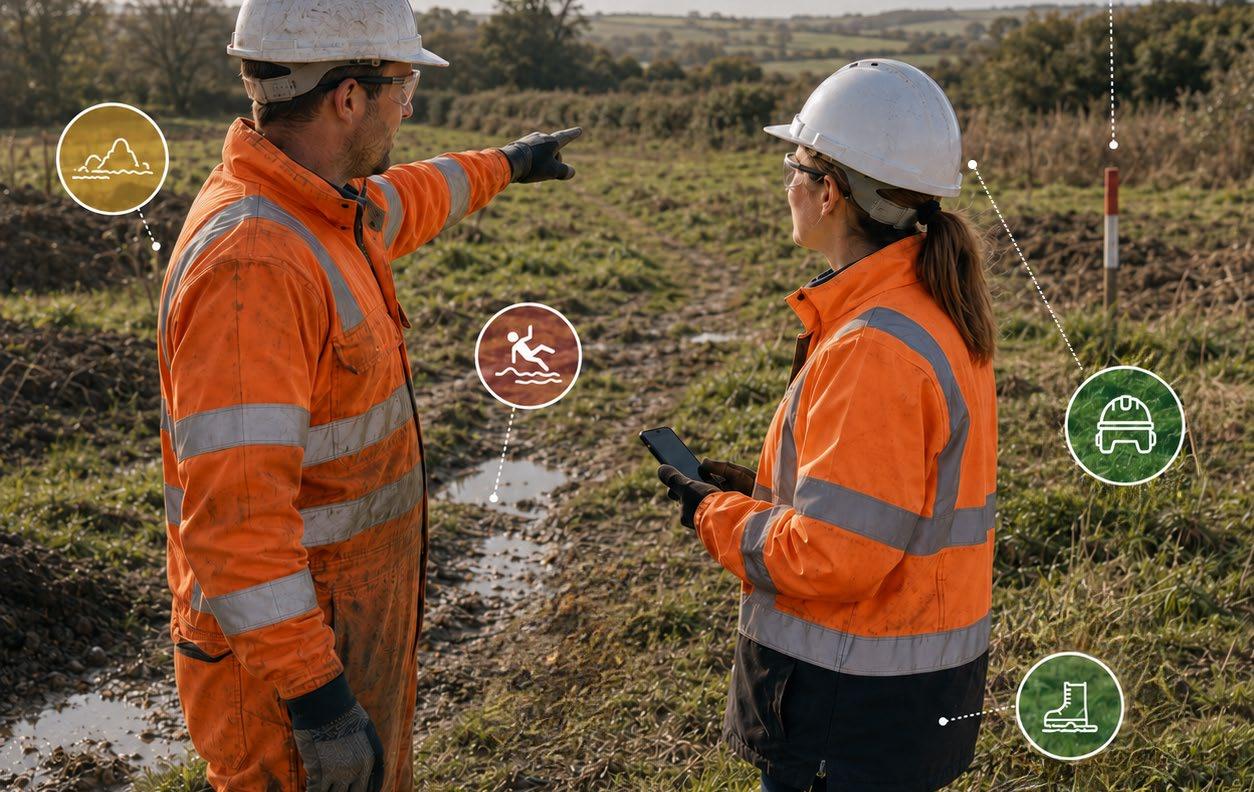
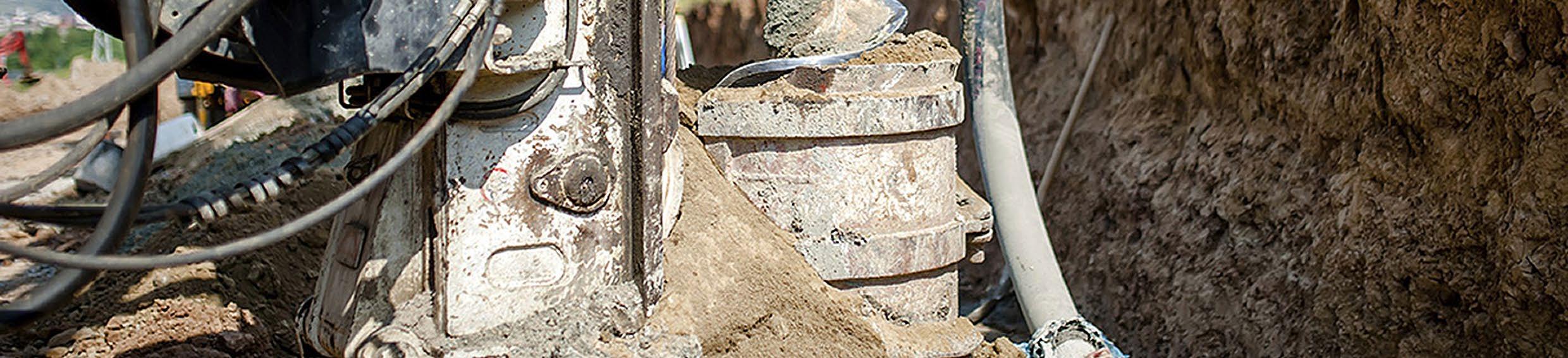
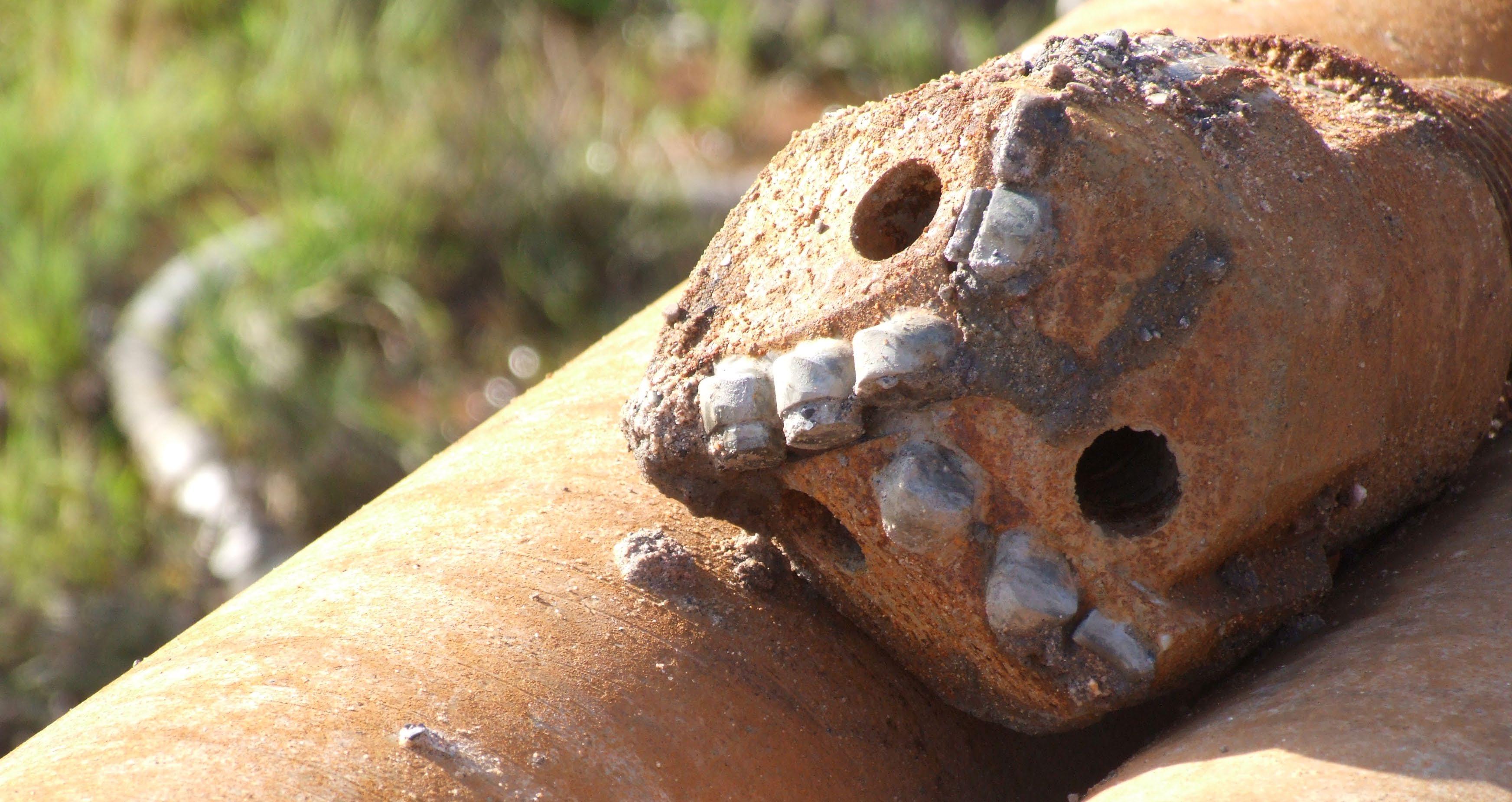
Rachael Parry explains how Geotechnical Engineering approach strengthening safety through awareness and action
PFAS ANALYSES
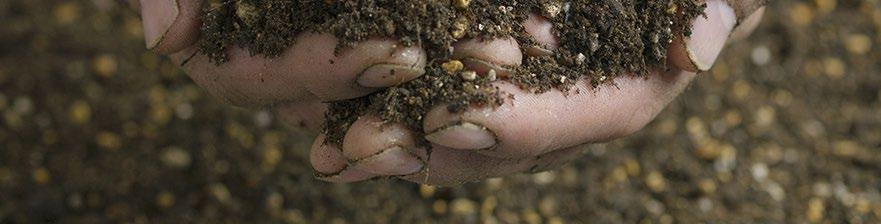
Why PFAS results demand context and informed professional interpretation
THE CHANGING LANDSCAPE OF LAND CONTAMINATION
A preview of the latest AGS one-day CPD event held in October.
July 2026
UPDATING THE DOE INDUSTRY PROFILES
Updating historic industry profiles for clearer, accessible contamination guidance
Photo Credit: Bronwen Smith
Chair’s Foreword
Welcome to the July 2026 edition of AGS Magazine. As we reach the midpoint of 2026, our sector stands at a pivotal moment, driven by rapid advances in research, shifting regulations, and an ever-increasing responsibility to deliver sustainable solutions for the built environment.
The AGS continues its mission to elevate and safeguard the quality of geotechnical and geoenvironmental engineering across the UK. Our vibrant membership, spanning organisations, individuals, and emerging leaders, remains dedicated to tackling technical challenges, sharing knowledge, and continually raising the bar for standards and safety.
This issue reflects both the growing complexity and opportunity within our field. From confronting the evolving risks of land contamination and navigating analytical uncertainty in PFAS management, to celebrating lifetime achievement and championing new approaches to hazard observation, the articles within these pages embody the spirit of progress and resilience. Our sector is not only responding to change but actively shaping it
Now more than ever, collaboration, transparency, and shared learning are crucial. I encourage you to dive into the resources and features included here, get
involved with ongoing debates, and contribute your own experiences, whether through safety shares, opinion pieces, or technical articles. Each voice helps drive the industry forward and strengthens our collective commitment to excellence.
If you have feedback, suggestions, or wish to submit an article, please contact us at ags@ags.org.uk. Together, we can continue to innovate and inspire, ensuring the ground beneath our feet is safer, stronger, and more sustainable for generations to come.
Thank you for your ongoing support of the AGS and for your commitment to shaping the future of geotechnical and geoenvironmental practice.
We are always on the lookout for additional, informative content for the magazine, so if you have an opinion piece, a case study, a technical article or a wider issue that you think the geotechnical and geoenvironmental public would find beneficial, please do get in touch.
We would be interested in your feedback on the magazine and our future plans. Please contact ags@ags.org.uk if you have any comments.
ABOUT THE AGS
The Association of Geotechnical and Geoenvironmental Specialists (AGS) is a not-for-profit trade association established to improve the profile and quality of geotechnical and geoenvironmental engineering. The membership comprises UK organisations and individuals having a common interest in the business of ground investigation, geotechnics, geoenvironmental engineering, engineering geology, geochemistry, hydrogeology, and other related disciplines.
EDITORIAL BOARD
Alex Lee, AGS Chair
Caroline Kratz, Forum Court Associates (FCA)
Katie Kennedy, FCA
Julian Lovell, Equipe Group
Calum Spires, Equipe Group
Adam Latimer, Ian Farmer Associates
Dimitris Xirouchakis, Structural Soils
Caroline Martin, Haskoning
Christos Botsialas, TRC Companies
Alison Nicholson, Buro Happold
EDITORIAL STORY
To submit an article for inclusion in the AGS Magazine, please contact the AGS on 020 8658 8212 or ags@ags.org.uk. Please note that articles should act as opinion pieces and not directly advertise a company. The AGS is under no obligation to feature articles or events received.
CONTACT US
Association of Geotechnical & Geoenvironmental Specialists Forum Court, The Alexander Centre, 15-17 Preston Street, Faversham, Kent, ME13 8NZ
Alex Lee AGS Chair
ags@ags.org.uk 020 8658 8212 Association of Geotechnical & Geoenvironmental Specialists www.ags.org.uk
Inside this month’s issue
FEATURE PAGE 18 PFAS Analyses - the numbers alone are not enough
COVER STORY
Hazard Observations: Strengthening Safety Through Awareness and
PFAS results require more than headline concentrations. Understanding detection limits, method scope, uncertainty, precursors, transformation and complementary analyses is essential for defensible risk assessment and sound regulatory decisions in practice.
THE CHANGING LANDSCAPE OF LAND CONTAMINATION
PAGE 4
An upcoming CPD event by the AGS.
Q&A WITH JONATHAN GAMMON
PAGE 14
The AGS Magazine conducts a Q & A with Jonathan Gammon - recent AGS Lifetime Achievement Recipient UPDATING THE DOE INDUSTRY PROFILES
PAGE 24
CL:AIRE modernises historic industry profiles, improving contaminant information for better land assessments.
MORE INSIDE
PAGE 4
News in Short: Incl. Publication Updates
PAGE 12
New Honorary AGS Members Vivian Dent & Julian Lovell
PAGE 13
AGS Webinar Replay Individual Competence
News and Events
The Changing Landscape of Land Contamination is a full-day, CPD event which is taking place on Thursday 15th October at the Thinktank Birmingham Science Museum.
As the land contamination sector continues to evolve in response to advances in research, regulatory developments and growing sustainability expectations, this timely conference will bring together leading practitioners and thought leaders to explore the latest challenges, innovations and best practice shaping the industry.
Chaired by AGS Chair Elect Geraint Williams, (Associate Technical Director at HKA), this event has been developed in collaboration with key industry organisations including SiLC, SoBRA and CL:AIRE. The programme will feature 13 specialists and a wide range of technical and regulatory presentations covering topics such as advances in methane sampling in groundwater, the increasing role of sustainability in land
management, and the latest updates to BS 10175.
A highlight of the day will be the interactive panel discussion, Land Contamination: Meeting Technical, Societal and Legal Expectations, chaired by Professor Paul Nathanail. Bringing together experts from across the sector, the session will explore emerging issues, future challenges and the evolving expectations placed on contaminated land professionals, offering delegates valuable insights from a range of perspectives.
Designed for professionals at every stage of their career, from early-career practitioners to experienced specialists, the conference provides an excellent opportunity to enhance technical knowledge, gain valuable CPD and connect with colleagues from across the contaminated land community.
The event is proudly sponsored by Groundsure, ALS, Husker, Eijkelkamp Fraste UK, Normec i2 Analytical and GeoEnviro Solutions.
Session 1: Chaired by Geraint Williams, Associate Technical Director at HKA and AGS Chair Elect
Opening Address
Geraint Williams, Associate Technical Director at HKA and AGS Chair Elect
BS10175:2026: A Professional Approach to the Investigation of Potentially Contaminated Sites
Professor Paul Nathanail, Director at Land Quality Management
A Legal Perspective of Landfill
Dr Anna Willetts , Partner at Gunnercooke and Sam Riggs, Barrister at 25 Bedford Row
Session 2: Chaired by Stephanie Cox, Director of E3P and Member of the Executive Committee for SoBRA - Early Careers
Updating the DoE Industry Profiles
Dr Rob Sweeney, Technical Director at CL:AIRE
The Benefits of Measuring Dissolved Methane for Interpreting Ground Gas Results
Pagen Spooner, Geoenvironmental Consultant at EPG
Session 3: Chaired by Dr Rob Sweeney, Technical Director at CL:AIRE
PANEL DISCUSSION: Land Contamination: Meeting Technical, Societal and Legal Expectations
Chaired by Professor Paul Nathanail (Director at Land Quality Management). Panellists: Pagen Spooner (Geoenvironmental Consultant at EPG), Anna Willetts (Partner at Gunnercooke), Christopher Swainston (Independent Contaminated Land Consultancy and Training), Barry Mitcheson (Associate Director at WSP) and Dr Paul McMahon, (Associate Technical Director at RSK Geosciences).
Developing and Applying Sustainable Management Practices
Dr Paul McMahon, Associate Technical Director at RSK Geosciences
Session 4: Chaired by Claire Dickinson, Director at Geo-Environmental Matters and SILC
Developments in the Remediation of PFAS in Soils and Waters
Dr. Cecilia L. MacLeod, Managing Director and Co-Founder at Anthera Remediation Technologies
Why Do We Need to Reconsider Our Approach to Asbestos in Air Monitoring During Remediation?
Steve Forster, Director at Remedia Group
Closing Address
Geraint Williams, Associate Technical Director at HKA and AGS Chair Elect
TICKETS AND REGISTRATION
Tickets for AGS member companies are available at the reduced rate of £150 (ex VAT), while nonmembers can attend for £230 (ex VAT).
A limited number of discounted places are available for regulators, including the Environment Agency, NHBC and local authorities, priced at £59 (ex VAT). Student tickets are also available for £20 (ex VAT).
For full details and to register, please click HERE
MEET OUR SPEAKERS AND SESSION CHAIRS
Geraint Williams
AGS Chair Elect and Associate Technical Director at HKA
Geraint Williams is Associate Technical Director within the Environment and Climate Change Division at HKA. He is Chair of the Business Practice Working Group and Chair Elect of the AGS.
Geraint also serves on EH/4, British Standards Technical Committee on Soil Quality and acts as AGS’s representative on the National Brownfield Forum.
Professor Paul Nathanail Director at Land Quality Management
Paul is now in his fourth decade of being involved in risk based land contamination management. He has combined consultancy, advisory and academic teaching and research and is known for providing robust and independent insights into contentious land contamination challenges in the UK.
Counties. She is recognized for her specialist knowledge in waste management and recommended in Legal 500.
Stephanie Cox
Director of E3P and Member of the Executive Committee for SoBRA - Early Careers
He is the lead author of key guidance on topics including the S4UL generic assessment criteria, bioavailability, asbestos and PFAS. He led the drafting of BS ISO 18504:2017 and was part of the group that updated BS10175:2026.
Dr Anna Willetts
Partner at Gunnercooke
Anna is an environmental criminal lawyer, specialising in defence work in the waste and recycling industry. She is dualqualified, having completed a PhD in geochemistry and worked as an environmental consultant before qualifying as a lawyer.
Anna represents waste and recycling businesses and directors who are prosecuted by the regulators (Environment Agency and local authorities) for environmental and waste offences.
Samantha Riggs
Barrister at 25 Bedford Row
Samantha is a regulatory barrister specialising in defending companies and individuals in environmental, financial and regulatory matters and providing compliance advice. She has particular expertise in waste management and is fellow of Chartered Institution of Wastes Management (FCIWM) and is co-chair of the Central Committee for London Southern
Stephanie Cox is a Director at E3P, a multidisciplinary environmental consultancy with offices in Manchester and Birmingham. She is an experienced practitioner in contaminated land and environmental risk, known for delivering proportionate, technically robust solutions aligned with industry guidance. Stephanie is a member of the Executive Committee of the Society of Brownfield Risk Assessment (SoBRA), where she leads the Early Careers portfolio, supporting professional development, engagement and knowledge-sharing across the brownfield sector.
Dr Rob Sweeney Technical Director at CL:AIRE
Rob is a chartered scientist through the Royal Society of Chemistry and a Professional Member of the Chartered Institute of Editing and Proofreading. Rob has over 25 years’ experience in land and water contamination with CL:AIRE, and previous environmental experience drawn from two research positions in waste management and water treatment. Rob manages CL:AIRE’s advisory group –the Technology and Research Group and is responsible for quality control in all CL:AIRE’s publications
Pagen Spooner
Geo-Environmental Consultant at EPG
Pagen is a Geoenvironmental Consultant with three years’
experience, specialising in Ground Gas Risk Assessments and bespoke monitoring across sites including landfills, coal mined areas and contaminated land. She undertakes extensive fieldwork, data interpretation and develops robust conceptual site models with a proactive approach to improving monitoring practices. She is a fellow of the Geological Society, a member of SoBRA as well as an active member of the SoBRA Early Careers subgroup.
Christopher Swainston
Independent Contaminated Land Consultancy and Training
Chris has been in the industry for over 30 years including works at Buncefield, the Dome, Westbury, Sizewell C, Sandridge and been cursed by Shakespeare for digging up his back garden…. He has written and presented on many topics for BSI, AGS, CIRIA , SoBRA, GSL and others, and is a qualified CL:AIRE QP.
Barry Mitcheson
Associate Director at WSP
and delivering internal geotechnical training, establishing apprenticeship pathways, mentoring colleagues and providing consultancy support on complex projects.
Paul’s career, 25-years in industry and 25-years at university, covers civil and geotechnical engineering with some contaminated land experience. As an Approved ICE (Institution of Civil Engineers) Mentor, Paul is Head of Profession for Civil Engineering across the entire RSK Group.
Claire Dickinson Director at Geo-Environmental Matters and SiLC
Bringing over 35 years of experience in UK land development, Claire is a contaminated land specialist with a background in geotechnical engineering, specialising in ground risk management advice.
Barry is an environment consultant with over 25 years’ experience in contaminated land consultancy. He has project managed and provided technical support for all aspects of land quality assessment for a wide range of sites. He is a SiLC and ASOBRA for Human health and Vapour. He has been actively involved in a range of industry initiatives and publications including on VOCs, Waste assessment, Soil Gas, Asbestos, Site conceptual model and the recent industry profiles.
Paul McMahon
Associate Technical Director at RSK Geosciences
Paul is an Associate Technical Director within RSK Geosciences, designing
Over the last 19 year she has chaired over 10 CIRIA project steering groups for their contaminated land programme. She coauthored the recent update of CIRIA’s popular Environmental Good Practice Guide and is part of the research team producing an online resource for the CIRIA’s Soil Community of Practice.
Dr. Cecilia L. MacLeod
Managing Director and Co-Founder at Anthera Remediation Technologies
Dr. MacLeod an environmental geochemist with over 40 years’ experience, assessing and remediating sites affected by contamination. Cecilia has worked on PFAS related issues at Buncefield Oil Terminal and Guernsey Airport. Dr Macleod recently founded Anthera Remediation Technologies Ltd to commercialise an photocatalytic oxidation process for the mineralisation of PFAS.
Steve Forster Director at Remedia Group
Steve has approaching 40 years’ experience in the investigation, assessment and management of asbestos in buildings and on land.
He authored CAR-SOIL (CL:AIRE, 2016), industry guidance interpreting the Control of Asbestos Regulations 2012 as applied to contaminated land, in conjunction with the HSE. He coauthored Assessment and Control of Asbestos in Soil Part 1: Protection of personnel working on ground investigations and Part 2: Protection of personnel working in geotechnical and geoenvironmental laboratories (AGS, 2021)
He developed and delivers (CL:AIRE) industryfocussed training for professionals working within the brownfield land sector, with well over 2000 candidates having received training since 2016.
SPONSORSHIP
The Changing Landscape of Land Contamination conference offers a valuable opportunity to position your organisation at the forefront of a rapidly evolving sector. Bringing together industry professionals from across the sector, this event provides direct access to key decisionmakers, influencers and emerging talent.
We have the following sponsorship packages available for both members and non-members of the AGS who wish to have a presence at this highly targeted conference. All listed rates
exclude VAT. For full sponsorship benefits, details and T&C click HERE
EMERALD SPONSOR (AGS Member Rate: £1350/ Non-Member Rate: £1755)
Î Full page advert in AGS Magazine (worth £400, over 7,800 subscribers) **
Î A dedicated exhibition table, enabling you to present your company’s initiatives, research, software and promotional materials in a high-profile networking environment.
Î Entry for three delegates into the conference
Î Company logo on the conference lectern
GOLD SPONSOR – (AGS Member Rate: £1200/ Non-Member Rate: £1560)
Î A dedicated exhibition table, enabling you to present your company’s initiatives, research, software and promotional materials in a high-profile networking environment.
Î Entry for two delegates into the conference
Î Company logo on the conference lectern
Î 1/4-page advert in AGS Magazine (worth £160, over 7,800 subscribers)
ASSOCIATE SPONSOR (AGS Member Rate: £600 Non-Member Rate: £840)
Î Entry for one delegate into the conference
Î Company directory in AGS magazine (worth £50, over 7,800 subscribers)
Î Company logo on the conference lectern
Î Company logo on the event presentation holding slide
If you’d like to confirm your support or would like any further information regarding the conference please contact Caroline Kratz on ags@ags.org.uk.
SPONSORS
Geotechnica 2026: Record Breaking Year
Geotechnica 2026 proved once again why it remains such an important meeting place for the UK’s geotechnical, geothermal, ground engineering and ground investigation communities.
More than 1,050 people including numerous AGS members were present at the Warwickshire Event Centre on 8th and 9th July 2026, making it the fourth consecutive year that attendance has passed the four-figure mark. Wednesday 8th was particularly remarkable, becoming the busiest single day in the history of Geotechnica. The weather was impossible to ignore. With temperatures soaring throughout both days, this was comfortably the hottest Geotechnica ever staged. Yet despite the brutal heat, the exhibition halls, outdoor stands and conference remained busy and bustling.
Across the event, attendees were able to meet suppliers, manufacturers, contractors, consultants and clients from every corner of the industry. They could see drilling rigs, equipment and technology up close, speak directly to the people behind them and take part in conference discussions addressing some of the biggest questions facing geotechnics today.
Organisers Equipe would like to thank every exhibitor, speaker, panellist, visitor and member of the event team who helped make Geotechnica 2026 such a success.
The greatest thanks go to the sponsors, whose support makes the event possible. Equipe were proud to welcome GEOLABS as Platinum Sponsor, alongside Gold Sponsors Casagrande UK, Davis Trackhire, GenAir, MGS and Wheeler Site Investigation.
Thanks also go to Silver Sponsors, John Lawrie Tubulars, Robertson Geo, Structural Soils, Borehole Solutions, Soil Engineering and NPK,
and our Bronze Sponsors, TerraDat, SoilCloud, Normec i2 Analytical, Pebble Geo, European Geophysical Services and Groundsure.
Geotechnica has always been built by the industry, for the industry. It was a powerful reminder that face-to-face events create connections, ideas and opportunities that cannot be replicated online. The turnout, energy and conversations throughout this year’s event showed exactly why that still matters.
Thank you to everyone who attended the event, endured the heat and helped make Geotechnica 2026 one for the record books.
News and Events
The Association of Geotechnical and Geoenvironmental Specialists is delighted to announce that its flagship Annual Conference will return to the prestigious One Great George Street in Westminster, London, on Thursday 22 April 2027.
Centred around the theme of resilience, the event will bring together industry leaders, technical specialists and emerging professionals to explore how the geotechnical and geoenvironmental sector can respond to an evolving range of environmental, technical and societal challenges.
The Annual Conference will welcome 240 professionals from across the industry for a day of technical insight, discussion, collaboration and networking. Chaired by AGS Chair, Alex Lee (HKA), the programme will showcase the latest industry developments, research and best practice, while providing valuable opportunities to connect with colleagues, clients and sector leaders. The day will conclude with an extended drinks reception in the Great Hall, offering further opportunities to continue conversations and strengthen professional connections.
The AGS is also pleased to announce the return of its popular Early Careers Poster Competition. This year, early career professionals are invited to
share their ideas on how the industry can inspire more people to pursue a career in geoscience, helping to encourage and support the next generation of talent.
Further details on the programme, speakers, registration and poster competition, click HERE
Sponsor the Annual Conference
Sponsoring the AGS Annual Conference offers a valuable opportunity to raise your profile within the UK's geotechnical and geoenvironmental community, connecting your organisation with industry leaders, technical specialists and key decision-makers. Feedback from the 2026 conference was exceptionally positive with a few statistics including:
Î 100% of delegates rated the conference as excellent or good
Î 99% rated presentations as excellent or good
Î 96% were satisfied with the networking opportunities
Î 100% would recommend the conference
Sponsorship packages are expected to sell out well in advance of the event, so early booking is strongly recommended.
Our available sponsorship packages are as follows. For full package benefits, click HERE
CANAPE SPONSOR*
(AGS Member Rate: £2,035 / Non-Member Rate: £2,855)
Î Company logo on the drinks / canape menu
Î Company logo on the canape flags
Î Full page advert in AGS Magazine (worth £424)** which has over 7,810 subscribers
Î Entry for three delegates into the Annual Conference
Î An exhibition table which may be used to present company initiatives, research, software and promotional materials in a high-profile networking environment. This area has space for two standard pull-up
banners (850mm x 2000mm).
*one package available
**terms and conditions apply
CATERING SPONSOR* (AGS Member Rate: £2035 / Non-Member Rate: £2,855)
Î Company logo featured across all food menus in the Great Hall during the Annual Conference.
Î Full page advert in AGS Magazine (worth £424)** which has over 7,810 subscribers
Î Entry for three delegates into the Annual Conference
Î An exhibition table which may be used to present company initiatives, research, software and promotional materials in a high-profile networking environment. This area has space for two standard pull-up banners (850mm x 2000mm).
*one package available
**terms and conditions apply
EMERALD SPONSOR (AGS Member Rate:
£1,815/ Non-Member Rate: £2,530)
Î An exhibition table which may be used to present company initiatives, research, software and promotional materials in a high-profile networking environment. This area has space for two standard pull-up banners (850mm x 2000mm).
Î Entry for three delegates into the Annual
AGS Publication Updates
Conference
Î Full page advert in AGS Magazine (worth £424) which has over 7,810 subscribers
GOLD SPONSOR (AGS Member Rate: £1,650 / Non-Member Rate: £2,200)
Î An exhibition table which may be used to present company initiatives, research, software and promotional materials in a high-profile networking environment. This area has space for two standard pull-up banners (850mm x 2000mm).
Î Entry for two delegates into the Annual Conference
Î 1/4-page advert in AGS magazine (worth £170) which has over 7,810 subscribers
PROMOTIONAL SPONSOR
(AGS Member Rate: £880 Non-Member Rate: £1,100)
Î Entry for one delegate into the Annual Conference
Î Company directory in AGS magazine (worth £50) which has over 7,810 subscribers
Î Company logo on the conference lectern
All rates exclude VAT.
If you’d like to confirm your support, please contact Caroline Kratz on ags@ags.org.uk.
Packages are offered on a first come, first served basis.
We look forward to welcoming you to London in April 2027.
The top three downloaded AGS publications in last month:
Recent AGS publications available on the AGS website:
• Bitesize Guide – CD225
• Bitesize Guide – Trigger Values
To download the publications for free; click here
News and Events
Vivien Dent and Julian Lovell elected as AGS Honorary Members
At the AGS AGM in May 2026, Vivien Dent and Julian Lovell were elected as AGS Honorary Members in recognition of their outstanding contribution to the Association.
During her tenure as Chair, Vivien brought strong momentum and strategic direction to the AGS, helping to strengthen its focus on EDI, sustainability and early careers development, while also expanding international links and supporting the establishment of the AGS Development Fund.
Julian has also made a longstanding and significant contribution to the AGS, serving as Past Chair and contributing across the
Call for Safety Shares from AGS Members
The AGS is inviting members to contribute short safety shares for publication on the AGS website. These practical examples can highlight lessons learned, good practices, near-miss insights, process improvements, or simple actions that have made work safer for colleagues, clients, or the wider industry.
By submitting a safety share, members
Executive and several Working Groups, including Business Practice and Safety. He has played an important role in advancing professional standards, competencies and industry guidance, and his practical commitment, leadership and generosity with his time have been greatly valued by the Association.
Thank you to Vivien and Julian for their exceptional service to the AGS.
confirm that the content is their own or that they have permission to share it, and they grant AGS permission to publish, reproduce, and share the submission on the AGS website and in related AGS communications, with appropriate acknowledgement where applicable.
If you have a safety share that could benefit AGS members, please send across to ags@ags. org.uk. Your contribution can help strengthen shared learning and support a safer culture across the AGS.
NEWS,
EVENTS AGS WEBINARS
REPLAYS
&
UPCOMING
REPLAY NOW AVAILABLE
On Thursday 11th June 2026, the AGS hosted a webinar titled Individual Competence –Understanding How Government Reforms Will Affect You and Our Industry.
The event was chaired by Julian Lovell (Managing Director of Equipe Group and AGS Lead on Occupational Competence). Julian also presented alongside Faye Burnett (Mace Advisory Consult and Super Sector Programme Director), Ciaran Jennings (Project Lead at the Ground Forum) and Jim De Waele (Adjudicator at Coudrier).
Faye Burnett explored how the industry is responding to the individual competence requirements identified within the Building Safety Act, providing an overview of the Super Sector groups and the approach being taken by trades and installers.
Ciaran Jennings outlined the Ground Forum’s approach to defining competence for the industry, highlighting the occupations in scope, the core principles involved, and the Super Sector process.
Jim De Waele provided an update on GENIUS, the Ground Engineering Network for IndustryUniversity Skills. He explained its purpose
and objectives, noting that the UK’s ability to train the next generation of ground engineers is at risk, with universities under significant pressure and the future of MSc provision under threat.
Julian Lovell then explained the industry bodies involved in competence and the initiatives currently under way. He noted that competence requirements should be linked to role and risk, and that there is no need to reinvent the wheel. He also provided an overview of the Competence Framework and routes to competence, highlighting both the challenges and opportunities ahead. SLG 3 will develop a Competence Framework for Ground Engineers, while SLG 10.4 will focus on developing the Ground Engineering trades.
The webinar concluded with an engaging Q&A session, during which Julian, Faye, Ciaran and Jim responded to a range of questions submitted by attendees.
The replay of this webinar is available free of charge to AGS members and £50 + VAT for nonmembers. To access the recording, please click here.
Q & A with...
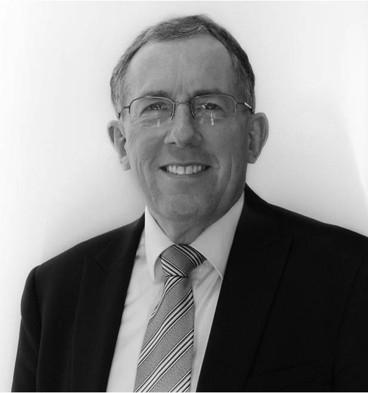
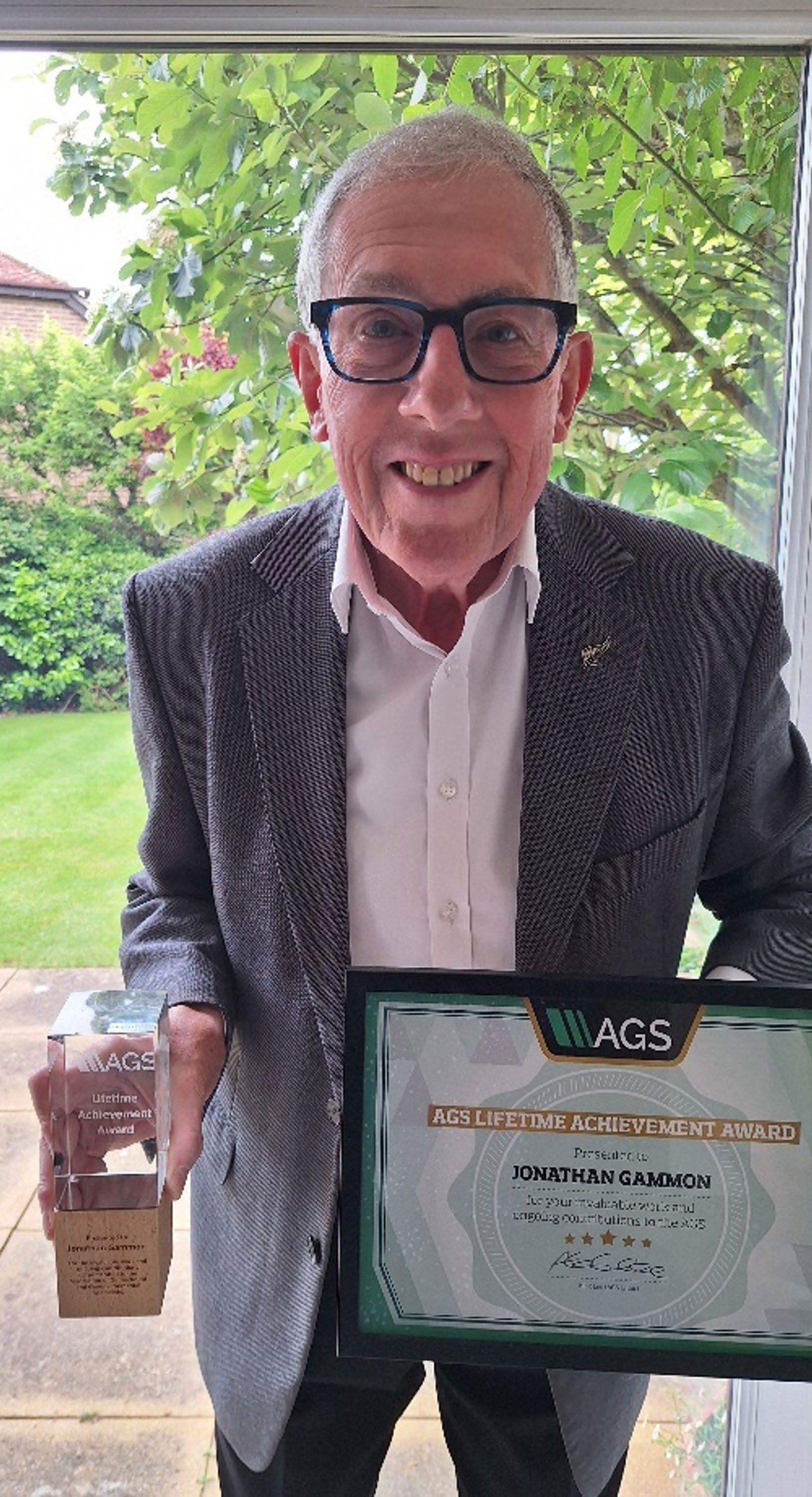
Jonathan Gammon
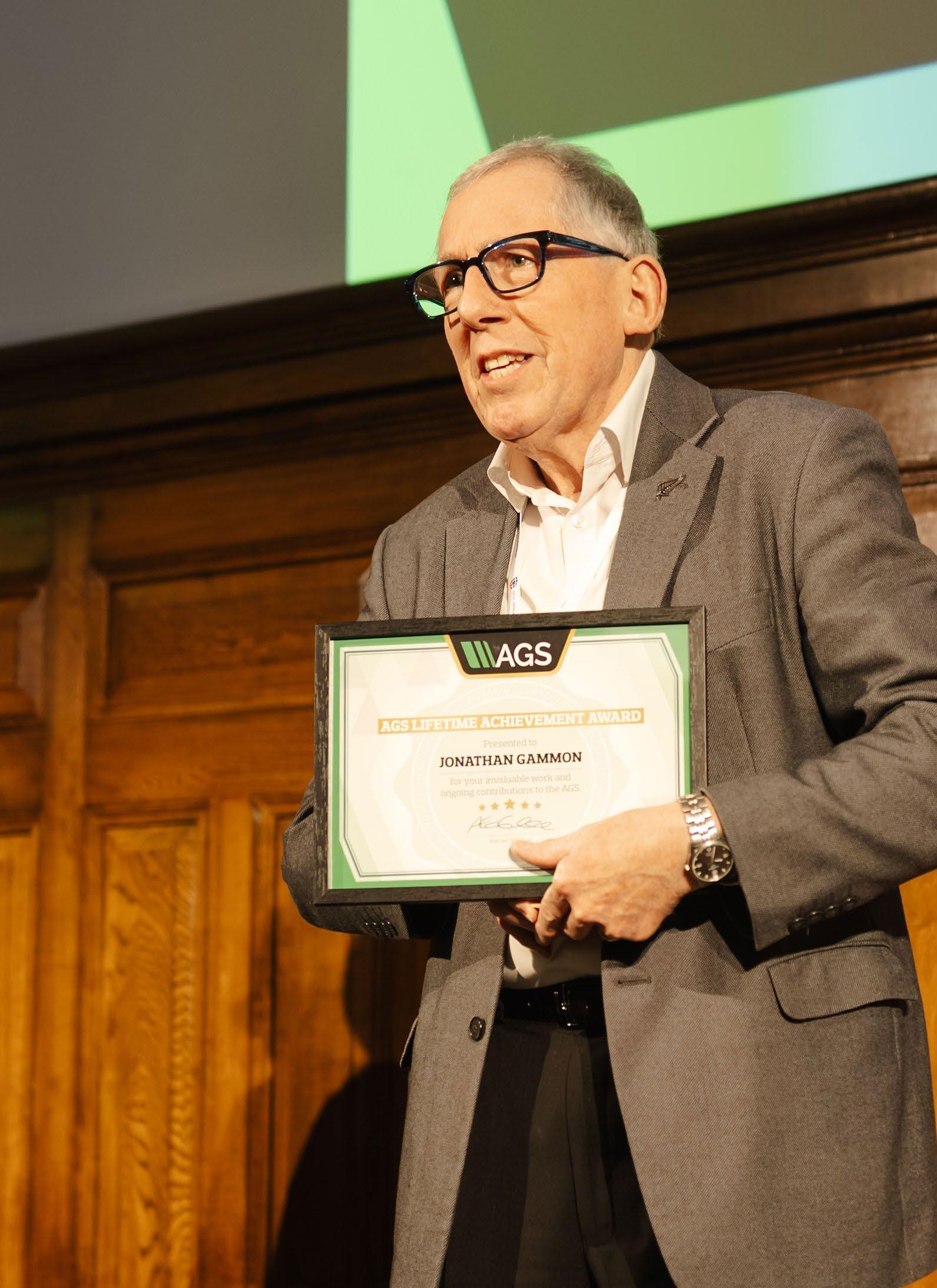
This year, the AGS has presented two lifetime achievement awards. Here, we speak to the second recipient, Jonathan Gammon. Jonathan has been involved with the AGS for over 30 years, serving as Chair of the AGS from 20072009, and has taken part in multiple Working Groups over the years including the Senate, Business Practice and the Instrumentation and Monitoring Working Group.
What first inspired you to pursue a career in the geoscience industry?
When I was studying for my degree in Civil Engineering at the University of Surrey in the early 1970s, I fell under the spell of Noel Simons and Bruce Menzies who taught us Soil Mechanics. I had intended to start a career in bridge engineering.
During my year in industry, I had worked for contractor Marti AG on the construction of the fantastic Felsenau Bridge in Bern, Switzerland. However, I was easily persuaded to
change career direction and had their support to gain a place on the MSc Course in Soil Mechanics at Imperial College and graduated there in 1975, now more than 50 years ago!
With further academic study at Imperial under the spell of Professors and Lecturers including Skempton, Bishop, Vaughan (my Tutor/ Supervisor), Hutchinson, Chandler, Skinner, Hoek, Knill, De Freitas, and Ambraseys, I was more than adequately inspired to pursue a career in the geoscience industry.
Looking back over your career, which achievement or moment are you most proud of?
If I had to chose just one event it would be receiving my AGS Lifetime Achievement Award at this year’s AGS Annual Conference. That was a total and wonderful surprise.
If I was allowed to add others they would include being Chair of AGS, assisting with the establishment of AGS in Hong Kong when working there again from 1996 to 2002, and the opportunities I was given at the University of Surrey and
Imperial College, in 2018 and 2019 respectively, to give talks about my career.
Has there been a particular turning point that significantly shaped your professional journey?
Yes. In broad terms it would be turning to live and work overseas after a fantastic foundation to my career as a Graduate and then Chartered Civil Engineer at WS Atkins and Partners, based in Ashtead, Surrey. After working through the Middle East on projects in Algeria, Egypt, Saudi Arabia, and Iran with Atkins, it was time for a move to Hong Kong in 1980. From there we moved to New Zealand in 1984 when, as another proud achievement, I was appointed to set up a Geotechnical Section in one of New Zealand’s largest consultancies, then Murray-North, now AECOM. Being granted New Zealand citizenship was also a proud achievement.
How has the industry evolved since you first started, and what changes stand out most?
The Geotechnical Department at WS Atkins I joined in 1975 comprised of seven members of staff! Now there are several hundred members of staff world-wide. That was a perfect time to join the industry. Consulting Engineers were recognising the increasing need for demonstrable specialist skills as the geotechnical demands of projects increased enormously. Think of offshore production platforms in the ferocious North Sea, for example. Always having a keen interest in my projects, not just the geotechnical aspects, enabled me to support the work of the Civil, Structural, and Transportation Engineering Departments at Atkins as well as engage in exciting work with the Research & Development Team. A step change in the industry occurred in the early 1990s because of the Environmental Protection Act. At that time, the worst recession ever in the construction industry had started to hurt. The need for, and ability to provide, geoenvironmental skills helped the ground engineering community maintain momentum during that tough time. Indeed, the initial name of AGS as the Association of Geotechnical Specialists was expanded in name, but not
abbreviation, to become the Association of Geotechnical and Geoenvironmental Specialists. Another important development was the introduction of the Chartered Geologist qualification by the Geological Society of London. For too long, before that, Engineering Geologists had felt their career progress threatened by an inability to secure a professional qualification enjoyed by their colleagues with a Civil Engineering background.
How important have collaboration and professional bodies such as AGS been throughout your career?
Very important. I was fortunate that becoming a Chartered Civil Engineer at the Institution of Civil Engineers at the earliest opportunity enabled me to secure Membership of the Hong Kong Institution of Engineers (HKIE) and what was then the Institution
of Professional Engineers
New Zealand (IPENZ), now Engineering NZ, when arriving in those countries. Such professional qualifications were vital to securing project work. Establishing AGS in Hong Kong brought me rapidly in contact with those working across the entire ground engineering sector: consultants, contractors, testing laboratories, suppliers, and the like; a situation that would not have been achieved by Membership of HKIE alone. I also enjoy my membership of the British Geotechnical Association, the British Tunnelling Society, and the Railway Civil Engineers Association.
What role has mentoring or supporting the development of others played in your professional life?
I have been fortunate to have worked for and with wonderful senior management and staff throughout my career. There was a magical moment, in my experience, when it was possible to ease back - not entirely! - on personal ambition and to encourage the development of those working for me and to recognise fully their skills and ability, some of which I admit I had not possessed. I am thrilled to find out how members of my teams have progressed in their careers. Some formed their own highly successful
consultancies; some now head up major companies. In my early career I received wonderful support from mentors and marvelled at how easy it was to engage in conversation with leading figures in our areas of work. Much as I enjoy seeing the establishment of Early Careers Groups, and the like, I am concerned the these must not become a barrier to conversation across the entire range of ages from students and fresh graduates to those like me, in our seventies, and older.
In your view, what skills or qualities are essential for long-term success in this field?
“ Fully appreciate the exceptional and unique opportunities that our industry provides to engage with the entire range of types of projects around the entire world.
What advice would you offer to early career professionals entering the industry today?
Fully appreciate the exceptional and unique opportunities that our industry provides to engage with the entire range of types of projects around the entire world. Seize those opportunities when they arise. Accept a job overseas if available. My work in Switzerland provided me with the added benefit of fluency in the German language.
Now retired, I envy those still engaged in work as this is an amazing time to enjoy the benefits that the likes of Artificial Intelligence and ChatGPT bring to the workplace. I am fortunate to have had the mind-set during my career that Computer Aided Draughting (CAD) and Building Information Management (BIM) would prove hugely beneficial to our areas of work, despite the upset and controversy surrounding their introduction to traditional working practice. I admire the work of Bentley, for example, who persevered with CAD all that time ago and now provide us with an ability to gather, interrogate, and make sense of the huge amounts of data that the electronic and wireless world is capable of sourcing and generating, using software such as Leapfrog. I am confident that the inherent skills and qualities that had led someone to start out in our industry will sustain them throughout their careers. In my early years, being a specialist was viewed as
career limiting. Thankfully, that proved not to be the case for me and, not without its setbacks, I still reflect on my career with immense joy and a true sense of excitement for the future of our industry and those taking part. Provided one grasps the opportunities to broaden knowledge and experience, to spend time on site, and to keep up with what technology can wonderfully provide, then long-term success should result and be enjoyed.
What does receiving the AGS Lifetime Achievement Award mean to you personally?
I have partly answered this at Question 2., above. I was incredibly grateful to be made an Honorary Member of AGS several years ago. That has enabled me, now fully retired and without a company affiliation, to remain engaged with AGS as a whole and with the Instrumentation and Monitoring Working Group (I&MWG) which I set up in 2019 with the enthusiastic support of then-Chair Julian Lovell. The I&MWG is now very ably led by Tim Clegg. Unexpected as it was, receiving the Award means a huge amount to me personally. It is a lifetime highlight. Thank you to all those involved in providing me with such a special honour.
PFAS Analyses - the numbers alone are not enough
Article contributed by Ken Scally (Normec and Calibre Scientific) and Paul Nathanail (LQM)
It has been said that a professional is someone who has specialist knowledge, skills and expertise that has been independently validated and who operates under a code of practice. However, another take on this is a professional is someone wise - and brave - enough to say that something is outside their area of competence - and then works with someone who has that missing competence.
This article is written as a conversation between an analytical chemist with deep
expertise in how accredited laboratories operate and a risk assessor who advises on the need for remediation under specific legal contexts.
Modern analytical chemists are operating at the critical interface between complex environmental matrices and the generation of legally and scientifically defensible data. Within laboratories accredited to standards such as BS EN ISO/IEC 17025:2017, their role extends beyond the execution of methods to the critical evaluation of method applicability to the substances and media of interest, measurement uncertainty, detection capability, and data fitness for purpose. This includes ensuring appropriate sub-sampling strategies, preservation techniques, extraction
efficiencies, calibration models, and quality control systems are in place and functioning. For emerging contaminants such as PFAS, the analytical chemist must also recognise the limitations of current methodologies, including compound coverage, matrix effects, and potential artefacts, and communicate these transparently to data users - sadly this is not usually the case.
The GB-based risk assessor works usually under the context of the planning regime or Part 2A of the Environmental Protection Act 1990 (as amended). Both are chemical agnostic. In the context of protecting human health, remediation is needed to ensure land is safe and suitable for its intended use or to remove a significant possibility of significant harm.
Turning to that large and very diverse family of synthetic chemicals, PFAS pose a specific challenge to both risk assessor and analytical chemist. Never mind that they may be persistent and widespread, the real challenges arise from what Greenleaves III calls epistemic uncertainty - the lack of relevant knowledge about the behaviour of PFAS in soil, water and within our bodies.
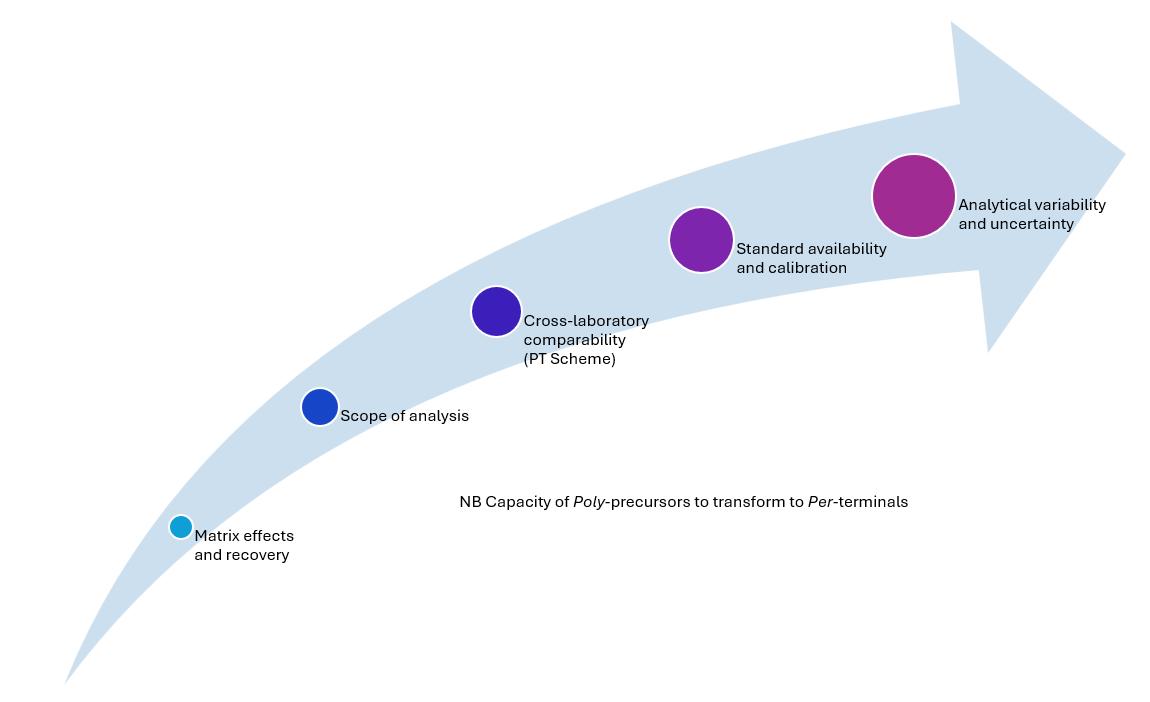
Analytical chemistry’s epistemic uncertainty stems from the inherent limitations in our ability to comprehensively measure the large, structurally diverse of PFAS family using finite, targeted methods. Current PFAS analyses typically quantify a relatively small subset of known substances, while thousands of other PFAS, particularly precursors and transformation products, remain undetected or only partially characterised. This gives rise to uncertainty associated with:
characterised PFAS, leading to systematic underestimation of total burden.
Î Transformation and precursors: Many PFAS exist as precursors that can degrade into terminal compounds over time; standard analyses may not capture this latent mass without specialised approaches (e.g. oxidative conversion techniques).
Î Matrix effects and recovery: Complex environmental media (soil, sediments, biota) can influence extraction efficiency, affecting quantification accuracy and comparability.
Î Analytical variability and uncertainty: Measurement uncertainty, particularly at low concentrations near reporting limits, can be significant and is often underappreciated in downstream decisionmaking.
Î Standard availability and calibration: Quantification relies on the availability of authentic standards, which do not exist for many PFAS, constraining both identification and accuracy.
Î Cross-laboratory comparability (PT Scheme): Differences in methods, reporting limits, and compound lists can lead to variability between laboratories, complicating the interpretation of datasets.
“ Turning to that large and very diverse family of synthetic chemicals, PFAS pose a specific challenge to both risk assessor and analytical chemist.
Î Scope of analysis: Targeted methods exclude unknown, novel, or poorly
Taken together, these factors mean that PFAS analytical data are not absolute representations of environmental concentration, but conditional estimates bounded by method capability. The “numbers alone” therefore risk misinterpretation unless accompanied by a clear understanding of what has, and has not, been measured, and with what degree of confidence.
The risk assessor has to inform decisions on the need for remediation that accounts for epistemic uncertainty in, for example, the dose-response relationship, effects of mixtures, rate of transformation of precursor to terminal substances in the environment, behaviour of different species (neutral or ionised).
A better understanding of these two sources of epistemic uncertainty will help refine the decisions on whether or not to remediate even as science develops a better understanding to reduce those uncertainties.
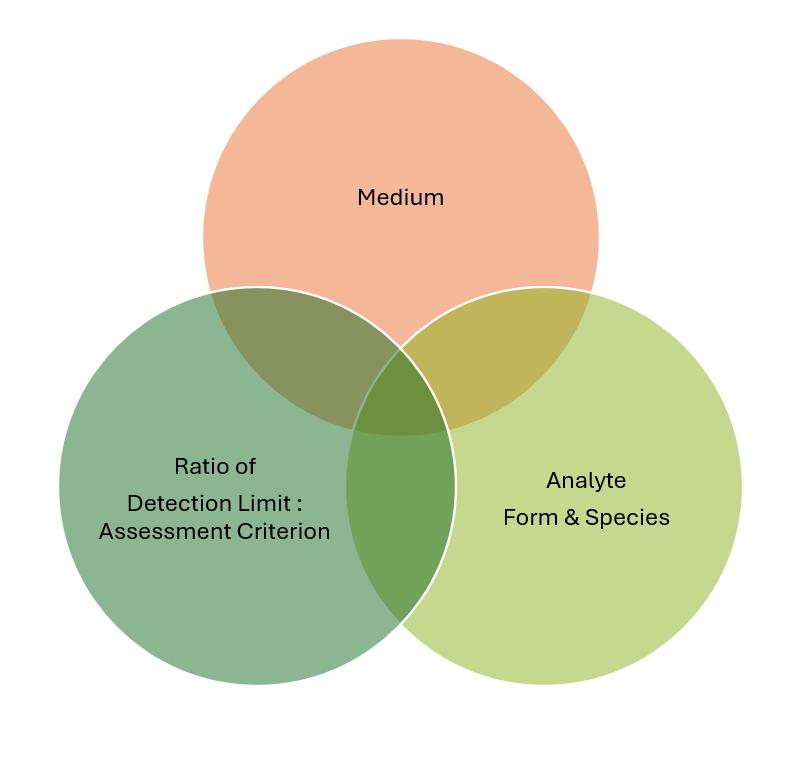
On analytical uncertainty
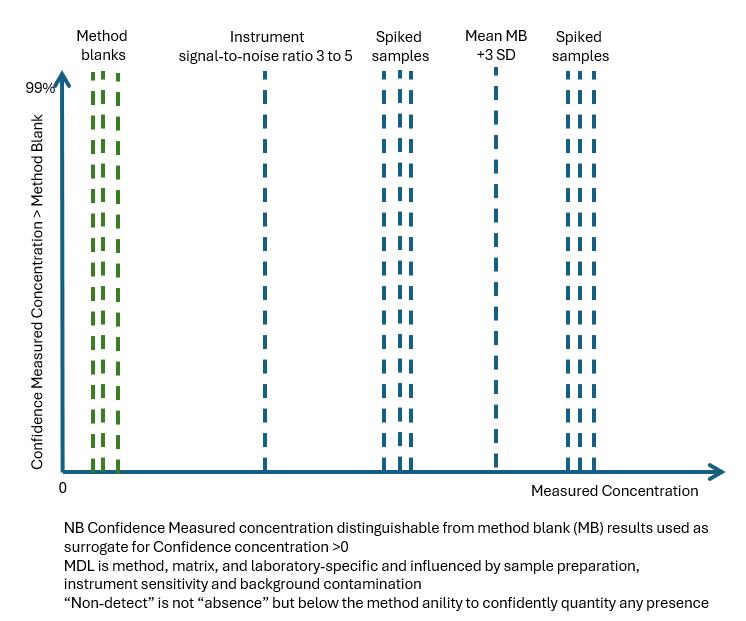
matrix, and laboratory-specific, and is influenced by sample preparation, instrument sensitivity, and background contamination. For PFAS, MDL can vary significantly across compounds and matrices and may fall above or below levels of toxicological concern. Consequently, a “non-detect” does not equate to absence, but rather indicates that any presence lies below the method’s capability to reliably quantify it.
How does inter-laboratory comparability help?
Inter-laboratory comparability, typically assessed through proficiency testing (PT) schemes and inter-laboratory studies, provides an external benchmark of analytical performance. It allows laboratories to evaluate their bias, precision, and consistency relative to peers using similar or different methodologies. For PFAS, where method variability and compound coverage differ from laboratory to laboratory, such comparisons help identify systematic discrepancies. However, comparability does not guarantee accuracy; it demonstrates consistency within the bounds of current methodological limitations.
“ A better understanding of these two sources of epistemic uncertainty will help refine the decisions on whether or not to remediate even as science develops a better understanding to reduce those uncertainties.
What does the method detection limit (MDL) mean?
The MDL represents the lowest concentration of a substance that can be distinguished from analytical noise with a defined level of statistical confidence, rather than a threshold of quantification or risk relevance. It is method,
Are Harmonised analytical protocols possible?
Harmonised protocols are both desirable and partially achievable, particularly for well-characterised PFAS in relatively simple matrices such as drinking water. Standardised methods (e.g. based on LC-MS/MS) can improve comparability and regulatory confidence. However, full harmonisation remains constrained by the diversity of PFAS chemistries, the absence of standards for many PFAS, and the variability of environmental matrices. As
such, harmonisation is likely to remain partial and evolving, with a combination of standard methods and fit-for-purpose adaptations required.
Are quality assurance/quality control (QA/QC) procedures at the same level of stringency in different laboratories?
While accredited laboratories operate under common frameworks (e.g. BS EN ISO/IEC 17025:2017), the implementation and rigor of QA/QC procedures can vary in practice. Differences may arise in areas such as blank control, use of isotopically labelled standards, calibration strategies, acceptance criteria, and treatment of data near detection limits. For PFAS, where ultra-trace analysis and contamination control are critical, even small differences in QA/QC practice can materially affect results. Accreditation provides a baseline of competence, but not complete uniformity.
confidence that can be placed in reported concentrations. Data reliability is not solely a function of the numerical concentration reported on the certificate of analysis, but of the supporting analytical context. Laboratories should therefore be prepared to report, on request, key quality indicators alongside results, including measurement uncertainty, recovery of surrogate standards, system suitability performance, blank contamination status, and other relevant QA/QC criteria.
“ For regulatory decision-making, particularly where threshold values are comparable to the MDL and consequences significant, transparency in these parameters is essential.
In this context, the United Kingdom Accreditation Service (UKAS) is actively working towards greater standardisation of PFAS methodologies. However, the process of extending a laboratory’s accredited scope to include PFAS analysis requires a high level of technical rigor, including extensive method validation, demonstration of measurement uncertainty, contamination control, and ongoing performance verification. This reflects both the analytical complexity of PFAS and the need to ensure that reported data are robust, reproducible, and fit for regulatory purposes.
How do the above influence whether nor not reported concentrations are a reliable and fit basis for regulatory decision-making?
These factors collectively determine the
For regulatory decision-making, particularly where threshold values are comparable to the MDL and consequences significant, transparency in these parameters is essential. Reported concentrations should be interpreted in light of method scope, detection capability, and demonstrated analytical performance. Decisions should therefore be based on a weight of evidence, incorporating these quality metrics and, where appropriate, complementary analytical lines of evidence, rather than relying uncritically on single numerical values.
On risk assessment
Should risk assessors consider the presence and potential transformation of precursor substances?
Yes, risk assessors should explicitly consider the presence and potential transformation of precursor substances when evaluating PFAS contamination, because failure to do so can lead to a systematic underestimation of both current and future risk. Many PFAS precursors are not captured by standard targeted analytical methods, yet they can undergo abiotic and biotic transformation in soils, groundwater, and biota to form persistent terminal compounds such as perfluoroalkyl
acids, which are often subject to regulatory criteria. This means that a site with relatively low concentrations of measured PFAS may still represent a significant long-term source of contamination as precursors tranform over time. Incorporating this dynamic requires moving beyond static concentration data toward a more process-informed conceptual site model that accounts for transformation pathways, rates, and environmental conditions. In practice, this may involve the use of complementary analytical techniques such as the Total Oxidisable Precursor (TOP) assay to estimate precursor potential, alongside cautious interpretation of targeted data, and the application of total organic fluorine (TOF) measurements to provide an estimate of the overall fluorinated organic burden, including unidentified or unquantified PFAS. Where TOF significantly exceeds the sum of organic fluorine in targeted analytes, it provides a clear indication of unaccounted for missing mass and highlights the potential for both unknown compounds and precursor-derived contributions to risk. However, both the TOP assay and TOF approaches are subject to important limitations: the TOP assay may not fully oxidise all precursors, while TOF lacks compound specificity and may include non-PFAS organofluorine contributions, with results also influenced by extraction efficiency. TOP Assay is also affected by the intensity of the oxidation step. Recognising precursor presence and the broader organic fluorine mass balance, while understanding the constraints of these techniques, aligns with a weight-of-evidence approach and is essential for ensuring that risk characterisation remains protective under conditions of analytical uncertainty.
What role do complementary analytical approaches (e.g. TOP assay, total organic fluorine) have?
“ This means that a site with relatively low concentrations of measured PFAS may still represent a significant long-term source of contamination...
Analytical approaches such as the TOP assay and total organic fluorine (e.g. EOF/AOF) could help contextualise concentrations of targeted PFAS by addressing key sources of epistemic uncertainty inherent in targeted analyses. While targeted LCMS/MS analysis provides robust, compound-specific quantification for a limited suite of well-characterised PFAS, it systematically underrepresents the total burden due to the exclusion of precursors and other unknown compounds. The TOP assay partially resolves this by forcibly converting oxidisable precursors into terminal perfluoroalkyl acids that can be measured, thereby revealing the latent PFAS mass that may tranform to terminal PFAS over time in environmental systems. In parallel, total organic fluorine approaches quantify the aggregate fluorinated organic content irrespective of molecular identity, enabling a mass balance
How could mass balance evaluations improve understanding of the total PFAS burden and long-term leaching risks?
Atoms can neither be created nor destroyed in a chemical reaction - the total number of fluorine atoms remains the same. Mass balance involves counting the number of F atoms in a sample, discerning which ones are bonded to carbon - organic fluorine - and accounting for those that are part of targeted analysis. The remainder are part of molecular structures that are not able to be analysed using targeted methods. An understanding of how much of the organic fluorine load is present in identified molecular structures can be an important line of evidence in
risk assessment and even more so in risk management.
Conclusions
Regulatory decisions about the significance of PFAS in water, soil and other media should be based on a broader appreciation of analytical results than simply the concentrations reported on Certificates of Analysis.
The need to consider PFAS beyond those that can be subject to targeted analysis requires methods such as TOP assay and organic fluorine analysis to establish the potential for precursor transformation into terminal PFAS.
NATHANAIL, C P, WILLIAMS, G and NATHANAIL, J F (2024) Good practice guidance: some per- and polyfluoroalkyl substances (PFAS) in soil and the water environment, C819, CIRIA, London, UK (ISBN: 978-0-86017-965-8) Approaches
Increasingly, high resolution mass spectrometry could bring more PFAS into the
analytical spotlight and reduce the need for untargeted TOP assay and organic fluorine analyses - but that is a subject for a future article.
References
BS EN ISO/IEC 17025:2017 General requirements for the competence of testing and calibration laboratories (Currently Under Review)
Updating the DoE Industry Profiles
Article contributed by Rob Sweeney (Technical Director, CL:AIRE)
This article describes work that has been undertaken to begin updating the industry profiles that were created by the then Department of Environment (DoE) over thirty years ago. It covers the reasons for updating the profiles, the content of the new profiles, the review process used to ensure accuracy, and the next steps.
The DoE published a series of 47 industry profiles in 1995. These profiles provide information on the processes, materials and wastes associated with individual industries with regards to land contamination. The profiles have not been updated since their original publication. Changes in legislation, industrial practices and the emergence of new contaminants mean they are now, to varying degrees, out of date; some significantly so. Although there are sections of the profiles that are out of date, they still contain a lot of very useful historical information when carrying
out a Stage 1 risk assessment in line with Land Contamination Risk Management. They currently reside in The National Archives and are signposted on the CL: AIRE Water and Land Library (WALL).
In 2023/24, the Environment Agency provided funding to CL:AIRE to undertake a short project to investigate whether the DoE profiles could be better signposted and presented in a more accessible way (Phase 1). As part of Phase 1, an industry questionnaire and workshop were undertaken. A template for the profiles and a beta online portal was created with five draft profiles. The main conclusions of Phase 1 were:
Î The profiles are still well-used.
Î There is great interest and support in updating the profiles into a tool that is clear, succinct, accessible and searchable on all platforms.
Î There is interest in developing some new profiles covering industries that have had contaminative processes on site that are not covered by current profiles.
Î It is important to update the profiles to ensure that emerging and persistent
In 2025/26 Phase 2 of the project to update 15 of the 47 industry profiles was undertaken with funding from the Environment Agency, Association of Geotechnical & Geoenvironmental Specialists and Natural Resources Wales. Phase 2 involved the five profiles from Phase 1 plus 10 further profiles which were selected from the industry consultation, where feedback was gathered about which profiles were most used or in most need of an update. These are listed alphabetically below:
1. Airports
2. Chemical works - coatings (paints and printing inks) manufacturing works
3. Chemical works - organic chemicals manufacturing works
4. Dockyards and dockland
5. Dry cleaners (miscellaneous)
6. Engineering works - electrical and electronic equipment manufacturing works
7. Engineering works - railway engineering works
8. Gas works, coke works and other coal carbonisation plants
9. Oil refineries and bulk storage of crude oil
(miscellaneous)
11. Railway land
12. Road vehicle fuelling, service and repairgarages and filling stations
13. Sewage treatment works
14. Timber treatment works/timber products manufacturing works
15. Waste recycling, treatment & disposal sites - landfills and other waste treatment or waste disposal sites
Note that (5) and (10) were part of the Profile of miscellaneous industries which actually contains six separate industries. Also the steering group decided to combine the two timber industry profiles hence the 16 profiles listed above.
Layout & Content
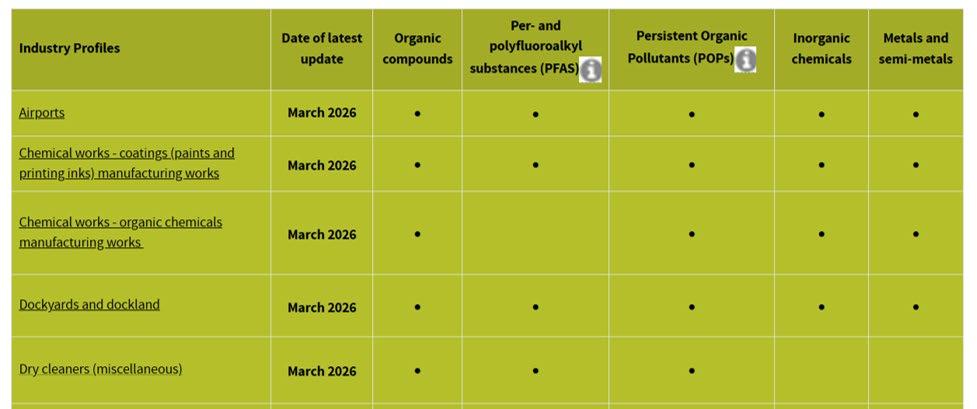
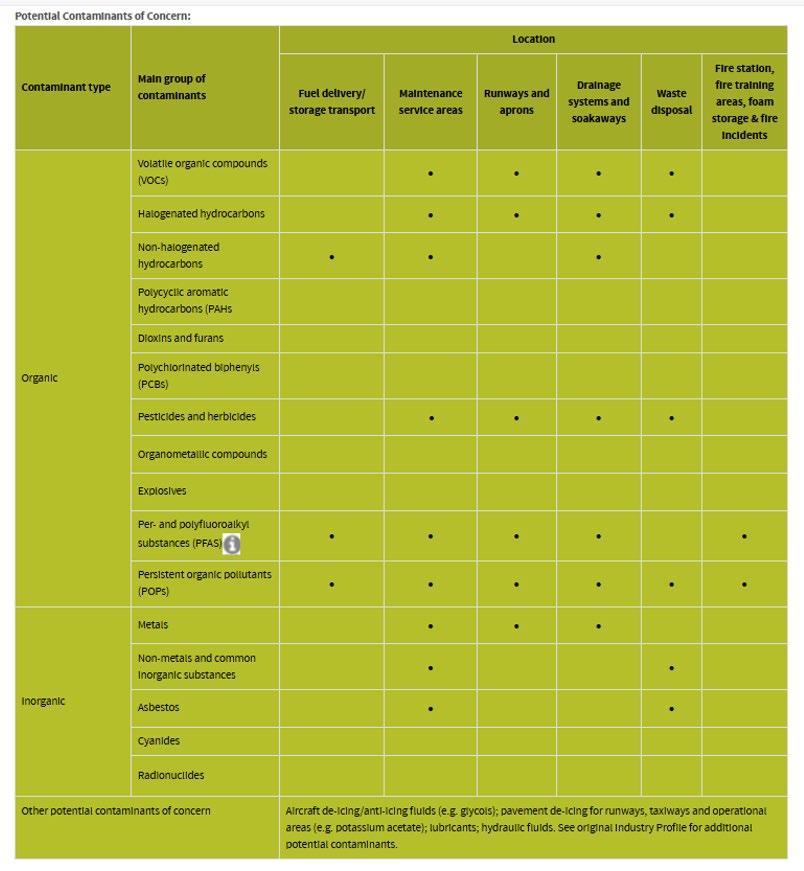
The industry profiles are presented at claire. co.uk/doe where there is an initial landing page that explains the project and gives a link to the overview table. Figure 1 provides a screenshot of part of this overview table. In the table, 15 industries have been listed alongside potential contaminants in generic groupings that may be associated with the different industries. As mentioned earlier, the aim
Figure 1: Screenshot of part of overview table.
was not to rewrite the original profiles, but to update them for contaminant groups such as per- and polyfluoroalkyl substances (PFAS) and persistent organic pollutants (POPs) and present the information in a more accessible way, via a simple interactive online matrix. Each industry profile is hyperlinked to a dedicated page giving a greater level of detail
about the background of the profile and associated potential processes and operations relevant to that profile. In the updated profiles this text is kept succinct with the emphasis on the potential contaminants of concern, along with likely locations of contamination (as shown in Figure 2). Table 1 explains some of the rationale behind the contaminant groupings and likely locations.
Figure 2: Screenshot of contaminant/location table for Airports profile.
Contaminant groupings
The potential contaminants of concern table is divided into (i) organic and inorganic contaminant types and (ii) into contaminant groups taken from the Environment Agency remediation options applicability matrix. It is recognised that there is overlap between some groupings (e.g. VOCs and halogenated/non-halogenated hydrocarbons; PFAS and POPs, and others).
The contaminant groups are the same for all profiles and a black dot is shown for contaminants in that group that might typically be associated with a specific industry. Other contaminant groups (and hence other contaminants) may be present at a particular site. Where there is a blank row (i.e. no black dot), these contaminant groups are not typically found on these sites. To help the user with their understanding, three examples from each contaminant group are provided in a separate table called Example Contaminants. Of course it is essential to consider other contaminants within those groupings.
At the bottom of some of the contaminant tables there is a row for “Other potential contaminants of concern”. This is where examples of contaminants not covered by the generic groups are listed and where readers are directed to the original profiles for a more extensive listing of individual chemicals that may be present. Again this list is not exhaustive.
Locations Most profiles contain several site locations where contaminants are typically found, marked by black dots. Where there is a blank row (i.e. no black dot), these contaminant groups are not typically found at these locations.
Where locations are common to most industrial sites they have not been included in the contaminant tables unless they are considered to have a close association with that site. Common locations and their main contaminant group include: fuel storage areas (non-halogenated hydrocarbons), electrical transformer areas (PCBs) and buildings/building fabric (asbestos).
Some profiles have just a single “site-wide” location (e.g. Waste recycling, treatment & disposal sites) and this reflects the information provided in the original profile and the fact that contaminants are likely to be widespread across these sites rather than in a particular location.
Review Process
CL:AIRE reached out to industry via its eAlert, Jiscmail and LinkedIn to seek individual reviewers or relevant organisations that would volunteer to review the profiles. The response was fantastic such that each profile was reviewed by two or three volunteers and then also by the CL:AIRE Technology and Research Group.
The main task of the reviewers related to the assignment of dots to potential contaminants of concern and their likely locations and
providing additional information sources. The potential contaminants of concern were cross-checked with the contaminant tables in CLR8 - Potential Contaminants for the Assessment of Land (Environment Agency, 2002) but these do not assign likely locations. There were also instances where the industry profile and CLR8 did not align and the reviewers were asked to comment on this and provide evidence to support their decision. The steering group were able to weigh up the evidence and have the final say.
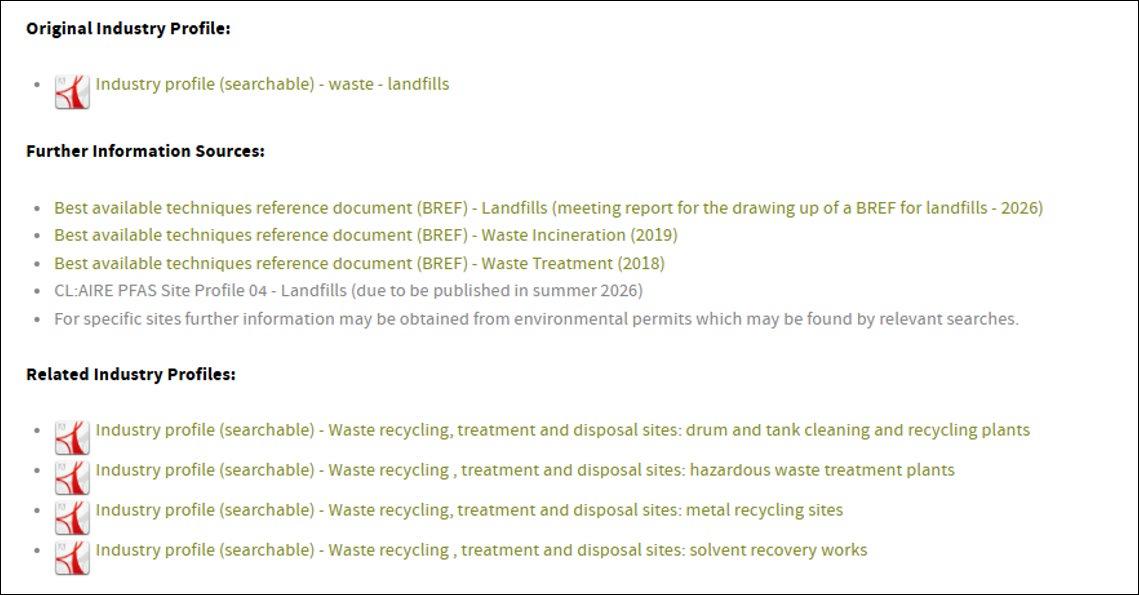
3:
of additional information sources for the Waste recycling, treatment and disposal sites: landfills and other waste treatment or waste disposal sites profile.
Additional sources of information on the potential contaminants associated with these industries were identified by the volunteers and have been listed with links provided where available. These include useful documents like the EC Best Available Techniques Reference Documents (BREFs) and new and forthcoming publications such as the PFAS site profiles. These resources were selected if they are freely accessible documents or webpages (i.e. not behind a paywall) or websites which have multiple free information sources. Links to related industry profiles are provided to either the web page if the profile is one of the 15 updated ones, or to a searchable PDF of the original industry profile. Figure 3 provides an example of the types of further information sources.
The industry review was a key part of the project. If the reviewer gave consent to be mentioned then they have been listed on the acknowledgements page.
Feedback and Next Steps
The industry profile project is a live project. General feedback on the information provided is welcome and there is a feedback form to capture comments. This also applies to technical feedback/input. Suggested changes to the assignment of black dots to contaminant groups/locations must be supported by a reference with the recognition that these are “typical” contaminant groups/locations that may not be applicable to all sites. Of course, please also share documents, webpages or websites which are free to access and contain information about contaminant sources and they can be added to this resource.
The next steps are to seek further funding to update the remaining 32 profiles and also to consider developing new profiles covering industries that have had contaminative processes on site that are not covered by current profiles.
As a final note the industry profile pages can be accessed at claire.co.uk/doe
Figure
Screenshot
Hazard Observations: Strengthening Safety Through Awareness and Action
contributed by Rachael Parry (Operations Support Manager at Geotechnical Engineering Limited)
Learning more about the situations which harm workers, through planned formal and informal hazard observation, can play a critical role in reducing and preventing workplace injuries and safeguarding lives.
Workplace incidents rarely occur without some kind of pre-warning, although these are often missed, misinterpreted or even just not considered as of importance or relevance. They are often the result of unsafe conditions, unsafe acts or omissions, hazardous and often
changing environments, human behaviours and factors, or overlooked hazards. Effective hazard observation interrupts this progression and can enable timely intervention before harm occurs.
The Value of Hazard Observations at Every Level
All hazard observations are important, regardless of whether they are proactive, reactive, or related to a near miss and each observation contributes to a broader understanding of workplace risk.
Historical research has long shown that serious injuries and fatalities are often preceded by a much larger number of minor incidents and near misses. Tackling these early warning
Article
signs is one of the most effective ways to prevent more severe outcomes. For this reason, reporting and acting on hazard observations should be strongly encouraged. A situation that resulted in a favourable outcome today may not do so next time, especially if the factors that prevented injury or loss are no longer present.
It is worth noting that some research suggests an over emphasis on minor observations can create a false sense of security, leading organisations to believe that low frequency, high severity incidents are less likely than they actually are. This makes it especially important to be organised and to ensure that hazard observations are of high quality and genuinely meaningful. (https://onepetro.org/SPEHSE/ proceedings-abstract/10HSE/10HSE/SPE126661-MS/106407)
of the most frequent significant accidents in the UK workplace based on accident statistics previously issued.
“ It is worth noting that some research suggests an over emphasis on minor observations can create a false sense of security...
H&S practitioners sometimes identify accidents/incidents arising from two sources (https://www.hse.gov.uk/ humanfactors/assets/ docs/core2.pdf):
Î Active failures: immediate actions or errors made by frontline staff, with consequences that appear straight away and can often be prevented through better design, training, or systems.
Î Latent conditions: “hidden” weaknesses within organisational culture and behaviours, management practices and arrangements, or system design. These may present themselves as:
› Poorly designed plant or equipment
› Weak communication
› Ineffective training
Common Hazards and the Consequences of Unresolved Issues
The HSE has grouped together the most common causes of serious injury at work, such as slips and trips or working at height (see table below, taken from https://www.hse.gov. uk/simple-health-safety/risk/commonworkplace-risks.htm#contentContainer), many of which are particularly relevant to the ground engineering industry (see bold text).
Note that the bold text are regularly the causes
› Lack of necessary resources
› Insufficient supervision
› Unclear roles or responsibilities
Underlying “latent” issues may go unnoticed until they combine in unexpected ways and contribute to human error or rule breaking. As everyone is capable of making mistakes, identifying and addressing both active and latent factors is essential for preventing incidents.
Immediate Causes and Contributing Factors
Below are common examples of immediate causes of accidents and their contributing factors:
Job related factors
Î Poorly designed equipment or instruments
Î Frequent interruptions or distractions
Î Missing, unclear, or confusing instructions
Î Equipment that is not properly maintained
Î Excessive workload
Î Noisy, uncomfortable, or unpleasant working conditions
Individual factors
Î Low skill levels or insufficient competence
Î Fatigue, boredom, or low morale
Î Complacency
Î Risk-taking behaviour or cutting corners
Î Personal or medical issues affecting performance
is essential for preventing similar events and establishing effective controls. This is the core purpose of any incident investigation.
Equally important, however, is the practice of identifying and reporting hazards before they lead to an incident. Proactive hazard observation plays a critical role in stopping unsafe conditions from escalating into actual harm. Hazard observation is a skill that improves with deliberate practice, particularly through regular field-based observation where risks are most visible and best understood.
Hazard Observations in Practice
“ Hazard observation is a skill that improves with deliberate practice, particularly through regular field-based observation where risks are most visible and best understood.
Organisational and management factors
Î Inadequate work planning that creates high pressure
Î Lack of effective safety systems or protective barriers
Î Poor follow up or weak responses to previous incidents
Î One-way communication from management
Î Unclear responsibilities or poor coordination
Î Weak health and safety management
Î A poor overall safety culture
Understanding both the immediate and underlying causes of an accident or near miss
Observations or hazards in practice can be undertaken in several ways, including:
Î Planned and structured observations, such as routine inspections and formal safety checks, but also supplemented by informal (albeit structured) observations by staff.
Î Day-to-day observations, where individuals take a moment to assess what they are being asked to do and identify potential risks before commencing work.
However, hazard observations are far more effective when they involve direct discussion with workers or colleagues about the task at hand. This is distinct from a pre task briefing and can be especially powerful for several reasons:
Î Workers can explain the real world challenges they face while carrying out the task
Î They often offer practical, experience based suggestions for completing the work more safely or efficiently Î These conversations support the legal duty to consult workers when developing safe
systems of work
Î Informal, face to face engagement demonstrates genuine interest from supervisors, managers, and leaders in workers’ wellbeing and perspectives, reinforcing that their insights can help improve safety for everyone
Reporting Systems and Organisational Processes
When carried out with the aim of understanding real hazards and the effectiveness of existing controls, a hazard observation can be formally recorded in a management system or similar platform. This creates valuable evidence of worker engagement and compliance, and it contributes to broader organisational learning and improved safety practice.
Employers and organisations benefit greatly from maintaining an accessible and straightforward hazard observation reporting process, which can be further
enhanced through tools such as smartphone applications. Keeping these records provides valuable insight into the real risks workers encounter in the field and enables the organisation to take meaningful action to address them.
Demonstrating consistent care for workers in this way, and being visibly committed to it as standard practice, creates a safer, more trusting environment for everyone. However, it is essential that hazard observations are not perceived by workers as attempts to “check up on” or “catch out” individuals. Without clear and genuine intentions, and without workers believing those intentions, that is exactly how such activities can be interpreted. This can seriously undermine trust between workers and employers and, in turn, weaken the overall quality of health and safety on a project.
Observers must therefore recognise this risk and plan their approach carefully: how they conduct the observation, how they hold the
discussion, and how they record the findings all matter. Many organisations choose not to formally report these interactions for this very reason, while others deliberately omit names or specific work locations.
The primary aim should always be organisational learning, not policing compliance.
A clear and well-communicated process can contribute to:
Î Workers having a voice in how the work is carried out
Î Observations being reviewed, investigated, and acted upon
Î Emerging trends and recurring issues being identified
Î Reduced risk while worker engagement and productivity can be enhanced
How to Observe during a Hazard Observation
Good hazard observation starts with planning, including:
Î Knowing what physical works and tasks are expected to be taking place
Î Understanding which equipment and personnel should be involved
Î Being aware of the controls that are expected to be in place to manage the preidentified hazards
Looking at the risk assessment and method statement beforehand is useful and important. On approaching the site/workplace, observe from a safe place and at a distance so you can see the wider aspects of the work being carried out. This will help you to understand:
Î Whether there are others doing different tasks close by
Î Whether the work environment looks as it was envisaged in the RAMS
Î Whether there are different environmental conditions potentially affecting the way we are working (weather, groundwater, livestock etc.)
This will then allow you to:
Î Take time to observe the people,
equipment, and work methods in use. Be methodical: work through each task, identify the associated hazards, and compare the controls in place with what you expected from your pre planning.
Î Consider whether the situation matches those expectations and whether the planned controls are genuinely effective in keeping workers safe. The aim is not to find non compliance, but to identify where controls may be insufficient.
Î Make notes for your own reference and for communicating findings later. Keep the details factual, specific to the task, and grounded in what you observed. This level of detail is far more valuable than broad or generic statements.
their work to support yours. Encourage them to contact you if they have further ideas, and provide your contact details
Î If, and only if, the task being carried out is unsafe (for example, if there is serious and imminent danger to health and safety), stop the task, explain why, and involve the appropriate project personnel to make the situation safe
“ Do not use a hazard observation exercise as an opportunity to enforce minor safety infringements.
Do not use a hazard observation exercise as an opportunity to enforce minor safety infringements. This time should be focused on learning from the task, from the environment, and especially from the workers themselves.
How to Record and Report a Hazard Observation
Ensure you speak with the worker at a time that is safe and convenient for them. During the conversation:
Î Explain who you are and the purpose of your visit or observation
Î Ask how the task is going, what has changed, what is proving difficult, and whether they have suggestions for making this task—or similar tasks—safer or more efficient
Î Ask what hazards they have encountered, including any that were unexpected
Î Check whether the controls in place are effective and practical, such as whether PPE is suitable and comfortable
Î Avoid arguing or justifying; focus on listening. Be human, show genuine care for them and for colleagues doing similar work
Î Invite them to share any additional information, concerns, or ideas they may have
Î Thank them for their time and for pausing
If it is agreed with the Employer that hazard observations will be documented, recording and reporting should follow a straightforward, preferably structured and repeatable process that captures all useful details, preferably linking to the Employer’s/contractor’s H&S information system. It might just involve a digital form, a smartphone application, or filling out a paper record.
Each observation should:
Î Include the date, time and location and describe the task and your observations, along with relevant environmental conditions.
Î Include photographs or videos to help provide clarity. Ensure these are permitted and agreed with the worker.
Î Keep the information factual, specific, and focused on behaviours, equipment and environmental factors.
Î Consider what the impact or consequence might be if the potential hazard is left
unaddressed, particularly where a different or new hazard has been observed (eg. a change in environmental conditions, weaker or uneven ground, a different piece of equipment being used which may have not been allowed for or are significantly different from the RAMS).
Î Be based on discussions with the worker and your own considerations, and include a suggested practicable control method where possible, even if it is only a temporary measure. It should be understood if escalation (including immediate) is necessary due to what you have observed or learned.
“ When carried out with the intent to learn and improve, hazard observation can play a significant role in reinforcing this commitment and strengthening the overall safety culture.
protecting people, learning from experience, and reinforcing a shared commitment to safety. When individuals are encouraged and supported to raise concerns without fear, safety becomes proactive rather than reactive.
A strong safety culture is built on shared responsibility. When everyone takes ownership of safety, trust grows, engagement improves, and people naturally look out for one another. For this to happen, managers and leaders must consistently demonstrate their commitment to workers’ safety. Workers need to see and believe that their wellbeing genuinely matters.
Hazard observation is not well suited in the event of an incident or near miss and certainly not immediately following one. In those cases, the incident must be reported and investigated in accordance with employer/site procedures, including immediately to the Site Manager or similar.
Recognising Positive Safety Behaviours
Hazard observation systems can also be an effective way to recognise and reinforce positive behaviours. Submitting positive observations allows organisations to acknowledge individuals who show outstanding commitment to health, safety, and wellbeing. In some workplaces, this recognition is further supported through formal health and safety awards or commendations and can help to strengthen overall culture and boost morale.
Creating a Culture of Accountability and Care
Documenting hazards is not about assigning blame or identifying fault. It is about
When carried out with the intent to learn and improve, hazard observation can play a significant role in reinforcing this commitment and strengthening the overall safety culture.
Driving Continuous Improvement
Hazard observations can support the ongoing development and refinement of safe systems of work. They enable organisations to:
Î Recognise positive behaviours and good practices
Î Verify compliance with Health and Safety Procedures
Î Improve Risk Assessments and Method Statements (RAMS)
Î Strengthen Standard Operating Procedures (SOPs)
Safety is not simply a compliance exercise, it is a mindset. Each observation represents an opportunity to learn, adapt, and improve.
Geotechnical training, whenever, wherever.
Save time. Cut costs. Train better.
Tailored geotechnical courses delivered on your schedule. Designed to keep your team sharp while minimizing downtime and expenses. Regular open courses delivered from our dedicated training facility, or bespoke courses delivered at your site or offices. Whenever, wherever - Equipe can fulfill your training needs.
Health and Safety Courses
Delivered in partnership with RPA Safety Services
IOSH Safe Supervision of Geotechnical Sites (3 Days)
Learn in detail how to keep yourself and your on-site operatives safe in the fieldthe geotechnical industry’s SSSTS equivalent
IOSH Avoiding Danger from Underground Services
In accordance with the requirements and guidance set out within HSG47
Safe Working on Geotechnical Sites
The ultimate one-day introduction to safety on geotechnical projects
Geotechnical
Courses
Prof. David Norbury’s Soil Description Workshop
Providing a detailed approach to soil description practices and techniques
Prof. David Norbury’s Rock Description Workshop
Providing a detailed approach to rock description practices and techniques
Prof. David Norbury’s Chalk Description Workshop
Providing a detailed approach to chalk description practices and techniques
Detailed overview of processes involved in efficiently scheduling Geotechnical Laboratory Testing
Mastering the AGS Data Format
Get to grips with common and complex data issues
Earthworks Design and Construction
Slope
Training Courses
Specialist Geotechnical Courses
Equipe Training's specialist geotechnical training courses are delivered both in person at our dedicated training facility just outside of Banbury, Oxfordshire, and also online via Zoom!
Available upcoming dates are provided below:
Î 27th August 2026 - Professor David Norbury’s Soil Description Workshop
Î 2nd September 2026 - Professor David Norbury’s Rock Description Workshop
Î 9th September 2026 - Foundation Design - Part 1 (Basic) (ONLINE)
Î 10th September 2026 - Earthworks Design & Construction (ONLINE)
Î 17th September 2026 - Mastering the AGS Data Format (ONLINE)
Î 8th October 2026 - Professor David Norbury’s Chalk Description Workshop
Î 26th November 2026 - Foundation Design - Part 2 (Further)
Î 3rd December 2026 - Slope Stability Design
Places on these courses can be booked online here, or via contacting Equipe on +44 (0)1295 670990 or info@equipegroup.com
Specialist Geotechnical Heath and Safety Courses
Equipe Training and their health and safety training partners RPA Safety Services and EB Safety
Solutions are delighted to announce their collection of specialist health and safety courses for the geotechnical market have resumed being delivered in person, as well as being delivered online where required.
These courses are approved and certified by the Institution of Occupational Safety and Health (IOSH) and meet the requirements of UK Health and Safety regulations for working on geotechnical and land drilling sites. Upcoming dates include:
Î 2nd September 2026 - Safe Working on Geotechnical Sites (ONLINE)
Î 3rd September 2026 - IOSH Avoiding Danger from Underground Services
Î 8th - 10th September 2026 - IOSH Safe Supervision of Geotechnical Sites
Î 16th September 2026 - Managing & working with Asbestos Risk in Ground Investigation
Places on these courses can be booked online here, or via contacting Equipe on +44 (0)1295 670990 or info@equipegroup.com
AGS Members all share a commitment to quality in the geotechnical and geoenvironmental industry. This has become widely recognised by clients, governmental bodies and other associations that touch issues to do with the ground.
We welcome both companies and individuals who want to be recognised for their quality of practice to join our growing membership of over 180 Members. We shape our industry, continually improve practice and collaborate on issues that affect us all; from clients, all the way through to the people who use the land and the buildings we help develop.
To become a Member of the AGS, please visit http://www.ags.org.uk/about/become-a-member and submit your application online. Please note that all membership applications are reviewed by the Membership Committee 6 weeks in advance of each quarterly Executive meeting. The deadline for the next round of completed applications is 6th August 2026.
How to become a Member of the AGS AGS Legal Helpline
As an AGS member, you have access to a free specialist legal helpline provided by AGS member Beale & Co, an internationally recognised construction and insurance law firm.
Whether you need summary legal advice, a second opinion, or a quick clarification on an issue, their lawyers are on hand to help. Each AGS member can receive 30 minutes of free, specialist guidance, giving you early direction and helping you stay on top of issues before they escalate.
Areas of Advice Include:
Î Appointments and collateral warranties
Î Non-payment or payment disputes
Î Issues arising on ongoing projects
Important Information
Î Health & safety matters
Î Regulatory matters
Î Commercial or contractual queries
Î The helpline does not include document reviews. If you require documents to be reviewed, your firm will need to formally instruct Beale & Co.
Î This service is available exclusively to AGS members.
Î Members are entitled to one helpline call per issue.
Î If you require assistance with document reviews or advice in writing, then this will be outside of the helpline. Beale & Co are happy to provide an estimate if such work is required.
Î Any issues which may lead to a claim against you should be discussed with your brokers first.
(Please quote ‘AGS Helpline’)
LEGAL HELPLINE
Beale & Co
Tel: +44 (0) 20 7469 0400 www.beale-law.com
Advertising and Rates
An online advertising campaign within the AGS Magazine will help to build and increase industry awareness of your company’s profile, initiatives and offerings.
The AGS can help build a package to suit your needs and budget; whether it’s a series of adverts across multiple issues, a combination of event sponsorship and advertising, or a single advertorial.
How to Advertise in the AGS Magazine
The AGS Magazine is a free email publication that looks at a range of topical issues, insights and concerns, whilst publishing new guidance notes, working group activities and information on upcoming industry seminars.
With 6 issues each year, our subscribers include industry professionals such as practitioners, chartered specialists, senior decision makers and managing directors
To receive a media pack or to discuss advertising rates, please contact Caroline Kratz on 0208 658 8212 or email ags@ags.org.uk
Advert Sizes and Rates
W: 210mm
H: 297mm
RATE: £424
W: 105mm
H: 145mm
RATE: £170
Company name, address, contact number, email and one logo.
RATE: £50
Advertising Requirements
All adverts should be sent in a PDF, PNG, JPEG, TIFF, PSD (Photoshop) or EPS (Illustrator) format.
All advertising artwork must be supplied in 114 dpi resolution.
Artwork must be delivered to the AGS using the agreed artwork specification size listed left.
Artwork should be emailed to ags@ags.org. uk no later than 10 days prior to publication.
Directory
ADVERTISE HERE FOR JUST £50
Member Reporting Service for Industry Issues
If you have any queries regarding AGS Data Format, there is a discussion forum on the AGS Data Format website, where queries can be posted and answered by the Data Format team.
If a Member has any issues with regard to Safety, Contaminated Land, Geotechnical, Instrumentation & Monitoring or Laboratories which you think the industry should be aware of please email ags@ags.org.uk, we will then forward your email to the relevant AGS Working Group.
Disclaimer
All articles in the AGS Magazine are the opinions of the authors and are not intended to be a complete or comprehensive statement of the law, nor do they constitute legal or specialist advice. They are intended only to highlight current issues from date of publication that may be of interest. Neither the writer(s), nor the AGS, assumes any responsibility for any loss that may arise from accessing, or reliance on the material and all liability is disclaimed accordingly. Professional advice should be taken before applying the content of the articles to particular circumstances.