January 2026
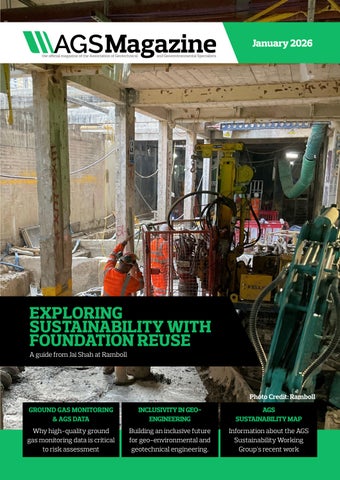
EXPLORING SUSTAINABILITY WITH FOUNDATION REUSE
A guide from Jai Shah at Ramboll
Photo Credit: Ramboll GROUND GAS MONITORING & AGS DATA
INCLUSIVITY IN GEOENGINEERING
AGS SUSTAINABILITY MAP
Why high-quality ground gas monitoring data is critical to risk assessment
Building an inclusive future for geo-environmental and geotechnical engineering.
Information about the AGS Sustainability Working Group's recent work
Chair’s Foreword Happy New Year, and welcome to the January edition of AGS Magazine. I hope you all had the opportunity to take a well earned break over the festive period and are feeling refreshed for the year ahead. I would also like to extend a warm welcome to all members who joined the AGS during 2025— we’re delighted to have you as part of our community. This issue features a collaborative article from the AGS Contaminated Land Working Group, AGS Data Management Working Group, and AGS Instrumentation & Monitoring Working Group, exploring the key requirements for robust ground gas monitoring and how to report acquired data in AGS format. It is both timely and practical, reminding us that data is not merely a technical output, but a responsibility: a commitment to clarity, comparability, and decisions we can stand behind. Sustainability remains a strong focus this month, with articles on Building a Sustainable Future with Foundation Reuse and A Greenprint for Change: The AGS Sustainability Route Map, both highlighting actionable pathways toward a more resilient, resource efficient industry. These pieces challenge us to look beyond compliance, and toward stewardship, designing not only for performance today, but for legacy tomorrow. Bradley Falcus reflects on the current standing of our industry and considers the AGS’s next steps in supporting a more inclusive and representative future for geotechnical and geoenvironmental practice. Inclusion is not ancillary to excellence; it is a source of insight and better judgement. When we widen the circle, we strengthen 2
Magazine
the profession. What we build is measured in metres and sites; what we leave behind is measured in trust. Our foundations are not just in the ground—they are in our values. We also have several upcoming events that I encourage you to attend: the Instrumentation and Monitoring – Data Driven Actions webinar on 19th February 2026, followed by the AGS Annual Conference at One Great George Street, London, on 19th March 2026. I hope to see many of you there. Finally, entries for the AGS Early Careers Poster Competition, focusing on the top five industry insights, remain open until 30th January 2026. Please do share this with your teams and networks— supporting early career voices is one of the most meaningful investments we can make. Thank you for your continued commitment to the AGS and to the communities we serve. Here’s to a year of thoughtful decisions, rigorous practice, and purposeful impact. We are always on the lookout for additional, informative content for the magazine, so if you have an opinion piece, a case study, a technical article or a wider issue that you think the geotechnical and geoenvironmental public would find beneficial, please do get in touch. We would be interested in your feedback on the magazine and our future plans. Please contact ags@ags.org.uk if you have any comments.
Alex Lee AGS Chair
ABOUT THE AGS The Association of Geotechnical and Geoenvironmental Specialists (AGS) is a not-for-profit trade association established to improve the profile and quality of geotechnical and geoenvironmental engineering. The membership comprises UK organisations and individuals having a common interest in the business of ground investigation, geotechnics, geoenvironmental engineering, engineering geology, geochemistry, hydrogeology, and other related disciplines. EDITORIAL BOARD Alex Lee, AGS Chair Caroline Kratz, Forum Court Associates (FCA) Katie Kennedy, FCA Julian Lovell, Equipe Group Calum Spires, Equipe Group Adam Latimer, Ian Farmer Associates Dimitris Xirouchakis, Structural Soils Caroline Martin, Haskoning Christos Botsialas, TRC Companies EDITORIAL STORY To submit an article for inclusion in the AGS Magazine, please contact the AGS on 020 8658 8212 or ags@ags.org.uk. Please note that articles should act as opinion pieces and not directly advertise a company. The AGS is under no obligation to feature articles or events received. CONTACT US Association of Geotechnical & Geoenvironmental Specialists Forum Court, The Alexander Centre, 15-17 Preston Street, Faversham, Kent, ME13 8NZ ags@ags.org.uk 020 8658 8212 Association of Geotechnical & Geoenvironmental Specialists www.ags.org.uk
Inside this month’s issue
FEATURE PAGE 18
COVER STORY PAGE 29 Jia Shah of Ramboll discusses building a Sustainable Future with Foundation Reuse
Ground Gas Monitoring and AGS Data Transfer Format Dr Petra Lincoln, Chris Swainston and Geraint Williams explain why high-quality ground gas monitoring data is critical to robust quantitative risk assessment, and how inconsistent data capture can undermine interpretation and mitigation decisions.
AGS CONFERENCE: EVENT PROGRAMME PAGE 8 An update on speakers and sessions at the AGS Conference 2026.
INCLUSIVITY IN GEO-ENGINEERING PAGE 26 Shaping tomorrow by building an inclusive future for geoenvironmental and geotechnical engineering.
INSIDE: SOILCLOUD PAGE 40 The AGS Magazine conducts a Q & A with Neil Chadwick, UK and Ireland Representative for SoilCloud.
MORE INSIDE PAGE 4
News in Short: Incl. Publication Updates
PAGE 38
AGS Sustainability Map A Greenprint for Change
PAGE 42
Standards Update December 2025
January 2026
3
News and Events Driving Long Distances to Site? Long journeys to and from site are not just tiring, they can create serious safety and compliance risks. The British Drilling Association (BDA) warns of this in their article “DRILLER or DRIVER? A Fine Line Crossed Too Often.” The article stresses that driving while fatigued is extremely dangerous and it is recommended a minimum of 11 hours rest before starting a shift. The BDA also highlights an important legal requirement: if you’re driving a vehicle and trailer capable of carrying goods with a combined Gross Vehicle Weight over 3.5 tonnes, and you operate more than 100 km from your base, a tachograph must be fitted and used.
New AGS Members in 2025 The AGS is pleased to announce that in 2025, 6 member organisations and 3 individual specialist members were accepted by the Membership Panel and approved by the Executive. The new member organisations are Endeavour Drilling Ltd, Geofem, A2 Site Investigation Limited, BakerHicks Ltd, Cathie
4
Magazine
It’s essential not only for employees to understand these rules, but for companies to ensure they are being followed. Employers should have clear policies, monitor journey planning and driving hours, and provide the necessary training and equipment to keep staff compliant. Good management isn’t just about meeting regulations; it’s about protecting the wellbeing of the workforce and the safety of everyone on the road. It is not only drivers that this applies to, but also commissioning / instructing organisations. They need to be aware of the limitations these laws place on crews, and also individuals, who drive long distances to site, in terms of driving time, shift durations and rest periods. These need to be built into the programming of activities and it be recognised that a full day shift on site cannot be achieved where the equivalent full day of driving is also required.
and VolkerRail. The new specialist members are Ian Williams, Rachel Monteith and Angus Wilson. AGS Membership is open to geotechnical and geoenvironmental companies who employ specialists who can provide competent services, affiliate companies who provide support services and supplies to the members and individual specialists. Full details of membership criteria can be found at http://www.ags.org.uk/about/become-amember/.
AG S E A R LY CA R E E R S 6 2 0 2 N IO IT T E P M O C R E T S O P S T H IG S IN Y R T S U D IN E IV F P O T
The AGS Early Careers Poster Competition is back for a third year and this time, we want to hear your top five takeaways since joining the geoscience industry. Whether you work on site, in the office or somewhere in between, we’d like you to design an eye-catching poster which showcases your top five industry insights that others should know about. These learnings could be focused on: Site-based experiences Safety challenges Office or project management know-how Lessons from training, meetings or mentoring Networking and industry engagement Unexpected discoveries Your poster should be bold and colourful and aim to inspire both industry professionals and those entering the industry. For full details and entry information visit: https://tinyurl.com/996b7avh
The winner will receive a £100 Amazon Vouche r, free entry to the AGS Annu al Conference on 19th March 2026 in London and have an interview regarding their winning entry published in AGS Magazine which reaches over 7,6 00 industry professionals six times a year. Ten runners up will win fre e entry into the Annual Conference. All posters submitted will be displayed at the Annual Conference.
To enter, email your A4 poster alongside your full name and company to ags@ags.org.uk before Friday 30th January.
January 2026
5
Ground Engineering for a Sustainable Future At CGL, we deliver innovative geotechnical and geoenvironmental solutions that help our clients build safely, sustainably, and with confidence.
From complex site investigations to cutting-edge design and remediation, our expert team thrives on solving challenging ground engineering problems. Join our team of ground engineering innovators Email us at hr@cgl-uk.com to find out more.
Geotechnical and Geoenvironmental Consultancy Site Investigations Temporary Works Design Digital Imagery Analysis
6
Magazine
www.cgl-uk.com 01483 310 600
News and Events
Join the AGS Safety Working Group – Shape the Future of Safety in Our Industry The AGS Safety Working Group is looking for new members, who are passionate about raising safety standards across the ground engineering sector. If you’ve ever wanted to help influence industry guidance, contribute to meaningful initiatives, or simply play a part in making our profession safer, now is the perfect time to get involved. The group meets four times a year, with one meeting currently held in person. Their work spans a wide range of important projects, including planning the AGS Safety Conference for 2027, producing industry-led guidance
documents, and contributing regular safety features to AGS Magazine. There is a sub-group currently looking at trial pitting. The Safety WG also analyse and share industry safety statistics to help members understand emerging risks and trends. With the group actively reviewing its strategic direction, fresh perspectives are especially welcome. This is an exciting time to help shape future priorities and influence how the AGS continues to support safer working practices across geotechnics, geoenvironmental engineering, and beyond. If you’re interested in contributing your experience, ideas, or enthusiasm, the AGS Safety Working Group would be delighted to hear from you. Email Katie at ags@ags.org.uk for more information. *Photo features the AGS Safety WG members at their last meeting in November 2025.
AGS Publication Updates The top three downloaded AGS publications in last month: 1. AGS Client Guide for Ground Investigation Activities – Trial Pitting 2. AGS Guidance on Waste Classification for Soils – A Practitioners Guide 3. AGS Guide: The Selection of Geotechnical Soil Laboratory Testing To download the publications for free; click here.
January 2026
7
News and Events
Our sell-out flagship event, the AGS Annual Conference, will return to One Great George Street in London’s Westminster on Thursday 19th March 2026.
Career Professionals which will be chaired by Professor Iain Stewart (Plymouth University), plus we’ll be showcasing all entries from our Early Careers poster competition.
Chaired by Alex Lee (AGS Chair and Partner at HKA), this full day, CPD event will feature a series of expert speakers from across the geotechnical and geoenvironmental sector, with an overarching theme of challenges in geosciences.
The event will conclude with a networking drinks and canapé reception in the Great Hall.
The conference will also include a panel discussion on the topic, The Future of Geoscience: Inspiring and Sustaining Early
8
Magazine
EVENT PROGRAMME Session 1: Chaired by Alex Lee, Partner at HKA and AGS Chair Opening Address Alex Lee, AGS Chair and Partner at HKA
Unforeseen Ground Conditions and Contracts Presented by Daniel Johnson, Senior Associate at HFW and Joanne Wilkins, Senior Associate at HFW BRE 365 Soakaway Testing: Should it be Undertaken in Geologies that Previous Testing has Shown to be Unsuitable for Soakaway/ Infiltration Drainage? Presented by Simon Ruddlesden, Director at Ruddlesden Geotechnical Session 2: Chaired by Lucy Bethall, Technical Director (Contaminated Land), Mott MacDonald and Deputy Chair of SiLC PTP Managing Pressurised Gases During Drilling Presented by Steve Wilson, Technical Director at EPG Carbon Calculators in Geoscience: The Challenges in Balancing Innovation, Investigation, and Cost in Sustainable Projects Presented by Sarah Cook, Director at Onyx Geo Consulting Session 3: Chaired by Julia Nicholson, Sales Manager at Bauer Equipment and Deputy Chair of FPS Safety, Plant and Operating Committee Panel Discussion: The Future of Geoscience: Inspiring and Sustaining Early Career Professionals Chaired by Dr Iain Stewart (Plymouth University). Guest panellists: Dr Nick Koor (Koor Associates), Dr Ian Carr (The College of Richard Collyer), Jenny Boland (Geological Society) Oliver Savill (AtkinsRéalis) and Hebah Abdel-Hady (Arcadis).
What is Different about ‘CDM Differently’? Presented by Tony Putsman, Director at Xenophon Project Services Session 4: Chaired by Laura Devoy, Contracts Manager, Scotland at Dunelm Geotechnical and Environmental and BDA Technical and Standards Sub-Committee Assessing and Improving Testing Uncertainty in Geotechnical Laboratories: The PICTS Scheme Presented by Neda Mokaram, Geotechnical Project Manager (Advanced and Research Laboratory) at Geolabs Instrumentation and Monitoring – The Carrot or the Stick? Presented by Tim Clegg, Managing Director at Geosense Closing Address Alex Lee, AGS Chair and Partner at HKA
REGISTRATION AGS Member companies, Affiliate Members and Honorary Members are entitled to a limited number of complimentary tickets, as part of their membership subscription. Additional tickets for the Annual Conference are priced at £135 for AGS Members, and £210 for NonMembers. Prices exclude VAT. For full ticket information including prices and how to register please click HERE.
SPONSORED BY
January 2026
9
News and Events Hydrogeologist, Stantec) then delivered an update on ELRG.
Session 2: Where Are We Going? After a short refreshment break, delegates reconvened for Session 2, which featured a series of forward-looking presentations, including:
The AGS Data Conference – Discuss, Engage, Evolve took place on 4 December 2025 at the Thinktank Science Museum in Birmingham, bringing together 140 delegates from across the industry. Chaired by Jackie Bland (Principal Ground Investigation Data Manager at Structural Soils & AGS Data Management Working Group Leader), the conference explored what’s working, what’s changing, and what lies ahead for the AGS Data Format through four dynamic and insightful sessions.
Session 1: What We Have Done The event opened with an address from Jackie Bland, followed by a presentation from Phil Child (Senior Technical Solutions Specialist, Seequent) on What Work Has Been Done to Date. Leon Warrington (Associate
10
Magazine
Î
AGS 4.2 – Conrad Stewart (Data Manager, Harrison Group Environmental) & David Farmer (Senior Geotechnical Engineer, Arup)
Î
In Situ Testing – Phil Wade (Managing Director, Datgel) & Romain Arnould (Solution Owner, Fugro)
Î
Advanced Geotechnical Laboratory Testing – Tom Smith (Senior Geotechnical Engineer, Ørsted) & Jonty White (Lead Geotechnical Engineer, Ørsted)
Î
AGSi – Neil Chadwick (Director, Digital Geotechnical) & Jerome Chamfray (Chief Geo-digital Engineer, Jacobs)
Î
AGS Piling – Melody Wareing (Technical Team Leader, SOCOTEC) & Jono Wright (Senior Engineering Manager, Strata Geotechnics)
Just before lunch, there was a heartfelt surprise for Jackie Bland, who has led the Data Management Working Group for more than
15 years. In recognition of her remarkable dedication and long-standing contribution to the group since 2010, Jackie was presented with flowers and a voucher by Mark Bevan and Steve Wathall, representing the AGS Data Management Working Group. The gesture marked the group’s deep appreciation for the time, expertise and commitment she has invested over the years.
Session 3: The Future Following lunch and networking opportunities, Session 3 examined the next steps for AGS Data, featuring presentations on the Aims of AGS 5, Packaging and Adoption of AGS Data & Dialogue with Different Countries. Speakers included Craig Brown (Principal Data Manager, BAM – Ground Engineering), Tony Daly (Managing Director, Amageo), Jonny Neville (Principal Design Manager, Mott MacDonald), Steve Walthall (Retired Engineering Geologist) and Edd Lewis (Data Standards Lead, British Geological Survey).
Session 4: Panel Discussion The day concluded with Session 4, featuring members of the AGS Data Management Working Group: Mark Bevan (Associate Director, Structural Soils), Vicky Corcoran (Principal Engineering Geologist, AtkinsRéalis), Craig Brown, Jackie Bland, Yiyan Liu (Geotechnical Data Manager, High Speed Two (HS2)), and Simon Miles (Chief Geotechnical Engineer, AtkinsRéalis), who chaired the discussion. Delegates then had further opportunity to network with the members of the AGS Data Management Working Group. Overall, the conference proved to be a highly successful and energising event, offering a valuable platform for industry professionals to exchange insights, strengthen connections, and contribute to the evolving future of AGS data. The AGS would like to take this opportunity to thank our speakers and sponsors including SoilCloud, SOCOTEC, Equipe Group, BAM Ritchies, Groundsure, Eijkelkamp Fraste UK, Seequent, Geolabs, and Landmark Geodata.
SPONSORED BY
January 2026
11
News and Events UK’s premier geotechnical conference returns in 2026 After sixteen successful editions, Equipe Group is preparing to deliver Geotechnica 2026, the UK’s definitive specialist conference and exhibition dedicated entirely to ground engineering. Geotechnica 2026 will take place on 8th & 9th July 2026 and will again return to the Warwickshire Event Centre, a venue which, according to the event’s Head Organiser, Calum Spires, reflects the philosophy of the event itself. Focused, practical and human in scale, since 2009, Geotechnica has been carefully curated to enable conversation, demonstration and learning rather than overwhelm. Calum explains: “Geotechnica is run by the industry, for the industry. It is organised by people who work within ground engineering day to day and understand the commercial, technical and cultural realities of the sector. The event is designed to celebrate the importance and success of ground engineering as a discipline in its own right.That is one of the reasons why we are always delighted to be supported in the endeavour by the Association of Geotechnical and Geoenvironmental Specialists. “This is an industry that deserves to be championed, not treated as a secondary consideration within the wider construction 12
Magazine
landscape. It deserves its own event, its own spotlight. "Geotechnica provides a dedicated environment for a specialist discipline, deliberately curated for those who design, procure, deliver and verify ground engineering works. “That focus is not an aesthetic choice. It is a performance choice.” In a market where scale is often mistaken for effectiveness, much like a specialist drilling contractor, Geotechnica is designed to do a specific job well. The event aims to help organisations communicate clearly, promote meaningfully, build relationships that last, and exchange knowledge that can be taken back to site or office and applied immediately. For 2026, the event will be delivered in partnership with a growing list of sponsors. Among those confirmed for 2026 are Platinum Sponsors, GEOLABS. Renowned within the industry for their high standards and expertise,
GEOLABS’ involvement reflects the growing importance of data quality, testing integrity and confidence in ground investigation outcomes. Their presence aligns with Geotechnica’s emphasis on technical credibility and practical relevance.
passionate about providing a space where practitioners can network, learn and see technological developments in context. No matter which part of the ground engineering sector you work in, Geotechnica aims to offer something of genuine value.”
Calum continues: “We value delivering this event alongside companies like GEOLABS because we recognise that they share our commitment to the sector. Geotechnica is deliberately focused on being the most effective event for the ground engineering community to meet under one roof, and that means having important voices like GEOLABS at the forefront.
The event will feature contractors, consultants, laboratories, suppliers and service providers from across the UK ground engineering sector. It continues to be supported by AGS and BDA, with 10% member discounts available on all sponsorship and exhibition packages.
“After 17 years, our role as organisers is about protecting that effectiveness. Our team works closely with trade associations such as the AGS and the British Drilling Association, which allows us to stay closely aligned with the issues that matter most to the industry. That ensures the conference programme remains relevant, practical and firmly grounded in real-world challenges.”
Attendance remains free for visitors, ensuring accessibility across roles and career stages. Exhibition space is limited by design, reinforcing the event’s focus on quality of engagement rather than volume of attendance. As a result, demand from organisations seeking meaningful visibility and return on investment is expected to be strong. Further information about Geotechnica 2026 is available at www.geotechnica.co.uk.
Geotechnica 2026 will feature a full indoor and outdoor exhibition supported by practical, applied engagement at the geotechnical conference. Equipment, services and technologies will be presented in context, supported by technical presentations and informal panel discussions. Julian Lovell, Managing Director of Equipe Group and head of the conference at Geotechnica 2026, adds: “Year after year, people tell us they choose Geotechnica because they want proper conversations. They want time with decisionmakers, meaningful demonstrations and discussions about real challenges with people who understand them. That environment does not happen by accident. It is designed, and it is why the event continues to deliver value. “As a former Chair of the AGS, I am particularly
January 2026
13
News and Events Save the Date: SiLC Annual Forum Date: Thursday 26th March 2026 Time: 9.30am – 1pm Format: Online Themes for 2026: Air, Land and Water This year’s forum will explore three core environmental themes, with each session featuring: Î
A practical case study
Î
Discussion of recent technical guidance and regulatory approaches
Î
A forward-looking perspective on innovation and emerging issues
Each theme will conclude by looking ahead to what’s next for the profession, alongside a dedicated panel discussion bringing together voices from consultancy, contracting and regulation.
REGISTRATION FEES (incl. VAT): £78 – Discounted rate for SiLC Members £36 – Retired SiLC Members £120 – Non-SiLCs £70 – Affiliate Schemes To register, click here.
14
Magazine
SPONSORSHIP Sponsoring this event is an excellent opportunity to promote your company to individuals and companies within the land conditioning sector. We have three sponsor packages available for companies wishing to have a presence: Sponsor headline is £650, Gold £550 and silver £450. For more details or register interest email Amy Hart Silc@silc.org.uk
Join SiLCs timely webinar on sustainable materials management in construction and land redevelopment as our experts Paul Nathanail, Mark field, Lucy Bethell, Emma Tattersdill and special guests discuss real world case studies, regulatory and policy frameworks governing excavated material management and so much more. When is a bucket excavator load of excavated material a product and when is it a waste?
remediation works. The decisions around reuse, recycling, disposal, recovery or extraction each carry technical, regulatory, cost and sustainability implications. In this webinar we’ll explore all these options, show you how to frame the decision making, and walk through what competence means in this area. Webinar highlights include: Î
The material may be in the wrong place or it may be wanted more somewhere else. The end result is the same – a hole at the point of origin and a location for using the bucket load.
Î
So why do we call one bucket load primary aggregate and the other “waste”?
Î
Would a circular approach require changes in primary legislation or better use of existing laws? Join us as we dig deeper into the regulatory quagmire of excavated material regulation and imagine a smarter future. In a world increasingly focused on circular economy principles, the fate of excavated materials is becoming a major concern. On Wednesday 28 January 2026, SiLC brings together industry experts for a webinar titled “Excavated Materials – reuse, recycle, recover, dispose or extract?”. If your role touches on land condition, remediation, brownfield development or remediation logistics, this is a session not to be missed.
Why attend? Excavated materials are a critical but often overlooked element in land condition and
Î
Î Î
Regulatory and policy frameworks governing excavated material management Technical characterisation and risk based decision making Circular economy considerations: reducing waste, maximising reuse and recycling Real world case studies of material reuse, recovery and extraction A strategic framework for selecting the optimal pathway for excavated materials Interactive Q&A – bring your questions!
Event details Î Î Î Î
Title: Excavated Materials – reuse, recycle, recover, dispose or extract? Date: Wednesday 28 January 2026 Cost: £45 inc VAT and £35 inc VAT for registered SiLCs. Please book through our website www.silc. org.uk/upcoming-webinars
SPONSORSHIP Sponsoring this event is an excellent opportunity to promote your company to individuals and companies within the land conditioning sector. We have three sponsor packages available for companies wishing to have a presence. Please contact Amy Hart on Silc@silc.org.uk
January 2026
15
AGS WEBINARS
Instrumentation and Monitoring – Data Driven Actions, is a two-hour webinar sponsored by BAM Ritchies, which is taking place between 11:00-13:00 on Thursday 19th February. Chaired by AGS Instrumentation and Monitoring Working Group Leader, Tim Clegg (Managing Director of Geosense), this webinar will provide a multi stakeholder perspective of how data is the key foundation for making decisions within the geotechnical industry. This virtual event will see presenters Phil Child (Seequent), Alice Shrubshall (BuroHappold) and Steve Walthall (Retired Engineering Geologist) each provide a presentation which will collectively focus on the following areas: Î
Setting yourself up for data success
Î
How to ensure useful and good quality data
Î
Monitoring in the real world
Î
Using data to make decisions
The webinar will finish with a group Q&A which will allow webinar attendees to ask questions from our four speakers. Attendees can expect to learn how to build solid data foundations, how to maintain these through the project and how this data is used in the real world to support bridging the gap
16
Magazine
NEWS, R E P L AY S & UPCOMING EVENTS
SPONSORED BY
between assumption and reality. This webinar is aimed at all levels from asset owner to data user, and will give practical steps on how to gather useful data to drive decision making.
PRESENTATIONS The AGS Guide to Planning Data Management for a Programme of Geotechnical Instrument and Monitoring Presentation by Phil Child, Senior Technical Solutions Specialist at Seequent Phil will provide an overview of the AGS Guide to Planning Data Management for a Programme of Geotechnical Instrument and Monitoring document. This will help identify key questions to apply to your projects to ensure success. We will also signpost useful resources allowing you to get started with applying the principles. Specification of an Effective Monitoring Scheme Presentation by Alice Shrubshall, Associate Director at Buro Happold
Photo credit: Simran Johal
The specification for instrumentation and monitoring is a critical document and care and consideration is required to prevent gaps and ensure the roles and responsibilities are appropriately assigned. This session will discuss a methodology for which in turn will obtain best value from the data obtained. Procuring Good Data Presentation by Tim Clegg, Managing Director of Geosense We understand what we want to know, we have our design. Its now time to ensure that we ask the right questions when procuring the monitoring to understand what we want to know. This part of the presentation will explore how to translate a monitoring plan into a procurement strategy to ensure the correct sensors are selected, the right partner is chosen, and the system overall delivers good actionable data. Looking at the end goal in mind, we will walk you through how spending the time effectively procuring your monitoring services before attending site is a great investment.
are a number of similarities which are common to each project and form the basis of implementing a successful operation. These include a clear and well defined objective, the selection of appropriate instruments and most importantly, a comprehensive management system to ensure that not only are the right observations made and validated but that they are evaluated and acted upon by the specialist within the team. These principals will be discussed with reference to a range of projects. Data Review from a Consultant’s Perspective Presentation by Alice Shrubshall, Associate Director at Buro Happold When presented with a large volume of data a structured approach is required to be able to interpret its implications. This can be adapted as the project progresses but a thorough review at the baseline stage is key and will be beneficial to all parties involved in the scheme.
TICKETS This webinar is free for Members to attend and £50 (ex VAT) for Non-Members. To register please CLICK HERE.
Real World Implementation Presentation by Steve Walthall, Retired Engineering Geologist Whilst every I&M project is different, there January 2026
17
Ground Gas Monitoring and AGS Data Transfer Format Article contributed by Dr Petra Lincoln, Chris Swainston, Geraint Williams
G
round gas monitoring and data assessment are often part of a site's generic quantitative risk assessment (GQRA), as outlined in the Land Contamination: Risk Management (LCRM, 2025) guidance. The aim of ground gas monitoring and assessment is to understand the risks posed by ground gas sources to relevant receptors and, if needed, to design measures to mitigate these risks. Capturing high-quality data during ground gas monitoring is therefore essential for a robust risk assessment. AGS data transfer format (further referred to as AGS data or AGS format) enables easy transfer
18
Magazine
of data between different parties involved in ground gas monitoring and subsequent interpretation of the data. However, this has not been applied in a consistent manner for ground gas monitoring data reporting. This can lead to inconsistencies in data provided by different parties and, in extreme cases, in important data being missed out from the overall dataset. This article has been written in collaboration between the AGS Contaminated Land Working Group (CLWG), the Data Management Working Group (DMWG) and the Instrumentation & Monitoring Working Group (I&MWG). The article provides an overview of key requirements for robust ground gas monitoring and how to report the acquired data in AGS format. This is to help practitioners involved in ground gas monitoring and risk assessment to gather and manage a good dataset.
Ground Gas Monitoring and Risk Assessment Process
Diagrammatical CSM may be useful to understand the interactions between different factors influencing pollutant linkages including those relating to ground gas. Ground model can be created for the site to aid the understanding and support the diagrammatical CSM.
LCRM guidance provides links to further, more detailed, guidance on assessing risk posed by ground gases and design of protective measures for buildings: Î
BS 8485: Code of practice for the design of protective measures for methane and carbon dioxide ground gases for new buildings
Î
BS 8576: Guidance on investigations for ground gas – permanent gases and volatile organic compounds (VOCs)
Î
CIRIA C665: Assessing risks posed by hazardous ground gases to buildings
Î
CIRIA C735: Good practice on the testing and verification of protection systems for buildings against hazardous ground gases
Further guidance on dealing with ground gas is available: Î
NHBC NF94: Hazardous ground gas – an essential guide for housebuilders
Î
CL:AIRE: Good Practice for Risk Assessment for Coal Mine Gas Emissions
Î
BS 10175: Investigation of potentially contaminated sites. Code of practice - Code of practice
It should be noted the list of guidance provided here is not exhaustive.
and pathways that can lead to the ground gas migrating to the relevant receptor (e.g. foundation piles for a house enabling migration of ground gas into the house). Ground gas monitoring is then typically scoped as part of ground investigation. CIRIA C665 (Section 2.6) provides a good overview of factors influencing the migration and behaviours of gases and vapours. These factors comprise of: Î
Driving force, i.e. the potential for gas to migrate from its source as impacted by pressure differential, diffusion along gas concentration gradients and flow within liquids (in dissolved form);
Î
Meteorological conditions: › Atmospheric pressure (at falling pressure increased emission rates occur); › Rainfall and frozen ground; › Temperature;
› Wind; The listed guidance and Î Vegetation; standards highlight the need Î Geology; The listed guidance for a conceptual site model (CSM) as a key element for and standards Î Anthropogenic influences; ground gas risk assessment, and highlight the need for a as it would be with any other Î Hydrogeology/tidal conceptual site model risk assessment for land effects. (CSM) as a key element contamination. An initial The purpose of the ground for ground gas risk CSM should be prepared as investigation and ground part of the desk-based risk assessment... gas monitoring is to capture assessment. This will inform the data describing the the assessor about the potential above factors. The assessor needs to be able to sources of ground gas (e.g. coal mines, landfills) explain why any potential changes to ground
“
January 2026
19
gas flows occur and how these fit into the CSM for the site. They should also confirm whether the expectation from the initial CSM holds and nothing unexpected is occurring, e.g. landfill is sealed, petrol station is regulated. CIRIA C665 (Section 5) provides more detail on monitoring methodology including recommended data collection, description of a typical monitoring round and suggestions for monitoring period duration and frequency of monitoring rounds. CIRIA C665 and BS 8485 note that “worstcase” scenario should be captured by the monitoring period. A typical ground gas risk assessment thus comprises datainformed updates to the CSM and worst-case scenario screening value. The gas screening value (GSV, litres of gas per hour) is based on the maximum borehole flow rate (l/hr) and maximum gas concentration (%). The assessment then allows for the selection of a Characteristic Situation and selection of protective measures for the building and/or remediation.
‘BS 8485 also advises that to adopt the worst case as a site characteristic GSV, the assessor should be confident that it is prudent and reasonable to do so and does not result in unnecessarily conservative protection of the development.’ (NHBC guidance) scope and specifications. The specification should clarify the scope for the provision of the AGS data. Data captured prior to monitoring and required for interpretation of monitoring data includes: Î
Location of the exploratory hole
Î
Geology encountered during ground investigation
Î
Installation details including top and base of the response zone and datum
Î
Equipment calibration details – included in the factual report together with the instrument serial number. (Note, these details currently cannot be transferred using the AGS data format).
The Data Collected ground gas monitoring data need to be of sufficient quality to enable subsequent risk assessment as described above.
“
Collected ground gas monitoring data need to be of sufficient quality to enable subsequent risk assessment as described above.
Ground gas monitoring can be undertaken manually in rounds as mentioned above or as a continuous process over longer periods. A monitoring round can be undertaken over multiple days, especially for larger sites with a significant number of wells to be monitored. Both continuous monitoring and manual ‘spot’ monitoring rounds can be reported in AGS data transfer format. The requirement to report data in AGS format should be added to the ground investigation
20
Magazine
Data captured during monitoring should include: Î Site name/reference Î Client Î Location of site/ monitoring wells Î Date/time of monitoring Î Monitoring personnel/ organisation Î Instrument type including
serial number Î
Atmospheric (barometric) pressure and trend
Î
Air temperature
Î
On-site weather (precipitation, wind speed etc.)
Î
Ground conditions/evidence of
Monitoring personnel details need to be captured as part of the monitoring process to ensure traceability and competency of person undertaking monitoring. However, this information is likely not to be passed outside of the monitoring organisation to ensure adherence to GDPR regulations. contamination (vegetations stress, visual contamination) Î
Any other relevant information such as borehole condition
Î
Ground gas flows and concentrations: › Monitoring point reference (ensuring this can refer back to the exploratory hole location and its installation) › Flow (l/hr) › Differential pressure (Pa) › Concentrations of relevant specified gases as identified in the CSM.
Î
Groundwater monitoring data:
AOD) › Depth to base of the well (m bgl and/or m AOD) CIRIA C665 provides a proforma for capturing the data on site in Appendix A3, capturing only peak and steady concentrations for the monitored gases. However, we would recommend that raw monitoring data is captured at ‘reasonable’ intervals until equilibrium is achieved (for manual ‘spot’ monitoring). This provides the assessor with additional information about the gas flows rather than just peak/minimum and steady concentrations. How equilibrium is defined depends on sitespecific circumstances but generally two consecutive readings after at least 3 minutes with all parameters within 0.1, 1 or 10% (as appropriate) is, in our experience, usually a good and justifiable rule of thumb. This also means the monitoring team does not have to spend unnecessary amounts of time at every location recording and the process is much more efficient and sustainable.
› Depth to groundwater (m bgl and/or m
January 2026
21
Geotechnical training, whenever, wherever. Save time. Cut costs. Train better. Tailored geotechnical courses delivered on your schedule. Designed to keep your team sharp while minimizing downtime and expenses. Regular open courses delivered from our dedicated training facility, or bespoke courses delivered at your site or offices. Whenever, wherever - Equipe can fulfill your training needs. Health and Safety Courses
Delivered in partnership with RPA Safety Services
IOSH Safe Supervision of Geotechnical Sites (3 Days) Learn in detail how to keep yourself and your on-site operatives safe in the field the geotechnical industry’s SSSTS equivalent IOSH Avoiding Danger from Underground Services In accordance with the requirements and guidance set out within HSG47 Safe Working on Geotechnical Sites The ultimate one-day introduction to safety on geotechnical projects Other Health and Safety Courses
Delivered in partnership with EB Safety Solutions
MARGI - Managing & working with Asbestos Risk in Ground Investigation A comprehensive guidance to deal with asbestos in a ground engineering environment, including full adherence to CAR 2012
See our full course listings and book your training today. www.equipegroup.com 22
Magazine
Geotechnical Courses Prof. David Norbury’s Soil Description Workshop Providing a detailed approach to soil description practices and techniques Prof. David Norbury’s Rock Description Workshop Providing a detailed approach to rock description practices and techniques Prof. David Norbury’s Chalk Description Workshop Providing a detailed approach to chalk description practices and techniques Understanding & Scheduling Geotechnical Laboratory Tests Detailed overview of processes involved in efficiently scheduling Geotechnical Laboratory Testing Mastering the AGS Data Format Get to grips with common and complex data issues Online and In-Classroom Geotechnical Courses
Delivered in partnership with Plough Geotechnical
Foundation Design - Part 1 (Basic) Shallow foundation overview for geotechnical practitioners and engineers Foundation Design - Part 2 (Further) Complex & deep pile foundations for geotechnical practitioners and engineers Earthworks Design and Construction A general overview of materials sourcing / selection for design & construction Slope Stability Design Comprehensive overview for geotechnical practitioners and engineers
Typical Ground Gas Monitoring AGS Data Issues Ground gas monitoring data reported in AGS data format often only includes the peak (minimum for oxygen) and steady readings. This means that some form of interpretation has already been undertaken by the organisation responsible for the monitoring, often a contractor involved in ground investigation for the site. This then limits the assessor in their interpretation of the data. Full factual data as captured during the monitoring should therefore be reported in AGS data as well. Currently, ground gas monitoring data provided in AGS format also often excludes details on monitoring locations that have been missed for any reason; for example the contractor could not locate the well, open the tap and so on. All this information should be captured and provided as part of the AGS dataset.
AGS Data Structure There are four main AGS data groups which contain information relevant to monitoring and three additional groups that may contain data that can support interpretation: Î
LOCA (Location Details) contains exploratory hole name, hole type and coordinates
Î
MONG (Monitoring Installations and Instruments) providing details of the installation including the depth of response zone
Î
contains geological descriptions associated with depth below ground level and can contain interpretation of the descriptions in the form of geology codes Î
DETL (Stratum Detailed Descriptions) provides detailed observations made within the particular stratum which appear on logs in the form of comments within the geological description.
The above groups in the AGS data format are linked The above groups in via shared key fields. All parties must ensure that the AGS data format are linked via shared key they use exactly the same (capitalisation, spelling, fields. MOND (Monitoring decimal places etc.) key Readings) contains all field data relating to the records of the monitoring results – locations of the monitoring points (LOCA_ID, (gas concentrations and groundwater MONG_DIS, MONG_ID). monitoring results), each reading is Example ground gas monitoring data captured represented in a new row of data in Excel and AGS data format are attached
“
Î
TREM (Time Related Remarks) was originally intended for observations during ground investigation but can be used to record weather observations and ground conditions during monitoring
to the article and can be used as a template for creating other monitoring data. Ground investigation data such as encountered geology within the exploratory hole are not part of this article.
Î
PIPE (Monitoring Installation Pipe Work) provides details for calculating the well volumes
According to CIRIA C665, the presentation of ground gas monitoring data should include as a minimum:
Î
GEOL (Field Geological Descriptions)
Î
A site plan with monitoring locations;
January 2026
23
Î
Raw data captured; and
Î
Summarised data.
assessment often including gas monitoring is required.
Î The collection of high-quality data is an Site boundary and other spatial data related to essential part of good interpretation of the site can be stored in geospatial (GIS) data risks posed by ground gases. formats such as geopackages. Further details Î Ground gas data from both on geospatial data are not manual ‘spot’ monitoring part of this article. Recording Good quality data rounds and continuous the data in AGS format is essential for monitoring can be provided enables easier/automated accurate interpretation in AGS format. data manipulation and of risks posed by ground presentation for reporting. Î Full datasets should be
“
gases. AGS data transfer format provides defined structure for consistent reporting of ground gas monitoring data.
Conclusion
Good quality data is essential for accurate interpretation of risks posed by ground gases. AGS data transfer format provides defined structure for consistent reporting of ground gas monitoring data. The key conclusions and recommendations from this article are: Î
captured in AGS format for gas monitoring; not just peak or steady state concentrations and flow rates.
The authors would like to thank the following for their contribution to the article: Melody Wareing, Neil Chadwick, Phil Child, Leon Warrington, Antony Phin, Chris Hughes and Jonathan Gammon.
For sites where a plausible risk from ground gas has been identified in the initial conceptual site model, a ground gas risk
AGS Data Format Tips Use the MONG group (Monitoring Installations and Instruments) to understand the details about the installation: Î MONG_ID and MONG_DIS are used to differentiate multiple installations within the same well Provide enough details in the MOND group (Monitoring Readings): Î Use MOND_REF (Monitoring Reference) to indicate the monitoring round Î Record < LOD instrument value in MOND_RDNG for readings below detection (e.g. < 1) and ‘dry’ for dry monitoring well Î Record all missed readings leaving the MOND_RDNG (Reading) empty and writing the reason for missed reading in MOND_REM (Remarks) Record weather and ground conditions in the TREM group. Check out the AGS website for all relevant abbreviations. Collect/collate the data only once: Use specialist mobile apps for capturing data on location rather than recording data in a spreadsheet/notebook and then typing into AGS.
24
Magazine
January 2026
25
Shaping Tomorrow: Building an Inclusive Future for Geotechnical and Geoenvironmental Engineering Article contributed by Bradley Falcus (Principal Administrator, Central Alliance Pre Construction Services)
E 26
ngineering has always been a cornerstone of progress, shaping the infrastructure and systems that
Magazine
underpin modern life. Yet, for all its innovation, the sector has historically lagged in embracing equality, diversity, and inclusion (EDI). While strides have been made across the broader engineering and built environment industries, geotechnical and geoenvironmental engineering remain among the least diverse disciplines. This article serves as an opportunity to highlight the current standing
opportunities because of their sustainability focus, which attracts climate-conscious graduates. However, retention remains a For decades, engineering was synonymous challenge, as many leave due to cultural with male-dominated workplaces. Women barriers and lack of career progression. The entered the profession during wartime out truth of the matter is that there is limited data of necessity, only to see their participation available for the geotechnical decline in peacetime. and geoenvironmental sector, Today, the picture People of colour, ethnic we have a gap in data for minorities and individuals is mixed. Across UK the industry which makes with disabilities faced even engineering, women it difficult to benchmark greater barriers, often represent approximately against other engineering excluded from education and practices. 16 percent of the employment opportunities. The geotechnical and workforce, according Geotechnical engineering geoenvironmental and geoenvironmental to EngineeringUK. In engineering disciplines science, which emerged geotechnical roles, are central to solving as specialist fields in the estimates are closer to some of society’s most mid-20th century, inherited 10–12 percent, with even pressing challenges, from these exclusionary norms. stabilising infrastructure lower representation in Site-based work, often in remote or harsh conditions, site-based positions. in flood-prone areas to remediating contaminated reinforced a culture that was land and designing climatedifficult for women and minority resilient foundations. Diverse teams bring groups to penetrate. Legislative milestones fresh perspectives to these complex problems, such as the UK Equality Act and diversity fostering innovation and resilience. Beyond targets introduced by professional bodies like innovation, there is a strong business case. the Institution of Civil Engineers (ICE) and the Inclusive firms outperform their peers in Geological Society marked turning points, but safety, stakeholder trust, and talent retention. cultural change has been slow. In a sector where projects often impact Today, the picture is mixed. Across UK vulnerable communities, diversity is not just engineering, women represent approximately a moral imperative; it is essential for equitable 16 percent of the workforce, according outcomes. to EngineeringUK. In geotechnical roles, Despite the benefits that a diverse workforce estimates are closer to 10–12 percent, offers, significant blockers remain. Physical with even lower representation in sitedemands and site culture are among the based positions. Ethnic minorities and most cited challenges. Harsh conditions, disabled engineers remain significantly long travel times, and inflexible schedules underrepresented. By comparison, civil deter individuals and those with caring engineering has achieved slightly better responsibilities. The pipeline problem gender diversity, partly due to broader project persists, with few students specialising roles that allow for office-based flexibility. in geotechnical engineering compared to Digital engineering and technology-driven structural or environmental disciplines. sectors lead the way, benefiting from Perception plays a role too: these fields are remote work models that make inclusion often seen as “traditional” and less techeasier. Geoenvironmental roles offer unique of our industry and consider the AGS’s next steps to supporting a more inclusive future.
“
January 2026
27
driven, limiting their appeal to younger, diverse talent. Practical issues such as inadequate site facilities and poorly fitting personal protective equipment (PPE) compound the problem. Unconscious bias in recruitment and promotion continues to favour familiar profiles, perpetuating a cycle of exclusion. The gender pay gap still exists.
in organisational culture rather than treated as a box-ticking exercise. Throughout 2026 and into the future, the AGS and partners across and outside of the industry will take a closer look at these benefits and challenges, mapping the path toward a more inclusive sector with hopefully, key points for you to consider and put into action. We will target our industry to shine a spotlight on good practice and highlight key gaps in our progression. If you have a story or insight to share, we’d love to hear from you, please contact the AGS and let us know.
To accelerate progress, the sector must adopt a multi-faceted approach. Inclusive site practices, such as gender-inclusive facilities and PPE designed for all body types, are essential. Flexible work models, leveraging digital To accelerate geotechnics and hybrid The future holds promise. progress, the sector site visits, can make Sustainability can serve as must adopt a multiroles more accessible. a magnet for diverse talent, Mentorship programs and faceted approach. positioning geoscience visible role models are roles as careers for those Inclusive site practices, critical for inspiring the such as gender-inclusive passionate about climate next generation. Education action. Advancements facilities and PPE outreach must start early, in technology opens designed for all body with diverse ambassadors avenues for a more promoting these disciplines types, are essential. inclusive environment. in schools and universities. The Global collaboration will be correct financial reimbursement key, as sharing best practices across regions for the roles people undertake making our accelerates progress. Lessons from the wider jobs more competitive and appealing. Finally, engineering and built environment sectors leadership accountability is non-negotiable. show that change is possible with commitment Diversity targets should be tied to performance and creativity. The challenge now is to turn metrics, ensuring that inclusion is embedded good intentions into lasting impact.
“
28
Magazine
Building a Sustainable Future with Foundation Reuse Article contributed by Jai Shah MEng CEng MICE (Associate, Ramboll)
T
he construction sector is under unprecedented pressure to slash embodied carbon, reduce waste, and deliver projects faster and more economically. One of the most powerful yet still underused levers is the strategic reuse of existing foundations - both shallow pads and deep piles on redevelopment sites. Instead of treating substructures as single-use consumables,
the industry can treat them as long-term underground “assets” capable of supporting multiple building lifecycles. This mindset shift aligns perfectly with circular-economy principles and is rapidly gaining traction with forward-thinking, sustainability conscious clients, planners, and insurers supported by the increasingly innovative construction sector. Foundation reuse is not a new concept; architects in London were already reoccupying medieval masonry footings after the Great Fire of 1666. What is new
January 2026
29
Foundation intervention methods Photo credit: Ramboll
reuse. [It is essential to assess foundation is the combination of modern investigative technologies; high-resolution cone penetration reuse within the broader context of the entire project, as in less favourable circumstances, testing (CPT), low-strain integrity testing, reusing existing foundations may introduce and distributed fibre-optic monitoring, constraints that could actually lead alongside digital twins to increased carbon emissions that capture historic The ability to elsewhere in the development]. performance data. These unlock these gains tools give engineers The ability to unlock these the confidence to still hinges on early gains still hinges on early quantify residual engagement of geoengagement of geocapacity, model future professionals. Too often, professionals. Too loading scenarios, and decisions about demolition often, decisions about demonstrate compliance and piling are made before demolition and piling with contemporary a geotechnical engineer is codes and performance are made before a invited to the table, resulting in targets. The 2020 unnecessary carbon, cost, and geotechnical engineer IStructE short guide risk. Conversely, projects that is invited to the table, and the ongoing RuFUS resulting in unnecessary embed ground specialists from (Reuse of Foundations RIBA Stage 0 routinely discover carbon, cost, and risk. programme savings of several for Urban Sites) research show that with robust months, substantial reductions desk studies, targeted in embodied carbon, and enhanced lifecycle intrusive checks, and clever load-path design, resilience. An evidence-based decision most urban sites in the right circumstances hierarchy (including no build options) i.e. reuse, can achieve partial or complete foundation augment, replace, mirrors the waste-reduction
“
30
Magazine
learned, we aim to equip readers with a practical playbook for turning foundation reuse from an exception into standard practice. The prize is compelling: quieter, cleaner construction sites; less congested ground for future generations; and significant cost savings without compromising safety or performance. In short, foundation reuse can, and should, become one of the cornerstones of a genuinely sustainable built environment.
The Benefits of Foundation Reuse 1. Î
pyramid and provides a clear roadmap for clients.
Environmental dividends Carbon and embodied energy: Reusing existing piles or pads eliminates the need for new concrete and steel, slashing embodied energy and CO₂. The RuFUS handbook quantifies reductions in fuel use, plant hours, and concrete volumes when piles are retained instead of replaced, directly lowering whole-life embodied energy and carbon [RuFUS,2006].
This article explores four key dimensions of foundation reuse. First, the tangible benefits Î Noise, dust, and air-quality gains: Fewer - environmental, financial, and programmepiling rigs and spoil wagons translate into related, available for tangible improvements for both shallow and deep neighbouring communities By sharing foundations. Second, - an increasingly important research, project the alignment of reuse factor under urban data, and lessons strategies with the UN planning frameworks. In learned, we aim to equip addition this translates to Sustainable Development Goals (SDGs) and the readers with a practical less waste including spoil/ UK’s PAS 2080 standard arisings to landfill. playbook for turning for carbon management foundation reuse from an Î Ground congestion: Every in infrastructure. Third, exception into standard new pile you don’t install common pitfalls if keeps the subsurface practice. geotechnical engineers clear for future utilities, are not engaged early. Finally, basements, and transport we dedicate a discussion to best-practice corridors, enhancing long-term urban guidance on insurance and warranty resilience [RuFUS,2006]. frameworks (and a brief insight to the Building 2. Programme acceleration Safety Act influence) which is an area that often makes or breaks Client appetite and Î Demolition phase: Avoiding foundation board-level confidence. removal and demolition shortens enabling works. By sharing research, project data, and lessons
“
January 2026
31
Pile verification testing Photo credit: Ramboll
Î
Construction phase: Re-use can shave weeks or months off the critical path; fewer rigs and less reinforcement curing time speed up superstructure hand-over.
Î
Earlier revenue: For developers, reduced programme often outweighs pure construction cost savings when net present value is considered.
3. Î
presented in RuFUS showed investment costs dropping from £3.61 million for complete replacement to £2.38 million for full reuse with limited investigation -a 34 % saving [RuFUS,2006]. Recent developments post 2020 such as City Hall Retrofit and adaptive reuse of commercial buildings tend to show substructure capex savings in the order of 40 – 70% compared to full replacement.
Direct cost savings Substructure capex: A 2004 case study
32
Magazine
Î
Reduced muck-away and raw-material
procurement create additional OPEX benefits that persist over multiple building life-cycles. A particular advantage where potentially contaminated spoil needs to be disposed of. 4. Î
Î
Risk management through data Real-time monitoring and load-testing provide empirical confirmation of capacity. Embedding fibre-optic sensors during the initial build adds negligible cost yet provides decades of structural health data, de-risking future reuse scenarios. Redundancy and flexible pile-group layouts create built-in contingency, allowing capacity downgrades or local strengthening instead of wholesale replacement [RuFUS,2006].
Î
Increased data availability through modern data storage and retrieval backed by industry initiatives/requirements such as the CDM Regulations.
Î
Increased availability of investigation techniques for validation/testing.
5. Social licence to operate Î
6. Î
Low-impact methods resonate with neighbouring occupiers, local authorities, and ESG-driven investors. Reusable foundations can become a visible sustainability “badge” in corporate reporting and planning submissions. Long-term asset value
While benefits are abundant, success hinges on robust investigation, detailed foundation assessment backed by engineering judgement where appropriate, and transparent stakeholder communication. These themes feed directly into insurance and warranty discussions explored later.
Linking Foundation Reuse to the UN SDGs and PAS 2080 The United Nations Sustainable Development Goals (SDGs) provide a universal blueprint for prosperity that respects planetary boundaries. Foundation reuse is a concrete way (quite literally) for the built-environment sector to operationalise several SDGs. 1. SDG 11 (Sustainable Cities & Communities): Reusing foundations minimises construction disruption, preserves groundspace for future infrastructure, and accelerates urban regeneration, directly improving liveability.
2. SDG 12 (Responsible Consumption & Production): By extending asset life and adopting a circularWhile benefits economy approach, reuse are abundant, slashes virgin-material success hinges on demand and associated waste. robust investigation,
“
detailed foundation assessment backed by engineering judgement where appropriate, and transparent stakeholder communication
An adaptable underground platform can host multiple generations of superstructures, providing developers with optionality akin to a brownfield land-bank. This enhances the exit value of real-estate portfolios, a point increasingly recognised by institutional investors.
3. SDG 13 (Climate Action): Embodied carbon reductions from avoiding new piling align squarely with climate-mitigation targets. RuFUS data indicate substantial CO₂ savings when partial or total reuse is adopted
[RuFUS, 2006]. 4. SDG 9 (Industry, Innovation & Infrastructure): Employing state-of-theart testing and monitoring technologies to validate residual capacity exemplifies innovation in resilient infrastructure.
January 2026
33
Fibre-optic pile sensors Photo credit: Ramboll
PAS 2080, the world’s first specification for carbon management in infrastructure, offers a practical framework for turning SDG aspirations into trackable project outcomes. Key PAS 2080 principles echo foundationreuse practice:
14040 series, can be combined with PAS 2080’s “baselining” requirement to produce clear carbon dashboards for clients and regulators. Those dashboards in turn underpin robust ESG reporting and can unlock green-financing incentives.
1. Carbon hierarchy - “Build nothing, build less, build clever”: Reusing foundations simultaneously addresses “build nothing” and “build less.”
Policy momentum is accelerating. The UK’s Net Zero Strategy, forthcoming EU taxonomy rules, and many city-level embodied-carbon caps are converging on the need to re-think substructure design life. Specifying 100-year pile lifetimes and designing in redundancy/ flexibility enables multiple building cycles without additional piles; this is an approach highlighted in RuFUS as “platform” thinking [RuFUS, 2006].
2. Whole-life thinking: PAS 2080 stresses lifecycle carbon and cost; foundation reuse embeds residual capacity for future adaption, satisfying both. 3. Collaborative value chain: Early involvement of designers, contractors, and insurers is essential to quantify and share carbon benefits; this is exactly the collaboration required for successful reuse. 4. Continuous improvement: Data gathered from monitoring reused foundations feed back into better-calibrated design models, reducing uncertainty and driving future carbon reductions. Quantification remains vital. Lifecycle Assessment (LCA) consistent with EN ISO
34
Magazine
In essence, foundation reuse is a ready-made vehicle for delivering measurable progress towards SDGs while ticking every PAS 2080 box: lower embodied carbon, reduced capital cost, improved programme, and enhanced asset adaptability. The challenge is not technical feasibility; it is mainstream adoption driven by informed geotechnical leadership, including educating the property owners to curate and retain full substructure as-built and design records even after insurance retention
jurisdictions (e.g., France, Qatar), mandatory 10-year coverage can also apply to reused foundations, but only if risk is transparently mitigated and documented.
periods.
Best Practice for Insurance and Warranty in Foundation Reuse
Î Project-specific Professional Indemnity Insurance and warranty considerations often (PI) top-up: Where reuse represents a novel determine whether a client embraces or risk profile, consultants may ring-fence rejects foundation reuse. Perceived risk rather additional PI limits for foundation than technical reality can design and certification. derail reuse proposals both 3. Navigating the early and more critically Insurance Building Safety Act (BSA) late in the design phase. and warranty 2022 Geo-consultants therefore considerations often need a clear playbook to Î The BSA reshapes determine whether help clients, brokers, and liability in foundation underwriters navigate a client embraces or reuse by extending duty latent-defect exposure. rejects foundation reuse. holder responsibilities Influence of the Building and broadening the scope Safety Act also need to be of potential claims. On considered for foundation reuse. the positive side, the Act encourages
“
1.
Understand the insurer’s worldview
Î
Underwriters focus on “known unknowns.” Existing piles may hide corrosion, concrete degradation, or undocumented workmanship defects. A structured investigation hierarchy i.e. desk study, non-invasive testing, selective coring, translates these unknowns into quantified probabilities, a prerequisite for any specialist policy.
Î
Demonstrate redundancy: RuFUS highlights that multiple piles under a cap significantly reduce failure probability compared with single large piles [RuFUS, 2006]. Designing or demonstrating redundancy can lower premiums.
2.
Select the right cover
Î
Latent Defects Insurance (LDI): Common in the UK, providing 10–12-year cover for structural elements. LDI can be extended to existing foundations if supported by a condition survey and certification by a suitably qualified engineer.
Î
Decennial insurance: In civil-law
more rigorous due diligence, which can strengthen confidence in reuse strategies and support sustainability goals. By requiring clearer accountability and longer limitation periods, it incentivises thorough geotechnical assessment and documentation, helping insurers and warranty providers to price risk more accurately and potentially reducing disputes down the line. With robust geotechnical assessments and clear documentation, reuse can reduce embodied carbon, accelerate programmes, and deliver cost efficiencies. Î
However, there are challenges… extended liability windows up to 15 years prospectively and 30 years retrospectively (for buildings completed before June 2022) mean that foundation reuse decision carry long-term exposure. Building Liability Orders (BLO’s) allow courts to extend liability to associated companies if the original company becomes insolvent. The longer limitation periods and broader liability provisions encourage
January 2026
35
a culture of transparency and thorough recordkeeping. For clients, this means that well-documented reuse strategies are more likely to gain insurer confidence and warranty support. The practical takeaway is to embrace the Act’s requirements as a chance to strengthen project credibility: commission independent verification, maintain digital records that prove compliance, and engage insurers early with clear evidence of safety. Framed this way, foundation reuse becomes a demonstrably safe and insurable one. 4. Î
Î
Performance-based specifications: Rather than prescribing methods, define acceptable movement criteria (e.g., settlement < 15 mm) and factor-of-safety thresholds. Allow contractors flexibility to achieve them, while retaining designer oversight.
6. Leverage monitoring for postoccupancy assurance Î
Build a robust documentation trail
Embed fibre-optic or vibrating-wire strain gauges to track load redistribution and long-term performance. Streaming data to a secure cloud platform allows insurers real-time visibility, unlocking lower deductibles.
As-built records, load-test data, and monitoring results Î Trigger-level regimes: should be collated into a Pre-agreed intervention The practical single digital foundation thresholds (e.g., uplift > 2 dossier, ideally aligned takeaway is to mm) linked to contingency with ISO 19650-6:2025 plans reassure ownerembrace the Act’s BIM protocols. This occupiers and tenants. requirements as a requires owners to 7. Educate the client chance to strengthen collate and securely store and the market project credibility... the full substructure Î Present comparative risk database inclusive of deeds matrices: Full replacement and insurance. Electronic is not risk-free (e.g., unforeseen management systems with robust obstructions, new pile defects). When metadata can ensure documents are quantified objectively, reuse often offers discoverable via a secure central register. a similar or even lower residual risk at The owner must engage with managing reduced carbon and cost. and updating this information, which can Î Celebrate precedents: Publishing case be incentivised through selling data from studies with transparent performance data organisational/owner change. grows underwriter confidence sector-wide. Certify residual capacity: A formal
“
Î
statement signed by a chartered geotechnical engineer, cross-checked by an independent checker, provides underwriters and funders with confidence. 5.
Define clear roles and liabilities
Î
Contractual clarity: Who certifies the foundation? Who monitors performance during the new build? Who holds ongoing liability? Simple, unambiguous scopes avoid grey-area disputes.
36
Magazine
8. Î
Cost-benefit framing Include avoided-carbon emission shadow pricing and programme gains when comparing insurance premiums. A modest premium uplift may be dwarfed by faster completion and ESG-linked finance incentives.
Conclusion and Next Steps By integrating investigative due diligence,
transparent documentation, smart monitoring and secure data storage, geotechnical consultants can translate technical certainty into insurable certainty. This shifts the conversation from “Why take the risk?” to “Why miss the opportunity?”—unlocking the full sustainability potential of foundation reuse and safeguarding all parties’ financial interests - all while aligning with modern safety expectations in accordance with the BSA 2022. To embed this approach into industry practice, there is a clear need to update and review the RuFUS best practice handbook and to educate Building Control that foundation reuse should be assessed on robust engineering evidence rather than the unwritten ‘10% rule’ for new loading. By reframing reuse decisions in this way, projects can achieve both regulatory confidence and insurer support, ensuring that sustainability gains are recognised as safe, credible, and commercially viable.
Fibre-optic pile sensors Photo credit: Ramboll
rising-tide-of-foundation-reuse-in-constructiona-sustainable-future-01-02-2024/. Î
London Assembly (2024) Retrofit vs Rebuild: Reducing Carbon in the Built Environment. Available at: https://www.london.gov.uk/sites/default/ files/2024-02/Retrofit%20vs%20Rebuild%20-%20 Reducing%20Carbon%20report.pdf.
Î
London Councils & Arup (2024) A Retrofit Delivery Model for London. Available at: https:// www.londoncouncils.gov.uk/sites/default/ files/2024-05/retrofit_delivery_plan_for_london_ full_report.pdf.
Î
New London Architecture (2025) Adaptive London: Retrofitting the Capital. Available at: https://nla. london/insights/adaptive-london-retrofitting-thecapital.
Î
Pitcher, G. (2022) ‘Pile reuse: Building on past glories’, Ground Engineering, 14 November. Available at: https://www.geplus.co.uk/features/pile-reusebuilding-on-past-glories-14-11-2022/.
Î
Tayler, H. (2020) A short guide to reusing foundations. The Structural Engineer, November/ December. London: Institution of Structural Engineers. Available at: www.istructe.org/IStructE/ media/Public/TSE-Archive/2020/A-short-guideto-reusing-foundations.pdf.
Î
UK Government (2022) Building Safety Act 2022. London: The Stationery Office. Available at: https:// www.legislation.gov.uk/ukpga/2022/30/contents.
References Î
Allford Hall Monaghan Morris (2020) White Collar Factory. Available at: https://www.ahmm.co.uk/ projects/mixed-use/white-collar-factory/.
Î
British Standards Institution (2020) BS EN ISO 14040:2006+A1:2020 Environmental management – Life cycle assessment – Principles and framework. London: BSI Standards Limited.
Î
British Standards Institution (2023) PAS 2080:2023 Carbon Management in Buildings and Infrastructure – Specification. London: BSI Standards Limited.
Î
Buro Happold et al. (2025) Battersea Power Station – Regeneration of an Icon. Proceedings of the Institution of Civil Engineers – Civil Engineering, 178(1), pp. 23–39. Available at: https:// docs.burohappold.com/wp-content/uploads/ sites/16/2025/02/jcien.24.00919.pdf.
Î
Communities and Local Government (2006) RuFUS: A Best Practice Handbook – Re-using Foundations in Urban Sites. London: Communities and Local Government Publications.
Î
Ground Engineering (2024) ‘Is the rising tide of foundation reuse in construction a sustainable future?’, Ground Engineering, 1 February. Available at: https://www.geplus.co.uk/opinion/is-the-
January 2026
37
A Greenprint for Change: The AGS Sustainability Route Map and economic. Article contributed by Vivien Dent (Technical Specialist, Environment Agency)
S
ustainability is shaping the future of construction and engineering, and the geotechnical and geoenvironmental sector is no exception. The AGS Sustainability Working Group was formed to help our industry take practical steps toward more sustainable outcomes. But before setting priorities, we needed to answer a fundamental question: what does sustainability mean for AGS members?
Understanding Sustainability The UN Brundtland Commission defined sustainable development as meeting the needs of the present without compromising the ability of future generations to meet their own needs. This principle is often expressed through three pillars—environmental, social,
38
Magazine
Scientific research adds urgency to this discussion. The Planetary Boundaries Framework identifies nine Earth systems that regulate the planet’s stability, from climate and biodiversity to freshwater use. Several of these boundaries have already been crossed, increasing the risk of irreversible environmental change. For AGS members, this is highly relevant—our work influences land use, water resources, and carbon emissions.
Global Goals, Local Action In 2015, the United Nations launched the Sustainable Development Goals (SDGs)—17 objectives that address global challenges such as climate change, inequality, and resource use. To understand how these goals apply to our sector, the AGS Sustainability Working Group surveyed members in 2024. The survey revealed clear priorities. Health and safety (SDG 3) topped the list, followed by SDG 12: Responsible Consumption and Production and SDG 13: Climate Action. Education (SDG
4) and gender equality (SDG 5) also ranked highly, reflecting the industry’s commitment to developing skills and promoting inclusion.
challenges identified in the Route Map. AGS guidance now emphasises: Î
What Has AGS Already Done? The analysis showed that AGS has been contributing to sustainability for some time. Examples include: Î
Î
Î
Î Î
Using climate tools and data: Met Office UKCP18 projections, Climate Risk Indicators, EA climate impacts tool, and BGS GeoClimate Members want resources.
“
The survey also highlighted areas for greater focus. Members want more emphasis on clean energy (SDG 7), circular economy principles (SDG 12), climate action (SDG 13) and biodiversity (SDGs 14 and 15). In response, the Sustainability Working Group is:
Î Î
Î
Guidance on PPE, occupational health, and mental well-being (SDG more emphasis on 3). Î Embedding climate risk clean energy, circular assessment in PRA, DQRA, Articles on sustainable economy principles, remediation design, and technologies such as climate action and geotechnical planning. timber piles (SDG 12). Support for innovation biodiversity. Î Adapting to change: through the AGS design out risk in new Development Fund (SDG 9). developments, retrofit Initiatives like mentoring and degree existing assets, improve drainage and flood apprenticeships (SDGs 4 and 10). protection, and manage vegetation. Conferences addressing data use and Î Planning for the future: assess for a 4°C carbon calculation (SDGs 11, 13, and 17). rise by 2100 and plan for 2°C by 2050, as
The Route Map Forward
Î Î
Understanding UK climate trends: hotter, drier summers; warmer, wetter winters; more frequent extreme weather; and sea level rise.
Developing carbon literacy training. Promoting resource circularity through foundation reuse and remediation. Launching a Sustainability Charter to help members embed best practice. Collaborating on industry-wide guidance, including the EFFC/DFI Climate Resilience and Adaptation Guide.
Reducing Climate-Related Risks: A Key Priority
recommended by the Environment Agency. Why does this matter? Because regulators require it, insurers expect it, and clients increasingly demand resilience. Beyond compliance, climate adaptation offers opportunities for innovation—nature-based solutions, low-carbon materials, and smarter design strategies.
Get Involved Sustainability is a shared responsibility. Whether through case studies, technical notes, or participation in webinars and events, AGS members have an important role to play. Together, we can ensure our industry delivers projects that are not only technically sound but environmentally and socially responsible. Information about the AGS Sustainability Charter can be found here.
Climate change is one of the most pressing
January 2026
39
IN S I D E SO I LC LOU D company with an office in Paris, but they serve clients from all over the world. As a provider of digital services, working remotely comes naturally. For example, I provide my input from the somewhat less cosmopolitan environs of Wokingham, Berkshire.
How many people does the company employ?
Getting to know SoilCloud with UK and Ireland Representative (Marketing & Technical) - Neil Chadwick What does the company do and what areas does it specialise in? SoilCloud provide webbased software and services for geotechnical data management, including the reporting and interpretation of ground investigation data, and its integration into design.
Where is SoilCloud located? SoilCloud are a French 40
Magazine
SoilCloud currently has about 10 staff, mainly working on software development. However, that does not include me as I am not technically a staff member. I provide my input on a consultancy basis, alongside other work that I take on under my Digital Geotechnical alter ego.
How long have you worked at the company, and what inspired you to join? Officially, I have been working with SoilCloud for two years, although we have known each other for longer than that. Inspiration? As a long-time expert user of geotechnical database software I was often frustrated by what I had to work with. When the opportunity then arose
to get involved with a new entrant to the UK market, with new technology and a fresh outlook, it was a no-brainer.
What does a typical day look like for you? Variable and unpredictable! Communicating with and problem-solving for clients, demonstrations to potential new clients and providing technical advice to SoilCloud take up a good chunk of my time.
What project are you most proud to have been a part of? Some of our client's projects look very interesting but I am not at liberty to talk about those here. From a personal point of view, from my time at Arup, it would probably be the geotechnical work I led at Stratford City, a site with many unusual features. This project included large multi-phase ground investigations and design work for the Westfield shopping centre and London 2012 Athletes Village. It may have been a bit manic and stressful at the time, but I look back on it with a sense of pride. It also involved a lot of data management!
Neil and the rest of the AGS Data Management Working Group
How important is sustainability within the company? SoilCloud supports sustainability by providing a data management platform that will hopefully better inform our clients, so that they can make the best decisions for sustainability.
How does your company support graduates and early career professionals who are entering the industry? Graduates and early career professionals are likely to encounter SoilCloud or similar very early in their career as data management is often delegated down (don't get me started on that - to discuss another day perhaps). SoilCloud provides a modern technological platform which can be easily linked up with
other digital processes. The new cohort of engineers and geologists are typically more IT-savvy than in the past and we would hope that they will be enthused by the digital opportunities presented, i.e. they see our industry as technologically forwardthinking.
What steps can companies make to improve the gender imbalance and diversity within their organisations? From a personal point of view, for most of my career I was lucky enough to be part of a very diverse group, with a relatively healthy gender balance. However, I have had to deal with the reality of juggling career and raising a family. This may be easier than it was in the past, but it is still far from ideal. I think it would help a lot if we could all accept
that it is perfectly ok for career progression to slow down a bit, for both for men and women, when other circumstances dictate. We should not be penalising each other for making the best life choices.
Why do you feel the work of the AGS is important to the industry? Sharing of knowledge and the upholding of standards - both are critical - I shudder to think where our industry would be without the AGS. With my data management hat on (I am a member of that working group), having spoken to many geotechnical data experts from around the world I can say with some confidence that the AGS data format can rightfully be described as 'world leading'. Don't take it for granted!
January 2026
41
Standards Update
December 2025
RECENTLY PUBLISH STANDARD
SUBJECT / TEST
SU
BS 1377-9:2025
Methods of test for soils for civil engineering purposes – Part 9: In-situ tests
BS
BS ISO 7303:2025
Soil quality – Simplified method for prediction of the oral bioaccessibilty of metals and
Ne
metalloids in soils BS EN ISO 11265:2025
Environmental solid matrices – Determination of the specific electrical conductivity
Su
BS EN ISO11465:2025
Sludge and solid environmental matrices – Determination of dry residue or water content and calculation of the dry matter fraction on a mass basis
Su (IS 159
BS EN ISO 16965:2025
Environmental solid matrices – Determination of elements using inductively coupled plasma spectrometry (ICP-MS)
Su BS
BS EN ISO 17601:2025
Soil quality – Estimation of abundance of selected microbial gene sequences by quantitative PCR Su from DNA directly extracted from soil
BS EN ISO 18475:2025
Environmental solid matrices - Determination of polychlorinated biphenyls (PCB) by gas chromatography - mass detection (GC-MS) or electron-capture detection (GC-ECD)
Su
(a) This table is derived from the work programmes of BSI Technical Committees EH/4-Soil quality and B/526/7-Ground investig
SELECTED EUROPEAN & INTERNATIONAL “GE ISO/CD 18674-6
Geotechnical investigation and testing -Geotechnical monitoring by field Instrumentation — Part 6: Measurement of settlement: Hydraulic settlement systems
Ne
CEN FprEN,ISO FDIS
Geotechnical investigation and testing – Geotechnical monitoring by field instrumentation – Part Ne
18674-7
7: Measurement of strains: Strain gauges
SELECTED INTERNATIONAL & EUROPEAN STANDA BS 8576 (revision)
Guidance on investigations for ground gas – Permanent gases and Volatile Organic Compounds (VOCs)
BS
DPC BS 10175 (revision)
Investigation of potentially contaminated sites - Code of practice
BS
ISO DIS 13196CEN prEN 13196
Soil quality – Screening soils for selected elements by energy dispersive X-ray fluorescence spectrometry using a handheld or portable instrument
BS
CEN prEN/ISO DIS 16703
Environmental soil matrices – Determination of hydrocarbon content in the range C10 to C40 by gas chromatography.
Ne
ISO FDIS 18400-105
Soil quality – Sampling – Part 105: Packaging, transport, storage and preservation of samples
BS
ISO FDIS 18400-206
Soil quality – Sampling – Part 206: Collection, handling and storage of soil under aerobic
BS
conditions for the assessment of microbiological processes, biomass and diversity in the laboratory ISO FDIS 18227 CEN FprEN 18227
Environmental solid matrices – Determination of elemental composition by X-ray fluorescence spectrometry
Wi 153
ISO FDTS 18718
Assessment of soil functions and related ecosystem services: definitions, descriptions and conceptual framework
Ne
ISO FDTS 18721
Assessment of soil functions: indicators and methods
Ne
ISO CD/prEN 21251
Soil quality – Methods to estimate biogeochemical stability or residence time of organic carbon in soils
Ne
ISO CD 25521
Soil Quality—Determination of inorganic arsenic species in soils and soil-like materials
Ne
CEN prEN 25652
Sediment, soil, sludge and waste – Analysis of PFAS by HPLC and mass spectrometry
Ne
ISO DIS 25652
42
Magazine
HED STANDARDS (a)
UPERSEDED/WILL SUPERSEDE
STATUS
PUB DATE
S 1377-9:1990
Published
November 2025
ew standard
Published
October 2025
upersedes ISO 11465:1994EN
Published
September 2025
upersedes ISO 11465:1993. SO 11465 merged with EN 12889 & EN 934)
Published
September 2025
upersedes [BS] PD ISO/TS 16965:2013 and Published S EN 16171:2016
October 2025
upersedes BS EN ISO 17601:2018
Published
November 2025
upersedes BS ISO 18475:2023
Published
November 2025
gation and ground testing. Copies of draft standards (e.g. CD, DIS) are usually available for review and comment via AGS.
EOTECHNICAL” STANDARDS – In preparation
ew standard
Comment period ended 8 April 2024
2025
ew standard
Comment period ended 9 October 2025
2026
ARDS ON SOIL & SITE ASSESSMENT - In preparation
S 8576:2013
Project to revise approved May 2025
2027
S 10175:2011+A2:2017
Comment period ended 20 January 2025.
January 2026
S EN ISO 13196:2013
Proceeding to FDIS
2026
ew standard
Comment period ended 31 October 2024
2025/6
S ISO 18400-105:2017
Comment period ended 18 August 2025. May be 2nd DIS
2027
S ISO 18400-206:2018
Comment period ended 2 November 2025
2026
ill replace BS ISO 18227:2014 & BS EN 309:2007
Comment period ended 26 October 2025
2026
ew standard
Comment period ended 9 December 2025
2026
ew standard
Comment period ended 4 January 2026
2026
ew standard
Comment period ended 6 April 2025
2026/7
ew standard
Comment period ended 10 June 2025
2026/7
ew standard
Comment period ended 24 December 2025
2026/7
January 2026
43
Training Courses Specialist Geotechnical Courses Equipe Training's specialist geotechnical training courses are delivered both in person at our dedicated training facility just outside of Banbury, Oxfordshire, and also online via Zoom! Available upcoming dates are provided below: Î 5th February 2026 - Professor David Norbury’s Chalk Description Workshop Î 12th February 2026 - Professor David Norbury’s Soil Description Workshop Î 18th February 2026 - Foundation Design - Part 1 (Basic) (ONLINE) Î 5th March 2026 - Mastering the AGS Data Format (ONLINE) Î 8th April 2026 - Professor David Norbury’s Rock Description Workshop Î 27th May 2026 - Earthworks Design & Construction (ONLINE) Î 28th May 2026 - Slope Stability Design (ONLINE) Î 25th June 2026 - Foundation Design - Part 2 (Further) Places on these courses can be booked online here, or via contacting Equipe on +44 (0)1295 670990 or info@equipegroup.com
Specialist Geotechnical Heath and Safety Courses Equipe Training and their health and safety training partners RPA Safety Services and EB Safety Solutions are delighted to announce their collection of specialist health and safety courses for the geotechnical market have resumed being delivered in person, as well as being delivered online where required. These courses are approved and certified by the Institution of Occupational Safety and Health (IOSH) and meet the requirements of UK Health and Safety regulations for working on geotechnical and land drilling sites. Upcoming dates include: Î 20th – 22nd January 2026 - IOSH Safe Supervision of Geotechnical Sites Î 11th February 2026 - Managing & working with Asbestos Risk in Ground Investigation (ONLINE) Î 12th March 2026 - IOSH Avoiding Danger from Underground Services Î 8th April 2026 - Safe Working on Geotechnical Sites (ONLINE ONLY) Places on these courses can be booked online here, or via contacting Equipe on +44 (0)1295 670990 or info@equipegroup.com
44
Magazine
How to become a Member of the AGS AGS Members all share a commitment to quality in the geotechnical and geoenvironmental industry. This has become widely recognised by clients, governmental bodies and other associations that touch issues to do with the ground. We welcome both companies and individuals who want to be recognised for their quality of practice to join our growing membership of over 130 Members. We shape our industry, continually improve practice and collaborate on issues that affect us all; from clients, all the way through to the people who use the land and the buildings we help develop. To become a Member of the AGS, please visit http://www.ags.org.uk/about/become-a-member and submit your application online. Please note that all membership applications are reviewed by the Membership Committee 6 weeks in advance of each quarterly Executive meeting. The deadline for the next round of completed applications is Tuesday 28th April 2026.
AGS Legal Helpline All Members of the AGS are entitled to free introductory advice on legal/contractual matters from AGS Loss Prevention Group member, Beale & Co. If you’re an AGS Member and are looking for legal advice, please contact Beale & Co and quote ‘AGS Helpline’ where the first 15 minutes of legal advice will be free of charge. LEGAL HELPLINE (Please quote Beale & Co ‘AGS Helpline’) Tel: +44 (0) 20 7469 0400 www.beale-law.com
January 2026
45
Advertising and Rates An online advertising campaign within the AGS Magazine will help to build and increase industry awareness of your company’s profile, initiatives and offerings. The AGS can help build a package to suit your needs and budget; whether it’s a series of adverts across multiple issues, a combination of event sponsorship and advertising, or a single advertorial. How to Advertise in the AGS Magazine The AGS Magazine is a free email publication that looks at a range of topical issues, insights and concerns, whilst publishing new guidance notes, working group activities and information on upcoming industry seminars. With 6 issues each year, our subscribers include industry professionals such as practitioners, chartered specialists, senior decision makers and managing directors To receive a media pack or to discuss advertising rates, please contact Caroline Kratz on 0208 658 8212 or email ags@ags.org.uk
Advertising Requirements
Advert Sizes and Rates
All adverts should be sent in a PDF, PNG, JPEG, TIFF, PSD (Photoshop) or EPS (Illustrator) format.
FULL PAGE W: 210mm H: 297mm RATE: £424 HALF PAGE W: 210mm H: 145mm RATE: £265 QUARTER PAGE
COMPANY NAME ADDRESS CONTACT NUMBER EMAIL
W: 105mm H: 145mm RATE: £170
LOGO
DIRECTORY Company name, address, contact number, email and one logo.
RATE: £50
46
All advertising artwork must be supplied in 114 dpi resolution.
Magazine
Artwork must be delivered to the AGS using the agreed artwork specification size listed left. Artwork should be emailed to ags@ags.org. uk no later than 10 days prior to publication.
Directory
ADVERTISE HERE FOR JUST £50
Member Reporting Service for Industry Issues If you have any queries regarding AGS Data Format, there is a discussion forum on the AGS Data Format website, where queries can be posted and answered by the Data Format team. If a Member has any issues with regard to Safety, Contaminated Land, Geotechnical, Instrumentation & Monitoring or Laboratories which you think the industry should be aware of please email ags@ags.org.uk, we will then forward your email to the relevant AGS Working Group.
Disclaimer All articles in the AGS Magazine are the opinions of the authors and are not intended to be a complete or comprehensive statement of the law, nor do they constitute legal or specialist advice. They are intended only to highlight current issues from date of publication that may be of interest. Neither the writer(s), nor the AGS, assumes any responsibility for any loss that may arise from accessing, or reliance on the material and all liability is disclaimed accordingly. Professional advice should be taken before applying the content of the articles to particular circumstances.
January 2026
47