STUDENT CLUBS AND ORGANIZATIONS
EXPERIMENTS IN PLANT SCIENCE
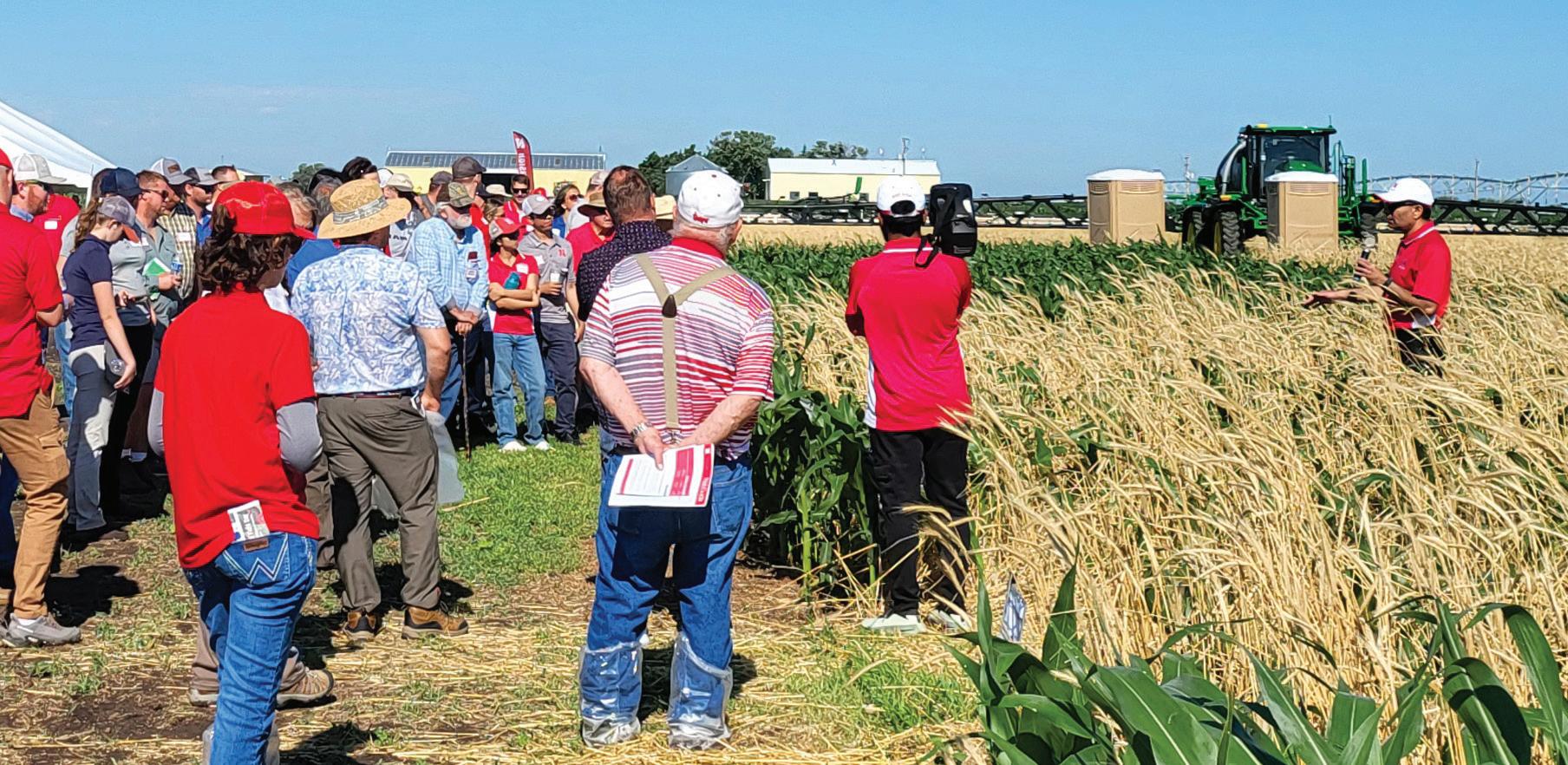
INTEGRATED PEST MANAGEMENT AND COMMUNITY RESILIENCE
STUDENT CLUBS AND ORGANIZATIONS
EXPERIMENTS IN PLANT SCIENCE
INTEGRATED PEST MANAGEMENT AND COMMUNITY RESILIENCE

UNDERGRADUATE go.unl.edu/learnplants
GRADUATE agronomy.unl.edu/graduate-programs
GRADUATE ONLINE agronomy.unl.edu/online

Create the future you want.
We put in the hard work at the University of Nebraska–Lincoln — the grit behind the glory.
In the Department of Agronomy and Horticulture we empower students to connect with people, cultivate ideas, discover new opportunities and acquire the skills necessary to feed and enrich the lives of a growing global population. Contact us today to learn more about unlocking your potential at Nebraska.
402-472-2811 | @UNLAgroHort
2–4 Greetings
5–6
16 Charlotte Brockman, Undergraduate Spotlight
Luka Milosevic, Graduate Spotlight
18–19 Student Teams
20–21 Student Awards
22–23 Experiments in Plant Science
24–25 Integrated Pest Management
25 Digital Farming Lab
26 Turfgrass Science Accessible to Nebraskans
27 Soybean Summer Institute
28 Mandeep Singh, Postdoc Spotlight
29–31 Faculty Awards
32–35 New Faculty
36 Promotion and Tenure
37 Staff Retirement
38–39 Faculty Retirement
40–42 Alumni Lifetime Achievement
43–44 In Remembrance

STAFF
Department of Agronomy and Horticulture 2025 College of Agricultural Sciences and Natural Resources Institute of Agriculture and Natural Resources University of Nebraska–Lincoln
MANAGING EDITOR
Fran tenBensel Benne
EDITORS
Lana Koepke Johnson
Martha Mamo
Fran tenBensel Benne
COPY EDITOR
Chantel Koerwitz
DESIGNER
Fran tenBensel Benne
PHOTOGRAPHERS
Craig Chandler
Lana Koepke Johnson
Jordan Opp
ADVERTISING SALES
Lana Koepke Johnson
CONTACT
402-472-2811
agrohort@unl.edu agronomy.unl.edu
202 Keim Hall Lincoln, NE 68583–0915
SOCIAL MEDIA @UNLAgroHort
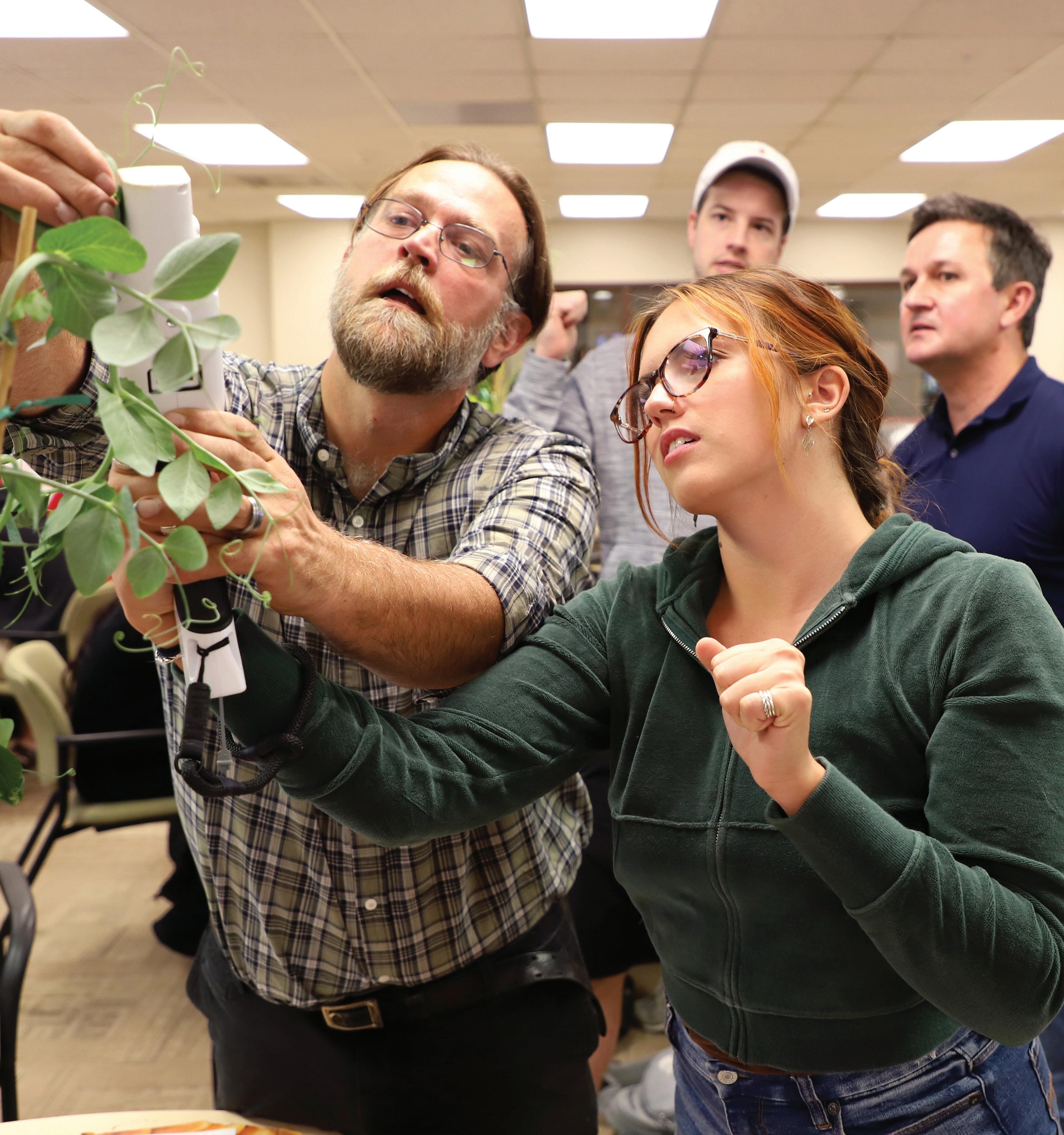
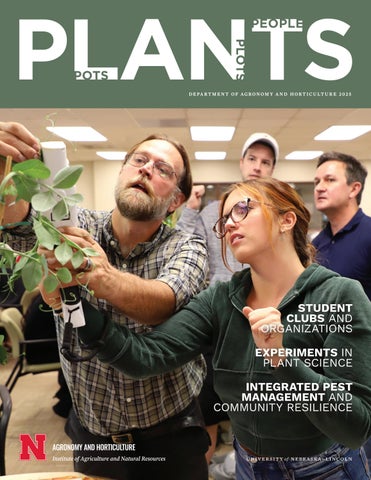
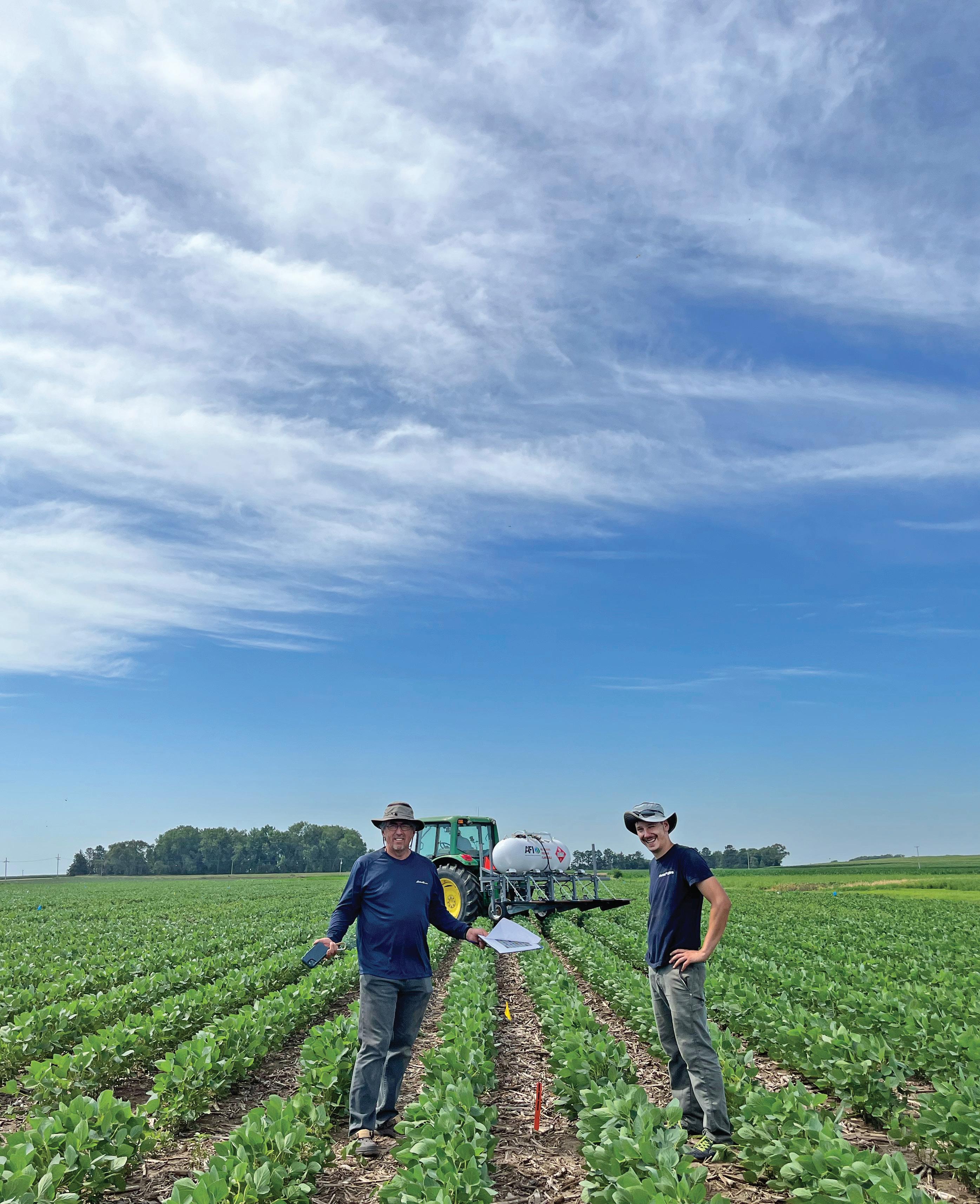
COVER PHOTO: Lana Koepke Johnson: Christian Stephenson, assistant professor of practice in agronomy and horticulture (left), and Ella Jorgensen, a senior plant and landscape systems major, take measurements of stomatal conductance and chlorophyll florescence on a pea plant using a LiCor Li-600 porometer/fluorometer during the Plant Science Experiments course.
The University of Nebraska does not discriminate based on race, color, ethnicity, national origin, sex, pregnancy, sexual orientation, gender identity, religion, disability, age, genetic information, veteran status, marital status, and/or political affiliation in its programs, activities, or employment. ©2025 The Board of Regents of the University of Nebraska on behalf of the University of Nebraska–Lincoln.
MARTHA MAMO
Department Head
OVER THE PAST YEAR, THE DEPARTMENT OF AGRONOMY AND HORTICULTURE HAS TAKEN BOLD STEPS TO SHAPE OUR FUTURE, DEEPENING IMPACT ACROSS NEBRASKA AND STRENGTHENING A CULTURE ROOTED IN INNOVATION, COLLABORATION AND PURPOSE-DRIVEN PARTNERSHIPS. Guided by external review, self-study, stakeholder input and department-wide engagement, we have charted a new strategic direction. Together, we redefined department core values, sharpened our mission and vision, and laid out a clear framework to guide the next chapter of our journey.
Academic programs are thoughtfully designed to align with real-world career pathways. In 2024, nearly 300 undergraduate and graduate students were enrolled. Thanks to the generosity of donors and supporters, we awarded more than $150,000 in scholarships to both new and returning undergraduate students. These funds support student success, retention and belonging. In 2024, we conferred 51 Bachelor of Science degrees and proudly celebrated 91 graduates — leaders who are now poised to innovate and serve in agriculture and food system.
The research and extension programs in the department remain strong and focused. In 2024, over 70% of research funding came from federal agencies — highlighting both the credibility of our work and the relevance of department collaborative and interdisciplinary science. Commodity boards, such as the Nebraska Corn, Soybean and Wheat Boards, continue to be steadfast partners, investing in practical, impactful solutions for Nebraska producers.
• New soybean and wheat lines enhance global competitiveness for Nebraska farmers.
• Palmer amaranth management and nitrogen
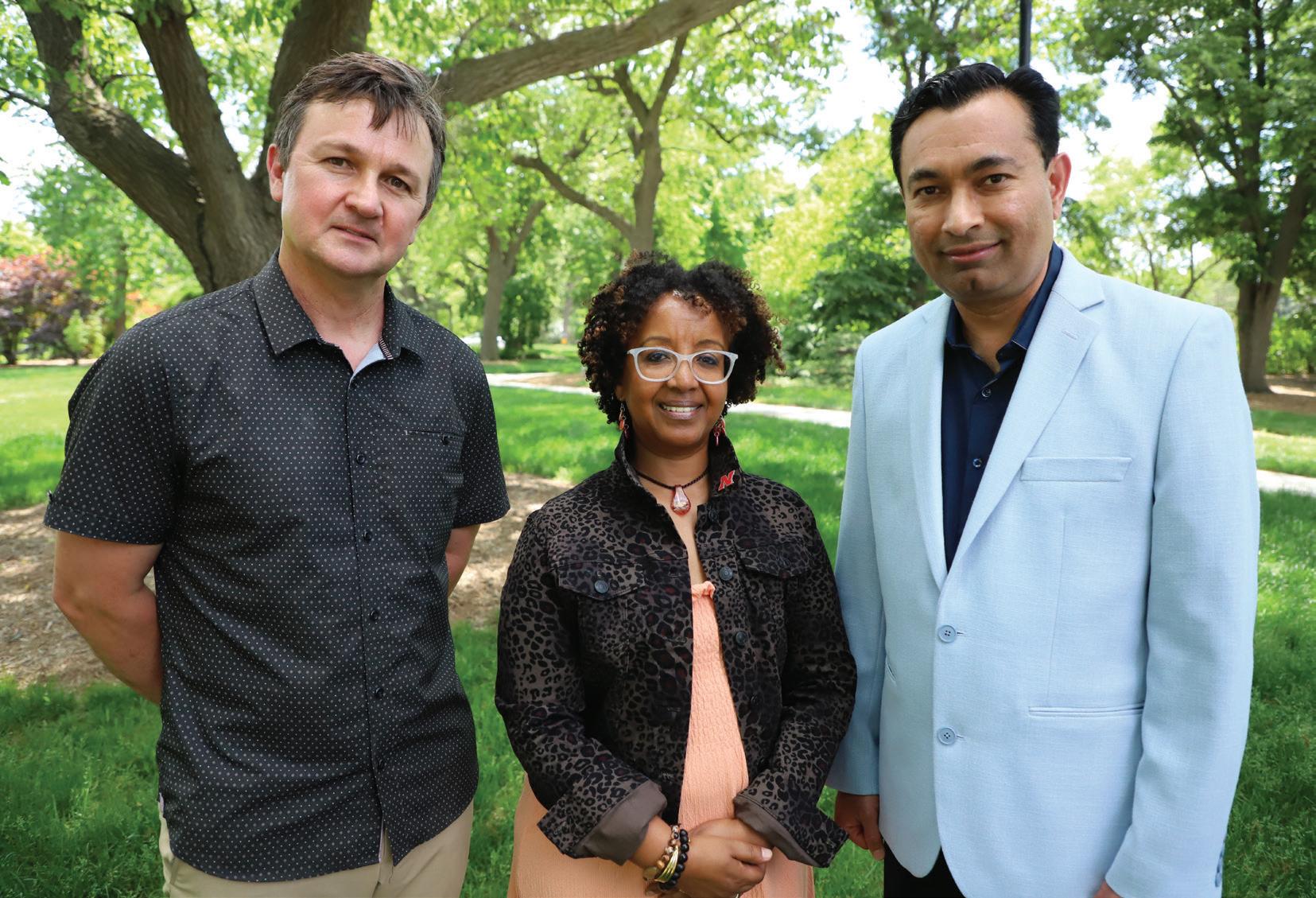
Department of Agronomy and Horticulture’s David Holding, associate head (from left), Martha Mamo, head, and Amit Jhala, associate head, stand in the Earl G. Maxwell Arboretum on the University of Nebraska–Lincoln East Campus.
optimization research provide major impact on sugar beet production.
• The science-based variety testing program supports growers and consultants across Nebraska and the region.
• The Nebraska Extension Implementation Program delivers science-based, community-driven solutions that enhance the lives and livelihoods of Nebraskans. Through targeted outreach in agriculture, pollinator health, community vitality and pest diagnostics, the program translates university research into practical, real-world impacts.
Looking ahead, we will focus on strengthening learner engagement through deeper ties with K–12 schools, community colleges, tribal colleges, 4-H, alumni, industry and employers. We continue to work toward advancing digital and precision agriculture via interdisciplinary research, experiential learning and collaborative initiatives across IANR and the industry.
Finally, I extend my deepest gratitude for the opportunity to serve Nebraska. Every day, I am inspired by faculty, staff, students and partners. Together, we are not merely growing crops and managing land — we are cultivating leaders, generating ideas and driving solutions that matter.
Sincerely,
Martha Mamo
John E. Weaver Professor of Agronomy and Horticulture and Department Head
by Martha Mamo | John E. Weaver Professor of Agronomy and Horticulture and department head
FOR OVER A CENTURY, OUR DEPARTMENT HAS DRIVEN PROGRESS IN AGRICULTURE, ECONOMIC SUSTAINABILITY AND NATURAL RESOURCE STEWARDSHIP. Highlights include:
• Workforce Development: Over the past five years, the Department of Agronomy and Horticulture has proudly graduated nearly 500 highly skilled professionals equipped with expertise in agronomy, horticulture and plant sciences. These graduates have gone on to make meaningful contributions across the agricultural sector, securing impactful roles in industry, state government, Nebraska agricultural cooperatives and federal agencies including the USDA. Their success reflects the strength of our academic programs and our commitment to developing the next generation of agricultural innovators and leaders.
• Soybean Innovation: The Soybean Breeding Program continues to lead in soybean innovation through the development of high-performing, locally adapted soybean lines that deliver substantial economic and agronomic benefits to farmers. These advanced varieties are the result of decades of public breeding, genetics research, and producer-driven improvement strategies focused on increasing yield potential, enhancing seed composition, and improving resilience to pests, diseases and environmental stresses. University of Nebraska–Lincoln-developed soybean lines are currently estimated to generate over $100 million in annual benefits to producers — driven by superior agronomic performance, higher seed protein and oil content, and traits that support more efficient and sustainable crop production.
• Resource-efficient Corn and Sorghum: The department is advancing the resilience, productivity and resource-use efficiency of corn and sorghum through the integration of cutting-edge technologies and systems-based research approaches. Our multidisciplinary teams are addressing critical challenges in crop production by combining genomics, phenomics, agronomic modeling, precision agriculture and sustainable management practices. Through this work, researchers are enhancing nutrient and water-use efficiency, improving tolerance to heat and drought stress, and optimizing plant architecture and phenology to match evolving environmental conditions. Leveraging tools such as high-throughput phenotyping, remote sensing and machine learning, our scientists are accelerating the identification and deployment of novel genetic traits that boost yield stability and reduce input costs.
• Rangeland Protection: As a national leader in combating woody plant encroachment, the department is tackling the annual loss of 22 million tons of rangeland productivity and the spread of wildfire-prone volatile fuels across 1.7 million acres nationwide. These efforts are vital to sustaining livestock production, mitigating wildfire risks and promoting healthy ecosystems.
• Real-time Yield Forecasting: The Yield Forecasting Center provides in-season, data-driven decision tools to reduce risks and optimize productivity.
• Local Food Systems: The department advances local food systems in Nebraska through research and outreach focused on hydroponics, high tunnels, gardens and field-based production of specialty crops. Our programs empower small-scale growers with science-driven solutions to increase yield, extend the growing season and improve economic viability. By supporting diversified crop production, direct-to-consumer marketing and community food access, we are building a resilient, sustainable and equitable local food network that enhances food security and rural economic development across the state.
• Backyard Farmer: Backyard Farmer is the longestrunning, locally produced television program in the nation, proudly rooted in Nebraska since 1953. Airing weekly throughout the growing season, the show provides science-based, practical solutions to lawn, garden, landscape and insect-related questions from viewers across the state and beyond. With a monthly reach of approximately 155,000 clients through both traditional broadcast and digital platforms, including YouTube, social media and on-demand streaming, BYF serves as a trusted and widely accessible source of horticultural knowledge. The program’s panel of university experts engages directly with the public, promoting sustainable practices, plant health and environmental stewardship.
• Master Gardener Program: In 2024, 674 active volunteers across 54 counties completed 31,468 education hours and donated $125,569 worth of produce to food banks.
These vital contributions are at risk. Reductions in federal and state funding threaten our ability to continue this work. Continued investment is essential to keep Nebraska at the forefront of agricultural innovation.
On behalf of the Department of Agronomy and Horticulture, I call upon you — our valued partners, alumni and stakeholders — to be active advocates for our mission and champions of our collective impact. Share our stories of innovation, education and service. Highlight the critical role our department plays in workforce development, food security and public value of research that addresses real-world challenges. Amplify the voices of our faculty, researchers, extension professionals and farmers whose work sustains communities and drives progress across the state.
Your support goes beyond sustaining programs — it is about positioning Nebraska as a national leader in agricultural excellence. Together, we can secure a future that is not only innovative and resilient, but also deeply rooted in economic strength, environmental stewardship and community well-being. By raising awareness and building broad-based advocacy, we can ensure that the Department of Agronomy and Horticulture continues to shape a vibrant, sustainable agricultural economy for generations to come.
Associate
Department Head
AFTER SERVING AS ASSOCIATE DEPARTMENT HEAD FOR MORE THAN THREE YEARS, I AM PROUD TO HELP SHAPE THE FUTURE OF OUR DEPARTMENT DURING THESE CHALLENGING TIMES. In 2024, the leadership team and wider faculty crafted a bold and actionable strategic plan, which is nearing completion. One key to strategic planning is adaptability, which has never been more critical than now. In the face of threats to federal funding, student recruitment and ongoing budget cuts, I am committed to helping to prioritize and leverage our existing talents as we adapt to the reduction in recruiting new faculty and replacing retiring faculty.
In 2024, I started as director of the plant biology program, and the new multi-department steering committee made good progress in renovating the program. The biotechnology option was broadened and rebranded as agricultural biosciences, incorporating several new 400-level courses. A new plant protection option was launched, providing a foundation in plant pathology and entomology as well as specialization in either field. We continue to prepare for the 2026 influx of students in the Northwest Agriculture and Forestry University
Department Head
I AM HONORED TO SERVE AS ASSOCIATE DEPARTMENT HEAD OF AGRONOMY AND HORTICULTURE SINCE 2023. In this role, I have continued to support and advance the department’s extension mission in collaboration with faculty, educators and stakeholders. In 2024, the Extension Coordinating Committee organized departmental extension faculty meetings in both the spring and fall. These meetings provided a valuable forum to discuss program goals, professional development opportunities and reporting requirements. All faculty with extension appointments successfully submitted their 2024 annual reports in the Program Evaluation and Reporting System, helping to document the impact of our outreach efforts.
We were pleased to receive a USDA-NIFA Crop Protection and Pest Management grant ($885,000). This competitive funding supports a broad range of multidisciplinary extension programs focused on integrated pest management in agronomic and specialty crops, pollinator health and education, community-based pest management and diagnostic services across Nebraska. I continue to lead extension efforts focused on weed management in agronomic crops. Since joining UNL in 2012, my research has addressed critical issues such as the management of herbicide-resistant weeds and multiple herbicide-resistant crop volunteers.
and the University of Nebraska–Lincoln 3+1 dual degree program. Representing the department, plant biology and UNL, I visited NWAFU in Yangling, China, in 2024 to welcome the class of 2028 and participate in the NWAFU 90th anniversary celebrations.
My research in popcorn and sweet corn breeding for macronutrient and micronutrient improvement continues, and I am involved in a national project, CERCA N, which reimagines corn agriculture for nitrogen efficiency. I am pleased to have launched and taught PLAS135, Experiments in Plant Science, which leverages the talents of multiple faculty in student-led investigations of how crop plants adapt to changes in their abiotic environments.
Sincerely,

David Holding Professor and Associate Department Head
This research directly helps producers implement integrated weed management strategies.
We have made progress in strengthening departmental extension activities and engagement. The department launched a webpage to highlight Nebraska Extension faculty members. The site is regularly updated and serves as a central hub to get to know extension faculty and affiliates. To further enhance collaboration between extension specialists and educators, we implemented the Extension Educator Affiliate Program. The department’s Extension Coordinating Committee has approved six extension educators as official affiliates, fostering deeper connections and shared programming.
I look forward to continuing to work with our administrative team, faculty and partners to advance the mission of the department and deliver highimpact extension programming across Nebraska.
Sincerely,
Amit Jhala Professor and Associate Department Head
Lisa Hilfiker
Graduate Program Coordinator
IN MARCH OF 2022, I JOINED THE DEPARTMENT OF AGRONOMY AND HORTICULTURE AND FEEL INCREDIBLY BLESSED TO BE A PART OF THE TEAM. I have always had a passion for education and a commitment to helping others develop and succeed.
In my current position, I maintain an open-door policy, and the best part of my day is when a graduate student knocks on my door or reaches out. We have an outstanding, diverse group of students, both resident and online, committed to working hard to earn their degrees and put their mark on the world. It’s a privilege to support them on their journeys and to understand the individual challenges and aspirations that shape their paths. A huge benefit to this position is the support of Agronomy and Horticulture staff and faculty.
My educational journey began with a bachelor’s in elementary education from the University of Nebraska–Lincoln. This degree was helpful in my time as a director of a preschool and as a stay-at-home mom. While I loved that time with my kids, I transitioned back into the workforce after many years at home. In May 2020, I accepted a job as administrative coordinator at the Explore Center on City Campus. Interacting with undergraduates not only ignited a new passion for working with college students within me, but it also inspired me to fulfill my personal goal of completing

Teresa Loseke
HAPPI Business Center Manager II

a master’s degree. In May 2023, I graduated from UNL with a Master of Arts in educational administration, emphasizing higher education.
My family, who all graduated from the University of Nebraska, supports me at home. Between the four of us, we have seven degrees (4 B.S., 1 M.S., 1 M.A. and 1 Ph.D.). You can find me reading, watching a movie or traveling when I’m not at work. My favorite thing is spending time with my family, which has gotten harder as our kids have grown up, but it is no less precious.
MY STORY BEGAN IN A SMALL TOWN CALLED LEIGH, NEBRASKA, WHERE I GREW UP ON A LARGE DAIRY FARM. Twice a day we milked anywhere from 100 to 150 dairy cows and bottle fed 15–20 calves. We raised chickens, hogs and Holstein cows and grew corn, soybeans and alfalfa. Being raised on a farm instilled a strong work ethic in me and gave me many life experiences that could only come from growing up on a farm.
In 1999 I decided to move to Lincoln to expand my opportunities and grow my career professionally. After earning a bachelor’s degree in business administration with a minor in human resources and management, I was on a mission to put my education to use.
Almost 22 years ago, I accepted my first position at the University of Nebraska, and over the years I’ve worked in various capacities including recruitment, new student enrollment, human resources, finance, grants, purchasing and business management. After several career changes within the university system, I became a business manager in the Beadle Center, where I worked for 13 years before joining the HAPPI Business Center.
I love working with people from different cultures and backgrounds and find my job to be rewarding on so many different levels. Outside of work my hobbies include vegetable gardening, canning, cooking, photography, hiking, walking my two golden retrievers and exploring nature.
AGRICULTURE HAS ALWAYS BEEN A BIG PART OF MY LIFE. I grew up on a farm in southeast Nebraska, so when I started working for the agronomy department over 30 years ago, it was a perfect fit.
My first stint at the University of Nebraska was with the variety testing program under Lenis Nelson. We ran variety tests for corn, soybeans, wheat and sorghum as well as a few other specialty crops. We planted, took notes and maintained the trials as well as harvested them when ready. After harvest, we analyzed the data and published reports to help farmers with variety selection for the coming year.
In 2006 I shifted gears a little bit and started working with the small grains breeding program under the leadership of Stephen Baenziger. In this role, I oversee the eight field locations across the state where we test our new lines. This has been a terrific opportunity to use my experience with the management practices I saw with the variety testing group as well as observe the genetics that go into developing a new variety.
I consider our new season to start in March when we are busy making new crosses of wheat, barley and triticale in our greenhouse. Our crosses are harvested in May and sent to Yuma, Arizona, in November for a small increase. Our small increase is then planted at Mead, Nebraska, to see if it can survive our winter. From there, planting across the state begins, with only the strongest lines moving on to the next year. It takes at least 10 years of testing before we know enough about a line to release it to a farmer.

I’ve had the pleasure to work with graduate students and visiting scientists from all over the world. To hear their stories and learn of the diverse cultures is truly amazing. One of our former graduate students, Katherine Frels, is now my current boss. It just goes to show that UNL does an excellent job of getting our students ready for their journey. When I am not at work, I enjoy many outdoor activities as well as helping on the family farm. My wife Kristi and I have three children and three grandchildren we enjoy very much. Spending time with family and friends makes our life complete.
GREW UP IN NINGXIA, A SMALL CITY IN NORTHWEST CHINA. I earned a bachelor’s degree in horticulture from Ningxia University 20 years ago. Later, I completed a master’s in physiology and ecology of vegetables at Northwest Agriculture and Forestry University in Yangling, China.
In 2012, I moved to the United States for family reasons and pursued a master’s in bioinformatics at the University of Arkansas. Building on my background in biology, I worked on projects combining biology, computer science and statistics.
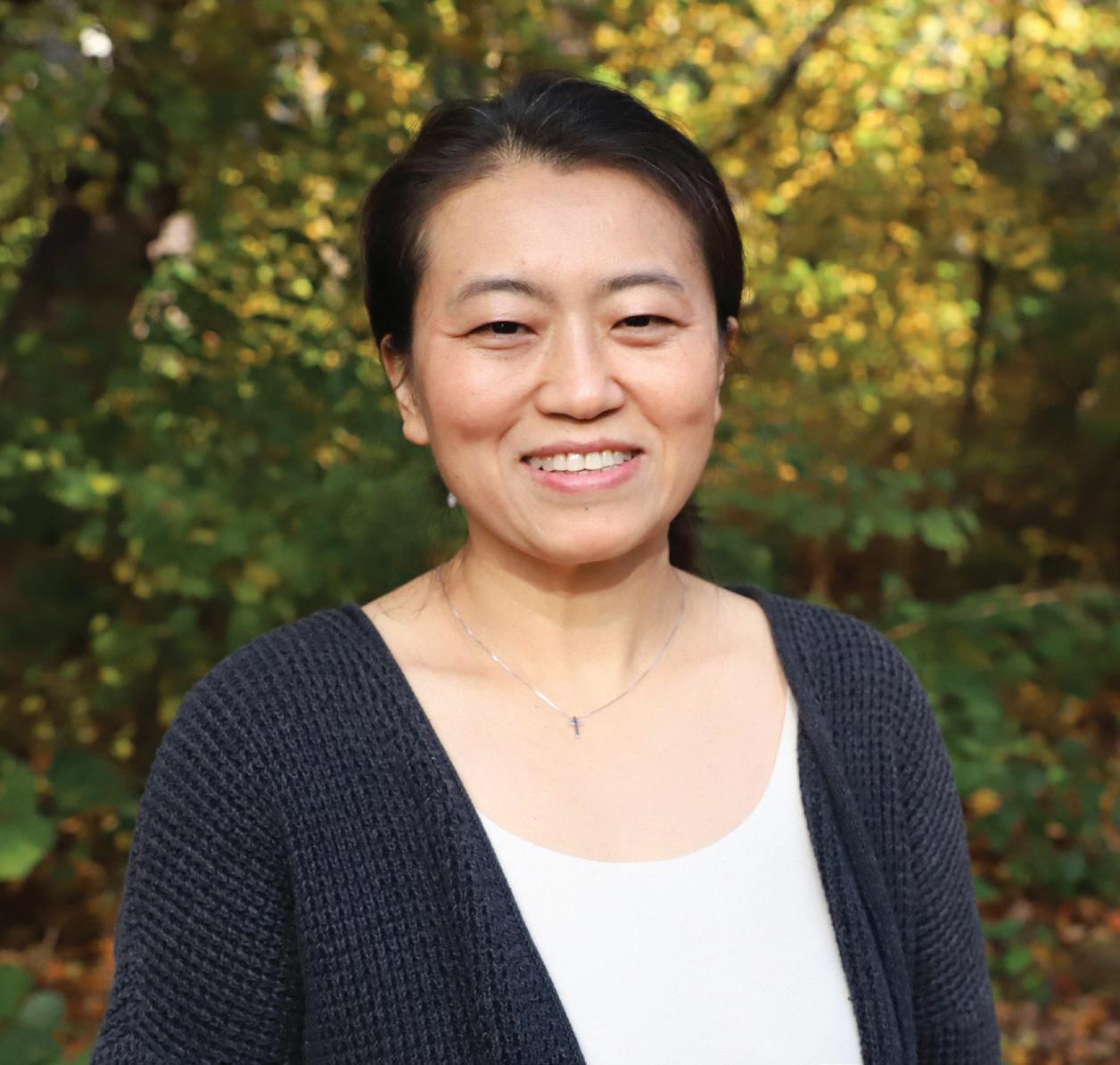
Since 2021, I have been working as a research technologist at the University of Nebraska–Lincoln. I enjoy collaborating with David Hyten, Haskins Professor in Plant Genetics and associate professor in agronomy and horticulture, and my coworkers in the soybean lab focusing on developing data pipelines for soybean breeding studies.
In my free time I like sewing, baking and spending time outdoors with my family.

Frank Bright: Staff Advisory Committee
Pesticide Safety Education Program Team
Special Contributions Award
Greg Dorn: Office of the Executive Vice Chancellor Exceptional Excellence Award
Lisa Hilfiker: SAC Professional Development Award
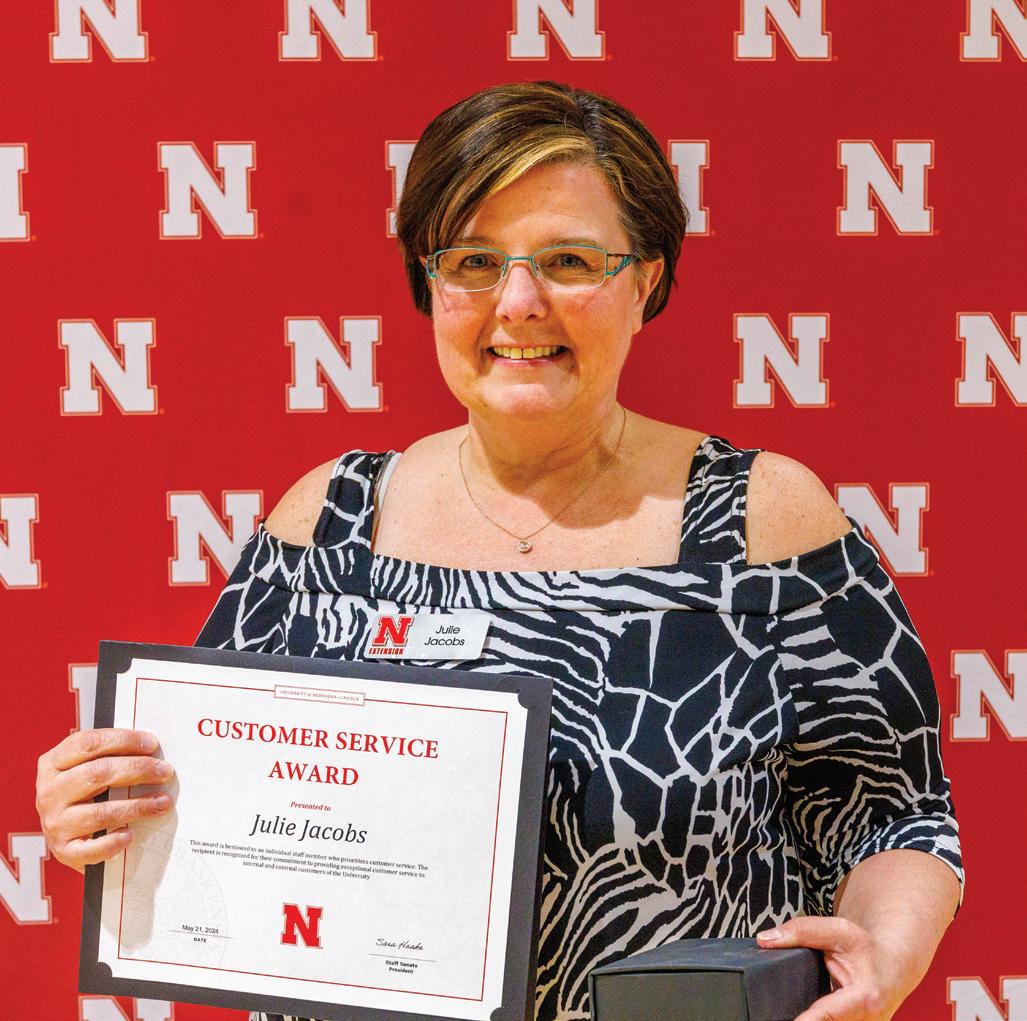
Julie Jacobs: UNL Staff Senate Recognition Committee Customer Service Award, SAC Pesticide Safety Education Program Team
Special Contributions Award
T.J. McAndrew: SAC Special Contributions Award
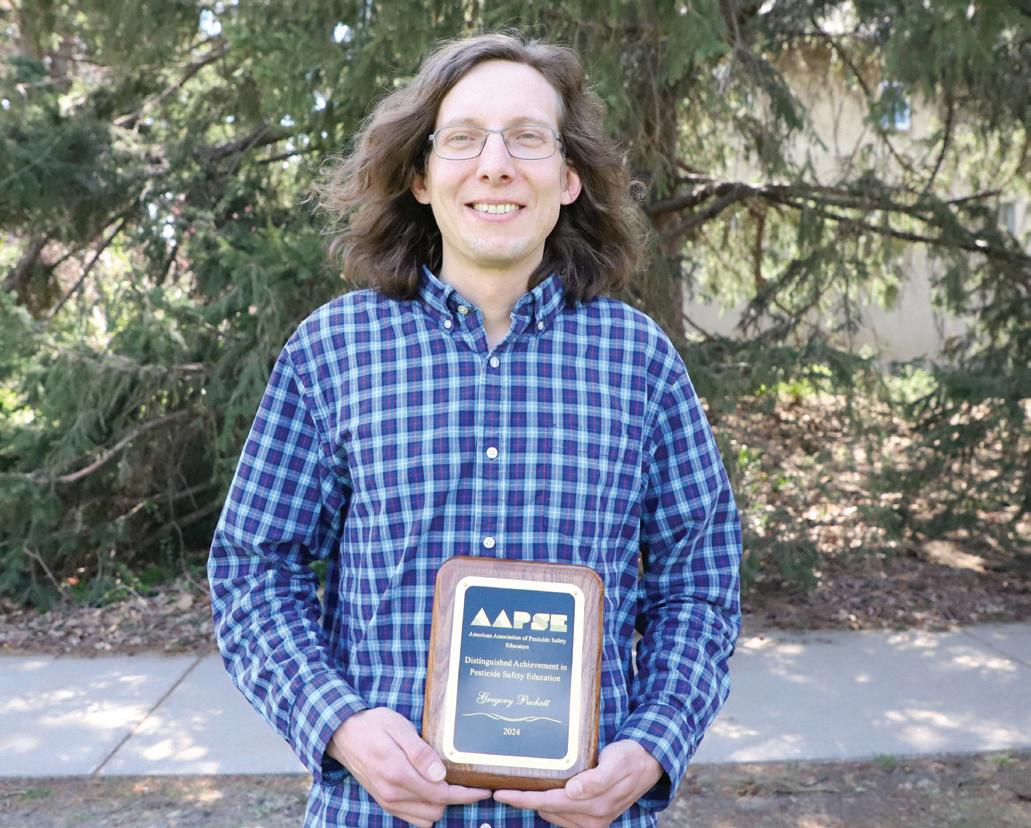
Greg Puckett: American Association of Pesticide Safety Educators Distinguished Achievement in Pesticide Safety Education, SAC Pesticide Safety Education Program Team Special Contributions Award
Vicki Schroeder: SAC Pesticide Safety Education Program Team Special Contributions Award
Stephanie Shulze: SAC Pesticide Safety Education Program Team Special Contributions Award
Tamara “Toma” Sukhova: Agronomy and Horticulture Graduate Student Association Staff Appreciation Award
Lan Xu: SAC Professional Development Award
A list of all staff awards can be found online at go.unl.edu/facultystaff-awards.
Aldi Airori
Elizabeth Bardot
Fran Benne Collin Eaton
Lisa Hilfiker
Elizabeth Jeske
Michael Livingston
Teresa Loseke
Martha Mamo
Matthew Sousek
Cheryl Dunn

by Ana Clara Gomes | AHGSA president
THE AGRONOMY AND HORTICULTURE GRADUATE STUDENT ASSOCIATION IS ACTIVELY INVOLVED IN A WIDE RANGE OF ACTIVITIES, MAKING A POSITIVE IMPACT ACROSS SEVERAL DOMAINS. AHGSA remains steadfast in its commitment to community engagement as well as personal and professional growth of students.
In June and August, AHGSA participated in East Campus Discovery Days and the Farmers Market, where members interacted with attendees and engaged the community. This year, the association provided a seedplanting activity designed for both children and adults. In collaboration with other members of the Department of Agronomy and Horticulture, AHGSA organized a crayon activity where children used soil-based crayons to create drawings. The AHGSA booth also offered various activities related to soil, allowing participants to create their soil profiles while receiving explanations about different soil contents. With the help of the horticulture team, AHGSA members organized a terrarium-making activity using water bottles. All these efforts were designed to engage the
local community and assist attendees with any questions related to growing plants. Thanks to the generous donation of popcorn from Professor Turner Dorr, AHGSA members distributed free popcorn to people attending the event.
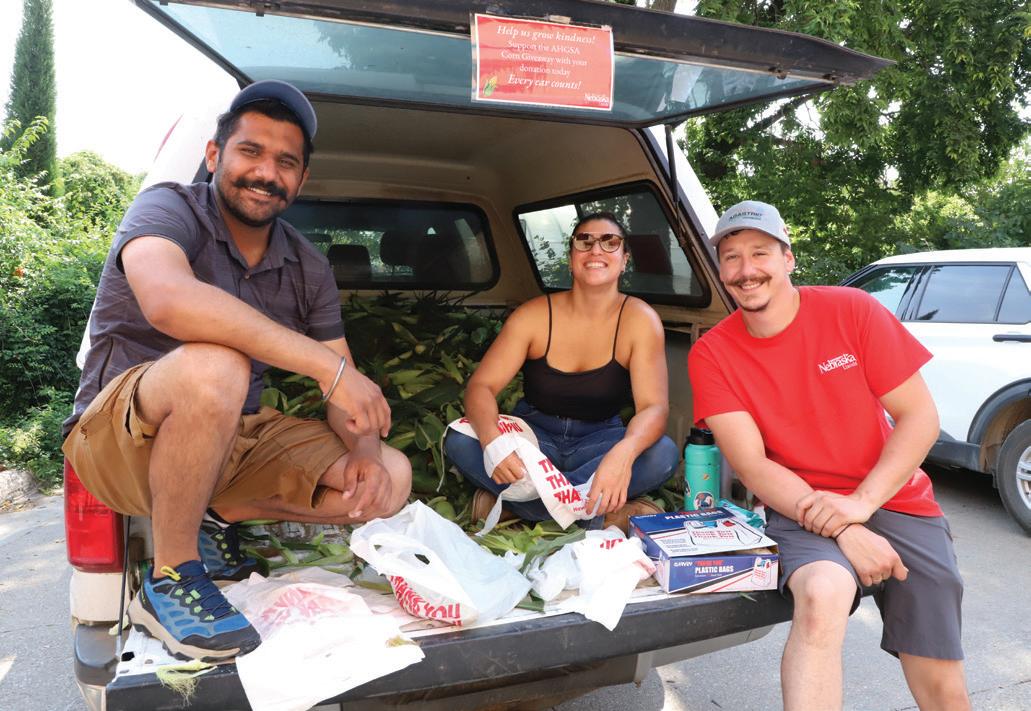
In July, AHGSA organized the Sweet Corn Giveaway in collaboration with T.J. McAndrew and Jenny Stebbing. Volunteers harvested sweet corn from Havelock farm and then distributed it to members of the East Campus community on a first-come, firstserved basis. AHGSA accepted freewill donations to support the club’s diverse activities and events.
In August, AHGSA welcomed new and returning students with a welcome and orientation lunch. At the event, new graduate students received information about key milestones, available resources and important contacts. Additionally, AHGSA participated in the Graduate & Professional Student Resource Fair to introduce the association to undergraduate students.
AHGSA organized a Campfire and S’mores event in September at the UNL Leadership Training Center,
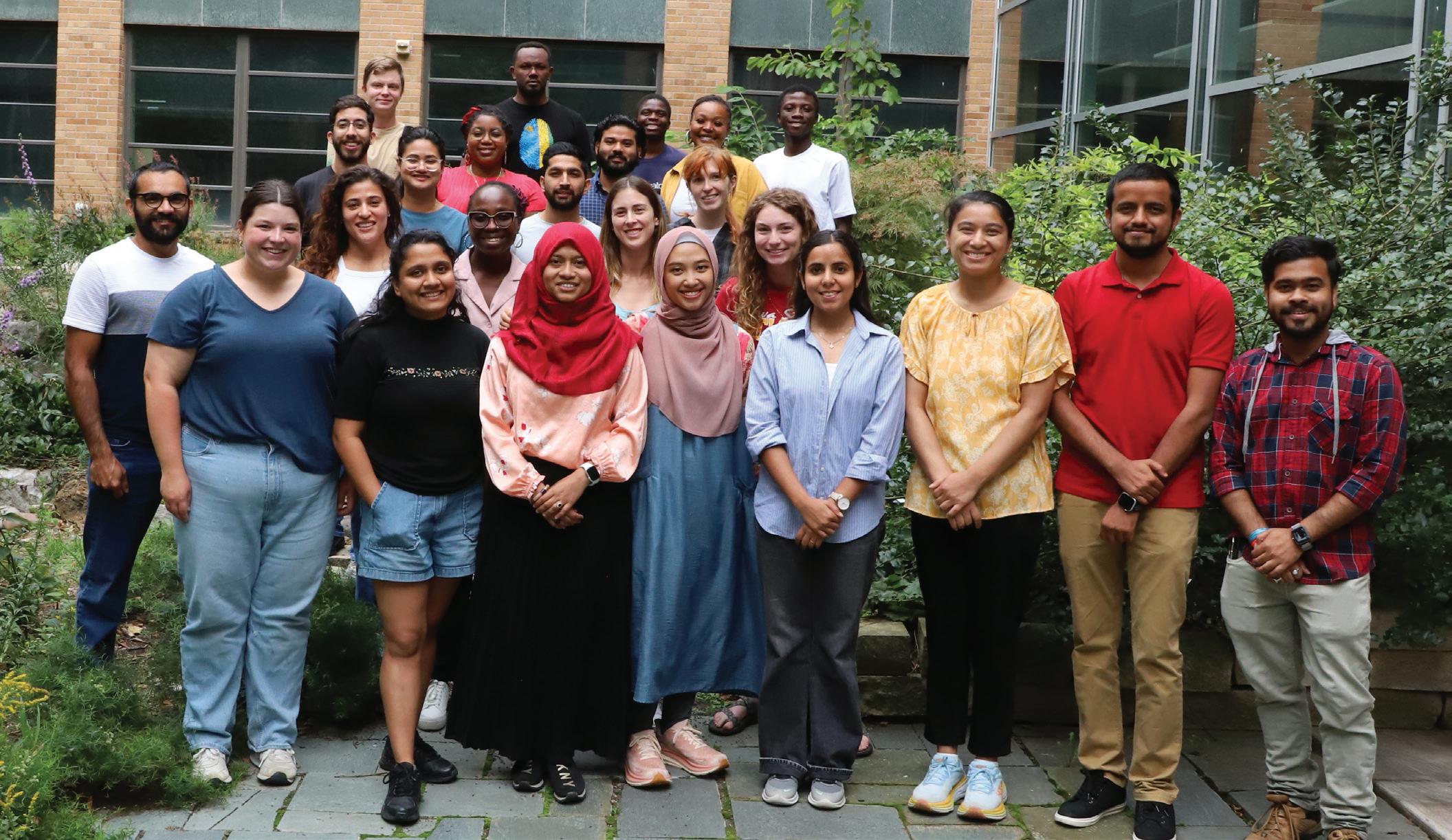
where new members could relax and chat with other graduate students. Attendees enjoyed warm s’mores, hot cocoa and meaningful conversations.
In September, AHGSA also hosted a workshop on the art of conducting a successful job search. Featuring guest speaker Kadina Koonce from the university’s Business Career Center, the workshop provided an overview of available resources, general tips and common situations where graduate students and alumni can seek assistance. Koonce also offered practical advice on crafting an effective LinkedIn summary and strategies for navigating the platform to enhance professional networking and career opportunities.
Later that month, AHGSA arranged a Pumpkin Giveaway where volunteers distributed lantern pumpkins to the East Campus community. As with the Sweet Corn Giveaway, AHGSA accepted freewill donations, contributing to another successful fundraiser.
Under the Professional and Personal Development series, AHGSA organized a seminar with faculty from UNL Counseling and Psychological Services in October. This session outlined the services available to students and offered guidance on effectively navigating the challenges of graduate school.
AHGSA invited Stephanie Osterthun, career coach from the College of Agricultural Sciences and Natural Resources, to speak with students in November. Osterthun introduced students to available jobs and salary expectations in the agronomy sector. She also provided guidance on navigating interviews and job searches specifically within the fields of agronomy and horticulture. In November, AHGSA also collaborated with the Plant Pathology Department and the Entomology Bruner Club to co-host the Elevator Speech Contest. Students from all three departments
participated, presenting their research within three minutes. Distinguished judges and the engaged audience ranked the participants, and the winners were awarded prizes.
AHGSA’s achievements are possible only with continued support from faculty and staff. Heartfelt gratitude is extended to the club’s esteemed advisers: Professor Paul Read, Professor Sam Wortman and Department Head Professor Martha Mamo. Club members also appreciate the invaluable contributions of Professor David Hyten, Lisa Hilfiker, Kaye Wolfe, Tamara “Toma” Sukhova, Lana Johnson, Connie Hansen, Tracy Pickering and McAndrew.
The club also recognizes the exceptional dedication of its officers: Ana Clara Gomes, president; Vipin Kumar, vice president; Luka Milosevic, treasurer; Bellodgia Roberson, secretary; and Stephanie Lugo, orientation and mentor chair. Their leadership has been instrumental in shaping the success of AHGSA.
by Ryleigh Grove | Plant Biology Club president
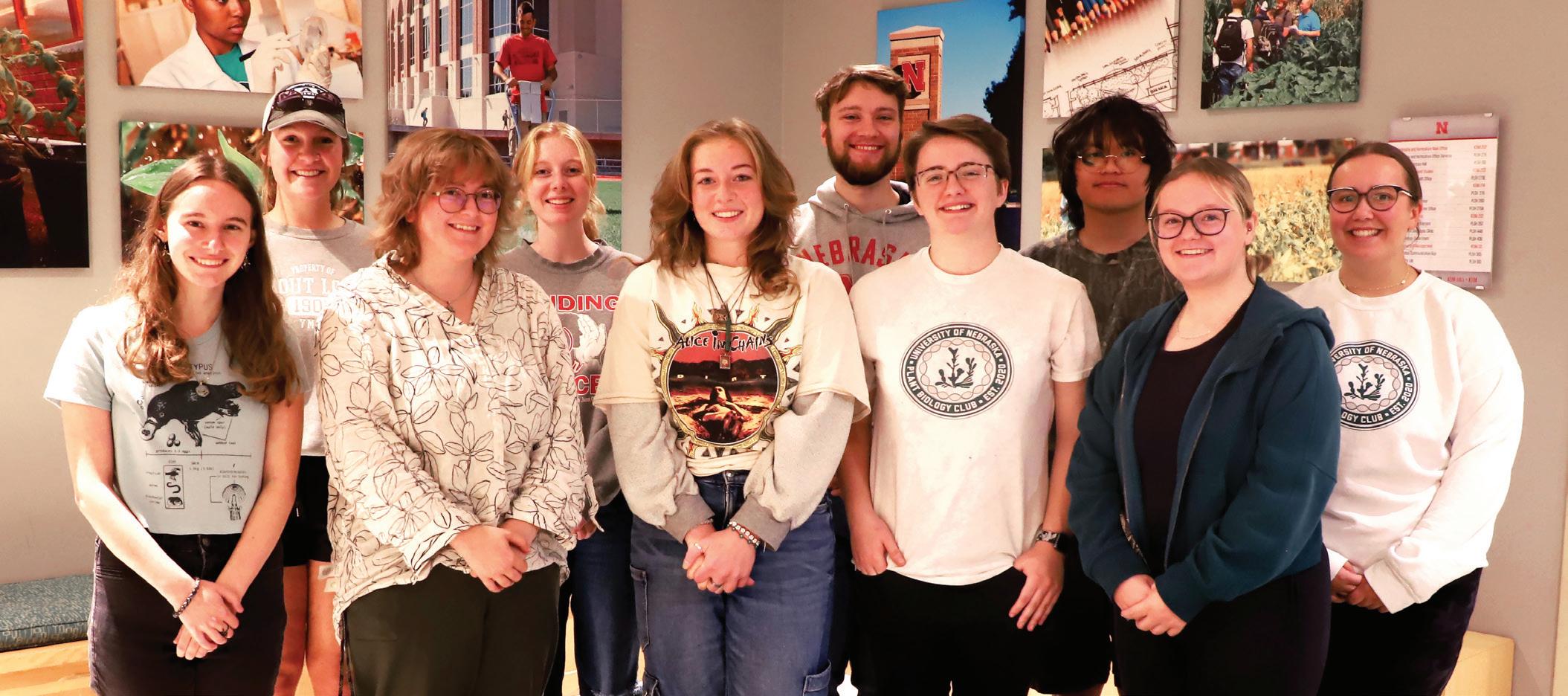
WITH A LOVE FOR ALL THINGS PLANT SCIENCE, STUDENTS IN PLANT BIOLOGY CLUB ARE DEDICATED TO PROMOTING PLANT EDUCATION AND SUSTAINABILITY.
This year, the club participated in several exciting events and contributed to meaningful discussions that shaped the future of plant biology education.
In spring 2024, members met with the Plant Biology Steering Committee and attended the Annual Program Review, where they shared feedback on the department’s academic offerings. Their insights helped ensure the curriculum continues to evolve and meet the needs of future students. These discussions play an important role in keeping the curriculum dynamic and relevant as well as encouraging students to have a safe place to provide feedback.
After the semester ended, the club got to work and borrowed a high tunnel from Christian Stephenson to grow various flora. Sunflowers, cosmos, Japanese Indigo and Hopi Red Amaranth plants were used in a creative plant-based tie-dye project, giving members a fun way to explore the practical applications of plant biology.
Over the summer, the club collaborated with the CROPS Graduate Student Organization to donate plants at East Campus Discovery Days. A month later, the club collaborated with the Herpetology Club to donate even more plants at the Involvement Fair, bringing together students from different disciplines in a shared love for nature.
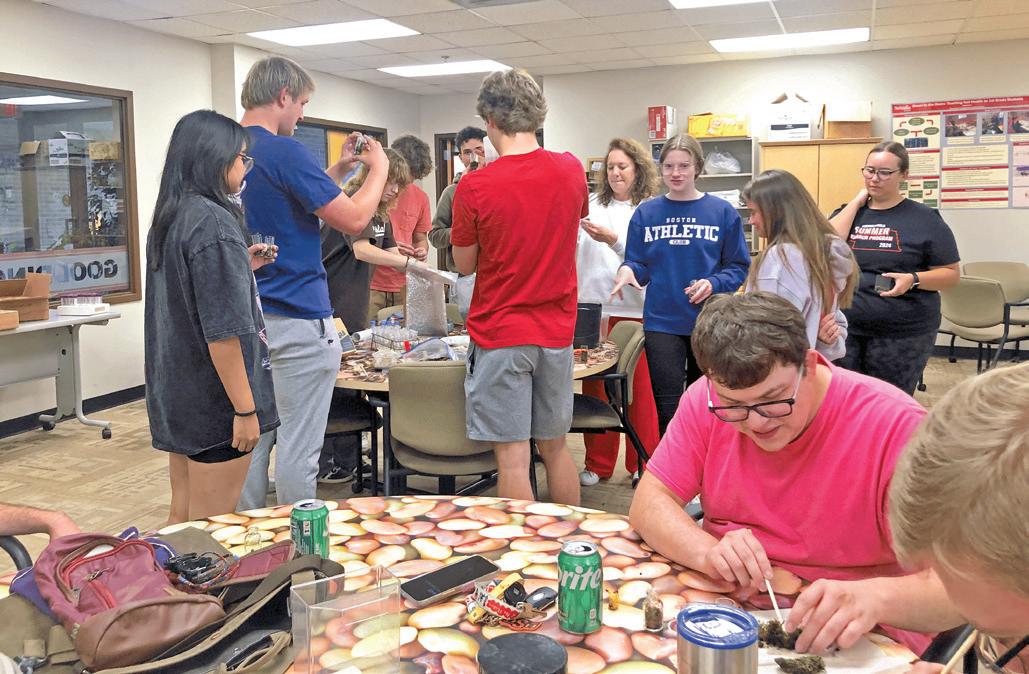
The club welcomes new plant biology majors in September by holding a Terrarium Tutorial Workshop in collaboration with the Biology Club. Members create their own terrariums and learn about mini-ecosystems.
The club welcomed new plant biology majors with an East Campus tour and ice cream social, followed by a Terrarium Tutorial Workshop in September, held in collaboration with the Biology Club. Members enjoyed creating their own terrariums and learning about mini-ecosystems.
In October, the club hosted a colorful kernel activity at the Spring Creek Prairie Audubon Center’s HOOT ’n’ HOWL event in Denton, Nebraska, engaging kids and families in plant-related fun. In November, members organized a public Scientific Illustration Workshop featuring artist Lana Johnson, offering participants a unique opportunity to learn the art of depicting plant life accurately. To wrap up the semester, members celebrated by making holiday cards and enjoying potluck-style food.
The club extends its heartfelt gratitude to the invaluable contributions of Stephenson, Lauren Gabriel, and club adviser Christian Elowsky. Additionally, the club appreciates the members of the Plant Biology Steering Committee for providing a platform to express feedback that strengthens the program. Club officers include Ryleigh Grove, president; Emma Decker, vice president; and Remi Christensen, treasurer.
by Sheridan Wilson | member and former president
UNITED BY A SHARED PASSION, STUDENTS IN RANGE MANAGEMENT CLUB AIM TO BETTER UNDERSTAND THE ART AND SCIENCE OF RANGE MANAGEMENT. The club fosters professional development and provides a space where students can learn more about native rangelands and the species that inhabit them as they engage in conversation about such topics as plant identification, range ecology, conservation and stewardship of working lands. This year provided many opportunities for club members to grow in each of these areas.
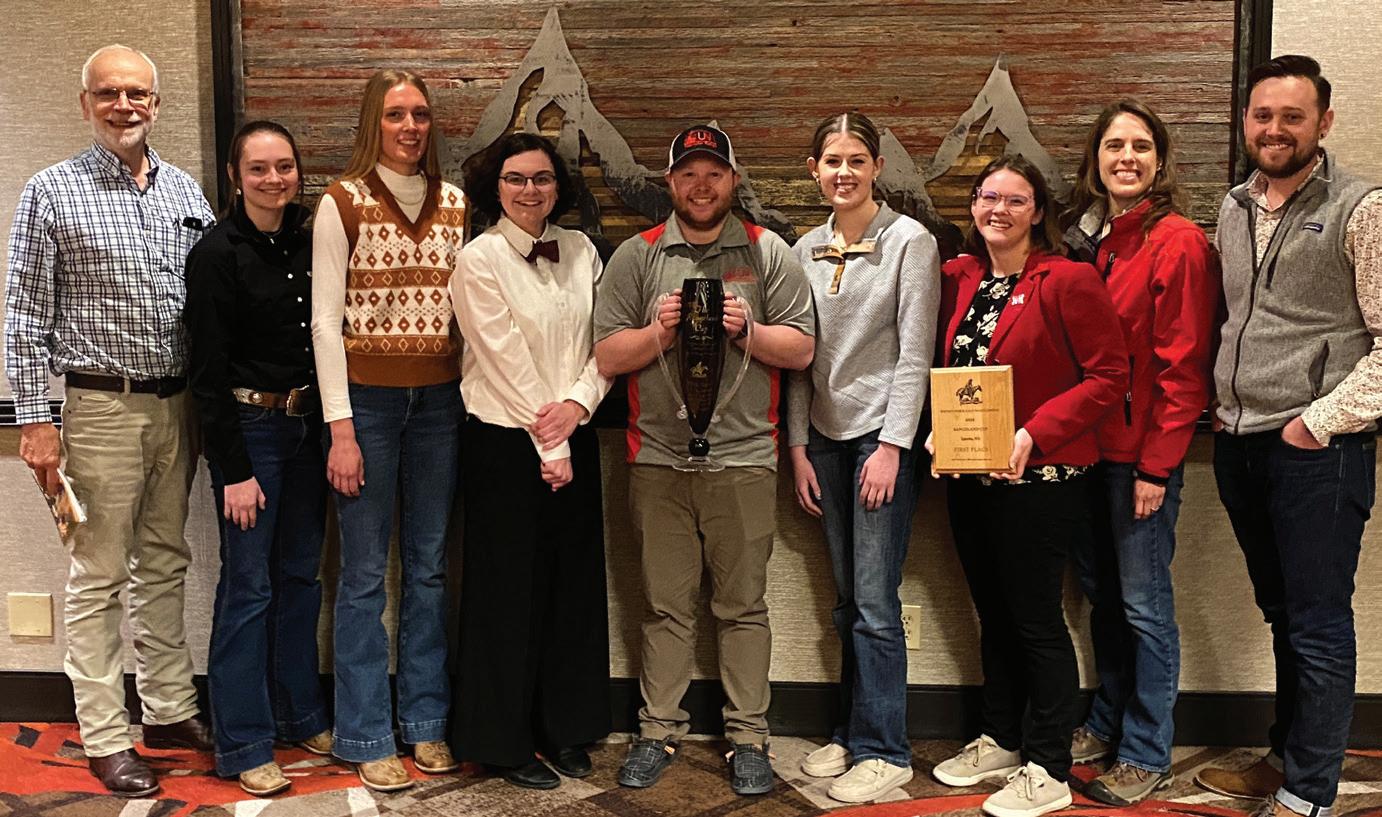
In late January 2024, the club attended the Society for Range Management annual meeting in Reno, Nevada. While there, students networked with professionals, listened to session and keynote speakers, and competed in a variety of contests with students across North America. The students competed well, taking first place in the Rangeland Cup competition. Rangeland Cup team members Jacob VanDress, Caitlin Copenhaver and Josie Ivy brought home the traveling trophy. The Plant Identification team received seventh place in the competition, the Undergraduate Range Management Exam team placed in the top 50%, and the Website Design team received fourth place.
The club finished the spring semester with its annual Native Plant Sale. Club members sold forbs grown by Midwest Natives Nursery and a variety of native grasses that students grew themselves. They also attended banquets hosted by the School of Natural Resources and the
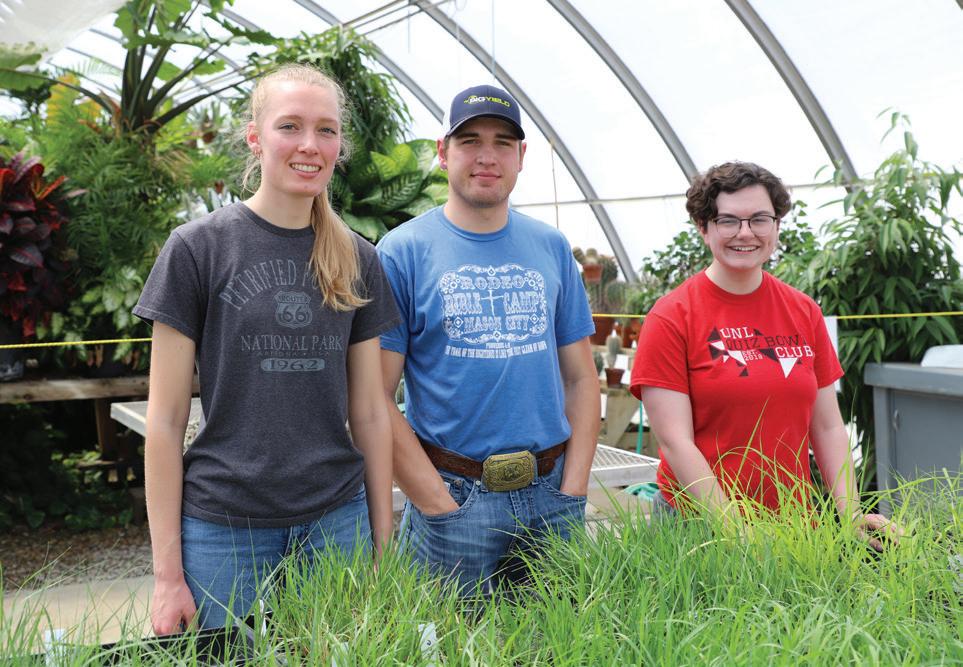
Caitlin
Department of Agronomy and Horticulture. At both banquets, club members enjoyed a silent auction, meal, updates, and end-of-year award presentations. Copenhaver received the Range Club Trail Boss Award, and Ivy received the Trailblazer Award.
In the fall, Range Management Club kicked off the start of the semester with a welcome back meeting. Students attended monthly meetings and started preparing for the Plant Identification, Undergraduate Range Management Exam and Rangeland Cup contests, which will take place at the SRM annual meeting in February 2025 in Spokane, Washington. Club members attended the Nebraska Section SRM Meeting in Norfolk, Nebraska, on Oct. 17. Additional meetings featured guest speakers, tours of native prairies and a craft night.
Range Management Club officers include Sam Morrow, president; Frazier Kaelin, vice president; Clara Freese, treasurer; and Joseph Barenberg, secretary. The club would like to thank mentors and advisers Nic McMillan and Cheryl Dunn for their support and guidance throughout the year.
by Walker Petersen | Turf Club president
THE TURF CLUB UNITES UNIVERSITY OF NEBRASKA–LINCOLN STUDENTS WHO SHARE AN INTEREST IN TURFGRASS-RELATED CAREERS, INCLUDING GOLF COURSE MAINTENANCE, SPORTS TURF AND LAWN CARE MANAGEMENT. While many members are plant and landscape systems majors focused on turfgrass science and management, students studying PGA golf management are also actively involved.
The club offers valuable connections with industry leaders and alumni through guest lectures on campus, tours of nearby turf operations and participation at both state and national conferences. Members also represent the university in national competitions hosted by the Golf Course Superintendents Association of America and the Sports Field Management Association.
The club began 2024 by traveling to Phoenix, Arizona, to compete in the national collegiate Turf Bowl at the annual GCSAA conference. This trip also gave students an opportunity to connect with industry professionals, talk to past and future employers, and make site visits of collegiate and professional football stadiums.
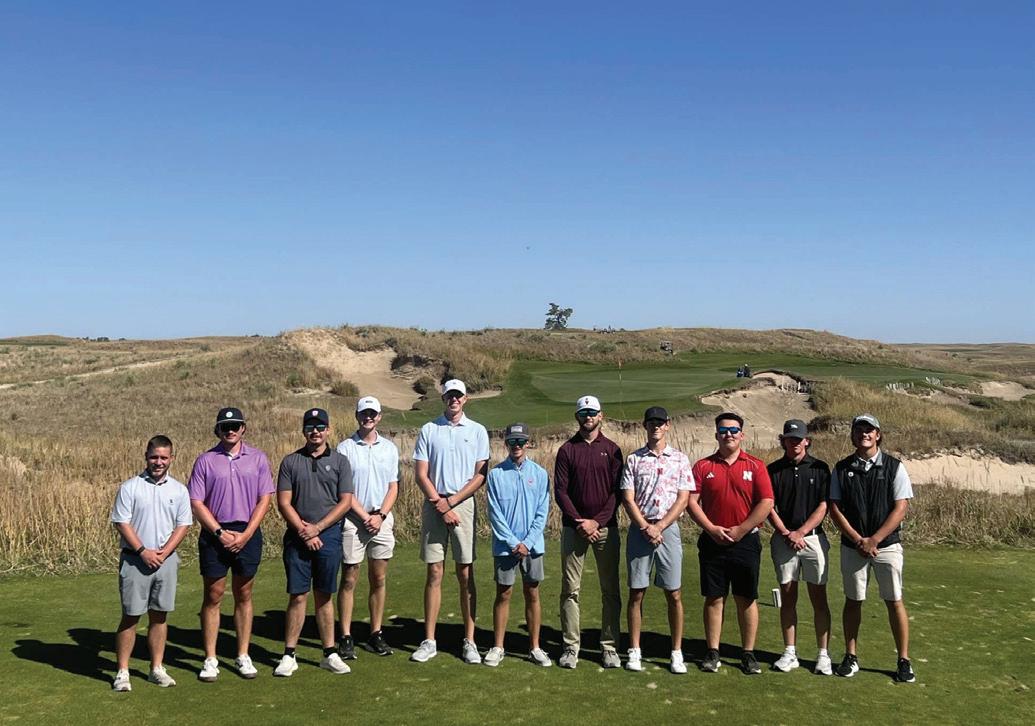
In the spring, club members took tours of local facilities and heard from guest speakers from different career paths within turfgrass. They also continued the annual Battle of the Border golf match against the Kansas State Turf Club where Nebraska, once again, brought home the traveling trophy.
In the fall, students kicked off the semester with a social gathering followed by a guest speaker from Sand Valley Golf Resort. A club team participated in the Nebraska Turfgrass Association Golf Tournament. Members traveled to Valentine, Nebraska, during the club’s Out-West Trip and took facility tours of some of Nebraska’s highest-rated courses.
Club officers are Walker Petersen, president; Riley Dinslage, vice president; Ryan Knipping, treasurer; and Samuel Norrenberns and Scout Allen, social media. Anne Streich, professor of practice, serves as club adviser.
by William Anderson | Horticulture Club president
THE HORTICULTURE CLUB HAD AN EVENTFUL AND PRODUCTIVE YEAR, MARKED BY A VARIETY OF EDUCATIONAL ACTIVITIES, HANDS-ON EXPERIENCES AND COMMUNITY-BUILDING EVENTS. For the first time, Horticulture Club had the opportunity to partner with the Osher Lifelong Learner’s Institute to host a program. Savvy Succulents saw members assist in helping participants arrange succulent gardens. The club also hosted alumna Jaqueline Nelson to give a talk on entrepreneurship and starting your own business in the horticulture industry. In early May, club members dedicated significant time and effort to preparing for the
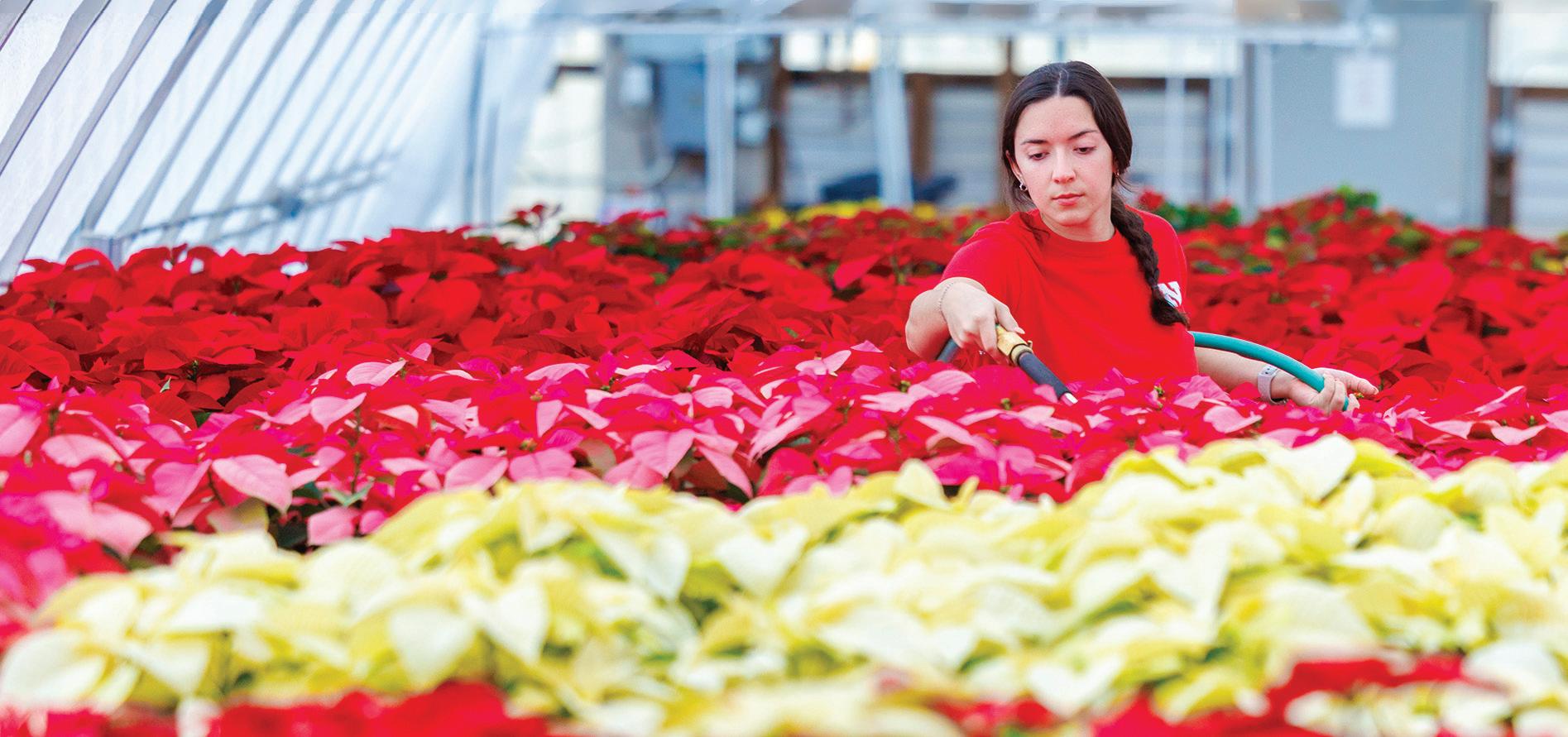
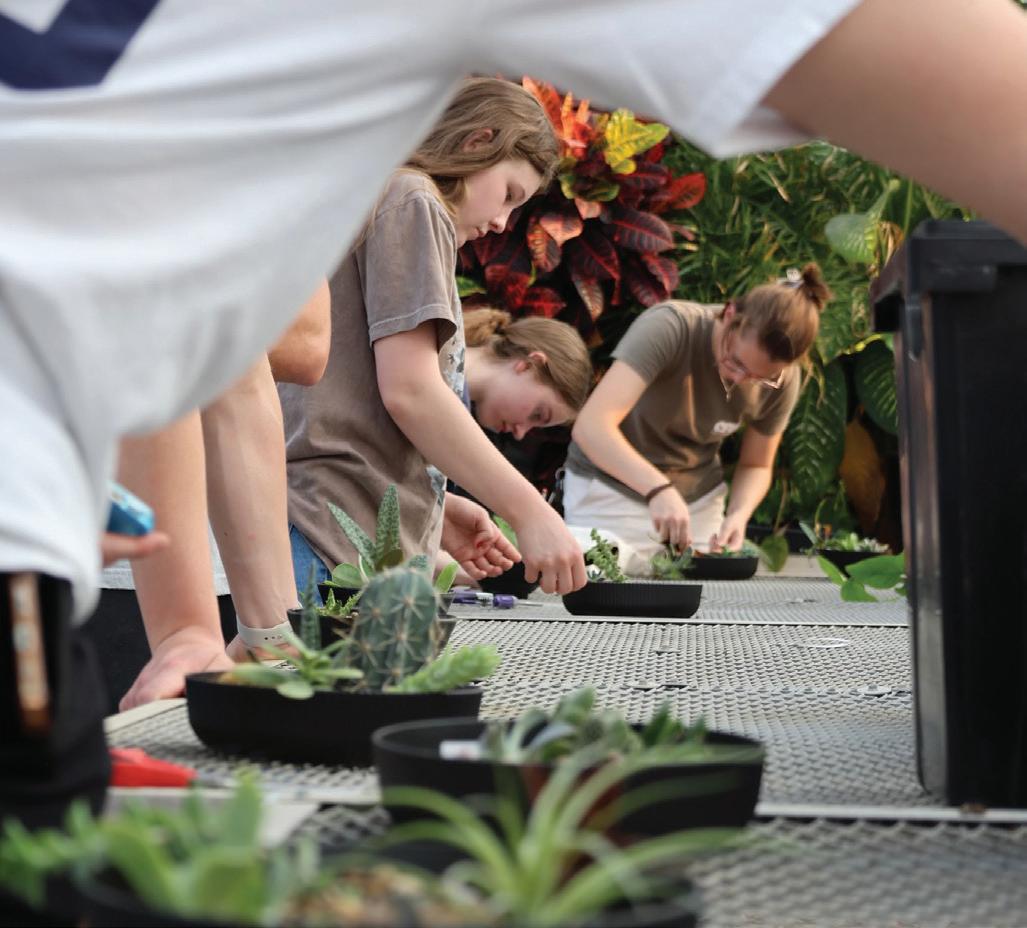
Haley Klement, sophomore, stands in a sea of poinsettias as she waters each individually inside the Teaching Greenhouse West ahead of the club’s annual poinsettia sale. TOP LEFT: During a creative hands-on event to kick off the fall semester, members design and assemble their own succulent planters.
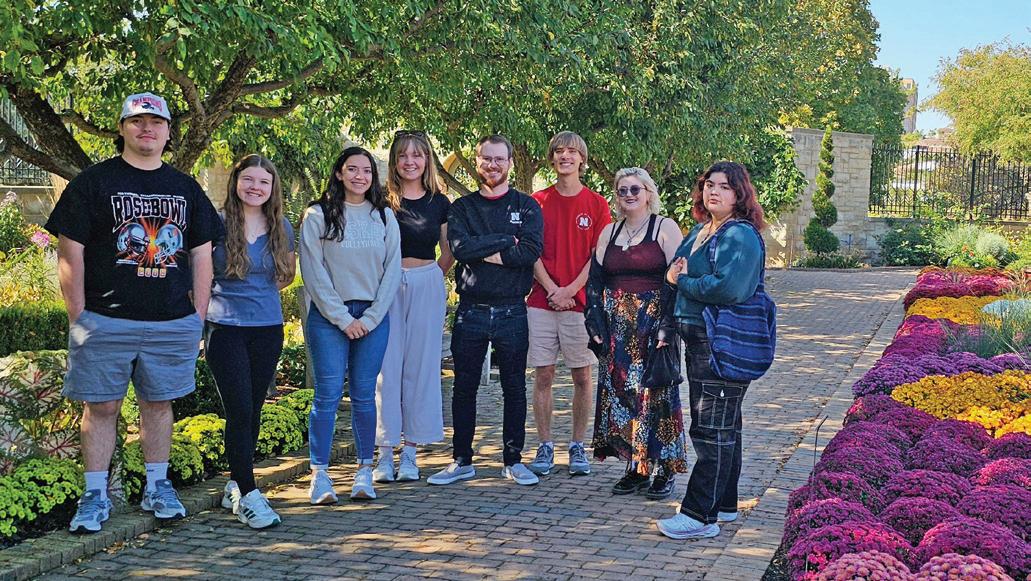
BOTTOM LEFT: Over fall break, members explore Kauffman Memorial Garden in Kansas City.
highly anticipated Spring Bedding Plant Sale, which took place May 2–4. The sale, a major success, provided the Lincoln community with an array of ornamental plants and vegetable seedlings. Proceeds from the sale went toward supporting the club’s ongoing activities, and any unsold plants were donated to local community gardens.
To kick off the fall semester, members were welcomed back with a creative hands-on event where they designed and assembled their own succulent planters. In late September, the club organized an exciting tour of Lincoln’s renowned Sunken Gardens, one of the city’s largest and most beautiful public gardens, giving members a chance to explore the stunning seasonal displays and learn about public garden management.
Continuing its tradition of connecting students with plant life, the club hosted its annual Study Buddy foliage plant sale. This event allowed members to sell an impressive selection of houseplants to the university community, with a focus on plants that thrive in dorm room conditions. The sale was a resounding success, reinforcing the club’s mission of promoting plant care and sustainability within the university.
In October, the club hosted a cookout that included a plant swap where members exchanged plants and shared gardening tips. Over fall break, members traveled to Kansas City, where they visited various horticultural businesses, explored botanical sites and engaged in hands-on learning opportunities. Additionally, the club prepared for its annual Poinsettia Sale, having cultivated poinsettias from cuttings since August. The sale, held in December, marked a festive conclusion to the semester.
The Horticulture Club is under the leadership of its officers: William Anderson, president; Briezy Kroeger, vice president; Brent Glantz, treasurer; Paige Miller and Claire Kiolbasa, co-marketing and social media; and Zach Johnson and Haley Klement, co-head growers. Stacy Adams and Terri James serve as advisers.
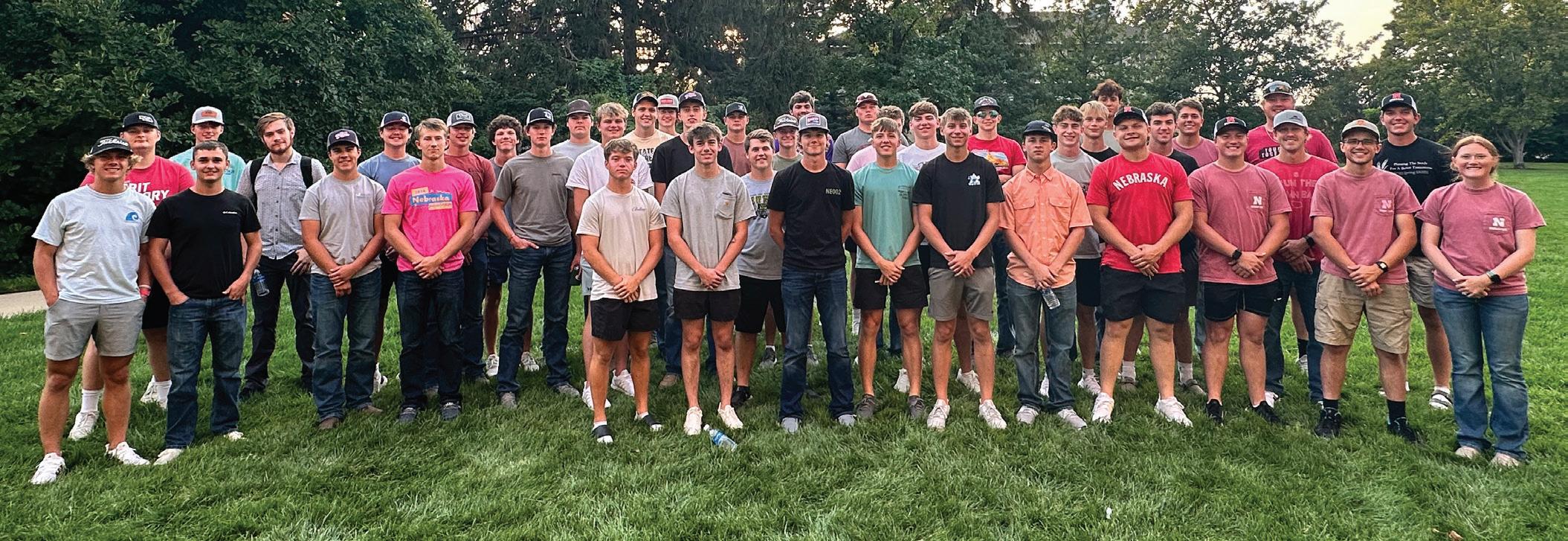
At the beginning of fall semester, the club welcomed students with the annual
by Zach Nienhueser | Agronomy Club president
LAST YEAR A RECORD NUMBER OF STUDENTS JOINED AGRONOMY CLUB, MARKING AN EXCITING CHAPTER IN ITS GROWTH. Today, the club is focused on creating fresh opportunities for members to explore careers in agriculture. Beyond career pathways, the club also offers invaluable learning experiences through meetings that feature insights from industry professionals.
Agronomy Club kicked off 2024 by hosting the popular podcast “Kick’N Dirt” with Mike and the Kevins—a show led by Mike Wardyn, Kevin Keller and Kevin Kowalski, all of whom work at Pioneer and share their expertise on a wide range of agricultural topics. As in previous years, the club had the chance to interview the hosts. This year’s conversation allowed students to dive deeper into career paths and agronomic knowledge, gaining practical advice from seasoned industry experts.
The next big event was “Experience Agronomy Day,” a full day of learning designed for FFA students from across Nebraska. This year’s sessions focused on crop, weed, disease and insect identification, along with a segment on soil science. The club’s officer team provided instruction to prepare these students for the Agronomy competition at State FFA. To cap off the day, students took a mock exam, modeled after the state competition, to test the knowledge they had gained.
Club officers also traveled to the spring Students of Agronomy, Soils & Environmental Sciences conference hosted by The Ohio State University. At the conference, the team enjoyed industry tours throughout Ohio, competed in a crop competition, and networked with both industry professionals and agronomy students from across the nation. The event concluded with a powerful talk by Than Hartsock, vice president of precision upgrades at John Deere, leaving attendees inspired by the future of agricultural technology.
With the beginning of fall semester, the club welcomed students with the annual Welcome Back Barbecue on East Campus. This gathering brought nearly 50 students together, fostering connections among new and returning students in the Department of Agronomy and Horticulture.
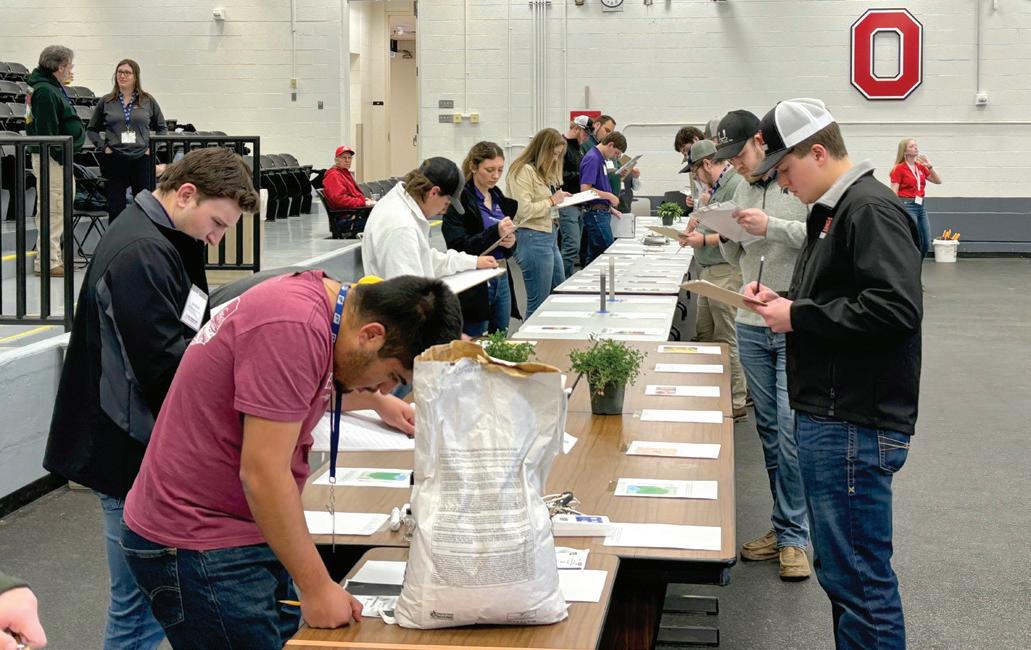
the Students of Agronomy, Soils & Environmental Sciences conference hosted by The Ohio State University.
Agronomy Club’s first official meeting of the semester featured its very own Nolan Wolfe from the university’s Career Services, who helped members polish their resumes and fine-tune their conversation skills in preparation for potential employers. This was followed by the East Campus Career Fair and the club’s Career Roundtable, which hosted eight employers in a more intimate setting. The roundtable provided a unique opportunity for students to learn about internships and full-time positions in a personal, engaging environment. The rest of the fall semester focused on educating club members about the vast, diverse world of agriculture and the exciting opportunities that await them. “We’re thrilled for what’s to come and the bright futures we’re helping to cultivate,” said Zach Nienhueser, Agronomy Club president. Additional club officers are Maggie Walker, vice president; Easton Weber, treasurer; Colton Stubbs, assistant treasurer; Wolfe, historian; Jake Burge, secretary; and Daniel Frey, event coordinator. Meghan Sindelar, associate professor of practice and agronomy student adviser, serves as the club adviser.
by Lauren Wilson | Pi Alpha Xi–Alpha Gamma Chapter vice president
PI ALPHA XI WAS FOUNDED AT CORNELL UNIVERSITY IN 1923, AND THE UNIVERSITY OF NEBRASKA–LINCOLN’S ALPHA GAMMA CHAPTER WAS ESTABLISHED IN 1982. Today, there are 40 chapters with over 14,000 members nationwide, and a total of 396 members have been initiated at Nebraska. The mission of Pi Alpha Xi is to recognize high-achieving students and grant scholarships/ fellowships to its student members, educators and professional horticulturists. Every member possesses professional leadership skills and shares a passion for the enrichment of human life through plants.
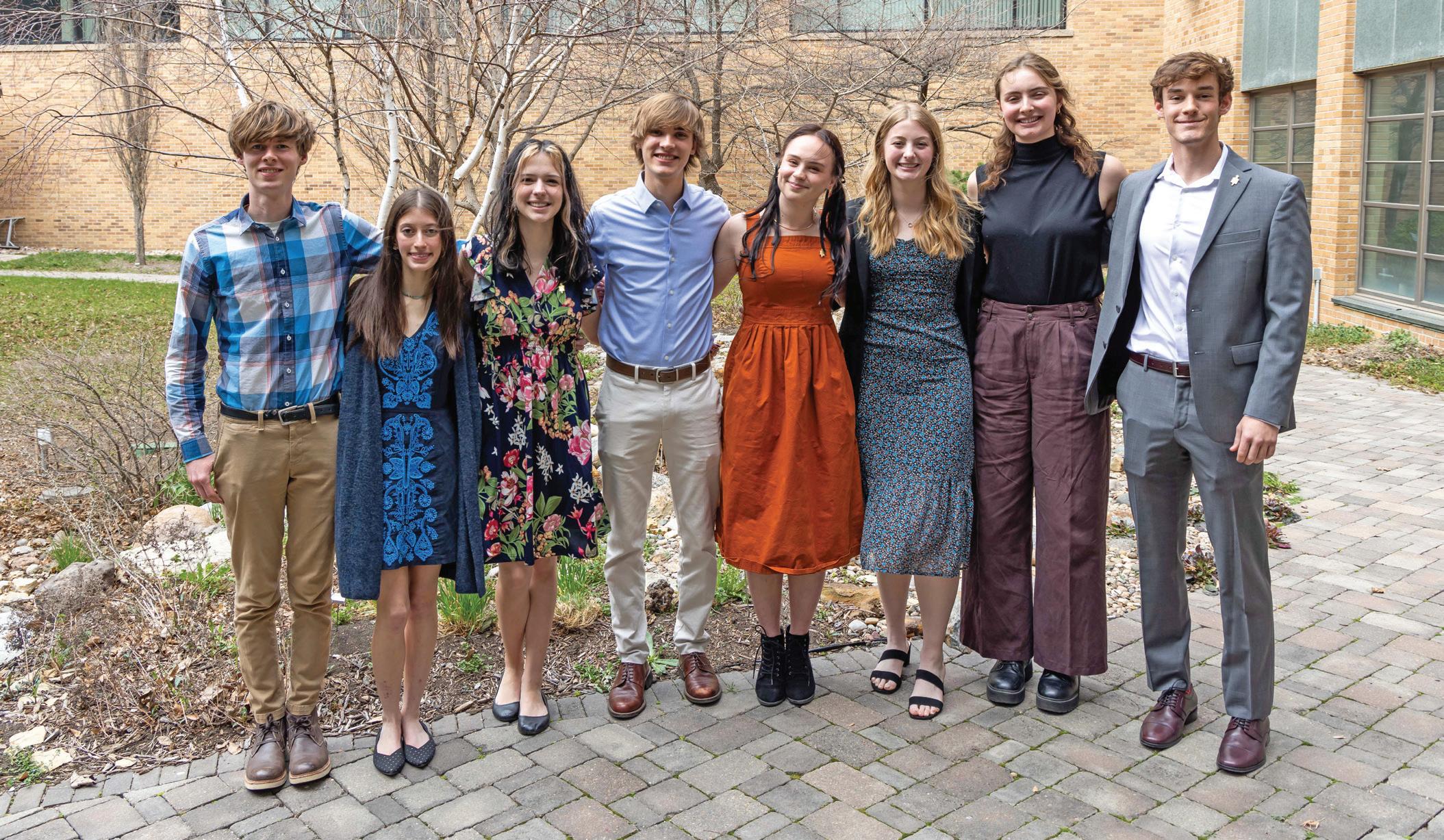
Nebraska’s Alpha Gamma chapter is directed by faculty advisers Luqi Li and Anne Streich. In April of 2024, the chapter initiated five new members and elected two new officers for the following year. New initiates are Lauren Wilson, Lanouette Bohmont, William Anderson, Alessandra Meza and Alec Patel. The 2024 officers are Anderson, president, and Wilson, vice president.
At the 2024 Agronomy and Horticulture Spring Banquet, the chapter awarded Elaina Madison the Pi Alpha Xi scholarship that recognizes one outstanding, active member that makes significant contributions to the
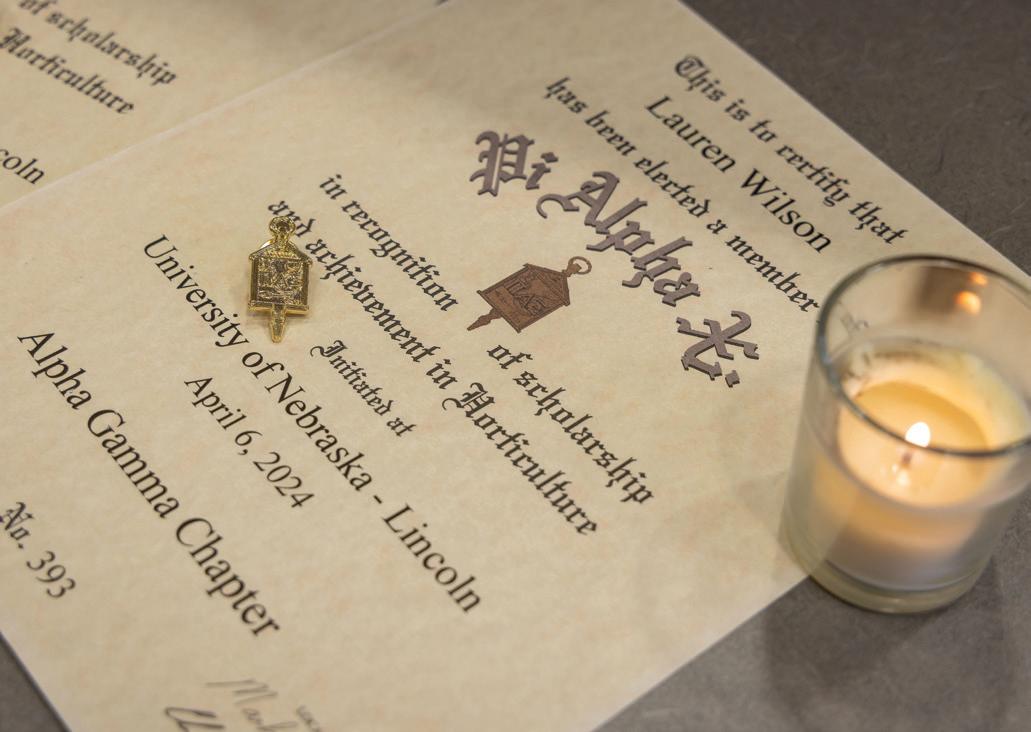
organization each year. Additionally, Kim Todd was awarded the President’s Citation in recognition of outstanding service in the field of horticulture. In her 22 years at the university, Todd has greatly impacted her students’ learning through her leadership, enthusiasm and desire to educate the public to improve the world of horticulture.
The chapter held its annual fundraising event, a holiday wreath-making workshop, in December. The workshop is a two-hour course guided by Emeritus Professor Ellen Paparozzi, who founded and served the chapter for 40 years. A total of 24 attendees were provided with real fir to build their own front door masterpiece with assistance from Pi Alpha Xi–Alpha Gamma Chapter members.
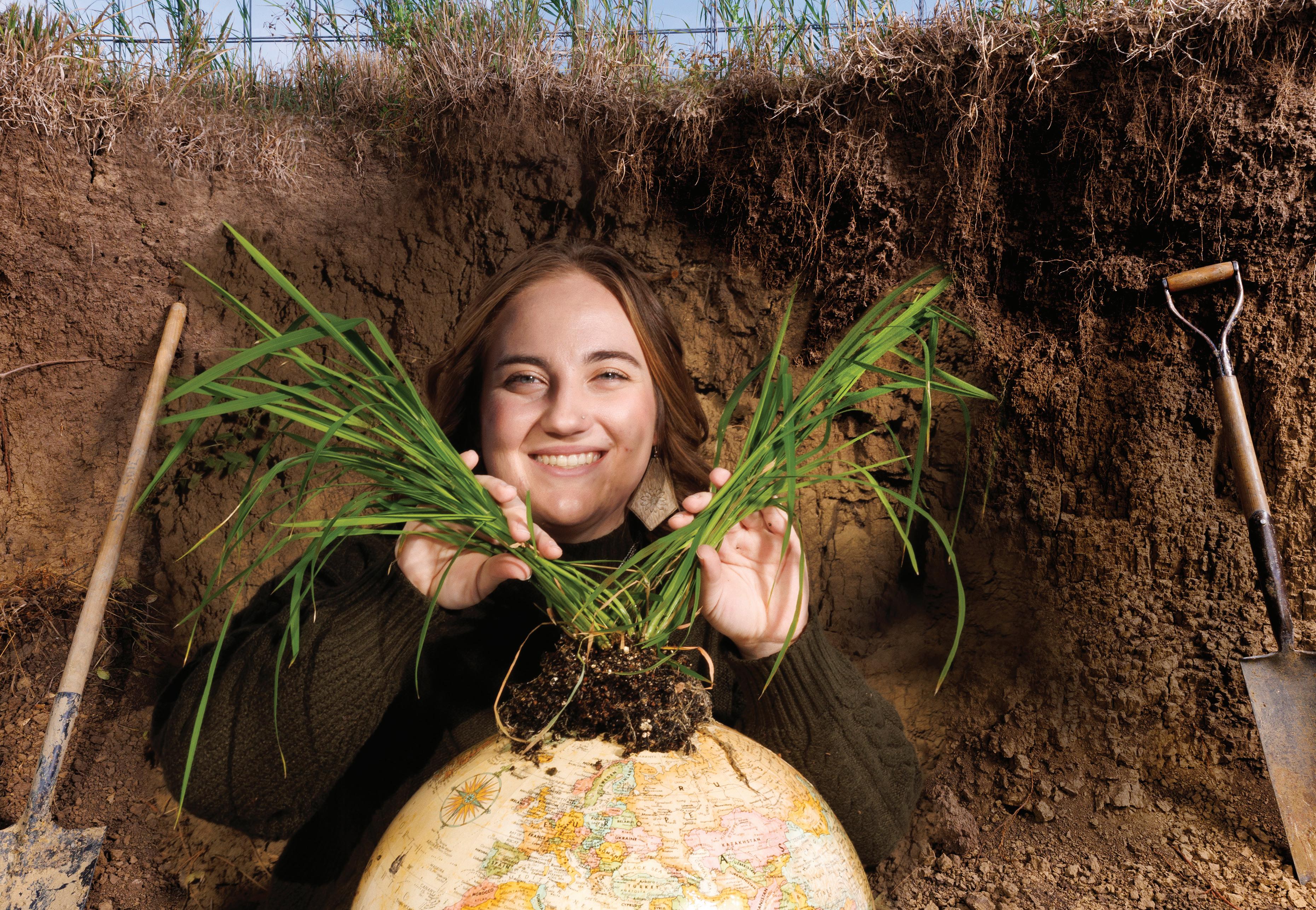
“Incredible learning opportunities in Brazil, Rwanda, Saudi Arabia and Ireland solidified my passion for agriculture and soil health.”
Charlotte Brockman
by Charlotte Brockman | senior agronomy major
GROWING UP A GENERATION REMOVED FROM A CATTLE RANCH, I NEVER THOUGHT I WOULD FIND MYSELF STUDYING ROW CROPS. However, my experiences in 4-H and FFA shaped my love for agriculture early in my life.
When it came time to choose a college, I only applied to schools with soil judging teams, an interest formed through my participation in Envirothon. Feeling at home in Nebraska, I moved 1,000 miles from my hometown in southern Idaho to pursue a dream at the University of Nebraska–Lincoln.
I started in agricultural communications, but after an internship experience showed me the importance of agronomic science, I changed my major to agronomy. And as someone who loves the outdoors and challenging coursework, it has been the perfect fit for me.
During my time in agronomy, I shared my passion for agriculture by being a teaching assistant for the Introduction to Soils course and competing across the country on the UNL Soil Judging Team. Some of my best college memories and closest friends came from being a part of the Soil Judging Team.
Incredible learning opportunities in Brazil, Rwanda, Saudi Arabia and Ireland solidified my passion for agriculture and soil health. These travels exposed me to different cropping systems and soil environments while experiencing cultures and forming friendships worldwide.
I am grateful for the opportunities I have had at Nebraska and the outstanding professors who challenged me to believe in myself.
by Luka Milosevic | doctoral student in weed science and graduate research assistant
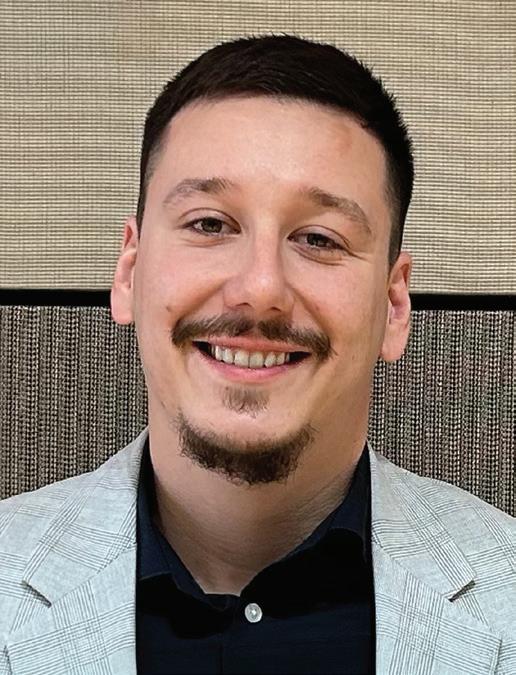
AS FAR BACK AS I CAN REMEMBER, I HAVE ALWAYS WANTED TO BE THE FORCE FOR A POSITIVE CHANGE IN THE WORLD. Coming from an agricultural family in Serbia, I represent the third generation of agronomy graduates. I earned my bachelor’s degree from the University of Belgrade – Faculty of Agriculture, where my passion for agronomy deepened. During the final year of my undergraduate studies, I had the lifechanging opportunity to intern in Nebraska under the guidance of one of the world’s leading weed scientists, Professor Stevan Knezevic. After returning to Serbia to complete my master’s degree at the same institution, I knew my journey in agricultural science was far from over.
In the summer of 2022, Professor Knezevic invited me to join his team for a doctoral program at the University of Nebraska–Lincoln, presenting me with a groundbreaking project that had the potential to address one of the world’s most pressing issues: food security. With fewer resources available for an ever-growing global population, finding innovative strategies to ensure food availability is essential. As such, our research focuses on increasing crop yields through hormesis, a phenomenon where plants exposed to low levels of stressors actually thrive,
enhancing their performance rather than harming it. This potential to boost yields offers a promising solution to meeting the world’s increasing food demands.
Spending the last three years at the University of Nebraska–Lincoln has not only allowed me to contribute to this innovative research, but it has also provided countless opportunities for personal and professional growth. One such rewarding aspect of being a Husker is the opportunity to work with undergraduate students. Helping them develop new skills and guiding them through challenging concepts has been incredibly fulfilling.
I’ve also had the privilege of supporting my fellow graduate students with their research projects and data analysis. This collaborative environment has allowed me to share knowledge with and grow alongside my peers. Along the way, I’ve made lifelong friends, both inside and outside of UNL, making my experience here truly unforgettable. Serving in leadership roles within the Agronomy and Horticulture Graduate Student Association, such as GSA representative, treasurer and president, gave me the chance to advocate for the concerns of graduate students and foster a strong sense of community within our department.
The University of Nebraska–Lincoln and Professor Knezevic have provided me with the tools to make a meaningful impact through research and hands-on interaction with farmers during extension meetings and events. I have had the privilege of presenting our research to farmers, hearing their challenges, and offering solutions that could make a difference in their fields. There truly is no place like Nebraska, and no university quite like ours, where innovative research meets practical application in the effort to create a better future.
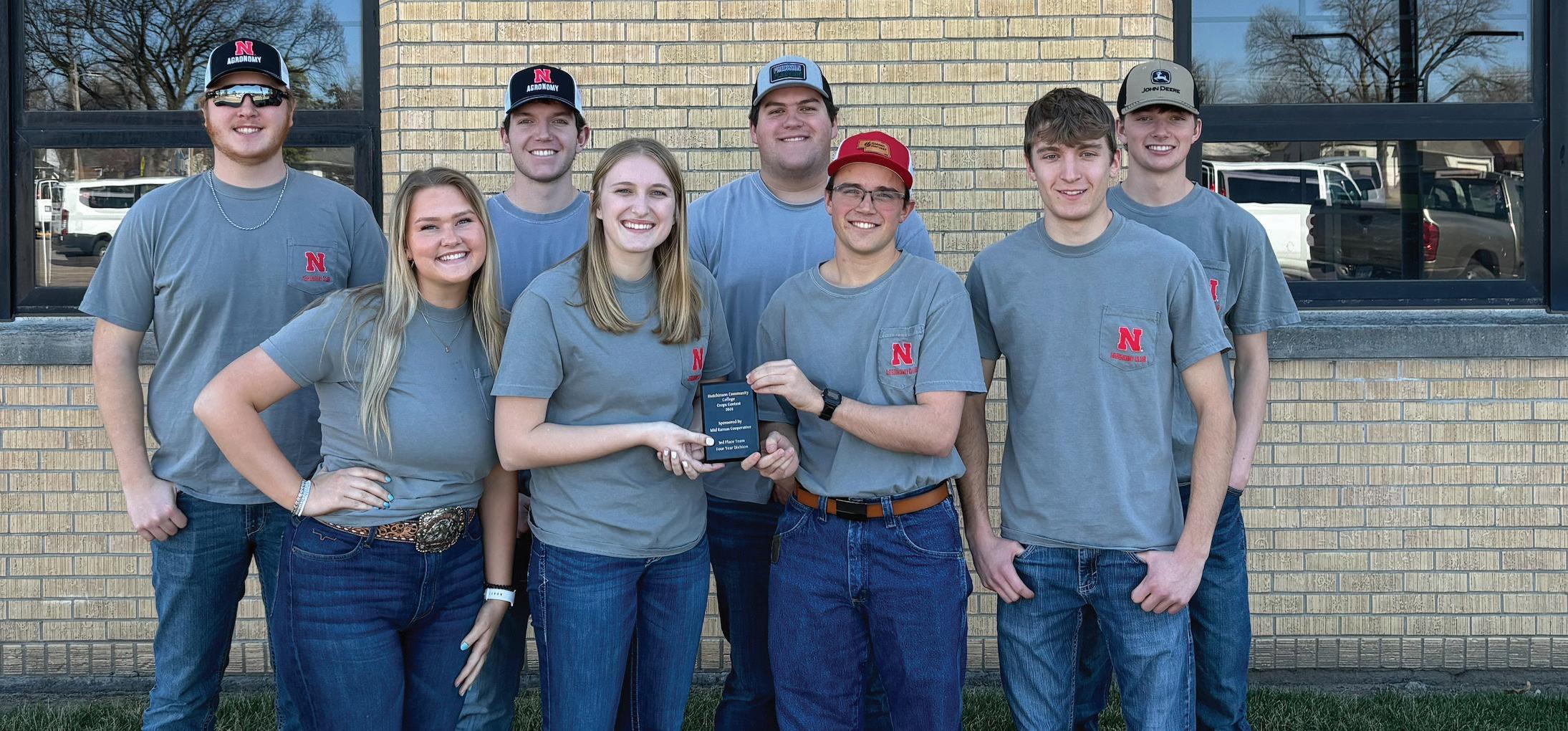
THE NEBRASKA CROPS JUDGING TEAM TOOK THIRD PLACE OVERALL IN THE REGIONAL CROPS JUDGING CONTEST AT HUTCHINSON COMMUNITY COLLEGE, KANSAS, FEB. 24. Will Stalder placed eighth overall individually.
The team placed third at the Nebraska College of Technical
THE HUSKERS REPEATED AS COLLEGIATE RANGELAND CUP CHAMPIONS DURING THE SOCIETY FOR RANGE MANAGEMENT ANNUAL MEETING JAN. 29 IN SPARKS, NEVADA. The Nebraska team included fisheries and wildlife majors Caitlin Copenhaver, Jacob VanDress and Josie Ivy.
The Rangeland Cup consists of a research poster presentation in which students are given a range sciencerelated prompt and then asked to find potential solutions.
Team advisers are Cheryl Dunn and Nic McMillan. Both are members of the range, pasture and forages group in agronomy and horticulture.
Agriculture contest March 23 in Curtis, Nebraska. Individually, Zach Nienhueser took seventh place, and teammate Stalder was eighth.
On April 18, the team competed at the North American Colleges and Teachers of Agriculture National Crops Judging Contest in Twin Falls, Idaho. The team placed sixth out of the 23 teams.
Nebraska’s team includes agronomy majors Ashton Boehm, Daniel Frey, Thayer Jonak, Nienhueser, Logan Nelson, Stalder, Clinton Turnbull, Maggie Walker and Kailey Ziegler. Don Lee, professor in agronomy and horticulture, and Garrett Kuss, graduate student in the Doctor of Plant Health program, coach and advise the team.
THE UNIVERSITY OF NEBRASKA-LINCOLN SOIL JUDGING TEAM TOOK HOME SIX AWARDS, INCLUDING NATIONAL RUNNER-UP, AT THE NATIONAL SOIL JUDGING CONTEST HOSTED BY IOWA STATE UNIVERSITY IN AMES, IOWA, IN APRIL. Nebraska won second place overall team, first place in team judging and first place alternate team. Agronomy majors Mason Rutgers and Rachel Clarkson took third place individual and second place alternate individual, respectively. Adrian Cox, an integrated science major, won alternate individual.
The team placed fifth in team judging and fifth overall at the Fall 2024 Region V Collegiate Soil Judging Contest held in Great Bend, Kansas, and hosted by Kansas State University. Individually, Sydney Honaker, an environmental science and fisheries and wildlife major, placed fifth and Promise “PJ” Smeal, a plant and landscape systems major, placed seventh.
Team members include students from the College of Agricultural Sciences and Natural Resources. Becky Young, assistant professor of practice in agronomy and horticulture, and Judith Turk, associate professor in natural resources, serve as team coaches.
A UNIVERSITY OF NEBRASKA–LINCOLN TURFGRASS COMPETITION TEAM TOOK SIXTH PLACE OUT OF 63 TEAMS FROM 28 UNIVERSITIES AT THE 30TH ANNUAL COLLEGIATE TURF BOWL COMPETITION ON JAN. 31. The competition, presented in partnership with John Deere, was held at the Golf Course Superintendents Association of America Conference and Trade Show in Phoenix.
The sixth-place University of Nebraska Team 35 included Alex Uram, Scout Allen, John Tines and Matt Boyd, all plant and landscape systems majors in turfgrass science and management. Walker Petersen, Easton Petsche and Ridge Gerstberger also competed on a team and earned 29th place
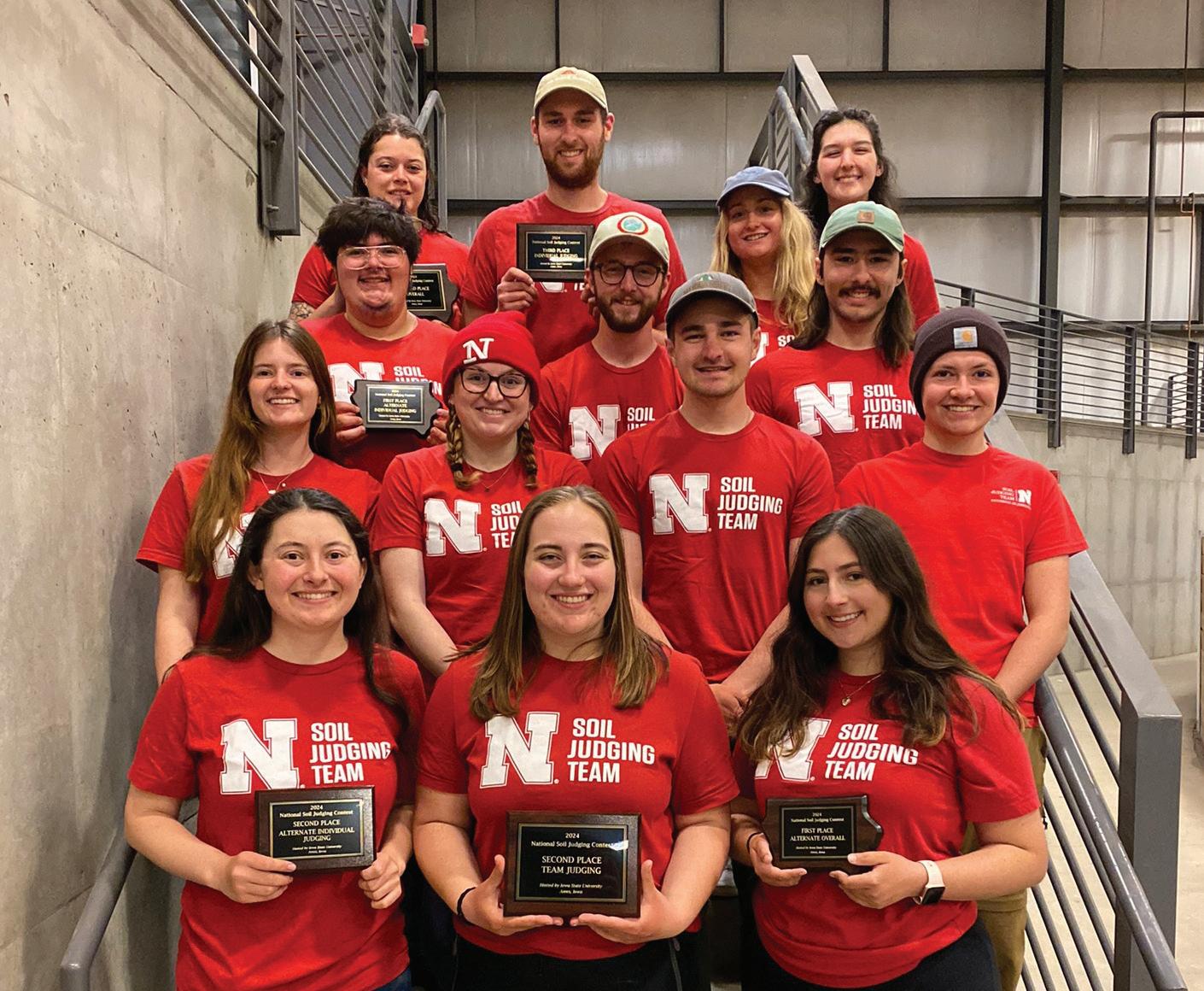
Soil Judging Team members who participated at the national competiton are Rachel Clarkson (front row, from left), Charlotte Brockman, Julianna Canedo, Anna Newcome (second row, from left), Madi Stock, Jack Krebs, Will Hernandez, Adrian Cox (third row, from left), Mason Schumacher, Nathan Kufner-Rodriquez, Stephanie Kluthe (back row, from left), Mason Rutgers, Natalie Robbins and Claire Nalty.
while Sam Norrenberns, TJ Thalman and Carson Vachal placed 30th as a team.
The Turf Bowl competition consisted of several components. The team took a 200-question, multiple-choice exam that covered math, turfgrass growth and development, soils, fertility, pesticides, irrigation, mowing and water management. They also had to identify turfgrass and weeds from live samples, insects and diseases from images with descriptions of species they affected and conditions that favored their presence, and turfgrass seed from seed samples.
Anne Streich, professor of practice in agronomy and horticulture, is the competition team adviser.
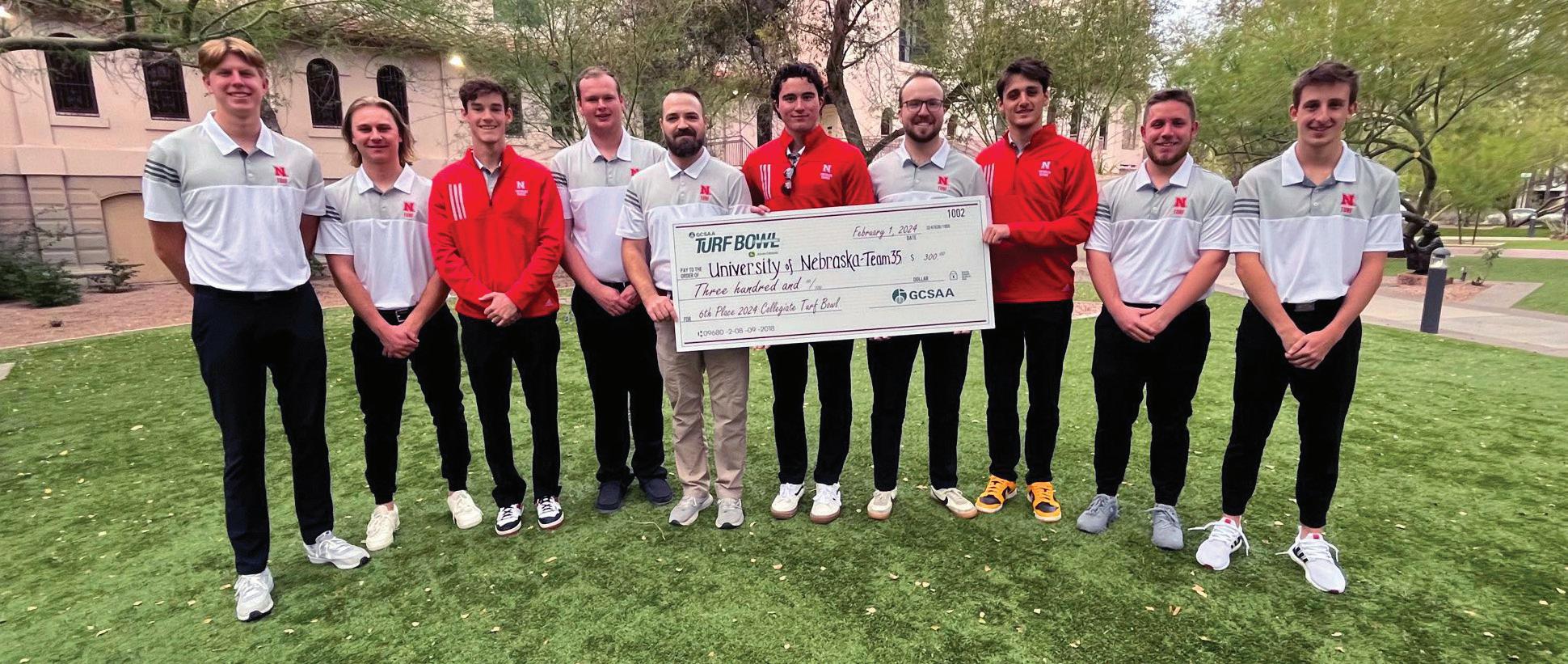
Scout Allen: Sixth-place Team Golf Course Superintendents Association of America 30th Annual Collegiate Turf Bowl
Ashton Boehm: Third-place Team Nebraska College of Technical Agriculture Collegiate Crops Contest – Crops Judging, Third-place Overall Team Hutchinson Community College Collegiate Crops Contest – Crops Judging
Matt Boyd: Sixth-place Team GCSAA 30th Annual Collegiate Turf Bowl
Charlotte Brockman: Nebraska Summer UCARE Award, First-place Team in Group Judging National Collegiate Soil Judging Contest, Second-place Team Overall National Collegiate Soil Judging Contest, Innocents Society
Rachel Clarkson: Second-place Individual Alternates Judging National Collegiate Soil Judging Contest, Firstplace Team in Group Judging National Collegiate Soil Judging Contest, Second-place Team Overall National Collegiate Soil Judging Contest
Kevin Dockery: Honors Program Graduate
Daniel Frey: Martin A. Massengale Outstanding Senior Award, Thirdplace Team NCTA Collegiate Crops Contest – Crops Judging, Third-place Overall Team Hutchinson CC Collegiate Crops Contest – Crops Judging
Ryleigh Grove: Milton E. Mohr Biotechnology Scholarship, Nebraska Summer UCARE Award
Thayer Jonak: Third-place Team NCTA Collegiate Crops Contest –Crops Judging, Third-place Overall Team Hutchinson CC Collegiate Crops Contest – Crops Judging
Emma Kuss: Gamma Sigma Delta Outstanding Senior Scholarship Award of Merit
Trey Lamkins: University of Nebraska–Lincoln Homecoming Royalty Finalist
Elaina Madison: Chancellor’s Scholar, Pi Alpha Xi Alpha Gamma Scholarship
Matt Mittman: Chancellor’s Scholar
Logan Nelson: Third-place Team
NCTA Collegiate Crops Contest –Crops Judging, Third-place Overall Team Hutchinson CC Collegiate Crops Contest – Crops Judging
Anna Newcome: First-place Team in Group Judging National Collegiate Soil Judging Contest, Second-place Team Overall National Collegiate Soil Judging Contest
Zach Nienhueser: First-place Helena Agri-Enterprises Northern Business Unit Intern of the Year Scholarship, Third-place Team NCTA Collegiate Crops Contest – Crops Judging, Seventhplace Individual NCTA Collegiate Crops Contest – Crops Judging, Third-place Overall Team Hutchinson CC Collegiate Crops Contest – Crops Judging
Mason Rutgers: Third-place Individual Judging National Collegiate Soil Judging Contest, First-place Team in Group Judging National Collegiate Soil Judging Contest, Second-place Team
Overall National Collegiate Soil Judging Contest, Honors Program Graduate Promise “PJ” Smeal: Seventh-place Individual Region 5 Soil Judging Contest
Will Stalder: Third-place Team NCTA Collegiate Crops Contest – Crops Judging, Eighth-place Individual NCTA Collegiate Crops Contest –Crops Judging, Third-place Overall Team Hutchinson CC Collegiate Crops Contest – Crops Judging
John Tines: Chancellor’s Scholar, Sixth-place Team GCSAA 30th Annual Collegiate Turf Bowl
Clinton Turnbull: Third-place Team NCTA Collegiate Crops Contest –Crops Judging, Third-place Overall Team Hutchinson CC Collegiate Crops Contest – Crops Judging
Alex Uram: Sixth-place Team GCSAA 30th Annual Collegiate Turf Bowl
Maggie Walker: Third-place Team NCTA Collegiate Crops Contest –Crops Judging, Third-place Overall Team Hutchinson CC Collegiate Crops Contest – Crops Judging
Easton Weber: UNL Agronomy Club Outstanding Underclassmen
Nolan Weber: American Society of Agronomy Outstanding Senior
Kailey Ziegler: Third-place Overall Team Hutchinson CC Collegiate Crops Contest – Crops Judging
A list of all student awards can be found online at go.unl.edu/ undergrad-student-awards
Madhusudhan Adhikari: Thirdplace American Society of Agronomy Graduate Poster Contest – Nutrients and Environmental Quality
Lucia Bonfanti: Second-place ASACrop Science Society of AmericaSoil Science Society of America
Graduate Oral Presentation – Crop Physiology and Metabolism
Yuvraj Chopra: Widaman Distinguished Graduate Fellowship
Jensina Davis: Bayer Crop Science Mentorship Program
Sujani De Silva: Mary and Charles C. Cooper/Emma I. Sharpless Fellowship, IANR Writing Fellowship
Janet Falk: Agronomy and Horticulture Distance Education Online Fellowship
Deepak Ghimire: Bayer Crop Science Mentorship Program, Corteva Developing Emerging Leaders and Talent in Agriculture Award, ASA Nelson Yield-Limiting Factors Graduate Student Scholarship, ASA Encompass Fellows Program
Dipesh Giri: John and Louise Skala Distinguished Graduate Fellowship, First-place ASA-CSSASSSA Graduate Student Poster & 5-Minute Rapid Presentation –Soils & Environmental Quality
Alyssa Hall: AHGSA Outstanding Student Member, Bayer Crop Science Mentorship Program, Milton E. Mohr Biotechnology Fellowship, CASNR Milton E. Mohr Fellowship
Akashdeep Kamboj: Bayer Crop Science Mentorship Program
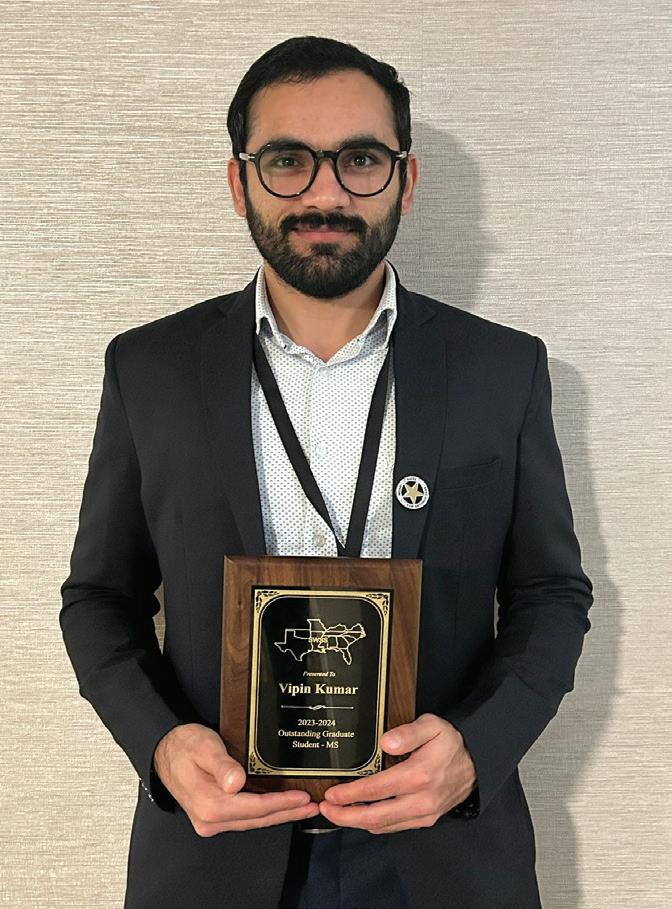
Vipin Kumar: CASNR Milton E. Mohr Fellowship, First-place North Central Weed Science Society National Weed Contest Overall Graduate Individual, South Weed Science Society Outstanding MS Student Award
Stephanie Lugo: Third-place ASA-CSSASSSA Graduate Poster Presentation – Forest, Range, and Wildland Soils
Bridget McKinley: CASNR Milton E. Mohr Fellowship
Luka Milosevic: ARD John and Louise Skala Fellowship, First-place NCWSS Oral Paper Contest – Ph.D. section, Second-place NCWSS Poster Contest – Ph.D. section
Jonathan Price: Agronomy and Horticulture Distance Education Online Fellowship
Lauren Quackenbush: Agronomy and Horticulture Distance Education Online Fellowship
Luzviminda Sazon: First-place ASACSSA-SSSA Ph.D. Oral Competition – Advances in Nutrient Management
Anmol Singh: Fourth-place SSSA Ph.D. Poster Presentation – Soil FertilityNutrient Management, 54th North Central Soil Fertility Conference Outstanding Graduate Student Award
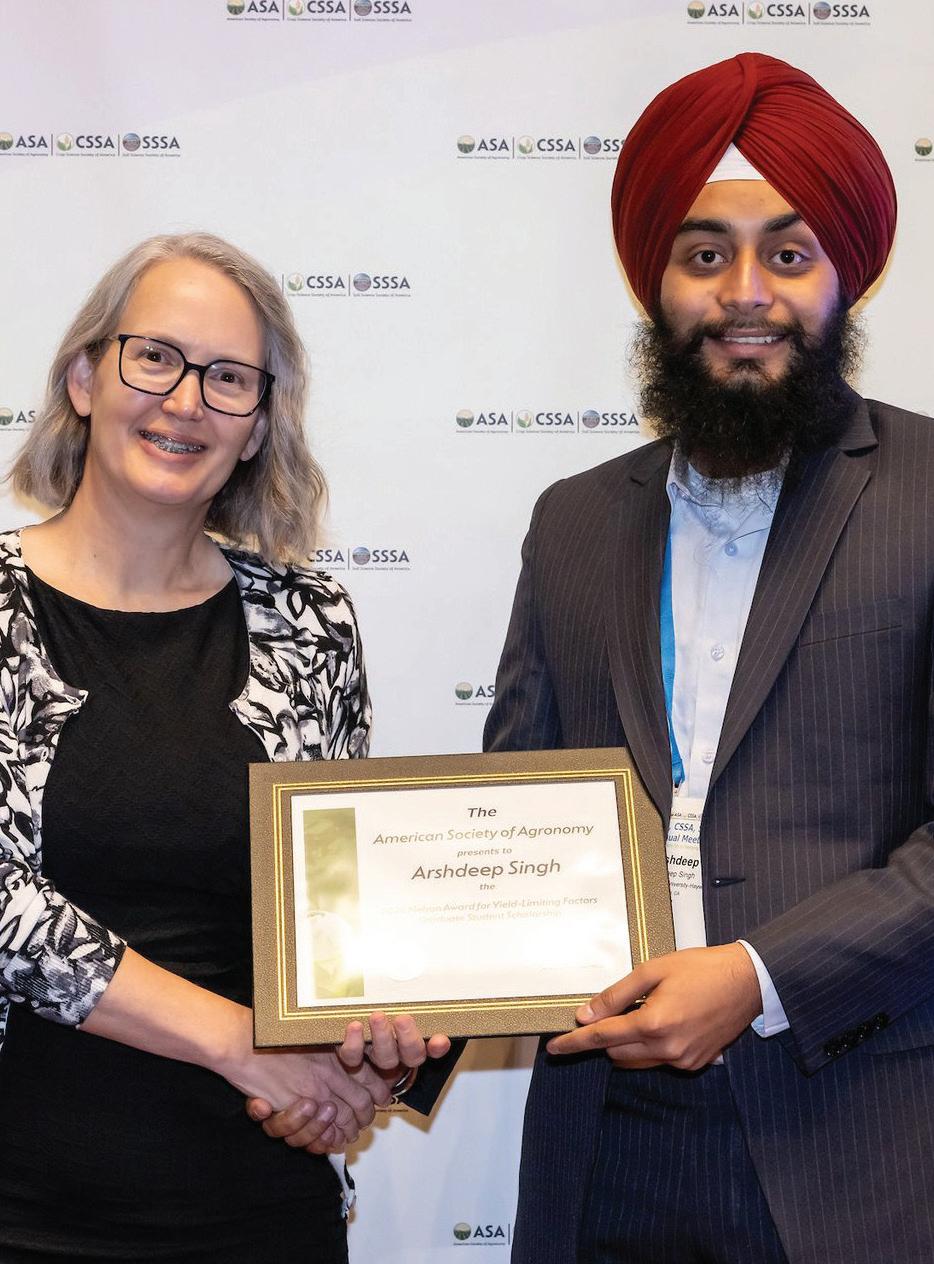
Arshdeep Singh: CSSA Gerald O. Mott Meritorious Graduate Student Award, ASA-CSSA-SSSA Agricultural & Environmental Letters Outstanding Reviewer, ASA Nelson Yield Limiting Factors Graduate Student Scholarship
Mandeep Singh: NCWSS Outstanding Graduate Student Award
Noshin Ara Tunazzina: Widaman Distinguished Graduate Fellowship
Caleb Wehrbein: Shear-Miles Agricultural Fellowship
Scott Womack: Agronomy and Horticulture Distance Education Online Fellowship
Vinicius Zuppa: ASA-CSSA-SSSA Future Leaders in Science Award
A list of all student awards can be found online at go.unl.edu/grad-student-awards
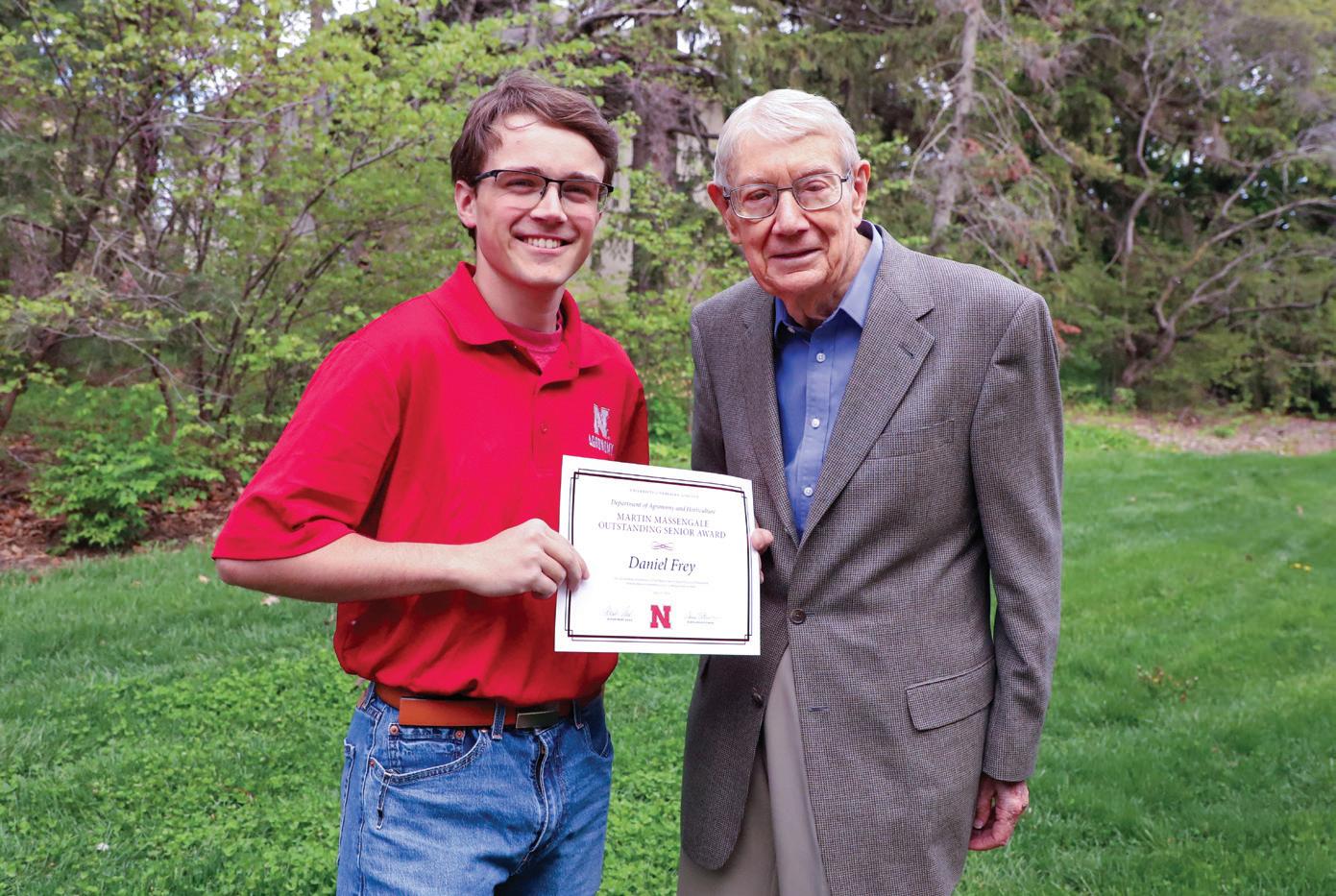
Daniel Frey, agronomy major (left), was awarded the Martin A. Massengale Outstanding Senior Award. Frey graduated in December 2024 and works at Farmer’s Cooperative in Hallam, Nebraska, as an agronomy sales associate. The award honors Massengale (right) the president, chancellor and Foundation Distinguished Professor emeritus and founding director of the Center for Grassland Studies.
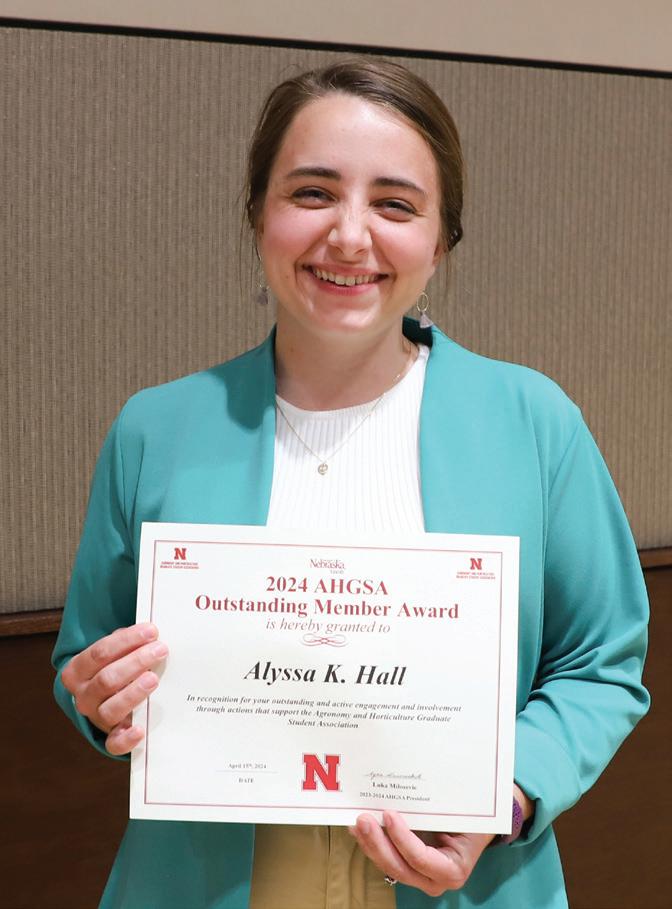
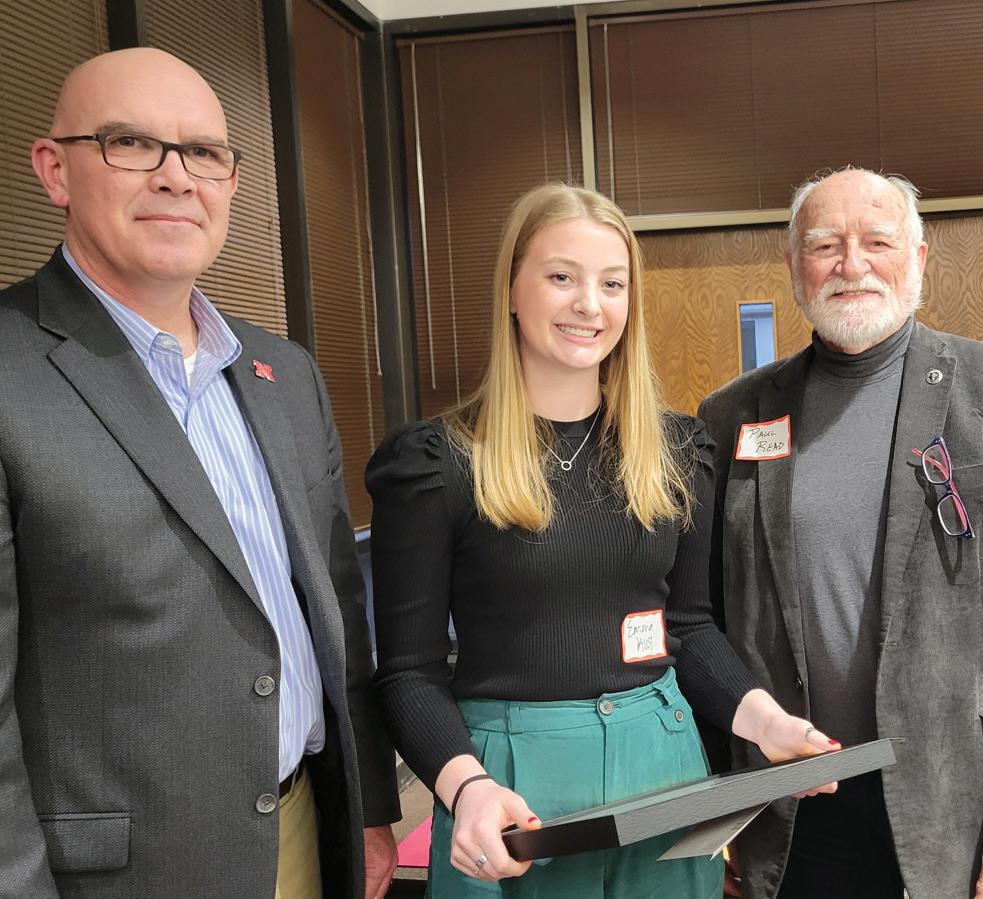
the Outstanding Senior Scholarship Award of
by Gamma Sigma Delta — an Honor Society of Agriculture — during the annual reception of the Nebraska Chapter in Lincoln April 1, 2024.
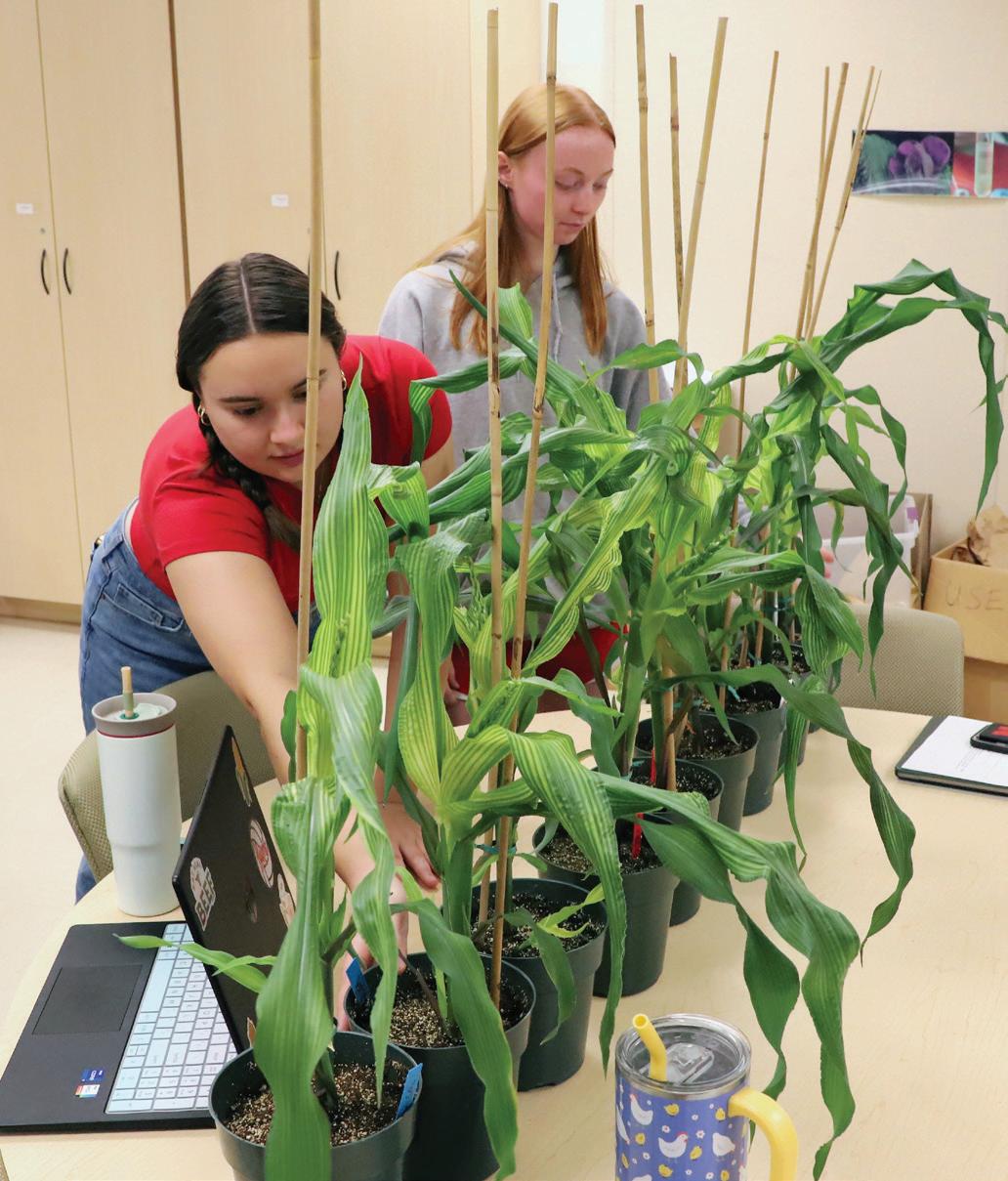
Agronomy major Livia Farmer (left) and plant and landscape systems major Madelyn Smith survey 5-week-old, FastFlowering Mini-Maize plants grown in various CO2 environments during the new Experiments in Plant Science course.
by Fran tenBensel Benne | communications specialist
“STUDENTS LEARN BEST BY APPLYING WHAT THEY HEAR IN CLASS TO REAL-LIFE SITUATIONS,” DAVID HOLDING SAID.
Holding and Don Lee, both professors of agronomy and horticulture, wanted to create a new plant science lab where students could engage with the core principles of plant physiology.
Holding and Lee have taught Plant and Landscape Systems 131 Plant Science since 2009. The labs connected to the course feature in-depth plant growth experiments that test the effects of different abiotic treatments on various crop plants, provide critical links to physiological concepts learned in class, and fulfill the AchievementCentered Education 4 requirement of PLAS 131.
The labs have improved and evolved over the years. In 2020, Holding incorporated the adjustable CO2 chambers in the East Campus greenhouses to perform experiments. He also used the Beadle Center growth facilities for daytime and nighttime heat stress, variable light quality and drought experiments. In 2023, students conducted a whole-semester growth experiment using these abiotic variables on various quick-flowering crops. Within one teaching semester, students measured growth variables over the entire life cycle of a plant, from germination to flowering and seed set.
Recognizing that the experimentation in Plant and Landscape Systems 131 Plant Science had expanded considerably beyond the three-credit, ACE 4 level, Holding
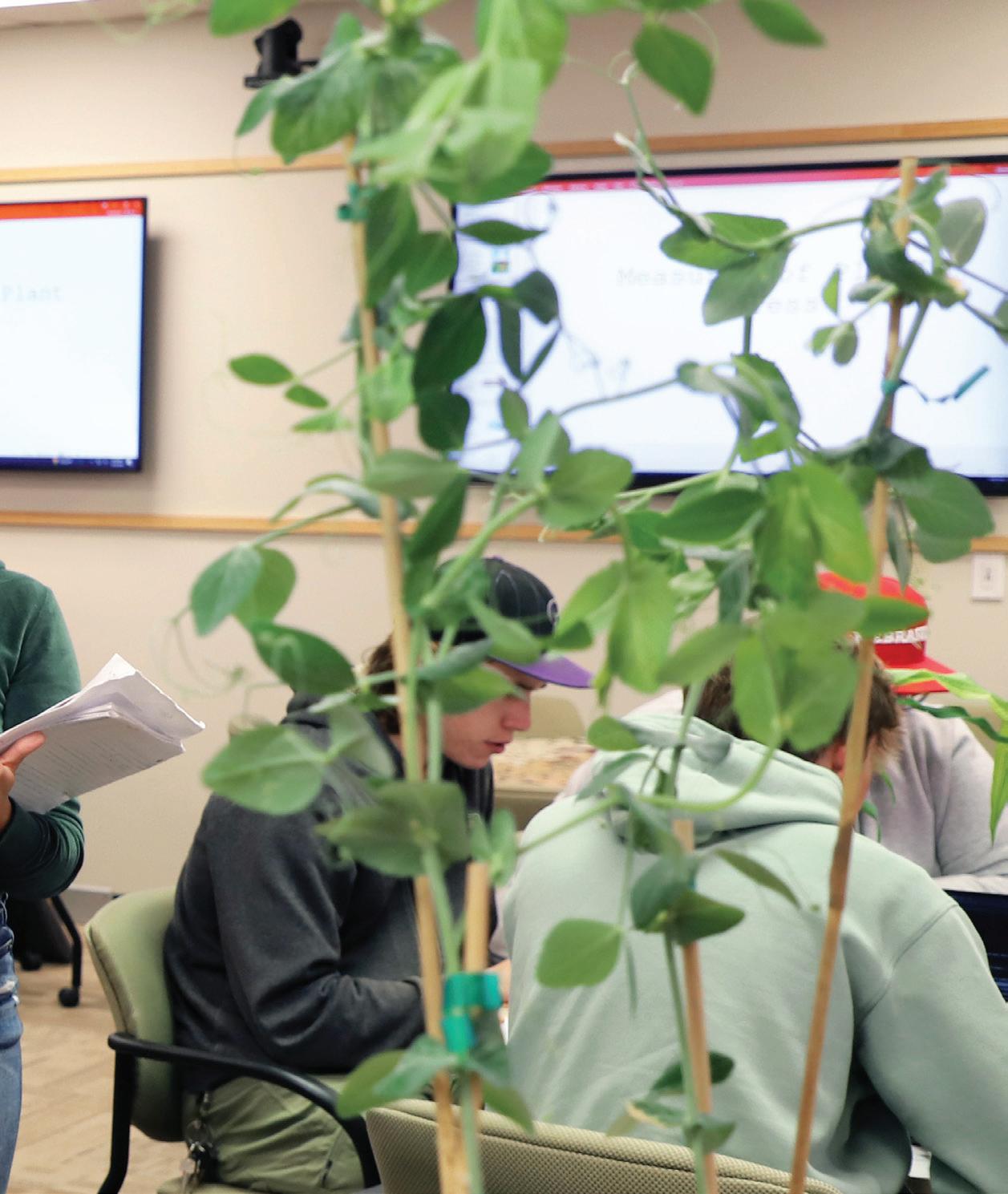
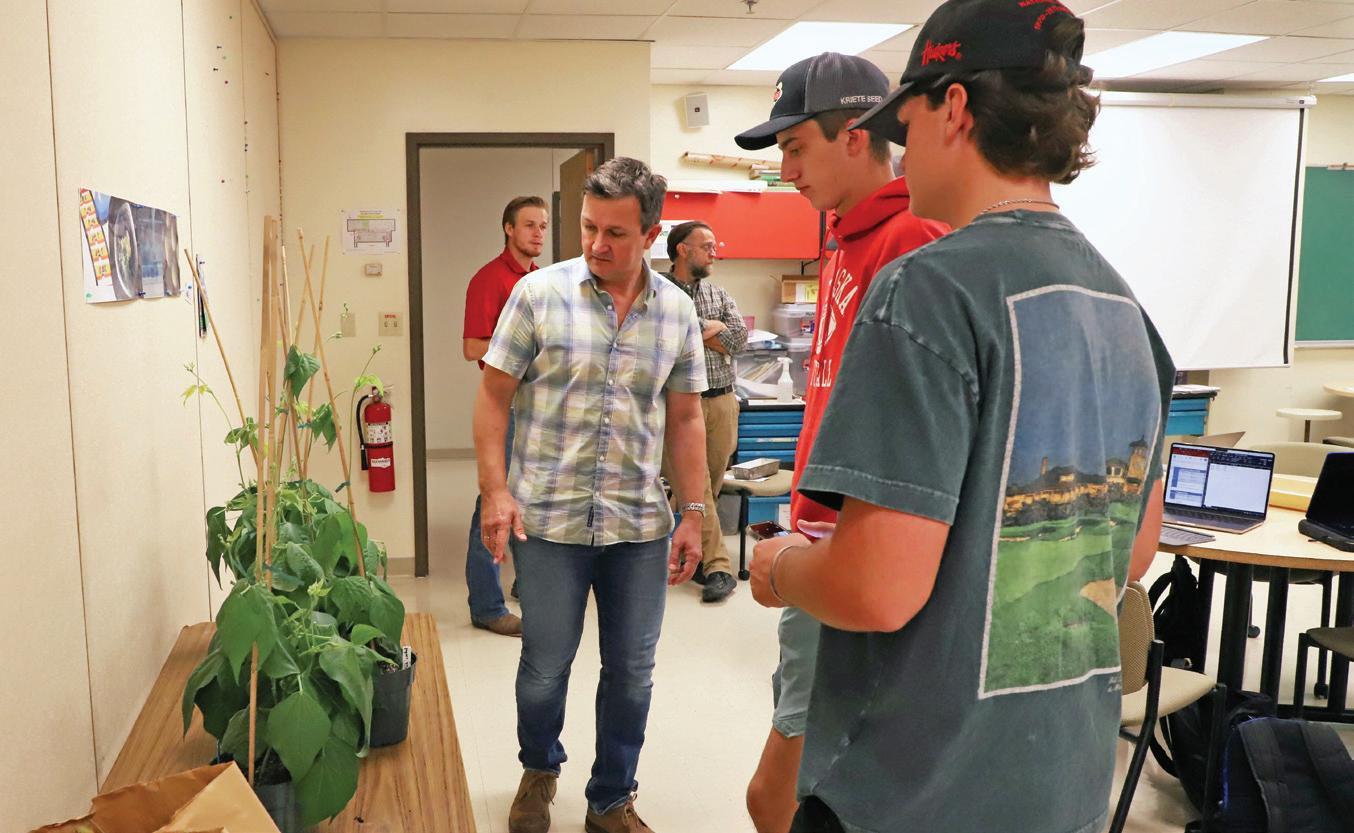
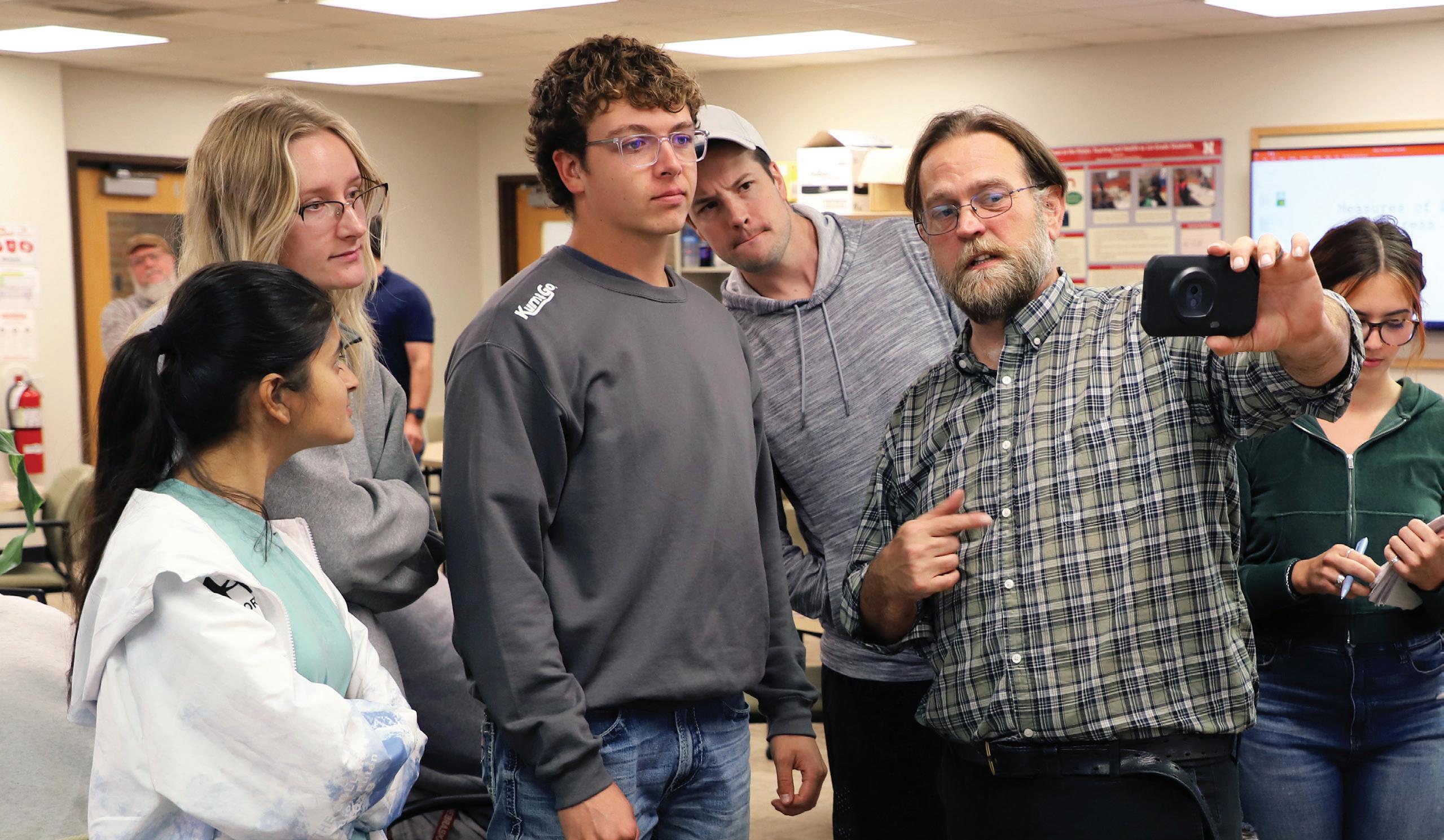
LEFT: Christian Stephenson, assistant professor of practice in agronomy and horticulture, demonstrates to students in the new Experiments in Plant Science course the use of a Forward Looking Infrared thermographic camera that measures the temperature of a plant. ABOVE: David Holding, professor of agronomy and horticulture (forefront from left), and agronomy major Kolton Kriete and plant and landscape systems major Nate Agosta survey bush bean plants grown in various CO2 environments. In the background, senior teaching assistant Bryce Wemhoff and Christian Stephenson overlook the class.
and Lee designed a one-credit course called Experiments in Plant Science, provisionally assigned PLAS 291, which will become PLAS 135 starting in the fall of 2025.
“We wanted the lab to stay with them and maybe even inspire new interests and career possibilities,” Holding said. “This is part of the department’s push for a pipeline in science literacy education.”
In this new course, students perform novel research to investigate how a changing environment can induce changes in vegetative and reproductive growth and anatomy. The other main goal of the course is to engage students as early as possible in scientific literacy and data handling.
The course was approved and taught for the first time in the fall of 2024 to agronomy, plant and landscape systems and plant biology majors. It involved a semester-long experiment with week-by-week guidance and assignments on data collection, interpretation and presentation leading to an advanced experimental write-up, PowerPoint and oral presentations, and peer review assignments.
“One of the most satisfying moments of my teaching career was listening to and grading the final oral presentations and seeing how much the students had grown and learned about crop plant responses to a changing environment and the underlying physiology,” Holding said.
The course leverages instruction from several department faculty, along with Holding and Lee — Christian Stephenson and Christian Elowsky, both assistant professors of practice
in agronomy and horticulture, who provided instruction for several weeks in the middle of the course. They also utilized Doctor of Plant Health graduate student Garrett Kuss as a graduate student teaching assistant and senior agronomy major Bryce Wemhoff as a teaching assistant.
“The experiential learning in this course will be very meaningful as they [students] continue their careers,” Stephenson said.
Experiments in Plant Science is a stand-alone course that includes technologies to measure stomatal conductance and density, chlorophyll fluorescence, and vegetative and reproductive growth. It also contains instructions in Excel, statistics and experimental design. Non-agronomy and horticulture majors taking this course complete a shorter growth experiment and still satisfy their ACE 4 requirement.
“Students in the course were very actively engaged with the observations they were making and learning not only about the fundamentals of plant biology, but how, as plant scientists, to design experiments, make observations, and collect and interpret data,” Stephenson said. “Exploring different tools and methods for evaluating their plants was a great way to build their understanding and curiosity.”
PLAS 131 Plant Science and PLAS 135 Experiments in Plant Science will be part of a pipeline of science literacy instruction in the Department of Agronomy and Horticulture, feeding into PLAS 230 Technical Reporting and PLAS 403/803 Scientific Writing and Communications, among others.
by Amit Jhala | professor and extension specialist
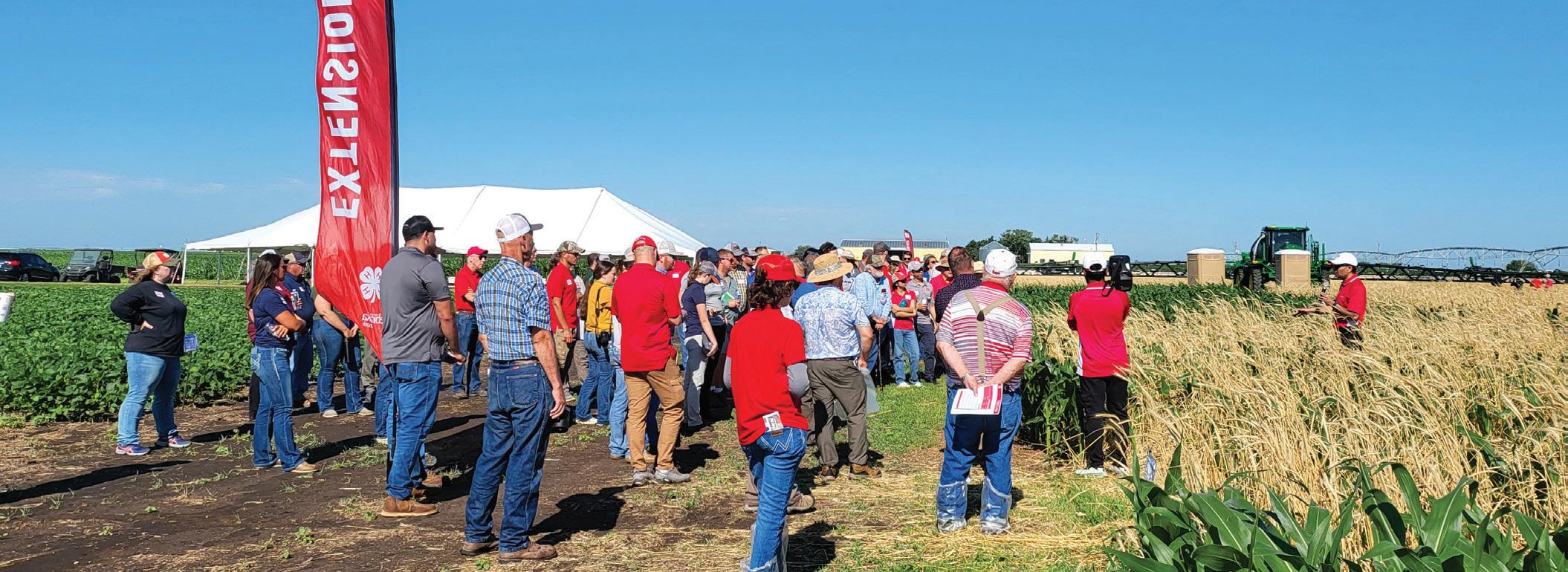
THE NEBRASKA EXTENSION IMPLEMENTATION PROGRAM, SUPPORTED BY THE USDA-NIFA CROP PROTECTION AND PEST MANAGEMENT GRANT PROGRAM ($885,000), SERVES AS A CORNERSTONE FOR INTEGRATED PEST MANAGEMENT EXTENSION AND OUTREACH ACROSS NEBRASKA. This statewide program plays a pivotal role in advancing agricultural practices, promoting environmental stewardship and fostering sustainable economic growth by addressing the complex challenges faced by farmers, agribusinesses and communities.
The program is led by Amit Jhala, professor and extension weed management specialist, who serves as the principal investigator. The leadership team brings together a multidisciplinary group of experts from several departments within the University of Nebraska–Lincoln, including:
• Department of Agronomy and Horticulture: Nevin Lawrence, Terri James, Chris Proctor
• Department of Plant Pathology: Tamra Jackson-Ziems, Dylan Mangel, Kyle Broderick
• Department of Entomology: Judy Wu-Smart, Pin-Chu Lai, Justin McMechan, Kyle Koch
• Nebraska Extension Educators: Travis Prochaska, Aaron Nygren, Jody Green
Jhala and Prochaska serve as the IPM coordinators for the state of Nebraska, and David Varner is the program’s administrative contact.
The Nebraska Extension Implementation Program is designed to bridge the gap between research and practical application. Its mission is to deliver research-informed, actionable strategies that help Nebraskans adopt integrated pest management practices and adapt to rapidly changing agricultural and community environments. By integrating
plant pathology, entomology, weed science and horticulture, the program offers a holistic approach to pest management that enhances crop productivity, profitability and environmental health.
The core goals include:
• Implementing IPM in agronomic and specialty crops across Nebraska’s diverse agro-ecozones.
• Promoting pollinator health and best practices to protect beneficial insect populations.
• Supporting IPM efforts in urban settings, including schools, housing and community spaces.
• Enhancing the capacity of pest diagnostic services to support timely and accurate decision-making.
The program is organized around several key strategies:
1. Stakeholder-driven programming: Extension teams work directly with farmers, educators, commodity boards, agribusinesses and regulatory agencies to identify priority issues and develop responsive solutions.
2. Applied research to extension pipeline: Findings from university-led field trials and diagnostics are translated into practical tools and recommendations, ensuring stakeholders have access to timely, locally relevant information.
3. Extension delivery: Educational programming is delivered through a variety of in-person and digital formats.
Through this program, Nebraska Extension has documented significant improvements in stakeholder awareness, knowledge and adoption of IPM practices. Examples of measurable outcomes include:
• Increased use of scouting and threshold-based pest management.
• Adoption of herbicide-resistant weed management strategies.
• Reduction in unnecessary pesticide applications, leading to cost savings and environmental benefits.
• Enhanced understanding of pollinator-friendly practices among both rural and urban residents.
Nebraska Extension’s ability to pivot quickly in response to emerging threats — such as new pest introductions, herbicide resistant weeds and climate-related challenges — is strengthened by this program’s infrastructure and funding.
A hallmark of the Nebraska Extension Implementation Program is its collaborative framework. Faculty and staff work in multidisciplinary teams and engage in partnerships that span local, regional and national levels. This collaborative approach not only amplifies the program’s reach but also ensures its relevance in a fast-changing agricultural landscape.
With continued support, the Nebraska Extension Implementation Program will maintain its capacity to respond to evolving pest pressures, adapt to changes in cropping systems and expand its educational reach. Future priorities include:
• Enhancing digital content to reach broader audiences.
• Strengthening pollinator habitat programming through school gardens and community initiatives.
• Building the next generation of extension professionals through student engagement and workforce development.
The Nebraska Extension Implementation Program embodies the land-grant mission by delivering high-impact, research-based extension programming that empowers Nebraskans to make informed decisions. Its commitment to innovation, collaboration and responsiveness ensures that Nebraska remains a national leader in IPM and agricultural sustainability.
farmers the benefit of using technology tools to increase agricultural input efficiency, productivity alongside stewardship
by Guillermo Balboa | research assistant professor
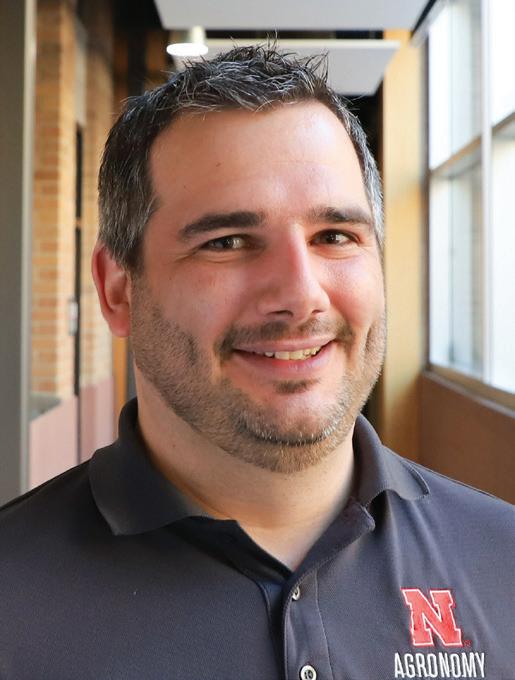
Guillermo Balboa
GUILLERMO BALBOA, WHO FOCUSES ON NUTRIENT MANAGEMENT AND DIGITAL AGRICULTURE IN THE DEPARTMENT OF AGRONOMY AND HORTICULTURE, LEADS INNOVATIVE RESEARCH THAT BRIDGES THOSE TWO DISCIPLINES. His work centers around developing cutting-edge tools and practices that optimize crop productivity while addressing sustainability challenges faced by modern agriculture.
Balboa’s research program integrates advanced technologies, such as crop models, remote sensing and decision-support systems, to provide actionable insights for farmers. A significant focus of his research lies in nitrogen management, a critical nutrient for corn production. With support from a Conservation Innovation Grant (CIGUSDA), Balboa evaluates on-farm research and site-specific nitrogen management strategies including sensor-based approaches and crop models. These efforts aim to improve nitrogen use efficiency while reducing environmental impacts.
Among his flagship projects is the Dashboard for Agricultural Water and Nutrient Management, a multi-university project to support informed decision-making in Nebraska and the Corn Belt.
Digital agriculture is playing a pivotal role in addressing challenges facing current farming systems. “Our statewide assessment in digital agriculture indicated that the lack of information about the benefit of digital agriculture tools was the main barrier for farmers to adopt these technologies,” Balboa said. His research program advocates for digital agriculture by benchmarking the benefits of these tools and practices in current farming systems with the goal of supporting the adoption. Committed to education and outreach, Balboa engages directly with extension educators, producers, stakeholders and graduate students. By leveraging the Nebraska On-Farm Research Network, he facilitates technology adoption and fosters data-driven farming practices that align with growers’ needs.
Balboa’s work exemplifies how digital tools and precision agriculture can drive sustainability and resilience in farming systems. As he continues to push the boundaries of research, his contributions pave the way for a future where agriculture thrives in an increasingly complex production system.
by Amanda Folck | assistant extension educator
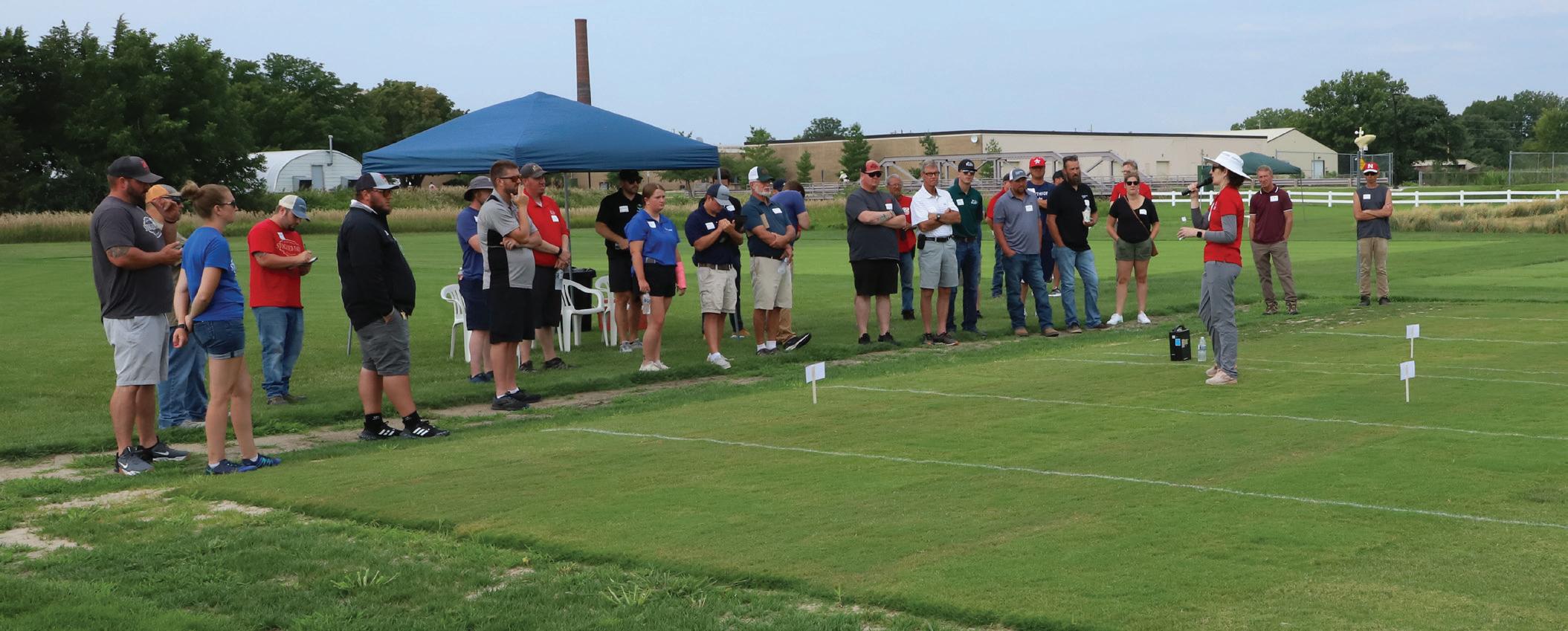
THE TURFGRASS SCIENCE EXTENSION PROGRAM, LED BY AMANDA FOLCK, ASSISTANT EXTENSION EDUCATOR FOR TURFGRASS MANAGEMENT, IS A KEY COMPONENT OF THE OUTREACH EFFORTS OF THE TURFGRASS SCIENCE PROGRAM AT THE UNIVERSITY OF NEBRASKA–LINCOLN. Other faculty team members include Keenan Amundsen, professor of turf genetics; Anne Streich, professor of practice and adviser for turfgrass management; and Luqi Li, lecturer. Staff members Matt Sousek, Carol Caha and Craig Ferguson also provide tremendous support for the program’s extension activities.
The primary goal of the turfgrass science extension program is to deliver support and recommendations to turfgrass stakeholders and industry partners throughout the year. To address agronomic challenges as they arise across Nebraska, the Great Plains region and beyond, the program collaborates with the Department of Agronomy and Horticulture, Nebraska Extension and other departments within the university.
With Nebraska’s ever-changing environmental conditions, the program consistently updates its resources and applied research to provide the most current information on turfgrass management for stakeholders. Examples of this outreach include:
• Presentations and pesticide recertification training with the Nebraska Department of Agriculture at the annual Nebraska Turfgrass Conference in LaVista.
• Organizing and hosting the yearly Nebraska Turfgrass Field Day at the East Campus Research Center in Lincoln.
• Publications, resources and updates available on the UNL Turfgrass Science website (turf.unl.edu) and social media platforms like X (@UNLturfgrass) and YouTube.
• Turfgrass newsletter email subscription.
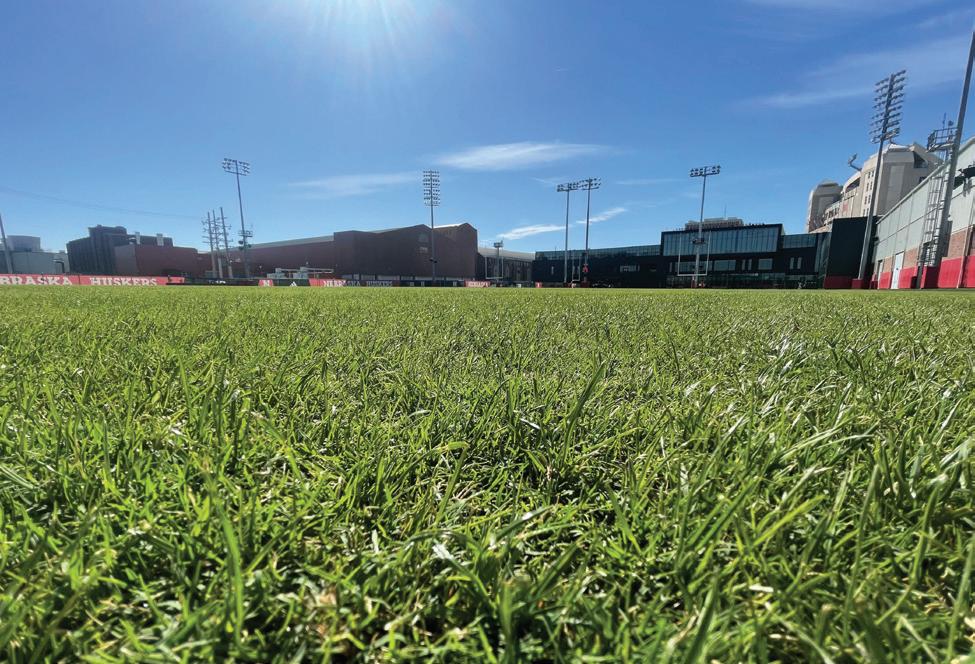
The extension program also collaborates with partners on applied research projects, such as a study on the adaptation of cold-tolerant hybrid bermudagrass in Nebraska, a partnership with Husker Athletics. Folck also contributes to the Turfgrass Weed Control for Professionals publication from the NCERA-221 working group, which provides updated information on weed control in turfgrass areas in Midwest states, including Nebraska.
Folck also teaches PLAS 427: Turfgrass Systems Management, a lecture and lab capstone course that blends scientific knowledge with real-world application. Students in the course develop a management plan for various turfgrass systems (lawn care, sports fields and golf courses). In addition to that experience, students benefit from site visits and guest speakers as Folck enhances her teaching with connections from her work in extension programming.
For more information about the turfgrass science program’s recent research, teaching and extension activities, access the 2024 Turfgrass Science Program Update at go.unl.edu/2024unlturfreport
by Don Lee | professor
AN EAST CAMPUS VISITOR MIGHT HAVE COME ACROSS AN INTERESTING SIGHT LAST MAY IF THEY TOOK A WRONG TURN ON THEIR WAY TO THE DAIRY STORE AND ENDED UP IN THE FEWS2 HUB. There, teachers from Schoo Middle School, Lefler Middle School and Lincoln Lutheran High School were huddled around a pot of soybean seedlings, planning ways to engage their students and connect biology, math and business — all while answering the question, why do farmers in Nebraska grow so many soybeans?
The FEWS2 Hub is the headquarters for Bailey Feit and Tammera Mittelstet, who joined faculty from the Department of Agronomy and Horticulture to deliver the 2024 Soybean Summer Institute to 22 Nebraska teachers. Feit and Mittelstet are CASNR’s Education and Career team, and they joined Nicolas Cafaro La Menza, Meghan Sindelar, Leah Sandall and Don Lee to deliver SSI. At the completion of the May and July sessions, teachers had created plans for soybean-centered learning events for their students. In addition, teachers were provided a stipend to order supplies and equipment for students to use for their science investigations.
Combining the science and technology experience of the Agronomy and Horticulture faculty with the teaching design expertise of Feit and Mittlestet made for a successful learning experience for the teachers. The May and July workshop sessions were held on East Campus and the West Central Research and Extension Center in North Platte to reach teachers from across the state. The May sessions guided the teachers to brainstorm learning goals for their lesson plans, learn about the soil and water resources that support
Nebraska farmers, and engage in some of the learning activities used by the Agronomy and Horticulture faculty.
When the teachers came back in July, they spent time in the soybean research plots and farmers’ fields and met extension experts in soybeans from entomology and plant pathology. The combined experience helped the SSI teachers envision how they could engage their students in investigating and appreciating the challenges for growing soybeans as well as the value of the soybean seeds harvested by Nebraska farmers.
During the 2024-2025 school year, SSI teachers have been using their equipment and supplies to teach their soybeancentered lessons. Some of the teachers planned events at the Research and Extension Centers or East Campus. Linda Flores brought 30 of her Lefler Middle School students to campus in September to learn in the teaching garden and then apply their skills in math calculations to make predictions about numbers of soybean plants farmers grow and soybean seeds their plants produce to meet demands for the food they eat or the feed for their pets. Flores shared that the experience she gained at SSI raised her confidence in having her students apply the math skills she taught to realworld Nebraska farming stories.
“It was also a lot of fun to work with university faculty and the other teachers,” she said.
With generous funding from the Nebraska Soybean Board to continue its support of Nebraska educators, the 2025 SSI is scheduled for two weeks in July.
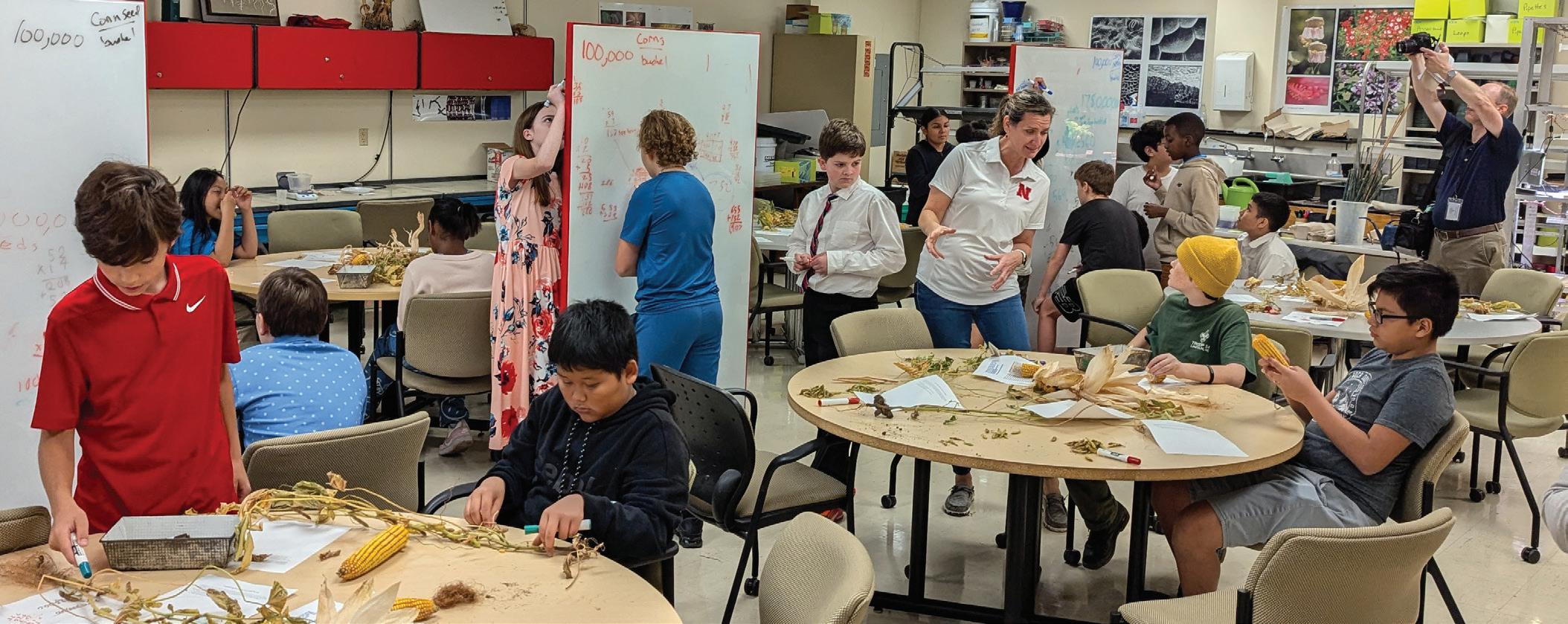
“I am incredibly thankful for the numerous research, teaching, extension and outreach opportunities I’ve had at Nebraska...”
Mandeep Singh

by Mandeep Singh | postdoctoral research associate
I WAS BORN AND RAISED ON A DIVERSE FARM IN PUNJAB, A STATE IN NORTHWEST INDIA, WHERE WE CULTIVATED COTTON, RICE, SORGHUM AND WHEAT, RAISED COWS AND BUFFALOES, AND OPERATED A DAIRY MILK STORE. This upbringing instilled in me a deep love for agriculture. After high school, I pursued a bachelor’s in agriculture at Punjab Agricultural University, where I discovered the intersection of art and science in farming.
Motivated by this discovery, I began a master’s program in agronomy at PAU in 2017. My research focused on integrating fodder cowpeas, a protein-rich legume, into the short window between the wheat-rice cropping cycle. My time at PAU was rewarding, and I earned merit certificates of excellence for my bachelor’s and master’s degrees. Yet I felt my journey had just begun — I wanted to continue addressing real-world agronomic challenges that farmers face.
In 2019, I moved to the United States and began studying at Clemson University. There, I worked on a project evaluating the benefits of mixed cover crops in cotton-peanut rotation. By spring 2021, I joined the Jhala Weed Management Lab
to pursue a doctoral degree at the University of NebraskaLincoln. My research focused on herbicide interactions for controlling volunteer corn, evaluating water use of volunteer corn, and gene flow in corn. Along the way, I collaborated with experts from renowned institutions and gained experience in meta-analysis.
In May 2024, I completed my doctorate and received the Outstanding Graduate Student Award from the North Central Weed Science Society. Currently, I am continuing as a postdoctoral researcher in the Jhala Lab, where I focus on managing herbicide-resistant crop volunteers, exploring integrated weed management strategies, and developing an open-access image database of Midwestern weeds to support site-specific weed management technologies.
I am incredibly thankful for the many research, teaching, extension and outreach opportunities I’ve had at Nebraska, all of which have contributed to my personal and professional growth. I sincerely thank all my mentors for their guidance throughout my career, and I look forward to continuing my contributions to the agricultural community.
Guillermo Balboa: AHGSA Faculty Appreciation Award
Andrea Basche: American Society of Agronomy Environmental Quality Section Inspiring Early Career Scientist Award
Humberto Blanco: 2024 Stanford/ Elsevier Top 2% Scientists List
Nicolas Cafaro La Menza: Elected 2025 ASA Applied Soybean Research Community Vice Leader
Tom Elmo Clemente: 2024 Stanford/ Elsevier Top 2% Scientists List
Caro Cordova: Center for Great Plains Studies Fellow, Nebraska Extension Excellence in Extension – Collaboration
Aaron Lee M. Daigh: Soil Science Society of America 2025 President-Elect, Agronomy Journal Editor’s Citation for Excellence Award for Outstanding Service – Associate Editor, Urban Agriculture & Regional Food Systems Editor’s Citation for Excellence Award for Outstanding Service – Associate Editor, National Academies’ US National Committee for Soil Sciences (USNC/SS)
Christian Elowsky: Indigenous Youth Food Sovereignty Program Honor
Katherine Frels: Office of the Executive Vice Chancellor Harold & Esther Edgerton Junior Faculty Award
Roch Gaussoin: Nebraska Chapter – Golf Course Superintendents Association of America Distinguished Service Award, Rocky Mountain Regional Turfgrass Association Lifetime Achievement Award, 2024 Outstanding Paper in Crop, Forage & Turfgrass Management – Applied Turfgrass Science Section
Patricio Grassini: ASA International Agronomy Award, 2024 Stanford/ Elsevier Top 2% Scientists List
Terri James: Nebraska Statewide Arboretum Educator Award
Amit Jhala: Gamma Sigma Delta Merit in Research Award, Nebraska Extension Excellence in Extension – Research Based, Nebraska Cooperative Extension
Association Outstanding Mid-Career Extension Award
Stevan Knezevic: Serbian Weed Science Society Certificate of Appreciation
John Lindquist: 2024 Stanford/Elsevier Top 2% Scientists List
Bijesh Maharjan: Nebraska Soil and Water Conservation Society Commendation Award, Omtvedt Innovation Award for Extension
Martha Mamo: Nebraska Certified Crop Advisor Innovator Award
Nicolas “Nic” McMillan: Center for Great Plains Studies Fellow
Brooke McWherter: Center for Great Plains Studies Fellow, Office of Research and Innovation’s Research Development Fellows Program
Jeffrey Mower: 2024 Stanford/Elsevier Top 2% Scientists List
Paul Read: American Society of Enology and Viticulture – Eastern Section Distinguished Service Award
Daren Redfearn: ASA Fellow, CSSA Fellow
Daniel Schachtman: 2024 Stanford/ Elsevier Top 2% Scientists List
James Schnable: Office of Graduate Studies Outstanding Postdoc Mentor Award, 2024 Stanford/ Elsevier Top 2% Scientists List
Christian Stephenson: Indigenous Youth Food Sovereignty Program Honor
Mitchell Stephenson: Nebraska Cattlemen Foundation Nebraska Range and Conservation Endowment Award
Kim Todd: Pi Alpha Xi – Alpha Gamma Chapter President’s Citation
Daniel Uden: Agricultural Research Division Junior Faculty for Excellence in Research awardSection of the Society for Range Management Best Technical Science Publication Award
Harkamal Walia: 2024 Stanford/ Elsevier Top 2% Scientists List, National Strategic Research Institute Fellow
Sam Wortman: 2024 Stanford/ Elsevier Top 2% Scientists List
Emeriti
P. Stephen Baenziger: 2024 Stanford/ Elsevier Top 2% Scientists List
Kenneth Cassman: 2024 Stanford/ Elsevier Top 2% Scientists List
Charles Francis: 2024 Stanford/ Elsevier Top 2% Scientists List
Robert A. Graybosch: 2024 Stanford/ Elsevier Top 2% Scientists List
Gary Hergert: 2024 Stanford/ Elsevier Top 2% Scientists List
Mark Lagrimini: 2024 Stanford/ Elsevier Top 2% Scientists List
Jim Specht: 2024 Stanford/ Elsevier Top 2% Scientists List
Paul Staswick: 2024 Stanford/ Elsevier Top 2% Scientists List
Kenneth Vogel: 2024 Stanford/ Elsevier Top 2% Scientists List Adjunct
Laila Puntel: 2024 Outstanding Paper in Crop, Forage & Turfgrass Management – Applied Turfgrass Science Section
A list of all faculty awards can be found online at go.unl.edu/facultystaff-awards
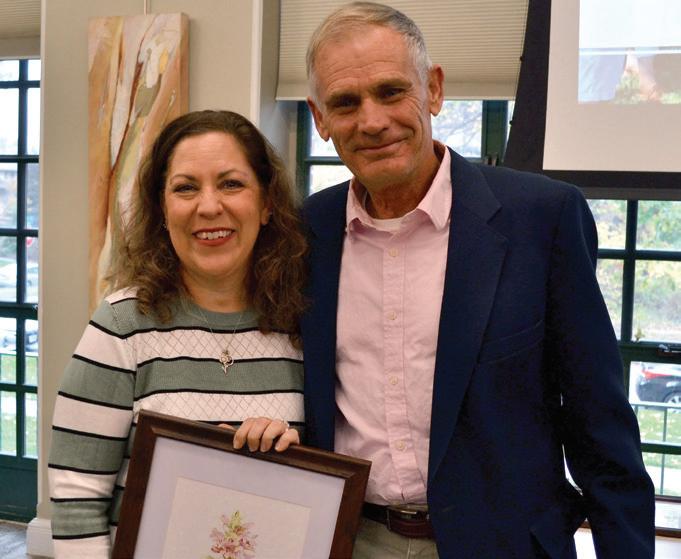
TERRI JAMES, ASSOCIATE EXTENSION EDUCATOR, WAS AWARDED THE NEBRASKA STATEWIDE ARBORETUM EDUCATOR AWARD. She was recognized for her outstanding contributions toward advancing the knowledge and appreciation of plants among her students. James is also the state coordinator for the Nebraska Extension Master Gardener Volunteer program. go.unl.edu/nsa-james
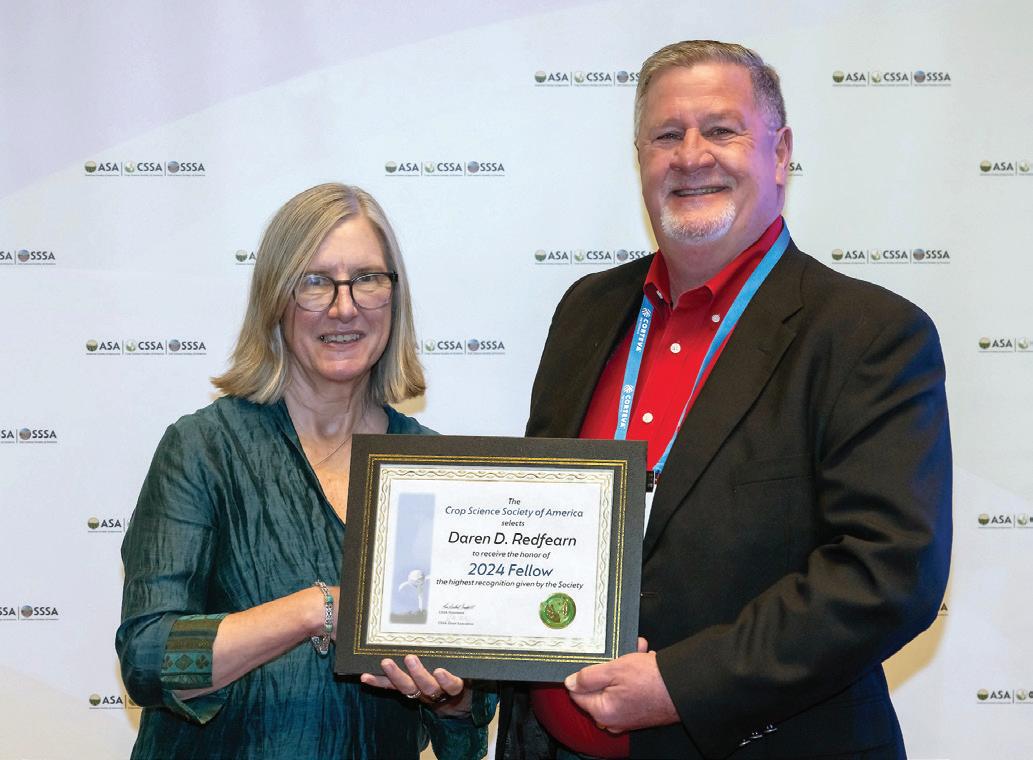
DAREN REDFEARN, PROFESSOR AND FORAGE AND CROP RESIDUE SPECIALIST IN AGRONOMY AND HORTICULTURE, WAS NAMED A FELLOW OF THE CROP SCIENCE SOCIETY OF AMERICA AND OF THE AMERICAN SOCIETY OF AGRONOMY IN SAN ANTONIO, TEXAS, NOV. 13. Redfearn is a member of an IANR multidisciplinary team focused on enhancing and developing foragebased beef production systems. His research and extension programs emphasize annual and perennial grass management, converting cropland to forage production and grazing of forages that can be integrated into economical and resilient crop-forage-bioenergy agricultural production systems. | go.unl.edu/fellow-redfearn
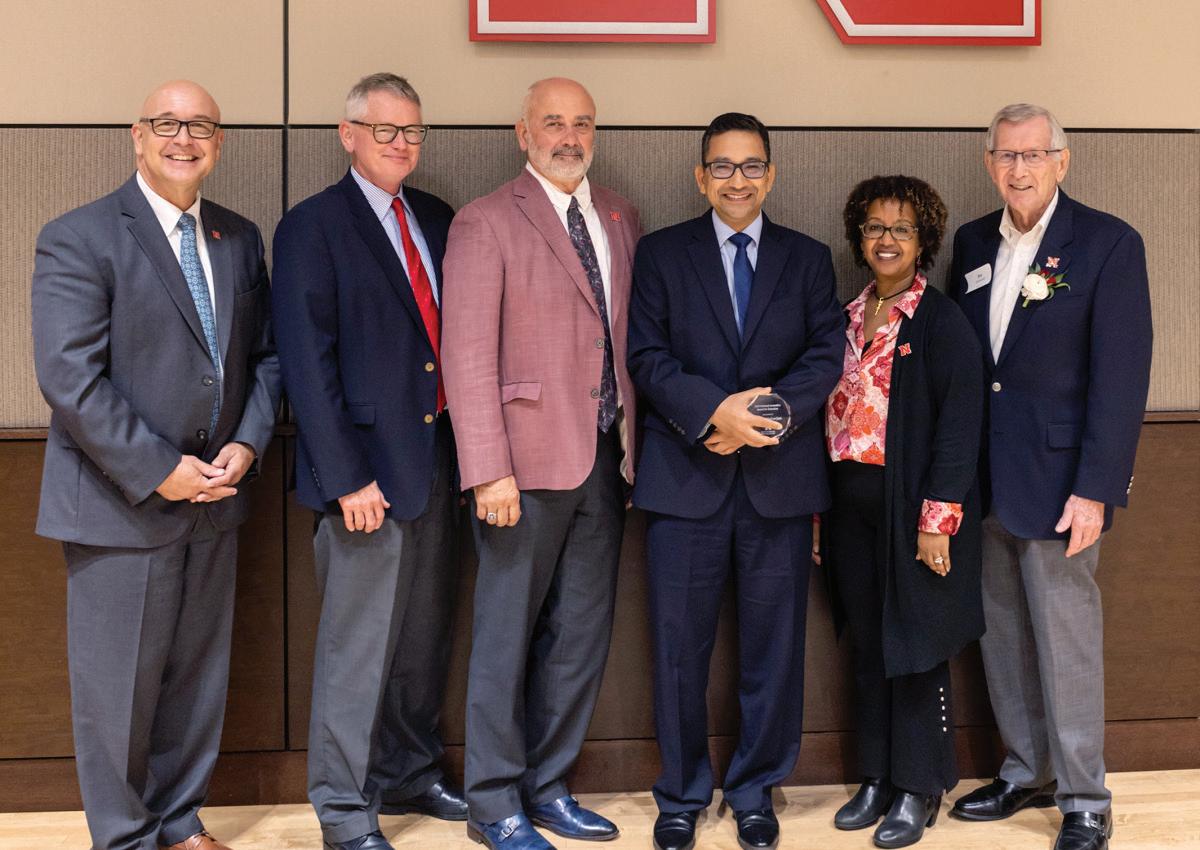
BIJESH MAHARJAN, ASSOCIATE PROFESSOR AND EXTENSION SOIL MANAGEMENT SPECIALIST IN AGRONOMY AND HORTICULTURE, TOOK HOME THE OMTVEDT INNOVATION AWARD FOR AGRONOMY AND HORTICULTURE AT THE ANNUAL IANR DISTINGUISHED
FACULTY BANQUET ON SEPT. 26. Maharjan has developed an extensive portfolio of extension programs focused on improving soil health for growers in Nebraska, particularly western Nebraska. He has focused his efforts on soil health and developing the concepts of Soil Health Gap and Soil Health Cycle. A collaboration between the USDA and Maharjan resulted in the Nebraska Soil Health School held across the state. In 2023, nearly 200 growers learned from more than 20 speakers from UNL, USDA-NRCS, and other experts. In 2024, he expanded the soil health collaboration to include events with the Center for Grazing Land Studies and West Central Research, Extension and Education Center. | go.unl.edu/omtvedt-maharjan
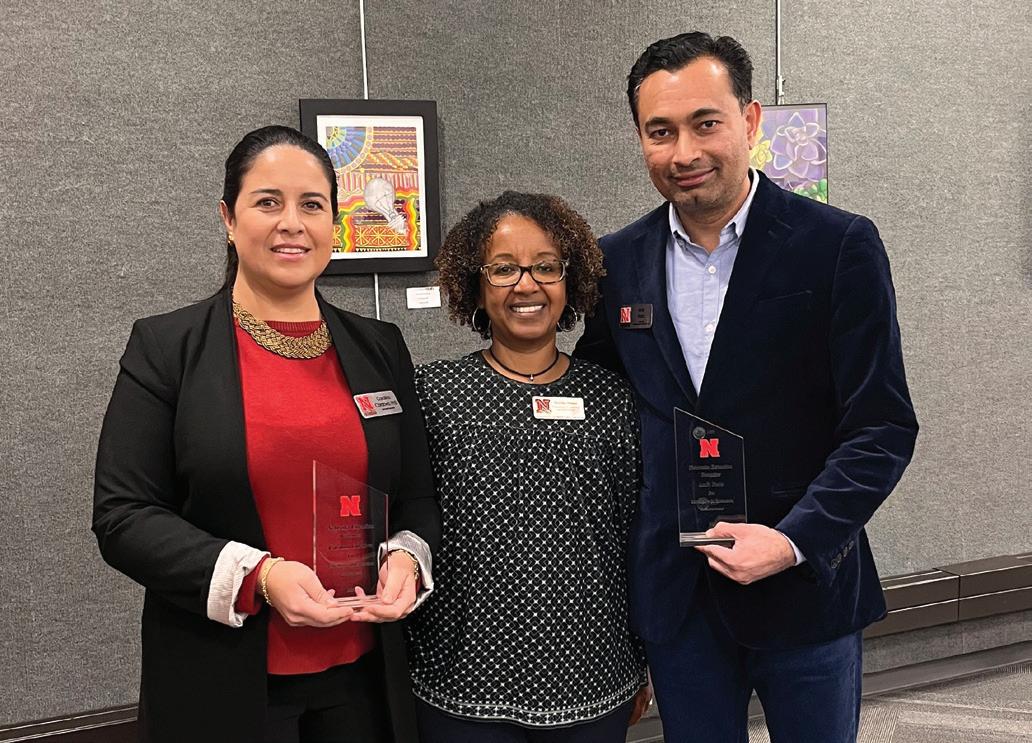
NEBRASKA EXTENSION AWARDED S. CAROLINA “CARO” CÓRDOVA AND AMIT JHALA EXCELLENCE IN EXTENSION AWARDS AT THE NEBRASKA EXTENSION FALL CONFERENCE NOV. 22 AT THE NEBRASKA EAST UNION. Córdova, an assistant professor and statewide soil health specialist in agronomy and horticulture, was given an Excellence in Extension Award for Collaboration. This award exemplifies excellence in collaborative extension work. In two years, Córdova has secured over $1.4 million in grants, co-organized numerous soil health events, created an undergraduate soil health class and published five peer-reviewed articles. | go.unl.edu/extension-cordova Jhala, professor, associate department head, and extension weed management specialist in agronomy and horticulture, was given an Excellence in Extension Award for Research Based. This award exemplifies excellence in research-based extension work. Jhala’s applied weed science research program solves real-world problems of weed management faced by Nebraska growers. He is nationally and internationally known for researching pollen-mediated gene flow from herbicide-resistant crops and weeds and managing herbicide-resistant weeds and multiple herbicideresistant crop volunteers. | go.unl.edu/extension-jhala
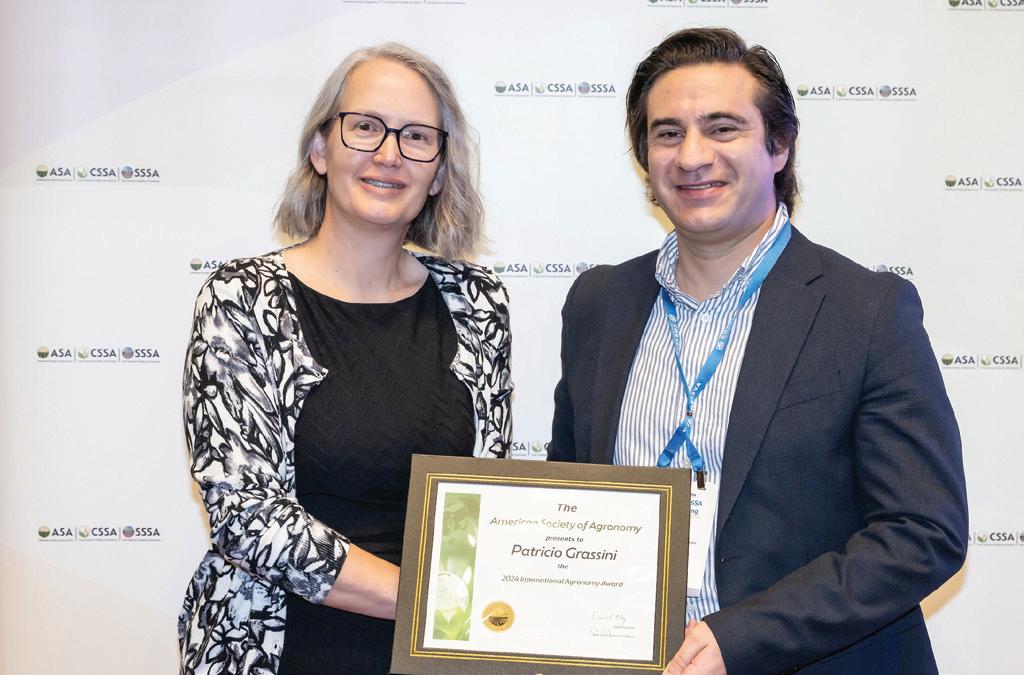
PATRICIO GRASSINI, SUNKIST DISTINGUISHED PROFESSOR OF AGRONOMY, WAS AWARDED THE 2024 INTERNATIONAL AGRONOMY AWARD FROM THE AMERICAN SOCIETY OF AGRONOMY. This award recognizes outstanding contributions in research, teaching, extension or administration made outside of the United States by a current agronomist. ASA presented the award during the society’s annual meeting in San Antonio, Texas, Nov. 13. The ASA annual awards are presented for outstanding contributions to agronomy through education, national and international service, and research. Grassini’s research and extension programs focus on yield intensification with the aim to increase producer profit and minimize environmental footprint. | go.unl.edu/asa-grassini
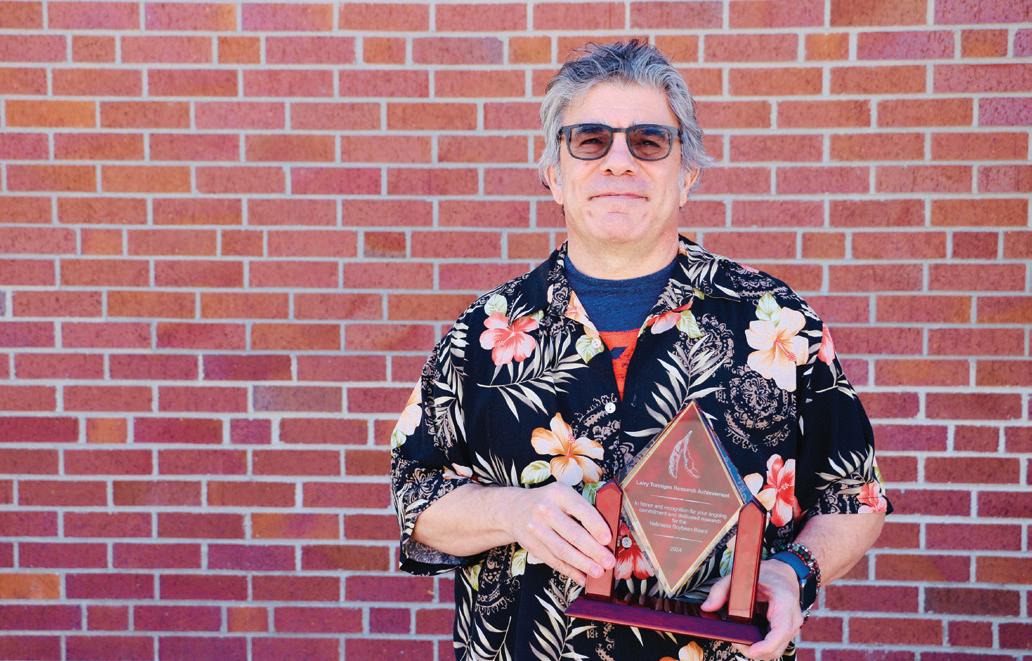
TOM ELMO CLEMENTE, EUGENE W. PRICE DISTINGUISHED PROFESSOR OF BIOTECHNOLOGY, WAS HONORED WITH THE NEBRASKA SOYBEAN BOARD’S 2024 LARRY TONNIGES RESEARCH ACHIEVEMENT AWARD FOR HIS GROUNDBREAKING CONTRIBUTIONS TO SOYBEAN RESEARCH ON APRIL 11. The award was made possible by the family of the late Larry Tonniges. Serving as a principal investigator and professor at Nebraska, Clemente has pioneered innovative research initiatives aimed at enhancing plant germplasm and incorporating genetic engineering to fortify crops against diseases and enhance value-added traits. | go.unl.edu/tonniges-clemente
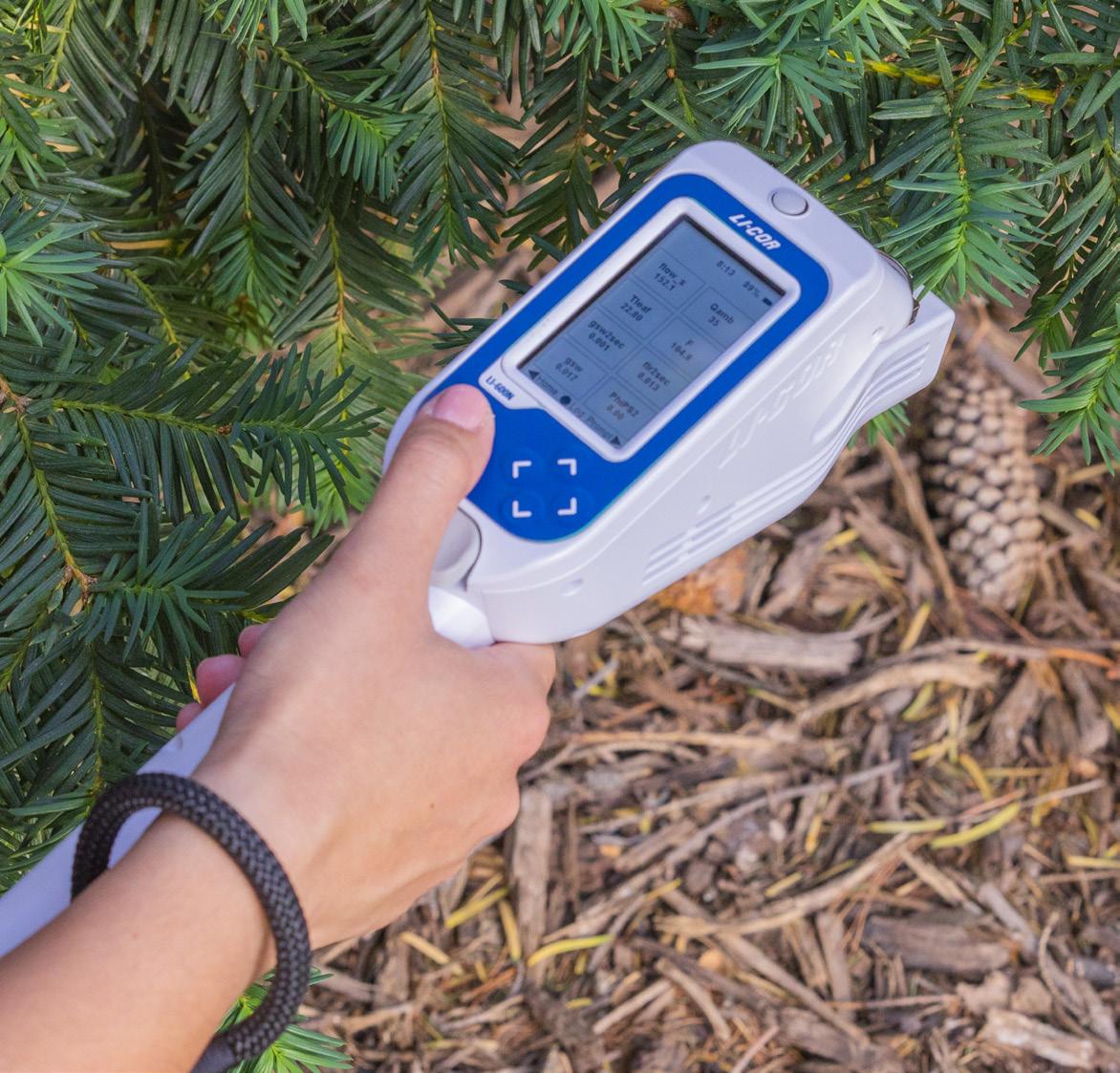
Measure stomatal conductance and chlorophyll fluorescence of single needles, narrow leaves, and grasses.

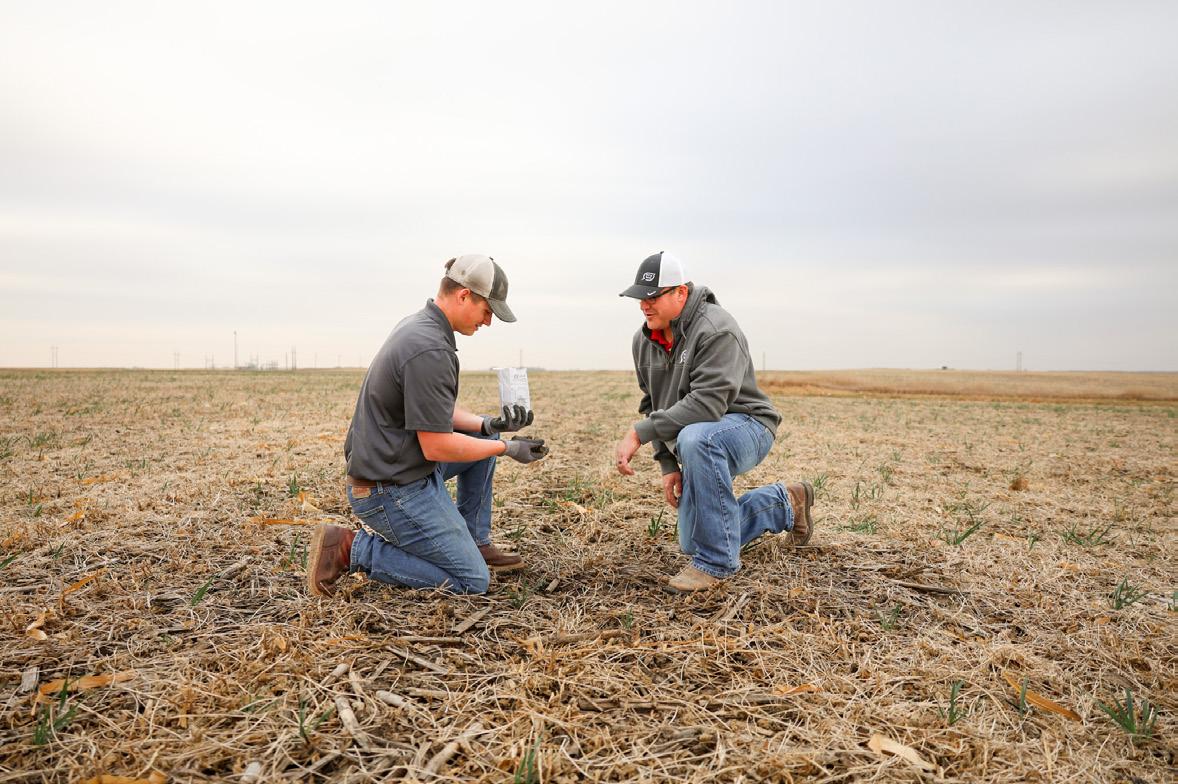
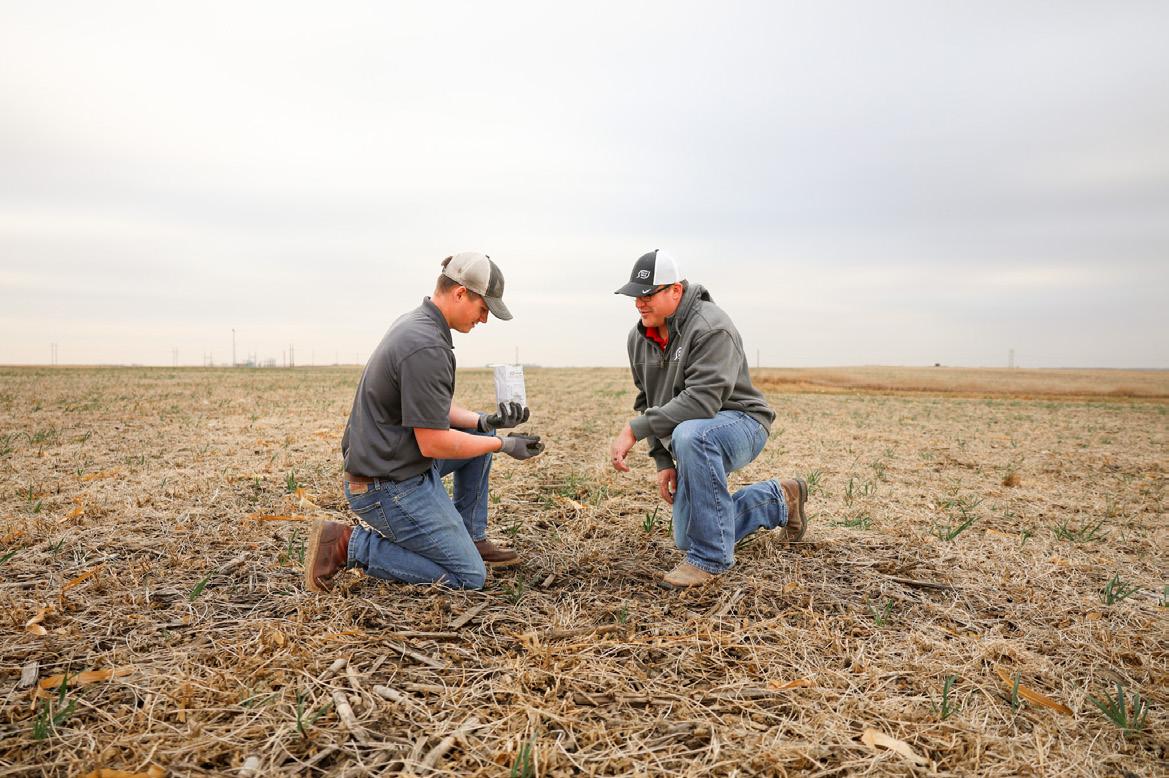

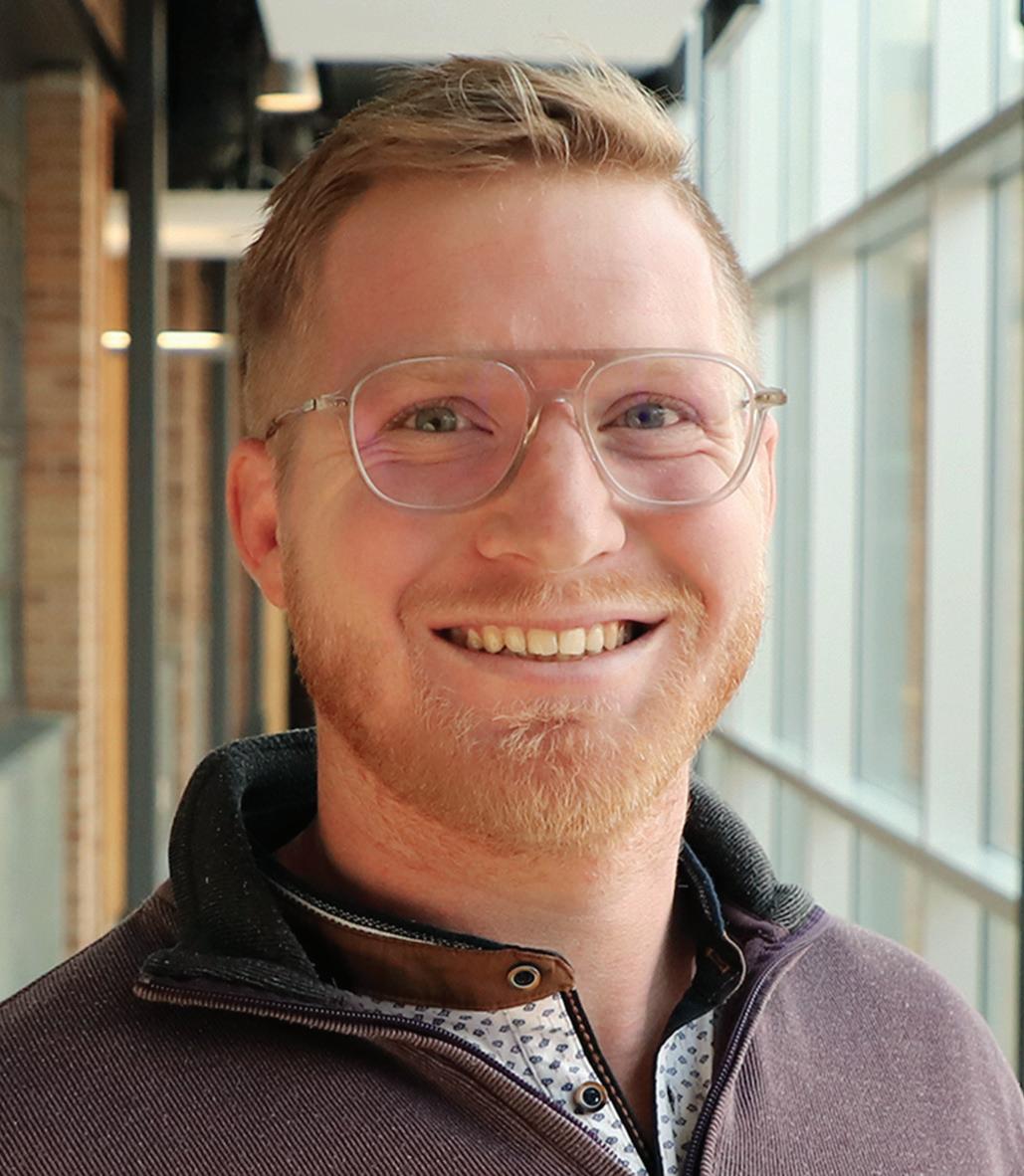
BRIAN RICE JOINED THE DEPARTMENT OF AGRONOMY AND HORTICULTURE JAN. 1, 2024, AS AN ASSISTANT PROFESSOR OF PLANT BREEDING AND GENETICS.
Rice is working with plant breeding programs in the United States and abroad to develop strategies that enable genetic gain with simultaneous trait discovery. Internationally, he collaborates with a plant breeding program in Haiti at Quisqueya University. A Bill and Melinda Gates Foundation grant funds Rice to collaborate with the Consultative Group on International Agricultural Research and National Agricultural Research Systems network in Africa.
Rice feels Nebraska has a reputation for outstanding research in plant genetics. Rice will also teach Genetic Analysis: Traits in Plants and Animals and Scientific Method in the fall of 2025.
Growing up in Saskatoon, Saskatchewan, he became interested in plant genetics because he understood how integral agriculture is to society.
Rice earned a Bachelor of Science in plant genetics, breeding, and biotechnology from Purdue University and a Master of Science and a doctorate in quantitative genetics from the University of Illinois Urbana-Champaign.
Before coming to Nebraska, he was a postdoctoral researcher in the lab of Geoff Morris at Colorado State University.
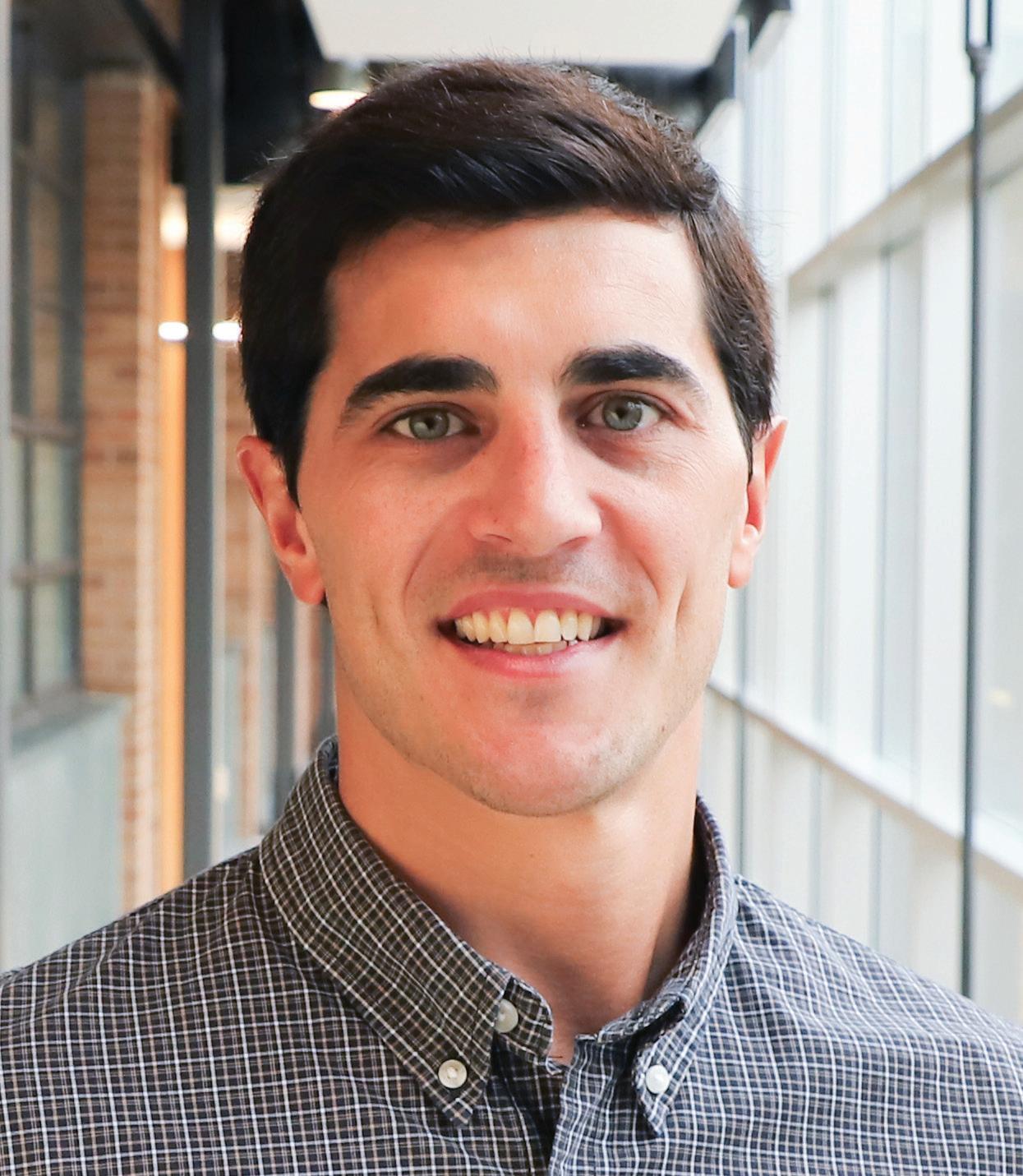
WALTER CARCIOCHI JOINED THE DEPARTMENT OF AGRONOMY AND HORTICULTURE FACULTY
JAN. 1, 2024, AS A RESEARCH ASSISTANT PROFESSOR.
Carciochi is leading a global project to assess potassium limitations on crop yields in over 20 countries, focusing on the most relevant cropping systems in each region. He is also collaborating on a nitrogen management project in Nebraska and a global initiative on crop residue management.
He sees Nebraska as a great place for growth in his academic career. Carciochi feels Nebraska offers an ideal environment for conducting research across a variety of relevant agroecosystems. Additionally, his position provides valuable opportunities to connect and collaborate with colleagues from across the United States and around the world.
Originally from Argentina, Carciochi received a Bachelor of Science in agronomy and a doctorate in agricultural sciences from the National University of Mar del Plata in Argentina. He also served as an assistant professor at the National University of Mar del Plata from 2019 to 2023.
With a focus on cropping systems, nutrient management and soil fertility, he began working as a postdoctoral research associate at the University of Nebraska–Lincoln in 2023.

MILOS ZARIC JOINED THE DEPARTMENT OF AGRONOMY AND HORTICULTURE JAN. 18, 2024, AS AN ASSISTANT PROFESSOR AND PRECISION APPLICATION TECHNOLOGY SPECIALIST AT THE WEST CENTRAL RESEARCH, EXTENSION AND EDUCATION CENTER IN NORTH PLATTE.
Zaric is engaged in a multifaceted endeavor to enhance the precision of pesticide application technology, which involves accumulating extensive data to better inform stakeholders and the industry. This encompasses adjusting algorithms to varying wind speeds and nozzle orientations in response to wind direction. Additionally, he is evaluating the pros and cons of different application parameters in pest control to improve efficacy and environmental safety. Originally from the Republic of Serbia, he earned a Bachelor of Science in agronomy and a Master of Science in weed science from the University of Belgrade Faculty of Agriculture in Serbia. His journey to Nebraska began in 2015 with a research internship at the WCREEC. He also received a Master of Science and a doctorate in weed science from the University of Nebraska–Lincoln. He is fascinated by the advanced levels of technology available and how they can be integrated into the existing cropping systems in Nebraska and elsewhere. He feels the state’s diverse environment and varied agricultural landscape present fascinating scenarios for research along with significant challenges to be addressed.
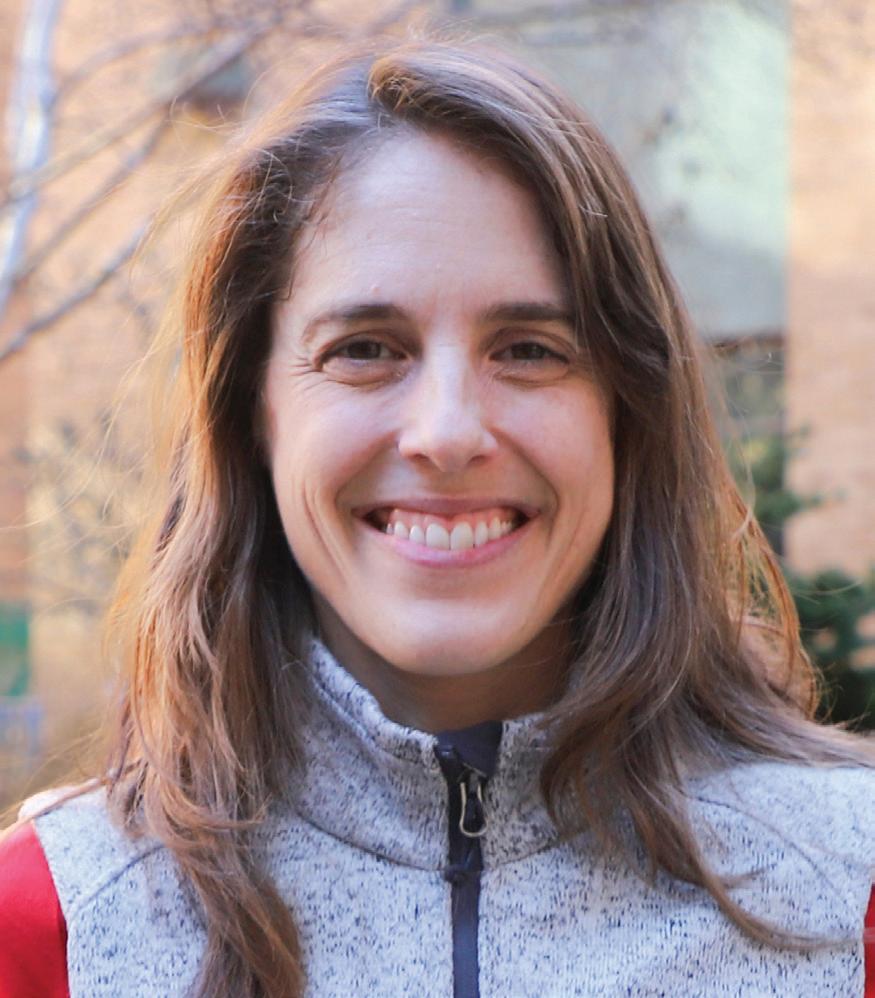
CHERYL DUNN JOINED THE DEPARTMENT OF AGRONOMY AND HORTICULTURE FACULTY JUNE 1, 2024, AS A LECTURER. Her appointment is 60% teaching and 40% as herbarium curator. Dunn has worked at the University of Nebraska–Lincoln in the department for over 14 years and is a member of the range, pasture and forages group.
Dunn teaches Introduction to Plant Identification, Grassland Plant Identification, North American Wildplants, Wildland Plants, and Research Experiences in Grasslands. The courses align with the herbarium curation and degree program outcomes for majors in grassland systems, agronomy and horticulture, and fisheries and wildlife. In addition, she serves as the adviser for the Range Management Club and coach for the Nebraska Plant Identification Team.
She assisted with curating the herbarium for four years prior to being appointed the full curator 11 years ago. As curator of the herbarium, Dunn conducts plant surveys, prepares specimens, and gives a proper understanding of type specimens, plant names and synonymy.
Dunn has co-authored three plant identification books including “Grasses of the Great Plains,” “North American Wildland Plants” and “Weeds of the Great Plains.” She has also co-authored three Extension publications including “Grasses of Nebraska,” “Forbs and Shrubs of Nebraska” and “Toxic Plants to Livestock.”

BROOKE MCWHERTER JOINED THE DEPARTMENT OF AGRONOMY AND HORTICULTURE
JUNE 1, 2024, AS RESEARCH ASSISTANT PROFESSOR AND NATURAL RESOURCE SOCIAL SCIENTIST.
McWherter is working on a program called Thriving Future Cropscapes with Andrea Basche. This project combines cropping system modeling with key expert interviews and focus groups to explore how to model future cropping systems given changing environmental conditions, how producers and experts envision these systems in the future, and what they want the future cropscapes to look like.
Originally from Missouri, McWherter became interested in the human dimensions of natural resources research following her time in the Peace Corps. There, she learned the importance of considering social dimensions, including culture and context, when developing programs and policies for rural areas.
McWherter has a Bachelor of Science in wildlife biology from Missouri State University, a Master of Science in conservation ecology and environmental justice from the University of Michigan and a doctorate in natural resource social sciences from Purdue University.
Before coming to Nebraska, she completed a postdoctoral fellowship at Dalhousie University in Halifax, Nova Scotia, Canada.
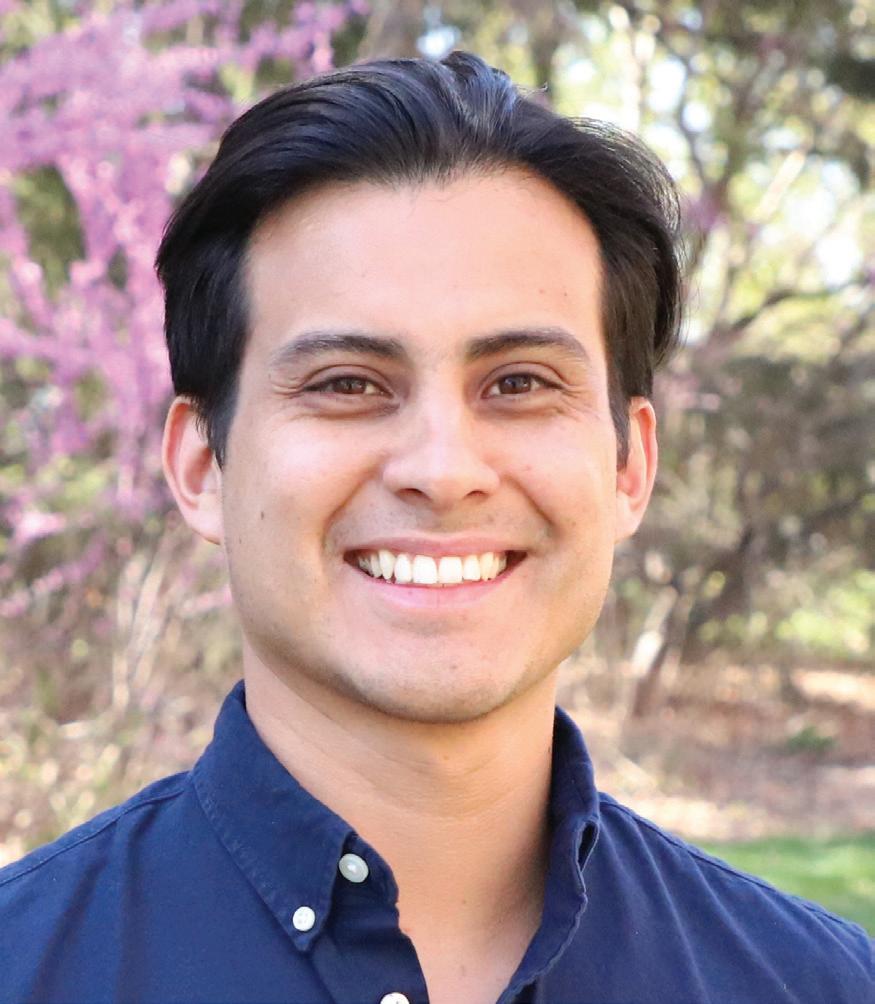
VLA TORRES-RODRIGUEZ JOINED THE DEPARTMENT OF AGRONOMY AND HORTICULTURE JULY 1, 2024, AS A RESEARCH ASSISTANT PROFESSOR.
Torres-Rodriguez’ passion for working with corn brought him to Nebraska in the fall of 2021. After he finished his doctorate, he took a postdoctoral position in the James Schnable lab — one of the leading quantitative genetics labs in the world. During that time, he learned that most quantitative genetic approaches to linking genes and phenotypes can only use information from one plant species at a time, which can limit the functional diversity in the dataset. Using corn and sorghum as model species, he is now working to develop and implement new algorithms that allow for inclusion of data from multiple species in a single analysis.
Torres-Rodriguez grew up on a small farm in Guanajuato, Mexico, which placed him closer to plants and natural resources. He became fascinated with how plants adapt to survive in almost any condition after watching a TV show where scientists described how plants work.
Torres-Rodriguez received a bachelor’s degree in food science at the Chapingo Autonomous University, Mexico, and a doctorate in plant biotechnology from LANGEBIO–CINVESTAV, Mexico.
He said he loves Lincoln — the people, Husker sports and the bike trails. He especially likes to feed the campus squirrels a few leftover lab corn kernels.
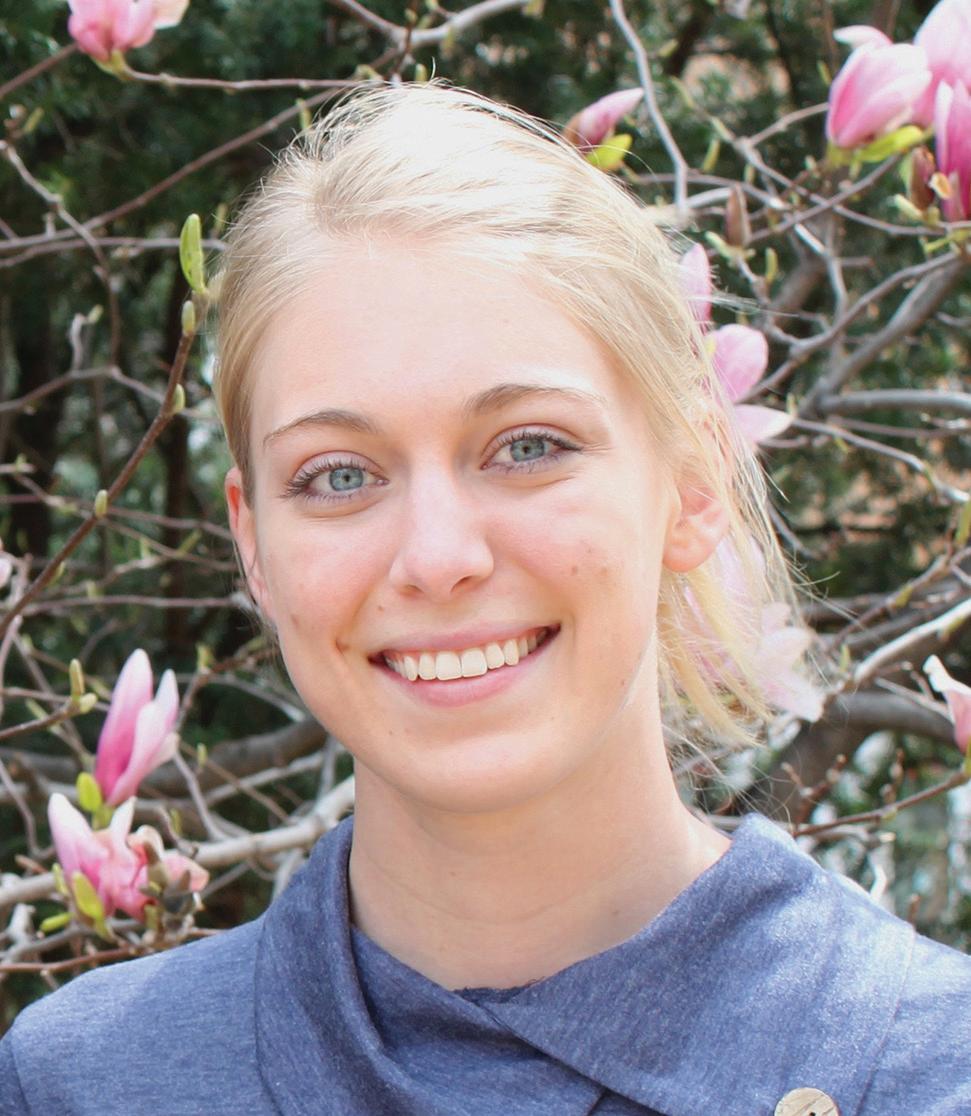
KELSEY MCCULLOUGH JOINED THE DEPARTMENT OF AGRONOMY AND HORTICULTURE
AUG. 19, 2024, AS A LECTURER. Her teaching appointment is 40% with the department and 25% with the Engler Agribusiness Entrepreneurship Program. McCullough is designing a new online class focused on the value-added enterprise of seed production. It highlights many careers in the industry and explores key topics such as production processes, seed certification, lab testing, conditioning and marketing. Online instruction allows her to connect with students and professionals from her farm and ranch near Broken Bow, Nebraska.
McCullough received a Bachelor of Science in horticulture with a production option and minor in entrepreneurship and leadership in 2017 as well as a Master of Applied Science with a science of educators specialization in 2024 from the University of Nebraska–Lincoln.
Prior to starting this position, McCullough was an online instructor for Don Lee and Dave Lambe. Growing up on a farm in central Nebraska, McCullough always knew she wanted to be a farmer/ rancher like her dad. She continues to work on her family’s farm, which specializes in the seed production of native grasses, wildflowers and cover crops. She and her husband also live and work on his family’s ranch, and her favorite job is being a mom to two toddlers.
www.stockseed.com

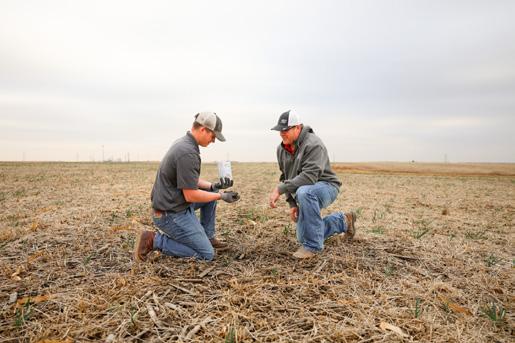
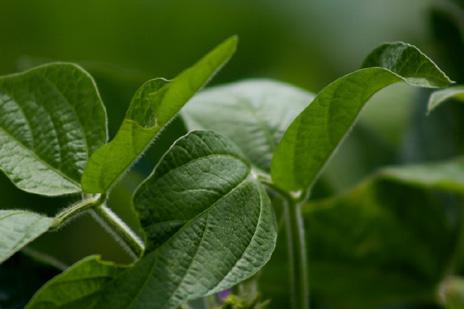

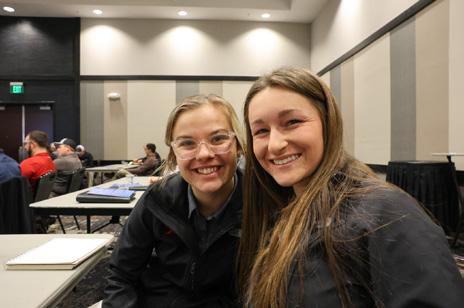
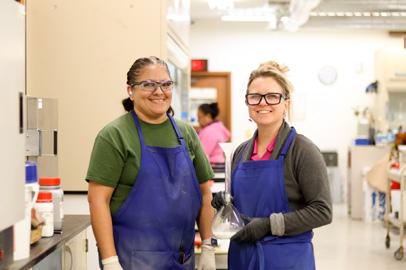
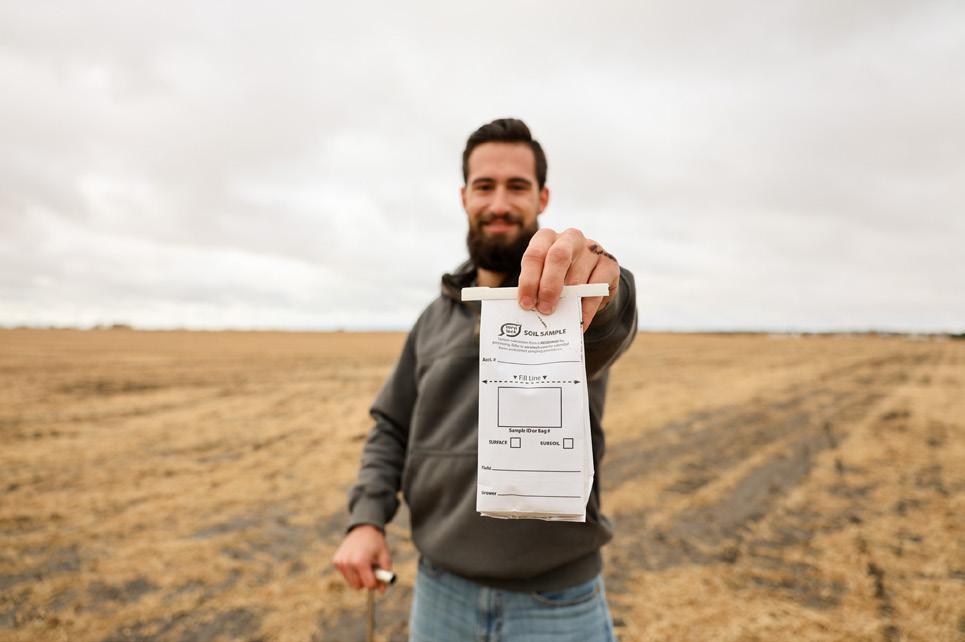
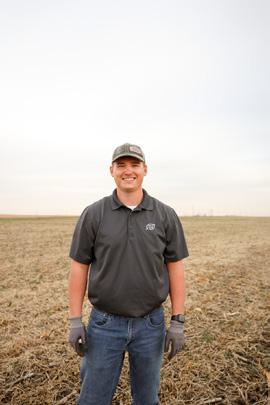
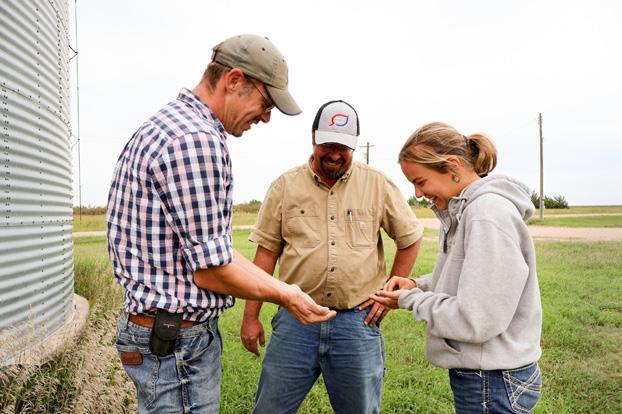
granted tenure

HIRED: 2018, PH.D.
2004 UNIVERSITY OF POTSDAM, GERMANY. Kaiser has a primary teaching appointment and instructs Soil Resources, Urban Soil Properties and Management, Soil Chemistry and Mineralogy, and Soil Carbon and Nitrogen Dynamics. In his research, he focuses on the impact of land use and biochar and regenerative agricultural practices such as cover cropping and notill on carbon and nutrient retention in soil. In collaboration with the City of Lincoln and Nebraska Forest Service, among other stakeholders, Kaiser leads a biochar project that includes a 16-acre field experiment of which eight acres were applied with biochar, representing the largest biochar field trial in Nebraska and among the largest in the United States.
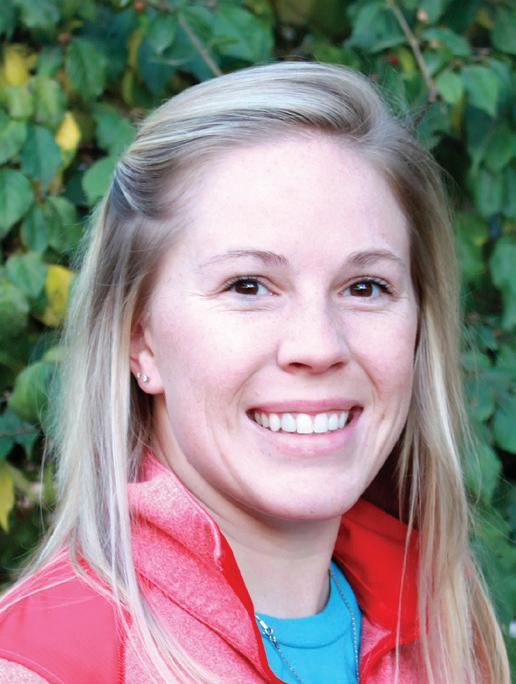
HIRED: 2019, PH.D. 2017 UNIVERSITY OF NEBRASKA–LINCOLN. Most of Easterly’s time is spent coordinating research projects at the High Plains Ag Lab and around the state. She is a member of the Dryland Cropping Systems Program, led by Cody Creech, and the Crop Performance Testing Program. Current research focuses on the needs of producers who farm in the semi-arid Nebraska Panhandle and surrounding regions, including selecting cultivars, management practices, and abiotic and biotic stresses that limit productivity. Easterly’s role involves collaboration with colleagues at the University of Nebraska–Lincoln and neighboring institutions. The program involves testing various hybrids and wheat, corn, grain sorghum and spring wheat varieties.
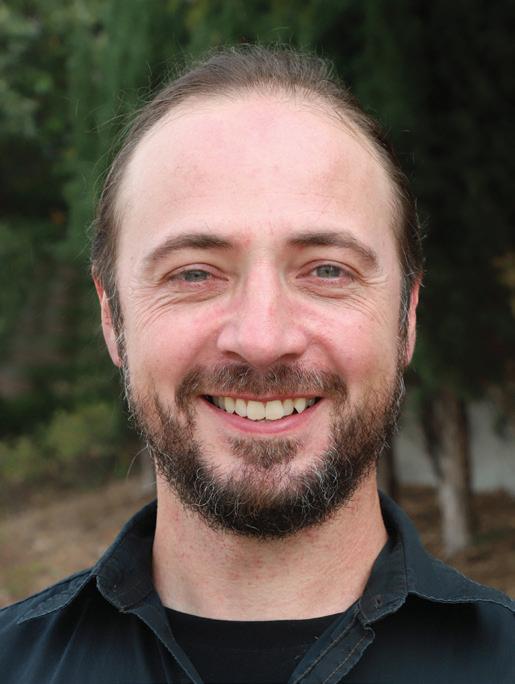
HIRED: 2008, PH.D. 2005 INDIANA UNIVERSITY BLOOMINGTON. Mower was granted tenure in 2014. The Mower Lab examines the evolution of genomic structure, function and content of plant mitochondrial, plastid and nuclear genomes. Researchers in the lab address comparative and molecular evolutionary genomics questions using a combination of experimental and computational approaches. The lab takes a comparative genomics approach involving diverse organisms, including flowering plants, other vascular plants, and green and red algae. Topics of study include the evolution of gene function, convergent evolution of morphological and genetic traits, structural and functional genome dynamics and intron evolution.
HIRED: 2019, PH.D. 1998 NORTHWEST A&F UNIVERSITY, CHINA. Guo has been a key member in supporting the Plant Transformation Core Facility of the Agricultural Research Division, a major research agency of the University of Nebraska’s Institute of Agriculture and Natural Resources and Nebraska’s Agricultural Experiment Station. His research involves developing transgenic and genome-edited crops, including soybean and sorghum, to improve the nutritional values (protein and oil), yield and abiotic and biotic resistance. Additionally, he researches plantpathogen interaction, revealing bacterial effectors’ virulence activities. A recently highlighted work is the discovery that bacterial pathogens use a novel effector-catalyzed signaling molecule to counter plant immune systems.

RICHARD “RICH” LITTLE, RESEARCH TECHNOLOGIST II, RETIRED AUG. 1, 2024, AFTER 16 YEARS IN THE DEPARTMENT OF AGRONOMY AND HORTICULTURE.
Little has a Bachelor of Science in soil science and a Master of Science in plant science, emphasizing genetics, from South Dakota State University.
At the University of Nebraska–Lincoln, he coordinated wheat breeding for organic environments and conducted soil fertility, water quality, weed and cover crop field and lab experiments.
Little grew up on a farm near Watertown, South Dakota. In high school, he read “The Secret Life of Plants,” by Peter Tompkins and Christopher Bird, which continues to inspire him in retirement.
As an undergraduate at SDSU, he became interested in organic farming after reading Wendell Berry’s “The Unsettling of America,” which prompted Little to work for small and organic farmers with Volunteers in Service to America with the Center for Rural Affairs.
After a year with VISTA, he farmed with his brother and dad for three years. He then lived in various intentional communities around the United States where he started a hydroponic greenhouse business, managed greenhouse production of bedding plants for a truck farm, and turned his attention to art school in Minneapolis while growing hydroponic tomatoes and working produce in a food co-op.
He decided to return to SDSU to pursue a master’s degree. His master’s thesis was on the genetic variation of Echinacea angustifolia. In 1994, Plantation Medicinals, Inc. recruited Little to pioneer the production of Echinacea angustifolia. He started a botanical farm near Brookings, South Dakota, and transplanted 70 acres in two years. Plantation Medicinals, Inc. later expanded production to over 300 acres. Before working for Nebraska, Little spent 10 years in wheat breeding at SDSU.
In retirement, Little stays busy growing tomatoes and peppers in his home garden, hiking and trying to keep up with his daughters.
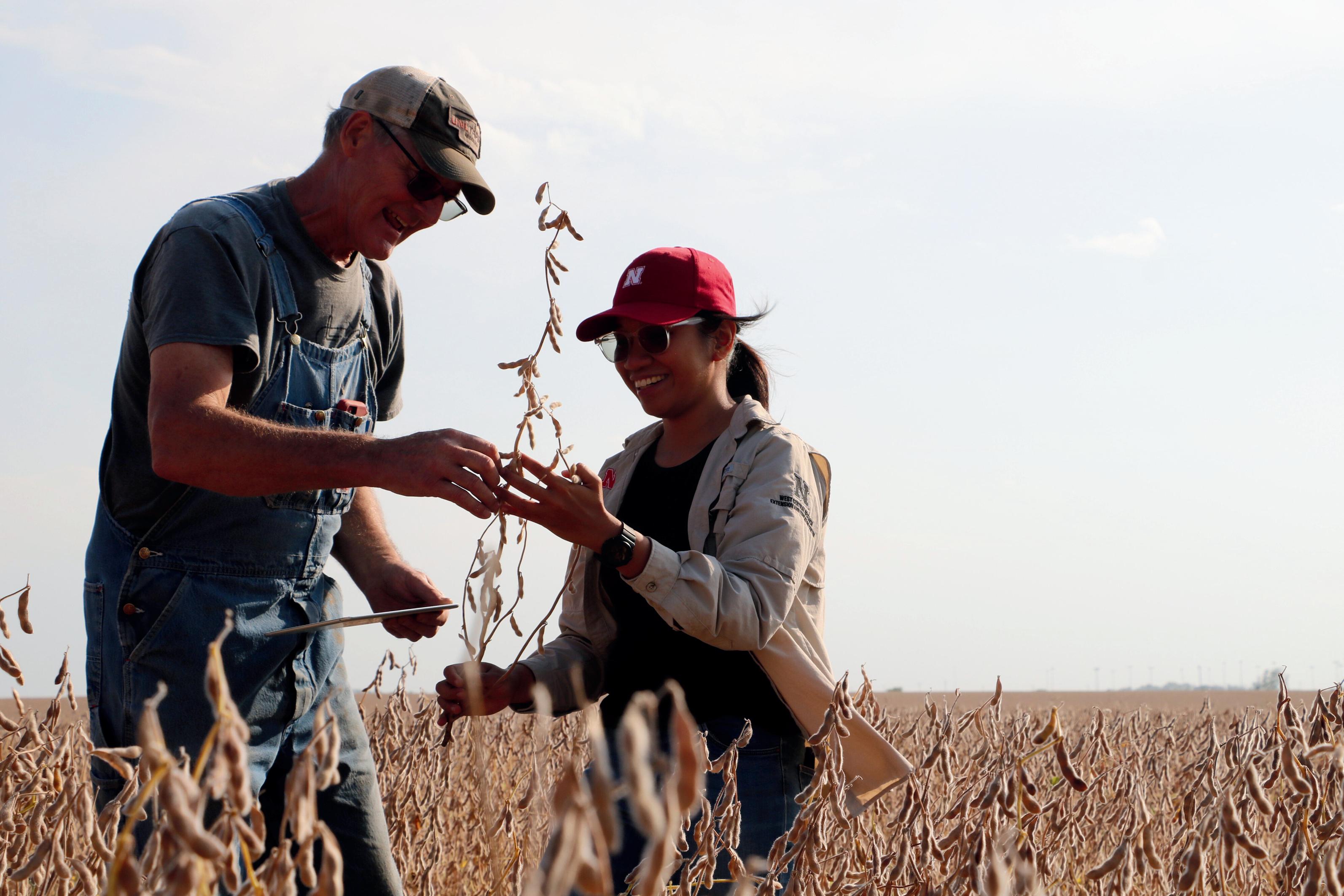

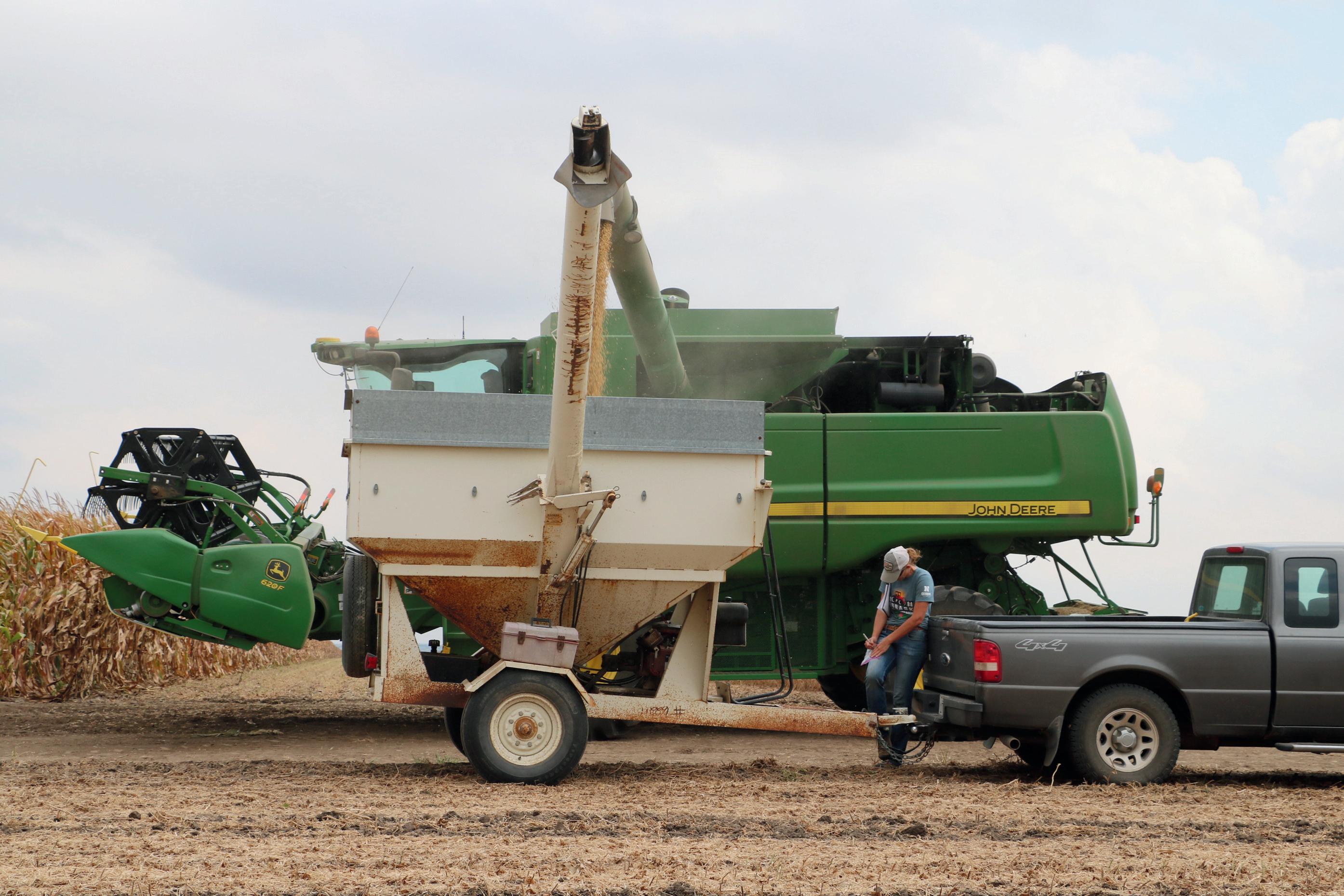
Your checkoff dollars at work—nearly $2 million in checkoff investments each year, funding cutting-edge research to improve yield, protect against pests and disease, and create new market opportunities for Nebraska soybeans.
From breeding better soybeans to enhancing resilience and profitability, the Nebraska Soybean Board invests in research that delivers real results for farmers.

by Fran tenBensel Benne | communications specialist
ROCH E. GAUSSOIN’S UNIQUE NAME AND DYNAMIC PERSONALITY
ARE WELL KNOWN TO MANY NEBRASKANS AND TURFGRASS SCIENTISTS
AROUND THE NATION. As a University of Nebraska–Lincoln professor in the Department of Agronomy and Horticulture, he made a name for himself on and off campus as a distinguished Nebraska Extension turfgrass specialist who appeared regularly as a featured panelist on “Backyard Farmer,” the longest-running non-syndicated TV show in history.
Gaussoin retired Oct. 1, 2024, after a 33-year career at Nebraska and is now a professor emeritus of agronomy and horticulture. He began at the university in 1991 out of a desire to do practical research and outreach extension.
Gaussoin received a bachelor’s degree in agronomy, specializing in soils, from New Mexico State in 1980. After graduation, he took a technician job in plant breeding to get free tuition for his wife, Priscilla, who was pursuing an undergraduate degree.
While working on a turfgrass research project, he was encouraged to pursue an advanced degree. His plant breeding classes were significant, setting the groundwork for his interest in science. He eventually chose to specialize in turf because he had an epiphany of sorts with his legally blind brother, who enjoyed the game of golf.
A great golfer in high school with a 4 handicap, his brother was losing his eyesight. He wanted to play a round of golf one last time, so Gaussoin agreed to help guide him on the course. It was a little frustrating for them and others on the course. When they reached the No. 6 hole, a long par 4, Gaussoin instructed him on where the hole was and pointed him in the right direction. Much to Gaussoin’s surprise, his brother pulled out his persimmon wood driver and struck the ball. The ball, eliciting that perfect sound, cleared the dog leg and landed 70 yards from the pin — a perfect shot. His brother turned and said, “That was a good one, wasn’t it? Let’s let these people behind us play through and go home.”
“That was all he needed,” Gaussoin said. “He talked about that moment till the day he died about three years later. I thought, if there’s a game that makes people feel this way, then there’s a reason to do science in that regard. I chose turf, and I didn’t look back.”
Gaussoin’s adviser at New Mexico State, the late Arden Baltensperger, was on a mission at that time to get an improved bermudagrass and he had funding from the United States Golf Association.
“I was really intrigued with the idea of plant breeding and manipulating plants,” he said. “Back then, it was not gene jockeying. There was no biotech. It was like, let’s cross this with that and see what it looks like.”
He did four years of turf research under Baltensperger, and from that work came a new variety called NewMex Sahara. It became the No. 1-selling seeded turf-type bermudagrass for about 10 years. In the process, he received a master’s degree in crop science, specializing in plant breeding.
Gaussoin decided to pursue a Ph.D. in turfgrass science at Michigan State University, concentrating on weed science, under the direction of Bruce Branham. After completion of his doctorate, he was offered a position at MSU as a non-tenure-track academic specialist.
Following graduation, Gaussoin considered taking an industry job, but he decided to stick with the “purist pursuit of science” in academia and took a position with Kansas State University for three years, where he worked in turfgrass weed management.
Upon his arrival at the University of Nebraska–Lincoln in 1991, the USGA — which sets the standards for golf green construction — was looking to modify its recommendations for golf green construction which hadn’t been substantially altered since 1963. Gaussoin received a USGA grant related to this topic, sending him down a path that would dominate his research and outreach efforts until his retirement.
He dedicated nearly three decades to researching critical aspects of putting green construction and management. Gaussoin’s collaborative approach has also contributed to the improvement of buffalograss, a native low-maintenance grass that requires little irrigation, has few serious pests and could advance the sustainability of golf in some regions.
When discussing what has changed in the last 35 years, he mentions how genetics and plant breeding have produced turf species more tolerant of disease. A significant change has been transitioning from heavy inputs to being conscious of using less fertilizer. One of the projects Gaussoin is most proud of is the opportunity to work with the USGA on golf green construction, which segued into soil organic matter. He focused on this for over two decades.
“You have this unique system that is unlike any ag system,” he said, referring to turfgrass science. “On a golf green, organic matter compromises play — it makes for a soft surface, it doesn’t dry out — all the reasons you don’t want too much organic matter.”
“Master’s students started looking at the research data on the practices traditionally implemented on golf greens, and they found some interesting contradictions,” he said.
Traditionally, golf greens are cultivated at least once a year, and frequently more, with a device that extracts small
diameter cores, which are removed and replaced with sand (AKA coring and topdressing). This method improves playing surface quality and dilutes the organic layer created at the soil/grass interface. It is a messy, time-consuming and labor-intensive operation. Gaussoin’s students identified a far more efficient approach with the same or better outcome using a solid tine instead of a coring tine.
Within 10 years of releasing this research information, 70% of golf course superintendents used this new method. Now, it’s a common practice.
At Kansas State, he completed one master’s student. At Nebraska, he mentored and advised or coadvised 12 master’s and five doctoral students.
“A number of Roch’s graduate students are now major contributors to the current generation of professionals working in turf as researchers, educators and industry professionals,” Anne Streich, professor of practice and student adviser in agronomy and horticulture, said.
Early in his career, without a formal teaching appointment, Gaussoin taught Agronomy 480/880 Modified Rootzones, Agronomy 413/813 Turfgrass and Landscape Weed Management and Plant and Landscape Systems 327 Turfgrass Science and Management. After his time as department head, he taught Plant and Landscape Systems 427 Turfgrass Systems Management and Agronomy/Natural Resources 107 Invasive Plants.
Gaussoin considers his involvement with the College of Agricultural Sciences and Natural Resources Undergraduate Scholarship Program, targeting students from Rwanda, his most rewarding enterprise as an undergraduate teacher. In addition to coleading the orientations class for the Rwandan CUSP students, he traveled to Rwanda multiple times to recruit all but one of the five cohorts and meet with parents and potential hiring partners.
Gaussoin believes the outreach and extension component is as important as teaching and research. He feels it is important to have a program with a curriculum and a targeted approach to every problem from an end-user or stakeholder.
His advice demonstrates his genuine concern and care for sports turf managers, golf course superintendents, lawn care operators and homeowners.
During his career, Gaussoin delivered over 350 presentations and 100 publications to the turfgrass and golf course industry and was a key contributor on “Backyard Farmer.”
A show with more than 20,000 viewers, “Backyard Farmer” continues to serve as a trusted, reliable source for expert advice in horticulture, plant pathology, entomology, wildlife and turf management for homeowners, gardeners and plant enthusiasts.
“Roch’s commitment to the science and its application was not limited to turfgrass,” said “Backyard Farmer” host and extension horticulture specialist Kim Todd. “As a panelist on BYF and during many trips across the state to talk about turf and trees, he promoted the value of the whole landscape. He spiced up the science in the conversations with attentiongetting weird references and jokes. He made the miles and time fly, and if the car talk and off-camera words could
have been captured, the stories would be never-ending.”
Gaussoin has received many recognitions and awards for his contribution to the turf industry.
“He is an amazing collaborator and a great person to work with, but many of those recognitions reflect him as an individual scientist,” Keenan Amundsen, a turfgrass genetics professor of agronomy and horticulture, said.
Appointed a Fellow of the American Association for the Advancement of Science, the world’s largest general scientific society, meant much to Gaussoin. Fellows are selected by their peers for scientifically or socially distinguished achievements that advance science or its application.
He admits that the Green Section Award from the USGA was a big one. He was honored for introducing new technologies and processes that advanced putting green construction and management. He’s only the second Nebraska professor to receive the prestigious award. Robert “Bob” Shearman, who started the turfgrass program at Nebraska in 1975, was the first.
Gaussoin was also recognized with the Golf Course Superintendents Association of America
Distinguished Service Award for providing practical and applicable research to the golf industry.
He received a Telly Award for a video he made on “Backyard Farmer,” produced by Brad Mills, in which he dressed up as a mad scientist named Professor Cantelope.
Gaussoin was elected president of the Crop Science Society of America in 2015 and appointed to the National Agricultural Research, Extension, Education and Economics Advisory Board by the U.S. Secretary of Agriculture in 2016 and served for six years.
He held many leadership roles, including head of the Department of Agronomy and Horticulture, the university’s largest department, from 2011 to 2017.
Under his leadership, the department grew in number of faculty, staff and students. Over five years, he hired 21 faculty members, launching the unit to a top-three ranking for departmental funding and expenditures at the university between 2014 and 2016, including a first-place rank in 2015.
Gaussoin is especially proud of his hand in creating new staff positions, including a communications specialist (Lana Johnson), laboratory coordinator (Mike Livingston) and herbarium curator (Cheryl Dunn, now a faculty member).
Remodeling the Goodding Learning Center, which continues to be a vibrant and active part of the department used by students, faculty, staff, classes and social functions, was a large project he undertook during his term. The department also benefited from the ConAgra Popcorn breeding program project with donations and increased funding for a new barn, equipment, truck and popcorn maker with ConAgra popcorn.
Gaussoin’s advice is to surround yourself with people who are better than you.
In retirement, he continues to work with the USGA and GCSSA but does not let that interfere with spending quality time with his family, especially his grandchildren, in North Carolina.
Read the full story at go.unl.edu/gaussoin-retire.

April 20, 1956 – May 15, 2018
by Lana Koepke Johnson | communications specialist
AN EXTREMELY SUCCESSFUL CORN BREEDER FOR 32 YEARS AT DUPONT PIONEER, NOW CORTEVA AGRISCIENCE, JOSEPH W. KEASCHALL WAS RESPONSIBLE FOR DEVELOPING ONE OF THE PARENTS OF THE HIGHEST-VOLUME HYBRID EVER SOLD IN THE UNITED STATES. He played a key role in developing systems for the conversion of conventional lines to contain and express biotech traits, such as insect resistance. He provided insight to process and systems as well as the requirements to ensure biotech products could succeed. He was passionate about teaching, motivating and leading students, farmers and employees.
Keaschall was born in 1956 to Marvin and Delores (Rochford) Keaschall and grew up on a crop and livestock farm near Ravenna, Nebraska, with three siblings.
He earned a bachelor’s degree in agronomy with high distinction from
the University of Nebraska–Lincoln in 1978. The late Dave McGill, agronomy professor, served as his adviser, and according to Keaschall, was the first mentor to inspire him with the amazing world of genetics. He also had the opportunity to work in corn breeding for a year under the late Charlie Gardner, another distinguished agronomy professor — an experience which Keaschall said helped solidify his desire to continue in plant breeding.
Keaschall met his future wife, Debra, while they were both undergraduates at Nebraska. Debra earned a bachelor’s degree in interior design. They married in 1979 and have three sons –Christopher, Ryan (married to Amanda) and Travis.
In 1980, Keaschall earned a master’s degree in plant breeding and genetics at Nebraska, working with Emeritus Professor Jim Specht in soybean breeding. In 1983, he earned a doctorate in plant breeding and genetics at Purdue University, specializing in sorghum breeding. He also completed curriculum focused on the seed industry through the Pioneer Institute III, Krannert School of Management at Purdue.
After graduating from Purdue University, Keaschall was a corn breeder for Pioneer Hi-Bred International, Inc. at Windfall, Indiana, where he worked for 11 years. He later served as a research director at DuPont Pioneer for 19 years. Keaschall then had the opportunity to relocate to Lincoln, Nebraska, as a research lead for DuPont Pioneer in the Western
Business Unit regional office. He was the corn product program director for Latin America and the Southern/ Western United States. He also served on the leadership team for the Ag Traits group, which focused on the identification and integration of engineered genes for drought resistance, nitrogen-use efficiency and yield enhancement.
Keaschall’s research focused on improving drought tolerance and enhancing and stabilizing crop yields in Nebraska and globally. He helped develop Aquamax, a drought-tolerant product, and gained expertise in precision phenotyping.
In 2016, Keaschall joined the Department of Agronomy and Horticulture faculty as a plant breeding professor of practice with the goal of inspiring and educating future plant breeding scientists and research associates. He taught graduate courses in plant breeding, including Heterosis, Cross-Pollinated Crop Breeding, and Haploids and Doubled Haploids in Breeding.
Keaschall was a member of Phi Beta Sigma and Gamma Sigma Delta. He received the Pioneer Million Unit Club award in 1991, the DuPont Pioneer Achievement in Research Award in 2012 and the prestigious DuPont research Bolton Carothers Award in 2014.
For more information on all alumni awardees, visit go.unl.edu/ah-alumni-awards.

June 21, 1957 – July 25, 2021
WILLIAM “BILL” ROBERT RAUN WAS A WORLD-RENOWNED CONTRIBUTOR TO THE UNDERSTANDING OF NITROGEN EFFICIENCY, SOIL SPATIAL VARIABILITY, PRECISION SEED ORIENTATION EFFORTS AND THE DEVELOPMENT OF THE GREENSEEDER, A PRECISION HAND PLANTER DESIGNED FOR MARGINAL LANDSCAPES IN AFRICA AND CENTRAL AND SOUTH AMERICA. He was a key member of the team that developed the GreenSeeker nitrogen sensor, a handheld sensor used in agriculture to monitor crop health, assess nitrogen needs and optimize fertilizer application rates across fields worldwide.
The youngest of six siblings, Raun was born in 1957 in Minden, Nebraska, to Ned Smith Raun and Esther Burris Zangger Raun. His father worked in international agriculture and moved the family to Mexico and later to Colombia. Raun spent his school years in Colombia, where he discovered his love for golf, became fluent in Spanish, and developed an interest in international agriculture. He spent his summers working on the family
farm in Nebraska with his bothers and cousins. He moved back to the United States to attend his senior year at Stillwater High School in Stillwater, Oklahoma, where he became the state golf champion and first met his future wife, Tanya Colclasure.
Raun earned a bachelor’s degree in agronomy and turf management in 1979 and a master’s degree in agronomy and soil fertility in 1982, both from Oklahoma State University. In 1985, he completed his doctoral degree in agronomy and soil science at the University of Nebraska–Lincoln.
From 1985 to 1991, Raun worked as a regional maize agronomist for the International Maize and Wheat Improvement Center in Guatemala and Mexico. In this role he serviced nine countries in Central America and the Caribbean.
Raun reconnected with Colclasure when he returned to the United States, and they married five months later. They have four children – Anne, Kate, Chris and Dana. Raun’s love for his work was eclipsed only by his love for his family.
In 1991, Raun joined the Department of Plant and Soil Sciences at Oklahoma State University as an assistant professor. He was promoted to associate professor in 1996 and professor in 1999. And in 2004, he was named the Regents Professor of Plant and Soil Sciences. In 2006, he was awarded a Melvin and Mary Jones Distinguished Professorship of Agronomic Sciences, and in 2010, he was named the Walter R. Sitlington Chair in Agriculture.
Raun’s research focused on nitrogen use efficiency in cereal crops. His goal was to help reduce world hunger by
improving agronomic practices among farmers globally. Early on in his career he collaborated with mechanical and electrical engineers to develop technology-based solutions for managing nitrogen, which led to the development and eventual commercialization of the GreenSeeker nitrogen sensor.
Passionate about nurturing and developing future scientists, Raun served as a major adviser for 103 graduate degrees conferred to 84 students, 47 of whom came from the developing countries. He was dedicated to ensuring that his international students learned everything they could so that they could return to their home communities and teach others.
His work and teaching impacted farmers and scientists on every continent, except Antarctica.
Raun received many prestigious honors including the American Society of Agronomy Werner L. Nelson Award, ASA International Award, the Soil Science Society of America Soil Science Applied Research Award, the PrecisionAg Award of Excellence – Legacy Award, the Pierre C. Robert Precision Agriculture Senior Scientist Award, the Robert E. Wagner Award, the OSU Regents Distinguished Research Award, the OSU Sarkeys Distinguished Professor Award and the OSU James A. Whatley Award for Meritorious Service in Agricultural Sciences. He was named a Fellow of both ASA and SSSA.
Raun was the co-founder and senior editor of the Agrosystems, Geosciences, and Environment journal and editor of the Agronomy Journal. He authored over 254 refereed journals and holds 13 U.S. patents.
March 20, 1942 – October 27, 2021
JAMES J. VORST WAS A FOUNDING FATHER OF THE INTERNATIONAL CERTIFIED CROP ADVISER PROGRAM, ESTABLISHED BY THE AMERICAN SOCIETY OF AGRONOMY IN 1992. Renowned for his expertise in learner-directed, competency-based education, Vorst led the development of the learning objectives, protocols and exams for certifying agronomy professionals to demonstrate their agronomic knowledge. His CCA work continued after his retirement. Today, the CCA program is the largest and most recognized agriculturally oriented certification program in North America and has expanded internationally, reaching countries such as India.
Vorst also led the development of guides used nationally for Technical Service Provider training for the United States Department of Agriculture Natural Resources Conservation Services.
Vorst was a professor of agronomy at Purdue until his retirement in 2009.
Born on the family farm in Cloverdale, Ohio, in 1942, to Arnold and Carmela Vorst, he graduated from Kalida High School in 1960. He received his bachelor’s degree in
agricultural engineering from Ohio State University in 1964 and completed his master’s degree in agronomy and turf management at Ohio State in 1966.
In the same year, he married JoAnn Litterini in Coraopolis, Pennsylvania. They had three sons – Jeffrey, Brian and Keith.
Vorst accepted a teaching instructorship at the University of Nebraska–Lincoln, where he earned his doctoral degree in crop physiology and production in 1969. Afterward, he took a teaching position in agronomy at Purdue University. At Purdue, he developed the Independent Crops Learning Center, which contains multiple learning materials used by students from several courses. He taught courses in grain crops, crop ecology and agricultural ethics.
Especially interested in agricultural ethics, Vorst developed a course named Ethical Issues in Agriculture. In 1994, he was invited to Oregon State University as the first visiting professor in the Department of Philosophy to share his expertise. He also taught a summer course, Agriculture/Natural Resources Issues and Ethics, at Oxford University in England.
In addition, Vorst conducted workshops on issues analysis at Purdue, in the community, at high schools and at other universities.
He was part of a team that developed a series of International Educational Travel Programs with three other Purdue colleagues. The program’s goal was to integrate knowledge of global agriculture, natural resources, art and culture. Between 1991 and 1996, these courses provided Purdue students the opportunity to travel to Germany and Austria, England and Scotland, Spain, Ecuador and the Galapagos Islands.
Vorst taught over 10,000 students, advised hundreds, served as an adviser for the Agronomy Club and co-advised the undergraduate Purdue Ag council. He also directed graduate student research in crop production.
Internationally, Vorst interacted with students, university faculty and agriculturalists from Europe, South and Central America, and the Middle East. His international work began in 1976 when he was invited to conduct turfgrass research at Friedrich Wilhelms Universitat, Bonn, Germany. He also collaborated in developing the International Center for Sustainable Development in Panama and served on its initial Board of Directors. Vorst evaluated educational programs and conducted teaching workshops at the Jordan University of Science and Technology and worked with scientists at the International Center for Tropical Agriculture in Cali, Colombia. He also directed the writing of environmental decision cases in the Middle East and led the development of a competencybased master’s program in water resources in Palestine and Israel.
Vorst received numerous national and university awards including the Crop Science Society of America’s Crop Science Teaching Award, the USDA Food and Agricultural Sciences Excellence in Teaching Regional Award, Purdue’s Charles B. Murphy Outstanding Undergraduate Teaching Award, Purdue Book of Great Teachers, Purdue’s College of Agriculture’s Outstanding Undergraduate Teaching Award and the Outstanding Undergraduate Counseling Award. In 2011 he received the Purdue Agriculture Alumni Certificate of Distinction.
Visit go.unl.edu/ah-alumni-awards.
by Lana Koepke Johnson | communications specialist
June 28, 1933 – February 15, 2024
PROFESSOR EMERITUS
DAVID JOHN ANDREWS, AGE 91, DIED FEB. 15, 2024. Andrews served as a faculty member in the Department of Agronomy and Horticulture at the University of Nebraska–Lincoln for 15 years.
Andrews was born June 28, 1933, in Croydon, England. He received a bachelor’s degree with honors in botany and minors in physics and organic chemistry from the University College of North Wales, Bangor, United Kingdom, in 1955. He earned a diploma in agricultural science at Selwyn College, Cambridge University, in 1956.
After joining the British overseas agricultural research service in 1957, he earned a diploma in tropical agriculture at the Imperial College of Tropical Agriculture, Trinidad, West Indies.
Andrews was principal research fellow and coordinator for cereals breeding research at the Institute for Agricultural Research, Ahmadu Bello University, Samaru, Zaria in Northern Nigeria, where he worked for 15 years. At first, he worked on casava, sesame, tobacco, soybeans and sugarcane but soon switched to sorghum and eventually became responsible for directing research on sorghum, pearl millet, early maize and wheat for northern states of Nigeria.
Through his pioneering work on cereal-based intercropping – a practice used extensively by Nigerian farmers – Andrews showed that the benefits of intercropping were fully obtainable at higher productivity levels when species were planted in different operations, while also realizing the full potential of higher yielding varieties. His discovery in 1963 of a single recessive gene (ms7) controlling male sterility in sorghum led to his longstanding involvement and continuing commitment to breeding with four sorghum
populations made in Nigeria using ms7 and later in pearl millet at the International Crops Research Institute for the Semi-Arid Tropics. He released 13 improved food-quality long-season sorghum varieties and parental lines adapted to various zones in Northern Nigeria. He also released four wheat varieties together with recommendations for their cultivation.
In 1973 he returned to the Plant Breeding Institute in Cambridge, U.K., but shortly became pearl millet breeder and subsequently program leader for the pearl millet improvement program at the newly formed ICRISAT at Hyderabad, India, where he worked for over 10 years. There he provided research coordination and management of a team of scientists in India and six African countries. He was instrumental in the breeding of pearl millet cultivars that grow on over 3 million hectares in India.
In 1984, Andrews joined the Department of Agronomy at Nebraska to work on sorghum and millet breeding for grain with an emphasis on adaptation and stress tolerance. His program was linked internally through International Sorghum and Millet Collaborative Research Support Program to breeding programs in Africa and India. He was also involved in training and advising graduate students on research projects and taught Agronomy 913 Advanced Plant Breeding.
Andrews, together with John Rajewski, research technologist in the agronomy and horticulture department, also developed the ornamental Purple Majesty, or Pennisetum glaucum, an unusually attractive hybrid of pearl millet. Purple Majesty was featured as an All-American Selection and Gold Medal winner for 2003. According to AAS, the Gold Medal award is rarely awarded and is reserved for plant breeding breakthroughs.
He received many recognitions for his work including the American Society of Agronomy Fellow, Crop Science Society of America Fellow, ASA International Service in Agronomy Award, CSSA International Service in Crop Science Award, ICRISAT Doreen Mashler Distinguished Scientific Achievement Award and the King Baudouin Award from the Belgian government. He was also an active member of the U.K. Tropical Agricultural Association, Nebraska Chapter of Sigma Xi, Gamma Sigma Delta and the Millet Researchers Association in India.
Andrews retired from the university on Dec. 31, 1998.
by Lana Koepke Johnson | communications specialist
PROFESSOR EMERITUS
RICHARD A. WIESE, AGE
95, DIED FEB. 22, 2024. His 38-year career in the Department of Agronomy and Horticulture and with Nebraska Extension at the University of Nebraska–Lincoln was spent in applied research and extension soil fertility education.
Wiese was born April 3, 1928, in Stanton County, Nebraska, and raised on the family farm in Dodge County. He attended one-room rural schools and graduated from Dodge High School in 1946.
During World War II, he was drafted into the United States Army Air Corps and became a radar repairman. He then attended the University of Nebraska briefly but was recalled to active duty with the U.S. Navy in the Korean conflict as an aircraft radio repairman. He served as a reservist in the Navy for 24 years and retired at the rank of captain in 1978.
Wiese returned to the University of Nebraska in 1952. He completed a bachelor’s degree in technical agriculture in 1954 and a master’s degree in agronomy specializing in soils in 1956. He then moved to North Carolina and was employed with the Soil Testing Division of the State Department of Agriculture during which time he completed a doctorate degree in soil chemistry and plant nutrition from North Carolina State University.
In 1960 he moved his family to Wisconsin when he accepted a position as assistant professor and extension soil fertility specialist in the Department of Soil Science at the University of Wisconsin.
Wiese spent six months teaching three soil science courses at the University of Ife, now called Obafemi Awolowo University, in Ibadon, Nigeria, in 1964.
In 1967, he joined the faculty in the Department of Agronomy at Nebraska as associate professor and extension soils specialist. In 1975 he was promoted to professor.
Weise was closely associated with soil and plant analytical services in support of research projects and services with soil testing and with the initial computer soil testing reports at a time when its feasibility was questioned. He was instrumental in early State Soil Testing Legislation, which mandated conformity to established analytical procedures and developed a check sample system to assure quality control in soil testing laboratories. He encouraged a soil test
comparison study that resulted in assisting in the start of a soil test comparison site. After results were published in the first two years, colleagues from North Carolina, Wisconsin and Nebraska became involved.
Wiese directed educational programs in partnership with agribusinesses in Nebraska and developed management systems for growing soybeans in high pH soils. His interest in water quality resulted in the development of Nebraska’s first water plans. Because of his involvement in developing both management plans, he concentrated his work in water and nitrogen management for field crops.
Wiese also worked on a national committee for nine years to develop an exam program for Certified Crop Consultants.
Development of the NCR-103 Committee, a committee of university specialists from the North Central Region, led to state legislation and reduced farm expenditures on unproven products in the North Central States by several million dollars. Wiese promoted the concept of fact sheets as a rapid response to public questions and concerns. This ultimately led to Nebraska Extension’s NebGuides, a vehicle of communication and information dissemination in which many extension colleagues participated.
Wiese was elected to three honorary societies including Alpha Zeta, Gamma Sigma Delta and Sigma Si. He was a member of the American Society of Agronomy, Soil Science Society of America, Soil Conservation Society of America, American Chemical Society, Council on Soil Testing and Plant Analysis, Nebraska Cooperative Extension Association and Epsilon Sigma Phi. | Read more at go.unl.edu/richard-wiese.

Trust the experts at Ward Laboratories for accurate and swift soil, plant tissue, water, and ammendment results. Visit wardlab.com.




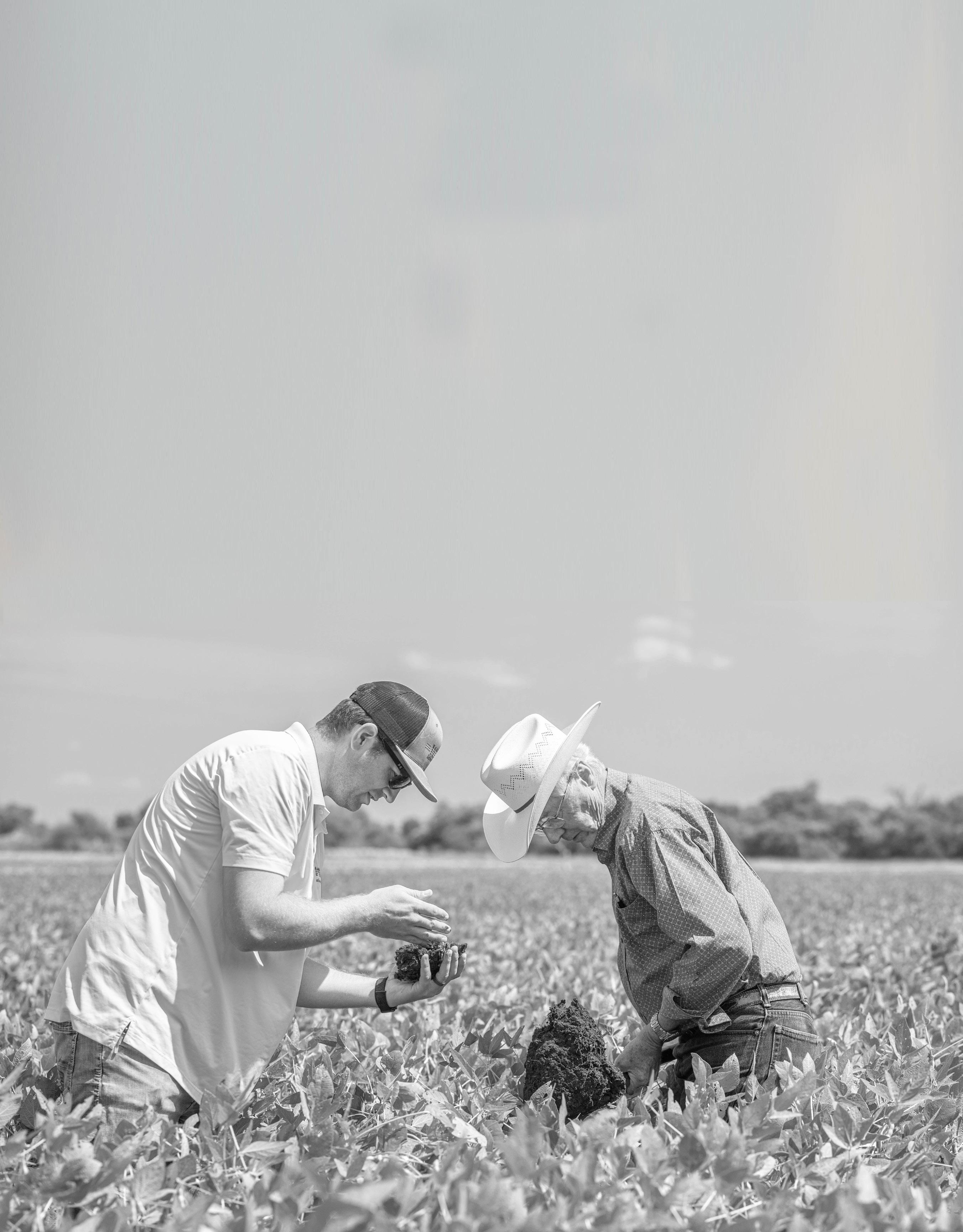

University of Nebraska–Lincoln Agronomy and Horticulture
P.O. Box 830915
Lincoln, NE 68583-0915
Growing up in O’Neill, Nebraska, Riley Dinslage had a passion for outdoor work. Now a junior at UNL, he is the recipient of multiple scholarships, such as the Clara S. Tillotson Memorial Scholarship, the Keith Weidler Memorial Award, the W. & G. Dankert Scholarship, the Girardin Family Scholarship and the Engler Scholarship. That has allowed Riley to work part time for UNL Athletics and continue to learn about the technical and management aspects of turf.
“Seeing the direct impact of my work, whether managing greens during a tournament or prepping athletic fields, brings a strong sense of accomplishment,” Riley said.
Your support can help students like Riley achieve their dreams. And by helping students grow, you help our state grow for decades to come. To make a gift, visit nufoundation.org/agronomyandhorticulture.