We put in the hard work at the University of Nebraska–Lincoln — the grit behind the glory.
UNDERGRADUATE go.unl.edu/learnplants
GRADUATE go.unl.edu/agrohortgrad
GRADUATE ONLINE agrohortonline.unl.edu
In the Department of Agronomy and Horticulture we empower students to connect with people, cultivate ideas, discover new opportunities and acquire the skills necessary to feed and enrich the lives of a growing global population.
Contact us today to learn more about unlocking your potential at Nebraska.
Department of Agronomy and Horticulture Annual Newsletter 2019
Institute of Agriculture and Natural Resources University of Nebraska–Lincoln
MANAGING EDITOR
Fran tenBensel Benne
EDITORS
David Hyten
Lana Koepke Johnson
John Lindquist
Martha Mamo
COPY EDITOR
Chantel Koerwitz
DESIGNER
Fran tenBensel Benne
PHOTOGRAPHERS
Fran tenBensel Benne
Craig Chandler
Lana Koepke Johnson
Greg Nathan
ADVERTISING SALES
Lana Koepke Johnson
CONTACT
402-472-2811 agrohort@unl.edu agronomy.unl.edu
202 Keim Hall Lincoln, NE 68583–0915
SOCIAL MEDIA @UNLAgroHort
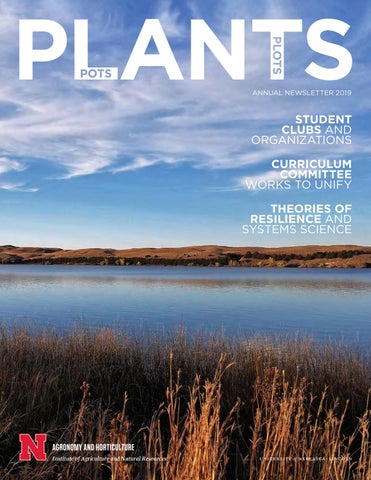
COVER PHOTO
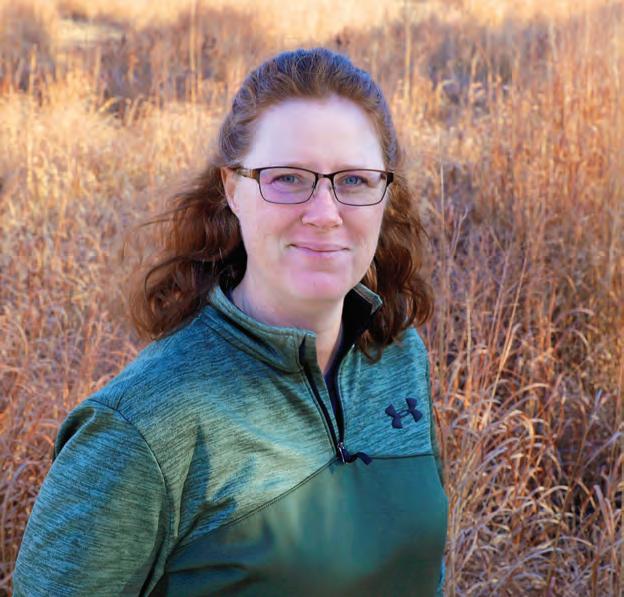
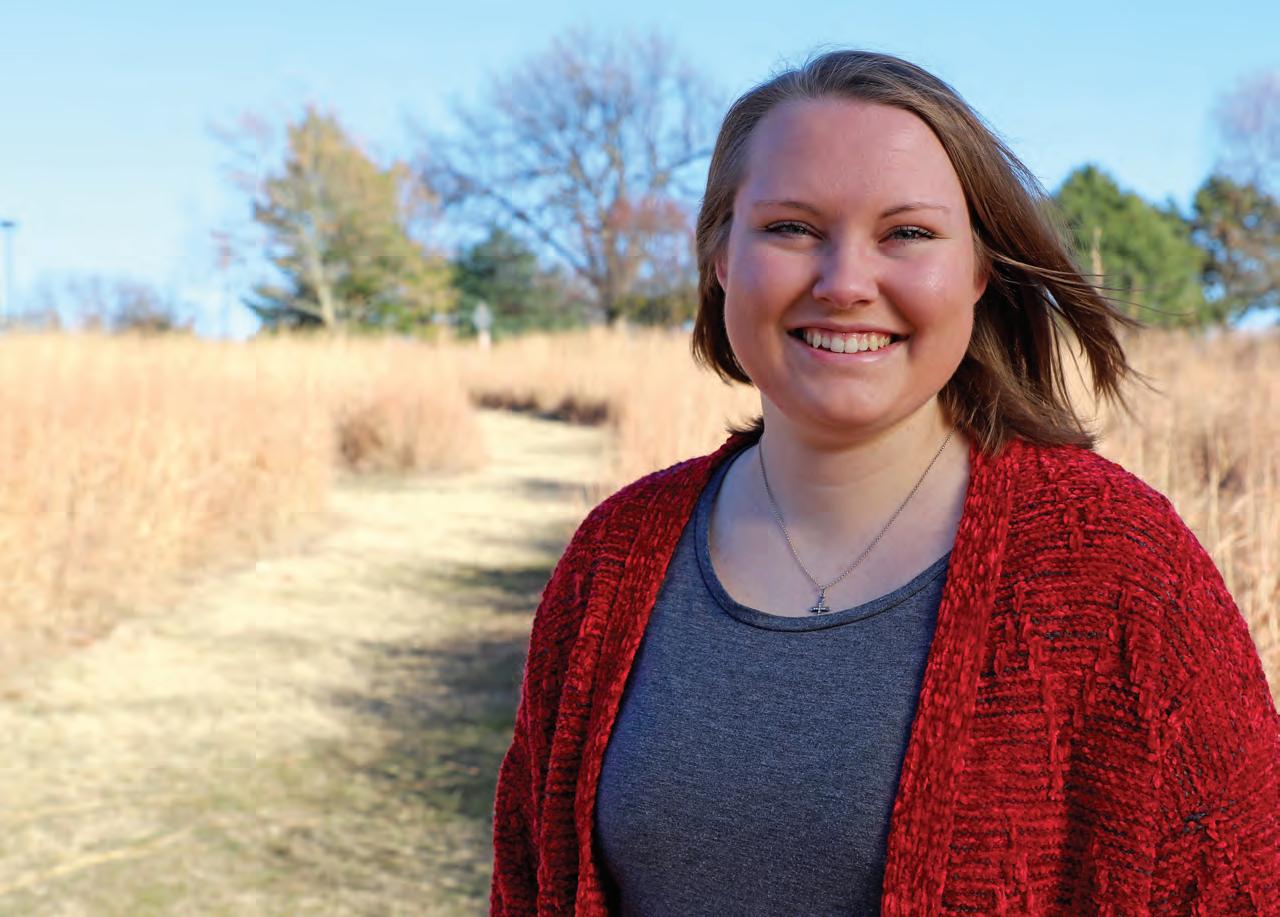
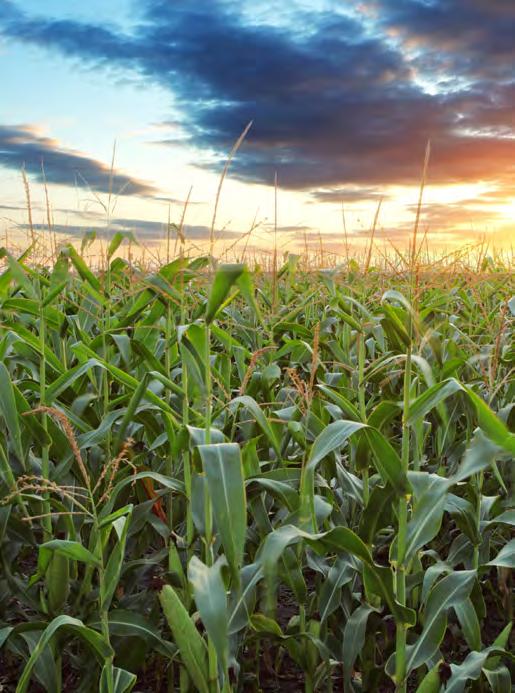
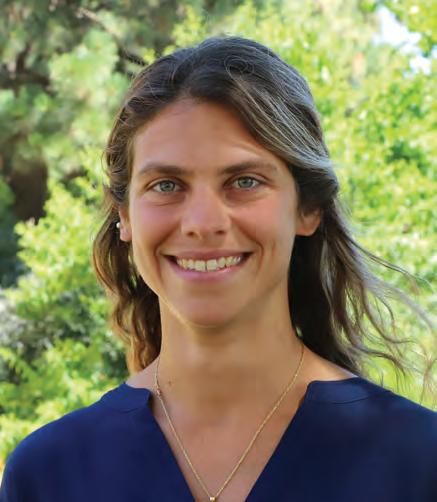
Christine Bielski, agronomy doctoral student: A calm afternoon in the Nebraska Sandhills.
2019
Staff Awards
Cheryl Bogenrief: Staff Advisory Committee Special Contributions Team Award
Michelle Green-Ihde: SAC Special Contributions Team Award
Tatyana “Tanya” Gulchuk: SAC Special Contributions Team Award
Sarah Johnson: SAC Special Contributions Team Award
Mike Livingston: SAC Special Contributions Award
Casey Lundberg: SAC Special Contributions Team Award
T.J. McAndrew: AHGSA Staff Appreciation Award
Kay McClure-Kelly: SAC Special Contributions Team Award
Joshua Reznicek: AHGSA Staff Appreciation Award
Joanne “Annie” Vance: AHGSA Staff Appreciation Award
Christine Weitzel: SAC Special Contributions Team Award
Martha Mamo
2019 WAS A YEAR OF TRANSITION WITH OUR NEW ADMINISTRATIVE TEAM. I AM FORTUNATE TO HAVE JOHN LINDQUIST, PROFESSOR OF WEED ECOLOGY, AND DAVID HYTEN, ASSOCIATE PROFESSOR OF PLANT GENETICS, AS ASSOCIATE DEPARTMENT HEADS. They are committed to the success of the department, and their unique experiences make our team stronger.
With 68 faculty, 100 staff and 335 students, we are one of the largest departments at the University of Nebraska–Lincoln and we continue to be productive in all three mission areas. The department reached $10.5M in sponsored awards, totaled $10.6M in research expenditures and published more than 250 peer-reviewed publications and book chapters. The department offered 110 unique courses and expanded our online course offerings to serve over a thousand students. Our faculty engaged with numerous clientele through extension field days and innovative programming. The department also had one of the largest graduating classes in FY2019, with more than 90 students receiving bachelor’s, master’s or doctoral degrees. Faculty, staff and students collectively received 70+ awards or recognitions, a testament to quality work and our commitment to excellence. We increased our soil science research, teaching and extension capacity through two new tenure track faculty: Assistant Professor Javed Iqbal in nutrient management and water quality and Assistant Professor Laila Puntel in soil fertility and precision agriculture.
We also refined our core mission to more fully reflect the challenges of the 21st century, the breadth and depth of our work, and the clientele we serve. The department’s current priorities are focused on undergraduate education, graduate education, capacity building in digital agriculture, extension impact and student recruitment. We have made progress in all priority areas. In particular, the undergraduate education curriculum has reached the final stages before the approval process begins this spring. The envisioned curriculum will give all undergraduate students a common core of classes and the flexibility to select a disciplinary option and emphasis area.
Finally, I want to express my gratitude to the faculty, staff and students as well as the members of the Agronomy and Horticulture Alumni Advisory Council who are committed to our department and its mission. As we begin 2020, I am optimistic that this department will continue in its excellence of research, teaching and extension and, most importantly, serving the people of Nebraska and beyond.
Sincerely,
Martha Mamo Professor and Department Head
I’VE BEEN HONORED TO SERVE THE DEPARTMENT AS ASSOCIATE DEPARTMENT HEAD SINCE JANUARY
2019. I also continue to teach the undergraduate invasive plants course every spring and a graduate course on interplant competition in even-numbered years. In addition, I have been conducting research on the ecology of weedy and invasive plants since 1997.
I believe that the role of administrators should be to make the working lives of faculty, staff and students easier, or at least less constrained. I look forward to continue working with this administrative team to fulfil that role.
We developed the 2019 unit priorities based on our strategic framework. Those priorities are really about elevating the stature of the department beyond the exceptional position we’re already in.
One of my responsibilities is to liaise with Nebraska Extension to enhance the interaction between extension specialists and educators and to improve extension effectiveness and impact. In that regard, we will hold the inaugural extension forum in April to discuss strategic planning and, perhaps more importantly, to identify any existing constraints to effective extension programming.
This first year has been a whirlwind, and I’ve learned so much about the incredible people who work and study in our department. I’ve enjoyed every minute of it.
ONE OF THE THINGS THAT EXCITED ME THE MOST LAST YEAR WHEN I ACCEPTED THE POSITION OF ASSOCIATE DEPARTMENT HEAD WAS THE OPPORTUNITY TO ENHANCE THE TRAINING OF THE NEXT GENERATION OF SCIENTISTS. This generation of students will face complex challenges in agriculture and horticulture throughout their careers.
One of our department’s priorities has been working with the administrative team and faculty to strengthen our graduate education. We want to ensure that we are providing the training and resources necessary to develop students into highly recruited professionals and leaders who are able to solve tomorrow’s problems. This includes helping our students gain the relevant knowledge, skills and abilities in the rapidly evolving fields of plant, soil and landscape systems.
We have formed a small working group that has outlined a vision and action items for improving the graduate program. The group plans to engage all graduate faculty in a teaching retreat to identify and prioritize curriculum changes, professional experiences and programs we can begin to implement at the end of 2020 and into 2021.
I look forward to this implementation along with progress on other priorities as we work to strengthen an already strong department.
Sincerely,
Sincerely, Professor and
Associate Department Head
David Hyten Associate Professor and Associate
Department Head
John Lindquist David Hyten
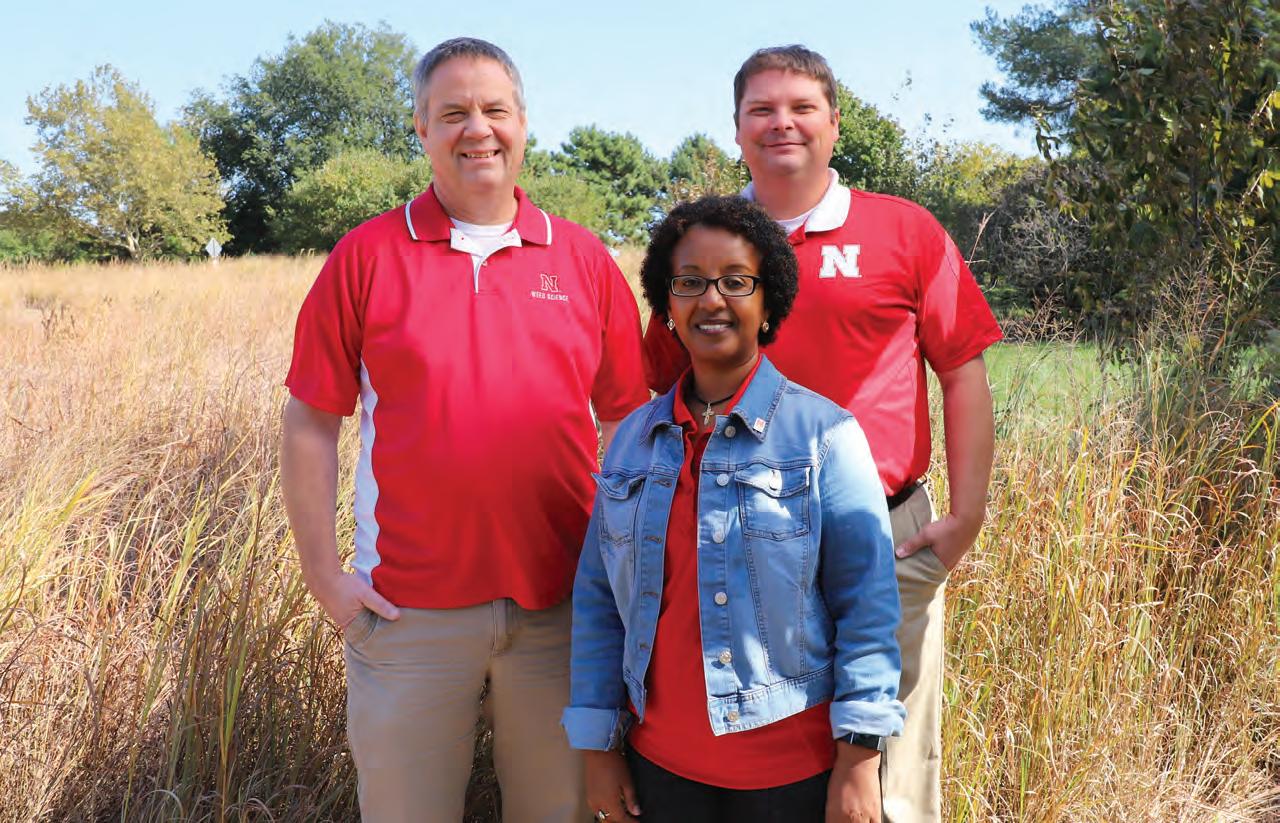
John Lindquist (from left), Martha Mamo and David Hyten
STAFF SPOTLIGHT
Carol Caha
Lab Manager/Research Technologist II
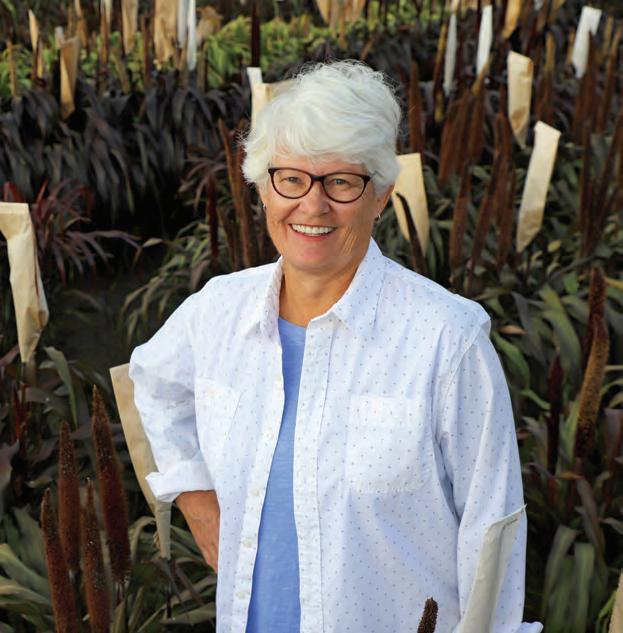
MY FIRST EXPERIENCE WITH THE UNIVERSITY OF NEBRASKA–LINCOLN DEPARTMENT OF AGRONOMY AND HORTICULTURE WAS IN HIGH SCHOOL AS A SUMMER EMPLOYEE FOR THE FOUNDATION SEED DIVISION AT MEAD, NEBRASKA. Although I was raised on a farm and familiar with most of the daily work assignments, the variety of work at Foundation Seed gave me an opportunity to interact with plant breeders, crop physiologists and climatologists. Little did I know at the time that this work experience would be the beginning of a long career within the department.
After receiving a bachelor’s degree in biology from Doane College, I once again became employed by the University of Nebraska and have had many wonderful experiences working in the sorghum physiology and plant breeding and genetics areas of research. Currently, I am involved with the ornamental pearl millet breeding project.
Not only do I feel fortunate for the many interesting work projects and the opportunity to complete a master’s degree in plant breeding and genetics, but I have had the pleasure of meeting and working with some truly
Heidi Hillhouse Research Technologist II
remarkable people! It has been gratifying to follow their successful careers.
When I’m not at work, my free time is spent gardening, quilting, reading, cooking for family and friends and hiking in Wyoming and Montana every chance I can find!
I WAS BORN AND RAISED IN NEBRASKA, AND I HAVE SPENT MOST OF MY LIFE IN NEBRASKA, LARGELY IN LINCOLN. I earned a Bachelor of Science in fisheries and wildlife from the University of Nebraska–Lincoln. After a couple of years working as a seasonal research technician, I returned to UNL for a master’s degree in biological sciences. Wanting to be more involved with research, I continued my graduate studies at the University of Wisconsin-Madison, where I earned a Ph.D. in botany focused on grassland ecology. I was fortunate enough to return to Nebraska to work, first as a postdoctoral researcher and then as a research technologist starting in 2012.
My career path has allowed me to take my ecological background and use it in the context of applied problems in a variety of ecosystems. I’ve gotten to work in native grasslands, wetlands, pastures and annual cover crop systems. There’s always something new and different going on!
I enjoy spending time with my husband and with my twin sister and young niece. Such a bundle of energy! When I’m not spending time with family, I keep busy with an assortment of hobbies. Many of my hobbies are based in the outdoors, including hunting and vegetable gardening, but I keep things interesting by also dabbling in blacksmithing and living history.
Diane Nolan Information Technology Associate
BORN AND RAISED HERE, I LIVE IN LINCOLN WITH MY HUSBAND OF 47 YEARS, MICHAEL. We have two grown sons, David and Charlie, and one granddaughter, Kelita. We are a family of computer techies (nerds). Michael is a database programmer and now writes his own food blog — mynebraskakitchen.com, David is a site reliability engineer and Charlie works for Google’s YouTube in cyber security.
My first “job” was at the age of 7 as a shipping clerk for my parents’ fledgling company, Cliff’s Notes. Along with my brother and sister, I packed those black and yellow diagonally striped study guides for shipment.
I began college at Northwestern University, where I met Michael. We moved to Lincoln, where Michael completed his MBA and I finished my degree in business. Later I returned to the University of Nebraska–Lincoln for teacher certification in mathematics and my master’s in instructional technology.
You will see me walking laps many days or heading outside to walk a bit. I put in 30-plus minutes of aerobic exercise almost every day and do some yoga.
As many know, I recently survived my “year from hell” beginning with open heart surgery in August 2019 followed by treatment for breast cancer discovered just after the
Cheryl Dunn Research Manager Herbarium Curator
surgery. Even with heart surgery, four chemo sessions and 37 radiation sessions, in many ways the hardest part of all was missing out on the beginning of the school year with all the students. I am really happy to be here to work with the students, staff and faculty this year!
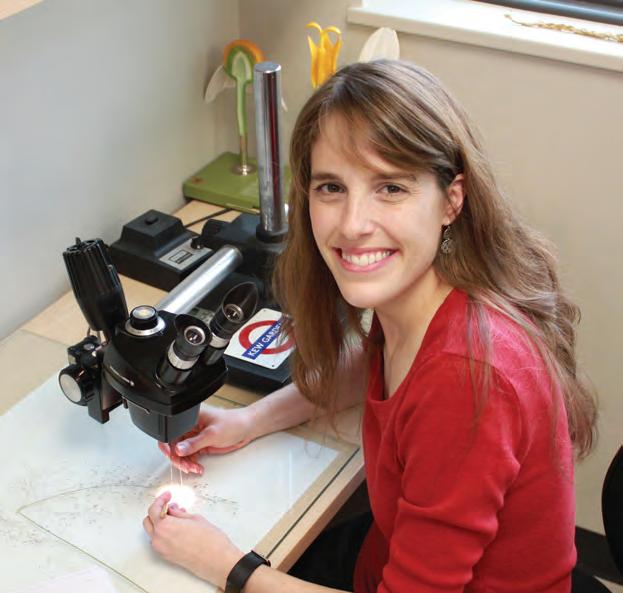
I’M ORIGINALLY FROM HAYS, KANSAS, AND GREW UP TRAVELING TO LARGER CITIES LIKE SALINA AND DENVER TO GO SHOPPING. My grandmother would always send us pressed plants, and she loved telling me about all the plants I fed her goats when we visited her. That is what really got me interested in plant biology.
After high school, I went to Fort Hays State University and earned both a bachelor’s and master’s degree in biology. I spent a year there teaching human biology and environmental science before moving to Topeka to be the roadside vegetation coordinator for the state of Kansas.
An opportunity opened up here at the University of Nebraska–Lincoln doing all the things I love to do: teaching, research and collecting plants. That was over 10 years ago and I have loved being in Lincoln ever since. One of the best parts of my jobs is interacting with students and persuading them to love plants just as much as I do. I also get the opportunity to help people — whether they are students, extension or the general public — identify plants.
My husband is the state zoologist for the Nebraska Game and Parks Commission, so he is the fauna and I am the flora. We have two daughters, Abrah and Thalia, who are now both in elementary school and keep us very busy. We are a book-loving family as well as anything related to the outdoors.
and CLUBS Student Organizations
Agronomy Club branches out with new opportunities
by Jared Stander, Agronomy Club historian
THE AGRONOMY CLUB KICKED OFF 2019 WITH A NEW EVENT CALLED EXPERIENCE AGRONOMY DAY. The event, which was directed at high school students involved in FFA and 4-H, provided hands-on experience and knowledge about agronomic identification of plants, insects and diseases. The students will be able to use these skills at state and national agronomy events within their organizations as well as during their own field work. Club members had the opportunity to showcase their knowledge of agronomy and highlight their experiences with the Department of Agronomy and Horticulture and the University of Nebraska–Lincoln. High school students not only learned identification skills but also had the opportunity to tour East Campus and meet professionals in the industry. Aurora Co-op provided lunch and representatives spoke about potential careers in agronomy that they offer college and high school students. Accustomed to listening to industry leaders at their biweekly meetings, club members continued this tradition
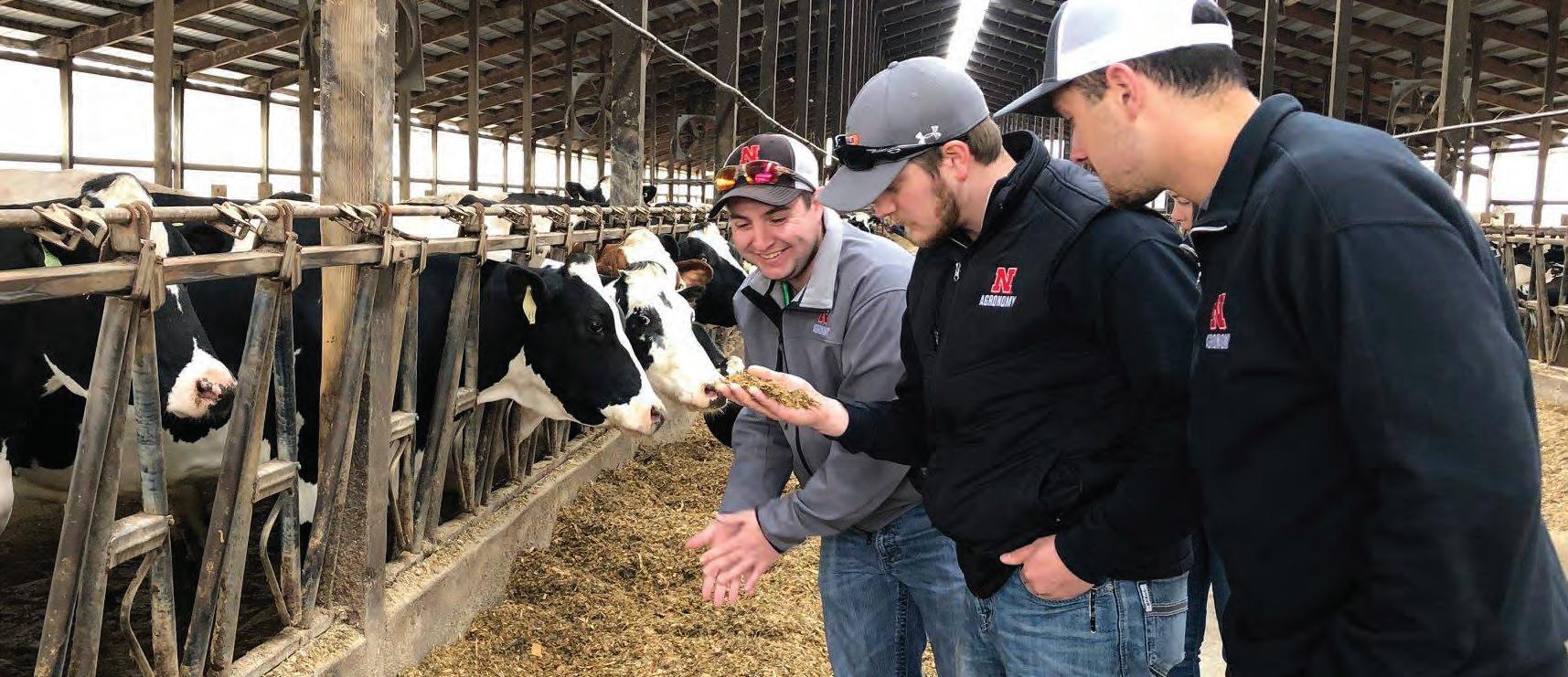
Agronomy Club members Dalton Johnson (from left), Aaron Doxon and Jake Krings tour Sand Creek Dairy LLC during the SASES conference at Michigan State University. BELOW: Club members including Doxon (from left), Johnson, Nathan Petersen, Samantha Teten, Kolby Grint, Rebecca McKay, Alex Baumert, Michaela Cunningham, Geoffrey Toler, Katie Jo Steffen, Krings and Rodger Farr help with and attend the department’s annual Spring Awards Banquet.
in 2019 with speakers representing companies such as Corteva, Syngenta, Servi-Tech and more.
This spring, 12 club members had the opportunity to attend the regional SASES conference at Michigan State University. Members had the chance to tour the university and agricultural systems in Michigan and network with other clubs from across the country. The club competed in the crops judging competition and placed first, earning the top three individual scores.
This fall, the Agronomy Club assisted the Nebraska Department of Economic Development at Husker Harvest Days. Members helped the department run the international visitors tent, where members interacted with foreign diplomats and showed them around the event.
Agronomy Club also had the opportunity to attend the national SASES at the annual ASA-SSSA-CSSA meetings in San Antonio, Texas. The club sent three members to attend the event, and they won first place in both the club poster contest and club scavenger hunt. Attendees also had the opportunity to attend speeches, poster sessions and social events with other clubs and universities.
The 2019 club officers were Jake Krings, president; Michaela Wetovick, vice president; Dalton Johnson, treasurer; Katie Steffen, secretary; Chad Lammers, assistant treasurer; and Jared Stander, historian. Meghan Sindelar, assistant professor of practice, and Chris Proctor, assistant extension educator, are the club advisers.
Rachel Leege | ASA-CSSA-SSSA
AHGSA promotes engagement and career development opportunities
by Alex Tonon Rosa, AHGSA president
THE AGRONOMY AND HORTICULTURE GRADUATE STUDENT ASSOCIATION PROMOTES SEVERAL EVENTS THROUGHOUT THE YEAR TO FOSTER INTERACTIONS AND BUILD CLOSER RELATIONSHIPS AMONG GRADUATE STUDENTS, FACULTY, STAFF AND INDUSTRY PARTNERS. In the past year, some of the highlighted events included Spring Banquet, Elevator Speech Contest, sweet corn giveaway, R-Club meetings, fall barbecue, an industry tour and a three-session workshop series.
Graduate students also meet once a month to learn from speaker talks, plan upcoming activities, share cultural experiences, get to know other students and enjoy excellent meals sponsored by the student association. In addition, every other month a guest speaker is invited to present a topic related to graduate school, student interests or career development.
To promote professional development, AHGSA collaborated with the Entomology Bruner Club to organize the workshop series “Are you ready to get a job?” This series comprised three events: (1) Build a CV and resume, (2) Tips to have a successful interview, and (3) Mock interviews. More than 60 graduate students from the College of Agricultural Sciences and Natural Resources participated. In addition, the club organized the first Elevator Speech Contest by partnering with graduate students from the departments of Entomology and Plant Pathology. Members competed within the association first and then the top three finalists competed interdepartmentally. The purpose of the contest was to develop students’ ability to communicate science with a non-scientist audience.
Over the last few years, AHGSA members have organized and promoted the R-Club to improve students’ statistical skills. At meetings twice a month students share their
expertise about R software by discussing topics such as data manipulation, plotting and analysis.
Furthermore, AHGSA members have collaborated with T.J. McAndrew and the agronomy farms at Havelock and Eastern Nebraska Research and Extension Center to get sweet corn planted early in the season to be harvested during the summer semester and then distributed to the community at East Campus on a first-come, first-served basis. Free-will donations make the sweet corn giveaway the club’s biggest fundraising event, and the donations support the activities of the club.
AHGSA would like to thank all those who provided their continued support, especially its advisers Paul Read and Sam Wortman, Department Head Martha Mamo and also Tanya Gulchuk, Casey Lundberg, Lana Johnson and McAndrew. AHGSA could not have had another successful year without the support of these individuals.
Current officers are Alex Tonon Rosa, president; Jose de Sanctis, vice president; Osler Ortez, treasurer; and Tara Harms, secretary.
Follow AHGSA on Twitter (@ahgsa_unl) and Facebook (UNL AHGSA).
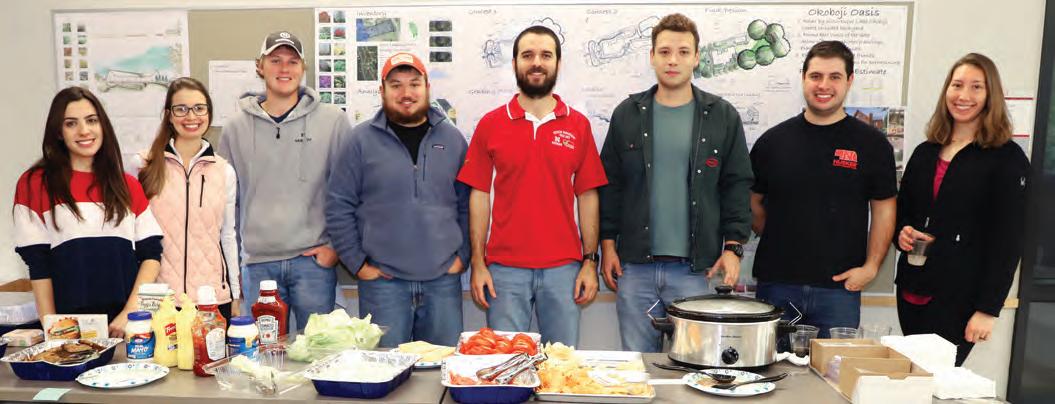
AHGSA members host their annual fall barbecue for the department. Food servers are Estefania Polli (from left), Fernanda Krupek, Trenton Houston, Ely Anderson, Alex Tonon Rosa, Vinicius Velho, Jose de Sanctis and Jasmine Mausbach.
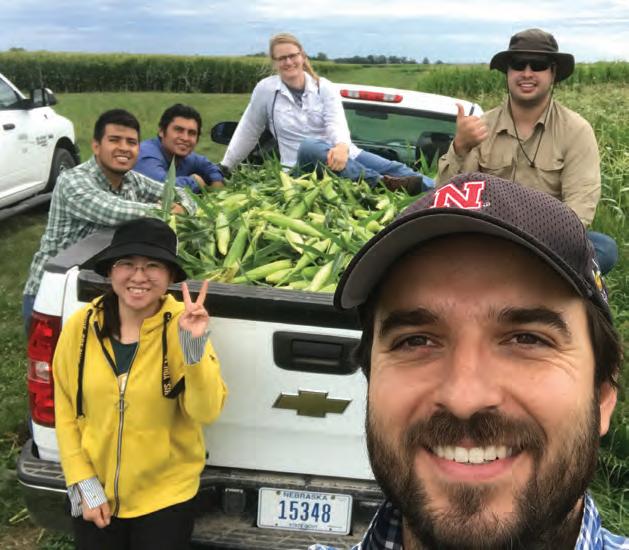
Shi Rong (clockwise), Osler Ortez, Isai Sosa, Tara Harms, Jose de Sanctis and Alex Tonon Rosa harvest sweet corn for the club’s biggest fundraiser.
Horticulture Club builds experience and networks for developing careers
by Stacy Adams, Horticulture Club adviser
HORTICULTURE CLUB MEMBERS GAIN PLANTGROWING AND MARKETING EXPERIENCE THROUGH FUNDRAISING EFFORTS THROUGHOUT THE YEAR.
This was the second year for a pop-up Valentine’s Day Sale, expanded to multiple dorms, for University of Nebraska–Lincoln students to get an inexpensive premade and giftwrapped succulent pot to give to that special someone.
“Their marketing approach was eloquently developed offering affordability, purchasing ease and recipient success and enjoyment,” Stacy Adams, club adviser, said.
“In the bleak mid-winter,” as the song goes, Horticulture Club members can be found preparing for the upcoming season for anxious gardeners who support the Spring Bedding Plant Sale. This annual, two-day sale has a tremendous following, but few realize the amount of effort and labor the students put into the planning, cultivation and marketing of the plants.
The grower team for the spring 2019 season was led by Morgan Von Seggern and Kaitlin Taylor with all the members providing the workforce to make the sale another success.
Students took a trip this fall to visit Lauritzen Gardens in Omaha and to Kimmel Orchard in Nebraska City to explore innovative fruit production methods.
This year, guest speakers at Horticulture Club meetings included Mike Hillis, owner of Hillis and Company, who spoke about floral events; Christian Elowsky, assistant
professor of agronomy and horticulture, who presented on ethono-botany; and Martha Mamo, department head of agronomy and horticulture, who networked with students and discussed future undergraduate plans and department curriculum development.
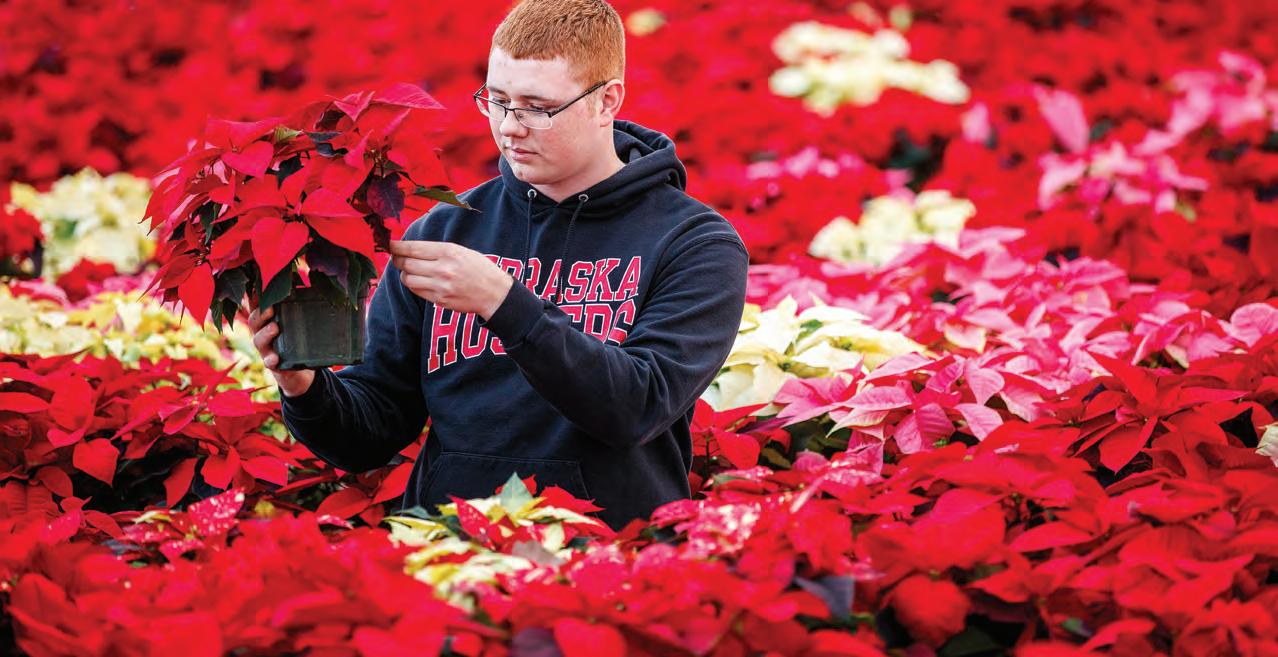
Poinsettias are a tradition at Nebraska’s winter graduation, and thanks to Brandon Mars, the new lead grower, they were once again displayed beautifully in support of the Huskers. The annual poinsettia sale was as popular as ever during the holiday season.
Current officers are Christine Barta, president; Lizzie Schousek, programmer; Deanna Montañez Mendoza, secretary and treasurer; and Mars, lead grower and manager. Advisers are Adams and Terri James.
Brandon Mars, the Horticulture Club’s lead grower, waters the poinsettias in the greenhouse to be sold at the club’s sale in December. BELOW: Club members including Morgan Von Seggern (from left), Amanda Earnest, Tyler Quick, Christine Barta, Kaitlin Taylor, Katie Jo Steffen, Deanna Montañez Mendoza, Brent Lucke and Mia Luong help with and attend the department’s annual Spring Awards Banquet.
BOTTOM: Mary Paul (left) and Haley Donaldson prepare for the club’s spring plant sale.
Paparozzi recognized as Pi Alpha Xi Fellow
by Julia Cambridge, Pi Alpha Xi–Alpha-Gamma vice president
THIS IS A SPECIAL YEAR FOR THE ALPHA-GAMMA CHAPTER OF PI ALPHA XI. To begin, congratulations are in order for faculty adviser Ellen Paparozzi, who was named a Pi Alpha Xi Fellow. This distinguished award recognizes PAX members who are influential leaders in horticulture and who have been dedicated in their service to Pi Alpha Xi. Paparozzi is the founding member of UNL’s chapter, the Alpha-Gamma chapter, and has been the primary faculty adviser since the society’s establishment in 1982. She is a former national Pi Alpha Xi president and vice president, and members of the society are honored to have her working with their chapter.
Pi Alpha Xi, the national honor society for horticulture, recognizes horticulture students that have obtained high scholastic achievement. The Alpha-Gamma chapter brings together students, educators and professionals in the field to promote high scholarship, fellowship and professional leadership. The community of Pi Alpha Xi serves to enrich human life through plants, whether that be in the realm of floriculture, production, plant health,
landscape design, turf or plant research. In the spring, a diverse group of horticulture students emphasizing in one of the above-mentioned options are inducted into the society for lifelong membership. This past April, five qualified students were given the honor of joining through a traditional ceremony that includes the election of new officers. The induction is followed by a luncheon where family and friends are encouraged to come help celebrate.
Another tradition for the AlphaGamma chapter is the annual holiday wreath-making workshop. This workshop gives members a chance to assist in leading an event that brings together a community of plant admirers fueled by the holiday spirit. With live greens provided and bows and other adornments brought from home, Alpha-Gamma members help attendees create the perfect wreath for the festive season. This year’s event was Dec. 7 at Prairie Pines Nature Preserve in northeast Lincoln.
Pi Alpha Xi – Alpha-Gamma chapter gathers two or three times a semester to prepare for its holiday fundraising event and the spring initiation. Another
important aspect of the honor society is that the University of Nebraska–Lincoln chapter gives back to its members by means of scholarships and awards. One scholarship is given to a current student who embodies the principles of Pi Alpha Xi. The second award is the President’s Citation, which is given to an individual who has done exceptional work in or for the field of horticulture. Finally, the society also updates the plaque wall opposite of Room 274 and 275 in Plant Sciences Hall. The achievements of horticulture and agriculture students, including scholarship and dean’s list recognitions, are displayed on the plaque.
Pi Alpha Xi – Alpha-Gamma is directed by advisers Paparozzi and Dave Lambe and led by officers Kelsey Tarrell, president; Julia Cambridge, vice president; and Luqi Li, secretary and treasurer. Pi Alpha Xi — “Always to Excel!”
Co-adviser and Pi Alpha Xi Fellow Ellen Paparozzi (second from right) congratulates new inductees Kelsey Ridlen (from left), Julia Cambridge, Christine Barta, Jensen Hart and Kelsey Tarrell in April.
Luqi Li
Range Management Club teams compete to prepare for future careers
by Asha Scheideler, Range Management Club president
THE RANGE MANAGEMENT CLUB FOCUSES ON TEACHING STUDENTS ABOUT THE ECOLOGY AND MANAGEMENT OF RANGELAND ECOSYSTEMS AND HELPS TO PREPARE STUDENTS FOR CAREERS IN RANGE MANAGEMENT. By connecting students with professionals, the club can help broaden students’ interests and expose them to rangeland ecosystems throughout the United States.
Each year, students attend the Society for Range Management Annual Meeting to practice their skills by participating in the Range Plant Identification Contest and the Undergraduate Range Management Exam. Students can also present their own research and participate in other competitions as well as attend seminars and network. In February, five members of the club traveled to Minneapolis, Minnesota, to attend the annual meeting. There, they placed in the top 10 of 26 teams and scored the highest of all the schools in the Great Plains on the URME. Members on the team include Evan Laible, Nicole Strand, Asha Scheideler, Ryley Johnson and Nick Sanders. Cheryl Dunn, herbarium curator, coaches the Range Plant Identification team, and Professor Walter Schacht coaches the URME team. URME and Range Plant Identification teams meet every week through the fall semester and into the spring semester until the annual meeting in February.
In April, the club held its second annual native plant sale. Members of the club grew native grasses and wildflowers
during the spring semester to sell at a fundraiser at the end of the school year. The club had a great turnout and plans to continue this event.
The club also attended the annual meeting of the Nebraska Section Society for Range Management in North Platte where the students listened to speakers and networked with professionals from around the state. The club also held its Crazy Auction at the annual meeting to raise money for its activities and trips to annual SRM meetings.
The club continues to work hard to recruit new members, develop members’ skills for the next annual meeting, and come up with new and fun events for the club to participate in. The Range Management Club has regular club meetings every other week. Current officers are Scheideler, president; Sanders, vice president; Johnson, primary programmer; and Strand, recruiter. Schacht and Dunn are the club advisers.
Range Management Club members Asha Scheideler (from left), club co-adviser Walter Schacht, Nicole Strand, Ryley Johnson, Nick Sanders and Evan Laible attend the Society of Range Management Meeting in Minneapolis Feb. 11–13, 2019.
Evan Laible (left) and Ryley Johnson prepare for the club’s native plant sale.
UnderGraduate STudent Spotlight
“Thanks to the time I spent at my uncle’s dairy during corn silage harvest and holidays and through many 4-H plant projects, I have always loved working with plants.”
Katie Jo Steffen
Double-Major relishes all aspects of agriculture
by Katie Jo Steffen, agronomy and grazing livestock systems major
I GREW UP WITH A FARM RATHER THAN ON A FARM.
Thanks to the time I spent at my uncle’s dairy during corn silage harvest and holidays and through many 4-H plant projects, I have always loved working with plants. Because of this I started college studying horticulture, but the next semester I switched to agronomy. However, I also like working with cattle, so after learning about the grazing livestock systems program from my brother, I decided to add that major because of its diverse range of classes including agricultural economics, animal science, and range and forage science.
After switching majors I became involved in Agronomy Club. Not long after I joined the club, we hosted the regional SASES conference, and that’s when I realized that agronomy truly is the right fit for me. At the conference, I learned about the crops judging competition where we
identify crops, weeds, disease and insects as well as test our knowledge of agronomy and agronomic math. I joined the UNL Crops Judging Team and this has been one of the most valuable experiences I have had in college because of its practical application to any career in agronomy.
As Agronomy Club president for 2020, I am excited to work with the new officer team to continue to grow our club in several ways. I am looking forward to my agronomy internship with Ag Valley Cooperative this summer, and I will also complete an internship for GLS during 2021. With majors in agronomy and GLS, I would like to work in production agriculture with both crops and cattle after graduation. The classes I’ve taken and the clubs I participate in have taught me so much about agriculture, and I am both honored and excited to be a part of this important industry.
Katie Jo Steffen
UNDERGRADUATE STUDENT AWARDS 2019
Agronomy Club: College of Agricultural Sciences and Natural Resources Week Outstanding Undergraduate Student Organization Award, First-place American Society of Agronomy and Crop Science Society of America with the Canadian Society of Agronomy International Meeting – Students of Agronomy, Soils, and Environmental Studies Session – Undergraduate Club Poster Competition presented by Dalton Johnson, Jake Krings, Chad Lammers and Jared Stander
Alex Baumert: Agronomy Club Outstanding Student Member, CASNR Outstanding Undergraduate Student Organization Member
Clay Christenson: Milton E. Mohr Awards Program for Biotechnology Scholarship
Daniel de Araujo Doretto: Secondplace North Central Weed Science Society Agronomic Crops I & II
Undergraduate Student Poster Contest
Arthur Franco Teodoro Duarte: Second-place NCWSS Weed Biology, Ecology and Management Undergraduate Student Poster Contest
Rodger Farr: First-place University of Nebraska-Lincoln Spring Research Fair Undergraduate Student Research Poster Session, Second-place team North American Colleges and Teachers of Agriculture Southern
Plains Regional Crops Contest – Crops Judging, Fifth-place Individual Overall NACTA Southern Plains Regional Crops Contest – Crops Judging, Second-place team Nebraska College of Technical Agriculture Collegiate Crops Contest – Crops Judging, Third-place team NACTA National Student Judging Conference – Crops Judging, Third-place NACTA National Student Judging Conference – Math Exam, Fifth-place Individual Overall NACTA National Student Judging Conference – Crops Judging
Ana Clara Gome: Second-place NCWSS Agronomic Crops II and Weed Biology, Ecology and Management
Undergraduate Student Poster Contest
Kolby Grint: Martin Massengale Outstanding Senior Award, Secondplace team NACTA Southern Plains Regional Crops Contest –Crops Judging, Second-place team NCTA Collegiate Crops Contest – Crops Judging, Third-place team NACTA National Student Judging Conference – Crops Judging, Third-place team National Collegiate Soils Judging Contest
Chad Lammers: Milton E. Mohr Awards Program for Biotechnology Scholarship, Second-place team NCWSSA Undergraduate Weed Olympics
Ben Searl: Pi Alpha Xi Scholarship Award
Jared Stander: Second-place team NCWSSA Undergraduate Weed Olympics
Katie Jo Steffen: Agronomy Club Outstanding Student Member
Samantha Teten: Second-place team NACTA Southern Plains Regional Crops Contest – Crops Judging, Second-place team NCTA Collegiate Crops Contest – Crops Judging, Fifth-place Individual NCTA Collegiate Crops Contest – Crops Judging, First-place NACTA National Student Judging Conference – Math Exam, Seventh-place Individual Overall NACTA National Student Judging Conference – Crops Judging, Third-place team NACTA National Student Judging Conference – Crops Judging, Third-place team National Collegiate Soils Judging Contest, 10th place Individual National Collegiate Soils Judging Contest
Caleb Wehrbein: Milton E. Mohr Awards Program for Biotechnology Scholarship
Justin Zoucha: Second-place team NACTA Southern Plains Regional Crops Contest – Crops Judging, Second-place team NCTA Collegiate Crops Contest – Crops Judging, Thirdplace team NACTA National Student Judging Conference – Crops Judging
A list of all student awards can be found online at agronomy.unl.edu/ student-awards#undergrad.
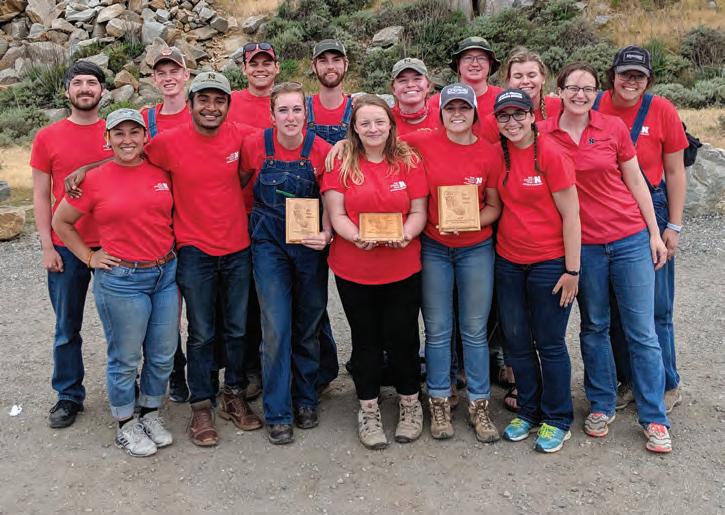
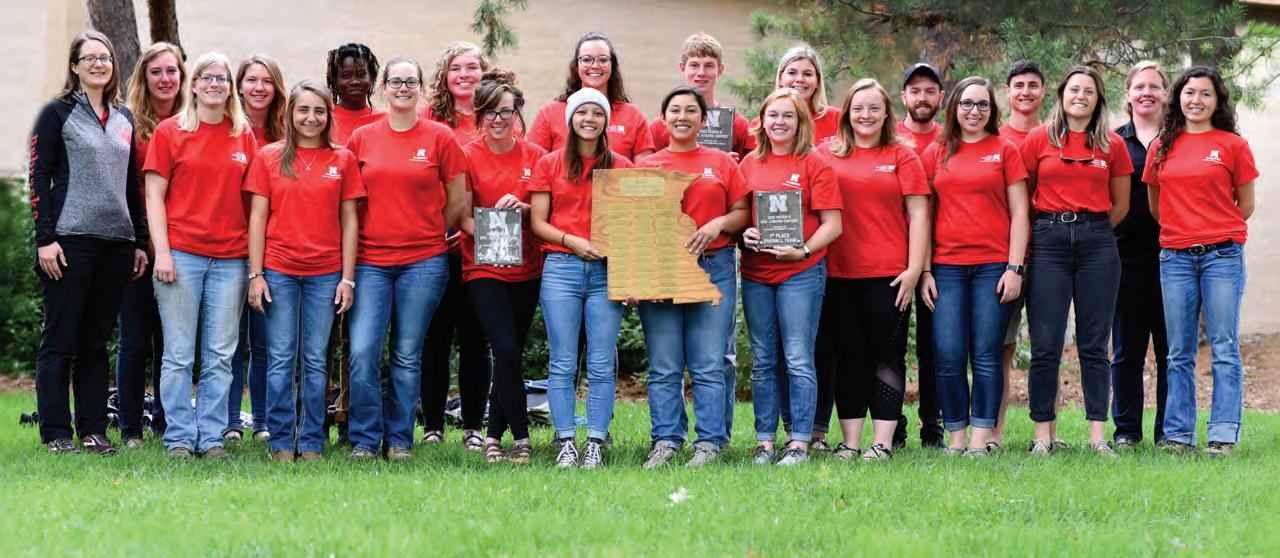
The Huskers win bronze at the 2019 National Collegiate Soils Judging Contest.
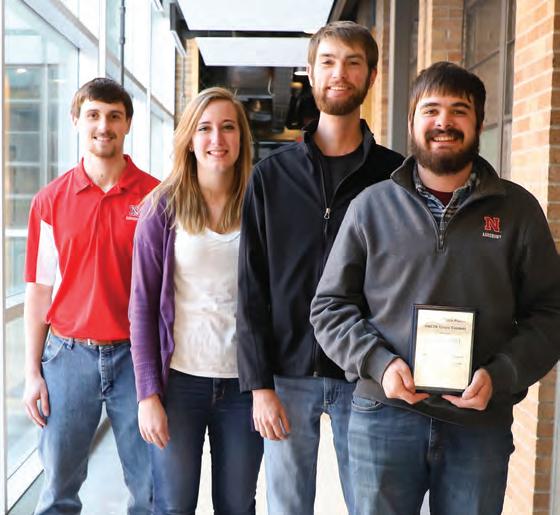
Justin Zoucha (left), Samantha Teten, Kolby Grint and Rodger Farr took top honors as a team and/or individually at every crops judging competition in 2019.
GRADUATE STUDENT AWARDS 2019
Ethann Barnes: North Central Weed Science Society Outstanding Graduate Student Award
Thomas “Tommy” R. Butts: Weed Science Society of America Annual Meeting Outstanding Graduate Student Award
Dillon Fogarty: Arthur William Sampson Fellowship, Firstplace Nebraska Natural Legacy Conference Student Presentation
Nikita Gambhir: Milton E. Mohr Fellowship, First-place team University of Nebraska–Lincoln Datapalooza 2019 – Best Use of External Data
Deepak Ghimire: North Central Extension-Industry Soil Fertility Conference Graduate Student Award
Jesaelen Gizotti de Moraes: Firstplace NCWSS Research Student Video Contest, Second-place NCWSS Graduate Student Poster Contest, Milton E. Mohr Fellowship – Biotechology Degree Program
Tara Harms: Arthur William Sampson Fellowship
Elnazsdat Hosseiniaghdam: Arthur William Sampson Fellowship
Brittney Kirsch: First-place Great Plains Limnology Conference Graduate Poster Presentation
Samuel Koeshall: First-place American Society of Agronomy Semi-Arid
Dryland Cropping Systems Graduate Student Poster Competition
Alyssa Kuhn: Franklin D. Keim Graduate Fellowship
Zhengxiong “Mike” Li: Agronomy and Horticulture Graduate Student Association Outstanding Member Award
Shawn McDonald: Secondplace NCWSS Extension Student Video Contest
Michael Meier: Henry M. Beachell Fellowship
Osler A. Ortez: Finalist and thirdplace Crop Science Society of America
Student Competition, First-place
CSSA Ph.D. Oral Competition and Poster Competition – Crop Ecology, Management & Quality Division, First-place Daugherty Water for Food Global Institute Global Conference Online Graduate Student Poster, Daugherty Water for Food Global Institute Graduate Student Funding Support, Farmers National Fellowship
Alexandre “Alex” Tonon Rosa: First-place Nebraska Spring Research Fair Graduate Research and Creative Activities Poster, ASA Nelson Yieldlimiting Factors Graduate Scholarship, CSSA Gerald O. Mott Meritorious Graduate Student Award in Crop Science, Third-place Agronomy and Horticulture-Entomology-Plant Pathology Elevator Speech Contest
Manny Saluja: First-place team University of Nebraska–Lincoln Datapalooza 2019 –Best Use of External Data
Jose Scarparo De Sanctis: NCWSS Best Poster Presentation, NCWSS Video Presentation Award
Jaspinder Singh: Widaman Distinguished Graduate Fellowship Award
Hannah Stoll: Milton E. Mohr Fellowship, Al Moseman International Fellowship Award, Second-place Agronomy and HorticultureEntomology-Plant Pathology
Elevator Speech Contest
Adam Striegel: First-place WSSA Master’s Poster Presentation, North American Colleges and Teachers of Agriculture Graduate Student Teaching Award, Holling Family Teaching Assistant Teaching Excellence Award
Jessica Walnut: Plant Pathology Graduate Student Association Outstanding Member Award
Elizabeth Widder: Arthur William Sampson Fellowship
Milos Zaric: First-place NCWSS Extension Talk Video Contest
A list of all student awards can be found online at agronomy.unl.edu/student-awards
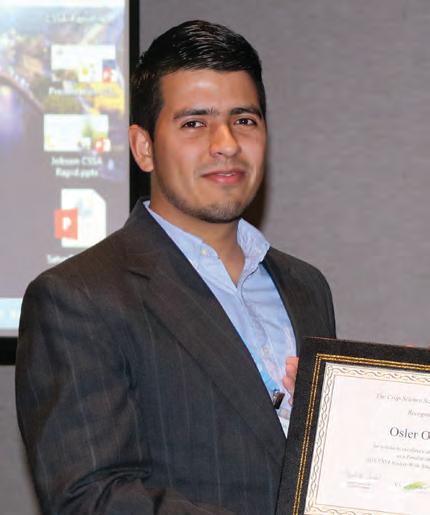
Osler Ortez
Adam Striegel
Hannah Stoll (left) and Alex Tonon Rosa
Soil Judging
FOR THE FIRST TIME IN THEIR HISTORY, THE UNIVERSITY OF NEBRASKA-LINCOLN SOIL JUDGING TEAM EARNED THIRD PLACE OVERALL AT THE NATIONAL COLLEGIATE SOILS CONTEST, HOSTED APRIL 14 TO 19, 2019, AT CALIFORNIA POLYTECHNIC STATE UNIVERSITY IN SAN LUIS OBISPO, CALIFORNIA. The team, made up of students from the School of Natural Resources and the Department of Agronomy and Horticulture, also walked away with a first-place group finish, beating out the 25 other collegiate teams, and Samantha Teten, a senior agronomy major, placed 10th out of 101 competitors in the individual competition.
In a demonstration of their grit, the team for the second time in three years swept the Region 5 competition Oct. 3 in Grand Island, Nebraska, beating out six other teams to earn first-place finishes across the board. The win puts the team, made up of 17 students, in a top position for the 2020 National Collegiate Soils Contest in April at The Ohio State University. The team is coached by Rebecca Young and Judith Turk.
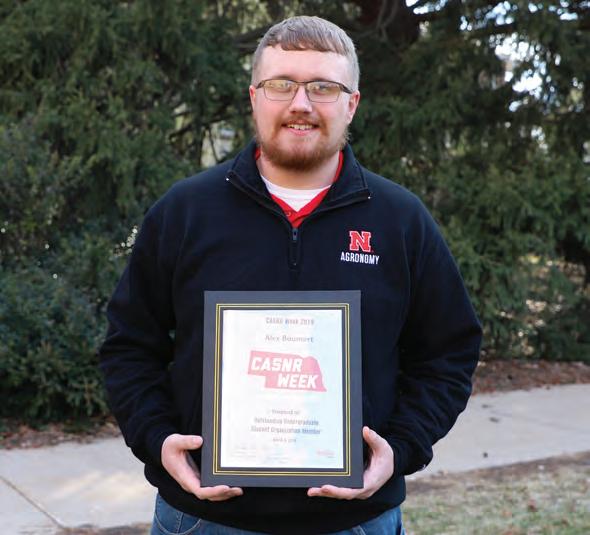
ALEX BAUMERT, AN AGRONOMY MAJOR, RECEIVED THE CASNR OUTSTANDING UNDERGRADUATE STUDENT ORGANIZATION MEMBER AWARD DURING THE 19TH ANNUAL CASNR WEEK CELEBRATION. Baumert was honored for his hard work, reliability and willingness to volunteer for the Agronomy Club’s service learning activities.
KOLBY GRINT WAS AWARDED THE MARTIN MASSENGALE OUTSTANDING SENIOR AWARD AT THE DEPARTMENT AWARDS BANQUET MARCH 28, 2019. Grint graduated in May with an agronomy degree and is pursuing a master’s degree in agronomy at the University of Wisconsin-Madison. The award honors Massengale, the president, chancellor and Foundation Distinguished Professor emeritus and founding director of the Center for Grassland Studies.
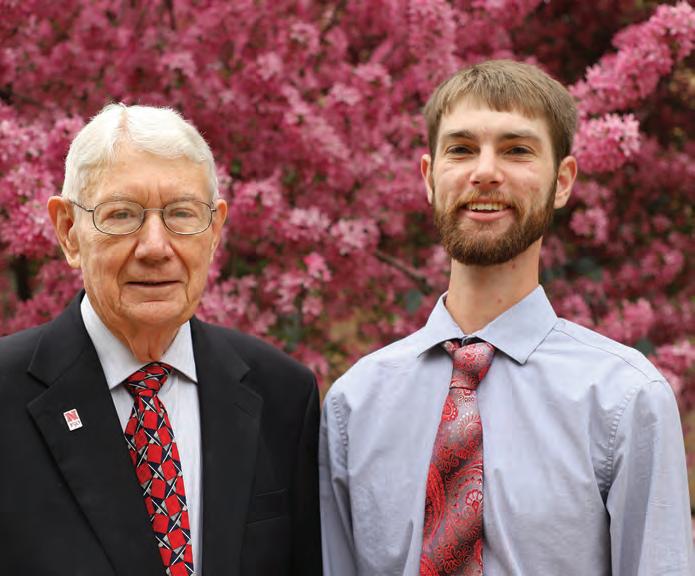
Martin Massengale (left) and Kolby Grint
Alex Baumert
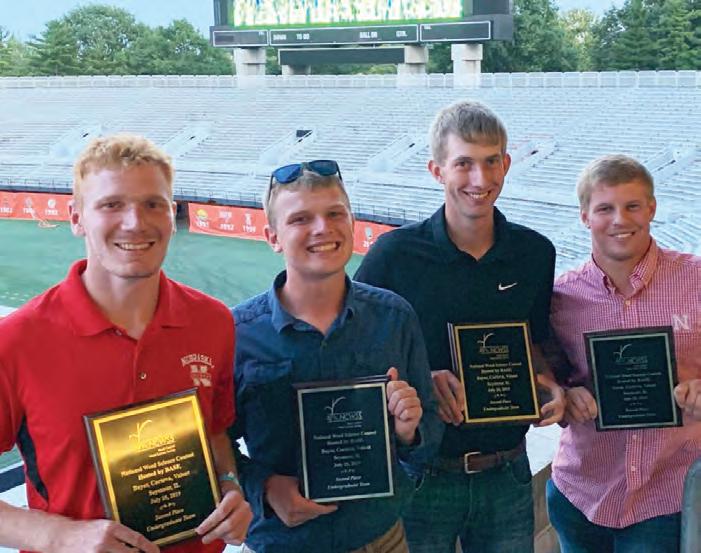
THE UNIVERSITY OF NEBRASKA–LINCOLN UNDERGRADUATE WEED SCIENCE TEAM
PLACED SECOND IN THE NORTH CENTRAL REGION AT THE NATIONAL WEED SCIENCE CONTEST (WEED OLYMPICS) JULY 25, 2019. The contest was organized by the Weed Science Society of America and held at several locations near Seymour, Illinois.
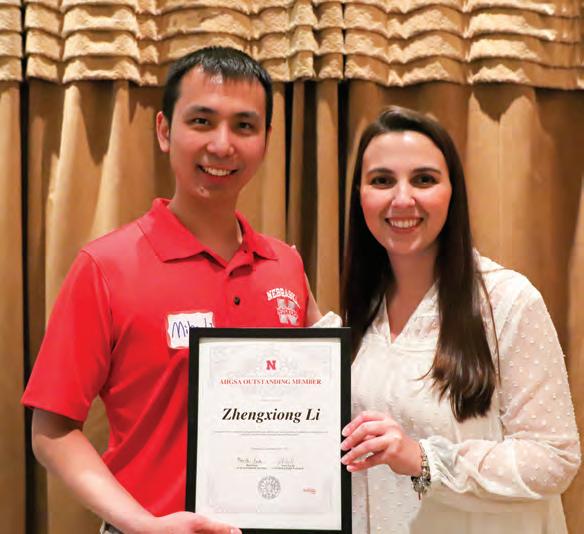
ZHENGXIONG “MIKE” LI WAS HONORED AS THE AGRONOMY AND HORTICULTURE
GRADUATE STUDENT ASSOCIATION
OUTSTANDING MEMBER AT THE DEPARTMENT AWARDS BANQUET MARCH 28, 2019. A graduate student specializing in plant nutrition, Li was given the award for his enthusiastic attitude and significant involvement and contributions to the success of AHGSA and the department.
Weed Science
THE UNIVERSITY OF NEBRASKA–LINCOLN CROPS JUDGING TEAM PLACED SECOND OVERALL AT THE SOUTHERN PLAINS REGIONAL CROPS CONTEST ON FEB. 9 AT HUTCHINSON COMMUNITY COLLEGE IN HUTCHINSON, KANSAS. Nebraska’s winning team included Kolby Grint, Samantha Teten, Rodger Farr and Justin Zoucha. Farr also placed fifth overall in the individual category.
This team once again took top honors at the Collegiate Crops Contest held at the Nebraska College of Technical Agriculture March 8 in Curtis, Nebraska. They placed second overall in the four-year division. Teten also placed fifth overall as an individual.
The team took third place overall at nationals. The national North American Colleges and Teachers of Agriculture Student Judging Conference hosted by Murray State University in Kentucky was held April 13, 2019. Teten and Farr tied for first and third place, respectively, in the math exam. Farr placed fifth and Teten seventh in the individual competition. The team is coached by Adam Striegel and Elizabeth Widder.
Zhengxiong “Mike” Li (left) and Thais Egreja
Adam Leise (from left), Jared Stander, Chad Lammers and Will Neel
GRADUATE STUDENT SPOTLIGHT
WARM FRIENDSHIPS AND STRONG FACULTY MENTORSHIP HELP RAMIREZ SUCCEED (AND SURVIVE NEBRASKA WINTERS)
by Salvador Ramirez, Doctor of Plant Health, doctoral candidate in soil and water sciences
MY TRANSITION FROM SOUTHERN CALIFORNIA TO LINCOLN, NEBRASKA, WASN’T EASY. The relationships I formed with peers and mentors not only eased this transition but made it a life-changing experience. I was unprepared to apply for graduate school and had no understanding of higher education when Nancy Shoemaker, administrative assistant of the Doctor of Plant Health program at that time, emailed me an informational brochure about the DPH in 2013. That summer, I packed everything I owned in my car and drove 22 hours northeast.
Graduate school isn’t easy, and it was especially difficult for me at first. Not only was I far from home and unprepared for graduate school, but I was unprepared for Midwestern winters. However, the strong yet patient and caring mentorship of faculty within the Department of Agronomy and Horticulture allowed me to grow at a pace that was best for me while reaching the appropriate benchmarks for
“...the strong leadership I have experienced in this department fills me with confidence for its future...” Salvador Ramirez
a graduate degree. Now, six years later, I have completed the Doctor of Plant Health program (Sal is fine, but if you insist, Dr. Ramirez is cool too) and I am a Ph.D. candidate investigating what fascinates me most: soil microbial communities and the role they play in production agriculture.
I could describe how this department prepared me for a career in the sciences, but I find that to be the bare minimum provided by any graduate school program anywhere. Instead, I will focus on two concepts that should be included (but may not always be) in graduate programs: leadership and science communication. Faculty members such as Jenny Dauer, Meghan Sindelar and Martha Mamo taught me how to teach. This enhanced my ability to communicate my science to peers, students, farmers and the general public. Those same individuals also provided an example of the kind of leader I want to be. This personal
Salvador Ramirez
and professional growth, combined with the systems level understanding of production systems under the mentorship of Gary Hein and my understanding of soil microbial ecology under the mentorship of Rhae Drijber and Virginia Jin, has instilled in me a confidence I never thought possible.
Graduate school should be viewed as a marathon, not a sprint. It’s important to have friends during this marathon. In addition to some excellent faculty members, this department provides the resources and the space for graduate students to form a supportive community through groups such as the Agronomy and Horticulture Graduate Student Association. Currently, AHGSA is led by my friend Alex Tonon Rosa and a cabinet of other excellent graduate students. Student organizations create space to connect with peers and form both personal and professional relationships.
If you are thinking about graduate school in the fields of agronomy and horticulture, consider the University of Nebraska–Lincoln. Everyone will experience graduate school differently and challenges will arise. However, the strong leadership I have experienced in this department fills me with confidence for its future. If you have questions about the logistics of a graduate program at Nebraska, professional staff, like Danielle Lopez, can work with you. And if you are from warmer parts of the world, feel free to reach out to me, and we can talk about what to wear in the winter.
Measure Light Characteristics
Record spectral profiles and intensities with the LI-180 Spectrometer to calibrate your lights and influence your plants.
licor.com/180
Curriculum committee works to unify department and create opportunity for students
by Martha Mamo, department head and John E. Weaver Professor of Agronomy and Horticulture; Don Lee, professor; and Sam Wortman, assistant professor
THE DEPARTMENT OF AGRONOMY AND HORTICULTURE EMBARKED ON CURRICULUM REVIEW SHORTLY AFTER THE 5-YEAR ACADEMIC PROGRAM REVIEW IN THE FALL OF 2017. The APR revealed three areas of opportunities: developing core experiences for all students, clarifying degree programs and options, and increasing efficiency of course offerings across the three majors. The department concurred with the APR recommendations and outlined the following plans:
• Current degree programs could be consolidated to increase efficiency of teaching resource deployment.
• The undergraduate program can be envisioned to create opportunities to diversify our served populations based on gender and background. A major undertaking began in 2018 as the Agronomy and Horticulture Curriculum Committee worked to consolidate three of the department’s
degree programs — agronomy, horticulture and turfgrass & landscape management. The committee fully immersed itself into curriculum work in 2018 and 2019 through regular meetings and two retreats. The basic framework of unifying through a common core and experiences included:
• Establish a shared path our students follow to achieve mastery in the student learning outcomes
• Develop and agree on common experiences for students through content learning outcomes
• Identify emerging areas in plant and soil systems
• Provide students flexibility to co-create their career pathways Curriculum work is slow and messy, but the Agronomy and Horticulture Curriculum Committee persisted and has accomplished much. The committee is in its final stages before the proposal is submitted for approval this spring. The proposed degree program is
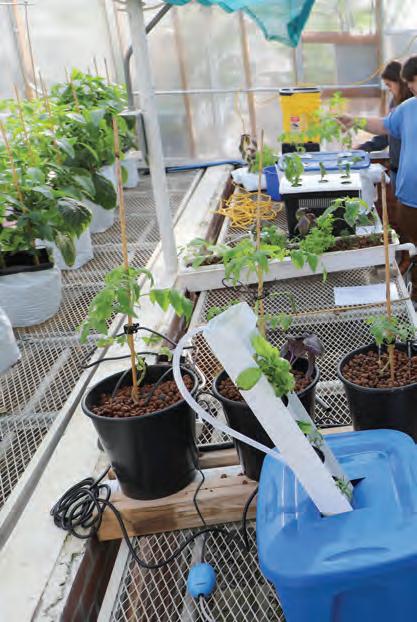
Students work on their hydroponic projects in Horticulture 307 Hydroponics For Growing Populations taught by Stacy Adams, agronomy and horticulture associate professor of practice.
Agronomy and Horticulture Undergraduate Curriculum: TIMELINE AND MILESTONES
Oct 2017
Academic Program Review
Jan 2018
Program SLOs drafted
Dec 2017
AgroHort APR responses
March–May 2018
Curriculum committee work on refining/ adding SLOs; heat maps, retreat planning
Feb–March 2018 SLOs course survey
May 2018 Retreat SLOs course database gaps & trends
Aug 2018 – May 2019
Phase I: Common Core & Specializations CLOs
May 2019 Retreat Common Core: must CLOs, CLO gaps/revisions, ID CLOs with course
DELIVERABLE:
AgroHort database align with SLOs
Spring 2019
anticipated to be available for the Fall 2021 semester. The department believes that the degree program, options and flexibility will create a learning ecosystem that guides undergraduates to be better prepared for a more diverse and data-driven career as professionals capable of problem solving for future plant and soil science systems.
Listening Sessions:
• Horticulture
• Agronomy
• AHAAC
Degree program framework for students arriving with various backgrounds and a common interest in plants and soils.
UNIFY: Common core experiences linked through consolidated Student Learning Objectives and Course Learning Outcomes
Basic Plant
Basic Soil
Botany
Career Exploration
Crop & Landscape Systems
STUDENT INTEREST
SELECT SPECIALIZATION OPTION
Agronomy Horticulture Turf Landscape Design
Internships
Data Science And, more...
Listening Sessions:
• Industry
• Alumni
• Faculty
Controlled Environment Ag
Plant Biotechnology
Plant Breeding & Genetics
STUDENT CAREER PATH
Precision Ag Spatial Science Soil Conservation
March 2020
PROPOSAL
SUBMISSION TO CASNR DEAN
REVISIONS & RESUBMISSION TO CASNR CURRICULUM COMMITTEE CHOOSE
April–May 2020
Introductory Plant Protection Program
Urban Food Systems Water for Food And, more...
through online education Martinez discovers Nebraska Nebraska
by Fran tenBensel Benne, design and communications specialist
CARLOS MARTINEZ HAS SPENT MOST OF HIS LIFE INVOLVED WITH AGRICULTURE. He grew up on his family’s sugarcane farm in El Salvador and now manages it.
His initial education, however, was not in agriculture. He received a bachelor’s degree in computer systems engineering from the University of El Salvador in San Salvador.
After he became manager of his family farm, he wanted to learn more about agronomy, so he researched online for educational opportunities and classes. He found the University of Nebraska–Lincoln Agronomy and Horticulture Online and Distance Education program and decided to start with a noncredit course in plant science taught by Don Lee, professor of agronomy and horticulture.
During that course Martinez said he discovered so many small details that in the end became so important. “Don was a great teacher,” Martinez said. “Plant science knowledge really helped me make a difference in how I was managing my farm. This is how I became comfortable with online courses and admired the University of Nebraska.”
A couple of years later, he started working part-time for the Catholic University of El Salvador, teaching classes in irrigation systems and farm machinery and production.
At that time, the United States Agency for International Development created its Higher Education for Economic Growth program to build partnerships between industry sectors and higher education institutions in El Salvador.
Agro-industry and food processing was one of the project areas. By sharing information with and educating teachers in several universities, USAID hoped to increase agriculture knowledge of students.
The Catholic University of El Salvador selected several teachers to participate in the project and Martinez was chosen. The program had two stipulations — the study program selected would be in English and in agronomy.
Martinez said he didn’t hesitate even a moment to accept!
He had already learned to speak English in a short amount of time, and he wanted to start his online master’s classes in agronomy with Nebraska because he had that connection.
Charles Francis, professor of agronomy and horticulture, was assigned as his adviser. Martinez began his master’s study online with a course about land use in the developing world. He completed all his courses by distance and finished a valuable thesis on how to use biological controls for specific pest problems in vegetable crops.
“Professor Francis was so encouraging and really challenged me to give it my all and work hard to accomplish my goals,” he said.
Martinez, who earned a Master of Science in agronomy, specializing in crop physiology and production, came to the United States for the first time in May to participate in the graduate commencement and receive his degree at Pinnacle Bank Arena.
“It was so amazing and impressive,” Martinez said. “I really took the chancellor’s words, ‘Now you are a part of the University of Nebraska,’ to heart. It was very motivating.”
Carlos Eduardo Somoza Vargas
He said he also enjoyed the Department of Agronomy and Horticulture graduation reception, which gave him the opportunity to meet everyone in person and take some field trips to the university facilities and labs.
“Even more important to me than graduation was the opportunity to say thank you to everyone,” Martinez said. “The Agronomy and Horticulture Online program helped me so much.”
He said the faculty and staff really went the extra mile for him. “Not only did they share their knowledge and educate, but they became like family,” Martinez said. “There’s so much more to education than just transmitting information. The University of Nebraska–Lincoln was friendly, respectful and open. And this gave me confidence.”
“Carlos fully enjoyed his courses, and especially the graduation ceremony and opportunity to experience the Big Red environment firsthand,” Francis said. “It was special to see a photo of his 3-year-old son all decked out in Husker clothes when he was back in El Salvador!”
He currently manages his family farm, which consists of 30 hectares (a little over 74 acres) and produces sugarcane, red beans and corn. He is also a full-time professor at the Catholic University of El Salvador, where he teaches about 40 students.
After accomplishing so much and sharing what he’s learned, he said he’s still excited about new opportunities. He’s currently working to meld his background in computer systems engineering with his agronomy knowledge to produce agriculture-based applications.
ONLINE LEARNING IN AGRONOMY AND HORTICULTURE
By Leah Sandall, distance education coordinator
THE AGRONOMY AND HORTICULTURE ONLINE AND DISTANCE EDUCATION PROGRAM IS EXCITED TO ANNOUNCE THE NEWLY REVISED PLANT AND SOIL SCIENCES ELIBRARY 2.0. Since 1999, PASSeL has been an active website providing engaging text lessons and animations on a variety of topics related to plants and soil. What began as a graduate student project with 12 lessons on crop genetic engineering has grown to over 140 lessons and 150 animations and videos. Many internal and external grant-funded collaborations have resulted in the creation of lessons and animations which aim to improve science literacy on plant and soil science topics. Most of the lessons and animations have been developed at the undergraduate level with a few higher-level resources available.
Unlike the previous version, PASSeL 2.0 can be easily viewed on any device, and all animations have been converted to video so that learners can access these resources on their mobile phone. PASSeL users come from countries around the world with about 60% of user traffic outside the United States. PASSeL resources are used in the traditional classroom, in online courses and for learning in informal settings. Furthermore, future online resource development on PASSeL is expected through partnerships with researchers and science educators. Take a look at the new PASSeL 2.0 by going to passel2.unl.edu
In addition, the online and distance education program continues to actively support academic learners through online courses and the online master’s degree in agronomy. The department offers roughly 30 online courses for undergraduate and graduate students. Offering courses online provides flexibility in student learning and scheduling and supports online completion of an advanced degree. Through the online M.S. in agronomy program, students can earn their graduate degree completely at a distance. Students engage in graduate level coursework while completing a project demonstrating their competency in a specific area of interest. The department faculty provide mentoring and advising as these online graduate students earn their degree. More information about the online master’s in agronomy can be found at agrohortonline.unl.edu.
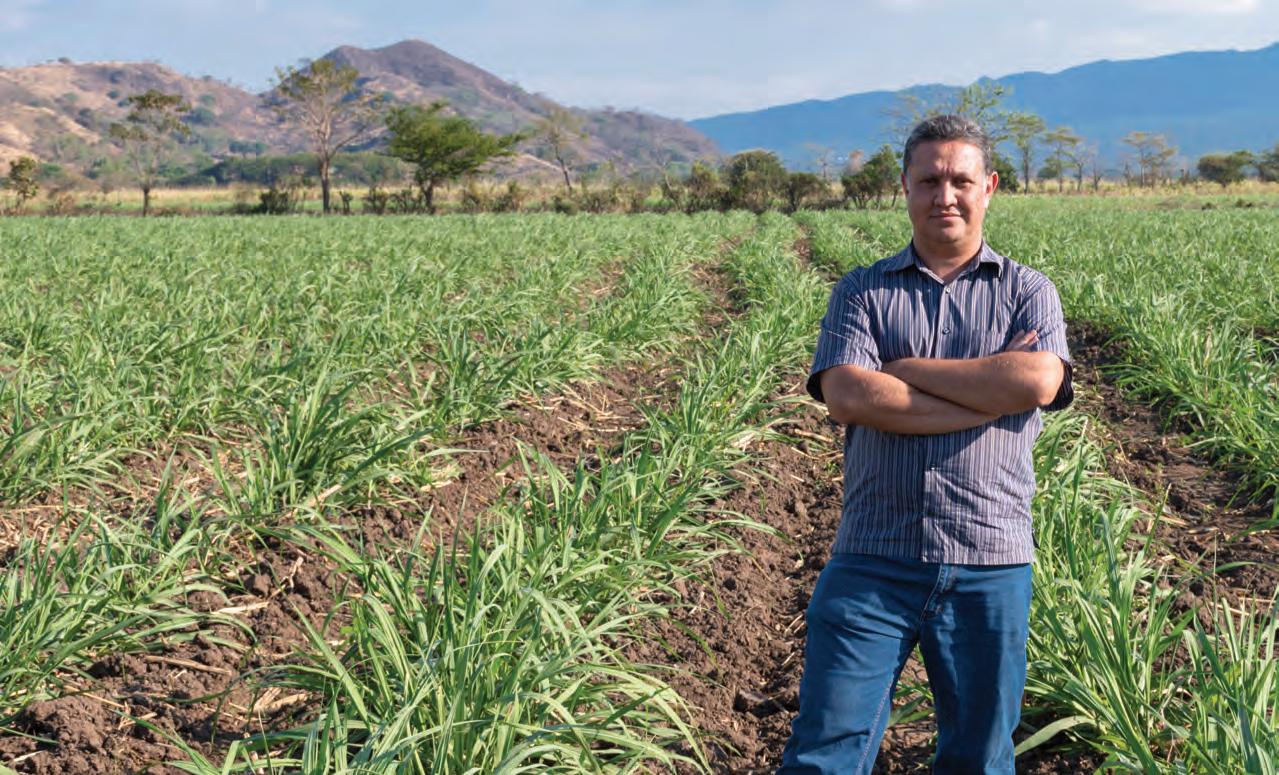
On his farm near Santa Ana, El Salvador, Carlos Martinez stands in a sugarcane field plowed with a tractor and machinery he built.
POSTDOC NOW LOVES THE SCIENCE OF SOILS Initially enamored
with plants
by Sabrina Ruis, postdoctoral research associate
GROWING UP ON A STRAWBERRY, SQUASH AND PUMPKIN FARM IN CENTRAL MINNESOTA FUELED MY LOVE OF EVERYTHING SOILS AND PLANTS. Ultimately, this love led to my bachelor’s degree in horticulture and biology from University of Wisconsin-River Falls and my master’s in horticulture and Ph.D. in soil science from UW-Madison. I realized through my initial educational experiences that I’d been working from the top down — I’d started with plants, not the soil. Because soils are a critical and finite resource to humanity, I wanted to broaden my research experience in soils. As I pursued plans after graduate school, I interviewed for a position at the University of Nebraska–Lincoln, and I was excited to accept an offer as a postdoctoral associate in soil management with Professor Humberto Blanco in April 2016.
Upon joining UNL, I became part of an active research team to learn about how we can best manage soils and produce crops in an economical and sustainable manner in an environment somewhat different from that in Minnesota and Wisconsin. I have eagerly adopted several ongoing projects investigating corn residue removal rate, cover crop management, and tillage system impacts on soil ecosystem services. I have also written grant proposals and started several newly funded projects on cover crop planting dates, cover crop biomass production, cover crops for managing problem soils under varying cropping systems and irrigation regimes. I and my team have been disseminating and translating results through numerous journal articles, extension publications, field days, and regional and national conference presentations.
It’s often very difficult to put the current paper or project I am working on away at 5 p.m. because it’s what I love to do. But I also love spending time with my family; caring for my two cats (Gloria and Annie), lizards and frogs; collecting and tumbling/polishing rocks; and working on my many other hobbies.
for simpler, better and more efficient irrigation decision making Crop modeling
By Haishun Yang, associate professor and crop modeler
IRRIGATION FOR CORN AND SOYBEAN IS INDISPENSABLE IN MANY PARTS OF NEBRASKA, AND DECIDING WHEN TO TURN ON A PIVOT TO IRRIGATE IS A DAILY CHORE FOR IRRIGATORS. Such decision making involves assessments of current plant-available water in the soil profile and crop rooting depth as well as how much water the crop will consume in the next couple of days. All these assessments must be quantitative and in reference to the threshold of soil water content for starting irrigation. Conventional irrigation decision making relies heavily on irrigators’ experience concerning the crop, the soil and the weather. This becomes a challenge for young irrigators who may possess much scientific knowledge and high-tech skill but lack such experiences. Meanwhile, soil moisture sensors and other technologies that can provide direct or indirect information on soil water or crop status in the field remain uncommon due to high costs or difficulties in installation or implementation. Many irrigators, especially younger ones, and crop advisers for irrigation decision making have been demanding tools that are simple and easy to use, provide quantitative and objective assessments of soil and crop properties relevant to irrigation decision making without going to the field, and are cost effective.
Associate Professor Haishun Yang and his team started in 2012 to develop CornSoyWater ( hprcc-agron0.unl. edu/cornsoywater/public_html/Home.php), an online
application that fulfills irrigators’ demands. Using realtime weather data and daily weather forecasts, the CornSoyWater app uses the Hybrid-Maize ( hybridmaize. unl.edu) and SoySim (soysim.unl.edu) computer simulation models for corn and soybean, respectively, to predict corn and soybean growth, each crop’s water consumption, the amount of water currently available at different depths of the soil profile and when irrigation is required in order to avoid crop water stress. Released in 2015, CornSoyWater has garnered more than a thousand registered users. App users get the results for all of their registered fields and can use that information to make irrigation decisions without having to drive to the fields.
Yang and his team have continued field testing the program for possible revision. Water Smart, a three-year project funded by the National Science Foundation, is currently providing the funding to test the program in six fields of Richard Uhrenholdt’s Midplains Ag, a farm near Elgin, Nebraska. So far, the program has shown very robust performance on predictions of crop development, soil water status and irrigation recommendation. At present Yang and his team are collaborating with scientists from the National Center for Atmospheric Research and George Mason University to improve the program. They are using both radar information and spatial interpolation techniques to improve measurements of rainfall for particular fields.
Haishun Yang
Craig Chandler
| University Communication
THEORIES OF RESILIENCE AND SYSTEMS SCIENCE
form backbone for interdisciplinary approach of Twidwell Research Team
By Dirac Twidwell, assistant professor and rangeland ecologist
THE FUTURE WORKFORCE FACES UNIQUE CHALLENGES THAT DEMAND INTEGRATION OF EXPERTISE ACROSS TRADITIONAL SYSTEM SILOS. Issues such as food and water insecurities, natural disasters, inequality and global extinctions of life on the planet are unlikely to be addressed by a single discipline alone. These types of problems are not independent of each other and are instead symptomatic of the need for broader systems thinking in society today. To meet this need, Assistant Professor Dirac Twidwell’s research program emphasizes the application of resilience and systems science as an interdisciplinary platform for faculty colleagues and students to connect across agriculture, natural resources, computer science, economics, engineering and social sciences.
Rapid and sudden transitions occur when the resilience of systems has been overcome. Classical examples include the Dust Bowl, algal-dominated lakes and the collapse of coral reefs. In each case, the actions of people reduced the resilience of these systems, often unknowingly, setting the stage for these unexpected and unforeseen transitions in agricultural and ecological systems.
Even relatively simple changes in systems can have profound impacts in nature. For example, rangelands are often taken for granted in terms of their value to society; yet, research in rangelands shows that transitions from grass dominance to Eastern redcedar dominance are occurring across multiple states with impacts to food and water security, rural economies, endangered species, wildfire disaster avoidance, and even funding for public
school education. All of these valued ecosystem services are currently threatened as a result of a simple transition in vegetation manifesting at a temporal rate and geographic extent that is unmatched during the lives of previous generations of Nebraskans.
In 2019, Twidwell and his research team pioneered new spatial technologies capable of screening for undesired transitions in rangeland vegetation. These technologies put state-of-the-art advances in resilience theory directly into the hands of land managers and have already been used as part of planning efforts in Idaho, Montana, Wyoming, Kansas and Nebraska. Researchers are working directly with ranchers to co-produce new solutions and to better manage rangelands experiencing woody invasions at an unprecedented range of scales — from individual pastures to the entire Great Plains biome. Already, the research group garnered enough commitments from Nebraska and Kansas ranchers to co-produce new planning for management on over a million acres of private land.
Twidwell foresees major opportunities to further this effort and provide more advanced training in resilience and systems thinking across specializations at the University of Nebraska. Currently, he is investigator on a National Science Foundation Research Traineeship grant that provides opportunities for nearly 20 graduate students to apply resilience science and address wicked problems at the nexus of food, energy and water systems. Students with backgrounds in law, policy, engineering and computer science are working alongside students in agronomy,
natural resources and animal science. This training platform prioritizes interdisciplinary engagement as a specialized skill and the development of cross-cutting, creative solutions in a team of experts from different disciplines. Interest in resilience and systems approaches continues to grow, and additional external funding has been received to further the efforts of Twidwell’s research program. This year, Twidwell was part of multi-university teams receiving $10 million from USDA Agriculture and Food Research Initiative and $4 million from NSF Established Program to Stimulate Competitive Research.
Finally, the emphasis on systems thinking is reaching new heights in the Department of Agronomy and Horticulture and within the College of Agricultural Sciences and Natural Resources. Earlier this year, Twidwell founded the Council for Resilience Education at the University of Nebraska, which is a new graduate student-led effort to advance curriculum on complexity science and systems thinking. Efforts are also building to create a Center for Resilience in Agricultural Working Landscapes. Agronomy and Horticulture is also retooling its curriculum efforts to take advantage of recent successes in systems analysis, new applications derived from resilience science, and the diverse expertise of Nebraska faculty colleagues to build systems approaches in the classroom, bridge traditional specializations, and better prepare undergraduates for future careers that will increasingly require interdisciplinary collaborations and teamwork.
LEFT: Dan Uden, a postdoc on the Twidwell Research Team, and Dirac Twidwell (right) have introduced an approach that could help conservationists and landowners identify early warning signs of ecological transitions in regions such as the Nebraska Sandhills. ABOVE: An Eastern redcedar valley.
Twidwell Research Team
Integrating grazing into cropping systems
by Daren Redfearn,
THERE IS A CONTINUED NEED FOR GRAZING AND FORAGE PRODUCTION OPPORTUNITIES TO OFFSET THE DECLINING AVAILABILITY OF PERENNIAL GRASSLANDS. Although fragmented in eastern Nebraska, increasing efficiency of grazing and forage use is vital for developing successful integrated crop-livestock systems. Multifunctional landscapes, using a combination of annual grain crops and forage cover crops, could be the strategy to provide additional forage resources to increase livestock production, reduce economic risks, and enhance soil ecosystem services.
Adoption of integrated crop-beef cattle systems will enhance the long-term economic and environmental sustainability of Nebraska’s agricultural production systems. Evaluating the biological and economic processes needed to understand a fully integrated crop-livestock production system is only in its initial stage. The amount of data available for key biological factors that can be directly utilized is very limited. Two cropping rotations (corn-soybean and corn-soybean-wheat) and five cropping sequences (corn-soybean, soybean-corn, corn-soybeanwheat, soybean-wheat-corn, and wheat-corn-soybean) were established in fall 2017 to evaluate consequences of integrating forage cover crops and crop residues, cropping rotation and cattle effects on crop agronomic performance and soil properties as indicators of soil health.
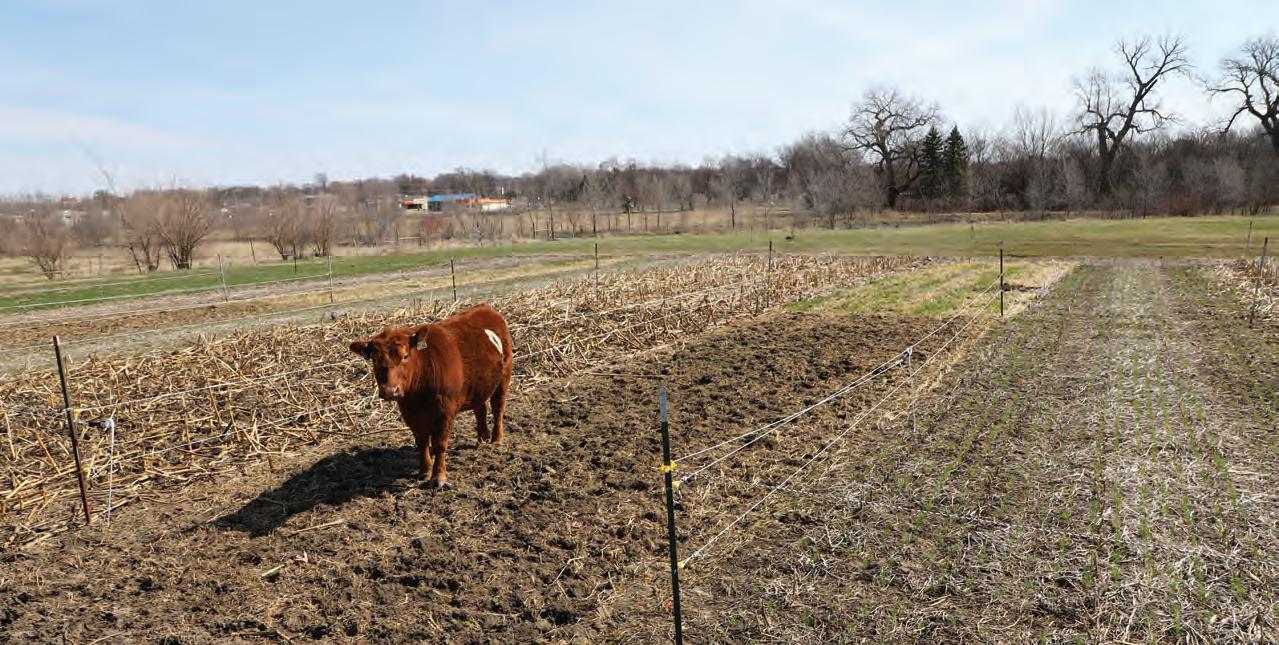
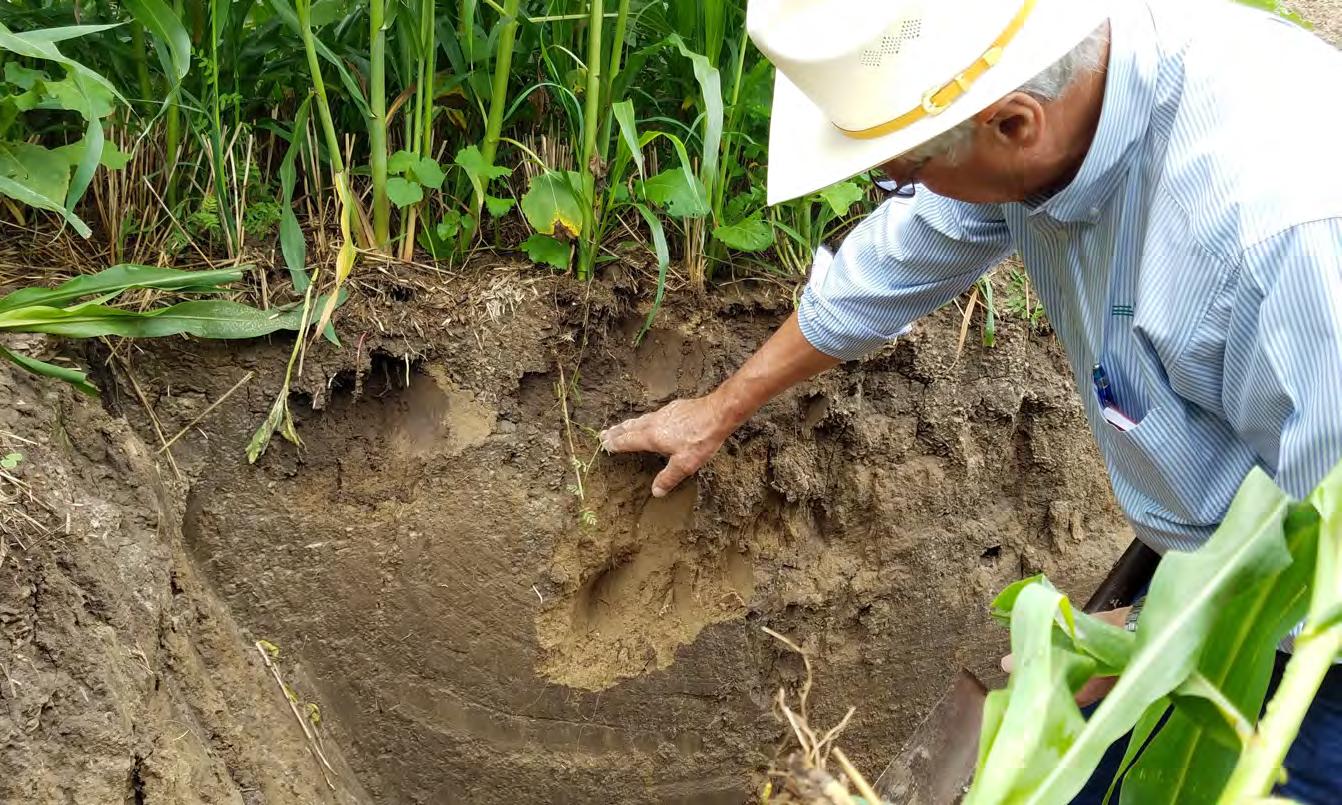
Post-grazed oats cover crop was planted following wheat in a cornsoybean-wheat system. This photo demonstrates grazing intensity and plainly shows hoof tracking in wet soils. See Crop responses section below.
Crop responses
Prior to incorporating grazing into the cropping systems, grain yields were very good with wheat at 80 bushels/acre, corn near 222 bushels/acre and soybean at approximately 70 bushels/acre. Corn residue and oats planted as a cover crop following the wheat crop and corn residue was grazed during the winter. Soybean grain yields from plots where corn residue was grazed and corn grain yields from plots where oats was grazed was compared with nongrazed controls. Grain yields from plots where corn residue and oats was grazed was compared with nongrazed controls. During the first year, it is important to note that grazing conditions were less than ideal with cold, wet conditions and extended periods of ice and snow during winter coupled with a cold, wet spring that continued through March 2019. See photo above.
During 2019, mean wheat yield was 49 bushels/acre. This was approximately 40% less than grain yield during the first cropping year. This occurred most likely due to late planting, which resulted in delayed emergence, coupled with cold temperatures and poor spring growing conditions. However, corn grain yield following the grazed oats cover crop was not different to slightly greater than the nongrazed oats cover crops in the corn-soybean-wheat rotation. In the corn-soybean rotation, soybean grain yield was not different when corn residue was grazed compared with non-grazed corn residue.
Soil responses
Briefly, grazing tended to increase soil compaction at the 0- to 2-inch depth. The 2- to 4-inch depth was more inconsistent, but small increases in soil compaction were
associate professor, extension forage and crop residue management specialist
Daren Redfearn
observed with grazing. Cumulative water infiltration was inconsistent but tended to be greater in nongrazed treatments, possibly due to increased residue cover in the nongrazed plots. Soil water content tended to be greater in nongrazed treatments, especially at the 0- to 2-inch depth. However, soil water content was inconsistent at the 2- to 4-inch depth. Soil water content was likely greater at the surface due to increased residue cover which reduced evaporation. The wind erodible fraction tended to be lower in the nongrazed treatments, likely due to greater residue cover. Soil aggregation refers to how well the soil holds together and resists degradation when disturbed. Soil aggregation again tended to be greater in grazed treatments, possibly due to cattle compressing the soil into larger clods.
Because this is a systems project, researchers’ interests are to evaluate these two cropping systems and crop and soil responses over a period of six years both with and without grazing. It is important to note that this experiment began with conventional tillage and will transition to a no-till system during the course of the study. While some of the early responses were likely due to treatments, other differences appear to be due solely to climatic conditions. At the conclusion of the six-year study, grazing will have occurred in three out of six years for corn residue in the corn-soybean rotation and four out of six years for corn residue and the oats cover crop following wheat in the corn-soybean-wheat rotation.
FOR SPECIFIC END-USE APPLICATIONS
by Tom Elmo Clemente, Eugene W. Price Distinguished Professor of Biotechnology
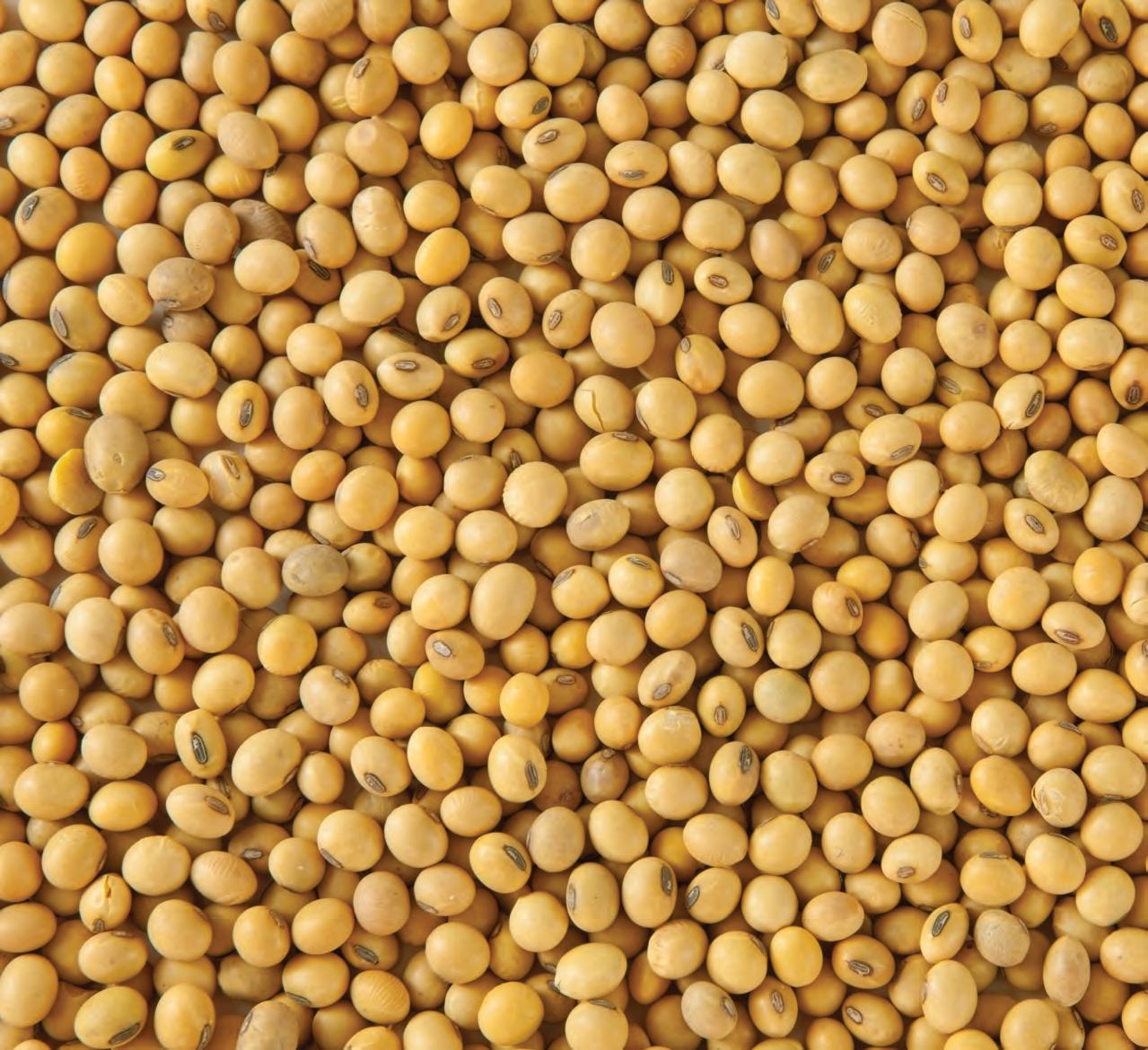
SOYBEAN [GLYCINE MAX (L.) MERR] IS A COMMODITY CROP CULTIVATED ON APPROXIMATELY
85 MILLION ACRES IN THE UNITED STATES. The harvest is valued for its high-quality protein and oil, where these seed reserves are utilized for multiple food, feed and industrial applications. Soybean breeding programs continue to make remarkable strides in improving yield, and protection of yield, while maintaining quality of the harvest. However, soybean breeding programs, like all plant breeding efforts, are limited to the genetic variation that is available within the germplasm.
Over the past 40 years, innovations have been developed that provide the tools to add novel bits of genetic variation to complement plant breeding programs. These tools are being exploited to address both input (which benefits producers) and output (which benefits consumers) traits in soybean. In regard to the latter, efforts have been ongoing to design genetic strategies to improve upon the quality of soybean protein and oil for specific end-use applications.
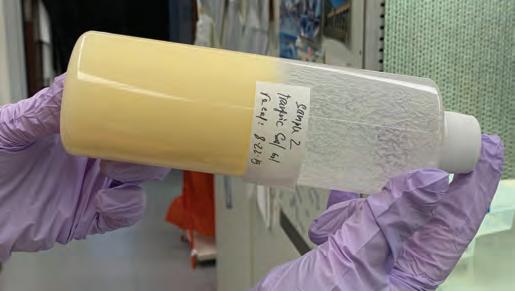
One such example is a soybean oil that has recently been developed wherein the fatty acid composition of the lipid reserve has been shifted to raise the level of stearic and oleic acids while reducing the polyunsaturated fatty acids, which translates to an oil that remains as a semi-solid at room temperature. This type of soybean oil has value in various baking applications.
Tom Elmo Clemente
The ability to exploit these innovative tools as a means to complement soybean and other breeding programs is hindered, however, by regulations that focus on process rather than outcome and lack of infrastructure for proper identity preservation of the novel traits from the farm gate to the food plate. In regard to the former hindrance, global regulatory authorities focus on the process by which the genetic variation is introduced rather than the trait(s) that result from the genetic variation. This approach is contrary to the scientific consensus, wherein the scientific community is in agreement that the tools used to add genetic variation to crops are safe and that what should be addressed is the resultant trait(s). As per infrastructure, until the logistics for the tracking of novel output traits are put into place, the ability to capture the value-added benefits of such traits will be limited. Hence, unfortunately, while these agriculture innovations continue to come on board, the potential of these tools continues to be hindered by nonscience bottlenecks.
Refined soybean oil, high in oleic acid and elevated in stearic acid, remains a semi-solid at room temperature.
Santra team works to identify proso millet genotype for salinity and drought resistance
by Dipak Santra, associate professor, Panhandle Research and Extension Center
SALINITY AND DROUGHT ARE MAJOR ABIOTIC STRESSES THAT SEVERELY REDUCE AGRICULTURAL PRODUCTIVITY. Proso millet is considered drought tolerant and, thus, is the most suitable rotational crop in the semiarid High Plains of the United States. It is also generally considered tolerant to salinity and can be an alternative crop for salt-affected areas.
Dipak Santra, an associate professor in agronomy and horticulture, and his team of researchers at the Panhandle Research and Extension Center in Scottsbluff are working to identify the salt- and drought-tolerant proso millet genotype in order to develop salt- and drought-tolerant proso millet varieties. The specific objective is to screen the USDA proso millet germplasm — 900 genotypes from 30 different countries — at the germination and seedling stages. To assess genotypic variation for vegetative-stage salinity tolerance, 200 accessions were evaluated for germination percentage, shoot length and root length during germination in a control or a salt-affected treatment.
In the first phase, 200 selected genotypes were germinated in water versus salt. Salt tolerance level was determined based on the salt damage index value. The genotypes were then categorized into three groups: susceptible, moderately tolerant and tolerant.
In the next phase, a subset of genotypes (5–10) of each group will be grown in the greenhouse to seedling stage, treated with different concentrations of salt and assessed for salt tolerance.
The team working on this project
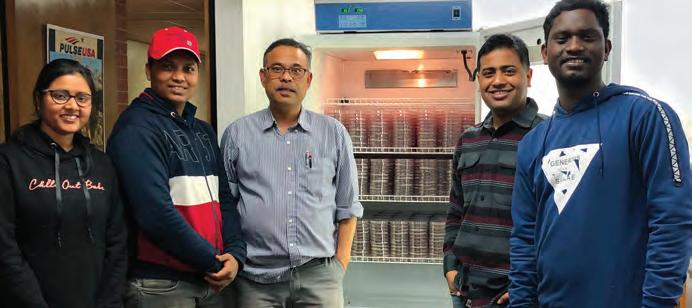
research team of Mitali Kumbhakar (from left), Biswajit Pradhan, Dipak Santra, Rituraj Khound and Pandab Sabar stands in front of a growth chamber with 1,200 germination plates.
includes Santra; Rituraj Khound, an agronomy graduate student; and Mitali Kumbhakar, Biswajit Pradhan and Pandab Sabar, undergraduate interns of the National Agricultural Higher Education Project–Institutional Development Plan exchange student program with the Odisha University of Agriculture and Technology in Bhubaneswar, Odisha, India.
The
garden backyard farmer
provides hands-on lessons from A to Z
by Terri James, assistant extension educator, extension master gardener coordinator
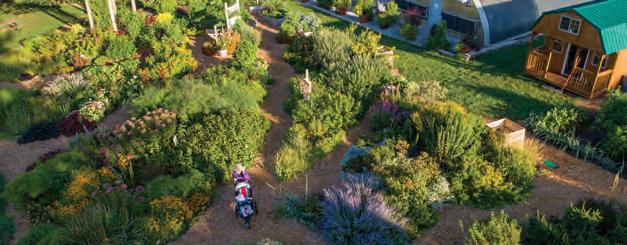
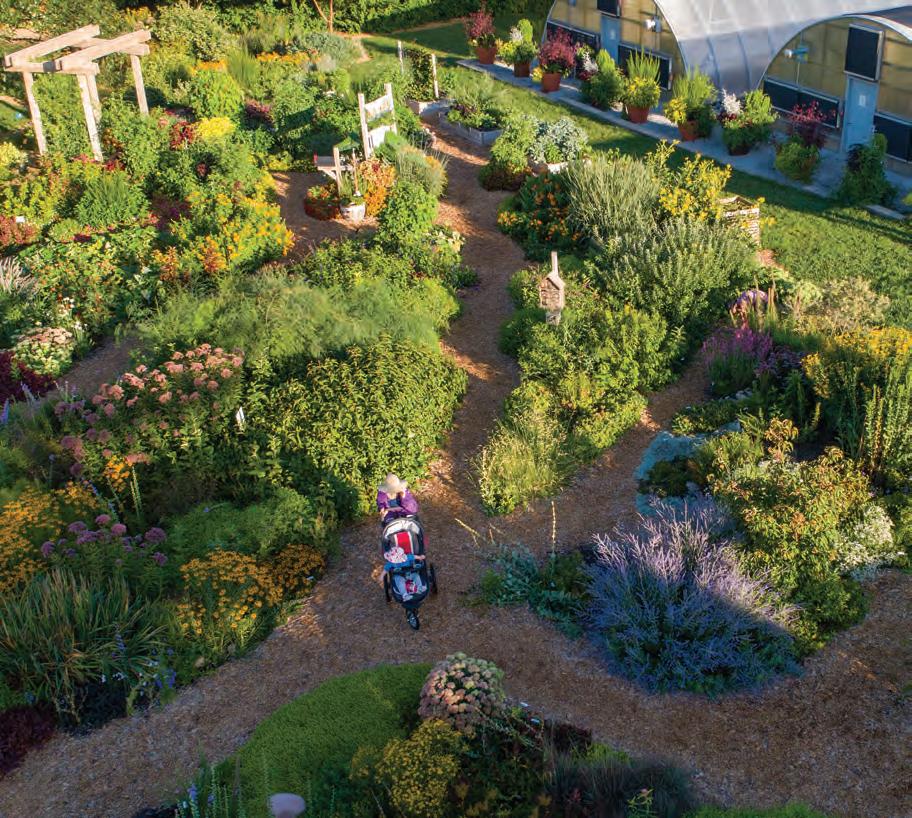
THE BACKYARD FARMER GARDEN STARTED 10 YEARS AGO AS A 10FOOT BY 10-FOOT PLOT NEXT TO KEIM HALL AND WAS ORIGINALLY INTENDED AS ONLY A SMALL SPACE TO EXHIBIT ALL-AMERICA SELECTION PLANTS. Growing little by little each year, the garden added perennial plants, raised beds, fruit trees and shrubs, plant containers and rain gardens. The BYF Garden now covers one-third acre and is a living outdoor laboratory supporting the whole East Campus community.
From asters to zucchini, this year-round educational resource supports the University of Nebraska–Lincoln student body and its visitors. University instructors from Agronomy
and Horticulture; Entomology; Food Science and Technology; Agricultural Leadership, Education and Communication; and others use this outdoor laboratory as a means of enhancing classroom lectures with invaluable hands-on experiences.
In the summer the garden becomes a source of programing for the NET Television show Backyard Farmer and Nebraska Extension. BYF panel members explore the garden to find “what is happening” in the landscape — and describe their findings on the weekly television show. Faculty and staff, youth groups, FFA and 4-H clubs and community members stroll through the garden while learning applied science-based landscape management,
integrated pest management, and plant horticulture principles and practices to implement in their own gardens.
The garden is managed by the Department of Agronomy and Horticulture. Ann Powers, a research technician III, is the primary caretaker. She and Extension Master Gardener volunteers use integrated pest management approaches to demonstrate how to grow and produce a vibrant garden with minimal chemical inputs. The EMGs also help to harvest all the produce and herbs from the garden. The harvested produce is then donated to local food pantries. In 2019, over 2,260 pounds of produce was grown, harvested and donated to help feed the Lincoln community.
Ann Powers
Agronomy 132 Agronomic Plant Science Lab
Terri James
Craig Chandler | University Communication
Greg Nathan | UComm
FACULTY AWARDS 2019
Stacy Adams: UNL Teaching Council and Parents Association Certificate of Recognition for Contribution to Students, Nebraska FFA Association Honorary State FFA Degree
Tom Elmo Clemente: Fellow of the American Association for the Advancement of Science
Cody Creech: Crop Science Society of America Early Career Award, Nebraska Extension Excellence in Extension Award – Soybean Field Days Team
Roger Elmore: Nebraska Extension Excellence in Extension Award –Soybean Field Days Team
Christian Elowsky: UNL Teaching Council and Parents Association
Certificate of Recognition for Contribution to Students
Richard Ferguson: Nebraska Extension Excellence in Extension Award – Soybean Field Days Team
Amit Jhala: Nebraska Cooperative Extension Association Award of Excellence Creative Individual Program for Herbicide – Resistant Weed Management Field Days, The Honor Society of Agriculture Gamma Sigma Delta Extension Award of Merit
Katja Koehler-Cole: Nebraska Extension Excellence in Extension Award – Soybean Field Days Team
Brian Krienke: Nebraska Extension Excellence in Extension Award –Soybean Field Days Team
Greg Kruger: Nebraska Extension Excellence in Extension Engagement, Nebraska Extension Excellence in Extension Award – Soybean Field Days Team
Don Lee: UNL Teaching Council and Parents Association Certificate of Recognition for Contribution to Students, Nebraska Extension Excellence in Extension Award –Soybean Field Days Team
Martha Mamo: Fellow of the College of Agricultural Sciences and Natural Resources Award, UNL Teaching Council and Parents Association
Certificate of Recognition for Contribution to Students
Ellen T. Paparozzi: Pi Alpha Xi Fellow
Chris Proctor: Nebraska Extension Excellence in Extension Award –Soybean Field Days Team
Paul Read: American Society for Enology and Viticulture – Eastern Section Chair
James C. Schnable: Charles O. Gardner Professor of Agronomy Endowed Professorship, North American Plant Phenotyping Network
Early Career Scientist Award, American Society of Plant Biologists
Early Career Award
Kim Todd: Lauritzen Gardens Arborvitae Award, UNL Teaching Council and Parents Association Certificate of Recognition for Contribution to Students
Dirac Twidwell: Omtvedt Innovation Award for Teaching
Harkamal Walia: Heuermann Chair of Agronomy
Brian Waters: AHGSA Faculty Appreciation Award
Sam Wortman: Holling Family Junior Faculty Teaching Excellence Award, AHGSA Faculty Appreciation Award
Charles Wortmann: Nebraska Extension Excellence in Extension Award – Soybean Field Days Team
EMERITI
Charles Shapiro: Fellow of the Soil Science Society of America
Richard Sutton: Green Roofs for Healthy Cities Career Research Award in Green Roof Research
A list of faculty awards can be found online at agronomy.unl.edu/ faculty-awards.
TOM ELMO CLEMENTE, EUGENE W. PRICE DISTINGUISHED PROFESSOR OF BIOTECHNOLOGY, WAS SELECTED AS A FELLOW OF THE AMERICAN ASSOCIATION FOR THE ADVANCEMENT OF SCIENCE, THE WORLD’S LARGEST GENERAL SCIENTIFIC SOCIETY. Fellows are selected by their peers for scientifically or socially distinguished achievements that advance science or its application. Clemente was selected for distinguished contributions to plant molecular biology and genetics, particularly developing tools for functional genomics and the genetic engineering-based targeting of value-added and disease-control traits. Clemente is director of Nebraska’s Plant Transformation Core Research Facility and holds a joint appointment in the Department of Agronomy and Horticulture and the Center for Plant Science Innovation. He has 30 years of experience in plant-transformation technologies. Clemente’s program has established an agriculture biotechnology pipeline at Nebraska, enabling researchers to evaluate transgenic events from the bench to the field with procedures emphasizing identity preservation and stewardship of the biologicals.
Tom Elmo Clemente
JAMES SCHNABLE, ASSOCIATE PROFESSOR OF AGRONOMY AND HORTICULTURE, WAS RECENTLY APPOINTED TO THE CHARLES O. GARDNER PROFESSOR OF AGRONOMY ENDOWED PROFESSORSHIP. The professorship honors Gardner and his contributions in the field of quantitative genetics and plant breeding of maize.
Schnable’s arrival on campus in 2014 launched a research program focused on comparative genomics via computer simulation, but he quickly engaged with the university’s high-throughput plant phenotyping. Today, Schnable conducts research on maize and sorghum on the computer as well as in the greenhouse and field.
SAM WORTMAN, ASSISTANT PROFESSOR AND ENVIRONMENTAL HORTICULTURIST, RECEIVED A JUNIOR FACULTY TEACHING EXCELLENCE AWARD MARCH 12, 2019. Wortman developed two new courses — Plants, Landscapes and the Environment and Innovations for Agriculture. He also worked with faculty to revise the horticulture major by developing new student learning outcomes, revising options and adding a new option called Customized Studies that allows students to work with their adviser to co-create a program of study that is uniquely tailored to their career interests and aspirations.
MARTHA MAMO, WEAVER PROFESSOR OF AGRONOMY AND HORTICULTURE AND DEPARTMENT HEAD, RECEIVED THE 2019 FELLOW OF THE COLLEGE OF AGRICULTURAL SCIENCES AND NATURAL RESOURCES AWARD AT THE ELEVENTH ANNUAL CASNR HONORS BANQUET OCT. 31.
The award recognizes a CASNR faculty member who has provided exemplary contributions to undergraduate education through courses offered in the CASNR Honors program, experiential learning and mentoring undergraduate research.
HARKAMAL WALIA, ASSOCIATE PROFESSOR OF AGRONOMY AND HORTICULTURE AND A DAUGHERTY WATER FOR FOOD GLOBAL INSTITUTE FACULTY FELLOW, WAS AWARDED THE HEUERMANN CHAIR OF AGRONOMY.
Walia is a plant molecular physiologist developing a research program on genetic improvements for crop resilience and enhancing the phenomics knowledge base of wheat and rice. Globally engaged, he is invited to speak at major events and he collaborates with and advises organizations throughout the country and around the world.
James Schnable
Harkamal Walia
Sam Wortman
Michael Boehm (from left), Tiffany Heng-Moss and Martha Mamo
PROMOTION AND TENURE
Humberto Blanco
Promoted to professor
HIRED: 2012, PH.D. 2003 FROM THE UNIVERSITY OF MISSOURI. Blanco is a soil management specialist. His research is on field applications of soil physical processes and properties that influence water, carbon and nutrient cycling under different management scenarios including cover crops, crop residue removal, conservation tillage, diversified cropping systems, dedicated bioenergy crops, biochar and others. He has published over 100 journal articles on these topics. His research is linked with undergraduate and graduate instruction. Blanco teaches classes in soil management, applied soil physics and soilwater-nutrient relationships and uses the field as his lab for these courses.
James Schnable
Promoted to associate professor and granted tenure
HIRED: 2014, PH.D. 2012 FROM THE UNIVERSITY OF CALIFORNIA–BERKLEY. Schnable is the Charles O. Gardner Professor of Agronomy and a computational biologist. His research is focused on maize and sorghum genomics, genetics and genotype by environment interaction. Students in the Schnable Lab collaborate closely with faculty in statistics, computer science or engineering. Schnable has helped found three startups commercializing bioinformatic, quantitative genetic or digital agricultural technologies. He has more than 60 peer-reviewed publications and several federal research grants.
NEW FACULTY HIRES
Assistant Professor
JAVED IQBAL JOINED THE DEPARTMENT OF AGRONOMY AND HORTICULTURE AUG. 19 AS AN ASSISTANT PROFESSOR AND NUTRIENT MANAGEMENT AND WATER QUALITY SPECIALIST. He has a 40% research and 60% extension appointment.
Iqbal is currently working to improve fertilizeruse practices in cropping systems in Nebraska, which can help growers optimize fertilizer use, improve nutrient use efficiency, and increase crop production and farm profitability while protecting air and water quality.
He is originally from a small town named Layyah in Punjab Province, Pakistan. The region is semi-arid with sand dunes and irrigated land, somewhat similar to the Nebraska Sandhills.
He earned a bachelor’s degree in soil science and a master’s degree in soil microbiology and biochemistry from the University of Agriculture, Faisalabad, Pakistan. He received a doctorate in soil science from Huazhong Agricultural University in Wuhan, China.
Iqbal worked for two years as a postdoctoral researcher at the University of Kentucky and five years at Iowa State University. Before taking his position at the University of Nebraska–Lincoln, he worked for three years as a research scientist at Iowa State.
He and his wife Nazia Hina and their three kids love living in Nebraska and they are look forward to further exploring the natural beauty of the state.
Assistant Professor
LAILA PUNTEL JOINED THE DEPARTMENT OF AGRONOMY AND HORTICULTURE JULY 1 AS AN ASSISTANT PROFESSOR IN SOIL FERTILITY AND A PRECISION AG SPECIALIST. She has a research, extension and teaching appointment.
Puntel is currently working on crop modeling and sensor-based corn nitrogen management and collaborating with the Project SENSE team. She teaches Agronomy 431 Site-specific Crop Management in the fall and the online Agronomy 831 Spatial Variability in Soils in the spring.
Originally from Buenos Aires province, Argentina, Puntel grew up in a productive corn, soybean, wheat and barley region. She obtained a Bachelor of Science in agriculture engineering from the National University of Mar del Plata, Buenos Aires, Argentina, and a Master of Science degree and doctoral degree in crop production and physiology from Iowa State University.
Puntel said she’s excited about adopting precision ag technologies and data-driven tools to improve soil fertility and nutrient management for more sustainable agriculture in Nebraska.
Between earning a master’s degree and a doctorate, Puntel farmed and co-founded a precision agriculture company in Argentina, called Clarion, where she worked for six years.
In her spare time, Puntel enjoys sports and outdoor activities. She loves playing soccer and tennis with her new friends and colleagues in Lincoln.
Lalia Puntel
RETIREMENTS
Roger Elmore – 29 Years
ROGER ELMORE, PROFESSOR OF AGRONOMY
AND
HORTICULTURE,
RETIRED JUNE 30 AFTER 38 YEARS OF TEACHING, RESEARCH AND EXTENSION WORK — MORE THAN 29 YEARS OF WHICH HE SERVED AT THE UNIVERSITY OF NEBRASKA–LINCOLN.
The Nebraska Extension cropping systems specialist, Heuermann Chair and Daugherty Water for Food Global Institute Faculty Fellow spent his entire career addressing agronomic issues relevant to the immediate needs of crop producers.
Elmore grew up on a large, integrated crop-livestock farm near Princeton, Illinois. He has a long history of applied crop production research and extension programs focused on maintaining or increasing crop production, profitability and water-use efficiency by seeking and demonstrating environmentally sound production practices. His focus has been on research and developing, teaching and extending timely and pertinent crop management information for farmers, agribusiness, extension personnel and students.
He was previously employed with the University of Nebraska–Lincoln for 24 years beginning in 1981 at the South Central Station (renamed South Central Research and Extension Center and currently South Central Agricultural Laboratory) before he relocated to East Campus.
Starting in 2005, he was a corn extension specialist at Iowa State University before returning to Nebraska in 2014 as a cropping systems agronomist. He later served as the co-associate head of the Department of Agronomy and Horticulture for two years with Martha Mamo, professor and current department head.
He served as a consultant for various organizations around the world. He worked on projects in Ghana, China, Pakistan and Puerto Rico. He was a Peace Corps volunteer in Malaysia and lived and worked in Argentina for nearly a year with his family in the early 1990s.
Elmore’s most significant research contributions have centered on evaluating corn growth and yield response to extreme weather events. He has been able to engage diverse groups based on this research with high-impact extension programming. He also co-led a cover crop research project for five years supported by the Nebraska Soybean Board and the Nebraska Corn Board.
Elmore is a Fellow of the American Society of Agronomy and of the Crop Science Society of America. He received the Agronomic Education and Extension Award from the American Society of Agronomy in 2017. He was also
recognized in 2018 for his dedication and outstanding service to the South Central Agricultural Laboratory.
He holds a doctorate in international agronomy and a master’s degree in agronomy from the University of Illinois.
Elmore has transitioned to a special appointment (parttime role) while finishing his research projects, publications and continues to assist graduate students.
Following this, he and his wife Ann have tentative plans to move to northwest Arkansas to be closer to their three children and their spouses and their six grandchildren.
Walter Schacht – 25 Years
WALTER SCHACHT, PROFESSOR OF AGRONOMY AND HORTICULTURE AND THE SCHOOL OF NATURAL RESOURCES, RETIRED DEC. 31 AFTER 25 YEARS OF TEACHING AND RESEARCH AT THE UNIVERSITY OF NEBRASKA–LINCOLN. Schacht is well known as an educator committed to his students and has excelled as a teacher, adviser and mentor to undergraduate and graduate students. His extensive knowledge and passion for rangeland science and management and his dedication to teaching provided students a rich and lively learning environment. Graduate students were integral to Schacht’s research projects.
The list of courses Schacht taught throughout his career demonstrates the breadth of his expertise, ranging from Introduction to Soils to a variety of rangeland management courses. He provided leadership in Grassland Ecology and Management, Grazing Livestock Systems and Plant Biology majors. He served as adviser for the Range Management Club and coached Nebraska’s Undergraduate Range Management Exam team.
In addition to teaching undergraduate and graduate students, Schacht coordinated the week-long Nebraska Range Short Course. He was also the lead faculty member of the multi-state, AG*IDEA graduate certificate in Grassland Management.
In 2011, the Range Science Education Council and the Society for Range Management presented Schacht with the Outstanding Undergraduate Teaching Award.
His research emphasized ecosystem responses to grazing and associated management practices in the Nebraska Sandhills and cool-season grass pasture in the eastern Great Plains. He was a principal investigator in studies quantifying range vegetation, soil and wildlife habitat response to timing, frequency and intensity of grazing at Nebraska’s Gudmundsen Sandhills Laboratory in the west-central
Sandhills and the Barta Brothers Ranch in the northeastern Sandhills. In eastern Nebraska and south-central Iowa, His studies focused on nutrient cycling and improvement of pasture quality with the use of fire, grazing strategies, legumes and herbicides.
Schacht was recognized as a Fellow of the Society for Range Management in 2012. Funded by a Fulbright fellowship, he spent 2011 teaching and studying woody plant invasion of the semi-arid grasslands and savannas of Namibia.
He grew up in Neligh, Nebraska, and graduated from Dana College in Blair, Nebraska, with bachelor’s degrees in environmental studies and biology. After college he spent a year traveling and working in Australia and then three years as a Peace Corps Volunteer in the Central African Republic.
After serving in the Peace Corps, he obtained a master’s degree in range management from Nebraska and a doctorate in range science from Utah State University.
Prior to his tenure at Nebraska, Schacht was an adjunct research assistant professor with Utah State University from 1986 to 1989, while working on a research/education project in Lesotho, southern Africa, and assistant professor with Angelo State University, San Angelo, Texas from 1989 to 1993.
Schacht will serve as Interim Director of the Center for Grassland Studies for one year, which began Jan. 1, 2020.
Schacht then plans to spend more time with his family and recreate — traveling, camping, hunting, fishing and learning to play a guitar.
MEET OUR DEPARTMENT ALUMNI ADVISORY COUNCIL
THE AGRONOMY AND HORTICULTURE ALUMNI ADVISORY COUNCIL IS BUILT ON THE VOLUNTARY PARTICIPATION OF ALUMNI WITH NOTABLE EARLY AND LATE CAREER CREDENTIALS. The mission of the AHAAC is to aid and counsel the head of the department in alumni engagement, financial stability, industry relations and student interaction with alumni. Members participate in a semiannual meeting with the department and throughout the year as needed.
Julie Abendroth
JULIE ABENDROTH EARNED A BACHELOR OF SCIENCE IN AGRONOMY AND A MASTER OF SCIENCE IN WEED SCIENCE. She currently lives in Des Moines, Iowa, where she is the global biology leader in integrated seed solutions within research and development at Corteva Agriscience. She enjoys leading a cross-functional research program, driving innovative science through collaboration and has an appreciation for different perspectives. Being a member of the council gives her an opportunity to provide input and guidance to ensure Department of Agronomy and Horticulture graduating students are highly competitive and well-trained to enter the workforce. The beauty of East Campus is one of Abendroth’s favorite things about the University of Nebraska–Lincoln.
Heather Byers
HEATHER BYERS EARNED A BACHELOR OF SCIENCE IN HORTICULTURE. She currently lives near Weston, Nebraska, and is the owner of Great Plains Nursery where she has a passion for growing and planting Nebraska native trees and being able to work outdoors and with plants. The sense of community and pride in being a Husker is one of Byers’ favorite things about the University of Nebraska–Lincoln. Earning a degree in horticulture at Nebraska largely impacted her life, and Byers feels the department, in particular, cares deeply for students and their future success. She believes being a member of the council is an opportunity to give back to the university and the department.
Kelly Daniels Jackson
KELLY DANIELS JACKSON EARNED A BACHELOR OF SCIENCE IN BIOLOGICAL SCIENCES. She currently lives in Columbus, Nebraska, where she is the vice president of Daniels Produce, a family owned and operated grower-packer-shipper of fresh produce located in east central Nebraska. Daniels Jackson’s favorite part of her job is working with her family. She likes the great science and research programs at the University of Nebraska–Lincoln. Daniels Jackson feels staying in touch with the agronomy and horticulture community, educational programs and opportunities is important, and that is one of the reasons she’s a member of the council.
Matt Giese
MATT GIESE EARNED A BACHELOR OF SCIENCE IN AGRONOMY AND A MASTER OF SCIENCE IN TURFGRASS MANAGEMENT. He currently lives in Kansas City, Kansas, where he is the midwest technical services representative for turf & landscape with Syngenta Professional Solutions. Giese believes the opportunity to help others achieve their goals by solving an issue or alleviating a problem is an extremely gratifying experience. During his college years, he says it was common to hear students referred to as future leaders. He believes the council offers a gateway to accepting that responsibility and to help shape the next generation of leaders at the University of Nebraska–Lincoln. Connection is what Giese enjoys most about the university. He says no matter where one might travel in the world, the chance meeting of a complete stranger who is also a Nebraska alumnus creates an instant connection.
Jeremy Groeteke
JEREMY GROETEKE
EARNED A BACHELOR OF SCIENCE IN AGRONOMY AND A MASTER OF SCIENCE IN PLANT PHYSIOLOGY AND PRODUCTION. He currently lives in Des Moines, Iowa, where he is the U.S. digital ag lead for Corteva Agriscience. Groeteke’s favorite part about his job is delivering new technology to farmers. To do this, he works with multiple disciplines such as agronomy, data science, software engineering, research, sales and marketing across his organization. He believes being a member of the council ultimately allows him to give back to the university and help the next generations of agricultural community lead. Groeteke likes the University of Nebraska–Lincoln alumni community the most because no matter where he travels, if he runs into someone who also attended Nebraska, he instantly has that connection.
Bryan Kinghorn
BRYAN KINGHORN EARNED A BACHELOR OF SCIENCE IN HORTICULTURE. He currently lives in Omaha, where he is the president of Kinghorn Gardens. He says at Kinghorn they grow more than plants! He enjoys watching his fellow cohorts develop into wonderful practitioners. He believes the industry/profession is going through a number of changes and being a member of the council gives him an opportunity to share some insight on what those changes look like. He hopes this insight can help support the department and assist students to be successful. Kinghorn likes the ongoing support and encouragement the University of Nebraska–Lincoln and the department consistently offer the business community of our state.
Mark Kottmeyer
MARK KOTTMEYER EARNED A BACHELOR OF SCIENCE IN AGRONOMY IN 1978. He currently lives in Kearney, Nebraska, where he is a crop consultant and owner of Central States Agronomics, Inc. Kottmeyer has been crop consulting since he graduated in 1978 and says he’s still learning. He enjoys the challenge and helping growers make key crop production decisions while striving
to help growers produce a crop in the most economically and environmentally sound way. Throughout his crop consulting career he has sought out and depended on the expertise of University of Nebraska–Lincoln faculty members and extension personnel as he helped solve crop production problems. Kottmeyer says he’s thankful for those relationships and if any of his experiences and observations can assist the university, he is more than happy to help.
Steve Merkel
STEVE MERKEL EARNED A BACHELOR OF BUSINESS ADMINISTRATION FROM TEXAS A&M UNIVERSITY IN 1983, A BACHELOR OF SCIENCE IN AGRONOMY FROM TEXAS A&M UNIVERSITY IN 1985 AND A MASTER OF SCIENCE IN AGRONOMY FROM THE UNIVERSITY OF NEBRASKA–LINCOLN IN 2013. He currently lives in Omaha, where he is in his 20th year as the director of golf course agronomy at Landscapes Unlimited in Lincoln, Nebraska. Merkel’s favorite part about his job is providing agronomic and operational support to diverse golf courses. This diversity includes locations, geography, warm and cool season turfgrasses, soils, water quality and quantity, weeds, diseases, insects and the people he gets to work with. Merkel loves the friendliness of the people at the University of Nebraska–Lincoln. He says he’s excited and happy to serve on the council and give back to the university after being asked by his longtime friend and master’s degree adviser, Roch Gaussoin.
Doyle Onnen
DOYLE ONNEN EARNED A BACHELOR OF SCIENCE DEGREE IN AGRICULTURE IN 1977. He currently lives in York, Nebraska, where he is a farm manager for Farmers National Company. Onnen enjoys interacting with other agriculturalists, and he endeavors to bring new agronomic advances to his clients’ farms with the goal of creating more productive lands for the next generation. He believes being a member of the council is an opportunity to learn what direction plant science education is headed and what he can contribute in the area of agronomic services needed to meet future agricultural goals. What Onnen enjoys most about the University of Nebraska–Lincoln is the wonderful energetic college atmosphere and student camaraderie that exists on both of Nebraska’s campuses.
Edward “Rob” Robinson
EDWARD “ROB” ROBINSON EARNED A BACHELOR OF SCIENCE IN AGRONOMY. He currently lives in Omaha, Nebraska, where he is the CEO of Rob-See-Co, an independent seed company focused on corn and soybean seed in the Midwest. Robinson says he loves working with people to build something together. He feels Rob-See-Co makes a great team and they have built a new kind of seed company focused on simplicity, relationships and technology. Robinson is a strong believer in education, especially the University of Nebraska–Lincoln’s agriculturally focused educational system. So, becoming a member of the council made perfect sense. The university has always been dear to his heart. Not only did Robinson receive his education at Nebraska, but so did three of his four children as it has become a tradition within his family.
Bart Ruth
BART RUTH EARNED A BACHELOR OF SCIENCE IN AGRONOMY. He currently lives in Rising City, Nebraska, where he is a farm owner and operator. Ruth’s favorite part about farming is having the opportunity to work with his wife, son and grandchildren on a daily basis. He feels being a member of the council is one small way to show support for the Institute of Agriculture and Natural Resources and the Department of Agronomy and Horticulture, so they can continue to provide a quality educational experience for future agriculturists. Ruth loves the caring and nurturing atmosphere that promotes growth within each and every student at the University of Nebraska–Lincoln.
David Vetter
DAVID VETTER EARNED A BACHELOR OF SCIENCE IN AGRONOMY FROM THE UNIVERSITY OF NEBRASKA–LINCOLN AND A MASTER OF DIVINITY FROM UNITED THEOLOGICAL SEMINARY. He currently lives in Marquette, Nebraska, where he is the president of The Grain Place, an organic family farm, and CEO of Grain Place Foods, which produces organic foods and specialty feeds. Vetter enjoys improving soil health through cropping systems and assisting companies to develop new products. Vetter was asked to serve on the council, and he believes everyone should volunteer for public service if given the opportunity. He loves the opportunities the University of Nebraska–Lincoln offers to learn something new.
Raymond “Ray” Ward
RAYMOND “RAY” WARD EARNED AN ASSOCIATE’S DEGREE FROM FAIRBURY JUNIOR COLLEGE AND A BACHELOR AND MASTER OF SCIENCE IN AGRONOMY, SOIL SCIENCE FROM THE UNIVERSITY OF NEBRASKA–LINCOLN IN 1959 AND 1961,
RESPECTIVELY. He also received a doctoral degree in plant science from South Dakota State University in 1972. He currently lives in Kearney, Nebraska, where he is the co-owner and chairman of the board of Ward Laboratories, Inc., a full-service agriculture testing laboratory. Ward Labs specializes in testing soils, plants, feed, forages, water, manures, fertilizer and other special testing projects. Ward enjoys educating farmers and ranchers on plant nutrition, soil fertility and soil health. Being on the council allows him to stay informed about what’s going on in the department and to feel comfortable with giving advice, if he is asked. One of his favorite things about the university is having the opportunity to help lecture for Agronomy 405! He gets a kick out of assisting the students, getting acquainted with them and learning about their aspirations.
EIGHT ALUMNI RECEIVE LIFETIME ACHIEVEMENT AWARDS
by Lana Koepke Johnson, design and communications specialist
EIGHT UNIVERSITY OF NEBRASKA–LINCOLN ALUMNI
RECEIVED THE DEPARTMENT OF AGRONOMY AND HORTICULTURE ALUMNI LIFETIME ACHIEVEMENT
AWARD AT THE 2019 EMERITI BANQUET NOV. 21. The banquet was hosted by the department’s undergraduate Agronomy Club and Horticulture Club members.
Award recipients include George W. Beadle, William Wesley Burr, Steve A. Eberhart, Kimberly Erusha, Franklin D. Keim, A. Bruce Maunder, Monica Norby and Robert A. Olson.
Martha Mamo, University of Nebraska–Lincoln Weaver Professor of Agronomy and Horticulture and department head, and Raymond “Ray” Ward, chairman of the board of Ward Laboratories, Inc. and chairman of the Agronomy
and Horticulture Alumni Advisory Council, presented the awards to recipients or their families.
This award is the highest honor bestowed upon graduates of the Department of Agronomy and Horticulture who have made significant contributions to their community, state and nation through professional service, public service or civic engagement.
Full biographies of award recipients are listed on the following pages and at agronomy.unl.edu/alumni-awards
The award was founded in 2016 to recognize alumni who have enhanced the reputation of the department and the university by distinguishing themselves in their careers. Honorees are selected by the AHAAC.
The Steve A. Eberhart family accepts the Alumni Lifetime Achievement Award.
Martha Mamo and Ray Ward present
Monica Norby (center) with the Alumni Lifetime Achievement Award.
The A. Bruce Maunder family accepts the Alumni Lifetime Achievement Award from Martha Mamo and Ray Ward.
Kimberly Erusha (from left) accepts the Alumni Lifetime Achievement Award from Martha Mamo and Ray Ward.
Department of Agronomy and Horticulture
ALUMNI LIFETIME ACHIEVEMENT AWARD
GEORGE W. BEADLE
October 22, 1903 – June 9, 1989
GEORGE W. BEADLE, A GENETICIST WHO WON A NOBEL PRIZE IN PHYSIOLOGY OR MEDICINE IN 1958, RECEIVED HIS BACHELOR OF SCIENCE DEGREE IN 1926 AND A MASTER OF SCIENCE DEGREE IN 1927 FROM THE UNIVERSITY OF NEBRASKA–LINCOLN. His interest in genetics began while he was a student at Nebraska.
Beadle’s Nobel Prize was awarded for his work in demonstrating how genes control the chemistry of the living cell, one of the basic concepts of modern genetics. The discovery revolutionized the understanding of genetics. He shared the prize with Edward L. Tatum, professor of biochemistry with the Rockefeller Institute, and Joshua Lederberg, professor of genetics at the University of Wisconsin.
Beadle grew up on a farm near Wahoo, Nebraska, and attended Wahoo High School. A high school teacher persuaded him to attend Nebraska’s College of Agriculture in 1922. At Nebraska, he studied hybrid wheat with agronomy professor Franklin D. Keim.
Through Keim he secured a teaching assistantship at Cornell University, where he worked on Mendelian asynopsis in Zea mays. He completed his Ph.D. in 1931.
He was awarded a National Research Council Fellowship at the California Institute of Technology at Pasadena in 1931. While at Caltech, he continued his work on corn and began work on crossing-over in the fruit fly, Drosophila melanogaster, until he left in 1936.
In 1936, he became an assistant professor of genetics at Harvard University. He was appointed professor of biology in genetics at Stanford University in 1937 and remained there for nine years working in collaboration with Tatum.
Through experiments with bread mold, he and Tatum were able to demonstrate that genes transmit hereditary characteristics by controlling chemical reactions. Their studies were cited by the Nobel Prize jury for having made understandable a variety of bewildering effects in animal and plant cells. Lederberg was credited for parallel work in bacterial genetics. Together, their discoveries led to vastly increased production of penicillin during World War II.
In 1946 he returned to Caltech as professor of biology and chairman of the Division of Biology. He played an important role in getting Caltech to accept women as graduate students.
In 1961 Beadle was elected chancellor of the University of Chicago and later that same year, president. He served as president until 1968. He also taught biology classes while president and as an emeritus professor until 1975.
Beadle cultivated a field of corn wherever he lived and continued to conduct research to clarify the origins of domestic corn.
During his career, Beadle received many honorary degrees, awards and honorary society memberships. Nebraska awarded him an honorary Doctor of Science degree in 1949. Nebraska’s Beadle Center, home to programs in biotechnology, biosciences and plant sciences, is named in his honor.
WILLIAM WESLEY BURR
March 26, 1880 – May 30, 1963
WILLIAM WESLEY BURR WAS THE FIRST HEAD OF THE UNIVERSITY OF NEBRASKA’S DEPARTMENT OF AGRONOMY IN 1916.
Burr, born in Goodland, Indiana, received his elementary education in the public schools of Indiana and Virginia. He attended Virginia Polytechnic Institute in Blacksburg, Virginia, from 1899 to 1900.
He then attended the University of Nebraska College of Agriculture and graduated with a Bachelor of Science degree in 1906. At Nebraska, Burr was a member of Alpha Zeta, Sigma Xi and Gamma Sigma Delta fraternities.
After graduation, he joined the staff at the North Platte Experiment Station and earned national recognition for his research in dryland agriculture and on the conservation of soil moisture.
In 1913, Burr became an assistant agronomist with the United States Department of Agriculture in charge of its dryland research program in the Northern Great Plains. His interest and work concentrated on the principles of crop production, cultivation and tillage for dryland agriculture.
He returned to the university in 1916 to be the first head of the department. In 1919 he was made chairman of the department and assistant director of the University of Nebraska Experiment Station.
In 1928, he was appointed dean of the College of Agriculture and director of the Experiment Station, a position he held until his retirement in 1948. Burr provided leadership during the drought and depression years and was influential in instituting many programs of interest to people in rural Nebraska. He played a role in establishing the soil conservation district and seed certification programs in Nebraska.
Burr authored numerous experiment station bulletins concerning dryland agriculture. He was a contributing editor of “The Book of Rural Life: Knowledge and Inspiration” published in 1925.
After retirement until 1952, Burr served as an agricultural and educational adviser in Germany, Pakistan, Burma, Indonesia, El Salvador, Guatemala and Peru.
Burr was elected Fellow in the American Society of Agronomy and served as the society’s president in 1931. From 1926 to 1930, he served as ASA vice president.
He was also a member of the International Congress of Soil Science, American Association for the Advancement of Science, Nebraska Academy Science Sigma Xi, Alpha Zeta, Gamma Sigma Delta and the Nebraska State Teachers Association.
Department of Agronomy and Horticulture
ALUMNI LIFETIME ACHIEVEMENT AWARD
STEVE A. EBERHART
STEVE A. EBERHART GRADUATED FROM THE UNIVERSITY OF NEBRASKA–LINCOLN WITH A BACHELOR OF SCIENCE DEGREE IN GENERAL AGRICULTURE IN 1952 AND A MASTER OF SCIENCE DEGREE IN PLANT BREEDING IN 1958. He received his doctorate in genetics and statistics at North Carolina State University in 1961. In 1988, he was awarded an honorary Doctor of Science from Nebraska.
Eberhart grew up on a farm west of Bassett, Nebraska, and graduated valedictorian from Rock County High School. He served as a 1st lieutenant in the U.S. Air Force from 1952 to 1956.
Eberhart worked as a research geneticist with the U.S. Department of Agriculture’s Agriculture Research Service in North Carolina, Iowa and Kenya from 1961 to 1975. While in Kenya, he and co-workers developed a comprehensive breeding system, published in 1967, to develop improved maize breeding populations and parental lines. He developed corn hybrids for Eastern Africa that
were used extensively for more than 20 years that had the most potential for quickly increasing yields to reduce hunger.
During this time, he received Superior Service Awards and a Certificate of Merit from the USDA. In 1970 he received the Arthur S. Flemming Award by the D.C. Junior Chamber of Commerce as one of the five outstanding young scientists in federal government.
He served as associate director and vice president for research with Funk Seeds, a CIBA-GEIGY company in Bloomington, Illinois, from 1975 to 1987. He directed and coordinated corn, sorghum, soybean and sunflower breeding programs in the United States, Argentina, Brazil, France, Italy, Spain and Thailand.
In 1987 he was named director of the National Seed Storage Laboratory, USDA-ARS in Fort Collins, Colorado, until his retirement in 2000. Officially known as the National Center for Genetic Resources Preservation, the laboratory guards thousands of seed varieties.
He was also director of the Latin America Maize Project from 1994 to 2000.
He was an active member of Crop Science Society of America, serving as president in 1990. Awards received from CSSA included Fellow in 1985, Crop Science Research Award in 1994, Frank N. Meyer Medal for Plant Genetic Resources in 1999 and the Crop Science Distinguished Career Award in 2003.
Other awards Eberhart received were Fellow, American Society of Agronomy in 1975; Fellow, American Association for Advancement of Science in 1994 and the National Council of Commercial Plant Breeders’ Genetics and Plant Breeding Award in 1998.
He was associate editor for Crop Science 1971–1973 and was technical editor for Crop Registration 1999–2005.
During his career he published 82 scientific manuscripts. A paper on stability parameter models was one of the most widely cited publications in crop science and plant breeding journals. This paper established a widely used method to evaluate potential new hybrids based on responses to a range of environments as well as average yield performance.
KIMBERLY ERUSHA
KIMBERLY ERUSHA IS THE MANAGING DIRECTOR OF THE UNITED STATES GOLF ASSOCIATION’S AGRONOMIC AND ENVIRONMENTAL DIVISION. Now living in New Jersey, Erusha oversees the association’s efforts to help golf facilities enhance better golf playing conditions.
She grew up in Walford, Iowa, with her parents and six siblings and credits her parents for a love of the outdoors.
Following in the family tradition, Erusha attended Iowa State University. In 1982 she graduated with her Bachelor of Science degree in horticulture.
The new graduate went to work for a Des Moines lawn care company. After two years, she reached out to her ISU undergraduate adviser, Nick Christians, professor of turfgrass management, for career advice on new opportunities.
In 1984, Erusha went to work for Robert Shearman, now Emeritus Sunkist Fiesta Bowl Professor of Agronomy at the University of Nebraska–Lincoln. As an extension associate in the turfgrass Integrated Pest Management program, Erusha coordinated the pest surveillance program,
prepared the weekly extension turfgrass IPM newsletter, conducted Nebraska Extension Master Gardener training and developed multimedia education materials.
Even though she had no intention of going back to school, Erusha couldn’t pass up Nebraska’s tuition of one dollar per credit hour for full-time employees to assist in earning her master’s degree. She earned a Master of Science degree and a Ph.D. in horticulture, specializing in turfgrass management in 1986 and 1990, respectively.
Erusha joined the United States Golf Association in 1990 at a time when golf and turf research was flourishing and major changes were happening in information dissemination. As a technical writer for the USGA, Erusha developed content to communicate the principles of turfgrass science and golf course management. She also developed educational material to benefit USGA’s environmental program, turfgrass research program and general agronomic activities. She was assistant editor of the USGA Green Section Record, a bi-monthly professional journal on golf course management topics and turfgrass science.
In 1994, Erusha became the USGA’s director of education. She coordinated and managed the Green Section’s education and communication programs pertaining to the results of its turfgrass and environmental research programs, agronomic consulting and environmental education activities. She also became the Green Section Record’s associate editor.
In 2010 Erusha was promoted to managing director of USGA’s agronomic and environmental division, leading responsibilities for the USGA Course Consulting Services, education outreach and turfgrass research. The on-site consulting brings together highly skilled USGA agronomists providing on-course evaluations of individual golf facilities. They offer golf course staff and officials best management recommendations to produce the best possible turf for the investment. She also leads a global multimedia education and outreach program designed for golf course officials, superintendents, golfers, environmental organizations and regulatory officials. In addition, Erusha oversees the agronomic preparations for USGA national championships. All of these initiatives are supported by the USGA Turfgrass and Environmental Research Program, the world’s largest turfgrass research grants program.
Department of Agronomy and Horticulture
ALUMNI LIFETIME ACHIEVEMENT AWARD
FRANKLIN D. KEIM
September
10, 1886 – March 7, 1956
FRANKLIN D. KEIM, BORN IN HARDY, NEBRASKA, GRADUATED FROM THE UNIVERSITY OF NEBRASKA WITH A BACHELOR OF SCIENCE DEGREE IN AGRONOMY IN 1914 AND A MASTER OF SCIENCE DEGREE IN 1918. He then went on to earn a Ph.D. at Cornell University in 1927 studying genetics, specifically a cross between club wheat and spelt.
Keim graduated from Davenport High School and, as preparation for a teaching job, went to Bethany College in Linsborg, Kansas, in 1904. He returned to Nebraska as a teacher in Nuckolls and Thayer counties from 1905 to 1908. Desiring more education, he attended Peru State Teachers College, where he received a two-year teacher’s certificate. This qualified him for the position of principal of Chester High School from 1909 to 1910. He was made superintendent of schools at Blue Springs in 1910. In 1911, he decided to continue his education and enrolled at the Nebraska College of Agriculture.
Keim is recognized for his outstanding leadership in the field of agronomy both as a teacher and an administrator. He began his teaching career at Nebraska as an assistant
in agronomy from 1914 to 1916 and then as an extension specialist for two years. In 1918 he was promoted to full professor. He retired in 1952.
Keim served as chairman of the Department of Agronomy from 1932 to 1952. Under his leadership, the department came to be respected as having one of the best agronomy programs. It was also during that period that most of our modern agricultural practices were developed.
Keim’s interests were in plant breeding and genetics, weed control and ecological studies of native grasses with reference to pasture utilization. His primary interest was in the field of genetics. He taught the Introduction to Genetics course for 30 years. He was passionate about developing students and steering them into successful careers, whether research or practice.
He acted as a mentor to several students who went on to notable careers, with George Beadle being the most recognized. Beadle received his bachelor’s and master’s degrees under the tutelage of Keim and worked in Keim’s lab on wheat research. Through Keim’s influence, Beadle was able to secure a graduate assistantship at Cornell University and went on to win the Nobel Prize in 1958.
In 1937, Keim was elected Fellow of the American Society of Agronomy and served as president in 1943. He was a member of the Agronomy Journal Editorial Board from 1946 until his death in 1956. In 1931, he served on the committee to authorize a student section of the ASA to be composed of students in farm crops, soils and related fields.
Keim was a member of the Nebraska Academy of Science, the American Association for the Advancement of Sciences, the Genetics Society of America, Sigma Xi, Gamma Sigma Delta, Alpha Zeta, The Nebraska Agronomy Club, Farm House Fraternity and the Innocents Society at the University of Nebraska. In 1950 he received a plaque from the Nebraska Crop Improvement Association, and in 1955 he received one from the Nebraska Society of Farm Managers and Rural Appraisers for his service.
The Agronomy Building was renamed Keim Hall in his honor in 1957. An inscription on a plaque placed in the main entrance to Keim Hall describes the gift he left to his generation. It says “He taught and inspired many in the science of agronomy and in the principles of living.”
A. BRUCE MAUNDER
May 13, 1934 – August 5, 2019
A. BRUCE MAUNDER WAS A WORLDWIDE LEADER IN SORGHUM BREEDING AND GENETICS AND FOCUSED HIS CAREER ON IMPROVING GLOBAL FOOD SECURITY.
Born in Holdrege, Nebraska, Maunder grew up in Lincoln and spent summers near Grand Island on his maternal grandfather’s irrigated farm. He graduated from both the American Overseas School of Rome, Italy, as well as Lincoln Northeast High School in 1952.
Maunder graduated from the University of Nebraska–Lincoln with a Bachelor of Science degree in agriculture in 1956. He then attended Purdue University to complete his Master of Science and Ph.D. in plant breeding in 1958 and 1960, respectively. He was awarded honorary doctoral degrees in science and agriculture from Nebraska in 1991 and from Purdue University in 2003.
In 1961, Maunder began his 37-year career at Dekalb Genetics Inc. as director of sorghum research and eventually senior vice president for research in Lubbock, Texas.
Through his experience overseas as a high school senior and his job responsibilities at DeKalb, Maunder developed a strong interest in international agriculture and
food security. His plant breeding achievements resulted in worldwide sorghum improvement with around 150 commercial sorghum grain and forage hybrids grown on as many as 10 million acres in more than 20 countries. His efforts were key to increasing agricultural production worldwide during a period when the world’s population more than doubled.
He served as president of the Crop Science Society of America, was on the board of Diversity magazine, served on the Sorghum Crop Germplasm Committee for the U.S. Department of Agriculture and was chair to the Iowa State University Seed Science Center advisory council.
Maunder received numerous recognitions for his work including CSSA Fellow, American Society of Agronomy Fellow, Henry Beachell Distinguished Alumni Award, Monsanto Distinguished Career Award, American Seed Trade Distinguished Service Award, Australian Award for Worldwide Sorghum Improvement, Agronomic Industry Award, Genetics and Plant Breeding Award for Industry and NCCPB Genetics and Plant Breeding Award for Industry.
He volunteered as a research adviser with the National Sorghum Producers and as a manager and board member of the National Sorghum Foundation. He was also active on the U.S. Agency for International Development International Sorghum and Millet Program as chair of the external evaluation panel. He also served as an adjunct professor at Texas Tech University.
Maunder was an active member of the World Food Prize family with Norman Borlaug. Borlaug, the 1970 Nobel Peace Prize recipient, created the World Food Prize, which recognizes individuals who make contributions to the world supply of food by improving quality, quantity or availability, and the Global Youth Institute, which is designed to nurture and develop the next generation of scientists.
Nebraska’s College of Agricultural Sciences and Natural Resources awards a Maunder Borlaug Scholarship each year in honor of Bruce and Kathy Maunder and their passion and commitment to education with a global perspective.
The National Sorghum Producers and the National Sorghum Foundation also established the Bruce Maunder Sorghum Leadership Scholarship in appreciation for his exceptional service, dedication and loyalty to the sorghum industry.
Department of Agronomy and Horticulture
ALUMNI LIFETIME ACHIEVEMENT AWARD
MONICA NORBY
MONICA NORBY, UNIVERSITY OF NEBRASKA–LINCOLN ASSISTANT VICE CHANCELLOR FOR RESEARCH, IS RESPONSIBLE FOR DEVELOPING STRATEGIC RESEARCH INITIATIVES AND FOR THE OVERSIGHT OF FEDERAL RELATIONS, RESEARCH COMMUNICATIONS AND INTERNATIONAL RESEARCH COLLABORATIONS.
Norby received her Bachelor of Science in horticulture in 1977 and a Master of Science in plant breeding and genetics in 1982, both from Nebraska.
The natural world — especially plants and landscapes — and science writing have remained the two driving interests that shaped Norby’s education and career choices.
She spent her early childhood living on the edge of Omaha next to areas of pasture, woods and a creek and developed a love of the outdoors. Always an avid reader, Norby had plans to become a writer by the time she attended junior high school in Lincoln. High school years brought the environmental movement and the first Earth Day, which she passionately promoted throughout high school in Lincoln. Norby’s interest in horticulture began in her senior year working in the greenhouses at Campbell’s Nurseries.
As a college freshman, Norby majored in horticulture and
forestry. Many required courses were in agronomy, where she was introduced to plant breeding by the late genetics professor Dave McGill and the late Dermot Coyne, George Holmes University professor of agronomy and horticulture. But her commitment to plant breeding came while taking a course taught by the late John Schmidt. The agronomy professor caught Norby’s imagination when he claimed that the first plant breeders were women gathering seeds and saving the best for the next crop.
After completing her bachelor’s degree, Norby became a research technician for Terry Riordan, Nebraska emeritus professor for the then-new turfgrass breeding program. Beginning in 1978 she worked for Schmidt and the late agronomy professor Virgil Johnson. She completed her master’s degree in plant breeding and genetics and went on to pursue doctoral studies with Schmidt.
In 1986 Norby changed career paths and founded Norby Consulting, combining her scientific background with her writing skills and specializing in science writing and proposal development. She wrote research stories for the Institute of Agriculture and Natural Sciences publication Research Nebraska, the Statewide Arboretum’s The Seed and the Spring Affair News.
In 1998, she partnered with Nebraska’s Roger Bruning, Velma Warren Hodder professor of educational psychology, on his book “Cognitive Psychology and Instruction,” now in its fifth edition.
Norby returned to the university in 1998 as a proposal writer. She worked with the late Prem Paul, former vice chancellor for research, and Mike Zeleny, now chief of staff and associate to the chancellor, to build the university into a research powerhouse. Norby established the Office of Proposal Development, which helps investigators develop grant proposals and secure funding for their research, and the Office of Research Communications to communicate Nebraska’s research.
Norby has played a key role in establishing and securing funding for major projects, centers and institutes at the university. Key projects include the Nebraska Center for Virology, the Extreme Light Laboratory, NEBRASKA MATH, Johnny Carson Center for Emerging Media Arts, Nebraska Center for Energy Sciences Research and the Robert B. Daugherty Water for Food Global Institute. From 2012 to 2013, she was associate director of DWFI and developed staff, programmatic areas and strategic and marketing plans for the institute.
ROBERT A. OLSON
April 14, 1917 – July 18, 1987
ROBERT A. OLSON, SOIL SCIENTIST AND PROFESSOR OF AGRONOMY AT THE UNIVERSITY OF NEBRASKA–LINCOLN FROM 1948 TO 1986, BECAME NEBRASKA’S FIRST FULL-TIME EXTENSION AGRONOMIST SPECIALIZING IN SOILS, INITIATING EXTENSIVE FERTILIZER AND SOIL TESTING OPERATIONS.
Olson and colleagues proved that excessive nitrogen fertilizer could actually hurt crop yield and warned that improper use of fertilizer eventually would pollute ground water. Their work had major implications in the efficient use of fertilizer nitrogen, the environmental impact of nutrient use in agriculture, the upgrading of soil testing as an economic and environmental monitor and the interaction of tillage method and fertilizer use efficiency. They provided farmers greater consistency and integrity to soil testing recommendations.
Born in Fullerton, Nebraska, Olson attended elementary and high school in Genoa. He received an A.B. degree in chemistry and soils from Nebraska in 1938.
During World War II, Olson served as a lieutenant air navigator in the U.S. Navy from 1943 to 1946. After the war, he returned to Nebraska and obtained a Master of Science
degree in soils. He was appointed to the agronomy faculty at Nebraska in 1948 and promoted to professor of soils in 1957.
Olson also served as a consultant to numerous U.S. and European agricultural agencies. His experience with radioisotopes in agronomic research led to appointments to the Organization for European Economic Cooperation in Paris in 1958 and to the International Atomic Energy Agency Soil Section in Vienna in 1962.
From 1967 to 1969, Olson served as a project manager for the Food for Hunger Campaign Fertilizer Program for the Food and Agriculture Organization in Rome. He served as acting director of the Agricultural Division of the IAEA/ FAO in Vienna, Austria, in 1974–75.
Through his work with FAO, IAEA and the USDA, a manual was developed for effective fertilizer use for grain crops, integrating soil classification into soil-fertility programs with both national and international scope.
In the aftermath of the 1986 Chernobyl nuclear disaster, Olson served as an international consultant evaluating agricultural consequences and mitigation.
Along with his many other professional activities, Olson taught undergraduate and graduate courses in soils, fertilizers and soils-related radioisotope techniques. In the latter course, he emphasized hands-on analysis of soil, plants and plant-soil interactions.
Olson authored over 100 publications, wrote 22 book chapters and edited two technical books. He was associate editor of Soil Science Society of America Journal and soils editor of Agronomy Journal.
Top awards from national soil and agronomy societies testify to the quality of Olson’s research and teaching. He was elected as a Fellow of the Soil Science Society of America and of the American Society of Agronomy.
Additionally, he received the ASA International Service in Agronomy Award, the Carl Sprengel Agronomic Research Award, the Agronomic Achievement Award-Soils, the ASA Crop and Soils Magazine Journalism Award, the Soil Science Distinguished Career Award, the SSSA Bouyoucos Soil Science Distinguished Career Award and the SSSA International Soil Science Award.
At Nebraska, he received the UNL Distinguished Teaching Award, the Gamma Sigma Delta Award of Merit and Teaching Award of Merit, and the Sigma Xi Outstanding Scientist Award.
IN REMEMBRANCE
Lowell E. Moser
March 19, 1940 – April 27, 2019
PROFESSOR EMERITUS
LOWELL E. MOSER, AGE 79, DIED APRIL 27, 2019. Moser grew up on a small dairy farm near Seville, Ohio. He graduated from Westfield High School in LeRoy (now Westfield Center), Ohio, in 1958. After attending Ohio University for one year, he transferred and received his Bachelor of Science from The Ohio State University in 1962. He earned a master’s degree in range management from Kansas State University in 1964 and a doctorate in forage and turf physiology and management from The Ohio State University in 1967.
After three years as an assistant professor at OSU, Moser accepted an associate professor position in range and forage teaching and research at the University of Nebraska–Lincoln. He was promoted to professor in 1975. He served as interim head of the Department of Agronomy from October of 1988 to July of 1989 and was awarded the Sunkist Fiesta Bowl Professorship in 1992, which he held for the rest of his career. He retired in 2005. He taught Forage and Range Management and Forage Physiology and cared deeply about the quality of his courses and student learning.
Moser advised numerous students and student groups. He developed an innovative Advising Plus approach that involved the establishment of peer-advising groups. The idea was that teamwork would help young faculty learn good practices in advising and, at the same time, new students would get better advising. The department continued this approach through the 1990s and today has transitioned Moser’s approach into Agronomic Career and Internship Preparation, which will become Internship and Career Preparation in 2021 for all the career pathways students will navigate in the department.
In 1999 he led a grassroots effort to develop a new interdisciplinary major known as grazing livestock systems, which was unique among land-grant universities at the time. His research was focused on grass physiology, growth and management.
Moser received many awards including a University of Nebraska–Lincoln Amoco Distinguished Teaching Award in 1974, several university advising awards, the Gamma Sigma Delta International Service to Agriculture award in 2001 and the Crop Science Society of America/Monsanto Distinguished Career Award in 2008. Moser was named Fellow of the American Society of Agronomy, CSSA, American Association for the Advancement of Science, and the North American Colleges and Teachers of Agriculture.
Robert “Bob” Carl Sorensen
July 24, 1933 – June 4, 2019
PROFESSOR EMERITUS
ROBERT “BOB” CARL SORENSEN, AGE 85, DIED JUNE 4, 2019. He was born and raised in Omaha and served eight years in the U.S. Army Reserve. Sorensen earned a Bachelor of Science in 1955 and a Master of Science in agronomy in 1957 from the University of Nebraska–Lincoln. He received a doctorate in soil chemistry in 1964 from Iowa State University.
He was hired as an assistant professor of agronomy in 1965 with a 75% teaching and 25% experiment station assignment at the University of Nebraska–Lincoln. He went on to become an associate professor and professor of agronomy in 1971 and 1975, respectively. Sorensen also served as Acting Assistant Dean to the College of Agriculture for two months in 1978. He served the university for 35 years and retired in 1999.
He taught over 6,000 students. According to colleagues, Sorensen was a creative instructor who cared about his students and wanted to educate the whole person, not just impart knowledge. He really enjoyed teaching soil science and was consistently among the highest-ranked teaching faculty in student evaluations.
In 1988 he developed a new design for the Introductory Soil Science course where students learned in cooperative small groups. A dedicated supporter of the University Foundations course for freshmen, Sorensen taught a section each fall. He also served as the department teaching coordinator for seven years.
Sorensen published 31 research articles, wrote 11 educational publications and received numerous teaching awards. He received the North American Colleges and Teachers of Agriculture Distinguished Service Award in 2000, NACTA Distinguished Educator Award in 1993, NACTA Teaching Award of Merit in 1990 and the E.B. Knight NACTA Journal Award, twice. He also became a NACTA Teacher Fellow and Outstanding Teacher Fellow, both in 1975. He was awarded the Soil Science Society of America Soil Science Education Award in 1994.
He was honored by the University of Nebraska–Lincoln with the Amoco Distinguished Teaching Award, College of Agricultural Sciences and Natural Resources Innovation in Teaching Award, Recognition Award for Service to Students, and the Teaching Award of Merit from the Honor Society of Agriculture–Gamma Sigma Delta. He was a member of Sigma Xi, Alpha Zeta, Gamma Sigma Delta, NACTA and the university’s Academy of Distinguished Teachers.