
Department of Agronomy and Horticulture
Mission Statement
Our mission is to advance the knowledge, theory, and application of plant and soil science and landscape design to improve the quality of life for citizens of Nebraska and the world.
AOur mission is accomplished through:
commitment to undergraduate and graduate education; An effective balance between basic and applied research on topics with the greatest potential for impact in the plant and soil sciences; Outreach education programs that facilitate adoption of new technologies and landscape design to meet the needs of stakeholder groups and Nebraska citizens.
Photos by Brett Hampton, IANR, and Tara Pawling. Graphics arranged by Carola Strauss
The University of Nebraska–Lincoln does not discriminate based on gender, age, disability, race, color, religion, marital status, veteran’s status, national or ethnic origin or sexual orientation.

E-mail:
Photos by Brett Hampton, IANR
FROM THE INTERIM DEPARTMENT HEAD
Lowell E. Moser, Interim Head
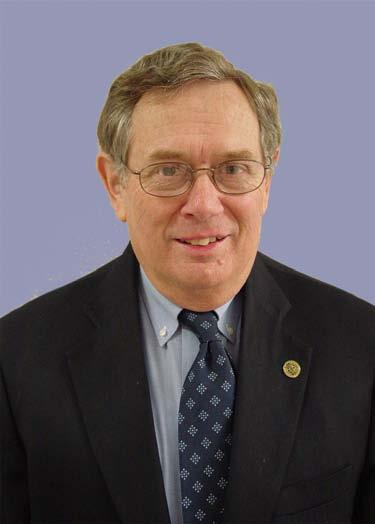
The past year has been interesting and eventful. I have served as interim head since August 1, 2004, after Ken Cassman assumed a faculty role. A nationwide search was initiated late last summer and Dr. L. Mark Lagrimini was selected as the new agronomy and horticulture department head. He will join UNL on August 1, 2005. We welcome Dr. Lagrimini and look forward to his arrival. Dr. Darrell Nelson, dean and director of the Agricultural Research Division and former head of the agronomy department (1984-1988) retired July 1, and Dr. Z. B. Mayo, former head of the entomology department, will serve as interim dean and director until a new person arrives.
Some good news is that there were no cuts in the budget this year, although the university still has a tuition shortfall since enrollment has declined. There has been a strong emphasis on student recruitment at every level this year, and these efforts appear to have helped. Our department has initiated and participated in numerous activities. There has been a lot of follow up activity, especially by Cheryl Moncure, our departmental recruitment coordinator, with phone calls, e-mails, and personal contacts. The number of new freshmen are up considerably from last year in both the agronomy and horticulture majors. We hope that this trend continues.
Our department participates in offering other majors. The Professional Golf Management (PGM) program was launched with the fall semester in 2004, with 31 students. It is quite popular,
and growing rapidly. This fall there will be 65 students in this program. Dr. Terry Riordan is the director of the PGM program which is housed in the Center for Grassland Studies. Also in the Center for Grassland Studies is the grazing livestock systems major. That major, initiated in 1999, has the largest incoming freshmen class in its six-year history. We are in the process of collaboratively developing a new across-department major entitled plant biology. This major will have two areas of emphases, one in plant biotechnology and one in managed ecosystems. Next year we hope to launch this major which should have great appeal to those interested in plant science and will attract students to the various participating departments.
The Institute of Agriculture and Natural Resources has released three faculty positions for the agronomy and horticulture department. There has been a prestigious Haskins/Othmer Chair of Plant Molecular Chromosomal Biology for which we are finishing the recruiting process. Also, we have an irrigated weed specialist, replacing Dr. Fred Roeth, in the South Central Agricultural Lab (SCAL), and an irrigated cropping systems specialist, replacing Dr. Roger Elmore. Fred retired December 31, 2004, and Roger left for a position at Iowa State University as of July 1, 2005. We are currently interviewing for these two positions.
The department has increased its distance education offerings significantly this year. New modules were developed in both agronomy and horticulture. We are one of the two leading departments in distance education in the college and in participating in the distance delivered master of agriculture degree. A new online advising center has been set up for our distance masters students. This will enable distance degree students and the faculty that advise them to keep up with options and progress with their distance degree. See http://agronomy.unl.edu/distance_ed/index. htm for information about our distance education program.
Recruitment of students will be a continuing challenge for us. If you find someone with interest in agronomy, horticulture or our cooperative majors mentioned earlier, please send their names to Cheryl Moncure who is located here in our department. As the recruitment coordinator, she will arrange for follow up contact and visits to campus. Laura Frey is the recruitment coordinator for the College of Agriculture and names and contact information can be sent to her for any of the majors in the College of Agricultural Sciences and Natural Resources. Alumni and friends of the department are one of the best sources for names of potential students.
I offer this personal note in closing. On September 1, I plan to retire after a 38-year career, 3 years at Ohio State University and 35 years at UNL. It has been a pleasure to have been associated with the department and UNL, and to have interacted with so many fine students, faculty and staff. The University of Nebraska is a great place to be.
NEw HEAD FOR AgRONOMy AND HORTICULTURE
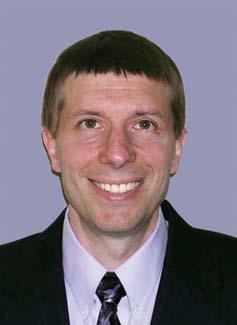
Dr. Mark Lagrimini,
Head

Dr. Mark Lagrimini joined the Department of Agronomy and Horticulture as head on August 1, 2005. Dr. Lagrimini was a group project leader and principal scientist at Syngenta Biotechnology Inc. at the Research Triangle Park in North Carolina. Prior to that he spent 12 years as a researcher and teacher in the Department of Horticulture and Crop Sciences at The Ohio State University. There he worked on the biochemistry and gene expression of plant peroxidases and to define their role in plant development. Most recently he has been a project leader at Athenix Corporation, a agricultural biotechnology company, working to develop traits for insect resistance and herbicide tolerance. Dr. Lagrimini has had extensive leadership in state, national and international teams and is well prepared to lead the department into the 21st century. Dr. Lagrimini is originally from Illinois and received his B.S. degree from the University of Illinois and Ph.D. from the University of Iowa. Mark, his wife, Shannon, son Henry, and daughter Emma live in Lincoln. We welcome them to our department and hope many of you will have the opportunity to meet him in the future.
Agronomy and Horticulture Highlights
by Alex Martin
Agronomy and Horticulture Highlights is an annual event hosted by our department each year in December. The public is invited to be our guest and learn about new developments in research, teaching and extension. Over 250 people typically attend the event held at the Cornhusker Hotel in Lincoln, Nebraska. This annual program consists of oral presentations, poster presentations and demonstrations. Presentations address the diverse projects of agronomists and horticulturists both soil and plant scientists with emphasis ranging from the gene to the plant to the field to the landscape level. Last year’s presentations included: “Genetics via Distance Education”, “Yellow Leaves in a Green Industry” (challenges in producing quality flowers and ornamentals), “Deficit Irrigation”, “Global Food Security”, “Soybean Breeding and Management for High Yields”, “Are you Ready for Roundup Ready Turf”, and “Relay Intercropping”. New and innova-
tive research, teaching and extension programs are featured at the daylong program. The day’s activities are designed to showcase both the breadth and depth of the department. This is an excellent opportunity to learn about the department and discuss topics of mutual interest.
The poster sessions provide an opportunity to meet with faculty for informal discussions and to visit with others. Last year over 30 posters were presented. This open interchange has been an important part of the day’s activities and has been both enjoyable and valuable for everyone. Highlights is held during the holiday season at a time when friends typically “catch up” on the year’s events. This year Highlights is planned for December 6th at the Cornhusker Hotel in Lincoln.
Only those who risk going too far will ever know how far they can go. — Anonymous
Photo by Brett Hampton, IANR
Challenging golf major provides
Student Excitement !
by Lori McGinnis, April 2005 Class Acts
Jason Harrell had decided to take a break from the University of Nebraska–Lincoln when, one Saturday, he read a newspaper article that changed his life’s direction.
The article was about the new Professional Golf Management program at UNL’s College of Agricultural Sciences and Natural Resources. That Monday, the avid golfer of 17 years contacted program director Terry Riordan. On Tuesday he signed up.
“I came back to school for this program,” said the junior from Lincoln, who began with 30 other students in fall 2004.
“Once I found out more about it, I was excited about it,” said Harrell, now president of the PGM program’s student club.
Excitement about golf is what has driven the success of the PGM program in its initial semester, Riordan said.
“This major gives the students an opportunity to study and have a career path in something they have a passion for,” Riordan said.
Plus, they need to be good at it. Going into the program, golfers must have a handicap of 12 or better.
UNL’s program is only the 15th in the country and was accredited by the Professional Golfers’ Association (PGA) last year. The rigorous pro-
gram combines UNL courses with PGA requirements. Students take a core of UNL courses in business, the sciences such as biology and chemistry, turfgrass management, and food and beverage management, said administrative assistant Tara Pawling. Knowledge and skills related to golf are covered in the PGA’s thick textbooks, which address such topics as rules of the game, tournament operations, golf car fleet management, golf club design and repair, and teaching golf.
To complete the PGA Playing Ability Test required for graduation, students improve their skills through club tournaments, and receive individual and group instruction from PGA professionals. They play and practice at Wilderness Ridge Golf Course, and at Yankee Hill and Hillcrest country clubs in Lincoln.
Also required are 16 months of full-time internships conducted during the summers and an additional semester. Scott Holly, PGM internship coordinator, said intern responsibilities may include setting up tournaments, running a junior camp or marketing a golf course.
Josh White is a junior from Lincoln and the son of the head golf professional at Wilderness Ridge. He, too, decided to become a PGM major.
“It has turned out to be my best year in school,” White said.
The program is on track to double in size its second year with an estimated 60 students, Riordan said.
your opponents; always play against par.
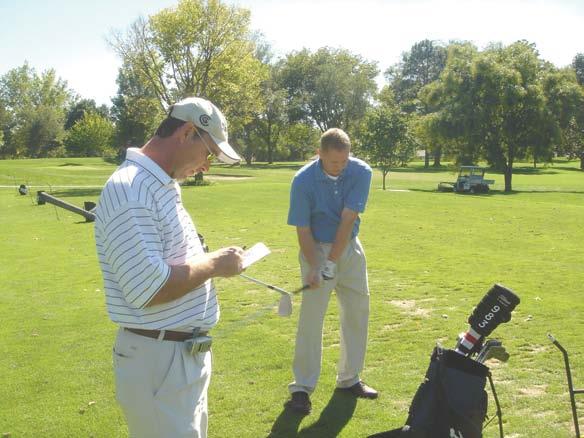
Above: Scott Holly, left, Professional Golf Management program internship coordinator, works with Garrett Svoboda, a PGM junior from Hastings, Nebraska.
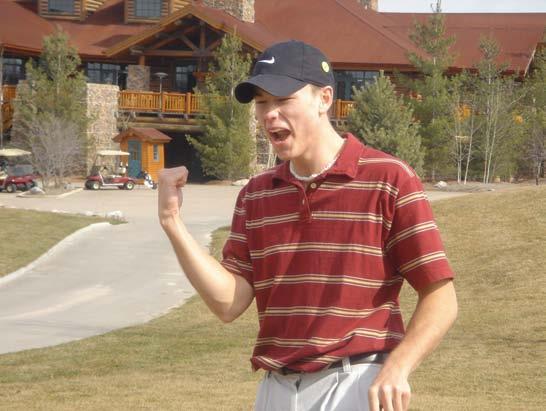
Above: Chris Peterson, a PGM freshman from South Sioux City, Nebraska.
Photos by Tara Pawling, PGM program
University of Nebraska Crop Management Diagnostic Clinics
by Delores Pittman and Charles Wortmann
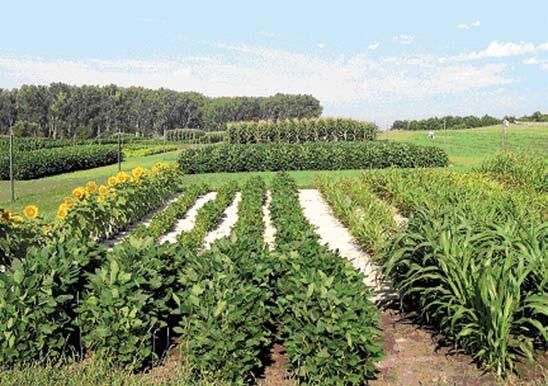
The University of Nebraska Crop Management Diagnostic Clinics provide intensive training for agribusiness professionals and crop producers. Held at the Agricultural Research and Development Center near Mead, Nebraska, the clinic site is specifically developed for the programs and simulates actual cropping situations.
The hands-on, in-field training emphasizes use of fieldspecific crop production and management practices. The clinic site has 35 plots which are used to create learning situations about different aspects of crop production. “Crop Scene Investigations” are problem solving exercises where small groups of participants work together to diagnose a series of production problems. A ‘sandbox’ has been created for teaching about different nutritional disorders and principles of plant nutrition. Small group sessions encourage interaction between the presenters and participants. Summer clinics include mid-summer, late-season and precision ag clinics. A field scout training session is also held in the spring.
Expertise of university and industry agricultural specialists is drawn upon to provide the latest up-to-date researchbased information in crop production. Presenters include faculty and staff from the University of Nebraska–Lincoln’s Department of Agronomy and Horticulture, as well as other departments within UNL’s Institute of Agriculture and Natural Resources.
The clinics were developed in 1996 as a solution for agribusiness professionals seeking out continuing education credits. Since that time, nearly 3,500 registrants have participated in the clinics. There is a need for ongoing, in-depth training opportunities in crop management and diagnostics.
Participants complete a questionnaire at the end of each event to evaluate the topics addressed and the expected impact of the training. Results compiled from 1996-2004 are as follows:
• 99% of the participants have been somewhat or very satisfied with the programs;
• 81% probably or definitely will make changes in their business/operation based on what they learned;
• 89% probably or definitely will attend future clinics;
• 88% ranked the clinics as above average or one of the best compared to other educational opportunities available;
• 93% probably or definitely would recommend the clinics to others;
• Acres influenced by the clinics ranges annually from 4,000,000 to over 7,000,000;
• The average estimated value of knowledge gained or anticipated changes are $5.23 per acre.
A sampling of participant comments concerning the clinics includes:
• “The sessions really show you new ways to look at a problem. It is also nice to hear the ideas of others.”
• “It further enhances current knowledge on topics related to today’s problems.”
• “I see it as an opportunity to reassess our operation and make changes where necessary.”
• “It is important to stay abreast of developments to add and improve innovative techniques to your operation.” For more information about the Crop Management and Diagnostic Clinics, call the University of Nebraska Agricultural Research and Development Center (ARDC) at • (402) 624-8030, FAX (402) 624-8010, • e-mail kglewen1@unl.edu or • visit their Web site at http://ardc.unl.edu/cmdc.htm.
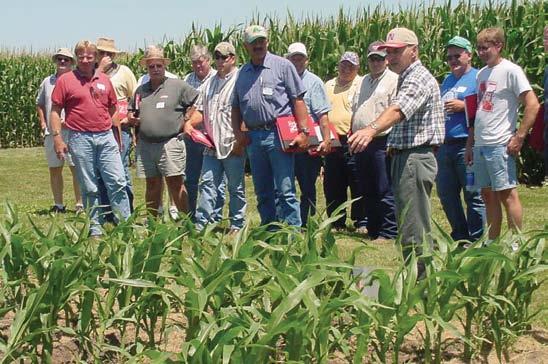
Above: thirty-five plots are used to create learning situations for the Crop Management Diagnostic Clinics.
Specialists from the University of Nebraska–Lincoln’s Department of Agronomy and Horticulture, from other departments within UNL’s Institute of Agriculture and Natural Resources, and from private industry teach participants about problems and opportunities in crop production.
New alternative crops
by David Ochsner, Fall/Winter 2004 Research Nebraska
Early Panhandle settlers had high hopes of re-creating the lush fields of corn and wheat that already blanketed lower and wetter elevations to the east. Some even believed abundant rains would follow the plow onto the High Plains.
Today, Dave Baltensperger takes a more realistic view. The University of Nebraska crop breeder works to identify, study and introduce new, higher-value crops for the Panhandle. He sees the region’s semi-arid climate as both a challenge and an opportunity to build an agricultural economy based on a range of alternative crops.
Modern Panhandle mainstays such as sugar beets, sunflowers and proso millet, and emerging crops such as chicory began as ideas. Research by Institute of Agriculture and Natural Resources scientists helped make them realities.
There’s no guarantee a crop that grows well elsewhere will thrive here. To find out, Panhandle Research and Extension Center researchers study everything from how different varieties perform to whether a potential newcomer fends off local insects and diseases, as well as their market potential. Findings help growers learn to plant, manage and harvest new crops.
“Some people wonder why we bother with testing so many types of crops,” Baltensperger said. “I tell them that soybeans were once an alternative crop.”
Alternative crops like turfgrass actually grow better in the Panhandle than in other areas because the region’s low humidity restricts growth of turf diseases, he said.
Grasses for lawns and golf courses are among “leisure crops” that compete for consumer entertainment dollars. They represent a growing chunk of Panhandle alternative crop acres.
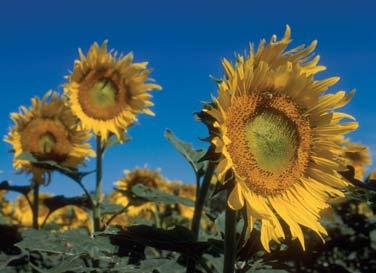
Another leisure crop, bird seed – including proso and foxtail millet, sunflower, sorghum and safflower – is the region’s third largest acreage crop behind wheat and corn.
Like sunflower, proso millet has grown into an important regional commodity. The Panhandle grows 200,000 acres of proso annually. IANR scientists developed varieties well-suited to the region and research laid the groundwork for expanded birdseed production.
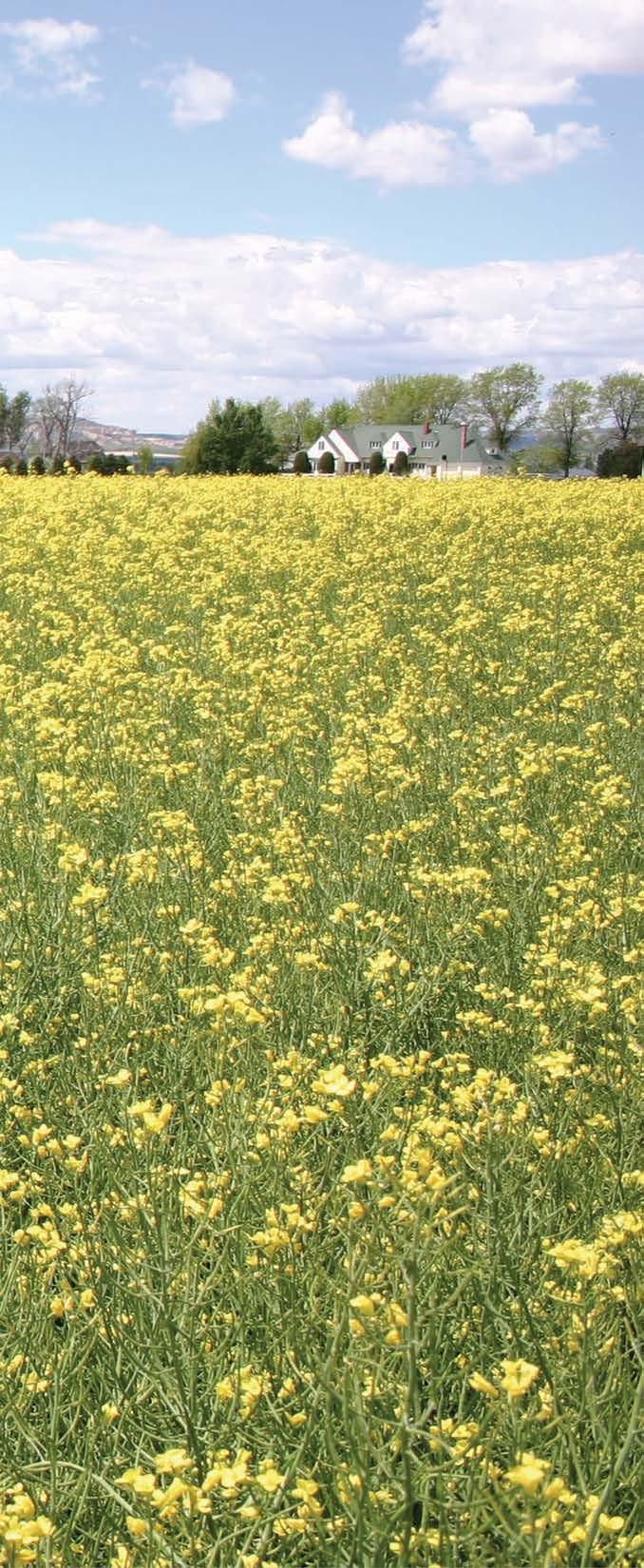
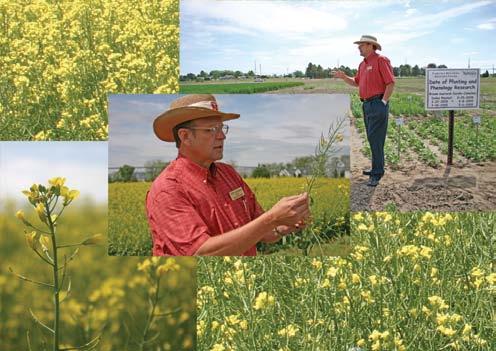
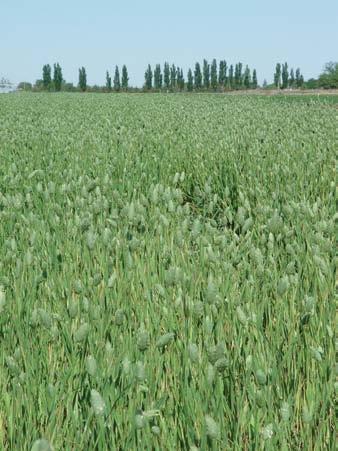
IANR scientists are exploring a variety of possible new crops for western Nebraska. To successfully grow a newcomer, farmers need to know how best to produce it and how it performs in the region’s growing conditions. IANR research is answering these and other questions about prospective new crops. Findings have helped turn some once alternative crops, such as sunflowers (top insert) into a regional mainstay. Today, scientists are exploring the potential of canola (background) and brown mustard (not pictured) for making biodiesel fuel. Production of canary grass (bottom insert) and other grass seed also is expanding.
Photo and insert photos (directly left) by David Ostdiek
Brett Hampton, IANR
Shari
Rosso
sprouting potential
The food industry is another potential market for new crops. Researchers are testing growing conditions and marketability of crops such as canola, sunflower and safflower for cooking or salad oils, and legumes such as chickpeas and garbanzo beans.
Another use for some alternative crops – biofuels –offers tremendous potential.
Panhandle scientists are studying the potential of brown mustard and canola in making biodiesel. This environmentally friendly fuel alternative blends well with petroleum-based diesel and one day may even replace it.
“There is a huge market for biodiesel that doesn’t leave an excess of product,” Baltensperger said. “It has the greatest potential for economic impact of any alternative crop.”
Canola has performed well in the Panhandle, but before the promise of biodiesel, there was little or no local demand. Brown mustard’s huge biodiesel potential has generated lots of interest, but researchers are still studying how best to grow it locally.
Like Baltensperger, Leon Kriesel of Kriesel Certified Seed in Cheyenne County is excited about the future of alternative crops, but cautions producers to be aware of the learning curve.
“Everybody is looking for the silver bullet
crop,” said Kriesel, whose company produces seed for crops such as winter wheat, proso millet, spring oats and barley. “There are a lot of exciting alternatives, but you need to develop the marketing first. It’s purely economics.”
Kriesel said IANR research is key to developing successful new crops.
“A lot of people don’t see the workings of the university behind the eventual product,” he said. “The university helps shoulder the risk (and) explore if these things work, if they are economically viable.”
USDA’s Sustainable Agriculture Research and Education and North Central Regional Canola programs, the Nebraska Department of Agriculture Value-Added Program and the Anna Elliott Fund help fund this research.
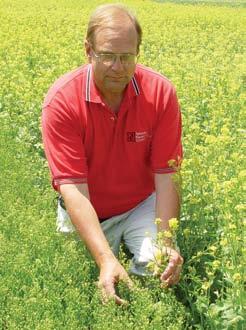
Dave Baltensperger, a crop breeder who specializes in alternative crops, inspects test plots of camelina (left) and a brown mustard (blooming). They are among numerous potential crops that IANR scientists are investigating as alternatives for the Panhandle. Scientists hope their research identifies new crops that help keep more people on the land and aid the region’s businesses.
Niche crops may become more important
by David Ochsner, Fall/Winter 2004 Research Nebraska
The diverse nature of alternative crops may keep more people farming and more businesses open in rural communities.
That notion drives IANR Crop Breeder David Baltensperger. He thinks alternative, or niche crops, will be increasingly important to the region. While each niche crop probably would grow on limited acres, they each would target specialty markets with higher per acre income potential.
“We talk about a portfolio of crops that can benefit smaller operators,” Baltensperger said. “You have to spend more time
selling the product yourself, but niche crops carry a premium for doing that legwork.”
For larger farmers, alternative crops provide extra income and diversification to spread risks. For small producers, they offer opportunities for higher incomes using limited land and water.
Alternative crops are especially appealing to part-time growers who supplement their income with another job, Baltensperger said.
“The niche markets give them the option of working more hours on their own land rather than in a second job,” he said.
A more diverse crop mix also helps reduce chemical costs by helping break weed and insect cycles through crop rotation.
Because alternative crops offer more intensive and diverse uses for land, a potential result could be more small producers, Baltensperger said.
“One of our goals is to keep people on the land in rural Nebraska,” he said. “If we can produce higher-value commodities, then there will be more opportunities for those (businesses) in the rural communities that support the production of those crops.”
Shari
Rosso
the whys and hows Undergraduate student recruitment:
by Dennis McCallister
It probably wouldn’t come as any great surprise to say that students are the lifeblood of a university. If that is the case then the agronomy major in the Department of Agronomy and Horticulture has had a bad case of anemia for the last 4 years. The total number of agronomy majors has dropped from 120 in academic year 2000-01 to 55 in 2004-05. Horticulture majors have been more stable over that period of time, averaging 150. Then again, if you can “never be too rich or too thin” as Wallis Simpson, the Duchess of York, was alleged to have said, you can never have too many students either. Numbers of both agronomy and horticulture students who have been admitted for the fall 2005 academic year are looking promising and should help us to rebuild our enrollments.
This is a roundabout way of saying that recruiting undergraduate students, a concept that was unthinkable a few years ago, is necessary now. While it is true that lower student numbers in the long run would mean fewer faculty and staff, agronomy and horticulture recruits for more reasons than just to support itself. The industries that employ our majors rely on us to prepare students to fill professional positions in agricultural services, horticultural sales, landscape design, and many other areas. Our department also has a broader responsibility to society to help prepare citizens to take the place of the present generation as decision-makers, to help determine responsible land-use, make law, and improve the living and working environment with plants. Finally, if agronomy and horticulture fails to offer the kinds of education that today’s students need, we will be failing them directly by depriving them of opportunities to fulfill themselves. For all of these reasons and more, our department must enroll enough students to justify an academic program of depth and breadth.
Because the agronomy major has been under more stress than the horticulture major, a small committee of agronomy faculty and students called Attracting New Students to Agronomy (ANSTA) began meeting about 18 months ago to determine what we could do to reverse the situation. One of our first discoveries was that the trend toward lower numbers of majors in agronomy is a national issue. Even other universities in the region such as Kansas State and Iowa State, which had maintained enrollments, are
now starting to see declines similar to those in agronomy at UNL and elsewhere. Our hopes for a “magic bullet” solution to the recruiting problem were not to be — solutions largely would be incremental and tailored to local circumstances. ANSTA has made several recommendations which are being implemented by the faculty. One of these recommendations is to establish one-toone contacts between UNL faculty and their counterparts at Nebraska community colleges. The intention is to keep community college faculty aware of opportunities and changes in agronomy at UNL. This effort is also being carried out by horticulture faculty.
The industries that employ our majors rely on us to prepare students to fill professional positions in agricultural services, horticultural sales, landscape design, and many other areas. Our department also has a broader responsibility to society to help prepare citizens to take the place of the present generation as decision-makers, to help determine responsible land-use, make law, and improve the living and working environment with plants.
A second recommendation is to create a new series of recruiting materials which emphasize the unique aspects of a major in agronomy. Over the last few years, UNL’s Office of Admissions has gone to great lengths to standardize the “look” of all recruiting materials at all levels in the university. While this is reasonable to a degree, it unintentionally has the effect of making agronomy look like
Turn to Recruitment, page 11
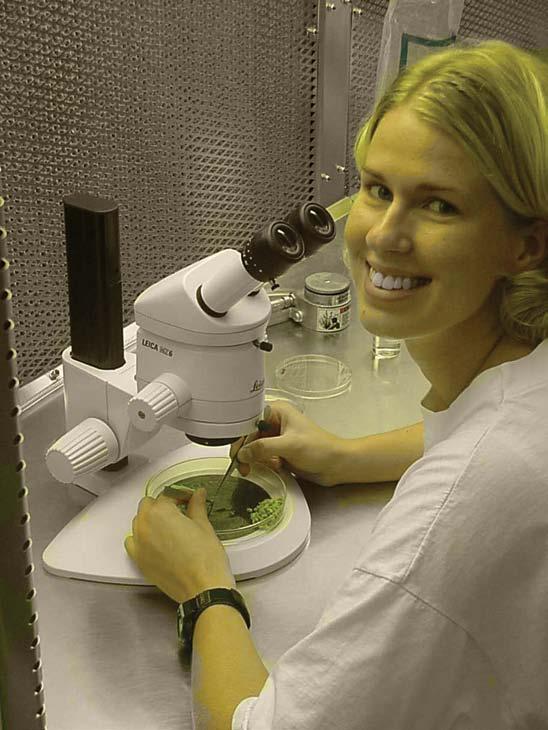
Leah Sandall examines a specimen.
Recruitment, from page 10
accounting look like architecture look like... Right now ANSTA is developing a new brochure that highlights what an agronomy major has to offer to 21st century students, while complying with the design standards imposed by admissions. We expect that this first brochure will be expanded into a whole recruiting campaign that will reach out to students from a wide background.
A third recommendation is to develop innovative curriculum that will appeal to students from outside our traditional agricultural base. Don’t be concerned that we are abandoning our roots in the farms and ranches of the state, but the fact is that there are fewer young people on those farms and ranches and if agronomy is to serve the needs which are described above, we must do it by going where the students are. Two new majors are in varying stages of development. The first is a major in plant science which may be offered cooperatively with the School of Biological Sciences. This major would appeal to strongly science-oriented students who have an interest in plants on a genetic or ecological basis, not necessarily as an ornamental or source of food. The second proposed major is in turfgrass science. While horticulture has had a turf option for many years, some universities nationally have had great success in recruiting urban students into high-profile turf programs. Both of these proposed majors are similar in that they use expertise already available in agronomy and horticulture, but emphasize coursework and non-class experiences that we believe will appeal to students from a broad variety of backgrounds — urban or rural, with interests in science, art, business, or any area that can be tied to the use and appreciation of plants.
Finally, while recruiting materials and curricula are important, a large part of recruiting is just hard work. Many department’s personnel, but particularly Cheryl Moncure, the department’s recruiting coordinator, have devoted significant amounts of time to contacting students, arranging campus visits, and working with secondary school teachers to let students know that we’re not just “cows and plows.”
Cheryl has made countless telephone calls at night to high school students and their parents to help them understand what a significant benefit a major in agronomy or horticulture can be and how each student’s unique talents can be nurtured in our programs.
You can be part of that recruiting effort. Our alumni and friends can be our most effective tool, particularly at the early stage of identifying possible students. If you know of a student who might be interested in one of our majors — a son or daughter, niece or nephew, child of a friend or neighbor — contact Cheryl Moncure or Dennis McCallister, supply us with the name and address of the possible student, and we will do the rest. Remember, you won’t just be helping the Department of Agronomy and Horticulture, you may be helping a promising young person to a lifelong career in a field with almost unlimited promise.
Student internships
by George L. Graef
One important way that people learn is through experience. We, in the Department of Agronomy and Horticulture, provide experiential learning opportunities for our students in several of our classes, with demonstrations and laboratories and thorough class visits with researchers and their active research programs. Another important opportunity available to students is formal internships. When I talk with students about internships and ask them why they might participate in an internship, what is its value, they quickly identify experience as a major advantage. The other benefits they list include the opportunity to try something new, learning more about an area they are interested in, having the possibility of longer-term employment, competitiveness in future job interviews because of the experience, references, contacts, and confidence that are developed during a good internship.
Types of internships in which students have participated include
- crop scouting, - sales and marketing, - agronomy service, and - research and development.
Opportunities exist with the University of Nebraska and the USDA-ARS research programs at UNL, as well as with companies ranging from a 2- or 3-person operation involved in regional crop scouting to a multinational company that provides many services to customers, from chemicals and seeds to sales and agronomy support. In addition to the experience and income from their position, students can receive academic credit for their internship through Agronomy 295. To receive the credit, we develop objectives for the internship, and the student is responsible for a written and oral presentation on their internship experience, relating to the specific objectives. The presentations are to others in the internship class at that time, and to incoming freshmen so they can learn about some of the opportunities available to them as they consider their coming years here at UNL. As part of their report, the students also provide feedback on their background and education here, what was useful to them, and what was lacking, so we can use that information in our continuing course improvement efforts. I am impressed with the quality and number of opportunities that our students have had, and with the professionalism they display in their internships and the written and oral presentations. What a great experience!
Each problem that I solved became a rule which served afterwards to solve other problems. — Rene Descartes
Student athlete academic recognition - 2005
All article materials excerpted from Huskers.com.
Among the three-time honorees for the Brook Berringer Citizenship Team were three 2004 seniors including defensive lineman Jeff McBride, an agronomy major. Jeff, son of Joe and Sheila McBride, Brule, Nebraska, was recognized for high academic honors. He was one of several Department of Agronomy and Horticulture students honored at the Student-Athlete Academic Recognition Banquet on April 17, 2005.
The Brook Berringer Citizenship Team was established by the Husker football program in honor of former Nebraska quarterback Brook Berringer, who died in a plane crash in April of 1996. Berringer was a member of NU’s back-toback national championship teams in 1994 and 1995. He was also one of the most dedicated Husker volunteers in the community with youth, both in Nebraska and in his hometown of Goodland, Kansas. The team honors players who display a similar love and dedication for volunteering in the community.
Before coming to UNL, Jeff earned all-state honors at South Platte High School, while playing linebacker and tight end. He was also a National Honor Society member, while earning four letters in football and three each in track and basketball.
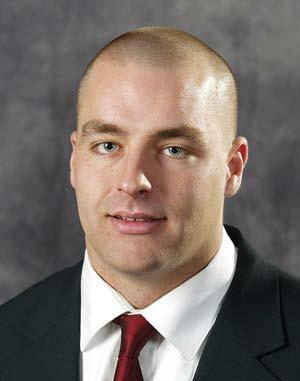
Also among the threetime honorees for the Brook Berringer Citizenship Team was junior fullback Dane Todd, son of Kim Todd, a agronomy and horticulture faculty member.
2002, where she was a Texas Scholar and a member of the National Honor Society.
Chelsea Gehring, a junior, and member of Nebraska’s golf team was also recognized at the banquet for earning highest academic honors. Additionally, Gehring earned her seventh selection to the Big 12 Commissioner’s Honor Roll. One of the Huskers’ top players during the 2004 fall campaign, the Aberdeen, South Dakota native carries a cumulative GPA above 3.9 as a horticulture major.
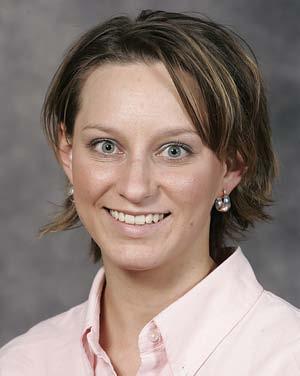
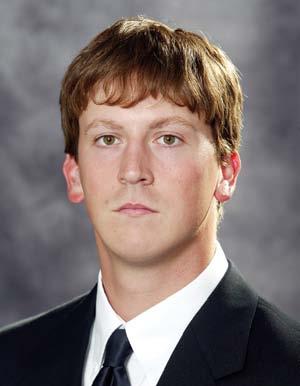
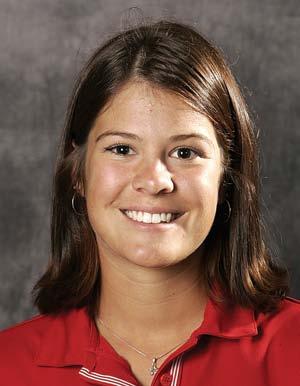
Top (L-R) Jeff McBride, Misty Chanek, bottom row (L-R) Chelsea Gehring, and Mike Stuntz. Photos courtesy: Nebraska Sports Information, Scott Bruhn, photographer.
Misty Chanek, who majors in horticulture at UNL, was also recognized at the banquet. She has earned academic honors as well as second-team NRA All-American honors in both air rifle and smallbore. According to her coach, Misty has developed into a team leader and brings the most experience to Nebraska’s rifle team. She has proved that she can shoot scores that are among the top in the country.
Misty, the daughter of Lewis and Linda Chanek, is from Ganado, Texas. She graduated from Ganado High School in
Chelsea, the daughter of Rick and Crystle Gehring was a four-year letterwinner at Aberdeen Central High School, and a fourtime qualifier for the South Dakota 2A State Championship.
Also recognized for high academic honors at the banquet was Nebraska’s football quarterback Mike Stuntz who carries a 3.528 GPA. A major in Professional Golf Management, Mike has been on the Big 12 Commissioner’s Academic Honor Roll each semester during his Nebraska career.
Stuntz played receiver as a true freshman in 2001, and earned a permanent place in Husker football history with a 63-yard touchdown pass to quarterback Eric Crouch on a reverse pass to clinch Nebraska’s 20-10 victory over No. 2 Oklahoma.
Stuntz led Council Bluffs St. Albert High School to a 30-4 record in his three years at the school. He played quarterback, defensive back and returned kicks for Coach Jim Duggan, earning All-America athlete honors PrepStar and All-America quarterback accolades from SuperPrep. Stuntz earned first-team all state honor defensive back and the Omaha World-Herald named him to the All-Western Iowa team and the All-Omaha team. Stuntz also lettered three years in basketball.
Mike, the son of Wendell and Lyn Stuntz, is from Iowa City, Iowa.

TMeet a few of our agronomy and horticulture staff
by Jeanne Swartz, Sue Walker, and Roger Renken
The agronomy and horticulture support staff has once again excelled for the 2004-2005 fiscal year. They have demonstrated their dedication to quality performance, spirited teamwork and determination to further strengthen the department’s achievements. Over the past year we have had dedicated individuals retire or move on to expand their career opportunities. We wish them the best and we welcome the new members into our family as we look forward to another year of outstanding service.
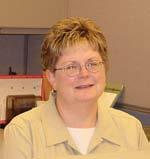
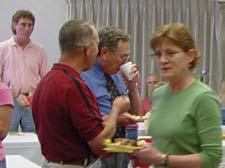
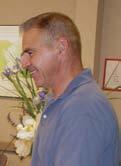
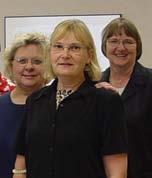
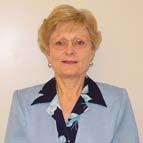
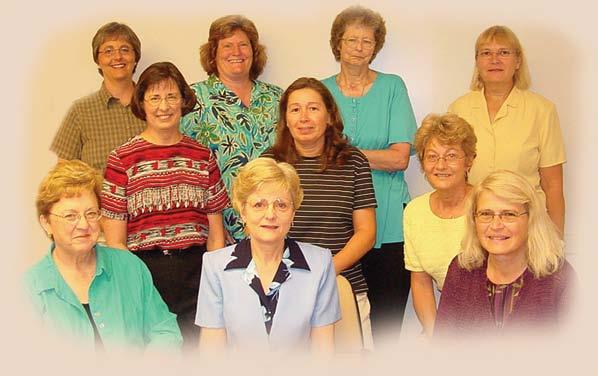
he HAPPI Business Center’s (BC) mission is to provide faculty and staff with efficient, quality, cost-effective business services through specialization of activities, communications and technological adaptation. The BC is comprised of portions of 10 staff members, with the largest and smallest amount of time dedicated to the BC being 100% and 5% respectively. HAPPI is responsible for all human resource, financial, and business processes for the Departments of Agronomy and Horticulture, Plant Pathology and INTSORMIL. The BC is dedicated to operating in a teamwork environment which includes cross training so business activities continue regardless of staff absences. HAPPI staff focuses on continual process improvement(s) and the elimination of inefficiencies or redundant practices to provide the highest quality services possible.
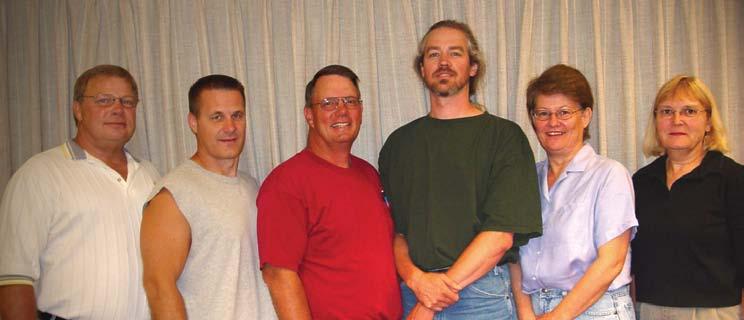
The Staff Advisory Committee (SAC) was established in July 2003 in response to the results of the first Gallup Neighborhood Environment Survey. The SAC functions to represent staff interests, serve as a communication link between faculty and staff, and to communicate concerns and solutions to the department head and Faculty Advisory Committee. The eight elected representatives come from a wide variety of workplace environments including: secretarial and support staff, field and lab technologists and managers. Each member serves a two year term. The SAC works to improve our departmental workplace by soliciting staff input through information gathering meetings and surveys, supporting staff learning and professional development opportunities, and encouraging more interaction among staff.
Diane
Marlene Busse;
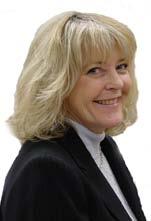
Pictured (L-R) from top: Lowell Moser, interim department head. Second row: Kate Lonergen-Orr (recently departed), Brenda Gibson, Bruce Anderson, Kat Cockrill, Alex Martin, Donna Michel, Marlene Busse, Kathy Bennetch, Sherrill Hayes, JoAnn Collins (recently retired). HAPPI Business Center (L-R) from top: Susan Thomas,
Sullivan, Leslie Brooks,
center row (L-R): Margaret Denning, Mary Jo Haverkamp, Jeanne Swartz; bottom row (L-R): Carolyn Bossung, Sherrill Hayes, and Sue Walker. Staff Advisory Committee (L-R): Doug Miller, Greg Teichmeier, Jerry Bohlmann, Roger Renken, Carol Caha, Marlene Busse, T. J. McAndrew (not pictured).
EFFECTS OF GLObAL WARMINg ON RICE yIELD
by Kenneth G. Cassman
There is mounting evidence that the earth is warming due to the “greenhouse effect”, which is caused by increased concentrations of carbon dioxide (CO2) and other radiatively active gases in the atmosphere. The primary source of this greenhouse gas enrichment is the release of CO2 from combustion of fossil fuel to produce energy and for transportation. The clearing of rainforests, tropical savannahs and native prairies to cultivate crops also releases substantial amounts of CO2 to the atmosphere.
Higher concentrations of greenhouse gases in the atmosphere serve as a transparent blanket that traps heat. The result is a steady increase in average global temperatures associated with the increase in greenhouse gas enrichment. The most likely warming scenarios indicate that average surface temperatures will increase from 1.5 to 4.5oC (about 3-8oF) by the end of this century.
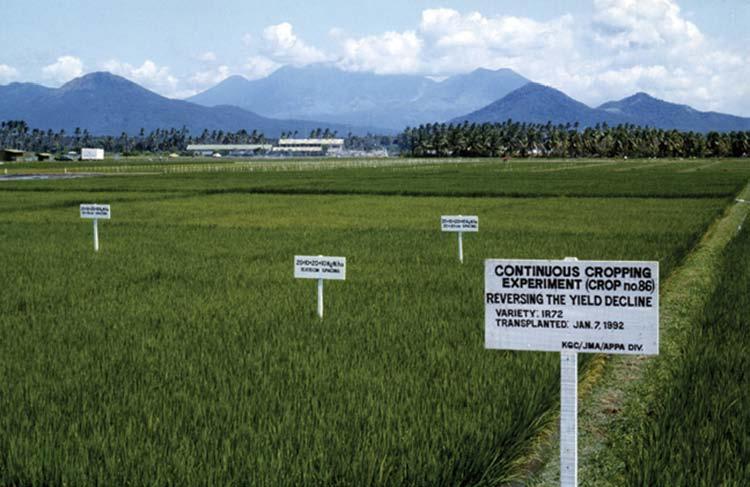
Pictured above, long-term field experiment at the International Rice Research Institute in the Philippines where irrigated rice is grown in treatments that provide optimal crop and soil management such that yields are affected only by temperature and solar radiation.
A key issue for future global food security is whether the net effect of increased atmospheric CO2 and warmer air temperatures will have a positive, negative, or neutral effect on crop yields. While we know that greater atmospheric CO2 increases plant photosynthesis and yield when temperatures are held constant, the interactive effects of warmer temperatures and increased CO2 are not well defined. Until recently, this question could only be evaluated using computer simulations or studies conducted in artificial growth chambers, and results from such studies have not been validated under actual field conditions—which is the ultimate test.
Because of a commitment to long-term research on improvement of rice production at the International Rice Research Institute (IRRI) in the Philippines, my IRRI colleagues and I had the opportunity to investigate the combined effects of global warming and increased CO2 under normal field conditions for rice production in tropical Asia—a region that accounts for more than 70% of global rice production. Since 1979, IRRI scientists have maintained a weather station that has provided accurate records of daily maximum and minimum air temperature and solar radiation in the rice fields at the Institute’s 200 acre research farm. Using these climate data, we found a steady increase in average daily air temperature of 0.75oC (1.33oF) between 1979 and 2003. Consistent with greenhouse warming theory, the increase in nighttime minimum temperature was much greater than the increase in daytime maximum temperature.
Fortunately we also had yield data from field studies in which rice was produced each year with irrigation and optimal management such that variation in temperature and solar radiation were the only factors affecting crop productivity. We therefore examined the relationship between rice yields and average temperatures during the growing season and found that rice yields decreased by 10% for every one degree Celsius increase in minimum nighttime temperature. The effect of changes in solar radiation and daytime temperature was not significant.
The results from this study were published in the Proceedings of the National Academy of Science and they document that the combined effects of global warming and increased CO2 are negative on rice yields because our data were obtained from normal field experiments where rice was grown under ambient atmospheric CO2 and temperature. Therefore the negative effects of warming more than offset the benefits of the increase in atmospheric CO2.
While our study did not investigate the cause of the yield decrease with higher nighttime temperatures, the most likely explanation is that the rice plant expends additional energy to maintain itself under higher temperatures (a process called maintenance respiration), which reduces the amount of energy obtained from photosynthesis that can be utilized for growth.
If increased respiration costs prove to be the primary mechanism by which higher nighttime temperatures decrease yields, then the prospects for genetic improve-
Turn to global warming, page 15
global warming, from page 14
ment to maintain yields under higher temperature regimes are not very promising because there appears to be little genetic variation in respiration efficiency. Instead, farmers will have to select rice varieties with maturities and planting dates to avoid periods of highest temperature, switch to alternative crops that are less sensitive to high temperatures, or expand production area to make up the loss of yield in current production centers.
Although the IRRI study focused on rice, my UNL colleagues and I have recently begun to investigate the effects of higher temperatures on corn yields in the USA. Initial results indicate that corn is just as sensitive as rice to higher temperatures in much of the USA Corn Belt.
If the negative effect of global warming on yield proves to be consistent for all of the major cereal crops in their centers of production, maintaining the yield increases required to meet the food requirements of an expanding global population will become an increasingly difficult challenge unless climate change can be averted.
Editor’s note: Kenneth Cassman’s breakthrough research on rice yields and global warming published in the Proceedings of the National Academy of Sciences in June 2004 was featured worldwide, including the New Scientist, the Toronto Star and dozens of other newspapers and was considered to be one of the world’s top 100 scientific discoveries in 2004 as ranked by Discover Magazine.
Lifelong learning — truly anytime, anyplace
by Deana Namuth (dnamuth@unl.edu)
Our department’s innovative distance education program continues to grow and offer more opportunities for progressive producers, extension educators, high school science teachers, and professionals representing industry and governmental agencies. We are aggressively meeting the needs for learners seeking continuing education units for a professional certification, as well as those wanting academic credit to apply towards a traditional master’s degree or one completely distance delivered. Many of our “students” are also simply seeking the latest information available from our department’s cutting edge research to enhance their own current careers and effectiveness.
The flexibility of distance delivery technologies has enabled these place-bound and/or time-bound professionals to obtain up-to-date educational information, which would otherwise be unavailable due to their geographic
locations and/or already full lives. We continue to offer our curriculum in small, one unit course modules and so far this continues to meet our learner needs well. Our program has grown to include 24 of these one credit modules in areas such as crop genetics, weed science, turf, horticulture and soils. Several more in the fields of soil science, horticulture and organic farming are planned for this next year. Information for each module can be found at: http://agronomy.unl.edu/distance_ed/index.htm. In collaboration with the Department of Entomology this year, we created an online advising center for supporting our college’s distance students. Take a look at this new resource to learn about both the credit and on credit options available throughout CASNR - http://casnrde.unl.edu. We now have available a non-thesis, distance delivered master’s degree in agronomy, with certificate options also being developed for both agronomy and horticulture areas.
The Library of Crop Technology project (http://croptechnology.unl.edu) continues to grow and expand. It now houses 70 different lessons (7 in Spanish) and 87 animations (17 in Spanish). This past year, 2.9 million hits were recorded from 51,693 unique visitors in 108 different countries. It has now won 6 different awards, with collaborators in over seven different universities and over $745,000 in grants and industry partnerships to support it. The newest grant to this resource is being led by Dr. Martha Mamo, funded by the National Science Foundation, partnering with Patricia Hain, Dr. McCallister, Tim Kettler, Dr. Husmann (AgLEC), Dr. Zanner (SNRS) and collaborators in three different institutions. We also established a partnership with Agriliance, to use this electronic library resource for their employees to earn online CEUs. The project will have a new look, name and features, starting this fall. We continue to have big aspirations for it to continue meeting public education needs in horticulture and agronomy topic areas for Nebraskans and fellow citizens around the globe.
Another new Web site is currently in development, to also be launched this fall. It features an extensive database of herbaceous perennials found in the northern Great Plains. Watch for announcements on its availability. In addition, the Pesticide Education Web site (http://agronomy.unl.edu/distance_ed/index.htm) will soon be getting a new look. Whew, as you can tell, it’s been a very busy and progressive year for us. It has been a joy to lead our department’s distance ed efforts as we pioneer new cyber-space frontiers!
When one door of happiness closes, another opens: but often we look so long at the closed door that we do not see the one which has been opened for us.
— Helen Keller
CORN bREEDINg FOR FARMERS
by Don Lee, W. Ken Russell, and Leah L. Sandall
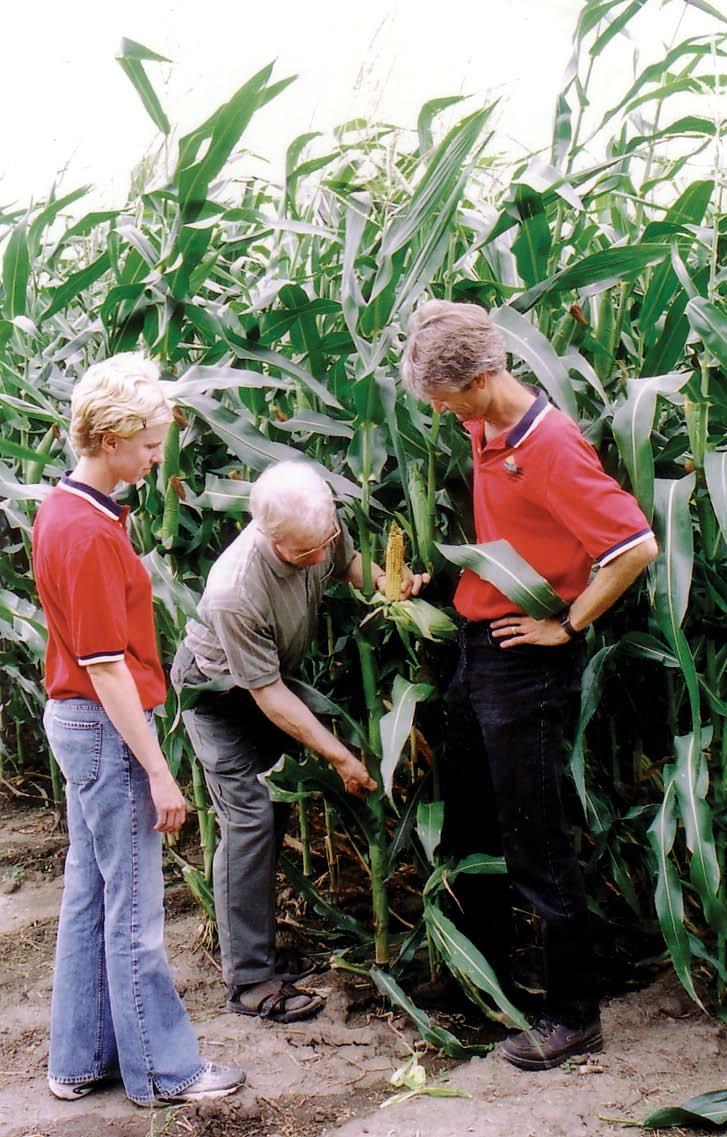
On May 20th, drivers on Highway 15 in Saline County might have wondered what graduate student Leah Sandall, Dr. Don Lee and local farmer Henry Kumpost were doing with those threefoot long metal devises and all the small brown envelopes in one of Henry’s fields north of Western, Nebraska. They might have been even more curious if they drove by several hours later and saw this team working in the same small part of the field. When Leah, Don and Henry completed their four-hour task with the hand planters and seed packets, they had established a test plot that had been carefully planned by Ken Russell and his
corn breeding team as a part of the “Corn Breeding for Farmers” project.
A critical part of a plant breeder’s work is selection and testing. The 20 participants in the SARE funded “Corn Breeding for Farmers” project are working together this summer to plant and monitor test plots that are located as far west as Holdredge, Nebraska and as far east as Ohio. In each test plot are over 300 unique, experimental hybrids, and each test plot has exactly the same hybrids. The participants followed precise planting instructions so that the yield of every hybrid plant can be determined this fall. The performance of these experimental hybrids across all the test plots will be determined and compared during a workshop this winter. The best hybrids can then serve as the new starting point in the never-ending process of breeding better corn.
As the seed industry changes and seed needs of farmers diversify, the demand for better understanding of plant breeding by farmers has grown. The primary goal of the “Corn Breeding for Farmers” project is to provide a practical understanding of corn breeding with hand’s on learning experiences. Classroom and field workshops in 2004 provided essential background information for participants on key concepts in corn breeding and some instruction on field operations required to plant, manage, and harvest this year’s test plots.
The participants are looking forward to gathering yield data this fall. At a workshop this coming winter they will share these data and learn proper procedures for data analysis. This project is an example of the diverse educational and research missions that are being met in the agronomy and horticulture department at the University of Nebraska–Lincoln.
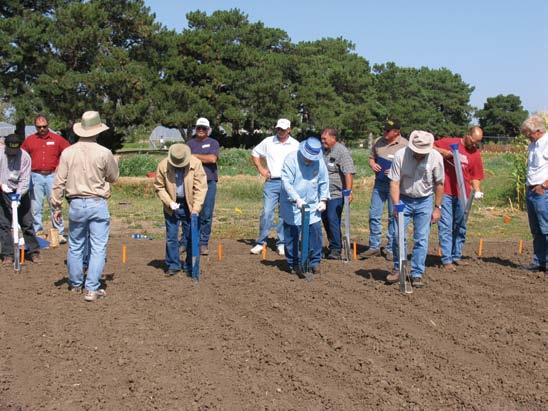
Participants from the Corn Breeding for Farmers project practice hand planting at the September 2004 field workshop.
Agronomy and horticulture graduate student Leah Sandall, corn breeder Ken Russell and geneticist Don Lee inspect corn at their research plot on East Campus as part of their preparation for another year of teaching “Corn Breeding for Farmers.”
Photo by Brett Hampton, IANR
Undergrads collaborate on research efforts
by David Ochsner – excerpted from Spring/Summer 2005 Research Nebraska
Students gain valuable scientific experience
Undergraduate students at the University of Nebraska–Lincoln learn about research firsthand.
Several programs offer students the chance for hands-on research experience working with Institute of Agriculture and Natural Resources scientists on research that benefits the public. Working with scientists and graduate students helps undergraduates choose educational opportunities and careers.
“I have a much better idea of what I can do next,” said Nancy JimenezGonzalez, a junior biology major from Lincoln who analyzes DNA from high-protein soybeans developed by IANR plant breeders. “I know that when I graduate I will be able to do genetics work.”
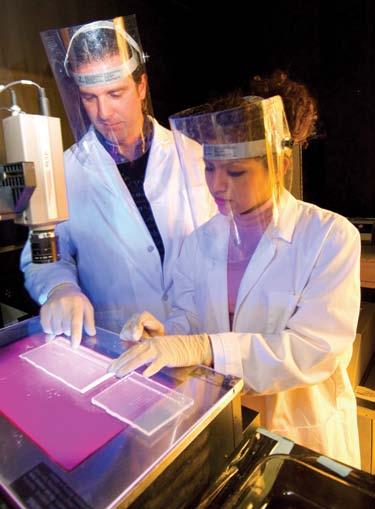
for research to identify genes responsible for important traits such as protein content. Graef says undergraduates make a big difference in advancing his lab’s research.
Her adviser, plant breeder George Graef, said he doesn’t hire undergraduates merely to perform tasks.
“Their work makes a big difference in the way things get accomplished in the lab.”
Jimenez-Gonzalez’s work helps plant breeders pinpoint genes that influence protein levels and aids ongoing research to boost the nutritional value of soybeans, a plus for consumers and producers.
IN MEMORIAM
gail A. wicks
by Robert Klein

G1926-2005
ail A. Wicks, weed scientist, located at the University of Nebraska West Central Research and Extension Center in North Platte passed away peacefully on Monday, February 21, 2005. He was born May 26, 1932 in Carpenter, South Dakota. He grew up on the family farm attending a one-room schoolhouse where he was the only student in his grade. He received a bachelor’s degree in 1954 from South Dakota State University and his master’s degree in 1959 also from South Dakota State University. He served as a second lieutenant in the Army during the 1950s. He was a professor of agronomy for the University of Nebraska, working at the West Central Research and Extension Center for 47 years. On August 19, 1956, he married Gloria Jean King. Gail will be remembered as a loving husband, father, grandpa, researcher, and coach. Mr. Wicks was actively involved in many areas of his community. He was a member of First Evangelical Lutheran Church, serving in many capacities over the years. He and Gloria helped hundreds of girls grow to become successful women through the Belles softball teams for more than 35 years. He was inducted into the Nebraska Amateur Softball Association Hall of Fame in 1993. He was a longtime Rotarian. Survivors include children Cynthia Schuch of Belton, Missouri, Nancy Oerter of Hastings, David Wicks of Seattle, Washington; six grandchildren; and brother Jerry Wicks of Carpenter, South Dakota. He was preceded in death by his wife Gloria. The positions he held at the university were May 26, 1958 - assistant in agronomy; July 1, 1960 - instructor in agronomy; July 1, 1963 - assistant professor in agronomy; July 1, 1971 - associate professor in agronomy; July 1, 1976 - professor in agronomy.
If you would like to contribute to a memorial fund to be used for establishing and maintaining a Web site featuring Gail Wicks’ papers, please make your check payable to the University of Nebraska Foundation indicating that it is for the Gail Wicks Memorial Fund and send it to:
There are only two ways to live your life. One is as though nothing is a miracle. The other is as though everything is a miracle.
— Albert Einstein
Linda Lehmann, West Central R & E Center 461 West University Drive North Platte, NE 69101.
Above: IANR soybean breeder George Graef and Nancy Jimenez-Gonzalez, a junior biology major, examine soybean DNA samples
Photo by Brett Hampton, IANR

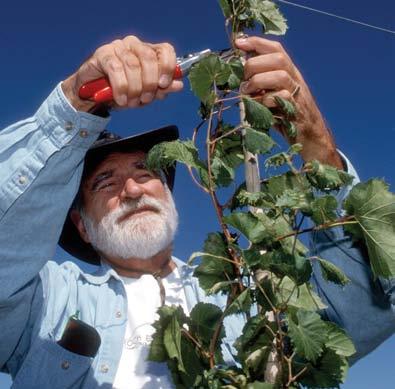

Photo by Brett Hampton
A New Course: HORT/NUTR
by Paul E. Read
With the rapid development of Nebraska’s emerging grape and wine industry, the need for a comprehensive course became apparent, said Paul E. Read, professor of horticulture and viticulture in the University of Nebraska–Lincoln, Department of Agronomy and Horticulture. In response to student inquiries requesting an opportunity to learn more about grapes and wine, Read has developed a new course entitled, “Vines, Wines and You”, a detailed survey of viticulture (the study of grape growing) and enology (the study of wine and winemaking).
“Vines, Wines and You” introduces the student to important aspects of viticulture, including botany of the grapevine, site selection, cultivar selection, trellis types and construction, vine management, weed and pest control and nutritional needs of grapevines. A special section examines the archaeological evidence that grape culture and winemaking were practiced over 9,000 years ago, followed by discussions of how grape growing and winemaking influenced ancient cultures, from biblical references through Babylonian, Egyptian, Greek and Roman eras and on into modern times.
and winery where production practices are discussed, both in the vineyard and in the winery. The science of winemaking is studied, including the influence of vineyard environment, yeast selection, microbial management, handling of the grapes and the must (crushed grapes and juice) and the effects of skin contact and use of oak cooperage. Bottle types and closures, including study of cork oaks, their culture and harvest of the bark from which the corks are made are also examined.
A health professional provides a guest lecture on societal issues related to alcoholic beverage consumption. Safety issues are discussed, with an emphasis on moderation and precautions such as avoiding high-risk behaviors and use of a designated driver. The business aspects of grape growing and winemaking are presented, including a guest lecture by a member of the retail industry.
A student writes: “This course could be listed to meet the ‘International Studies’ requirement. I learned more about the world than in classes officially listed for this requirement.”
The several uses of grapes and their products are discussed, including production of wines, raisins, table grapes, jams, juices, jellies and other value-added products. Cooking with wine, matching food and wine, how to read a wine label and ordering wine in a restaurant is also part of the class.
An examination of “Wines of the World” concludes the course with students being instructed on how to evaluate wine, followed by sampling of wines from important wine regions, from around the world, ending with a survey of Nebraska wines. Emphasis is placed on “terroir”, the French word that refers to soils, climate, and other factors embodying a “sense of place” that influence wine quality and characteristics. As a result, students learn a great deal about geography and the environment, prompting one student to write, “This course could be listed to meet the ‘International Studies’ requirement. I learned more about the world than in classes officially listed for this requirement.”
Students gain hands-on experience with pruning, vine training and measurement of grape characteristics that determine harvest timing. A field trip is taken to a commercial vineyard
Rigorous exams are included as an important part of the course and students registering for graduate credit must complete a special project in which a single topic relating to grapes or wine is reviewed in-depth and reported to the class. Following the final exam an optional “lab final” takes place at a local restaurant, a formal dinner with an appropriate wine to match each course – a fitting grand finale to this popular class.

HORT/NUTR 471/872
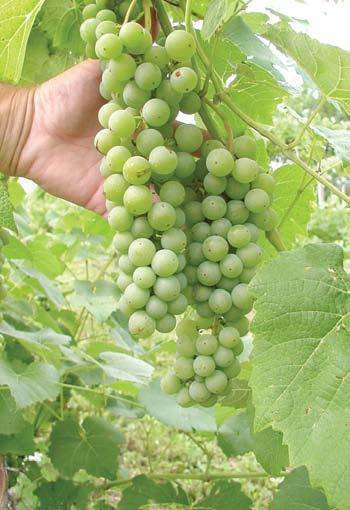
• Left: Students learned about various types of grapes such as Gewürztraminer located at the University of Nebraska Research site.
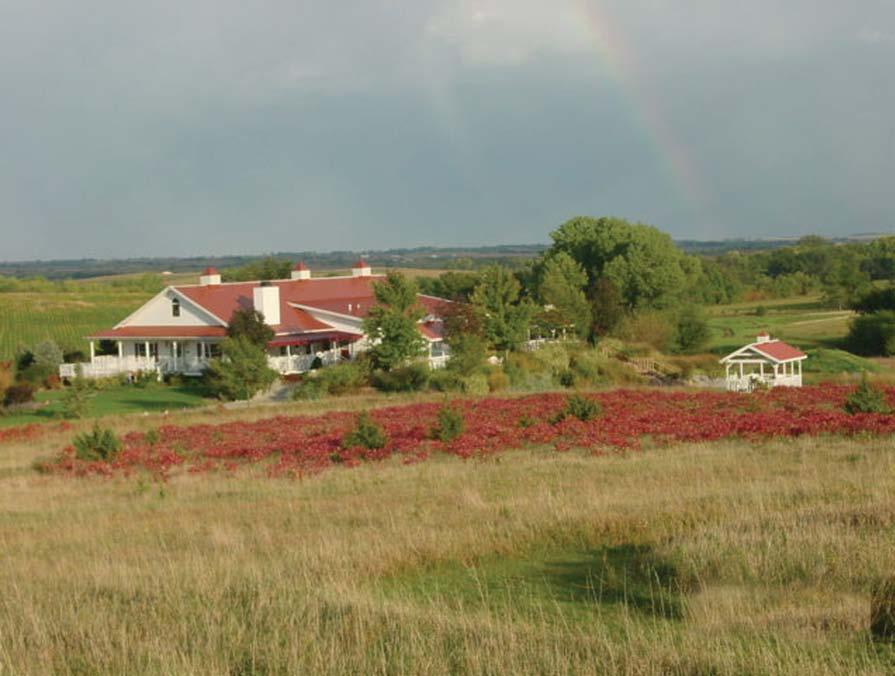
• Below: James Arthur Vineyards, Raymond, Nebraska.
•
•
far
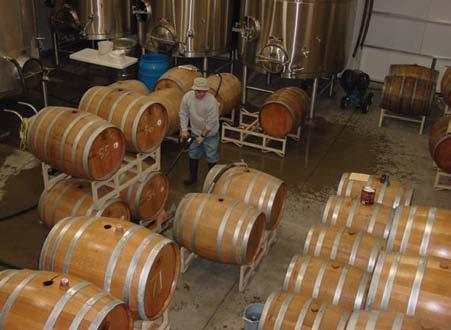
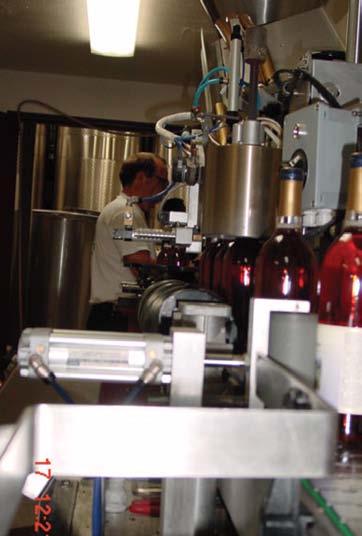
Photo below courtesy of James Arthur Vineyards
• Far right: Students observe bottling of wines.
Center: students learn about oak cooperage while touring a commercial winery, James Arthur Vineyards, Raymond, Nebraska.
Above,
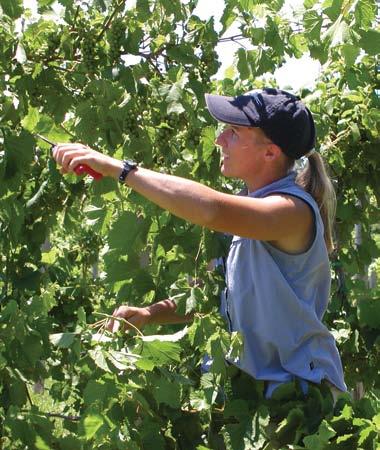
left: students have hands-on experience with pruning and trellis systems.
The Platte Valley Nitrogen and Irrigation Management Demonstration Project
by Richard Ferguson and Dean Krull
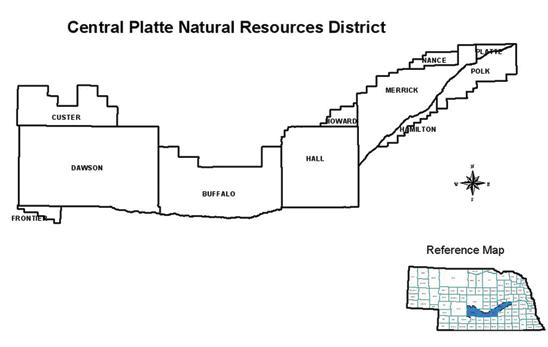
The Platte Valley Nitrogen and Irrigation Management Demonstration Project has been one of the longest existing demonstration projects in Nebraska and probably the nation. Other demonstration projects within the state and nationally have been modeled after this project. This educational effort, conducted in cooperation with the Central Platte Natural Resources District (CPNRD), was initiated in 1984 following the Hall County Water Quality Special Project. Dean Krull has served as the project coordinator since its inception. The primary financial supporter for this demonstration project has been the CPNRD with grants exceeding $1.3 million since its initiation. The Platte Valley Project includes parts of eleven counties in the central Platte Valley which includes the entire CPNRD.
Within these boundaries there are areas with groundwater nitrate-N concentrations in excess of 40 ppm - among the highest in Nebraska. Due to a combination of coarse-textured soil, shallow groundwater, intense
irrigation and historic over-application of nitrogen for corn, groundwater nitrate contamination exists in a large portion of the CPNRD. In 1988, the first groundwater management area (GWMA) was established in the CPNRD to address increasing nitrate contamination. This plan has addressed the contamination problem using a phase system based on the average nitrate-N found within areas of the NRD. As groundwater nitrate concentrations increase, producers must adopt certain practices and report information annually to the NRD. The management requirements for each phase are:
• Phase I
Fall N application prohibited until November 1.
Fall N application prohibited on coarse-textured soils.
Spring application after March 1.
• Phase II (in addition to Phase I requirements)
Annual soil residual nitrate analysis from every field. Annual nitrate analysis of irrigation water for each well.
Annual report to NRD for each field, consisting of soil and water analysis, expected yield, crop grown, rates of fertilizer and irrigation applied, actual yield. Manual and legume N credits must be utilized. Farm operators must be certified in nitrogen management by NRD.
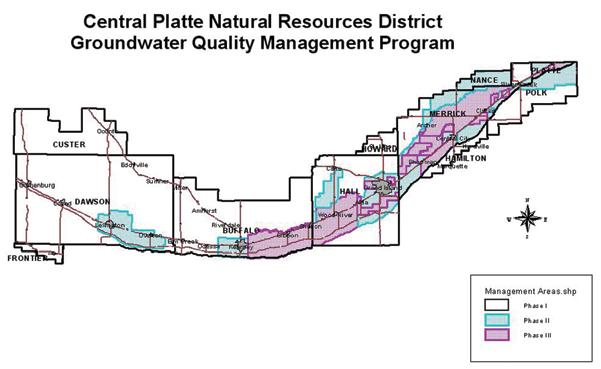
• Phase III (in addition to Phase II requirements) Fertilizer application prohibited on all soils until after March 1.
Preplant N application in excess of 80 pounds requires the use of and approved nitrification inhibitor.
• Phase IV (may be established in the future, in addition to Phase III requirements).
Expected yield set by the NRD, (prior 5 years + 5%). Nitrogen application must not exceed NRD recommendations.
Over the past 21 years, more than 300 demonstration sites have been located on producers’ fields in the project area. Randomized, replicated rates of nitrogen have been applied on most of these locations, usually in increments of 50 pounds above and below the calculated nitrogen recommendation based on the University of Nebraska’s algorithm. In many areas of the district, significant credit is allowed for nitrate in irrigation water. The aerial photo on page 21 illustrates the value of crediting nitrate in irrigation water. At this furrow-irrigated site, the lower end of the field has furrows blocked, causing irrigation water to back up into the field. Where this has occurred, lighter green color of unfertilized check strips disappears, as adequate N is supplied from irrigation water alone. The irrigation water contained 39 ppm nitrate-N at this site. Additionally, efficient application of irrigation water has been encouraged, with irrigation scheduled by project staff at all sites. Many sites have also included demonstrations of irrigation practices, such as flow meters, surge valves, and scheduling methods.
Turn to Platte Valley, page 21
Platte Valley, from page 20
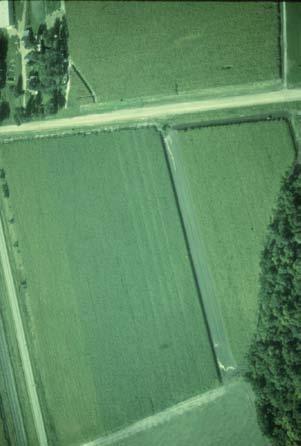
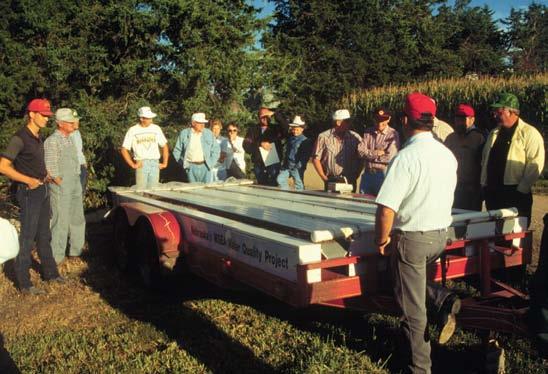
Cooperator demonstration sites have provided a point of focus for over 240 field days and winter meetings. Results from these field length, producer applied, and producer harvested plots have been instrumental in the adoption of water quality BMPs by the producers of the CPNRD. A survey of producers in the district in 1997 showed that 54% of the producers responding, tested irrigation water for nitrate-N, 34% used a nitrification inhibitor and 70% attended a tour or meeting on best management practices to protect water quality.
The emphasis of the project today is particularly in areas of the district which are not seeing declines in groundwater nitrate concentrations. Steady or increasing nitrate levels may be due to cropping systems commonly used in those areas, soils which are particularly vulnerable to nitrate leaching, shallow aquifers, over-application of N and irrigation water, or combinations of these factors. Demonstration and educational efforts have been focused to address these “hot spots”. Crops such as seed corn and popcorn — typically inefficient users of N — have been associated with these areas. Demonstration sites have included loca-
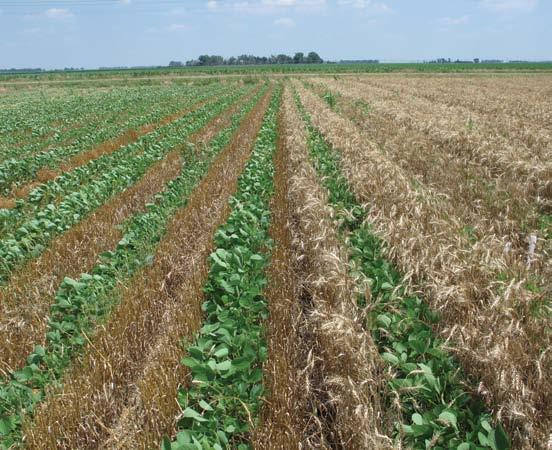
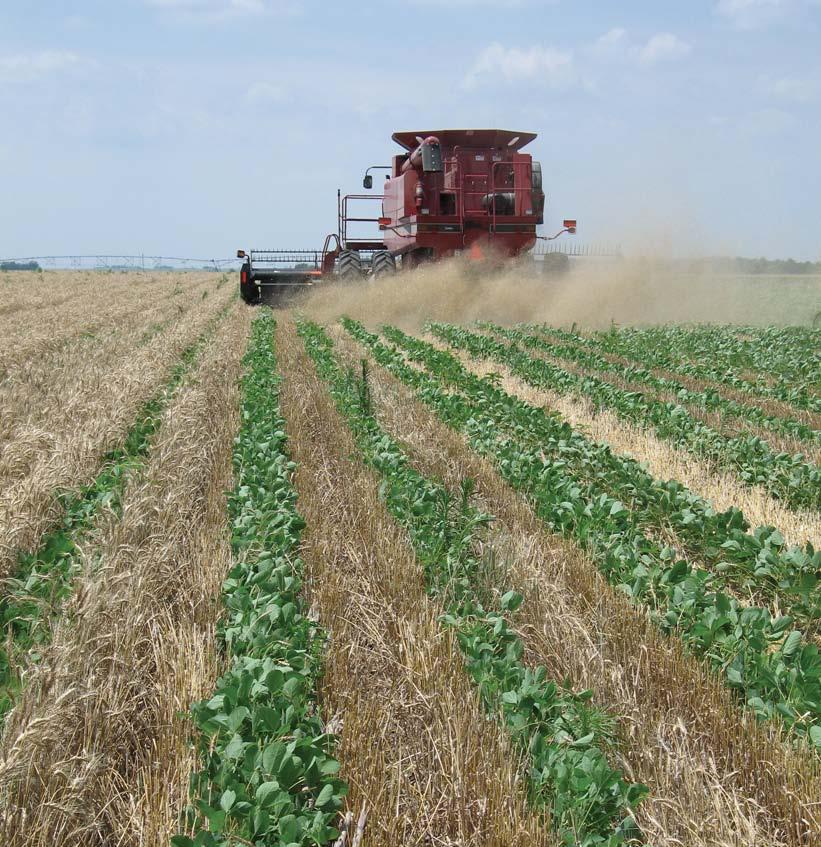
tions that address nitrogen fertility on both crops. With soil nitrate-N levels usually high following seed corn, a cropping strategy referred to as relay cropping is under consideration by some seed corn producers. This cropping system involves seeding winter wheat following seed corn harvest in the fall, then in the spring planting soybeans between the rows of wheat. Current studies are monitoring the effects of relay intercropping on the soil nitrate-N residuals, but the presence of an actively growing crop during the spring has the potential to significantly reduce nitrate leaching.
Aerial photo of a Buffalo County demonstration site.
Surge trailer demonstration at a farmer’s field day.
Relay cropping site in Buffalo County.
Urbanized buffalograss in
by David Ochsner, Spring/Summer 2005 Research Nebraska
Native grass tamed for water-thrifty turf
Sophisticated descendants of a tough native prairie grass are making a name for themselves in lawns, golf courses and public spaces around the nation.
Turf-type buffalograsses developed through two decades of University of Nebraska research are coming of age. They’re providing water-thrifty, sustainable turf options while accruing economic benefits for the state and the university.
“We have great demand from western states due to drought, and there’s growing interest in eastern states and overseas,” said Wayne Thorson of Todd Valley Farms near Mead. Among the buffalograsses his company grows and sells are Legacy and Prestige, two Institute of Agriculture and Natural Resources-developed turf-type buffalograsses that exemplify how research is transferred to producers and benefits Nebraska’s economy.
IANR’s modern turf buffalograsses are as tough as their prairie ancestors but thanks to careful breeding and selection, their looks are better suited for lawns. Improved types
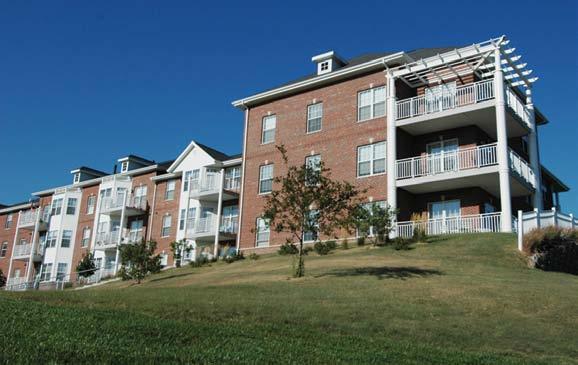
IANR’s improved turf-type buffalograsses are used in lawns, public spaces and golf courses around the country, such as this residential development in Lincoln.
The water-thrifty grasses are especially popular in water short areas.
generally are denser, darker green and keep their color longer than traditional buffalograss.
Buffalograss requires up to 50 percent less water than Kentucky bluegrass, needs far less mowing and fertilization, and grows in poor soils said turf scientist Terry
Riordan, who headed IANR’s turf buffalo grass research for 18 years.
The search for environmentally friendlier turf began in 1984 with a grant from the United States Golf Association, which has provided more than $1 million for IANR’s research.
“Their interest in reducing water, fertilizer and pesticide showed a lot of foresight,” Riordan said.
Collecting thousands of samples – mostly remnant Dust Bowl Days plantings – from Nebraska pastures, yards, cemeteries and old golf courses, scientists started test plots that included southern specimens.
The team’s first improved cultivar was a Texas strain, 609, which caught Texas sod producer David Doguet’s eye during a 1987 visit.
“It really stood out from the others, which had already gone dormant,” Riordan said. “The next year we took a van load of 609 plugs to Austin, and within a year they were ready to market it.”
It was a significant early success. IANR licensed 609 sales to a company owned by Doguet and golf great Ben Crenshaw. Although 609 wasn’t suited to Nebraska, royalties from its release helped support continued research.
Earlier improved buffalograsses came only as sod or plugs. In 1995, Cody became the first Nebraska-developed turf-type buffalograss available as seed from the Native Turfgrass Group, which is now comprised of Stock Seed Farms of Murdock and Arrow Seed of Broken Bow. The companies have since commercialized other IANR seeded buffalograss cultivars.
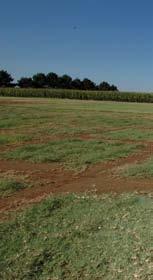
Legacy, a 2000 release, is a great-looking buffalograss suited to Nebraska’s climate. It’s available as a plug and as sod, and it has spread far and wide thanks to harvesting and packaging innovations resulting from collaborations between Thorson and university scientists.
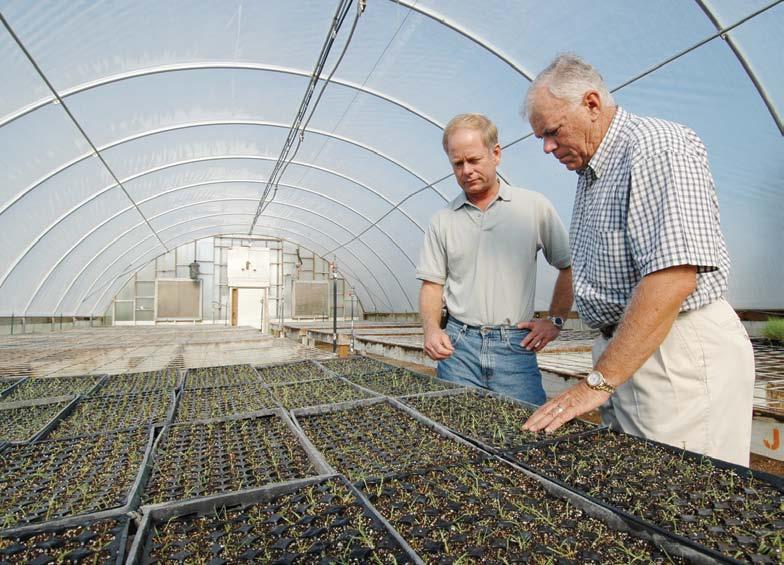
Todd Valley originally used plug harvesters developed at IANR. These plugs were heavy to ship, so Thorson developed a lightweight soil mix and moved his plug operation into a 55,000 square-foot greenhouse.
“We get Web and catalog orders for plugs from everywhere,” said Thorson.
Buffalograss has nationwide potential for golf courses, parks and roadways as well as home lawns, especially in water-short areas, said Bob Shearman, who was part of the original turf buffalograss team and assumed the lead role from Riordan in 2002.
Riordan won’t guess how widespread turf buffalograss will become, but in many areas where water is in short sup-
All photos by Brett Hampton, IANR
demand
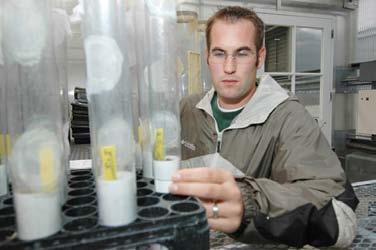
Tom Erickoff, an entomology graduate student, inspects buffalograss sprigs for chinch bug damage. His work is part of research to identify buffalograss lines that are resistant to such damage.
ply there may be few alternatives.
“From an environmental standpoint, it often will be the best choice,” he said.
Future research will expand turf buffalograss availability by developing more seeded types, said Shearman.
“For buffalograss to be widely accepted, we need to improve types that perform like Legacy but can also be seeded,” he said.
New molecular tools will speed the search for favorable buffalograss characteristics.
“What took 20 years before can now be done in five,” Shearman said.
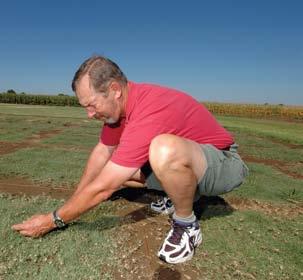
IANR scientists are the nation’s leaders in turf buffalograss research. Left: Turf Scientist Bob Shearman examines a buffalograss line that researchers selected because of its enhanced performance, tolerance to low mowing height and drought resistance. Interest is growing in water-thrifty turf and scientists continue to develop new buffalograsses that provide sustainable turf options.
Below: Wayne Thorson (left) of Todd Valley Farms and IANR turf scientist Terry Riordan check growth of buffalo grass plugs at Todd Valley’s greenhouse near Mead.
Grassy payoffs
by David Ochsner Spring/Summer 2005 Research Nebraska
The economic value of buffalograss has come a long way in two decades. Since 1990, nine turf buffalograsses developed by University of Nebraska–Lincoln researchers have been commercialized for sale to the public or the turf industry.
Private companies grow and sell these improved buffalograsses under licensing agreements with the university. Companies pay royalties in return for the right to sell these buffalograsses.
Royalties from buffalograss sales have earned the university nearly $1.1 million since 1990. Royalties help fund ongoing research.
This research also is a boon for Nebraska businesses like the Native Turfgrass Group and Todd Valley Farms at Mead.
For example, Todd Valley produces buffalograss sod on 165 acres in seven states. Its IANR-developed buffalograsses have been planted in every state except Alaska, and in Canada and Italy. Owner Wayne Thorson estimates his sod farms and plug operation produce enough buffalograss to cover as much as 100 acres of lawns, golf courses and other turf annually in the United States.
All this is the payoff for research by IANR turf scientists, who were among the first to examine buffalograsses’ turf potential. Before 1984, research focused on non-native grasses; buffalograss was primarily considered pasture grass. Today, the university is the nation’s leader in turf buffalograss research.

by Brett
Agronomy
Buffalograss test plots at the Agricultural Research and Development Center near Mead.
Photo
Hampton
BARTA BROTHERS RANCH
by Walter H. Schacht
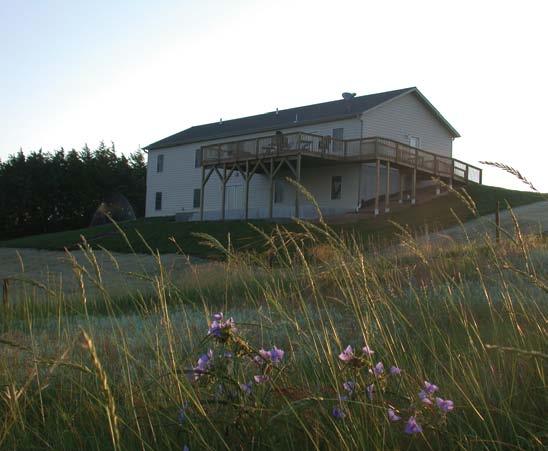
Located 20 miles south of Long Pine, the Barta Brothers Ranch (BBR) is the ideal setting to study rangeland ecology and management, wildlife conservation and management, and pasture windbreaks in the Sandhills. James and Clifford Barta operated the ranch until 1996 when they gifted it to the University of Nebraska. The 5,400 acres of rangeland in Brown and Rock counties now serve as a “model ranch” for a variety of research, demonstrations, and educational programs.
The ranch is administered through the Agricultural Research and Development Center with Dennis Bauer, extension educator at Ainsworth, managing the day-to-day operation of the facility. A planning committee, comprised of UNL faculty with research and education projects at BBR, meets periodically to plan and develop programs for the ranch. The Ranchers’ Advisory Committee meets frequently with the planning committee and management team to provide guidance in the direction of research and education programs at BBR. The Ranchers’ Advisory Committee was formed in 1997 and has played a critical role in all aspects of ranch development.
Improvements have been made to utilize the ranch for research involving grazing systems and yearling cattle grazing. Over 88,000 feet of water pipeline have been installed along with two wells, a pump house, 38 hydrants, and 31 tanks. Approximately 8.5 miles of permanent fence along with 13.5 miles of hi-tensile electric cross fence have been installed. A ranch headquarters building was completed in May 2005 and serves as the office, dormitory, and conference center for BBR. The old building site will be cleaned up this next year and a building with a laboratory, sample preparation room, and storage space is scheduled for construction in the next five years.
Research at BBR was initiated in 1998 and objectives of the research have been based on the agreement between the University of Nebraska Foundation and James and Clifford Barta as well as input from the Rancher’s Advisory Committee. Research at BBR focuses on five areas: (1) characterization of vegetation cover on the upland range; (2) forage production and quality and carbon/nitrogen budgets on cool-season grass vs. warm-season grass dominated meadows; (3) grazing systems effect on herbage production, botanical species composition, and cattle performance on upland Sandhills rangeland; (4) response of microclimate, soil moisture, groundwater recharge, soil fertility, and erosion to short-term and long-term disturbance of Sandhills prairie; and (5) environmental and management factors affecting distribution of cattle grazing on Sandhills rangeland. Although most of these projects are moderateto long-term studies, mid-term results have been the basis of a number of presentations at professional meetings, publications, and graduate student theses. Education is a critical program goal and is integrated in a number of the projects.
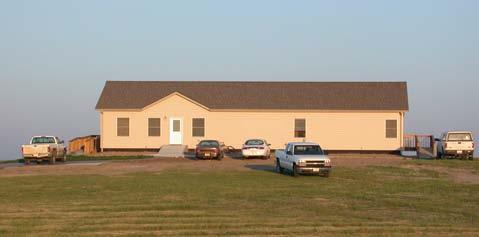
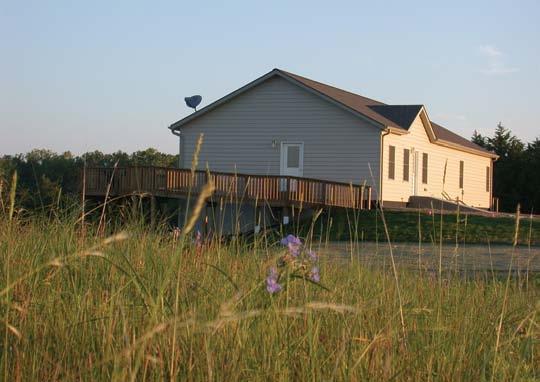
Above: a back view of the 5,400 acre Barta Brothers Ranch facility.
Above inset: entrance of the Barta Brothers Ranch. Also above: additional side view of this beautiful ranchland facility.
Photos by Jerry Volesky
by Robert C. Sorensen
GNEwS FROM ALUMNI
reetings agronomy and horticulture alumni. It’s been a busy and eventful year for everyone. Several of you wrote to tell us about what has been going on in your busy lives. We thank you for your e-mails and letters and appreciate your interest and support with our newsletter publication.
Marino Juan Romero-Loli (M.S., 1965) has spent his entire career in the area in which he was born, the Peruvian highlands. He obtained the degree of engineer of agronomy in 1954 at the Agriculture University, La Molina, Peru (UNLAM). After a few years of work in experimental stations including stations in the highlands, he went to Mexico to learn cereal breeding with Dr. Norman Borlaug. In the meantime he studied at the University of Nebraska to obtain his master of science degree. Then he returned to La Molina where he organized a modern program of cereal breeding. The history of barley breeding in Peru started with his activities. In 1968 UNLAM initiated a barley breeding program which is continued today.
To develop not only well-adapted but also high quality cereal varieties, Prof. Romero-Loli has built a grain quality laboratory which is able to run on a large scale the analysis of all plant materials coming from segregated populations. He contributed greatly to the organization of the first Latin American FAO/IAEA regional project on improvement of cereals through imitation breeding in Latin America. At his request and with the help of his wife, Prof. Luz Gomez Pando, the Plant Biotechnology Laboratory was established to undertake the production of doubled haploids. Thanks to his initiative, the FAO/IAEA plant breeding and genetics section organized in 1987 a training course on doubled haploid production in cereals in newly established facilities at Cereals Programme Laboratory of La Molina University.
Marino’s program has the highest importance for the highlands of Peru and for its poor farmers. Over 80% of the barley grown in Peru was developed by Marino.
Corey Crandall (B.S., 1994) was very active in the development and construction of the prestigious Sandhills (Golf) Club in Mullen, Nebraska. After joining the staff in 1995, he was promoted to superintendent in 1996 and served in that capacity for seven years.
Corey and his wife Sunny, acquired the 18-hole West Wind Golf Club in Ogallala, Nebraska in January, 2003. Since that time, he has been kept busy by learning more complex duties and by repairing serious damage to the course caused by equipment failures, floods, and drought.
Corey has been a member of the Golf Course Superintendents Association of America (GCSAA) for 13 years. He
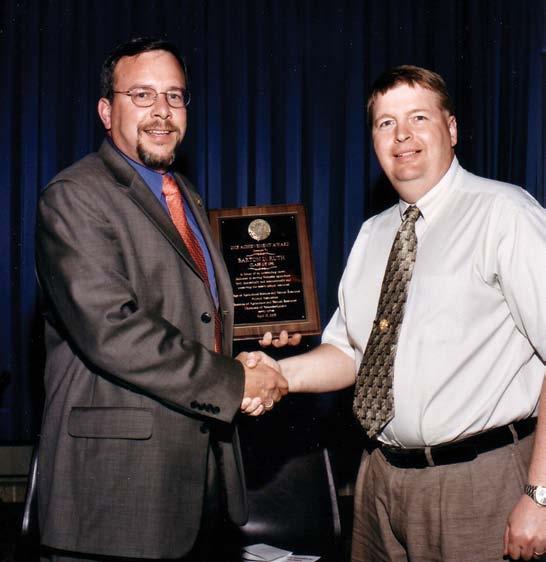
is presently a member of the Keith County Development Board and is the chairman of the membership committee.
The Crandalls have two children, Adam who is eight and Abbie, age three.
Robert Raun (B.S., 1951 with high distinction) began attending the University of Nebraska–Lincoln in 1945. He attended one year, then spent two years in the Air Force because “he always had a fondness for airplanes.” After his Air Force stints in Mississippi and Texas, he returned to UNL, completed his bachelor’s degree, and returned to the family farm near Minden, Nebraska.
While at UNL, Raun served as student body president and president of the Ag Executive Board. He was president of his fraternity, Alpha Gamma Rho, and a member of the Innocents Society and livestock judging team.
After college, he served as University of Nebraska regent from 1966 to 1980 and as director of the Nebraska Department of Agriculture from 1983 to 1985. He served on the W. K. Kellogg Foundation Board from 1985 to 1998.
Since retiring in 1993, Raun helps his son on the farm. He also served as chairman of a fund-raising group for renovation of the Minden Opera House.
Raun and his wife Eileen, have six children, all of whom graduated from the University of Nebraska–Lincoln and live and work in Nebraska.
Turn to Alumni, page 26
On April 17, 2005, Bart Ruth (above left) is presented the 2005 College of Agricultural Sciences and Natural Resources Alumni Association (CASNRAA) Achievement Award by Scott Kurz, CASNRAA president and 1987 graduate.
Alumni, from page 25
Bart Ruth (B.S., 1981) is the sixth generation of his family to live on and farm property near Rising City, Nebraska. He has been involved in the Nebraska Soybean Association since 1984 and was elected to its board in 1991. Since 1996, he has served the American Soybean Association Board. Beginning in July 2000, Bart was elected to serve the 30,000 member organization in the consecutive roles as first vice president, president, and chairman of the board.
Bart’s travels on behalf of American soybean farmers have taken him around the world and nationally to improve opportunities for U.S. soybean producers. He received the 2005 Eisenhower Foundation Fellowship which permits him to design an international program working with European agricultural organizations in improving relationships and opportunities for farmers in the United States and the European union.
On April 17, 2005, Bart received the College of Agricultural Science and Natural Resources Alumni Association’s (CASNRAA) 2005 Achievement Award. Congratulations, Bart!
Rodney W. Bovey (Ph.D., 1964) retired in 1994 from the USDA-ARS after 30 years of federal service in weed and brush control research at College Station, Texas. Upon retirement, he received a courtesy appointment from Texas A&M University as adjunct professor in the rangeland ecology and management department. Dr. Bovey continues to write research papers, edit publications for other researchers and journals, participate on graduate student committees and recently published a reference book on “Woody Plants and Woody Plant Management: Ecology, Safety, and Environmental Impact.” Dr. Bovey also stays busy with family, outdoor activities and travel.
Gary Willson (Ph.D., 1994) is presently the research coordinator for the National Park Service at the Great Plains Cooperative Ecosystem Studies Unit at the University of Nebraska–Lincoln. He is affiliated with the university through an adjunct associates professor appointment in the School of Natural Resources. As the Great Plains research coordinator, Gary develops and implements an integrated program of natural and social science research, technical assistance, and education that supports the informational needs of national parks in the Great Plains.
Previously, Gary directed the Ozark Highland Global Change Research Program for the Biological Resources Division of the U.S. Geological Survey. He has also developed natural resource monitoring protocols and inventories for the Prairie Cluster Prototype Monitoring Parks.
Prior to his work with the geological survey, Gary was employed for fourteen years as an ecologist for the Midwest region of the parks service where he was responsible for the prairie restoration and endangered research programs in the Midwest. He has also taught fire ecology at the University of Missouri-Columbia.
Marvin Coffey (B.S., 1956) was graduated from the University of Nebraska–Lincoln in June 1956 with a degree in general agriculture. During his studies, he worked in the agronomy department with Drs. Hanway, Allred, Goodding, Schmidt and Johnson.
After graduation, he accepted a position teaching vocational agriculture in a Methodist rural institute where he remained for three years. This experience led him to enroll in Saint Paul School of Theology in Kansas City where he received a master of theology degree in 1963. (He was ordained a United Methodist pastor.) He and his Brazilian wife Dalva Mozzer returned to Brazil in 1966 and worked there through 1982 in the Federal Land Colony of Brazil. They returned to Nebraska in 1982.
Marvin retired from the United Methodist ministry in 2000, but continued on a halftime basis in the Kansas East Conference for two years.
The Coffeys have now retired on the family farm referred to as the “Coffey Grounds” near Phillips, Nebraska but continue their connections in Brazil.
Chandler Mazour (M.S., 1996) was graduated from the University of Nebraska in 1996 with a master’s degree in plant breeding and genetics. At that time, he and his wife Deanna had just been blessed with their first child. Their family has since grown to include three additional children for a grand total of four. Chandler reports that he and Deanna are still happily married.
Chandler feels fortunate that throughout his career, he has been able to participate in and explore the diversity of agriculture. He has worked in technical and marketing positions with seed, biotechnology and crop protection products focusing on a multitude of crops.
Chandler currently works with BASF in the global herbicide marketing group in Research Triangle Park, North Carolina. His responsibilities are to lead their global corn trait business and provide strategic leadership for a core herbicide active ingredient. His career has provided him with the opportunity to visit parts of the United States and the world, and develop friendships with a diverse group of individuals.
Brad Kinkaid (M.S., 1986) is a busy agriculturalist, husband, and father who enjoys managing his daughter’s U14C1 girls’ soccer team. When he is not on the (soccer) touch line, he can be found working at the University of Minnesota’s St. Paul campus where he and another civil servant support three professors whose common denominator is weed science. Brad and his co-worker do herbicide trials along with some biology studies and weed/ crop competition studies. They cover all the major crops in the state such as corn, soybeans, wheat, oat, barley, sweet corn, and peas, as well as non-cropland weeds. Brad also tracks several budgets and works in a variety of different arenas.
Every July, Brad operates either one or two-day Ag Professional Field Schools. These intensive training courses
Turn to Alumni, page 27
Alumni, from page 26
are for ag professionals, extension educators, etc. and are set in the field. Brad assists in preparation, setup and daily operations. While much of his work is in procurement, preparation and setup, he also serves as photographer during these events. In 2004, Brad assisted at the North Central Graduate Student Competition at Southern ROC at Waseca, Minnesota and met members of the team from UNL. If variety is the spice of life, Brad experiences lots of it. He wears many different hats at various different times and intervals during the course of each year. Not to mention his love of managing his daughter’s soccer team.
Brad and his family live in rural western Wisconsin where they enjoy the great biking trails and where he can photograph his daughter’s soccer matches. They always make time to join other Minnesotans-for-Nebraska to root for the ‘Big Red’ and enjoy buffalo burgers.
Aaron Waltz (Ph.D., 2005) reports that he has accepted a job as a research scientist with Pioneer Hi-Bred in Janesville, Wisconsin. He states that he and his family are in the process of moving and that the kids are doing well and are growing bigger every day.
Landscape Design Studio
by Richard Sutton
Landscape design students have settled into the newly remodeled landscape design studio in Keim Hall. Senior design and landscape construction students also use the studio in spring semester classes. New critique space improves the quality of student project reviews and many are using the digital projection for PowerPoint presentations.
Students in weed Science
by Aaron Waltz
It has been a year for moving on in the weed science group. Shawn Hock finished his M.S. and is working internationally in weed science in Guam. Julie Abendroth finished her M.S. and is currently an extension agronomist in Missouri. Travis Gustafson finished his M.S. and is a research technologist with Dr. Loren Giesler in plant pathology. Aaron Waltz has finished his Ph.D. and will be a research scientist with Pioneer Hi-Bred in Wisconsin. Jane Okalebo is a new weed science graduate student with Dr. John Lindquist and comes to UNL from Uganda.
Graduate student numbers are down and we would encourage anyone with an interest in weed management, weed-crop competition, or weed physiology to contact a member of the weed science panel about graduate educational opportunities.
I find that the harder I work, the more luck I seem to have. — Thomas Jefferson
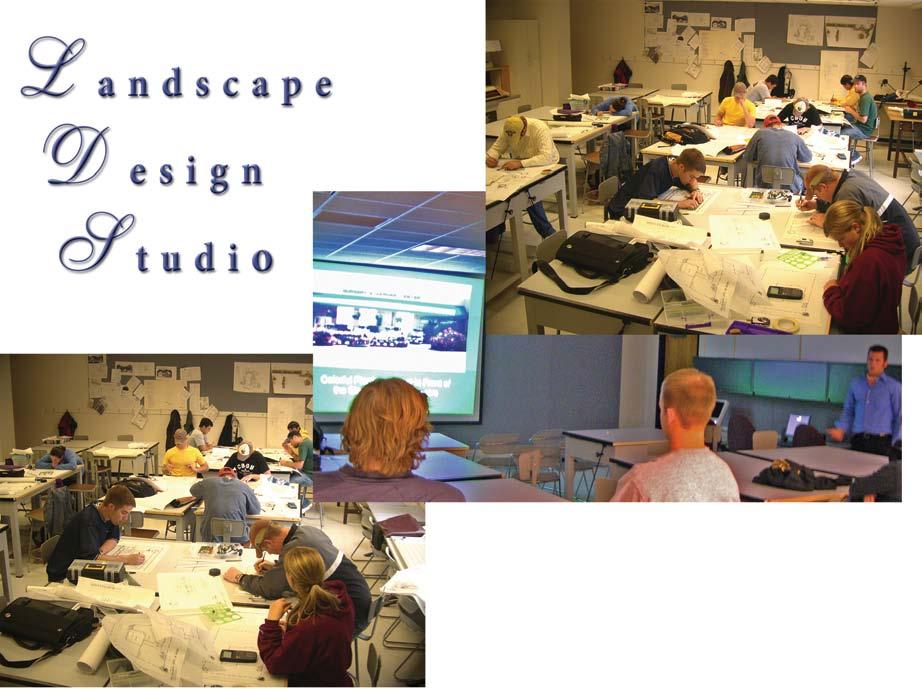
AgRONOMy CLUb NEwS
by Cole Anderson 2004-2005, 2005-2006 president
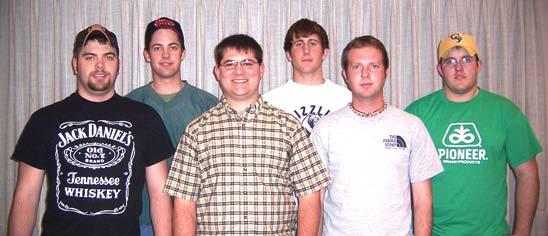
The 2004-2005 school year has been very productive for the Agronomy Club. The club members participated in fund raising, social events, listened to various speakers from the agriculture industry, and attended the regional and national club meetings. The officers for the year were Cole Anderson, president; Kevin Keller, vice president; Keith Tighe, treasurer; John Krohn, recording secretary; Daniel Olsen, corresponding secretary; Karl Brauer, historian; and Mike Flyr, assistant treasurer. Dr. Daniel Walters and Dr. Richard Waldren served as advisors.
We kicked off the year with a joint barbecue with the Range Management Club at Peter Pan Park. This is our opportunity to welcome back the old members and give prospective members a chance to meet with faculty, club officers, members, and advisors. We received a great turnout and it started our year off with a lot of enthusiasm.
The bi-weekly meetings included a wide variety of speakers presenting what their jobs entail. Our speakers included the following: Dr. Daniel Walters, UNL professor; Randy and Kelly Meyer, vineyard operators; Chad Zimmerman, Monsanto seed production; Ron Haarmann, Pioneer HiBred International research; Frosty Anderson, Outback Guidance Systems; B.D. Softley, S-Arrow Inc. Forensic Agronomy; Steve Gottsch, Producers Hybrids; and Phillip Erdman, Nebraska legislative senator. These speakers presented many ideas about the present and future positions of agriculture and many of the job opportunities in their specific areas of agronomy.
The SAS-CSA-SSSA annual national meeting was held in Seattle, Washington this year. Cole Anderson, Kevin Keller, Clint Osborne, and Blayne Renner represented our club at the meeting. Kevin Keller competed in the Students of Agronomy, Soils, and Environmental Sciences (SASES) student research symposium on his independent alfalfa and received third place. Cole Anderson represented the club in the speech contest. We also toured agricultural industries
around the Seattle/Tacoma area including a waste management plant, organic farm, and Washington State University research plots. Blayne Renner was elected SASES vice president and Kevin Keller was elected SASES secretary. UNL received two of the five available offices!
The club went on two tours this year. We toured the Claus manufacturing plant in Omaha in the fall and the Pioneer Hi-Bred International production plant in York in the spring.
On April 1, ten members of our club attended the regional agronomy club meetings at North Dakota State University in Fargo, North Dakota. The students who attended went on tours of agricultural industries in the area like the Case-New Holland manufacturing plant, a sugar beet refinery, a potato flaking plant, a chemical distribution center, and a specialty equipment manufacturing plant.
The club also launched a new Web site this year. It contains information about the club and all of the guest speakers and events we held this year. We also designed polo shirts for our club, department, and anyone else who might be interested.
The club started a new fund-raiser this year in cooperation with two other clubs, the Mechanized Systems Management Club, and the Agronomy and Horticulture Graduate Students Association. We serviced push mowers for the community. After servicing 50 lawn mowers, we ended up raising about $1200 after expenses. We are planning to continue on with this fund-raiser. It was a lot of fun for us to be able to do some work with our hands — instead of just with our heads and brains.
The officers for the 2005-2006 year are Cole Anderson, president; Kevin Keller, vice president; Daniel Olsen, treasurer; Karl Brauer, assistant treasurer; Lisa Rosener, recording secretary; Clint Osborne, correspondence secretary; and Janelle Schoen, historian. Our senior advisor will be Dr. Richard Waldren.
The Agronomy Club is very proud of the accomplishments we have achieved throughout the year. The new year is coming upon us and we are very excited for the new ideas and events we are planning for 2005-2006.
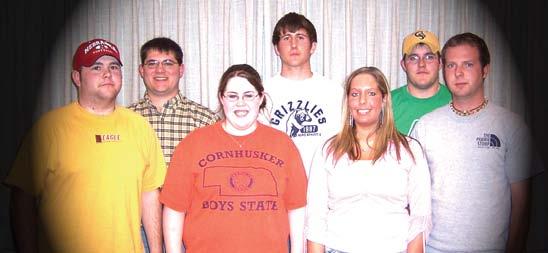
2004-2005 officers, back (L-R): Keith Tighe, Daniel Olsen and Karl Brauer; front (L-R): Mike Flyr, Cole Anderson and Kevin Keller.
2005-2006 officers, back (L-R): Cole Anderson, Daniel Olsen, and Karl Brauer; front (L-R): Clint Osborne, Janelle Schoen, Lisa Rosener and Kevin Keller.
Agronomy & Horticulture graduate Student Association (AHgSA)
by Doug Felter, retiring president
The Agronomy and Horticulture Graduate Student Association (AHGSA) serves as a representative body for graduate students in the Department of Agronomy and Horticulture. The organization serves as the voice for graduate students in the department and provides a venue to promote the development of graduate students academically, professionally, and socially.
The past year has been an eventful one for the AHGSA. As in the past, the organization hosted a new graduate student orientation at the beginning of the fall and spring semesters to welcome new graduate students and acquaint them with the department and personnel. Guest speakers from Monsanto, USDA National Agricultural Statistics Service, and UNL Graduate Studies were present at meetings of the organization during the year. AHGSA also hosted weekly journal clubs over the lunch hour, giving members the chance to discuss articles from popular press and journal publications, present information about their home country and its culture, or converse about any topic of general interest. In December, members of AHGSA and the undergraduate clubs of the department enjoyed a holiday bowling party to close out the semester. A hamburger lunch was held in the courtyard during the spring semester, providing the opportunity for faculty, staff and students to interact while enjoying a good meal.
A lawn mower tune-up fund-raiser was initiated this spring, in cooperation with the Undergraduate Agronomy Club and Mechanized Systems Management Club. Members of the clubs changed oil and spark plugs, cleaned out air filters, sharpened blades, and pressure cleaned 50 push lawn mowers for members of the community. Canned food was also collected at this event, with a discounted service price offered with donations. 168 pounds of canned food was collected for the Lincoln Food Bank. The proceeds from this event will be used to supplement and encourage graduate student travel to professional meetings throughout the year. An account has been established through the University of Nebraska Foundation for management of these funds. If you are interested in making a tax deductible donation to the fund to support these efforts, please check the box on page 39 or contact one of the club officers to find out more. It is our hope that this fund will provide a way to enhance graduate student attendance and involvement in professional meetings.
A bulletin board has been secured for the organization in the hallway near the administrative offices of the department. This bulletin board will provide a central location to publicize activities of the AHGSA and post information of importance to graduate students. The board will be located in the north hallway of the Plant Science building, just down the hallway from the main office in 279.
The AHGSA Web site has been updated and expanded. Now available on the Web site are a graduate student listing with personal profiles, pictures of organization events, a calendar of activities, and lots of other information about AHGSA. Our Web page can be accessed through the department’s Web site, or you can access it directly at http://agronomy.unl.edu/ahgsa. We encourage you to take a look at the activities and events that AHGSA has sponsored and been involved in.
Officers for the 2005-2006 academic year were recently elected. Paul Hodgen (Soil and Water Science) from Indiana was elected president. Joni Griess (Crop Physiology and Production) from Nebraska will serve as vice president. Lekgari A. Lekgari (Plant Breeding and Genetics) from Botswana was elected as secretary/treasurer.
If you are interested in speaking at one of the meetings of AHGSA we would be happy to schedule a time with you. Please contact Doug Felter at 402-450-4235 or dfelter@unlserve.unl.edu or Paul Hodgen, at 402-540-4449 or hodgenp@unlserve.unl.edu. We are looking forward to another exciting year!
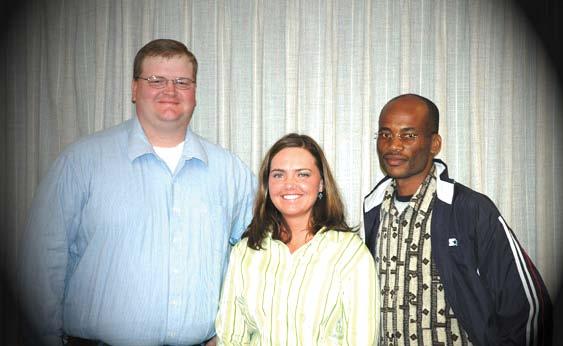
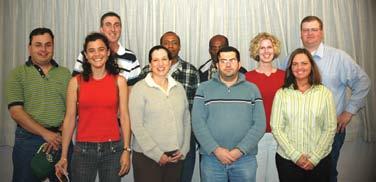
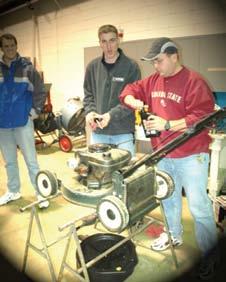
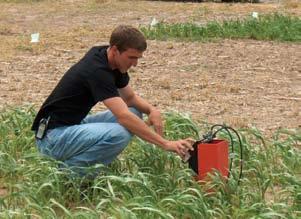
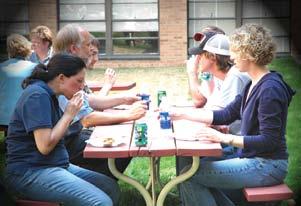
Photo 1 above, 2005-2006 officers (L-R): Paul Hodgen, president, Joni Griess, vice president and Lekgari A. Lekgari, secretary/treasurer; photo 2, current members of Agronomy & Horticulture Graduate Student Association; photo 3, lawn mower tune-up fund-raiser; photo 4, student conducts field research; photo 5, hamburger luncheon.
RANgE MANAgEMENT CLUb NEwS
by Jessica
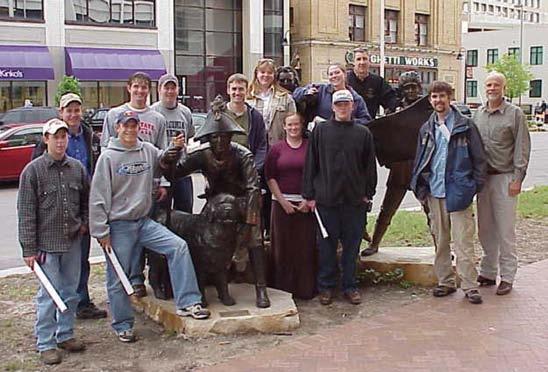
The Range Club had another interesting and eventful year! Serv ing as officers this year were: Jessica Warner-president, Tim Roggasch-1st vice president, Rodney Lamb-2nd vice president, Chris Skrdla-secretary, Gabe Schnuelle-treasurer, and public relations officers-Elisha Greeley, first semester, Melissa Thompson and Merilynn Hirsch, second semester. Walt Schacht served as our advisor for his eleventh consecutive year.
We started off the year right with our annual Agronomy Club/Range Club BBQ. We held this at Peter Pan Park, a few blocks south of East Campus. This is a great way to start off the school year and invite new recruits for the upcoming year.
Early October found us at the annual meeting of the Nebraska section of Society for Range Management (SRM) in Ainsworth, Iowa. We were able to meet up with students from Chadron State College and have our annual Crazy Auction. The Crazy Auction is our largest fund-raiser for the year. Thank you to everyone who was able to attend the meeting and support our club!!!
In December, we had a Christmas party at our advisor’s house. We had a potluck supper and exchanged Christmas presents. There were enough Ramen noodles exchanged to last several people for the rest of the school year. Thanks to Walt and Carol for letting us torment them for the night!
The highlight of the year was the SRM annual meeting in February in Ft. Worth, Texas. The club spent much time preparing for the meeting and took three carloads of students. There were eight club members, one plant identification (ID) student, one community college student from
Central Community College, and one graduate student, plus our advisor. While at the meeting, we were very active in student events: eight students took the Undergraduate Range Management Exam (URME), five students participated in the plant ID contest, two students competed in the undergraduate public speaking contest, and one presented in the undergraduate student paper session. Jessica Warner ended her term as reporter for the International Student Conclave and was then elected to serve as president for 2005/2006. Throughout the meeting, the students maintained a display booth, and sold books and T-shirts to help finance the trip. We had a very fun time overall and were able to experience some of that “Texas pride” that we always hear so much about.
We kept busy for the rest of the semester. In February, a couple of people taught the Boy Scouts the importance of plant identification. It was a very interesting and fun time for the scouts and our members. In April, we held our annual pancake feed with the Soil and Water Resource Club and helped with the state Future Farmers of America convention. We started working at UNL baseball games to raise money to attend the 2006 annual meeting of SRM in Vancouver, Canada and also helped with CASNR week. We had a booth and attended the CASNR banquet where Jessica Warner was named the Outstanding Student Organization officer for 2004/2005. Good job Jessica!!
We concluded April with the annual Agronomy Club and Range Club banquet. At the banquet, we recognized Michael Gillilan as the 2005 Trail Boss, an award that is given to the outstanding club member. This award is voted on by the students and Michael was selected as the unanimous winner this year. We also recognized graduating seniors and our parents for supporting us throughout the year. New officers were also installed. They are as follows: Rodney Lamb-president, Jessica Warner-vice president, Melissa Thompson-secretary, Merilynn Hirsch-treasurer, and Dan Towey and Austin Bontrager-public relations.
The Range Management Club had a great year and we are looking forward to 2005-2006! Thank you to everyone who supported us! It is greatly appreciated!
In addition to self-awareness, imagination and conscience, it is the fourth human endowment-independent will-that really makes effective self-management possible. It is the ability to make decisions and choices and to act in accordance with them. It is the ability to act rather than to be acted upon, to proactively carry out the program we have developed through the other three endowments. Empowerment comes from learning how to use this great endowment in the decisions we make every day.
— Stephen R. Covey
Warner, 2004-2005 president
Members of the 2004-2005 Range Club and their advisor Walt Schacht, pose in front of the Center for Great Plains Studies
HORTICULTURE CLUb NEwS
by Ryan A. Pekarek 2004-2005 president
Although our e-mail list contains nearly 100 names, the Horticulture Club boasts 25 very active members. Our goal is to expose students to the broad industry of horticulture through speakers, travel, and hands-on projects. This gives students a background of skills to use in their professional careers.
The club recently attended the Mid-American Collegiate Horticulture Society contest at Colorado State University and placed five out of thirteen competing teams. Three individual awards were earned by placing in the top three of a possible 89 participants. The club’s fall trip last year was spent touring Denver, Colorado, its botanical gardens, Coors Brewery, and the foothills of the rocky mountains. Plans are underway for next year’s fall trip to Oregon to see Monrovia and Bailey’s Nurseries, the Pacific Ocean, and some important wine producing lands. For a short Halloween trip, several club members traveled to Valla’s Pumpkin Patch near Gretna, Nebraska. After a semester of hard work, members go out to eat—this year to Grisante’s—to socialize.
Since no dues are collected from our members, three sales are held throughout the year. The Fall Foliage and Poinsettia sale events take place both on City and East Campus. The Spring Garden Expo is held only on East Campus and draws patrons from western Nebraska, as well as people from on-campus and Omaha. This sale is a great experience for members to learn hands-on how a crop of bedding plants, perennials, and veggies are grown and gotten ready for a two-day sale. We must be ready. . . for there’s no waiting and selling next week!
During the banquet held in March, new officers and scholarships are announced as well as recognition of hardworking individuals. This year’s entertainment was R. P. Smith, the cowboy poet from Broken Bow, Nebraska. About 65 people attended for socialization, recognition, and great food.
The club’s main philanthropic activity is the production of about 80 flats of vegetable seedlings for a project that benefits immigrant farmers and the not-so-wealthy in Lincoln. Just a quick note: 80 flats will probably plant about 2 acres of vegetable garden – that’s a little over the size of a football field! Also, the club donates plant materials to area nursing homes and homeless shelters to help brighten the holiday with poinsettias or the spring with flowers. Last year, a dance was held in conjunction with the newly formed Diversified Ag Club to help earn money for the new club and get them started. This was a great success with many students attending.
Our officers are: Ryan Pekarek, president, Nikki Leiser, vice president, Jill Misar, secretary, Brett Nunnenkamp, treasurer, Ken Simons, Web coordinator, Jessica Ritter, social chair, Stephanie Blum, scrapbooker.

Above, a storyboard in Horticulture Club photos!
Management is efficiency in climbing the ladder of success; leadership determines whether the ladder is leaning against the right wall. — Stephen R. Covey
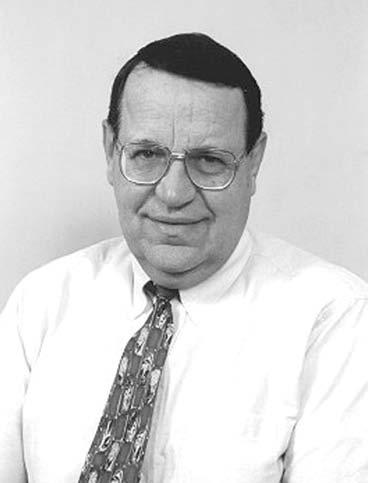
Fred W. Roeth, professor of agronomy and extension weed specialist, retired from the University of Nebraska–Lincoln on December 31, 2004 after 35 years of university service. Dr. Roeth was raised on a general livestock and crop farm in western Ohio in a family of eight children.
Participation in 4-H, FFA, and sports and graduation from Houston High School preceded his enrollment at Bowling Green State University in 1959. After spending two years at BGSU, he transferred to The Ohio State University to pursue his interest in agriculture and graduated with a B.S. degree in agronomy. While at OSU, Fred was elected to Gamma Sigma Delta and Towers honoraries and served as a vice president of Alpha Gamma Rho fraternity. His M.S. and Ph.D. degrees in agronomy/weed science were awarded by the University of Nebraska where he was a research assistant under the direction of Dr. Terry Lavy. His career as a weed scientist began in 1969 as an assistant professor in the botany and plant pathology department at Purdue University working on perennial weeds. In 1975, Fred accepted a research-extension position with the University of Nebraska at the South Central Research and Extension Center near Clay Center. During his tenure there, he advised and co-advised 15 graduate students and authored numerous research and extension publications. Dr. Roeth served as an associate editor of Weed Technology, on WSSA awards and resolutions committees, and the NCWSS board of directors and other committees. His research-extension areas have included johnsongrass, musk thistle, shattercane, enhanced herbicide degradation, herbicide resistant weeds, herbicide interactions, and general weed management in row crops. He received a University of Nebraska Extension Distinguished Service Award in 1987 and was elected Fellow of the North Central Weed Science Society in 1997. In Clay Center he served on community, school, and church boards. Fred and his wife, Carol, have three children and four grandchildren. In 2003, on the closure of the UNL South Central R & E Center, he was transferred and moved to Lincoln where he will continue to pursue interests in family activities, outdoor recreation, sports, and pleasure reading.
Carlos A. Urrea joins faculty
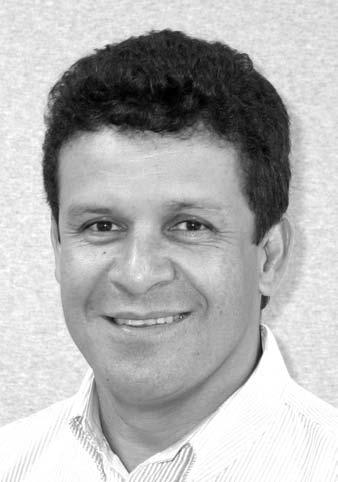
Carlos A. Urrea joined the faculty in April 2005 as assistant professor, dry bean breeding specialist in the Department of Agronomy and Horticulture at the Panhandle Research and Extension Center in Scottsbluff, Nebraska. Dr. Urrea’s research and extension responsibilities include focusing on genetics, variety development and evaluation of dry edible beans as well as focusing on new and existing specialty crops adapted to western Nebraska. He earned his B.S. and M.S. in agronomy from the Universidad Nacional de Colombia, and the University of Puerto Rico respectively, and his Ph.D. degree in plant breeding and genetics from North Dakota State University. Prior to joining the faculty at the University of Nebraska, Dr. Urrea spent 3½ years as a research associate with CIMMYT-Mexico and 1½ years at CIMMYT-Nepal as leader of the Hill Maize Research Project.
New Visiting Scientists
Dr. Senog-Soo Kang from Korea, is working with Dr. Jim Schepers on monitoring crop stresses, especially nitrogen.
New Post Doctoral Research Associates
Dr. M. Liakat Ali from Canada, is working with Drs. Stephen Baenziger and Ismail Dweikat on genetic and molecular basis of agronomic performance of cultivated wheat in diverse ecogeographic areas by studying genes/QRLs that affect yield on chromosome 3A.
Dr. Scott Tubbs from Florida, is working with Dr. James Schepers on nitrous oxide emissions in relay cropping systems.
When solving problems, dig at the roots rather than just hacking at the leaves.
— Maxwell Monroe Stone
Research associates and visiting scientists who have departed
Tewodros Mesfin Abebe visiting scientist, has returned to Etheopia after working with Drs. Martha Mamo and Charles Wortmann on occasional tillage and starter fertilizer.
Dr. Ugur Bilgili visiting scientist, has returned to Turkey after working on buffalograss and line-leaved fescues research with Dr. Robert Shearman.
Dr. Willie Chisimba visiting scientist, returned to Zambia, after working with Dr. Paul Read on tissue culture in potatoes.
Dr. Zhi-Ming Hua, research associate from China, has returned after working with Dr. Michael Fromm on plant protemic characterization of the drought and salt tolerance response in arabidopsis, plant transformation, and molecular biology.
Dr. Jianli Ping, research associate, has accepted a position in Connecticut after working for nearly three years with Dr. Achim Dobermann on improved acquisition and usage of thematic soil maps for site-specific crop management.
Faculty transitions
Dr. Roger Elmore has resigned his position as professor of agronomy at the University of Nebraska to accept a position at Iowa State University as an extension corn specialist. Dr. Elmore has served the University of Nebraska and this department for 24 years, with 22 of those years at the South Central Research and Extension Center in Clay Center, Nebraska. His extension and research programs included resource-efficient cropping systems, corn greensnap, nodulation and physiological response of glyphosate-resistant soybean to glyphosate, comparing glyphosate-tolerant with conventional corn hybrid performance, and crop variety and hybrid performance testing. While we are sorry to see Roger leave, we wish him the very best in his new appointment.
Dr. Brian Beecher, assistant professor in cereal chemistry, resigned his position in December 2004 to assume a USDA research biochemist position at the Wheat Quality Lab, Washington State University, Pullman, Washington. Dr. Beecher began his appointment at UNL in 2001, and his research focused on using molecular biology-based approaches to identify genes and genotype X environment interactions that govern grain quality traits. We wish Dr. Beecher well in his new position at Washington State.
by Paul C. Horton, CASNR Alumni Development Director
Football Reunion
The College of Agricultural Sciences and Natural Resources Alumni Association is hosting a Football Reunion on September 17 prior to the 2:30 PM NU vs Pittsburgh game. The alumni board is planning a meal, silent auction and program with time for academic departments to get together in the City Union ballroom. All CASNRAA members and friends of the college are welcome and encouraged to come to the 10:30 AM luncheon program whether attending the game or not. Go to http://casnr.unl.edu and click on “Football Reunion” to register for the lunch and check ticket availability.
The CASNR Alumni Association Board has established a new Life Membership category providing convenience and cost savings. Membership types and rates are:
Annual $20 (Couple $25)
Life Individual $300 (Couple $360)
Life Individual Installment $65/yr for 5 yrs (Couple $75/yr for 5 yrs)
Life Senior Individual (65 +) $180 (Couple $220)
Sustaining Amounts exceeding the base rate for a category
You can renew your membership, gift a new membership or start a new membership online and pay by credit card. Go to http://casnr.unl.edu and select “Alumni” for options. Help us keep you informed of College news briefs as we supplement The Sower with occasional e-mails. We can do a timely job of alerting you to events such as the football reunion if we have your e-mail address. E-mail your name and electronic address to phorton2@unl.edu. Please put “Alumni” in the subject line of your e-mail.
Changes in status? Plans to move? No longer interested in receiving our publication?
Please keep us informed of changes by either 1) e-mailing us at: agrohort@unl.edu or by 2) sending us a note at:
Department of Agronomy and Horticulture P. O. Box 830915
University of Nebraska–Lincoln Lincoln, NE 68583-0915
Thank you for your help and cooperation.
An open mind collects more riches than an open purse. — Anonymous A smile is contagious; be a carrier. — Anonymous
F ACULT
y AwARDS & RECO gNITIONS
Achim Dobermann received the American Society of Agronomy Fellow Award.
John Doran received the SSSA Distinguished Service Award.
Jerry Eastin received the 2005 Sorghum Industry Award by the Nebraska Grain Sorghum Producers Association and the Nebraska Grain Sorghum Board.
Bahman Eghball (now deceased) received the American Society of Agronomy Fellow Award.
Jay Fitzgerald was selected as an honorary FFA Chapter degree recipient by the Norris High School FFA Chapter.
Garald Horst, James Stubbendieck, and Kim Todd received the CASNR Parent’s Association Recognition for Contributions to Students.
Robert Klein received the North Central Weed Science Society 2004 Distinguished Achievement Award in Education.
Don Lee received the 2004 Crop Science Teaching Award, the Agronomic Resident Education Award, and the 2005 CASNR Outstanding Teaching Award.
Martha Mamo received the IANR Dinsdale Family Faculty Award for outstanding teaching, research, and outreach in the Institute of Agriculture and Natural Resources (IANR).
Martin Massengale was named to the CSREES Hall of Fame, October 2004. He was also reappointed to the National Agricultural Research, Extension, Education and Economics Advisory Board for the 3rd term.
Steve Rodie received the Educator of the Year Award from the Nebraska Arborists Association for his on-going involvement and support of NAA educational and certification programs.
Gary Varvel received the American Society of Agronomy Fellow Award.
Richard Waldren received the Star Award from the A.C.E. (Achievement, Commitment, and Excellence) Learning Community.
PROMOTION AND
TENURE
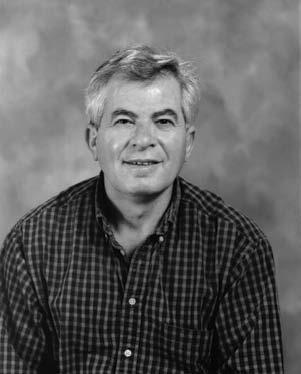
Ismail Dweikat
Sorghum Genetics
Assistant Professor 9/1/99 - 6/30/2005
Associate Professor with Tenure 7/1/2005 - present
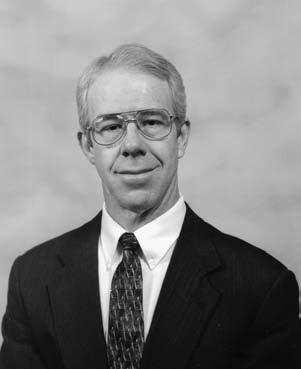
W. Ken Russell
Quantitative Genetics and Corn Breeding
Assistant Professor 6/1/99-6/30-2005
Associate Professor with Tenure 7/1/2005 - present
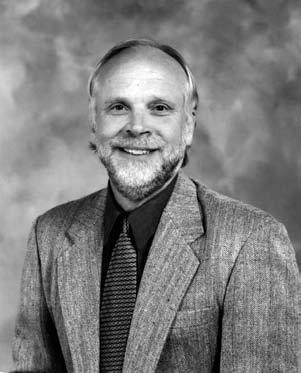
Walter Schacht
Range Science
Associate Professor 1/4/94
Tenured 7/1/99
Professor 7/1/2005 - present
AUGUST 2004
B.S. Agronomy and Horticulture
Aaron Clark Hoagland, Lincoln, NE
Robert William Karel, Lincoln, NE
Brian Douglas Nelson, Omaha, NE
Justin Patrick Wheeler, Naperville, IL
DECEMBER 2004
Troy Mikeal Bryson, Lincoln, NE
Eric Andrew Catlin, Omaha, NE
Ryan William Chapman, North Bend, NE
Ross Edmund Denton, Council Bluffs, IA
Scott Wayne Fredrickson, Lincoln, NE
Brian Louis Gleason, Denton, NE
Kristen Marie Hartquist, Omaha, NE
Graham Thomas Herbst, Omaha, NE
Christina Elizabeth Hoyt, Stillwater, MN
Sara Ann Hraban, Lincoln, NE
Anthony Scott Johanson, Oakland, NE
Abigail Leigh Kizzier, Bellevue, NE
Jason Lee Kubicek, Gretna, NE
Kathryn Ann Marsh, Ord, NE
Jeffrey Alan McBride, Brule, NE
James Michael Nedrow, Norfolk, NE
Ryan Christian Neely, Lincoln, NE
Paul DeLayne Nelson, Newman Grove, NE
Thomas T Ogee Jr, Lincoln, NE
Travis William Rahe, DeWitt, NE
Renae Rachelle Robertson, Madrid, NE
Andrew William Rocole, Exeter, NE
Dustin Dennis Schlake, Cortland, NE
Paul Reinhold Schroeder, Lincoln, NE
Scott Milford Schultze, Lincoln, NE
graduates
DECEMBER 2004 (continued)
Arik Andrew Solberg, Lincoln, NE
Stacy Lyn Thelander, Ithaca, NE
Chelsey Marie Wasem, Aurora, NE
MAY 2005
Amy Suzanne Alderman, Lincoln, NE
Julie Virginia Baker, Lincoln, NE
Craig Lee Cech, Clarkson, NE
Derek Richard Drost, High Point, NC *
Naomi Ross Gilbert, La Vista, NE
Nicholas Walter Haack, Osceola, NE
Jessica Leigh Hird, Hastings, NE
Melanie Emilie Kouma, Dwight, NE *
Whitney Rose Kumm, Lincoln, NE
Nathan Dale Mueller, Lincoln, NE **
Ross Garrett Nantkes, Seward, NE
Logan Rory Roeber, Ashland, NE
James T Savoie, Omaha, NE
Casey Michael Schleicher, Dannebrog, NE
Patrick Brandon Schroeder, Talmage, NE
Eric Tyson Schultz, Wisner, NE
Ryan Vern Sonderup, Fullerton, NE
Justin Michael Thomas, Lincoln, NE
Jennifer Sue Timm, Springfield, NE *
Brent Michael Van Winkle, Lincoln, NE
Susan Elizabeth Weber, Friend, NE
Kenny Shane Wettlaufer, Page, NE
Scott Michael Zavadil, Fordyce, NE
* with Distinction
** with High Distinction
M.S. and Ph.D. Agronomy and Horticulture graduates
AUGUST 2004 – M.S.
Julie A. Abendroth, M.S., Nebraska
Advised by F.W. Roeth and A.R. Martin
The joint action of mesotrione with photosynthetic inhibitors.
Michael E. Perry, M.S., Colorado
Advised by W.H. Schacht
Tree canopy effect on grass and grass/birdsfoot trefoil mixtures in eastern Nebraska.
Mindi L. Schneider, M.S., Kansas
Advised by C.A. Francis
Local foods and land ethics: a survey of farmers and consumers.
Soares A. Xerinda, M.S., Mozambique
Advised by C.S. Wortmann and M. Mamo
No-till corn and grain sorghum response to starter fertilizer in eastern Nebraska.
AUGUST 2004 – Ph.D.
Gregorio C. Simbahan, Ph.D., Philippines
Advised by A.R. Dobermann
Processing of spatial information for mapping of soil organic carbon.
DECEMBER 2004 – M.S.
Shawn M. Hock, M.S., Nebraska
Advised by S.V. Knezevic and A.R. Martin
Competitiveness of major weed species in soybean (Glycine Max L.).
Ingrid L. Mallberg, M.S., Nebraska
Advised by L. Hodges and E.T. Paparozzi
Forcing Dicentra spectabilis (L.) Lem. as a specialty cut flower.
Kristin R. Nollette (Schlueter), M.S., Nebraska
Advised by W.H. Schacht and L.E. Moser
Seasonal dry matter and crude protein removal by grazing from grass/legume mixtures.
DECEMBER 2004 – Ph.D.
Ricardo V. Abdelnoor, Ph.D., Brazil
Advised by S. Mackenzie
Cloning and characterization of MSH1 in higher plants and its involvement in regulation of substoichiometric shifting.
DECEMBER 2004 – Ph.D. (continued)
Antonio Castillo-Gutierrez, Ph.D., Mexico
Advised by K.S. Gill
Drought tolerance and genetic diversity among tropical maize inbred lines.
Prabhakar Dhungana, Ph.D., Nepal
Advised by K.M. Eskridge
Structural equation modeling of genotype X environment interaction
Osman Gulsen, Ph.D., Turkey
Advised by R.C. Shearman & K.P. Vogel
Buffalograsses: Their organelle DNA, chinch bug resistance variation, and peroxidase enzyme responses to chinch bug injury.
MAY 2005 – M.S.
Jennifer D. Frohner, M.S., Nebraska
Advised by J.A.Thurston-Enriquez and C.A. Shapiro
Health-related microbiological aerosols originating from spray irrigation of cattle wastewater.
Travis C. Gustafson, M.S., Nebraska
Advised by S.Z. Knezevic & T.E. Hunt
Effects of early season insect defoliation on the critical time for weed removal in soybean.
Anil K. Jayaprakash, M.S., India
Advised by L. Hodges
Microclimate modifications in central Great Plains using high tunnels.
Aaron J. Nygren, M.S., Nebraska
Advised by B.J. Wienhold and R.B. Ferguson
Nitrogen mineralization from soil and manure sources: in-situ study of tillage systems and management zones.
Fabio Pedraza, M.S., Colombia
Advised by I.M. Dweikat
Identification and mapping of molecular markers associated with QTLs for kernel traits in pearl millet.
Jason D. Lewis, M.S., Nebraska
Advised by R.E. Gaussoin and R.C. Shearman
Soil physical properties of aging golf course putting greens.
MAY 2005 – Ph.D.
Arlene A. Adviento, Ph.D., Philippines
Advised by A.R. Dobermann
Understanding soil greenhouse gas fluxes in intensive maize-based cropping systems.
Aaron L. Waltz, Ph.D., Nebraska
Advised by A.R. Martin & F.W. Roeth
Primer design and real-time PCR for mRNA expression in velvetleaf and common sunflower.
Agronomy and Horticulture scholarships and fellowships for academic year 2005-2006
UNDERGRADUATE
Agronomy Department Freshman Scholarship
Garret W. Koester
Bayer Environmental Science Scholarship
Chelsea L. Gehring (2004-2005)
Michael E. Sheely (2004-2005)
Henry M. Beachell Academic Student Support Fund - Incoming Freshmen and Transfer Students
David I. Goff
Kurtis L. Brauer
Cassandra M. Thomas
Andrew G. Jobman
Bret L. Leibhart
Ryan S. Nickerson
Cole A. Anderson (renewal)
Henry M. Beachell Agronomy Club
Outstanding Member Award
Janelle M. Schoen
Henry M. Beachell Professional Travel Scholarship
Clintin M. Osborne (2004-2005)
Ralph A. Elliott Memorial Scholarship
Keith F. Tighe
John Evasco and Ruth Willsie Evasco Memorial Scholarship
Karen C. Richards
Girardin Family Support Scholarship
Joshua J. Cool
T.H. Goodding Memorial ScholarshipIncoming Freshmen Students
Alexander E. Lush
T.H. Goodding Memorial ScholarshipUpperclass Students
Steven R. Howser
Donald G. and Blanche E. Hanway
Professional Travel Scholarship
Cole A. Anderson (2004-2005)
Blayne W. Renner (2004-2005)
Franklin D. Keim Memorial Scholarship
Karl N. Brauer
Kevin N. Keller
Henry J. Kroese Production Scholarship
Sandra K. Schaeffer
Elton Lux Memorial Scholarship
Jessica D. Ritter
Drew L. Anderson
Eric T. Williams
Turn to Scholarships, page 37
Scholarships, from page 36
Kenneth Miller Memorial Scholarship
Todd M. Jarecke
Nebraska Golf Course
Superintendents Association Scholarship
Michael E. Sheely (2004-2005)
Bradley N. Cheney (2004-2005)
Nebraska Turfgrass Foundation Scholarship
Michael E. Sheely
Nebraska Seedsmen Scholarship
Keith F. Tighe (2004-2005)
Northern Nut Tree Research Scholarship
Ryan A. Pekarek (renewal)
Robert A. Olson Scholarship
Michael J. Burgert
Professor J.C. Russel Memorial Scholarship
Kyle G. Evenson
Janell M. Schoen
Nathan J. Malmstrom
Servi-Tech Scholarship
Keith F. Tighe (2004-2005)
Dale and Marion Brainard Smith Scholarship
Lisa L. Rosener
Clinton M. Osborne
Stock Seed Farms Horticulture Scholarship
Jared M. Mauler
Stock Seed Farms - Lawrence C. Newell Scholarship
Kevin N. Keller
Keith and Alvina Strough Memoerial Scholarship
Kurtis L. Brauer
John C. Swinbank Memorial Scholarship
Adam P. Pohlmeier
Dennis Thompson - Crop Improvement Scholarship
Garret W. Koester
Clara S. Tillotson Memorial Scholarship for Incoming Freshmen and Transfer Students
Jared M. Mauler
Phillip N. Thrailkill
Daniel J. Moore
Jared T. Kalina
Brett A. Nunnenkamp
Ryan A. Pekarek (renewal)
Elizabeth M. Keep (renewal)
Nicole M. Leiser (renewal)
Sheila A. Meyer (renewal)
Jessica D. Ritter (renewal)
Trans-Mississippi Golf Association Turf Scholarship
Chelsea L. Gehring
Todd M. Jarecke
Roger D. Uhlinger Memorial Scholarship
Ryan A. Pekarek
Brett A. Nunnenkamp
Nicole M. Leiser
Orville A. Vogel Scholarship
Neil S. Stubblefield
Wylie R. Ward Scholarship
Blake R. Sindelar
Keith Weidler Memorial Scholarship
Todd M. Jarecke
Wayne C. Whitney Memorial Scholarship
Elizabeth M. Keep
Dr. and Mrs. C.C. Wiggans Memorial Scholarship
Leslie R. Burchell
Jacob F. Hoxmeier
Erin E. Siefken
GRADUATE FELLOWSHIPS
Henry M. Beachell Academic Support Fund Fellowship
Douglas Felter (2004-2005), M.S.
Crop Physiology & Production
Tri Setiyono (2004-2005), Ph.D.
Plant Breeding & Genetics
Borrlson Fellowship
Fernando Solari (2005-2006), Ph.D., Soil & Water
Centennial Fellowship
Michelle Parde (2005-2006), M.S., Range & Forage
W.R. Chapline Fellowship
Eric Mousel (2004-2005), Ph.D., Range & Forage
Mary & Charles C. Cooper/Emma I. Sharpless Fellowship
Nathan Mueller (2005-2006), M.S., Soil & Water
Franklin & Orinda Johnson Fellowship
Julian Chaky (2005-2006), Ph.D.
Plant Breeding & Genetics
John W. McDonald Fellowship
J. Andrés Quincke (2004-2005), Ph.D., Soil & Water
Milton Mohr Fellowship (CASNR)
Paul Hodgen (2004-2005), Ph.D., Soil & Water
Moseman Fellowship
Arlene Adviento-Borge (2004-2005), Ph.D., Soil & Water
Gerald O. Mott Meritorious
Graduate Student Award In Crop Science
Douglas Felter (2005), M.S.
Crop Physiology & Production
Othmer Fellowship
Neal Bryan (2004-2007), Ph.D., Range & Forage
Presidential Fellowship
Osman Gulsen (2004-2005), Ph.D., Range & Forage
Widaman Trust Distinguished Graduate Student Assistant M. Susana Grigera (2004-2005), Ph.D., Soil & Water
Aaron Waltz (2004-2005), Ph.D., Weed Science
Frank & Marie Wheeler Fellowship
Neal Bryan (2005-2006), Ph.D. Range & Forage
Ty McClellan (2005-2006), M.S., Horticulture
Do not follow where the path may lead. Go instead where there is no path and leave a trail.
— Muriel Strode
The AGRONOMY and HORTICULTURE Department is dedicated to providing quality educational opportunities and leadership to students and clientele with diversity in training and experience. These areas include crop breeding and genetics, molecular genetics, crop production and physiology, forage and range management, soil and water sciences, weed science, vegetable crops, floriculture and ornamental crops, and turfgrass management. Please help us in continuing to provide this opportunity by contributing to one of these funds:
For AGRONOMY Programs For HORTICULTURE Programs
Agronomy Discretionary Fund #2146
This fund was developed to provide a flexible source of funding to enrich and enhance our Agronomy programs in the College of Agricultural and Natural Resources. They allow us to bring in distinguished national and international scientists for guest lecturers, to put on our annual Agronomy and Horticulture Highlights program, and contribute to faculty and staff professional development opportunities. These enhancements help to ensure that our teaching, research, and extension programs remain at the cutting edge of science and are responsive to the needs of our students and stakeholders.
Agronomy Research Fund #1472
This fund provides support for Agronomy activities including special equipment, faculty development, student program support and funds for specialized research endeavors. These funds provide a mechanism to help build program capacity in crop and soil sciences that support the development of profitable and environmentally sound agricultural systems.
Thomas H. Goodding Memorial Scholarship Fund #2847
Dr. Thomas H. Goodding was one of the truly outstanding teachers in the College of Agriculture and the Department of Agronomy in particular. The teaching laboratory located in 280 Plant Science Hall has been dedicated as the Goodding Learning Center in his honor. The dedication plaque reads “A master teacher who stimulated students with the desire to learn, developed in them the ability to direct their lives toward high achievement and conveyed deep personal interest and concern for individual students entrusted to him for education during his 40 years of service to the people of Nebraska.” This memorial fund supports undergraduate scholarships for outstanding students.
Endowment for Environmental Horticulture #4714
Horticultural plants having a positive environmental impact are an important part of research for enhancing people’s lives and the quality of life. This fund is specifically set up for programs that will enhance the education and research in environmental horticulture sciences. It can be used, but not limited to, support for equipment, student assistance, operational items, and specialized research endeavors. It is a mechanism that can be used to attract research grant support in this important area of protecting the environment and natural resources.
Horticulture Discretionary Fund #3233
This fund provides support for activities specifically for floriculture and ornamental crops, vegetable crops, and turf and grass management. It provides a mechanism to fund various research activities that can help build program capacity in the areas of vegetable crop production and physiology and genetic improvement of crops.
Festival of Color Urban Landscape Program #5251
This fund helps support the development of various extension programs concentrating on integrated landscape management and design. These events offer participants an opportunity to see and learn about the latest concepts in landscape design, plant materials, home gardening and turfgrass management. Both students and faculty are involved in preparing demonstrations and educational activities for many of the events that are supported by this fund. Some of the events that this fund has helped support are Festival of Color, Landscape Connections and Residential Landscape Design Workshops.
Agronomy and Horticulture Graduate Student Development Fund
This fund helps supplement, support and encourage Agronomy and Horticulture graduate students’ travel to professional meetings throughout the year.
Contributions should be made payable to:
University of Nebraska Foundation
Indicate your area of interest by writing the fund number on the memo line of your check. Your support and donations are greatly appreciated.
NAME
Indicate your interest by marking the fund of your choice and return the form with your donation. Your support and donations are greatly appreciated.
G Agronomy Research Fund #1472
G Agronomy Discretionary Fund #2146
G Thomas H. Goodding Memorial Scholarship Fund #2847
G Endowment for Environmental Horticulture #4714
G Horticulture Discretionary Fund #3233
G Festival of Color Urban Landscape Program #5251
G Agronomy and Horticulture Graduate Student Development Fund
If you have questions regarding other giving opportunities, please contact Dr. Mark Lagrimini, department head, 402-472-1555, or Bethany Throener at the University of Nebraska Foundation, 402-472-2151.
Contributions should be made payable to:
University of Nebraska Foundation 1010 Lincoln Mall, Suite 300 P. O. Box 82555 Lincoln, NE 68501-2555
INFORMATION FOR THE 2006 ISSUE OF THE NEWSLETTER
should be sent to:
Newsletter Editor Department of Agronomy and Horticulture P.O. Box 830915
University of Nebraska Lincoln, NE 68583-0915
Design, layout, graphic arrangements and edits for this newsletter produced by the
Department of Agronomy and Horticulture
Carola Strauss for the Department of Agronomy and Horticulture
University of Nebraska-Lincoln and the Institute of Agriculture and Natural Resources
Contributors not otherwise recognized:
Leslie Brooks
Marlene Busse
JoAnn Collins
Cheryl Moncure
Daniel Moser
Terrance Riordan
Sue Walker
Charlene Wendt
Special thanks to the editorial staff, Research Nebraska Magazine, Communications and Information Technology, The Leading Object, CASNR, Class Acts, Nebraska Sports Information, and Husker.com. Special thanks also to Brett Hampton, David Ostdiek, Tara Pawling, and all others not mentioned for use of their photographs.
