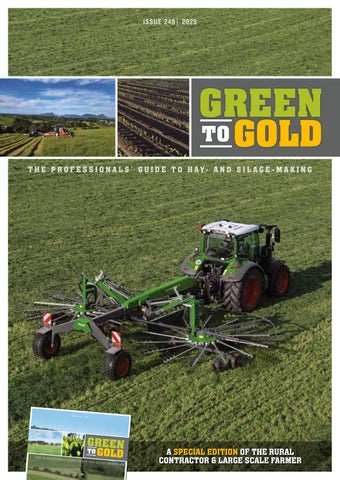
ISSUE 246 2026
GREEN TO
GOLD
T H E P R O F E S S I O N A L S ’ G U I D E T O H AY- A N D S I L A G E - M A K I N G
ISSU E 238 202 5
GREEN TO
THE PROFE
SSIONALS
GUIDE TO H
GOLD
AY A N D S I L
AGE MAKIN
G
A SPECIAL EDITION OF THE RURAL CONTRACTOR & LARGE SCALE FARMER
NO REPAYMENTS UNTIL APRIL ‘27 ON SELECTED 155 –425HP TRACTORS*
MF 9S | 285 – 425HP
Farming doesn’t wait. Neither should you. Massey Ferguson tractors are built to keep going. Now with no repayments until April 2027 with finance available from 1.99% p.a.* Strictly for a limited time only.
See your local Massey Ferguson dealer now. While stocks last! *Offer is based on an interest rate of 1.99% p.a. with repayments starting in April 2027, a 30% deposit, and the GST component repaid in the 4th month. Repayments can be either 36 monthly repayments starting in April 2027 or 3 Annual repayments with the first annual repayment due in April 2027 and 2 further annual repayments thereafter. This offer is only available on selected series and while stocks last for new orders placed between 1 July 2026 and 31 October 2026 with delivery and settlement by 30 November 2026. Selected series include: MF 7S Dyna-VT (155-210HP), MF 8S, MF 8S Xtra, MF 8700S and MF 9S tractors. Not available in conjunction with any other offer. Finance provided by AGCO Finance Limited company number 1530800 for approved customers and for business purposes only. Credit criteria, fees, terms and conditions apply.
GREEN TO GOLD 2026
IN THIS ISSUE... 02
From the Editor: Green to Gold
NEWS 03 Dyna-VT broadens the role of Massey Ferguson’s MF 5S
08
06 Cool Beef looks to breed more efficient cattle 08 Adding value from the ground up 10 Backing rural New Zealand for the season ahead 12 DairyNZ sets six priorities to unlock dairy sector growth 14 Record meals underline a growing need
TECHNOLOGY 16 Protect your maize silage investment, says researcher 17 W & J Mair Agricultural Contractors 20 Building better silage from the ground up 21 Intelligent harvesting delivers better silage 22 Technology update: Claas connect keeps forage operations connected 25 It pays to get maize to emerge evenly 26 Protecting forage before quality is lost
36
28 Why this Southland machinery expert rates Samasz for mowing 30 Fall armyworm: Four years on 32 Redefining foliar application 34 Fusion 4 Plus builds on McHale’s baler-wrapper formula 36 Contour without compromise 38 Engineering the forage harvest 41 Case IH launches next generation Puma series 42 Fendt 500 Vario Gen4 raises the standard in the mid-power tractor segment 44 Engineering every granule 46 Engineering slurry from the bottom up 48 Keeping high-horsepower forage harvesters fed 50 Engineering crop flow
PROFILES
50
52 Built for the long haul 58 Built by farmers, for farmers 65 Across the Ditch: The rise of time smart-farming
58 01
Editor Angus Kebbell 022 052 3268 angus@agrimedia.co.nz Advertising Manager Michael Lightbourne 021 403 853 michael@agrimedia.co.nz Advertising Sales Lisa Phelan 021 782 228 lisa@agrimedia.co.nz Circulation Hilary Armstrong 027 443 3477 admin@agrimedia.co.nz Production Design and Layout Hannah Kincaid art@agrimedia.co.nz Contributors Heather Chalmers, Scott Wilson, Hon. Mark Patterson, Amy Wilkinson Printed by Blueprint Ltd
Read our magazine online ruralcontractor.co.nz/read-online
Follow us facebook.com/nzrclsf instagram.com/nzrclsf ruralcontractor.co.nz
Scan here to sign up to our digital newsletter
PO Box 36753 Merivale, Christchurch 8146 ph 03 329 6555 www.agrimedia.co.nz Publishers of Rural Contractor & Large Scale Farmer, AgriBusiness, AgriVet, NZ Cropping, Australian AG Contractor & Large Scale Farmer, NZ Novachem Agrichemical Manual.
Green to Gold There is something reassuringly constant about the annual cycle of hay and silage making. The machinery changes, technology improves and the way we manage crops continues to evolve, but the fundamental objective remains the same. We are trying to preserve as much feed quality as possible and put enough high-quality forage in front of livestock to carry farming businesses through whatever the season brings. That is what Green to Gold is about. Each year we look at the latest developments, techniques and methodologies shaping hay and silage production, from mowing and conditioning through to tedding, raking, harvesting, baling, wrapping and storage. We also look at the machinery and technology entering the market and, more importantly, what those developments mean for farmers and contractors trying to get more from variable harvesting windows. This year that conversation sits against an extraordinarily strong backdrop for much of New Zealand’s primary sector. Export revenue has reached $64 billion, underlining once again just how important agriculture and horticulture remain to the wider New Zealand economy. Dairy returns are positive and sheep and beef farmers are finally seeing stronger returns after several difficult seasons. That confidence matters. When farmers are profitable they invest. They replace machinery, improve infrastructure, develop land, adopt new technology and make decisions with a longer-term view rather than simply trying to get through the next season. But it is equally important not to pretend every part of the primary sector is enjoying the same conditions. Arable farmers are doing it tough, with difficult seasons, tight margins and weather continuing to test businesses. Grape growers are also facing significant pressure and in Marlborough, in particular, we are seeing vines being pulled out as growers respond to an imbalance between production, demand and profitability. That contrast is a reminder of why New Zealand’s diverse primary sector matters so much. No commodity remains at the top of the cycle forever. Dairy has had difficult years. Sheep and beef farmers know better than most how quickly market conditions can change. Horticulture, arable and viticulture
© RURAL CONTRACTOR AND LARGE SCALE FARMER - No part of this publication may be reproduced in any form without the prior written permission of the publisher. Opinions expressed in this publication are not necessarily that of the publisher and suggest independent advice be sought before acting on information or suggestions contained herein.
02
Angus Kebbell, editor.
all face their own cycles, climate risks and market pressures. Our strength is that we do not depend on one crop, one livestock system or one export market. When one part of the sector is struggling, another can be performing strongly. That diversity spreads risk across the rural economy and helps keep contractors, machinery dealers, processors, rural businesses and communities moving forward. It also reinforces something that can sometimes be forgotten among all the discussion about markets, regulation and technology. Fundamentally, people will always need food. Producing it will always require someone to prepare the ground, plant the crop, manage it through the season and harvest it when the time is right. It will require tractors, mowers, balers, forage harvesters, cultivation equipment and the people with the knowledge and experience to operate them. The technology will continue to change and the methods will continue to improve, but that underlying requirement will not. That is the enduring strength of our primary sector and the industry that supports it, season after season. RC
Contributions - Editorial and photographic contributions are welcomed and should be sent directly to AgriMedia Ltd. Editing of submissions is at the sole discretion of the editor and will accept no responsibility for unsolicited material.
Industry News
Dyna-VT broadens the role of Massey Ferguson’s MF 5S Massey Ferguson has added its Dyna-VT continuously variable transmission to the MF 5S range in Australia and New Zealand, giving buyers of the 105 hp to 145 hp tractors a third transmission choice and broadening the capability of a series already well established in loader work. The new transmission is available across all five MF 5S models in Efficient and Exclusive specification, from the MF 5S.105 through to the 5S.145. It joins the existing Dyna-4 and Dyna-6 transmissions, which remain available, while Essential specification tractors continue with a choice of Dyna-4 or Dyna-6. For Massey Ferguson, the addition reflects the changing role of tractors in this power class, particularly as machines that might once have been purchased primarily for loader duties are increasingly expected to handle mowing, baling, cultivation, transport and other field work. “Our multi-award-winning MF 5S series models have a strong reputation as the best loader tractors, but their capability, flexibility and high specification mean they are
The addition of Dyna-VT continuously variable transmission broadens the versatility of Massey Ferguson’s MF 5S range across loader, field and transport work. increasingly selected for grassland and arable field tasks too,” says Chris Bain, product marketing manager, Massey Ferguson ANZ. “The new Dyna-VT transmission option adds even greater appeal to this successful series, and the extra comfort, efficiency and ease of use has been welcomed by customers
and dealers worldwide.” At the centre of the new models is Massey Ferguson’s single-range continuously variable transmission, providing stepless travel from 0.1 to 40 km/h without the operator having to work through conventional gear ranges. Control can be through the
03
Industry News
accelerator pedal, hand throttle or Power Control lever, depending on the job and operator preference. Importantly, maximum 40 km/h transport speed is achieved at an engine speed of just 1,550 rpm. That ability to maintain road speed at relatively low engine revs is one of the areas where a continuously variable transmission can contribute to lower fuel use, reduced noise and a more relaxed operating environment during transport. The transmission also allows two virtual speed ranges to be programmed through the Transmission Control Lever. Rather than leaving the tractor’s entire speed range available for every task, the operator can establish minimum and maximum speeds suited to a particular operation. For loader work, for example, a relatively narrow speed range can be established so small pedal or lever movements produce more precise changes in travel speed. The same principle can be applied to baling or other field operations, where maintaining the tractor within a defined working-speed window makes the job easier and more consistent. Different forward and reverse start-off speeds can also be programmed, along with two cruise speeds for each operating mode. The transmission’s drive engagement rate is adjustable, allowing the operator to change how aggressively the tractor takes up drive following a direction change. A softer engagement setting is designed for precise loader work, particularly on hard surfaces, where smoother direction changes can improve driver comfort, reduce tyre wear and help prevent material spilling from the bucket. A faster engagement setting can be used where rapid direction changes and shorter cycle times are the priority, with an intermediate setting suited to general field work. Parklock is standard with Dyna-VT and automatically applies the parking brake through the Power Control shuttle lever. It is a relatively small feature, but one that becomes significant on a loader tractor carrying out
repeated stop-start operations during a working day. In fully automatic operation, the driver simply selects the required travel speed with the accelerator pedal. The tractor then manages engine speed and transmission ratio to deliver that speed as efficiently as possible, continuously adjusting the combination as load and operating conditions change. The system becomes particularly useful when operating PTO or hydraulically driven equipment because engine speed and travel speed can be controlled independently. Required engine revs can be stored in the A and B engine-speed memories to maintain PTO or hydraulic performance, while Dyna-VT varies ground speed separately. That gives the operator considerably more flexibility when conditions change across a paddock. Ground speed can be altered without compromising the engine speed required to keep a mower, baler or other implement operating at its optimum. The transmission is only part of the changes made for the Dyna-VT models. Massey Ferguson has also introduced new front and rear axles, a new hydraulic system and a new rear linkage and hitch. All five tractors retain the same 2,550 mm wheelbase, providing a relatively compact platform while maintaining stability for loader work and traction in field applications. Maximum gross vehicle weight is 9,000 kg, while Gross Combination Weight is rated at up to 41,000 kg, subject to local restrictions. Power comes from a 4.4 L four-cylinder AGCO Power Stage V engine across the range. Maximum output starts at 105 hp, or 77 kW, in the MF 5S.105 and progresses through 115 hp, 125 hp and 135 hp to 145 hp, or 107 kW, in the MF 5S.145. Maximum torque is produced at 1,500 rpm, ranging from 470 Nm in the 5S.105 to 510 Nm in the 5S.115 and 540 Nm in the 5S.125. The 5S.135 produces 545 Nm, while the 14 5hp flagship delivers 560 Nm. Hydraulic performance is another important part of the specification, particularly given the MF 5S range’s loader credentials.
Massey Ferguson’s MF 5S combines a compact platform with up to 145 hp, a 110 L/min load-sensing hydraulic system and the new Dyna-VT transmission option.
04
Dyna-VT models use a 110 L/min loadsensing hydraulic system, providing flow on demand rather than continuously pumping at maximum capacity. This gives the tractors the hydraulic performance required for fast loader cycle times while providing capacity for more hydraulically demanding implements. Up to 41 L of removable oil capacity is available for tipping large trailers and other high-demand hydraulic applications. Rear linkage lift capacity is 6,000 kg across all five models, while the optional front linkage provides a further 3,000 kg of lift capacity. A wide range of factory-fitted loader options is also available, with the 110 L/min hydraulic system aimed at maintaining quick response and cycle times. Hydraulic control varies according to specification. A micro joystick on the Multipad operates the first and second valves, while the third and fourth valves are mechanically controlled on Efficient models and use fingertip electronic controls on Exclusive versions. A three-speed PTO is standard, providing 540, 540 Eco and 1,000 rpm outputs. The 540 Eco setting allows implements with lower power requirements to achieve the required PTO speed, with the tractor engine running at 1,560 rpm, reducing fuel consumption, noise and unnecessary engine wear where full engine output is not required. Massey Ferguson has also retained the MF 5S range’s emphasis on visibility and manoeuvrability. The tractors offer a 4 m turning radius, while the low nose design provides forward visibility particularly suited to loader work. Datatronic 5 and Fieldstar 5 touchscreen terminals are available with Massey Ferguson’s Smart Farming technology, bringing machine control, guidance and precision farming functions into the same tractor platform. The Dyna-VT models also retain the relatively long service intervals of the existing MF 5S range, with engine oil changes at 600 hours and transmission oil changes at 2,400 hours. For operators, however, the main change is not simply the addition of another gearbox to the specification sheet. Dyna-VT changes how the MF 5S can be operated across different jobs. At one end of the spectrum it allows a less experienced driver to select a speed and leave the tractor to manage the engine and transmission automatically. At the other, an experienced operator can programme speed ranges, engine memories, cruise speeds and transmission response to suit a specific operation. That flexibility is particularly relevant to mixed-use tractors, where the same machine might spend the morning loading feed, the afternoon mowing or baling and then head onto the road with a trailer. The MF 5S was already designed around that type of versatility. Adding a continuously variable transmission gives operators another way of making use of it. RC
Rural never calls one spray a strategy.
Protect crop and pasture performance with our technical know-how, tailored to your operation. Talk to your Farmlands rep, order in FarmlandsPRO or head into your local store.
Industry News
Cool Beef looks to breed more efficient cattle A new four-year research programme will investigate whether New Zealand beef cattle can be bred to become more feed efficient and produce less methane without compromising the productivity traits farmers rely on. The Cool Beef programme was officially launched at Te Mania Angus in North Canterbury and will bring together farmers, scientists and industry partners to build the science and data needed to better understand the relationship between feed efficiency, methane emissions and production in New Zealand beef cattle. Led by Beef + Lamb New Zealand (B+LNZ) and funded by the Ag Emissions Centre, the programme is ultimately intended to support the development of breeding tools that could allow farmers and breeders to consider feed efficiency and methane alongside the production traits already used when making breeding decisions. The Ag Emissions Centre is investing $3.9 million in Cool Beef through to May 2029, with the Bioeconomy Science Institute and collaborating cattle breeders also involved in delivering the programme.
The Cool Beef programme will measure thousands of New Zealand beef cattle to better understand the relationship between feed efficiency, methane emissions and animal performance.
06
B+LNZ Chair Kate Acland says the focus is on developing the information farmers will need if they choose to include these traits in future breeding decisions. “Farmers are focused on breeding productive animals that perform well in their farming systems. Cool Beef will help build our understanding of the relationship between feed efficiency, methane emissions and production traits, giving breeders better information to support future decisions.” The programme builds on earlier industry research, including work carried out through the Informing New Zealand Beef programme and B+LNZ’s Beef Progeny Test. Over the next four years, at least 2,000 beef cattle will be measured for both feed intake and methane emissions, with another 1,000 methane measurements collected from cattle grazing directly on pasture. The research will include Angus, Hereford and crossbred cattle from collaborating breeders throughout New Zealand. Two research locations, Te Mania Angus in North Canterbury and Pāmu’s St Kilda farm in Taupō, will collect both feed intake and methane emissions data. A third site, Pāmu’s Kepler Farm near Te Anau, will collect methane measurements directly from cattle grazing pasture. Feed efficiency is an important part of the equation. Specialised feed intake technology will measure exactly how much individual animals consume, allowing researchers to compare that intake with animal growth and performance. Rather than simply identifying cattle
that grow quickly, the research should help determine which animals are capable of converting feed into production more efficiently and how that efficiency relates to methane emissions and other economically important traits. Methane measurements are currently being collected using Portable Accumulation Chambers (PACs), developed by the Bioeconomy Science Institute. Individual animals spend around one hour in the chambers, which capture the gases they emit and allow researchers to rank animals according to their methane emissions. The technology has already been used extensively with sheep, with thousands of measurements collected on farms throughout New Zealand, and Cool Beef will investigate its application at a considerably greater scale within the beef industry. Other methane measurement technologies could also be incorporated as the programme develops. The Bioeconomy Science Institute’s technology and expertise have been critical to establishing the measurement capability required for the programme. Ag Emissions Centre Executive Director Dr Naomi Parker says Cool Beef forms part of a wider programme looking at the potential of livestock genetics to contribute to reducing agricultural methane emissions. “The Cool Beef programme is a key part of the Ag Emissions Centre’s broader portfolio of low methane livestock genetics research, including work on low methane sheep and low methane dairy. By bringing together
industry, researchers and farmers, we’re building the scientific capability needed to develop practical breeding tools for New Zealand farmers and support New Zealand agriculture into the future. “Cool Beef is a great example of that collaborative approach, building the knowledge and breeding tools needed to support future breeding decisions.” An important part of the programme will be determining how methane emissions and feed efficiency interact with existing production traits. Selecting for a single characteristic can potentially have consequences elsewhere in an animal’s performance, making it important to understand the relationships between feed intake, growth, productivity and emissions before incorporating new traits into a breeding programme. By combining methane measurements with feed intake and performance data across thousands of animals, researchers aim to establish whether feed efficiency and lower methane emissions can be selected for individually or together, and what consequences that selection could have for other traits. Ultimately, that information could contribute to future Estimated Breeding Values (EBVs) for New Zealand beef cattle. One likely outcome following the programme is the development of a breeding value for methane emissions, alongside data that could inform breeding values for feed
efficiency in New Zealand cattle. These would not replace the production EBVs farmers and breeders already use. Instead, they would provide additional information that could be considered alongside traits such as growth and other measures of animal performance, depending on the objectives of an individual farming business. That distinction is important because Cool Beef is intended to provide farmers with another breeding option rather than prescribe how cattle should be selected. Acland says breeding decisions have implications that extend well beyond a single season, making robust science particularly important before new traits are introduced into selection programmes. “Breeding decisions are made with the long-term performance of a herd in mind. Cool Beef is about generating robust information so farmers who want to consider these traits in the future have the confidence that the science behind them is sound.” Early work has already demonstrated the scale of measurement involved. Before the programme’s formal launch, 256 heifers had completed feed-efficiency and PAC measurements as work got underway. Cool Beef will also complement New Zealand’s involvement in the international Bluegrass project, involving researchers from New Zealand, Australia, the United Kingdom, Ireland and the United States, which is expected to provide additional
measurements and information relevant to livestock efficiency and emissions. The programme forms part of the Ag Emissions Centre’s broader investment in low-methane livestock genetics across beef, sheep and dairy. For the beef industry, however, the immediate objective is relatively straightforward. Before farmers can make informed breeding decisions around feed efficiency or methane, they need reliable measurements and an understanding of what selecting for those traits means for the overall performance of the animal. Cool Beef is intended to provide that foundation. Participation is voluntary, with collaborating breeders providing cattle and data that will contribute to the wider research programme. If the work ultimately leads to new breeding values, farmers will then have the choice of incorporating those traits into their breeding objectives alongside the productivity characteristics that already underpin New Zealand beef genetics. For an industry where improvements through genetics accumulate from one generation to the next, understanding whether cattle can consume less feed, maintain production and produce less methane could provide another long-term tool for improving both the efficiency and environmental performance of New Zealand beef production. RC
LEADERS IN DESIGN & MANUFACTURING TOP OF THE LINE AIR SEEDER DRILLS Custom Design for Durability | Robust Parts and Construction Smart Distribution Technology | Cost Effective Performance Finance options available Contact the team today for more information: 03 308 4094 SALES@ALLENCUSTOMDRILLS.CO.NZ WWW.ALLENCUSTOMDRILLS.CO.NZ
07
Industry News
Adding value from the ground up For generations, New Zealand agriculture has excelled at producing some of the world's highest quality raw materials. Wheat, milk, meat, wool and horticultural products have earned international reputations for quality and consistency, yet many of the processed foods filling supermarket shelves continue to rely heavily on imported ingredients. That creates an interesting contradiction. We are exceptionally good at growing food, but we often leave the value-adding to someone else. Monty & Sons represents a different way of thinking. Rather than simply manufacturing pasta in New Zealand using imported grain, the South Wairarapa business has built its production model around growing, milling and manufacturing within the same domestic supply chain. It is a relatively simple concept, but one that requires considerable coordination between growers, processors and manufacturers if it is to work successfully. The foundation of that system lies with locally grown durum wheat. Unlike conventional bread wheat, durum has traditionally been sourced from overseas, largely because of the belief that New Zealand conditions were not ideally suited to the crop. By working with growers in the Wairarapa Grains Collective and selecting ancient durum varieties that perform well in the region's dry summer climate, Monty & Sons has demonstrated that a genuine New Zealand-grown pasta industry is achievable. That may appear to be a small step, but from a supply chain perspective it is significant, reducing reliance on imported raw materials while creating new opportunities for arable farmers looking to diversify their cropping programmes. What makes the business particularly interesting, however, is not simply where the wheat comes from, but how it is transformed into the finished product. Modern food manufacturing is built around efficiency, with production lines designed to maximise throughput while delivering consistent
quality. In the pasta industry, this typically involves extruding dough through smooth Teflon dies before rapidly drying the product at elevated temperatures. The system is fast, highly repeatable and ideally suited to largescale manufacturing. Monty & Sons has deliberately chosen a different production pathway. Instead of Teflon tooling, the company uses traditional bronze dies during extrusion. While this may seem like a minor manufacturing detail, it fundamentally changes the surface characteristics of the finished pasta. Bronze tooling leaves a microscopically textured surface that holds sauces more effectively than the smooth finish produced by modern dies. It is a slower process that requires greater attention to production, but it reflects a conscious decision to prioritise product performance rather than production speed. The drying process follows exactly the same philosophy. Rather than removing moisture as quickly as possible, the pasta is slow dried over periods of up to 24 hours using lower temperatures. From a processing perspective, this helps preserve the structure of the wheat proteins while producing a firmer texture and more consistent cooking performance. It is another example of manufacturing decisions being driven by product quality rather than factory output, even though slower drying inevitably reduces production capacity. There is also an important story behind the grain itself. By sourcing wheat directly from
From locally grown grain through to the finished product, shorter supply chains are creating new opportunities to connect New Zealand agriculture directly with consumers.
08
Locally grown durum wheat is helping create new opportunities to add value to New Zealand agricultural production closer to home. local growers, the company has established complete traceability throughout its production system. At a time when consumers increasingly want to understand where their food comes from, shorter supply chains provide greater transparency while strengthening the relationship between growers, processors and end users. For farmers, it creates the opportunity to produce a premium ingredient with a clearly identified destination rather than simply supplying a global commodity market. That emphasis on production extends beyond the factory gate. The growers supplying the business follow regenerative farming principles that place a strong focus on soil health and long-term productivity. Regardless of where individual farmers sit on the regenerative farming debate, maintaining healthy soils remains fundamental to any sustainable cropping system. Linking production practices directly to a premium food product also demonstrates how agricultural management decisions can become part of a product's overall value proposition rather than remaining invisible to consumers. Packaging has received the same level of attention. Food manufacturers continue to face the challenge of reducing plastic without compromising product quality or shelf life, particularly where moisture control is critical. Rather than accepting conventional plastic packaging as the default option, Monty & Sons invested time in identifying biodegradable alternatives capable of protecting the product while reducing environmental impact. It is another example of engineering and manufacturing decisions being considered across the entire production system rather than focusing solely on the food itself. Perhaps the most interesting aspect of the business is that there is no single breakthrough technology underpinning
OUTLASTS ORDINARY OILS. GUARANTEED. AND THAT’S A PROMISE. Boasting a 500-hour* drain interval that’s twice the industry norm, John Deere Plus-50™ II has been engineered to keep your operation moving with fewer oil changes and lower running costs. And because John Deere stands behind its oil like no other manufacturer, we’ll cover the parts and labour if an oil defect causes damage to your engine. No matter the hours.* Not all oils are created equal.
Scan the QR code to calculate how much John Deere Plus-50TM II can save you. *500 or 750 hour drain interval applies to John Deere diesel engines when the following criteria are met: 1. Engine is equipped with an extended drain interval oil pan. 2. Machine operates with Plus-50™ Il engine oil API CK-4.3. Machine uses a John Deere engine oil filter 4. Machine uses only ultra low sulphur diesel fuel.
Industry News
Backing rural New Zealand for the season ahead Article supplied by the Hon. Mark Patterson, Minister for Rural Communities.
It’s fantastic to see and, in the case of our sheep and beef sector, a long overdue boost after some tough years. From a market perspective, it is looking genuinely positive again. Even my beloved wool sector is on the up after decades of dismal pricing. Long may it last! Needless to say, it is not all positive. While the wider horticultural sector is doing well, vegetable growers and the arable farmers are doing it pretty tough. While the added rain has been positive for grass growth, it has been disastrous for our arable farmers trying to get in crops. The second tough harvest in a row and the third in five seasons. A number of severe weather events throughout the country also struck during the year, making it a challenging one for many. Cost increases also are a constant, especially considerable rate rises and insurances. And then, of course, the Strait of Hormuz ructions, which have sent shockwaves through global supply chains. Rural contractors, in particular, have been heavily impacted, specifically with diesel prices lifting significantly. Fortunately, the bulk of the harvest and silage season was well advanced, but the impacts are ongoing and unfortunately look like flowing into next season, with spring just around the corner. The government focused heavily on securing supply, and the additional 90 million litre storage capacity at Marsden Point buys some extra resilience. That the refinery was
allowed to shut by Labour in the previous term was exposed as absolute folly, leaving New Zealand extremely vulnerable to tenuous supply chains and geopolitical flare-ups. We need to get serious as a country about securing fuel resilience. The government has overturned the oil and gas exploration ban and offered up $ 200 million in co-investment funding to encourage renewed exploration. It is fantastic to see the first permit being granted in the Taranaki Basin. New Zealand First are campaigning on going much further. Putting $1billion into using the very latest technology to survey New Zealand’s entire coastal zone and attract overseas investment. Incredibly, only five full exploration wells have ever been drilled beyond the Taranaki Basin. The rumoured strike in the Great South Basin by the Hunt Brothers in the 1970s has never been properly followed up. With modern technology, it’s quite probable that New Zealand has genuinely world class fields. Gas literally bubbles up from the ground in Tairāwhiti and yet it has never properly been explored. This could be a game changer for the New Zealand economy and for our future preparedness for future geopolitical tumult. The silver lining for recent events is the wider realisation that the New Zealand economy runs on diesel. Not wind, not solar, but diesel. On other matters. I know it is of enormous frustration to rural contractors that the weight limits per axle that are inhibiting road use by modern harvesting machinery have been slow to be amended. This is a matter that has been kicking around too long. It is currently with Minister Bishop and is subject to a review process. With the season on the brink of kicking into gear, I know there will be frustration that this hasn’t yet been sorted. It is a matter that I am keeping a very close eye on as Minister for Rural Communities. Modern machinery simply must be able to move around without impacting productivity. It does highlight another matter, which is the state of our aging rural roadway bridge
network. It is my view that this is not being dealt with enough priority within the land transport budget. This country’s appetite for roads of national significance and new four-lane highways exceeds our ability to fund. We must do a better job of maintaining and fortifying the network we already have, and this includes prioritising the bridges that link our rural communities, support our primary sector and get our product efficiently to market. Look for New Zealand First to have policy on this. Unlike some other parties, we don’t think we can control the weather. Let’s hope El Niño doesn’t turn into a 1987–88 or 1997–98 type event. Most of the country is starting the season with decent soil moisture levels. As Associate Minister for Regional Development, I can say that this term the government has invested significantly into water storage through the Regional Infrastructure Fund. We need to be doing more of this investment in the future to build resilience, enhance productivity and diversify into higher value land use options. While undoubtably challenges remain, it is positive that farmers and growers are starting the new season mostly on the front foot. I have never seen the sector so positive, they have their heads up; they’re investing and seeking to maximise the opportunities ahead. And when that happens, it has very positive spinoffs for the rural servicing industry and the rural communities that rise and fall on their fortunes. Good luck for the season ahead. RC
its success. Instead, it is the accumulation of numerous production decisions that collectively create something different. Locally grown durum wheat, bronze extrusion, slow drying, shorter supply chains and thoughtful packaging are all established technologies in their own right. The innovation comes from integrating them into a production model that delivers greater
value while remaining firmly connected to New Zealand agriculture. For the wider agricultural sector, there is an important lesson in that approach. Adding value does not always require revolutionary technology or major scientific breakthroughs. Sometimes it comes from asking how existing production systems can be redesigned to retain more value within
New Zealand while giving farmers access to new markets built on quality, provenance and transparency. As pressure continues to grow for agriculture to deliver more than commodity production alone, businesses such as Monty & Sons demonstrate that the next opportunity may lie not in producing more, but in producing smarter. RC
It has been another stellar year for our primary sector. I can’t think of another season with the confluence of favourable grass growth and high product prices. The $64 billion of export revenue earned this year is testament to the critical nature of the primary sector to the wider New Zealand economy. An incredible 82% of our merchandise exports.
10
Hon. Mark Patterson.
The powerful fungicide for wheat PLUS ryegrass seed crops
WHEAT
RYEGRASS SEED CROPS
The benefits of ELATUS® Plus add up. Long-lasting disease control in wheat crops.
FREE NOZZLES
Proven rust control in ryegrass seed crops, with a short 14 day withholding period. Solo SDHI formulation for tank mix flexibility. Ryegrass endophyte safety confirmed.
For more information please call the Syngenta Technical Advice Line on 0800 333 336
Registered trademark of a Syngenta Group Company. ELATUS® Plus is registered pursuant to the ACVM Act 1997, No. P9276. Always read the label completely before use. © Syngenta 2026. AD100826
®
SCAN TO FIND OUT
MORE
Industry News
DairyNZ sets six priorities to unlock dairy sector growth DairyNZ is calling on political parties to commit to six practical policy priorities it says are needed to unlock growth in New Zealand’s largest export sector and give dairy farmers the confidence to keep investing in productivity, sustainability and regional communities. With the 2026 General Election approaching, DairyNZ is arguing that ambitions to grow the New Zealand economy need to be matched by policy settings that allow one of the country’s largest productive sectors to continue investing. The dairy sector contributes more than $28.6 billion in export earnings each year, directly employs around 51,800 people and underpins communities throughout New Zealand. DairyNZ says political parties serious about growing the economy need to support policy settings that allow the sector to remain productive, internationally competitive and resilient. Its six priorities cover resource management and freshwater, biosecurity, workforce capability, science and technology, low-emissions technology and rural infrastructure, and animal welfare. Developed with farmers and informed by science and on-farm expertise, the priorities focus on areas where DairyNZ believes practical and evidence-based policy can provide greater certainty, encourage investment and support the long-term performance of the sector. DairyNZ Chair Tracy Brown says the election presents an opportunity for political parties to match their economic growth ambitions with policies that give farmers the confidence to invest. “If New Zealand wants stronger economic growth, it needs policies that support the industries delivering it. “Dairy farmers have consistently shown they’re willing to invest in productivity, environmental improvements and innovation. But continued investment depends on policy settings that are practical, predictable and grounded in evidence.” At the top of DairyNZ’s priorities is getting resource management and freshwater systems right. Environmental regulation has a significant influence on how dairy businesses operate and invest, and DairyNZ is calling for an approach that allows farmers to continue improving environmental outcomes while providing greater certainty around the rules they are expected to meet. Biosecurity is another major priority, with DairyNZ calling for a strong and properly funded biosecurity system. For an 12
industry built around livestock production and agricultural exports, preventing and responding effectively to incursions remains fundamental to protecting individual farming businesses and the wider economy. Strengthening the dairy workforce is also central to the organisation’s election platform. Dairy remains a significant employer, particularly in regional New Zealand, and having access to the people and skills required to operate increasingly sophisticated farming businesses is an important part of maintaining productivity and supporting future growth. Science and innovation form another part of that equation. DairyNZ wants the next Government to boost science funding and accelerate the uptake of new technology, recognising that improvements in productivity and environmental performance increasingly depend on getting practical research and new technologies from development into commercial farming systems. That extends into DairyNZ’s fifth priority, which combines support for low-emissions technology with investment in rural infrastructure. Farmers are increasingly being asked to reduce the environmental footprint of their businesses, but achieving that while maintaining production will depend on practical technologies becoming available and being capable of being adopted on farm. At the same time, the infrastructure supporting rural businesses remains an important part of productivity. DairyNZ’s position is that creating the conditions for continued investment requires attention not only to what happens inside the farm gate, but also to the infrastructure and technology that allow modern farming businesses to operate effectively. The final priority is maintaining strong animal welfare rules, ensuring New Zealand continues to have robust standards while those rules remain practical and workable within farming systems. Together, DairyNZ says the six priorities would support a dairy sector that remains productive and globally competitive while continuing to improve its environmental footprint through science, innovation and practical policy. Brown says certainty around those settings matters because investment decisions on farms are often made over many years rather than a single season. “When farmers have confidence in the policy environment, they’re more willing to invest in new technology, improve environmental performance and build resilient businesses. A lack of certainty on policy settings mean investment decisions
DairyNZ Chair Tracy Brown. become harder, slowing the pace of innovation and growth.” That relationship between policy certainty and investment sits at the centre of DairyNZ’s election message. Government decisions influence almost every part of a modern dairy business, from freshwater and environmental regulation through to biosecurity, access to skilled workers, infrastructure and the availability of new technology. DairyNZ argues that poorly designed or uncertain policy can make farmers more cautious about committing capital, while practical and predictable settings provide greater confidence to invest. The organisation also wants farmers’ practical experience to play a greater role in those decisions. Through its work with farmers across New Zealand, DairyNZ says it sees how regulatory and policy decisions translate into changes at farm level, and its election priorities are intended to ensure that on-farm expertise is reflected in the policies developed by the next Government. For Brown, however, the argument extends beyond the performance of individual dairy farms. “Backing dairy isn’t just about supporting farmers. It’s about strengthening regional communities, growing export earnings and helping New Zealand build a more productive economy.” With more than $28 billion in annual export earnings and tens of thousands of people directly employed by the sector, DairyNZ is positioning dairy policy as part of the wider economic debate heading into the election rather than simply a collection of agricultural issues. Its message to political parties is that productivity, environmental performance and economic growth do not need to be competing objectives, but achieving all three requires policy that gives farmers enough certainty to continue investing. RC
EXPERIENCE NEXT LEVEL WITH FENDT.
Starting from: 0% finance*
Winter Green Harvest Specials. Now is the time to secure yourself the best deal on Fendt Balers and Haytools with excellent finance rates running until 30th September 2026. Speak to your local Fendt dealer to secure this deal today.
20% deposit 24 month payment terms
*Offer ends 30th September 2026, while stocks last and applies to the Fendt Hay product ranges. This offer is limited to AGCO stock. Finance with an interest rate of 0% p.a. with 20% deposit available over a 24-month term with monthly payments in arrears. Fees and lending conditions apply to approved GST number holders who use the equipment for business purposes. Finance is approved by AGCO Finance Limited, GST number 88-831-861. Contact your local Fendt dealer for full terms and conditions.
Leaders drive Fendt. fendt.com/au fendt.com | Fendt Fendt ist is eine a worldwide weltweite brand Marke von of AGCO. AGCO.
Industry News
Record meals underline a growing need There is an uncomfortable contradiction sitting at the heart of New Zealand’s food system. We are one of the world’s great foodproducing nations, exporting high-quality meat and dairy products around the globe, yet an increasing number of New Zealand families are finding those same foods difficult to put on their own tables. Meet the Need’s latest Impact Report puts some fairly stark numbers around that contradiction. During the 2025/26 year the rural charity delivered 1,277,241 meals to people experiencing food insecurity, including 429,662 mince meals and 798,792 milk meals. That was 81,605 more meals than the previous year and takes the organisation beyond 4.2 million meals delivered since it began in 2020. Meet the Need also regularly supported 148 foodbanks, up from 135 a year earlier. Those are impressive numbers and they demonstrate what can happen when farmers, processors, rural businesses, transport operators, volunteers and foodbanks work together. But there is another number in
the report that perhaps matters even more. One in three New Zealand households experienced some level of food insecurity during the past year, and 68% of those households said they had only begun struggling to afford enough food during the previous 12 months. Meet the Need General Manager Zellara Holden says there has been a noticeable change in the people now seeking food support. “These aren't just the families people might traditionally expect to need food support. They're working families, rural households and people who have never had to ask for help before.” That is significant because it tells us food insecurity is no longer an issue that can simply
1.99% INTEREST
ON AGRI
TELEHANDLERS*
*Terms and conditions apply. Offer ends 30.09.2026.
0800 627 222 14
be attributed to a small or easily defined section of society. The report says 83% of affected households cited high costs as a reason for their situation, while 30% of full-time workers were unable to consistently afford enough food. Beef mince had also increased 23.2% year-onyear to $24.46/kg. “The cost of living continues to put enormous pressure on household budgets, and nutritious protein is often one of the first things families stop buying. That's why the work we do has never been more important,” Holden says. There is an important distinction here because a food parcel containing plenty of calories is not necessarily the same thing as a nutritious diet. Foodbanks can often source bread, canned goods, pasta and other staples reasonably well, but meat and dairy are considerably harder to obtain consistently. Temuka Combined Churches Food Bank describes Meet the Need’s support as a vital source of protein because much of the food donated through conventional channels does not contain the protein provided by milk and meat. Meet the Need was established to tackle precisely that problem, and there is a very agricultural practicality to the way it works. Farmers donate livestock or milk, processors turn those donations into food parcel-ready mince and milk products and the resulting food moves through a nationwide distribution network to foodbanks and ultimately families. Despite delivering a record number of meals, however, the organisation is finding that demand is growing even faster. “The reality is that while we've increased our impact, the need has grown even faster,” Holden says. “Every meal delivered is only possible because of the generosity of New Zealand farmers, our corporate and community partners, volunteers and individual donors. This report is a celebration of what we've achieved together, but it's also a reminder that our work is
far from over.” Perhaps one of the best summaries of why Meet the Need has resonated so strongly with the agricultural sector comes from Chair Nick Fisher. “New Zealand grows enough food to feed everyone. The challenge isn't supply, it's connection. Meet the Need exists to bridge that gap, ensuring quality New Zealand protein reaches families who otherwise couldn't afford it.” That connection is illustrated particularly well by Ōhaupō farmer Simon Boshier. Farming 20 ha and running 150 head of beef each year, Boshier has donated an animal to Meet the Need every year for the past six years. His involvement began after visiting The Village Community Services Trust and seeing a woman arrive with her five children. Her reaction to receiving mince made the issue very real for him. Boshier’s message to other farmers is characteristically straightforward. With strong beef and milk prices, he believes farmers who are in a position to contribute should consider doing so. Importantly, that does not necessarily mean donating an entire animal. Meet the Need allows farmers to donate a portion of a beast, meaning participation can be scaled to what an individual farming business can reasonably afford. The organisation is also increasingly being supported beyond the farm gate. It now has 29 partners and processors behind its work, although the report records 511 donors during the year, down from 659 previously. Case IH is donating $50 from every new tractor sold, an auction at the 2025 Groundspread New Zealand conference raised more than $61,000 and the Rabobank Waimate Golf Day generated the equivalent of more than 18,000 meals. Meet the Need also appointed award-winning dairy farm manager Ben Purua as its first ambassador. But the most powerful part of the Impact Report is not really found in the big numbers. It is in the stories from the other end
of the supply chain. One family featured in the report had steady employment, a home and savings. They were doing what most New Zealand families try to do, working, paying their way and planning ahead. A combination of illness, injury, unexpected expenses and redundancy gradually stripped that security away. Eventually their savings were exhausted and nutritious food became unaffordable. Turning to a foodbank was something they never imagined they would need to do, but the parcel they eventually received included Meet the Need meat and milk and gave the family some breathing space while they began rebuilding. Foodbanks around the country are reporting similar experiences. Te Aroha Community Foodbank says some clients have been unable to buy meat for weeks, while Winton Community Support says some families have stopped buying meat altogether because their budgets simply do not stretch that far. The scale of unmet demand is perhaps best illustrated by another figure buried in the report. Meet the
Need supplied 148 foodbanks during the year, but another 158 were still waiting for support. That puts the record 1.27 million meals into perspective. Meet the Need has grown substantially, but the problem it is trying to address is growing faster. For the rural sector there is something particularly compelling about this charity. Farmers spend their working lives producing food, and there is a natural connection between that work and making sure New Zealanders can eat well. Meet the Need provides the infrastructure that turns goodwill at the farm gate into something useful at the family table. “Our mission is simple,” Holden says. “Together, we can ensure more Kiwi families have access to nutritious protein during some of the hardest times in their lives. With demand continuing to grow, we need more people alongside us to make that happen.” There should be considerable pride in more than 4.2 million meals delivered since 2020, but perhaps not too much satisfaction just yet. In a country capable of producing enough
can be part of the answer. The challenge now is getting more farmers, rural businesses and New Zealanders alongside it because, despite a record year of giving, the need is showing no sign of getting smaller. RC
food for millions of people beyond our shores, having families at home who cannot afford meat or milk should bother us. Meet the Need has demonstrated that agriculture
YOU’LL FEEL THE DIFFERENCE IN THE CAB AND IN YOUR POCKET. Five reasons to choose Vredestein Tyres
Transform your tractor’s performance with improved operating efficiency, increased soil protection, greater operator comfort and lower costs.
Smoother Ride
More Traction
Greater Footprint
Find a dealer: 0508 140 140
|
Longer Life
Lower Cost Per Hour
vredesteintyres.co.nz
15
Technology
Protect your maize silage investment, says researcher Despite the cost of growing a maize silage crop rising about 30% in the last four years, growers should not be tempted to cut corners which could result in a reduced yield, Corson Maize National Research Manager Mike Turner says. “When you are growing a high-cost, highinput crop, doing the basics right is more important than ever,” he told a Foundation for Arable Research (FAR) maize winter workshop. From 2021–22 to 2025–26, his analysis shows that total maize silage costs, from spray out to covering the silage stack, rose from $4,026/ha to $5,143/ha. Fertiliser/lime and seed related inputs both recorded the biggest increase, at about 41%. “When costs are going up you need to protect that investment and yield at harvest.” Base fertiliser increased from $450/ ha in 2022 modelling to $850/ha now. “In comparison, the cost of a soil test is very cheap. So if you are getting your fertiliser spend wrong, either too much or too little, it can have a big impact on costs.” When growers get the basics right, a higher yield dilutes their costs, Turner says. For example, a 17 tonne of drymatter/ha maize silage crop equates to 31.9 cents a kg of drymatter. At 25 tonnes/ha this falls to 21.7 cents/kg/DM and at 28 tonnes/ha 19.4 cents/kg/DM. “Yield spreads cost across more kg of feed. This is the strongest reason for growers to protect crop establishment and the basics. Most costs in a maize silage crop are fixed. So the only real way to offset that is to get a good yield.” When choosing a CRM hybrid for silage, growers need to be aware that while silage yields increase for longer-maturing hybrids,
16
so can the risk, especially in environments that can get dry and disease pressured. Some growers are choosing a CRM out of habit, he says. “It is worth asking your seed supplier about what hybrid best suits your system. “Shorter CRM is not about giving up yield potential, it is about providing a more reliable return and a less risky yield. A crop that finishes cleanly, dries down, stands well and meets the harvest window usually protects margin better than a theoretical top-yield option.” Predictions of a super El Niño weather pattern producing hot, dry conditions later this season means it is recommended that growers without good moisture-holding soils shorten their CRM to get their crop well into grain fill or dry down phase before it comes under too much pressure. Some hybrids can better cope with dry conditions later in the season. A lower plant population could also be considered, Turner says. FAR Senior Maize Researcher Rene van Tilburg says that growers need to factor soil nitrogen into their input calculations and if they are applying more nitrogen than what their crop can take up, they are wasting money. “Maximise your soil N; use it or lose it.” Growers generally make some allowance for soil N, but often this is anecdotal and what they have always done, rather than being based on actual soil test results. Instead, growers should measure nitrogen supply rather than guess it and trust the result. Growers are recommended to use a Mineral N test to determine soil N as well as a Potentially Mineralisable Nitrogen (PMN) test which indicates how much N may become available during the growing season. This allows side-dress N applications to be better matched to crop demand and soil N supply, improving profitability.
In a FAR maize grain production trial at the Corson Research site at Newstead, near Hamilton, large differences in soil N supply between plots in 2024–25 resulted in sidedress N inputs ranging from just 75 kg to 360 kg SustaiN/ha. Soil testing showed the soil supplied from $599 to $1,016 worth of N at a SustaiN price of $1400/tonne. Despite these large differences in N inputs, grain yields remained remarkably similar, with all treatments producing about 16 tonne/ha of grain. The result saved $446/ ha to $805/ha if no allowance had been made for soil N, with the lowest SustaiN rate having one of the higher yields though not significantly so, indicating no yield penalty for using the soil N tools. Growers, particularly on good-structured soils, can also consider their cultivation intensity, saving diesel and machinery costs and labour. FAR work shows no yield penalty moving to strip till or no-till on sites with high quality soil. However, transitioning to strip-till or no-till has its challenges and may not be practical for many growers, van Tilburg says. Instead, a pass in a conventional system may be eliminated or a reduction in cultivation depth and subsequent increase in speed made instead. “A key point when making any of these changes is to ensure a seed bed that will result in consistent seed depth and good seed to soil contact.” FAR trials show that the combination of reduced cultivation intensity and the use of Mineral N and PMN testing have the potential to save $300 or more per hectare, he says. RC
With maize silage production costs rising, protecting crop establishment and yield is becoming increasingly important to keeping the cost of feed under control.
W & J Mair Agricultural Contractors Even in the depths of January, W & J Mair Agricultural Contractors, based at Hill Farm in Cumnock, Scotland, was a hive of activity. We were welcomed by owner Jim Mair, or “old Jim from the hill” was how he introduced himself, and what a picturesque spot Hill Farm is, surrounded by the Cumnock Hills. Jim explained they own 110 acres and rent a further 400 acres for prominently grazing and silage making for the farm’s 400 breeding ewes and 150 strong suckler herd running predominately Shorthorn bulls with a further 60 acres of barley grown as a cash crop. Aside from the farming enterprise, the family have run a hugely successful contracting business for the past 68 years, with Jims’s father William establishing the business in 1958. Jim himself started working in the enterprise at 15 years old and took over in his twenties. With help from his wife May, Jim expanded to the point it is today, with the third generation now heavily involved. Jim’s daughter, Margaret, manages the companies’ books and wages and two sons, James and Ian (Archie), who both started working with Jim straight out of school, now manage separate sides of the business. James is responsible for the silage, slurry and dump trailers work and Ian is responsible for
organising ploughing, seeding, combining and fertiliser work. Jim proudly added that he has grandsons who are very keen to be involved coming through also. The family were recently nominated for
Three generations of the Mair family are now involved in W & J Mair Agricultural Contractors, a business established at Hill Farm in Cumnock, Scotland, in 1958.
Chat to our Specialists Sales, Parts & Service: 07 843 7237 • sales@acmd.co.nz agandcivilmachinery.co.nz
@agandcivil
17
Technology
Silage remains an important part of W & J Mair’s year-round contracting operation, with McHale balers and raking equipment forming a key part of the machinery fleet. ‘Contractor of the Year’ at the Scottish Agriculture Awards in 2025, and with Jims’s passion and drive at the helm it’s easy to see why. “We are a 365 day of the year contractor, from the spring were we are starting to plough, sow and then working into slurry which is now a major part of our business we go into about five different shires slurry spreading – Ayrshire, Stirling, Lanarkshire, Dumfriesshire and even down to Wigtownshire, where we Slurry at the most southernly farm in Scotland.” Once slurry season slows
and heading into summer, “it’s all hands on deck for mowing, raking, baling and leading on from there is combiningharvest”. Through autumn and winter, the business has clients for reseeding, groundwork and even snow ploughing. Since starting out, silage has always been a staple for the contracting business, but Jim has seen a massive increase in demand for round baling and wrapping from his customers in his time, with several McHale machines now at its centre. “We run two McHale Fusion balers now, but I remember many
POWER DRIVEN 8 AND 12 ROW STRIP TILL
4, 6, 8 AND 12 ROW OPTIONS AVAILABLE
POWER DRIVEN STRIP TILLAGE AT ITS BEST
Paul Linklater 021 247 4967
www.precisioncultivation.com 18
years ago Kieran Hughes [McHale sales representative] came to demonstrate a Fusion baler. And I said, no, I can’t justify a Fusion baler, as I didn’t see us baling enough to justify it. I used to bale everything with a Welger baler and have May follow on behind me with a McHale wrapper 991B. “And here we are in 2026, and we now have two Fusion 4 balers. We swap them every four years, and this must be our fifth or sixth.” When asked what keeps the business going back to the Fusion, Jim explained that having the patented bale transfer system and vertical wrapping ring contained neatly in the one unit not only increases throughput but also aids in how well the machine travels in all conditions, a must for contractors like Jim. “The Fusion has it all. There is no reason I would ever change. Every time we buy a new one there is always improvements you don’t think they could improve but they do constantly.” The company’s most recent McHale purchase was the McHale R62-72 centre delivery rake. After adding a square baler to the companies’ impressive fleet of machines, it was decided that a second rake was also needed. “We have worked with other manufacturers of rakes through the years, and McHale had announced this new one, so we looked at that along with other rakes but we decided the McHale rake had one or two points above the rest, mainly number one, the adjustable cam, which meant we can adjust our swath to suit every pick-up of every baler or even our foragers. Making the swath wider for the Fusions and narrower for
the square baler. To get a perfect swath. Which is a big plus for the McHale.” Apart from the easy adjustments of the McHale, the rake’s ground following capabilities have also stood out to Jim. “I am usually on the McHale rake and there is a certain farm that we have baled at for about twenty years, a long-established customer, and he has one field which is about twenty-six acres that is the old-fashioned runrigs, so it’s very angulated. Our previous rakes had done a reasonable job, and we had never had any complaints about the performance. I went with the McHale for the first time jut a wee bit unsure about how it would do, and I came out of that field absolutely delighted. It was the best job of any rake that had ever been in that field. Followed the contours whether on an angle or straight across these rigs. It followed the ground better than any other rake that we had. Which surprised me. I must admit it did surprise me. It was the best one we had ever had in that field.” The McHale’s durable build quality has also impressed Jim. “The whole machine seems to be very, very strong. That’s a great feature. Not a tine has been put on that machine in 2200 acres … I wouldn’t think twice about going back to Ramsay and Jackson [local dealer] today and buying another one. When our other rake is needing replaced, I will be buying another McHale. They have done our job and on certain fields they have done a better job which really has surprised me. I’m delighted with the McHale rake.” When it comes to the maintenance of his kit, Jim has one firm belief: “The cheapest mechanic you can get is a good grease gun.” And in regard to maintenance of all his McHale equipment – in Jim’s experience “it’s barely none as long as you have a good operator on the machine”, Jim says, coughing, referring to himself. Jim and the team have found the equipment to be incredibly reliable, but if ever there is an issue the back up and support from their local dealer Ramsay & Jackson is “excellent, day or night”. RC
Technology
Building better silage from the ground up Anyone who has opened a silage stack knows that quality isn't decided on harvest day alone. It starts with the first pass through the paddock and continues with every operation that follows. A clean cut. Even wilting. Gentle crop handling. Well-formed windrows. Consistent harvesting. Effective compaction. Each stage either protects feed quality or slowly takes something away from it. For New Zealand farmers and contractors, where weather windows are often short and every tonne of forage matters, getting those fundamentals right has never been more important. "People often judge silage once it's in the stack, but by then most of the important decisions have already been made," says Luke Wheeler, product business manager – Green Harvest at Landpower. "Every machine involved in the process has an impact on feed quality, which is why it's important to look at the harvesting system as a whole rather than individual machines." That process begins with mowing. The objective isn't simply to cut grass quickly. It's to produce a clean, even cut while protecting the regrowth and minimising soil contamination. Dirt, ash and debris introduced at the mowing stage can compromise fermentation long before the crop reaches the stack. Claas Disco mowers have been developed with exactly that objective in mind. Their proven Max Cut mower bed places the cutting discs further forward in the bed, increasing blade overlap to produce a cleaner cut while maintaining excellent crop flow. Combined with Active Float hydraulic suspension, the mower maintains consistent ground pressure
20
across uneven terrain, allowing operators to work efficiently while protecting both the sward and the forage. These technologies help reduce contamination while preserving the crop's nutritional value from the outset. Once cut, every hour matters. Pasture continues to respire after mowing, so the objective is to achieve the target dry matter as quickly and evenly as possible without compromising forage quality. Efficient fast wilting helps preserve sugars and creates the conditions needed for rapid fermentation. Claas Volto tedders are designed to spread the crop evenly across the full working width using Max Spread technology, promoting faster and more uniform drying. Even crop distribution not only shortens wilting time but also helps ensure moisture levels remain consistent across the paddock before raking begins. Bringing the crop back together is equally important. The purpose of raking isn't simply to create a windrow; it's to do so without introducing soil or damaging the forage that has been carefully managed up to that point. Claas Liner rakes use a proven 3D ground contour following system with up to six wheels under each rotor, ensuring ground adaptation. The dedicated Claas silage tines maintain a consistent working height while gently handling the crop. Clean, evenly formed windrows improve pickup efficiency for the forage harvester while helping reduce ash contamination and preserving valuable leaf material. From there, the forage harvester carries the crop through the next critical stage. While
the Claas Jaguar has its own story to tell, its role remains the same: delivering consistent chop quality, effective crop processing and intelligent automation that monitors and protects feed quality from paddock to stack. The final step is often the one that receives the least attention, yet it can have just as much influence on the finished result. Successful silage depends on removing oxygen quickly and creating the conditions for rapid, efficient fermentation. Achieving consistent compaction requires a machine that combines power with precise control. The Claas Torion wheel loader has been designed specifically for demanding material handling applications, making it equally at home on the silage stack. Smart Loading automatically coordinates lifting and bucket functions to create smooth, repeatable loading cycles, while the Varipower continuously variable transmission delivers precise ground speed and pushing force during compaction. The result is dense, uniform layers that promote efficient fermentation and minimise dry matter losses. Excellent visibility from the panoramic cab also allows operators to maintain an even stack profile while working safely and efficiently. "Good silage isn't the result of one outstanding machine," Wheeler says. "It's the outcome of every operation working together to protect feed quality. When each stage is done well, the benefits carry right through to livestock performance, feed utilisation and ultimately the profitability of the farming business." Whether harvesting with your own equipment or working alongside a contractor, the principles remain the same. Every pass through the paddock contributes to the final result. From the clean cut of the Disco; the fast, even drying of the Volto; the gentle crop handling of the Liner; through to the proven harvesting capability of the Jaguar and the precise compaction of the Torion, the Claas green harvest range has been engineered as a complete harvesting system. Because when every stage protects the quality of the crop, every tonne of silage has the opportunity to deliver more value long after the season has ended. RC
Intelligent harvesting delivers better silage When it comes to forage harvesting, output is only part of the story. Whether harvesting your own crop or providing a contracting service, the real measure of success is the quality of the silage entering the stack. In New Zealand, every harvest presents different challenges. Crop maturity, moisture and density can change from paddock to paddock, while often only a narrow weather window stands between optimum feed quality and compromised silage. Producing a consistent chop, effective grain processing and a well-fermented feed requires more than horsepower; it demands precision. That philosophy has underpinned the Claas Jaguar for more than 50 years. As the world's leading self-propelled forage harvester, the Jaguar has continually evolved to help farmers and contractors maximise feed quality through intelligent harvesting technology. The recently introduced Jaguar 1000 series is the latest example of that evolution, recognised internationally with an AE50 Award for agricultural engineering innovation. While designed to meet the demands of the world's largest forage operations, it builds on the same engineering principles that continue to make the Jaguar 900 series the preferred choice for many New Zealand farmers and contractors. "Every harvest is different, but the goal never changes," says Luke Wheeler, product business manager – Green Harvest at Landpower. "Whether you're filling your own stack or harvesting for customers, you're trying to produce the highest quality feed possible. That's where the Jaguar has delivered consistent results, regardless of the conditions." That consistency begins the moment the crop enters the machine. The Claas Pick Up has been designed to lift forage cleanly from the ground and deliver an even, uninterrupted crop flow into the intake system. Two independent drives work together, with one variable-speed drive matching the intake auger to the intake rollers, while a second hydraulic drive automatically adjusts the Pick Up reel speed to match the forward speed of the machine. This ensures the forage is lifted efficiently and transferred smoothly to the four precompression rollers. Hydraulically controlled pre-compression rollers then maintain uniform compression of the crop mat regardless of crop volume, delivering material to the chopping cylinder at the correct speed for the selected length of cut. Maintaining this consistent crop flow is fundamental to producing an even chop and, ultimately, a consistent silage sample. As crop conditions change throughout the
Intelligent harvesting technology helps the Claas Jaguar maintain consistent crop flow and chop quality as conditions change throughout the day. day, maintaining the optimum theoretical length of cut becomes increasingly difficult through manual adjustment alone. The Claas Auto Length of Cut system continuously monitors crop throughput and automatically adjusts chop length, based on dry matter, to suit changing conditions. The result is a more uniform forage sample that packs more consistently, ferments more evenly and helps preserve valuable nutrients throughout the ensiling process. Supporting that consistency is the optional V-Flex chopping drum, which gives the Jaguar 900 exceptional versatility by allowing different knife configurations to suit varying crops and harvesting objectives without changing chopping drums. Together, these technologies enable operators to optimise chop quality while reducing downtime, making the most of valuable harvesting hours when conditions are right. Producing high-quality silage, however, depends on more than achieving the correct chop length. For maize silage, grain processing is equally critical. As dairy and beef producers continue to focus on feed efficiency, effective kernel processing has become essential for unlocking starch and improving digestibility. The range of Claas Multi Crop Crackers covers a wide variety of applications, from the long cut lengths required for Shredlage to shorter, more conventional chop lengths. Processing quality can be tailored through the choice of roller pairing, speed differential and roller gap setting, ensuring the crop is processed to suit individual feeding systems. Understanding the crop as it moves through the machine is equally important. Available
on the Jaguar 900 and integrated into the latest Jaguar 1000, Claas NIR (Near Infrared) technology measures key crop constituents, including dry matter, in real time. Rather than waiting for laboratory analysis, farmers and contractors have immediate access to valuable crop information that supports decisions around harvest timing, inoculant application and silage management. That insight allows adjustments to be made while harvesting is underway, improving confidence in the quality and consistency of the finished feed. The Jaguar complements this capability with its onboard Claas Actisiler inoculant application systems. The Actisiler 37 low-dose system features a 37 L tank for highly concentrated inoculants and can automatically dose according to throughput or crop dry matter, with an adjustment range of 10–100 ml per wet tonne of forage. A separate 375 L ensiling agent tank can apply high-volume inoculants or inject water into the crop flow at headlands to remove sticky sugar deposits from the liners. The larger tank can also be used to refill the Actisiler system, providing flexibility across a range of harvesting conditions. Individually, each of these technologies contributes to better harvesting outcomes. Together, they create an intelligent harvesting system that continually adapts as conditions change. By reducing the need for manual adjustments, operators can focus on maintaining smooth crop flow and harvesting efficiency, while the machine continually optimises performance in the background. That same philosophy continues with the new Jaguar 1000. Built on more than five 21
Technology
Technology update: Claas connect keeps forage operations connected For forage contractors and farmers, every hour during silage season counts. Weather windows are often short, multiple machines are working across different paddocks, and keeping operators, support vehicles and customers informed can be just as important as keeping the harvester moving.
Live machine information and mixed-fleet tracking give operators and managers greater visibility across the harvesting operation when weather windows are tight and every hour counts.
That is where Claas connect is continuing to evolve. More than simply a machine management platform, it brings machine data, fleet visibility, field records and service support together in one connected system, helping forage businesses make quicker decisions and spend less time chasing information. Whether accessed from the office, the tractor cab or a mobile device, Claas connect gives owners of any Claas machine a central place to access operator manuals, parts information and connected machine data. For connected machines, users can also monitor performance, compare machine efficiency and utilise tools such as Cemos Advisor and chop quality monitoring to help optimise harvesting performance and maintain silage quality throughout the season. A significant enhancement is the introduction of annual licence options that unlock additional functionality, including advanced machine reporting, field documentation, fleet optimisation, satellite imagery and Claas task management. For businesses operating Cemis 1200, this also improves the flow of information between machine and office, making job planning and documentation more efficient. One of the most valuable additions for forage contractors is machine sharing. During busy silage campaigns, contractors
can securely share live machine location and operating information directly with a customer's Claas connect account. Customers gain greater visibility of harvesting progress, while contractors spend less time responding to phone calls or manually updating job information. It also provides an additional health and safety benefit by allowing authorised users to see where machinery is operating in real time. Recognising that few contracting businesses operate a single machinery brand, Claas connect is also expanding its mixed-fleet capability. Smartphone GPS tracking, tracking partners and Bluetooth iBeacons allow non-Claas tractors, transport vehicles, implements and support equipment to appear alongside Claas machines, creating a more complete picture of the entire operation. During harvest, this visibility helps managers coordinate forage harvesters, trailers, tractors and support vehicles more efficiently, reducing delays and improving machine utilisation. The platform also simplifies documentation by automatically recording field activities, machine use and completed work. A new seasonal field report provides a clear summary of every recorded operation within a paddock, reducing paperwork while supporting compliance and providing valuable information for future crop management.
Long-term planning has also been strengthened, with users now able to review up to 10 years of crop rotation history and plan rotations up to 10 years into the future, bringing field history and planning together within the same platform. Looking ahead to spring 2026, Claas will also introduce an annual extension of the Machine connect licence at no additional cost to customers or dealers, ensuring continued access to connected machine information. Another important development arriving from spring 2026 is Remote Display View. With customer approval, authorised Claas Harvest Centre technicians will be able to remotely view compatible machine displays, including Cemis 1200 and Cebis connect. During the pressure of silage season, this will help diagnose setup questions and operational issues more quickly, minimising downtime and, in many cases, avoiding unnecessary service visits. As forage businesses continue to balance increasing workloads, labour availability and tighter harvest windows, connected technology is becoming more than a convenience. Platforms such as Claas connect are helping farmers and contractors improve visibility, coordinate mixed fleets, reduce administration and keep machines working when every tonne of quality forage counts. RC
decades of forage harvesting expertise, it introduces a redesigned crop flow concept, the widest intake channel on the market, a new high-capacity chopping system and the latest generation of intelligent operator assistance technologies. While those developments are aimed at the highestcapacity harvesting operations, they reflect Claas' ongoing commitment to advancing
forage harvesting technology for every market, with innovation continuing to flow throughout the wider Jaguar range. "Good technology should never replace operator skill; it should enhance it," Wheeler says. "The best harvesting systems quietly work in the background, adapting to changing conditions so the operator can concentrate on the crop ahead. That's how
you consistently produce better silage, and ultimately, better outcomes for the livestock being fed." For farmers and contractors alike, that's the true measure of a forage harvester. While productivity will always matter, the greatest value comes from consistently producing high-quality silage that supports animal performance and farm profitability. RC
22
Certainty, by the bagful. There’s plenty on a New Zealand farm you can’t control. The weather. The markets. The summer that turns up late - or doesn’t arrive at all. Your pasture seed shouldn’t be one of them.
Maxsyn
Array
The next generation perennial legend, for superior persistence and summer growth.
Perennial
Stack the odds in your favour. Choose proven Barenbrug cultivars and grow with confidence. Learn more at barenbrug.co.nz
Perennial
4front
Perennial
Shogun
Forge
The superstar perennial, delivering high intake, yield, N uptake and persistence. The diploid of the future!
The benchmark in tetraploid perennials. Grows longer, is good for the environment and animals love it.
The outstanding hybrid, rockstar with NEA12 – still setting the standard for 1-3 year pasture.
The phenomenal 3-5 year pasture. With environmental benefits, delivers performance your neighbours will envy.
Scan the QR code to learn more.
Grow with Confidence
1-3 years
3-5 years
HELPING YOU
GET THE JOB DONE.
HAY & HARVEST
MOWERS, RAKES & TEDDERS
CULTIVATION
BEDDING & FEEDING
READY TO SUPPORT YOU WITH GENUINE
SALES, PARTS & SERVICE.
norwood.co.nz 0800 66 79 663 YOUR HOME OF KUHN IN NEW ZEALAND
Technology
It pays to get maize to emerge evenly The platform for a successful maize crop is established in the first few weeks after planting, and one of the biggest factors determining final yield potential is how evenly that crop emerges. Fertiliser programmes, weed control and hybrid selection all have an important part to play, but establishment effectively sets the architecture of the maize crop for the remainder of the season. Once emergence has taken place, some compensation can occur depending on the timing and extent of stand loss, but there is no opportunity to replace missing plants and little chance of fully recovering lost uniformity. How evenly seedlings emerge determines how effectively individual plants compete for light, nutrients and moisture and, ultimately, how efficiently the crop converts those resources into grain yield. Maize is particularly sensitive to uneven emergence. Research and on-farm experience consistently show that plants emerging one or two leaf stages behind neighbouring plants can become more like weeds than productive members of the crop. They continue competing for water, nutrients and sunlight but contribute comparatively little to final yield. Plants emerging three or more days later than the rest of the crop are less likely to fully compensate, while substantially delayed plants may produce only a small cob or no cob at all. Despite that, they remain part of the plant population and continue competing with productive plants for available resources. Much of the yield impact comes from the resulting variation in plant size. Plants that emerge first establish an early competitive advantage and can shade weaker neighbours, reducing the ability of the crop canopy to intercept sunlight evenly across the paddock. Later-emerging plants are also placed at a disadvantage when competing for water and nutrients, and once that difference has been established, favourable growing conditions later in the season are unlikely to allow them to completely catch up. Achieving uniform emergence therefore has benefits beyond simply establishing the desired plant population. It contributes to more consistent cob size and grain fill, more even dry down and better standability as the crop approaches harvest. While seed quality remains critical, many problems with establishment can be traced
back to seedbed conditions or planter set-up. Variable soil moisture, inconsistent planting depth, poor seed-to-soil contact, inadequate residue management, incorrect downforce and excessive ground speed without sufficient row-unit control can all contribute to variation in emergence. Good establishment starts before the planter enters the paddock. Ideally, the seedbed should be firm underneath, friable on top and consistent across the full working width, giving the planter the best opportunity to maintain depth and seed placement. Planting depth is particularly important. The objective is to place seed into a consistent soil moisture zone, with the standard recommendation for maize being around 5 cm. In dry conditions, particularly when rain is not forecast within the following few days, planting slightly deeper can be worthwhile because soil moisture variability is generally greatest close to the surface. Where moisture is adequate and uniform at the target depth, however, planting deeper than 5 cm is unlikely to improve establishment. Under cool conditions it can delay emergence and potentially increase variability, so deeper planting is most useful where moisture is more reliable at depth or surface soil is particularly prone to drying. Planting shallower than 5 cm in an attempt to speed emergence brings its own risks and is generally not recommended. Nodal roots typically initiate around 2 cm below the soil surface, so shallow planting can position those roots at or near the surface. This increases the risk of rootless corn syndrome later in the season if hot and dry conditions inhibit nodal root development. Maintaining accurate downforce is another important part of achieving consistent depth. Row units need sufficient pressure to maintain their position in the soil, but excessive downforce can create sidewall compaction and restrict subsequent
root growth. Soil conditions can change considerably across a paddock, which is where planter systems capable of automatically adjusting downforce can help maintain more consistent seed depth as conditions vary. Seed-to-soil contact is equally important. Closing wheels need to close the seed slot firmly enough to provide good contact without unnecessarily compacting the seed zone. Poor closure can leave air gaps around the seed and expose it to variable moisture availability, resulting in delayed or staggered germination. Ground speed also needs to match both the planter and paddock conditions. Modern planters are capable of operating at considerably higher speeds than earlier machines, but that capability does not mean maximum speed is appropriate in every situation. Excessive speed can compromise row-unit stability, depth control and seed placement accuracy, with each potentially contributing to less uniform emergence. Residue management is another area where relatively small differences can have a noticeable effect. Uneven residue distribution can create variation in soil temperature and moisture, particularly during early spring when soil warming is important. Effectively clearing residue from the planting row can improve soil warming and help create the conditions required for faster and more uniform emergence. Technology is increasingly helping operators manage these variables, particularly through improved row-unit control, downforce management and planter monitoring, but it does not replace attention to detail. The most consistent establishment results still come from operators who regularly stop and check what is happening behind the planter, measuring planting depth and spacing and making adjustments as soil and paddock conditions change. RC
Consistent planting depth, good seedto-soil contact and accurate planter set-up all play an important role in achieving even maize emergence. 25
Technology
Protecting forage before quality is lost Every tonne of hay or silage carries a finite amount of energy and protein that has been produced through months of crop growth. The moment forage is cut, however, biological processes begin working against that feed value. Naturally occurring yeasts, fungi and undesirable bacteria immediately start consuming plant sugars, generating heat and gradually reducing the nutritional quality of the crop before it ever reaches livestock. Modern forage preservation is increasingly focused on interrupting those biological processes as early as possible. Rather than simply preserving forage for storage, today's biological preservatives are designed to retain metabolisable energy (ME), digestibility and protein that would otherwise be lost through spoilage. It is an approach that has seen significant development over the past three decades, with Biostart refining products specifically for New Zealand and Australian farming systems while adapting application technology to suit increasingly sophisticated harvesting equipment. Recent additions to the range include high-volume formulations for contractors using integrated or other high-capacity applicator systems, recognising the larger machinery now operating throughout the industry. The technology behind hay preservation centres on controlling the organisms responsible for heating. HayKing uses microbial fermentation extracts that inhibit spoilage yeasts and fungi before they become established within the bale. That matters because these organisms consume the soluble sugars that provide valuable energy for livestock. As temperatures continue to rise inside the bale, proteins begin to denature, reducing both digestibility and palatability. Once those biological changes have occurred, they cannot be reversed, making preservation at the point of baling critical to maintaining feed quality throughout storage. Trial work demonstrates how significant those changes can be. Monitoring carried out during the first four weeks after baling showed hay treated with HayKing remained consistently cooler, while untreated bales experienced a substantial increase in temperature approximately two weeks after baling and remained significantly warmer for around 14 days. Feed analysis of those same bales showed treated hay retained higher levels of ME, digestibility and crude protein than untreated hay, confirming that limiting microbial activity also preserves nutritional value. 26
The practical benefit for contractors is that greater biological control also creates greater operational flexibility. Applying a preservative allows hay to be baled at slightly higher moisture contents without compromising the finished product, helping crews make better use of available harvesting opportunities. During a busy season, that can mean starting earlier in the day, working later into the evening and making productive use of marginal weather conditions that might otherwise bring operations to a halt. Canterbury-based Quigley Contracting has incorporated HayKing into its baling operation for exactly that reason. General Manager Rob Raisbeck says the biological preservative has become an important component of maintaining productivity while continuing to produce premium quality hay and straw. "Using Biostart's HayKing has been a key component in allowing us to be more productive and efficient when baling hay and straw during the busy season. The ability to apply a biological preservative when needed enables us to produce consistently highquality feed." Raisbeck says the business was looking for a preservative that was straightforward to use, gentle on machinery and capable of consistently delivering results while integrating with the company's modern baling equipment and live moisture monitoring systems. Silage preservation relies on different biological processes, but the objective remains the same: retaining as much feed value as possible. SilageKing works through a two-stage biological mechanism that first stimulates naturally occurring lactic and acetic acid bacteria responsible for efficient fermentation. Rapid establishment of these beneficial bacteria allows the crop to reach stable preservation more quickly while creating conditions that suppress undesirable yeasts and fungi responsible
Biological forage preservatives are designed to limit heating and spoilage after harvest, helping retain more of the energy, protein and digestibility produced in the paddock. for heating and spoilage. Reducing those spoilage organisms also lowers the risk of mycotoxins developing within the silage, an important consideration for both animal health and production performance. Independent trial work has consistently demonstrated improvements across key feed quality indicators when SilageKing is used. Dry matter retention, ME and digestibility all showed measurable gains across both lower and higher quality forage, illustrating that preserving biological stability during fermentation translates directly into improved nutritional performance at feeding. Rather than simply reducing spoilage losses, the process protects more of the feed value originally harvested from the paddock. Biostart applies the same biological principles to maize through MaizeKing, modifying the formulation to suit the different fermentation characteristics of maize silage while maintaining the objective of producing a rapid, stable fermentation with minimal nutrient loss. Both MaizeKing and SilageKing are now available in highvolume formulations, allowing contractors operating larger forage harvesters and integrated application systems to use the same biological technology without compromising application rates or harvesting efficiency. Application technology has become almost as important as the preservative itself. Modern harvesting operations cannot afford products that require complicated mixing or interrupt workflow. Biostart's systems are designed for direct application during baling or chopping, with accurate in-cab rate control and seamless integration into existing machinery. The introduction of high-
POWERFUL TO RUN. SIMPLE TO USE. You deserve technology that’s both compatible with your existing fleet and easy to use. That’s why PTx Trimble leads the way in engineering solutions – including displays, steering systems and guidance control – that allow you to connect your farm, your way for seamless work all season long.
This farmer uses: GFX-1060™ display with Precision-IQ™, Autopilot® steering system, NAV-900 guidance controller, and Trimble® CenterPoint® RTX correction service.
Scan to learn more and contact a local dealer.
PTxTrimble.com
© 2025, PTx Trimble LLC. All rights reserved.
Technology
Why this Southland machinery expert rates Samasz for mowing When Charlie Milne decided it was time to update the mowing equipment on his own farm, he found himself facing the same decision many of his customers do. As the owner of Thornlie Park in Edendale, Southland, Milne sells and services agricultural machinery, including the growing range of Samasz mowers. Yet, until recently, the front mower on his own tractor wasn’t green and black. “I’d been running a Krone front mower and a Samasz rear,” Milne explains. “When you’re selling Samasz, people naturally ask what you’re running yourself, so I thought I’d better put my money where my mouth is.” For Milne, investing in the XT-F was about backing a product he genuinely believes in. That decision saw him purchase a new Samasz XT-F front mower, pairing it with his existing Samasz KT341 rear mower on his 110 ha property. “It is well priced compared to anything else on the market. I don’t think there’s anything that comes close to it.” While Milne is still waiting for the spring growth to put the XT-F through its paces, the decision to buy wasn’t based on guesswork. As a Samasz dealer and service agent, he has seen the mowers operating across a range of conditions and has built confidence in both the machinery and the support behind it. “I’ve sold a few now and seen them in action, and everyone seems to be very happy with them, which is encouraging.” The XT-F also suits the way Milne works. With a busy machinery workshop to run alongside the farm, simplicity is important, and he doesn’t want to spend valuable time setting up a machine before getting into the paddock. “We’re flat-out in the workshop all the time, so when I’ve got to go and mow a paddock, I don’t want to be mucking around. It’s just clip it on and go.” Mounted on the front of the tractor, the XT-F gives the operator good visibility while its compact design makes attachment and operation straightforward. The mower uses Samasz’s welded Perfectcut cutterbar,
designed to provide a clean cut while allowing quick knife changes and keeping ongoing maintenance relatively simple. Weight and power requirements are also important considerations, particularly for farmers who want the productivity of a front and rear combination without moving into a much larger tractor. The XT-F uses a compact design and spring relief system to reduce ground pressure and tractor load while allowing the mower to follow changes in the ground contour. Milne runs his XT-F alongside the KT341 rear mower behind a 120 hp tractor, giving him a productive mowing combination without requiring excessive horsepower. One of the biggest reasons behind his decision, however, was value. With machinery prices continuing to climb, Milne believes the XT-F gives farmers and contractors another option when the alternative might be buying an older machine with an unknown history. Buying new brings the benefit of knowing exactly what the machine has done from day one, along with straightforward maintenance and a two-year factory warranty, which is
longer than that offered with a number of competing machines. For buyers weighing up new against second-hand equipment, Milne sees that combination of purchase price, warranty and expected working life as a significant part of the equation. His approach to selling machinery is equally practical. Rather than recommending one mower for every situation, Milne works with customers to determine which machine best suits their country and the work they expect it to do. The XT-F is particularly suited to flat and gently rolling country, where the frontmounted design provides good visibility and an efficient mowing setup. Its groundfollowing ability is designed to maintain a consistent cut across uneven terrain while limiting unnecessary contact with the turf. Cutting height can be adjusted steplessly
volume formulations reflects the continuing evolution of contracting businesses towards larger equipment, higher throughput and greater automation across the harvesting process. The science behind biological forage preservation is ultimately straightforward. Every yeast cell prevented from consuming
plant sugars, every degree of unnecessary heating avoided and every percentage point of digestibility retained represents feed value that remains available to livestock instead of being lost during storage. Preserving forage has therefore become less about simply preventing spoilage and increasingly about protecting the nutritional
performance of the crop from the moment it leaves the paddock until it reaches the feed face. For contractors and farmers alike, that represents another example of biological technology delivering measurable gains through a better understanding of the processes taking place inside every bale and every silage stack. RC
28
Simple setup, relatively low power requirements and straightforward maintenance were among the factors behind Charlie Milne’s decision to invest in the Samasz XT-F.
from 45 mm to 70 mm, while optional topping plates allow a higher residual where required. The mower can also be configured to work with other forage harvesting equipment, including balers and self-loading wagons, while reversible gearbox options cater for tractors with either left or right PTO rotation. For steeper country with more pronounced humps and hollows, Milne may instead recommend one of Samasz’s pull-type mower combinations. “I’ll always review the area before recommending which Samasz mower will suit best.” That approach becomes particularly important in Southland, where machinery can be expected to work in some demanding conditions. Milne says customers in his part of the country are looking for a considerable working life from their equipment, “at least ten years, at this end of the country anyway.” Some of the machines he supports operate in particularly tough environments, including coastal properties where sand, rough ground and deep ruts can quickly expose weaknesses in equipment. Despite those conditions, Milne says feedback from Samasz operators has been consistently positive. Long-term ownership is also helped by keeping the mower relatively straightforward. Low operating costs and simple maintenance mean many routine servicing jobs can be handled by the owner, while Thornlie Park continues to
expand its stock of Samasz spare parts and provides servicing and technical support for customers throughout the region. Adding another layer to that support is FarmFix, FarmShop’s AI-powered technical assistant for Samasz machinery. Developed in-house by FarmShop, FarmFix is designed to give farmers and contractors quick access to verified information drawn from Samasz operator manuals, spare parts catalogues and FarmShop’s own technical knowledge. Accessible from a smartphone, tablet or computer, it means an operator dealing with an issue in the paddock can troubleshoot a problem, identify a part or find technical information without having to work through a manual or wait until someone is available to answer the phone.
For Milne, that support is part of the wider equation when choosing machinery. Purchase price matters, but so does simplicity, access to parts, the ability to maintain the machine and knowing there is support available when something does go wrong. His own XT-F now gives him the opportunity to experience the machine from the same side of the fence as his customers. The Perfectcut cutterbar, adjustable cutting height, relatively light power requirement, ground-following system and two-year warranty all contributed to the decision, but ultimately the coming Southland season will provide the test that matters. “Ask me this time next year, I’m looking forward to putting it through its paces.” RC
NZ’s CROP PACKAGING SPECIALISTS • Extensive Product Range: Bale Film/Net/Wrap, Grain/Maize Bags, Silage Covers & Twine • Premium Manufacturers • Large Stock Holding
ED HART LOWER SOUTH ISL 021 906 329
JAMES GETTY UPPER SOUTH ISL 021 243 4041
www.webbline.co.nz
webblineltd
• Four Depots Nationwide • Quick & Hassle-Free Delivery Options • Experienced & Knowledgeable Product Specialists
TIM CURRIE LOWER NORTH ISL 021 221 5016 @webblineagltd
PHIL SMITH UPPER NORTH ISL 021 815 515 WAIKATO • MANAWATU • CANTERBURY • SOUTHLAND
29
Technology
Fall armyworm: Four years on Four years since it was first detected in New Zealand, researchers and growers now know much more about management of maize pest fall armyworm. When fall armyworm (FAW) arrived, there was considerable uncertainty, Foundation for Arable Research’s Biosecurity Officer Ash Mills says. “Many assumptions were based on overseas experience. Four years later, we have a much clearer understanding of where the pest fits within our maize production systems and what remains unknown.” First detected in New Zealand in 2022, FAW is one of the world's most significant maize pests. “The challenge was that while there was a large amount of international information available, very little of it had been tested under New Zealand conditions.” Mills leads a three-year MPI Sustainable Food and Fibre Futures (SFFF) long-term management project, supported by Vegetables NZ, which has six months to go. The project focuses on five key questions: where the pest occurs, when it becomes economically important, how it can be managed, how it fits within existing maize pest management, and what research remains necessary. “Our challenge was not simply to control
Four years after fall armyworm was first detected in New Zealand, researchers have developed a much clearer understanding of how the pest behaves within local maize production systems.
30
fall armyworm, it was to understand its place within the wider maize ecosystem,” he told the third annual FAW research workshop. The first challenge was knowing where FAW was present and how populations changed over time. To address this, the project established a national surveillance system combining pheromone trapping, field scouting and seasonal monitoring. It also developed identification guides, grower resources and the fallarmyworm.nz website to act as a central information hub. “One important lesson emerged very quickly. Detecting moths (using pheromone traps) is relatively easy. Predicting crop damage is much harder. “We also learned that effective surveillance depends on growers and advisers regularly inspecting crops, which remains one of the biggest practical challenges.” The project shows that FAW management needs to be incorporated into existing integrated pest management programmes, but timing is earlier than for other maize pests. FAW activity is most economically important during vegetative crop stages, where yield potential remains vulnerable. “When larvae are detected early, management options are generally effective and straightforward. As larvae grow and move deeper into the plant, control becomes more difficult. “This is why management decisions must be based primarily on crop scouting rather than trap captures alone.” Other species, particularly Helicoverpa armigera, also continue to contribute significantly to economic losses in maize. Volunteer maize and other host plants may also support populations between seasons.
While the SFFF project has nearly finished, there is still plenty of work on FAW going on at research agencies, including the Bioeconomy Science Institute, Mills says. “We still don't fully understand how well fall armyworm overwinters in New Zealand or what drives seasonal population changes. Improving our ability to forecast outbreaks remains a key priority. “Another important question is the frequency and origin of new incursions. Without frequent population genetic studies, we can't determine what proportion of the FAW population is the result of overwinter survival versus new arrivals from Australia. This has important implications for both biosecurity and insecticide resistance management,” Mills says. BSI Entomologist Scott Hardwick says that monitoring shows FAW produces three to four generations a year in the Far North, as well as warmer regions such as Gisborne and the East Coast of the North Island. Southern regions produce one to two generations. Far North Entomologist Jenny Dymock, who has monitored six FAW bucket pheromone traps and adjacent maize crops near Kaitaia for the last four years, advises maize silage and grain growers in the region to sow crops in November, not December, to avoid larval feeding damage to seedlings and cobs from second-generation FAW larvae. RC
Regular crop scouting remains central to effective fall armyworm management, with early detection giving growers the best opportunity to control larvae before significant crop damage occurs.
The Solitair NT mulch and direct-drilling machine
Precise. Flexible. Comfortable. Different planting strategies involving up to three components can be implemented using two coulter bars and deflector plates. The ProDisc single-disc coulter adapts to any cultivation method and ensures precise seed placement.
Matt Tew LEMKEN New Zealand Ltd. 027 414 3327 m.tew @Lemken.com
Technology
Redefining foliar application Modern nutrient management is increasingly about more than the fertiliser product itself. The challenge also lies in how those nutrients are delivered. The ability to dissolve, suspend and accurately apply products that traditionally could not be sprayed has become one of the more significant engineering developments in pasture nutrition, shifting the focus from simply what is applied to how it reaches the plant. That philosophy sits behind the Tow and Fert system. While it is commonly associated with foliar fertiliser application, the machine itself is fundamentally an exercise in fluid engineering. Every component has been designed around one objective: transporting products with very different physical characteristics through a spray system without separation, settling or damage before they reach the target. Conventional boom sprayers were developed to handle liquids with relatively consistent viscosity. Once operators begin introducing dissolved fertiliser, fine mineral suspensions, biological products or small seeds, the limitations quickly become
apparent. Heavy particles settle in the tank, nozzles begin to block, pumps experience excessive wear and delicate biological products can be damaged by high operating pressures. Solving those problems requires considerably more than a larger tank and a bigger pump. Tow and Fert approached the problem by redesigning the entire application process. One of the system's defining
Tow and Fert combines continuous agitation and recirculation to accurately apply dissolved fertilisers, fine mineral suspensions and biological products. features is its ability to dissolve granular urea at concentrations of one part urea to two parts water while also being capable of suspending two parts lime flour to one
WHEN FARMING MEETS INNOVATION.
Palmerston North, North Island, NZ
NEW UPDATED MODEL 87 a 100 cm
Redesigned Bale Pusher: Bigger pusher to increase bale contact. Especially designed for better control of the bales when entering the chamber and to apply more compression
X5 Knotter System: Additional knotter to ensure a 80-90cm length bale 87 a 100 cm
Touch Screen Control: Touch screen to control and check the machine. On time information and alert system with trouble shoot assistance. All 87 a 100 cm
32
87 a 100 cm
Adjustable Compaction Chamber: It can be adjusted from 87-100cm in width with new clamps
part water. Achieving that consistently requires continuous agitation and circulation throughout the entire spray system rather than simply mixing products before application. Keeping heavy particles suspended may sound straightforward, but from an engineering perspective it is one of the more difficult challenges in liquid application. Gravity is constantly working against the operator. As soon as circulation slows, heavier materials begin settling towards the bottom of the tank while lighter fractions remain suspended. The result is uneven nutrient concentration, inconsistent application rates and blocked plumbing. Tow and Fert's solution uses continuous hydraulic movement to maintain a homogeneous mixture from the tank through to the spray boom, ensuring every nozzle is applying the same product concentration across the full working width. The boom itself has also been re-engineered. Instead of allowing product to remain stationary within the boom until spraying resumes, Tow and Fert uses a recirculating boom system that continuously moves product through every section of the plumbing. This virtually eliminates dead spots, where sediment would otherwise accumulate and significantly reduces the likelihood of blocked nozzles when working with fine particles or suspended materials. It also means the correct product concentration reaches every nozzle immediately when spraying begins, rather than requiring operators to flush inconsistent material from the boom before achieving an even application. Pump design is another area where conventional sprayers can struggle once operators move beyond standard liquid fertilisers. Abrasive materials, such as lime flour, place enormous demands on pumps, seals and impellers. Rather than adapting existing components, Tow and Fert developed its own purpose-built 3-inch stainless steel pump after finding commercially available alternatives were unable to withstand prolonged exposure to
abrasive products. Stainless construction provides durability, while the pump's design maintains the high circulation volumes needed to keep heavy materials in suspension throughout the spraying operation. Pressure management becomes equally important when biological products enter the equation. Many beneficial microbes can be damaged when exposed to excessive pumping pressures or high shear forces. Tow and Fert addresses this by operating at approximately 22 psi, substantially lower than many conventional boom sprayers. The lower operating pressure allows biological products to pass through the system with significantly less physical stress while still maintaining effective application. As biological inputs continue gaining interest across both pasture and cropping systems, machinery capable of handling living organisms without compromising viability is becoming increasingly relevant. The engineering also extends beyond the hardware itself. Integrated weigh scales allow operators to accurately measure product loading, while the Companion Mix application calculates mixing rates, nozzle selection and operating speeds to match individual products and application rates. These digital tools reduce operator error while improving repeatability, an increasingly important consideration as nutrient programmes become more tailored to individual paddocks and seasonal requirements. The system's versatility has attracted interest from contractors looking to offer more than traditional fertiliser application. Being able to dissolve granular fertiliser on farm rather than transporting premixed liquid products creates greater flexibility while reducing freight and storage requirements. Equally important is the ability to apply multiple product types through a single machine, from dissolved fertilisers and fine mineral suspensions through to biologicals and small seeds, reducing the number of separate field operations required throughout the growing season.
That flexibility was one of the reasons Align Farms adopted the system. Chief Executive Rhys Roberts said the business chose Tow and Fert because of "the ability of the machine to take granular product in its cheap, core form, mix it with water or effluent from our own sources and apply it paddock-by-paddock”. Following the change to foliar application across the group's dairy farms, Align Farms reduced nitrogen inputs by up to 33% while maintaining production, demonstrating how application technology can influence nutrient efficiency as much as the fertiliser programme itself. For contractor Ricky Taylor, the attraction was equally practical. "We eventually found the Tow and Fert system and immediately could see the benefits. Farmers can cart in their dry product, dilute it down and away we go,” he said. His experience highlights another aspect of the design philosophy. Rather than requiring growers to purchase specialist liquid fertilisers, the machine allows widely available granular products to be converted into high-concentration spray solutions directly on farm. The broader significance of Tow and Fert extends beyond foliar fertiliser alone. As agriculture continues adopting biological products, trace elements, fine mineral suspensions and increasingly complex nutrient programmes, machinery capable of accurately handling a wider range of products will become just as important as the products themselves. The engineering challenge is no longer simply building a sprayer that moves liquid from tank to nozzle. It is designing an application platform capable of handling almost any nutrient input while maintaining consistency, protecting sensitive products and delivering every hectare at the same rate. In that respect, Tow and Fert represents a shift from conventional spraying equipment towards purpose-built nutrient application technology, where fluid dynamics, materials engineering and precision delivery become just as important as the chemistry inside the tank. RC
33
Technology
Fusion 4 Plus builds on McHale’s baler-wrapper formula For operators working through short silage windows, output from a baler-wrapper is determined by considerably more than how quickly a bale can be formed. Crop has to enter the machine consistently, move through the chopping system without interruption and transfer quickly from chamber to wrapper, while downtime for blockages and maintenance needs to be kept to a minimum. Those priorities sit behind the latest McHale Fusion 4 Plus, which combines the company’s established integrated baler-wrapper layout with a number of changes designed to increase crop flow, improve operator control and reduce time spent maintaining the machine. At the front, the 2.1m Profi-Flo pick-up represents one of the most significant developments. Designed as McHale’s highest-output pick-up for the Fusion 4 range, it uses a tapered feed channel to encourage crop towards the rotor, while the lateral feed augers have been moved forward and angled towards the rotor to create a more direct crop path. A patented adaptive intake also allows the intake area to respond to changing crop volumes. In lighter crops the intake plate sits higher, before moving lower as crop volume
increases. The objective is to maintain an even flow into the chamber and reduce peak loads rather than forcing the same opening to deal with everything from light swaths through to heavy first-cut silage. The standard Profi-Flo uses a five-tinebar cam pick-up, while a six-tine-bar camless version is available for operators wanting fewer moving parts and reduced maintenance. From the pick-up, crop moves through a heavy-duty feed rotor and 25-knife chopping unit. The spiral arrangement of the rotor flights is designed to maintain an even crop flow while reducing load peaks in heavier swaths. Knife selection can be controlled from the tractor cab, with an optional selectable knife system allowing 0, 12, 13 or all 25 knives to be engaged. The Fusion 4 Plus also provides an automatic knife drop function. This allows the majority of the bale to be chopped before the knives are automatically lowered towards the end of the cycle, leaving the outside layer unchopped. For farmers feeding bales out later, this can help the bale retain its shape once the binding material is removed while still providing the benefits of chopped forage through most of the bale. Blockages inevitably remain part of baling in variable conditions, so the Fusion 4 Plus incorporates McHale’s drop floor unblocking system. When connected to an Isobus tractor, the Auto Unblock function can detect a
The McHale Fusion 4 Plus combines picking up, chopping, baling, binding and wrapping into a single continuous operation.
34
blockage and lower the floor automatically. Once the PTO is restarted and the blockage clears, the floor returns to its working position. A sensor also monitors the floor position to help maintain consistent chop quality. Behind the rotor is McHale’s 18-roller fixed bale chamber, with the Fusion 4 Plus able to use either film or net to bind the bale. Film-on-film remains the feature that most clearly separates the Plus from the other Fusion 4 models. Instead of relying solely on net around the barrel of the bale, film can be applied in the chamber before the bale moves to the wrapper. This first film layer becomes part of the overall wrapping system and is designed to produce a well-shaped, tightly bound bale while contributing to improved silage preservation and easier feed-out. Using film for both binding and wrapping also simplifies recycling because the farmer is dealing predominantly with one type of material rather than separating net from stretch film. Once binding is complete, McHale’s patented transfer system moves the bale directly into the vertical wrapping ring. The lower section of the bale chamber doubles as the transfer mechanism, removing the need for a separate moving table or lift arm. Five drive rollers transfer the bale while the sidewalls of the chamber keep it controlled, an arrangement particularly relevant on undulating and steeper country where uncontrolled bale movement can become an issue. Importantly, transfer takes place as the chamber opens and closes, allowing the next baling cycle to begin without a lengthy interruption. The design also helps keep overall machine length to 5.8m despite combining the baler and wrapper in a single unit. Operator control has moved increasingly into the tractor cab. The Fusion 4 Plus is Isobus compatible, allowing it to operate through a compatible tractor terminal or McHale’s optional ISO-Play 10 or ISO-Play 12 terminals. Bale density and binding settings can be adjusted from the cab, while cameras monitor bale transfer, wrapping and the filmbinding process. Automatic progressive greasing and chain oiling are standard, with adjustable lubrication intervals and an alarm helping reduce the amount of routine intervention required during a long working day. For contractors, however, the fundamental attraction of the Fusion concept remains straightforward. One tractor and one operator can pick up, chop, bale, bind and wrap the crop in a continuous operation. RC
FARMERS’ MOST WANTED!
For heinous crimes against forage crop yields!
End the damage from these three vile vermin in your forage brassica and fodder beet crops with SIVANTO prime. SIVANTO prime contains flupyradifurone, a powerful new insecticide providing rapid control of Nysius, green peach aphid and springtail. + Rapid and effective control of key establishment pests from pre-emergence to 8 true leaves in forage brassicas and fodder beet + Can be effectively integrated into IPM programmes + Innovative, odourless, liquid formulation that penetrates the plant quickly + Can be applied by helicopter
BAC 3655
Learn more at cropscience.bayer.co.nz
SIVANTO® prime is a registered pursuant to the ACVM Act 1997, No. P9952 and is approved pursuant to the HSNO Act 1996, No. HSR101642 SIVANTO® prime is a registered trademark of the Bayer Group. © Bayer Crop Science 2026.
Technology
Contour without compromise The challenge with modern direct drilling has never been putting seed into the ground. It has been putting every seed into exactly the right place when the ground refuses to cooperate. Uneven paddocks, stones, wheel tracks, ridges, heavy residue and changing soil conditions all conspire to move drilling elements away from their target depth, creating inconsistent establishment long before germination begins. The Virkar Dynamic Disc Drill, recently introduced by FarmChief, approaches that problem differently. Rather than relying on the drill frame to control every coulter, it gives every individual drilling element the freedom to react independently to the ground beneath it. That philosophy sits at the centre of the machine's engineering. FarmChief's TotalContour system allows every single disc to move hydraulically independently through up to 350 mm of vertical travel while maintaining controlled downforce. Instead of one section of the drill lifting adjacent rows whenever it encounters a rise or obstacle, every coulter follows the contour individually, allowing neighbouring rows to continue operating at the required depth. In practical terms, it means the drill is constantly adapting to the paddock rather than asking the paddock to conform to the drill. Independent movement
has become an increasingly important feature as direct drilling expands into more challenging conditions. Modern drills are expected to work through heavy cereal stubbles, sprayed-out pasture, maize residue and stony hill country while maintaining consistent seed placement. Every time a rigid frame forces one coulter to ride over an obstacle, neighbouring rows are also affected. The Virkar largely removes that compromise by treating each drilling element as an independent suspension system, allowing it to absorb changes in ground level without influencing the rest of the machine. Controlling movement, however, is only half the equation. Downforce determines whether a disc maintains its target depth or rides out of the soil when conditions become difficult. Rather than relying on rubber torsion, mechanical springs or mechanical adjustment, the Virkar uses an
electro-hydraulic system with nitrogen accumulators that allows operators to vary ground pressure directly from the tractor cab. Each disc can apply up to 350 kg of pressure, providing enough force to maintain penetration in hard ground while remaining adjustable as soil conditions change across the paddock. For contractors working across multiple farms in a single day, eliminating manual adjustment can significantly improve productivity. The hydraulic architecture also provides another advantage. Because every coulter remains hydraulically independent, the system maintains more consistent pressure across the full working width than traditional frame-based designs. Instead of pressure being redistributed through a common frame, each row maintains its own contact with the soil. That consistency becomes particularly valuable when establishing small-seeded species, where even slight
Large hopper capacity and multiple compartments allow the Virkar to carry different seed and fertiliser products, with the ability to place products at different depths in a single pass.
36
The Virkar Dynamic Disc Drill uses independently controlled drilling elements to maintain consistent seed placement across uneven ground and changing soil conditions. variations in sowing depth can affect emergence and ultimately crop uniformity. Mechanical durability has clearly been another design priority. Every drilling arm pivots on an oversized pivot pin designed to withstand the constant loading experienced during direct drilling in rough conditions. Larger bearing surfaces distribute load more evenly, reducing stress concentrations that can accelerate wear over thousands of hectares. FarmChief has also eliminated grease points from the drilling elements, replacing them with heavy-duty, replaceable bushings. Reducing routine servicing not only lowers maintenance requirements but also removes one of the more common causes of premature wear associated with poor lubrication practices. The single-disc coulter itself reflects the continuing evolution of low-disturbance establishment. Rather than cultivating a wide strip of soil, the disc opens a narrow slot with minimal disturbance before placing seed at the desired depth. Maintaining soil structure has become increasingly important as growers seek to preserve moisture, reduce erosion and retain surface residue. Less soil movement also means existing crop residues remain largely undisturbed, providing ongoing protection against
evaporation while improving trafficability during difficult seasons. The engineering challenge is achieving that minimal disturbance without compromising penetration, particularly where residue loads are high or soils become compacted. Capacity has received equal attention. Depending on configuration, the Virkar offers hopper capacities of up to 6,800 L while remaining within practical transport dimensions. Larger hopper volumes reduce refill frequency, allowing operators to spend more time drilling and less time travelling between paddock and supply point. During narrow seasonal drilling windows, where weather often dictates available working hours, reducing downtime can contribute as much to productivity as increasing operating speed. The hopper itself has also been designed with flexibility in mind. Operators can divide the available capacity into as many as four compartments, allowing different seed types or fertiliser products to be carried simultaneously. More importantly, the machine allows different products to be placed at different depths through the same pass. Placing fertiliser separately from seed, or establishing companion crops at different depths, eliminates additional field operations while improving placement accuracy. As mixed-species pasture establishment and precision nutrient placement become more common, this level of configurability offers considerably greater flexibility than traditional single-hopper drills. Transport and manoeuvrability have not been overlooked either. One of the more unusual features is Virkar's FreeDrive electronic steering axle. Rather than forcing the seeding frame to drag across the ground during headland turns, the steering system allows the frame to pivot in conjunction with the axle by up to 20 degrees. Maintaining the alignment of the drilling elements reduces side loading on the parallelogram coulter arms while helping preserve consistent row spacing throughout the turn. Lower mechanical stress also contributes to longer component
life, particularly for contractors covering large hectarage each season. Electronic integration has become another defining characteristic of modern drilling equipment and the Virkar reflects that trend. The EasyVario controller allows hydraulic functions to be adjusted from the cab, while the underlying system is compatible with Isobus technology and precision farming platforms. Variablerate seeding, GPS guidance and prescription mapping are becoming increasingly common across New Zealand arable and mixed farming systems, making electronic compatibility just as important as mechanical performance. Perhaps one of the simplest but most practical engineering features is the drill's maintenance mode. Hydraulic lifting raises the chassis approximately 1.4 m above the ground, providing significantly better access for servicing, adjustment and inspection. While unlikely to attract the same attention as the hydraulic coulter system, improving technician access reduces maintenance time and creates a safer working environment, particularly on larger drills where reaching components beneath the frame can otherwise be difficult. The Virkar Dynamic Disc Drill represents a broader shift in drilling philosophy. Increasingly, manufacturers are moving away from designing a single large machine that forces every component to behave identically. Instead, the focus
has shifted towards independent systems capable of making thousands of small adjustments every hectare. Hydraulic contour control, independent downforce, intelligent steering, flexible product placement and electronic integration all contribute towards the same objective: placing every seed at the correct depth regardless of what lies beneath the machine. In an industry where establishment ultimately determines yield,
Hydraulic contour following and adjustable downforce allow each coulter to react independently, helping maintain drilling depth while minimising soil disturbance. those seemingly small engineering decisions can have a profound influence on the performance of every crop that follows. RC
RAPIDE 7 ULTIMATE WL NED E
MO
Wide pick-up with 3D contour suspension for ultimate ground tracking
New rotor drive design with new and more knives
www.gaz.co.nz
Contact Frank Berkers | 027 497 9085 CAMBRIDGE | ŌTOROHANGA ROTORUA | TAUPŌ
37
Technology
Engineering the forage harvest Producing high-quality forage has become an increasingly technical process. Higher stocking rates and larger harvesting programmes mean every pass across the paddock has a direct influence on feed quality. From the moment the mower enters the crop through to the final bale leaving the paddock, each machine in the harvesting chain contributes to the quality of the finished product. That philosophy underpins the 2026 Fendt hay tools range. Rather than developing individual machines in isolation, Fendt has engineered an integrated harvesting system covering every stage of forage production, including mowing, tedding, raking and baling. The objective is simple: maximise crop quality while improving efficiency across the entire harvesting operation. The process begins with the cut. A mower's role is no longer simply removing the crop from the paddock. It must leave a clean, even stubble, minimise contamination and prepare the crop for rapid wilting without unnecessarily damaging the plant. The Fendt Slicer range addresses those requirements through a comprehensive line-up of frontmounted, rear-mounted, conditioner and butterfly mower combinations capable of working across operations of every size. For contractors and larger dairy businesses, butterfly combinations offering working widths of up to 10.1 m provide the capacity required to keep pace with modern harvesting systems. Equally important is the availability of conditioning systems tailored
to different crops. Tine conditioners, rubber rollers and steel rollers allow operators to match the machine to the crop, accelerating moisture loss while protecting valuable leaves in more delicate forage species. Faster, more controlled wilting shortens the interval between mowing and harvesting, helping preserve feed quality while reducing exposure to changing weather conditions. Fendt has also continued integrating precision technology throughout the Slicer range. Automatic conditioning adjustment, Isobus compatibility and section control allow operators to optimise machine performance while reducing unnecessary overlap and improving consistency across every hectare. These technologies have become increasingly valuable in New Zealand, where harvesting opportunities are often measured in hours rather than days. Once the crop begins to wilt, the emphasis shifts from cutting performance to drying efficiency. The objective is to expose as much crop surface area as possible while handling the forage gently enough to minimise leaf loss. This is where the Fendt Lotus tedder range has been developed to make a difference. Available in working widths from 7.7 m through to semi-trailed 12.5 m models, the Lotus range has been engineered for mediumand large-scale operations requiring high daily outputs. At the heart of the design is the Fendt Performance Tine, allowing operators to increase forward speed while reducing rotor speed. Covering more hectares with fewer revolutions reduces fuel consumption and machine wear while treating the crop more gently. The combination of higher productivity and improved forage handling is
Increasingly sophisticated forage equipment is helping farmers and contractors improve harvesting efficiency while protecting crop quality at every stage of the process.
38
particularly valuable for contractors working against short weather windows. As moisture levels fall towards the target for harvesting, attention turns to forming a windrow capable of feeding the next machine efficiently. Uniform swaths allow balers and forage harvesters to maintain consistent throughput, improving both machine performance and forage quality. The Fendt Former rake range has been developed around that principle. Twin-rotor and four-rotor models provide solutions across a wide range of farm sizes, while maintaining clean crop collection remains a primary objective. Every tine passing through the crop has the potential to introduce soil contamination if ground following is compromised. One of the most significant developments for 2026 is flexHIGH technology. Rather than maintaining a fixed raking height, the system automatically adjusts tine height according to forward speed. As travel speed increases, the rake raises slightly to reduce the likelihood of tines contacting the soil. When speed decreases, the system returns to its optimum working position. The result is cleaner forage, more consistent swath formation, reduced forage losses and less operator intervention. Because the adjustment is controlled through Isobus, the machine continually optimises itself throughout the day without requiring manual changes from the operator. The final stage of the harvesting chain places another set of engineering demands on the machinery. Producing dense, consistent bales while maintaining productivity requires precise control throughout the entire baling cycle. The 2026 Rotana range continues to offer
both fixed and variable chamber balers. The Rotana F is designed for operators concentrating on dry hay and straw production, while the Rotana V allows bale diameter to be adjusted according to crop type and customer requirements. For contractors moving between different crops and clients, that flexibility provides considerable operational advantages. Perhaps the most significant technology within the Rotana range is Tractor Implement Management (TIM). Rather than simply receiving commands from the tractor, TIM allows the baler to control selected tractor functions during the baling process. Once the bale reaches its programmed size and the wrapping cycle is complete, the tractor can automatically stop, allowing the tailgate to open, the bale to be discharged and the chamber reset before work resumes.
Reducing operator involvement not only improves productivity but also delivers greater consistency throughout long harvesting days while reducing fatigue. Viewed individually, each machine represents another step forward in forage harvesting technology. Viewed together, they demonstrate a broader philosophy centred on integrating every stage of the harvest. Every machine prepares the crop for the next operation while protecting forage quality and reducing unnecessary field traffic. That integrated approach has become increasingly relevant for New Zealand farmers and contractors. Higher-output harvesting equipment, larger seasonal workloads and increasingly compressed weather windows mean the harvesting chain is only ever as efficient as its weakest link. Optimising one machine while compromising another simply
Fendt’s 2026 hay tools range covers the complete forage harvesting chain, from mowing and conditioning through to tedding, raking and baling. limits the performance of the entire system. The 2026 Fendt hay tools range has been engineered with that reality in mind. From precision mowing and conditioning through to intelligent tedding, automated raking and TIM-controlled baling, every component has been designed to improve the quality and efficiency of the complete forage harvesting process. Rather than thinking in terms of individual machines, Fendt has focused on engineering an integrated harvesting system, one that reflects the increasingly sophisticated demands of modern forage production. RC
M to the power of three Major, Monarch, and Merit – they will save the day for forage brassicas! Effective forage brassica pre-emergence control isn’t just for that valuable crop. It’s also for protecting the future of the paddock from lurking weed seed banks. Major, Monarch, and Merit combine four active ingredients to provide a powerful wide spectrum preemergence control programme.
Talk to your local merchant to find out more. Registered pursuant to ACVM Act 1997, No. P009584 (Major), No. P008319 (Monarch), No. P009486 (Merit). See www.foodsafety.govt.nz for registration conditions. Approved pursuant to HSNO Act 1996, No. HSR101381 (Major), No. HSR100032 (Monarch), No. HSR101602 (Merit). See www.epa.govt.nz for approval conditions. Registered trademarks.
39
CE N E F E D T S T H E BE E N CE F F O D O O G IS A
ASK YOUR LOCAL SEED RETAILER IF THE CLEANCROPTM BRASSICA SYSTEM IS RIGHT FOR YOUR FARM www.pggwrightsonseeds.com or freephone 0800 805 505
Technology
Case IH launches next generation Puma series Case IH has unveiled its fully redesigned next generation Puma series for Australia and New Zealand, introducing the new Puma 155, 165 and 185 models, with improvements focused on manoeuvrability, fuel efficiency, operator comfort and machine connectivity. Available on the standard wheelbase platform, the new Puma range has been engineered to deliver improved transmission efficiency, helping achieve what Case IH says is best-in-class fuel consumption while maintaining the performance expected from the popular mid-horsepower tractor range. The new models also bring technology previously reserved for larger horsepower tractors into the Puma platform. Optional Isobus and Tractor Implement Management (TIM) compatibility allows seamless communication between tractor and implement, while an expandable electronic architecture provides the hardware, software and connectivity required to support future technology developments as they become available. Operators also gain access to the latest capabilities of Case IH FieldOps, enabling machine and agronomic data management through a single platform while supporting Connected Services for improved machine monitoring and fleet management. "These new Puma models now offer all of the technology
that previously only the higher horsepower models delivered," says Seamus McCarthy, Case IH product & portfolio manager – Medium tractors for Australia and New Zealand. "So now customers can benefit from exceptional comfort, operational efficiency and performance in a smaller wheelbase machine." McCarthy says independent testing by DLG recorded fuel consumption of 243 g/kWh, which Case IH says represents best-in-class performance. Combined with the efficiencies delivered by the technology package and extended 750- and 1,500-hour service intervals, he says the tractors offer significant operational savings and a lower overall cost of ownership. Customers can choose between two transmission options depending on their application. The 3x1 CVXDrive continuously variable transmission is designed to maximise efficiency while simplifying operation and improving traction, while the ActiveDrive 8 dualclutch transmission delivers uninterrupted torque transfer, rapid shuttle shifts and automated operating functions
that help reduce operator fatigue during long working days. The redesign extends beyond the driveline. A more compact chassis delivers a 20% tighter turning radius, improving manoeuvrability around yards, headlands and confined working areas. A new front axle saddle suspension system improves ride quality, transport stability and roll control, while revised braking performance, updated linkage and hitch systems, together with transmission refinements, contribute to improved drivability and more precise implement control. Operator comfort has also received considerable attention. The cab features updated interior styling, increased storage capacity, improved access and upgraded displays centred around the new Pro 1200 monitor and redesigned MultiController armrest. Improved cab suspension and the availability of a semiactive seat are designed to reduce operator fatigue during extended operating hours. Externally, the Puma receives a redesigned bonnet and lighting package that improves forward visibility, while new LED rear fender lights enhance both
safety and the tractor's updated styling. The versatility of the new Puma series makes it suitable across a wide range of farming operations, including livestock, broadacre and vegetable production, while contractors, municipalities and larger fleet operators are also expected to benefit from the combination of performance, efficiency and advanced technology integration. The updated design has already attracted international recognition, with the Puma series receiving a 2026 Red Dot Design Award for its styling and redesigned cab environment. The Red Dot Awards are recognised globally for excellence in industrial design, innovation and usability. Orders for the new Puma 155, 165 and 185 models are now available through Case IH dealers across Australia and New Zealand. RC
Case IH’s next generation Puma series brings improved manoeuvrability, fuel efficiency and connectivity to the company’s midhorsepower tractor range.
41
Technology
Fendt 500 Vario Gen4 raises the standard in the mid-power tractor segment The Fendt 500 Vario Gen4 represents a significant step forward in the evolution of mid-power tractors, according to Mark Hamilton-Manns, product marketing manager. “Designed to meet the demands of modern farming operations, the latest generation combines compact dimensions, impressive performance, advanced technology and exceptional operator comfort. Whether working in grassland applications, mixed farming systems, arable operations or transport tasks, the 500 Vario Gen4 has been engineered to deliver maximum productivity while maintaining the efficiency and versatility for which Fendt is renowned.” The fourth-generation Fendt 500 Vario range consists of four models: the 513 Vario, 514 Vario, 515 Vario and 516 Vario. These tractors cover a power range from 134 hp to 164 hp, with Fendt DynamicPerformance providing an additional 10 hp when required, bringing the flagship 516 Vario up to 174 hp. The Fendt DynamicPerformance system automatically supplies additional power whenever auxiliary systems such as the PTO, cooling fan, air conditioning or hydraulic
Fendt’s VarioDrive transmission automatically manages power distribution between the front and rear axles, helping improve traction, manoeuvrability and efficiency in both paddock and transport work.
42
functions create increased demand. At the heart of the Gen4 range is the AGCO Power CORE50 four-cylinder engine. With a displacement of 5.0 L and maximum torque reaching 792 Nm in the 516 Vario, the engine provides strong pulling power while remaining fuel efficient. Fendt’s low-engine-speed concept, known as Fendt iD, allows the tractor to operate at a rated engine speed of just 1,900 rpm, reducing fuel consumption, noise levels and engine wear. “Peak torque is achieved at just 1,500 rpm,” says Hamilton-Manns. One of the standout features of the Fendt 500 Vario Gen4 is the integration of the new VarioDrive transmission. Not to be confused with the well-known Vario, this continuously variable transmission enables seamless acceleration from 0.02 km/h up to 50 km/h without shifting ranges. Operators can focus on the task at hand while the transmission automatically manages power distribution between the front and rear axles. The VarioDrive system also delivers a unique pull-in turn effect, improving manoeuvrability during headland turns and loader operations. This reduces turning radius and tyre wear while improving traction. For contractors and farmers who frequently move between paddocks or carry out transport work, the smooth operation of VarioDrive also contributes to driver comfort and efficiency. A major advantage of the 500 Vario Gen4 is its ability to combine compact dimensions with impressive capability. With
an overall length of just under five metres, a wheelbase of 2,560 mm and an operating weight beginning at around 6.7 tonnes, the tractor remains agile while offering substantial payload and lifting capacity. Maximum permissible weight reaches 11.75 tonnes, providing flexibility when carrying mounted equipment or hauling loads. The rear linkage provides a maximum lift capacity of 7,890 kg, while the optional front linkage offers up to 3,420 kg. Hydraulic performance includes a standard 109 L/min load-sensing pump, with an optional 152 L/ min system available for more demanding implements. These specifications make the tractor suitable for a wide range of applications including cultivation, drilling, mowing, baling and loader work. “Today’s farming operations require more than raw horsepower. Precision, automation and connectivity have become essential components of productivity, and the Fendt 500 Vario Gen4 addresses these requirements through the FendtONE operating platform.” FendtONE integrates machine control, guidance systems, task management and documentation functions into a user-friendly interface. The VisioPlus cab houses the multifunction joystick and terminal controls, allowing operators to customise screen layouts and machine settings according to individual preferences. The tractor is also compatible with advanced precision farming technologies including guidance systems, section control, variable-rate applications and machine documentation tools. These features can help operators improve accuracy, reduce input costs and maximise field efficiency. Fendt has long placed considerable emphasis on operator comfort and the 500 Vario Gen4 continues that approach. The VisioPlus cab provides good visibility, a spacious working environment and intuitive controls, while large windows and a panoramic windscreen improve visibility during fieldwork, transport and front loader operations. Low engine speeds contribute to a quieter working environment, helping reduce operator fatigue during long days in the paddock. Suspension systems, ergonomic seating and logically arranged controls further contribute to operator comfort over extended working periods. Optional camera systems and GroundVision lighting packages improve visibility around implements and working areas, increasing safety and convenience during night operations.
The 500 Vario Gen4 also introduces a range of technologies that are less common in this horsepower category. Options such as the VarioGrip tyre pressure regulation system enable operators to adjust tyre pressures directly from the cab. Lower pressures in the paddock can improve traction and reduce soil compaction, while higher pressures on the road reduce rolling resistance and tyre wear. Additional technologies include Trailer Brake Assistant, an automatic parking brake, steering axle lock functions for trailed equipment and a reversible cooling fan option. These systems are designed to improve safety, ease of operation and machine reliability in demanding conditions. Environmental performance is becoming increasingly important for agricultural businesses and the Fendt 500 Vario Gen4 has been designed with this in mind. The CORE50 engine meets current emissions requirements through a combination of SCR and diesel particulate filter technology. The engine is also approved for operation with HVO100 renewable fuel, providing another option for businesses looking to reduce the emissions associated with their operations. Combined with Fendt’s low-rpm operating concept and VarioDrive transmission, these features are designed to support lower fuel consumption and operating costs over the lifetime of the machine. The Fendt 500 Vario Gen4 brings together
strong engine performance, the VarioDrive transmission, precision farming technology, substantial hydraulic capacity and a high level of operator comfort in a relatively compact package. From livestock and mixed farming operations through to contracting businesses and intensive arable enterprises, its combination of power, manoeuvrability and technology gives the 500 Vario Gen4 the versatility to handle a broad range of work. For farmers and contractors looking for a mid-power tractor capable of moving
The fourth-generation Fendt 500 Vario combines compact dimensions with power outputs of up to 174hp, giving farmers and contractors considerable versatility across a wide range of applications. between loader work, paddock operations and transport without requiring significant compromise between roles, the fourthgeneration Fendt 500 Vario provides an increasingly comprehensive package. RC
Novachem 2026 Is Out Now -
DON’T MISS OUT!
Order Now
Keep up-to-date
• Over 110 new listings • 70 discontinued products • Numerous product label updates (new weed, pest & disease claims)
• All product labels reviewed for regulatory content and updated to GSH terminology. Storing Chemicals? Print up-to-date SDS’s & Haznotes from novachem.co.nz to ensure you are compliant.
Order Now
to receive your FREE pair of SureShield Coveralls* * Available to those who order directly from www.novachem.co.nz - while stocks last.
subscribe online at novachem.co.nz 43
Technology
Engineering every granule Controlled-release fertilisers are not a new concept, but designing one that consistently delivers nitrogen when crops need it, while remaining commercially practical for large-scale agriculture, has proved far more challenging than simply coating a fertiliser granule. Tnue's Controlled Release Technology represents a different approach to that challenge. Rather than changing the chemistry of urea itself, the New Zealand-developed technology focuses on engineering how and when nitrogen leaves each individual granule. At first glance, a granule of Tnue fertiliser looks little different from conventional urea. The difference lies in the polymer membrane surrounding each granule. This coating has been engineered to act as a controlled barrier rather than simply a protective shell. Once applied, soil moisture gradually penetrates the membrane, dissolving the urea contained inside. As the concentration of dissolved nitrogen increases, osmotic pressure develops within the granule, driving dissolved nitrogen through the polymer at a controlled rate. The result is a predictable diffusion process that responds to soil moisture and temperature rather than releasing the entire nitrogen load immediately after application. This engineering approach is fundamentally different from enhanced efficiency fertilisers that rely on chemical inhibitors. Urease inhibitors work by slowing the conversion of urea into ammonia, reducing volatilisation losses following application, while nitrification inhibitors slow the conversion of ammonium into nitrate, reducing the risk of leaching under certain soil conditions. Both influence biological or chemical reactions occurring within the soil and in essence do not slow or control the release of nitrogen from the urea granule. Controlled Release Technology takes a physical approach instead. The nitrogen remains enclosed until the membrane allows it to diffuse into the surrounding soil, meaning the release profile is determined by the coating itself rather than by modifying soil chemistry.
Developed and manufactured in New Zealand, Tnue’s technology combines polymer engineering with conventional urea to provide a more predictable release of nitrogen under changing soil conditions.
44
Achieving that level of control depends heavily on polymer engineering. The membrane must be thin enough to allow consistent diffusion, yet durable enough to withstand manufacture, transport, storage and spreading through conventional fertiliser equipment without cracking or damaging the coating. Uniformity is equally important. Every granule must receive a consistent coating thickness to ensure the fertiliser behaves predictably across an entire paddock. Even small variations in coating thickness can alter nitrogen release rates, creating uneven nutrient availability and inconsistent crop performance. The release profile can also be engineered for different farming systems. By adjusting coating characteristics, the duration of nitrogen release can be altered to suit pasture, forage crops or arable production. Rather than applying nitrogen that becomes immediately available over a matter of days, Controlled Release Technology can extend nutrient availability across several weeks or months, more closely matching the period over which actively growing plants require nitrogen. This ability to engineer different release curves is one of the defining characteristics of modern controlled-release fertiliser systems. For forage producers, that engineering has practical implications beyond the laboratory. Silage crops, maize, and intensive pasture systems all have periods of rapid nitrogen demand followed by slower uptake. Conventional urea delivers the majority
of its nitrogen shortly after application, meaning weather conditions during the following few days largely determine how efficiently that nutrient is captured. Heavy rainfall can increase losses through leaching, while warm, dry conditions immediately after spreading can increase volatilisation. Controlled Release Technology reduces the dependence on those narrow weather windows by regulating the rate at which nitrogen becomes available beneath the soil surface. The technology also provides greater flexibility around application timing. Contractors are increasingly working within compressed seasonal windows where fertiliser spreading, cultivation, drilling, mowing and harvesting frequently overlap. A fertiliser designed to deliver nitrogen over an extended period potentially reduces the need for repeat applications while giving operators greater flexibility when weather interrupts field operations. That does not remove the need for sound nutrient management, but it does provide another management tool within increasingly complex production systems. Tnue has applied this technology across a growing product range. Its controlled-release nitrogen fertiliser uses polymer-coated urea to provide sustained nitrogen availability, while Dual-Start combines immediately available phosphate with two distinct nitrogen release profiles. Approximately 30% of the nitrogen is available soon after application to support early crop establishment, with the remaining 70% released progressively over around 90 days. The objective is to provide both immediate plant response and sustained nutrient supply from a single application, reducing the mismatch that often occurs between conventional fertiliser release and crop demand. The company also offers customised fertiliser blends incorporating controlledrelease nitrogen, allowing nutrient programmes to be tailored to individual crop requirements. This reflects a broader trend within precision agriculture where fertiliser is increasingly being designed around crop demand curves rather than relying solely on standard commodity products. Behind the product sits more than a decade of research and development undertaken in New Zealand. Commercial production now takes place at Tnue's manufacturing facility in Taupō, where the coating technology has been scaled from laboratory development to commercial manufacture. Maintaining coating consistency at production scale is one of the less visible but more technically demanding aspects of controlled-release fertiliser manufacturing. Every stage, from polymer application through to curing and quality assurance, influences the uniformity of the final product and ultimately the consistency of nitrogen release in the field. RC
VIRKAR DYNAMIC DISC DRILL SUPERCHARGED DRILLING PERFORMANCE We’ve supercharged the large-scale drilling game for serious operators wanting maximum return with minimal effort.
Independent hydraulic pressure control - from 0-350kg of downforce! Up to 350mm of vertical travel per drilling element 150mm row spacings FreeDrive electronic free-steering axle
farmchief.co.nz | 0800 327 624 Southland | Canterbury | Manawatu | Waikato
Technology
Engineering slurry from the bottom up Moving slurry is relatively straightforward. Moving millions of litres of dense, settled slurry from the bottom of an 18 m lagoon without starving the pump is an entirely different engineering problem. As livestock systems continue to intensify and storage volumes increase, slurry pumping equipment is being asked to do far more than simply transfer liquid from one location to another. Modern umbilical spreading systems depend on a constant, uninterrupted flow of material, regardless of whether the lagoon contains free-flowing slurry or dense solids that have settled over months of storage. Any interruption to that flow reduces spreading efficiency, increases wear and places enormous strain on both pumps and tractors. That challenge sits at the centre of the SlurryKat Skorpion range, distributed in New Zealand by Brownrigg Agri Gear. Rather than relying on a conventional pump positioned above the slurry surface, the Skorpion has been engineered around a force-feeding principle that keeps the primary pump continuously supplied, even when operating in deep storage lagoons. The concept appears relatively simple, but the hydraulics behind it solve one of the biggest limitations of conventional slurry pumping. Surface-mounted pumps rely on suction to lift slurry from the lagoon before pressure can move it into the umbilical system. As pumping depth increases, suction efficiency declines and the risk of cavitation rises sharply. Dense solids, fibrous material and partially settled slurry further increase the load, forcing pumps to work harder while reducing output.
The Skorpion approaches the problem differently. Depending on the model, a hydraulic submersible turbo pump is positioned at the bottom of the boom, directly within the slurry. Instead of asking the main pump to draw material upwards under vacuum, the turbo pump actively force-feeds slurry into the primary Doda pump. Maintaining positive inlet pressure significantly improves pumping efficiency while reducing the likelihood of cavitation and inconsistent flow. This force-feeding arrangement becomes increasingly valuable as lagoon depth increases. The Mega Skorpion combines an 8-inch hydraulic submersible pump with the Doda AFI HD45 centrifugal pump,
The SlurryKat Skorpion range combines pumping and mixing technology to maintain consistent slurry flow from deep storage lagoons into modern umbilical spreading systems. allowing slurry to be recovered from depths approaching 18 m. Where additional reach is required, an optional 6 m suction extension increases the working depth even further, allowing operators to recover slurry that would otherwise remain inaccessible using conventional pumping systems. Moving slurry efficiently, however, depends on far more than pump capacity alone. The consistency of the material entering the pump has an equally important influence on output. Slurry naturally separates during storage, with heavier solids settling towards the bottom while lighter liquids remain above. Attempting to pump this stratified material often results in fluctuating nutrient content, inconsistent application rates and rapidly changing pump loads. To overcome this, the Skorpion incorporates a dedicated recirculation system with a low-ejection mixing nozzle mounted on the lower section of the boom. Rather than simply extracting slurry, the system continually circulates material throughout the lagoon, re-suspending settled solids before they reach the pumping
A hydraulic submersible turbo pump force-feeds slurry into the Skorpion’s primary pump, helping maintain output when working with deep lagoons and settled material. 46
system. This creates a more homogeneous slurry while maintaining consistent flow throughout the pumping operation. For particularly challenging storage systems, operators can specify a rotating mixing gun with hydraulic vertical adjustment. This allows the mixing pattern to be directed precisely where required, breaking up heavier deposits that have accumulated over extended storage periods. Instead of relying on separate mixing equipment before pumping begins, the Skorpion integrates mixing and pumping into a single operation. Maintaining uninterrupted flow also becomes critical whenever slurry application pauses. Traditional systems often allow slurry to settle inside the pipework while operators turn at the headland or wait for spreading equipment to resume. Every interruption increases the risk of blockages, pressure fluctuations and inconsistent application. SlurryKat addresses this through an optional headland management system that automatically recirculates slurry whenever pumping temporarily stops. Keeping material moving through the system prevents settling within the pipework while ensuring full flow is immediately restored when spreading recommences. The principle mirrors hydraulic bypass systems used in many industrial pumping applications, where continuous circulation protects both equipment and product quality.
The Skorpion range has also been designed around different operating scales. The Mini Skorpion utilises the Doda HD35 pump and is suited to tractors around 250 hp. While more compact than its larger counterpart, it retains the same engineering philosophy and can also be equipped with the hydraulic forcefeeding turbo pump where deeper lagoons demand greater suction performance. The Mega Skorpion targets larger contractors and intensive livestock operations where pumping capacity becomes a limiting factor. Depending on configuration, output can reach approximately 740 m³/h, allowing substantial slurry volumes to be transferred into modern umbilical systems with minimal interruption. Alternative configurations capable of around 350 m³/h provide additional flexibility where operating requirements differ. Automation has also become increasingly important as slurry systems continue to grow in complexity. Isobus compatibility allows key machine functions to be controlled directly through the tractor terminal, while options including hydraulic fill arms, 360-degree discharge outlets, heavy-duty primer pumps and automatic boom functions reduce manual intervention throughout the pumping cycle. Rather than adapting the operator to the machine, these systems allow the machine to adapt more closely to individual farm layouts and operating practices.
What becomes clear when examining the Skorpion is that it has not been designed simply as a larger slurry pump. Every component, from the force-feeding turbo pump through to the recirculation system and hydraulic controls, has been developed around maintaining continuous hydraulic efficiency under demanding operating conditions. It is an engineering solution to a hydraulic problem rather than simply an exercise in increasing pump size. As New Zealand dairy and livestock businesses continue expanding storage capacity and adopting umbilical spreading systems, the demands placed on slurry handling equipment will only increase. Deeper lagoons, larger nutrient volumes and higher daily outputs require machinery capable of maintaining consistent performance regardless of slurry condition or pumping depth. The SlurryKat Skorpion range reflects that evolution. By combining positivepressure feed systems, integrated mixing, high-capacity centrifugal pumps and intelligent hydraulic control, it has been engineered to maintain slurry movement where conventional pumping systems begin to reach their limits. For contractors and farmers managing increasingly sophisticated nutrient systems, the ability to move slurry efficiently from the bottom of the lagoon to the paddock may ultimately prove just as important as the spreading equipment waiting at the other end. RC
Predators don’t respect fence lines... Team up with your neighbours for more effective predator control, and take on introduced predators together.
Get practical, farm-ready predator control guidance at: predatorfreenz.org/farms
47
Technology
Keeping high-horsepower forage harvesters fed There was a time when the pickup header was little more than a conveyor between the windrow and the forage harvester. As harvesting capacity has increased, that thinking has changed. Today's self-propelled
Kemper’s new C30 and C35 grass pickups are designed to maintain the consistent crop flow required to keep high-horsepower forage harvesters operating at full capacity.
forage harvesters can process extraordinary volumes of crop, but they remain entirely dependent on one thing: maintaining a constant, unrestricted flow of material into the feed rollers. Every interruption, surge or hesitation reduces throughput, increases driveline loading and limits the machine's ability to operate at full capacity. That is the engineering challenge behind the new for 2026 Kemper C30 and C35 largecapacity grass pickups, now available in New Zealand through Ag and Civil Machinery Direct Ltd to suit Claas high-horsepower forage harvesters (e.g., Jaguar 990 and 1200). Rather than simply increasing pickup width, Kemper has redesigned almost every stage of crop intake to create a header capable of maintaining smooth crop flow through heavy, wet and inconsistent windrows while reducing wear throughout the harvesting system. Forage harvesting is ultimately about consistency. Modern chopping systems perform best when they receive an even supply of crop. Uneven feeding affects chop length, increases fuel consumption and places unnecessary shock loads on the driveline. As forage harvesters continue to increase in power, pickup headers have become one of the most important components in maintaining overall machine performance. At the centre of the Kemper design is a large-diameter intake auger measuring 790 mm, equipped with heavy-duty 200 mm flighting. While the dimensions contribute to the pickup's capacity, the real innovation lies in the shape of the auger itself. Instead of using a constant screw pitch, the flighting gradually opens towards the centre of the machine. This patented design guides material progressively into the feed channel, preventing crop from arriving in large slugs while maintaining a smooth and continuous flow across the full working width. The result is lower mechanical stress, improved fuel efficiency and the ability to keep highcapacity forage harvesters operating closer to their maximum output. The pickup reel follows the same philosophy. The C30 and C35 utilise six tine bars fitted with robust 6.5 mm tines, providing more pickup points across every 48
revolution. Increasing the number of tine bars allows the reel to operate at lower rotational speeds without sacrificing capacity. Lower reel speeds reduce wear while ensuring even high-yielding crops are lifted cleanly from the windrow. More importantly, the additional tine bars help prevent crop being left behind, an increasingly important consideration where contractors are harvesting valuable, high-quality forage. Crop control continues after the material leaves the pickup reel. Kemper has incorporated a pivoting double compression roll system, designed to manage one of the most common problems in forage harvesting: inconsistent windrows. Light sections, heavy bunches and irregularly shaped rows can all interrupt crop flow before the material reaches the feed rollers. The double roll arrangement addresses this by allowing the first roller to react independently while a second roller remains fixed against the main frame. Even when the first roller lifts over heavier crop, the second continues guiding material towards the auger, maintaining positive crop control and helping smooth out variations before they reach the chopping system. This becomes particularly valuable when harvesting lodged crops, wet grass or unevenly raked windrows. Maintaining throughput also depends on how accurately the pickup follows
the ground. Uneven terrain creates two problems: crop can be left behind if the pickup rides too high, while excessive ground contact increases soil contamination and accelerates tine wear. Kemper has addressed this through a substantial pendulum frame, automatic centring system and oversized 360-degree swivelling gauge wheels that closely follow the contours of the paddock. On particularly rough ground, additional centre support wheels prevent the pickup tines penetrating the soil, protecting both the pasture and the machine while helping maintain clean forage. The smooth wheel surfaces and integrated scrapers also reduce soil build-up, particularly during damp harvesting conditions. Reliability has been another major focus of the design. Traditional pickup drives rely on chains requiring regular adjustment, lubrication and replacement as wear develops throughout the season. Kemper has eliminated this requirement by adopting a chainless gearbox drive. Removing chains reduces routine servicing while eliminating one of the more common maintenance tasks faced by contractors during harvest. Less downtime means more time harvesting, particularly valuable during short weather windows where every available hour counts. Maintenance extends beyond the driveline. During dry harvesting conditions, crop
The honest choice
Importing and supplying quality agricultural products New Zealand-wide for harvesting silage, hay, and straw. | 0800 4 U 2 WRAP | independentwrap.co.nz
Technology
Engineering crop flow There is little point in putting more horsepower under the bonnet if the crop cannot reach the feed rolls consistently. As self-propelled forage harvesters continue to grow in capacity, the challenge has shifted from simply picking up grass to maintaining an uninterrupted crop flow capable of keeping increasingly powerful machines operating at full output. Heavy first-cut silage, uneven windrows, damp conditions and rough paddocks all have the potential
It is a challenge that has driven the development of the Kemper C3003 and N3003 pickup headers, now available in New Zealand through Ag and Civil Machinery Direct Ltd to suit Claas and New Holland forage harvesters. Rather than focusing purely on working width, the engineering centres on delivering a smooth, continuous stream of crop into the harvester regardless of windrow shape or field conditions. Modern forage harvesters can process enormous volumes of material in a remarkably short time, but they remain entirely dependent on what happens at the front of the machine. Any hesitation between the pickup reel and the feed rollers creates fluctuations in crop loading that affect chopping consistency, increase stress on the driveline and reduce overall
productivity. Maintaining even crop flow has therefore become one of the most important engineering objectives in forage header design. The foundation of the C3003 and N3003 is a large 560 mm intake auger equipped with heavy-duty 150 mm flighting. While the dimensions alone are impressive, it is the geometry of the auger that makes the difference. Instead of using a constant flight pitch, Kemper has designed the screw pitch to progressively open towards the centre of the header. This guides material smoothly into the feed channel, preventing large surges of crop entering the harvester while maintaining a more consistent feed rate across the full working width. By reducing sudden changes in crop loading, the system lowers stress on the machine while helping maintain throughput under demanding harvesting conditions. Ahead of the auger sits a 4 x 40-tine-bar pickup with a split reel designed specifically for high-output harvesting. The number of tine bars allows the reel to operate at
lower rotational speeds while maintaining pickup capacity. Splitting and offsetting the tines allows for smoother flow across the front. Strong 6.5 mm tines further improve durability, particularly where contractors are working long hours through short harvesting windows. Crop flow remains one of the defining features of the Kemper design. Once the crop reaches the auger, a single compression roller system maintains positive control as material enters the feed channel. Uneven windrows have traditionally presented difficulties for pickup headers, particularly where one section of the crop is considerably heavier than another. Kemper addresses this by allowing the roller height to be adjusted to the crop height and then the hydraulic
residue and dust can accumulate inside the pickup and around the feed area, reducing efficiency and increasing cleaning time. An optional service door provides rapid access for removing accumulated material, while a full-width dust protection net helps prevent debris entering critical areas around the intake channel and chopping drum. Cleaner internal components improve visibility, reduce maintenance requirements and contribute to higher machine availability across the season. Contractors and farmers moving between multiple farms also benefit from several practical design features. The driveline incorporates a quick-coupler system for rapid attachment, while the hydraulic gauge wheels fold automatically into their transport position when the pickup is raised. Operators can prepare the machine for road transport
without leaving the cab, reducing downtime during field changes and improving overall operating efficiency. Perhaps the most significant aspect of the C30 and C35 is that every engineering decision supports the same objective. The auger geometry, pickup reel, compression rollers, suspension system and driveline have not been developed as isolated components. Together they form an integrated cropfeeding system designed to keep increasingly powerful forage harvesters working at their full potential. As harvesting speeds increase and weather windows continue to tighten, maintaining uninterrupted crop flow becomes just as important as the performance of the chopping drum itself. The evolution of forage harvesters over the past decade has placed increasing demands on every attachment fitted to the
front of the machine. Pickup headers are no longer passive implements following behind developments in harvester technology. They have become active crop-management systems responsible for regulating crop flow, protecting forage quality, reducing machine wear and maximising productivity throughout the harvesting process. For New Zealand contractors operating Claas high-horsepower forage harvesters, the Kemper C30 and C35 represent far more than large-capacity grass pickups. They have been engineered as high-performance feeding systems capable of matching the output of today's most productive forage harvesters while maintaining the smooth, consistent crop flow required to deliver maximum harvesting efficiency under the demanding conditions that define modern silage production. RC
to interrupt that flow, increasing driveline loads, reducing throughput and ultimately limiting harvesting efficiency.
50
Kemper’s C3003 and N3003 pickup headers are engineered to maintain consistent crop flow into high-capacity forage harvesters across varying windrow and paddock conditions.
accumulator keeps constant pressure on the crop. The result is smoother feeding in light, heavy and uneven crops, particularly where wet conditions make crop handling more difficult. Maintaining crop flow is only part of the challenge. The pickup must also follow the ground accurately without contaminating the forage or damaging the sward. Kemper has addressed this through a substantial pendulum frame combined with large 360-degree swivelling gauge wheels that closely follow ground contours. The independent movement allows the pickup to remain in contact with the surface while negotiating uneven terrain, corners and headlands without excessive soil disturbance. On particularly rough paddocks, wide centre support wheels prevent the pickup tines from digging into the ground, protecting both the machine and the pasture while reducing soil contamination within the harvested crop. Cleaner forage not only improves silage quality but also reduces wear throughout the harvesting system. Durability and reliability has also been a significant focus of the design. Relying on conventional heavy-duty chain drives with automatic lubrication, the C3003 and N3003 utilise simplicity and strength to provide drive to the front. Ease of maintenance converts directly into more harvesting time and fewer unexpected interruptions during critical weather windows. Cleaning and maintenance have likewise been simplified. An optional service door on the left-hand side provides quick access for removing accumulated crop residue, particularly valuable during dry, dusty harvesting conditions. A full-width dust net further reduces material build-up around the intake channel and chopping drum, helping keep both the machine and cab windows cleaner while improving operator visibility throughout the day. These details may
Accurate ground following and controlled crop intake help keep forage harvesters operating efficiently while reducing soil contamination and unnecessary mechanical stress. appear minor individually, but collectively they contribute towards higher machine availability across a demanding harvest season. Contractors also spend considerable time moving between paddocks, making transport efficiency an important consideration. Kemper has incorporated a quick-coupler driveline that allows rapid attachment and removal of the pickup. Hydraulic gauge wheels fold automatically into their transport position when the pickup is raised, allowing operators to prepare for transport without leaving the cab. Reducing the number of manual adjustments required during field changes helps maintain productivity across multiple jobs while improving operator safety. The availability of both the C3003 and N3003 in New Zealand reflects the continuing evolution of forage harvesting technology. As harvesters become larger and more productive, every component ahead of the feed rollers must work harder to maintain machine performance. Pickup headers are no longer simply lifting crop from the ground. They have become sophisticated cropfeeding systems, where auger geometry,
PRECISION IS BIGGER THAN GPS.
MACHINE CONTROL
APPLICATION CONTROL
SOIL & CROP INSIGHTS
pickup reel design, suspension, contour following and driveline engineering all contribute to maximising the output of the forage harvester behind them. For operators, the benefits extend well beyond headline specifications. A pickup capable of maintaining smooth crop flow through heavy, wet or inconsistent windrows allows the harvester to operate closer to its full capacity while reducing mechanical stress and improving chopping consistency. Cleaner crop intake, lower maintenance requirements and better ground following all contribute towards greater productivity over the course of a season. The Kemper C3003 and N3003 demonstrate how much engineering now goes into what was once considered a relatively simple attachment. Every feature has been developed around a single objective: keeping high-capacity forage harvesters fed consistently under real-world harvesting conditions. In modern forage production, where every hour of suitable weather counts, that ability to maintain uninterrupted crop flow may be just as important as the horsepower driving the machine itself. RC
WATER MANAGEMENT
DATA & SOFTWARE
SERVICE & SUPPORT
ONE TEAM. THE WHOLE FARM. From the soil to the cab and everything in between, Vantage brings together leading technology, expert advice and lcoal support to help you get more from your machinery, your inputs and every hectare.
MORE PRODUCTIVITY.
LESS WASTE.
STRONGER MARGINS.
T: 0800 482 682 vantage-nz.com ONE TEAM. ONE STOP SHOP. www.vantage-nz.com 0800 482 682 COMPLETE SOLUTIONS.
51
Profile
built for the long haul Contracting businesses often evolve in response to opportunity. A farmer asks if you can tackle another job while you're already on the property, a neighbouring contractor retires, or a piece of machinery opens the door to work that wasn't previously available.
Before long, what started as a single service has grown into something much broader. That has very much been the story behind Coastal Contracting, a Northland business that has steadily expanded by responding to what its clients needed rather than chasing growth for its own sake. Today, the Waipu-based operation carries out everything from mowing, baling and cultivation through to direct drilling, mulching, roadside maintenance and hedge trimming, providing a year-round service to dairy, sheep and beef, lifestyle and forestry clients across the region. Looking back, however, the business began much more simply. Matt Sandford grew up on the family dairy farm at Waipu, where machinery quickly
Matt Sandford has built Coastal Contracting around machinery that either improves efficiency or creates another income stream across the contracting calendar. 52
became the attraction. Like many young contractors, he enjoyed the farming lifestyle, but it was always the tractors, implements and the variety of contracting work that held his attention. School holidays were spent working for local contractor Graham Borck before another opportunity came along with Waipu contractor Garry Coutts, who specialised in cultivation work. After spending a season driving for Garry, Matt was presented with an opportunity
Coastal Contracting has grown from a single-tractor operation into a diverse Northland contracting business providing yearround services to farmers and other rural clients. that few 19-year-olds ever receive. Garry decided it was time to sell the business and, together with his father Wayne, Matt purchased the operation in January 2012.
While father and son bought the business together, there was never any doubt who would be driving it forward. Wayne remained heavily involved during those early years, providing advice, support and an experienced sounding board whenever required, but the intention was always for Coastal Contracting to become Matt's own operation. The business initially came with a New Holland T7040 tractor, together with the cultivation equipment needed to establish a customer base throughout the district, while Kelly took care of the administration and bookkeeping, allowing Matt to concentrate on developing the business and building relationships with clients. Like many young New Zealand contractors, Matt also looked overseas to broaden his experience. Rather than sitting through the New Zealand winter waiting for spring to return, he spent three seasons working in Lincolnshire in the United Kingdom, where the scale of contracting was unlike anything he had previously experienced. Operating large square balers,
Grass harvesting remains a cornerstone of Coastal Contracting, with mowing, raking and baling equipment selected to handle Northland’s rolling country and tight harvesting windows. driving a wide range of tractors and eventually learning to use a McConnel reach mower exposed him to different machinery and different ways of approaching contracting. It also reinforced an important lesson that has remained with him throughout the development of Coastal Contracting. Machinery should earn its keep. If a machine can create another income stream or allow the business to work when
others are parked up waiting for the weather to improve, then it is worth considering. That thinking became particularly important once Matt returned home. Northland contracting is rarely straightforward. Farms are spread across a wide geographical area, the terrain varies enormously and weather windows can disappear almost as quickly as they arrive. For
much of the year contractors are balancing travel time, changing conditions and customer expectations, while trying to make the most of every available hour. Simply relying on spring cultivation or silage work was never going to provide the consistency needed to build a sustainable business. The challenge was finding complementary services that would both strengthen the
SMALL BALES BIG PRODUCTION.
Waipara, South Island, NZ
53
Profile
Coastal Contracting offers both direct drilling and conventional cultivation, giving customers flexibility to match crop establishment methods to individual paddocks and seasonal conditions. operation and provide clients with additional value. One of the first opportunities came from existing customers who began asking if Coastal Contracting could also provide baling. Having already operated New Holland balers in the United Kingdom, Matt was confident the work was there, but he also recognised that labour would quickly become one of the biggest costs if he wasn't careful about how the business developed. Instead of purchasing separate baling and wrapping equipment, he chose to lease a New Holland Roll-Belt 125R combination baler-wrapper. The combi unit allowed one tractor and one operator to complete the entire job, reducing labour requirements while improving output during the busiest periods of the season. It was a practical decision that reflected the way the business continues to invest today. Every machine needs to improve efficiency or create another opportunity. The move into baling proved to be the right one. Within only a
couple of seasons demand had increased sufficiently to justify purchasing a new Kuhn combi baler, giving Coastal Contracting a modern baling platform while continuing to keep operating costs under control. It also opened another opportunity with the purchase of a medium square baler, allowing the business to produce hay during January when silage demand traditionally eased. Again, it wasn't simply about owning another machine. It was about making better use of the calendar. Rather than accepting quieter periods, Matt was steadily adding services that filled those gaps and generated additional revenue throughout the year. The same thinking eventually led to the purchase of a secondhand McConnel reach mower. What had started as experience gained in England quickly became another valuable part of the Coastal Contracting operation back home. Farm hedges, shelterbelts, forestry access tracks and roadside vegetation all required regular
The addition of hedge trimming, roadside maintenance and other complementary services has helped Coastal Contracting develop a more balanced workload across all four seasons.
54
maintenance, and, importantly, that work existed through winter when many agricultural contractors traditionally found themselves with less to do. The reach mower gave Coastal Contracting an entirely different customer base while allowing existing clients to keep using the same contractor throughout the year. It also offered obvious safety advantages over trimming trees and hedges with chainsaws, while leaving a tidy finish that required little further clean-up. That ability to provide work across every season has arguably become one of the defining characteristics of the business. While spring remains dominated by cultivation, direct drilling and early silage, summer quickly moves into mowing, baling and hay production before autumn returns to pasture renewal, under-sowing and grass establishment. Winter then becomes the time for hedge trimming, roadside maintenance, machinery servicing and preparing for another season. It
creates a much more balanced workload than relying on one or two seasonal peaks and, just as importantly, helps justify investment in machinery that might otherwise spend months sitting in the shed. The machinery fleet has naturally evolved alongside that growth. What began with a single New Holland tractor and a handful of cultivation implements has developed into an operation capable of handling multiple jobs across the season without compromising efficiency. One of the biggest investments came with the purchase of a New Holland T7.245, a tractor Matt still describes as being the right balance of power and agility for Northland conditions. Producing around 190 hp, with additional boost available when required, it was selected not simply because it could handle the existing workload but because it also provided capacity for larger cultivation and drilling equipment as the business continued to grow. That decision highlights something that becomes obvious when looking through the Coastal Contracting fleet. Very little has been purchased on impulse. Every machine has been chosen because it fills a specific role and complements the equipment already in the shed. In many contracting businesses there can be a temptation to chase horsepower or invest in machinery that spends much of the year parked up. Matt has largely avoided that trap by ensuring every purchase broadens capability or improves efficiency. It is a philosophy that not only controls capital costs but also allows machinery utilisation to remain high throughout the year. Direct drilling is a good example of that thinking. While conventional cultivation remains an important part of the business, changing farming systems have seen increasing demand for reduced tillage and direct establishment. Farmers are often looking to minimise cultivation costs, preserve soil moisture or simply make the most of increasingly tight weather windows. Rather than viewing direct drilling as a replacement for cultivation, Coastal Contracting has
BIG DEAL. 1.99% P.A. * FINANCE ON LANDINI 7 AND 8 SERIES GO BIG with this powerful finance deal on selected Landini 7 and 8 series tractors. From 151 to 305 hp, built for every Kiwi farm! To find out more - talk to your local Norwood dealer today.
norwood.co.nz 0800 66 79 663
* Offer applies to selected Landini Series 7 and 8 tractors, while stocks last. This offer is for business customers only and is available on selected Landini models purchased (while stocks last) between 1st August 2026 to 31st October 2026 only. The offer requires 30% deposit (based on the GST exclusive price) plus the full GST component at the time of purchase. Interest rates shown are per annum and fixed for the loan term of 36 months. Loan must be drawn down by 31st October 2026. A PPSR fee of $10.35 and an Establishment Fee of $460 will apply. This offer is not available in conjunction with any other finance offer, promotion or discount. Finance is provided through UDC Finance Limited. Approvals are subject to responsible lending inquiries. UDC’s loan eligibility criteria, fees, terms and conditions apply. For full terms and conditions, contact your local Norwood dealer.
Profile
developed the capability to offer both systems, allowing farmers to choose the approach that best suits individual paddocks and seasonal conditions. The Allen Custom triple disc Drill has become an important part of that operation. Built with 24 runs on five-inch spacings and capable of placing seed and fertiliser together, it handles crops including chicory, rape and sorghum while also performing well when under-sowing through existing kikuyu pasture. Matt has spoken previously about how impressed he has been with the drill's ability to cut cleanly through heavy pasture and establish consistent crops, particularly during seasons where conditions have challenged more conventional establishment methods. At the same time, conventional cultivation equipment remains fully utilised. A combination of Super Grubber rippers and a 5 m power harrow with air seeder that gives the business flexibility across different soil types and a one pass seeding application. Much of that work supports maize establishment, where achieving a quality seedbed remains critical, but the equipment is equally valuable across a wide range of pasture renewal programmes. The important point is that Coastal Contracting has resisted becoming locked into one establishment philosophy. Farmers face different conditions every season and every paddock presents its own challenges. Having the ability to move between direct drilling and conventional cultivation allows recommendations to be based on practical outcomes rather than machinery ownership.
56
Grass harvesting, however, remains one of the cornerstones of the business. Northland's climate often creates narrow opportunities for producing quality silage, and contractors who can work efficiently during those windows quickly become valuable partners for their clients. Coastal Contracting's mowing combination of now a set of Kuhn Triple mowers allows 8.5 m of cutting width while still maintaining good contour following across the rolling country that characterises much of the region. Matt has consistently praised the ability of the mower conditioner’s combination to handle uneven ground while producing a clean cut, an important consideration when working across everything from dairy support land through to steeper beef country. Equally important is the raking operation. On paper, a rake may not attract the same attention as a high-horsepower tractor or modern baler, yet it has a significant influence on crop presentation and ultimately bale quality. The Kuhn two-rotor rake used by Coastal Contracting features independent rotor lift, allowing operators to manage awkward paddock shapes without dragging material into outside rows. On Northland farms where streams, gullies and irregular boundaries are common, that flexibility becomes much more than a convenience. It improves presentation to the baler, reduces contamination and helps produce a more consistent finished product. The Kuhn combi baler-wrapper represented another major step forward for the business. Beyond simply increasing output,
Matt was quick to recognise the advantages offered by film-on-film technology. Customers immediately noticed improvements in bale density and grass fermentation, with tighter bales also improving storage and handling during transport. The ability to carry additional rolls of wrap reduced downtime throughout the day, keeping the machine productive during the short harvesting windows that often define Northland silage making. Over the past two years Coastal Contracting has continued to expand its services with their silage equipment. Coastal Contracting has continued to grow, expanding its services to meet the evolving needs of local farmers. This has included the purchase of a Strautmann loader wagon, which has now been operating for two seasons and allows the business to offer pit silage alongside its baled silage operation. The business also leases a 20ha block, harvesting up to five cuts per season when conditions allow, with each load weighed and supplied to local dairy farms. Following the retirement of a long-standing Waipu contractor, Coastal Contracting added a second combi baler and seed drill, further increasing its workload and capacity. Today, the team has grown from two to three staff and the fleet now includes four tractors, reflecting the steady expansion of the business and the range of services it provides. Quality has always been a strong focus throughout the baling operation. Inoculant application forms part of the process, particularly during the
early part of the season when crops can be exceptionally lush and moisture levels remain high. Producing good silage has never been simply about making bales. It is about helping clients produce better feed, improve animal performance and maximise the return from every hectare harvested. Those are the details that often separate experienced contractors from those focused purely on output. Like every contracting business, Coastal Contracting has also experienced its share of difficult seasons. Northland weather has a habit of testing both farmers and contractors, sometimes within the same year. Extremely wet springs can delay cultivation and silage, while dry summers can dramatically reduce grass growth and alter the entire workload. Matt has experienced both ends of that spectrum. One particularly challenging season began with persistent wet weather before quickly swinging towards drought conditions, reducing silage production and creating significant pressure once rain finally returned. Crops that would normally have been planted over several months suddenly needed to go into the ground within a matter of weeks. For contractors, those sorts of seasons demand flexibility, careful planning and a willingness to adapt quickly as conditions change. RC
A growing machinery fleet allows Coastal Contracting to tackle multiple jobs across the season, with each investment selected to broaden capability or improve operating efficiency.
NZ HAY MOWING SPECIALISTS
ROTARY RAKES
FRONT & REAR MOWERS
TEDDERS
Our Service Agents have NZ Covered.
Machines, service & genuine parts – ready for the season. Northland ▶FarmShop Harrison Wearmouth | 021 240 9210 South Waikato ▶ Valley Agri Jason Bain | 021 331 237 Bay of Plenty ▶ R&R Tractors Bob Ogle | 021 902 610 Gisborne ▶ Advance Tech Mike Longly | 021 311 067 Taranaki ▶ Brandt Stratford | 06 765 5690 Hawkes Bay ▶ Available Contact us | 0800 00 22 09 Manawatu ▶ C & M Metalworx Caleb Couper | 021 0255 0193 Wairarapa ▶ Van Diesel Services Ltd Gareth van Dalen | 027 742 7384 Tasman ▶ McKay Mechanical Dan McKay | 027 299 9932 North Canterbury ▶ Ratpick Engineering Pat Van De Pol | 021 146 6899 West Coast ▶ O’Connor Ag Ltd Chris O’Connor | 027 817 2060 Canterbury ▶ Ratpick Engineering Pat Van De Pol | 021 146 6899 Mid Canterbury ▶ All Farm Engineering Robert Wilson | 027 249 1767 Otago ▶ Ag & Auto Direct Paul Goatley | 027 432 7832 Central Otago ▶ CEN ENG Matt Holland | 027 357 4509 Southland ▶ Thornlie Park Ltd Charlie Milne | 027 573 9544 New Zealand Hay Mower Specialists / sales@farmshop.co.nz / 0800 00 22 09 / farmshop.co.nz
Profile
built by farmers, for farmers
There are plenty of agricultural contractors who come from farming backgrounds, but fewer who continue to farm while building a contracting business alongside it. For Justin Sanson and Sara Greene, the two have always gone hand in hand.
58
Their contracting business has never operated separately from the dairy farm, with each helping shape the other through practical farming experience, machinery purchases, service development and the way Sanson Agriculture works alongside clients throughout the South Waikato. Established in 2001 and based at Waotu, Sanson Agriculture has steadily grown from a small owner-operated business into a diverse agricultural contracting operation providing cultivation, precision planting, forage harvesting, hay and silage, effluent management, spreading and bulk cartage. While the machinery fleet has expanded considerably over the years, the philosophy behind the business has remained remarkably consistent. Invest in equipment that delivers real value for farmers, provide reliable service when the work needs doing and continually look for ways to improve efficiency, both on their own farm and on the farms of their clients. That practical approach has been central to Sanson
Agriculture’s development. The business has largely expanded because Sanson identified services they needed themselves before recognising that neighbouring farmers were looking for the same capability. The result is a business that has evolved alongside the farming systems of the region rather than simply responding to seasonal demand. Every major investment has been made with a clear purpose, whether improving establishment, harvesting forage more efficiently or helping clients manage nutrients
Sanson Agriculture combines practical farming experience with modern contracting capability across the South Waikato. and effluent more effectively. Running a dairy farm while operating a contracting business also provides a perspective that cannot easily be replicated. Every machine purchased, every technology introduced and every new service offered is first viewed through the eyes of a working farmer. If it doesn’t
Continued investment in modern machinery and technology allows Sanson Agriculture to provide an increasingly diverse range of services for its farming clients.
improve efficiency or deliver measurable value on their own operation, there is little point expecting clients to invest in it. That philosophy gives Sanson and Greene confidence when discussing machinery or recommending different approaches because those decisions are based on practical experience rather than sales brochures. Over the past two decades, Sanson Agriculture has continued to broaden its capability while remaining firmly focused on supporting the farming systems of the South Waikato. Dairy farming remains the dominant land use throughout the region, but supporting those farms now involves considerably more than seasonal cultivation or making silage. Farms require contractors capable of handling multiple tasks across the year, often with sophisticated machinery and technology. Sanson Agriculture has deliberately built its capability around meeting those changing expectations. Cultivation remains one of the foundations of the operation. Good crop establishment starts long before seed enters the ground and achieving consistent results depends on careful attention to soil conditions, timing and machinery setup. Every paddock presents different challenges, from heavier soils requiring more intensive preparation through to lighter country where minimising soil disturbance may become the priority. Rather than adopting a single approach, Sanson Agriculture has developed the flexibility to tailor cultivation systems to individual farm requirements, recognising that successful establishment is influenced by far more than simply making passes across a paddock. An important part of that capability is an eight-row mechanical strip tiller, which allows Sanson Agriculture to cultivate only the planting zone while leaving the soil between the rows relatively undisturbed. Importantly, the machine can also place fertiliser directly into the trench during the same pass, banding nutrients beneath the future crop row rather than applying them across the full
paddock. This allows cultivation and targeted fertiliser placement to be completed in a single operation, positioning nutrients close to the developing root zone while reducing unnecessary soil disturbance. The investment also gives clients access to an establishment option that has not previously been widely available locally. It represents a considerable investment for the business, but one they see as providing farmers with another choice when considering how crops are established and nutrients applied. As cropping programmes have become more sophisticated, precision planting has become a key part of that process. Farmers are placing greater emphasis on seed placement, plant populations and maximising the performance of every hectare. Machinery capable of delivering accurate spacing and consistent seed depth has therefore become a valuable investment, particularly for crops where establishment directly influences final yield. Sanson Agriculture has invested heavily in precision planting technology, including the Väderstad Tempo planter, equipment recognised internationally for its ability to maintain planting accuracy at higher operating speeds. The machine allows seed to be placed with exceptional consistency while maintaining productivity across large areas, helping farmers establish maize and other crops with the uniformity needed to maximise production. For Sanson Agriculture, precision agriculture is not simply about adopting the latest technology. It is about producing measurable improvements in crop performance while making better use of seed, fertiliser and time. That same emphasis on precision continues into the forage harvesting operation. Making quality silage has become considerably more technical than simply cutting grass and filling a stack. Harvest timing, chop length,
From cultivation and planting through to forage harvesting and baling, Sanson Agriculture has developed into a genuine full-service contracting operation. kernel processing, compaction and nutrient preservation all influence the quality of the final feed. Contractors therefore play a role in helping farmers maximise feed value rather than simply harvesting volume. To support that objective, Sanson Agriculture has invested in modern Claas forage harvesters equipped with Near Infrared technology. The system allows forage quality information to be collected during harvesting, providing valuable insight into crop performance while supporting better feed management decisions. Machinery is no longer judged solely on capacity. It is also expected to provide information that assists management decisions and improves overall farm performance. Sanson Agriculture’s forage harvesting capability extends beyond self-propelled harvesting. Hay and silage
remain important components of the annual workload, but baling, in particular, has become one of the cornerstones of Sanson Agriculture. It is an area Sanson and Greene take considerable pride in, because they understand that for the farmer receiving the finished product, the quality of the bale matters just as much as how quickly it was made. Kuhn FBP 3135 fixed chamber baler-wrappers form an important part of the operation, combining baling and wrapping in a single machine. While the capability of the machinery is important, Sanson and Greene place just as much emphasis on the operators behind it. Their drivers understand that producing a tight, well-formed bale is important to the farmer at the other end. Producing a consistently tight, well-formed bale requires an understanding of the crop, conditions and machine
Precision, efficiency and reliability remain central to the way Sanson Agriculture approaches every job. 59
Profile
As farmers themselves, Justin Sanson and Sara Greene understand the importance of getting the job done properly and at the right time. setup, particularly when working through variable harvesting windows. For Sanson Agriculture, the objective is not simply to get grass into a bale. Density, shape and wrapping all contribute to how well that forage is preserved through storage and ultimately the quality of feed available when the bale is opened. Getting those details right protects the work that has already gone into growing and harvesting the crop and helps ensure clients are putting the best possible feed in front of their cows. That attention to bale quality also reflects the advantage of being farmers themselves. They know first-hand that a well-made bale is about more than appearance – it is about protecting feed quality through storage and delivering good feed at the other end. It is that combination of exceptional machinery, experienced operators and pride in the finished bale that has made baling one of the cornerstones of Sanson Agriculture. Organisation, communication and the ability to respond quickly to changing conditions often determine whether quality forage is harvested at the optimum time. That flexibility becomes particularly important when
weather windows are tight. Contractors are frequently balancing the requirements of multiple clients while trying to maximise forage quality across a limited number of suitable harvesting days. The ability to mobilise machinery efficiently and maintain reliable output under pressure has therefore become one of the defining characteristics of successful agricultural contracting businesses. Sanson Agriculture has also continued to expand beyond traditional cultivation and harvesting work. Effluent management has become a significant part of dairy farming as environmental expectations have evolved, with nutrient management now more closely integrated into everyday farm operations. Sanson Agriculture’s ninemetre Slurry Quip umbilical dribble bar allows effluent to be applied efficiently and accurately, with up to two kilometres of lay-flat hose providing the reach to work across larger areas. A high-capacity pump, capable of moving an average of 200 m³ per hour, allows effluent ponds to be emptied efficiently while maintaining a consistent application rate. The business has also added
Technology continues to play a greater role across the Sanson Agriculture fleet, helping improve accuracy, productivity and consistency in the paddock.
60
a Cannon stirrer to its effluent equipment, helping break up and agitate years of accumulated build-up in ponds and bring those stored nutrients back into suspension. This allows more of the nutrients to be pumped out and returned to the paddock rather than remaining trapped in the pond. The dribble bar then provides controlled placement of the effluent onto the soil surface, helping farmers make better use of those nutrients while reducing unnecessary disturbance. The system also provides proof of placement, giving farmers confidence that effluent has been applied where intended and helping meet environmental requirements. Together, the Cannon stirrer, high-capacity pumping system and umbilical dribble bar give Sanson Agriculture a practical and efficient solution for managing effluent from pond to paddock. Together with cultivation, planting, harvesting, baling and spreading, it contributes to Sanson Agriculture’s ability to take care of a broad range of its clients’ requirements rather than farmers having to coordinate numerous contractors across the season. Sanson Agriculture also provides spreading services, recognising that fertiliser application continues to play a critical role in maintaining pasture production across the region. Accurate placement, reliable timing and efficient logistics have become just as important as application capacity, particularly as nutrient management planning becomes more closely linked with environmental compliance. Farmers expect contractors
Modern machinery and experienced operators are an important combination when working within increasingly tight seasonal windows. to provide both operational capability and confidence that work has been completed accurately. Supporting many of these operations is Sanson Agriculture’s bulk cartage capability. Farming relies heavily on efficient movement of materials, whether transporting silage, feed, fertiliser or machinery between properties. By integrating transport alongside contracting services, Sanson Agriculture provides clients with a more complete service while reducing reliance on multiple contractors. That integrated approach reflects a broader trend occurring throughout the agricultural contracting sector, where businesses are expected to deliver complete solutions rather than individual services. Machinery naturally sits at the centre of any contracting business, and Sanson Agriculture has built a fleet reflecting both productivity and reliability. Fendt tractors form an important part of the operation, providing the versatility needed to support cultivation, planting, harvesting and transport throughout the season. Their reputation for efficiency, operator comfort and advanced technology aligns closely with Sanson Agriculture’s broader approach of investing in equipment that delivers genuine operational benefits rather than simply increasing horsepower. The same philosophy extends across the rest of the machinery fleet. Equipment has been
Smarter Hay Handling
From moving bales and loading trailers to stacking and feeding, the Merlo TF30.9 delivers the power, precision and versatility needed to keep hay and silage operations moving.
North Island Dealers 89 Kahikatea Dr, Hamilton 38 Progress Dr, Otorohanga 7 Heights Road, Pukekohe agandcivilmachinery.co.nz
With excellent manoeuvrability, fast cycle times and a compact footprint, it’s built to handle demanding workloads efficiently — helping you get more done when time matters most. *Terms & conditions apply. Contact your dealer for details.
South Island Dealers Visit us in Invercargill, Gore, Mosgiel, Cromwell, Timaru, Ashburton or Christchurch
@agandcivil
jj.co.nz
@jj.co.nz
Chat to our Specialists
Chat to our Specialists
Sales, Parts & Service: 07 843 7237 • sales@acmd.co.nz
Sales, Parts & Service: 03 211 0013 • marketing@jj.co.nz
Profile
More than two decades of steady investment have seen Sanson Agriculture grow alongside the changing requirements of South Waikato farmers. selected to complement existing capability while ensuring high utilisation throughout the year. In today’s contracting environment, capital investment represents one of the largest costs facing any business. Machines therefore need to perform multiple roles wherever possible while maintaining the reliability expected by clients during peak seasonal workloads. Running both a contracting business and dairy farm also creates valuable opportunities for continual improvement. New machinery and technology can be evaluated under real farming conditions before becoming part of the wider contracting service. Practical experience gained on the family farm often influences operational decisions, while knowledge gained working across numerous client properties feeds back into improving their own farming system. That relationship works in both directions and has become one of Sanson Agriculture’s greatest strengths. The growth of Sanson Agriculture also reflects the changing role of agricultural contractors within the wider farming industry. Twenty years
ago, many contractors were primarily machinery owners hired to complete specific seasonal tasks. Today, they are expected to become part of the decisionmaking process, providing advice on establishment methods, harvest timing, machinery selection and the practical application of new technology. Farmers are investing more capital into every hectare they cultivate and every tonne of forage they harvest, so the expectation is that contractors will not only complete the work efficiently but also contribute towards achieving the best possible result. That shift has driven continual investment throughout the contracting sector. Machinery is capable of far more than simply covering hectares. Precision guidance, variable rate technology, yield mapping and real-time machine monitoring have all become common, allowing contractors to deliver a level of accuracy and consistency that was almost unimaginable only a decade ago. While the capital cost of that equipment continues to rise, the operational benefits are equally significant, particularly where efficiency
A combination of farming experience, skilled operators and modern machinery allows the business to approach contracting from the same practical perspective as its clients.
62
gains can be measured across hundreds or thousands of hectares each season. For Sanson Agriculture, those advances have been adopted, where they provide genuine value rather than simply because they represent the latest technology. Precision planting is a good example. Accurate seed spacing and placement directly influence crop establishment, allowing farmers to maximise plant populations while reducing unnecessary seed costs. Likewise, forage harvesting technology capable of monitoring crop quality provides valuable information that extends well beyond the harvesting process itself, supporting feed management decisions long after the machines have left the paddock. Maintaining that level of capability also depends on having experienced operators who understand both the machinery and the farming systems they are working within. Agricultural contracting has become a specialised industry and attracting skilled staff remains one of the biggest challenges facing many businesses. Modern equipment is more productive than ever before, but it also requires operators capable of understanding sophisticated control systems while maintaining the practical judgement needed to work efficiently in changing conditions. Every season presents different challenges, and no amount of technology replaces experience when weather windows become tight or ground conditions deteriorate unexpectedly. The advantage of operating from an active farming business is that those decisions are rarely theoretical. Sanson and Greene continue to deal with the same seasonal pressures as their clients, whether that involves waiting for suitable planting conditions, making silage ahead of changing weather or managing feed through difficult periods. That shared experience creates a strong understanding of the pressures farmers face because they are making many of the same decisions themselves. It also reinforces the importance of reliability. When contractors promise to be on a
farm, there is usually a reason timing matters and maintaining that trust becomes one of the most valuable assets any contracting business can build. Looking ahead, agricultural contracting is likely to continue evolving as environmental expectations, labour availability and technology reshape the way farms operate. Precision agriculture will become more integrated into everyday contracting work, while advances in automation, machine connectivity and data collection are likely to provide farmers with even greater insight into the performance of both crops and machinery. Contractors capable of combining practical farming knowledge with those emerging technologies will be well placed to support the next generation of farming systems. After more than two decades of steady growth, Sanson Agriculture is well positioned for that future. The business has never been built around chasing scale for its own sake, but rather around identifying practical solutions that improve efficiency for both its own farming operation and the clients it works alongside. From cultivation and precision planting through to forage harvesting, baling, nutrient and effluent management and transport, Sanson Agriculture has developed into a genuine fullservice agricultural contracting business while remaining firmly grounded in the realities of dayto-day farming. That combination of farming knowledge, ongoing investment and a willingness to embrace new technology has enabled Sanson Agriculture to grow steadily while remaining firmly connected to the industry it serves. In many respects, Sanson Agriculture reflects the changing role of agricultural contracting. Contractors are no longer simply machine operators called in during busy periods. They have become long-term partners in helping farms improve productivity, efficiency and sustainability. For Justin Sanson and Sara Greene, that partnership has been built over more than two decades of working alongside the farming community they are still very much part of. RC
Novachem 2026 Is Out Now -
DON’T MISS OUT!
Order Now
Keep up-to-date
• Over 110 new listings • 70 discontinued products • Numerous product label updates (new weed, pest & disease claims)
Order Now
to receive your FREE pair of SureShield Coveralls*
• All product labels reviewed for regulatory content and updated to GSH terminology.
The definitive guide to agrichemicals registered for use in New Zealand. A comprehensive alphabetical listing of products, active ingredients, crop & weed tables, weed & pest identification and much, much more all in one single publication. It really is the definitive agrichemical guide and the only one you’ll ever need. Purchase a manual to receive a FREE 12-month subscription to our subscriber only website. The website is continually updated and contains product listings, a fully searchable online product manual, a powerful search engine of weeds, diseases & pests, including photo galleries with all the agrichemical options to use on individual crops as well as up-to-date SDS’s, Haznotes and product labels, plus posts about industry news and information.
SureShield Coveralls supplied by pH7, provides both protection and comfort with exceptional liquid and particulate protection. Category III, Type 5, Type 6 certified coveralls. Ideal for asbestos removal, spray painting, low hazard pesticide spraying, boat building, dusty areas and general light industry. These are best suited to spraying diluted chemicals such as round up for the fence lines, general maintenances on farm, or when spraying from a airconditioned cab. One size fits all. Supplied by pH7.
* Available to those who order directly from www.novachem.co.nz - while stocks last.
Storing Chemicals? Print up-to-date SDS’s & Haznotes from novachem.co.nz to ensure you are compliant.
subscribe online at novachem.co.nz
Profile
the rise of time smart-farming When Mick O’Callaghan talks about farming, one thing becomes clear very quickly: while machinery, technology and cropping systems have changed dramatically over the years, the fundamentals of agriculture remain remarkably consistent.
across the ditch Profiles in Australia's AG Contractor & Large Scale Farmer July/August 2026, we visit Mick O'Callaghan in Western Australia.
“You still need moisture, you still need good soil, and you still need to make good decisions,” he says. Those principles have guided the evolution of Cally & Co, a family sheep and cropping business he operates in Western Australia’s Coorow district, around 250 km north of Perth. The business now crops wheat, barley, canola and lupins, a long way from its modest beginnings over 60 years ago. “My father started the business in the early sixties” Mick explains. “Back then, seventy to eight percent of the income was from sheep, wool and meat, with only about twenty percent cropping.” Like many farming businesses across Western Australia, Cally & Co has evolved alongside the industry itself. The sheep gradually disappeared, cropping expanded, and by the early 1990s, the business had transitioned to a croppingfocused operation. Mick officially took over in 1996 after spending a decade balancing farm involvement with a fly-in,
fly-out mining career. “I was doing two weeks on and two weeks off, keeping my interest in the farm while working away,” he says. “When I left mining, we had a succession plan in place with my parents and that made a huge difference.” Looking back, succession planning remains one of the decisions he is most pleased with. “We started planning early and put everything in writing, it’s one of the best decisions we ever made. We were fortunate that my parents also recognised the value of succession planning
Mick O’Callaghan says technology has played the largest role in transforming the industry during his career. and supported a fair, formal legal process when we began twentythree years ago.” The same practical mindset influences his future thinking about succession. His son Alex is completing a mechanical trade, and his daughter is building her career in Perth. Alex enjoys farming, but whether either of them returns to the farm is entirely their choice.
65
New Readers
APRIL/MAY
ISSUE 235
NZ Rural Contractor is available free of charge to readers who qualify under the publisher’s criteria and who supply proof of occupation (printed letterhead, business card, invoice etc), and to others via subscription and payment: - NZ Subscription $78.00 inc GST - Australian Subscription $145 inc GST - Rest of World $270 inc GST
ISSUE 234
2025
FEATURE
A review of logy Spraying Techno
ULY 2025 JUNE/J
ISSUE 236
THE PROFE
SSIONA LS
GUIDE TO
CULTIV ATION
AND CROP
ESTAB LISHME
expand TECHNOLOGY PTx Trimble Trimble and gy innovative technolo
FEATURE
A review of
If you are not a registered reader, but would like to receive a regular bi-monthly copy, fill in the details of your contracting or farming business below.
gy Fertiliser Technolo
E FEATUR
rs and Spreade
5: ldays 202
Fie d’s Zealan ot of New al Event A Snapshr Agricultur Premie ISSUE ISSUE 217 233
FEBRUARY/MARCH FEBRUARY/MARCH 2025 2023
A SPECIAL far ACTOREDITION OF THE CONTR OGY WA’s & LARGE SCALE RURAL TECHNOL crop in utes of cotton FARMER er Record from attrib fits IH plant north bene rming Case high-perfo
FEATURE
Tillage and Equipment Seeding
Tillage FEATURE and Seeding Equipment
EQUIPMENT
Kuhn VB EQUIPMENT 7100 round pressure balers Boss automaticalladjust y
baling Meet the
PROFILE Contracting
- not just
a business
p+… E FEATUR of tractors 90h A review
Large Scale Farmer
Total farm Ha.:
Subscription criteria for owners/sharefarmers: Dairy milk over 600 cows Sheep & Beef 12,000+ stock units Cropping over 250 ha in arable
No. of sheep:
Contractor
2025
No. of dairy cows: No. of beef cattle: Area in arable crop:
Main contracting services offered:
Equipment operated
Make, Year, Model
Subscriber For an annual subscribe to NZ Rural Contractor & Large Scale farmer, please complete the credit card form below: Subscription:
New Zealand
Australia
Rest of World
Name: Company: Address: Rapid Number: Email: Phone:
Postcode:
Please sign here if you wish to receive a regular copy of this publication and send the form together with proof of occupation to AgriMedia Ltd, PO Box 36753, Merivale, Christchurch 8146, Freepost No. 114059.
Sign:
Date:
Payment Credit Card:
Mastercard
Visa
Card Number:
Name on Card: Expiry Date:
/
CSC:
Signature:
Change of address If you have moved, please write clearly your name and new address above and your old address (including postcode) below.
Name: Company: Address: Rapid Number: Email: Phone:
Postcode:
NT
“A good team is the most crucial part of any farming business that tries to remain sustainable, we are lucky to have an extremely good farm manager in Tino and a second in charge Taylor. Tino is very involved in all farming decisions. "Getting good staff is probably our biggest challenge.” In Western Australian agriculture, mining continues to attract workers away from farming. As machinery becomes larger and more sophisticated, finding capable safe operators becomes increasingly important. The business places a strong emphasis on safety, attitude and willingness to learn. “Enthusiasm and a safe work ethic are what we’re looking for, over a glossy resume. If I don’t think someone can be a safe operator, we don’t want them.” Technology is helping address some labour challenges by simplifying operation and improving communication, but Mick remains adamant that good people are still the foundation of a successful business. The Marchagee area of the Coorow Shire district occupies a unique position in Western Australia’s grainbelt. Located 100 km directly inland from the coast, the area often benefits from a combination of northern rainfall influences and southern weather systems. “We get the best of both worlds in many ways,” Mick says. “Generally, we can get uninterrupted harvest weather while still benefiting from good winter rainfall patterns.” Understanding those local conditions has become increasingly important as seasons become more variable and margins tighten. Yet while farming remains heavily dependent on weather, Mick believes the biggest transformation during his career has not been rainfall, machinery size or crop genetics; it has been technology. “The move to no-till farming and tramlines was huge,” he says. “But after that, technology has changed absolutely everything.” He laughs when recalling the days before GPS guidance. “In the earlier years, it was hand steering, and you couldn’t see properly at night. Now everything
talks to everything.” Across Cally & Co, precision agriculture is no longer viewed as an optional extra. It forms the backbone of the operation. Variable-rate fertiliser application, biomass imagery, GPS guidance and machine connectivity help manage thousands of hectares with a level of accuracy previous generations could never have imagined. “Everything that goes into the ground is variable-rate controlled.” Rather than applying inputs uniformly, the business uses data to identify where investment is most likely to deliver a return. “Good country generally stays good country. The technology allows us to target those areas properly.” The farm uses biomass imagery both before and during the season, helping guide fertiliser decisions and monitor crop performance. Most machines are connected, allowing operators to track activity across the farm in real time. “We can see where the sprayer has been, and where the seeder has been. Everything is linked together, what comes next is harvesting.” For a business spread across a large area, communication has become just as important as machine capability. Seasonal workers arrive from around the world each year to assist during seeding and harvest, and technology has transformed how those teams work together. “We use Google Maps, group chats, live locations and pin drops constantly,” he says. “Ten years ago, it would have been much harder to manage.” The ability to instantly communicate, share locations and monitor progress has improved efficiency while reducing confusion and downtime. “Technology often looks complicated from the outside, but once people understand it, it actually makes things easier.” Yet for all the advances in connectivity and precision agriculture, Mick believes success in farming still comes down to one principle above all others – timing. “If there is one thing you should
Profile
try to get right, it’s timing,” he says. “Sometimes it can be proven wrong, but timing is everything. Plant at the right time, spray at the right time, fertilise at the right time. So much of farming comes back to timing.” It is a philosophy that influences almost every machinery and management decision made at Cally & Co. The business has invested heavily in equipment and systems designed to maximise operational windows and ensure critical jobs can be completed when conditions are right. “Adjust your machinery to achieve your best timing,” Mick says. For that reason, spraying is arguably the most important operation on the farm. “We prioritise spraying and our spraying equipment, because it’s probably the most used piece of equipment we have.” While harvesters and seeders naturally attract attention, Mick believes the sprayer often has the greatest influence on seasonal success. Effective weed control remains one of the biggest challenges facing grain growers across
Western Australia, and timely spray applications can have a profound impact on crop performance and profitability. “Our biggest battle is ryegrass and radish,” he says. “If we could fully control weeds at a reasonable cost, we’d make money nine years out of ten.” The farm’s investment in advanced spraying technology reflects that reality. Cameraguided systems capable of detecting weeds within growing crops are helping improve accuracy while reducing chemical use. “We’ll continue to get more targeted, use less chemicals and make better decisions.” Seeding and harvesting are still vital to get the job done effectively. The business operates multiple seeders, harvesters, sprayers and support equipment. “We don’t have huge contract harvesting fleets available to fall back on in Western Australia, so we have to be able to get the crop in and get it off 100% ourselves. Scale has certainly influenced his machinery strategy over the years, but Mick believes
Precision agriculture is no longer an option. It’s a ‘must have’ for Cally & Co. technology has changed the equation. “Our equipment is all aligned around a tramline systems designed to improve paddock soil compaction, less crop damage and reliable trafficability across the farming operation. “It’s possible to still plant with an older seeder and harvest with an older harvester if you wanted to. The biggest gains today are often in the technology that sits around those machines.” Importantly, Mick sees technology not as a replacement for people, but as a way of helping good people become more effective. Alongside people and technology, Mick places enormous value on seeking
advice and learning from others. No matter how much experience a farmer accumulates, he believes good business decisions are rarely made in isolation. “We work very closely with our agronomists.” The business relies on a combination of independent agronomic advice, chemical specialists and grain marketing expertise to help shape decisions throughout the season. One agronomist assists with crop planning and rotations almost immediately after harvest, helping establish strategies for the following season. Others contribute specialist knowledge around
Reigns Supreme. Exceptional Quality.
Outstanding Consistency.
Superb Results.
Made in the USA to the most stringent quality standard.
Proven and trusted by kiwi farmers for almost two decades.
From the formulation flow through to the performance in the field
Trusted drum after drum, season after season. Magister® CS Herbicide is built for consistency—because when time’s tight and conditions are unpredictable, you need a product that performs without question. That’s why more Kiwi farmers trust Magister® CS to deliver when it matters most.
Ask your retailer or visit ag.fmc.com/nz FMC, the FMC logo and Magister are registered trademarks of FMC Corporation and/or an affiliate. © 2025 FMC Corporation All Rights Reserved 09/2025
67
Profile
chemical programmes, weed control and market opportunities. “They’ve got valuable knowledge and experience. It’s essential to listen to their advice.” That collaborative approach extends beyond agronomy. Grain marketing advisers, industry groups and fellow growers all contribute insights that help strengthen decision-making. For Mick, farming increasingly requires balancing practical experience with external expertise and technology-driven information. “It’s about bringing all those pieces together.” That philosophy also underpins his view of sustainability. For Mick, sustainability isn’t just environmental, it’s a balance of financial strength, environmental care and community wellbeing. When farm businesses are financially secure, he says, the community thrives too. But in today’s climate, that stability is far more variable. Environmentally, he points to no-till farming as one of the most significant improvements adopted during his career. Reduced soil disturbance, improved moisture retention and lower erosion risk and reduced fuel use have all contributed to healthier farming systems. Mick
68
believes the best tool enhancing and supporting this is the use of glyphosate. “If an environmentalist studied how glyphosate works, and how it actually saves the environment, in fuel and erosion and improves crop growing efficiency, the most sceptical scientist or expert would stand up and support the use of this vital safe chemical. “Precision agriculture technologies are helping reduce waste and improve input efficiency. Variable Rate Control (VRC) is an incredible asset to our business. “We’re becoming much more targeted in what we do in the current tighter times. Tools such as VRC and deep ripping can be the difference between profit or loss.” One area where long-term thinking has delivered particularly strong results is soil improvement. Mick’s interest in deep ripping began more than 25 years ago when he purchased his first machine. “The yield benefits were enormous.” However, as his understanding of soil structure evolved, he began looking for equipment that could do more than simply break compacted layers beneath the surface. That search eventually led him to the Bednar Terraland.
Purchased in 2017, the machine has become an important component of Cally & Co’s soil amelioration programme. Operating deep around 500 mm while simultaneously mixing the upper soil profile, the Terraland allows the business to improve root access, redistribute nutrients and incorporate amendments such as lime more effectively. “I saw some of the work the Bednar was doing and thought it did the job better.” One of the key benefits is its ability to mix soil layers while shattering compacted subsoil, helping crops access moisture and nutrients more efficiently. It operates at a depth of about 500-600 mm, brings up clays to the surface and but simultaneously mixes the clay and any lumps in the top 10 cm. “A big benefit is the fact that Lime needs to be lower in the soil profile to be effective, and the Terraland helps achieve that. “The primary aim is still to free up the subsoil, but the mixing action gives us a lot of extra benefits.” Timing again plays a critical role. Deep ripping is generally carried out after summer rainfall events when soil moisture levels are suitable. “We don’t want to dry rip. We want moisture there so we get the full benefit. “The results have been colossal and difficult to ignore.” In one lupin paddock, ripped ground delivered an additional 1.82 t/ha compared to untreated areas. More broadly, Mick believes a tonne-per-hectare yield response over a four-year cycle is achievable on most soil types for all crops. Beyond yield gains, he has observed improvements in water-use efficiency, root development, nutrient access and overall soil structure. “The ability for crops to hang on during tougher conditions is incredible.” Despite rising fuel costs, he remains convinced the economics continue to stack up. “Diesel is expensive, but the return is still there.” For Mick, the Terraland is another example of investing in long-term productivity rather than short-term savings. Looking ahead, he sees a
future where technology will continue to reshape agriculture at an accelerating pace. Autonomous machinery, swarm bot spraying, drones, advanced imagery and increasingly precise application systems will all feature in the future. “There are growers north of us already running autonomous systems with swarm bot spraying. Drones in my view will probably take over many farming activities.” He believes future technologies will help farmers become even more efficient, particularly as labour availability becomes increasingly constrained. “We’ll use fewer chemicals, be more targeted and make better decisions.” Yet despite the excitement surrounding emerging technologies, Mick remains convinced that the fundamentals will endure. “Farmers need to understand their soils, know their seasons and make good decisions when conditions change. Technology will provide more information, but timing, judgement and experience will remain irreplaceable.” Looking across the business today, from connected machinery and precision agriculture tools through to strategic soil improvement and succession planning, continuous improvement is the aim of this business. Whether it’s adopting new technology, improving soil health, investing in people or refining business decisions, Mick believes there is always a better way. And after more than three decades at the helm, he still approaches farming with the same mindset that has guided the business through generations of change. “Knowing your farm and your land will always be important. But if technology can help us farm better, we’ll keep looking at it. “Farming is never easy, not now or ever in the past, we hope to at least have the option to stay in the game.” For a business that has mostly adapted to progress and moved in a cautious manner, hopefully the improved basics continue.
GET THE ULTIMATE CUT
KVERNELAND BUTTERFLY MOWERS
• Range comprises of 8.7- 10.2m working widths • Non Stop breakback across full width of the cutterbar • Isobus control options
KVERNELAND TEDDERS
• TerraFlow ground following • 5.2m-15.6m width options system provides good adaptation • Maintenance free driveline to ground contours • Proline enclosed oil bath gearbox • Compact and easy to transport • One single and double acting outlet • High clearance in headland position needed – very easy operation
KVERNELAND RAKES
• High-performance maintenancefree pro-line gearbox • Excellent manoeuvrability with steered wheels for tight turns of up to 80°
CONDITIONING AND PLAIN MOWERS
HIGH CAPACITY MOUNTED AND TRAILED TEDDERS
TWIN AND FOUR ROTOR PROFESSIONAL RAKES
Find your local dealer
0800 627 222
• Unique Quatro-link suspension provides industry leading ground adaptation. • BX grouper belts on Select Machines
• TerraLink Quattro – excellent ground adaptation • Maintenance friendly oil-immersed gearbox • Compact transport position
• Dual conditioner hood adjustment on 53/55 Series • Semi swing steel tine and Roller conditioner options.
GET GEARED UP WITH CASE IH Unlock value on Case IH tractors and hay equipment. There’s never been a better time to invest in proven performance that’s built to deliver and backed by us.
1.99% P.A1 FINANCE ON ALL TRACTORS
PUMA & OPTUM CONNECTED TRACTORS
1.50% P.A2 FINANCE ON HAY GEAR
Whether you’re upgrading or expanding, make your investment go further with lowrate 1.99% P.A1 finance across all Case IH tractors.
For a limited time get an extra 4 years/4,000 hours of RedXtend Total Protect coverage.3 More capability, more value and greater peace of mind.
Case IH hay tools deliver the performance and reliability you need for every pass. Secure with low-rate finance.
GET A QUOTE
Terms & Conditions: Promotion valid from 01/08/2026 to 30/11/2026. 1 Tractors: Finance is provided by CNH Capital to approved business applicants only. 1.99% p.a. finance over 36 months is available on eligible new tractors ordered by 30/11/2026 or while stocks last, subject to a minimum deposit. 2 Hay Equipment: Finance is provided by CNH Capital to approved business applicants only. 1.50% p.a. over 36 months is available on selected balers and haytools ordered by 30/11/2026 or while stocks last, subject to a minimum deposit. 3 Bonus RedXtend Warranty: RedXtend Total Protect (4 years/4,000 hours) is included on selected Puma and Optum Connected models at the time of sale. Not available with any other offer, discount, cash alternative or transfer. See your participating Case IH dealer to find out more.