


FEATURE
A review of hay- and silage-making equipment

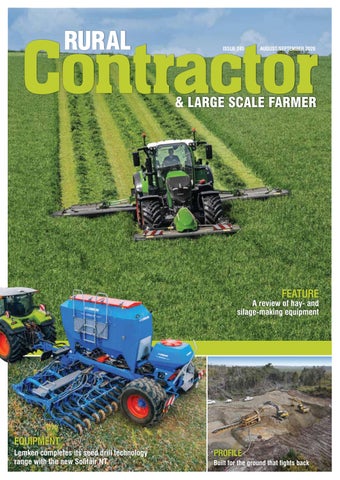
A review of hay- and silage-making equipment
You deserve technology that’s both compatible with your existing fleet and easy to use. That’s why PTx Trimble leads the way in engineering solutions – including displays, steering systems and guidance control – that allow you to connect your farm, your way for seamless work all season long.
This farmer uses: GFX-1060™ display with Precision-IQ™, Autopilot ® steering system, NAV-900 guidance controller, and Trimble ® CenterPoint ® RTX correction service. Scan to learn more and contact a local dealer.


Government must speed up on agricultural vehicles
Geoff Maber recognised in King’s Honours for lifetime contribution to agribusiness
Stronger together: Tama New Zealand brings global innovation to local agriculture
New insecticide approval adds another tool to the pest control arsenal
New Zealand farmers well placed to navigate a higher-cost, more uncertain world
Gallagher appoints Rob Clayton to lead next phase of global animal management growth
Techion and Merck Animal Health strengthen US cattle parasite management 20 Beyond guidance: Tabula expands its focus to whole-of-business management
Anvil AR37: Turning feed into profit, without the stress
Your tank may be clean, but is it All Clear 2X clean?
26 Built for the ground that fights back 32 Built to support the whole farm system 37 Across the ditch: On-farm nitrogen – it’s electrifying
42 A review of hay- and silage-making equipment
70 A new approach to machinery support
Lemken completes its seed drill technology range with the new Solitair NT
Editor Angus Kebbell 022 052 3268 angus@agrimedia.co.nz
Advertising Manager
Michael Lightbourne 021 403 853 michael@agrimedia.co.nz
Advertising Sales
Brendan Challies 022 397 2076 brendan@agrimedia.co.nz
Circulation
Hilary Armstrong 027 443 3477 admin@agrimedia.co.nz
Production Design and Layout
Hannah Kincaid art@agrimedia.co.nz
Contributors
Brendan Burns, Andrew Olsen, Jayne Cooper Woodhouse, Elisabeth Johnston, Ben Harris
Printed by Blueprint Ltd
Read our magazine online ruralcontractor.co.nz/read-online
Every so often someone declares that farming is no longer New Zealand’s economic backbone.
They’re right about one thing. Our economy is more diverse than it once was. Technology companies have grown, manufacturing has evolved, professional services have expanded and tourism continues to play an important role. Agriculture no longer dominates the economy in quite the same way it did 50 years ago.
But perhaps we’ve been using the wrong analogy all along.
Rather than the backbone, agriculture is better described as New Zealand’s heartbeat.


Follow us facebook.com/nzrclsf instagram.com/nzrclsf ruralcontractor.co.nz
Scan here to sign up to our digital newsletter
PO Box 36753 Merivale, Christchurch 8146 ph 03 329 6555 www.agrimedia.co.nz
Publishers of Rural Contractor & Large Scale Farmer, AgriBusiness, AgriVet, NZ Cropping, Australian AG Contractor & Large Scale Farmer, NZ Novachem Agrichemical Manual.
A heartbeat doesn’t do every job within the body. It doesn’t build machinery, write software or manufacture products. What it does is provide the circulation that allows every other part of the body to function. Agriculture continues to play much the same role in New Zealand. The food and fibre sector supports around 360,000 jobs, contributes more than 15% of GDP and generates more than $60 billion in export earnings each year. Those export dollars don’t stop at the farm gate. They support regional communities, engineering workshops, machinery dealerships, transport companies, processors, ports, accountants and thousands of businesses that exist because someone first produces something from the land.
Few people illustrate that better than rural contractors.
As I worked through the stories in this issue, one common thread kept emerging. Whether it’s the latest mower conditioner, rake, baler or loader wagon, every innovation has been designed around one simple objective: helping farmers make the most of increasingly narrow harvest windows. Grass doesn’t wait for ideal conditions, and neither do contractors. When the weather breaks, the pressure is on to mow, rake, bale or collect forage while quality is at its peak. Miss that opportunity by only a few days and the consequences can be measured not only in feed quality but ultimately in animal performance and farm profitability.
That makes contractors far more than machinery owners. They are an essential
© RURAL CONTRACTOR AND LARGE SCALE FARMER - No part of this publication may be reproduced in any form without the prior written permission of the publisher. Opinions expressed in this publication are not necessarily that of the publisher and suggest independent advice be sought before acting on information or suggestions contained herein.

Angus Kebbell, editor.
part of New Zealand’s food production system. They invest millions of dollars in equipment that many farmers could never justify owning themselves, maintain highly skilled operators and accept the risk that comes with building businesses around seasons often dictated by the weather rather than the calendar.
It’s easy to admire the engineering behind today’s machinery, but the real value lies in the people operating it and the role they play in helping farmers capture every possible kilo of quality feed.
That contribution rarely attracts headlines, yet it quietly underpins one of New Zealand’s largest export industries. Every successful silage season strengthens livestock performance, supports farm profitability and generates work for countless businesses well beyond the farm gate.
So perhaps farming is no longer New Zealand’s backbone in the way it once was. Economies evolve and industries change. But as another harvest season approaches, it is worth remembering that the heartbeat still matters. Every time the mowers roll, the balers start and another stack of quality feed is safely under cover, rural contractors are helping keep that heartbeat strong.
Contributions - Editorial and photographic contributions are welcomed and should be sent directly to AgriMedia Ltd. Editing of submissions is at the sole discretion of the editor and will accept no responsibility for unsolicited material.
Years of inaction from government agencies and ministers to revise out of date rules for big tractors and other farm machinery has driven rural contractors to launch a campaign for urgent change.
Rural Contractors New Zealand (RCNZ) CEO Andrew Olsen says some of his members have faced fines of $10,000 and more for agricultural vehicles being deemed too heavy for roads under rules more than a decade old.
“Our members’ tractors and other machines have got heavier but the transport regulations are such that they can be overweight before they leave the showroom, let alone with implements on board.”
Around 750 agricultural machines are currently affected by the out-of-date rules.
“They are not unsafe or damaging the roads. In Australia, the US and EU these machines operate lawfully but the Government here is failing to act.”
He says last week’s Rural Contractors conference in Christchurch saw members support a campaign to secure rapid change to the regulations governing vehicle dimensions and mass (VDAMs).
“Sadly, despite raising this issue with

current ministers more than a year ago, there has been no reform of any substance. These concerns have been on the table since 2016. They also impact others in the heavy transport sector.
“We were told recently to engage with officials in a longer-term review. That means some of my members may face more huge fines in the coming season.”
TO MAKE YOUR GLYPHOSATE HIT HARDER?
Improve the overall performance of your knockdown herbicide including the speed of burndown with Hammer ® Force.
•
•
•
Modern tractors have outgrown New Zealand’s outdated weight regulations, prompting rural contractors to call for urgent reform.
RCNZ is ready to meet transport officials and do a test of machines which currently are very difficult to get permitted.

Waikato-based agribusiness leader
Geoff Maber has been appointed an Officer of the New Zealand Order of Merit (ONZM) in the King’s Birthday Honours, recognising a lifetime of service to agribusiness, the rural sector and the wider community.
Widely respected across New Zealand’s agricultural and farming industries, Maber is best known for transforming the small family Morrinsville machinery business, Maber Motors, into what is now Power Farming Group – one of New Zealand’s largest privately-owned agricultural equipment and machinery companies.
From joining Maber Motors soon after leaving school in the 1960s, Geoff helped steer the company through decades of growth, innovation and expansion. The big turning point came in the 1970s when Geoff recognised that farm mechanisation in New Zealand was changing rapidly and that importing and distributing agricultural machinery brands at scale could become far bigger than a local dealership business.
Today, Power Farming has grown into a major multinational operation across New Zealand, Australia and the United States, built on strong partnerships, local ownership models, long-term relationships and an unwavering focus on people.
Maber says one of the things he is most proud of is the people behind the business and the partnerships that have driven Power Farming’s success.
“Our business has always been about people, partnerships and backing local communities. We’ve built a model that empowers local people to invest in the business, grow alongside us and genuinely share in the success. If our joint venture partners are not succeeding, then we are not succeeding either.”
In New Zealand, Power Farming operates approximately 20 outlets, employs around 350 people and is approaching $300 million in annual turnover. Despite challenging market conditions, the business has experienced strong growth over recent years, driven by its joint venture partners, long-standing relationships, customer support and investment in local teams.
“Having the flexibility to permit these machines should be within the capability of the Transport Minister and NZTA. Rural contracting businesses want to comply and be lawful and I’m sure any farmers with big

The Australian business, established from the ground up more than 25 years ago, has grown into a business of similar scale to New Zealand and today supports more than 200 independent dealers through a nationwide distribution network.
Power Farming entered the US market in 2018 with the world renowned Deutz-Fahr tractors and recently celebrated achieving the milestone of 5,000 tractor sales. The business is now firmly focused on the path towards 10,000 sales by 2030.
Maber credits much of the company’s success to the strength of the people around him.
“I’ve been fortunate to be supported by outstanding board members, three worldclass CEOs across our operations, incredible staff and some of the very best people in the industry.”
Family has also remained at the heart of the business, with Maber’s sons Craig and Brett Maber both holding leadership roles within the company today. Maber says seeing the business continue into a third generation is one of his proudest achievements.
“It’s incredibly rewarding to have Craig and Brett involved in the business and helping lead the next chapter of Power Farming.”
Maber also acknowledged the support of his wife, Linda, describing her as a constant source of support throughout the journey
machinery feel the same.
“Our season starts again in September, two months before the election. We want the Government to stop saying no and start saying yes,” says Olsen.
and someone who has helped bring balance, perspective and strength to a life heavily centred around business and agriculture.
Reflecting on the journey, Maber paid tribute to his father Laurie Maber, describing him as a great teacher, mentor and role model whose values continue to shape the business today.
“This all started with my father, Laurie. He was a self-made man, a great teacher and someone who instilled strong values, hard work and integrity into the business. Those values are still deeply embedded in Power Farming today.”
Industry colleagues describe Maber as a passionate, practical and forward-thinking businessman who has consistently stayed ahead of the curve while remaining grounded in the needs of rural communities.
His recognition in the King’s Honours reflects not only the remarkable growth of Power Farming, but also the lasting impact he has had on New Zealand’s rural economy and agricultural sector over more than six decades.
Maber is still very actively involved in all areas of the family business with no plans to retire and says his more than 60-year journey in the industry has been both humbling and immensely rewarding.
“If there’s one thing I’ve learnt in business, it’s that you have to have the energy to win.”
RCNZ members are being asked to contact their local MPs and support a social media campaign for the changes.
Contact: Andrew Olsen, CEO RCNZ 027 255 2549

The McHale V6750 variable chamber round baler has been designed with the demands of today’s farmer and contractor in mind.
• High-Intake 2.1m pick-up
• 15 knife heavy-duty chopper unit and feed rotor
• Double drive system with auto greasing
• Net and bale density can be adjusted from the cab through the console
The Fusion 4 Plus is a fully automatic integrated baler wrapper which can apply film or net wrap to the barrel of the bale, delivering optimum bale density.
• Maximum output whilst keeping the machine short and compact at 5.8 metres in length
• 25 knife-chopping unit
• Patented unique bale transfer technique
• ISOBUS ready


VARIO PLUS
The Fusion Vario Plus is a fully automatic integrated baler wrapper that applies film or net wrap to the barrel of the bale, delivering optimum bale density.
• Hay and straw bales from 0.6m to 1.68m
• Haylage or silage bales from 1m to 1.45m to allow for wrapping

For generations, New Zealand farmers and contractors have relied on trusted names like Agpac and Donaghys Crop to help protect one of their most valuable assets – the harvested crop.
From 1 September 2026, those trusted businesses enter an exciting new era.
Agpac and Donaghys Crop are joining together under a new identity: Tama New Zealand, creating one of the country’s most comprehensive providers of crop packaging solutions while connecting New Zealand agriculture directly with one of the world’s leading agricultural packaging manufacturers.
While the name is changing; the people, relationships and commitment to customers remain firmly in place. The creation of Tama New Zealand brings together decades of local industry knowledge with Tama’s global expertise in agricultural packaging.
Across the world, Tama has become recognised as an innovation leader, investing heavily in research and development, advanced manufacturing technology and farmer-focused product improvements. Every season, contractors and producers across more than 70 countries rely on Tama products to help maximise harvesting efficiency and protect valuable forage.
For New Zealand customers, this means access to globally proven solutions while continuing to receive support from experienced local specialists who understand the unique demands of New Zealand farming conditions.
Among the most recognised products in the Tama New Zealand portfolio are TamaNet+ and TamaTwine+ Impax – premium crop packaging solutions trusted by contractors around the world for their strength, consistency and field performance. Designed through extensive research and continuous product development, these products are engineered to perform reliably under demanding harvesting conditions, helping contractors maintain productivity during the busiest time of year while protecting bale quality throughout storage and transport.
Through Tama New Zealand, customers are no longer simply purchasing premium products – they are working directly with the company that develops and manufactures them.
That direct manufacturer relationship delivers significant advantages, including:
• direct access to the latest product
innovations and technologies
• technical expertise from the people who understand the products from design through to manufacture
• ongoing product training and bestpractice advice.
• greater confidence in product consistency and quality assurance.
• stronger supply chain support backed by a global manufacturing network.
Rather than relying on a distributor to relay information, New Zealand contractors now have a direct connection to the manufacturer responsible for some of the world’s most respected crop packaging products.
The launch of Tama New Zealand represents far more than a rebrand.
It strengthens the company’s ability to support contractors and farmers through:
• world-leading crop packaging technologies
• continued investment in research and development
• practical technical support and operator training
• reliable local service backed by global manufacturing
• a broader portfolio of premium crop packaging solutions.
For contractors, reliability is everything. Every bale represents valuable time, labour and feed. Having confidence in packaging performance can mean fewer interruptions during harvest, improved baling efficiency and greater protection throughout storage.
That philosophy has always been central to Tama’s approach – developing products that work harder in the paddock so farmers and contractors can focus on getting the job done.
Agriculture continues to evolve, with increasing demands on efficiency, productivity and sustainability.
As part of the Tama Group, Tama New Zealand provides customers with direct access to a business that continually invests in smarter materials, advanced manufacturing processes and practical innovation designed to improve performance in the field.
Importantly, that investment extends beyond products. Tama is committed to supporting contractors through education, technical resources and ongoing product development, ensuring customers continue to benefit from the latest advances in crop packaging technology.
The same people. A stronger future.
Existing customers can expect the same trusted local team, familiar faces and personalised service they have always valued from Agpac and Donaghys Crop.
What changes is the strength standing behind those relationships.
With the backing of one of the world’s leading agricultural packaging manufacturers, Tama New Zealand is uniquely positioned to deliver global innovation; premium products, such as TamaNet+ and TamaTwine+ Impax; and direct access to the expertise that created them.
As contractors prepare for future seasons, Tama New Zealand aims to be more than a supplier – it aims to be a long-term partner, helping New Zealand agriculture harvest more efficiently, protect more value and stay at the forefront of modern crop packaging. Tama New Zealand. Global innovation. Local expertise.

Agpac and Donaghys Crop will become Tama New Zealand from 1 September, combining trusted local expertise with the global innovation of one of the world’s leading agricultural packaging manufacturers.


“Weather and weeds” is Robert Mead’s summary of the two biggest challenges for maize growers in the Taranaki region. And the two are related, as he explains, because the relatively cool growing environment means that the maize crop’s canopy remains open longer than in warmer regions: “The canopy doesn’t shut early enough, so weeds obviously start to come through.”
It’s now eight years since Robert and his dad Andy switched from keeping a dairy herd to concentrating on growing maize on their third-generation family farm near Hāwera. That’s been a very successful change overall, but Andy says the weed situation has been getting progressively worse. In 2024, says Robert, the young crop was “just filthy, covered in weeds.”
Luckily the Meads had done some trial work with Sharpen herbicide which gave them an indication of how well it could fit into their program. So in 2025, they switched to using Sharpen for their pre-emergence weed control for the first time and found it produced a “massive improvement”
Robert says that they were mainly targeting bindweed as well as “all the other nasties that come with it”. Using Sharpen and acetochlor instead of atrazine and acetochlor kept all the weeds at bay much more effectively.
The maize was sown on the 20th of Oct.
Eight weeks later, on the 15th of Dec.
Andy says there were a lot less weeds in the crop than at the same stage the year before.
“Tiny seedlings,” Robert chips in, “just a few weeds here and there, nothing too major.”
He goes on to describe the big pay-off in cost and time savings that much better pre-emergent weed control delivered.
“The post-emergent spraying was kept to a minimum: 30 hectares compared to at least 100 the year before.”
In challenging growing conditions where early weed competition has been an increasing problem, Sharpen helped to keep the crop very clean through establishment and massively reduce the need for follow-up spraying. No wonder Robert describes its performance as “outstanding”.
Effective pest control has always been a balancing act between efficacy, environmental responsibility and practical application. Whether the target is a long-established nuisance species or an exotic pest with the potential to create significant economic damage, the challenge remains the same. Operators need products that work reliably while regulators need confidence that risks can be managed appropriately.
That balance sits at the centre of a recent decision by the Environmental Protection Authority (EPA) to approve Seclira WSG for use in New Zealand, providing professional pest control operators with access to a new active ingredient not previously available in this country.
Manufactured by BASF New Zealand, Seclira WSG contains dinotefuran at 400 g/kg and has been approved as a water-soluble granule insecticide for spot-treatment applications in and around buildings. The product is designed for professional use only and is intended to control a wide range of insect pests including ants, wasps, fleas, mosquitoes, flies, cockroaches, bed bugs and numerous crawling insects.
While pest control products are often
associated with urban environments, the approval has wider significance because it introduces a new chemistry to New Zealand’s pest management sector and provides an additional option for dealing with invasive species that could threaten agricultural production, trade and biosecurity.
One of the most notable targets identified by BASF is the brown marmorated stink bug, an insect that continues to be regarded as one of the highest-risk biosecurity threats facing New Zealand. The pest has established itself across parts of North America and Europe where it causes substantial damage to horticultural crops and creates significant nuisance issues in homes and buildings.
BASF highlighted the product’s potential role in biosecurity responses, describing Seclira WSG as an important new tool should New Zealand ever face an incursion of the brown marmorated stink bug.
The EPA’s assessment recognised this benefit. In its decision document, the authority concluded that the product could provide both biosecurity and economic benefits to New Zealand, particularly in the event of a brown marmorated stink bug incursion. The EPA assessed those potential economic benefits as moderate to high while determining that the overall benefits outweighed the identified risks when appropriate controls were applied.
For contractors and pest management
professionals, the approval is also significant because dinotefuran belongs to the neonicotinoid family of insecticides, representing chemistry that has not previously been available in New Zealand. The product has already been approved for similar uses in Australia, Canada, Europe, the United Kingdom and the United States, providing regulators with substantial international experience to draw upon when assessing its performance and safety profile.
The approval follows a lengthy assessment process. BASF originally lodged the application in 2021 and the EPA formally received it in December 2023. During the evaluation, government agencies including the Ministry for the Environment, Ministry for Primary Industries, Department of Conservation and Ministry of Health were consulted, alongside WorkSafe New Zealand.
A key feature of the EPA’s decision was the recognition that Seclira WSG is intended as a highly targeted treatment rather than a broad-scale spraying product. Spot treatments involve small-scale manual
The EPA has approved BASF’s Seclira WSG insecticide, giving New Zealand pest control operators access to a new active ingredient to help manage invasive and everyday insect pests.

applications to localised areas and exclude broad-acre spraying methods such as boom spraying, air-blast application or aerial application. The product can be applied using handheld sprayers, knapsack sprayers or spray tanks.
That limited application pattern played a major role in the EPA’s assessment of environmental and human health risks.
Dr Shaun Presow, acting hazardous substances applications manager at the EPA, said a wide range of New Zealanders would welcome another tool for controlling insect pests.
“Risks to the environment can be managed with controls that the EPA has set, along with any risks to human health.”
The EPA’s detailed assessment concluded that risks to operators, bystanders and people re-entering treated areas were negligible when the product is used as intended. The authority noted that exposure levels were low and that the localised nature of applications significantly reduced potential impacts.
Environmental considerations received particularly close scrutiny because dinotefuran is highly toxic to aquatic organisms and certain non-target insects. As a result, the approval includes a series of controls designed to minimise environmental exposure and protect beneficial species.
Among those controls are requirements that the product only be applied through
ground-based spot-treatment methods and that outdoor applications cannot occur if heavy rainfall exceeding 100 mm within a 24-hour period is forecast within the following 72 hours. These restrictions are intended to minimise the possibility of runoff entering waterways or sensitive environments.
The EPA also imposed specific groundwater advisory statements because both dinotefuran and one of its metabolites have characteristics associated with chemicals that can leach into groundwater under certain conditions. Users are directed to follow New Zealand’s agrichemical management standards when operating in areas with permeable soils or shallow water tables.
Protection of pollinators was another major focus. The approval requires clear label statements advising that the product is highly toxic to bees and must not be applied directly onto bees, beehives or bee nests. Where managed hives may be affected, beekeepers must be notified 48 hours before application and hives must remain away from treated areas for at least 48 hours after spraying.
The EPA acknowledged that while some risks to non-target arthropods and groundwater remain, those risks are considered low and can be effectively managed through the controls that accompany the approval. Overall, the authority concluded that the risks to aquatic
environments, soil organisms, birds, bees and human health are negligible when the product is used according to label instructions.
For the pest management sector, the arrival of Seclira WSG reflects a broader trend towards increasingly targeted pest control solutions that combine strong efficacy with tighter controls around environmental stewardship. As biosecurity pressures continue to increase and invasive species become an ever-present concern, having access to additional tools can be valuable both for routine pest management and for responding rapidly when new threats emerge.
While the product will not be available to the general public and remains restricted to professional operators, its approval gives the industry another option at a time when maintaining effective pest control remains critical across domestic, commercial, industrial and agricultural environments.
EPA Chief Executive Dr Allan Freeth ultimately concluded that the benefits associated with Seclira WSG outweigh the risks and costs, approving the product with controls after what the authority described as a robust evidence-based assessment process.
For professional operators, that decision means a new chemistry has entered the New Zealand market, bringing another tool to help manage both everyday pest challenges and future biosecurity threats.

Trials show that the new 100 g/ha rate of Sharpen + acetochlor delivers better broadleaf weed control and yield protection than atrazine + acetochlor. The original 150 g/ha rate remains the gold-standard for targeting high yields or managing high weed pressure. Scan the QR code or contact your local BASF representative on 0800 558 399
As global markets grapple with renewed inflationary pressures, geopolitical instability and the prospect of higher interest rates, New Zealand farmers are better positioned than many international competitors to navigate the challenges ahead.
Economist Cameron Bagrie and Findex
Agribusiness leader Hayden Dillon say the sector’s relatively low-cost, grassbased production systems, combined with improving commodity prices, stronger balance sheets and growing access to technology, professional advice and risk management tools, leave many farming businesses well placed despite increasing pressure on costs.
Dillon says several years of improving returns across key agricultural sectors have enabled many farmers to reinvest in their businesses, strengthening productivity and resilience ahead of the next economic cycle.
“Costs are rising, and there is every likelihood more pressure is still to come from inflation and interest rates. However, many New Zealand farmers have used the stronger earnings environment of recent years to reduce debt, improve infrastructure, adopt new technology and invest in productivity gains that will help them manage those pressures.
“Compared to many overseas producers, our grass-based farming systems remain a significant competitive advantage. We are less reliant on imported feed, energy and other high-cost inputs, which provides a degree of protection when inflation and global volatility increase.”
Bagrie says inflation remains a key watchpoint globally.
“Interest rates are under review by central banks, but the key central bank to watch is the US Federal Reserve. It’s been obvious that the United States has hotter inflation than what they’d like, and they are seeing strong labour market reports,” Bagrie says.
Core inflation (which removes fuel and food), has been stubborn around 3%. Central banks have struggled to return to inflation to 2%. It all points to interest rates needing to move up, or being too low.
He notes that inflationary pressures, ongoing geopolitical tensions and higher energy costs all point towards a more volatile operating environment for businesses around the world.
“We tend to fixate on the local situation, but the bigger picture is what’s happening with US interest rates which impacts the big dollar, the US dollar. Where it goes, the NZD/ USD does in the other direction, and what it influences, influences us.”
Despite the uncertainty, both Bagrie and Dillon say New Zealand agriculture remains in a relatively strong position.
Speaking at Fieldays, Dillon says many rural communities are outperforming other parts of the economy.
“It’s almost a two-speed economy. You have somewhat depressed consumer spending in Auckland and Wellington, but many rural economies are doing really well and for some parts of the South Island, you’ve never had it so good.”
He says farmers have largely adapted to the reality of higher operating costs.
“Whether it’s fuel, labour, compliance or capital, costs are higher than they were five years ago and businesses are increasingly

planning around that reality. The successful businesses aren’t waiting for costs to come back down, they’re focusing on how to become more productive and efficient.”
Bagrie says that while global events remain outside farmers’ control, business fundamentals remain as important as ever.
“You can’t control what’s going on globally, but what you can control is your own business. Focus on the things in front of your eyes. Watch the business basics, keep maximising productivity and minimising costs, look after your staff and yourself. It’s these little things that turn a good business into a great business and go straight to the bottom line.”
He says quality advice becomes increasingly important during periods of uncertainty. “Advisory makes a difference in every business. Whether it’s commodity price hedging, capital structure, cashflow planning or strategic decision making, having experienced people around you becomes more valuable when uncertainty increases.”
Dillon says technology is also becoming an increasingly important part of maintaining profitability and competitiveness.
“The farmers who will perform best over the next decade won’t necessarily be those with the biggest farms, but those who make the best decisions. Good advice, technology, AI, risk management such as commodity hedging, forecasting and strong financial management all help businesses make better decisions and protect profitability.”
He says AI and emerging technologies should be viewed as practical business tools rather than future concepts.
“Farmers might think they’re avoiding AI, but they’re not. We’re already seeing technology helping businesses save time, improve decision making and operate more efficiently. Like any investment, if it improves productivity and strengthens your business, it’s worth considering.”
While global uncertainty is unlikely to disappear anytime soon, Dillon says New Zealand farmers remain well positioned to compete and prosper.
“The cost pressures are real, but so are the opportunities. New Zealand agriculture has proven time and again that it can adapt, innovate and compete on the global stage. Businesses that continue to invest in productivity, embrace useful technology and make use of good advice will be well placed for whatever comes next.”
Despite rising global costs and economic uncertainty, New Zealand’s low-cost farming systems and improving farm finances leave the sector well placed to remain globally competitive.


Gallagher has appointed Rob Clayton as chief executive of its global Animal Management business to lead the next stage of growth across key markets.
His appointment comes as Gallagher Animal Management builds on strong global momentum, including 47% growth over the past year and the tripling of eShepherd revenue. The business has also expanded its agritech capability, made acquisitions in Europe and South Africa, and established Gallagher in Brazil. Across Gallagher Group, the business is also on track to reach annual revenue of NZ$1 billion over the coming years.
Clayton brings global agribusiness experience, practical farming background and existing knowledge of Gallagher Animal Management solutions to help lead the business through this next phase.
He grew up on a wheat, sheep and cattle farm near Coonamble in north-west New South Wales, Australia, where his family continues to farm today. He spent 25 years with Nutrien, a global agricultural inputs and services business, progressing into senior leadership roles in Australia and the United States.
Gallagher Group CEO and Executive Director
Kahl Betham says Clayton steps into the role at an important time for Gallagher as more farmers look to technology to help run their businesses with greater confidence.
“We’re seeing strong farmer demand for connected, data-driven solutions that make life easier and improve their productivity, labour efficiency and animal performance. That creates a significant opportunity for Gallagher to grow its presence across global agritech markets.
“Rob’s appointment reflects our ambition to build on our momentum, strengthen our position and keep customer partnerships at the centre of our growth. He brings international leadership experience and networks that will help drive market expansion, while staying focused on delivering real value for farmers.
“Rob has led at significant scale, including through periods of transformation and growth similar to where Gallagher Animal Management is today.
“He understands agriculture, the realities farmers face and has a strong track record of turning strategy into practical outcomes. His existing knowledge of Gallagher products, customers and markets also means he can hit the ground running.”
Clayton says New Zealand’s reputation
Gallagher’s appointment of Rob Clayton signals the company’s continued focus on practical, farmer-led innovation as it expands its animal management technologies into key global markets.

for practical, farmer-led innovation gives Gallagher a strong platform for global growth.
“The New Zealand farmer has always been innovative and inquisitive, constantly looking for ways to improve,” he says. “Because of that, New Zealand is a hot spot for new technology. Solutions that are developed and proven here carry an already farmerapproved stamp when launched to the rest of the world.”
Clayton says the New Zealand heritage and global presence of Gallagher give the business a strong platform to help farmers around the world lift productivity, manage labour challenges and make more confident on-farm decisions amid rising pressures.
He believes his global experience will benefit New Zealand farmers as they respond to those same challenges.
“Every time I am on farm, whether that’s in China, North or South America, Australia or Europe, I learn something new,” he says. “I can use that experience, combined with the power of Gallagher innovation, to bring new opportunity to New Zealand farmers.”
Clayton says successful agritech starts with real problems farmers are trying to solve, including how they make better use of one of their most valuable assets – their time.
“There is a lot of cool technology out there looking for a problem to solve,” Clayton says. “The technology that gets adopted quickly is technology that genuinely makes life easier, improves efficiency, saves time or helps farmers make better decisions.
“Agriculture is a game of inches. You have to find the advantages where you can. That’s what drew me to Gallagher. It is not just about the products, but how those products drive efficiency and deliver real benefits for farmers.”
Clayton says Gallagher Animal Management’s increasingly connected technologies are well placed to support that need.
“Gallagher’s solutions are part of a broader, interconnected Farm Operating System,” he says. “That’s pretty unique in the animal management space. There are not many businesses that have that kind of synergy.”
As chief executive, Clayton will join Gallagher’s Group Executive Leadership Team when he starts in the role on 8 June 2026. He succeeds Dr. Lisbeth Jacobs, who led Gallagher Animal Management for more than four years.
Clayton will lead the Gallagher Animal Management global team of more than 550 people, supporting farmers across major markets in more than 160 countries. He will be based in Melbourne and will spend regular time in New Zealand and key global markets.
For an export-dependent country like New Zealand, market access is often treated as something we either have or don’t have. Secure a trade agreement, meet the required standards, build customer relationships and get on with producing quality food. The reality is far more complicated.
A recent decision by the United States to launch a global safeguard investigation into lamb imports is a timely reminder that access to international markets is never permanently secured. It can be challenged, reviewed or restricted, not necessarily because exporters have done anything wrong, but because domestic political pressures in importing countries can change.
The United States has asked its International Trade Commission to investigate whether imported lamb has caused serious injury to the American sheep industry. While the investigation applies globally rather than targeting New Zealand specifically, our exports are very much part of the process. If the Commission ultimately concludes there has been serious injury, it could recommend measures including higher tariffs on imported lamb.

For New Zealand sheep farmers, that inevitably creates uncertainty.
The United States has become one of our most valuable lamb markets, consistently delivering strong returns for exporters and farmers alike. Losing competitiveness through additional tariffs would not simply affect exporters. It would ultimately flow back through the supply chain to farmgate returns.
What is encouraging is that this is not an issue the sector has stumbled into unprepared.
Beef + Lamb New Zealand and the Meat
The United States’ safeguard investigation into imported lamb is a timely reminder that market access can never be taken for granted, even for long-standing trading partners.
Industry Association have clearly been expecting some form of action for some time. Specialist legal representation has already been engaged in Washington, government officials are involved and industry leaders have been working with American counterparts well before the


investigation formally began.
That preparation matters because safeguard investigations are not political slogans. They are structured legal processes requiring evidence, submissions and detailed economic analysis.
Equally important is the industry’s confidence in its own position.
Beef + Lamb New Zealand argues New Zealand exports are not responsible for the challenges facing the US sheep industry. Instead, New Zealand lamb largely complements domestic production by filling seasonal supply gaps and serving market segments that American production alone cannot consistently supply. It also points out that strong consumer demand has helped
drive record prices for American lamb, suggesting imports have supported rather than undermined the market.
History also provides some perspective. The United States imposed safeguard measures on New Zealand lamb imports in the late 1990s, only for those actions to later be ruled unjustified through the World Trade Organization and eventually removed. That doesn’t guarantee the same outcome this time, but it does demonstrate that trade disputes often play out over years rather than weeks.
The investigation also reinforces a broader lesson for New Zealand agriculture.
Diversified export markets remain one of our greatest strengths.
No exporter enjoys seeing uncertainty emerge in a premium market, but New Zealand’s red meat industry today is far less dependent on any single destination than it once was. Access to North America, Europe, the United Kingdom, China, the Middle East and numerous Asian markets provides resilience that many competing exporting nations simply don’t have.
That diversity has taken decades to build and should never be taken for granted. Neither should the relationships that underpin it.
This year marks 100 years since the first shipment of New Zealand beef and lamb entered the United States. That century-long trading relationship has been built on trust, quality and reliability rather than short-term opportunity. It is in everyone’s interests for that relationship to continue.
Ultimately, the safeguard investigation is unlikely to change what New Zealand farmers do tomorrow morning. They will continue producing high-quality lamb as they always have.
What it does reinforce is that producing world-class food is only part of the equation. Protecting access to the customers willing to pay for it requires constant work, strong advocacy and a willingness to defend New Zealand’s reputation whenever it is challenged.
Market access is never a finished job. It has to be earned, protected and, from time to time, defended.


A Central Canterbury business which turns malting barley into a key ingredient in beer making has celebrated its 100% New Zealand-grown status with a special event.
Founded by Doug and Gabi Michael more than 20 years ago, Gladfield Malt near Dunsandel now supplies malt products to breweries throughout New Zealand as well as overseas.
Its grower open day attracted about 300 grower-suppliers and industry people, as well as Prime Minister Christopher Luxon and Selwyn MP Nicola Grigg.
From a fifth-generation family of barley growers, the Michaels also receive crops from about 200 contracted growers. These are processed to produce more than 50 types of malted grains, ranging from base malts ale, pilsner and lager, to roasted malts with specialty colours and flavours such as chocolate and supernova.
“We started twenty-two years ago and it was never meant to get as big as this,” Michael told the gathering. The couple have complementary skills, he said. “I made it and Gabi sold it.”
The couple are proud to use 100% New Zealand-grown malting barley and have signed up to a NZ Grown Grains branding initiative which makes it easier for consumers to identify domestically-grown products.
“We need to tell the world about the importance of looking after local. The arable industry is undervalued in New Zealand. We are going to change that.
“Growing and processing crops is expensive. Shipping crops around the world is even more expensive. So food security is more important than ever,” Michael says.
As well as selling domestically, Gladfield Malt also exports to China, Japan, India, Australia and the Pacific.
It has not always been plain sailing, with their business suffering damage after being close to the epicentre of the September 2010 earthquake. Demand was also knocked by the February 2011 Christchurch earthquake and Covid hitting hospitality, leading it to pivot to new markets and products.
Co-founder and head brewer of Hamiltonbased Good George, Brian Watson, says that the first thing he would be doing when he got back to the office was to sign up for the NZ Grown Grains branding.
“We need to put that on our cans. Brewers cannot exist without growers producing malting barley.”
While he had a relationship with hop growers, malting barley growers had been “faceless” until now. “So it is great to meet you.”
When Good George started 15 years ago it initially used imported malt. “However, I

realised we were suddenly getting twenty percent extra beer out of the malting barley and the difference was the Gladfield Malt supply.” They had sourced all their malt from Gladfield Malt ever since, despite being offered cheaper product from overseas.
“Relationships with people you work with through the supply chain are just as important as your customers.” Like growers, brewers and hospitality were also facing rising costs and competitive pressures, Watson says.
Foundation for Arable Research (FAR) General Manager Business Operations
Ivan Lawrie told the gathering that since the launch of the NZ Grown Grains’ logo in October last year, support has been massive, with 25 companies signing up to use the branding on their products. It is now appearing in bakeries and on supermarket brands including Harraways oats, The Good Oil edible oils and Otis oat milk.
This makes it easier for consumers to identify and purchase New Zealand-grown
produce. At present, consumers, particularly in the North Island, are more likely to be eating imported grain, especially if they are eating bread, Lawrie says.
Prime Minister Christopher Luxon also lent his support to the NZ Grown Grains campaign. “As arable growers it is not easy, with the ups and downs of weather events, commodity prices and rising costs.”
The Free Trade Agreement with India would reduce tariffs on malt by up to 33%. This was a huge opportunity, with the middle class in India growing from 440 million now to 750 million by the end of this decade.
“As their country gets wealthier, they want better quality food and beverages and we can sell this to them.”
By 2030, the Indo-Pacific region will be home to two-thirds of the world’s middle class, Christopher Luxon says.
“The thinking that we are a long way away from markets is no longer the case. Instead we are in the middle of the most dynamic region in the world.”

Rural contractors have been assured by WorkSafe that its focus on support over enforcement is here to stay.
WorkSafe’s Southern Regional Manager, Adrian van Dyk, acknowledged to the RCNZ conference that the organisation is still bedding in changes following a strategic reset in 2024.
He said WorkSafe’s role is to influence businesses and workers to carry out their responsibilities – and to hold them to account if they don’t.
“Enforcement is the last piece, if there’s no improvement.”
He said last year WorkSafe visited 91 rural contracting businesses and only 34% saw any enforcement. “Mostly we are about practical guidance.”
The key insights were that the critical gaps in rural contracting are machinery guarding (notably PTO shafts) and managing agrichemicals.
WorkSafe is currently developing two new codes of

practice in agriculture – one covering safe farm vehicle operation, and the other for


roles and responsibilities in agriculture. Both are due to be delivered for ministerial approval this month.
RCNZ CEO Andrew Olsen said he’d submitted on the draft codes. He said when finalised they should give rural contractors a ‘safe harbour’ to operate within and relieve some of the stress for members.
One contractor said he’d recently had his first WorkSafe visit for 21 years and offered a bouquet for how that went.
Another asked how WorkSafe would look at a business if it did all the required training and pre-starts but still missed something, despite having a 150-page health and safety management plan.
“Who’s reading that? A pile of paperwork isn’t fixing a problem.”
Adrian Van Dyk said in any incident involving a rural contractor, WorkSafe would be looking for all ‘reasonably practicable steps’ taken to prevent injury.
“If you have a good health and safety system, we’d take that into account,” he said. He added that WorkSafe often sees good systems in place on paper, but that gaps can still emerge in how
those systems are supervised, reinforced, or followed through on the ground.
Sherry Peck, a WorkSafe inspector in Canterbury, said her first question on a site is: what are the biggest health and safety risks and how are these managed?
“I don’t ask to see the 150 pages. At the end of the day, that 150 pages isn’t going to stop someone putting their hand in an auger.”
Peck says she gives her business card to every rural contractor she visits.
“We want to help you to meet your obligations for your workers to go home safe.”
She recommended contractors log their conversations with farmers and workers. That paper trail helps if questions come up later about who was responsible for what.
That approach reflects WorkSafe’s wider message: effective safety comes from practical conversations, visible controls and consistent action, not paperwork alone.

New Zealand-owned developer of diagnostic testing, Techion has signed a major deal with animal health leader Merck Animal Health to support the company’s Safeguard cattle treatment programme in the United States.
The partnership brings together Merck Animal Health, known as MSD Animal Health outside the United States and Canada, and Techion’s Fecpak platform to provide faecal egg counts (FEC) for cattle farmers across the United States. Merck Animal Health is operating the Fecpak testing platform in its Kansas City laboratory, to speed up processing and results for cattle farmers and the Merck field team across the United States.
Combining Merck Animal Health’s Safeguard treatment programme and the world-leading Fecpak digital and AI-supported diagnostic technology allows Merck Animal Health representatives to give United States cattle producers access to faster, standardised FEC testing results to support informed treatment decisions. This helps farmers maximise farm profit by improving cattle growth rates and supporting the responsible use of anthelmintics as drench resistance continues to grow as a challenge for the industry.
Techion Founder and Managing Director Greg Mirams said the partnership with the animal health company was a natural fit for Fecpak’s mission to put reliable parasite intelligence in farmers’ and industry hands.
“Parasites are a production-limiting problem you can’t always see. FEC testing makes them measurable. Merck Animal Health is embedding Fecpak into its lab operations to standardise cattle FEC processing and reporting, and that’s exactly the kind of evidence-based approach the industry needs. With Safeguard, Merck Animal Health isn’t only supplying product, they’re supporting farmers to make confident, informed treatment decisions and Fecpak is proud to be part of that.”
Merck Animal Health has integrated Fecpak’s digital workflow into its laboratory operations, standardising how cattle FEC samples are processed, analysed and reported. In the field, the company’s technical services and rep teams use a Fecpak QR digital submission and sample tracking tool to streamline collection, reduce paperwork and provide traceability from farm to lab and through to results reporting.
Key features of Techion’s Fecpak platform supporting the Merck Animal Health programme include:
- digitised FEC workflow combining imaging, cloud connectivity and AI-supported analysis for consistent, auditable results
- QR scan-and-submit system for field teams – reducing friction, improving collection kit traceability, and delivering cleaner data to the lab
- secure image retention and auditable results for every sample processed
- scalable deployment model suitable for national rollout across Merck’s field and technical services teams.
Merck Animal Health Parasiticides

Marketing Manager, U.S. Cattle Marketing Team Samuel Bormann said, “At Merck Animal Health, we’re committed to helping producers make informed decisions that protect animal performance and the longterm effectiveness of the Safeguard cattle parasite treatments. The integration of Fecpak into our Safeguard programme is an important step – it gives us reliable, datadriven insights that support more targeted and responsible use of our Safeguard products. By combining diagnostics with our parasite management programmes, we’re strengthening our position as a leader in helping farmers manage parasite burden more effectively.”
Merck Animal Health Associate Director of Diagnostics James Slightom explains how Fecpak is being implemented. “Fecpak has integrated well within our lab workflow. The digitisation of the lab’s communication with customers has really streamlined the overall process. Automating our communication with customers at multiple points throughout the lab process, such as sample receipt, in-progress testing and results reporting, has significantly improved customer service and helped produce faster turnaround times. From a quality perspective, every result being captured as a permanent digital image and securely stored, creating a consistent and auditable record is a game changer. Being able to go back to a sample’s raw data and verify the egg count is something we couldn’t do before we implemented Fecpak.”
The integration of Fecpak into Merck Animal Health’s Safeguard programme supports the pharmaceutical company’s goal of responsible anthelmintic stewardship. By pairing treatment with independent diagnostic testing, farmers and their advisers gain real insight into parasite burden before and after drenching, helping to identify resistance early, protect drench efficacy, and reduce unnecessary treatments.
Mirams concluded: “Knowing worms are present and that drench is working effectively is critical information for all cattle producers. This partnership means Merck Animal Health’s United States customers can access faster, targeted, independent parasite intelligence as part of their normal Safeguard programme workflow.”
New Zealand agritech company Techion has partnered with Merck Animal Health to bring its Fecpak parasite diagnostics platform into the United States, supporting more targeted cattle parasite management.


Nationwide support & genuine parts - RIGHT HERE IN NEW ZEALAND!


Bogballe offers you a world of possibilities with GPS automatic section control and automatic start/stop on headlands with your existing tablet or GPS unit** Stops overspreading & wastage and increases your fertiliser placement accuracy.
700 – 2050LT CAPACITY 10 – 24M SPREAD WIDTHS

1800 – 3500LT CAPACITY 12 – 42M SPREAD WIDTHS M35W WEIGH SCALE MODELS 1800 – 3500LT CAPACITY 12 – 42M SPREAD WIDTHS

KAITAIA Kaitaia Tractors 09 408 0670
WHANGAREI Piako Tractors Northland 09 438 1319
SILVERDALE Brandt NZ 09 427 9137
PUKEKOHE Brandt NZ 09 237 0043
MORRINSVILLE Piako Tractors 07 889 7055
MATAMATA Matamata Tractors & Machinery (07) 888 6292
HAMILTON Brandt NZ 07 847 0425
CAMBRIDGE Brandt NZ 07 827 5184
ROTORUA Piako Tractors Ltd 07 345 8560
TAUPO Taupo Tractors & Machinery 07 378 4533
STRATFORD FieldTorque Taranaki 06 765 8643
HASTINGS Stevenson and Taylor 0800 4273 2273
WAIPUKURAU Stevenson and Taylor 06 858 6041
DANNEVIRKE Lancaster Tractor Services 2022 Ltd 06 374 7731
PALMERSTON NORTH Transag Centre 06 354 7164
MASTERTON Brandt NZ 06 377 3009
NELSON Drummond & Etheridge 03 543 8041
BLENHEIM Drummond & Etheridge 03 579 1111
KAIKOURA Drummond & Etheridge 03 319 7119
GREYMOUTH Drummond & Etheridge 03 768 5116
CHRISTCHURCH Drummond & Etheridge 03 349 4883
ASHBURTON Drummond & Etheridge 03 307 9911
TIMARU Drummond & Etheridge 03 687 4005
OAMARU Drummond & Etheridge 03 437 1111
MOSGIEL JJ Limited 03 489 8199
GORE JJ Limited 03 208 9370
INVERCARGILL JJ Limited 03 211 0013
For many agricultural contractors, GPS guidance has become an essential part of day-to-day operations. Accurate steering, reduced overlaps and improved efficiency have delivered significant gains over the past two decades. Yet while machinery has become increasingly connected inside the cab, many contractors continue to manage the wider business using a patchwork of separate systems, spreadsheets, messaging apps and paper records.
New Zealand technology company Tabula believes that gap is becoming one of the biggest barriers to productivity in modern contracting businesses, and its latest suite of tools is aimed squarely at addressing it.
Based in Hawke’s Bay, Mosgiel and operating globally, Tabula has built its reputation around field operations technology, providing live tracking, mapping and hazard management systems across agriculture, horticulture, aviation and emergency response sectors.

The company’s latest release represents a significant expansion beyond traditional GPS guidance, bringing a range of operational management tools together within a single platform.
The thinking behind the development is relatively straightforward. While contractors have become increasingly efficient at managing machinery movements, many still face challenges around communication, administration and the flow of information between the office and the field.
According to Tabula Chief
industry has traditionally viewed machinery guidance as the end goal when, in reality, profitability depends on the performance of the wider operation.
“For decades, the agricultural sector has viewed in-cab machinery tracking as the ultimate goal, but true profitability requires looking beyond the machine,” Whittaker says.
“Contractors run complex operations, where a single communication breakdown directly hits their gross margins. We developed this suite to


Tabula is expanding beyond GPS guidance with new business management tools designed to improve communication, compliance and productivity across modern contracting operations.
serve as a complete operational system, connecting planning, navigation and field data capture to maximise daily productivity and run safer, more efficient operations.”
The latest release introduces several new tools designed to mirror how work flows

throughout a typical contracting day.
One of the additions is an operational checklist system that allows businesses to deploy customised pre-start checks, risk assessments and asset inspections directly to operators through the company’s Field Support App. Responses can be completed in the field and recorded electronically, providing a consistent process across multiple staff and machines.
Another new feature is Tabula Navigate, which the company describes as an industry-first approach to operator navigation. Rather than simply providing directions between locations, the system incorporates hazard information and can automatically reroute operators when required, helping improve safety while reducing delays.
Communication has also been a major focus of the update.
The new Field Support App extends connectivity beyond machinery operators, allowing staff working on foot to remain connected with job progress and wider team activity. Supporting
that is Tabula Messaging, which enables users to exchange messages, photographs and updates directly within the platform itself. Rather than relying on multiple third-party applications, communication remains linked to the specific task or job being undertaken.
Task management functionality has also been expanded, allowing contractors to monitor activities beyond vehicle-based operations through either Tabula Online or the Field Support App.
This reflects the reality that much of a contracting business now extends beyond machinery operation alone and includes maintenance, logistics, compliance and staff management.
One of the more practical additions for many businesses will be integrated timesheet recording. Staff can log hours worked and breaks directly through the app, while managers are able to review, approve and export records for payroll processing.
Field data capture is another area receiving attention. The
to create data collection points for assets such as fuel tanks, materials and specific locations, helping maintain live inventory information without relying on paper records or separate logging systems.
Importantly, these additions sit on top of Tabula’s existing platform rather than replacing it. Core features including live tracking, farm and infrastructure mapping and real-time hazard management remain central to the system. Active hazard alerts can continue to be delivered directly into the cab, helping operators identify and avoid risks while working.
The broader objective appears to be reducing the amount of duplicated administration that occurs across many contracting businesses.
Capturing information once, at the point where work occurs, creates opportunities to improve both operational efficiency and record keeping. It also has compliance benefits, particularly as customers increasingly expect detailed proof of work and accurate job documentation.
flow of information allows reporting to become a natural by-product of daily operations rather than a separate administrative exercise. Accurate job records and timesheets can then integrate directly with accounting software such as Xero, reducing manual data entry while ensuring work completed is fully accounted for.
For contractors operating in an environment of rising costs and ongoing labour pressures, the release highlights a growing shift in technology development. Increasingly, software providers are looking beyond machine performance alone and focusing on the wider business systems that influence profitability.
GPS guidance may still be a critical component of modern contracting, but as operations become larger and more complex, the challenge is often less about keeping machinery straight in the paddock and more about keeping people, information and jobs moving efficiently throughout the day. Tabula’s latest release is designed to address exactly that


2.8-5.6m working widths
Suits 80-170HP
Fixed or folding hydraulic models

4.05 – 5.85m working widths
Suits 150-350hp
Hydraulic folding models

3.05 – 3.55m working widths
Suits 100-180hp
Fixed width models
KAITAIA Kaitaia Tractors 09 408 0670
WHANGAREI Piako Tractors Northland 09 438 1319
SILVERDALE Brandt NZ 09 427 9137
PUKEKOHE Brandt NZ 09 237 0043
MORRINSVILLE Piako Tractors 07 889 7055
MATAMATA Matamata Tractors & Machinery (07) 888 6292
HAMILTON Brandt NZ 07 847 0425
CAMBRIDGE Brandt NZ 07 827 5184
ROTORUA Piako Tractors Ltd 07 345 8560
TAUPO Taupo Tractors & Machinery 07 378 4533
STRATFORD FieldTorque Taranaki 06 765 8643
HASTINGS Stevenson and Taylor 0800 4273 2273
WAIPUKURAU Stevenson and Taylor 06 858 6041
DANNEVIRKE Lancaster Tractor Services 2022 Ltd 06 374 7731
PALMERSTON NORTH Transag Centre 06 354 7164
MASTERTON Brandt NZ 06 377 3009
NELSON Drummond & Etheridge 03 543 8041
BLENHEIM Drummond & Etheridge 03 579 1111
KAIKOURA Drummond & Etheridge 03 319 7119
GREYMOUTH Drummond & Etheridge 03 768 5116
CHRISTCHURCH Drummond & Etheridge 03 349 4883
ASHBURTON Drummond & Etheridge 03 307 9911
TIMARU Drummond & Etheridge 03 687 4005
OAMARU Drummond & Etheridge 03 437 1111
MOSGIEL JJ Limited 03 489 8199
GORE JJ Limited 03 208 9370
INVERCARGILL JJ Limited 03 211 0013
Anvil has just bought you more time this spring.
If you’re a contractor or a farmer, you know how spring goes. Grass growth takes off, paddocks get away on you, quality declines rapidly and weather tightens an already narrowing harvesting window.
In New Zealand silage systems, our challenge isn’t growing enough grass in spring – it’s holding quality until the mower arrives. As spring growth accelerates, reproductive development can quickly reduce feed quality. With the latest heading date on the market (+30) for a tetraploid hybrid ryegrass, Anvil AR37 helps retain leafiness further into spring, creating a larger window for harvesting high-quality silage.
Anvil also brings excellent rust tolerance and strong summer resilience, so paddocks keep performing when conditions become challenging. Add in exceptional cool season activity and solid spring-summer production, and Anvil can put on serious volumes of feed across multiple seasons. Handy if you’re trying to produce more silage on farm and reduce reliance on purchased supplements.
Anvil’s only part of the story though. Producing exceptional silage is no longer just about growing more grass. With input costs where they are and increasing pressure on farm profitability, every tonne harvested needs to deliver on quality as well as quantity. This is where Relish red clover and Brace white clover come in.
Relish red clover has proven itself in over a decade of trialling under both grazed and cut and carry systems throughout New Zealand. Recent work from Harrison et al., (2024) showed Relish added into hybrid ryegrass silage systems without additional nitrogen applied lifted dry matter production by more than 18 t DM/ha over three years. While Anvil drives the seasonal production and harvest flexibility, Relish adds protein, quality and extra summer growth, helping lift the overall value of the silage produced.
Brace rounds it out. Beyond the quality forage it contributes as a modern large leaved white clover, Brace plays an important role by fixing nitrogen biologically, which helps support ongoing pasture productivity.
Anvil AR37’s very late heading date is giving farmers and contractors a wider harvest window to produce higher-quality silage without compromising production.

Huia, by 3.5 t DM/ha/yr (Agricom, n.d.).
A flexible, high-performing silage package for New Zealand farmers
For anyone looking to counter feed deficits in periods when supplement quality really matters – early spring, late autumn on a dairy platform, or in a finishing system – it starts with the genetics in the ground.
Anvil’s unique very late heading date paired with Relish and Brace gives you a silage package built for flexible harvest windows, more production, better silage quality and stronger returns per hectare.
Spring’s all about timing. The right genetics can make the difference between simply making silage and turning feed into profit.
New pasture genetics are helping farmers maximise silage quality and production, with Anvil AR37, Relish red clover and Brace white clover designed to turn more feed into profit.
Agricom’s recommended silage mix:
Cultivar Sowing Rate (kg/ha)
S/S Anvil AR37 25
S/S Relish 6
S/S Brace 4
S/S = Superstrike® treated
Recommended mix only, for farm specific advice contact your local Agricom rep

Spray equipment contamination is one of the most underestimated causes of crop damage in agriculture.
That’s the sobering message from Pieter Van Der Westhuizen, UPL New Zealand’s technical market development manager and adjuvant expert. He says a classic example is a maize crop that was sprayed for broadleaf weeds with a highly selective post emergence herbicide. Unfortunately, the maize was also taken out. The culprit? Clethodim residue in the tank.
Van Der Westhuizen says even trace amounts of crop protection products left behind in tanks, hoses, filters, screens, booms and nozzles can cause significant damage when spraying subsequent crops.
“Herbicide residues such as glyphosate, dicamba, 2,4-D, sulfonylureas, flumetsulam and carfentrazone-ethyl can persist in spray systems and contaminate future spray loads, resulting in crop damage, reduced yields and quality, rejected produce, and costly re-sprays.
“As New Zealand farmers, growers and spray contractors increasingly rotate between herbicides, fungicides, insecticides, plant growth regulators and foliar fertilisers, the risk of spray tank contamination has never been greater.”
Van Der Westhuizen says with more than a thousand ACVM-registered crop protection products in use in New Zealand, effective sprayer decontamination is an essential part of a robust spray programme.
“Cleaning spray tanks with laundry powder or ammonia is not going to remove every trace of spray – that’s simply not what they’re formulated to do. You may think the tank is clean, but products can still be there –even in small amounts, and that’s where the risk lies. All Clear 2X is the insurance policy spray contractors can’t afford not to have.”
Van Der Westhuizen says All Clear 2X will out-perform ordinary tank cleaners on the widest range of agricultural chemicals, even commonly used products which are notoriously “sticky”, or difficult to remove.
All Clear 2X is a specifically formulated, non-corrosive spray tank cleaner and decontaminator, designed to remove any agrichemical residues from the entire spray system. Its unique three-way mode of action combines surfactants, sequestrants and detergents – all designed to lift residues from surfaces, dissolve deposits and prevent contaminants from reattaching

within the spray equipment as well as lock up, break down and neutralise the agrichemical molecules.
Van Der Westhuizen strongly recommends using All Clear 2X whenever changing between products, changing crops, moving from herbicide applications to fungicides or insecticides and for end-of-season sprayer maintenance. By thoroughly cleaning tanks, pumps, hoses, filters, booms and nozzles, he says All Clear 2X reduces the risk of contamination, protects sensitive crops, preserves yield potential and gives contractors, farmers and growers complete confidence that every spray application starts with a clean system.
The recommended way to use All Clear 2X is to drain all equipment immediately after spraying, including tank, hoses and boom. Rinse the inside of the tank with clean water clear of visible residues and flush through hoses and booms using at least 1/10 of the tank spray volume. Fully drain the tank and dispose of the rinsate. Then half-fill the tank with clean water and All Clear 2X at 250 mL per 100 L of the total volume of the tank. Agitate this cleaning mixture in the tank. Flush hoses and booms until cleaning solution starts to come out through all the nozzles. Then keep circulating the cleaning
Even trace amounts of herbicide residue can damage sensitive crops, making thorough spray equipment decontamination an essential part of every spray programme.
mixture while filling the spray tank to capacity.
“It’s best to leave it to sit overnight,” Van Der Westhuizen says. “That will clean out all the chemicals currently available on the market.”
Van Der Westhuizen says what’s left in the tank is safe to spray out in the yard. All Clear 2X, and adjuvant with no active, is noncorrosive and chlorine and ammonia free. UPL New Zealand (formerly Etec Crop Solutions NZ) began work on adjuvant development and marketing in this country more than two decades ago. Today, it has a portfolio of over 20 adjuvant products, including All Clear 2X – each fulfilling a niche role.
For more information on All Clear 2X and cross-contamination risks, talk to your local reseller or contact Pieter Van Der Westhuizen, UPL New Zealand adjuvant lead and regional manager Upper North Island, at 021 392 740.

Anvil is a unique tetraploid hybrid ryegrass that blends winter and summer production traits in one genetic profile. Its very late heading genetics (+30) maintain pasture quality for silage production, finishing pastures and milk production through spring and early summer. Anvil also excels in summer and autumn growth and has exceptional disease tolerance.
• An extremely high yielding hybrid ryegrass Combines strong winter and summer growth traits for a powerful all season forage boost
Unique very late heading date with an exceptional leafy growth habit through spring and summer
Well suited for 2-4 + year pasture rotations

There is a certain type of contractor who is shaped as much by place as by trade, and on the West Coast that shaping tends to be uncompromising.
The country is tight, the weather is unpredictable and the ground rarely gives anything away easily. It is the sort of environment that exposes weaknesses in both people and machinery very quickly, but it also produces contractors who understand their ground better than most and who build businesses around doing the difficult work properly.
Fairhall Agri Services sits firmly in that category. Based out of Greymouth and working across a wide stretch of the Coast, the business has evolved into a specialist operation focused on cultivation, direct drilling, fertiliser spreading and earthmoving, with a reputation built less on scale and more on consistency and finish.
Darryn Fairhall’s path into contracting was never in doubt.
As a fifth generation West Coaster, raised in a family where contracting and gold mining were part of daily life, the exposure came early and it came hands on. By the age of eight he was driving tractors and by 10 he was on bulldozers, learning not just how
to operate machinery but how to read ground and conditions.
That early grounding still underpins the way the business operates today. “We don’t touch green grass. We did harvest when we started, but we made a conscious effort to pick one service and do it well,” Fairhall says.
Working in some of New Zealand’s toughest conditions, Fairhall Agri Services has built its reputation on quality ground preparation, precision earthmoving and practical innovation.
That decision to narrow the focus has proven to be one of the defining moves in the business. Rather than spreading resources across multiple services, Fairhall Agri Services has concentrated on the areas where it can add the most value, particularly in ground preparation and finishing work, where attention to detail separates contractors very quickly.
Fairhall Agri Services has built a reputation for tackling challenging ground, combining specialist machinery with practical engineering and local experience.

Over time that focus has seen the business involved in a wide range of projects, from largescale dairy conversions through to sports field construction and specialist land development work. At one point dairy conversions formed a significant part of the workload, with the company completing 11 major projects that involved everything from bulk earthmoving through to final pasture establishment. When the dairy payout dropped and that work dried up almost overnight, the business had to adjust. It is a moment that many contractors will recognise, where external factors force a rethink, but in this case the shift played to an existing strength.
high quality of finish and understanding of drainage solutions allowed us to take on sports field work,” Fairhall says.
finish over speed opened up a different type of work. Sports fields, golf courses, bowling greens and even croquet courts demand a level of precision that is rarely required in standard agricultural work. The tolerances are tighter, the expectations higher and the margin for error

never been straightforward. Early
and spread, the limitations of that


he designed and constructed a folding six metre frame fitted with an Accord air seeder, towing harrows behind it to ensure better seed placement. It was a practical response to a practical problem and one that is still in use today.
“Back in the day there was nothing like a folding air seeder over here,” he says.
That willingness to modify or build equipment to suit conditions remains a defining feature of the business. Much of the machinery in the fleet has been adapted in some way, whether to improve durability, increase efficiency or allow work to continue in marginal conditions.
On the Coast, where timber and stone are often hidden beneath the surface and ground conditions can change rapidly, standard specifications rarely hold up without some level of reinforcement or adjustment.
“We have to work around the weather. We modify gear to work both earlier and later in the day and as rain approaches and then
leaves,” Fairhall says. That approach extends across the fleet. Bulldozers and excavators are fitted with laser systems to ensure accurate shaping and grading, particularly on projects where finish is critical. What began as a requirement for sports field construction has since been applied more broadly across building sites, yards and general earthworks.
The move into dozer work itself came from necessity. Early attempts to use tractors for earthmoving resulted in excessive tyre damage, particularly in stony conditions, which led to the decision to bring in six-way blade bulldozers to handle the bulk work.
Over time that evolved into ownership, with Komatsu machines forming a key part of the operation. Their low ground pressure and long track frames make them well suited to levelling work, allowing for both efficiency and a higher quality finish.
Levelling itself has become something of a speciality after
Built on generations of West Coast experience, Fairhall Agri Services continues to prove that local knowledge, adaptability and quality workmanship remain the foundation of successful contracting.
Quality workmanship and machinery built for West Coast conditions have become the hallmarks of Fairhall Agri Services.
building his first I-Beam leveller in 1991. After its initial success they redesigned it to be hydraulically operated like a six-way blade; four were subsequently built which are still in use today. These custom built levellers allow significant volumes of soil/ gravels to be mixed and swept across the surface removing large stones/debris while filling ruts and holes maintaining a controlled finish, effectively acting as a grader blade behind the tractor.
These tools played a role in securing early work with large scale developments and continue to underpin the finishing side of the business today. The ability to reshape land accurately and efficiently is a skill that translates across multiple job types, from agricultural conversions through to civil style work.
Cultivation equipment is selected with a similar mindset. Where light work is required, disc harrows provide an efficient solution, but for more intensive reshaping the business relies on heavy duty rippers capable of working deep into the profile.
“If the paddock doesn’t need much work, then discs are good, but to cultivate deeper we use a set of Hubbard’s Hercules rippers. They are real grunters or one of our bulldozers to pre rip,” Fairhall says.
Seeding is handled through a combination of machinery; their six-metre Taege drill formed

the backbone of the operation. The ability to handle multiple products, including fertiliser, seed and insecticide, allowed flexibility across a wide range of crops, from pasture species through to brassicas and forage crops.
“It was a huge success. I needed the productivity and it had to be really robust,” Fairhall says of the Taege drill.
Productivity and durability are recurring themes. On the Coast, machinery does not get an easy life, so equipment that can maintain output without excessive downtime is essential. At the same time, maintaining relationships with manufacturers and suppliers has become increasingly important, particularly where modifications and feedback can lead to incremental improvements.
Fertiliser spreading remains another key part of the workload. The business has invested in equipment that can handle large payloads while maintaining accuracy, particularly important given the cost of inputs and the need for precise application. “They are very accurate, especially with nitrogen,” Fairhall says.
Accuracy in this area is not just about product placement but about efficiency. With input costs continuing to place pressure on farmers, the ability to apply fertiliser consistently and without waste is increasingly valued, and contractors who can deliver that reliably are in strong demand. Beyond agriculture, the business has also developed a niche in land restoration work, particularly around historic gold mining sites. On the West Coast, where legacy mining activity has left its mark across large areas, there is ongoing demand for contractors who can work with challenging ground and reshape it for modern use.
That type of work requires a different mindset again, combining an understanding of ground conditions with an appreciation for the history of the land and the expectations of landowners looking to improve it. The client base itself reflects the diversity of the work. They have also undertaken significant farm flood repair works after both the 2019 Franz Josef floods and the 2021 Ashburton flood events, spending many months


KAITAIA Kaitaia Tractors 09 408 0670
WHANGAREI Piako Tractors Northland 09 438 1319
SILVERDALE Brandt NZ 09 427 9137
PUKEKOHE Brandt NZ 09 237 0043
MORRINSVILLE Piako Tractors 07 889 7055
MATAMATA Matamata Tractors & Machinery (07) 888 6292
HAMILTON Brandt NZ 07 847 0425
CAMBRIDGE Brandt NZ 07 827 5184
ROTORUA Piako Tractors Ltd 07 345 8560
TAUPO Taupo Tractors & Machinery 07 378 4533
STRATFORD FieldTorque Taranaki 06 765 8643
HASTINGS Stevenson and Taylor 0800 4273 2273
WAIPUKURAU Stevenson and Taylor 06 858 6041
DANNEVIRKE Lancaster Tractor Services 2022 Ltd 06 374 7731
PALMERSTON NORTH Transag Centre 06 354 7164
MASTERTON Brandt NZ 06 377 3009
NELSON Drummond & Etheridge 03 543 8041
BLENHEIM Drummond & Etheridge 03 579 1111
KAIKOURA Drummond & Etheridge 03 319 7119
GREYMOUTH Drummond & Etheridge 03 768 5116
CHRISTCHURCH Drummond & Etheridge 03 349 4883
ASHBURTON Drummond & Etheridge 03 307 9911
TIMARU Drummond & Etheridge 03 687 4005
OAMARU Drummond & Etheridge 03 437 1111
MOSGIEL JJ Limited 03 489 8199
GORE JJ Limited 03 208 9370
INVERCARGILL JJ Limited 03 211 0013

with bulldozers and tractors reinstating farm paddocks back into production. Dairy farmers remain a core component, but are now joined by lifestyle block owners, local authorities and forestry companies, particularly in areas such as road maintenance and access development.
Forestry, in particular, also added another dimension, with work around logging infrastructure providing additional consistency in what can otherwise be a seasonal workload.
Staffing, as with many contracting businesses, presents its own challenges. The nature of the work means demand can fluctuate, making it difficult to maintain a large permanent team. As a result, the business operates with a small core group supported by casual labour as required.
Experienced operators, particularly those with local
knowledge, are highly valued. The ability to step into a job and understand both the machinery and the ground conditions without extensive oversight is a significant advantage in a business where efficiency is closely tied to experience.
At the same time, the next generation is already involved. Fairhall’s son Cody is working in the business full time, bringing both formal agricultural training and practical experience. That transition is an important part of the long-term outlook. “My son wants to take over, so the business has to remain economic and sustainable,” Fairhall says.
That focus on sustainability is not about expansion for its own sake. If anything, the approach is measured, with an emphasis on maintaining a manageable workload while ensuring the business remains profitable and resilient.
“We are not just growing the business, but we do want to make
it more economic,” he says.
It is a pragmatic view, shaped by years of operating in an environment where margins can be tight and conditions unpredictable. Growth without control can quickly create pressure, particularly in a region where work can be inconsistent through winter months.
Winter itself remained a quieter period, often used for maintenance and preparation. While occasional earthmoving projects provide some continuity, the seasonal nature of contracting is still very much present.
Against that backdrop, the ability to deliver consistent results across a broad range of work has become the defining strength of Fairhall Agri Services. Whether it is reshaping a paddock, establishing pasture, building a sports field or restoring land, the underlying approach remains the same.
There are no shortcuts,

particularly on the type of ground the business operates on. Each job requires an understanding of conditions, the right combination of machinery and a willingness to take the time needed to achieve the desired result.
“We know how to get results in the difficult stuff. There are no shortcuts,” Fairhall says.
That philosophy, combined with a practical approach to machinery and a deep understanding of the local environment, continues to position the business strongly within its region. In an industry where scale is often emphasised, Fairhall Agri Services demonstrates that there is still significant value in doing a specific set of tasks exceptionally well.
In 2024 Fairhall Agri Services decided to have a serious look at complementing their income with their own gold mining operation to ensure continuity of work and income all year round, giving the security of full-time employment to staff. Although it has taken significant financial input, this has proved to be a very timely and prudent move, with the lift in the gold price over that period making it a sound economic decision for the business. This, coupled with their solid reputation, previous gold mining experience, knowledge, ability and commitment to putting the ground back to “better than before”, has provided access to mineable ground going forward. This venture balances the business well and is an area Fairhall has a special interest in.
Looking ahead, Fairhall Agri Services has recently sold the direct drilling side of the operation, which has been a key component to the success of the business over the last decade. A local contractor has taken this on who will continue to provide the high standard of work their customers expect.
“This has given us back 600–700 machine hours/annum to refocus on our gold mining operations, along with our increasing role in gold mine restoration work for ourselves, and other local mine operators. We will continue our agri operations for our current clients, which will keep us well grounded and busy enough going into the foreseeable future.”


Some contracting businesses are built around a single machine or a single season.
Others evolve by steadily adding capability over time until they become deeply embedded in the farming systems around them. Williamson Contracting falls firmly into the second category, and after more than three decades operating across Northland, the business has become one of those names that many local farmers simply associate with getting the job done.
Based in Dargaville and operating throughout the wider Northland region, the company today combines bulk cartage, earthworks and fertiliser spreading into a broad rural support operation that reflects both the demands of Northland farming and the practical realities of working across one of the country’s most geographically varied regions.
What started with a single fertiliser spreader in the early 1990s has steadily expanded into a business covering everything from quarrying and farm drainage through to feed pads, effluent ponds, race construction and large-scale cartage. At the
centre of that growth has been founder Jason Williamson, whose background in farming has heavily shaped the direction and philosophy of the company.
“Having grown up on a farm we not only talk the talk but more importantly we have a grass roots understanding of the needs of farmers and how today’s farms operate,” the company says on its website.
That understanding matters in Northland because farming there rarely fits neatly into one category. The region combines intensive dairy systems with
Williamson Contracting has built its reputation by providing Northland farmers with a broad range of services that support the whole farm system.
drystock operations, cropping, horticulture and mixed land use, all spread across terrain that can shift quickly from flat peat country to steep rolling hills and coastal ground. Conditions can change dramatically between districts, and weather windows are often narrow, particularly
Reliable machinery, experienced operators and a focus on practical solutions have made Williamson Contracting a valued part of Northland’s rural sector.

through winter and spring. For a contractor, that means flexibility becomes just as important as machinery capacity. Williamson Contracting has built its reputation around providing that flexibility, particularly through the way its various services overlap. A fertiliser spreading job may lead into drainage work. Cartage may support feed pad construction. Earthmoving may tie directly into wider farm development. Rather than treating each division separately, the business has evolved into a system where machinery, operators and logistics work together across

From fertiliser spreading and bulk cartage to earthworks and drainage, Williamson Contracting continues to evolve alongside the changing needs of Northland farming.
critical for many farms dealing with environmental pressure, wetter winters and the need to improve feed and effluent management systems.
infrastructure development. Better races reduce lameness and improve access. Effective drainage protects paddocks and extends grazing windows.
The spreading division is perhaps the clearest example of that evolution. Originally established around fertiliser application, the business


product has been applied correctly and consistently.
Spreading Northland operates multiple full-time spreaders alongside a specialised mini spreader designed for lighter soils and crop work, giving the business the ability to adapt to different conditions and farm types across the region.
Importantly, the larger units have been fitted with Ravensdown’s proof of placement technology and the operation is Spreadmark certified, giving farmers immediate access to spreading records and application maps once jobs are completed.
That technology has become increasingly significant as environmental scrutiny intensifies. Accurate placement and documented application are now central to nutrient management planning, particularly in sensitive catchments and high rainfall environments such as Northland. At the same time, practical spreading capability still matters just as much as the technology behind it. Northland’s terrain creates plenty of challenges, from soft coastal soils through to rolling country, where machinery stability and operator experience become critical.
Having a range of spreaders suited to different conditions allows the business to maintain output without compromising application quality. That flexibility is especially important in seasons where weather windows tighten and contractors
are under pressure to move quickly between jobs.
Cartage has also become an increasingly important component of the business. Modern farming systems rely heavily on movement, whether it is fertiliser, lime, palm kernel, metal or silage, and contractors capable of handling both transport and application offer a clear logistical advantage.
Williamson Contracting now provides a broad range of bulk cartage services throughout Northland, including feed transport, limestone supply and general rural freight.
The inclusion of blower truck capability for silo filling further highlights the practical nature of the operation. Rather than limiting itself to standard contracting tasks, the business has consistently added services that solve real on-farm problems and improve efficiency for clients.
That approach reflects a wider trend occurring across rural contracting nationally. Increasingly, contractors are not just machine operators but service providers responsible for helping farms function more efficiently across multiple areas.
The scale and diversity of the machinery fleet required to support that kind of operation is significant. While Williamson Contracting keeps a relatively low public profile compared with some larger South Island operators, the scope of work suggests a business built around dependable, versatile
equipment capable of handling varied conditions year-round.
Northland itself places unique demands on machinery. High rainfall, softer soils and long travel distances can create significant wear, while seasonal peaks require strong reliability during busy periods.
That is particularly true in spreading and cartage, where downtime during narrow weather windows can quickly create delays across multiple clients.
Like many long-established contracting businesses, Williamson Contracting appears to have evolved around practical machinery decisions rather than chasing trends or unnecessary complexity. The emphasis has remained on capability, reliability and maintaining enough flexibility to move between different job types as seasonal demand changes.
That diversity of workload also provides resilience. When one area slows, another often picks up. Earthworks can support quieter agricultural periods, while spreading and cartage provide strong seasonal demand through key parts of the farming calendar.
Operating in Northland also requires strong local knowledge. Conditions can vary dramatically between coastal areas, inland districts and heavier clay country, meaning timing and ground assessment become critical.
Farm drainage work, for example, is highly dependent
An integrated approach to spreading, cartage and earthworks allows Williamson Contracting to support a wide range of farm development projects.

on understanding soil structure and water movement, while race construction and feed pad development require materials and designs suited to local conditions.
The same applies to fertiliser application. Wind exposure, soil moisture and terrain all influence spreading performance, making operator experience just as important as machinery specification.
Those are the sorts of details that tend to separate contractors who simply operate machinery from those who become long-term parts of the farming systems around them.
Williamson Contracting’s longevity suggests the business has managed that transition successfully.
The company itself formally dates back to 2000 under the Williamson Contracting Limited structure, although the contracting operation began earlier in 1991 with a single spreader.
That timing is significant because it means the business has operated through multiple major shifts in New Zealand agriculture, including dairy expansion, environmental reform, increasing compliance requirements and significant advances in precision technology.
Many contracting businesses that emerged during that period either remained small owneroperator operations or expanded rapidly before struggling with debt and labour pressures. Williamson Contracting appears to have taken a steadier path, growing capability over time while remaining closely tied to practical farm requirements. Relationships have likely played a major role in that. Contracting, particularly in regional areas, remains heavily relationship-driven. Farmers tend to stick with contractors they trust, particularly when those contractors understand their properties and systems. That trust is built over time through consistency, communication and reliability, especially during difficult seasons.
Northland farmers in particular often deal with challenging conditions, whether that is drought pressure through
summer or excessive rainfall through winter, so contractors who can adapt and continue delivering become extremely valuable.
The company’s ongoing partnership with Ravensdown also points to the importance of alignment with wider industry systems. Fertiliser spreading today is increasingly datadriven, integrated with nutrient planning software and backed by mapping and reporting systems that farmers rely on for both management and compliance purposes.
Providing proof of placement maps and integration with digital systems such as HawkEye and My Ravensdown places Williamson Contracting firmly within that modern framework.
At the same time, the business still appears grounded in traditional contracting values. Practical service, dependable machinery and understanding what farmers actually need remain central themes.
That combination of oldschool practicality and modern capability is increasingly important in the current contracting environment.
Farmers want technology where it delivers real value, but they also want contractors who understand the realities of working farms rather than simply selling systems.
Looking ahead, businesses like Williamson Contracting are likely to remain central to the future of rural infrastructure and farm support services, particularly in regions such as Northland, where conditions demand adaptable operators with broad capability.
The role of contractors continues to expand beyond seasonal tasks into areas such as environmental management, infrastructure development and logistics support. As labour pressures, compliance requirements and capital costs continue to rise, many farms increasingly rely on contractors not just for machinery but for

expertise and operational flexibility.
Williamson Contracting’s evolution over the past three decades reflects that wider industry shift.
From a single spreader operation to a diversified rural support business covering spreading, cartage and earthworks, the company has grown by steadily adding practical capability rather than chasing unnecessary scale.
In many ways, that approach
mirrors the farmers it works alongside. Northland farming has always demanded resilience, adaptability and a willingness to solve problems as conditions change. Contractors servicing that environment tend to develop the same mindset.
For Williamson Contracting, that mindset appears to have remained remarkably consistent since the beginning. Understand the job, understand the farmer and build the capability needed to keep both moving forward.


Ash Gristede is one of a number of farmers who have been using a new source of nitrogen fertiliser produced on farm by a Green Lightning machine.
When the war in Iran kicked off in late February it disrupted shipping and oil supplies through the Strait of Hormuz. This sent a shock around the world but disproportionally affected agricultural production and costs in India, south east Asia, Australia and New Zealand.

Australia imports $1 billion worth of nitrogen fertiliser annually with 60% of the urea imports coming from the Persian Gulf through the Hormuz maritime choke point. Half of diesel imports come from processed crude oil, also from the Persian Gulf.
fertiliser prices settled.
Efforts by the federal government through the newly setup $7.5-billion Fuel and Fertiliser Security Facility (FFSF) to handle the crisis has seen around nine urea cargoes totalling 340,000 tonnes of agricultural grade urea secured, including from Brunei.
While this has helped in the short turn, a narrow funnelling of secured product through just a few importers has upset the remaining fertiliser importers, potentially putting the viability of some in doubt.
Around 1.4 million tonnes of
The recently installed Green Lightning machines are able to produce nitrates on-farm by using electricity to pull nitrogen out of the air.
urea have come through the border since the start of the conflict, with border processes streamlined to get fertiliser to farmers quicker.
Not all farmers rely on urea, and they are looking at the ongoing crisis from the sidelines with both


across ditch the


Profiled in the Australian AgContractor & Large Scale Farmer July/August 2026, we visited Ash Gristede in Victoria, Australia.
The shortage of urea initially saw some cropping farmers move away from winter wheat and barley and planting up nitrogen-fixing legumes instead, or forgoing a winter crop entirely, waiting to see if high
The calving shed may soon be replaced with a composting shelter that would see composted bedding used as fertiliser around the farm.


sympathy and relief.
While he acknowledges should the diesel supply for farm machinery dry up “we’re all buggered”, Ash Gristede says urea shortages won’t have a big impact on his fertiliser regime.
While Ash still uses urea, it is half the amount he had been using previously, and he can replace it entirely if need be.
“We were one of the early ones to say we’ll give it a crack,” he says of the two Thunder 365 Green Lightning (GL) machines installed on his farm. “It was a fair bit of money to put out – $130k initially for each machine.”
The two GL machines Ash and
Michelle have been operating on their dairy farm near Port Campbell in South West Victoria for nearly a year are the smallest machines available in the range and can each produce 300 L of GL product in 24 hours. Ash is pleased with the results and says they plan on adding a third machine shortly.
Made in the United States, the GL machines use new plasma technology and have only been in production for a few years. They are now available in around 20 countries.
The new technology sees the machine able to use electricity to simulate a natural process which sees nitrates produced when lightning lets loose in the atmosphere.
The atmosphere is made up of nearly 80% nitrogen.

This becomes ionised when lightning rips through it, making it attracted to – and bind with –oxygen, which then falls in rain as a nitrate – a natural fertiliser. Being able to produce nitrogen in this liquid form from air and electricity on farm, has several benefits over applying solid urea or UAN.
As the nitrogen is already suspended in the water in nitrate form, it is immediately available for plants to take up and reduces the amount of urea left sitting in soil long term, and the possibility of being washed away into waterways.
Coming directly out of the air, the nitrogen is also basically saltless, which means it can safely be applied as a foliar spray, even at high concentrations, and won’t burn foliage. The lack of salt also means it has much less impact on soil microbes than urea.
Independent corn/maize trials by big seed supplier Becks in the United States showed the best use case for Green Lightning liquid fertiliser is as a replacement for between 25%–55% of urea, and used as a “spoon feeding” tool through foliar applications rather than a bulk one-off.
Becks found its ROI comes from lower input costs rather than increased production, with a payback period of between 1 to 3 years.
Ash backs this up with one of his machines paying for itself already – in a year.
While Ash put out a pasture booster blend in autumn last year, the rest of the year he has been putting 100 to 200 L a hectare of straight GL, every time they graze – every 30 to 40 days through the winter.
He recommends 200 L of GL for every 100 kg of urea he would previously have used.
This goes out using a Tow and Fert sprayer which is designed and manufactured by Metalform (Dannevirke) Ltd, a New Zealand company.
Ash has also made use of one of the other benefits of the liquid. With low pH and high dissolved oxygen, it is an efficient carrier
for other foliar products.
“They always say put a bit of urea in your Round-up as the plant will uptake better – for better weed control,” he says. They have used this technique of feeding the plants when spraying for grass and weed control in their 16 ha of silage maize this year.
“We put nearly 300 litres of green lightning per hectare, including the weed/grass chemicals we were putting out, and it had a really good weed kill,” he says.
On farm, the two GL machines are set up in a shipping container with room for another one. They draw water from a water tank outside with the liquid product coming from each machine then pumped into its own sealed water tank.
Good quality water is essential for the process. Rainwater is ideal, with good quality bore water a handy option.
While it looked clean, Ash only used the on-farm dam water for a few months, as the suspended clay and silt in it saw him going through $1200 worth of filters to get it up to standard.
He then changed to buying in town supply bore water from Port Campbell.
At $150 a tanker load, it’s much cheaper than filters, he reckons.
They plan on getting a 250,000L rain water tank installed in the next couple of years.
The machines each use 1.1 kWh of electricity a day to operate.
Ash reckons this would see 1,000 L of nitrogen product costing around $50 to $60, although his 80 kWh on-farm solar panel setup and battery for the dairy easily covers the power needed.
“You need to put it on at 200 litres a hectare,” he says. “But even if you need to put it out at 400 litres a hectare, you get the same result as 100 kg of urea. At the end of the day, the actual power to run it is bugger all compared to buying urea, especially at current prices.”
The rugged coastline around Port Campbell is sometimes referred to as the ‘shipwreck coast’ for the high number of


seaside village with four or five cray boat fishermen, maybe an abalone fisherman, and not a whole lot else – a few locals and retirees.”

over clay, which sees drainage headaches in winter. Mole draining has been done in places and this continues as finances allow.
Cutting and bailing: Additional feed is a necessity to cope with poor pasture persistence over the long hot summers.
ships that met their end along it during the 1800s.
Ash’s family owns or leases land all around the area.
On the Great Ocean Road that runs for 240 km from Torquay, west of Melbourne to Allansford, the seaside village of Port Campbell was a backwater when he was growing up.
“It used to be a quiet little
But its close proximity to the Twelve Apostles limestone formations has seen it become a popular tourist destination in recent years.
The landscape can be fairly rough and rugged to farm, Ash says, and sees an average rainfall of around 850 mm annually.
And while people assume the land must be fairly sandy being so close to the sea, there are only about four to six inches of topsoil
Because pugging can be such an issue, some farmers in the area are now turning to composting shelters/barns similar to those being seen more often in areas like Southland in New Zealand, which has similar soil and winter pugging issues.
Concerns about getting enough wood chip with so many composting shelters going up in the area saw Ash and Michelle build a calving shed about five
years ago that uses wheat or barley straw as bedding.
But weighing up the time and expense of resowing pastures, Ash is now considering investing in a composting shelter/barn.
This has seen him looking into compost materials that could potentially be grown on the property, including planting trees specifically for chipping, and


miscanthus – a tall grass which can be regularly cut and doubles as a shelter belt.
The material in the shelters/ barns that has composted during its use as bedding, is rich in nutrients from urine and dung and can then be used on the farm as fertiliser. As urine is absorbed into the bedding, nitrates from it also can’t leach into waterways/ groundwater during use.
This ties into Ash’s desire to lean into some regenerative practices – to be more resilient, easier on the land, and take better care of waterways, particularly after now seeing issues with algal blooms in his childhood river haunts.
During the long hot summers, the soil doesn’t retain moisture well and the rye grass-based pasture often dies off. This is seeing them moving more into cocksfoot and clover pasture.
“You can replace just about everything in the [cow’s] diet, but you still need, ideally, a couple of kilos of grass,” he says. “Which we quite often don’t have.”
This sees them rely heavily on maize, silage and some vetch to provide the high energy feed the cows need to keep producing high volumes of milk.
Ash has introduced the Halter collar system on farm, which has now been in use with the herd since mid-March.
And while he’s still getting the last of the gateways around the farm on the map, it’s already

seen a marked improvement on efficiency, and their lifestyle, he says.
“We’re finding we’re saving a lot of time moving cows back and forth up the paddock.”
Dividing the herd in two for milking by using a feed pad next to the dairy shed as a holding pen, Ash now no longer needs to stay at the dairy until 8.30 pm to push the second mob of cows off the feed pad after milking.
Ash grew up on his parents’ sheep and beef farm not far from the current dairy farm. At just 13, he and his older brother, Richard, began milking for a family friend who was more like a grandfather to them.
It was a small farm with 80 cows and an old walk-through dairy. Well into his sixties, the owner had been struggling to keep up with the farm work and was thinking of selling. Three years later, Ash left school and began share farming there, starting with a quarter share.
By the time he was 22, he had bought the farm, with the help of his parents.
Also a local, his wife Michelle grew up on a dairy farm nearby. Despite being adamant she was never going to marry a dairy farmer, they have been together since they were teenagers –over 30 years – and have three children together. Michelle began working on the farm even
before they were married.
The dilapidated old walkthrough shed gave way, first to a 15 swing-over herringbone then, as the herd increased to 360 cows, to a 30 swing-over herringbone.
Leasing and buying land around them over the years now sees them with a milking platform of around 450 ha with a 60-head rotary dairy and 750 cows.
While 25-year-old daughter Shelby is off working as a chiropractor, and Bobby (21) is finishing a diesel mechanics apprenticeship, their eldest son Mitchell, at 26, is now back working on the farm after doing a cabinet making apprenticeship. He also does some baleage contracting on the side, with Ash often roped in to drive the wrapper.
While an alternative source of fertiliser is working well for Ash during the Iran war crisis, reductions or a move away from urea entirely has long-term benefits for the industry, he says, with less reliance on one of agriculture’s most extensively used inputs.
Urea has shortcomings as a fertiliser, including its carbon footprint, and the war in Iran has shown how vulnerable the supply chain around it can be, he says.
With nitrogen caps coming into Europe and other places
Mitch and fiancee Maddie, with kids Charlie and Willow, are now ensconced in the farming operation including using the Tow and Fert sprayer for the Green Lightning fertiliser.
like New Zealand, it’s time to look seriously at alternatives, he reckons.
“If we can cut out urea completely and produce our own nitrogen on farm, it’s a massive cost saving for one thing, but it’s also a massive environmental plus, because it uses a hell of a lot of energy to make urea granules in the first place.
“And then we don’t need to cart them, we don’t need to spread them, we just need to add this stuff [GL] to the sprayer and do that,” he says.
“If practices like using the Green Lightning machine break the nitrogen cycle open and we don’t need as much of it, well bloody great. Not for the fertiliser companies, but I’m pretty sure everyone else will be happy.”
Ash’s concerns are shared by the Australian Grains Research and Development Corp. They have started a $115-million, 10 year ‘Nitrogen Mission’ calling on international researchers to join them to look at nitrogen options, including on-farm production. Green Lightning machines are available in Australia through Plasma Strike – Ag Solutions.


Importing and supplying quality agricultural products New Zealand-wide for harvesting silage, hay, and straw.

Producing quality silage and hay is one of the most important seasonal jobs on any livestock operation, and the machinery behind it continues to evolve. From mowing and conditioning through to raking, baling and handling, efficiency, timing and crop quality remain critical. In this feature, we look at some of the machinery and technology helping New Zealand farmers and contractors get more from the season and make the most of every tonne of feed harvested.
There are very few machines in modern forage harvesting that have evolved as dramatically as the loader wagon. Once regarded simply as a means of collecting grass and transporting it back to the stack, today’s forage wagons have become an integral part of the harvesting chain. They are expected to deliver high throughput, produce a consistent chop, travel efficiently between jobs and integrate seamlessly with increasingly sophisticated harvesting operations. Rather than simply building bigger machines, manufacturers are now concentrating on improving the systems that determine how efficiently crop moves through the wagon. That philosophy underpins Schuitemaker’s latest Rapide 6 to 9 range, where the emphasis has been placed firmly on crop flow, serviceability and operator productivity.
For New Zealand operators, those developments come at
an important time. Harvesting windows continue to tighten, farms are becoming larger and contractors are expected to cover more hectares in fewer days. Every interruption costs valuable time, whether it is a blocked intake, time spent servicing the machine or simply not carrying enough crop on each load. Improving efficiency is no longer about increasing engine horsepower or making the wagon larger. It is about refining every stage of the harvesting process so that the machine continues working when conditions are right.
Perhaps the most significant change to the Rapide 6 to 9 begins where every load starts, at the pick-up. Schuitemaker has introduced a hydraulically driven pick-up that allows operators to vary pick-up speed to suit different crop conditions. Rather than operating at a fixed speed regardless of swath size or crop density, the pick-up can now be matched more precisely
to the conditions in front of the machine. The result is a more consistent crop flow into the rotor, particularly when moving between light and heavy swaths throughout the day.
The pick-up itself has also been completely redesigned with Schuitemaker’s new Click & Go system. Routine servicing has always been an unavoidable part of forage harvesting, but the new design allows the complete pick-up assembly to be removed quickly and easily when maintenance or replacement is required. It is one of those practical engineering improvements that may only save a short amount of time on each occasion, but over the course of a harvesting season it contributes directly to improved machine availability and reduced downtime.
Once the crop enters the machine, it is handled by an entirely new PowerRotor. Measuring 700 mm in diameter and 2.1 m wide, the larger starshaped rotor features eight rows of hard-faced tines designed
to deliver a smoother and more consistent crop flow through the cutting system. Wider crop channels and new 15 mm scrapers encourage a gradual crop entry, helping the rotor maintain throughput without creating unnecessary peaks in power demand. A hydraulically driven RapidFlow feed roller works alongside the rotor to regulate crop delivery, ensuring the cutting system receives a consistent feed regardless of changing swath conditions.
Chop quality has also received considerable attention.
The Rapide 6 to 9 features a completely redesigned knife system incorporating a fivesection knife bank capable of carrying up to 50 cutting knives. Producing a theoretical chop length of 40 mm, the knives have been redesigned to improve cutting performance while remaining quick and straightforward to replace. Better still, the knives are reversible, effectively doubling their working life before replacement becomes necessary. For contractors harvesting thousands of tonnes of forage each season, reducing maintenance without compromising chop quality
represents a worthwhile improvement.
While crop flow and cutting performance form the heart of the machine, Schuitemaker has also addressed one of the most obvious demands from contractors: carrying more crop without making the wagon significantly larger. The new Rapid Release front wall forms part of the High Volume package and increases capacity by an additional four cubic metres through a hydraulically moving front panel. Working alongside the RapidStream hydraulic top panel and rear body extensions, the system allows the wagon to make more efficient use of its available volume while maintaining excellent crop compaction throughout the body.
Supporting these mechanical improvements is a comprehensive package of electronic technology. SmartSteer electronic steering allows the wagon to track more accurately behind the tractor, reducing tyre scrub and improving manoeuvrability when negotiating gateways, headlands and narrow farm races. Operators can choose
from three wheel size options, 22.5in., 26.5-in. or 30.5-in., allowing the machine to be matched to different farming systems, transport requirements and flotation needs. Whether working across intensive dairy platforms or larger mixed farming operations, that flexibility allows buyers to tailor the wagon to their individual application.
Inside the tractor cab, Schuitemaker’s DoubleTouch control system provides a fullcolour seven-inch touchscreen combined with joystick operation for the machine’s primary functions. Full ISOBUS compatibility allows operators to integrate machine control directly into compatible tractor terminals, reducing the number of displays required in the cab while simplifying operation. Optional OptiLoad automation further reduces operator workload by automating loading and unloading functions, allowing the operator to concentrate on maintaining forward progress rather than continually adjusting machine settings.
Construction has also been designed with longevity in mind. The reinforced cage
structure combines galvanised and powder-coated panels for improved corrosion resistance, while the hydraulic drawbar incorporates accumulator suspension and automatic height adjustment to maintain the optimum loading position throughout operation. Features such as hydraulic floor chains with two-speed operation, pressure filtration within the hydraulic system and extensive LED lighting demonstrate the level of attention paid to the machine’s day-to-day usability as much as its harvesting performance.
What stands out most about the Rapide 6 to 9 is that Schuitemaker has resisted the temptation to chase headline specifications. Instead, the company has focused on refining every stage of the crop’s journey through the machine. From the new variable-speed hydraulic pick-up and Click & Go removal system through to the larger PowerRotor, redesigned knife bank, increased body capacity and integrated electronic controls, each development has been engineered to improve productivity where it matters most: in the paddock.

There has been a noticeable shift in the design philosophy of agricultural wheel loaders over the past decade. While outright lifting capacity remains important, manufacturers are increasingly engineering machines that deliver performance through the integration of powertrain, hydraulics, driveline and operator systems rather than simply increasing engine output.
The JCB 435S is a good example of that evolution.
Designed as the flagship of JCB’s agricultural wheel loader range, the 435S combines a 15.5 t operating weight with a 210 kW (282 hp) Cummins engine to deliver one of the highest power-to-weight ratios in its class. At approximately 19 hp/t, the machine has been developed to meet the demands of modern silage operations, large-scale feed handling and high-output contracting where pushing power, climbing ability and rapid loading cycles all contribute directly to productivity.
Rather than relying on maximum engine output alone, JCB has engineered the entire drivetrain to ensure that power is available when it is needed.
The 6.7 L Cummins B Series engine develops its maximum 282 hp at 1,900 rpm while producing 1,200 Nm of torque
from just 1,300 rpm. That broad torque curve is particularly important in agricultural loading applications where the machine is constantly accelerating into clamps, pushing into heavy silage and climbing steep faces under load. High torque at relatively low engine speed allows the loader to maintain momentum without continual gear changes or excessive engine revs.
Recognising that not every task requires maximum output, the 435S incorporates two distinct operating modes.
Standard Power Mode reduces output to 230 hp (171 kW), improving fuel efficiency during lighter loading operations and general yard work. Dynamic Power Mode releases the engine’s full 282 hp for applications where maximum pushing and climbing performance are required. This dual-power strategy allows operators to match engine performance to the task rather than operating at full output throughout the working day.
Power is transferred through a ZF 6WG210 six-speed powershift transmission equipped with a lock-up torque converter.
The inclusion of torque converter lock-up is one of the more significant engineering features within the drivetrain. During acceleration and road
transport, the lock-up clutch mechanically connects the engine and transmission, eliminating converter slip and improving driveline efficiency. Reduced slip means less heat generation, lower fuel consumption and improved transfer of engine power to the ground, particularly during transport speeds approaching the machine’s 48 km/h maximum road speed.
JCB has also incorporated selectable automatic powershift, gear kick-down on the loader joystick and its Power-Inch intelligent clutch cut-off system. During loading operations the Power-Inch function allows the operator to modulate ground speed independently of engine rpm, maintaining full hydraulic performance while controlling machine movement with the brake pedal. This is particularly beneficial when filling buckets or positioning precisely around feed pads and silage clamps. Traction has received equal engineering attention.
The 435S is available with either limited-slip differentials or open differentials combined with an automatic 100% locking front differential. Both axle options utilise ZF MT-L 3095 axles with planetary hub reduction, while wheel-speed braking technology reduces heat build-up and extends brake life compared with more conventional braking systems. Rear axle oscillation of

±8 degrees allows all four wheels to maintain ground contact across uneven terrain, improving stability when operating with heavy bucket loads.
Hydraulic performance is equally impressive.
Rather than relying on a single high-capacity pump, the 435S uses twin variable-displacement piston pumps delivering a combined maximum flow of 264 L/min. One pump supplies up to 132 L/min at 250 bar while the second delivers 132 L/min at 160 bar. This dual-pump arrangement allows hydraulic demand to be managed more efficiently while ensuring steering priority is maintained during simultaneous loader functions.
Cycle times underline the capability of the hydraulic system.
Boom raise with a full bucket takes just 4.7 seconds, bucket dump requires 1.8 seconds and lowering the boom takes 2.8 seconds, producing a complete loading cycle of only 9.3 seconds. For operators loading silage trailers or feeding mixer wagons throughout the day, shaving even a second from each cycle can translate into significant productivity gains over an entire season.
Loader geometry has also been carefully considered.
The 435S is available in both standard lift and high lift configurations. The standard machine offers a maximum pin height of 3.94 m, while the high lift version extends that to 4.37 m, increasing loading capability for higher-sided trailers and feed systems. Depending on bucket specification, the machine develops breakout forces of up to 138 kN and full-turn tipping loads exceeding 9 t.
Smooth operation under transport conditions is assisted by JCB’s Smooth Ride System (SRS).
By using hydraulic accumulators to cushion boom movement, SRS reduces load bounce when travelling across rough paddocks and farm tracks. Besides improving operator comfort, the system helps retain material within the bucket while reducing stress transmitted through the loader arms and chassis.
Cooling systems have become increasingly important as engine outputs continue to rise.
The 435S incorporates a hydraulically driven cooling fan working with a large single-face wide-core radiator package.
The automatic reversing fan periodically clears accumulated chaff and debris from the cooling pack, maintaining airflow during demanding silage operations where conventional cooling systems often struggle. The fan can also be manually activated when conditions require additional cleaning.
Operator technology has advanced significantly in recent years and the 435S reflects that trend.
The CommandPlus cab provides 3.4 m3 of internal space while integrating two display systems. The primary display presents machine operating data including engine speed, hydraulic status, transmission information and fuel consumption. A secondary A-pillar display manages machine settings, hydraulic flow adjustment, climate control, rear-view camera functions and an on-screen operator handbook. Realtime information, such as instantaneous fuel use, average fuel consumption, hydraulic oil temperature, transmission temperature and service intervals, allows operators to monitor machine performance continuously. Maintenance has been

engineered to minimise downtime.
Daily service points are accessible from ground level, while grouped pressure test ports simplify diagnostics.
The electrically opening one-piece bonnet provides unrestricted access to the engine compartment, complemented by remote engine oil drain and fill systems, swing-out cooling pack access and JCB LiveLink telematics for remote fleet monitoring and preventative maintenance planning.
Ultimately, the engineering behind the 435S demonstrates how modern agricultural wheel loaders are evolving.
High horsepower remains important, but it is only one part of the equation. Transmission efficiency, hydraulic response, intelligent traction management, integrated electronics and serviceability now contribute

just as much to overall productivity.
By combining a high-output Cummins engine, sophisticated ZF driveline, twin-pump hydraulic system and advanced operator technology within a robust 15.5-t platform, the JCB 435S has been engineered to
meet the demands of today’s high-output agricultural operations. It is a machine where every major system has been designed to work together, ensuring that power is translated into productive work rather than simply impressive specification figures.
HayKing has been developed to tackle one of the biggest challenges associated with hay storage: the growth of spoilage yeasts and moulds that consume valuable feed energy, generate heat and, in some cases, produce mycotoxins. By suppressing these spoilage organisms, the preservative allows hay to be baled at a slightly higher moisture content than would normally be considered safe, giving contractors and farmers a longer baling window while helping maintain the quality of the finished feed.
That extended flexibility can make a significant difference during a busy harvest. Instead of waiting for the perfect weather window, operators have greater confidence to continue baling when conditions are marginal, knowing the preservative is working to protect the crop during storage. For contractors trying to cover large areas in a limited timeframe, or farmers watching another weather front
approach, that extra flexibility can remove a considerable amount of pressure from the harvesting programme.
The science behind HayKing is relatively straightforward. Once applied during baling, it reduces the activity of spoilage yeasts and moulds that would otherwise begin consuming the readily available sugars within the bale. Those sugars are an important source of energy for livestock, so every kilogram preserved ultimately contributes to feed quality. At the same time, by reducing microbial activity, HayKing limits the heat generated within the bale. Lower temperatures help prevent protein damage and maintain palatability, ensuring more of the crop harvested in the paddock is still available when it reaches the feed-out stage. Independent storage results reinforce that point. As illustrated in Figure 1, untreated hay began to heat approximately two weeks after baling, with bale temperatures remaining elevated for around


another 14 days. That increase in temperature reflected active yeast populations consuming valuable sugars within the bale. In comparison, the HayKing-treated hay maintained considerably lower temperatures throughout the first month of storage, indicating the preservative had successfully suppressed spoilage activity before it could become established.
The reduction in heating translated directly into measurable improvements in feed quality. Analysis of the stored hay showed treated bales retained more metabolisable energy, improving from 8.0MJ/ kg DM in untreated hay to 8.9MJ/kg DM. Organic matter digestibility increased from 53.9% to 59.6%, while crude protein levels improved from 9.8% to 13.1%. Rather than allowing heat and microbial activity to consume valuable nutrients during storage, HayKing helped preserve more of the energy and protein originally harvested from the paddock.
Those figures reinforce what contractors often observe in practice. Reduced heating means better storage stability, but it also means the finished feed more closely resembles the crop that entered the baler. More digestible energy is retained, protein quality is better preserved and the risk of mould development is significantly
reduced. Ultimately, every bale represents an investment in time, fuel, labour and fertiliser, so preserving that nutritional value during storage is just as important as producing the crop in the first place.
The introduction of the new high-volume formulations reflects BioStart’s broader philosophy of working alongside contractors and farmers to simplify forage preservation without compromising performance. Whether it’s the flexibility to pause work without wasting product, the stability that comes from formulations containing no live bacteria, or the latest high-volume options designed for modern applicators, the emphasis remains firmly on making quality silage and hay production easier to achieve in real-world conditions.
As harvesting systems continue to evolve, forage preservatives are also becoming more sophisticated. Today’s products are expected not only to protect feed quality but also to integrate seamlessly into increasingly efficient harvesting operations.
BioStart’s latest developments show that innovation is no longer confined to the baler, forage harvester or wrapper. It extends to every part of the harvesting process, including the products helping preserve the feed long after the machinery has left the paddock.


Maximise their home grown feed with Nufarm’s phenoxies range to control weeds. Eat more of what you grow. Calculate what their returns might be at Grassmanship.nz
Mowing is no longer simply the first job in the silage season. It’s the first decision in a harvest system where every machine that follows relies on consistent crop presentation to work at its best.
How forage is laid behind the mower influences wilting, raking, harvesting efficiency and ultimately the quality of feed stored for the months ahead. As New Zealand farmers continue to focus on producing high-quality homegrown feed, machinery that offers greater control over the mowing process is becoming an increasingly valuable part of the forage system.
The latest additions to the Claas Disco range have been developed with exactly that in mind.
Leading the range is the Claas Disco 9300 Direct Swather, combining a 9.10 m working width with the flexibility to either spread forage across the full cutting width or place it into a controlled swath – all without the need for a conventional conditioner.
Claas Harvest Centre Product Business Manager – Green Harvest Luke Wheeler says the machine gives farmers more options to match crop presentation to their harvesting system.
“Every forage operation is
different. The ability to decide how the crop is laid behind the mower allows farmers and contractors to manage moisture loss, improve harvesting efficiency and better match the equipment following behind.”
Rather than conditioning the crop, the Direct Swather uses hydraulically controlled crossconveyor augers to provide four operating modes.
Operators can spread forage across the full mowing width to maximise the wilting area, form a clean central swath, consolidate two mowing passes into a larger swath for efficient raking for forage harvesting, or direct crop to one side for tidy edge mowing around fences, waterways and irregular paddock boundaries.
This flexibility allows operators to adapt quickly as crop conditions change throughout the season.
One practical advantage is the ability to consolidate approximately 18 m of mowing into a swath well suited to modern four-rotor rakes or selfpropelled forage harvesters. Producing an even, consistent swath helps improve harvester throughput while reducing unnecessary machinery passes across the paddock.
Rather than adapting a traditional mower-conditioner design, Claas engineers drew inspiration from the Direct Disc front attachment used on the
Claas Jaguar forage harvester. The result is a tapered auger system mounted close and parallel to the mower discs. Increasing in diameter towards the centre, the augers move large volumes of crop efficiently while maintaining smooth crop flow, even in heavy first-cut grass.
Tapered auger housings with integrated crop pockets, combined with shear bars and anti-blockage knife arrangements, further improve feeding performance while keeping power requirements low.
Removing the conditioner also reduces driveline losses, meaning the Disco 9300 Direct Swather can operate behind tractors from around 180 hp. This gives many New Zealand dairy farms, mixed livestock businesses and contractors access to a large working width without stepping up to substantially higher horsepower tractors.
Reduced power demand can also contribute to lower fuel consumption, helping improve operating efficiency across the season.
For operations where crop conditioning remains the preferred option, Claas also offers the Disco 9300 C Auto Swather. Designed for highoutput contractor applications and dense forage crops, it combines tine conditioning with cross-conveyor belts

to accelerate wilting while producing consistent, wellformed swaths. A strengthened driveline, Hardox wear components and upgraded belt systems provide the durability required for demanding commercial workloads.
Automation is also becoming an increasingly important part of modern forage harvesting, and the Disco 9300 range reflects that shift.
Isobus compatibility allows mower functions to be controlled through the tractor terminal or Claas Cemis display, while headland management automates lifting and lowering sequences to reduce operator workload throughout long days in the paddock.
The optional automatic slope control system adjusts ground pressure when travelling uphill or downhill, helping maintain even cutting performance while protecting the pasture, particularly on rolling country. Automatic belt speed adjustment, reverse lift functions and load-sensing hydraulics further enhance productivity and ease of operation.
At the heart of every machine is the proven Claas Max Cut mower bed.
Its distinctive wave-shaped design positions the discs further forward for improved crop flow and cutting quality, while the permanently lubricated, unique bolted construction is engineered for durability and a long service life.
Features including Active Float suspension, Safety Link collision protection, Hardox wear inserts and tungsten carbide-coated knife holders all contribute to cleaner forage, reduced ash contamination and lower maintenance requirements over the life of the machine.
Wheeler says every stage of the forage harvest contributes to the final result.
“Good silage starts long before the forage reaches the stack or bale. By giving farmers greater control over how the crop is managed from the moment it’s cut, they’re in a stronger position to protect feed quality throughout the entire harvesting process.”
As forage systems continue

to evolve, New Zealand farmers are increasingly looking beyond individual machines and considering how every step of the harvest works together.
The Claas Disco 9300 range has been developed with that whole-system approach in mind, helping farmers and contractors produce quality forage more efficiently from the first pass through the paddock.
The mower may start the harvest, and the baler may finish it, but what happens in between has just as much influence on the quality of the feed that ends up in the stack or bale.
In New Zealand’s grass-based farming systems, every pass across the paddock plays a role in protecting the crop’s nutritional value. How quickly
forage dries, how gently it is handled and how consistently it is presented to the baler or forage harvester all contribute to producing high-quality silage and hay.
As farmers continue to focus on growing more quality feed from every hectare, attention is increasingly turning to the middle stages of the forage harvest – tedding and raking.
While often viewed as supporting operations, these two jobs can have a significant impact on forage quality, harvesting efficiency and the productivity of every machine that follows.

Claas Harvest Centre Product Business Manager – Green Harvest Luke Wheeler says the objective isn’t simply to move grass around the paddock.
“Every pass should be adding value to the crop. Good tedding promotes faster, more even drying, while good raking presents a clean, consistent swath that allows the baler or forage harvester to operate at its best. Together, they help protect forage quality right through the harvest.”
The first step is managing moisture. A well-timed tedding pass exposes more of the crop to air and sunlight, encouraging even wilting across the paddock. Uniform drying helps reduce the risk of heating, mould development and nutrient loss, while creating more consistent moisture levels for baling or chopping.
Even drying also means less moisture and weight moving through the harvest chain, improving efficiency for the
quality. Their Max Spread crop flow concept uses 29.3° angled tine arms to spread material evenly across the full working width, encouraging consistent drying without unnecessarily disturbing the crop.
“Uniform spreading is one of the biggest contributors to consistent dry-down,” says Wheeler. “When the crop dries evenly, farmers have more confidence that the entire paddock is ready to harvest at the same time.”
For long days in the paddock, the trailed Volto models are designed to maintain momentum. Operators can turn up to 180° between passes without lifting fully into headland position, reducing unnecessary movement, protecting the sward and maintaining productivity
season after season.
Once the crop has reached the desired moisture level, attention shifts to creating the ideal swath.
A consistent, well-formed windrow allows balers and forage harvesters to operate at a steady feed rate, improving output while helping reduce soil contamination and unnecessary leaf loss.
The Claas Liner 4000 has been developed with this objective in mind.
With working widths of up to 15 m, the four-rotor rotary rake forms clean, uniform centre windrows that are well matched to modern high-capacity balers and forage harvesters. Excellent ground following and rotor suspension help maintain consistent raking performance across rolling country and
at the headlands using field position data. Rather than relying solely on operator timing, the rake lifts and returns to work automatically, helping maintain consistent windrow formation from one pass to the next.
The practical benefits include fewer missed or doubled sections, cleaner headlands, reduced crop contamination and less operator fatigue during long harvesting days.
“Automation isn’t about replacing the operator,” Wheeler says. “It’s about allowing them to concentrate on the crop and machine performance while the technology takes care of repetitive tasks.”
The Liner’s four-rotor design continues to deliver the high throughput expected by contractors and progressive


works together.
From mowing through to tedding, raking and baling, each stage influences the next. A crop that is evenly dried and consistently raked is easier to harvest, places less demand on machinery and is more likely to produce high-quality silage or hay.
“The best forage isn’t produced by one machine,” says Wheeler. “It’s the result of every machine in the harvesting process doing its job well. Every pass has a purpose, and when each stage works together, the result is better feed, greater efficiency and more value from every hectare.”
For New Zealand farmers, where homegrown forage remains one of the most valuable assets on the farm, that whole-system approach is becoming just as important as the performance of any individual machine.
High-quality forage doesn’t happen by chance. It starts with producing dense, consistent bales that preserve valuable nutrients from the paddock through to the feed-out face. For New Zealand farmers, every bale represents an investment in next season’s animal performance, making reliable baling and wrapping equipment an important part of the forage system.
The Claas Rollant 630 RC Uniwrap has become a trusted part of forage operations around the world, combining baling and wrapping in a single machine to
help farmers and contractors work efficiently without compromising bale quality.
Built on decades of Claas fixed chamber baler experience, the Rollant Uniwrap is designed to produce consistently dense, well-shaped bales across a wide range of crops, from highmoisture grass silage through to hay and straw. Whether you’re harvesting dairy silage in Southland, producing baleage in Waikato or putting away quality hay for the season, the machine is built to deliver reliable performance throughout the harvest.
One of the key strengths of the Rollant 630 RC Uniwrap is its ability to keep material flowing. The 2.10 m Multiflow HD pickup features five tine bars and an improved cam track design, allowing the machine to feed large volumes of crop smoothly, even during heavy first-cut silage. The wider pickup and efficient crop flow help operators maintain productivity while leaving the paddock clean behind them.
The Pro cutting system is available with either 17 or 25 knives, with each knife individually spring-protected to reduce the risk of damage from foreign objects. The automatically lowering Pro floor helps minimise blockages, while providing the operator with visual and audible alerts if crop flow begins to exceed the machine’s capacity. Together, these features help keep operators moving during busy harvest periods, reducing downtime when every hour counts.
For Claas Harvest Centre Product Business Manager –Green Harvest Luke Wheeler, reliability is one of the machine’s biggest strengths.
“The Rollant has been developed to handle demanding forage conditions while making life easier for the operator. Features like the PRO floor, improved driveline and HD pickup help maintain productivity through long harvesting days.”
The machine’s renowned Maximum PressureSystem (MPS) continues to be one of its defining features. Three hydraulically loaded rollers apply pressure early in the bale formation process, producing dense, consistently shaped bales with excellent compaction. High-density bales not only make better use of storage and transport but also help improve silage fermentation and preserve valuable feed quality.
Once the bale leaves the chamber, the integrated wrapper keeps the process moving. With baling and wrapping completed by a single machine, operators spend less time handling bales and can maintain a steady workflow across the paddock.
The Uniwrap carries up to 14 film rolls, providing enough capacity for long working days before replenishing consumables. Operators can choose to wrap with either net or film, including Coatex film binding, which improves bale sealing while reducing the amount of material that needs to be disposed of after feeding.
“The option to use film instead of net provides excellent bale sealing and simplifies recycling at the end of the season,” says Wheeler. “It’s a practical solution for farmers looking to maximise forage quality while reducing handling.”
Operator comfort has also been refined. The Cemis 700 terminal provides straightforward control of the baler and wrapper functions from the tractor cab, while the optional camera system gives operators a clear view of the wrapping process without leaving their seat. Improved access around the wrapping system also makes changing film or net rolls quicker and easier.
The Rollant 630 RC Uniwrap reflects Claas’ ongoing commitment to refining proven machinery rather than reinventing it.
Continuous improvements to components such as the driveline, chain lubrication, pickup design and operator controls help deliver the durability and performance farmers and contractors expect from a machine that spends long days in demanding conditions. For New Zealand forage operations, success often comes down to making the most of every opportunity the weather provides. The Claas Rollant 630 RC Uniwrap combines proven technology with practical refinements to help farmers and contractors produce high-quality silage and hay efficiently, season after season.
The humble rake rarely receives the same level of attention as a mower, baler or forage harvester, but anyone involved in making quality conserved feed knows it can have a major influence on the final result.
A good rake does far more than simply gather grass into a row. It helps preserve feed quality, reduces contamination, creates a consistent swath for the following machine and ultimately contributes to harvesting efficiency. Get it wrong and valuable dry matter can be lost long before the crop reaches the stack, bale or feed pad.
That is where machines like the Fransgård TI-6000 have carved out a strong reputation.
Built in Denmark and distributed in New Zealand by ForestQuip, the TI-6000 is a twin-rotor combi rake designed to give operators flexibility in how they manage forage. Rather than being limited to a single raking pattern, the machine can rake to the centre, rake to the side, create two swaths in one pass and even perform limited spreading duties when conditions require it.
That versatility is one of its biggest selling points.
Modern forage systems are increasingly focused on efficiency. Weather windows can be short and contractors often need machinery capable of adapting to different crops, field conditions and harvesting systems. A rake that can perform multiple tasks without requiring
additional machinery has obvious appeal.
The TI-6000 operates with a working width adjustable from 4.6 m through to 6.2 m, allowing operators to tailor swath size to suit the pickup width of the following machine. Hydraulic adjustment means changes can be made quickly as conditions change across a paddock or between crops.
That flexibility becomes particularly valuable when working with different harvesting equipment. A contractor moving between round balers, square balers and forage harvesters can alter swath width to match the machine following behind rather than being locked into a fixed setup.
For operators looking to maximise efficiency, the ability to side rake is equally useful.
The TI-6000 can merge multiple swaths together and, under suitable conditions, combine two swaths in a single operation. That reduces the number of passes required and helps improve harvesting productivity.
The design itself reflects Fransgård’s long-standing focus on practical machinery.
The rake uses two rotors, each fitted with six arms carrying three rake spring assemblies per arm. The arrangement is designed to produce a light, fluffy swath while handling forage gently to minimise leaf loss and crop damage.
That gentler handling is increasingly important as farmers place greater
emphasis on feed quality. Every unnecessary movement of the crop has the potential to knock valuable leaf material from lucerne, clover and other highvalue forage species. A rake that lifts and rolls material cleanly rather than dragging it through the stubble helps retain feed value.
The TI-6000 also incorporates closed ball bearings within the cam track system, removing the need for lubrication and reducing routine maintenance requirements. In an environment where labour is often stretched and machinery fleets continue to grow, reducing maintenance demands can make a meaningful difference over the course of a season.
Ease of adjustment appears throughout the machine.
Rotor height can be fine-tuned to suit crop conditions and field surfaces, while the cam track system offers multiple adjustment positions. The working height can also be adjusted centrally, helping operators achieve a clean rake without pulling dirt and stones into the swath.
That matters because forage contamination remains one of the biggest quality issues in silage and hay production. Soil contamination not only affects feed quality but can also increase wear on harvesting equipment further down the line.
For New Zealand conditions, the machine’s terrain-following ability is another important consideration.
The TI-6000 features a pivoting headstock arrangement

that allows the rake to trail smoothly behind the tractor and automatically return to centre when lifted. Large wheels beneath each rotor help maintain stability while allowing the machine to follow ground contours effectively.
Anyone who has worked on rolling country understands the value of machinery that can maintain a consistent working height across uneven terrain. The better the rake follows the ground, the cleaner the finished swath.
Transport is often overlooked when discussing rakes, yet it becomes increasingly important as farm sizes grow and contractors travel longer distances between jobs.
Despite offering a working width of up to 6.2 m, the TI-6000 folds down to a compact transport width of approximately 2.5 m. Rotor components and guards can be repositioned for transport, making the machine easier to move safely between properties.
Capacity figures of four to eight hectares per hour place the machine firmly in the category of productive midsized rakes capable of keeping pace with modern mowing and baling operations. Depending on crop volume and field conditions, that level of output is sufficient for a wide range of dairy, drystock and contracting applications.
Power requirements remain relatively modest, with Fransgård specifying around 30 kW to 60 kW depending on configuration and operating conditions. That means the rake can be operated behind a wide range of tractors already found on New Zealand farms.
Perhaps the strongest endorsement of the TI-6000 is that it focuses on the fundamentals. It is not attempting to overwhelm operators with unnecessary complexity. Instead, it offers flexibility, gentle crop handling, straightforward adjustment and the ability to adapt to different harvesting systems.
For farmers and contractors looking to maximise forage quality while maintaining productivity, that combination remains highly relevant.
Krone continues to advance its hay and silage equipment range, delivering innovations that improve efficiency, crop quality and overall productivity across the forage cycle. From mowing and conditioning through to raking and high-density baling, the latest developments are designed to help New Zealand operators maximise output while reducing labour and operational costs.
At the cutting stage, Krone EasyCut mower range offers a highly versatile lineup suited to a wide range of farming systems. With front, rear and butterfly combinations, as well as trailing and linkage configurations, operators can tailor their setup to match crop type and terrain. This flexibility supports more efficient harvesting and improved yield outcomes.
A key focus is faster drying without compromising crop quality. Krone provides two conditioning systems to suit
different forage types. The M-Roll steel conditioner is designed for delicate leafy crops, such as lucerne and alfalfa, preserving leaf structure while promoting even drying. Meanwhile, the CV flail conditioner delivers more aggressive conditioning for coarser crops, enabling faster moisture reduction in tougher materials.
Krone’s tedders and rakes are engineered to maintain consistent crop handling between cutting and baling. The tedder range stands out for its durability, with the same robust design applied across working widths from 4.7 m to 20 m. This ensures reliable performance across all machine sizes during intensive harvest periods.
The Swadro rake range plays a critical role in forming uniform windrows. With options ranging from single-rotor machines to large multi-rotor units like the sixrotor TC2000, these rakes deliver clean, evenly structured swaths

while minimising contamination. Consistent windrow formation is essential for efficient baling and maintaining forage quality. Together, these machines ensure that crops are evenly dried and optimally presented to the baler, improving overall system performance.
Krone’s latest advancement
in baling comes with the BiG Pack 1290 HDP II (VC), a next-generation large square baler designed for highoutput operations. Developed and proven in New Zealand conditions, the machine focuses on increasing productivity while reducing handling and transport costs.
At its core is Krone’s High Density Press technology, which produces significantly
Yes, there are other adjuvants.
But not with our track record.
We’ll work harder in every paddock, vineyard and orchard block.
UPL adjuvants have stood the test of time, trials, and most importantly, distributor, grower and farmer scrutiny. From water conditioning right through to tank cleaning along with the spreaders, stickers, penetrants, and drift agents UPL is known for. Still not sure? Ask one of our UPL Regional Managers.


heavier bales compared to conventional balers. This reduces the number of bales produced per paddock and improves transport efficiency by increasing payloads per truck. For contractors and export hay producers, these gains can translate into meaningful cost savings.
The crop intake system has also been enhanced, featuring the EasyFlow Active pick up and a hydraulically adjustable crop press roller for consistent feeding, even in short or brittle conditions. A large rotor then
ensures smooth, high-capacity crop flow into the bale chamber.
Bale uniformity is improved through Krone’s variable filling system (VFS), which ensures consistently shaped, squareedged bales regardless of swath size or operating conditions. Hydraulic pressure control within the bale chamber maintains even density, resulting in bales that are easier to stack, store and transport.
The baler also features Krone’s
V-Knotter system, designed to secure bales under extreme compression while avoiding twine offcuts in the paddock.
The PowerClean system further supports reliability by keeping knotters free from dust and debris, reducing downtime during long working days.
Modern forage equipment increasingly relies on smart technology, and Krone integrates several systems to improve usability and efficiency. The
AutoCheck maintenance system allows operators to safely carry out diagnostics and servicing tasks, reducing downtime and simplifying routine checks.
Full ISOBUS compatibility, along with features such as moisture sensing, bale weighing and telematics, enables real-time monitoring and better decisionmaking in the field. These capabilities are particularly valuable for large-scale and contractor operations where precision and timing are critical.
A complete forage system While each machine performs a specific function, Krone’s latest innovations highlight the importance of a fully integrated approach to hay and silage production. Efficient crop flow from mowing through to baling reduces losses, improves forage quality and increases output per hectare.
For New Zealand producers dealing with rising costs and labour constraints, these advancements offer practical benefits. Improved productivity, enhanced bale density and smarter technology combine to deliver a more efficient and profitable forage operation.
Pöttinger Novacat V
8400 and V 9200
As mower combinations continue to grow in size and output, one challenge has become increasingly apparent. Building a machine capable of covering 9 m of ground is relatively straightforward. Building one that can maintain cutting performance, adapt to varying front mower combinations, follow uneven terrain and transport safely between paddocks is considerably more difficult.
Positioned between the company’s fixed-width S-Series mower combinations and the larger V 10000, the V 8400 and V 9200 have been designed around one key principle: flexibility. Rather than offering a single fixed working width, these mower combinations allow operators to vary overlap and working width depending on tractor setup, terrain and front mower configuration. The result is a machine that can adapt to a wider range of operating conditions without compromising cutting quality or productivity.
The engineering starts with the centre-pivot mounting system. Unlike side-pivot mower combinations where each mowing unit is supported from one side, the Novacat V-Series uses a centre-mounted suspension arrangement. This enables the cutter bars
to float more evenly across the full cutting width while maintaining more consistent ground pressure. Pöttinger’s development work around what it refers to as “floating cut” technology has focused on ensuring the cutter bar follows the ground rather than being forced into it. The objective is to maintain cutting consistency while reducing power requirements and contamination risk.
The V 8400 offers a variable working width from 8.12 m to 8.36 m, while the larger V 9200 extends from 8.95 m to 9.20 m. That adjustment may sound relatively modest on paper, but it plays an important role in maintaining overlap between the rear mower units and the front mower. Different tyre sizes, track widths and operating conditions can all influence overlap requirements. By allowing the rear units to be adjusted hydraulically, operators can optimise coverage while minimising unnecessary overlap and wasted power.
In practice, this means the mower combination can be tailored to suit a range of front mower configurations rather than forcing operators into a fixed setup.
The suspension system is equally significant.
Large mower combinations generate substantial dynamic


loads as they move across uneven terrain. Maintaining consistent ground pressure across the cutter bar becomes increasingly important as working widths increase. Excessive pressure creates wear and contamination, while insufficient pressure can compromise cut quality.
Pöttinger addresses this through a suspension arrangement designed to distribute load evenly across the cutter bar. The centre pivot concept allows each mowing unit to react independently to terrain variations while maintaining support across the full cutting width. This becomes particularly important on rolling country, where one side of the machine may be operating under very different conditions to the other.
At the cutting interface, the V-Series benefits from the same cutter bar technology used throughout Pöttinger’s premium
mower range.
Manufactured in Austria, the cutter bar features a remarkably low-profile design measuring just 4 cm in height and 28 cm in width. This geometry allows the cutter bar to follow ground contours closely while promoting efficient crop flow across the mower bed. Integrated cleaning paddles prevent material accumulation on the cutter bar surface while the oval disc design improves crop transfer through the machine.
The welded cutter bar construction also plays an important role.
Rather than relying on multiple bolted sections, the welded design provides strength while maintaining a compact profile. An additional benefit is longterm sealing integrity, helping keep oil where it belongs and reducing the risk of leakage over the life of the machine.
Power transmission is handled
Built for the toughest fields and backed by a 10-year warranty, CEAT Specialty tyres deliver the durability, traction, and performance NZ agriculture demands. With a strong OEM presence and state-ofthe-art research, design, and testing, CEAT is a global leader in agri tyres—trusted by farmers in over 80 countries.
through Pöttinger’s wellestablished Tri Drive system.
This driveline design uses a straight-line arrangement of large bevel gears operating within an oil bath. One of the standout engineering features is that three gear teeth remain engaged simultaneously during operation. By spreading load across multiple contact points, stresses on individual gear teeth are reduced while power transmission remains smooth and efficient. The gear surfaces are precision ground to reduce noise and improve durability under heavy workloads.
For contractors and large-scale operators, durability is a major consideration.
The V-Series incorporates twin-race taper bearings supporting the mower discs, with bearing spacing designed to absorb shock loads effectively. High-strength stub shafts are bolted directly to the gear assemblies, allowing individual components to be replaced if required. The modular cutter bar construction also simplifies servicing, with gear and bearing assemblies removable as complete units.
Conditioning options further expand the machine’s versatility.
Both the V 8400 and V 9200 are available with either the Extra Dry (ED) tine conditioner or the RC roller conditioner. The ED system uses hardened V-shaped steel tines mounted on flexible rubber blocks to aggressively condition forage and accelerate moisture loss. Conditioning intensity can be adjusted by altering the gap between the tines and counter flap, allowing operators to match performance to crop conditions.
For crops such as lucerne and clover, the RC roller conditioner offers a different approach. Intermeshing polyurethaneprofile rollers crimp stems rather than striking them, helping preserve leaf material while still promoting rapid drying. Roller pressure and spacing are adjustable, while the system can accommodate foreign objects by opening up to 120 mm between rollers when required.
Output figures underline the capability of the platform. The V 8400 is rated at up to 10 ha/ hr while the V 9200 increases that figure to 12 ha/hr. Working
widths approaching 9 m allow operators to cover large areas quickly while maintaining the flexibility required to suit varying operating conditions. Ultimately, the Novacat V 8400 and V 9200 are not simply larger mower combinations. Their engineering focus is centred on adaptability. Variable working widths, centre-pivot suspension, advanced cutter bar technology and interchangeable conditioning systems combine to create machines capable of adapting to a wide range of crops, tractors and field conditions.
When it comes to mower development, most attention tends to focus on cutting width, conditioning systems and output. Yet one of the greatest challenges facing mower designers remains something far more fundamental. Keeping the cutter bar in the right position relative to the ground.
It sounds simple enough, but as operating speeds increase and machines are expected to perform across increasingly
varied terrain, maintaining a consistent cutting height becomes considerably more difficult. Every hollow, ridge, wheel track and contour change places demands on the mower suspension system. The better the mower can react, the more consistent the cut and the less stress is placed on both the machine and the ground beneath it.
That challenge sits at the centre of the Pöttinger Novacat Alpha Motion Pro.
Rather than focusing solely on the cutter bar itself, Pöttinger has spent decades refining the way the entire mower interacts with the ground. The result is a front mower platform built around one of the most distinctive suspension systems currently available.
At the heart of the Alpha Motion Pro is what Pöttinger describes as an active support frame. Unlike many conventional front mower designs where the cutter bar pivots beneath a relatively fixed mounting structure, the Alpha Motion system allows the mower and support frame to move together as a complete assembly.

• Over 110 new listings
• 70 discontinued products
• Numerous product label updates (new weed, pest & disease claims)

• All product labels reviewed for regulatory content and updated to GSH terminology. * Available to those who order directly from www.novachem.co.nz
Storing Chemicals? Print up-to-date SDS’s & Haznotes from novachem.co.nz to ensure you are compliant.

The practical result is a mower that is constantly adapting to terrain changes rather than simply reacting to them.
As the tractor moves across uneven ground, the support frame actively follows the contour. The cutter bar rises over humps and drops into hollows while maintaining a more consistent working position relative to the soil surface. This movement is achieved through sophisticated linkage geometry that allows the mower to operate through a vertical range of -9° and +12°.
For operators working on rolling country, that capability can make a significant difference.
Maintaining cutting consistency across variable terrain has traditionally involved compromise. Either the mower is set aggressively and risks scalping, or it is set conservatively and leaves valuable crop behind. The Alpha Motion concept aims to reduce that compromise by allowing the mower to remain closer to its intended working height throughout the full range of movement.
The suspension system itself is equally important.
Two large suspension springs are integrated directly into the headstock assembly. Rather than simply supporting machine weight, these springs provide continuous weight alleviation throughout the mower’s working range. Ground pressure therefore remains more consistent as the mower moves through changing terrain.
From an engineering perspective, this is one of the key strengths of the system.
Weight transfer remains stable regardless of mower position, helping prevent excessive loading of the cutter bar while reducing pressure on the soil surface.
The mower’s ability to follow the ground is further enhanced through gimbal-mounted linkage arms that provide an impressive +/-16° of transverse movement.
This side-to-side articulation allows the cutter bar to remain aligned with uneven terrain without placing excessive strain on the frame structure. For New Zealand operators dealing

with rolling paddocks and varying contours, this additional freedom of movement provides another layer of groundfollowing capability.
An often-overlooked benefit of the Alpha Motion design lies within the driveline itself. Because mower movement occurs largely within a vertical plane, telescoping movement within the PTO shaft is significantly reduced. Minimising PTO movement reduces dynamic loading on driveline components and contributes to smoother power transfer throughout the system. Reduced stress on driveline components can have a direct impact on durability, particularly for contractors covering large seasonal workloads.
The cutter bar itself reflects the same engineering-first approach.
Manufactured in Austria, Pöttinger’s cutter bar has been developed around a low-profile design intended to maximise ground tracking and crop flow. Measuring only 4 cm in height and 28 cm in width, the cutter bar presents a remarkably flat profile to the ground. That low profile allows the mower to operate closer to the terrain while reducing drag and helping maintain a consistent cutting height.
Integrated cleaning paddles prevent material build-up on the cutter bar surface, while the blade layout has been designed to create overlapping cutting paths across the full working width. The blades rotate close
to both the cutter bar surface and the counter knife, producing a clean and uniform cutting action.
Power transmission within the cutter bar is handled through Pöttinger’s Tri Drive system. Rather than relying on smaller gear arrangements, the Tri Drive design uses large spur gears operating in a straight-line configuration. Three gear teeth remain engaged simultaneously during operation, spreading loads across multiple contact points and reducing stress concentrations within the driveline. The gears operate within an oil bath and feature specially ground surfaces to promote smooth running and minimise wear.
Durability has also been engineered into the cutter bar structure itself.
High-strength stub shafts are bolted directly to the gears, making replacement straightforward if required. Twin-race taper bearings provide additional load-carrying capacity, while the modular construction allows gear and bearing assemblies to be removed as complete units during servicing.
This modular approach reflects an increasing trend in agricultural machinery design where maintainability is considered alongside performance.
The Alpha Motion Pro also offers considerable flexibility through its conditioning options. Operators can specify either the Extra Dry tine conditioner
or the Roller Conditioner Belt system, depending on crop requirements. The tine conditioner uses hardened steel V-shaped tines to aggressively condition forage and accelerate moisture loss, while the roller conditioner employs intermeshing rollers designed to crimp stems without causing excessive leaf damage in sensitive crops such as lucerne and clover.
Recent updates to the Alpha Motion Pro platform have focused heavily on usability. A folding front guard provides improved access to the cutter bar, suspension adjustment has been simplified, and centralised greasing points reduce routine maintenance requirements. Optional hydraulic side guard folding further improves convenience during transport and field changes.
Ultimately, what sets the Novacat Alpha Motion Pro apart is not a single feature but the way multiple engineering solutions work together.
The active support frame, advanced suspension geometry, gimbal movement, low-profile cutter bar and Tri Drive transmission system all contribute towards the same objective: maintaining cutter bar position as accurately as possible regardless of terrain.
For operators demanding consistent mowing performance across New Zealand’s often challenging ground conditions, that engineering focus is where the Alpha Motion Pro establishes its reputation.
Kverneland advances forage efficiency for contractors with the updates in their forage range.
Kverneland has introduced a range of updates across its forage equipment lineup, focused on increasing output, simplifying operation and improving ground adaptation. These developments are wellaligned with the needs of New Zealand contractors, where efficiency and reliability are critical during narrow harvesting windows and working across some extreme contours.
At the large-scale end of the market, the Kverneland 85134C and 85156C tedders are designed to deliver high work rates while maintaining forage quality.
The 85156C, with its 15.6 m working width and 14 rotors, provides substantial coverage for large operations.
A key feature is the TerraFlow ground-following system, which allows each rotor to adapt independently to ground contours. This ensures consistent tine-to-ground distance, resulting in cleaner forage with reduced soil contamination, even crop distribution across the full
working width and improved drying performance
This level of ground adaptation is particularly valuable in uneven, undulating paddocks, helping maintain feed quality and reducing the need for repeat passes.
The machines are also built with simplicity and durability in mind. With minimal greasing points and largely maintenancefree drivelines, downtime is kept to a minimum. Operation is straight-forward, requiring only basic hydraulic controls, while the sub-3 m transport width allows for efficient safe road travel between jobs.
Kverneland has also refreshed its front plain mower offering with the 2800 F series, including the 2832F and new 2836F models, expanding capacity and improving ease of use. The addition of the 3.6 m 2836F increases output and provides better overlap when working in combination with rear mowers or a butterfly combination boosting efficiency in the wider mowing setups.
A significant improvement is the direct tractor coupling system, eliminating the need
for an A-frame. This simplifies attachment, improves weight distribution and enhances operator visibility.
The updated suspension system enables the mower to operate independently from the tractor linkage, with 430 mm upward and 210 mm downward movement and a 17° lateral pivoting range ensures a consistent cutting height over undulating terrain. In addition, the NonStop BreakBack system protects the cutterbar by allowing the unit to move back and up when obstacles are encountered, reducing the risk of damage.
Further enhancements include efficiency features like the two-speed driveline (1000 rpm or 750 rpm) to optimise fuel consumption in light multi-cut systems. Optional hydraulic folding side guards for fast transition between work and transport is a nice option now found in this range.
Kverneland has also upgraded its top tier segment with the 55100 MT triple mower range
with the addition of CurvePilot, an automated system designed to optimise mowing through turns.
CurvePilot adjusts the position of the rear mowers during cornering to maintain full cutting coverage. Eliminate missed strips reduce overlap and unnecessary re-cutting. This improves overall mowing efficiency, particularly in irregularly shaped paddocks or when operating at higher speeds. It also reduces the operator’s workload, helping maintain consistent results across long working days.
Designed for a modern contracting environment.
Across these updates, Kverneland has focused on practical improvements that directly impact contractor performance, increase hectare coverage, improve forage quality through better ground following, reduce maintenance requirements or just simplified operation to cater for different skill levels.
From the high output 85156C tedder, the refined 2832F plain front mower and the precision offered by CurvePilot, the latest developments highlight a clear direction from Kverneland: Deliver more efficient, userfriendly machinery suited to today’s contracting demands.

Fendt has announced the latest evolution of its highperformance Slicer rear butterfly mower range, engineered to deliver exceptional cutting quality, reduced fuel consumption and unmatched efficiency for contractors and largescale farming operations. The new lineup – including the Slicer 960 and Slicer 1010 series – brings wider working widths, advanced conditioning options and intelligent automation to New Zealand’s demanding forage sector.
Designed for operators who need to cover large areas quickly without compromising crop quality, the Fendt Slicer butterfly mowers combine working widths up to 10.10 m, Isobus-enables automation and Fendt’s renowned cutter bar for clean, consistent cutting in all conditions.
“These mowers are built for contractors who demand reliability, speed and premium forage results,” said Mark Hamilton-Manns, Product Marketing Manager. “The Slicer range delivers the capacity of a largescale machine with the precision and durability Fendt is renowned for.”
The Fendt Slicer butterfly mower range is built around two main workingwidth platforms: the Slicer 960, which offers cutting widths between 9.30 and 9.60 m, and the larger Slicer 1010, which extends the working width to between 9.80 and 10.10 m. Both models use a pair of cutter units, each equipped with seven cutting discs, giving them the capacity to handle high-volume forage crops with consistent cutting quality. “For operators wanting a simple mower only, Fendt also has the Slicer 860, offering cutting widths up to 8.6 metres,” Hamilton-Manns added.
The Slicer 960 and 1010 are available with a choice of conditioning systems. The KC tine conditioner provides an aggressive conditioning action for rapid drying, while the RC roller conditioner uses intermeshing rollers to treat delicate crops, such as lucerne, more gently. Contractors will be pleased to know that a steel-

on-steel conditioner is also available. Operators who want more automation can choose the PRO versions, which include full ISOBUS control, allowing the mower’s ground pressure, lift functions and conditioning settings to be adjusted directly from the tractor terminal. For operations that want to form swaths without a rake, the KCB and RCB PRO models add integrated belt groupers, enabling the machine to lay the crop into a single or double windrow.
A unique feature in the KC PRO versions is auto conditioning intensity. Autoconditioning intensity is designed to take the guesswork out of achieving the ideal crop finish by automatically adjusting the conditioner’s intensity based on the crop type, volume and field conditions. Using the mower’s Isobus enabled PRO control system, the machine utilises tractor-based sensors or satellite prescription maps to monitor crop moisture and automatically adjust the conditioning intensity. When combined with section control, the mowers will automatically adjust across a paddock and create uniform dry-down and improved forage quality with reduced spoiling.
Despite their large working widths, all Slicer butterfly mowers fold to a transport height of under four metres,
making road travel safe and compliant. The machines follow ground contours exceptionally well thanks to a pendulum travel range of -19° to +26°, which helps maintain an even stubble height across uneven paddocks.
The mowers are powered by Fendt’s streamline cutter bar, a
design known for its durability, low maintenance requirements and efficient power transfer. This cutter bar allows the machine to operate effectively at reduced PTO speeds, such as 850 rpm, helping to lower fuel consumption without compromising performance.
With this season now ended, it’s time to put some thought into next seasons staffing.
Hanzon Jobs are currently interviewing. We have started to place drivers already.
If you are interested and would like to secure staff for this coming season, please get in touch, or register via www.hanzonjobs.co.nz/get-staff.
For more information please email us at work@hanzonjobs.co.nz
Hanzon Jobs will be back from the UK and in office from the 1st of July.

Finding good labour has become one of the biggest challenges facing agricultural contractors and larger farming businesses. Crops today are often heavier than they were a decade ago and every hour of good baling conditions has become increasingly valuable. That combination has forced machinery manufacturers to think differently about productivity. Increasing output is no longer simply a case of building larger machines. The focus has shifted towards reducing the number of passes across the paddock, minimising downtime and making every operator more productive. That philosophy has driven the development of integrated baler wrappers, and few manufacturers have refined the concept as successfully as McHale. Since introducing its first Fusion, the Irish manufacturer has steadily evolved the machine around one simple principle: complete the entire baling and wrapping process in a single operation without compromising bale quality or reliability. The latest Fusion 4 continues that evolution, incorporating a series of engineering refinements designed to increase throughput while reducing maintenance and
improving operator comfort.
The greatest strength of an integrated baler wrapper has always been efficiency. Instead of requiring one machine to bale and another to wrap, the Fusion combines both operations into a single pass. That immediately reduces labour requirements, lowers tractor hours and eliminates the time normally spent moving between separate baling and wrapping operations. Just as importantly, every bale is wrapped immediately after leaving the chamber, preventing contamination from contact with the ground while preserving bale shape and silage quality. Those advantages become increasingly valuable during unsettled weather when every minute counts.
While integration is hardly new, the engineering behind the latest Fusion 4 demonstrates how much the concept has matured. Rather than chasing headline specifications, McHale has concentrated on improving the areas that influence productivity every day, beginning with crop intake. The new 2.1m Profi-Flo Pick-Up has been completely redesigned to improve crop flow into the bale chamber. Tapered feed channels, repositioned feed augers and an adaptive intake system work together to encourage a smoother, more consistent flow of crop towards
the rotor. In heavy or uneven swaths, that seemingly simple improvement reduces the likelihood of blockages while allowing the baler to maintain a more consistent work rate.
The adaptive intake is particularly clever because it automatically adjusts to varying crop volumes. In lighter crops the intake remains higher, while heavier swaths cause it to lower, maintaining a consistent feed into the rotor. Rather than forcing operators to continually adjust ground speed to suit changing crop conditions, the machine itself adapts, reducing peak loads and helping maximise daily output. It is exactly the sort of refinement that often goes unnoticed until operators spend a full season behind the machine.
Power transmission has received similar attention. McHale continues to use its split-drive gearbox, separating power delivery between the pickup and rotor on one side of the machine and the bale chamber on the other. Shorter power paths reduce driveline losses while distributing torque more evenly throughout the machine. For contractors regularly working in heavy silage crops, that translates into smoother operation and a reduced likelihood of driveline overloads. Operators working behind larger tractors can also specify a 1000 rpm

gearbox, allowing lower engine speeds while maintaining PTO performance, improving fuel efficiency during long harvesting days.
The most recent addition to the Fusion is the newly developed TerraDrive option. TerraDrive is a hydraulic axle available as an optional extra on McHale Fusion 4 Plus machines. It was developed to provide additional traction, through the use of hydraulic motors in the axle, helping distribute workload more efficiently, improving mobility and reducing strain on the tractor. This optional extra has been developed by McHale for customers located in soft, wet or hilly terrain, allowing the baler to travel in difficult conditions, improving performance and overall yield.
Crop quality has always been central to the Fusion’s design, and the standard 25-knife chopping unit continues that focus. Producing a theoretical chop length of approximately 46 mm, the hardened tool steel knives are hydraulically engaged and monitored continuously to ensure consistent cutting performance. Knife pressure sensors alert the operator if chopping quality begins to decline, while individual protection systems safeguard each knife should a foreign object enter the chamber. Selectable knife configurations also allow operators to tailor chop length to individual feeding systems, balancing forage quality, bale density and feeding efficiency without leaving the tractor seat. Of course, no matter how well engineered a baler is, every operator eventually encounters difficult crop conditions. McHale has therefore retained one of the Fusion’s most appreciated features: the hydraulic drop floor. Should a blockage occur, the operator simply lowers the floor hydraulically from the cab, widening the intake area and re-engages the PTO to clear the restriction. On the Pro and Plus models, that process can be almost entirely automated, with the floor resetting itself once normal crop flow resumes. It’s a practical solution that minimises downtime while avoiding the frustration of climbing in and
out of the tractor during busy harvest periods.
Perhaps the most distinctive aspect of the Fusion 4 remains McHale’s patented bale transfer system. Rather than relying on lift arms or transfer tables, the lower half of the bale chamber opens like a clamshell and becomes the transfer mechanism itself, delivering the bale directly into the vertical wrapping ring. The design reduces the number of moving components while allowing the transfer to occur as the chamber opens and closes, meaning wrapping begins almost immediately without compromising baling output. The system also keeps the bale positively supported throughout the transfer, maintaining reliability even on steep or undulating country where many integrated baler wrappers traditionally struggle.
Operator technology has evolved significantly in the latest generation. Depending on the model, operators can choose McHale’s Expert Plus terminal or full ISOBUS compatibility, allowing machine functions to be

controlled directly through the tractor display. In-cab density adjustment, net or film control, integrated cameras and machine diagnostics all contribute to a simpler working environment while reducing the need to leave the seat during operation. The Fusion 4 Plus extends that technology further through the option of film-on-film binding
(net can still be used), replacing conventional net wrap with film to improve bale shape, silage quality and recycling efficiency. Ultimately, the Fusion 4 is not simply about combining a baler and wrapper into one machine. It reflects a broader shift occurring throughout agricultural engineering, where productivity is increasingly measured by
system efficiency rather than individual machine performance. Every refinement, from the Profi-Flo Pick-Up and adaptive intake through to the split-drive gearbox, automatic lubrication, patented bale transfer and ISOBUS integration, has been designed to reduce interruptions and keep the machine working when conditions are right.


They’re part of a living landscape.

Protect your assets and native wildlife on your farm with predator control. We can help you with practical advice, tools and guidance. Get practical, farm-ready predator control guidance at: predatorfreenz.org/farm-guides

For the last six years, we’ve followed the development of Elho’s Viper mower platform as prototypes evolved into production-ready machines. Throughout that time, the Finnish manufacturer’s engineers remained committed to a simple philosophy: start with the heart of the machine, the cutterbar, and build everything else around it. With the launch of the Viper series, that long development programme has finally reached production. The headline feature is Elho’s in-house designed cutterbar. In a market where many mowers share common components, designing and manufacturing the cutterbar internally is a significant commitment. By controlling cutterbar geometry, lubrication and module design, Elho aims to improve the areas that matter most to contractors: cut quality, durability and power efficiency.
Those benefits become particularly important in wet conditions, heavy crops and the long operating days where machinery reliability directly affects profitability.
At the centre of the Viper range is Elho’s patented rifled, selflubricating cutterbar module design, which uses engineered oil paths to maintain lubrication across gears and bearings under
varying loads and operating angles.
The cutterbar also features a split-drive design, feeding power from both sides to reduce driveline stress and improve power transfer to the discs. Builtin protection systems, including shear protection and sacrificial elements, are designed to isolate impact damage before it spreads through the driveline.
Supporting the cutting system is Elho’s latest HydroBalance suspension, designed to maintain low ground pressure and consistent stubble height while improving contour following. The flagship NM10400 butterfly mower adds a trailing linkage system to help the rear wings follow uneven ground more accurately.
Operator flexibility has also been a major focus. Adjustable working width allows overlap to be optimised for field conditions, reducing striping and improving productivity. Adjustable conditioning settings allow operators to balance drying speed and crop quality, while optional auger groupers can either form a central swath or spread material across the full mowing width for faster drying.
All major functions are controlled through Isobus, reducing cab clutter and simplifying setup.
The demonstration combination currently on its way to New Zealand consists of:
• Viper NM3200F front mower conditioner
• Viper NM10400 SF butterfly mower conditioner with auger groupers. Together they represent Elho’s vision for modern triple mowing: high output, controlled crop flow, flexible swathing and integrated Isobus operation.
Margins in forage production are increasingly determined by timing and consistency. When weather windows open, machines that maintain cutting quality, keep fuel use under control and continue working reliably under pressure can make a significant difference to the bottom line.
Contractors are under constant pressure to cover more hectares in less time while managing fuel, labour and machinery costs. In that environment, efficiency gains often come from the way multiple systems work together rather than from a single standout feature.
If the Viper’s cutterbar, splitdrive architecture, HydroBalance suspension and protection systems perform in commercial conditions as they have during development, the package could offer genuine advantages for operators chasing productivity and reliability.
Our field evaluation will focus on:
• Cut quality in rough, heavy and wet crops
• Conditioner performance versus leaf retention
• Fuel consumption per hectare
• Grouper performance and drying results
• Suspension behaviour and ground pressure
• Isobus usability and setup time
• Driveline smoothness under load
• Daily servicing requirements
• Field-capacity gains from adjustable working width
Based on six years of development, Elho has taken a deliberate rather than rushed approach with the Viper project. The machine appears to be a genuinely integrated design built around an in-house cutterbar rather than adapted around third-party components. Features such as the rifled self-lubricating modules, splitdrive layout, HydroBalance suspension and adjustable working width all point towards a focus on durability, efficiency and crop handling. Early impressions are promising, but the final judgement will come from extended field work under genuine contractor conditions. Diesel-Tech Machinery will publish a full report once the NM3200F and the NM10400 SF have completed a season’s worth of real-world mowing. At that point, the numbers, not the specifications, will tell the true story. For now, consider the Viper a fresh design with a clear purpose, finally out from under the prototype tent and ready to be judged by the only test that matters; hectares cut, crop cured, bales in the stack.


• Over 110 new listings
• 70 discontinued products
• Numerous product label updates (new weed, pest & disease claims)
• All product labels reviewed for regulatory content and updated to GSH terminology.
The definitive guide to agrichemicals registered for use in New Zealand.
A comprehensive alphabetical listing of products, active ingredients, crop & weed tables, weed & pest identification and much, much more all in one single publication. It really is the definitive agrichemical guide and the only one you’ll ever need.
Purchase a manual to receive a FREE 12-month subscription to our subscriber only website.
The website is continually updated and contains product listings, a fully searchable online product manual, a powerful search engine of weeds, diseases & pests, including photo galleries with all the agrichemical options to use on individual crops as well as up-to-date SDS’s, Haznotes and product labels, plus posts about industry news and information.
Order Now to receive your FREE pair of SureShield Coveralls

SureShield Coveralls supplied by pH7, provides both protection and comfort with exceptional liquid and particulate protection.
Category III, Type 5, Type 6 certified coveralls.
Ideal for asbestos removal, spray painting, low hazard pesticide spraying, boat building, dusty areas and general light industry.
These are best suited to spraying diluted chemicals such as round up for the fence lines, general maintenances on farm, or when spraying from a airconditioned cab.
One size fits all. Supplied by pH7.
* Available to those who order directly from www.novachem.co.nz - while stocks last.
Storing Chemicals?
Print up-to-date SDS’s & Haznotes from novachem.co.nz to ensure you are compliant.
Contractors and large-scale farmers need hay and silage equipment capable of handling high hectares, tough crops, and long days.
Available in New Zealand through the SIP distributor, Webbline Agriculture, the new Disc HD range of mowers which includes the 1000D FSC, 1000D FSC BC and 1100D FSC, arrives squarely aimed at that reality. Built heavier, smarter, and with more configuration options than ever before, the new series signals a clear step forward for the Slovenian manufacturer and a timely upgrade for New Zealand operators getting prepared for the next highpressure season.
The Disc HD platform is SIP’s latest evolution of its double mower combinations, available in either a 10m or 11m cutting width. Designed for high-output mowing with conditioners, the range offers flexibility for contractors who need to match gear to crop type, paddock conditions, and customer expectations.
The standout addition is the 1000D FSC BC, the first SIP mower to offer belt conveyors on the back. For operators who want to consolidate material into a single, tidy swath — especially in light crops or when chasing efficiency for the baler or forager — this is a major shift. Instead of leaving three separate swaths, the BC system lays the forage neatly over or beside the centre swath, reducing the need for a subsequent pass with a rake to consolidate them into a single swath.
Webbline Agriculture ran a demonstrator unit in New Zealand last season, and feedback from contractors was consistently positive. The conveyor system proved smooth, predictable, and capable of handling the kind of grass mixes that often challenge conveyor setups. For many, it was the first time they’d seen a mower produce a grouped swath with this level of uniformity.

Up front, SIP has quietly delivered the new S Flow II headstock for Silvercut front mowers — one of the most meaningful improvements in its lineup. The original S Flow headstock was already wellregarded for its ability to let the mower float and follow ground contours, but the secondgeneration design is a genuine leap forward.
Two units were tested locally last season — one paired with the Disc HD 1000D FSC BC demonstrator, and another fitted to a contractor’s existing Silvercut front mower. Both operators reported that the new headstock is just more stable, more responsive, and noticeably smoother over rough ground. The mower tracks more naturally, reducing scalping and improving cut quality, especially in undulating paddocks or when mowing at higher speeds.
Built
Across the Disc HD range, SIP has focused on durability, with the cutterbar, frame, and driveline components reinforced for heavy workloads. The innovative drive system constantly monitors the load on the cutterbars and in combination with the safety clutches protects the cutterbars from being overloaded, while the individual cutterbar
suspension system, allows the operator to easily adjust the left-hand or right-hand side cutterbar suspension individually depending on paddock conditions. The addition of a telescopic working width adjustment allows the swath width to be easily adjusted depending on paddock conditions and ensures the
transport height is reduced while moving between paddocks. ISOBUS control comes as standard, giving operators clear access to the machine settings and allowing full control through the tractor’s own ISOBUS compatible display, reducing the need for an additional controller to be mounted in the tractor cab. The ability to run conditioners,


configure belt conveyors, and pair the rear units with a front mower equipped with the new S Flow II headstock, gives contractors a complete system that’s both high-output and highly adaptable.
The machines are designed for large-scale mowing combinations, long days, and the kind of demanding conditions that New Zealand contractors know all too well — from wet paddocks earlier in the season, to the demands of harvesting bulk crops as harvest season progresses.
With contractors under increasing pressure to deliver more hectares in tighter windows, machinery that improves efficiency without compromising reliability is becoming essential. SIP’s new Disc HD 1000D series — especially the BC grouper model — and the S Flow II headstock land at exactly the right moment.
For operators looking to modernise their mowing setup, reduce passes, and improve
crop presentation for balers and wagons, this new generation of SIP gear offers a compelling, contractor-tested option.
Goweil has long been recognised for pushing the boundaries of baling technology, and the G1 F125 fixed chamber baler is a standout example of that commitment. This premium machine lifts the standard for efficiency, reliability and bale quality in both baling and wrapping work.
What sets the G1 F125 apart is the consistency of the bales it produces. Since arriving on the market a couple of seasons ago, it has earned a reputation as one of the strongest balers available. Every bale is packed tight from the core outward, delivering impressive density and uniformity.
Contractors running the G1F125 report that their customers quickly notice the difference. The bales are heavier, easier to stack and transport, and hold highquality forage – all of which adds real value across the season.
Operator experience is another area where the G1 F125 is superior. The machine is straightforward to run and its build quality ensures dependable performance. A heavyduty split gearbox drive system and robust drive chains help keep maintenance demands low.
Bale formation begins with Goweil’s innovative 570 mm shotover rotor. Unlike conventional designs that feed material beneath the rotor, this system lifts the crop over the top, sending it directly into the chamber. The result is smoother crop flow, fewer chances of blockages, and bales that form cleanly and consistently from the very first rotation.
Isobus control comes as standard, giving operators clear access to the machine information and allowing full control through the tractor’s own Isobus compatible display, reducing the need for an additional controller to be mounted in the tractor cab.
The G1 F125 is available in two configurations: the standalone G1 F125 baler, or the G1 F125 5050 Kombi, which integrates

baling and wrapping into one efficient unit.
Moving bales is the type of work that quickly eats up hours, demands coordination and usually ties up more machinery than anyone wants to spare. Wilson’s Supermove Bale Transporters were created to flip that script. Instead of treating bale shifting as a slow, multistep chore, they turn it into a streamlined, single operator task that feels more like successful progress than a ‘mustdo’ process.
The Supermove range offers capacity options for 8, 10, 12 or 16 bales, but the real story is how they work. Operators can lift wrapped or unwrapped round or square bales straight from the paddock without stepping out of the cab, and without the usual parade of loaders, straps or truck-and-trailer units. The cradle-style loading system carries each bale gently and securely, reducing wrap damage and keeping product quality intact.
With loading speeds up to 60% faster than traditional methods, the Supermove doesn’t just save time, it also frees up people and equipment for the jobs that actually need them.
Underneath the clean operation is serious engineering – a heavyduty chassis, high-capacity hydraulic rams and reinforced axles and suspension built to handle uneven ground and long days. It’s durability with purpose, designed for operators who don’t have time for breakdowns.
For more details, contact Webbline Agriculture on 0800 WEBBLINE (0800 932 254), email sales@webbline.co.nz, or visit webbline.co.nz


When productivity matters, JCB delivers. Our specialist agricultural wheel loaders combine serious power, outstanding torque, powerful breakout force and exceptional traction to tackle every task with ease. Whether you need a compact machine or maximum loading capability, there’s a JCB loader built for your business. Get the job done right. Choose JCB.
NZ Rural Contractor is available free of charge to readers who qualify under the publisher’s criteria and who supply proof of occupation (printed letterhead, business card, invoice etc), and to others via subscription and payment:
- NZ Subscription $78.00 inc GST
- Australian Subscription $145 inc GST
- Rest of World $270 inc GST
If you are not a registered reader, but would like to receive a regular bi-monthly copy, fill in the details of your contracting or farming business below.
Subscription criteria for owners/sharefarmers:
Dairy milk over 600 cows
Sheep & Beef 12,000+ stock units
Cropping over 250 ha in arable
Main contracting services offered:
Equipment operated


130cm in length. Depending on crop conditions and density requirements, hay bales typically range between 20kg and 35kg, while straw bales generally sit between 18kg and 22kg.


Total farm Ha.: No. of sheep: No. of dairy cows: No. of beef cattle: Area in arable crop:
Make, Year, Model
For an annual subscribe to NZ Rural Contractor & Large Scale farmer, please complete the credit card form below:
Subscription: New Zealand Australia Rest of World
Name:
Company:
Address:
Rapid Number:
Email:
Phone:
Postcode:
Please sign here if you wish to receive a regular copy of this publication and send the form together with proof of occupation to AgriMedia Ltd, PO Box 36753, Merivale, Christchurch 8146, Freepost No. 114059.
Sign: Date:
Payment
Credit Card: Mastercard Visa
Card Number:
Name on Card:
Expiry Date: / CSC:
Signature:
If you have moved, please write clearly your name and new address above and your old address (including postcode) below.
Name:
Company:
Address:
Rapid Number:
Email:
Phone:
Postcode:
In a market increasingly filled with electronics, sensors and automated systems, the Sitrex M61 Export/170 square baler takes a different approach. It is a machine built around simplicity, durability and producing consistent small square bales day after day. For many contractors and farmers, particularly those servicing lifestyle blocks, equine operations and smaller livestock farms, that remains a highly valuable proposition.
Distributed through a selected dealer network, the M61 Export/170 is available from Diesel-Tech Machinery, DieselTech Machinery North and Otago Tractor Repairs in the South Island, and Garton Mechanical Services and Tractortech in the North Island. Designed and manufactured in Italy by Abbriata, a company with more than a century of agricultural machinery experience, the conventional small square baler is built to deliver reliable performance and consistent bale quality. While technology has transformed many areas of modern farming, the demand for well-made small square bales has remained remarkably consistent.
Horse owners continue to prefer manageable bale sizes, lifestyle farmers often lack the equipment to handle larger packages and many export markets still favour traditional small squares. That creates an ongoing requirement for machinery capable of producing dense, uniform bales efficiently and reliably.
At the centre of the M61 Export/170 is a 36cm x 46cm bale chamber capable of producing bales from 40cm through to
That flexibility allows operators to tailor bale size and weight to customer requirements rather than being locked into a single specification.
The baler operates with 90 plunger strokes per minute and is capable of producing between 6 and 10 bales per minute depending on crop volume and operating conditions. While those figures may not match the output of large commercial square balers, they are more than adequate for the market this machine is targeting.
One of the biggest attractions is the modest tractor requirement. With a recommended PTO power range of just 26 hp to 30 hp, the M61 Export/170 can comfortably be operated behind many smaller utility tractors.
For contractors already running compact tractors or farmers wanting to produce their own hay without investing in high horsepower machinery, that lower power demand can significantly reduce operating costs.
Pickup width is 170cm, providing a generous feeding area for a machine of this size. Combined with the relatively compact overall dimensions, the baler is well suited to smaller paddocks, irregular field shapes and properties where manoeuvrability is important.
The machine weighs between 1,250kg and 1,275kg depending on specification, giving it enough mass to operate smoothly while remaining

manageable for smaller tractors.
Reliability remains one of the key considerations when selecting any baler. Lost time during a weather window can quickly become expensive, and many operators place a premium on proven mechanical systems over unnecessary complexity.
The M61 Export/170 follows that philosophy with a straightforward driveline and conventional twine knotter system supplied as standard equipment. A wire tying option is also available for operators servicing specific markets where wire-tied bales remain preferred.
Standard features include twine knotters, bale counter, PTO shaft, pickup jack and third-wheel support, providing everything required to get straight into the paddock.
For operators wanting additional functionality, a range of optional equipment is available. Hydraulic pickup lift and hydraulic drawbar adjustment can improve convenience and transport efficiency, while pickup support wheels, a long bale chute and
wide-angle PTO shaft allow the machine to be configured for specific operating conditions.
Those options allow contractors to build a machine that matches their workload rather than paying for features they may never use.
Perhaps the strongest argument for the M61 Export/170 is that it addresses a market segment often overlooked by larger machinery manufacturers.
While the industry conversation frequently focuses on highoutput large square balers and integrated forage systems, thousands of tonnes of hay and straw are still packaged into small square bales every year. Many customers continue to value a bale that can be loaded by hand, stacked in a shed and fed out without specialised handling equipment.
That demand shows little sign of disappearing.
For contractors servicing horse properties, small block owners and mixed farming operations, a machine like the M61 Export/170 can provide an efficient and cost-effective entry into hay production.


Equally, for farmers wanting to bring haymaking in-house, its modest tractor requirements and straightforward operation make it an attractive alternative to larger and more expensive machinery.
In many respects, the M61 Export/170 represents a reminder that successful machinery is not always about maximum size, maximum output or maximum technology.
Sometimes success comes from doing a simple job exceptionally well.
For operators looking for a dependable small square baler capable of producing consistent, marketable bales without demanding excessive horsepower or investment, the Sitrex M61 Export/170 delivers a practical solution that remains highly relevant in today’s farming environment.


When FarmShop took its new AI-powered machinery support tool, FarmFix, to National Fieldays, it was an excellent testing ground, and farmers can be a tough crowd.
Farmers and contractors know that when a machine stops, the job stops with it. That’s the problem FarmShop set out to solve when they developed FarmFix for its SaMASZ mowers.
FarmFix helps machinery owners quickly find answers buried inside operator manuals, spare parts catalogues and technical documentation. Instead of searching through hundreds of pages, users simply ask a question and receive an instant answer directly from the relevant documentation.
As an entrant in the Fieldays Innovation Awards, FarmFix was put in front of hundreds of farmers and contractors to see what they thought. The response from visitors was encouraging, but not without a healthy dose of Kiwi scepticism. Once people asked a real question about their own mower and got a straight, sourced answer back in seconds, the tone shifted.
Across the four days of Fieldays, FarmShop completed around 90 demonstrations per day and almost double in meaningful conversations about the use of AI for support.
The biggest issue visitors kept raising wasn’t the machinery itself, it’s finding the right answer fast when something goes wrong. “People talked about downtime during the season, lost manuals, struggling to find the right part number, the frustration of receiving a wrong part, or needing help after hours when nobody is available on the phone,” says FarmShop AI Manager, Drew Laidlaw. FarmFix sorts these issues.
One farmer described a situation where a

potential investor was on farm and someone who didn’t usually operate the mower tried to, leading to a specialist callout to solve a very basic issue. The investor also got sprayed with hydraulic oil in the process, creating an expensive and embarrassing situation that contributed to a lost investment opportunity.
Stories like that reinforced why FarmShop built the platform. Nobody wants to read a 200-page manual at 6am in a wet paddock, they just want the answer.
One of the biggest surprises for visitors was the tool’s ability to identify parts and return accurate part numbers. “The penny-drop moment was usually when people realised it wasn’t giving vague AI answers,” Laidlaw says. “It was providing specific info and citing actual page numbers of where it came from.”
Visitors liked the speed at which FarmFix provides answers and being able to snap a photo of a part or a problem and get pointed in the right direction within seconds.
Many visitors said they had experimented

FarmShop’s new AI-powered FarmFix tool is helping farmers and contractors find machinery answers in seconds, reducing downtime when every minute counts.
with generic AI tools like ChatGPT but were wary of trusting the results. FarmFix takes a different approach, only answering questions when information can be verified from official documentation. That transparency proved critical for building trust, and it’s something FarmShop won’t budge on.
The most common question asked during demonstrations? “How do I change the blades?”
Feedback at Fieldays also helped shape the platform’s future direction. While FarmShop expected machinery support to be the primary use case, spare parts identification emerged as a stronger need than anticipated.
Farmers came in sceptical and left asking when they could have it across all their machinery. As a result, future development will focus heavily on broadening its coverage across the entire machinery range.
FarmShop believes AI will become a valuable first line of support for machinery owners, provided it remains honest and grounded in verified information. It won’t replace the dealer or the expert on the phone, it simply handles the routine questions 24/7, freeing people to spend time on the hard problems that really need human expertise.
Developed for SaMASZ machinery, FarmFix uses AI to deliver instant, verified answers from operator manuals and parts catalogues, helping keep machines working in the field.


Successful crop establishment has always been one of the biggest determinants of yield, but today’s New Zealand growers face a more complex challenge than ever before. From Canterbury’s large arable operations to mixed farming systems throughout the North Island, growers are balancing productivity with improving soil health, reducing cultivation costs and making the most of increasingly narrow planting windows.
These changing priorities have driven greater interest in minimum tillage and direct drilling systems, where preserving soil structure and moisture is just as important as achieving accurate seed placement. As more growers adopt conservation farming practices, the demand for machinery capable of delivering consistent establishment across a wide range of conditions continues to grow. Recognising this shift, Lemken has introduced the Solitair NT, a direct drill developed specifically for conservation tillage and direct drilling applications. Incorporating the proven Equalizer seeding technology, the Solitair NT has been designed to establish crops accurately with minimal soil disturbance while maintaining the versatility needed for New Zealand’s diverse cropping systems. One of the greatest engineering challenges in direct drilling is maintaining consistent seed placement as soil conditions change across a paddock. Lighter free-draining soils, heavier clay areas, cultivated headlands and wheel tracks all place different demands on the drill. Any variation in sowing depth can affect emergence, resulting in uneven crop
development long before the season gathers momentum.
At the heart of the Solitair NT is the ProDisc single-disc coulter, designed to achieve excellent penetration while keeping draft requirements relatively low. Wide depthcontrol wheels maintain consistent operating depth, while electro-hydraulic coulter pressure of up to 340 kg can be adjusted from the tractor cab or regulated automatically as field conditions change. Rather than relying on fixed mechanical settings, the system continually adapts the downforce applied to each coulter, helping maintain uniform seed placement across varying soil types and residue levels. The result is more even emergence, improved crop uniformity and greater confidence that every hectare has the opportunity to achieve its full yield potential. That adaptability extends well beyond the coulter itself. Modern cropping systems rarely follow a single establishment recipe, with growers increasingly looking to combine seed, fertiliser and companion crops in a single operation. The Solitair NT has been designed around that requirement, offering large-capacity hopper configurations capable of carrying multiple products while maintaining accurate metering throughout the drilling process. The optional MultiHub system introduces an additional product stream, allowing operators to establish cereals, cover crops, companion species and fertiliser simultaneously. Completing several operations in one pass not only improves efficiency but also reduces machinery traffic across the paddock, helping preserve soil structure during crop establishment.
Electronic integration has become equally important as mechanical performance, particularly as precision farming technologies

become standard equipment on many New Zealand farms. ISOBUS compatibility allows the Solitair NT to integrate with existing tractor terminals, while half-width section control improves input accuracy by reducing overlap and minimising unnecessary seed and fertiliser use. As input costs continue to rise, the ability to place every kilogram precisely where it is required has become an increasingly valuable part of overall machine performance.
Direct drilling also presents another challenge that is often underestimated: managing crop residue. Heavy cereal stubbles and surface trash can interfere with seed placement by trapping residue in the seed slot, a phenomenon commonly referred to as hair-pinning. To overcome this, the Solitair NT can be equipped with an optional row cleaner that clears residue immediately ahead of the coulter, ensuring the disc operates directly in the soil rather than through surface material. This simple but effective solution helps improve seed-to-soil contact, creating more favourable conditions for rapid and even germination.
Behind the coulter, Lemken has incorporated a serrated closing wheel that seals the seed furrow while restoring capillary moisture around the seed. Maintaining good soil contact is essential for moisture transfer during germination, particularly where direct drilling leaves much of the surrounding soil undisturbed. Both the row cleaner and closing wheel can be adjusted quickly without tools, allowing operators to respond efficiently as soil conditions, residue levels and moisture change throughout the day.
The overall design reflects a broader trend within modern seeding equipment. Rather than developing machines dedicated to a single cultivation system, manufacturers are increasingly producing establishment platforms capable of operating across conventional cultivation, minimum tillage and true direct drilling. This flexibility allows growers to adapt their establishment strategy according to seasonal conditions rather than being limited by machinery capability.
Matt Tew, sales manager New Zealand, believes the Solitair NT has been developed specifically with those changing farming systems in mind.
“New Zealand growers are looking for equipment that can establish crops consistently across a wide range of soil types and cultivation systems,” he says.
“The Solitair NT combines proven direct drilling technology with the flexibility to adapt to changing conditions, giving growers confidence that every seed is being placed in the best possible environment for establishment.”


*Terms & conditions apply. Contact your dealer for details.


89 Kahikatea Dr, Hamilton
38 Progress Dr, Otorohanga
7 Heights Road, Pukekohe
Visit us in Invercargill, Gore, Mosgiel, Cromwell, Timaru, Ashburton or Christchurch


