It’s that time again. Get planning your calf and dairy feed requirements for the upcoming season so you secure the best pricing come June.
Order in store or talk to your rep.
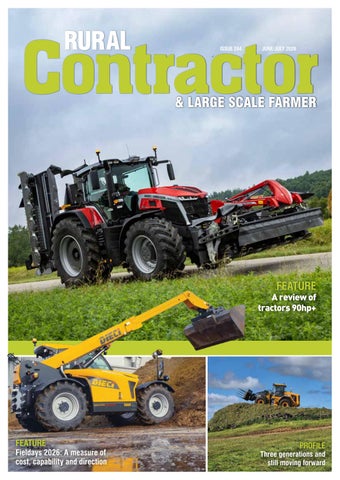
02 From the Editor: Powering into Fieldays
Keeping the operator strong in a high-cost farming environment
Backing the backbone of rural New Zealand
Keeping the wheels turning: Fern Energy and the value of service in a tight fuel market
Perrin Ag strengthens regional advisory with Vicky Ferris appointment
Ag and Civil Machinery Direct strengthens its forage and land development offering
Winter-ready: How autumn-sown cereals are transforming New Zealand farm performance
The man who put front driving wheels on our tractors TECHNOLOGY 18 Workwear that works as hard as you do 20 An industry first! AI support lands on New Zealand farms
AgStar builds on strong first year with expanded agchem range
Precision Farming’s NuPoint acquisition accelerates trans-Tasman farm technology integration
PROFILES
Three generations and still moving forward
Filling the gaps: How OC Aerial is strengthening modern spray operations with drone technology
A business that grew with the family 38 Across the ditch: Contractor’s mobility drives business success
42 Fieldays 2026: A measure of cost, capability and direction 52 A review of tractors 90hp+ EQUIPMENT 62 Recognising the people behind the iron 63 Taking the pressure out of bale handling 66 Twice the muscle, one smart move 68 DLG-Image Barometer 2025/2026: Amazone leaps up to second place
70 Built for scale: Massey Ferguson’s double baler steps In 72 Mixing efficiency into modern feeding systems
74 Ag and Civil builds momentum in the North Island
76 Manitou Group launches the new MLT-X 738 telehandler: Tailored performance for Australian and New Zealand farms
Editor Angus Kebbell 022 052 3268 angus@agrimedia.co.nz
Advertising Manager
Michael Lightbourne 021 403 853 michael@agrimedia.co.nz
Advertising Sales
Brendan Challies 022 397 2076 brendan@agrimedia.co.nz
Circulation
Hilary Armstrong 027 443 3477 admin@agrimedia.co.nz
Production Design and Layout
Hannah Kincaid art@agrimedia.co.nz
Contributors
The Hon. Mark Patterson, Dr Elena Duter, Heather Claycomb, Brendon Burns.
Printed by Blueprint Ltd
Read our magazine online ruralcontractor.co.nz/read-online
Every edition of this magazine reflects where we are in the farming calendar, and the June/July issue always carries a different kind of energy. Fieldays is here, new machinery is about to be unveiled, and for many contractors and farmers it is a time to look ahead and reassess the tools they rely on. This year’s focus on tractors in the 90hp-plus category sits squarely in that space, because these machines remain central to modern farming systems, not just as general-purpose units but as key drivers of productivity, efficiency and capability.
The 90hp-plus segment has evolved well beyond the traditional mid-range workhorse. It now includes machines expected to handle everything from loader work and cultivation through to transport and specialist applications. With that has come a shift in design thinking. It is no longer just about horsepower, but about how that power is delivered, how efficiently it can be used and how it integrates into the wider system. Across this issue, that direction is clear, with manufacturers focusing on refinement, fuel efficiency and operator comfort alongside performance.


Follow us facebook.com/nzrclsf instagram.com/nzrclsf ruralcontractor.co.nz
Scan here to sign up to our digital newsletter
PO Box 36753 Merivale, Christchurch 8146 ph 03 329 6555 www.agrimedia.co.nz
Publishers of Rural Contractor & Large Scale Farmer, AgriBusiness, AgriVet, NZ Cropping, Australian AG Contractor & Large Scale Farmer, NZ Novachem Agrichemical Manual.
The latest from the likes of Fendt, Massey Ferguson, Claas, Case, Kubota and JCB are good examples of that shift. These brands have a sound position in the higher horsepower space, and what stands out now is the intent behind the platforms. These are tractors designed for scale, built to operate as part of a larger system, where reliability and efficiency over long working days matter just as much as outright output. That thinking is consistent across much of what we are seeing in this category and reflects the realities of contracting and large-scale farming in New Zealand.
Fieldays will bring much of that into sharper focus. It remains one of the most important opportunities in the calendar to see new machinery up close, talk with distributors and get a sense of where the industry is heading. This year, with input costs still high and diesel a significant factor, the emphasis on efficiency and return on investment is likely to dominate. The conversation is shifting from what machines can do, to how well they do it and how they contribute to the overall performance of the business.
That pressure is not just technical, it is also personal. This issue includes coverage of Farmstrong, an initiative that continues to resonate across the rural sector. In a season that has delivered strong returns in some areas but also disruption through
© RURAL CONTRACTOR AND LARGE SCALE FARMER - No part of this publication may be reproduced in any form without the prior written permission of the publisher. Opinions expressed in this publication are not necessarily that of the publisher and suggest independent advice be sought before acting on information or suggestions contained herein.

Angus Kebbell,
editor.
weather and cost pressures, the importance of looking after the people behind the work remains critical. Contractors in particular are operating under sustained pressure, managing tight windows, long hours and increasing complexity.
We are also pleased to welcome the Hon. Mark Patterson, Minister for Rural Communities and Associate Minister of Agriculture, as a regular contributor. Mark brings a perspective grounded in both farming and policy, and his contribution adds another layer to the conversation around the role of contractors within the wider primary sector. His reflections on the reliance farmers place on contractors and the capital intensity of the sector will strike a chord with many readers.
As always, this issue brings together machinery, insight and on-the-ground perspective. The common thread is clear. Farming and contracting in New Zealand continues to evolve, and those who succeed will be those who can adapt, invest wisely and make the most of the tools available to them.
Contributions - Editorial and photographic contributions are welcomed and should be sent directly to AgriMedia Ltd. Editing of submissions is at the sole discretion of the editor and will accept no responsibility for unsolicited material.
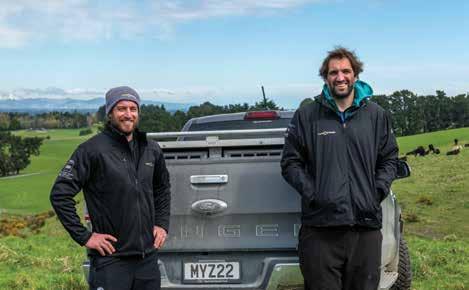
There is a tendency in New Zealand agriculture to separate performance from wellbeing, to treat output, efficiency and financial resilience as one conversation and personal health as another, when in reality the two have always been closely linked. That is the space that Farmstrong has deliberately stepped into, building a programme around a simple but often overlooked idea that farmers, growers and contractors themselves are the most important asset on any operation.
Launched in 2015 through a partnership led by FMG alongside the Mental Health Foundation of New Zealand and supported by organisations such as the Movember Foundation and ACC, Farmstrong was never designed as a top-down initiative. Instead, it has been built farmer to farmer, grounded in practical advice and real experiences, with a focus on helping people manage the pressures that are inherent in farming rather than trying to remove them altogether. That distinction matters more now than
it has for some time. The current operating environment across New Zealand farming and contracting is defined by a convergence of pressures that are largely outside the control of those on the ground. Input costs remain elevated, diesel continues to sit at levels that reshape job margins almost month to month, and interest costs, compliance requirements and weather
volatility all continue to add layers of complexity to what were already finely balanced businesses.
For contractors in particular, the diesel line

alone has become one of the most critical variables in the business. Every pass, every kilometre and every hour on the clock is directly tied to fuel, and when that cost shifts it flows immediately through to pricing, competitiveness and ultimately workload. There is limited room to absorb those increases, especially in a market where clients are facing the same pressures and are equally cautious about spend.
Farmers are operating under a similar weight. Fertiliser remains one of the largest input costs on many systems, and while there is increasing focus on efficiency and precision application, the reality is that the baseline cost of production has shifted. Add to that the volatility in commodity prices and the constant balancing act between investing in productivity and protecting cashflow, and it becomes clear that pressure is not coming from one direction but from all sides.
This is where the relevance of Farmstrong becomes more than just a wellbeing conversation and starts to intersect directly with business performance. The programme’s core message, that looking after yourself is looking after your farm, is not abstract. It is grounded in the reality that decision making, risk management and long-term planning all deteriorate under sustained stress and fatigue.
Farmstrong does not attempt to solve the financial challenges facing the sector, nor does it pretend that pressure can be removed. What it does instead is provide tools and strategies that help people manage that pressure more effectively, whether that is through better routines, stronger connections within rural communities or simply recognising when to step back and reset. Its resources are
deliberately practical, built around habits that can be integrated into daily work rather than added as another task on an already full list.
The involvement of FMG in this space is also significant. As a mutual insurer with deep roots in rural New Zealand, FMG’s role goes beyond underwriting risk. By investing in Farmstrong, it is effectively acknowledging that resilience in the sector is not just about infrastructure or financial buffers but about people. That alignment between insurer and wellbeing programme reflects a broader understanding that the long-term sustainability of farming businesses is tied directly to the health of those running them.
There is also a wider industry implication. Over recent years there has been a strong push towards efficiency, technology adoption and data driven decision making. These are all positive developments and they are essential in managing rising costs and improving productivity. But they also come with their own demands, whether that is learning new systems, managing more information or making faster decisions under pressure.
In that context, programmes like Farmstrong act as a counterbalance. They reinforce the idea that performance gains are not just achieved through machinery or inputs but through the capacity of the operator. A well set up machine is only as effective as the person running it, and in a sector where long hours and physical demands are the norm, maintaining that capacity is critical.
What is becoming increasingly clear is that the conversation around input costs, diesel prices and financial pressure cannot
be separated from the conversation around wellbeing. They are part of the same system. When margins tighten and uncertainty increases, stress levels rise, and when stress levels rise, the ability to respond effectively can decline.
Farmstrong’s strength lies in recognising that link and addressing it in a way that resonates with the rural community. It does not rely on corporate language or abstract concepts. It speaks in the language of farming, using real stories and practical advice to reinforce its message.
As the sector continues to navigate a challenging economic environment, that approach feels increasingly relevant. The pressures are unlikely to ease in the short term, and while efficiency gains and technology will continue to play a role in managing costs, they will not replace the need for resilient, capable people.
In that sense, Farmstrong is not a side conversation. It is part of the core discussion about how New Zealand farming and contracting businesses continue to operate, adapt and perform in an environment where the margins are tighter, the stakes are higher and the pressure, both financial and personal, is constant.
Farmstrong is a nationwide, rural wellbeing programme that helps farmers and growers manage the ups and downs of farming. Last year, 20,000 farmers attributed an increase in their wellbeing to the programme. For free tools, books and resources for your organisation visit www.farmstrong.co.nz. To find out what could work for you and lock it in, sign up for Farmstrong’s fortnightly toolbox tips which share a simple mental fitness skill that you can use to make farming easier on mind and body.
Article supplied by Hon. Mark Patterson, Minister for Rural Communities
Associate Minister for Regional Development Associate Minister of Agriculture
For traditional, rural businesses such as mine, access to reliable and efficient contractors is critical. As much as I’d like to claim that my wife and I ran our Lawrence sheep and beef farm on our own (pre-politics), I’d be kidding myself.
We used contractors for silage, hay, heavy cultivation, direct drilling, scanning, shearing, digger work, fertiliser spreading, tree maintenance and, of course, freight. Utilising expertise and equipment that we couldn’t possibly justify purchasing ourselves to do the big jobs frees us up to concentrate on the stock work, maintenance and business management.
The primary sector is the engine room of our economy. Food and fibre exports reached $59.9 billion in 2025, with future forecasting another positive indication for the fortunes of our primary sector.
Our farm and thousands like ours are totally reliant on rural contractors to be able to do what we do – producing high quality food and fibre and earning export dollars for New Zealand.
It is a hard business and increasingly very capital intensive. That said, I’ve watched over the years as individuals starting out small with, say, a tractor and baler, have grown into big multifaceted operations, employing a good number of people. It does seem to be a business where hard work and dedication really can pay off.
This season has been a real roller coaster. In my 40-year involvement in farming I don’t know if I’ve seen a better year for returns in pastoral agriculture, coupled with a generally good growing season.
This year has also seen a high number of adverse weather events, from multiple heavy rainfall over large swaths of the North Island, to damaging spring windstorms in Southland, Clutha and Hurunui. The arable harvest in Canterbury has once again been blighted by a damp summer.
These are all scenarios that have put pressure on farmers and growers and surely would have added a few grey hairs to our rural contractors dealing with this level of disruption.
It has now, of course, been bookended by the events in the Middle East and the price and availability of fuel, especially diesel. This has only reinforced the stark reality that the New Zealand economy runs on diesel.
You can be assured that since the fuel crisis materialised, the availability of fuel has been the Coalition Government’s number
one priority. Since the shameful decision by Labour to allow the closure of the Marsden Point refinery, we as a country have been left vulnerable to this sort of geopolitical upset.
While there have been calls for rationing, we have held our nerve. We are prepared, and we do have a four-phase plan that is ready to be rolled out if required. A plan, I might add, that has been honed working alongside industry, not one concocted solely in the Beehive.
To date, careful monitoring of the situation and working assiduously with our key supply partners in Singapore, Malaysia and South Korea has been sufficient, but we are far from complacent.
The recent announcement by my colleague Shane Jones that we are investing $20 million from the Regional Infrastructure Fund (RIF) to upgrade latent capacity at Marsden Point is further insurance. This will add a strategic reserve of an extra 90 million litres of diesel, ensuring critical utilities and freight can continue operation even if the situation was to worsen.
Fertiliser supply is generally in good shape, with our two main fertiliser co-ops having good supply on hand for several months.
We know prices at the pump are causing real pain for families and businesses. Fortunately, we are heading into a quieter time in the seasonal farming cycle when diesel usage
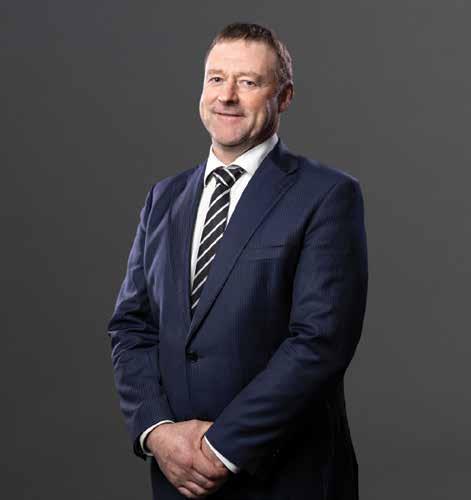
Mark says reliable contractors remain essential to keeping New Zealand farms operating efficiently across all seasons.
drops off somewhat, and by the time spring rolls round, let us hope that the fuel shock will be in the rearview mirror.
The challenge for us as politicians is how to mitigate being in this situation again. In the wake of the fuel crisis we have faced as a country, long-term national fuel and energy resilience is crucial. Sound economic strategy must be underpinned by good energy strategy.
That’s why the Coalition reversed the disastrous oil and gas exploration ban and allocated $200 million to encourage exploration.
The championed Fast Track legislation has enabled a boom in renewable energy generation, with investments by the RIF into next generation ‘Superhot’ geothermal energy development and the OpenStar nuclear fusion technology. Multiple hydrogen, wood pellet and biogas initiatives are in development. There is a lot happening. Amidst the challenges our country faces, there is still much to be positive about in the primary sector, for our farmers, our contractors and our rural communities.
There is no escaping the reality that on-farm diesel remains one of the most significant operational costs across New Zealand’s primary industries. Whether it is feeding out, cultivation, transport or contracting work, fuel sits behind almost every task carried out on farm. While pricing will always fluctuate with global markets, what is becoming increasingly important is how that fuel is supplied, managed and supported at ground level.
That is where companies like Fern Energy are carving out a clear position. Rather than trying to be all things to all people, Fern has built its model around servicing the practical needs of farmers, contractors and rural businesses, focusing on reliability, accessibility and support rather than simply acting as a fuel supplier.
Fern is a specialist fuel business formed through the combination of two established operators in Farmlands Fuel and Northfuels/ Southfuels, bringing together a long history of servicing rural New Zealand. That background matters. It means the business
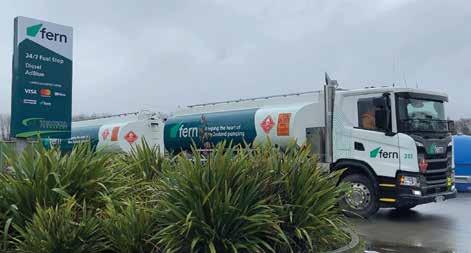
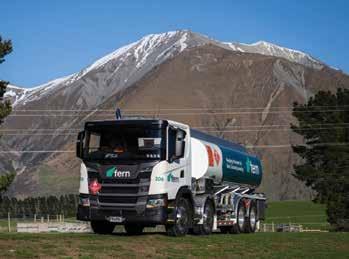
Reliable fuel supply plays a critical role in keeping farming and contracting operations running smoothly across New Zealand.
has been built with a clear understanding of how fuel is used in the field, not just how it is distributed.
The foundation of that offering is bulk fuel delivery. For many farming and contracting operations, it is obvious that having fuel delivered directly on-site is not just a convenience, it is a necessity. Fern’s ability to provide regular deliveries of diesel and petrol across a wide range of industries, from agriculture through to civil construction and transport, ensures that customers can
maintain continuity in their operations.
But delivery is only part of the equation. Storage and management are just as critical. Fern provides fuel storage solutions that allow operators to hold sufficient fuel on-site, reducing the risk of downtime and providing greater control over how fuel is used. In practical terms, that can mean the difference between a smooth operation and one that is constantly reacting to supply gaps.
That focus on keeping tanks full and operations moving is a consistent theme
throughout the business. As the company itself puts it, the aim is simple, providing fuel “when and where you need it” with as little hassle as possible. It is a straightforward proposition, but one that becomes increasingly valuable in a market where time and efficiency are under pressure.
Beyond bulk delivery and storage, Fern’s offering extends into oil and lubricants, fuel cards and 24/7 fuel access points, creating a more complete system around fuel use rather than treating it as a standalone product. That integrated approach is where much of the competitive value sits.
Fuel cards, for example, allow rural businesses to fuel up on the road with discounted prices at the pump at most retail fuel outlets.
Access to 24/7 fuel stops provides flexibility, particularly for operations that run outside standard hours. Harvest, silage and cultivation work rarely fit neatly into a nine-to-five window, and having the ability to refuel when it suits the job rather than the supplier adds another layer of efficiency.
What sets Fern apart, however, is not just the range of services but the way those services are delivered. The business has the largest network of regional sales and support staff across the
country, ensuring that customers are dealing with people who understand local conditions and requirements. In rural New Zealand, that local connection remains a key part of how business is done.
It also feeds into after-sales support. Fuel supply is one of those areas where problems tend to arise at the worst possible time, during peak workload periods when machinery cannot afford to stop. Having access to responsive support, whether that is arranging an urgent delivery or resolving an issue on-site, is often what separates a supplier from a partner.
That partnership approach is increasingly important, as farming and contracting businesses become more complex. Machinery fleets are larger, workloads are more concentrated and the margin for error is smaller. Fuel supply needs to keep pace with that change not just in volume, but in reliability and service.
There is also a broader element to how Fern positions itself within the rural sector. Through initiatives such as its Fuel for Schools programme, the company is actively investing
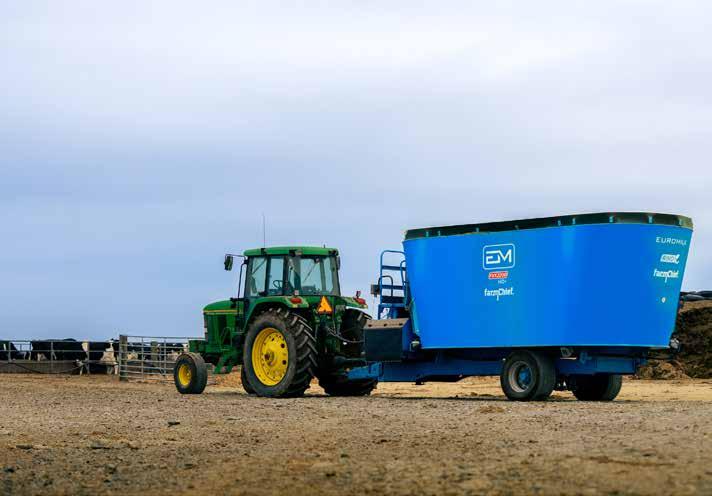
Access to fuel when and where it is needed remains essential for modern rural businesses operating under tight timeframes.
back into rural communities, providing more than $2 million in resources to rural schools. While not directly related to fuel supply, it reflects a business that sees itself as part of the wider rural economy rather than operating alongside it.
From a competitive standpoint, this combination of service, infrastructure and local knowledge is what gives Fern their edge. In a market where fuel itself is largely a commodity, the difference often comes down to how that fuel is delivered, supported and integrated into a customer’s operation.
For farmers and contractors, the decision is rarely based on a single factor. It is about reliability during peak periods, flexibility when conditions change and confidence that support is available when it is needed. It is also about working with a supplier that understands the realities of the job, from long hours to unpredictable weather and everything in between.
That is the space Fern Energy is operating in. Not chasing headlines, not competing purely on price but building a service around the needs of the people who rely on fuel every day to keep their operations moving.
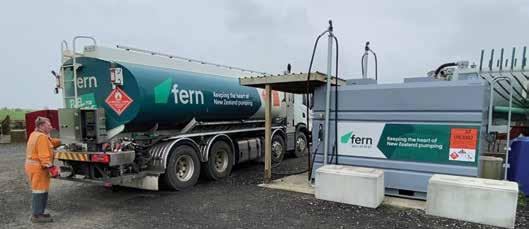
On-farm fuel storage and delivery systems help reduce downtime and improve efficiency during peak workload periods.
There is a quiet shift taking place across Hawke’s Bay and it is one that speaks less to machinery or inputs and more to the decisions sitting behind them. As farming and horticulture businesses in the region continue to navigate a mix of pressures and long-term land use questions, the demand for clear, independent advice is becoming more pronounced. Against that backdrop, Perrin Ag has made a move that reflects both that demand and its own long-term commitment to the region.
The company has appointed consultant Vicky Ferris to support its growing network of farming and agribusiness clients across Hawke’s Bay, marking the consultancy’s first team member based in the region in its 26-year history. While Perrin Ag has worked alongside Hawke’s Bay farmers for decades, the appointment formalises an on-theground presence and signals a clear intent to deepen its involvement in the region’s rural sector.
Headquartered in Rotorua, Perrin Ag has built a reputation around providing independent, strategic advice across a wide range of farming systems. Its work in Hawke’s Bay has already spanned farm purchase due diligence and investment analysis, Māori agribusiness advisory and support and farm business review and resilience planning. Those are not day-to-day operational services; they are the kinds of engagements that sit around key decision points, where the direction of a business can shift in a meaningful way.
Bringing that capability closer to the ground through a locally based consultant is a logical next step, particularly in a region as diverse as Hawke’s Bay, where sheep and beef, dairy and horticulture systems often sit side by side, each facing their own set of challenges and opportunities.
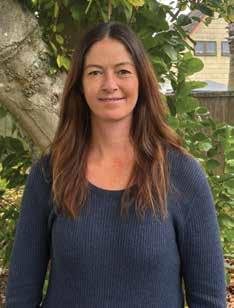
Ferris brings a background that reflects that diversity. A Hawke’s Bay local based in Waipawa, she grew up on her family’s sheep and beef farm in Wairoa before moving into dairying after high school. Her career across the primary sector has included roles with Halter, First Light Wagyu NZ and Spring Sheep Dairy, giving her exposure to livestock supply, agribusiness and commercial operations. That experience has not been confined to a single part of the supply chain. Instead, it has involved working closely with farmers, processors and wider industry stakeholders, building an understanding of how decisions made at farm level flow through to
commercial outcomes further down the line. It is that ability to connect on-farm realities with broader business performance that sits at the centre of modern consultancy.
“I’ve always been involved in agriculture and I’m passionate about doing work that adds real value back to farmers,” Ferris says. “Being part of Perrin Ag means I’m backed by an exceptional team, so I get the opportunity to keep learning while bringing my experience together in a consulting role that helps Hawke’s Bay businesses make confident decisions.
“I see a real gap in the region for independent advisory support. And if I can help fill that gap, that will be hugely rewarding.”
That reference to independence is an important one. As farming systems become more complex and the number of inputs, technologies and compliance requirements increases, the need for advice that is not tied to a particular product or outcome becomes more valuable. It allows decisions to be made based on the long-term performance of the business, rather than short-term pressures or external incentives.
Perrin Ag Managing Director Lee Matheson sees that demand clearly, particularly as businesses across Hawke’s Bay work through a period of change.
“We’re working with rural businesses across the region, from Wairoa through to central and southern Hawke’s Bay. Our clients are diverse, including sheep and beef, dairy and horticulture systems,” Matheson says. “While we’ve been active in the region for many years, Vicky’s presence means we will be even better connected to the local rural community.”
That connection is more than geographic. Having someone based in the region brings a

Left: Vicky Ferris brings deep Hawke’s Bay roots and cross-sector experience to Perrin Ag, strengthening the firm’s ability to deliver independent, on-theground advisory support to local farming and agribusiness clients.
Above: Managing Director Lee Matheson says the appointment of a Hawke’s Bay-based consultant marks an important step in building stronger regional connections and supporting clients through complex, long-term business decisions.
level of immediacy and understanding that is difficult to replicate from a distance. It allows for closer relationships, quicker responses and a deeper appreciation of the local factors that influence decision making, from soil types and climate through to market access and community dynamics.
Matheson points to the type of work Perrin Ag is typically engaged in, which often centres around significant moments in a business lifecycle.
“Our work in Hawke’s Bay is often focused on significant moments, such as when businesses are assessing change, managing risk, or making long-term commitments around land and capital.
“We’re deliberately selective about the work we take on, and our focus is on advice that can materially improve long-term outcomes. Vicky’s personal goal of adding value to our clients is perfectly aligned to Perrin Ag’s core objective. She’s going to be a real asset to our Hawke’s Bay clients.”
Those “significant moments” are becoming more frequent and more complex. Whether it is decisions around land use change,
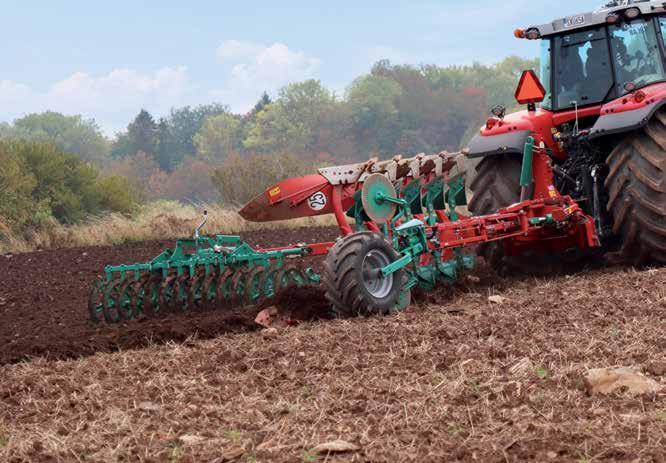
COMPACT DISC HARROW
• Compact and sturdy
• Good penetration
• Simple adjustment
• Long lasting discs
• Perfect cutting angle
• Maintenance-free bearings
MOUNTED REVERSIBLE
• 2-7 furrows
• Robust and reliable construction
• Variomat Vari-width® system for furrow width adjustments that save fuel and time as standard
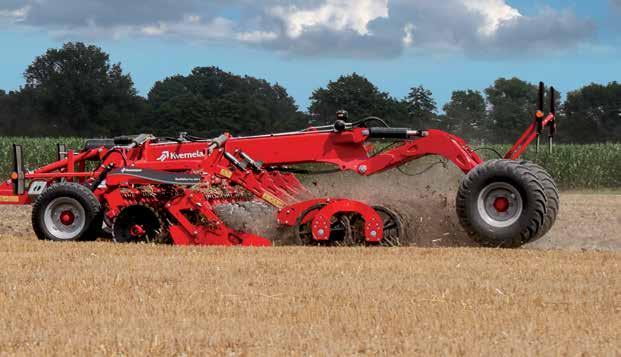
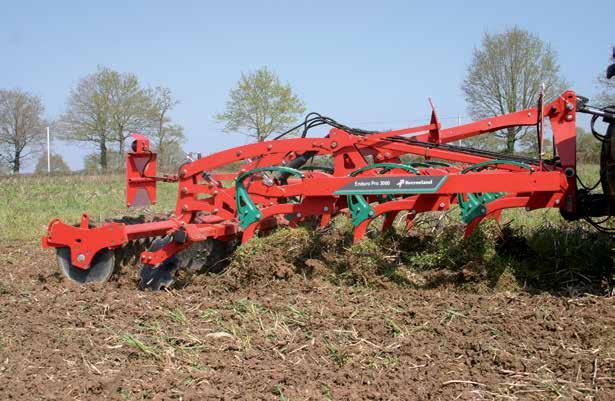
STUBBLE CULTIVATOR
• Incorporation, levelling and consolidation in one pass
• With the Enduro or Enduro Pro, Kverneland provides a cultivator which is the right choice for all conditions and for a wide range of applications.
• Conserves soil structure, moisture and limits erosion.
There is a steady confidence that comes with a distributor quietly building depth in its product offering, and in the case of Ag and Civil Machinery Direct Ltd, that confidence is now translating into a more defined presence across both forage harvesting and land development equipment in New Zealand.
Over the past 12 months, the business has continued to strengthen its position in the forage space through its partnership with Kemper, a brand that has quickly regained traction since being relaunched locally at Fieldays last year, with solid uptake across both maize fronts and grass headers and a reconnection among contractors who are increasingly focused on output, chop quality, machine reliability and the parts and service back up that go hand in hand with critical equipment.
The Kemper range has always been built around strength, reliability, high-capacity harvesting and that focus is clearly resonating in New Zealand conditions, where short weather windows and large volumes demand equipment that can perform consistently under pressure. The introduction of the new 460 Pro-series maize front is a clear example of that direction, offering contractors a front designed to handle high tonnage crops while maintaining feed quality through consistent crop flow and reduced losses.
Alongside that, the upcoming C30 series grass front signals further intent from Kemper to broaden its appeal beyond maize and into grass silage systems, which remain a critical part of many New Zealand contracting operations. While still in the pipeline for the local market, the addition of a new generation grass front reflects the ongoing evolution of forage equipment, where versatility and efficiency across multiple crop types is becoming increasingly important.
Complementing that forage offering is
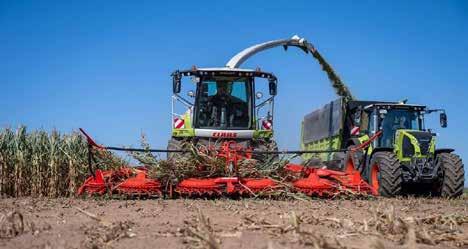
a significant development that has the potential to reshape another critical part of the silage equation. Ag and Civil Machinery Direct Ltd has recently been appointed as the full New Zealand supplier for Scherer kernel processors, aligning closely with its Kemper portfolio and opening new opportunities within the maize silage sector.
Kernel processing remains one of the most important factors in determining silage quality, particularly in maize where starch availability directly impacts feed value. Poorly processed grain can lead to significant losses in digestibility, while effective processing improves animal performance and feed efficiency. By relaunching Scherer in the New Zealand market as a dedicated supplier, the business is positioning itself at the centre of that conversation.
Scherer has built a reputation globally and here in New Zealand for producing high-performance kernel processors and replacement rollers, supplying components across a wide range of forage harvester brands. That cross-compatibility is a key advantage, particularly in a market like New Zealand, where contractor fleets often consist of mixed machinery. The ability to source market-leading processors, along with parts and replacement rollers for multiple brands of
Expanding product partnerships are strengthening capability across forage harvesting and land development in New Zealand.
chopper, creates a level of flexibility that has not always been readily available.
For contractors this is not just about upgrading machinery, but about maintaining performance over time. Wear on kernel processors is inevitable, and having access to high-quality replacement components can make a measurable difference to chop quality and ultimately to the value of the silage being produced. It is a space where incremental gains can add up quickly, particularly at scale.
While forage equipment continues to be a major focus, Ag and Civil Machinery Direct Ltd is also expanding its footprint in the forestry and land development sector, an area where it has operated for a number of years but is now pushing further with an extended MeriCrusher range.
The expansion of MeriCrusher equipment reflects a broader shift in how contractors and landowners are approaching land clearing, track maintenance and on-farm infrastructure development. Rather than
investment in new systems, succession planning or navigating regulatory requirements, the stakes are high and the margin for error is often narrow. In that environment, having access to independent advice that is both technically grounded and commercially aware can make a meaningful difference.
For Hawke’s Bay, a region that has faced its share of challenges in recent years while continuing to evolve as a major contributor to
New Zealand’s primary sector, that support comes at a critical time. The mix of pastoral and horticultural systems, combined with a strong export focus means that businesses are constantly balancing productivity with compliance, efficiency with resilience.
The appointment of a locally based consultant does not change those challenges, but it does provide another layer of support for those working through them. It reflects a recognition that the decisions shaping
the future of farming are becoming more complex, and that having the right advice at the right time is increasingly important. For Perrin Ag, it is also a signal of intent. After more than two decades of working in the region from a distance, the move to establish a permanent presence suggests a longerterm view, one that sees Hawke’s Bay not just as an area of activity, but as a region where deeper relationships and ongoing support will be central to its growth.
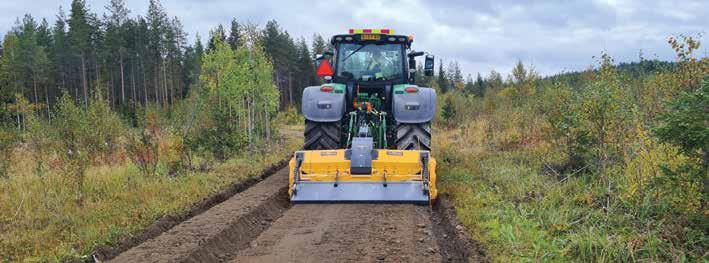
relying solely on traditional methods, there is increasing demand for machinery that can deliver efficient, one-pass solutions for mulching, rock crushing and ground preparation.
Historically, the business has supplied the MJS range of forestry clearing machines, but the expansion into the MJHS series and the MeriRoad RC65 and RC90 models significantly broadens its capability. These machines are designed to handle a wide range of applications, from forestry mulching through to road construction and maintenance, offering a level of versatility that aligns well with the diverse requirements of New Zealand conditions. The introduction of the new RC65 model, which will be on display at Fieldays, is
particularly relevant for contractors working in track maintenance and farm access development. In many parts of the country, maintaining reliable access across challenging terrain is an ongoing issue, and machinery that can combine rock crushing, levelling and surface preparation in a single operation offers clear efficiency gains.
This expansion into the MeriRoad range also reflects a growing recognition that contracting businesses are increasingly diversifying their service offerings. Seasonal pressures in one area are often balanced by opportunities in another, and having access to machinery that can operate across multiple sectors provides a degree of resilience that is becoming more important. The focus for Ag and Civil Machinery
A broader machinery offering is helping contractors improve efficiency, performance and versatility across multiple operations.
Direct Ltd is clear. While Kemper continues to build on its early success and reinforce its position in the forage market, the key launches for this year centre around the introduction of Scherer as a dedicated kernel processor supplier and the expansion of the MeriCrusher range with new models. Taken together, these developments, along with their other current long-term partners, point to a business that is not simply adding products for the sake of it, but is building a more complete offering around the needs of contractors and large-scale operators. Whether it is improving chop quality in maize silage, increasing efficiency in harvesting, or providing practical solutions for land development and infrastructure, the direction is consistent.
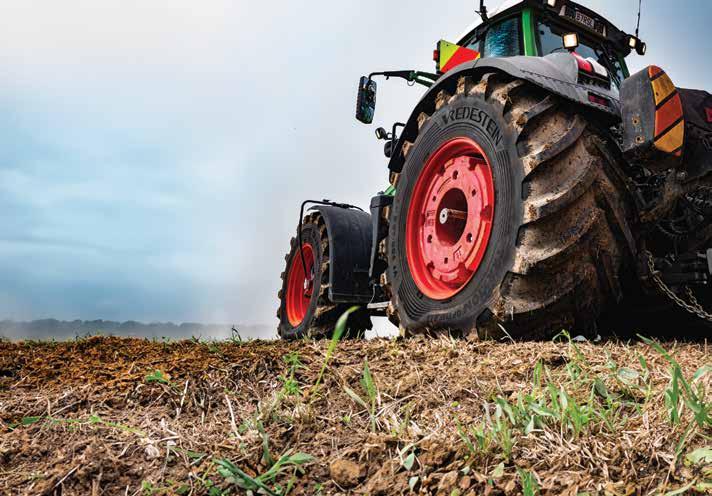
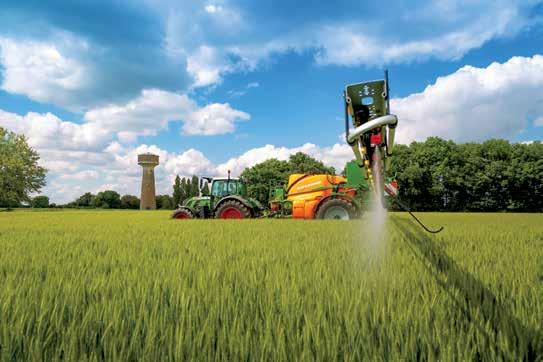
Putting autumn-sown cereals to work in New Zealand farming systems.
In a farming environment where input costs are punishing, environmental compliance is tightening and the pressure to lift per-hectare performance has never been greater, the strategic use of autumn-sown cereals is one of the most undervalued tools in the New Zealand farmer’s toolkit. From the freedraining downs of Canterbury to the heavy, wet paddocks of Southland and the warmer, free-draining country of the Waikato and Hawke’s Bay, cereals in rotation offer a level of system-wide benefit – in feed supply, weed management, soil remediation and pasture renewal – that few other agronomic interventions can match. And yet many operators still view a cereal break as a reactive measure rather than a proactive, planned rotation decision. That thinking needs to change.
The winter feed gap – and why pasture alone won’t bridge it
Every stock farmer on both islands understands the feed pinch. Whether it’s pre-calving dairy cows that need controlled BCS management heading into lactation, store lambs chasing liveweight targets before the sales, or weaner cattle that need to keep frames growing through the shoulder season, winter is when the feed budget either stacks up or blows out. Pasture growth rates crater in June and July across most of New Zealand’s
pastoral regions, and the gap between maintenance requirements and available dry matter can rapidly become a serious animal performance problem.
Research has confirmed what many farmers already know from experience: relying on established ryegrass-clover pasture alone to carry stock through winter is increasingly risky. Pasture productivity gains on New Zealand dairy platforms have stalled significantly since the early 2000s, with annual improvement rates falling from over 1.4% per year to just 0.26%, despite sustained inputs of nitrogen fertiliser and higher stocking pressure. On dryland sheep and beef country, climate variability is further eroding the reliability of late-autumn and early-winter pasture cover. The upshot is that supplementary feed, whether purchased palm kernel, maize silage, or bought-in baleage, is filling a gap that a planned rotation system could be filling far more costeffectively on-farm.
Autumn-sown cereals, such as forage oats, triticale, ryecorn, wheat and barley, are purpose-built to fill that gap. They germinate readily in cooling soils, establish quickly from a March or April sowing, and produce highquality, leafy dry matter through the coldest months of the system calendar. A wellmanaged forage cereal stand can realistically yield 5–8 tonnes of dry matter per hectare across a grazing season, with metabolisable energy values that support genuine animal performance – not just maintenance. For the
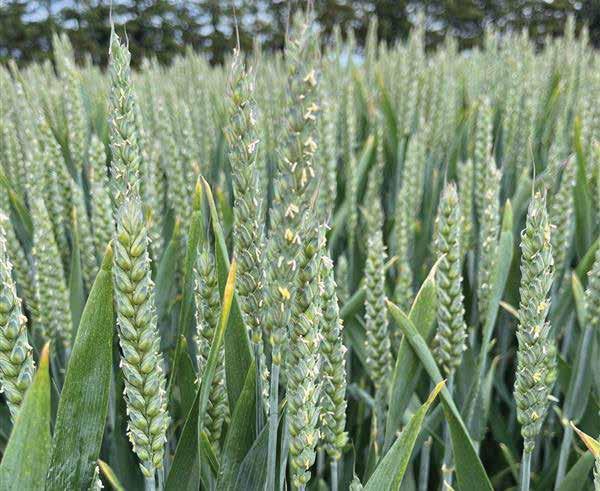
dairy farmer, that’s a meaningful reduction in reliance on bought-in supplement. For the sheep and beef operator, it’s the difference between holding condition on the breeding flock and watching it drain away.
What distinguishes cereal crops from most other winter feed options is their inherent dual-use flexibility. Unlike a brassica, which must be grazed within a defined window, a cereal crop gives the farmer genuine options depending on how the season unfolds. A crop sown in late March or early April in North Island districts will typically be ready for break-feeding by late June or July. Stock are shifted across the crop in a controlled system, converting standing dry matter directly into liveweight gain or milk solids. Stocking density, allocation per break and residual height are all management levers the farmer controls.
Any late autumn-sown cereal that has been surplus to winter demand can be carried through to early spring, where it can be either spring grazed or converted into green chop cereal silage. It is important to note the disease tolerance of the chosen forage oat cultivar greatly impacts the crops holding potential to be carried through for early spring use.
Very late autumn- or winter-sown forage oats are an outstanding catch crop opportunity to convert bare ground postwinter crop grazing. Forage oats germinate at low temperatures and immediately start using vulnerable nitrogen that may be exposed to leaching through winter if no action is taken. Catch crops are regularly taken through to green crop silage in late October to mid-November before planting into the next cropping cycle. If demand requires, they can be grazed earlier.
Ryecorn is the workhorse of this dual-use approach in colder, frost-prone environments – Central Plateau, Mackenzie Basin, Central Otago, the uplands of inland Hawke’s Bay. Its frost hardiness, strong tillering capacity and ability to recover from hard grazing and still push to a silage or grain yield make it the go-to variety for South Island and elevated North Island country. For warmer climates in New Zealand, triticale and forage oat mixes offer similarly flexible management in productive systems.
Strategic cereal rotations are helping improve pasture renewal, weed control and overall farm resilience.
Crowa forage oats: Fast feed, maximum flexibility
Crowa forage oats, developed by Agricom and bred in New Zealand, has built a strong reputation for fast, reliable establishment and genuine management flexibility. Its ability to establish quickly to provide ground cover early makes it one of the most solid forage oat choices available. Maturing 7–10 days later than its predecessor Milton, Crowa holds feed quality in the paddock without deteriorating when harvest decisions need to be delayed. This is a practical asset for mixed livestock systems. Its very good rust tolerance reduces mid-season disease risk, particularly in humid conditions.
Crowa can be sown as a pure stand at 100–120 kg/ha or blended with Manta Italian ryegrass at 80 kg/ha to extend the grazing window. It also performs well as a catch crop following winter crop grazing by establishing quickly and capturing residual soil nitrogen. Its adaptability across sowing dates and end uses makes it a practical first choice for tight rotations.
The weed management argument pushes the equation firmly into no-brainer territory for any farmer carrying weedy or run-out paddocks. Perennial pasture weeds, such as ragwort, thistles, docks, fathen, and invasive grasses like browntop and fog grass, are among the most damaging and persistent challenges in New Zealand pastoral systems. These weeds reduce available dry matter, suppress clover content, reduce pasture palatability and, in some cases, directly harm stock or taint produce. The conventional approach of overgrazing, spot-spraying and relying on existing ryegrass to fill the voids rarely delivers lasting results, particularly once perennial weeds are well-established. A planned cereal rotation fundamentally changes what is agronomically possible in a weedy paddock. Spraying out with


glyphosate before drilling eliminates both the existing sward and a significant proportion of the weed seedbank, including perennial grass species that cannot be killed in standing pasture without destroying the ryegrass alongside them. Cultivating before sowing further disrupts weed root systems and exposes dormant seed to environmental kill. For established paddocks with significant broadleaf weed pressure, a second glyphosate pass after six weeks targeting late-germinating survivors dramatically further depletes the seedbank before drilling commences.
Once the cereal crop is established, the farmer gains access to a suite of herbicides, including 2,4-D and MCPA, that are highly effective against broadleaf weeds but cannot be used in ryegrass-clover swards without damaging the clover. Applying one or two herbicide treatments to the cereal, timed at crop establishment and again as the canopy closes, achieves broadleaf weed knockdown that is simply not possible in continuous pasture. The result, when the paddock is returned to a new ryegrass and clover sward, is a seedbed with minimal weed competition. This gives the new pasture its best possible start and avoids the costly situation of a new sowing battling established weed pressure from day one.
herbicide: Locking out grass weeds at drilling
Firebird herbicide from Bayer Crop Science addresses grass weeds at the point of establishment, where they cause the most damage. A pre-emergence product combining flufenacet and diflufenican, Firebird forms a persistent soil barrier after drilling that stops germinating weed seeds before they reach the surface. Application must go on at or immediately after drilling (ideally the same day) to ensure the herbicide layer is in place before weed germination begins. It performs especially well in minimum-tillage and direct-drilling systems,

where weed seeds remain near the surface. Primary targets include vulpia (hair grass) and annual poa, as well as broadleaf weeds such as field pansy and speedwell. The label rate is 300 mL/ha. Where vulpia is the dominant pressure, Firebird is the clear first choice; where ryegrass dominates, proven safe to wheat and barley, Firebird gives growers confidence the crop is protected from the ground up.
Putting it all together
Autumn-sown cereals managed well and supported by the right inputs are one of the highest-returning agronomic decisions available to any New Zealand dairy, beef, or sheep farmer with cultivatable land in the rotation. They deliver high-quality, highyield winter feed at the time of maximum system need. They unlock weed control tools unavailable under continuous pasture. They break pathogen and pest cycles that accumulate in monoculture ryegrass systems. They allow mechanical remediation of compaction and soil structural damage. And they set the platform for the cleanest, most productive new pasture establishment possible.
When Crowa forage oats are matched with an emergence programme at drilling to lock grass weeds out from the start, the cereal crop gets away clean, establishes without competition and delivers its full dry matter potential through the grazing or silage window. That combination of variety selection and early weed management is the difference between a good cereal break and a great one. Make the rotation decision early, plan the sowing date, get the herbicide on at drilling and let the crop do the work
By Dr Elena Duter. For advice on Crowa forage oats, contact your Farmlands TFS, agronomist, or local Agricom representative. For Firebird herbicide information, visit cropscience.bayer.co.nz or contact your Bayer Crop Science representative. Always read the label before use.
Colin Davidson’s remarkable story about developing New Zealand’s first 4WD tractors has finally been told on television.
The 93-year-old Southlander was given a lengthy opening segment in an April Seven Sharp story on TVNZ, organised by Rural Contractors New Zealand to which he has had a long association.
Colin’s achievements first came to light in a self-published book, Innovative Contracting, which tells the story of how he came to develop our first 4WD tractors. He wrote: “Ever since I was a youth working on farms, I’d watched the front wheels of
tractors being pushed through soft ground, dropping into the hollows and at times being sledged along.
“I reasoned that the tractor could do its work more efficiently with all wheels driving.”
He started working as a rural contractor in 1956, soon bringing in his brother Graeme and other staff. Much of the work was ploughing or breaking in hill country for new farms.
Colin bought a new Massey Ferguson 65 from Jack Johnstone at JJ Ltd in Invercargill.
“At that time there were no 4WD tractors on the market.” He’d heard of one Italian brand which made a 4WD conversion kit but it was for light tractors and not suited to tough New Zealand conditions.
He bought a second-hand front differential unit from General Motors and fitted it to the MF 65 and later MF1100s.
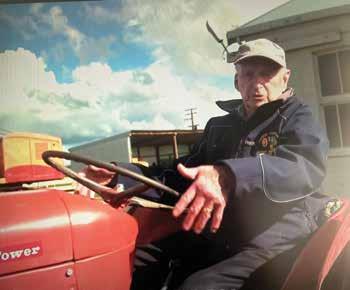
the 4WD was a great success. It could climb around the hills and through the swamp areas and could push and pull a lot more,” Colin said.
Davidson’s innovation helped shape the future of tractor design both in New Zealand and internationally. A modified Massey Ferguson 65 marked the beginning of New Zealand’s first practical 4WD tractor development.
“We started ploughing and
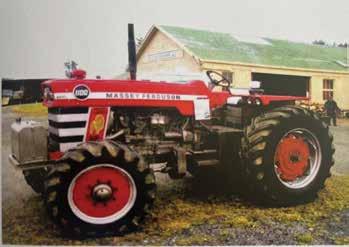
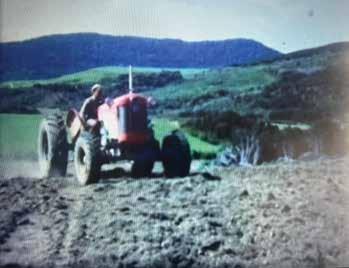
Early 4WD tractor conversions transformed performance in Southland’s demanding hill and swamp conditions.
Soon Colin was fitting 4WD to other contractors’ and farmers’ tractors. In all he converted 110 of them, working with JJ Contracting, as the franchisee for Massey Ferguson. Many were sold in Southland, but some went as far as the North Island. Film footage of the early 4WDs was shot by JJ Ltd to encourage sales, some of which feature in the Seven Sharp story.
Massey Ferguson factory representatives came from the United Kingdom more than once to inspect the tractors but it took some years before the company was producing its own 4WD machines.
Former JJ Ltd Managing Director Dave Jones told Seven Sharp that what Colin Davidson did was revolutionary.
“I think most of the world was staggered to see what he did and all they could do was follow suit.”
There is now a Colin Davidson Room at the Central Southland Machinery Club in Winton which honours his 4WD and wider contribution.
He’d become a Southland representative to the New Zealand Contractors’ Federation and helped form a National Agricultural section in 1967, which would later become Rural Contractors New Zealand.
He served as its first chairman and was on the section for 21 years, meeting with many government ministers including prime ministers Keith Holyoake, Norman Kirk, Bill Rowling and Robert Muldoon.
He came up with an idea still helping contractors today – a cost escalation clause for agricultural contracts at a time of high inflation and fuel/wage costs increasing.
Colin also took up flying in the late 1960s and used his Cessna to travel to contracting jobs, as well as transport live deer from Stewart Island to his farm at Dipton. He later moved to Invercargill with his wife Valerie and set up a business manufacturing such things as mole ploughs and digger buckets. Valerie also took on being secretary of the Southland branch of Rural Contractors New Zealand for 12 years. Both her and Colin had their work recognised by Life membership. Colin retired in 2001, and today he lives in an Invercargill rest home. At last count his Seven Sharp story had enjoyed more than 5,000 views on the Rural Contractors New Zealand Facebook page.




There is a quiet shift taking place in how farmers and contractors think about workwear. For a long time clothing sat in the background of the operation, something you wore out, replaced and did not think too much about. Now, particularly across larger scale operations and contracting businesses, it has become part of the system. It affects productivity, comfort, safety and even how a business presents itself on farm. That is where brands like Bushbuck are finding their place, not as fashion but as functional equipment.
What separates Bushbuck from traditional workwear is where it has come from. Rather than being built out of the farming sector alone, it has grown out of the hunting and outdoor space, designed in New Zealand and tested in the same environments that farmers and contractors operate in every day. That crossover matters. Hunting and backcountry use demand gear that performs when conditions turn quickly, when you are a long way from shelter and when failure is not an option. Those same demands apply on farm, particularly in regions where weather and terrain can change within hours.
The result is clothing that is engineered first for performance. Durability sits at the centre of that. Bushbuck’s range is built
around fabrics and construction that are designed to handle abrasion, moisture and repeated use, rather than simply looking the part. For contractors, that is a practical consideration. Gear that wears out quickly is not just an inconvenience, it becomes a cost and a disruption during the busiest parts of the season.
There is also a clear emphasis on systems rather than individual garments. The idea of layering is not new, but it has become more refined in recent years. Base layers, mid layers and outer shells all play a role, allowing operators to adjust to conditions throughout the day. In a New Zealand context, where a day can start in frost, move through wind and end in rain, that flexibility is critical.
Merino thermals, for example, provide a base that manages moisture and temperature, while windproof fleeces and wool jerseys add insulation without restricting movement. Over the top of that, waterproof outer layers are designed to keep operators dry in sustained rain, something that is not negotiable during silage or drilling seasons. It is a system that mirrors the way contractors already think about machinery, selecting the right tool for the job and building a setup that works across different conditions.
Where Bushbuck stands out is in how it balances that performance with practicality. Many technical clothing brands push into high-end territory, often at a price point that does not stack up for everyday work use. Bushbuck has taken a different approach,
Layered clothing systems allow farmers and contractors to adapt to changing New Zealand conditions throughout the day.
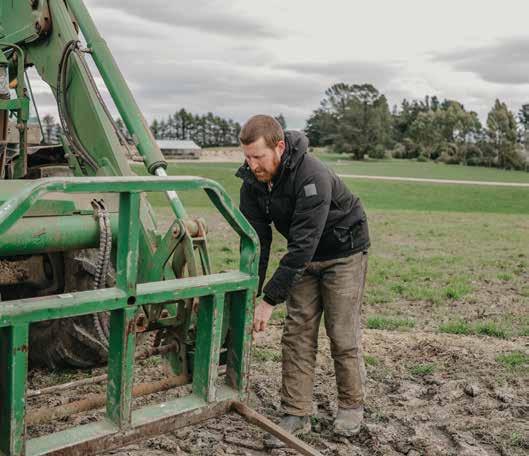
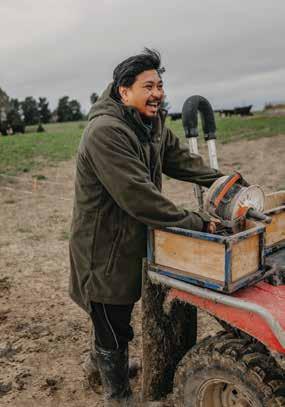
Modern workwear is evolving into a performance system that supports comfort, durability and productivity on farm.
designing gear that is accessible while still maintaining the performance required for demanding environments. That positioning is important, particularly for contracting businesses that may be outfitting multiple staff.
Uniformity is another factor that has become more relevant. As contracting businesses grow, presentation becomes part of the job. Turning up with a consistent, professional appearance reflects the quality of the work being delivered. Bushbuck has leaned into that space, offering corporate workwear solutions that allow businesses to standardise clothing across teams, including branding and customisation.
That might seem like a small detail, but it has practical implications. Clear identification on site improves safety, particularly where multiple operators and machines are working together. It also reinforces a level of professionalism that clients increasingly expect. In a competitive environment, those details can make a difference.
The range itself is broad, covering everything from high visibility gear through to waterproof jackets, work pants and insulated outerwear. High vis remains a requirement in many contracting environments, particularly in civil and roading work, but it is now being integrated into clothing that also meets performance standards for warmth and durability. That shift reflects the reality of modern worksites, where compliance and comfort need to sit alongside each other.
For farming operations, the focus often shifts slightly towards versatility. A contractor may need multiple sets of gear depending on the job, but a farmer is more
likely to rely on a smaller number of pieces that can handle a wide range of tasks. That is where items like canvas puffer jackets and waterproof outer layers come into their own, offering protection across feeding, stock work and machinery operation without the need to constantly change gear.
There is also a growing awareness of how clothing impacts fatigue. Long days in the cab or on foot are part of the job, and gear that restricts movement, holds moisture or fails to regulate temperature adds to that fatigue. Bushbuck’s approach to lightweight, breathable fabrics and ergonomic design is aimed at reducing that load, allowing operators to work more comfortably for longer periods.
From a contracting perspective, that translates directly into productivity. An operator who is comfortable and dry is more likely to maintain focus and consistency throughout the day. It is not a headline feature, but it is one that contributes to the overall efficiency of the operation.
The other side of that equation is longevity. Premium workwear is often justified on the basis that it lasts longer, and in many cases that holds true. Investing in gear that can withstand multiple seasons reduces the need for constant replacement, which in turn reduces downtime and cost. For businesses running multiple staff, that becomes a significant consideration.
What is also notable is how Bushbuck has positioned itself within the New Zealand
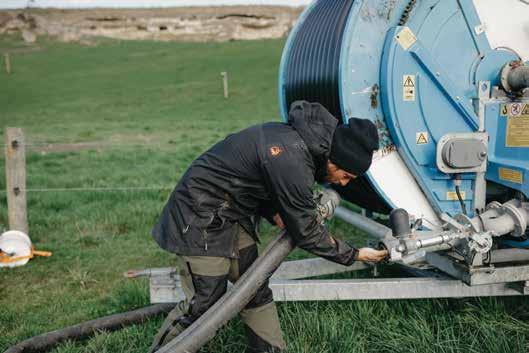
market. Being locally owned and designed, with gear tested in New Zealand conditions, gives it a level of relevance that imported brands sometimes struggle to achieve. The environments it is designed for, whether that is the Waikato, Hawke’s Bay, Fiordland, the Mackenzie Basin or the wider South Island, are the same environments many of its customers are working in.
That connection to place matters. It shapes the way products are designed and the problems they are trying to solve. It also builds a level of trust, particularly in rural communities where word of mouth and proven performance carry more weight than marketing.
Looking ahead, the role of workwear in farming and contracting is only likely to increase. As systems become more efficient and expectations around performance continue to rise, every part of the operation is being examined for gains. Clothing is part of that. It influences how people work, how they feel and how effectively they can operate in challenging conditions.
Bushbuck is not trying to reinvent the concept of workwear, but it is refining it. By bringing together elements from the outdoor, hunting and technical clothing sectors and applying them to farming and contracting, it is contributing to a shift in how gear is viewed.
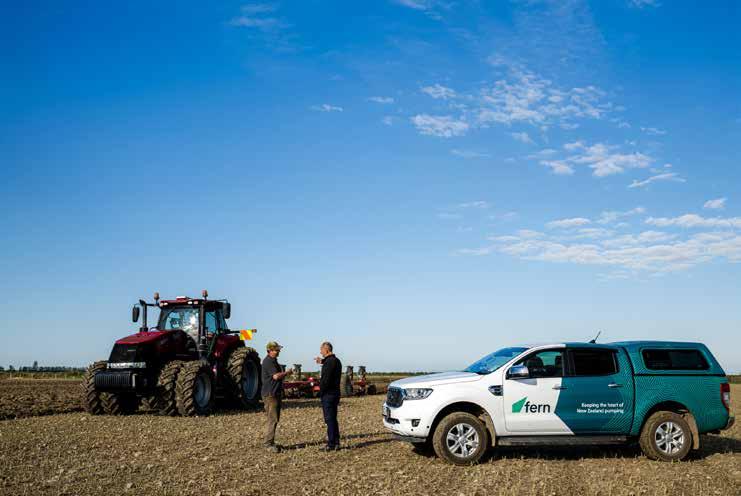

When a mower goes down mid-job, there is very little time to scroll through a 200page manual or wait for support over the phone. For contractors and large-scale farmers, downtime is measured in lost income, not inconvenience.
Resolving issues quickly and delivering strong aftersales service from ‘purchase to paddock’ was a big motivation for FarmShop when they created FarmFix, and the result is a first of its kind for the New Zealand agricultural machinery space.
FarmFix is an AI-powered assistant built specifically for FarmShop customers running SaMASZ machinery (and, in time, its full product range). It delivers instant, cited answers straight from the relevant operator’s manual, spare parts catalogue and FarmShop’s own technical knowledge. This innovative tool can be used from a smartphone in the paddock or wherever the need arises.
Modern farm machinery is more capable than ever, but that capability comes with complexity. Operator manuals are often hundreds of pages long, parts catalogues sit separately and useful content like setup guides or technician videos can be scattered across different platforms.
Under real-world conditions, none of that is practical.
FarmFix replaces that fragmented experience with a single interface. Customers select their machine, type a question in plain language and receive a clear, step-by-step answer within seconds. Every response is grounded in official documentation and includes direct links to the exact page or figure being referenced. It means no guesswork or digging around for a valid answer.
The difference with FarmFix is not just speed, it’s context. It has been built for the way contractors actually work. Because the system loads both the operator’s manual and the spare parts catalogue at the same time, it can guide a user through a process while also surfacing the relevant part numbers if something needs replacing.
On top of that, FarmShop’s own expertise is layered in. If there is a mechanic’s video or a supplementary guide that helps explain the job, FarmFix brings it into the answer right at the moment it’s needed.
There is no app to download and no login required. It works in a browser on any device, whether that is a phone in the paddock at 5 am or a desktop in the workshop.
AI is already being used by farmers, but generic tools like ChatGPT come with a
risk. They don’t know the farmer’s actual machine or have access to the correct manual, yet they will still produce confident but often incorrect answers.
FarmFix takes a different approach. It’s what FarmShop call Grounded AI, not guesswork.
The system is deliberately restricted to a curated knowledge base for each machine. It only answers using verified content that has been uploaded, and every response is cited so users can trace exactly where the information came from.
That level of trust matters, especially for safety-critical farming tasks.
For dealers and FarmShop’s mechanics, the impact is just as significant. A large share of support or trouble-shooting calls are repeat questions already covered in manuals. During peak mowing or harvest windows, those calls stack up quickly, creating delays for customers and pressure on staff.
FarmFix handles those routine queries instantly, freeing up staff to focus on complex issues, where their expertise adds the most value. At the same time it provides 24/7 support, something no customer service team can match.
One of the more powerful features of the system sits behind the scenes.
Every question asked through FarmFix is logged and analysed. FarmShop can see which machines generate the most queries, what customers are struggling with and where the system could not provide a sufficient answer.
That visibility turns support into a feedback loop. Knowledge gaps can be identified early, and new content can be created to address them before they become recurring issues.
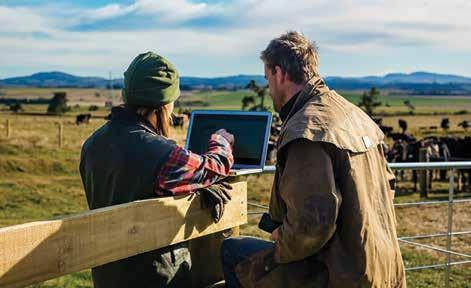
Built by FarmShop, the AI-powered system brings manuals, parts catalogues and technical support into one interface for faster problem solving in the field.
FarmFix has also been developed with privacy in mind, with no personal identity stored, allowing customers to ask questions freely without concern about their information being tracked or retained.
The platform was designed and built entirely in-house by FarmShop and launched commercially in April 2026. It is currently supporting SaMASZ disc mowers, with plans to expand across the wider product range.
The underlying architecture allows new machines to be added simply by uploading their manuals and associated content. No redevelopment is required.
As that library grows, so does its value to customers.
For an industry that runs on tight seasonal deadlines and high-value equipment, access to fast, accurate information is not a luxury. It is essential.
FarmFix represents a shift in how that support is delivered. Instead of searching, waiting, or guessing, contractors can get the right answer immediately, backed by the same documentation they would have relied on anyway.
At Mystery Creek Fieldays, where innovation tends to focus on hardware, this is a reminder that some of the biggest gains now sit in how information is delivered.
With its early positive feedback and clear practical value, FarmFix is also emerging as a strong contender in the Fieldays Innovation Awards.
Visit FarmShop during Fieldays at site #H3 to find out more.


Rolling with the best — making heavy lifting easy, one bale at a time.
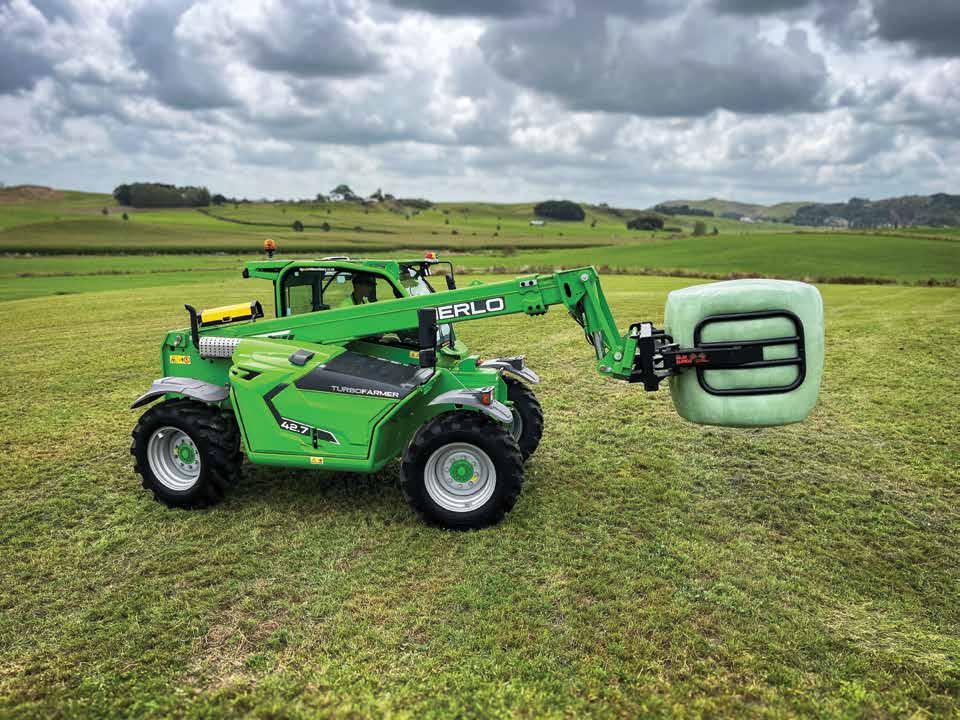
Features a 116.8hp Perkins 904 4-cylinder engine, 4WD hydrostatic drive with EPD, and a 140L fuel tank for powerful, efficient performance.
Save up to 18% on fuel with Merlo’s patented EPD system for maximum efficiency and performance.
89 Kahikatea Dr, Hamilton
38 Progress Dr, Otorohanga
7 Heights Road, Pukekohe Visit us in Invercargill, Gore, Mosgiel, Cromwell, Timaru, Ashburton or Christchurch *Terms & conditions apply. Contact your dealer for details.
Parts & Service: 07 843 7237 • sales@acmd.co.nz agandcivilmachinery.co.nz @agandcivil
to our Specialists
Features a metal structure above the cab to meet FOPS Level II standards, protecting operators from falling objects.
Merlo handlers feature advanced frontal tipping prevention, keeping operators safe without compromising boom speed or lifting capacity.
@jj.co.nz
After establishing itself quickly on Farmlands shelves, AgStar is continuing to broaden its footprint with a series of additions that extend the range beyond its original pastoral focus and into horticulture as well as home and garden applications.
AgStar is Farmlands’ private label agchem brand, developed as part of the cooperative’s wider strategy to give farmers and growers access to reliable products at competitive pricing. The initial rollout centred on herbicides and insecticides suited to pastoral systems, but strong uptake from shareholders has driven further development into other parts of the market.
The latest additions reflect that shift, with a mix of crop protection chemistry and general use products that widen the scope of the range across different farming and growing environments.
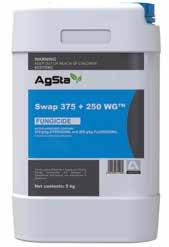
One of the key inclusions is AgStar Swap 375+250 WG, a
fungicide combining cyprodinil at 375 g/kg and fludioxonil at 250 g/kg. This formulation is widely recognised for its effectiveness against botrytis, particularly in crops such as grapes, onions, strawberries and blueberries, while also providing control of anthracnose in strawberries and blueberries and rhizopus in strawberries. Its inclusion signals a move into higher value horticultural segments where disease pressure and product performance are critical. In the insecticide category, AgStar Venturi 240 introduces methoxyfenozide at 240 g/ litre, a target specific option aimed at key pests, including codling moth in pipfruit, and

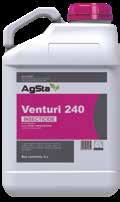
leaf rollers across a range of crops, including avocados, grapes, kiwifruit, nectarines and peaches. As an insect growth regulator, methoxyfenozide is designed to disrupt the moulting process in caterpillar pests, providing selective control while supporting integrated pest management programmes.
The herbicide line-up has also been strengthened with AgStar Thump 200SL, which contains glufosinate-ammonium at 200 g/litre. Previously marketed as AgStar Liberty, the product is a non-selective contact herbicide suited to the control of a wide range of broadleaf and grass weeds in orchards, vineyards and non-crop areas. Its role as a contact chemistry option makes it particularly relevant in resistance management programmes, where growers are looking to diversify modes of action.
Alongside the core agchem additions, AgStar has also moved into the home and garden space, with products such as Mossaway, which contains benzalkonium chloride at 100 g/litre. Designed for the removal of moss, mould, algae and lichen, it reflects a broader effort to position the brand across both commercial and lifestyle applications.
Farmlands Head of Merchandise, Darryl Stretton, says the expanded range builds on what he describes as a “really good” first year for the brand.
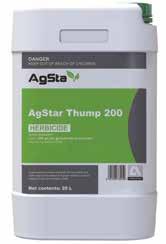
AgStar’s expanded agchem range reflects strong early demand, with new products extending its reach from pastoral systems into horticulture and wider on-farm applications.
“AgStar has had a great uptake, and it only took a few months for it to become a household name among our shareholders,” he says. “We have been identifying other areas where we may be able to support farmers and growers, whether it’s out in the paddock, orchard or back home looking after their lawn or garden. We are also planning to further expand in the plant nutrition space, including trace elements.”
Stretton says the approach behind AgStar mirrors the cooperative’s wider strategy around its exclusive brands, combining value with performance. “AgStar products are supported by a comprehensive warranty, designed to give customers confidence in the quality and reliability of our range.”
With further expansion planned, the direction is clear. AgStar is moving beyond its pastoral base and positioning itself as a broader input option across multiple sectors, while maintaining a focus on affordability and practical performance for New Zealand farmers and growers.
There has been no shortage of talk around connectivity in agriculture over the past decade, but what has often been missing is genuine interoperability, systems that work together without locking farmers into a single brand, platform or supplier. The acquisition of NuPoint by Precision Farming signals a step towards addressing that gap and, more importantly, it reflects how quickly the conversation is shifting from data collection to practical, connected decision-making across real farming operations.
Precision Farming has built its reputation around helping farmers and contractors manage fertiliser application, with a strong focus on job tracking and operational visibility. The addition of NuPoint brings an established vehicle management layer into that system, with a specific focus on supporting viticulture and horticulture operators and contractors.
For an industry that is increasingly being asked to prove what it does, not just do it, that connection matters.
Precision Farming chief executive Chloe Walker is clear about the direction of travel and the reasoning behind the acquisition. “We are all about giving farmers and growers options and the ability to be efficient and connected, no matter what technology they
want to use,” she says. “You choose what hardware to use, what contractor you want to use, what fertiliser or chemical supplier you want to use and which farm management system and they all talk to each other. This acquisition allows us to really accelerate that trajectory.”
That emphasis on flexibility is important. Many digital agriculture platforms have struggled to gain traction because they require farmers to commit fully to a single ecosystem, often replacing existing equipment or software in the process. What
Improved connectivity is helping link machinery, operators and farm systems into a single workflow.
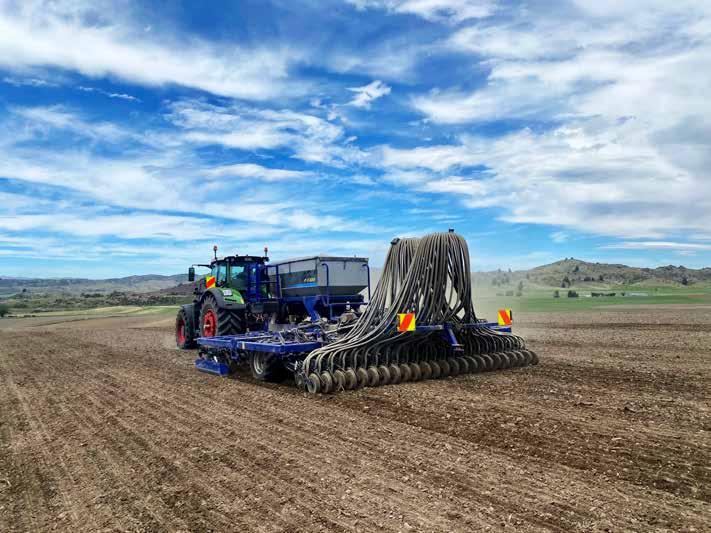


Precision Farming is aiming for is something different, a layer that sits across existing systems, allowing machinery, contractors and farm management tools to communicate without forcing change where it is not needed.
In practical terms, that means a grower running mixed machinery, perhaps a combination of John Deere, Trimble and Topcon systems, can still bring that data together into a single operational view. With the integration of NuPoint, that visibility now extends further into vehicle tracking and job execution, creating a more complete picture of what is happening on farm in real time.
The immediate gains are relatively straightforward but no less significant. For contractors, digital job management replaces paperwork, automated proofof-application reports strengthen client relationships, and fleet visibility removes wasted coordination time. For large-scale farmers, tracking exactly what was applied, where and when helps avoid over-application and supports automatic compliance documentation. In an environment where input costs remain high and margins are under pressure, those efficiencies quickly become meaningful.
Walker points directly to that pressure when outlining the broader value of the platform. The tools are designed to support farmers in maximising fertiliser and spray value while reducing fuel use, a combination that speaks directly to both economic and environmental expectations now being placed on the sector.
The timing of the acquisition also reflects a wider shift in how agricultural technology is being adopted. Where earlier waves of precision farming focused heavily on individual tools, guidance systems, variable rate application or yield mapping, the current phase is increasingly about integration. It is no longer enough for a machine to operate efficiently in isolation. It needs to be part
of a wider system that captures data, links operations and provides traceability.
That is where the NuPoint platform brings additional depth. With an existing presence in both New Zealand and Australia, it has already been operating in the space of vehicle management and connectivity, compatible with John Deere, Trimble, Topcon and more, particularly within horticulture and viticulture systems. Integrating that capability into Precision Farming’s existing platform extends its reach beyond pastoral systems and into sectors where tracking, timing and traceability are even more critical.
The combined platform strengthens Precision Farming’s position in vehicle operations management but, more importantly, it enhances digital connectivity between machinery, contractors, farmers and the wider farm system. It effectively builds a bridge between the physical work being done and the digital record that increasingly underpins compliance, reporting and market access.
Walker sees that broader picture clearly and frames the acquisition within a longerterm growth strategy. “This is a great transTasman story and demonstrates the growth trajectory that we are on,” she says. There is a clear ambition to scale the platform across both sides of the Tasman, reflecting the similarities in farming systems, regulatory pressures and export market expectations between New Zealand and Australia.
That trans-Tasman element is more than a geographic expansion. It highlights the growing importance of regional alignment when it comes to agricultural technology. As both countries continue to rely heavily on export markets, the ability to demonstrate consistent standards, backed by reliable data becomes a competitive advantage.
Looking ahead, Walker believes that the demands around supply chain transparency will only increase. “A core part of our vision is enabling a future where every vehicle
on every farm can be connected through a flexible digital ecosystem, giving them full visibility of vehicle locations and what went on when and where. It’s all about giving farmers and their partners choice, while ensuring the tools they rely on can work seamlessly together.”
That vision speaks directly to the direction of modern farming systems, where connectivity is not an add-on but a foundation. Being able to track what was done, where it was done and when it was done is no longer just useful, it is becoming essential for compliance, assurance and market access.
At the same time, there is a clear recognition that technology needs to remain practical. Complexity remains one of the biggest barriers to adoption, particularly in busy contracting and large-scale farming operations where time is limited and systems need to work without constant management.
Walker addresses that balance directly.
“That’s what we are here to do for farmers and growers, using smart technology and common sense. Our tools need to be simple and connected because we want to support farmers to come on this journey.”
It is a point that underpins the entire acquisition. The success of any connected platform will ultimately depend not on how much it can do, but on how easily it fits into existing operations and how clearly it delivers value on the ground.
For ground-spreading and spray contractors managing complex multi-client operations, that flexibility could prove critical. The ability to bring together different machines, operators and jobs into a single connected workflow – and deliver verified proof-of-application to clients as standard – has the potential to win more work and eliminate the admin that adds up over a season.
The acquisition of NuPoint does not represent a single breakthrough technology. Instead, it reflects a shift towards integration, where the focus is on connecting what already exists and making it work better together. In that sense, it is a move that aligns closely with where the industry is heading.
As regulatory pressure increases and the need for transparency grows, platforms that can link operations, data and reporting in a simple and flexible way will become increasingly valuable. Precision Farming’s expansion into Australia, supported by the NuPoint acquisition, suggests that the pace of that change is only going to accelerate.
For farmers and contractors on both sides of the Tasman, the challenge will not be whether to adopt connected systems, but which ones offer the right balance of flexibility, simplicity and real-world value.
Integrated platforms are reducing admin and improving traceability across modern farming operations.
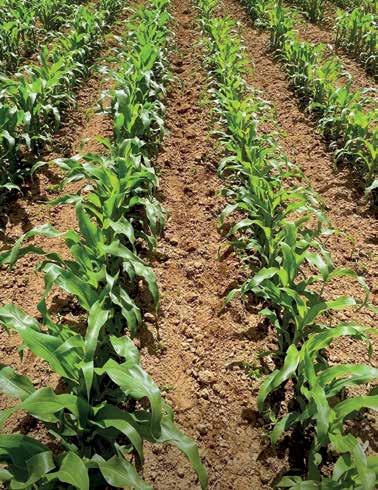


























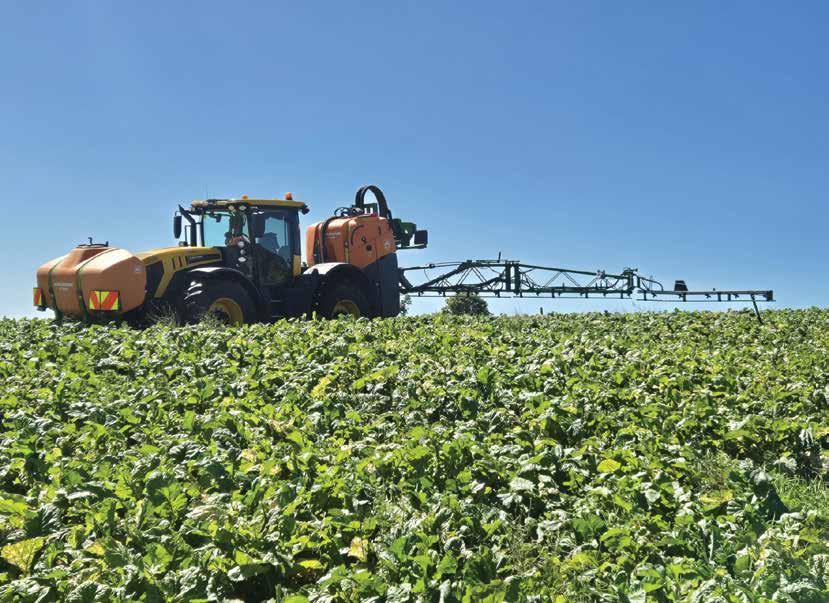
Reymer Ag is the kind of contracting business that reflects both the history and the direction of New Zealand agriculture, built over generations but constantly evolving alongside the systems it supports.
Based in Pirongia in the Waikato, it is a business that has grown from small-scale haymaking into a fully integrated operation, covering everything from crop establishment through to harvest and cartage, with a structure that mirrors the changing demands of modern farming.
The story begins in the 1960s, when John Reymer Senior established Reymer Agriculture in the Tihiroa district. At that time, contracting was often a matter of filling a need within the local community and haymaking was at the centre of that. What set the business apart early on was a willingness to adopt new technology and push into new areas. John was one of the first in New Zealand to run Massey Ferguson tractors and introduced one of the country’s first loader wagons, setting a precedent that still defines the business today.
That approach carried through into the second generation. When Bill Reymer took over in the 1970s, the industry was already beginning to shift.
Conventional hay was giving way to silage, and cropping systems were becoming more structured. Bill adapted the business accordingly, moving into roundbaled silage and adopting techniques such as direct drilling and undersowing well ahead of wider uptake. The emphasis remained the same, invest in capability and stay ahead of where the industry is heading.
That mindset has been critical to the longevity of the business. Contracting, particularly in a region like the Waikato, is shaped by the systems it supports. As
Reliability, timing and output remain central to contracting success in high-pressure seasonal conditions.
dairy farming intensified and supplementary feeding became more common, maize silage emerged as a key part of the equation. Reymer Ag moved with that change, expanding its role in both planting and harvesting maize and building a business that now operates at scale across the Waipā district.
Today, the third generation
Maize silage has become a core part of the business as dairy systems demand reliable supplementary feed.
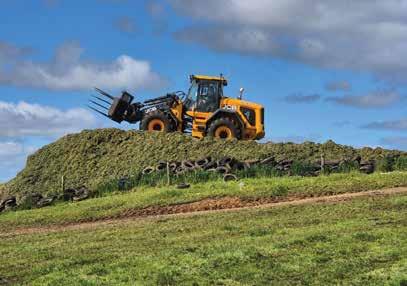
From haymaking roots to full-service contracting, Reymer Ag reflects the evolution of New Zealand farming systems.
is firmly in place, with brothers Mike Reymer and Chris Reymer leading the operation alongside their parents Bill and Lyn. Their pathway into the business reflects a broader trend in the sector. Both spent time working overseas, gaining experience in different farming and contracting systems before returning home. That exposure has influenced how the business operates, bringing in new ideas while maintaining the core values that have underpinned it for decades.
The scale of the operation has grown significantly. Reymer Ag now plants and harvests more than 700 ha of maize annually, alongside a full suite of contracting services that extend across cultivation, planting, spraying, silage and general cartage. It is a business that operates across the full cycle, from crop planning through to harvest, and that end-to-end capability has become one of its
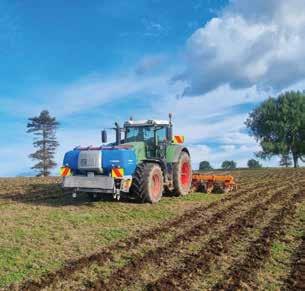
defining strengths.
That ‘seed to feed’ approach is not just a marketing line, it reflects how the business is structured. Reymer Ag offers crop establishment through roller drilling, direct drilling and maize planting, followed by spraying programmes and then into harvest with precision chopping, baling and loader wagon work. The addition of general cartage completes the system, allowing the business to control the entire process rather than relying on external services.
For farmers, that level of integration has practical benefits. It simplifies logistics, improves timing and ensures

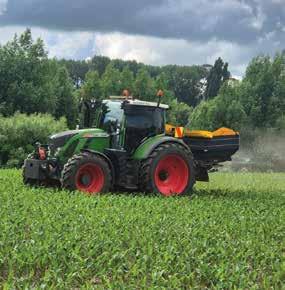
consistency across each stage of the process. As the business itself puts it, each farming operation is different and the ability to tailor services to suit those differences is critical. Soil type, climate and system all play a role and contracting services need to adapt accordingly. Machinery has always been central to that capability. From the early adoption of Massey Ferguson equipment through to the modern fleet operating today, the focus has remained on reliability and performance. While specific fleet details are not always front and centre, the scale of work being undertaken requires a line-up that can
Investment in machinery and technology has supported Reymer Ag’s ability to operate at scale.
handle high-volume operations across multiple fronts at once.
The maize side of the business provides a clear example of how that has evolved. What began as small-scale planting has grown into a significant part of the operation, with machinery progressing from single-row harvesters through to multi-row machines capable of handling large areas efficiently. As Bill Reymer noted, “The machines have got bigger and quicker, but
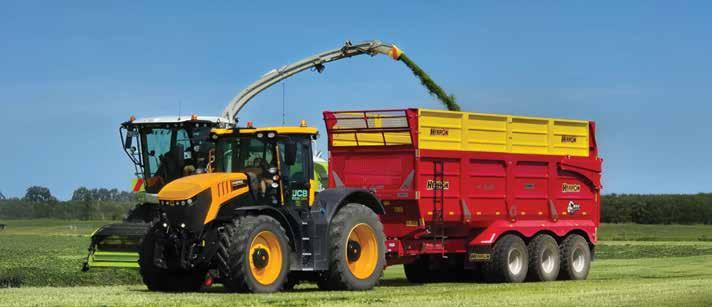

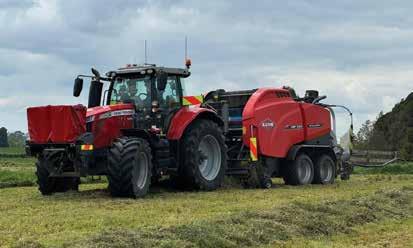
Three generations of the Reymer family have shaped a contracting business built on innovation and adaptability.
the principles … haven’t really changed.”
That balance between progression and practicality is evident throughout the business. While machinery has advanced, the fundamentals of contracting remain the same. Timing, reliability and output are what matter, particularly in a system where weather windows are tight and demand is high.
The integration of their own farming operation adds another dimension. Mike and Chris are also involved in dairy farming, milking 300 cows on a 95-ha operation. That connection to farming provides a direct understanding of the pressures their clients face. It influences decision making, from crop selection through to harvest timing, and reinforces the importance of delivering a service that works within a broader system.
Maize, in particular, has become a focal point. The crop’s role as a supplementary feed has expanded significantly over
the years and Reymer Ag has been part of that journey. From the early days when maize was a relatively minor component, through to its current position as a key feed source, the business has adapted alongside the industry.
“Maize has been a talking point around the Reymer family kitchen table for decades,” is how one account of the business describes it, and that is reflected in the level of involvement the family has across the sector. That involvement extends beyond contracting, with a focus on cultivar selection, crop performance and the broader agronomic factors that influence yield and quality.
The structure of the business also reflects a strong family dynamic. Like many successful contracting operations, it is built around people who understand both the work and each other. Roles are clearly defined but flexible, allowing the business to respond to changing workloads and seasonal demands.
At the same time, it has grown beyond a purely family-run operation. The scale of the work requires a capable team, and Reymer Ag has built a workforce that can operate across its different service
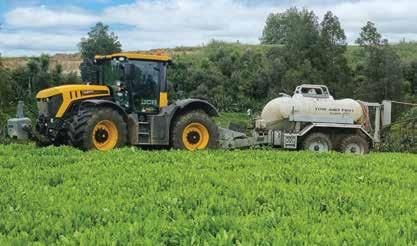
A strong local focus enables efficient logistics and long-standing client relationships across the Waikato.
areas. Maintaining that team, particularly in a competitive labour market, is an ongoing challenge, but one that is critical to the success of the business. Health and safety, compliance and professionalism are now expected as standard across the contracting sector, and Reymer Ag is no exception. As a member of Rural Contractors New Zealand, the business operates within a framework that emphasises quality, accountability and best practice. Those standards are increasingly important, not just for compliance but for maintaining trust with clients.
Geographically, the business operates within a defined area around Pirongia, typically within a 40-km radius. That focus allows it to maintain strong relationships with clients and manage logistics effectively, ensuring that machinery and staff are deployed efficiently across jobs.
That local focus does not limit the scale of the operation. Within that radius sits a significant concentration of dairy and mixed farming operations, providing a consistent demand for contracting services. By concentrating on that area, Reymer Ag has been able to
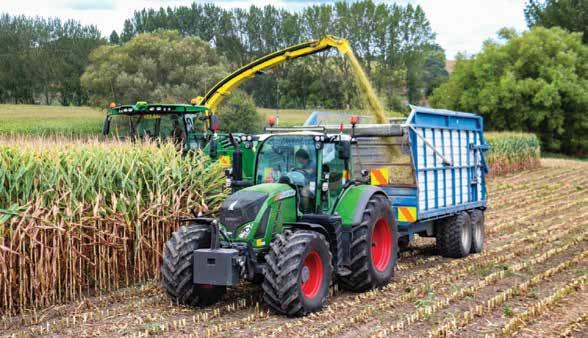
build depth rather than simply expanding geographically.
Looking at the business today, what stands out is how it has managed growth. Rather than expanding rapidly into new regions or services, it has built capability around the systems it knows best. Each addition has been aligned with existing work, creating a cohesive operation rather than a collection of separate services.
That approach has also supported succession. With the third generation now leading much of the operation, the transition has been gradual and practical. Knowledge has been passed on through experience rather than formal handover, and the business has continued to evolve without losing its core identity.
There is no indication that growth will slow, but it is likely to follow the same pattern –incremental, considered and aligned with the needs of the industry. As farming systems continue to change, particularly with ongoing pressure around efficiency and sustainability, contracting businesses will need to adapt.
Reymer Ag is well positioned to do that. It has a strong foundation, a clear understanding of its market and a structure that allows it to respond to change. More importantly, it has maintained the qualities that have defined it from the beginning: reliability, innovation and a commitment to doing the job properly.
In an industry where those qualities still carry the most weight, that is what continues to set it apart.
A ‘seed to feed’ approach allows Reymer Ag to manage the full crop cycle from establishment through to harvest.
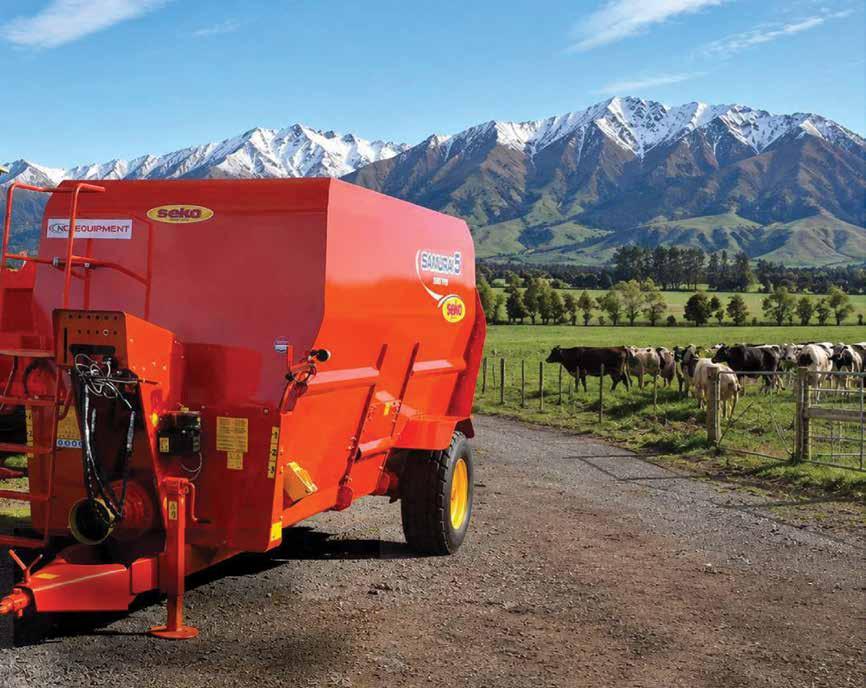

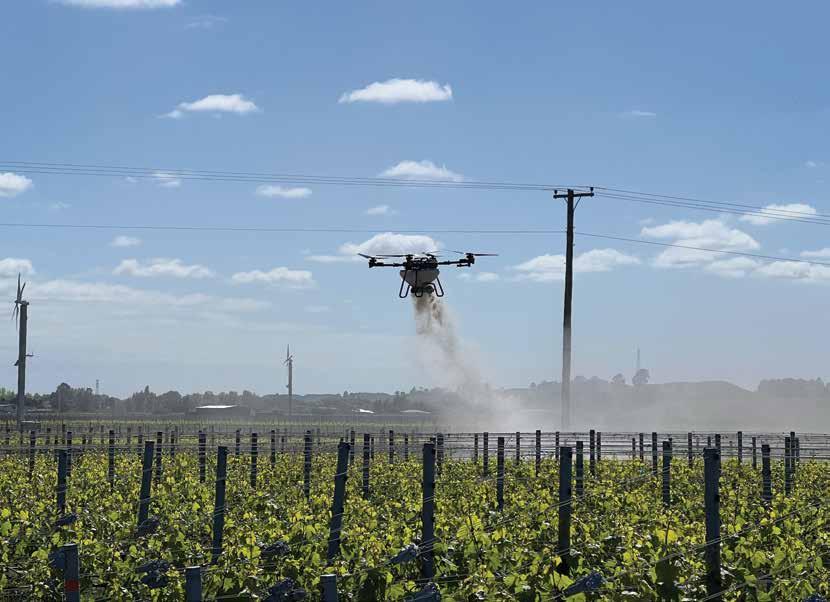
There is a growing layer within New Zealand’s contracting sector that is not replacing traditional spray systems but working alongside them to fill the gaps where timing, access and precision become limiting factors.
In a landscape where ground rigs and aerial application still do the heavy lifting, drone operators are emerging as a complementary tool, extending capability into areas that would otherwise be difficult, delayed or simply uneconomic to treat.
At the centre of that shift is OC Aerial, a Manawatū-based business that while only recently established reflects a much broader evolution in how contractors are approaching spraying, spreading and mapping work across modern farming systems. Built on a foundation of aviation awareness and practical agricultural experience, the business has positioned itself as a specialist provider of drone-based services that sit alongside traditional contracting operations, adding flexibility rather than replacing
Modern agricultural drones are becoming a complementary tool alongside ground rigs and helicopters.
what already works.
Alex Owen-Cooper, director of OC Aerial, says the business was founded on exactly that premise. “I started OC Aerial because I could see there was a gap between what ground rigs and helicopters can do, and what farmers actually need on the day. Drones aren’t there to completely replace those systems, but they’re a really effective tool for filling in the gaps, especially when timing, access and cost-effectiveness are critical. Another tool in the
Drone technology is helping contractors reach areas that are difficult or uneconomic for traditional spray systems.
toolbelt for farmers to ensure that they are as efficient and productive as possible.”
What becomes clear early on is that this is not a hobby-driven entry into the market or a side offering built around a single machine. OC Aerial has been structured from the outset as
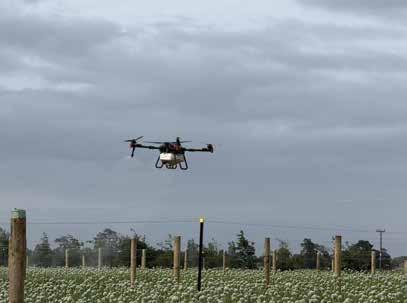
a contracting business, with a clear focus on solving practical problems for farmers and other contractors, particularly in situations where conventional equipment is either inefficient or simply unable to operate.
That approach is reflected in the range of work the business is undertaking. Agricultural spraying remains the core, but it is supported by spreading; aerial mapping; infrastructure work, such as roof treatment; and a growing role in equipment supply and support. It is a model that mirrors traditional contracting businesses in its breadth, but with a different set of tools delivering the work.
The key difference, of course, is that those tools are airborne.
At the centre of operations are purpose-built agricultural drone platforms, specifically the XAG P150 Max and XAG P100 Pro, machines that sit at the top end of current drone capability. These are not lightweight units designed for small-scale application. With payload capacities of up to 80 kgs, they are engineered to handle meaningful workloads across commercial farming operations.
Owen-Cooper says the choice of platform was deliberate.
“We’ve gone with XAG because they’re built for proper commercial work. The payload, output and flexibility mean we can actually get meaningful work done, not just small-scale jobs. It’s about having gear that stacks up in real contracting conditions.
Also, knowing that there is a large support network within New Zealand means that, when accidents happen, we can be up and running in hours instead of weeks with some other drones.”
Spray performance is one of the areas where the technology has advanced rapidly. OC
Aerial’s systems are capable of delivering up to 46 L per minute, with droplet sizes ranging from 65 through to 1,500 microns. That range allows operators to tailor application depending on the product being used and the target, from fine coverage for crop protection through to much
heavier droplets where drift control is critical.
Those output levels translate into practical efficiency in the field. The drones are able to cover ground effectively in smaller or fragmented blocks, where a tractor-mounted sprayer would spend as much time turning and repositioning as it would spraying. That efficiency becomes more pronounced when working in irregular paddocks, hill country or areas broken by shelter belts, drains or infrastructure.
Where drones come into their own, however, is not in replacing large-scale blanket spraying, but in complementing it. For broadacre work on flat, accessible ground, high-capacity sprayers remain the most efficient option. The value of drone application sits in the margins of those operations, in the missed corners, the wet patches, the steep faces and the areas that require targeted treatment rather than full coverage.
In those situations, the ability to deploy quickly, operate without ground contact and apply product precisely where it is needed changes the dynamic of the job.
Wet conditions are a good example. Where a ground rig may be parked up to avoid damaging soil structure or becoming stuck, a drone can continue operating, maintaining spray timing and avoiding the knock-on effects of delayed application. In a season where weather windows are challenging, that flexibility is
becoming increasingly valuable.
“Timing is everything in spraying,” Owen-Cooper says. “If a paddock’s too wet or conditions aren’t ideal for ground gear, we can still get in and get the job done without causing damage or delays. Even when there are small weather windows overnight, we can get into the paddock and spray crops in the dark to ensure product is applied as soon as it needs to be.”
Steep terrain is another area where the technology is gaining traction. Traditional ground equipment is often limited by safety and traction, while manned aerial application can be expensive and less precise for smaller jobs. Drone systems sit in between, offering targeted application with a lower cost structure and the ability to work safely in areas that would otherwise be difficult to access. Spreading capability adds another dimension. OC Aerial’s drones can deliver up to 300 kgs per minute, handling granular products up to 10 mm in size with no minimum size restriction. While that does not replace large-scale fertiliser spreading, it provides a practical option for spot treatments, oversowing and targeted nutrient application, particularly in areas where ground access is limited. The technology behind these systems is a significant part of what enables that flexibility. GPS-guided flight paths allow for repeatable accuracy, ensuring that application is consistent across the target area. Integrated radar systems provide obstacle
detection, allowing the drones to operate safely around trees, fences and other infrastructure while maintaining a steady flight path.
Operators are not manually flying each pass in the traditional sense. Instead, they are managing the system, setting parameters, monitoring performance and making adjustments as required. This shift from manual operation to system management is an important part of how drone contracting is evolving, bringing it closer in line with other precision agriculture technologies.
Battery and logistics management is another area where the operation becomes more technical than it might first appear. High-output drone work requires a constant cycle of battery use, charging and rotation, often supported by generator systems in the field. Alongside that sits product handling, mixing and loading, which mirrors many aspects of traditional spray operations but within a more compact and mobile setup.
A typical day’s work is structured around efficiency. Equipment is transported by ute, set up on-site and operated by a single skilled operator, with workflow built around minimising downtime between loads and flights. While hectare-per-hour figures will vary depending on terrain and application rates, the real efficiency comes from the ability to keep working in conditions
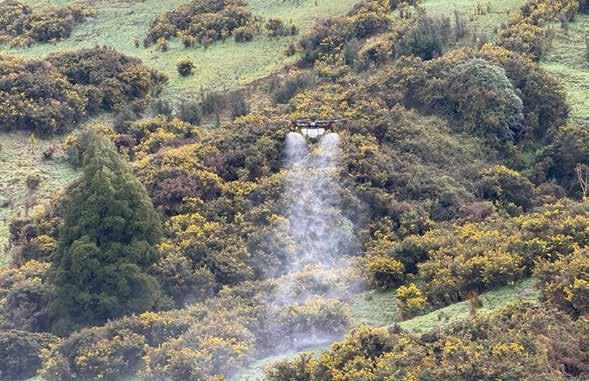
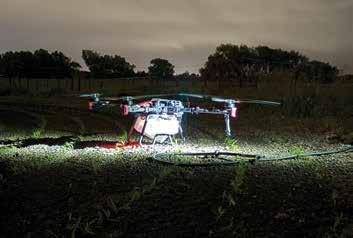
Precision application systems are supporting more efficient use of agrichemicals and fertiliser products.
where other systems cannot.
Alongside application work, aerial mapping is becoming an increasingly important part of the business. Using platforms such as the DJI Mavic 3M, OC Aerial is able to capture high-resolution multispectral imagery, providing insight into crop health, variability and emerging issues within paddocks.
This data can then be used to inform application decisions, creating a feedback loop between observation and action. Rather than applying product uniformly across a block, operators can identify specific areas that require attention and target those zones directly. It is a level of precision that aligns closely with the broader direction of modern farming systems.
Compliance and safety sit behind all of this. Operating
under Civil Aviation Authority Part 102 certification, OC Aerial is able to carry out more advanced drone operations while meeting strict regulatory requirements. This includes not just flight operations, but also maintenance, record keeping and operator training.
The business also provides inspection, repair and modification services for drone platforms, recognising that uptime and reliability are just as important in this space as they are in any other form of contracting. As the technology becomes more widely adopted, that support infrastructure will play an increasingly important role.
From an environmental perspective, the advantages are clear. Reduced chemical use through targeted application, elimination of soil compaction and lower fuel consumption all contribute to a smaller operational footprint. At the same time, removing operators from direct exposure to
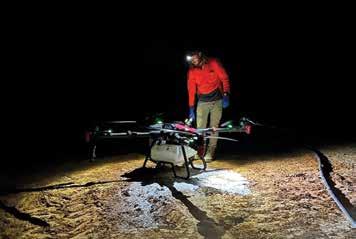
chemicals and difficult terrain improves safety outcomes.
“What we’re seeing now is that we’re genuinely competitive with helicopters in a lot of situations,”
Owen-Cooper says. “Where we add the most value is in the areas that are hard to get to or easy to miss, wet ground, steep faces, awkward corners. But with the latest gear, we’re now genuinely competitive with helicopters, especially with fuel and parts costs continuing to rise. Because drones have such low running costs, we can cover larger areas at a lower price point while still achieving the same, if not better, coverage.”
What is perhaps most important, however, is how the technology is being positioned. OC Aerial is not presenting drones as a replacement for existing contracting systems, but as an additional tool that strengthens the overall operation. That positioning is likely to be key to long-term adoption.
For contractors, the question is
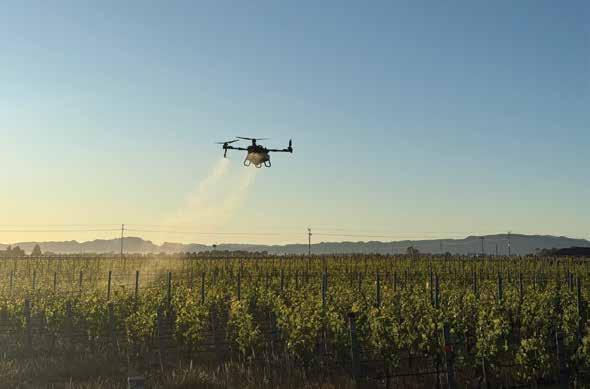
GPS-guided drone platforms provide accurate, repeatable application across challenging terrain.
not whether drones will replace tractors or aircraft, but how they can be integrated into existing services to improve efficiency and expand capability. For farmers, it is about having access to the right tool for the job, whether that is a high-capacity ground rig, a helicopter or a drone.
OC Aerial’s model reflects that thinking. It is a business built around practical application, using technology to solve specific problems rather than chasing novelty. In doing so, it highlights a broader shift within the sector, where success is increasingly defined not just by the scale of machinery, but by how effectively different tools are combined.
As pressure continues to build around efficiency, compliance and environmental performance, that ability to integrate new technology into existing systems will only become more important. Drone operations are still a relatively new addition to the contracting landscape, but their role is becoming clearer.
They are not the centre of the system, but they are becoming an increasingly valuable part of it.
And for businesses like OC Aerial, that position, working alongside established contracting methods while extending what is possible, may prove to be where the greatest opportunity lies.
Drone spreading and spraying systems are expanding capability in hill country and fragmented paddocks.
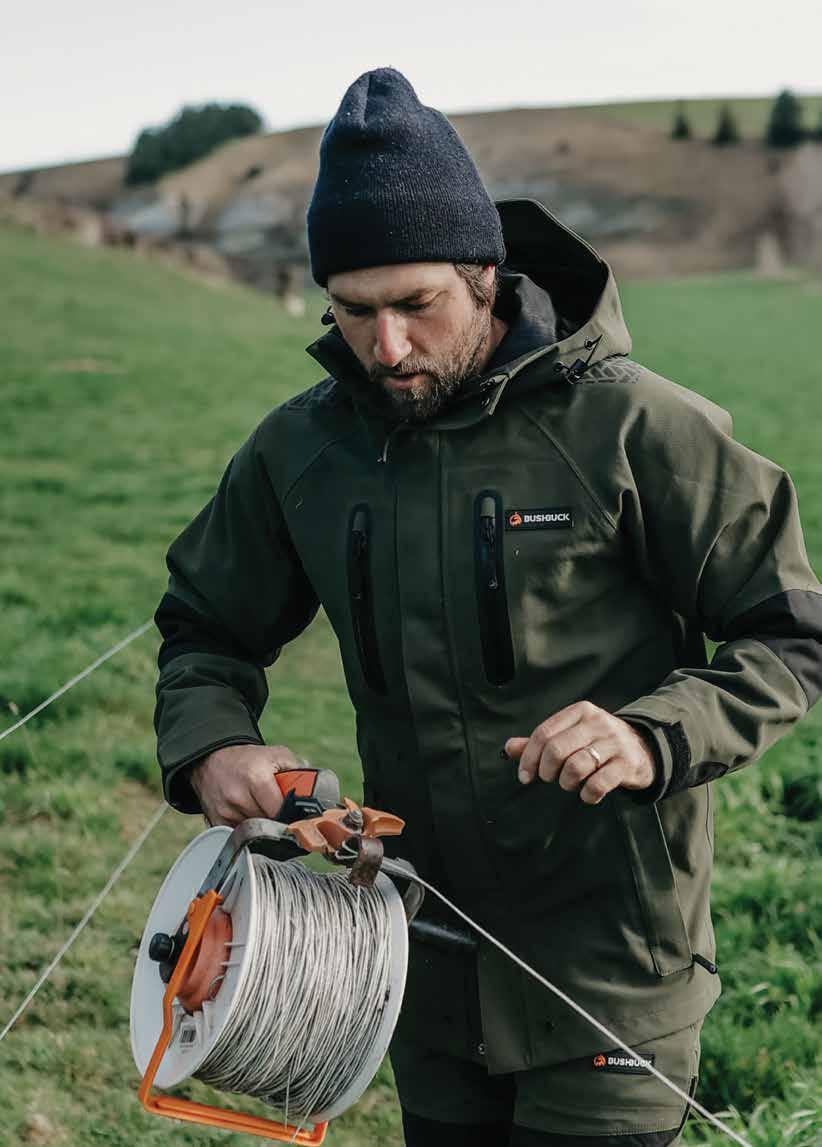
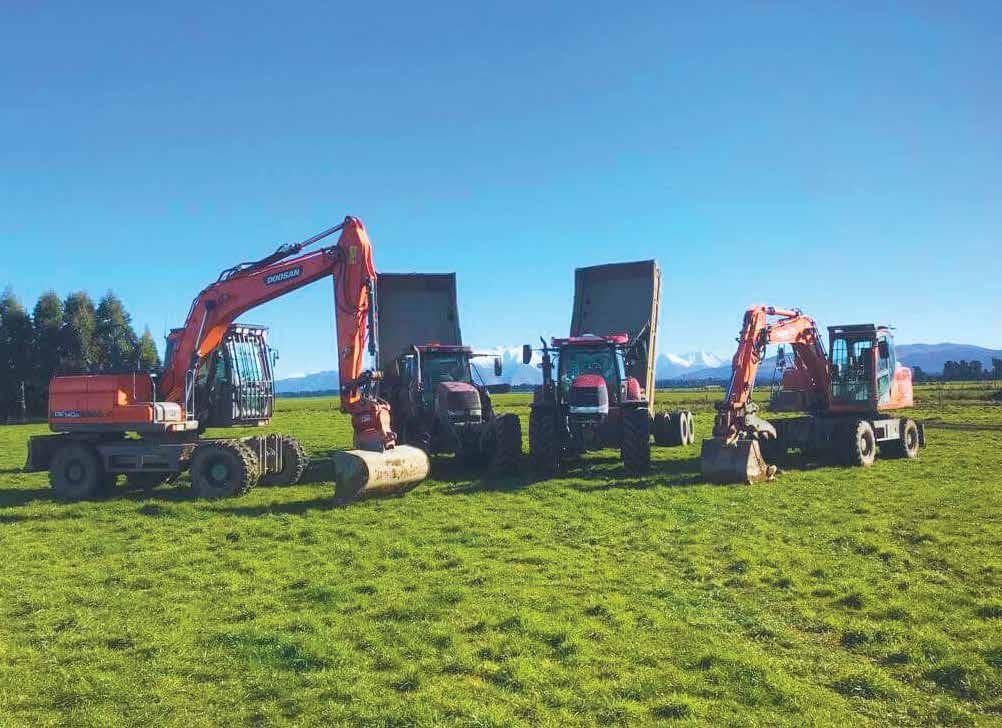
There is something steady about a family contracting business that has been built over time, not through rapid expansion or outside investment, but through a series of decisions made around the kitchen table and tested out in paddocks, on job sites and across seasons that do not always go to plan.
When Knight Contracting was last featured several years ago, it was a business still finding its shape, built around the foundation Steve Knight had established through Tabard Limited and the early involvement of his sons. Revisiting it now, what stands out is not just how much has changed, but how deliberately that change has been managed, with succession sitting quietly at the centre of it all.
The original structure was always practical. Steve Knight had built Tabard Limited over 15 years, developing a reputation across North Canterbury for land development, irrigation work, mechanical fit-outs and civil projects. It was a business grounded in capability and adaptability and, like many operations of its kind, it followed the work as it came, from farm development through to large-
Practical solutions developed on farm are driving efficiency in modern contracting operations.
scale infrastructure. When the opportunity came through the Central Plains Water scheme, Steve stepped into a project that would ultimately run far longer than first expected, a short-term job that turned into months of continuous work across two stages of development. That period helped define the scale the business could operate at, with multiple machines, staff and the ability to deliver on technically demanding work. At the same time, the next phase was already forming.
Eric Knight and his brothers had grown up around farming
A family-led approach continues to shape the direction and growth of rural contracting businesses.
and development, with a background that included dairy conversions and large-scale land transformation projects. The sale of the family dairy farm marked a shift, but not a departure from the sector. Instead, it created space for the next generation to step into something different and, importantly, something of their own.
That was the thinking behind
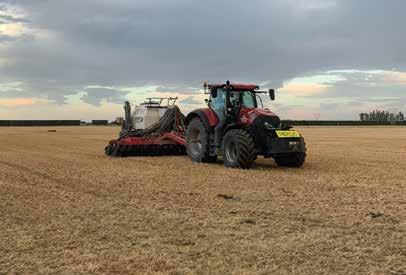
Specialised equipment allows contractors to deliver targeted services across a range of conditions.
Knight Contracting. As Steve put it at the time, “Knight Contracting is now the trading name for Tabards. I branched out once Eric and the boys started doing different things.” It was not a clean break from the original business, but rather a layering of capability, allowing each part of the operation to focus on what it did best while still supporting each other when needed.
For Eric, that meant building a contracting arm that was grounded in practical, on-farm work. He had already spent time working for another contractor after leaving school, gaining experience and developing a clear sense of what he enjoyed. “I love driving tractors,” he said, a simple statement that still reflects the hands-on nature of the business today. What followed was a series of decisions that would define Knight Contracting’s direction, starting with a relatively niche but highly practical service.
Rut filling does not carry the profile of large-scale cultivation or harvesting, but in irrigated systems it is essential. Poorly maintained pivot ruts create safety issues, damage machinery and reduce overall efficiency. Eric identified that need early and invested in front-tipping trailers designed specifically for the job. It was not just about offering a service, but about doing it better than what was already available.
“It is a twelve-tonne fronttipping trailer, which David came up with to fill in pivot ruts,” Eric explained. “It fills pivot ruts twenty percent faster than the gear most other contractors have.” That focus on efficiency and outcome became a
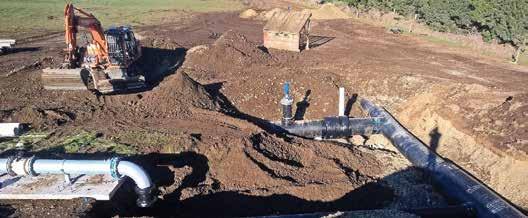
consistent theme. The trailers could use on-farm material, reducing costs for clients and simplifying logistics. The design also ensured the fill was properly compacted, something Eric was quick to point out as a key difference. “If you use other rut busters they don’t roll it and if the pivot goes around and it’s a bit wet, it oozes all the shingle out. Farmers like our ones better than other trailers and they are faster than anything else. Our clients know for sure they are getting exactly the right amount of fill packed into the trench.”
From there, the business expanded in a way that mirrored the needs of the region. Direct drilling was a natural extension, particularly given the range of conditions across Canterbury. The addition of a Bourgault drill allowed Knight Contracting to move into a space that required both technical capability and a willingness to take on more challenging environments. The machine itself was chosen for its robustness and versatility, capable of handling stony ground, heavy residue and minimal preparation systems.
“The drill can handle stony ground, tall grass, low scrub and
other types of rubbish. It can direct drill into almost anything and you don’t have to do any preparation,” Eric said. “The drill can hold up to two tonnes of seed and fertiliser and it’s really robust.” Those capabilities opened up opportunities in the high country as well as more conventional arable systems, with work extending into properties like Flock Hill and Mount White. It also shifted the scale of the operation, with hundreds and then thousands of ha being drilled each season. Alongside that, the business maintained its roots in land development and vegetation management. The addition of a MeriCrusher mulcher provided
another tool that could handle the tougher end of the spectrum, from broom and gorse through to breaking in new ground. It was a reflection of the broader approach that has defined Knight Contracting, not chasing volume for its own sake, but building a suite of services that complement each other and respond to real demand. Through all of this, the relationship between Steve and Eric remained central. It is not uncommon in family businesses for there to be tension between generations, particularly as roles evolve and responsibility shifts. In this case, the structure has allowed both to operate in their own space while still working Flexible staffing models allow contractors to adapt quickly to workload and seasonal pressures.
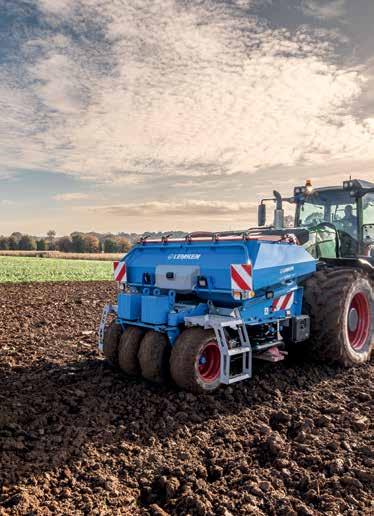
One for many things.
As the LEMKEN Solitair FR front-mounted hopper can be combined with various rear-mounted sowing techniques, field operation days are maximised. Thanks to the balanced weight distribution, smaller tractors with lower lifting capacity can be used. This reduces operating costs and improves manoeuvrability.
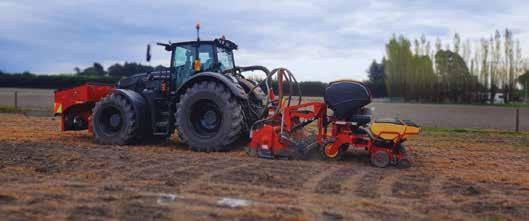
together when required. “When Eric is flat out I will send staff to him or he comes and helps me if I’m busy,” Steve said. “The whole business works together, even though we try to keep a little bit separate.”
That balance has been critical in allowing succession to happen gradually rather than through a single defining moment. Instead of a handover it has been a progression, with Eric building his own client base, investing in equipment and developing the agricultural contracting side of the business, while Steve continues to focus on civil and development work through Tabard. It is a model that provides continuity for clients and stability for the business, while also giving the next generation the space to take ownership.
Carlos Knight’s involvement adds another layer to that progression. While not as directly tied into the day-today contracting work, his role in managing the trucking side and his interest in developing a helicopter spraying capability point to where the business could head in the future. The idea of integrating aerial application with ground-based services is not new, but within a family business it represents a further step in diversification and resilience.
“He will drive if he needs to but
drivers are the easiest staff to find,” Steve said. “If I need him I will use him, but in the future he wants to get a helicopter and go spraying and run the trucks and tie that into the business.”
It is a reminder that succession is not just about replacing one generation with another, but about allowing each person to bring their own ideas and direction into the business. What has not changed is the underlying approach to work. The scale of projects may vary and the mix of services may evolve, but the emphasis remains on reliability, practicality and delivering outcomes that matter to clients. That is particularly evident in the way the business manages staffing. Rather than maintaining a large permanent workforce, Knight Contracting scales up and down depending on the work available, bringing in people when needed and focusing on keeping overheads manageable.
“I don’t normally have any permanent full-timers. We employ people full-time while we are doing contracts but we just find staff when we need them,” Steve said. “I don’t have too many problems finding people, and we normally pick up quite good people. We pay a reasonably good wage, so it’s not a big problem.” It is a model that suits the variability of both
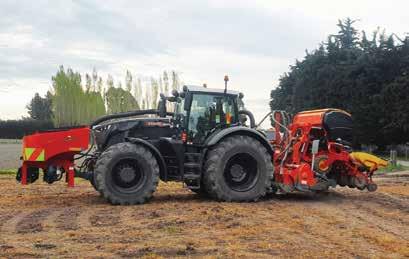
civil and agricultural work, particularly in a region where weather and seasonal demand can change quickly.
The broader operating environment has also played a role in shaping the business. The slowdown in large irrigation projects has reduced the scale of some civil work, prompting a shift back towards smaller, more consistent jobs. “We are waiting for all the cowboys to leave Christchurch and then we will get back in, so we are just doing little stuff at the moment,” Steve said at the time, a comment that reflects both the competitive nature of the sector and the importance of timing in securing work.
For Knight Contracting, that variability has reinforced the value of diversification. Having a mix of civil, development and agricultural contracting work provides a level of stability that a single focus would struggle to achieve. It also aligns with the way the business has been structured around the strengths and interests of each family member.
Looking at the journey from the outside, it would be easy to see it as a straightforward progression, from a civil contracting business into a broader family operation. In reality, it has been more nuanced than that, shaped by opportunities, constraints and a willingness to adapt without losing sight of what the business does well.
Succession, in this context, is not a single event but an ongoing process. It is visible in the way Eric has built his side of the business, in the support that continues to flow between different parts of the operation and in the opportunities being explored by the next generation. It is also evident in the culture of the business, where practical
Diversified service offerings help balance workloads across changing seasonal demand.
decisions and a focus on doing the job properly remain at the forefront.
There is no sense of urgency about handing over control, and perhaps that is the point. By allowing the business to evolve naturally, with each generation taking on more responsibility over time, Knight Contracting has created a structure that can sustain itself beyond any one individual. It is not reliant on a single skill set or a single market, but on a combination of capabilities that have been built up over years of work.
In an industry where change is constant, whether through technology, regulation or market conditions, that kind of resilience is not easily achieved. It requires a clear understanding of what the business stands for, a willingness to invest where it matters and the ability to adapt without losing direction. For Knight Contracting, that has meant growing in a way that reflects both the opportunities available and the people involved.
As the business continues to develop, the next phase will likely bring its own challenges and opportunities. The potential integration of aerial services, further investment in equipment and the ongoing evolution of farming systems across Canterbury will all play a part in shaping what comes next. What remains consistent is the approach that has carried the business this far, grounded in practical experience, supported by family and built around a clear sense of purpose.
In many ways, that is what defines Knight Contracting. It is not just the machinery or the services offered, but the way those elements come together through the people involved. From Steve’s early work in land development through to Eric’s expansion into agricultural contracting and the emerging role of Carlos, the business reflects a journey that is still very much in progress.
And that, ultimately, is the strength of it.

• Over 110 new listings
• 70 discontinued products
• Numerous product label updates (new weed, pest & disease claims)
• All product labels reviewed for regulatory content and updated to GSH terminology.
The definitive guide to agrichemicals registered for use in New Zealand.
A comprehensive alphabetical listing of products, active ingredients, crop & weed tables, weed & pest identification and much, much more all in one single publication. It really is the definitive agrichemical guide and the only one you’ll ever need.
Purchase a manual to receive a FREE 12-month subscription to our subscriber only website.
The website is continually updated and contains product listings, a fully searchable online product manual, a powerful search engine of weeds, diseases & pests, including photo galleries with all the agrichemical options to use on individual crops as well as up-to-date SDS’s, Haznotes and product labels, plus posts about industry news and information.
Order Now to receive your FREE pair of SureShield Coveralls
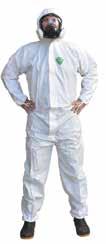
SureShield Coveralls, supplied by pH7, provide both protection and comfort with exceptional liquid and particulate protection.
Category III, Type 5, Type 6 certified coveralls.
Ideal for asbestos removal, spray painting, low hazard pesticide spraying, boat building, dusty areas and general light industry.
These are best suited to spraying diluted chemicals such as Roundup for the fence lines, general maintenances on farm, or when spraying from a airconditioned cab. One size fits all. Supplied by pH7.
* Available to those who order directly from www.novachem.co.nz - while stocks last.
Storing Chemicals?
Print up-to-date SDS’s & Haznotes from novachem.co.nz to ensure you are compliant.
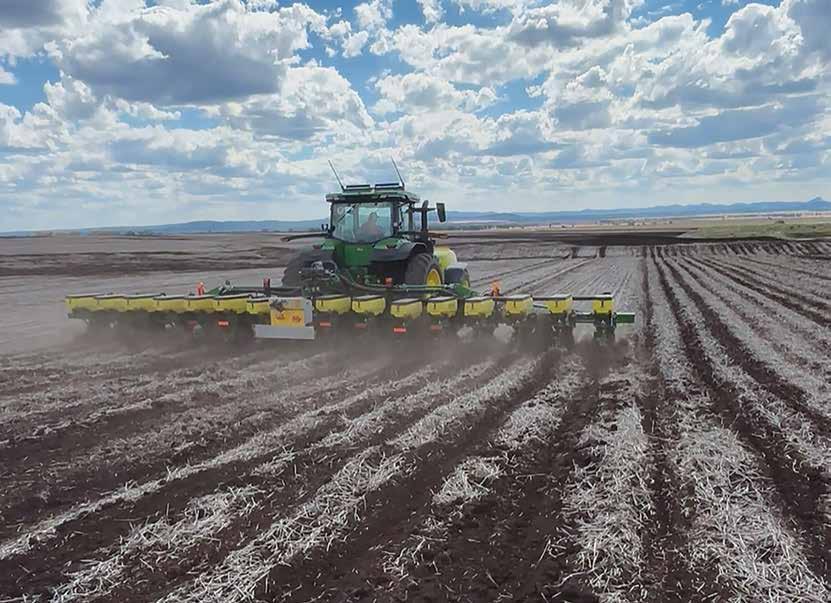
Agricultural contractor Jack Bartlett says a lucky break when he was just out of school got his business to where it is today.
Jack and his wife Mel own and operate JAB AG, working from Gunnedah in New South Wales.
He services large scale broad acre cropping farmers, who need cotton and dry land cereals such as wheat, canola, barley and oats put in the ground and fertilised.
Around 90% of Jack’s work is cotton related.
machinery got him into this job, he says.
His lucky break came when, in 2014, he bought an excavator from an auction.
“It went for cheap, I put a stupid [low] bid on it and won it, and away we went.”

Jack services large scale broad acre cropping farmers who need cotton and dry land cereals such as wheat, canolas, barley and oats put in the ground and fertilised.
He says he was lucky because building relationships in the industry is tricky for new entrants, but he had a neighbour
who had an earth moving company who started passing jobs to him.





across ditch the


Profiled in the Australian AgContractor & Large Scale Farmer January/February 2026, we visited Jack and Mel Bartlett in New South Wales, Australia.
They run two 12 metre Schulte FX-742 slashers, with slashing making up the bulk of his income, one 12 metre summer crop planter, one Bredal urea spreader, one speed tiller and multiple John Deere tractors. He also carts grain and machinery anywhere between Southern Victoria to Central Queensland.
Jack, now 29, left school in year nine and “did a couple of trades”, and then worked in weed and pest control across South Australia. His love of
Jack opted for the LQS70 Liquid module and liquid section controller simply for the ease of not having to tow air carts.
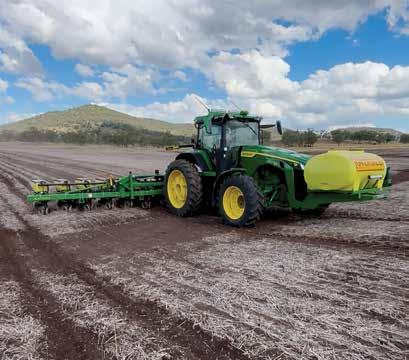
“It kicked off from there.”
He always liked farming and bought a John Deere header in 2016, moving away from earth moving.
“That was the start of contracting.”
A drought in 2018—2020 almost brought his business to a close, but he pushed through and, in 2020, he bought his first tractor.
Jack’s work takes him from Southern Queensland to Central Victoria. Working different regions means he faces different challenges, but he says he just works around those.
“Having such a broad footprint means we can basically pick where we go, depending on weather.”
If one area gets rain, taking time to dry out, he can head somewhere else.
“It means we don’t stop; we chuck the gear on the truck and make it work that way.”
One industry challenge everyone faces is rising costs, and being mobile is one way of beating these costs. He says to be efficient, gear also has to be bigger, covering more ground in a shorter timeframe, and operations have to be run on a tight schedule. Practically it also
Jack and wife Mel Bartlett own and operate JAB AG, working from Gunnedah in New South Wales. Here they are with, from left, Harvey and Spencer. more than ink on paper.

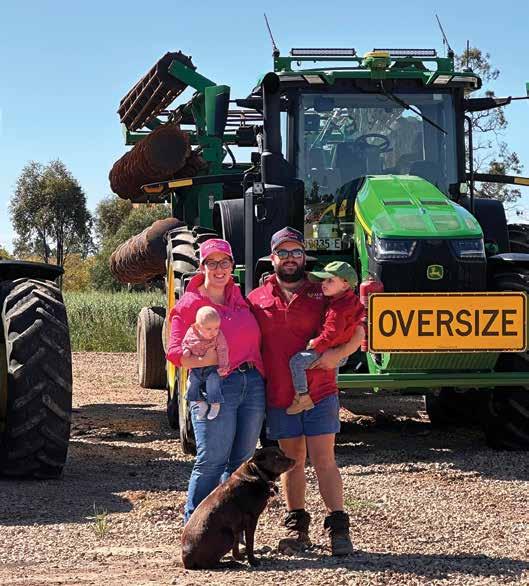
means all his gear needs to fit on one truck so he can move in one go, and not have to head back somewhere to pick up gear. He also tows gear, freeing up time and labour.
“The little things we do saves
money.”
His biggest cost is labour, costing $45-$50 an hour; this rate was around $35 an hour three years ago.
One of the pieces of kit that he has begun to really rely on is the


LQS70 liquid module and liquid section controlled by Liquid Systems.
Jack says clients are almost equally split between those who want to use liquid fertiliser, and those that prefer granular. As a


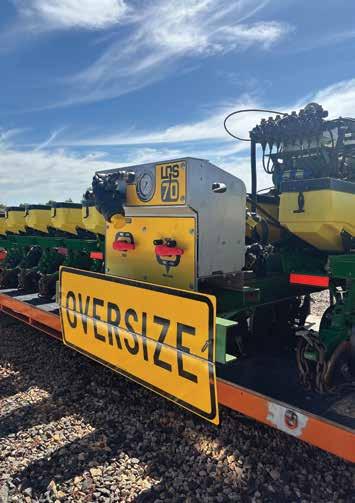
contractor he made the decision to go liquid, and opted for the LQS70 liquid module and liquid section controller simply for the ease of not having to tow air carts. The system was retrofitted to his John Deere gear.
“Being able to move your equipment from property to property without having to tow an aircart is massive.
“We’ve got a front nose tank on the tractor; we just unhook the bar off the back, put it on the trailer, and then we can go pretty much anywhere.”
Besides ease of movement, using the system has many other additional benefits.
The LQS70 is a single liquid auto-rate pump and control module. It provides enough capacity for applying liquids at rates with good tank circulation for up to 4,000 L tank capacity, and is engineered to deliver target rates in-furrow.
Jack says the system is precise, with the added benefit of being foolproof.
A pressure transducer and pump speed sensor makes on-screen monitoring possible.
“It’s all there on the screen,” he says.
The system provides full
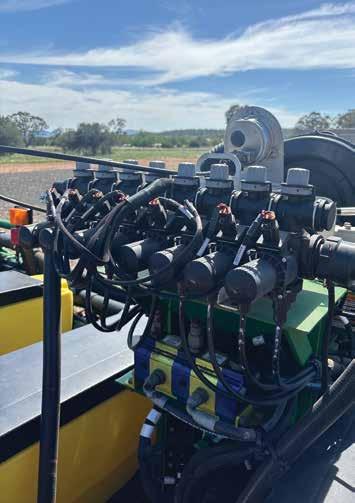
section control, allowing him to shut off units, which then shuts off rows. This means the ha planted are more accurate, he says.
“It’s a very technical system, but somehow they’ve kept it simple.”
The unit allows target inputs in-furrow with measured and controlled placement in the soil. It is also easy to install or, as Jack puts it, a complicated system made easy.
The unit can also be upgraded to section control, like Jack’s is, and to multiple liquids or chemical injection. It accurately controls flow rate to cater for variable rate application, variations in operating speed and shutting off sections automatically.
Because there’s input use efficiency with section control, variable rate application and improved rate control responsiveness, farmers save money in the end. He can lay down as little as 25 L of liquid fertiliser per hectare.
Jack says the system lets him “change speed on the go”, making it easier to simply drive the tractor, “and not have to try and keep to a speed”.
He adds that “not having to stick to a speed like other units” also reduces equipment strain.
Because the guesswork is removed and application is more precise, using the unit allows for a more sustainable business, both for the farmer and for Jack. Being able to see bar pressure from the cabin is another benefit, he says.
Jack checks for blockages every 30 ha, something he says is merely a procedure, not a necessity.
“It’s the ease of it. You type the number of litres you want to put down into the screen and away you go.”
The unit is also reliable, with Jack saying he hasn’t had any major blockages in the system.
“It’s worth its weight in gold, purely by not having to spend the time constantly setting it up.”
Jack says it’s not easy for new entrants to start contracting, with both the cost of new and second hand gear skyrocketing.
The first tractor he bought under his own banner was a John Deere 8530. It had 10,000 hours on the clock and he paid $55,000 for it.
He then bought a John Deere 8345R for $110,000, a John Deere
The LQS70 accurately controls flow rate to cater for variable rate application, variations in operating speed and shutting off sections automatically.
8345R for $150,000, and a John Deere 8370R for $200,000. He sold the 8530R for $95,000 when it had 13,500 hours on it.
He also sold the other gear for much more than he bought it for, all after he had put many extra thousands of hours on them.
“A new tractor back in the day was around $300,000. The last one I purchased was pushing around $700,000.
“I was lucky to get in prior to the Covid pandemic, putting hours on tractors and making money from selling them; that saved my contracting. If I wasn’t able to do that, the business would not have grown so much in such a short time.”
Jack says in the future he just hopes to keep contracting.
He did not have a father growing up, losing his dad early in life, and says he hopes to keep cracking on, until his boys decide if they want to take over or not.
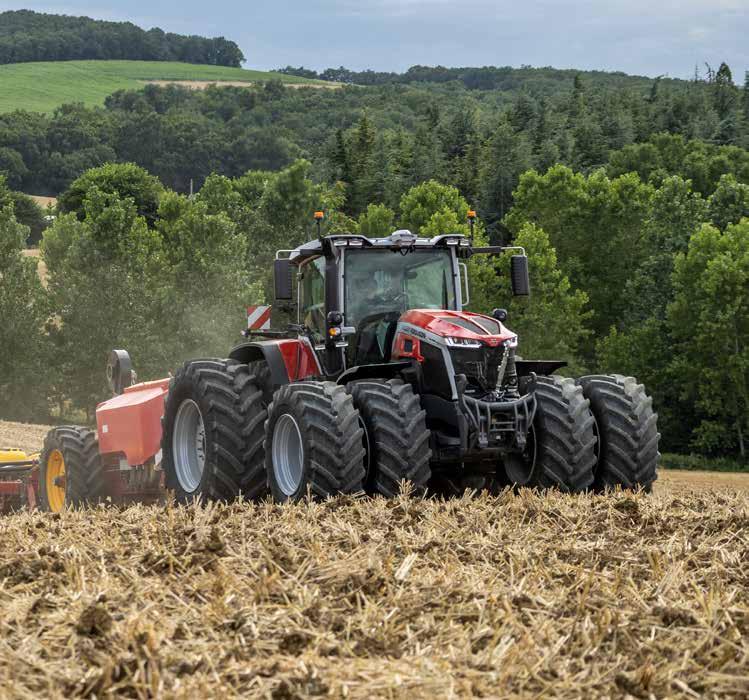
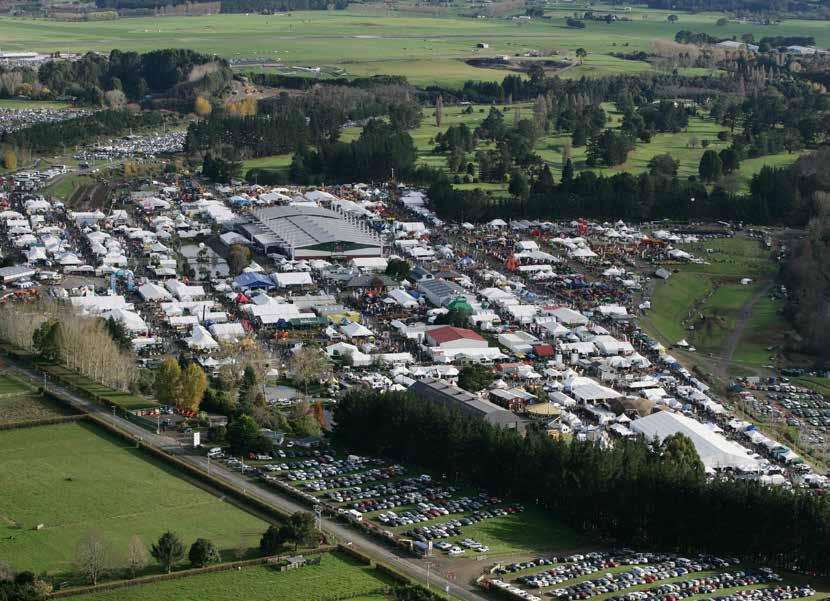
Every June, the rural calendar pulls the industry north to Fieldays at Mystery Creek and while the scale and spectacle of the event remains a constant, the context in which it sits continues to shift.
Fieldays
Fieldays has always been more than a showcase. It is a pressure gauge for the sector. It reflects where confidence sits, where investment is heading and how farmers and contractors are responding to the realities in front of them. That makes this year’s event particularly relevant, because the backdrop is once again tightening.
One of the most immediate pressures being felt across the country is the increased cost of diesel. For contractors running high-hour machinery programmes and for farmers managing cultivation, drilling and transport, fuel is not a marginal cost. It is a core input. Every additional cent per litre flows directly through to operating costs and, in many cases, it cannot simply be passed on.
That changes the way decisions are made.
It sharpens the focus on efficiency. It puts greater weight on machine selection. It raises the importance of technology
that can reduce overlap, improve application accuracy and ultimately cut unnecessary passes across the paddock. And it reinforces the value of reliability, because downtime under tight weather windows becomes even more expensive when every hour of operation carries a higher cost.
That is where Fieldays continues to hold its relevance. It is one of the few places where the full spectrum of the industry is brought together, from large-scale machinery and emerging technology through to finance, advocacy and workforce development. It allows farmers and contractors to step back from the day-to-day and assess what is changing, what is worth investing in and what will actually deliver in New Zealand conditions.
Looking back at recent events, the themes have been consistent. Innovation remains front and centre, whether through developments in drone
technology, the continued evolution of precision agriculture or the growing presence of agritech businesses looking to solve practical problems on farm. At the same time, there has been a strong emphasis on people, reinforcing that the sector’s future depends as much on capability as it does on machinery.
Those themes are only becoming more pronounced. The technology on display continues to move quickly, but the conversation around it is becoming more grounded. Farmers and contractors are less interested in what technology can do in theory and more focused on what it delivers in practice. Does it save time? Does it reduce cost? Does it make the job easier or more consistent? Those are the questions that will be asked across the site this year. At the same time, the structure of the event itself continues to evolve. Feature hubs, such as innovation spaces, careers and education areas, and advocacy platforms have become key
As fuel prices continue to rise and contractors face increasing pressure to cover more ground in tighter seasonal windows, efficiency has become one of the biggest drivers of machinery investment decisions.
For Precision Cultivation, the focus has always been on building practical solutions for real New Zealand farming conditions.
Designed in New Zealand and built in Palmerston North by McIntosh Farm Machinery, Precision Cultivation’s strip tillage machines are engineered specifically for local conditions – from wet paddocks through to stony ground. The company’s patented technology has been developed with direct input from farming and contracting experience, resulting in machines designed to reduce passes, lower running costs and improve establishment outcomes.
The range now includes four models operating across New Zealand, with machines also exporting into Australia. One standout in the lineup is the P6050F – a 12-row, 500 mm spacing machine that Precision Cultivation says is currently the only powered strip till machine of its kind in the world. Thanks to its patented design and lower horsepower draw, contractors can achieve high output without requiring excessive tractor power.
The machine layout itself has been designed to improve
performance in difficult conditions. Subsoiler legs are positioned ahead of the tunnel, lifting and lowering the soil to create a horizontal shattering effect that helps eliminate compaction and improve root development. Disc coulters cut through vegetation cleanly, while the tunnel system allows soil to flow smoothly, even in moist conditions.
For Canterbury contractor Danny Walker, from Canterbury Strip Till, those design features have made a noticeable difference in day-to-day operation.
“I’ve used other machines, and they all have their pros and cons,” Walker explains. “But this one stands out because of its design. With the legs up front, it handles tougher ground with ease, which means I can get straight into the areas that are ready, instead of waiting around.”
After six seasons running Precision Cultivation strip tillage machines, Walker says lower running costs have become one of the biggest advantages.
“With some other brands you’re replacing blades every 100 to 200 ha. With this, I’ll do 500 ha on a set. That adds up when you’re covering big areas.”
Reducing passes is another major benefit. Precision Cultivation machines are designed to minimise cultivation requirements, helping reduce fuel use, labour hours and overall wear on machinery. According
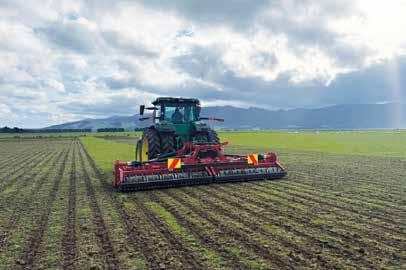
to company figures, growers can reduce establishment costs compared to conventional multi-pass systems while also increasing hectare covered per engine hour.
Support and reliability also remain critical during peak seasonal periods.
“If I need points, blades –whatever it is – they get it sorted quickly,” Walker says. “That kind of support makes all the difference when you’re working to tight seasonal windows and have farmers relying on you.”
With increasing focus on profitability, fuel efficiency and soil structure preservation, strip tillage continues to gain momentum across New Zealand farming systems. For Precision Cultivation, the goal is simple: build tough, practical machinery that performs in Kiwi conditions and helps contractors and growers work smarter.
To learn more or book a demo, contact Precision Cultivation at precisioncultivation.com or call Paul Linklater on 021 247 4967.
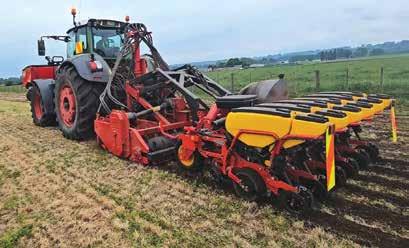
anchors within the site, creating spaces where visitors can engage more deeply with specific parts of the industry rather than simply walking past a stand. That reflects a broader shift in how Fieldays is experienced, moving from a purely transactional environment to one that also supports learning, discussion and connection.
This year’s spotlight on wool is another example of that approach, bringing renewed attention to a product that has long been part of New Zealand’s identity but is now being re-examined through the lens of
sustainability and innovation. It is a reminder that while new technology continues to drive the sector forward, there is also value in revisiting existing resources and finding new ways to use them.
For contractors in particular, Fieldays remains a critical touchpoint. It is where machinery decisions are influenced, where relationships with suppliers are strengthened and where a sense of direction for the season ahead begins to form. With diesel costs reaching dizzying heights and margins under pressure, those decisions
carry even more weight this year. It also comes at a time when the pace of change across the sector shows little sign of slowing. Regulation, environmental expectations and market demands continue to evolve and while those factors may not always be front of mind when walking through a machinery site, they sit behind many of the decisions being made. What Fieldays offers and continues to offer, is perspective. It brings together the full picture of the industry in one place. It allows farmers and contractors to compare, question
and reassess. And it provides a reminder that while the challenges are real, so too is the level of innovation and capability within the sector.
As the industry gathers again at Mystery Creek this June, the conversations are likely to be shaped by cost, efficiency and resilience. But as always, they will also be shaped by opportunity.
Because beneath the pressure, there remains a constant drive to improve, to adapt and to find better ways of doing the job. And that is what Fieldays at its best, continues to represent.
Landpower are convinced that seeing is believing, which is why, at Mystery Creek, their focus is on letting you experience their world-class machinery firsthand through their demonstration programme. Selected machines on display are available for demonstration, so you can move towards your next purchase with confidence and unlock real efficiency gains where it counts.
Built by leading European manufacturers for ultimate efficiency, these machines mean more tons and fewer tanks, meaning you can get more done with less fuel.
Fuel efficiency isn’t just a spec, it’s a saving. Over 200 harvest hours using up to 20% less fuel could mean thousands back in your pocket.
Claas Lexion 7700 is one of the most well-balanced combines for New Zealand conditions, delivering high output, crop flexibility and the versatility to handle both plains and rolling terrain. It’s known as the “sweet spot” for contractors who want performance without stepping up to the biggest and most expensive Lexion models.
For growers and contractors, timing is everything. New Zealand’s harvest windows can be tight, with variable weather and moisture. The 7700 helps get the crop off fast when the window opens.
The spacious cab and advanced technology reduce reliance on operator skill, making it easier for contracting teams to work
efficiently and comfortably.
At the heart of the machine, Claas’ APS Synflow Hybrid system combines drum and rotor separation, delivering strong threshing and high separation capacity. For maize and other grain crops, it leaves a clean sample at high throughput, even in heavy crops.
The Claas Lexion 7700 is built for contractors who want output, efficiency and reliability all in a machine perfectly suited to our conditions.
The Claas Rovio front is designed specifically for maize, making corn harvesting faster, cleaner and more efficient. It strips the cobs from the plant, leaves stalks behind and feeds only clean grain into the combine. The Claas Rovio is designed for high-capacity production, making it a must-have for contractors and farmers focusing on high-yield maize.
The new Claas Rovio series delivers up to 30% more throughput than previous models, thanks to linear picking rollers that ensure a consistent crop flow. Its reinforced gearboxes and intake rollers provide strong overload protection, even in heavy or lodged crops and a plug-and-play setup makes operation simple and efficient.
Rovio fronts come in 6, 8, or 12-row configurations, with typical row spacing of 75 cm and integrate fully with modern Claas technology. Auto Contour ensures automatic ground following, Auto Pilot provides row guidance and Cebis puts full control at the operator’s fingertips, reducing fatigue and
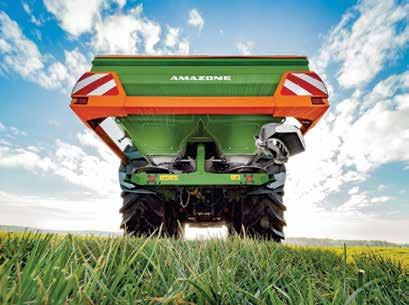
achieving high productivity, even in patchy crops.
For New Zealand growers and contractors looking for speed, precision and reliability in corn harvesting, the Claas Rovio front is the specialised solution that gets the job done.
Claas Torion is designed to maximise output per litre, helping keep your fuel costs in check. The Claas Torion wheel loader delivers unmatched versatility for New Zealand farms and contracting operations. Built for heavy lifting, fast loading and precise handling, it tackles silage, feed and materials with ease.
Its robust design combines high lifting capacity with compact manoeuvrability, perfect for both large yards and tighter farm spaces. Advanced hydraulics and intelligent controls make every movement smooth and efficient, reducing operator fatigue and increasing daily output.
With a comfortable, spacious cab and intuitive controls, the Torion ensures operators stay productive all day, while the durable build keeps maintenance simple. For farmers and contractors looking for a reliable,
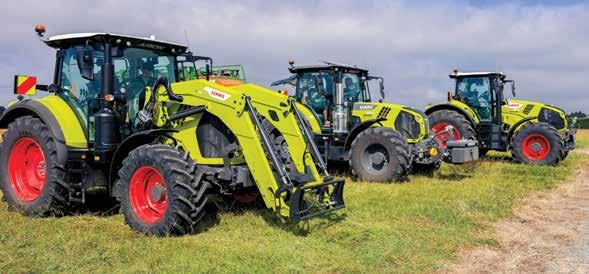
high-performance loader that adapts to any task, the Torion is ready for work.
Big horsepower doesn’t have to mean big fuel bills. Claas tractors deliver power with efficiency built in.
Claas offers a full range of tractors designed to meet the diverse needs of New Zealand farms, from versatile mid-sized workhorses to high-horsepower heavy-duty machines.
• ARION Series: Reliable, versatile tractors for mixed farms and general-purpose work. Efficient, easy to operate and strong on both power and fuel economy.
• AXION Series: High-power, high-comfort tractors built for large-scale operations, heavy draft work and allday productivity. Advanced automation and connectivity make them ideal for contractors and modern cropping farms.
Amazone brings advanced seeding and spraying solutions that help New Zealand farmers and contractors maximise yield, efficiency and crop health. Whether establishing a crop or protecting it, Amazone equipment offers the precision, flexibility and reliability that New Zealand farmers need to make the most of every season.
Ask about our latest demonstration programme results and what fuel efficiency could mean for your operation when you visit the Landpower team at Mystery Creek.
There is a point in any cultivation programme where refinement becomes the priority rather than outright disturbance, and it is in that space that the power harrow continues to hold its place. For many operations, particularly those working across mixed soil types or under tighter weather windows, the ability to create a consistent, level seedbed in a single pass remains critical, and it is here that the Maschio Gaspardo Super power harrow range is designed to operate.
At the core of the Super range is a clear focus on strength, driveline efficiency and longterm durability. These are not light-duty implements dressed up for bigger tractors. They are built around a heavy-duty construction philosophy that reflects the increasing horsepower now common across New Zealand fleets, and the expectation that machines will perform consistently under load.
A defining feature across the Super models is the double-skin trough construction, with an internal thickness of around 6 mm and an external skin of approximately 5 mm. This design significantly increases rigidity without a major weight penalty, reducing torsional stress through the frame and allowing the machine to maintain consistent working depth and rotor alignment under pressure. For operators, that translates directly into a more even finish and less variation across the working width, particularly in harder or variable soils.
The driveline is equally deliberate in its design. Maschio uses large-diameter, case-hardened gears running in an oil bath, with helical gear profiles increasing the contact surface area and reducing backlash within the transmission. The practical effect of this is smoother power transfer from the PTO to the rotor system, reduced vibration and, importantly, lower parasitic losses. In a working environment where fuel efficiency is increasingly under scrutiny, particularly with diesel costs continuing to fluctuate, that reduction in internal friction is
not just theoretical, it contributes to real operational savings.
Rotor stability is another area where the Super range differentiates itself. The use of upper and lower bearing positioning around the gear system spreads load more evenly and reduces stress on individual components. Combined with rotor shafts forged from a single piece of hardened steel, this creates a system that is designed to handle sustained high loads without premature wear. It also supports consistent tine engagement, which is critical for achieving uniform soil refinement.
Across the range, tine performance is central to the end result. The Super models typically run long forged boron steel tines, often around the 30 cm mark, designed to penetrate and mix soil effectively while maintaining durability. Options such as tungsten carbide coating extend service life further, particularly in abrasive conditions, while quick-release systems reduce downtime when replacement is required. In a contracting environment where time lost to maintenance can quickly erode margins, that ease of service becomes a practical advantage.
Working depth across the Super range typically extends to around 26–28 cm depending on the model, placing these machines firmly in the category of intensive secondary cultivation. That depth, combined with high rotor speeds, allows for effective clod breakdown and soil levelling, creating a seedbed that supports even germination and crop establishment.
The range itself is broad, covering multiple sizes and power requirements. Models such as the Falco Super sit at the more compact end, with working widths from around 3.6 to 5 m and power requirements in the 110–240 hp bracket, making them suitable for mid-range tractors and mixed farming operations. Moving up through the range, machines such as the Gabbiano Super and Aquila Super extend working widths to 4–6 m and require up to 350 hp,
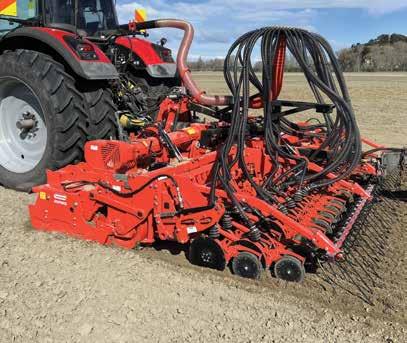
aligning with larger arable and contracting setups.
At the top end, folding models such as the Toro Super Rapido and Jumbo Super push working widths out to 7–8 m and beyond, with power requirements reaching up to 400 hp and, in some cases, higher. These machines are clearly designed for large-scale operations where
output per hour is critical, and where the ability to cover ground quickly without compromising finish is a key driver.
Folding frame design within the Super range is engineered with both strength and practicality in mind. Additional hinges and reinforced structures are used to prevent long-term deformation, while features such
With this season now ended, it’s time to put some thought into next seasons staffing.
Hanzon Jobs are currently interviewing. We have started to place drivers already.
If you are interested and would like to secure staff for this coming season, please get in touch, or register via www.hanzonjobs.co.nz/get-staff.
For more information please email us at work@hanzonjobs.co.nz
Hanzon Jobs will be back from the UK and in office from the 1st of July.

New Holland Construction will launch a new specialist machine to the New Zealand market at Fieldays 2026, with the New Holland W170D+ Forage Power wheel loader set to make its local debut. Developed specifically for silage clamping and intensive forage and biomass operations, the model reflects the growing demand for machinery designed around the realities of high output contracting work.
The W170D+ Forage Power is built as an evolution of the established W170D platform, with engineering changes aimed at improving stability, pushing power and fuel
autonomy in demanding clamp environments. Powered by a 6.7 L FPT engine producing up to 255 hp, the machine is designed to deliver strong performance at low revs. Its class leading torque of 1300 Nm sets a new market benchmark, ensuring exceptional pushing power for demanding clamp operations.
A 400 L fuel tank supports full day operation, while a six speed transmission with lock up from first gear and enhanced axle traction systems help maintain grip on steep or slippery surfaces.
With an operating weight of 16.4 tonnes, a rear
mounted engine for natural counterbalancing and one of the longest wheelbases in its class, the W170D+ is built to offer stability when working on tall clamps or uneven ground. The cab has been designed with operator comfort and visibility in mind, featuring a panoramic windscreen, LED lighting, touchscreen display and advanced camera systems. It also offers the largest operator cab in the market, further enhancing comfort during long working days.
The model was developed in response to feedback from contractors seeking machinery better suited to the specific demands of modern forage
systems, where long working days, frequent transport between farms and increasingly tall clamp structures are common.
The W170D+ Forage Power was also awarded the Material Handling 2026 award at Agritechnica at its debut, recognising its innovation and performance.
Alongside the wheel loader, New Holland will display a range of machinery and provide visitors with the opportunity to explore the brand’s precision farming tools, including the FieldOps data management platform and an in-cab simulator.
New Holland will be located at Site D99 at Fieldays 2026.
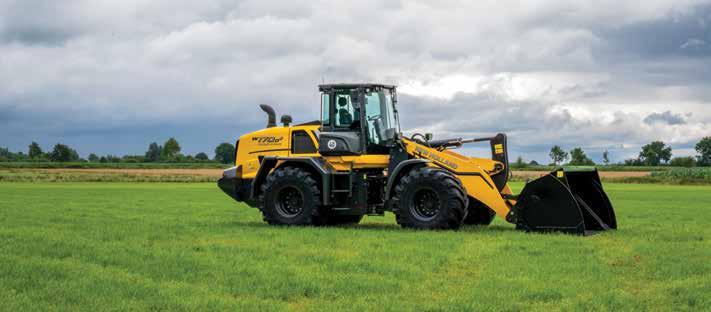
as drainage points reduce soil build-up around key components minimising overheating and maintaining smooth folding operation. These details contribute to reliability over time, particularly in heavy soils or wet conditions where debris accumulation can become an issue.
Cooling within the driveline is another area of focus, particularly on larger models. Gearbox overheating is a known challenge in high-intensity harrowing, and systems such as integrated cooling fins and optional oil recirculation help manage temperatures under sustained load. This is less about headline features
and more about ensuring the machine can maintain performance across long working days.
Rear roller configuration plays a significant role in finishing quality and the Super range offers a wide selection including cage, packer, combipacker and spiral designs. The choice here allows operators to match the machine to soil type and desired finish, whether that is a finer tilth for small seeds or a more consolidated surface to retain moisture.
Integration with seeding equipment is another practical advantage. Many Super models are designed to operate in combination with seed drills,
allowing cultivation and planting to be completed in a single pass. This reduces fuel use, labour requirements and soil compaction while improving timeliness, all factors that are increasingly important under both cost and environmental pressures. What becomes clear when looking across the Maschio Gaspardo Super power harrow range is that the focus is not on a single standout feature, but on how each component contributes to overall performance. Frame strength, driveline efficiency, rotor stability and serviceability are all built into the design, reflecting the realities of modern
farming, where machines are expected to work harder, for longer and with greater precision.
In practical terms, that means consistent seedbed preparation, reduced downtime and a machine that can match the capability of today’s higher horsepower tractors. With a new 2026 model, Aquila Super, set to feature at Fieldays, it also gives contractors and growers the opportunity to get up close with the build quality and engineering detail that underpins that performance and to assess where it fits within their own cultivation systems as pressure continues to build on both cost and efficiency.
There is a growing expectation in modern livestock systems that feeding is no longer just a daily task, it is a controlled process that directly influences production, efficiency and ultimately profitability. That shift has placed increased focus on mixer feeder wagons, particularly those capable of delivering consistent, repeatable rations across larger herds and more intensive systems. It is into that space
find that it requires a telehandler to load it effectively, adding another layer of cost to what is already a significant capital investment.
The Rhino addresses that issue directly. Its lower overall height, combined with a wider tub design means it can be loaded using existing equipment, most commonly a tractor with a front-end loader. In practical terms that removes the need for additional machinery purely to support the feedout system, which is a
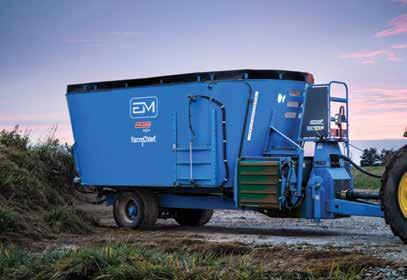
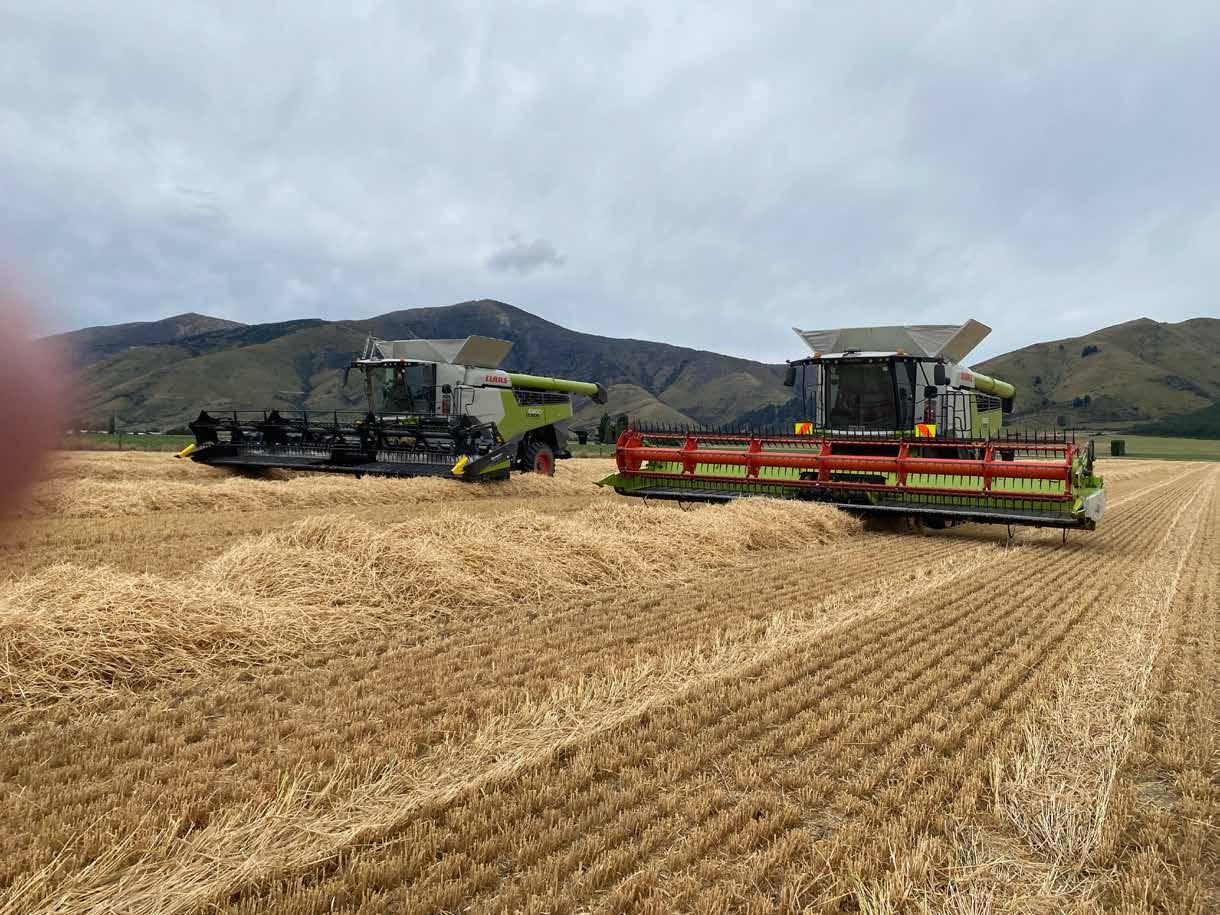



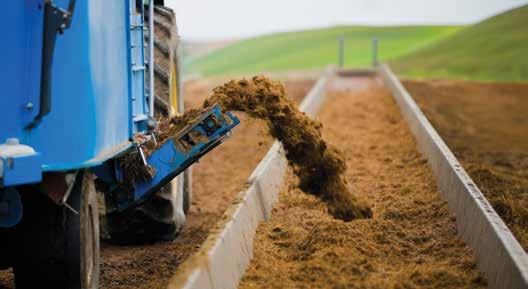
fibre hay and straw through to baleage and additives, creating a uniform ration that is essential for maintaining animal health and production.
What stands out is the geometry of the augers and the way they move material through the tub. The figure eight mixing action is designed to lift, fold and reintroduce material continuously rather than simply turning it. In practical terms, that means less sorting at the feed face and a more even intake across the herd. For operations pushing production that consistency is not a nice to have, it is fundamental.
The construction behind that system reinforces the same message. With heavy duty augers built from high grade steel and a reinforced tub structure, the Rhino is clearly designed for longevity in demanding conditions.
New Zealand feedout systems are not always gentle environments, with heavy silage, variable material quality and often challenging underfoot conditions. Machines that cannot handle that workload tend to show it quickly, and durability becomes a key part of the equation.
Capacity remains a defining feature, with models extending into the larger cubic metre range, positioning the Rhino firmly within the mediumto large scale-bracket. It is a machine designed for operations where volume matters, but where that volume still needs to be managed efficiently within the constraints of existing infrastructure.
Power requirement is another area where the Rhino shows a clear understanding of the New Zealand market. Despite its capacity and aggressive
mixing capability, the machine is designed to operate with relatively modest horsepower. That allows a wider range of tractors to be utilised, rather than requiring a dedicated high horsepower unit.
That has two immediate benefits. The first is fuel efficiency, particularly over a long feeding season where hours quickly add up. The second is flexibility within a fleet, allowing existing tractors to be used rather than tying up a larger unit. In a contracting environment or larger farming operation, that flexibility can have a direct impact on overall system efficiency.
Feed delivery is equally important, and here the Rhino offers a level of configurability that reflects the variety of feeding systems used across the country. Conveyor options, chute placement and discharge
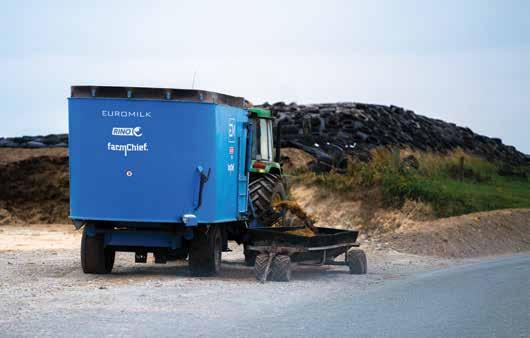
configurations can all be tailored to suit different setups, whether that is feeding into troughs, along feed pads or into more confined areas where access needs to be managed carefully.
The ability to adjust conveyor length and control feedout accurately adds another layer of practicality. It allows operators to place feed where it needs to go without excessive manoeuvring, which in turn reduces time and wear on both the machine and the tractor.
Where the Rhino moves beyond traditional feedout is in the integration of weighing and control systems. Modern diet feeders are as much about data as they are about physical performance, and the inclusion of programmable weighing systems reflects that shift. Operators can set recipes, monitor ingredient use and track consumption, all of which contribute to more precise feeding and better utilisation of feed resources.
The option to integrate digital control and monitoring further extends that capability. It allows feeding to be managed with a level of oversight that was not possible in older systems, particularly in larger operations where multiple operators may be involved. It also provides a clear record of what has been fed and when, which is becoming increasingly important in both production and compliance contexts.
From a Fieldays perspective, the Rhino sits in a category that continues to gain attention. Feedout is no longer a secondary consideration, it is central to how many farms are managing production, particularly in dairy and intensive livestock systems. The ability to deliver a consistent ration, reduce wastage and improve feed conversion is directly linked to profitability, and that is where machines like this are positioned.
In terms of positioning, the Rhino is not trying to be everything to everyone. It is clearly aimed at medium to larger operations, where the scale of feeding justifies the investment and where the benefits of consistent mixing, efficient loading and practical integration into existing systems can be fully realised.
When you are visiting Mystery Creek Fieldays 2026, make sure you call by and visit the Webbline stand, site H50, the home of Europe’s leading and most durable equipment brands such as Bergmann, BvL, Dieci, Goweil, Herron, Mastek, MDE, ROC, SIP & Wilson Engineering, as well as a full range of crop packaging supplies from Cotesi, Exporplas, Mima Films, and Rani.
If feeding consistency is costing you production, it’s time to take a closer look at the range of BvL mixer wagons – on display at the Webbline stand at Mystery Creek Fieldays.
Engineered in Germany and proven on New Zealand farms, BvL mixer wagons are built for durability where it matters most. A heavy-duty chassis, reinforced floor and sidewalls, and strengthened auger joins all work together to handle highwear conditions and keep you running longer between repairs.
But it’s what happens inside
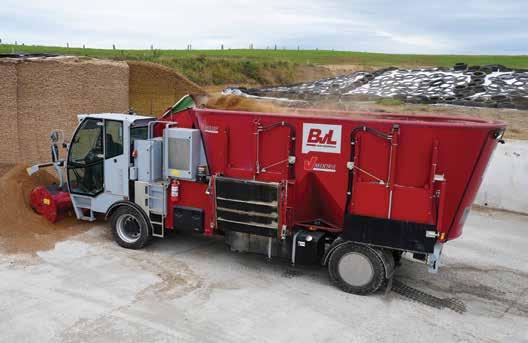
the mixer wagon that sets BvL apart.
The unique asymmetrical auger and counter-knife design combined with the optimal auger to bowl height ratio delivers faster, more efficient mixing with lower power demand. The result is a consistently even ration, right down to trace elements,
supporting better intake, improved digestion and stronger conversion into milk solids and liveweight gain. This boosts not only animal health and productivity but also profitability across the entire herd.
The BvL Dairy Feeder system
turns your mixer into a fully connected feed management tool. Track on-farm feed inventories in real time, ensuring forward planning is more accurate. Every mix and every load fed out is recorded, creating clear accountability and helping to guarantee consistency across the herd. Farmers can share data instantly with consultants,
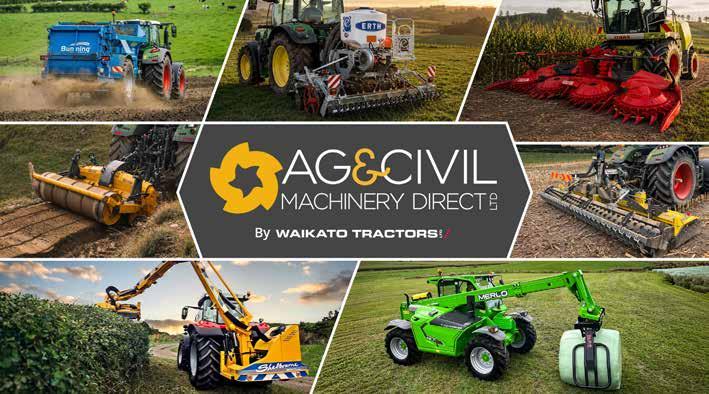
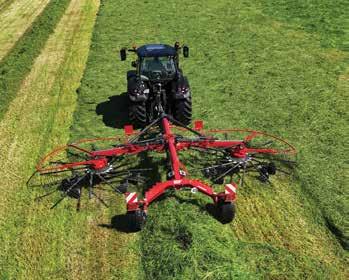
nutritionists, or vets, improving collaboration and decision making.
The BvL Dairy Feeder also generates detailed reports on feed costs and feed conversion efficiency, turning raw numbers into actionable insights that drive profitability.
Built for New Zealand farming
The Pro Series retains the same robust build quality as the standard models but adds extra protection where wear hits hardest, with stainless steel auger liners and built-in safety features like a mixing magnet, which captures any stray metal before it can enter the ration, providing an added safeguard to protect your animals. The BvL Dairy Feeder comes as standard and includes a 12-month subscription.
For larger or higher-demand
systems, the self-propelled Maximus takes efficiency further, combining the trusted mixing performance of the standard towed models with the efficiency of a self-loading system. By chopping the feed before it enters the mixing bowl, the Maximus reduces mixing times while also maintaining the quality of the silage face.
The modern cab is equipped with intuitive controls, excellent visibility and modern comfort features, making long feeding runs less tiring for operators. Smart technology integration ensures accurate mixing, feeding precision and full use of the machine’s efficiency gains. For even greater oversight, the Maximus comes with the BvL Dairy Feeder, giving farmers full control of planning, monitoring and reporting across
their feeding operation. Don’t miss your chance to be among the first to view the new BvL Maximus.
Looking for a telehandler that can keep up with the pace of modern farming? The new Dieci Agri Star Mondo range is built to handle it, and you can see it for yourself at the Webbline stand, at Mystery Creek Fieldays.
Designed for strength without sacrificing manoeuvrability, the Agri Star Mondo models are well-suited to tight yards, sheds and high-demand daily tasks. With lift capacities up to 4,500 kg and reach up to 9.6 m, they cover everything from bale handling to silage and pallet work.
A 125HP FPT engine paired with a precision-controlled twospeed hydrostatic transmission with electronic control for maximum precision gives you smooth, controlled power, even under load. Fast hydraulics and responsive controls mean you can handle multiple movements at once, improving efficiency across every job.
Long hours are part of the job, so the newly designed cab is designed to reduce fatigue. Increased space, improved soundproofing, advanced suspension and clear allaround visibility create a more comfortable, controlled working
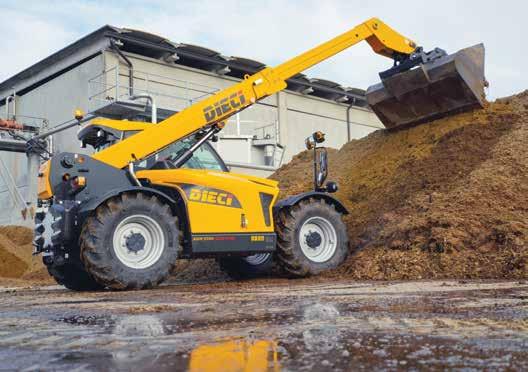
environment, whether you’re loading out or stacking high.
From intuitive joystick controls to automatic boom suspension and overload protection, the system is designed to keep operation smooth, precise and safe, without overcomplicating the job.
The result is a telehandler that feels responsive, capable and reliable in real farm conditions.
A well-shaped bale starts with a well-formed swath, and the new SIP Star range is built to deliver exactly that.
Webbline will be showcasing the latest SIP Star twin-rotor swathers at Mystery Creek Fieldays, this year. With working widths from 5.8 m to 9.3 m, the range offers flexibility across everything from smaller operations through to largescale and contractor systems. The high arch-shaped chassis ensures sufficient underbody clearance while raking and improved rotor clearance when lifting at headlands, while the impressive +/- 77.5 degree steering angle on the two-point linkage ensures maximum manoeuvrability.
The central delivery twin-rotor design ensures controlled crop flow and consistent swath formation, with synchronised rotors and the easily adjustable 420 mm cam track, supports accurate forage placement for baling or forage harvesting.
Designed to perform across real paddock conditions, tandem axle rotor systems and advanced mounting allow each rotor to closely follow ground contours independent from the main chassis, maintaining a consistent working height and even swath formation across uneven terrain.
Hydraulic adjustment functions on the larger SIP Star swathers allow operators to fine-tune working width and rotor height from the tractor, keeping operation efficient and straightforward, while the smaller SIP Star swathers offer the ability to manually adjust the rotor width and rotor height for the perfect swath.
Don’t miss your chance to view these latest product releases - Webbline, Site H50, Mystery Creek Fieldays 2026.
10th - 13th June 2026 | Sites: D127
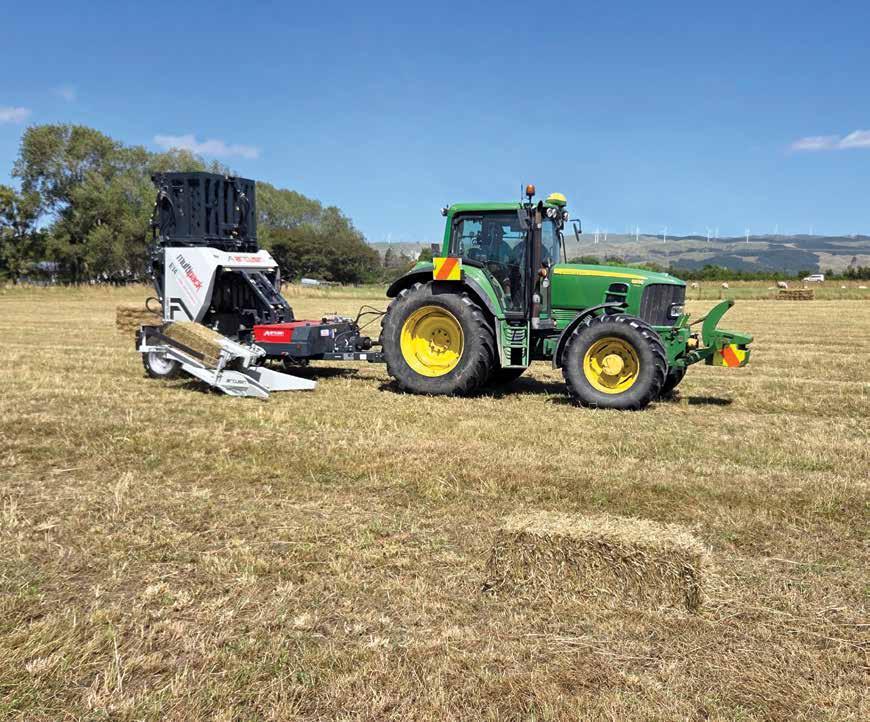
X5 Knotter System: Additional knotter to ensure better fixation of the bundle and 4 strings around a 80-90cm length bale
Touch Screen Control: Touch screen to control and check the machine. On time information and alert system with trouble shoot assistance. All data generated is recorded
Redesigned Bale Pusher: Bigger pusher to increase bale contact. Especially designed for better control of the bales when entering the chamber and to apply more compression
Adjustable Compaction Chamber: It can be adjusted from 87-100cm in width with new clamps system. You choose the compaction of the bundle!
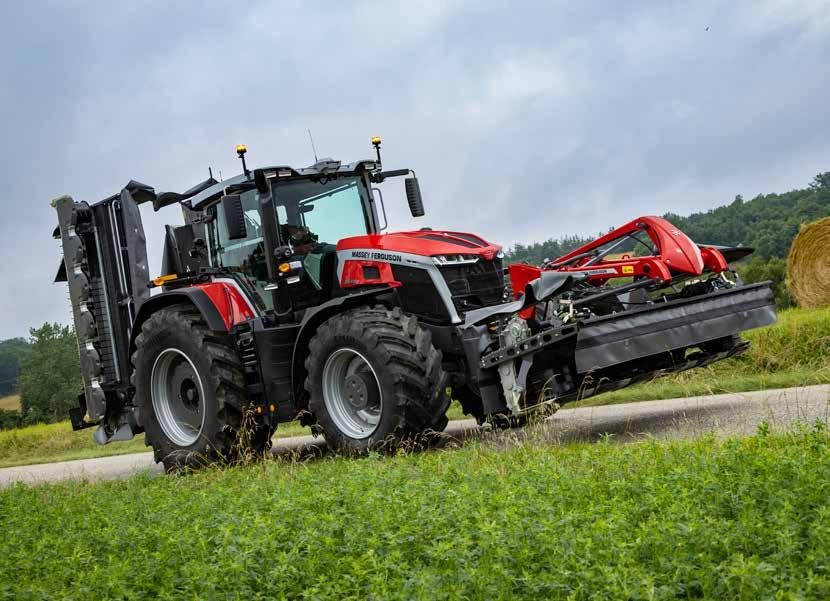
Today’s 90hp+ tractors are expected to do far more than basic fieldwork, combining transport capability, precision technology, fuel efficiency and operator comfort into versatile machines designed to handle the increasing demands of modern farming and contracting systems across New Zealand.
MF9S Series
The step into the 300hp-plus bracket has traditionally been defined by a shift in mindset as much as a shift in machinery, where tractors move beyond being general-purpose workhorses and instead become central to output, efficiency and scale. With the introduction of the Massey Ferguson MF 9S
Massey Ferguson to 425 hp across the range. What stands out is not just the headline power figures but the way that power is delivered, with high torque characteristics at relatively low engine speeds, allowing the tractor to maintain pulling performance without excessive fuel burn. On higherload applications, Engine Power Management provides an additional boost of up to 30 hp, particularly useful in transport
series, Massey Ferguson has made a deliberate move into this space with a platform that is not only higher in horsepower but engineered around the realities of modern large-scale farming and contracting.
The MF 9S is built around a well-proven 8.4-L, six-cylinder Agco Power engine, delivering outputs from 285 hp through
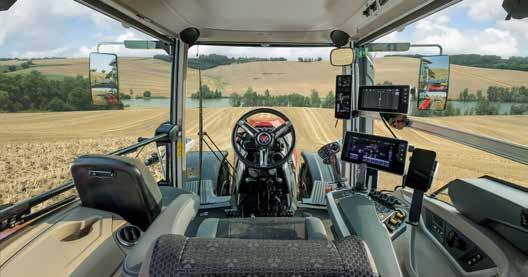
and PTO-driven work where maintaining consistent output under load is critical. This focus on usable power is matched by a best-in-class power-to-weight ratio of around 25.6 kg/hp, which is a key figure when considering traction efficiency and soil impact. In practical terms it allows the MF 9S to operate across a wider range of tasks without excessive ballast, while still offering a maximum weight of up to 18.5 tonnes when additional traction is required. For contractors moving between cultivation, drilling and heavy draft work, that flexibility becomes increasingly important. Transmission choice is simplified with the DynaVT continuously variable transmission fitted as standard across the range. This system delivers seamless speed control from zero through to transport speeds, with automatic engine and transmission management working together to maintain optimum efficiency. In field conditions this translates to consistent forward speed, regardless of load variation, with the system continuously adjusting engine revs to maintain efficiency, rather than chasing peak rpm. For operators running large cultivation sets or high-demand PTO implements, this level of integration reduces fatigue while improving work rates.
Hydraulic performance is equally aligned with the
demands of modern implements, with closed-centre load-sensing systems delivering up to 205–340 L per minute of flow, depending on specification. This capacity ensures that the MF 9S can comfortably handle high-demand equipment, such as large air seeders, precision planters and high-output slurry systems, where consistent hydraulic performance is nonnegotiable. Rear lift capacity sits in the 11,500 to 12,000 kg bracket, reinforcing the tractor’s ability to operate at the top end of the market.
A defining feature of the MF 9S is Massey Ferguson’s Protect-U design, which physically separates the engine compartment from the cab with a 24-cm gap. While it is a relatively simple concept, the impact on operator environment is significant, reducing noise, heat and vibration transfer into the cab. For operators spending long days in the seat, particularly in contracting operations where hours accumulate quickly, this translates into a noticeably improved working environment and reduced fatigue over time.
The cab itself reflects the brand’s ongoing focus on usability, with a layout that prioritises clear visibility and straightforward control. Advanced guidance and automation features are integrated through the MF technology suite, including MF Guide, MF AutoTurn and Tractor Implement
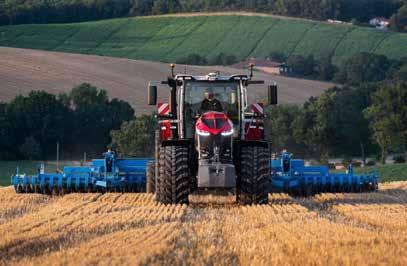
Management, all of which are designed to streamline field operations and reduce operator workload. These systems are increasingly becoming standard expectations in this horsepower category, and their integration within the MF 9S platform ensures it remains competitive in a market where precision and automation are no longer optional extras.
From an efficiency perspective, Massey Ferguson has also targeted total cost of ownership, with claims of up to a 15% fuel advantage compared to competing models in similar power brackets. While such figures will always vary depending on application and operator behaviour, the combination of low-revving engine characteristics, CVT transmission efficiency and intelligent power management provides a strong foundation for reducing fuel use over time.
In transport, the MF 9S continues to demonstrate its versatility, with road speeds up to 50 km/h and a relatively tight
turning radius of 5.75 m for a tractor of its size. For contractors covering significant distances between jobs, this balance between field performance and road capability is critical, particularly in regions where travel time can quickly erode productivity.
What ultimately defines the MF 9S is how it brings together these elements into a cohesive platform. The engine provides the foundation, the Dyna-VT transmission delivers control and the hydraulic system ensures compatibility with the latest generation of implements. Around that, the Protect-U design and cab environment support the operator, while integrated technology enhances accuracy and efficiency.
Tractors in this horsepower bracket are no longer niche machines. They are becoming central to the way work is planned and executed. The MF 9S reflects that shift, offering a machine that is not simply larger, but more refined in how it delivers performance.
From tight yard work and loader jobs through to heavy cultivation, mowing, baling and transport, most farms don’t have the luxury of specialised tractors for every task. What’s needed is one machine that can genuinely do it all, and do it efficiently, day after day.
That’s where the new Claas Arion 6, launched in November at Agritechnica in 2025, steps in.
Sitting in the sweet spot of the mid-horsepower category, the Arion 6 delivers up to around 200 hp through a proven 6-cylinder platform, giving it the muscle to handle demanding fieldwork while remaining compact enough for yard and transport duties.
It’s this balance that makes it particularly relevant for New Zealand conditions. Whether you’re running a mixed cropping operation in Canterbury, a dairy support block in the Waikato, or a contracting business covering a wide range of jobs.
The Arion 6 builds on Claas’ reputation for low fuel consumption, pairing a 6.8 L engine with the Cmatic continuously variable transmission to keep engine revs low while maintaining optimal power delivery. Its efficiency will show up in your fuel bill.
Add in intelligent systems like Cemos, which automatically optimises settings such as ballast, tyre pressure and operating parameters, and you’ve got a tractor that actively works to reduce fuel use, by as much as 16% in some conditions. For farmers and contractors
alike, that’s savings you notice across the season.
Product Business Manager, Tractors (ANZ), Kevin Walker adds, “The Arion 6 is a tractor that fits the whole job. It’s built around the reality that farms need a machine that delivers flexibility no matter what the job is that needs to be done.
“With its compact frame and strong manoeuvrability, it is equally at home feeding out or stacking bales, running a front loader, pulling cultivation gear, or handling transport between blocks.
“With up to 150 L/min hydraulic output, it’s also well matched to modern implements, from drills through to high-demand hydraulic equipment. In short, it’s not just capable — it’s adaptable,” he says.
In addition, if you are looking for operator comfort that pays over long days, Claas has clearly focused on making the Arion 6 a tractor operators want to stay in. A fully suspended cab, low noise levels and ergonomic controls, like the Cmotion lever, all contribute to reduced strain over long hours.
“It might sound like a luxury, but in reality, comfort directly impacts productivity. Eliminating fatigue is particularly important during peak periods like drilling, silage or harvest support,”
Walker says.
Claas has made smart farming simpler, because technology is only valuable if it’s easy to use.
That’s where the Arion 6 stands out. With integrated guidance capable of 2–3 cm accuracy and full Isobus compatibility, it slots
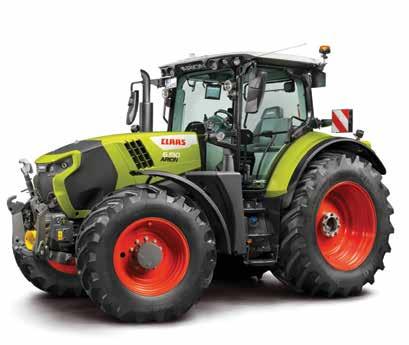
straight into precision farming systems.
Add connectivity through Claas connect, and machine data, job tracking and farm records can all be managed seamlessly between tractor and office, saving time and improving decision making.
At the heart of the machine, the Arion 6 is about reliability. It’s a dependable all-rounder fit for our New Zealand conditions. Designed for long working days and high seasonal pressure, it combines proven drivetrain technology from previous Arion 600 models, with straightforward servicing and strong dealer support, critical factors for New Zealand farmers who can’t afford downtime when the weather window opens.
Walker says, “The Claas Arion 6 isn’t trying to be the biggest tractor on the farm. It’s aiming to be the most useful, and for New Zealand farmers and contractors who need one machine to cover a wide range of jobs efficiently, comfortably and reliably, the Arion 6 makes a strong case as the tractor that
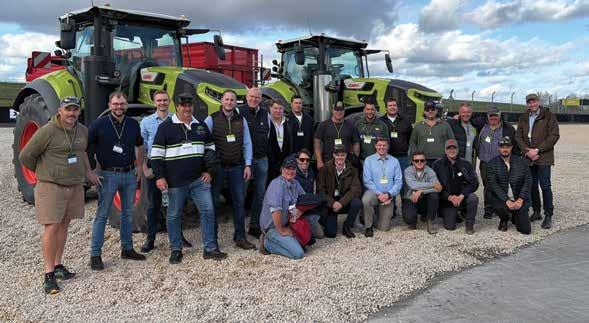
earns its keep every day.”
To register your early interest in the Arion 6, which will be available for spring, see the team at your local Claas Harvest Centre.
The launch of the new Axion 9 Cmatic series marks a significant step forward for Claas in the high horsepower tractor segment, bringing together increased performance, advanced automation and a clear focus on operator comfort and efficiency.
First presented at Agritechnica, the all-new Axion 9 range, including the Axion 9.450 Terra Trac, is now in production at the Le Mans facility in France, with availability in the Australasian market expected from mid-2026. The Le Mans site has been central to Claas’ tractor development since its acquisition in 2003, producing more than 200,000 tractors over that time. Continued investment of more than €80 million has transformed the plant into one of the most modern tractor manufacturing facilities globally, incorporating digital production systems, automated guided vehicles and improved working environments.
This latest generation builds on that foundation, reflecting both the increasing demand for high-capacity machinery and the growing role of digitalisation and automation in modern farming systems. As Dr Martin von Hoyningen-Huene, Chief Technology Officer at Claas, notes, the tractor segment represents the greatest growth potential for the business, with the Le Mans facility playing a central role in that strategy.
The Axion 9 Cmatic series has been developed as the successor to the Axion 900 range, with wheeled models and Terra Trac crawler variants designed to deliver maximum output with improved efficiency both in the field and on the road. At the core of the machine is the latest generation 8.7-L FPT Cursor 9 six-cylinder engine, delivering between 330 and 450 hp and up to 1,850 Nm of torque. Power and torque are available across a wide rev range, allowing the tractor to operate efficiently at lower engine speeds.
A key feature is the dynamic Auto Droop function, which automatically adjusts engine behaviour based on load demand across the drivetrain, PTO and hydraulics. Combined with a low idle speed of 650 rpm, the system contributes to reduced fuel consumption, lower noise levels and improved overall efficiency. Maintenance intervals have also been extended, with engine oil changes now required every 750 hours, reducing downtime and operating costs.
The Cmatic’s continuously variable transmission remains a core component, but with a completely redesigned electronic management system. The new vehicle drive controller allows seamless transitions between operating modes, whether pedal, joystick or PTO control, without changes in speed or engine rpm. Operators can override at any time without interruption, maintaining full control while benefitting from automation.
One of the standout developments is the Auto Load Anticipation system. Using
adaptive algorithms, the system predicts load changes, such as when an implement enters the soil, and adjusts engine speed in advance to maintain consistent performance. This proactive approach reduces speed drop under load and optimises fuel efficiency without operator input. It is this system that earned Claas a silver Agritechnica Innovation Award.
The Terra Trac models, including the Axion 9.360 and 9.450, offer an alternative to conventional wheeled tractors, combining full suspension with a tracked rear system. This delivers up to 50% greater ground contact area, improving traction while reducing soil compaction. Track width options from 457 mm through to 890 mm provide flexibility across a wide range of applications, from fertilisation and mowing through to heavy cultivation and drilling.
The Terra Trac system has been further refined with improved durability, reinforced track belts and enhanced roller coatings. An optional Ctic tyre pressure control system on the front axle further enhances traction and soil protection, particularly in challenging conditions.
Hydraulic performance has also been significantly upgraded, with flow rates of up to 370 L per minute available through a combination of standard and optional pumps.
Up to eight rear spool valves and two front circuits can be specified, supporting large implements and high-demand applications. Lift capacity reaches up to 13 tonnes at the rear and 6.5 tonnes at the front, reinforcing the tractor’s suitability for heavy-duty work.
A major focus of the Axion 9 Cmatic development is the operator environment. The completely redesigned cab offers around three cubic metres of space, providing a noticeably more open and comfortable working area. Noise levels have been reduced to just 66 dB(A), making it one of the quietest cabs in its class.
Premium seating options include ventilation, heating and massage functions, while the seat can swivel up to 40 degrees to improve visibility of rear implements. Camera systems integrated into the machine allow operators to monitor implements and surroundings, with images displayed on the new Cebis Connect terminals.
The electronic architecture has been completely reworked, introducing Cebis Connect with dual 12-inch displays. These allow flexible control of machine functions, guidance systems and Isobus applications, with operators able to configure screens to suit the task.
Integrated GPS Pilot steering can be displayed on either screen, supporting precision farming operations, including variable rate application and task documentation.
Additional operator support comes from systems such as Cemos, which assists with optimising ballast and tyre pressure, and Auto RefLine, which automatically adjusts guidance lines when transitioning between headlands and field work. These systems are designed to reduce operator workload while improving overall machine performance.
Lighting has also been
enhanced, with up to 22 LED work lights delivering 56,000 lumens, ensuring visibility during long working hours. Practical features such as improved access, additional storage and easier cleaning further contribute to day-to-day usability.
From a maintenance perspective, Claas has focused on reducing downtime, with extended service intervals across key components and the introduction of a central lubrication system. This system automatically supplies lubrication to critical points, including the front axle and Terra Trac running gear, reducing daily maintenance requirements. With a maximum permissible weight of up to 22 tonnes on Terra Trac models and highcapacity fuel tanks of up to 860 L, the Axion 9 Cmatic is clearly designed for long working days and demanding applications. Overall, the Axion 9 Cmatic represents a comprehensive update that combines power, efficiency and automation in a package aimed squarely at large-scale farmers and contractors. With increasing pressure on labour availability and operating costs, the ability to deliver consistent performance with reduced input from the operator is becoming more important.
That balance of high horsepower, intelligent systems and operator-focused design positions the Axion 9 Cmatic as one of the most significant tractor developments in the high horsepower category, offering a platform that is well suited to the demands of modern large-scale agriculture.
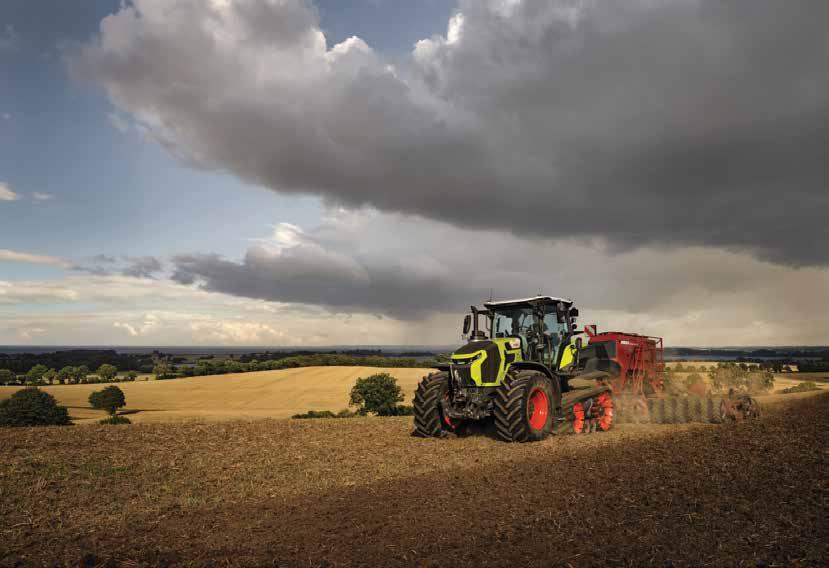
There has always been a clear philosophy behind the JCB Fastrac 6000 Series, and with the latest 6000 Series that thinking has been taken another step forward. This is not simply a higher horsepower addition to the range, it is a ground-up rethink of what a modern highperformance tractor needs to be when it is expected to operate across cultivation, haulage and contracting work without compromise.
Positioned squarely in the 280 to 335 hp bracket, the 6000 Series bridges the gap between the established 4000 and 8000 machines, but, more importantly, it introduces a new level of integrated technology that is clearly aimed at contractors and largescale operators who demand versatility without stepping up to the size and cost of a flagship unit.
At the heart of the machine is a 6.7-L six-cylinder engine platform, delivering up to 335 hp and torque figures pushing
towards 1,400 Nm and it is the way that power is managed rather than simply produced that defines the tractor. The 6000 Series is powered by an FPT (Fiat Powertrain Technologies) engine, a proven OEM supplier across multiple off-highway industries, with a strong reputation in the agricultural sector. The engine is designed to deliver its peak torque at relatively low engine speeds, which in practical terms means the tractor holds on to pulling power under load while maintaining fuel efficiency and reducing operator fatigue over long working days.
Supporting that powertrain is an integrated approach to performance and control. An automatic exhaust brake works in conjunction with JCB’s Smart Transmission Control (STC), improving braking performance while also contributing to overall efficiency, something that has long been a defining feature of the Fastrac range. An optional variable pitch cooling fan further enhances this system,
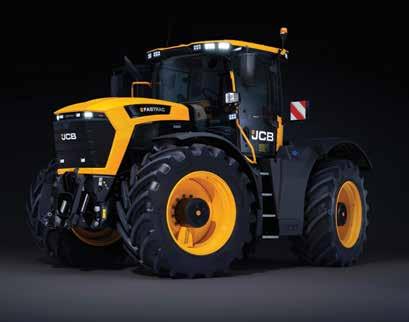
responding quickly to engine requirements to maintain optimal operating temperature. The ability to reverse the fan to clear radiators and grills of dust and chaff, with timing intervals and purge cycles adjustable through the screen or joystick, reflects a practical focus on uptime and reliability in real working conditions.
That efficiency is matched by a refined transmission
approach. The 6000 Series uses a continuously variable transmission supported by Smart Transmission Control software, delivering precise speed control from zero through to 66 km/h where permitted. The system incorporates a four-range auto change CVT transmission with four key efficiency points, ensuring the tractor operates within optimal performance windows
Without predator control, these habitats and the native wildlife that depends on them will continue to decline — even with stock exclusion. Our toolbox will guide you through how to manage pests in these unique spaces.
across a wide range of tasks. An integrated and enclosed park brake with active standstill function adds another layer of control, particularly in transport and stop-start operations, while maintaining the ease of use that operators expect from a modern CVT platform.
Speed has always been part of the Fastrac identity and the 6000 Series continues that tradition, but it is how that speed is controlled that sets the machine apart. Full suspension on both axles, combined with a central chassis design, delivers stability that is more akin to a truck than a conventional tractor. This is not simply about operator comfort, it directly translates into improved safety, better braking performance and more consistent control when towing heavy loads at speed.
The chassis itself is a key part of the technology story. Rather than relying on a traditional tractor layout, the 6000 Series uses a split-frame design with a cast front section supporting the engine and front linkage and a fabricated rear structure carrying the cab, transmission and rear linkage. This separation allows for better weight distribution, improved durability under load and a more refined ride, particularly when combined with the advanced suspension system.
Steering technology is another area where the 6000 Series stands out. Selectable four-wheel steering comes as standard, with multiple modes that allow the tractor to adapt to different tasks, from tight headland turns to stable highspeed road work. The addition of GPS-linked rapid steering further enhances this capability, allowing operators to switch steering modes automatically based on position and task, reducing the need for manual input and improving overall efficiency.
A further development in traction and efficiency comes through the availability of Central Tyre Inflation System (CTIS) on the 6300 model. This fully integrated single line system is built into the axles and uses twin compressors delivering a combined airflow of 600 L per minute. By allowing operators
to adjust tyre pressures on the move, the system improves tractive performance and reduces soil compaction, while also enhancing overall efficiency. Deflation occurs at the rim, protecting internal components from dust and debris, and improving long-term durability of seals and system components. In practical terms, it allows the tractor to move seamlessly between field and road conditions while maintaining optimal tyre performance.
Hydraulic performance has also been pushed to meet the expectations of modern implements. With flow rates up to 205 L per minute as standard and significantly higher outputs available, the system is designed to support high-demand equipment such as drills, planters and large cultivation gear without compromise. Rear lift capacity sits around the 11,000 kg mark with a 5,000 kg front linkage option, giving the tractor the ability to handle complex front and rear implement combinations that are increasingly common in largescale systems.
Braking and safety systems reflect the dual-purpose nature of the machine. External disc brakes on all four wheels, supported by ABS, provide consistent stopping power both in the field and on the road, reinforced further by the integrated exhaust braking system. Features such as brake
wear indicators and simplified maintenance access show a clear focus on long-term ownership and uptime. This is a tractor designed not just to perform, but to keep performing with minimal interruption.
The operator environment continues to play a central role in the overall design. The spacious, centrally mounted cab remains a key feature of the 6000 Series, offering excellent 360-degree visibility through 6.6 sqm of glass. The driver’s seat allows for rotation, improving comfort and visibility across a range of operations, and is available in a premium specification with heating and ventilation. A fullsize instructor’s seat ensures that passenger comfort is not compromised.
Attention to detail extends throughout the cab, with a forward-raked windscreen reducing heat and noise, supported by an enhanced air conditioning system designed to maintain a consistent working environment in all conditions. Storage is practical and well thought out, with cargo nets, a utility tray, cup holders and the option of an under-seat fridge, ensuring the cab remains a functional workspace over long days.
Technology integration within the cab continues to evolve. A coded key immobiliser is included as standard, improving security, while auto start and stop functionality reduces
idle time and improves overall efficiency. Combined with push-button start, the system allows the engine to be shut down while maintaining ignition power, keeping systems such as GPS active. For operators spending long hours in the seat, the optional AudioPro package adds an upgraded sound system with additional speakers and a subwoofer, enhancing overall comfort without detracting from the machine’s core purpose. What ties all of this together is the broader integration of technology into the operator environment. While the mechanical specification is impressive, the real advantage comes from how the machine allows the operator to manage that capability. From transmission control to engine management and steering modes, the systems are designed to work together rather than in isolation, reducing the level of input required while increasing consistency of output.
In practical terms, this means the 6000 Series is not defined by a single standout feature, but by the way each component contributes to overall efficiency. Whether it is maintaining consistent ground speed during drilling, reducing fuel use during transport, or improving manoeuvrability in tight field conditions, the technology is focused on realworld gains rather than headline specifications.
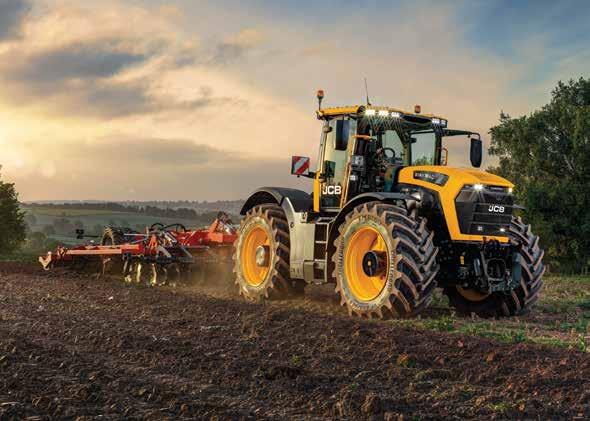
Kubota launched its versatile and feature-packed M5 Series tractors in the mid-size 90 to 110 hp class in New Zealand six years ago. Buyers typically use this horsepower range for hay production, all-purpose farming and specialist applications, and the M5 is designed to be powerful, spacious and versatile. Significantly, the series offers four models: the M5091 and M5111 Standard and then most of the same features in a compact, narrow tractor aimed at orchard and vineyard agriculture, the M5091 and M5101 Narrow.
Senior Product Manager for the M5, Kubota’s Konstantin Blersch, said the series have proven themselves as an important offering in Kubota’s line-up. There’s a need for an upmarket tractor that combines simplicity with comfort and
versatility, and this is where the M5 fits right in. The M5 offers powerful performance combined with simple operation, extreme agility and Kubota’s well-known reliability. Kubota tractors are also known for working seamlessly with a variety of implements making them ideal for a range of uses, from field to orchard to transport and in tight spaces where manoeuvrability is essential.
The M5 Series uses Kubota’s reliable, efficient V3800 fourcylinder diesel engine which in addition to high levels of torque also delivers 76 or 89 hp at the PTO to implements. The V3800 common rail engine meets European Tier IV emission standards and uses exhaust gas recirculation and a diesel particulate filter for clean, economic performance. The M5 runs quietly and offers greater
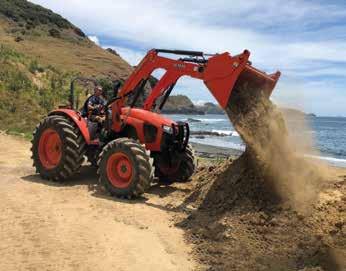
wear resistance and lower fuel consumption, which is no surprise when you remember that Kubota is a global leader for industrial diesel engines.
The M5’s Ultra Grand Cab II on Standard models is big on comfort, enclosed, panoramic and air-conditioned with a sunroof and retractable shade. The flat floor is 160 mm wider than previous models, and the console is newly designed with an optional instructor’s seat. The curved glass reduces glare, and the side exhaust, narrow pillars and new sloping bonnet improve visibility. The cab features two-tone colours, more storage and a revised layout that puts everything within easy reach. The same ergonomic design approach has been taken in the Narrow model cabins, which also boast controls within easy reach and a high level of operator comfort.
Kubota is well-known for its versatile transmissions and the M5 offers six synchronised gears, three ranges, Hi, Low and Creep and Dual Speed for either an 18-forward 18-reverse setup, or a seamless 36-forward, 36-reverse configuration. Clutch and Dual Speed controls are at the operator’s fingertips on the gear lever. Kubota’s smart engine management is also in evidence in the M5, with rpm memory and constant rpm settings that ensure smooth power at all times. Direction change is done with a flick of the finger on a hydraulic shuttle, making manoeuvring smooth
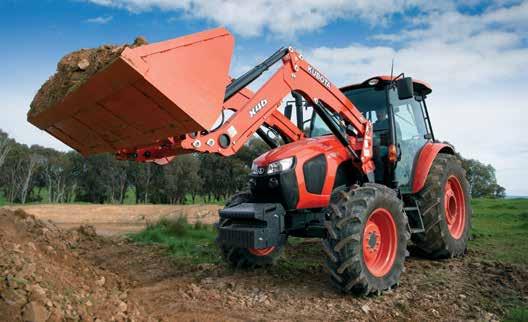
and simple, and substantially reducing fatigue for repetitive work.
In addition to the cutting-edge transmission, the M5 Series works hard with versatile hydraulics and a tough Category II three-point hitch that lifts 3,200 kg at the rear on Standard models and a handy 1,500 kg in the Narrow configuration. The hydraulics deliver a high flow rate of more than 60 L/min and plenty of options for control and flow valves. As you would expect from Kubota, the PTO shaft is engineered for safety and performance, with auto engagement and constant speed options. M5 Standard models also pair perfectly with a Kubota front-end loader, which includes third service, boom suspension and a Euro hitch for any job, while wheel choices cater for various applications, spanning general farm work through to specialist applications with adaptable tracks and heights.
Some advantages of the M5 are not immediately noticeable but still make a big difference to usability. Bi-speed turning is a long-standing Kubota feature, where at sharp angles the front wheel speed increases, resulting in extremely tight turns and high manoeuvrability when working with row crops or in tight spaces. Other features that Kubota has packed into the M5 Series include the multifunction IntelliPanel, which offers a clear LCD display for data and functions, a newly designed one-piece bonnet that opens wide for easy maintenance, a sunroof that allows a clear view to a raised front loader for easier material handling, all-wheel drive that is automatically engaged when braking for increased safety, and bigger fuel tanks of either 76 or 105 L that allow for long working days.
Kubota New Zealand is putting itself at the forefront of smart, efficient agricultural production and the M5 Series is designed to be clean, efficient and versatile. Thanks to ongoing technology developments, Kubota machines and processes are perfectly compatible and guarantee future viability, with the M5 Series continuing to redefine expectations on farms across New Zealand.
The Fendt 800 Vario Gen5 series marks a significant step forward in the evolution of high-horsepower tractors, bringing together a new platform that is clearly aimed at contractors and large-scale farming operations looking for a balance of power, efficiency and versatility. Covering a performance range up to 343 hp, the new generation introduces a suite of technologies that have previously been reserved for larger machines, now packaged into a more compact and manoeuvrable format.
The range consists of three models, the 826, 829 and 832 Vario, delivering outputs from 260 hp through to 320 hp, with the addition of Fendt’s DynamicPerformance system providing a further 23 hp when required. That additional power is not tied to ground speed or specific operations, but is available to support auxiliary systems, such as cooling, hydraulics or PTO loads, ensuring consistent performance under varying demand.
A key part of the new platform is the introduction of VarioDrive to the 800 series for the first time. This single-stage transmission drives the front and rear axles independently, distributing torque dynamically depending on load and traction conditions. The system removes the need for manual shifting between field and transport work and also delivers the well-known pull-in turn effect, where the front axle actively pulls the tractor into the turn, reducing the turning radius and improving manoeuvrability in tighter conditions. For contractors working across a mix
of paddocks and road transport, that flexibility becomes a practical advantage.
Efficiency has also been addressed through the Fendt iD low-speed concept, which focuses on delivering high torque at reduced engine speeds. With a rated speed of just 1,700 rpm and a typical working range between 1,100 and 1,400 rpm, the tractor is designed to operate in a quieter, more fuel-efficient band without compromising output. Road speeds are achieved at notably low engine speeds, with 40 km/h at 950 rpm and 60 km/h at 1,450 rpm, supporting both fuel savings and reduced wear over time. The top model delivers up to 1,680 Nm of torque, providing strong pulling power across a wide range of applications.
Payload capacity is another area where the 800 Vario Gen5 stands out. With an operating weight of 9.9 tonnes and a permissible gross weight of up to 17.5 tonnes, the tractor offers a payload of 7.6 tonnes. This allows it to operate effectively with larger implement combinations, whether that is a front tank and precision drill setup or a full mower combination, while remaining within legal limits for transport. Flexible ballasting options at both the front and rear ensure the machine can be set up to suit either field or road work.
Cab design has been given significant attention, with a new workspace aimed at improving comfort over long working days. Visibility remains a key focus, supported by an updated lighting system that offers up to 114,700 lumens through LED work lights. Operators can choose between
Vision and UltraVision packages, with dimmable lighting and adjustable profiles allowing the setup to be tailored to different tasks and conditions. The ability to control individual lights becomes particularly useful when working alongside other machines or in reduced visibility.
The cab itself is built around the FendtONE operating system, with up to three display areas and user profiles that allow operators to store individual settings. This extends to seat position, mirrors and lighting configurations, helping reduce setup time when multiple drivers are using the machine. Comfort is further enhanced through features such as an optional heated laminated front windscreen, improved noise insulation and a new highspec seat with full electronic adjustment.
Cooling and filtration systems have also been upgraded. The Concentric Air System manages engine cooling efficiently, while optional reverse fan functionality helps clear debris in dusty conditions. A self-cleaning engine air filter and automatic cab air filter cleaning system reduce daily maintenance and maintain air quality in challenging environments, particularly during cultivation or harvesting in dry conditions. Hydraulic performance has been designed to match the
demands of modern implements, with up to six rear and two front control valves available, along with multiple pump options delivering up to 385 L per minute. This allows the tractor to operate effectively with complex equipment such as high-capacity drills or combination units, where consistent oil flow is critical.
Transport capability remains a strong focus, with a top speed of up to 60 km/h supported by a range of safety and control systems. Features such as Fendt Stability Control, Reaction Steering and the Trailer Brake Assistant improve handling and safety, particularly when operating with heavy or highcapacity trailers. The integration of these systems reflects the increasing importance of road transport within modern contracting and farming operations.
Overall, the 800 Vario Gen5 represents a well-considered step forward for the mid to high horsepower segment. It combines the efficiency and technology of larger machines with a level of manoeuvrability that suits a wide range of applications. For contractors and large-scale farmers, it is not just about peak power, but about how that power is delivered, managed and translated into productivity across the season.
The Tier 3 Puma with its 6.7 L FPT engine, is a platform that has been widely proven across the Puma range and beyond. It is not just about horsepower, although with models ranging from around 180 hp through to 220 hp there is no shortage of that. What matters more is how that power is delivered. The engine is tuned to provide strong torque through the working rev range, allowing the tractor to hold load without constant gear changes or excessive fuel burn.
That characteristic becomes particularly important in New Zealand conditions, where tractors in this category are expected to move between tasks without compromise. Whether it is pulling a heavy cultivation implement, running a baler or handling transport work, the ability to maintain consistent power under varying load is what defines productivity.
One of the most notable aspects of the Tier 3 Puma is its approach to emissions and engine management. By retaining Tier 3 technology the tractor eliminates the need for AdBlue, which immediately simplifies operation and maintenance. For many operators, particularly in contracting environments or remote locations, that simplicity
is a real advantage. It reduces the number of consumables required on farm and removes another variable from daily operation. That simplicity extends further into servicing. Case IH has pushed service intervals out by around 25% compared to earlier Tier 3 models, which has a direct impact on uptime and running costs. In a seasonal workload where weather windows dictate output, fewer service interruptions translate directly into more hours in the field.
Transmission options play a key role in how the Puma fits into different operations. The Tier 3 range offers both Powershift and CVT configurations, allowing operators to match the tractor to their workload. The Powershift option provides a straightforward, mechanical solution that suits operators who prioritise durability and ease of use. It is particularly effective in draft work and general field operations, where consistent pulling power is required.
At the other end of the scale, the CVT option introduces a higher level of control and efficiency, particularly in applications where speed and load vary frequently. Transport work, mowing and precision operations all benefit from the ability to maintain a constant ground speed without manual gear changes. The inclusion of
these options reinforces the Puma’s position as a flexible platform rather than a one-sizefits-all solution.
Hydraulics are another area where the Puma is built for real-world application. With flow rates reaching up to 170 L per minute on higher specification models, there is more than enough capacity to handle modern implements. Whether it is running high-demand hydraulic motors or managing multiple remotes, the system is designed to deliver consistent performance without lag or compromise.
The rear linkage and PTO configuration further support that versatility. With multiple PTO speed options, including economy settings, operators can match engine speed to the task, improving fuel efficiency without sacrificing output. In operations where PTO-driven implements are used extensively, that ability to fine-tune performance becomes a key efficiency gain.
From a structural perspective, the Tier 3 Puma is built around a long wheelbase platform, particularly in the higher horsepower models. That added length improves stability both in the field and on the road, especially when working with heavier implements or towing at speed. Stability is often overlooked in specification sheets, but in practice it plays a significant role in operator
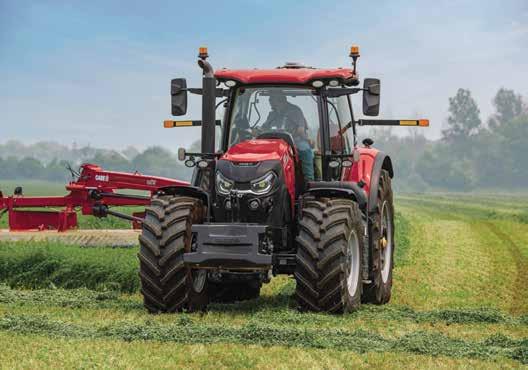
confidence and overall performance.
Cab design follows the same practical approach seen throughout the tractor. While newer Connect Puma models push further into high-spec technology, the Tier 3 variant focuses on delivering a comfortable, functional working environment without unnecessary complexity. Controls are laid out logically, visibility is strong and the overall environment is designed to support long working days.
That matters in a contracting context, where multiple operators may be using the same machine. Simplicity reduces training time and minimises the risk of operator error, particularly during peak periods when time is limited and workloads are high. Loader compatibility adds another layer to the Puma’s versatility. While it is often seen as a field tractor, its ability to handle loader work effectively makes it a genuine all-rounder. This is particularly relevant in mixed farming systems, where tractors are expected to move between cultivation, feedout and yard work without downtime.
The Tier 3 Puma represents a clear segment of the market that continues to resonate with New Zealand farmers and contractors. While there is an increasing push towards higher levels of technology and connectivity, there remains strong demand for tractors that prioritise reliability and ease of use.
As Case IH Product Manager Seamus McCarthy described it, the Puma is designed as a “no fuss workhorse” that delivers power and performance while keeping things simple. That positioning is deliberate, and it reflects what many operators are actually looking for in this horsepower category.
There is also a broader context to consider. As machinery becomes more advanced, the cost of ownership increases, not just in terms of purchase price, but in servicing, diagnostics and operator training. The Tier 3 Puma offers a counterpoint to that trend, delivering modern performance without the full complexity of next-generation systems.
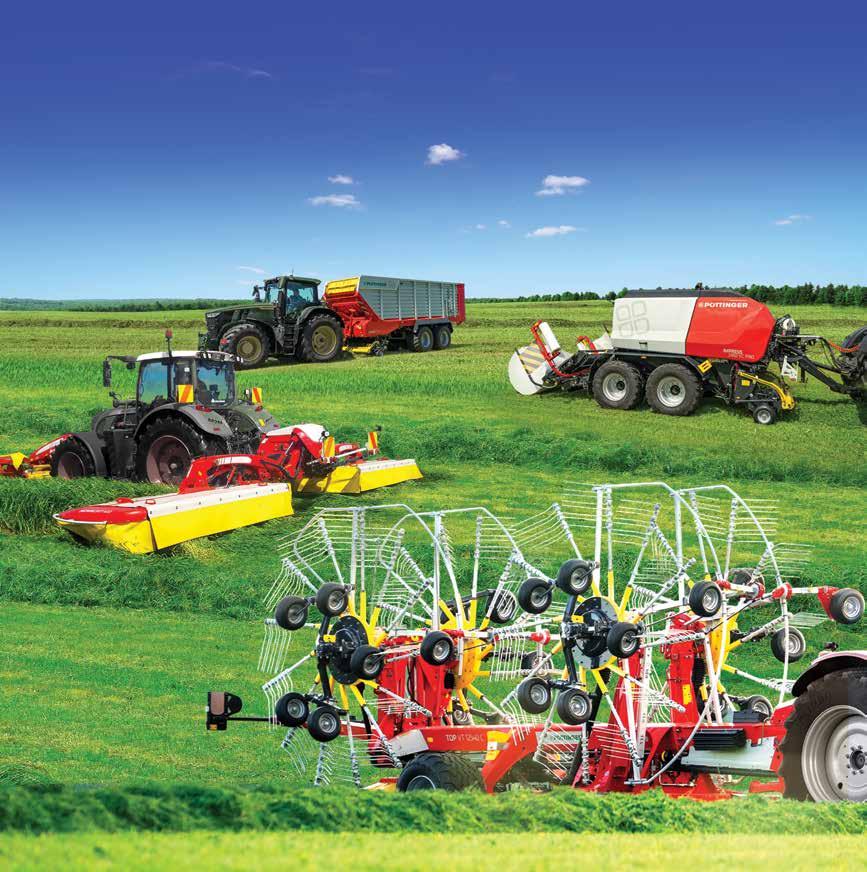
KAITAIA Kaitaia Tractors 09 408 0670
WHANGAREI Piako Tractors Northland 09 438 1319
SILVERDALE Brandt NZ 09 427 9137
PUKEKOHE Brandt NZ 09 237 0043
MORRINSVILLE Piako Tractors 07 889 7055
MATAMATA Matamata Tractors & Machinery 07 888 6292
HAMILTON Brandt NZ 07 847 0425
CAMBRIDGE Brandt NZ 07 827 5184
ROTORUA Piako Tractors Ltd 07 345 8560
TAUPO Taupo Tractors & Machinery 07 378 4533
STRATFORD FeildTorque Taranaki 06 765 8643
HASTINGS Stevenson and Taylor 0800 4273 2273
WAIPUKURAU Stevenson and Taylor 06 858 6041
DANNEVIRKE Lancaster Tractor Services 2022 Ltd 06 374 7731
FEILDING TRC Tractors 06 323 0309
MASTERTON Brandt NZ 06 377 3009
NELSON Drummond & Etheridge 03 543 8041
BLENHEIM Drummond & Etheridge 03 579 1111
KAIKOURA Drummond & Etheridge 03 319 7119
GREYMOUTH Drummond & Etheridge 03 768 5116
CHRISTCHURCH Drummond & Etheridge 03 349 4883
ASHBURTON Drummond & Etheridge 03 307 9911
TIMARU Drummond & Etheridge 03 687 4005
OAMARU Drummond & Etheridge 03 437 1111
MOSGIEL JJ Limited 03 489 8199
CROMWELL Drummond & Etheridge 03 445 8180
CROMWELL JJ Limited 03 489 6452
GORE JJ Limited 03 208 9370
INVERCARGILL JJ Limited 03 211 0013
There is a certain rhythm to the relationship between a machinery brand and its dealer network, and in markets like New Zealand, where distance, conditions and expectations all sharpen the edge of performance, that relationship tends to show itself most clearly through the people on the ground rather than the logos on the shed.
That was reflected in the latest dealer awards from CNH Industrial, where standout dealerships from across Australia and New Zealand were recognised not just for sales performance, but for the consistency, service and long-term commitment that sit behind it.
Among the major winners this year were two New Zealand businesses operating in very different parts of the country but connected by a similar approach to how they work with their customers and their teams.
In the North Island, Whyteline, based in Paeroa, was named Case IH ANZ Dealer of the Year 2025 for one to two outlets, a result that reflects nearly five decades of steady growth and close alignment with the brand. Across the Tasman, Australian dealership Intersales took out the award for three or more outlets, highlighting the scale at which the network now operates.
For Whyteline, the recognition carries added weight. The business has been owned and operated by the same family since 1976 and in that time it has built a reputation that is less about headline moments and more about consistency, reliability and knowing the customers it serves.
Vaughn Carson, Agricultural Sales Consultant, was quick to point to that broader picture when reflecting on the award.
“On behalf of Whyteline, we are a familyfocused business and we really appreciate this award. This year marks fifty years of being CNH dealers, which is something we’re incredibly proud of,” Carson said.
It is a milestone that speaks not only to longevity but to adaptability. Over that period the machinery itself has changed dramatically, with advances in precision technology, guidance systems and data integration reshaping how equipment is used on farm. At the same time the expectations placed on dealers have shifted, with customers now relying on them not just for machinery, but for support, service and increasingly complex technical backup.
Whyteline’s response has been to build strength around its people, something Carson emphasised as central to the business.
“We’ve got a great team, both men and the ladies who have been dedicated to the cause. Our sales and service teams back us up every
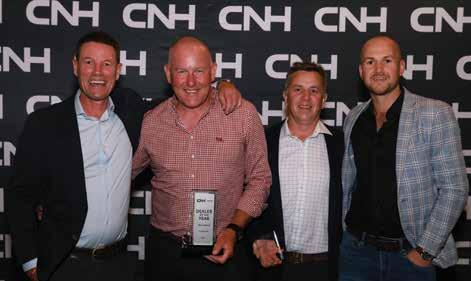
day, and that’s a core part of who we are.”
That balance between sales and service is often where dealer performance is won or lost, particularly in New Zealand conditions, where downtime carries real consequences and timing can define a season. The ability to support machines in the field, respond quickly and maintain long-term relationships remains as important as the machinery itself.
Carson also made it clear that the award was not seen as an internal achievement alone, but something shared with the customers who have supported the business over time.
“Our customers are very loyal and we appreciate that, too, so this award is for them as well.”
That sense of shared ownership is a recurring theme in successful dealerships, particularly those with a strong regional presence, where relationships are built over years rather than transactions.
Further south, Cochranes was recognised as CNH Capital Dealer of the Year for New Zealand, a category that reflects the growing importance of finance solutions in modern machinery purchasing. As equipment becomes more sophisticated and investment levels increase, access to flexible and reliable finance has become a key part of how farmers and contractors structure their businesses.
For Dealer Principal Chris West, the award comes after a period of significant development within the business and its relationship with CNH.
“It’s been a bit of a whirlwind ride with CNH over the last three to four years and it really all started with Capital,” West said.
That comment points to the way finance is now integrated into the broader machinery offering, rather than sitting alongside it. Dealers are increasingly required to understand not just the technical specification of a machine but how it fits within a customer’s financial framework, seasonal cashflow and long-term planning.
West was equally clear in acknowledging
the role of the wider CNH team in supporting that journey.
“I’d like to thank the CNH team, all of you guys are just legends and I appreciate all your help, so thanks very much for all that you do.”
It is a reminder that while awards are presented to individual dealerships, the outcomes are often the result of a wider network working together, from factory through to field support.
Taken together, the results highlight the strength of the New Zealand dealer network within the wider ANZ structure. While the Australian market often operates at a larger scale, New Zealand dealers continue to demonstrate a level of connection to their customers that remains a defining feature of the sector.
In practical terms, that connection shows up in how machinery is specified, how it is supported once it is delivered and how problems are solved when conditions are less than ideal. It is not always visible in a specification sheet, but it is often what determines whether a machine delivers on its potential.
Awards such as these tend to capture a moment in time, but they are usually built on years of consistent performance. In the case of Whyteline, that stretches back half a century, while for Cochranes it reflects a more recent period of change and development that is now starting to show results.
For CNH, recognising those businesses is part of maintaining a dealer network that can meet the evolving demands of modern agriculture. For the dealers themselves it is both a milestone and a marker of expectation, reinforcing the standards that have earned them recognition in the first place.
And for the farmers and contractors working with them, it is a reminder that behind every machine, there is still a team responsible for making sure it does the job when it matters most.
There is a point in every haymaking operation where the job shifts from production to logistics, and for many farmers and contractors, that is where the real pressure begins. Small square bales remain a valuable product, particularly for specialist markets, but handling them efficiently has always been the challenge. Labour is limited, time windows are tight and the physical process of collecting, stacking and transporting bales can quickly become the bottleneck in the system. It is in that space that machines like the Arcusin E14 bale packer, distributed in New Zealand by NC Equipment are changing the equation.
At its core the E14 is built around a simple objective, to eliminate manual bale handling. Rather than relying on crews to collect and stack bales by hand, the machine automates the entire process from pickup through to bundling and discharge. This E14 model is the first time it has been available in New Zealand and includes several major upgrades over the previous model. That shift is convenient, but it is also about fundamentally improving
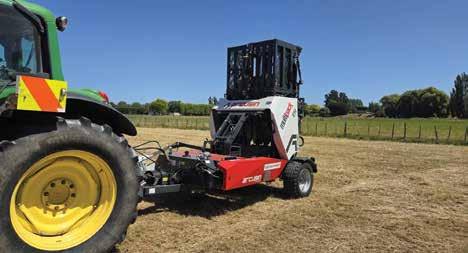
efficiency at a time when labour availability is one of the biggest constraints facing the sector.
The working cycle of the E14 reflects that focus. Bales are collected directly from the paddock using a pickup arm system that feeds them into the machine without the need for alignment or adjustment. From there, they are transferred into a compression chamber where 10,12 or 14 bales are grouped together and tied into a single, compact pack. The process is continuous and fully automated, allowing operators to work through a paddock
Automated bale packing systems reduce labour demand and streamline small square bale handling.
without stopping or leaving the tractor cab. One of the key upgrades on the new model is the X5 knotter system, which adds an additional knotter to ensure better fixation of the bundle and utilises four strings around an 80–90 cm length bale. The machine also features a redesigned bale pusher with increased bale contact, specifically developed to provide better control of bales
Uniform bale packs improve transport, storage efficiency and overall workflow in the paddock.
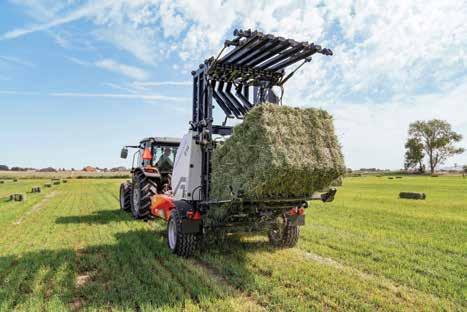
entering the chamber while applying greater compression during the packing process.
That ability to stay in the seat is more significant than it might first appear. In traditional systems, bale handling often involves multiple machines and operators, with repeated loading, stacking and transport steps. By consolidating those tasks into a single pass, the E14 reduces labour requirements while also streamlining workflow. For many operations, particularly those running with limited staff, that alone is enough to justify the move towards mechanised bale handling.
Output is another key part of the equation. With the capacity to process up to around 850 bales per hour, the E14 is well aligned with the pace of modern baling operations. It is designed to keep up with the balers, ensuring that collection does not fall behind production. In practical terms, that means paddocks can be cleared more quickly, reducing exposure to weather risk and improving overall efficiency across the harvest window.
The format of the finished product also plays a critical role. By packaging bales into uniform bundles, the machine simplifies every stage that follows. Transport becomes more efficient, with more bales per load and fewer individual units to handle. Storage is improved, with compact, stable packs that
make better use of shed space. Handling at the end user level is also easier, particularly where bale grabs or specialised handlers are used.
Importantly, the E14 has been designed with flexibility in mind. It can handle a range of bale sizes, typically from 80 to 120 cm in length and can produce packs of varying sizes depending on requirements. That adaptability is important in a New Zealand context where bale size and density can vary depending on crop type, baler setup and intended market. Whether dealing with hay, straw or balage, the machine is able to integrate into different systems without requiring major changes to existing operations.
Compaction is another area where the E14 stands out. The adjustable compression chamber can now be adjusted from 87–100 cm in width using a new clamp system, giving operators greater control over bundle density and allowing them to choose the level of compaction required. This flexibility helps balance density with the need for airflow. This is particularly relevant when working with higher moisture crops, where the ability for bales to ‘breathe’ within the pack helps reduce the risk of spoilage. It is a small detail, but one that reflects a clear understanding of the practical realities of forage handling. The machine also features a touch screen
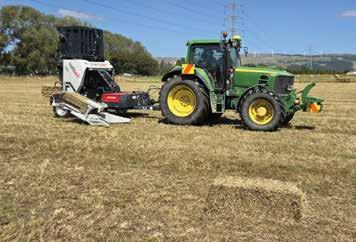
Single-pass bale collection and packing is streamlining workflow across haymaking operations.
control system that allows operators to control and monitor the machine directly from the cab. Real-time information and alerts are displayed through the system, including troubleshooting assistance, while all operational data generated by the machine is recorded.
From a machinery perspective, the E14 is relatively accessible. With a tractor requirement of around 80 hp, it can be operated with equipment already present on many farms, rather than requiring a dedicated high-horsepower unit. That lowers the barrier to entry and makes it a viable option for a wider range of operations, from individual farmers through to contracting businesses.
The design also reflects a focus on simplicity and reliability. Mechanical systems are straightforward, and the machine’s automated functions are controlled through a user-friendly interface in the cab. This reduces operator fatigue and ensures consistent performance, even over long working days. In a high-pressure environment like haymaking, where downtime carries a direct cost, that reliability is critical.
There is also a broader shift at play here. As farm systems become more efficient and more specialised, every part of the process is being examined for gains. Bale handling, once seen as a labour-intensive but unavoidable task, is increasingly being mechanised and optimised. Machines like the E14 are part of that progression, not by reinventing the system entirely but by refining one of its most time-consuming elements.
For contractors, the benefits are particularly clear. The ability to offer a complete service, from baling through to packaged, transportready bundles, adds value for clients while improving productivity on the ground. For farmers, the equation is similar. Reduced labour, faster paddock clearance and improved storage all contribute to a more efficient operation.
Ultimately, the Arcusin E14 is not about headline horsepower or complex technology. It is about doing a specific job well and removing one of the key pressure points in the haymaking process. By automating bale collection and packaging, it allows operators to focus on timing and quality, rather than the physical task of handling bales.
High-capacity bale packers keep pace with modern baling operations during tight harvest windows.
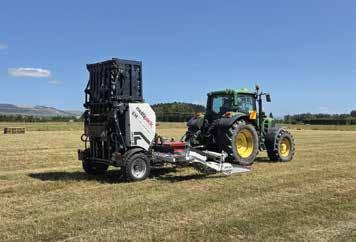



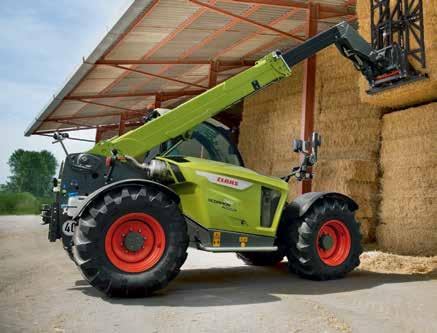
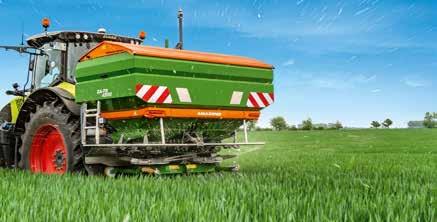
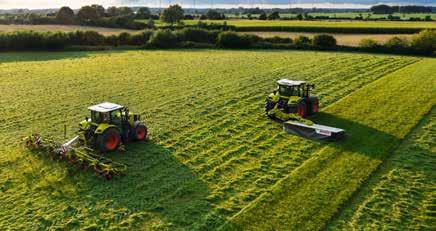
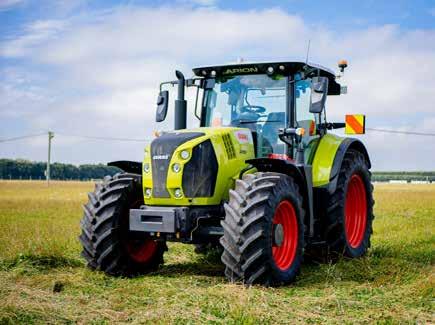
For South Canterbury farmer Peter Collins, the loss of two consecutive wheel loader transmissions in a short period of time stalled an operation that relies on daily movement and accuracy.
Dalmore Farms is a third-generation business run by father Peter, sons Hamish and Brent, and grandson Jonty. They operate 1,700 ha, which, at its peak, milks 1,400 cows, alongside a further 2,000 dry-stock. The operation averages 100 tonnes of feed per day across the farm, so without the ability to load mixer wagons and silage equipment, things can quickly become difficult.
Dalmore produces 200 ha of lucerne, 300 ha of grass silage and 220 ha of maize annually to feed livestock on their farms. They operate an extensive range of Claas greenline and harvest equipment, as well as Amazone spray and fertilising equipment. When they couldn’t operate at their usual speed and capacity, they called the local Claas Harvest Centre, who stepped in with a demonstrator Claas Torion 1913 to keep them running. When the demonstration unit followed later that day, it was immediately apparent on the farm that the Torion was an industrial wheel loader, built for farm work.
“I am very pleased that they introduced the Torion to us; they found a bloody goodie in this,” Peter says.
Right away, they noticed the difference in its engine and transmission. The Claas Torion 1913 is powered by a 7.0 L Liebherr D934 4-cylinder engine producing around 163 kW (222 hp) with high torque
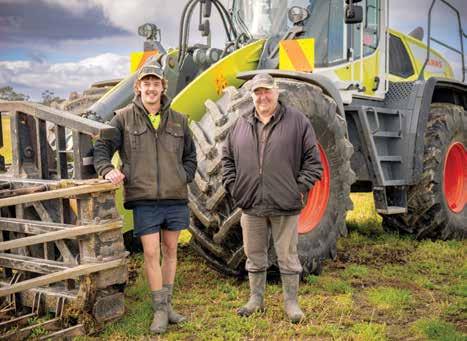
at low engine speed. Pair that with the Cmatic continuously variable split-power transmission, and it performed so smoothly, with gearless drive and a powerful delivery.
“What really stood out was its smoothness,” said Peter. “There was no gear shifting, no lag, soft or no braking, just a constant, steady drive. The transmission seems to put the power to the ground properly, rather than revving its head off trying to get there. You can feel it when you hit the face of a stack; it just holds on and pushes.
“When you spend long days in a loader, you get a pretty quick feel for what works and what doesn’t. With Cmatic transmission,
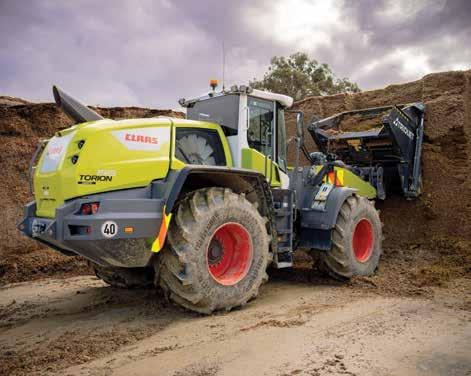
For Dalmore Farms, the move to two Torion 1913 loaders ensures reliable, high-capacity handling across separate operations with minimal downtime.
it’s not something you necessarily think about when you first climb in, but it doesn’t take long to notice the difference, especially once you’re into repetitive work like silage or feed-out.”
Peter immediately purchased the demonstrator unit to utilise whilst he worked with Product Business Manager Shane Barrett on the purchase of two custom Claas Torion 1913s.
“We extended the booms to get better reach for loading our wagons, got joystick steering and big wheels for moving between the properties and paddocks,” said Peter.
“We have always had two wheel loaders, as we have two separate operations that both require the same thing in two different locations, so purchasing two new ones was a no-brainer.”
Fuel use is another area where it quietly proves its worth.
“I can confidently say that we are using about half as much fuel as we used to. That’s because we are not braking or revving, and we can use the cameras and mirrors to shorten our loading circumference and save double travel on the pit.”
Around the yard, the Torion is easy to handle. Whether you’re lining up to load a truck, working in a shed, or manoeuvring
With its smooth Cmatic transmission and strong low-rev torque, the Torion 1913 provides consistent performance across demanding daily loader work.
in tight spaces, the control is precise and predictable. Changing over implements is electric and changing the speed between implements increases the speed and ease of operation. The farm operators all love the joystick drive, because it’s just intuitive.
“You point it this way, and it goes this way. You can operate the Torion without using the steering wheel, unless of course you are on conditions where you need a hand on the wheel.
“Probably the biggest thing, though, is how it feels at the end of a long day. Less jolting, less thinking about what gear you should be in, a comfortable driving cab, more visibility through the cameras and mirrors, and a machine that responds the same way every time – that all adds up to less fatigue. Anyone who’s done a big silage season or long feeding runs knows that counts for a lot.
“We have fourteen other team members, and if you have different drivers operating, you want it to be simple – to just get in and go on either machine.
“That’s what we have, no messing around readjusting things. The automatic greasing is also another bonus; it’s less maintenance time for us and a guarantee that no one has forgotten to do these tasks,” he says. At the end of the day, the 1913 isn’t just your average wheel loader.
“As a farmer, I’ll be telling others in my community to get in there and try it out. It’s not until you have given it a go that you’ll
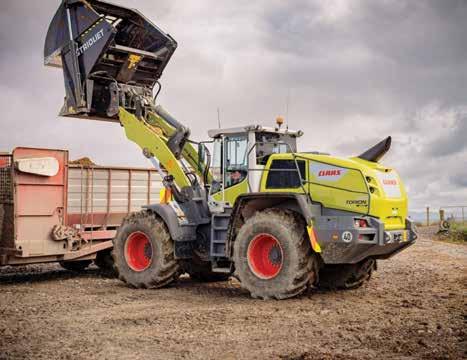
really see the difference.
“We have finally bought a decent wheel loader that is industrial spec’ed for farm use. It’s what makes the machine work the way it does. Smooth, efficient and strong where it needs to be. It’s the kind of setup that suits the pace and pressure of real on-farm work.”
The Claas Torion 1913 is a high-capacity, fuel-efficient wheel loader combining strong low-rev torque, smooth Cmatic continuously variable drive and fast hydraulic performance to deliver powerful,
that can actually weather the weather. We got you.
precise and productive material handling in demanding farm applications.
For Dalmore Farms, it’s the piece of machinery that they cannot live without. The Claas Torion wheel loader is used every day, whatever the season or weather.
Improved fuel efficiency and reduced operator fatigue have made the Torion 1913 a standout upgrade for a busy multi-operator farming system. The right kit keeps you moving. So see us for a range to cover you top to toe in durable, reliable clothing and footwear made for Kiwi conditions.
A new high among leading brands in the agricultural machinery sector
Amazone achieved a strong result in the latest DLG Image Barometer 2025/2026, moving, for the first time, up to second place. The rise underlines the brand’s high level of acceptance and its increasingly strong foothold in agricultural circles. For many years, Amazone has been recognised in this prestigious survey as one of the most successful manufacturers in the field of agricultural machinery. As a family-owned company, they place great importance on long-term developments and on thinking about what is needed from agricultural machinery and developing this in partnership with farmers and contractors of all sizes. In doing so, they strive to always provide modern and future-oriented solutions that can be used cost-effectively and reliably across a variety of farm sizes. A consistent approach to innovation in machinery concepts and digital solutions is a key component of their corporate philosophy and is supported by practical research and the systematic testing of new methods.
This result is more than a brand milestone – it’s a positive signal
for farmers and contractors across Australia and New Zealand.
Climbing to second place in the DLG-Image Barometer reflects strong global confidence in Amazone and that confidence matters locally. For Australasian agriculture, where margins are tight and conditions are often unpredictable, backing proven, trusted machinery is critical. A high ranking like this reinforces that Amazone equipment is not only innovative, but also dependable in real-world farming systems.
Importantly, Amazone’s focus on efficiency and cost-effective operation aligns directly with the needs of farmers in both countries. Whether it’s broadacre cropping in Australia or mixed farming systems in New Zealand, reducing input costs – particularly fuel, labour and time – is essential. Machinery designed with precision application and fuel efficiency in mind helps farmers do more with less, improving profitability without compromising output.
The emphasis on practical research and farmer-led development is another key benefit. Agriculture in Australia and New Zealand is highly diverse, and solutions must work across varying soil types, climates and scales. Amazone’s approach of developing
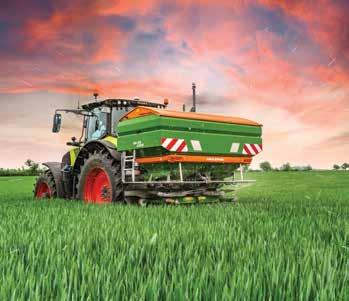
equipment in partnership with farmers ensures innovations are not just theoretical, but genuinely applicable in the paddock.
Sustainability is also a growing priority across both regions. With increasing pressure around environmental stewardship, nutrient management and emissions, machinery that enables more precise application and reduced waste plays a crucial role. Recognition in the DLG-Image Barometer highlights Amazone’s progress in delivering solutions that support more sustainable farming practices. Finally, this achievement signals continued investment
Amazone’s rise to second place highlights strong global confidence in its machinery and technology.
in innovation. For local farmers, that means access to evolving technology – from smarter digital systems to more efficient implements – that can help future-proof their operations. In short, Amazone’s rise isn’t just good news for the company – it’s a strong indicator that farmers in Australia and New Zealand can continue to rely on high-performing, efficient and forward-thinking machinery to meet the challenges ahead.
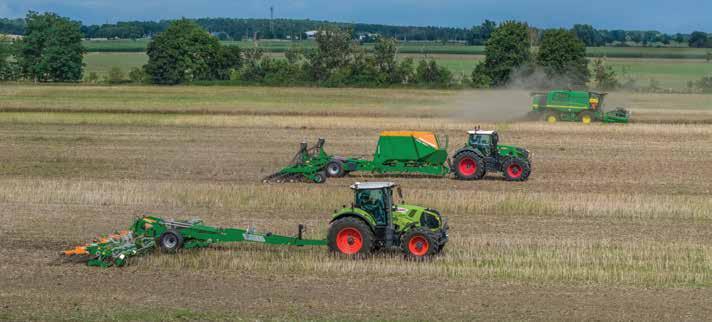
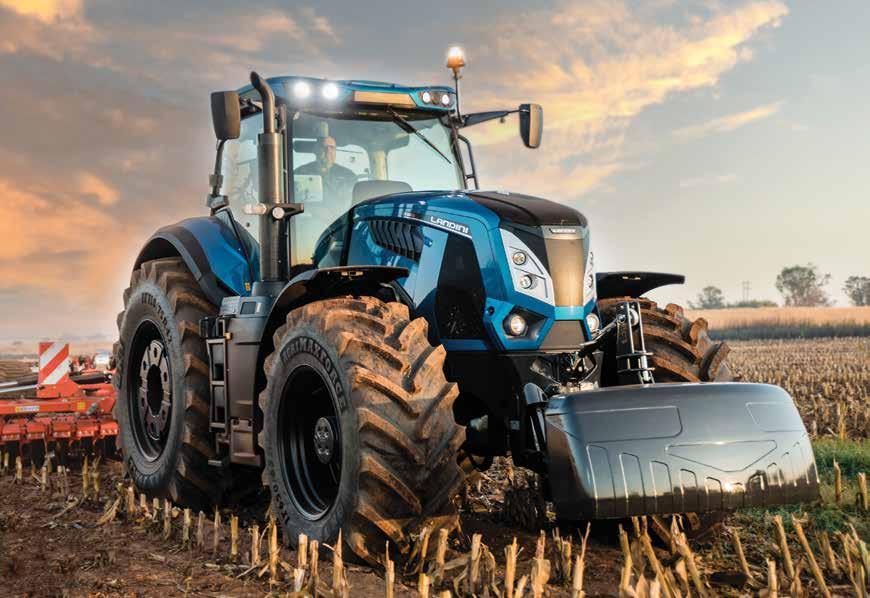
There is a point in every haymaking season where output becomes everything. Weather windows tighten, labour becomes stretched and the margin between a good result and a compromised crop narrows quickly. It is in that environment that machinery has to do more than simply work, it has to lift productivity without adding complexity. That is the thinking behind the introduction of the Massey Ferguson MF SB.1436DB double small square baler into the New Zealand market, a machine that is clearly aimed at commercial operators looking to increase output while maintaining bale quality.
At the centre of the SB.1436DB is a simple but significant shift in how small square baling is approached. Rather than producing a single row of bales per pass, the machine delivers two, effectively doubling output compared to a conventional 14 by 18 inch baler. That change alone has direct implications for labour, fuel use and overall efficiency, particularly in larger scale operations, where time in the paddock is critical.
As Josh Vroombout, Senior Marketing Manager for Massey Ferguson Australia and New Zealand, explains, the machine has been developed with those pressures in mind. “The SB.1436DB is built to meet the needs of modern hay producers who face increasing pressure from labour shortages, tight harvest windows and demanding quality standards,” he said. “With its heavyduty design and groundbreaking technology, this baler helps operators achieve better efficiency and superior results, reducing
High-capacity pickup and increased twine storage support longer working periods with fewer interruptions in the paddock.
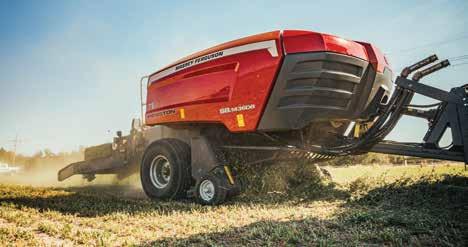
costs while increasing profitability.”
That focus on output is supported by the machine’s physical design. A 2.1 m wide pick up when measured tine to tine, one of the widest in the high-capacity small square baler category, allows for greater intake of crop and more efficient movement through the machine. In practical terms, that reduces the number of passes required across a paddock and ensures the baler can keep up with high-volume windrows without bottlenecking.
However, capacity on its own is not enough. In a market where small square bales are often destined for premium uses, consistency is just as important as output. The SB.1436DB addresses this through a single chamber design that produces a 14 by 36 inch flake, which is then split into two uniform 14 by 18 inch bales. This process is supported by a common density system, ensuring both bales receive the same level of compression.
The result is a product that is consistent in weight, shape and density, regardless of variations in the windrow. Independent knotter trips on either side of the chamber allow each bale to be tied to a preset length, maintaining uniformity even when crop
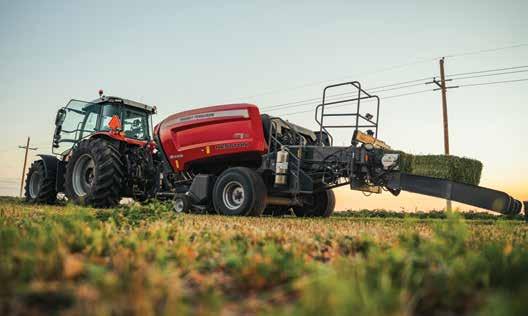
Advanced automation systems help maintain consistent bale weight and density across varying crop conditions.
conditions change. For operators supplying demanding markets, that level of consistency is not just beneficial, it is essential. Technology plays a key role in delivering that outcome. The SimplEbale system is central to the SB.1436DB’s operation, providing automated control over key baling functions. From the cab, operators can monitor flake thickness, flake count, bale length and bale weight in real time. It is a level of visibility that allows for immediate adjustment and ensures the machine is operating at optimum performance.
More importantly, the system removes a level of operator variability that has traditionally impacted productivity.
Vroombout highlights the impact of small inconsistencies, noting that “with a target of 18.1 kilograms and 12 flakes per two-tie bale an operator can lose seventy-one bales per hour and 1,300 kilograms per hour of productivity by just averaging two extra flakes per bale. This can cost over eight hours of additional baling time.” By automating these settings, SimplEbale ensures that output remains consistent, regardless of operator experience.
Performance is further supported by the machine’s operating speed. Running at 90 strokes per minute with a 556 mm stroke length, the SB.1436DB is designed to maintain high throughput without compromising bale integrity. That level of output requires a suitable power unit, with the baler needing a minimum of 120 PTO horsepower and a tractor weight of at least 5,000 kg. This places it firmly in the commercial category, aligned with larger operations and contractors.
Uptime is another area where the SB.1436DB has been engineered with
practical use in mind. Increased twine capacity allows for up to 8,000 bales before refilling, effectively doubling the capacity of comparable machines. In a high-pressure harvest window, reducing the frequency of stops can make a significant difference to daily output.
The inclusion of automated knotter lubrication further reduces maintenance requirements, ensuring consistent performance while minimising manual intervention. Combined with service-friendly access to key components, the machine is designed to keep operators in the field for longer periods, reducing downtime and improving overall efficiency.
Handling and logistics have also been considered in the design. By dropping completed bales into two separate rows, the SB.1436DB simplifies collection and transport. This may seem like a minor detail but, in practice, it improves workflow, particularly when using bale wagons or loaders and reduces the time required to clear paddocks.
From a New Zealand perspective, the introduction of the SB.1436DB aligns with broader changes in the hay and forage sector. As operations scale up and labour becomes more constrained, the focus is increasingly on machines that can deliver more output with fewer inputs. The ability to double production per pass directly addresses that challenge, while the emphasis on consistency ensures that quality is not sacrificed in the process.
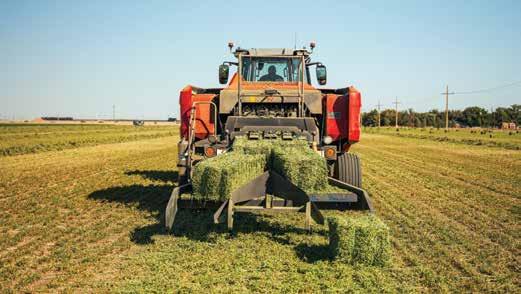
The double small square baler design delivers two bales per pass, significantly increasing output in tight harvest windows.
The machine’s recognition as a 2026 AE50 Award winner by the American Society of Agricultural and Biological Engineers reinforces its position as a significant development in baling technology. It reflects not just incremental improvement, but a step change in how small square baling can be approached.
There is also a legacy aspect to consider. Massey Ferguson has been involved in hay equipment for more than 75 years, with a history of introducing machines that have shaped the industry. The SB.1436DB sits within that lineage, building on established principles while introducing new technology to meet current demands.
As Vroombout puts it, “The SB.1436DB is not just another baler, it is a testament to Massey Ferguson’s commitment to innovation and to the producers who depend
on our equipment to succeed. With this baler we are delivering the tools needed to achieve better productivity, better quality and better profitability.”
For contractors and large-scale hay producers in New Zealand, those outcomes are what matter. Machinery is judged not on specification alone but on its ability to deliver results in a narrow window of time, often under pressure and in variable conditions. The SB.1436DB has been designed with that reality in mind.
It is a machine that recognises where the pressure points are in modern haymaking and addresses them directly through increased capacity, automated control and a clear focus on consistency. In doing so it offers a different approach to small square baling, one that reflects the scale and demands of the systems it is designed to serve.


There is a point in every livestock system where feeding becomes the single biggest driver of both performance and cost, and it is in that space that mixer wagons have moved from being a convenience to becoming a core piece of infrastructure. Across New Zealand’s dairy, beef and mixed farming systems, the shift towards more controlled feeding through total mixed rations has placed a premium on machines that can deliver consistency, efficiency and reliability every day of the season. The Seko and Kongskilde mixer wagon range, distributed by NC Equipment, sits firmly in that space, but, importantly, it does so through two distinct mixing approaches that reflect the different ways modern farms operate.
At a high level, both systems are working towards the same outcome, a consistent, well-balanced ration delivered efficiently and with minimal waste. Where they differ is in how that ration is created, and that difference matters when it comes to matching a machine to a farming system.
Kongskilde’s vertical mixer wagons are built around the vertical auger concept, a system that has become widely adopted where bale-based feeding remains a core part of the operation. The vertical auger lifts and folds material through the chamber, creating a rolling mixing action that is effective without being overly aggressive. This allows the machine to process whole bales, breaking them down while maintaining fibre length and structure within the ration.
That balance is critical in ruminant systems where effective fibre plays a direct role in
rumen health and animal performance. By preserving that structure while still achieving a homogeneous mix, vertical systems are well suited to operations relying heavily on silage, hay and straw as the foundation of the diet. The ability to load whole bales directly into the wagon also simplifies the feeding process, reducing the need for pre-processing and keeping labour requirements down.
In contrast, the Seko range uses a horizontal mixing system, with augers and cutting knives moving feed laterally through the chamber. This creates a controlled cutting and blending action that enables the machine to break down a wide range of feed materials, including whole bales, while producing a consistent, well-integrated ration. The horizontal design is particularly effective at rapidly combining multiple ingredients into a uniform mix, making it well suited to systems where processing efficiency, consistency and blend quality are the priority.
That distinction becomes increasingly relevant in higher input systems where precision feeding is a priority. With greater control over ingredient size and mix consistency, horizontal mixers allow operators to fine-tune rations to meet specific production targets. Faster mixing times also support higher throughput, which can be an advantage in larger operations where feeding efficiency is closely tied to labour availability and time management.
Neither system is inherently better than the other. The decision comes down to how the farm operates. Bale-heavy systems with a focus on fibre and minimal pre-processing will often lean towards vertical mixers, while operations working with chopped silage, concentrates and more complex rations may find a better fit with horizontal technology. In many cases, the choice reflects not just feed type, but the overall feeding strategy and how tightly that process is managed.
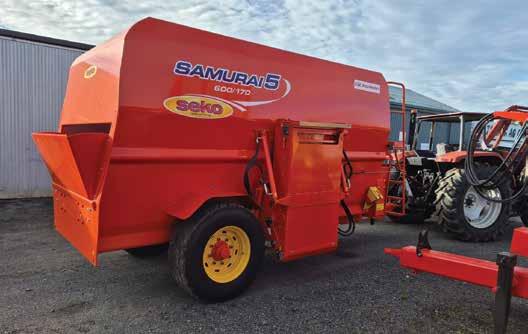
Across both ranges, capacity and scalability remain central considerations. Mixer wagons are available in a variety of sizes, allowing farmers and contractors to match machine capacity to herd size and daily feed requirements. That flexibility is important in a New Zealand context where farm systems vary widely, from smaller owner-operated units through to large-scale, high-output enterprises.
Efficiency in the feeding cycle is another common thread. Regardless of mixing system, the ability to load, mix and distribute feed quickly and consistently has a direct impact on daily operations. Reducing the time spent feeding not only lowers labour demand but also frees up resources for other tasks, something that is becoming increasingly important as labour constraints continue to tighten across the sector.
Accuracy also plays a key role. Consistent ration delivery reduces selective feeding, improves intake and supports more stable production. Over time, that consistency contributes to better feed utilisation and improved cost control, outcomes that carry real weight in an environment where margins are under constant pressure.
Durability and reliability underpin all of this. Mixer wagons operate in a demanding environment, handling heavy loads and abrasive materials on a daily basis. Both Seko and Kongskilde machines are built with that reality in mind, focusing on robust construction and practical design that keeps machines working through the busiest periods of the season. In feeding systems where there is little room for downtime, that reliability is critical.
There is also a broader shift taking place in how feeding is viewed within the overall farm system. It is no longer just about delivering feed, but about delivering it in a controlled, repeatable way that supports both animal performance and operational efficiency. Mixer wagons are central to that shift, acting as the link between feed supply and feed utilisation.
For contractors, the role is similar. The ability to offer efficient, consistent feed preparation as part of a wider service adds value for clients while improving productivity on the ground. As farm systems continue to evolve, that level of integration is becoming more important.
Ultimately, the Seko and Kongskilde mixer wagon range reflects the diversity of modern farming rather than trying to force a single solution. By offering both horizontal and vertical mixing technologies, it allows farmers and contractors to choose a system that aligns with how they work, not the other way around.
Modern mixer wagons are helping farmers improve feeding consistency, reduce waste and streamline daily livestock operations across a wide range of farming systems.
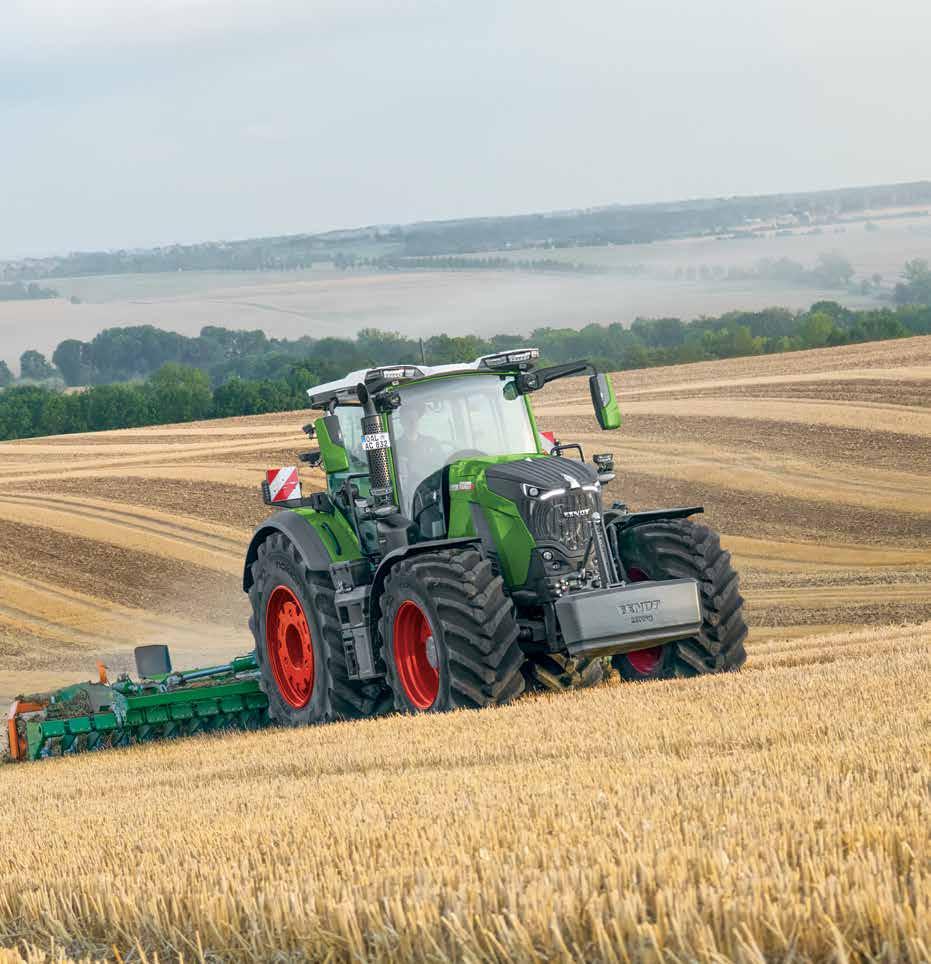
The new Fendt 800 Vario makes work a pleasure.
Redesigned from the ground up, the Fendt 800 Vario Gen5 blends innovation and passion in every detail. With immense operational strength, maximum efficiency, impressive payload capacity, and new 360º lighting, it delivers the performance you need — day in, day out.
Contact your local dealer and find out more today.
See the all new Fendt 800 Gen5 at National Fieldays on sites H10 & H16 and ask the Fendt team about the new VarioDrive transmission – taking Fendt efficiency comfort and performance to the next level.
• VarioDrive transmission
• New AGCO Core80 engine
• Fendt ID engine
• Dynamic performance across all models
• Central tyre inflation
• Reverse fan
• All new 360º degree lighting system
NZ Rural Contractor is available free of charge to readers who qualify under the publisher’s criteria and who supply proof of occupation (printed letterhead, business card, invoice etc) and to others via subscription and payment of the $68.00 inc GST annual NZ Subscription. Australian Subscription $130, Rest of World $270.
If you are not a registered reader, but would like to receive a regular bi-monthly copy, fill in the details of your contracting or farming business below.
LARGE SCALE FARMER
Subscription criteria for owners/sharefarmers:
Dairy milk over 600 cows Sheep & Beef 12,000+ stock units
Main contracting services offered:
Equipment operated


There is no getting away from the fact that the current operating environment is a tough one. Costs remain high, margins are tight and both farmers and contractors are taking a more considered approach to capital investment. Against that backdrop, any machinery brand gaining traction is doing so for a reason, and in the case of Merlo in the North Island, that momentum is being driven by a new partnership that is already starting to find its feet.
Total farm Ha.: No. of sheep: No. of dairy cows: No. of beef cattle: Area in arable crop:
Make, Year, Model
To subscribe to NZ Rural Contractor & Large Scale farmer, please complete the credit card form below: $68.00 (NZ), $130 (Australia), $270 (Rest of World).
Name:
Company:
Address:
Email:
Rapid No.
Phone:
Post Code:
Please sign here if you wish to receive a regular copy of this publication and send the form to AgriMedia Ltd, P.O. Box 37151, Halswell, Christchurch 8245. Freepost No. 114059.
Sign: Date:
Cropping over 250 ha in arable PAYMENT:
Credit Card: Mastercard Visa
Card Number:
Name on Card:
Expiry Date: / CSC:
Signature:
If you have moved, please write clearly your name and new address above and your old address (including post code) below.
Name:
Company:
Address:
Email: Rapid No.
Phone: Post Code:
Ag and Civil Machinery Direct Ltd stepped into the role of Merlo dealer for the North Island in September 2025, marking a significant move for both the business and the brand. While still relatively early days, the foundations have been laid quickly, with a full-service operation now in place, a trained team on the ground and the parts and support structure
A focus on service and local support is helping build confidence in a competitive North Island market.
required to back up the product in real-world conditions.
For a dealership, that early period is often the most critical. It is where reputation is either built or lost, and in a market like New Zealand, where word travels quickly, there is little margin for error. Ag and Civil has approached that challenge with a clear focus on service, ensuring that the transition into a Merlo franchise has been supported by the right people, the right systems and a commitment to being present when it matters.
The business itself is well
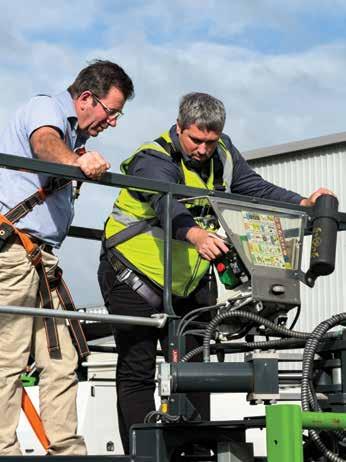
established, with a growing footprint across the North Island and a reputation built on supplying machinery into both the agricultural and civil sectors. That crossover is important. It reflects the way many contracting businesses now operate, moving between farming, construction and infrastructure work depending on the season and the opportunities available. Having a dealer that understands both sides of that equation adds real value.
The decision to partner with Merlo sits comfortably within that space. Telehandlers have become an essential tool across a wide range of operations, from feeding out on large-scale livestock units through to handling materials on construction sites. What sets Merlo apart is its focus on building machines that combine lifting performance with compact design, visibility and operator comfort without compromising on durability.
For Ag and Civil, the alignment comes down to more than just product. There is a shared emphasis on quality and on delivering machines that are fit for purpose in demanding conditions. Merlo’s engineering approach, particularly around weight distribution, boom design and integrated systems, complements a customer base that is increasingly focused on efficiency and long-term reliability rather than short-term cost savings.
That alignment is being reflected in how the market is responding. Since taking on the franchise, Ag and Civil has seen strong interest across both agriculture and, perhaps more notably, the civil and construction sector. While telehandlers have long been a familiar sight on farms, their role in construction continues to expand and that is where much of the recent growth has been. Contractors are looking for machines that can do more than one job, that can move quickly between tasks and that can operate in tighter spaces without sacrificing lift capacity. Versatility is a recurring theme, and it is one of the key factors driving interest in the Merlo
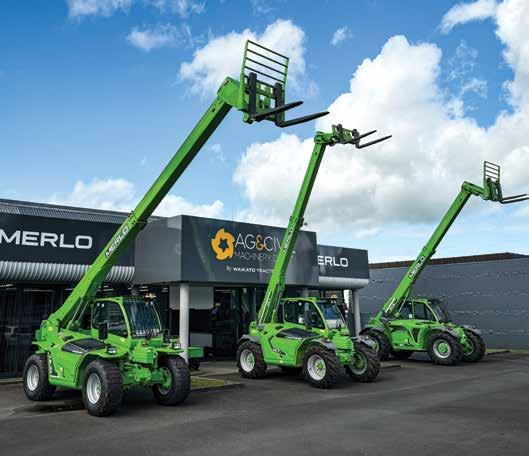
range. Reliability sits alongside that. In a market where downtime carries a direct cost, machines need to perform day in, day out, often in challenging conditions.
All of this is happening at a time when investment decisions are under more scrutiny than they have been for some time. The economic climate is forcing buyers to look closely at return on investment, at total cost of ownership and at how a piece of machinery will contribute to the overall efficiency of their operation. In that context, steady sales are a positive signal.
Rather than a surge driven by sentiment, what Ag and Civil is seeing is measured demand, underpinned by practical considerations. Customers are investing where they can see a clear benefit, whether that is through labour savings, increased productivity or the ability to take on additional work. Telehandlers, particularly those that can operate across multiple roles, fit well into that thinking.
Feedback from customers has reinforced that point. While still early in the partnership, there are already examples of machines being put to work across mixed operations, where
the same unit might be handling feed one day and shifting materials on a job site the next. That flexibility is where the real value lies, and it is something that is increasingly influencing purchasing decisions.
Behind the machines, the importance of support cannot be overstated. Ag and Civil has made a point of ensuring that its after-sales capability matches the quality of the product it is supplying. A fully trained service team, backed by the necessary parts inventory, is central to that. When a machine goes down, the response time matters, and having local expertise on hand makes a tangible difference.
That support is further strengthened by the backing of Merlo Australasia, providing an additional layer of technical and logistical support. For customers, that combination of local service and regional backing creates confidence, particularly when investing in a relatively new dealership relationship.
It is this focus on service and on understanding the practical realities of its customers that helps set Ag and Civil apart. The business is not operating in isolation, it is embedded
Multi-purpose machinery continues to gain traction as contractors look to maximise productivity and return on investment.
within the industries it serves and that connection informs how it approaches both sales and support. Knowing what a contractor needs in the middle of a busy season, or what a farmer expects during a tight feeding window, shapes the way the business operates.
Fieldays will provide the next opportunity to see that approach in action. Ag and Civil will be exhibiting with Merlo at Sites F27 and F29, giving customers the chance to get up close with the machines and to have direct conversations with the team behind them. For many, that hands-on experience remains a key part of the decision-making process. Looking ahead, the market is not without its challenges, but the early momentum suggests that the Merlo partnership is well placed to continue growing. With the right support structures now in place and a product range that is resonating with customers, the focus shifts to building on that foundation.
Manitou Group, a world reference in the handling, aerial work platform and earthmoving sector, announces the launch of the new MLT-X 738 telehandler. Designed specifically to meet the demanding needs of modern agricultural applications, this machine combines enhanced performance, superior comfort and increased profitability for farmers and agricultural contractors across Australia and New Zealand.
The MLT-X 738 represents a significant evolution in Manitou’s highly successful MLT NewAg product line. Built for demanding applications and rugged environments, the new MLT-X 738 boasts a maximum lift height of 6.91 m and an increased maximum capacity of 3,800 kg (up from 3.7 tonnes in previous iterations).
“As the main component of our telehandlers, we have reworked the design of our boom to bring farmers even greater performance,” explains Camille Rouvrais, Global Product
The new MLT-X 738 delivers increased lift capacity and reach, tailored for demanding agricultural handling tasks.
Manager at Manitou Group. The MLT-X 738 features a robust Atlas-type octagonal boom where all sensitive components, such as hoses and cylinders, are securely protected inside the structure. This ensures a limited risk of damage and downtime.
Recognising the long hours operators spend in the cab, particularly in the extreme heat and dusty environments often found in Australia and New Zealand, Manitou has heavily prioritised operator comfort and ergonomics.
• Advanced Climate Control:
The MLT-X 738 features a new and improved automatic air conditioning system with a 12-speed fan that delivers a high airflow capacity of 500 m3/h (compared to the previous 200 m3/h). Coupled with a new removable filter framework, it provides better cooling performance, superior protection and easier cleaning in very dusty environments.
• Ergonomic Cabin: Operators will benefit from a user-friendly standard floating armrest that follows seat movements and incorporates the JSM (Joystick Switch and Move).
• Enhanced Visibility & Safety:
Standard LED work lights (four on the cab) provide exceptional illumination while consuming less energy. For road travel, complete road lights and an LED rotating beacon ensure the machine can safely move around while being seen.
• Smart Counting System: A new integrated 7-inch digital screen offers a Smart Counting System. This feature allows the operator to manually or automatically count the number of filled or emptied buckets. Operators can define a target and receive an on-screen alert when reached, making it an invaluable, time-saving tool for accurately measuring feed mixer or trailer filling.
To tackle rough agricultural terrains, the MLT-X 738 is equipped with four larger, longer ‘moving’ mudguards that offer adjustable lateral positioning. This redesign thoroughly protects the machine against flying sludge and debris. Additionally, a standard compensation cylinder insulation system reduces unnecessary pressure and effort on the boom and chassis, further extending the machine’s lifespan. Maintenance is also
simplified with a lightweight, easily removable rear hood that requires no tools, perfect for regularly cleaning out dust and straw.
To drive down the total cost of ownership, the MLT-X 738 comes standard with a new Stop & Start system. “This innovation automatically shuts off the engine and associated hour counter when the machine is idling … according to a configurable timer from one to thirty minutes,” notes Rouvrais. If the operator interacts with the JSM joystick or accelerator pedal, the engine automatically and rapidly restarts without needing to turn the key. This significantly reduces daily fuel consumption, decreases preventive maintenance, limits air pollution and increases the residual value of the machine.
An automatic parking brake with both automatic and manual modes is also included as a simple and safe standard solution. For customers who already utilise mixed fleets, the machine can optionally be fitted with a carriage for JCB attachments.
The MLT-X 738 is ideally suited for livestock farms, offering peak efficiency for forage distribution, bulk loading and unloading, bale and pallet handling.
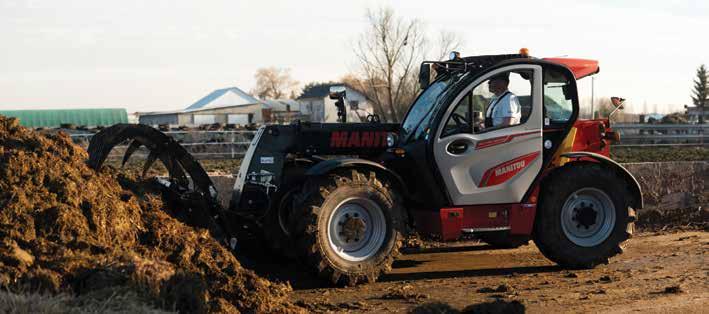
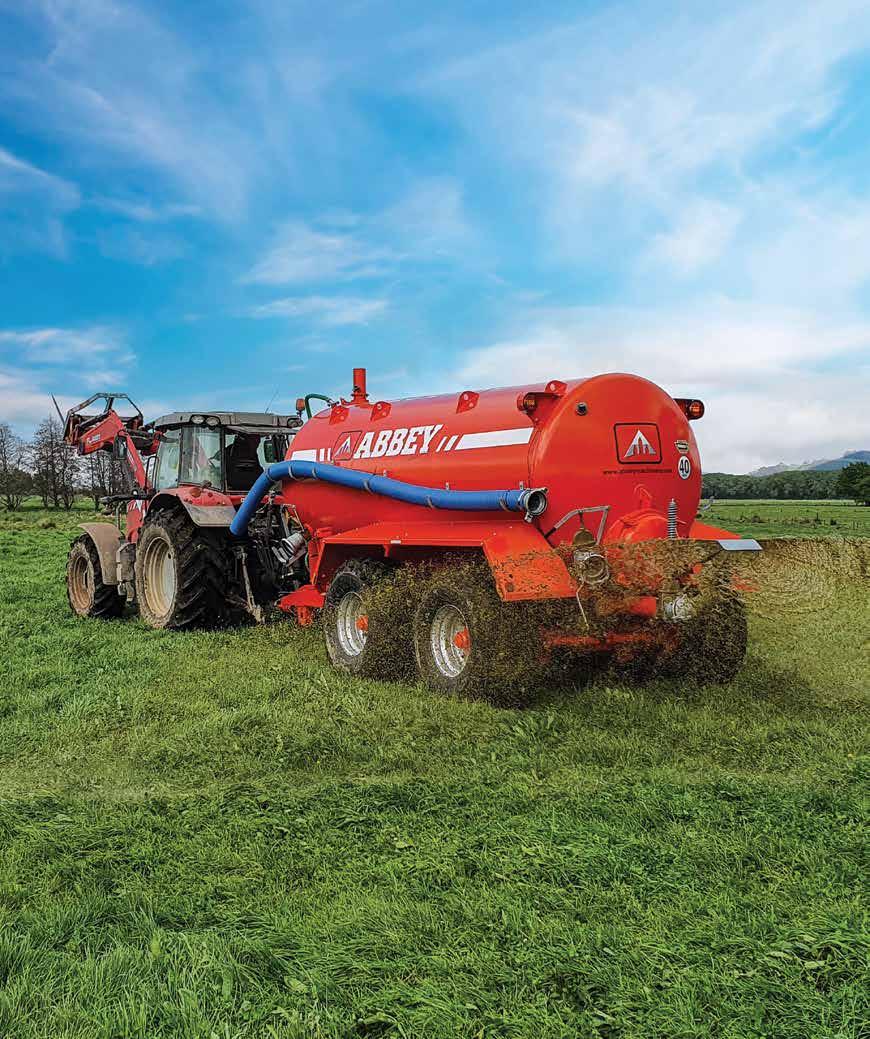
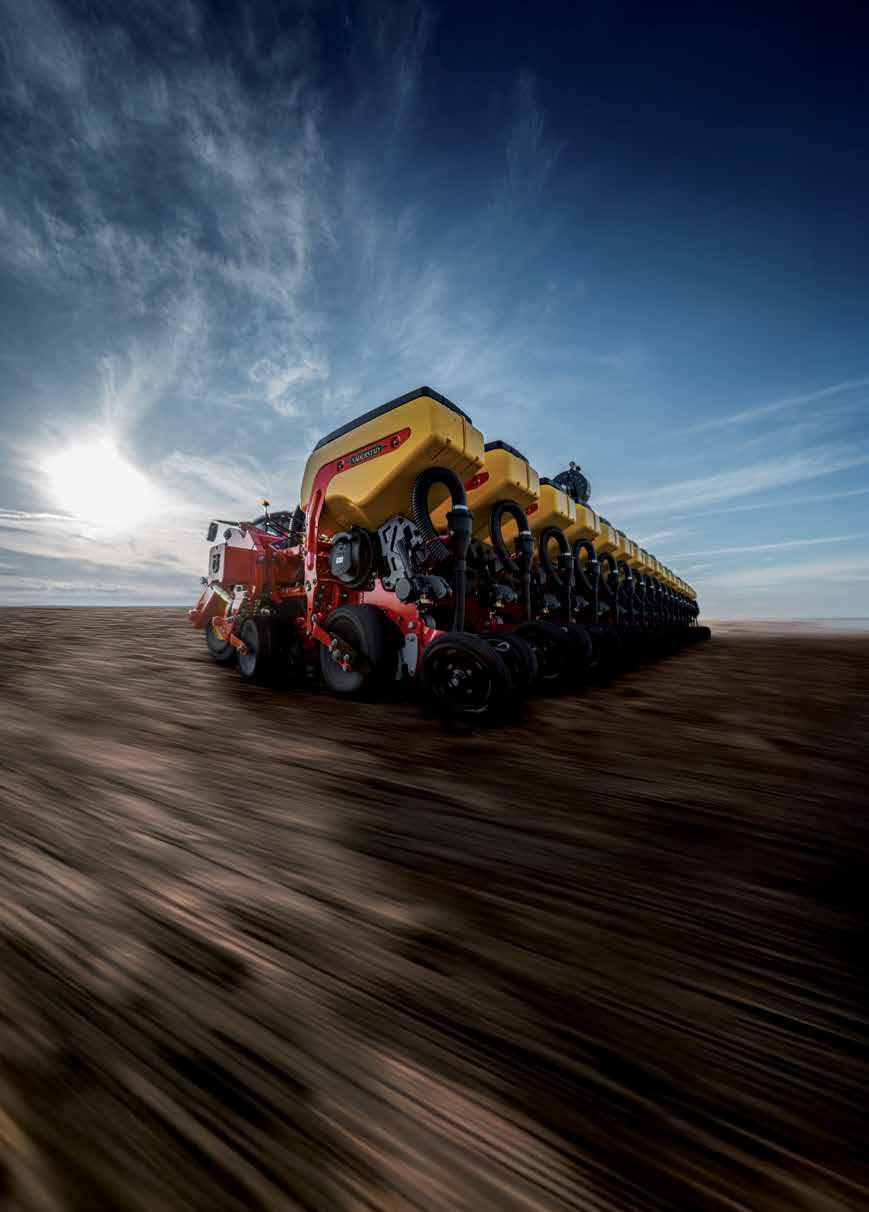
From day one, our focus has been clear: deliver unmatched planting precision, simplify operation, and maximise field performance. After years of development, testing, and fine-tuning, we’re ready for the new generation row unit – taking the next step in agronomic precision, user-experience and field performance.
Now taking early orders for 2027 delivery. Visit us at Site V20, National Fieldays® to see the row unit.