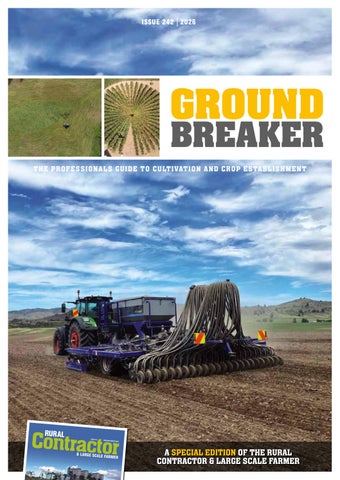
THE PROFESSIONALS GUIDE TO CULTIVATION AND CROP ESTABLISHMENT
03 Lemken New Zealand appoints precision seeding solutions as nationwide dealer for Equalizer planters
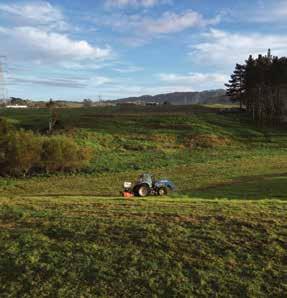
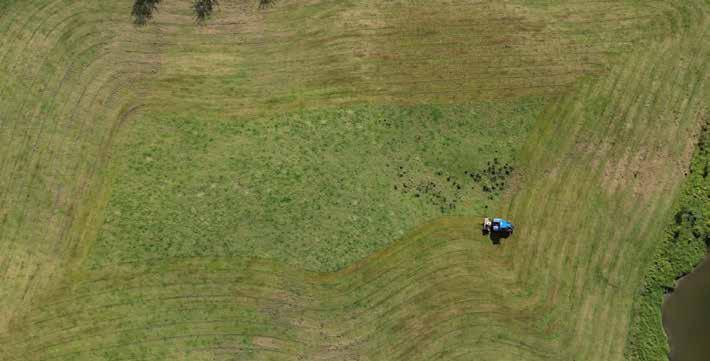
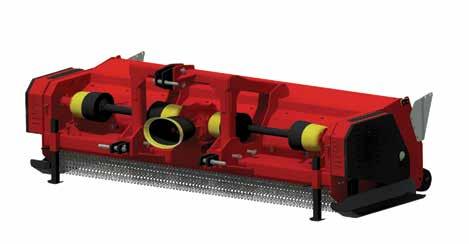
Ironmax Pro wins converts
Amazone EasyMatch: AI steps into the fertiliser shed
Why the story of our meat matters as much as the product
Final countdown: hedgehog clear out in the Mackenzie Basin
A change in tone that matters for rural contractors
A new chapter for Väderstad in New Zealand
Young thinking infuses RCNZ Board
Breaking ground the right way
Cultivate with Cenius for any field condition
Breaking compaction at depth with the Great Plains In-line Sub-soiler
Maize resilience for the future from Corson Maize
The slug solution
Bringing cultivation and bed forming together 28 Allen Custom Drills: built tough for New Zealand seeding conditions 29 Re-defining cultivation: why the Kverneland Qualidisc matters for New Zealand soils
31 Integra: when one roller has to do more than one job 32 Lemken sets new benchmark in soil cultivation with the Rubin 10/1000 compact disc harrow 34 Holding the line at speed: why the Kverneland Optima SX with Geoforce raises the bar for precision planting
Practical cultivation without compromise 37 Effluent systems aren’t one-size-fits-all - and neither are New Zealand farms 38 New-gen Forigo mulchers - built tougher for New Zealand
Turning stubble into opportunity 42 Hungry for work: Pantera 7004 raises the bar for high-capacity spraying 44 One pass with purpose: why the Kverneland U-Drill fits New Zealand seeding reality
Preparing the row, protecting the soil 47 Catros+ 12003-2TX: 25 years on and still setting the standard
Across the Ditch: All in for farming life - Brodie and Kevin Game 02 From the Editor: Success starts in the soil
Cultivation and crop establishment have always sat at the heart of productive farming, but in recent seasons they have taken on renewed significance. Across New Zealand, contractors and growers alike have been reminded that the margin between success and disappointment can be remarkably narrow. A well-prepared seedbed, the right machinery choice, correct timing and the confidence to act within short weather windows all carry enormous weight when conditions turn against you. Recent seasons have shown just how quickly that can happen, with prolonged rain in parts of the country delaying harvests and causing major crop losses simply because machinery could not get onto paddocks in time.
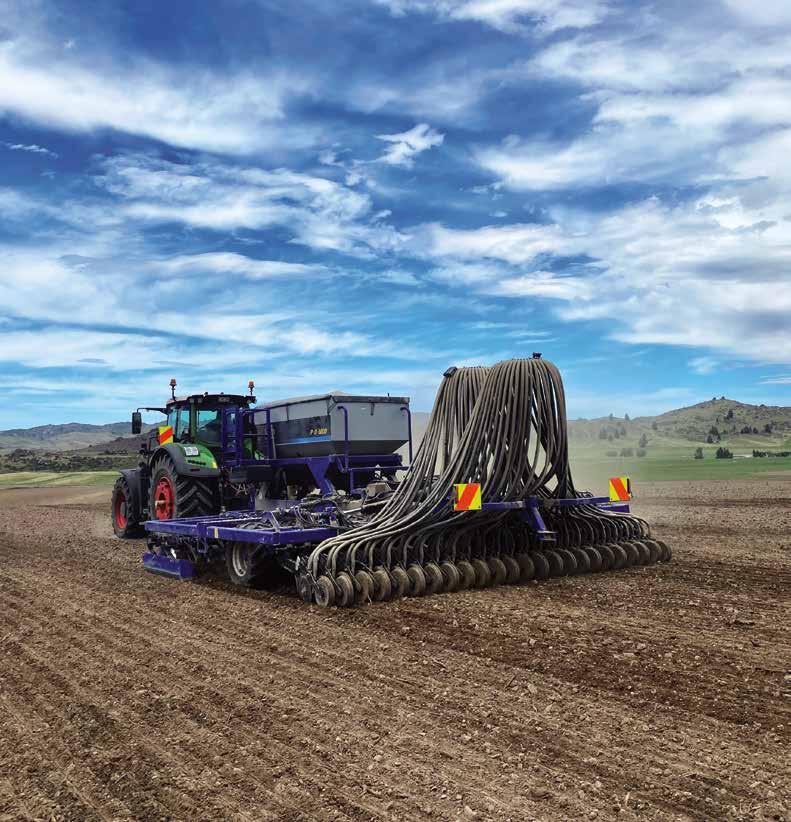
Against that backdrop, this special edition of Rural Contractor & Large Scale Farmer is dedicated to the discipline that underpins so much of modern food production. GroundBreaker is designed as a professional guide to cultivation and crop establishment, bringing together a review of the latest machinery developments, techniques and methodologies shaping the way contractors and growers approach the soil.
Follow us facebook.com/nzrclsf instagram.com/nzrclsf ruralcontractor.co.nz
Publishers of Rural Contractor & Large Scale Farmer, AgriBusiness, AgriVet, NZ Cropping, Australian AG Contractor & Large Scale Farmer, NZ Novachem Agrichemical Manual.
Cultivation is no longer just about turning ground. It is about understanding soil structure, moisture management and residue handling while balancing productivity with environmental responsibility. The decisions made in the days leading up to planting can determine crop performance months later and, in an environment where weather volatility is increasing, those decisions are becoming more complex rather than less.
For contractors, the expectations have shifted significantly. Farmers now rely on them not simply for horsepower, but for knowledge, planning and technical capability. The modern contractor must be as comfortable interpreting data and soil conditions as they are operating machinery. GPS guidance, variable-rate systems, precision planters and new cultivation concepts are changing the conversation from brute force to measured performance and the pace of development shows no sign of slowing.
This edition reflects that shift. Across the following pages you will find detailed looks at new machinery releases, evolving establishment systems and the practical experiences of contractors adapting their approach in response to changing farm systems. What emerges is a picture of an industry that is not standing still. Instead, it is responding to tighter seasonal windows, rising input costs and increasing scrutiny around soil health and
The reality is that cultivation remains one of the most influential stages in any cropping or pasture renewal programme. Get it right and the rest of the season begins with momentum. Get it wrong and no amount of fertiliser, irrigation or management can fully recover the lost potential. That truth has not changed, but the tools available to farmers and contractors certainly have.
GroundBreaker is intended as both a reference and a snapshot of where the sector stands today. It highlights the machinery, thinking and people shaping the future of cultivation in New Zealand and it reflects the professionalism and skill that now define the contracting industry.
As always, our aim is simple: to document what is happening on the ground, to share practical insight and to recognise the contractors and growers whose work quite literally lays the foundation for everything that follows.
Contributions - Editorial and photographic contributions are welcomed and should be sent directly to AgriMedia Ltd. Editing of submissions is at the sole discretion of the editor and will accept no responsibility for unsolicited material.
Lemken New Zealand appoints precision seeding solutions as nationwide dealer for Equalizer planters
The strength of any cropping season is determined long before the first leaves break the surface. It begins with the planter and with the care taken in setting up that machine to deliver even depth, accurate seed placement and the right nutrition at the right time. That is why Lemken New Zealand’s decision to appoint Precision Seeding Solutions as the nationwide dealer for the Equalizer planter range matters. It is not simply a change in distribution; it is a deliberate move to tighten the link between advanced planting technology and the growers who depend on it.
With Precision Seeding Solutions now responsible for national distribution, farmers and contractors can expect local expertise, parts support and specialist knowledge behind every Equalizer machine. The focus is clear. This is about strengthening Equalizer’s presence across the country and ensuring
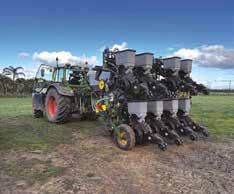
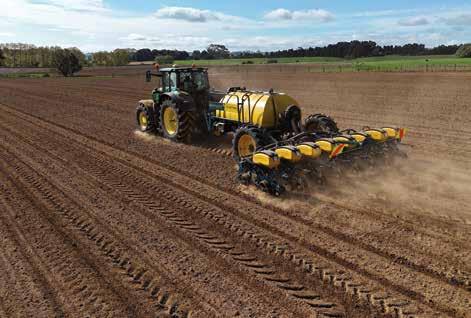
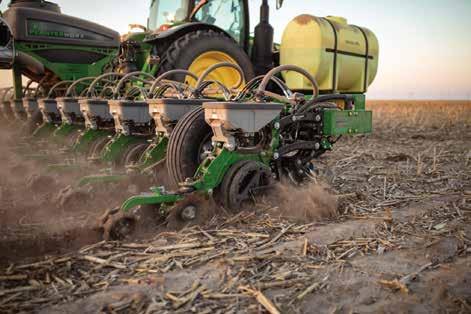
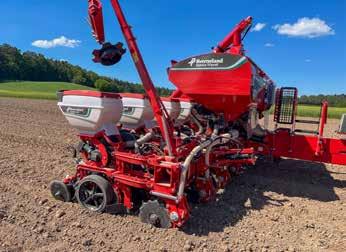
The Equalizer CII planter range is designed to deliver accurate seed placement, consistent depth and reliable establishment across New Zealand’s varied cropping conditions.
that the technology is backed by people who understand how critical the planting window is in New Zealand conditions. Equalizer planters have built a global reputation for quality construction, precise
seed placement and fertiliser flexibility. Those strengths translate well to New Zealand’s diverse cropping systems, where soils can vary within a single paddock and where row crops such as maize, sunflowers
and soybeans demand consistent emergence to achieve their yield potential. Since Lemken acquired Equalizer in 2023 and integrated its no-till and precision-seeding capability into the wider Lemken line-up, the brand has sat firmly within a global support network while retaining its focus on robust, high-accuracy planting solutions for modern farming systems.
“Getting planting right sets up the whole season,” says Ben Harris, Regional Service Manager Lemken New Zealand. “By partnering with Precision Seeding Solutions, we’re making sure New Zealand crop growers have the right support and technical backup to get the most out of their Equalizer planter.”
That emphasis on support is important.
Precision Seeding Solutions brings specialist knowledge in precision agriculture, planter set-up and seed technology. The partnership is built around correct machine configuration, operator training and aftersales back-up rather than simply supplying iron. In practical terms that means helping growers fine-tune seed meters, manage downforce correctly and calibrate fertiliser systems so that consistent emergence becomes the rule rather than the exception.
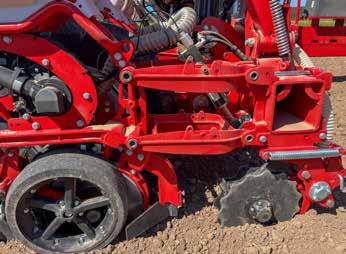
At the centre of this push is the Equalizer CII 8-row narrow planter, a compact yet capable machine designed specifically for row crop farmers who want accuracy without unnecessary bulk. Configured with eight rows as standard with a basic row
a layout familiar to many New Zealand maize growers. Despite its working width, the planter maintains a compact transport profile at under three metres, allowing safe and straightforward movement between paddocks on New Zealand roads. In field mode the extendable axle positions the transport wheels between the seeding rows, reducing compaction within the planted zone and helping maintain a clean finish.
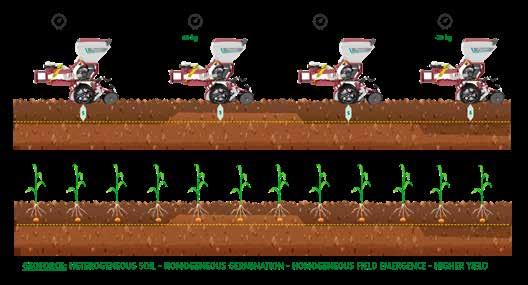
Precision is delivered through factory-fitted Precision Planting technology including the vSet2 seed meter, which is designed to ensure accurate seed singulation and consistent plant populations. Combined with either mechanical or hydraulic downforce options including delta force, the system maintains steady seeding depth even where soil texture changes across the paddock. That consistency in depth is critical in achieving even germination and uniform crop development.
The CII 8-row narrow planter also addresses the nutritional side of establishment. Integrated tanks provide flexibility to apply granular or liquid fertiliser and even chemical products during the planting pass. Optional spray arms or liquid tubes allow herbicide or inoculant application alongside seed placement, enabling growers to complete multiple operations in one controlled pass. Notched steel closing wheels with adjustable toe-out settings finish the seedbed firmly
design makes maintenance and adjustment easier without operators having to crouch on the ground to access components. A high-strength steel frame and durable row units are built to handle challenging soil conditions, reflecting the reality of New Zealand’s varied terrain and cultivation practices.
“This planter gives New Zealand farmers and contractors a great mix of seed accuracy, fertiliser flexibility and everyday usability,” says Ben. “It’s exactly the sort of gear growers need to get their crops in cleanly and confidently.”
The appointment of Precision Seeding Solutions reinforces Lemken New Zealand’s commitment to pairing high-performance equipment with knowledgeable local partners who understand the practical pressures of farming here. In a season where planting windows can be tight and margins unforgiving, the combination of global engineering and local expertise becomes more than a marketing line. It becomes a foundation for crop performance.
The Equalizer CII 8-row narrow planter is now available nationwide through Precision Seeding Solutions, ensuring that growers across the country have access not only to advanced planting technology but also to the technical support required to make it work in real paddocks. In the end, that is what counts. Clean, even establishment and the confidence that comes from knowing the job
Ironmax Pro wins converts
High performing farmers stopping slugs in their tracks.
BioGro certified Ironmax Pro bait is efficacious along with being much safer for beneficial insects, farm dogs and other domestic pets.
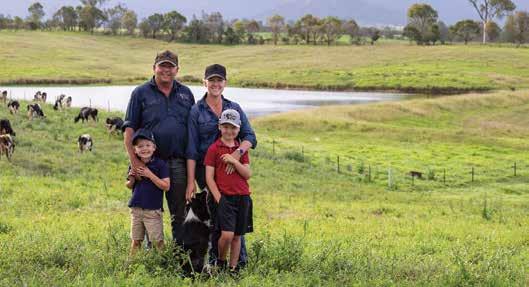
There are possibly no better judges than Murchison, Tasman, South Island dairy farmers Chris and Stacey Hatfield.
With its high rainfall, temperate climate and lush pastures the area is an ideal environment for slugs. But when it comes to protecting their valuable grass (and recently planted maize), the Hatfields are taking a tough, no prisoners approach.
Chris, who has a long-term vision for their business, believes in an investment and result, rather than just a cost approach. And he says it pays off.
“The more yield and quality you produce, the cheaper the crop becomes. Every mouthful the cows take, you see the benefit in the vat. When you’re spending money, you want to see the best return.” He says that also shows in cow health and welfare.
However, it comes with a challenge. New high density, high performing pastures give slugs more places to hide and are a more enticing feed prospect.
Chris’ approach, he says, is aggressive. He uses a hefty dose
of Ironmax Pro to take out not only the adults existing in the pasture but the next generation.
“If you go hard from the get go, that way every plant gets a crack.”
Mark Prosser, Technical Field Representative for PGG Wrightson, says dairying in general is scientific and measurable but Chris sets the bar high, with elevated pasture sowing rates to supress weed pressure and meticulous allaround management.
Mark says, in his experience Ironmax Pro actually draws slugs away from grass or maize. He says he trusts the product, even after multiple rain falls where other slug baits would break down. “I’ve confidence that it’ll do the job. It’s got endurance in the field and our climate and it’s safe.”
The optimised pellet size and consistency ensure even distribution and a wide spread width. Every pellet has the same size and weight, which equals excellent ballistics. Every load is the same as the one before.
Alex Easton, UPL NZ Regional Manager Upper South Island says, “Contractors we spoke to said they found Ironmax Pro flowed well and suited their metering systems.”
Used to protect crops ranging from chicory and turnips to grass and maize, Ironmax Pro is very rainfast and contains the optimized active ingredient 24.2 g/kg ferric phosphate anhydrous, referred to as IPMax. Iron (ferric) phosphate is a natural component of soil. In Ironmax Pro, it works as a stomach poison on slugs and is fatal once ingested.
Ironmax Pro also uses Colzactive technology developed from oil seed rape molecules selected for
"The more yield and quality you produce, the cheaper the crop becomes" says Chris Hatfield.
palatability, feeding preference and rapid detection by slugs, which actively prefer feeding on the bait to feeding on seedlings. For more information on Ironmax Pro, talk to your local technical merchant or contact Alex Easton, UPL NZ Regional Manager Upper South Island, at 027 578 0016.
Amazone EasyMatch: AI steps into the fertiliser shed
There is a familiar moment in every fertiliser season. The truck tips a load into the shed, the product looks slightly different to the last batch and someone asks the quiet question. Is this exactly what we think it is and how should the spreader be set?
In an industry where accuracy matters and margins are tight, guessing is no longer acceptable. That is where Amazone’s new EasyMatch system steps in, bringing artificial intelligence into what has traditionally been a very practical, hands-on process.
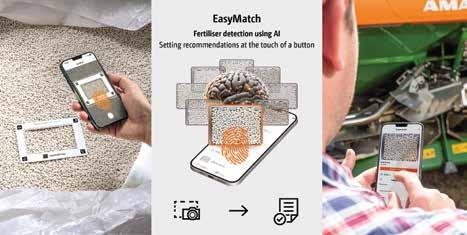
Unveiled at Agritechnica 2025 and awarded a DLG silver medal, EasyMatch is an AI-based fertiliser recognition system that identifies a product from nothing more than a photo. From 1 January 2026 it will be available as a free update within the mySpreader App, expanding the digital toolkit available to Amazone fertiliser spreader operators.
The principle is straightforward but technically sophisticated. Using artificial intelligence and a simple reference template, EasyMatch creates a digital fingerprint of the fertiliser captured in the image. That fingerprint is then compared with Amazone’s extensive fertiliser database. Within seconds, the system identifies the most likely match and delivers the corresponding spreader settings at the touch of a button. Crucially, it works even if the fertiliser name is unknown.
For contractors and large-scale operators, this is more than a convenience. Fertiliser quality can vary between suppliers and even between batches. Granule size, density and surface characteristics all influence spread pattern and accuracy. Traditionally that has meant relying on bag labels, supplier information or manual testing. EasyMatch removes much of the uncertainty and provides a quick, reliable basic setting that can be applied immediately.
The reference template, available through local Amazone sales partners, plays a key role in ensuring consistency. By photographing the fertiliser alongside the template, the system is able to assess granule size and characteristics accurately, allowing the AI engine to make meaningful comparisons within the database. The outcome is a fast, data-backed recommendation rather than an educated guess.
Importantly, EasyMatch integrates seamlessly with the existing mySpreader App rather than operating as a standalone
feature. That integration is significant because the app has already become the central adjustment tool for Amazone spreaders. Operators can access machinespecific setting data, calibration guidance and performance support directly from their phone or tablet. The addition of AI-driven fertiliser recognition strengthens that ecosystem rather than complicating it.
When combined with the proven EasyMix function for blended fertilisers and the EasyCheck digital test kit, the system becomes even more powerful. EasyMix allows users to set and evaluate blended fertiliser products with precision, while EasyCheck provides a practical digital method for verifying spread patterns. Together with EasyMatch, these tools create a closed loop of identification, adjustment and verification. The result is a more controlled and confident fertiliser application process.
From a practical standpoint, the benefits are clear. EasyMatch saves time by eliminating lengthy searches through setting charts or uncertainty around product identification. It increases accuracy by basing spreader settings on database-backed analysis rather than visual judgement alone. Most importantly, it improves fertilisation efficiency by helping ensure nutrients are applied evenly and at the correct rate from the outset.
The system is compatible with any Amazone fertiliser spreader from the current product range, meaning existing customers can benefit from the update without investing in new hardware. That compatibility reflects a broader trend within agricultural engineering, where digital upgrades increasingly extend the life and capability of existing machines.
For New Zealand conditions, where fertiliser spreading often takes place across varied terrain and changing weather windows, speed and accuracy are critical. Contractors in particular operate under tight
Amazone’s EasyMatch system uses artificial intelligence to identify fertiliser from a simple photo and recommend spreader settings instantly.
timeframes and cannot afford repeated passes due to poor initial settings. An AI-supported recommendation delivered in seconds has obvious appeal.
At the same time, EasyMatch does not replace operator judgement. It provides a precise starting point; a basic setting derived from analysis and experience built into the database. Final adjustments can still be made according to local conditions, machine wear and field verification. In that sense it supports the operator rather than overrides them.
There is also a wider efficiency story at play. As nutrient management regulations tighten and environmental scrutiny increases, the ability to document and justify application settings becomes more important. Digital tools that improve accuracy and reduce the risk of overapplication contribute directly to both economic and environmental performance. From January 2026, a simple app update will unlock this capability for Amazone users. In practical terms, it means that a smartphone in the fertiliser shed becomes a powerful diagnostic tool. Take a photo, confirm the match and apply the recommended settings. The process is intuitive and designed to fit naturally into existing workflows rather than disrupt them.
The fertiliser shed has always been a place of practical decision-making. What EasyMatch represents is the quiet arrival of artificial intelligence into that environment, not as a headline-grabbing novelty but as a functional, time-saving and accuracyenhancing tool. It reflects a future where decades of agronomic and engineering expertise are packaged into digital systems that support the operator on the ground.
THE WORKING MACHINE MADE FOR YOU!
Whatever your needs, Valtra has the working machine – made for you! Whether it’s the compact tractor that packs a powerful punch – the mighty little A Series, the gutsy all-rounder ready for any job – the G Series, the capable and award-winning N Series, the brains, brawn and beauty of the T Series, the smart and powerful Q Series, all the way through to the big new farm boss – the powerful and reliable S6, there’s a Valtra with your name on it!
Valtra tractors combine versatile features and innovative technology, with outstanding comfort in every model across the range. As a Valtra owner, you benefit from a reliable, high-quality tractor, that has been tailored to meet the needs of your farm or contracting business. Put simply, Valtra has the working machine – made for you!
TALK TO YOUR VALTRA DEALER FOR MORE INFO TODAY.
Why the story of our meat matters as much as the product
There has been a growing gap in recent years between how New Zealand farmers understand their production systems and how those systems are perceived by consumers, both at home and offshore. That gap is not always built on facts. It is often built on headlines, assumptions and overseas production models that bear little resemblance to how sheep and beef farming actually works here. The Making Meat Better initiative exists squarely in that space, not as a marketing slogan but as an attempt to reconnect the story of New Zealand red meat with the realities of how it is produced.
At its simplest, Making Meat Better is about putting context back into the conversation around meat. The initiative, developed by Beef + Lamb New Zealand alongside industry partners, aims to give consumers a clear place to find evidence-based information about New Zealand farming methods and their environmental, nutritional and social outcomes. It recognises that public debate around red meat production has intensified globally and that much of that debate is shaped by intensive feedlot systems, heavy grain feeding and land use change that simply do not define New Zealand’s pastoral sector. What makes this initiative worth paying attention to from a farming perspective is that it does not pretend the sector is perfect. Instead, it leans on the fact that New Zealand’s systems are already structurally different. Sheep and beef livestock here are overwhelmingly pasture-fed and free-range, operating in a temperate climate that allows animals to graze outdoors year round with relatively low intervention. That fundamental difference influences everything from animal welfare outcomes to antibiotic use, which is among the lowest in the world for these species. It also shapes how emissions, water use and land impacts compare internationally.
The initiative frames this story around four pillars: better for animals, better for you, better for the planet and better for communities. Those pillars are simple on the surface, but they reflect a broader argument that New Zealand’s extensive grass-based systems are inherently lower impact than many global alternatives. Emissions from sheep and beef farming have already fallen significantly in absolute terms since 1990, while productivity has been maintained
through improvements in genetics, pasture management and farm efficiency. That trajectory is not often recognised in global narratives, yet it is central to how the sector positions itself internationally.
The same applies to land use. A large proportion of sheep and beef farmland in New Zealand is hill country that is unsuitable for cropping, which means livestock are often the most practical way to produce food from that land. The rotational grazing systems used across much of the sector also play a role in maintaining soil structure and pasture renewal, which contributes to long-term productivity rather than short-term extraction. None of this means there are no environmental challenges, but it does mean the starting point for discussion should reflect the reality of how the land is actually used.
From a nutritional perspective, the initiative also leans into the argument that lean red meat remains a dense source of protein, iron, zinc and essential vitamins particularly for groups with higher nutritional needs. That is not a new claim, but it sits within a wider conversation about food security and diet quality, especially as populations age and nutrient deficiencies become more visible in certain demographics. The point is not that meat must dominate diets, but that moderate consumption of nutrient-dense foods still has a place in balanced eating patterns.
Perhaps the most overlooked part of the Making Meat Better story is the community dimension. Sheep and beef farms in New Zealand remain overwhelmingly family owned and they underpin rural economies in ways that extend well beyond the farm gate. The sector supports tens of thousands of jobs across production, processing and logistics and contributes significantly to export income. Those economic links are rarely visible in international commentary about livestock production, yet they matter deeply
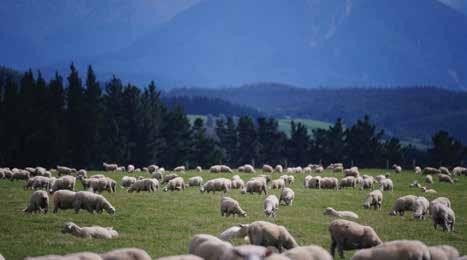
New Zealand’s pasture-based sheep and beef systems remain central to the sector’s environmental, nutritional and community story, which initiatives like Making Meat Better aim to reconnect with consumers at home and overseas.
when considering the social sustainability of food systems.
What this initiative ultimately reflects is the growing importance of narrative in agriculture. Production alone is no longer enough. Farmers can produce high quality food efficiently and responsibly yet still struggle if the public conversation moves in a different direction. Making Meat Better is an attempt to ensure the story of New Zealand red meat is not told solely by overseas reports or simplified assumptions, but by evidence grounded in local systems and data.
For farmers, the value of initiatives like this lies less in promotion and more in alignment. When the sector can clearly explain how its systems work it becomes easier to defend market access, maintain consumer trust and justify the ongoing investment required to keep improving. It also reinforces something many farmers already know instinctively: that the strengths of New Zealand’s red meat sector are not accidental. They are the result of climate, landscape, management choices and generations of refinement.
In a world where food production is increasingly scrutinised and often misunderstood, being able to demonstrate not just that we produce meat, but how and why we produce it the way we do may be as important as the production itself. Making Meat Better is ultimately about ensuring that conversation is informed by reality rather than assumption, and that the story of New Zealand farming remains grounded in the land it comes from.
Final countdown: hedgehog clear out in the Mackenzie Basin
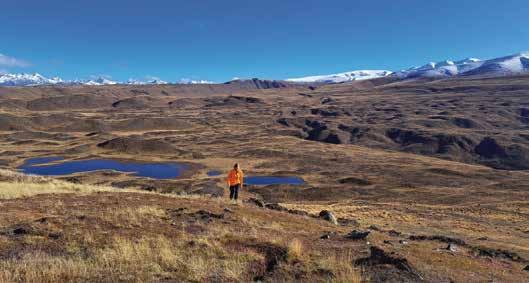
You can count the remaining hedgehogs in 4,000 hectares of Mackenzie Basin high country on one hand. And they are on borrowed time. The Zero Invasive Predators team is closing in on the last few, with the survivors only temporarily active before winter hibernation sets in.
They don’t know it yet, but the handful of remaining hedgehogs within the 4,000-hectare high country farm near Mistake Valley are approaching what is likely to be their final season before winter.
The ecologically important drylands, carpeted in native shrubs and grasses and an almost unknowable number of invertebrates, are beginning to cool as the days shorten and autumn settles across the basin.
But their greatest threat is on
the move too, and while few in number, they’re hungry as they build reserves ahead of hibernation.
Thanks to an extensive and systematic trapping and hunting programme, only a handful of hedgehogs remain.
Zero Invasive Predators (ZIP) has removed around 1,300 of the prickly predators across
4,000 hectares on a rabbit-proof fenced high-country farm as part of the wider Te Manahuna Aoraki Project.
With winter hibernation approaching, the window to remove the final few is narrowing.
ZIP predator ecologist Nick Foster is confident the job will be completed before winter sets in.
"We’re very excited to be just weeks away from successfully removing this species. If we were to pick any predator to remove from the Mackenzie Basin, it would be hedgehogs by a country mile.”
That’s because hedgehogs cause significant damage to
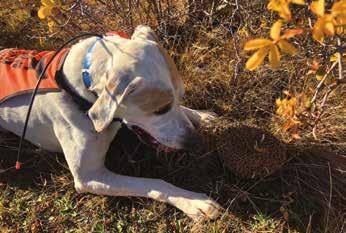
Trail cameras, thermal imaging and trained detection dogs are among the tools being used to locate the final hedgehogs in the Te Manahuna Aoraki project area.
Hedgehog removal work across the Mackenzie Basin is nearing completion, with only a handful of animals remaining after an intensive trapping and monitoring programme.
native wildlife and habitats. In drylands like the Mackenzie Basin, hedgehogs are never short on food or shelter, and they face few competitors or natural predators. A study found hedgehogs were responsible for one in five predator attacks on braided river bird nests in the basin.
The eggs of ground-nesting birds, lizards, skinks and invertebrates are all fair game, while an abundance of dry nesting sites provides shelter for reproduction and waiting out the harsh winter.
“They’re likely exacting the largest toll on biodiversity in this environment, and that’s why
they’re in the crosshairs of this project,” Nick explains.
The Te Manhuna Aoraki project area spans alpine ecosystems, tussock grasslands, braided rivers, and a number of highcountry farms.
Working with different landowners adds complexity to how removal can be done effectively while making sure it fits around day-to-day farming operations.
In these working environments, there are stock, working dogs, staff, visitors, and machinery to consider when planning predator control.
Nick says the team has used layers of techniques and tools to give them the best chance of finally removing a species introduced from Great Britain in the 1870s.
First, hedgehogs are detected via a network of lured trail cameras, allowing the team to lay clusters of killtraps in strategic locations.
To mop up the survivors, drone-guided hunters come next, then thermal cameras. Although primarily used to detect rabbits and hares, hedgehogs’ distinctive heat
signatures make them instantly detectable.
“Hedgehogs absolutely glow on a thermal camera – they don’t have any fur on their back, only spikes. They look like a pinprick of heat, and they’re really easy to find if they’re out in the open,”
Nick says.
“It’s very much in hand,” he says. “The team has done this hundreds of times now, and is getting very efficient.”
For even more targeted work, a specially trained detection dog Zach – full name Professor Zachariah Q Wigglebottom for his tendency to wiggle his bottom with excitement when he finds a hedgehog – can be brought in.
With so many proven options at their disposal, Nick remains confident they’ve got the tools and knowledge to get the last remaining hedgehogs.
“Even if we are off in our estimates and more are still active than the handful we know about, we have the capability to detect them and the tools to remove them.”
The breeding season for braided river birds, including the tarāpuka (black billed gull),
tarapirohe (black-fronted tern), and the k āki (black stilt), runs through the warmer months. By removing the significant pressure the hedgehogs place on the biodiversity of the Mackenzie Basin, the landscape and wildlife now have a fighting chance to start their recovery after decades of damage.
Without the threat of predation looming over them, the nesting success of braided river birds will initially be the most noticeable change, Nick says. “Our colleagues at DOC and Manaaki Whenua have shown that lizards bounce back within five years of predator removal.”
It’s unclear what the impact on invertebrates will be, but having a key predator removed from the environment can only be positive.
Before winter arrives, hedgehogs could be gone from this defended site in the Mackenzie Basin, but the lessons learned here may help others do the same.
Even though hedgehogs aren’t officially on the Predator Free 2050 target list, Nick believes groups should include them, and other pest species, as
High-country dryland ecosystems in the Mackenzie Basin are already showing signs of recovery as invasive predators are progressively removed.
targets if they’re within their management area.
“Te Manahuna Aoraki Project is targeting a wider suite of pest species – nine, including rabbits and hares – to improve the overall integrity of this special environment.
“And we encourage others to do the same,” Nick implores.
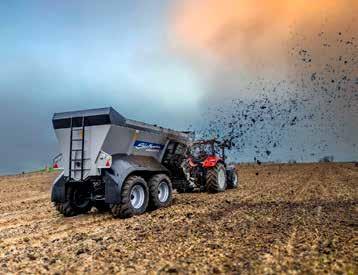
For all your muck spreading needs, whether wet or dry.
Ag & Civil Machinery Direct brings you proven spreading solutions across NZ. We proudly supply Bunning and Shelbourne Reynolds spreaders. With options available for wide spreading of dry and heavy materials with rate control, or sealed tub with side discharge for wet product application.
Chat to our product specialists
Sales: 027 302 0080 • sales@acmd.co.nz
Parts & Service: 07 843 7237 • parts@acmd.co.nz
2 Gallagher Drive, Hamilton agandcivilmachinery.co.nz @agandcivil
A change in tone that matters for rural contractors
There has been a noticeable shift in tone from parts of government over the past year and for rural contractors that change matters, because tone shapes behaviour just as much as regulation does. When agencies approach rural businesses as partners rather than problems, the conversation changes and outcomes tend to improve. That shift was visible to many who attended industry roadshows last year, where WorkSafe appeared more approachable, more willing to listen and more focused on guidance than enforcement. It was a change that did not happen by accident, and one that industry groups have worked hard to push for.
Over the final quarter of 2025, more than 80 rural contracting members were visited by WorkSafe as part of its all of horticulture assessment programme. The cumulative results of those visits will be shared in full shortly, but the early picture is encouraging. There were no significant compliance notices issued and the overall assessment was positive. That matters because it suggests that when contractors are given clear expectations and practical guidance, most are already doing the right thing or are willing to adjust when issues are identified. That context makes the recent statement from the Minister for Workplace Relations and Safety, Brooke van Velden, particularly important. In announcing updated WorkSafe enforcement policies, the Minister made it clear that the agency must move away from a mindset that too often felt like fire, aim, ready and instead focus on supporting businesses to manage risk before harm occurs.
The Minister said the intention was to ensure frontline staff prioritise advice and early engagement, so risks are addressed in the first place rather than relying on enforcement after the fact. It was a strong signal that the culture within the regulator is expected to change, and that safety outcomes are better achieved through partnership than fear.
For contractors operating in complex environments with seasonal pressures, tight margins and variable labour, that approach is not about lowering standards. It is about recognising reality and meeting businesses where they are. Good safety practice does not come from a clipboard and a fine. It comes from understanding the job, the
machinery, the people and the pressures involved and then working through how risk can be reduced in a practical way. That is the shift industry has been calling for and it is encouraging to see it articulated so clearly from the Minister.
WorkSafe’s commitment to continue engaging with the sector will be tested over time, but the fact the agency will attend the national conference in June signals that the door remains open. That ongoing engagement matters, because trust, once lost, is hard to rebuild and consistency will be key.
Regulatory change is not limited to workplace safety. Transport Services Licences are also under scrutiny, as NZTA moves to tidy up its register. Of the roughly 146,000 licences on record, about 73 percent are considered inactive. Cleaning up that data will help the agency focus on active operators, but it also places responsibility back on licence holders to understand their status. If vehicles listed on a licence have not been used for two years, NZTA may consider that licence inactive and has the authority under the Land Transport Act to cancel it. Licence holders with licences inactive for seven years or more will be contacted first, followed by those inactive for two to seven years. There will be a 30-day notice period and an opportunity to retain the licence by providing evidence of use or a valid reason for inactivity. For contractors, this is a reminder that paperwork matters, even when vehicles are parked up or operating under exemptions and it pays to check records before the agency does it for you. Immigration remains another area where detail matters. The Global Workforce Seasonal Visa, which became operational in December, has already seen around 100 visas issued. One of the more useful clarifications is that applications can be made well ahead of the intended start date, which allows contractors to plan labour needs earlier. While the visa runs for three years, contractors only need to supply a year one fixed-term seasonal employment contract at application stage, although subsequent contracts may be requested later. Processing times are currently around four weeks, which is workable provided applications are not left to the last minute.
Heavy vehicle permitting is also under review, with a proposal to shift permitting back toward the exception rather than the norm. Feedback from industry has generally supported that direction, with some refinements, and the proposal is now with the Heavy Vehicle Industry Group and senior officials at the Ministry of Transport and NZTA. For contractors running specialised gear or oversized equipment, that work is largely unseen but deeply important because it shapes what is possible on the road.
Environmental regulation continues to evolve as well. The Environmental Protection Authority has indicated it is reassessing several insecticides, including bioresmethrin, cyhalothrin and fenvalerate under the HSNO Act, on the basis that they pose high aquatic risk and may no longer be used in New Zealand. Industry feedback will matter here because if there is evidence these substances are still used and provide benefit, that needs to be part of the conversation. If not, then revocation may be appropriate. Either way the decision should be grounded in real world use, not assumptions.
All of this work highlights what membership subscriptions actually fund. While templates, advice, conferences and roadshows are valued and visible, a large portion of the effort goes into the less visible work of engaging with government, shaping policy and cutting through red tape. That advocacy is slow, often frustrating and rarely headline grabbing but it is where long-term change happens.
For rural contractors operating at the sharp end of regulation, machinery, labour and weather, that work matters. Progress does not come overnight, but when tone changes and agencies listen, the path forward becomes clearer. That is worth recognising and it is worth protecting.
THE BEST CULTIVATION SOLUTIONS
TOUGH GROUND TRUSTED RESULTS
Engineered in Europe and proven in demanding conditions, Mandam groundworking machines are built to deliver reliable performance, excellent seedbed preparation and long service life. From rolling and cultivation through to intensive soil working, the Mandam range combines heavy-duty construction with practical design — offering outstanding value without compromising on quality.
5 YEAR WARRANTY ON DISC HUB BEARINGS AND FRAME
The Mandam groundworking range includes:
MCB Cambridge Roller - Effective consolidation and levelling for improved seedbed preparation and moisture retention.
MCB Swing Cambridge Roller – Folding swing frame for superior contour following and efficient rolling across wider widths.
GROT Cultivator – Versatile tine cultivator for stubble working, weed control and seedbed preparation.
DIG Cultivator – Built for deeper cultivation to relieve compaction and improve soil structure.
GAL-K HD Disc Cultivator – Heavy-duty disc machine for aggressive residue mixing and fast soil incorporation. Wide range of sizes and options available.
A new chapter for Väderstad in New Zealand
There are certain machinery brands that carry weight in New Zealand cropping and cultivation circles, not just because of the equipment they produce but because of the systems thinking that sits behind them. Väderstad is one of those names. For decades the brand has been associated with precision seed placement, consistent cultivation and a design philosophy that prioritises agronomic outcomes as much as mechanical performance. The announcement that Power Farming will take on distribution of Väderstad machinery in New Zealand from March 2026, therefore, marks more than a simple dealership change it signals a shift in how one of the country’s most respected cultivation and drilling ranges will be supported and positioned in the market.
For many operators, Väderstad’s presence in New Zealand has been closely tied to the team at Norwood, who have represented the brand for more than twenty-five years and built a strong reputation around it. During that time the machines have found a place on arable farms, mixed enterprises and contracting fleets where establishment accuracy and reliable work rates matter. That legacy does not disappear overnight, and the fact that both companies are working together to support existing customers through the transition reflects a shared understanding that machinery partnerships ultimately live or die on the strength of aftersales support.
From Power Farming’s perspective the addition of Väderstad sits logically alongside its existing machinery portfolio. The business has grown steadily over more than seventy-five years, building a network that spans New Zealand and Australia, with recent expansion into the United States. Its strength has long been its dealer structure and parts support, which are often the deciding factors for farmers and contractors weighing up major machinery investments. Bringing Väderstad into that framework gives the company a stronger presence in the cultivation, seeding and planting segment while also aligning with the increasing focus on precision establishment across New Zealand cropping systems.
That focus on establishment accuracy is becoming more important with each season. Whether the crop is cereals, maize,
fodder beet or pasture renewal the ability to place seed consistently at the right depth and spacing is central to achieving uniform emergence. Uniform crops not only maximise yield potential, they also simplify management later in the season from spraying decisions to harvest timing. Equipment that can deliver that consistency, therefore, plays a direct role in both production efficiency and profitability.
Väderstad’s reputation has largely been built on this principle. Its drills, cultivators and planters are designed to work as integrated systems rather than standalone machines. Soil preparation, consolidation and seed placement are treated as linked steps in one process and that approach resonates with the way many New Zealand farmers now think about establishment. Rather than treating cultivation and drilling as separate operations, the emphasis has shifted toward achieving a complete seedbed in as few passes as possible while maintaining soil structure.
For contractors, this systems approach has practical implications. Machines that can prepare and establish in one operation reduce labour requirements, fuel use and weather exposure. In seasons where planting windows are short and clients expect rapid turnaround, the ability to move quickly between paddocks without sacrificing accuracy becomes a competitive advantage. This is where the design philosophy behind Väderstad equipment tends to stand out, because it is built around maintaining consistent performance across large working widths and varying soil conditions.
The challenge for any distributor taking on a premium machinery brand is to match that engineering quality with equally strong local support. High specification machines demand reliable parts supply, knowledgeable technicians and dealers who understand not just the mechanics but the agronomic intent behind the equipment. Power Farming’s existing dealer network will therefore play a crucial role in how successfully the transition unfolds, particularly during the early seasons when customers are assessing how service continuity compares with what they have previously experienced.
There is also a broader industry context to consider. Machinery distribution in New Zealand has always been shaped by relationships as much as product lines. Farmers and contractors tend to stick with suppliers they trust, especially when equipment is central to seasonal timing. Any change in distribution, therefore, requires careful communication and reassurance that existing machines will continue to be
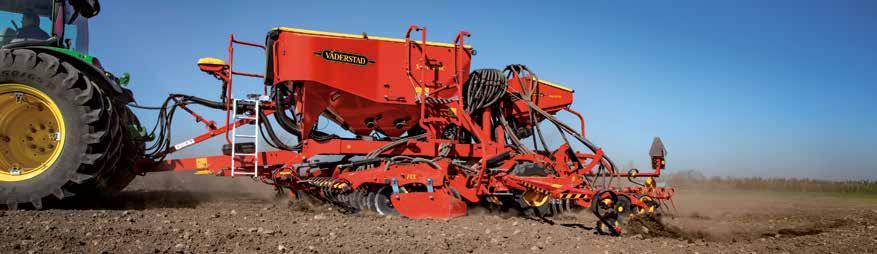
Power Farming will take on distribution of Väderstad machinery in New Zealand from March 2026.
supported. The collaborative tone of this announcement suggests both companies recognise that reality and are prioritising customer confidence as the transition begins.
In many ways this development reflects the ongoing evolution of New Zealand’s machinery landscape. As farm systems become more technically demanding and establishment precision becomes more critical, the partnerships between manufacturers and distributors grow increasingly important. The right machinery in the paddock still matters, but the right backup behind it matters just as much.
For Väderstad customers, the coming seasons will likely be about continuity first and opportunity second. Continuity in service, parts and technical support and opportunity in the potential reach of Power Farming’s network and its investment in growth. For the wider market, the shift represents another reminder that machinery supply chains are not static. They move with business strategy, market demand and the ongoing push for better establishment performance across New Zealand farms. Ultimately, machinery distribution changes are only significant if they translate into better outcomes in the paddock. If this transition delivers strong support, consistent backup and continued focus on precision establishment, it will be judged a success, not by the announcement itself but by the crops that follow the drills and cultivators in seasons to come.
POWERFUL TO RUN. SIMPLE TO USE.
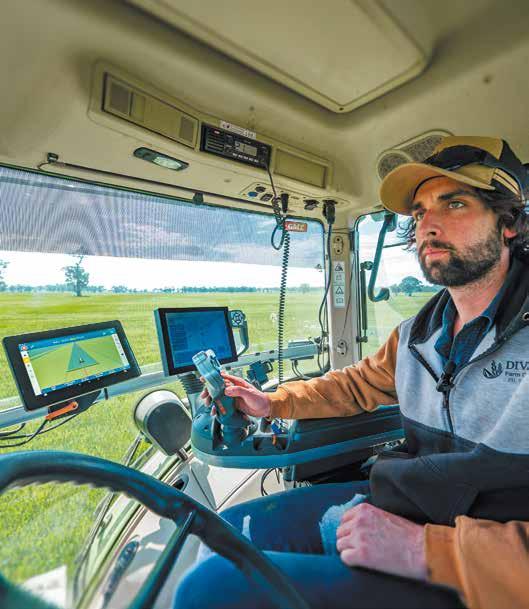
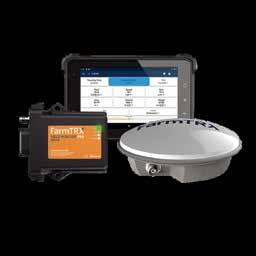
You deserve technology that’s both compatible with your existing fleet and easy to use. That’s why PTx Trimble leads the way in engineering solutions – including displays, steering systems and guidance control – that allow you to connect your farm, your way for seamless work all season long.
This farmer uses: GFX-1060™ display with Precision-IQ™, Autopilot ® steering system, NAV-900 guidance controller, and Trimble ® CenterPoint ® RTX correction service. Scan to learn more and contact a local dealer.
Young thinking infuses RCNZ Board
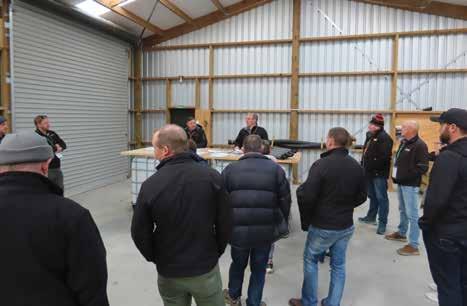
Some real insights into next-generation thinking were provided to a strategic focus session at the first Rural Contractors NZ Board meeting of the year, where four younger contractors were invited to share their views on the current state of the industry and how the organisation can best connect with those who represent its future.
RCNZ Chief Executive, Andrew Olsen says the session gave the Board plenty to reflect on, particularly around how communication, training, recruitment and business pressures are evolving within the sector.
“Most of our board are senior figures in the industry, none of whom pretend to know it all, so we welcomed the opportunity for four up-and-comers to give us their views on a raft of themes including communication, training, business challenges and recruitment,” he says.
Those attending the strategy session were Beau Drinnan from Scott Ag in the Wairarapa, Michael Austin from John Austin Agricultural Contracting in the Waikato, Doug Caldwell from Caldwell Contracting in Southland and Jayden Warner from Central Feeds in South Canterbury.
Andrew says one key message was that the organisation still faces a challenge in reaching members effectively, particularly during busy parts of the season when contractors are focused on keeping machines moving and staff organised.
“We know contractors young and old aren’t always looking at their emails, especially during the season. A lot of the information we provide is important to how members operate and they have to try to prioritise finding time to look at it once a week.”
The discussion also highlighted that there is no single communication platform that works for everyone, although the RCNZ Facebook page was seen as useful, even if it is not checked daily, which can mean messages are sometimes viewed later than intended.
“If it’s super urgent they told us they prefer phone calls, which presents its own challenges for a small organisation like ours,” Andrew says.
Another point raised was the shift in expectations among younger contractors, particularly around work–life balance and staff wellbeing. While contracting remains a seasonal and high-pressure industry, the next generation is increasingly aware of fatigue risks, staff mental health and the need to manage psychosocial pressures such as bullying or stress.
“One commented, only partly in jest, that a degree in psychology might be the most useful qualification for rural contracting business managers,” Andrew says.
The group also discussed training pathways, with broad agreement that the future lies in practical, business-relevant micro-credentials and on-the-job learning rather than purely academic routes. Word of mouth was still seen as the most effective recruitment tool, reflecting the tight-knit nature of the contracting community.
When asked what keeps them awake at night, the responses centred on retaining clients in a competitive environment, maintaining enough skilled staff and managing the rising cost of machinery.
“Our board was really impressed with the insights these young contractors provided. I think we also saw that we weren’t that far apart on the big issues. We are grateful to their employers for allowing them time off. It gave us some real confidence that our industry’s future is secure having seen such
confident and capable talent.”
Olsen says opportunities for those conversations to continue will come soon, with Christchurch set to host the next Rural Contractors NZ conference from June 15 to 17 at the Chateau on the Park DoubleTree Hilton. Again, the event will be free for members to attend.
“Our board has confirmed that given the strength of our balance sheet we can again provide this at no cost to each RCNZ member and up to three other attendees,” he says.
“We can’t think of another organisation that offers its members such value, with a free conference as well as the alternate roadshows.”
The conference will begin on the afternoon of Monday June 15 with hosted drinks and sponsor networking, before moving into a programme that includes field visits and industry sessions.
Tuesday’s programme will feature two visits hosted by premium partners, including a session with Nufarm aimed at agrichemical members that will focus on new products and practical advice on achieving the best results in the paddock.
For Andrew, events like the conference reinforce the importance of staying connected with members across all stages of their careers.
“The conversations we’re having now about communication, training and business pressures are exactly the ones we want to keep building on at conference and through the year. It’s about making sure the organisation keeps evolving with the industry it represents.”
RCNZ Chief Executive, Andrew Olsen.
Nufarm demo.
With the Kverneland Exacta GEOSPREAD you get a perfect spreading result. The GEOSPREAD system does section control with sections of only 1 metre. With a maximum of 54 sections and the possibility to switch sections over the middle, unnecessary overlap is set to an absolute minimum. The 4 load cells and reference sensor are important features that combine with section control when accurate weighing is essential.
Kverneland is also proud to introduce an enhanced design for the SpreadApp, the spreading charts application for smart phones and tablets. The redesigned structure supports users through a seamless navigation. It is quick and easy to get precise advice for each Kverneland Exacta spreader at any working width, application rate and driving speed in just a few steps.
friendly operation of the comfort of the operator, save programmable boom
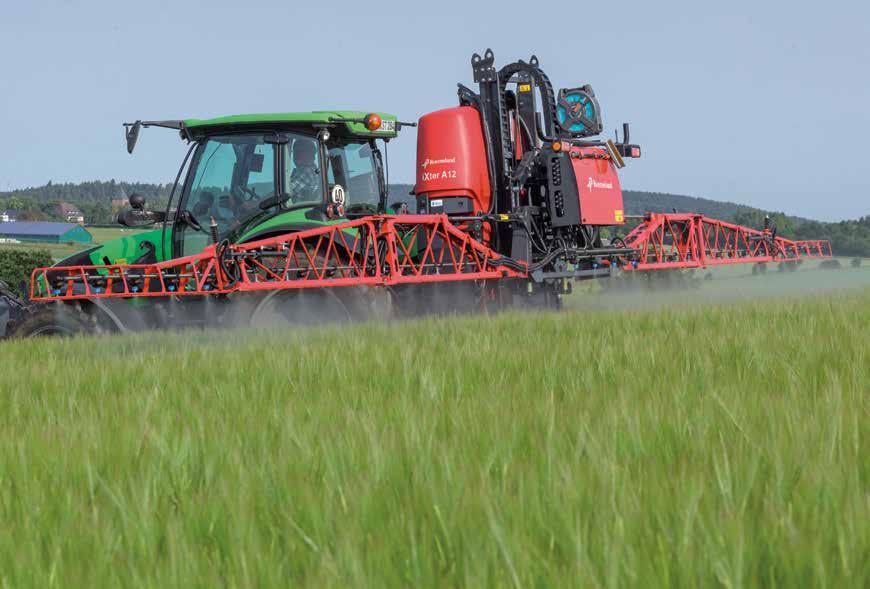
MAKE SPRAY APPLICATION MORE ACCURATE
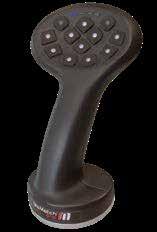
IsoMatch Grip
• In total 44 function assignments can be mapped to the IsoMatch Grip buttons
• Supports up to four work modes, each identified by a coloured LED
• Full control at your fingertips
• AUX-N certification (AEF)
• 100% ISOBUS compatible
• Intuitive touch interface
• Clear screen layout - easy to use and to understand
• Shortcuts between different screen levels
• Only a few clicks to different functions
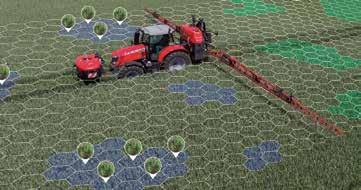
Variable Rate Application (VRA) has been used for several years to adapt the application rate of seeders, spreaders and sprayers to specific areas in the field. VRA prescription maps can be created based on soil maps, pictures from a drone or satellite images. The optional SpotSpray application on every Kverneland sprayer with iXspray software is based on prescription maps with zero application rates.
Based on a predefined prescription map the Kverneland sprayer shuts on and off in combination with the SpotSpray application.
• Intuitive and logical - suitable for every farmer
• Easy to program and to operate due to the AUX-N functionality
For more information drop in and see your local Power Farming dealership or call us on 0800 627 222.
Breaking ground the right way
There is a moment in every cropping season when the decisions made months earlier start to show themselves in the paddock. It might be the way a crop establishes evenly across a slope, the way water runs clean rather than muddy after rain, or simply the confidence that comes from knowing the paddock was chosen and prepared with purpose. Crop establishment is rarely dramatic, yet it is one of the most influential stages in any farming system because it determines not only yield, but cost, risk and environmental outcome.
The reality is that crop establishment is not just about putting seed in the ground. It is about understanding how the paddock, the soil and the wider farm system interact long before the drill arrives. Increasingly, the conversation around establishment is shifting from technique alone to planning, because modern farm systems demand that cultivation decisions support productivity while also protecting soil and water.
One of the clearest messages emerging from recent guidance is that paddock choice remains the single most important factor in successful establishment. Slope, drainage, soil structure and proximity to waterways all shape how a crop will perform and how resilient the paddock will be under pressure. Establishing crops on steeper ground or in areas prone to runoff increases the likelihood of soil movement, nutrient loss and costly remediation later. Choosing the right paddock
at the outset reduces those risks and often delivers stronger yields with fewer inputs. Soil condition sits at the centre of this discussion. Cultivation inevitably exposes soil to the elements, which increases the potential for erosion and nutrient loss during wet periods. Protecting soil structure, therefore, becomes a key part of the establishment process. Maintaining uncultivated buffer zones around waterways, swales and gullies helps trap sediment before it leaves the paddock, while preserving critical source areas in grass reduces the chance of runoff concentrating during heavy rain. These measures are not just compliance exercises; they are practical steps that help retain the productive
In modern farming, breaking ground is easy. Establishing it well is where the real skill lies.
capacity of the land.
The importance of slope management is also becoming more widely recognised. Establishing crops on gentler slopes reduces the likelihood of soil movement and improves the ability of rainfall to infiltrate rather than flow across the surface. Where slopes become steeper, the risks multiply quickly, and careful planning or consent may be required before cultivation even begins. These considerations highlight a broader truth about establishment: the most
effective cultivation decisions often happen well before machinery enters the paddock.
Planning timelines reflect this reality. Successful winter cropping, for example, can be an eighteen-month process from paddock selection through to re-grassing. That long lead-in emphasises how establishment decisions ripple through the entire farm system. Feed supply, wintering strategy, spring recovery and pasture renewal are all shaped by how and where crops are established.
Crop establishment also has a direct influence on grazing management later in the season. The way a paddock is laid out, the direction of grazing and the placement of buffers can significantly reduce soil damage and nutrient losses once animals are introduced. Directional grazing, for instance, has been shown to reduce soil and phosphorus losses dramatically by guiding animals away from vulnerable areas and maintaining better soil cover. Establishment, therefore, does not end with the crop emerging, it sets the framework for how that paddock will be used months later.
Another factor increasingly shaping establishment decisions is the need to protect soil from compaction and pugging. Winter grazing of forage crops is an essential part of many systems, yet it also carries risks for soil structure and water quality. Establishing crops in paddocks with resilient soil types, providing back fences and ensuring animals have adequate space and
shelter all help reduce the likelihood of longterm soil damage. These considerations underline that crop establishment is as much about preserving the soil for future seasons as it is about producing feed in the current one.
There is also a growing recognition that establishment choices influence nutrient dynamics across the farm. Cropping can increase the risk of nitrogen losses, particularly when soils remain bare after grazing. Integrating follow-on crops or catch crops into the establishment plan can help capture residual nutrients and reduce leaching, turning what might otherwise be a loss into productive feed. This systems approach reflects a broader shift in farming, where establishment decisions are being viewed through a whole-farm lens rather than as isolated paddock events.
From a contractor’s perspective, these changes are reshaping expectations around cultivation work. The role of the contractor is no longer simply to prepare a seedbed; it increasingly involves working with the farmer to understand the paddock plan, the buffer layout and the grazing strategy that will follow. Communication between farmer and contractor has, therefore, become a critical part of successful establishment, because the cultivation pattern often determines how the paddock will function through the season.
The GroundBreaker theme is fitting here, because modern crop establishment is less
Innovative farming technology for high-yield agriculture.
about breaking ground and more about understanding it. Technology, planning tools and environmental guidance are helping farmers refine how they approach cultivation, but the underlying principles remain grounded in good observation and long-term thinking. The best established crops are rarely the result of aggressive cultivation or complex machinery alone. They are usually the outcome of careful paddock choice, thoughtful timing and a clear understanding of how the soil behaves. What this means in practice is that crop establishment is increasingly becoming a strategic decision rather than a routine seasonal task. It sits at the intersection of feed supply, environmental management and farm profitability. Done well, it supports animal performance, protects soil and reduces future costs. Done poorly, it can lead to lost production, damaged paddocks and compliance headaches that linger long after the crop has been grazed.
In the end, the most important part of crop establishment may be the thinking that happens before the tractor turns a wheel. When paddock selection, soil protection and grazing strategy are aligned from the outset, the crop itself becomes the visible result of good planning rather than the starting point of it. That shift from reactive cultivation to planned establishment is shaping how New Zealand farmers approach cropping, and it is likely to define the next phase of productivity gains across the sector.
Thulit Solitair
Rubin 10 KUA
Cultivate with Cenius for any field condition
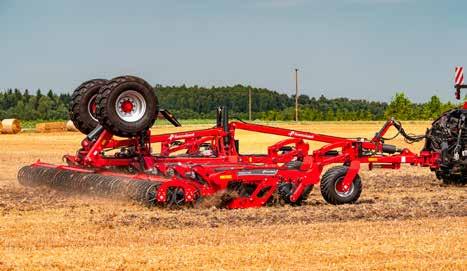
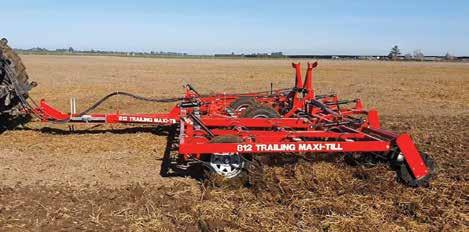
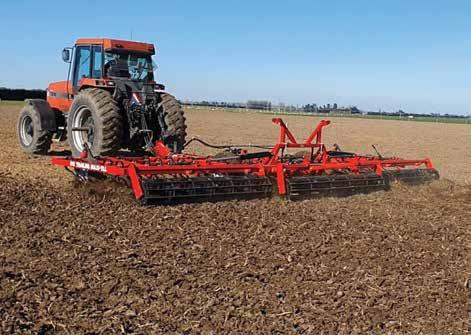
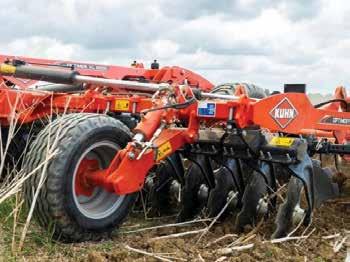
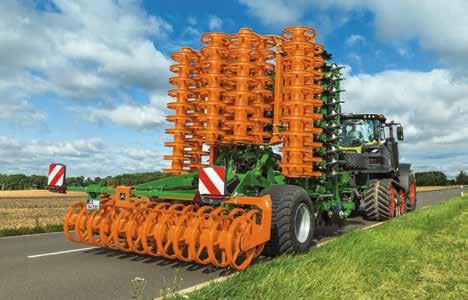
For soil tillage applications that demand both intensive loosening and effective incorporation, the Amazone Cenius-2TX trailed cultivator has been developed to deliver versatility, reliability and strong cost-effectiveness across a wide range of farming systems. Designed for operators who need one machine to handle everything from shallow stubble work through to deeper topsoil loosening, the Cenius-2TX offers working widths from four to seven metres and is equally at home working lightly or digging in where conditions demand it.
The performance of the Cenius is shaped by its tine stagger and carefully engineered angle of attack which together ensure consistent soil flow, thorough mixing and controlled loosening across the full working width. This layout allows the machine to operate efficiently across varying depths while maintaining stable pulling characteristics, an important factor for large farms and contractors looking to balance output with fuel efficiency.
Cenius trailed cultivators are well regarded for their robustness and ease of pull, with power requirements starting at around 80 horsepower per metre. Optional traction control further enhances grip and stability, particularly in more challenging conditions, allowing the machine to work effectively while reducing wheel slip. The result is not only improved work quality but also tangible fuel savings over long working days.
At the heart of the machine’s durability
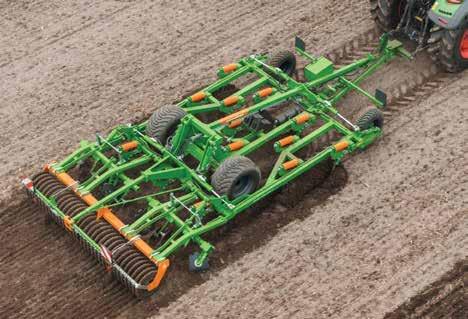
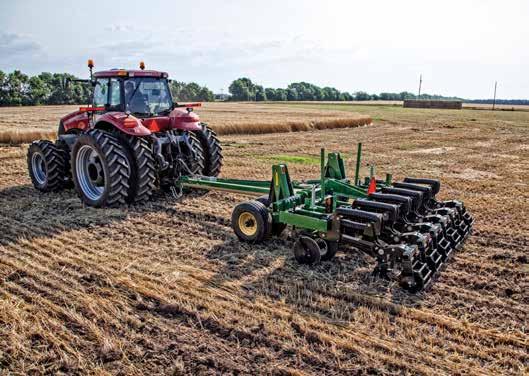
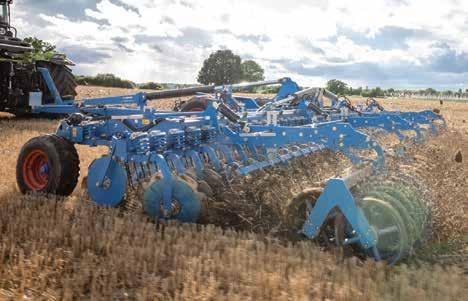
Designed for contractors and large farms, the trailed Cenius combines efficient pulling characteristics with reliable year-round versatility.
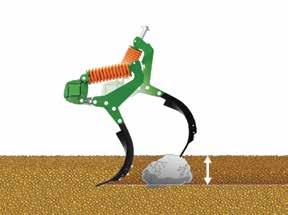
is the C-Mix share system, which allows the cultivator to adapt to virtually any soil type, whether working shallow for residue incorporation or deeper for loosening compacted layers. The strength of the C-Mix Ultra tine system becomes especially apparent in demanding soils with medium to large stones, where overload protection is regularly triggered. In these situations, the tines are able to deflect without compromising frame integrity or working depth.
For conditions where overload events are less frequent, C-Mix Super tines with pressure spring overload protection provide effective safeguarding of the frame, automatically resetting after deflection. Working depth adjustment is infinitely variable and can be set mechanically or fully hydraulically, with depth control managed via the rear roller and support wheels on the Cenius-2TX. Where hydraulic ultra overload protection is specified, trigger forces can be set between 500 and 800 kilograms ensuring that working depth is reliably maintained even under the toughest soil conditions. This allows the tines to deflect as often as necessary, even at depths of up to 35 centimetres, while a central hydraulic accumulator damps the return movement of the tines significantly reducing wear on the overload protection system. Strength is engineered right down to the tip, with the Cenius able to be fitted with a range of different shares and share points to suit soil type and cultivation goal. Regardless of configuration, the highstrength shares ensure reliable penetration into the soil along with intensive mixing and loosening. Combined with a choice of levelling tools and rear rollers, and working depths ranging from 5 to 35 centimetres, the Cenius becomes a highly flexible soil tillage
The Amazone Cenius-2TX is designed to deliver consistent soil loosening and residue incorporation across a wide range of cultivation depths and conditions.
tool that can be used throughout the year. That flexibility allows the implement to cover a wide range of applications, from shallow stubble cultivation and aggressive incorporation of harvest residues through to topsoil deep loosening and final seedbed preparation. For farms and contractors aiming to simplify their machinery lineup, the Cenius offers the ability to adapt to seasonal demands without the need to change implements.
Ease of use and low maintenance have also been central to the design. Tool-free mechanical or hydraulic adjustment of working depth and the levelling unit makes setup quick and straightforward. A strong sturdy frame with a generous frame height of 80 centimetres and a tine spacing of 28 centimetres ensures blockage-free operation, even when working in heavy residues. The high underframe clearance promotes uninterrupted material flow where large volumes of straw are present, while the following levelling tools leave behind an even, well-finished surface.
Maintenance demands are further reduced through the use of maintenancefree disc bearings, significantly cutting overall servicing time. The proven face seal technology used in Amazone tillage equipment for almost 25 years continues to play a key role here, having demonstrated its reliability in a wide range of conditions around the world.
As GRIMME Operations Manager Roger Nehoff explains, the Cenius also fits neatly into broader cultivation and establishment strategies. “The Amazone Cenius is great for use on the first pass to open up and dry out wet conditions. Combine the trailed soil tillage range with an optimum seeding system like the Catros speed disc for a secondary high-speed pass; with the option of a 200 or 500 litre green drill mounted on the frame, catch crops can be sown directly or during soil tillage,” he says.
Taken together, the Cenius-2TX offers a well-balanced combination of strength, flexibility and efficiency, making it a practical choice for operators who need reliable soil tillage performance across changing conditions and seasons.
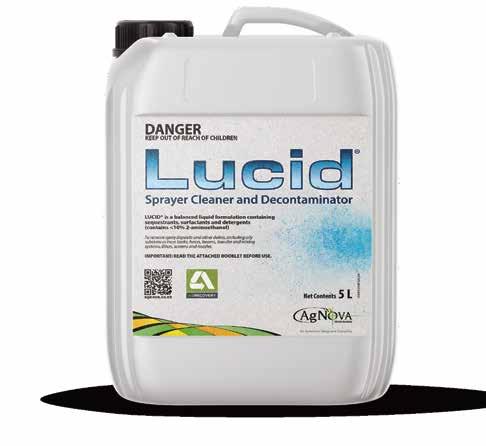
No-one’s better placed than Arxada to formulate a slug pellet to make the most of META. That pellet is AXCELA. AXCELA slug pellets are produced using a unique wet-extruded production process.
is evenly distributed throughout each pellet
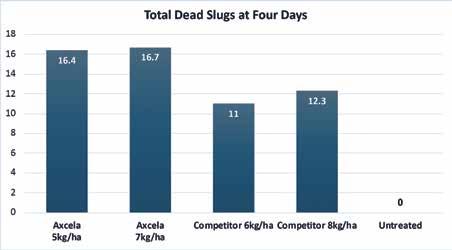
® AXCELA slug pellets are better because they have an immediate effect on a slugs ability to feed. Put simply, they kill more slugs, more quickly.
Breaking compaction at depth with the Great Plains In-line Sub-soiler
There are parts of a paddock that tell their story openly and others that keep it hidden well below the surface. For many farmers and contractors the most limiting factor in crop performance sits out of sight in compacted layers that restrict roots, water and nutrient movement. Compaction is rarely dramatic but over time it quietly erodes yield potential and resilience, particularly in systems that rely on repeated traffic, heavier machinery and narrow working windows. Addressing that problem properly requires a tool that is built to work deep, stay true and fracture soil without creating new issues at the surface, and that is where the Great Plains In-line Sub-soiler range fits naturally into modern cultivation systems.
The In-line Sub-soiler range is designed with a single purpose in mind, which is to remove compaction and reset soil structure at depth while keeping the operation as controlled and predictable as possible. Rather than chasing surface finish, these machines focus on what happens below the working layer targeting hardpan created by years of cultivation, harvesting and transport. By lifting and shattering that dense zone, the soil profile becomes more open and functional, allowing roots to explore deeper, water to drain and infiltrate more effectively, and crops to access nutrients that were previously locked away. Across the range, Great Plains offers several models to suit different farm sizes,
tractor power and operating styles. The core difference between models lies in working width and shank count, allowing operators to scale the machine to their horsepower and the area they want to cover in a day. Narrower configurations suit smaller tractors or targeted compaction work, while wider machines are clearly aimed at large-scale operators and contractors who need to cover ground efficiently when conditions are right. This modular approach means the range is not a one-size-fits-all solution but a set of tools built around the same principles.
A defining feature of the In-line Sub-soiler design is the straight in-line shank layout, which promotes consistent soil fracture across the full width of the machine. Shank spacing is set to ensure overlapping zones of disturbance, reducing the risk of untouched compaction strips between legs. Operators can choose between auto reset or shearbolt shanks and point options depending on how aggressive they want the machine to be. The Great Plains In-line Sub-soiler comes standard with the no-till shank and shin option and is well suited to systems where residue retention and minimal surface disturbance are priorities, creating deep fracture while leaving the top profile largely intact.
Depth control is another area where the range shows its practical intent. Adjustable gauge wheels allow operators to set and hold working depth accurately, even across rolling or uneven ground. This matters because deep tillage only delivers its benefits when it is done at the correct depth, and inconsistent penetration can leave compaction untouched in places while overworking others. With the gauge wheels carrying part of the load, the sub-soiler runs more steadily, reducing stress
on the frame and tractor while improving consistency across the paddock. Optional finishing components, such as berm conditioners, add another layer of flexibility. After the compaction layer has been fractured, these attachments help firm and level the soil, reducing surface roughness and leaving the paddock in a more workable state for following operations. This is particularly valuable in systems where deep ripping is carried out ahead of drilling, as it helps avoid the need for extra passes simply to tidy up the surface.
When comparing models within the range, the decision often comes down to scale and timing rather than capability. Smaller units allow precise intervention in problem areas or on lighter tractors, while larger machines bring obvious advantages in productivity for those working big areas under tight seasonal pressure. In all cases the heavy-duty frame construction and straightforward mechanical layout reflect a machine built to live in real paddocks, not just demonstration plots. These are tools intended to be used hard when conditions allow and parked when they do not, without demanding excessive maintenance or adjustment.
The agronomic payoff from effective sub-soiling is rarely instant but is often long-lasting. Improved root depth supports better early vigour and stronger drought tolerance, while enhanced drainage reduces waterlogging and compaction-related stress. Over time, these gains translate into more even crops and greater consistency across paddocks that once struggled to perform. The role of the sub-soiler is not to replace good soil management but to support it, removing physical barriers that limit the effectiveness of fertiliser, rainfall and plant genetics.
In an environment where soil health and productivity are increasingly linked to both profitability and sustainability, the Great Plains In-line Sub-soiler range offers a measured, practical response to one of farming’s most persistent challenges. By focusing on depth, control and durability and by offering a range of configurations to suit different operations, it gives farmers and contractors a reliable way to restore soil structure and unlock performance that has been held back for years. Sometimes the most valuable improvements happen out of sight and this is a range built to work exactly where it matters most.
Operators can choose between auto reset or shear bolt shanks and point options depending on how aggressive they want the machine to be.
Maize resilience for the future from Corson Maize
As the maize sector moves into another harvest and farming year, with its familiar mix of opportunity and challenge, growers and wider industry participants continue to demonstrate resilience and a positive outlook. This has been evident despite the pressures of adverse weather, particularly the wet spring conditions experienced in the north and the weather events that occurred in January, as well as ongoing pest incursions such as fall armyworm.
Corson Maize continues to position itself around long-term performance and consistency rather than short-term gains. Over the past three to five years, a commercial suite of maize hybrids has progressed through an extensive trialling programme with those hybrids now proving their value through careful selection and commercialisation with growers across New Zealand. Performance in the field is increasingly reinforcing the outcomes seen during earlier trial stages.
A core principle for Corson Maize is that
a new hybrid is only brought to market when there is confidence it offers a genuine improvement on what is already commercially available. While some hybrids can perform exceptionally well
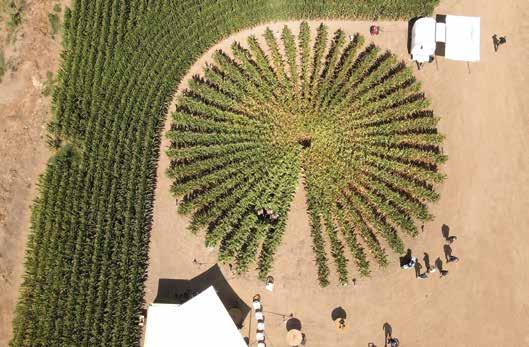
A maize hybrid population wheel, from the Corson Maize Newstead trial site, showing changes within maize plants as planting population rates change.
The slug solution
Slugs continue to plague the industry as a major pest through the early establishment phase of newly sown crops. A slug bait is required to mitigate the risk of slugs attacking the crop; however not all slug baits are built the same.
Axcela, developed by Arxada stands out from the rest. It is manufactured via a unique wet-extrusion and gelatinised process in a dedicated, state-of-the-art plant in Switzerland. Axcela combines the advantages of a specific mode of action with meta metaldehyde as the active ingredient, combined with the latest formulation and production techniques - resulting in a pellet with the highest qualities, optimising slug and snail control under a wide range of growing conditions.
The process by which the Axcela pellet is produced means it is uniform in shape and size, has a strong integrity for spreading, delivering enhanced ballistic capabilities retaining its characteristics into the field. The active ingredient is evenly distributed through the entirety of the pellet, meaning the active is present for the duration that the pellets are present in field. Aiding longevity, the gelatinisation process carried out during manufacturing enables the pallet to absorb water rapidly and increases palatability for slugs leading to improved control. The Axcela formulation also results in extended persistence on the paddock and therefore, can broaden the application windows if not consumed by slugs during less favourable conditions.
Reducing the risk of slug damage is not as simple as just applying a slug bait. Getting the best out of Axcela starts with knowing what your slug pressure is. Slugs feed at night under cool conditions, living out the
warmer days in cracks in the ground or under foliage, dead plant matter or animal excrement. They like moist conditions and thrive after rain or dew, laying eggs and eating young crop foliage.
Direct drilling techniques increases the risk of slug damage, as they can live and travel along the drill rows created by the machinery. Full cultivation methods, where a fine and even seed bed is prepared, does not eliminate the total risk of slugs as they are able to venture in from the surrounding uncultivated areas. But what it does do, is bring slugs and their eggs to the surface where they are naturally dehydrated and subsequently die.
Monitoring your slug pressure post drilling is as simple as laying out old seed bags or planks of wood overnight and checking them in the morning for the presence of slugs underneath, as this creates a favourable habitat for them to harbour. Once a population is determined, to get the best out of Axcela, apply during mild, damp weather when slugs are the most active, when they are seeking food and likely to
Getting the best out of Axcela starts with knowing what your slug pressure is.
encounter a bait. Ensuring your equipment is calibrated for optimum performance, Axcela is applied at 5-7kg per hectare depending on slug pressure. Follow up applications may be required in the event of a wet season, or when slug pressure is particularly high. For optimal results, 60 baiting points per square meter is where the most success for control will be seen. This is achieved with 7kg per hectare of Axcela.
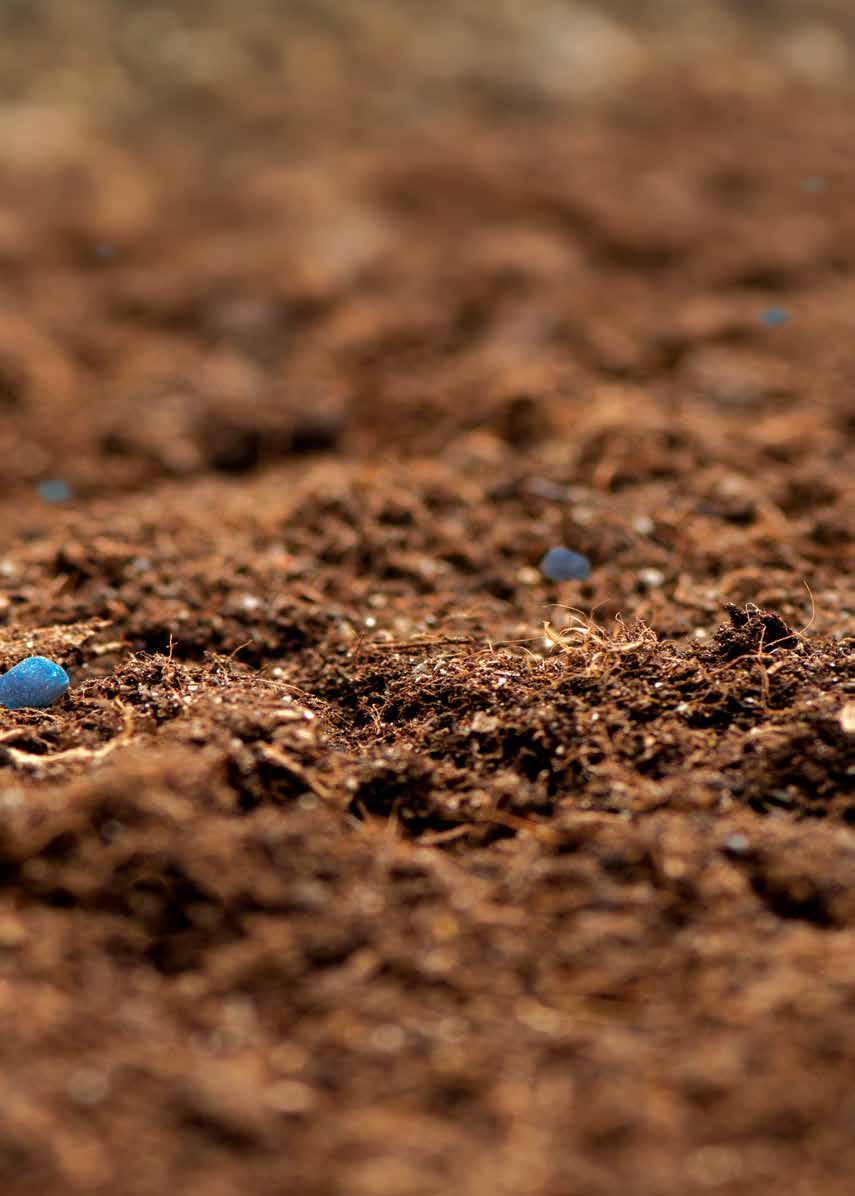
Some additional benefits to using Axcela for controlling slug populations is that it has no negative effect on beneficial organisms, including earthworms and bees. Axcela is also a vivid blue colour, meaning it is easily detected in the field so you can monitor its ongoing activity and longevity.
For more information about Axcela, visit our website https://arxada.co.nz/specialty/ axcela or contact one of our Arxada territory managers throughout New Zealand.
under ideal growing conditions, they do not always deliver the resilience required when challenged by dry conditions, disease pressure or seasonal variability. Hybrids that lack this robustness are filtered out during the selection process.
This approach underpins grower confidence that when a Corson Maize hybrid is planted, it has been rigorously trialled and tested specifically for New Zealand conditions. The focus remains on providing hybrids that offer the strongest possible opportunity for a successful crop at harvest, rather than simply chasing peak yields
under perfect conditions.
Recent investment has also seen the establishment of a new research site in Northland, representing a significant step in expanding Corson Maize’s ability to generate region-specific insights. Northland’s unique growing environment presents its own challenges, and having a dedicated research site in the region allows hybrid performance to be assessed directly in local conditions. This is delivering more accurate, locally grounded data to support growers and industry partners when making hybrid selection decisions and refining
agronomic practices tailored to the region. Looking ahead, one of the key developments for the season will be the release of the new short-maturing hybrid PAC 011. This hybrid has been developed with South Island growers in mind and is positioned as a standout silage option. Strong early vigour, combined with a tall and imposing leaf structure makes PAC 011 well suited to systems requiring a fast, reliable silage crop. Seed availability will be limited and growers are encouraged to discuss suitability with their local Corson Maize sales agronomist or seed retailer.
Work Smarter
Rolling with the best — making heavy lifting easy, one bale at a time.
Features a 116.8hp Perkins 904 4-cylinder engine, 4WD hydrostatic drive with EPD, and a 140L fuel tank for powerful, efficient performance.
Save up to 18% on fuel with Merlo’s patented EPD system for maximum efficiency and performance.
North Island Dealers
89 Kahikatea Dr, Hamilton
38 Progress Dr, Otorohanga
7 Heights Road, Pukekohe Visit us in Invercargill, Gore, Mosgiel, Cromwell, Timaru, Ashburton or Christchurch *Terms & conditions apply. Contact your dealer for details.
Parts & Service: 07 843 7237 • sales@acmd.co.nz agandcivilmachinery.co.nz @agandcivil
to our Specialists
Features a metal structure above the cab to meet FOPS Level II standards, protecting operators from falling objects.
Merlo handlers feature advanced frontal tipping prevention, keeping operators safe without compromising boom speed or lifting capacity.
South Island Dealers
@jj.co.nz
Bringing cultivation and bed forming together
In a paddock where timing is tight, seasons are unforgiving and every pass counts, having an implement that can combine tasks without compromising results is a tangible advantage. The Farmgard Combovator bed forming system - Maxi-P is one such tool designed to bridge the gap between cultivation and bed forming in a single, efficient operation. It is not machinery born of novelty but of practical problem-solving, allowing operators to work soil and shape beds in one pass rather than multiple trips across the ground. This kind of efficiency matters to contractors and cropping farmers alike, particularly as pressure grows on seasonal windows and input costs remain sharp.
At its core, the Combovator bed forming system is a modular solution that bolts on to a power harrow or rotary tiller and turns that base implement into a 2-in-1 cultivation and bed forming machine. Rather than relegating bed formation to a separate attachment or follow-up pass, the Combovator system allows soil to be tilled and then shaped into raised beds in a single movement saving time, fuel and tractor hours. The simplicity of the concept belies its operational impact, especially in systems where raised beds are central to crop establishment.
One of the defining features of the system is its adaptability. The bed former can be fitted or removed from the power harrow or rotary tiller as conditions demand, meaning farmers and contractors are not locked into a single configuration. This flexibility reflects a design ethos that recognises the unpredictable nature of farm work, where one paddock might need cultivation alone and the next requires beds ready for planting. The triple hydraulic control through a Z-link system gives the operator authority over depth, tilth and consolidation from the tractor seat, allowing quick adjustments on the move without stopping to make manual changes.
Hydraulics do more than make adjustments convenient. They allow the Combovator to operate effectively in a range of soil types and conditions, from lighter soils that require gentle handling to heavier clays that demand more robust consolidation. The pontoon system which is adjustable and can be tailored to specific bed shapes or wheel centres, works in harmony with the base harrow or tiller to contain and shape
soil rather than scatter it. It is a deliberate departure from the idea that cultivation and bed forming must be sequential tasks; instead, this system treats them as integrated steps in preparing seedbeds that are ready to go.
For operators, that integration translates into a reduction in passes across the paddock which, in turn, can mean lower diesel use, less compaction and better retention of soil moisture. In seasons where rain or dryness can drastically reduce the number of workable days, reducing passes without compromising quality is not a marketing claim but a practical outcome. Contractors, in particular, will appreciate a machine that steps into a workflow and saves time without asking for specialised operation or complex setup.
The Maxi-P platform extends these capabilities into larger tractors and wider working widths, supporting machines from about 250 up to 450 horsepower. This makes the system suitable for both broadacre crop preparation and larger scale operations where bed forming is a cornerstone of cropping systems such as root crops or brassicas. Working widths available under the Maxi-P banner provide flexibility for farm units of varying sizes, making the Combovator a practical choice for operators who need capacity without sacrificing control.
Adjustable pontoons lie at the heart of that control. Designed to be bolted on and interchangeable, they allow bed dimensions and profiles to be changed without significant downtime. This is important in farms where different crops require different bed profiles, or where
The Maxi-P platform supports machines from 250 up to 450 horsepower.
wheel track requirements vary between tractors. With a bed former that lifts clear for standard cultivator work, the machine can be converted quickly for other tasks, reducing the need for multiple dedicated implements and the capital outlay that comes with them. One of the features that operators often notice only after using the machine for a season is the way the Combovator system manages soil consolidation. Rather than relying on rear rollers alone, the combination of hydraulic control and adjustable pontoons allows soil to be shaped and firmed simultaneously, leaving beds that are not only the correct shape but also possess the structure needed for planting and early growth. For crops where precision and consistency are important, having a firm, uniform bed before planting can influence final emergence and yield potential. Maintenance and daily use have also been considered in the design. By building on a familiar power harrow or rotary tiller platform, the Combovator avoids introducing overly specialised components that can be difficult to source or service. Operators experienced with conventional cultivation equipment will find the transition to a Combovator straightforward, with service points and adjustments falling within the expected routine of harrow and tiller upkeep. For contractors who work across different soil types, paddock histories and crop requirements, the ability to adapt equipment quickly is essential. The
TESTED TO BE TRUSTED
Avoid costly cross contamination.
Lucid is the only sprayer cleaner and decontaminator specifically tested to remove >50 active ingredients such as carfentrazone, trifluralin, phenoxy and sulfonyl urea herbicides; plus many other insecticides, fungicides and herbicides. AgNova Technologies info@agnova.co.nz orders@agnova.co.nz 0800 500 599
Allen Custom Drills: built tough for New Zealand seeding conditions
Based in Mid Canterbury, one of New Zealand’s most productive agricultural regions Allen Custom Drills is an owneroperated business focused on designing and manufacturing air seeder drills built for reliability, accuracy and longevity in real paddock conditions.
The Allen Custom Drills name is well established across New Zealand and has earned a strong reputation among contractors and farmers who need machinery that can cope with challenging soils, tight weather windows and the demands of modern cropping and pasture renewal systems.
The company’s philosophy is straightforward: design and build drills that can handle demanding ground conditions, place seed accurately and continue working efficiently season after season. That focus on practical performance has shaped a range designed to suit a wide spread of farming systems and operator preferences.
Allen Custom Drills offers five base models, with the flexibility to add optional extras to suit many different farming and soil types and operator preferences.
The Ergonomic Drill, or E-D Series, is a practical entry-level triple disc drill available in working widths from 3 to 4 metres. For contractors and larger-scale operations, the Contour Drill, or C-D Series is a proven triple disc option and remains one of the most popular machines in the range, offered from 3 to six 6.
For operators who prefer a tine-based system, the Tine Drill, or T-D Series, provides a robust solution. It is fitted with 25 mm coil tines and tungsten-tipped T-boots and is available in widths from 4.5 to 6 metres.
For min-till operators wanting stronger ground consolidation, the Packer Drill,
or P-D Series, incorporates a tyre packer system and is offered in 5 and 6 metre working widths.
Completing the range is the Heavy-Duty Direct Drill, or H-D Series, a more specialised machine best suited to flat ground conditions. It’s not as common as the other models, but remains a great option for hard ground conditions, and is available in 5 and 6 metre widths.
Across the range, all Allen drills offer row spacing options of either 5” (125 mm) or 6” (150 mm).
Transport practicality is another key consideration. All models maintain a 3-metre transport width, making them easier to move between paddocks and/or farms where needed.
All machines have the option of being iSO ready or a 7-inch touchscreen monitor and now have a WCM (Wireless Connection Module) standard which allows the operator to connect any WiFi equipped phone or
Across the range, all Allen drills offer row spacing options of either 5” (125 mm) or 6” (150 mm).
tablet direct to the drill for calibration. This means they don’t need to go backwards and forwards to the tractor cab to load in dispensed amounts and start another calibration.
Allen Custom Drills recognises that investing in machinery is a significant decision for any business. The company’s emphasis, is therefore, on building equipment that delivers long-term value, not just through performance in the paddock but through durability, serviceability and reliability over many seasons of use.
For more information, visit www. allencustomdrills.co.nz or contact Allen Custom Drills directly to discuss specifications and options suited to your operation.
Combovator’s hydraulic control over bed shape, consolidation and depth allows a level of on-the-go adjustment that suits varied conditions, whether that means working trashy ground after a cover crop, shaping beds in moisture-rich soil after rain, or preparing seedbeds in drier conditions. The flexibility built into the system means it is not restricted to a narrow set of conditions but can be called on as a genuine all-round solution.
From a broader perspective, the rise of bed forming systems like the Combovator reflects evolving cropping practices where
raised beds play a role in drainage, root development and mechanised harvesting. Implementing beds at the right stage, with the right profile and without consuming valuable hours through multiple passes is increasingly part of the equation for growers looking to maximise efficiency. The Combovator’s one-pass philosophy tears down the traditional separation between preparation and formation, offering an integrated approach that meets the needs of contemporary farm systems.
Ultimately, the Farmgard Combovator bed forming system - Maxi-P is not just a
machine, it is a response to how operators are working today. It recognises that time is money, that soil health matters and that machinery must be versatile without being complicated. For operators pushing hectares through tight windows and for farmers seeking reliable crop starts with minimal fuss, this system delivers a pathway from rough ground to neat, seed-ready beds in a way that makes sense both agronomically and economically. It is a tool built not around concepts but around results and in that it reflects the core demands of modern land preparation.
Re-defining cultivation: why the Kverneland Qualidisc matters for New Zealand soils
Cultivation equipment often sits in the background of farm machinery conversations, yet it plays a critical role in setting up the season before seed ever meets the soil. The Kverneland Qualidisc is not a drill or a planter, it is the machine that prepares the soil in a way that respects the unique variability of conditions across New Zealand paddocks - from lighter silts to heavier loams and everything in between. What makes the Qualidisc noteworthy, particularly as it arrives here through Power Farming, is not flash technology for its own sake but a careful balance of aggressive soil engagement with precise control, allowing operators to respond to the real challenges of seedbed preparation without unnecessary compromise.
What the Qualidisc does at first glance appears simple enough - cut, mix, and level soil, but the difference lies in how it achieves that outcome consistently across different field conditions. Instead of relying on a single bar or tine arrangement, the machine combines a row of high-strength disc gangs followed by a robust levelling and consolidation system all mounted on a frame engineered to maintain balance and stability at speed. The initial disc gangs slice through residue and surface soil, breaking crusts and cutting trash so that soil is conditioned rather than torn. This prepares a profile where organic matter is incorporated without smearing which matters because soil structure deteriorates quickly when shear forces dominate, leading to compaction layers that slow emergence and restrict early root growth.
As Power Farming introduces the Qualidisc to growers and contractors here, the conversation will inevitably start with specifications, widths and other options.
Adhesion and consistency are perennial challenges in New Zealand cultivation because moisture levels can vary widely across a paddock after a rain event, and the Qualidisc’s geometry is designed to respond to that. The angled discs work to throw material evenly rather than bank it, reducing the risk of side shearing and uneven surface profiles that cause headaches at planting. What might appear to be a small detail in gang angle or disc size is, in fact, a significant factor in how uniform the soil profile becomes after a pass, and it is those uniform profiles that give planters and drills a predictable surface to work from.
Another detail that sets the Qualidisc apart is the way the subsequent levelling and rear packer work in harmony with the front discs. Too often cultivators leave a rough surface that drills then must chase, resulting in variable depth and inconsistent seed placement. The Qualidisc’s rear levelling tines and packer take the rough cut from the discs and bring it back to a manageable bed, smoothing wheel tracks and minor undulations so the following seeding equipment can do its job without compensating for micro-terrain. This is not merely
convenience, it is agronomic sense: seed depth consistency is directly related to the uniformity of the seedbed and even small irregularities can manifest as patchy emergence when
conditions are tight. Frame strength and machine balance are more than marketing words on a specification sheet, they are real contributors to consistent
www.gaz.co.nz
cultivation. The Qualidisc is built with a robust mainframe and well-engineered articulation points so that the discs run true over uneven ground rather than bouncing or deflecting. That means the aggressive work the gangs are designed to do actually gets done where it should, not just where the machine pitched itself. With working speeds that recognise the need to cover ground without ripping through soil blindly, this combination of strength and controlled engagement is a reminder that good cultivation is as much about mechanical integrity as it is about soil physics.
Another consideration for the New Zealand context is residue management, because increasing adoption of cover crops and
residue retention has made the job of a cultivator harder, not easier. The Qualidisc’s design invites residue to be cut cleanly and mixed into the soil profile without building thatch banks or leaving long fibres that wrap on axles and bearings. This is particularly relevant for contractors and mixed farms where rotations vary and a cultivator must work equally well after maize stubble as after ryegrass or brassica residues.
Maintenance, often the unseen side of farm machinery, also gets attention in the Qualidisc’s design. Bearings are well protected, gang alignment is easy to check and adjust. Service points are accessible without undue contortions. In a season where downtime means missed windows
The Qualidisc does more than simply cut, mix and level soil.
and tight margins, ease of maintenance is not a luxury, it is a practical advantage that keeps the machine on the job rather than off it. What ultimately defines the Qualidisc is not any single feature, but the way those features come together to support a sound agronomic base. It does not try to do everything, but what it does do it does with a seriousness of purpose that matches the realities of New Zealand soils: variable moisture, mixed residue loads and the ever-present need to make the most of fleeting seeding windows. Bringing soil to a consistent, workable state before planting is the work that underpins every successful crop and machines that understand that simple truth tend to be the ones operators return to season after season.
As Power Farming introduces the Qualidisc to growers and contractors here, the conversation will inevitably start with specifications, widths and other options. But for those who spend time behind the wheel, it will be the way the machine handles real soil and real paddocks that defines its value. Cultivation is not an abstract exercise; it is the quiet work that sets the scene for the rest of the season and in that role the Kverneland Qualidisc is a machine designed to get the fundamentals right.
Integra: when one roller has to do more than one job
There is a growing expectation in New Zealand farming that machinery should not just do a job, but solve a problem. With tighter weather windows, higher input costs and pressure to minimise passes, establishment equipment is increasingly judged not by how well it performs in perfect conditions but by how effectively it adapts to the realities of the paddock. That shift in thinking sits behind the development of Farmchief’s Integra system, which builds on the proven Rollmax platform but moves the roller drill concept in a more practical direction.
The starting point for the Integra was not engineering theory but farmer feedback. Paddle roller drills have long been valued for their ability to level and prepare a paddock quickly, creating a tidy seedbed and consolidating the soil in a single pass. In areas with reliable rainfall they often deliver strong results, and their role as secondary cultivators makes them particularly useful ahead of sowing programmes where efficiency matters.
Yet operators also identified a consistent frustration. While paddles do an excellent job of preparing the surface, they do not always pull soil back across the seed in the same way harrows do, and that difference can affect strike reliability when conditions are less forgiving. The obvious solution is a harrow roller drill, which does improve seed coverage, but that approach comes with its own compromise. Harrow-only machines tend to become single-purpose tools, losing the broader usefulness of a paddle roller for levelling and preparing paddocks ahead of drilling.
For contractors and mixed farms trying to minimise duplication in the fleet, that trade-off has never been ideal. What many operators wanted was a machine that could retain the paddle roller’s ability to prepare and consolidate ground, while also providing the seed coverage associated with a harrow drill. The Integra is Farmchief’s answer to that request.
At the heart of the system is the Rollmax hydraulic paddle platform, which uses six synchronised rams to maintain consistent control across the full working width. That
The Integra system combines levelling, consolidation and seed coverage in a single pass, helping improve establishment efficiency.
gives the operator the same levelling and consolidation performance that has made paddle rollers so effective as secondary cultivators, ensuring paddocks can still be prepared quickly and efficiently ahead of sowing.
Where the Integra moves beyond a standard paddle roller drill is in how it handles the final stage of establishment. Mounted behind the hydraulic paddles are two rows of heavy 12 millimetre chain harrows. Once the seed is applied, those harrows can be brought into play to draw soil back across the seed and improve coverage, helping to deliver a more consistent strike without the need for a separate pass or a dedicated harrow machine.
The effect is to turn what was once a choice between preparation and coverage into a combined operation. The machine can level and consolidate like a paddle roller, then finish and cover like a harrow drill, giving the operator greater control over the seedbed while still maintaining efficiency across the job. In practice that flexibility is what
allows the Integra to operate as both a highly effective roller and a dependable roller drill, depending on how it is configured.
For contractors working across multiple farms, that adaptability is particularly valuable. Conditions vary from one property to the next, and the ability to adjust the machine’s role without changing equipment simplifies logistics and reduces downtime. For farmers running mixed operations, it means a single machine can cover preparation and sowing tasks without forcing a compromise in performance.
The Integra also reflects a broader shift in machinery design in New Zealand, where the most successful equipment is often shaped by practical feedback rather than theoretical optimisation. Farms here rarely operate under uniform conditions, and machines that succeed tend to be those that respond to variability rather than
Farmchief’s Integra system, is built on the proven Rollmax platform.
Lemken sets new benchmark in soil cultivation with the Rubin 10/1000 compact disc harrow
The machine has now been released, with the first model displayed at Southern Field Days 2026, demonstrating Lemken New Zealand’s dedication to providing reliable, high-performance equipment for New Zealand farmers.
Built for professional farmers and contractors working in challenging conditions, the Rubin 10/1000 boasts an unprecedented 10-metre working width, making it one of the widest disc harrows with under 3-meter road transport on the market. The machine’s robust design and intelligent features are tailored to deliver uniform, intensive soil incorporation across broad field widths even at shallow depths.
“Modern farming demands equipment that delivers strong performance without sacrificing ease of use or adaptability in the field,” said Ben Harris, Regional Service Manager Lemken New Zealand “The Rubin 10/1000 meets that need through its scale, drives higher productivity and supports longterm soil health.”
Key features and advantages
Record-setting disc diameter: With a 645 mm disc diameter, the Rubin 10/1000 offers exceptional penetration and residue mixing, suited to high-speed soil cultivation.
Large working width: A full 10 m working width enables efficient coverage of large acreages, reducing passes, fuel usage and operating time.
Automatic folding and transport ease:
Hydraulic automatic folding allows the unit to compact to <3 × 4 m for safe transport on roads and narrow access points, streamlining setup and movement between fields.
Depth adjustment without tools: Operators can fine-tune tillage depths quickly and easily to match soil conditions, supporting consistent results across variable terrains.
Road-ready performance: The implement carries EU-wide approval for transport speeds up to 40 km/h, enhancing operational efficiency.
Intelligent contour handling: Optional iQ Blue contour adjustment actively adapts to slopes and uneven ground for even, highquality tillage results.
The Rubin 10/1000 is designed for tractors rated between 320–600 hp and its symmetrical disc arrangement with 14 cm line spacing ensures consistent soil flow and minimal blockage, even with high volumes of residue.
Beyond its agricultural capabilities, the machine emphasises operator comfort and safety. Strong attachment options, including
drawbar eye and ball coupling variants, provide secure and stable connectivity during both field work and transport. The implement’s ability to lift and rotate on its roller reduces ground pressure at headlands, minimising soil compaction and preserving structure.
The Rubin 10/1000 is now available through Lemken’s global dealer network. For more details on the full range of configurations and technical specifications, please contact your local representative or visit lemken.com.
expecting standardised layouts or soil types. By combining the levelling strength of the Rollmax paddle system with the seed coverage advantages of harrows, the Integra feels less like a new product and more like a logical evolution of how roller drills should work in local conditions.
In the end, the value of a machine like this
is measured not in specifications but in outcomes. When preparation, sowing and finishing can be carried out in one adaptable system, turnaround improves, consistency lifts and the pressure of narrow weather windows becomes easier to manage. That is what turns a piece of machinery from a simple implement into an operational advantage.
For New Zealand farmers and contractors who expect one machine to perform more than one role, the Integra represents a practical response to a familiar challenge. It is not about replacing proven systems but about bringing their strengths together in a way that better reflects how establishment work actually happens in the paddock.
Built for demanding conditions, the Rubin’s large-diameter discs and robust frame help maintain performance and soil flow even in heavy residue situations.
The Lemken Rubin 10/1000 combines wide working capacity with intensive residue mixing, designed to deliver consistent soil incorporation across large paddocks.
Order Now Keep up-to-date
• Over 110 new listings
• 70 discontinued products
• Numerous product label updates (new weed, pest & disease claims)
• All product labels reviewed for regulatory content and updated to GSH terminology.
The definitive guide to agrichemicals registered for use in New Zealand.
A comprehensive alphabetical listing of products, active ingredients, crop & weed tables, weed & pest identification and much, much more all in one single publication. It really is the definitive agrichemical guide and the only one you’ll ever need.
Purchase a manual to receive a FREE 12-month subscription to our subscriber only website.
The website is continually updated and contains product listings, a fully searchable online product manual, a powerful search engine of weeds, diseases & pests, including photo galleries with all the agrichemical options to use on individual crops as well as up-to-date SDS’s, Haznotes and product labels, plus posts about industry news and information.
Order Now to receive your FREE pair of SureShield Coveralls
SureShield Coveralls supplied by pH7, provides both protection and comfort with exceptional liquid and particulate protection.
Category III, Type 5, Type 6 certified coveralls.
Ideal for asbestos removal, spray painting, low hazard pesticide spraying, boat building, dusty areas and general light industry.
These are best suited to spraying diluted chemicals such as round up for the fence lines, general maintenances on farm, or when spraying from a airconditioned cab.
One size fits all. Supplied by pH7.
* Available to those who order directly from www.novachem.co.nz - while stocks last.
Storing Chemicals?
Print up-to-date SDS’s & Haznotes from novachem.co.nz to ensure you are compliant.
Holding the line at speed: why the Kverneland Optima SX with Geoforce raises the bar for precision planting
The arrival of the Geoforce option to the Kverneland Optima SX range in New Zealand will matter for a simple reason that sits behind every good planting job. Once the seed is in the ground, you are no longer making decisions, you are living with them. In a season where planting windows can be short and soil conditions can change from one end of a paddock to the other, the value is not in clever features for their own sake but in the way a machine holds depth, holds spacing and holds consistency when the easy parts of the field are finished and the real work starts. That is the promise of this planter as it lands through Power Farming and it is also the right lens to judge it, not by a brochure line but by how it keeps seed placement stable when ground speed lifts, when wheel tracks firm up the soil, and when a contractor has a full day of stops and starts and headlands and mixed residue to deal with.
At the centre of the conversation is Geoforce, because depth control is where precision planting either pays off or quietly leaks potential. The Geoforce system is designed to keep a consistent downforce or
pressure release on each row, so the opener stays working at the target depth even when soil resistance changes. The important point here is that it is row by row, so the machine is not making a broad assumption
that the whole planter is seeing the same conditions. Instead, each sowing unit is monitored and adjusted on the move which is exactly what you want when one side of the planter is tracking through a compacted tramline and the other is in looser soil, or when a paddock transitions from lighter ground to heavier ground
The Optima platform is built as a configurable system with different frames and row configurations to suit different applications.
without warning. In practical terms, the goal is uniform emergence, because when
Buildings, sheds and food storage areas can attract large numbers of rodents, so ongoing effort is required to reduce trap or bait shyness. Our toolbox will guide you through how to manage pests across your buildings and storage areas.
depth varies you get staggered emergence and staggered maturity and that turns into uneven yield and uneven harvest timing. The best precision planters are the ones that remove that variation without the operator having to chase settings every second pass.
The second pillar is the SX sowing unit itself which is built around the idea that accuracy should not be sacrificed when speed is required. Kverneland’s SX row unit has been developed for high speed planting with accurate singulation and placement at working speeds up to 18 km/h . That detail is not just about going faster for the sake of it; it is about getting the crop in when the conditions are right. The best planting day is often not the day you have time - it is the day the soil temperature, moisture and forecast line up and you have to move. For New Zealand contractors and large-scale growers that reality is familiar. Speed only becomes useful when the row unit still follows the ground contour, still controls depth and still places the seed cleanly, which is where the combination of a high speed SX row and Geoforce becomes a practical package rather than two separate ideas.
From a technology standpoint, the Optima SX approach is also tied closely to Isobus control and electric drive. That matters because electric metering opens the door to full section control and row by row management without relying on complex mechanical drives that can wear unevenly or become difficult to calibrate across different seed types. With Isobus integration the planter can work with the well established Geo-Control functions for automatic switching and management. It can also tap into GeoSeed capabilities that focus on spacing accuracy by coordinating seed release against forward speed, which
is one of the hidden challenges of high speed planting. If the metering system cannot keep up with changes in speed, you end up with doubles and misses and a spacing pattern that looks acceptable from the cab but costs you in crop competition and yield uniformity later. The move to electrically driven rows and integrated control is not a fancy add on; it is the foundation that allows the agronomy goal to be delivered at modern operating speeds.
There is another practical angle here that will appeal to anyone who has spent time maintaining planters. The SX concept is designed to keep the seeding heart efficient, with low friction and modest power demand which supports the wider move toward electrically driven systems without the need for complicated power supply arrangements. In the real world that can translate to simpler operation and fewer points of failure, and while every machine still needs good setup and good maintenance, the best technology is the kind that reduces the number of things that must be perfect before you can do a good job.
Where this becomes particularly relevant for New Zealand is the mix of crops and row spacings that operators need to cover, from maize and other row crops through to specialist work.
The Optima platform is built as a configurable system with different frames and row configurations to suit different applications. That flexibility matters in a market where the same contractor might plant across multiple regions and crop
types in a single season. It also matters because the economics of a precision planter improve when the machine is utilised well, not sitting in a shed waiting for one narrow window of use. Distribution through Power Farming adds another layer of relevance. Precision planters are not set and forget machines; they demand calibration, support and parts back up. The value of a sophisticated planter is limited if the support network cannot keep pace with the technology. When a planter is operating at high speed and chasing narrow windows, the margin for downtime is small, so local set-up knowledge, field support and reliable parts supply become part of the technology story whether we like it or not. The fact this planter is about to land in New Zealand with that dealer backing will be as important to its success as the features on the row unit, because the best planting results come when the machine is properly introduced into real farm systems with real soils and real operators.
In the end, the Optima SX with Geoforce package is not trying to reinvent planting. It is trying
The Kverneland Optima SX planter with Geoforce technology is designed to maintain consistent seed depth and spacing across varying soil conditions, helping growers achieve more uniform crop emergence.
to remove the reasons planting goes wrong which are nearly always the same - inconsistent depth as conditions change, spacing that drifts as speed changes, and systems that are too slow to respond when the paddock is not uniform. If Geoforce can hold depth row by row and if the SX unit can maintain accurate singulation and placement at the speeds modern operators need, then the outcome is simple; more uniform emergence and a crop that starts evenly and stays even. That is the kind of progress worth paying attention to because it is not a headline feature, it is the quiet improvement that shows up months later when the stand is consistent and the yield map looks like the job you thought you were doing on planting day.
Row-by-row downforce control and high-speed planting capability allow the Optima SX with Geoforce to deliver accurate seed placement even when working across mixed soils and tight planting windows.
Practical cultivation without compromise
When it comes to seedbed preparation that balances strength with finesse, the Rata 812 Trailing Maxitill sits comfortably in territory that suits both contractors and large-scale farmers who need reliable output across changing conditions. It is a machine designed to work hard without overworking the soil, delivering a consistent finish that reflects practical thinking rather than unnecessary complexity. Built with New Zealand conditions firmly in mind, the 812 Trailing Maxitill has developed a reputation for durability, even soil engagement and a finish that sets paddocks up properly for what comes next.
At its core the 812 is a fully trailing, floating tine cultivator intended to handle primary cultivation and seedbed preparation in a single pass. The trailing design allows the machine to follow ground contours accurately, an important consideration in paddocks that are rarely uniform and where maintaining consistent depth across the working width makes a measurable difference to crop establishment. Rather than forcing the soil into submission, the Maxitill works with it, loosening and aerating while managing residue and levelling the surface.
The frame and layout reflect a focus on strength where it matters most. High-stress points are heavily built, giving the machine the resilience required for repeated seasons of demanding work. Tine spacing is tight, with closely set tines working the full width
to ensure no strip of soil is left untouched. That density of engagement helps avoid ridging and leaves a uniform finish that reduces the need for follow-up passes.
Central to the machine’s performance is the use of vibrating ‘S' tines, which encourage soil movement rather than brute force. As the tines work through the ground, their natural flex creates a shattering effect that breaks clods and encourages friability without excessive disturbance. This action promotes a fine tilth at the surface while maintaining structure beneath, an outcome that matters when soil moisture retention and root development are part of the bigger picture rather than afterthoughts.
Behind the tines, the rear crumbler rollers play an important role in finishing the job. Their levelling action consolidates the worked soil, leaving a surface that is even and ready for drilling. For operators who understand the cost of uneven seedbeds, this consistency translates directly into better emergence and fewer issues further down the line. The finish is not about appearances but about function, reducing
Built for New Zealand conditions, the trailing Maxitill combines strong construction with efficient soil engagement to suit contractors and large-scale farms.
The Rata 812 Trailing Maxitill is designed to deliver consistent cultivation depth and an even seedbed finish across varied paddock conditions.
the risk of seed depth variation and ensuring that subsequent operations run smoothly.
One of the strengths of the 812 Trailing Maxitill is its ability to follow contours honestly. Floating wings allow the outer sections of the machine to track the ground independently, maintaining depth across undulations and avoiding the tendency to skim or dig in on uneven paddocks. This becomes particularly valuable on rolling country or where soil types change within a block, giving operators confidence that the machine is doing the same job across its full width.
Depth control is straightforward and practical. Adjustable wing wheels combined with hydraulic depth stops allow working depth to be set accurately and repeated consistently. Once dialled in, the machine holds its depth without constant adjustment, reducing operator fatigue and improving productivity. Hydraulic wing lift simplifies transport and headland turns and the layout ensures that all key grease points are accessible when the machine is folded, encouraging regular maintenance rather than making it a chore.
In practical use, the Maxitill’s efficiency shows through in its ability to cover ground without excessive fuel consumption. While results will always depend on soil conditions and tractor match, the design intent is clear. The machine aims to do the job thoroughly in one pass, reducing overlap, rework and unnecessary fuel burn. For contractors balancing hectares per hour against running costs, that efficiency becomes part of the business case rather than a marketing claim. Working widths are suited to medium and large operations, providing the capacity needed to make the most of suitable weather windows without creating transport headaches. Despite its scale, transport
Effluent systems aren’t one-size-fits-alland neither are New Zealand farms
Effluent spreading in New Zealand rarely follows a neat pattern.
Some farms load from ponds. Others from sumps. Many have under-barn storage, above-ground tanks or bladder tanks. And on plenty of properties there is more than one storage system operating on the same farm.
That variety isn’t unusual. It’s simply how New Zealand farms have evolved over time.
Where problems tend to start is when machinery isn’t built to cope with that variety. For farmers, that can mean trying to make new equipment work around existing infrastructure. For contractors, it often means repositioning tankers, extending hoses, or improvising safe loading methods, sometimes several times in a single day.
The common mistake is assuming the farm needs to adapt to the machine. In practice, the most efficient effluent operations are the ones where the machine adapts to the farm.
Flexibility at the loading point saves time, reduces frustration and lowers risk.
That is where loading arm design becomes critical.
A double articulated hydraulic loading arm gives the operator genuine options. It allows loading directly from a sump, positioning accurately into a tripod, reaching into a pond, or working cleanly with above-ground storage using only a short hose. It removes awkward angles, unnecessary setup and the need for workarounds.
It’s not about adding complexity. It’s about removing it.
New Zealand farms are not built to a template, and neither are their effluent systems. That is exactly why 4AG slurry tankers are designed with a hydraulic double-joint loading arm. It is practical
Flexible loading options are critical for New Zealand effluent systems, where ponds, sumps and storage tanks often vary from farm to farm.
width remains manageable, making road moves between paddocks or farms less stressful and more compliant. Optional configurations allow the machine to be tailored to different preferences, whether that is alternative rear finishing systems or additional levelling components to suit specific soil types.
From a workflow perspective, the 812 Trailing Maxitill fits neatly into modern cultivation systems. It leaves a surface that allows drills to run consistently, reducing
engineering for real-world layouts.
The design allows operators to approach each job in the safest and most efficient way available on that property, whether that involves a deep sump, under-barn storage or a pond at the back of the yard.
Flexibility isn’t a feature added for convenience. It’s built in because New Zealand conditions demand it.
In a country where no two effluent systems are the same and many farms operate more
than one, flexibility isn’t a bonus. It’s a requirement.
If your current loading setup involves extra hoses, awkward positioning or unnecessary time in the yard, it may be time to look at a system designed to adapt to your farm rather than forcing your farm to adapt to it.
the need for extra passes and helping keep operations on schedule when time is tight. That reliability matters in seasons where weather windows are short and delays can quickly compound into lost yield potential.
The broader appeal of the machine also reflects confidence in local design and support. Having equipment built for Australasian conditions with parts and backup close at hand, reduces ownership risk and downtime. For many operators that local understanding is just as important as
the machine’s performance in the paddock. Ultimately, the Rata 812 Trailing Maxitill is not about chasing novelty. It is about delivering consistent cultivation season after season, in a way that respects both the soil and the operator’s time. In an environment where fuel costs, soil health and machine reliability all matter, having a cultivator that combines strength, control and finish makes practical sense. It is a tool designed to earn its place on the yard by doing the job properly without fuss, and without compromise.
4AG slurry tankersno more mucking around.
New-gen Forigo mulchers - built tougher for New Zealand
The new-generation Forigo mulchers are changing pasture renovation.
New Zealand conditions are unforgiving on mulching equipment. Heavy pasture, rushes, kikuyu, crop residues and uneven ground demand more than standard European specifications. Recognising this, the latest Forigo mulchers have been further developed specifically for New Zealand farmers and contractors, delivering a tougher machine with greater capacity, durability and efficiency.
With the first shipment on track to arrive in early March, interest is building around what sets these mulchers apart.
Engineered for tougher pasture and heavier work
At the heart of the new Forigo mulchers is a larger diameter rotor, designed to increase overall strength while significantly improving mulching performance. Once up and spinning, the added mass and inertia of the rotor makes it far harder to slow down in heavy material.
This is particularly valuable in rougher environments such as rushes, kikuyu and dense pasture. The larger rotor maintains momentum through variable conditions, delivering a more consistent finish while reducing shock loading on the driveline. That momentum also contributes to improved diesel efficiency, as the tractor works more smoothly.
To support the increased capacity, the machines feature heavy-duty gearboxes designed to handle a wider range of tractor
Paired with a FarmMax air seeder, the Forigo system allows contractors to mulch and establish new pasture in a single pass.
horsepower, giving contractors more flexibility across their fleet. A completely redesigned headstock has been engineered to cope with the punishing environment kiwi farmers put mulchers through, supported by a stronger skin frame and reinforced gearbox mounting to extend machine life.
Wide, heavy-duty skids sit under the body of the machine helping the mulcher track consistently across uneven ground without distortion. An adjustable rear roller allows operators to fine-tune performance across different applications, from pasture renovation through to crop residue management. Single and double drive options are available to suit varying power requirements and working conditions.
Mulch for feed, not just finish
Beyond durability, the new Forigo mulchers are designed to deliver tangible benefits. Mulching pasture in autumn helps retain moisture, protect soil structure and stimulate regrowth, effectively creating more usable feed at a time when it matters most. By breaking down old pasture cleanly and evenly, nutrients are returned to the soil surface encouraging faster recovery and stronger growth.
This approach is particularly valuable for contractors working with clients focused on maximising feed availability without extended downtime or multiple passes.
Mulch and seed in one pass
Where the Forigo mulcher really comes into its own is when paired with a FarmMax air seeder, allowing contractors to mulch and
The new-generation Forigo mulchers are built to handle heavy pasture, crop residues and uneven terrain typical of New Zealand farming conditions.
introduce high feed value grasses in a single pass.
This one-pass system makes it possible to renovate pasture faster and more costeffectively by mulching existing vegetation while simultaneously airseeding. It is also a compelling solution for regressing after maize, where contractors can manage residue and establish new pasture in one operation.
By combining tasks, contractors save time, fuel and labour, while farmers benefit from
faster pasture establishment and earlier re-grazing.
Proven airseeding efficiency
The FarmMax air seeder is a simple, accurate pneumatic seeder that integrates seamlessly with the Forigo mulcher. Mounted directly to the implement, it allows operators to “run a couple of jobs in one swipe”, significantly reducing total operating hours.
The system often pays for itself within a couple of seasons through improved efficiency alone. Fewer passes mean lower fuel costs, reduced tractor hours and less soil compaction. In practical terms, it can allow paddocks to be re-grazed up to three times faster than traditional renovation methods.
FarmMax air seeders feature a 400-litre hopper and can sow fine seeds such as mustard and turnip at rates as low as 1 kg per hectare, or grass seed up to 80 kg per hectare. Green cover crops and oilseed rape establishment are particularly well suited to the system, with GPS-based speed monitoring ensuring accurate seed application regardless of forward speed.
Two control options are available. Basic Line Control offers straightforward operation, while Total Control incorporates a GPS speed sensor that automatically adjusts seed flow to match ground speed. This ensures consistent application rates across variable terrain.
A 12-volt, 80 Nm motor drives fluted feed rollers via a six-speed chain and sprocket
arrangement, delivering reliable rotor speeds across a wide range of seed types. High-capacity twin electric impeller fans provide uniform spread, while the agitation system prevents seed bridging and can be disengaged when not required.
Designed for contractors, backed locally
FarmShop Technician Jeff Cole says mounting the FarmMax air seeder on a mulcher is particularly effective because of its accuracy and ease of calibration.
“It’s simple to set up and very accurate. Because it’s GPS-monitored, the seed flow automatically adjusts to ground speed,” says Jeff. “Calibration is straightforward, and the tray stores neatly on the side of the machine when it’s not in use.”
A robust platform with strong support
Founded in Italy in 1972, Forigo has built a strong reputation for robust, customisable machinery. Today its 25,000 square metre
Designed for durability and efficiency, the Forigo mulcher and air seeder combination helps speed up pasture renovation while reducing fuel use and tractor hours.
facility in northern Italy reflects a focus on durability and customised designqualities that carry through clearly in the latest mulchers developed for New Zealand conditions.
Available through FarmShop, the Forigo mulcher and FarmMax air seeder combination is supported by a strong inventory of parts to minimise downtime. Finance options are available and trade-ins are considered, making the investment very accessible for contractors and farmers.
For those looking to mulch harder, seed smarter and get paddocks back into production faster, the new Forigo mulchers offer a tough practical solution.
The planet’s favourite slug bait
Ironmax Pro is next gen science that’s building on the toughness of Metarex® Inov. And it’s a great fit for all farming and growing practices – conventional, sustainable, regenerative, and organic.
Turning stubble into opportunity
There is a point in every cropping rotation when residue management becomes the difference between a clean start and a compromised one. Stubble may look harmless on the surface, but how it is handled determines how quickly soils warm, how evenly seedbeds form and how efficiently nutrients cycle back into the system. That is why the role of modern stubble cultivators has shifted from simple surface scratching to purposeful soil management, and machines like the Kuhn Optimer XL sit squarely in that evolution.
At its core, the Optimer XL is designed for one job done well, which is to cut, mix and incorporate residue consistently across large working widths while maintaining speed and uniform depth. The machine uses large diameter independent discs 620 millimetres in size, allowing it to work from roughly 5 to 15 centimetres deep. That working window matters because it gives operators the ability to tailor cultivation to the job in front of them, whether that is shallow mixing to stimulate volunteers and weeds or deeper incorporation of heavier straw and crop residue.
In practical terms, that flexibility reflects the realities of New Zealand systems. Contractors are rarely working in identical conditions from paddock to paddock. One day may involve light cereal stubble on irrigated ground, the next heavy maize residue or green cover crops that need to be cut and blended quickly. A cultivator that can move between those tasks without constant adjustment becomes valuable, not because of its specification sheet but because of the time and consistency it saves.
The Optimer XL’s independent disc layout is central to that consistency. Each disc is
mounted individually, allowing it to follow ground contours rather than ride over them which helps maintain an even working depth across the full width of the machine. That uniformity is critical because uneven cultivation rarely shows immediately yet it can affect seed placement, germination and early crop growth weeks later. Uniform mixing also improves residue breakdown which in turn supports soil biology and nutrient cycling.
Speed is another defining factor. Modern cultivation windows are often tight, particularly in regions where weather dictates drilling schedules. The Optimer XL is designed to operate at higher working speeds while maintaining mixing quality, allowing contractors to cover more hectares per hour without sacrificing the finish. That productivity becomes especially relevant on larger arable units or for contracting businesses managing multiple clients, where machine output directly affects seasonal profitability.
One of the less obvious but increasingly important aspects of modern disc cultivators is how they contribute to moisture management. Shallow to medium depth cultivation interrupts capillary action in the soil, helping retain moisture beneath the surface while still allowing residue to decompose. In dry conditions this can help preserve seedbed moisture, while in wetter conditions the mixing action helps create a more uniform soil structure that drains and warms more predictably. These effects are subtle but they influence crop establishment in ways that become clear once the drill follows.
The Optimer XL also reflects a broader shift toward machines that can perform multiple functions in a single pass. The ability to fit rollers, levelling boards or even small seeding units means the cultivator can prepare the seedbed, consolidate the surface and establish a cover crop in one operation. For contractors this reduces the number of passes
required, lowering fuel use and soil disturbance while increasing overall efficiency. For farmers, it shortens the turnaround between harvest and the next crop which can be critical in tight rotations.
From a soil health perspective, that reduction in passes is increasingly relevant. Repeated cultivation can quickly lead to compaction and loss of soil structure, particularly in heavier soils. A machine that achieves the desired mixing and levelling in one operation helps preserve soil integrity while still delivering the residue incorporation needed for the following crop. That balance between disturbance and protection is becoming a defining challenge in modern cultivation, and it is one that equipment manufacturers are clearly responding to.
The Optimer XL’s range of working widths, extending into larger trailed models suited to higher horsepower tractors, also speaks to the scale of today’s operations. Large farms and contracting businesses need machines that can match tractor capability and deliver consistent results across wide working spans. Stability, transport width and ease of adjustment all influence whether a machine becomes a reliable seasonal tool or a constant source of compromise. In this regard the Optimer XL’s trailed configuration, central axle layout and depth control systems are aimed squarely at maintaining stability and uniformity across uneven terrain.
Ultimately, the value of a
The Kuhn Optimer XL stubble cultivator is designed to mix residue evenly and prepare consistent seedbeds, helping set up the following crop for a stronger, more uniform start.
stubble cultivator is measured not in the work it does on the day, but in the crop that follows it. Good residue mixing accelerates decomposition, reduces pest pressure and creates a more even seedbed. That, in turn, supports stronger germination and more uniform early growth. The cultivator is, therefore, not just a post-harvest tool; it is the first step in establishing the next crop. For contractors and large-scale farmers, the challenge is always to balance speed, consistency and soil care. Machines that achieve all three tend to become mainstays in the fleet because they deliver results without requiring constant adjustment or compromise. The Kuhn Optimer XL is built around that idea, offering the penetration, mixing capacity and operational flexibility needed to handle modern residue loads while still producing a consistent finish. In the end, stubble cultivation is less about breaking soil and more about preparing opportunity. When residue is managed well the following crop begins with a cleaner, warmer and more uniform start. That is where machines like the Optimer XL earn their place; not just in the paddock after harvest but in the success of the crop that comes next.
Hungry for work: Pantera 7004 raises the bar for high-capacity spraying
There are machines that fit into a spraying programme and then there are machines that reshape it. With maximum power of 306 hp, a 7,000 litre tank, boom widths stretching to 48 metres and operating speeds of up to 30 km/h, the thirdgeneration Amazone Pantera 7004 is firmly in the second category. This is a self-propelled sprayer built for operators who are genuinely hungry for work and who measure performance in hectares per hour rather than marketing claims.
First released in 2011, the Pantera platform has steadily evolved and the latest 7004 model reflects a maturity that comes from years of development rather than a rush to add features. At its core is adaptive hydro-pneumatic suspension combined with speed-regulated all-wheel steering, electronic traction control and automatic slope compensation. The result is a machine that feels planted and predictable across a wide range of terrain.
Claas Harvest Centre Product Specialist
Roger Nehoff says the all-new running gear delivers first-rate driving characteristics and operator comfort in all conditions and speeds. “In combination with the machine’s low centre of gravity, these features ensure stability and smooth operation even at high speeds or driving over uneven terrain or on poor quality roads,” he says.
That stability becomes increasingly important when the machine is working at full stretch. Fitted with a 48 metre boom, the Pantera 7004 is capable of speeds up to 30km/hr in the right conditions.
The Super-L2 and L3 booms, available in working widths from 24 to 48 metres, follow a modular design based on aeronautical engineering principles to deliver strength without unnecessary weight. ContourControl active boom guidance allows higher operating speeds without compromising application accuracy, keeping the spray pattern where it should be even over rolling ground.
Under the skin, twin high-performance piston diaphragm pumps deliver a combined output of 610 litres per minute, supporting high work rates and rapid filling. Pump speed is adjustable from 400 to 540 rpm, enabling operators to match pump capacity
precisely to application rate, travel speed and filling requirements. “Amazone’s unique pressure recirculation system means spray lines are always full, under pressure and ready to spray over the entire working width,” Roger says. “Because the mixed spray solution is constantly in circulation, even with the optional section control engaged there’s less opportunity for unwanted deposits, blockages or segregation in the lines.”
Filling efficiency has also been carefully considered. The injection port provides a suction capacity of around 700 litres per minute, while an optional bowser filling port using a 75 mm line can lift that to 1,000 litres per minute. For operators needing additional flexibility, Amazone’s awardwinning DirectInject system allows products to be added directly into the spray lines on demand, reducing waste and improving responsiveness to changing field conditions. The 7,000 litre fibreglass-reinforced plastic tank features exceptionally smooth inner and outer walls, making cleaning straightforward. Four high-pressure cleaning nozzles supplied from a dedicated 500 litre freshwater tank mounted at the rear, ensure thorough rinsing between products and support compliance and biosecurity requirements.
Despite its size and output, the Pantera 7004 maintains a relatively modest footprint. Track width is infinitely adjustable from 2 to 2.75 metres and optionally from 2.25 to 3 metres, allowing operators to align the machine with different row crops or controlled traffic systems. With 2.05 metre diameter wheels and 1.3 metres of ground clearance, it is well suited to later-season applications. Roger notes that offsetting the front wheels at minimum track width and the rear wheels at maximum track width can further minimise soil disturbance and compaction. Even with its increased capacity, the machine weighs approximately 12 tonnes empty and around 20 tonnes fully loaded, a balance that reflects careful engineering rather than brute force.
In the cab, the focus shifts to the operator. The new cab is quiet, spacious and designed for visibility. It is equipped with filtration and available in three equipment levels. Vehicle functions are managed through the AmaDrive terminal, while spraying operations are controlled via the Amatron 4
Adaptive suspension, slope compensation and adjustable track width help the Pantera maintain stability and traction across rolling terrain and varied soil conditions.
Contour-guided booms and pressure recirculation systems ensure accurate application even at higher working speeds and across uneven paddocks.
Isobus terminal. Key spraying functions can be assigned to the multi-function control lever integrated into the armrest, reducing operator fatigue over long days. Twelve LED forward working lights are incorporated into the cab roof as standard and optional individual LED nozzle lighting along the boom makes it easy to monitor nozzle performance, particularly during night work.
That lighting package is not a gimmick. The first new-generation Pantera 7004 delivered to Southland went straight into demanding horticultural service with Horizon Flowers New Zealand, part of the Dutch-based Horizon Flower Family. Operating in soil conditions that closely mirror those of the Netherlands, the business sprays multiple times per week and often works at night when wind conditions allow. The extensive LED lighting systems on the cab front and boom ensure that all 72 nozzles remain
visible along with paddock tramlines, supporting safe and accurate operation after dark.
For Horizon Flowers, the move from a trailed Amazone UX sprayer to the selfpropelled Pantera was driven by efficiency, productivity and safety. The ability to cover more hectares with fewer fills, thanks to the 7,000 litre tank was one factor. Another was stability across rolling Southland hillsides. Health and safety considerations were central, as the risk of tipping a tractor and trailed sprayer combination on slopes is real. The evenly balanced three metre boom width across the wider Pantera body has delivered a safer operating platform for drivers.
The pre-delivery process itself reflected the importance of local support. Amazone technical specialist Alan Wilde worked alongside Southland’s Phil Short to ensure
the machine was fully set up to customer specification before heading south, and knowledge was shared with the local team to provide ongoing back-up. It is a reminder that even the most capable machine relies on the people behind it.
“All told, this is a machine that will meet the needs of top-end spraying contractors and producers in Australia and New Zealand,” Roger says.
In a market where hectares must be covered quickly and accurately and where weather windows rarely wait, the Pantera 7004 stands out as a self-propelled sprayer designed not just to keep up but to lead. It combines capacity, speed and precision with stability and operator comfort in a package that is as comfortable on rolling Southland hills as it is on broadacre cropping country. For those genuinely hungry for work, it offers the tools to go and find it.
Rain’s a gift if your soil can take it.
Waterlogged and compacted soils lack oxygen, which slows down microbial processes that are essential to healthy soil structure. The Rata Field Wave restores air flow by relieving compaction and increasing soil pores (macroporosity) - allowing optimum water retention and oxygen-loving microbes to thrive. This means roots can grow deep and access water, nutrients and oxygen to grow strong, resilient crops.
One pass with purpose: why the Kverneland U-Drill fits New Zealand seeding reality
There is a point in every season when preparation gives way to commitment, because once the drill goes in the ground, the decisions are largely made, and the outcome becomes a matter of execution rather than intention. That moment is where the Kverneland U-Drill earns its keep, not by promising miracles but by bringing together cultivation, consolidation and seeding into a single controlled process that suits the way modern New Zealand farms operate. Distributed locally by Power Farming, the U-Drill has been developed around the idea that efficiency only matters when it protects seed placement and emergence because speed without consistency is simply a faster way to lock in problems.
At a mechanical level the U-Drill is designed as a true one-pass system rather than a drill that has been asked to do too many jobs at once. The working sequence is deliberate and it starts with soil levelling and pre consolidation ahead of the seeding units. A large front packer stabilises the surface and sets the base for the cultivation that follows, while the dual rows of conical discs work the soil evenly across the full width of the machine. This is not aggressive cultivation for its own sake, it is about creating a uniform profile so the coulters are not forced to chase variable ground conditions from one metre to the next. By the time the seed is placed the second packer has already consolidated the
seedbed, which is a detail that matters far more than many operators realise because seed depth control is only as good as the soil consistency directly beneath it.
The coulter system itself is based around Kverneland’s CD concept, which has been refined to deliver accurate depth control at forward speeds that reflect the scale and time pressure of modern operations. Working speeds of up to 18 kilometres an hour are realistic in suitable conditions but the real story is not speed, it is stability. When the seed is placed into a firm and even bed and followed immediately by press wheels that ensure consistent seed to soil contact, the result is even emergence across the paddock rather than staggered rows that tell a story of uneven preparation. In practice that uniformity is what underpins crop performance later in the season, because plants that start together tend to finish together.
From a technology perspective, the U-Drill has been built to integrate cleanly into Isobus based tractor systems which means operators can control depth, coulter pressure and seeding rate directly from the cab without relying on manual adjustments or compromises. The electric ELDOS metering system is a key part of that package, allowing accurate rate control across a wide range of seed sizes and sowing rates while also opening the door to section control and variable rate seeding when paired with GPS guidance. In real terms that means fewer overlaps, reduced seed waste and the ability to respond to changing conditions within a paddock rather than treating every hectare the same.
Calibration is often where complex drills
lose favour in busy seasons, yet the U-Drill has been designed to keep this process straightforward and repeatable. Electric drive removes the need for mechanical gear changes and simplifies the process of switching between crops, while monitoring sensors provide reassurance that seed is flowing as intended. For contractors and large scale farmers this matters because time lost calibrating is time lost planting, and the best systems are the ones that reduce friction between the operator and the machine rather than adding to it.
Flexibility is another area where the U-Drill fits New Zealand conditions particularly well. With working widths ranging from 3 to 6 metres and row spacing options that suit a wide variety of crops, the platform can be configured to match different farming systems without becoming overly specialised. Hopper capacity is generous and practical filling options reflect the reality of modern seed handling using loaders and telehandlers rather than manual labour. This adaptability is not a minor detail. The economics of a drill improve when it can be used across multiple jobs and regions rather than being tied to a single narrow role. Headland management is one of those features that tends to be appreciated most once it has been used, and the U-Drill’s automatic sequencing is designed to reduce stress and error at exactly the point in the paddock where both are most likely. By lifting the working elements in a timed sequence and stopping the metering automatically the system avoids over application and keeps headlands tidy, which saves seed and leaves a more consistent finish. Over a season that sort of control can add up to meaningful savings and a more professional result, particularly for operators covering large areas.
What makes the U-Drill relevant is not any single feature but the way the whole system works together. It is a drill built on the assumption that conditions will not be perfect, that soil types will change within a paddock and that planting windows will be tight. Rather than asking the operator to constantly intervene, it is designed to provide a stable and repeatable process that protects the fundamentals of seed placement while allowing the machine to move at a pace that suits modern farming.
The Kverneland U-Drill combines cultivation, consolidation and seeding in a single pass, helping New Zealand operators establish crops quickly while maintaining consistent seed placement.
As it finds its place in New Zealand through Power Farming, the Kverneland U-Drill stands as a reminder that good seeding is not about complexity, it is about control. Control of depth, control of consolidation and control of rate, delivered in a single pass that respects both the agronomy and the clock.
Constant innovation breeds constant improvements
Level. Sow. Harrow. Roll. In One Pass.
FarmChief Machinery has combined the cultivating power of front levelling harrows with the precision and finish of chain harrows to create a roller drill that can do it all.
Introducing the Rollmax Integra Roller Drill.
Largest roller axle on the market
6-year warranty on the 620mm rings
SeedProfi Airseeder accuracy
VCR contour following tech with dual pivoting wings
Powerful dual-ram levelling paddles
Available for order today - upgrade to an INTEGRA
35% Deposit. 18 month term.*
Preparing the row, protecting the soil
When the conversation turns to striptillage, it is rarely about fashion or trend. It is about finding a practical balance between agronomy and efficiency, preparing a seedbed that supports strong early crop growth while avoiding unnecessary soil disturbance. The Horizon SPX strip-till cultivator sits firmly in that space offering a system that works the soil only where it matters, directly in the planting row, while leaving the remainder of the paddock protected and undisturbed. In farming systems where soil structure, moisture retention and input efficiency are under constant scrutiny, that targeted approach continues to gain relevance.
The principle behind strip-tillage is straightforward, but execution matters. Rather than cultivating the entire paddock, the SPX forms narrow, tilled strips where seed will be placed while residue and undisturbed soil remain between the rows. That residue acts as protection reducing erosion, slowing moisture loss and helping maintain organic matter. The SPX is designed to deliver that outcome consistently even in paddocks with heavy residue, variable soil types or changing moisture conditions.
At a practical level, the SPX is a wellbalanced machine rather than an aggressive one. Its modular row units and adjustable configuration reflect a design philosophy built around adaptability. Row spacing and working width can be tailored to suit different crops and farming systems, making the machine relevant across a range of row-crop applications including maize, sweetcorn, beet and brassicas. This flexibility allows operators to integrate strip-tillage into existing systems rather than reshaping their entire operation around a single implement. The row unit itself is where the SPX does its most important work. A robust tine fractures and lifts the soil in the strip breaking compaction and creating a zone of loose, workable soil without disturbing the entire profile. Depending on soil type and desired finish, different points and wing options can be fitted to control the amount of lift and soil movement. This ability to tune the machine to conditions is central to strip-tillage success, particularly in environments where paddocks can vary significantly from one block to the next.
Managing residue in the seeding zone is another critical aspect of the system. Optional row cleaners ahead of the tine gently move surface trash away from the strip without excessive soil disturbance. This clears the
The Horizon SPX Strip-Till Cultivator prepares narrow planting strips while leaving the surrounding soil undisturbed, helping improve seedbed conditions while protecting soil structure and moisture.
path for effective soil conditioning while retaining residue between the rows where it continues to perform its protective role. Pneumatic adjustment allows operators to fine-tune row cleaner pressure from the cab, making it easier to respond to changing residue loads and ground conditions as the day progresses.
Depth control and consolidation are equally important. The SPX operates at depths that address shallow compaction and prepare a suitable seedbed, typically working in the range required to encourage early root development and soil warming without unnecessary depth. Following the tine, packing wheels firm the tilled strip, leaving a zone that is neither too loose nor overly compacted. This balance helps retain moisture, supports consistent seed placement and reduces the risk of the strip collapsing or drying out before planting.
One of the advantages of strip-tillage systems like the SPX is the ability to integrate nutrient placement into the same pass. Options for banding fertiliser into the tilled strip allow nutrients to be placed precisely where emerging roots will access them, rather than spread across the entire paddock. This targeted placement can improve fertiliser efficiency, support early crop vigour and reduce overall input requirements. For operators focused on reducing passes and improving input efficiency, this integration makes practical sense.
The SPX is designed to work seamlessly with modern guidance systems. Mounted on a tractor’s three-point linkage, it follows GPS guidance accurately, ensuring strips are formed consistently across the paddock. That accuracy becomes particularly valuable when planting follows directly behind the strip-tiller or when maintaining precise row alignment is critical for crop establishment. Matching guidance between strip-till and planting operations removes uncertainty and
supports repeatable results.
Beyond the mechanics, the appeal of striptillage lies in its alignment with longer-term soil stewardship. By limiting disturbance to narrow strips, the SPX helps preserve soil structure between rows, supports biological activity and reduces the risk of erosion during heavy rainfall. In heavier soils the tilled strip can warm more quickly in spring, helping bring planting windows forward while still retaining surface cover across most of the paddock. These outcomes are increasingly important as growers seek systems that balance productivity with resilience.
In practical terms, strip-tillage also offers efficiencies that matter in tight seasons. Fewer passes mean lower fuel use, reduced labour hours and less compaction from repeated traffic. For contractors, the ability to deliver a targeted cultivation pass that sets paddocks up for planting without extensive follow-up work can improve productivity and scheduling during peak periods. For farmers, it offers a way to prepare land effectively without committing to full cultivation across every hectare.
The Horizon SPX strip-till cultivator reflects a broader shift in how soil preparation is being approached. It does not reject tillage outright, but it refines it, focusing effort where it delivers the greatest benefit and stepping back where disturbance is unnecessary. In farming systems where efficiency, soil health and consistency all matter, that approach continues to resonate.
Ultimately, the SPX is a tool built around practicality rather than ideology. It provides operators with control over soil disturbance, residue management and nutrient placement in a single integrated pass. For those looking to adopt strip-tillage or refine an existing system, it offers a measured, adaptable solution that fits comfortably into modern cropping workflows while respecting the soil beneath it.
Catros+ 12003-2TX: 25 years on and still setting the standard
Twenty-five years is a long time in agricultural engineering, particularly in the soil engagement space where fashion can often outpace function. Yet the Amazone Catros has not simply survived a quarter of a century. It has steadily evolved, refined and strengthened its place as one of the benchmark compact disc harrows in modern farming systems. Now, with the launch of the Catros+ 12003-2TX at Agritechnica 2025, Amazone has again lifted the bar for high-output shallow cultivation.
The Catros story began in 2001 following Amazone’s acquisition of BBG Leipzig in 1998, laying the foundation for what would become one of the company’s most successful soil tillage platforms. From its original compact three-point linkage design with aggressively angled concave discs mounted on maintenance-free rubber buffer blocks, the Catros was built around speed, simplicity and efficiency. Over time, it gained hydraulic depth control, oil-
immersed maintenance-free bearings, wider working widths, trailing chassis options and, eventually, the larger 510 mm discs that defined the Catros+ generation.
Fast forward to 2026 and the new Catros+ 12003-2TX represents the most technically advanced iteration yet. At its heart is the integration of the TX mid-mounted chassis
In practical terms, the Catros+ 12003-2TX is designed for fast, shallow and intensive soil tillage.
with an entirely new five-part folding system. This new folding concept allows the 12 metre and 12.25 metre working widths
• Over 110 new listings
• 70 discontinued products
• Numerous product label updates (new weed, pest & disease claims)
• All product labels reviewed for regulatory content and updated to GSH terminology.
to be packaged into a machine that remains stable, well-balanced and road-friendly. The centrally integrated running gear delivers excellent road manners, aided by generously dimensioned transport tyres that make longdistance moves between blocks both safer and smoother.
The 12.25 metre option is particularly significant for operators running controlled traffic farming systems. Amazone now offers an optional extended disc element that matches CTF wheel track systems precisely, allowing cultivation to remain aligned with established tramlines. A height-adjustable end disc ensures clean matching to the previous pass, reducing ridging and leaving a consistent finish across the full working width.
In practical terms, the Catros+ 12003-2TX is designed for fast, shallow and intensive soil tillage. It excels in stubble cultivation where breaking capillarity is essential for conserving soil moisture, particularly in drier regions. By working at depths typically between 5 and 14 cm with the standard 510 mm discs, operators can stimulate volunteer cereals and weed seeds to create an effective stale seedbed. For even shallower surface work, the optional 480 mm X-Cutter disc allows cultivation at depths of just 2 to 8 cm making it well suited to moisture retention strategies and minimal disturbance systems.
Disc options include smooth, fine-serrated and coarse-serrated profiles giving operators flexibility to match soil type and residue
levels. For those dealing with heavier organic loads, larger disc configurations within the Catros family have expanded the range over time, including the CatrosXL introduced with 610 mm discs for deeper more aggressive mixing in heavy or wet conditions.
The engineering beneath the frame is just as important as the disc choice. The Smart Frame system allows fully hydraulic working depth adjustment directly from the cab, eliminating the need for manual frame adjustment. Depth is controlled via the leading guide wheels and the rear roller, allowing precise and repeatable changes on the move. Crucially, when working deeper, the discs rotate further into the soil and swivel away from both the main frame and the rear packer. This increases clearance within the implement, significantly improving residue flow in moist, heavy ground with high organic matter. It is a simple concept but one that makes a tangible difference when conditions are challenging. ContourFrame technology further enhances performance across uneven terrain. Hydraulically pre-pressurised frame sections and individually suspended discs allow the 12 metre platform to follow ground contours accurately, maintaining consistent depth across the full width. For large-scale contractors and corporate farms, that uniformity is essential to achieving even seedbeds and consistent crop establishment.
Headland behaviour has also been carefully considered. The Catros+ 12003-2TX turns on its packer rollers while the disc elements
The Amazone Catros+ 12003-2TX combines wide working capacity with compact transport design, allowing high-output cultivation without compromising road safety or manoeuvrability.
are lifted hydraulically via the drawbar. This keeps the machine stable and controlled during headland manoeuvres, even where surfaces are uneven or rutted. It is a detail that reduces stress on both operator and machine.
The range of rear packer rollers has expanded over the years to suit differing soil types and finishing requirements. Combined with front-mounted tools such as knife rollers for shredding residue or a crushboard for levelling and crumbling, the Catros platform can be tailored for specific systems. The GreenDrill catch crop seeder remains available for simultaneous cover crop establishment.
Ease of use has not been overlooked. The optional ComfortClick electric switch box allows rapid and convenient changeover between transport and working positions directly from the tractor seat. For operators covering large acreages and moving frequently between fields, that convenience translates directly into efficiency.
Despite its enormous output capacity, the Catros+ 12003-2TX maintains relatively low tractive force requirements. The compact disc principle remains inherently efficient, delivering high work rates without demanding excessive horsepower. That balance of output and efficiency is precisely why the Catros platform has remained relevant for 25 years.
The Catros+ 12003-2TX is not simply a wider machine. It is the culmination of a quarter of a century of refinement, bringing together folding innovation, controlled traffic compatibility, hydraulic depth control and high-speed efficiency in a format built for modern large-scale farming.
For contractors and progressive farms looking to cover ground quickly while maintaining soil structure and moisture, the latest Catros is not just an update. It is a statement that shallow cultivation, when done properly, still has a central role to play in the systems of tomorrow.
Designed for fast, shallow cultivation, the Catros platform helps conserve soil moisture while promoting rapid residue breakdown and weed germination.
The new Fendt 800 Vario makes work a pleasure.
Redesigned from the ground up, the Fendt 800 Vario Gen5 blends innovation and passion in every detail. With immense operational strength, maximum efficiency, impressive payload capacity, and new 360º lighting, it delivers the performance you need — day in, day out.
Contact your local dealer and find out more today.
• VarioDrive transmission
• New AGCO Core80 engine
• Fendt ID engine
• Dynamic performance across all models
• Central tyre inflation
• Reverse fan
• All new 360º degree lighting system
Still adapting to change is a phrase that has followed CMC Contracting for decades, not because the business has ever lacked direction but because adaptation has always been central to its survival and success.
still adapting
to change
When this magazine last featured CMC Contracting in 2022 the focus was on a business marking more than forty years in contracting while still investing, still evolving and still questioning how best to operate in a landscape that rarely stands still.
Viewed again today, that story feels less like a milestone and more like a continuation because the defining characteristic of CMC Contracting has never been longevity alone but a willingness to respond honestly to pressure, whether economic, environmental, technological or human.
The origins of the business sit firmly in the upheaval of the 1980s, a decade that reshaped farming and contracting across New Zealand. Peter and Julie Chisholm were farming sheep and beef at Kaiwera, southeast of Gore when interest rates soared and government support
Efficient logistics and transport capacity help keep seasonal work moving when timing matters most.
for farming was stripped away. For many, those years forced difficult decisions and in some cases the end of long-held family operations. For Peter and Julie the response was not to retreat but to diversify, taking skills already embedded in their farming operation and applying them to contracting work that could support both cashflow and resilience.
The contracting business began modestly with a single
CMC Contracting’s fleet at work during the busy season, reflecting the scale and diversity of the operation today.
round baler servicing local farmers, but even in those early years the underlying approach was clear. Contracting was not viewed as a sideline but as a professional service that needed to be reliable, well organised
and financially sound. Leigh McHaffie entered the picture soon after, initially through family connection and shared work and eventually as a business partner alongside his wife Trudi. The name CMC reflects that partnership, with Chisholm and McHaffie families equally invested in the direction and future of the business.
Those early years demanded adaptability in its purest form. Machinery was simpler, margins were tight and the workload was heavy, but the pressures also created clarity. Every investment had to earn its place. Every hour on the tractor had to count. That discipline has never left the business, even as the scale and complexity of operations have increased dramatically.
Over time contracting work expanded beyond baling into cultivation, planting and a growing range of services that mirrored changes in Southland farming systems.
The relationship between Peter and Leigh evolved alongside the business itself. For many years responsibilities were clearly divided, with Peter largely focused on baling while Leigh handled cultivation and seeding. That division of labour was not just about efficiency but about maintaining balance, ensuring that one of them was always available to manage the farming operation that continued alongside the contracting work. It was a practical arrangement shaped by necessity, but it also laid the groundwork for how the business would later adapt to greater scale.
As contracting demands increased and farming systems intensified, CMC Contracting found itself at the intersection of multiple pressures. Clients wanted more precision, tighter timing and greater accountability. Machinery costs rose, labour became harder to secure and compliance requirements expanded steadily. Rather than resisting those changes Peter and Leigh leaned into them, recognising early that success
would depend on understanding not just how to do the work but how to measure, manage and price it accurately.
Today the leadership structure reflects how the business has matured. Leigh, as owner and shareholder, now oversees and advises across both the agricultural contracting operation and the dairy farm while continuing to run the runoff and beef systems. Peter, also an owner and shareholder, focuses on the financial side of the business and is heavily involved in the recycling operation, as well as increasingly active in the political and regulatory discussions shaping the future of rural recycling. Supporting them is a management team that reflects the scale the business has reached, with Adam McIntyre managing the agricultural operation, Cory Stevens responsible for the dairy farm and Karina Clement overseeing the recycling division.
One of the clearest expressions of that thinking is CMC Go, a cloud-based job management system developed in partnership with Dunedin technology company Logic Studio. While many contracting businesses talk about digital transformation, CMC Go emerged from a practical need to reduce paperwork, improve visibility and create a single source of truth for jobs, machinery and staff. The system sends jobs directly to operators, records work completed and integrates with Xero while also housing health and safety plans, farm maps and maintenance records.
For drivers, the system is deliberately simple. When they arrive on a job they log the tractor and implement they are using
and the system begins recording automatically. It prompts them to notify the farmer when they arrive and when they leave, creating a clear record without the burden of manual reporting. For Peter, the value lies in visibility. He can see exactly where machines have been, how much work they have done and what each unit is earning. That level of detail allows decisions to be made with confidence rather than intuition.
Understanding true operating costs has become increasingly important as diesel prices fluctuate and machinery investments grow. CMC Go allows Peter to see precisely when pricing needs to change and by how much, based on real data rather than estimates. It also provides clarity around efficiency, helping answer questions that matter when capital expenditure is on the line. Does a wider power harrow deliver enough additional return to justify its cost. Is a newer baler earning its keep. Those decisions
are no longer guesswork, and that clarity has become a competitive advantage.
The people side of the business has evolved just as deliberately. CMC Contracting typically takes on one or two trainees each year, often young people who have already spent time on farms and developed basic tractor skills. That preference reflects both pragmatism and philosophy. High-value machinery requires experienced hands, particularly when seasonal windows are tight and the margin for error is small. Over the years, many trainees have spent six or seven seasons with CMC before returning to family farms, taking skills and experience back into the wider industry.
International staff have also become part of the mix, particularly over the past fifteen years with operators from Ireland and the United Kingdom joining the team during New Zealand’s peak season. Peter sees this exchange as beneficial on multiple levels. Northern
Long-standing relationships with clients continue to underpin the business as it adapts to new pressures.
Hemisphere staff bring different perspectives and experience, while New Zealand operators who head overseas return with broader skills and confidence. The arrangement also helps address seasonal labour shortages, a challenge that was thrown into sharp relief during the Covid-19 border closures.
Today, CMC Contracting employs nine staff year-round and brings on an additional seven during the season, alongside three or four people working on the dairy farm. Julie and Trudi both work off-farm, although Trudi continues to support the business when needed, particularly during busy periods and when additional administrative or on-farm help is required. That blend of roles reflects the reality of many family businesses where lines between home, farm and contracting yard remain fluid. Family members also work within the business from time to time.
The farming operation itself remains closely tied to the
contracting business. The dairy farm and runoff total around 600 hectares at Popotunoa and are majority owned by the McHaffie family, with the original 161 hectares held in family ownership for more than a century. Additional land has been added over time, including a 200-hectare block through Tunoa Downs in which Peter and family hold a shareholding, along with leased land and a dedicated cut-and-carry block. Wintering is carried out in-house and a small beef operation remains part of the system.
CMC’s yard at Pukerau, positioned on State Highway 1, provides practical access to clients across a 50-kilometre radius and includes a fuel stop leased to Fern. The client base is predominantly dairy and sheep and beef, with a smaller number of deer farms, and terrain varies from flat to steep. That variation has a direct influence on machinery selection, particularly for baling and cultivation work where horsepower requirements
increase significantly on hill country.
Machinery standardisation has become an important part of managing complexity. In the early days, the fleet was eclectic reflecting opportunity rather than strategy. Today, CMC runs a largely John Deere tractor fleet spanning highhorsepower units through to loader tractors, a move that simplifies parts supply, servicing and operator familiarity. Current tractors include models such as the 8R280, 7R230, multiple 6R-Series tractors including tracked variants and loaderequipped machines that allow the fleet to shift easily between contracting and farm work. Infinitely variable transmissions on the larger machines have improved ease of operation, particularly for baling where maintaining consistent speed is critical. Peter values strong dealer relationships but is candid about frustrations when known faults are not disclosed upfront. For a business running highvalue equipment, transparency matters because unexpected issues can quickly erode profitability.
That practical realism extends across the cultivation fleet, which now includes multiple Kverneland six-furrow vari-width ploughs, Grizzly primary discs, Kuhn power harrows in several working widths and supporting cultivators, rollers and ripping equipment. These tools allow the business to adjust soil preparation strategies according
BLUE PRINT
to conditions rather than forcing a single method across all paddocks.
Baling remains a cornerstone of the business, with McHale round balers forming the core of the operation. The fleet now includes multiple Fusion combination baler-wrapper units as well as several V660 variable chamber balers capable of producing bales from 0.6 to 1.68 metres. In addition, CMC operates a Massey Ferguson large square baler and continues to provide small square baling where required. The appeal lies in durability and consistency, with technology embraced where it improves efficiency and rejected where it complicates reliability.
Fusion balers allow CMC to reduce labour requirements by combining baling and wrapping in a single pass, while film-on-film wrapping delivers tighter bales and improved feed preservation. Peter is pragmatic about bale quality, acknowledging that different systems deliver different outcomes and that client preference plays a role. Film-on-film appeals to some, while others remain committed to net wrap.
The V660s are used primarily for hay but also feed into the tube-wrapping system, which handles a significant share of total bale volume particularly on larger sheep and beef properties and runoff blocks. Wrapping capacity includes both a Goweil individual wrapper and an Anderson tube wrapper capable of handling
Skilled staff and well-supported machinery form the backbone of CMC’s day-to-day performace.
Recycling and environmental services now sit alongside contracting work as part of CMC’s evolving role in the rural sector.
both round and square bales, allowing CMC to match wrapping systems to storage and feeding requirements.
Mowing equipment is shared across the farm and contracting business, with Claas units forming the backbone alongside a Claas front mower. Conditioners are used strategically, proving their worth in wet spring conditions while being avoided in dry seasons where moisture retention is critical. Raking is handled primarily by a Pöttinger rake supported by additional units, with the simplicity of the V-rake valued as a reliable backup. Tedding capacity through Pöttinger and Krone units allows drying windows to be extended when required.
Precision planting has been another area where CMC Contracting moved early. The business operates multiple precision planters, including Kverneland and Vaderstad Tempo units with fertiliser capability each selected to suit particular crops and soil conditions. Experience with fodder beet has tempered early enthusiasm, with Peter now viewing it as one tool among many rather than a silver bullet. He is clear about the risks particularly around transition
Precision planting and cultivation equipment allow the business to tailor its approach to different soils and crops.
management, nutrient balance and pugging and values its consistency of metabolisable energy alongside a realistic assessment of its limitations.
Sugar beet planting has also found a place, supported by a Grimme Rootster harvester that allows CMC to provide a full service from planting through to harvest. Direct drilling is handled with a Taege air seeder and roller drill system known for penetration in hard conditions, while grass and small seed applications are covered by additional air seeding capacity. Cultivation equipment includes ploughs, power harrows and primary discs with Kuhn power harrows favoured for their durability in rocky conditions. A Sumo GLS subsoiler and James mole plough are used to improve drainage and soil aeration, particularly on the dairy platform while muck spreading is carried out with a Richard Western spreader delivering consistent application.
Cartage has grown steadily, supported by a fleet of Hubbard and Farmec tipping trailers used to move bales, rock and crop
products alongside a digger and telehandler engaged in track work and farm maintenance. These services reflect a broader trend toward versatility, allowing CMC to support clients across multiple aspects of their operation.
Environmental responsibility has become a more visible part of the business through CMC’s role as Plasback contractor for Southland, South Otago and parts of Central Otago. Taking over the service as the previous contractor retired, CMC now collects silage wrap, Ecolab containers and a growing range of farm plastics and materials from a large client base processing and transporting material for recycling. Under Karina Clement’s management, the recycling arm has expanded to service both farms and commercial clients, reflecting the growing expectation that rural businesses take responsibility for waste streams as well as production.
Investment in specialised trucks and handling systems reflects the scale and commitment involved.
From cultivation to baling and cartage, CMC’s integrated services help streamline on-farm operations.
The Plasback service adds complexity but aligns with CMC’s practical approach to responsibility. Silage wrap is a challenging material to recycle, requiring volume and specialised processing but the end products create tangible outcomes from what was once waste. For CMC, it is another example of adapting operations to meet changing expectations while maintaining commercial viability.
More than forty years on, CMC Contracting remains defined not by a single service or machine, but by its capacity to adjust, reassess and move forward. The partnership between Peter and Leigh has evolved, roles have shifted and systems have been refined but the core approach remains grounded in realism, discipline and respect for the work. In an industry shaped by constant change, that steady adaptability may be the most valuable asset of all.
built on trust,
carried forward
When Rural Contractor & Large Scale Farmer first featured Wolland Contracting in 2003, the business was already deeply embedded in the rural fabric of the Tararua district, known for dependable service, well-kept gear and a straightforward approach to getting the job done properly.
More than two decades on, that original story still matters, not because the business has stood still but because it provides a reference point for how carefully managed growth, generational transition and a strong family culture can carry a contracting operation through periods of enormous change without losing its identity.
Wolland Contracting today is a very different business in scale, capability and complexity, yet it remains unmistakably shaped by the same values that defined it in those earlier years.
The roots of the business stretch back to the early 1970s, when Maurice Wolland took his first steps into agricultural contracting after growing up immersed in rural life around Pahiatua. Like many of his generation, Maurice learned early that farming
Strong local relationships continue to underpin the success of Wolland Contracting across the Tararua district.
and contracting were built on long days, physical work and a willingness to turn up regardless of conditions. After leaving college in 1968, he spent time milking cows, gaining a practical understanding of farm systems and seasonal pressures that would later shape how he approached contracting work. With encouragement from his parents, Maurice and his brother began doing small contracting jobs using their father’s tractor and baler, servicing neighbours and local farmers who needed help at peak times. It was modest
Long-serving staff provide continuity and local knowledge that strengthen the business year after year.
work by today’s standards, but it laid the foundation for a business built on trust, reliability and a strong work ethic.
By 1974, Maurice had bought out his brother’s share of the operation and committed fully to building his own contracting business. At a time when many farmers still owned and operated much of their own machinery,
choosing to specialise in contracting required confidence and a clear understanding of where farming systems were heading. Maurice invested carefully, upgrading machinery as demand increased and reinvesting profits back into the business rather than chasing rapid expansion. Early tractors, such as the Ford 3000, gave way to larger and more capable machines, including the Case 970 and, later, the International 1086, which opened the door to more intensive silage work and broader cultivation services. Each investment was made with purpose, aligned to the needs of local farmers and the realities of working in the district’s soils and climate.
The arrival of a John Deere 4440 in the early 1980s marked a significant moment for the
Seasonal pressure demands careful planning, teamwork and a fleet capable of delivering when timing matters most.
machinery issues.
Those decades were characterised by steady growth rather than dramatic expansion. Maurice built the business by listening to farmers, understanding their systems and responding to changes
decades also highlights how dramatically the contracting environment has shifted, particularly since the early 2000s. When Wolland Contracting was first featured in this magazine, machinery size and complexity were increasing
weeks ahead, communicate clearly and adapt quickly when conditions shift, often across multiple jobs running in parallel. That evolution has reshaped the skill set required to succeed in the industry and has reinforced the importance of businesses
Install on any age or model combine Instant in-cab display of live yield data on your iOS/Android device Simple upload to the cloud directly from your phone - no SD cards Automatic yield maps generated immediately after upload
First Season of Automated Yield Mapping included Priced from $6950 + GST (limited quantites available, normally $7950)
Complete kit with everything you need for self-installation.
Got a bush block on your slice of paradise?
It’s in your power to protect it from introduced predators and preserve it for future generations
Without predator control, these habitats and the native wildlife that depends on them will continue to decline — even with stock exclusion. Our toolbox will guide you through how to manage pests in these unique spaces.
predatorfreenz.org/farms
the scenes. Together, Maurice and Christine created a business environment where staff were valued, customers were treated fairly and long-term relationships mattered.
As the years progressed, succession became an increasingly important consideration. Like many family businesses, Wolland Contracting faced the challenge of balancing respect for the founding generation with the need to prepare the next. Their son Jamie joined the business after leaving college, starting as an operator and learning the trade from the ground up. Rather than being handed responsibility, Jamie worked through the practical realities of contracting, gaining experience across cultivation, silage, transport and farm services while developing an understanding of the operational pressures that define peak seasons. That hands-on pathway proved critical in building credibility with staff and customers alike.
Succession in a family contracting business is rarely about a single decision or a clean handover and at Wolland Contracting it has been shaped by time, trust and a shared understanding of what the business stands for. For Maurice, letting go of day-to-day control has never meant stepping away from the business or losing interest in its direction. Instead, it has been about recognising when experience should guide rather than direct, and when space needs to be created for the next generation to make decisions and live with the outcomes. That process requires restraint as much as confidence, particularly in a business built over decades through
Family involvement remains central to the business, with knowledge and values passed through generations.
personal effort and hard-earned reputation.
For Jamie, stepping into greater responsibility has carried its own pressures. Taking over operational leadership in a business with long-standing customers means earning trust, not once, but repeatedly, across seasons and situations where expectations are high and margins for error are slim. Decisions that once sat with his father now land at his desk, often under time pressure and in conditions that allow little room for hesitation. The transition has been made easier by continuity, by Maurice remaining involved as a mentor and sounding board, and by customers recognising that the standards they value are being upheld rather than rewritten. In that sense, succession at Wolland Contracting has been less about change and more about continuity carried forward with intent.
Today, Jamie plays a leading role in the business, overseeing
Attention to detail in both machinery presentation and workmanship reflects the standards the business is known for.
day-to-day operations, staff coordination and customer relationships while continuing to work closely with Maurice. This transition has been gradual and deliberate, allowing knowledge to be passed on while ensuring continuity for clients who value familiarity and trust. Maurice remains actively involved, providing guidance and drawing on decades of experience to support decision-making, while Christine continues to oversee administration, ensuring the business retains the strong organisational structure that has always underpinned its success.
At an operational level, Wolland Contracting has evolved into a highly diversified agricultural service provider, reflecting both changes in farming systems and the expectations placed on modern contractors. Cultivation remains a core component of the business, encompassing ploughing, discing, power harrowing, cultivating, levelling, rolling and soil aeration. These services are delivered with
an understanding that no two paddocks are the same and that timing, soil condition and machinery setup all influence the final result. Direct drilling and precision seeding have become increasingly important as farmers look to improve efficiency, manage costs and protect soil structure. Wolland Contracting has invested accordingly to ensure it can deliver consistent establishment across a range of crops and conditions.
Silage and hay work continue to sit at the heart of the operation, and the scale of Wolland Contracting’s capability in this area reflects decades of refinement. From grass and maize planting through to mowing, harvesting, carting and stacking, the business offers a full end-to-end service
Modern machinery and skilled operators combine to deliver reliable results across a wide range of farm systems.
that allows farmers to focus on livestock and overall farm management during busy periods. The ability to handle big square balage, round balage and conventional hay provides flexibility, while investment in transport and storage solutions ensures material moves efficiently from paddock to stack. A certified portable weighbridge adds another layer of service, supporting accurate measurement and record-keeping for clients who increasingly require data to support feed planning and compliance.
Transport and cartage have become a significant part of the business in their own right, growing from a supporting function into a core service. By investing in modern Scania trucks and building an experienced driving team, Wolland Contracting has been able to maintain control over logistics during peak periods, reducing delays and improving coordination across complex harvest operations. This integration of contracting and transport has proven particularly valuable during silage season where timing is critical and any bottleneck can compromise quality.
The business has also expanded into excavation, earthworks and farm maintenance, recognising that many clients prefer dealing with a contractor who understands their property and can provide multiple services without the need to bring in additional operators. Diggers, telehandlers and specialist equipment are used for tasks ranging from drainage
and track maintenance through to muck and slurry spreading, while spraying services are delivered by Growsafe-approved operators with a strong focus on safety and compliance. This breadth of capability reflects a broader trend in contracting, where versatility and reliability are increasingly valued as farming systems become more complex.
Despite this growth, the defining characteristic of Wolland Contracting remains its people. Long-serving staff form the backbone of the operation, bringing experience, local knowledge and pride in their work. The culture within the business emphasises responsibility, professionalism and mutual respect with operators trusted to represent the company well on-farm and to maintain high standards in both workmanship and presentation. That culture has helped Wolland Contracting retain staff in an industry where skilled operators are in constant demand, and it contributes directly to the consistency that customers rely on year after year.
Behind the machinery and services, the strength of Wolland Contracting continues to sit with its people and the culture that has been deliberately maintained as the business has grown. Longserving staff provide continuity and institutional knowledge that cannot be replaced by systems or equipment and their familiarity with local farms, conditions and customers contributes directly to the quality of work delivered. Expectations around professionalism, care of machinery and respect for clients are clear, and those standards
Careful
are reinforced daily rather than written down once and forgotten.
As leadership has transitioned, protecting that culture has been as important as any operational change. Succession brings new ideas and energy, but it also carries the risk of unsettling what already works. By keeping values consistent and involving staff in the journey, Wolland Contracting has avoided that disruption. The result is a business where experience and progression sit comfortably together, supporting stability through change and ensuring that the Wolland name continues to mean the same thing to customers today as it has for generations.
The contracting landscape today is vastly different from that of the 1970s or even the early 2000s. Machinery has grown larger and more technologically advanced, with GPS guidance, data capture and increasingly sophisticated control systems now standard across much of the fleet. Compliance requirements around health and safety, environmental management and chemical handling have expanded significantly, adding administrative complexity and raising the bar for professionalism. Wolland Contracting has responded to these changes through ongoing investment in training, systems and equipment, ensuring the business remains compliant while continuing to operate efficiently.
At the same time, the pressures on farmers have intensified, with tighter margins, regulatory uncertainty and increasingly unpredictable weather placing greater emphasis on timing and
machinery investment has helped the business grow while maintaining consistency and reliability for clients.
reliability. For contractors, this has reinforced the importance of clear communication, realistic scheduling and the ability to adapt quickly when conditions change. Wolland Contracting’s long-standing relationships with clients provide a strong foundation in this environment, allowing for open discussions about priorities and constraints and enabling practical solutions when challenges arise.
Succession within the business continues to be a central theme. Rather than a single handover moment, the transition from Maurice to Jamie has been a process, shaped by shared decision-making and a mutual respect for experience and new ideas. This approach has allowed the business to modernise while retaining its core values, and it has provided reassurance to customers that the Wolland name continues to stand for the same standards it always has. The involvement of multiple family members also reinforces the sense of continuity that is particularly important in rural communities, where businesses are often judged over generations rather than seasons. Looking ahead, Wolland Contracting is well positioned to navigate the next phase of its journey. The business has the scale and capability to meet the demands of modern farming, supported by a strong fleet, experienced staff and integrated services. At the same time, its family ownership and local focus provide resilience in an industry that is increasingly influenced by external pressures. For Maurice and Christine, seeing the business evolve under the stewardship of the next generation represents the culmination of decades of hard work and careful planning. For Jamie it brings both opportunity and responsibility, building on a legacy while shaping the future.
The story of Wolland Contracting is ultimately one of continuity, adaptation and family, a reminder that successful succession is not about replacing the past but about carrying it forward with purpose. In an industry defined by change, that ability to evolve while staying true to core values remains one of the strongest indicators of long-term success.
• The Tempo F series delivers unmatched precision at double the speed of traditional planters, ensuring highly accurate seed placement even at high forward speeds.
• Impressive depth control – tandem walking gauge wheels with four support wheels mounted between the row units. Maximum contour following in challenging conditions.
High‑Speed
Precision Planting
• Heavy-duty Tempo row unit – up to 325kg coulter pressure. No-till, min-till, full-till.
• Individual row shut off for up to three products.
• Long lasting performance – heavy duty design and components, Swedish steel, maintenance-free row unit.
• Four operations in one pass – intensive cutting, loosening and mixing, superior levelling, full depth reconsolidation.
High Intensity
Multipurpose Cultivator
• High quality discs – produced using specialist hardened V-55 steel, lifetime manufacturing warranty on all genuine Väderstad discs.
• MixIn double mixing and crumbling shin as standard.
• The MixIn shin throws the material forward instead of upwards.
• Long lasting performance – heavy duty design and components, Swedish steel, 2-year warranty.
• Fertiliser or seed application with cultivation –Topdown fertiliser kit allows for fertiliser application together with the tillage operation.
• 4-9 m working widths.
• 5000 L hopper for fewer fills.
• High-capacity fertiliser & seed metering.
Precise Pneumatic
Seed Drill
• TriForce II® up to 120 kg pressure with consistent seed depth.
• Optional SeedEye seed counting & blockage monitoring and no calibration required.
• E-Control: industry-leading ease of use.
• Heavy-duty Swedish steel, low maintenance with a 2-year warranty.
Game all in for farming life
– Brodie
and Kevin
It takes grit and determination to become farm owners without a family farm to fall back on.
Brodie Game was thrown in the deep end of farm management at a very young age, after inexperience and bad luck saw her and husband Kevin nearly lose it all at the beginning of their dairying careers.
The cowgirl
When she was 10, moving onto a 25-acre lifestyle property at Cootamundra in New South Wales was the beginning of a love for country living and livestock for Brodie.
The move had seen her mother fulfil her dream of keeping horses.
that horses spend money while cattle make money.
The Santa Gertrudis steer Brodie got for Christmas one year was one of the first animals she showed on her own.
“Once I realized horses weren’t for me, there was plenty of space for cows and shows every weekend because we didn’t have that commitment of a full time farm.”
This saw her involved with Hoof and Hook competitions for livestock animals and meat on the hook at secondary school.
As she looked to the future it took some time for Brodie to figure out what kind of a job she could do that would see her able to build a career around country life and livestock.
She toyed with stock and station agency work like her father.
Taking a chance early on has seen the dream of farm ownership became a reality for Brodie and Kevin Game. across ditch the
But despite her best efforts to instil the same enthusiasm in her daughter, Brodie was much more interested in their cattle.
This interest was encouraged by her father who had been a stock and station agent at one time, and firmly held the view
Realising she was more interested in cattle than horses has lead Brodie Game down the path to farm ownership.
Able to look at more long term returns with farm ownership has seen a change in management including planting more trees for shade and biodiversity.
Veterinary science appealed for a time but Brodie found she wasn’t interested in dealing with small animals nor felt she had the emotional capacity for putting animals down and dealing with distraught owners.
Her pathway became clearer when she started doing ‘work experience’ in year 10 at school.
The Cootamundra area wasn’t really dairy country but when Brodie did a stint on a dairy farm, she found it ticked a lot of boxes.
She enjoyed the close daily contact with the cows and the immediacy of decisions in the operation. Some veterinary type work was also involved with the job, and there were other areas in the dairy industry she could get involved with.
Looking seriously at dairying as a career, it wasn’t long before Kevin Game, who was working in the industry, came on the scene. Kevin also didn’t have a family farm to fall back on but was determined to eventually own a dairy farm.
Soon, they were planning their dairy future together.
The gamble
Brodie had began working fulltime in livestock administration for an agricultural business in Wagga Wagga, while Kevin was working as a farm hand and doing contract fertiliser spreading.
To get a foot in the door they decided they would both work hard and save as much as they could.
They also started raising calves on small leased parcels of grazing land locally, initially with the purchase of two dairy cows and using the milk to rear any bobby calves they could find.
“An Angus cross dairy calf was always the premium, but we reared a lot of Holstein calves as well.”
In 2012, after two solid years of saving, they felt they had enough in the bank that they could start looking at share farming or leasing.
Brodie credits Kevin’s tenacity with finding a farm.
“He was the one who was sort of just driving down farm driveways knocking on doors to see where we could find that next opportunity, whether it be a share farm or a lease. It was really his focus and drive that got us to that next step.”
Having grown up in Bega, four and a half hours drive away near the coast, Kevin was keen to get back to the area. He managed to find a farm there that had a lease coming to an end as the farm needed a bit of work.
After spending their savings
on 60 cows, these were trucked to the farm, with the farm owner buying another 140 locally.
But they had no sooner arrived and settled in when disaster struck. Their animals started to get sick and die with theileriosis.
“In the first five months, we lost 30 cows with that. We had some amazing support in the local vets that sort of helped us through that period.”
But the problems didn’t end there, with a very dry, hard summer and low milk prices.
On top of that, they hadn’t had a formal share farming agreement drawn up with the owner, who then decided he didn’t want to continue with the arrangement.
“So the gentleman that owns the farm cancelled and we completely understood, but it was a shit time.”
It was a real ‘fork in the road’ moment for the couple. Devastated at the thought of their dream ending just as it was beginning and after so much hard work, they looked hard for a Plan B.
This saw them reach an agreement with the farm owner
In a changeable climate where rain can come on quickly, having their own gear sees Brodie and Kevin able to harvest at a moment’s notice.
Kevin’s mechanical skills have seen the couple fairly self-sufficient and only needing contractors for their maize silage.
to vendor finance the whole herd.
“We went into full staff management, all of the quality assurance, all the HR, all the financial management. Yeah, we just jumped in headfirst.”
The gamble saw Brodie putting all her admin experience to use and learning a lot more in a very short time to run the financial and administration side of the farmat just 22 years of age.
Blackjack Holsteins was underway.
Calling in the cavalry
Over the next three years they worked hard and made good progress with the run down property, continuing to grow on young stock.
Another local farmer had been quietly keeping an eye on what they were doing and when they decided not to renew the lease, as they had by now outgrown
The milking herd of Holstein cows enjoy a diverse diet.
New Readers
NZ Rural Contractor is available free of charge to readers who qualify under the publisher’s criteria and who supply proof of occupation (printed letterhead, business card, invoice etc), and to others via subscription and payment:
- NZ Subscription $78.00 inc GST
- Australian Subscription $145 inc GST
- Rest of World $270 inc GST
If you are not a registered reader, but would like to receive a regular bi-monthly copy, fill in the details of your contracting or farming business below.
Large Scale Farmer
Subscription criteria for owners/sharefarmers:
Dairy milk over 600 cows
Sheep & Beef 12,000+ stock units
Cropping over 250 ha in arable
Contractor
Main contracting
services offered:
Equipment operated
Subscriber
No. of sheep: No. of dairy cows: No. of beef cattle: Area in arable crop:
Make, Year, Model
the farm, he offered them the lease on his farm not far away at Bemboka.
For an annual subscribe to NZ Rural Contractor & Large Scale farmer, please complete the credit card form below:
Subscription: New Zealand Australia Rest of World
Name:
Company:
Address:
Rapid Number:
Email:
Phone:
Postcode:
Please sign here if you wish to receive a regular copy of this publication and send the form together with proof of occupation to AgriMedia Ltd, PO Box 36753, Merivale, Christchurch 8146, Freepost No. 114059.
Sign: Date:
Payment
Credit Card: Mastercard Visa
Card Number:
Name on Card:
Expiry Date: / CSC:
Signature:
Change of address
If you have moved, please write clearly your name and new address above and your old address (including postcode) below.
Name:
Company:
Address:
Rapid Number:
Email:
Phone: Postcode:
Their herd had increased from 270 cows to 400 cows when they were hit hard by another big drought in 2018. This led to another ‘fork in the road’ moment.
Efforts to stay afloat had seen them drop a second farm they had begun leasing, and selling half their herd. But it still didn’t
Christmas work partyBemboka style.
rain, and then some significant bush fires started.
Struggling to recover from that drought saw them once again contemplate leaving the industry.
But, instead, they decided to throw their hat in the ring and try to get into the Focus Farm mentoring programme with Dairy New South Wales.
“We won that opportunity and we got two and a half years with a sort of a peer-supported group of our choosing, with a facilitator that every six weeks met on the farm.
After starting out with a modest 60 cows, the current milking herd numbers 400 head.
“It did mean that we had to share everything - all our financial records, physical records, everything. We also had to hold about four open days. So, nothing was hidden.”
By the end of the programme, after making a lot of changes, including selling unnecessary assets, not only were their milking cow numbers back up but their finances were solid enough they were able to buy the farm.
Changes afoot
Having ownership has made a big difference, not only to their peace of mind but also to the way they farm.
While there is still a mortgage to pay and the inevitable ‘bottom line’, they can now invest in the farm in a way that they wouldn’t have done while they were still leasing.
“When you’re leasing a farm, you need to sort of work out your payback period as to whether you’re going to get your money back in the time that you’re leasing that farm.
“Now that we know that our home farm is ours and we’re a little bit more secure, we’re able to do a bit more over longer payback periods.”
This has seen management changes to build climate resilience into the operation, along with looking at ways to make a product that is more attractive to consumers, that’s been produced as sustainably as they can, Brodie reckons.
This has seen carbon and emissions become part of their farming vernacular.
“Carbon emissions are becoming such a hot topic. They’re becoming more and more of an issue that it’s not going to be a choice of whether we are on board with [reducing] carbon emissions. Pretty soon it’s going to be a requirement to be able to supply a product.
“We’re on a path now of trying to adapt.”
Operating as a ‘partial mixed ration’ farm, fresh pasture is included in their feeding system along with silage and some grain. Pasture management is Kevin’s area and has seen him
Efforts to reduce their carbon footprint is seeing Brodie and Kevin becoming much more efficient with nitrogen fertiliser on their Bemboka farm, as well as looking for alternatives.
make changes to help retain soil structure, reduce erosion and retain water, including the use of deep ripping.
A more diverse mix of pasture seed is also used which includes four different clovers, chicory, phalaris, lucerne, and a perennial ryegrass. As well as drawing up helpful minerals, the deeper rooting perennials in the mix make the pasture more resilient to drought and erosion, while also adding carbon and encouraging more diverse soil life.
“I do understand that farmers can get a bad rap, but that 30 centimetres or however much topsoil is on your paddock is what our livelihood depends on.
So, if anyone’s going to look after
it, it’s going to be us.”
Concerns around the carbon footprint of synthetic fertilisers has seen the couple exploring farm effluent and other options for fertilizer which they hope will reduce their footprint, increase microbial activity in the soil along with soil carbon, and reduce input costs.
Synthetic fertiliser use in agriculture, especially urea/
Profile Kevin and Brodie are living the kind of farming life they always wanted for themselves and their children Harry and Roy.
nitrogen, is responsible for around five per cent of global greenhouse gas emissions. While manufacture accounts for a third of these emissions, use on agricultural land accounts for the remaining two thirds. Overuse is widespread among farmers and increasing nitrogen-use efficiency is generally seen as the most effective strategy to reduce these emissions without
reducing production.
“I was very naive as to the contribution that synthetic fertilisers actually have on our carbon emissions - we didn’t realize how big that contribution was.”
Along with reducing emissions, Brodie and Kevin also want to improve their biodiversity around the farm while maintaining and increasing production. This has seen them planting trees and different plant species as they can afford it.
This also helps to provide more shade for the animals. Cows start experiencing heat stress once the temperature increases past 20 degrees. This sees a reduction in milk production as they don’t eat as much.
Being neighbourly
Along with the home farm with a milking platform of 174 hectares and 430 cows, the couple also lease a second 250 hectare farm on their boundary to grow silage, run dairy heifers and dry stock.
While the climate may be considered mild temperature wise, it is fairly volatile in terms of rainfall, Brodie reckons.
“We’re often described as being six weeks between a drought and a flood,” she says. This sees grain production off the table and needing to be brought in.
“You really have to plan to have
The couple are trying out new pasture mixes, not only to boost production but also improve animal and soil health, reduce erosion, and make the pasture more resilient to drought.
at least 12 months feed reserves up your sleeve. But also having your pastures and your fertiliser program ready so that, if it does rain, you are ready to just go for it because it is very hit-and-miss.”
Not having the luxury of being able to wait for contractors, along with Kevin being mechanically minded so they don’t usually have to pay to fix equipment, the couple have invested in their own farm planting/harvesting equipment. Centred around their John Deere tractors – a 6110M, a 6R 215 and a smaller 950, their attachments are mostly Claas.
“We do all our own [cropping work] with the exception of maize silage. This really affects our labour costs but we are able to make a higher quality product
because we have the gear ready to go when the grass is at its peak.”
Having the gear also sees them happy to help out and contract on small farms close to them with spraying, sowing and silage-making, but they don’t have time for more and also don’t want to get off side with the local contractors they use themselves.
The Homestead
Along with tractors, John Deere’s operation site and satellite connections are also used extensively in their paddock management.
“All our records are on it and it’s very simple for staff to use as well. We can record yields, application rates, rainfall, and
mark out different hazards in paddocks.
“It just makes it really easy If you’ve got a changeover of staff in the tractor. They can just have a map that goes exactly to the paddock that they should be in. There’s a job already created and they can just go out and do the task.
“That is filtered back to me in the office and it then fits into all our quality assurance programs. So I’ve got withholding reports, applications, wind speeds – it just ticks a lot of boxes and makes life a lot easier.”
They have also been trialling another satellite based program, Pasture.io, which looks at pasture growth rates, leaf emergence and grazing availability.
The dairy program is run through Easy Dairy with other production meters in the dairy linking into that, including their SenseHub cow collars.
With Brodie looking after the admin and animal side of things and Kevin the machinery and pasture, they make a pretty good team. And while their farm may be fairly middle-of-the-road size wise for the area, it is a farm they have worked hard for, with a hand up through advice rather than succession.
Going ‘all in’ early on has paid off for the couple and sees them enjoying the kind of country life they always wanted.
And should their sons, nineyear-old Roy and Harry at six, also decide to go farming in the future, they are likely to have an easier path.
Along with side and front mowers, the stable of Claas attachments on-farm include a bale wrapper combo, twin rotor rake and tedder.
YOUR SOIL IS YOUR BEST ASSET, LOOK AFTER IT
AUTHORISED DEALERSHIPS THROUGHOUT NEW ZEALAND
KVERNELAND QUALIDISC
COMPACT DISC HARROW
• Compact and sturdy
• Good penetration
• Simple adjustment
• Long lasting discs
• Perfect cutting angle
• Maintenance-free bearings
KVERNELAND PLOUGHS
MOUNTED REVERSIBLE
• 2-7 furrows
• Robust and reliable construction
• Variomat Vari-width® system for furrow width adjustments that save fuel and time as standard
Ask about seamless integration with the Value Line Steering package
KVERNELAND U-DRILL
SEED DRILL COMBINATION
• Front & rear tyre packers present a uniform seed bed
• CD coulter ensures consistent seed depth for greater germination