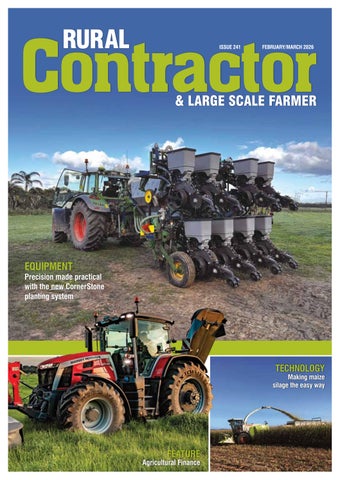
ISSUE 241 FEBRUARY/MARCH 2026

EQUIPMENT
Precision made practical with the new CornerStone planting system


TECHNOLOGY
Making maize silage the easy way
ISSUE 241 FEBRUARY/MARCH 2026
Precision made practical with the new CornerStone planting system
Making maize silage the easy way

The Perfect Blend of Telehandler Versatility and Tractor Power.


Standard 3-point linkage, PTO, trailer hitch, and hydraulic distributors, making it a versatile agricultural powerhouse. Powered by a robust FPT NEF45 engine, delivering 125 kW (170 HP) of reliable performance.
With a max speed of 40 km/h and impressive fuel efficiency, it ensures longer, cost-effective operation.
Visit us in Invercargill, Gore, Mosgiel, Cromwell, Timaru, Ashburton or Christchurch *Terms & conditions apply. Contact your dealer for details.
With the ASCS (Adaptive Stability Control System), it enhances operator safety by actively managing stability and load balance.
89 Kahikatea Dr, Hamilton
38 Progress Dr, Otorohanga
7 Heights Road, Pukekohe
Parts & Service: 07 843 7237 • sales@acmd.co.nz agandcivilmachinery.co.nz @agandcivil
@jj.co.nz


December/January 2026
02 From the Editor: A year on the road
INDUSTRY NEWS
03 JJ Limited and Merlo New Zealand: a new South Island partnership built for real work
06 Seed bank grows with climate-resilient species
08 Carrfields Machinery brings StocksAG application equipment into a nationwide New Zealand network
10 Managing in peak season: labour management tips for farmers
12 Tower adds much-needed strength to New Zealand’s weed control toolbox
14 Gallagher named principal partner for Out the Gate 2026
16 Forestry’s growth must strengthen farming, not replace it
20 Built on know-how: nearly 70 years supplying the tools that keep rural New Zealand working
22 Getting agricultural spraying practice right
24 Diploid perennial ryegrass seed endophyte levels over time
TECHNOLOGY
24 Don’t sweat it – the cool secret to sowing success
25 Raising the bar
26 A couple of serious perennial ryegrasses
28 Locking in quality: Independent Wrap’s approach to better forage
30 What the new XAG Rover means for the future of crop farming
32 Making maize silage the easy way
34 The evolving story ofLangsford N&G Contracting
40 A century of carrying New Zealand’s rural heartland
44 Across the Ditch: George Stevenson embracing lower emission rice
FEATURES
48 A review of agricultral finance
52 A review of tillage and seeding equipment
EQUIPMENT
62 Strength, comfort and control: what defines the Deutz-Fahr 8 Series
64 Double the cut, not the cost
66 Precision made practical with the new CornerStone planting system
68 Strength where it counts: SwiftSteel launches for contractors and farmers
71 Fendt 800 Gen5 sets a new benchmark for modern contracting
Editor Angus Kebbell 022 052 3268 angus@agrimedia.co.nz
Advertising Manager
Michael Lightbourne 021 403 853 michael@agrimedia.co.nz
Advertising Sales
Lisa Phelan 021 782 228 lisa@agrimedia.co.nz
Circulation
Hilary Armstrong 027 443 3477 admin@agrimedia.co.nz
Production Design and Layout
Hannah Kincaid art@agrimedia.co.nz
Contributors
Kathy Davis, Leandri Smith, Caroline King
Printed by Blueprint Ltd
Read our magazine online ruralcontractor.co.nz/read-online
I have now been in the editor’s chair at Rural Contractor & Large Scale Farmer for a full year, and it feels like a good time to pause and take stock. Not because I think a year is a milestone worth celebrating for its own sake, but because it has given me a front row seat to the pace, pressure and pride that sits behind this country’s most important industry, the primary sector.
First, thank you to everyone who reads this magazine and supports it. The people who subscribe to it, share it, argue with it and call me up when they think we have missed something. That engagement matters because it keeps this publication honest and useful. I am grateful for the work and I am grateful for the people who make it possible by opening gates, making time and trusting us to tell their story.

Angus Kebbell, editor.


Follow us facebook.com/nzrclsf instagram.com/nzrclsf ruralcontractor.co.nz
Scan here to sign up to our digital newsletter
PO Box 36753 Merivale, Christchurch 8146 ph 03 329 6555 www.agrimedia.co.nz
Publishers of Rural Contractor & Large Scale Farmer, AgriBusiness, AgriVet, NZ Cropping, Australian AG Contractor & Large Scale Farmer, NZ Novachem Agrichemical Manual.
Over the past year I have spent a lot of time talking with contractors and farmers who are working longer hours, managing higher risk and carrying more compliance than ever before. They are doing it while fuel costs bite, interest rates stay sharp, labour remains hard to find and weather windows keep throwing up challenges. Yet the expectation on the sector is still the same. Keep producing. Keep exporting. Keep paying wages. Keep towns alive. Keep improving environmental performance. Keep investing.
That is not a complaint; it is the job and most rural people accept that. But what has stood out to me is how often the sector feels like it is being asked to deliver more while being understood less. A lot of New Zealand’s economy still rests on sheep and beef, dairy, arable, horticulture, forestry and the network of contractors and rural service businesses that make it all work. Yet outside rural communities it can still be treated as background noise until something goes wrong, a flood, a drought, a biosecurity threat, a big payout shift, or a change in export markets.
It is easy to talk about the primary sector in broad terms. It is harder to acknowledge what it actually looks like on the ground. It looks like families making calls that affect the next generation. It looks like contractors spending serious money on machinery because uptime matters and because if the gear is not right, the whole job falls over. It looks like people taking pride in doing things well, even when
© RURAL CONTRACTOR AND LARGE SCALE FARMER - No part of this publication may be reproduced in any form without the prior written permission of the publisher. Opinions expressed in this publication are not necessarily that of the publisher and suggest independent advice be sought before acting on information or suggestions contained herein.
the margins are tight and the pressure is constant.
If government wants real progress, it needs to stay connected to that reality. Not just through consultation rounds and press releases, but through policy that understands rural systems and respects how finely balanced most farm businesses already are. And if urban New Zealand wants the benefits of a strong economy, quality food and world-class fibre, it also needs a clearer appreciation of where those outcomes begin.
For this magazine, the purpose remains simple. Tell the relevant stories. Stay practical. Cut through the noise. Give rural New Zealand a voice that is fair, accurate and worth reading.
I am proud to be doing this work, and I am grateful to the industry that keeps this country moving. The next year will bring its own challenges but the story is still the same. New Zealand’s primary sector matters and it deserves to be treated like it.
Contributions - Editorial and photographic contributions are welcomed and should be sent directly to AgriMedia Ltd. Editing of submissions is at the sole discretion of the editor and will accept no responsibility for unsolicited material.
There are certain machines that quietly earn their place on New Zealand farms because they solve problems every single day, across every season, without making a fuss. Telehandlers sit firmly in that category.
They are not a luxury. They are not a ‘nice to have’. For plenty of farmers and contractors, they are right up there with tractors and loaders as one of the most reliedon pieces of gear on the yard.
That is exactly why the news that JJ Limited has been appointed as Merlo New Zealand’s new South Island dealer matters, because it is about much more than a badge on the gate. It is about putting the right people behind the product and backing Merlo’s capability with a dealer that understands what the South Island demands.
Merlo New Zealand represents a renowned Italian manufacturer with a global reputation for designing innovative telehandlers recognised for their stability, safety, visibility and efficiency. With a range that serves agricultural,
construction and specialised applications Merlo has never chased gimmicks. Instead, the brand has earned its reputation through genuine engineering and practical, real-world performance. This focus is why Merlo machines are a familiar sight in operations where space is limited and efficiency and reliability are essential.
This new partnership with JJ Limited is a strong step forward for South Island customers and it signals a commitment from Merlo New Zealand to invest in local coverage, parts back-up and aftersales support.
JJ Limited is a South Island owned and operated business, with decades of experience in the farm machinery industry and a focus on the sale, repair and supply of parts for tractors and

farm machinery implements across Southland, Otago and Canterbury. It is also a business built around the reality that service is not a slogan. It is the difference between getting the
job done and watching an entire day disappear while the weather window closes.
For those who have not dealt with JJ Limited before, they will already be known to many


through their footprint across the island. The company operates from branches in Invercargill, Gore, Mosgiel, Cromwell, Timaru, Ashburton and Christchurch giving Merlo customers a genuine regional network that matches how South Islanders work and travel. That reach matters, because a telehandler does not just lift bales; it lifts the pace of the entire operation. When it is down, everything backs up behind it. Having a dealer that can respond quickly with parts, technicians and practical advice is as important as the specification sheet.
Merlo’s strength in New Zealand has always been
that its machines are built for multi-purpose work, which is exactly what modern farm yards demand. One day it is shifting wrapped bales and loading feed, the next it is handling bulk bags, moving fertiliser, stacking pallets or lifting posts, then it might spend half a season on a construction site or in a civil application. That crossover is becoming more common, especially for contractors and larger farms that run diversified operations. Merlo’s product range is designed to suit those realities and it gives customers options across different lift capacities, reach requirements and power classes with a strong
emphasis on stability and safe operation.
The other advantage of Merlo and one that is sometimes underestimated until you run one for a while, is how much a good telehandler can reduce the wear and tear on people. Operator comfort, control layout, visibility and smooth hydraulics all matter when the machine is being jumped in and out of constantly throughout the day. If a telehandler is jerky, awkward to see out of or tiring to run, it becomes a daily irritation. If it is predictable, stable and comfortable, it quietly becomes one of the best investments on the farm, because it keeps people moving and keeps the work flowing.
That is why the dealer relationship is so important. Merlo’s machines are sophisticated bits of equipment and, like any modern machinery, they deliver their best results when they are properly set up for the job, correctly maintained and supported by a team who understands the difference between a quick fix and the right fix. JJ Limited is well placed to provide that support and it brings a culture that aligns with Merlo’s approach, which is about doing the job properly, not just making it look good in the brochure.
This new South Island dealership arrangement will be front and centre at Southern Field Days where JJ Limited will be representing Merlo New Zealand on site, backed by the

wider Merlo team. Southern Field Days remains one of the most important fixtures on the calendar for the lower South Island, and it is the kind of show where people do not just look at machines. They interrogate them. They measure them up against their own yards, their own bale stacks, their own staff and their own budgets. It is where the conversation shifts from theory to reality.
Merlo New Zealand will be supporting JJ Limited at the event with Managing Director Michael Lombardo and National Sales Manager Chris Wilson in attendance, reinforcing that this is not a token dealership announcement but a genuine investment in customer relationships and long-term support. That presence matters because it shows that Merlo’s leadership is willing to be on the ground, listening to farmers and contractors, understanding what the South Island needs and making sure the dealership and product offering is aligned with those expectations.
For Merlo New Zealand, appointing JJ Limited as the South Island dealer is a statement of intent. It is about building a dealer network that can support customers properly, not just sell machines. For JJ Limited, it is an opportunity to bring a proven telehandler brand into a service-driven business that already understands the pace and pressure of South Island agriculture. And for customers, it should mean better access, stronger regional back-up and more confidence that when they invest in a Merlo, they are not doing it alone.
The best machinery partnerships are the ones that feel obvious once they are in place. This one has that feel. Merlo has the product. JJ Limited has the footprint, the experience and the commitment to service. Together, they should give South Island farmers and contractors exactly what they want from a telehandler brand: capability in the yard and support when it counts.
A capable telehandler does more than lift bales; it keeps the pace of the entire operation moving.


Whatever your needs, Valtra has the working machine – made for you! Whether it’s the compact tractor that packs a powerful punch – the mighty little A Series, the gutsy all-rounder ready for any job – the G Series, the capable and award-winning N Series, the brains, brawn and beauty of the T Series, the smart and powerful Q Series, all the way through to the big new farm boss – the powerful and reliable S6, there’s a Valtra with your name on it!
Valtra tractors combine versatile features and innovative technology, with outstanding comfort in every model across the range. As a Valtra owner, you benefit from a reliable, high-quality tractor, that has been tailored to meet the needs of your farm or contracting business. Put simply, Valtra has the working machine – made for you!
TALK TO YOUR VALTRA DEALER FOR MORE INFO TODAY.
New Zealand’s farming systems are entering a period of rapid change as hotter summers, drier soils and more unpredictable weather patterns begin to reshape how pastures perform. In this environment the work happening behind the scenes to protect plant genetics has never been more important. That is why the Bioeconomy Science Institute’s latest seed-collecting mission stands out, because it adds another significant chapter to the long history of the Margot Forde Genebank, one of the most diverse and valuable forage collections anywhere in the world.
Seed hunter Zane Webber recently completed a major gathering trip through Albania and Serbia, returning with more than three hundred seed samples collected from forty-five sites across landscapes that have become natural proving grounds for climate resilience. These seeds, which include populations of ryegrass, clover, fescue, cocksfoot and forage herbs such as chicory, will soon enter the genebank in Palmerston North, marking the first time material from these regions has been added to the collection.
The mission was years in the making because collecting seed internationally depends on long-term partnerships built on mutual trust and on agreements that respect the sovereignty of genetic resources held within each country. These steps had to be completed before Webber could set foot in the field, but the effort has been rewarded with species that have endured extreme drought, heat and soil stress in recent seasons.
“Many of the newly collected seeds are from plants that have survived in tough environments, making them a valuable genetic resource for developing forage varieties that can better withstand climate change here in Aotearoa New Zealand,” Zane says.
The Margot Forde Genebank is already home to more than 175,000 seed samples sourced from over one hundred countries, making it the largest forage genebank in the world as well as one of the most globally diverse. Its role is simple but profound
because it safeguards the building blocks of future farming systems, ensuring that breeders, scientists and, eventually, farmers have access to the traits needed to cope with emerging challenges.
Zane says this work is essential to the long-term health of New Zealand’s primary industries.
“Nearly all our crop and forage species originate overseas, so it’s important we keep exploring new genetic material to stay ahead of challenges like climate change and emerging pests.”
The newly collected seeds will become part of the genebank’s active collection, meaning they can be requested by researchers, breeders or farmers interested in diversifying their pastures or trialling new species suited to harsher conditions. Some may be used to develop new ryegrass cultivars capable of greater drought tolerance, others may support clover lines that survive heat stress or new herb varieties that maintain feed quality in summer dry regions.
For Zane, the trip through Albania and Serbia was demanding but rewarding, stretching across long days in the field where many of the most interesting species were found in unexpected corners of the landscape.
He says the work often meant walking roadsides where diverse species thrive naturally, collecting seed by hand and carefully recording each site.
Each location was documented and processed on an app in real time which transferred data directly into the database, and

the seeds were then cleaned by hand to meet New Zealand’s strict biosecurity requirements. These steps are critical, because any seed entering the country must pass through several layers of inspection and treatment to ensure it is safe for storage and future use.
Zane credits the success of the mission to the involvement of local genebanks and international collaborators, including professors and taxonomists who volunteered their time and expertise to improve species identification and support travel through remote regions. Their knowledge helped locate pockets of genetic diversity that might otherwise have gone unnoticed and contributed to the overall quality of the collection.
This is far from Webber’s first expedition. Over the past twenty years he has led seed-collecting missions for the Margot Forde Genebank across Spain, Portugal, Armenia, Tajikistan, Greece, Cyprus and Russia, each trip adding layers of resilience to the global collection held in Palmerston North.
He describes the work as rewarding but challenging.
“It’s not glamorous, you’re definitely not staying in the Ritz. But these missions are oncein-a-lifetime experiences that allow you to immerse yourself in new cultures and connect with incredible people working together to conserve the world’s plant genetic resources.”
The work is part of a broader global movement to preserve plant diversity as climate change accelerates. Genebanks like Margot Forde operate as insurance policies for future food
Strong early weed control is critical in wheat and barley, and Tower has been approved as a new preemergent option designed to protect crop establishment when competition for moisture and nutrients is at its most intense.
security, storing seeds under controlled conditions so they remain viable for decades. If a species becomes threatened in the wild or if breeders need access to specific traits such as drought tolerance, cold endurance or disease resistance, these stored seeds become invaluable.
Zane says the collection belongs to the world.
“They’re a gift to humanity. Most countries including New Zealand, cannot thrive on their own endemic genetic resources alone.”
As New Zealand’s climate continues to change and farming systems adapt to longer dry spells, shifting pest pressures and more variable seasons, the work of collecting, preserving and understanding plant genetics becomes essential. The seeds gathered from Albania and Serbia add another layer of insurance and provide new opportunities for researchers and breeders to develop pastures that will sustain farmers for generations to come.
In a world where resilience is now a requirement rather than an aspiration, the Margot Forde Genebank remains one of New Zealand’s quiet but powerful strengths, holding the diversity needed to future-proof the landscapes that feed us.

The McHale V6750 variable chamber round baler has been designed with the demands of today’s farmer and contractor in mind.
• High-Intake 2.1m pick-up
• 15 knife heavy-duty chopper unit and feed rotor
• Double drive system with auto greasing
• Net and bale density can be adjusted from the cab through the console

The Fusion 4 Plus is a fully automatic integrated baler wrapper which can apply film or net wrap to the barrel of the bale, delivering optimum bale density.
• Maximum output whilst keeping the machine short and compact at 5.8 metres in length
• 25 knife-chopping unit
• Patented unique bale transfer technique
• ISOBUS ready

VARIO PLUS
The Fusion Vario Plus is a fully automatic integrated baler wrapper that applies film or net wrap to the barrel of the bale, delivering optimum bale density.
• Hay and straw bales from 0.6m to 1.68m
• Haylage or silage bales from 1m to 1.45m to allow for wrapping

The appointment of Carrfields Machinery as the New Zealand distributor for StocksAG marks a measured but meaningful development for the local machinery market, particularly for farmers and contractors focused on precision application and grassland performance. From January 2026, Carrfields will supply and support the full range of Britishmanufactured StocksAG applicators and seeders, bringing a well-established UK brand into a nationwide distribution and service framework that is already familiar to many New Zealand operators.
StocksAG is not a new name in international grassland and arable systems. Based in the United Kingdom, the company
has built its reputation around robust, mechanically straightforward machines designed to handle fertiliser, seed and granular products with accuracy and consistency. The brand’s applicators and seeders are widely used across pasture, arable and mixed farming systems, where even spreading, reliable metering and durability are valued ahead of unnecessary complexity. That philosophy aligns closely with the expectations of New Zealand farmers, where conditions vary widely and machines are expected to perform across multiple seasons with minimal downtime.
For Carrfields, the addition of StocksAG strengthens an already broad machinery portfolio and fills a practical niche within it. Rather than overlapping heavily with existing brands, StocksAG complements the line-up by focusing on targeted application equipment that supports pasture renovation, fertiliser placement and overseeding. These are tasks that sit at the heart of productive

grass-based systems, particularly in regions where maximising pasture utilisation is central to farm performance.
One of the strengths of the StocksAG range is its emphasis on controlled application. Whether used for fertiliser, slug bait, grass seed or multi-product spreading, the machines are designed to deliver consistent output across working widths, reducing waste and improving uniformity. In practical terms, this translates into better pasture establishment, more even crop growth and improved return on input costs. For contractors, it also means predictable results across a wide range of paddocks and conditions, which is increasingly important as clients expect precision alongside efficiency.
Carrfields’ nationwide parts and service network will play a key role in how the brand is received locally. Support for both new and in-use machines will be delivered through existing regional hubs, ensuring access to parts, technical advice and backup when it is needed. In a market where service support often carries as much weight as the machine itself, this infrastructure provides confidence for customers considering the brand for the first time. It also ensures that machines already operating in the country can be brought into a consistent support framework, extending their working life and reliability.
The arrival of the first shipment of StocksAG equipment into New Zealand signals the beginning of that process. With product now on the ground, Carrfields can begin demonstrating the machines in local conditions, allowing farmers and contractors to assess how they fit within their own systems. That hands-on exposure will be important, particularly for equipment that is often judged on build quality, spread pattern and ease of setup rather than headline specifications.
From a broader perspective, the partnership reflects a continued interest in British-built machinery within the New Zealand market. UK manufacturers have long focused on grassland efficiency, compact but robust designs and practical solutions for mixed farming systems. These priorities
Built for precision spreading of fertiliser, seed and granular products, StocksAG equipment is designed to deliver consistent metering and even coverage across pasture, arable and mixed farming systems.
Backed by Carrfields’ established parts and support infrastructure, the partnership offers farmers and contractors added confidence when investing in accurate, reliable application equipment.
resonate strongly in New Zealand, where pasture-based production dominates and equipment must cope with varied terrain, soil types and weather patterns. StocksAG’s development history within that environment provides a strong foundation for local adoption.
For Carrfields customers, the addition of StocksAG offers another option when looking to fine-tune pasture performance or improve application accuracy. Overseeding, fertiliser placement and granular spreading are all areas where small improvements can deliver meaningful gains over time. Having access to purpose-built equipment, supported locally and backed by a distributor with an established reputation gives farmers and contractors greater confidence in making those investments.
Importantly, the partnership is not positioned as a rapid expansion or shortterm trial. Carrfields has signalled a long-term commitment to building on the reputation StocksAG has already established in the New Zealand market. That approach suggests a focus on steady growth, customer

feedback and ongoing support, rather than pushing volume for its own sake. In a sector where trust is built over seasons rather than sales cycles, that measured strategy matters.
As farming systems continue to evolve, the demand for accurate, reliable application equipment is only increasing. Rising input costs, tighter environmental expectations and the need to maximise output from every hectare place greater emphasis on how seed and fertiliser are applied. Machines that deliver consistency and control, without adding unnecessary complexity, are well placed in that environment.
The distribution of StocksAG through Carrfields Machinery brings together a brand known for practical engineering with a distributor recognised for its support and regional presence. For New Zealand farmers and contractors, it represents another step toward more precise, efficient pasture and crop management, backed by local knowledge and service.
As the range becomes more visible in paddocks around the country, its success will ultimately be judged on performance, reliability and the support behind it, all areas where this partnership appears well aligned.
Yes, there are other adjuvants.
But not with our track record.
We’ll work harder in every paddock, vineyard and orchard block.
UPL adjuvants have stood the test of time, trials, and most importantly, distributor, grower and farmer scrutiny. From water conditioning right through to tank cleaning along with the spreaders, stickers, penetrants, and drift agents UPL is known for. Still not sure? Ask one of our UPL Regional Managers.

With the busiest summer months of New Zealand’s farming sector in full swing, Findex Human Resources experts are warning that poor labour planning can have costly consequences for both productivity and compliance. With seasonal workers in high demand farmers face heightened risks around payroll accuracy, health and safety obligations and contractor versus employee classification.
Findex Human Resources Senior Client Manager Steph Mullally says the risks are particularly acute in January when long hours, fatigue and workplace safety risk increases. “This is the time of year when mistakes are most likely to happen. Misclassifying contractors, overlooking minimum wage requirements, or failing to manage fatigue can quickly escalate into compliance breaches and cashflow problems. Farmers need to be proactive not reactive, in managing their workforce,” she notes.
Steph says every employer should remain up-to-date with legislative changes and updates, including the minimum wage increase to $23.50 per hour for adults (effective April 1, 2025 and a further increase to $23.95 per hour from 1 April 2026); the criminalisation of intentional wage theft; and the reintroduction of 90-day trial periods for all employers. “Be aware, too, of new protections recently introduced to prevent employers from taking action against employees who discuss their pay,” she adds.
Payroll compliance is critical, with minimum wage risks for contractors a common pitfall and for salaried employees, excessive hours

With contractors and seasonal workers in high demand, farmers are being urged to tighten employment processes, stay on top of wage and tax obligations and maintain strong health and safety systems to protect productivity and staff wellbeing.
can reduce their effective hourly rate below the legal minimum. Steph strongly advises a keen eye on always meeting employment tax obligations to avoid penalties. “Underpaying is against the law. It is probably the fastest way to undermine employee trust and it can quickly create significant liabilities. By the same token, scrupulous attention to tax is a good habit that never goes out of fashion and can prove pivotal in avoiding unexpected cashflow impacts.”
As contractors are commonly called in to meet seasonal demand, she says employers must be clear on the differences between employees and temporary workers.
Employees are defined as those taking on work for wages or a salary under an employment agreement, including those employed by an agency but seconded to a rural business. A contractor or self-

Good labour management is not just about filling gaps; it is about protecting cashflow, reducing risk and keeping people safe during the longest days of the season.
employed person performs work and is paid for their services, does not have an employment agreement and isn’t covered by most employment-related laws and the Employment Relations Act 2000. Contractors also cannot bring personal grievances, with general civil law determining most of their rights and responsibilities.
“Knowing the distinction is important because of the different rights and responsibilities of each party in the employment relationship,” says Steph. Rural work is routinely hazardous, so she stresses the necessity for a thorough and disciplined approach to health and safety compliance. “Nobody wants worker injuries. Primarily the mission is getting every person home safely, but accidents and incidents also bring disruption at the busiest time of year and can lead to financial and reputational consequences from WorkSafe investigations.”
She notes that health and safety laws apply equally to employees and contractors.
Recent examples in the sector are never far from the headlines and confirm Steph’s view, demonstrating that inadequate planning and oversight can lead to disputes, fines and distraction from already demanding work schedules. By contrast, farms that integrate HR oversight with diligent financial forecasting are better positioned to maintain productivity and safeguard worker wellbeing.
Steph adds: “The rural sector is well positioned after a strong performance through 2025. Staying on top of labour management means protecting your people, your cashflow and ultimately your business so you’re ready to tackle 2026 and make the most of what’s shaping up as a promising year.”


Weed pressure is one of those realities that every grower knows can shape an entire season long before a crop reaches canopy. In cereals where competition for moisture and nutrients is immediate, early weed control sets the tone for yield potential and crop health yet the options available to New Zealand growers have been tightening for years. That is why the Environmental Protection Authority’s approval of Tower, a new herbicide for wheat and barley, represents a meaningful development for arable farmers and contractors who have been calling for more tools that strike the right balance between efficacy, crop safety and resistance management.
Tower is being introduced by Adama New Zealand and brings together three active ingredients, including chlorotoluron which is new to this country although widely used in the United Kingdom and Europe. Alongside chlorotoluron, the formulation includes pendimethalin and diflufenican, both already familiar to New Zealand growers. The strength of the product lies not simply in any individual active, but in how the combination works together to control broadleaf and grass weeds in cereal crops while spreading the mode of action load to reduce the risk of resistance building. For many arable growers this is significant because grass weed control in cereals has been one of the more difficult challenges,

with only a handful of herbicides capable of doing the job without also damaging the crop.
The EPA’s Acting General Manager for Hazardous Substances and New Organisms, Dr Lauren Fleury, notes that the approval gives wheat and barley growers another tool to help protect crops that are essential to the primary sector. The value of these crops is not small. Wheat and barley contribute around three hundred million dollars to the national economy each year, and nearly one hundred thousand hectares of land are dedicated to their production. In regions like Canterbury, Southland and parts of the lower North Island cereal rotations support wider livestock systems, feed markets and contracting businesses that depend on reliable yields to keep operations financially

For growers and contractors facing tightening chemistry options and rising resistance risk, the EPA approval of Tower signals a valuable step forward for cereal weed management.
sound. When weed burdens take hold, the losses ripple beyond a single paddock. The introduction of a new active ingredient to the New Zealand market is not a casual decision and the EPA has emphasised that the approval followed a rigorous assessment and consultation process. Chlorotoluron is not new globally and has been used internationally for some time, but its entry into the New Zealand system means growers have access to another mode of action in a market where options have been slowly narrowing. Dr Fleury also points out that the decision sits within a broader effort by the EPA to reduce backlogs in hazardous substance applications, and to increase the number of assessments involving new active ingredients. That is encouraging for a sector that depends heavily on timely approvals to keep pace with evolving pest and weed pressures.
Tower is not a general purpose product and will be restricted to professional use in commercial settings. It is designed for ground-based application only, to be used after sowing and before crop
Approved by the EPA for use in wheat and barley, Tower adds a much-needed new herbicide option for New Zealand growers, combining three active ingredients to strengthen early season broadleaf and grass weed control while supporting resistance management.
emergence which aligns closely with how most pre-emergent herbicide programmes are structured in wheat and barley. This positioning is important because preemergent weed control lays the groundwork for an even, competitive crop at a time when seedlings are most vulnerable. Grass weeds in particular can quickly outcompete cereals and cause long-term yield drag, which is why growers look for tools that offer reliable suppression without compromising the crop. Tower’s fit within this early window will likely appeal to contractors who run spray operations during busy drilling periods and who need chemistry that works efficiently and predictably.
As with all agricultural products, Tower must also receive approval from the Ministry for Primary Industries before it can be used on-farm. The EPA’s decision clears a major hurdle, but the MPI step ensures the product meets New Zealand’s agricultural and residue requirements protecting both growers and export markets. For now, the EPA approval signals a strong indication that the product has met the environmental and safety thresholds required for entry.
For contractors and growers facing rising costs, tightening margins and ongoing regulatory pressure, the arrival of any new chemistry is welcome particularly in a sector where weed resistance has begun to creep into conversations more frequently. When growers rely too heavily on a narrow set of herbicides the risk of resistance
climbs, leading to more expensive and less effective control in the long term. A product that combines multiple modes of action helps spread the load and preserve the effectiveness of existing chemistry, giving growers more flexibility in how they design their programmes. That flexibility is especially important in mixed rotations where herbicide choices must be carefully balanced to protect following crops.
The significance of Tower’s approval extends beyond the chemical itself. It signals a willingness within the regulatory system to support innovation in the arable sector, while maintaining rigorous oversight. Wheat and barley remain foundational crops for many farming businesses and the contractors who support them and having new tools available reinforces the resilience of the wider industry. For operators who spend their springs and early summers working across vast areas of cereals, the right herbicide programme can make the difference between a clean, competitive crop and one that struggles before it has a chance to establish.
The introduction of Tower provides another option at a time when growers are balancing environmental expectations, rising input prices and the need to produce quality grain that underpins feed, milling and brewing industries. It is not a silver bullet but it is another piece of kit in a toolbox that needs to stay sharp. As seasons become more variable and weed pressures continue to

Tower brings chlorotoluron into the New Zealand market for the first time, pairing it with pendimethalin and diflufenican to broaden weed control and spread the mode of action load.
evolve, the arable sector will depend on both innovation and regulatory responsiveness to keep ahead of the challenges.
Tower’s arrival marks one of those small but important steps forward. For cereal growers across the country, having more choices in the fight against weeds is not just helpful, it is essential for protecting both yield and the long-term health of New Zealand arable farming.

THE MOST FLEXIBLE, HIGH CAPACITY, CAB CONTROLLED HEADER FRONTS
FIND OUT MORE

On display at site 298, Southern Field Days Feb 11-13


There are some events on the sheep and beef calendar that carry a bit more weight than the rest because they are not just about a programme on a stage; they are a moment to step back from the pace of the season and take stock of where the sector is heading. Out the Gate has quickly become one of those moments, and with Beef + Lamb New Zealand confirming Gallagher as the principal partner for Out the Gate 2026, the event is shaping up as a genuinely important gathering for farmers, breeders, rural professionals and industry leaders who want more than a surfacelevel update. They want practical learning, real conversations and a reminder that the best parts of this industry are built around people turning up, sharing ideas and backing each other.
Set to take place in Christchurch on 20–21 May, Out the Gate 2026 will again bring together a wide spread of the sheep and beef sector in one place combining celebration, learning and networking in a way that reflects the full reality of farming in New Zealand today. It is an industry that is constantly balancing pressure and opportunity, where seasonal challenges are only one part of the equation and where decisions on-farm now sit alongside changing market expectations, evolving regulation, labour availability and the need to keep lifting productivity without losing sight of animal welfare or environmental responsibility.
Out the Gate is powered by the Beef + Lamb New Zealand Farmer Council and Kāhui, and the structure of the event reflects that farmer-led drive. It sits alongside the Beef + Lamb New Zealand Awards and the Sheep Breeders Forum, creating a format that is as much about recognising what is being done well as it is about opening the door to new thinking. That matters because the sheep and beef sector has always been strongest when progress is grounded in practical experience, when innovation is tested in real paddocks under real constraints and when the people doing the work are involved in shaping what comes next.
Gallagher’s role as principal partner sits comfortably within that approach. Gallagher is one of those brands that many farmers do not have to be introduced to, because it has been part of rural New Zealand for generations. It has built its position not through a single flagship product, but

Gallagher has been named principal partner for Out the Gate 2026, bringing the sheep and beef sector together in Christchurch on 20–21 May for two days of farmer-led learning, connection and practical innovation.
through a steady focus on tools that help farmers manage stock better, tighten workflow and make data easier to capture and act on. In a sector where time is always tight and the work must be repeatable day after day, that kind of practical support is what farmers remember and it is what keeps a company relevant long after the marketing noise has faded.
Gallagher’s product footprint covers a wide range of farm needs, from electric fencing through to weighing and electronic identification, data collection and wireless water monitoring systems. Each of those areas is increasingly tied to the way sheep and beef businesses are run today, with better animal performance coming from sharper information and quicker decision making. Weighing and EID have moved well beyond being optional extras in many systems, particularly where farmers are targeting higher growth rates, tightening drafting, improving feed allocation and making more informed choices around genetics and breeding direction.
It is also not Gallagher’s first involvement with the Beef + Lamb New Zealand Awards. The company has a long-standing connection to the awards and sponsors the Gallagher Innovation Award, which is a meaningful link given the role innovation is now playing across the sector. Innovation is no longer only about machinery or technology for its own sake. It is about finding better ways to protect labour, improve efficiency, strengthen animal management and make sure farming businesses remain financially resilient in an environment where costs have risen sharply and margins can move quickly.
Beef + Lamb New Zealand GM Farming
Excellence Dan Brier says the partnership is a natural fit, and his comments reflect what many farmers want from an event like this. “Out the Gate is about looking forwardcreating opportunities for farmers to learn, connect and celebrate success. Gallagher has been alongside New Zealand’s farmers for generations and they continue to push the boundaries for sheep and beef farmers. Gallagher’s partnership reinforces the importance of innovation and collaboration in our sector,” he says.
That sense of collaboration is important because sheep and beef farming can sometimes feel fragmented, particularly when different regions face different climatic pressures, different pasture growth patterns and different market access realities. Bringing people into the same room including breeders, commercial farmers and industry partners creates the sort of cross-pollination that drives practical change. It also helps keep the focus on what is working, rather than the constant noise of what is not.
Gallagher GM Pacific Darrell Jones says the company is proud to back an event that creates those opportunities. “We’re proud to support an event that sparks important conversations and shows how innovations like eShepherd virtual fencing and Auto Weigher can help progress the sector. We value every chance to connect with farmers to understand their challenges, goals and vision for the future,” he says.
Those examples are timely because they reflect where on-farm technology is heading, particularly as farmers look for systems that reduce physical workload while improving control. Virtual fencing is increasingly part of the conversation where land classes are

Well balanced seasonal growth with excellent early spring growth
• Very good tiller density
• Extremely low aftermath heading in summer
• Excellent tolerance to a wide range of environments
Reason is a high performance, resilient diploid perennial that has low aftermath heading in summer and maintains summer and autumn productivity similar to existing late heading dairy options. Reason is ideal for early spring set stocking, while its summer quality makes it well suited for a range of stock classes.

*
• Very high summer, autumn and winter growth Excellent density for periods of set stocking and winter grazing
• Very low aftermath seeding and excellent summer leafiness
• Very good tiller size and leaf length
Legion can be used in general sheep and beef pastures having excellent density for periods of set stocking and winter grazing. It is also a high-performance grass that is highly suited to dairy pastures and runoffs. Legion is one of the recent generation of particularly strong perennial ryegrasses for autumn production.

There is no denying the scale or significance of the announcement that PF Olsen and Forest360 intend to merge to form what will become the largest independent forestry management company in Australasia, managing close to half a million hectares of forest and servicing more than a thousand clients across New Zealand and Australia. On paper, it is a statement of confidence in forestry as an industry and in professional forest management as a long-term investment. It brings together decades of experience, deep regional networks and a breadth of services that span everything from nurseries through to harvest and carbon accounting. For many in the forestry sector, this is being framed as a natural evolution, a sensible consolidation and a platform for growth.
But from a farming and rural New Zealand perspective, this announcement deserves more than polite applause. It deserves scrutiny, challenge and context, because forestry does not exist in isolation from the rest of the land use economy and nor should it. Forestry is important to New Zealand, and carbon farming has a role to play, but only when it strengthens rural communities, complements productive farming systems and keeps value circulating locally rather than extracting it offshore or concentrating it in corporate balance sheets.
The merger brings together two respected operators. PF Olsen has been active in forestry for over 50 years, growing from a consultancy into a major player offering planting, silviculture, harvest planning, log marketing, sustainability consulting and carbon accounting. Forest360 has built its reputation on integrated forestry services and a customer-centric model that appeals

to a wide range of forest owners. Combined, they will manage around 480,000 hectares of forest and support more than 1,000 clients, ranging from large institutional investors to family-run businesses and private landowners. That scale matters, because scale shapes influence, policy engagement and ultimately land use outcomes.
Forest360 Managing Director Dan Gaddum has been appointed Group CEO, with PF Olsen’s Ross Larcombe becoming Group Chief Commercial Officer and Forest360’s Marcus Musson taking on the role of Group Chief Operating Officer. Dan says, “We are looking forward to partnering with the experienced teams at PF Olsen. These businesses are about people and by combining our skills and services, we can better service clients across the entire forest management value chain - from seed orchards and nurseries through to harvest management, forest management, and consulting services.”
There is nothing in that statement that farmers would necessarily disagree with. Good forestry management matters. Professional standards matter. Safety matters. Environmental stewardship matters. Where concern begins is not with the competence of the people involved, but with the direction of travel for land use in New Zealand and who ultimately benefits from it.
Dan continues, “Marcus and I are both excited to be part of the leadership team for
the combined group and continue to pursue our joint ambition of being the management provider of choice for forest owners across New Zealand and Australia, whether they be large institutional owners or farm foresters.” That final phrase matters. Farm foresters are not the same as large institutional owners, and policy settings that treat them as interchangeable risk doing real damage to the mixed farming systems that underpin rural economies.
PF Olsen CEO Ross Larcombe echoes the optimism, saying the merger will combine experienced teams into one single purpose. “We are a trusted provider to our clients, having provided forestry services in Australia and New Zealand for over 50 years. We are excited to combine forces with the team at Forest360 and establish a more resilient business with diversified services, a larger scale footprint and shared customer-led values.” He goes on to say, “I’m genuinely excited about the opportunity to bring our team at PF Olsen into a newly merged business with the talented people at Forest 360. Together both groups share a deep commitment to sustainable forestry, operational excellence and supporting the communities we work in. This merger brings together complementary strengths and I’m confident it will create a stronger, more resilient business for our clients and the industry.”
Supporting communities is the phrase that rural New Zealand will hold this merger
complex, where grazing patterns need to be adjusted quickly or where fencing development can be challenging or costly. Automated weighing also aligns with the push for faster feedback and more accurate performance tracking, especially in systems where early identification of underperforming stock can protect both animal outcomes and financial returns. Out the Gate 2026 will also be supported
by Strategic Partners Farmlands, Rabobank New Zealand and Craigs Investment Partners helping ensure the event carries strong depth across the practical, financial and strategic parts of the farming business. It is a reminder that modern sheep and beef farming is not only about production. It is about business structure, risk management and the long-term confidence to invest in people, genetics, infrastructure and
systems that make sense for individual farms.
Tickets for Out the Gate 2026 go on sale in February and with the event set to land in Christchurch in May, it is shaping as one that will be well worth putting in the diary. For many it will be a chance to step away from the day-to-day, reconnect with the wider sector and come home with ideas that are not just interesting, but useful.


to. Because for many farming regions, the experience of large-scale forestry expansion has not always aligned with that aspiration. We have seen productive sheep and beef farms converted wholesale into carbon forests with minimal labour input, reduced school rolls, shrinking rural services and the quiet hollowing out of communities that once supported contractors, vets, transport operators and local businesses. That outcome is not inevitable, but it is a consequence of policy and investment settings that reward land use change without sufficient regard for social and economic impact.
The involvement of Adamantem Capital as an investment partner adds another layer to the conversation. Adamantem is investing through its Environmental Opportunities Fund, which aims to support the transition to a net-zero economy. Director Callum Morrison says, “We can’t wait to partner
in PF Olsen in 2022, has welcomed the merger. Chief Executive Officer Lyndon Settle says, “We are excited to support two market-leading businesses, alongside an experienced capital partner to help shape a resilient, future focused forestry sector that delivers sustainable value for all stakeholders.” Again, the words are right. The test is in how that value is distributed and whether farmers and rural communities genuinely sit within that stakeholder group or merely exist at the margins of it.
To be clear, this is not an argument against forestry. New Zealand needs forestry. We need timber, we need export earnings, we need carbon sinks and we need well-managed forests that meet high environmental and safety standards. Companies like PF Olsen and Forest360 play an important role in delivering that. But the rapid scaling of professional forest management, backed by private capital
means advocating for policy settings that favour integrated land use rather than monocultures of any kind. It means recognising that mixed farming models are not a nostalgic ideal, but a practical pathway to balancing environmental and economic outcomes.
There is an opportunity here. A company of this scale and influence could actively promote forestry as part of farming, rather than a replacement for it. It could work with farmers to design systems that keep people on the land, maintain production and still contribute to climate goals. It could push back against simplistic narratives that frame carbon forestry as the easiest solution while ignoring its unintended consequences.
Staff will transition into the merged organisation, with operations continuing from all current locations across New Zealand and Australia. The merger is expected to be completed in February this year. For the


Install on any age or model combine
Instant in-cab display of live yield data on your iOS/Android device
Simple upload to the cloud directly from your phone - no SD cards
Automatic yield maps generated immediately after upload
First Season of Automated Yield Mapping included Priced from $6950 + GST (limited quantites available, normally $7950)
Complete kit with everything you need for self-installation.


Importing and supplying quality agricultural products New Zealand-wide for harvesting silage, hay, and straw.
In rural New Zealand, the jobs that matter most are often the ones nobody notices when everything is going to plan. The gate swings freely, the hose holds pressure, the trailer tracks straight, the shed gear works as it should and the day keeps moving. But when one small component fails the whole operation can grind to a halt and it is usually at the worst possible time, when the workload is heavy and there is no spare hour to waste. That is why the businesses behind the supply chain matter, particularly the ones built on practical experience rather than marketing noise.
Wholesale & Industrial Supplies is one of those businesses, a locally owned, familyoperated New Zealand company with nearly 70 years in the trade and a clear focus on supporting the agricultural and industrial sectors with products that work.
What sits at the heart of Wholesale & Industrial Supplies is not just a big catalogue. It is the kind of knowledge that comes from years of problem solving, from serving the same customers through different seasons and from understanding that the right part fitted today saves time, money and frustration tomorrow. With more
than 10,000 product lines, the business has built a reputation for reliability and genuine service but it is the depth of experience inside the team that sets it apart. The staff bring a combined 100-plus years of industry knowledge, including two senior team members who have each spent more than 30 years with the company. In an era when staff turnover is high and product knowledge is often paper thin, that sort of experience is valuable because it means customers can have a proper conversation with someone who understands the job, understands how the gear is used and can help get it right the first time.
That matters in the rural sector because farmers and contractors do not have the luxury of trial and error. When a replacement part is needed, it is usually because something has already failed and the work needs to continue. It could be a worn castor on a concrete yard gate, a hose line that has split under pressure, a worn jockey wheel that has started to collapse under load or a trailer component that needs fixing before a cartage job begins. These are not glamorous purchases, but they are the kind that keep machinery moving, keep farm systems functioning and keep people safe. Wholesale & Industrial Supplies has shaped its range around those realities continually reviewing what it stocks, responding directly to customer feedback and looking for gaps that need a practical solution. If a customer needs something specific, the business will find it or build a workaround that gets the


Wholesale & Industrial Supplies has spent nearly 70 years supporting rural and industrial New Zealand with practical products that keep day to day work moving.
job done properly.
The core product offering has been developed around three key categories, each chosen because they reflect the everyday pressures of rural and industrial New Zealand.
Wheels, castors and material handling form a major part of the business. For many customers, wheels and castors sit in that category of product you only think about when they break, but in reality they are the hidden workhorses of workshops, yards, sheds and industrial sites. A failing castor can turn a simple job into a constant battle and a wheel that is not built for load and conditions will chew out quickly, creating downtime and repeat costs. Through longstanding partnerships with Rex Industrial Equipment and East West Engineering and with branches in both Hamilton and Mount Maunganui, Wholesale & Industrial Supplies has become the largest stockist of wheels, castors and material handling equipment in the central North Island. A key part of that is the supply of a full range of pneumatic
From wheels and castors to hose assemblies and fittings, the business is built around the small components that prevent costly downtime.
wheels manufactured locally, which matters because rural conditions punish lightweight components and customers want products that can take a hit and keep working.
There is also a wider point here that deserves attention. The company is proud to say that more than half of the products it sells are New Zealand made, which is not just a nice story - it has practical value. Local manufacturing means quality control is closer to home, supply chains are more reliable and the money stays in the country supporting local businesses and Kiwi families. It also means that when customers need something that suits local conditions, they are not relying on a generic overseas option that has never seen New Zealand mud, water or heavy seasonal pressure.
The second category, industrial hose and hose fittings, is where the business becomes even more of a hands-on supplier rather than a simple retailer. Hoses are critical across agriculture and industry, from dairy shed wash-down systems and irrigation infrastructure through to fuel lines, marine applications and workshop air and water systems. A hose needs to fit correctly, handle pressure, resist wear and connect to fittings that will not leak or fail at the wrong moment. Wholesale & Industrial Supplies stocks an extensive range of rubber hose, PVC hose, tubing and ducting suited to both agricultural and industrial applications supported by a strong selection of fittings
and accessories. That includes New Zealandmade Hansen fittings, alongside hose clips, Bandit strap, camlocks, valves, nozzles and brass, galvanised and stainless threaded fittings.
But what really makes the difference here is that the business assembles hoses in-house. That means customers can walk in with a problem, whether it is a damaged line, a need for a custom length, or a specific fitting requirement and walk out with a finished solution, not just a bag of parts. In a busy season that ability to supply a complete hose assembly quickly is worth its weight in gold, because it removes guesswork, avoids compatibility issues and gets people back out the door and back to work.
The third category, industrial products, rounds out the range and speaks directly to the sort of specialist hardware that contractors and farmers often struggle to find without spending half a day driving around. This includes Henderson door track and rollers, sliding gate track and wheels, jockey wheels, winches, Trojan trailer parts and one of the most comprehensive selections of U-bolts available. There is also a strong supply of essential industrial hardware such as nuts, bolts and washers, chain, rope, dee shackles and springs. These are the parts that underpin everything from trailer maintenance and yard upgrades through to workshop fabrication and general repairs. When you are trying to keep
machinery and infrastructure in service, having access to reliable components matters more than price alone. What ties all of these categories together is the need for practical understanding. These are not products you want to buy from someone who is simply scanning a barcode. They require knowledge of load ratings, operating conditions, compatibility, wear points and how equipment actually gets used in the real world. Wholesale & Industrial Supplies is built around that type of advice and the team takes pride in the fact many staff have grown up on farms, spent time in dairy sheds, or worked in rural environments giving them firsthand insight into the challenges faced by contractors and farmers. That background creates a different kind of service - one that is grounded, realistic and focused on solving problems with the right product / option.
After nearly 70 years in the industry, the foundation of the business remains the same. Quality, service and trust are what keep customers coming back and in rural New Zealand loyalty is earned over time through consistency, not slogans. Wholesale & Industrial Supplies has become part of that quiet support network that helps keep farms, workshops and contracting businesses operating smoothly. Because when the pressure is on, the right part, the right advice and the right service can make all the difference.


Even for seasoned spray contractors there’s a bit of advice from Pieter Van Der Westhuizen, UPL NZ Ltd Adjuvant Lead and Regional Manager Upper North Island that’s worth sharing.
Pieter says a surprising number of people fail to read the spray labels. “Even if you’re familiar with the product and the crop - it’s best to double check.”
Spray hygiene is another concern, where very minor mistakes can result in money coming out of contractors’ back pockets and reduce returns for growers and farmers.
Pieter says the adjuvant All Clear is the insurance policy spray contractors can’t afford not to have.
“Even tiny quantities of the wrong chemical left in the spray tank can have a huge impact.” Pieter warns to avoid cleaning spray tanks with laundry powder or ammonia.
“They’re not going to remove every trace of spray - that’s simply not what they’re formulated to do.”
He says the risk is particularly high when switching from one herbicide to another or from an herbicide to a fungicide, fertiliser, or insecticide. “Unfortunately, spray crop damage from this happens frequently.”
Spray drift also needs to be managed, both to maximise value and reduce risk.
The increasing use of drones and regional councils’ crack-down on spray drift potentially impacting neighbouring properties makes products like Li-1000 and Unison vital. Li-1000 is widely used by ground and aerial spraying contractors and has passionate advocates from both systems.
Pieter says it’s also important to choose products that are fit for purpose and that includes adjuvants - the products that make sprays stick, spread or get into plants.

“If you’re using a water-based chemical, then use a water-based adjuvant. It you’re using an oil-based chemical pair it with an oil-based adjuvant.”
Crop oils, crop oil concentrates and methylated seed oils, Peiter explains, break down the waxy surface on plants and are vital to achieve efficacy for some herbicides, insecticides and fungicides.
Water-based adjuvants are additives used in spray mixes (crop protection products, nutrients) or vaccines to enhance performance acting as surfactants, wetting agents or water conditioners. “They typically give you more spread.”
Pieter says that contrary to popular belief, more water does not result in getting better spray coverage. “Water’s high surface tension doesn’t give the spread or coverage needed for optimal performance needed by insecticides.
“The adjuvant Du-Wett reduces the surface tension of spray droplets. One spray droplet containing Du-Wett can provide up to 20 times the spread of active compared to an insecticide applied without an adjuvant and at least six to eight times compared to a conventional, non-ionic adjuvant.”
Hard water Pieter says is another substantial challenge easily solved by using the right adjuvant. “Water hardness has one of the biggest negative impacts on spray performance.”
He says that leads to unnecessary expense, extra fuel and labour costs and reduced efficacy - all issues easily addressed with a water conditioner.
X-Change acts as a “sacrificial” product, changing hard water into soft by locking up free ions which would otherwise deactivate products.
“Some chemicals including glyphosates, are very susceptible to the effect of hard water. The positively charged cations in calcium, magnesium, iron etc. bind to the negatively charged glyphosate molecule. This slows up-take, reduces solubility, reducing efficacy.
But above all, he says, get products that are the right fit for the job and “read the label!”
Talk to your local technical representative to learn more about good agricultural practices or contact Pieter Van Der Westhuizen, UPL NZ Adjuvant Lead and Regional Manager Upper North Island at 021 392 740.
UPL NZ adjuvant specialist Pieter Van Der Westhuizen says the best operators can still get caught out by simple mistakes, and reading the label, maintaining spray hygiene and using the right adjuvant remain critical to protecting crop performance and avoiding costly damage.


There is a buzz going around town and it is all about the new annual ryegrass from PGG Wrightson Seeds.
Abuzz is the latest generation tetraploid annual ryegrass replacing the legendary cultivar, Winter Star II. Bred for New Zealand conditions, plant breeders have selected Abuzz for superior dry matter production and performance relative to its predecessor Winter Star II.
Winter Star II has been a mainstay on NZ farms throughout the majority of the 21st century with a reputation for fast establishment, high feed quality and strong dry matter production, all attributes that Abuzz matches or supersedes.
With its large distinctive broad leaves and tetraploid genetics Abuzz provides easily harvestable, high-quality forage that is well suited to all livestock grazing and silage production systems. Supported by rapid regrowth and vigorous dry matter production, Abuzz is an excellent choice for early silage production and for farmers aiming to increase feed availability during winter and spring periods when pasture demand is at a premium.
Abuzz has been trialled extensively across the country on a range of soil types and environments including sites in Waikato, Taranaki, Hawke’s Bay and Canterbury. Across 17 trials Abuzz has out-performed Winter Star II for dry matter yield across all seasons, with a combined yield 4-10% higher than its predecessor.
As well as improving on Winter Star II’s performance, Abuzz also offers a significant value advantage over older commoditised varieties such as Tama. First released in 1970, Tama was a gamechanger for farmers at the time, however 56 years later it’s
genetic potential has become outdated. Abuzz however is a different beast. The product of the same plant breeding team that brought you Winter Star II, Abuzz is a step forward in annual ryegrass genetics. Characterised by its rapid establishment, quick regrowth and increased yield, Abuzz offers a significant improvement in productivity over Tama across all farm systems.
For farmers looking to maximise their return between maize rotations, Abuzz offers great return on investment. Selected for larger, broader tillers, Abuzz is able to establish rapidly and produce a large bulk of winter feed suitable for grazing or silage production. To demonstrate this, a trial was sown in Pencarrow, Waikato, last autumn. Sown on the 1st April and completed on the 8th September, Abuzz produced 668 kg more dry matter per hectare than Tama across a growing season of only 160 days. When valued conservatively at 25c/kgDM (and the cost of seed was considered), Abuzz delivered a $93/ha advantage over Tama.
As well as the suitability for short term silage systems, Abuzz’s strong spring production potential makes it a great option for all grazing systems looking to increase their early season pasture production.
Highlighted by a 2025 trial in Lincoln, Canterbury, Abuzz produced an extra 20% more early spring dry matter than Tama, leading to an increase of 1.8t DM/ha over the total trial period from sowing in late March through to completion at the start of December.
A long time fan of Winter Star II, agricultural contractor John Austin also sees the value of Abuzz. Based out of the Waikato and Northern King Country, John and his team
plant and harvest thousands of maize and grass paddocks each season. As both a contractor and grower it is important to them that they recommend and plant the best cultivars for their customers. In collaboration with PGG Wrightson Seeds and their local field rep, they have been running trials on their home block for several years comparing the different varieties of annual ryegrass. After Abuzz excelled in trials he was interested to see how it would perform on a larger scale,
“We’ve done a lot of trial work particularly on our home block comparing the different varieties of grass and we’ve been getting great performance out of Winter Star and Winter Star II, so it was really a no brainer to have a look at Abuzz.”
A long term supporter of Winter Star II, it didn’t take much to convince John of the potential of Abuzz. “So far the performance in trials has been exciting and from what we’ve got in the field it looks like a great product.”
With its proven performance across New Zealand, Abuzz suits all farm systems looking to provide valuable feed from late autumn through to late spring. With its strong initial vigour and exceptional cool season activity, it is a perfect choice between maize crops, as a stand-alone short-term pasture or within high quality annual pasture mixes. Abuzz is available this autumn from your local seed merchant.

PGG Wrightson Seeds’ new Abuzz annual ryegrass is raising the bar, delivering faster regrowth and 4–10% higher dry matter yields than Winter Star II across nationwide trials.

What if one simple change could make a world of difference to your pasture renewal this autumn?
It doesn’t cost anything, and it could save a lot of stress and frustration.
All you have to do is ask a question before you order new seed: Where has it been stored?
If the answer is ‘in a purpose-built cool store’, you’re good to go.
If not, odds are the only animals benefiting from that new grass will be the likes of Argentine stem weevil and black beetle.
New research has revealed what happens when perennial ryegrass seed with endophyte is stored poorly, and it’s not good.
Barenbrug National Sales Manager Jake Gardner says the recent study proves even
moderate heat and humidity are enough to kill endophyte surprisingly quickly.
In fact, researchers found endophyte in seed stored at ambient temperature – 15-25oC, with 65% relative humidity –started dying after just three months.
This decline sharpened at six months, and after 15 months, seed that went into ambient storage with viable endophyte levels in excess of 80% had less than 20% remaining.
High levels of live endophyte are essential to deter insect pests from damaging and killing ryegrass.
Correctly cool stored, endophyte remains viable for a long time, which is why it’s so important to find out where your seed has been before you load it into the drill.
Endophyte is invisible, so unless the seed is tested shortly before sowing, Jake says, you won’t know there’s a problem until new

pasture fails to establish well.
The new study1 was done by the Seed Industry Research Centre at Lincoln, which is funded by a wide range of organisations, including research and tertiary institutes, seed breeding companies, producers and retailers.
It compared endophyte viability in perennial ryegrass seed under different conditions – cool and dry (4oC, 30 per cent relative humidity); and ambient, as described above.
The difference was stark, Jake says, and is especially relevant for everyone in the seed supply chain at this time of year, because the ambient research conditions are similar to what can be experienced in North Island regions prior to autumn sowing.
“Endophyte has been known for years to be much more vulnerable to storage
conditions than seed itself.
“That’s why we’ve always advised farmers to store seed carefully on-farm; to only buy as much as they need for the season ahead, and not carry seed over into the next season, as it’s likely to lose endophyte.”
That’s also why Barenbrug has invested in a 400-tonne Waikato cool store, as part of its North Island distribution centre.
The cool store has been purpose-built to keep endophytic ryegrass seed safe until as close to sowing as possible.
Think of it like a fridge you might use to store live animal vaccines on-farm before using them.
After all the work that goes into growing, harvesting and processing high quality seed, Jake says, Barenbrug was not prepared to compromise on stewardship for this final step, even though the new facility adds hundreds of thousands of dollars to the company’s costs every year.
“This is a massive milestone for us and our customers. Farmers get the extra confidence of knowing all their Barenbrug ryegrass –with endophyte and without – arrives at their gate straight from optimal storage in the best possible condition.
“And we can fill the cool store early, so we have a lot more stock on hand at the start of autumn.”
The new site complements Barenbrug’s existing cool storage in the South Island, where most seed is grown.
The bulk of ryegrass seed sold for autumn
renewal is at least 12 months old, as the window between harvest and sowing is too brief to process it all.
“So great stewardship and care are key.”

1Thant, Hampton, Rolston and Lawrie (2025). Seed packaging bag types – impact on endophyte viability and seed quality in perennial ryegrass during storage.


Legion and Reason are two of Agricom’s recent ryegrass releases, backed by years of farmer experience and proven performance in the paddock.
Both cultivars stand out for their ability to form dense, resilient perennial pastures that suit a wide range of management styles.
They thrive under intensive grazing and tolerate periods of over-grazing, consistently bouncing back and giving farmers confidence in their reliability - and good reason to keep sowing them year after year.
Legion diploid perennial ryegrass was the first of Agricom’s new-generation cultivars and at its release it represented a significant step up from its well-regarded predecessor, Prospect. Legion delivers improved crown rust tolerance and reduced aftermath heading, but its greatest value is seen in its strong autumn production.
Its ability to tolerate tough summer conditions and then deliver exceptional growth in autumn makes it an ideal fit for New Zealand farm systems.
For sheep and beef farmers, autumn is a crucial recovery period after summer and the time to build covers ahead of winter.
Mid-autumn also aligns with mating, where consistent feed supply and pasture quality have a major influence on ewe condition and overall flock performance.
In summer dry dairy regions and warmer irrigated systems, Legion has also stood out by helping farms achieve higher autumn pasture covers.
This supports extended days in milk without excessive supplementary feed to achieve this. Over time, on-farm experience has also highlighted Legion’s strength in August, a critical month for many operations as they transition into peak feed demand.
Legion has proven itself to be a dependable, hard-working perennial ryegrass for farmers who need pastures that perform regardless of conditions and recover strongly for the key moments in the farming calendar.
Reason diploid perennial ryegrass has made a strong impression for one key reason; it is a highly productive cultivar that performs across a wide range of conditions.
Like many of Agricom’s modern genetics, it delivers excellent cool season growth but its real advantage comes from its ability to grow aggressively when it matters most for total productivity - spring.
Late September and October are critical months in many farm systems.
Feed can tighten unexpectedly and plans for summer crop establishment, pasture renewal, or shutting up paddocks for silage can be pushed back due to insufficient pasture cover. Reason’s exceptional October growth helps break this bottleneck.

Its strong spring flush and mid-season heading date support the creation of an early surplus, giving farmers the flexibility to take cropping paddocks out on time while relying on Reason to carry the grazing load with a tighter rotation - something this resilient cultivar handles well.
Reason is also notably clean in December. Although it heads relatively early, it returns to a leafy, high-quality state by midDecember when managed appropriately. This is a significant advantage, as many later-heading cultivars begin to decline in quality at this stage.
Reason’s ability to maintain clean, leafy feed into early summer makes it a valuable option for farmers wanting both strong spring
performance and reliable quality as summer approaches.
A common thread between Legion and Reason is their resilience under intensive grazing, and their ability to deliver strong growth at the critical times in most farm systems.
Both cultivars make excellent staples for any ryegrass program.
They are widely sown across New Zealand, so it’s easy to find farmers nearby who can attest to just how reliable and consistent these grasses are.
To learn more about Legion and Reason perennial ryegrass, get in touch with your local Agricom territory sales manager or visit agricom.co.nz.

Silage quality is one of those subjects that quietly determines the success of a season, because even when the weather plays its part and the chop is clean the work is not finished until the stack is sealed properly and fermentation has had time to settle. Across the country contractors and farmers spend months preparing forage and yet the difference between average feed and exceptional feed often comes down to two decisions that sit outside the paddock - the inoculant applied on harvest day and the cover placed over the stack. Independent Wrap has built a strong reputation by linking those two elements together, supplying inoculants and pit covers that are designed to protect feed value, minimise waste and, ultimately, protect the significant investment that goes into growing and harvesting forage in the first place. As farming systems become more intensive and margins remain under pressure, those decisions are becoming less about preference and more about making every dollar count.
Forage Mate BP inoculant sits at the centre of that offering, having been developed to address one of the most frustrating challenges in modern silage systems which is the heat and spoilage that can creep into a stack once it is exposed to air. The product combines lactic acid bacteria with Propionibacterium and Lactobacillus buchneri, creating a microbial balance that supports stronger fermentation and significantly improves aerobic stability during feed-out which is particularly important
for maize silage. Trials have shown treated stacks remain stable for far longer than untreated silage, delivering a real advantage during warm conditions or extended feed-out periods when the exposed face can deteriorate quickly. By encouraging a rapid pH drop and producing a clean fermentation profile, the inoculant helps lock in nutrients and reduces the energy lost through heating and spoilage. Those benefits flow directly through to the farm business, because preserving feed

quality also preserves animal performance and reduces the volume of silage that needs to be grown to achieve the same production outcome. For contractors, Forage Mate BP is highly concentrated, easy to mix and delivers a high bacterial count giving confidence it will perform even when harvest conditions change quickly. It is supplied in a water-soluble format capable of treating between one hundred and one thousand tonnes depending on


From fermentation through to sealing and long-term storage, the right products and practices help contractors and farmers lock in quality, minimise spoilage and protect the investment made in every crop.
pack size, and the simple twogram-per-tonne application rate makes consistency easier to achieve during long and

pressured days. The bright green colour once mixed with water provides a visual confirmation of flow and tank levels, which is particularly useful when multiple machines are running and time is tight.
Once the crop has been harvested, treated and stacked, the next major decision is the cover and this is where Independent Wrap places considerable emphasis on quality, durability and longevity. All pit covers are manufactured from virgin material and produced to strict European standards, giving farmers and contractors confidence the sheet will withstand punctures, abrasion and UV exposure throughout the storage period. The range includes singlesheet covers from twelve to twenty metres wide and up to three hundred metres long with carefully specified micron ratings and puncture resistance designed to deliver reliable
on waste reduction across the sector.
For farms wanting a higher level of protection, the 2-in-1 twin sheet system has gained attention for its superior oxygen-barrier performance. This system combines a durable outer layer with an integrated barrier film that significantly reduces the amount of oxygen reaching the silage surface. In New Zealand conditions where large surface areas, warm spring temperatures and variable feed-out rates can increase the risk of spoilage, limiting oxygen penetration is critical to reducing visible shrinkage and feed losses. The twin sheet also saves time during placement, allowing operators to cover the stack in one step rather than handling multiple layers during the busiest part of the season. Silage bags form another part of the product line, with ten-foot widths available in a range of
and suit systems where pits may not be practical. As with the larger covers, durability is a priority, providing confidence during filling, handling and feed-out while helping reduce waste over the storage period. Alongside inoculants, covers and bags, Independent Wrap also offers Hay Defender, a liquid treatment designed specifically for high-moisture hay systems where the aim is to restrict yeast and mould development without relying on harsher chemical preservatives. Hay Defender works as a natural fermentation product and provides a safer option for operators, being non-corrosive to equipment and non-toxic to staff. Contractors working in narrow weather windows will recognise the value of a treatment that protects leaf retention and feed quality when moisture levels are marginal, and the ability to hold the mixed product for several days
greatest benefit, supporting a consistent approach across different crops and conditions. Across inoculants, covers and hay treatments the thread tying Independent Wrap’s range together is a focus on protecting the value of forage that farmers and contractors invest so heavily in producing. Every step from fermentation through to storage and feed-out plays a role in the final outcome and the company’s products reflect a strong understanding of both the science and the practical realities of modern intensive farming systems. In an environment where cost control is critical, spending more upfront on quality inoculants and covers often outweighs the cost through reduced losses, better feed utilisation and improved animal performance. For contractors that approach supports doing the best possible job for their clients, helping ensure the farmer’s

Technological change in agriculture usually arrives slowly, inching its way from research to trial plots before finding its place in commercial operations. Every so often though, something emerges that feels immediately relevant to the pressures growers face. The launch of XAG’s new R Series Agricultural Rover sits firmly in that category. It is not a theoretical showcase or an engineering flex. It is a machine designed for the practical everyday demands of orchards, vineyards and greenhouses where labour is tight, workloads are heavy and the margins for error are shrinking.
Growers all over the world are feeling the strain of labour scarcity. Specialty crops such as fruits, vegetables and protected horticulture are high-value enterprises, yet they are also among the most labourintensive. Thinning, pruning, canopy work and crop protection require hours of human effort at precisely the right time. The industry has adapted for decades through seasonal labour schemes, migrant workers and increasingly complex rostering but the underlying challenge remains. As XAG notes, labour accounts for close to 40 percent of production costs in many specialty crop systems, a figure that mirrors the experience
of growers across New Zealand.
The R Series arrives against this backdrop. Ground robotics are not new, yet few machines have been designed so specifically for the spatial realities of modern horticulture. The R100 and R200 models take XAG’s established strengths in agricultural drones and bring them to ground level where a robot can navigate tight rows, manage crop protection and repeat tasks with consistent accuracy. Instead of asking growers to reshape their systems to suit the machine, the machine has been engineered to suit the crop environment.
At the heart of the rover’s capability is its precision spraying system. XAG’s JetSprayer technology produces fine, uniform droplets and aims to reduce drift while improving coverage. In crops where residues, resistance, timing and canopy penetration all matter this type of control offers obvious benefits. Better application accuracy reduces waste and minimises environmental impact, and it also protects the bottom line. Chemical inputs are expensive and growers increasingly need to justify every litre used on farm.
Rover’s physical design reinforces its practicality. The R100 weighs about 80 kilograms and fits comfortably through compact greenhouse lanes. The R200, built for orchards and vineyards handles wider rows but still moves lightly across the ground. An operating width of around 80 centimetres means the machine can move without disturbing young canopy growth or

damaging sensitive beds. XAG is clear about the intention behind these dimensions. The goal is to make automation available in environments where traditional tractors or sprayers simply cannot operate safely or efficiently.
Automation does not work without intelligence, and the R Series is equipped with a suite of navigation and operation modes designed to reduce the mental load on growers. RealTerra mapping allows the rover to understand its environment, while Cruise Mode Path Tracking and Repeat Mode allow the machine to follow consistent routes without direct input. The system is controlled remotely, keeping the operator away from spray zones and reducing exposure to chemicals. Safety, efficiency and repeatability sit at the core of the design.
This type of technology will raise natural questions for growers who have watched many innovations come and go. The concerns are familiar: cost, reliability, training requirements, connectivity and the fear of depending on a machine at critical stages of the season. Those concerns are legitimate. The adoption of robotics cannot be taken lightly, especially for smaller operators. Yet it is also clear that the traditional labour model is under unprecedented strain. In many regions the choice is no longer between people and machines but between machines and missed opportunities.
One of the more compelling aspects of agricultural robotics is the way they change the nature of work. Robots are not replacing decisions about pruning strategy, canopy management or harvest timing. They are designed to take on the repetitive, physical tasks that drain hours from a grower’s day. When automation handles spraying, mapping or repetitive passes through the orchard, growers are free to focus on the decisions that require judgement, experience and intuition. In that sense the technology does not diminish human skill; it protects it.
New Zealand’s growers may find particular value in this shift. Labour shortages have become routine across horticulture, and the unpredictability of seasonal flows has made planning harder. Higher compliance costs,
With precision navigation, remote operation and a focus on accurate spray application, the R Series signals the next step in automation for specialty crops, helping growers lift efficiency while reducing exposure and improving consistency.
visa restrictions, rising wages and increased competition for workers all put pressure on production systems. A robot that can reliably handle repetitive tasks during the busiest periods is not simply a convenience. It is a strategic tool that stabilises the entire operation.
There is also a broader evolution underway in how farms manage information. Machines like the R Series collect data as they work, feeding insights back into the broader management framework. Coverage maps, route data and operational logs contribute to a more informed approach to crop protection and resource use. Over time this type of digital integration leads to smarter decisions, reduced waste and better environmental outcomes. Precision horticulture is already a priority for many New Zealand growers, and robotics will accelerate that movement.
The economic case for technology adoption will vary from farm to farm. Some growers will see immediate value, while others will take a slower path. What is clear is that ground robotics are no longer speculative. They are practical tools entering mainstream use in Europe, North America and Asia, and New Zealand will not sit outside that trend. As more growers look for ways to stabilise labour demands and improve efficiency, the appeal of machines that can work consistently, safely and without fatigue will only grow.
Every generation of farmers has seen its share of transformative tools. Tractors replaced teams of horses. GPS guidance replaced the guesswork of straight lines. Drones changed how crops are monitored. Robots on the ground are simply the next step in that progression. The XAG R Series shows that the technology has matured beyond prototypes and pilot programmes. It is now entering the phase where growers can weigh its benefits in the same way

they would any other piece of specialised equipment.
The real story of automation in horticulture is not about machines taking over but about giving growers more control. More control over timing, over labour costs, over crop protection and over the economic uncertainty that comes with relying on seasonal workers who may or may not arrive. A robot that can take on repetitive work ultimately supports the people who remain on farm and strengthens the resilience of the wider industry.
As pressure on horticulture continues to rise through market demands, environmental expectations and labour shortages, technology like the R Series offers growers a chance to redesign how work is
The XAG R Series Agricultural Rover has been designed for the tight working environments of orchards, vineyards and greenhouses, offering autonomous ground-based spraying and repeatable task performance when labour is under pressure.
organised. The opportunity is not just to do the same jobs differently but to structure the entire production system in a way that is more efficient and more sustainable. If robotics can shoulder the strain of repetitive work, growers can direct their time and energy back into the decisions that shape quality and long term success.

Farmers and contractors looking to make high quality maize with no fuss can find it in MaizeKing. a locally made maize silage preservative by New Zealand biological solutions company, BioStart.
MaizeKing users enjoy the facts that they can apply the product direct from the drum without dilution and it is stable at room temperature. It can also be transported easily and once the drum has been opened, it can be used between jobs and over multiple days, without any wastage of part drums. In addition, BioStart has developed an applicator with Ascot Pumps that allows MaizeKing application to be easily controlled from within the cab.
“Ease of use, while important for minimising workload, does not come at the expense of creating a reliable preservative. MaizeKing has been developed and extensively tested to ensure

it makes a high-quality maize silage that stores well,” says BioStart CEO, Jerome Demmer.
In a response to requests from farmers and contractors, Biostart has now also developed a high-volume form of MaizeKing and SilageKing that can be used in the built-in silage applicator systems in forage harvesters.


Both products can also be used in the forage harvester’s internal tank set up. MaizeKing and the new MaizeKingHV are both designed to preserve a premium maize silage with minimum fuss, just at different application rates. MaizeKingHV is available in 1000 L totes and has an application rate of 300 ml/wet tonne (treating 3,330 wet tonne), while the traditional low volume MaizeKing, which matches with the Ascot Pump is still available in 20 L drums and 1000 L totes and treats 115 mL/wet tonne of forage.
MaizeKing is a mixture of fermentation extracts, nutrients and microbial stimulants and works in two ways.
Jerome explains: “Firstly, it stimulates the ensiling bacteria that naturally live on the maize forage in the paddock and secondly it suppresses the spoilage microbes that can otherwise ruin the silage. This dual action benefits the maize feed quality by activating and increasing the number of beneficial ensiling bacteria
BioStart’s MaizeKing maize silage preservative is designed to simplify silage making for farmers and contractors, with directfrom-drum application and flexible use between jobs while supporting reliable fermentation and long-term feed quality.
that naturally occur on forage to produce more of the lactic and acetic acids required to properly ensile maize, while also Inhibiting the growth of the yeasts and fungi that use up feed energy, heat bales and produce mycotoxins that affect animal health.”
“Good silage making practices should also be followed, including harvesting at the optimum moisture level, using the appropriate chop length and excluding as much oxygen as possible In the stack with tight compaction and sealing properly.”
For more information contact BioStart on 0800 274 524.
Table 1. Trials show more ensiling microbes are activated and this produces maize silage with higher dry matter and more metabolizable energy than untreated silage.

For more than two decades Rural Contractor & Large Scale Farmer has followed the Langsford story as it unfolded across the Waikato landscape, and it is remarkable how the passing years have shaped a business that continues to grow on the strength of its people and its values.
When we first profiled the Langsford Brothers in 2002 the operation was known for hard work and quiet reliability. By the time we returned in 2019, the reins were firmly in the hands of Nick Russo and Gabrielle (Georgie) Barnett, who had merged their own contracting venture in 2013 with the well-established Langsford name to create a company that felt like a natural continuation of everything Wayne and Dud Langsford had built, yet distinctly shaped by Nick and Georgie’s family-centred approach. The business had doubled in size and had settled into a new purpose-built facility on Hautapu Road. That feature captured an operation that had navigated the pressures of expansion while holding tight to the simple philosophy that people matter and service comes first.
In September 2024 Nick and
The business has evolved with changing demands while staying grounded in practical service and local knowledge.
Georgie decided to move their contracting operation to their yards at Cox Road in Rotoorangi. They downsized the business in early 2025, a decision that they sat comfortably with, knowing they could still service their wellestablished client base. The core staff remain and the experience of those skilled operators ensure that an extremely high standard will always be afforded to their clients. Experienced hands who know the paddocks, the customers, the shortcuts, the hazards and the expectations bring a continuity that has
A strong silage and hay season starts with reliable gear, and Langsford N&G’s tractor and baler combination remains central to getting quality feed made quickly when the Waikato weather gives a window.
become increasingly rare in an industry that relies heavily on seasonal labour. Every contractor in the country knows that keeping skilled operators is as important as owning good machinery because neither can


Winter
function well without the other.
Langsford N&G has weathered that industry shift because it continues to offer a stable base of winter work across cartage, earthworks, fencing and maintenance. That stability allows them to keep the people who understand the business at a deeper level than just operating a tractor or a truck.
There is a sense that the maturity of the business has sharpened the way Nick and Georgie divide their responsibilities, Nick continues to plan and coordinate the dayto-day jobs, while Georgie keeps the administrative backbone running smoothly in a world that demands more documentation, certification and compliance than ever before. Farmers now have a much clearer picture of the depth of services and skill the business can offer. Cultivation, drilling, balage, mowing, cartage, digger work and earthmoving have all

become part of a reliable annual rhythm for clients who know that precision and consistency matter more than ever in a contracting environment shaped by tight weather windows and rising expectations.
The demand for earthworks has increased, with the use of tractors and trailers becoming a popular choice as they can access sites where trucks cannot manoeuvre easily.
Fencing too remains a key part of the winter schedule, and has only grown more intricate as lifestyle blocks expand and rural
A well-maintained fleet and experienced operators remain central to the way the business works day to day.
subdivisions require tighter and more diverse types of boundary work. The Fairbrother post rammers continue to be the backbone of the fencing team and the ingenuity shown by staff in designing tools such as post extractors and levelling bars in previous years has remained a hallmark of the team’s practical problem-solving capability.


Waterlogged and compacted soils lack oxygen, which slows down microbial processes that are essential to healthy soil structure. The Rata Field Wave restores air flow by relieving compaction and increasing soil pores (macroporosity) - allowing optimum water retention and oxygen-loving microbes to thrive. This means roots can grow deep and access water, nutrients and oxygen to grow strong, resilient crops.

A steady focus on people and performance has helped Langsford N&G build longterm trust with farmers and rural clients.
There is still no quiet season in this business, only a shifting of gears and a reallocation of people and machines to where they are needed most.
On the agricultural front, the Waikato remains a region where contractors need to cover a wide range of land uses from dairy to sheep and beef, goat farms, councils and lifestyle blocks. Langsford N&G continue to operate across that spectrum with the same attention to detail that defined the earlier decades. Groundwork begins as soon as soil conditions allow and spring signals the frantic pace of the silage season, with triple mowers, tedders, rakes, balers and wrappers
From cultivation and drilling to silage and cartage, the team stays ready when the weather window arrives.
running across the district from September into the early summer weeks. The company maintains its strong loyalty to Claas for mowing equipment, with the triple mowers for speed and a quality cut, while McHale Fusion bale wrappers continue to offer reliable outputs with tight shapely bales that farmers appreciate for stackability and consistent feed quality. Pasture and crop work has become increasingly precise over the last decade and Langsford N&G has kept pace with that shift with an Allen ED Drill, Duncan roller drills and airseeders fitted to cultivation tools to shape paddock renewal and forage establishment. GPS-guided sowing is now standard across the fleet and while Nick has long been loyal to John Deere, his decision to invest in high-spec tractors with integrated guidance has paid off in accuracy, fuel efficiency and operator comfort. The fleet of green tractors remains the backbone of the operation, with horsepower ranges that allow the business to match the right machine to the right job and long-serving


tractors clocking ten or twelve thousand hours continue to prove the brand’s reliability. The company also retains a pair of Fendt tractors. The continuation of those units is a subtle reminder that staff preference matters because a contractor who invests in equipment that keeps operators comfortable and confident knows that satisfaction translates into better work. Looking back to earlier profiles, the thread that runs from 2002 and now into 2026 is the importance of people. Skilled operators like Grant Shaw, Frank Andrews, Wade Smith, Mark Heaslip, Shane Lyon, Andrew Neilson and Mat van Groenedaal continue to be pillars of the business and their willingness to guide and support new staff has kept the culture steady. New and existing clients appreciate that the friendly, professional service Langsford N&G is known for comes from those long-standing operators whose experience underpins the reliability of the business and gives the team the confidence and stability needed to meet the demands of each season.
Precision, consistency and timing matter more than ever, especially in a region shaped by tight seasonal windows.
Nick and Georgie both remain deeply involved in the day-today life of the company, and that hands-on leadership continues to shape the tone of the business. Their willingness to listen to staff and customers alike builds trust in ways that cannot be replicated by systems alone. They know the pressures farmers face, the unpredictability of seasons and the reality that timing is everything. The business has maintained that core principle that work should be done when the farmer needs it done, not when the contractor decides it is convenient. That attitude has
Cartage remains a key part of keeping farms moving, and Langsford N&G’s truck and trailer work reflects the year-round service that supports clients well beyond peak cropping and silage periods.


earned Langsford N&G long-term clients across the Waikato and Bay of Plenty region who rely on their business year after year and that reliability has become a cornerstone of the company’s reputation.
Weather volatility in recent years has added pressure to the timing of silage and hay work. Communication with clients, the readiness of gear and staff is of high priority to ensure everyone is ready to move when a weather window appears. This ability to pivot quickly depends on having

Langsford N&G continues to deliver reliable contracting support across the Waikato through every season.
skilled staff and well-maintained machinery.
Winter still remains a critical part of the year because staff move into earthworks, muck spreading and raceway maintenance. Those seasonal patterns have become more important as contractors across New Zealand face labour shortages. The ability to offer staff continuous employment across twelve months gives Langsford N&G a competitive advantage in recruiting and retaining skilled workers and that stable core helps them deliver consistent quality during highpressure seasons.
and Georgie make and those values resonate through the team and out into the wider community.
As the business enters its next chapter, the decision to downsize and move back home to Cox Road, Rotoorangi stands as a base to support future growth and stability.


The story of Langsford N&G Contracting remains one built on practical decisions. The company has never tried to expand beyond what its community needs, and it has always shown respect for neighbouring contractors by staying within its natural boundaries and referring outof-area work to local operators. That awareness of the broader contracting ecosystem is part of what has kept the business grounded; growth for its own sake has never been the goal. Quality service and looking after people are the two constants that drive every decision Nick
The fact that Langsford N&G has outgrown difficulties and embraced opportunities over the years says much about the character of its owners, who have weathered economic shifts, rising compliance costs and the increasing complexity of running a large rural business without losing sight of the importance of personal relationships and community trust. They have maintained the legacy they inherited from previous owners while adding their own strength and direction. It is clear that the focus remains on delivering excellent and reliable services for customers and caring for the staff that make that possible.
In an industry shaped by the unpredictability of weather, seasons and market, that commitment to people, service and quality stands out as the steady path that Langsford N&G continues to follow.
Mowing, raking, baling and wrapping remain a core part of the spring and early summer workload.


Sandfords Rural Carriers is one of those rare rural businesses that seems to grow out of the landscape itself. Its history stretches back so far and through so many changes in farming life that it becomes difficult to separate the company from the communities it has served for more than a century.
When you look at the roads that cross the lower North Island and picture the trucks that have travelled them for generations carrying fertiliser, stock, metal and concrete, you quickly realise that Sandfords is more than a transport business. It has become part of the rhythm of rural life and part of the continuity that binds farming families to the land. Its story begins in 1923 in the most modest and practical way, with a Chevrolet truck working the Auroa plains in coastal Taranaki, and it has grown steadily ever since through tough years and good years and all the seasons in between.
In those earliest days, E F Sandford began carting metal and goods for neighbours and local farms because the district needed someone with a reliable truck and a willingness to help and the Chevrolet soon became a familiar sight rattling down unsealed roads, carrying whatever needed moving from one gate to the next. E F Sandford was Ebenezer Fredrick Sandford, known to all as ‘Ebby’ and the
practical spirit that sat behind that nickname still feels woven into the company’s identity today. Rural life in the 1920s was built on personal relationships and mutual support and a good truck and a good operator were invaluable in a region that was expanding its farming footprint. As the years passed the scale of local farming increased, and the railway line that pushed through between Te Roti and Ōpunake in 1927 created new opportunities and demands for more structured cartage. Sandford saw the opportunity early and built a depot at Auroa, which became the first real anchor point of the business and the heart of its early growth.
A year later a building was moved in sections from Manaia to the corner of Auroa and Skeet Roads and that building served as both a home and an office for decades. It remained a symbol of the early enterprise; a reminder of how far the company had come and how much of it had grown through sheer determination and a desire to serve the farming community. It was in 1928 that
Sandfords Rural Carriers has become a familiar part of rural life across the lower North Island, supporting farming and contracting communities through generations of change.
Ebby shifted operations to the corner of Skeet and Auroa Roads and it is that move that underpins the centenary the company will celebrate in 2028. In the 1930s Sandfords diversified in ways that reflected the needs of rural families, offering a blacksmith shop for repairs to tools and horseshoeing and supplying petrol first in drums and later through proper tanks. They even used their vehicles as school buses and generations of children travelled to and from Auroa School in Sandford vehicles, which strengthened the connection between the family business and the farming community in a way that shaped the culture of the business for decades.
When E F Sandford passed away in 1959 his sons took over
and in 1960 formalised the business as Sandford Bros Ltd with a fleet of five trucks and three school buses. It is almost quaint to imagine now compared to the scale of the modern operation, but at the time it was a substantial operation in a rural district that was steadily intensifying and modernising. The 1960s and 1970s brought new pressures and opportunities with the growth of fertiliser use across New Zealand farming, which transformed the way rural carriers operated. Farmers needed reliable bulk fertiliser delivery and a system that could manage the increasing volumes moving into the district. Sandfords once again responded by purchasing a former dairy factory and converting it into a bulk store which became the hub for a new fertiliser spreading division known as Sandford Spreaders Ltd.
This shift from simply carrying goods to providing on-farm services marked a significant evolution in the business and it aligned perfectly with the practical needs of the district. Fertiliser spreading required specialised machinery

and skilled operators and it positioned Sandfords as a business that could deliver both the product and the service, which deepened trust among local farmers. As fertiliser use continued to grow, so did the fleet and the company’s reputation for reliability and efficiency.
The early 1980s brought another major challenge with the deregulation of the transport industry, which opened the market to new competitors and forced many operators to rethink their business models. For some rural carriers this period created significant strain with rising costs and intensified competition,
but Sandfords navigated it with characteristic pragmatism by investing in a more modern and standardised fleet which reduced maintenance costs and improved reliability. This proved invaluable during the economic downturn of 1987, when businesses across many sectors were under pressure, because Sandfords had already taken the steps needed to operate efficiently and sustainably.
In 1984 the company expanded again through the purchase of Ian Lord Transport, which brought a depot at Normanby and further strengthened Sandfords’ livestock capabilities. The company was already involved
in livestock transport before this purchase, but bringing Ian Lord Transport into the fold added further capacity and increased the strength of the livestock fleet at a time when demand and expectations were rising. Stock cartage is a demanding line of work, requiring not only careful handling and an understanding of animal welfare but also flexibility and responsiveness to the rhythms of farming life. This purchase broadened the company’s service offering and strengthened its relationship with farmers, who now had a single operator capable of moving everything from fertiliser and metal to livestock and


feed. Livestock drivers became familiar figures on farms across the region and the work required long hours and commitment in all conditions which suited the company’s culture of service.
Around the same time, Sandfords moved into the metal and aggregate business by installing crushing and washing equipment and adding loaders and excavators to their machinery fleet. This opened up new avenues of work in supplying metal for farm races, laneways, construction and civil works. The demand for aggregate was rising, particularly as farms began to upgrade infrastructure to improve access and reduce the impact of heavy rainfall. Sandfords proved nimble in building capacity to meet this need. The metal business provided the company with another strong service line that complemented its growing fleet of trucks and created year round work.
By 1991 the quarrying and aggregate operations had grown to such an extent that they were formalised under Sandford Quarries Ltd. The quarry itself required substantial investment and redevelopment, which the company undertook over several years upgrading machinery, improving product quality and introducing environmental restoration practices that were ahead of their time. Rehabilitation work on exhausted sites reflected a growing awareness of environmental responsibility and it reinforced the long term approach that had always guided the company.
In 1998 the business added

ready mix concrete to its portfolio, which created yet another link between Sandfords and the development of rural properties. Concrete is a staple of farm infrastructure, used for yards, feed pads, shed floors and tracks. Adding this service strengthened the company’s ability to support rural construction and renovation. The concrete division grew steadily and today remains an important part of the wider company.
Throughout all these decades of expansion the company remained firmly family owned, with Bert and Bob Sandford guiding operations and their children stepping into roles that helped steer the business into the modern era. Keith played a key role in livestock transport and Phil returned from engineering to take on operational responsibilities and eventually leadership within the company. This continuity of family involvement helped preserve the core values of the business, which centred on reliability, practicality and a
willingness to adapt while still respecting the traditions of the past.
As the 2000s progressed Sandfords expanded its geographic reach significantly, establishing depots in Hawera, Waitara, Piopio, Waverley, Whanganui, Bulls, Featherston and Napier. This broadened network strengthened the company’s presence across the lower North Island and allowed it to support a wider range of customers, including farmers, contractors, civil construction teams and regional councils. Each depot became a local hub for employment, customer service and fleet maintenance and the company’s ability to operate across such a wide area further cemented its reputation for reliability and capability.
Today Sandfords operates approximately 96 trucks and employs around 130 people across its various divisions, which include bulk fertiliser and metal cartage, stock feed transport, silo storage, livestock hauling, general freight, concrete supply and rural supplies
distribution. This diversity is one of the company’s greatest strengths because it allows Sandfords to maintain consistent employment for staff while offering customers a full range of services throughout the year. When one division experiences seasonal slowdown, another often ramps up, allowing the company to remain stable and productive in all conditions. The sense of connection between Sandfords and the rural communities it serves remains as strong as ever. Many farming families have relied on the company for generations and the headquarters at Auroa still evokes the spirit of those early years when the business was rooted deeply in the Taranaki soil and shaped by the needs of the land. Even as the company has grown and modernised there is a distinct familiarity to the way it operates and a sense that long term relationships matter just as much as commercial efficiency. Customers know the company and the company knows its customers and that mutual understanding continues to

A modern, well maintained fleet remains central to Sandfords’ ability to meet tight timeframes and keep customers moving when conditions are challenging.
shape the service it provides. Leadership has transitioned smoothly into the present era, with Phil Sandford now guiding the company following the passing of his father Bert in 2020 and with the next generation stepping into key roles. Tom Sandford is now operations manager for the business, ensuring the day to day flow of people, trucks and commitments remains steady and responsive. His younger brother Hamish manages the workshop, carrying the responsibility of keeping the fleet well maintained and dependable across multiple depots and long distances. The involvement of younger family members signals a future that remains firmly grounded in the founding values of the business. Modern technology has become embedded across every part of the operation, from GPS tracking to communication systems inside each vehicle and digital platforms that support scheduling, compliance and customer service. Workshops across the depots maintain the fleet to a high standard, and health and safety practices are now integrated into daily operations in a way that reflects both industry expectations and the company’s commitment to looking after its people. Despite these advances, the underlying character of the business remains unchanged. Sandfords continues to provide practical solutions to practical problems and to respond quickly when customers need support.
The company’s longevity is particularly significant in an era when many rural carriers have struggled under increasing compliance costs, complex regulations and fluctuating market conditions. Sandfords
From fertiliser and metal to livestock and concrete, Sandfords has built a reputation around practical service and dependable delivery across busy rural seasons.

has managed to remain not only stable but steadily expanding, by shaping its services around the needs of farmers and rural contractors and by investing in people, equipment and depots in a balanced and sustainable way. The deep trust placed in the company by its customers reflects decades of consistent service and careful stewardship. A business is only as good as the people in it and Sandfords’ story has always been defined not just by trucks and depots, but by the individuals who have shown up day after day and carried the workload with pride and professionalism. Over the years the company has had some outstanding employees who have helped shape its culture and service, including Jack Mischefski, Bill Davis, Arlene Peacock, Merryn Clouston, Alan Lord, Les Southcombe and Murray Simpson. Their contribution sits quietly behind the business’s reputation because in rural transport it is the people who build trust and keep relationships strong over time. Murray Sandford has also
been helping as needed for many years, and Phil’s wife Jen plays an important role behind the scenes by doing health checks and supporting the business in many ways.
Looking ahead Sandfords is well positioned to navigate the challenges and opportunities that will arise across the rural economy. Farming continues to evolve driven by technology, environmental considerations and changing market conditions, and carriers will need to be increasingly flexible and responsive. Sandfords’ century long history demonstrates that it is more than capable of adapting to shifting circumstances and that its culture of problem solving, innovation and practical reliability provides a solid foundation for whatever comes next.
A hundred years after that first Chevrolet truck made its way down the rural roads of Auroa, the company remains a vital part of the rural supply chain and a trusted partner for farmers, contractors, builders and communities across the lower
North Island. It has grown by meeting the needs of the people it serves and by maintaining a deep connection to the land and the livelihoods that depend on reliable transport and support services. It has developed a broad network of depots, a large capable fleet and a skilled workforce without losing its grounding in the values of hard work and service that defined its early years.
Sandfords Rural Carriers stands today as a symbol of continuity and resilience in rural New Zealand because it carries not only freight but a heritage of service spanning four generations and countless kilometres travelled through every kind of weather and season. It remains steady, adaptable and deeply rooted in the communities that have grown alongside it and as farming continues to evolve and the demands on rural infrastructure increase, the company is poised to continue its journey well into the future carrying the same spirit that has driven it for more than a century.


Better returns and an opportunity to supply more sustainable, locally grown rice to the home market are behind a new venture for Riverina rice grower George Stevenson.

“A lot of farmers really don’t appreciate how things are changing. Customers are looking for responsible lower emission products,” he says.
New opportunities
George is one of around 2,000 rice growers in Australia. Most of these rice producing farms are located in the Riverina region of New South Wales, and they produce more than 95% of the 600 -700,000 tonnes of rice grown in Australia each year.
With increasing costs, some growers were seriously thinking of leaving the industry.
“We felt as though there were diminishing returns, with the price at which we were growing rice dictated by SunRice,” says George.
A change in legislation this year removed the monopoly, seeing NSW growers able to pursue other options.
George is among a group of growers looking to take advantage of changes to rice cropping systems which reduce methane emissions.
Finance, George was in a better position than most to see where Australian rice production sat in the broader scheme of things.
With a Bachelor of Ag Science from Melbourne’s La Trobe University under his belt, along with a Bachelor of Business in International Trade and
SunRice is very export orientated, George says, and while they do supply the domestic market, they don’t sell all of the different varieties that growers produce.
“We grow long grain which is


Up until this year, the rice produced in the state was processed and sold under the SunRice brand, which held exclusive rights to selling out of the state both domestically and exporting.
While this saw growers dealing with a reliable and successful brand, it didn’t give them much leverage as far as payments for their crops went.
George, Karina and twoyear-old Oliver - farming with a lighter touch in Jerilderie, NSW.


Drill seeding and periodic flushing of the paddocks until the crop is established reduces the amount of time the rice crop is producing methane.
Jasmine rice, a myriad of short grain and medium grain rice. The majority of those varieties won’t retail in Australia.”
This saw most of the rice on local supermarket shelves imported, often from countries that weren’t as efficient at producing rice, nor had the same stringent environmental regulations around cropping. There were also added ‘foodmiles’ from shipping to get the rice into the country.
Rice as a crop has a particular problem with high methane emissions when grown traditionally.
With advances in cropping
systems in Australia, reducing these emissions, George and a small group of local farmers felt there was a good opportunity to take advantage of the gap in the domestic market for their lower emissions rice.
With consumers now putting more value on food produced with a lower carbon footprint, this could work in their favour.
“We see that with the INDC (Intended Nationally Determined Contribution) standards into Europe,” George says.
“If you want access to a high-value market, you need to meet a certain minimum standard of production, but also in emerging premium markets that once upon a time anybody
could play in. Now, we’re being held accountable and we’re seeing that in the pricing of our products.”
Grown in flooded fields or paddies, rice production accounts for nearly half of all the greenhouse gas emissions coming off cropland.
George and around eight other rice growers got together in late 2020, commissioning a feasibility study to see if starting their own rice processing company was a viable option.
“We wanted to set up a rice brand and processing facility that championed an environmentally and socially responsible system, where we’re growing rice in industry leading conditions using
considerably less water than anyone else around the world,” says George.
Having a processing plant locally in the local Jerilderie area, with storage and drying facilities, would keep transport miles to a minimum.
“That way we could get rice onto people’s plates having travelled significantly less food miles, and with a lower carbon footprint.”
Even though they were cautious, research and setup costs were still considerably more than they anticipated, with the plant costing around $10 million, and funded mostly by themselves.
Water for irrigation is likely to become more of an issue as the climate warms making water security of special concern for rice growers.
“We’re all competing for the same resource, so water is obviously our largest environmental and production risk. ”
This made water a big consideration as new growers looked to come on board

• Over 110 new listings
• 70 discontinued products
• Numerous product label updates (new weed, pest & disease claims)
• All product labels reviewed for regulatory content and updated to GSH terminology.
Storing Chemicals? Print up-to-date SDS’s & Haznotes from novachem.co.nz to ensure you are compliant.

The new Hitachi mill is close to where the rice is grown, cutting down on ‘food miles’ as well as bringing added employment to the rural area.

Faba bean is one of the winter crops grown on the farm along with wheat, barley, canola and vetch.
with the venture.
“We wanted to make sure that we had some growers across different water sources to spread that risk.”
This saw growers in the Murrumbidgee Irrigation area, the Murray Irrigation area along with some growers with groundwater.
When the new legislation came into effect, the co-operative of around 30 like-minded growers were really able to push ahead.
George is now a director of the business with the newly minted Nice Rice brand name. He is also a non-executive director of Honestly Riverina, the parent company.
And things have moved quickly for the brand. They have seen early success supplying the major supermarkets in Australia, touting the environmental credentials of their products.
“Price-wise we’re certainly
in the upper price bracket with other branded products. We’re marginally dearer, but we’ve got some really good sustainable packaging and a good story to tell.”
Like many in the Riverina area, George’s family farm had been a soldier’s settlement block.
Developed by George’s greatgrandfather, it was originally a livestock grazing farm.
The introduction of irrigation had seen a move into cropping with the 1000 acre farm in David’s day expanding to 4000 acres today with up to 500 acres of rice grown annually.
As part of the Murray Irrigation scheme, their water source ultimately comes from the Murray River with the catchment
Water security is one of the top considerations for rice growers with on-going breeding helping to produce varieties that need less water but that are also more tolerant of a cooler climate.
in the Upper Murray alpine regions of Victoria and NSW.
Along with the summer rice crop, George and father Lockie also grow a series of winter cereals - wheat, barley, canola, faba bean, and vetch, with about half these crops irrigated.
When they have dry seasons and less water is allocated, they move out of summer crops that require full irrigation, and the cereal program becomes either fully dry land or supplemented with irrigation.
Flooding fields for rice isn’t cheap and is one of the biggest costs with production.
The problem with methane arises when the paddock is flooded and water sits there for months.
Starved of oxygen the soil becomes anaerobic. This sees soil bacteria then start to break down any dead soil organisms, dead plant material, fertilizers, and outputs from the roots converting it into methane. This is absorbed by the roots, carried up the plant and released into the air through the leaves.
Reducing the amount of water used in production has not only reduced water costs but
also considerably reduced the amount of methane coming off the crop, seeing rice crops now producing more than 40% less methane than traditional growing methods.
In the past, the paddocks were flooded in October and stayed submerged for around five months before being drained.
That all changed about 12 years ago when drilling the rice rather than aerial broadcasting started.
“By drill sowing now, the seed is under the soil, and the paddocks aren’t fully ponded now until late November or early December - once the crop is well established.
“We’ll plant the crop in early October and then flush it three to four times to get it established.
We can then apply fertilizer and then go to a full ponding system for the remainder of the projectabout four months.”
The water, drained in midMarch a couple of weeks before harvest, also now goes into on-farm storage, before being reused to help irrigate wheat and faba bean.
Native bird populations and ducks have also been big winners with the new system. Ducks had been a considerable nuisance when the rice was broadcast over flooded paddocks. They would hoover up the rice sitting on the soil underwater.
Along with some shooting, various lights and gas guns were used every six hours or so to scare them off. This had been noisy and cumbersome but was a practice his father and grandfather had been doing for years to help establish the crop, George reckons.
But it wasn’t just the ducks that

were being frightened off.
“This was also scaring away native species as well, including endangered [Australasian] bitterns and a lot of other native birds that didn’t necessarily do any harm or any damage to the crop. While they were certainly never shot, they were less likely to make our patch of earth their home.”
So, the increase of native birdlife about the farm has been more than welcomed.
Other changes have come from breeding rice varieties that suit the Riverina climate better.
“The rice industry’s got a really strong breeding program led by Rice Breeding Australia. We can now grow grains and varieties that potentially we never would have been able to before.
“This includes varieties that were more suited to tropical regions closer to the equator –including Jasmine rice, which has always been grown in a tropical region and originates from Thailand, Vietnam and Cambodia,” he says.
The rice crop fits in with other cropping around the farm, with no extra equipment needed.
Once the soil surface has dried out after flushing, it is firm enough they can use their own gear for spraying and fertilising –further reducing their reliance on aerial contractors.
“Come harvest time, we use a normal combine harvester with just some slight variations. But for the most part they’re often four-wheel drives and a bit bigger tyres. We don’t need tracked tractors.”
Reducing spraying costs and being more mindful of the effects of chemicals in the environment has seen George using integrated pest management more.
Other growers in the co-op are also encouraged to use it.
“We expect our growers to grow rice within certain parameters. Some chemicals they’re unable to use because of potential issues environmentally. We like to use beneficial insects instead of sprays where possible - trying to let the ecosystem balance itself.
“We used to just spray as a precautionary measure, but now there’s been a lot of work
done on where the economic thresholds are, for when we should spray.
“We don’t want to be too restrictive on our growers, as sometimes you’ve just got to do things, unfortunately, but, as far as our farm goes, it’s in our best interest to actually do the best thing by the environment.
“For our farm, we apply what we have to, but work on a combination of crop rotations, some cover crops, growing legumes and pulses in the system to have an overall healthier soil, and that creates good, healthy crops that often compete well with weeds, and mitigate the need for spraying.”
Sticking to a fairly tight, well organised schedule is important in the two Stevenson households on-farm since Oliver came on the scene two years ago.
Mum, Karina, is a paramedic with Ambulance Victoria in Cobram - just across the state line and works 30 hours a week in 12-hour shifts.
This also sees Lockie and wife Kaye part of the family network as they all manage daycare dropoffs and pickups, with Oliver also spending time riding around in tractors.
Karina and Kaye are also involved in the farm, along with a full-time staff member.
While they do less of the tractor work, they act as support staff for George and Lockie, picking them up and dropping them off when needed, along with moving equipment, collecting fuel trailers and the like.
“When we’re flat out, they’re keeping us fed and clean and in the best shape to be able to

work some pretty long hours. We certainly wouldn’t be able to get the output from the farm that we do now without their support,” George reckons.
Like many generational farmers, George has a deep emotional attachment to the farm his great-grandparents started, and the wildlife and biodiversity that shares the land with them.
Certain places on the farm have a lot of sentiment attached to them - the place where he and Karina got married, another spot where his Aunt got married, a tree that was one of his grandmother’s favourites.
Then there’s the small, 100 acre, red gum wetland that they’re immensely proud of because of the amount of biodiversity it holds – “a full ecological system going on in there”.
At the end of the day, one of George’s pleasures is to grab a stubby and watch the sunset with the family on a paddock barbecue, enjoying the water birds and kangaroos.
Reliance on water allocation means in dry years winter crops like this wheat may receive reduced irrigation.
Being able to use the same farm machinery for the various crops cuts costs and reduces reliance on aerial contractors.
“That’s part of why we do what we do - because we get to live here.
“I think most farmers, if they could do something that had less of an impact on the environment and achieve the same outcome, they’re happy to adapt,” he reckons.
“Where we need to make trade-offs which potentially reduce production, as an agricultural industry as a whole we’re happy to do that - provided the consumer is prepared to pay a premium for it.
“That’s the challenge of food production globally - how do we feed the population and maintain a really healthy environment. State government policy doesn’t do a great job of that, but if the consumers start acting with their wallets, we can see more, broad scale change.
“It is coming, and we’ve got to embrace it.”


With weather volatility, tighter margins and rising costs shaping decision making, access to the right finance has become increasingly important. In this feature, machinery distributors and finance providers share insight into funding options designed for farmers and contractors.
There is a point in most farm businesses where strategy and machinery meet reality, and it is the decision about how to pay for that next pivotal investment that can define a season or a decade. For many New Zealand farmers and rural contractors, the conversation with a conventional bank about equipment finance can feel slow and rigid, tied to balance sheets rather than paddocks. In contrast, specialist lenders such as Speirs Finance have quietly been carving a different path through the complexity of asset and machinery finance, building a reputation on the idea that lending should bend around productive assets rather than forcing farmers to bend around inflexible terms.
Speirs Finance is not a generic bank with a rural division attached in name only. It is a specialist financier with more than sixty years of New Zealand business experience behind it, rooted in asset and equipment
funding and shaped by longstanding relationships with local industries. That heritage means the business has lived through cycles of boom and bust, drought and growth and along the way it has learned to see the useful economic life of equipment as a key driver of cashflow and productivity rather than simply another line on a spreadsheet.
In practical terms, Speirs Finance provides flexible funding that allows businesses, including those in agriculture to acquire essential machinery, vehicles and equipment without the pressure points of rigid loan structures. For farmers this can mean finance for new or secondhand tractors, harvesters, sprayers and implements that reflects how those machines will earn their keep across the season. It can also mean leasing options, structured loans or facilities that release equity already tied up in existing assets.
The importance of that flexibility cannot be overstated in an industry where cashflow is rarely smooth and asset investment is both cyclical and strategic. The heavy machinery that moves a business forward, whether a high-horsepower tractor, a precision drill or a modern spreader represents a significant outlay. Farmers know that poor timing can ripple through the entire operation. Speirs Finance approaches these decisions by structuring borrowing around the economic life of the asset itself, rather than forcing repayment schedules that ignore seasonal workload peaks and troughs.
One of the more practical tools available is Assetline, a pre-approved loan facility designed to simplify access to finance for machinery and equipment. Once a facility is approved, customers can draw down funds up to an agreed limit as opportunities arise. For a farmer facing an unexpected machinery requirement or a contractor presented with a

well-priced demonstrator unit, having that flexibility can make the difference between seizing the moment and missing it altogether.
In the context of agricultural machinery finance, this approach allows decisions to be driven by operational need rather than financing constraint. It means a harvesting machine can be secured ahead of peak pressure, upgrades can be made without delaying other commitments and investment decisions can be made with confidence. That alignment between finance and machinery use reflects the reality that modern agricultural equipment is not a static purchase but a revenue-generating asset that must be supported properly.
Another advantage for rural customers is the willingness to look beyond standard lending criteria that often frustrate farmers investing in both new and used machinery. Where some lenders see risk, specialist asset financiers see context including industry cycles, asset lifespan and business plans. This consultative approach recognises the differences between agricultural enterprises and other forms of business and provides more relevant outcomes for farmers and contractors.
That same philosophy extends to restructuring existing debt or releasing equity from machinery already owned. When seasonal pressure or unexpected costs tighten cashflow, the ability to

refinance equipment or unlock capital from under-utilised assets can provide breathing space. It can stabilise working capital, reduce financial strain and free up resources to invest where they will deliver the greatest return.
At the heart of Speirs Finance’s approach is the belief that finance should support the engine of the business rather than restrict it. This is reinforced by a relationship-led model, where decisions are informed by an understanding of seasonal cycles and operational realities. In agriculture where timing and reliability matter, that level of understanding is critical.
As machinery becomes larger, more sophisticated and more expensive, the way it is
financed plays an increasingly important role in who can adopt new technology and who cannot. Precision systems, automation and efficiency gains all require upfront investment and specialist finance can help bridge the gap between innovation and adoption. Ultimately, machinery finance is not just about acquiring equipment. It is about timing, confidence and opportunity in a sector where each season counts.
When finance works in step with the realities of farming, it becomes less about the transaction and more about keeping businesses moving forward, whether in a contracting yard or across a working paddock.


On-farm machinery finance is often the hinge point between intention and action. For farmers and contractors, the decision to invest in new or upgraded equipment is rarely about want alone. It is about timing, cashflow and confidence that the numbers will stack up over the long term. In that space, Westland Farm Finance has carved out a role that goes beyond simply funding machinery, instead helping rural businesses align capital investment with how their farms actually operate.
Across much of New Zealand, machinery costs have climbed steadily while margins have remained under pressure. Tractors, harvesters and cultivation equipment are now more capable than ever but they also represent a significant financial commitment. The challenge for many farm businesses is not whether modern machinery will improve efficiency, but how to fund it in a way that preserves working capital and keeps the business resilient when seasons turn against them. That is where structured machinery finance becomes a strategic tool rather than a necessary evil.
Westland Farm Finance operates with a clear understanding that farm income is rarely smooth or predictable. Cashflow ebbs and flows with milk cheques, livestock sales, contract work and weatherdriven delays. A finance structure that ignores those realities can place unnecessary strain on a business, even when the
machinery itself is performing well. By focusing on tailored repayment options, Westland Farm Finance helps farmers match machinery payments to the rhythms of their operation, reducing pressure during quieter periods and allowing repayments to align with income when it is strongest.
For contractors in particular, machinery finance can be the difference between standing still and growing. High-hour machines need to earn their keep, and downtime is costly. Access to finance that supports timely replacement or upgrade of key assets allows contractors to maintain reliability for their clients while managing depreciation and utilisation more effectively. Rather than tying up cash that could be used elsewhere in the business, finance spreads the cost of ownership across the period in which the machine is doing its work and generating revenue. Another important aspect of machinery finance is its role in enabling technology uptake. Modern farm machinery is increasingly defined by precision systems, automation and efficiency gains that directly reduce fuel use, labour hours and input costs. These benefits are well understood, but the upfront cost can be a barrier. Finance solutions that spread that investment over time make advanced machinery more accessible, allowing farmers to capture productivity gains sooner rather than deferring progress until capital reserves

allow. In this way, finance becomes an enabler of efficiency rather than a constraint. There is also a practical advantage in keeping cash available for the unexpected. Farming remains an industry exposed to volatility, whether from weather, markets or regulatory change. Preserving liquidity by financing machinery rather than purchasing outright can give businesses the flexibility to respond when conditions shift. That flexibility can be crucial in maintaining momentum during challenging seasons and avoiding rushed decisions that compromise longterm performance. What underpins the value of Westland Farm Finance is a grounding in the realities of rural business rather than a purely transactional view of lending. Machinery purchases are rarely isolated decisions. They sit alongside fertiliser spend, feed budgets, labour costs and succession planning. Finance that is structured with that wider context in mind is more likely

to support the farm rather than dictate its direction. Farmers value finance partners who understand that machinery must fit the system, not the other way around.
The relationship does not end once the machine is delivered and the agreement signed. Ongoing support, clear communication and a willingness to revisit arrangements as businesses evolve are all part of building confidence in long-term investment decisions. Machinery has a lifespan measured in years, and finance that adapts alongside the business helps ensure that equipment continues to serve its purpose rather than becoming a financial burden.
In a period where efficiency gains are increasingly incremental rather than transformational, the way machinery is financed matters just as much as the specification on the bonnet. Well-structured finance can lower cost per hour, smooth cashflow and allow farms to invest with confidence even in uncertain conditions. Poorly structured finance can undermine otherwise sound decisions.
Westland Farm Finance sits firmly in the former camp, offering rural businesses a way to invest in machinery with a clear view of both opportunity and risk. By focusing on practical farm-focused finance solutions, it supports farmers and contractors to make machinery decisions that strengthen their operation rather than stretch it. In an industry where margins are tight and timing is everything, having finance that works with the business is no longer a luxury. It is a necessity.

The new Fendt 800 Vario makes work a pleasure.
Redesigned from the ground up, the Fendt 800 Vario Gen5 blends innovation and passion in every detail. With immense operational strength, maximum efficiency, impressive payload capacity, and new 360º lighting, it delivers the performance you need — day in, day out.
Contact your local dealer and find out more today.
• VarioDrive transmission
• New AGCO Core80 engine
• Fendt ID engine
• Dynamic performance across all models
• Central tyre inflation
• Reverse fan
• All new 360º degree lighting system

Having the right tillage and seeding equipment is critical to accurate crop establishment and strong early growth. From full cultivation to minimum tillage and direct drilling, this feature reviews the latest machines available to New Zealand farmers and contractors.
The demands on cultivation equipment continue to shift across New Zealand, as operators look for tools that deliver strength and consistency while still protecting fuel efficiency and soil structure. This is where the Kverneland PG semi-mounted plough has carved out a solid reputation because it suits the wide range of soils operators face, from volcanic ash to heavier clays, and it copes well with the changing pressures of modern farming. Tight weather windows, heavier tractors and rising operating costs all place more weight on machinery that can work cleanly and predictably across long days and the PG model reflects Kverneland’s long-standing focus on durability, flexibility and an easy working rhythm from one paddock to the next.
What stands out first is how manageable this plough feels in the field, because the central wheel position and compact
headstock allow tight turns on narrow headlands. This matters when paddocks are irregular and operators want to maintain flow without the awkward manoeuvring that costs time and increases fatigue. The plough tracks well behind the tractor, and the overall geometry makes it straightforward to work close to fencelines or drains giving operators more usable working width and a cleaner finish.
The PG uses the Variomat system which allows operators to adjust furrow width on the move from 35 to 50 centimetres. This level of flexibility remains one of the most practical features on a modern plough, because it lets the tractor pull more freely in tougher ground while increasing output when the soil allows. The Variomat cylinder is housed inside the towing tube, protecting it from stones and debris and keeping the system simple, durable and easy to use. Quick adjustment
from the cab also helps contractors maintain efficiency when soil conditions shift several times within a single paddock.
The PG uses Kverneland’s auto-reset system, which is valued in stony or variable soils because each body reacts independently when it strikes an obstacle. This independence reduces stress on the frame and keeps the job moving in conditions where other ploughs would be forced to stop. This option is proven, and it suits the land users face most often when conditions are unpredictable and reliability matters. Despite its size, the PG remains surprisingly easy to pull. Smooth draft lines, steady turnover and well-balanced weight distribution contribute to that ease and Kverneland’s induction heat-treated steel gives the frame the strength needed for large-scale work without unnecessary weight. This balance reduces fuel consumption and wear, which is increasingly important as
operating costs continue to rise. Contractors who move between different tractors across a season also appreciate equipment that pulls consistently because it helps maintain a predictable workload and a smoother day for operators.
Underbeam clearance has become more important as modern cropping systems create higher residue loads. The PG offers 70 or 75 centimetres of clearance, giving plenty of space for trash flow in fields where stubble is long or cover crops are dense. Good clearance reduces blockages, maintains depth control and keeps the job flowing and these practical advantages are often the deciding factor for contractors working across varied rotations.
Adjustability across the machine remains straightforward which is something long-time Kverneland users value. Frontfurrow alignment can be set mechanically or hydraulically, depending on preference, and depth settings follow established Kverneland logic
that keeps operation simple, even for staff who are new to the plough. Variomat adjustments hold their stability across the run and the wheel geometry helps maintain balance whether working narrow or wide, giving operators confidence on rolling ground and uneven soil.
Optional equipment allows the PG to be tailored to suit regional soil types and crop systems. A wide range of bodies, skimmers, discs and accessories makes this plough adaptable to conditions that can change dramatically within a single day. This flexibility has long been one of the reasons Kverneland retains such a strong following among contractors.
For operators seeking a plough that delivers a reliable finish, minimal downtime and the flexibility to adapt to changing soil conditions, the Kverneland PG model offers a well-balanced combination of strength and simplicity. It is built for the pressures of modern contracting where efficiency matters and soil structure must still be respected. In a market that continues to shift with new

crop systems and unpredictable seasons, the PG remains a dependable tool capable of
supporting large-scale farming across New Zealand with confidence and consistency.


• 3D + Rotor Mounting
• High Arched Chassis
• 420mm Cam Track
• 3 Year Warranty

Flexibility and precision are becoming increasingly important as farms and contracting businesses look to cover more ground in fewer passes while maintaining consistent establishment across a wide range of crops. That is the thinking behind the latest addition to the Amazone Cirrus Grand range, with the introduction of the Cirrus 8004-2C Grand, an 8 metre large area seed drill designed for high-output operations running tractors from around 280 horsepower.
As a trailed cultivator drill, the Cirrus Grand is aimed squarely at large farms and contractors who need one machine to suit multiple establishment systems. Its strength lies in the combination of precision placement and operational flexibility, made possible through the simultaneous metering of different products via a newly developed three-chamber hopper. This allows operators to tailor each pass to soil
conditions, crop type and input strategy without compromising accuracy.
At the centre of the update is the triple-chamber hopper with a total capacity of 5,900 litres. By combining three chambers into a single hopper, Amazone has created a system that is both highly flexible and easy to access from an operator’s point of view. Up to three different products can be individually metered at ratios of 40, 50 and 10 percent, opening the door to a range of establishment methods. Rape, fertiliser and slug pellets can be applied in a single pass using the Single-Shoot process, while cereals such as wheat can be sown alongside fertiliser and micro-granules at the same time. All products are delivered precisely to the same point in the seed furrow, ensuring efficient placement and consistent crop emergence.
Distribution accuracy is supported by a large distributor head and the Smart plus equipment level, which together ensure uniform lateral spread

across the full working width. Individual row shut-off is standard, reducing waste of seed and fertiliser on headlands and in wedge-shaped paddocks. Tramline control can be set symmetrically, asymmetrically or flexibly and is selected directly via the Isobus terminal with the distributor head adjusting automatically. This intelligent setup means the working width of the drill is independent of the chosen tramline system, and individual rows can be
deactivated where required. One practical advantage of this is the ability to sow crops such as rape at double row spacing without changing hardware.
Row spacing options further extend the machine’s versatility. Alongside the conventional 16.6 centimetre spacing, the Cirrus 8004-2C Grand can also be specified with a narrower 12.5 centimetre spacing. This option is particularly well suited to spring sowing and farms dealing with high weed pressure, as

Buildings, sheds and food storage areas can attract large numbers of rodents, so ongoing effort is required to reduce trap or bait shyness. Our toolbox will guide you through how to manage pests across your buildings and storage areas.
the tighter spacing allows crops to cover the soil more quickly. Faster canopy closure reduces weed emergence, leading to cleaner crops and, in many cases, a reduced reliance on herbicides.
Precision on headlands has also been improved through the integration of Amazone’s AutoPoint automatic measuring system. A sensor in the seed coulter measures the conveying time of seed as it travels from the metering unit to the coulter and automatically adjusts the switch-on and switch-off points at the headland. By continuously refining Section Control timing, AutoPoint reduces misses and overlaps, improving sowing accuracy and contributing to better field hygiene across the paddock.
The range of front tools available for the Cirrus Grand has also been expanded to better suit different soil conditions and cultivation strategies. In addition to the T-Pack front tyre packer, a newly developed crushboard with outlying guide wheels is available for heavy or cloddy soils. The crushboard levels the surface and breaks up clods, producing a more even seedbed particularly after ploughing or rough primary cultivation. The guide wheels at the outer edges of the machine ensure smooth guidance and prevent the wings from sinking. For farms that carry out full seedbed preparation ahead of drilling, the Cirrus Grand can also be specified with guide wheels only in front of the disc element removing the need for a front tool altogether.
Operational flexibility is further enhanced by the option of an on-board hydraulic system driven by a push-on PTO pump. This allows the drill to be operated with tractors that have limited hydraulic capacity, broadening the range of suitable power units. An optional air preheater is also available, designed to ensure reliable operation in damp conditions by increasing airflow temperature by around eight degrees. This reduces condensation and prevents seed dressing or fertiliser dust from sticking within the conveying system.
These updates are not limited to the new 8- metre model. All of the new features and equipment options are available for the
Cirrus 9004-2C Grand with its 9metre working width, delivering further gains in efficiency and output for operators working at the top end of large-scale arable systems.
Taken together, the threechamber hopper, AutoPoint system with individual row shut-off and integrated tramline control combine to make the Cirrus Grand a highly adaptable drilling platform. It is a machine built to suit modern establishment strategies where flexibility, accuracy and productivity must work hand in hand. To find out how the Cirrus 8004-2C Grand or its 9- metre counterpart could fit into your operation, talk to a member of your local Claas Harvest Centre team.
For soil tillage applications that demand both intensive loosening and effective incorporation, the Amazone Cenius-2TX trailed cultivator has been developed to deliver versatility, reliability and strong cost-effectiveness across a wide range of farming systems. Designed for operators who need one machine to handle everything from shallow stubble work through to deeper topsoil loosening, the Cenius-2TX offers working widths from 4 to 7 metres and is equally at home working lightly or digging in where conditions demand it.
The performance of the Cenius is shaped by its tine stagger and carefully engineered angle of attack which together ensure consistent soil flow, thorough mixing and controlled loosening across the full working width. This layout allows the machine to operate efficiently across varying depths while maintaining stable pulling characteristics, an important factor for large farms and contractors looking to balance output with fuel efficiency.
Cenius trailed cultivators are well regarded for their robustness and ease of pull, with power requirements starting at around 80 horsepower per metre. Optional traction control further enhances grip and stability, particularly in more challenging conditions allowing the machine to work effectively while reducing wheel slip. The result is not only improved work


quality but also tangible fuel savings over long working days. At the heart of the machine’s durability is the C-Mix share system, which allows the cultivator to adapt to virtually any soil type, whether working shallow for residue incorporation or deeper for loosening compacted layers. The strength of the C-Mix Ultra tine system becomes especially apparent in demanding soils with medium to large stones, where overload protection is regularly triggered. In these situations, the tines are able to deflect without compromising frame integrity or working depth.
For conditions where overload events are less frequent, C-Mix Super tines with pressure spring overload protection provide effective safeguarding of the frame, automatically resetting after deflection. Working depth adjustment is infinitely variable and can be set mechanically or fully hydraulically, with depth control managed via the rear roller and support wheels on the Cenius-2TX. Where hydraulic ultra overload protection is specified, trigger forces can be set between 500 and 800 kilograms ensuring that working depth is reliably maintained even under the toughest soil conditions. This allows the tines to deflect as often as necessary, even at depths of up to 35 centimetres. A central
hydraulic accumulator damps the return movement of the tines significantly reducing wear on the overload protection system. Strength is engineered right down to the tip, with the Cenius able to be fitted with a range of different shares and share points to suit soil type and cultivation goal. Regardless of configuration, the highstrength shares ensure reliable penetration into the soil along with intensive mixing and loosening. Combined with a choice of levelling tools and rear rollers and working depths ranging from 5 to 35 centimetres, the Cenius becomes a highly flexible soil tillage tool that can be used throughout the year.
That flexibility allows the implement to cover a wide range of applications, from shallow stubble cultivation and aggressive incorporation of harvest residues through to topsoil deep loosening and final seedbed preparation. For farms and contractors aiming to simplify their machinery lineup, the Cenius offers the ability to adapt to seasonal demands without the need to change implements.
Ease of use and low maintenance have also been central to the design. Toolfree mechanical or hydraulic adjustment of working depth and the levelling unit makes setup quick and straightforward.
A strong sturdy frame with a generous frame height of 80 centimetres and a tine spacing of 28 centimetres ensures blockage-free operation, even when working in heavy residues. The high underframe clearance promotes uninterrupted material flow where large volumes of straw are present while the following levelling tools leave behind an even, well-finished surface.
Maintenance demands are further reduced through the use of maintenance-free disc bearings, significantly cutting overall servicing time. The proven face seal technology used in Amazone tillage equipment for almost 25 years continues to play a key role here, having demonstrated its reliability in a wide range of conditions around the world.
As Amazone Product Specialist Roger Nehoff explains, the Cenius also fits neatly into broader cultivation and establishment strategies. “The Amazone Cenius is great for use on the first pass to open up and dry out wet conditions. Combine the trailed soil tillage range with an optimum seeding system like the Catros speed disc for a secondary high-speed pass, with the option of a 200 or 500 litre green drill mounted on the frame, catch crops can be sown directly or during soil tillage,” he says.
Taken together, the Cenius2TX offers a well-balanced combination of strength, flexibility and efficiency, making it a practical choice for operators who need reliable soil tillage performance across changing conditions and seasons.
Power harrows remain one of the most versatile all-
rounders when it comes to seedbed preparation. Used in combination with a mounted or harrow-mounted seed drill, they continue to be the right solution for many farms where consistency, reliability and soil finish matter. The Amazone KG rotary power harrow has built a strong reputation in this space, recognised for its robust construction and its ability to mix and condition soil effectively across a wide range of conditions.
At the heart of the KG’s performance is the tine layout.
The tines are arranged in a specific offset position towards each other, which guarantees even soil crumbling while also delivering smoother machine running. According to Roger, this layout plays a significant role in reducing mechanical stress. “The KG lowers incidents of vibration and peak loading. The machine suffers less stress and the power and fuel requirements are reduced,” he says, highlighting how design detail translates directly into operating efficiency.
Soil engagement is another area where the KG stands apart. The rotary cultivator tines are arranged in what Amazone refers to as a ‘grip-on’ configuration within the Cultimix system, meaning the tines actively pull themselves into the soil and break it up from below. This approach prevents the smearing that can occur with implements using trailing tines, particularly in heavier or moisture-sensitive soils. As Roger explains, organic residue is thoroughly mixed into the soil while the surface is levelled and reconsolidated by the packer roller, leaving behind an ideal seedbed rather than a worked surface that still needs further correction.
The quality of the seedbed

produced by the KG is especially evident in the working profile. Fine soil is created in the lower half of the working horizon at seed placement depth, while coarser soil particles are left closer to the surface. This structure creates ideal germination conditions, improves water infiltration and supports better gaseous exchange. The deep frame design and long tines also provide exceptionally high clearance between components, allowing unobstructed soil flow and high through-passage even when working with large clods or significant volumes of straw.
Durability and long-term reliability are addressed through Amazone’s Long-Life-Drive system, which is standard across its rotary cultivator range. Gear wheels and bearings run in a single oil bath, making the system maintenance-free with no grease nipples required. This not only extends operating life but also ensures smooth running and contributes to strong resale value over time.
Day-to-day usability has not been overlooked either. The KG power harrow is designed for minimal maintenance, with a robust gearbox, hardened steel componentry and a heavy-duty build that stands up to demanding workloads. Tool-less tine changes are standard, supported by overload protection to safeguard driveline components. Tines are pushed directly into the sockets of the tine carrier and secured with a lynch pin, eliminating the need for fixing bolts that require retightening. Switching between grip-on and trailing tine configurations is quick and straightforward, and the tines themselves are forged from special hardened steel that remains elastic while delivering high wear resistance.
Stone protection is integrated into the tine fixing system, allowing the tines to yield when stones are encountered. The tine is firmly clamped through the centre of the carrier with the socket widening towards the outside so the horizontal part of the tine can twist out of position on impact. This design absorbs much of the shock when the tine tip strikes a stone, ensuring reliable operation in stony soils
and allowing grip-on tines to be used with confidence.
For operators looking to further extend service life, Amazone offers HD pro tines with a hard metal coating that can extend tine life by up to eight times. These reduce running costs and minimise time lost to readjustment and tine replacement, particularly in abrasive soil conditions.
“The heavy-duty KG power harrow is a user-friendly, high-performing machine with a robust design suitable for all soil conditions,” says Roger, summing up the balance Amazone has struck between performance, durability and ease of use. Amazone’s broader range of soil tillage machinery is tailored precisely to the needs of individual farms, ensuring there is a practical solution for different systems and soil types.
To find out more about seedbed preparation options and how the KG power harrow could fit into your operation, talk to a member of your local Claas Harvest Centre team.
Heavy cultivation exposes the true capability of a machine, because it demands strength, penetration and the ability to keep moving when soils are tight but the real test for many contractors often comes at the other end of the spectrum where speed, residue management and timeliness define the job. This is where the Amazone Catros finds its place, because it has been engineered as a fast, efficient compact disc harrow designed for shallow to medium cultivation, stubble mixing and seedbed preparation across a wide range of New Zealand systems. Contractors working behind cereals, grass, maize or catch crops know how important it is to break down residues quickly and create a uniform finish and the Catros is built to make that process smooth, consistent and economical to run.
Unlike deeper working machines that are designed to rip and reset soil structure, the Catros specialises in rapid shallow cultivation down to twelve centimetres, which suits the move toward reduced tillage and timely stubble
management. The heart of the machine lies in its serrated concave discs available in (510 or 610) diameters which are set at an aggressive angle to slice into residues and mix them through the topsoil. This creates a fast decomposition layer that helps support the next crop cycle, improves soil biology and reduces the risk of pests or weeds surviving in surface trash. Because the discs are arranged in two rows, the Catros achieves full-width coverage even at high speeds and leaves behind a level, well mixed finish suited for either drilling or further consolidation.
A key feature that sets the Catros apart is the independent suspension of each disc, mounted on durable rubber buffer blocks that allow the discs to follow ground contours while maintaining working depth and pressure. This is particularly important in New Zealand where operators may move from rolling paddocks to stony river flats or heavier silt loams within the same day. The Catros maintains consistent penetration across uneven terrain and the rubber blocks act as natural overload protection, reducing stress on the frame and minimising downtime from impacts with hidden stones.
The machine’s ability to operate at speeds of up to eighteen kilometres an hour is one of its defining advantages. Fast forward travel combined with shallow working depth makes the Catros extremely productive across large areas. High ground speed also improves mixing quality and, when conditions allow, it enables contractors to complete the first pass behind harvest much sooner, setting up the land for follow-up operations or drilling. With modern contracting seasons often dictated by tight weather windows, this speed and efficiency make the Catros a valuable tool for keeping work moving.
The Catros also benefits from a compact well-balanced frame that makes the machine easy to handle, transport and turn at headlands. Its central running gear design provides stability while moving between blocks and ensures smooth transitions into and out of work. Hydraulic depth adjustment, visible scales

and simple mechanical settings allow operators to make quick adjustments from the cab which is particularly helpful when multiple staff are operating the machine throughout a busy season.
Another strength of the Catros is the openness of its disc layout. This allows large volumes of surface trash to flow through the machine without blocking which is essential when working behind thick straw or tall cover crops. The ability to maintain consistent flow not only preserves speed but also ensures a uniform mix, helping residues break down faster and improving soil structure over time. Optional equipment such as front knives or straw harrow attachments can increase residue breakdown even further, depending on the farming system and crop rotation.
For seedbed preparation, the Catros excels at creating a fine level finish suitable for modern drills. The machine’s design encourages good soil
consolidation when paired with a range of rear rollers, including wedge ring, tooth packer or rubber profiles, each suited to different soil types and moisture conditions. These rollers improve seed-to-soil contact, retain moisture and leave behind a firm consistent surface that supports uniform germination.
Maintenance has been kept to a minimum which contractors will appreciate because the sealed bearings, durable disc arms and protected hydraulic components reduce service intervals and ensure long-term reliability. The lighter overall design compared with heavier cultivators also contributes to reduced fuel use, making the Catros an economical option for large-scale stubble and seedbed work.
In a typical New Zealand contracting season the Catros can play multiple roles, from a first pass behind harvest through to breaking down autumn cover crops or preparing a seedbed in spring. Its ability to cover ground quickly without sacrificing
quality means contractors can work efficiently across mixed rotations and varied soil conditions. When timeliness matters and residue needs to be incorporated consistently, the Catros offers a level of speed and precision that fits naturally with modern systems.
The Amazone Catros is ultimately a machine for operators who want reliable shallow cultivation, fast stubble management and the confidence that the machine will deliver a consistent finish across demanding workloads. In landscapes where weather windows are short and residues are heavy, the Catros has proven itself as a dependable compact disc system capable of preparing ground efficiently and supporting strong crop establishment across a wide range of New Zealand farming operations. It is a machine built for pace, built for performance and built for the evolving demands of New Zealand contracting.


Pugging is one of those issues every farmer recognises instantly. Hoof marks pressed deep into the soil, smeared surfaces, damaged pasture and water sitting where it should not be are all clear signs of a paddock that has taken a hit. It is visible, frustrating and costly. What is often overlooked, however, is what happens next. In many cases the drilling method chosen after stock leave the paddock either helps the soil recover or quietly compounds the damage that is already there.
Beyond what can be seen on the surface, pugging leaves a legacy that lingers long after the paddock looks dry enough to work. Pugging holes often fill with water and grow no grass at all. Compaction layers form below the surface, soil structure becomes smeared and aeration and drainage are compromised. Perhaps most importantly, the effective growing area is reduced. In a paddock where 30 to 40 percent of the surface has been heavily pugged, production is reduced by the same margin meaning a one hectare paddock is effectively operating as a 0.6 hectare paddock. Even when the surface dries out and looks workable, these issues remain beneath the tyres directly affecting how well seed can be placed and how successfully it can establish.
This is where drilling choice

becomes critical. Tine drills rely on a consistent and even surface to create an effective seedbed, and in pugged or damaged ground that consistency simply is not there. In these conditions tine drills tend to smear wet soil further, glazing both sides of the slot and making root penetration more difficult. They can tear out sods or islands of grass that were still growing but lacked support around them, removing productive plants rather than preserving them. The spring action of tines also causes them to bounce and jump across uneven ground, leading to highly variable seed depth and placement.
Without a rear roller high points are often left unrolled,
leaving paddocks rough and less drivable for shifting breaks, fertiliser spreading and general day-to-day management. Rather than repairing the paddock stitching in with a tine drill often just delays the inevitable, with full cultivation in spring and a complete re-sow becoming the only real option.
Once soil structure has been damaged, adding more disturbance rarely speeds up recovery. In most cases it does the opposite. That is where drilling systems designed to minimise disturbance can make a meaningful difference.
The 4AG Smart Drill is built around the idea of doing just enough to re-establish pasture without worsening existing

damage. Using a single disc, it cuts a narrow slot through damaged ground while avoiding unnecessary disturbance of sods that are already growing. Seed placement remains consistent because disc depth is controlled, and the slot is firmed immediately after drilling. The roller then plays a crucial role rejuvenating the remaining sward, knocking high spots back into pugging holes and leaving behind a smoother, more level paddock that is easier to manage.
Rather than trying to fix pugging by working the ground harder, this approach allows pasture to re-establish while the soil recovers naturally. The result is faster and more even regrowth, improved ground conditions and a quicker return to grazing without locking the paddock into a longer and more expensive recovery cycle.
Pugging is sometimes unavoidable, particularly in tough seasons where weather windows are narrow and grazing decisions are pressured. Making the damage worse is not. Drilling pugged paddocks with high disturbance tine systems can extend the problem and push recovery further down the track. Choosing a drilling approach that avoids compounding existing damage gives the paddock its best chance to bounce back delivering a smoother, level and rejuvenated finish with the Smart Drill and setting it up for better performance through the rest of the season.
Most farmers understand compaction in the broad sense, but what often gets missed is how compaction behaves in real pasture systems and why so many subsoiling passes look impressive on the day yet deliver mixed results six months later. In grassland, compaction rarely starts deep and works its way up. It begins at the surface and progressively builds down, with traffic grazing pressure and wet conditions combining to seal pores, slow water transfer and restrict rooting depth. The outcome is familiar across New Zealand: less grass growth, less palatable feed, wetter paddocks that hang onto water when you need them to drain and a soil profile that becomes increasingly anaerobic when it should be breathing. The Erth Panbuster range, supplied here by Ag and Civil Machinery Direct Ltd, is designed to tackle that problem with a deliberate engineering approach that prioritises controlled lift and crack formation in the top zone, without tearing a paddock apart.
At the heart of the Panbuster concept is low disturbance subsoiling with a high finish. That immediately separates it from machines built for arable work that have been adapted into pasture systems. The Panbuster is built around the idea that grass subsoiling needs a different outcome. There is limited value in high shatter at depth if you have low shatter nearer the surface where the compaction begins. What Erth is aiming for is a ‘wave action’ through the soil profile, lifting and opening cracks where it matters most then settling the surface back down cleanly behind the pass. In a New Zealand context, especially on livestock farms, the aim is often not to rebuild a paddock from scratch but to restore drainage and aeration while keeping pasture intact.
One of the more interesting technology decisions in the Panbuster design is its leg layout. Rather than staggering legs to overcome design
limitations, Erth places the legs in line to maximise lift and then gives the operator control through top link adjustment. In practical terms, it means the machine can be tuned to conditions quickly and wear can be managed sensibly because as points wear, lift and penetration can be maintained by shortening the top link. Erth makes the claim that a three-leg Panbuster can often outperform staggered four-leg alternatives because it delivers more efficient lift and consistent cracking. That is not simply a marketing line. It is basic soil physics. If the machine is lifting properly and the cracks are forming evenly, the agronomic result can often be achieved with fewer legs and reduced drag.
The reset system is another strong piece of engineering and it feels designed for real paddocks rather than perfect demo plots. The Panbuster auto-reset system is described as having three safety functions: high lift, side swing and shear-bolt protection. Its trip action is designed to move up and back to reduce stress while bringing fewer stones to the surface. For farms dealing with stony ground or variable profiles, that matters. A subsoiler that drags forward aggressively can boil stone up through the turf and create a problem that lasts long after the job is finished. The Panbuster’s trip behaviour is intended to reduce that risk while still allowing the machine to operate at a consistent depth and load.
On the higher specification Panbuster X models, the technology becomes more advanced again through the hydraulic reset and accumulator arrangement. Erth describes a fully enclosed system using an accumulator with a secondary bladder accumulator, designed to control break-back pressure while improving reliability. Break-back pressure can be varied to suit conditions which means an operator can run enough pressure to maintain performance but still allow the legs to protect themselves

when conditions change. Importantly, the X machines use accumulators on each side of the reset rams with a secondary unit designed to eliminate the breather and reduce moisture or condensation in the rams. That detail is easy to overlook but moisture in a hydraulic system is a long-term reliability issue, particularly on machines that spend their lives outdoors and work hard in winter conditions. Depth control is another area where the Panbuster reflects a practical approach. Hydraulic depth control with an indicator is standard, allowing depth to be adjusted on the move. That is not just convenience. In pasture work conditions can shift within a single run. A tighter patch, a wet hollow or a headland can all require a slightly different approach if you want the benefits without the damage.
The Panbuster’s hydraulic roller arrangement allows the machine to be lifted out at the end of a pass and roll the exits cleanly, leaving a tidy finish that matters when paddocks are going straight back into grazing. Erth has put attention into wear management and serviceability, which is where the best machinery tends to prove itself over time. The machine uses a hook and pin shin that is reversible, secured with a single roll pin allowing fast change-outs and maximum use from each wear component. There is also a patent pending Slot-Cam tilt function that enables point pitch to be optimised for lift and wear performance across different soils. Pitch angle matters more than many people
realise. Too aggressive and you waste horsepower and increase disturbance. Too passive and you struggle for penetration, especially in harder or drier conditions. Having the ability to tune that relationship is a genuine advantage.
Structurally, the Panbuster is built for longevity in high stress areas, using 400 Brinell material where it counts along with bushed load bearing points and large pins. Marine spec Nikrom ram rods are listed, alongside sprung loaded disks, to help manage surface finish. The Panbuster platform extends beyond pasture with arable configurations available and a modular approach to packers, drill kits and specialist options such as mole plough legs.
In the end, the technology in the Erth Panbuster sits in the places that matter: the way the legs create lift, the way the reset system protects the machine without compromising performance, the ability to adjust depth on the move and the way wear and pitch are managed to suit different soils. It is a subsoiler that treats pasture compaction as a surface-driven issue and builds its entire design around reversing that process, delivering the kind of controlled, tidy improvement that makes sense in New Zealand paddocks.
Direct drilling has been around long enough that most farmers have either tried it, watched a neighbour try it or formed an opinion based on the finish they saw from the road. Some
drills cut a slot and walk away. Some disturb too much, drag rubbish, lift stones and leave a paddock looking like it has been pulled apart. The challenge for any direct drill in New Zealand is that our pasture paddocks are rarely uniform, the soils can change within a single run and the job is often about fast turnaround rather than perfection. That is where the Erth Agriseeder stands out as a purpose-built system rather than a one-trick slot seeder. It is a drill that has evolved from a grass drill into a multifunctional machine designed to sow practically any crop in a wide range of conditions and the technology behind it is aimed at getting consistency across real paddocks, not flat trial plots.
The Agriseeder’s story matters because it explains why the drill is built the way it is. From its beginnings as a grass drill in 2014 it has developed into a platform capable of handling clover, grass, fodder crops, cover crops, cereals, companion crops and even low-rate products like microfert or slug pellets, either as a single product or in combination. That range is important for New Zealand, where more farmers are lifting sward and soil performance through diverse species and seasonal cropping, but the real point is how the drill achieves establishment without turning soil management into a mess.
A key principle of the Agriseeder is slit seeding and it is based on one simple truth. Moisture drives germination. The drill cuts a slit that acts as a natural moisture trap, protecting seed during the early stages and helping it anchor roots directly into the soil profile. Too deep and seedlings can struggle to emerge. Too shallow and you lose the benefit of the slit. That is why depth control becomes the defining technology in this kind of drill. It is not about being clever, it is about getting an even cut when the paddock rolls away under you because every contour change is a chance for a rigid drill to plant too deep in a hollow or miss seed placement over a rise.
This is where Erth’s Autocontour system becomes the centrepiece. Most drills try to cope with undulations using a spring-loaded approach, but the weakness of that design is that the downforce needed for a drill to do its job can reduce flexibility and compromise depth control, concentrating weight across several coulters and creating uneven seeding. Autocontour takes a different approach by building a secondary suspension system into the drill so the frame can flex more freely. The drill frames are partitioned into eight-coulter sections and each section receives its downforce through a hydraulic ram. The rams are linked so the downforce equalises across the machine as the contours change, and that means the cut remains consistent as it travels up and down the field. That equalised loading does more than improve seed depth. It reduces stress across the whole bottom end because bearings, rubbers and other wear points are not being hammered unevenly every time the drill crosses a hump or drops into a swale. It also widens the machine’s working window because even loading per coulter allows it to operate in hard dry conditions and wet soft conditions, which is exactly the spread most New Zealand farmers deal with depending on region and season.
The drill’s bottom-end design is another part of the package that shows Erth is thinking beyond simply cutting a line in the soil. The Agriseeder uses a single disc running at a pronounced angle, which reduces pressure on the seed coulter and helps achieve a good finish. Rather than leaving a tight slit that closes instantly, the slot opens into a small band and the flexing of the soil produces a degree of tilth in the slot giving young seedlings a better environment to establish and flourish. That is an important detail because a direct drill can only be judged properly weeks later, not immediately after drilling. Establishment quality depends on whether the seed has both

moisture and a workable seedbed around it.
Erth also backs the Agriseeder with component choices that point to reliability and repeatability. The drill is built on a galvanised frame and fitted with genuine Kverneland metering with two speeds, normal and micrometering, with simple calibration and an area clock to track work completed. For metering and airflow the drill uses a Punker fan powered by a Casappa motor with a high volume return system for reliability. Distribution is handled through a head designed to give even spread across all coulters even when drilling across slopes or up and down hills, with a clear dome so the operator can visually check seed flow.
The bottom end is specified with Forge de Niaux blades, SKF greaseable bearings and galvanised coulters, plus front and rear lights and a standard 14-inch steel barrel roller with other options available. That list may look like a brochure checklist but it is the kind of specification that matters to contractors and farmers because it influences downtime, wear cost and ease of ownership.
The Agriseeder range has been structured to match different farm scales and tractor sizes and it is not locked into a single format. The E Series is a simplified 24-row 3m chassis with a low-level 170L plastic hopper designed for grass,
cover crops, fodder crops and clover using micrometering, an electric fan, a fully Autocontouring disc system and galvanised coulters. The Pro and Pro X models move into larger hopper capacity options with the modular chassis able to take 400L or 900L plastic hoppers or a 1000L steel hopper, while the Pro X allows different roller options. There is also a 4m folding model that brings the same features with E-drive as standard, rams that lock up and down and a transport width of 2.8m which suits operators wanting more output without transport headaches.
The drill’s ability to handle multi-product sowing is another standout technology piece. Erth’s in-house designed secondary hopper is stainless steel and built for precise delivery of small quantities and can handle grass, microfert, pellets and peas with the ability to sow very low rates. Product can be fed down the slot through the venturi or broadcast on the surface, allowing combinations like grass down the slot with clover on top, peas down the slot with clover on top, fodder crops down the slot with slug pellets on the surface or seed and fertiliser together in the slot. That kind of flexibility matches the direction many New Zealand farmers are heading, where establishment is becoming as much about system design as it is about seed placement.
When Deutz-Fahr set out to develop the 8 Series, the brief was not to refresh an existing platform or add incremental updates around the edges. This tractor has been designed and built from the ground up in Germany, aimed squarely at the highhorsepower segment and the realities faced by modern contractors and large-scale farmers. The result is a tractor that places a strong emphasis on operator environment, mechanical capability and digital integration with the cab emerging as the defining feature of the entire platform.
At the centre of the 8 Series is the new SigmaVision cab, which represents a significant step forward in both size and usability. Compared with the previous generation the cab is 200 millimetres longer and wider, delivering a 30 per cent increase in internal space. That extra room is immediately noticeable once seated particularly around legroom, seat travel and general freedom of movement during long working days. An additional 11 per cent increase in glass area further transforms the working environment improving sightlines to the front linkage and implements. For operators who regularly spend twelve hours or more in the seat these changes directly influence comfort, awareness and fatigue levels.
The SigmaVision cab is fully thermally and acoustically insulated, creating a stable working environment across a wide range of operating conditions. Noise levels are reduced, vibration is dampened
and temperature is maintained more consistently in both summer heat and winter cold. Suspension within the cab works in combination with the tractor’s chassis and axle systems to smooth rough paddocks and transport runs, reducing the cumulative strain that builds up over extended shifts. This focus on isolation and ride quality reflects a broader recognition that operator comfort is no longer a luxury, but a productivity tool.
Technology within the cab has also taken a decisive step forward. The 8 Series is built around Deutz-Fahr’s iMonitor 5, paired with the latest Horizon operating software. This is complemented by new GPS hardware and an additional 15-inch vertical display mounted on the A-pillar. The dual-screen layout separates key functions logically allowing guidance, machine settings, hydraulics and smart farming applications to be accessed quickly without crowding a single interface. Operators can configure the displays to suit different implements and tasks, reducing setup time when moving between jobs.
Isobus compatibility is fully integrated, supporting modern implements and precision farming systems. The Horizon software is designed to work seamlessly with guidance, section control and data management tools allowing the tractor to function as a central hub within wider farm or contracting operations. This level of integration is increasingly important as equipment fleets become more connected and data driven.
One of the most notable developments within the digital package is the Tractor Assisted Guidance System, or TAGS. This system combines steering assistance, sensor input and automation to support
accurate fieldwork while reducing operator workload. TAGS has already received design recognition within the industry and reflects the direction high-horsepower tractor platforms are heading, where automation supports consistency and precision rather than replacing the operator. In practical terms this means reduced overlap, improved pass accuracy and less fatigue during long days of cultivation or drilling.
Beyond the cab, the 8 Series has been engineered to support the increasing size and complexity of modern implements. Hydraulic performance is delivered by a 220-litre-per-minute closed-centre load-sensing pump, supporting up to ten electronic remote valves. New pressure relief couplers make hose connection easier even when circuits are under load, reducing time and frustration during implement changes. A dedicated low-flow hydraulic top link valve adds flexibility for specialist applications where precise control is required. Rear linkage capacity of up to twelve tonnes ensures the tractor can comfortably handle large cultivation tools and combination drills without compromise. The front axle has been completely redesigned, with the carrier arm extended to the bell housing. This structural change improves load distribution and contributes to superior ride quality, particularly when carrying heavy front-mounted equipment or operating at higher transport speeds. Long-travel suspension helps maintain consistent tyre contact across uneven ground, improving traction and stability in demanding conditions. For growers and contractors working in row crops, the availability of a three-metre bar axle allows the tractor to accommodate row-crop tyre

Upgraded hydraulics, redesigned front axle and a full LED lighting package ensure the 8 Series is equipped for heavy draft work, precise field operation and late-season hours.

configurations, ensuring accurate alignment with planted rows in maize, vegetable and seed production systems.
Lighting is another area where the 8 Series reflects the realities of modern contracting. A full 360-degree LED lighting package provides strong even illumination around the tractor, improving visibility during early starts and late finishes. With work often extending beyond daylight hours, effective lighting is critical for accuracy, safety and reduced operator strain.
Power for the 8 Series comes from a new engine platform selected specifically to suit the high-horsepower sector. Outputs
extend up to 340 horsepower, supported by strong torque delivery across the working range. The engine change reflects DeutzFahr’s focus on finding the best fit solution for performance, efficiency and emissions compliance in this segment. Power is delivered through the TTV continuously variable transmission, providing smooth and progressive drive from low-speed precision tasks through to high-speed transport.
A complete package, the Deutz-Fahr 8 Series has been engineered as a valuable addition to any operation, even for the most demanding PTO, draft and haulage tasks. The emphasis on cab space, visibility and
The Deutz-Fahr 8 Series has been designed and built from the ground up in Germany, aimed at the demands of high-horsepower contracting and large-scale farming.
isolation recognises the demands placed on operators during long seasons. Upgraded hydraulics, axle design and digital systems support the size and sophistication of modern implements, while the drivetrain delivers the flexibility required to move efficiently between different tasks.
For New Zealand operators where versatility, durability and comfort are essential, the 8 Series presents a wellbalanced solution. It offers the power required for demanding cultivation and transport work, while delivering an operator environment that supports concentration and consistency over extended hours. Rather than relying on abstract claims, the 8 Series stands on tangible design decisions and measurable improvements that collectively redefine what is expected from a high-horsepower tractor.
The Deutz-Fahr 8 Series is not simply a new model introduction. It represents a deliberate and considered shift in platform design grounded in operator needs, mechanical capability and long-term relevance. In a sector where expectations continue to rise, it is a tractor built to meet those demands head on with the cab firmly at the heart of the story.


For many contractors and large-scale farmers, a rear mower has long been the backbone of pasture management. It is familiar, proven and dependable and for years it has done the job well. But with operating costs rising and labour pressure showing no sign of easing, efficiency has become critical to staying profitable. That has prompted more operators to look closely at how much output they are really getting from every tractor hour and every litre of diesel.
Pairing a Samasz front mower with a rear mower shifts mowing from a steady operation into a high-output system without fundamentally changing how the job is done. The combination of the KDF302 front mower with the XT350 rear mower delivers a working width of around 6.3 metres allowing for 200mm overlap, and it does so while requiring only a modest increase in fuel use. The idea of doubling the cut without doubling the cost is not marketing talk, it is something that starts to make sense once the numbers are laid out.
One of the common misconceptions around running front and rear mowers together is diesel consumption. There is an assumption that adding a second mower automatically means a big jump in fuel burn, but in practice contractors report increases of roughly 10 percent compared with running a rear mower alone. What changes far more dramatically is productivity. A 3.5 metre rear mower operating on its own typically averages around four hectares per hour in real paddock conditions once headlands, turning and overlap are factored in. With the KDF302 front mower working alongside the XT350 rear mower, output increases to around seven hectares per hour using the same tractor and the same operator. That equates to roughly 75 percent more area covered per hour for a relatively small increase in fuel use.
When those gains are applied to real fuel costs, the commercial logic becomes even clearer. Using a realistic New Zealand diesel price of around $1.90 per litre, 100 litres of fuel costs approximately $190. With a rear mower only, that 100 litres typically equates to around 10 hours of mowing, covering roughly 40 hectares putting fuel cost at about $4.75 per hectare. With the front and rear mower combination the same 100 litres delivers closer to 9 hours of mowing, but at a higher work rate of around seven hectares per hour. Total area covered lifts to approximately 63 hectares, bringing fuel cost down to roughly $3.00 per hectare. The outcome is a lower cost per hectare, fewer tractor hours and significantly more work completed from the same fuel spend.
For contractors in particular, those gains translate directly into time savings that compound quickly across a season. Increasing output from four to seven hectares per hour reduces mowing time per job by around 40 percent which in turn means more jobs completed per day, reduced labour hours per hectare and less wear on tractors and mowers. Over a busy season, that difference can be the line between staying ahead of the weather or chasing it and in many cases the value of the time saved can pay back the front mower far sooner than expected. Rather than being viewed as an added cost, the
Pairing the Samasz KDF302 front mower with the XT350 rear mower delivers around 6.3 metres of cutting width with overlap, lifting output per hour without a major increase in fuel use.
front mower starts to function as a revenuegenerating attachment.
Efficiency gains are not limited to hectares per hour either. Running a front mower changes how paddocks are approached and opened up. With a rear mower alone, operators often need to mow around the edges first before settling into longer, more efficient runs. A front mower allows contractors to drive straight into the paddock and begin mowing immediately, cutting cleanly on entry and exit. The workflow is smoother, turning is reduced and large paddocks can be opened up faster with a more consistent and professional finish.
That practical focus carries through into the design of the Samasz KDF302 front mower itself, which has been refined using direct feedback from New Zealand contractors. Recent design enhancements include improved blade carrier and storage solutions that make blade changes quicker and tidier, along with a clear mowing height indicator that allows operators to accurately set and repeat cutting heights across different paddocks. These small but important details reduce setup time, simplify daily operation and help maintain consistent results during long working days when efficiency matters most.
For many contractors, adopting a front mower is also easier than expected. A large number of modern tractors are already fitted with front linkage and PTO capacity, meaning the addition of a KDF302 front mower is often a straightforward upgrade rather than a major machinery change. When paired with an XT350 rear mower, the setup makes full use of existing tractor capability while delivering a substantial jump in output without adding complexity.
That has been the experience of Ruawaibased contractor Scott Ramsey, who recently added the KDF302 front mower to his setup, pairing it with his existing XT390 rear mower. “It’s good. It changed how I work straight away,” says Scott. “It saves money and speeds the job up. It’s still early days, but we can already see we’ll cover a lot more ground. It’s also way easier to open up the paddock. Once you buy a front mower, you’d never go back to the old rear-only setup.”
In the end, running a Samasz KDF302 front mower with an XT350 rear mower is not about working harder. It is about making better use of time, fuel and machinery. With a 6.3 metre cutting width, lower fuel cost per hectare and meaningful time savings, the front and rear combination offers a practical way to lift productivity and profitability without changing tractors or operators.


Engineered in Europe and proven in demanding conditions, Mandam groundworking machines are built to deliver reliable performance, excellent seedbed preparation and long service life. From rolling and cultivation through to intensive soil working, the Mandam range combines heavy-duty construction with practical design — offering outstanding value without compromising on quality.
5 YEAR WARRANTY ON DISC HUB BEARINGS AND FRAME


The Mandam groundworking range includes:
MCB Cambridge Roller - Effective consolidation and levelling for improved seedbed preparation and moisture retention.
MCB Swing Cambridge Roller – Folding swing frame for superior contour following and efficient rolling across wider widths.
GROT Cultivator – Versatile tine cultivator for stubble working, weed control and seedbed preparation.
DIG Cultivator – Built for deeper cultivation to relieve compaction and improve soil structure.
GAL-K HD Disc Cultivator – Heavy-duty disc machine for aggressive residue mixing and fast soil incorporation. Wide range of sizes and options available.

There is always a moment at the start of a planting season when the tractor settles into its rhythm and you feel the planter behind you come to life, and with it comes the familiar question that sits quietly in the mind of every operator. Will the seed land evenly, will the depth be right, will the stand emerge as a full, uniform crop and will the job finish before the weather turns. For contractors and large-scale growers the margin for error is slim because uneven emergence, seed bounce or inconsistent depth do not just reduce yield potential, they erode profit and push work into windows that are already too tight. That is why the arrival of the CornerStone planting system has caught the attention of many who depend on precision and reliability across thousands of hectares.
CornerStone is a complete planting system built from the ground up, not an add-on or partial upgrade but a factory-crafted row unit designed to bolt seamlessly onto a standard planter bar and serve as the backbone of a modern high accuracy planter. It brings together the mechanical structure, seed delivery system, electronics, hopper configuration and closing components into an integrated package. This matters because compatibility issues, mismatched wear rates and uneven performance
across retrofitted equipment have long been frustrations in New Zealand cropping systems. When every part is designed to work together, the result is consistent performance from one end of the paddock to the other.
At the centre of the design is durability. New Zealand soils are varied, from light volcanic ash to heavy clays, stony Canterbury riverbeds and deep silt in the lower North Island, and in a typical season contractors will encounter all of it. CornerStone has been built with these conditions in mind using a heavy duty frame, robust pivot points and engineered wear components that are meant to handle long hours under pressure. The row unit’s 15-inch opener discs cut a clean, consistent trench and include wear indicators so operators can see at a glance when replacement is due rather than waiting for inconsistent depth or higher draught to signal a problem. A strong seed tube guard protects the delivery path in abrasive conditions and maintains the geometry needed for accurate placement in tough soil.
Depth control remains one of the biggest drivers of uniform emergence. CornerStone’s trailing gauge wheel design allows the row unit to run smoother across uneven ground which is a common feature of New Zealand paddocks where past cultivation patterns, moisture changes and stock traffic can produce subtle but yield-damaging variation. When the gauge wheels run consistently, the seed sits at the depth it is meant to, and when the seed sits at the right depth, it emerges evenly.

For contractors, this kind of consistency reduces the risk of complaints or rework and for growers, it supports the uniform crop development needed for efficient spraying, feeding and harvest planning.
Serviceability has also been given real attention. The rear-tipping seed hopper is a simple feature but makes a noticeable difference on long planting days. Instead of needing to empty seed or fight for access, the hopper tips back to allow quick inspection or maintenance. Refilling becomes easier and operators are more likely to check meters, brushes or delivery systems during the day when access is straightforward. Less downtime and fewer surprises mean jobs get finished while conditions allow rather than slipping behind schedule.
One of the most appealing aspects of the system is the freedom it gives growers and contractors to build the planter they need. Each row unit comes with electronics and load cells already integrated so operators can choose the level of technology they want to incorporate from the outset. Whether that involves advanced metering, downforce control, liquid fertiliser application or in-furrow sensing, the platform is designed to accommodate it cleanly. For many, this reduces the need to purchase an entirely new planter and allows a custom-built machine that matches both the conditions and the budget. At a time when machinery costs are significant, that flexibility has real value.
For New Zealand conditions, the practical advantages become clear very quickly. Weather windows are short and contractors often run multiple jobs across wide geographic areas. Predictability is everything. A planter that maintains seed depth, operates smoothly at sensible ground speeds and minimises maintenance interruptions directly influences how many hectares can be completed in a day. Even emergence also reduces follow-up passes, unnecessary replanting and uneven crop development which complicates management later in the season. For those planting maize, fodder beet, beans or speciality seed crops, the quality of the planter determines the quality of the season. The broader industry trend also supports investment in systems like CornerStone. Input costs continue to rise and growers are
Heavy duty construction and 15-inch opener discs help the CornerStone row unit maintain accuracy and durability across varied New Zealand soils and long planting days.
The CornerStone planting system is a complete factory-built row unit designed to bolt onto a standard planter bar and deliver consistent seed placement across the paddock.
under pressure to make every kilogram of seed count. Water management, nutrient efficiency and soil structure are becoming more closely linked to planting accuracy. A system that consistently places seed where it needs to be supports healthier plant development, which in turn supports efficient fertiliser uptake, better root structure and stronger crop resilience. These are the kinds of advantages that help lift margins in tight years.
For contractors, the benefits extend beyond agronomy. A predictable, highperforming planter strengthens reputation and provides confidence to clients who are increasingly aware of what good planting looks like. It reduces breakdowns at the worst possible moment and gives operators more control over timing. In years when weather makes planning difficult that control becomes invaluable. It also gives contractors a platform that can be expanded with additional technology as demand grows for variable rate applications, in-furrow treatments or more detailed data capture. There will always be those who say that skill behind the wheel is the real secret to good planting and they are not

wrong. No piece of equipment can replace sound judgement, timing and on-ground experience. But even the most skilled operator cannot compensate for a planter that is inconsistent or outdated. What CornerStone does is remove a major variable from the equation. It gives good operators the tools they need to deliver repeatable results under pressure and across environments.
In a sector where precision is no longer a luxury but an expectation, the CornerStone planting system positions itself as a practical, durable and future-focused option for New Zealand farmers and contractors. It offers the strength needed to handle demanding conditions, the accuracy
required for modern cropping and the flexibility to build a system that reflects the realities of each operation. As growers continue to look for ways to lift efficiency and reduce risk, this kind of integrated, modern planter architecture will play an increasingly important role in shaping successful seasons.
CornerStone ultimately represents an investment in certainty. Certainty of placement, certainty of depth, certainty of performance and certainty that the work done today will stand behind the crop that emerges tomorrow. For many across rural New Zealand, that certainty is exactly what is needed as the seasons continue to test both patience and resilience.

The infrastructure that keeps rural New Zealand moving is often invisible until the moment it fails and anyone who has dealt with a washed-out culvert, a collapsed drain or a blown access track knows exactly how quickly a small weakness can turn into a major disruption. It is in these moments that the quality of the materials beneath our wheels really matters because contractors and farmers alike rely on gear that holds up under constant pressure from heavy machinery, fast-moving water and the general wear and tear of daily farm life. That is why the launch of SwiftSteel from Arlo Express Sheetmetals is worth paying attention to, not only because it introduces a new brand to the rural market but because it signals a renewed commitment to building infrastructure solutions that match the realities of New Zealand conditions.
Arlo Express Sheetmetals, formerly known as Express Sheetmetals has long supplied culverts, steel components and fabricated products into civil and rural projects but the shift to the Arlo Express name marks a new chapter for the business. What is important for farmers and contractors is that
nothing fundamental has changed in terms of ownership or production, with the same team still manufacturing in Auckland and Christchurch and the same service levels remaining in place. What has changed is the company’s direction. The investment in a new factory across the Tasman in Brisbane, has opened up enough production capacity for the business to lean more deliberately into New Zealand’s rural sector, which remains a cornerstone of its business. With the launch of SwiftSteel the company is signalling that it intends to compete seriously in a market where durability, responsiveness and reliability are everything.
SwiftSteel has been designed for environments where materials are pushed to their limits and where failure carries a real cost. Culverts in particular have become a point of frustration for contractors because the cheaper options available in the past have not always stood up to the weight of modern tractors, forestry equipment or heavy stock trucks and once a culvert fails the ripple effects are immediate. Access is restricted, water spills out where it shouldn’t, jobs are delayed and everyone loses time and money. The team behind SwiftSteel is positioning the range as a long-term alternative to these issues, offering high load-bearing capability that is engineered specifically for the demands of farm tracks, forestry roads and civil sites. The company says its steel culverts offer superior resistance to moisture and abrasion, which is critical in irrigation zones,
high-flow drains and anywhere that water, silt or debris is constantly working against the structure.
General Manager Blair McKolskey says the rural sector is a natural fit for the company’s manufacturing strengths. “New Zealand’s rural contractors, irrigation specialists and civil engineers need infrastructure that lasts - not just for two or three seasons, but for decades. SwiftSteel is built to perform in the harshest on-farm and back-country environments, where strength and longevity matter most.” Blair also notes that the shift to the Arlo Express brand reflects the growth the company has experienced, including the expansion of its Australian operations. With the additional production capacity now in place, the business is in a stronger position to support New Zealand contractors with better lead times, more consistent supply and products designed for local conditions. “With additional production capacity now in place, we can bring even greater focus to rural New Zealand which remains a cornerstone market for us.”
Durability is only one part of the story because practicality matters just as much. Contractors often face tight weather windows and unexpected failures, and it is not uncommon to need a replacement culvert or liner at short notice. Arlo Express says SwiftSteel will be available in custom diameters and lengths with short turnaround times, giving contractors another option when a job cannot wait. This ability to

SwiftSteel has been developed for the harsh, high-impact environments that contractors deal with every day, delivering load-bearing strength that suits farm tracks, forestry roads and rural accessways.
Partners in Agriculture: Designed to get the job done


• Industrial Castors
• Backing Gate Wheels
• Trailer & Implement Wheels
• General Purpose Tyres & Tubes
• Telehandler Implements
• Carriage & Adaptor Frames
• Agricultural Attachments
• Certified to NZ/AU Standards


• Fittings: Camlocks, Stainless, Clamps, Valves, Brass, Nozzles
• Hoses: PVC, Rubber, Ducting, Lay-flat, Food Grade Vat Hose
• Industrial Product & Consumables


NZ Rural Contractor is available free of charge to readers who qualify under the publisher’s criteria and who supply proof of occupation (printed letterhead, business card, invoice etc), and to others via subscription and payment:
- NZ Subscription $78.00 inc GST
- Australian Subscription $145 inc GST
- Rest of World $270 inc GST
If you are not a registered reader, but would like to receive a regular bi-monthly copy, fill in the details of your contracting or farming business below.
Subscription criteria for owners/sharefarmers:
Dairy milk over 600 cows
Sheep & Beef 12,000+ stock units
Cropping over 250 ha in arable
Main contracting services offered:


Total farm Ha.:
No. of sheep: No. of dairy cows: No. of beef cattle:


Area in arable crop:
Equipment operated Make, Year, Model
For an annual subscribe to NZ Rural Contractor & Large Scale farmer, please complete the credit card form below:
Subscription: New Zealand Australia Rest of World
Name:
Company:
Address:
Rapid Number:
Email:
Phone:
Postcode:
Please sign here if you wish to receive a regular copy of this publication and send the form together with proof of occupation to AgriMedia Ltd, PO Box 36753, Merivale, Christchurch 8146, Freepost No. 114059.
Sign: Date:
Payment
Credit Card: Mastercard Visa
Card Number:
Name on Card:
Expiry Date: / CSC:
Signature:
If you have moved, please write clearly your name and new address above and your old address (including postcode) below.
Name:
Company:
Address:
Rapid Number:
Email:
Phone:
respond quickly is frequently the difference between finishing a job efficiently and losing an entire week to delays, particularly in winter or during peak cultivation periods. Steel culverts also have an advantage in steep, high-impact or abrasive environments where plastic and concrete alternatives can struggle with deformation, wear or cracking over time. In regions prone to high rainfall and slips, having a culvert that maintains its shape and strength becomes more than a small benefit, it becomes essential for keeping tracks open and preventing the kind of washouts that lead to major repairs.
One of the challenges faced across the rural sector is that infrastructure is ageing and many farms are now dealing with culverts and drains installed decades ago. Replacements and upgrades are often overdue, and contractors are carrying much of the responsibility for keeping those assets functioning. High-strength steel options like SwiftSteel allow contractors to offer more reliable, futureproofed solutions that reduce call-backs and minimise the long-term maintenance burden on clients. With freight available directly to farms, contractor yards or civil sites, ordering and delivery has been streamlined in a way that suits busy seasonal workloads.
What is arguably most significant about the SwiftSteel launch is the broader signal it sends about where the rural infrastructure market is heading. After several years of tight spending across the sector the focus is shifting back toward investment in resilience, efficiency and long-term performance. Contractors are being asked to deliver more accuracy, more durability and more certainty, whether that
Built to handle moisture, abrasion and fast-moving water, SwiftSteel is designed for drains, irrigation zones and high-flow areas where weaker infrastructure can quickly break down.
involves earthmoving, track building, irrigation installation or general farm maintenance. A product range dedicated to high-strength steel culverts and pile-liners aligns closely with these needs, giving contractors another tool to deliver quality outcomes on projects that matter to the viability of the farms and businesses they serve.
The rural economy depends on strong foundations, literally and figuratively. Roads, lanes, races, creek crossings and drains form the skeleton of every farming system and when they are built well everything else becomes easier. Aelo Sheetmetals is positioning SwiftSteel as a product made for the realities of those environments, and the timing is well matched to a sector that is increasingly focused on doing things once and doing them properly. With continuity of ownership, New Zealand-based manufacturing and expanded capacity through its Australian operations the company is entering this next phase with momentum. SwiftSteel is available now and its arrival gives contractors and farmers another durable option in a space where reliability is not a luxury but a requirement. In a season where every hour counts and every job must be done right the first time, having infrastructure that stands up to the conditions is more than a convenience, it is a competitive advantage. SwiftSteel aims to give rural New Zealand that advantage.
Postcode:
On busy New Zealand farms and contracting operations the tractor has become far more than a hauling machine. It is the anchor for cultivation, drilling, transport, spraying and the full spectrum of heavy work that keeps a season on track. When a tractor is underpowered, uncomfortable or unreliable the whole operation suffers. That is why the Fendt 800 Vario Gen5 has drawn so much interest because it has been built as a modern workhorse designed to deliver strength, efficiency and comfort across a long and demanding season.
The 800 Gen5 sits in the sweet spot for many New Zealand operators who need high horsepower without stepping into the oversized category. It is powered by a new 8 litre six cylinder engine that delivers up to 343 horsepower when the DynamicPerformance system is active and that power flows through the stepless VarioDrive transmission which has become central to Fendt’s reputation. The

tractor weighs just under ten tonnes and that gives it a higher power to weight ratio which shows up instantly in how quickly it responds, how easily it carries heavy implements and how sure-footed it feels on uneven ground. Where the 800 Gen5 really stands out is in how it delivers that power at low engine speeds. The Fendt iD concept allows the tractor to work with the engine turning far slower than many machines in its class,
With transport speeds of up to 60km/h at low rpm, the 800 Gen5 is well suited to long haulage runs that are part of everyday contracting work in New Zealand.
which helps reduce fuel use and noise while extending the life of components. Running a tractor at lower revs for long days, makes


Equipped with options such as tyre pressure regulation and high-flow hydraulics, the Fendt 800 Gen5 adapts easily between paddock and road, protecting soil structure while maintaining traction and efficiency.
a noticeable difference on the bottom line when fuel is one of the biggest variable costs for any contractor. It also creates a calmer driving experience where the power is always available but never frantic.
For operators shifting heavy machinery across wide districts, the Gen5’s ability to travel up to 60 kilometres an hour with the engine sitting comfortably at low rpm is a genuine advantage. Long transport runs are common in New Zealand contracting and the energy saved during these movements, often pays dividends during the busier moments in the paddock. The tractor’s hydraulic system has also been designed around modern demands with high flow options available to run the large drills, cultivators and trailers that are now part of everyday work.
Fendt’s iD low engine speed concept allows the 800 Gen5 to deliver torque at reduced revs, cutting fuel use, lowering noise levels and creating a calmer working environment across long days.
Comfort is often underestimated until you spend hours in the seat and the 800 Gen5 does a good job of making long days more manageable. The cab layout is simple and intuitive with controls that fall naturally to hand and visibility that makes tight working conditions less stressful. The suspension system smooths out the roughest tracks, and the lighting package creates a clear working environment when daylight disappears which is especially important through spring and autumn when night work becomes normal. The lighting output on the Gen5 is high enough to give true 360 degree coverage, which eliminates shadows and allows operators to work with confidence.
For New Zealand terrain where soils change quickly from loam to clay to stony ground, the

importance of traction and ground pressure cannot be overstated. The 800 Gen5 can be equipped with a tyre pressure regulation system, that allows operators to adapt to changing conditions without leaving the cab. Reducing pressure in the paddock to protect soil structure, then reinflating for road travel is a luxury that becomes a necessity once you have used it. It preserves soil health, improves traction and reduces wear on both tyres and operator.
The versatility of the 800 Gen5 is one of the reasons many contractors are taking a closer look. It can be set up as a general purpose tractor for mixed operations or configured as a heavy draft unit for contractors who run large cultivation equipment. With strong front and rear linkages, a choice of PTO options and hydraulics capable of running some of the most demanding implements on the market it adapts quickly between jobs. For farms that operate multiple enterprises, or contractors who service everything from maize to arable to pasture renewal, this flexibility is essential. One of the more thoughtful aspects of the 800 Gen5 is how it helps reduce stress on both machinery and people. The combination of low engine speed operation, stepless transmission, smooth hydraulics and stable road handling creates a tractor that feels composed in every situation. When conditions tighten or jobs stack up that composure gives operators space to focus on their work rather than fighting the machine. It also reduces fatigue which is a major factor in both safety and productivity across long peak seasons.
Reliability is often the invisible value in a tractor and the Gen5 has been engineered for longevity. When maintenance schedules stretch, repair intervals drop and wear points last longer the savings accumulate quietly. For contractors who rely on uptime to meet deadlines, this reliability is more than a comfort, it is a financial necessity. The 800 Gen5 is built with that reality in mind and its componentry reflects the demands of highhour operations.
There will always be tractors with more horsepower on paper but the appeal of the Fendt 800 Vario Gen5 lies in how it brings power, efficiency and usability together in a balanced, capable package. It is built for the kind of work that dominates New Zealand contracting, from heavy cultivation to large scale drilling to haulage during harvest. It has the refinement to handle delicate jobs and the strength to pull through the toughest ones. In a season where timing matters and margins are pressured, the right tractor can steady everything around it. The Fendt 800 Vario Gen5 offers that stability and gives operators a machine that performs under pressure, adapts to different tasks and supports the long days that define agricultural work. For contractors and farmers looking for a tractor that is both strong and smart, it stands out as a serious contender in a competitive field.
KVERNELAND BUTTERFLY MOWERS
CONDITIONING AND PLAIN MOWERS

• Range comprises of 8.7- 10.2m working widths
• Non Stop breakback across full width of the cutterbar
• Isobus control options
KVERNELAND TEDDERS
HIGH CAPACITY
MOUNTED AND TRAILED TEDDERS
• 5.2m-15.6m width options
• Maintenance free driveline
• Proline enclosed oil bath gearbox
• One single and double acting outlet needed – very easy operation
• Centre Suspension and Quatro link options to achieve industry leading ground adaptation.
• BX grouper belts on Select Machines
• Dual conditioner hood adjustment on 53/55 Series
• Semi swing steel tine and Roller conditioner options.

• TerraFlow ground following system provides good adaptation to ground contours
• Compact and easy to transport
• High clearance in headland position
KVERNELAND RAKES
TWIN AND FOUR ROTOR PROFESSIONAL RAKES


• High-performance maintenancefree gearbox
• Excellent manoeuvrability with steered wheels for tight turns of up to 80°
• TerraLink Quattro – excellent ground adaptation
• Maintenance friendly oil-immersed gearbox
• Compact transport position


KAITAIA Kaitaia Tractors 09 408 0670
WHANGAREI Piako Tractors Northland 09 438 1319
SILVERDALE Brandt NZ 09 427 9137
PUKEKOHE Brandt NZ 09 237 0043
MORRINSVILLE Piako Tractors 07 889 7055
MATAMATA Matamata Tractors & Machinery 07 888 6292
HAMILTON Brandt NZ 07 847 0425
CAMBRIDGE Brandt NZ 07 827 5184
ROTORUA Piako Tractors Ltd 07 345 8560
TAUPO Taupo Tractors & Machinery 07 378 4533
STRATFORD FeildTorque Taranaki 06 765 8643
HASTINGS Stevenson and Taylor 0800 4273 2273
WAIPUKURAU Stevenson and Taylor 06 858 6041
DANNEVIRKE Lancaster Tractor Services 2022 Ltd 06 374 7731
FEILDING TRC Tractors 06 323 0309
MASTERTON Brandt NZ 06 377 3009
NELSON Drummond & Etheridge 03 543 8041
BLENHEIM Drummond & Etheridge 03 579 1111
KAIKOURA Drummond & Etheridge 03 319 7119
GREYMOUTH Drummond & Etheridge 03 768 5116
CHRISTCHURCH Drummond & Etheridge 03 349 4883
ASHBURTON Drummond & Etheridge 03 307 9911
TIMARU Drummond & Etheridge 03 687 4005
OAMARU Drummond & Etheridge 03 437 1111
MOSGIEL JJ Limited 03 489 8199
CROMWELL Drummond & Etheridge 03 445 8180
CROMWELL JJ Limited 03 489 6452
GORE JJ Limited 03 208 9370
INVERCARGILL JJ Limited 03 211 0013