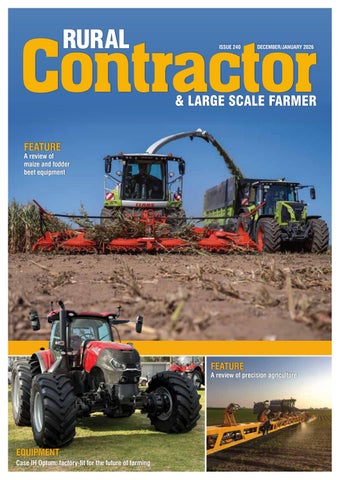
ISSUE 240
DECEMBER/JANUARY 2026
FEATURE
A review of maize and fodder beet equipment
FEATURE
A review of precision agriculture
EQUIPMENT Case IH Optum: factory-fit for the future of farming
WHEN YOU HAVE THE BEST COLLEAGUE IN THE WORLD.
The new Fendt 800 Vario makes work a pleasure. Redesigned from the ground up, the Fendt 800 Vario Gen5 blends innovation and passion in every detail. With immense operational strength, maximum efficiency, impressive payload capacity, and new 360º lighting, it delivers the performance you need — day in, day out. Contact your local dealer and find out more today.
• • • • • • •
VarioDrive transmission New AGCO Core80 engine Fendt ID engine Dynamic performance across all models Central tyre inflation Reverse fan All new 360º degree lighting system
Leaders drive Fendt. fendt.com/au fendt.com | Fendt Fendt ist is eine a worldwide weltweite brand Marke von of AGCO. AGCO.
DECEMBER/JANUARY 2026
IN THIS ISSUE... 02 From the Editor: A once-in-a-generation payout: what Fonterra’s capital return means for rural New Zealand
INDUSTRY NEWS
12
03 Rural contractors signing up for a higher standard 04 Confidence returns to sheep and beef 06 Croplands and Norwood strengthen sprayer solutions for New Zealand growers 08 Early signs of recovery for arable farming 09 The road ahead: contractors urged to speak up on transport barriers 11 Agribusiness leader John Skurr appointed as Norwood’s general manager 12 Rural contractors want national air plans and enforcement 14 New PHd project explores greater electricity resilience in rural communities
TECHNOLOGY
22
16 Next-generation accuracy with Topcon’s UC7 Plus boom control 18 A top-notch crop and chop 21 Award-winning Intuitu 2.0 takes the guesswork out of tyre pressure for tractors 22 New Harvest Profit program offers powerful cost and profit tracking
PROFILES 24 Keeping the wheels turning: the John Austin Ltd story, then and now 30 Keeping it in the family: the evolution of Hughes Contracting 36 Across the ditch: getting the system right from paddock to pit
FEATURES 40 A review of precision agriculture 52 A review of maize and fodder beet equipment
24
EQUIPMENT 64 Built for the clamp: the JCB 457S Agri in action 66 Power Farming machinery team - the people behind the machines 68 Case IH Optum: factory-fit for the future of farming 70 Cutting smarter, not harder – why KJR Contracting switched to grouping mowers 72 3-metre option joins T7 HD range 74 Change of mind on new tractor order delivers surprise second set of new wheels for dairy farmer 76 Enhanced 5EN delivers power, precision and comfort in narrow tractors
70 01
Editor Angus Kebbell 022 052 3268 angus@agrimedia.co.nz Advertising Manager Michael Lightbourne 021 403 853 michael@agrimedia.co.nz Advertising Sales Lisa Phelan 021 782 228 lisa@agrimedia.co.nz Circulation Hilary Armstrong 027 443 3477 admin@agrimedia.co.nz Production Design and Layout Hannah Kincaid art@agrimedia.co.nz Contributors Brendon Burns, Poppie Johnson, NZ Nature Fund, Mike Griffiths Printed by Blueprint Ltd
Read our magazine online ruralcontractor.co.nz/read-online
Follow us facebook.com/nzrclsf instagram.com/nzrclsf ruralcontractor.co.nz
Scan here to sign up to our digital newsletter
PO Box 36753 Merivale, Christchurch 8146 ph 03 329 6555 www.agrimedia.co.nz Publishers of Rural Contractor & Large Scale Farmer, AgriBusiness, AgriVet, NZ Cropping, Australian AG Contractor & Large Scale Farmer, NZ Novachem Agrichemical Manual.
A once-in-a-generation payout: what Fonterra’s capital return means for rural New Zealand A rare thing is happening in the dairy sector and it is worth pausing on, because the ripple effects will reach every corner of rural New Zealand. Fonterra’s farmer-shareholders have voted to sell the co-op’s consumer business for $4.2 billion, a price that surprised almost everyone, and three quarters of that will be paid back to farmers as a tax-free capital return in the first half of 2026. For the average supplier this equates to nearly four hundred thousand dollars, a once-in-a-generation cash injection arriving on top of what is already shaping up to be one of the stronger payout years in recent times. It would be easy to assume this money will flood straight into local towns and spark an immediate lift in domestic spending. The economic report behind the numbers is clear that this won’t happen. Most of the funds will go into debt reduction or into investment, and a fair share will be spent on imported machinery because contractors and farmers alike are still working through replacement and upgrade cycles that were delayed during the tight years. Even so, there is no denying that a balance sheet boost of this scale will lift confidence across the sector and confidence has been in short supply. When things get tight on-farm, the pressure always lands on contractors because the work still needs doing and the weather does not wait. That is why this payout matters to our readers. Even if much of the money goes towards reducing debt, stability on-farm is good for business and the dairy sector still underpins much of the workload for contractors from Northland to Southland. A confident dairy client is more likely to invest in new lanes, fresh pasture, effluent upgrades and a reliable silage programme. They are more likely to value quality work and to secure the services they need early. These decisions create the foundation of a safer, more predictable season for contractor businesses that rely heavily on timing and trust. There is also the broader lift in sentiment. The ANZ report notes that GDP growth is expected to strengthen in 2026, supported by lower interest rates, firm export prices and this capital return. A rising tide in agriculture usually feeds into stronger
© RURAL CONTRACTOR AND LARGE SCALE FARMER - No part of this publication may be reproduced in any form without the prior written permission of the publisher. Opinions expressed in this publication are not necessarily that of the publisher and suggest independent advice be sought before acting on information or suggestions contained herein.
02
Angus Kebbell, editor.
machinery demand, better maintenance schedules and renewed appetite for technology. It gives contractors permission to plan ahead, to keep staff, to train new operators and to invest in gear that lifts efficiency and accuracy across the board. For Rural Contractor & Large Scale Farmer, the coming year will be one to watch closely. The payout is not a silver bullet and it will not erase the challenges facing the sector, but it does signal a shift in tone. After several seasons of simply keeping the wheels turning, dairy farmers may finally have room to breathe again. When they breathe, the rural economy breathes with them and for the contractors who support the backbone of our primary sector that is welcome news indeed.
Contributions - Editorial and photographic contributions are welcomed and should be sent directly to AgriMedia Ltd. Editing of submissions is at the sole discretion of the editor and will accept no responsibility for unsolicited material.
Industry News
Rural contractors signing up for a higher standard The Registered Contractor scheme run by Rural Contractors NZ has been relaunched. RCNZ CEO Andrew Olsen says his organisation ran the ruler over whether to continue with Registered Contractor amid falling numbers but his board has affirmed that a scheme supporting a higher standard deserved to be retained. “Given there were now other commercial accreditation options and a decline in Registered Contractor numbers, we openly canvassed if we should continue and, if so, how could we make it more efficient, affordable and cut out duplication? “It’s encouraging that in announcing the launch of the updated scheme over a dozen RCNZ members have jumped on the opportunity.” Registered Contractor 2.0 ensures a contractor is meeting their statutory and regulatory responsibilities to reduce risk to them, their staff and clients and minimise their exposure to liability in employment, health and safety and other areas. Upon approval, a business is designated a “Registered Contractor” for the period of the
external accreditation and is encouraged to use this endorsement in its marketing. Andrew says post-Covid, the government had stood up its own accreditation scheme but its roadmap also indicated it may look in the future to industry organisations to step in to the accreditation space, as was the case pre-Covid. “That’s why it’s incumbent upon RCNZ to make sure the scheme is fit for purpose and ready when the government acts.” He says Registered Contractor 2.0 is run by RCNZ for its members at no additional cost. “My board is of the view this is a small administrative price for us to meet so as to endorse a higher standard of rural contracting for our members.” He says RCNZ is continually assessing the value of its membership services. “We deliver the fullest range of services possible for about the cost of a cup of coffee and scone each week. “Our membership base is strong, supportive and fully deserving of innovation. We also welcome new members, and any rural contracting businesses interested in joining up can get in touch for a chat about what we offer,” says Andrew.
Andrew Olsen says the refreshed Registered Contractor scheme is about lifting standards for operators and giving members a stronger platform to demonstrate professionalism across the sector.
Yo u r p a d d o c k ' s N E W B E S T M AT E ! S uFRONT, m mALL e r CROPS 's the time to clean up... ONE
Plan ahead for next season & save with a Rock Picker NT78 “The drawbar visibility is fantastic and having reduced grease nipples allows for a much simpler service. It was important for me to find a quality rock picker that could withstand harsh conditions and last for years. Highline was the standout for me, and it has proven to be a strong, premium product” Eddy Winyard
Also distributors of AgriSpread, Elmer's chaser bins, Geringhoff header fronts, Gregoire Besson tillage & Broughan trailers Dealer enquiries welcome
Call Chris Tricker on: 027 577 0058 South Island enquiries: Brown Agri Solutions Call Fin or Conor on 027 271 2080
waringa.co.nz
03
Industry News
Confidence returns to sheep and beef There’s a renewed sense of optimism across New Zealand’s sheep and beef sector this spring, and for good reason. Prices are climbing across the board, margins are healthy and the global appetite for red meat shows no sign of slowing. After years of volatility and weather disruptions, producers are heading into summer with a genuine tailwind behind them. Lamb and beef prices are now sitting at record highs, driven by strong demand and tight supply both here and overseas. In the United States, where inventories are low and herd rebuilding is still some way off, prices have surged. Even with Brazil sidelined by a 50 percent tariff and New Zealand beef facing its own 15 percent import tariff, returns to local farmers remain strong. As ANZ notes, “Most of these price hikes are making it back to New Zealand farm gates.” China too is proving resilient, taking larger volumes of beef as Brazil redirects trade flows away from the US. Despite a sluggish Chinese economy, demand for imported red meat remains firm, a sign of just how deeply New Zealand beef has embedded itself in that market. Closer to home, Beef + Lamb New Zealand’s new season outlook puts total beef production down just 1.4 percent for 2025/26, reflecting a small reshuffle between cow and heifer classes rather than
A classic New Zealand sheep country scene with ewes and lambs spread across rolling spring pasture, a reminder of the strength and resilience of our hill-country farming landscape.
04
a structural decline. Dairy restocking trends have shifted, but the national breeding base for beef is slowly expanding. The proportion of dairy-origin beef continues to grow, a positive sign of how integration between sectors is strengthening national supply. ANZ expects production to increase in coming years as more beef-breeding cows are retained and dairy beef utilisation rises. Lamb and mutton are also enjoying a stellar run. Farmgate lamb prices have climbed steadily through spring and are forecast to average $9.65 a kilo - up more than a dollar on last season. Supplies are tight in both New Zealand and Australia and strong in-market prices in Europe and China suggest that while consumers may begin to resist further increases, there’s little sign of demand collapse. Even with a likely seasonal easing early in the new year, prices are expected to hold at historically elevated levels. Mutton prices tell a similar story. With fewer adult sheep on hand and a stronger outlook for both meat and wool encouraging flock retention, the forecast for the year sits around $5.25 a kilo. High returns are keeping numbers stable and confidence high across the industry. Farmers on both sides of the Tasman appear inclined to rebuild flocks while conditions allow, rather than cash in and sell down. Wool, too, has added an unexpected layer of good news. The strong-wool indicator recently surged past $4 a kilo clean - the first time it’s done so since 2016 - with merino prices also lifting sharply in both New Zealand and Australia. Shrinking supply, firm end-user demand and an overdue correction in global stocks have all contributed to the rally. While some volatility is inevitable, the direction of travel is unmistakably upwards. For growers who have endured years of depressed prices, the sight of bales
commanding real value again is a morale boost that cannot be overstated. These buoyant returns are feeding directly into on-farm confidence. After a tough stretch of high costs and fluctuating markets, sheep and beef operations are finally enjoying strong gross margins and the prospect of another profitable season. Lower interest rates, a weaker New Zealand dollar and supportive pasture growth are adding further momentum. According to ANZ, “There are no shortage of reasons for optimism.” It’s a far cry from the uncertainty that has clouded the sector in recent years. Policy changes, extreme weather and market shocks have all tested resilience, yet the fundamentals of grass-based meat production remain rock solid. New Zealand’s reputation for natural, low-input farming continues to underpin demand and the sector’s discipline in adapting to global trends – from sustainability standards to animal welfare expectations – is paying dividends. The outlook for the year ahead is about as bright as it gets. Global supply constraints, particularly in the US and Australia, are likely to persist through 2026 while demand for premium protein remains robust across Asia and Europe. Farmers are mindful that high prices can’t last forever, but for now, strong returns and softening finance costs are delivering some well-earned breathing space. After seasons of mixed fortunes, the sheep and beef sector has found its stride. It’s proof once again that when markets stabilise and policy settings give farmers the freedom to focus on production, New Zealand agriculture responds with world-class performance. For those on the land, it’s not just a good yarn, it’s a well-earned one.
The new home for Merlo Telehandlers and Attachments
Powerful. Versatile. Built for NZ. Merlo telehandlers and attachments deliver unmatched innovation, comfort, and performance across agriculture and construction. As Merlo’s exclusive partners in New Zealand, Ag & Civil Machinery Direct and JJ Limited provide the full range of compact, medium, highcapacity, stabilised, rotating, and telescopic models— plus specialised machines and genuine attachments to tackle any farm or jobsite task with ease. Explore the technology trusted worldwide.
*Terms & conditions apply. Contact your dealer for details.
North Island Dealers
South Island Dealers
89 Kahikatea Dr, Hamilton
Visit us in Invercargill, Gore,
38 Progress Dr, Otorohanga
Mosgiel, Cromwell, Timaru, Ashburton or Christchurch
7 Heights Road, Pukekohe agandcivilmachinery.co.nz
@agandcivil
jj.co.nz
@jj.co.nz
Chat to our Specialists
Chat to our Specialists
Sales, Parts & Service: 07 843 7237 • sales@acmd.co.nz
Sales, Parts & Service: 03 211 0013 • marketing@jj.co.nz
Industry News
Croplands and Norwood strengthen sprayer solutions for New Zealand growers In a sector where every droplet of precision counts, Croplands and Norwood have taken a major step forward for New Zealand’s growers. The two companies have expanded their long-standing partnership, giving farmers and contractors wider access to Croplands’ advanced range of sprayers through Norwood’s nationwide dealership network. The move strengthens a relationship that has spanned a quarter of a century and reinforces both companies’ shared commitment to delivering technology that meets the evolving demands of modern agriculture. “We’re thrilled to deepen our 25-year relationship with Croplands by expanding our sprayer portfolio,” says Aidan Cudby, National Aftersales Manager at Norwood. “Croplands has built a reputation over the past five decades for producing best-in-class spray technology. Their full agriculture and horticulture line-up, now available through the majority of Norwood dealerships, enables us to better serve growers with tailored solutions across the sector.” The partnership arrives at a time when efficiency has become everything. With fuel, labour and chemical inputs continuing to rise, the importance of reliable highprecision application equipment has never been clearer. Spray coverage that saves product without compromising protection can mean the difference between a good season and a great one. For that reason, Croplands’ reputation for performance and consistency has made its products a mainstay across Australasia.
Rob Marshall, Croplands’ Regional Manager for New Zealand says expanding the range available through Norwood was the natural next step in their partnership. “Expanding access to our horticultural range is a natural evolution in our longstanding collaboration with Norwood,” he says. “Their reputation for customer care mirrors our own values at Croplands. It’s a partnership that’s built on trust and a shared commitment to grower success.” That shared philosophy runs deep. Both companies are steeped in agricultural heritage, with Croplands celebrating more than fifty years in spray technology and Norwood marking seventy-six years as a cornerstone of New Zealand’s rural landscape. Together, they bring a blend of innovation and local understanding that gives contractors and growers confidence their investment will deliver long-term returns. Already, Norwood teams have been
The Croplands Pegasus 8000 delivers wide, even coverage and reliable performance for broadacre operations, now fully supported through Norwood’s nationwide dealer network.
06
The Croplands HSS multi-row sprayer brings precision and efficiency to modern orchards with targeted canopy coverage and reduced drift across intensive fruit-growing systems. working hands-on with Croplands’ horticultural sprayers in the field. Earlier this year a specialist workshop brought Norwood service staff together to focus on Croplands’ new HSS multi-row sprayer technology, which includes a three-row apple sprayer designed specifically for orchardists. The HSS represents a leap forward in efficiency for tree-crop systems, targeting canopy zones precisely while reducing waste and drift. “This is a range we’re excited to bring to New Zealand growers,” says Rob. “Pairing it with Norwood’s extensive agricultural offerings means we can deliver industryleading spraying solutions to growers of all sectors, from viticulture and orchards to pastoral and arable farming.” Aidan agrees that the combination of Croplands’ engineering and Norwood’s support network will pay dividends for New Zealand agriculture. “Growers and contractors are facing increasing pressure to do more with less,” he says. “By expanding our sprayer portfolio with Croplands’ proven designs, we’re giving them more options that match the scale and diversity of local operations.” Croplands’ story stretches back more than half a century, from its beginnings in South Australia to becoming part of Nufarm’s global emerging solutions platform. That connection brings the strength of an international agricultural science company with the agility of a dedicated equipment brand. Nufarm itself has been part of the global crop protection and seed technologies landscape for over 100 years, listed on
Invest in
OR D
More than a Machine.
R ORDE EARLY R
For a limited time, secure your CLAAS LEXION and enjoy exclusive Early Order benefits: 2 years’ Warranty Peace of mind built in, with options to extend coverage.
LEXION Packages Specifications to suit you and our tough New Zealand conditions.
Don’t wait until next harvest – let’s get your LEXION sorted today. 25-003
GE BENEF
Significant Savings When you order a CLAAS LEXION with a CLAAS front.
Ordering early means your machine is locked in, your finance is sorted, and your harvest confidence starts now.
*T&C’s apply. For full terms, please see our website claasharvestcentre.com. Establishment fee of $295 applies.
HU
IT
S
FO
Harvest doesn’t wait. Neither should you.
Finance from 3.99%* Flexible packages, tailored to your farm and your set-up.
YOURS NOW ER
Industry News
Early signs of recovery for arable farming Arable growers could be forgiven for feeling like the poor cousins of the primary sector this year as dairy, red meat and horticulture enjoy strong prices and renewed confidence. The grain sector has not shared in the same uplift and for many growers the past few seasons have demanded more resilience than reward. However, as spring unfolds there are signs that the tide may slowly be turning, offering a hint of optimism for those who have stayed the course. Local grain prices are starting to firm, particularly across the South Island where values have risen in the past year, while maize grain in the Waikato has lifted strongly. Increasing demand from the dairy
sector is helping to underpin maize grain and feed wheat prices, even if imported feed remains the cheaper option on a straight cost comparison. For growers who have been battered by rising input costs and flat global markets, any upward movement provides some much needed breathing space. Input costs have continued to climb since 2019 and revenue has struggled to keep pace, yet with farmers in other sectors seeing improved margins there is cautious hope that better balance will eventually ripple through to arable. Seasonal conditions have again shaped the year, with a wet autumn in South Canterbury compromising winter wheat planting. The months since have been relatively dry, although colder winter and spring conditions may affect yields at harvest. The variability serves as a reminder of the importance of New Zealand’s domestic grain sector. Imported feed can
buffer shortfalls but does little to support long-term national resilience or regional economies if local growers shoulder the cost while imports take the market. Internationally, grain markets remain subdued as strong global supply keeps a lid on prices. Consecutive years of generally good harvests, along with reduced feed use in major livestock regions, have kept global stocks comfortable and limited price momentum. Australia is heading for a good harvest as well, making imports competitive into New Zealand milling markets even with a weaker New Zealand dollar. Despite these headwinds, the grain sector is not short of determination. Growers continue to invest in soil health, crop rotations and technology to improve efficiency and output. The strategic importance of arable farming in supplying reliable domestic feed is becoming increasingly clear, particularly as livestock sectors strengthen. With dairy demand improving and livestock margins lifting, feed demand may continue to rise into summer and beyond, providing further support for local grain prices. Lower interest rates will also ease financial pressure and allow growers to plan ahead with a little more confidence. It would be premature to call this a turnaround, yet the early signs of recovery are encouraging and the optimism running through the wider primary sector may yet reach arable producers. After several challenging years, growers deserve a season that rewards their perseverance. If local demand continues to build and the weather remains kind through to harvest, there is a chance the sector will begin to regain some of the confidence that has been missing for too long.
Local grain prices are starting to firm, particularly across the South Island.
the Australian Securities Exchange and headquartered in Melbourne. Together, the two brands represent a depth of expertise that continues to set standards across the region. For Norwood, the partnership further expands a product line that already covers some of the world’s best-known agricultural and construction equipment. With 17 dealerships and a dedicated service centre nationwide, the company’s footprint ensures growers in every region have access not just to machines but to the technical knowledge and aftersales support that keep those machines performing. That network also 08
gives Croplands a stronger local presence, meaning support for its sprayer range is never far away. The result is a win for growers, contractors and the broader industry. As machinery technology becomes more sophisticated and environmental standards continue to tighten, the need for precise, efficient and reliable spray systems will only grow. Equipment that delivers uniform coverage while minimising waste doesn’t just protect crops it protects margins and the environment alike. This partnership between Croplands and Norwood underscores how collaboration between leading suppliers can bring tangible
improvements to the field. It’s a reminder that innovation in agriculture doesn’t always come from new inventions; it often comes from strong relationships, shared expertise and the drive to continually improve the way farmers work. For growers interested in seeing the expanded range, Croplands’ sprayers are now available through most Norwood dealerships nationwide. Whether for largescale horticultural operations, viticulture, or traditional arable and pastoral farming, the combined portfolio offers one of the most comprehensive selections of spraying equipment available in New Zealand.
The road ahead: contractors urged to speak up on transport barriers When the people who keep the wheels of our rural economy turning start struggling with the very rules meant to keep them moving, it’s time for a reality check. That was the clear message from Rural Contractors NZ recently, following a constructive but urgent meeting with senior officials from NZTA. With the Minister of Transport Chris Bishop asking officials to engage with the industry before formal consultation begins, the focus is now firmly on how over-dimension and overweight permitting is affecting day-to-day business across the country. Contractors know better than anyone that machinery keeps getting bigger, heavier and more capable, yet the system governing what can legally travel on the road hasn’t kept pace. The result is a patchwork of permitting rules, regional inconsistencies and too many stories of delays or outright refusals. Andrew Olsen, Chief Executive of RCNZ, has called for detailed feedback from members to build a national picture
of what’s really happening on the ground. It’s a call that every contractor should take seriously, because this is one of those rare moments when officials are listening and the door is open. Front-mounted mowers are one example already on the radar. There are reports that some councils are declining permits based on the distance from the operator’s seat to
Modern baling gear at work as contractors push through heavy workloads, a reminder of the pressures members face to deliver timely feed supply. the front of the mower. Others are advising that no permit is needed. It’s an area full of
Hay and silage the easy way. » Apply straight from the can » Easy on machinery » Quality fodder Also available in certified organic form
0800 274 524 biostart.co.nz 09
Industry News
Contractors looking over the New Holland Forage Cruiser during the RCNZ conference, where machinery, staffing, and compliance challenges dominated discussion.
grey zones, where outdated interpretations of the Vehicle Dimensions and Mass (VDAM) rules collide with modern machinery design. The only way to fix it is with facts clear, region-by-region feedback on what applications have been declined, what reasons were given and whether the issue sits with NZTA, local councils or both. Overweight permits are another sticking point. Some contractors report smooth approvals, while others hit walls of red tape, particularly for the largest self-propelled machines such as forage harvesters and loaders. The question of whether permits include or exclude attachments is critical, because an exclusion can effectively make a machine unusable for the work it’s built to do. RCNZ wants a national overview of approvals and rejections to identify where the inconsistencies lie and that means contractors need to share their experiences. As Andrew notes, “There’s a complex
tangle of permits, weights, restrictions and supervision for agricultural vehicles which need, at times to travel at low speeds for short distances on local roads and state highways. While rural contractors are principally affected, there will be farmers who are caught with this same confusing mesh of red tape.” The reality is that the machinery used today bears little resemblance to what the current rules were written around. That disconnect is now stifling efficiency and in some cases, pushing contractors into non-compliance just to keep jobs moving. Beyond permits, there’s a growing problem with the weight data on machinery itself. Some imported units arrive with a ‘badged’ or declared weight that doesn’t match what’s recorded on local weighbridges once the machine is fitted with extras or ballast. The differences can be enough to push a vehicle into a new regulatory class, and
those discrepancies are likely to become a flashpoint in the upcoming transport review. Collecting those figures now will help RCNZ ensure that the review reflects the real operating environment, not just the numbers on a manufacturer’s plate. That review is coming, but it won’t happen overnight. Any changes to the VDAM rules will require legislation and as Andrew bluntly puts it, “No sugar-coating it, this will take time, possibly years.” In the meantime, RCNZ is working within the Road Transport Group and the Heavy Vehicle Industry Group, where policy changes affecting all over-dimension operators, cranes, airport vehicles and rural contractors alike are debated and shaped. Being at those tables matters. It means that when new frameworks are developed, rural contractors’ needs are understood alongside those of the heavy construction and emergency sectors, rather than being treated as an afterthought. Another issue under discussion is licensing. The current rule requiring international drivers to wait six months before converting from a class 1 to a class 2 licence is proving a real barrier for many contractors. At a time when skilled machinery operators are hard to find, that half-year stand-down can mean losing valuable staff at the peak of the season. RCNZ wants to understand how widespread the problem is and what it’s costing the industry, not just in lost productivity but in hard dollars. The message to members is simple: speak up. Share your experiences, good or bad. Every declined permit, every delayed approval, every unnecessary compliance hurdle adds weight to the argument that reform is needed. As Andrew says, “It is the only way we’ll convince government that there are issues that stop you doing business and change is required.” For contractors, the stakes are high. The machines we rely on are not getting any smaller, the workloads are not easing and the margins for error are shrinking. Keeping those machines moving legally, safely and efficiently is a shared interest between operators, regulators and the communities they serve. If there’s ever been a time to make sure rural contractors’ voices are heard, it’s now.
Contractors preparing paddocks for the season ahead, reflecting the strong demand and tight operating windows highlighted in the RCNZ update. 10
Agribusiness leader John Skurr appointed as Norwood’s general manager C B Norwood Distributors Limited has announced the appointment of well-known agribusiness executive and livestock farmer, John Skurr, to the position of General Manager, effective 3 November 2025. The move brings a seasoned industry figure into one of New Zealand’s most influential agricultural machinery businesses at a time when dealerships, contractors and farmers are facing rising costs, rapid technology shifts and tighter margins. John brings more than three decades of experience in the primary sector, with the past 17 years spent in senior leadership positions at Alliance Group and PGG Wrightson. His most recent role was Director ANZ and Premium Brands at Alliance, where he played a key role in the strategic development and global positioning of branded premium meat programmes, including Lumina, a high-end lamb brand now recognised across key markets for its eating quality and provenance. Prior to Alliance, John held multiple national leadership roles at PGG Wrightson, including Head of Water and Retail Technical, giving him a strong foundation across rural retail, advisory services, supply chain and on-farm solutions. He also maintains direct ties to farming through his own commercial Hereford and Dorset Down stud in Canterbury, a connection that many will see as a valuable
asset when engaging with Norwood’s dealer network, customers and suppliers. This dual perspective - corporate leadership combined with hands-on farming brings credibility at the coalface of the rural sector. “We are excited to welcome John, who is an experienced executive leader with a strong background in sales leadership, agribusiness and technical operations,” says Men Form-Zuellig, CB Norwood Distributors Limited Board Chair. “In addition to his commercial experience, John owns a commercial Hereford and Dorset Down stud farm in Canterbury, giving him insight and connection to the everyday realities of many of our customers.” Norwood’s appointment comes during a pivotal period for the agricultural machinery industry. Rising interest rates and capital costs have increased the pressure on contractors and farmers to maximise machinery productivity and lifespan, while technological integration - from Isobus compatibility to precision farming, telematics and autonomous systems - is becoming a defining feature of purchasing decisions. New Zealand’s ag-machinery dealerships are also undergoing generational change, with a shift towards more holistic service-based and technologysupported customer relationships rather than purely machinery sales. Against this backdrop, Norwood is seeking stronger business performance, brand positioning and dealer engagement across its well-known machinery portfolio. With brands such as Landini, Kuhn and Vaderstad
John Skurr brings decades of agribusiness leadership and handson farming experience to his new role as General Manager of Norwood, strengthening the company’s connection to the rural sector. sitting under the Norwood umbrella, the business continues to play a major role in the contracting and farming sector nationwide. John’s appointment signals a strategic step toward sharpening customer experience, strengthening relationships with suppliers, and building future-focused capability within the dealer network. For his part, John says he is energised by the opportunity and committed to the sector he knows well. “I am thrilled to be joining C B Norwood Distributors and staying within the agriculture sector. There are outstanding
The next generation 8 Series is ready to indent. 0800 627 222
Find your local dealer
The grass is greener.
11
Industry News
Rural contractors want national air plans and enforcement With the Government’s wholesale reforms
Several regions have outdated air plans and some are waiting to see the scope of the ongoing Coalition Government reforms. However, RCNZ CEO Andrew Olsen says amid much focus on developing standards for infrastructure, biodiversity and freshwater, there’s been no comment about standardising air and aquatic agrichemical application standards and the qualification of companies and operators. “The RMA reforms should be contemplating this in the absence of councils doing so,” he says. “We also think it’s time councils came to grips with ensuring the applicators they award contracts to hold the appropriate qualifications” ‘I have had members tell me they’ve helped councils fine tune air plan policy and best practice in for example aquatic spray environmental. Our qualified members are a vast source of information and councils should be tapping into that, not rewarding non-qualified companies with contracts.” Those comments are endorsed by Matt Strahan, Nufarm’s National Product Manager. “Agri-chemical contractors are a key player in the environmental stewardship we support in providing, effective crop protection solutions through safe spray application. The industry is under increasing scrutiny in application, storage and health and safety and a national standard makes sense.” He says that should mean only those contractors with Registered Chemical Applicator training or working towards that qualification should be able to apply agrichemicals. The Environmental Protection Authority
requires agrichemical applicators using airblast or boom sprayers to hold qualifications when applying highly ecotoxic products as do some regional plans, though there is variation in these by region. Jane Lamb, General Manager of the New Zealand Agrichemical Education Trust which runs Growsafe, says using NZ Standard 8409:2021 on the management of agrichemicals would be a great place to start if looking at a national policy statement. “This document sets out good practice for safe, responsible agrichemical use. It was developed by consensus by a committee comprising representatives from government agencies such as WorkSafe, EPA and MPI, regional councils and industry groups including Fonterra, Zespri and Rural Contractors NZ. “ It also went through a full public consultation process and sets out current legal requirements as well as recommended qualifications. “We would encourage anyone looking at regulation of agrichemical use at a national or regional level to reference NZS 8409 rather than writing their own version of the rules,” says Jane Lamb. Canterbury agri-chemical operator Peter Gilchrist says there need to be updated rules and appropriate discretion. “It makes sense to have a national standard. Currently, it’s basically a case of if a spray or odour crosses a boundary, you’ve got a problem.” He says any new standard need to recognise weather can change rapidly and unpredictably. His company once stored chicken manure on a property ready to spread; a sudden wind change blew the odour onto a neighbour’s. “People got upset but such events can be completely out of your control.” Mr Gilchrist says any new national standard should also require anyone spraying agri-
chemicals to be a Registered Chemical Applicator. The RCA scheme, started by Rural Contractors NZ but now overseen by Growsafe, is the highest standard of certification. It requires renewal every five years through training, theory, and practical assessments, often including on-site visits. Many regional councils and suppliers to some food producers are not supposed to give work to contractors who don’t hold an RCA but Rangitikei agri-chemical sprayer Graham Greer doubts that this is happening across the board. “It doesn’t seem to be policed. I think there needs to be a lot more awareness about the need to be a Registered Chemical Applicator.” He’s had decades in the business and says it takes at least three years to become compliant with all that is required for safe application of agrichemicals.” “You get guys who just come in and cut the costs.” He backs a national standard for air plans and its enforcement, including having properly qualified spray operators. “We need some consistency right across the country rather than different plans here there and everywhere.”
opportunities for growth with an amazing portfolio of brands. I’m looking forward to working with the team,” says John, incoming General Manager. John also currently serves on the board of Retail Meat New Zealand, continuing his involvement in sector governance and industry advancement. His professional background in branded value-add programmes, rural services and technical solutions positions him to bring a broadened
commercial lens to Norwood’s strategy - one that blends customer value, brand development, technology and practical on-farm know-how. His appointment will be watched closely by both contractors and farmers, who rely heavily on reliable brands, strong dealer support, parts supply and responsive service. With machinery investments often sitting among the highest capital costs on farm, the leadership direction of one of the
country’s largest distributors has a ripple effect across the sector. As the machinery industry continues to evolve and as contractors demand more efficiency and technology readiness from equipment, Norwood’s decision to bring in a leader who bridges corporate strategy with real-world farm experience appears well timed. John officially commenced his new role on 3 November 2025.
of the Resource Management Act including various national policies, rural contractors are asking; what about a national standard for air plans?
12
Matt Strahan, Nufarm’s National Product Manager, says the industry needs stronger national standards to support safe, consistent agrichemical application across the country.
Industry News
New PHd project explores greater electricity resilience in rural communities The New Zealand National Fieldays Society, in partnership with Waipā Networks and in collaboration with Te Herenga Waka - Victoria University of Wellington and Lincoln University, has launched a three-year PhD project to explore how rural resilience can be improved by focusing on how electricity is used, produced and shared on farms. This will be achieved by integrating distributed energy resources into farming activities, conversion of on-farm activities to electricity and the development of a farmerto-farmer electricity trading system. The project aims to strengthen the resilience of rural power networks by enabling farmers to generate, use and share renewable electricity. Funded by the Ministry of Business, Innovation and Employment under its Workforce Initiatives, it brings together academic research and practical industry application. Growing pressures around decarbonisation, electrification and energy security are increasing the need for new on-farm energy solutions. The farming sector is well placed to lead New Zealand’s energy transition. On-farm generation, storage and electrified equipment are now practical and cost-effective, allowing farms to power their operations and supply excess energy to local networks. New technologies such as agrivoltaics and floating solar further expand this potential by producing electricity alongside normal farming activity. Using distribution networks to trade electricity within local, autonomous mini-markets
offers opportunities for lower costs, reduced network losses, diversified revenue streams and greater rural community resilience during periods of high demand or natural disasters. Electricity distribution company Waipā Networks, which operates across rural, urban and industrial areas, plays a central role in enabling this research by providing network expertise, access to real-world infrastructure and the operational insight needed to develop and test a scalable energy trading model. As a 100% customer-owned business with responsibility for powering Fieldays each year, it has a long-standing commitment to reliable, cost-effective distribution and to connecting the people and places it serves. This makes it a strong partner for advancing practical, community-focused energy solutions that strengthen local resilience and support shared energy independence. “We’re proud to partner with the Society on a project that explores practical solutions for rural energy resilience and local energy trading,” said Waipā Networks Chief Executive Sean Horgan. “Because we’re deeply connected to the communities in our region, we see real value in initiatives that help neighbours support one another through smarter, more flexible energy systems. If we can share these findings at Fieldays and reach more than 100,000 visitors, it has significant potential to help rural communities manage electricity more efficiently while supporting Aotearoa New Zealand’s decarbonisation goals.” “This initiative highlights the value of collaboration between Waipā Networks and the Society,” said Richard Lindroos,
Fieldays, Waipā Networks and leading universities have joined forces to trial farmer-to-farmer energy trading and on-farm electrification as part of New Zealand’s rural energy transition.
14
Chief Executive at the Society. “It will deliver practical insights for managing energy at Fieldays and Mystery Creek Events Centre, helping future-proof critical infrastructure and create rural energy solutions that can be replicated nationwide. Fieldays has long been a platform for innovation and we look forward to sharing the progress and findings with attendees at future events.” The PhD students, will work across four phases over three years, based at Te Herenga Waka and Lincoln University for academic study and at Waipā Networks and Mystery Creek Events Centre for industry engagement. Mystery Creek, home of Fieldays, experiences some of the country’s highest variance in electricity demand due to the annual four-day event. As a critical civil-defence location, the site also requires rapid responsiveness to demand surges and a high level of energy self-reliance, making it an ideal case study for scalable rural energy models. The project will test local energy markets and develop a cloud-based platform for managing real-time operations, including demand-side response and optimised dispatch informed by weather forecasts and wholesale price signals. For the Society, the research will provide a roadmap for managing energy use, reducing line charges, improving resilience and demonstrating leadership in sustainable rural electrification. This aligns with the Society’s long-term blueprint for land use, asset development and sustainable growth through integrated green infrastructure, ensuring the organisation is well placed to support the future needs of New Zealand’s primary industries.
BALING PERFECTION V6750 VARIABLE CHAMBER The McHale V6750 variable chamber round baler has been designed with the demands of today’s farmer and contractor in mind. • High-Intake 2.1m pick-up • 15 knife heavy-duty chopper unit and feed rotor • Double drive system with auto greasing • Net and bale density can be adjusted from the cab through the console • ISOBUS ready
THE HIGH PERFORMANCE FOOD PROCESSOR FUSION 4 PLUS The Fusion 4 Plus is a fully automatic integrated baler wrapper which can apply film or net wrap to the barrel of the bale, delivering optimum bale density. • Maximum output whilst keeping the machine short and compact at 5.8 metres in length • 25 knife-chopping unit • Patented unique bale transfer technique • ISOBUS ready
ALL FUSION BALERS HAVE FILM ON FILM CAPABILITY
SURPASS ALL YOUR BALING EXPECTIONS VARIO PLUS The Fusion Vario Plus is a fully automatic integrated baler wrapper that applies film or net wrap to the barrel of the bale, delivering optimum bale density. • Hay and straw bales from 0.6m to 1.68m • Haylage or silage bales from 1m to 1.45m to allow for wrapping • ISOBUS ready
0800 627 222
Find your local dealer
DON’T MISS OUT, INDENT FOR SPRING 2026 Power Farming NZ | powerfarming.co.nz
Technology
Next-generation accuracy with Topcon’s UC7 Plus boom control Precision spraying continues to evolve at pace and Topcon Agriculture has once again shown why it remains a leader in the field with the launch of the UC7 Plus. Built on the proven foundation of the company’s Norac boom height control technology, this latest generation combines engineering strength with intelligent automation to deliver smoother performance, lower input costs and less stress in the cab. For farmers and contractors alike, it’s a development that adds both efficiency and confidence to every spraying job. At its core, the UC7 Plus is designed to help operators apply product precisely where it is needed, reducing waste, improving crop performance and extending the life of machinery. Compatible with most self-propelled and trailed sprayers, the system introduces a new level of sensing and control. Topcon’s new Dynamic Chassis Sensor known as the DCS-1, monitors the movement of the machine in real time, enhancing boom stability and response. Alongside it the latest MS-1 sensors use MAX Sense ultrasonic technology to read ground and crop contours with even greater accuracy, maintaining a consistent distance between nozzle and target across rolling or uneven terrain. The benefits of such control go far beyond convenience. Precise boom management keeps application rates consistent, prevents drift and ensures the crop receives the full
benefit of every pass. As Nick Townsend, Topcon Agriculture’s Vice-President and Segment Leader for Smart Implements, explains, “The combination of proven legacy solutions with the latest in precision technology serves up an extreme opportunity for lower operating and input costs and lower equipment repair costs.” He says the UC7 Plus takes what has long been a dependable platform and lifts it into a new era of precision. “Spraying system advances increasingly provide farmers and service providers with an opportunity to achieve a greater return on investment on their equipment, either through upgrades or new investments. The UC7 Plus directly drives those savings.” For contractors who spend long hours behind the wheel, the automation also brings a quieter kind of progress - less fatigue and less constant adjustment. Boom control automatically matches the contours of the land, freeing the operator to focus on the overall job rather than watching each wing tip. Townsend points out that the new system helps take pressure off the person in the seat: “These new capabilities also improve sustainability efforts in applying only the needed amount of spray where it is needed - to achieve the best results supporting compliance efforts, cost savings and optimal crop performance.” That link between efficiency and sustainability is key. Every season brings greater scrutiny of chemical use and nutrient management, and precision spraying is now a central part of responsible farming practice. By ensuring even coverage and reducing overlap, the UC7 Plus
ASW RANGE PUSH-OFF TRAILER
16
allows farmers to meet both regulatory and environmental goals while keeping productivity high. Testing data suggests overall spraying performance can improve by up to thirty per cent when all efficiencies are factored in, from reduced overlap to lower fuel use and fewer mechanical repairs. The design of the sensors themselves has been given careful attention to withstand real-world use. Constructed with corrosionresistant glass-fibre nylon housings, protective transducer screens and multi-axis vents, they are built to handle dust, moisture and chemical exposure over long periods. For contractors who expect equipment to work through long seasons and short weather windows, durability is as important as precision. Just as significant is the flexibility of the system. The UC7 Plus can be installed
TMK 264 DUMP TRAILER • 29 m3 capacity
• 20-50 m3 capacity
• All-steel body construction
• Multi purpose trailer
• Trailed steering rear axle and hydraulic drawbar suspension for maximum towing comfort and maneuverability around the farm
• Safety first. Push system maintains a low centre of gravity
Find your local dealer
The Topcon UC7 Plus boom height control system combines advanced MAX Sense ultrasonic sensors with the new DCS-1 chassis sensor to deliver smoother, more accurate spraying across all terrain.
0800 627 222
on most makes and models of sprayers, offering an easy upgrade path for operators who want to step into the latest precision technology without replacing their entire fleet. It supports varying levels of control to suit different crops, terrain and operator preferences, ensuring that the technology fits the job rather than the other way around. Nick says Topcon’s focus is on making advanced systems accessible to all farms, large and small. “We believe in accessibility to these technologies and the practical benefits they deliver to farms around the world; this is a simple and powerful example of intelligent technology evolution for the greater good of all farms and systems.” That belief in practical progress has underpinned Topcon’s development of precision tools across guidance, application and mapping systems for decades, each designed to make technology a seamless part of day-to-day work. In practice, the UC7 Plus sits comfortably within the broader trend of automation reshaping the paddock. From section control and variable-rate application to full guidance integration, every layer of technology now adds measurable gains in efficiency and sustainability. Yet the best advances are often those that fade quietly into the background - systems like boom height control that work automatically, invisibly and consistently. As Nick notes, the goal is not to replace the operator but to make the job easier, safer and more profitable.
Spraying has always been one of the most demanding tasks in farming, balancing weather, timing and accuracy in equal measure. The UC7 Plus helps simplify that challenge by taking one of the most critical variables – boom height – and turning it into a controlled constant. Whether operating on flat ground or contouring country, in cereals or pasture, the outcome is the same: uniform coverage, reduced waste and better results. In an industry where margins are constantly squeezed and environmental expectations rise each season, Topcon’s latest innovation offers something rare, a genuine win on all fronts. Lower costs, lighter workloads, stronger compliance
Topcon’s UC7 Plus keeps the boom at a consistent height even on rolling country, helping contractors reduce overlap, improve coverage and maintain uniform product application in challenging conditions. and improved performance make the UC7 Plus a logical step forward for any operator serious about precision. For those who see technology not as a luxury but as an essential tool of the trade, it represents exactly what modern farming needs: smart, accessible control that keeps accuracy high and effort low.
At Fern we understand the importance of fuel to rural contractors. We tailor solutions and support to your needs. Plus, for every 100L of fuel you purchase, 50c goes towards a school of your choice. Call Fern today on 0800 99 99 89 to start supporting your local school.
www.fernenergy.co.nz 17
Technology
A top-notch crop and chop Contracting father and son team, Craig and Josh Pilet, are silage experts who have operated their family-owned lower North Island business for almost four decades. Craig started the business with one tractor and a baler thirty-seven years ago and then saw an opportunity to specialise as dairy conversions started across the Rangitikei and Manawatu and farmers began to purchase feed for their stock. A few years later, Craig purchased his first Claas Jaguar 690 and focused on doing one job well. “Contract baling and harvesting is what we do well, our customers expect good service and a good product so this has been our focus,” he says. “Up to now, we have specialised in hay, silage baling and foraging - doing a good job and providing quality service quickly, efficiently and professionally. Our customers have become increasingly interested in us helping with cultivation and other activities, so we are now looking at how we can achieve this,” Craig says. “Knowing our clients, this area, soil type and preferences is essential in giving them the right advice. Growing a good crop and choosing the right paddocks for silage requires practical experience because weather and ground conditions challenge the production of quality silage. “We aim to complete a top-notch job for every one of our customers. I notice what is happening out there day to day and I know this district. Our customers trust us to know if the ground conditions and weather are going to be right,” he says. Whilst the customer makes the timing decision at the end of the day, advice and
The Pilet team continue to invest in Claas technology, with new NIR systems helping deliver greater accuracy, yield data and feed quality for their customers.
18
support are a key part of the business. In season, everyone is facing the same challenges with weather, machinery and ground conditions - time is money and a season can be destroyed by inadequate preparation. “Our clients understand that chopping is only part of the process. After chopping, the quality can deteriorate. To maintain the quality, silage needs a tight stack, located in the right place that is dry, clean and verminfree then covered with plenty of tyres and a new cover,” Craig says. Craig has seen a lot of change in the industry over the last thirty years. Machines have become more complex, there is more competition and more inoculants are being used to extract value from feed. The capacity of forage harvesting machines has also meant that changes have occurred in stacking equipment, and farmers want to obtain more information on quality and yield. Pilet Contracting has just installed NIR technology in their Jaguar 960 forage harvesters. This will allow them to provide customers with more accurate loading information and instantaneous data, enhance billing, produce quality and yield reports and eventually show customers where their fields perform. The Claas Jaguar NIR system uses nearinfrared sensors to measure the dry matter content and other constituents of forage crops in real-time, providing operators with critical data for optimising harvest and feed quality through the Cemis 1200 or Cebis terminals. This technology helps adjust chopping length, inoculant application and other parameters on the fly, leading to more efficient harvesting and better silage. “We are keen to see what NIR does for us in the new season. We are looking to the future
Craig and Josh Pilet have built their contracting business on reliability, quality silage and strong relationships across the Rangitikei and Manawatū. and how we might also be able to link this into cultivation activities such as variable rate seeding and spreading,” says Josh. Over the years, the Pilets have demonstrated different equipment within their business, but have remained loyal to Claas Jaguar, Disco and rakes. Their equipment purchasing is based on two factors: back-up service and resale value. “Decisions are made based on your relationships with individuals and companies. “Thirty years ago, the Claas Jaguar was the original chopper to have, but at the end of the day it comes down to more than just the product. Claas Harvest Centre provides us with great backup service and parts,” says Craig. Pilet contracting team members carry out day-to-day maintenance of the machines on site, while the qualified Claas Harvest Centre technicians prepare the harvesters for the season ahead. “The latest technology in our Jaguars means that when it’s time for a service or if an error is detected, the technicians contacts us or it is most likely that someone is already on the way; it saves us making a call,” says Josh. When Pilet needs parts, if they can’t immediately source them from the local Claas Harvest Centre, the Waikato Parts Distribution hub means they can access them overnight. “Claas does have it when it comes to aftersales backup. They make us feel like a priority and understand that downtime for us is money and lost business. “I don’t sleep when we are broken down,” says Craig. Having operated a successful business for over thirty years, the key to their success is having the right relationships, equipment and a focus on forage harvesting, baling and transportation. “We continue to adapt to the needs of our customers, but our goal is unchanged in providing a quality product and hassle-free service, allowing farmers to concentrate on their core business,” says Josh.
DEMONSTRATIONS AVAILABLE Across the KUHN range
KUHN DEMONSTRATIONS AVAILABLE NOW As an agricultural professional you only want the best. KUHN offers quality machinery and innovative technologies.
Contact your local KUHN dealer to book a demo*.
www.kuhn.com
*Terms and conditions apply. Talk to your local KUHN dealer to find out more.
Novachem 2026 Is Out Now -
DON’T MISS OUT!
Order Now
Keep up-to-date
• Over 110 new listings • 70 discontinued products • Numerous product label updates (new weed, pest & disease claims)
Order Now
to receive your FREE pair of SureShield Coveralls*
• All product labels reviewed for regulatory content and updated to GSH terminology.
The definitive guide to agrichemicals registered for use in New Zealand. A comprehensive alphabetical listing of products, active ingredients, crop & weed tables, weed & pest identification and much, much more all in one single publication. It really is the definitive agrichemical guide and the only one you’ll ever need. Purchase a manual to receive a FREE 12-month subscription to our subscriber only website. The website is continually updated and contains product listings, a fully searchable online product manual, a powerful search engine of weeds, diseases & pests, including photo galleries with all the agrichemical options to use on individual crops as well as up-to-date SDS’s, Haznotes and product labels, plus posts about industry news and information.
SureShield Coveralls supplied by pH7, provides both protection and comfort with exceptional liquid and particulate protection. Category III, Type 5, Type 6 certified coveralls. Ideal for asbestos removal, spray painting, low hazard pesticide spraying, boat building, dusty areas and general light industry. These are best suited to spraying diluted chemicals such as round up for the fence lines, general maintenances on farm, or when spraying from a airconditioned cab. One size fits all. Supplied by pH7.
* Available to those who order directly from www.novachem.co.nz - while stocks last.
Storing Chemicals? Print up-to-date SDS’s & Haznotes from novachem.co.nz to ensure you are compliant.
subscribe online at novachem.co.nz
Technology
Award-winning Intuitu 2.0 takes the guesswork out of tyre pressure for tractors Nokian tyres has introduced Intuitu 2.0 and it marks a genuine step forward for farmers who want to get the best out of their machinery without all the hassle of working out tyre pressures for different jobs. The new smart load-sensing system has already caught the attention of the industry and was recognised with a Silver Medal at the Agritechnica Innovation Awards, which is no small feat. What sets this apart is that, for the first time, farmers can get tyre pressure recommendations on-the-go based on the tractor’s actual operating weight and the job at hand, using a tyre sensor and a smartphone. The days of guesswork or trying to find a weighbridge are effectively over. It is available only with Nokian tyres Soil King VF and has been designed to help farmers protect their soil, improve performance and extend tyre life, which is something most operators are aiming for. Intuitu 2.0 measures the load inside the tyre through sensors fitted to the inner liner. Once the operator selects the working conditions in the Intuitu app, it provides the ideal pressure settings for both road travel and field work. In the past, if a farmer wanted to set the correct pressures, it meant weighing the tractor with whatever gear and ballast was on board or relying on charts and best estimates, and very few had the time or tools for that. According to product manager Matthew Crocker, without this technology most farmers were not seeing the full benefits of VF tyres because the task of calculating pressures was too complicated and easily skipped. He said that correct pressures can make a huge difference to how a tractor performs, so removing the barriers was essential. The Silver Medal awarded at Agritechnica confirms that this is more than a small update, as the judges only recognise innovations that genuinely improve reliability, efficiency and environmental outcomes. Anyone who has run VF tyres will know the value of getting pressures right and Intuitu 2.0 now makes that much more achievable for everyday farm work. Correct pressure plays a big part in how much fuel is burned, how effectively power is transferred to the ground and how much compaction
is caused in the paddock. When all these factors are working in a farmer’s favour it leads to better productivity, soil health and tyre life. Intuitu 2.0 will be rolled out across all sizes of the Soil King VF range, which has already proven itself with DLG testing showing strong results for traction and fuel efficiency in both field and transport conditions, and pairing the tyre with the smart technology will help farmers maintain those advantages year round. The first public showing of Intuitu 2.0 took place at Agritechnica 2025 in Hanover in November and visitors were able to see how the technology works in real time. The journey to this point began with the first Intuitu release in 2019 and the new version represents a natural evolution rather than a replacement, building on the plug and play simplicity that users appreciated. Nokian tyres president and CEO Paolo Pompei said the intention is to keep improving digital tyre technology to meet the needs of modern agriculture and to make real time load measurement accessible and affordable for contractors and farmers, which in turn
Intuitu 2.0 pairs the Soil King VF tyre with smart sensor technology and a simple smartphone app, helping operators set the right pressure for every job and maintain consistent performance year-round. supports smarter decisions in the paddock and on the road. Development of Intuitu 2.0 received support from Business Finland and the system has been tested in collaboration with global tractor manufacturers to ensure it works in real farming environments. Nokian tyres continues to manufacture in Finland and its tyres, treads and wheels carry the Key Flag symbol and the Design from Finland mark, which highlights that these products are not only built locally but also reflect Finnish design standards. For farmers, the promise of Intuitu 2.0 is clear as it offers a simple tool to protect soil, reduce fuel use and get the most out of their VF tyres. If it performs in the field as it reads on paper, it may well change how tyre pressure is managed across the sector.
Nokian’s Intuitu 2.0 system delivers live load-sensing directly from the tyre, giving farmers accurate pressure recommendations that protect soil, improve traction and reduce fuel use. 21
Technology
New Harvest Profit program offers powerful cost and profit tracking Farmers across Australia and New Zealand now have a unique new tool in John Deere’s Harvest Profit, a convenient cost and profit tracking software platform that offers near-real time profitability monitoring across crops and fields. Harvest Profit is an all-in-one farm management software program designed to be integrated with John Deere Operations CenterTM to provide valuable insights and analytics and improve farm profitability. Harvest Profit includes tools such as grain inventories and financial reports to quickly show farmers how their businesses are performing day-to-day. John Deere Manager of Production System Specialists, Max Cusack, said Harvest Profit is designed to help farmers become as familiar with managing finances as they are with growing a crop. “Harvest Profit uses multiple scenarios and templates and intuitive integration with Operations Center to provide clear insights into costs, revenues and profits, so that farmers can make data-driven financial decisions,” Max said. “Harvest Profit can provide the answers to questions such as: What’s my cost of production? What’s my profitability for each field? If I plant more of a certain crop, how does that impact my profitability and overheads? How much production have I sold and how much crop inventory do I have on hand? Farmers in Australia and New Zealand are seeking to gain every efficiency possible to improve financial outcomes, and Harvest Profit is the key to calculating those metrics.”
Portable and easy to use, Harvest Profit includes features such as total farm profit and loss (P&L); field by field and crop by crop P&L; grain contract management; machine data such as hours, usage and cost of farm equipment; scenarios analysis; and grain inventory management. Ben Longlet, John Deere Digital Specialist - Harvest Profit, said US farmers have had access to Harvest Profit for 10 years, and rely on the data to analyse any financial decision they make on their farms. “In the US, farmers rely on Harvest Profit as a tool to help them make decisions as diverse as an equipment purchase, land acquisition or whether to apply another pass of fertiliser,” Ben said. “While most farmers don’t spend more than
Harvest Profit delivers near real-time cost and profit tracking across crops and fields. an hour per month working on their Harvest Profit account, they are usually checking the data and reports daily through its web and mobile apps. “This strong integration makes it easy to add financials to the data you’re already collecting on the farm, and unlike other tools that focus on the past, Harvest Profit enables farmers to analyse profitability so they can confidently create budgets for the coming season.” John Deere is offering a 14-day free trial of Harvest Profit with full access.
YOUR PARTNER IN PRECISION AG
AFFORDABLE RETROFIT YIELD MONITOR
Install on any age or model combine
First Season of Automated Yield Mapping included
Instant in-cab display of live yield data on your iOS/Android device
Priced from $6950 + GST (limited quantites available, normally $7950)
Simple upload to the cloud directly from your phone - no SD cards Automatic yield maps generated immediately after upload
YOUR PARTNER IN PRECISION AG
22
Complete kit with everything you need for self-installation.
T: 0800 482 682 |www.vantage-nz.com
Profile
keeping the wheels turning: the John Austin Ltd story, then and now
When this magazine first profiled John Austin Ltd back in 2001 the Waikatobased business had already built a reputation for precision, reliability and scale.
John Austin was then at the peak of his working life - a contractor with a fleet of Green machines, a loyal customer base and an unshakeable drive to keep growing. His operation was large by the standards of the day, with forage harvesters, trucks and tractors spread across the rolling farmland of Waikato New Zealand. Yet even then, John spoke about his work not in terms of hectares covered or machines owned but in the satisfaction of a clean job and a happy client. Looking back now, that original profile reads like a time capsule from a different era. GPS was still a novelty, mobile phones were barely a decade old and most contractors ran their businesses from the seat of a tractor rather than a laptop. The work was physical, seasonal
John on the machine in the formative years, leading from the front and setting the standard for workmanship, service and pride that the company still upholds today. 24
and demanding. Machinery was powerful but not yet smart and experience counted for everything. What stood out about John then and still does today was the clarity of his approach. He built his business around three simple values: do the job properly, back your team and never forget that reputation travels faster than any machine. More than twenty years on, those values remain the backbone of John Austin Ltd. The company has grown from a regional contracting outfit into one of the most respected names
Walking the rows with the next generation, combining experience with fresh ideas and technology to keep the business moving forward while staying true to its roots. in the Waikato, employing close to forty staff year-round and up to seventy during the busy harvest season. The fleet has expanded and diversified, the services have broadened and the technology has transformed the way every job is planned and executed. Yet for all the change,
A strong partnership between generations, blending handson contracting knowledge with modern systems and leadership to guide the business into its next chapter. the heartbeat of the business remains unmistakably the same family, integrity and pride in a job well done. Today, the name on the machines and the gate still reads John Austin Ltd but the next generation is firmly in the driver’s seat. John’s son Michael now oversees much of the company’s day-to-day operation, particularly the silage and forage work that sits at the
core of the business. His sister Hannah has also stepped into a key leadership role managing employment and marketing, while also assisting with health and safety, fleet management and agronomy support. Together, they represent not just a smooth succession but a natural evolution - a shift from one generation’s hands-on grit to another’s data-driven precision, underpinned by the same deep connection to land and people. John and his wife Jackie still play a guiding role, offering the experience and perspective that only decades in contracting can bring. They remember the early years vividly, the late nights in the field, the endless repairs, the
customers who became lifelong friends. John began contracting in 1980 with a single combine, a tractor and a handful of implements. His philosophy was simple: if a farmer needed something done, he would find a way to do it. That willingness to take on anything and to do it well became the company’s hallmark. Over time, the business grew from harvesting and cultivation into a comprehensive contracting service, covering everything from spraying and drilling to earthmoving, cartage and precision planting. Back in 2001, when we spoke to John he talked about the challenge of finding good staff
Passing on knowledge to the next generation begins young, with pride taken in farming, family and a business built on hard work and genuine care for people and land. and keeping them through the seasons. It’s a challenge every contractor knows too well. Yet even then, he recognised that people were the key to consistency. “You can buy a new tractor any time,” he said, “but finding someone who’ll run it like it’s their own takes years.” That sentiment rings even truer today. The scale of the operation has grown, but so too has the
THE SMARTER WAY TO PLANT MASCAR MULTIFLEX THE LATEST PLANTING TECHNOLOGY Variable row widths select up to 4 from factory. Hydraulically adjust spacing to suit the job.
ISOBUS control. Variable row spacings. Compact transport width. High speed. Extremely accurate planting. Call: 0800 777 808 www.dieseltm.co.nz
25
Profile The fleet today reflects decades of growth, investment and loyalty, built on long-standing relationships with farmers across the Waikato and beyond.
investment in people, in training, in safety, in creating a workplace that rewards loyalty. Many of the team who started years ago are still there, mentoring younger operators who now bring new skills and fresh ideas to the field. Michael, who grew up among the machines learned early what it meant to shoulder responsibility. He started by sweeping sheds, washing gear and shadowing experienced operators before taking charge of jobs himself. Today, he coordinates the silage teams across the region, managing a fleet that operates with GPS guidance, yield mapping and live job tracking. “Technology has changed everything,” he says. “We can see exactly what’s being harvested and where, plan routes for efficiency and adjust in real time if weather or conditions shift. But at the end of the day,
Learning doesn’t just happen in the office – it happens in the cab, the paddock and through experience, where skills and standards are taught side by side.
the principles Dad taught still apply. You do the job once and you do it right.” That balance between oldschool reliability and new-school precision has become the company’s defining feature. Hannah, meanwhile, has helped bring a fresh energy to the business. She has implemented stronger systems for health and safety, digitalised much of the record-keeping and built an online presence that connects the business more directly with its customers and future employees. “We want to use our platform to encourage and inspire into the industry not only our customers and staff, but anyone who sees what we are doing. I think it’s a big opportunity we have, to spread a positive example of what farmers and contractors are actually doing by sharing our world on social media and hopefully giving a young kid a dream to get into farming and this way of life. So many people now days don’t want to work, or haven’t had the opportunity or encouragement to get into the industry. We have a unique platform to be able to give those
people a taste of what they can do.” For John, watching his children take the reins has been both rewarding and humbling. “When I started out, I couldn’t have imagined the size or complexity of what we’re running now,” he reflects. “We had one combine and a few bits of gear - now there are machines I can hardly recognise. But the heart of it is the same. We’re helping farmers do their job better. That hasn’t changed.” He still works full time in the business keeping a close interest and hand in how things are running while supporting Michael and Hannah in their journey. Succession in contracting is never easy. The industry is capital-intensive, weatherdependent and constantly evolving. Many family businesses struggle to transition from founder to next generation especially when technology, compliance and market pressures reshape the job every few years. What makes the Austins’ story so compelling is how natural that transition has been. There was no abrupt handover, no clash of ideas,
In the early days, pride was found in a tidy job, reliable service and a promise to take care of every grain - values that built the foundation of the business.
26
just a steady shift in roles as experience met enthusiasm. John instilled a work ethic and a set of standards; Michael and Hannah have brought innovation and fresh vision. It’s a combination that has allowed the company not just to survive but to keep expanding. The Waikato landscape has played its part too. This is heartland contracting country, a region of fertile flats and rolling rises where the seasons can be both generous and unforgiving. To succeed here takes more than good gear; it takes timing, teamwork and a feel for the land. That’s something John passed on instinctively and something his children now live every day. Each job still begins with the same question: how can we make this farm more productive, more resilient, more ready for the next season? The answer, then as now, lies in precision and pride. Today, John Austin Ltd services more than 800 clients across a 300 kilometre radius, employing full-time operators, mechanics and office staff alongside seasonal teams. Their machinery line-up reads like a crosssection of modern agriculture - John Deere forage harvesters, precision planters, grain and maize harvesters, excavators, spreaders and a transport fleet. The scale is impressive, but it’s the systems behind it that make it work. Jobs are scheduled, tracked and monitored digitally; maintenance is planned to the
hour; safety and compliance are woven into every stage. It’s contracting at scale run with the discipline of a logistics company but the heart of a family farm. Behind the numbers sits a story of commitment - to clients, to staff and to the region that built the business. The Austins are Waikato through and through. Their customers range from longestablished dairy farms to newer conversions, from cropping enterprises to lifestyle blocks that need seasonal help. Many of those clients have been with them for decades. “We’ve grown with them,” says Michael. “Some of the farms we cut for now, Dad started with their fathers or grandfathers. It’s pretty special to keep those relationships going.” That continuity is at the centre of the succession story. In farming and contracting alike, success often comes down to trust, knowing that when the weather breaks or the pressure’s on the people you call will turn up stay late and get the job done. John built that trust over decades. Michael and Hannah are now carrying it forward with the same quiet determination,
backed by tools and technology that make every job more efficient and sustainable. The company has invested heavily in precision application and nutrient management, helping clients meet environmental targets without compromising productivity. It’s a sign of how the industry has changed and how forward-thinking contractors now play a central role in sustainable farming. Yet for all the sophistication, the essence of the job remains the same. There’s still mud under
M SERIES
the tyres, diesel in the air and that familiar race against the elements. “When the weather turns, it doesn’t matter how good your plan is,” Michael laughs. “You just have to get stuck in.” It’s in those moments - the late nights, the early starts, the teamwork under pressure - that the spirit of John Austin Ltd really shows. For Hannah, the pride comes in seeing the people and the place thrive together. “For us this is more than just a business. Being family-owned we want
MORE
Harvesting maize with the gear of the time, where long hours, skill and determination shaped a reputation for getting the job done right, season after season. those values and culture to flow through to everyone who works here. We are so appreciative to all the families who work with us and for us. Seeing the next generation working here after their fathers or even grandfathers is so special. It’s
THAN A TRACTOR
Your work is about more than simply getting it done. Which is why the Kubota M Series range is designed to be more than a tractor. More reliability with Kubota’s trusted diesel engines. More comfort thanks to class leading cab design and more performance with a range of horsepower options available. You’ll work smarter, go further and get more done.
VIEW THE M SERIES
RANGE
27
Profile
Family has always been at the heart of John Austin Ltd, with each generation learning the ropes early and understanding the responsibility that comes with the name. wonderful to know that this business means something very special to so many people who have worked here over the years. Dad is such a wealth of knowledge and passing the baton on to Michael and me and the rest of this generation stepping up into the business is very cool” That openness to sharing knowledge, supporting staff and contributing to the wider industry has made John Austin Ltd more than just a
business. It’s part of the region’s rural fabric. As the contracting world continues to change, the Austins are determined to stay ahead without losing their roots. Automation, precision machinery and data-driven decision-making are all on the horizon but they see these as tools to complement, not replace human skill. “The gear can tell you where to go,” John says, “but it can’t tell you when the grass is just right.”
That instinct honed over years of watching weather patterns, soil moisture and crop maturity remains one of the few things technology can’t replicate. It’s also one of the many reasons experience still counts. More than forty-five years after John first hitched a machine to a tractor at just 11 years old, the company that now bears his name is still growing, still adapting and still defined by the people who make it work. The old profile from 2001 captured a business on the rise. The story today is about what comes next about legacy, leadership and the quiet strength of a family who
More than forty years on, the values remain unchanged – serve farmers well, look after your people and build a legacy that stands strong through family, loyalty and hard work.
28
have kept the wheels turning for four decades. If there’s a lesson in the John Austin story, it’s that real succession isn’t about handing over the keys. It’s about handing over the values that made the business worth inheriting in the first place. And in that respect John Austin Ltd remains the perfect example, a company built on hard work sustained by family and carried forward by a new generation who understand exactly what those values mean. What makes their journey remarkable is not just the scale of what they’ve built, but the balance they’ve found. Few contracting businesses last more than four decades, fewer still manage to grow through generational change without losing the character that made them trusted in the first place. The Austins have done that by keeping people at the centre, from the clients who’ve stood with them since the beginning to the team members who treat every paddock and machine like their own. That sense of shared purpose, of doing the work well because it matters is the thread that runs through every season and every story. For readers who remember that 2001, profile the contrast is striking, new names, new machines, new methods - yet the same grit and goodwill that define rural contracting at its best. It’s proof that progress and tradition can coexist when guided by experience, humility and heart. And as John Austin Ltd looks to the next forty years, the message is clear: the tools may change but the measure of good work never does.
POWERFUL TO RUN. SIMPLE TO USE. You deserve technology that’s both compatible with your existing fleet and easy to use. That’s why PTx Trimble leads the way in engineering solutions – including displays, steering systems and guidance control – that allow you to connect your farm, your way for seamless work all season long.
This farmer uses: GFX-1060™ display with Precision-IQ™, Autopilot® steering system, NAV-900 guidance controller, and Trimble® CenterPoint® RTX correction service.
Scan to learn more and contact a local dealer.
PTxTrimble.com
© 2025, PTx Trimble LLC. All rights reserved.
Profile
keeping it in the family:
the evolution of Hughes Contracting
When Brian Hughes first set out contracting across Southland in the mid‑1980s, there was little time to think about where the road might lead.
The work was hard, the hours long and the margins thin. It was a time when most jobs were won on handshakes and reputation, when the smell of diesel and freshly cut grass carried a certain pride and when every new season demanded another leap of faith. Yet even then Brian understood that real success in contracting would never come from chasing the cheapest job. “It costs a certain amount of money to do a job,” he said at the time. “If you do it for less, you end up struggling. You are just working for wages. You might as well work for someone else because you are not going to be there in the long run.” Those words spoken more than two decades ago, still sit at the heart of Hughes Contracting. What began as one man with a tractor and a belief in doing
The gear has changed since Brian’s day, but the heart of the job remains the same - start with good product, treat it with care and stand behind the result. 30
things properly has grown into one of Southland’s most respected rural contracting operations, employing up to forty people during the peak season. From modest beginnings on the eastern outskirts of Invercargill, the business now operates out of depots in both Waimatua and Browns, reaching clients across the province with a full suite of cultivation, planting, harvesting, cartage, excavation and effluent services. The name on the door remains the same, but these days it is
Cultivation still comes back to experience on the soil. Matching the method to the conditions is what keeps paddocks tidy, productive and ready for the next step. Brian’s son Chris who leads the charge. For Chris, contracting was never a question of if, but when. He left school to live the dream as an agricultural contractor, following the same path that had shaped his father’s life, but carving it through a world transformed
by technology and scale. Where Brian’s early years were defined by mechanical instinct and determination, Chris’s generation has grown up with guidance systems, GPS tracking and precision application. He knows firsthand how far the industry has come and what it takes to stay ahead. “Technology has had a major impact on the industry since I started,” Chris says. “GPS tracking and guidance are a major plus for accuracy and fuel savings and newer, more efficient machinery ensures the job is completed on time and to a high standard.” That focus on quality is no accident. Brian’s philosophy has always been that you build a business by standing behind your work, not by cutting corners. “Machinery depreciates from the day you buy it,” he said in those earlier years. “Land is the opposite, which is why we have also heavily invested in highly productive farmland that is a perfect fit for an ag contracting business.” True to that belief, Brian and his wife Lyn invested profits into farmland rather than trying to be
No two days are the same in contracting. From coastal country to inland farms, the team takes pride in leaving tidy rows and well-finished work wherever the job takes them. the biggest contractor around. Those farms still play a key role today, growing high quality pasture for silage, baleage or hay that Hughes Contracting sells on to local farmers. A few clients winter cows and R1 calves on the Hughes’ properties, continuing a relationship that stretches back through decades of trust. It is that ability to see beyond the next season that has kept the business both grounded and growing. Diversifying into farming gave stability through the quieter months and allowed the company to hold on to skilled staff. That same foresight carries into Chris’s tenure, where a team of experienced managers handle different sides of the business
with a depth of expertise few can match. Among them is Matt McCartney, who oversees baling and cultivation. Matt has been with Hughes Contracting for over five years and has plenty of hands-on experience behind the wheel. He brings the same commitment to service that Brian once spoke of, making sure every paddock is left tidy and every bale sealed right. In the silage corner, Sam Oliver has become a familiar face across Southland. Originally from Northern Ireland, Sam joined over two decades ago and has been part of the family ever since. He knows local conditions as well as anyone and manages a
fleet that can handle everything from mowing and tedding to raking and harvesting. With three large capacity Claas forage harvesters at the company’s disposal, Sam and his crew can move fast when the weather turns and every hour counts. “Claas is a market leader when it comes to self-propelled machines,” Brian once said. Hughes Contracting has just purchased the latest 950 Claas Jaguar for the season which will increase reliability and performance. The comfort and precision of modern machines would have been hard to imagine in those early years, yet the core of the job is the same: long hours, short weather windows
StrictSprayPlus • Reduce the amount of chemicals used by only applying in the desired area • Turn compensation delivers 100% spray coverage everywhere, regardless of travel speed or location of crop in comparison to boom movement • Spray pressure is measured by StrictSprayPlus by change in speed of liquid through each nozzle plus spray pattern droplet size • Prevent overlapping and overdosing with single nozzle shut-off
• Pressure independent speed control enables the crop to receive the desired amount irrespective of the flow speed
• Fast switching nozzle opens and closes up to 100 times per second with StrictSprayPlus
• Increase longevity of the valves with a more precise spray pattern, whilst still achieving optimal coverage
31
Profile
A fleet built on nearly forty years of hard work and steady growth, reflecting the experience, scale and capability that Hughes Contracting brings to Southland farmers today.
Diversifying into excavation and lane construction has strengthened the business, giving farmers practical solutions that improve access, drainage and long-term farm performance. and the satisfaction of a wellmade stack. As Chris puts it, “You can have all the technology in the world, but when the weather closes in, it still comes down to people willing to get the job done. That has not changed and never will.” Hughes Contracting today stretches well beyond forage and cultivation. The team
provides excavation and lane construction, muck spreading and general cartage. An umbilical slurry system can pump effluent up to 2.5 kilometres, applying valuable nutrients to paddocks that once sat outside irrigation reach. Flow meters ensure accurate application, turning a waste challenge into a soil asset. With thirteen and twenty-one tonne diggers and experienced operators on hand, the company also takes care of farm drainage, site works and dairy effluent pond construction. It is a natural evolution for a business that has always looked to solve problems for clients rather than simply
From paddock to pit and across the province, Hughes Contracting’s cartage team delivers feed with care, accuracy and reliability, no matter how tough the terrain.
32
offer a list of services. For Chris, that variety is part of the appeal. No two days are the same. One minute the crew is harvesting silage, the next they are carting rock or planting beet. The aim is simple - help people make their farms work better. On the feed front, Hughes Contracting has become a one stop shop. With five farms producing high quality silage and baleage, the company can supply, harvest and transport feed from paddock to pit. Certified mobile weighbridges give accuracy and assurance, while oxygen barrier pit covers help protect quality through to feeding out. It is a far cry from the days when a single buck rake tractor and a few hired trucks had to keep pace with the mowers. Today, truck and trailer units handle bulk transport, which also carry out a variety of other general transport needs. A heavy transporter for machinery moves up to twenty-five tonnes, and shift the excavators and other equipment as and when required keeping tractor time on the road to a minimum. As the company has grown, the importance of people has only increased. Southland’s contracting sector relies on experience and Hughes Contracting has built a reputation for holding on to good operators by investing in them. Seasonal staff return year after year, drawn by the camaraderie and professionalism that come from a well-run outfit. The Browns depot, under Norman Allan’s watch, ensures clients across northern and central Southland receive the same reliable service that has become the company’s hallmark. The footprint reflects a balance between scale and service, large
enough to tackle the biggest jobs, close enough to know every gate and gravel road. Through all that change Brian remains involved as director, keeping a steady eye on the business he built from scratch. Though no longer in day-to-day management, his influence runs deep. He still believes in the same fundamentals; look after your people, invest wisely and never forget that reputation is everything. Service and backup were the reasons the business stuck with certain brand partners in the past and that loyalty has been repaid many times over. Local dealers stepped up when needed, including after an accident on the road years ago that could have crippled a smaller outfit. Relationships matter in Southland. They always have. Succession is never straightforward in contracting. The industry has changed since Brian’s early days with rising costs, compliance rules and environmental pressures adding new layers of complexity. The Hughes family has managed the transition with the same pragmatism that built the business. Chris leads from the cab not the office, keeping a hands-on understanding of every job. “You can’t sit in an office all day and get a feel for what is going on around the province. You have to be actively out and about seeing what is going on in your surrounds, whether it be checking on operators at a job or having a chat to a farmer on the side of the road.” He has surrounded himself with a team who share his drive, and passion. “We have some excellent staff who keep the wheels of our business in motion; without excellent staff you are buggered. They are the face of our company and I expect them to take the same pride in each job as I would do.” Which means the company’s future rests not only on a family name but on a culture of excellence and trust.
Silage is a team game. It takes skill, timing and trust across the crew to keep machines moving and build a pit that will feed clean and consistent through winter. He knows the challenges ahead, the squeeze on margins the volatility of seasons and the constant expectation to do more with less. He also sees opportunity. A new generation of farmers is coming through who value service, reliability and innovation. They want contractors who can work with them, not just turn up. That is where the business fits in. Experience matters, gear
matters, attitude matters. Looking ahead, Chris is optimistic. He sees automation and data shaping the future but not replacing the instincts that good contractors rely on. Technology will keep changing, but you will always need people who care about doing the job right. That is what Brian taught him, and it still stands today. “Our farmers are world leaders in their field, they are grasping the smarter not harder attitude and our business needs to follow that mantra as well or we will inevitably be left behind. Do the same thing, get the same results, doesn’t cut it anymore. We are always looking at ways to perfect and better our business.”
The effluent and excavation work has become a quiet cornerstone. Many farms now expect accurate nutrient application and tidy site works as standard. The umbilical system allows application at scale without chewing up lanes and paddocks, and the vacuum tanker gives the team flexibility where pumping is not possible. Side discharge and rear discharge muck spreaders provide an even pattern that farmers can trust. It is practical, it is efficient and it speaks to the way the business has evolved, not flashy just effective. Feed supply has grown in the same pragmatic way. Owning and managing pastureland gives
When weather windows are tight, efficiency counts. Hughes Contracting runs the gear and the team to move fast, keep the chopper fed and get silage home in top condition. control over quality and timing. Dry matter testing gives clients confidence, and the weighbridge confirms what is on the docket. Some seasons the Hughes team will harvest and sell to long standing clients, other seasons they will step in to fill gaps when weather knocks a plan off track. Having that buffer has helped many customers bridge shortfalls and has helped keep
NEW ZEALAND
IS THIS THE BEST FRONT MOWER IN NZ?
NZ’s HAY MOWER SPECIALISTS 0800 00 22 09 | samasz.co.nz | sales@farmshop.co.nz
Scan the code for 10% off 33
Profile
In the end, the measure of a contracting business is not how many machines it owns but how many farmers trust it. staff busy through the full year. On the cultivation side, experience counts. From ploughing and power harrowing to direct drilling and rolling, the team matches method to soil and season. Precision planters deliver beet and swede with the spacing and depth that set crops up for success. Air seeders cover ground for grass with a steady even spread. It is the quiet detail that makes the difference, the set up in the yard before daybreak, the check on seed and fertiliser, the tidy pass at the headland. Farming notices the small things and so does contracting. Chris gives a lot of credit to the crew. It takes skill to rake heavy Southland crops into neat rows, judgement to balance trucks and trailers to keep a chopper fed without queuing and patience to build a pit that will feed out clean in August. It takes the same care to shape a lane that will carry stock and tankers without pooling, or to build an effluent pond that will stand up to the
years. The best operators bring pride to the job, and they teach it to the next person. That is how a business becomes more than one season deep. Community has always been part of the story. The company supports local events and charities as well as sponsoring two local rugby clubs. Woodlands and Riverton, and pitches in when the district needs a hand. Staff bring their families to end-of-season functions and clients often drop by for a coffee when the rush is over. The business has grown, but the culture has stayed small and approachable. That matters when you are working at pace under pressure. Problems get solved faster when people know each other and trust each other. For Brian, watching Chris lead has been a mix of pride and perspective. He sees the tools his son has at hand, from GPS maps to telematics and remote diagnostics and he recognises the same stubborn streak that
kept the wheels turning in lean years. The game has changed, but the stakes have not. Get the crop in on time. Leave the paddock tidy. Stand behind your word. There is also a wider responsibility that comes with succession. The next generation is inheriting more than iron; they are inheriting relationships and expectations. Farmers have relied on Hughes Contracting for decades because the family has earned that trust the hard way. Chris understands that the brand on the door is only as strong as the job you do today. That is why he still leads from the front and why he still takes the phone at odd hours when a weather window opens and plans need to shuffle. The Southland economy has always leaned on people who can turn weather and willpower into productive days. Contractors sit in the middle of that story. They take on the risk of big machines and small margins so
Modern gear and skilled operators keep the business moving forward, with precision planting helping farmers set their crops up the right way from day one.
34
that farmers can focus on stock and soil. When things go right a district moves forward. When things go wrong, the fixes are practical and swift. It is a system built on mutual dependence and respect. Hughes Contracting has played its part for nearly forty years and intends to keep doing so. Some of Brian’s early lines have aged very well. “Making good silage is not rocket science,” he said. “The biggest secret is you have to start with good product.” The same is true of running a business. Start with good people, give them good tools and hold a clear line on quality. The rest follows. Another line rings familiar today. “Machinery depreciates from the day you buy it. Land is the opposite.” That simple truth helped shape the company’s direction and helped it ride out tough seasons. It also created the platform for Chris to grow a bigger, broader service without losing focus. In the end, the measure of a contracting business is not how many machines it owns but how many farmers trust it. Hughes Contracting doesn’t want to be the biggest it wants to be the best, the best it can be for its clients, for its staff and for its community. On that score Hughes Contracting sits in a good place. The team understands Southland weather and Southland expectations. The phones still ring for the same reasons they did in the 1980s. People want a job done properly by people who know what they are doing and who will be there next year when the cycle begins again. Nearly forty years on from those early days, Hughes Contracting stands as proof that experience counts not only in knowing how to get a job done, but in understanding what makes a business last. The next generation may do it with GPS screens and telematics, but the heartbeat remains red and steady just as it always was. And for all the change across New Zealand agriculture, that heartbeat is still what keeps the grass down, the pits full and the wheels turning when the weather gives you a narrow chance and the district needs you to take it.
TESTED TO BE TRUSTED Bringi n best sc g the ience to s decon prayer tamina tion
Not all tank cleaners are the same. Avoid costly cross contamination. Lucid is the only sprayer cleaner and decontaminator specifically tested to remove >50 active ingredients such as carfentrazone, trifluralin, phenoxy and sulfonyl urea herbicides; plus many other insecticides, fungicides and herbicides. Feature
Benefit
One rate for all actives Convenient and simple to use Non-corrosive Half rate
(for general purpose cleaning)
No equipment damage Cost effective
®Registered trademark. 251113
Contact the AgNova Technologies NZ Ltd team for more information: AgNova Technologies info@agnova.co.nz orders@agnova.co.nz 0800 500 599
agnova.co.nz
David Lingan
North Island Sales davidl@agnova.co.nz 022 555 7640
Innovation. Quality. Solutions.
Mike Goodwin
South Island Sales mikeg@agnova.co.nz 022 517 7757
David Chamberlin
Country Manager davidc@agnova.co.nz 021 966 945
Profile
getting the system right – from paddock to pit
Northern Victoria dairy farmer Brady Hore says the key to putting the best feed in front of his cows is through thorough planning, backed by a strong working relationship with his contractor.
across the ditch Profiled in Australia’s Ag Contractor & Large Scale Farmer September/October 2025, we visited Brandy Hore in Northern Victoria, Australia.
36
Brady is the fourth generation dairying on the farm, and operates in partnership with his parents, Steven and Deanne, and multiple staff. Brady milks 700 cows, with about 10 million litres of milk going through the 44 unit rotary every year. Cows are all housed in sand bedded freestalls, with young and dry stock on manure compost bedding. The entire herd, from young stock to lactating cows, are barn fed total mixed rations (TMR). Brady feeds an average 26-28kg dry matter intake per cow per day. All the feeding is done at first light, with the first job of the day being shaving the pit face for fresh feed. Brady crops 1700 acres, aiming to harvest 2400 dry tonnes of corn and a few thousand tonnes of winter cereals and vetch for feed. “Depending on the season and how much storage ahead we
Clean bedding, key!
would like, we are trying to build a feed bunk,” he says. Brady says, because he barn feeds TMR year round, he does not treat feed differently during specific seasons or for specific cow production stages, but constant monitoring of what goes into the pit and comes out of it is crucial for sustained
Brady’s silage mix is made up of corn, cereal or vetch silage, lucerne hay, almond hulls, cottonseed, canola meal and grain. productivity and good animal health. “We are looking and learning
All the feeding is done at first light, with the first job of the day being shaving the pit face for fresh feed. all year round,” he says. “We make sure the quality is top notch, especially what’s coming out of the silage pit. Our contractor checks in with us and we discuss any problems we pick up and make sure it doesn’t
good feed, with weather conditions in the lead-up to harvest playing a key role in determining silage quality. Talking about timing has everyone putting their minds together to assure the best quality result is possible. Maximising the timing of dry matter is the most time critical factor, as it allows for making the best quality silage that will impact intake and production
and enables him to get the most production from his feed. The consistency of silage comes a close second, also leading to maximum intake, as cows like consistency in feed. His silage mix is made up of corn, cereal or vetch silage, lucerne hay, almond hulls, cottonseed, canola meal and grain. “Getting a consistent product with the right dry matter in a
total mixed ration is the key. Over the years we’ve gotten better and better.” The right mix is one cog in the farm profitability machine, because cows that eat well are healthier, produce more milk, and they consume all their feed, which means less wastage. “In conjunction with our nutritionist and agronomists and contractors, we are learning and improving. We’re all on
Order Parts Now – Beat the Breakdown We stock genuine Kemper and OEM-compatible parts. Don’t wait for downtime. Secure your parts today!
Pro 400 Drum Headers
3 Year Warranty on All New Models Ag & Civil Machinery Direct is New Zealand’s exclusive distributor for Kemper — the global leader in forage harvesting technology. The Pro 400 Drum Maize Header series is engineered to deliver perfect chopping quality and smooth crop flow in all conditions. Built for contractors who demand reliability, efficiency, and uptime, this header has this header has set the benchmark for maize harvesting and is available in 6, 8, 10 and 12 row configurations.
Chat to our product specialists Sales: Parts & Service:
027 302 0080 • sales@acmd.co.nz 07 843 7237 • parts@acmd.co.nz
2 Gallagher Drive, Hamilton agandcivilmachinery.co.nz @agandcivil
37
Profile
The entire herd, from young stock to lactating cows, are barn fed total mixed rations (TMR). happen the next season. I am also in constant contact with an animal nutritionist. “Compaction, moisture content, dry matter, any mould or contamination, it’s a daily
check,” he says. Good feed quality translates into high milk production, production gain and healthy cows. For the last five years, Brady has been contracting out silage chopping and packing to Monk & Son Ag Services, doing the rest himself. Sam Monk started the business when he was only
“Getting a consistent product with the right dry matter in a total mixed ration is the key. Over the years we’ve gotten better and better.”
38
16, and had only a Case IH Maximum 155 tractor and a New Holland BR7060 round baler. The business has now grown to a fleet of tractors, forage harvesters, silage trucks and a host of other implements, with staff reaching 100 plus in peak silage season. Brady says he maintains a good relationship with Sam at Monk & Son by regularly
Cows are all housed in sand bedded freestalls, with young and dry stock on manure compost bedding. checking in and talking about how the season is tracking, and by catching up both on and off-site. “We’re talking all the time.” Timing is critical to securing
the same page and want to get the most production out of our animals and crops, and have good animal health.” Asked what is the most critical time for feeding in an animal’s life, Brady says, “From the day it’s born to the day the animal leaves the farm, it’s all important and because we lot feed on a full TMR everything is critical. “We monitor animals and their growth rates from when they start TMR at five months old.” Brady takes on TMR mixing himself and relies on ONEFeed, an electronic feeding system, to track daily mixes, with dry matter intake and quality being particularly important. Dry matter also helps maximise intake and consequently he gets higher production. A cow eating a well-balanced diet of TMR and silage is able to produce optimally. Brady also relies on Lallemand to keep his cows healthy. Lallemand develops microorganisms, yeasts, bacteria, fungi and their derivatives. Their theory is that a dairy farm has several microbial
Brady milks 700 cows, with about 10 million litres of milk going through the 44 unit rotary every year. ecosystems, from the forage to the cow’s rumen, all hosting natural microflora. “By managing these microbial ecosystems, producers can optimize performance, quality, and safety while contributing to sustainable dairy production.” Brady says Lallemand has a good product offering covering inoculants and production advice. He says Dave Lewis, Technical Service Manager at Lallemand, has helped him achieve his production goals and boost animal health. “I’ve learned a lot from him. He has helped me make and manage silage.” Brady also relies on a GEA CowScout collar that tracks rumination and will send a notification of reduced eating and rumination times, which helps Brady identify health problems early on. The collar also tracks heat and identifies animals entering the milking shed.
Brady says attention to detail, teamwork, and consistent monitoring are what keep the system running smoothly from paddock to pit.
With the right people and practices in place, he’s confident his herd will keep performing at its peak for seasons to come.
GRAIN BINS & ACCESSORIES
STORAGE SOLUTIONS
AGI Westeel bins help protect your grain to preserve quality and market value. With all the necessary accessories to outfit your bins from stairs ladders, and platforms to floors, supports, and unloads, AGI has the storage solution for you.
aggrowth.com
REL GROUP relgroup.co.nz
39
What’s New
a review of....
precision agriculture GPS technology is transforming modern agriculture, helping farmers lift yields, reduce inputs and protect the environment. In this feature, leading manufacturers and distributors of precision farming technology outline their latest guidance systems, section control, mapping, telematics, data management and other advanced tools driving greater accuracy and efficiency on-farm.
40
PTx Trimble The Trimble Field-IQ Isobus crop input control system sits at the heart of modern precisionagriculture workflows and presents a compelling option for New Zealand farmers and contractors who are intent on reducing wasteful input use and raising the productivity of every hectare. From seed placement through fertiliser and chemical application, the system brings a level of control that moves beyond simply ‘doing the job’ and into the realm of doing the job with precision and intelligence. Operators who manage high-output planting, spreading or spraying operations will find that Field-IQ Isobus not only gives them the tools to fine-tune their inputs but also the confidence that every pass in the paddock is tracked, recorded and optimised. One of the system’s defining features is its ability to combine variable-rate application control with automatic section control and seed-monitoring
functionality in one coherent interface. Working via compatible Trimble displays such as the GFX Series TMX2050 or FmX platforms, the system allows operators to adjust seed populations, fertiliser rates or spray volumes across multiple materials while also switching row or section control on and off dynamically to avoid overlap or skips. This flexibility means that whether an operator is planting maize on a 3,000-hectare block or spraying fodder beet on an intensive support-farm operation, the same underlying toolset applies. The system’s capacity to handle up to six different materials simultaneously offers largescale users the kind of multichannel control that was once found only in the very top tier of precision-ag systems. For spray and spread operations, the Field-IQ Isobus system’s automatic section control is a major advantage. Overlap of chemical or fertiliser
application is not simply a cost problem, but an environmental risk and a regulatory issue in New Zealand’s increasingly compliance-driven landscape. With the system able to manage up to 48 individual rows or boom sections, the operator is able to cover headlands, irregular paddocks and variable-shape blocks without wasting product or applying beyond the target area. The result is that input costs fall while yield potential is protected because plant populations, crop nutrition and canopy health are not compromised by overapplication. On the planting side, the seedmonitoring capabilities bring a further level of assurance. Realtime feedback on population, singulation, skips, multiples and row-to-row variation gives the operator the ability to fine-tune the setup in-field rather than waiting for harvest to measure the consequence. This is especially relevant when establishing maize or fodder beet where precise
row spacing, seed placement and uniform emergence drive overall throughput and overall quality of crop. In a contracting scenario where machine hours and season windows are tight, the ability to detect a planter clutch mis-function or an airseeder blockage and correct it immediately makes a tangible difference. The underlying architecture of Field-IQ Isobus also emphasises modularity and expandability which makes it well suited to New Zealand operations that often incorporate mixed-brand implements or evolve over time. Because the system supports Isobus compatibility, the display and controller setup is not locked to one implement manufacturer which, in turn, means contractors whose fleet includes tractors, planters and sprayers from different brands can still deploy one precision-control interface across the lot. The design allows a farmer or contractor to start with core functions and expand into advanced features such as prescription mapping, GreenSeeker optical sensors or other zonal management tools when the financials or farm
business logic support it. From a support and downtime perspective, the Field-IQ Isobus system delivers benefits in the context of New Zealand’s long seasons and often remote operations. Reduced overlap means less product waste and fewer passes across the same piece of land which reduces machine hours, compacted tracks and wear on implements. The real-time monitoring and as-applied mapping allow for simpler post-operation auditing, better fertiliser input tracking and clearer documentation for regulatory compliance or farmsystems review. For contractors who need machines working day after day through a spring or autumn window, the reliability and control offered by Field-IQ Isobus add real peace of mind. Integration with broader farm-management systems adds yet another layer of utility. By linking Field-IQ™ data with field-mapping, yield-monitoring or soil-variability systems, an operator or farm manager gains a fully joined-up picture of what went into the paddock, when, where and how efficiently. That level of insight means decisions for the next season can be
based on hard data rather than anecdote and means that seed, fertiliser and chemical budgets can be more precisely managed. In a time when input costs are rising and growers are looking to drive return-on-investment from every machine hour, the ability to correlate input-application data with yield and output is no longer optional. In New Zealand’s specialised cropping systems where maize and fodder beet feature heavily and where conditions vary from paddock to paddock, the ability to vary rate within a field, shut off sections in headlands or around waterways and monitor seeding performance row-by-row add up to significant advantages.
Contractors who move between farms or blocks will appreciate that the system is brand-agnostic and transfer-friendly which reduces training overhead, simplifies machine hand-over and helps maintain consistency across operations. From the user’s perspective, the value proposition is compelling. Higher levels of control mean lower input waste which directly improves operating margin, fewer overlaps mean fewer passes which improves machine utilisation and reduces breakdown risk. Realtime monitoring means problems can be identified and fixed quickly which protects output and quality.
TRAILERS THAT WORK AS HARD AS YOU DO 4AG HT 3600 36m 36m3 Silage / Rock Trailer
GOT DIRT WORK ON THIS SUMMER? NEED MORE CAPACITY FOR MAIZE?
LEASE TO OWN FROM ONLY $495/week!* *Lending terms & conditions apply.
PHONE TODAY! 0800 424 100
Cameron Smith Upper North 021 324 269
Darren Raikes Lower North 021 228 3419
Hamish Raikes Upper South 021 228 4257
Brad Reece Lower South 021 872 869
41
HAZCHEM SAFETY SOLUTIONS
Protecting your people so they can go home to theirs
CLEANAIR CA-40G HEAD-TOP WITH CHEMICAL 2F PAPR • CA-40G gives full-face protection for spray drift and agri-chemicals. • Chemical 2F is the new generation of PAPR - compact, light, chemically resistant, and outstanding durability. • A farm-smart combo: Reliable protection when handling sprays or fertilisers.
HAZCHEM STORAGE
RESPIRATORY PPE
HAZCHEM RESPONSE
BODY PROTECTION
HAND PROTECTION
OUTDOOR CHEMICAL STORAGE
HALF AND FULL FACE MASKS
CHEMICAL SPILL RESPONSE KITS
CHEMICAL COVERALLS
CHEMICAL GLOVES
Offering a comprehensive selection of HAZCHEM safety solutions to meet all your farming requirements. Whether you need secondary containment solutions, personal protective equipment (PPE), signage or emergency response kits, we’ve got you covered. Products are available through leading rural supplies retailers.
NEW ZEALAND’S LEADER IN HAZCHEM SAFETY SOLUTIONS
What’s New
Vantage New Zealand Vantage New Zealand is helping contractors and farmers move confidently into a new era of precision spraying. Based in Mid Canterbury and supported by a nationwide team, the business delivers technology and expertise that improve efficiency and reduce waste. It also helps ensure consistent application across every paddock at a time when compliance pressures are rising and input costs continue to climb. Accurate application and the ability to prove it has never mattered more. Vantage offers a wide suite of precision agriculture tools. These range from simple displays through to highperformance GNSS receivers and advanced steering systems that can run hands-free or fully autonomously. The aim is to help operators fine-tune seed, fertiliser and pesticide application, monitor soil moisture and weather more closely and use detailed soil surveying and EM mapping to build variable-rate plans for each paddock. The company also supports industry-leading correction services, data-driven agronomy tools and feature unlocks that allow users to refine their approach season by season. Protection plans, updates and training keep systems performing as they should. A key strength is how easily the technology moves across different machines and brands. Contractors often work between
mixed fleets and Vantage makes that transition seamless. Guidance lines, implement data and proof-of-placement records move cleanly between machines and back to the office which trims out friction and keeps work flowing. Wireless transfer of boundaries, job files, implement settings and application records cuts out manual handling and the mistakes that come with it. Reports go straight to managers or farm offices which improves compliance and speeds up billing. For operators covering big areas or working quickly ahead of weather, that smoother data flow saves time and fuel and reduces stress. Environmental requirements continue to tighten so accurate records are becoming essential. Vantage systems automatically generate spray maps, job summaries and proof-of-placement files for every pass. These link directly with nutrient management and agronomy platforms which helps with spray diaries, audits and wider reporting. For contractors working in regulated catchments or those who want greater transparency, digital accuracy is shifting from a useful extra to a basic requirement. On the implement side, Vantage brings smart control to sprayers, spreaders and seeders. Automatic section control and overlap reduction help lower chemical and fertiliser use while improving consistency. Even on long days this level of control holds
application quality steady and gives operators the confidence that every run is completed as intended. With scrutiny increasing around chemical use and placement, being able to achieve more with fewer inputs gives contractors a clear advantage. Vantage also supports precision steering beyond tractors and sprayers. Spreading and haulage fleets can use the same accuracy and repeatability for truck operations. Consistent tracks and better product placement reduce waste and help busy fleets run more efficiently. For multiple-operator teams, reliable steering can also lift safety and simplify training which makes a noticeable difference during pressure periods. Ease of use remains a major focus. Seasonal staff and relief drivers can quickly adapt to familiar screens and simple menus which reduces downtime. When machines behave predictably operators stay focused on field work instead of fighting with controls. The nationwide support network means help is never far away and local technicians can respond quickly during critical spraying windows. Fast problem-solving protects the season and the investment. Vantage offers contractors a practical and scalable path into precision spraying. No business needs the highest-end system from day one because capability can grow over time. Compliance reporting, better connectivity, improved machine control and
enhanced steering can all be added as priorities shift. Spraying will always require balancing weather, timing, speed and coverage. Vantage’s tools make that balance easier with more control, greater efficiency and clearer verification. Better accuracy and reduced waste follow, along with a higher standard of service for farmers who rely on timely and reliable application. At a time when expectations keep rising and margins continue to tighten, Vantage stands out as a partner that helps contractors deliver more hectares with fewer errors, stronger proof-of-placement and better business outcomes. The industry is becoming more data-driven which means those who combine accuracy, connectivity and strong compliance reporting will move ahead. Vantage is not simply supplying equipment. It is providing a framework for smarter, more resilient and more accountable operations. With regulations tightening and customer expectations increasing, producing precise and verifiable application records is becoming essential. By pairing proven technology with local expertise, Vantage helps contractors meet today’s demands while preparing for tomorrow. For those committed to lifting the standard of application, compliance and service, Vantage brings clarity, capability and confidence to every pass across the paddock.
43
What’s New
Ag Leader
POWER DRIVEN 8 AND 12 ROW STRIP TILL
4, 6, 8 AND 12 ROW OPTIONS AVAILABLE
POWER DRIVEN STRIP TILLAGE AT ITS BEST
Paul Linklater 021 247 4967
www.precisioncultivation.com 44
At the southern edge of New Zealand, where rolling green hills give way to wide open plains, Blair Drysdale works the cool soils of Southland growing a diverse range of crops. His family’s farm near Gore has long produced cereals, sheep and beef, but in recent years Blair has pivoted towards speciality seed crops such as seed peas, Asian brassicas, silver beet and even tulips, seeking new ways to stay ahead as margins tighten and efficiency becomes increasingly important. Running such a varied enterprise demands precision and for Blair that precision began the day his old lightbar guidance system finally gave up. “I went from using foam markers to a lightbar,” he says. “When the lightbar died, I called Paul. He said, ‘You need this. I’ll bring it out tonight.’” Paul Sinclair was not just any dealer; he had been a mate for more than two decades. The two first met playing rugby around the Year 2000 and over the years Paul came to know Blair’s farm, his standards and the way he liked things done. As head of the precision agriculture division at Advance Agriculture in Gore, Paul has spent much of the last decade helping Southland farmers step into modern guidance and application technology. “There was an Ag Leader Compass display sitting on the bench one day,” Paul recalls. “The boss said, ‘If you can sell it, have a go.’ I picked it up, did a bit of training and away it went.” From those early days tinkering with electronics, he has built a business helping farmers like Blair move into equipment such as Ag Leader’s OnTrac3 assisted steering system, which is what he installed that night in 2017. OnTrac3 simplified guidance immediately, reducing fatigue without requiring hydraulic connections and Blair quickly saw the benefit. He has since upgraded to SteadySteer, Ag Leader’s latest assisted steering system, running through the InCommand display in his Case IH Puma 185. SteadySteer is an economical way to add assisted steering
without relying on hydraulics, offering accuracy from WAAS through to RTK and providing an all-in-one solution for steering, planting, application and harvest. The system is easy to install, easy to transfer between vehicles using optional switch kits and gives Blair the consistency he needs through the busiest parts of the season. The difference was immediate. “Before with a lightbar, after a 12-hour day spraying I was mentally wrecked,” he says. “Now with full steering, I can work longer hours and not be drained. It lets me focus on what’s happening behind me - the sprayer, the spreader, the drill, and make sure it’s all running properly. You’re not staring at the front wheel trying to stay straight anymore.” That shift in focus has delivered real results. “The accuracy of seed, chemical and fertiliser placement has improved dramatically,” Blair says. “No more overlaps, no more guesswork.” For Paul, experiences like this are exactly why he is passionate about the work. “Autosteer gives farmers the quickest return on investment,” he says. “You save time, fuel and inputs but more than that it makes life easier. It takes the pressure off and in today’s world when it’s hard to find skilled labour, that’s worth a lot.” Blair agrees wholeheartedly. The impact of the technology has gone far beyond simply using it. It has been significant enough that he now works with Ag Leader to test new features for SteadySteer. As part of this collaboration he has trialled TurnPath, a tool that enables hands-free, repeatable end-of-row turns providing important feedback during development. Next he will trial RightPath, Ag Leader’s recently launched passive implement steering solution using the new InCommand Go 16 display, the next generation of the InCommand line. RightPath keeps equipment perfectly aligned with the guidance line, bringing another layer of accuracy to Blair’s operation. As Blair continued refining
his guidance system, accuracy became just as important as ease of use, which led to the next major step on the farm. A few years later Paul helped him upgrade to an NTRIP correction system, providing centimetre-level accuracy for autosteer without the high cost of traditional RTK subscriptions. “We’ve got a good local network called LINZ,” Paul explains. “Once you’ve invested in the receiver, the correction is basically free. It’s an economical way to get high accuracy.” For Blair, those gains stack up fast. On his 400-hectare operation every saved pass matters. “In the first year I used autosteer with the drill, I saved around 1,200 litres of diesel,” he says. “You stop overlapping half a metre every run and it adds up quickly. That’s fuel, wear and tear and time saved.” But beyond the numbers sits something equally important - the support. “If I’ve got a problem, I ring Sinky,” Blair says. “He’ll talk me through it over the phone. I’ve even rebuilt a whole implement setup that way. Now
with AgFiniti Remote Support, he can see my display and make changes from the dealership. That’s huge.” Paul agrees wholeheartedly. “The technology’s great, but it’s the support that sells it. Farmers won’t invest in something they can’t get help with. Good service and good relationships, that’s what keep people coming back.” As costs rise and margins tighten these efficiencies have become essential. “Our biggest challenge right now is margin,” Blair says. “Diesel and fertiliser prices have doubled, but grain prices haven’t moved. GPS and autosteer help us find efficiencies we wouldn’t get otherwise.” Both men believe the future of the technology in New Zealand is bright. “Autosteer is like electric windows in cars,” Paul says. “It started as an option, but soon you won’t be able to buy a tractor without it. It’ll just be standard.” For Blair the next step is adding autosteer to his combine, the last major piece of machinery on the farm that still requires manual steering. Beyond that,
he is content to let the system take care of the straight lines so that he can focus on the bigger picture. “Technology’s made my
life a whole lot easier,” he says. “Less stress, more accuracy and more time to focus on what really matters.”
YOU’LL FEEL THE DIFFERENCE IN THE CAB AND IN YOUR POCKET. Five reasons to choose Vredestein Tyres
Transform your tractor’s performance with improved operating efficiency, increased soil protection, greater operator comfort and lower costs.
Smoother Ride
More Traction
Greater Footprint
Find a dealer: 0508 140 140
|
Longer Life
Lower Cost Per Hour
vredesteintyres.co.nz
45
What’s New
Amazone Being released at Agritechnica this year, Amazone’s new EasyTram application allows tramlines to be planned and created with centimetre precision in a one-off application map, ensuring they run in exactly the same place year after year. The system opens up new possibilities, from sowing on the angle for erosion protection on inclines to sowing in directions independent of the tramlines. It’s particularly effective for crops sown at low seed rates such as oilseed rape, where sowing on the angle with shut-off directly at the tramline prevents plants being run over during crop care and maximises plant distribution. The technology is both userfriendly and innovative. It allows simple generation of tramline maps via browser access to the AmaConnect data platform. Using a plug-and-play principle, these maps can be transferred easily to the tractor’s operator terminal and used like any other application map. The system unburdens the driver by
completely taking over tramline generation, preventing both errors and track deviation. With this development, Amazone brings precision farming to another level. It enables all farms with Amazone seed drills equipped with the MultiSwitch single-row control system to use the technology without any mechanical modifications. Application maps can be generated on the AmaConnect platform and transferred via the AmaConnect unit, AmaTron Share App, or a USB memory stick to the tractor’s AmaTron 4 Isobus terminal. The result is a fully automated tramline setup that reduces driver stress and prevents sowing errors. One-off pre-planning and simple map transfer make the process quick and efficient. Sowing on the angle has long been recognised as an effective way to minimise soil erosion. On inclines between six and eight degrees, it improves erosion control by reducing the slope gradient and making sown rows
less susceptible to surface water run-off. The soil holds better after emergence, and plants act as a natural barrier to rainwater flow. The direction of tramlines remains unchanged, ensuring subsequent crop care can be carried out efficiently while angled sowing reduces soil washout in otherwise unsown tramlines. Low seed rate crops such as oilseed rape can now be sown right up to the tramlines, reducing plant losses on the wheelings. Until now, farmers often sowed on the angle without tramlines to achieve higher plant density but then had
to drive over the fully sown area without guides for crop care. This new system solves that problem. Tramlines can be established precisely, maintaining plant density across the field while saving around three per cent on seed and fertiliser and preventing secondary growth. Based on average seed and fertiliser costs of about NZ $270 per hectare and an annual sowing area of 1,000 hectares, that translates to savings of around NZ $8,000 a year. Further savings come through Amazone’s MultiSwitch singlerow control system, which reduces overlaps at headlands
DRILL DOWN ON BEST DEALS BEFORE 2026
FINANCE DEALS
CONTACT US TODAY FOR
AVAILABLE NOW!*
MORE INFORMATION!
03 308 4094 SALES@ALLENCUSTOMDRILLS.CO.NZ WWW.ALLENCUSTOMDRILLS.CO.NZ *LENDING CRITERIA, T&C’S APPLY TO ANY LOAN
46
or in wedge-shaped fields from five per cent to less than one per cent. By generating application maps for tramlines, farmers gain an exact overview of the area to be sown and the true net field size - the actual area minus tramlines. This data can be integrated directly into seed planning avoiding over-ordering and reducing waste, saving both costs and resources. The application also offers new potential for farms using mechanical weed control or organic fertilisation. It allows creation of special narrow hoeing and harrow wheelings, or wider ones for slurry tankers operating between main tramlines. For example, a layout with tramlines every 24 metres and additional cropcare wheelings every 12 metres can be planned in advance with the seed drill managing them automatically, whether sowing parallel or on an angle. Farms with irrigation systems field survey recording geometry can also create targeted tracks and obstacles, often completed to optimise coverage and with a standard tractor. If efficiency. boundary data already exists, The same principle applies it can be used directly. The to precision sowing with the field boundary, A-B lines and Precea, where rows switch off curve tracks are imported into exactly before the planned the EasyTram planning tool tramlines and leave them on the AmaConnect platform, unsown, regardless of sowing tramlines are defined once and direction. This already makes the finished map is exported possible future techniques such and transferred to the tractor as sowing maize in specific terminal. From there, sowing can directions to optimise sunlight begin immediately. The seed while maintaining efficient drill’s MultiSwitch single-row +GST tramlines for crop care. control automatically switches Set-up begins with a one-off tramlines off ensuring precise,
repeatable results year after year. The system also integrates seamlessly into digital farm management. Connection via the AmaConnect Unit allows all machinery to be networked, simplifying documentation and saving time. GPS guidelines, A-B lines and curve lines can also be embedded into the application map offering navigation support not just during sowing but throughout crop care operations. Amazone’s latest innovation will be available on the Cirrus04
Grand and Precea models from next year’s production run and is set to reach the TransTasman market through Claas Harvest Centre dealerships in late 2026. It’s designed to deliver measurable benefits to a wide range of operators, including farms and contractors using Amazone MultiSwitch seed drills, those running multiple seed drills on one area, operations in erosion-prone regions, organic farms with hoeing or harrowing tracks and those with tramlines for irrigation or manure spreading.
Autosteering technology designed for farms and budgets of all sizes. • Automatic steering • Easy to use • Quick installation • Machine swappable • Simplify your workflow • Cut costs and increase yield • Suitable for cab and non-cab tractors Please note: Power steering for front wheel assist tractors.
www.topconpositioning.com For more information, please contact Peter Gilchrist at GBL (Gilchrist Brothers Ltd) on 0274 334 567
www.gbl.ag
47
What’s New
Total Ag Control When precision agriculture works as it should, the technology fades into the background and the results speak for themselves. That’s exactly what Total Ag Control delivers - seamless integration of advanced spreading, spraying and steering systems that make complex operations simpler, smarter and more accurate. With years of experience behind them, Tony Houston and Nev Wardhave have built Total Ag Control into one of New Zealand’s most trusted names in precision application technology. Based in Ashburton and working nationwide, they’ve earned that reputation by combining deep technical knowledge with practical field experience ensuring every system performs perfectly where it matters most. As Advanced GPS Ag steps back, Total Ag Control has taken on a leading role as a national Topcon Agriculture dealer providing continuity, support and access to cutting-edge control systems backed by local expertise. A recent project for BJ Scarlett Ltd, manufacturers and licensed Transpread builders, showcases what Total Ag Control brings to the table. Scarlett needed a precision-spreading setup for a client wanting greater accuracy, less waste and smoother operation across irregular paddocks. Total Ag Control supplied and installed the latest Topcon hardware to achieve exactly that, proving how far spreading technology has advanced. At the heart of the new system is Topcon’s Athene
48
SM-3 controller, paired with a premium unlock for variable rate and variable width control. The spreader automatically adjusts both product rate and spinner speed as it moves across the paddock, slowing and narrowing the spread at headlands while maintaining the correct application rate. The result is a fully automated process that prevents overlap, eliminates waste and ensures uniform coverage, no manual calculations or adjustments required. Through Isobus integration, any compatible tractor can connect directly to the spreader without extra displays or wiring. Operators simply hook up, load the job map and drive. The Topcon interface manages rate control, spinner adjustments and proof-of-application, logging all in one platform. For contractors running mixed fleets, this compatibility keeps systems flexible and transferable between machines, reducing downtime and improving utilisation. For the operator, the benefits are clear: greater accuracy, less product wasted and a smoother job overall. Variable rate ensures nutrients are applied exactly where they’re needed, while variable width control maintains precision in awkward paddocks. The technology handles the finetuning allowing drivers to focus on efficient and safe operation, cutting costs and improving crop performance through more even application. That simplicity is exactly what Tony and Nev aim for - taking technology that looks complex
on paper and making it intuitive in the cab. Every installation is tailored to the customer’s equipment, whether it’s a new build like Scarlett’s or a retrofit to existing hardware. The emphasis is always on reliability and real-world function, not just features. Total Ag Control’s alignment with Topcon also extends beyond spreading. From GNSS guidance and section control to flow monitoring and application mapping, the company provides integrated precision systems that help farmers and contractors manage inputs accurately and document
their work with confidence. The flexibility of the Topcon platform means everything from standalone consoles to complete Isobus solutions can be configured to suit any operation, all supported by local technical know-how. In the case of the new BJ Scarlett build, the outcome speaks volumes. The machine now runs full headland and boundary control with automated rate and width adjustment, maintaining consistent application across variable terrain. Every pass is logged and traceable and the system integrates seamlessly with farm mapping and nutrient management software for reporting. With rising input costs and tighter environmental standards, this level of control is about more than convenience; it’s helping contractors and farmers achieve smarter compliance, better efficiency and stronger returns. The shift from Advanced GPS Ag to Total Ag Control has only strengthened local capability, cementing Tony and Nev’s position as key partners in keeping New Zealand agriculture at the forefront of precision innovation.
Precision Farming For New Zealand’s groundspreading contractors, accuracy and accountability have become just as critical as horsepower and timing. The demands of modern agriculture, from nutrient management reporting to client transparency, mean contractors are being asked to deliver more data with every load. New Zealand guidance company Tirotech has emerged as a local disruptor in the GPS guidance market, a homegrown solution designed specifically for New Zealand ground-based fertiliser and spray contractors. Originally developed for aviation, Tirotech’s groundbased guidance system brings a level of positional precision and reliability that contractors can trust in demanding conditions. Its focus is on real-world functionality: dependable guidance, automatic proof-ofapplication data capture and seamless digital communication between farm clients and operators. At its core, Tirotech combines high-accuracy GPS guidance with an integrated 4G modem. The technology has been engineered with New Zealand’s variable terrain, connectivity gaps and compliance environment in mind, which sets it apart from imported or generic systems. Tirotech is integrated with Precision Farming’s job management system, allowing contractors to manage jobs and digital maps more efficiently. Job details created in Precision Farming or linked farm management systems such as HawkEye or MyBallance flow directly to the Tirotech unit in the cab, removing the need for manual entry or paper maps. Once the application is completed, the data automatically returns through Precision Farming providing a clear record of what was done, where and when. The operator’s workflow is simplified, the driver’s workload reduced and data integrity maintained without manual intervention. From an operational standpoint, the system’s flexibility is one of its strongest points. Contractors can run
Tirotech with the widely used JWE V3 and V3+ spread controllers, as well as Novax and TeeJet systems and it supports variable-rate control as standard. Because it integrates with Precision Farming’s job management system, Tirotech can also be used alongside other hardware solutions. This interoperability ensures contractors with mixed fleets can adopt the technology without replacing all their existing hardware. When a farmer places an electronic fertiliser or spray order through a connected farm management portal, the job details, including the application map, rate and product information, are transmitted digitally to the contractor’s Precision Farming dispatch system, which can be accessed on desktop or phone. The dispatcher or driver then assigns the job, and it appears instantly on the relevant Tirotech unit in the vehicle. Once in the paddock the operator follows the mapped guidance lines, applies product according to the prescription and the system logs all data automatically. Upon completion, the proof-of-application file is synchronised back through the network, closing the loop between the farmer, contractor and supplier. For contractors and farmers, this eliminates the friction of paper-based record keeping and reduces the risk of transcription errors or data loss. It also removes the administrative burden from operators, who no longer need to manually upload
or transfer application records. The end result is a verifiable, geospatially referenced record of work that can satisfy client reporting requirements, support environmental audits and align with regulatory compliance standards. Because Tirotech is built in New Zealand and connected and supported by the Precision Farming job management system, the team can respond quickly to feedback from
operators and adapt the technology to local needs. The system has been developed with a clear understanding of the conditions contractors face, from the wide variability of rural network coverage to the ruggedness required of hardware that lives in the cab of a spreader or sprayer yearround. The display hardware is designed for clarity and reliability, with a responsive touchscreen that remains usable
LOADER WAGONS Best chopping length from the hydraulically pressurised knife bank, shaped pick-up tines, unique trailing pick-up, excellent hillside stability, compact design and steering make these market favourites.
Unique trailing pick-up with exceptional ground following
Market leading chop quality
Unique rotor packs more crop in and has lower horsepower usage
GREA OF T
END
www.gaz.co.nz
DEALYEAR ENQU S IRE NOW
Contact Eric Crosby | 027 838 7990 CAMBRIDGE | ŌTOROHANGA ROTORUA | TAUPŌ
49
What’s New
UPL Getting thorough insecticide coverage, particularly on dense crops like forage brassicas, fodder beet, cereals and maize, takes a bit of doing. Insects by their nature are “all over the place”. Pieter Van Der Westhuizen, UPL NZ Ltd Adjuvant Lead, says, “There’s not one part of the leaf that isn’t vulnerable to damage. “Using Du-Wett with your spray gets insecticides to all the places it’s needed - including leaves’ undersides. Many other adjuvants don’t get into all the nooks and crannies. At the same time, using Du-Wett allows spraying at lower water rates which saves fuel and labour.” Pieter says particularly with helicopter and drone application where low water volume is an advantage, Du-Wett comes into its own. “With Du-Wett
you cover a greater area faster and still get better protection for the crop. Traditionally the school of thought was that using more water would improve spray coverage. That’s not how it works. In reality, it’s wasting an important resource without getting any ROI. Water’s high surface tension doesn’t give the spread or coverage needed for optimal performance.” Du-Wett works by reducing the surface tension of spray droplets. One spray droplet containing Du-Wett can provide up to 20 times the spread of the insecticide active compared to an insecticide applied without an adjuvant, and at least 6-8 times compared to a conventional, nonionic adjuvant. Pieter says in addition, thanks to its composition, Du-Wett has capillary action which
transfers insecticides to the leaves’ undersides. “Otherwise, insecticides often just drop off the tip of the foliage. That spray is effectively lost, and it exposes the crop to damage.” He says around 20% reduction in spray drift can also be achieved which potentially extends the spraying application window and delivers certainty of targeting. “That’s part of doing a good job, and looking out for the neighbours, and the environment.” Du-Wett is compatible with a whole range of commonly used insecticides including Sparta®, Exirel® and Aphidex®. White butterfly, diamondback moths, aphids and nysius ‘wheat bug’ (which also attacks fodder beet and forage brassicas), are all likely to be threats this season. In maize, Pieter says there’s a very real potential for FAW
in dusty, bright or vibrationprone environments. Operators adopting the system have reported improvements in operational efficiency through reduced downtime and better coordination. The ability to edit jobs on the fly or receive live updates from the office allows real-time scheduling adjustments based on weather, product availability or shifting client priorities. Fleet managers gain visibility over job progress and machine utilisation, which supports better resource allocation and cost management.
Waikato-based Johnston Spreading shifted to Tirotech at the start of the season and have been loving the change. “Shifting to Tirotech has been a great decision for our business. The in-cab guidance system is clear and easy for our drivers to use, and receiving orders and managing jobs through Precision Farming works seamlessly,” says owner Bruce Johnston “They’re constantly improving the systems and taking our feedback on board, which is really refreshing and their customer service has been outstanding.”
In parallel, farmers gain assurance that application records are precise and immediately available via Precision Farming or their fertiliser supplier portals HawkEye or MyBallance. For both sides of the equation, the system builds trust. The days of uncertainty around application boundaries, rates or timing are being replaced by databacked clarity. As fertiliser and agrichemical use faces closer scrutiny, the ability to produce digital proof instantly becomes a major commercial advantage. Tirotech’s development
50
(fall army worm) to be out there and spreading rapidly if it’s not tackled effectively early on. While New Zealand has always had corn earworm and tropical army worm, FAW takes the potential for destruction to a whole new level. “They’re a terrible pest.” He acknowledges that everyone is cost conscious right now, but he says Du-Wett will easily pay for itself. “You get the most out of every drop of the spray. We get a lot of positive feedback on that.” Pieter says it’s recommended that Du-Wett be used at 200 mL/ha for most insecticides, except for Attack® (then use at 300 mL/ha) and chlorpyrifos (recommended use 250 mL/ha). Water volumes are 50-250 L/ha for ground applications and 50-100 L/ha for aerial applications. Optimum spreading and wetting from Du-Wett will occur between pH 5 and pH 9. Du-Wett is a Kiwi innovation. Approved in 1996, it is one of Elliot Chemicals Ltd’s (now UPL NZ), many very successful products. A super spreader with improved deposition and no stomatal penetration, it is backed by years of dedicated research in New Zealand conditions. For more information on getting the most out of insecticides with Du-Wett talk to your local technical advisor or contact Pieter Van Der Westhuizen, UPL NZ Adjuvant Lead, at 021 392 740.
represents a significant step in the broader digital transformation of agricultural contracting. As agriculture continues to evolve, systems like this are becoming the backbone of how data moves through the industry - from product manufacturer to supplier, to contractor, to farmer and finally to compliance reporting. The integration between Tirotech and New Zealand’s leading farm data platforms via Precision Farming means it is already aligned with where the industry is heading: interoperable, automated and accountable.
What’s New
a review of.... maize and fodder beet equipment Maize and fodder beet remain crucial crops in New Zealand agriculture, providing reliable dry matter yields to fill feed gaps through winter. Both crops require true precision at sowing and harvest, with dedicated planters and specialist machinery delivering the best results. In this feature we look at the latest maize and beet technology available to contractors.
52
Amazone Amazone have introduced the new Precea 7500-TCC precision air seeder, featuring a 3,000-litre hopper and a 7.5-metre working width. It is available in two versions, mirroring the design of the Precea 6000-TCC with its 6-metre working width. Taking seeding machinery to new levels with leading star clearers, twin tyres and CurveControl intelligence, the Precea 7500TCC is now being demonstrated across New Zealand. The 7500, with its 850-litre central seed hopper and Central Seed Supply (CSS) system, stores seed in a large central hopper and feeds it to the individual sowing units as needed. Centralised filling via Big Bags and the generous hopper capacity make it a high-performing option for large farms and contractors working across extensive areas. For those preferring smaller setups, Amazone also offers the Precea 7500-TCC with seed hoppers on each sowing unit. These 70-litre hoppers are ideal
for smaller blocks where frequent seed changes are required or where variety trials are being carried out. Amazone will introduce the new features of the Precea 7500 as extensions across its other trailed precision seeders for the coming spring season. Among the key innovations are the new leading star clearers, twin tyres, CurveControl intelligence and FertiSpot fertiliser dosing technology. The leading star clearers are available in either a manually
adjustable version, or with pneumatic adjustment and are mounted in front of the fertiliser and seed openers so that organic matter is not pressed into the seed furrow. This ensures an optimal seedbed and a clean, precise furrow. The clearers’ own weight and wide guide rollers ensure stable guidance within the furrow, delivering a consistent clearing performance. In the manual version, the working height can be adjusted using the supplied tool and locked in place with a simple quadrant system. The pneumatic option, meanwhile, allows central
adjustment from the implement and can also be deactivated when required. Its smooth operation is maintained at high speeds through the combination of inherent weight and pneumatic pressure control. For the 2025 spring/summer season, Amazone has also equipped its trailed precision air seeders with twin tyres for models working at narrower row spacings of 45 cm and 50 cm. The four tyres, sized 270/95 R44, run precisely between the seed rows providing uniform sowing conditions for crops such as oilseed rape, beet and soya. By ensuring that reconsolidation occurs only between the rows, rather than within them, the soil in the seed zone remains perfectly conditioned for emergence.
Another major development is CurveControl, an intelligent system that uses the electric metering drive on each row to maintain accurate seed spacing across the full working width, even when driving around bends. This ensures optimal seed placement and even plant spacing, allowing each plant to access nutrients evenly for more uniform crops and ripening. The custom software has been developed specifically to harmonise the operation of the machine and the driver, improving both accuracy and ease of use. A further refinement is FertiSpot, Amazone’s latest fertiliser dosing system for the coupled fertiliser coulter. This option will be available on both the trailed Precea models
and future mounted versions. FertiSpot enables fertiliser to be delivered either directly under the seed or between the seeds in measured portions. Thanks to this precise portioning system, up to 25 percent of the usual under-root fertiliser can be saved without affecting yield. Concentrating the fertiliser directly beneath the maize seed ensures immediate availability to the plant, allowing rates to be reduced while maintaining performance. Amazone has also developed FertiSpot for use on other crops. Integrated into the Isobus software, the system can be adjusted easily from the tractor cab allowing the driver to choose between spot mode, multi-spot mode or band application. For example, the spot can be placed
Disc HD 1000D
precisely between beet seeds to prevent fine roots from being scorched, while the multi-spot mode applies many small doses beneath oilseed rape to enhance early nutrient availability. These developments represent a significant step forward in precision seeding and nutrient management, offering tangible efficiency gains for contractors and growers alike. The combination of intelligent control, adaptable hardware and refined seed and fertiliser delivery gives the Precea 7500TCC the versatility to handle a wide range of crops and conditions across New Zealand’s diverse farming systems. To see the Precea in action this spring/summer, contact your local Claas Harvest Centre for a demonstration. RC
• Durability • Productivity • Reliability AR DEM RIV O ING UN SOIT ON
SCOTT MALCOLM SIP PRODUCT SPECIALIST 021 228 4590 www.webbline.co.nz
webblineltd
@webblineagltd
WAIKATO • MANAWATU • CANTERBURY • SOUTHLAND
53
What’s New
Claas Jaguar Claas is kicking off the next harvest season with a new level of precision and performance through its Green Eye equipment package for the Jaguar 900 and 800 Series, a special edition designed to deliver maximum comfort, top chopping quality and reduced wear while keeping the operator firmly at the centre of the experience. The package brings together premium features such as the high grade crop flow arrangement with the carbide shear bar, a fully equipped cab and a range of performance enhancing solutions that collectively aim to lift throughput and consistency across long working days. For the Jaguar 900, the Green Eye specification goes even further with the inclusion of the V Flex chopping cylinder that offers a wide range of cutting length variability while also extending service life, matched with a variable hydrostat front attachment drive that helps operators tailor their setup to changing crop conditions. Customers working predominantly in grass can also opt for a two stage front attachment drive in conjunction with the pick up to extract even more performance from the system. Machines fitted with the Green Eye equipment are easy to recognise thanks to distinctive decals on both side panels and on the cab door which make the special edition stand out in the paddock. While the Green Eye package marks an upgrade in comfort and crop flow, Claas is also introducing a set of innovations for 2025 and 2026 that push the
54
Jaguar range deeper into smart automation. The first of these is Cemos Auto Knife Condition for the Jaguar 900, the first production ready assistance system designed to monitor knife wear on the chopping cylinder and trigger grinding only when genuinely required rather than at predetermined intervals. The system uses two reluctance sensors mounted above the crop channel which track knife geometry using a static magnetic field and remain safely outside the crop flow. The operator selects the degree of sharpening and grinding strategy through the Cebis terminal and the system then notifies the driver as soon as the knives should be ground, meaning grinding occurs earlier in abrasive crop conditions and later in periods of lighter wear. This keeps forage quality and chopping efficiency consistently high while significantly extending knife life and reducing fuel consumption. In addition, the system enables area specific documentation of knife wear in Claas Connect which allows contractors to itemise wear related costs and refine their upstream processes accordingly. Jaguar 900 models fitted with a corncracker now add another layer of intelligence through kernel processing analysis which effectively puts a laboratory in the operator’s pocket. Using the Claas Connect app, the driver can capture an image of a chopped sample placed in the one litre quality cup on a blue tray and obtain a corn silage processing score generated by AI based software. These results
allow immediate fine tuning of the machine during harvest and provide laboratory grade accuracy without the delay or cost of external testing. Following its introduction on the newest Jaguar 1000, the latest generation Nutrimeter NIR sensor is now available on both the Jaguar 900 and 800. The sensor measures dry matter and key ingredients such as starch, crude protein, crude fibre and sugar directly in the paddock enabling precise silage additive dosing, automatic chop length adjustment and highly accurate yield mapping. The goal is simple yet crucial: consistent forage quality regardless of dry matter variation and optimum compaction in the stack. The Nutrimeter is designed as an Isobus device which makes it easy to move between machines and the data it collects is stored and analysed alongside Jaguar machine data in Claaas Connect. Live yield mapping through the Cemis 1200 is planned from 2026 which will give contractors and farmers instant access to spatial yield variation for better planning and management. A new tyre pressure control system for the steering axle will also be introduced for Jaguar 900
and 900 Terra Trac models from the 2026 product year. Using a three line layout, the system delivers faster inflation times with strengthened reliability which results in gentler ground contact and improved traction in all conditions. As with the existing front axle system, the changeover from road to field pressure and back again remains automatic and individual pressure settings can be saved in Cebis ahead of time. Together these updates reinforce the position of the Jaguar range as one of the most advanced forage harvesting platforms available. Claas has not only focused on raw power and throughput but has pushed automation and operator assistance into areas that reduce wear, save fuel, protect soil conditions and improve forage quality. For contractors working under narrow weather windows and high pressure seasonal demand, the combination of the Green Eye package and the new Cemos and Nutrimeter technologies creates a machine that is easier to run, smarter in the field and better suited to the environmental expectations that now shape modern forage harvesting.
Kverneland Kverneland’s Geoforce system is now available on all SX models of the Optima range offering on-the-go automatic pressure control for an even sowing depth in precision seeding. Short time windows, variable weather and soil conditions as well as high workloads, require maximum efficiency and contractors and farmers are increasingly asking for sowing technology that offers automatic adjustments for optimal performance, precise seed placement and maximum user comfort. An even germination, field mergence and crop development increase the efficiency of fertilisation, weeding and harvesting which leads to higher yield quality and quantity. Kverneland Optima with Geoforce delivers precise and efficient operation with comfort as each individual Optima sowing unit is automatically pressurised, adjusting to changing soil conditions or forward speeds on-the-go. The automatic constant pressure control ensures optimal seed placement at an even seed horizon which results in uniform seed germination and field emergence and studies with field trials under various conditions show that an even seed horizon has a significant influence and ensures higher yields. Smaller seeds like rape, which need a shallower sowing depth, benefit greatly from the
release option of Geoforce, and the system also prevents the bulldozing effect or the formation of ridges. Developed for precise seed placement in changing field conditions, Geoforce automatically adjusts the row pressure in real time with each sowing unit monitored individually and regulated on-the-go to ensure a constant downforce or press release for a uniform seeding depth even across compacted areas such as wheel tracks or tramlines. “Geoforce takes the guesswork out of precision sowing,” says Constantin Homann, Product Manager for Precision Seeding at Kverneland Group. “It improves efficiency and reduces operator workload. Accurate seed placement at an even
sowing depth, especially for smaller seeds like rape seed, will ensure an even germination, field emergence and crop development for high yields.” Soil conditions can vary widely across a field and while light soils need minimal pressure, heavier soils require more force for proper penetration. If the pressure is too low there is a risk of furrow collapse and inconsistent seeding depth while excessive pressure can cause sidewall compaction which might hinder root development and makes it more difficult to close the furrow. At the core of Geoforce is a smart sensor system and double acting hydraulic cylinder that automatically adjusts downforce or releases pressure row by row and the result is no
Novachem 2026 Is Out Now -
more bulldozing, fewer weeds, less seed loss and improved performance at higher speeds. It lowers wear on components, reduces fuel use and supports more sustainable farming by enabling more targeted applications. A complete lifting of one or more rows is also possible when working on headlands or odd shaped fields or when creating tramlines. After a successful initial rollout in 2024, Kverneland is now making Geoforce available across its full Optima SX precision drill range and farmers and contractors can now benefit from this fully automated Isobus compatible solution regardless of their chosen configuration. Speak to your nearest Power Farming for more information.
The definitive guide to agrichemicals registered for use in New Zealand.
DON’T MISS OUT!
Order Now to receive your FREE pair of SureShield Coveralls*
Order Now
Keep up-to-date
• Over 110 new listings
• 70 discontinued products
• Numerous product label updates
• All product labels reviewed for regulatory content and updated to GSH terminology.
(new weed, pest & disease claims)
* Available to those who order directly from novachem.co.nz - while stocks last.
subscribe online at novachem.co.nz SUBSCRIBE ONLINE www.novachem.co.nz 55
DO YOU KEEP
SPREADERS SPREADING? IF YOU’RE IN THE BUSINESS OF KEEPING GROWERS GROWING, FMG IS IN THE BUSINESS OF INSURING YOU. You may think we only insure farmers and growers. But thousands of rural and provincial businesses are also covered by FMG. Whether you keep chillers chilling, pumps pumping, spreaders spreading, or harvesters harvesting, our team of commercial insurance specialists are here to offer front-footed advice and just the right kind of insurance for your rural business. Ask around about us, call us for a chat on 0800 366 466, or visit fmg.co.nz/business.
We’re here for the good of the country.
What’s New
Power Farming In an age when every hectare, every litre of fuel and every minute in the field matters, arable operators and largescale contractors are turning to machines that lift efficiency, maintain soil health and deliver reliable performance across a demanding season. The Gaspardo Gigante Pressure direct drill falls firmly into that category, bringing together heavy-duty engineering, strong penetration, minimal disturbance and user-friendly technology at a time when New Zealand farmers are under pressure to sow faster, reduce costs and protect soil structure. Across the country more growers are moving toward systems that require fewer passes and offer better accuracy in difficult conditions, and early users of the Gigante Pressure have been quick to notice the gains. For contractors covering large areas or juggling tight windows between weather changes, those kinds of efficiencies are transformative. Lower fuel burn, less tyre wear, fewer passes and better moisture retention all stack up across a long season. A major strength of the Gigante Pressure sits in its ability to maintain consistent penetration in tough or variable soils. The disc openers deliver strong downforce to break into hard or compacted ground, pushing
through residue and placing seed at a uniform depth even when the surface is uneven or crusted. For contractors working between stony flats, heavy silt loams and rolling dryland paddocks, the reassurance that each row unit can do its job without constant adjustment is a genuine advantage. The pressurised dual hopper adds another level of efficiency, allowing operators to sow seed and fertiliser simultaneously and cut out extra passes, while placing nutrients exactly where the crop needs them. Durability has clearly been a priority in the machine’s design. The frame, linkages and pivot points have been strengthened to withstand long hours and heavy workloads and that rugged construction will appeal to contractors who expect their gear to absorb punishment without compromising performance. Those who run mixed fleets or who frequently shift between implements will also appreciate the machine’s straightforward servicing, with centralised greasing points, sensible layout and a clean overall design that makes daily checks quick and simple. Ease of use has also been brought to the forefront. Isobus compatibility means operators can run the drill directly through the tractor’s screen rather than installing additional monitors,
reducing cab clutter and making it easier for seasonal staff or relief drivers to get comfortable with the system. Simple folding mechanisms and manageable transport widths make road movements straightforward, and the machine’s low centre of gravity gives a stable, balanced ride even when working across rough terrain or towing fully loaded. For contractors and large farms, the numbers behind the Gigante Pressure’s performance are compelling. Time savings convert directly into fuel savings and reduced labour costs, while the long-term benefits of less soil disturbance, improved soil biology and better moisture retention flow through the rest of the rotation. Many operators pursuing reduced-tillage or regenerative approaches have found the drill a good fit for their systems, noting that paddocks sown with it often retain structure more effectively and recover faster after wet spells. That broader improvement in soil health supports stronger establishment, better resilience and, ultimately, better yields. From a practical, day-today perspective, reliability underpins the machine’s appeal. Contractors need gear that starts every morning and keeps moving until the weather closes in, and the Gigante Pressure has been engineered with that in mind. With a choice of working widths and row configurations
available, it can be matched to the size of the operation, the type of tractor available and the kinds of rotations being run. Whether drilling pasture, cereals or brassicas, the machine maintains accuracy, consistency and a clean well-formed slot that supports confident establishment. Support on the ground is another essential piece of the puzzle and the drill’s strong dealer backing in New Zealand ensures operators have access to parts, service and advice throughout the season. When weather windows narrow and downtime becomes costly, that reassurance matters. A machine of this calibre is an investment in both productivity and resilience, and reliable support helps protect that investment across its working life. In the end, the Gigante Pressure direct drill offers exactly what modern New Zealand arable operations are seeking: a combination of speed, accuracy, toughness and thoughtful design that fits the realities of busy contracting seasons. It is not simply a machine that drills seed; it is a tool that helps reduce passes, lower costs, cut fuel use, protect soil and deliver a more consistent result across a wide range of conditions. For contractors and farmers wanting to bring together performance and practicality in a single package, it stands as a compelling option for the seasons ahead.
57
What’s New
Ag & Civil Machinery Kemper maize headers Reliability and versatility are the hallmarks of the Kemper 400 Pro Series maize headers, designed to help contractors and growers tackle the full range of New Zealand conditions. Available here in the 460 Pro, 475 Pro and 490 Pro models and backed by a full three-year factory warranty, these German-built headers combine high-speed cutting precision with robust engineering and the kind of attention to detail that has made Kemper a worldwide front runner for forager headers. It is easy to see why once you look closely at how the 400 Pro Series has been developed. At the heart of each model is a row-independent, big-drum harvesting system that ensures a consistent crop flow, whether the maize is standing tall, tangled, or flattened by weather. The 460 Pro covers a working width of six metres, the 475 Pro extends that to seven and a half and the flagship 490 Pro reaches a full nine metres for high-acreage work. All three are engineered for a smooth transition of material into the forager, with identical-sized feed drums and a cross-feed channel that widens toward the centre to eliminate bottlenecks and ensure even distribution across the chopping unit. That even feed is crucial to maintaining uniform chop length and feed quality for dairy or livestock operations, one of the design goals that set the Pro Series apart from the earlier Plus Series.
58
Kemper’s engineers have re-worked almost every aspect of crop intake. The new tooth geometry on the gatherer drums holds and latches plants more positively, reducing losses and keeping throughput steady even in down crops. Leaner divider points and new guiding sheets between the rotors improve crop guidance and prevent accumulation in narrow rows or under wet conditions, a common problem in heavy New Zealand maize. The open-frame design allows residue to fall away rather than wrapping or clogging, keeping crop flow clean and reducing downtime. Inside the header the high-speed saw-type rotors use replaceable tooth segments with dedicated cleaner fingers, maintaining a sharp cut across the full working width and enabling trouble-free harvesting even when crop moisture varies from one paddock to the next. Operators often talk about the 400 Pro Series as a set of machines that simply get on with the job. The gearboxes are oilimmersed with integrated torque limiters, while the transmission layout minimises transition points for smooth power delivery and long component life. Each header benefits from Kemper’s heavy-duty wear package, which includes Hardox-lined feed drums and strengthened divider points to lower the overall cost of ownership. A new knife-rotor speed profile extends the service life of cleaners and blades without compromising cutting quality, and redesigned
removable drum covers make cleaning easier when working in sticky or dusty crops. These small improvements add up to realworld gains in reliability and time saved when the weather window is short and the tonnes per hour are high. For contractors chasing efficiency, the Pro Series introduces a four-speed MultiSpeed gearbox that lets the operator adjust header speed to suit the chosen chop length or crop condition, with or without variable drive. The low-profile design of the 460 Pro and 475 Pro allows gentle handling of lodged maize, drawing plants onto the large feed drums without crushing or pushing them ahead of the machine, which means fewer reverses and less operator fatigue. Active header-height and lateral-float sensors maintain an even cutting plane over uneven ground, while the shallow approach angle reduces soil intake and contamination in the silage pit. In particularly dusty or brittle crops the sealed drum layout and strong suction effect keep material moving, preventing losses and maintaining feed consistency. For those who must deal with stalk borer pressure, the 460 Pro StalkBuster variant integrates Kemper’s patented stubbleshattering system beneath the main frame. Each flail unit floats independently, following ground contours through an air-pressure system to smash stubble before the forager tyres pass over it. The design requires less than four horsepower per row and adds only around 600
kilograms to the header while maintaining a transport width of just 3.3 metres. It is an elegant solution that not only tidies the paddock but directly reduces the overwintering of borer larvae and potential yield loss in the next season. Practicality on the road has not been forgotten. All Kemper 400 Pro Series headers fold quickly to around three metres transport width (3.3 metres on the 475 Pro), with automatic lighting and excellent visibility from the cab. The low centre of gravity makes folding safe even on slopes and optional auxiliary chassis kits can be hitched or unhitched without leaving the seat. In the paddock, the electro-hydraulic flotation system gives excellent groundhugging ability for a uniform stubble and optional rigid lifter tips make light work of flattened maize or multi-crop mixes. Perhaps what best defines the Kemper 400 Pro Series is how it balances strength with finesse. The build quality is unmistakably German: a combination of heavy-duty square-tube frames, precision machining and design born from more than a century of engineering in Stadtlohn. Yet every refinement, from the cleaner crop flow to the improved push-bar visibility and simplified component range, is aimed squarely at making life easier for the contractor in the cab. Add in the three-year factory warranty now offered on all New Zealand models, and it becomes a hard package to overlook for anyone wanting a header that performs season after season with minimal fuss.
28 x DEALERS NATIONWIDE FOR YOUR LOCAL SALES, SERVICE & PARTS KAITAIA Kaitaia Tractors 09 408 0670 WHANGAREI Piako Tractors Northland 09 438 1319 SILVERDALE Brandt NZ 09 427 9137 PUKEKOHE Brandt NZ 09 237 0043 MORRINSVILLE Piako Tractors 07 889 7055 MATAMATA Matamata Tractors & Machinery 07 888 6292 HAMILTON Brandt NZ 07 847 0425 CAMBRIDGE Brandt NZ 07 827 5184 ROTORUA Piako Tractors Ltd 07 345 8560 TAUPO Taupo Tractors & Machinery 07 378 4533 STRATFORD FieldTorque Taranaki 06 765 8643 HASTINGS Stevenson and Taylor 0800 4273 2273 WAIPUKURAU Stevenson and Taylor 06 858 6041 DANNEVIRKE Lancaster Tractor Services 2022 Ltd 06 374 7731 *T&Cs Apply.
FEILDING TRC Tractors 06 323 0309 PALMERSTON NORTH Transag Centre 06 354 7164 MASTERTON Brandt NZ 06 377 3009 NELSON Drummond & Etheridge 03 543 8041 BLENHEIM Drummond & Etheridge 03 579 1111 KAIKOURA Drummond & Etheridge 03 319 7119 GREYMOUTH Drummond & Etheridge 03 768 5116 CHRISTCHURCH Drummond & Etheridge 03 349 4883 ASHBURTON Drummond & Etheridge 03 307 9911 TIMARU Drummond & Etheridge 03 687 4005 OAMARU Drummond & Etheridge 03 437 1111 MOSGIEL JJ Limited 03 489 8199 GORE JJ Limited 03 208 9370 INVERCARGILL JJ Limited 03 211 0013
What’s New
4Ag The pressure on New Zealand contractors has never eased, not with harvest windows tightening, payloads increasing and farmers expecting faster turnarounds with fewer machines on the job. Trailers that once coped comfortably with the season now find themselves pushed to their limits especially in high-yielding districts where grass, maize and bulk materials move continuously from paddock to stack. Into this reality comes the next generation of 4AG design, the HM3200 Silage/Dirt Series launching this coming autumn 2026 and already signalling a meaningful step up for operators who want more capacity, more stability and more user-friendly engineering. The HM3200 follows the proven HM3000 lineage but pushes the concept further with a 32-cubic-metre bin designed for today’s heavy crops while retaining the versatility to handle aggregate, dirt and general cartage across the year. Its 16-tonne payload means
more material per load and fewer trips to the pit, which is where the hours are saved and the efficiencies begin to stack up. Alongside the new bin sits an upgraded silage cage system with stronger framing and improved airflow, yet 4AG has
deliberately kept the operatorfriendly quick-unfit system that clients value: J-hooks and hydraulic quick couplers that allow fast bin removal without the fighting, prying or awkward lifting gear that slows down other designs.
When 4AG began shaping the new series, much of the work happened well before the metal was cut. At the early design stage the company asked New Zealand operators to be brutally honest about the grizzles they had with
Novachem 2026 Is Out Now -
DON’T MISS OUT!
Order Now
Keep up-to-date
• Over 110 new listings • 70 discontinued products • Numerous product label updates (new weed, pest & disease claims)
• All product labels reviewed for regulatory content and updated to GSH terminology. Storing Chemicals? Print up-to-date SDS’s & Haznotes from novachem.co.nz to ensure you are compliant.
Order Now
to receive your FREE pair of SureShield Coveralls* * Available to those who order directly from www.novachem.co.nz - while stocks last.
subscribe online at novachem.co.nz 60
existing trailers. The feedback went straight to the European factory and the result is a trailer built not from a drawing board but from contractors’ real-world frustrations. Those conversations directly shaped features that make the HM3200 easier, safer and more efficient to use in the heat of the season. One of the biggest advantages comes from the tyre footprint. At 2650 mm wide, the HM3200 offers one of the broadest stances of any imported trailer giving superior stability on sidelings and noticeably better behaviour at road speed. Operators have already commented that this wider footprint makes them feel more confident, especially when towing heavy loads across rolling terrain or soft spring paddocks. Stability translates into trust, and trust is what keeps machines working longer hours with less fatigue. Ride comfort and drawbar protection have also been addressed through a leafsprung drawbar suspension system. With no top or bottom limit in the leaf spring assembly, the drawbar stays in float rather than constantly bottoming out as some coil-spring systems tend to do. This avoids the repeated impacts that slowly weaken drawbars over time and gives operators a smoother ride at higher speeds with far less shunting in the cab. It is one of those details that shows someone has listened to the people spending 14-hour days
behind the wheel. The hydraulic parking stand is another example of operatorfriendly thinking. Integrated under the drawbar, it eliminates the winding of manual jacks and reduces fatigue while saving valuable minutes each time the trailer is dropped off or hooked on. It also allows operators to tare just the trailer weight on a weighbridge by lowering the stand until the load comes fully off the tractor, improving accuracy for compliance and billing. Underneath, the HM3200 runs on full-width solid axles mounted to an agricultural bogie leaf-spring suspension, not a truck-style system adapted for farm work. This gives the axles the vertical travel needed to cope with rough tracks and uneven paddocks, protecting the chassis and bin from shock loads and extending the life of the trailer. Limit stops on each axle prevent sideways slump on slopes, another nod to the terrain contractors deal with daily. Add in the updated 650/50 26.5-inch tyres and the trailer gains flotation that reduces compaction and keeps work flowing when the ground softens during unsettled spring or autumn weather. As any operator knows, visibility and safety matter just as much as capacity. With LED lighting throughout, including three amber sidelights running the length of the trailer, drivers gain better visibility in dusty or low-light conditions and
approaching traffic has a clear sense of the trailer’s full length when contractors pull onto the road at night. The tapered monocoque bin with an 80 mm taper from rear to front, ensures sticky material exits predictably every time. The dedicated rear rock door paired with a separate silage door, means the trailer behaves like a true silage unit rather than relying on bolt-on additions. For contractors shifting between crops, dirt and feed, having the right door for the job improves unloading speed, reduces hang-up and keeps the workflow continuous. Quick-change capability remains one of 4AG’s defining advantages. With J-hooks all around and hydraulic quickrelease couplers on the door rams, operators can remove or swap the bin in as little as an hour with two people - a significant time saver and a practical solution for businesses that need their investment working year-round rather than parked up between seasons. A trailer that adapts quickly becomes a trailer that earns its keep. Much of the HM3200’s design exists to help contractors move more material with fewer holdups, and that philosophy runs through every component of the build. From the gimbalaligned underbody hoist that lifts cleanly under load to the wide wheel track that improves stability when fully heaped, every element contributes
to a smoother, safer and more efficient day’s work. As contractors contend with tighter weather windows and heavier crops, the performance of a trailer becomes just as important as the output of the chopper or loader wagon feeding it. As with all 4AG equipment, the HM3200 has been shaped by New Zealand conditions. Contractors in this country deal with volcanic soils, clay, slopes, soft spots and large dairying operations that require both reliability and speed. A trailer that performs well in Europe can struggle here, but 4AG has long built for the quirks of local contracting, drawing directly on feedback from operators who cart bulk materials day in and day out. The HM3200 stands confidently in that tradition, offering greater capacity, more stability, better ride comfort and easier changeovers than its predecessor. With demand growing for trailers that can handle silage, dirt and general cartage in one package, the HM3200 arrives at the right moment for contracting businesses heading into the 2026 season. Built strong, designed smart and refined around the operator it represents the next step in 4AG’s commitment to gear that works with the people who use it - not against them. In a sector where downtime costs money and efficiency wins seasons, the HM3200 is built ready for the job.
61
What’s New
Diesel-Tech Machinery Mascar has built its reputation in Northern Italy as a premium manufacturer of round balers and precision planters that deliver reliability, strength and long-term value. With decades of experience designing and producing machinery for both its own brand and for some of the world’s best-known manufacturers, Mascar has become a name synonymous with quality engineering and dependable performance. Its entry into the New Zealand market through Diesel Tech Machinery gives contractors and large-scale growers access to a planter designed for serious work and proven in the demanding conditions of European agriculture. The Mascar Multiflex precision planter sits at the top of the company’s range and has been developed to manage high-output, professional applications with an emphasis on consistent seed placement and robust construction. It combines Italian engineering with modern control systems, including section control, to deliver uniform spacing, excellent depth control and efficient operation in both maize and fodder beet crops. The availability of a 12-row planter with adjustable row spacings from 375mm up to 800mm, providing versatility to match a wide range of crop requirements reflects Mascar’s philosophy of precision and practicality where every component serves a purpose and durability is a priority. At the heart of the Multiflex is Mascar’s Cromia-SD seed unit, which forms the foundation of its precision metering system. Each sowing unit operates independently, maintaining exact seed spacing across the full working width even when conditions vary. This consistency is critical for achieving even crop emergence and maximising yield potential. The vacuum seed-distribution system ensures accurate placement whether operating at high speeds or in less-thanideal soil conditions. The seed discs and metering components are manufactured to tight 62
tolerances, reducing wear and maintaining accuracy over time. The frame of the Mascar Multiflex is a heavy-duty sliding rail designed to handle a wide range of working environments, from stony soils to cultivated seedbeds. Each Multiflex with Mascar’s Cromia-SD row unit features parallel linkage with an integrated shock absorber to maintain constant pressure on the ground. With up to 280kg of downforce, the unit ensures accurate depth control even across undulating terrain. The simplicity of the mechanical design means adjustments for seed rate, row width, or depth are straightforward, giving operators flexibility without unnecessary complexity. For New Zealand operators working across diverse soil types and varying conditions, this adaptability makes the Multiflex an extremely capable tool for both maize and fodder beet establishment. One of the standout features of Mascar’s approach is its focus on reliability and low maintenance. The company’s manufacturing standards are evident in the attention to detail throughout the Multiflex’s construction, from precisionwelded frames and high-grade bearings to corrosion-resistant finishes. This focus translates into reduced downtime, such as a quick toolless seed disk replacement allowing for fluid transitions between different crops, key considerations for contractors who need machines that can be flexible and run day after day throughout the busy season. Mascar’s engineers have also integrated smart, intuitive technologies and versatile input systems to make operation easier and more efficient. The planter is available with a range of electronic monitoring systems that allow operators to track population rate, seed flow and row performance in real time. These systems provide instant feedback to help fine-tune performance and ensure every hectare is planted to specification. Fertiliser delivery options include front tank, on-frame and
microgranular configurations, providing flexibility for different cropping programmes. For those running modern tractor fleets with Isobus connectivity, the electronic control systems integrate seamlessly giving operators full visibility and adjustment capability directly from the cab display. In keeping with Mascar’s confidence in its machinery, all planters distributed in New Zealand come with a three-year factory warranty as standard. This commitment demonstrates both the manufacturer’s trust in the build quality of its machines and its recognition that entering a new market requires more than just strong specifications. It gives New Zealand contractors and growers the confidence that they are investing in a machine designed to last and supported by the factory for the long term. The partnership with Diesel Tech Machinery ensures that local support, service and parts availability match the quality of the equipment. Based in New Zealand and focused on providing machinery solutions for professional contractors and farmers, Diesel Tech brings a high level of technical understanding and after-sales care to the Mascar brand. Their experience across a wide range of European agricultural machinery gives them the ability to back the product properly and ensure operators get the most from their investment. The Multiflex is part of a full range of Mascar planters available through Diesel Tech, covering everything from mechanical to pneumatic systems and designed for various crop types and field
conditions. This breadth of range means there is a model suited to every contracting or large-scale farming requirement, from precision vegetable seeding to highoutput maize establishment. Across all models, the focus remains the same: efficiency, reliability and accuracy. Mascar’s commitment to continuous product improvement and development is evident in every detail of the Multiflex. Feedback from operators and dealers around the world feeds directly into the company’s design and testing process, ensuring each new generation incorporates refinements that enhance performance and reliability. For farmers and contractors looking for a planter that combines modern technology with proven mechanical integrity, the Multiflex stands out as a compelling option. Ultimately, the measure of a planter’s value lies in its ability to perform season after season with minimal fuss and consistent results. The Multiflex with Cromia-SD unit achieves exactly that, combining Italian craftsmanship with the reliability and flexibility demanded by New Zealand operators. It offers the precision of an intuitive electronic system, the strength of a heavy-duty build and the simplicity of a design that is easy to maintain. Backed by a threeyear warranty and supported locally by Diesel Tech Machinery, it provides a genuine alternative in the high-performance precision planting market and is well positioned to make its mark on New Zealand paddocks this coming season.
Carrier
Versatility at its best Carrier is a disc cultivator used for high-speed primary tillage and seedbed preparation. The wide range of front tools, discs and packers enables Carrier to handle the versatile challenges of modern farming,
TopDown
Unmatched performance TopDown is a high intensity multipurpose cultivator, performing both a full-scale shallow cultivation and a deep cultivation in one single pass. By adapting the working result to different conditions in the field, TopDown is highly versatile with an unmatched performance. TopDown reduce passes, preserves ground moisture, increases capacity and lowers the establishment costs.
Learn more at vaderstad.com
from ultra-shallow tillage to a deeper incorporation. The versatility it brings to the farm saves passes, decreases machine cost per hectare and provides the best start possible for the coming crop.
Equipment
Built for the clamp: the JCB 457S Agri in action The JCB 457S Agri marks a major step forward in large-scale agricultural loading machinery, built to meet the demands of contractors and big farming operations across New Zealand. With a rated operating weight just over 20 tonnes and peak output of 282 horsepower, it brings a power-to-weight ratio of around 14 horsepower per tonne, giving it the strength and speed to handle the toughest silage clamp or feed-pad jobs. At its heart lies the proven 6.7-litre Cummins B6.7 engine, delivering up to 1,200 newton metres of torque in its high-power setting. Operators can select between two power modes depending on the job. Economy mode produces 230 horsepower for lower fuel use in lighter tasks, while Dynamic mode delivers the full 282 horsepower for maximum productivity when pushing, loading or climbing. The flexibility allows the operator to manage output and fuel consumption precisely to match workload and conditions. A six-speed powershift transmission with lock-up in all forward gears ensures smooth and efficient transfer of power to the ground. The lock-up function provides direct mechanical drive rather than relying solely on converter slip, improving acceleration
and hill-climb ability while maintaining impressive roading speed. The transmission automatically selects the correct gear for each situation but can also be manually controlled when operators want more input, particularly useful in clamp work or heavy load transfer. The heavy-duty axles are designed for the stress of large farm and contracting operations with 20-stud hubs, wide track stability and options for limited-slip or automatic locking differentials. Tyre sizes up to 800/65 R32 can be fitted while keeping the overall machine width below three metres, allowing safe access into bunkers and tight sheds. Depending on specification, top travel speeds of 40 or 48 kilometres per hour mean the 457S Agri can move quickly between jobs or yards without a low loader. The loader arms are available in two configurations. The standard arm provides a pin height of 4.3 metres while the highlift version extends to 4.8 metres, giving extra reach when working over silage walls
The 6.7-litre Cummins B6.7 engine provides up to 282 horsepower and 1,200 Nm of torque for demanding clamp work. or loading tall trailers. Non-parallel lift geometry keeps the bucket or attachment rolled back as the arms raise, improving stability and reducing spillage when handling loose material. For versatility, the loader is equipped with up to two auxiliary hydraulic services and can be fitted with a tow hitch complete with reversing camera and trailer braking options, rated to 20 tonnes. For silage work, a purpose-built 4.88-metre folding grass fork with a 7.1 cubic metre capacity is available matching the power and weight of the 457S perfectly on the clamp. Cooling performance has been engineered for the realities of agricultural work. A large single-faced wide-core cooling pack with an automatic reversing fan keeps the radiators clear of chaff and dust. This is essential for silage and maize work in New Zealand’s summer conditions where air temperatures and debris levels can quickly rise. A 400-litre fuel tank built into the chassis extends working time between fills, helping contractors stay on the job through long harvest days. Durability is evident throughout the chassis and loader design. Precision robot-welded joints, taper roller bearings in all articulation points and a cast counterweight integrated into the rear frame protect key components from damage and extend service life. Engineers have focused on maximising uptime, with grouped service points and
The JCB 457S Agri delivers a powerto-weight ratio of around 14 hp per tonne, making it one of the most capable loaders in its class. 64
A high-lift arm option extends pin height to 4.8 metres, ideal for working over silage walls or loading tall trailers. easy-access panels for routine checks. The Command Plus cab provides one of the best operator environments in the sector with excellent visibility and a quiet, sealed workspace. The optional Contractor Pro package adds full 360-degree LED lighting, twin roof beacons, stainless exhaust stack and a heated and cooled half-leather seat. These touches matter during long days in silage season or late-night feed operations, where comfort and visibility directly influence productivity and safety. Digital connectivity through JCB LiveLink gives operators and fleet managers realtime visibility of machine health, fuel use, operating hours and service intervals. This telematics system is particularly valuable for contracting businesses managing multiple machines across wide areas, enabling better operators build clamps efficiently and safely, planning and maintenance scheduling. maintaining compaction consistency across Power Farming supports the 457S Agri with the face. The selectable power modes and parts, technical service and attachment automatic idle shutdown feature also help options suited to regional farming systems, manage fuel costs when the full output isn’t ensuring backup is available during critical required. periods. For New Zealand’s large-scale contracting In operation, the 457S Agri proves its businesses and high-output dairy or arable worth through power, stability and control. farms, the JCB 457S Agri presents a complete The 14 horsepower per tonne ratio means package. Its width and roading capability it can push hard into clamp walls or dense make it well suited for moving between NZAgrimediaPRINT.pdf 1 19/11/2025 11:30:29 AM properties and the high-lift option allows silage stacks without bogging down. The balance between mass and torque lets efficient loading of large transporters
or feed wagons. The machine’s design reflects a deep understanding of how farmers and contractors work - combining raw performance with operator comfort, serviceability and flexibility. The 457S Agri stands as a flagship of JCB’s agricultural loader range and a clear signal of the brand’s focus on purpose-built machines for modern, heavy-duty farming. For those handling silage, feed, grain or bulk material at scale, it offers the power, precision and dependability that define the top end of today’s loading equipment.
C
M
Y
CM
MY
CY
CMY
K
65
Equipment
Power Farming machinery team - the people behind the machines Across the country, the red and white logo of Power Farming is a familiar sight on tractors, balers, mowers and cultivation gear but behind every machine sits a team whose collective knowledge and passion keep those brands at the forefront of New Zealand agriculture. The Power Farming machinery division is built around people who understand machinery not only from a technical point of view but also from the perspective of the farmers and contractors who depend on it every day. It is this connection to the land and to those who work it that defines the team led by General Manager of the Machinery Division, Bevin Wolland. Bevin oversees a portfolio of some of the world’s most respected agricultural brands including Kverneland, McHale, Maschio Gaspardo, Jaylor, Fliegl, APV, Howard and Hummus, each selected for its ability to perform under New Zealand conditions. His role covers everything from product management and dealer support to strategic brand development and long-term supplier partnerships. With years of experience in agricultural machinery and a strong focus on aligning global innovation with local needs, Bevin’s approach is grounded in building relationships that last. He leads a division that takes as much pride in its people as it does in its products and his focus remains clear, ensuring that Power Farming delivers fit-for-purpose solutions that stand the test of time. The Machinery Division operates as a closeknit unit bringing together sales, product and technical specialists who work side by side to support Power Farming’s extensive dealer network. Among them, Mike Griffiths plays a pivotal role as machinery sales manager for grass, cultivation and seeding equipment South Island. Mike’s deep understanding of how these machines perform in the field means he can match the right equipment to the right application, balancing power, performance and reliability for every customer. His work stretches far beyond the sales process, involving detailed planning for product demonstrations and dealer product launches that ensure everyone from sales staff to operators know the machinery inside out. For Mike, it’s about delivering value that goes beyond the specification sheet. He spends much of his time in the field, understanding how equipment performs 66
across different soil types and conditions, and feeding that knowledge back into product selection and development. When farmers and contractors invest in equipment from brands like McHale, Kverneland or Maschio Gaspardo, they are buying into a legacy of reliability, but it is people like Mike who ensure those machines are supported, proven and trusted. His eye for detail and his commitment to continuous improvement mean every launch or demonstration carries real weight for the dealer network. Working alongside Bevin and Mike, Rory Forde is a new member to the team taking on the role of machinery sales manager for grass, cultivation and seeding equipment North Island. Rory brings a huge amount of knowledge and his understanding of how machinery needs to be set up and how to gain efficiencies for our customers. His technical strength underpins the entire division. As a product specialist for the North Island, Rory provides hands-on support to dealerships and customers, bridging the gap between sales and service. His background in machinery operation and technical support gives him a unique ability to interpret what happens in the paddock and translate it into practical guidance and feedback for both the local team and international suppliers. Rory is often found out on farms helping with machine setups, operator training or performance troubleshooting, ensuring that every piece of equipment leaving a Power Farming dealership performs to its full potential. The team’s connection to the field is vital in maintaining the loop between factory innovation and real-world performance.
The Machinery Division operates as a close knit unit bringing together sales, product and technical specialists. Feedback from operators and service teams makes its way back through him to the global manufacturers, influencing future updates and refinements. It is a process that ensures New Zealand’s conditions, from steep hill country to the heavy clays, are represented when the next generation of equipment is being developed. That continuous conversation between the people who build the machines and those who use them is at the heart of Power Farming’s success. The Machinery Division’s strength lies in its collective experience and its culture of collaboration. Each member of the team brings a genuine enthusiasm for machinery and a practical understanding of farming. They are not just salespeople or technicians; they are people who have spent time behind the wheel, who know the satisfaction of a perfectly set up implement and who recognise that downtime in the field has real consequences for farmers and contractors alike. This shared sense of purpose drives the division to ensure the right product support, the right training and the right service backup are always in place. From Bevin’s leadership and strategic oversight to Mike and Rory’s coordination of product and dealer activity and the technical expertise the team brings, the Power Farming Machinery Division works as a seamless unit. Their role extends far beyond supplying equipment; they are involved in every stage of a machine’s journey from evaluating
Equipment
Case IH Optum: factory-fit for the future of farming The announcement by Case IH at the recent Henty Machinery Field Days of a factorysupported 3-metre centre set-up for the Optum range, signals a significant evolution in large-scale tractor capability for broadacre and horticulture operations and offers New Zealand contractors and farmers a solution built for fixed tramline tracks and controlled traffic farming systems. By offering the new centre option, the fitment of an approved DIA kit, the brand removes the guesswork often required to match tractors to fixed row systems and gives New Zealand-based operators the confidence that power,
technology and service support remain intact. According to Seamus McCarthy, Case IH Medium Tractor Product Manager for Australia and New Zealand, the setup responds directly to strong demand from growers shifting towards precision farming systems and beyond-the-row outputs. The Optum line already delivers high performance in its class and now, with the 3-metre centre configuration, it becomes an even more versatile asset for those working under repeatable traffic paths, aiming to reduce soil compaction and improve long-term productivity. At the heart of the Optum Series is a platform engineered for versatility, power and comfort with a focus on high output and multi-task capability. The latest models in the series
are rated up to 340 engine horsepower which places them at the top end of the mediumhigh tractor segment and gives them the capacity to take on PTO work, heavy cultivation or large transport tasks with relative ease. Among other attributes the CVT Drive continuously variable transmission enables seamless changes of ground speed while maintaining engine-efficiency and control in both field and road work. The new 3-metre centre option does not compromise that underlying architecture but rather complements it by aligning machine geometry with the demands of controlled traffic farming systems where fixed row spacing and repeat wheel paths are integral. For farmers running maize, fodder beet, horticulture or large arable blocks where
traffic control and minimal soil disturbance matter, the ability to integrate a tractor at 3-metre centres becomes a genuine advantage. From a service and dealersupport perspective, Case IH’s decision to offer warranty coverage on the 3-metre centre setup underscores its commitment to the New Zealand market and to contractors seeking machines that are fit for purpose and backed by full support. Having factoryapproved configurations means that dealers can confidently sell machines that fit fixed tramline systems without the uncertainty of third-party modifications or irregular warranties. In practical terms this means operators can roll out controlled traffic systems with fewer compromises: the machine matches the system geometry exactly, the drivetrain and chassis remain as designed and the vendor backing remains consistent. The value here is less about new bells and whistles and more about assurance, fit-for-purpose design and longterm serviceability. On the field side, the capability of the Optum range extends beyond row-crop alignment. The 6.7-litre 6-cylinder engine and the robust build from the St. Valentin plant in Austria give the series strength in demanding tasks such as cultivating large areas or running heavy transport
Case IH’s new factoryapproved 3-metre centre spacing gives New Zealand operators a purpose-built solution for controlled traffic systems.
models for import to coordinating field tests and training sessions that demonstrate their capability. For the dealerships across the country, this means access to people who understand not only the features of each product but also the farming systems those products serve. Power Farming’s success has always been built on relationships with global 68
manufacturing partners, with local dealers and, ultimately, with the farmers and contractors who trust the brand to deliver. The Machinery Division represents that philosophy in action, a group of people whose expertise ensures every machine that bears the Power Farming badge is supported by knowledge, training and care. In an industry where technology continues to
evolve and expectations are rising, that level of commitment makes all the difference. For the farmers and contractors who rely on Power Farming equipment each season, it is reassuring to know that behind every mower, drill or baler stands a team of dedicated people who live and breathe machinery and who understand what it takes to keep New Zealand agriculture moving forward.
implements. Hydraulic capacity, PTO options and front-wheel or dual-wheel configurations support a wide range of attachments and operations. Combine that with the 3-metre centre layout and operators running multiple passes down fixed tramlines can benefit from reduced compaction, improved water infiltration, cleaner wheel tracks and a more consistent working width across seasons. Those improvements translate not only into crop benefit but also into less field damage, simpler machine guidance and quicker transitions from one block to the next. Modern farming is increasingly about data, connectivity and efficiency and the Optum range does not shy away from that trend. The integration of the FieldOps platform allows remote monitoring of machine health, job status and location from mobile devices and office systems, giving managers and contractors real-time oversight of their fleets. When machines are operating across large properties or multiple blocks, the ability to monitor fuel use, performance trends, service
intervals and location means fewer surprises and better scheduling. With the 3-metre centre option, the data side becomes even more meaningful because the machine has been optimised for a fixed-track system rather than being modified afterwards, Thereafter the machine is more likely to behave predictably, align easily with guidance systems and deliver repeatable outcomes season after season. For New Zealand farmers and contractors, the Optum with 3-metre centre spacing offers a compelling package when the farming system demands controlled traffic and reduced soil damage. It is not merely a novelty but a functional response to the operational realities of wide-acre or systemintensive enterprises. The ease of integration into fixed tramline systems means less downtime setting wheel spacing, less need for on-farm modification and more straightforward support from dealer and factory networks. That, in turn, gives greater confidence when choosing a machine for the season ahead. Furthermore, the
broader versatility of the Optum range means the machine is not locked to one task but can move between cultivation, planting, spraying, transport and harvest support with minimal compromise. This means the ROI over time is strengthened because the machine remains useful across multiple seasons and roles. In selecting the right tractor for a modern, high-output farming or contracting business in New Zealand, it is increasingly clear that system compatibility, long-term support and optimal machine performance matter
as much as raw horsepower or specification numbers. The Optum range with 3-metre centre configuration addresses those factors head-on by delivering a machine that is aligned to system design, supported at the factory and built on an already capable platform. For contractors who must minimise downtime, maintain uniformity of operations across blocks and negotiate demanding schedules, the ability to roll a tractor straight into a fixed-track system without compromise is a distinct advantage.
REPAIR, RENEW, RE-SOW WITH THE 4AG SMARTDRILL®
“A simple to operate, low maintenance drill. Has brought the fun back to drilling!”
5” spacing | 120kg coulter weight
NOW IN 3 & 4m 4m! LIMITED STOCK AVAILABLE FOR IMMEDIATE DELIVERY, PHONE FOR DETAILS
PHONE TODAY! 0800 424 100
Cameron Smith Upper North 021 324 269
Darren Raikes Lower North 021 228 3419
Rodger Jamieson Manawatu
Hamish Raikes Upper South 021 228 4257
Brad Reece Lower South 021 872 869
69
Equipment
Cutting smarter, not harder – why KJR Contracting switched to grouping mowers Cutting smarter rather than harder has become the new standard for Kelvin Richardson, owner and operator of KJR Contracting who runs a busy operation based southeast of Te Awamutu. Every season brings the same familiar pressures: tight weather windows, large areas to cover and clients expecting quality feed when they need it. For Kelvin, staying ahead means constantly looking for better ways to work. The KJR team handles everything from mini baleage through to pit silage with a fleet that includes modern Samasz grouper mowers, a self-propelled chopper, a big square baler, a round baler combi, two loader wagons, three trucks, a digger and a range of other essential gear to keep things moving. Most of their clients are dairy and drystock farmers spread throughout the district and reliability is what keeps the phone ringing. A visit to Fieldays in 2023 ended up being a turning point. Kelvin hadn’t planned on making a major purchase but walked away with a new mowing system that would transform the way his business operates. “It’s a bit of a funny story,” he says. “My wife Melanie and I went to Fieldays not intending to spend any money. We’d been talking about new mowers and had priced a couple of different brands around the $295,000 to $300,000 mark. Then we spotted the Samasz mowers, and they were closer to half the price. Melanie said, ‘They look pretty good and so does the price.’ So, we got back in
LET’S TALK PROMO
Grouping mowers now let the KJR team mow directly ahead of the chopper, reducing weather risk, labour and fuel while keeping timing tight in changeable seasons. touch afterwards and bought them. I’d seen them around but didn’t know much about them. We really liked the build quality.” KJR started with a set of rear-mounted Samasz KDD941STH groupers paired with a different front unit, mainly because Kelvin wasn’t sure about the earlier front designs at the time. “They looked a bit light,” he admits. “But we recently trialled the new XDF front mower and absolutely loved it. My son’s now pushing for one! We’ll look at that in the near future.” While the dealership isn’t exactly on his doorstep, Kelvin says service has been exceptional. “I can’t fault them. We haven’t needed many parts and they’ve been great to deal with.” He recalls a job in Piopio late last
year that really tested the mower’s strength. “We were about an hour and a half from our yard when my mower driver called me on the RT - ‘You got a copy, Kelvin? We’ve got a problem. I’ve just mowed a big post.’ I was expecting the worst. We hooked a chain on because it was jammed in one of the rear mowers and pulled it out and honestly, you wouldn’t even know that a number one strainer had gone through there. No parts were damaged. Unbelievable! I said to him, ‘Thankfully we had the Samasz on this job, not our old set; we’d have been folding them up and taking them home.’” Since making the switch, the efficiency gains have been obvious. “The groupers save us a lot of headaches,” says Kelvin. “We buy
BLUEPRINT more than ink on paper.
From branded apparel to print and promotional items, if it needs your name on it, we’ll make it look great. Contact Julie on 021 812 855 or julie@blueprintmedia.co.nz |
70
BLUEPRINTMEDIA .CO.NZ
and sell a lot of grass through the forager, and the main reason for going with groupers was to cut out the rake. What used to happen was the mower would go out one day, then in the morning the rake would start rowing up in front of the chopper. By afternoon, the grass would be too dry. Now we can mow straight in front of the choppers and get it chopped up and away we go.” That improvement in timing has made a big difference during changeable weather. “Last year we had a couple of heat showers come through. The mower stopped; we chopped up to it parked up and waited it out. Within a couple of hours, we were back into it. If we’d been raking the old way, all that grass would’ve been soaked and we’d have had to spread it back out. This way the grass quality held up and the farmers really appreciated that. Plus, we’re covering more hectares in a season.” Kelvin also values the added precision and safety the groupers provide, especially around fence lines and troughs. “When we open up a paddock, we put the groupers down to form that first row around the fence line and water troughs so the rake doesn’t have to go near them. Just last week, we trained my sixteen-year-old stepdaughter on the twin-rotor rake - she did a fantastic job. Grouping the first row made it easier and safer for her while learning.” The build strength and design of the Samasz mowers have impressed across the board. Fewer passes mean less fuel, less labour and
less wear, advantages that quickly add up through the season. When asked what he looks for in gear, Kelvin says it always comes down to affordability and quality. “These mowers tick both boxes, they’re well built and make financial sense.” Looking ahead, Kelvin is already eyeing up new equipment that could further streamline operations. “I saw the new four-rotor rake online at the Agritechnica show, really keen to see how that progresses. We’re also looking at purchasing a new tedder from Samasz off Farmshop too. Another good product.” For KJR Contracting, the switch to grouping mowers has proven to be more than just a change in machinery; it has reshaped how
A chance look at Fieldays turned into one of Kelvin’s best investments, with Samasz build strength proving itself under pressure in real on-farm conditions. the team tackles each job. With greater efficiency, reduced downtime and cleaner results, the business has become more resilient to the unpredictable nature of the season. What started as an unplanned purchase at Fieldays has turned into one of Kelvin’s best business decisions, delivering exactly what every contractor wants; reliable performance, lower costs and the confidence to keep cutting smarter, not harder.
71
New Readers
APRIL/MAY
ISSUE 235
NZ Rural Contractor is available free of charge to readers who qualify under the publisher’s criteria and who supply proof of occupation (printed letterhead, business card, invoice etc), and to others via subscription and payment: - NZ Subscription $78.00 inc GST - Australian Subscription $145 inc GST - Rest of World $270 inc GST
3-metre option joins T7 HD range
2025
ISSUE 234
2025
New Holland has once again shown its ability to listen to the
FEATURE
A review of logy Spraying Techno
market with the introduction of a new 3-metre centre option
ULY 2025 JUNE/J
ISSUE 236
THE PROFE
SSIONA LS
GUIDE TO
CULTIV ATION
AND CROP
ESTAB LISHME
expand TECHNOLOGY PTx Trimble Trimble and gy innovative technolo
FEATURE
A review of
If you are not a registered reader, but would like to receive a regular bi-monthly copy, fill in the details of your contracting or farming business below.
gy Fertiliser Technolo
E FEATUR
rs and Spreade
5: ldays 202
Fie d’s Zealan ot of New al Event A Snapshr Agricultur Premie ISSUE ISSUE 217 233
FEBRUARY/MARCH FEBRUARY/MARCH 2025 2023
A SPECIAL far ACTOREDITION OF THE CONTR OGY WA’s & LARGE SCALE RURAL TECHNOL crop in utes of cotton FARMER er Record from attrib fits IH plant north bene rming Case high-perfo
FEATURE
Tillage and Equipment Seeding
Tillage FEATURE and Seeding Equipment
EQUIPMENT
Kuhn VB EQUIPMENT 7100 round pressure balers Boss automaticalladjust y
baling Meet the
NT
for its T7 Heavy Duty tractor range across Australia and New Zealand, answering a growing demand from broadacre, cotton and horticultural producers who are committed to controlled traffic farming systems. The development represents more than a technical adjustment; it is a direct response to farmers who
PROFILE Contracting
- not just
a business
p+… E FEATUR of tractors 90h A review
want to align their high-horsepower tractors with fixed tramline operations while retaining the power, comfort and technology that
Large Scale Farmer
Total farm Ha.:
Subscription criteria for owners/sharefarmers: Dairy milk over 600 cows Sheep & Beef 12,000+ stock units Cropping over 250 ha in arable
No. of sheep:
Contractor
the T7 HD Series is known for.
No. of dairy cows: No. of beef cattle: Area in arable crop:
Main contracting services offered:
Equipment operated
Make, Year, Model
Subscriber For an annual subscribe to NZ Rural Contractor & Large Scale farmer, please complete the credit card form below: Subscription:
New Zealand
Australia
Rest of World
Name: Company: Address: Rapid Number: Email: Phone:
Postcode:
Please sign here if you wish to receive a regular copy of this publication and send the form together with proof of occupation to AgriMedia Ltd, PO Box 36753, Merivale, Christchurch 8146, Freepost No. 114059.
Sign:
Date:
Payment Credit Card:
Mastercard
Visa
With up to 340 horsepower and the Horizon Ultra cab, the T7 HD now combines heavyduty performance with true tramline compatibility for NZ operators.
Card Number:
Name on Card: Expiry Date:
/
CSC:
Signature:
Change of address If you have moved, please write clearly your name and new address above and your old address (including postcode) below.
Name: Company: Address: Rapid Number: Email: Phone:
For contractors and farmers who operate within tight tramline systems, the ability to match a 3-metre wheel track without modification is significant. It brings the T7 HD into a space that was previously difficult to access without aftermarket engineering, and it ensures that the tractor can slot seamlessly into controlled traffic farming operations that rely on precision and consistency year after year. Controlled Traffic Farming, or CTF, has been widely adopted across the broadacre and cotton sectors because it reduces soil compaction by confining all heavy machinery to permanent wheel tracks. Over time this protects soil structure, improves water infiltration and enhances yield potential across the cropped area. But until now, growers wanting to operate within a strict 3-metre system have faced a choice between smaller tractors suited to the width or larger machines that required axle alterations and risked warranty implications.
Postcode:
New Holland’s new 3-metre centre configuration changes that equation completely. Cameron Jordan, Dealer Principal at McIntosh & Son Dalby, says the factory-built option reflects the realities of farming in his part of the world where soil type and management systems make controlled traffic farming almost universal. “The soil structure across large parts of our operating area means adherence to CTF practices is often very strict and almost all of our broadacre customers are operating on dedicated 3-metre centres,” he says. “This new offering from New Holland gives them the ability to stay within their CTF systems while stepping into the performance and reliability of the T7 HD range. With full factory warranty now available on the T7 HD range, we’re excited to offer this model to more customers, giving them more operational flexibility and choice.” That focus on flexibility is at the heart of the T7 HD story.
Equipment
Designed and built at New Holland’s St Valentin plant in Austria, the T7 HD range extends from 270 horsepower right through to 340 horsepower, combining serious performance with a level of comfort and refinement that places it among the most advanced tractors in its class. The new 3-metre centre option means the same heavy-duty chassis, engine and transmission combination can now serve both traditional broadacre work and the growing cohort of farmers committed to CTF. For New Zealand operators, it brings clear benefits in regions where precision agriculture is expanding and where heavy soils or sensitive land classes make soil preservation a constant priority. At its core, the T7 HD has always been a tractor built to work hard while keeping the operator comfortable and in control. The Horizon Ultra cab remains one of the quietest and most spacious cabs in the industry, offering excellent visibility and a working environment that reduces fatigue during long days in the field. The intuitive IntelliView 12-inch monitor sits at the centre of a fully integrated precision-farming system allowing operators to manage guidance, implement control and data capture from one easy-to-use interface. The system is fully compatible with New Holland’s FieldOps digital platform which allows fleet monitoring, job planning and performance tracking from anywhere, ensuring
that machinery management becomes part of the overall farmmanagement workflow rather than a separate task. In the paddock, the T7 HD’s Auto Command continuously variable transmission delivers smooth and efficient power transfer, allowing the tractor to handle a wide range of operations from tillage and planting to spraying and transport. The 340 horsepower model provides the muscle to manage large implements and long working days without compromising on fuel economy or traction. A 750-hour service interval, among the longest in the industry, means contractors can spend more time working and less time in the workshop - a practical advantage that matters during the busiest seasons. From a technical perspective, the 3-metre centre option has been engineered to factory standards, not as a retrofit. That means axle integrity, driveline geometry and warranty coverage are all preserved exactly as they would be on the standard configuration. For operators who rely on reliability and uptime, that assurance is critical. It allows them to operate within controlled traffic systems, whether three, six or nine metres with full manufacturer support and without the uncertainty of aftermarket modifications. The T7 HD’s capability extends beyond broadacre work. Its hydraulic capacity and electronic precision make it equally at home in horticultural and
mixed-farming systems where the combination of power and finesse is often required. The ability to run high-demand implements, manage hydraulic flow accurately and maintain stable traction across varying soil conditions is what makes the T7 HD such a versatile machine in both New Zealand and Australian conditions. As controlled traffic farming continues to grow in popularity, equipment manufacturers are being challenged to adapt. New Holland’s decision to offer a 3-metre centre configuration with the fitment of an approved DIA kit is a clear signal of that adaptability and of its long-term commitment to the region’s farming systems. It ensures that contractors and growers who have invested in tramline infrastructure can integrate new technology without compromise, and it reflects the reality that modern farming demands both precision and productivity in equal measure.
The T7 HD’s precision technology, long service intervals and proven driveline make it a strong fit for arable, cotton and mixed-cropping farms adopting CTF practices. For New Zealand’s larger arable and mixed-cropping businesses, the appeal will be immediate. It means access to the full T7 HD power range, up to 340 horsepower with a warrantyapproved configuration that suits established 3-metre CTF systems. It means the comfort and connectivity of the Horizon Ultra cab, the dependability of a proven driveline and the operational efficiency of extended service intervals all working together under one badge. And above all, it means that New Holland has once again listened to what farmers need and delivered a solution designed for the way we farm today.
73
Equipment
Change of mind on new tractor order delivers surprise second set of new wheels for dairy farmer Sometimes it’s all a matter of timing, and a little bit of luck and so it’s been for Waikato farmer Matthew Darke, whose order for a new tractor in July delivered a lot more than the family bargained for. The Darkes had decided on a new tractor for their dairy operation, and Matthew was planning to order a Case IH Maxxum 125 early next year. But son Will saw there was a Case IH competition running that offered the chance to win a 2025 RAM pickup truck for tractors purchased and delivered between April 1 and July 31. So, the Darkes moved their order forward and that decision has paid off. The new Case IH Maxxum 125 joins a Maxxum 110 and a Case IH Puma 210, both tractors tasked with a range of different jobs around Rockland Farms, including carting feed, carting gravel from the property’s
Waikato farmer Matthew Darke (second from right) with his new Case IH Maxxum 125 tractor and 2025 RAM 1500 Laramie Sport pickup.
74
quarry for the cow races in the sheds, muck spreading and cropping activities. The Darkes also grow summer turnips and maize on about 60ha to supplement the feeding needs of the dairy herd. John Gilbert, CNH New Zealand Business Manager, gave Matthew a call in October to deliver the good news. “When he rang, I was thinking we hadn’t filled in our documentation for the new tractor quite right and then he asked, ‘Well, do you know why I’m ringing?’, and I knew the competition was due to be drawn so I thought then that it may be about that,” Matthew said. The 2025 RAM 1500 Laramie Sport pickup truck is now in the Darkes’ driveway, on their 500ha property at Aria south of Hamilton, where they milk a herd of 1250 Jersey cows once a day. The Darkes adopted once-a-day milking 18 years ago when Matthew returned to the family property and converted it from a sheep and beef operation to dairy cattle. While more NZ dairy farmers are going from twice-a-day to a once-a-day regime or using a combination of both, Matthew said it was considered unusual when they made
the change. It made sense to them at the time he said, and they had no concerns it compromised financial return. “We had the lifestyle we wanted with the sheep and beef, so, when we changed to dairy cattle, we decided we weren’t going to milk twice a day,” Matthew said. “It was a lifestyle decision for us. We can get up, have breakfast with the kids and then go off and milk the cows. And with milking at 7.30, it’s made it easier to source labour. We employ a number of women who put their kids on the school bus, and then they come to us. “We’ve got two sheds on the farm, accommodating about 650 cows each so we need a number of employees. It’s a lot of cows and a big operation, but by milking once a day it changes it all completely.” With milk prices at record highs due to the likes of strong export demand, Matthew said the NZ dairy industry was in a good place. “Prices have never been better so you’ve got to enjoy and take advantage of these good years, because when the not-so-good years come around, things can change pretty quickly,” Matthew said.
Your Partners in Agriculture: Designed to get the job done
• • • •
• • • •
Telehandler Implements Carriage & Adaptor Frames Agricultural Attachments Certified to NZ/AU Standards
Industrial Castors Backing Gate Wheels Trailer & Implement Wheels General Purpose Tyres & Tubes
• Fittings: Camlocks, Stainless, Clamps, Valves, Brass, Nozzles • Hoses: PVC, Rubber, Ducting, Lay-flat, Food Grade Vat Hose • Industrial Product & Consumables
HAMILTON
49 King Street Tel: 07 846 0328 wisham@wisproducts.co.nz
MT MAUNGANUI
58 Newton Street Tel: 07 574 2631 wisbop@wisproducts.co.nz
www.wisproducts.co.nz www.eastwesteng.co.nz
Proudly New Zealand owned & operated
Equipment
Enhanced 5EN delivers power, precision and comfort in narrow tractors New Zealand orchard and grape growers will be impressed by John Deere’s new 5EN specialty narrow tractors, which enable operators to work with more power through narrow vineyards or tree rows in a cab built for comfort. Erin Wagstaff, Australia and New Zealand Small Ag and Turf Marketing Manager, said the 5090EN and 5105EN specialty tractors were purpose-built for vineyard and orchard operations and build on the success of John Deere’s 5ML orchard tractor. She said this development continued John Deere’s focus on delivering specialty tractors for the high value crop sector, which remains a key priority for the business. “We launched the 5ML in 2023 to make a statement to our nut and larger orchard customers and leverage some of the technology from our broadacre business like AutoTracä,” she said. “The 5EN now caters for customers who need a machine that is purpose-built for narrow rows, so it’s perfect for vineyard and citrus operations. We have also recently acquired the semi-autonomous sprayer system, GUSS and further integrated the LiDAR-enabled SmartApply intelligent spray system into our business, so they’re complementary to our tractor portfolio.” Erin said the new 5EN models offered more horsepower, advanced precision and a significant leap forward in cabin comfort. “The 5ENs used to have a 75 and 90 HP engine and we’ve now moved to 95 and 105 HP to meet that demand, which is really popular with our customers,” she said. “In terms of technology, the 5EN Series also have options for the G5 Universal Display and StarFireä 7500 Universal Receiver to enable
systems like AutoTrac which really minimises operator fatigue.” The cab includes a new digital dash display, an enhanced right-hand console with optimised throttle placement, USB-C ports for modern connectivity, an electrohydraulic hitch and an integrated armrest for ergonomic support. Lighting has also been upgraded with LED work lights, headlights and rear hitch lights fitted as standard and side work lights available as an option. The cabin introduces further improvements to reduce operator fatigue and increase comfort, supported by advanced filtration that extends filter life. “With the new 5ENs, the Category IV filtration system is now built into the cab rather than being an aftermarket kit, meaning it’s available directly from the factory,” Erin said. “There’s a switch inside the cab that you can easily transition between Cat II or Cat IV filtration as needed, which is fantastic for our customers who do a lot of spraying work, but then they can switch it off when they are doing non-spray activities, so they’re not over utilising their filters. The other really great thing about
John Deere’s new 5EN tractor is purpose-built for high value crops with narrow rows, such as vineyards. the cab is that it has been designed with a flat floor for optimal comfort to help reduce fatigue, especially for those growers who may spend 8-12 hours in the cab at peak times.” Growers now have a choice of transmission to support speed control, with both options available with an optional creeper. Operators can select either a 12F x 12R PowrReverser or a 24F x 12R PowrReverser Hi-Lo, which Erin said was ideal for those requiring additional operating ranges for field work and demanding applications. “In our older model we only had 12F/12R transmission, but with these new models we also offer a splitter option so that will give customers 24 forward and 12 reverse gears to help with finer speed control when operators want to go ultra-slow for harvest or for certain spray or planter applications,” she said. Along with the improved transmission offering, the 5EN delivers 94 l/min hydraulic output, 1,390 kg maximum lift capacity behind lift points, an optional underbelly protection shield and a camera mount field kit for A&I camera integration. The 5EN Series has been built to provide power, dependability and durability for growers working in confined orchard or vineyard environments. Demonstration models will soon be available for viewing in dealerships across New Zealand, with orders now open for delivery in early 2026. Customers are encouraged to contact their local John Deere dealership to learn more through the Global Dealer Locator.
John Deere’s new 5EN specialty narrow tractors have more horsepower and a cab built for comfort. 76
MAKE EVERY SEED COUNT
KVERNELAND OPTIMA RANGE
PNEUMATIC PRECISION DRILLS
• 3-9 metre frame • 6-16 row configuration • High speed vacuum and pressure planter
• Granular and micro-granular fertiliser options • Mounted and trailed options
INDENT NOW FOR SPRING ‘26 KVERNELAND U-DRILL
SEED DRILL COMBINATION
Front & rear tyre packers present a uniform seed bed CD coulter ensures consistent seed depth for greater germination Seed & Seed & fertiliser options 3m, 4m & 6m models
Find your local dealer
0800 627 222
PREORDER PERKS SEE YOUR LOCAL ORIGINAG DEALER NOW – OFFER ENDS 20 JAN 2026*
27x DEALERS NATIONWIDE FOR YOUR LOCAL SALES, SERVICE & PARTS KAITAIA Kaitaia Tractors 09 408 0670 WHANGAREI Piako Tractors Northland 09 438 1319 SILVERDALE Brandt NZ 09 427 9137 PUKEKOHE Brandt NZ 09 237 0043 MORRINSVILLE Piako Tractors 07 889 7055 MATAMATA Matamata Tractors & Machinery 07 888 6292 HAMILTON Brandt NZ 07 847 0425 CAMBRIDGE Brandt NZ 07 827 5184 ROTORUA Piako Tractors Ltd 07 345 8560 TAUPO Taupo Tractors & Machinery 07 378 4533 STRATFORD FeildTorque Taranaki 06 765 8643 HASTINGS Stevenson and Taylor 0800 4273 2273 WAIPUKURAU Stevenson and Taylor 06 858 6041 DANNEVIRKE Lancaster Tractor Services 2022 Ltd 06 374 7731 *T&Cs Apply.
FEILDING TRC Tractors 06 323 0309 MASTERTON Brandt NZ 06 377 3009 NELSON Drummond & Etheridge 03 543 8041 BLENHEIM Drummond & Etheridge 03 579 1111 KAIKOURA Drummond & Etheridge 03 319 7119 GREYMOUTH Drummond & Etheridge 03 768 5116 CHRISTCHURCH Drummond & Etheridge 03 349 4883 ASHBURTON Drummond & Etheridge 03 307 9911 TIMARU Drummond & Etheridge 03 687 4005 OAMARU Drummond & Etheridge 03 437 1111 MOSGIEL JJ Limited 03 489 8199 GORE JJ Limited 03 208 9370 INVERCARGILL JJ Limited 03 211 0013