AUSTRALIAN
SEPTEMBER/OCTOBER 2026
ISSUE 156
& LARGE SCALE FARMER
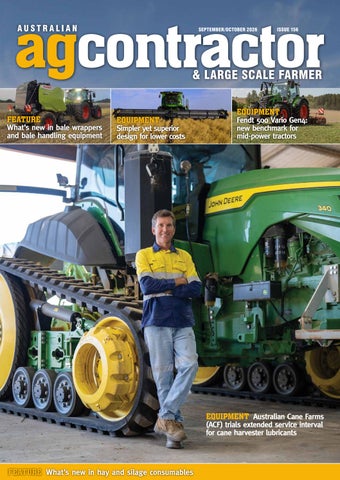
FEATURE What’s new in bale wrappers and bale handling equipment
EQUIPMENT Simpler yet superior design for lower costs
EQUIPMENT Fendt 500 Vario Gen4: new benchmark for mid-power tractors
EQUIPMENT Australian Cane Farms (ACF) trials extended service interval for cane harvester lubricants
FEATURE What’s new in hay and silage consumables
OUTLASTS ORDINARY OILS. GUARANTEED. AND THAT’S A PROMISE. Boasting a 500-hour* drain interval that’s twice the industry norm, John Deere Plus-50™ II has been engineered to keep your operation moving with fewer oil changes and lower running costs. And because John Deere stands behind its oil like no other manufacturer, we’ll cover the parts and labour if an oil defect causes damage to your engine. No matter the hours.* Not all oils are created equal.Not all oils are created equal.
Scan the QR code to calculate how much John Deere Plus-50TM II can save you. *500 or 750 hour drain interval applies to John Deere diesel engines when the following criteria are met: 1. Engine is equipped with an extended drain interval oil pan. 2. Machine operates with Plus-50TM II engine oil API CK-4. 3. Machine uses a John Deere engine oil filter 4. Machine uses only ultra low sulphur diesel fuel.
SEPTEMBER/OCTOBER 2026
in this issue... PO Box 36753 Merivale, Christchurch 8146 ph: +64 3 329 6555 www.agrimedia.co.nz Publishers of Rural Contractor & Large Scale Farmer, AgriBusiness, AgriVet, NZ Cropping, Australian AG Contractor & Large Scale Farmer, NZ Novachem Manual.
Editor Scott Wilson +64 21 725 061 scott@agrimedia.co.nz Advertising Manager Michael Lightbourne 021 403 853
michael@agrimedia.co.nz Advertising Sales Brendan Challies 022 397 2076
brendan@agrimedia.co.nz Circulation admin@agrimedia.co.nz Production, Layout & Design Mark Winstanley agc_art@agrimedia.co.nz
02 From the Editor: Looks like the dry years are back
Industry News 03 New JCB dealership announced 04 GPA welcomes phosphine delay 06 Trelleborg Tyres launches 5,000-hour performance guarantee through premium care programme 07 Syngenta’s paraquat withdrawal raises industry concerns as grower groups call for stability
Technology 14 15 16 18 19
Claas connect continues to evolve for modern contracting IntelliSense automation continues to redefine BigBaler performance Fire risk is rising – prevention needs to rise with it Intelligent connectivity elevates new generation of round balers Growers upgrading guidance tech to cut downtime in tight spray windows
Profiles 08 The harvest starts long before the headers roll 20 Across the ditch: Built for the ground that fights back
Features 24 What’s new in hay and silage consumables 30 What’s new in bale wrappers, bale handling equipment and telehandlers
Equipment 46 Howard EHD330E series: Built from the backbone of Australian land 47 Practical performance in variable chamber baling 48 Queensland’s Southern Downs farmer sows success with the Case IH Early Riser planter 50 Fendt 500 Vario Gen4: Raising the standard in the mid-power tractor segment 52 John Deere MY27 sprayer updates offer exciting green-on-green capability 53 Why density is becoming the most valuable metric in hay and forage 54 Case IH launches next generation Puma series with better manoeuvrability, performance and operator experience 55 JCB’s new Fastrac 6300 set to redefine high-speed farming in Australia 56 ACF trials extended service interval for cane harvester lubricants 58 The 2026 Fendt hay tools range 60 Simpler yet superior design for lower costs
Printed by PrintGraphics Pty Ltd
52 AC © Australian Ag Contractor and Large Scale Farmer - No part of this publication may be reproduced in any form without the prior written permission of the publisher. Opinions expressed in this publication are not necessarily that of the publisher and suggest independent advice be sought before acting on information or suggestions contained herein. Contributions - Editorial and photographic contributions are welcomed and should be sent directly to AML. Editing of submissions is at the sole discretion of the editor and will accept no responsibility for unsolicited material.
Looks like the dry years are back Australian agriculture has always been shaped by the weather, but 2026 has delivered a blunt reminder: the dry years are back, and they’re biting hard. Across southern Australia, rainfall has slipped below average, soil moisture has dropped and crop prospects have dimmed. Northern regions are faring better, but the national picture is clear – we’re heading into a tightening season and the pressure is building. For farmers, the immediate impacts are obvious. Reduced crop volumes. Higher grain prices. Rising feed costs. Pastures that simply aren’t keeping up. But beneath those headline challenges lies a deeper shift in how Australian agriculture operates – and it’s one that contractors feel more than anyone. When seasons tighten, contractors become the shock absorbers of the industry. They’re the ones who keep machinery moving when farmers scale back capital purchases. They’re the ones who step in when labour is short, when timing is critical, and when every hour of workable weather matters. And in 2026, every hour matters more than ever. Broadacre farm profits are forecast to fall
sharply this financial year. Lower commodity prices, higher input costs and reduced output are squeezing margins across the board. When profitability collapses, farmers don’t buy new gear. They don’t expand fleets. They don’t hire extra staff. They turn to contractors. This isn’t just a seasonal trend – it’s becoming structural. Contractors are no longer the ‘extra hands’ of the industry. They’re the backbone. They’re the ones investing in the latest machinery, the ones adopting precision tech first, the ones who can spread capital costs across multiple clients. In many regions, contractors are now the primary operators of high-value equipment like seeders, sprayers and harvesters. But here’s the challenge: contractors are facing the same cost pressures as farmers. Fuel remains volatile. Parts are expensive. Machinery finance is tightening. And while demand for contractor services is rising, the ability of farmers to pay can become strained. This is the tension at the heart of Australian agriculture right now – rising reliance on contractors but falling profitability across the board. Yet there’s opportunity in this moment. Contractors are uniquely positioned to lead
Scott Wilson, editor the next phase of agricultural adaptation. Whether it’s carbon farming projects, precision mapping, variable rate application or soil improvement programmes, contractors have the machinery, the mobility and, increasingly, the expertise to deliver the work that farms can’t do alone. The dry years are back, but Australian agriculture has never been more innovative, more resilient or more interconnected. Contractors aren’t just filling gaps – they’re shaping the future of the industry. As 2026 unfolds, one thing is clear: the partnership between farmers and contractors will determine how well Australia weathers the season ahead. And if history is any guide, this industry knows how to pull together when it matters.
Gentle, clean, high-performance hay handling With patented engineering, ROC Mergers are uniquely designed for an exceptionally long working life. · Revolutionary, gentle pick-up and belt system for swaths of any width or configuration. · Conveyor system shifts the crop without dragging or twisting, no stone or dirt contamination. · High capacity, even flow in all crop types. · Move, turn and merge windrows to best suit your baler. With the largest range available, ROC Mergers are ideal for large scale professional hay harvesting.
Find out more at gendoregroup.com.au
02
Industry News
New JCB dealership announced A new flagship JCB dealership opened its doors in Victoria recently, marking a major milestone for the company and strengthening support for customers in Australia. The purpose-built Adaptalift JCB facility in Truganina, Victoria welcomed its first customers, industry leaders and partners, showcasing a new dedicated destination to experience the latest JCB construction equipment, connect with product specialists and access industry-leading service and support. Adaptalift has created a model dealership to showcase the growing JCB product range and the industry-leading customer support that Adaptalift JCB has to offer across
Adaptalift MD Peter Whiffen co-founded the business with his wife 48 years ago. His son Lindsay Whiffen is CEO of Adaptalift. Both say the synergies between their family business and the family-owned JCB are clear, and they are excited to support the global brand in its ambitions for the Australian market.
Australia’s major metropolitan territories, including Melbourne, Sydney, Brisbane, Perth and Adelaide. JCB’s Deputy Chairman George Bamford, son of JCB Chairman Anthony Bamford, hailed the opening as a crucial next step to realising JCB’s growth ambitions in the important Australian market. “I’m really excited about where we are going in Australia, both in construction and agriculture. For me, Australia is one of our most important markets,” Bamford said.
JCB has entered a new era with its dealer agreement with Adaptalift, with a strong strategic focus on getting closer to Australian customers. The partnership was officially celebrated at a new facility in Truganina. “JCB is a family business, and we really want to give our customers the best and finest support, and we have that with Adaptalift, which is also a family business. “This next chapter is going to be really exciting for JCB, Adapalift JCB and our regional dealership network. I’m really pleased about where we’re going in Australia.” His comments were reinforced by JCB CEO Graeme Macdonald, who said the opening of Adadptalift JCB allowed the business to move at a pace to grow their presence in Australia and unlock new opportunities. “This celebration is more than just the opening of a new facility. It’s the beginning of an exciting new chapter for our customers,” said Adaptalift Group CEO Lindsay Whiffen. “JCB is a world class brand and we’re proud to represent it across key metro and regional markets. From day one, our focus is simple, selling a great product range, providing fast service and world-class parts availability and keeping machines working safely and reliably.” Speaking at the launch event, JCB’s International Sales Director Jose Luis Gonçalves said the Adaptalift Group’s investment in Truganina should be a powerful signal that Adaptalift really
JCB’s world-famous Dancing Diggers wowed the crowd of more than 200 customers and industry representatives at the official launch of the JBC Adaptalift dealership engagement. 03
Industry News
GPA welcomes phosphine delay Grain Producers Australia (GPA) has welcomed the Victorian Government’s decision to push back looming changes to workplace rules governing phosphine fumigant use. WorkSafe Victoria announced today that new Workplace Exposure Limits (WELs) for 15 airborne contaminants – phosphine among them – will now be delayed until 1 December 2029. This delay is a crucial first step in addressing a major issue that blindsided the grains sector. Safe Work Australia’s recent review of airborne contaminants introduced new exposure limits that, if enforced from 1 December this year, would have effectively prevented grain growers from using phosphine to protect stored grain from pests. As GPA has consistently argued, the scale of the review meant the full consequences for Australian agriculture were only recognised far too late. GPA Chair Matthew Madden said the organisation supports strong workplace safety standards, but the proposed phosphine limit posed a serious threat to Australia’s biosecurity and export reliability – without any clear evidence of improved worker safety.
“The new standard would make Australia’s phosphine exposure standard out of step with the rest of the world,” he noted, referencing major grain producing regions including the the European Union, the United Kingdom, the United States, Canada and Argentina. With no practical alternative fumigant available to growers, the proposed change risked undermining pest control, stored grain protection, and the stability of Australia’s grain trade. Madden said the sector is already dealing with significant pressures – from volatile
fuel and fertiliser markets to global conflict impacts – and cannot afford additional regulatory burdens that offer no tangible safety benefit. GPA has commended the Victorian Government for recognising the seriousness of the issue and acting decisively. The organisation hopes other states will follow Victoria’s lead and adopt a similarly pragmatic approach to ensure grain growers can continue protecting their crops and Australia’s biosecurity without unnecessary disruption.
compaction equipment and access equipment as well as specialist materials handlers for agriculture. Speaking at the Regional Dealer Conference, Managing Director for JCB Agriculture John Smith said: “The opportunities for the JCB brand in both agriculture and construction across Australia are vast. JCB is well established as number one in the world in agricultural materials handling and many Australian customers are already operating JCB telescopic handlers and wheeled loaders. With Adaptalift JCB coming on board now alongside our twenty
JCB dealers from across Australia, gathered in Sydney for their regional conference, are excited about the brand’s ambition to grow market share and get closer to the customer.
does mean business when it comes to representing the JCB brand in Australia. “Customers can expect the broadest product range in the industry, coupled with outstanding after-sales and customer care. It is a winning combination.”
Regional dealer network gathers in Sydney JCB also hosted its regional dealer conference in Sydney recently, bringing together regional JCB dealers from across Australia to launch its strategy that focuses on getting the brand closer to customers. In Australia, this has meant shortening the chain from factory to customer by taking direct control of importation, alongside strong investment in building and supporting the dealer network. JCB’s product range is now bigger than at any point in its 80-year history, offering huge growth opportunities in Australia. As the world’s number one producer of backhoe loaders and telescopic handlers, JCB is well positioned to grow its share of these important sectors in Australia. There are also huge growth opportunities for JCB’s range of excavators which span the one tonne micro to 52 tonne tracked excavators. JCB is also a leading producer of wheeled loaders, skid steer loaders, 04
regional dealerships, many customers will come to experience the JCB difference on our products and industry-leading service support. Our new Fastrac 6000 Series tractor is about to be launched in Australia and it will shortly take the industry by storm. We’re excited for what lies ahead.”
Industry News
Trelleborg Tyres launches 5,000-hour performance guarantee through premium care programme Trelleborg Tyres has introduced a 5,000-hour Performance Guarantee for selected agricultural tyres, providing farmers with greater confidence in tyre longevity as they look to reduce operating costs and maximise machinery uptime. The guarantee applies to rear tyres in the TM1060, TM1000, TM900 and TM800 ProgressiveTraction® ranges, reinforcing Trelleborg’s commitment to delivering long-lasting performance in demanding agricultural conditions.
Available exclusively through the Trelleborg Premium Care Portal, the programme offers a secure online platform where customers can register eligible tyres, access expert technical support and receive tailored recommendations to help optimise tyre performance and maximise service life. The initiative forms part of the ‘Count on Trelleborg’ campaign, highlighting the company’s confidence in its ProgressiveTraction® technology. “With this 5,000-hour Performance Guarantee, we are standing firmly behind our ProgressiveTraction® technology and giving Australian farmers added confidence that
06
their investment is built to perform over the long term,” said Mark Prentice, sales director Yokohama TWS Australia. In addition to the Performance Guarantee, Premium Care Portal members receive access to exclusive promotions, technical resources, product updates and personalised offers, ensuring they stay informed about the latest innovations while benefitting from services tailored to their individual needs. The Premium Care Portal is available to agricultural professionals across Australia, with registration quick and simple. For more information or to register, visit premiumcare. trelleborg-tires.com.
Syngenta’s paraquat withdrawal raises industry concerns as grower groups call for stability Syngenta’s decision to withdraw from the paraquat herbicide market in Australia and New Zealand has prompted strong reactions across the grains sector, with grower groups warning the move highlights deeper vulnerabilities in the agricultural chemical supply chain. The company announced it would cease commercial supply of paraquat products from late 2026, citing regulatory constraints and increasingly complex global supply pressures. Syngenta ANZ Managing Director David Van Ryswyk said the herbicide had become “commercially unviable” under tightened Australian Pesticides and Veterinary Medicines Authority (APVMA) conditions, which include new limits and application requirements introduced after a recent regulatory review. The APVMA’s June decision reaffirmed paraquat’s availability, concluding there was no evidence linking the chemical to increased Parkinson’s disease risk when used under strict safety controls. However, the revised rules added compliance burdens for manufacturers and users, contributing to Syngenta’s decision to exit a product it has supplied for decades. GrainGrowers Chair Rhys Turton described the announcement as “disappointing”, noting paraquat remains an important tool for conservation farming systems that rely on reduced tillage, lower fuel use and
improved soil protection. While alternative suppliers continue to offer paraquat formulations, Turton said Syngenta’s departure underscores the fragility of the crop protection supply chain and the need for accelerated investment in new chemistries. He added that the APVMA’s tightened application rates were “no doubt significant factors” in Syngenta’s decision and urged industry partners – including the Grains Research and Development Corporation – to prioritise research that maintains access to safe, effective weed control options. Grain Producers Australia (GPA) issued a stronger warning, arguing the withdrawal exposes Australia’s reliance on global commercial decisions for essential agricultural chemicals. GPA spokesperson Andrew Weidemann said Syngenta’s role
as the original paraquat registrant had long provided stability and technical support, and its exit “creates uncertainty” for growers who depend on consistent supply. Weidemann also noted that most remaining paraquat products are manufactured in China, raising concerns about supply diversity and geopolitical risk. Despite Syngenta’s departure, paraquat will remain available to Australian growers. But the announcement has sharpened industry focus on supply chain resilience, regulatory impacts and the urgent need for innovation in crop protection. Grower groups agree the sector must respond proactively to ensure essential herbicides remain accessible, affordable and supported by long term investment in new technologies.
FEATURES
V6750-II
CHOPPER BALER FIND OUT MORE:
NE W
2.1m Profi-Flo Camless Pick-Up 15-Knife Chopper Unit with Heavy Duty Rotor ISOBUS Terminal with a 10” touch screen Drop Floor Unblocking System 3-Endless Belts Auto Greasing Continuous Oiler System High Performance Stretch Net System 50mm (2”) Double Race Chamber Bearings Knife Pressure Display Knife Position Sensor Drop Floor Sensor Bale Kicker
!
ISOBUS/ISOPlay Camless Pick Up
07
Profile
the harvest starts long before the headers roll For most contracting businesses, harvest is when customers see the end result. Headers roll into paddocks, grain starts flowing into chaser bins and another season is underway. For Benji Schulze and Mitch Burgoine, however, a successful harvest is built long before the first crop is ready.
Across regional Queensland, much of their year is spent visiting customers, walking crops and discussing how the coming season is likely to unfold. They want to understand what growers are planning, how crops are progressing and what challenges might lie ahead, so that when harvest finally arrives there are fewer surprises and everyone is working towards the same outcome. Those conversations may never appear on an invoice, but Benji and Mitch believe they’re every bit as important as the harvest itself. They’re part of a philosophy that sees customer service as something built over months, not measured over a few busy weeks, a defining characteristic of Deberi Contract Harvesting. For the two business partners, customer service isn’t something that begins when the
Deberi’s approach is simple: do quality work, communicate well and build customer relationships that last beyond harvest. 08
headers arrive at the gate. It’s a year-round commitment that influences almost every decision they make, from the people they employ and the machinery they invest in, through to the way they prepare for harvest and communicate throughout the season. Established in 1982, Deberi has built a reputation for dependable harvesting and long-standing
When the machines are running and the dust starts flying, Mitch says there’s still a real buzz to harvest and a genuine enjoyment in seeing the season underway. customer relationships. When Benji and Mitch took over the day-to-day operation of the
well before machines leave the shed. “We keep in touch and drive out to visit customers, discussing what their harvest might look like and looking at the crops as they’re developing,” Mitch says. Those visits help both sides prepare. Customers have confidence in how the season is shaping up, while Deberi develops a clear understanding of priorities across its client base. By the time harvest begins, many of the conversations that might otherwise happen under pressure have already taken place.
That proactive approach continues throughout the season For Benji and Mitch, running Deberi still means being on the tools working alongside their team, solving problems and staying close to the machines and customers. business in 2021, they weren’t looking to change what had made Deberi successful.
Instead, they wanted to build on those foundations while bringing their own perspective to the business. “The name was already well established and we’ve got loyal clients,” Benji explains. “We want to keep those people happy.” One of the biggest opportunities they recognised
was time. Working as owneroperators, they have been able to invest more of themselves into building relationships outside the harvest window. Rather than waiting for customers to call when crops are ready, they make a point of keeping in touch throughout the year, visiting properties, discussing seasonal conditions and planning harvest
Harvest rarely follows a script, with weather, crop maturity and changing paddock conditions constantly influencing where machines need to be. Flexibility has always been part of contracting, but Benji and Mitch believe communication is what allows those inevitable changes to happen smoothly. Regular updates, realistic expectations and a willingness to adjust plans
Built for performance. Transform your spraying operation with Goldacres ground breaking G8 Crop Cruiser Series 3. •
8000L main product tank
•
1500L Front Tank
•
TriTech RivX boom 36-42m or TriTech V boom 48m
•
FastFill - liquid induction and distribution
•
Dynamic drive - highly efficient mechanical 4 wheel drive system
•
G-Hub 2.0 Goldacres Integrated System
•
Increased operator comfort
•
Twin Product capability
•
Weedetect® green on brown or green on green camera technology (optional) combined with new application systems
Find your closest dealer
09
Profile
Making the most of every harvest window means keeping machines moving when conditions are right. together help ensure customers always know where they stand. Their role often extends beyond harvesting itself. If a customer’s own machinery breaks down or they need assistance getting equipment operating efficiently, Benji and Mitch are more than willing to lend a hand. One customer who had recently purchased two new harvesters found exactly that. Rather than simply
10
carrying on with their own work, the pair spent several hours helping the customer understand the machines and become comfortable operating them. “If you keep them happy, it’s growing your business,” Mitch says. It’s a simple comment, but one that reflects the philosophy underpinning the business. Success isn’t measured solely by hectares harvested or machines in the paddock. It’s measured by the strength of the relationships built over time and the confidence customers have in picking up the phone
when the next harvest comes around. That same thinking shapes every investment the business makes. While conversations around contracting often focus on horsepower, technology or fleet size, Benji and Mitch approach machinery from a different perspective. Every significant purchase is considered in terms of the value it will deliver to customers. Will it improve grain quality? Will it reduce crop losses? Will it improve reliability or help complete harvest more efficiently? Those questions guided one
of the business’s most significant recent investments. After demonstrating a new generation Geringhoff TruFlex razor front in 2024, both recognised immediately that it offered a genuine improvement in harvesting performance. Better contour following, an integrated air system and greater versatility across crops
Keeping a harvest team moving takes more than machinery. By the time the first header enters a field, much of the work has already been done.
Every harvest brings a new mix of people and personalities, but by the end of the season, Benji and Mitch say the crew feels like family.
they think. They aren’t interested in technology simply because it’s new. They’re interested in technology that helps them do a better job for their customers.
The same philosophy extends to the workshop
all contributed to cleaner harvesting and reduced losses. For Benji and Mitch, the benefits were obvious from the outset. Rather than rushing into the purchase, however, they made a deliberate business decision to wait until the timing was right financially. It wasn’t a question of whether the technology worked, they had already seen the difference for themselves, but of making sure the investment aligned with the
long-term sustainability of the business. Today those new fronts are already proving their value in the field, and replacing the remaining older units has become part of Deberi’s longterm investment plan as the business continues to grow. “We demoed one and fell in love with it,” Benji says. “The air system really makes a difference.” It’s a good example of the way
Before harvest begins, every machine undergoes extensive preseason maintenance. Benji and Mitch complete the majority of servicing themselves, carefully inspecting each header and carrying a comprehensive range of commonly required spare parts once the season begins. Preventative maintenance has become an important investment in its own right because every hour spent in the workshop before harvest reduces the likelihood of downtime when customers need them most.
Growing up around machinery has given both the confidence to diagnose and repair many issues themselves, while specialist support is brought in when required. The result is a fleet that spends more time harvesting and less time waiting for repairs, providing greater reliability for the growers depending on them.
People are approached with the same level of planning Each season, Deberi employs experienced operators recruited from Australia and overseas. Many have already worked on modern harvesters before arriving, bringing practical experience gained across Australia, Germany, Denmark and the United Kingdom. Rather than teaching someone how to operate a header from the beginning, Benji and Mitch can focus on introducing them to the way Deberi works and the standard of service they expect customers to receive. Accommodation is organised before operators arrive, time is invested in helping them settle into the local community and every new team
extra
SI-LAC
®
SILAGE & HAY INOCULANT
Make your best silage and hay yet. • Silage stays cool at feedout – reduced heating once open • Feed goes further – better protein, dry matter and energy recovery for increased animal performance • Bale hay on your terms – up to 25% crop moisture, so you can bale when the crop’s at its best • Easy to use, less hassle – long tank life, non-corrosive to machinery • Stock love it – no rejection, nothing wasted
Ag Contractor Sep-Oct26.indd 1
g r ev illiaag . co m . a u Customer Service: 1300 669 556 Or contact your local rural retailer 27/08/2026 12:32:18
11
Profile
career in the first place. Despite the scale of the operation, every harvest still brings something different. “Rain, volume, the team, the personalities – every year is different,” Benji says. While Benji enjoys the relative simplicity of harvesting wheat, Mitch prefers crops that demand a little more from both operator and machine, nominating chickpeas and canola as his favourites because of the skill and concentration they require. Different crops, changing conditions and a new team each season ensure there is always something new to learn, and that sense of continual challenge is part of what keeps both of them passionate about the work.
When the machines are running and the dust is blowing out, it’s such a buzz
Downtime matters during harvest, so preventative maintenance and the ability to tackle repairs themselves are an important part of keeping Deberi’s machines moving. member receives a thorough introduction to the business, its operating procedures and daily expectations. Machine inspections, maintenance routines and communication protocols are all covered before harvest gets underway, allowing the team to work consistently from day one. For Benji and Mitch, technical skill is only part of what makes a good operator. Understanding crops, taking pride in machinery, communicating well and paying attention to detail are equally important. Those qualities help ensure every customer receives the same standard of service, regardless of which operator arrives in the paddock. By the end of harvest, what began as a group of seasonal workers has often become a close-knit team. While visa arrangements mean not everyone returns each year, the 12
pair have found that creating a positive environment helps attract experienced operators who share the same values and professionalism. That investment in people reflects another lesson they’ve learnt since taking over the business. Like any partnership, running Deberi has involved its own learning curve. Both openly admit they are still learning every season, refining systems, improving communication and finding better ways to work together. “At the start we were probably holding a bit back,” Benji reflects. “Now we communicate really well and figure things out together.” It’s an honesty that perhaps explains why customers relate so well to them. There is little interest in pretending to have every answer. Instead, they focus on continual improvement, whether that’s refining internal processes, evaluating new technology or finding more effective ways to support customers throughout the year. Looking ahead, the business will continue to grow, but not at the expense of the personalised service that has
become one of its defining strengths. There are plans to progressively expand the fleet, invest in additional transport capability and continue introducing new harvesting fronts as the business allows. Each investment will be made for the same reason the first was – to improve the experience and outcomes delivered to customers. By the time harvest arrives, Deberi’s preparation is put to the test across a remarkably diverse operation. Each year the team harvests around 20,000 ha across 12 crop varieties, from summer crops including sorghum, mung beans and corn through to winter crops such as wheat, barley, chickpeas, canola, lentils, lupins, oats, field peas and faba beans. The diversity keeps both the machinery and operators constantly adapting to different crop types, conditions and harvesting techniques, ensuring no two seasons are ever quite the same. Yet for all the planning, investment and continual refinement of the business, neither Benji nor Mitch has lost sight of why they chose this
After months of preparation, the satisfaction comes just as much from seeing the team and their customers succeed as it does from completing another harvest. “When the harvest is finished, it’s a good feeling,” Mitch says. “Everyone is happy, the farmers, our team and us. We love what we do.” That enthusiasm perhaps says as much about Deberi as any investment in machinery or technology. While the business will continue to evolve, its direction remains remarkably simple. Every decision, whether it’s employing experienced operators, investing in proven technology, spending more time with customers before harvest or carrying the right spare parts, ultimately serves the same purpose. For Benji and Mitch, harvest may be the busiest part of the year, but it isn’t where the business is built. That’s happening throughout the seasons before a crop is ready, in conversations around paddocks, careful planning and a commitment to continually improving the service they provide. By the time the first header enters a field, much of the work has already been done, leaving them to focus on what matters most: delivering the quality experience their customers have come to expect, season after season.
Premium Care 5,000 Hours, No Worries Performance you can count on.
Trelleborg ProgressiveTraction® tyres - available in the TM1060, TM1000, TM900 and TM800 ranges - are engineered to deliver superior traction, reduced slippage, and maximum durability. Now offered for rear axle, with up to 5,000
For more information, please contact:
1800 037 091
Offer valid exclusively upon registration to the Premium Care Program at
premiumcare.trelleborg-tires.com
Technology
Claas connect continues to evolve for modern contracting Digital technology is becoming an essential part of modern agricultural contracting, but only if it helps businesses work more efficiently. Whether it’s coordinating multiple machines across several properties, keeping customers informed during harvest or reducing paperwork at the end of the day, contractors are looking for technology that delivers practical benefits rather than adding another layer of administration. That is the thinking behind the latest evolution of Claas connect. More than a machine management platform, it brings connected machines, fleet visibility, field documentation and Claas service support together in a single digital environment, helping contractors spend less time chasing information and more time managing productive operations. Accessible from the office, the cab or a mobile device, Claas connect provides owners of any Claas machine with a central location to access operator manuals, parts information and machine documentation. For connected machines, the platform also provides detailed machine reporting, allowing owners and managers to compare performance, monitor utilisation and make better-informed operational decisions. Tools such as Cemos advisor and chop quality monitoring also help operators optimise machine settings and consistently deliver the desired harvesting result. The platform has continued to expand with a range of annual licence options that unlock additional functionality, including advanced machine reporting, field documentation, satellite imagery, task management and fleet optimisation tools. For operators using Cemis 1200, this creates a more efficient flow of information between the machine and office, helping improve job planning and record keeping throughout the season. One of the most significant developments for Australian contractors is machine sharing. During busy periods, such as harvest, silage or cultivation, contractors can securely share live machine location and operating information directly with a customer’s Claas connect account. 14
Customers gain real-time visibility of job progress, while contractors reduce the need for manual updates and constant phone calls. It also provides an additional layer of operational awareness and health and safety by allowing authorised users to see where machines are working. Recognising that many Australian contractors operate diverse fleets, Claas connect now offers expanded mixed-fleet visibility. Smartphone GPS
tracking, supported tracking partners and Bluetooth iBeacons allow non-Claas tractors, harvesters, transport vehicles and implements to appear alongside connected Claas machines. Instead of only monitoring one brand, contractors gain a complete picture of their operation, making it easier to coordinate people, machines and support vehicles across multiple jobs. Documentation has also become significantly simpler. Field activities,
IntelliSense automation continues to redefine BigBaler performance IntelliSense™ has become a cornerstone of New Holland’s BigBaler technology, delivering measurable gains in baling efficiency, bale uniformity, fuel use and operator comfort. What was once a job demanding constant manual correction is now far more controlled and predictable thanks to intelligent automation across both tractor and baler functions. Running a large square baler manually requires unwavering attention: keeping the tractor perfectly aligned with the swath, adjusting speed to match crop flow, and monitoring slice counts and bale weights to maintain consistency. Uneven windrows, heavy patches and variable crop conditions only add to the workload. IntelliSense™ alleviates these pressures by automating the most demanding aspects of the job. A roof mounted LiDAR sensor scans the swath several metres ahead, using rapid laser pulses to map crop volume and position. This allows the tractor to steer automatically for optimal pick-up alignment, while plunger load sensors refine steering inputs to ensure the bale chamber fills evenly from side to side. This single-sensor system remains one of the most advanced baling automation solutions available. It performs reliably in bright sun, darkness, dust and low-contrast conditions, which are situations that often challenge manual steering. Operators benefit from more consistent bale shape, reduced fuel consumption and significantly less fatigue, particularly during long shifts or overnight baling. The LiDAR data also drives automatic speed control. When heavier crop is detected, the tractor slows to prevent overloads; in lighter
areas, it accelerates to maintain throughput. The result is smoother, more efficient baling across variable field conditions. Sune Nielsen, CNH’s hay and forage product manager for Australia and New Zealand, has seen IntelliSense™ perform across a wide range of local environments. “Having spent many hours baling myself, it was great to see how straightforward and effective IntelliSense is,” he said. Producing straight, uniform bales can be difficult when windrows are narrow or uneven. “If the baler isn’t fed evenly, you end up with banana-shaped bales or even broken twine. IntelliSense solves that by steering the tractor to keep the crop flowing evenly into the feed system.” IntelliSense™ offers two automation modes that can operate independently or together: - Feedrate control, managed through IntelliCruise II, lets the operator set a maximum speed and target slice count. Lower slice numbers create thicker slices
and higher throughput, with the tractor adjusting speed automatically to achieve the desired output. - Swath Guidance uses SmartSteer for hands-free steering whenever the swath is detected. It keeps the windrow centred in the pick-up and uses plunger load feedback to maintain ideal bale shape. Both systems can be overridden instantly by pressing a button or simply turning the steering wheel. IntelliSense™ is available across the BigBaler Plus range and can be retrofitted to BigBaler High Density models from model year 2020. Compatible tractors include the New Holland T7 LWB, T7 HD and T8 AutoCommand ranges, provided Class 3 ISOBUS is enabled for steering and speed automation. Operators manage IntelliSense™ through an intuitive run screen, and the system does not require RTK, as differential GPS provides all the accuracy needed.
machine use and completed work can be recorded digitally, reducing paperwork while improving the quality and consistency of operational records. A new seasonal field report provides a clear summary of all recorded activity within each paddock, supporting customer reporting, compliance requirements and future planning. Claas connect also strengthens long-term farm management by allowing users to review up to 10 years of crop rotation history while planning rotations up to 10 years into the future, keeping field history and planning within one connected platform. From spring 2026, Claas will also provide
an annual extension of the Machine connect licence at no additional cost to customers or dealers, ensuring continued access to connected machine information. Another important enhancement arriving from spring 2026 is Remote Display View. With customer approval, authorised Claas support technicians will be able to remotely view compatible machine displays, including Cemis 1200 and Cebis connect, helping diagnose setup questions and operational issues more quickly. During peak harvesting periods, this can reduce unnecessary travel, minimise downtime and help operators return to work sooner.
As agricultural businesses continue to adopt more connected technologies, platforms like Claas connect are evolving well beyond machine monitoring. By bringing together fleet management, machine performance, documentation, planning and dealer support, Claas connect is becoming a practical management tool that helps Australian contractors improve productivity, reduce administration and keep their businesses moving during the industry’s busiest seasons. For more information about Claas connect or assistance setting up your account, contact your local Landpower dealership. 15
Technology
Fire risk is rising – prevention needs to rise with it There’s a moment every broadacre farmer knows too well – that sharp, metallic whiff of something burning in the cab. Your stomach drops, your mind races and you start scanning gauges and mirrors hoping it’s nothing … while knowing it probably isn’t. In a season where heat, dust and pressure all climb together, that single smell can feel like the start of a very bad day. This year, that feeling matters more than ever. Australia and New Zealand are heading into a harvest shaped by the same climate drivers that just pushed the United Kingdom into its most dangerous fire season on record. And while the northern hemisphere has already learned some hard lessons, growers here still have time to act. AgriGard is one of the technologies stepping into that gap, not as another suppression system, but as a genuine shift in how machinery fire risk is detected, understood and prevented.
Rising global fire risk: Lessons from the United Kingdom The United Kingdom has just come through a summer of unprecedented heat, with temperatures peaking at a provisional 37.7°C in June and an extraordinary run of 35°C days through July. Fire services were stretched thin as machinery fires surged across the country, prompting the National Farmers’ Union (NFU) to issue an urgent warning: engine components reaching up to 800°C are
“ticking time bombs” when surrounded by bone dry crops and dust. Australia is now facing the same conditions. The Bureau of Meteorology has confirmed a strong El Niño paired with a positive Indian Ocean Dipole – a combination that heavily stacks the deck for below average rainfall and significantly above average temperatures across Western Australia’s grain belt. When headers are running hard in high ambient heat, a single spark, ruptured hydraulic line or build up of chaff on a hot engine bay can cost a grower a multi-million -dollar machine and potentially an entire season’s yield.
AgriGard: A pre-ignition detection system built for harsh harvest conditions AgriGard is designed to intervene before a fire takes hold. Rather than waiting for flames and relying on suppression, it continuously scans for pre-fire signatures such as: - overheated bearings - slipping drive belts - smouldering crop dust - electrical hot spots When something begins to superheat or smoulder, AgriGard alerts the operator immediately, identifying the exact zone of the machine and the likely cause while there is still time to stop, inspect and prevent a blaze.
Targeted monitoring Each system includes six high-precision 16
sensors positioned in key hazard zones, with the option to reposition or expand coverage based on your machine setup.
Ninety-minute-post-shutdown protection A significant percentage of header fires occur after the engine is turned off. AgriGard continues monitoring for 90 minutes post shutdown and sends an SMS if a hotspot is detected, including zone, GPS location and timestamp.
Proven in Western Australia field trials During the 2025 harvest, AgriGard was trialled on four working farms in Cunderdin, Western Australia, across major brands including John Deere, Case, Claas and New Holland. Real world data from those trials drove major improvements to both hardware and detection algorithms, resulting in the robust commercial system now ready for growers.
AgriCloud: Full fleet visibility from anywhere For multi-header operations, AgriCloud provides real-time oversight of every machine in the paddock: - live sensor and system health - GPS machine locations - instant alarm notifications - historical performance and event data This gives growers peace of mind whether they’re in the paddock, at home or travelling during harvest.
UNLOCK ENERGY: Every crop. Every tonne. Every time.
MAGNIVA Platinum maintains silage nutritional value and unlocks energy by enhancing fibre digestibility.
More energy in your silage means more milk from your herd Even a small improvement in fibre digestibility can lead to a significant boost in productivity. With MAGNIVA inoculants, you can enhance silage digestibility by 5.4%, potentially increasing milk yield by 1.23 liters per cow per day. Contact us on (07) 5451 0125 | www.lallemandanimalnutrition.com
Technology
Intelligent connectivity elevates new generation of round balers John Deere has revealed its next generation of round balers designed to deliver superior performance, intelligent connectivity and premium quality bales for Australian farmers. The fixed and variable chamber balers feature advanced automation for increased productivity, along with user-friendly features, such as an optional built-in bale weighing system and new endless belts that ensure reliable net feeding, even in sticky conditions. All of the new generation models are equipped with advanced ISOBUS capabilities, which provides complete
The G5e touchscreen provides intuitive operation, and baler automation allows for hands-free unloading, enhancing overall ease of use.
machine integration into the John Deere Operations Center™ so farmers can monitor bale quality as they go. An optional moisture monitoring feature measures the average moisture per bale
John Deere has revealed its next generation of round balers designed to deliver superior performance, intelligent connectivity and premium quality bales.
in real time and alerts the operator on the tractor display if the content deviates from the pre-defined setting. Tracking each bale’s size, drop location and moisture levels, and documenting this data in the John Deere Operations Center, enables the farmer to access business-critical information, such as the number of bales per paddock and dry-matter maps and securely stores all invoicing-relevant information when leaving the field. The wrapping baler models, C442R, C452R and C462R, are designed to produce high-quality silage and feature an optional built-in bale weighing system, with advanced strength gauges on each of the four transport table rollers for on-the-go measurement of individual bale weights. With a wrapping arm speed of 40 rpm, the wrapper components match the baler’s productivity, avoiding any loss of time during the baling process. The ISOBUS AUX-N control enables operators to map multifunction joystick buttons, so the driver can control the main baler functions via the CommandPRO™ lever. The new variable chamber models, V452M and V462M, offer a 10% increase in driveline power intake as a result of the 540 rpm Power
The wrapping baler models, C442R, C452R and C462R, feature an optional built-in bale weighing system, allowing for on-the-go measurement of individual bale weights. 18
Growers upgrading guidance tech to cut downtime in tight spray windows Australian farmers are upgrading guidance systems to reduce time lost to dropouts during spraying and spreading and keep operations moving through tight work windows. New Holland’s Raven RS1 system is being adopted by growers looking to simplify how they use precision agriculture technology and improve performance, by combining steering, guidance and connectivity into a single integrated platform. The RS1 system, used in conjunction with the IntelliView™ 4 Plus display, delivers consistent steering accuracy at both high and low speeds, helping maintain performance across a range of applications. It is designed to work with ISOBUScompatible implements, allowing growers to connect and run newer balers, spreaders and attachments through the same system, and reduce the likelihood of needing further upgrades as their operations evolve. For growers, the ability to retrofit newer technology to existing machinery is a key advantage, enabling access to current precision agriculture capability while maximising the value of their fleet. Agricultural Equipment Holdings’ (AEH Group) Precision Farming Manager Nathan Wright said the shift reflects increasing demand for systems that deliver consistent performance under real operating conditions.
Take-Off (PTO) clutch, boosting productivity by up to 8% in demanding conditions. New endless belts with rougher skin design ensure reliable net feeding, even in sticky, wet crop conditions, and have been proven to last 10 times longer compared to belts with lacers. All of the new round baler models feature hydraulically actuated knife engagement, enabling the operator to engage or retract the knives from the comfort of the cab. The higher knife engagement force ensures the crop is cut consistently and uniformly.
“We’re seeing more growers move to integrated systems that simplify their setup and deliver more reliable performance in the paddock,” Wright said. Central west New South Wales grower Michael Murphy, based near Parkes, recently retrofitted the RS1 system to an older New Holland T7 used for spraying and spreading. He had experienced repeated dropouts with his previous guidance system during spraying that were disrupting operations, slowing progress across paddocks and reducing productivity at his mixed farming enterprise. “Previously, I could be spraying and it might drop out two or three times a paddock, and each time it could take ten minutes to reboot,” Murphy said. “That makes it hard to plan your work. Now it’s much easier to keep things moving.” The RS1 upgrade also included the IntelliView™ 4 Plus display, providing a larger and more responsive in-cab interface. “The screen is also bigger and clearer, and easier to use on the run,” Murphy said. In broadacre applications, guidance performance plays a critical role in
maintaining accuracy and protecting crop outcomes, particularly during spraying operations. “Smoother engagement and more stable guidance makes the machine more predictable and easier to operate at higher speeds,” Wright said. “It helps the machine hold its line more accurately, which is important for reducing unnecessary crop damage and maintaining consistency across the paddock.” Major improvements in satellite tracking capability are also helping reduce interruptions during operation, particularly in varying or more challenging conditions like beside a tree line. In some spots over 40 satellites could be used. “Older systems were limited in satellite tracking, particularly in more difficult conditions,” Wright said. “The RS1 is able to track significantly more satellites, which reduces downtime and allows operators to keep working with fewer interruptions.” To find out more about an RS1 and IntelliView 4 Plus display upgrade, talk to your local New Holland dealer.
Maintenance of the balers is made easy with simple access points, long greasing intervals and a chain auto-lube system. The G5e touchscreen provides intuitive operation, and baler automation allows for hands-free unloading, enhancing overall ease of use. John Deere Australia and New Zealand Small Ag & Turf Marketing Manager Erin Wagstaff said the intelligent connection, productivity features, and ease of operation of the new balers would ensure maximum efficiency in the paddock.
“By delivering farmers a smarter, more connected baling experience, combining John Deere automation, precision and operator-focused design, we are supporting them to get the most out of every paddock and every bale,” Wagstaff said. “This new generation of highly efficient and reliable balers will have a powerful impact on productivity, sustainability and Australian farmers’ bottom line.” The new generation balers are available to order from local John Deere dealerships now, with delivery expected in early 2026. 19
Profile
built for the ground that fights back
There is a certain type of contractor who is shaped as much by place as by trade, and on the West Coast that shaping tends to be uncompromising.
across the ditch Profiled In NZ’s Rural Contractor & Large Scale Farmer August/September 2026, we visit Fairhall Agri Services based in Greymouth, West Coast, New Zealand. 20
The country is tight, the weather is unpredictable and the ground rarely gives anything away easily. It is the sort of environment that exposes weaknesses in both people and machinery very quickly, but it also produces contractors who understand their ground better than most and who build businesses around doing the difficult work properly. Fairhall Agri Services sits firmly in that category. Based out of Greymouth and working across a wide stretch of the Coast, the business has evolved into a specialist operation focused on cultivation, direct drilling, fertiliser spreading and earthmoving, with a reputation built less on scale and more on consistency and finish. Darryn Fairhall’s path into
Fairhall Agri Services has built a reputation for tackling challenging ground, combining specialist machinery with practical engineering and local experience.
contracting was never in doubt. As a fifth generation West Coaster, raised in a family where contracting and gold mining were part of daily life, the exposure came early and it came hands on. By the age of eight he was driving tractors and by 10 he was on bulldozers, learning not just how to operate machinery but how to read ground and conditions. That early grounding still underpins the way the business operates today. “We don’t touch
Working in some of New Zealand’s toughest conditions, Fairhall Agri Services has built its reputation on quality ground preparation, precision earthmoving and practical innovation. green grass. We did harvest when we started, but we made a conscious effort to pick one service and do it well,” Fairhall says.
That decision to narrow the focus has proven to be one of the defining moves in the business. Rather than spreading resources across multiple services, Fairhall Agri Services has concentrated on the areas where it can add the most value, particularly in ground preparation and finishing work, where attention to detail separates contractors very quickly. Over time that focus has seen the business involved in a wide range of projects, from largescale dairy conversions through to sports field construction and specialist land development work. At one point dairy conversions formed a significant part of the workload, with the company completing 11 major projects that involved everything from bulk earthmoving through to final pasture establishment. When the dairy payout dropped and that work dried up almost overnight, the business had to adjust. It is a moment that many contractors will recognise, where external factors force a rethink, but in this case the shift played to an existing strength. “Our attention to detail, high quality of finish and understanding of drainage solutions allowed us to take on sports field work,” Fairhall says. That willingness to prioritise finish over speed opened up a different type of work. Sports fields, golf courses, bowling greens and even croquet courts demand a level of precision that is rarely required in standard agricultural work. The tolerances are tighter, the expectations higher and the margin for error much smaller. On the West Coast, achieving that level of finish brings its own challenges. The terrain is broken, the soils variable and the weather can shift within hours. Long, narrow valleys create microclimates that mean conditions can differ dramatically over relatively short distances, so timing and local knowledge become critical. That is where experience
comes to the fore. Knowing when to move, when to hold off and where to work can be the difference between a job that progresses smoothly and one that becomes unnecessarily difficult. It is also why the business tends to operate within a defined geographic range, generally working between Reefton in the north and Franz Josef in the south, where that local understanding can be fully utilised. While the workload has diversified over the years, the core of the business had remained grounded in cultivation and drilling. Direct drilling,in particular, had become an increasingly important part of the operation, reflecting wider industry trends towards efficiency and soil management, but also the practical realities of working in challenging conditions. Finding equipment that can cope with those conditions has never been straightforward.
Early on, Fairhall found that standard approaches were not delivering consistent results, particularly when it came to seed placement on uneven ground. At a time when seed was commonly mixed with fertiliser and spread, the limitations of that method became clear, especially in windy conditions where distribution could be uneven. Rather than accept that, he built his own solution. To address the issue, in 2001 he designed and constructed a folding six metre frame fitted with an Accord air seeder, towing harrows behind it to ensure better seed placement. It was a practical response to a practical problem and one that is still in use today. “Back in the day there was nothing like a folding air seeder over here,” he says. That willingness to modify or build equipment to suit conditions remains a defining feature of the business. Much of the machinery in the fleet
West Coast contractor Fairhall Agri Services has grown by specialising in cultivation, fertiliser spreading and earthmoving, with a focus on quality over scale.
has been adapted in some way, whether to improve durability, increase efficiency or allow work to continue in marginal conditions. On the Coast, where timber and stone are often hidden beneath the surface and ground conditions can change rapidly, standard specifications rarely hold up without some level of reinforcement or adjustment. “We have to work around the weather. We modify gear to work both earlier and later in the day and as rain approaches and then leaves,” Fairhall says. That approach extends across the fleet. Bulldozers and excavators are fitted
Quality workmanship and machinery built for West Coast conditions have become the hallmarks of Fairhall Agri Services. 21
Profile
Built on generations of West Coast experience, Fairhall Agri Services continues to prove that local knowledge, adaptability and quality workmanship remain the foundation of successful contracting.
with laser systems to ensure accurate shaping and grading, particularly on projects where finish is critical. What began as a requirement for sports field construction has since been applied more broadly across building sites, yards and general earthworks. The move into dozer work itself came from necessity. Early attempts to use tractors for earthmoving resulted in excessive tyre damage, particularly in stony conditions, which led to the decision to bring in six-way blade bulldozers to handle the bulk work. Over time that evolved into ownership, with Komatsu machines forming a key part of the operation. Their low ground pressure and long track frames make them well suited to levelling work, allowing for both efficiency and a higher quality finish. Levelling itself has become something of a speciality after building his first I-Beam leveller in 1991. After its initial success they redesigned it to be hydraulically operated like a six-way blade; four were subsequently built which are still in use today. These custom built levellers allow significant volumes of soil/gravels to be mixed and swept across the surface removing large stones/ debris while filling ruts and holes maintaining a controlled finish, effectively acting as a grader blade behind the tractor. These tools played a role in securing early work with large scale developments and continue to underpin the 22
finishing side of the business today. The ability to reshape land accurately and efficiently is a skill that translates across multiple job types, from agricultural conversions through to civil style work. Cultivation equipment is selected with a similar mindset. Where light work is required, disc harrows provide an efficient solution, but for more intensive reshaping the business relies on heavy duty rippers capable of working deep into the profile. “If the paddock doesn’t need much work, then discs are good, but to cultivate deeper we use a set of Hubbard’s Hercules rippers. They are real grunters or one of our bulldozers to pre rip,” Fairhall says. Seeding is handled through a combination of machinery; their six-metre Taege drill formed the backbone of the operation. The ability to handle multiple
products, including fertiliser, seed and insecticide, allowed flexibility across a wide range of crops, from pasture species through to brassicas and forage crops. “It was a huge success. I needed the productivity and it had to be really robust,” Fairhall says of the Taege drill. Productivity and durability are recurring themes. On the Coast, machinery does not get an easy life, so equipment that can maintain output without excessive downtime is essential. At the same time, maintaining relationships with manufacturers and suppliers has become increasingly important, particularly where modifications and feedback can lead to incremental improvements. Fertiliser spreading remains another key part of the workload. The business has invested in equipment that can handle large
payloads while maintaining accuracy, particularly important given the cost of inputs and the need for precise application. “They are very accurate, especially with nitrogen,” Fairhall says. Accuracy in this area is not just about product placement but about efficiency. With input costs continuing to place pressure on farmers, the ability to apply fertiliser consistently and without waste is increasingly valued, and contractors who can deliver that reliably are in strong demand. Beyond agriculture, the business has also developed a niche in land restoration work, particularly around historic gold mining sites. On the West Coast, where legacy mining activity has left its mark across large areas, there is ongoing demand for contractors who can work with challenging ground and reshape it for modern use. That type of work requires
For Fairhall Agri Services, success has come from understanding difficult ground, adapting machinery and delivering a high-quality finish every time.
a different mindset again, combining an understanding of ground conditions with an appreciation for the history of the land and the expectations of landowners looking to improve it. The client base itself reflects the diversity of the work. They have also undertaken significant farm flood repair works after both the 2019 Franz Josef floods and the 2021 Ashburton flood events, spending many months with bulldozers and tractors reinstating farm paddocks back into production. Dairy farmers remain a core component, but are now joined by lifestyle block owners, local authorities and forestry companies, particularly in areas such as road maintenance and access development. Forestry, in particular, also added another dimension, with work around logging infrastructure providing additional consistency in what can otherwise be a seasonal workload. Staffing, as with many contracting businesses, presents its own challenges. The nature of the work means demand can fluctuate, making it difficult to maintain a large permanent team. As a result, the business operates with a small core group supported by casual labour as required. Experienced operators, particularly those with local knowledge, are highly valued. The ability to step into a job and understand both the machinery and the ground conditions without extensive oversight is a significant advantage in a business where efficiency is closely tied to experience. At the same time, the next generation is already involved. Fairhall’s son Cody is working in the business full time, bringing both formal agricultural training and practical experience. That transition is an important part of the long-term outlook. “My son wants to take over,
so the business has to remain economic and sustainable,” Fairhall says. That focus on sustainability is not about expansion for its own sake. If anything, the approach is measured, with an emphasis on maintaining a manageable workload while ensuring the business remains profitable and resilient. “We are not just growing the business, but we do want to make it more economic,” he says. It is a pragmatic view, shaped by years of operating in an environment where margins can be tight and conditions unpredictable. Growth without control can quickly create pressure, particularly in a region where work can be inconsistent through winter months. Winter itself remained a quieter period, often used for maintenance and preparation. While occasional earthmoving projects provide some continuity, the seasonal nature of contracting is still very much present. Against that backdrop, the ability to deliver consistent results across a broad range of work has become the defining strength of Fairhall Agri Services. Whether it is reshaping
a paddock, establishing pasture, building a sports field or restoring land, the underlying approach remains the same. There are no shortcuts, particularly on the type of ground the business operates on. Each job requires an understanding of conditions, the right combination of machinery and a willingness to take the time needed to achieve the desired result. “We know how to get results in the difficult stuff. There are no shortcuts,” Fairhall says. That philosophy, combined with a practical approach to machinery and a deep understanding of the local environment, continues to position the business strongly within its region. In an industry where scale is often emphasised, Fairhall Agri Services demonstrates that there is still significant value in doing a specific set of tasks exceptionally well. In 2024 Fairhall Agri Services decided to have a serious look at complementing their income with their own gold mining operation to ensure continuity of work and income all year round, giving the security of full-time employment to staff. Although it has taken
significant financial input, this has proved to be a very timely and prudent move, with the lift in the gold price over that period making it a sound economic decision for the business. This, coupled with their solid reputation, previous gold mining experience, knowledge, ability and commitment to putting the ground back to “better than before”, has provided access to mineable ground going forward. This venture balances the business well and is an area Fairhall has a special interest in. Looking ahead, Fairhall Agri Services has recently sold the direct drilling side of the operation, which has been a key component to the success of the business over the last decade. A local contractor has taken this on who will continue to provide the high standard of work their customers expect. “This has given us back 600–700 machine hours/annum to refocus on our gold mining operations, along with our increasing role in gold mine restoration work for ourselves, and other local mine operators. We will continue our agri operations for our current clients, which will keep us well grounded and busy enough going into the foreseeable future.”
Fairhall Agri Services continues to evolve, combining agricultural contracting with land restoration and gold mining to create a more resilient year-round business. 23
What’s New...
what’s new in... hay and silage consumables
Australian farmers Claas and export customers rely on supplemental Claas have you covered with 3 wraps). There is zero waste in production and all feed to achieve peak for crop packaging rolls come packaged in postQuality matters when it comes performance from their to crop baling products, and consumer recycled materials. animals. Contractors who Claas has you covered with its Rollatex Pro is packed with follow best practice and Rollatex Netwrap, Quadotex and features to make things simple in twine range, and Wrapex the field: use the latest technology Baletex - Zebra asymmetrical pattern stretch film. can meet their clients’ Distributed by Tama Farm shows which direction to load the roll and how to unroll the Grown Solutions, your Claas demand for high quality bale when it is used Harvest Centre can provide hay and silage. Here comprehensive baling solutions. are some of the latest twines, netwraps, silage Rollatex Pro Rollatex Pro is an advanced films and inoculants that Netwrap that improves field will help you produce operations and bale quality, with top quality forage. long roll length and excellent strength at a usable roll weight. Consistent and uniform quality allows easy operation in the field with fewer stoppages. Available in 2,500 m, 3,150 m and 3,800 m roll lengths for versatility depending on application. Rollatex uses less plastic per bale thanks to Bale+ technology. Save 218 kg of plastic every 5,000 bales compared to standard wrap (1.7 m diameter
24
- Roll end warning stripe - EnterNet tag – the easy way of feeding in new rolls into the baler - Guaranteed minimum roll length, not a +/- average - Roll carry handles
Claas Covered Create better round bales. Claas Covered™ means the Netwrap maintains width as it feeds onto the bale for full
coverage to maintain bale shape, reduce losses and make handling and storage simple.
highest density bales. Knots stay tied and crops stay secure from the first to the last bale.
Better twine, better bales
Baletex
Claas Quadotex and Baletex twine range is suitable for every square baling application.
Quadotex Claas Quadrant balers offer fast output of high-density bales so they need twine that can stand up to the job. Quadotex twine offers strength, reliability and consistency to secure the
Baletex offers longer products for long baling days. Baletex twine is the best choice for standard baling applications. It is compatible with large and medium square balers, including the Claas Quadrant range. The Baletex range offers longer spools for fewer changeovers and more bales per spool, a cost-effective combination of strength and
length, and excellent knotting characteristics and durability in the field, including UV protection for safe and secured outside storing. Every bale uses 25% less plastic through cutting-edge design, making stronger, lighter baler twine. With zero waste and optimised energy use in manufacturing, Baletex Care products have an environmental footprint to be proud of.
Wrapex Stretch Film Strong and durable with superb cling for first-class
silage preservation, Wrapex is an advanced silage wrap, a multi-layer blown film with optimal stretching and adhesive properties. Superior tack under increased stretch maximises both machine and product capabilities. Designed to work with round and square bale wrappers, it is the best choice for ensiling crops. When it comes to crop packaging, Claas has you covered. For more information, contact your local Claas Harvest Centre.
One-pass raking and baling ABIMAC BUTTERFLY AVANTIME front mounted twin rotor rake is the ultimate efficiency machine! • One operator, one pass raking and baling • Presents optimal swath to baler for tight, well formed bales • Close ground following with adjustable width, good manoeuvrability, folds for transport
Find out more at gendoregroup.com.au
25
What’s New...
Hay Guard
Changing the way Australian producers make hay For decades, Australian hay producers have lived by a simple rule: moisture is the enemy. It’s the factor that keeps contractors waiting, forces growers to gamble on weather windows and turns perfectly good feed into mouldy waste when conditions don’t cooperate. But across the country, a quiet shift is underway. More producers are discovering that moisture doesn’t have to be a barrier – not when you have a preservative designed specifically to work with it. Hay Guard, a research backed hay preservative now gaining traction in Australia, is reshaping how farmers think about baling conditions, feed quality and risk management. Its promise is straightforward – make hay at higher moisture, reduce mould, protect nutrition and keep machines moving when the weather won’t play ball. For many producers, that’s not just a convenience, it’s a game changer.
A preservative built for Australian conditions Australia’s hay sector is defined by variability. Rainfall patterns shift, curing times stretch unpredictably and the pressure to get hay off the paddock before a weather change is constant. Hay Guard’s
26
value lies in its ability to give producers more control in a system where control is often in short supply. The preservative allows hay to be baled at moisture levels that would traditionally be considered too risky. By inhibiting mould growth and protecting the nutritional integrity of the crop, it gives farmers the confidence to bale earlier, shorten curing windows and avoid the losses associated with late cuts or unexpected rain. Producers using Hay Guard report a consistent theme – flexibility. When lucerne isn’t quite cured, when a storm is approaching or when a paddock needs to be cleared to stay on schedule, Hay Guard provides a buffer that simply didn’t exist before. As one farmer puts it, “We saw guys that had rain coming, lucerne that wasn’t quite cured, and using Hay Guard they went out and baled anyway with absolute confidence.”
Better feed, better timing, better returns The nutritional benefits of Hay Guard are central to its appeal. By reducing mould and preserving leaf retention, the product helps maintain the feed value that is often lost when growers are forced to wait for perfect curing conditions. Cutting earlier, which is a
practice many producers avoid due to moisture concerns, becomes a viable strategy. Early cutting typically means higher protein, better digestibility and stronger overall feed quality. Instead of waiting until mid December for the weather to settle, only to produce hay that resembles “glorified straw”, growers can target optimal crop maturity and lock in the value of the feed. The cost equation also stacks up. Silage wrap and plastic can preserve feed quality, but at a significantly higher price. Hay Guard, at roughly $8–$10 per tonne, offers a more economical alternative for producers who want to protect their crop without shifting entirely to silage systems.
A tool that supports yield and efficiency Beyond feed quality, Hay Guard contributes to operational efficiency. Contractors and large scale producers know the cost of downtime. Machines that are sitting idle while waiting for moisture to drop, labour schedules thrown off by weather changes and paddocks left half finished because conditions turned don’t have a positive outcome for anyone. With Hay Guard, those delays shrink. Producers can bale earlier in the day, finish paddocks before rain fronts arrive and maintain a more predictable workflow. Over a season, that efficiency translates into higher yields, fewer weather damaged bales and a smoother, more reliable harvest rhythm. Some producers begin cautiously, trialling the preservative on a few hundred
bales. But many quickly scale up. “We started testing on a few hundred bales,” one farmer noted. “Now we’re going to start doing whole paddocks.” That progression reflects a growing confidence in the product’s consistency and performance.
Support, guidance and a research-backed foundation Hay Guard’s value isn’t limited to the preservative itself. The company provides field support, resources and practical guidance to help producers get the most from the product. That matters, because using a preservative effectively requires understanding moisture levels, application rates and baling conditions. The brand’s emphasis on research and real world testing gives producers assurance that it’s a tool grounded in science and validated in the paddock. In an industry where margins are tight and risk is ever present, that credibility carries weight.
A new way forward for Australian hay Hay Guard isn’t trying to reinvent haymaking – it’s refining it. By giving producers the ability to bale at higher moisture, protect feed quality and work with greater confidence, it offers a practical solution to one of the industry’s oldest challenges. For Australian farmers and contractors, the equation is simple – less waiting, less risk, better feed and more control. In a sector shaped by weather, timing and tight operating windows, Hay Guard is proving to be more than a preservative. It’s becoming a strategic advantage.
Farmtech
HY-SI – The quiet achiever Farming and agriculture are industries obsessed with machinery, moisture levels and weather windows, so it’s easy to overlook the quieter tools that make a measurable difference to fodder quality. HY-SI is a hay and silage inoculant used globally since 1969 and is one of those under the radar products that has earned its place through decades of consistent, practical results on farms around the world. At its core, HY-SI is designed to accelerate the conversion of plant sugars into lactic acid – the foundation of effective preservation. What sets it apart is its approach. Rather than introducing foreign bacteria, HY-SI works with the naturally occurring microbes already present in the forage. It complements and speeds up the ensiling process, helping farmers lock in more energy, protein and colour at the very moment
those qualities are most vulnerable. For hay producers, HY-SI offers a compelling advantage. By reducing wilting time and allowing baling at moisture levels up to 25%, it helps retain leaf, colour and nutritional value that would otherwise be lost to shatter or sun exposure. Faster baling means fewer weather risks, and the improved conversion of sugars to lactic acid reduces heating and spoilage, which are two of the most persistent enemies of high quality hay. The result is fodder that is more digestible, more palatable and more valuable to livestock. Silage operators see similar benefits. HY-SI accelerates fermentation, helping pits, stacks and bales stabilise faster and more reliably. That speed matters, as the quicker oxygen is excluded and lactic acid dominates, the more dry matter is retained. Preserving even a few extra percentage points of energy and protein can translate
directly into improved animal performance. The rumen benefits are where HY-SI’s long history becomes most interesting. Thanks to the cobalt produced through its dextro lac process, HY-SI carries through into the feed, supporting digestive efficiency. As a result, livestock break down forage more rapidly, increasing
dry matter intake and improving utilisation of energy, protein, vitamins and minerals. Less fibre and protein pass through into manure, meaning more of what you grow is actually converted into milk, meat or weight gain. HY-SI’s versatility also extends beyond fodder. During periods of cattle heat stress – a growing
GET AHEAD. SAVE MORE.
PLAN AHEAD, ORDER EARLY. ENDS SEPTEMBER 30.
MARKET LEADERS IN PRECISION SEEDING TECHNOLOGY Contact your local dealer or visit morrisaustralia.com.au
27
What’s New...
Venus
Maximising forage quality: A guide to Venus Packaging’s fodder protection solutions Securing and preserving fodder crops is one of the most critical steps in modern agricultural management. To protect nutritional value and prevent spoilage from harsh environmental conditions, farmers depend on highdurability wrapping and binding products. Australianowned Venus Packaging has provided robust solutions since 1959, developing a specialised range of crop packaging supplies designed specifically to withstand intense UV exposure and demanding field conditions. Below is an overview of the premium crop and fodder packaging products offered by Venus Packaging to help farmers and contractors secure perfect bales and protect their silage pits.
Premium Baling Twines Whether bundling heavy straw, hay or silage, choosing a twine with high tensile strength prevents broken knots and loose bales during transport and storage. Venus Packaging offers a comprehensive lineup of polypropylene and natural fibre twines: - Extra HD Violet Big Square (new for 2026) – Made with new
challenge across Australia – HY-SI can be added directly to drinking water to support feed conversion efficiency and help maintain intake when temperatures climb. It’s a practical, low effort tool for keeping herds productive through the toughest days of summer. Importantly, HY-SI is built for real farm conditions. It’s non corrosive, requires no refrigeration, has an exceptionally long shelf life once mixed, and is safe for both operators and the environment. Application is straightforward, 28
technology for high density bales with a strong 300+kg knot strength. Easily visible on the bale. Venus Round Twines – A fieldproven range including Round Red and Round Blue for high visibility. Cardinal Sisal Twines – For eco-conscious operations, the Cardinal Sisal Silage and Golden Binder twines offer natural fibre alternatives treated to resist rot, mildew and weathering.
Totalcover Netwrap Range For round baling operations, achieving uniform, edge-to-edge coverage is vital to shielding fodder from moisture infiltration. The Totalcover Netwrap family is manufactured specifically to withstand Australia’s harshest conditions. Totalcover Netwrap – Known for its ‘edge and over’ coverage, this netting shapes beautifully formed round bales and features robust webbing handles for easier manual loading, alongside a 50 m end-of-roll warning strip. Totalcover Pro – Designed for harsh baling conditions and abrasive straw crops, the Pro version features an advanced 12.3 GLM build with a superior break force of 290 to 310 kgf.
High-Barrier Osprey Silage Films When fermenting highmoisture fodder into silage,
whether sprayed onto windrows ahead of the baler or applied during chopping or pit packing. Agricultural innovation often comes with attached complexity, but HY-SI stands out for its simplicity. It doesn’t ask farmers to change their systems – it strengthens them. It protects the quality you grow, enhances the feed you produce and supports the animals you rely on. After more than half a century of use, HY-SI remains what it has always been: a quiet achiever, delivering real, measurable value to farms that take fodder quality seriously.
eliminating oxygen is essential to encouraging beneficial lactic acid production. Venus Packaging distributes specialised stretch films that create an absolute airtight barrier: Osprey Silage Film – Produced in Germany, this 25-micron, 5-layer co-extruded stretch film is made from 100% premium LLDPE. It offers exceptional bale adhesion, a high oxygen barrier and full UV stabilization to thrive in intense heat. Osprey Pro Silage Film – This longer roll variant features enhanced puncture resistance and a high-tack formulation. The extra cling ensures an immediately airtight seal on
individual silage bales, guarding them against punctures during stacked storage.
Silage Pit Covers For large-scale operations utilising bunker or pit silos, the Venus Silage Pit Covers offer expansive, heavy-duty protection. These large sheets seal out water and air across a broad surface area, preserving the top layers of bulk-stored fodder from spoilage and drymatter loss. By selecting targeted crop packaging solutions, agricultural producers can significantly minimise spoilage and maximise the shelf life of their winter feed supplies.
Lallemand
Say goodbye to rotten, spoiled silage Gone are the days of black, foul-smelling, rapidly deteriorating silage. Thanks to groundbreaking advances in microbiology, fermentation science and sealing technology, producers can now store silage that’s clean, safe and stable – not just for months, but potentially for decades. Lallemand Animal Nutrition is at the forefront of this transformation, offering Australian farmers premium inoculants and sealing technologies backed by expert technical support. A standout in their lineup is the nextgeneration silage inoculant: Magniva Platinum.
Magniva Platinum: The next level in silage preservation Magniva Platinum brings together two powerful bacterial strains: - L. hilgardii CNCM I-4785 (a patented strain) - L. buchneri NCIMB 40788 (the industry benchmark) This pairing delivers both fast, efficient fermentation at the front end and superior aerobic stability at the back end – enabling producers to open silage earlier without compromising quality. Feeding losses are also significantly reduced during feed-out. Backed by 15 independent global trials, silage treated with Magniva Platinum was shown to be opened up to 15 days earlier and offered 24 hours more
aerobic stability than silage treated with L. buchneri alone. It’s effective across all forage types but particularly excels with maize, sorghum, cereals, high dry matter crops and those at risk of contamination.
Magniva Classic: Optimised for spring silages For spring silages or situations with low dry matter and limited sugar availability, Magniva Classic is the go-to solution. Containing high levels of P. pentosaceus NCIMB 12455 and L. plantarum CNCM MA 18/5U, this formulation initiates fermentation in as little as four hours. P. pentosaceus is especially notable for being the fastest-growing forage bacterium used in any inoculant – meaning faster pH drop, less nutrient loss and better silage preservation.
Enzymes and suspension technology for maximum efficiency Both Magniva inoculants feature a targeted enzyme blend designed to release plant sugars from fibre bundles, feeding the fermentation process and boosting lactic acid production – the key preservative in silage. These formulations also use Lallemand’s patented stable suspension technology, ensuring that once mixed with water, the inoculant stays viable and evenly suspended through the entire harvest window – no clumping, no clogging.
Don’t overlook sealing: The final key to silage success While inoculation is critical, sealing is just as essential for maintaining silage quality. Oxygen is the enemy of good silage, and the right sealing system makes all the difference. Lallemand recommends the Silostop range of High Oxygen Barrier (HOB) films, made from multilayer food-grade polyethylene resins. These films drastically reduce oxygen penetration, suppressing the growth of spoilage yeasts and moulds. Here’s how to seal for success: 1. Plan ahead Work with a silage expert to map out your sealing plan. Consider site layout, access, drainage and how long the silage will be stored – short, medium, or long term. Use SealKeeper gravel bag systems for a tight seal. 2. Use true high oxygen barrier films Choose Silostop Orange or Silostop Max, both with an oxygen transmission rate below 5 cm3/m2. That’s dramatically better than standard black/ white silage plastics (300 cm3/m2) – and far superior
to imitation cling-film-style options, which can hit 1000 cm3/m2 and lead to significant spoilage in the top layer of silage. 3. Reduce plastic waste Combine Silostop with SilageKeeper UV protection covers to reduce plastic usage and environmental impact – a win for both the farm and the planet. 4. Maintain your seal Regularly check your covers, reposition gravel bags or tyres as needed and make sure nothing’s flapping in the wind. Small maintenance tasks can significantly extend the life of your covers and help keep ensiling losses low long term.
Secure your feed. Protect your investment. Silage isn’t just feed – it’s a valuable asset. From harvest through to feeding, every step matters. With the right inoculants and sealing systems, you can reduce spoilage, protect nutrients and stretch your forage further. For tailored advice and product support, contact Lallemand Animal Nutrition at 07 5451 0125. 29
What’s New...
what’s new in... Bale wrappers, bale handling equipment and telehandlers
Modern fodder Massey Ferguson producers, feedlots, dairy farms and MF TH telehandlers – recent years, introducing major improvements in efficiency, livestock operations Built to work hard with you productivity, comfort and ease of have to produce or Massey Ferguson’s MF TH use. “This isn’t just an upgrade, feed out large amounts Series telehandlers represent it’s a breakthrough.” That sentiment is reflected in every of forage. To do this, a new era of straightforward, dependable farm handling part of the machine, from the farmers and contractors machinery. Purpose-built for boom cycle performance to the need equipment that agriculture instead of being redesigned cab environment. adapted from industrial can help them make platforms, the MF TH range Purpose-built for hard work and manage top quality delivers the lift heights, Farmers expect a modern feed as cheaply as capacities, reach and hydraulic telehandler to meet high possible. In this feature performance farmers need for fast, accurate and efficient we check out the latest handling across every corner bale wrapping and of the operation. Whether it’s handling equipment on shifting bales, loading grain, feeding stock, cleaning sheds the Australian market. or working inside traditional buildings, these machines are engineered to make light work of heavy tasks. Across the range, MF TH telehandlers combine powerful hydraulics, intuitive controls, excellent visibility and genuine manoeuvrability. Massey Ferguson has completely transformed the platform in 30
operational standards: strong lift performance, smooth hydraulics, ergonomic controls, reliability and minimal downtime. The MF TH Series delivers all of this through a design shaped by real agricultural experience. These machines are not simply built to lift – they’re built to work hard with you, day in and day out. The range covers three models for Australia, all powered by Tier 3 Perkins engines and equipped with a reversible fan as standard.
silage pits and narrow laneways. Changing modes is simple: pre-select the steering option on the cab switch panel and the machine aligns automatically. The overhang-less design and tight turning radius (as low as 3.71 m on semi compact models) reduce the risk of building contact and make the machines feel nimble and predictable.
Automatic boom suspension is also standard across all models, improving comfort and stability during transport and high speed travel. Local model line up MF TH 6030 100 hp, 100 L/min open centre hydraulics, 5.9 m lift height, 3,000 kg lift capacity, 40 km/h two-speed hydrostatic transmission (hare/tortoise), semi compact dimensions for tight access. MF TH 7038 130 hp, 190 L/ min CCLS hydraulics, 7.0 m lift height, 3,800 kg lift capacity, 40 km/h hydrostatic transmission with two hydraulic ranges + two mechanical gears. MF TH 8043 130 hp, 190 L/min CCLS hydraulics, 7.5 m lift height, 4,300 kg lift capacity, same four speed hydrostatic/mechanical transmission as the 7038. This spread gives farmers clear choices: a compact, agile machine for tight buildings and poultry/pig operations; a mid-sized all-rounder for mixed farms; and a high-capacity model for large-scale handling and loading. Compact strength: MF TH.6030 The MF TH.6030 stands out as a favourite in poultry sheds, pig farms and older-style barns where access is tight and manoeuvrability is essential. With its 2.1 m x 2.1 m semi compact footprint, two cab height options and excellent turning radius, it can go where larger telehandlers simply cannot. If you are looking for a compact machine that can still tackle the toughest jobs then the MF TH.6030 is the ideal choice. Despite its size, the 6030 still delivers a full 3 tonne lift
capacity and a 5.9 m reach. Operators will appreciate the suspended cab, proportional joystick and smooth boom retract system, all of which contribute to a comfortable, productive working day. Hydraulics that work as hard as you do Hydraulic performance is one of the defining strengths of the MF TH range. All models feature load sensing hydraulics, allowing multiple boom functions to operate simultaneously with precision and control. The standard models (7038 and 8043) deliver a market leading 190 L/min through a CCLS pump, giving outstanding cycle times even at lower engine speeds. This matters in real farm work due to its faster bale stacking, quicker bucket cycles, smoother feed distribution and more responsive attachment control. Bucket shake is standard across the range, making it easier to empty sticky materials – another feature operators consistently appreciate. The Smart Handling System (SHS) allows operators to set maximum hydraulic flow for smoother, more accurate boom movements. The Return to Ground and maximum boom height settings add safety and repeatability, especially for less experienced users or repetitive loading tasks.
Hydrostatic transmission: Smooth, accurate control All MF TH models use a hydrostatic transmission, delivering smooth, precise control at low speeds and strong performance at transport speeds up to 40 km/h. The 7038 and 8043 add two mechanical gears to the two hydrostatic ranges, giving operators four usable speed bands for different applications. Features such as creeper mode, Dynamic Drive (adjusting shuttle aggressiveness) and the hand throttle (on Stage 5 engines overseas) allow operators to tailor machine behaviour to the job – whether that’s slow, controlled feeding or fast bale transport. The Power Control lever, borrowed from MF tractors, provides three in one functionality: shuttle, neutral and speed change. This leaves the operator’s right hand free to manage boom and attachment functions. Comfort, visibility and ease of use The MF TH cab is designed around operator comfort and productivity. Large glass areas provide up to 4.6 m2 of visibility,
noise levels are kept to 71dB, and the curved cab shape on standard models improves sightlines to the boom and attachment. Access is excellent thanks to wide doors, good step placement and a tiltable steering column. Operators can choose from mechanical or pneumatic seat options, including highspec heated versions with longitudinal suspension and dynamic damping. Storage, climate controls, improved wipers and a well-positioned right- hand mirror all contribute to a better working environment. The optional 7” touchscreen display acts as a command centre, offering machine settings, steering mode selection, hydraulic adjustments, camera views, Bluetooth connectivity and job management tools. Attachments and versatility MF offers a full suite of attachments, including buckets, grapples, pallet forks, bale handlers and more, allowing the telehandler to adapt to every job on the farm. Quick hydraulic couplers and optional electric lines for 4th and 5th services make attachment changes fast and straightforward. Built for uptime Routine maintenance is simple thanks to the parallel engine installation, wide opening bonnet, easy access filters and cooling package, and the standard reversible fan. These machines are designed to minimise downtime and keep farmers working.
Manoeuvrability and steering options MF TH telehandlers are designed to excel in tight spaces. Four steering modes – twowheel, four-wheel, crab steer and semi-crab – give operators the flexibility to manoeuvre confidently in barns, feed pads, 31
What’s New...
Farmtech
Wrappers that work as hard as you do In Australia’s unforgiving fodder landscape, where weather windows are narrow and every tonne of silage matters, bale wrapping isn’t just a finishing step – it’s the safeguard that protects a season’s worth of effort. The right wrapper ensures that the nutritional value is locked in tight, shielded from oxygen, spoilage and the unpredictable climate. Farmtech, long known for supplying durable, contractor-grade machinery, offers a comprehensive range of bale wrapping equipment. Their lineup spans individual and inline systems, covering everything from compact linkage-mounted units to highspeed, high-volume machines designed for serious silage operations. What stands out across Farmtech’s range is not just breadth, but purpose. Each wrapper is engineered to solve a specific challenge, whether that’s handling heavy Australian silage bales, keeping pace with high-output balers, or delivering consistent wrap coverage for both round and square bales. Farmtech’s selection of Tanco and Tubeline models gives farmers and contractors access to globally recognised wrapping technology backed by local support.
Individual wrappers: Precision and versatility Farmtech’s individual wrapper lineup includes the Tanco A100 EH, a fully automatic trailed wrapper that offers multi-bale handling and the ability to wrap round bales at speed. Its low-set wrapping table allows direct ground off-loading without ramps, and the automated sequential loading lets operators carry a second bale while the next is wrapped – a genuine advantage for Australian contractors who often face long days, tight schedules and varied paddock conditions. The Tanco 1400 V pushes the speed envelope even further. As Tanco’s fastest trailed wrapper, capable of targeting 100+ 32
bales per hour, it’s designed to minimise downtime and keep the workflow moving. Its variable hydraulic speed control and unique split wrapping table mean more bales sealed per hour – a critical advantage when weather threatens or when working across large paddocks. Farmtech also offers the Tanco S Series, including the S100 A and S200-V, which continue Tanco’s legacy of linkagemounted wrapping innovation. The S200-V’s variable hydraulic speed control allows operators to fine-tune wrapping speed to crop type, film thickness or moisture conditions, and its wrap-and-stack capability moves bales from field to storage in a single pass. These machines are particularly wellsuited to smaller tractors, mixed farming operations or hillier country where manoeuvrability matters. For wrapping square bales, the Q Series stands out. Available as the twin-dispenser Q200-V or the higher-output tripledispenser Q300-V, it’s Tanco’s most versatile 3-point linkage wrapper, handling both square and round bales with automatic bale levelling and indexing. With more Australian producers incorporating square bales into their silage programmes, the Q Series fills an increasingly important niche. Tubeline’s individual wrappers also feature prominently in Farmtech’s offering. The TL1000R, powered by tractor hydraulics, is a simple,
reliable unit that spins and rotates the bale for complete wrap coverage. It’s easy to maintain and operate, making it a practical choice for smaller farms or those adding wrapping capability for the first time. The TL1700SR expands on this versatility, handling both round and square bales and suiting small to medium operations that need dependable performance without the complexity of larger machines.
accommodating round bales up to 6 ft. Inline wrapping reduces handling, improves oxygen exclusion and creates tidy, easily stored rows of wrapped bales, which is a major advantage for contractors and large-scale producers. Inline systems shine in highvolume silage operations, and Farmtech’s range ensures that operators can choose a machine that matches their workflow, tractor capacity and bale size.
Inline wrappers: Efficiency at scale
A range built for Australian realities
For operators chasing maximum throughput, Farmtech’s inline wrapper range delivers serious efficiency gains. Tubeline’s inline lineup – the TL50, TL60, TL70 and TLR5000 – is built for Australian conditions where film efficiency, consistent coverage and rapid output are essential. The range is available in AX2 (electric-overhydraulic) or ECV (electronic control valve) configurations, with the TLR5000’s large hoop
Farmtech’s bale wrapper lineup is wide. Whether you’re a contractor wrapping thousands of bales a year or a mixed farmer looking to preserve winter feed, there’s a machine built for your scale, your terrain and your bale format. With a range of wrappers, Farmtech gives producers the confidence that their fodder is protected, their workflow is efficient and their investment is backed by proven global brands.
JCB
Built on heritage, engineered for modern Australian farming Few names in agricultural machinery carry the same legacy of innovation as JCB. Since Joseph Cyril Bamford built his first trailer in 1945, the company has shaped the way farmers lift, load, stack and shift material. Today, that heritage lives on in the JCB Loadall telehandler range and the TM articulated telescopic loaders – machines built to work as hard as Australian farmers do, day in and day out. Across the country, from mixed farms and feedlots to broadacre operations and intensive livestock systems, JCB telehandlers have earned a reputation for reliability, strength and versatility. The current line-up offers purposebuilt solutions for every scale of operation, from compact electric units to high-capacity Loadalls and the heavy-duty TM Telemasters.
The Loadall range – Precision, power and proven performance JCB’s Loadall telehandlers are the backbone of the brand’s agricultural offering. With a rigid chassis, four-wheel steering and a design focused on stability and visibility, these machines deliver fast cycle times, confident handling and exceptional lift performance.
Compact productivity: 525 60 series For farmers needing agility in tight sheds, older barns or confined feed pads, the 525 60 models offer compact strength without compromise. 525 60 Agri – The T4F diesel variant brings 55 kW of engine power, excellent manoeuvrability and strong visibility. It’s a favourite for poultry, piggery and dairy environments where nimble handling is essential.
Mid-sized all rounders: 532 60 and 532 70 Stepping up into the full-sized Loadall category, the 532 series machines deliver more reach, more power and more capability
for mixed farming operations. 532 60 Agri – With a 6.22 m lift height, 3,000 kg capacity and 81 kW engine, this model is the smallest of the full-size Loadalls but punches well above its weight. It’s a versatile performer for bale stacking, grain loading and general farm duties. 532 70 Agri – Offering a 7 m lift height and 81 kW of power, the 532 70 is built for farmers who need extra reach and faster cycle times. Its four-speed allows for 40 km/h travel speed, which makes it ideal for operations with multiple work sites or long laneway runs. 532 70 Agri Super – Offering a 7 m lift height and 93 kW of power, and a six-speed transmission, geared for 40 km/h.
High reach and heavy lift: 542 70 and 560 80 For large-scale farms, contractors and operations handling bulk materials, the upper end of the Loadall range delivers serious capability. 542 70 Agri – Designed for stability and efficiency, the 542 70 combines a 7.01 m lift height with 81 kW of power and a fourspeed transmission for 40 km/h. It’s a favourite for intensive livestock and large mixed farms. 542 70 Agri Super – Designed for stability and efficiency, the 542 70 has a speed of 40 km/h through a six-speed transmission and 108 kW of power. It has a 7.01 m lift height and is a favourite for intensive livestock and large mixed farms. 542 70 Agri Pro – Designed for stability and efficiency, the 542
70 combines a 7.01 m lift height with 108 kW of power. It’s a favourite for intensive livestock and large mixed farms. 560 80 Agri Pro – The heavyweight of the Loadall family. With a massive 5,500 kg lift capacity and 7.9 m lift height. It’s built for bulk grain handling, silage pits, feedlot operations and high-volume loading tasks. DualTech VT is the world’s first and only 2-in-1 variable transmission (hydrostatic and powershift), standard on the Agri Pro models. Providing a seamless transition from hydrostatic to powershift modules, DualTech VT enables precise low-speed manoeuvring control and smooth, progressive response for loading and handling cycles. This offers exceptional efficiency and productivity – as much as 20% over equivalent competitor telehandlers. Across the Loadall range, operators benefit from JCB’s ergonomic cab design, intuitive controls, excellent visibility and strong hydraulic performance. These machines are engineered for uptime, with easy access service points and durable components that stand up to Australian conditions.
The TM telemasters – Wheel loader strength meets telehandler agility Where the Loadall range uses a rigid chassis, the TM series introduces articulated pivot steering, combining the strength of a wheel loader with
the reach and versatility of a telehandler. For farmers moving large volumes of material, the TM models offer exceptional breakout force, stability and manoeuvrability. TM320S – With a 5.2 m lift height, 3,200 kg lift capacity and 108 kW engine, the TM320S is built for heavy daily work. Its articulated steering makes it ideal for silage pits, feed pads and bulk loading tasks where constant turning and repositioning are required. TM420 – The flagship of the TM range, the TM420 adds more capacity: 4,100 kg, 5.4 m lift height and faster travel speeds of 50 km/h. It’s designed for operators who demand maximum productivity and responsiveness from their machine. Both TM models deliver the ‘best of both worlds’ approach – wheel loader strength with telehandler reach – making them a compelling choice for large dairy farms, feedlots and contractors.
A range built for Australian farming From compact units to high capacity loaders, JCB’s telehandler range is engineered around real agricultural needs: visibility, stability, hydraulic performance, operator comfort and long term durability. Whether you’re feeding stock, loading grain, stacking bales or managing bulk materials, there’s a JCB telehandler designed to make the job faster, safer and more efficient. 33
What’s New...
Claas Cerex
Built for bigger days and better bales Today’s professional operators want machines capable of maintaining high daily throughput, producing dense and uniform bales, preserving forage quality, reducing downtime and simplifying operation during long harvest campaigns. In that environment, modern round balers are being asked to do far more than simply roll up a bale. Weather windows are tighter, labour is harder to secure, fuel and operating costs remain under scrutiny, and customers increasingly expect consistently high-quality forage delivered at speed. Every delay in the paddock has a direct impact on profitability. It is precisely this market that Claas has targeted with the launch of the new Cerex 700 RC range – a high-capacity variable chamber round baler developed specifically for professional operators who refuse to compromise on output, durability or bale quality. Positioned above the wellestablished Variant 500 series, the Cerex combines high-density bale formation, heavy-duty driveline engineering, intelligent crop-flow systems and advanced operator controls into a baler purpose-built for demanding silage, hay, straw and specialist crop applications, including hemp.
34
While the Cerex will only be available this spring, in limited numbers initially, the machine represents one of the biggest advances in Claas round baler technology in recent years. At the centre of the Cerex concept is productivity. The Cerex has been engineered as an integrated system where every stage of the baling process has been designed to support professional throughput. “Outputs of up to sixty highdensity bales per hour place the Cerex firmly into the highcapacity contractor category,” says Luke Wheeler, product business manager Green Harvest. Crop intake efficiency, uninterrupted crop flow, cutting
performance, bale chamber pressure, wrapping speed and operator usability all contribute to how many quality bales a machine can produce during a long working day. It starts with the latestgeneration Multiflow HD pickup. Measuring 2.10 m wide with a DIN raking width of 1.90 m, the pickup has been developed specifically for heavy swaths and high-volume crop intake. The five-row pickup operates at 146 rpm and is designed to maintain smooth feeding, even in bulky or inconsistent windrows. The reinforced cam track design reduces drive requirements by 20%, while increasing rake frequency by 20%, helping improve crop
intake while reducing power demand and wear on driveline components. For contractors covering large hectares every season, these efficiency gains matter. Reduced power draw can help lower fuel use, while smoother crop flow reduces the likelihood of blockages and inconsistent bale formation. The pickup itself also reflects the Cerex’s heavy-duty design philosophy. A 70 mm pickup reel shaft, removable plastic strippers, dual-guide chain tensioning and improved access for maintenance all point towards a machine designed for prolonged operation in tough harvesting conditions. Importantly, the pickup is mounted well forward on the machine, giving operators better visibility of crop flow from the tractor cab. In practical terms, that allows operators to react more quickly to changing swath conditions and maintain optimal forward speed without unnecessary stops. Behind the pickup sits the proven Roto Cut feed rotor system, designed to maintain consistent crop flow while delivering aggressive chopping performance. The rotor features spirally arranged double tines, manufactured from doublehardened boron steel, feeding crop into the chamber at rates of up to 13,800 cuts per minute. Operators can choose between 25 or 17 heavy-duty knives,
depending on specification and desired chop length. The 25-knife setup delivers a minimum chop length of 44 mm, while the 17-knife configurations provide a minimum length of 63 mm. Knife groups can be switched 25/13/12 or 17/9/8 electrohydraulically via the Isobus terminal, giving operators flexibility across different crop types and feed requirements. For dairy producers in particular, forage consistency remains critical. Shorter, more uniform chop lengths can improve silage consolidation, feed mixing, digestibility and, ultimately, animal performance. Claas has also focused heavily on durability within the cutting system. The optional HD knives are individually spring-protected to avoid damage from foreign objects while maintaining cutting performance across extended operating periods. To maintain throughput under inconsistent crop conditions, the Cerex uses a Pro cutting frame capable of moving by up to 30 mm while still maintaining cutting quality. This adaptive
movement allows the machine to absorb fluctuating crop volumes while minimising the risk of blockages. An integrated visual and acoustic warning system alerts the operator as crop load increases, allowing forward speed to be adjusted proactively. If a blockage does occur, the cutting frame can be hydraulically lowered directly from the terminal at the push of a button. For contractors trying to maximise daily output in narrow weather windows, these systems are more than convenience features, they are productivity tools. One of the defining features of the Cerex is its completely redesigned variable bale chamber, giving it a competitive advantage. Bale density directly affects profitability. Denser bales mean fewer bales per hectare, lower wrapping costs, fewer loader movements, reduced transport requirements, improved stack stability and more efficient storage utilisation. For contractors, consistent bale
density is equally important, as customers increasingly expect uniform bale weights and feed quality. Using two endless heavyduty belts combined with a separate hydraulic pressure system and a new tensioning arm cylinder, the chamber has been developed specifically to maximise compaction pressure while maintaining consistent bale shape, placing it among the highest-density balers in its class. The Cerex chamber has also been engineered to minimise crop losses, particularly in short-cut material. Because the chamber almost completely encloses the bale during formation, crumbling losses are significantly reduced. Continuous cleaning rollers help keep the chamber operating efficiently in difficult silage conditions, while sensors mounted on each HD belt continuously monitor bale shape to ensure consistent formation even at high throughput rates. Pressure control is handled independently through a dedicated hydraulic system,
allowing highly precise and stable pressure management, regardless of crop type or field conditions. Even when baling at high forward speeds, the machine is designed to maintain stable bale density and consistent forage quality, says Wheeler. The Cerex 760 RC offers continuously adjustable bale diameters from 0.90 to 1.60 m, while the larger Cerex 780 RC extends maximum diameter to 1.83 m. A soft-core function comes standard, allowing operators to tailor bale core density depending on crop type and storage requirements – particularly useful in hay and silage applications where airflow and fermentation characteristics are important. High-output baling places enormous stress on machinery, particularly in heavy silage crops where moisture, weight and abrasive material accelerate wear. Recognising this, Claas has built the Cerex around what it describes as a full “HD concept”. The chassis uses reinforced
35
What’s New...
20 mm steel profiles and strengthened load-bearing points designed for prolonged operation under high stress. Rotor drives utilise heavyduty duplex chains and high-performance bearings to maximise durability and reduce vibration. Power is delivered through a new HD split-drive system rated for up to 216 hp input power at 1,000 rpm PTO speed. The separated power trains independently drive the bale chamber and cutting rotor, improving torque transmission while extending driveline life. The result is a baler designed not just for peak output, but for sustained performance day after day through demanding harvest campaigns. Maintenance has also been carefully considered. The Cerex features improved access to key service areas, simplified knife removal and cleaning, and a central lubrication system designed for long operating hours in changing crop conditions. The optional PLUS lubrication system can supply oil for up to 14 working hours without refilling, another feature aimed squarely 36
at maximising uptime during long harvest days. The drawbar can also be adjusted infinitely via tension rods, ensuring the baler can be aligned perfectly behind the tractor for optimal performance and reduced wear. Wrapping efficiency often has a major impact on total daily output, particularly during intensive silage campaigns. Claas has redesigned the Cerex tying system with a focus on both speed and reduced material usage, making wrapping faster, with lower input cost. The new ‘duckbill’ feed system pre-positions the net for rapid insertion, eliminating time-consuming threading during roll changes. Fully automatic wrapping cycles take only seconds to complete, while a hydraulic net brake maintains optimal tension throughout the wrapping process. The system can reduce net consumption by up to 15%, a potentially significant saving for highvolume operators. The machine also carries up to three spare net rolls onboard through integrated front and side storage compartments,
reducing interruptions during long working days. A loading ramp simplifies roll changes and reduces operator fatigue when handling heavy net rolls. Individually, these features may seem small, but over the course of a full season, they contribute significantly to operational efficiency and reduced downtime. Modern balers are becoming increasingly sophisticated, but operator usability remains critical during long harvest days. That’s where Claas ensures the design centres on the operator. The Cerex is operated through the Claas Cemis 700 ISOBUS terminal, featuring a seveninch colour touchscreen, direct access buttons and rotary push controls. Operators can quickly manage bale density, knife groups, moisture monitoring, chamber settings and operational data directly from the cab. The machine is also compatible with other ISOBUS terminals, providing flexibility for mixed-fleet operators. Digital integration extends further through Claas connect, enabling machine management,
maintenance planning, bale calculation and operational tracking. For contractors increasingly relying on digital job management and machine monitoring, these technologies are becoming valuable business tools rather than optional extras. The launch of the Claas Cerex 700 RC reflects a broader shift. Today’s professional operators are not simply chasing bale numbers. They are looking for machines capable of reducing labour pressure, lowering operating costs, preserving forage quality, improving reliability and maximising daily productivity across increasingly compressed harvest windows. From its heavy-duty driveline and adaptive crop-flow systems through to its high-density chamber design and advanced Isobus controls, the Cerex has clearly been engineered around those priorities. For Australian contractors and large-scale farming businesses operating in demanding conditions, the Cerex appears designed for exactly what modern harvesting now requires – bigger days, higher output and better bales.
Arcusin
Raising the bar in bale handling
A philosophy built around efficiency
From the irrigated dairy regions of Victoria to the broadacre hay belts stretching across South Australia and New South Wales, Australia’s hay and silage sector has always been defined by distance, scale, and a relentless push for efficiency. Producers face the same challenge every season: moving high volumes of bales quickly, safely, and with minimal labour. It’s in this environment where Arcusin has carved out a reputation as a leader in bale handling technology. While many manufacturers focus on balers, wrappers, or forage systems, Arcusin has taken a different path – specialising almost exclusively in the logistics end of the hay cycle. Their equipment doesn’t make bales; it makes bale handling smarter. And in a country where labour shortages, long transport distances, and tight harvest windows are constant pressures, that focus has made Arcusin’s machines increasingly relevant.
Arcusin’s approach is simple: every bale moved should require less time, less labour, and less fuel. Their machines are designed to streamline the workflow between baling and storage or transport, reducing the number of tractor passes and eliminating the manual handling that still plagues many operations. This philosophy is most clearly expressed in their flagship products – the AutoStack FSX for large square bales, the ForStack big bale accumulator, and the Multipack bale bundling system for small squares. Each machine targets a different bale format, but all share the same DNA: automation, speed, and reliability.
AutoStack FSX Large square bales dominate Australia’s export hay and broadacre markets, and the AutoStack FSX has become a familiar sight in these environments. The machine
is engineered to pick up bales directly from the paddock, stack them into stable, transport ready bundles of up to 20 4x3 bales, and deposit them with precision – all without the operator ever leaving the cab. The pick up is designed for non-stop operation and is very gentle on bales, unlike some other bale wagons on the market it does not push the bale along the ground contaminating the fodder. Bales transfer easily from the pick-up to loading table and then to the tipping table automatically, the intelligent stacking system allow the FSX
to handle bales efficiently, even in irregular paddocks or heavy crop residue. Operators can clear fields rapidly, reducing exposure to weather risk and freeing up machinery for other tasks. For contractors, the FSX offers a clear commercial advantage: faster turnaround times and the ability to service more clients during peak season.
ForStack The ForStack big bale accumulator is a unique in-field bale stacking tool, specifically designed for 1200mm wide square bales, either 900mm
37
What’s New...
or 1200mm high – known in the market as 4x4 or 4x3. The ForSstack picks up, stacks and carries up to four 4x3 bales and then either deposits them where the last bale was loaded or carries them all to a central location for a telehandler to load on trucks. These convenient stacks of four bales make truck loading an absolute breeze. The ForStack uses its own integrated hydraulic system and is a nonstop stack-and-carry solution. In regions where contractors must clear paddocks quickly to avoid weather damage, the ForStack offers a competitive edge.
Multipack Small square bales have made a resurgent comeback in Australian fodder conservation practices. The main reason behind this resurgence is the
38
easy bulk handling of small squares. We have had bale accumulators for some time now, but these have quickly become outdated by bale bundling machines. Arcusin’s Multipack E14 bale bundler is an absolute game changer when it comes to handling small squares. The E14 can gather 10, 12 or 14 small squares and bundle them into what is the equivalent of one large square, and it has the capacity to keep up with two small square balers. The result is a product that retains the convenience and market appeal of small squares while eliminating the significant labour traditionally associated with them. Packs can be loaded, stacked, and transported with standard machinery, making small squares viable even for largescale producers.
Designed for contractors, built for Australian conditions Arcusin’s machines are built with the rugged durability required for Australian paddocks. Heavy-duty frames, reliable hydraulic systems, and intelligent load management features ensure they can withstand long days, high bale counts, and the abrasive conditions of dryland farming. Contractors, in particular, embrace Arcusin equipment because it aligns perfectly with their business model. The ability to clear paddocks faster, reduce labour costs, and deliver more professional stacking and transporting results translate directly into higher profitability and stronger client relationships. Arcusin’s presence in Australia has grown steadily, supported by local distributors who
understand the demands of the market and provide the service backbone required for machinery that works at the peak of harvest pressure.
The bottom line Arcusin focuses on one critical part of the hay production chain and does it well. Their bale handling equipment delivers what Australian producers value most: efficiency, reliability, and the ability to do more with less. Arcusin’s machines offer a clear pathway to better productivity. Whether it’s large squares, or small squares, Arcusin has reshaped how Australian farmers and contractors think about square bale logistics. For further information on the Arcusin range of bale-handling equipment, visit the Gendore Group’s website: https://www. gendoregroup.com.au/
POWERFUL TO RUN. SIMPLE TO USE. You deserve technology that’s both compatible with your existing fleet and easy to use. That’s why PTx Trimble leads the way in engineering solutions – including displays, steering systems and guidance control – that allow you to connect your farm, your way for seamless work all season long.
This farmer uses: GFX-1060™ display with Precision-IQ™, Autopilot® steering system, NAV-900 guidance controller, and Trimble® CenterPoint® RTX correction service.
Scan to learn more and contact a local dealer.
PTxTrimble.com
© 2025, PTx Trimble LLC. All rights reserved.
What’s New...
Pöttinger
Pöttinger Impress VC & FC raises the bar on bale quality In Australia’s forage sector, where climate variability and tight harvest windows demand absolute reliability, the quality of bale wrapping can make or break the value of a season’s work. While combination balerwrappers are not new to the market, Pöttinger’s Impress Variable Combination (VC) and Fixed Chamber (FC) series stands out for one reason: its wrapping system isn’t an add-on – it’s engineered as a core part of the machine’s performance. In a country where transport distances, feed value and storage conditions vary dramatically, that matters. The Pöttinger Impress VC is built around a variable-chamber baler capable of producing bales from 0.8 to 1.85 m in diameter, depending on model selection, whilst the FC baler produces a 1.20-1.25 m bale. What sets these machines apart is how seamlessly the baler and wrapper work together. Bale formation, transfer and wrapping are treated as one continuous process, not three separate steps. That integration is where operators see real gains.
A bale worth wrapping The Pöttinger Impress VC and FC’s baling chamber is fed by a controlled floating pick-up and an upward-spinning rotor that conveys crop overhead and tangentially into the chamber, with the VC having four positive driven starter rollers to commence the bale formation process. While the Pöttinger Impress FC baler has 18 positive driven rollers. These designs ensure a reliable bale start even when running all 32 knives in the chopping system. The upward rotor feed – a distinctive Pöttinger feature – improves crop flow and reduces blockages, especially in heavy Australian silage crops where moisture and density can challenge conventional balers. The pick-up itself is engineered for clean collection in uneven terrain, a common reality in mixed farming regions. 40
Five tine rows and steered gauge wheels maintain consistent height control, while the pick-up automatically lifts when driven in reverse (ISOBUS communication required), a great feature for hilly terrain and during net application to prevent interference with binding. All of this matters because a wrapper can only perform as well as the bale it receives. Consistent density, clean edges and reliable bale start are prerequisites for efficient wrapping, and that’s what the Pöttinger Impress VC and FC balers deliver.
The Pöttinger Impress VC & FC wrapping system Once the bale is formed, the wrapping system takes over – and this is where Australian operators will see the biggest advantage. The baler-wrapper combination ensures reliable bale transfer even on steep inclines, a crucial feature for producers working in hilly dairy regions or undulating mixedfarming landscapes. The wrapper’s design focuses on stability, speed and film efficiency. The wrapping arm is driven and controlled from below to keep the centre of gravity of the machine low. In addition, it reduces vibrations, which can cause the wrapping film to tear. Large diameter bales (1.85 m) can pass over the
wrapping platform without any problems, as there is no upper clearance limit. Bales between 1.10 and 1.50 m in diameter can be wrapped. The wrapper’s layout is clean and accessible for loading film rolls. Operators who run large bale counts per day will appreciate the ergonomics – to the small details that reduce fatigue and keep the machine running efficiently. Film binding is also available, allowing operators to replace net with film for improved oxygen exclusion and better bale shape retention. While net remains a standard option, the ability to run binding film aligns with a growing trend in Australia towards higher-quality silage and reduced contamination in feed systems.
Designed for Australian conditions Australian forage production is defined by variability: from the irrigated dairy regions to the dryland hay belts, the Impress VC and FC’s engineering reflects an understanding of these challenges. The optional hydraulic drawbar height control, inherited from Pöttinger’s forage wagons, allows for increased ground clearance when picking up largevolume swaths and improves stability during transport, along with the optional integrated weighing system, automatic
greaser or moisture meter, with many more options on offer, the Pöttinger Impress VC and FC baler can be built for conditions Australia has to offer. The machine’s robust build – weighing 7.6 to 7.9 tonnes depending on the model – provides the stability, and light ground compaction required through its large tyres and tandem axles, assists making the Pöttinger Impress VC and FC baler perfect for wrapping on uneven and soft ground that Australian conditions have to offer. With a power requirement starting at 130–150 hp, the Pöttinger Impress VC and FC fit comfortably into the machinery profile of medium to large Australian farms.
The bottom line The Pöttinger Impress VC and FC range isn’t just a balerwrapper combination; it’s a system designed to protect forage quality from the moment crop enters the pick-up to the moment a fully wrapped bale rolls off the table. For Australian operators who value reliability, bale integrity and efficient workflow, the Pöttinger Impress VC and FC’s wrapping system is its standout feature – supported by a baler, engineered to feed it perfectly. In a market where every bale counts, the Pöttinger Impress VC and FC make sure every bale is worth wrapping.
Hay making made simple The ARCUSIN MULITPACK bundles 14 bales for quicker, easier handling, carting and stacking. • High compaction for increased load capacity and storage efficiency. • Less moving parts for simpler operation, lower horsepower needs. • Make small bale handling a breeze, saving time, labour and effort.
The ARCUSIN AUTOSTACK XP bale wagon is specifically designed for all ground conditions. • Completely automatic working cycle. • Independent hydraulic system for total speed and pressure control. • Self-steering rear axle and 5.4m stacking height. • Collect and stack 90–100 large bales/hour with single operator, safely and consistently.
Find out more at gendoregroup.com.au 41
What’s New...
Inlon
Mascar bale wrappers: Proven performance in Australian silage systems Australian farmers know that the difference between good silage and great silage often comes down to the final step: wrapping. Reliability, speed and bale integrity have a direct influence feed quality, and Mascar bale wrappers – distributed nationally by Inlon – have already earned their place with contractors and large farm operations across Australia. After a couple of seasons in local conditions, Mascar’s reputation for durability and consistent wrapping performance is now well established. Mascar, a respected Italian manufacturer with decades of engineering pedigree, builds its machinery with a high level of self-sufficiency – producing 95% of the materials used in-house. That vertical integration ensures tight quality control and accountability, giving Australian farmers confidence in machines designed to withstand demanding workloads and tough paddock environments.
A range built for wrapping performance Mascar produces balers, combi baler-wrappers and
seed drills, but the standout for Australian users has been the Mascar 5100 series of trailed bale wrappers. These machines are engineered around one core principle: wrapping should be fast, stable and gentle, without compromising bale quality or slowing down workflow. The company stocks two key models: a professional auto dual wrapper equipped with a full-function bale monitor and push button electro hydraulic control, and a dual wrapper with manual lever controls, an electronic wrap counter and auto cutout. This dual model approach gives farmers and contractors flexibility. Those wanting maximum automation and monitoring can opt for the auto model, while operations preferring simplicity and manual control can choose the lever operated version without sacrificing core performance.
Heavy duty engineering for Australian conditions The Mascar 5100 wrappers are built on a trailed heavy duty turntable-wrapper chassis, engineered to carry one bale on the table as one is also on the pickup fork. This dual capacity design is a major advantage for contractors who need
continuous workflow: while one bale is being wrapped, the next can be collected and held ready. The pickup and carry bale fork is central to this efficiency. With a 1,300 kg lift capacity, it easily handles modern high-density silage bales, ensuring smooth loading even in heavy crops or uneven terrain. Adjustable fork width accommodates bale diameters from 1.2 to 1.6 m, and only the fork tines contact the ground, reducing soil contamination and preserving bale quality. The turntable is driven by a heavy-duty pinion and ring gear, rather than a sprocket-and-chain system. This design improves durability, reduces maintenance and ensures consistent rotation speeds of 27–30 rpm, supporting fast and uniform wrapping.
Dual film dispensers: Speed and efficiency Mascar’s dual 750 mm film dispensers are designed for speed and film efficiency. Operators can select pre stretch levels of 52%, 61%, 70% or 79%, with 70% fitted as standard. Aluminium rollers provide consistent tension control, and the wrapper includes storage for up to six rolls of film, ensuring long runs without downtime. Clear film-path diagrams and an accessible platform make roll changes safe and straightforward. This is an important ergonomic advantage for contractors wrapping hundreds of bales per day.
Gently protecting silage quality A bale wrapper’s job doesn’t end when the film is applied. 42
Bale discharge is a critical moment, and Mascar has engineered a system that prioritises gentleness and stability. The 5100 features: - Automatic plier grip and film cutting - Gentle bale ejector with horizontal or vertical discharge options - Rear damper for soft landings - Side tip capability for flexible placement in the paddock These features reduce the risk of film damage, preserve bale shape and ensure wrapped bales are ready for transport or storage without additional handling.
Proven on Australian farms Mascar’s wrappers are designed for professional use by large farm operations and contractors who need reliability, speed and low maintenance. Common sensors throughout the machine simplify servicing and clear greasing diagrams support straightforward daily maintenance. After multiple seasons in Australia, Mascar bale wrappers have already demonstrated their capability in Australian silage conditions. The 5100 series delivers fast wrapping, gentle bale handling and heavy duty construction – features that align perfectly with the demands of contractors and high output farms. For farmers looking to upgrade their wrapping system or contractors seeking a reliable, high capacity machine, Mascar’s proven range remains a compelling option. More information is available at www.inlon.ag/937 or by calling Inlon on 1800 945 090.
INTRODUCING THE ALL NEW
EHD330E SLASHER
More Strength. More HOWARD.
The new Howard EHD330E 3.3m Slasher delivers heavy-duty cutting performance and reliability for demanding vegetation management applications. With upgraded transmission shafts, bronze sintered clutches, Cat3/4N compatible headstock and a longer PTO shaft, the EHD330E is engineered to maximise productivity and minimise downtime in tough Australian conditions.
3.3M CUTTING WIDTH
Wider coverage. More acres. Less passes.
NEW HEADSTOCK DESIGN
Cat 3 & Cat 4N Quick Hitch ready.
WORKCOVER COMPLIANT Built to meet the Workcover Safety Guide.
BRONZE SINTERED CLUTCHES
Superior durability. Built for the toughest conditions.
REAR WHEELS INCLUDED
www.howard-australia.com.au
LEARN MORE
FIND A DEALER
What’s New...
Tenpack
Built to stack big Ultimate Stackers Australia SP12 self-propelled large bale stacker is an Australiandesigned and Australian-built machine engineered to deliver fast, efficient, and reliable stacking of large square bales in the field. Built using Australian-manufactured components, the SP12 is purpose-built for durability, performance, and long service life in demanding agricultural environments. Following the baler’s direction of travel, the SP12 offers a unique operational advantage that sets it apart from traditional stackers. It handles 8x4x3 bales and stacks them twelve at a time with exceptional consistency. A 400hp engine paired with a 12-speed automatic transmission drives the bogie axles, while large super-single flotation tyres minimise compaction and maximise traction across all soil conditions. The SP12’s heavy-duty chassis is engineered specifically for bale stacking, providing strength and stability exactly where it’s needed. Its high-flow hydraulic system delivers fast, smooth stacking cycles, with maintenance access points that are positioned for easy servicing, reducing downtime and simplifying fleet management. Operator comfort and visibility are central to the SP12’s design. The cab features air-conditioning, suspension seating, and excellent forward vision. The joystick is positioned for natural right-hand control, allowing the operator to stack bales with a single movement. A major advantage with the SP12 is that there is no loss of forward vision through the windscreen as it automatically stacks each bale as you move through the field. The SP12 travels smoothly down the drill row, eliminating the need to reverse at check banks or borders and making every pass quieter, faster, and more efficient. Safety is built in, with ROPS protection, certified seat belts, and engineered stability across all operating modes. 44
When it’s time to move between paddocks, the SP12 transitions easily into transport mode. Fully road-registered, it requires no oversize signs, flashing lights, or flags, and can travel at speeds
up to 100km/h. Whether stacking hay or straw, the SP12 delivers unmatched precision, speed, and reliability. It redefines how large bales are handled and stands alone as
the ultimate solution for highefficiency stacking. To see the SP12 in action, visit tenpackpty.ltd on Instagram, email tim@tenpack.com.au, or call Tim on 0419 136 383.
EQUIPMENT Equipment
Howard EHD330E series: Built from the backbone of Australian land Australia doesn’t forgive weak machinery. The country’s broadacre paddocks, roadside corridors, and scrub-choked management zones have a way of sorting the pretenders from the proven. Howard has been on the right side of that line for more than a century. From the early days of Australian mechanised farming, Howard built gear for people who worked the land the hard way – no shortcuts, no pampering, no room for breakdowns. Their implements earned a reputation by surviving, by continuing to turn up season after season, and by taking punishment and asking for more. The new Howard EHD330E Series slasher is the latest chapter in that story – not a revolution, but an evolution based on everything Howard has learned from decades of Australian field experience. It’s tough because it comes from tough stock.
Heritage in the steel The EHD330E doesn’t hide behind glossy marketing or over-engineered gimmicks. Its strength comes from the same principles that shaped Howard’s earliest machines: build it heavy, build it simple, build it to last. The fully galvanised body is pure Howard DNA – corrosion resistant, debris shedding, and ready for the kind of abrasive environments that chew through lesser machines. Reinforced shoulder steel and a smooth top deck aren’t cosmetic choices – they’re the result of decades of operators demanding a slasher that doesn’t buckle, clog, or just stop dead. Howard’s new headstock design suits both Cat 3 and Cat 4N quick hitch systems, giving contractors and councils the flexibility they need across mixed fleets. It’s a modern
solution built on an old promise to make the machine fit the operator, not the other way around.
A driveline with no quit Underneath, the EHD330E carries the kind of engineering that only comes from thousands of hours of Australian punishment, years of watching what actually fails in the field, and then fixing it. Upgraded transmission shafts, blade beams forged from spring steel, and Howard’s proven bronze sintered clutches deliver serious driveline protection. Independent clutches on each side drive mean the blade beams operate separately, eliminating blade timing and shielding the gearbox from heavy impacts. It’s a system built for operators who push equipment hard and expect it to survive.
Cutting power that doesn’t back down With a 3.3m working width and one of the highest underbody clearances in its class, the EHD330E moves material the way a
heavy duty slasher should – fast, clean, and without hesitation. Dense growth, tangled debris, tall pasture – it all flows through without clogging, letting operators maintain momentum and cover serious ground. The easy access door makes blade maintenance quick, keeping downtime low and productivity high. Rear wheels come standard, built with a greaseable boss and 360-degree swivel for smooth manoeuvrability across uneven terrain. Certified safety stands are an option for when the machine is parked and undergoing service. And with compliance to the WorkCover Safety Guide and a two-year gearbox warranty, the EHD330E isn’t just built tough – it’s backed tough.
Made for real Australian work Designed for tractors from 110 to 160 horsepower, the EHD330E fits the realities of heavy duty Australian land management – from large scale pasture control to demanding roadside vegetation work. At 3.45m overall width, road transport is not a problem when moving from job to job. It’s not the hero of the fleet. It’s the muscle. The machine that gets sent into the rough stuff, the thick stuff, the stuff nobody else wants to deal with. And it comes back ready for more.
Howard’s legacy, forged into modern steel In a market full of fragile electronics, complicated systems, and machinery that looks tough but folds under pressure, the Howard EHD330E stands out by staying true to its heritage. No fuss. No gimmicks. Just a slasher engineered to take on Australia’s hardest ground – and win. Because in Australia, strength isn’t a feature. It’s a necessity. 46
Practical performance in variable chamber baling The 6616 Plus and 6716 Plus sit in the heart of Kverneland’s variable chamber lineup, each built to handle modern baling workloads, with a focus on crop flow, bale formation and operator control. While they share core engineering principles, the two models are configured to suit different operating styles and technology preferences.
High-capacity intake options Both balers can be equipped with either the PowerFeed rotor or the SuperCut 14 knife system. PowerFeed uses 14 guided tines to push crop into the chamber with consistent aggression, keeping the rotor turning even when conditions get heavy or damp. SuperCut 14 introduces a uniform 70 mm chop length for operators who want denser bales and improved fermentation. Each knife is individually spring protected and automatically resets after striking an obstruction, reducing stoppages. A key feature across both intake systems is the Parallelogram DropFloor. By lowering the front and rear of the drop floor simultaneously, blockages can be cleared quickly without compromising crop flow – a practical advantage when working through uneven windrows or pushing high throughput.
6616 Plus – Mixed chamber with Focus 3 The 6616 Plus uses a mixed chamber design: three rollers at the front to initiate bale rotation, followed by five wide laced belts to complete the bale. This layout helps reduce crop loss in dry material and produces a bale with a firm outer structure and a moderate core. Diameter can be set anywhere between 0.80 m and 1.65 m. Operators manage the machine through the Focus 3 terminal. It’s a straightforward control system that displays bale diameter, density settings, tying options, knife control, drop floor activation and bale counts.
For users who prefer a simple, dedicated monitor rather than full ISOBUS integration, Focus 3 keeps operation clean and efficient.
6716 Plus – Density management and ISOBUS integration The 6716 Plus is built for operators who want more control over bale structure and machine communication. Bale diameter matches the 6616 Plus at 0.80 m to 1.65 m, but the defining feature is Intelligent Density 3D. This system divides the bale into three zones – core, mid layer and outer layer – and allows each zone’s pressure to be adjusted independently. Pre-set profiles for straw, hay and silage simplify setup, while custom settings let operators fine tune bale characteristics for storage or transport requirements. ISOBUS comes standard, allowing the baler to run through tractor terminals or Kverneland’s Tellus 700/1200 displays. Your units also include TechnoPack, adding real-time moisture measurement during baling and an average moisture reading during the tying cycle. The bale ramp sensor included in TechnoPack improves workflow by confirming when a bale has cleared the ramp, helping maintain rhythm in high output conditions.
Shared engineering features Both models incorporate a series of upgrades designed to improve durability and reduce daily maintenance: - 2.20 m high capacity pick
up with twin cam tracks and multiple bearings per tine bar - Large diameter roller crop press to stabilise crop flow - Automatic chain lubrication with individually adjustable outlets - Steel hydraulic piping for long
-term reliability - High mounted LED lighting positioned away from debris and damage These elements contribute to consistent performance during tight weather windows and long working days.
Australia, we’ve got you covered... Stop hay losses with a high quality tarp cover
Supplied with Pocket Edge + Pipe or Eyelets & Ropes + Bunji
✓ Waterproof ✓ UV stabilised fabric ✓ Durable ✓ Weather resistant
Stock sizes and made to order Scan the QR code to see our full range and request a quote today
TAIL-WI N
D
R TA
PS
1800 808 769 sales@ellisandsonsgroup.com.au ellisandsonsgroup.com.au/products/hay-covers
47
EQUIPMENT Equipment
Queensland’s Southern Downs farmer sows success with the Case IH Early Riser planter For James and Nicole Kedar, every planting opportunity counts. The couple own and operate Kedar Farms in Allora, between Warwick and Toowoomba in Queensland’s Southern Downs region. The Kedars balance running their 242 ha mixed farming enterprise alongside James’ full-time role managing a nearby 800 ha property. Their operation includes a summer crop of sorghum, and barley and faba bean winter crops as well as a herd of around 50 Braford breeders that are crossbred with Droughtmaster bull. With a double-cropping programme that sees planting begin immediately after harvest, the maintenance of the Kedar’s previous planter was becoming costly. They needed a new planter that could perform in their soil conditions – “good black soil”, rocky loam and clay. Their choice was the Case IH 2110 Early Riser® Rigid Mounted, 8 row planter with 30-in spacings. “Last year we had a very hard finish to the season where the soil had cracked terribly. In some spots you could put your arm down the cracks,” said James. “Because we started seeding within twenty-four hours of Features of the 2000 series Early Riser planters include: - Opening and closing systems improved for difficult soils and tough conditions - More vertical travel for improved ground following and consistent planting depth in severe terrain - Speed and productivity without sacrificing accuracy - Precision Planting® components that can be customised with the most accurate planting technology, direct from the factory - Simplified serviceability and maintenance - Ability to track data and performance via Case IH FieldOps™ - Designed for ruggedness and durability to allow higher accuracy at a nominated speed - Liquid fertiliser and insecticide options - Optional bulk-fill tanks to provide reliable seed delivery from the tank to the mini-hopper, no matter the seed population
48
harvest finishing, we were planting through header tracks, heavy stubble and tough compacted ground. “When the soil’s very uneven and hard to penetrate, having the Case IH Early Riser means we’ve been able to continue on with our operation and keep working in those conditions.” Case IH Australia Product Optimisation and Commercial Training Manager for Seeding and Tillage Andrew Kissel said the versatility of the 2000 series Early Riser planter remained a key advantage for growers operating across diverse cropping systems. “Regardless of soil conditions, the Early Riser planter delivers outstanding efficiency and accuracy,” Kissel said. “These machines can handle a variety of crops and conditions with a high degree of precision because of their advanced row unit design and precision planting technology. The technology particularly plays an important role in seed placement, which helps with a faster crop emergence and a more uniform germination across a broad range of crops.” For James, the DeltaForce™ hydraulic downforce system has been beneficial to the way they establish crops. “Being able to adjust the downforce as conditions change means we can push through hard or compacted areas while still maintaining consistent planting depth,” said James. “Then we can increase the closing pressure from the screen to properly close
the trench behind it. Compared to older spring systems, the versatility is second to none.” Beyond the DeltaForce system, James said several other design features have stood out for him. “The rear-pivoting gauge wheels handle rocks much better across our country, the residue managers work really well through heavy stubble, and the two-stage closing system gives much better seed placement than our previous planter.” James’s 2110 Early Riser is paired with a Case IH Magnum MX270 tractor, continuing a long family history with the brand. “We’ve always run Case IH machinery. We also have a Case IH 2188 combine harvester with a thirty-foot, 1010 front and two Case IH 2090 tractors that have been passed down through three generations. We’ve got a lot of confidence in their reliability.” The planter’s reliable performance has proven particularly valuable during the region’s recent dry seasons. “The last few years have been very hit and miss,” James said. “We worked the planter hard in some really difficult conditions and we still achieved perfect germination and produced a great sorghum crop last summer. The last three years has seen a great early winter for us but for the season ahead, I’m expecting a run into a very dry finish to winter again.” For enquiries and to order an Early Riser planter, contact your local Case IH dealer.
SEE. SPRAY. SAVE. MORE. Every pass matters. Especially when you’re paying more for inputs, working in tighter windows, and facing more weed pressure. That’s why new See & Spray™ Gen 2 pushes targeted spraying further. Green on Green targeted herbicide capability, expanded in-season functionality and compatibility across 2027 400 and 600 Series SelfPropelled Sprayers, increases flexibility and gives you more from every application. John Deere’s Total Spraying Solution. Built to do more with less. Talk to your local dealer about getting more today.
TOTAL
SPRAYING SOLUTIONS
EQUIPMENT Equipment
Fendt 500 Vario Gen4: Raising the standard in the mid-power tractor segment “The Fendt 500 Vario Gen4 represents a significant step forward in the evolution of mid-power tractors”, according to Mark Hamilton-Manns, product marketing manager. “Designed to meet the demands of modern farming operations, the latest generation combines compact dimensions, impressive performance, advanced technology and exceptional operator comfort. Whether working in grassland applications, mixed farming systems, arable operations or transport tasks, the 500 Vario Gen4 has been engineered to deliver maximum productivity while maintaining the efficiency and versatility for which Fendt is renowned,” says Hamilton-Manns. The fourth-generation Fendt 500 Vario range consists of four models: the 513 Vario, 514 Vario, 515 Vario and 516 Vario. These tractors cover a power range from 134 hp to 164 hp, with Fendt DynamicPerformance (DP) providing an additional 10 hp when required, bringing the flagship 516 Vario up to 174 hp. The Fendt DynamicPerformance system automatically supplies extra power whenever auxiliary systems, such as the PTO, cooling fan, air-conditioning or hydraulic functions, create increased demand. At the heart of the Gen4 range is the AGCO Power CORE50 four-cylinder engine. With a displacement of 5.0 L and maximum torque reaching 792 Nm in the 516 Vario, the engine provides strong pulling power while remaining extremely fuel efficient. Fendt’s low-engine-speed concept, known as Fendt iD, allows the tractor to operate at just 1,900 rpm rated engine speed, reducing fuel consumption, noise levels and engine wear. “Peak torque is achieved at just 1500 rpm,” commented Hamilton-Manns. One of the standout features of the Fendt 500 Vario Gen4 is the integration of the new VarioDrive transmission. Not to be confused with the well-known Vario, this continuously variable transmission enables seamless acceleration from 0.02 km/h up to 50 km/h without shifting ranges. Operators can focus entirely on the task at hand while the transmission automatically manages power distribution between the front and rear axles. The VarioDrive system also delivers a unique ‘pull-in turn’ effect, improving manoeuvrability during headland turns and loader operations. This feature reduces turning radius and tyre wear while simultaneously enhancing traction. For contractors and farmers who frequently move between paddocks or perform transport work, the smooth operation of 50
VarioDrive contributes significantly to driver comfort and efficiency. A major advantage of the 500 Vario Gen4 is its ability to combine compact dimensions with impressive capability. With an overall length of just under five metres, a wheelbase of 2,560 mm and an operating weight beginning around 6.7 tonnes, the tractor remains agile while offering substantial payload and lifting capacity. Maximum permissible weight reaches 11.75 tonnes, giving farmers excellent flexibility when carrying mounted equipment or hauling loads. The rear linkage provides a maximum lift capacity of 7,890 kg, while the optional front linkage offers up to 3,420 kg. Hydraulic performance is equally impressive, with a standard 109 L/min load-sensing
pump and an optional 152 L/min system available for demanding implements. These specifications make the tractor suitable for a wide range of applications, including cultivation, drilling, mowing, baling and loader work. “Today’s farming operations require more than raw horsepower. Precision, automation and connectivity have become essential components of productivity, and the Fendt 500 Vario Gen4 addresses these requirements through the FendtONE operating platform,” says Hamilton-Manns. FendtONE integrates machine control, guidance systems, task management and documentation functions into a userfriendly interface. The VisioPlus cab houses the multifunction joystick and terminal controls, allowing operators to customise
screen layouts and machine settings according to individual preferences. This level of integration simplifies operation and improves workflow efficiency throughout the working day. The tractor is also compatible with advanced precision farming technologies, including guidance systems, section control, variable-rate applications and machine documentation tools. These features help operators improve accuracy, reduce input costs and maximise field efficiency. Fendt has long been recognised for producing some of the most comfortable tractor cabs in the industry, and the 500 Vario Gen4 continues this tradition. The VisioPlus cab provides excellent visibility, a spacious working environment and intuitive controls. Large windows and a panoramic windscreen improve visibility during fieldwork, transport and front loader operations. Low engine speeds contribute to a quieter working environment, reducing operator fatigue during long days in the paddock. The suspension systems, ergonomic seating and logically arranged controls further enhance comfort, enabling operators to maintain productivity over extended periods. Optional camera systems and GroundVision lighting packages improve visibility around implements and work areas, increasing safety and convenience during night operations. The 500 Vario Gen4 introduces a range of technologies that are rarely seen in this horsepower category. Options such as the VarioGrip tyre pressure regulation system enable operators to adjust tyre pressures directly from the cab. Lower pressures in the paddock improve traction and reduce soil compaction, while higher pressures on the road reduce rolling resistance and tyre wear. Additional innovations include Trailer Brake Assistant, automatic parking brake, steering axle lock functions for trailed equipment and a reversible cooling fan option. These
systems improve safety, ease of operation and machine reliability in demanding conditions. Environmental performance is increasingly important for agricultural businesses, and the Fendt 500 Vario Gen4 has been designed with this in mind. The CORE50 engine meets modern emissions requirements through a combination of SCR and diesel particulate filter technology. Furthermore, the engine is approved for operation with HVO100 renewable fuel, allowing farms to reduce their carbon footprint without sacrificing performance. Combined with Fendt’s low-rpm operating concept and highly efficient transmission, these features support lower fuel consumption and reduced operating costs over the lifetime of the machine. The Fendt 500 Vario Gen4 sets a new benchmark for mid-power tractors. By combining strong engine performance, the intelligent VarioDrive transmission, advanced precision farming technology, exceptional hydraulic capability and classleading operator comfort, it offers a package ideally suited to the diverse needs of modern agriculture. From livestock farms and mixed
operations to contracting businesses and intensive arable enterprises, the 500 Vario Gen4 delivers the versatility, efficiency and innovation required to meet today’s challenges and tomorrow’s opportunities. For farmers seeking a tractor that can perform a wide range of tasks without compromise, the Fendt 500 Vario Gen4 is a compelling choice that fully reflects Fendt’s reputation for engineering excellence.
51
EQUIPMENT Equipment
John Deere MY27 sprayer updates offer exciting green-on-green capability Over the past two decades, the crop sprayer has evolved from a machine built to cover ground into one of the most important precision tools in the paddock. John Deere is advancing evolution with its Model Year 2027 (MY27) sprayer updates, led by the next generation of See & Spray™ technology and improvements to machine control, manoeuvrability and visibility. The headline news is the expansion of See & Spray Gen 2 into green-on-green capability. For Australian and New Zealand farmers, this updated technology will enable targeted in-crop application across wheat, barley and canola, as well as cotton, corn and soybeans.
Green-on-green precision application across more crops, for more of the season John Deere Production and Precision Ag Marketing Manager Royce Bell said greenon-green capability will help growers to manage increasing weed pressure and tighter application windows. “Green-on-green capability is a major step because it gives growers more flexibility and the confidence to use targeted spraying in-crop, not just in fallow,” Bell said. “See & Spray delivers the option to expand targeted application across more
Royce Bell crops, under a broader range of operating conditions.”
Customers gain broader access to Variable Rate capability The MY27 updates also bring customers broader access to Variable Rate capability, previously limited to See & Spray Select. Using real-time 2D biomass detection, the system automatically adjusts application
rates between preset guardrails during fungicide application, harvest aid or desiccation, and plant growth regulator passes. “This gives growers a targeted application without the need to build prescription maps before entering the paddock,” Bell said. “The Variable Rate capability extends the value of See & Spray beyond weed control, supporting more precise late-season applications when timing and consistency can make a big difference.”
Technology creating more value
PFG
52
“Growers have experienced positive outcomes from See & Spray technology, where Select has provided savings in fallow applications that are real and significant,” Bell said. “It has laid the foundation of technology that has real impact for growers, and this has been continued through the updates in See & Spray Gen 2, where the expansion moves into green-on-green in targeted applications.” Customers can now choose the machine configuration that suits their operation, without having to navigate different levels of technology or feature compatibility. Beyond See & Spray Gen 2, John Deere has introduced Four-Wheel Steering as an option on the 400 Series chassis, with a Crab Steer feature to give operators greater control in tight, irregular or high-value crop fields. The expanded See & Spray capabilities will be available on MY27 John Deere 408R, 410R, 412R, 612R, and 616R sprayers. To learn more about the latest MY27 updates, visit www.deere.com.au or contact your local John Deere dealer.
Why density is becoming the most valuable metric in hay and forage Traditionally, the conversation has centred around ‘how many bales per hour can you produce?’ However, with operating conditions continuing to squeeze productivity gains and efficiencies, the more practical conversation starts to shift to ‘how much value per bale can you produce?’ Kuhn’s Technical Support Specialist Gareth Herbert says, “From a technical standpoint, density is no longer just an output metric. It’s a measure of how efficiently the machine is converting crop into a transportable product without overloading the system.” This shift in thinking is making bale density a key commercial metric for producers to track across their operations. Dense, consistent bales directly influence transport efficiency, fuel usage, handling costs and storage footprint. And as more producers and contractors chase density, a second reality emerges: the traditional way of achieving it often comes with trade-offs in power demand, peak load stress, driveline wear and inconsistent performance in challenging crops. This is where the density conversation becomes less about brute force and more about engineering: how do you increase compaction without paying for it through high fuel costs, power hunger and mechanical punishment?
Density as a profit lever The logic is simple: more dense bales carry more tonnes per bale, stack and truckload, which means fewer loads, easier handling and more efficient storage. With intelligent
density solutions now available with Kuhn, producers no longer need to accept the traditional trade-offs and can improve profitability with more efficient fuel usage and less strain on their equipment.
Two-stage compression with the Twinpact double plunger system Kuhn’s SB1290 iD High-Density Baler uses the patented Twinpact double plunger system to achieve high bale densities while limiting peak machine loads. Delivering up to 25% higher bale density requires roughly twice the force of a conventional large square baler, but the Twinpact plunger system splits this force. “The Twinpact system changes how force is applied within the bale chamber. It distributes the load across two stages rather than delivering a single peak impact, which is what allows us to increase density without a proportional increase in stress,” says Herbert.
Power Density: The Kuhn solution
Gareth Herbert
The SB1290 iD High-Density Baler is also equipped with Kuhn’s Power Density system. It uses a single feeder fork design to show how a well-engineered active prechamber can reduce complexity. It delivers consistently filled flakes and heavy, squareedged bales regardless of swath conditions. By combining two functions into one mechanism, the single feeder fork removes unnecessary components, simplifies the system and lowers maintenance costs.
SB1290 iD High-Density Baler: A perfect balance between capacity and density Kuhn’s patented torque regulation system continuously monitors baler load and adjusts performance to keep an effective balance between throughput and bale density. As crop volume and swath consistency change, the system helps manage peak load demands so the baler can maintain output without compromising bale formation. For the operator, this means more consistent bale density, steadier and more efficient machine performance in variable conditions and reduced risk of overloading the driveline during high-capacity operation.
Backed by confidence No matter how well a machine performs, productivity ultimately depends on uptime, support and confidence in the people behind it. For Kuhn, this support is built on a long-standing philosophy that all machinery is designed with the operator in mind. Support isn't isolated to in-field advice; it expands throughout the lifecycle of the machine. “The focus doesn’t stop once the machine leaves the dealership. It’s about making sure operators have access to the right information, diagnostics and expertise throughout the life of the baler – whether that’s during setup, seasonal maintenance or troubleshooting in the field,” says Herbert. “That level of support – accessed through Kuhn’s dealer network – is what allows customers to consistently get the 53
EQUIPMENT Equipment
Case IH launches next generation Puma series with better manoeuvrability, performance and operator experience The redesigned Puma range delivers fuel efficiency, comfort and advanced connectivity for modern farming operations.
At a Glance: - Case IH has launched the next generation Puma series, introducing the new Puma 155, 165 and 185 models for Australia and New Zealand. - The redesigned tractors deliver improved manoeuvrability, enhanced operator comfort, advanced connectivity and fuelefficient performance. - Case IH FieldOps, ISOBUS and Tractor Implement Management (TIM) help streamline machine management and boost productivity.
Case IH has unveiled fully redesigned next generation Puma® series tractor models, offering significant improvements in connectivity, operator comfort, fuel efficiency and drivability for Australian and New Zealand farming operations. Available with a standard wheelbase, the new Puma 155, 165 and 185 hp models have been engineered to deliver a better performance through improved transmission efficiency that offers best-in-class fuel consumption. The new Puma models also introduce the latest in Case IH precision technology and connectivity features. Optional ISOBUS and Tractor Implement Management (TIM) compatibility support seamless integration with modern implements, while the expandable electronic architecture provides the hardware, software and connectivity foundation for future technologies as they become available. Operators can also access the latest capabilities of Case IH FieldOps™, enabling machine and agronomic data management while unlocking the benefits of Connected Services. “These new Puma models now offer all of the technology that previously only the higher horsepower models delivered,” said Seamus McCarthy, Case IH product & portfolio manager – medium tractors for Australia/New Zealand. “So now customers can benefit from exceptional comfort, operational efficiency and performance in a smaller wheelbase machine. “These next-generation Puma machines have also been independently tested by DLG for fuel consumption, with results of 243 g/kW hr showing best-in-class performance. Combined with the efficiencies of the technology package and extended
750/1,500-hour service intervals, the operational savings and lower cost of ownership are significant for customers.” Operators can choose between the advanced 3x1 CVXDrive™ continuously variable transmission for improved efficiency, simplified operation and improved traction, or the ActiveDrive 8 dualclutch transmission for uninterrupted torque, fast shuttle shifts and smart automations. Both options boost productivity and reduce operator fatigue, helping operators work more efficiently every day. The Puma design is compact and powerful, providing excellent manoeuvrability with a 20% tighter turning radius. A new front axle ‘saddle’ suspension system improves highspeed transport safety and roll control, while enhanced braking responsiveness, updated linkage and hitch systems, and a revised transmission further improves drivability and implement control. The updated cab environment has been redesigned to maximise comfort and ease of operation. Improvements include revised interior styling, increased storage, upgraded in-cab displays and easier cab access. The new cab also features a Pro 1200 display, upgraded MultiController Armrest, better cab suspension and an optional semi-active
seat designed to enhance comfort during extended operation. On the outside, the redesigned hood and lighting package improve forward visibility, while new LED fender taillights combine safety with a distinctive visual signature. The versatility of the latest Puma series makes it well suited to livestock, broadacre and vegetable farming operations, while contractors, municipalities and large fleet operators will also benefit from its performance, efficiency and advanced technology integration. Earlier this year, the Case IH Puma series received a 2026 Red Dot Design Award in recognition of its bold styling and significantly enhanced cab environment designed to support long working days. The Red Dot Awards are regarded as among the world’s leading industrial design competitions, recognising excellence in design quality, innovation and usability. Orders for the new Puma 155, 165 and 185 models are now available through Case IH dealers across Australia and New Zealand.
performance the machine was designed to deliver.” Customers are also well-equipped and connected to the Kuhn network with Kuhn’s online digital tools: the Kuhn Configurator and the MyKUHN Customer portal. The Kuhn Configurator comes into play at the beginning of the purchasing decision, allowing customers to build and tailor their machine suited to their specific needs. The
focus of the configurator is to align with how their operation runs and not the other way around. To tailor your high-density baler, visit https://configurator-au.kuhn.com/ range/hay-forage/balers/large-squarebalers/120-cm-chamber-square-balers/ sb-1290-id The MyKUHN Customer portal is designed as a central hub for machine information, documentation and support resources.
It provides operators access to key information quickly, whether that’s manuals, maintenance schedules or technical insights. Kuhn customers can access the portal via https://mykuhn.kuhn.com/ To learn more about Kuhn’s large square, high-density baler range, visit https://www. kuhn.com.au/hay-forage/balers/largesquare-balers/120-cm-chamber-squarebalers
54
JCB’s new Fastrac 6300 set to redefine high-speed farming in Australia When JCB confirmed that its all new Fastrac 6300 would land in Australia in late August to early September this year, the reaction across the industry was immediate. For the industry, this is not just another tractor release. It’s the arrival of a machine that has already captured global attention, earned international awards, and signalled a new era for high speed, high productivity farming in this part of the world. The Fastrac 6300 enters the market with momentum. At Agritechnica late last year, it secured the Sustainable Tractor of the Year award, which is the second time the Fastrac line has won the award in as many years. The judging panel described it as “redefining the balance between performance, efficiency and sustainability”, praising its blend of intelligent engineering, digital connectivity and soil care principles. In the words of JCB Deputy Chairman George Bamford, the 6300 is “a masterpiece of engineering that underscores JCB’s passion for innovation”. That global recognition sets the stage for its Antipodean debut – one that arrives at a time when farmers and contractors are demanding more from their machinery than ever before. Productivity, comfort, sustainability, transport efficiency and digital control are no longer luxuries; they’re baseline expectations. The Fastrac 6300 has been engineered to meet those expectations head-on.
A tractor built for modern farming realities Across Australia and New Zealand, farming businesses are navigating fluctuating commodity prices, tighter margins, labour shortages and increasingly variable weather patterns. The machines that thrive in this environment are those that can do more, travel faster and operate smarter. The Fastrac 6300’s headline numbers – 335 hp, 66 kph road speed, and JCB’s signature all round suspension – tell part of the story. But the real appeal lies in how these features work together to create a tractor that is equally at home hauling equipment on the highway, working heavy draft implements or managing precision tasks in the paddock. The unique double acting suspension front and rear remains one of the Fastrac’s defining advantages. While conventional tractors rely on a rigid rear axle, the Fastrac’s suspension system delivers unmatched operator comfort,
stability at speed and superior traction in the field. It’s a combination that reduces fatigue, improves safety and allows operators to cover more ground in less time, and is key to both heavy draft performance and legal high-speed travel. For contractors who spend long days moving between jobs, or farmers managing large, spread out properties, that comfort and speed translate directly into productivity.
New features designed for smarter, sustainable operation The 6300 arrives as part of JCB’s newly launched 6000 Series, which introduces several innovations aimed at improving sustainability and operational efficiency. One standout is the central tyre inflation management system, allowing operators to quickly adjust pressures for road or field conditions. Lower pressures in the paddock reduce soil compaction – an increasingly important consideration for farmers focused on long-term soil health – while higher pressures on the road improve fuel efficiency and tyre life. The Fastrac 6300 also incorporates JCB’s Smart Transmission Control, which manages the engine and transmission to deliver optimum performance with minimal fuel consumption. In an era where diesel costs bite hard and environmental expectations continue to rise, this kind of intelligent power management is more than a feature; it’s a competitive advantage. Digital control is another area where the 6300 shines. The iCON interface, already proven on earlier Fastrac models, provides intuitive configuration of tractor and implement systems. Operators can tailor settings to specific tasks, monitor performance and streamline workflows, all from a clean, modern digital environment. The iCON system is designed to make it easier to configure tractor and implement
systems, making it more productive and less tiring for the operator.
A strategic addition to the local market The arrival of the 6300 expands JCB’s Fastrac offering in Australia to three models, giving farmers and contractors more choice across horsepower and capability ranges, with the 6300 providing a high-power option for operations that need greater muscle for cultivation, transport and heavy implement work. Its timing is also strategic. Late winter and early spring are periods when machinery decisions sharpen – contractors prepare for silage season, cropping farmers gear up for planting, and livestock operations look ahead to summer workloads. The arrival of a new high-performance tractor during this window ensures it will be front of mind for buyers evaluating upgrades or fleet expansions.
A tractor that reflects JCB’s broader vision The Fastrac 6300 is more than a new model; it’s a statement of intent from JCB. The company has long positioned itself as a disruptor in the tractor market, challenging conventional designs, prioritising operator comfort and pushing the boundaries of speed and versatility. This latest release reinforces that identity. It blends sustainability with performance, digital intelligence with mechanical strength, and operator comfort with high-speed capability. It’s a tractor built for the realities of modern farming, but also for the future farmers are rapidly moving towards. As the 6300 rolls into Australia, it brings with it not just award-winning engineering, but a clear message: the next generation of high-speed, high-efficiency farming machinery has arrived, and JCB intends to lead the charge. 55
EQUIPMENT Equipment
ACF trials extended service interval for cane harvester lubricants For sugar cane farmers in northern Australia’s largest irrigation area, maximising profits means drilling down to find out where cost savings can be made, without jeopardising production. Australian Cane Farms (ACF) operates an aggregation of more than 4,500 hectares in the Burdekin Irrigation Area of Queensland, making use of the region’s plentiful sunshine and irrigation water to produce up to 430,000 tonnes of cane per season. Integral to the operation is their fleet of six John Deere harvesters and 26 tractors, ranging in size from smaller 55 Series up to the giant 8Rs that do the bulk of the heavy lifting on the ACF aggregation’s three-metre controlled traffic farms around Ayr. ACF has a full-time mechanic in charge of all fleet servicing but relies on Honeycombes’ John Deere dealership in nearby Ayr for warranty work and major services, and for the past ten years, has been working with the dealership to fine tune its lubricant requirements.
Savings from extended interval ACF sources its Plus-50 II™ engine, hydraulic and transmission oil and filters in bulk from the dealership, and with its help, has identified savings in extending the oil change interval on the company’s tractor fleet out to 500 engine hours.
“If we get good feedback from the trials, that we can maintain reliability at 350 hour intervals, it’ll give us the confidence to stretch it out.”
56
“In 2017 we bought a new John Deere RT tractor, and because it came with a four-year warranty, the dealer advised us to trial an extended service interval, using all John Deere lubricants,” ACF General Manager, Ryan Matthews, said. “Economically it was probably only 10-15% dearer because Honeycombes supply us with the lubricants and filters in bulk, in 1000-litre shuttles, but that small extra cost has been outweighed by the longevity of the oils. “We ended up trading in that original tractor with 7,000 hours on it, and it had been serviced at 500-hour intervals since day one.” Before the switch, Matthews said they used other suppliers and changed the oil at
ACF just purchased a new John Deere MY26 JD 570 cane harvester and will trial extending its service interval to 350 hours while under warranty. 250 hours on older tractors; however, the price difference wasn’t significant enough to warrant continuing. “You might save a dollar a litre on product, but if you’re changing it twice as regularly, it starts to add up,” he said.
Proposed harvester interval extended Right now, there’s a friendly arm wrestle going on about the oil change intervals applied to ACF’s fleet of six John Deere cane harvesters, between Matthews and ACF Harvesting Manager and chief mechanic, Steve Mizzi. While tractors are on 500-hour intervals and haul-out trucks on 400-hour intervals, it’s long been a tradition in the sugar cane industry to change out oil in harvesters at 250 engine hours, due to the extreme nature of the work. “Even though it’s just based on historical experience, that interval is ingrained into a lot of people,” Matthews said. ACF has just purchased a new John Deere MY26 JD 570 cane harvester, and while it’s under warranty, they plan to trial an extension of the servicing interval to 350 hours. “We’ll sample the oil at regular intervals and the dealership will analyse it, to reassure us that the oil is not breaking down quicker than it should,” Matthews said. “If we get positive feedback from the
Ryan Matthews
analysis, it’ll give us the peace of mind to stretch the interval further.” Cane harvesting runs for around six months from June to November, with three teams of two machines each operating in split shifts for 10 to 12 hours a day, seven days a week. The cane is harvested and supplied to the local mill within six hours, and within another six to 12 hours has been processed into raw sugar for export. Harvesters cut the cane one row at a time and cover only 10 hectares a shift, but the throughput is significant, with each machine moving 1000-1200 tonnes of cane daily.
Manager will ‘wait and see’
wwv
“We run three commercial harvesting groups in split shifts, with one group starting at 2am and finishing at midday and the other two starting between 5 and 6am and finishing around 3 or 4pm,” Mizzi, said. “The 250-hour interval is more a general rule of thumb in the industry, and it’s a big step to extend it to 350. The harvesters are in the paddock going every day, seven days a week for 22-24 weeks of the year.” He admits that changing to 500-hour intervals would technically halve the service cost, but will wait until the trial is complete before backing the change. “Our harvesters average just over 1000 hours per season, and at 250-hour service
intervals, that means four oil changes and four sets of filters per year. “We’ve had good results from 500-hour intervals for our tractors, but they operate at much lower revs than the heavy harvesters under heavy loads. “If we get good feedback from the trials, that we can maintain reliability at 350-hour intervals, it’ll give us the confidence to stretch it out.” In the meantime, growers can rest assured in the knowledge the John Deere Plus-50 II engine oil is backed by Johnwwv Deere’s 500hour engine oil warranty, providing them
BUILT FOR TOUGH
Harvesters cover only 10 hectares a shift, but the throughput is significant, with each machine moving 1000 to 1200 tonnes of cane daily. the confidence to extend service intervals while maximising machine uptime and productivity. For more information visit John Deere Australia’s Oil, Grease & Coolants webpage at https://www.deere.com.au/en/partsand-service/parts/maintenance/oil-greasecoolants/
EST 1998
AUSTRALIAN CONDITIONS Proud to be the only Australian-made platform, built to cut cleaner, harvest more and cost you less to run. Cover more ground in less time, for faster harvest A closer cut means more tonnes in the bin and more money in your pocket Spend less on repairs and maintenance Highest resale value and lower cost of ownership
SCAN QR CODE TO BUILD YOUR PLATFORM ONLINE vv
WWW.MIDWEST.NET.AU OR CALL 4662 2137
57
EQUIPMENT Equipment
The 2026 Fendt hay tools range For the 2026 season, Fendt continues to offer one of the most comprehensive green harvesting portfolios in agriculture. Designed to cover every stage of the forage harvesting process, the range includes mowers, tedders, rakes and balers. These machines form an integrated system aimed at helping farmers and contractors maximise forage quality, operational efficiency, and profitability.
A complete forage harvesting philosophy Fendt’s green harvesting strategy is built around the principle that forage quality is determined by every step in the harvest chain. From the initial cut through to storage, each machine is engineered to protect crop quality while increasing productivity. The 2026 range is particularly relevant for dairy, sheep, beef, mixed farming and contracting businesses looking for professional-grade equipment capable of operating efficiently in demanding conditions. Fendt offers solutions for farms of every size.
Fendt Slicer mowers At the front of the harvesting chain sits the Fendt Slicer mower range. Available in a wide variety of configurations, the Slicer family includes front-mounted mowers, rear-mounted mowers, mower conditioners and high-capacity butterfly combinations. These machines are designed to deliver a clean cut while maintaining forage quality and minimising contamination. For larger operations and contractors, butterfly mower combinations provide wide working widths out to 10.1 m with associated significant daily output. Conditioning options are available to accelerate drying, reducing the time between cutting and harvesting. Fendt offers tine, rubber and steel rollers to cater for most crop types. Faster wilting not only improves productivity but also helps preserve nutritional value in silage crops. Automatic conditioning intensity, ISOBUS and section control further underline the leadership Fendt provides in forage harvesting technology. New Zealand has a short weather window and forage quality is critical for dairy production, and the Slicer range has become a key component of professional harvesting systems.
Fendt Lotus tedders For customers requiring maximum output, Fendt’s Lotus tedder range represents the premium end of the category. 58
These machines are designed for both medium and large-scale operations, where high field performance and excellent ground adaptation are essential. In sizes ranging from 7.7 m through to the semi-trailed 12.5 m tedders, Fendt has a model to suit most operations. The Lotus range focuses on maintaining forage quality through gentle crop handling while simultaneously delivering exceptional work rates. This combination makes the machines particularly attractive to contractors who need to cover substantial area quickly without compromising feed quality. At the heart of its success is the Fendt Performance Tine that offers greater work rates with increased ground speed and reduced machine rpm. Covering more ground in less time with less fuel is a winning formula to all customers.
Fendt Former rakes Once the forage reaches the desired moisture content, it must be consolidated into clean, uniform windrows for baling or forage harvesting. This task falls to the Fendt Former rake range. Available in twin-rotor, and fourrotor configurations, Former rakes provide solutions for virtually every harvesting system. The primary purpose of the rake is to gather forage cleanly while avoiding contamination from soil, stones or debris. Uniform windrows enable balers and forage harvesters to maintain consistent throughput, improving productivity and bale quality. The larger four-rotor models are particularly popular among contractors and large dairy enterprises due to their ability to handle significant crop volumes efficiently.
Among the 2026 product updates is flexHIGH. This automatically adjusts the raking height of the tines according to forward speed. As working speed increases, the system raises the rake height slightly to prevent the tines from digging into the crop or soil. When speed decreases, the rake returns to the optimum working height. Among the benefits of flexHIGH are: Cleaner forage with less soil contamination; reduced forage losses at higher operating speeds; consistent swath quality across varying field conditions; higher productivity, allowing operators to rake faster while maintaining quality and less driver adjustment required because the system
customer requirements. This versatility makes it highly popular with contractors and mixed farming operations. Fendt has been a pioneer in baling technology and introduced Tractor Implement Management (TIM) automation to improve productivity, bale quality, and reduce operator fatigue across hay and silage operations. TIM technology allows the Rotana baler to control specific tractor functions throughout the baling cycle. Once a bale reaches its target size and the binding process is completed, the tractor can automatically stop, enabling seamless bale ejection procedures. The tailgate opens automatically, the bale is discharged, and the machine prepares itself for the next bale with minimal operator intervention.
works automatically through ISOBUS control.
The ideal solution for Australia
Fendt Rotana round balers The Rotana baler family remains a cornerstone of the 2026 Fendt hay tools lineup. The range is divided into two principal series: Rotana F fixed-chamber balers and Rotana V variable-chamber balers. Both are engineered to produce dense, high-quality bales suitable for a wide range of crops and storage conditions. The Rotana F is particularly well suited to operators focusing on dry hay and straw production. Meanwhile, the Rotana V provides the flexibility to adjust bale diameter according to crop type and
For Australian farmers, the 2026 Fendt hay tools range offers an integrated solution perfectly suited to modern forage production. A typical system might consist of a Slicer mower, Lotus tedder, Former rake and Rotana baler. From mowing and conditioning through to baling, the 2026 Fendt hay tools range demonstrates the brand’s commitment to efficiency, forage quality and innovation. With equipment available for every stage of the harvest chain, Fendt remains one of the industry’s leading suppliers of professional green harvesting technology.
AUSTRALIAN DISTRIBUTORS FOR
PREMIUM QUALITY PTO DRIVESHAFTS - #1 CHOICE FOR AUSTRALIAN AG CONTRACTORS !
TALK TO US ABOUT OUR WINTER MAINTENANCE OPTIONS CONTACT OUR DRIVELINE EXPERTS TODAY:
CALL TOLL FREE 1800 932 113
bypy@bypy.com.au www.bypy.com.au
59
EQUIPMENT Equipment
Simpler yet superior design for lower costs At the heart of every Midwest platform is a single length of superform steel running through a truss-style frame. The design is intentionally simple, and that simplicity is exactly why it performs so well. With fewer joins, fewer components and fewer wear points, the structure delivers close to twice the strength per kilogram of industry standard 350 grade highstrength steel. That strength to weight advantage is what allows the widest 60ft Midwest platform to come in at only 5,180 kg, without compromising the durability needed for Australian conditions. A lighter, stronger and more streamlined platform means less strain on the combine, fewer wearing parts to replace, lower in-field repair costs and a machine that holds its resale value exceptionally well. Midwest’s engineering choices translate directly into long-term savings for operators.
Service you can count on When customers call Midwest, they speak directly with the people who design and build the platforms. The tradespeople who engineer the systems are the same ones answering questions about setup, parts and field performance. That direct connection is why parts support extends back more than 25 years for platforms still working hard in paddocks today. Contractors can source genuine components through their local dealer or order parts online without waiting on overseas supply chains. For operators who prefer to manage servicing themselves, Midwest offers a free service app with downloadable maintenance videos produced by the team. The content is available offline,
60
ready to use in the paddock without mobile coverage.
Manufactured for Aussie conditions Every Midwest platform is designed for Australian conditions, on Australian soil. That matters when paddocks include contour banks, melon holes, mixed crops and the kind of variability imported designs were never built for. The range covers eight platform widths and a deep list of options, including pickup reels, drive systems, knife guards, ground wheels, cross augers, lighting packages and windrow conversions. Two operators running the same combine can finish with very different setups, and that flexibility is deliberate. The platform is built to fit the operation, not the other way around. Midwest has been pushing the boundaries of draper platform design for more than 28 years. They were the first in the world to build a 60-ft front shortly after pioneering the 50-ft platform. Their HoverPoint air-ride adaptor uses gravity rather than electronics or
sensors to follow ground contours, delivering an immediate response in rolling country and a cleaner cut at speed. Most recently, Midwest launched the Legacy draper, a front purpose built for class 10 and 11 combines, such as the John Deere X series. The design came directly from conversations with growers running large machines and wanting to maximise their crop. At Midwest, customer feedback does not sit in a folder at head office. It walks through the workshop and becomes part of the next design. As CEO Amy Schutt says, “Farming is in our blood, and at Midwest we want to help Aussie farmers feed our nation and make harvest memorable for the right reasons. Your success is our business.”
Build your platform online If you’d like to explore the options and tailor a platform to your operation, you can build your own configuration using Midwest’s online quote calculator at https://midwest. net.au/online-quote
Unique ground tracking TOP 882 C FLOWTAST
The best reliability in challenging ground conditions Better footprint than wheels - ideal for soft and peaty soils Thanks to the large surface area of contact with the ground, deep wheel marks, holes or furrows no longer present a problem. Hydraulic weight alleviation for maximum soil conservation and low wear to the glide bar Special wear-resistant plastic (PE 1000) for a long service life
For more information on our product line contact us at (03) 8353 2770, www.poettinger.com.au
VARIABLE CHAMBER BALERS Technopack (ISOBUS Models) TechnoPack displays crop moisture in real time to help determine when to bale, while a ramp sensor confirms the bale has cleared.
Super Cut – On 6716 SC14
The SuperCut 14-knife system delivers fast crop flow and a 70mm chop length, with spring-protected knives for added protection.
The latest Kverneland Plus Series Variable chamber balers combine profitable high output performance with market-leading bale density. Superb capacity and fantastic bale quality are hallmarks of Kverneland variable chamber balers.
Driveline The PLUS Series is built for tough conditions, with a heavy-duty chain, greaseable rollers, larger bearings and automatic chain oiling.
Wide 2.2m low profile pick-up Large diameter easily adjustable guide wheels Compact transport width Large diameter roller crop press facilitates crop flow at high intake speeds Patented internal drive system
High Capacity Intake
The 2.2m low-profile pick-up delivers clean, fast crop intake, with five tine bars, twin cam tracks and a large crop press roller with no need to remove wheels for transport.
Intelligent Baling
Intelligent Density 3D offers preset settings for straw, hay and silage, with adjustable bale density across the core, mid and edge zones.
SCAN TO LEARN MORE
PHONE: 1800 424 241
VISIT: WWW.KVERNELAND.COM.AU