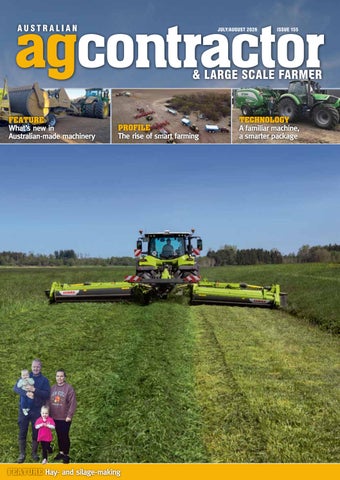
Issue 155 | July/August 2026 - Australian AgContractor & Large Scale Farmer
FEATURE
What’s new in Australian-made machinery
PROFILE
& LARGE SCALE FARMER
The rise of smart farming
TECHNOLOGY
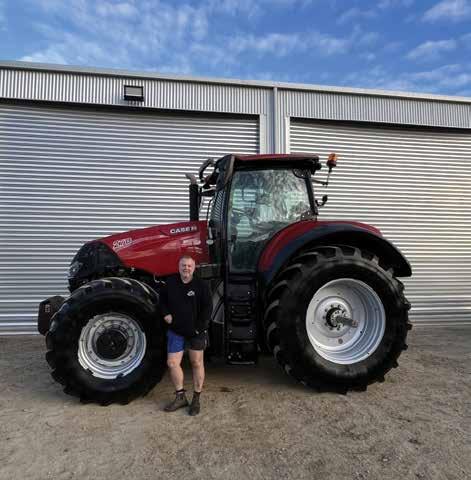
A familiar machine, a smarter package
FEATURE Hay- and silage-making
FEATURES:
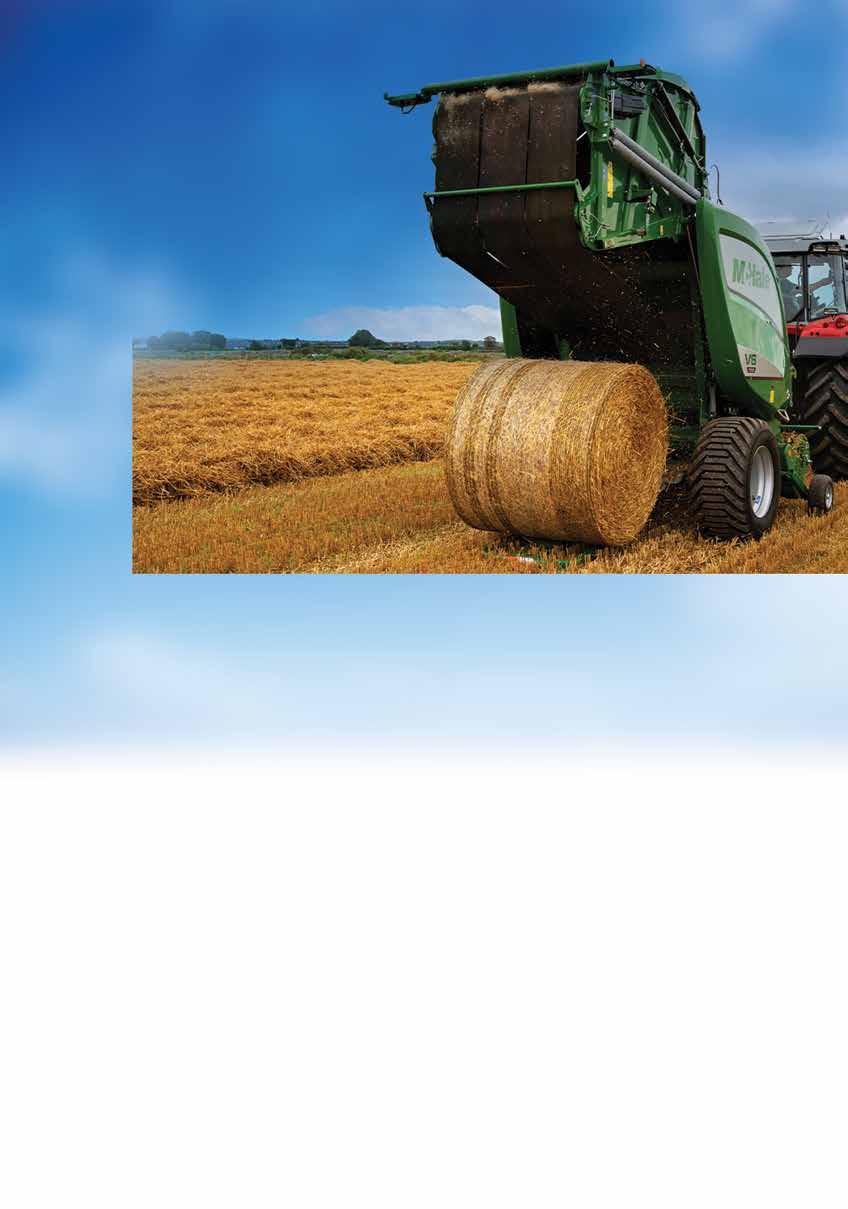
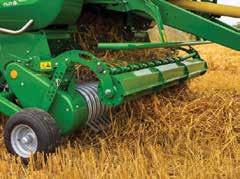
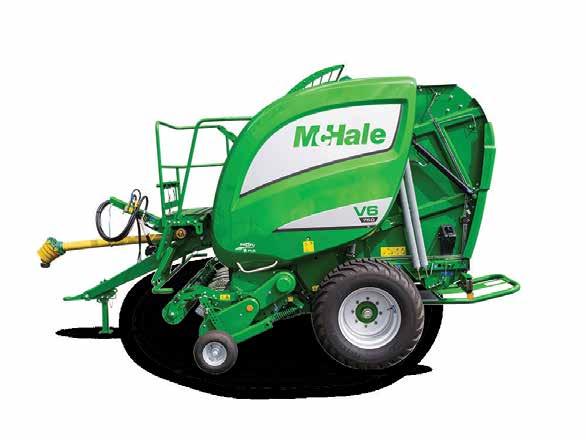
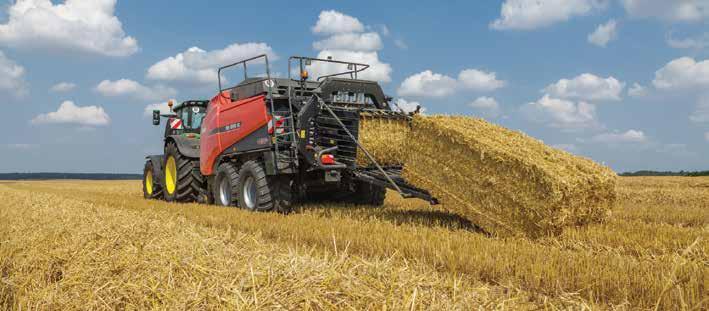
• 2.1m Profi-Flo Camless Pick-Up
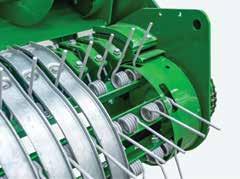
• 15-Knife Chopper Unit with Heavy Duty Rotor
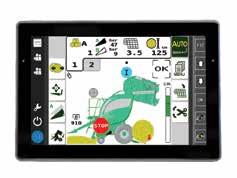
• ISOBUS Terminal with a 10” touch screen
• Drop Floor Unblocking System
• 3-Endless Belts
• Auto Greasing
• Continuous Oiler System
• High Performance Stretch Net System
• 50mm (2”) Double Race Chamber Bearings
• Knife Pressure Display
• Knife Position Sensor
• Drop Floor Sensor
• Bale Kicker
PO Box 36753
Merivale, Christchurch 8146
ph: +64 3 329 6555 www.agrimedia.co.nz
Publishers of Rural Contractor & Large Scale Farmer, AgriBusiness, AgriVet, NZ Cropping, Australian AG Contractor & Large Scale Farmer, NZ Novachem Manual.
Editor
Scott Wilson +64 21 725 061 scott@agrimedia.co.nz
Advertising Manager
Michael Lightbourne 021 403 853 michael@agrimedia.co.nz
Contributions - Editorial and photographic contributions are welcomed and should be sent directly to AML. Editing of submissions is at the sole discretion of the editor and will accept no responsibility for unsolicited material.
JULY/AUGUST 2026
04 From the Editor: Built here. Built better. Built because we need it.
Industry News
05 Remanufactured parts giving customers the power of choice
06 Kimberley Agricultural Supplies unveils expanded operations and new ag machinery offering in Broome
07 Built to last. Rebuilt to go again.
08 Amazone and CultiWise enter into a partnership
Technology
10 CNH telematics solution unlocks suite of valuable data for farmers seeking efficiency, productivity edge
Profiles
20 The rise of time smart-farming
24 On-farm nitrogen – it’s electrifying
Features
12 What’s new in Australian-made machinery
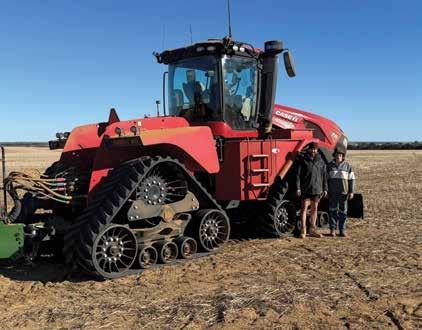
28 What’s new in hay- and silage-making
Equipment
42 Planning ahead: Why early decisions deliver better outcomes
43 A familiar machine, a smarter package
44 Tasmanian grower backs Alpego with 7-m upgrade
45 Flexi-Coil demos highlight input savings and smarter seeding decisions
46 Steiger 715 fuels efficiency gains for West Australian broadacre farmers
47 Automated X9 1000 excels in “exceptional” harvest on Clare Downs
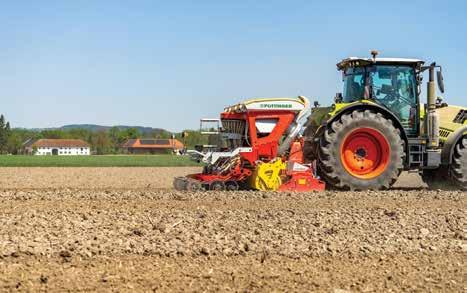
49 New Pöttinger Aerosem M implement-mounted pneumatic seed drill
51 Case IH Maxxum boosts productivity for Western Australian veg business
52 Tracing tractor tech across generations
Built here. Built better. Built because we need it.
Every issue of this magazine has its own character, but I’ll admit it: this one is a favourite. Our annual ‘Aussie made’ feature is more than a showcase of equipment and products built on home soil – it’s a reminder of who we are as an industry and, frankly, as a nation. When something doesn’t work the way it should, Australians don’t sit around waiting for someone else to fix it. We roll up our sleeves, sketch something on a plywood offcut that’s been lying around the shed, and build a better version ourselves.
That spirit is alive and well across the pages of this issue. From engineering workshops in regional towns to family run manufacturers punching well above their weight, the ingenuity on display is unmistakably Australian. It’s practical, it’s tough, and it’s born from real-world frustrations that turned into real-world solutions. Contractors and large scale farmers have always been early adopters of this mindset because when you’re burning daylight and margins are
tight, ‘near enough’ just simply isn’t good enough.
What stands out this year is how many of these homegrown innovations are not just matching imported alternatives but surpassing them. Better durability. Better serviceability. Better suited to our soils, our climate, our distances and our way of working. There’s a quiet pride in that – not chest thumping nationalism, but the satisfaction of knowing that when Australians build for Australians, the results speak for themselves.
Of course, there are still a few things we haven’t managed to engineer our way out of yet. Global geopolitics, for one. While we can weld, fabricate and problem solve our way through most challenges, even the best Aussie workshop hasn’t yet come up with a machine that stabilises global fuel markets or keeps shipping lanes open. If someone does invent it, I’m sure it’ll be painted green and gold and come with a grease nipple in exactly the right place.
In the meantime, the ripple effects continue to reach our sector, with higher fertiliser and diesel costs, unpredictable freight windows and longer lead times on parts and inputs. It’s another reminder that, even in a proudly
self reliant industry, we’re still connected to a wider world that doesn’t always behave as predictably as we’d like.
But if there’s one thing this issue proves, it’s that Australian agriculture never waits helplessly for conditions to improve. We adapt. We innovate. We build what we need. And we do it with the same determination that has shaped this industry for generations.
Enjoy the issue. It’s a celebration of what happens when Australian know-how meets Australian necessity.
Builtforperformance.
• 8000L main product tank
Transform your spraying operation with Goldacres ground breaking G8 Crop Cruiser Series 3.
• Weedetect® green on brown or green on green camera technology (optional) combined with new application systems
Findyour closest dealer
Scott Wilson.
Remanufactured parts giving customers the power of choice
As input costs continue to rise and more businesses seek to improve their sustainability, John Deere is giving its customers the power of choice through remanufactured (Reman) parts and components.
With more than 2,300 Reman parts available across its agricultural, professional turf, construction and forestry equipment, John Deere marked Global Reman Day –earlier this year – by shining a light on the positive impacts of its remanufacturing processes.
An initiative of the Remanufacturing Industrial Council (RIC), Global Reman Day helped to promote the environmental benefits of remanufacturing, including waste reduction and conservation of materials, and economic benefits including reduced production costs and job creation.
John Deere Australia and New Zealand Director of Aftermarket and Customer Support, Steph Gersekowski, said remanufacturing was a key pillar of the company’s commitment to helping customers get the most out of their equipment.
“In the current macro-economic environment, businesses across the board are trying to find efficiencies and optimise their operations, and we understand that having the power of choice when it comes to what parts you use to maintain and repair your equipment is more important than ever,” Gersekowski said.
“Our John Deere Reman portfolio offers a cost-effective alternative to genuine original equipment manufacturer [OEM] parts; Reman parts on average cost twenty to thirty percent less than brand new OEM parts.
“Despite this lower price point, there are no
compromises on quality or performance, with Reman products fully inspected, rigorously tested and built to the latest specifications.”
Remanufacturing is a comprehensive process that returns damaged, worn or non-functioning parts to like-new condition, and all Reman parts are protected by a John Deere Reman warranty with up to two years of coverage, including labour costs, if installed by an authorised John Deere dealer.
Reman parts favoured by customers and technicians
This quality assurance, guaranteed warranty, reduced equipment downtime and cost-effectiveness is favoured by customers and technicians alike in the sugarcanegrowing region of North Queensland.
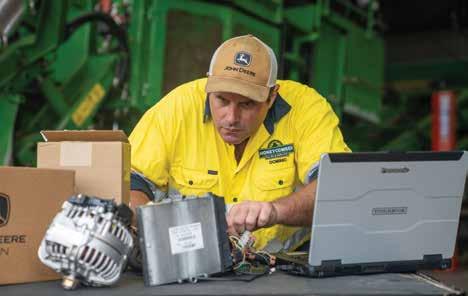
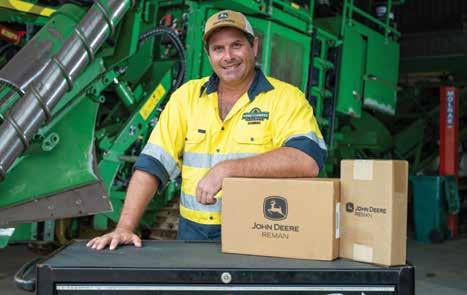
Dom Succio is an auto electrician and diesel fitter who has worked for John Deere dealer Honeycombes Sales & Services at Ingham for more than 12 years.
Dom Succio says his customers are open to repairing their equipment with Reman parts due to the warranty and the fact that John Deere stands by the quality of the parts.
He spends his days working on a range of John Deere equipment, including CH570 and CH960 sugarcane harvesters, 9RX 640 Four-Track Tractors, and 6 Series and 7 Series tractors – and he utilises Reman parts on all of them.
“We use Reman parts as much as we can to support the product, and we find customers are fairly open to repairing their equipment with these parts due to the really good warranty and the fact that John Deere stands by the quality of the parts,” Succio said.
“Using a Reman part also reduces equipment downtime – we have most of the parts in stock, and if we don’t have it here, it’s available at one of our other branches or we can easily get it from the Regional Parts Distribution Centre in Melbourne.”
In addition to being cheaper than new genuine parts, the ‘plug and play’ nature of Reman parts adds to their cost-effectiveness.
“Reman parts are easy to work with and you know you’ve got a product that’s going to bolt straight in and doesn’t require modifications like third-party parts do,” Succio said.
“It’s genuinely cheaper to go with Reman parts; they’re made for the job and they stand up to the harsh conditions these machines are operating in.”
The refund received from John Deere’s core
Dom Succio has more than 12 years’ experience as a John Deere technician and recommends Reman parts to his customers.
Kimberley Agricultural Supplies unveils expanded operations and new ag machinery offering in Broome
Case IH and New Holland has expanded its footprint in Western Australia with the addition of a new dealership in Broome.
Kimberley Agricultural Supplies had its beginnings in Broome six years ago, founded by Guy and Emily Rogers, and this year it’s undertaken a significant expansion that has included a relocation of the business and the addition of Case IH and New Holland machinery ranges.
“For a number of years we’ve been a servicing agent through a CNH dealer in the south-west, but we were then keen to have our own direct access to the brands to expand our business offering so our customers could benefit from the option of purchasing their Case IH and New Holland machinery through us,” Guy Rogers said.
In securing the franchise, the business relocated to a bigger site in Broome to accommodate their machinery range and provide a larger retail premises that includes a new workshop and servicing area.
Kimberley Agricultural Supplies is the
only ag machinery dealer in Broome, with a vast service area that stretches hundreds of kilometres in each direction.
“It’s a big area we cover, but it’s something we’ve been doing for the past six years and it’s very satisfying to be able to provide a service to producers where and when they need it. In terms of this new machinery offering, because no one’s actually been selling tractors and ag equipment here before, we’ll be carefully considering the market, to ensure we get the mix right,” Rogers said.
The customer base of the business includes large pastoral companies with irrigated agricultural projects, as well as horticultural businesses growing the likes of vegetables.
“Many people don’t actually realise how much agriculture is in this area. It’s a vast area but there’s a number of pockets of really intensive agriculture that goes on,” Rogers said.
For Case IH and New Holland, the opportunity to expand its dealer network in Western Australia has been an important
step, particularly in an area previously without a dealership offering.
“We’re really pleased to welcome the Kimberley Agricultural Supplies team to our network and look forward to working with them to service their diverse customer base,” said Aaron Bett, CNH Business Director –Agriculture Australia and New Zealand.
“They’ve been running a successful agricultural servicing business in the area for some time now, and to officially bring them aboard as a dealer is a significant step for us and offers their customers more options in terms of their machinery needs.”
The business currently has a staff of five, but Rogers said they were looking to fill a number of additional roles in line with the expansion, and the whole team was excited for what was ahead.
“It’s the start of a new chapter for us and we know it will have its challenges, but at the same time the opportunities are exciting and we know our customers will benefit from the expanded business offering, now including Case IH and New Holland machinery,” Rogers said.
return option also adds to the attractiveness of Reman products, Succio said.
“The core return is a selling point of the Reman parts, because we can say to customers: ‘This is how much the Reman part is to repair your equipment, and this is how much we’ll give you for your old part.’
“It’s just another offering to the customer that makes it more cost-effective.”
Encouraging customers to return the old parts is key to the success of the circular economy created by remanufacturing and the first step in the John Deere Reman process.
After receiving a damaged part, a John Deere dealer will send the ‘core’ of that part to
the core return centre, where it is completely disassembled and thoroughly cleaned by either a bake or chemical cleaning process.
All parts are dimensionally verified against the latest John Deere parts specifications, and any part not meeting original factory specifications is either recycled or brought back to specification.
All wear-type parts, such as pistons, liners, bushing, bearings, gaskets and O-rings, are replaced 100% of the time with new John Deere parts.
The product is assembled by highly trained technicians to exact John Deere criteria and must pass a thorough inspection and testing
process to ensure it meets or exceeds John Deere specifications, meaning it can be offered with a full warranty.
Gersekowski said remanufacturing parts is key to both John Deere and its customers reducing their environmental impact.
“We’re proud to offer remanufactured parts, as it keeps valuable components in use for longer, helps to reduce environmental impacts and enables our customers to achieve more with less,” she said.
For more information about John Deere Reman parts, visit www.deere.com.au/en/ parts-and-service/parts/remanufactured/ or see your local John Deere dealer.
Built to last. Rebuilt to go again.
Ten years on, Seed Terminator – the South Australian innovator fighting herbicide resistance with steel and ingenuity – is offering farmers a certified pathway into proven harvest weed seed control technology, at a price point that makes sense.
There is a certain satisfaction in a machine that gets taken back, rebuilt to exacting standards and sent out to fight weeds all over again. For Lonsdale based Seed Terminator, that is not an afterthought. It is a design philosophy.
Marking a decade of operation and more than 800 machines working paddocks across Australia and internationally, Seed Terminator has launched its Reman programme: a range of certified, warranted, pre-owned units rebuilt to current specification by the company’s own manufacturing team and, once installed, commissioned. It is the company’s answer to one of the most pressing questions in Australian grain farming right now: how do you justify machinery investment when every dollar needs to work harder than ever?
The pressure on Australian farmers is unlike anything in recent memory. Diesel, urea and input costs have all moved hard at once. Australian farmers are among the most self reliant in the world, but this level of uncertainty is in a category of its own.
Dr Nick Berry, Founder and Director of Research and Development at Seed Terminator, is getting a much clearer picture of what growers are up against. As a farmer on Kangaroo Island himself, and in the first year of taking over the reins on the family farm, he says getting his hands dirty has made the pressure feel much more immediate.
“We can see the results of where the Seed Terminator has been on our own farm,” he said. “The evidence is right there. But I understand why any capital commitment feels far from front of mind right now. Markets, urea, fuel – it’s a lot. The Reman programme exists because farmers still need access to this technology.”
For Geraldton grower Ben Cripps, that practicality is exactly the point.
“It’s a good way to get value in this space,” Cripps said. “When you’re making that jump to a second header, you are already spending big dollars on the machine. A Reman unit at eighty thousand dollars makes it much easier to set that second header up properly and not compromise on weed control.”
Farmers already know it in their gut: it makes no sense to spend all season trying to control weeds, only to spread the toughest survivors back across the paddock at harvest. The harvester is not neutral. It is either part of the weed control programme or the head of weed distribution, spreading next year’s problem.
That is why harvest weed seed control has remained such an important part of integrated weed management, particularly in Western Australia, where growers have been refining these systems for decades.
Cripps has been using HWSC since 2014.
“We started with chaff carts, then went to chaff decks,” he said. “They were good, but they mostly held numbers where they were. They didn’t drive the weed numbers down. Mills are a different story; done and dusted.
“For me it just makes sense. When I look at the farming calendar, cultivation, herbicides and harvest weed seed control are all just different opportunities to take out weeds.
“We’re now at the point where herbicide costs across the wheat programme have come back by about twenty percent. We’ve got green on green cameras now, but that wouldn’t work without the Terminator. The Terminator cleans up what gets missed.”
GRDC-backed research has shown that harvest weed seed control remains profitable over the long term, even when annual ryegrass seed capture is relatively modest (>30%), provided costs stay under control (<$34/ha). Running at around $20 a hectare, Seed Terminator sits well within that economic threshold. For farmers already carrying weed pressure or resistance, the justification is stronger again.
The Reman programme is designed to remove one of the biggest remaining barriers: cost.
“The Reman programme is our way of meeting farmers where they are,” says Seed Terminator Head of Distribution Tom Slatyer.
“Not every operation is ready for a new machine. A lot of farmers are also running a second header with decent hours on the clock. They don’t want to put a brand new Terminator on it, but they can’t bear to keep spreading weeds with it either. That’s exactly who Reman is for.”
These are not second hand machines in the usual sense. They are proven field units, stripped, sandblasted, repainted and rebuilt to current spec with brand new belts, latest generation AeroIMPACT technology, new final drives, magnet trays and updated software. Every Reman unit leaves the factory backed by a two year manufacturer’s warranty on non wear components.
That confidence comes from a deliberate engineering philosophy. After a mechanically troubled first prototype season in 2016, Dr Berry made a decision that has defined every machine since: over engineer it.
“After that first year, I decided we would
Seed Terminator’s Reman programme gives used equipment a new lease on life.
always over engineer the product,” he says. “These machines are built to last.”
He says the mechanical concept has stood the test of time. The horizontal mills were designed to spread residue properly without disrupting cleaning shoe airflow, while the drive system was engineered to isolate shock loads and keep the gearbox running cooler and more efficiently.
“We’ve made a lot of reliability improvements over the journey, but the DNA of the original design is still front and centre with every Seed Terminator sold,” Dr Berry says.
Growers notice that confidence.
“I was really happy with how ours performed last year,” Cripps says. “It worked
Amazone and CultiWise enter into a partnership
New digital solutions enhance the benefits of Amazone implements and make smart farming noticeably simpler, faster and more cost-effective for farmers.
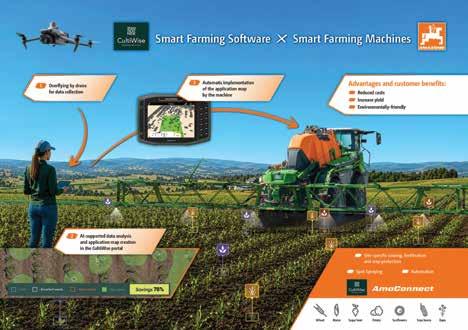
Amazone and CultiWise are entering into a strategic partnership to make smart farming more convenient, cost-effective and future-proof for farmers. At the heart of the collaboration lies a clear objective: digital, site-specific applications must work seamlessly and deliver immediate added value in the field. Seamless processes and efficiency gains when sowing, fertilising or spraying must be recognised as additional benefits in practice.
CultiWise is an innovative company that develops AI-supported satellite- and dronebased application maps as well as plant recognition solutions, offering a strong synergy with the Amazone portfolio. Farmers are set to benefit more quickly from these digital applications as well as the more precise utilisation of their machinery fleet, making their methods of operation even more efficient. Both CultiWise and Amazone remain independent partners and continue to develop their solutions independently. This allows users to benefit from rapid innovation, openness and future-proofing, regardless of which brands are being used on the farm.
CultiWise offers a powerful, global online portal with AI models that maps all agronomic processes on the farm based on comprehensive training data. With a young and agile team from the Czech Republic and Slovakia, CultiWise has been at the forefront of current developments for years, including automated flight planning, image processing on the drone and the integration of fully automated drone docks.
In future, job data will be seamlessly created, transferred and implemented using Amazone technology. For the farmer, this means less effort in preparation, simpler processes in daily operations and more efficient use of modern agricultural machinery. Turning smart farming into a practical solution.
The key benefit to the customer lies in the connection with AmaConnect – Amazone’s
well, and the backup has been excellent. We had an issue, and the Seed Terminator service techs were on it straight away. They didn’t mess around. That kind of warranty and support gives you real confidence.”
Initially available on Origin units to suit John Deere S series, Case IH Flagship
cloud-based data platform to create a digital bridge between planning, machine deployment and documentation. This provides Amazone customers with a decisive advantage: by intelligently linking the digital data from CultiWise application maps for fertilisation, sowing and plant protection to the Amazone applications in AmaConnect, the performance of modern agricultural machinery can be exploited even more effectively.
The added value of the collaboration is particularly evident in two examples:
In plant protection, innovative Amazone technology, such as the AmaSelect electric individual nozzle control system and the AmaXact nozzle system with pulse-width frequency modulation, only realise their full potential when used in conjunction with optimally prepared spot application maps. Calculating application rates in advance based on the technology available makes it significantly easier for farmers to carry out applications with precision and efficiency. The DirectInject direct injection system will be particularly beneficial for automated switching on the headland and variable application rates within the field. Variable-rate maize sowing maps are widely recognised from an agronomic
and New Holland CR Dot series, Reman opens the door for growers who have been watching the technology for years and waiting for the right moment.
The Reman range is available now in limited numbers.
For specifications, pricing, and to register
perspective, but they are still not commonly used in practice. Workflows involving the terminal and the implement are often a hindrance. With EasyTram, Amazone offers an automated tramline system, for the Precea precision seeder. As part of the collaboration between the two companies, customers can transfer both maps to the AmaTron 4 operator terminal via the AmaTron Share app in a seamless process.
The seamless integration of CultiWise and AmaConnect enhances the practical benefits of Amazone technology: data becomes available where it is needed, workflows are simplified, and digital precision can be integrated into daily practice without adding complexity. The partnership not only increases the benefits of individual functions but also further enhances the entire Amazone system in smart farming.
Amazone is therefore setting new standards in smart farming, which are expertly brought to market via the international dealer network. The close integration of high-performance agricultural machinery, an intelligent database and practical digital integration create clear added value for agricultural businesses – simple to use, precise in its effect and powerful in its results.
interest, visit seedterminator.com.au or contact enquiries@seedterminator.com.au.
The fight against herbicide resistance is not won in a single season. It is won harvest by harvest, paddock by paddock, by farmers thinking about the next decade, not just the next crop.
UNLOCK ENERGY: UNLOCK ENERGY:
CNH telematics solution unlocks suite of valuable data for farmers seeking efficiency, productivity edge
Farmers are always on the look-out for solutions to boost business efficiency and productivity, and now CNH has launched a new product that promises to be a “game-changer” for many farming operations.
The CM100 and CM110 are cost effective, entry-level aftermarket telematics modems designed to connect older, nonconnected, or mixed-fleet equipment to the CNH FieldOps™ platform, including trucks and vehicles.
CNH’s digital farming platform, FieldOps, is an all-in-one mobile and web solution designed for farmers to connect, view and manage their operation – driving on-farm efficiency and profitability. FieldOps provides real-time access to agronomic, machine and operational data, connecting farmers to their machines, fields, teams and partners, like dealers and agronomists.
“These tracking units have such a wide appeal for all sorts of operations, providing
an easy-to-use solution for monitoring important fleet telematics like fuel usage, engine hours and vehicle location in nonconnected machinery,” said CNH Precision Field Specialist Troy Blair.
Wagga Wagga hay contractor Paul Bailes has fitted three CM100 units to his tractor fleet and says the data has transformed how he manages his business.
“I got the first unit in July of last year for a tractor that didn’t have its own screen to give me live updates on fuel usage. So putting the CM100 in opened up a lot of parameters for me. I can see my live fuel usage, as well as information like engine oil and transmission temperatures,” Bailes said.
“From a business point of view, I’m able to see what my fuel burn is to correct my hectare rate or hourly rate for that tractor. It gives a total usage for that job, so you know exactly how much you’ve spent in fuel. You can also factor in servicing costs, operator costs and work out exactly what you need to charge for a job to ensure it’s profitable.
“With the cost of fuel so high, you just
can’t afford any more not to know just how much you’re using. It’s critical information for running a successful business.”
Bailes’ business specialises in mowing, raking, baling and silage operations. He runs four tractors – a New Holland TG285, New Holland T7030, Case IH Optum 270 and Case IH JXU95 – and a variety of other equipment including a New Holland BigBaler 1290 Plus.
With this level of machinery investment, he welcomes another feature of the CM100 technology.
“It gives me a GPS location for the tractor, which I can geofence, as a security precaution if I have to leave a tractor at a job overnight. If someone was to move it, I’d get an alert. It just provides that extra peace of mind that you know where your machinery is and what’s happening with it at any given time,” Bailes said.
He said the information is also useful when someone else is behind the wheel of the tractor.
“This would be a benefit for businesses with two or three different workers, because you can see how they’re driving the tractor. You can see live the engine loads, the engine revs, the ground speeds. You can get a gauge of how your worker is treating your equipment,” Bailes said.
“And in terms of productivity, you can get a breakdown when you do a report through the CM100 of key on, key off – so you know when they’re actually there working. How much idle time, how much travelling time, and how much work time. The reporting feature is really handy, being able to go back and see what the tractor’s done over a period of time.
“I was impressed with what that first unit I put in offered, so I invested in another couple and have really seen the benefits. Having all this information at your fingertips, wherever you are, is such a game-changer when it comes to decisionmaking and running the business that I do. I wouldn’t be without it.”
For more information on CM100 and CM110 solutions, contact your local CNH dealer.
Wagga Wagga contractor
Paul Bailes says CM100 units have changed his business management philosophy.
what’s new in...
Australian-made machinery
Australian manufacturers have a proud history of producing ‘homegrown’ agricultural machinery designed to stand up to the tough conditions contractors and farmers face.
In this feature we examine the leading crop establishment, harvesting, spreading and spraying equipment made in this country.
Goldacres, an Australian specialist sprayer manufacturer, began producing agricultural sprayers in 1978, at a time when chemical weed control was still a relatively new concept in the country. Early sprayers were basic trailers with modest capacities of around 1,200 L and boom widths of about 12 m.
In the late 1990s, Goldacres took a significant step forward by introducing its own selfpropelled sprayers. These machines were based on technology from their trailing sprayer range, utilising a mechanical drive cab chassis platform that would serve as the foundation for the company’s future developments.
The Crop Cruiser name was born and would soon establish itself as a serious contender in the Australian self-propelled sprayer market.
The first machine featured the now familiar Cummins engine/ Allison auto/direct mechanical
drive combo that Goldacres have become synonymous for. Early machines were up to 4,000-L tank capacities with 30-m booms, which at the time was the industry standard.
As the years passed, the Goldacres self-propelled offering range grew to allow for many broadacre and horticultural applications with models featuring smaller and larger tank capacities up to 6,000 L.
In 2010, major developments of the Crop Cruiser were released, a Claas cabin was now fitted for added operator comfort, along with a revised Tritech boom platform, featuring options such as tiered nozzles and an industry first boom recirculation system.
Goldacres released the G4 Crop Cruiser (4,000 L up to 36 m) in 2014, which was predominately sold in to horticulture and specialist cropping areas, with its wide range of axle configurations.
The G6 Crop Cruiser hit the market in 2015, offering a 6,000L product tank and up to 42-m booms. This machine cemented the Goldacres name in selfpropelled spraying throughout Australia.
In 2020, the G6 Crop Cruiser Series 2 hit the market and soon became the company’s most popular seller of all time, featuring an all-new RivX boom platform in 36–42 m and the in-house designed G-Hub total machine control system. Included in the options list was the popular Tri-Tech 48-m boom, and following shortly after was the upgraded G4 Crop Cruiser Series 2 machine also including many and the features found on the G6 Crop Cruiser Series 2. By 2025, Goldacres had become one of Australia’s largest sprayer manufacturers, offering an extensive range of both trailing and self-propelled models, all specifically designed for Australian farming conditions. Over the years, Goldacres
Goldacres
Aussie Pumps
Aussie Pumps has tackled a challenge with its stainless steel fertiliser pumps.
Aussie Pumps has been a key supporter of Australian agriculture activities for the last 30 years. During that time, they worked farmers from horticulture to dairy, beef cattle, to wool, and everything in between.
John Hales, Aussie Pump’s Chief Engineer, stretches the boundaries of ambition by moving into production of 316 stainless steel pumps for those corrosive applications in agriculture.
Fertiliser – don’t waste a drop
With the spectre of fertiliser shortages hanging over agriculture’s head, the government is taking extreme efforts to not only provide fuel security but also to ensure farmers get the fertiliser they need for this year’s cropping. Fertilisers are, generally speaking, corrosive and don’t react well with cast iron or aluminium pumps. That is why Aussie Pumps developed their Aussie Smart Pump, a 30% glass-filled polyester model made to a recipe, compliments of the United States government’s NASA space programme.
In 2” or 3” configuration, they have flows up to 1,010 L/min and pressures as high as 52 psi. The pumps are well renowned for their ability to deal with corrosive liquids, including seawater, ag chemicals or fertilisers.
Many of Aussie Pumps’ customers use them for batching fertiliser. The Smart Pumps with 316 stainless-steel fasteners can be driven by Yanmar diesel, Honda petrol
engine, or single- or three-phase electric motor.
“We build them in a wide range of variations as we know there are complications of handling fertiliser that are beyond our understanding. We also build the Smart Pumps with hydraulic drive. This option is popular with wide boom sprayers. Helping farmers to get the best out of their pumps is what it’s all about,” says Hales.
Hales and the Aussie Pumps team are happy to provide free advice to facilitate the best possible solutions for handling fertilisers.
Aussie goes 316 stainless
A number of farmers with big sprayers are particularly conscious of the need to refill fast, to cut costs on time and the amount of fuel being used.
Aussie Pumps started looking at 316 stainless-steel selfpriming centrifugal transfer pumps for high volume pumping. They already have a major presence in agricultural applications from sugar mills to piggeries, abattoirs to meat processors.
These pumps have a tremendous ability to deal with corrosive applications. Aussie Pumps have recently introduced a 3” 316 cast stainless-steel pump that can be driven by hydraulic motor, diesel engine or electric motor. All part of their Aussie GMP range, the impeller is 316 stainless steel, mechanical seals are tungsten carbide and elastomers can be supplied in Viton. Best of all the body is stainless steel as well. Their B3XR-A/X pump with body and impeller cast in 316 at 2900 rpm provides a flow of 1,500 L/min.
Big 4” pumps on the way
Aussie’s B4XR-A/X/W has a 4” 316 SS body and impeller capable of pumping 2,100 L/ min. Imagine that in terms of fast filling a sprayer. These pumps are already popular in the construction industry in their cast iron configuration. Apart from high flow, they also have high head capability.
The B4XR-A, with suitable power, has a vertical head capability of over 30 m.
These stainless-steel pumps are doing great service in milk processing, even handling difficult liquids, including molasses.
Aussie Pumps expands to New Zealand
Aussie Pumps is continuing to grow its export business in New Zealand, supporting Kiwi farmers with reliable pumping solutions for fertiliser handling and other agricultural applications.
With increasing demand from the agricultural sector, Aussie Pumps is expanding its footprint across New Zealand while providing the same technical expertise and proven products trusted by Australian farmers.
For export enquiries and further information, visit aussiepumps.com.au.
has consistently expanded its product offerings, incorporating regular upgrades and new additions to its sprayer line-up.
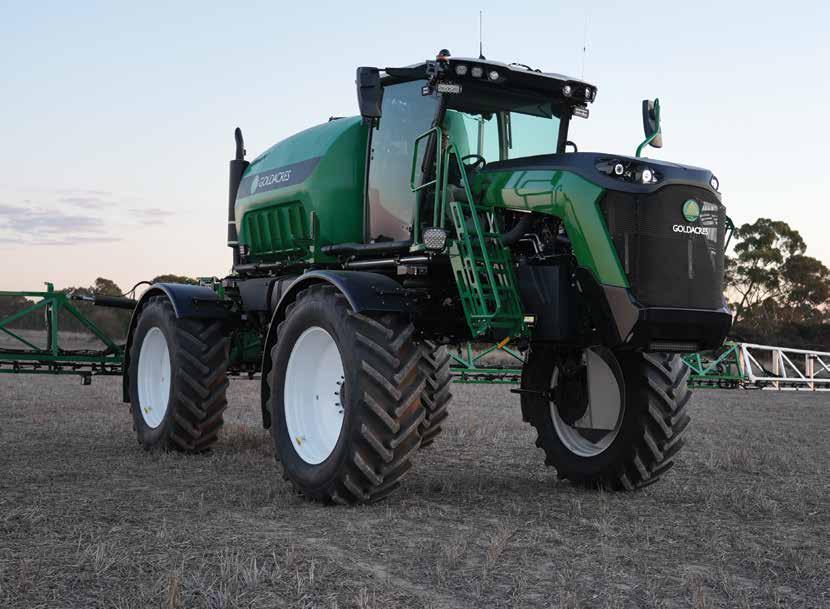
In late 2025, Goldacres unveiled the G8 Crop Cruiser Series 3 – the first Australianbuilt, high-capacity, high-
clearance self-propelled sprayer. This all-new, ground-up redesign is revolutionising agricultural spraying. The G8 Crop Cruiser Series 3 features an impressive 8,000-L tank capacity with an optional 1,500-L front tank that can be
used for extra capacity or for twin product spraying with an additional camera spot spraying system.
The mechanical drive system is retained with constant 4WD and the long serving Allison auto transmission has now been
replaced with a ZF 8-speed for seamless power to the ground.
The Claas X11 cabin boasts enhanced comfort and precision technology that promises to deliver unmatched spraying accuracy and set a new standard for the industry.
The
LQS
P600 4,000-L Liquid Bridge upscales John Deere liquid cart capacity
For growers chasing greater efficiency and fewer refills at sowing time, with John Deere’s P600 Precision Air Hoe Drills, the LQS P600 4,000-L Liquid Bridge bolts directly to the P600 Drill, adding a 4,000-L product tank – all seamlessly integrated with the C-Series Liquid Ready Commodity Carts or any variable rate LQS Series Pump modules.
When paired with a C650, total
liquid capacity leaps from 4,800 L to 8,800 L, unlocking longer runs, greater flexibility and uncompromised precision. Farmers can choose between two configurations:
• Version 1: Tank Bridge – a simple capacity expansion: boosts C550 carts to 7,720 L and C650 carts to 8,800 L.
• Version 2: Tank Bridge + LQS120 Module – adds full pump and control functionality for dual-liquid applications or retrofitting granular-only carts.
This factory-assembled Liquid Bridge is designed by Liquid
Systems (South Australia) to add capacity and flexibility with ease, helping customers boost productivity and meet tight seeding windows. It mounts directly to the P660, P670, P680 and P690 chassis and integrates seamlessly with John Deere’s Dealer-Fit C-Series carts (C500, C550, C650) in both leading and trailing configurations –delivering a true plug-and-play liquid delivery solution. In short, the LQS 4000 P600 Liquid Bridge transforms the C650 into a high-capacity, precision workhorse, perfectly suited to the demands of modern largescale seeding.
For more information, contact your John Deere dealer today for your next season.
Liquid Systems have also recently developed a new LQS Manifold Riser Bracket, designed to securely mount the Stacker manifold to a 65-mm (2.5”) OD Air Head Riser.
The stainless steel bracket locks firmly around the riser tube, positioning the manifold centrally, so delivery tubes and liquid lines can follow the seeder hose cleanly down to the opener, keeping the bar neatly organised.
Visit www.liquidsystems.com. au or call 08 8357 4437.
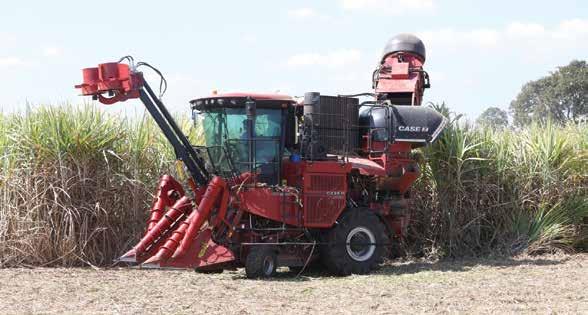
The Australian invention making light work for cane growers around the world
Walk through a cane field almost anywhere in the world and, chances are, you’ll find an Austoft® harvester at work. What few outside of Australia would know is that the machine carrying that name traces its
roots back to a family farm in Bundaberg – and that Australian growers are still shaping how it evolves today.
The Toft brothers grew up working the family cane property by hand. In 1939, Joseph Toft built a simple mechanical cane loader out of necessity. A year later, brothers Harold and Colin refined the design using
scrap metal and parts from a Model T Ford, producing the first commercial whole-stalk cane loader. Through the 1940s, continued development helped establish Australia as the first country in the world to fully mechanise cane harvesting.
The brothers kept innovating and, by 1944, they had developed a single-row harvester that became the template for future models. Harold drove
the engineering and Colin’s strength in sales and marketing pushed the machines into export markets across more than 30 countries. What gave Toft machines their competitive edge was consistent performance across vastly different growing conditions and climates.
After passing through several foreign owners, Australian investors regained control of the business in 1986 and renamed it Austoft. Case IH acquired the company in 1997, and the machines soon swapped their yellow livery for the brand’s signature red.
More than 80 years on from that first prototype, the Case IH Austoft 9000 represents how far the technology has come –advanced hydraulics, precision automation and significantly greater harvesting capacity than the machines that started it all. Few people have witnessed that evolution more closely than North Queensland cane grower and contractor Gary Stockham. Stockham began cane
Liquid Systems
Case IH
Innovative Ag
XSEED: Smarter seeding starts here
Farmers know better than anyone that small improvements in machinery can make a big difference in the paddock. That’s the philosophy driving Western Australia based Innovative Ag. Their XSEED range of bars, precision modules and hybrid systems has been shaped by years of field testing, farmer feedback and continuous refinement. The result is a suite of machines built for accuracy, reliability and ease of use.
XSEED bars: Built for comfort, safety and efficiency
The XSEED bar is engineered around a simple idea: make the operator’s life easier.
A super high lift frame gives unmatched access for servicing, depth changes and day to day adjustments – a feature farmers quickly grow attached to. As one customer put it, “Now we wouldn’t be without it.”
Each wheel carries its own depth control cylinder, ensuring precise frame levelling and consistent digging depth. Greaseless pivot points across most of the frame cut down on maintenance time, while external wheels and smart toolbar spacing boost trash flow. Adding to the range of machines available, Innovative Ag has released their first 24-m (80 foot) four-row bridge frame machine for 2026.
Two , three four- or five-row configurations are available, and Innovative Ag can custom build frames to suit any farming system, even if the grower’s preferred seeding module isn’t
part of the company’s lineup.
XSEED precision module: Accuracy without the hassle
New to 2026 is hydraulic packing pressure which can be automatically controlled via a pre-programmed prescription map.
The precision module separates the sowing unit from the tine, allowing the tine to move independently while maintaining consistent seed placement. If the tine hits a rock, the module is carried safely with it – a thoughtful detail born from real-world use.
A quick set depth system with numbered slots means no tools, no fuss, and depth changes on an 18-m machine in minutes. The long arm parallelogram delivers a smooth ride at the press wheel, improving seed placement accuracy. One grower summed it up simply: “It is very accurate.”
Other features include:
• One bolt point changes – no hammers, no bruised knuckles
• Greaseless seeding module for reduced downtime
• Agri hub bearings for long service life
• Dual acting cylinders for lower transport height
• In cab pressure monitoring for tines, coulters or packing wheels
• Automated pressure controls via prescription maps
Hybrid seeding system: Five rows, endless capability
Innovative Ag describes the Hybrid system as one of the best seeding solutions available – and the design backs that up.
The front three rows of tines handle ripping and fertiliser placement, allowing growers to run high fertiliser rates safely. The rear two rows of double discs deliver precision seed placement in the disturbed soil, with minimal disc wear – typically just 2–3 mm per 4,000 ha depending on soil type.
With no closing tool to snag
stubble, the Hybrid system offers exceptional trash flow. And because the discs seed into preworked soil, there’s no furrow fill, meaning consistent depth at higher speeds across varying soil types.
Growers appreciate the low maintenance nature of the machine too. As one operator noted, “We pull it out and go seeding without touching it.”
The Hybrid can also operate as a disc-only machine by lifting the tines, with fertiliser rates adjusted accordingly.
Designed by farmers, proven by farmers
Whether it’s the smooth ride at the press wheel, the fast depth adjustments, or the ability to tailor the system to any farming program, Innovative Ag equipment is built to deliver long term value and dependable performance.
For more information, visit iagwa.com.au or contact the Innovative Ag team on 0401 354 568.
harvesting in 1978 and has farmed in the Burdekin Region since the mid-1980s on a property north of Ayr. Through Gary Stockham Harvesting, he and his son Ashley grow their own cane and provide contract harvesting services for local growers using a fleet of Case IH Austoft harvesters and Case IH tractors.
A third-generation cane farmer, Stockham purchased his first harvester, a Toft Robot 364 Mk II, after completing a fitter and turner apprenticeship in Giru. Nearly 50 years later, his twenty-third machine is a Case IH Austoft 9000.
“The machines are much more user-friendly now,” Stockham said. “They’re easier to operate,
more efficient and far more comfortable than the older models.”
He recalls early harvesters were noisy and often lacked air conditioning, while modern machines allow operators to work longer hours in far greater comfort.
Whilst no longer manufactured locally, Australian cane growers
are still involved in the evolution of the Austoft cane harvester.
The Austoft 9000 has been through more than 30,000 hours of field and bench testing, including feedback from Australian cane growers, to ensure it delivers greater harvesting performance, improved hydraulic efficiency and lower operating costs.
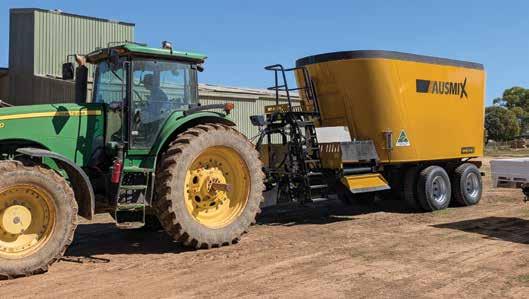
Ausmix: The Australian mixer wagon built for Australian conditions
In an industry where margins are tight, labour is scarce and every tonne of feed needs to deliver maximum value, the machinery behind the ration matters just as much as the ration itself. That’s where Ausmix, FarmTech’s Australian manufactured mixer wagon brand, has carved out a reputation that’s becoming hard to ignore. Built locally, engineered for the realities of Australian livestock operations and backed by a company that understands the demands of our climate and our producers, Ausmix is steadily becoming the go to choice for farmers and contractors who need reliability without compromise.
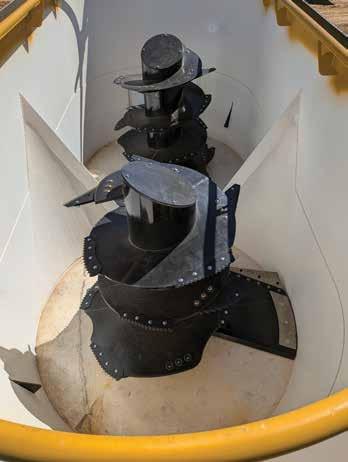
At its core, Ausmix is about one thing: consistency. Consistent mixing, consistent performance, consistent results in the paddock. Whether you’re feeding a 200-head dairy herd or running a large-scale beef operation, the ability to produce a uniform, well-blended ration day after day is the difference between animals performing at their peak and feed costs quietly eroding profitability. Ausmix wagons are designed around that principle, using robust auger geometry and intelligently shaped tubs to ensure every load is mixed thoroughly –from long stem silage to grain, minerals and fibre additives.
But what really sets Ausmix apart is its Australian build quality. Imported mixer wagons often arrive with features suited to European barns or North American feedlots –environments that don’t always translate to the heat, dust and variability of Australian farms. Ausmix machines are built with heavier steel, reinforced wear points and driveline components selected specifically for our conditions. They’re designed to handle rougher terrain, longer feeding runs and the kind of daily punishment that comes with large herds spread across big country.
FarmTech’s manufacturing approach also means Ausmix
wagons aren’t just tough –they’re serviceable. Contractors and farmers know that downtime is the enemy. Ausmix machines are engineered with maintenance access in mind: simple grease points, easily replaceable blades and auger components, and hydraulic systems that can be serviced without specialist tools. For contractors feeding multiple clients or dairy operators who can’t afford a missed milking, that practicality is worth its weight in gold.
Another strength of the Ausmix range is its versatility. With models spanning from compact single-auger units right through to high-capacity twin-auger machines, there’s a wagon to suit operations of every scale. Smaller family farms appreciate the manoeuvrability and low horsepower requirements of the entry-level models, while large beef and dairy enterprises value the throughput and efficiency of the bigger units. Across the range, the design philosophy stays the same: keep the mix even, keep the machine simple and keep the operator in control. Technology also plays a role. Ausmix wagons can be fitted with modern weighing systems, feed management software and load tracking tools that help producers monitor inputs with precision. In a world where feed costs continue to rise, the ability to measure, record and optimise every load is becoming essential. Ausmix gives producers the tools to do
that without overcomplicating the process.
But perhaps the most compelling advantage is the local support. FarmTech isn’t a distant overseas manufacturer –it’s an Australian company with boots on the ground, a dealer network that understands livestock operations and a commitment to keeping parts and expertise close at hand. When a bearing needs replacing or a contractor needs advice on auger settings, help isn’t half a world away.
In a market crowded with
imported mixer wagons, Ausmix stands out because it’s built for the people who actually use it –Australian farmers, Australian contractors and Australian conditions. It’s a machine that reflects the realities of our industry: tough, dependable and designed to deliver value every single day.
For producers looking to improve feed efficiency, animal performance and operational reliability, Ausmix isn’t just another mixer wagon. It’s a smart investment in the long-term productivity of the farm.
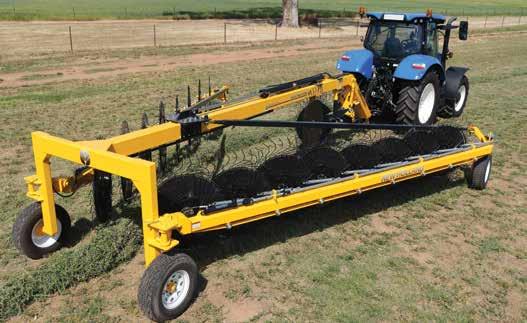
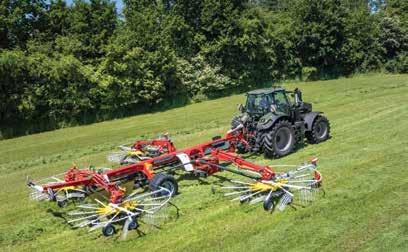
DuraVee wheel rake built on simple, grounddriven design
New Holland’s DuraVee™ wheel rake range, built in Cowra and certified Australian Made, delivers a straightforward solution for broadacre, dairy and contracting operations across Australia.
With nearly 30 years of proven performance in demanding Australian conditions, the DuraVee wheel rake has earned a strong reputation for being tough, dependable and easy to maintain.
CNH Product Manager Hay & Forage, Sune Nielsen, said the DuraVee is designed to be ready when it’s needed, season after season.
“With straightforward ‘steel and reel’ construction and no electronics, there is very little to go wrong, making it an ideal machine to park in the shed and rely on year after year.
“The rakes are robustly built from Australian steel with no power take-off [PTO] required. Both the DuraVee’s ground drive contact reels and the
DuraVee Plus’ crop contact reels use simple, readily available components, making servicing and maintenance easy.
“Farmers have treated it as a bulletproof rake for decades,” Nielsen said.
The range includes both the standard DuraVee and DuraVee Plus models. The DuraVee is designed as an all-rounder for hay and silage production, while the DuraVee Plus features fill-in
shields and rubber-mounted tines designed to minimise ground contact, making it well suited to clean hay production.
Optional features extend the range’s versatility. A hydraulic fold allows operators to adjust rake width from the cab, while the splitter kit lets operators rake three rows into one while turning the centre row – improving drying and giving a cleaner, more even windrow for the baler.
Weed Wiper
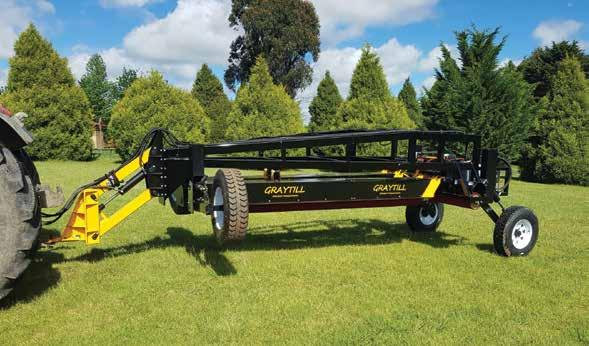
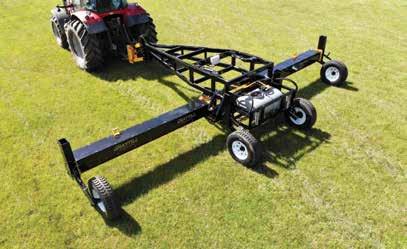
Sprayer and seeder specialist Graytill has been focusing research and development on their sprayers lately. Along with their larger truck mount boomsprays, Graytill has also been developing their all-terrain Weed Wipers.
Graytill owner Dave Grayling said, “The Weed Wiper was developed as a heavy duty alternative to current products available on the market. We initially developed it to suit mine and forestry conditions; however, it is equally at home on undulating pastures.”
The large 200 mm diameter carpet rollers are driven by 12 V motors. This means the rollers rotate at a constant speed, regardless of ground speed. It also prevents the rollers from dripping when the machine is stopped. A lightweight but strong RHS frame protects the
rollers from collisions. Grayling said, “The frame also acts as a bash bar. It knocks down the taller weeds, bruising them at the same time, which allows the leaves to absorb more chemical, leading to a better kill.”
The Weed Wiper is available in sizes from 4 to 8 m, with all models folding up for easy transport. The wings are also able to float up and down, to ensure excellent contour following. Heavy duty 12 ply rated land cruiser wheels ensure the Weed Wiper will go
The DuraVee’s simplicity also makes it an effective drought rake for producers who only turn to hay when conditions demand it, such as in dry years or when a grain crop is cut instead.
Built at New Holland’s Cowra facility, the DuraVee range carries the Australian Made certification, reinforcing its position as a locally manufactured rake designed for Australian conditions.
anywhere you can tow it.
The smaller 4-m unit is designed to be towed behind a ute; however, it can also be towed behind a tractor or side by side. It features manual height adjustment from 200 mm to 800 mm, and manual fold wings, with ball bearing breakaways. Torsion
Graytill
New Holland
Popular rock crusher now even better
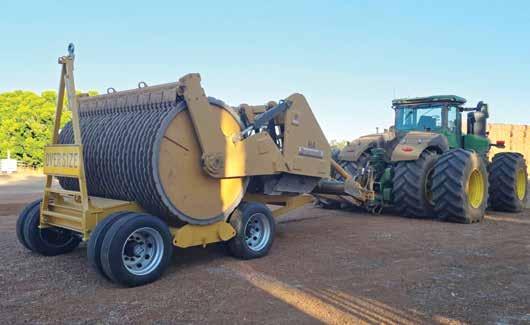
Australia’s home-grown, popular rock crushing machine — recently launched in the United States and now only available on forward order — has undergone further improvements to make operations even easier for owners.
The Rocks Gone H4 Reefinator has long been a familiar sight across rocky paddocks in Western and South Australia, and more recently along the eastern seaboard, before its introduction to the US market.
The 3-m wide machine, comprising a levelling blade, four front-row and five rear-row hydraulic tines and a following ribbed drum, was originally operated with manual depth control. Automation technology later became available for tractor cabs, and now the system comes factory fitted as standard.
A new prototype cart that allows faster loading and more robust, safe and efficient transport is also being trialled with the H4 Reefinator.
The Depth Master auto depth and slip control system, suitable for ISOBUS and GPS integrated tractors, calculates speed over ground and tractor load or wheel slip to adjust machine depth up to 50 times per second, as well as the level of its blade.
“We were previously jury rigging it inside cabs, whereas now it is in a black box located near the auto-greaser on the mainframe and we have run an extra wiring harness,” said Tim Pannell, machine inventor
and Rocks Gone founder. “It connects to an ISOBUS plug at the back of tractors and one other hydraulic point.”
The specialised ARAG control box, long used on sprayers and spreaders, is durable, weather proofed and fully ISOBUS compliant, with heavy duty connections and a window to view system lights.
Pannell said the ISOBUS cable plugs directly into US manufactured tractors, while European tractors require an additional black box — a simple fit that also enables full hydraulic control via ISOBUS.
Older tractors, around 20 years of age, can also run the system provided they use electric over hydraulic controls. “You can make them ISOBUS compliant with an external Topcon kit that essentially does the ISOBUS, and then you fit one other cable,” he said.
GPS is required for depth mapping, allowing operators to
target specific areas and reduce unnecessary passes, improving overall productivity.
H4 Reefinators fitted with the Depth Master system have already demonstrated seamless operation in the field.
A new prototype transport cart for the H4 Reefinator is also performing well with a contracting client. Earlier carts for previous Reefinator models were half the weight of the H4, and while they could carry the machine, the steep ramp angle made loading difficult. A later float design with larger ramps improved access but required significant engineering, with separate hinged ramps held by safety chains.
The latest cart simplifies the process by incorporating rigid ramps into the mainframe. “They don’t lower to ground level. They go to transport height. You reverse the H4 Reefinator up to it and it tips the cart up as it goes up the ramp, and then
back down again onto its two axles as it goes into the cradle,” Pannell said. The machine is then secured with a single attachment from the cart to the drum.
The cart uses two standard 10-tonne axles similar to truck trailers, extended to 3 m for stability. Unlike previous dolly carts, the H4 now drops into a cradle, lowering the centre of gravity.
“We had to climb onto the dollies before to chain the machines on, whereas now you can have everything hitched and attached in ten minutes and be travelling down the road at forty kilometres per hour,” Pannell said.
Rocks Gone has previously transported Reefinators long distances using carts, and the new design is proving far quicker and more efficient. “You don’t need to unhitch it from the tractor, use trucks and then have another tractor at the other end,” he said.
bar suspension provides smooth travelling and easy height adjustment. “The ball bearing breakaway system makes for easy folding, whilst also providing added protection in case of collisions,” said Grayling.
The 4-m Weed Wiper folds up to under 2.5 m for transport, and at just 720 kg, it is able to be registered for road use, without the need for brakes.
The larger 6-m and 8-m models are designed to be towed behind a tractor and are ideal for larger properties. Hydraulic fold and lift make it easy to change from working to transport, while the hydraulic accumulator suspension provides a smooth ride during transport.
For more information, visit the website graytill.com.au or call 02 6777 2028.
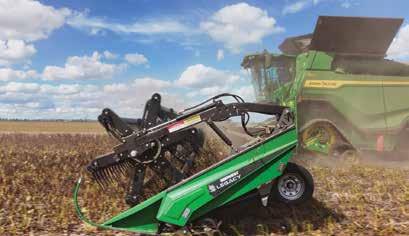
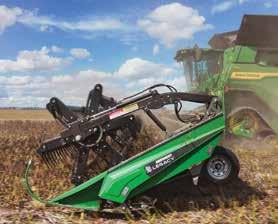
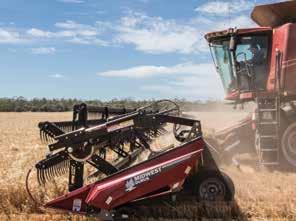
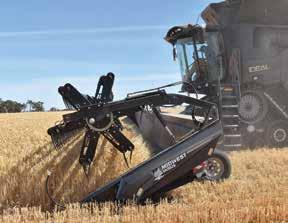
Midwest Durus: The Australian front built to harvest more for less.
In a market crowded with imported designs, Midwest stands alone as the only harvesting front designed and manufactured in Australia –built by Aussie farmers, for Aussie farmers. Their Durus and Legacy draper platform ranges have earned their reputation for strength, simplicity and performance, delivering more hectares per hour, lower running costs and unmatched reliability in the paddock.
A simpler, stronger backbone
At the heart of every Midwest platform is a single length of superform steel running through a truss style frame. This simple engineering approach has fewer joins, fewer parts and fewer wear points, creating a structure nearly twice as strong per kilogram as standard 350-grade high-strength steel. The widest 60-ft platform weighs just 5,180 kg while still handling harsh Australian harvest conditions. A lighter, stronger platform means less strain on the combine, fewer wearing parts, lower repair costs and reduced fuel use. It also means better resale value – something Midwest platforms are known for. As Brad Glover from Hermidale says: “A good feature of the Midwest is the straight cut off the knife onto the belt … it feeds a lot better, and you don’t lose heads.”
Designed for Australian conditions
Australian paddocks are anything but uniform. Midwest platforms are engineered specifically for these conditions, not adapted from overseas designs. The patented Hoverpoint air ride adaptor uses gravity – not electronics or sensors – for real time contour following. Mounted 500 mm closer to the cab than other brands, it gives operators the best visibility on the market and allows wider platforms without compromising feeder house lift capacity. Airbag cushioned ground wheels (four on the 60 ft)
further smooth the ride at higher harvesting speeds.
Growers running big machines see the difference immediately. “We’re stripping about 2,500 tonnes a day … They’ve certainly got us hopping!” says Adam Coleman from Oodnadatta Farms.
Widths to suit every operation
From 30 ft to 60 ft, Midwest offers eight platform widths, including the industry leading 50-ft, 55-ft and 60-ft models that maximise tonnes per hour and hectares per hour. They are also the only platforms sized for all Controlled Traffic Farming (CTF) systems, giving operators the ability to match their front precisely to their production system.
Premium components for premium performance
Midwest’s Durus and Legacy platforms incorporate a suite of high-performance features:
• Six-bar pickup reel – the largest diameter reel on the market, offering 20–44% more finger tines for smoother crop engagement.
• Dual timed knife drive – high speed cutting with minimal vibration and a no step stainless surface behind the cutterbar for perfect crop flow.
• Long life draper belts –puncture resistant, reversible and guided by a centre V track for true alignment.
• Large 410 mm feed drum
– positioned forward for aggressive, positive feeding.
• 90 mm carbon cog drive system – efficient power transfer with radial button clutch protection.
Optional extras – cutterbar wheels, canola cross augers, windrow kits and knife guards – allow operators to tailor the platform to their crop and conditions.
Transport made easy
Midwest also manufactures highway compliant transporters engineered for all major platform brands and widths. Optional toolboxes, electric brakes and platform specific mounting kits make moving between paddocks safer and more efficient.
Service that stands apart
When customers call Midwest, they’re speaking directly to the people who design and build the platforms. That direct line to the workshop is why Midwest has supported platforms still working hard after more than 28 years.
Parts are available through local dealers or the Midwest website, and operators can access Midwest’s free offline ready service app with maintenance videos filmed by the team.
Innovation driven by farmers
Midwest pioneered the world’s first 50-ft and later the 60-ft front. More recently, after conversations with growers wanting to unlock the full capacity of their machines, they launched the Legacy draper for class 10 and 11 combines like the John Deere X Series. “Farming is in our blood … We want to see Aussie farmers take home more profit,” says CEO Amy Schutt.
Field Day offers coming soon
Midwest will run special Field Day offers across July and August. Growers can expect opportunities across the Durus and Legacy ranges. Contact the team on (07) 4662 2137, email sales@midwest.net.au or visit midwest.net.au.
the rise of time smart-farming
When Mick O’Callaghan talks about farming, one thing becomes clear very quickly: while machinery, technology and cropping systems have changed dramatically over the years, the fundamentals of agriculture remain remarkably consistent.
“You still need moisture, you still need good soil, and you still need to make good decisions,” he says.
Those principles have guided the evolution of Cally & Co, a family sheep and cropping business he operates in Western Australia’s Coorow district, around 250 km north of Perth. The business now crops wheat, barley, canola and lupins, a long way from its modest beginnings over 60 years ago.
“My father started the business in the early sixties” Mick explains. “Back then, seventy to eight percent of the income was from sheep, wool and meat, with only about twenty percent cropping.”
Like many farming businesses across Western Australia, Cally & Co has evolved alongside the industry itself. The sheep gradually disappeared, cropping expanded, and by the early 1990s, the business had transitioned to a croppingfocused operation. Mick officially took over in 1996 after spending a decade balancing farm involvement with a fly-in, fly-out
mining career.
“I was doing two weeks on and two weeks off, keeping my interest in the farm while working away,” he says. “When I left mining, we had a succession plan in place with my parents and that made a huge difference.”
Looking back, succession planning remains one of the decisions he is most pleased with.
“We started planning early and put everything in writing, it’s one of the best decisions we ever made. We were fortunate that my parents also recognised the value of succession planning
Mick O’Callaghan says technology has played the largest role in transforming the industry during his career.
and supported a fair, formal legal process when we began twentythree years ago.”
The same practical mindset influences his future thinking about succession. His son Alex is completing a mechanical trade, and his daughter is building her career in Perth. Alex enjoys farming, but whether either of them returns to the farm is entirely their choice.
“A good team is the most crucial part of any farming business that tries to remain sustainable, we are lucky to have an extremely good farm manager in Tino and a second in charge Taylor. Tino is very involved in all farming decisions”.
Getting good staff is probably our biggest challenge.”
In Western Australian agriculture, mining continues to attract workers away from farming. As machinery becomes larger and more sophisticated, finding capable safe operators becomes increasingly important.
The business places a strong emphasis on safety, attitude and willingness to learn.
“Enthusiasm and a safe work ethic are what we’re looking for, over a glossy resume. If I don’t think someone can be a safe operator, we don’t want them.”
Technology is helping address some labour challenges by simplifying operation and improving communication, but Mick remains adamant that good people are still the foundation of a successful business.
The Marchagee area of the Coorow Shire district occupies a unique position in Western Australia’s grainbelt. Located 100 km directly inland from the coast, the area often benefits from a combination of northern rainfall influences and southern weather systems.
“We get the best of both worlds in many ways,” Mick says. “Generally, we can get uninterrupted harvest weather while still benefiting from good winter rainfall patterns.”
Understanding those local conditions has become increasingly important as seasons become more variable and margins tighten. Yet while farming remains heavily dependent on weather, Mick believes the biggest transformation during his career has not been rainfall, machinery size or crop genetics; it has been technology.
“The move to no-till farming and tramlines was huge,” he says. “But after that, technology has changed absolutely everything.”
He laughs when recalling the days before GPS guidance.
“In the earlier years, it was hand steering, and you couldn’t see properly at night. Now everything
talks to everything.”
Across Cally & Co, precision agriculture is no longer viewed as an optional extra. It forms the backbone of the operation. Variable-rate fertiliser application, biomass imagery, GPS guidance and machine connectivity help manage thousands of hectares with a level of accuracy previous generations could never have imagined.
“Everything that goes into the ground is variable-rate controlled.”
Rather than applying inputs uniformly, the business uses data to identify where investment is most likely to deliver a return.
“Good country generally stays good country. The technology allows us to target those areas properly.”
The farm uses biomass imagery both before and during the season, helping guide fertiliser decisions and monitor crop performance. Most machines are connected, allowing operators to track activity across the farm in real time.
“We can see where the sprayer has been, and where the seeder has been. Everything is linked together, what comes next is harvesting.”
For a business spread across a large area, communication has become just as important as machine capability. Seasonal workers arrive from around the world each year to assist during seeding and harvest, and technology has transformed how those teams work together.
“We use Google Maps, group chats, live locations and pin drops constantly,” he says. “Ten years ago, it would have been much harder to manage.”
The ability to instantly communicate, share locations and monitor progress has improved efficiency while reducing confusion and downtime.
“Technology often looks complicated from the outside, but once people understand it, it actually makes things easier.”
Yet for all the advances in connectivity and precision agriculture, Mick believes success in farming still comes down to one principle above all others – timing.
“If there is one thing you should
try to get right, it’s timing,” he says. “Sometimes it can be proven wrong, but timing is everything. Plant at the right time, spray at the right time, fertilise at the right time. So much of farming comes back to timing.”
It is a philosophy that influences almost every machinery and management decision made at Cally & Co. The business has invested heavily in equipment and systems designed to maximise operational windows and ensure critical jobs can be completed when conditions are right.
“Adjust your machinery to achieve your best timing,” Mick says.
For that reason, spraying is arguably the most important operation on the farm.
“We prioritise spraying and our spraying equipment, because it’s probably the most used piece of equipment we have.”
While harvesters and seeders naturally attract attention, Mick believes the sprayer often has the greatest influence on seasonal success.
Effective weed control remains one of the biggest challenges facing grain growers across Western Australia, and timely spray applications can have a profound impact on crop performance and profitability.
“Our biggest battle is ryegrass and radish,” he says. “If we could fully control weeds at a reasonable cost, we’d make money nine years out of ten.”
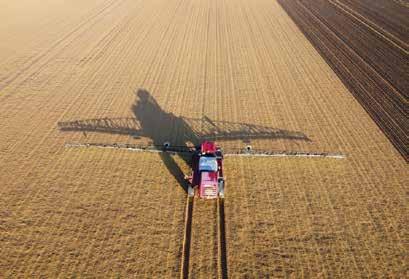
The farm’s investment in advanced spraying technology reflects that reality. Cameraguided systems capable of detecting weeds within growing crops are helping improve accuracy while reducing chemical use.
“We’ll continue to get more targeted, use less chemicals and
Precision agriculture is no longer an option. It’s a ‘must have’ for Cally & Co.
make better decisions.”
Seeding and harvesting are still vital to get the job done effectively. The business operates multiple seeders, harvesters, sprayers and support equipment.
“We don’t have huge contract harvesting fleets available to fall back on in Western Australia, so we have to be able to get the crop in and get it off 100% ourselves.
Scale has certainly influenced his machinery strategy over the years, but Mick believes technology has changed the equation.
“Our equipment is all aligned around a tramline systems designed to improve paddock soil compaction, less crop damage and reliable trafficability across the farming operation.”
“It’s possible to still plant with an older seeder and harvest with an older harvester if you wanted to. The biggest gains today are often in the technology that sits around those machines.”
Importantly, Mick sees technology not as a replacement for people, but as a way of helping good people become more effective. Alongside people and technology, Mick places enormous value on seeking advice and learning from others.
No matter how much experience a farmer accumulates, he believes good business decisions are rarely made in isolation.
“We work very closely with our agronomists.”
The business relies on a combination of independent agronomic advice, chemical specialists and grain marketing expertise to help shape decisions throughout the season.
One agronomist assists with crop planning and rotations almost immediately after harvest, helping establish strategies for the following season. Others contribute specialist knowledge around chemical programmes, weed control and market opportunities.
“They’ve got valuable knowledge and experience. It’s essential to listen to their advice.”
That collaborative approach extends beyond agronomy. Grain marketing advisers, industry groups and fellow growers all contribute insights that help strengthen decision-making.
For Mick, farming increasingly requires balancing practical experience with external expertise and technology-driven information.
“It’s about bringing all those pieces together.”
That philosophy also underpins his view of sustainability. For Mick, sustainability isn’t just environmental, it’s a balance of financial strength, environmental care and community wellbeing. When farm businesses are financially secure, he says, the community thrives too. But in today’s climate, that stability is far more variable.
Environmentally, he points to no-till farming as one of the most significant improvements adopted during his career. Reduced soil disturbance, improved moisture retention and
lower erosion risk and reduced fuel use have all contributed to healthier farming systems. Mick believes the best tool enhancing and supporting this is the use of glyphosate.
“If an environmentalist studied how glyphosate works, and how it actually saves the environment, in fuel and erosion and improves crop growing efficiency, the most sceptical scientist or expert would stand up and support the use of this vital safe chemical.”
“Precision agriculture technologies are helping reduce waste and improve input efficiency. Variable Rate Control (VRC) is an incredible asset to our business.”
“We’re becoming much more targeted in what we do in the current tighter times. Tools such as VRC and deep ripping can be the difference between profit or loss.”
One area where long-term thinking has delivered particularly strong results is soil improvement.
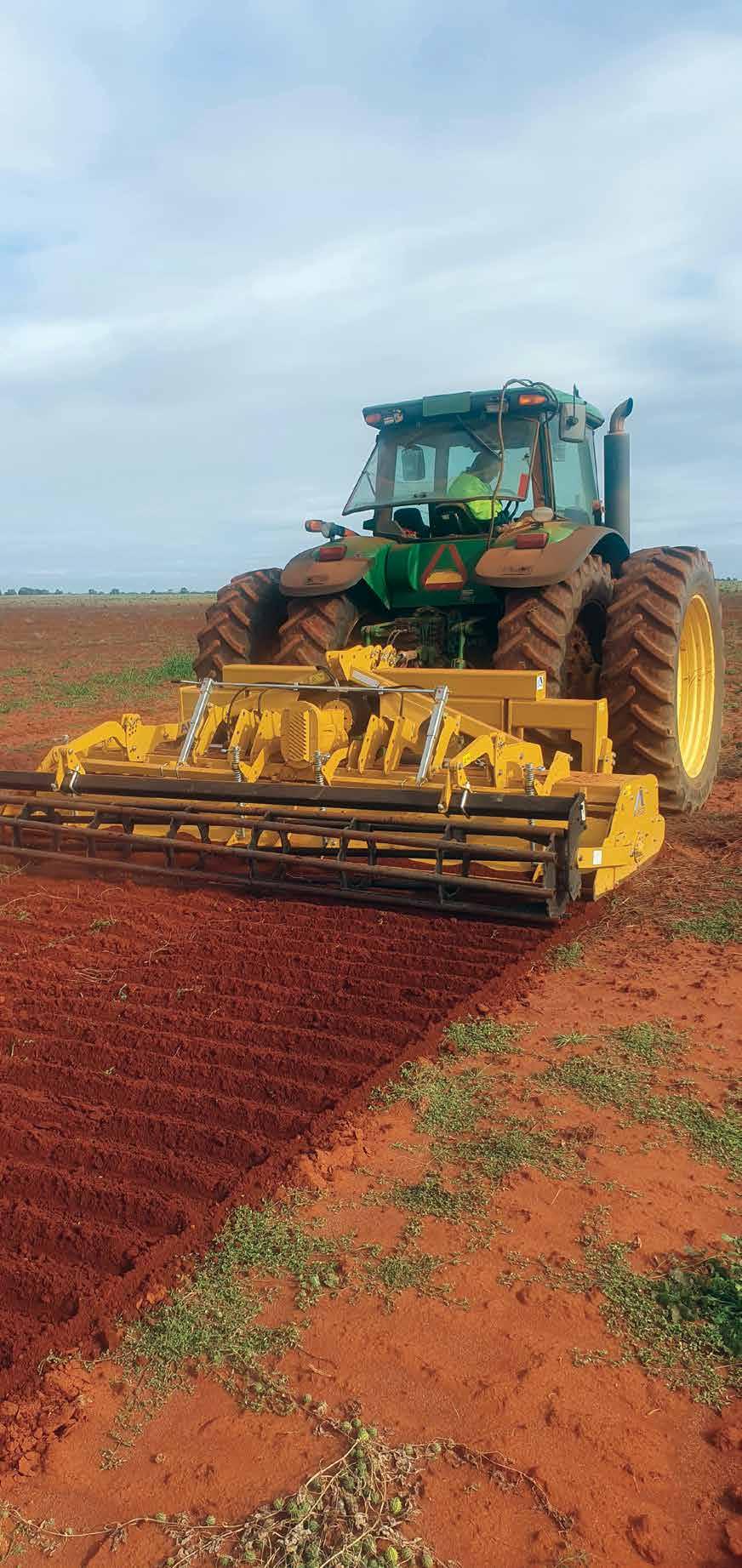
Mick’s interest in deep ripping began more than 25 years ago when he purchased his first machine.
“The yield benefits were enormous.”
However, as his understanding of soil structure evolved, he began looking for equipment that could do more than simply break compacted layers beneath the surface.
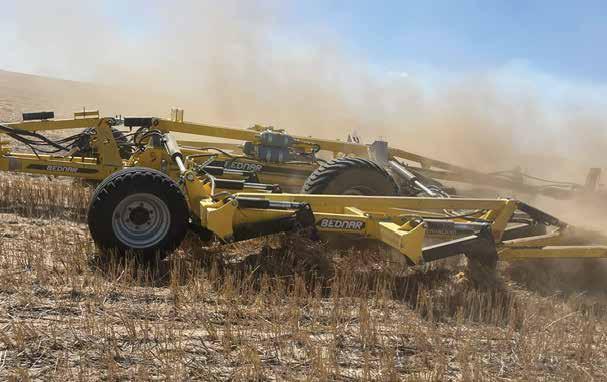
That search eventually led him to the Bednar Terraland.
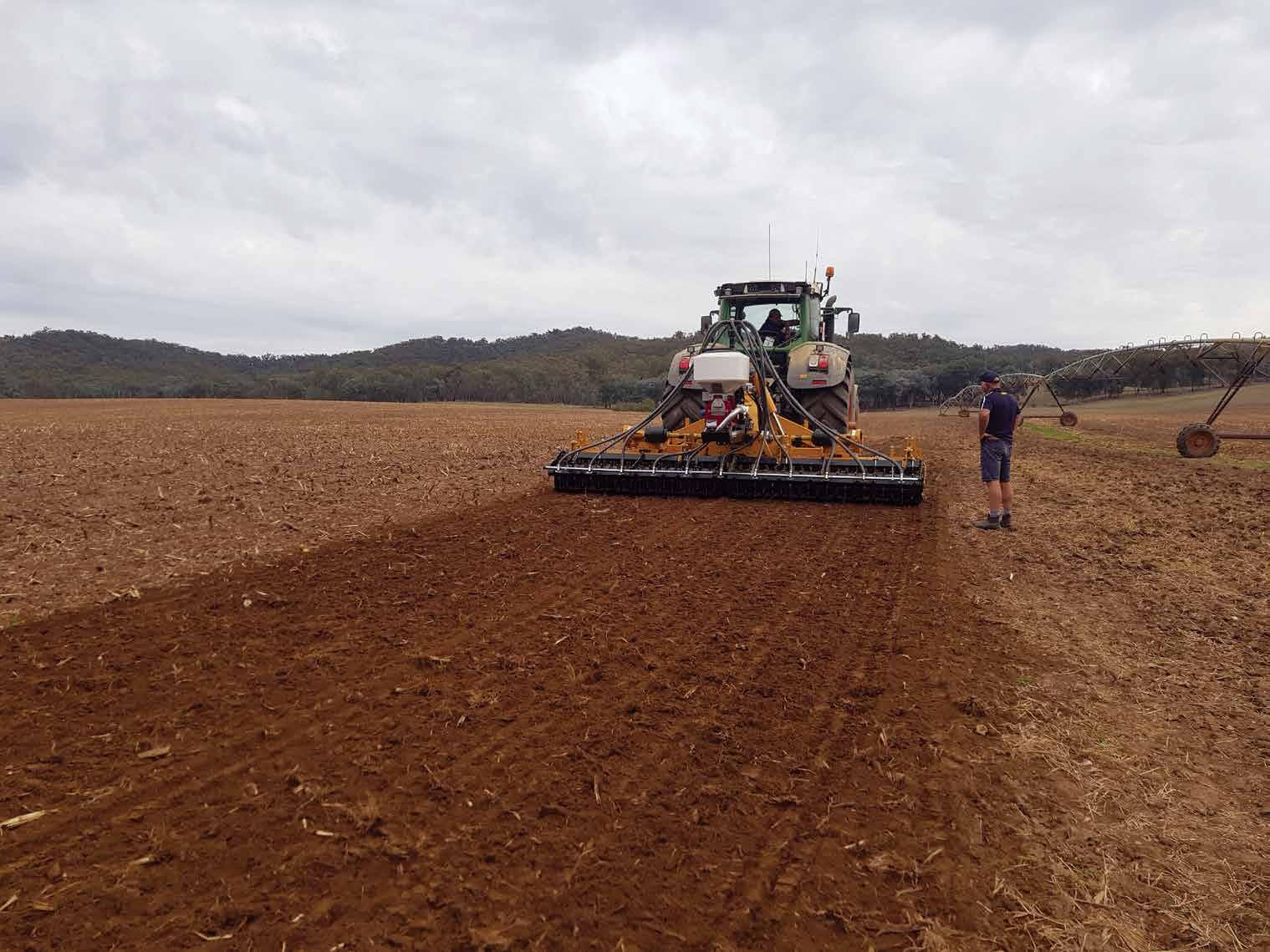
Purchased in 2017, the machine has become an important component of Cally & Co’s soil amelioration programme. Operating deep around 500 mm while simultaneously mixing the upper soil profile, the Terraland allows the business to improve root access, redistribute nutrients and incorporate amendments such as lime more effectively.
“I saw some of the work the Bednar was doing and thought it did the job better.”
One of the key benefits is its ability to mix soil layers while shattering compacted subsoil, helping crops access moisture and nutrients more efficiently. It operates at a depth of about 500-600 mm, brings up clays to the surface and but simultaneously mixes the clay and any lumps in the top ten cenimetres.
“A big benefit is the fact that Lime needs to be lower in the soil profile to be effective, and the Terraland helps achieve that.
“The primary aim is still to free up the subsoil, but the mixing action gives us a lot of extra benefits.”
Timing again plays a critical role. Deep ripping is generally carried out after summer rainfall events when soil moisture levels are suitable.
“We don’t want to dry rip. We want moisture there so we get the full benefit.
“The results have been colossal and difficult to ignore.”
In one lupin paddock, ripped ground delivered an additional 1.82 t/ha compared to untreated areas. More broadly, Mick believes a tonne-per-hectare yield response over a four-year cycle is achievable on most soil types for all crops.
Beyond yield gains, he has observed improvements in water-use efficiency, root development, nutrient access and overall soil structure.
“The ability for crops to hang on during tougher conditions is incredible.”
Despite rising fuel costs, he remains convinced the economics continue to stack up.
“Diesel is expensive, but the return is still there.”
For Mick, the Terraland is another example of investing in long-term productivity rather than short-term savings.
Looking ahead, he sees a future where technology will continue to reshape agriculture at an accelerating pace. Autonomous machinery, swarm bot spraying, drones, advanced imagery and increasingly precise application systems will all feature in the future.
“There are growers north of us already running autonomous systems with swarm bot spraying. Drones in my view will probably take over many farming activities.”
He believes future technologies will help farmers become even more efficient, particularly as labour availability becomes increasingly constrained.
“We’ll use fewer chemicals, be more targeted and make better decisions.”
Yet despite the excitement surrounding emerging technologies, Mick remains convinced that the fundamentals will endure.
“Farmers need to understand their soils, know their seasons and make good decisions when conditions change. Technology will provide more information, but timing, judgement and experience will remain irreplaceable”.
Looking across the business today, from connected machinery and precision agriculture tools through to strategic soil improvement and succession planning, continuous improvement is the aim of this business.
Whether it’s adopting new technology, improving soil health, investing in people or refining business decisions, Mick believes there is always a better way.
And after more than three decades at the helm, he still approaches farming with the same mindset that has guided the business through generations of change.
“Knowing your farm and your land will always be important. But if technology can help us farm better, we’ll keep looking at it.
“Farming is never easy, not now or ever in the past, we hope to at least have the option to stay in the game”
For a business that has mostly adapted to progress and moved in a cautious manner, hopefully the improved basics continue.
on-farm nitrogen – it’s electrifying
Victoria dairy farmer
Ash Gristede is one of a number of farmers who have been using a new source of nitrogen fertiliser produced on farm by a Green Lightning machine.
Scramble for urea
When the war in Iran kicked off in late February it disrupted shipping and oil supplies through the Strait of Hormuz. This sent a shock around the world but disproportionally affected agricultural production and costs in India, south east Asia, Australia and New Zealand.
Australia imports $1 billion worth of nitrogen fertiliser annually with 60% of the urea imports coming from the Persian Gulf through the Hormuz maritime choke point. Half of diesel imports come from processed crude oil, also from the Persian Gulf.
The shortage of urea initially saw some cropping farmers move away from winter wheat and barley and planting up nitrogen-fixing legumes instead, or forgoing a winter crop entirely, waiting to see if high
The calving shed may soon be replaced with a composting shelter that would see composted bedding used as fertiliser around the farm.
fertiliser prices settled.
Efforts by the federal government through the newly setup $7.5-billion Fuel and Fertiliser Security Facility (FFSF) to handle the crisis has seen around nine urea cargoes totalling 340,000 tonnes of agricultural grade urea secured, including from Brunei.
While this has helped in the short turn, a narrow funnelling of secured product through just a few importers has upset the remaining fertiliser importers, potentially putting the viability of some in doubt.
Around 1.4 million tonnes of
The recently installed Green Lightning machines are able to produce nitrates onfarm by using electricity to pull nitrogen out of the air.
urea have come through the border since the start of the conflict, with border processes streamlined to get fertiliser to farmers quicker.
Pulling nitrogen out of the air
Not all farmers rely on urea, and they are looking at the ongoing crisis from the sidelines with both
Ash and Michelle Gristede are looking at ways to make their operation more self-sufficient and easier on the land.
sympathy and relief.
While he acknowledges should the diesel supply for farm machinery dry up “we’re all buggered”, Ash Gristede says
“We were one of the early ones to say we’ll give it a crack,” he says of the two Thunder 365 Green Lightning (GL) machines installed on his farm. “It was a fair bit of money to put out – $130k initially for each machine.”
The two GL machines Ash and Michelle have been operating on their dairy farm near Port Campbell in South West Victoria for nearly a year are the smallest
Made in the United States, the GL machines use new plasma technology and have only been in production for a few years. They are now available in around 20 countries.
The new technology sees the machine able to use electricity to simulate a natural process which sees nitrates produced when lightning lets loose in the atmosphere.
Cutting and bailing: Additional feed is a necessity to cope with poor pasture persistence over the long hot summers.
a nitrate – a natural fertiliser. Being able to produce nitrogen in this liquid form from air and electricity on farm, has several benefits over applying solid urea
a “spoon feeding” tool through foliar applications rather than a bulk one-off.
(Dannevirke) Ltd, a New Zealand company.
Ash has also made use of one of the other benefits of the liquid. With low pH and high dissolved oxygen, it is an efficient carrier for other foliar products.
“They always say put a bit of urea in your Round-up as the plant will uptake better – for better weed control,” he says.
They have used this technique of feeding the plants when spraying for grass and weed control in their 16 ha of silage maize this year.
“We put nearly 300 litres of green lightning per hectare, including the weed/grass chemicals we were putting out, and it had a really good weed kill,” he says.
Coastal
farming on clay
The rugged coastline around Port Campbell is sometimes referred to as the ‘shipwreck coast’ for the high number of ships that met their end along it during the 1800s.
Ash’s family owns or leases land all around the area.
On the Great Ocean Road that runs for 240 km from Torquay, west of Melbourne to Allansford, the seaside village of Port Campbell was a backwater when he was growing up.
“It used to be a quiet little seaside village with four or five cray boat fishermen, maybe an abalone fisherman, and not a whole lot else – a few locals and retirees.”
soil long term, and the possibility of being washed away into waterways.
Coming directly out of the air, the nitrogen is also basically saltless, which means it can safely be applied as a foliar spray, even at high concentrations, and won’t burn foliage. The lack of salt also means it has much less impact on soil microbes than urea.
Independent corn/maize trials by big seed supplier Becks in the United States showed the best use case for Green Lightning liquid fertiliser is as a replacement for between 25%–55% of urea, and used as
Becks found its ROI comes from lower input costs rather than increased production, with a payback period of between 1 to 3 years.
Ash backs this up with one of his machines paying for itself already – in a year.
While Ash put out a pasture booster blend in autumn last year, the rest of the year he has been putting 100 to 200 L a hectare of straight GL, every time they graze – every 30 to 40 days through the winter.
He recommends 200 L of GL for every 100 kg of urea he would previously have used.
This goes out using a Tow and Fert sprayer which is designed and manufactured by Metalform
Solar and lightning a winning duo
On farm, the two GL machines are set up in a shipping container with room for another one. They draw water from a water tank outside with the liquid product coming from each machine then pumped into its own sealed water tank.
Good quality water is essential for the process. Rainwater is ideal, with good quality bore water a handy option.
While it looked clean, Ash only used the on-farm dam water for a few months, as the suspended clay and silt in it saw him going through $1200 worth of filters to get it up to standard.
He then changed to buying in town supply bore water from Port Campbell.
At $150 a tanker load, it’s much cheaper than filters, he reckons.
They plan on getting a 250,000L rain water tank installed in the next couple of years.
The machines each use 1.1 kWh of electricity a day to operate.
Ash reckons this would see 1,000 L of nitrogen product costing around $50 to $60, although his 80 kWh on-farm solar panel setup and battery for the dairy easily covers the power needed.
“You need to put it on at 200 litres a hectare,” he says. “But even if you need to put it out at 400 litres a hectare, you get the same result as 100 kg of urea. At the end of the day, the actual power to run it is bugger all compared to buying urea, especially at current prices.”
But its close proximity to the Twelve Apostles limestone formations has seen it become a popular tourist destination in recent years.
The landscape can be fairly rough and rugged to farm, Ash says, and sees an average rainfall of around 850 mm annually.
And while people assume the land must be fairly sandy being so close to the sea, there are only about four to six inches of topsoil over clay, which sees drainage headaches in winter. Mole draining has been done in places and this continues as finances allow.
Because pugging can be such an issue, some farmers in the area are now turning to composting shelters/barns similar to those being seen more often in areas like Southland in New Zealand, which has similar soil and winter pugging issues.
Concerns about getting enough wood chip with so many composting shelters going up in the area saw Ash and Michelle build a calving shed about five years ago that uses wheat or barley straw as bedding.
But weighing up the time and expense of resowing pastures, Ash is now considering investing in a composting shelter/barn.
This has seen him looking into compost materials that could potentially be grown on the property, including planting trees specifically for chipping, and miscanthus – a tall grass which can be regularly cut and doubles as a shelter belt.
The material in the shelters/ barns that has composted
With year round milking, new calves turn up every few months.
From 80 cows in his youth Ash is now milking 750 cows annually.
during its use as bedding, is rich in nutrients from urine and dung and can then be used on the farm as fertiliser. As urine is absorbed into the bedding, nitrates from it also can’t leach into waterways/groundwater during use.
This ties into Ash’s desire to lean into some regenerative practices – to be more resilient, easier on the land, and take better care of waterways, particularly after now seeing issues with algal blooms in his childhood river haunts.
During the long hot summers, the soil doesn’t retain moisture well and the rye grass-based pasture often dies off. This is seeing them moving more into cocksfoot and clover pasture.
“You can replace just about everything in the [cow’s] diet, but you still need, ideally, a couple of kilos of grass,” he says. “Which we quite often don’t have.”
This sees them rely heavily on maize, silage and some vetch to provide the high energy feed the cows need to keep producing high volumes of milk.
Ash has introduced the Halter collar system on farm, which has now been in use with the herd since mid-March.
And while he’s still getting the last of the gateways around the farm on the map, it’s already seen a marked improvement on efficiency, and their lifestyle, he says.
“We’re finding we’re saving
a lot of time moving cows back and forth up the paddock.”
Dividing the herd in two for milking by using a feed pad next to the dairy shed as a holding pen, Ash now no longer needs to stay at the dairy until 8.30 pm to push the second mob of cows off the feed pad after milking.
Beginnings
Ash grew up on his parents’ sheep and beef farm not far from the current dairy farm. At just 13, he and his older brother, Richard, began milking for a family friend who was more like a grandfather to them.
It was a small farm with 80 cows and an old walk-through dairy. Well into his sixties, the owner had been struggling to keep up with the farm work and was thinking of selling. Three years later, Ash left school and began share farming there, starting with a quarter share.
By the time he was 22, he had bought the farm, with the help of his parents.
Also a local, his wife Michelle grew up on a dairy farm nearby. Despite being adamant she was never going to marry a dairy farmer, they have been together since they were teenagers –over 30 years – and have three children together. Michelle began working on the farm even before they were married.
The dilapidated old walkthrough shed gave way, first to a 15 swing-over
herringbone then, as the herd increased to 360 cows, to a 30 swing-over herringbone.
Leasing and buying land around them over the years now sees them with a milking platform of around 450 ha with a 60-head rotary rotary dairy and 750 cows.
While 25-year-old daughter Shelby is off working as a chiropractor, and Bobby (21) is finishing a diesel mechanics apprenticeship, their eldest son Mitchell, at 26, is now back working on the farm after doing a cabinet making apprenticeship. He also does some baleage contracting on the side, with Ash often roped in to drive the wrapper.
Looking to the future
While an alternative source of fertiliser is working well for Ash during the Iran war crisis, reductions or a move away from urea entirely has long-term benefits for the industry, he says, with less reliance on one of agriculture’s most extensively used inputs.
Urea has shortcomings as a fertiliser, including its carbon footprint, and the war in Iran has shown how vulnerable the supply chain around it can be, he says.
With nitrogen caps coming into Europe and other places like New Zealand, it’s time to look seriously at alternatives, he reckons.
Mitch and fiancee Maddie, with kids Charlie and Willow, are now ensconced in the farming operation including using the Tow and Fert sprayer for the Green Lightning fertiliser.
“If we can cut out urea completely and produce our own nitrogen on farm, it’s a massive cost saving for one thing, but it’s also a massive environmental plus, because it uses a hell of a lot of energy to make urea granules in the first place.
“And then we don’t need to cart them, we don’t need to spread them, we just need to add this stuff [GL] to the sprayer and do that,” he says.
“If practices like using the Green Lightning machine break the nitrogen cycle open and we don’t need as much of it, well bloody great. Not for the fertiliser companies, but I’m pretty sure everyone else will be happy.”
Ash’s concerns are shared by the Australian Grains Research and Development Corp. They have started a $115-million, 10 year ‘Nitrogen Mission’ calling on international researchers to join them to look at nitrogen options, including onfarm production. Available in Australia for just a Green Lightning machines are available in Australia through Plasma Strike – Ag Solutions.
what’s new in...
Hay- and silage-making equipment
To make top quality hay and silage you need top quality gear. Here is our survey of the latest mowers, rakes, balers, silage wagons, windrowers and forage harvesters that are available to Australian farmers and contractors in 2026.
New Holland
New Holland BigBaler 1290 HD
New Holland’s BigBaler 1290 High Density is designed to deliver higher bale densities and more tonnes per hour for contractors managing tight weather windows and increasing workloads.
The BigBaler 1290 High Density combines high-density baling capability with the Loop Master knotter system and SmartShift two-speed gearbox, aimed at maintaining consistent performance across large-scale contracting operations.
A key feature is the Loop Master knotter system, which improves tying consistency and eliminates twine offcuts, supporting reliable operation during peak conditions when every bale counts.
The drivetrain is built around New Holland’s SmartShift two-speed gearbox, designed
to deliver smoother start-up and less wear and tear on the machine.
The baler also incorporates hydraulic active suspension, allowing the baler to be lifted and lowered for servicing.
The BigBaler 1290 HD is typically paired with highhorsepower tractors, such as the New Holland T7 HD and T8 range, delivering a matched combination designed to handle high-output applications.
CNH Product Manager Hay & Forage, Sune Nielsen, said the New Holland tractor and baler combination unlocked additional technology benefits for operators.
“FieldOps gives operators clear, visible baling data on their phone or PC, including bale weight, moisture, location and a range of other baler outputs,” Nielsen said.
“Advanced filters let users
set ranges; for example, highmoisture bales can be flagged on the field map, showing exactly where they were made.
“The 1290 HD is also about reducing running costs as much as increasing output.
That’s why we designed this baler to provide higher bale counts with low cost of ownership.”
Central West New South Wales contractor Brian Schofield introduced the BigBaler 1290 HD to increase capacity without adding another machine, achieving high output bales per hour, with peaks into the 80s and 90s during favourable conditions.
“I was either going to have to run two balers, or go into one big HD,” Schofield said.
“I reckon we’re at the equivalent of about one-anda-half balers now, and we’re doing it with one tractor and one driver.”
A
forage system that protects the crop
Practical, grounded, for operators who care about reliability, forage quality and efficiency.
Pöttinger has built its reputation by delivering forage equipment that protects crop quality while standing up to the demands of modern farming.
Conditions across Australia can swing from lush spring growth to dry, abrasive summer feed, and Pöttinger’s Grassland range of mowers, tedders, rakes, loader wagons, balers and mergers are designed to help farmers and contractors produce consistent, high quality forage with less downtime, lower losses and more control throughout the harvest window.
Mowers: Clean cutting, clean forage
Because a good forage system starts with the mower, Pöttinger’s range is built around clean-cutting performance and effective suspension systems coupled to robust driveline engineering. Whether operators prefer front mounted, rear mounted or trailed configurations, the focus is the same: a precise, even cut that preserves regrowth and minimises soil damage.
Pöttinger’s cutter bar technology is engineered for durability, with smooth-running gears and low-profile designs that improve crop flow with suspension systems designed to follow the ground closely. For contractors working long days across varied terrain, the combination of reliability and clean cutting translates directly into better forage quality and faster regrowth for customers.
Tedders: Fast, even drying
Once the crop is on the ground, drying time becomes the next critical factor. Pöttinger’s tedder range is built to spread forage evenly, fluffing and aerating the swath to accelerate the drying process. The tine geometry and rotor design work together to lift the crop gently, which is vital for crops such as lucerne and highvalue pasture mixes.
The machines are engineered for stability in all conditions, allowing operators to cover more hectares per hour without compromising the quality of the spread. Adjustable spreading angles give flexibility in different crop conditions, and the driveline components are built for long service life, even under heavy contractor workloads.
Rakes: Clean swaths, minimal contamination
A well-formed swath is essential for efficient baling or wagon loading. Pöttinger’s rakes gather the crop cleanly while keeping soil, stones and debris out of the forage. The tine arms and rotor systems are engineered to lift the crop gently and place it into a uniform, airy swath that feeds smoothly into the next machine in the chain.
Whether using single-rotor, twin-rotor or larger centredelivery systems, operators benefit from excellent ground tracking and adjustable working widths. The result is a cleaner crop, reduced wear on balers and loader wagons, and improved bale density or wagon fill.
Loader wagons: Efficiency and versatility
Loader wagons have become a cornerstone of Pöttinger’s global reputation, and for good reason. They offer a highly efficient way to harvest, chop and transport forage in a single pass. For farmers and contractors looking to reduce labour and machinery costs, loader wagons can replace multiple machines while still delivering consistent chop quality.
Pöttinger’s wagons are known for their robust pickup systems, precise chopping units and intelligent load management. The pickup is designed to follow the ground closely, reducing losses and ensuring a clean lift. The chopping system delivers a uniform cut length that packs well in the stack or bunker, improving compaction and fermentation.
With capacities ranging from
smaller farm wagons to highvolume contractor machines, the range offers solutions for operations of all sizes. The emphasis on durability, ease of maintenance and operatorfriendly controls makes these wagons a reliable backbone of many forage systems.
Balers: Consistency and control
Pöttinger’s baler range focuses on producing dense, uniform bales that store well and maintain feed quality. The machines are engineered for smooth crop flow, reliable net or film systems and strong bale formation. Whether operators are producing silage, hay or straw, the goal is the same: consistent bales that stack well, transport easily and retain their nutritional value.
The pickup and rotor systems are designed to handle varying crop conditions, from heavy silage windrows to lighter hay. Adjustable settings allow operators to fine-tune bale density and core formation, giving flexibility across different forage types and moisture levels.
Mergers: Gentle handling for premium forage
For operations focused on high-quality silage or haylage, mergers offer a gentle alternative to traditional raking. Pöttinger’s Mergento merger lifts the crop onto a conveyor rather than dragging it across the ground, significantly reducing ash content and preserving leaf material.
This approach is especially valuable for dairy and beef operations targeting premium feed quality. By reducing contamination and maintaining crop structure, mergers help deliver a cleaner, more digestible forage that supports better animal performance.
A system designed for forage quality
What ties Pöttinger’s Grassland range together is a consistent focus on forage quality. Every machine – from the first cut to the final bale or wagon load – is engineered to protect the crop, reduce losses and deliver a cleaner, more nutritious feed. For more information, visit www.poettinger.com.au
Raising the bar
Australian contractors and large scale farmers are under more pressure than ever to lift productivity, reduce labour demands and keep operating costs under control. In a landscape shaped by tight harvest windows, rising freight costs and increasing demand for premium forage, machinery choices matter – not just at the baler, but across the entire forage system.
Krone’s latest advancements in mowing, raking, baling and loader wagon technology reflect a clear focus: helping Australian operators move more tonnes per hour, protect crop quality and streamline every stage from cutting to stacking. As a machine that delivers higher density, greater throughout, smarter automation and easier maintenance, the new BiG Pack 1290 HDPII (VC) stands as the flagship of this system.
Smarter, and more efficient
Krone’s approach to forage equipment has always been system driven. Each machine – mower, tedder, rake, baler or loader wagon – plays a role in preserving crop quality and maximising throughput. The latest EasyCut mower range continues this philosophy with a broad selection of front, rear, butterfly and trailed configurations designed to match diverse Australian farming systems.
Two conditioning options support different forage types:
• M Roll steel conditioners for delicate leafy crops like lucerne, preserving nutritional value.
• CV flail conditioners for tougher grasses and silage crops where faster moisture reduction is essential.
From there, Krone’s tedder and rake ranges maintain crop integrity and presentation. The robust tedder lineup – from 4.7 m to 20 m – ensures even, consistent spreading, while the Swadro rake family forms clean, uniform windrows that set the baler up for maximum efficiency. Machines like the six rotor TC2000 deliver the structured, contamination free swaths that
high density balers demand. Together, these stages create the foundation for Krone’s most significant baling advancement yet.
Built for the realities of Australian baling
After extensive global development and rigorous testing in Australian straw and hay conditions, Krone has launched the BiG Pack 1290 HDP II (VC) – a next generation large square baler engineered for operators chasing higher density, higher throughput and lower cost per tonne.
Density that delivers real savings
At the heart of the HDP II is Krone’s proven High Density Press technology. By producing significantly heavier bales than conventional large square balers, operators can:
• Reduce bale numbers per paddock
• Increase truck payloads
• Cut handling and stacking time
• Improve overall logistics efficiency
For contractors and export hay producers, these gains translate directly into improved profitability, especially as freight and labour costs continue to climb.
Proven crop flow
The machine features Krone’s camless EasyFlow Active pickup, now with a hydraulically adjustable crop press roller controlled from the cab. This ensures clean, consistent intake in short, brittle or dry straw – conditions common across Australian harvest regions. In the VC variant, a large 720 mm rotor maintains high throughput and smooth crop flow into the bale chamber, even under variable crop loads.
New VariCut system
A major leap forward is the availability of a 51-knife VariCut system, delivering a theoretical chop length of just 22 mm. Operators can select 26-knife or 51-knife groups depending on crop type, with individually protected knives arranged in
selectable sections for fast, flexible adjustment from the cab.
Uniform bales, intelligent control
Krone’s variable filling system (VFS) – now in its fifth generation – ensures consistently square edged, uniform bales regardless of swath size, moisture or ground speed. The redesigned bale channel uses large hydraulic cylinders and automatic pressure regulation to maintain even density across every 120x90 cm bale.
The result is a premium bale that stacks, transports and stores more efficiently – a critical advantage for contractors and exporters.
Knotting reliability and reduced downtime
The HDP II continues to use Krone’s patented V Knotter system, delivering secure tying under extreme density without leaving twine offcuts in the paddock. The PowerClean air pressure system keeps knotters free of dust and debris, supporting long, uninterrupted baling days.
With 48 twine rolls on board – enough for up to 1,500 bales –operators can maximise output during peak harvest windows.
Smart technology
Krone has integrated a suite of intelligent features to simplify operation and maintenance:
• AutoCheck maintenance system for safe, efficient inspection and diagnostics
• Full ISOBUS compatibility with an updated, intuitive user interface
• Moisture measurement, including Gazeeka integration
• Bale weighing synced with Krone Smart Telematics
• Rear view camera options
• Silage additive application linked to moisture and bale weight
• Krone BaleCollect accumulator for improved logistics
These tools help operators make better decisions in real time, reduce downtime and optimise machine performance across long harvest days.
A complete solution for Australian conditions
From mowing to baling, Krone’s latest innovations reflect a deep understanding of Australian farming challenges: rising costs, labour shortages, tight weather windows and the need for uncompromising reliability.
The new BiG Pack 1290 HDP II (VC) stands as the flagship of this system – a machine that delivers higher density, greater throughput, smarter automation and easier maintenance.
As Michael Murer, Product Manager for Krone Australia, puts it:
“Australian contractors and hay producers are constantly looking for ways to increase productivity while reducing freight, handling and labour costs. The new BiG Pack delivers exactly that.”
With its combination of density, productivity, reliability and intelligent technology, the HDP II sets a new benchmark for professional large square baling and reinforces Krone’s position as a global leader in high density forage solutions.
Krone
McHale
McHale V6 II lands in Australia
For Australian contractors and large scale livestock producers, the arrival of McHale’s new V6-II variable chamber balers marks one of the most significant updates to the company’s baler lineup in years. While the silhouette remains unmistakably McHale, the machines landing in dealerships this season are carrying a level of intelligence, operator control and baling precision that pushes the V6 platform into a new generation.
At the heart of the update is a shift towards smarter baling –machines that don’t just follow operator input, but actively assist, optimise and refine the baling process in real time. McHale has always built balers with a reputation for toughness, but the V6750-II and V8950II now pair that mechanical reliability with a suite of electronic upgrades designed to improve bale quality, reduce operator workload and streamline the entire baling workflow.
ISOBUS:
A major step forward for the V6750-II & V8750-II
A key upgrade for the new V6750-II and V8750-II models is the move to standard ISOBUS compatibility, giving Australian operators a far more integrated and modern baling experience. Every machine destined for Australia is fitted with the ISOBUS 10 terminal, featuring a large 10-inch touchscreen display paired with physical shortcut keys for confident operation in dusty, gloved, real world conditions.
The shift to ISOBUS brings more than just a bigger screen. It streamlines the entire baling workflow – cleaner tractor cabs, faster setup and the flexibility to run the baler directly through the tractor’s own ISOBUS terminal if preferred. For contractors juggling multiple tractors across a season, that level of plug and play compatibility is a genuine productivity boost.
McHale has also incorporated
AUX N functionality, allowing operators to map frequently used functions to the tractor’s ISOBUS joystick. The result is quicker reactions, fewer hand movements and a more ergonomic, less fatiguing workflow during long baling days.
Active density control: Smarter bale formation
A standout addition is the introduction of Active Density Control as standard on the V6750-II and V8950-II. This system electronically varies the density pressure regulation at predetermined points of the baling process, allowing the machine to apply higher loads at the optimal stages of bale formation.
For operators, this means:
• More consistent bale density
• Better bale shape
• Improved storage and transport characteristics
• Reduced risk of core softness or outer-layer slippage
In short, the baler now thinks ahead, adjusting pressure dynamically rather than relying on a fixed setting.
Load cell bale shape indicators: A precision upgrade
Another meaningful improvement is the move from ultrasonic sensors to load cell bale shape indicators. These provide more accurate, more reliable feedback on bale formation, especially in variable crop conditions. These indicators are now fitted to all V6 and V8 machines, ensuring consistent bale shape and reducing the guesswork for
operators chasing perfect bales.
Additive
application: More accuracy, less waste
McHale has clearly recognised the growing use of crop additives in Australian hay and silage systems.
The V6-II machines now include:
• A high-current additive control output
• A PTO speed sensor for more accurate additive application
• A PTO running time counter to avoid additive wastage
These features ensure that additive is applied only when the baler is actively working, reducing cost and improving treatment consistency.
For operators wanting even more precision, an optional Headland Management Kit is available to further refine additive timing during headland turns or crop transitions.
Improved
netting and binding
reliability
Binding reliability has been enhanced with a new moving roller sensor, designed to provide more dependable net application. In a season where every bale counts – and every breakdown hurts – this kind of incremental improvement can make a real difference.
Optional upgrades for modern operations
McHale has also expanded the optional extras list, including:
• Internal panel lighting
• Moisture recording
These options allow operators to tailor the machine to their workflow, whether they’re chasing data, visibility, or enhanced operator comfort.
Future-proofing through electronics
Behind the scenes, McHale has standardised 4–20 mA pressure sensors, improved diagnostics and added dedicated outputs for beacons, lighting and external beepers. The new X90 ISOBUS system has plenty of capacity for future expansion which is not possible with the Expert Plus. This is a clear signal: McHale is building a platform that will evolve.
A new generation for Australian conditions
With refreshed decals, smarter electronics and a suite of operator-focused improvements, the V6-II balers arriving in Australia this year represent a meaningful leap forward. They retain the rugged, no-nonsense build quality McHale is known for, but now deliver the intelligence, automation and precision demanded by modern Australian hay and silage operations.
If the previous V6 series earned its reputation through durability, the new V6-II looks set to build on that legacy with a sharper, smarter, more connected baling experience – one that meets the realities of today’s contracting environment and the expectations of tomorrow’s operators.
Kvernland
Kverneland
4300 series: Trailed mower conditioners built for modern forage systems
In a market where speed, crop quality and reliability dictate the success of every silage season, the Kverneland 4300 Series trailed disc mower
conditioners arrive with a clear purpose: deliver high output, withstand tough conditions, and give operators the flexibility to adapt to whatever the weather throws at them. With working widths from 3.2 m to 4.7 m, and a choice of SemiSwing steel tine conditioning or roller conditioning in steel or rubber, the 4300 Series is engineered to suit the full spectrum of Australian forage operations.
From the cutterbar to the conditioner to the suspension system, the 4300 Series is built around one idea: maximum productivity with minimum complication.
Built for every operation
The Kverneland 4300 lineup covers the key working widths demanded by contractors and large-scale livestock producers:
• 3.2-m, 3.6-m, 4.0-m, and 4.7-m models (in some markets, depending on configuration)
Across these widths, operators can choose between:
• Chevron roller conditioner (steel or rubber) – gentle, controlled conditioning for legumes and leafy crops
This flexibility allows operators to match the machine precisely to their forage system, crop type and drying strategy.
A cutterbar designed for hard work
Kverneland’s cutterbar is the foundation of the 4300 Series, and it’s built with durability and performance in mind. The cutterbar is fully welded with no risk of oil leakage and features round discs, which are less susceptible to stone impacts.
Key advantages include:
• Round discs that immediately expel stones, reducing shock loads
• Twisted knives for a clean, aggressive cut
• High oil capacity for cooling and lubrication
• Low noise gear wheels with a unique rounded profile
• ProFit quick-change knives for fast maintenance in the field
This is a cutterbar designed to stay sharp, stay cool and stay running – even in rough Australian paddocks.
SemiSwing steel tine conditioner
For grass crops, the SemiSwing system is a standout. The tines stay in a fixed position, allowing for an aggressive conditioning effect, while still being able to pivot backwards when encountering obstacles.
Benefits include:
• Full-width aggressive conditioning
• Minimal wear due to restricted tine movement
• Ability to pass obstacles up to 103 mm
• Reduced blockages thanks to efficient crop flow
This is the conditioner for operators who want fast wilting and high throughput.
Roller conditioning – steel or rubber
For delicate crops like lucerne, clover, or leafy blends, roller conditioning is essential.
Kverneland offers steel or rubber chevron rollers, both designed to crack stems while preserving leaf integrity. The rollers are vulcanised onto a steel core, guaranteeing straight rollers that will not twist out of shape.
Key features:
• 225-mm diameter rollers
• Chevron pattern for positive crop feed
• Full-width conditioning for even drying
• Non-stop roller separation allowing obstacles up to 60 mm to pass
• Adjustable conditioning pressure
This system delivers gentle handling without compromising drying speed.
SuperFloat suspension:
Ground following at its best
One of the defining features of the 4300 Series is the SuperFloat dual-action suspension system. The cutterbar and conditioner are suspended independently, allowing the machine to contour the ground with precision. The system only creates approximately 40–50 kg on each side of ground pressure, dramatically reducing skid wear and protecting stubble.
SuperFloat benefits:
• 50-cm upward and 15-cm downward movement
• Independent cutterbar suspension
• Consistent cutting height
• Reduced shock loads on the frame
This is especially valuable in undulating or stony paddocks.
The centre pivot advantage: Built for Australian paddocks
The 4300 Series is offered in a centre pivot configuration (CT/CR), which is the preferred setup for Australian contractors and farmers. With the cutterbar able to work on either side of the tractor, centre pivot mowers deliver smoother, more efficient
paddock flow and eliminate the awkward, time consuming manoeuvres often required with fixed side machines.
Being able to swing the mower left or right means operators can work their way across a field in a continuous pattern, reducing tight turns, minimising missed strips and improving overall output per hour. This layout also enhances wildlife escape opportunities by allowing a more predictable mowing path from the centre outward.
For large Australian paddocks, irregular field shapes and long working days, the centre pivot design simply makes the job faster, cleaner and easier –exactly what contractors need when every minute counts.
FlipOver wide spreading and BX AutoSwather belt
Kverneland understands that drying time is everything. That’s why the 4300 Series can be equipped with:
FlipOver
wide spreading
• Spreads crop across the full working width
• Reduces the need for tedding
• Simple, tool-free changeover from swath to spread.
BX AutoSwather belt
• Places two swaths into one
• Adjustable belt speed
• Hydraulically raised/lowered from the cab
• Ideal for matching large baler or forager pickup widths
The belt is mounted independently of the cutterbar, ensuring perfect and even swath formation.
Built for contractors and large farms
With its combination of robust construction, intelligent conditioning options and operator-friendly features, the Kverneland 4300 Series is built for serious work. Whether the goal is fast wilting, gentle handling, or high-capacity swathing, the range offers a configuration to suit every forage system.
From 3.2 m to 4.7 m, from steel tines to rubber rollers, from wide spreading to belt swathing – the 4300 Series gives Australian operators the tools to produce high-quality forage efficiently, reliably and with confidence.
Protecting silage quality in challenging conditions
Practical steps for better performance and profitability by
David Lewis, Lallemand Animal Nutrition
Variable seasons continue to test silage production systems, and one issue is becoming increasingly common – soil contamination and inconsistent fermentation. While often overlooked, these factors can significantly reduce silage quality, impacting intake, animal performance and, ultimately, farm profitability.
Why silage quality is under pressure
Soil contamination is more than a visual issue; it introduces harmful microbes, particularly clostridia, which thrive in wet, low-oxygen conditions. These bacteria break down valuable proteins into ammonia and biogenic amines, raising silage pH, reducing palatability and lowering feed intake. The result is silage that not only smells and looks poor, but actively limits animal performance, increasing reliance on purchased feeds to fill nutritional gaps.
This risk is amplified by several common field conditions:
• Wet or low dry matter crops
• Fields with recent manure or fertiliser application
• Poor harvesting conditions, including low cutting height and soil pickup
Modern fertiliser strategies, particularly increased use of manure and nitrogen inputs, can further complicate matters. Elevated nutrient loads tend to increase nitrate levels and buffering capacity, slowing fermentation and introducing higher clostridial and enterobacterial loads. Even small increases in soil contamination, reflected in ash content, can significantly disrupt fermentation and increase dry matter losses.
The importance of controlled fermentation
At the core of good silage is fast, efficient fermentation. The goal is straightforward: rapidly drop pH through lactic acid production to stabilise the forage
and preserve nutrients. When this process is delayed, proteins break down into ammonia, sugars are lost reducing energy value, and yeasts and moulds multiply, causing heating, spoilage and composting losses. Using a proven silage inoculant helps control this process. Selected lactic acid bacteria drive a rapid pH decline; suppress undesirable microbes, such as clostridia and enterobacteria; improve nutrient retention; and reduce aerobic stability losses at feed-out.
Different challenges call for different solutions within the Magniva range:
• Magniva Classic supports fermentation in wetter, lowersugar crops with added enzyme activity.
• Magniva Platinum builds on Classic’s benefits and improves aerobic stability, particularly in drier silage prone to heating and spoilage, and in any crop at elevated risk of contamination.
Baled silage: High risk, often underestimated
Baled silage is often assumed to be lower risk, but in reality it presents unique challenges. Each bale functions as a mini silo with its own fermentation environment – a relatively large surface area exposed to oxygen, typically made at drier moisture levels and with lower density than bulk silage, meaning more air space throughout. Without inoculation, fermentation relies entirely on naturally occurring microbes, leading to inconsistent results and greater variability between bales.
Applying a Magniva inoculant standardises the fermentation process, improves aerobic stability at the outer layer and ensures more consistent feed quality across the whole stack.
Using silage analysis to drive decisions
Silage analysis remains one of the most powerful tools available to evaluate performance and identify problems before they affect the herd. Key parameters to monitor include:
• Dry Matter (DM): Too low increases clostridial risk; too
high reduces compaction
• pH: Target below 4.5 for grass silage as an indicator of preservation efficiency
• Ammonia-N: Reflects the degree of protein breakdown during fermentation
• Ash: A reliable indicator of soil contamination levels
• ME and D-value: Measure available energy and digestibility
• Fibre (NDF/NDFd): Influences intake potential and rumen health
Matching the right inoculant to the specific weaknesses identified in analysis allows producers to address fermentation challenges directly, rather than applying a one-sizefits-all approach.
The payoff: Better feed, lower costs
High-quality silage delivers real and measurable economic value. Well-preserved forage improves dry matter intake and animal performance, supplies more energy and protein from home-grown feed and reduces reliance on expensive purchased supplements.
Trials consistently show that silage treated with Magniva forage inoculants achieves higher energy (ME) and protein
content, improved digestibility and reduced dry matter losses. In today’s high-cost feed environment, this translates into a strong return on investment.
Practical take-home messages
To consistently produce high-quality silage, focus on the fundamentals:
• Minimise soil contamination
– cut higher and keep bunkers clean
• Target optimal dry matter through proper wilting management
• Manage fertiliser and manure applications carefully to reduce fermentation load
• Ensure rapid, controlled fermentation with the right strain-specific inoculant for your crop type and conditions
Making good silage is no longer just about harvesting a quality crop. It is about preserving it efficiently under increasingly challenging conditions. By combining strong management practices with challengespecific solutions, producers can protect valuable nutrients, reduce spoilage and variability, improve animal performance and maximise profitability. Better silage is not just better feed – it is a better business outcome.
Lallemand
Fifth generation dairy farmers make history
Daryl Fleming chuckles as he acknowledges that locals have christened the district around his family’s Willung farm, ‘Flemingville’.
Daryl’s Irish great-grandfather and his English wife originally settled the farm near Traralgon around 1910, and their nine children and descendants proceeded to buy adjoining farmland throughout the valley.
These days, Daryl, his wife Emma, and two of his three sons, Lachie and Ethan, are the fourth and fifth generations of the family operating a 486 ha dairy, hay and contracting business, milking 375 cows twice a day.
“We’re very proud to be the fifth generation of Flemings in the district. We feel it’s an honour to continue the work of the families before us,” Dary said.
“These days we all have designated roles – Lachlan is in charge of fodder and silage production, the making, carting and feeding of it on farm, and Emma, Ethan and I handle the day-to-day running of the herd, and we have beef country too. It all works well.”
John Deere the first word in tractors
It’s not surprising that a fleet of John Deere machinery is integral to the smooth running of the Flemings’ business, especially since Lachie’s first word as a
toddler was not ‘Mum’ or ‘Dad’, but “tractor”.
“Lachie was tractor-mad from an early age, and every time we considered making a purchase at the John Deere dealership, he was more excited about the free toys than the new machine!”
Daryl said.
These days it’s definitely all about the machines and new technology for Lachie, aged 22.
“We run a range of John Deere 6M Series tractors and Combi balers and for us, the choice was easy, because these machines are reliable, tough and fuelefficient workhorses,” Daryl said.
“There’s never a day when we don’t have to feed cows, so it’s nice to be able to jump in a tractor and know it’s going to run reliably.
“It’s very important that we get crops in on time too, so the machines have to run at 110% every day. The John Deere tech ecosystem is all integrated and easy for operators to use, and the Operations Center™ remote display means that anyone can jump in at any stage and go.
“Most days we’re in a tractor for eight hours-plus. The cab is essentially our office, and being comfortable is key.”
Precision ag technology critical to reducing input costs
Lachie Fleming sees precision ag technology like John Deere’s AutoTrac™ and Operations
Center as critical to the business of dairy farming, to monitor and control rising input costs such as fuel.
“My advice to anyone considering Operations Center is to definitely check it out – it’s truly something that needs to be seen to be believed,” Lachie said.
“Fuel efficiency is a major factor for us, and we use Operations Center to assess how much fuel is used in transport, work or idle times. From there, it’s easy to make adjustments. Fuel is a massive input cost, so any saving is a good saving.
“I’ve started using remote display too, so no matter who is in the tractor, I can get on my mobile, go into remote display and talk the operator through any problems or queries about any of the settings.
“Operations Center is good for monitoring where a tractor is in the field and its exact settings, right down to how much hydraulic flow is going through a valve at any time.
“Dad was discing one day and rang me to ask how much hydraulic flow should be going through one valve at a time to operate the discs. By logging into Operations Center, I could tell him how much pressure was going through on his tractor and how much he needed to cut it back.”
AutoTrac contributes to farm profits through accuracy
AutoTrac is used for tillage, mowing, raking and seeding, and
has also made their operation more profitable, Lachie said.
“I can remember teaching myself to drive our first tractor with auto steer, and thinking, ‘This is the way forward’.
“The John Deere AutoTrac system is very easy to operate, very streamlined, and because AutoTrac ensures that 100% of the time we’re bang-on where we need to be, it’s lifted productivity.”
Combi baler a ‘no brainer’ for dairy farm
The purchase of a John Deere C451R Combi Baler was transformational for the Flemings’ hay and silage production, combining the function of baling and wrapping in one machine and reducing the need for multiple tractors and operators.
Lachie said the family liked the idea of not having to sit in the paddock until all hours of the night, wrapping silage.
“The combi baler was a no-brainer for us, and the number one reason was its ease of use. We’re very fussy about the bales we produce and the C451’s net system is very good. The rolls come straight out of the back and they’re wrapped very fast in one motion.
“The technology is also progressing. Hopefully we’ll soon have a baler that tells us exactly how much weight is in a bale, how much dry matter, so then we can calculate exactly how much needs to go into the cow’s mouth.”
Diving into technology for profitability, sustainability
In the future, Lachie said he plans to “dive into John Deere technology a bit more” and looks forward to working in tandem with the company to continue another Fleming generation of dairy farming in Willung.
“The technology is becoming more critical because it allows us to monitor all our inputs to produce a high-quality feed for cows, and in this business that is the number one goal,” he said.
“It’s not as simple as just cows eating grass. At the end of the day, good grass puts the milk in the vat. And for us, it’s all about production, profitability and sustainability.”
John Deere
HayKing: Making hay the easy way just got easier!
HayKing, a hay preservative well known for enabling baling in higher moisture conditions, going easy on machinery and being reusable in the days following opening, now has a new formulation available specifically for high volume and in-built applicators.
As with original HayKing, HayKing High Volume works by inhibiting the growth of yeasts and fungi that use up feed energy, heat bales and produce mycotoxins that affect animal health.
Unlike original HayKing, which goes through a low volume pump by Ascot, HayKingHV has been developed to promote hay preservation through highvolume applicators.
Applying HayKingHV at baling suppresses these spoilage microbes, allowing the hay to retain higher levels of metabolic energy. This higher energy hay goes further, as well as improving storage and
palatability in the same way as original HayKing.
The HayKing high-volume formulation is designed to work in a range of in-built applicators. This makes it a little easier to change over from other inoculants if you don’t want to use the low volume applicator required for the original HayKing formulation, while still doing the same premium job in higher moisture conditions as original HayKing.
Benefits of HayKingHV
• Can be used with a range of high-volume applicators
• Makes premium lucerne, oaten, wheat, barley hay and pea straw
• Wider harvest/baling window
• Can bale at higher moisture levels
• Lower bale temperature
• Higher nutritional value and palatability
• Easy to apply
• Stores at room temperature
• Non-corrosive
Biostart HayKingHV is a
combination of fermentation extracts that inhibit hay decomposition microbes –ensuring bales store better, remain cooler and results in better feed. Unlike traditional inoculants which rely on introducing live bacteria, HayKingHV does not contain live microbes.
Biostart’s sales team can advise on the wide range of applicators that work with HayKingHV.
Note: Not compatible with Ascot applicators which is for low volume rates.
Australia’s large-scale forage and hay producers are constantly balancing the pressures of labour efficiency, fuel consumption and forage quality.
Seasonal weather windows are rarely predictable, contractor workloads continue to grow and many operators are looking for ways to simplify the harvest chain without sacrificing feed value.
That is where the latest additions to the Claas DISCO range aim to make a significant impact this spring.
Headlining the launch is the new Claas DISCO 9300 Direct Swather, a machine developed specifically for farmers and contractors who want the flexibility of both wide spreading and swath grouping – without relying on a conditioner.
Built around a 9.10-m working width, the Direct Swather combines the manoeuvrability of the DISCO Trend series with the swath grouping capability traditionally associated with Auto Swather models. But more importantly for Australian conditions, it introduces a completely different approach to forage management.
Product Business Manager Green Harvest Luke Wheeler says that “conditioners have long been considered essential in many mowing systems, but that is not always the case
across Australia”.
In lower rainfall regions, areas with long sunshine hours, or operations targeting specific dry matter percentages, rapid moisture loss can actually become a disadvantage. Likewise, mixed farming enterprises and dairy operators working with smaller tractor fleets are often looking for lower horsepower requirements and reduced fuel usage.
The DISCO 9300 Direct Swather addresses that directly by removing the conditioner and instead using pivoting crossconveyor augers, the mower can either:
• Spread crop across the full mowing width for maximum wilting area,
• Form a clean central swath,
• Consolidate 18 mowing metres into a rakable12-m swath over two passes,
• Or place crop to one side for edge mowing and field clean-up. That level of adaptability gives operators more control over drying times, harvester logistics and labour requirements depending on the crop and conditions.
The standout feature is the machine’s ability to shift between four different mowing and swath-laying strategies from the cab.
For operators chasing fast wilting, the augers hydraulically swing open to allow true full-width crop deposition. In heavier crops, or where fast field clearance is required, the augers
can quickly regroup material into a uniform swath.
One of the more practical features for large-scale operations is the 18- to-12-m mowing strategy. By partially wide spreading across two passes, operators can prepare a perfectly matched swath for a four-rotor rake or forage harvester, improving chop consistency and machine utilisation downstream.
Edge mowing is another useful inclusion for Australian paddocks with shelterbelts, irrigation infrastructure or irregular boundaries. By closing one auger, crop can be directed inward cleanly with minimal losses.
Wheeler adds that “Claas engineers drew inspiration from the DIRECT DISC front attachment used on the Claas JAGUAR forage harvester, rather than adapting a conventional mower conditioner system”. The result is a tapered auger system mounted close and parallel to the mower discs. The augers increase in diameter towards the centre, allowing higher crop volumes to move efficiently without blockages, even in uneven or bulky forage crops.
Claas has also incorporated tapered auger housings with integrated rear pockets to increase crop flow capacity further. Combined with shear bars and anti-blockage knife arrangements, the system is designed to maintain consistent feeding while minimising power demand.
For Australian operators facing
rising diesel costs, that could be one of the machine’s biggest selling points. Early indications suggest fuel consumption may be up to 40% lower than comparable mower-conditioner systems.
Another significant advantage is accessibility. Without a conditioner, the DISCO 9300 Direct Swather can operate with tractors starting from around 180 hp. That potentially opens the machine to mixed farming businesses, medium-sized dairy farms and contractors wanting large working widths without stepping into ultrahigh horsepower tractor requirements.
At the other end of the scale, Claas also offers the Claas DISCO 9300 C Auto Swather, a heavy-duty conditioner model designed for highoutput contractor operations and dense forage crops. This version uses tine conditioning combined with cross-conveyor belts to accelerate wilting and create highly uniform swaths. It is approved for tractors exceeding 400 hp and features a strengthened driveline, Hardox wear components and upgraded belt systems aimed at continuous commercial-scale use.
One area where modern mower technology is advancing rapidly is automation, and the DISCO 9300 range reflects that shift. ISOBUS integration and load-sensing hydraulics allow operators to manage mower functions directly through the tractor terminal or Claas Cemis displays. Headland management integration automates lifting and lowering sequences, reducing operator fatigue during long mowing days.
The optional automatic slope control system also adjusts ground pressure depending on uphill or downhill travel, helping reduce side drag and protecting the sward in difficult terrain or wet conditions. Additional automation functions, such as automatic belt acceleration, reverse-lift functions and adaptive belt speeds, further streamline operation for contractors covering large daily hectares.
At the centre of the DISCO
range remains the proven Claas Max Cut mower bed.
The wave-shaped bed design positions the discs further forward for improved crop flow and cutting quality, while the fully welded, permanently lubricated construction is built for long service life under Australian conditions.
Features such as SDafety Link collision protection, Hardox wear inserts, tungsten carbidecoated knife holders and Active Float suspension all contribute towards lower maintenance, reduced ash contamination and cleaner forage.
The launch of the DISCO 9300 Direct Swather reflects a broader shift occurring across modern forage production.
Rather than simply mowing faster, Australian farmers and contractors are increasingly focused on controlling the entire harvest chain – moisture levels, fuel efficiency, forage quality, machine matching and labour utilisation.
Machines capable of adapting quickly to changing crop conditions and weather windows are becoming increasingly valuable,
particularly as operations scale up and skilled labour becomes harder to find.
Precision raking meets GPS intelligence
Claas LINER 4000 remains one of the most capable four-rotor rotary rakes in large-scale forage operations, designed for contractors and progressive livestock farms working at scale. With working widths of up to 15 m, it is built to form consistent centre windrows that feed high-output balers and forage harvesters efficiently.
But what is increasingly defining this machine is no longer just its width; it is what it does at the headlands. The updated Claas LINER 4000 series combines high-capacity raking with a new layer of automation that is quietly changing how headlands are managed.
An optional section control system uses GPS-based position awareness, enabling automatic lift and lower functions at the headlands. In practical terms, the rake now knows exactly where it is in the field and responds accordingly without relying solely on operator timing
or manual hydraulics.
As the machine approaches a headland boundary, the rotors automatically lift clear of the ground. Once the machine re-enters the working area on the return pass, the rotors lower again into working position –smoothly, consistently, and in sync with the defined field boundary.
This may sound like a small refinement, but in high-output forage systems, it directly addresses several long-standing inefficiencies:
• Eliminates missed or doubled crop at headlands
• Reduces operator workload during long mowing and raking days
• Improves consistency of windrow formation right to the field edge
• Minimises crop contamination from unnecessary ground contact turns
For contractors running multiple machines across multiple paddocks in a day, the benefit is not just convenience;
FACTORY DIRECT SALES, SPARE PARTS AND SUPPORT AVAILABLE NOW
For over 40 years, Roesners have manufactured the all purpose Marshall Multispread,designed for Australian Agriculture.
The Marshall Multispread delivers proven performance and versatility with over 11000 units in the field across Australia, backed up by superior customer service and support.
Multispread machines are available with advanced features such as the D3 spinner system for accurate spread patterns up to 36m and the latest version 3 i4M spreader controller, launched in June 2025, including a new auto-calibration feature.
To discuss your fertiliser spreading requirements, call Roesners today to speak directly to our dedicated sales, spare parts and support team.
it is repeatable precision across operators of varying experience levels.
Mechanically, the LINER 4000 remains focused on throughput. The four-rotor centre delivery design continues to produce clean, aerated windrows that are well matched to modern wide pick-up balers and highcapacity forage harvesters. Its rotor suspension and groundfollowing characteristics allow it to maintain consistent rake quality even at higher forward speeds, which is increasingly critical as farms push to maximise output per hour.
What the addition of GPSbased headland control does is bring a layer of automation more commonly associated with spraying and spreading systems into forage raking. It reflects a broader shift in the industry: forage operations are no longer just about mechanical capacity, but about orchestrated field efficiency.
In modern forage systems, speed and uniformity are no longer enough on their own. The pressure now is on precision, repeatability and reduced operator input, especially as machinery fleets grow wider and workloads become more tightly squeezed into short weather windows.
From the cab, the change is subtle but meaningful. Instead of constantly managing lift points at every headland, the operator can focus on forward speed, crop flow and machine performance. Fatigue drops over long shifts, particularly during multi-paddock contracting runs where repetition is constant.
For many operators, the real advantage becomes apparent not in a single field, but across
an entire day’s work: fewer inconsistencies, smoother transitions and more predictable output regardless of who is in the seat.
The LINER 4000’s evolution reflects a wider trend in agricultural machinery design, where mechanical performance is now being matched by digital precision. GPS-based automation is no longer confined to high-investment seeding or fertiliser equipment; it is steadily moving into every stage of the forage chain.
In that context, the LINER 4000 is no longer just a high-capacity rake. It is part of a system where field mapping, machine intelligence and operator simplicity converge to deliver more consistent results under increasingly tight operating windows.
For contractors and large-scale operators, that convergence may be just as valuable as the extra metres of working width.
Why fast, clean drying matters more than ever
Mowing and harvesting often take centre stage as the more critical functions of silage preparation. However, successful silage and hay production increasingly depends on how quickly and evenly the crop can be dried between those operations.
For farmers and contractors alike, the role of the tedder is no longer simply ‘spreading grass around’. A quality tedding pass can shorten wilting times, preserve feed quality, reduce weather risk, minimise soil contamination and help maximise nutritional value in the bale or stack. In regions where weather windows continue to
tighten and labour pressures grow, efficient crop drying has become critical to overall farm productivity.
Importantly, modern tedders are also playing a major role in feed quality preservation. By spreading the crop evenly and promoting rapid, consistent drying, they help reduce the risk of heating, mould development and nutrient loss. Faster wilting can also lower fuel usage later in the harvesting process by reducing the weight and moisture content of the crop entering the baler or forage harvester.
That is where large-scale, high-output tedders such as the Claas VOLTO range are finding their place in modern forage systems. Designed to cover more hectares in less time while handling forage gently, the latest VOLTO 1500 and VOLTO 1300 models combine massive working widths with practical day-to-day usability.
With working widths of up to 15.10 m, the VOLTO 1500 and 1300 are built to move large volumes of crop efficiently while maintaining excellent manoeuvrability. The machines are designed with a low centre of gravity, flexible hitching and extra-large wheels, helping provide safe, stable and comfortable transport between paddocks.
Time is often the limiting factor during harvest, particularly when conditions can change rapidly from one field to the next. As farms and contracting operations continue to grow, operators are looking for versatile machines capable of delivering both productivity and forage quality under pressure.
The VOLTO 1500 TS and
VOLTO 1300 TS trailed models are designed to maintain momentum in the field.
Product Business Manager Green Harvest Luke Wheeler adds, “They can turn up to 180 degrees from one pass to the next without lifting into full headland position, reducing unnecessary movement, protecting the sward and improving operational efficiency during long harvesting days.”
A key feature across the range is the Max Spread crop flow concept, which uses 29.3-degree angled tine arms to achieve wide crop intake, gentle forage handling and even distribution.
“Uniform spreading is one of the most important factors in achieving consistent dry-down across the paddock, particularly in heavier crops,” said Wheeler. Durability also remains a major consideration for highhour operators. The VOLTO range uses heavy-duty solid box sections with 8 mm wall thickness, positioned at a 45-degree angle to absorb torsional loads and maintain long-term structural reliability in demanding field conditions. Further practical features include:
• Headland swath guards that help keep forage within the working area and minimise losses
• The Permalink finger clutch driveline system for reliable power transfer and compact folding transport
• Rounded spreader arm tubing for improved torsional resistance and durability
• Robust dual tines with five windings and integrated tineloss protection systems for safer operation
Despite their substantial working widths, the VOLTO 1300 and 1500 retain the agility and ground-following characteristics of smaller machines. That combination of output, manoeuvrability and crop care is increasingly important as farmers focus not only on harvesting speed, but also on preserving forage quality and protecting soils.
In forage systems today, the tedder is no longer just a supporting machine behind the mower. It has become a critical link between cutting and harvesting.
Why density is becoming the most valuable metric in hay and forage
Traditionally, the conversation has centred around ‘how many bales per hour can you produce?’
However, with operating conditions continuing to squeeze productivity gains and efficiencies, the more practical conversation starts to shift to ‘how much value per bale can you produce?’
This shift in thinking is making bale density a key commercial metric for producers to track across their operations. Dense, consistent bales directly influence transport efficiency, fuel usage, handling costs and storage footprint. And as more producers and contractors chase density, a second reality emerges: the traditional way of achieving it often comes with trade-offs in power demand, peak load stress, driveline wear and inconsistent performance in challenging crops. This is where the density conversation becomes less about brute force and more about engineering: how do you increase compaction without paying for it through high fuel costs, power hunger and mechanical punishment?
Density as a profit lever
The logic is simple: more dense bales carry more tonnes per bale, stack and truckload, which means fewer loads, easier handling and more efficient storage. With intelligent density
solutions now available with Kuhn, producers no longer need to accept the traditional trade-offs and can improve profitability with more efficient fuel usage and less strain on their equipment.
Two-stage compression with the TWINPACT double plunger system
Kuhn’s SB1290 iD HighDensity Baler uses the patented TWINPACT double plunger system to achieve high bale densities while limiting peak machine loads. Delivering up to 25% higher bale density requires roughly twice the force of a conventional large square baler, so the TWINPACT plunger splits this force across upper and lower sections linked by a triangle rod. This creates a two-stage impact on the bale, increasing force per surface area for greater compaction and more efficient use of fuel. Even with heavier bales, machine loads stay comparable to those of a conventional 120 x 90 baler, avoiding the need for an oversized driveline, flywheel, or main frame.
Power Density: The Kuhn solution
The SB1290 iD High-Density Baler is also equipped with Kuhn’s POWER DENSITY system. It uses a single feeder fork design to show how a well-engineered active prechamber can reduce complexity. It delivers consistently filled
flakes and heavy, square-edged bales regardless of swath conditions. By combining two functions into one mechanism, the single feeder fork removes unnecessary components, simplifies the system and lowers maintenance costs.
SB1290 iD High-Density Baler: A perfect balance between capacity and density
Kuhn’s patented torque regulation system continuously monitors baler load and adjusts performance to keep an effective balance between throughput and bale density. As crop volume and swath consistency change, the system helps manage peak load demands so the baler can maintain output without compromising bale formation. For the operator, this means more consistent bale density, steadier and more efficient machine performance in variable conditions, and reduced risk of overloading the driveline during high-capacity operation.
Backed by confidence
No matter how well a machine performs, productivity ultimately depends on uptime, support and confidence in the people behind it. For Kuhn, this support is built on a longstanding philosophy that all machinery is designed with the operator in mind. Support isn’t isolated to in-field advice; it expands throughout the lifecycle of the machine.
Through Kuhn’s dealer network, customers have
direct access to people who understand the machine, from setup and calibration through to parts and technical support. That genuine access to the Kuhn team is a real advantage, combining engineered innovation with practical knowhow to help operators get the best from their equipment. Customers are also wellequipped and connected to the Kuhn network with Kuhn’s online digital tools: the Kuhn configurator and the MyKuhn Customer portal.
The Kuhn configurator comes into play at the beginning of the purchasing decision, allowing customers to build and tailor their machine suited to their specific needs. The focus of the configurator is to align with how their operation runs and not the other way around. To tailor your high-density baler visit https:// configurator-au.kuhn.com/ range/hay-forage/balers/largesquare-balers/120-cm-chambersquare-balers/sb-1290-id
The MyKuhn Customer portal is designed as a central hub for machine information, documentation and support resources. It provides operators access to key information quickly, whether that’s manuals, maintenance schedules or technical insights. Kuhn customers can access the portal via https://mykuhn.kuhn.com/ To learn more about Kuhn’s large square, high-density baler range visit https://www.kuhn. com.au/hay-forage/balers/ large-square-balers/120-cmchamber-square-balers
Kuhn
Orkel stationary baler range: High density compaction for modern agriculture
In Australia’s evolving agricultural landscape, efficiency, consistency and feed quality have become nonnegotiable priorities for farmers and contractors.
The Orkel stationary baler range has emerged as a standout solution for operations seeking to streamline feed handling, reduce waste and maximise storage and transport efficiency.
Engineered in Norway and distributed exclusively in Australia by MEGAMAC Equipment, Orkel compactors are purpose built to transform loose, chopped or mixed materials into tightly wrapped, high density bales that deliver superior preservation, ultimately resulting in better quality feed.
MEGAMAC’s partnership with Orkel was born from a clear industry need. Professional operators approached MEGAMAC looking for a reliable way to produce compact, sealed bales of mixed feed –particularly TMR rations – that could be delivered efficiently to dairy and beef farmers. After extensive research and supplier evaluation, Orkel’s technology proved to be the benchmark solution: robust, precise and capable of producing uniform bales with exceptional conservation properties.
At the heart of the Orkel range is its compaction performance. Orkel compactors reduce material volume by 50–70%, dramatically increasing specific weight and enabling easier handling, stacking and transport. This level of compaction not only reduces logistical costs but also ensures a consistent, homogenous product that maintains its nutritional integrity. By excluding oxygen during the baling process, Orkel machines help preserve feed quality, reduce spoilage and extend storage life – critical advantages for operators managing large feed inventories or supplying multiple customers. The wrapping system is another defining feature of the
Orkel stationary baler range. Using a film on film method, the wrapper creates a waterproof, airtight seal that protects the bale from environmental exposure. This approach minimises losses, supports long term storage and ensures each bale remains a stable, uniform unit. The result is a package that is easy to handle, environmentally friendly and optimised for both short and long distance transport.
Storage and logistics are where Orkel compactors truly shine. The dense, uniform bales can be stacked safely and efficiently, stored virtually anywhere, and transported using a variety of methods – on pallets, in containers (up to 44 per container), or on flatbed trucks. This flexibility makes Orkel an ideal choice not only for farmers but also for contractors and feed suppliers..
Among the range, the Orkel Dens X Compactor stands out as the flagship model. Designed for farmers and contractors who need to bale maize silage, chopped grasses, forage mixes and other bulk forage, the Dens X delivers exceptional throughput and reliability. Its advanced control systems, rugged construction and consistent bale output make it a preferred choice for high volume operations seeking to maximise productivity without compromising quality.
MEGAMAC’s role as the official Australian distributor ensures that customers receive not only
world class machinery but also local expertise, support and service. Their understanding of Australian conditions – combined with Orkel’s engineering excellence – creates a compelling package for operators looking to modernise their feed handling systems.
In a market where efficiency, quality and reliability drive profitability, the Orkel stationary
baler range offers a proven, high performance solution. Through MEGAMAC, Australian farmers and contractors now have access to one of the world’s most advanced compaction technologies – helping them reduce waste, improve feed quality and operate with greater confidence and control. For more information, visit www.megamac.com.au
MEGAMAC
THE ONLY PLATFORM BUILT FOR YOUR COUNTRY HARVEST
MORE FOR LESS WITH MIDWEST
Australia’s only draper platform designed and manufactured for your conditions. Built to cut cleaner, harvest more and cost you less over the life of the machine.
Cover more ground in less time, every day of harvest
A closer cut means more tonnes in the bin and more money in your pocket
Spend less on repairs, maintenance and servicing over the life of the platform
Highest resale value of any platform
Lower total cost of ownership, year after year
A rugged platform that handles Australian conditions so downtime doesn’t cost you
One phone call to the people who built it, no waiting, no runaround
Scan this QR code or call us on 07 4662 2137 to request your quote.
Planning ahead: Why early decisions deliver better outcomes
For Australian growers, a successful seeding season often begins months before the first seed enters the ground. Planning ahead, particularly when it comes to machinery investment, can help growers maximise productivity and enter the season with confidence.
That is why Bourgault Australia’s Early Order Program (EOP) continues to attract strong interest from growers looking to position themselves for a productive 2027 season.
The EOP provides growers and contractors with access to pricing incentives, factory production scheduling and the opportunity to secure their preferred equipment configuration ahead of the 2027 season.
For growers, planning ahead is about more than simply securing a machine. Through the EOP, customers can access the full range of factory indent options and specify the equipment, technology and configuration best suited to their operation, ensuring the machine is tailored to their requirements well before seeding begins.
This flexibility is particularly important as Australian farming operations continue to evolve. Increasing pressure to maximise productivity, improve input efficiency and manage labour availability is driving demand for equipment that delivers both precision and reliability.
Bourgault’s extensive seeding lineup has been developed with these challenges in mind. From the 4420 Deep Knife™ Drill and 3335 ParaLink Hoe Drill through to the ParaLink Coulter Drill range and 8000 and 9000 Series Air Carts, the EOP provides an opportunity to secure the right solution ahead of time.
While equipment design remains a key part of improving seeding performance, technology is becoming increasingly important in helping operators maximise the value of their investment. Bourgault’s latest innovation, BiC™ (Bourgault Intelligent Control), is a new control platform that brings machine management, diagnostics and operational data together in a single connected system.
Built around a modern touchscreen interface, BiC™ consolidates machine control, diagnostics and performance monitoring into a single operating environment. The system has been designed to simplify setup and calibration processes while providing operators with real-time access to machine information during operation.
Bourgault’s Western Australia Operations Manager, Darren Brouwer, says the company’s Intelligent Control (BiC™) system is “user-friendly, intuitive and efficient”.
He explains that the system streamlines machine management through a fully wireless, single-screen interface that integrates seamlessly with tractor task controllers, giving operators improved access to operational data and machine control functions.
“This integration reduces time spent navigating multiple systems, allowing operators to stay focused on achieving precise seed and fertiliser placement across the paddock.
“We are really looking forward to giving everyone a first look at this during our open days this year.”
Growers wanting to see Bourgault’s latest machinery and technology firsthand will have the opportunity to do so at the 2026 Bourgault Open Days. Events will be held from 21 to 22 July at the Eastern Distribution
Attendees will be able to explore Bourgault’s seeding and tillage range, speak with dealers and product specialists, and see the new BiC™ platform in operation.
For those considering machinery upgrades ahead of 2027, the message is straightforward: planning ahead can provide greater choice, earlier delivery and access to the latest innovations across Bourgault’s seeding and tillage range.
With valuable pricing incentives available through Bourgault’s Early Order Program, growers and contractors have an opportunity to secure the equipment and technology they need to hit the ground running next season.
To learn more about Bourgault’s Early Order Program and the latest BiC™ technology, contact your local Bourgault dealer or visit https://bourgault.au/eop
Centre in Albury (Ettamogah), New South Wales, and from 24 to 25 July at the Western Distribution Centre in Kelmscott, Western Australia.
A familiar machine, a smarter package
For Koo Wee Rup hay and silage contractors Mick Tyler and Freya Goodall, producing quality silage bales is about more than simply getting through the workload. With Victoria state and local dairy farmers relying on consistent, well-preserved feed, every bale needs to be dense, well-formed and wrapped correctly.
After several seasons operating a McHale Fusion 3, Tyler made the move to the new Fusion 4. The decision wasn’t driven by dissatisfaction with the previous machine.
“The Fusion 3 had been a really good machine for us,” says Tyler. “But we were looking for improvements that could help us get through more work in tighter weather windows.”
The transition itself was straightforward, with much of the operating platform remaining familiar. However, Tyler says several upgrades became apparent straight away.
“The technology is similar, but the upgraded monitor is great. The controls around the wrapper are much better, and features like the moisture meter and bale weighing system give us more information than we’ve had before.”
While those additions have been useful, the biggest difference has come from improvements to the pick-up and driveline.
“The major difference is really the pick-up and the gearbox,” he says. “The tractor isn’t revving as hard at the same working speed, and the grass seems to flow into the chamber much easier.”
Working across a range of pasture types and silage crops, Tyler says the Fusion 4 handles varying conditions with ease.
“It works well in both short and long grass. We’ve found the crop flow is smoother, and that’s helped us keep moving.”
The upgraded 1000 PTO gearbox has also delivered efficiency gains.
“I reckon it’s definitely more fuel efficient,” he says.
While bale density and quality were already strengths of the Fusion range, Tyler says the Fusion 4 continues to deliver the consistency his customers expect.
“The density and quality are on par with the Fusion 3. We still have Fusion 3s running alongside it, and the transport drivers can’t tell the difference between the bales. Customers love them. Some even say they feel denser, though our density settings have remained consistent across all machines.”
A number of smaller refinements have also made day-to-day operations easier. The improved camera system gives a clearer
view of the wrapping process, particularly for film-on-film applications, allowing operators to confirm everything is wrapping correctly before a bale is discharged. Additional controls at the rear of the machine mean many functions can now be operated without returning to the tractor cab.
“It’s all about efficiency. The cameras, the screen and the controls make life easier and help keep the job moving.”
Maintenance has also remained straightforward. While both Fusion models are equipped with automatic greasing and chain lubrication systems, the Fusion 4 features an upgraded version that further reduces daily servicing requirements.
Tyler carries out most of the maintenance himself, but values the reassurance of having Gendore Tractors & Machinery provide strong aftersales and backup dealer support
whenever it is needed
Looking ahead, he’s confident the upgrade will continue to pay dividends.
“Hopefully, it remains trouble-free, but I can already see the benefits. The pick-up enables us to do more, faster. I reckon we’ll be able to squeeze about fifteen percent more work through the machine.”
For contractors considering the move from a Fusion 3, Tyler’s recommendation is clear.
“The changes might not seem huge on paper, but they all add up. It’s easier to operate, more efficient, and ultimately helps us get more done when conditions are right.”
Mick Tyler’s new McHale Fusion 4 baler is capable of handling a wide range of pastures and crops.
Tasmanian grower backs Alpego with 7-m upgrade
When Tasmanian farmers Robbie and Eliza Tole decided it was time to upgrade their tillage equipment, they didn’t look far.
After nearly a decade running a 5-m Alpego DmaX power harrow across their 600 ha mixed cropping and livestock operation at Cressy, loyalty to the Italianmade brand was unwavering.
“We’ve hardly put a spanner to it,” Robbie Tole said of the original machine. “It’s been very reliable, doing thousands and thousands of hectares of work for us.”
With additional horsepower at his disposal, Tole upgraded to Alpego’s 7-m DmaX. His logic was straightforward.
“We decided to stick with Alpego as we’ve been very happy with the equipment,” he said.
“By putting another two metres on the machine, we can pick those efficiencies up and get over the ground faster.”
Running a 370 hp John Deere
8370R, Tole has seen his fuel consumption fall from around 24 L/ha with the 5-m unit, to approximately 15 L/ha with the 7-m machine – a significant saving that compounds quickly across the large-scale operation.
The new machine came equipped with hydraulic depth control on the packer rollers and hydraulic levelling board control. Tole specifically sought it out to handle the variable soils on his property.
“Our ground varies a lot, from very heavy black ground to some lighter soil,” he said.
“We had hydraulic roller depth control on the last machine, but we had no control over how much material was holding in front of the levelling board without physically getting out
Australia, we’ve got you covered...
and winding it by hand.
“This time around, we’ve taken up the option to add hydraulic levelling board control as well. It now means all those adjustments are made from the cab.
“When we get those changing soil conditions, we can just lift it up and let more material flow through in heavier ground, then drop it back down and hold it a bit longer when necessary. It makes a big difference.”
Alpego is a third-generation Italian family business manufacturing a broad range of tillage equipment with a reputation for exceptional soilworking capability. Its power harrow range features heavyduty construction with a floating frame and parallelogrammounted roller. The unique twin force drive system allows for easy servicing and a remarkable working life.
Tole’s experience reflects what Gendore Group, the Australian
distributor for Alpego, hears consistently from growers across the country.
“The working characteristics and simple operation are the key talking points in the paddock,”
Managing Director Derek Genoni said.
“Where competing machines can struggle with traction and penetration, Alpego’s engineering provides reliable bite and consistent depth, in all soil types.
“As a grower said to me at a recent demo, his current unit ‘would be bouncing off the surface, but here the Alpego is biting in’.
“The design characteristics deliver consistent depth control, even in the most challenging conditions, for a perfect seedbed. They’re really strong machines that work the soil beautifully.”
For more information on the Alpego range, visit gendoregroup.com.au.
Flexi-Coil demos highlight input savings and smarter seeding decisions
During an on-farm demo with a Flexi-Coil 60 series air cart, a 6200 double-shoot disc seeder and a New Holland T8 tractor linked to FieldOps, operators shaved $770 off fertiliser costs on a single 58-ha paddock, while still hitting the target rate across almost the entire field.
Recent Flexi-Coil demonstrations with New Holland T8 tractors utilising FieldOps are putting hard numbers around what precision seeding can deliver in on-farm conditions.
CNH Seeding and Tillage Product Training and Optimisation Manager, Andrew Kissel, said growers are pushing for proof that precision gear actually delivers.
“The first thing they ask is, ‘Show me where it makes a difference to my operation’,” he said.
Flexi-Coil is running the New Holland T8 and Flexi-Coil 3560 air cart and 6200 precision disc drill in on-farm demos across key grain regions in South Australia, Victoria and New South Wales, working across crops including barley, canola, oats, beans, wheat and lentils.
Each demo is logged through the FieldOps platform to build a library of maps and telematics across different regions, soils and cropping systems.
On the 58 ha paddock where the $770 saving was recorded, Kissel said most growers would expect to “farm” a much bigger area once double ups and turn rows were considered.
With the Flexi-Coil 60 series air cart running electric metering and section control, the 6200 double-shoot precision disc seeder placing seed and fertiliser separately to avoid toxicity, and the New Holland T8 on guidance, the seeded area stayed very close to the true boundary.
“We’re used to hearing about fiftyeight-hectare paddocks that ‘measure’ closer to sixty-two once you’ve been over them a few times,” Kissel said.
“Here the boundary was about 58.7 hectares and we seeded 58.0 hectares. That gap is where the saving is. You’re not paying to fertilise the same ground repeatedly, reducing overall lodging and increasing plant health.
“And this wasn’t an outlier – that paddock showed an eight percent overlap saving. Scale that to a 2000 hectare farm and you’re looking at roughly 160 hectares of overlap eliminated, worth around $24,000 in fertiliser alone.”
Another job mapped 69.8 ha in the boundary with 69.7 ha seeded, showing how tight the system can be on coverage.
The demos have also shown how closely the
system can follow a modern agronomy map when tied to FieldOps platforms alongside the T8’s in-cab display, keeping growers and agronomists on the same page.
An agronomist supplied a variable-rate fertiliser prescription with several different rates across the paddock, with FieldOps pushing the map to the New Holland T8. As the T8 and Flexi-Coil seeding rig moved across zones, the cart adjusted rates on each 2.25-m section of the 9-m bar.
“You might have five or six different rates across the width of the bar on the prescription,” Kissel said. “For years the hardware could only deliver one. Now we’re changing rate section by section, so when you lay the applied map over the agronomist’s map, they actually match.”
When the team split the data into under, on, and over-applied areas, about 98.5% of the paddock was at the target rate, with the expected over-applied strips around turns clearly visible.
Kissel used FieldOps to see which paddock the New Holland T8 was in, how much had been done and what rates the Flexi-Coil rig was putting out, without leaving the office.
“From my desk I can see where the tractor is, what line it’s on and what it’s applying,” he said. “If something looks odd, I can jump into a remote view of the cab screen and help fix it – gone are the days of relying on a USB.”
FieldOps is also used to send paddock boundaries to the T8 ahead of time, keep product names and records consistent, and give a live view of progress so refills and moves can be timed properly.
Kissel said the demos are about putting numbers around proven machinery, with the New Holland T8, Flexi-Coil 60 series air cart, 6200 double-shoot precision disc seeder and FieldOps technology working as a package.
“We’re not playing with one-off prototypes,” he said. “These are production tractors, carts and bars that have been working for years.
“What’s changed is how we collect the information and how clearly we can show the result. Every job gives us another map and another number, and that’s what growers want to see.”
Those interested in purchasing Flexi-Coil equipment should talk to their local dealer or visit flexicoil.com.au.
Lara
Steiger 715 fuels efficiency gains for West Australian broadacre farmers
When Jason Guerini put his new Case IH Steiger® 715 Quadtrac® to work across his paddocks near Southern Cross, about 360 km east of Perth, he needed a machine that could deliver more horsepower economically, across 14,000 ha.
B & L Guerini & Sons is a fourth-generation broadacre farming operation run by Jason and Jason’s wife Rebecca, his parents Joe and Joanne, his brother Gary and Gary’s son Scott. The family business grows wheat, barley, oats, canola and this year, lentils. In the two years he’s had the Steiger 715, it’s not just outpulling his previous machine, but doing it with significantly less fuel.
A similar story has been unfolding 60 km west of Southern Cross, where Kelvin and Lara Kent farm about 10,000 ha on their thirdgeneration operation in South Bodallin.
The family run the business with the help of two Case IH Axial-Flow 8250 combines, a Magnum 340 tractor and two International Harvester tractors. Running wheat, oats and lupins, the Kents have also been operating two Steiger Quadtracs, a 600 and a 715, side by side during seeding.
“We’re pulling the same sixty-foot bars, and the 715 is using about twenty litres an hour less fuel than the 600,” said Kelvin. “I expected it to use more fuel because of the extra horsepower, but it’s been the opposite. I’ve been over the moon with how efficient it is.”
Kelvin estimates the Steiger 715 is operating at about 4.4 L per hectare compared to about 6 L per hectare for the Steiger 600, which is delivering savings across his large-scale seeding programmes.
“At our scale, those savings add up very quickly,” he said. “Anything that reduces fuel use without compromising output
makes a real difference.”
Jason Guerini is seeing similar gains with his Steiger 715.
“It’s actually really good on fuel, which surprised me,” said Jason.
“We’ve got another tractor doing the same job, using the same litres per hour but it’s only pulling a sixty-foot bar, while the 715 is pulling an eighty-foot bar,” he said. “That tells you straight away there’s a fair improvement in fuel economy.”
For Jason, the benefits extend beyond fuel savings to overall productivity, particularly during seeding, where scale and efficiency are critical.
“We’re able to run wider gear, so we have fewer passes,” he said. “With our long runs, productivity is everything, and it’s certainly helping there.”
The tractor’s ability to maintain performance under load has also reduced the need for manual adjustments in the cab.
“With the older machines, once you hit a hard patch, you’d have to drop back a gear,” Jason said. “With the 715, I didn’t have to change down gears once, it just holds and keeps going.”
The Steiger 715 has been designed to deliver fuel efficiency through a combination of increased displacement, higher torque and optimised power management.
Its 16-L twin-stage turbo engine delivers up to 778 peak hp, with the tractor built to handle high-draft applications while maintaining lower engine stress.
The PowerDrive powershift transmission is engineered for heavy-duty performance and maximum efficiency. Featuring Automatic Productivity Management (APM) diesel saver mode, it enables the tractor to maintain consistent ground speed under varying loads, helping optimise fuel use without sacrificing performance.
Justin Bryant, Case IH ANZ High Horsepower Product Manager, said the Steiger 715 was
developed with a clear focus on reducing cost per hectare.
“The priority was delivering more usable power while improving efficiency, particularly fuel consumption. By enabling operators to maintain performance at lower engine speeds, we’re helping reduce fuel use in real working conditions,” he said.
“In broadacre applications, even small reductions in litres per hectare can translate into significant savings across a season.”
In addition to fuel savings, the Steiger 715 incorporates design and technology improvements that support overall operational efficiency. A redesigned service layout provides improved access for maintenance, helping to reduce downtime during busy periods, while increased fuel capacity enables longer operating hours in the paddock.
The Guerini family has been a longstanding customer of Case IH dealer Hutton & Northey Sales. It has been a relationship that stretches back well before Jason was old enough to climb into a cab.
“As long as I’ve been around, it’s always been through them,” he said. “Brendan in the service department is really good, and if anything needs fixing, they’ll come straight up.”
Like the Guerinis, the Kent family’s relationship with Hutton & Northey Sales is a generational one.
“They’ve been around for four decades or more, back in the day when Dad was running the farm. Their backup is second to none. Anything I’ve asked, they’ve always been out here to get the machinery up and running.”
Kelvin said he’s currently working with the dealership to get Case IH FieldOps precision technology fully operational across his fleet, where he looks forward to managing maintenance schedules and monitoring all his machinery remotely, adding to the efficiency gains he’s seen with his Steiger 715.
and Kelvin Kent, from Clabriall, with their Case IH Steiger 715 Quadtrac.
Jason Guerini, from B & L Guerini & Sons, with his Case IH Steiger 715 Quadtrac.
Automated X9 1000 excels in “exceptional” harvest on Clare Downs
A standout 2025–26 summer harvest delivered record results for the Carmody family at Clare Downs, in the GoldfieldsEsperance region of Western Australia, providing one of their strongest seasons since taking ownership of the property in 2012.
Brothers George, Tom and Jack Carmody and their families farm 5,000 ha at Cascade, 100 km northwest of Esperance, where the harvest averaged 4.1 t/ha for 2,110 ha of wheat, 2.2 t/ha for over 2,021 ha of canola, 5.2 t/ha from 75 ha of barley, and 6 t/ha from a 140-ha oats crop.
While the Carmodys are now in the application phase in preparation for their next crop, they reflect fondly on last season and how rain, although only just above average, fell at just the right time to support their overall agronomy approach and deliver their biggest harvest on record.
The 2025–26 bumper season also provided an ideal opportunity to put new machinery to the test, including a John Deere X9 1000 harvester, fitted with an HD40R front and full
Harvest Automation technology, working alongside their existing 2015 John Deere S690.
George Carmody, who operated the X9 1000 for most of the season, said the investment proved worthwhile in what was a remarkable harvest.
“It’s a good feeling when you buy a machine and it does what you want it to do without too much intervention. The year before, we tried out a demonstration X9 1000 machine on the farm and the hinged draper front really sold us on it,” George said.
“We estimated we needed three S Seriesworth of harvesting capacity, so we decided to give the X9 a go with the S690. With just the two machines, we harvested our biggest ever crop in very good time.”
Predictive ground speed “exceptional”
The Carmodys opted for the John Deere Harvest Automation Ultimate package, featuring Predictive Ground Speed Automation, Harvest Settings Automation, a John Deere HarvestLab™ 3000 grain analyser and advanced camera technology,
George Carmody, with his brothers Tom and Jack, said the investment proved worthwhile in what was a remarkable harvest.
to manage speed and grain quality.
The HarvestLab™ analyser is a nearinfrared sensor technology that provides real-time, on-the-go measurement of moisture and constituent levels in grain like protein and oil in canola, enabling farmers to make immediate, site-specific harvesting and marketing decisions based on exact quality data.
The fully integrated Harvest Automation technology worked to optimise performance by automatically responding and adjusting to crop conditions.
“Losses from the X9 were incredibly low. We’re very harsh critics. We tested and re-tested, dropped trays behind both machines during the day to make sure the automation was doing what it was supposed to, and it was completely accurate,” George said.
Predictive Ground Speed used forwardfacing cameras and satellite-derived, pre-harvest biomass maps to automatically adjust the combine speed before entering varying crop conditions.
George found it to be “exceptional”, and when combined with the efficiency and consistency of the hinged draper front, he said it helped the combine to “really shine”. Operator fatigue was also reduced by removing the need for constant manual assessment and adjustment.
“I’ve been driving headers for twenty years, so the Predictive Ground Speed took a bit to get used to. But once it’s set and you’ve ground-truthed it, it really feels as if the link
between your brain and your arm has been replaced by the John Deere system, doing what you think should be done,” he said.
“It significantly reduces fatigue as well. Usually, after about five hours harvesting, the weak link is the flesh that’s sitting between the steering wheel and the seat. By effectively strengthening that link through automation, the consistency of output of the machine is greatly increased.
“While there was the occasional surprise when the machine reacted differently to what I would’ve done, it was much better over an extended period of time to rely on the automation, rather than an experienced operator staring at the header front all day.”
Precision Essentials creates pathway for change
Along with the X9 1000 and S690, the Carmodys run a John Deere 8300 tractor with front wheel assist and a 616R selfpropelled sprayer, and are in the process of converting their full fleet to John Deere.
“Not all of our machines are John Deere yet, but we run them all on John Deere’s Precision Ag technology. The MTG, the Modular Telematics Gateway, connects tractors, sprayers, combines and other equipment so that we can stream machine and field data to John Deere Operations CenterTM,” George explained.
“We rely heavily on the Ops Center to remotely monitor machines and check in from anywhere to assist our operators when they have issues, rather than driving out to
the paddock. And we can use performance metrics to assess the machines on the go.
“The reporting of data, yield maps, protein meters and more from the X9 1000 is a very accessible system to use for decision making and to estimate inputs for the following year. We feed in all sorts of data to the Ops Center platform, including drone imagery, to build prescription maps to send straight out to the machines.
“We also use CSBP for our fertiliser and their systems are able to integrate with John Deere maps, so that with a couple of clicks we can have our tailored maps made very quickly.”
Preparing for autonomy
George is hopeful that maximising their uptake and use of Precision Ag, Harvest Automation and Operations Center technology will prepare them well for autonomous machines, that utilise AI, GPS, cameras and sensors to perform field tasks like tilling, planting and spraying without a human operator in the cab.
“We’ve actually got 1,400 hectares that’s primed and autonomous-ready. I would love to have autonomous solutions on the farm!” he said.
The fully integrated Harvest Automation technology worked to optimise performance by automatically responding and adjusting to crop conditions.
New Pöttinger Aerosem M implementmounted pneumatic seed drill
Double hopper or metering system with separators for new planting strategies.
The precision metering and rugged coulter system on this new high-output seed drill from Pöttinger enables exact placement of the seed and the best seed emergence as a result. The latest generation of the proven Aerosem seed drill offers a choice of two hopper systems: a standard hopper, with or without PCS (Precision Combi Seeding), or a double hopper with a pressurised hopper system.
Regardless of which hopper is installed, the centrepiece of the Aerosem M is the IDS (Intelligent Distribution System), which controls each outlet via the bus system. This feature is available as an option and opens up a wide range of possibilities for controlling the coulter pipes and tramlines and provides the best platform for contract work and machinery rings.
The machine is also impressively convenient to operate, delivering cost effectiveness and efficiency.
Standard hopper with injector metering system
The standard hopper holds 1,250 L of seed material and can be expanded by a further 600 L. The injector metering system ensures consistent distribution, even in difficult operating conditions. The combined effect of the precision metering system, the large, versatile distribution head, and the coulter rail with DUAL DISC coulter system sees the Aerosem M achieve very accurate seed placement for high yields and successful bottom line results.
Standard hopper with Precision Combi Seeding
On the PCS version, precision metering separator elements are added to the seed drill hopper to enable cost-effective precision sowing of maize seed. As standard, the hopper has a capacity of 450 L for maize (2 x 225 L) and 800 L for fertiliser. The optional hopper extension increases the capacity to 650 L of maize (2 x 325 L) and 1,200 L of fertiliser.
Double hopper with pressurised hopper system for single shoot sowing
For sowing using the single-shoot method, the double hopper is partitioned 60:40 and has a separate metering unit for each hopper. This means that different components can be optimally mixed and placed together in the same seed slot. Drilling seeds of different sizes, depositing
fertiliser granules, and sowing a companion crop, the double hopper with pressurised hopper system opens up a wide range of possibilities and new agronomic strategies. With a capacity of 2,000 L, the high volume double hopper can handle application rates of up to 520 kg/ha.
Modified dual disc coulter
The double-disc coulters are easy to adjust and achieve a pressure of up to 60 kg. For sowing maize, Pöttinger has modified the Dual Disc coulters so that in precision planting mode, each maize seed is optimally embedded in the seed slot. When the seed exits the coulter pipe it is carefully pressed down by the firming roller.
The optional harrow tines cover the seed with soil immediately afterwards. The Dual
Disc coulter system works extremely well, even in difficult conditions such as on clayey soil, with large volumes of plant residues, and at high driving speeds. Whether deployed together with a power harrow or compact combination, the Pöttinger Aerosem M is a compact, flexible, implement-mounted seed drill that achieves impressive seed placement consistency, optimised weight distribution and high sowing accuracy. This machine can be used for a wide range of applications and delivers cost effectiveness, high output and high harvest yields.
Pöttinger’s Aerosem M is easy to operate, cost effective and highly efficient.
for SubScribe today FREE!
Why subscribe?
› It’s available free of charge to readers who qualify under the publisher’s criteria and who supply proof of occupation.
› All the latest news, views and information from the industry.
SUBSCRIPTION ORDER FORM
If you are not a registered reader but would like to receive a regular bi-monthly copy, please fill in the details below of your contracting or farming business and post this form to us.
Alternatively, you can fill in the subscription form on our website: www.agcontractormag.com
Australian AgContractor is available free of charge to readers who qualify under the publisher’s criteria and who supply proof of occupation (ie. printed letterhead, business card, invoice etc.) and to others upon payment of the $50.00 annual Australian Subscription (Rest of the World: $65.40 AUD).
› In-depth profiles on contractors and farmers from all across Australia.
› Six issues per year, delivered direct to your door.
› Subscriptions from as low as $50.00 annually to non-industry subscribers.
Please email admin@agrimedia.co.nz or phone +64 3 329 6555 to arrange payment if you are a non-industry subscriber.
SUBScrIBer
Name:
Business/Farm Name:
Postal Address:
Postcode:
Country:
Phone:
Email:
coNTracTor
Main contracting services offered:
Large ScaLe farMer
Criteria: Broadacre - over 1000ha and/or Sheep or Beef - over 12,000 stock units and/or Dairy - milk over 400 cows (owner or sharemilker)
Total farm ha: ...............................No. of dairy cows: No. of beef cattle:..........................No. of sheep:
Area in arable crop:
Please sign here if you wish to receive a regular copy of this publication and send the form, together with proof of occupation or cheque to: aML, Po Box 37151, christchurch 8245, New Zealand.
Signature:
Date:
Case IH Maxxum boosts productivity for Western Australian veg business
Running a large and successful vegetable business comes with a lot of moving parts, with reliability and productivity a key component when it comes to keeping supply up not only for domestic markets, but international ones as well.
Arthur Trandos, with brother Jim and cousin Michael, run West Australian Corn Growers, the largest grower of sweet corn and beans in the state, supplying around Australia to the country’s biggest grocery retailers, and exporting to Singapore, Hong Kong and Dubai.
The business incorporates four farms across Western Australia – at Neerabup, Gingin, Beermullah, and Broome – requiring a large machinery fleet.
Four generations of the Trandos family have steered West Australian Corn Growers, and the relationship with Case IH has spanned many of those years. Today they operate more than 50 Case IH tractors and round balers, including four Case IH Maxxum 150s, the most recent addition in the past 12 months.
“They are very versatile for us. We’re using them for planting corn every second day, baling and mowing hay, and loading hay. The horsepower and the physical size of the Maxxums are the main reasons we chose this specific model. It fits those tasks perfectly,” Arthur said.
Farm manager Matt Jupp agrees. “They simply do what we need them to do. Whether it’s handling the hay gear or seeding, there is plenty of power available,” he said.
Today’s Case IH Maxxum range now offers some of the technology of their higher horsepower cousins, featuring FPT engines with proven technology that provides increased performance and fuel efficiency, equipping them to handle a range of tasks.
The range includes Tier III machines – 110, 125 and 140 – and Stage V models – 115, 135 and the 150 that is such a key member of the Trandos fleet.
From an operator’s perspective, Matt said the Maxxum 150 was a top performer in the field, even in the most challenging conditions.
“It’s a very comfortable machine for long hours. The suspension is great, and the cab size and layout are well thought out,” Matt said. “One small but really effective feature is the sliding headrest on the seat. It makes looking around the machine and the field much easier.”
He said the transmission and the technology interface in the Maxxum 150 were effective additions as well.
“The Active8 transmission is really good. The different gear set-ups work well for our varied tasks. The Pro 1200 screen is also very easy to use. While we don’t necessarily use every single bit of the high end technology available, the features we do use are intuitive and the tractor is very fuel efficient,” Matt said.
The business upgraded the standard Pro 700 screens in the Maxxum 150 to the Pro 1200, allowing for remote monitoring and UI uniformity for staff use.
Keeping such a large machinery fleet in the paddock and meeting the demanding schedules of a big operation like West Australian Corn Growers can be a challenge, but Arthur knows assistance is only a phone call away.
“Case IH dealer Boekeman Machinery is one of the reasons we’ve stayed with Case IH for all these years. Their service and
after-hours support has helped cement that loyalty, because knowing we have that backup when we need it is vital for our operation,” he said.
For Arthur, the performance of the Maxxum 150 in the field is obviously important, but its telematics capabilities have also been a game changer from a management perspective.
“The telematics are a critical component. They allow us to see everything happening across multiple farms, which is essential for fleet management,” he said.
“These tractors are a vital part of our overall management strategy. We try to keep everything the same where we can – same staff, same technology in the machinery – to ensure the fleet is manageable.
The Maxxums allow us to maintain that consistency while ensuring we have the right technology to monitor the business.”
Tracing tractor tech across generations
From a heritage Ford 2000 Offset to fuel - ef ficient New Holland workhorses, a 1964 Ford 2000 that has never missed a beat now shares shed space with New Holland T5 and T6 tractors. The Fitzsimmons’ family dairy captures more than half a century of tractor development from rugged open cab workhorses to modern, fuel efficient all rounders.
Fourth-generation dairy farmer Jason Fitzsimmons runs a family dairy with his brother Sam and father Kevin at Merrigum, milking around 330 cows at peak and managing about 1,000 acres of owned, leased and agisted country.
The farm’s roots go back to Jason’s great-grandfather, who moved the family from Charlton to Victoria’s Goulburn Valley and established the dairy.
As the herd and workload grew, Jason’s grandfather Bernard stepped up the horsepower by ordering a 1964 Ford 2000 Offset to give the farm a bigger, more capable tractor.
For decades the Ford was the family’s main machine and, although it is no longer the primary workhorse, it still earns its keep on the Fitzsimmons’ dairy.
New Holland’s modern tractors carry the engineering DNA of Jason’s old Ford. Ford’s tractor business joined New Holland in 1991 and the branding transitioned through the 1990s, but the Ford lineage continues to run through New Holland’s tractor range, including the T5 and T6 that now work beside the Fitzsimmons family’s 1964 Ford 2000.
“The Ford 2000 Offset was the first blue tractor that our family bought. We’ve had
a heap of old Ford 4000s and 5000s with loaders over the years, but for some reason we kept the sentimental one, the first one that we bought,” Jason said. “I suppose it’s so we can see where we’ve come from.”
While the Ford 2000 still plays a role, the heavy day to day work is now done by New Holland T5.105 Dual Command and T6.180 Dynamic Command tractors, supplied and supported by Rural Group – Shepparton, part of the AEH Group.
The T5.105, bought in October last year as a feeding tractor, has quickly become a key all-rounder on the Fitzsimmons’ dairy.
“The T5 is a lot smoother and a lot quieter, and the transmission being a wet clutch makes it a lot easier when you spend a lot of hours in it,” Jason said.
“We’ve used it for overseeding millet, carting hay at the end of hay season and feeding out cows.”
“It is also on the fencing post driver, and we use it to load 800 kilo bulk bags into the seeder. Our previous tractor was fit for purpose, but this one will do a lot more,” he said.
The T6.180 took over from a tractor that was right on the edge of its power and weight for modern hay and tillage work.
“When we jumped in the T6, we could not believe how smooth the transmission was and how quiet it was,” Jason said.
“That tractor does everything; it does our hay baling and mowing. It will feed out the cows and do our sowing. We use it for multi discs and offset discing, and for moving dirt with a tipper trailer. We also use it for deep ripping.”
The Fitzsimmons aim to be as selfsufficient as possible, doing all their own hay and silage work, making running costs a key factor.
“The New Holland tractors are more cost effective, and they use less fuel. With the old tractor you would go through a tank a day in the paddock; with the T6, you might only use a third of the litres,” Jason said.
Fuel efficiency has always been important, but now more than ever.”
Those in the market for a new tractor can take advantage of New Holland’s End of Financial Year offers which include an upgraded 4 in 1 bucket for $1 and finance from 1.99% p.a. on selected small and mid-size tractors. For full offer details and terms and conditions, speak to your local New Holland dealer or visit the New Holland website.