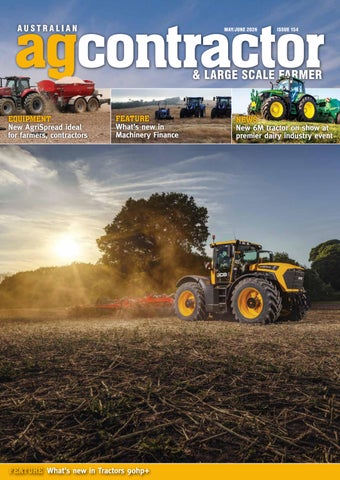
Issue 154 | May/June 2026 - Australian AgContractor & Large Scale Farmer
EQUIPMENT
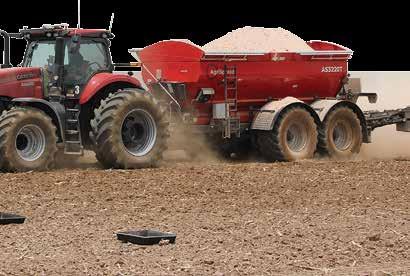
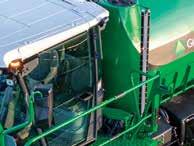
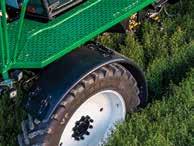
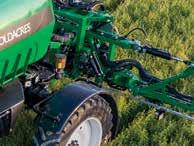
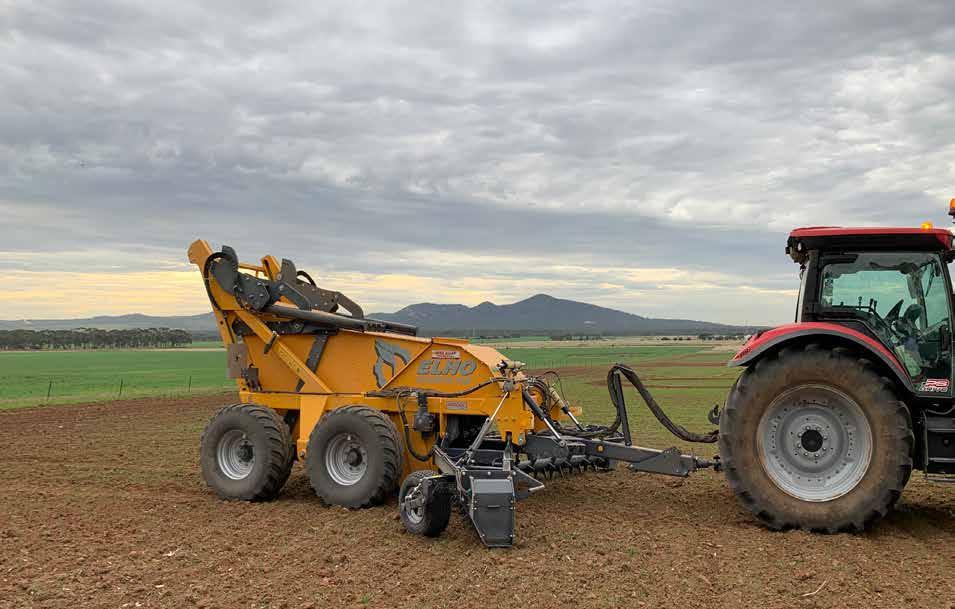
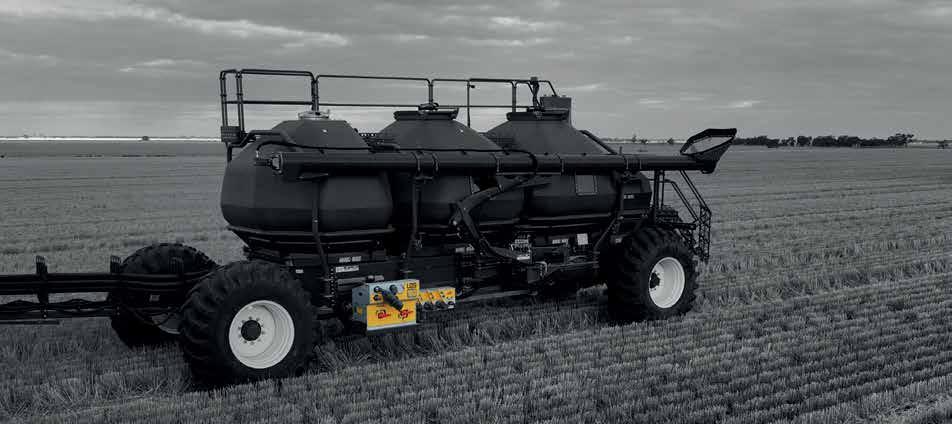
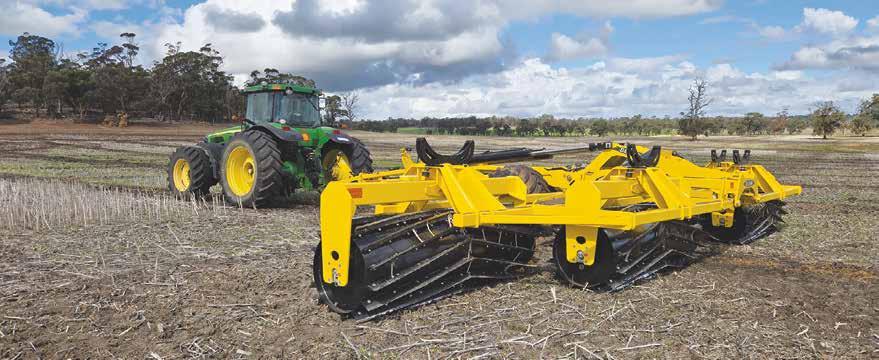
New AgriSpread ideal for farmers, contractors
FEATURE
What’s new in Machinery Finance
& LARGE SCALE FARMER
NEWS
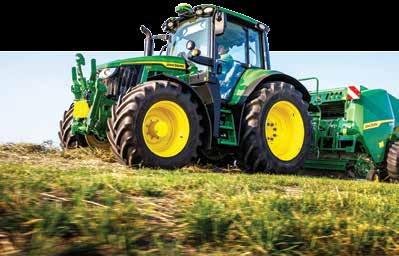
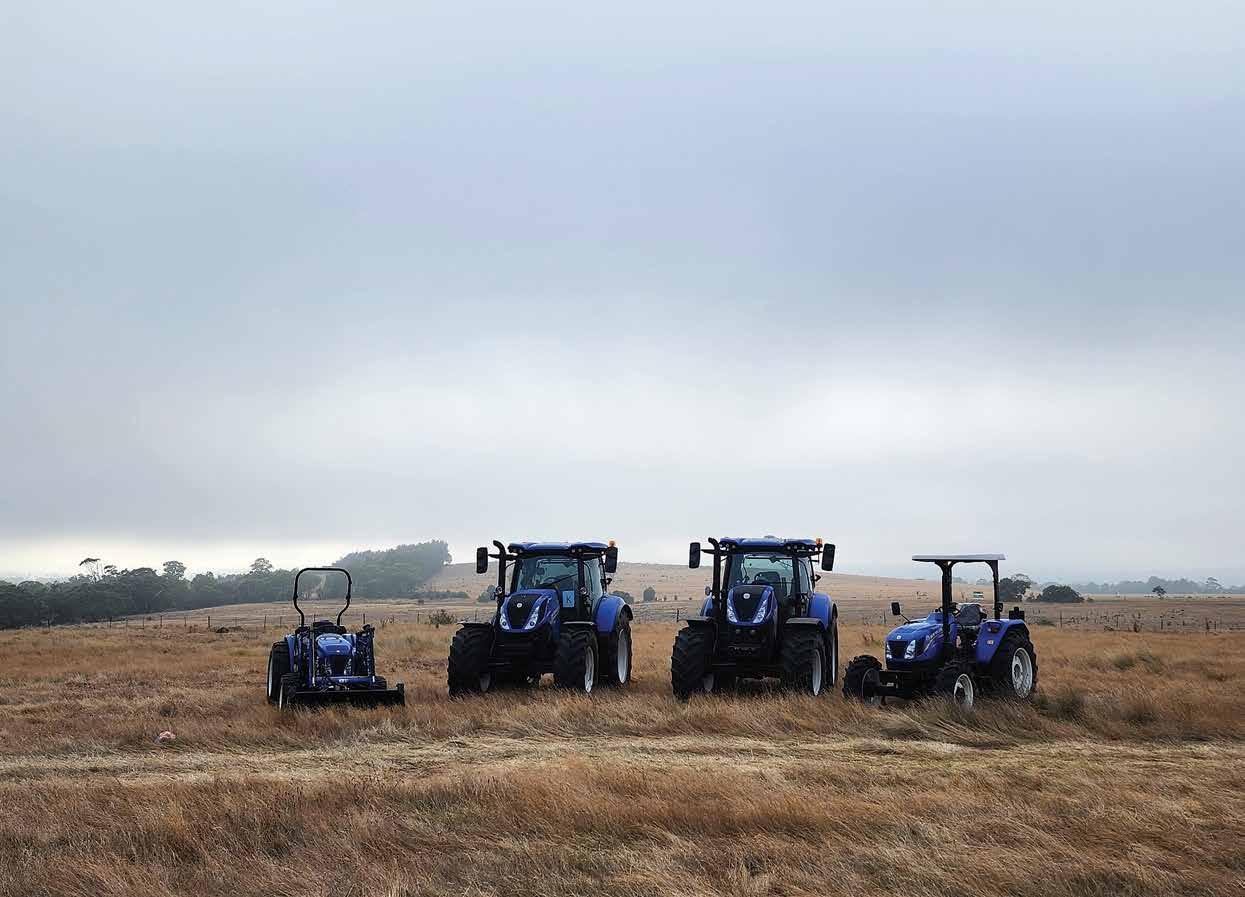
New 6M tractor on show at premier dairy industry event
PUBLISHERS
PO Box 36753
Merivale, Christchurch 8146
ph: +64 3 329 6555
www.agrimedia.co.nz
Publishers of Rural Contractor & Large Scale Farmer, AgriBusiness, AgriVet, NZ Cropping, Australian AG Contractor & Large Scale Farmer, NZ Novachem Manual.
SCALE FARMER - No part of this publication may be reproduced in any form without the prior written permission of the publisher. Opinions expressed in this publication are not necessarily that of the publisher and suggest independent advice be sought before acting on information or suggestions contained herein.
CONTRIBUTIONS - Editorial and photographic contributions are welcomed and should be sent directly to AML. Editing of submissions is at the sole discretion of the editor and will accept no responsibility for unsolicited material.
02 FROM THE EDITOR: The ripple effect
INDUSTRY NEWS
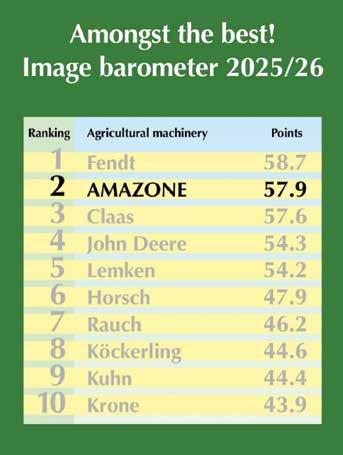
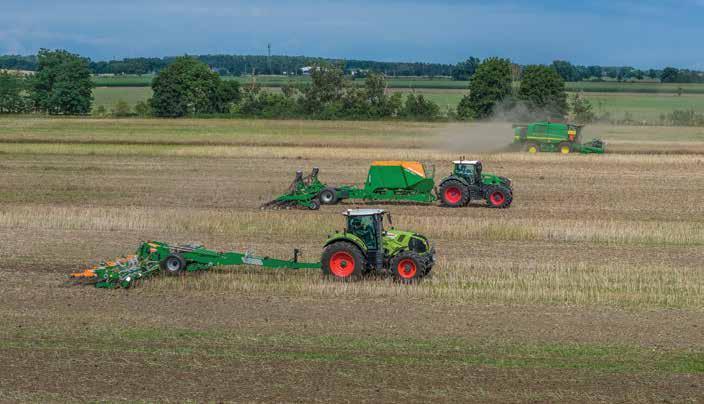
03 DLG Image Barometer 2025/2026: Amazone leaps up to 2nd place
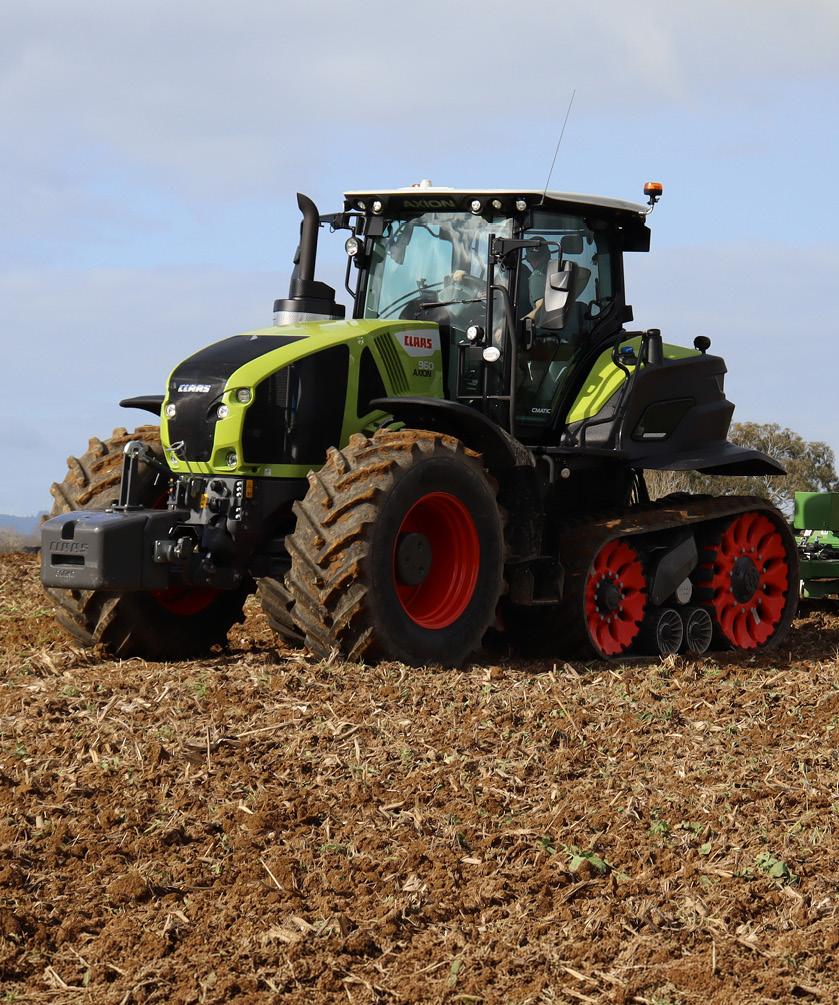
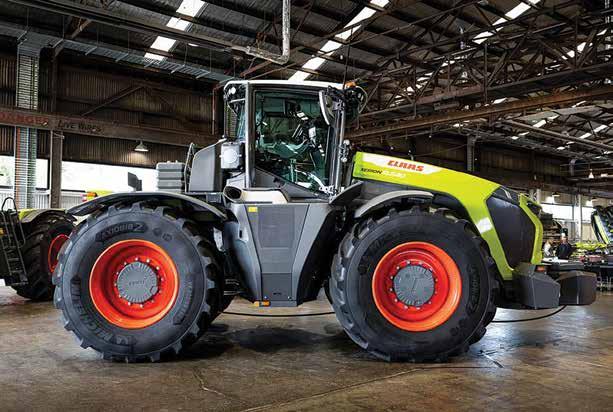
04 Axion 9 makes Its mark in Le Mans
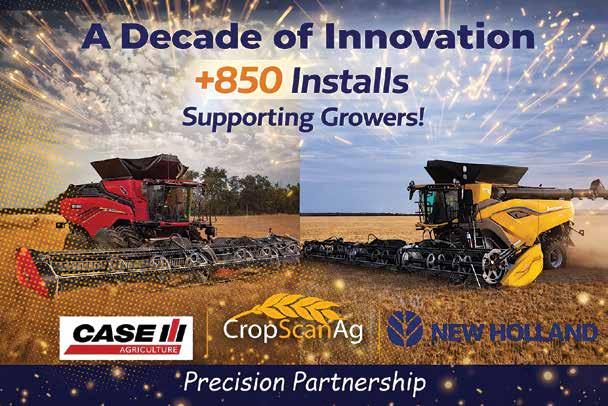
06 CropScanAg & CNH Australia celebrate 10-year partnership milestone
07 CNH dealer network celebrates Australian and New Zealand excellence at annual dealer awards
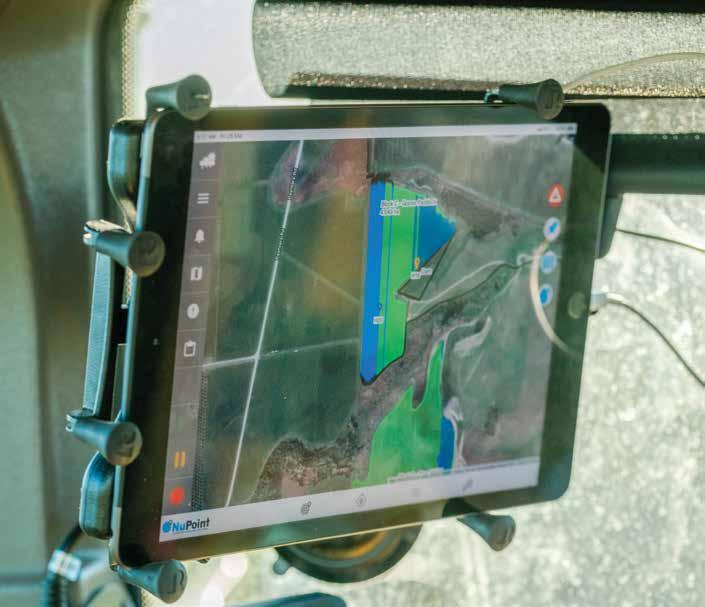
09 Precision Farming acquires NuPoint
10 New 6M tractor on show at Australia’s premier dairy industry event
11 HayKingHV turns up the volume
PROFILES
12 Rob and Jacinta Sibley: A life in the saddle
20 Across the ditch: KP Contracting: built on reliability in a region that demands it
FEATURES
16 What’s new in Machinery Finance
24 What’s new in Tractors 90hp+ EQUIPMENT
40 New Holland BigBaler 1290 HD lifts productivity for NSW contractor
41 Maschio Gaspardo Gigante – a seed drill that’s a cut above the rest
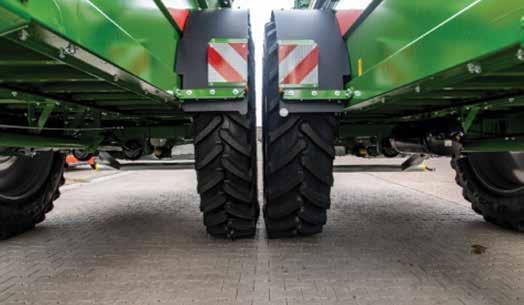
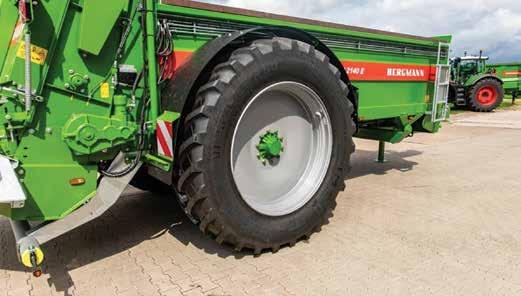
42 Bergmann: new tyres for the M and TSW 2140 E low-bed spreaders
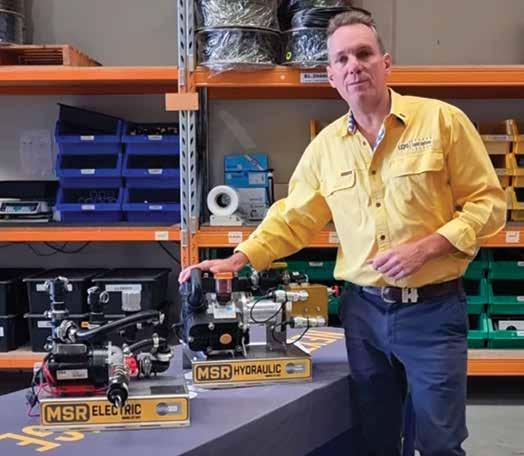
43 Breaking the Barrier to Liquid Application
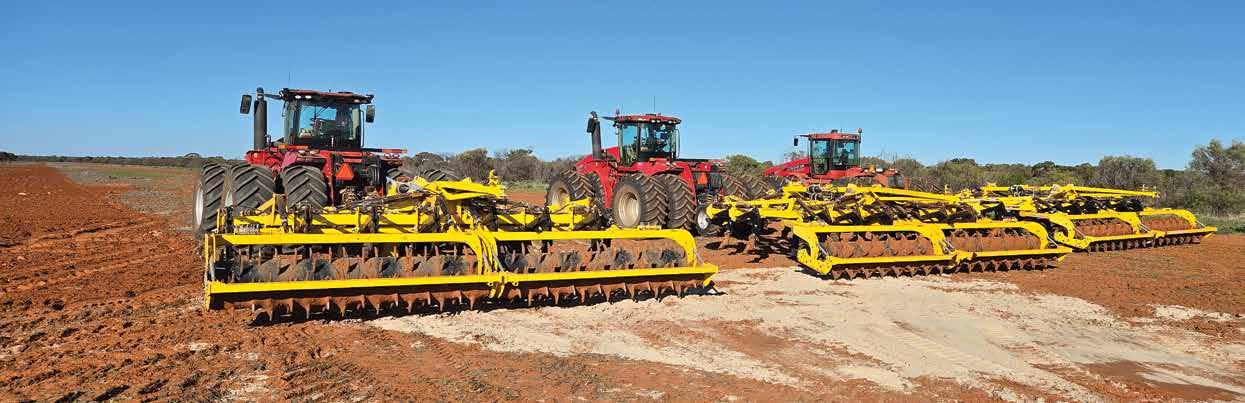
45 Terraland TO: Deep ripping technology reshaping toughest cropping soils
46 The EOFY decision that pays back every harvest for the next 10 years
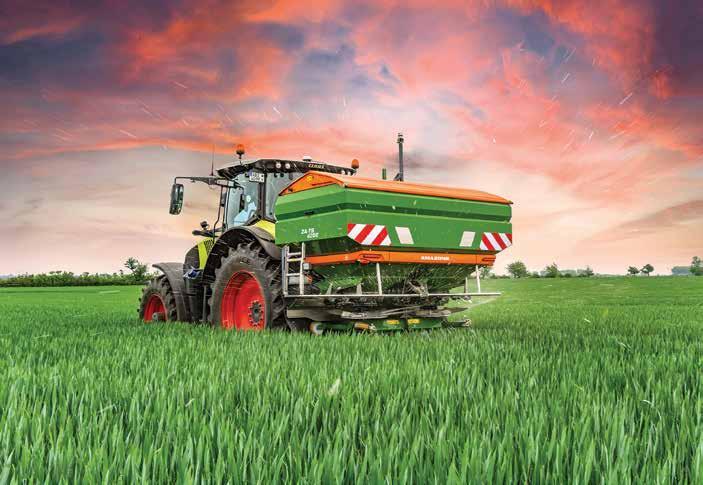
48 New AgriSpread spreaders ideal for large CTF farmers, contractors
THE RIPPLE EFFECT
HOW A DISTANT CONFLICT IS HITTING AUSTRALIAN AGRICULTURE.
For all the distance between Australia and the Middle East, the conflict unfolding there is once again proving a simple truth: global instability never stays “somewhere else” for long. In agriculture, we feel it first in the places we can least afford it - fuel costs, freight reliability, and the price of keeping machines turning when margins are already tight.
The most immediate pressure point is diesel. With shipping routes disrupted and insurance premiums on tankers rising, global oil markets have reacted the way they always do in times of uncertainty: sharply and without sentiment.
Australian farmers and contractors are now paying the price, literally, as diesel climbs and volatility becomes the new normal. For broadacre operations burning thousands of litres a week, even a modest rise per litre quickly becomes a five figure problem.
But it’s not just the bowser. The conflict has added friction across the entire supply chain. Delays in global freight are pushing up the cost of imported machinery, parts, and fertiliser.
Contractors trying to keep fleets in the paddock are finding that a simple hydraulic
hose or DEF sensor can take weeks longer to arrive. And when it does, it often costs more than it did last season.
There’s also the knock on effect on fertiliser markets. While Australia sources product from multiple regions, global nitrogen and phosphate prices are sensitive to geopolitical tension.
When shipping lanes tighten or energy markets spike, fertiliser follows. For growers planning winter cropping programs, that uncertainty makes budgeting harder and risk management more complex.
What’s striking is how familiar this all feels. After years of pandemic disruptions, freight bottlenecks, and inflationary pressure, agriculture has become conditioned to operating in a world where stability is the exception, not the rule.
The Middle East conflict is simply the latest reminder that global events - no matter how distant - shape the cost of doing business on every Australian farm.
And yet, as always, the sector adapts. Contractors are sharpening their quoting models.
Growers are reassessing fuel efficiency, machinery utilisation, and input timing. Dealers and suppliers are working harder to
secure stock and keep parts moving.
The challenges are real, but so is the resilience of this industry. If anything, the current situation reinforces the importance of efficiency, planning, and the kind of innovation that helps Australian agriculture stay productive in an unpredictable world.
POWER INTO TAX TIME
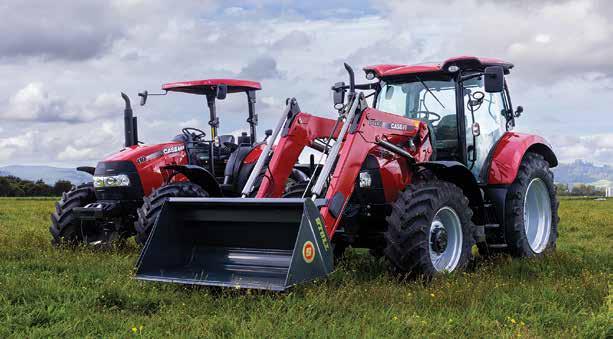
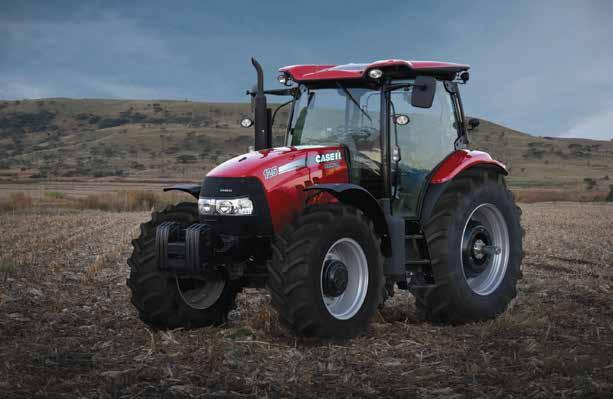
This tax season, put proven performance to work with exceptional value across the Case IH compact and mid-horsepower tractor range. Visit your local dealer to unlock 0.99% p.a. finance* on Farmall, Puma, Maxxum and Optum series tractors - built to deliver versatility, comfort and long-term reliability. Offers are available for a limited time only. Ends June - secure your tractor now at your local Case IH dealer.
SCOTT WILSON
DLG IMAGE BAROMETER 2025/2026: AMAZONE LEAPS UP TO 2ND PLACE
A NEW HIGH AMONG LEADING BRANDS IN THE AGRICULTURAL MACHINERY SECTOR.
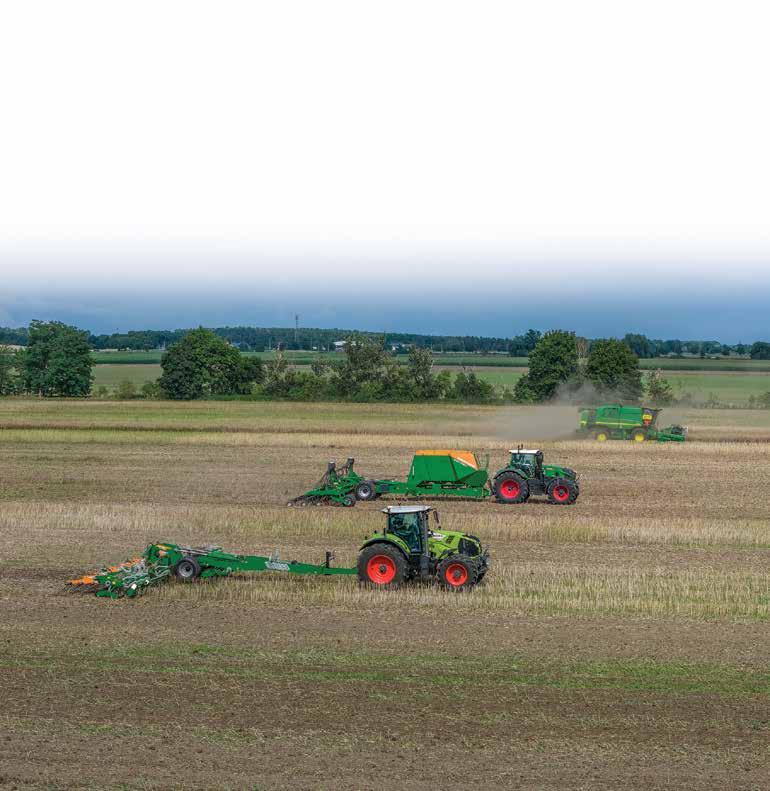
Amazone achieved a strong result in the latest DLG Image Barometer 2025/2026, moving, for the first time, up to second place. The rise underlines the brand’s high level of acceptance and its increasingly strong foothold in agricultural circles.
For many years, Amazone has been recognised in this prestigious survey as one of the most successful manufacturers in the field of agricultural machinery. As a family-owned company, they place great importance on long-term developments and on thinking about what is needed from agricultural machinery and developing this in partnership with farmers and contractors of all sizes. In doing so, they strive to always provide modern and future-oriented solutions that can be used cost-effectively and reliably across a variety of farm sizes. A consistent approach to innovation in machinery concepts and digital solutions is a key component of their corporate philosophy and is supported by practical research and the systematic testing of new methods.
This result is more than a brand milestoneit’s a positive signal for farmers and contractors across Australia and New Zealand.
Climbing to second place in the DLG Image Barometer reflects strong global confidence in Amazone and that confidence matters locally. For Australasian agriculture, where margins are tight and conditions are often unpredictable, backing proven, trusted machinery is critical. A high-ranking like this reinforces that Amazone equipment is not
only innovative, but also dependable in realworld farming systems.
Importantly, Amazone’s focus on efficiency and cost-effective operation aligns directly with the needs of farmers in both countries. Whether it’s broadacre cropping in Australia or mixed farming systems in New Zealand, reducing input costs - particularly fuel, labour and time - is essential. Machinery designed with precision application and fuel efficiency in mind helps farmers do more with less, improving profitability without compromising output.
The emphasis on practical research and farmer-led development is another key benefit. Agriculture in Australia and New Zealand is highly diverse, and solutions must work across varying soil types, climates and scales. Amazone’s approach of developing equipment in partnership with farmers ensures innovations are not just theoretical, but genuinely applicable in the paddock.
Sustainability is also a growing priority across both regions. With increasing pressure around environmental stewardship, nutrient management and emissions, machinery that enables more precise application and reduced waste plays a crucial role. Recognition in the DLG Image Barometer highlights Amazone’s progress in delivering solutions that support more sustainable farming practices.
Finally, this achievement signals continued investment in innovation. For local farmers, that means access to evolving technology — from smarter digital systems to more efficient implements — that can help futureproof their operations.
In short, Amazone’s rise isn’t just good news for the company — it’s a strong indicator that farmers in Australia and New Zealand can continue to rely on high-performing, efficient and forward-thinking machinery to meet the challenges ahead.
AXION 9 MAKES ITS MARK IN LE MANS
SET AGAINST THE BACKDROP OF LE MANS, FRANCE, THE CUSTOMER UNVEILING OF THE NEW CLAAS AXION 9 GAVE AUSTRALIAN FARMERS AND CONTRACTORS AN EARLY LOOK AT WHAT’S NEXT IN HIGHHORSEPOWER PERFORMANCE.
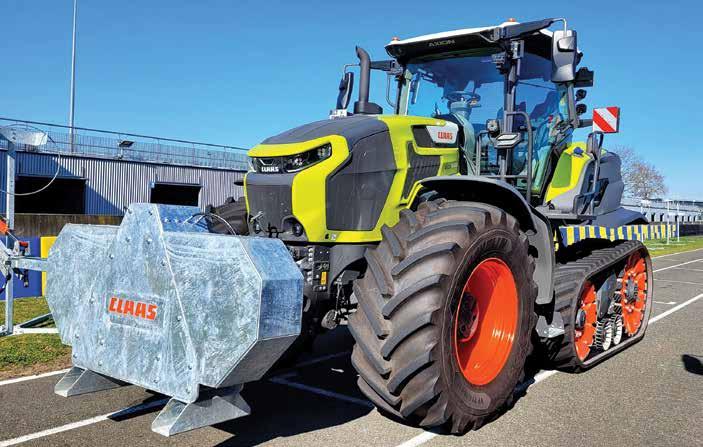
Officially unveiled at Agritechnica 2025where the Terra Trac version was recognised as Tractor of the Year - the Axion 9 represents a significant step forward from the previous 900 Series. More than just a power upgrade, it brings together advances in automation, comfort and connectivity, designed with large-scale operations firmly in mind.
In simple terms, it’s built for heavy draft work, large implements, and long days when timing matters most.
FROM THE PADDOCK TO THE TRACK
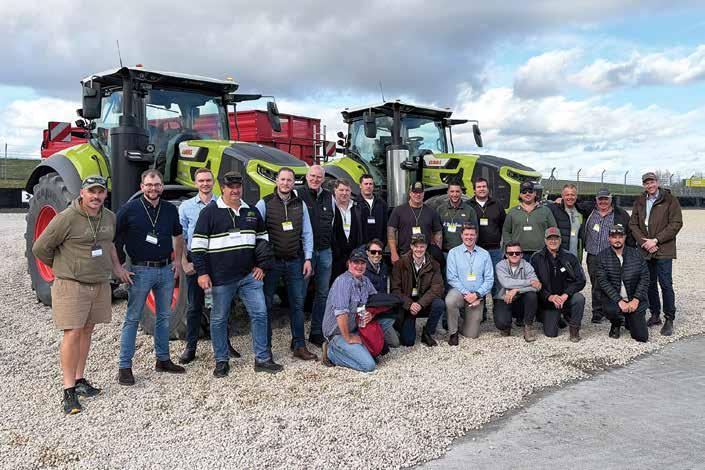
To put the machine through its paces, customers were given the unique opportunity to drive the Axion 9 at the legendary Circuit de la Sarthe. While better known as the home of endurance racing, the circuit proved an ideal setting to experience the tractor’s smooth power delivery, handling and operator comfort.
The feedback was immediate - and overwhelmingly positive.
“Beautiful cab—it’s heaps bigger. Transmission is smoother, from whoa to go,” said Ian Cunningham, Katanning, WA.
For many, refinement stood out straight away.
“It’s unreal how smooth it is,” said Henry Arthur, Dalby, EA. “First thing you notice is the cab—it’s pretty special. The new controller is unreal too, especially around corners.”
Chris Biddy from Esperance, WA highlight-
ed the machine’s versatility: “Responsive, quick on the hydraulics—definitely a tool you could turn your hand to anything with. Pushing grass, gravel, silage work—it would handle it all.”
Across the board, operators pointed to the same themes: smoother driveline, quieter cab, and a noticeable lift in overall operator experience.
“Refined—that’s the word,” said Brent Kestle, Gippsland, EA. “It’s come a fair way from the last model. Much quieter and smoother than our Axion 800.”
Amery Drage, Geraldton, WA summed it up simply: “Very impressive, just how quiet it is. The whole drive line is really refined, it’s a really nice package.”
Adam Marshall, Echuca, EA reiterated that he’d known the old Axion to be a good reliable tractor. “When you jump into the new Axion model there is a remarkable difference, from the moment you sit in the comfy seat,
to the size of the cab and the vision out of the glass.”
For contractors in particular, those gains aren’t just nice to have; they directly impact productivity.
BUILT ON MORE THAN JUST PERFORMANCE
Beyond the seat time, the trip gave customers a deeper look into what sits behind the badge.
The group toured key Claas production sites, including the tractor assembly plant in Le Mans, the Claas Bad Saulgau factory, and the Claas Harsewinkel factory—home to flagship machines such as the Claas Lexion, Claas Jaguar and Claas Xerion.
A visit to a working German farm further showcased how the latest Claas technology performs in real-world conditions.
For many, seeing the scale of engineering, precision manufacturing and ongoing investment first-hand reinforced confidence in the machinery they rely on each season.
A TRACTOR BUILT FOR MODERN FARMING
The Axion 9 has been designed as a flagship workhorse—combining power with intelligent systems that help operators get more from every hour in the paddock. From its high-output engine and advanced transmission to its next-generation cab and connectivity, it reflects where modern farming is heading: greater efficiency, more automation, and improved operator comfort.
And for those who spend long days in the seat, that comfort is more than a feature—it’s a necessity.
The Claas Axion 9 isn’t just an upgrade. It’s a clear signal of intent from Claas —delivering a machine that works as hard as the people who rely on it.
BUILT FOR BIGGER JOBS
CROPSCANAG & CNH AUSTRALIA CELEBRATE 10-YEAR PARTNERSHIP MILESTONE
CROPSCANAG IS PROUD TO CELEBRATE A DECADE-LONG PARTNERSHIP WITH CNH AUSTRALIA, MARKING 10 YEARS OF COLLABORATION THAT HAS HELPED TRANSFORM ON-COMBINE GRAIN ANALYSIS AND PRECISION AGRICULTURE ACROSS AUSTRALIA.
Over the past decade, more than 850 CropScan on-combine grain analysers have been deployed across Australian broadacre farming operations. This milestone highlights CropScanAg’s position as a global leader in real-time grain quality measurement, with Australia serving as a key catalyst in the development and adoption of this technology worldwide.
Australia’s progressive farming sector and strong uptake of precision agriculture tools have played a critical role in shaping how real-time grain quality sensing is applied at harvest — setting new benchmarks for data-driven decision-making, nutrient management and harvest efficiency.
Mat Clancy, General Manager at CropScanAg, said the longterm collaboration with CNH Australia has been central to scaling the technology across the national fleet.
“This partnership has given us an amazing opportunity to reach markets that we would never have been able to access on our
own. Partnering with CNH is a critical strategic alignment that ensures our technology gets into the hands of broadacre farmers right across the country.”
Jeremy Duniam, Head of Precision Technology, CNH ANZ, said CropScanAg’s technology continues to play a key role in supporting growers at harvest.
“CropScanAg’s technology has become an important part of how our customers optimise harvest performance, providing clear, real-time insights that support better decision-making in the paddock.
We’re proud of our partnership with CropScanAg and the value it continues to deliver for Australian growers.”
The partnership has enabled seamless integration of CropScan technology across CNH harvesting platforms, delivering real-time measurements of protein, moisture, oil and other grain quality parameters directly in the cab during harvest. This live data supports better segregation, logistics decisions, and in-season agronomic insight.
Building on this foundation, CropScanAg has expanded its digital ecosystem with the N-Gauge™ Nutrient Manager app. N-Gauge enables growers to bring together years of collected harvest and grain quality data, analyse historical field performance, and generate variable-rate nitrogen prescriptions. This allows farmers to improve crop production, input efficiency and profitability using paddock-specific data layers developed over multiple seasons.
Looking ahead, CropScanAg and CNH Australia are focused on the next phase of growth with the rollout of Next Generation AF and CR combine platforms.
These machines, combined with the latest CropScan 4000-Series Isobus grain analyser technology and expanded digital analytics, are expected to further strengthen real-time crop sensing and nutrient management capability.
The companies see strong opportunity over the next decade to deepen integration, expand global reach, and continue delivering practical precision agriculture solutions to farmers. Together, CropScanAg and CNH Australia remain committed to advancing precision agriculture and ensuring Australian growers continue to lead the world in data-driven crop production.
CNH DEALER NETWORK CELEBRATES AUSTRALIAN AND NEW ZEALAND
EXCELLENCE AT ANNUAL DEALER AWARDS
ANZ AG MACHINERY DEALERS GATHERED IN ADELAIDE TO CELEBRATE DEALER OF THE YEAR EXCELLENCE ACROSS THE CASE IH, NEW HOLLAND, K-LINE, HORWOOD BAGSHAW AND FLEXI-COIL BRANDS.
The most outstanding CNH dealers from across Australia and New Zealand for the past year have been revealed, with major winners from both sides of the Tasman being awarded.
Intersales was named Case IH ANZ Dealer of the Year 2025 for three or more outlets. The business has been crowned Case IH Dealer of the Year numerous times over the years, and Intersales CEO Amanda Blachut said it was gratifying for her team to
claim the honour once again.
“I know 2025 has been a tough year, and for Intersales it’s been especially challenging. But we’ve gone back to having fun where we can, focusing on our staff and enjoying what we do every day. I really appreciate the work CNH has done with us — honestly, I’m a bit blown away,” Amanda said.
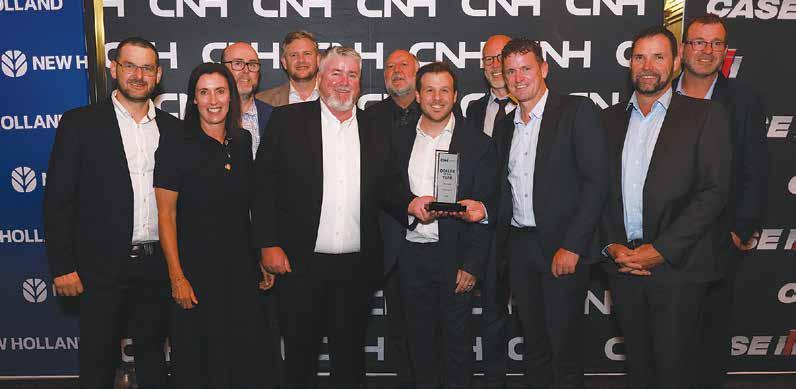
Vater Machinery claimed the top honours of New Holland Dealer of the Year for dealerships with three or more outlets.
Roger Vater, Managing Director at Vater Machinery, credited his staff for the win.
“First of all, I just have to thank my team, an extraordinary bunch of men and women that support me every day of the week and the extraordinary effort that they put in,” he said. “My relationship with CNH is outstanding, it’s continuing and I want to thank you from the bottom of my heart for that. We are in our 66th year of partnership with CNH and it’s one that I take to heart and value so very very much.”
South Australian dealership Larwoods Ag Services took home the Case IH Parts and Service Dealer of the Year for 2025.
“We’ve got a great team with
a big customer focus, and everything we do is for our customers — that’s what we aim to achieve, and it’s been our mantra for over 50 years. It’s very comforting when we win awards like this,” said Scott Mercer, Dealer Principal at Larwoods Ag Services. “Thank you to CNH for everything they do for us. Our team at the dealership is grateful every day for the support they get.
“Life isn’t always easy and there are challenges from time to time, so if we can be in partnership with CNH and Larwoods, it makes everything stronger for the brand, our customers and our staff. So, thank you very much.”
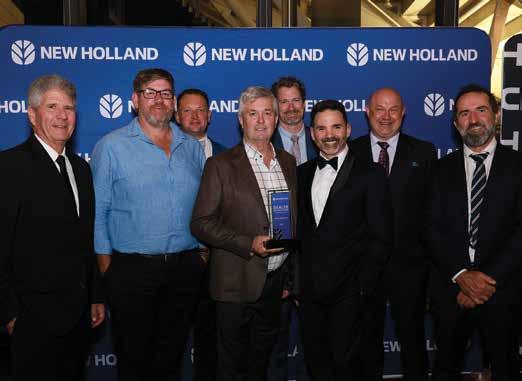
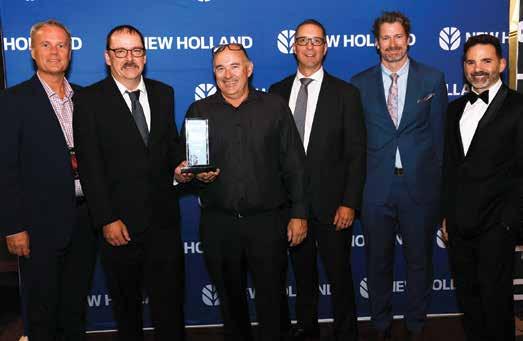
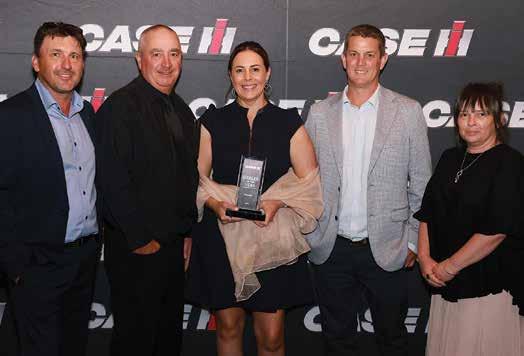
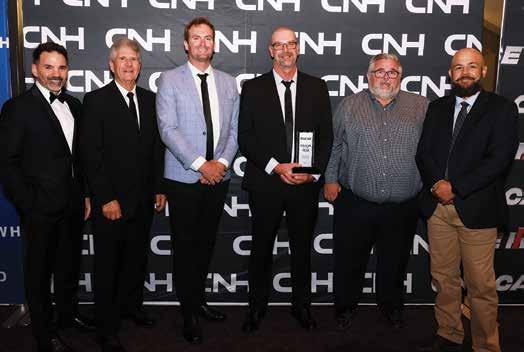
INTERSALES AWARD: ADAM BLACHUT, TREVOR MORTON AMANDA BLACHUT, MITCH PRICE AND CARINA FITZPATRICK.
VATER MACHINERY: PETER BROOKS, MICHAEL GLASSON, JACOB DUMESNY, ROGER VATER, MICHAEL HALL (CNH), BRANDON STANNETT (CNH), COREY JENSEN AND AARON BETT (CNH).
RONCO MOTORS: GARY PERTOT, BRENTON LACEY, ROYDN BAILEY, HEATH JOINER (CNH), MICHAEL HALL (CNH) AND BRANDON STANNETT (CNH).
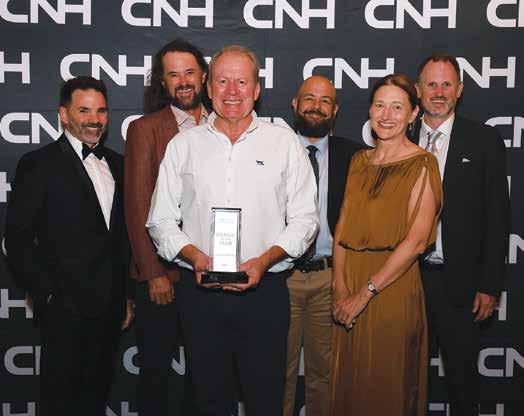
ROCKY RIVER AG: BRANDON STANNETT (CNH), PETER BROOKS, LUKE DOHNT (CNH), LYNTON SMART, ALEX ALPE AND ANDREW KISSEL (CNH).
SUMMARY OF WINNERS:
1. Case IH Dealer of the Year for 3+ Outlets: Intersales
2. Case IH Parts & Service Dealer of the Year: Larwoods Ag Services
3. Case IH Dealer of the Year for 1-2 Outlets: Whyteline (New Zealand)
4. CNH ANZ Dealer Of The Year 2025: Boekeman Machinery
5. CNH Capital Dealer Of The Year 2025, Australia: O’Connors
6. CNH Capital Dealer Of The Year 2025, New Zealand: Cochranes
7. New Holland Dealer of the Year for 1-2 Outlets: Boekeman Machinery
8. New Holland Dealer of the Year for 3+ Outlets: Vater Machinery
9. New Holland Parts & Service Dealer of the Year: Ronco Motors
10. Flexi-Coil Dealer of the Year 2025: Rocky River Ag Services
11. Horwood Bagshaw Dealer of the Year 2025: Kenway and Clark
12. K-Line Dealer of the Year 2025: AEH Group
“We’d really like to thank our 118 staff — they’re a huge part of why we’ve received these awards today. And of course, to our loyal customers, we wouldn’t be here without them.”
The New Holland Parts and Service Dealer of the Year title went to Ronco Motors. Dealer Principal Roydn Bailey said he was excited to receive the award.
“I just have to thank my team and the awesome work that they do every day, and to the CNH team and the support that they give, so just thank you,” Roydn said.
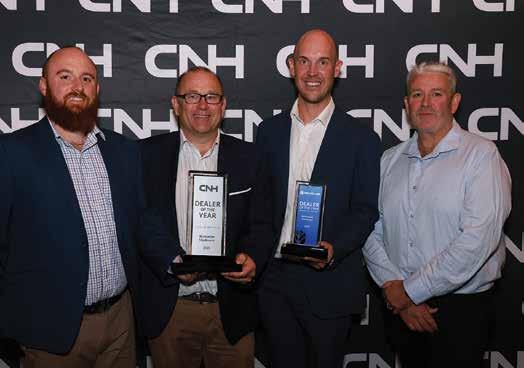
It was a successful night for Boekeman Machinery, with the West Australian business being awarded both the New Holland
Dealer of the Year title for dealerships with one or two outlets and the CNH ANZ Dealer of the Year 2025, which goes to dealerships selling both Case IH and New Holland machinery.
After last year winning 2024 Case IH Dealer of the Year (with three or more outlets), Boekeman’s Dealer Principal Tim Boekeman said they were proud to claim the awards for 2025, a great reward for staff members who worked so hard for their customers.
O’Connors took out the CNH Capital Dealer of the Year award for Australia. With 15 dealerships across Victoria, South Australia and New South Wales, O’Connors has one of largest CNH dealer footprints.
For a second consecutive year, South Australian dealership Rocky River Ag Services was recognised as the Flexi-Coil Dealer of the Year, with Flexi- Coil’s seeding technology long being a cornerstone of the dealership’s offering and aligning closely with the evolving needs of growers.
Horwood Bagshaw proudly awarded its Dealer of the Year title to Kenway and Clark, recognising the dealership’s outstanding performance, customer
support, and long-standing commitment to the Horwood Bagshaw brand.
Australian-made tillage and seeding equipment manufacturer K-Line named AEH Group its Dealer of the Year for 2025, honouring their significant contributions to the agricultural machinery sector.
The Dealer of the Year results are based on a number of different criteria, including finance and business management, performance in sales and marketing, and parts and service, a precision technology focus and total market share.
CNH Business Director - Agriculture ANZ, Aaron Bett, congratulated the winners, praising the level of excellence they’d achieved and the outstanding service they’d delivered to their customers.
“We set a high bar when it comes to selecting the winners of these awards, so the successful dealerships have to tick a lot of boxes. This year’s winners represent everything we value in our dealer network: high quality customer service and support, exceptional knowledge about our products and first-class technical expertise,” Aaron said.
“These dealers have gone above and beyond for their customers and represented our brands with the highest level of integrity and authenticity. A big congratulations to them all.”
The winners were announced on February 24 at the Adelaide Oval during the Case IH and New Holland annual dealer conferences in South Australia.
BOEKEMANS: DILLON ELLIOT, TIM BOEKEMAN, BEN BOEKEMAN AND DEAN SMART (CNH).
KENWAY AND CLARK: BRANDON STANNETT (CNH), PETE MCCANN, PETER BUREY, ANDREW KISSEL (CNH), GEMILLE HAYES AND DAVID GIBSON (CNH).
PRECISION FARMING ACQUIRES NUPOINT
PRECISION FARMING’S EXPANSION INTO AUSTRALIA SIGNALS RAPIDLY ACCELERATED CONNECTIVITY FOR FARMERS AND GROWERS ON BOTH SIDES OF THE TASMAN WHEN IT COMES TO EFFICIENT VEHICLE MANAGEMENT.
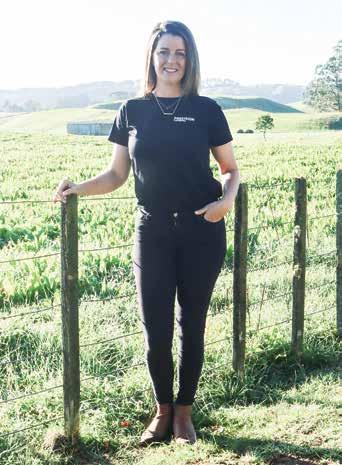
New Zealand agritech company, Precision Farming, supports farmers and contractors with fertiliser and spray application management and job tracking. It has now acquired NuPoint, which already has a presence in both New Zealand and Australia.
Precision Farming CEO, Chloe Walker, explains that the biggest benefit is providing connectivity with simple and easy-to-use tools for farmers, that all talk to each other.
Walker says the platform helps reduce paperwork, improves compliance reporting, gives users visibility of vehicles and jobs, and enables cost savings through more efficient operations.
At a time when costs are rising and supply is limited, Precision Farming’s tools support farmers to maximise their fertiliser and spray value while reducing fuel use.
“We are all about giving farmers and growers options and the ability to be efficient and connected, no matter what technology they want to use,” she says.
“You choose what hardware to use, what contractor you want to use, what fertiliser or chemical supplier you want to use and which farm management system, and they all talk to each other. This acquisition allows us to really accelerate that trajectory.”
Their platform already connects with major players in the pastoral farming landscape, including brands like John Deere, Trimble and Topcon. Extending that through to the NuPoint platform creates new opportunities, especially in the horticulture and viticulture sectors.
Combined, the platforms integrate to strengthen Precision Farming’s position in vehicle operations management and further enhance digital connectivity between machinery, contractors, farmers and farm systems.
Walker explains that the company has strong growth ambitions; the acquisition of NuPoint is an expansion of their connected agricultural technology platform. “This is a great trans-Tasman story and demonstrates the growth trajectory that we are on,” she says.
“A core part of our vision is enabling a future where every vehicle on every farm can be connected through a flexible digital ecosystem, giving them full visibility of vehicle locations and what went on when and where. It’s all about giving farmers and their partners choice, while ensuring the tools they rely on can work seamlessly together.”
Looking at the future of farming, Walker believes that supply chain transparency will only become more rigorous for exporting nations like New Zealand and Australia. Connected tools, like Precision Farming’s platform, will allow us to stay ahead of the game when it comes to reporting and compliance.
“That’s what we are here to do for farmers and growers, using smart technology and common sense. Our tools need to be simple and connected because we want to support farmers to come on this journey.”
CHLOE WALKER
NEW 6M TRACTOR ON SHOW AT AUSTRALIA’S PREMIER DAIRY INDUSTRY EVENT
DELEGATES TO THE RECENT AUSTRALIAN DAIRY CONFERENCE, ON THE GOLD COAST, WERE TREATED TO AN IMPRESSIVE DISPLAY OF THE LATEST JOHN DEERE EQUIPMENT AND FEED TECHNOLOGY, INCLUDING THE BRAND NEW 6M 155 TRACTOR.
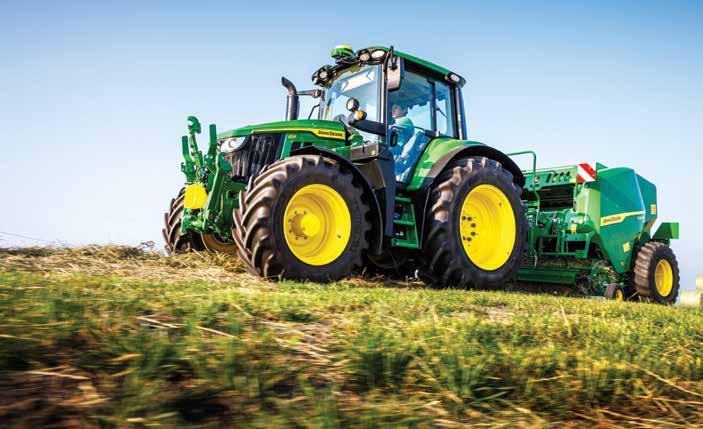
With all products designed to prioritise production, profitability and sustainability, the new 6M 155 features more speed, power and customisation to create the ideal mid-size utility tractor for the dairy and beef industry.
Also on display at the Gold Coast Conference and Exhibition Centre was the HarvestLabTM 3000 sensor, which uses near-infrared technology to allow precision measurement and documentation of the nutrients available in different crop types, and inform decision making that creates the optimal feed for cows and higher milk yields. The team will additionally have the V451R variable chamber baler on display at the ADC conference for delegates to view.
John Deere Australia and New Zealand Small Ag & Turf Marketing Manager, Erin Wagstaff, said combining reliable, functional machinery with groundbreaking precision ag technology helps dairy farmers to refine and improve every facet of their business.
“The range of John Deere tractors and data management sensors can assist farmers to monitor input costs like fuel through Operations CenterTM , while AutoTracTM ensures accurate sowing, mowing and raking, and HarvestLab assesses the quality of the crop, not only as it’s being cut, but the benchtop kit means you can assess silage quality at any time,” Erin said.
“By adding more optionality to the 6M range, we’ve built the tractor for the future
based on the reputation we’ve built up over 100 years for quality and reliability. It has more power, more technology and new features like the reversible fan that makes the 6M the go-to machine for the vast range of tasks on the farm.”
For the first time in the new range of 6M tractors, four models are 200hp or above, and those wanting extra speed for transportation have the option of a 50kph transmission. Another attraction is the intelligent power management, providing a 14.9-kW (20-hp) boost for many typical operations that use rear power take-off in high-power applications or in transport.
The sloped hood design delivers enhanced operator visibility, while the option of single or dual rear wheels or larger tyres brings improved traction and power to the ground. There is also a digital cornerpost display in the cabin, featuring integrated connectivity and scaleable precision technology.
The name and numbering conventions have been aligned with John Deere’s 6R, 7R,
THE NEW 6M 155 FEATURES MORE SPEED, POWER AND CUSTOMISATION TO CREATE THE IDEAL MID-SIZE UTILITY TRACTOR FOR THE DAIRY AND BEEF INDUSTRY.
8R and 9R tractors, which display the series separately from the rated engine horsepower, and the sleek styling of the 6Ms includes a new flag design and louver shape.
HarvestLab 3000 gives dairy farmers a way to monitor and analyse silage quality, providing information such as moisture, dry matter, protein, starch and sugar within minutes.
The technology, available on John Deere’s self-propelled forage harvesters and separately as a bench test kit, is built on millions of hours of in-field experience, typically making up to one million measurements per load, to provide data on the go.
All data is displayed and site-specifically documented in real time, so operators can adjust settings for machine optimisation in the field, rather than waiting for laboratory results.
Erin said she was looking forward to connecting with dairy farmers during the twoday conference and highlighting the equipment and technology available to support on-farm efficiencies.
“We know milk production is the key focus for dairy farmers, so complementing that with reliable equipment and precision agriculture technology in other areas of their operation can have a powerful impact on productivity, sustainability and their bottom line,” she said.
“Our team is excited to be part of this event for an industry that is so important to not only our economy, but our Australian way of life.”
John Deere’s new 6M 155 tractor is available to order from dealerships now.
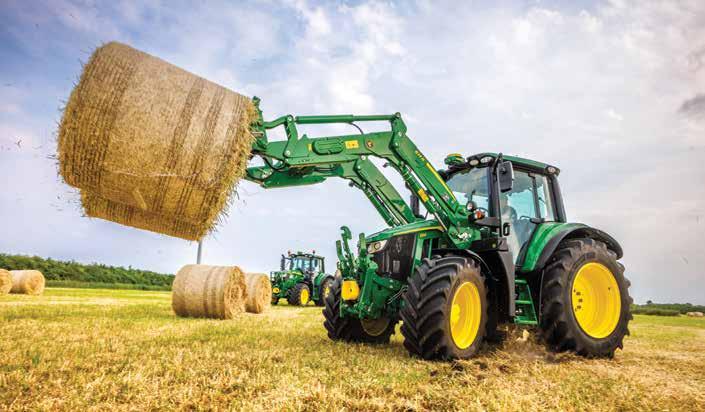
THE NEW 6M 155 IS THE GO-TO MACHINE FOR THE VAST RANGE OF TASKS ON THE FARM.
HAYKINGHV TURNS UP THE VOLUME
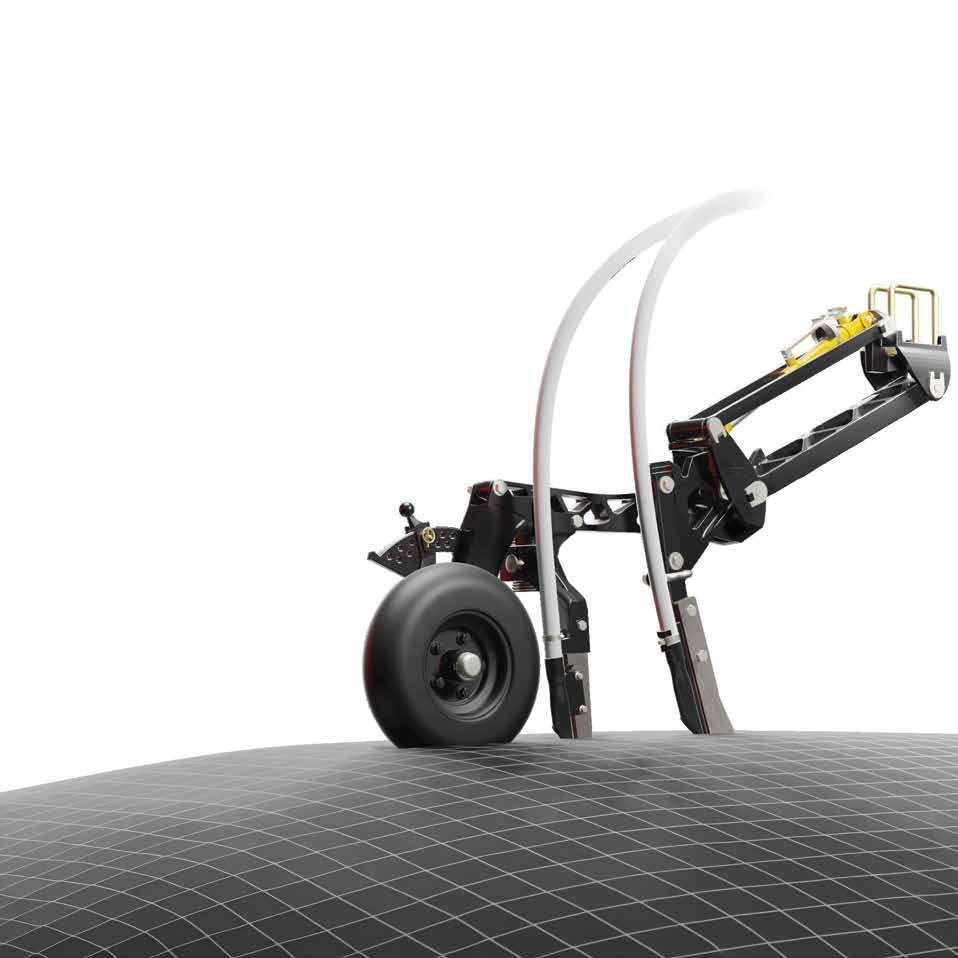
HAYKINGHV HIGH VOLUME FORAGE PRESERVATIVE HAS BEEN DEVELOPED TO PROMOTE HAY PRESERVATION THROUGH HIGH VOLUME APPLICATORS.
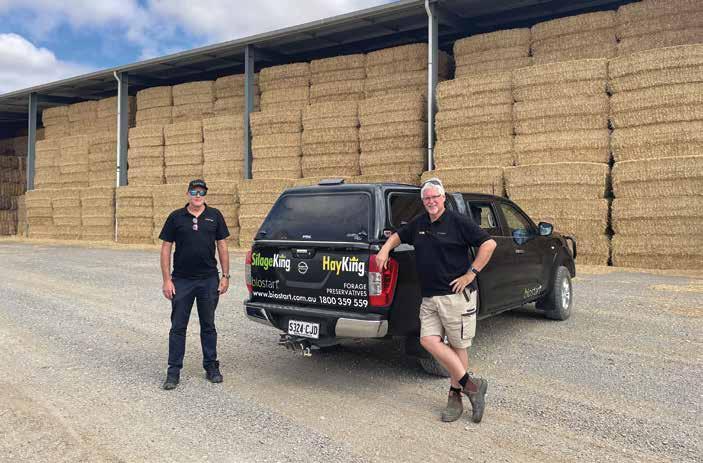
HayKing is a biological hay preservative that works by inhibiting the growth of yeasts and fungi that use up feed energy, heat bales and produce mycotoxins that affect animal health.
Applying HayKing at baling suppresses these spoilage microbes, and as a result the metabolic energy of the forage is retained in the hay at a higher level. This higher energy hay feeds more animals per tonne of hay, as well as improving storage and palatability.
BENEFITS OF HAYKINGHV
- Can be used with a range of high-volume applicators
- Makes premium lucerne, oaten, wheat and barley hay and pea straw
- Wider harvest /baling window
- Can bale at higher moisture levels
- Lower bale temperature
- Higher nutritional value and palatability
- Easy to apply
- Stores at room temperature
- Non-corrosive.
BioStart HayKingHV is a combination of fermentation extracts that inhibit hay decomposition microbes, ensuring bales store better, remain cooler and result in better feed. Unlike traditional inoculants which rely on introducing live bacteria, HayKingHV does not contain live microbes.
The BioStart sales team can advise on the
Application Rate:
content < 21% 1 L/tonne
content 21–24% 1.4 L/tonne
HayKing works best when used with good haymaking practices. Only bale when moisture levels are below 24%.
Pack Size: 1000 L Tote
Note: Not compatible with Ascot applica-
Rob and Jacinta Sibley:
A LIFE IN THE SADDLE
A LIFE IN THE SADDLE HAS BROUGHT ROB SIBLEY ACCOLADES AND, ALONG WITH WIFE JACINTA, TURNED A PASSION FOR RIDING AND HORSES INTO A COMMERCIAL LIVESTOCK MANAGEMENT AND FARMING BUSINESS REVOLVING ALMOST EXCLUSIVELY AROUND HORSES.
Rob grew up on his parent’s small cattle and sheep farm near the former gold mining town of Young in New South Wales and has been riding his whole life.
For Rob, the farming side of things changed when he was 12 when his parents sold the farm and bought a smaller rural property closer to town, but riding and his keen interest in the sport of polocrosse continued with Rob determined he would also one day own a farm.
With this in mind, his first job after leaving school saw him on a mixed local farm which ran sheep, made hay and silage and ran a 3,000 head cattle feedlot. Unsurprisingly, given Young has a reputation as the cherry capital of the country, they also had cherry trees.
But the cropping side didn’t really interest him and it wasn’t long before Rob had acquired a
pretty good skill-set within the livestock industry.
Then, back in 2002 Rob headed north to Darwin with his parents to compete in the national polocrosse tournament held every two years. He quickly hit it off with a young woman competing from Western Australia and they spent a lot of time together over the two weeks of competition. Jacinta had also been around the land and horses most of her life, but her background was quite different. Her father, who
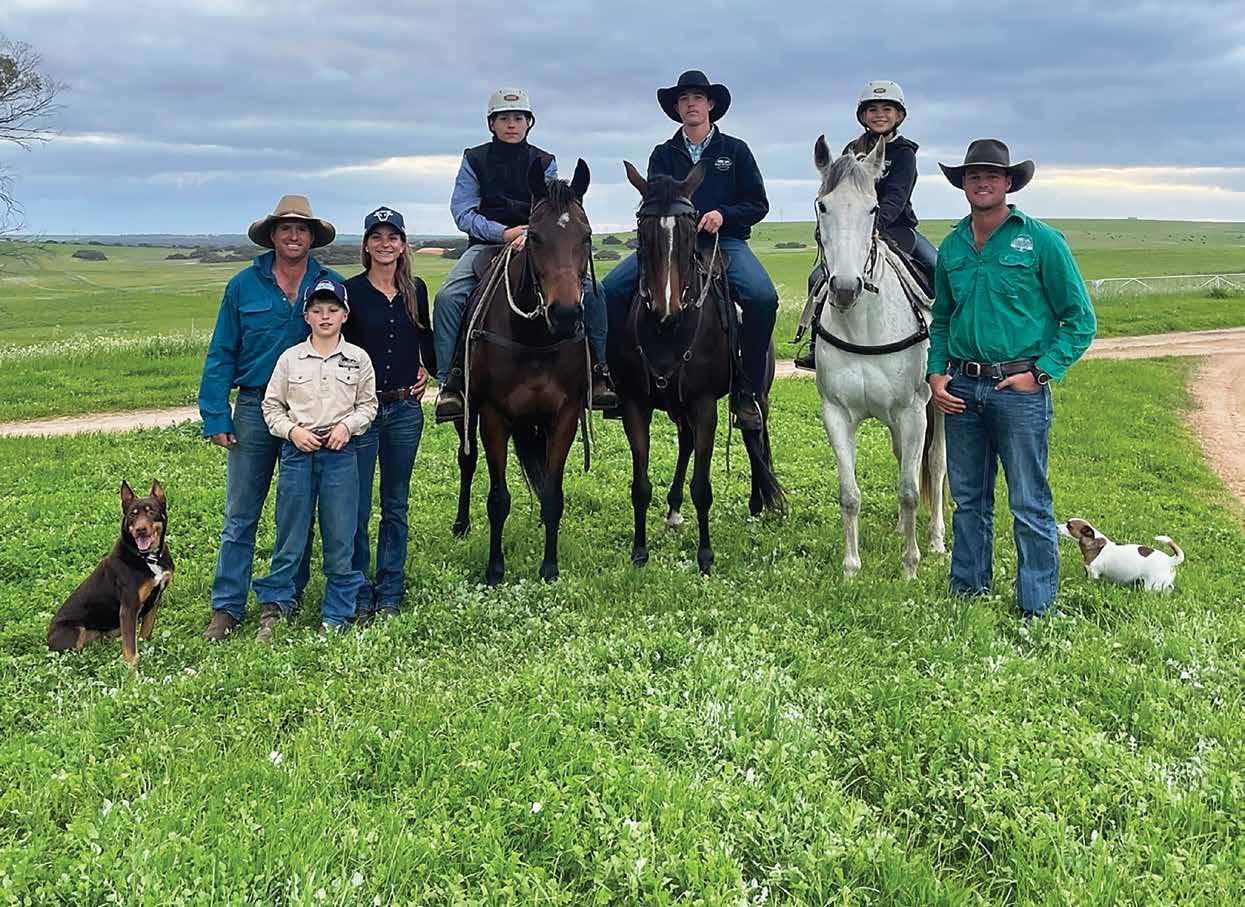
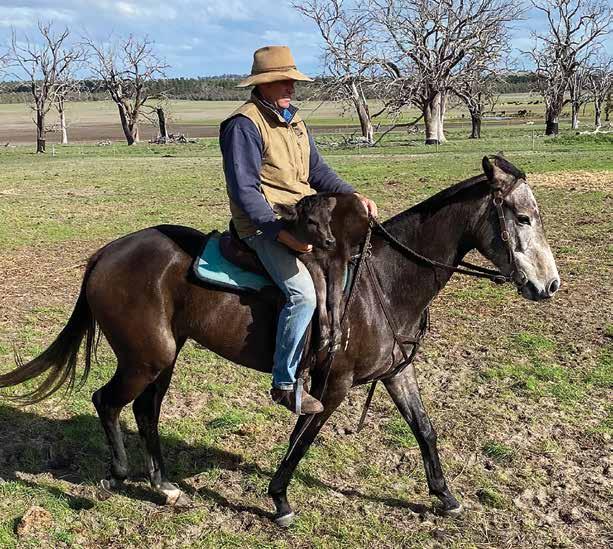
A LOVE OF HORSES AND RIDING HAS SEEN ROB AND JACINTA SIBLEY ABLE TO BUILD A LIVESTOCK CONTRACTING BUSINESS THAT GIVES THEM THE LIFESTYLE THEY WANT FOR THEMSELVES AND THEIR CHILDREN.
had been a shearer when she was young, moved into the mining scene, with both parents then driving heavy machinery at
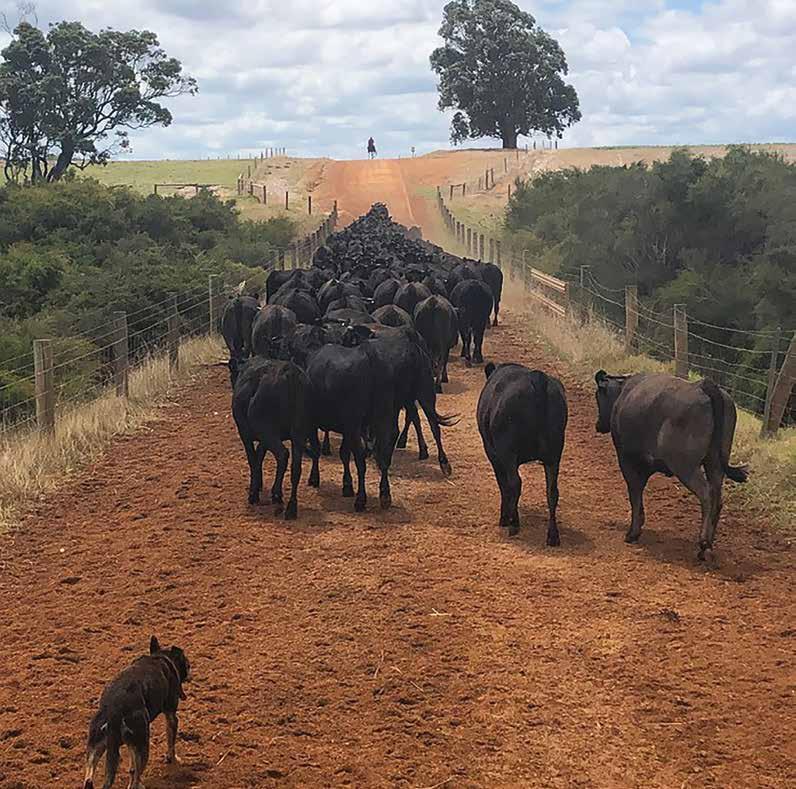
WORKING WITH YOUNG CATTLE, INCLUDING GETTING THEM FAMILIAR WITH FARM PRACTICE EARLY HAS INCREASINGLY BECOME PART OF THE BUSINESS.
various mines. This saw the family moving around often, including new schools.
But her love of horses and polocrosse stayed with her through the moves. When Rob and his family returned to NSW, Jacinta went with them.
NEW BEGINNINGS
Four years later they were married and, after a few more years, moved to Western Australia eventually finding themselves in Kojonup, a three hour drive south of Perth. Rob worked on several farms there, including a stint on a large sheep property for nearly seven years.
Selling sheep they owned for a good price just weeks before a market crash enabled the couple to buy a small 250-acre farm.
By then Rob, who was now well into his 30s, admits he was feeling a bit tired and worn out, wanting a change but not sure what that might look like. Though he was working full time, his dream of owning a larger-scale farm wasn’t looking promising.
He mentioned to a friend per-
AS HE OFTEN WORKS ALONE, TRAINING THE CATTLE YOUNG ALSO MAKES IT EASIER FOR ROB TO MANAGE THEM LONG TERM.
haps he should look at truck driving or maybe go and do some sheep drenching.
That chance comment lead to a local farmer getting in touch the following week to see if he could drench 300 of his sheep.
Since that first job, Rob has gone out on his own with Great Southern Livestock Contractors. The rural contracting business has steadily grown until now, Rob can be found working with
livestock on farms all around Perth.
“There’s anything from 300 to 10,000 ewes at the different properties we go to,” he reckons.
In any given week he can be more than a four-hour drive away from home, either north or south of the city. This often sees him working away from home during the week and coming home during the weekends.
While winters are fairly stand-
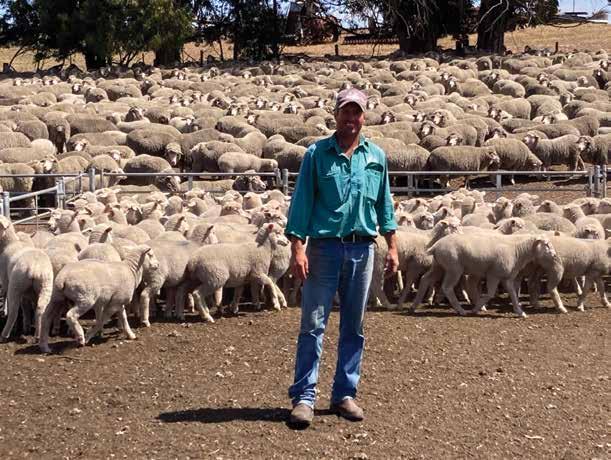
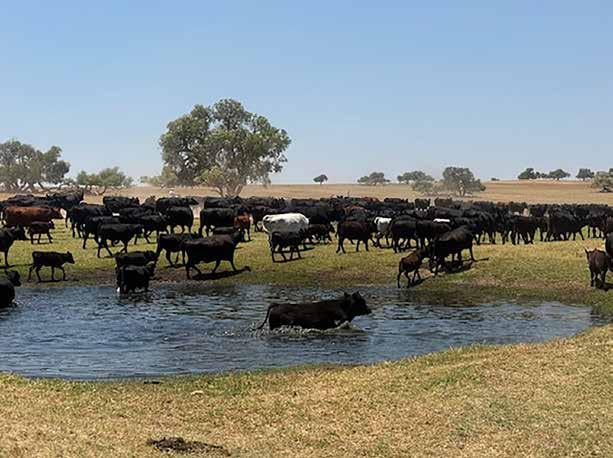
SHARE FARMING WITH THE BUSINESS SELLING ON A THIRD OF THE PROGENY EACH YEAR HAS PROVEN A GOOD OPTION.
ard, the wide spread can see Rob working in significantly different temperatures in summer. From 32 degree highs down by their small home farm south of Perth,
CROPPING FARMERS OFTEN HAVE A SKELETON CREW GETTING ROB IN TO MANAGE THE LIVESTOCK WHEN NEEDED, ON THE REST OF THE FARM.
to 45 degree highs three hours north of Perth.
As a lot of the farms are cropping farms, running a smaller number of sheep or cattle on rougher ground, Rob has found many farmers simply don’t have the work load for fulltime staff, preferring to look after the cropping side themselves and get Rob to come in do specific jobs with livestock when needed.
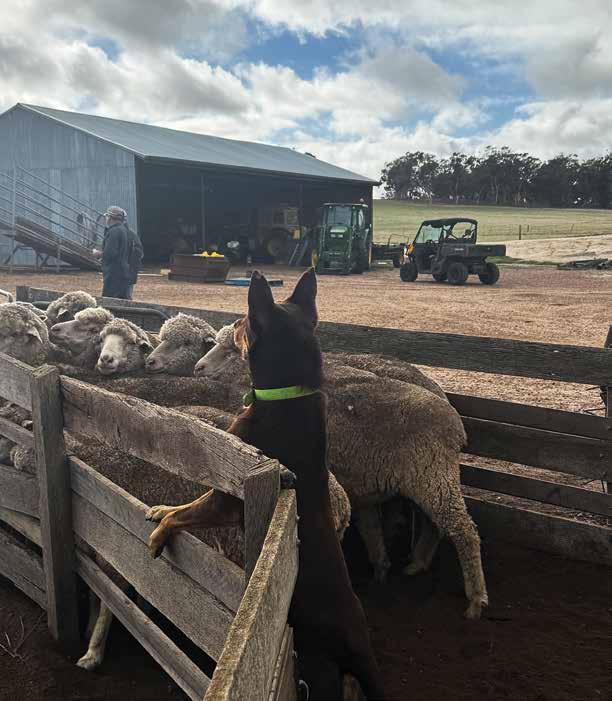
ALL OF THE SIBLEY’S NINE WORKING DOGS ARE AUSTRALIAN KELPIES.
The majority of the work is mustering sheep, drafting, drenching and vaccinating, while he is sometimes called on to organise the shearing.
“I’ll come in and they’ll give me a map of the farm, where the sheep are, where the shearing shed is. I’ll do the mustering and all the work to bring them into the shed, then out of the shed and take them away.”
This sees him loading a couple of horses, if he’s working alone on to the truck, or up to five if he’s working with a staff member, along with about seven working dogs – all Australian kelpies.
While there’s generally some sort of accommodation on the farm, when there’s not, Rob will be roughing it, parking up, starting up the generator and living out of the truck for a week.
EQUINE ALL THE WAY
One of the few pieces of equipment that Rob uses is a mobile Murray Sheep Handler, manufactured near Perth by DE Engineers. A double race that lifts off the ground, Rob can deal with 20 sheep at a time.
It gets quite a thrashing and, as he can be running 300,000 sheep through it, Rob swears by it.
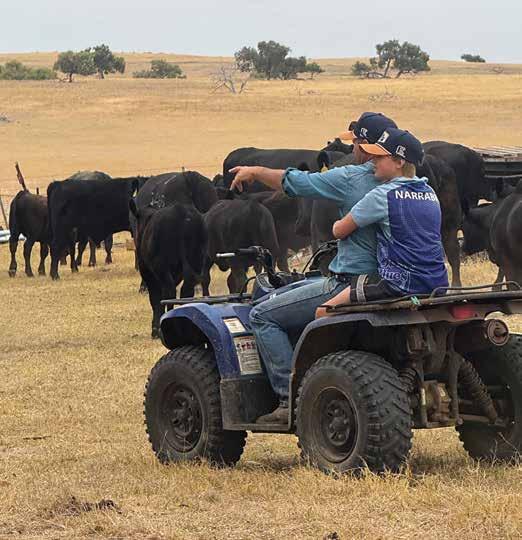
He also runs a four-wheel quad on some properties where it might be a bit too rough for the horses or the stock aren’t used to them, but usually it’s all done on horseback.
Their lack of interest in machinery, or need for it, in a state that Rob feels is infatuated by it has been something of a blessing.
It has meant they have been able to build up a contracting business that still has some oldschool romance attached to it, but also fits in well with their general enjoyment of life and their sport – one complimenting the other.
Rob also enjoys that he gets to know so many different people from high profile landowners to your average family on the farm. Because he is on-farm regularly and often for more than a couple of days, he gets to know some of his clients and their families very well, developing a relationship with them, how they’re doing, what their kids are up to, right down to their cats’ names.
EDUCATING CATTLE
Recently, he has been doing more cattle work, including calf marking and weaner educationall on horses and with dogs.
When young cattle are weaned off their mothers, some farmers will simply separate them and keep the weaners in the pens for a week to 10 days, walking through them and getting them used to contact.
Rob, instead, gets them used to how they’ll be handled as they get older - with horses and dogs. The dogs are introduced into the pens with them – he teaches them to stay together, to walk quietly around the yard with the dogs, before taking them out along the laneways, then into the paddocks and working with them there while on horseback.
They employ one full-timer and several semi-permanent casual staff while Jacinta also heads out at times mustering and training stock, including for corporate feedlots.
“If we’re short any staff, I have to go and jump on a horse and, you know, muster for the day or help count sheep. Last week I was out for some of our corporate clients, we had four of us inducting 650 head into a big 17,000-head feedlot.”
The work with the corporate farms – Jacinta’s area – is increasing.
“They have people on rotation, there’s days off, and then there’s a crossover where there’s not enough staff, so they can be
A FOUR WHEEL MOTORBIKE, USED ON ROUGHER GROUND UNSUITABLE FOR HORSES OR WITH STOCK UNFAMILIAR WITH HORSES, IS THE ONLY FARM VEHICLE USED IN THEIR OPERATION.
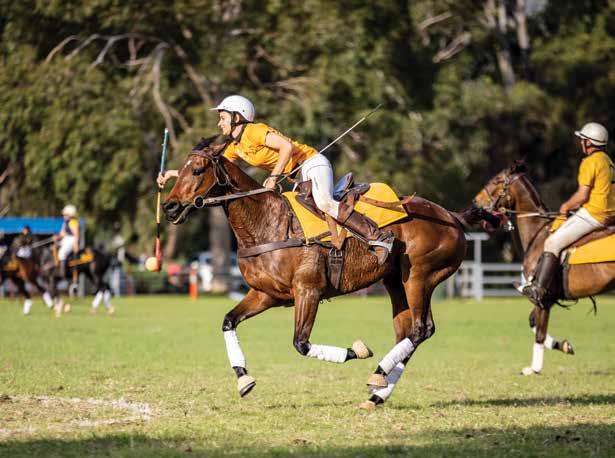
JACINTA HAS BEEN A REGULAR POLOCROSSE REPRESENTATIVE FOR WESTERN AUSTRALIA SINCE SHE WAS A TEENAGER.
Photo credit - Justine Rowe/ Around the Traps
short of staff with livestock skill sets. They may have a thousand head to do this week so they call up and we head out.”
PERTH BECKONS
While she had been involved as an accounting assistant in the early days, before moving into banking, this came to an end for Jacinta as their children and the administration and backup mustering side of the contracting business has taken more of her time.
Rather than sending their children the common route for rural families through boarding school, they decided instead to invest in an additional property, a 50-acre property close to Perth and relocate so the children could have a settled home and school life.
While their eldest son, William (16), had enjoyed a year of boarding, at $60,000 for each child per year they felt relocating until schooling finished, was a better option.
Rob is spending more of his time with share-farming now and this is seeing his long-held vision for owning his own larger scale farm soften a little.
Working with his dogs around livestock every day on horseback fulfills a lot of that desire especially as the share farming side has increased.
These share farming contracts, again mostly on cropping farms, see Rob managing the whole livestock operation, and tak-
ing a third of the progeny at the other end as payment. He sells the lambs under his own banner, directly off the farm, so they don’t need a larger land holding.
“I guess the model that we’ve got now with the share farming side of things is probably a bit more lucrative for me than when I have my own land.”
FULL CIRCLE
Rob and Jacinta, along with children William, Charlize (13) and 10-year-old Jack, are all involved with polocrosse. The kids also help out with the mustering work during the school holidays. This sees the family owning around 30 horses.
“We do a little bit of horse trading, so breed some. We also break in horses, in our spare time,” Jacinta says.
The speed and agility needed for good mustering horses are the same skills needed for polocrosse so many of the working horses transfer over to polocrosse when their working life ends.
The couple use mainly Australian Stock Horses for mustering as they are athletic, agile and bred for that kind of work. They transition over to polocrosse easily. They also have some thorough bred ex-track racehorses as they are also quick and athletic, and can take to the sport well.
Polocrosse has been more than just a passing interest for the couple, and they have proven to be very good at it.
Jacinta has regularly represent ed Western Australia in national competitions, and Rob repre sented New South Wales first as a 15-year-old then as a state rep for the next five or six competi tions before moving to WA. Now 43, he has represented Australia in overseas competitions four
times, including in the UK and New Zealand.
“I’ve been playing polocrosse for over 34-years straight. I haven’t missed a season in 34 years.”
Before the children were born, they took a year off after being invited to visit polocrosse friends in South Africa and spent nine months there riding horses, playing polocrosse and doing a bit of coaching. From there they headed to the UK, the Unites States, the Caribbean and New Zealand.
The entire Sibley family will be representing Western Australia in the 2026 National Championships in June.
“I got picked in the men’s team, Jacinta got picked in the women’s side, Will in the junior boys and Charlize, I think, will probably end up playing there as well in the junior girls. And, then Jack’s in the under twelves,” says Rob.
Held in Darwin, the competition will bring Rob and Jacinta’s equine odyssey full circle.
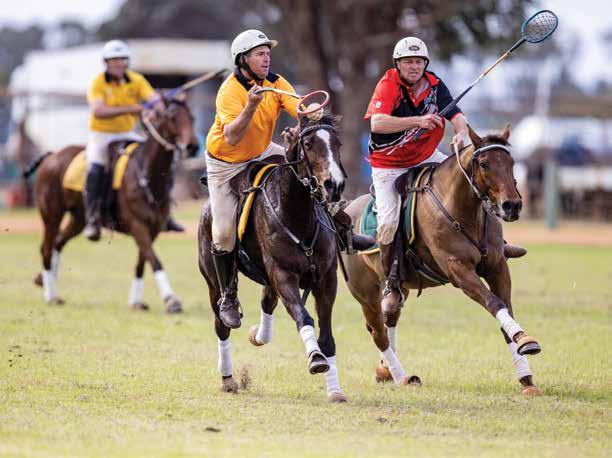
REPRESENTING AUSTRALIA IN POLOCROSSE HAS SEEN ROB COMPETING AROUND THE WORLD.
Photo credit - Justine Rowe/ Around the Traps
what’s new in... MACHINERY FINANCE
FARMERS AND CONTRACTORS FACE PLENTY OF UPS AND DOWNS IN THEIR BUSINESSES, ESPECIALLY WHEN THE WEATHER TURNS DRY. IT IS VITAL TO PAY ATTENTION TO THE BOTTOM LINE AND CONSIDER ALL MACHINERY FINANCE OPTIONS. IN THIS FEATURE, LEADING MACHINERY DISTRIBUTORS TELL US ABOUT SOME OF THEIR FINANCIAL PRODUCTS.
FLEXIBLE
FINANCE ENABLES FARMERS TO ACCESS NEW MACHINERY DURING PERIODS OF UNCERTAINTY
Australian agriculture continues to operate in a highly variable environment, shaped by global market shifts, rising fuel and freight costs, fluctuating input prices and increasingly inconsistent weather patterns. These pressures have reinforced the importance of reliable machinery and flexible financial support to help farmers maintain productivity and manage risk.
Advancements in agricultural machinery have accelerated in recent years, transforming equipment from standalone assets into connected, data-driven systems. Modern tractors and combines across CNH’s brands now feature embedded connectivity, enabling real-time machine monitoring, remote support and streamlined data transfers.
Platforms such as FieldOps provide farmers with a consolidated view of their fleet, crop performance and machine health, supporting faster and more informed decision-making. Automation technologies are also improving harvesting accuracy and machine efficiency, helping operators reduce losses and maintain performance in variable conditions.
As these technologies continue to develop, many farmers are
choosing to update machinery more frequently to ensure they have access to the latest productivity and efficiency gains. Flexible finance has become an important tool in supporting this transition.
According to Matthew Dowling, CNH Capital Managing Director for Australia and New Zealand, partnering with a finance provider that understands seasonal income patterns can make investing in new machinery more manageable.
CNH CAPITAL
CLAAS FINANCIAL SERVICES
BACK YOUR MACHINES WITH FINANCE THAT WORKS FOR YOU
For many Australian farmers, machinery is one of the biggest investments made on the farm. From tractors and seeders to sprayers and spreaders, modern equipment is critical for boosting productivity, managing labour, and getting the job done within increasingly narrow seasonal windows.
But as technology advances, so does the cost of modern machinery. That’s why more farmers are turning to tailored finance solutions—helping fund new equipment without straining cashflow. Different finance options offer different benefits, depending on your farm business, and understanding how they work can make machinery investment a smarter, more strategic decision.
Farm income doesn’t arrive evenly throughout the year. Cropping operations may receive most of their income after harvest, while livestock producers often see revenue fluctuate with markets and seasons. That’s where flexible machinery finance comes in: agreements can be structured to match your cashflow, ensuring repayments align with the realities of your farm.
Claas Financial Services offers tailored financial packages to suit your needs. Whether it’s planning deposits, adjusting repayment schedules, or exploring no-deposit options, we can create a plan that works for your operation.
“Cash flow that adapts to the season is what keeps operations moving,” Matthew said.
“CNH Capital has spent nearly 50 years in the Australian market, supporting growers and contractors through everything from droughts to commodity swings to global shocks. Right now, that experience matters more than ever.
“We structure repayments around how and when customers earn, rather than applying a uniform lending model. Cane growers may make repayments
Low promotional rates are attractive, but they often come with higher deposits or shorter terms. For contractors scaling up their fleet, or farmers needing a repayment holiday during lean months, options like no-deposit finance or flexible repayment structures can be more practical—even if the interest rate is slightly higher. The key is matching repayments to your income cycles.
Your local Claas dealer can provide a basic finance quote on-site, and our finance specialists are ready to design more complex structures.
Whether you’re investing in Claas Greenline products, tractors, Scorpion telehandlers, Jaguar, Lexion, or quality used equipment, we can structure a
twice a year, grain growers at harvest, dairy farmers monthly, and contractors in line with their seasonal workload.”
Farmers can retain capital for operational needs during critical periods by spreading machinery costs across the working life of the asset.
Service, warranty and maintenance can also be incorporated into finance packages, providing greater certainty over total cost of ownership at a time when input costs continue to fluctuate.
repayment plan that fits your income periods.
Choosing the right dealer and finance partner is just as important as choosing the right machine. Working with people who understand agriculture means you get practical advice on equipment, servicing, and finance—helping your operation run efficiently for years to come.
Established in 2010, Claas Financial Services is part of De Lage Landen (DLL), a proud member of the Rabobank Group and a leading provider of equipment and technology finance to the agriculture and food industries. With deep industry knowledge, DLL delivers sustainable finance solutions for manufacturers, dealers, farmers, and contractors in over 30 countries.
Matthew said CNH Capital’s financing options are designed to help farmers access machinery that can deliver improvements in fuel efficiency, labour use and operational productivity.
“We understand it can be daunting to consider purchasing a new tractor or combine harvester amid global uncertainty,” he said.
“Our role is to support customers in accessing equipment that helps them operate efficiently and sustainably, even when
Investing in machinery is about more than just buying a tractor or sprayer—it’s about securing the future of your farm. The right finance lets you put top-quality equipment in your hands without tying up cash needed for day-today operations.
Plan carefully, work with experts who know both the land and the numbers and choose machines that will keep your paddocks running efficiently for years to come.
With Claas Financial Services backing the products we sell, your local Claas dealership is the first place to start for all your machinery finance needs.
Talk to our team today and see how we can help: https://claasharvestcentre.com/finance -leasing/.
broader conditions are unpredictable.
“Our financing options help farmers access reliable new machines that can deliver real savings on fuel, labour and inputs, while opening up a world of data that enables them to farm smarter and lift the overall productivity of their operation.”
For more information about equipment financing through CNH Capital, customers can speak with their local Case IH or New Holland dealer.
POWERING GROWTH FOR FARMERS AND CONTRACTORS
The right timing, reliability, and cash flow can make or break a season for Australian farmers and agricultural contractors, which is why they are increasingly turning to more innovative finance solutions.
PFG Credit is a lender dedicated to meeting the individual needs of our clients.
PFG Credit emphasize flexibility and customer support and can deliver a range of lending products for the agricultural sector, all designed to make it easier and faster for farmers and contractors to access the equipment they need to stay productive and competitive.
Finance designed for the realities of farming
Agricultural businesses don’t operate like traditional commercial enterprises.
Seasons fluctuate, cash flow varies and equipment needs can be urgent. PFG Credit understands that and makes the application process simple. Their finance programs allow businesses to:
- Conserve working capital
- Budget on a fixed rate
- Select fixed term and fixed repayments to suit their cash flow
- Tailor payment options.
Financing beyond PFG machinery
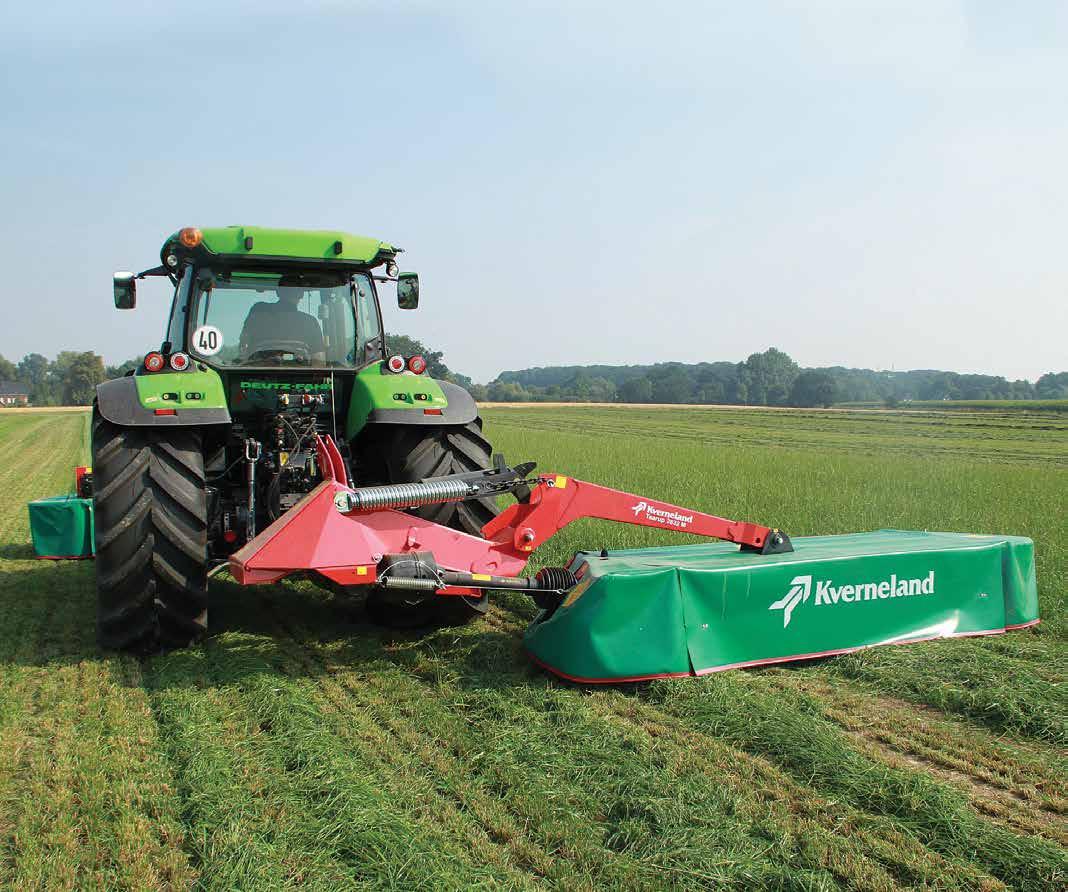
PFG Credit supports the full range of PFG brands, - Deutz Fahr, Kioti, Versatile, Kverneland, McHale, Bad Boy mowers and more. In addition to PFG equipment, our team can also arrange finance for a full range of:
- New and used farm machinery from participating dealerships
- Commercial vehicles and machinery
- Telehandlers and excavators
- Pumps, irrigators, and other essential farm equipment.
This breadth of coverage means farmers can consolidate their equipment financing under one trusted provider.
Supporting every stage of the farming operation
Whether it’s a contractor upgrading a fleet of machinery or a family farm investing in a new tractor, PFG Credit’s solutions can help businesses:
- Preserve cash flow for operational needs
- Plan long term with fixed costs
- Respond quickly to seasonal opportunities.
With finance terms available up to 72 months, repayments can be structured to suit the rhythm of the business.
A partner in productivity
PFG Credit isn’t just a lender, but also a partner in agricultural productivity. Their close rela-
tionship with PFG dealerships ensures a seamless experience from equipment purchase to settlement.
Farmers can speak directly with finance specialists who understand the machinery, the industry, and the pressures of rural business.
For many, this combination of industry knowledge, fast turnaround and flexible finance is what sets PFG Credit apart.
Farmers and contractors can begin the process through their local PFG dealer or by contacting PFG Credit directly: Phone: 1800 734 273
Email: pfgcredit@pfgaustralia. com.au.
Applications are simple and the team is ready to help businesses find the right finance solution for their needs.
Loan fees and commercial lending criteria apply. PFG Credit is a division of De Lage Landen Pty Limited ABN 20 101 692 040.
KUBOTA AUSTRALIA FINANCE
SUPPORTING AUSTRALIAN FARMERS
For many Australians, the right equipment isn’t just a purchase, it’s the backbone of their business, their livelihood, and their productivity.
That’s where Kubota Australia Finance steps in. Operating under Kubota Australia Pty Ltd, Kubota Australia Finance has become a trusted name in equipment finance, offering simple and flexible finance solutions for customers investing in new, demo or used Kubota machinery through participating dealerships.
Since opening its lending division in 2011, Kubota Australia Finance has grown into a key financial partner for farmers, contractors, homeowners and businesses across the country.
Today, it proudly supports customers working with the full suite of Kubota Australia brands, including Kubota, Krone, Great Plains, Land Pride and Baroness.
With competitive rates avail-
able on both consumer and commercial finance, the Kubota Australia Finance team is dedicated to providing the finance products designed to help customers access the equipment they need, when they need it. Whether it’s a compact tractor for acreage, a high horsepower
workhorse for the farm or specialised turf equipment for professional grounds management, Kubota Australia Finance offers finance options tailored to real world needs.
Customers looking to make their next purchase can explore current finance offers on the
Kubota Australia website or speak directly with their local Kubota dealer for a personalised quote.
FACTORY DIRECT SALES, SPARE PARTS AND SUPPORT AVAILABLE NOW
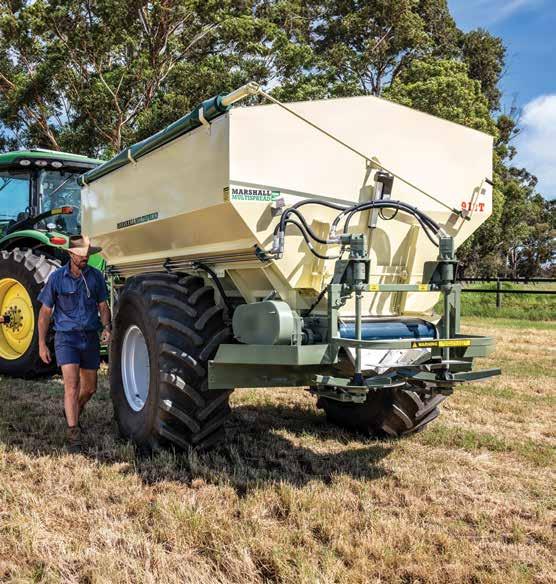
For over 40 years, Roesners have manufactured the all purpose Marshall Multispread,designed for Australian Agriculture.
The Marshall Multispread delivers proven performance and versatility with over 11000 units in the field across Australia, backed up by superior customer service and support.
Multispread machines are available with advanced features such as the D3 spinner system for accurate spread patterns up to 36m and the latest version 3 i4M spreader controller, launched in June 2025, including a new auto-calibration feature.
To discuss your fertiliser spreading requirements, call Roesners today to speak directly to our dedicated sales, spare parts and support team.
KP Contracting: IN A REGION THAT DEMANDS IT
built on reliability
KP CONTRACTING HAS NEVER BEEN A BUSINESS BUILT AROUND NOISE. IN A REGION LIKE THE MANAWATU, WHERE FARMING SYSTEMS ARE DIVERSE AND THE WEATHER CAN REDRAW THE SEASON IN A MATTER OF DAYS, REPUTATION RESTS ON SOMETHING FAR MORE PRACTICAL THAN MARKETING.
It rests on whether a contractor turns up when they say they will, whether the job is done properly and whether farmers feel confident handing over responsibility at the moments that matter most.
That is the foundation KP Contracting has operated from since its early days and nearly two decades on from its last feature in this magazine, much of that foundation remains unchanged.
technological, regulatory and structural change over the same period.
KP Contracting was established to serve a local farming community that required dependable support across cultivation, planting and harvesting. From the outset the business was structured around practical fieldwork rather than diversification for its own sake. Over time it expanded steadily as demand grew and as relationships deepened across the district. The growth was organic rather than aggressive, driven by repeat
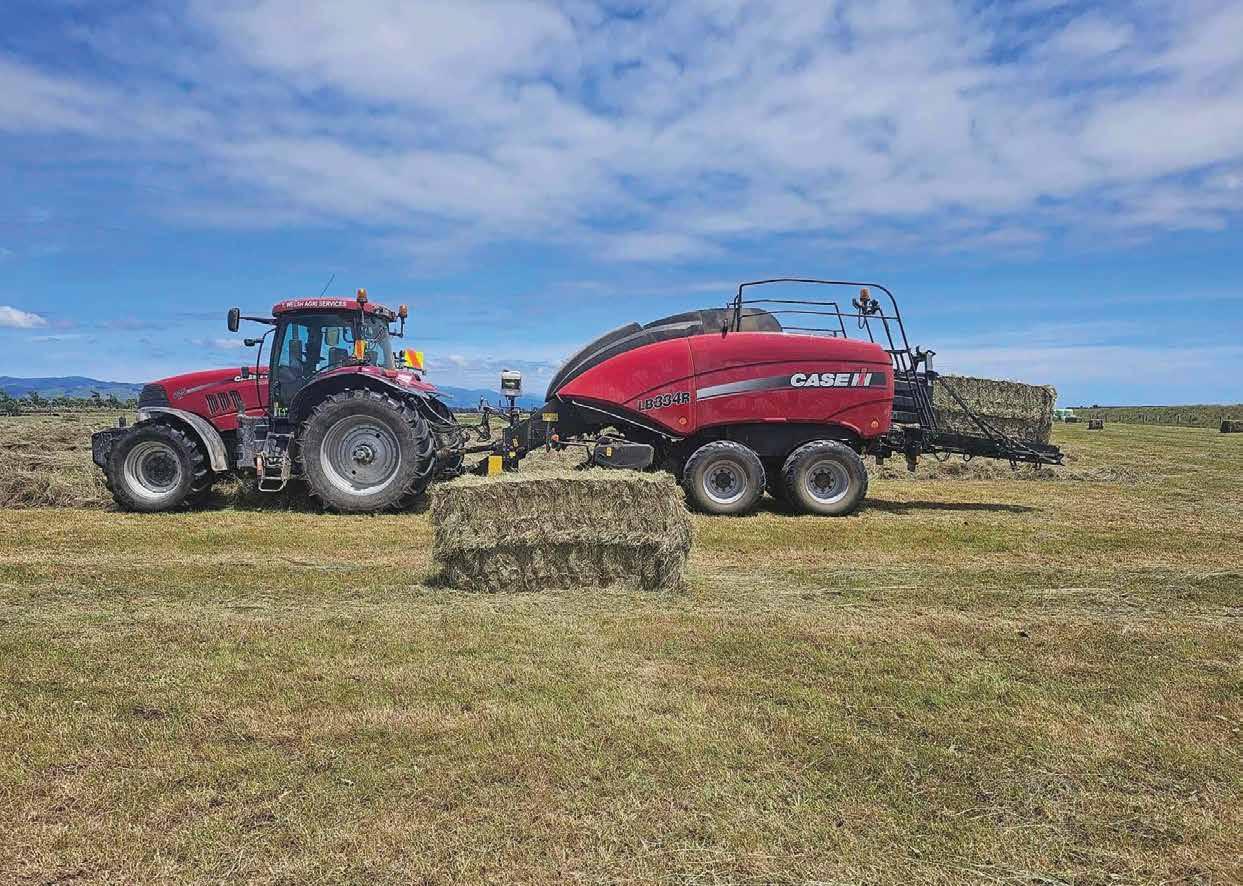
BALEAGE AND HAY PRODUCTION REMAIN AN IMPORTANT PART OF THE SEASONAL WORKLOAD FOR KP CONTRACTING.
clients and referrals rather than headline expansion.
There have however, been some changes. The drainage side of the business once a component of the service offering, has since been sold. That decision reflected a focus on refining rather than broadening the operation. “We made a conscious
across ditch the PROFILED IN NZ’S RURAL CONTRACTOR & LARGE SCALE FARMER APRIL/MAY 2026, WE VISIT KP CONTRACTING IN THE MANAWATU, NEW ZEALAND.
When revisiting the business today, the most striking thing is not how much has altered but how steady the core has remained. As Heather Pope, the company’s office manager, put it when reflecting on the earlier profile, “If you look back at the 2007 article, things are pretty much the same. We have kept to what we know and what works.” That continuity speaks volumes in an industry that has seen significant
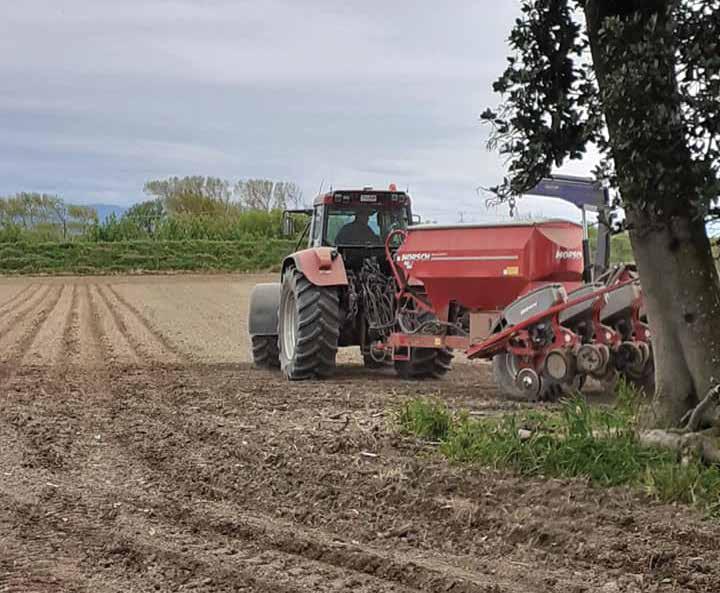
THE KP CONTRACTING TEAM WORKS ACROSS A WIDE RANGE OF TASKS INCLUDING CULTIVATION, PLANTING, SPRAYING AND HARVESTING.
decision to concentrate on the areas where we felt we could add the most value,” KP Contracting says. “Selling the draining side allowed us to put more energy into cultivation, planting and the crop protection work that our clients rely on.” In a region where soil conditions vary widely and timing is critical, sharpening that focus has proven more valuable than maintaining a broader but thinner service range.
Ownership has also evolved. Kerry Ploen, who played a role in earlier years has since retired from the business. Today KP Contracting is directed by three shareholders: Peter Fullerton-Smith who remains a constant presence from the early days, alongside Jason Brown and Tom Welsh. The structure is deliberately straightforward, with responsibilities shared and communication constant.
“Everything is shared between the three directors,” the directors say. “Jason looks after the spraying side more closely, Peter oversees cultivation and Tom helps run the team and supports both of them. But they all step in where needed.”
That flexibility reflects the practical realities of contracting. In smaller to mid-sized operations, rigid divisions of responsibility rarely survive peak season. When weather windows open, everyone is involved in coordination, logistics and field decisions. The shared leadership model at KP Contracting allows for that adaptability while still ensuring each core area has clear oversight.
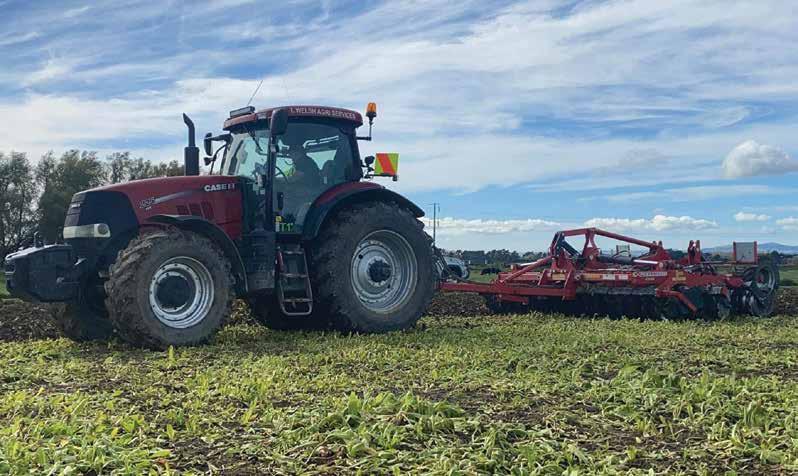
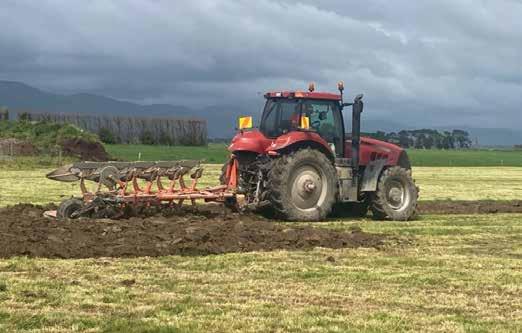
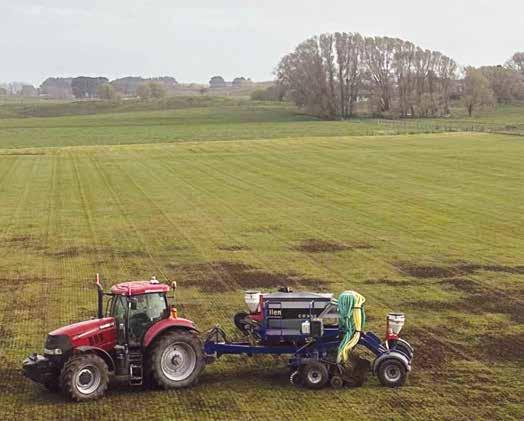
The services offered today mirror the central needs of Manawatu farms. Cultivation and planting remain the backbone of the operation, forming the starting point for crop establishment across mixed and dairy support systems. From ground preparation through to drilling, the work undertaken in spring often determines how the season unfolds. Soil variability across the region means that machinery setup,
depth control and timing cannot be approached generically. Experience remains as important as horsepower.
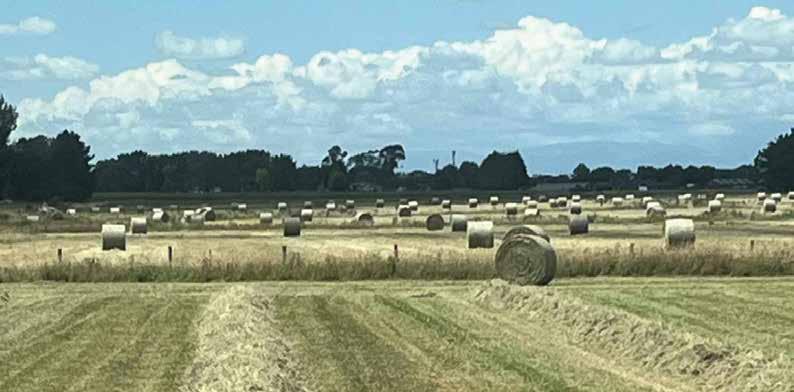
Harvesting, hay and baleage production also form a significant part of the annual cycle. Interestingly, KP Contracting noted a shift in workload patterns in recent seasons. “We have noticed that harvesting has slowed a little and hay production has increased,” they said. That change reflects broader trends within farming systems, where feed conservation strategies have adapted to market pressures and climatic variability. Baleage and haymaking windows have become more tightly managed, with contractors expected to respond quickly when conditions align.
Spraying rounds out the core service offering and operates across the calendar. “We spray all year round as required,” KP Contracting said. Unlike some
seasonal tasks, crop protection and pasture management demand continuity. Modern plant protection work carries increased expectations around precision, record keeping and compliance. The contractor’s role extends beyond simply applying product to ensuring that timing, rate and method align with both agronomic and regulatory requirements.
Locally, KP Contracting has developed a reputation particularly in plant protection. “We are well known for everything that goes with plant protection, from prep to harvest,” KP Contracting said. That phrase encapsulates a broader strength of the business: involvement across the full cycle rather than isolated tasks. From initial cultivation and planting through to crop maintenance and eventual harvest, continuity of service allows for better planning and smoother execution.
Machinery underpins that
KP CONTRACTING HAS BUILT ITS REPUTATION ACROSS THE MANAWATU THROUGH CONSISTENT SERVICE AND DEPENDABLE SUPPORT FOR LOCAL FARMERS.
delivery. The fleet today is predominantly Case, reflecting a preference that has developed over time. While other brands sit in the shed where appropriate, Case equipment forms the backbone of the operation. Brand loyalty in contracting is rarely about image. It is about reliability, dealer support and familiarity for operators. Consistency in fleet selection simplifies maintenance, parts management and operator training.
Investment decisions are approached pragmatically rather than aspirationally. “We maintain our vehicles well and replace as we need to update
the fleet and replace older equipment,” KP Contracting said. That measured approach avoids both over-capitalisation and reactive spending. In contracting, machinery must earn its place. New purchases are justified by efficiency gains, reliability improvements or the need to meet evolving client expectations, not by novelty.
A typical year at KP Contracting follows a rhythm familiar to many rural operators, yet within that rhythm lies constant variation. Winter is devoted largely to maintenance. Machinery is stripped, serviced and prepared for the intense months ahead. Planning conversations with clients begin early, mapping likely workloads and identifying potential pressure points.
Spring signals the acceleration. Cultivation and planting dominate the schedule as soil conditions allow. Operators move between properties with careful coordination, chasing worka-
ble windows while monitoring moisture levels and forecasts. Summer shifts the focus toward crop maintenance and hay or baleage production. The pace rarely slows. “Summer is when everything seems to happen at once,” KP Contracting says. “You have crop maintenance, mowing, baling and all the coordination that goes with it.”
Autumn brings harvesting and regrassing. Crops reaching maturity across multiple farms can compress the workload dramatically. Weather remains the overarching variable. In the Manawatu, where rainfall patterns can shift quickly, contractors must remain poised to act. KP Contracting was clear about the greatest challenge facing the business. “Weather is our biggest challenge,” they said. “It dictates everything we do.”
That dependence on weather is not new, but variability appears to be increasing.
Shorter, less predictable win -
dows place greater pressure on scheduling and staff. When conditions align, the team must operate efficiently and safely for extended periods. KP Contracting runs with a deliberately lean structure: three permanent staff, three casuals and the three directors themselves, all of whom operate as all-rounders. “Everyone can turn their hand to most jobs,” the directors say. “That flexibility is what keeps us moving.”
Retaining skilled staff remains one of the defining challenges of modern contracting. Experienced operators bring not only machinery competence but judgement. They read paddocks, adjust to changing conditions and represent the business on-farm. In a tight labour market, maintaining a stable team becomes a competitive advantage. Smaller teams also reinforce accountability. Each person understands their role within the broader schedule and
CAREFUL PLANNING AND STRONG COMMUNICATION WITH FARMERS HELP ENSURE WORK IS COMPLETED WITHIN TIGHT SEASONAL WINDOWS.
the importance of communication.
Behind the visible fieldwork sits careful organisation. Contracting may appear reactive but success depends heavily on preparation. Planning conversations with clients, forward booking, equipment servicing and staff coordination ensure that narrow windows are used effectively. Communication has become increasingly important. “There is a lot more planning involved now,” KP Contracting says. “Farmers want to know what the schedule looks like and how weather might affect things. Keeping those lines open makes a big difference.”
What has also changed, even if the structure of the business has not, is the complexity of the environment in which contractors operate. Twenty years ago expectations around documentation, chemical traceability and environmental oversight were present but comparatively light. Today they are embedded in daily workflow. Spray diaries are scrutinised, buffer zones are clearly defined and communication with neighbouring properties has become routine rather than optional. For a business known locally for plant protection, that responsibility carries weight.
“There is definitely more paperwork than there used to be,” KP Contracting said. “But it is part of being professional. Farmers need those records and we need to be able to stand behind what we have done.” That shift reflects a broader maturation of the sector. Contractors are no longer simply machinery providers. They are accountable operators within increasingly regulated farming systems. There is also the question of
THE CONTRACTING
FLEET
IS BUILT AROUND PRACTICAL
MACHINERY
CHOICES DESIGNED TO DELIVER RELIABILITY IN DEMANDING CONDITIONS.
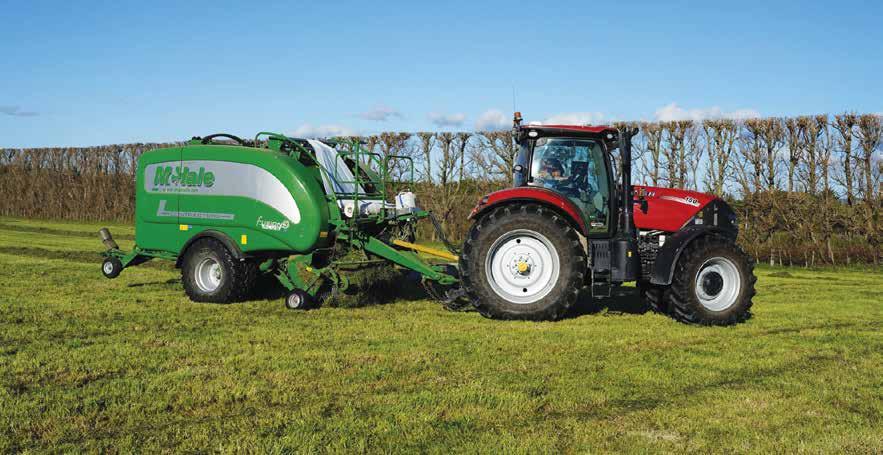
MACHINERY RELIABILITY AND CAREFUL MAINTENANCE UNDERPIN THE DAY TO DAY OPERATION OF THE KP CONTRACTING FLEET.
generational transition. With Peter remaining involved and Jason and Tom stepping into directorship roles, the business now carries both institutional memory and forward momentum. Knowledge of paddocks, clients and seasonal patterns cannot be replicated quickly, yet new leadership brings fresh perspective and energy. In smaller rural enterprises, that blend is often what sustains longevity.
Risk management has become more deliberate. Machinery represents significant capital and downtime during peak periods
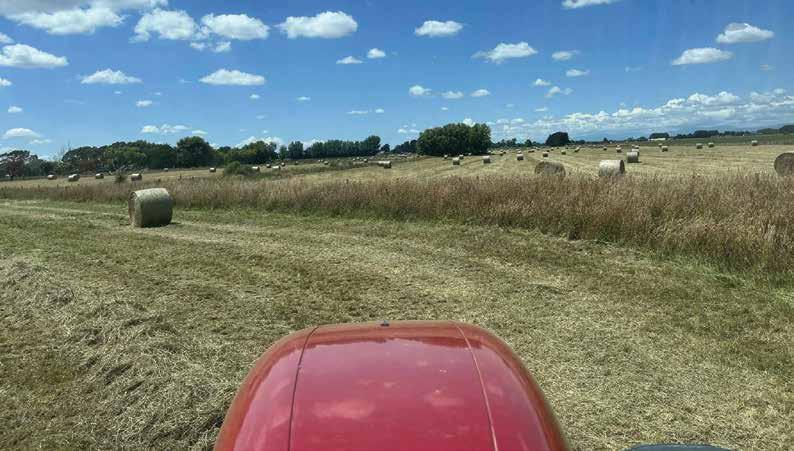
WEATHER WINDOWS IN THE MANAWATU CAN BE SHORT, REQUIRING CONTRACTORS TO MOVE QUICKLY WHEN CONDITIONS ALLOW.
is costly. Preventative maintenance is, therefore, not a winter formality but a strategic decision. Likewise, workload management is balanced carefully to avoid overextension. In contracting, chasing volume without capacity can erode the very reliability that built the business in the first place.
The Manawatu itself remains a demanding region in which to operate. The mix of dairy support, cropping and pasture-based systems means contractors must move between very different tasks across short distances. Soil types shift, paddock shapes vary and access can change dramatically with rainfall. That variability rewards operators who are observant and measured rather than purely mechanical.
Looking ahead, the three directors are conscious that the contracting environment will continue to evolve. Market volatility, input costs and environmental policy will shape farm decisions and, by extension, contractor workloads. Adaptability remains
central. “We know things will keep changing,” KP Contracting said. “The key for us is staying flexible and keeping the relationships strong.”
Those relationships remain the thread running through the business. In rural communities, longevity is earned. Farmers remember who turned up during difficult seasons and who communicated clearly when plans shifted. They value contractors who understand the local soils and systems, who anticipate rather than react and who treat each job as part of a longer partnership.
Revisiting KP Contracting after nearly two decades reveals a business that has resisted the temptation to chase scale for its own sake. Instead, it has focused on doing core work consistently well. The sale of the drainage arm and the retirement of Kerry did not signal contraction but refinement. The arrival of Jason and Tom alongside Peter reflects continuity combined with renewal.
In many ways, KP Contracting
PLANT PROTECTION HAS BECOME A KEY PART OF THE SERVICE OFFERING, WITH INCREASING EMPHASIS ON PRECISION AND COMPLIANCE.
embodies the quiet strength of regional contracting in New Zealand. It operates without fanfare yet underpins critical stages of the farming cycle. It adapts where necessary but holds fast to principles that have always mattered. Reliability, straightforward communication and practical competence remain its defining characteristics.
As farming systems in Manawatu continue to adjust to climatic variability and economic pressure, the need for dependable contractors will only intensify. Machinery may become more advanced and compliance frameworks more detailed, yet the core expectation remains simple. Farmers require partners who will stand behind their commitments.
KP Contracting’s story, stretching from its early years through to its present structure under Peter, Jason and Tom, demonstrates that stability and adaptability are not opposing forces. They are complementary. By maintaining a clear focus on core services while adjusting structure and emphasis where needed, the business has sustained relevance across changing seasons.
KP Contracting reflection perhaps captures it best. “We have not tried to reinvent ourselves,” they said. “We have just kept working hard, looking after our gear and looking after our clients.” In a region that demands reliability above all else, that approach continues to hold its value.
what’s new in... TRACTORS 90HP+
TRACTOR MANUFACTURERS CONSTANTLY RE-ENGINEER THEIR MACHINES AND DEVELOP NEW MODELS. ADVANCED FEATURES SUCH AS FUEL-EFFICIENT ENGINES, CONTINUOUSLY VARIABLE TRANSMISSIONS, FACTORY-FITTED PRECISION FARMING TECHNOLOGY, AND LARGE COMFORTABLE CABS ARE AVAILABLE ON MORE AND MORE MODELS. IN THIS FEATURE THE LEADING COMPANIES TELL US ABOUT THEIR NEW HIGH HORSEPOWER TRACTORS.
MASSEY FERGUSON
MF 9S: HIGH HORSEPOWER TRACTORS BUILT FOR EFFICIENCY, PRECISION AND LONG
DAYS
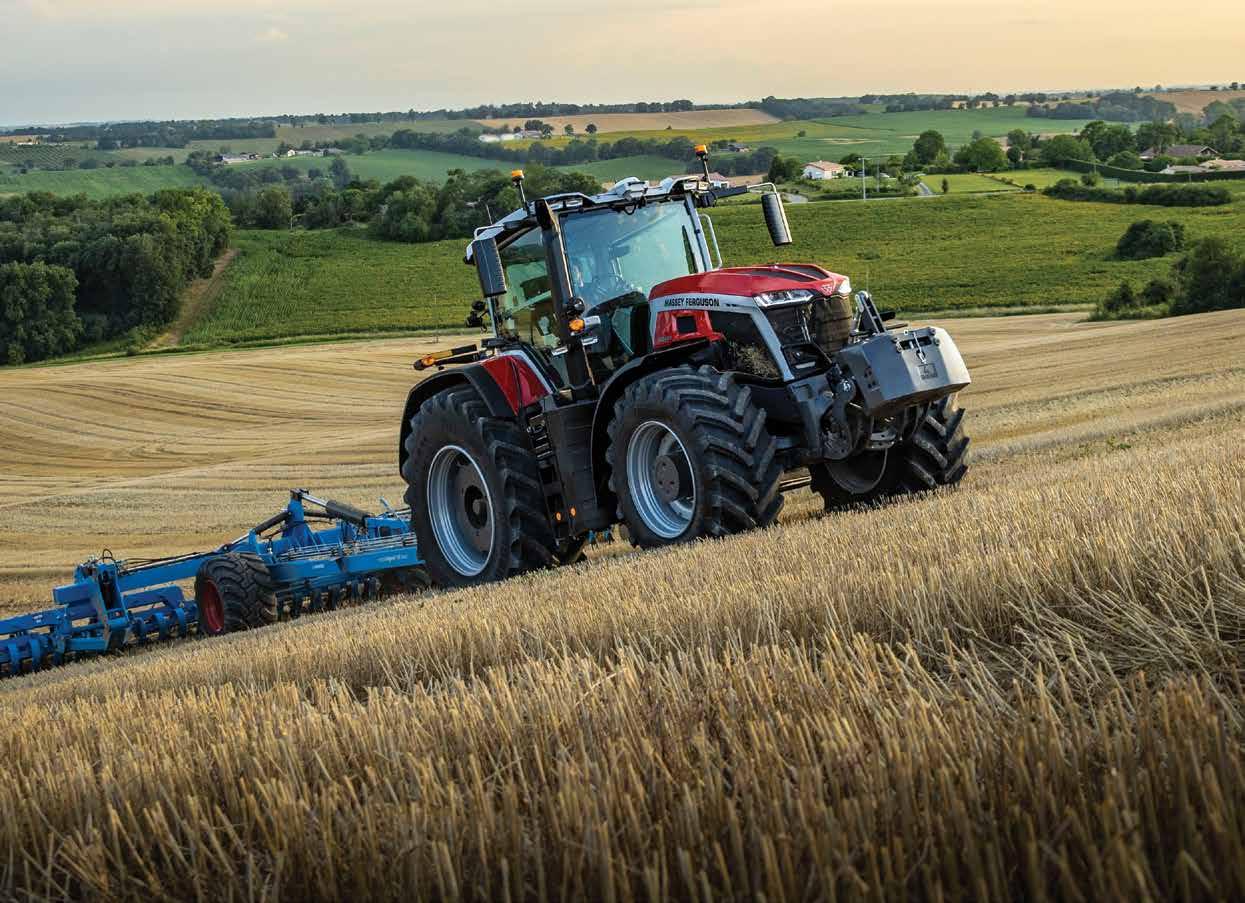
Large scale farming continues to demand more from high horsepower tractors, with efficiency, automation and operator comfort now just as critical as outright performance. Massey Ferguson’s MF 9S Series arrives in Australia at a time when machine utilisation is high, working windows are tight, and technology must deliver measurable gains in productivity.
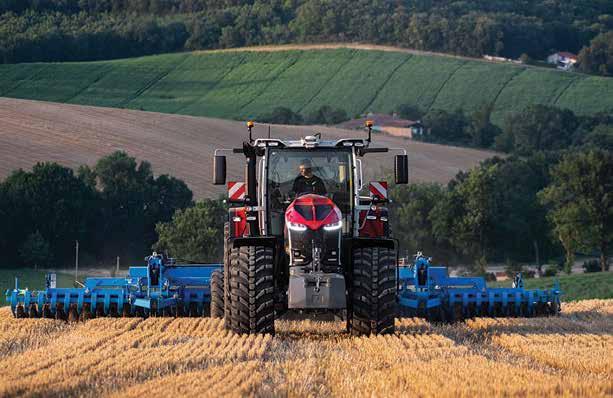
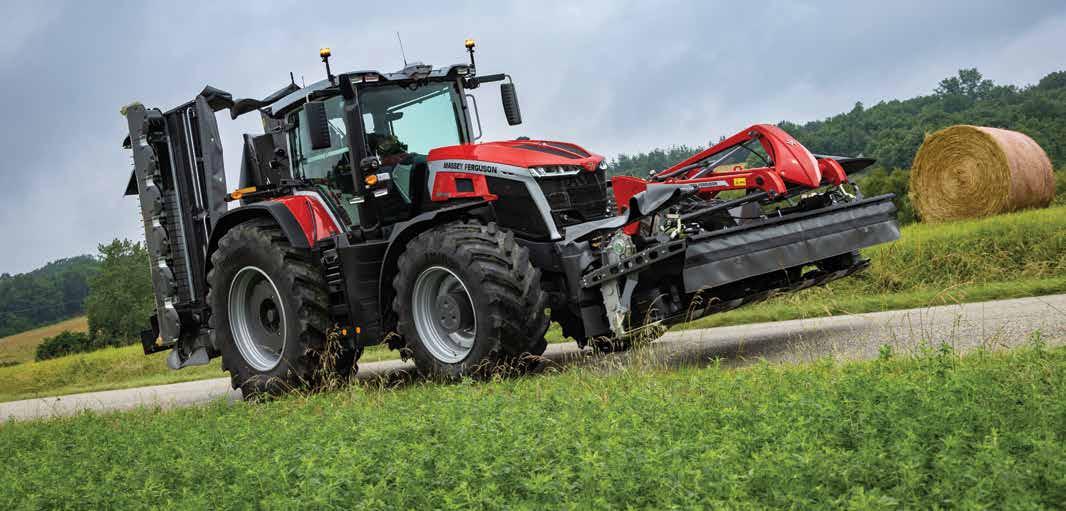
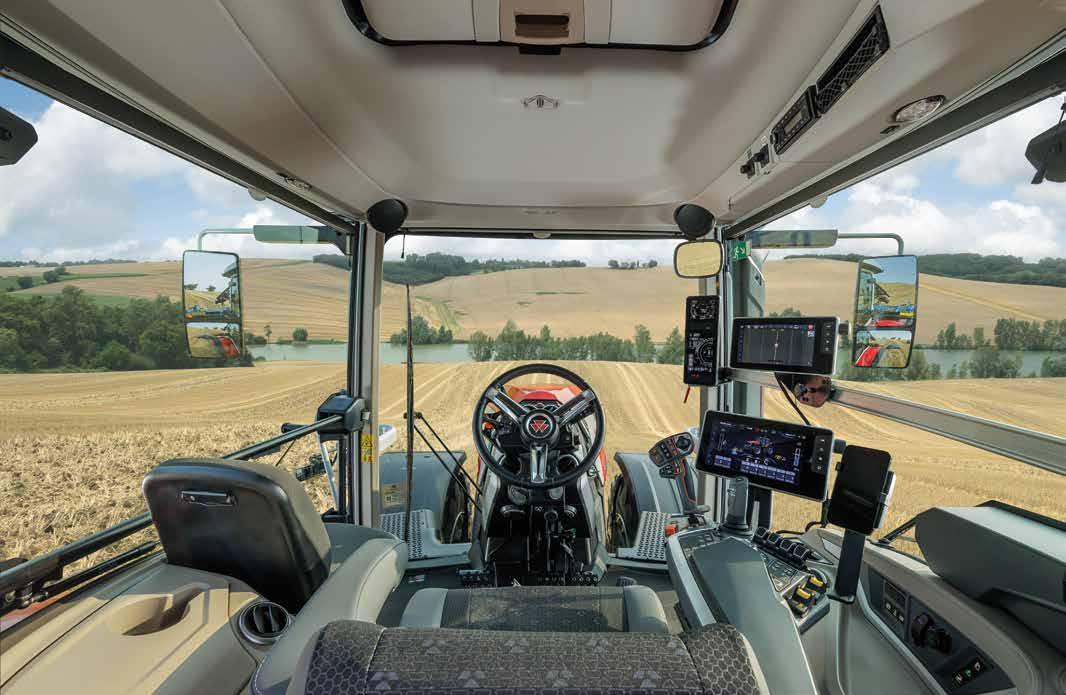
Positioned as the new flagship of the brand’s large frame range, the MF 9S Series spans six models from 285 to 425 horsepower, offering a broad power band suited to tasks including broadacre seeding, deep tillage, heavy cultivation, forage operations and transport duties. Built on Massey Ferguson’s proven Protect U design, the MF 9S represents a continuation of the company’s ‘straightforward and depend-
able’ tractor philosophy, combined with a strong emphasis on precision farming and operator wellbeing.
The MF 9S Series arrives with established international credibility, having received multiple international awards recognising its design and innovation.
At the heart of every MF 9S is an 8.4 litre, six cylinder AGCO Power engine coupled as standard with the Dyna VT continuously variable transmission. Designed for efficiency as much as output, the
Stage V engine uses a simplified all in one after treatment system without EGR, helping reduce maintenance complexity while supporting long operating hours. A large 660 litre fuel tank further underpins extended workdays, particularly valuable during peak seasonal demands.
Precision capability is standard across the range, with MF Guide auto steering and MF Connect telemetry included from the factory. For businesses operating across large paddocks and long days, automation features
such as AutoTurn and AutoHeadland reduce repetitive tasks at the ends, improving consistency while also lowering fatigue. Optional Isobus Tractor Implement Management (TIM) extends automation further by enabling compatible implements to control key tractor functions automatically based on operating conditions.
One of the technical stand outs of the MF 9S is its hydraulic performance. With high flow, load sensing hydraulics delivering up to 400 litres per minute, the series is well matched to modern, high demand implements. A generous exportable oil capacity
and multiple spool valve configurations support versatility across all applications, while maintaining efficient engine speeds to reduce fuel use.
Soil protection and traction management play an increasingly important role in machinery selection, and the MF 9S addresses this with optional Central Tyre Inflation System (CTIS).
Integrated into the Datatronic 5 terminal, CTIS allows pressures to be adjusted on the move, reducing compaction in the paddock while improving transport efficiency on the road. Combined with the tractor’s relatively low base weight and long wheel-
base, this delivers a balance of stability, floatation and manoeuvrability.
Comfort is another area where the MF 9S reflects current operational realities. The Protect U design physically separates the engine from the cab, contributing to low in cab noise levels of just 69 dBA. A spacious 3.4m3 cab, extensive glass area and wide sweep wiper enhance visibility in long workdays and low light conditions. Controls are centred around the Datatronic 5 touchscreen and multifunction armrest, allowing most functions to be accessed intuitively from the seat.
For large scale operations managing mixed fleets, running familiarity and consistency remain important. The standard Dyna VT transmission, separate hydraulic oil reservoir and robust driveline design align with these requirements, supporting reliability and ease of integration alongside existing machinery.
The MF 9S Series is available to order now in Australia, with demonstration units currently working in local conditions. Farmers can arrange demonstrations through their local Massey Ferguson dealer.
To learn more, visit www.masseyferguson.com/en_au.
8R AND 8RX TRACTORS FOR GREATER PRODUCTIVITY AND PERFORMANCE
The next generation 8 Series Tractors deliver more power, improved manoeuvrability and advanced technology to help farmers cover more hectares.
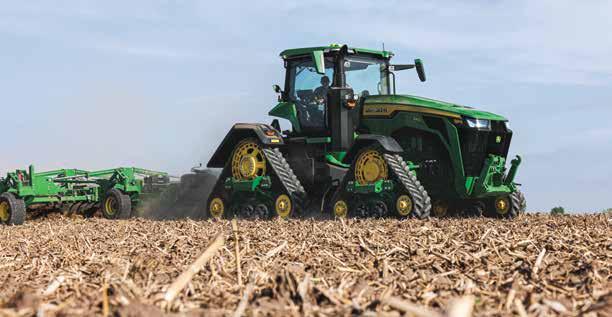
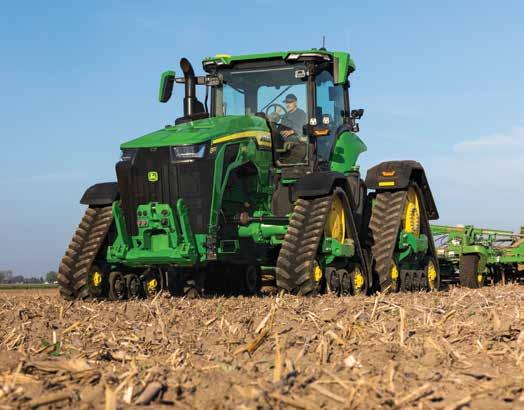
John Deere recently announced the launch of six new 8R and 8RX tractor models featuring additional higher horsepower (HHP) options and improved performance, manoeuvrability and versatility.
The company has manufactured 8 Series Tractors for more than 30 years, using customer input to continually improve the popular and versatile lineup.
The new options of 440 horsepower, 490hp and 540hp extend the available range to meet growing customer demand for higher horsepower.
“Whether you are seeding, tilling or planting, these tractors have the power, technology and functionality to increase productivity and efficiencies,” John Deere Marketing Manager, Production and Precision Agriculture, Royce Bell, said.
“Similar to the impact of the HHP 9RX, the HHP 8R and 8RX are expected to increase productivity and efficiency in customer operations while providing the versatility of a rigid chassis tractor. Horsepower, ballasting, lift capacity, size and functionality all increase with these models.”
The new 8 Series tractors are autonomy-ready and come fitted with the G5PLUS display for access to precision ag technologies such as AutoTrac™ Turn Automation, AutoTrac Implement Guidance and AutoPath™. They are also Machine Sync ready and
feature optional JDLink™ Boost satellite connectivity to help ensure reliable capture of field and machine data. These features, in conjunction with John Deere Operations Center™ and Equipment Mobile, enable customers to manage their machine and field operations in the palm of their hand.
DESIGNED FOR PERFORMANCE AND EFFICIENCY
The new 8R and 8RX models are powered by the JD14 engine, which provides maximum power when operators need it the most by operating in conjunction with John Deere’s Intelligent Power Management system (IPM).
The optional peak power IPM setting delivers power from an additional 40hp at 1900rpm to max horsepower at 1700rpm, enabling up to 634hp for the most demanding applications of hydraulic, PTO, transport or electrical offboarding.
“We’ve responded to requests from our transport customers by incorporating an engine brake option, to provide additional stopping power,” Royce said.
The hydraulic system on the new models also features increased pump capacity with separate steering and braking pumps.
Additional updates include an Independent Link Suspension (ILS) on the front axle that supports a fully loaded front hitch and incorporates roll control for improved road performance, capable of transport speeds of up to 60km/hr.
A front hitch and front PTO option is available, increasing the productivity of the tractor across all operations. The rear
hitch has a 10,880kg capacity to lift heavier and wider implements, and hitch active downforce maintains a constant depth with hitch-mounted implements.
MANOEUVRABILITY OFFERS PRECISION HANDLING
Precision handling is a key benefit of the new 8 Series tractors, with a tight turn radius and Reactive Command Steering improving manoeuvrability.
Reactive Command Steering means the wheel automatically returns to centre. It includes three settings for customised steering preferences and, along with the narrow and nimble frame design, improves the turning radius and ease of operation in these high horsepower tractors.
“Drivability is important for operators, and with the new 8 Series tractor models you no longer have to choose between power and manoeuvrability,” Royce said.
ENHANCED OPERATOR EXPERIENCE
The 8 Series tractors offer the Electric Variable Transmission (EVT) now with a 60 km/hr option, allowing farmers to set a speed and manage engine performance, delivering productivity and efficiency in the field.
This transmission enables electric power offboarding, meaning operators don’t need to worry about PTO or hydraulic power generators for electric drive planters. A simple one-plug connection enables power to their planter from the tractor.
As part of the new updates, three options are available for transmission controls in the cab, including CommandX™, CommandX™ Plus and CommandX™ Pro. These represent a significant advancement in
John Deere’s equipment portfolio, and put the power in the operator’s hands to seamlessly control and manage the tractor operations. Push button start gives operators the ability to control who can start the tractor by requiring a personalised PIN number.
Additional features that enhance the operator experience include:
- New engine throttle controls
- New convenience display for easy access to adjust radio, air conditioning, seat, and phone controls
- Integrated wireless charging phone holder
- Two-way independent electric armrest adjustment
- Optional door cinch.
Building on the Model Year 2025 enhancement of groundup serviceability on the High Horsepower 9RX, the engine oil, coolant and hydraulic oil sight gauges are placed at eye level so fluids can be quickly checked, leading to a quicker start each day. In addition, the air filter and fuel fill from the ground.
The hydraulic oil interval increases from 1,500 hours to 2,000 hours, allowing longer periods of operation between service intervals, while a 330° windshield wiper provides a clearer view. The battery disconnect and jump start point are on the door side for improved accessibility.
“Farmers who have experienced the 8R know it’s synonymous with performance, versatility and efficiency and can now benefit from the addition of high horsepower alongside manoeuvrability with these new models,” Royce said.
To determine which new 8 Series tractor model will best fit your business, contact your local John Deere dealer or visit www. deere.com.au.
JOHN DEERE
POWERFUL TO RUN. SIMPLE TO USE.
You deserve technology that’s both compatible with your existing fleet and easy to use. That’s why PTx Trimble leads the way in engineering solutions –including displays, steering systems and guidance control – that allow you to connect your farm, your way for seamless work all season long
This farmer uses: GFX-1060™ display with Precision-IQ™, Autopilot ® steering system, NAV-900 guidance controller, and Trimble ® CenterPoint ® RTX correction service. Scan to learn more and contact a local dealer.
FIFTH GENERATION G SERIES RANGE GETS AN UPDATE WITH A NEW TRANSMISSION OPTION
Valtra has expanded its popular G Series range, the first of its 5th generation tractors launched in 2020. The highly regarded 100-145 hp models are now available with a much-anticipated Continuously Variable Transmission (CVT). The new Valtra G Series CVT model was unveiled at Agritechnica in November 2025.
The existing Powershift models will remain in production, with no changes to engine output. The new CVT option is available across all four G Series models and comes in two configurations: Active and SmartTouch.
The Valtra G Series makes tractor operation remarkably intuitive. Intuitive tractor controls ensure smooth starts and stops, even on slopes, while the Valtra Shuttle with integrated park position or parking brake in CVT models simplifies starts and direction changes. Operators benefit from exceptional visibility with 5.7 m2 of glass and a low bonnet design, ideal for front loader work. SmartTouch models offer electronically controlled, programmable rear
valves that integrate seamlessly with Valtra’s U-Pilot headland management system. The more straightforward Active models feature mechanical rear valve controls. The integrated front loader subframe, electronic joystick, and up to 110 l/min hydraulic flow make it a standout tractor for loader tasks. Smart farming solutions like Valtra Guide, Isobus, Section Control, and TaskDoc are available across the range, and with optional Technology and Technology Pro packages the farmer can reach the next level of advanced automation and precision. For forest use, the operator can take advantage of a 180 degree swivelling seat in Active models which makes backwards implement operation possible.
Comfort and accessibility are built in, with wide, self-cleaning steps, a spacious cab for two, suspended seat, air conditioning, and ergonomic controls that reduce fatigue. Four modular Option Packages—Comfort, Technology, Technology Pro, and Front Loader—let users tailor the tractor to their needs without complexity. All G Series models can be factory-fitted with an electronically controlled front loader. Maintenance is easy thanks to centralised lubrication
and accessible service points, while the compact yet powerful design ensures high efficiency and low total cost of ownership. The G Series is smart, strong, and surprisingly simple.
Valtra emphasises that the new G Series CVT tractors are designed to be as easy to drive as possible. “Tractors in the 100–145hp range are often used
on dairy farms and in yard work, where both tasks and operators change frequently. Versatility is key, and the tractor must be intuitive to operate. Just select the direction and control the speed using the pedal, lever, or cruise control.”
Developed and manufactured by AGCO, the CVT transmission features a single working range from 0 to 40 km/h, making operation exceptionally simple. All CVT models are equipped with Load Sensing hydraulics for efficient performance. The CVT also supports fuel efficiency, keeping engine revs low while maintaining productivity. The powertrain operates on the EcoPower principle, already proven in Valtra’s larger Q and S Series tractors. As a result, there is no longer a need for separate EcoPower models in the G Series CVT lineup.
Valtra G Series tractors are known for their easy access and excellent visibility. A new fender design improves implement coverage and simplifies attachment via enhanced linkage control, with optional PTO and top link controls.
For customers seeking tailored solutions, Valtra Unlimited offers full customisation options, including a new cab trim option, safety camera systems, row crop wheels, and more.
CASE IH
‘ALL-ROUNDER’ CASE IH MAXXUM RANGE SECURES REPUTATION FOR RELIABILITY AND PERFORMANCE
The Case IH Maxxum was officially launched in 1989, “designed as a versatile, multi-purpose tractor aimed at performance and maneuverability”.
More than 35 years on, that reputation remains firmly intact, the ever-reliable Maxxum a fixture in farming operations across Australia.
Today’s Maxxum tractors now offer some of the technology of their higher horsepower cousins, featuring FPT engines with proven technology that provides increased performance and fuel efficiency, equipping them to handle a range of tasks.
Seamus McCarthy, CNH Product & Portfolio Manager – Medium Tractors for Australia and New Zealand, said the Maxxum was suited to multiple jobs including tasks for livestock operations, row-crop applications, transport and haul out, roadside mowing, baling and
front-end loader work.
The range includes Tier 3 machines – 110, 125 and 140 –and Stage V models – 115, 135 and 150. Seamus said the Tier 3s continued to be the most popular with customers, but the beauty of the range was there was a model to suit every farming operation.
“The Maxxum range is tried and tested and has been a workhorse on Australian farms for decades. Part of the appeal is the simplicity of operating these tractors. The electronics in the Tier 3 models are not excessive, which is a positive from a serviceability point of view, and it also helps enhance reliability. For less experienced operators, it’s also a plus when it comes to putting the tractor to work,” Seamus said.
“The reliability of the Maxxum Series can’t be overstated either, which is key in any busy farming operation that can’t afford machinery downtime.”
Operating efficiency and dependability were the key attributes of the Maxxum Series’
Tier 3 models, Seamus said, with the mechanical 2-valve per cylinder engine including minimal electronics, for simple operation that didn’t compromise on horsepower.
The Maxxum Series also provides outstanding in-cab visibility and an industry-leading cab suspension, aimed at providing the comfort and ease of operation needed to enhance performance across long work days.
The transmissions in the Maxxums also offer the level of automation operators need to maximise productivity, whatever the task. A fully integrated electronically-controlled PTO system on both models makes operating machinery safe and efficient.
“The Maxxum Stage V Mul-
ticontroller model with its ActiveDrive 8 transmission is known for its best in class fuel efficiency,” Seamus said.
“Farming businesses need tractors with plenty of power, which are easy to use, and capable of handling the tough conditions that Australia often serves up. Farmers are looking to Case IH for technology and innovation that reduces fuel consumption and operating costs, and enables them to get the job done quickly and efficiently.
“This is where our Maxxum range ticks every box and why it has continued to be so popular over many years.”
To find out more about the Maxxum range, contact your local Case IH dealer.
Built for performance.
• 8000L main product tank
Transform your spraying operation with Goldacres ground breaking G8 Crop Cruiser Series 3.
• Weedetect® green on brown or green on green camera technology (optional) combined with new application systems
Findyour closest dealer
LANDPOWER
AXION 9 - BUILT FOR THE WORK THAT MATTERS MOST
When it comes to high-horsepower tractors, farmers and contractors aren’t chasing headlines—they’re looking for machines that can deliver, day in and day out, when conditions are tight and the pressure is on.
That’s exactly where the new Claas Axion 9 steps in.
Positioned as the next evolution in high-horsepower tractors, the Axion 9 range has been developed with a clear focus: helping operators get more done, with less effort, and greater consistency across every hectare.
At its core is a powerful yet efficient 8.7-litre engine, delivering up to 450 horsepower. But raw power only tells part of the story. What stands out is how that power is managed. Intelligent drivetrain systems automatically adjust engine output and transmission response based on load, meaning the tractor is constantly working at its most efficient point—without the operator needing to intervene.
For contractors covering big acres, or farmers working within tightening seasonal windows, that translates into something simple but critical: maintaining momentum when it matters most.
The Axion 9 also reflects a broader shift in modern machinery—where technology works alongside the operator, rather than adding complexity. Claas has integrated advanced assistance systems that fine-tune performance in real time, help-
ing reduce fuel consumption, optimise settings, and ensure consistent results across varying conditions.
It’s the kind of support that becomes increasingly valuable over long days in the cab, or when multiple operators are involved.
And speaking of the cab, comfort hasn’t been overlooked. With a completely redesigned operator environment, low noise levels and intuitive controls, the Axion 9 is built for long hours in the seat. For many businesses, especially contracting operations, operator comfort isn’t a luxury—it’s a productivity factor.
Where the Axion 9 really sets itself apart is in its versatility. Available in both wheeled and tracked configurations, it gives operators the flexibility to match the machine to their conditions.
The Terra Trac option, in particular, offers increased traction and reduced soil compaction— an important consideration for those looking to protect soil structure without sacrificing output.
Hydraulic performance and lift capacity have also been stepped up to meet the demands of modern, high-capacity implements. Whether it’s broadacre cultivation, drilling, or heavy PTO work, the Axion 9 is designed to handle the scale that today’s operations demand.
But perhaps the biggest shift lies in connectivity. The Axion 9 isn’t just a tractor—it’s part of a wider, connected farming system. With integrated data capabilities and compatibility
with advanced automation platforms, it opens the door to more precise, efficient, and informed decision-making across the entire operation.
The Axion 9 CMatic combines high horsepower, automation, efficiency and operator comfort in a single platform, placing it firmly in the high-horsepower category for heavy cultivation, drilling, slurry application and large transport work.
For large-scale farmers and contractors, it offers the productivity, precision and reliability needed to manage bigger equipment, tighter labour availability and rising operating costs.
For New Zealand and Australian farmers and contractors, where conditions can vary widely and timing is everything, that combination of power, efficiency and intelligence is what counts.
The Claas Axion 9 isn’t about doing things differently for the sake of it. It’s about doing the job better—more efficiently, more consistently, and with greater confidence when it matters most.
That combination makes the Claas Axion 9 CMatic one of the most compelling tractor launches in the high-horsepower segment for 2026.
XERION 12
Uncompromising when it comes to towing efficiency, comfort, driver assistance and profitability, the Xerion 12 Series not only offers the most powerful four-wheel tractors with continuously variable transmissions on the market, but also sets new standards in this segment in terms of efficiency and comfort.
Xerion 12 tractors are built for heavy draft and broadacre duty, rather than smaller or niche tasks, making them a fit for large cropping systems common in Australia.
“Despite its immense power and size, it is extremely nimble thanks to its precise twin-axle steering,“ says Kevin Walker, Product Business Manager, Tractors Australia and NZ.
The 12.650, 12.590 and 12.540 models in the Xerion 12 Series are the flagships in the segment and have been engineered to enhance on-farm productivity
with four key features in mind:
- Stronger profitability due to low fuel consumption, low maintenance and wear.
- Stronger pulling efficiency thanks to high torque, large contact areas, optimal 50:50 weight distribution under all operating conditions and powerful hydraulic power.
- Greater comfort thanks to the large, four-point suspended cab with excellent all-round visibility, rubber-damped Terra Trac track units and comfortable steering behaviour.
- Stronger assistance via CEBIS, CMOTION, CEMOS and GPS PILOT CEMIS 1200 digital automation.
Xerion 12 is powered by the same 15.6 L six-cylinder Mercedes-Benz OM473 engine found in Claas combine and forage harvesters. The 15.6L Mercedes-Benz six-cylinder engines have a maximum power output of up to 653 hp. This level
of power is ideal for pulling wide cultivators, ploughs, air seeders and heavy trailers used on large Australian farms. The engine is Tier 3 compliant in Australia, meaning no AdBlue is needed — a big advantage for fuel simplicity and operating costs.
“This is one of the most powerful four-wheel-drive tracked tractors on the market and the only one equipped with CMatic continuously variable transmission as standard. Thanks to its balanced 50:50 weight distribution, the Xerion 12 Series tractors are a specialist for heavy-duty pulling work in all speed ranges,” says Kevin.
The Xerion 12 Series Terra Trac model is equipped with triangular crawler units and 914 or 762mm tracks, while the wheeled variants can be fitted with 800/70 R42 dual or 900/60 R42 single tyres. Models fitted with Terra Trac tracks help provide better floatation and traction on softer soils — a common Australian challenge.
Its low-engine speed concept delivers a maximum torque of up to 3,100 Nm at 1,300 rpm. When combined with its maximum hydraulic flow of 537 L/min, even the biggest air seeders or other implements with high continuous oil demand can be efficiently operated at a reduced engine speed. This intelligent drive train, coupled with Claas highly successful ‘high torque, low rpm’ concept, ensures fuel-efficient operation. Independent testing has shown fuel consumption is 8 to 10 per cent less than other tractors in this category.
The luxe cab is one of the largest in its class. With premium space, comfort, integrated technology, and an unrivalled all-around view supported by four-point suspension, it is guaranteed to reduce operator fatigue with long hours in large fields.
State-of-the-art onboard and offboard features for digital agriculture not only allow automated steering, section control, variable rate and automatic documentation, but also the optimisation of machine and process performance with Cemos.
The Xerion 12 Series is even more connected with further development towards high automation of work processes and autonomy.
“The Claas Xerion 12 is especially well suited to the Australian market because it combines industry leading power, traction options, efficient driveline technology, advanced hydraulics, and operator comfort — all of which are critical for the intensive, large scale, wide implement agriculture typical in Australia’s broadacre cropping regions,” says Kevin.
Since its launch, the Xerion 12 has been recognised four times internationally, named both Tractor of the Year (2024) and Farm Machine 2024 (large tractor category) at Agritechnica (Germany), taking out the International Product Development category at AGROmashEXPO (Hungary), and the American Society of Agricultural and Biological Engineers AE50 Award for the Xerion 12.650 TT model.
DEUTZ-FAHR
WARRIOR SERIESBUILT TO PERFORM
There’s no missing a Warrior in the field.
With its signature black finish and unmistakable presence, the Deutz-Fahr Warrior Series has become a familiar sight across Australian farms over the past few years, and for good reason. It’s not just about looks. These machines have built a reputation for getting the job done, day in and day out.
Originally introduced as a special edition, the Warrior range has proven itself as more than just a standout design. It’s a practical, hardworking tractor package that combines power, comfort and reliability in one.
Whether it’s cultivation, seeding, transport or loader work, the Warrior Series has been designed to handle the variety that comes with modern farming. Operators can choose from eight models, ranging from 171hp through to 336hp, with both RCShift and TTV transmission options available, depending on the job at hand.
Inside the cab, the focus is on making long days easier. Visibility is excellent, controls are intuitive, and the overall environment is quiet and comfortable – which is something that matters when you’re spending hours behind the wheel.
Features like automatic climate control, suspension systems and ergonomic layout all contribute to reducing fatigue and improving productivity.
Under the bonnet, the Warrior range is built with Australian conditions in mind. Deutz engine technology delivers strong performance without the need for AdBlue or DPF systems, keeping things simple and efficient for operators.
Technology also plays a key role, with Trimble-powered guidance systems fitted as standard across the range.
This includes the GFX750 touchscreen and NAV-900 controller, along with ISOBUS compatibility, giving farmers the tools they need to operate with precision.
As Tim Fanning - GM of DeutzFahr Australia - explains, the Warrior’s strength lies in its ability to deliver where it counts.
“The Warrior Series has proven itself in the field. It’s a combination of performance, comfort and reliability that farmers can depend on, no matter the application.”
Backed by a three-year / 2500hour warranty, the Warrior Series continues to offer confidence alongside capability.
For those who have already put one to work, the reputation speaks for itself. And for those
yet to experience it - seeing really is believing.
To find out more, get in touch with your local dealer or chat with your Power Farming or PFG Australia representative, or head to www.deutzfahr.com.au for more information.
Warrior Series models include:
- 6 Series RCShift – 6165 (171hp) 6215 (226hp)
- 6 Series TTV – 6165 (171hp) 6215 (226hp)
- 7 Series TTV – 7250 (246hp)
- 8 Series TTV – 8280 (281hp)
- 9 Series TTV – 9340 (336hp)
o Prairie Pro Series 2.
pplication Accuracy. y
THE NEW FENDT
1000 VARIO G4. MORE OUTPUT. MORE USER-FRIENDLY. MORE LIGHT.
Series production of the first-generation Fendt 1000 Vario began in 2015. Ten years later, Fendt is unveiling the fourth generation of its flagship large tractor. Compact, highly visible dimensions paired with exceptional performance remain defining characteristics. New highlights include a completely redesigned lighting concept, an expanded power range of 426–550 hp, the ability to regulate power downward when needed, and a new dual wheel hub option for dual tyres.
More power, more flexibility
The fourth generation spans 426 to 550 hp (313–405 kW) across four models: Fendt 1040, 1044, 1048, and 1052 Vario.
All models are equipped with the Fendt DynamicPerformance (DP) added-power concept, which provides an additional 26, 27, or 30 hp (19, 20, or 22 kW) depending on the model. Unlike systems tied to speed or specific applications, Fendt DP responds purely dynamically—even during stationary PTO work or varying soil conditions. When hydraulic, PTO, compressed-air or air- conditioning demand increases, DP automatically delivers more power to maintain consistent performance.
Developed as a compact and versatile tractor in the 550 -hp class, the new generation focus-
es on low unladen weight and excellent visibility of the working area. Numerous equipment options address global requirements for a standard tractor capable of heavy towing, soil cultivation, and transport at up to 60 km/h (for flange and 2.50 m stub axle).
The proven MAN engine is approved for HVO100 and other fuels compliant with DIN 15940, enabling a significant reduction in CO2 emissions when operated with renewable fuels. Technical refinements have doubled the transmission oil replacement interval from 2,000 to 4,000 operating hours or four years, further reducing maintenance costs.
Optimally illuminated – up to 120,500 Lumens
For the first time, the Fendt 1000 Vario Series introduces a new cab featuring an exclusively developed lighting system. Tasks such as seeding, harvesting, or winter service often extend into the night, especially when weather windows are tight. In these situations, superior lighting becomes essential for maintaining work quality and safety.
Clear visibility of the field, implement and surrounding area is crucial. Two LED spotlight packages—Vision and UltraVision—are available. Both offer eight or 12 roof-mounted spotlights:
- UltraVision delivers 4,400 lumens per spotlight, with five-stage dimming—ideal
when multiple machines are working in the same area.
- Vision provides 1,000 lumens per spotlight.
All spotlights, including the rotating beacon, are integrated into the cab roof for optimal illumination and glare-free operation. The lighting is engineered for agricultural, forestry, construction and harvesting environments.
Simple, fast, intelligent operation
Up to four custom light profiles can be saved for quick access. For example, when operating in a harvest chain, the operator can dim the right-hand side to avoid blinding the combine while brightening the left. With one click, the configuration can be mirrored—ideal for night-time milling on construction sites where lighting must adapt to passing traffic.
A new feature allows independent control of spotlights aimed at the same area, enabling rapid adjustment in changing weather such as fog or rain.
The tractor can also be equipped with Tech Rails on the C-pillar for future-ready installation of additional work lights or sensors.
Each rail includes its own cable entry and supports up to two work lights per side.
The optional Fendt GroundVision drawbar lighting illuminates the area directly behind the tractor—improving visibility of the implement during fieldwork and simplifying hitching and unhitch-
ing in the dark. These lights are integrated into the lower rear fenders.
In addition, the familiar chassis-mounted lighting options remain available, completing the comprehensive lighting package:
- Work lights in the bonnet
- Daytime running lights (standard)
- Low beam and high beam
- Corner Lights (standard)
- Additional lighting on the mirror bracket
- New indicator and position lights
- Four work lights on the A-pillar
- Entrance lighting
- Rear lights
- Work lights on the rear fenders.
The best place on the field and the road
The tractor cab is the heart of driving comfort. Seat design, air-conditioning, lighting and visibility all shape not only the operator’s well-being but also the quality of the work performed.
Whether operating an overload wagon during harvest or running a soil stabilisation mill, clear visibility and a smooth driving experience are essential for efficient, precise results.
The Fendt 1000 Vario delivers both, thanks to its harmonised suspension concept and the VarioDrive drivetrain.
A coordinated system— comprising single-wheel and front-axle suspension, power-lift vibration damping and pneumatic seat suspension—ensures
exceptional ride comfort. Optional features such as a tinted rear window and three additional footrests further enhance comfort during long working days.
Premium seating for long hours
The electrically adjustable Titanium Super Comfort leather seat offers extensive customisation for maximum support. Seat height, position and backrest angle are adjusted via an electric side-mounted lever. Multiple operators can store personalised seating profiles and access them through their FendtONE onboard user account.
Comfort features include:
- Multi-stage seat climate control
- Multi-stage seat heating
- Four-way lumbar support
- Adjustable side bolsters
- Massage function with three selectable programs
- Memory function for multiple users.
Even in extreme heat, the standard automatic air- conditioning system maintains a pleasant cab climate. A new 12-litre compressor cooler keeps food and drinks chilled between 0–16°C.
Another upgrade is the integration of Apple CarPlay—via cable or Bluetooth—into the Fendt infotainment system. As in the automotive sector, operation is handled through the armrest terminal. The software rollout is planned for June 2026.
Clean air in dusty conditions
Every Fendt 1000 Vario comes standard with the exclusive Concentric Air System (CAS) ventilation and cooling concept, with an optional reversible fan function. Since the third generation, operators have been able to equip the tractor with the DLG -award-winning self-cleaning air filter for the MAN engine.
This system automatically clears the filter during operation, reducing maintenance, protecting components, and ensuring optimal engine performance and fuel efficiency.
In the fourth generation, this technology is expanded with automatic cleaning of the cab air filter. Using continuous passive cleaning via vacuum and a cyclone separator, the system maintains high air quality inside the cab—particularly valuable
in hot, dusty environments such as dry cultivation or baling with a front-mounted chopper. Automatic cleaning reduces daily maintenance and keeps operators comfortable and protected.
Global versatility for regional requirements
The Fendt 1000 Vario can now be ordered from the factory with a 60 -inch track width, and all common implement systems are available. The K80 coupling head for the bottom hitch and swivel drawbars in categories 4 and 5 are now offered in Europe as well. The self- cleaning air filter system—including automatic cab -air extraction—proves especially beneficial in dry, dust-prone regions.
Performance on demand in arable farming
The drivetrain of the new Fendt 1000 Vario features the latest generation of the single-stage VarioDrive transmission paired with a 6 - cylinder MAN engine with a 12.4-litre displacement. In arable farming, tractors require varying levels of power depending on the task—whether soil cultivation, sowing or harvesting. Because power demand directly influences fuel consumption, the development of the new Fendt 1000 Vario generation focused strongly on economic efficiency. With adjustable power levels, the tractor delivers high efficiency and low fuel consumption by providing only the power required for the job.
Adjustable power levels
A key innovation of the Fendt 1000 Vario Gen4 is the introduction of adjustable power levels. High-performance models are often used for tasks requiring significantly less power, simply to make full use of the machine. For the first time, operators can select different power levels based on the application and implement.
For example, when the top model— the Fendt 1052 Vario— is used with a square baler or an 8 -metre disc harrow, the available power can be reduced. Each model can only be adjusted downward. This means a Fendt 1044 Vario cannot access the higher performance of the Fendt 1048 or 1052 Vario, but it can operate at the lower power level of the Fendt 1040 Vario.
This flexibility significantly reduces fuel consumption, protects implements not designed for 550 hp, and increases the tractor’s versatility.
In addition to power management, the interaction between engine and transmission in the VarioDrive system plays a crucial role in fuel efficiency.
For the fourth-generation Fendt 1000 Vario, both engine and transmission have been further optimised to deliver more power with lower fuel consumption.
VarioDrive continues to offer well-known advantages. There is no need to manually shift driving ranges or engage four-wheel drive.
The system independently drives the front and rear axles and dynamically distributes torque to the axle with the best traction.
This ensures full pulling power in the field and prevents torsion when driving on roads or turning. The innovative pull-in turn effect allows the front axle to actively pull the tractor into a turn, reducing the turning radius.
The Fendt iD low-speed concept also contributes to reduced fuel consumption. All tractor components—engine, transmission, hydraulics and cooling— are designed around the ‘high
torque, low engine speed’ principle.
With Fendt iD, the tractor achieves high torque and fuel savings even at low rpm. Rated engine speed is just 1,700 rpm, while the main working range is a quiet 1,100–1,400 rpm.
The tractor reaches 50 km/h at only 1,200 rpm and a maximum of 60 km/h at 1,450 rpm. The top model, the Fendt 1052 Vario, delivers its maximum torque of 2,650 Nm from just 1,150 rpm, ensuring strong pulling power and acceleration with minimal fuel use.
High payload and hydraulic power
Modern agricultural applications—such as pneumatic blowers, coulter pressure control, precision seeders, or slurry systems with suction arms—require high, demand-oriented hydraulic output in both pressure and flow, as well as high drawbar load or payload capacity.
The Fendt 1000 Vario offers up to six rear hydraulic connections plus one front control unit (6+1).
An optional dual-pump system provides a combined flow of 430 l/min (220 + 210 l/min). Rear Load-Sensing (LS) connections and control units can be equipped with FFC couplings,
which reduce contamination, oil leakage and pressure loss.
With an operating weight of 14 t and a permissible gross weight of 21 t at 40 or 50 km/h, the tractor offers a payload of 7 t. At 60 km/h approval, the permissible gross weight is 18 t, allowing a 4-tonne payload.
Extensive axle and tyre options
The Fendt 1000 Vario offers numerous rear axle and tyre configurations, with rear tyres up to 2.35 m in diameter. Depending on regional requirements, customers can choose between a flange axle or a stub axle. For Europe, a 2.50 m outside-width stub axle is available; for markets outside the EU, a 3.0 m version is offered.
With the fourth generation, tyre options have expanded. Depending on the application, customers can choose single tyres, metric duals, or row- crop duals. For the first time in Europe, row- crop dual tyres are available from the factory, featuring four 480/95R54 tyres on the rear axle. Combined with a redesigned rear linkage, quick-hold hooks, rub blocks, and the 2.5 m stub axle, the outer tyres are mounted using a dual-wheel hub.
The dual-wheel hub system
safely transmits higher forces across the axle—unlike conventional rim-mounted solutions. Proven single tyres (710/60R38) are fitted on the front axle, with the track width adjusted to 2,250 mm for improved manoeuvrability. This complete factory-installed solution increases towing performance, reduces slip, and keeps the machine under 3.50 m in width, enabling approval with exemption.
Both drawbar and K80 hitches are available at the rear, and a classic towing drawbar can also be used for traditional bottom hitches.
The VarioGrip tyre pressure regulation system is also available for the Fendt 1000 Vario Gen4. It increases tyre contact area, improves traction, reduces fuel consumption and boosts overall productivity.
VarioGrip is available for flange and stub axles, row- crop duals, and configurations with wheel weights.
New optional wheel and front weights are also available: 1.3-tonne wheel weights and a 2.2-tonne front weight. Their high material density allows more compact dimensions, reducing forward load and keeping weight edges clear of low and high beams.
JCB AUSTRALIA
NEW JCB FASTRAC
6300 REWRITES THE RULES FOR AUSTRALIA
The arrival of the JCB Fastrac 6300 in Australia later this year is more than just another product launch - it represents a continuation of a long-running challenge to conventional tractor design. For decades, JCB’s Fastrac concept has occupied a niche between agricultural workhorse and high-speed transport machine. With the new 6000 Series, that niche is becoming harder to ignore.
At its core, the Fastrac 6300 is
defined by its numbers. Producing up to 335hp (250kW) and 1,400Nm of torque, it sits firmly in the upper mid-range of modern tractors, aimed at large-scale farming and contractor operations. But numbers alone do not tell the full story. What sets the 6300 apart is how that power is deployed - across road and field, often in equal measure.
In the 6300 Series, JCB has developed a machine that is not just about pulling power, but also about utilisation.
The 6300 embodies that philosophy with a 66km/h top
speed (where permitted), full suspension, and ABS braking - features more commonly associated with trucks than tractors. In vast agricultural regions such as Australia, where distances between paddocks can be considerable, that capability is more than a novelty; it is a practical advantage.
Yet the 6300 is not merely a road-biased machine. JCB has clearly worked to ensure it remains competitive in-field. A rear linkage capacity of 11,000kg, optional 410-litre/min hydraulics, and compatibility with a wide range of implements
underline its intent as a serious working tractor.
The addition, features such as automated headland turning, ISOBUS compatibility and dual GPS receivers highlights the increasing importance of precision agriculture in modern farming systems.
One of the more notable innovations is the integrated Central Tyre Inflation System (CTIS), available on the 6300. This allows operators to adjust tyre pressures from the cab, optimising traction in the field while reducing wear and fuel consumption on the road. In regions with variable soil conditions - something Australian farmers know all too well - this kind of adaptability could prove invaluable.
Equally significant is the machine’s four-wheel steering system which offers multiple modes for improved manoeuvrability and reduced soil compaction.
Combined with JCB’s Twin Steer guidance and dual-receiver GPS setup, the 6300 pushes further into the territory of high-precision, high-efficiency farming. These are not incremental upgrades; they reflect a broader shift toward smarter, data-driven agriculture.
Comfort and operator experience are also central to the Fastrac identity. The 6300’s centrally-mounted cab, configurable controls and advanced suspension system are designed to reduce fatigue during long work-
BUILT ON STRENGTH: MORE POWER. MORE OPTIONS.
Versatile Australia, the brand distributed by PFG Australia since 2000, continues to accelerate its growth with an expanded product line-up and a strengthening dealer network nationwide. Known for reliability, durability and ease of service, Versatile delivers high-horsepower, articulated and fixedframe tractors designed for the demanding conditions of broadacre Australian farming. From its Canadian manufacturing base in Winnipeg, Manitoba, Versatile has produced more than 100,000 tractors over the past 50 years.
- Dedicated Articulated Wheeled (4WD) Scraper Special model offering 570 hp.
MAJOR GLOBAL INVESTMENTS UNDER NEW OWNERSHIP
Versatile’s momentum in Australia is further strengthened by significant global developments following ASKO Holdings acquisition of a majority stake in Buhler Industries Inc., the parent company of Versatile. In July 2025, Versatile announced a new era of large-scale investment, operational transformation and international expansion, marking one of the most substantial manufacturing upgrades in decades.
ASKO Holding has committed to over $25 million CAD in mod-
ing days. In an era where skilled labour is both scarce and expensive, making machines easier and more pleasant to operate is no small consideration.
OVERALL PRODUCTIVITY
JCB’s Fastrac 6300 is a true
ernisation and state-of-the-art manufacturing equipment for Versatile’s 780,000 sq. ft. Winnipeg facility.
This investment is part of a broad company-wide transformation over the past 19 months, including improved production efficiency, strengthened dealer and customer collaboration, and renewed focus on long-term competitiveness.
These advancements reinforce the stability and long-term outlook of Versatile’s global manufacturing platform, delivering direct benefits to markets such as Australia through improved product availability, ongoing innovation and stronger support.
LOOKING AHEAD: A FUTURE BUILT ON CONFIDENCE
To complement its robust product range, Versatile Australia is continuing to invest in dealer growth and service capability to ensure farmers have fast, local access to sales, parts and maintenance. As Australian agriculture continues to evolve, Versatile remains committed to providing machines that are powerful, straightforward
multi-role machine that offers considerable versatility and can cultivate, haul, spray, and travel long distances efficiently.
For Australia, that argument may resonate strongly. The scale of operations, combined with increasing pressure on efficiency and labour, creates a natural
to maintain and built to last –values that have defined the brand for over 50 years.
“Buhler Versatile has a remarkable heritage with manufacturing high-horsepower tractors, and we’re building on that strong foundation to deliver even more value for Australian farmers,” said Darin Walker, National Sales and Product Manager for Versatile Australia. “It’s exciting to see that legacy continue as we grow our dealer network and reconnect with customers who know the value of a machine that’s built to work as hard as they do.”
VERSATILE / PFG AUSTRALIA
Versatile is one of the world’s first manufacturers to mass-produce articulated four-wheeldrive tractors.
For more than 50 years, Versatile’s Winnipeg, Manitoba plant has produced over 100,000 tractors for global markets. PFG Australia, the exclusive distributor of Versatile in Australia since 2000, provides farmers with a complete range of tractors, implements, precision agriculture technologies, parts, service, and financing solutions.
environment for machines that can do more with less downtime. The 6300’s ability to transition seamlessly between field and road work makes it particularly appealing to contractors and mixed-enterprise farms.
In that sense, the JCB Fastrac 6300 is less about redefining
STRONGER SUPPLY, READY FOR THE SEASON
Following a period where global shipping constraints and strong demand limited available stock, Versatile Australia has successfully re-established a strong and reliable supply of tractors and associated parts. With improved availability across the range, farmers can now access the machines they need with greater confidence and shorter lead times.
As the upcoming sowing season approaches, Versatile Australia is well-positioned with healthy stock levels and a dealer network ready to support customers.
Backed by knowledgeable local dealers, farmers can rely on them for sales, parts and service when it matters most.
Versatile Australia also offers flexible and competitive finance options designed to help farmers invest in the right equipment for their operations.
To explore the full Versatile Australia range or find your nearest dealer, visit versatile. com.au.
what a tractor can do, and more about redefining how it fits into the broader farming system. It is a machine built not just for horsepower, but for logistics, precision and time management.
To find out more about the JCB Fastrac 6330, speak to your JCB CEA dealer today.
NEW HOLLAND BIGBALER 1290 HD LIFTS PRODUCTIVITY FOR NSW CONTRACTOR
THE BIGBALER 1290 HD HAS HELPED SCHOFIELD’S HAY & SILAGE AVERAGE AROUND 65 BALES AN HOUR, WHILE PUSHING STRAW BALE WEIGHTS UP TO 500KG, TO KEEP PACE WITH A BIG SEASON AND GROWING CUSTOMER DEMAND.
Central West NSW contractor Brian Schofield needed to move more hay and straw with “all our jobs ready on the same day” and the work getting bigger every year.
In October 2025 he stepped up to a New Holland BigBaler 1290 High Density so he could get more done per day without adding another machine.
“Our previous baler was a fantastic machine but I was either going to have to run two balers, or we go into one big HD,” Brian said.
Based in Forbes, Schofield’s Hay & Silage is a family-run business, with Brian working alongside wife Jessica and their daughters to service dairies, beef and sheep producers and corporate hay customers across central west New South Wales.
Since putting the 1290 HD to work, Brian has run over 12,000 bales through the machine.
“It’s been a pretty big season. We’ve finished straw and we’ve averaged around 65 bales an hour, with peaks in the 80s and 90s,” he said.
“We were struggling to average about 450kg with our previous baler. With the 1290 HD, we’re now getting a more consistent 480–500kg per bale, giving us more tonnes per hour through the paddock.
“I reckon we’re at the equivalent of 1.5 balers now, which we’re happy with, because we’re only one tractor and one driver,” Brian said.
Brian highlighted the Loop Master knotters on the BigBaler 1290 HD as another major advantage.
“The knotters have been fantastic, probably the most reliable knotter I’ve had, it helps keep the 1290 HD working when the window is open and every bale counts.”
On the tractor front, Brian has paired his BigBaler 1290 High Density with a New Holland T7.340 HD.
“The AEH team at the Forbes Machinery Centre demoed this tractor and baler combination for us the year before and we fell in love with it then.
“The 1290 HD and T7 are just the perfect match and are built to work together. They deliver the output we need when we have to get more done in a shorter period of time,” he said.
Brian said AEH’s support has been fantastic, with someone always only ever a phone call away, no matter the day of the week or time of day.
“It’s very hard to catch up once delays hit, so having AEH willing to stick the hard
yards to solve tricky problems mid-season helps to keep things moving through a big season.”
CNH Product Manager Hay and Forage, Sune Nielsen, said the New Holland tractor and large baler combination unlocked additional technology benefits for farmers like Brian.
“FieldOps gives operators clear, visible baling data on their phone or PC, including bale weight, moisture, location and a range of other baler outputs,” Sune said.
“Advanced filters let users set ranges, for example, high - moisture bales can be flagged on the field map, showing exactly where they were made.
“We’re continually enhancing the FieldOps platform with new features to meet and exceed the needs of farmers and contractors into the future.
“The 1290 HD is also about reducing running costs as much as increasing output. That’s why we designed this baler, to provide higher bale counts with low cost of ownership.
“Low maintenance and ease of servicing are built into the design, with smoother start up and less wear and tear from the SmartShift two speed gearbox, and hydraulic active suspension at the rear so the baler can be lifted and lowered for servicing.”
For more information on the BigBaler 1290 High Density and T7.340 HD, reach out to your local New Holland dealer.
MASCHIO GASPARDO GIGANTE – A SEED DRILL THAT’S A CUT ABOVE THE REST
MASCHIO GASPARDO’S FLAGSHIP
GIGANTE PRESSURE SEED DRILL RANGE CONTINUES TO IMPRESS FARMERS RIGHT AROUND AUSTRALIA.
The feedback is uniformly positive: easy to use, superior germination rates, minimal disturbance to the soil and a machine that can be relied on, day in and day out.
Specifically designed for Australian conditions and tough working environments, farmers and contractors need look no further when considering seeding quality and return on investment.
Now, for the first time, a 3m Gigante Pressure compact model is available locally. Complementing the 4m and 6m versions, with all the standard inclusions of the existing range, it will suit lower horsepower tractors, making it affordable and ideal for smaller farming enterprises.
OVERVIEW
Highly adaptable due to innovative configurations, the Gigante Pressure is an advanced direct seed drill with pneumatic seed and fertiliser distribution. Upgrades encompass a rotation of the seeder’s pressurised hopper,
with bins now positioned front to back and lowered in the chassis, significantly aiding the job of seeding in difficult terrain.
The hermetically-sealed pressurised hopper is split into two compartments – 70/30 for seed and fertiliser or seed/seed applications. The trailed pneumatic seed drill plants seeds in rows 150mm, apart using its coil sprung dampened independent planting unit.
PRESSURE IS THE KEY
Designed and made by Gaspardo, the seeding unit delivers powerful downwards pressure (up to 260kg) when cutting a seeding line, resulting in reliable, high quality direct
drilling – regardless of soil type and field conditions – with the least possible soil disturbance.
Gigante Pressure’s distribution system enables seed and fertiliser to be drilled in a single shot, enhancing root efficiency as the product is assimilated. This makes it ideal for rapid and successful germination in tilled or untilled soils, allowing farmers to hit their growing season window.
The 6mm-thick, 475mm diameter coulter slices smoothly through soil, simultaneously cutting back crop residue.
Various tapered gauge wheels make sure the unit sits securely on the ground, with
BERGMANN: NEW TYRES FOR THE M AND TSW 2140 E LOW-BED SPREADERS
BERGMANN HAS BEEN PRODUCING AND DISTRIBUTING LOW-BED SPREADERS SINCE 2017.
The special feature of the Bergmann M and TSW 2140 E low-bed spreaders has always been their special design with an approximately 1.80 m wide, conical boxshaped body and high VF 480/95 R50 tyres with an overall width significantly below 3 m. With these tyres, the low-bed spreaders are CoC-compliant and have, therefore, received full EU type approval including CoC documentation.
At Agritechnica 2025, Bergmann presented new, slightly wider tyres. The spreader overall width still remains less than 3 m and the spreader is certified with full EU type approval in accordance with the official regulation.
The new tyre size is VF 520/85 R50 Trelleborg TM 150 TL 177 D. These tyres are offered as an alternative to the previous VF 480/95 R50 Alliance 354 Agriflex+ TL 176 D tyres. At 2,165 mm, the new tyre has a similar diameter to the previously offered tyres (2,187 mm), ensuring optimum and smooth rolling characteristics. Since the contact area is larger, the ground contact pressure of these tyres is also significantly lower compared to low-bed spreaders, which are produced in a conventional design with lower but wider tyres
the sowing depth controlled at the seed delivery point on each individual row unit via an adjustable (0-80mm) spoked rubber depth wheel.
In combination with the downwards pressure, the result is consistent seeding depth across the full width of the drill, even in undulating paddocks.
DURABLE, EFFICIENT AND COST EFFECTIVE
The sowing elements are independent and reinforced, greatly improving the life span of the Gigante Pressure, while new coulters with a unique profile for better seed penetration promote
and V-shaped box cross-section. The wide lugs ensure greater stability of the tyre under load. Compared to standard tyres, the VF tyre makes it possible to carry up to 40% more load with identical tyre pressure, or to reduce the tyre pressure by up to 40% with the same load.
EU type approval is particularly advantageous when reselling within the EU, as it removes the need for individual national approvals.
Ludwig Bergmann GmbH is a medium-sized family-run business in its third generation and has been successfully manufacturing agricultural machinery and vehicles for over 125 years. It is one of the major manufacturers and providers of customised technology for professional farming operations and farm contractors.
The combination of long-standing experience and contemporary, innovative technology is one of the company’s greatest strengths. Constant focus on the needs and expectations of customers, adapting to changing technical requirements, the continuous development and improvement of products and a keen ‘feel’ for customer requirements have made Bergmann a
high quality seeding, as well as boosting wear resistance.
The advantages to your operation are compelling. Consider the agronomic benefits; better soil fertility and organic matter, while compaction, oxidative stress and erosion are reduced. For the bottom line, there’s less time spent working the soil, fuel savings and lower cost of inputs. Indeed, it’s the epitome of conservation agriculture, reworking the soil while reducing emissions and minimising the loss of fertile soil to erosion.
ISOBUS COMPATIBILITY
What’s more, the Gigante
reliable worldwide farming partner.
With its wide range of products, the company offers efficient and practical solutions that include manure spreaders, uni-
Pressure is Isobus compatible, equipped with a Genius controller (with electric drives) and GPS speed detection system as standard.
This improves the ergonomics of the workspace by reducing monitors and cabling inside the cab and making it easy to swap the Gigante across tractors as required.
The tractor’s Isobus terminal handles seed calibration and work parameter control – making it a fully digital solution.
Via task controller variable rate (TC-GEO) and automatic section control (TC-SC), the Gigante Pressure also takes advantage of Iso-
versal spreaders, loader wagons, forage transport trailers, body swap systems, transfer trailers, beet transfer trailers and bodies for self-propelled vehicles.
bus precision farming functionalities. This machine won’t be left behind as precision farming grows in popularity.
It is user-friendly, too, constructed with a folding frame for ease of transport and centralised greasing for quick and easy maintenance.
To top it off, each Maschio Gaspardo Gigante Pressure comes with an industry-leading two-year warranty.
For all the details about the Maschio Gaspardo range, please talk to your local dealer or PFG Australia representative, or visit the website at www.maschiogaspardo.com.au.
COMPARISON OF THE TWO TYRES WITH EU TYPE APPROVAL (COC): ON THE LEFT THE VF 480/95 R50, ON THE RIGHT THE NEW VF 520/85 R50.
THE TSW 2140 LOW-BED UNIVERSAL SPREADER WITH THE NEW VF 520/85 R50 TRELLEBORG TM 150 TL 177 D TYRES.
BREAKING THE BARRIER TO LIQUID APPLICATION
IN TODAY’S FARMING ENVIRONMENT, EFFICIENCY AT SEEDING HAS NEVER MATTERED MORE.
With tighter margins, rising input costs, and ongoing fertiliser supply pressures, every hectare needs to work harder. For many Australian growers, that means rethinking how nutrients and crop inputs are applied.
In-furrow liquid application opens the door to a broader, more flexible toolkit — from building block NPK fertilizer, inoculants, and trace elements through to fungicides, soil conditioners and wetters — all delivered in a single pass at seeding.
THE ADVANTAGE IS SIMPLE: PLACEMENT
By delivering inputs directly into the root zone, growers are achieving:
- More efficient use of fertiliser and crop inputs
- Stronger, more uniform early crop establishment
- Increased nodulation and nitrogen fixing in legumes
- Reduced need for additional passes
- Greater flexibility in nutrient and crop protection strategies
Since 2002, Liquid Systems (SA) has been at the forefront of
this shift. Its LQS Series has set the benchmark for precision liquid delivery — integrating with leading precision ag controllers to provide variable rate control, section control, and data-driven optimisation.
For growers ready to fully leverage precision agriculture, LQS Series remains the gold standard.
But not every farming operation needs — or wants — that level of sophistication.
Across Australia, many growers operate on consistent soil types, farm straightforward paddock layouts, or simply want a lower-cost, lower-complexity way to access the benefits of with liquids. For these operations, the investment and technical demands of full precision ag systems can be a barrier.
THAT’S WHERE THE NEW MSR SERIES COMES IN
The Manual Set Rate (MSR) Series has been developed to expand access to liquid precision — delivering the proven agronomic benefits of in-furrow liquids in a simpler, more accessible format.
Available in both hydraulic and electric configurations, the MSR Series is designed for liquid ready reliability and ease of use. It removes the need for rate controllers and complex precision ag infrastructure, while still delivering accurate, consistent application.
It’s ideally suited to:
- Growers with consistent soil types and operating speeds, and straight forward paddock shapes.
- Irrigated farming systems, broadacre and row crop operations, intensive and ground crop (growers?)
- Research and trial applications
Built with the same high-quality componentry Liquid Systems is known for — including its proven piston diaphragm pump — the system delivers steady, consistent flow, handles a wide range of liquid products, and remains gentle on biologicals such as inoculants.
Paired with Liquid Systems’
Stacker Distribution, the MSR Series ensures even, positive pressure delivery to every row — eliminating blockages and ensuring accurate placement across the width of the bar.
The result is a practical, cost-effective pathway into liquid application — helping more Australian growers improve nutrient efficiency, reduce input waste, and achieve stronger crop establishment from day one.
With the launch of the MSR Series, Liquid Systems isn’t changing direction — it’s widening the path.
The LQS Series delivers the full power of precision agriculture.
The MSR Series ensures more growers can access the benefits of liquid application.
Learn more: Call Matt Devine 0477 612 777 www.liquidsystems.com.au
MATT DEVINE FROM LIQUID SYSTEMS (SA), LAUNCHING MSR SERIES
* for SubScribe today FREE!
Why subscribe?
› It’s available free of charge to readers who qualify under the publisher’s criteria and who supply proof of occupation.
› All the latest news, views and information from the industry.
SUBSCRIPTION ORDER FORM
If you are not a registered reader but would like to receive a regular bi-monthly copy, please fill in the details below of your contracting or farming business and post this form to us.
Alternatively, you can fill in the subscription form on our website: www.agcontractormag.com
Australian AgContractor is available free of charge to readers who qualify under the publisher’s criteria and who supply proof of occupation (ie. printed letterhead, business card, invoice etc.) and to others upon payment of the $50.00 annual Australian Subscription (Rest of the World: $65.40 AUD).
› In-depth profiles on contractors and farmers from all across Australia.
› Six issues per year, delivered direct to your door.
› Subscriptions from as low as $50.00 annually to non-industry subscribers.
Please email admin@agrimedia.co.nz or phone +64 3 329 6555 to arrange payment if you are a non-industry subscriber.
SUBScrIBer
Name:
Business/Farm Name:
Postal Address:
Postcode:
Country:
Phone:
Email:
coNTracTor
Main contracting services offered:
Large ScaLe farMer
Criteria: Broadacre - over 1000ha and/or Sheep or Beef - over 12,000 stock units and/or Dairy - milk over 400 cows (owner or sharemilker)
Total farm ha: No. of dairy cows: No. of beef cattle: No. of sheep: Area in arable crop:
Please sign here if you wish to receive a regular copy of this publication and send the form, together with proof of occupation or cheque to: aML, Po Box 37151, christchurch 8245, New Zealand.
Signature:
Date:
TERRALAND TO: DEEP RIPPING TECHNOLOGY RESHAPING TOUGHEST CROPPING SOILS
A NEW WAVE OF INTEREST IS SWEEPING THROUGH WESTERN AUSTRALIA’S GRAINBELT AS GROWERS SEARCH FOR PRACTICAL WAYS TO TACKLE LONG STANDING SOIL CONSTRAINTS. AT THE CENTRE OF THAT CONVERSATION IS THE CZECH ENGINEERED BEDNAR TERRALAND TO - A DEEP RIPPING AND SOIL INCORPORATION PLATFORM THAT IS PROVING ITS WORTH FROM THE NORTHERN SANDPLAINS TO THE HEAVIER COUNTRY FURTHER SOUTH.
Morawa farmer and machinery distributor Grant Borgward was one of the first in WA to recognise the machine’s potential. After witnessing early trials on his own country, he became convinced the Terraland’s combination of depth, mixing action and structural strength was uniquely suited to local conditions. He now represents the brand across the state.
BUILT FOR DEPTH, DESIGNED FOR VERSATILITY
The Terraland TO is engineered to work aggressively into the soil profile, operating down to 550–600mm while simultaneously mixing the top 300–350mm. A 6 metre working width, 13 heavy duty tines spaced at 430mm, and a horsepower requirement of 500–600hp place it firmly in the high capacity category. Yet despite its size, the machine folds to 3 metres for transport.
Growers can tailor the level of soil disturbance using interchangeable chisel widths ranging from 40mm to 125mm. The tines carry long life carbide points and sit beneath mixing wings that lift and blend subsoil material into the upper profile.
Behind the tine rows, a tandem spiked roller and V shaped finishing rollers consolidate and level the surface, leaving a seedbed that resists wind erosion and improves water infiltration.
The frame itself is built around a robust 150x150mm RHS structure with four anchor points to absorb the stresses of deep work. In wet conditions, operators can disengage the rollers and rely on the transport axle to maintain stability.
ADDRESSING PERSISTENT SOIL PROBLEMS
Much of WA’s cropping land — particularly around Geraldton, Eradu and the northern sandplain — suffers from a combination of subsoil compaction, acidity, non wetting sands and nutrient stratification. Years of direct drilling have also created shallow hardpans at 125–150mm, restricting root development and limiting access to deeper moisture.
action brings clay and potassium rich material to the surface while incorporating lime and organic matter that may have sat inactive for a decade or more.
Trials in the Geraldton region have shown rapid improvements in soil pH, better nutrient distribution and a noticeable reduction in non wetting behaviour as sand is blended with clay. In-season comparisons have also demonstrated yield lifts in ripped zones compared with untreated strips in the same paddock.
These outcomes align with findings from the Department of Primary Industries and Regional Development, which reports that deep ripping beyond 500mm can deliver yield gains of around one tonne per hectare in soils constrained by acidity or nutrient lock up.
A MULTI PURPOSE ALTERNATIVE TO TRADITIONAL TILLAGE
Growers have long relied on mouldboard ploughs, spaders, delvers and offset discs to manage non wetting sands and compaction.
The Terraland TO offers a different approach: a single-pass system that both fractures the profile and blends soil layers without inverting them.
For Borgward, this dual action is the key. Many of his clients on the Eradu sandplain struggle with low potassium, and he initially sought a machine capable of lifting subsoil reserves.
What he found was that the Terraland not only achieved this but also incorporated phosphorus, clay and long applied surface lime — effectively reshaping the soil structure.
BEING RIPPED WITH THE BEDNAR TERRALAND SOIL RENOVATOR.
The Terraland’s design directly targets these issues. By breaking through hardpans and oxygenating the subsoil, it allows roots to chase moisture deeper into the profile — a critical advantage in dry finishes. The mixing
FIELD DEMONSTRATIONS AND ONGOING RESEARCH
The machine has attracted attention from researchers as well as growers.
THE EOFY DECISION THAT PAYS BACK EVERY HARVEST FOR THE NEXT 10 YEARS
ASK ANY FARMER WHAT KEEPS THEM UP AT NIGHT DURING HARVEST TIME, AND APART FROM THE WEATHER, IT’LL BE THE GEAR.
THE SMART SWITCH
A platform down mid-season means lost hectares, lost hours, and lost revenue. Current fuel prices are also squeezing every farming operation in the country.
A lighter platform puts dollars back in your pocket load after load. Farmers are looking hard at their gear before the next run, and with Midwest Fabrication’s EOFY sale on the way, there’s never been a better time to make the switch.
BUILT HERE, SUPPORTED HERE
Every other draper platform on the Australian market is built overseas and supported through layers of distribution that put distance between the contractor and the manufacturer.
Midwest does things differently. When you ring the Midwest number, you speak directly to the team responsible for designing and building your platform. Lead times tell the same story. A new custom Midwest platform can typically be built and delivered within one to three months, sooner if it’s in stock. Compare that to the current eight-month wait for imported custom fronts, and the advantage is clear.
AUSTRALIAN ENGINEERING PIONEERING THE FARMING INDUSTRY
The backbone of every Midwest platform is a single length of superform steel running through a truss-style frame. This design delivers nearly twice the strength per kilogram of standard 350 grade high-strength steels.
The widest 60ft Midwest platform weighs only 5,180kg, which means less weight for the combine to push, lower power demand,
reduced fuel burn and higher operating speeds.
For a farmer moving through thousands of hectares a season, those gains compound quickly. Midwest also keeps electronics to a minimum.
As NSW farmer Jock Livingstone, running a 2,000-hectare operation, puts it: “The ground following is bloody unreal, it’s clean cut and even.”
The patented Hoverpoint air-ride float system follows ground contours using gravity, with no sensors or electronic components involved. In rolling or uneven country, the response is immediate and automatic.
Fewer electrical components also means fewer potential points of failure in the middle of harvest, and that’s exactly what Aussie farmers need.
A RANGE BUILT FOR EVERY OPERATION, BACKED FOR THE LONG HAUL
Whatever your operation, there’s a Midwest for it. The Durus range spans 30ft to 60ft and for operators running John Deere X9 combines, the Legacy range covers 41ft to 60ft.
Midwest platforms also carry the highest resale value in their class, with fewer wearing parts and a simpler design, meaning ongoing maintenance costs are consistently lower than imported alternatives.
When parts do need replacing, contractors can visit their local dealer or the Midwest parts website to find genuine components without waiting for overseas supply.
For operators who prefer to stay on top of servicing themselves, the Midwest Service app includes downloadable service videos produced by the team, so they’re accessible without mobile coverage in the paddock.
As CEO Amy Schutt says: “Farming is in our blood, and at Midwest we want to help Aussie farmers feed our nation and make harvest memorable for the right reasons. Your success is our business.”
Midwest’s EOFY sale is running now until the June 30. To learn more, call the team on (07) 4662 2137, email sales@midwest.net.au or visit midwest.net.au.
At the Merredin Research Facility Field Day, coloured sand layers were used to visually track how effectively the Terraland mixed soil horizons.
Observers were particularly interested in how the spiked rollers redistributed ridges and improved water harvesting potential.
The demonstration complemented broader research into lime incorporation, canola establishment, nitrogen strategies for wheat and barley, and the influence of crop residues on fertiliser requirements.
BUILT FOR MODERN CROPPING CHALLENGES
As WA growers push for higher yields on increasingly variable soils, the demand for deeper, more effective renovation tools continues to rise. The Terraland TO has carved out a niche by offering:
- Deep ripping to 550–600mm to break compaction and improve root access
- Thorough mixing of clay, nutrients, lime and organic matter
- Reduced non wetting behaviour through
sand–clay blending
- Improved moisture retention thanks to surface consolidation and dimpled roller finish
- Adaptability across light sands and heavier soils
- One pass renovation that fits modern high-efficiency farming systems
For many growers, the machine represents a practical way to reclaim underperforming paddocks and unlock the deeper soil profile that WA crops desperately need.
The Legacy was purpose-built to feed the big appetite of class 10 and 11 machines, unlocking capacity that imported fronts can’t keep up with.
NEW AGRISPREAD SPREADERS IDEAL FOR LARGE CTF FARMERS, CONTRACTORS
SIGNIFICANTLY INCREASED SPREADING WIDTH FOR LIME AND FERTILISER APPLICATIONS IS SET TO MAKE A NEW RANGE OF IRISH-MANUFACTURED, HI-TECH, QUALITY-BUILT SPREADERS A PRIME TARGET FOR CONTROLLED TRAFFIC FARMERS ACROSS AUSTRALIA.
AgriSpread already is a popular brand in Australia for its spreading technologies.
Distributed by national distributor, Waringa Distribution, the award-winning manufacturer’s latest AS3000 Series now adds a ‘big brother’ to its AS2000 Series.
Gavin Branson, Sales Manager and Product Technical Support with Waringa Distribution, said the highly anticipated new series had been in the pipeline for some time and the company’s team had worked closely with AgriSpread to ensure it met the requirements of large-scale Australian farmers and contractors.
The new range offers 12 cubic metre, 15m3 and 22m3 higher capacity options and increases spreading widths for bulk density products including lime and gypsum, as well as for fertilisers including urea.
“We have massive liming programs in Australia and larger spreading widths makes life easier, faster and more efficient, thereby improving productivity for growers,” Gavin said.
As occurs with all major equipment it distributes and supports through to Australian farmers, Waringa Distribution has been test-
THE NEW AGRISPREAD 3000 SERIES DURING TESTING WITH LIME APPLICATION BY NATIONAL DISTRIBUTOR, WARINGA DISTRIBUTION, IN WESTERN AUSTRALIA’S NORTHERN WHEATBELT.
ing the first AgriSpread AS3000 machines on the farms of allied company, Waringa Farming, in Western Australia’s northern wheatbelt, as well as on properties in New South Wales.
“The idea behind the wide spread system on the AS3000 Series is to increase spreading widths of bulk density products from a traditional 12m out to 18m, and from 36m up to 48m for fertiliser,” Gavin said.
“We know spreading width also comes down to the particular product used and its quality, but this is a massive boost for efficiency and productivity for farmers.”
Waringa Distribution Product Support Manager, Mike Christey, said the AgriSpread AS3000 spreaders would particularly suit controlled traffic farmers.
“It will be ideal for growers wanting to align their machinery configurations and reduce wheel tracks across their properties,” Mike said.
“An extra 6m (spreading width with lime) is a massive time saver for farmers.”
Gavin said whereas the AS2000 Series used an adjustable spreading deck – which was still in strong demand by farmers – the
THE NEW AGRISPREAD 3000 SERIES PRIOR TO ITS LAUNCH LAST NOVEMBER AT AGRITECHNICA IN HANOVER, GERMANY.
larger spreading widths with the new AS3000 Series were aided by the introduction of a new fold-down conveyor system feeding to outward spinning discs.
Mike said the fold-down conveyor was operated through a fully-integrated Isobus-compatible software and hardware control system, and used load sensing hydraulics, while a high-powered hydraulic PTO pump system was a standard addition on the AS3000 spreaders to run the spinners.
“Going from the AS2000 to the AS3000 Series, the operations of the spreaders are the same, but the Isobus and the load sense for folding down the wings has made it easy for operators, with just a push of a button on the ISO screen,” Mike said.
“The separate hydraulic PTO pump for the spinners ensures consistent oil flow through to the belts in order to meet the application rates at these wider spreading widths.”
He said the AS3000 spreaders, available in tandem or single axle configuration, also included a host of other features that had become revered with AgriSpread machines, including:
- Impressive build quality and operation, including a standard 60 per cent stainless steel hopper and componentry designed to endure Australia’s tough conditions.
- Sprung or drawbar suspensions.
- Integrated Isobus-compatible load cells.
- Single belt section control.
- High flotation tyres.
Growers interested in further information or a demonstration of the latest AgriSpread 3000 Series can visit https://www.waringadistribution.com.au/agri-spread/agrispread-as3000-series-spreader/.
JOY OF FARMING
Use standard active mix tynes for deep lime incorporation and increased access to subsoil moisture
Use clay blades to fix nonwetting soils in one pass!
•One pass operation to super deep rip, removing hard pans, delve and mix clay, incorporates lime and packs the soil sur face for an excellent seed bed.
Terraland ripped
Terraland TO 6000 Massive
Terraland non-ripped
DURACUT TE
•Cutting roller for quality cutting of crop residues.
•Cutting roller for cutting and shallow stubble cultivation of post-harvest residues in a single pass.
Swifterdisc XE 12400
•Special aggressive A-discs, produce the best stubble cutting and mixing action.
• Excellent for incorporating lime and stubble at depth and levelling the paddock.
•Kills weeds and leaves an impressive seedbed with the moisture locked in by the V-ring packer!
Every property is unique. We analyse your property's unique characteristics; its surfaces, existing water resources, and its deeper geological water bearing structures and geophysical data
Stage 0: Start with a FREE Potential Groundwater Assessment, giving you a clear picture of your property’s water potential.
Stage 1: We create detailed maps and use advanced analysis to pinpoint the most promising bore sites.
Stage 2: Our team visits your property with specialized instruments to confirm results, mark exact drilling locations and depths, and provide a Complete Final Report
Stage 3: We connect you with trusted, licensed drillers and guide the process from start to finish, ensuring you get the best possible water outcome.
See this video for full information about our services and how we can help you to find you the best possible place to drill on your property.
Don’t wait until its too late…
Call to request a FREE Potential Groundwater Assessment or fill in the form on our website www.sustainablewatersolutions.com.au/services