EQUIPMENT

FEATURE
& LARGE SCALE FARMER

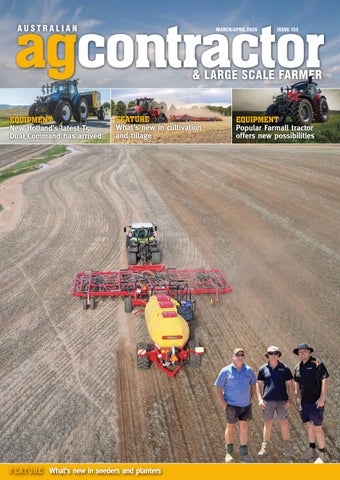
New Holland’s latest T5 Dual Command has arrived FEATURE What’s new

What’s new in cultivation and tillage

EQUIPMENT
Popular Farmall tractor offers new possibilities


EQUIPMENT
New Holland’s latest T5 Dual Command has arrived FEATURE What’s new
What’s new in cultivation and tillage
EQUIPMENT
Popular Farmall tractor offers new possibilities


For many years, Rogator has earned a reputation as a quality sprayer that delivers outstanding results in keeping crops clean.
Now, Rogator joins the Fendt family, an evolution that brings together Rogator’s proven performance with a premium Fendt style, including a higher horsepower offering, a new Fendt styled cab with excellent visibility and increased technology.

The Fendt Rogator went from great to greater. And now it’s your turn to do the same.
For more information contact your local Fendt dealer or visit fendt.com/au/


Leaders drive Fendt.
PO Box 36753
Merivale, Christchurch 8146
ph: +64 3 329 6555
www.agrimedia.co.nz
Publishers of Rural Contractor & Large Scale Farmer, AgriBusiness, AgriVet, NZ Cropping, Australian AG Contractor & Large Scale Farmer, NZ Novachem Manual.
EDITOR
Scott Wilson
Mob: +64 21 725 061
Email: scott@agrimedia.co.nz
ADVERTISING SALES
Pulse – Media Sales
Justin Bowler
Ph: 0429 699 553
Email: justin.bowler@mmg.com.au
CIRCULATION
DDI: +64 3 329 6555
Email: admin@agrimedia.co.nz
PRODUCTION, LAYOUT & DESIGN
Mark Winstanley
Email: agc_art@agrimedia.co.nz
Printed by PrintGraphics Pty Ltd
02 FROM THE EDITOR: The farmer’s burden
03 Claas Jaguar & Orbis receive awards
04 The Amazone Catros compact disc harrow turns 25
06 German farm equipment specialist brings hands-on expertise to Australia and New Zealand
08 Know before you go: Avoiding bore drilling risk
10 New Holland puts data driven solutions to work for farmers PROFILES
12 Small farm, smart strategy: How the right mindset and equipment drive success in Central West NSW
16 Across the ditch: The evolving story of Langsford N&G Contracting
22 What’s new in cultivation and tillage
30 What’s new in seeders and planters
42 New Case IH combine series shines during demanding harvest with impressive levels of performance and efficiency
44 New Holland’s New T5 Dual Command: Master and Commander
45 Enhanced 5EN delivers power, precision and comfort in narrow tractors
46 Harvest ‘guinea pig’ rapt with new header front
47 ‘Transformative’ changes to popular Farmall tractor range offers new possibilities for busy farming operations
48 New McHale V6750-II arrives in 2026
49 Over 100 years of trust, innovation and customer satisfaction
50 Reefinator contractor in high demand for amazing results
52 New Holland earns Australian Made certification for DuraVee range
AC © AUSTRALIAN AG CONTRACTOR AND LARGE
SCALE FARMER - No part of this publication may be reproduced in any form without the prior written permission of the publisher. Opinions expressed in this publication are not necessarily that of the publisher and suggest independent advice be sought before acting on information or suggestions contained herein.
CONTRIBUTIONS - Editorial and photographic contributions are welcomed and should be sent directly to AML. Editing of submissions is at the sole discretion of the editor and will accept no responsibility for unsolicited material.

WRITING IN LATE FEBRUARY 2026, A CONVERSATION WITH A FOURTHGENERATION DAIRY FARMER OUTSIDE WARRNAMBOOL CRYSTALLIZES THE CHALLENGES FACING AUSTRALIAN AGRICULTURE. STANDING BESIDE EMPTY IRRIGATION CHANNELS AND BROWN PADDOCKS, HE OBSERVED: “WE’VE SEEN DRY YEARS BEFORE, BUT NOT LIKE THIS. NOT WITH THESE COSTS. NOT WITH THESE PRICES.
His words capture the perfect storm testing farmer resilience across the sector this year.
Forecasters predict just 0.4% growth in real farm value for 2026, which is a dramatic drop from 2025’s strong performance.
But statistics don’t convey the reality of an extraordinary climate divide creating two agricultural Australias. Victoria and South Australia suffer a punishing “hot drought” with searing temperatures compounding water deficits.
Pastures are brown and brittle and water allocations have plummeted. Northern New South Wales faces the opposite with flooding that’s displaced livestock and waterlogged cropland.
This geographical split makes coherent national policy-making extremely challenging, and often near impossible.
For dairy farmers, 2026 has brought little relief. Despite opening farmgate milk prices between $8.60 and $9.20 per kilogram of milk solids, industry groups argue these figures fall short of what’s needed.
When global dairy markets weakened late last year, better returns evaporated. Processors now signal prices will stay flat through early autumn. For farmers battling high feed costs and declining herd numbers, it’s devastating.
International markets compound the pressure. While Australia sidestepped many US tariffs last year, some markets now impose tariffs on beef imports.
Oilseed producers face oversupplied markets and falling prices. The livestock sector is rebuilding herds rather than exporting, which is necessary long-term, but painful now.
There’s a small silver lining: input costs have eased slightly with falling fuel and fertilizer prices, though they remain well above historical norms. Looming over everything is the emissions question.
As other sectors decarbonize, agriculture’s share of national emissions is projected to climb from 19% in 2023 to over 30% by 2040. Farmers face mounting pressure to invest in

reduction technologies without clear pathways or adequate support.
With winter planting weeks away and soil moisture critically low across southern regions, the next month will shape the year’s crop outcomes and the viability of many operations.
Australian farmers are remarkably resilient, weathering droughts, floods, market shocks and political uncertainty. But resilience alone won’t be enough. What’s needed now - from policymakers, processors, consumers and communities - is practical support, long-term investment and a clear blueprint for sustainability.


THE AMERICAN SOCIETY OF AGRICULTURAL AND BIOLOGICAL ENGINEERING (ASABE) HAS HONORED TWO GROUNDBREAKING INNOVATIONS FROM CLAAS WITH AE50 AWARDS: THE JAGUAR 1000 FORAGE HARVESTER SERIES AND THE ORBIS 10500 CORN HEADER.
“These two AE50 awards confirm what our customers already know: Claas continues to set standards in terms of performance, efficiency, and intelligent machine design for the harvesting of forage crops,” explains Dennis Ogle, sales manager for self-propelled harvesting technology at Claas of America.
“Both the Jaguar 1000 Series and the Orbis 10500 were developed in close collaboration with farmers and contractors, with a focus on real productivity gains and ease of use with a high degree of automation.”
JAGUAR 1000: TOP PERFORMANCE IN NEW DIMENSIONS
The four models in the Jaguar 1000 Series represent a new generation of forage harvesters, based on more than 50 years of experience in the development and manufacture of self-propelled forage harvesters.
With engine outputs of up to 1,110hp, the development focus was particularly on a

well-thought-out, future-proof overall concept for optimum efficiency and maximum throughput capacity – confirmed, among other things, by the impressive official Guinness World Record for forage harvesting.
The convincing arguments include the widest crop flow on the market, fully hydraulic pre-compression, uncompromising and homogeneous chopping quality, the large 310mm diameter corn-cracker for optimum grain release, the drive concept with two independent variable front attachments for newly developed, high-throughput pickup


INTERNATIONALLY ACCLAIMED CLAAS INNOVATIONS: THE JAGUAR 1000 SERIES AND ORBIS 10500 CORN HEADER ARE AMONG THIS YEAR’S AE50 AWARD WINNERS.
and Orbis front attachments, and a solid chassis with high-traction and ground-protecting running gear.
In addition, the Jaguar 1000 features the latest generation of assistance systems and user-oriented digital solutions, including the new Nutrimeter. Combined with one of the quietest cabs on the market and optional joystick steering, the overall concept of this internationally award-winning series delivers maximum performance, uncompromising comfort, and groundbreaking overall efficiency.
The ASABE jury highlighted the Orbis 10500 in particular for its sophisticated engineering and its contribution to increasing overall harvesting efficiency.
The row-independent corn header with a working width of 10.50m (14 rows with 75cm row spacing) operates using an independent variable drive of the knife and transport discs as well as the feed drums for optimum chopping quality in all harvesting conditions and lengths of cut.
The operator can conveniently set the speeds of the crop flow components during harvesting in automatic mode to the length of cut and driving speeds from the cab.
Auto Contour and actively controlled stabiliser wheels enable quick and smooth adjustments to uneven ground and ensure that the ideal working height is always maintained regardless of the topography and driving speed.
Thanks to the integrated automatic transport protection and transport chassis, safe and legal road transport is possible with an external width of less than 3.30m without long set-up times.
Twenty-five years ago, a new era in soil tillage began for Amazone. Shortly after the Amazone Group took over BBG Bodenbearbeitungsgeräte Leipzig in 1998, the foundations were laid for one of the most successful products in the Amazone soil tillage world. In 2001, the newly developed Catros was launched on the market giving high-performance shallow stubble cultivation.
Right from the start, the innovative design set impressive standards as a compact, three-point linkage mounted implement, equipped with two rows of aggressively angled, individually suspended concave discs mounted on maintenance-free, rubber buffer blocks.
To date, numerous milestones have marked the development, such as the Smart Frame System, which offers the ultimate in ease of use and optimum handling, high working speeds and area coverage, as well as efficiency and cost-effectiveness – values that are appreciated by farmers worldwide.
Over the years, the Catros has been continuously developed to meet the increasing demands of modern agriculture and the diverse needs of farmers.
As early as 2003, the range was expanded to include additional working widths and offered a new, fully hydraulic working depth adjustment feature. In 2004, the switch was made to oil-immersed, maintenance-free disc bearings. This not only significantly reduced set-up times and maintenance costs but also permitted a sustainable increase in performance.
THANKS TO CONTOURFRAME, THE CATROS+ 12003-2TX ADAPTS PERFECTLY TO THE GROUND, EVEN ON UNEVEN

At this time, Amazone also offered its first catch crop seeder box for the simultaneous application of cover crops and fine seeds. This was further developed in line with market requirements and now provides flexible use across a wide variety of Amazone soil tillage implements and seed drills under the name GreenDrill.
The trailed versions with integrated running gear extended the product range from 2005 onwards and enabled greater working widths and use with smaller tractors. In 2007, the range of rear rollers was widened to meet the individual challenges encountered in practice.
With the introduction of the Catros+ model in 2011, the disc harrow concept was significantly expanded: new disc diameters of 510 mm enabled the more intensive incorporation of organic matter.
The innovative TS bogey chassis and, for the first time ever, bolt-on bearing shafts on the disc arms ensured even greater flexibility and durability. In 2013, the pro-Pack was added as an optional extra for certain models.

This is a special solution for long-term use in slurry application, which was supplemented shortly afterwards with a convenient central lubrication system.
From 2016 onwards, the Catros+ 12003-2TS became the new flagship of the Catros family for large farms and contractors.
The 12 metre working width adapts perfectly to any uneven ground thanks to the ContourFrame with its hydraulically pre-pressurised frame sections and individually suspended discs.
The introduction in 2020 of the CatrosXL brought a new dimension to the range of discs offered, thereby expanding the range of applications. Its 610 mm discs enable deep and intensive mixing of large amounts of organic matter, especially in very heavy and wet soil conditions.
Recent years have been dominated by technical innovations designed to make soil tillage more sustainable and efficient.
Special optional equipment, such as the X-Cutter disc with a wavy profile, has been developed in response to the increasing demand for shallower soil tillage to protect the soil structure and conserve soil moisture in dry locations.
Amazone responded to the growing importance of field hygiene with innovative leading tools such as the knife roller. This enables intensive shredding before incorporation, thereby accelerating the decomposition process.
The front-mounted Crushboard provides

a powerful crumbling and levelling effect which, in combination with a rear roller and a harrow, is ideal for seedbed preparation.
The latest developments have taken the Catros range to new heights in terms of comfort and durability.
The Smart Frame System allows the work-


ing depth to be adjusted hydraulically from the cab without having to readjust the frame angle. The depth is also adjusted independently of any leading tool.
The disc bearing, which has proven itself over two million times, and the HD roller bearing with metal face seal are complete -


CATROS+ 12003-2TX WITH INTEGRATED TX CHASSIS THANKS TO NEW FIVEPART FOLDING MECHANISM.
ly maintenance-free thanks to being filled with gear oil.
At Agritechnica 2025, new standards were set once again with the introduction of the Catros+ 12003-2TX.
The 12.25 metre working width with a new folding design and integrated central running gear, a wide range of disc and roller options as well as the option of an extended disc element for controlled traffic farming systems, makes the Catros the first choice for large farms and contractors. In addition, Amazone presented AutoLane, an innovative truetrack following system which automatically compensates for drift on slopes.
Twenty-five years of the Catros demonstrate how Amazone supports and optimises agriculture in the long term through continuous innovation and practical solutions.
For a quarter of a century, the Catros has stood for technological progress which is consistently geared towards the demands in practice and makes soil tillage more efficient step by step.
Today, Amazone offers the right model for every farm – from compact implements for smaller fields in working widths from 2.50 metres to wide, high-output, machines of up to 12 metres for maximum efficiency.


WHEN LANDPOWER | CLAAS HARVEST CENTRE SELLS A MACHINE TO A CUSTOMER, THE RELATIONSHIP DOES NOT END AT THE POINT OF SALE. FOR THE TEAM, THIS IS JUST THE BEGINNING OF A THROUGH-LIFE RELATIONSHIP WHERE THE FOCUS IS ON THE VALUE THE MACHINE ADDS TO THE CUSTOMER’S BUSINESS.
To support customers to be successful, world-leading products that come with training and education ensure that machines perform at their best. That is why the business invests in one-to-one assistance from a team of product specialists, experts in their field, who complete optimisation and demonstration activities on-farm, providing a two-way feedback loop for ongoing product research and development.
Amazone is represented in the Australian and New Zealand market by Landpower | Claas Harvest Centre, who sell and service Amazone equipment for soil cultivation, seeding, fertilisation, and crop protection.
Having finished studies last year, Carl Hovestadt has been assisting Landpower and Amazone to introduce a number of new products in both Australia and New Zealand as part of the
optimisation team. Carl took up the challenge, a role which would also be his first overseas work experience, spending five months across the Tasman to, amongst other things, introduce new products, such as the Amazone Catros+ 12003-2TX trailed compact disc harrow and Precea’s precision planter.
“I’m 100% into farming and farm equipment,” says Carl , who arrived from Germany in late 2025
Hovestadt hails from a dairy farming family from Rheine in the North West of Germany, based only a few kilometres from the head factory of Amazone.
The family no longer farms, but Carl used to work for a farmer who leased the family’s land.
In his spare time and during vacations he works for a contractor where he specifically drives the Precea.
Carl has real hands-on experi-

ence. After school, he completed an apprenticeship as a mechanic at an Amazone and Claas dealer in Germany. He then went on to complete a degree in Business Administration and Engineering. While studying Business Administration and Engineering he worked for Amazone as a working student.

“My position was helping with product management and product marketing, especially for the product line of passive soil cultivation equipment,” he says.
Carl wrote his Bachelor’s thesis in collaboration with this department. The topic was the development and empirical validation of a total cost of ownership tool, to analyse the costs of shallow tillage equipment.
Within the thesis, different machine systems were compared, including disc harrows such as the Catros, the Amazone TopCut cutterroller combination, and other systems. Furthermore, various working widths and manufacturers were analysed.
His work included helping with startups, demo tours, training sales reps and technicians, and optimisations of machines, so he spent a lot of time in the network of Claas Harvest Centre.
Carl also visited farms that are existing Amazone customers to do market research and to hear what they want from machines and what conditions they are working in.
“We and our dealers want customers to get the most out of their machines. To this end, it is great to train customers and

technicians on site in the field, which is often more effective than theoretical training.”
He says that this is not always possible, of course, but when the opportunity arises, “we try to take advantage of it”.
In New Zealand, he primarily took care of the Precision Planter Precea, while in Australia the main focus was on the new Catros model.
This was simply because the sowing and harvesting in Australia had been completed and it was time to prepare the soil.
Carl says that Amazone exports 80% of its machines, so it is defi-
nitely worthwhile sending someone to visit the market abroad to see how agriculture works and is changing.
He sees three different benefits in his stay abroad.
First, the support of Claas Harvest Centre customers on-farm.
“If a customer in Australia is having challenges with their machine in a specific region, chances are that we have encountered this scenario before and can apply our learnings to the customer,” he says.
Second, the feedback he can bring back to Amazone in Germany.

“We can identify local farmers’ needs and practices, which are provided back for ongoing product research and development,” he says.
And third, the personal benefit he gains through the experiences he makes.
Carl says that the conditions for agriculture in Australia and New Zealand are sometimes very extreme, for example in terms of soil conditions and weather, but the fact that the machines are built on the other side of the world also poses a major challenge.
The delivery times for spare

parts and machines and the difficulty of contacting Germany due to the time difference are things that take some getting used to.
These are all things you simply cannot look up on Google — these experiences have to be made firsthand.
Of course, you can find information about annual rainfall and soil conditions, but not about how hilly Waikato is and how narrow the gateways can be.
“You have to experience that for yourself when you drive machinery,” he says.
“The opportunity to travel through Australia and New Zealand and gain in-depth insights into agriculture was amazing — I would do it again immediately.”
And, Carl did not only see paddocks and Claas Harvest Centres; he also visited the main tourist attractions whenever time allowed.
What Carl will do after his job in Australia has not yet been fully decided.
He says that in some form it will be something related to Amazone, possibly in combination with a Master’s degree in the field of agricultural economics.


CERTAINTY BEFORE DRILLING IS REPLACING GUESSWORK ACROSS LARGE-SCALE AGRICULTURE.
For ag contractors and large-scale producers alike, water bore drilling has become an important decision. Rising drilling costs, tighter margins and increasing scrutiny on capital expenditure mean there is little room for error. A failed or underperforming bore represents money down the drain.
Whether you are the contractor responsible for delivering a result, or the producer committing significant capital to long-term water infrastructure, the question is the same: how confident are we before the rig arrives?
Traditionally, bore sites were selected using local knowledge, historic drilling patterns or best guesses based on surface features. While that approach may once have been the way, conditions have changed. Today’s projects are larger, more expensive, and the consequences of drilling blind affect everyone involved.
As a result, a growing number of contractors and operators are adopting a ‘know before you go’ approach — using independent groundwater assessments to increase certainty before drilling begins.
One Queensland cattle producer, David Crombie, managing more than 4,000 hectares of breeder country, experienced multiple unsuccessful drilling attempts; the idea was that usable groundwater simply didn’t exist on the property.
David, who has served in several prominent national roles including Chair of Meat & Livestock Australia and President of the National Farmers’ Federation, was well aware of the cost of blind drilling — both personally and


across the broader industry. Before committing further capital, he engaged Sustainable Water Pty Ltd to conduct a scientific Potential Groundwater Assessment to better understand what groundwater resources might exist beneath the property. “We’d already had drilling failures, so we needed to know where not to drill as much as where to drill,” David said. “The assessment gave us the confidence to target the right area before the rig arrived.”
Drilling was then directed to the zones and depths that had been pinpointed, resulting in a productive bore capable of supporting stock and domestic water requirements across the operation.
David added, “I can only state that the successful location of sustainable water on my property has made our production transformational.”
For the producer, the value lay in certainty — knowing where capital should, and should not, be spent. For contractors, the benefit is just as clear. Drilling informed by data rather than guesswork reduces the likelihood of failure, protects professional reputation, and strengthens long-term client relationships.
From a commercial standpoint, it’s logical,
the cost of knowing before you go is small compared to the total cost of a failed bore. On large projects, particularly those involving multiple bores, irrigation expansion or future development planning, reducing risk is what it is all about.
The advantage is that understanding groundwater depth, yield and quality before drilling allows infrastructure to be correct. Pump sizing, power supply, storage and distribution can be planned with confidence, rather than adjusted after drilling results are known. This level of foresight is increasingly important as water security becomes vital to production.
This approach does not replace drilling expertise. It supports it. Many contractors are finding that working from assessed sites improves outcomes and reduces risk on all sides. In this model, drilling is no longer the first step — it is the final one.
Knowing where not to drill is often just as valuable as knowing where to drill. In today’s environment, blind drilling is a gamble few can afford. For those facing risk, reputation and capital, knowing before you go is fast becoming standard practice for water security.

Avoid the risk of finding abundant useable water for livestock and/or crops.

Farmers can spend a lot of money not finding a volume of good water, water that is vital to property production.
A Potential Groundwater Assessment at no cost to you eliminates the risk of drilling a dry bore. Don’t waste time and money drilling in the wrong location
Bore sites located by scientific methods with a better–than-high success rate Providing long-term drought resilience strategies and implementation. Start with a FREE Potential Groundwater Assessment (PGA) the first step to understanding your options
Also, property owners in dry and drought conditions, or farmers who are thinking ahead and planning one or more bores may enquire about our Water Security Discount :
Order the Standard 3-Site Package
Get a 4th Location FREE (Value: $1,457.50)
Includes the FREE Potential Groundwater Assessment (PGA).

To request a PGA now with no obligation contact:

Louis Ceberano M: 0405 939 592
louis@sustainablewatersolutions.com.au

FARMERS CAN NOW MANAGE THEIR HARVEST OPERATIONS WITH EASE AND EFFICIENCY, THANKS TO NEW COMBINE TECHNOLOGY THAT SIMPLIFIES DATA MANAGEMENT AND DELIVERS REAL-TIME RESULTS IN THE FIELD.
New Holland has rolled out its next generation CR combines for the 2025/26 harvest, to maximise output, minimise grain loss and address operational economics with a new platform that features the next generation of harvesting technology.
The focus is on empowering farmers to make more informed and quicker data-driven decisions, so they can get the most grain out of every hectare.
Jeremy Duniam, New Holland ANZ Head of Precision Technology, said farmers can manage their entire harvest operation in real time, make adjustments on the go, and see exactly how efficiently their machines are working—all in the FieldOps® platform.
“We’ve completely redesigned the system in the cab, with new wiring, new sensors, and all CNH-designed components,” Jeremy said.
“This supports the new IntelliView ® 12 display, which is a 12-inch wide, high processing power touchscreen that gives farmers a modern, easy-to-use way to control the machine and manage their data.
“IntelliView works hand in hand with IntelliSense®, the automation system inside the combine that optimises how the machine runs, like adjusting speed and throughput.
“FieldOps then takes the machine and yield data from the combine, sending it to the cloud so farmers can view and manage the results in real time from their devices, giving them full control and visibility, no matter where they are.”
Jeremy said that the next generation CR


combines include lifetime connectivity enabling access to FieldOps, removing the need for farmers to pay ongoing subscription costs.
“Adding a new combine also gives lifetime connectivity to all CNH machines in the

account, removing that barrier and making it easier for farmers to use the technology,” he said.
New Holland is also offering the IntelliView Four Plus screen for legacy machines, so farmers with older equipment can upgrade to a faster, more modern interface and better data handling across their whole fleet.
Marc Smith, New Holland ANZ Product & Portfolio Manager – Crop Harvesting, said FieldOps provides farmers with a much stronger, reliable platform to utilise valuable harvest data.
“With FieldOps, farmers use their yield and protein data to help shape next year’s seeding prescription,” he said.
“That’s the beauty of gathering all this data and then being able to put it into a meaningful layout.
“Farmers can then make informed decisions, whether it’s making life easier, making more money, or making their operation more efficient.”


KEVIN BEATTY FROM MOLONG IN CENTRAL WEST NEW SOUTH WALES SAYS SMALLER LIVESTOCK AND CROP PRODUCERS CAN GET AHEAD WHEN THEY HAVE THE RIGHT MINDSET AND THE RIGHT GEAR.
Kevin farms crops and raises sheep and cattle on a total of about 300 acres, with 60 acres of his own land and the remainder made up of a number of properties around Molong that he leases.
VERSATILITY IS KEY: MULTI-ENTERPRISE APPROACH SPREADS RISK
Feed crops make up the largest part of his feed strategy and he plants mainly oats for winter feed, although he has grown wheat in the past. Oats are versatile and can be grazed, cut for hay and left to stand for seed.
After having livestock graze oats he shuts it up either to harvest it for hay, or strip for seed.
Kevin also grows out second cross lambs and runs Merino ewes; he puts a Border Leicester
KEVIN SAYS SMALLER LIVESTOCK AND CROP PRODUCERS CAN GET AHEAD WHEN THEY HAVE THE RIGHT MINDSET AND THE RIGHT GEAR.
over them to produce first cross lambs. On top of that he runs Angus cattle that he calves to sell the weaners at six or seven months old.
In addition, Kevin also does contract work for other small producers in the area who do not have the gear to plant their own feed crops.
His contract work is similar to what he is already doing on his own properties, and he sows oats and other cereal crops for
MOST SMALLER PRODUCERS DO NOT HARVEST THEIR OWN CROPS, AS IT IS A LARGE ADDITIONAL COST, AND PREFER TO USE CONTRACTORS, KEV SAYS.
clients who mainly use it as feed for lambs and stock.
He has sown pasture for himself, but not yet for clients.
He says with extreme temper-

atures, such as the 42°C at his place he recently experienced, and without much rain this season, he ideally gets seed into the ground as early as possible.
“I generally try to get seed in late February, early March. If the season goes well and you get rain you can feed late April to May. Depending on your season, you can turn stock in and out of that, twice to three times, again, depending on rainfall,” he says.
He fertilises paddocks with urea towards the middle of August, and then shuts them up, hopefully harvesting hay in the early October period.
Season dependent he can strip seed around December.
Molong in Central West New South Wales can become extremely hot, and has average temperatures in the summer in the mid 30s. In winter it can drop to minus temperatures, with nearby regions even getting snow on the ground three or four times per year. It’s a massive temperature range to deal with, he says.
To make a smaller farm work he has to rely on good gear.
Kevin says, as a smaller producer, the Agrowdrill 140 seed

drill he bought from Davimac is the right tool to get the job done.
He says the direct drill machine is easy to transport on the road and is great for the contract work he does for other small livestock producers because it fits through 14 foot gates, something the area has a lot of.
He tows his AD140 with a John Deere 120 horsepower, 6120R. The AD140 can easily be calibrated down to any seed type and size.
“It’s very accurate,” he says.
Best of all, it’s not complicated to manage. The AD140 runs a 425 coil tine and a 401 double disc unit in the undercarriage. It has a 150cm row spacing, 1.5m to 3m working widths and up to two 385L dual seeder/fertiliser capacity.
Agroplow says it’s their most popular seed drill for small farms, with the strength needed

to penetrate dry soils, and is the tool for time-sensitive moisture conservation.
The pasture tool is in a heavy duty frame but is budget friendly.
The AD140 is available in a CAT2 three point linkage (3PL)


or a trailing design with hydraulic lift. The inverted T-shape Baker Boot Point minimises soil


start to get low through the viewing glasses; it’s handy.
“It’s just a really good size for small blocks.”

disturbance and ensures effective seed placement. The tyre roller then closes the furrows precisely.
The AD140 can support the 401 Double Disc undercarriage, transforming into a versatile disc seeder for improved trash management and zero till operations.
He says sight glasses at the front of the seed box are a great add on to the AD140.
“You can see when your seeds
Smaller producers face the same challenges as big producers, Kevin says.
“You’re at the mercy of market prices, and that’s a challenge for everything. At the moment, market prices are good. But the cost of production is expensive.”
He says small producers have
to count the cost of spraying out weeds, buying seed and seeding, diesel, machinery costing hundreds of thousands of dollars, treating and conditioning (if you produce seed yourself) and fertilising.
Most small producers pay others to harvest, which is an additional cost.
However, Kevin says his main focus is to feed his animals correctly, have them put weight on
OATS ARE VERSATILE AND CAN BE GRAZED, CUT FOR HAY AND LEFT TO STAND FOR SEED.
for sale and produce enough crop to get them through winter so they produce at the right time. He supplies to the open market, but will sell to anyone who wants breeding stock and often sells “directly from his paddock”.

AS A SMALLER PRODUCER THE AGROWDRILL 140 SEED DRILL KEVIN BOUGHT FROM DAVIMAC IS THE RIGHT TOOL TO GET THE JOB DONE. THE DIRECT DRILL MACHINE IS EASY TO TRANSPORT ON THE ROAD AND IS GREAT FOR THE CONTRACT WORK HE DOES FOR OTHER SMALL LIVESTOCK PRODUCERS, BECAUSE IT FITS THROUGH 14 FOOT GATES, SOMETHING THE AREA HAS A LOT OF.
The wool price has been unimpressive for years, but he says that’s just part of the job and part of good animal husbandry to make sure animals are healthy.
The wool price has come up in the last four months, with lamb prices also climbing to about $11/kg. He says at the peak of the lamb price hike he was selling lambs for $389 a head, and heard of others selling bigger lambs for $500 a head.
A higher price does make him more positive about the future. At about $250 he is covering costs. This is in stark contrast to 12 months ago when he was selling lamb for $80 a head.
He says newcomers should know that farming is a gamble, but if you do the right thing and properly prepare stock for sale you don’t only get satisfaction as a reward but can also be rewarded financially.
“There is some money to be made in good times.”
He also says well looked after

KEVIN SAYS WITH EXTREME TEMPERATURES, SUCH AS THE 42°C AT HIS PLACE HE RECENTLY EXPERIENCED, AND WITHOUT MUCH RAIN THIS SEASON, HE IDEALLY GETS SEED INTO THE GROUND AS EARLY AS POSSIBLE. THIS PHOTO SHOWS WHAT SOIL LOOKS LIKE POST ROLLER.
better stock. And they are worth more money. It’s a gamble but a pretty safe gamble.”
He said good gear is also sellable if need be.
Kevin was a policeman and retired at the age of 50, 11 years ago. When he was in the police he was back in the countryside, and says he always had a passion for farming.
It was a hobby at first, but soon Designed


FOR MORE THAN TWO DECADES RURAL CONTRACTOR & LARGE SCALE FARMER HAS FOLLOWED THE LANGSFORD STORY AS IT UNFOLDED ACROSS THE WAIKATO LANDSCAPE.
It is remarkable how the passing years have shaped a business that continues to grow on the strength of its people and its values. When we first profiled the Langsford Brothers in 2002 the operation was known for hard work and quiet reliability.
That feature captured an operation that had navigated the pressures of expansion while holding tight to the simple philosophy that people matter and service comes first.
In September 2024 Nick and Georgie decided to move their contracting operation to their yards at Cox Road in Rotoorangi.
They downsized the business in early 2025, a decision that they sat comfortably with, knowing they could still service their well-established client base.
A STRONG SILAGE AND HAY SEASON STARTS WITH RELIABLE GEAR, AND LANGSFORD N&G’S TRACTOR AND BALER COMBINATION REMAINS CENTRAL TO GETTING QUALITY FEED MADE QUICKLY WHEN THE WAIKATO WEATHER GIVES A WINDOW.
The core staff remain and the experience of those skilled operators ensure that an


across ditch the PROFILED IN NZ’S RURAL CONTRACTOR & LARGE SCALE FARMER FEBRUARY/MARCH 2026, WE VISIT LANGSFORD N&G, IN THE WAIKATO, NEW ZEALAND.
By the time we returned in 2019, the reins were firmly in the hands of Nick Russo and Gabrielle (Georgie) Barnett, who had merged their own contracting venture in 2013 with the well-established Langsford name to create a company that felt like a natural continuation of everything Wayne and Dud Langsford had built, yet distinctly shaped by Nick and Georgie’s family-centred approach.


The business had doubled in size and had settled into a new purpose-built facility on Hautapu Road.
A WELL-MAINTAINED FLEET AND EXPERIENCED OPERATORS REMAIN CENTRAL TO THE WAY THE BUSINESS WORKS DAY TO DAY.

FROM CULTIVATION AND DRILLING TO SILAGE AND CARTAGE, THE TEAM STAYS READY WHEN THE WEATHER WINDOW ARRIVES.
extremely high standard will always be afforded to their clients. Experienced hands who know the paddocks, the customers, the shortcuts, the hazards and the expectations bring a continuity that has become increasingly rare in an industry that relies heavily on seasonal labour.
Every contractor in the country knows that keeping skilled operators is as important as owning good machinery because neither can function well without the other.
Langsford N&G has weathered that industry shift because it continues to offer a stable base of winter work across cartage, earthworks, fencing and maintenance. That stability allows them to keep the people who understand the business at a deeper level than just operating a tractor or a truck.
There is a sense that the matu-

rity of the business has sharpened the way Nick and Georgie divide their responsibilities. Nick continues to plan and coordinate the day-to-day jobs, while Georgie keeps the administrative backbone running smoothly in a world that demands more documentation,
certification and compliance than ever before. Farmers now have a much clearer picture of the depth of services and skill the business can offer. Cultivation, drilling, balage, mowing, cartage, digger work and earthmoving have all become part of a reliable annual rhythm
for clients who know that precision and consistency matter more than ever in a contracting environment shaped by tight weather windows and rising expectations.
The demand for earthworks has increased, with the use of tractors and trailers becoming


a popular choice as they can access sites where trucks cannot manoeuvre easily. Fencing too remains a key part of the winter schedule, and has only grown more intricate as lifestyle blocks expand and rural subdivisions require tighter and more diverse types of boundary work.
The Fairbrother post rammers continue to be the backbone of the fencing team and the ingenuity shown by staff in designing tools such as post extractors and levelling bars in previous years has remained a hallmark of the team’s practical problem-solving capability. There is still no quiet season in this business, only a shifting of gears and a reallocation of people and machines to where they are needed most.
On the agricultural front, the Waikato remains a region where contractors need to cover a wide range of land uses from dairy to sheep and beef, goat farms, councils and lifestyle blocks. Langsford N&G continue to operate across that spectrum with the same attention to detail that defined the earlier decades.
Groundwork begins as soon as soil conditions allow and spring signals the frantic pace of the silage season, with triple mow-
ers, tedders, rakes, balers and wrappers running across the district from September into the early summer weeks.
The company maintains its strong loyalty to Claas for mowing equipment, with the triple mowers for speed and a quality cut, while McHale Fusion bale wrappers continue to offer reliable outputs with tight shapely bales that farmers appreciate for stackability and consistent feed quality.
Pasture and crop work has become increasingly precise over the last decade and Langsford N&G has kept pace with that shift with an Allen ED Drill, Duncan roller drills and airseeders fitted to cultivation tools to

shape paddock renewal and forage establishment.
GPS-guided sowing is now standard across the fleet and while Nick has long been loyal to John Deere, his decision to invest in high-spec tractors with integrated guidance has paid off in accuracy, fuel efficiency and operator comfort.
The fleet of green tractors remains the backbone of the operation, with horsepower ranges that allow the business to match the right machine to the right job and long-serving tractors clocking ten or twelve thousand hours continue to prove the brand’s reliability.
The company also retains a pair of Fendt tractors. The continuation of those units is a subtle reminder that staff preference matters because a contractor who invests in equipment that keeps operators comfortable and confident knows
CARTAGE REMAINS A KEY PART OF KEEPING FARMS MOVING, AND LANGSFORD N&G’S TRUCK AND TRAILER WORK REFLECTS THE YEAR-ROUND SERVICE THAT SUPPORTS CLIENTS WELL BEYOND PEAK CROPPING AND SILAGE PERIODS.
that satisfaction translates into better work.
Looking back to earlier profiles, the thread that runs from 2002 and now into 2026 is the importance of people. Skilled operators like Grant Shaw, Frank Andrews, Wade Smith,
PRECISION, CONSISTENCY AND TIMING MATTER MORE THAN EVER, ESPECIALLY IN A REGION SHAPED BY TIGHT SEASONAL WINDOWS.

THE BUSINESS HAS EVOLVED WITH CHANGING DEMANDS WHILE STAYING GROUNDED IN PRACTICAL SERVICE AND LOCAL KNOWLEDGE.

Mark Heaslip, Shane Lyon, Andrew Neilson and Mat van Groenedaal continue to be pillars of the business and their willingness to guide and support new staff has kept the culture steady. New and existing clients appreciate that the friendly, professional service
Langsford N&G is known for comes from those long-standing operators whose experience underpins the reliability of the business and gives the team the confidence and stability needed to meet the demands of each season.
Nick and Georgie both remain

deeply involved in the day-today life of the company, and that hands-on leadership continues to shape the tone of the business.
Their willingness to listen to staff and customers alike builds trust in ways that cannot be replicated by systems alone. They
know the pressures farmers face, the unpredictability of seasons and the reality that timing is everything.
The business has maintained that core principle that work should be done when the farmer needs it done, not when the contractor decides it is convenient.


Specifications:
• 6000L product tank


• 36m TriTech RivX boom

• Auto Greaser

• 3TS with RapidFire and RapidFlow
• XRT auto boom height controller with 5 sensors
• 2WD with fixed track 2970mm


• 480/80R46 / HR45 XLoad wheels - Black

• 260 l/min diaphragm pump with hydraulic drive

• LED light bars (lower bonnet and cabin roof)


• Black Edition decal kit


MOWING, RAKING, BALING AND WRAPPING REMAIN A CORE PART OF THE SPRING AND EARLY SUMMER WORKLOAD.
That attitude has earned Langsford N&G long-term clients across the Waikato and Bay of Plenty region who rely on their business year after year and that reliability has become a cornerstone of the company’s reputation.
Weather volatility in recent years has added pressure to the timing of silage and hay work. Communication with clients, the readiness of gear and staff is of high priority to ensure everyone is ready to move when a weather window appears.
This ability to pivot quickly depends on having skilled staff and well-maintained machinery.
Winter still remains a critical part of the year because staff move into earthworks, muck spreading and raceway maintenance.
Those seasonal patterns have become more important as contractors across New Zealand face labour shortages.
The ability to offer staff continuous employment across twelve months gives Langsford N&G a competitive advantage in recruiting and retaining skilled workers and that stable core helps them deliver consistent

those values resonate through the team and out into the wider community.
quality during high-pressure seasons.
The story of Langsford N&G Contracting remains one built on practical decisions. The company has never tried to expand beyond what its community needs, and it has always shown respect for neighbouring contractors by staying within its natural boundaries and referring out-of-area work to local operators.
That awareness of the broader contracting ecosystem is part of what has kept the business grounded; growth for its own sake has never been the goal. Quality service and looking after people are the two constants that drive every decision Nick and Georgie make and
As the business enters its next chapter, the decision to downsize and move back home to Cox Road, Rotoorangi stands as a base to support future growth and stability.
The fact that Langsford N&G has outgrown difficulties and embraced opportunities over the years says much about the character of its owners, who have weathered economic shifts, rising compliance costs and the increasing complexity of running a large rural business without losing sight of the importance of personal relationships and community trust.
They have maintained the legacy they inherited from previous owners while adding their own strength and direction. It is clear that the focus remains on delivering excellent and reliable
LANGSFORD N&G CONTINUES TO DELIVER RELIABLE CONTRACTING SUPPORT ACROSS THE WAIKATO THROUGH EVERY SEASON.
services for customers and caring for the staff that make that possible.
In an industry shaped by the unpredictability of weather, seasons and market, that commitment to people, service and quality stands out as the steady path that Langsford N&G continues to follow.
A STEADY FOCUS ON PEOPLE AND PERFORMANCE HAS HELPED LANGSFORD N&G BUILD LONG-TERM TRUST WITH FARMERS AND RURAL CLIENTS.

You deserve technology that’s both compatible with your existing fleet and easy to use. That’s why PTx Trimble leads the way in engineering solutions –including displays, steering systems and guidance control – that allow you to connect your farm, your way for seamless work all season long
This farmer uses: GFX-1060™ display with Precision-IQ™, Autopilot ® steering system, NAV-900 guidance controller, and Trimble ® CenterPoint ® RTX correction service. Scan to learn more and contact a local dealer.


CONTRACTORS AND FARMERS USE TILLAGE TOOLS TO PREPARE SEED BEDS, DISRUPT WEEDS, INCORPORATE STUBBLE OR GREEN CROPS, AND BREAK UP COMPACTION. WHATEVER YOUR AIM, YOU NEED GOOD EQUIPMENT TO DO THE BEST JOB. IN THIS FEATURE WE LOOK AT THE LATEST CULTIVATION EQUIPMENT AVAILABLE IN THE AUSTRALIAN MARKET.
K-LINE AG MACHINERY SUPPORTS SMARTER RESIDUE MANAGEMENT
As harvest draws to a close across much of Australia, growers are already turning their attention to the next phase: managing crop residue and preparing paddocks for the season ahead. With tight turnaround times and increasingly variable conditions, the machinery used in this window can have a lasting impact on soil health and productivity.
The approach to post-harvest ground prep varies depending on conditions, but for those dealing with dry stubble, a residue cutter is often the first implement out of the shed. In wetter paddocks or where mulch is heavier, disc tillage becomes the preferred option.
Wade Smith, Product & Portfolio Manager – Crop Production –CNH Australia New Zealand, said the shift toward more strategic residue management is being driven by both seasonal varia-
bility and a growing focus on soil health.
“We’re seeing more growers thinking about what their paddocks need, not just in terms of clearing residue but in setting up the soil for the next crop,” he said.
“That might mean cutting and spreading dry stubble to preserve structure, or incorporating heavier material to improve nutrient cycling.”
Developed by K-Line Ag, Trash-
Cutter® is one such tool designed for dry conditions. It uses a highspeed rotating drum to slice through tough residue like wheat and corn stalks, helping to break down organic matter without disturbing the soil profile. For growers working within no-till or minimum-till systems, it’s a way to manage surface trash while maintaining the benefits of reduced soil disturbance.
The TrashCutter is also designed to improve the uniformity of residue distribution across the paddock, which can


help reduce blockages during sowing and support more even germination.
“Residue left unmanaged can create issues with pests, disease, and even sowing efficiency. But overworking the soil isn’t the answer either. That’s where tools like the TrashCutter come in to strike a balance,” Wade said. In contrast, when conditions are wetter or the residue load is heavier, incorporation becomes the priority. The Speedtiller Powerflex® is a disc tillage machine designed to handle those scenarios. It chops and mixes resi-
due into the soil, lifts and aerates the ground, and leaves a level finish—all in a single pass.
Wade said the Speedtiller is particularly useful in seasons where headers have struggled with bulky crops or where uneven residue spread has created patchy ground cover.
“Using a header to manage residue can slow down harvest and increase yield loss,” he said.
“Tillage gives growers a way to reset the paddock, reduce compaction, improve water infiltration, and get nutrients back into the soil where they’re needed.”
Agrowplow’s Agrowdrill range is designed to suit a wide variety of Australian seeding operations, with flexible configurations to match different soils, farming systems, and residue levels. The range offers multiple undercarriage options, along with choices in seed and fertiliser placement, row spacings, and towing setups, allowing growers to tailor machines to their specific requirements.
Seed drills continue to be a key tool for growers seeking accurate and consistent seed placement. Compared to broadcasting, drills improve establishment through even depth control and spacing, while supporting no-till and zero-till systems that are now common across much of Australia.
New to the top end of the Agrowplow seeding lineup is the AD640 heavy duty disc seeder, which will be available in the second half of this year and is scheduled to appear on the field day circuit.
Designed for harder soil conditions, the AD640 features a
The Speedtiller is engineered with a heavy-duty frame and high-clearance design, allowing it to handle large volumes of residue without clogging. Its independently mounted discs provide consistent penetration and mixing, even in challenging soils, while the adjustable working depth and pressure controls give operators the ability to fine-tune performance on the move.
It also allows operators to adjust disc and roller pressure dynamically, which is useful when working across variable soil types. That flexibility
extends to incorporating soil amendments like lime or gypsum, which can be evenly distributed during the same pass.
“Being able to do multiple jobs at once is a big advantage,” Wade said. “It’s not just about efficiency, it’s about making sure the soil is in the best possible shape for the next crop.”
K-Line Ag machinery is manufactured in Australia and built with local conditions in mind. Their design reflects the reality that no two paddocks—or seasons—are the same. For growers, that means having options that can be tailored to the job at hand.
As the post-harvest window opens, the focus is on making the most of the time available. Whether that means slicing through dry stubble or incorporating heavy mulch, the right tool can help set the tone for the season ahead.
“Ground prep isn’t just a box to tick,” Wade said. “It’s a chance to improve soil structure, manage risk, and give the next crop the best possible start.”

ground-following double-disc and presswheel parallelogram for consistent depth control. It will be offered in 3.0 m, 3.6 m and 4.5 m working widths and includes a large dual hopper with up to 2080 L total capacity. The metering system is designed to handle a wide range of seed sizes, with straightforward calibration.
Alongside the disc seeder, Agrowplow continues to offer its established Agrowdrill direct drill range, available with double-disc or traditional tine and
baker boot undercarriages. These machines are designed to handle high residue situations, reducing the need for additional tillage while helping to maintain soil structure and ground cover.
The smaller AD083 suits smaller farming operations and mixed farming, featuring a gated double-outlet fluted roller distribution system for versatility across a range of crops. The AD140 is aimed at small to medium-scale operations, with a focus on durability and clearance, helping to manage trash while allowing
seed and fertiliser to be applied in a single pass via dual hoppers. The AD240 remains a popular and straightforward option, valued for its simplicity, reliability and flexibility.
With wheels positioned inside the working width, it allows fullwidth sowing and is well suited to growers looking for a practical, mid-size drill for general conditions.
Alongside the AD640 at the top end of the range, the AD730 is built specifically for larger broadacre operations and more
Effective ground preparation plays a critical role in soil health, moisture retention and longterm return on investment. Putting the work in ahead of planting season sets your crops and operation up for success.
The use of tillage implements is fundamental to ground preparation. Breaking through soil compaction aerates the ground, enhances water filtration, manages weeds and mixes key nutrients into the soil, creating an optimal seedbed for planting.
This foundation is exactly what Kuhn Agricultural Machinery’s tillage range is designed to strengthen.
Kuhn Performer cultivator
The Performer is a high-capacity cultivator that combines both disc and tine technology. With variable configurations available and designed for tractors ranging from 180 to 700 horsepower, the Performer range is well-suited to farming enterprises that rely on efficiency and need to maximise productivity during increasingly narrow working windows.
Known for its superior versa-
Feature Performer
Type
tility, the Performer offers four actions in a single pass: cutting, mixing or loosening, levelling, and consolidation. Completing multiple soil working tasks in a single pass reduces fuel use, labour requirements and machinery wear compared to conventional multi-pass tillage systems. This consolidation directly contributes to lower operational costs and improved farm profitability.
The Performer’s distinctive design allows it to handle a variety of conditions and different levels of crop residue.
This versatility comes from being able to use its components: two-disc rows, four tine rows, and a roller, working either independently or together. The front discs break through leftover organic material and the following tines then incorporate that material into the soil. The combined disc and tine action enhances soil structure, promotes residue breakdown, and prepares an excellent seedbed.
Quality stubble ploughing is a fundamental step in reactivating

soil life and guaranteeing the best profitability for the following crop. For this purpose, Kuhn offers Optimer, an independent disc stubble cultivator, available from 3 to 12.5 metres working width, combining intensive mixing, high speed and easy adjustment.
The Optimer range is available in three different chassis models – mounted, folding mounted or trailed – as well as two varying conical disc models – the Optimer L (510mm discs) and the Optimer XL (620 mm discs).
The Optimer L is ideal for surface stubble ploughing, creating false seedbeds and preparing the soil before planting a crop. The Optimer XL is designed for median stubble ploughing to
Optimer
Disc and tine deep cultivator. Independent disc cultivator.
Depth 10–35 cm.
3–15 cm.
Tractor power (kW/hp) 256/350 - 514/700. 110/150 – 514/700.
Best for Deep loosening, full one-pass cultivation Stubble, seedbed, residue management
Speed Moderate. High speed.
Soil Disturbance Medium–high. Low–medium.
Why use Comprehensive full-depth cultivation. Fast stubble work across big areas.
demanding conditions. Featuring heavy duty spring tine assemblies, high frame strength, and large working widths, the AD730 is designed to handle tougher soils, higher residue loads, and higher hectare workloads. Its heavier build and higher capacity, alongside it’s ability to be configured with a double disc undercarriage, clearly differentiate it from the AD240, making it better suited to growers seeking a high-output, heavy duty drill for large-scale programs.
Agrowdrill box drills can be
configured with a range of undercarriages including high breakout tines, coil tines, spring tines, and double-disc units. Additional options such as coulters, presswheels, harrows and other attachments allow machines to be matched closely to soil types and farming systems.
For more information on Agrowplow’s seeding equipment range, including machine configuration tools, pricing, and access to a nationwide dealer network, visit www.agrowplow. com.au.
incorporate heavy residue. The 620 mm disc interrupts capillary action and mechanically destroys weeds and plant cover crops.
Whether the priority is managing heavy residue at speed or carrying out deeper structural work, choosing the right cultivator ensures each pass contributes meaningfully to soil health, operational efficiency, and sustainable crop production.
Kuhn’s Performer and Optimer ranges offer distinct approaches that suit different residue loads, soil conditions, and working depths.
For producers evaluating which configuration best aligns with their farming system, the Kuhn Configurator provides a practical way to customise and compare product specifications and features to support informed decision-making.
To build your ideal tillage implement visit: https://configurator-au.kuhn.com/crop/tillage-implements or to find out more about Kuhn’s tillage range, visit: https://www.kuhn.com. au/crop/tillage-implements.

McCoys transforming “marginal country” in Central VIC
Dale McCoy might describe the family’s farm as situated on more marginal country in Central Victoria, however early transformation of some of its toughest areas is dramatically improving its farmability, production and land value.
Together with his wife, Stacey, children, Leah and Evan, and farm workers, Tony Soulsby and Adam Roden, Dale farms 2830 hectares including leased land near Wehla in the Loddon Shire. The family originally hails from Moliagul, near where the largest gold nugget in the world, ‘Welcome Stranger’, was found, just behind his father’s property.
Due to the poorer land at Wehla, barley has been preferred over wheat in their 1620ha cropping program, which also includes canola, oats, vetch and oaten hay, as well as some faba beans. They also run 4000 sheep, including a self-replacing Merino flock and first cross Border Leicester ewes mated to White Suffolk sires for prime lamb production. Older Merino ewes are joined to White Suffolk rams as well.
Dale said the farm, situated in a 400-450 millimetre rainfall zone, comprised land ranging from good creek red loams up to rising ironstone and quartz country and lighter granite country.
He said following agribusiness group tours to Western Australia and the Yorke Peninsula in South Australia, plus some local research, investment in a H4 Reefinator rock crushing machine from Rocks Gone had
commenced their land transformation journey.
The 3-metre wide Reefinator comprises a levelling blade, four front row and five rear row hydraulic tines, and a following ribbed drum, all weighing 28.5 tonnes when filled with water and digging up to 600 millimetres deep.
The McCoys pull the machine with a 375-kilowatt (505 horsepower) New Holland T9 tractor and it also features Rocks Gone’s ‘Depth Master’ automation technology. Suitable for ISOBUS and GPS-integrated tractors, the system calculates speed over ground and tractor load or wheel slip to adjust machine depth up to 50 times per second, as well as the level of its blade, helping to ease the demands on operators and tractors.
In their first season with the Reefinator, the family targeted about 90ha of ironstone and sedimentary shaly country across different areas, aiming to dig at least 10 centimetres and up to 15cm deep. Dale estimated up to 500ha on the property could be worked with the machine.
“We started doing small patches in paddocks, but you seem to keep going further and further, and in the end we did the whole lot – and we will go over it again,”
Dale said.
“We had our (Ausplow) DBS (seeder) go over it and that finds rocks, but what we noticed the most was that everything was fractured, so instead of pulling up boulders, they were just small stones.”
In a 30ha paddock, he said there were rock piles and stump areas and while it had been sown


before, “it was a nightmare”, whereas now it could be farmed easily.
“We only have to go around the dam now.”
All areas were sown for sheep feed and Dale said in the 30ha paddock, sheep were removed and it was harvested.
“We sowed oats for forage and had 350 lambs on there for eight weeks, but it got away from them, so we stripped it.”
Oats were also sown into other areas that are accommodating ewes and lambs, and Dale said some of the toughest rubble country established the best crops.
“The Reefinator smashes up the rock and fractures it, the soil mixes in and the water penetrates and it might concentrate the moisture better.”
He said they also “reefinated” some patches in a hay paddock they previously couldn’t sow and they cut the whole paddock, which had never been done before.
The McCoys have claimed about 40ha of tough country so far and they are targeting another 45ha of rough hills land, plus they have chemical fallowed a further 40ha in preparation for the Reefinator that has only been sowed once previously.
“The plan down the track will be to crop the rough stuff for two
to three years, clean the weeds up and bring it back to productive, permanent pasture,” Dale said.
“There’s about 320 acres (130ha) in the block, and our stocking rate will increase and instead of just running wethers there, we will be able to run ewes and lambs up there.”
He anticipated the transformation could be doubling the land value.
“Land prices have increased significantly, and from semi arable to totally arable, you are going from $1500/ac to $4000/ ac.”
For the operation of their H4 Reefinator, Dale said it was a great outcome to maintain a dual tyre setup with their tractor, rather than switch to single tyres, which he said was a “totally different” experience for the machine and operators.
The Reefinator had been robust, with only its wear points being affected, and working into land with a hint of moisture helped to minimise wear.
“The operation is pretty slow going, but in saying that, we were surprised with how much we did achieve.”
The McCoy’s land transformation has attracted healthy interest and they have provided a contract “reefinating” service to some local growers.

Located in Bothwell, Tasmania, Will Bignell’s farm is steeped in history. A fixture in the region for nearly 200 years, Will’s family has certainly left their legacy at Thorpe Farm, a property spanning 360 hectares of pivot irrigated country and 40 hectares of flood irrigation.
The farm runs a diversified rotation of poppies, cereals, sheep fodder, and prime lamb grazing, making it a bustling enterprise with varied terrain, ranging from 300 to 800 metres above sea level. And they’re not staying in the past, investing in the latest gear to take things to the next level. With 2,000 hectares of Wi-Fi across the property, GPS mapping and zoning for easy operation of equipment, machine-controlled cameras, weather stations and moisture probes, this farm is all about innovation.
The country here in the Central Highlands of Tasmania is rough and rugged. “We’re champion rock growers,” Will jokes.
In recent years, the adoption of the Southern Highlands Irrigation Scheme has transformed farming in the region, boosting productivity and opening up new opportunities. For Will, upgrading his equipment to match this progress became essential. His solution? The Delmade offset disc.
Talking about his decision to invest in a Delmade, Will explains, “I’d been looking at a couple of other brands, compar-
ing the finish and the job they do. Talking to other operators and contractors who are really punching out the hectares, there was a common theme, a lot of yellow and blue out there.”
The reputation of Delmade equipment in the region was hard to ignore. “I did the age old adage,” he says, “copied the neighbour.” Known for its durability and adaptability, the Delmade 875 R Series offset disc stood out for its ability to tackle tough terrain. “You see these machines around for decades, you’re investing in equipment that will last.”
But it wasn’t just the disc, it was also the personalised service Delmade provided, helping him configure the equipment to suit the unique demands of his farm. “It’s great to work with people who understand the country and know what you’re trying to achieve,” he recalls. “Once I made up my mind to make the investment, the process was seamless. They kept me updated throughout, accurate timelines, delivery details, everything was on point.
“They bite, they sink down, and they cut,” Will says. Unlike smaller discs he’d used in the past, which often required constant adjustments and repairs, the Delmade discs handled his challenging terrain with ease. “I was forever getting out with a sledgehammer to break out smaller discs stuck on rocks. With these, I can just keep going.
“It’s changed the game,” he says. “Having the right width and

weight lets me work the ground properly without having to go back and fix missed patches.”
Maintenance has also been a breeze compared to his old equipment. Will highlights the robust construction of the discs, from the hardened steel components to the solid axles, the oil bath bearings and the gang assemblies. “I’ve worked thousands of hectares and only had to tighten the gang once. The bearings? Absolutely brilliant. With the old machine I used to carry spares in my car. Now, I just check the oil annually, and that’s it.”
The Delmade bearing unit can rightly be described as one of the secrets of the success of the Delmade offset. All Delmade offsets are fitted with unique oil bath bearing units specifically manufactured to Delmade’s specifications.
These unique Delmade bearing units have the capacity to withstand extreme radial and axial shock loads through the bearing and the ability to keep foreign material away from the tapered roller bearing giving exceptionally longer bearing life.
The success of this sealing sys-

tem is shown by its use in other adverse applications such as the track rollers on dozers and excavators.
“It’s not just about the hectares covered,” Will explains. “It’s about knowing the equipment will do the job right the first time, every time.
“The tools on the back of the machine make adjustments easy, so you’re not putting off changes. You just get in, get it done,” Will says. This efficiency has been especially valuable during tight planting windows, like the compacted season he faced after a wet spring.
For Will Bignell, upgrading to the Delmade 875 R Series offset disc was more than just a purchase it was a strategic investment in the future of his farm. From their exceptional performance in tough terrain to their low maintenance design, the discs have proven to be a reliable partner in his farming operations.
“They’ve made a massive difference,” Will says. “It’s about having gear you can trust, something that does the job right, lasts the distance, and doesn’t cause headaches.”
Whether you’re working rocky soils, breaking in new pastures, or racing against the clock in a short planting season, the Delmade offset discs are built to perform and built to last. As Will puts it, “They’ve changed the game for me, and I couldn’t be happier with them.”
You can check out the full video interview with Will online on the Delmade website: https:// tinyurl.com/yce6bmk5.
Interested in a Delmade offset disc? Check out the range online: www.delmade.com.au or call 1800 335 623 to speak to a Delmade product specialist. We’d love to hear from you!
Launched at Agritechnica in November, the Catros 120032TX is characterised by the new five-part folding system, which enables its integration into the TX chassis. This innovative new development is characterised by a new chassis design and folding concept, together with a wide range of new equipment options. The mid-mounted TX chassis offers excellent road-running characteristics thanks to the generously dimensioned transport tyres.
With the new chassis and folding concept, the wide selection of discs and packer rollers and the extended disc element for use in controlled traffic farming systems, the Catros+ 12003-2TX sets new standards in soil tillage. It impresses with its versatility and efficiency, whether for shallow cultivation, incorporating catch crops or seedbed preparation. Thanks to the Smart Frame System and the ContourFrame, the Catros+ 12003-2TX offers maximum comfort and flexibility and optimally adapts to different ground conditions and terrain contours. The Catros offers an impressive combination of high work rates with low tractive
power requirements, making it particularly attractive for large farms and contractors.
The Catros specialises in quick, shallow and intensive soil tillage. It is ideal for cultivating stubbles to break capillarity and create a stale seedbed for volunteer cereals and weed seeds. In dry regions, very shallow cultivation and breaking the capillarity are important in the preservation of soil moisture. The Catros is also ideal for secondary stubble cultivation, the incorporation of catch crops and organic fertilisers, and in seedbed preparation. Thanks to its wide range of applications, this implement can be utilised universally all year round.
With a greater selection of disc types and rear packers, and the extended disc element for use in controlled traffic farming systems, the new generation Catros+ 12003-2TX comes in working widths of 12 m and 12.25m. The height-adjustable end disc ensures optimum matching up to the previous pass. For farms that operate on a Controlled Traffic Farming basis, Amazone offers an optional extended disc element with a working width of 12.25 m for the Catros+ 12003-2TX.
The Catros is equipped with 510 mm discs as standard, which are available in smooth,

fine-serrated and coarse-serrated versions, and are suitable for working depths of 5 to 14 cm.
The X-Cutter disc, in a diameter of 480 mm, is now available as an option for the new Catros+ 12003-2TX, ideal for very shallow working and surface cultivation at depths as little as 2-8 cm.
The Smart Frame System enables fully hydraulic working depth adjustment of the discs, conveniently direct from the cab, without any manual adjustment to the frame. Depth control is provided by the leading guide wheels and the following roller. The system thus offers maximum comfort for the driver and allows the working depth to be

adjusted flexibly to suit the soil conditions. The system offers particular advantages in moist and heavy ground containing a lot of organic matter. By rotating the discs into the ground, when working deeper, the discs are swivelled away from the frame and rear packer. This increases the distance between the discs and the main frame and also between the discs and the following roller. This allows the free space in the Implement to be enlarged significantly, so that organic material can be easily mixed in, even under the most difficult conditions.
On the headland, the Catros+ 12003-2TX turns on the packer rollers. The implement’s disc element is quickly and easily lifted out of the soil using the hydraulic drawbar. As a result, the implement runs very stably and smoothly, allowing it to be turned gently - even on uneven headlands.
The ComfortClick electric switch box is available, as an option, for the quick and easy changeover between the transport and the working positions. This makes for a convenient changeover, direct from the tractor seat. This further increases driver comfort and efficiency when changing fields.
Overall, the Catros+ 12003-2TX is a cost-effective and high-output solution for modern farming. Enormous outputs and a low tractive force make it ideal for large farms and contractors. If you would like to know more, please contact your local Claas Harvest Centre.
TERRADISC HT 12000.
A powerful 12.5 metre disc harrow for the best soil movement
The Terradisc HT 12000 impresses with its high output and low running costs. The new disc harrow from Pöttinger can be used for multiple applications: for stubble cultivation and seedbed preparation, in heavy, dry soil conditions, and with high volumes of harvest residues, it reliably ensures the best soil movement.
That is what makes it an important tool for conservation tillage. The trailed, horizontal folding disc harrow is designed for high-performance operation with tractors ranging from 450 to 720 horsepower.
With a working width of 12.5 metres, it complements the proven Terradisc 8001 T and TE Terradisc 10001 T, which have working widths of 8 and 10 metres respectively.
Proven tillage tools for consistent results
The heart of the new model of disc harrow is also the proven and well-accepted Twin Arm system with two disc carriers and two concave discs per clamping bracket. Because the clamping
brackets have 380 mm-wide contact with the frame, the discs hold their line even in heavy and dry soil conditions to ensure consistent results. The maintenance-free, non-stop stone protection enables the discs to achieve a high level of pre-tensioning.
The diameter and position of the discs also remain unchanged. The combination of 580 mm scalloped or plain concave discs set at an aggressive angle is ideal for intensive soil movement and shallow tillage from 5 cm.
frame for the best ground tracking
On the 12.5-metre-wide disc harrow, Pöttinger breaks new ground in tracking field contours. The width of the machine is divided into four frame sections. These adapt to any unevenness independently of each other: the inside sections can move between -3° and +6°, while the outside sections can move between -4.5° and +4.5°. This means that the disc harrow can reliably track ground contours even in challenging terrain. To ensure each frame section applies a consistent pressure to the ground, the frame sections

can be hydraulically pre-tensioned in pairs to match the soil conditions.
Together with the precise depth control provided by the large-dimensioned dual jockey wheels, the central transport chassis and the wide ground tracking using the rear roller with integrated damping, an even tillage depth is achieved across the full width of the machine.
The wide selection of hydraulic adjustment options on the Terradisc HT 12000 makes it particularly user-friendly. Four double-acting spool valves with intelligent presets regulate all the key functions and settings, such as working depth, headland position, pressure applied to the
ground by the disc sections, and side pull correction. The working depth is set hydraulically using swing clips, which allow the working depth to be finely adjusted in 9 mm steps.
The rear roller supports the weight of the disc harrow at the headland to conserve the soil during a fast turning process. The length of the drawbar enables a large steering angle of up to 85°, making tight turning manoeuvres possible even when the machine is used with wide tractors.
With its matched tillage tools for reliable operation, excellent ground tracking and depth control, as well as convenient machine adjustments, the Terradisc HT 12000 is all set for success in soil cultivation and durability.

When Paul Messina decided to tackle the challenging sandy soils on his 9,500-hectare cropping operation near Geraldton in Western Australia, he needed equipment capable of working at serious depth while managing the kind of compaction issues that plague light sandy ground. The Bednar Terraland TO semi-mounted subsoiler proved to be exactly what his operation required, becoming the first of its kind to work Australian soil.
The Terraland TO represents a significant step forward in deep cultivation technology, built around an exceptionally robust frame constructed from 150 x 150mm brackets. This isn’t lightweight kit designed for token passes across the paddock. It’s engineered to work with the most powerful tractors on the market, and in Messina’s case, that meant pairing a 6m wide Terraland with a Quadtrack, achieving working speeds of 7.5km/h whilst maintaining a consistent 55cm depth. That’s genuine deep ripping, not the shallow scratching that often passes for subsoiling.
What sets the Terraland apart is its versatility in tackling different soil challenges. The machine can be configured with ActiveMix legs for operations requiring deep loosening combined with soil mixing, or fitted with Zero-Mix legs featuring a negative angle when the job calls for breaking hardpans without
disturbing the soil profile. For Messina’s particular circumstances, the Active-Mix configuration was ideal. His sandy soils, whilst light in texture, compact and harden readily due to the small grain size, creating barriers that prevent plant roots from accessing deeper moisture reserves. In Western Australia’s dry seasons, that access to subsoil moisture can mean the difference between a viable crop and a failed one.
The Terraland’s leg design proved particularly effective in Messina’s conditions. Working with carbide and hard-faced 80mm chisels, necessary given the abrasive nature of his sandy ground, the machine brought up subsoil with higher clay content to mix with the lighter topsoil. This wasn’t just about breaking compaction, it was about fundamentally improving the soil structure. The clay-enriched mix increased the nutrient holding capacity of what had been relatively poor sandy ground, boosted potassium content in the topsoil, and helped address non-wetting sand issues by diluting the problem material with clay from below.
The Terraland TO achieves this through a well-considered layout. Two rows of legs provide the deep loosening action, followed by double spiked rollers that overlap to deliver excellent crumbling and levelling. The special leg shape ensures good soil penetration whilst creating an effective mixing action throughout the profile. In a single pass, the soil is loosened to depth,

the surface is intensively mixed, and the ground is left level and ready for the next operation. Messina found the soil was left in excellent condition for seeding, with nutrients well distributed through the profile and no hardpans remaining down to the full 55-centimetre working depth.
One of the clever features that makes the Terraland TO particularly practical is the integrated transport axle positioned between the two rows of legs. This allows the machine to work without the rear rollers when conditions demand it, preventing the clogging issues that can shut down operations in sticky or trashy conditions. The axle also reduces turning radius at headlands and makes it easier to line up for the next run, small details that add up to significant time savings over a season’s work. Profile fertilisation capability adds another dimension to what the Terraland can achieve. By connecting Bednar’s pressurised hopper systems to the subsoiler, operators can place fertiliser directly into the soil profile whilst deep ripping. The system addresses nutrient deficiencies
not just in the arable horizon but in the deeper soil layers where roots will be searching for moisture and minerals. This improves nutrient accessibility to plants and supports better root system development, exactly what’s needed in marginal soils where every advantage counts.
The machine’s working width options, ranging from 4 - 6m, mean it can be matched to available tractor power and farm scale. The 6.4m width also aligns perfectly with controlled traffic farming systems, fitting the standard grid widths that prevent uneven compaction across fields. For operators working larger acreages, this means fewer passes and more efficient coverage.
Messina’s experience demonstrates that the Terraland TO delivers on its promise in demanding real-world conditions. Breaking compaction, mixing soil profiles, and creating an environment where roots can access deeper moisture reserves, it’s the kind of fundamental soil improvement work that pays dividends season after season.


WHETHER IT IS HUGE SEED BARS AND CARTS FOR BROADACRE FARMING OR SMALLER UNITS FOR RENOVATING PASTURE AND PLANTING WINTER CROPS, AN EFFECTIVE SEED DRILL OR PLANTER IS ESSENTIAL FOR GOOD CROP ESTABLISHMENT. IN THIS FEATURE WE LOOK AT THE LEADING IMPORTED AND AUSTRALIAN-MADE SEEDERS.
A SOLUTION TO THE RISING COSTS OF FARMING — WHATEVER YOUR MACHINERY LINE-UP
Australian farmers are facing rising input costs, from fuel and fertiliser to ongoing labour shortages. As margins tighten, nutrient efficiency at seeding has become critical to maintaining profitability and maximising return on every hectare.
For growers across Australia, the question is no longer whether to adopt liquid technology, but how best to become liquid-ready. Popular options growers consider include upgrading existing seeding equipment, integrating systems with liquid carts, or investing in new precision planting machinery. The modular nature of Liquid Systems (SA) products provide practical solutions that deliver measurable gains in efficiency, enhanced crop establishment and tangible, real returns on investment.
Liquid Systems have engi-
neered flexible options to suit a diverse range of operations — from retrofits on existing trusted machinery to factory-fit and dealer-fit installations on new equipment. Engineered in Australia, Liquid Systems have established OEM partnerships with a strong national dealer network including John Deere, FlexiCoil, Boss Ag, Morris, Bourgault and Innovation Ag. Growers can confidently integrate liquid capability from day one or seamlessly and progressively upgrade their existing machinery.
Since 2002, Liquid Systems have been designing and manufacturing precision in-furrow liquid application equipment. What sets Liquid Systems apart is not just quality manufacturing - it’s the depth of technical after sales support behind the equipment to provide a tailored solution for growers here in Australia and abroad.
Even the most difficult to handle liquids, be it fertiliser, crop protection products, trace elements, soil wetters and inoculants, become easy to apply accurately and evenly right where the crop needs them


most: on, above, below or next to the seed.
Liquid Systems engineered equipment provides accurate rate control, reliability in tough
Aerosem F coulter rail now available individually and as a 3 metre version
The Aerosem F pneumatic front hopper seed drill and the AMICO F hopper from Pöttinger are a well-rehearsed team. To provide even more flexibility, Aerosem F coulter rails are now available individually. What is more, the Aerosem F is also available as a rigid 3 metre version to complement the folding 4, 5 and 6 metre seed drills. The new Aerosem F is ideally suited to the requirements of small to medium-sized farms. An innovation has also been added to the Amico F hopper. For the new season, an
field conditions and the flexibility to handle single or multiple liquids in one pass, with easy flushing capabilities. All systems are plug’n’play with leading pre-
cision controllers, enabling variable rate application and section control to maximise efficiency and reduce waste.
Growers, regardless of crop type, report improvements in operational simplicity, reduced input costs, an early crop vigour after adopting in-furrow liquid application. Reduced field passes, improved nutrient efficiency and even crop establishment are common paybacks growers experience in their first season.
Matt Davey, SA: “When we went liquid and fitted the seeder with Liquid Systems and set up, we picked up an extra 0.75 t/ ha in yield in the first year. That alone paid for the upgrades and
what we thought would take five years to pay off, we paid it off in the first season.”
Travis Stanley, WA: “We’re using 30% less nitrogen because it’s where it needs to be and is more available to the seed.”
Travis reduced fertiliser costs by 30 per cent after switching from granular to liquid, effectively paying for his system in the first season. Impressed by the consistency across the bar, Travis said, “We found that from manifold to manifold, it’s spot on. We also have section control on both of our bars so that allows us to save as well.”
Call (08) 8357 4437 or visit www.liquidsystems.com.au.

external control terminal will make it easier to operate during calibration. In addition, GPS tramlines can now be selected visually.
Perfectly balanced pneumatic seed drill
The innovative technology of the Aerosem F front hopper seed drill makes it possible to carry
out drilling and fertilisation in just one pass. The precision Dual Disc coulters with a diameter of 350 mm and a coulter pressure of up to 60 kg ensure perfect seed
For Tumby Bay farmer Lenny Lebrun, switching to Bourgault wasn’t just a machinery upgrade; it was a practical decision driven by time, cost and reliability. Since 2020, Lenny has been running the family’s winter-cropping program, producing wheat, barley, canola and faba beans.
After spending time working away from the farm earlier in his career, Lenny values machinery that is dependable and efficient. When his previous seeding bar began requiring more maintenance and causing downtime, it prompted a reassessment of his setup.
Lenny had been using an older seeding system, a machine with some advantages, but ultimately too labour-intensive for a modern, time-sensitive farming program.
“I liked the benefits it offered,” Lenny says. “But the maintenance, the cost, and the constant adjustments were eating up too much of our time. The breakdowns were just too much.”
When he took over the farm, Lenny made the decision to move to Bourgault, seeking a system
that delivered consistency without the constant upkeep.
Today, Lenny runs a Bourgault 3720 ParaLink™ coulter drill paired with an 8550 air cart and X35 display. The 3720 handles heavy stubble with ease, ensuring consistent seed depth and spacing across varying soil conditions. Its high-disturbance scrapers allow Lenny to apply pre-emergent chemicals safely and efficiently, maintaining crop safety while saving time.
The 8550 air cart’s large hopper and precise metering make it possible to sow multiple crop types in a single pass without frequent refills. Meanwhile, the X35 display keeps monitoring and making adjustments straightforward, making the entire seeding process more efficient and accurate.
“For the size of our operation, the single 3720 and 8550 rig is spot on,” Lenny says.
“The high-disturbance scrapers let us treat crops the same way we would with a knife-point press-wheel machine. From a crop safety point of view, it’s really good. The meter seems very accurate, and calibrating everything through the X35 is

easy; it just makes the whole process straightforward.”
This setup has allowed Lenny to maintain the agronomic flexibility he needs while simplifying day-to-day operations, delivering the reliability and consistency his winter-cropping program demands.
Bourgault’s support has been a key part of Lenny’s experience.
“The team at Bourgault, including SA Territory Manager Luke and Operations Manager Mark, have been excellent. Their guidance and support have made
setting up and operating the machinery straightforward and efficient.”
Lenny values the hands-on support he receives directly from the team.
“They’re easy to deal with, very responsive, and always ready to help us get everything set up smoothly.”
For Lenny, switching to Bourgault hasn’t just been a machinery upgrade; it’s been a boost in reliability, performance and confidence for every season ahead.
placement and accuracy for optimum seed emergence. With the ‘Perfekt’ tines and harrow tines, there are two variants to choose from, with the straight harrow tines designed to operate as a levelling tine harrow.
Spreading fertiliser, microgranules, cover crops or two components simultaneously using the single shoot system, the Amico F hopper can be

teamed up with a wide range of arable farming machines such as the Aerosem FDD coulter rail, the Terradisc T disc harrow, the Terria stubble cultivator, and the Flexcare V row crop cultivator, as well as with machines from other manufacturers. Whether it is drilling, hoeing, fertilising, sowing a cover crop, stubble cultivation, or primary tillage, the Amico F hopper integrates cleverly to become a key component of an overall system that sees a lot of action throughout the whole farming year.
The Aerosem F coulter rail, which is now available individually, provides a flexible drilling solution, working together with machines such as the Fox D compact combination or power harrows from the Lion Series to fulfil a wide range of requirements.
With the IDS distribution head and the Amico front hopper with pressurised hopper system, precise distribution across the full working width is achieved for a wide range of seed materials, from cereals to cover crop mixtures.
The optional partitioned pressurised hopper with double metering unit enables seed and fertiliser to be applied in a single step. Capacities of 1,700 litres and 2,400 litres and a division of 60:40 cater for a variety of applications.
Thanks to the weight distribution being optimised due to the separation of the seed drill combination and seed hopper, the load on the tractor is alleviated, the pressure applied to the ground is reduced, and safety during road transport is enhanced.


Terraland TO 6000
Use standard active mix tynes for deep lime incorporation and increased access to subsoil moisture
Use clay blades to fix nonwetting soils in one pass!
• One pass operation to super deep rip, removing hard pans, delve and mix clay, incorporates lime and packs the soil surface for an excellent seed bed.
Terraland ripped


Terraland non-ripped

DURACUT TE
• Cutting roller for quality cutting of crop residues.
• Cutting roller for cutting and shallow stubble cultivation of post-harvest residues in a single pass.


Swifterdisc XE 12400
• Special aggressive A-discs, produce the best stubble cutting and mixing action.
• Excellent for incorporating lime and stubble at depth and levelling the paddock.
• Kills weeds and leaves an impressive seedbed with the moisture locked in by the V-ring packer!


The power of the John Deere 9 Series tractor, when combined with the accuracy of the new C-Series air cart and P600 precision air hoe drill delivers a total seeding solution that works smarter together for Australian farmers.
John Deere Director, Marketing, Ben Kelly, said the innovative system streamlined operations to ensure the best foundation was laid for a successful crop, while delivering new gains in efficiency and productivity.
“The demands placed on our customers in tight seeding windows, when speed, precision and accuracy are everything, has driven the development of this total solution that integrates the best technology and agronomic intelligence John Deere has to offer through the entire seeding train, to deliver optimal results,” Ben said.
“Whether it’s automating headland turns, managing the pre-
cision of the implement behind the machine, or documenting the performance of different varieties and fertilisers – these three elements of the seeding train make it happen.
“For us, working smarter together is about integrating innovation to achieve the best possible crop establishment while reducing time and labour inputs so our customers are as efficient, profitable and sustainable as possible.”
John Deere’s strong and powerful tractor line-up is front and centre at seeding time, with the groundbreaking 9 Series featuring the 9RX 830, which is capable of a market-leading 830hp.
Available in four-wheel, twotrack and four-track configurations, 9 Series tractors feature the power, performance and precision ag technology to allow growers and contractors to pull heavier, wider implements with

ease, and manage bigger paddocks in tighter timeframes.
Each of the new 9RX Series tractors is equipped with: - autonomous-ready capabilities
- the new CommandView™ 4
Plus cab, with a 15% increase in floor space and 20% improvement in visibility from the right-hand side
- a combination of the G5Plus CommandCenter™ Display, integrated StarFire™ 7500 receiver and the optional G5 Advanced technology package.

Behind the tractor are the new C-Series air carts, offering a range of capacities and configurations including 3m centres for Controlled Traffic Farming, delivering improved seeding accuracy and requiring less maintenance.
The C-Series range in capacity from 350bu to 850bu, or 12,000L up to 30,000L, and feature AccuRate™ electric meters, made from stainless steel and composite materials that are resistant to corrosion and wear.
The C500L, C500T, C550L, C550T, C650L and C650T air carts may be ordered with a liquid capable centre tank to replace the dry middle tank, to allow the application of liquid fertiliser or other in-row products.
The C-Series’ AccuRate meter bank contains up to eight individually controlled meters per tank. Operators can change the speed and volume of each meter, resulting in higher-resolution prescriptions and up to eight times more precise seed metering.

Based in New Zealand’s Mid Canterbury region - commonly known for being a strong agricultural district - Allen Custom Drills is an owner-operated business designing and manufacturing high-performance air seeder drills built for reliability, accuracy and longevity.
The Allen Custom Drills name is well established across New Zealand, and in more recent years has gained a lot of traction in Australia. There are now quite a few machines operating through Victoria, Tasmania and New South Wales.
The philosophy of the company is simple: design and build drills that can handle demanding ground conditions, deliver accurate seed placement and continue to operate efficiently season after season.
Allen Custom Drills have five base models in their range, with the flexibility to add optional extras to suit many different farming and soil types and operator preferences.
The Ergonomic Drill (E-D Series) is a practical entry-level triple disc drill, available in 3m to 4m working widths. For contractors and larger-scale operations, the Contour Drill (C-D Series) is a proven triple disc option and remains one of the most popular machines in the range, offered from 3m to 6m.
Curve Compensation is a crucial element in the C-Series air carts. As the machine turns, it slows the inside meter and speeds up the outside meter for a consistent rate delivery across the entire bar when seeding around trees and curves.
To help growers and contractors make the most of short seeding windows, the C-Series air carts also include two calibration features – the industry-exclusive EZCal™ system and the trusted ActiveCal™ EZCal is a push-button calibration process that is completed

The Tine Drill (T-D Series) suits those needing a robust tinebased solution, fitted with 25mm coil tines and tungsten tipped T-boots, and is available in 4.5m to 6m widths.
For min-till operators wanting stronger ground consolidation, the Packer Drill (P-D Series) features a tyre packer system and is offered in 5m and 6m widths.
Lastly, the Heavy-Duty Direct Drill (H-D Series), is a more specialised machine best suited to flat ground. It’s not as common as the other models, but remains a great option for hard ground conditions, and is available in 5m and 6m widths.
before seeding and is up to 75% faster than the previous manual bag process.
By delivering information straight to the tractor cab, it eliminates the need to crawl under the cart during calibration.
The ActiveCal system ensures the meters remain calibrated throughout the day if product properties vary while seeding.
New blower automation on the C-Series is exclusive to John Deere and provides consistent air delivery across the bar.
The ability to automate air speed regardless of changing conditions means the system can be used by a novice or an experienced operator.
row spacings.
Importantly for transport and logistics, all Allen drill models maintain a 3m transport width, making them simpler to move between different paddocks and/or farms where needed.
All machines have the option of being iSO ready or a 7-inch touchscreen monitor and now have a WCM (Wireless Connection Module) standard which allows the operator to connect any WiFi equipped phone or tablet direct to the drill for calibration.
This means they don’t need to go backwards and forwards
Rounding out John Deere’s total seeding solution is the P600 precision air hoe drill, which delivers decreased compaction, labour time and fuel consumption, through an increased working width of 15.5% and 24% less weight than its near relative, the P500.
The P600 features TruSet™ Tillage Technology to adjust tillage depth and pressure in only six seconds from the comfort of the cab.
This ensures consistent pressure across the bar for optimal seed placement regardless of
to the tractor cab to load in dispensed amounts and start another calibration.
The company understands that investing in machinery is a significant decision for any business. That’s why their focus is on building machines that will deliver long term value, not only through performance in the paddock, but also through reliability, serviceability and durability over many seasons.
To learn more, visit www.allencustomdrills.co.nz or contact your nearest Australian dealer. Goulburn Farm Machinery (NSW) and Brandt branches across Victoria and South Australia supply Allen Custom Drills.
soft or tight conditions.
The RelativeFlow™ Blockage is a monitoring system, designed to provide operators with detailed insights into product flow at each tower and secondary hose during seeding operations.
The dual openers enable the P600 fertiliser shank to place fertiliser 2cm below and 4cm to the side of the seed.
This precision placement assists in preventing seed burn and ensures even emergence.
Ranging from 12.2 to 27.4m (40 to 90 foot) working widths, the P600 models include the P640, P650, P660, P670, P680, and P690.
The iCon Wireless Control System, a Vaderstad technology innovation, operates on an iPad, offering an intuitive experience that feels as familiar as the machine itself.
The straightforward interface features home-screen automation that helps streamline work in the field, making every task more efficient.
Duplicate jobs – replacing any job is easy without starting from scratch. All the settings and parameters are preserved, allowing you to make adjustments or reuse the job. The duplicate job button copies the product profile and tank location from current or completed passes, into a new one.
Planned jobs - allow for planning ahead by building job profiles that can be synched to your iPad before seeing. Meaning you can prepare in the off-season, well ahead of when everything is ready to go.
These pre-planned jobs can be managed like regular jobs, giving you control throughout the season. Once in the field, simply start the planned job.
Coverage control – Operators can fine-tune the coverage settings that iCon uses for SCT turn-on and turn-off logic. This provides greater precision and flexibility when managing section control during operation, allowing you to adjust settings to suit your field conditions and preferences.
Visualisation – The digital toolbar appears on screen to show the operator the projected path for the machine, providing a clear view of what lies ahead. Displaying also precise engage and disengage timing for improved control in the field.
Boundary import – iCon now supports importing boundaries from external sources, making it easier to integrate your existing data. You can export single field boundaries as shapefiles for seamless compatibility.
The simple interface has powerful controls.
With an enhanced cloud interface, it offers advanced control and mapping, optimised Rx mapping, and prescription map zero rates.
It’s built for the modern farm, with freedom to move by carrying your iCon-controlled tablet anywhere, allowing you to

download your data wirelessly, your way.
iCon technology is available on Seed Hawk models at your local Claas Harvest Centre.
The Seed Hawk 30 Series brings precision seeding to smaller farms and mixed-farming operations where larger drills are impractical. Regardless of the diversity of your crops, the 30 Series offers the same legendary seed and fertiliser placement as large-scale Seed Hawk seed drill systems, in a compact combination of tank and toolbar.
The Seed Hawk 30 is offered in two sizes, with either 10 or 13 row spacing and a frame width of either 6 m or 8 m. Both machine sizes have a mounted 111-bushel tank with a total volume of 1900L in both the front and rear tanks. The 6 m frame is designed to
enable a setup of 24 rows at 250 mm row spacing, or 20 rows at 300 mm row spacing.
The larger 8 m frame is designed for 32 rows at 250 mm row spacing, or 26 rows at 300 mm row spacing.
The Seed Hawk 30 folds up in a convenient, compact package. Regardless of the configuration, the machine has a narrow transport width of 3 m. The transport height ranges from 3.35 m to 4.06 m, depending on the frame width.
Simple, precise metering combined with remote calibration and rollers that can be changed easily to accommodate different seed sizes.
The Fenix II metering system uses a fluted roller inside an adjustable barrel for reliable distribution of seed and fertiliser. The durable, anti-static polymer and stainless-steel construction prevents corrosion.

Tested and proven to boost farm productivity.
Don't leave the quality of your farmers' maize silage to chance. The proprietary strains of bacteria in Pioneer brand" inoculants outcompete other microbes to lock in nutrients and maximise dry matter retention, resulting in higher farm returns. Depending on the farmer's requirements, you can offer Pioneer 11C33 Rapid React" for stable silage in just seven days or Pioneer llCFT for improved fibre digestibility and higher intakes.


When it comes to establishing optimal seedbeds and supporting higher crop yields, the right press wheels make all the difference.
Ground Gear Australia’s Farmflex press wheel range represents a core product line engineered for consistent soil firming after seeding and smooth field operation, helping farmers achieve improved crop establishment even in challenging conditions.
Following extensive testing last season on various rubber compounds and innovative wheel designs, Ground Gear Australia now stocks a comprehensive range of complete wheel assemblies suitable for both deep vee profiles and traditional balloon profiles commonly used on deep-knife seeder bars.
Complete wheel assemblies for leading brands
This season, Ground Gear Australia offers Farmflex wheel assemblies designed to fit the industry’s most popular seeding equipment.
The Farmflex 400 x 116 (4 1/2 inch wide) complete wheel assemblies are available for North American designed machines, including Borgault™ Paralink tine seeders, Morris™,
Seed Hawk™, Seed Master™, and Flexcoil™ (CNH).
These mostly Canadian-built, large acreage, wide line machines feature working widths up to 30 metres (100 feet) in at least one brand, making them ideal for extensive farming operations.
European design compatibility hasn’t been overlooked either.
Farmflex 400 x 116 (4 1/2 inch wide) wheel assemblies are available with 3-bolt hubs to fit machines like Sprinter™ seeder bars. For flat hub mounting requirements, the Farmflex 425 x 140 (5 1/2 inch wide) assemblies accommodate Horsch Sprinter and other designs including locally built machines from manufacturers like Simplicity and various other brands.
Vee profile options for specific soil conditions
Understanding that one size doesn’t fit all farming conditions, Ground Gear Australia also stocks Farmflex vee profile wheels for customers interested in running different configurations on their seeder bars or replacing balloon-shaped wheels with vee profiles for varying seeding conditions.
The vee profile design offers particular advantages in soils with low clay and silt content, providing farmers with specialized solutions for their specific soil types.

As seeding conditions grow increasingly unpredictable, selecting appropriate press wheels and gauge wheels tailored to specific soil types becomes progressively more critical to farming success. The Farmflex range includes mul-

tiple sizes and configurations designed to address these diverse machinery types and soil conditions.
Ground Gear Australia’s commitment to innovation extends across its entire product portfolio. By combining Farmflex press wheels with Boehlerit hard-metal parts featuring tungsten carbide and Niaux 200 boron steel discs, the company positions itself as a key supplier of productivity-enhancing agricultural components.
The business continues prioritizing innovation, durability and customer satisfaction, providing farmers with equipment capable of meeting contemporary agricultural demands across planting, tillage and cultivation operations. With comprehensive testing, quality manufacturing, and attention to the practical needs of modern farming, Farmflex press wheels represent a solid investment in seedbed preparation excellence.
For more information, visit the Ground Gear Facebook pagehttps://www.facebook.com/ GroundgearAu/ - or the website www.groundgear.com.au.
Twelve months after the launch of John Deere’s Precision Essentials package, farmers across Australia and New Zealand are embracing the value of choosing Precision Agriculture solutions tailored to their individual operations.
Precision Essentials is based on flexibility, enabling customers to invest only in the hardware and software that delivers the greatest return in productivity and efficiency to their unique on-farm production system.
There’s been strong demand for the program, which also gives farmers the option to retrofit machines with the latest generation of tech.
John Deere Manager, Production Systems Specialists, Max Cusack, said agricultural producers from a broad range of industries had been quick to update their fleets through Precision Essentials.
“For those operations where Precision Ag is gaining traction, including the dairy, horticulture, and viticulture industries, Precision Essentials has enabled faster adoption of technology,” Max said.
“In more established Precision Ag markets like broadacre cropping, we’ve seen growers replace older technology and upgrade to the latest generation in order to bring more of their machines online into John Deere Operations Center™, where they can monitor and manage remotely.
“The licencing options for Precision Essentials provide
customers who may not be familiar with Precision Ag the opportunity to try a technology, and then expand as it fits their farm, regardless of farm size or whether it’s a cropping or livestock operation.”
The Precision Essentials package is made up of a Hardware Kit comprising G5 or G5PLUS Display, StarFire™ 7500 Receiver and JDLink™ M or R Modem, and a choice of four renewable software licences (with no commitment to purchase future licences):
- AutoTrac™ licence
- Essentials licence for AutoTrac, Section Control and RowSense
- Essentials plus SF-RTK, or
- Advanced Licence with SF-RTK, AutoTrac Implement Guidance, AutoTrac Turn Automation, AutoPath, In-field Data Sharing, Satellite Maps and Machine Sync.
Customers are able to incorporate all the software updates that come with the G5 family and G5 Advanced package, with the option to upgrade any licence at any point during the year.
Farmers can opt into Precision Essentials to introduce industry-leading tech to any machine, including older John Deere tractors, sprayers, combines, and even mixed fleets.
“We’ve given a lot of thought as to how we can tackle the challenge of improving uptake of innovation, and the reality is that many farmers only use the elements of the technology that they need most, are most comfortable with, or can afford,” Max said.
“It gives them the choice of

buying everything up front, or alternatively, purchasing Precision Essentials tailored to their own operation at a lower initial cost, with the option to scale up or down as their operation demands.
“Customers are finding that Precision Essentials enables their initial investment to continue to provide value over time by connecting to new technology, in turn supporting long-term goals such as expanding acreage, enhancing crop diversity or integrating advanced systems.”
John Deere’s StarFire™ 7500 receiver paired with the SF-RTK satellite correction signal, delivers RTK-like accuracy and longterm repeatability. Offering up to 2.5 cm (1 in.) horizontal precision, without the need for additional hardware or base station access.
A JDLink Modem provides seamless streaming to connect the entire operation, with machine and field data streams automatically feeding into Operations Center, enabling real time management of the machine. This provides the opportunity to drill
down and analyse performance, and access tools like Harvest Profit, to help with invoicing and management.
Work Planner, a planning and automation tool within Operations Center, allows the operator to create, manage and share field work plans across machines before work begins, meaning less wasted time and fewer errors.
The G5PLUS Universal Display series supplies 35% more screen space to add additional maps and widgets, three times faster processing, and clear, 1080p HD resolution.
During the 12 months since its launch, John Deere dealerships around the country have been running customer experience days to share information about Precision Essentials and what it has to offer. In this time, John Deere has also introduced JDLinkTM Boost, a satellite-based connectivity tool that provides high-speed data access to farm equipment – a game changer for farmers in rural and remote areas.
“Every farmer is at a different point on the Precision Ag journey, and the option to discuss Precision Essentials face-to-face with their local dealer is critical to unlocking value for their farms and businesses,” Max said.
For more information on Precision Essentials or to find a customer experience day near you, contact your local John Deere dealership.

Agrowplow continues to build on its reputation as a specialist manufacturer of deep tillage and soil management equipment, offering a broad range of rippers and ploughs designed for tough Australian conditions. Rather than focusing on short product cycles, the company’s approach centres on long-term durability, practical design, and proven performance across a wide range of soil types and farming systems.
The Agrowplow range covers everything from smaller, threepoint linkage machines through to large trailing broadacre rippers, allowing growers to select a machine that matches their tractor size, soil profile, and scale of operation. This flexibility has seen Agrowplow machines adopted across mixed farming, dryland broadacre, and irrigated cropping regions in Queensland, Western Australia, South Australia, New South Wales and Victoria.
Among the core models, the AP52 remains a popular midsized, three-point linkage ripper. It is well suited to farms looking to address compaction and soil constraints without moving into larger, heavier trailing machinery. Available in 9, 11, 13 or 15 shank configurations, the AP52 offers working widths from 3.42 m to 6.0 m and ripping depths up to 450 mm. Its design suits operations where versatility and reduced machinery weight are important factors.
For larger-scale broadacre operations, the AP82 provides a heavy duty trailing solution. With a three-section, raisable wing design, ripping depths up to 600 mm, and configurations of 17 or 23 shanks, the AP82 is designed for high hectare workloads and tractors with the horsepower to match. It is widely used in large cropping regions where deep ripping is a key part of managing soil compaction and improving root penetration.
Agrowplow also services irrigated and raised bed farming systems through specialist machines such as the CP62 bed former.
Designed for cotton and other row and irrigated crops, the CP62 allows growers to deep rip and reform beds in a single pass, reducing the need for multiple implements and lowering overall operating costs. The 6.0 m three-point linkage machine can be configured as a side-buster or centre-buster and features heavy duty shanks capable of ripping to 600 mm, along with rear furrower blades to reform beds.
Across much of the range, Agrowplow machines utilise the company’s high-breakout #9 shank assemblies, which are a core feature of the brand’s deep ripping performance. The #9 shank system features a narrow profile to reduce soil disturbance, full-length shinguards, and heavy duty blades designed for durability in hard Australian

soils. GRDC-supported research into deep ripping and shank design has shown that narrow, low-disturbance shanks can significantly reduce draft and horsepower requirements, with Agrowplow’s #9 shank design shown to be among the lowest horsepower-demanding designs tested. This allows operators to achieve effective ripping at depth while reducing tractor load and fuel use.
Selected models, including the AP11 and AP31, utilise a hybrid #8–9 configuration, combining the #9 shinguard and blade system with a #8 shank carrier and breakout, providing similar soil engagement characteristics in a lighter-duty package. A wide range of shank and tooling options is available across the range, including fertiliser tubes, sweeps, mulch blades, furrowers, and inclusion plates, allowing growers to tailor machines to their specific soil and agronomic requirements.
Grower feedback continues to highlight the long-term benefits of addressing deep soil constraints, with many reporting improvements in crop performance and yield in the seasons following deep ripping. Agrowplow’s focus is on providing practical solutions for healthier soil profiles and improved water infiltration, rather than chasing frequent model changes. Looking ahead, Agrowplow has ongoing research and development underway, with several new tillage and soil management machines scheduled for release later this year. These developments are aimed at expanding the company’s offering and addressing emerging needs in both dryland and irrigated farming systems.
For more information on the full Agrowplow deep tillage and plough range, including specifications, configurations and dealer support, visit www.agrowplow.com.au.

Modern broadacre farming demands machines that deliver both scale and precision, and the new Diamond Series air seeder from Gason does exactly that. Built for large-scale operations, this Australian-designed and made air seeder combines robust construction, advanced technology and thoughtful engineering to deliver reliable performance from sowing to emergence.
At the heart of the Diamond Series is a fully redesigned metering system with eight outlets powered by dual blowers and intelligent section control, giving operators consistent seed distribution across every pass. Whether working single or double band configurations, growers experience accurate placement that helps improve germination and crop establishment.
Durability is a standout feature, with stainless-steel bins and meter box construction

that resist corrosion and wear in demanding field conditions. Laser-welded and robotically folded, these components offer long-term service life with minimal maintenance — a big benefit when time in the paddock is at a premium.
Filling and handling are faster and easier too. Gason’s wireless-controlled 13-inch auger can move more than 1,500 litres


per minute*, speeding up loading and helping operators keep up with tight seeding windows. Integrated load cells and smart access lids give growers confidence that calibration and product handling are accurate and efficient.
For farmers and contractors looking to boost productivity and reduce seeding downtime, the Diamond Series air seed-


er offers a compelling mix of strength, precision and practicality. To explore configurations, options and pricing, talk to Gason on 03 5352 2151 and see how the Diamond Series can enhance your seeding season.
*Performance may vary with material type and tractor hydraulic capacity.
For further information, go to gason.com.au.


HARVEST FOR THE HALLAM FAMILY WRAPPED UP JUST BEFORE CHRISTMAS, WITH A BIT MORE AT STAKE THIS YEAR AS FOUR NEW MEMBERS OF THE TEAM WERE PUT THROUGH THEIR PACES, WITH A LOT RIDING ON HOW THEY PERFORMED.
Pat Hallam and his family farm 12,000ha at Hopetoun, Victoria, north-west of Melbourne, with another 1200ha to the south near Horsham.
In October, just prior to the start of their annual harvest, the Hallams took delivery of four new Case IH AF10 combines, the brand’s latest offering in the local harvester market and its highest horsepower and biggest capacity combine ever in Australia.
The four newcomers were immediately put to work, with the harvest of wheat, barley, canola and lentils beginning not long after their arrival, and Pat couldn’t have been happier with the power, performance and efficiency they displayed.
“They went really well, we’ve been very happy with how they performed, right across the board,” Pat said.
“As an example, we had 4700 hectares of lentils, and you’re stripping them at about 9km/hr, and we just got over them so quick. About 10 days and they were done.”
The business previously operated three Case IH 8250 combines, and would get a local contractor in with two other machines. When it came time to upgrade, Pat had heard

about the launch of the new AF Series, and its greater size and capacity, and through his local dealer, O’Connors, had the chance to see an AF10 at a demonstration event in Victoria in 2024. He was impressed by what he saw.
“The fact they were that much bigger than previous series, with the capacity to get through more tonnes an hour and able to easily handle a bigger front, we thought, yes, that’s where we need to be for our business,”
Pat said.
“We could have looked at other brands, but what we saw with the AF10, and the fact our dealer’s always looked after us with whatev-
er we’ve needed, that convinced us they were what we were after.”
They had 50ft fronts on their 8250s, but Pat said being able to fit 60ft MacDon fronts to the AF10s was a real game-changer when it came to getting through the crop faster and more efficiently.
“They just powered through and left the paddocks really neat. The headers marry up with the fronts so well, they really complement each other. We did a lot of drop tray testing behind the headers to see what’s coming out the back of them, and the losses were well below 1%. We were rapt with them,” Pat said.


Another difference Pat noticed was a reduction in rotor hours.
“Our four AF10s, combined, did about 1200 rotor hours to get that harvest done. The year before, to do the equivalent areas of crops, our three headers did 350 rotor hours each plus the contractor’s machines would have done about 500 rotor hours. So, you’re looking at more than 1500 rotor hours between all the machines,” Pat said.
“To be able to pull it back from 1500 to 1600 rotor hours to 1200 with four harvesters rather than five, that’s a great result.”
Pat said they’d also gone from averaging about 170-180 tonne/hr with their cereal
crops using the five harvesters last year, to between 240 and 250 tonnes/hr this year with the four AF10s.
Marc Smith, Crop Harvesting Portfolio Manager for CNH Australia and New Zealand, said the new AF Series had attracted a lot of interest from local producers, and with the first machines arriving in Australia in October, the feedback from owners had been very positive.
“With this series, there’s an emphasis on increased horsepower to provide the power to maximise crop flow while increasing speeds, but without putting any additional pressure on the machine. Alongside this

elevation in power and performance is a full suite of precision technology which make operating the combines more intuitive and efficient,” he said.
Pat agreed the technology offering in the AF10s was impressive, with access to more data and information and upgraded screens. With the AF Series, greater control and consistency in harvest are found through tailored visibility in the dual Pro 1200 displays as well as real-time machine monitoring, remote view of in-cab displays and visualisation of agronomic data layers through FieldOps.
Despite a season Pat described as “extremely dry”, he said crop yields were about on par with 2024, something he’s grateful for and which he attributes in part to the efficiency of his new headers.
“It’s obviously a massive investment in these four machines, but the kind of capacity we have now, it’s just made all the difference, and in terms of efficiency, there’s savings there, too,” Pat said.
“And, I think we’ll make it up in the fact that we’ve got four rather than three machines now, so we no longer have to pay a contractor, and we’re getting the crop off that much faster. There’s a lot of people who say that for every day after your crop’s right, you’re losing money, so the faster we can get it in, the better.”
For more information on the AF10 Series, contact your local Case IH dealer.
For over 40 years, Roesners have manufactured the all purpose Marshall Multispread,designed for Australian Agriculture.
The Marshall Multispread delivers proven performance and versatility with over 11000 units in the field across Australia, backed up by superior customer service and support.
Multispread machines are available with advanced features such as the D3 spinner system for accurate spread patterns up to 36m and the latest version 3 i4M spreader controller, launched in June 2025, including a new auto-calibration feature.
To discuss your fertiliser spreading requirements, call Roesners today to speak directly to our dedicated sales, spare parts and support team.

NEW HOLLAND’S LATEST T5 DUAL COMMAND SERIES IS ARRIVING IN AUSTRALIA AND NEW ZEALAND, DELIVERING STRONGER PERFORMANCE, HIGHER HYDRAULIC CAPABILITIES, SMARTER TECHNOLOGY, AND A NOTICEABLY MORE COMFORTABLE OPERATOR EXPERIENCE.
The series offers a strengthened chassis—now supporting a 7,000kg gross vehicle weight—paired with larger 540/65R 38 wheels, giving operators the stability, traction, and versatility needed for loader-intensive operations, dairy tasks, fodder conservation, and frequent road work.
“The new T5 Dual Command Series reflects New Holland’s commitment to delivering upgrades where operators feel them most—
from comfort and configurability to connectivity and hydraulic performance,” said Mark Crakanthorp, CNH ANZ Product & Portfolio Manager.
“Timed for the busy season and built for the tough, variable conditions across Australia and New Zealand, the range brings sharper materials-handling performance with advanced joystick control, improved vision and a clearer, more intuitive digital dash, giving farmers greater precision, responsiveness and day-today efficiency where margins matter.”
Farmers looking for improvements in day-to-day efficiency will appreciate the 28% increase in hydraulic flow, giving a more reactive loader response. The inclusion of Dynamic Start/Stop brake-toclutch technology simplifies close-quarters work and reduces fatigue in repetitive operations.
At the centre of the operator system is a
more spacious cab designed around comfort and individuality.
A tilting steering column and dash allow operators to set their preferred operating position, while cab suspension provides insulation from noise, haptic feedback as well as rough terrain for asmooth, quiet ride.
The updated colour digital dash provides clearer system visibility and intuitive programmability, making it easier for operators to adjust performance settings.
Across the range, the T5 Dual Command also marks an important step forward for New Holland, with factory-integrated precision farming and telematics now available for the first time. This addition gives operators access to seamless guidance, remote monitoring, and smarter farm management tools straight out of the dealership.
The new T5 Dual Command is now available to order. Contact your local New Holland dealer for more information.
AUSTRALIAN ORCHARD AND GRAPE
GROWERS WILL BE IMPRESSED BY JOHN DEERE’S NEW 5EN SPECIALTY NARROW TRACTORS, WHICH ENABLE THEM TO OPERATE WITH MORE POWER THROUGH NARROW VINEYARDS OR TREE ROWS, AND IN A CAB BUILT FOR COMFORT.
Erin Wagstaff, Australia & New Zealand Small Ag and Turf Marketing Manager, said the 5090EN and 5105EN specialty tractors were purpose-built for vineyard and orchard operations, building on the success of John Deere’s 5ML orchard tractor.
“This is building on our line-up of specialty tractors for the high value crop sector, which is incredibly important to John Deere,” Erin said.
“We launched the 5ML in 2023 to make a statement to our nut and larger orchard customers and leverage some of the technology from our broadacre business like AutoTrac.
“The 5EN now caters for customers who need a machine that is purpose-built for narrow rows, so it’s perfect for vineyard and citrus operations.
“We have also recently acquired the semi-autonomous sprayer system, GUSS, and further integrated the LiDAR-enabled SmartApplyTM intelligent spray system into our business, so they’re complementary to our tractor portfolio.”
Erin said the new 5EN models offered more horsepower and advanced precision.
“The 5ENs used to have a 75 and 90 hp

engine, and we’ve now moved to 95 and 105 hp to meet that demand, which is really popular with our customers,” she said.
“In terms of technology, the 5EN Series also have options for the G5 Universal Display and StarFire 7500 Universal Receiver to enable systems like AutoTracTM which really minimises operator fatigue.”
Other enhancements in the cab include a new digital dash display, an enhanced righthand console with optimised throttle placement, USB-C ports for modern connectivity, an Electro-Hydraulic (EH) Hitch and an integrated armrest for ergonomic support.
Lighting upgrades include LED work lights, headlights, and rear hitch lights as standard, with side work lights optional.
The cabin also features several improvements to help reducer operator fatigue and increase comfort, as well as advanced filtration to extend filter life.
“With the new 5ENs, the Category IV filtration system is now built into the cab rather than being an aftermarket kit, meaning it’s available directly from factory,” Erin said.
“There’s a switch inside the cab that you can easily transition between Cat II or Cat IV

filtration as needed, which is fantastic for our customers who do a lot of spraying work, but then they can switch it off when they are doing non-spray activities, so they’re not over utilising their filters.
“The other really great thing about the cab is that it has been designed with a flat floor for optimal comfort to help reduce fatigue, especially for those growers who may spend 8-12 hours in the cab at peak times.”
Growers now have a choice of transmission, both with optional creeper, of a 12F x 12R PowrReverser™ or 24F x 12R PowrReverser Hi-Lo, which Erin said was ideal for operators requiring additional operating ranges for field work and demanding applications.
“In our older model we only had 12F/12R transmission, but with these new models we also offer a splitter option, so that will give customers 24 forward and 12 reverse gears to help with finer speed control when operators want to go ultra-slow for harvest or for certain spray or planter applications,” Erin said.
Along with the choice of PowrReverser transmission, the 5EN also has 94 l/ min hydraulic output, 1,390 kg maximum lift capacity behind lift points, an optional underbelly protection shield, and a camera mount field kit for A&I camera integration.
Built to provide power, dependability and durability, demonstration models of the 5EN Series tractors will be available for viewing in dealerships across Australia in the near future.
FARM MANAGER PHILIP BARR DOESN’T MIND BEING THE ‘GUINEA PIG’ FOR NEW EQUIPMENT AND AFTER OPERATING THE LARGEST HEADER FRONT OF ITS TYPE IN AUSTRALIA AT HARVEST, HE IS PLEASED TO SHARE THAT IT ACHIEVED ALL TARGETS.
Philip manages several properties from Mallala to Riverton in the Mid North region of South Australia for Adelaide lawyer Peter Moloney. They grow wheat, barley, lentils, canola and faba beans over about 1820 hectares and also look to fatten trade lambs on bean stubbles.
Philip said they were previously using a John Deere S790 harvester with a 12-metre MacDon FD140 front. However, after its spring launch at the Yorke Peninsula Field Days at Paskeville in SA, they took delivery of the only 15.2m Geringhoff flexible draper front available in Australia, partnered with a new Case IH AF10 header.
Through national distributor, Waringa Distribution, Geringhoff fronts from 9.15m up to 13.7m were made available to suit all crops and header brands throughout the country last season, with the new 15.2m model only recently released in North America.
Three-sectioned frames with the Geringhoff fronts act independently, allowing them to adjust from one end to the other by close to 1.2m. Flexible cutterbars add another 150 millimetres for total adjustment of around 1.3m, making them the most flexible fronts in Australia.
The 15.2m front at the Moloney properties offers full flexibility, with both a rigid and flexible cutterbar, and it includes Geringhoff’s fully integrated air system, which operates directly behind the knife to guide crop onto the belt and ensure maximum reduction in harvest losses.
The diameter and speed of the centre feed drum auger with the latest front have been increased to allow combine harvesters to run at maximum capacity. Geringhoff fronts already feature the widest centre section with floating, mechanical drive intake auger to feed-in high yielding and bulky crops.
“We couldn’t get the capacity out of the John Deere. We could only get 35 tonnes per hour with wheat and we want to be getting 50-60t/hr. We are now doing that easy with the machines we have got now,” Philip said.
He said they conducted significant research to assist their decision on a header front and, in this case, it was a little strange not to “kick the tyres” prior to purchasing.
Local machinery dealer, Ramsey Bros, offered the Geringhoff fronts and after

PICTURED LEFT, GAVIN BRANSON, WARINGA DISTRIBUTION, THE NATIONAL DISTRIBUTOR FOR GERINGHOFF HEADER FRONTS, CHECKING IN WITH FARM MANAGER PHILIP BARR DURING HARVEST, ON THE PERFORMANCE OF GERINGHOFF’S LATEST 15.2-METRE DRAPER FRONT, THAT WAS OPERATING ON SEVERAL PROPERTIES THROUGH SOUTH AUSTRALIA’S MID NORTH.
sourcing their harvester there, they were lucky enough to take a trip to the US with Case IH and saw the latest 15.2m front at Farm Progress Show in Illinois.
“There was nothing available. Case IH only had a prototype floating around and it was the first time we had seen a Geringhoff front, which looked like a very well-made package,” Philip said.
He said the 14 degrees of flexibility with the front suited their undulating land, which also featured light river areas, while the integrated air system also worked well.
“We put an AWS Airbar on the MacDon, but the airbars were a bit intrusive. We use the Geringhoff air system more for the canola than anything else, but it’s unintrusive.”
Philip said the flexible cutterbar was a major plus, particularly for their lentil harvesting.
“We grow as many lentils as we can because they are the best paying produce. You have the three sections with the Geringhoff front and then releasing the cutterbar gives you nine sections and it follows the ground contour.
“You are on the ground with lentils and we started going at about 6 kilometres/hr, but then we let loose, up to 10-11km/hr, and that’s when the Geringhoff front comes into its own. It floats over the ground and goes up and down as required.
“We usually windrow canola, but we left a problem paddock standing and wanted to test it out and it handled it well. We don’t know how it went up the elevator, but it did.
“I think we would be reducing our (harvest) losses by 30-40 per cent in difficult country.”
Wheat yielding up to 6 tonnes/ha has been feeding into the front nicely, at speeds up
to 12km/hr, however lower, comfortable speeds are used in more rugged country.
Philip said using the flexible front without releasing the cutterbar was beneficial in different situations.
“When you release the cutterbar, the reel automatically goes higher.
“You don’t have to be on the ground when reaping wheat. In lentils, you need bulk to feed it in and our last paddock was not as good, so we did not release the cutterbar in that one. It was the same for our beans. So, the flexibility of the whole package is good and the setup is easy.”
He said savings in time and diesel were another bonus.
“We are now going around creeks and water courses in one hit, and we are not having to come from different angles.
“We have always had a problem with the terrain, but the Geringhoff is handling it a lot better and is saving a lot of time.
“Previously, it was time consuming – and it can be annoying. We are now definitely going faster and doing it safer and easier. We were doing 54t/hr with wheat in hilly country.”
Philip even praised the Geringhoff’s flexibility for repair after causing their own harvest interruption.
“We hit a tree stump, but we were able to fix it ourselves. With the hydraulic press and some straightening, we were back in the paddock in a day-and-a-half, so we were very impressed with that too. If we did that with any other front, it probably would have been written-off.”
Philip also praised strong support from Waringa Distribution and Ramsey Bros to assist the efficient harvest repair.
THE CASE IH FARMALL C IS A TRUSTED AND RELIABLE NAME FOR MANY FARMING ENTERPRISES ACROSS AUSTRALIA AND NEW ZEALAND, BUT NOW THIS POPULAR MODEL HAS JUST GOT BETTER WITH A NEW SERIES ABOUT TO HIT THE MARKET.
The new Farmall C series has been ‘transformed’ across the board including a brand new look, increased weight and hydraulic power, and cab overhaul.
“Since our farmers were introduced to the Farmall C, they’ve appreciated its flexibility in handling a broad range of tasks thanks to its heavy duty, but manoeuvrable frame, quality build and impressive torque,” said Mark Crakanthorp, Case IH ANZ Product & Portfolio Manager - Small Tractors.
“With this new series though, everything that traditionally made the Farmall C so valuable to its existing owners has not only been retained, but enhanced, and the transformation is sure to attract new fans.”
Full precision farming and telematics solutions are, for the first time, available fully integrated from the factory for the new series.
A gear-lever mounted multi-controller is

THE CASE IH FARMALL C HAS BEEN TRANSFORMED, ENHANCING ITS APPEARANCE, PERFORMANCE AND POWER.
also newly available as an option on the Farmall C series, allowing for precise operator functionality previously unseen in utility tractors, with control of power shifting and power shuttling at the operator’s fingertips.
The range includes the Farmall 100 C and 120 C .
“These tractors have always been valued for their versatility, the demands of larger hay operations and loader work, but with the improvements we see with this new series,
we’re sure operators will find a whole world of time saving and efficiency gaining capabilities,” Mark said.
“It really has transformed Case IH’s premium utility tractor range, and demonstrated our vision and commitment to providing the best machinery for Australia and New Zealand’s farming future.”
The Farmall C range is now available to order. Contact your local Case IH dealer for more information.

FARMALL C SERIES UPGRADES INCLUDE:
- A new and modern exterior style
- Striking, aggressive look with LEDs
- An increase in terms of gross vehicle weight
- 7000kg GVM and bigger tyres (540/65R 38s)
- Bigger footprint and upgraded powertrain to match
- Increased hydraulic power
- 82LPM with advanced mid mount valve joystick functions
- Efficient and accurate user friendly shifting and shuttle
- Cab improvements
- Cab suspension to improve operator comfort
- Digital dash layout
- ActiveClutch - a “brake-to-clutch” feature that allows the operator to use the brake pedal to stop or slow the tractor without using the clutch pedal, and resume motion by releasing it.
Australian farmers continue to operate in an environment where reducing costs and increasing efficiency are critical.
For more than a decade, McHale’s variable chamber balers have proven their durability and performance across six continents, earning a reputation for high output, operator comfort and excellent resale value.
Behind that success is McHale’s proud Irish heritage, a premium agricultural machinery manufacturer based in the heart of Ireland’s farming countryside.
For over 40 years, McHale has specialised in hay and forage equipment, developing machines through a combination of hands-on field testing, close collaboration with farmers, and engineering expertise.
Today, McHale products are known globally for their robust build quality, innovation, and long working life.
Supported locally by distributor PFG Australia and a strong national dealer network, McHale continues to evolve its offering to meet the demands of modern farming.
The next major step in that evolution is the upgraded McHale V6750-II, arriving in early 2026 and bringing significant advancements in intelligence, control and baling performance.
At its core, the V6750-II remains a 15-knife chopper baler equipped with a heavy-duty spiral rotor and double drive system for efficient belt rotation and
reliable bale formation, even in heavy crops.
The endless pick-up, threeendless-belt chamber, drop floor unblocking system, and centralised grease blocks all contribute to smooth operation and minimal downtime.
With all 15 knives engaged, operators achieve a theoretical chop length of 65 mm, supported by knife pressure and position monitoring sensors that maintain chop quality and alert the operator to any deviation.
The upgraded model introduces a suite of intelligent updates designed around accuracy, automation and ease of use.
The V6750-II baler comes standard with a 2.1 m Profi-Flo camless pick-up. Featuring six tine bars, this camless system delivers outstanding ground cleaning and ensures rapid crop flow into the bale chamber. Its camless design is engineered to boost productivity while minimising maintenance requirements.
ISOBUS as standard
All V6750-II units now feature full ISOBUS compatibility, simplifying setup and reducing the need for additional cab-mounted boxes.
ISO-Play 10” display
A new 10-inch ISO-Play touchscreen with physical buttons is available, offering intuitive con-


trol and improved visibility, even when operating with gloves.
Active density control
Now standard on the V6750II, this electronically managed system adjusts bale density at strategic points in the formation cycle. The result is higher-density bales with more consistent structure across varying crop conditions.
Operators benefit from:
- A new moving-roller sensor for a more reliable net application
- PTO speed sensing for accurate additive output
- High-current additive control for precise application rates.
Replacing previous ultrasonic sensors, the new load-cell system provides more precise bale shape feedback to the operator.
TIM-ready automation
The machine is now TIM-ready (Tractor Implement Manage-
ment), allowing the baler to control certain tractor functions for improved operator comfort and reduced fatigue.
A machine to suit every operation
McHale’s broader range covers everything from non-chopper machines to fully automatic systems, including the Fusion Vario Plus for integrated film binding and wrapping. The V6750-II strengthens McHale’s offering for contractors and high-output operations that demand reliability, density and efficiency.
With a long list of performance enhancements, the 2026 V6750-II represents McHale’s most advanced chopper baler yet. For farmers looking to reduce running costs, produce denser bales, and operate with greater precision in tough conditions, the new V6750-II is set to become a standout choice on the Australian market.
For more info: www.pfgaustralia.com.au/mchale/.
ROESNER OF HARVEY, WA, THE MANUFACTURER OF THE MARSHALL MULTISPREAD, ALL-PURPOSE FERTILISER SPREADER HAS BEEN IN OPERATION SINCE 1900. THE COMPANY WAS FOUNDED BY ARTHUR E. ROESNER IN HARVEY, WESTERN AUSTRALIA.
In 1956 Arthur’s son Roy was approached by Arthur Marshall to build a prototype fertiliser spreader, and by 1961 the first sales of the Marshall spreader were made to the local fertiliser company, CSML (now CSBP).
Today the company is run by Managing Director, Jeffrey Roesner, the grandson of founder Arthur Roesner. Jeff’s two sons, Matthew and Mark, are also involved in the business.
Roesner continues to innovate and proves popular with Australian farmers
The Version 3 i4M spreader controller, launched in June 2025 and originally released in 2017, has proved popular with
Australian farmers, enabling a cost effective solution for variable rate spreading, machine auto-shut off and coverage mapping. The Version 3 system includes a new auto-calibration feature.
The auto-calibration feature works by taking high speed readings from the spreader loadcell’s as the machine is moving across the field.
If the calibration factor changes due to fertiliser properties such as moisture content or bulk density, the controller will detect the change from the loadcell readings and compensate accordingly. Instead of waiting until the end of the load to detect the calibration factor error, the

controller will immediately make adjustments to ensure the correct application rate is applied.
“Auto-calibration allows the operator to jump in the tractor and start spreading. There is no need to carry out a catch test, as the i4M control will automatically determine the fertiliser calibration factor when the spreader starts work,” stated
Matt Roesner, Technical Director, Roesner Pty Ltd.
“Unskilled workers can drive the machine and the farmer can have confidence that fertiliser is being applied at the correct rate.”
For more information on the Marshall Multispread and the i4M V3 controller, visit roesner. com.au or call 1800 651 288.


AFTER A RUN OF DRY YEARS, THE SCHUTZ FAMILY IN SOUTH AUSTRALIA’S MID NORTH ADDED A CONTRACTING BUSINESS TO THEIR FARM ENTERPRISE FOR SOME TOP-UP INCOME. NOW THEY ARE SPENDING SEVERAL MONTHS ON THE ROAD TO KEEP UP WITH THE WORKLOAD.
Henry Schutz farms with his parents, Roger and Alison, at Eudunda, as well as at Australian Plains, situated on the State’s Goyder’s Line, while they also have a property at Booborowie, where Alison grew up.
Henry said the contracting business centred on ‘reefinating’ rocky land with their Rocks Gone H4 C (contractors’ edition) Reefinator machine, while they also offered stone picking, as well as hay services closer to home.
The family crops 1200 hectares and first saw a demonstration of a Reefinator at Caltowie before investing in the later model H4 machine in 2022.
The 3-metre wide Reefinator comprises a levelling blade, four front row and five rear row hydraulic tines, and a following ribbed drum, all weighing 28.5 tonnes when filled with water and digging up to 600 millimetres deep.
The machine was put to work in shallow limestone and sedimentary slate country at their Eudunda property, targeting increased cropping yields, but the priority had since become the contracting work.
“There is a lot of ‘prep’ work
and a bit of a job afterwards with a prickle chain, harrows or rolling it, but we did a paddock in between rains last year,” Henry said.
“We’ve tackled some of the worst on our own property and it’s brilliant to now work through the rocky outcrops. There’s some more work to be done, but we can now run the seeder from one fence to the other.
“Where we’ve hit the sheet limestone, it’s really paying off. There were ute size patches everywhere, whereas now the paddock’s as even as a carpet and we’ve gained the investment dollars back by achieving consistent yields across the paddock, which you see in cereals the most.
“The bank initially didn’t lend to us based on the contracting. They did it on the basis of us growing an extra one to two bags (per acre) and we have easily gained that where we have done it.
“We have also done some deep ripping with the Reefinator, by folding the front four tines up and using the back five tines, and we got far deeper ripping in the second year. In pasture, you could see the (difference in the)

sheep feed in the rip marks, and the crop was better in the ripped area.”
The Schutz Reefinator Contracting work has taken Henry west to the Yorke Peninsula, north up to Yacka, and he has spent plenty of time in Victoria in the Goldfields, Goulburn and Macedon Ranges regions, where he will be working for a number of months, again between harvest and seeding after upgrading their tractor.
“We have a John Deere 9520 scraper special with cushion hitch that sits on 900/60 R42

super singles. It’s 450-horsepower and we bumped it up to 500hp, but the new one is a 560hp John Deere 9560R. The 9520 has done 13,000 hours, so it will be higher horsepower and more comfortable.”
Henry said the eastern work involved three trips, firstly with their Western Star truck with a drop deck and ramps for the H4 Reefinator, and then with a ute and caravan before returning again to collect the tractor. However, he would be there for three to four months before the new season.
He has tallied up a lot of kilometres in the ute, talking with farmers, viewing rocks and working around rock reefs, and he said on various properties there was a lot more non-arable land than expected.
“Land with sedimentary rock, shaley slate and limestone converts the best. You can’t really touch bluestone, which is volcanic rock, and ironstone and quartz can be hit and miss. But the harder the rock tends to be the better cropping country. It just takes more passes and a bit of work to get it right.”
Henry said contracting clients had reported great results following the ‘reefinating’.


“Some clients use prickle chains and rollers afterwards and they have sown lentils straight into it and the benefits are there.
“A good client at Pinery (SA) has done hundreds of hectares of sheet limestone. It looked ugly, but after using a prickle chain and harrows, they grew 800 kilograms/ha more lentils on the reefinated ground compared to the rest of the paddock. That was also generally the poorer ground and it was with one pass. We did a second pass to tidy it up a bit more prior to seeding this year.
“It’s a good return on the con-


tracting investment and they have since bought poorer blocks in the district and will ‘reefinate’ them to pick them up.
“It will open up similar opportunities for us too, on land with heaps of outcrops.”
He said another livestock client in Victoria had reported tremendous results after reefinating 100ha, so much so that they plan to work another 140ha this year.
“It’s increased their stocking rate 10 times, from 0.5 DSE to 5-6 DSE. It’s unreal. You can think this must be bullshit, but it’s happened.
“It’s absolute goat country that you wouldn’t think about sow-
ing pasture into, but they have and their sheep enterprise has got massive in size. It’s way too steep for anything but sheep and I couldn’t get the Landcruiser up some of it. I had to be very planned and it was a mind-game with the Reefinator, but we did it.
“There’s a 50ac paddock that you couldn’t have stock on and this year it was running 700 stocky lambs and the feed was outdoing the sheep.”
Having clocked 2000 hours with their H4 Reefinator, Henry said he had replaced many points and leading edges due to the tough rock, as well as the silica levels in soils. However, the
machine was built well and there had been no major problems.
“It’s built in a way that the wear points wear and not a lot else breaks.”
He said their next step would be to add latest automation technology now available with the machine.
Suitable for ISOBUS and GPS-integrated tractors, the Rocks Gone Depth Master system calculates speed over ground and tractor load or wheel slip to adjust machine depth up to 50 times per second, as well as the level of its blade, helping to ease the demands on operators and tractors.
NEW HOLLAND’S DURAVEE WHEEL RAKE, MANUFACTURED IN COWRA FOR ALMOST 30 YEARS, IS NOW FORMALLY CERTIFIED AUSTRALIAN MADE AND CARRIES THE AUSTRALIAN MADE LOGO.
New Holland’s Australian-made DuraVee™ wheel rake has earned a solid reputation for being tough, dependable and easy to maintain, with nearly 30 years of proven performance in demanding Australian conditions.
Built at CNH’s Cowra manufacturing facility, the DuraVee and DuraVee Plus range now carries official Australian Made certification and continues the heritage of the original K-Line Agriculture Delta and Delta Hay Pro rakes.
CNH acquired K-Line in 2019, and in 2022 New Holland rebranded the rakes in its lineup to the DuraVee and DuraVee Plus models.
CNH Product Manager Hay & Forage, Sune Nielsen, said the DuraVee is about being tough, easy to operate and ready when you need it.
“With straightforward ‘steel and wheels’ construction and no electronics, there is very little to go wrong, making it an ideal machine to park in the shed and rely on year after year.
“The rakes are robustly built from Australian steel with no Power Take-Off (PTO) required. Both the DuraVee’s ground drive contact reels and the DuraVee Plus’ crop contact reels use simple, readily available components, making servicing and maintenance easy.
“Farmers have treated it as a bulletproof rake for decades,” Sune said.
He said the New Holland DuraVee range is designed for everyone involved in hay, fodder or livestock production, from small and hobby farmers, beef producers and dairy

farmers through to large-scale broadacre operations and hay and silage contractors.
“The DuraVee gives farmers a rake that fits their operation, from smaller models for hobby and dairy paddocks right through to some of the biggest rakes on the market for broadacre.
“Optional features such as a hydraulic fold lets operators make ‘on the go’ rake width adjustments from the cab quickly and easily, while the splitter kit allows operators to rake three rows into one while also turning the centre row, improving drying and giving a cleaner, more even windrow for the baler.
“The DuraVee Plus has fill-in shields and rubber mounted tines designed not to have ground contact, making this rake ideal for clean hay production, while the DuraVee is designed as an allrounder for hay and silage
production, with optional heavy duty rake tines added for the silage application.
“The DuraVee’s simplicity also makes it ideal as a drought rake for producers who only turn to hay when conditions demand it, such as in dry years or when a grain crop doesn’t make it and is cut instead,” he said.
Sune said the DuraVee is an Australian success story.
“It’s built at Cowra, it’s robust, it’s easy to operate and maintain, and it gives farmers a reliable, affordable rake they can count on.
“DuraVee now carries the Australian Made sticker on the machine, letting farmers know they’re backing a rake that’s designed and built in Australia, for our conditions,” he said.
For more information on the New Holland DuraVee and DuraVee Plus range, reach out to your local New Holland dealer.


FAST. SHALLOW. EFFICIENT.
Disc-only cultivation for rapid soil mixing and surface preperation. Up to 15cm working depth. Built for post-harvest stubble management and clean paddocks.

Combined discs and tines for medium to deep cultivation. Up to 35cm working depth. Deep loosening, residue incorporation, all done in one pass.


