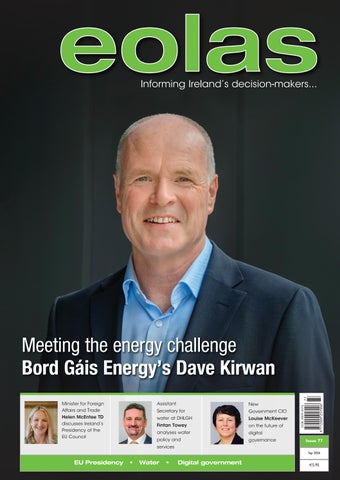
Informing Ireland’s decision-makers...
Meeting the energy challenge Bord Gáis Energy’s Dave Kirwan Minister for Foreign Affairs and Trade Helen McEntee TD discusses Ireland’s Presidency of the EU Council
Assistant
New
Secretary for
Government CIO
water at DHLGH
Louise McKeever
Fintan Towey
on the future of
analyses water
digital
policy and
governance
Issue 77
services Sep 2026
EU Presidency
•
Water
•
Digital government
€5.95
eolas Issue 77 Sep 2026 Digital
Events
Publications
Symbolic sanctions… As of 9 August 2026, between 73,386 and 345,000 Palestinians have been killed in Gaza since 7 October 2023. This includes 1,258 fatalities since the ceasefire agreement of October 2025. Against this backdrop, the Occupied Palestinian Territory (Prohibition of Importation of Goods) Act 2026 was signed into law in July 2026, after the Bill was first proposed in 2018. It bans the import of Israeli goods from the Occupied Palestinian Territory, but, unlike Senator Frances Black’s 2018 proposal, does not ban services. In 2024, the State imported goods valued at €134.7 billion and services valued at €423 billion, according to CSO data. This means services represented around three-quarters of the State’s imports in 2024. While specific data does not exist for imports from the Occupied Palestinian Territory, this shows that the Government has stopped exceedingly short of enacting serious measures against Israel. The ban on goods will have a material effect, but the exclusion of services means the Government has opted for symbolic sanctions rather than substantive action. In issue 77 of eolas Magazine, our cover story features Bord Gáis Energy’s Dave Kirwan who discusses energy infrastructure delivery, while our round table discussion, hosted by Fexco, outlines potential solutions for the future of transport. This edition features a special report marking Ireland’s eighth Presidency of the Council of the European Union. In it, Minister of Foreign Affairs and Trade Helen McEntee TD details Ireland’s responsibility as it holds the Presidency at a defining time for Europe. Our water report, in partnership with Uisce Éireann, features Fintan Towey, Assistant Secretary for water at the Department of Housing, Local Government and Heritage, who analyses what the State is doing to protect and enhance water quality.
Editorial Owen McQuade, Managing Editor owen.mcquade@eolasmagazine.ie Ciaran Brennan, Deputy Editor ciaran.brennan@eolasmagazine.ie Joshua Murray joshua.murray@eolasmagazine.ie Gareth Hamill gareth.hamill@eolasmagazine.ie Advertising Sam Tobin sam.tobin@eolasmagazine.ie Design Gareth Duffy, Head of Design gareth.duffy@eolasmagazine.ie Jamie Hogan jamie.hogan@eolasmagazine.ie Events Lynda Millar lynda.millar@eolasmagazine.ie Become a subscriber! Annual subscriptions: €30.00 + €5.00 P&P Contact: Sharon Morrison Email: subscriptions@eolasmagazine.ie Online: www.eolasmagazine.ie/subscribe eolas Magazine bmf Business Services Clifton House Lower Fitzwilliam Street Dublin, D02 XT91 Tel: 01 661 3755 Web: www.eolasmagazine.ie Printed by: GPS Colour Graphics
In our digital government report, sponsored by Fexco, we hear from Minister of State Frank Feighan TD on what the Government is doing to deliver better public services. I thank all our sponsors, contributors, and readers for your continued support and hope you find this 77th edition of eolas Magazine an informative and entertaining read. Ciaran Brennan, Deputy Editor
www.eolasmagazine.ie
The FSC® system provides an assurance that products such as wood and paper have been harvested in a socially and environmentally responsible manner. •
This product is made of material from well-managed FSC®certified forests, recycled materials, and other controlled sources.
Digital
Events
Publications
contents
10
04 08
04
Matters arising
07
Snapshot
08
Issues 08
Niamh McDonnell from the National Archives discusses digitising the 1926 Census
10
Cover story: Bord Gáis Energy’s Dave Kirwan
16
Round table discussion: Planes, trains, and automobiles: Reimagining Irish transport
34
43
43
Sponsored by
Analysis: 10 years on from the Brexit vote
EU Council Presidency report 44
Minister Helen McEntee TD on the responsibility of Ireland’s Presidency
48
Analysis: The State’s priorities during ‘the European year of competitiveness’
52
Senator Conor Murphy outlines how the Presidency ‘should be used to further Irish unity’
56
Analysis: How the Government plans to enhance European security during the Presidency
16
98 67
97
122 Water report
08
92
144
152
In partnership with
70
Fintan Towey from the Department of Housing analyses water policy and services
80
Analysis: Extensive delays to actions under Water Action Plan 2024
92
The EPA’s Jenny Deakin discusses the current state of Ireland’s water quality
Digital government report 98 102 114 122 128 136
Sponsored by
Minister of State Frank Feighan TD on how digitalisation can deliver public services that are ‘simple, responsive, and reliable’ Interview: New Government Chief Information Officer Louise McKeever Mike Skelton of GOV.UK and the UK GDS outlines the UK Government’s digital transformation agenda Department of Housing’s Mihai Bilauca on unlocking digital transformation across housing and local government Eilidh McLaughlin from the Scottish Government discusses creating a more digitally inclusive network Adalbert Jahnz from the European Commission on building trust in the digital age
144 Public affairs 144
Mol an óige: Senator Nicole Ryan
148
Analysis: Nigel Farage’s messy relationship with Ireland
152
Political platform: Naoise Ó Cearúil TD
156
Timpeall an bhoird: Committee on European Union Affairs
160
Back page: Amnesty International Ireland’s Stephen Bowen on Ireland’s UEFA Nations League fixtures against Israel
67
97
144
matters arising
ISSUES
Trump to visit Ireland on 12 September US President Donald Trump is set to visit Ireland on 12 September 2026 to attend the Irish Open. Trump is to attend his golf course in Doonbeg, County Clare, in time for the end of the tournament. The American President will then travel to Dublin, where he is expected to meet Taoiseach Micheál Martin TD.
Credit: European Space Agency
Following his meeting with Martin, Trump is scheduled to visit the new US embassy in Ballsbridge, where he will meet with Ed Walsh, whom he appointed as his Ambassador to Ireland in 2025.
Trump’s visit to Ireland is likely to be met by heavy protest, given his continued support for Israel through its genocide in Gaza, the ongoing US war in Iran, being found liable for sexual abuse, and widespread allegations regarding his past associations with financier and paedophile Jeffrey Epstein.
ENVIRONMENT
Europe’s ‘worst ever’ heatwave The heatwave of late-June 2026 was Europe’s most severe in recorded history, new figures outline.
have already broken or are predicted to break their highest-ever heat stress levels.
In June 2026, the World Weather Outline found that Europe’s hottest daily temperatures are warming three times faster than the global average, while nighttime temperatures are rising at twice the global rate.
Interestingly, the WWO says that the El Niño-Southern Oscillation warming event in the equatorial Pacific Ocean played no role in Europe’s heatwave
The heatwave saw temperatures in many European countries rise above 40 degrees Celsius. The study found that 45 per cent of 854 cities across 30 European countries, including five cities on the island of Ireland,
4
It is highly unlikely that Trump will give a speech to the Dáil or Seanad, or attend any events at Leinster House, as TDs and senators are not due to return from their summer break until 16 September.
eolas matters
The Irish cities were Dublin, Belfast, Derry, Waterford, and Galway. The report claims that if a similar heatwave had occurred in Europe 50 years ago, temperatures would have been about 3.5 degrees Celsius cooler.
matters arising
POLICING
Changes at the top of An Garda Síochána An Garda Síochána has appointed Chief Superintendent Denis Ferry as Assistant Commissioner following an open competition for the senior rank.
The appointments, made by Garda Commissioner Justin Kelly with the approval of the Garda Board, took effect from 29 June 2026 under the Policing, Security and Community Safety Act.
Ferry will take up responsibility for roads policing and community engagement, replacing Assistant Commissioner Catharina Gunne, who has been appointed Assistant Commissioner for governance and accountability.
Ferry joined An Garda Síochána in September 1995 and has held operational and specialist roles at garda, sergeant, and inspector rank. He subsequently served as a superintendent across strategic transformation and IT operations and security.
Assistant Commissioner Jonathan Roberts has been appointed to lead the Dublin Metropolitan Region (DMR). Roberts previously held responsibility for governance and accountability and had been acting Assistant Commissioner for the DMR.
Since 2021, he has been chief superintendent for human resource management, with responsibility for garda allocations, health and safety, employee assistance, workforce planning, and implementation of the resource deployment management system. He previously served as divisional officer for Wexford and Wicklow from 2019 to 2021.
OBITUARY
David Andrews: 1935-2026 Tributes have been paid from across the political spectrum for David Andrews, the long-time former Fianna Fáil TD who died aged 91 in June 2026.
the backbenches, during which time he advocated for Guildford Four, the Birmingham Six, and Brian Keenan through his legal profession.
Andrews was best known for his three-year stint as Minister for Foreign Affairs between 1997 and 2000, a role which was defined by the passage of the Good Friday Agreement and the end of conflict in the North.
Former President Michael D Higgins paid tribute: “To have been a member of the cabinet with him in the period 199397 was a really positive experience.”
The Andrews family is Fianna Fáil royalty, with David’s father having served during the War of Independence, as did his mother. His son Barry is currently a Fianna Fáil MEP. A TD from 1965 until 2002, Andrews was a critic of Charles Haughey and spent the 13 years of Haughey’s leadership on
Taoiseach Micheál Martin TD says: “I was lucky to have served in government with David, and saw firsthand his intelligence, his work rate, and commitment to peace, along with his decisiveness, his wit, and good humour.” He is survived by his wife Annette and five children. Ar dheis Dé go raibh a anam.
eolas matters
5
matters arising
FOREIGN AFFAIRS
Israel introduces twotier death penalty for Palestinians In a concerning development, the State of Israel has introduced the death penalty exclusively for use against Palestinian prisoners. The legislation marks the first time that a discriminatory form of capital punishment has been used since the end of Apartheid in South Africa. The controversial legislation aims to “establish the death penalty for terrorists who carried out murderous terror attacks, as part of the fight against terrorism”.
Credit: Belfast City Council
A panel of UN human rights experts have condemned the move, stating that “a death penalty regime that is discriminatory in purpose, design, or effect is incompatible with the rights to life and equality before the law”.
“The right to life is a fundamental human right and Ireland is consistently and strongly opposed to the use of the death penalty in all cases and in all circumstances. I am particularly concerned about the de facto discriminatory nature of the bill as it relates to Palestinians.”
Belfast Fleadh attracts 1.6 million visitors
Initial projections by the North’s Department for the Economy projected that the event would attract 800,000 visitors and generate around £53 million for Belfast’s economy. Economy Minister Caoimhe Archibald MLA later said that these numbers would be surpassed significantly. A full economic assessment of this year’s event, Archibald added, would help shape plans for the Fleadh’s return next year, as well as in a more general sense.
eolas matters
Foreign Affairs Minister Helen McEntee TD says: “Ireland condemns the law passed by the Israeli parliament to expand the scope of the death penalty and revive its implementation in Israel and the occupied Palestinian territory.
NORTH-SOUTH
August 2026 marked the first time that Fleadh Cheoil na hÉireann came to Belfast, with the annual festival attracting 1.6 million visitors to Ireland’s second city.
6
Other aspects of the legislation, including military trials of civilians, systemic due process violations, and execution by hanging make it irreconcilable with the absolute prohibition of torture and other cruel, inhuman, or degrading treatment or punishment, the experts said.
“The experience people have had over the course of the past week, we will want to reflect on how can we ensure people can experience that all the time and are there things we should be doing.” This successful week for Belfast follows confirmation that spending under the Shared Island Initiative is to surpass €1 billion. The initiative aims to improve infrastructure, education, and cultural partnership between the two states on this island.
Snapshot “Congratulations to my friends in Mayo. You earned this victory. Enjoy every minute. Sam is coming home.” Former US President Joe Biden paying tribute to Mayo’s victory in the All-Ireland Football Championship
“You challenge us in every way to reflect on what is happening with the normalisation of war and genocide.” President Catherine Connolly to students from Gaza in Ireland during an event at Áras an Uachtaráin in July 2026
“I think we should carry out targeted assassinations in Gaza, taking down 30 to 40 every night… They shouldn’t live. They’re not even people.” Israeli National Security Minister Itamar Ben-Gvir openly advocating for war crimes and genocide
“I had nothing to do with this decision.” Danny Healy-Rae TD responding to his brother and fellow TD Michael’s accusation that he was “pulled overboard” by Danny as a Minister of State.
eolas eolas snapshot matters
7
issues eolas
Digitising the 1926 Census Niamh McDonnell, keeper of manuscripts and head of the digital management division at the National Archives, outlines the scale of the challenge of digitising the 1926 Census. Niamh McDonnell begins by highlighting the significance of the 1926 Census, which was the first of the Irish Free State. She says: “It was the first postindependence census, the first postpartition census; it is 26 counties not 32. “There was a huge level of interest in it for those reasons. For many people, it was the first time there was a direct personal connection to people in the Census.” The data could not be released until this year as it was under the 100-year closure of the Statistics Act. Ownership of the 1926 Census did not transfer to the National Archives until it turned 100 years old on 18 April 2026. “Even though the records had been in the National Archives for decades, they were
8
eolas issues
still owned by the CSO,” explains McDonnell. The 1901 and 1911 censuses, which included all 32 counties of Ireland, have been available since 2008. These were digitised from microfilm by the National Archives, says McDonnell. This was done in partnership with Library and Archives Canda from a microfilm produced by the Church of the Latter-day Saints in the 1970s and 1980s.
Upgrading infrastructure McDonnell says the National Archives was “starting from scratch with this project from the original paper records”, adding: “The timeframe was so short; we had basically three years.”
Due to the project’s scale, the National Archives had to expand its digital infrastructure and upgrade the wiring in the digitisation suites to cater for highvolume scanning equipment. McDonnell explains that this was the first time the organisation had used high-volume scanning. “We needed to use it because the timeframe was so short,” she says. “Traditionally we would have used overhead scanning and photography, but that is way too slow for this purpose.” The digital management division received a lot of support in setting up the infrastructure from the National Archives’ ICT department which is part of the Department of Culture, Communications and Sport.
issues eolas
McDonnell explains how the sensitive nature of data privacy impacted processes: “Everything had to happen within our infrastructure because of requirements around the privacy of the data under the Statistics Act. “Everybody involved in the process, even contractors, was appointed as temporary officers of statistics.”
Approach The digitisation required by the project was on a greater scale than McDonnell and her colleagues had previously experienced. She explains how the team approached the project: “When you are developing a project like this, you start at the end and work your way back. What is the outcome supposed to look like? What is the minimum viable product?” The team determined that the launch of a basic genealogical search on 18 April 2026 would be the minimum viable product. “Anything less than that was to be considered a failure,” says McDonnell. “We only had one chance to do this so we needed to ensure that we were giving ourselves options in terms of what data we can present to the public on day one.
and we did it properly. Each decision on every facet of the project was crucial.” One such example of this was the decision on what resolution images should be. McDonnell explains the minimum preservation standard for the images is 300 dots per inch (DPI). However, McDonnell and the team found that 400 DPI “was far better” for an improved transcription output. “When you are working at scale, these are decisions that have a massive impact because even a 1 per cent difference over 3 million rows of data, 45 million data points, is huge. We had to reconfigure our scanner at that point to digitise at 400 DPI. “However, that then has a knock-on effect on things like storage capacity. Initially, I requested 50 terabytes of data, but we ended up needing closer to 60 terabytes.” McDonnell asserts that this led to a “much better product” and creates more opportunities for what can be done with the data. The team met regularly to ensure each member followed the same practices and process. McDonnell says: “When you are dealing with data on this scale, you have
to make sure there is standardisation. The more standardised the data, the better the final user experience is as well.” Prior to beginning the project, McDonnell spoke to colleagues in national archives from across Europe who provided guidance on minimum standards for transcription and how best to utilise outside resources. “The National Archives is in a state of transition, and we are expanding a huge amount at the moment. There is a lot of knowledge in the organisation, but there are gaps that need to be filled and we used the census project as an opportunity to expand our capacity and knowledge by being strategic in how we used external contractors,” she says. Concluding, McDonnell acknowledges the significant “public expectation” regarding the Census, adding: “We are extremely proud that we delivered a large-scale public project on time and on budget that has provided free access to an amazing digital resource for the benefit of all. To date the website has had more than 40 million hits.”
“Because we were digitising 100-year-old records, we ensured that we did it once
eolas issues
9
cover story
Meeting the energy challenge Dave Kirwan, Country Chair at Bord Gáis Energy and Managing Director of Power at Centrica, talks to Owen McQuade about energy infrastructure delivery, the potential role for nuclear energy in Ireland, and looks back on 50 years of Bord Gáis Energy.
10
cover story
cover story
In his three decades at the heart of the Irish energy sector, Dave Kirwan has witnessed radical change. He says that the top challenge in 2026 is delivering decarbonisation whilst ensuring secure and affordable energy to end users. “The energy challenge is also a growth opportunity for Ireland. The challenge is increasingly dominated by infrastructure delivery and that is against a backdrop of war in the Middle East and in Ukraine,” he observes. Commenting on the economic outlook, he says: “The Irish economy has had an amazing 10 plus years and we can sustain that success by investing in the infrastructure that underpins that growth.” However, Kirwan says that “incrementalism rather than expansive investment in the areas fuelled the growth”. Kirwan is not overly critical of Ireland’s governance over the past decade and acknowledges the challenging economic context which policymakers faced 10 years ago: “We had the financial crash that was followed by a period of tightened purse strings. We were then illprepared when we saw a flywheel of growth. We have been slow to recognise what we need to do to keep that growth going. “There has also been much debate about the choice between data centres or house building; but the reality is we need to do both. A growing economy needs infrastructure and we need the courage to invest and execute whilst protecting the most vulnerable in society. That is not an either or.” At the 2022 Energy Ireland conference, Kirwan spoke about complex systems and how they are built on resilience and not efficiency. “Complex systems are around for the long haul by building in contingency and resilience. However, in Ireland we have been guilty of taking an incremental, piecemeal approach.” It is widely predicted that the next 10 years will see a transformation of the energy system. Kirwan says for this to happen, the sector “needs to execute better and we also need to take risks in terms of capital investment”.
“We need to invest ahead of need and not lag behind growth.” He adds: “We need to invest ahead of need and not lag behind growth.” This year, Bord Gáis Energy celebrated its 50th anniversary. Kirwan sees this as not an opportunity for “a dose of nostalgia but as an opportunity to look to the future”. He highlights the journey that has seen the company transformed from a state-owned incumbent natural gas retailer with a power station in Cork, into a much broader energy business with customer offerings including solar energy, EV charging, heat pumps, energy retrofitting, and battery storage. In addition, the company is developing offshore wind energy projects and has outlined ambitions for potential gas and hydrogen storage investments. “If a company wants to remain relevant, it needs to regularly change its purpose and strategy. But it also needs to retain its essence. In 1976 Bord Gáis had a clear mandate to bring gas for the betterment of Ireland and to diligently build the infrastructure to achieve that. That is a great purpose and that essence of doing public good and doing things with excellence remains 50 years on. The next 50 years will be defined by infrastructure, technology choice, and customer participation.”
Complex and fast changing Kirwan observes that in a rapidly evolving energy system, environment plans are useful but quickly become redundant after three to four years.
He quotes Dwight Eisenhower’s maxim that ‘plans are useless, but planning is indispensable’. “You need a plan to mobilise. If you look at the CAP (Climate Action Plan) or a white paper, they used to be relevant for a decade but I would now question that premise. With such a quickly changing environment and technologies, you need to be agile and to pivot quickly,” he adds. Kirwan highlights the role that gas continues to have in the energy mix: “We were all silent about the role gas is going to play in the energy transition. With every passing year it is clear that gas is going to be with us for much longer.” He also highlights the fast pace that technologies are changing, giving the example of battery technology. Another trend he highlights is the increasing demand for electricity, a factor which was not recognised a decade ago. “Infrastructure takes a long time. For example, we started the offshore wind energy framework over a decade ago and we are just on the cusp of seeing some actual infrastructure being delivered.” Kirwan has been spending a lot of his time in the UK in his role as Managing Director of Power at Centrica. Although the UK energy system is much larger than Ireland’s, it highlights the need to move forward on several technology fronts. The UK has a civil nuclear roadmap to 2050 that will be the long-term backbone of its energy system, alongside renewable energy, and with a role for gas.
4 cover story agenda eolas issuesissues
11 11
cover story
The UK has also undertaken a long duration energy storage auction and, in parallel, is running offshore wind energy auctions and its nuclear framework. “Ireland has a much smaller system and our challenge will be to embed new technologies at scale into the system. We have also a much more rural dispersal of energy users than the UK.” This mix of technologies reflects the development pipeline for Bord Gáis Energy and the UK link has helped the cross-fertilisation of expertise. Opportunities include grid projects, such as large scale battery storage and synchronous condensers. “We would like to develop our Whitegate site into a low carbon energy hub and are working with dCarbonX to look at the potential to use the depleted Kinsale gas field to store hydrogen. Our vision for Cork Harbour would be to use offshore wind energy for electrolysis, hydrogen storage, and converting two major power plants to hydrogen. Technically, that is all feasible but we need to bring together all the necessary regulatory frameworks.”
12
cover story
The transformation of the energy system will need significant capital investment. Between 2023 and 2028, Centrica aims to invest around €1 billion in Ireland. “Capital can live with risk; what it struggles with is inconsistency. If the direction is clear and the framework is credible, investors can engage,” he says. Looking at the investment projects in turn, Kirwan sees its project for gas storage using the depleted Kinsale filed as “compelling because it addresses two time horizons: gas resilience while we still need gas and hydrogen storage potential if we are serious about a future green hydrogen system”. “Kinsale is viable for gas storage for two to three decades and convertible to hydrogen storage.” As the first projects in the pipeline, Bord Gáis Energy is in the process of finishing two peaking power plants, one in Dublin and the other in Athlone. “It has been very challenging, with delays to bringing on these critical pieces of infrastructure. We had planned to bring both plants on stream by Christmas 2024 and they will now be online in the summer of 2026. There have been lessons for ourselves, but also for the whole system around the
lack of integration in the delivery of infrastructure. That is not just planning but getting the various entities involved to collaborate to deliver such critical infrastructure,” he emphasises.
Nuclear Nuclear energy has seen a renaissance in recent years. This has been driven by the need to reduce carbon emissions while providing a secure reliable energy supply, and meeting surging electricity demand. The European Commission has a strategy aiming to deploy modular reactors across the EU by the early 2030s, with a target of 53GW by 2050. The UK and United States are both progressing commercialscale advanced modular reactor projects. Kirwan’s involvement with Centrica’s nuclear business is part of his other role as the group’s head of power. Centrica has been invested in UK nuclear generation since 2009, when it acquired a 20 per cent stake in the UK’s existing nuclear fleet. Centrica strengthened its commitment to UK nuclear in 2025 by acquiring a 15 per cent stake in the £38 billion Sizewell C project, committing up to £1.3 billion of investment in a new
cover story
“I did not think two years ago that I would be saying we should consider removing the ban on nuclear in Ireland.” power station expected to supply around 6 million homes with low-carbon electricity. Kirwan is NonExecutive Director of Sizewell C. He is also responsible for Centrica’s side of a project to pilot a modular nuclear reactor in the UK with X-energy. This year, the company made an advanced nuclear framework submission for an advanced nuclear reactor for Hartlepool, which will be a 960MW modular facility on the site of an old nuclear power station. Kirwan sees this type of modular deployment as now being very relevant for Ireland. The minimum size is 80MW and to be economic they should be deployed in packs of four. The reactors can load follow from 40 per cent to 100 per cent load. “They are inherently safe with the fuel design, whereas the older nuclear reactors had primary, secondary, and tertiary ancillary safety service systems. This is a nuclear reactor; but not as we know it. “You need to maintain the impetus to keep the reaction going. It is a self-safe system and the UK civil nuclear road map is for 25GW of nuclear, very much to support the growth in data centre demand.” The modular reactors can be co-located with data centres and the company behind the modular reactors, X-energy, has seen significant investment from the tech sector.
Future Kirwan believes that there is an inherent dichotomy in the Irish energy sector, claiming that many still consider applicants to develop as a problem rather than an opportunity. “If we were to start to design a new energy system that could accommodate the demand for future connections, generation, and load to serve the economy, how would we do that? At the moment we are taking an incremental approach rather than something more expansive. “The interaction with grid companies at the moment is very much giving a sense that ‘it cannot be accommodated based on our current plans’. We need to look well beyond existing plans and contemplate a world where we are going to have to much more than we initially thought. Our plans need to change when the world changes. “At present, rather than saying we cannot fit this into our plans, we should be asking how we harness this opportunity for our economy. I am reminded of the Keynesian saying ‘when the facts change, I change my mind’,” he concludes.
“I did not think two years ago that I would be saying we should consider removing the ban on nuclear in Ireland.”
Profile: Dave Kirwan Dave Kirwan is Country Chair of Bord Gáis Energy and Managing Director of Centrica Power, with responsibility for Centrica’s power generation and investment portfolio across Ireland and the UK. A member of Centrica’s leadership team, he plays a leading role in shaping energy infrastructure investment, the energy transition, and emerging technologies, including nuclear, battery storage, and hydrogen. Kirwan is also a Non-Executive Director of Sizewell C and represents Centrica’s interests in one of the UK’s most significant low-carbon infrastructure projects. He holds a BE in electronics from UCD, an MBA and DBA from UCC, and is a fellow of Engineers Ireland. He also serves on Ibec’s executive committee.
cover story
13
30 years of Energy Ireland Owen McQuade looks back on 30 years of the Energy Ireland conference, which has become one of the most important events in the Irish energy sector. June 2026 marked the 30th annual Energy Ireland conference. The inaugural conference was held in 1997, featuring 100 speakers and delegates in the Burlington Hotel, and it has grown to become the biggest energy conference in the country, with 400 senior leaders from across the sector gathering in Croke Park every year.
14
From the start, we set out to bring the senior decision-makers together every June to reflect on the year past, the ongoing challenges, and to look to the future of the Irish energy sector.
seen a series of disruptive events such as the 2008 financial crash, the Covid-19 pandemic, the Russian invasion of Ukraine, the growing climate crisis, and now the war in Iran.
The sector and the conference have always been shaped by the external environment. In the 30 years, we have
As is fit for an event at Croke Park, Energy Ireland is and has always been an all-Ireland conference, starting the year before the Good Friday Agreement. One all-island development worth highlighting is the success of the SEM (Single Electricity Market).
Through the years... Over the years, Energy Ireland has run nine focused events of the SEM, and we have always covered it in the conference programme. One figure comes to mind; in the change from the SEM to the I-SEM (Integrated Single Electricity Market) in 2019, capacity payments reduced from €550 million to €360 million. That is a huge saving for the citizens of this small island.
Support through the years Looking back over the 30 years, the Energy Ireland team and I would like to acknowledge those who have supported the conference. We have enjoyed working with those who have chaired the conference including Owen Lewis, David Taylor, Úna Nic Giolla Choille, Neil Walker, and Tanya Harrington. We have always appreciated our sponsors and I thank ESB’s Padraig McManus who took the first advert in the Energy Ireland Yearbook and sponsored the conference from the beginning. SEAI has been a great partner and has helped shift a bias in the sector from the supply side of energy to often focus on the demand side. We also thank Arthur Cox’s Patrick McGovern who sponsored lunch on day one of the conference, which has been continued by Alex McLean and now Niamh McGovern. Bord Gáis Éireann, now Bord Gáis Energy, and Gas Networks Ireland have supported the conference from the early days. From 2007, Gerry Walsh, who had then recently retired as Bord Gáis Éireann CEO, chaired the conference for several years.
We thank the industry leaders whose insights shape our conferences, including ESB’s Peter O’Shea who is usually the first person I talk to when developing the programme. Other notable thought leaders include Pádraig Flemin, for his insights on gas and Dave Kirwan who gave a standout presentation in 2021 when he looked back on 25 years of Energy Ireland. We have always had a minister open the conference and we never take that for granted. Indeed, at the 2026 event we had two ministers: Minister for Climate, Energy and the Environment (DCEE) Darragh O’Brien TD and Minister for the Economy Caoimhe Archibald MLA. I thank DCEE for its support and would like to acknowledge Assistant Secretary Matt Collins who worked with us at the start of the Covid-19 pandemic to deliver an online seminar on offshore wind energy. When reviewing 30 years of Energy Ireland, I was struck by the evolving role of women in the energy sector. In the first programme in 1997, there were four female speakers and a similar number of female delegates. In 2026, 16 women participated in the conference as speakers, chairs, or in panel discussions. The increasing number of women speaking at our conferences reflects the changing landscape of the energy sector. However, there is still some way to go despite the progress made.
If I had to thank everyone who has made Energy Ireland a success, we would run out of pages in the magazine, so I thank everyone who has participated, whether you are a speaker, sponsor, or delegate, over the last three decades. This sector makes significant strides that are not always recognised. For example, we run the National Retrofitting Conference in partnership with SEAI each autumn. At the 2025 conference, we berated ourselves over the lack of progress towards the target of 500,000 retrofits by 2030. This was despite the delivery of over 240,000 energy retrofits to this point. This is a great achievement, particularly when compared with other jurisdictions. While we still have much to achieve in terms of decarbonisation, security of supply, and affordability, we should acknowledge the progress the sector has made over the last 30 years, and I hope that the Energy Ireland conference has played a role is helping us achieve that progress. Owen McQuade is Managing Editor of eolas Magazine and has been organising the Energy Ireland conference since its foundation in 1997.
15
round table discussion
Planes, trains, and automobiles: Reimagining Irish transport Fexco hosts experts from across the transport sector for a discussion on the future of Irish transport. What does the shift from planning to delivery mean for your organisation in practical terms? Michael Power We are delivering significant construction projects across the rail network while progressing a pipeline of plans in the medium to long term. Our delivery capacity has expanded significantly in recent years, demonstrated by our headcount which has risen to around 5,300. Each team is fully focused on the planning and delivery of an increased scale of construction work over the coming years. We are delivering multiple projects across the State which are all aimed at providing additional services for people and increasing connectivity. Stephen Kent CIÉ is evolving to now deal with more transformation, productivity, and new systems. New processes and procedures
must be developed to reflect this changing landscape. Bringing the public along with you while you make this change is a major challenge. Stakeholder management is crucial because the funding or legislation is not always in place when plans are completed. It is easy to write a plan, but it is a very different thing to deliver it. Cathal Masterson TII is mobilising around delivery of the National Development Plan (NDP) which is a level of capital investment similar to what was seen before the financial crash. We are strengthening our organisational capacity as employee numbers today are significantly lower than they were. We are also seeking to develop programmes based on committed multiannual funding, as planning based on singleyear funding is inefficient and more expensive. TII is trying to scale our NDP delivery towards portfolios and programmes rather than just projects.
Round table discussion hosted by
16
Brian Caulfield We must take a wider perspective of planning because we are trying to do everything, everywhere, all at once. That can lead to things falling between the cracks. Morale is low in transport delivery at the moment because the media picks negative stories and runs with them. They are not talking about successful projects, so it is important that we celebrate the wins. We must also acknowledge understaffing in transport. This is most evident in the National Transport Authority (NTA). It delivered 300 million additional trips in 2026 compared to 2025 at a time when it was significantly understaffed. Ailish Hansen The Accelerating Infrastructure Report and Action Plan identifies public acceptance as the first barrier to delivery. Infrastructure delivery can succeed or fail depending on how citizens respond to the project. This is something that is important to consider from the planning stage through to delivery. Public acceptance can be achieved through the amplification of good news stories. This can be empowered when decisions around ticketing, information presentation, reliability, and support when things go wrong are included in the design stage.
With various sectors competing for the same talent, how is capacity being built at the scale the National Development Plan requires? Ailish Hansen There is no one-size-fits-all approach. Bespoke structures need to be created for each programme and organisation. Shared capability models are being trialled in Ireland, but it is something that is more prominent elsewhere in Europe. Developing capabilities that can be shared across departments and agencies can alleviate the challenge of public sector recruitment. We must also arm the people that we have with the necessary digital tools to enable them to unlock further capacity. Brian Caulfield
Stephen Kent We are trying to build an internal talent pool in CIÉ. We are showing people that you will not just be focused on one project, you can have a tremendous infrastructure career. We include employees from within the group in various projects across the group, enabling better asset management. It is also important to look at people’s long-term career projections because continuity is vital to multiannual funding of projects. Colm Tully The transferring of skills and upskilling within the organisation is really important. Organisational structures must be created in the context of what they have been put in place to deliver. You must look at capacity and capability internally when you are building up the partnerships to deliver these projects. The partnership with the supply chain must then be organised to fit your own needs. These are also long-term collaborative partnerships with knowledge transfer and retention within the delivery agency being an important consideration for successfully delivering the current and future pipeline of large projects and programmes. Cathal Masterson TII and Iarnród Éireann are supporting the development of a transport sector workforce capacity strategy which is currently being led by the NTA. Through this work we are collectively seeking to develop a coordinated plan to ensure that the necessary people with the right skillsets are available when needed to deliver the significant volume of work over the next decade. The strategy is focussing on a number of areas including, 4
Brian Caulfield is professor in transportation and director of the Trinity Centre for Transport Research. His research addresses global issues such as the environmental impacts of transport and methods to reduce the carbon impacts of transport. Caulfield is an editor of Transport Policy, and a member of the International Editorial Board of Transportation Research Part D: Transport and Environment, Case Studies on Transport Policy, the Journal of Cycling and Micro-mobility Research, and the Journal of Transport Geography. Ailish Hansen is the Chief Commercial Officer at Fexco, bringing over a decade of expertise in partnership development and organisational problem-solving to organisations. With a strong background in business strategy, Hansen focuses on forging strong partnerships through collaborative engagements aimed at solving complex business challenges. Stephen Kent is Group CEO of CIÉ. He previously served as CEO of Bus Éireann from 2018 to 2025, having previously served as its Chief Commercial Officer from 2013. Kent previously worked in a number of senior sales and marketing management roles in the C&C Group, Waterford Crystal plc and Waterford Foods, now part of Glanbia plc. Kent holds a BBS from the University of Limerick and MBA from Herriot Watt University and is also a graduate of the Marketing Institute of Ireland. He is a fellow of the Chartered Institute of Transport and Logistics Ireland.
round table discussion
This year, we had the highest number of students picking civil engineering in Trinity since before the 2008 crash. We need to enthuse students who have emigrated to come back. We need to get across the point that we are nation building at the moment. The transport sector is competing with other sectors. Ireland is also not the only country trying to decarbonise and nation build. There are other places that are more attractive. This makes amplifying good news stories critical.
Participants
Cathal Masterson is Director of Commercial Operations at Transport Infrastructure Ireland. He is a chartered engineer with a strong track record of developing strategy, managing change and delivering results on challenging projects/ operations in the transport and mobility sectors. Currently, he is responsible for TII’s Light Rail Network Management section as well as TII’s Road User Charging and PPP procurement sections. Michael Power is Head of Transformation at Iarnród Éireann. Leading on strategy development for the company, he is working with colleagues and stakeholders on delivering an ambitious vision for rail as the backbone of a sustainable transport system. With over 30 years’ experience in public transport, he has worked across a variety of roles that include strategic planning, organisation development, operations, and contracts management. Colm Tully is a Senior Director in KSNPM leading the Commercial Services and Infrastructure team. He has over 20 years’ consulting experience in the construction industry, with a strong track record providing programme, project, and cost consulting and advisory services on major capital projects and programmes. He is a Chartered Quantity Surveyor and MBA qualified with a proven track record building high performing teams and leadership of major projects and programmes across many sectors including transportation, utilities, energy, and buildings.
17
round table discussion
“Developing capabilities that can be shared across departments and agencies can alleviate the challenge of public sector recruitment.” Ailish Hansen working with the education sector, strengthening career pathways, improving attraction and retention and labour market entry requirements to grow the workforce. Stephen Kent The level of demand for drivers and mechanics cannot be underestimated. Over the next few years, there are thousands of people that will be retiring who will have to be replaced. This is in addition to the significant expansion of transport networks which is ongoing. That is why workforce planning is vital. You must unlock the elements which enable this and then it is about convincing people of the value of their role in the transport sector and providing upskilling opportunities. Michael Power A strong pipeline for projects over an extended period is a key attraction for talent. This can inspire people to return to Ireland to work over the decades ahead. Multi-annual funding is integral to everything we are talking about doing, but this must be worked out collectively. We must then also give the commitment
“It is imperative that we do not end up in a scenario where sustainable transport is retrofitted into housing, we need to deliver housing with transport connections in place.” Brian Caulfield
18
to deliver these projects. That will also incentivise people to relocate to work in Ireland and attract contractors to come to work on these projects. There is not going to be enough funding for all of the projects that are in the pipeline at the moment to be delivered to the desired timelines, so public-private financing will have a role.
As new public transport capacity comes onstream, how should the citizen experience be designed and measured from the outset? Ailish Hansen
Cathal Masterson TII now use a Gender Lens toolkit following the learnings we took from the Travelling in a Woman’s Shoes initiative. We are now better equipped to design our schemes so that they are integrated into the urban realm. As public transport capacity comes on stream, it also can also activate or unlock additional housing. We are beginning to explore this with Iarnród Éireann and other stakeholders. Transport is not just about carrying people from A to B; it can also unlock other opportunities for the State. Michael Power The citizen experience is integral to everything we do. Every stakeholder we engage with says we need more rail services. People ask why we cannot deliver rail to the same scale as other European countries. This demonstrates that the demand and the appetite is there for a scale change in investment in public transport. This feedback has also informed our vision which is that rail is at the centre of a sustainable transport system for Ireland. Delivery of rail can also unlock the delivery of housing at scale which incentivises people in those areas to adopt more sustainable travel patterns. Brian Caulfield Transport is like a water network; if there is a crack in it somewhere, you are going
“People and relationships will play a critical role in ensuring projects enabling regional balance are delivered.” Colm Tully to get a leak, these ‘leaks’ are at points where the network is not as efficient as it could be. This results in people giving up on public transport and staying with car trips. When you design for everybody, you design better. There is approximately 1.1 million people in Ireland with a disability and only 6 per cent of them use public transport on a regular basis. It is also important to note that people who use public transport the least and have a bad experience will be the loudest. However, people who use public transport on a regular basis know that it is good. We must also look at the customer experience from a psychological perspective. Stephen Kent The scale of growth that we have seen in recent years has been phenomenal and that is reflected in the number of passengers using our services. Customers want public transport to be easier, faster, and more reliable. However, we are trying to catch up on years of underinvestment and that takes time. Additionally, you must design for reliability and not just volume. If you cannot deliver reliability, people do not care that you have increased volume. You must also design with the most vulnerable user in mind to ensure everyone has a positive experience.
round table discussion
Ireland’s Design for Public Value Guidelines says you should design services with the people who will use them in mind. People go on a service journey as well as a physical journey when using public transport. If you can deliver a reliable service, then people can buy into that and change their behaviour. People will always remember when a journey goes wrong and whether they get to where they need to be on time. This must be considered at the planning and design stage.
Colm Tully It is important that users have a frictionless payment experience across all transport modes. The example I would provide is the Clipper Card in San Francisco which covers all transport modes – bus, rail, ferry, and even cable car – under one payment system. Delivering initiatives like this not only increase customer satisfaction in public transport, they also incentivise people to utilise public transport instead of the private car.
What are the critical technical and regulatory dependencies that need to be resolved to keep the electrification timeline on track? Brian Caulfield Changing the appraisal approach is critical. We apply a model to Metrolink or Cork Commuter Rail which we use for motorways and the two are not comparable. In Sydney, upticks in housing are included in cost-benefit
4 19
move freight, people, and emergency services and we need to be careful to protect the asset and keep in mind potential for future projects. Stephen Kent Grid and energy access requires a lot of dialogue and the appropriate discussions are taking place. There is a lot of state money required to build and electrify depots. When we electrified a depot in Athlone, it had 11 buses which consumed the same amount of electricity as three housing estates overnight. Therefore, you need substations developed which requires planning. When it is in place, employees must then be retrained in operating high voltage systems. This is something which is underway across the CIÉ group, so it is crucial that skills are migrated to where they are required.
round table discussion
Michael Power
“We see that as public transport capacity comes on stream, it can also activate or unlock additional housing.” Cathal Masterson analyses for transport projects. This is something that should be incorporated. There is demand for electrification in everything, everywhere, all at once. Transport companies and electricity companies need to be talking to each other regarding housing at a greater scale. It is imperative that we do not end up in a scenario where transport is retrofitted into an increasingly electrified landscape to ensure we reduce the need for the private car.
currently discouraged by planning regulations from doing so, meaning we are potentially missing opportunities. TII is working with the energy sector on facilitating access to the road network to strengthen the grid. This can be challenging as roads are required to
We are at the start of the second century as an independent state and we are looking to develop infrastructure that can be there for that. Future Forty: A Fiscal and Economic Outlook to 2065 says we are going to need 1 million additional houses by 2050. That is a development the size of Cork City every 18 months. Sustainable transport policy says build high density, high capacity, sustainable transport corridors, and rail offers the highest capacity. We must build the vast majority of those new houses right beside train stations. We know we are behind the rest of the world on electrification of rail. A policy change is needed to make this happen.
Colm Tully Agencies must coordinate their timelines. There is evidence that direct conversations between agencies are happening earlier than may have been the case previously. That is really positive and can enable the delivery of critical long-term transport goals. Cathal Masterson There is a need to assess how agencies can collaborate more effectively through the planning process. For instance, it could make sense to build in provision for high-voltage cabling in some transport schemes, but agencies are
20
“If you cannot deliver reliability, people do not care that you have increased volume.” Stephen Kent
Michael Power
What is your organisation doing to ensure regional balance and what does this look like in practice? Cathal Masterson Most of TII’s work over the past decade has been regional. The last major project delivered in Dublin was the Luas Cross City link which opened in 2017 connecting St. Stephen’s Green to Broombridge. We have further plans for light rail expansion in Dublin and Cork. Additionally, we have road and greenway schemes across the country and TII is also supporting the rollout of EV charging facilities adjacent to the road network. Dublin is not competing with the regions in terms of transport schemes as it is sometimes portrayed. It is about delivering an integrated transport system across all modes for everyone’s benefit. Stephen Kent We are tapping into the NTA’s BusConnects programme in the regional cities. Waterford is being transformed and that will be integrated with a great bus network. We are utilising land in Cork and Limerick, demonstrated by the first release of new apartments near Kent Station in Cork. This land has been unlocked to provide people living in those
apartments with access to a train station that is integrated with the bus network that provides a link into the city. This is enabled by our partnerships with various organisations including the Land Development Agency, TII, Iarnród Éireann, and the councils. It is a great example of stakeholder collaboration and it will be transformative if it is delivered nationwide. Michael Power DART+ is integral for additional services and capacity between the regions and Dublin. Upgrades under DART+ South West provides additional capacity on a critical section of network which enables separation of stopping commuter services and non-stopping intercity services. That is the type of infrastructure you would have in any other city across Europe. Additionally, fleets designed for intercity traffic will get released from the Dublin area as new DART+ fleets are deployed across the entire network. This will provide additional capacity and increase service frequencies both in the regions, and between the regions and Dublin.
round table discussion
“We are delivering multiple projects across the State which are all aimed at providing additional services for people and increasing connectivity.”
tourism and the buoyancy of smaller areas, demonstrating that the biggest answer is not always the best. There are alternative solutions from a regional balance perspective and the Local Link is a great example of that. Brian Caulfield Rail is the future of transport, and we need it to bring about a similar sea change to what we had when we blanketed the State in motorways. The Foynes rail extension is crucial for regional development. It is not talked about enough; very few people know that it is about to open up. That is going to take thousands of kilometres of HGVs off our roads due to the additional freight capacity it will create and it has the potential to reduce the pressure on Dublin port. It has amazing capacity and it is an incredible project. Colm Tully People and relationships will play a critical role in ensuring projects enabling regional balance are delivered. We have a presence in each region across the State and we are building teams and capabilities across our offices in Dublin, Wexford, Cork, and Galway. Having a local presence and building long-term relationships with clients will be key.
Ailish Hansen Increased availability of services does not lead to increased uptake. The TFI Local Link has seen great uptake. It is boosting 21
issues eolas
From the honours list to the sex offenders list Jeffrey Donaldson’s last moments as a free man, as he entered Newry Court House wearing a suit. Following his guilty verdicts; he donned prison clothes and was transferred to Maghaberry Prison.
In June 2026, people across Ireland watched in stunned horror as Jeffrey Donaldson, the former leader of the DUP and one of the most influential figures in modern unionism, was convicted of sexually abusing two girls over more than two decades. The verdict marked the dramatic downfall of a politician who had spent four decades at the centre of Northern Ireland politics and whose leadership was instrumental in restoring power sharing at Stormont in 2024. The case has profound implications not only for the DUP, but for the political settlement Donaldson helped to shape. “Take Mr Donaldson down,” Judge Paul Ramsay said on 22 June 2026 after a jury at Newry Crown Court unanimously convicted Donaldson of 18 sexual offences, including one count of rape, committed against two girls between 1985 and 2008. Donaldson has been remanded in custody at Maghaberry Prison ahead of sentencing, with the court indicating he should expect a lengthy prison term.
22
eolas issues
His wife, Eleanor Donaldson, was proven to have aided and abetted five offences. However, because she underwent a trial of the facts due to mental ill-health, she received neither criminal convictions nor a custodial sentence. Donaldson’s arrest in March 2024 came just days after he had returned from Washington DC following the restoration of devolved government at Stormont, where he was widely praised for securing DUP support for the Windsor Framework. While this took place, two women had already made complaints to the PSNI and the DUP leader was under investigation. By the end of the month, he had been arrested and charged, bringing an abrupt end to one of the most significant careers in the North’s politics.
Crisis in the DUP For more than two years, Donaldson’s criminal case hung over the DUP. Legal restrictions prevented extensive public comment while proceedings were ongoing, but his arrest cast a long shadow over the party’s electoral fortunes and leadership. Party figures later acknowledged that the case featured prominently on the doorstep during the 2024 general election campaign in which the DUP suffered significant losses. When Donaldson was convicted, DUP leader Gavin Robinson issued an unequivocal statement condemning his predecessor. “No one, regardless of status or position, can ever be above the law and Jeffrey
issues eolas
Maghaberry Prison, the new home for the man who spent decades walking the corridors of the British Parliament.
Donaldson is no exception. Abuse, preying on the innocent, and taking advantage of the vulnerability of children in particular is evil.” He added that the victims had shown that “perpetrators cannot outrun justice” and expressed the party’s sympathy for those affected. While Robinson’s response reflected the gravity of the verdict, subsequent reporting has raised broader questions about the DUP’s internal culture. Investigations by BBC Spotlight, the Belfast Telegraph, and The Irish News suggested that concerns about aspects of Donaldson’s behaviour had circulated within political and security circles for years. Although separate from the offences for which he was convicted, these revelations have intensified scrutiny of how Donaldson rose to become party leader despite repeated concerns about his conduct. At the centre of those questions is whether warning signs were missed or ignored. Ultimately, however, it was the testimony of two women, who endured years of legal proceedings and robust challenges to their evidence, that secured Donaldson’s conviction. The DUP has since announced an independent inquiry into how Donaldson was able to rise through the party while engaging in behaviour that has now left
unionism’s largest party facing the greatest crisis in its history.
Future of the Windsor Framework Donaldson’s conviction has ramifications far beyond the DUP. The political arrangements that restored power sharing in February 2024 were secured under his leadership, with Donaldson negotiating the package that became known as the Windsor Framework settlement and persuading a divided party to return to government. His dramatic fall from grace inevitably casts a shadow over one of the defining political agreements of recent years. The verdict also provided an opportunity for Donaldson’s political opponents to revisit longstanding arguments about the framework. Jim Allister, leader of the farright Traditional Unionist Voice (TUV) party, has alleged that the UK Government may have used knowledge of Donaldson’s private life to pressure him into accepting the deal, an allegation the Northern Ireland Office (NIO) dismissed as “deeply distasteful” and “absolute nonsense”. No evidence has emerged to support claims of blackmail. Subsequent reporting has established that, although the formal complaints leading to Donaldson’s prosecution were made to the PSNI in March 2024, police had earlier informal contact relating to one
complainant and were gathering information before his arrest. While this timeline has fuelled political speculation, it does not substantiate claims that Donaldson’s negotiations with the UK Government were influenced by the criminal investigation. Nevertheless, perception matters in politics. Opponents of the Windsor Framework have already begun referring to it as the ‘Donaldson deal’, seeking to undermine its credibility by associating it with the disgraced former DUP leader. Whether that argument gains wider traction remains uncertain, but initial polls have shown a sharp decline in support for the DUP in the North, with the Ulster Unionist Party now polling as the biggest party in unionism, and the TUV hot on the heels of the DUP. Donaldson’s conviction represents far more than the downfall of an individual politician. It has plunged the DUP into its deepest crisis, prompted difficult questions about leadership and accountability within unionism, and reopened political debates many believed had been settled with the restoration of devolution. While justice has finally been delivered for two victims after decades of abuse, the political consequences of the case are likely to be felt for years to come.
eolas issues
23
Budget 2027:
Building on reform
Advertorial
Every budget is a chance to strengthen Ireland’s longterm resilience, but too often the debate is dominated by short-term measures rather than the structural reforms that will shape our economic future, writes Moyagh Murdock, CEO of Insurance Ireland. Ireland is navigating a period of profound change. Geopolitical uncertainty continues to reshape global markets, climate change is increasing the frequency of extreme weather events, our population is ageing, healthcare costs are rising, and demands on public finances continue to grow. At the same time, Ireland must remain internationally competitive while supporting households and businesses in an increasingly complex risk landscape. Insurance is sometimes seen through too narrow a lens; usually as a household bill, a business cost, or a political pressure point when premiums rise. But in reality, it is part of the machinery that allows the economy and society to function. It supports lending, investment,
enterprise, transport, healthcare, climate resilience, and retirement planning. That is why Insurance Ireland’s preBudget 2027 submission is about much more than the sector. It sets out practical proposals on affordability, investment, climate adaptation, legal costs, health costs, and long-term savings; areas where good policy choices can reduce pressure on households, businesses, and the State. Importantly, this is not a call to begin reform. It is a call to build on the progress already made. Recent years have shown what can be achieved when government, regulators, and industry work together. Personal injury reforms have begun to reshape the
claims environment, while the Motor Insurance Transparency Code has given consumers greater clarity on how premiums are calculated, helping to build trust. Similarly, the ‘right to be forgotten’ legislation is an important milestone for cancer survivors seeking mortgage protection insurance. Insurance Ireland introduced a voluntary code of practice ahead of legislation, recognising that those who have recovered from cancer should not face unnecessary barriers to financial protection. The legislation now places that principle on a statutory footing. These reforms show that evidence-based policymaking, supported by genuine partnership, delivers results. Budget 2027 should continue that momentum. One area where this is particularly important is long-term savings and investment. Irish households continue to hold substantial wealth in low-interest cash deposits while participation in long-term investment remains comparatively low. At the same time, Ireland faces significant investment needs, from housing and
remain disproportionately high and continue to place upward pressure on premiums. Introducing fixed legal fee scales, encouraging greater use of the Injuries Resolution Board and ensuring future reviews of personal injury guidelines are grounded in robust evidence would create a more efficient claims environment while maintaining fair outcomes. Healthcare presents a similar challenge. As medical inflation continues to increase the cost of private health insurance, targeted measures can help maintain affordability. Incrementally increasing the cap on tax relief at source, supporting younger people to enter and remain in the market and removing benefit-in-kind tax on employer-provided dental insurance would strengthen participation while improving access to preventative care. Budget 2027 is about creating a policy environment that is predictable, proportionate, and forward-looking. Encouraging investment, strengthening climate resilience, simplifying regulation where appropriate, and investing in skills will help ensure Ireland remains an attractive place to live, work, and do business. infrastructure to financing the green transition. Insurance Ireland has long advocated for the introduction of a personal investment account (PIA), modelled on successful international savings vehicles. The Government’s commitment to introducing a PIA is welcome. However, its success will depend on ensuring consumers have genuine choice. Insurers have decades of experience helping people save and invest for the long term and should be recognised as providers alongside other financial institutions. A level playing field will strengthen competition, consumer choice, and long-term financial resilience.
The same long-term thinking should underpin retirement policy. Automatic
Climate resilience presents another challenge that cannot be postponed. As flooding becomes more frequent and severe, the long-term availability and affordability of insurance will increasingly depend on investment in adaptation and prevention. Insurance Ireland is therefore calling for a national approach that combines investment in flood defences with practical measures to improve propertylevel resilience. Proposals such as a sustainable flood insurance fund and a dedicated flood adaptation scheme recognise that protecting communities requires partnership between government, local authorities, and industry. Prevention will always be more effective and less costly than recovery. Affordability also depends on addressing the underlying drivers of insurance costs. While personal injury reforms have reduced compensation levels, legal costs
When insurance works well, it is almost invisible: homes are bought, businesses open, goods move, employers take risks, and communities recover. When it does not, the consequences are felt quickly across the economy and by the State. Budget 2027 is an opportunity to make choices that strengthen Ireland’s resilience, competitiveness, and prosperity. The insurance sector is ready to play its part, but it needs a policy environment that sees insurance not as an afterthought, but as part of the solution.
W: insuranceireland.eu
Advertorial
Creating a stronger savings culture must also be supported by a tax system that encourages investment. Aligning the taxation of life assurance products with other investment vehicles, removing the eight-year deemed disposal rule and abolishing the 1 per cent Life Assurance Levy would create a simpler savings landscape and encourage greater participation.
enrolment is a landmark reform, but only the beginning. Addressing the gender pension gap, supporting people whose careers are interrupted by caring responsibilities, and ensuring retirement policy keeps pace with demographic change will be essential to delivering sustainable retirement incomes.
conference report
30th anniversary Energy Ireland Conference David Kelly, Gas Networks Ireland; Maria Ryan, SSE Renewables; Kevin O’Sullivan, The Irish Times; Denis O’Sullivan, Bord Gáis Energy and Centrica Power; Geraldine Heavey, ESB and John Reilly, BnM.
Energy Ireland 2026 took place on 17-18 June at Croke Park, Dublin. Over 330 delegates attended the two day event which was opened with addresses from both Minister Darragh O’Brien TD and the North’s Minister Caoimhe Archibald MLA. Energy Ireland 2026 brought together all the key stakeholders in the Irish energy sector to discuss and debate the key drivers of the energy transition and energy security. The conference looked at the implementation of policy, and regulation to underpin Ireland’s energy transition and the delivery of the pipeline of projects to make the transition a reality. Delegates in attendance heard from over 40 speakers, both visiting and local, from organisations including the Commission for Regulation of Utilities; MARA; University of Erfurt; ENTSO-E; Department of Climate, Energy and the Environment; and University College Cork.
Minister Darragh O’Brien TD addressing delegates.
26
Energy Ireland 2026 delegates.
Denis O’Sullivan; David Kelly; and Marie Sheehan, Gas Networks Ireland.
Marielle Grigsby-Rocca, Frontier Economics and Dani Winters, Consumer Council.
Jude Webber, Financial Times in discussion with Dave Kirwan, Bord Gáis Energy.
Delegate visiting the Future Biogas stand.
Andreas Goldthau, University of Erfurt and Brian Ó Gallachóir, UCC speaking to delegates.
Greg Irwin, Utility Regulator Northern Ireland; Jonathan Hodgkin, CRU; and Paul McGowan, Utility Regulator Northern Ireland.
Úna Nic Giolla Choille; Stephen Nolan, BnM and Benedicta Durcan, BnM.
Harry Molloy, EP Dublin Energy; Jonathan Akpah, Gas Networks Ireland; and Cormac Daly, Captured Carbon.
Karen Kennedy, Dublin City Council and Éamon Ó Cuív, McCann Fitzgerald LLP.
Rena Kuwahata, Agora Energiewende.
Delegates visit OHK Energy exhibition stand.
Jennifer Whelan and Dearbhla Stapleton, SEAI.
conference report
Minister Caoimhe Archibald MLA addresses delegates.
27
Credit: Andres Poveda.
Balancing security of supply and decarbonisation
SSE is delivering flexible generation power stations, including at Platin in County Meath.
SSE examines how biomethane could play a key role in decarbonising Ireland’s power system.
Advertorial
As Ireland strives to deliver a low-carbon future, it must grapple with a significant challenge: how can that future be delivered while protecting security of supply? A renewables-led system remains the necessary destination. But at the same time, Ireland must ensure it has the required flexible generation to back up that renewable output, supporting the system during periods of low wind. Today, power stations like those located at SSE’s Great Island site in County Wexford are integral to the system; providing a reliable flow of power while also having the flexibility to step up generation when needed, including during periods of low wind output.
Indeed, gas-fired generation still provides most of Ireland’s electricity supply. And given the forecast increase in electricity demand, the reality is that new flexible generation will have to be delivered in Ireland. The challenge for policymakers, regulators, and industry is balancing how to deliver that new capacity in a way that meets decarbonisation targets without compromising on security of supply. SSE has been at the forefront of this issue and is currently delivering a new power station at Tarbert in Co. Kerry, capable of running on sustainable biofuels (HVO). But while sustainable biofuels have a clear role to play, Ireland requires multiple solutions. The SEAI’s Decarbonised
Electricity System Study, which is currently underway, is examining this issue in depth. Their findings will feed into the Government’s forthcoming Energy White Paper. To inform this, we have recently worked with international energy consultancy AFRY to examine the potential for low-carbon fuels in flexible generation. The resulting report, Decarbonising Flexible Generation in Ireland, assesses biomethane against a range of other options including hydrogen, ammonia and HVO. The study considered not only the emissions reduction potential, but also the practical realities of deployment, including how quickly technologies could be scaled and how they could integrate
with existing infrastructure. And while all have a role to play, it is biomethane that appears to tick the most boxes. Ruth Young, a co-author of AFRY’s report, says: “Through the analysis, biomethane emerges as the most credible near-term option for reducing carbon emissions from flexible generation. Biomethane stands out because its benefits extend beyond reducing carbon emissions. “Unlike some alternative fuels, biomethane offers the potential to make greater use of Ireland’s own resources, creating a domestic source of renewable gas while reducing reliance on imported fossil fuels.
Energy security has become a growing priority across Europe as governments seek to balance decarbonisation with resilience and affordability. For Ireland, biomethane offers particular advantages. The report finds targeted use for flexible generation would require only a proportion of Ireland’s future biomethane resource, allowing it to support a lowercarbon power system while also serving other parts of the economy. The report also points to another practical advantage: biomethane is compatible with existing gas infrastructure in Ireland. This means it could potentially be deployed more quickly than some alternative pathways which require significant new infrastructure or technologies to be developed at scale. Young says: “The ability to utilise existing infrastructure could be an important advantage as Ireland looks to accelerate the transition towards lower-carbon fuels.”
If Ireland is serious about biomethane's role in decarbonisation and energy security in the near term, the next question is, what policy environment will be required to unlock domestic biomethane production?
SSE’s Tarbert Next Generation Power Station in County Kerry will run on sustainable biofuels.
While Ireland has established ambitious targets for biomethane production, deployment today remains at an early stage. The AFRY report examines policy mechanisms that could help bridge the gap between ambition and delivery. Drawing on examples from countries including Denmark, France, and Czechia, the analysis explores international approaches to supporting both biomethane production and demand. “Developing a biomethane sector at scale will require the right policy framework, investment signals and collaboration across the energy system,” Young adds. The commercial outlook for biomethane remains dependent on future market and policy developments. While higher carbon prices could strengthen its competitiveness over time, long-term policy certainty would likely be critical to attracting investment and scaling domestic production. The report comes as Ireland prepares for a major expansion of renewable generation. As more wind and solar connect to the system, attention is increasingly turning to how Ireland can keep power available when renewable output falls, and how Ireland can maintain a secure and reliable power
system while continuing to reduce emissions across the technologies that support it. Addressing that challenge will require coordinated action across government, regulators, and industry. To help inform that discussion, SSE recently brought together key stakeholders to examine AFRY’s findings and consider the role biomethane could play in Ireland’s future energy mix. The report adds to a growing debate about how Ireland can reduce emissions from flexible generation while maintaining security of supply. Biomethane is not the only route to lower-carbon flexible generation. But if the most effective solutions are often those that can be deployed quickly, at scale, and using existing infrastructure, should it now move closer to the centre of Ireland's energy debate?
W: www.sse.com
Advertorial
That potential is already beginning to be demonstrated, with Gas Networks Ireland recently connecting Bia Energy’s €90 million Huntstown biomethane plant; the first renewable gas producer to supply biomethane directly into Ireland’s gas network.
Credit: SSE
“Biomethane’s relevance to Ireland lies not only in its potential contribution to decarbonisation, but also in its ability to support energy security through the development of a domestic renewable gas industry.”
issues eolas
Immigrants not more likely to receive welfare than Irish-born There is no overall evidence that immigrants are more likely to be in receipt of welfare compared to the Irishborn, a new ESRI report has found. Social transfers utilisation among migrants and Irish-born in Ireland, published in June 2026, finds the rates of receipt for unemployment-related payments were recorded at 9 per cent for both immigrants and the Irish-born. For disability benefits, the Irish-born had a receipt rate of 6 per cent while it was 4 per cent for immigrants. The report also says the high rates of receipt for unemployment, sickness/disability, and family/childrenrelated payments were driven by family payments. This includes the universal child benefit with the rate of receipt found
30
eolas eolasissues issues
to be 58 per cent for immigrants and 47 per cent for the Irish-born. The report states that 56 per cent of Irishborn received at least one of payments for unemployment, sickness/disability, and family/children-related payments. This compares with 61 per cent of immigrants. The report notes that this includes universal payments reflecting different family structures and notes that “a more nuanced picture emerges when we look in greater detail at specific payments and demographic factors”.
Between 2014 and 2024, immigrants have generally had higher employment rates than the Irish-born and they have also had higher unemployment rates. The report says this is possible because “immigrants have also tended to have higher rates of labour force participation”. In other words, immigrants have a lower share of inactive population within the working-age population. The report contextualises the research, stating: “Immigration has always been a controversial issue, with suggestions that immigrants place burdens on the populations of receiving countries in
issues eolas
terms of taking jobs, depressing wages, and occupying limited housing supply. “In recent times, there appears to have been a marked increase, both in Ireland and elsewhere, in negative views of immigration based in part on the idea that immigrants draw heavily on aspects of the modern welfare state such as benefit payments, healthcare, and other social supports.”
Differences between regions The report asserts that “a more complicated picture emerges when we separate immigrants by regions of birth”. Between 2014 and 2024, the rate of receipt of unemployment welfare payments by the Irish-born was 16 per cent. Rates of receipt are lower for immigrants from EU West (13 per cent) and Asia (12 per cent). They are higher for EU East (21 per cent) and Africa (21 per cent). They report shows that when payments for unemployment, sickness, and disability are combined, immigrants from the UK and the EU East have higher rates of receipt. However, immigrants from the EU West have lower rates. There is no difference when the Irish-born are compared with immigrants from Asia and Africa. For contributory-based payments of unemployment, sickness, and disability welfare, there are higher rates of receipt for immigrants from the EU and lower rates for those from the EU West, Asia, and Africa. Contributory payments are those which can only be accessed when the required social insurance payments have been made and are not means tested. For non-contributory payments, there are higher rates of receipt for immigrants from the EU East and Africa. Non-contributory payments do not require prior histories of social insurance payments.
It says the adjusted differential is minimal in the case of some payments and that it disappears when unemployment payments to those unemployed at the time of the survey are considered. This contrasts with Immigrants and welfare receipt in Ireland, published in 2013, which found immigrants from the EU East had much lower rates compared to the Irish-born. The ESRI says similar changes across other groups are not as evident. It notes that the demographic of immigrants from the EU East “is now older, with more females and more children”. The report finds that the proportion of working-age Ukrainians receiving working age supports fell from 70 per cent in mid-2022 to just over 40 per cent in mid2025. It also says the number of Ukrainians on housing supports rose through early 2024, but has “declined continuously since”. Stating that there is no general trend that immigrants are more likely than the Irish-born to receive welfare payments, the report adds: “This mixed pattern suggests that any efforts to assist immigrants in exiting welfare should continue to be the same as the efforts directed at the native-born whereby the specific circumstances of individuals should be addressed to the greatest possible extent.”
The ESRI states: “Immigrants from the EU East are generally found to have higher rates of receipt compared to the native-born.”
eolas issues
31
As of July 2026, goods entering the EU in small consignments and valued at less than €150 will be subject to a fixed €3 customs duty.
Signalling trust to consumers
Advertorial
A .IE website remains one of the strongest trust signals available to Irish consumers, giving confidence that a business has a genuine connection to Ireland, writes Louise McKeown Doogan, Chief Growth Officer, .IE. However, with new customs charges now applying to many lower-value imports, it is more important than ever to understand what that trust signal does and does not mean. The new customs charges, which came into effect on July 1 2026, should serve as a wake-up call for online consumers. The new duty means a €3 fee will apply per unique item on purchases valued below €150 entering Ireland from outside the EU. While the change is intended to alter how lower-value imports are processed, it also creates new
opportunities for online fraudsters to exploit consumer uncertainty. In my experience, any new charge, deadline, or change to the online shopping experience is an opportunity for scammers. We have all grown used to clicking quickly, especially when something looks cheap. But now, consumers need to pause and ask themselves three simple questions: who am I buying from, where is it shipping from, and what will the final cost be when it lands at my door?
As consumers adjust to the new customs arrangements, understanding where a retailer is based is only one part of the picture. Shoppers also need to establish where their purchases are being dispatched from, as this will determine whether additional charges may apply.
A .IE website is a trust signal A .IE website is a strong signal that there is a real connection to Ireland because .IE is a managed registry and applicants must demonstrate that connection before they can register the domain. However, it is important to understand what that trust signal does and does not mean. A .IE website does not automatically mean the goods are sitting in a warehouse in Ireland. A .IE domain is a trust signal, not a customs guarantee. I believe the introduction of the new customs fee will make Irish consumers
much more conscious of where they are buying from. That presents a real opportunity for Irish businesses that are transparent about where products are shipped from and communicate clearly with customers before they make a purchase. Irish businesses also need to ensure that pricing and product information on their websites accurately reflect any changes that may affect customers. If products are being shipped from warehouses outside the EU, businesses should review and update their pricing and website information quickly so that customers understand any potential additional costs before completing an order. Nobody wants a valued customer to be surprised by an unexpected charge after they have already made their purchase.
Do not shop on autopilot For consumers, my advice is very simple: do not shop on autopilot. If the goods are coming from outside the EU, the €3 charge can apply per item, and a cheap basket can become less cheap very quickly. Check where the goods are shipping from rather than where the website appears to be based. Many websites have an Irish presence or appear familiar, but the products themselves may still be dispatched from outside the EU. It is also worth taking the time to read the returns policy. Sending an item back outside the EU can be expensive, and the returns process can often be a clear indicator that products are being shipped from overseas. Consumers should also be particularly cautious of text messages and emails claiming that customs charges need to be paid.
The Competition and Consumer Protection Commission (CCPC) has made it clear that An Post will never send a clickable payment link by text message for customs charges, and Revenue will never contact consumers seeking customs payments.
“Any new charge, deadline, or change to the online shopping experience is an opportunity for scammers.” Trust your instincts
Who we are
Changes like this inevitably create opportunities for criminals to send convincing phishing messages that appear legitimate, so it is important to remain vigilant.
.IE is passionate about enabling and empowering Ireland to leverage the internet for the good of its society and economy. As the trusted national registry for over 340,000 domain names, .IE protects Ireland’s unique online identity and empowers people, communities and businesses connected with Ireland to thrive and prosper online.
Start by checking the website address. A .IE domain is a strong trust signal because it shows the business has a genuine connection to Ireland, but it should be just one part of your decisionmaking. Also check where products are shipping from, understand the returns policy, and be satisfied that the overall shopping experience feels transparent. Ultimately, trust your instincts. If the price is unbelievable, the wording is poor, business details are missing, or the site is pressuring you to buy immediately, then exercise caution. Finally, remember that two heads are always better than one. If you are unsure about a website or an offer, show it to a family member, friend, or colleague. They may spot a red flag that you missed.
A positive driving force in Ireland’s digital economy, .IE serves as a profit for good organisation with a mission to bridge the digital gap in Ireland by promoting basic digital skills, building awareness, and helping SMEs adopt digital technologies.
W: www.weare.ie
Advertorial
Never click directly on a payment link contained in one of these messages. Instead, navigate to the official courier website or app yourself.
Louise McKeown Doogan, Chief Growth Officer at .IE.
issues eolas
Brexit: A tale of two islands The term ‘British independence day’ is paradoxical for the almost three billion people living in former British colonies, but this was exactly how the British right labelled 23 June 2016: the date it became clear the United Kingdom would leave the EU. Now that 10 years have passed, eolas Magazine analyses how this monumental decision has led to a complicated evolution in Anglo-Irish relations. Brexit is a story of chaos. Since the 2016 referendum, Britain has had seven Prime Ministers, suffered clear economic shortfalls, lost significant relevance on the world stage, created a hard trade border within its own country, and even failed on the one significant policy area it was meant to be beneficial: immigration. For Ireland, the story has been one of resolve, a boosted place in the world, and economic resilience; all while the potential for Irish unification is arguably closer than at any time since partition. When it became clear at roughly 4am on 24 June 2016 that the British people had voted to leave the European Union, the immediate aftermath saw the resignation of David Cameron as Prime Minister. Subsequently, nearly all prominent Brexiteers
34
eolas issues
chickened out of the opportunity to lead the British Conservative Party, and Nigel Farage resigned as leader of UKIP, his former far-right party. Before his timely resignation and evasion from responsibility, Farage proudly boasted: “Let June the 23rd go down as our independence day.” Britain descended into chaos, throwing the hapless Theresa May into Downing Street, while the potential for crisis in Ireland became paramount to the concerns of then Taoiseach Enda Kenny. An eolas Magazine editorial from August 2016 reads: “The UK vote to leave the European Union will impact Ireland more than any other member state and poses an existential threat to the future of Northern Ireland within the UK. Looking across all policy areas, the impact of Brexit on this island is much more than just the border.”
issues eolas
“They’re all the same thing by the way: the backstop, the protocol, the Windsor Framework...”
Former Taoiseach Leo Varadkar
Initially, the fears were justified as May announced shortly into her premiership that the UK was to leave the EU’s Single Market and Customs Union, which would mean restrictions on the flows of trade and people between the UK and the rest of the EU. While a narrow 52 per cent of voters throughout the UK voted to leave, in the North of Ireland a considerable majority voted to remain, with 56 per cent voting remain and 44 per cent voting leave. Nevertheless, the decision made by the people of England and Wales would have profound consequences for this island, as the introduction of a hard border remained a possibility, never openly supported by the British Government or even Northern Ireland unionists, but a potential outcome of miscalculation by either the UK or EU, and likely a secret objective of many unionists in the North. Fortunately for Ireland, keeping the open border in Ireland was one of the three priorities for Europe, and the EU appointed its political heavyweights in the form of Michel Barnier and ardent Anglophobe Guy Verhofstadt, ready for the resistance against this diplomatic war being waged by Britain. A decade on, the consequences are difficult to ignore. Britain has passed through seven Prime Ministers since the referendum: Cameron, May, Johnson, Truss, Sunak, Starmer and, since July 2026, Andy Burnham, with Burnham becoming the seventh Prime Minister since the Brexit vote. For Ireland, meanwhile, the central objective identified in those early days of protecting the open border on the island, has endured. What began in 2016 as a threat to the political and economic status quo has instead contributed to a
profound reorientation of the North’s trading relationship, while leaving the constitutional question more politically salient than it had been for generations.
‘The Brexit Taoiseach’ Shortly after this, power-sharing in the North collapsed and Enda Kenny resigned as Taoiseach after six years in the job. One of Kenny’s final acts was securing what became known as the ‘Kenny text’ – a diplomatic agreement between the UK, Ireland, and the rest of the EU – ensuring the North would automatically become an EU member state in the event of Irish reunification. While there was historical precedent for this through the unification of Germany in 1990, RTÉ reported in 2017 that the UK Government had steadfastly resisted Kenny’s efforts. If Ireland is one day united, it may well prove to be one of his greatest legacies as Taoiseach. Replacing Kenny was Leo Varadkar, who served as Taoiseach from 2017 to 2020, before returning to the role between 2022 and 2024. Varadkar stated in July 2026 that securing a Brexit deal was his priority, and that this meant ensuring there was no hard border on the island of Ireland. Varadkar secured some powerful allies, with the united support of the rest of the EU and, in a rare moment of bipartisanship, the United States Congress. In 2018, the US House of Representatives expressed concern that “the United Kingdom’s negotiations to exit the European Union have created much uncertainty and concern on all sides as to how this would affect Northern Ireland and the Good Friday Agreement”.
Britain had, in the process, endangered its relationship with its most important ally, while uniting much of the Western political establishment behind Ireland’s position. This manifested itself in a much more serious way in 2019, when Speaker Nancy Pelosi warned that there was “no chance” of a US-UK trade deal passing Congress if a hard border were established on the island of Ireland.
‘The oven ready deal’ Following a politically miscalculated snap election in 2017, which stripped Theresa May of her parliamentary majority and forced her into a confidence-and-supply agreement with the DUP, the British position became much weaker. British politics became embroiled in heated debate about whether Brexit was indeed the correct decision, and the ‘People’s Vote’ campaign, backed by Tony Blair, much of the Labour Party, the Liberal Democrats, and elements of the Conservative Party, gathered momentum. Through 2018 and 2019, May attempted to pass a deal which effectively kept the UK in the Customs Union, but failed three times. In July 2019, following disastrous European elections for both the Conservative and Labour parties, the Tories rounded on May and elected Alexander Boris de Pfeffel Johnson as the new leader and UK Prime Minister. Johnson had enjoyed a colourful political career which had been marked, up until 2016, by being pro-EU. BBC Newsnight reported in 2016 that Johnson, then a columnist for The Telegraph, had written both a ‘pro-remain’ and a ‘pro-leave’ draft, with his decision to support leave reportedly based on the calculation that Britain would vote to remain, but that his support for Brexit would secure his position among the Conservative Party’s substantial Eurosceptic wing. Johnson then set about a trail of destruction, illegally proroguing the British Parliament and, in light of its confidence-and-supply deal, and charming the DUP in the North that an Irish Sea border – which would have been avoided under Theresa May’s backstop proposal – would happen “over my dead body”.
4 eolas issues
35
issues eolas
“The protocol which has partitioned our country [the UK].” TUV leader Jim Allister MP Johnson later unveiled a deal which called for an end to Britain’s membership of the EU Single Market and Customs Union, while seeking to avoid a hard border in Ireland by placing customs procedures and checks on goods travelling between Great Britain and Northern Ireland.
Jim Allister, now the MP for North Antrim and leader of the far-right TUV party, attempted to strike down the sea border through the courts, arguing that the arrangements violated the Acts of Union. Allister also consistently and, unironically, complained that his country had been “partitioned”.
After this deal initially failed to pass Parliament, and with the DUP withdrawing its support for the Tories, Johnson saw his chance. A landslide victory in the 2019 general election meant his Brexit deal would pass, with the concerns of Northern Ireland unionists over the Irish Sea border reduced to a footnote in British commentary on the deal.
However, the UK Supreme Court ruled in 2023: “The modification of article VI of the Acts of Union does not amount to a repeal of that article. The Acts of Union and article VI remain on the statute book but are modified to the extent and for the period during which the Protocol applies.”
Irish Sea border As a sideshow to Brexit, early 2020 also saw the return of power-sharing in the North. However, growing opposition to the Irish Sea border by unionists ultimately saw the Stormont institutions collapse again in 2022, with the DUP withdrawing from the Executive specifically in protest against the Protocol and the trade barriers it created between Great Britain and Northern Ireland. Varadkar recently reflected that he was told by a “very senior unionist MP” that “the one thing that a unionist can guarantee is that they will be betrayed by a Conservative British Prime Minister”. Unionism had been lied to, and the by now-disgraced Johnson’s promise over the sea border now failed the straightface test. It did, however, pass the legal test.
36
eolas issues
The subsequent Windsor Framework was reached between the UK and EU in 2024, with the now-disgraced sex offender Jeffrey Donaldson having led the negotiations for northern unionists. Donaldson proceeded to pretend that through this new agreement, the sea border was gone even though checks remain in place. He was able to convince the DUP membership of this, which meant Stormont returned and continues to sit.
Broad reflections The overwhelming reflection must be that Brexit has been an utterly pointless exercise, and that this has been a lost decade for Britain. One of the key themes in Britain was the need to ‘take back control of our borders’. Rather than falling, immigration reached unprecedented levels in the years following Brexit. Long-term immigration peaked at 1.47 million in the year to March 2023, before falling to 813,000 in the year to December 2025.
The composition changed significantly following the end of free movement, with non-EU nationals accounting for 77 per cent of long-term immigration in 2025. As for economic prosperity, the evidence is increasingly stark. The Economic Impact of Brexit, published by the National Bureau of Economic Research in November 2025, estimates that, by the end of 2025, Brexit had reduced UK GDP by 6-8 per cent, investment by 12-13 per cent, employment by 3-4 per cent, and productivity by 3-4 per cent, compared with a scenario in which Britain had not left the EU. The authors find that the economic impact accumulated steadily over the decade rather than arriving as a single shock. Public opinion in Britain now shows a significant majority supporting re-entry into the EU. However, whether Britain would even be welcomed back into the EU, and on what terms, is another matter entirely. As for Ireland, the State has weathered the storm and secured the upper hand in the monumental negotiations which followed the Brexit referendum. Ireland’s goods exports reached €223.7 billion in 2024, while its goods trade surplus reached a record €89 billion. For the North, the years since Brexit have also been marked by a significant trade realignment, with north-south goods trade more than doubling. Goods trade north and south increased from approximately €4.9 billion in 2019 to €10.6 billion in 2024, an increase of around 116 per cent. The State’s exports to the North more than doubled over the period, while imports from Northern Ireland also increased substantially. This represents a striking shift in the economic relationship between Northern Ireland and the Republic in the years since Brexit. Meanwhile, the prospect of a hard border returning on this island is as unlikely as it has ever been post-Good Friday Agreement. The political and economic architecture established since Brexit has instead entrenched arrangements designed to avoid a hard border, while Northern Ireland’s distinctive trading position has strengthened its economic links both north-south and east-west.
Harnessing the power of theatre for your organisation The Abbey Theatre has been offering Theatre Skills for Business workshops for more than 10 years. These workshops and individual coaching sessions are based on what the Abbey knows best, performance and communicating a message. Many of the skills and techniques that are key for actors can be hugely beneficial to people working outside of theatre. Actors train their voices and bodies so that they can communicate with ease and clarity. They learn how to adjust their delivery to fill large and small spaces, to deliver simple and complex messages with emotion, energy, and authenticity, to lift the words off the page and breathe life into them.
Our approach
Our specialist teachers Andrea Ainsworth is the voice director at the Abbey Theatre and the core of her work is preparing the actors for performance on the stages. Andrea coaches actors, at all stages of their professional careers on voice and text.
Gillian McCarthy is an actress and theatre facilitator with over 20 years’ experience. As a theatre facilitator and teacher, she was worked with organisations such as Deloitte, Glandore, Smurfit Business School, and the HSE.
Range of options Theatre Skills for Business offers a variety of different supports, depending on your needs. Presenting with Impact explores how to use drama techniques to find a style that suits you and allows you to get your message across to colleagues, clients, and groups. Women Take Centre Stage is specifically tailored to work with women on their personal communication style, with the goal of building confidence and developing a stronger personal brand. Power Of Storytelling will allow you to use stories and creativity to draw your audience into your message.
Participant testimonial “In a world of slides, laptops, and backto-back meetings, the workshop was a genuine breath of fresh air. Through storytelling, presence, voice, and improvisation, we explored practical skills that translate directly to our daily roles. “The Abbey’s team encouraged us all to step outside our comfort zones, be fully present, and learn by doing. It was a real refresher for everyone involved, leaving us with new techniques, renewed confidence, and plenty to talk about afterwards.”
E: joanne.pollard@abbeytheatre.ie W: abbeytheatre.ie
Advertorial
We coach our business clients using the same theatre techniques. We can work with you on how you stand, how you take space, how you breathe, and speak as you tell your stories. We will also help you clarify your objectives and to refine your message to become more concise and impactful.
Phil Kingston was an actor for many years and is also a skilled writer and storyteller. He specialises in team building, networking, and storytelling workshops.
issues eolas
Accelerating the circular economy The Government’s new circular economy strategy aims to reduce Ireland’s circularity gap from 98 per cent to 88 per cent by 2030. The Whole of Government Circular Economy Strategy 2026-2028: Accelerating Action, published in February 2026, is aimed at reducing exposure to resource price shocks and supply chain risks. It sets seven core objectives:
38
•
increase circular material use rate by 2 per cent each year, reaching 12 per cent by 2030;
•
support economic expansion while improving resource productivity and reducing dependency on virgin raw materials;
•
strengthen the State’s position as a centre for sustainable design, advanced manufacturing, and innovative circular business models to enhance competitiveness in domestic and export markets;
eolas issues
•
ensure the benefits of the circular transition are shared by communities and workers;
•
empower people to make sustainable, cost-effective lifestyle choices;
•
support local authorities in developing “coordinated, communitylevel circular initiatives”; and
•
establish digitalisation as an enabler of the circular economy by businesses adopting digital tools including digital product passports, traceability, and resource optimisation systems.
The Extended Producer Responsibility (EPR) model is to be mandated for priority sectors and expanded to cover emerging waste streams. Under this model, producers are responsible for
financing the collection and environmentally sound waste management of their products at end of life. Delivery of the strategy is to be overseen by a cross-departmental oversight group chaired by the Department of Climate, Energy and the Environment. Circular economy progress reports are to be presented to the Oireachtas annually. A circular economy advisory group is also to be established to coordinate policy delivery.
Built environment The built environment accounts for nearly half of the State’s domestic material extraction and generates almost twothirds of its waste. The strategy actions the development of a national building
issues eolas
renovation plan, stating that it will be submitted by 31 December 2026. It sets targets to publish a circularity roadmap for the construction sector in 2026 and to achieve a 12 per cent reduction in construction and demolition waste arisings by 2030. The strategy also sets a target to achieve a 45 per cent reduction in greenhouse gas emissions from commercial and public buildings by 2030 compared to 2018.
Bioeconomy The strategy says 41 per cent of the State’s total material extraction comes from biomass. It sets an action to determine the rate of reuse, recovery, and recycling of bio-based materials. The strategy also sets an aim to transpose the revised Waste Framework Directive, which includes binding food waste reduction targets, by June 2027. Key targets set in the strategy include publication of a national bioeconomy strategy and a national food waste prevention roadmap, both in 2026. It also sets a target to work towards UN sustainable development goal (SDG)12.3. SDG 12.3 sets an aim to halve per capita global food waste at retail and consumer level, and to reduce food losses along production and supply chains. Additionally, the strategy sets an aim to reduce by 10 per cent the generation of food waste in processing and manufacturing in comparison to the amount of food waste generated as an annual average between 2021 and 2023.
Retail The strategy sets an aim to publish the final Food Circle Project reports in the first half of 2026. The reports were published in July 2026 alongside the draft version of Ireland’s National Food Waste Prevention Roadmap 2026-2028. Under the strategy, by February 2027, food service providers must provide consumers with the option to bring their own containers for hot or cold beverages and ready-prepared food “at no extra cost or under less favourable conditions than single-use options”. By February 2028, these services must offer reusable packaging options for
takeaway items without a surcharge compared to single-use packaging. A target is also set under this theme to work towards SDG 12.3.
Packaging Approximately 1.2 million tonnes of plastic waste were generated by the State in 2023. The State also has among the highest levels of plastic packaging waste per capita in the EU. The strategy sets an aim for 70 per cent of all packaging to be recycled in line with the Packaging and Packaging Waste Directive. Numerous actions in the plan align with the Packaging and Packaging Waste Regulation (PPWR), which came into effect in August 2026. Such actions include promoting reusable and refillable packaging systems, and implementation of a harmonised labelling system. The strategy sets a target to establish a reuse matchmaker platform connecting businesses generating reusable packaging flows with those seeking supply. Under the Single Use Plastics Directive (SUPD), targets are set to collect 77 per cent of plastic bottles by 2025 and 90 per cent by 2029.
Textiles The State has one of the highest per capita consumption rates of textile products in the EU, consuming 53kg per
person annually. The strategy sets a target to publish the national policy statement and roadmap on circular textiles and to initiate progress on actions in 2026. It also sets targets to establish an EPR scheme for textiles and develop an associated collection system by April 2028. The strategy also sets a target to reduce to 4 per cent the volume of textiles in household residual waste and recycling bins by 2031.
Electronics and electronic equipment In 2023, 63,946 tonnes of waste electrical and electronic equipment (WEEE) were collected for treatment in the State. The strategy sets a target for the Office of Government Procurement (OGP) to launch a new framework for the management of ICT equipment by 2027. A target is set to ensure a minimum of 80 per cent of ICT end-user products procured by public sector bodies under new contract arrangements have EPEAT Gold Standard or TCO certification, or will have been remanufactured. The strategy also sets an aim to ensure electronics and electronic equipment contribute proportionately to the National Waste Management Plan for a circular economy target of 20kg per person annually of reuse.
eolas issues
39
Why licensing has become a cybersecurity issue a significant portion of the Microsoft 365 and Azure security stack such as conditional access, multi-factor authentication, mobile device management, information protection, or advanced threat protection may already be included, or a small step away from an existing entitlement. In practice, what we see time and again during licence reviews is public bodies running parallel procurement processes: buying third-party security tools for capabilities they are already licensed to use, simply because nobody has mapped the entitlement against the requirement. In a budget environment where security spend must be justified line by line, paying twice for the same protection is a problem worth solving.
Stephen Foley, Managing Director, Micromail.
Advertorial
Stephen Foley, Managing Director of Micromail, a Presidio company, explores why software licensing has become a critical part of cyber resilience. He explains how the right licensing strategy can strengthen security, improve compliance, and unlock greater value from existing technology investments. For most public sector organisations, software licensing sits firmly in the “administrative” column: a procurement exercise, a compliance checkbox, a line item to be renewed and forgotten. Security sits somewhere else entirely; with the CISO, the security team, the incident response plan. It is a natural enough division of labour. It is also increasingly out of date. Over the past few years, the products organisations already own have quietly
become one of the most consequential and most underused levers in their security posture. The tools are often already paid for. The problem is that very few organisations know it.
Security you have already paid for Take Microsoft’s enterprise agreements, which underpin much of the public sector’s IT estate in Ireland. Depending on the licence tier an organisation holds,
This is the first, and often the most immediately actionable, place where licensing and security intersect: understanding what you already hold.
Identity is the new perimeter The second is identity and access management, which is now arguably the primary battleground for cyber defence. Firewalls and network boundaries matter less than they used to, because attackers increasingly go after credentials, not infrastructure, as has been seen in some recent prominent cyber-attacks on public sector bodies. Licence estates determine directly what identity controls an organisation can actually deploy; how it enforces multifactor authentication, how it manages privileged access, how it governs guest and third-party access to shared systems. An organisation licensed at the wrong tier is not just missing convenience features; it may be missing the specific identity controls that would have stopped a real, common attack pattern. Getting the licensing model right is a security design decision, not just a finance one.
Compliance and audit readiness The third strand is compliance. Public sector bodies operate under some of the most demanding audit and governance regimes anywhere in the economy, and licensing sits closer to that obligation than most people assume. An unclear picture of what is deployed, by whom, and under what entitlement is not just a commercial risk if an unexpected true-up lands, it is a governance gap. Auditors, and increasingly cyber insurers, want accurate, current records of software assets and access rights. That record-keeping is, in effect, security hygiene: you cannot secure or govern an estate you cannot accurately describe. A well-managed licensing position gives an organisation a live, defensible inventory; the starting point for any credible incident response or risk assessment.
AI adds a new layer
“Getting the licensing model right is a security design decision, not just a finance one.” assurance that security features are switched on rather than dormant in an agreement nobody has read closely. Licensing left to drift – mismatched tiers, unused entitlements, shadow deployments – creates exactly the blind spots that attackers, and auditors, tend to find first.
There is a ‘shadow AI’ risk building alongside the familiar shadow IT one, too; staff turning to unsanctioned AI tools outside any governed environment, often without weighing up where their data ends up. The organisations best placed to adopt AI safely are the ones that already have their licensing and identity foundations in order, which is a reason to bring a licensing review forward, not delay it.
This is why we increasingly treat licensing reviews as a security and compliance exercise, not just a cost-optimisation one. Our conversations with clients are not just about whether they are paying for the right licences or services. They are about ensuring what they pay for matches their security needs, is configured to deliver the expected level of protection, and provides real value for money.
Licensing as a resilience discipline Pull those threads together and a pattern emerges: licensing management and cyber resilience are no longer separate disciplines. An accurate, well governed licence estate gives an organisation visibility over its software footprint, control over who can access what, and
Getting full value from Microsoft security investments For public sector bodies operating on Microsoft frameworks in particular, this is a genuine opportunity. Many organisations are sitting on unused or under configured security capability within agreements they have held for
years. Realising that value does not necessarily require new spend; it requires a proper audit of entitlements against actual security requirements, and the expertise to configure and roll out what is already there. That is a different conversation to the traditional licensing renewal, and it is one more public sector organisations should be having. As Micromail – part of Ergo and now Presidio following Ergo’s recent acquisition – works across the frameworks underpinning Irish public sector procurement, this is where we see the most value being left on the table: not in what organisations need to buy, but in what they already own and are not yet using. The starting point is simple. Before any organisation adds another security tool to its stack, it is worth asking a more basic question: what does our existing licensing already give us; and are we actually using it?
E: Stephen.Foley@micromail.ie W: www.micromail.com
Advertorial
The rapid rollout of Microsoft 365 Copilot and similar tools across the public sector has sharpened this picture rather than changed it. Copilot is only as well governed as the licensing and permissions structure underneath it: if data access controls and information protection policies are not correctly configured before it goes live, Copilot will simply surface whatever a user’s existing permissions allow including, potentially, records they should not see. That is not really an AI problem. It is a licensing and identity problem AI has made impossible to ignore.
DIGITAL MARKETING DUBLIN Friday 9 October Radisson Blu Royal Hotel, Dublin
Register now!
Key issues to be examined: • Digital marketing strategy and planning
Now in its fifth year, Digital Marketing Dublin will bring together leading experts from across the digital marketing landscape to explore the strategies, technologies and trends shaping the future of the industry. Featuring expert speakers across SEO, paid search, email marketing, social media, analytics, content strategy and AI-driven marketing, the conference will focus on how organisations can better reach and engage increasingly targeted audiences.
• AI and new technologies for digital marketing • Influencer marketing • Content marketing • SEO • Paid search advertising • Data and analytics • Social media • Video • UX
Speakers confirmed Alan Henley Director of Digital Marketing Granite Digital
Desmond O’Mahony Scientific Officer, Behavioural Insights Team EPA
Mike Hogan-Gilmartin Communications Manager An Garda Síochána
Timi Ogunyemi Global Communications Manager William Grant & Sons
Laura Lynch CMO Bank of Ireland
Kate Cafferky Group Head, Ireland LADbible Group
Orla O’Keeffe Head of Industry Digitalisation Fáilte Ireland
Graham Doyle Head of Corporate Affairs, Media and Communications Data Protection Commission Ireland
Darragh Doyle Head of Communications, Marketing and Audience Development Dublin City Council Culture Company
Sinéad McNamee SEO Strategist Sprout Social
Jamie Malone Communications and Fundraising Coordinator Parkinsons Ireland
Secure your spot today Online:
By phone:
By email:
www.dmdublin.ie
01 661 3755
registration@eolasmagazine.ie
Presidency report
presidency report
Ní neart go cur le chéile
Ireland’s moment to lead in Europe Writing in eolas Magazine Minister for Foreign Affairs and Trade Helen McEntee TD outlines the significant responsibility of Ireland’s Presidency of the Council of the European Union, which comes at a defining moment for Europe. The world has changed dramatically in recent years. Russia’s illegal invasion of Ukraine continues to threaten peace and security on our continent. Conflict in the Middle East has caused immense human suffering and deepened instability. Economic competition has intensified, global supply chains have been tested, and rapid advances in technology are reshaping our societies and economies. Against that backdrop, Europe’s ability to act together has never been more important. For the next six months, Ireland has the privilege of helping to lead that work. The Presidency of the Council of the European Union can sound technical. It involves chairing hundreds of meetings, managing negotiations, and helping 44 4
member states reach agreement on legislation. But its purpose is much more practical than that. The Presidency is about ensuring Europe can make decisions that improve people’s lives. The work we lead over the coming months will shape issues that matter to families, businesses, and communities across Ireland and across Europe: creating jobs, strengthening our economy, keeping children safer online, supporting Ukraine, responding to global instability, investing in infrastructure, and ensuring Europe remains competitive in an increasingly uncertain world. Ireland does not take on the Presidency to advance a purely national agenda. Our responsibility is to act as an honest broker, bringing together 27 member states with different perspectives and priorities, finding common ground and
helping Europe move forward together. That role has long suited Ireland. As a small country with a strong tradition of diplomacy, partnership, and consensus-building, Ireland has consistently demonstrated that influence is not measured by size alone. We have earned a reputation for listening carefully, building trust, and delivering practical outcomes. Those qualities are particularly valuable at a time when international cooperation is being tested. Our Presidency is built around three priorities: competitiveness, values, and security. These priorities are closely connected because Europe’s long-term prosperity depends not only on economic growth, but also on protecting the democratic values and security that underpin it.
Strength with unity
A more competitive Europe means creating the conditions for businesses to invest, innovate, and grow. It means reducing unnecessary bureaucracy, encouraging research and innovation, and completing trade agreements that open new markets for European businesses. As Minister for Foreign Affairs and Trade, I have the privilege of chairing meetings of EU trade ministers during our Presidency. At a time of growing geopolitical uncertainty and increasing pressure on global trade, strengthening Europe’s trading relationships has never been more important. For Ireland, whose economy depends on exports and international investment, helping Europe diversify its markets and strengthen economic resilience supports jobs, businesses, and communities here at home. Competitiveness, however, must never come at the expense of the values that define Europe. Democracy, the rule of law and respect for human rights are the foundation of the European project. They are what distinguish the European Union and remain among its greatest strengths. During our Presidency, we will work to strengthen online safety, particularly for children, recognising that parents expect their children to be as safe online as they are in school or on the sports field. We will continue to support progress on EU enlargement, helping countries such as Ukraine, Moldova, and partners in the Western Balkans advance on their European path where they meet the necessary conditions. We will also continue to champion international law and effective multilateral cooperation at a time when both face unprecedented pressure. Security will also remain central to our work.
The war in Ukraine has fundamentally changed Europe’s security environment. Ireland will continue to support Ukraine politically, financially, and through humanitarian assistance as it defends its sovereignty against Russia’s illegal aggression. We will also continue to engage actively with our European and international partners in support of lasting peace and stability in the Middle East. Alongside these immediate challenges, Europe must also become better prepared for future threats. Cyberattacks, the protection of critical infrastructure, disinformation, and hybrid threats require closer cooperation between member states. During our Presidency, Ireland will help advance discussions on Europe’s security and defence agenda while fully respecting the different security and defence policies of every member state, including Ireland’s long-standing policy of military neutrality. One of the most significant tasks during our Presidency will be beginning negotiations on the European Union’s next long-term budget, known as the Multiannual Financial Framework. While the title may sound technical, the decisions taken will affect every European citizen. The budget determines how Europe invests in agriculture, research, infrastructure, innovation, regional development, security, and support for Ukraine for years to come. Building consensus around these priorities will be one of the Presidency’s most important responsibilities and will shape Europe’s capacity to respond to future challenges long after our six months have concluded. The Presidency is also an opportunity to showcase modern Ireland to Europe.
presidency report
“Ireland will play its full part in helping to build a stronger, safer, and more prosperous Europe for all our citizens.” attend over 270 Presidency events taking place across towns and cities throughout the country. These meetings will bring together ministers, officials, businesses, academics, and civil society organisations, while our Presidency Cultural Programme will celebrate Ireland’s creativity, heritage, and contemporary culture across Europe. Later this year I look forward to welcoming foreign ministers and defence ministers to Wicklow, followed by EU trade ministers in Dublin. These meetings are more than diplomatic occasions. They create the space for honest conversations, strengthen relationships between partners, and help build the consensus that allows Europe to respond collectively to shared challenges. Throughout our Presidency we will be guided by the phrase ‘Ní neart go cur le chéile’, which means strength with unity. It is more than a motto. It reflects a fundamental truth about Europe today. Whether the challenge is strengthening our economy, protecting democracy, managing migration, addressing climate change, or responding to global conflict, no member state can succeed alone. Our greatest strength lies in working together. Ireland’s Presidency comes at a time when European leadership matters more than ever. Over the next six months we have an opportunity not only to chair meetings or manage negotiations, but to help shape decisions that will affect almost 450 million Europeans. That is a responsibility we approach with humility, determination, and ambition. By bringing countries together, building consensus, and delivering practical progress, Ireland will play its full part in helping to build a stronger, safer, and more prosperous Europe for all our citizens.
Over the next six months, more than 30,000 delegates will travel to Ireland to 45
presidency report
Skills, AI, and competitiveness: Ireland’s opportunity during the EU Presidency
Pictured at the EU Skills event hosted by Skillnet Ireland and Tech Industry Alliance Skillnet at the Rubicon Centre, Munster Technological University, were (L-R) Dave Flynn, Director of Business Networks, Skillnet Ireland; European Commission Executive Vice-President for Social Rights and Skills, Quality Jobs and Preparedness, Roxana Mînzatu; Mark Jordan, Chief Executive, Skillnet Ireland; and Brian Holohan, Network Promoter, Tech Industry Alliance Skillnet.
Advertorial
As Ireland hosts the Presidency of the Council of the European Union, it does so at a defining moment for Europe’s economy. Questions of competitiveness, productivity, innovation, and workforce readiness have moved to the centre of European policy debate, writes Tracey Donnery, Director of Policy and Communications, Skillnet Ireland. From artificial intelligence (AI) and digitalisation to the green transition and demographic change, businesses across Europe are navigating unprecedented transformation.
of competitiveness for businesses throughout Europe, a trend reflected in the EU Union of Skills framework launched by the European Commission in March 2025.
renewable energy and construction. Businesses are increasingly finding that access to skilled talent is the key factor in their ability to innovate, scale and remain competitive.
Against this backdrop, one theme is becoming increasingly clear, competitiveness depends on skills. The publication of Mario Draghi’s landmark report on European competitiveness intensified the discussion around Europe’s capacity to innovate and compete globally.
For Ireland, this presents both an opportunity and a responsibility. During its six-month Presidency, Ireland will be well positioned to champion a skillsdriven competitiveness agenda, drawing on decades of experience in workforce development and a collaborative model that brings together industry, education providers and government.
As Ireland’s national workforce development agency, Skillnet Ireland has spent more than 25 years supporting enterprise growth through upskilling. Its enterprise-led model works through 73 Skillnet business networks and national initiatives, bringing together companies within sectors and regions to identify skills needs and develop targeted responses.
Building competitiveness through skills
The impact of this model gained international recognition two years ago when Skillnet Ireland was ranked first among 47 international initiatives in the European Commission’s Pact for Skills report, which highlighted the
A recurring message emerging from policymakers, employers and industry leaders is that it is the combination of new technology, and people with the capabilities to adopt, implement and maximise this new technology, that will deliver economic growth for industry. Skills, it is emerging, are at the nucleus
46
Across Europe, skills shortages are constraining business growth in areas such as AI, digital technologies, cybersecurity, advanced manufacturing,
organisation’s impact on business performance, workforce development and the twin green and digital transitions. This demonstrates an increasingly important reality for policymakers across Europe that economies that invest in workforce capability will be best positioned to compete in the future.
A new strategy for nextgeneration capability
Over the next three years, Skillnet Ireland aims to support 100,000 businesses, engage 15,000 companies for the first time, and bolster the growth ambitions of 1,000 start-ups and scaleups through innovation-focused supports. At the heart of Empowering Enterprise 2026-2028 is a simple idea that competitiveness is defined by capability. The organisations best positioned to succeed will be those that can develop the skills, leadership and innovation capacity needed to navigate technological change.
AI capability: from practitioners to leaders Across Europe, AI is rapidly transforming business operations, yet significant barriers remain to widespread adoption. Research from Skillnet Ireland’s Ireland’s Talent Landscape 2025 found that 73 per cent
Pictured at the Technology Ireland Digital Skillnet Nova Programme in partnership with Connecting Women in IT from left to right: Una Fitzpatrick, Director of Technology Ireland, IBEC; Naomi Ryan, CWIT Retain Co-Lead and PwC Director; David Lee, PwC’s Chief Technology Officer, Sylvia Shijende, NOVA Graduate and PwC Senior Manager; Sheila Byrne, Programme Lead Digital Skillnet; and Tracey Donnery, Skillnet Ireland Director of Policy and Commuications.
of businesses identified skills shortages as the greatest obstacle to successful AI integration. Addressing this challenge requires a dual approach of developing technical expertise while simultaneously building leadership capability.
critically important to meeting the European Commission’s 2030 Digital Decade and Competitiveness Compass targets. Technology can create opportunity, but only people can turn that opportunity into economic value.
One of the most significant achievements in this area has been the continued success of Skillnet business networks in developing relevant and valuable new training programmes in AI, for Irish businesses. Ireland’s first MSc in Artificial Intelligence was first developed by Technology Ireland ICT Skillnet in 2018 in partnership with the University of Limerick and industry stakeholders. The programme has produced more than 400 graduates since its launch, helping organisations build advanced technical capability while supporting the development of Ireland’s AI talent pipeline.
Ireland brings a strong record of industry-academic collaboration, enterprise-led workforce development, and practical innovation to this conversation. Through initiatives such as Skillnet Ireland’s business network model, its new Empowering Enterprise 2026-2028 strategy, and its growing portfolio of AI capability programmes, Ireland can demonstrate how investment in skills directly supports business performance and economic resilience.
In 2025, Technology Ireland Digital Skillnet launched the AI Capability Accelerator, an executive-level programme designed to help leaders integrate AI into strategic decisionmaking and operational planning. The programme focuses on building organisational readiness, improving productivity and enabling leaders to operate confidently in an increasingly AI-enabled business environment.
The message for Europe is clear, competitiveness begins with capability. As businesses continue to navigate transformation, the most successful economies will be those that invest not only in technology, but in the people who use it.
Advertorial
The new strategy has continued to place a focus on AI workforce development as a strategic priority. In 2025 specialist AI upskilling supports were provided to more than 2,400 learners through enterprise-led programmes delivered by Skillnet business networks. Across the country, 130 AI-focused programmes were delivered, with 40 Skillnet business networks offering sector-specific AI training tailored to industries including financial services, hospitality, legal services, supply chain management and human resources.
presidency report
These priorities are reflected in Skillnet Ireland’s new strategy, Empowering Enterprise 2026-2028: A Strategy for Next-Generation Capability, which is built around a central ambition to build Ireland’s competitiveness through skills. It recognises that future business success will depend on organisations having the skills, leadership capacity and innovation capabilities that are necessary to navigate continuous change.
W: www.skillnetireland.ie
Europe’s ambitions for productivity growth, digital leadership, AI adoption, and sustainable development will ultimately depend on the capabilities of its workforce. Access to upskilling is
47
presidency report
Ní neart go cur le chéile
‘The European year of competitiveness’ Improving Europe’s competitiveness is a priority of Ireland’s EU Council Presidency and it will be judged on whether it can oversee agreements on EU Inc, the savings and investments union (SIU), and legislation relating to the European Grids Package, along with its hosting of the International AI Summit. Competitiveness has become one of the EU’s top priorities with António Costa, President of the European Council, dubbing 2026 ‘the European year of competitiveness’. During its presidency, the Government aims to further the objectives of the One Europe, One Market Roadmap which was signed in April 2026. It seeks to secure long-term prosperity and deliver a stronger, more integrated EU economy that is more resistant to external shocks.
48
The roadmap sets five objectives: 1. simplifying rules; 2. a more integrated single market including the removal of the 10 “most harmful” barriers; 3. championing strong trade; 4. reducing energy prices and decarbonising; and 5. driving the digital and AI transformation.
The Government has set an aim to prioritise the delivery of simplification packages to reduce unnecessary administrative burdens. It is also to prioritise a “smarter, more coherent regulatory framework” to accelerate developing critical infrastructure, clean and affordable energy, and affordable housing. On the delivery of a more integrated single market, the State says it will work to eliminate barriers, tackle regulatory burdens, boost internal market trade,
Strength with unity “We are prioritising work to enhance the competitiveness of Europe’s economy, safeguard the fundamental values of our Union at home and abroad, and provide for the security of our citizens.”
drive digital transformation, and ensure a “level playing field” for businesses operating in the EU. The Government also says it will make it easier for businesses to start up and scale through EU Inc. EU Inc is a proposal by the European Commission to introduce a single set of corporate rules. It is an optional, digitalby-default European corporate framework. The proposal is aimed at making it easier for businesses to start, operate, and grow to incentivise them to stay in Europe and to attract back businesses that have left. It is expected that an agreement will be reached on the proposal by the end of 2026. The Government has committed to progressing the savings and investment union (SIU) during the presidency to “help channel Europe’s substantial savings into more productive investments”. Launched in March 2025, the SIU aims to integrate the EU’s 27 national capital markets to unlock investment. SIU contains a proposal to centralise the supervision of key financial institutions. The European Securities and Markets Authority would have oversight of the SIU. The EU first proposed this measure in 2015 when it introduced the capital markets union. It has been opposed by member states, including Ireland, over fears it would undermine their control of financial institutions. In an interview with the Financial Times in June 2026, Taoiseach Micheál Martin TD said the Government would like for an agreement to be reached on the SIU by the end of the Presidency. The Government also said furthering trade policy agenda “which strengthens our trade relationships with reliable global partners and diversifies our markets” will be central to the Presidency.
It has also set an objective to improving supply chain resilience through the promote-protect-partner principles, the three pillars of the EU Economic Security Strategy. The strategy identifies four risk categories including resilience of supply chains, security of critical infrastructure, technology and security leaks, and economic coercion. It seeks to address these challenges by promoting the single market, protecting economic security, and partnering with other countries and regions. On the energy transition, the State says it will support efforts to respond to the energy crisis and commits to working to enhance security of supply and the development of “sustainable, affordable, and secure energy systems”. The Government also commits to concluding the European Grids Package and advancing the forthcoming Energy Security Package. The European Grids Package includes a revision of the transEuropean energy infrastructure (TEN-E) regulation and a permitting directive. It aims to contribute to modernising and expanding Europe’s energy infrastructure to accelerate electrification and decarbonisation. Under the Irish Presidency, the Council is to initiate negotiations with the European Parliament when the Parliament adopts its position on the matter. It is expected that final agreement on the legislation will be reached before the end of the Presidency. On digital and AI, the Government aims to strengthen the EU’s capacities in cloud computing AI, and advance responsible digital governance. Ireland will host the International AI Summit in October 2026. It will be attended by EU and global leaders, heads of government, business figures, and academics. The theme of the summit is ‘Harnessing AI to Revolutionise Europe’s Competitiveness’.
presidency report
Taoiseach Micheál Martin TD
The Government also aims to advance work on digital governance and networks by focussing on investment in subsea telecoms connectivity, and the security and resilience of sub-sea cables. During the Presidency, the State says it will prioritise a broad range of sectoral work including competitive, sustainable farming and fishing; creating a more “innovation-friendly” regulatory and policy environment; advancing educational mobility through Erasmus+; and promoting investment and reinforcement of resilience in strategic and emerging sectors. On health, the Government says it will advance legislation on biotechnology and medical devices to “drive the innovation, resilience, and competitiveness” of the sector. In July 2026, Martin presented the State’s Presidency programme in Strasbourg. He said the Government will seek to build an EU-US trade and investment relationship, and foster a partnership with the UK. The Taoiseach said the Presidency will further EU trade relationships. In June 2026, Martin said: “We are prioritising work to enhance the competitiveness of Europe’s economy, safeguard the fundamental values of our Union at home and abroad, and provide for the security of our citizens.” During a Dáil Éireann debate in July 2026, Sinn Féin enterprise spokesperson Rose Conway-Walsh TD said: “Competitiveness cannot simply mean protecting profits and expanding markets. It must also mean protecting workers strengthening strategic sectors, and ensuring that European business operate to the highest ethical standards.”
49
presidency report
Advancing Europe’s energy agenda
Oweninny Wind Farm in County Mayo, a joint venture between ESB and BnM.
Over the last few decades, European Union (EU) policy has been transformative for the energy sector: from market reforms and decarbonisation mandates, to targets for renewable energy and energy efficiency that have accelerated the green transition.
Advertorial
The decisions made at European level continue to shape the Irish energy system, and Ireland’s Presidency of the Council of the EU provides an opportunity to drive forward the policy and regulatory framework to make that system more resilient and competitive towards 2030 and beyond. Europe still relies on imported fossil fuels for around 60 per cent of its energy needs, creating challenges on multiple
50
fronts. Climate targets enshrined in EU and national legislation mean Europe must urgently cut emissions by replacing coal, oil, and gas with clean power sources. Meanwhile, geopolitical instability continues to impact the supply and price of fossil fuels. To strengthen energy security and affordability in the long term, Europe needs to become more autonomous and build out homegrown renewable generation.
As Ireland’s foremost energy utility, ESB is closely engaged with developments at European level through representative organisations like Eurelectric. With the Irish electricity system currently in a critical phase as the €13 billion grid investment under Price Review 6 (PR6) gets underway, and as we push to accelerate the rollout of new renewables, a number of key priorities will be in focus during the Irish Presidency where EU policy can make a real difference to delivery.
Accelerating infrastructure
One key file that can support these objectives is the European Grids Package. Brought forward by the European Commission in late-2025, this set of proposed measures includes actions around delivery of transEuropean energy networks and a directive to accelerate permit-granting procedures related to grids. Measures on faster consenting and digitalised permitting should be important in reducing timeframes in deploying renewables, EV chargers, and batteries. During Ireland’s Presidency, interinstitutional negotiations (trilogues) on the file will take place, between the Council, the European Parliament, and the Commission. Another file to watch is the Industrial Accelerator Act, proposed by the Commission in March 2026 and intended to strengthen European competitiveness and decarbonisation by supporting low-carbon manufacturing, clean technologies, and investment in strategic sectors. For the electricity sector, it will be important to get the detail right on ‘Made in EU’ procurement requirements to avoid unintended knock-on effects that could increase costs, lengthen delivery timelines, constrain supply, and add complexity to essential grid delivery. The Council and Parliament are currently developing initial positions on the file.
Enhancing energy efficiency is the fastest, most cost-effective way to reduce the EU’s dependence on imported fossil fuels while lowering emissions. Electrification – replacing fossil fuels with electricity – also accelerates emissions reduction, allowing sectors like transport, heating, and industry to take greater advantage of clean renewable electricity.
ESB Chief Executive Paddy Hayes and Commissioner Michael McGrath in Brussels.
Unveiled by the Commission just weeks into Ireland’s Presidency, the Electrification Action Plan has set the future direction in this arena, sending a clear signal that electrification is core to decarbonisation and cost competitiveness. It points to the imperative of making electricity cheaper and increasing the share of clean and affordable homegrown energy. The Commission will begin delivering the measures announced in the plan to reduce the gap between electricity and fossil fuel prices. These include a legislative proposal to reform taxes and levies to make electricity-based technologies a more attractive choice. In recognition that the share of electricity in EU energy consumption has been stuck at around 23 per cent for a decade, the plan proposes an indicative 2040 electrification target of 46 per cent of final energy consumption. The Commission is set to undertake an impact assessment, with a firmer proposal expected towards the end of the Presidency.
Affordability Energy affordability remains a key concern at national and European level, and practical approaches are needed to make sure that the shift to clean energy does not disproportionately burden those least able to pay. These can include targeted subsidies and grants for lowincome and vulnerable groups to help offset costs for households most at risk of energy poverty.
technologies. Continued public investment in key infrastructure, such as upgrading electricity grids and expanding public transport, is also essential to lower overall transition costs and ensure widespread access to affordable clean energy. These measures, taken together, can help deliver a fair and inclusive transition. In addition to ongoing work on the EU’s Multi-Annual Financial Framework (which sets out the EU’s long-term spending plans), a file to watch during Ireland’s Presidency is the legislative proposal to future-proof electricity bills. Covering network charges, taxation, and grid connection management, its aim is to make electricity more affordable than fossils fuels. Under the proposal, the use of taxation measures to achieve cheaper electricity will be at the discretion of the member state. With this file just at the beginning of its journey, negotiations are expected over the course of the next year.
Clean energy future All in all, these measures being proposed and voted on at European level have the potential to accelerate the energy transition at a crucial juncture. The six months of the Irish Presidency present a unique opportunity to progress this agenda and advance a fair, flexible, and affordable clean energy future for Ireland and for Europe.
Advertorial
Energy efficiency and electrification
presidency report
To make the clean energy transition happen, Europe needs to rapidly expand its electricity infrastructure. This means building new renewable generation and energy storage, and upgrading the electricity grid so it can integrate greater volumes of renewables while accommodating growing demand for electricity. Investment in grids will also support flexibility, ensuring power can efficiently flow where and when it is needed.
W: www.esb.ie
Tax incentives can also help reduce the cost of investing in energy efficiency measures or adopting renewable
51
presidency report
Ní neart go cur le chéile
EU Council Presidency should focus on Irish unity The Irish Presidency of the Council of the EU should be used to begin practically planning for Irish unity, writes Senator Conor Murphy. Ireland assumes the EU Council Presidency at a crucial time for European politics. The Irish Government has the opportunity to show leadership, advance Ireland’s national interests, and shape the future direction of the European Union. Sinn Féin believes there are three clear priorities. First, preparing for Irish unity. In the aftermath of Brexit, the European Union confirmed that, in the event of a successful unity referendum, the whole island of Ireland would re-enter the EU. Recent polling has indicated that a majority of citizens support a reunified Ireland within the European Union. Therefore, the Irish Government should use this Presidency to initiate structured engagement with European partners on the practical preparations required for constitutional change. Responsible governments prepare for foreseeable change. The time to begin that work is now. 52 52
As the only all-Ireland party represented in the European Parliament, the Oireachtas, the Assembly, and councils across this island, Sinn Féin will work with partners across Europe to ensure that preparations for Irish unity move from aspirational to practical planning. Second, standing up for workers, families, farmers, and communities. Across Ireland, people continue to struggle with soaring costs of fuel and everyday commodities. Ireland should use its Presidency to champion policies that protect jobs, support family farms, strengthen public services, deliver affordable energy and housing, and ensure that economic progress works for ordinary working people. The Government must focus on getting the best possible deal on CAP for farmers and for rural communities.
Strength with unity
Part of that deal must be having a generational renewal scheme to give young farmers confidence that there is a future in farming and that they can remain in rural Ireland.
agreement after 30 years of conflict and the lessons that can be applied for conflict resolution in other scenarios around the world in this time of increased global volatility.
We need to reverse the decline in population in rural communities, this requires investment from the Government, a change in policy towards rural Ireland, and greater all-island integration in agriculture.
It should also examine how the peace process can be practically supported through the continuance of peace funding. The support of the EU was instrumental through the peace negotiations and since the signing of the Good Friday Agreement.
Third, standing up for peace, international law, and Ireland’s military neutrality. Ireland has earned respect across the world as an independent voice for peace, diplomacy, and UN peacekeeping. At a time when conflict is increasing and some seek to redefine the European Union through the prism of militarisation, Ireland’s Presidency should instead champion dialogue, conflict resolution, humanitarian action, and respect for international law. The Government has been moving steadily away from Ireland’s long-standing policy of military neutrality, most recently through its attempts to dismantle the ‘triple lock’. Sinn Féin rejects that approach. Our neutrality is a strength, not a weakness. Ireland should use its Presidency to ensure that the distinctive and valuable contribution of militarily neutral member states is recognised and respected within the European Union. Sinn Féin will work constructively with all parties to help ensure that Ireland’s EU Presidency is successful. To this end, Sinn Féin submitted a proposal that Ireland would host an interparliamentary conference during the Presidency focusing on the theme of ‘Pursuance of Peace in Global Volatility’. I am delighted that the Government accepted this proposal, the conference has been set for 29-30 November 2026, and it will be chaired by the Joint Committee on the Implementation of the Good Friday Agreement. This conference should focus on how Ireland achieved an international, legally binding peace
presidency report
“The EU has a responsibility to continue serving citizens residing in the North of Ireland who were removed from the EU despite voting to remain.”
This support must be sustained and consolidated. PEACEPLUS funding must be made available to grassroots community organisations. These are the groups who know best what local citizens need, particularly in areas of disadvantage. The EU has a responsibility to continue serving citizens residing in the North of Ireland who were removed from the EU despite voting to remain. The interparliamentary conference provides a good opportunity to discuss how this could be achieved. We are living in an unprecedented time for our nation and, over recent years, constitutional change, once a possibility, is now a probability. I want to work to make it a reality, to ensure that the unity referendums are held within this decade and that following reunification a stronger, fairer country is delivered for everyone, regardless of their background or political persuasion. Ireland’s Presidency should be defined by ambition, fairness and leadership. It should prepare responsibly for Ireland’s constitutional future, stand with workers and families facing real economic pressures, and uphold the values of peace, democracy, and international law. These are the priorities that Sinn Féin will champion throughout Ireland’s Presidency. Conor Murphy is a Sinn Féin Senator Seanad. He previously served as an MLA in the Northern Ireland Assembly where he held various ministerial roles. He was also a Westminster MP from 2005 until 2015, representing Newry and Armagh. 53
Credit: Daragh McSweeney
presidency report
Delivering a competitiveness advantage for Europe
IPHA Life Sciences Strategic Dialogue Event in July 2026 in Cork.
Ireland’s Presidency of the Council of the European Union comes at a critical moment for Europe and can be used to turn health innovation into a competitiveness advantage.
Advertorial
Policymakers are grappling with challenges ranging from demographic change and increasing healthcare demand to global competition for research, manufacturing, and innovation investment due to geopolitical uncertainties. These challenges require a coordinated response that recognises health not simply as a social policy objective, but as a strategic economic asset. Europe’s ability to compete globally will increasingly depend on its capacity to discover, develop, manufacture, and deliver innovative health solutions to patients.
54
Against this backdrop, the Irish Pharmaceutical Healthcare Association (IPHA) has identified four interconnected priorities for the Presidency: improving access to innovation, strengthening Europe’s research and clinical trial ecosystem, advancing prevention through cardiovascular health and immunisation, and enhancing life sciences competitiveness. During its Presidency, Ireland has a unique opportunity to demonstrate how health policy, life sciences investment, and economic competitiveness are increasingly interconnected. IPHA is
therefore advocating that access to innovation is considered both a health equity issue and a competitiveness issue. Innovative medicines can only deliver value when patients can access them quickly and predictably. Delays in access not only impact patient outcomes, they also send negative signals to international investors considering where to locate research, development, and manufacturing activities. Countries that adopt innovation more rapidly are also more likely to attract investment in research, clinical development, and manufacturing. Faster patient access therefore benefits not only health outcomes, but also Europe’s position in an increasingly competitive global innovation landscape. The importance of Europe’s life sciences sector extends far beyond healthcare delivery alone. Pharmaceuticals have become a strategic asset for Europe, sitting at the intersection of public health, economic competitiveness, advanced manufacturing, research excellence, and supply chain resilience. As global competition for investment intensifies, Europe’s ability to retain and attract pharmaceutical research, development, and manufacturing capacity will have significant implications for both economic prosperity and health security. This theme was reinforced during a highlevel competitiveness event in Cork attended by European Commissioner for Health Olivér Várhelyi, Minister for Health Jennifer Carroll MacNeill TD, and Minister for Enterprise, Tourism and Employment Peter Burke TD who were joined by policymakers, researchers, clinicians, and industry leaders. Discussions focused on how Europe can strengthen its position in life sciences,
biotechnology, and advanced manufacturing, recognising the sector’s growing importance to innovation, economic growth, and resilience.
presidency report
Building on this discussion, IPHA’s Strategic Resilience Summit, taking place in September 2026, will broaden the conversation beyond traditional health policy. The summit will examine how pharmaceutical resilience is intrinsically linked to energy security, digital infrastructure, cybersecurity, logistics networks, and active pharmaceutical ingredient supply chains. In an increasingly uncertain geopolitical environment, medicines manufacturing and supply cannot be viewed in isolation. Rather, pharmaceutical production should be recognised as part of the critical infrastructure that underpins Europe’s security, resilience, and strategic autonomy. For Ireland, this presents a significant opportunity. The country is home to one of the most advanced biopharmaceutical manufacturing ecosystems in the world, supported by a highly skilled workforce, strong regulatory credibility, and deep connections between industry, academia, and healthcare systems. These strengths position Ireland not only as a leading location for investment, but also as a partner in strengthening Europe’s capacity to innovate, manufacture, and supply critical medicines. Research and clinical development remain vital components of Europe’s competitiveness agenda. Recent IPHA data show encouraging growth in clinical trial activity in Ireland, demonstrating the State’s capacity to contribute to Europe’s innovation ecosystem but we continue to lag other countries such as Denmark.
More broadly, a thriving research environment supports many of the
illness, protecting workforce participation, and alleviating pressure on healthcare systems, vaccination contributes directly to productivity, resilience, and long-term economic sustainability.
Competitiveness is not determined solely by industrial investment. It also depends on the health of Europe’s population. Chronic disease places growing pressure on public finances, healthcare systems, and workforce participation, making prevention an increasingly important component of economic resilience.
Ireland’s Presidency offers an opportunity to champion a new European narrative: that investment in health innovation is investment in competitiveness, resilience, and strategic autonomy. Faster access to innovation, stronger prevention programmes, and world-class clinical research all contribute to healthier populations and stronger economies.
Cardiovascular disease remains Europe’s leading cause of death, while neurological conditions continue to place growing pressure on health and social care systems. At the same time, demographic change is increasing demand for healthcare services across all member states. Addressing these challenges requires stronger implementation of prevention strategies, earlier diagnosis, and integrated care pathways. Greater uptake of life-course immunisation should be viewed as a strategic investment rather than a healthcare cost. By reducing preventable
By advancing these priorities, Ireland can help shape a Europe that is more competitive, more resilient, and better prepared to deliver the benefits of scientific innovation to patients. The challenge now is to convert ambition into delivery and ensure that the Presidency leaves a lasting legacy for patients, healthcare systems, and the life sciences sector across Europe.
Advertorial
Participation in clinical trials provides early access to innovative treatments while helping to build scientific expertise and healthcare system capability. While progress has been made, further reforms to trial start-up processes would strengthen Ireland’s attractiveness as a destination for research investment and help realise the Government’s ambition to significantly increase clinical trial activity.
Presidency’s wider objectives. Innovation, prevention, research, and access should be viewed not as separate policy priorities, but as interconnected pillars of a competitive and resilient European health ecosystem.
W: www.ipha.ie
55
presidency report
Ní neart go cur le chéile
Enhancing Europe’s security The State has pinned security as one of the core themes of Ireland’s EU Council Presidency with focus placed on launching the European security strategy, maintaining support for Ukraine, and facilitating peace in the Middle East. The Government’s policy programme for the EU Presidency states: “The current global environment is unstable and deeply challenging. There are many external factors we cannot control. But in vital areas, Europe has the means to take determined action.”
This is a significant piece of work given the substantial geopolitical changes which have occurred in recent years such as the Russian invasion of Ukraine, the deteriorating relationship with the US, and supply-chain effects related to the conflict in the Middle East.
As part of the focus on security, the Government is to advance work on the proposed new European security strategy, which will provide an updated framework for the EU’s defence and security policy.
Another core objective for the State is to move forward the measures set out in the White Paper for European Defence and the associated Defence Readiness Roadmap 2030. These measures include:
The strategy is expected to be launched during Q3 2026 and will replace the European Union Global Strategy which was published in 2016.
56
•
•
activating the national escape clause of the Stability and Growth Pact, allowing member states to increase defence spending; launching Security Action for Europe (SAFE), a €150 billion loan
instrument which provides funding for joint-defence projects; •
supporting the European Investment Bank in broadening its lending to defence and security projects; and
•
accelerating the savings and investment union to mobilise private capital into defence and security projects.
The Government also aims to progress the revision of the Defence Procurement Directive which sets the rule for purchasing arms, munitions, and military equipment for member states. Incentivising and streamlining joint procurement as well as strengthening efficiency, transparency, and competitiveness of defence procurement are identified as key priorities of this revision.
Strength with unity
To further improve security cooperation, the Government plans to progress the European Commission’s proposed regulation on military mobility. This regulation aims to streamline several processes across member states to facilitate the movement of military personnel and equipment across the EU.
Ukraine The Government’s policy programme states “active support for Ukraine will be a defining priority for the Irish Presidency”. Central to this support is the commitment to the swift disbursement of the Ukraine support loan to “ensure Ukraine has what it needs to defend itself against Russian aggression”. The loan provides €90 billion of support to Ukraine across 2026 and 2027, with €60 billion allocated for defence support and €30 billion for budgetary aid. On 30 June 2026, the first tranche of €3.9 billion for advanced drone technology was released. As President of the Council of the EU, the State also advocates for the full integration of Ukraine into EU defence initiatives, giving it the same access as member states. Additionally, the Government supports the strategic review of the EU’s Military Assistance Mission in support of Ukraine, which has provided training to soldiers in the Ukrainian Army since 2022.
Global security During its presidency, the State is also to support the EU’s efforts to achieve peace across the Middle East. This includes reaffirming the EU’s commitment to the implementation of the two-state solution to end the Israeli-Palestinian conflict and supporting actions in response to the humanitarian needs in Gaza and the West Bank “where unilateral actions which threaten the viability of the two-state solution are causing further instability”.
presidency report
The Government has set a goal of finalising the agreement with the EU’s co-legislators during its presidency.
“We live in a time of increased threat and conflict. The EU needs to work harder to protect our citizens, our democracies, and our European way of life.” Taoiseach, Micheál Martin TD
Internal EU security There is also an intra-EU dimension to the State’s focus on security, with particular emphasis placed on fighting organised crime and the smuggling of migrants and weapons into and across the EU. This will involve supporting work on regulations relating to the facilitation of migrant returns and prioritising early discussions on the digitalisation of return systems. As part of their effort to improve border security across the EU, the Government is to focus on the full implementation of the Pact on Migration and Asylum which came into effect in June 2026. The pact mandates that the same procedures and standards are applied to all asylum applicants across the EU. Under it, asylum seekers must apply in the first EU nation they enter and member states must share the costs and effort of hosting migrants more evenly. To ensure all member states have the appropriate funding to effectively implement this pact, the Government will also seek to progress negotiations on the Asylum, Migration and Integration regulation and the Border Management and Visa regulation as part of the Multiannual Financial Framework (MFF) negotiations.
There is also focus on supporting EU efforts towards peace in the Gulf, where conflict has spread across the region and had a global impact.
In June 2026, Taoiseach Micheál Martin TD said: “We live in a time of increased threat and conflict. The EU needs to work harder to protect our citizens, our democracies, and our European way of life.”
In this area, the Government commits to undertaking work to uphold Lebanon’s territorial and economic sovereignty, and says continued EU support to the ongoing governmental transition in Syria will be a priority.
In July 2026, People Before Profit leader Richard Boyd Barrett TD said: “The Government should be using the presidency to promote the development of a just and equal peoples’ Europe and to defend Ireland’s tradition of neutrality.
To improve security outside of Europe, close cooperation and partnerships with non-EU states, the UN, OSCE, and NATO is to be promoted throughout the presidency.
“But on the contrary, it is clear that the Taoiseach and the Government is using the presidency as a festival of pro-militarisation propaganda.” 57
presidency report
Creating momentum for Europe’s goals Europe is not short of analysis. It is not short of reports, roadmaps, or carefully worded conclusions. What it is short of now is momentum, writes Moyagh Murdock, CEO of Insurance Ireland. Ireland’s Presidency of the Council of the European Union comes at a critical time. The immediate shocks of recent years may have eased, but the underlying challenge facing Europe has not. Competitiveness is under pressure. Investment is not flowing at the scale required. Regulation has become increasingly complex. Climate, cyber, and geopolitical risks are now no longer exceptional events; they are part of the operating environment. That is why Ireland’s Presidency matters. Of course, we must manage and broker compromise. But the best presidencies do more than chair meetings and manage files. They set a tone. They build consensus and they help turn ambition into delivery.
Advertorial
Ireland should approach this Presidency not as a holding exercise, but as an opportunity to shape the next phase of Europe’s economic agenda. That means being clear about what Europe needs: deeper capital markets, smarter regulation, more investment, stronger resilience, and a renewed focus on growth. Insurance has an important role in that conversation. It may not always be the first sector people think of when competitiveness is discussed, but it sits
58
at the centre of many of the challenges facing Europe. Insurers protect households and businesses when things go wrong, they support communities after storms, floods, and fires. They help companies manage new risks and rank. They are also among Europe’s largest long-term investors. Resilience is not an abstract concept. It has to be financed. One of Europe’s biggest opportunities is hiding in plain sight. European households hold trillions of euro in savings, much of it sitting in low-yield deposits, while Europe struggles to finance housing, infrastructure, climate adaptation, digital transformation, and business growth. We have the capital. The challenge is getting more of it working productively for citizens and for the economy. The Savings and Investments Union can help bridge that gap. Done well, it can give people better long-term financial outcomes for citizens, support retirement provision, and channel private capital into the investments Europe urgently needs. This is not just a financial services issue; it is a competitiveness issue, a resilience issue, and a consumer issue.
That same practical test should also apply to regulation. Europe rightly places a high value on consumer protection, financial stability, and trust. Those standards are strengths. But high standards do not require unnecessary complexity. Over the past decade, businesses have faced a growing volume of rules on digital resilience, cybersecurity, artificial intelligence, data, sustainability, and operational risk. Each measure may have its own logic. Taken together, however, they can create duplication, cost, and uncertainty. Too often, resources that should be focused on innovation and customer service are absorbed by overlapping reporting and compliance requirements. Simplification is therefore essential. It should not be confused with deregulation. It is about making regulation more coherent, more proportionate, and more effective. The Digital Omnibus provides an opportunity to reduce duplication, align requirements, and give businesses clearer rules without weakening the protections consumers rightly expect. The same principle applies to other parts of Europe’s financial architecture. Securitisation, for example, has never
presidency report
reached its potential in the EU. Properly designed and properly supervised, it can help financial institutions recycle capital, support lending, and improve access to finance for households and SMEs. That matters for innovation, housing, infrastructure, and growth.
Ireland’s Presidency arrives when the direction of travel is already clear. The reports by Enrico Letta and Mario Draghi
The Government has chosen ‘Ní neart go cur le chéile’ as the theme of the Presidency. It is a fitting phrase. Europe’s strength has always come from acting together. But unity must be matched by urgency. Consensus matters only if it leads to action. Many will also remember President Obama’s use of another Irish phrase, “is féidir linn”, meaning ‘yes, we can’. That spirit should guide Ireland’s Presidency too. We should not spend six months simply managing the agenda. We should help shape it.
complex. It means pushing the Savings and Investments Union from concept to delivery. It means supporting reforms that deepen capital markets and unlock long-term investment. It means recognising insurance not only as a protection industry, but as a partner in financing Europe’s resilience. Ireland has a real opportunity to help Europe move from diagnosis to delivery. Through its Presidency, and building on the tradition of dialogue and collaboration reflected in the European Insurance Forum, it should seize that opportunity.
Advertorial
The debate on competitiveness is sometimes presented as a choice between growth and regulation. That is the wrong framing. Europe’s strength has always been its ability to combine open markets with high standards. The Single Market remains one of the great European achievements because it gives businesses scale, consumers’ confidence, and investors certainty.
have helped sharpen the debate on the Single Market, investment, and competitiveness. The analysis is there. The question now is delivery.
W: www.insuranceireland.eu
That means championing simplification where regulation has become too
59
presidency report
Ní neart go cur le chéile
Reviewing the Pact on Migration and Asylum The EU has reached a deal on a sweeping overhaul of EU migration enforcement. Unfortunately, the regulations which have been passed are a fundamental breach of not only the principals of dignity upon which the EU has prided itself, but also of fundamental human rights, writes Labour Party MEP Aodhán Ó Ríordáin. The deal is called the Pact on Migration and Asylum and the European Commission describes it as a “comprehensive package of 10 legislative acts which sets out common procedures for screening and registering irregular arrivals at EU borders, with swifter asylum and return procedures, clear rules on the responsibility for asylum applications, and a solidarity mechanism to support EU countries facing migratory pressure”. 60
This seemingly bland description belies an agreement which has ridden roughshod over human rights. Among the new acts are the Asylum and Migration Management Regulation (which replaces the Dublin III Regulation), the Screening Regulation, and the Receptions Conditions Directive. The commission claims that the Receptions Conditions Directive is the main mechanism for protecting rights, saying it “establishes EU-wide
standards, strengthening safeguards, establishing minimum living conditions, and improving integration support for asylum seekers”. The truth is that the new regulations allow for warrantless home raids on private residences and hospitals, deportation to offshore ‘return hubs’ in countries people may have no connection with, and detention of up to two years, including for children.
Strength with unity Critics, including Amnesty International and the EU’s own Fundamental Rights Agency, have warned that the measures are legally dubious, rights-violating, and echo the worst of Trump-era immigration enforcement.
My group, the Socialists and Democrats in the European Parliament, have opposed the pact, calling it a deal that “tramples fundamental rights and takes migration policy backwards”. And yet, despite all this, there is no evidence this pact will even limit arrivals of refugees in Europe. It just means more people will have no access to an asylum procedure at all, as the screening process allows states to refuse access to territory, through issuing a ‘briefing form’ which is not a decision and therefore cannot be challenged.
Aodhán Ó Ríordáin MEP
States will be able to decide that cases are inadmissible without any hearing on the merits of the case. While returns of migrants are obviously part of a functioning migration system, they must be justifiable, safe, proportionate, and dignified. It makes no sense to return people who have established productive and meaningful lives in work or education merely to appease a growing racist and antiimmigrant fear. It makes even less sense to deport children or adults who have never lived in, and have no connection to the country they are being deported to. While Fine Gael politicians go to Washington every year to lobby for amnesty for undocumented Irish immigrants, their MEPs are back in Brussels voting to lock up migrants in detention centres outside the EU. The hypocrisy is breathtaking. In addition to the human rights consequences, the process by which the pact was passed has seriously damaged the coalition of the pro-European centre ground and weakened the European Union itself. The deal was driven through by a coalition of the centre-right and far-right groups in the Parliament, including Fine
presidency report
Eve Geddie from Amnesty International states: “It is clearer than ever that this EU Pact on Migration and Asylum will set back European asylum law for decades to come, lead to greater suffering, and put more people at risk of human rights violations at every step of their journeys.”
“The new regulations allow for warrantless home raids on private residences and hospitals, deportation to offshore ‘return hubs’ in countries people may have no connection with, and detention of up to two years.”
Gael’s own European People’s Party which has once again found common cause with anti-European far-right to make this happen. What makes this worse is that the reforms will not do anything to address conflicts over migration that are being stoked here in Ireland. Racist attacks make little differentiation between people here on work visas, naturalised citizens, or people seeking international protection. There is another way. Spain, under the social democratic government of Pedro Sánchez, has committed to regularise 500,000 undocumented migrants. In so doing, they are treating people with dignity but also growing their economy. Spain now has the fastest-growing economy in the Eurozone, in no small part due to its recognition that Europe’s economy needs migrants. That is what a sensible migration policy looks like. Our worst fears of the damage that this pact will do have been illustrated by seeing a Taliban delegation scheduled for talks with the European Union focused on deporting refugees to Afghanistan.
Talks with the same Taliban which has engaged in public execution, arbitrary detention, and brutal subjugation of women and girls who have effectively been removed from all public life. The fact that the new ‘returns regime’ is so explicitly fostering co-operation with one of the worst regimes in the world is irrefutable evidence that Europe has lost its way. The consequences are serious, and we must fight to protect our values and our democracy. In Article 3.5 of the Treaty on European Union, all member states commit to “the protection of human rights, in particular the rights of the child, as well as to the strict observance and the development of international law, including respect for the principles of the United Nations Charter”. Labour and the Socialists and Democrats in Europe will always stand against politics that seeks to scrape the bottom of the barrel and undermine those rights. We cannot support this pact.
61
presidency report
Preventing AI apartheid
Advertorial
Artificial intelligence is creating extraordinary economic potential, but it is also creating a new dividing line.
62
Those with AI skills will increasingly shape industries and organisations, while those without them risk being left behind. Unless governments, employers, and education providers act now, Europe could find itself facing a new form of exclusion: an AI apartheid.
The European Union has acknowledged that successful AI adoption depends as much on people and skills as it does on regulation and innovation. It is becoming a fundamental requirement for competitiveness, trust, and responsible AI adoption in all organisations.
The challenge is urgent. The World Economic Forum estimates that “59 per cent of workers will require retraining or upskilling by 2030”, making workforce transformation one of the defining policy and economic challenges of this decade. Demand for AI, data, cybersecurity, and digital capabilities continue to accelerate across every sector, with implications extending far beyond the technology industry.
Ireland is in a unique position to lead in this field, as one of Europe’s leading digital economies, and home to many of the world’s largest technology companies. However, maintaining that position will require more than attracting investment. It will require building an inclusive talent pipeline capable of adapting to continuous technological change.
For more than 25 years, FIT (Fastrack into Information Technology) has created pathways into high-demand digital careers. Today, that mission is evolving to meet the demands of the AI era. Recognising this pace of change, FIT has established its AI Training Centre of Excellence, a national initiative designed to democratise access to AI education and capability development. The centre provides learning pathways for individuals and organisations, ranging from AI fundamentals to advanced technical training, equipping people with the skills and confidence to apply AI responsibly, enhance productivity, and
unlock new opportunities for innovation and creativity. Developed in collaboration with global technology leaders including Accenture, Google, IBM, and Microsoft, the platform continues to evolve to meet industry needs. The most recent addition to this ecosystem is Intel, which has partnered with FIT to deliver advanced AI training from autumn 2026, helping to equip Ireland’s workforce with the capabilities needed for the next generation of AIenabled jobs.
Another key element of this vision is the development of FIT Gold Standard credentials. As technologies evolve quicker than traditional qualification systems can adapt, employers will need the practical capability to meet current market needs. FIT’s credentials will offer a futurefocused framework that provides industry-recognised validation of skills, aligned with role-based pathways and portable competencies that employers can trust and learners can build upon throughout their careers. This aligns with the growing need for validated microcredentials and skills frameworks focused on industry requirements. FIT continues to strengthen Ireland’s talent pipeline through its nationally recognised Tech Apprenticeship programme, working with more than 300 SMEs, large corporations, and public sector employers nationwide.
FIT’s commitment to digital inclusion and workforce transformation extends beyond national initiatives. As the leading coordinating organisation of the Irish Digital Skills and Jobs Coalition, FIT works alongside industry partners, education providers, and policymakers across Europe to address digital skills shortages and support the ambitions of the EU Digital Decade. The coalition reflects a growing understanding that digital transformation is a shared European challenge requiring coordinated action across member states. As Europe looks to strengthen its competitiveness and strategic autonomy, it is already investing heavily in AI research, infrastructure, and regulation. The next strategic priority must be equivalent investment in its citizens and workforce in the form of a coordinated digital and AI fluency programme and workforce development framework. This imparts the skills, knowledge, and judgement required to use digital
technologies and artificial intelligence confidently, responsibly, and effectively for future socio-economic cohesion to prosper. In response to article four of the EU Artificial Intelligence Act (2026), such interventions necessitate and merit sustained European and national funding to support the Digital Decade agenda and Europe’s AI ambitions. Such an initiative would support AI literacy for all, industry-recognised credentials, work-based learning, apprenticeship expansion, workforce reskilling, and SME AI adoption across Ireland and all member states. It will help build the role-based skills frameworks, validated credentials, and inclusive learning pathways required to ensure that every citizen, business, and community can thrive within a landscape increasingly shaped by AI opportunities. This would directly support Europe’s ambitions for digital competitiveness while helping member states achieve the workforce transformation required to achieve the targets outlined in national and European digital strategies. Aligned with this mission, FIT aims to support the training of over 400,000 people by 2030 in digital and AI competencies to help realise this vision for inclusive digital transformation and sustainable economic growth.
Advertorial
Through the programme, employers can attract new talent and upskill their existing employees, enabling organisations to build digital capability from within and develop a sustainable talent pipeline. FIT offers the tech apprenticeship in critical digital competencies, namely software development, cybersecurity, computer networking, with a new data analytics stream set to launch in late-2026 (subject to QQI validation).
A crucial element in the success of these programmes is ensuring curricula evolve in line with emerging technologies and employer demand. AI is now embedded across all of FIT’s tech apprenticeship pathways, ensuring learners develop both the technical expertise and the AI literacy needed to succeed. This combination of accessible learning, workplace experience, and accredited pathways is essential if Europe is to meet the scale of upskilling and reskilling required over the coming decade.
presidency report
Aligning closely with Ireland’s National Digital and AI Strategy 2030, the training being offered recognises that future competitiveness will depend on workforce capability and technological innovation. FIT bridges that gap, ensuring that AI skills are accessible, relevant, and aligned to the needs of employers and communities across Ireland.
W: www.fit.ie
63
presidency report
Ní neart go cur le chéile
Vindicating European values The Irish Presidency aims to vindicate the values of human dignity, freedom, democracy, equality, the rule of law, and respect for human rights as laid down by article two of the Treaty on the European Union, the UN Charter, and the Universal Declaration of Human Rights The Government identifies strengthening European values as an enabler for delivering progress under the other two priorities of competitiveness and security. It identifies member states’ shared values as “the bedrock which makes Europe a good place to live and work”.
64
invasion by Russia. The Government says the provision of policial, military, and financial support for Ukraine will remain a priority. It also commits to prioritising sustaining pressure on Russia, including “robust sanctions”.
“Now more than ever, the EU needs to defend and vindicate those values within Europe and globally,” the Government states.
“The Irish Presidency will continue to call for a just and lasting peace for Ukraine. The fundamental principle that borders cannot be changed by force must be upheld,” the Government sates.
During the Presidency, the Government aims to enhance EU support for Ukraine in defence against
The Government also says it will work to further the EU as a “principled global actor” through support
Strength with unity
“We must defend and vindicate these values both within Europe and globally, and this parliament has a vital role to play.” Taoiseach Micheál Martin TD
The Government commits to promoting active engagement to deliver peace in the Middle East. In particular, it aims to resolve “the conflict between Israelis and Palestinians” and says it will reaffirm the EU’s commitment to the two-state solution. “We will work to end the dire humanitarian situation in Gaza and the deteriorating situation in the West Bank,” the Government states. “We will support EU efforts towards peace, security, and stability in Lebanon and Syria, and in the conflict in the Gulf, which has had significant regional and global impacts.” The Government says it will “provide a platform for strategic discussion on the future of development cooperation” regarding poverty. It notes that the EU and its member states are the world’s largest provider of official development assistance (ODA). ODA is government aid to further economic development and welfare of developing countries. The Government sates: “The impact on economic stability of geopolitical crises, including the situation in the Gulf, will require the EU’s attention. In particular, the outlook for food security in Africa and beyond will be an urgent focus.”
Enlargement Enlargement is pinned as a “key expression of our values and as an investment in peace, security, stability, and prosperity across Europe”. Specifically, the Government commits to working the completion of accession negotiation with Montenegro, and to making “substantial progress” in negotiations with Albania, Moldova, and Ukraine. The Government says it will promote the rule of law within the EU, across member states, and in candidate countries. It states: “At a time when our democratic values are being questioned, we will seek to strengthen the EU’s democratic resilience through support for initiatives such as the European Democracy Shield and the EU Strategy for Civil Society.”
presidency report
for multilateralism and the international legal order. It aims to do this through sustained support and engagement with the UN and wider multilateral system, democracy, the rule of law, and continued promotion of human rights including women’s rights, gender equality, and LGBTIQ+ rights.
Online safety The Government is to further the strengthening of democratic resilience and protection of citizens online. It aims to cooperate on addressing disinformation, online criminality, and child safety in digital environments. In line with this, the Government sets an objective to drive effective application of the Digital Services Act (DSA). The DSA aims to strengthen the protection of citizens’ rights and provide them with greater control online. It also requires platforms to minimise the risk of citizens being exposed to illegal and harmful content. The Government identifies the protection and wellbeing of children as central to EU values. It says ensuring the online world is safe for children “is one of the key challenges of our time”. To strengthen online safety, particularly for children, the Government is to advocate for a decision from the EU on the digital age of majority. The Government also aims to highlight the importance of “robust, privacy-preserving age verification measures”, and including children’s viewpoints on what makes a safe online space. Additionally, it sets an aim to prioritise work on legislation combatting child sexual abuse.
Protecting minorities In line with the five union of equality strategies, the Presidency sets an objective to strengthen the EU’s approach to equality, social, inclusion, nondiscrimination, and the protection of the rights of minorities. The Government also commits to advocating for the full participation of disabled people in social and economic life. “We will work to support a socioeconomic model that emphasises societal resilience, inclusion, and cohesion, and will take forward initiatives on employment, supporting quality jobs within modern labour markets,” the Government sates. When presenting the Presidency’s priorities to the European Parliament in July 2026, Taoiseach Micheál Martin said: “Our shared values as detailed in the Treaties we all agreed, and based on the UN Charter and the Universal Declaration of Human Rights, are the foundation of our union. “We must defend and vindicate these values both within Europe and globally, and this parliament has a vital role to play.” 65
Sponsored by
Thursday 3 September 2026 • Croke Park, Dublin In partnership with
Environment Ireland® is Ireland’s major environmental policy and management conference. Now in its 22nd year, this important event features a range of focused sessions highlighting the pressing issues facing the environment in Ireland and further afield.
2026 speaker line-up includes… Jessika Roswall European Commissioner for Environment, Water Resilience and a Competitive Circular Economy Martina Hennessy Assistant Secretary, Circular Economy and Resource Efficiency Department of Climate, Energy and the Environment Geraldine Brennan Director of Circular Economy Innovation Irish Manufacturing Research Enda Murphy Head of the Department of Urban Development and Mobility Luxembourg Institute of SocioEconomic Research (LISER)
Timmy Dooley TD Minister of State Department of Climate, Energy and the Environment Tom Pickerell Global Director, Ocean Program World Resources Institute Eva Maria Bille Head of Circular Economy European Environmental Bureau Conall Boland Senior Consultant Tetra Tech
Catherine Vilquin President European Council of Spatial Planners
Eimear Cotter Director General Environmental Protection Agency
Jacinta Conway Partner Arthur Cox
Janet Lynch Sustainability Co-Ordinator Luas
Maria Kelly Programme Director Skillnet Climate Ready Academy & Head of Policy 20FIFTY Partners Barry O’Loughlin Biodiversity Officer Clare County Council
Ian Marnane Head of Unit, Environment and Health European Environment Agency, Copenhagen Joe Duignan Group Head of Sustainability ESB
Caroline Kuzemko Professor in Political Economy of Climate Change University of Warwick
Colin O’Hehir Head of Climate Change Unit Department of Health
See full programme online
Exhibition opportunities: limited places remaining For further information on how to feature your organisation at the conference, contact Sarah-Jane Stevenson on +353 (0)1 661 3755 or email sarah-jane.stevenson@environmentireland.ie
Online
By email
By telephone
www.environmentireland.ie
registration@environmentireland.ie
+353 (0) 1 661 3755
Uisce Éireann: Supporting Communities. Enabling Growth.
Water report
In partnership with
water report
Uisce Éireann: Supporting Communities. Enabling Growth.
Building the foundations for Ireland’s future Ireland is at a pivotal moment in its development. Our population is growing, our economy continues to attract investment, and government has set ambitious targets to deliver 300,000 new homes by 2030, writes Niall Gleeson, CEO, Uisce Éireann. At the same time, climate change is placing increasing pressure on our natural resources and critical infrastructure.
Every home built, every community that grows, and every business that invests depends on that infrastructure being there.
Throughout my career in infrastructure, one lesson has remained constant: successful countries do not wait for capacity constraints to emerge before investing. They plan ahead. They build for future generations. They recognise that critical infrastructure is not a cost to be managed, but an asset that enables growth, community development, and national progress.
For decades, Ireland underinvested in its water infrastructure. Ageing networks, treatment plants operating close to capacity, lack of investment in maintenance, and rising demand have created challenges that now require significant action. We are still catching up on historic underinvestment while preparing for future growth.
Advertorial
Water and wastewater services are a perfect example. They are often invisible when they work well, yet they touch every part of daily life. They support the homes we live in, the schools our children attend, the hospitals we depend on, and the businesses that create jobs in our communities. Housing, economic growth, and quality of life all depend on reliable water services.
Progress When water flows, so does progress. One of the challenges with water infrastructure is that much of the work happens out of sight. I often say that our best work is underground; unseen, but essential.
68
A clear plan Uisce Éireann has a clear plan for the State’s water infrastructure. Through Uisce Éireann’s investment programme and the Government’s National Development Plan, we are making unprecedented investments to modernise and transform water services nationwide. Sustained investment of approximately €2 billion annually over the next 25 years will be required to address historic deficits, strengthen resilience, and provide the capacity needed for housing and economic growth. Across the State, Uisce Éireann is delivering a multi-billion-euro programme of works: upgrading treatment plants, replacing ageing infrastructure,
Uisce Éireann: Supporting Communities. Enabling Growth.
reducing leakage, improving water quality, and advancing nationally significant projects such as the Water Supply Project Eastern and Midlands Region, a new pipe to take water from the Shannon across the State to service towns on the route and provide increased capacity for Dublin, Meath, Kildare, and Wicklow.
water report
The Water Supply Project is now in planning and will provide a new source with the capacity to support the water supply needs of up to 50 per cent of the population. The Greater Dublin Drainage Project is a new wastewater project and a solution to support north Dublin and parts of Meath and Kildare and enable capacity for the equivalent of 185,000 new homes. These are strategically critical investments in Ireland’s future capacity, resilience, and competitiveness. For generations, Ireland has been fortunate to view water as abundant. However, the cost of treating water and wastewater is increasing and, in many parts of the world, water has become a hugely valuable commodity. Climate change is a reminder to us that we can no longer take that for granted. Water is becoming increasingly precious, and our responsibility is to manage it wisely while investing in the infrastructure needed to secure supplies for future generations. The Water Conservation Orders issued this summer reflect prolonged dry weather, increased demand, and pressure on existing supplies. They should not be viewed solely as a response to short-term weather conditions. They highlight the growing connection between infrastructure resilience and climate adaptation.
Housing The link between infrastructure investment and national ambition is most evident in housing. For me, the housing
Every parent wants to see their children stay in Ireland, live close to family and friends, and build a life in the communities they call home. Nobody wants young people to feel they must leave Ireland because they cannot find somewhere to live or put down roots. That is why I often put it very directly: our children will not get homes unless we deliver these projects. Housing is not simply about planning policy or construction. It requires the water and wastewater infrastructure that makes those homes possible in the first place. Increasingly, this reality is recognised by government, industry, and local authorities. Uisce Éireann is working with initiatives such as the Housing Activation Office and the Accelerating Infrastructure Taskforce to identify barriers, accelerate delivery, and unlock capacity for housing growth. These structures are helping align planning, investment, and delivery in a more coordinated way than ever before.
Focused investment Additional National Development Plan funding is allowing us to focus investment where it can have the greatest impact. Priority growth locations have been identified across the country, alongside dedicated support for rural communities, ensuring growth opportunities are shared across towns, villages, and cities nationwide. The national conversation on infrastructure has increasingly focused on delivery, and rightly so. We have moved beyond debating what needs to be done. The challenge now is execution: turning investment into assets, planning approvals into construction activity, and ambition into outcomes communities can see and benefit from. The decisions we make today will shape Ireland for generations. By maintaining investment, supporting water conservation, and accelerating delivery, we can address historic deficits while building a more resilient future.
Advertorial
Water Conservation Orders are an important operational tool to help protect supplies during periods of exceptional pressure. But no country can conserve its way out of long-term infrastructure deficits. Conservation must sit alongside investment in new water sources, enhanced treatment capacity, network upgrades, and leakage reduction.
challenge is not simply a policy discussion. Like many parents, I have children approaching the stage where they will want to build homes and futures of their own. Like families across Ireland, I want them to have the opportunity to build those futures here, close to communities, friends, and family. It brings into sharp focus the importance of the decisions we make today.
Water may often be unseen, but its value to Ireland’s future has never been clearer. Investing in water is investing in homes, economic growth, climate resilience, and future generations.
W: www.water.ie
69
water report
Uisce Éireann: Supporting Communities. Enabling Growth.
Analysing water policy and services “You don’t miss the water until the well runs dry,” is a familiar phrase that reflects a fundamental truth: water is often taken for granted, and perhaps particularly so in Ireland, until scarcity or quality issues arise writes Fintan Towey, Assistant Secretary for water at the Department of Housing, Local Government and Heritage. Water policy is about preventing those quality and water supply problems and the disruption they cause. At the highest level, there are two discrete but nevertheless closely related objectives. The first is about seeking to manage our resources of natural water so that we protect and restore water quality. The second is to meet the needs of society and business by distributing high quality drinking water, collecting wastewater, and treating it appropriately before returning it safely to the environment.
70
Clean water and healthy aquatic ecosystems Natural water resources include rivers, lakes, groundwater, and marine waters. They underpin almost every aspect of life, the environment, and the economy. As well as providing the raw material for drinking water, our natural waters are critical to food production and processing, to support nature and biodiversity, and as the basis of various forms of passive and active recreation that provide enormous economic and social value.
Safeguarding these resources will protect public health, promote economic development, and contribute to longterm sustainability. The fact that the United Nations speaks of a triple planetary crisis spanning climate change; biodiversity loss; and pollution of soil, water, and air is a clarion call to beware of complacency and a belief that Ireland is exempt from global trends. Water Quality in Ireland 2025, published by the EPA in June 2026, shows that over half (52 per cent) of our surface waters are in good or high ecological
Uisce Éireann: Supporting Communities. Enabling Growth.
status which, of course, also means that nearly half (48 per cent) are in unsatisfactory condition. Excess nutrients from agriculture and urban wastewater are the biggest challenges, followed by changes to physical habitat conditions which underpin the health of natural water resources. Overall water quality in Ireland has changed little over the last two decades. Improvements in some areas have been offset by declines elsewhere. While excess nutrient levels are reducing in areas where actions are being targeted it is clear that an increase in the scale and pace of implementation is required to create an upward trend in overall water quality. The European Union Water Framework Directive (EU 2000/60/EC) sets the ambitious target of restoring all waters to good status. Alongside setting definitions and standards for water quality it requires member states to adopt multi-year river basin management plans to coordinate protection and improvement actions in order to achieve good ecological status at least in all water bodies. The current plan for Ireland for the period 2022 to 2027 is the Water Action Plan 2024. Key measures under the action plan include: •
the work undertaken by the River Basin Management Service and local authorities in terms of advocacy and awareness raising and supporting communities and NGOS relating to water quality issues;
•
financial incentives targeting farms in priority areas for action under the Farming for Water programme;
•
new incentives for nature-based solutions in urban areas that reduce harmful run-off into water courses;
•
a new programme to remediate barriers impeding the natural flow and function of rivers; and
•
extensive investment by Uisce Éireann to reduce environmental harm from wastewater discharges.
water report
“Despite the progress that has been made, significant vulnerabilities remain in our water and wastewater infrastructure.” In practice the various measures in the Water Action Plan involve many organisations operating at national and local levels. Collaboration is critical to success in ensuring that natural water resources are resilient into the future. Work is already underway on a successor to the Water Action Plan. The challenge now is to build on the foundations that have been laid and to make real progress in restoring our rivers and lakes that are below standard.
Improving water services Drinking water provision and wastewater collection and treatment systems are well developed and operate to a high standard generally but not without some shortcomings. Drinking Water Quality in Public Supplies 2025, published by the EPA in July 2026, shows that 99.8 per cent of samples from public drinking water supplies provided by Uisce Éireann from over 700 water treatment plants comply with drinking water standards. Uisce Éireann provides drinking water to over 85 per cent of the population with the balance supplied by group water schemes and private wells. Uisce Éireann operates over 1,000 treatment plants which are subject to regulatory oversight and reporting by the EPA. In its report on 2024 performance, the EPA found that over half of the plants operated do not always meet the standards set to ensure discharges do not harm the environment, with failures ranging from occasional breaches up to continuous discharges of poorly treated sewage. Some failures can be resolved through better operation and maintenance, while others require major infrastructure upgrades. On a more positive note, raw sewage discharges have been eliminated at 35 locations since 2014 with the remaining 15 to be resolved by the end of the decade. 4
71
Uisce Éireann: Supporting Communities. Enabling Growth.
water report
“The challenges facing Ireland’s water services are considerable, but we understand the problems, know the solutions, and have the policy framework, governance structures, and investment plans needed to address them.” The report also notes the work on a major upgrade of the Ringsend plant (which treats over 40 per cent of the national load) which has since been completed. While recognising the real improvements, especially where investment has been targeted, the report concludes that there are still significant issues to be resolved.
It will support the infrastructure development that is essential to environmental sustainability, economic development, and housing delivery. Major components of the plan are national strategic projects to expand system capacity and restore system resilience in the east of the county.
Despite the progress that has been made, significant vulnerabilities remain in our water and wastewater infrastructure. Historically, local authorities were responsible for establishing the essential elements of our water infrastructure and made enormous progress despite fragmented responsibilities and constraints over resources.
The Water Supply Project Eastern and Midlands Region will source water from the Shannon to secure the supply of drinking water to about 50 per cent of our population to 2050.
The establishment of Uisce Éireann took place over 10 years ago but, given the scale of organisational transformation, consolidation of its position as the national utility for water services, though nearing completion, is still a work in progress. In tandem with managing organisational reform, it also faces the proverbial perfect storm of addressing shortcomings in the infrastructure it has inherited, adapting to the additional challenges of climate change, accommodating exceptional growth in both population and the economy, and ensuring compliance with more exacting regulatory standards for both drinking water and treatment of wastewater. Substantial and sustained investment over a number of investment cycles will be necessary to bring the systems to the quality and resilience standards required of a modern service. Ireland is relatively well placed in this regard. Uisce Éireann has steadily ramped up its capital investment from €300 million in 2014 to roughly €1.4 billion in 2026. Under the National Development Plan (NDP), record funding of €11.7 billion will be allocated to Uisce Éireann. The NDP represents the largest capital investment programme ever undertaken in Ireland’s water sector. 72
It is a landmark project that will support continued housing growth while significantly reducing supply risks arising from limited system headroom. The estimated project cost is in the range €4.6 billion to €6 billion. Subject to planning consent and procurement the project is scheduled to commence in 2028 and be completed no later than 2032. In a similar vein the Greater Dublin Drainage Project with an estimated cost range of €1.9 billion to €2.3 billion is essential to avoid short term constraints on development in the Dublin area. It will cater for wastewater treatment for a population equivalent of some 400,000 people and following planning consent in 2025 it is expected that the plant will be completed and operational in 2032. These strategic projects are complemented by an extensive investment across treatment plants generally as well as renewal of the ageing network of pipes and tackling leakage. The challenges facing Ireland’s water services are considerable, but we understand the problems, know the solutions, and have the policy framework, governance structures, and investment plans needed to address them. It will take time to resolve all of the issues but the coming decade will be one of transformational change.
Preserving water quality: The PVC-O advantage water report
Molecor has translated these advantages into a complete PVC-O system through its TOM® pipes and ecoFITTOM® fittings, designed to work together as an integrated solution for pressurised water networks. TOM® pipes are manufactured using Molecor’s proprietary molecular orientation technology, achieving the highest molecular orientation class (Class 500) and offering an exceptional combination of strength, fully watertightness, and durability. Besides, TOM® pipes can achieve between 15 per cent and 40 per cent higher hydraulic capacity than systems with pipes made from other materials and with the same external diameter.
Water utilities face an increasing challenge: delivering water efficiently while preserving its quality from source to end user. In this context, the choice of pipe material plays a crucial role in both operational performance and water safety. One of the most significant developments in pressurised water transport is Oriented PVC (PVC-O), an advanced material produced through Molecor’s exclusive Molecular Orientation technology.
The outcome is a material with exceptional tensile strength, outstanding resistance to fatigue and impact, and superior ductility, making it one of the most reliable solutions for modern water distribution networks.
Together, they provide a more homogeneous and corrosion-resistant solution that guarantees maximum reliability, lower installation costs, and long-term preservation of water quality. This characteristic has been recognised through strict international certification processes. Molecor’s TOM® PVC-O pipes and ecoFITTOM® fittings have obtained approvals including WRAS and DWI, confirming their suitability for potable water applications. In conclusion, choosing PVC-O is not only an investment in network performance and durability, but also in the preservation of drinking water quality over time.
E: info@molecor.com W: www.molecor.com
Advertorial
This process involves stretching the material under carefully controlled conditions of pressure, temperature, and speed, allowing the polymer molecules to align in the direction of stretching and creating a highly ordered molecular structure.
It is immune to corrosion, making impossible the transfer of oxides and metals to water, which in the case of potable water, can result in a public health problem if the quality parameters required for human water consumption are exceeded.
Complementing the system, ecoFITTOM® fittings are the world’s first PVC-O fittings manufactured with the same technology, ensuring full compatibility throughout the network.
As a result, the physical and mechanical properties of PVC are significantly enhanced while preserving the original chemical characteristics of the polymer. For drinking water networks, maintaining water quality is a top priority. PVC-O eliminates many of these concerns because it does not require any special protection or coating. 73
water report
Securing Ireland’s water future Investment tied to delivery A central part of RC4 is ensuring that approved investment is linked to delivery for customers and communities. Under the final framework, Uisce Éireann must deliver 39 delivery obligations linked to capital investment and infrastructure delivery. It must also meet 34 performance targets covering areas such as environmental compliance and customer service.
Karen Kavanagh, Director of Networks and Economic Regulation at the CRU, outlines how the Commission for Regulation of Utilities (CRU) is working to secure Ireland’s water future. The CRU has approved the regulatory framework that will guide a major fiveyear period of investment provided by government funding for Uisce Éireann to support safe, reliable, and sustainable water and wastewater services for homes, businesses, and communities across Ireland.
Advertorial
This decision is intended to support the delivery of essential water and wastewater services while ensuring Uisce Éireann remains accountable for how this government approved funding is used and how investment is delivered. The CRU will oversee how this investment is delivered, monitored and reported on. Revenue Control 4 (RC4) sets out how Uisce Éireann’s water and wastewater services will be funded, delivered, and monitored between 2025 and 2029. It links approved spending to outcomes including stronger infrastructure, secure 74
water supplies, housing delivery, economic growth, environmental performance, efficiency, and customer protection. Under the final decision, the CRU, Ireland’s economic regulator for water services, has approved expenditure of €13.6 billion, in 2022 prices, for Uisce Éireann. This includes €8.56 billion for capital investment, such as building and upgrading infrastructure, and €5.06 billion for day-to-day operating costs. Uisce Éireann requested €13.8 billion in its business plan. The decision also approves allowed revenues of approximately €8.57 billion for RC4, compared with €5.98 billion in RC3. This reflects the scale of investment needed to support reliable services, housing delivery, economic development, environmental standards and secure water supplies.
Two major projects, the Water Supply Project and the Greater Dublin Drainage project, will help provide long-term water supply and wastewater capacity for the Greater Dublin area. Investment in these projects will continue through RC4 and is expected to extend into RC5, which will cover 2030 to 2034, before the projects are completed. The approved investment includes new and upgraded treatment plants, additional network capacity, repairs to water mains and sewers, and investment in pumping stations and maintenance. These upgrades are expected to help secure water supplies, reduce interruptions, strengthen local services, and support safe, reliable water services into the future.
Supporting housing and economic growth Water and wastewater services are essential to the delivery of new homes and developments. Adequate water supply and wastewater capacity will be a key part of supporting housing delivery over the coming years. The approved RC4 investment is intended to support government priorities, including the previous housing delivery target of 33,000 homes per year, by providing the capacity required for new connections and planned development.
Due to the timing of the final determination, the approved RC4 programme does not reflect the Government’s revised National Development Plan (NDP), published in 2025, which sets a target of 50,500 new homes per annum to 2030.
While these additional investment requirements will be assessed through an RC4 reopener framework before any updated determination is made, the CRU does not anticipate that the availability of funding will present a barrier to the delivery of governmentapproved water services investment under RC4 or the NDP.
Efficiency and value for customers The CRU has also placed a strong focus on value for money and transparency for end customers. The final RC4 requires Uisce Éireann to deliver at least €300 million of additional outputs, equivalent to around 3.5 per cent of approved capital expenditure, while continuing to deliver its core investment programme. This means Uisce Éireann will be expected to deliver more within the approved funding, with performance monitored during and after RC4. The CRU has also applied an 8 per cent reduction to Uisce Éireann’s controllable operating costs by the end of RC4. This amounts to €180 million compared with Uisce Éireann’s business plan. The final decision allows €5.06 billion in operating expenditure, compared with the €5.24 billion requested by Uisce Éireann.
Stronger reporting and accountability Clear reporting will be important in showing how investment is being delivered and what it is achieving. The
Karen Kavanagh, Director of Networks and Economic Regulation, CRU.
final RC4 framework strengthens monitoring and reporting requirements on Uisce Éireann, which must report annually against its 39 delivery obligations and 34 performance targets, and quarterly on 30 priority projects and two major projects. Uisce Éireann must also provide focused annual reporting on priority areas including security of supply and leakage, growth and new connections, wastewater infrastructure, and improving its understanding of asset condition. The framework also includes performance targets for customer service and service interruptions, including targets relating to the minutes of lost water supply experienced by customers. Uisce Éireann will also report on properties at risk of sewer flooding, greenhouse gas emissions, and compliance with relevant EU Directives, including the Energy Efficiency Directive.
Environmental and climate priorities Ireland’s water sector has an important role to play in meeting national and EU environmental goals. RC4 includes investment to address high-risk drinking water quality issues, improve wastewater treatment, support compliance with environmental requirements, and progress works at EPA priority sites. This investment is intended to help protect the environment and support more sustainable water and wastewater services.
What RC4 means for non-domestic customers The final decision provides a smoother approach to recovering revenues over the remainder of RC4, helping to support a more gradual, stable, and predictable path for non-domestic customers to manage their bills. For many non-domestic customers, reliable water and wastewater services are essential to daily operations. They support business continuity, regional employment, food production, tourism, healthcare, education, and other services that depend on secure and resilient water infrastructure. This is consistent with the CRU’s role in supporting efficient delivery, clear charging arrangements and customer protection.
A long-term framework for water services The CRU’s final RC4 decision marks an important step for Ireland’s water and wastewater sector. It approves the largest investment in Ireland's public water services to date and sets out a clearer link between funding, delivery, efficiency, and accountability.
Advertorial
Taken together, these measures are intended to improve efficiency while keeping a clear focus on delivery, strong management, and outcomes for customers.
water report
The NDP provides Uisce Éireann with an additional €1.7 billion in government capital funding for growth-related water services investment between 2026 and 2029 and provides a clear funding pathway for the delivery of growthrelated investment required to support the revised NDP housing targets. The CRU expects that Uisce Éireann will submit an updated RC4 investment plan reflecting these revised NDP and associated funding commitments.
“As Ireland’s water needs continue to grow, RC4 provides a framework to help ensure investment, planning, and oversight deliver longterm benefits for households, businesses, communities, and the environment.”
As Ireland’s water needs continue to grow, RC4 provides a framework to help ensure investment, planning, and oversight deliver long-term benefits for households, businesses, communities, and the environment.
W: www.cru.ie 75
water report
Uisce Éireann: Supporting Communities. Enabling Growth.
Improving drinking water Quality drinking water is not available for all in Ireland, write Jeremy Auerbach, team lead of UCD’s AMEND project, a citizen science project to unlead Irish water; Trinity College Dublin PhD researcher Méabh Temple; and King’s College London Postdoctoral Research Associate Fraser Curry.
While Uisce Éireann is working to address this inequity, we face serious challenges, from legacy infrastructure issues, regulatory gaps, cultural issues, and perilous emerging drinking water contaminants. Uisce Éireann is dealing with significant legacy infrastructure issues, largely relating to antiquated water mains. Our ageing pipe network loses nearly 38 per cent of drinking water to leaks, a figure much higher than the EU average, but improvements have been made and this is on a downward trajectory since 76
the rollout of the National Leakage Reduction Programme. However, more state support is needed. Additionally, there are still lead pipes in the drinking water network. While the public lead pipes are being identified and replaced through the Government’s National Strategy to Reduce Exposure to Lead in Drinking Water and Uisce Éireann’s Lead Mitigation Programme, lead pipes on private property requires new campaigns to ensure property owners are aware of drinking water dangers and have the support to address them.
To protect our children, lead exposure risk reports should be mandated for all homes built before 1970; prior to the lead pipe and paint bans.
Filling regulatory gaps There are significant gaps in the regulatory systems around drinking water, including accountability gaps between Uisce Éireann and local councils. Ireland also repeatedly breaches EU water standards due to infrastructure delays, resulting in
Uisce Éireann: Supporting Communities. Enabling Growth.
water report
“We face serious challenges, from legacy infrastructure issues, regulatory gaps, cultural issues, and perilous emerging drinking water contaminants.” European Court of Justice rulings against the State for excessive chemical byproducts – such as trihalomethanes linked to cancer – and inadequate wastewater treatment. Furthermore, the State faces strict European Commission scrutiny for failing to properly regulate agricultural runoff and water abstraction under the Water Framework Directive, along with gaps in monitoring and controlling emerging health hazards in our drinking water. A 2021 study of 87 Irish marine protected areas showed over 90 per cent contained microplastics. Drinking microplastics is dangerous because these particles leach toxic chemicals, cause cellular inflammation, and can enter the bloodstream and tissues which is linked to increased risks of hormone disruption, chronic diseases, and reproductive issues. Additionally, their surfaces attract heavy metals and harmful pathogens. Because about 83 per cent of Ireland’s drinking water comes from surface water (rivers and lakes) rather than deep groundwater, these plastic particles often bypass conventional water treatment plants, so we need strict regulations to limit the importation and use of plastics on the island.
A barrier to quality drinking water Polyfluoroalkyl substances (PFAS), a class of synthetic compounds linked to immune issues, developmental delays, hormone interference, higher risk of certain cancers, and infertility, are called ‘forever chemicals’ because they do not naturally degrade. PFAS are found in nearly all water bodies in Ireland and the EU. PFAS were traditionally used in flame retardants but are now used across numerous processes in semiconductor manufacturing. The Intel plant in Leixlip uses PFAS in their chip manufacturing and is lobbying against an EU PFAS ban. Several highly dangerous water pollutants are also found in data centres. The primary application of water in data centres is for cooling and during this process hazardous chemicals contaminate the water.
4
77
water report
Uisce Éireann: Supporting Communities. Enabling Growth.
The most common being biocides as liquid cooling creates ideal conditions for organic buildup, but exposure to biocides can disrupt nervous systems and cause organ damage, carcinogenic anti-corrosives, and dangerous heavy metals, such as copper, zinc, and lead leach from components. A single data centre can consume up to 5 million gallons of water per day, equivalent to the daily water usage of more than 15,000 homes, and at this scale, even minor impurities in wastewater can scale and cause significant environmental harm, especially where wastewater is concentrated. This issue is further exacerbated because centres do not always discharge wastewater into public sewage systems, instead, centre wastewater may be released directly into nearby lakes, streams, or groundwater aquifers. Stronger restrictions on the use and discharge of dangerous chemicals are needed.
78
Improving trust
Privatisation of water
Recent polling has found trust in Ireland’s national government and public services is in decline, falling below OECD averages and especially among those experiencing financial difficulties. It is well understood that low trust in the Government or negative experiences with tap water leads to tap water avoidance.
Outsourcing of maintenance and repair work by Uisce Éireann and local councils is reflected in hired and contracted services being Uisce Éireann’s largest single operating cost, and in proposals to expand private sector involvement to speed up housing delivery.
In a consumer survey conducted by An Fóram Uisce, approximately a quarter of respondents (26 per cent) said that they always used bottled water for drinking, while a third (34 per cent) did so sometimes. Those connected to a public water supply were almost twice as likely to use bottled water than those connected to group water schemes and this reliance on bottled water can be a significant financial cost for some. A consumer-centric approach, however, can risk incorrectly framing phenomena like tap water avoidance as the result of individual ‘mistrust’, leaving the ‘trustworthiness’ of the water supply system unexamined.
This is weakening public accountability and in-house expertise, further eroding trust between the public and service providers, and contributing to poor system performance, most visibly through persistent lead contamination and unreliable water in some local authority housing. The Minister for Housing, Local Government and Heritage recently proposed increasing private sector involvement in public water, but we only need to look to our neighbours to see that privatisation of water worsens drinking water quality and only helps to enrich shareholders.
One area where this is making a measurable difference is in the visibility of transport emissions. CSG’s proprietary carbon calculator quantifies the transport-related carbon emissions associated with every delivery, with this information displayed directly on each paperless proof of delivery. By providing customers with verified delivery and CO2 emissions data, we support ESG and Scope 3 reporting while improving transparency and reducing administration.
water report
Our approach also focuses on reducing emissions at source. We are investing in vehicles operating on 100 per cent hydrotreated vegetable oil (HVO), while also improving route planning and developing strategic customer chemical storage solutions. These measures help reduce unnecessary journeys, improve delivery efficiency, and strengthen supply resilience. Together, they support customers in lowering the carbon impact of their chemical supply chains. Sustainability extends beyond logistics. Chemifloc’s scientists and technical specialists work closely with customers through laboratory analysis, jar testing, process optimisation, and on-site support. This helps maximise treatment performance, improve chemical efficiency, and reduce unnecessary resource consumption.
Driving sustainability Delivering safe, reliable water and wastewater services has never been more important.
Supporting these ambitions requires more than reliable chemical supply. It requires partners who understand the
wider operational picture and can deliver practical improvements across treatment processes and supply chains. At Chemifloc, a CSG company, sustainability is embedded in how we operate and support our customers. Alongside manufacturing and distributing high quality water treatment chemicals, we continue to invest in practical initiatives that reduce environmental impact while maintaining the reliability, technical expertise, and service standards our customers depend upon.
Kevin Quinn, CEO of CSG, explains: “Creating a more sustainable water sector requires collaboration. By combining technical expertise with practical innovation, we can help our customers reduce environmental impact while maintaining the resilience and reliability that essential water services demand.” Chemifloc remains committed to working alongside the water sector to deliver practical solutions that support a more resilient, efficient, and sustainable future.
Advertorial
As organisations such as Uisce Éireann continue to advance ambitious sustainability goals, the focus is expanding beyond treatment performance. It now includes reducing carbon emissions, strengthening supply chain resilience, and improving visibility of Scope 3 impacts. Increasingly, success is measured not only by operational outcomes, but by how those outcomes are achieved.
With the support of a dedicated customer service team, we aim to operate as an extension of our customers’ teams, providing responsive support and practical expertise as requirements evolve.
T: +353 87 942 4954 E: julien.littler@chemifloc.ie W: www.csg-corporate.com/chemifloc
79
water report
Uisce Éireann: Supporting Communities. Enabling Growth.
Extensive Water Action Plan (WAP) delays Of actions under the Water Action Plan 2024: A River Basin Management Plan for Ireland (WAP), 32 per cent (140) have been completed and 16 per cent (71) are delayed, a new review has found. The Interim Review on the Implementation of the Water Action Plan 2024, published by the Department of Housing, Local Government and Heritage in June 2026, finds that 17 per cent of actions (77) are on schedule. Additionally, 6 per cent (28) were not scheduled for commencement during the review period, delivery is ongoing throughout the third cycle for 26 per cent (114), and 1 per cent (3) are at risk of delay.
80
Delivered actions WAP is Ireland’s third river basin management plan and covers the period 2022 to 2027. A requirement under the EU Water Framework Directive, it sets actions aimed at protecting and restoring water quality in Ireland.
The review says 2 per cent (10) are not included in the review as they will be tracked through catchment management work plans (CMWPs) and local authority water action work plans (LA WAWAPs).
Under WAP, the Programme Delivery Office has been established in the Department. The office is intended to oversee and coordinate the various bodies that manage, implement, and enforce legislation and policies relevant to the Water Framework Directive. It is also tasked with developing the next Water Action Plan for the period 2028-2033.
There are 46 CMWPs which support the 11 sectoral action work plans across seven sectors. Sectoral action work plans provide the list of actions proposed nationally while the CMWPs indicate where those actions are planned by all sectors in individual water bodies. LA WAWAPs set out what each local authority is doing to improve and protect water quality.
Ten of the 11 sectoral action work plans have been published. The review says the development of the sectoral action work plan for invasive alien species, led by the National Parks and Wildlife Service, is on hold due to resource constraints. The National Agricultural Inspection Programme has been established with an aim to strengthen inspection and enforcement relating to
Uisce Éireann: Supporting Communities. Enabling Growth.
water report
agricultural diffuse pollution. In December 2026, the Sixth Nitrates Action Programme was published. The programme gives effect to the Nitrates Directive and is aimed at preventing pollution of surface waters and groundwater from agricultural nutrients, and to protect and improve water quality. Additionally, the Farming for Water European Innovation Partnership project, intended to support farmers to improve water quality, is now underway. A National Barriers Programme has also been established to improve connectivity in catchments. It is designed to remove man-made barriers affecting fish migration and water quality.
Challenges The review identifies the availability, standard, and efficient flow of data as a challenge to the implementation of the WAP. It says these challenges have been “escalated” to the Water Policy Advisory Committee (WPAC) which will oversee progress on resolving these issues. The WPAC advises the Department on the implementation of the Water Framework Directive. On data flow, the review says: “Work is underway to establish data flows through the CMWP development process and WPAC will be kept informed on progress.” The review asserts that “the availability and quality of data is vital”, outlining that reviews of major programmes will provide insights into implementation and effectiveness at water body scale. It adds that this will “inform policy to allow for further acceleration during the remainder of the third cycle and into the fourth cycle”. The review also identifies delays to projects as a challenge. Delays extend to recruitment, procurement, identification of appropriate locations, feasibility studies, option selection, and design. The review outlines that the National Barriers Programme has experienced staff recruitment issues. It is nearing its full complement of staff, “but recruitment has been hampered by having to compete in a buoyant national jobs market”, it says. It also says legal complexities arise from barrier mitigation programme projects. It says this is especially evident with respect to structure ownership and the planning system, which it says “can be onerous in nature and take time to conclude”. Work is ongoing to resolve these issues, the review asserts. It also says there are seasonal constraints as these projects can only take place between July and September. The review adds: “Therefore, any delays in the process can be magnified and have knock on effects for the overall programme.” It says numerous actions have been delayed due to resource constraints. However, it adds: “Significant progress has been made in building capacity to support an integrated catchment management approach over the last two river basin management planning cycles with.” It identifies the establishment of the Local Authority Waters Programme, the Agricultural Sustainability Support and Advisory Programme, and the National Agricultural Inspection Programme as examples of progress. Commenting on the review during a Dáil Éireann debate in June 2026, Minister for Housing James Browne TD said: “It is recognised in scientific terms that improvements in addressing water quality takes time to be reflected in outcomes, but significant progress is being made in addressing the challenges we face.” 81
water report
Accelerating infrastructure delivery through collaborative design and build Delivering the water infrastructure needed to support housing growth, climate resilience, environmental requirements, and economic development requires new ways of working at pace. At the same time, projects are becoming more complex, with evolving technical and consenting requirements, inflationary pressures, constrained delivery capacity and heightened stakeholder expectations. In this environment, there is an increasing need for collaborative design and build (D&B) delivery models that are outcome focused, pragmatic, and commercially robust.
Early contractor involvement
Advertorial
Traditional delivery models, where design is largely completed before contractors are engaged, can work well for lower-complexity builds using local and regional partners. D&B models, supported by early contractor involvement (ECI), bring the right expertise together earlier in the process, with the designer, contractor, and supply chain collaborating from the point at which key decisions can be shaped. This enables earlier decision making, reduced rework, improved certainty and accelerated concept to delivery. This approach has been transformative across key sectors including water, wastewater, energy and transport. One example of this in practice is C2V, Jacobs’ longstanding joint venture (JV) with VolkerStevin. C2V is a D&B partnership established in 2015 to enable the development and renewal of water services in Northwest England. C2V combines consulting, engineering, designbuild, operations and programme management capabilities within a single integrated team. Jacobs
82
Enterprise collaborative models On larger, more complex programmes, where collaboration, innovation, programme certainty and risk management are critical, D&B enterprise models provide an enhanced approach to traditional D&B delivery. They bring the client, designer, contractor and often key supply chain partners together as an integrated enterprise, rather than separate organisations operating through transactional contracts. This enables earlier multidisciplinary collaboration, shared design governance and integrated design-build planning, improved programme certainty and better-informed decision-making. By aligning objectives, governance and incentives across the enterprise, this approach also typically reduces the potential for disputes and claims compared with more transactional contracting models.
The model is built around shared programme outcomes, with success
decision-making and day-to-day behaviours. Bringing together people, process, and technology with aligned incentives, integrated teams, transparent information and clear accountability creates the conditions for more efficient, predictable and sustainable programme delivery.
C2V was appointed as a CDP within the UU Enterprise model for AMP8 in 2024 and is delivering project management, design, build and commissioning solutions for complex capital projects across water and wastewater treatment, pumping stations, reservoirs, bioresources and energy. The appointment demonstrates how an Enterprise D&B model can successfully integrate client, consultant and contractor capability. A unique feature of the United Utilities CDP Framework is that, while Jacobs participates through C2V, it also serves as a strategic solutions partner in its own right, giving United Utilities access to two complementary delivery propositions.
Conclusions
Innovation and digital Across the broader sector, digital tools are transforming infrastructure delivery, but technology alone is not enough. Their value is realised when they are embedded within collaborative delivery models where teams share information, align decisions and work towards common outcomes. Common data environments, building information modelling (BIM), digital twins, data analytics and real-time progress reporting provide project teams with a single source of truth. By working from shared models and data, designers, contractors and clients can identify issues earlier, test delivery scenarios, improve sequencing and evaluate wholelife performance before construction begins. Digital delivery also enables greater standardisation, off-site manufacturing, improved carbon assessment and a more effective handover into operations.
As Ireland accelerates investment in water infrastructure, delivering projects faster without compromising quality, affordability or sustainability becomes increasingly important. Pragmatic collaborative models bring market knowledge into projects earlier, increase certainty before committing to construction, and create environments where innovation can be applied safely and efficiently. As the infrastructure sector responds to increasing demand, cost pressures and resource constraints, success will depend on how effectively clients and delivery partners work together to manage risk, solve problems and maintain delivery momentum. Collaborative models underpinned by ECI, digital delivery and integrated governance, provide a practical means of accelerating delivery while addressing the capabilities and skills needed at scale. By challenging traditional approaches to procurement and project delivery, organisations can achieve faster delivery, better value, lower risk and more resilient, sustainable infrastructure fit for future generations.
For more information: E: barbara.fogarty@jacobs.com W: www.jacobs.com
Advertorial
United Utilities has adopted this enterprise approach for its AMP8 (Asset Management Period 8) programme, recognising that improving delivery across an entire portfolio requires more than optimising individual projects. The United Utilities’ AMP8 Construction Delivery Partners (CDP) Framework and investment programme is designed to achieve fast deployment, cost efficiency and sustainable delivery. Through an enterprise delivery model, it has gained access to a broader pool of capabilities, enabling rapid mobilisation and scalability while giving parters earlier visibility of project scope and requirements. This allows partners to influence design and construction outcomes from the outset.
measured against collective objectives for safety, delivery and cost performance rather than individual company performance. Guided by a joint governance board, it incorporates shared incentives, pain-gain mechanisms and performance metrics that encourage collaboration and programme-wide success.
water report
contributes engineering, digital, asset and programme management expertise, while VolkerStevin brings construction, commissioning and site delivery competencies. Together they have supported United Utilities for more than a decade, delivering water and wastewater infrastructure providing optimisation across the asset lifecycle, rather than focusing primarily on either design or construction.
A design and build contract will not achieve its full potential if organisations continue to work in silos, just as digital tools will not drive transformation unless they are embedded within governance,
83
water report
Uisce Éireann: Supporting Communities. Enabling Growth.
Water quality declining Despite improvements in some areas, water quality in Ireland is below the level it should be and is continuing to decline overall, a new report from the Environmental Protection Agency (EPA) has found. Water Quality in Ireland 2019-2024 examines over 4,500 bodies of water, including rivers, lakes, canals, groundwaters, estuaries, and coastal waters. The report identifies that 52 per cent of Irish surface water bodies are in satisfactory ecological health, with 39 per cent classified as good quality and 12 per cent as high quality. This means that 48 per cent of Ireland’s surface water is below acceptable levels of ecological health. These results represent a slight decline from the previous 2016-2021 report when 54 per cent of surface waters were found to be at a satisfactory level. The ecological status of surface waters is assessed by reviewing the oxygen or nutrient concentrations of the water, as well as the range and abundance of the plants and animals that live in it. 84
Waters in high and good ecological status show only slight changes from natural conditions whereas bodies with poorer ecological status are more damaged by pollution or habitat degradation.
All surface water bodies failed to achieve good chemical status when the assessment included ubiquitous substances, which are found nearly everywhere in the environment and persist for years after use.
The level of water quality significantly varies by the type of water body, with coastal waters in a particularly strong condition, with 82 per cent achieving high or good ecological status.
However, when ubiquitous substances are excluded from the analysis, 82 per cent of surface water bodies are in good chemical status.
Conversely, rivers and transitional waters were in the worst condition, with only 48 per cent and 30 per cent respectively found to have a satisfactory ecological status. The quality of Irish groundwater is significantly better than that of surface water, with 93 per cent of groundwater bodies in good chemical status and 99 per cent in good quantitative status.
Overall, in 2019-2024, compared to the 2016-2021 period, 71 per cent of monitored surface waters’ ecological status remained the same, 13 per cent improved, and 16 per cent declined. The report states that the goal contained within the EU’s Water Framework Directive of restoring all waters to good status by 2027 will not be achieved.
Uisce Éireann: Supporting Communities. Enabling Growth.
water report
Causes of pollution The report identifies the run-off of nutrients, sediment, contaminants, and pesticides from agriculture, forestry, and urban environments as one of the main causes of pollutants in the surface water bodies. Excess nutrients in the water can cause oxygen saturation to drop to a level that harms other aquatic life such as insects and fish. The nitrate concentration was found to be above acceptable levels in 44 per cent of rivers, while 32 per cent of lakes and 27 per cent of rivers have high phosphorus concentration. Discharges of poorly treated sewage and activities such as land drainage, dredging, and the presence of barriers such as dams are also identified as significantly damaging to water habitats. These barriers can block the movement of fish and other wildlife and alter natural sediment transport patterns, while land drainage and dredging can result in the loss of important habitats. The report found that over 450 water bodies were affected by these barriers and activities.
Areas of action One of the key measures of the State’s plan to improve water quality are priority areas for action (PAAs) within which targeted measures are conducted by relevant stakeholders to achieve improved water health. While ecological status has not yet improved in the PAAs, evidence shows that phosphorus concentration in these areas has declined significantly more than outside of them.
The report calls for action in these areas to be sustained to maintain this progress and for an assessment of the implemented measures and the related water quality to be conducted to determine the effectiveness of the actions. The EPA also states that improved data sharing and integration between implementing bodies, water-quality programmes, and state agencies is needed to deliver improved water quality. The report asserts that a regulatory framework for the protection of waters from hydromorphological pressures, which are physical and structural barriers such as dams or weirs that negatively impact natural water flows is urgently needed. Additionally, the EPA says that the Government’s sixth Nitrates Action Programme, published in January 2026, “must deliver reductions in nutrient losses to our waters”. Eimear Cotter, director of the EPA’s office of evidence and assessment, says: “Our rivers, lakes, and estuaries are the lifeblood of our landscape and support our ecosystems and our health and wellbeing. But they are struggling. They do not have the resilience to cope with the challenges they face, now and in the future. “Surface water quality overall has been in decline since before the first of these assessments was carried out by the EPA in the late 2000s. It is very disappointing to report that water quality is not improving despite the many actions that are underway, across all sectors. It is clear the scale and pace of implementation needs to be increased and sustained.”
85
Uisce Éireann: Supporting Communities. Enabling Growth.
Leakage reduction in Uisce Éireann: Not there yet, but getting there water report
Every day, Uisce Éireann treats and supplies over 1,800 million litres of safe, clean drinking water to homes, communities, hospitals, schools, and businesses across the State. Alan Milton, Head of Water Network Management, Uisce Éireann.
It does this through a vast and complex network of more than 65,000 kilometres of water mains, long enough to circle the world 1.5 times. Much of this network is decades old, and some of it is more than a century in service. Alan Milton, Head of Water Network Management at Uisce Éireann and a Chartered Surveyor with 25 years’ experience in the sector, says leakage reduction is central to Ireland’s longterm water resilience. “Every leak we find and repair keeps more treated drinking water in the network for the homes, communities, and businesses that depend on it. Reducing leakage supports housing, economic growth and security of supply, while also easing pressure on our existing sources and treatment plants.” The scale of the challenge remains significant, and Uisce Éireann has been open about that. Too much treated water is still being lost from the public network and reducing that level further remains one of the organisation’s most important priorities.
Advertorial
But the story is also one of real and sustained progress. National leakage is now at its lowest recorded level, having fallen from 49 per cent in 2014 to 35 per cent. In Dublin, leakage has reduced from 37 per cent to 29 per cent, while in the Greater Dublin Area sustained preventative activity is saving approximately 250 million litres of water per day.
86
That progress reflects a decade of investment in leak detection, pressure management, pipe rehabilitation, and targeted repairs. Every week teams across the State locate, excavate, and repair hundreds of leaks. Behind every number is a crew, a road opening, a traffic management plan, a customer notification, an emergency response, or a carefully planned intervention. Without continued investment, these hard-won gains would quickly be eroded. Many of the leaks that matter most cannot be seen. They do not burst dramatically through roads or appear at the surface. They are silent losses hidden beneath fields, footpaths, rivers, buildings, and major roads. Some are located on large trunk mains carrying millions of litres each day. Others lie within complex urban environments where excavation is difficult, costly, and disruptive. Finding them requires patience, specialist knowledge, detailed network data, and strong local operational experience. This is why leakage reduction is about much more than simply finding and fixing a visible burst. Uisce Éireann must combine investment in maintenance, which protects progress and prevents leakage returning to previous levels, with targeted leakage reduction programmes that drive losses down further over time. One protects the gains already made; the other delivers the next phase of improvement.
Uisce Éireann: Supporting Communities. Enabling Growth.
Milton says expectations must be ambitious, but realistic. “Given the scale, age, and condition of Ireland’s network, leakage can be reduced and managed, but it can never be eliminated completely. The important thing is to keep driving it down in a way that is sustainable, evidence-based, and achievable.”
In the Greater Dublin Area, Uisce Éireann plans to invest €420 million over the next five years in water networks, including approximately €330 million in steady-state activity and €92 million in leakage reduction. Nationally, the programme includes increasing weekly leak repairs to more than 700, building an in-house leakage specialist team, investing in best-in-class technology and metering, and coordinating works with wider national infrastructure projects to minimise disruption. Innovation is playing an increasingly important role. Traditional methods such as acoustic listening, correlators, and field investigations remain essential, but they are now being supplemented by tools that once would have seemed like science fiction. In the northwest of Ireland, satellite technology scanned approximately 4,000 kilometres of network and identified more than 600 points of interest. This allowed crews to focus on just 10 per cent of the surveyed area and led to more than 460 leaks being found during the initial investigation programme.
water report
International comparisons are useful, but they must be understood in context. Ireland is more than 20 years behind the United Kingdom in national leakage management maturity, where the sector continues to struggle to reduce leakage consistently below 20 per cent. Countries with very low leakage, such as the Netherlands, operate in different conditions. The key is to set expectations that are ambitious, credible, and grounded in operational reality. Other innovations are travelling through the pipes themselves. SmartBall technology has become part of Uisce Éireann’s approach to managing large trunk mains. It moves through pipelines and listens for the acoustic signature of leaks from within the pipe. One leak identified led to a trunk main repair saving of approximately two million litres per day, demonstrating the value of new technology. Smart meters, district metered area monitoring, improved logger deployment, pressure data, network modelling, data analytics, and enhanced night-flow monitoring are also transforming how the network is understood. Meter information is flowing more rapidly into operational systems, helping teams identify unusual consumption patterns and target interventions faster.
More repairs require more people, and more technology requires more capability, which is why recruitment, training, and workforce growth remain central priorities. Reducing leakage is not just about fixing broken pipes. It is about protecting water resources, enabling growth, improving resilience, and preparing Ireland’s water network for the next generation. As Milton puts it: “Every litre saved today is a litre available for tomorrow.” Uisce Éireann is not there yet, but it is getting there.
W: www.water.ie
Advertorial
But technology alone is not the answer. Milton says people and capability are as important as new tools and data. “The technology gives us better information, but it is skilled people who turn that information into action. Leak detection is a specialist skill and building that capability is essential if we are to keep making progress.”
87
water report
Uisce Éireann: Supporting Communities. Enabling Growth.
Navigating the water policy landscape Water is arguably one of the most spread out policy areas by way of departmental leadership, with collaboration between three departments being particularly important to ensure that water is clean, drinkable, and scalable for Ireland’s growing housing and business needs. The Department of Housing, Local Government and Heritage (DHLGH) is the lead department for water policy and water services in Ireland, with responsibility spanning drinking water, wastewater, freshwater quality, and significant aspects of marine and coastal waters. At the centre of its remit is the delivery of safe, reliable, and sustainable public water services. DHLGH sets the policy and legislative framework for Uisce Éireann, which is responsible for the operation and development of Ireland’s public drinking water and wastewater infrastructure. The department’s Water Services Policy Statement 2024-2030 sets out the Government’s strategic priorities, including the availability, reliability, safety, quality, and sustainability of public water services. DHLGH also oversees the policy and funding framework supporting investment in drinking water and wastewater infrastructure. 88
The Department has a central role in protecting and restoring Ireland’s water environment. It leads implementation of the EU Water Framework Directive through the River Basin Management Plan. The current Water Action Plan 2024 sets out measures for improving the quality of rivers, lakes, groundwater, transitional waters, and coastal waters. Its implementation involves measures addressing some of the principal pressures on Irish waters, including agricultural pollution, inadequately treated wastewater, and physical changes to water bodies.
Its responsibilities extend into the marine environment through areas including bathing water, shellfish waters, and aspects of marine environmental policy. The Department therefore occupies a central position in Ireland’s water governance framework, working alongside DAFM, DCEE, the EPA, Uisce Éireann, local authorities, and other state bodies.
DHLGH is also responsible for coordinating the Nitrates Action Programme, in collaboration with the Department of Agriculture, Food and the Marine (DAFM), as well as policy relating to domestic wastewater treatment systems, group water schemes, and rural water services. The sixth Nitrates Action Programme for 2026-2028 contains measures intended to reduce nutrient losses to water.
DAFM has significant influence on water quality through agricultural policy, reflecting the importance of agriculture as a source of nutrient pollution in Irish waters.
Department of Agriculture, Food and the Marine
Its responsibilities include implementation of measures under the Nitrates Action Programme and the Good Agricultural Practice regulations governing the management and
Uisce Éireann: Supporting Communities. Enabling Growth.
water report
application of nutrients and manure. These rules seek to reduce the quantities of nitrogen and phosphorus entering rivers, lakes, and groundwater from agricultural land. The current regulations restrict the application of livestock manure and set requirements around nutrient management and storage. DAFM also works with DHLGH through the Agriculture Water Quality Working Group and the River Basin Management Plan’s sectoral action plans. Its Water and Agriculture programme brings together measures intended to improve agricultural water quality and support compliance with Ireland’s environmental obligations. The Department’s influence is therefore less about managing water services directly and more about controlling one of the principal pressures on water quality. Agricultural policy, particularly around fertiliser use, nutrient management, and land management, is consequently an important component of Ireland’s overall water policy.
Department of Climate, Energy and the Environment The Department of Climate, Energy and the Environment (DCEE) has responsibility for the broader environmental and marine dimensions of water policy. While DHLGH leads on water services and river basin
management, DCEE’s remit brings it into water policy through environmental protection, marine affairs, climate, and natural resources. Its marine responsibilities are particularly significant. DCEE leads on Ireland’s implementation of the EU Marine Strategy Framework Directive, which establishes the objective of achieving good environmental status in European marine waters. Its marine environment and planning section is also responsible for marine protected areas and aspects of marine planning, including work associated with designated maritime area plans and offshore wind development. The Department’s climate responsibilities also intersect with water through the need to adapt to climaterelated risks, including changing rainfall patterns, flooding, drought, and pressures on water resources. DCEE consequently has a stronger role in marine and environmental policy than in the provision of drinking water or wastewater services. Its remit also brings it into contact with bodies including the EPA, Inland Fisheries Ireland, and Geological Survey Ireland.
Other departments
The Department of Health has an interest in drinking water quality from a public health perspective. Safe drinking water is an important component of disease prevention and public health, although the principal policy responsibility for public water services rests with DHLGH. The Department of Public Expenditure, Infrastructure, Public Service Reform and Digitalisation has an important role through the State’s capital investment and expenditure frameworks. This is particularly relevant to the substantial investment required in drinking water and wastewater infrastructure. The Department of Transport has a more specific relationship with water through maritime transport, ports, and shipping, where activity can have implications for the marine environment. The Department of Rural and Community Development and the Gaeltacht also has relevance to rural water services and community schemes, while the Office of Public Works has an important role in flood-risk management and hydromorphology. Within the wider system, however, these departments operate alongside rather than above DHLGH’s central water policy role.
Water policy cuts across a number of other government departments, reflecting the links between water, public health, infrastructure, agriculture, transport, and land use.
89
water report
The future of biosolids: From land bank to new ground Ciáran McCausland, CAW Technical Director, reflects on how, for many years, biosolids occupied a quiet, practical place in the circular economy. Wastewater sludge, once treated and stabilised, could return to agricultural land as organic matter and nutrients. But that circle is tightening. Across Europe, biosolids are being reshaped by regulation, public confidence, nutrient security, emerging contaminants, climate obligations and the biggest challenge of all, land availability.
Advertorial
Ireland is entering that same moment. Uisce Éireann’s Draft National Bioresources Strategy marks a shift in language and ambition. Wastewater sludge management is being recast as bioresources management: a move from disposal to recovery, from outlet management to resource strategy. The draft strategy acknowledges that treated bioresources are currently reused in agriculture, while recognising that reliance on a single outlet leaves the system exposed to policy, regulatory and compliance change. It identifies population growth, higher treatment standards, storage, transport, emerging contaminants, and data/reporting requirements as key pressures. Agricultural reuse remains valuable and should not be dismissed. It returns phosphorus and organic matter to soil and can reduce dependence on mineral fertilisers. But its future cannot be assumed. The recast Urban Wastewater Treatment Directive brings new expectations around enhanced
90
monitoring, energy neutrality and circular economy performance. Uisce Éireann’s strategy also anticipates revisions to the Sewage Sludge Directive and the Code of Good Practice for the Use of Biosolids in Agriculture, alongside wider circular economy legislation. In that context, the landbank is no longer just a physical question of hectares; it is a regulatory, environmental and social licence question. The Irish figures highlight this. Uisce Éireann treats approximately 70,000 tonnes of dry solids per year before beneficial reuse in agriculture. It also manages more than 1,000 wastewater treatment plants, including many small rural works. Transport therefore becomes part of the environmental story: carbon, odour, traffic, cost and operational resilience sit beside treatment and spreading. The draft strategy’s response is a more resilient system: regional Bioresource Centres, Satellite Dewatering Centres, a Bioresource Decision Support Tool,
enhanced monitoring, a Biosolids Assurance Scheme, a Bioresources Response Plan, and research and innovation. It also points towards biogas, biomethane, phosphorus, ammonia, biochar, hydrochar and activated carbon. This is the right direction. The question is how quickly Ireland can move from recognition to delivery. This is where Advanced Thermal Conversion (ATC) becomes important. ATC is not a single technology but a family of processes that use heat, pressure, oxidation or oxygen-starved conditions to convert sludge into more stable and potentially valuable outputs. Pyrolysis, Gasification, Hydrothermal Carbonisation (HTC), Hydrothermal Liquefaction (HTL) and Hydrothermal Oxidation (HTO) each sit at different points on this spectrum. The Draft Bioresources Strategy identifies ATC as an area for review, trial and possible future deployment, particularly as a way to diversify beyond land application while recovering energy and nutrients.
Pyrolysis is a non-oxidative process: sludge is dried and heated in the absence of oxygen, producing biochar, syngas and sometimes bio-oil. Its attractions are clear. It can substantially reduce volume, stabilise carbon, concentrate phosphorus in a solid product and potentially destroy or immobilise contaminants. Uisce Éireann’s research visit to the Farevejle municipal wastewater treatment plant in Denmark noted an integrated drying and pyrolysis process operating at 650 degrees C, with a design capacity of 1,000 tonnes dry solids per year and approximately 400 tonnes per year of biochar produced. The reported biochar contained 5-6 per cent total phosphorus and 2-3 per cent total nitrogen, while testing indicated very low or nondetectable levels for a range of contaminants in relevant outputs. Yet pyrolysis has a constraint: it likes dry feedstock. Energy must be spent removing water before conversion. For dewatered sludge this may be manageable, especially with waste heat or integrated drying. But wetter sludge makes the business case depend on heat integration, scale and product value.
This does not mean HTO should simply replace pyrolysis. Pyrolysis may be well suited where the strategic objective is biochar production, carbon sequestration,
phosphorus concentration and integration with available heat. HTO may be better where the challenge is wet sludge, contaminant destruction, volume reduction and the creation of a mineral output less dependent on agricultural land. The intelligent future is not a single technology bet. It is a structured trial programme that tests feedstocks, energy balances, emissions, PFAS fate, nutrient recovery, residues, planning requirements, whole-life cost and market outlets under Irish conditions. That is the next step Ireland now needs. Uisce Éireann’s Draft Bioresources Strategy has opened the door. It recognises the vulnerability of a single agricultural outlet, the pressure of emerging contaminants, the need for enhanced monitoring, and the opportunity to recover value from what was once treated as residual waste. The policy language has become clearer. The practical task is now to establish municipal-scale trials of pyrolysis, HTO and other ATC technologies, linked to real bioresource centres and real Irish sludge characteristics.
The future of biosolids will be decided by evidence: tonnes treated, kilowatt-hours recovered, kilograms of phosphorus retained, contaminants destroyed, truck movements avoided, carbon reduced and public confidence earned. Land application may remain part of the answer, but no longer the whole answer. Ireland’s biosolids strategy must now move from the field alone to a wider resource economy, in which wastewater sludge is not merely managed, but transformed.
Find out more, or get in touch with the CAW team at www.caw.ie
Advertorial
HTO approaches the problem differently. It is an oxidative process in water, operating under elevated temperature and pressure, designed for wet organic streams. That is its quiet advantage. Instead of fighting the water in sludge, it uses water as the reaction medium. For municipal sludge systems, this is potentially beneficial. A technology that can accept wetter feedstock may reduce the need for energy-intensive drying and may sit more naturally beside existing wastewater treatment hydraulics.
Table 1: Advanced thermal treatment processes
water report
The UK is already moving into demonstration. Ofwat’s Innovation Fund has supported sewage sludge gasification, pyrolysis and hydrothermal oxidation projects across the UK water sector. These projects seek to prove whether sludge can become gas, biochar, ash-derived products or mineral outputs while addressing microplastics and PFAS. For Ireland, it is the author’s opinion that the most promising emerging solutions are pyrolysis and HTO. These are compared in table 1.
References Uisce Éireann, Draft National Bioresources Strategy, May 2026. RPS / Egis, Draft National Bioresources Strategy: SEA Environmental Report, May 2026. RPS / Egis, Draft National Bioresources Strategy: SEA Environmental Report Non-Technical Summary, May 2026. RPS / Egis, Draft National Bioresources Strategy: Pre-Consultation Natura Impact Statement, May 2026.
Ofwat Innovation Fund, Water Breakthrough Challenge: Transforming treated sludge into green electricity / sewage sludge gasification.
Ofwat Innovation Fund, Water Breakthrough Challenge: ALL-Streams HTO.
Yorkshire Water, Advanced Thermal Conversion gasification project, 2024.
Anglian Water Innovation Hub, ALL-Streams HTO project. Veolia Water Technologies, Athos hydrothermal oxidation process.
Ofwat Innovation Fund, Water Breakthrough Challenge: Sewage sludge pyrolysis. Thames Water, Sewage sludge pyrolysis innovation project.
91
water report
Uisce Éireann: Supporting Communities. Enabling Growth.
Assessing long-term water quality Jenny Deakin, Water Programme Manager at the Environmental Protection Agency (EPA), discusses the current state of Ireland’s water quality, reflecting on over 50 years of monitoring data to examine how environmental challenges have evolved and what lessons can inform future water policy. Jenny Deakin explains that understanding water quality requires looking beyond chemical analysis to assess the overall health of aquatic ecosystems. Under the Water Framework Directive (WFD), ecological status considers both “how healthy is both what is living in the water and also their living conditions”, bringing together monitoring of aquatic plants, insects, algae, and fish with measurements of nutrients, oxygen, temperature, pH, and other chemical indicators. Increasingly, the EPA is also assessing physical habitat quality, including riverbeds, riverbanks, riparian zones, river flows, and habitat connectivity. Deakin outlines that water quality varies across different waterbody types. While rivers and estuaries continue to experience the greatest pressures, coastal waters remain in comparatively strong condition, with lakes occupying a middle position. She emphasises that water quality challenges are evident across the country rather than being confined to particular regions.
92
Uisce Éireann: Supporting Communities. Enabling Growth.
Reflecting on the Water Framework Directive’s objective of achieving at least good ecological status across all waters by 2027, Deakin acknowledges that Ireland will not fully meet that target. However, she stresses that “there is a strong ambition both in Ireland and also across Europe to keep the momentum going”, recognising that improving water quality is “long and slow and expensive”. Using monitoring data dating back to the early 1970s, Deakin explains how Ireland’s approach to water management has evolved alongside changing environmental pressures. While earlier decades were characterised by relatively stable agricultural production and growing wastewater challenges associated with population growth, successive policy interventions have significantly reduced some of the most severe forms of pollution. Summarising the principal issues affecting water quality today, Deakin highlights nutrients as the dominant challenge. “Firstly, what are our main problems? Well, nutrients, nutrients, nutrients,” she says, identifying agriculture and wastewater as the principal pressures. Alongside nutrient enrichment, she also highlights the importance of physical habitat condition, noting that historical channelisation, drainage, and the removal of riparian vegetation have reduced habitat diversity and affected river ecosystems. Reviewing historical EPA assessments, Deakin says that many of these issues have been recognised for decades. The EPA’s 1996 State of the Environment Report
water report
“We really need to get better at integrating and making our policy more coherent with environment at the core.” highlighted excessive phosphorus use in agriculture and its environmental impacts, while also raising concerns regarding declining trout populations. Although substantial progress has been made since then, she observes that “our salmon are in worse condition today, unfortunately”, illustrating the long-term nature of many ecological challenges. Deakin also highlights the progress achieved through environmental regulation. Investment driven by the Urban Wastewater Treatment Directive, phosphorus regulations, and industrial licensing contributed to stabilising water quality during the late 1990s. “In fact, that was an achievement,” she says, describing the period as an important milestone before the implementation of the Water Framework Directive, which shifted policy towards protecting entire aquatic ecosystems through integrated catchment management. Turning to more recent trends, Deakin explains that while the number of seriously polluted water bodies has fallen substantially, other pressures remain. In particular, she says that gradual declines in satisfactory water bodies are increasing pressure on Ireland’s highest quality waters, which play an important role in supporting downstream ecosystems. Agricultural intensification, following the abolition of milk quotas, has altered the pressure profile on Irish waters, with agriculture now representing the most significant source of pressure. At the same time, successive nitrates action programmes,
4 93
water report
Uisce Éireann: Supporting Communities. Enabling Growth.
wastewater investment, and strengthened governance arrangements have all contributed to improving environmental management. Deakin emphasises that targeted interventions are demonstrating positive outcomes where they are appropriately implemented. “We have to keep the hope that there is improvement happening,” she says, explaining that when measures are directed towards specific issues and supported by local knowledge and farmer engagement, “they do bear fruit”.
Future outlook Looking ahead, Deakin identifies implementation as the key priority. While significant investment has strengthened Ireland’s environmental framework, she says that further progress depends upon delivering “the right measure in the right place”, reflecting the local nature of water quality pressures. She also says that climate change is an emerging challenge that will increase nutrient runoff, place additional stress on aquatic ecosystems, and reinforce the need for integrated environmental planning. Concluding, Deakin says future policy must build on existing measures by combining nutrient management with greater emphasis on restoring physical habitats and strengthening links between water quality, biodiversity, and climate policy. “We really need to get better at integrating and making our policy more coherent with environment at the core,” she says, arguing that measures designed to address climate change should also seek to deliver benefits for water quality, biodiversity, and public health. “Our health and wellbeing and livelihoods really depend on a healthy environment,” she concludes.
94
water report
The fast fix for Ireland’s leakage problem The second action is acoustic monitoring. Acoustic telemetry loggers sit permanently on the network, listening continuously for the sound signature of a leak long before it surfaces. Used alongside pressure management, this gives counties both a way to reduce stress on the network and a way to catch leaks earlier before they become expensive emergency repairs. Work we have completed with one of Dublin’s local authorities illustrates the scale of what pressure management can achieve.
Kevin Martin, Environmental Services Lead, EMR Integrated Solutions.
Ireland has just come through a nationwide hosepipe ban. Fixing leakage does not have to mean waiting years for pipes to be replaced; there is a faster way, writes Kevin Martin, Environmental Services Lead, EMR Integrated Solutions.
Leakage management is one of the fastest and least disruptive ways for a water network to improve its performance. Rather than waiting years for capital-intensive pipe replacement, counties can get more out of existing infrastructure by combining two complementary approaches: smarter pressure control and continuous acoustic monitoring.
The first action is pressure management. Smart controllers can adjust water pressure based on demand, trimming it to what is needed in real time rather than relying on fixed pressure settings. This reduces stresses on pipe joints as well as cutting leakage and burst frequency by calming the network.
The work was completed in six weeks, without civil works or third-party site access, and gave engineers remote visibility over the network for the first time. A total of 18,500 acoustic loggers and 360 pressure reducing valve (PRV) controllers have now been installed and commissioned by EMR in nine counties. EMR Integrated Solutions has spent over four decades working across telemetry, SCADA, and instrumentation for critical infrastructure, and both of these leakage management strands sit naturally within that expertise. We already work with Uisce Éireann and several counties and welcome the chance to work with more. If your network still relies on fixed or two-point pressure settings and reactive leak detection, there is a faster, less disruptive path to achieving your leakage targets.
Advertorial
Weeks of exceptionally warm, dry weather have left some treatment plants and ground water sources under sustained pressure. Against that backdrop, the amount of treated water lost to leakage becomes a direct constraint on what households and businesses are allowed to do with their own supply.
For Uisce Éireann and counties throughout the State, that represents measurable gains in months rather than years. It means Uisce Éireann can focus on tasks that reduce leakage immediately. Repair teams become much more efficient and leak run times can be eliminated if enough repair teams are available.
A rollout that began with two pilot valves expanded to 20 once the ease of installation and the early results became clear, alongside more than 50 critical point loggers feeding data back to a central dashboard.
T: (01) 801 3131 W: emrsolutions.com
95
water report
Uisce Éireann: Supporting Communities. Enabling Growth.
Improving European water resilience Three out of the 30 main actions in the European Water Resilience Strategy, published in June 2025, have been completed to date, the European Commission’s Water Resilience Strategy Actions Tracker shows. There is a total of 50 actions included in the strategy across five areas of action. The strategy sets the following three core objectives: 1. restoring and protecting the water cycle as basis for sustainable water supply; 2. building a water-smart economy together with citizens and economic actors in a way that supports EU competitiveness, is attractive to investors, and supports a thriving EU water industry; and 3. securing clean and affordable water and sanitation for all at all times, and empowering citizens for water resilience. One of the completed actions is the creation of the Water Resilience Forum which held its first meeting in December 2025. The forum met to assess progress made in enhancing water resilience and to monitor the strategy’s implementation. It is to be held every two years. 96
The European Investment Bank (EIB) has launched its water programme which includes a commitment to investing €15 billion in water between 2025 and 2027. This financing is needed for major infrastructure including reservoirs, pipelines, and treatment plants along with projects that reduce water losses and control pollution. The EIB’s Sustainable Water Advisory Facility (SWAF), in cooperation with the Commission, has also been established. The EIB provides technical and financial advice for the water sector through the SWAF. It is intended to support public and private entities in developing and implementing circular economy investments in the water sector. The SWAF is intended to provide grants “to foster circularity and resilience” in urban and regional water systems. In July 2025, the Commission launched the Roadmap towards Nature Credits.
This is aimed at incentivising private investments into actions that protect and preserve nature, and rewarding those who undertake these actions and invest in them. Outside of the main actions, the Commission also supported the reallocation of €3.1 billion to water resilience under its mid-term review of cohesion policy, published in March 2026. The Commission has launched a series of ‘water dialogues’ with member states. This is to accelerate action to achieve the environmental objectives of EU water legislation. The strategy also recommends the adoption of a ‘water efficiency first’ principle. In an interview with Smart Water Magazine in July 2026, Commissioner for Environment, Water Resilience and a Competitive Circular Economy Jessika Roswall said the guidance is being implemented. Commissioner Roswall said this is “concretely helping EU member states with new methods and guidance for setting targets, planning, and measuring”. “We are making good progress on the actions outlined in the strategy, and several are already completed,” Roswall said.
Fresh Thinking
Digital government report
Sponsored by
digital government report
Delivering better public services Frank Feighan TD, Minister of State at the Department of Public Expenditure, Infrastructure, Public Service Reform and Digitalisation with responsibility for Public Procurement, Digitalisation and eGovernment, outlines how digitalisation can help deliver public services that are “simple, responsive, and reliable”. Minister of State Frank Feighan begins by stating that he understands the pressures of “meeting customer expectations, managing staff, adapting to change, and making decisions quickly and effectively” from his experience running businesses prior to entering politics. “One lesson I learned is that people value systems that are simple, responsive, and reliable. That principle applies just as much in government as it does in business,” he says. Feighan asserts that this is why the Government’s Better Public Services agenda is crucial. He continues: “At its core, Better Public Services is about putting people first.
98
“It is about designing support around the needs of citizens rather than around systems or organisational structures.” Feighan says the agenda recognises that “many of the challenges people face do not fit neatly into one department or agency”. He elaborates: “Whether someone is starting a business, caring for a family member, retiring, or accessing supports, they want support that works together and is easy to navigate. “They do not want to be searching around for hours to find the correct form or relevant department. We want to improve the relationship between the citizen and the State, and digitalisation is helping us do that.”
Digital Public Services Plan 2030 Under the Digital Public Services Plan 2030, the Government sets out objectives to ensure 100 per cent of key public services are available online by 2030, and that 90 per cent of those services are being consumed online. “Importantly, this is not about forcing people online,” Feighan explains. “It is about making supports so accessible, efficient, and user-friendly that digital becomes the easiest option for most people, while always maintaining alternative supports for those who need them.” The Minister of State asserts that good digital systems can reduce paperwork, cut duplication, speed up decision-making, and free up staff to focus on more complex and higher-value work. Feighan asserts that digitalisation is changing how public services are organised around people’s lives. Stating that “people do not think in terms of government structures”, he says they “think about major moments in their lives”. Such moments include becoming a parent, starting a business, losing a job, retiring, or dealing with illness or bereavement. “During those moments, public services should feel joined-up and supportive; not fragmented, confusing, or difficult to navigate,” says Feighan. “That is why 189 services have now been mapped across 17 key life events, helping us build more connected and user-centred experiences across the public service.” He identifies embedding accessibility and inclusion in systems from the beginning as another key priority. The Sligo-Leitrim TD says digital transformation must also work for older people, people with disabilities, and those with limited digital skills. “When we design systems with inclusion in mind from the outset, we create better outcomes for everybody,” Feighan says.
digital government report
“Public services work best when they are shaped around the needs and experiences of the people using them.” Feighan identifies trust as “essential”, adding that people must know that their data is “secure, protected, and handled responsibly”. Continuing, he says: “That is why cybersecurity, privacy, and strong governance remain central to everything we do.”
Government Digital Wallet Discussing the Government Digital Wallet, Feighan says it “has the potential to significantly improve how people interact with public services”. Explaining its function, he says: “The digital wallet will allow people to securely store and use official documents such as licences and certificates on their mobile device.” The wallet is designed to make it easier for citizens to verify information, access supports, and avoid having to repeatedly provide the same documentation to different organisations. Feighan asserts that the system is being designed around privacy, trust, and user control. He adds that participation will be voluntary and that individuals will maintain control of the information they choose to share. “Public services work best when they are shaped around the needs and experiences of the people using them,” Feighan says. Stating that public expectations will continue to grow in parallel with the evolution of technology, the Minister of State says: “Our job is to ensure the public service continues to evolve with them, while keeping inclusion and trust at the centre of everything we do.” Concluding, he says: “If we keep people at the centre of this work, then digital transformation will not just improve how government operates, it will improve how people experience government in their daily lives.”
99
Fresh Thinking
digital government report
Trust and citizen engagement: An enabler for Ireland’s digital and AI ambition
Ireland’s Digital Public Services Plan 2030 and National Digital and AI Strategy set out one of the most ambitious digital transformation agendas the Irish public sector has ever undertaken, writes Siobhan Ray, Head of Platforms, Fexco Managed and Advisory Services. Advertorial
The targets are clear: 100 per cent of key public services online and 90 per cent digital consumption by 2030, delivered through a life events approach spanning 189 services across 17 moments that matter most to citizens. The National Digital and AI Strategy, published in February 2026, extends this further, with a new AI Advisory Unit, a National AI Fellowship, and a GovTech 2026 Challenge.
100
Much of the discussion focuses on delivery: governance, capability, infrastructure, funding. But another enabler deserves equal attention, and Ireland’s data suggests it may determine how far and how fast all the others can go: public trust, and the ongoing citizen engagement that builds it.
Thinking Fresh Fresh Thinking
A foundation already being built well
Trust in the Irish civil service sits at 64 per cent, among the strongest performers in the OECD. The same survey found a consistent pattern: people who report more positive day-to-day experiences with government also report higher trust in national government overall. That progress is not automatic. The same survey recorded a small decline in perceived fairness in benefit applications, from 74 to 72 per cent, and a modest fall in confidence that government uses evidence in decision-making, from 41 to 39 per cent. Trust moves in both directions depending on where citizens have a genuine stake in outcomes, reinforcing the case for treating engagement as something to be actively managed, not assumed. Good service experience is closely associated with public trust, and Ireland’s improvement is not accidental: it reflects sustained investment in service quality, from the quality customer service tradition gathering direct citizen feedback since 1997, to the citizen-centred design principles now embedded in the Digital Public Services Plan.
The next opportunity Set against this foundation, one figure stands out. Thirty per cent of people in Ireland say they are confident that government agencies will use AI appropriately. This is not evidence of scepticism toward government, since trust in Ireland’s institutions is already comparatively strong. It is evidence that trust in a specific, newer capability is still being earned, a genuinely encouraging position, because Ireland already knows how to earn it.
AI is a different kind of capability to a login credential, and the comparison should not be overstated: verifying identity is a narrow transaction, while AI-supported decisions can be less visible and higher in consequence, calling for a higher standard of transparency, not a lower one.
The Digital Public Services Plan’s own governance already reflects this instinct: its life events working groups bring the people who use a service, not only the departments that provide it, into how each of the 17 life events is designed. As AI becomes more embedded in public services, the opportunity is to treat that same standard of engagement as a lever for sustained success, not a one-off step before launch. Services digitised but not trusted tend to see slower adoption and continued demand for nondigital channels long after go-live; services built with ongoing citizen input tend to see the reverse. For public sector leaders, the question is not whether citizens can be brought along on AI adoption. Ireland has already answered that, through MyGovID and its quality customer service tradition. The question is whether that same standard of engagement is applied as deliberately to AI as it has been to service redesign, throughout a service’s life, not just at launch. In practice, that means resourcing engagement beyond a service’s design phase and treating early AI pilots as a chance to explain plainly and consistently what a system does and does not decide.
Looking ahead Ireland’s digital and AI ambitions are well founded and already delivering measurable results for citizens, evident in the satisfaction figures, and in the trust the public services have earned. Ireland has already shown that citizens will engage with public services they trust; the task now is treating that same discipline as a core enabler for AI, planned for deliberately rather than assumed to follow once the technology is in place. Fexco Advisory Services works with public and private sector organisations to design and deliver transformation programmes grounded in operational reality and focused on sustainable outcomes.
Advertorial
According to the CSO’s Digital Interactions with Public Services 2025 release, almost eight in 10 people now use electronic identification, such as MyGovID or Revenue’s myAccount, to securely access online services, achieved not through mandate but through service design citizens found trustworthy and well explained.
A lever for sustained success
digital government report
Ireland’s starting position is genuinely strong. The OECD’s 2026 Survey on Drivers of Trust in Public Institutions, released via the CSO, found satisfaction with administrative services rose from 51 per cent in 2023 to 68 per cent in 2025, one of the more significant improvements recorded anywhere in the OECD.
What transfers from MyGovID’s success is not the technology, but the discipline: clear communication about what a system does, genuine channels for feedback, and visible responsiveness when citizens raise concerns.
W: www.fexco.com/business-services/advisoryservices/
101
digital government report
Fresh Thinking
The future of digital governance New Government Chief Information Officer (CIO), Louise McKeever, speaks to Gareth Hamill about her approach to the role, Ireland’s current digital landscape, and the upcoming projects she is keen to progress. 102
Fresh Thinking
Louise McKeever says “it is a very interesting time to move into this role”, referencing the Government Digital Wallet, the life events reform, the Digital Public Services Plan 2030, and the Irish Presidency of the Council of the EU. Before becoming Government CIO, McKeever worked as an IT programme manager with responsibility for large scale digital transformation and new business models in the Department of Social Protection before joining the Department of Agriculture, Food and the Marine in 2021, where she served as the CIO for over five years. Describing the new role, McKeever says: “My mandate is to lead Ireland’s digital transformation by building shared capabilities, increase collaboration, and to enable government to deliver better, more connected public services.”
across government and empowering teams to succeed.” In an interview with eolas Magazine in March 2026, Lowry offered this advice to his successor: “Leaders should remove obstacles rather than micromanage. The idea is to get things out of the way for them.” In response to this, McKeever says: “It is a strong leadership principle. Empowering teams is far more effective than trying to direct every detail.” Describing her own approach to the role, McKeever says “collaboration is key, obviously communication, bringing people together, and setting that vision of ‘what are we trying to achieve?’”. She adds that “transparency, building up trust, and relationships” are also “critical principles”.
As “no stranger to operating across government”, McKeever says she is “very familiar with the terrain and delivering better public services to the citizens of Ireland”.
When asked about her priorities in the role, McKeever says that she is focused on the delivery of the digital wallet and the life events reform.
However, she does note that “central government is very different because it deals with all departments and all public service bodies” meaning that “the scale of activity is much bigger”.
Digital Wallet
Former Government CIO Barry Lowry stepped down in April 2026 after almost 10 years in the role. Reflecting on her predecessor, McKeever says: “Barry was always an advocate of building strong relationships
digital government report
“My mandate is to lead Ireland’s digital transformation by building shared capabilities, increase collaboration, and to enable government to deliver better, more connected public services.”
In line with the EU’s eiDAS legislation, the Government Digital Wallet will allow citizens to store important government documents such as birth certificates, passports, and driver’s licenses on their phone. Under the legislation, EU member states must provide at least one certified digital identity wallet available to citizens by the end of 2026 and private organisations by
4
103
digital government report
Fresh Thinking
“AI will change the way we work, but I do not believe the primary objective in government is to replace people. AI adoption provides opportunities to deliver better public services and provide better outcomes for citizens.” the end of 2027. Citizens can voluntarily use it to store and share verified credentials. The consultation period for the wallet ended in June 2026 with the responses due to be published shortly, with the Government CIO saying that “those findings will help shape the development of the wallet”. McKeever says a national pilot scheme will begin imminently, adding: “We are going to start with a slow onboarding over the next three to four weeks, and then we will increase that up over the next two to three months.” 104
She continues: “I think from not just a European perspective, but certainly from a global perspective, the rollout of the digital wallet will be groundbreaking.” When asked about citizens who are uncomfortable with the concept of a digital wallet because they feel it is governmental overreach, McKeever says: “That came through as part of the consultations and I think it is really important to note that it is not mandatory to use the wallet.”
After the consultation period ended, the Irish Council for Civil Liberties and Digital Rights Ireland sent a letter to the Department of Public Expenditure, Infrastructure, Public Service Reform and Digitalisation outlining their concerns with the legality and security of the wallet. McKeever says that this feedback has “been taken into consideration as part of the consultation process”.
Life Events The other major project which McKeever says will bring huge benefits to citizens is the life events programme as part of the Government’s mandate to make all key public services available online by 2030. This approach centres public services around key life events such as starting school, the birth of a child, marriage, and retirement in order to make it easier for citizens to access the services relevant to their needs. Describing the benefits of this approach, McKeever says “it is kind of masking all the complexities of services across government”, meaning citizens “will go to one single place to avail of services so they do not have to go to various different departments”.
Fresh Thinking
McKeever is confident of reaching the 2030 target but notes that because each life event incorporates services from different government departments, it will not be straightforward.
She adds: “From my perspective, it is about driving on the whole-of-government approach in relation to the life events.” Although the project is only in its early stages, McKeever is already excited about its potential: “The future direction of it is very much around the customisation of services for citizens. So, if you are applying for a particular service then there is a proactive piece where you could be entitled to another service.”
AI adoption Speaking about additional projects that she is keen to advance, McKeever says: “I think there are lots of opportunities for the adoption of AI, it depends on the scenario for each department and we are testing the water in that regard at the moment.” McKeever highlights the progress being made regarding the adoption of AI, noting: “Each government department is at various different stages in relation to operationalising AI and very much the focus has been on productivity.” One AI project being progressed is the “enhanced search capability” on the GOV.IE website, which will use AI to improve its search function, according to McKeever. The pilot on GOV.IE was launched on 28 July 2026.
Overall, McKeever is positive about the state of Ireland’s digital governance, saying: “I think we are doing well in relation to transformation in general, but I think there is always room for improvement.” Specifically, McKeever says: “Our digital maturity is quite high if we look at various different ratings across Europe, and also in trust and AI adoption as well. So, we would score quite high across digital, data, and AI.” When asked about areas of focus for Ireland’s digital transformation, McKeever says: “I suppose like every other, not only European state but globally, it is around skills and training. “AI literacy is certainly an area that we probably need to focus on.” In June 2026, the OECD’s Digital Government Outlook scored Ireland highly but noted that Ireland’s framework for AI transparency could be further developed. Commenting on this, McKeever says: “I think more broadly, particularly in the context of AI and to build trust, transparency is key. It is always a core leadership priority to increase the transparency across government, and I think that is a work in progress.” A project which McKeever says is central to the digital transformation but that citizens may not be aware of is digital public infrastructure, which she describes as the “building blocks”. The Government CIO says that “it is infrastructure capability that actually enables an affordable and scalable digital government approach”.
In partnership with this is the GOV.IE AI assistant; although the pilot for this project is not yet ready to go live.
“It is not new, it has been in the pipeline, and it is something that you have to build over time, but I see that as the enablement piece.”
McKeever says this will fundamentally change how citizens interact with the website.
Concluding, McKeever highlights the State’s potential to become a recognised global example of digital transformation.
“When you are searching something currently, it gives you links back where you click into them yourself, whereas this will actually give you a summary of all those links based on your ask.” Asked about the potential of AI adoption to cause job losses, McKeever says: “AI will change the way we work, but I do not believe the primary objective in government is to replace people. AI adoption provides opportunities to deliver better public services and provide better outcomes for citizens.”
digital government report
“The key challenge is bringing each of those departments together, who have different maturity in relation to their infrastructure and delivering that within the whole of government.”
Transformation overview
“Ireland is in a strong position; it is recognised internationally across several areas, but there is more to do. We have the foundations of a digital government to build on. There is always room for improvement. “If we can combine digital public infrastructure, responsible AI, life event services, and a culture of cross-governmental collaboration, we can become a leader in digital government.”
105
Ireland’s next test is delivery, not ambition digital government report
dealing with bereavement, may only experience it once or twice. They do not arrive with a map of government; they arrive with a need, a question, a deadline, or sometimes a worry. A public sector composed of separate departments and agencies can feel daunting. To simplify that journey, the State must behave as one coherent system. As my colleague Colin McGovern, EY Government Experience Lead, observes: “A citizen-centred, Life Events approach forces a simple but uncomfortable question: who owns the citizen journey when it crosses organisational boundaries?” Delivering a seamless citizen experience requires a multi-layered technology solution, but the solution will not come from technology alone. It requires choices about governance, data, service ownership, funding and accountability.
Conor O’Dwyer, Government and Public Sector Partner, EY Ireland discusses how Ireland’s digital government agenda has entered an exciting new phase.
Advertorial
The ambition has been set out clearly. Focus must now shift to delivery, to make digital government real for people. The challenge now is to ensure government is joined up, trusted and designed around how people live, not how the State is organised. The same is true of AI; it can transform operations and user-facing interactions, but will only create public value where applied with discipline, grounded in measurable objectives, and anchored in users and trust. The Government’s new National Digital and AI Strategy 2030 sets out a clear ambition: 100 per cent of key public services digitalised by 2030, with 90 per cent of applicable services consumed
106
Depth is another consideration. Taking starting school as an illustrative example, parents can be required to navigate varying enrolment policies, catchment rules and transport options. A Life Events approach can make that journey clearer, but a digital layer alone will not address the complexity that sits beneath.
online. The roadmap incorporates Life Events, digital public infrastructure, a new public service data strategy, and responsible AI. The Digital Public Services Plan 2030 is important because it describes the plan not as a technology roadmap, but as a public service reform roadmap, with services organised around lived experiences.
This is where digital reform becomes uncomfortable. A digital service is only valuable if what sits behind it is joined up. Otherwise, the citizen enters a more attractive doorway into the same fragmented system. Too shallow, and Life Events risk becoming presentationlayer integration. Too deep, and they run into complex questions of policy, funding, accountability and the status quo.
That ambition is easy to support but challenging to implement. Public servants work hard every day to support people through complex services built over decades. What is less obvious is that an individual experiencing a life event, such as having a child, accessing housing support, retiring, starting a business or
AI raises the stakes. Used well, it can help government anticipate need, guide citizens through complex journeys, support caseworkers, identify risk, personalise communications and reduce avoidable contact. Used badly, it can automate confusion, scale inconsistency and erode trust.
Life Events present the opportunity to simplify services, while identifying areas of complexity that require further policy work and transformation. There is also a longevity question. Once a team has implemented an integrated journey, who owns it on day two? Without a named service owner, performance data, change backlog, funding routes and accountability, even well-designed services can drift back towards fragmentation.
International experience is instructive. The EU direction of travel is towards interoperability, once-only data sharing and digital identity. The UK’s Government Digital Service showed the value of standards and common platforms, but also highlighted persistent barriers: fragmented data, legacy technology, uneven skills and services that remain difficult to join up. Estonia points to another frontier: proactive
government, where services can be triggered by Life Events rather than initiated by the citizen. For Ireland, digital maturity will not be measured by online-service volumes, but by whether those services are simple, intuitive, integrated and trusted. AI should be judged the same way: not by the number of pilots launched, but by whether it improves decisions, services and outcomes. The opportunity now is to turn clearly stated ambition into sustained delivery, with the governance, ownership and discipline needed to make digital government more simple, trusted and useful for people.
digital government report
Data is the foundation on which both Life Events and AI depend. Joined-up services require an integration layer that can orchestrate events and information across agencies, enabling each to play its part. Public trust will suffer if data sharing feels opaque, unexplained or uncontrolled. The next wave of digital government must treat data integration and transparency as core design features, not afterthoughts.
Based on EY’s experience, delivery depends on practical disciplines as much as ambition: sponsorship, programme management, scope and backlog control, benefits tracking, multidisciplinary teams and governance that resolves issues at pace. In addition to hands-on technology expertise, EY brings the ability to connect strategy, technology, service design and change around measurable outcomes.
W: www.ey.com/en_ie
The Government Digital Wallet is a useful proof point: reusable digital infrastructure that can reduce repetition, support trusted identity and make services feel more integrated.
Advertorial 107
digital government report
Fresh Thinking
Digitalising public services As part of the Better Public Services strategy, in 2025, the State delivered several significant digital initiatives across government and has plans to continue at this pace. The Better Public Services Transformation Showcase 2025-2026 highlights the major digital transformation achievements of 2025 and the Government’s priorities for the following year.
This provides expertise, governance, and support to staff for the responsible adoption of AI across the healthcare system to improve services while ensuring patients and their data are protected.
The most substantial initiative delivered in 2025 was the HSE Health app, which was launched in February 2025.
The virtual care system, which provides care at home using online tools, advanced significantly in 2025.
The app allows people to manage their personal health information and access information on health, wellbeing, and services from their phone.
Video appointments, remote health monitoring, and therapies focusing on preventative care and personalised treatment are all used to ensure safe, high-quality care at home.
Further developments are planned for 2026, including giving patients access to their scans and test results, providing support for undertaking physical activity. Additionally, there are plans for the app to allow patients check waiting times for scheduled tests or treatment, get support and advice on living with a chronic condition, and read information before and after appointments. The HSE made significant progress elsewhere, with the establishment of an AI and Automation Centre of Excellence one of its key achievements.
108
Two 25-bed virtual wards were launched in 2024 and by the end of 2025, over 1,500 patients had been admitted to these wards which equates to around 13,800 virtual bed days. This system is expanding with these sites increasing their capacity to 40 beds and there is also now an operational virtual ward site in each of the State’s six health regions. In 2026, the virtual ward system will continue to increase in size and expand clinical pathways to provide for maximum bed capacity.
Additional projects advanced in 2025 include AI tools for analysing acute stroke imagery and improving radiology diagnostic workflows. The report also highlights plans for a suite of AI learning resources to support national and regional adoption and compliance to be introduced in 2026. Beyond healthcare, digitalisation in government in 2025 occurred across the country with the ePlanning Portal implemented in 30 of the 31 local authorities. This national system for submission and management portal is designed to streamline the application process to improve consistency and reduce the administrative burden. The Government also published guidance on AI use in schools to help teachers and principals use AI safely and effectively to enhance learning while also protecting student wellbeing, data privacy, and academic integrity. The Department of Housing, Local Government and Heritage also developed its first digital strategy and will establish the governance structures to deliver this strategy’s objectives in 2026.
digital government report
Fresh Thinking
The potential of quantum computing Hazel Murray, chair of cybersecurity at Munster Technological University, discusses quantum computing’s potential impact on security in the future, and what is being done to prepare for it. Hazel Murray outlines the narrative surrounding quantum computing. She states that there are numerous published articles which claim that quantum computers “are going to break cryptography” with implications for online communications, banking, and shopping. Murray explains that information on regular computers and laptops utilise “classic” bits which are stored in zeros and ones. Classic bits can only be on or off. However, quantum bits, stored in an atom, can also be “somewhere in between” zero and one. “For example, it could have a 30 per cent chance of being zero and a 70 per cent chance of being one,” says Murray. 110
The cybersecurity chair says this is an “exciting way of presenting information”. She elaborates: “We no longer have the binary of definitely on or off, we have this probabilistic data.
The cybersecurity expert says this has potential benefits for communications. At present, if somebody eavesdrops on a message sent over a fibre optic cable it is impossible to detect.
“Because quantum computing builds in this probability, it makes possible computing we did not think was possible before.”
However, if a message is transmitted using quantum information and someone eavesdrops, the whole message collapses. Murray says the sector is taking fundamental physics guarantees such as this and turning them into security guarantees.
Murray explains that if someone observes what the value of a quantum bit is, it collapses. She says: “If you try to ‘observe it’, it has to choose whether it is zero or one because, in our physical world, it cannot just be floating in between.”
Horse and cart Murray asserts that there is a misunderstanding regarding quantum. She demonstrates the progress people believe would be achieved with the
Fresh Thinking
advent of the quantum computer by comparing it to developments in transport methods. If classic computers are viewed as a horse and cart, in this interpretation, quantum computers would be viewed as a car.
“There are certain problems it will solve really well, but it will not replace classical computers.” Quantum computing could have significant impacts on areas including AI, financial modelling, and drug and chemical research. Much of this arises from its ability to represent probabilistic data. She outlines identified benefits of quantum computing including the ability to represent probabilistic data, solve optimisation problems, secure communications, and solve difficult mathematics problems.
The type of cryptography experts are worried about is asymmetric cryptography which pertains to communications, authentication, and digital signatures. Demonstrating the potential scale of the problem, she says it would take around eight billion years to crack the 2048 bit RSA key using current methods. She adds: “A quantum computer could do it in eight hours.”
digital government report
However, Murray dispels this way of thinking: “It is actually a completely different way of travelling. If before we were able to travel on a road, suddenly we have figured out that we may be able to go in water too.
double the size of the security and we are secure against that one.”
However, Murray illustrates that this is not an immediate problem: “Coming back to our analogy of the horse and cart versus the boat, the point we are at is that we have figured out we can travel on water, but have not built the cruise liners. We just know it is theoretically possible.” However, there is one immediate concern related to quantum computing. She states that malicious actors may be storing information now which they know can be used when it is possible to encrypt with a quantum computer.
“Because quantum computing builds in this probability, it makes possible computing we did not think was possible before.” Breaking cryptography
Solutions
However, Murray says experts are “worried” about quantum computing’s potential to solve difficult mathematical problems as “that is what our modern cryptography is based on”.
Concluding by outlining solutions to this problem, she says guarantees of fundamental physics properties can be leveraged to build more secure algorithms. An example of this is quantum key distribution which uses quantum properties to provide eavesdropping security for distributing secret keys.
“In normal cryptography, I want to keep something secret. I have a function that is easy for me to compute as I have the secret information to do the calculation, but it is hard for someone who does not have the secret information.” She explains this using a simple mathematical formula. If someone is provided with a calculation in the form X * Y = Z where X and Y are known but Z is not, it is easy to find Z. However, if Z is known but X and Y are not, then it is very difficult to figure out what X and Y are. This is the premise of cryptography. There are two types of cryptography, one of which included encrypted files and passwords. Murray asserts that quantum computing “will not really make a huge difference” to this type of cryptography. While a quantum computer will somewhat speed up guessing passwords and finding secret keys for encrypted files, Murray adds: “All we need to do is
She asserts that Ireland “has invested in huge quantum key distribution networks”. Murray adds that some countries are already using it to secure electronic voting and banking systems. The second solution is improving classic algorithms. She states that these are no longer based on mathematically difficult problems which are vulnerable. Murray concludes: “They are instead based on new guarantees we have come up with specifically to be secure against quantum computers. “There is a rollout plan for those new algorithms that involves each company considering what cryptography they are using that is vulnerable and working to replace them with these new algorithms.” 111
digital government report
Making AI work for digital government
The conversation around artificial intelligence (AI) in the public sector has rapidly shifted from futuristic speculation to practical implementation, writes Stella Power, Managing Director of Annertech. For government decision-makers, the challenge is no longer deciding if AI should be adopted, but determining how to deploy it securely, responsibly, and effectively to improve public services.
Advertorial
At Annertech, we believe AI should not replace human judgment. Instead, it should act as an exceptionally efficient assistant, taking care of administrative burdens so public sector teams can focus on what matters most: serving citizens.
Driving innovation Annertech has been a Drupal Certified Platinum Partner since 2024, actively
112
helping to develop robust, open-source tools and ensure that Drupal retains its reputation as the premium open source CMS for government digital platforms. Unlike restrictive, costly proprietary systems, this collaborative open-source approach allows public bodies to pool resources, in line with the Government’s Build To Share strategy. Improvements made by one department can feed back into the wider community, ensuring public sector platforms remain secure, sustainable, and cost-effective. The foundations for scalable public sector AI are already being built by the global Drupal AI initiative.
AI in action To understand the tangible benefits of this technology, we can look at a recent digital-first platform Annertech developed for a prominent public sector upskilling initiative. The project aimed to future-proof industry training by connecting educational providers, tradespeople, and small businesses with curated resources. While the platform was highly successful, managing thousands of course listings, images, and varying data sources manually was an administrative bottleneck. Here is how we used AI to transform their operations: 1. Streamlining messy source data Data feeds from external training providers are notoriously inconsistent. For example, National Framework of Qualifications (NFQ) levels might arrive formatted variously as 9, Level 9 or NFQ Level 9 (Masters). Similarly, delivery modes are often a chaotic mix of part time or online classes.
Trust and responsibility Deploying AI in government requires a higher level of scrutiny than in the private sector. Public trust is your most valuable currency, and keeping it requires adherence to strict governance principles:
Instead of importing this fragmented data as it arrives, which would break structured search filters, our AI tools step in to interpret and normalise the variations. It automatically maps them to the correct, unified taxonomy terms, keeping the user experience seamless and the data functional. 2. Course-to-career matching Linking hundreds of training courses to specific career profiles and skills taxonomies is traditionally a laborious, error-prone process. We implemented AI-powered role matching for all course imports. The system reads incoming course information and automatically suggests which professional competencies and career paths they relate to. Administrators merely curate and confirm the suggestions, keeping the platform accurate and scalable as content grows. 3. Automated accessibility and smart tagging
Annertech integrated an AI-powered alt text generator into the website’s content management system. When an editor uploads an image, the system
The editor simply reviews and approves it. We applied the same intelligence to automate image tagging, completely eliminating manual data entry and preventing assets from getting lost in the digital abyss. 4. Automated course aggregation Rather than requiring staff to manually browse external websites for relevant new educational offerings, we developed intelligent scrapers. These gather new data automatically and assign a relevance score based on keyword matches. Administrators move from searching to curating, significantly improving long-term platform sustainability.
Open source sharing In line with the Irish Government’s Build to Share strategy, which champions the creation of reusable digital infrastructure to eliminate redundancy and save public funds, the intelligent architecture we built for this project is already being deployed again to power a similar platform for another public sector initiative. It is a live demonstration of how opensource innovation scales: a technical solution built for one department immediately drives down costs, accelerates delivery times, and streamlines administration for another.
•
Data privacy and GDPR: You must know exactly where data goes. Public bodies need absolute certainty regarding data processing locations, local residency rules, and robust contractual protections with LLM providers to ensure personal citizen data is never compromised.
•
Managing bias: Because AI models are trained on historical data, they risk perpetuating existing inequalities. Regular auditing and inclusive testing are essential to maintain public equity.
Navigating your AI journey Adopting AI does not mean completely overhauling your digital infrastructure overnight. The most successful implementations start small. We recommend identifying your organisation’s biggest operational pain points; whether that is an overwhelmed contact centre, inaccessible PDFs, or administrative back-end bottlenecks. From there, find an enthusiastic pilot team within your organisation to test the waters. Once one department demonstrates a clear win, wider organisational change becomes much easier to manage. The digital landscape is moving quickly, but you do not have to navigate it alone. Partnering with an agency that is embracing the open-source AI frontier responsibly ensures your organisation moves from firefighting administrative burdens to delivering proactive, humancentric public services.
Advertorial
The platform manages an extensive library of imagery across course listings and editorial content. Manually writing accurate alt text for web accessibility is incredibly time-consuming, meaning it is often inconsistently applied.
automatically analyses the visual content and generates a draft description using Claude AI.
Human oversight: AI is the co-pilot; humans hold the steering wheel. Every piece of AI-generated content or classification must go through a human approval workflow before publication.
digital government report
Stella Power, Managing Director of Annertech.
•
T: 01 524 0312 E: hello@annertech.com W: www.annertech.com
113
digital government report
Fresh Thinking
Digital transformation
in the UK Mike Skelton, Deputy Director of GOV.UK and the UK Government Digital Service (GDS), highlights the work being done as part of the UK Government’s digital transformation agenda. Mike Skelton says that “there is a lot of transformation that has to be done around digital government in the UK”, before stating that it “requires a lot of organisational change”. The plan for the digital transformation of the UK Government is guided by the Blueprint for Modern Digital Government. According to Skelton, the blueprint asks “how do we make citizens’ lives easier? How do we create economic growth, firmer foundations, and smarter organisations? How
114
do we bring this to government to benefit essentially the whole nation?” Skelton highlights that substantial work has already been done that has focused on increasing “personal value”, which he describes as “helping citizens get the outcomes they want with the least effort possible”.
Digital projects In November 2025, GDS Local was launched, which focuses on digital collaboration
Fresh Thinking
between central and local government to ensure that local needs are reflected in digital strategy and delivery.
Therefore, the dedicated local unit of the GDS “is thinking about problems in a holistic way, both at national and local level, because from a citizen perspective, there is not necessarily a distinguishing factor whether you are dealing with central or local government”. This holistic approach has been adopted across the UK Government’s digital services, with Skelton noting that “traditionally, we would build a lot of our services in isolation”. This, he adds, resulted in “failure demand generated by things going between the cracks, between navigating between services”. Skelton notes that one example of this holistic approach are service components, saying: “What we are trying to do is solve problems once. There is no need for every different bit of government to figure out a different mechanism to take payment for services.”
GOV.UK website A key aspect of the Government’s digital transformation agenda has been centred on the recent development of the GOV.UK website. Skelton contextualises that, 10 years ago, GOV.UK was made up of over 2,000 websites, resulting in a “poor user experience because things were organised and set up in lots of different ways”. He says that there was “a big conscious step change that was made to say this is not the best way of organising for people”. “So, tonnes of effort was put into unifying GOV.UK and making sure we have one way of doing things”. There has also been a recognition of the desires of citizens to interact with digital services in different ways. Skelton says: “Expectations are shifting about how they want to interact with organisations or with government, and we have got to reflect that. “We made a very clear and strategic change to say, GOV.UK is not going to just be a website anymore.” This has resulted in the UK Government increasing its social media presence, which
Skelton believes there was a need for the UK Government to “really get out that message and convey information to people in different ways”, noting that “we live in a time of misinformation, which means there is jeopardy for citizens and users of government”.
digital government report
Skelton says: “This is an acknowledgement of the fact that right now central government does not necessarily do the best job of connecting with local and devolved administrations. There is a lot of duplication and needless redundancy of effort.”
Skelton says allows for “more freedom in terms of tailoring and tweaking the message so we can really resonate with people, particularly younger audiences”.
This desire to engage with citizens also resulted in the launch of the GOV.UK app in July 2025 which Skelton says “is designed to be personal from the outset” and will “get to know you as an individual and how you access services and then bring things together in a more proactive and joined-up fashion”. Another recent innovation has been the introduction of the OneLogin authentication system, which is a single tool used to prove your identity and access government services digitally. The system has a high standard of identity validation which Skelton says, “gives government as a whole, citizens, and taxpayers confidence that we are reducing fraud and waste in the system”.
Future transformation Skelton says that the approach to future developments is to “scale using standardised tech approaches across government” such as AI chats, agents, and app notifications. This approach, Skelton says, reflects that “people now have different expectations of how they want to interact with government”. Skelton says it is vital to “ensure we have these kinds of experiences within the GOV.UK ecosystem so people can interact with government in this way”. Additionally, Skelton asserts that government must “make sure that we are providing accurate, reliable, and trusted content to these platforms, so people are not potentially being misled or seeing hallucinations”. Skelton says that “there is a lot that we can do to build confidence for citizens by building secure environments so they can do what they want to do”. He adds that “there are also lots of opportunities for us to collaborate with big tech on these sorts of problems as well”. Concluding, Skelton highlights the scale of the digital transformation ahead as well as the progress already being made: “There is a lot of work to do, but central government certainly is trying to deliver a step change in how it actually handles some of these things and how it is trying to build towards the government of tomorrow.” 115
digital government report
Theatre staff following the first robotic case.
Launching the Versius robotic platform Launching the first Versius robotic platform in Ireland is something the staff were very excited about, making St.
Advertorial
John’s a reference centre for the Versius Robot.
116
The programme is a joint initiative between St John’s Hospital and the HSE Midwest, led by J Calvin Coffey, consultant general and colorectal surgeon, Christina Fleming, consultant robotic colorectal surgeon and Emer Martin, CEO. It was made possible thanks to the activities of the MidWestern Hospitals Development Trust and generous support of the JP McManus Pro Am 2022 who funded the substantial capital investment required and without whom the project would not have been possible.
the Mid West and played a significant role in establishing the Versius programme, in collaboration with the theatre and management staff of St John’s. The opportunity to work closely together on such a significant development for surgery added further impetus to the project.
J Calvin Coffey, consultant general and colorectal surgeon, is the clinical lead for robotic surgery in
The Versius system was installed by M.E.D. Surgical, part of Uniphar Medtech, in conjunction
“We established this programme with a view to expanding access to robotic surgery to more patients, more surgeons, surgical teams, and more hospitals,” says Coffey
digital government report
Pictured on the day of the Robotic Surgery launch: Emer Martin, CEO; Barry Kelly, patient; Sue Anne Foley, JP McManus Pro-Am and Christina Fleming, consultant robotic surgeon.
with CMR Surgical, a medical device company based in Cambridge responsible for delivering the Versius Robot. Martin says: “Versius is ideal for use in smaller hospitals like St. John’s due to its ability to move easily between operating rooms without the need for large operating spaces or structural changes to theatre rooms. It is, as its name suggests, a versatile operating system.” Christina Fleming, consultant robotic colorectal surgeon, performed the first Irish operation using the Versius system and played a central role in rapidly establishing clinical momentum with 10 robotic cases completed by March 2026. The Versius programme is now fully operational and has co-expansion to incorporate gynaecologic and urologic surgery. Gynaecologic surgery began on 12 June 2026. The implementation of this robotic service is a major milestone in Irish surgery. The program in St. John’s is the first to demonstrate that robotic surgery can be achieved in a safe, efficient, and sustainable manner in the smaller hospital setting. Provision of robotic surgery in this setting generates considerable access related opportunities across multiple specialties. It enables highly skilled surgeons and surgical teams to deliver the most technologically advanced form of surgery outside the Model 4 hospital setting. Staff – including nurses, support staff, and administration – embraced this innovation with enthusiasm, farsighted vision, and significant upskilling. The coordination involved in a project like this is key and it could not have achieved its level of success to date without everyone working so well together. While celebrating this cutting edge development in technology, the robotic programme at the same time, is sustained within a caring and compassionate culture, highlighting our shared commitment to the highest standards of clinical excellence and patient experience.
Advertorial
T: 061462222 E: info@stjohnshospital.ie W: www.stjohnshospital.ie
117
digital government report
Fresh Thinking
Building a digital society Petra Holm, digital transformation adviser at the e-Estonia Briefing Centre, outlines the steps Estonia has taken to digitalise society. Petra Holm says Estonia has digitalised all stateprovided services and the country is now moving into a “post-digital” era. She asserts that “digitalisation is a journey with no final destination”. Holm describes private-public partnerships as “absolutely instrumental” in Estonia’s digitalisation journey. Although citizens are not mandated to use digital services, Holm indicates that many choose to do so. She says this is mainly because “they are easier, they are cheaper”.
Digital literacy Holm explains that Estonia’s digitalisation would not have been possible without banks. In 2002, Estonia’s banks took on board the state-issued digital identity and greatly increased its use by encouraging service users to use it to log in. This led to the public developing a habit for using digital services. She says Estonia did not have this habit “as a post-Soviet
118
country”, and that it had “zero digital literacy in 1991”. To address the digital illiteracy, the Tiger Leap programme was launched in 1996. It was aimed at computerising schools and connecting them to the internet. This led to all schools being computerised by 2001. To improve adults’ digital literacy, the Look@World initiative was introduced in the late-1990s. This initiative is ongoing and provides free computer courses to citizens. Contrasting Estonia’s previous level of digitalisation and now, Holm says: “Tax declarations used to be something that Estonians hated. Now we compete in how quickly we declare taxes. It takes three minutes.” Holm explains that Estonia spent a decade preparing for the provision of digital services. As part of this, all decentralised databases storing citizens’ data were connected using the x-Road.
Fresh Thinking
Online voting has been optional for Estonians since 2005. The country also set up the Citizen Initiative Portal which enables citizens to vote on other petitions. If 1,000 votes are collected, the petition is passed on to the Estonian Parliament. “The population was never against digitalisation. We saw it as a path to freedom, so the population embraced digital technologies.”
Future focus Estonia is now focused on cyber hygiene as it takes the next step on its digitalisation journey. Holm explains that Russia continuously bombards Estonia with cyberattacks. She says the number of attacks has “escalated dramatically” in recent years. Holm mainly attributes this to AI learning to speak Estonian, adding that the Covid-19 pandemic and the Russian invasion of Ukraine have also had an impact. In 2025, there were around 10,500 cyber incidents, with 59 data leaks arising from this. Although it is not the perfection Estonians seek, Holm says the country does not experience many failures with digital government. This has built trust amongst the public. Holm says citizens want digital services to become more automated, and that Estonia is launching many AI initiatives, the most prominent of which is AI Leap. This is an educational initiative which seeks to address “the elephant in the room where children are already substituting their brains” with AI. AI Leap, which went live in January 2026, assists students as a tutor would. Using the Estonian educational curriculum, it asks students questions to guide them to the answer for their question, rather than simply providing the answer. Holm says it is vital that today’s students are educated
appropriately as Estonia has an ageing population which is decreasing.
digital government report
The x-Road is an interoperability platform which enables automatic transfer of end-toend encrypted data between databases. Holm says this enables the provision of services “at a fraction of a second”.
“Every Estonian is super important. We invest into people because they are our most precious resource,” she says. Holm states that Estonia’s digitalisation and the ease with which business can be done there has led to the advent of e-residencies. On top of Estonia’s population of 1.37 million, there are around 142,000 eresidents. These are people that use Estonia’s digital infrastructure to remotely establish and operate companies; paying taxes and creating jobs in the country. “We cannot increase our population naturally, so we thought of creative ways to address the shrinking tax base and eresidency was one of those,” says Holm. Additionally, the digital expert says there is dissatisfaction with the length of time companies and entrepreneurs spend submitting reports. She says: “They could be fully automated, if only we could convince our entrepreneurs to switch to einvoices.” While the wider public trusts the Government, entrepreneurs are more cautious. Holm says companies must be persuaded to trust digital services so taxes and reports can be fully automated, freeing them up to focus on making money. Concluding, she states that Estonia has a target to bring the level of satisfaction with digital services up to 90 per cent by 2030. Holm says: “We have to redesign the way we provide services. “It will take a massive effort that will require ministries, entities, and institution collaborating. Although we have been doing it for decades, it is a big challenge.”
119
digital government report
From AI ambition to AI economics capability to economics: how investments are prioritised, how benefits are measured, and how consumption is managed as usage grows. AI changes the cost model for technology. Traditional software spending was generally built around licences, infrastructure, and implementation programmes. Costs could often be planned with reasonable confidence. AI introduces a more variable model. Each prompt, workflow, agent interaction, and automated process consumes computing resources. At small scale, those costs may appear modest. At organisational scale, they can become material, dispersed, and harder to predict.
Dennis Brown, Technology Consulting Director, PwC Ireland.
Advertorial
Ireland’s National Digital and AI Strategy sets a clear direction for the next phase of public service transformation, writes Dennis Brown, Technology Consulting Director, PwC Ireland. The creation of the AI Office of Ireland, the planned AI Regulatory Sandbox, and wider commitments to digital public services all point towards a more active implementation agenda. The policy signals are therefore becoming clearer. The harder question now is whether public bodies can turn growing AI
120
adoption into measurable value, without allowing costs to drift beyond control. This is becoming a more urgent issue as organisations move beyond experimentation. Many have already identified use cases, tested AI tools, and begun to embed them into everyday work. The discussion is shifting from
Recent reporting illustrates this point. a multinational car-hailing company publicly disclosed that rapid adoption of AI coding tools exhausted its annual AI budget within the first four months of the year. The deployment was not presented as a failure of the technology. The problem was the pace at which consumption-based costs rose once usage spread across the organisation. There has also been wider concern among companies about escalating token consumption and the need for stronger controls. Public sector organisations will not face identical circumstances. Their operating models, risk appetite, procurement routes, and service obligations differ. But the core lesson is relevant: once AI moves from pilots to routine use, leaders need visibility of both value and consumption. Without that visibility, activity can increase faster than evidence of impact.
That creates a broader leadership challenge. Public bodies will need to build AI cost management as an organisational capability. This means establishing clear rules for when AI should be used, which models are appropriate for which tasks, and how benefits will be assessed. It also means ensuring that employees understand efficient use, not simply safe use. Governance has an important role here. Much of the public debate around AI governance focuses on risk, compliance, and regulation. Those issues remain essential, particularly as Ireland responds to the EU AI Act and develops national oversight structures. The AI Office of Ireland is expected to act as the central coordinating authority for the EU AI Act, while the AI Regulatory Sandbox is intended to support supervised testing of AI solutions. AI sovereignty is also becoming an important consideration. For public bodies, this means making deliberate choices about where data is held, which models and infrastructure they depend on, and how they retain sufficient control over security, resilience, governance, and cost while continuing to benefit from wider AI innovation.
Technology foundations matter for the same reason. Fragmented data, inconsistent standards, and duplicated platforms make AI harder and more
expensive to scale. Better Public Services 2030 already places emphasis on interoperability, shared platforms, common data standards, and the National Data Infrastructure. In addition to digital transformation priorities, these are also cost management priorities because reusable assets reduce duplication and support more consistent deployment. The people dimension is equally important. PwC’s 2026 Global AI Jobs Barometer, based on more than one billion job advertisements, found that AI is reshaping work, skills, and wages, with roles enhanced by AI growing faster than those being simplified by it. For Ireland, initiatives such as the National Skills Observatory and the Observatory for Business AI Readiness can help inform more targeted workforce planning. The skills agenda should include cost awareness, too. Employees do not need to become technologists or procurement specialists, but they do need to understand that AI usage carries an economic dimension. Better prompts,
appropriate model selection, reusable workflows, and disciplined experimentation can all influence the return generated from AI investment. For public sector leaders, four practical priorities follow. First, link AI investment to defined outcomes before deployment begins. Second, give each material AI initiative clear ownership and regular review. Third, build shared platforms and standards so successful solutions can be reused. And fourth, treat AI literacy as a combination of capability, judgement, and cost awareness. Ireland has established a credible framework for AI adoption. The next phase will be judged by execution. As AI becomes more deeply embedded in public services, the organisations that manage consumption, value, and accountability together will be better placed to deliver sustainable benefits for citizens, employees, and the public finances.
Advertorial
However, governance should also support investment discipline. Public bodies need mechanisms to decide which AI initiatives should be scaled, which should be refined, and which should stop. In an environment where demand for AI capability may exceed available resources, those decisions cannot be made informally or left until after deployment.
“The core lesson is relevant: once AI moves from pilots to routine use, leaders need visibility of both value and consumption.”
digital government report
This cannot be treated as an IT cost issue alone. Technology teams will remain central to platform selection, security, integration, and governance. Yet the drivers of AI expenditure sit across the organisation. Policy teams shape use cases. Operational teams redesign processes. Service delivery teams determine how tools are applied in practice. Individual employees influence usage every time they decide which tool to use, how much context to provide, and whether a task requires a more powerful model.
W: www.pwc.ie
121
digital government report
Fresh Thinking
Transforming housing and local government Mihai Bilauca, Chief Information Officer in the Department of Housing, Local Government and Heritage, highlights the work the Department is doing to “unlock digital transformation across housing and local government”. Mihai Bilauca says that it is evident within his department that “in Ireland, housing is a national priority”. He says this is why, in November 2025, the Government published Delivering Homes, Building Communities 2025-30, which commits to the construction of 300,000 homes, including 72,000 social homes and 90,000 affordable supports. According to Bilauca: “Digital technologies, digital transformation, and data can help us accelerate our journey towards that destination and goal.”
Digital transformation Bilauca explains that “only a very small percentage (3 per cent) of our services are facing the customer directly”, while
122
41 per cent are in collaboration with local authorities and agencies. This, Bilauca says, means that the Department “needs to embrace a different type of digital transformation, a digital transformation that is carried out in partnership and in tandem with local authorities and the agencies of the department”. The work on this digital transformation began five years ago, and DHLGH took a “dual approach” to this project. Bilauca explains that this involved both a “top-down strategic programme of work that has seen a set a coordinated strategies being developed”, as well as a “bottom-up, agile acceleration programme that has focused us on the exact project initiatives that had to be undertaken as a matter of urgency”.
Bilauca adds that “the first thing we did was we defined a longer strategic journey, for a period of 10 years, and that journey has been split into three particular sprints; the initial ‘foundation’ sprint, a second ‘emerge’ sprint for another three years, and finally the ‘evolve’ sprint”. This was done to allow for a “a longerterm type of a strategic approach” which would ensure that the transformation was as effective as possible and not focused solely on quick wins. In 2021, the DHLGH published its first data strategy, detailing the goals and actions they will take to achieve their digital transformation, and in 2025 published a revised roadmap with updated actions for the emerge sprint, as they progress towards its targets.
Fresh Thinking
Bilauca outlines the core tenets of the Department’s work in this area: “The main goal in our digital strategy is to reimagine our services and operations but in tandem with local government, in tandem with our agencies. And central to all our strategies is a key point: sustainable communities and the delivery of homes.”
Department initiatives Bilauca highlights some of the projects the Department has been working on to improve its services, including the Insights Service which brings in a cross-government collaboration with “all housing-related data together in one place” and includes information relating to over 140 clearly defined metrics. Bilauca says that “paramount to the service was establishing good data governance, making sure that we understand what metrics we are using, because very often we hear people arguing about housing data, and yet everybody has a different set of definitions to work with”. The Department is also exploring how it can use this data to improve and accelerate the delivery of homes. Bilauca explains that “in recent months, we have started looking at using AI to query such data in using natural language”. This would involve asking the data repository questions that have not been previously explored because of technological limitations.
data governance is absolutely paramount to unlocking digital transformation especially in the age of AI.” “No matter what systems we put in place, if we just move the data from older systems into newer systems without having appropriate governance and ownership, we are just moving and dusting things under the carpet.”
Vacant homes An area of particular importance to the Department, is addressing the number of vacant homes and Bilauca says there are two main challenges to achieving this. Firstly, Bilauca says “we have three different sources in Ireland around what vacant homes are, and those numbers never match” and this problem is compounded by the definition of vacant varying from source to source. Bilauca says the second issue “is that not all vacant homes can be brought back into reuse”. To address this issue, the Department “shared a geographical information system (GIS) solution with our colleagues in local authorities, and we started collecting from the ground up information around properties that can realistically be brought back into use”. A GIS refers to software that captures, manages, analyses, and visualises geographic data.
Another project that has been undertaken in the last year relates to the collection of data relating to modern methods of construction.
Another housing-related initiative that the Department is currently developing is Project Díon, which Bilauca describes as “transformative”.
Bilauca says that this project was about “engagement with the various stakeholders that had a say or had an interest in this information, to agree on metadata; that is what every term means, because it is fundamental that we have a common language”.
He explains that the project plans to “bring together 33 housing delivery programmes from multiple spreadsheets, systems, and data sources into a single platform”.
Bilauca underlines the importance of having the correct processes around the usage and collection of data: “I look forward to the new national data strategy, because
digital government report
“Transformation is enabled by strong data governance, strong data management practices, and strong programme and project management.”
This, Bilauca, says will allow for “a common way of working that is understood not just in the Department, but also with local authorities” and help address “the data fragmentation issues we have had over the years”. 4
123
digital government report
Fresh Thinking
At the end of 2025, the Department also started working with the County and City Management Association and the Local Government Management Agency “to support local authorities to implement the building information modelling (BIM) mandate for the Capital Works Management Framework”. BIM supports the “digital twins” concept which refers to the generation of digital representations of the physical and functional characteristics of buildings and physical assets, which can be used to make planning more efficient.
National digital solutions The Department are also currently developing two major national initiatives with local government, the first of which is the National Digital Housing Solution. Bilauca explains that this aims to “bring together, from the systems of 31 local authorities into a national platform, particular modules that are relevant to social and affordable housing”. This will include the data and services relating to social housing applications, the allocation of houses, tenancy management, as well as the management of the housing stock. This platform will be linked with Project Díon, which tracks the delivery of housing, allowing for “a constant
124
tracking of properties from one end to another”. Similarly, the National Digital Planning Solution will bring the data and systems from each of the 31 local authorities into one singular platform. Bilauca says this will “not only provide a better and consistent online service to all citizens of Ireland, no matter what county they are in, but it will also establish a common way of dealing with planning applications, regardless of what county council you are dealing with”. Concluding, Bilauca highlights the enormous potential that digital transformation can have on local government, saying: “There are over 1,100 services that the local government sector provides on behalf of many of the government departments at local level. We know that working in partnership, we have the opportunity to bring online over 250 services up to 2030.” To achieve these goals, however Bilauca says the correct processes must be in place: “Governance structures and data governance is paramount, and transformation is enabled by strong data governance, strong data management practices, and strong programme and project management.”
Fresh Thinking
digital government report
Ireland a digital government leader Ireland ranked seventh in the OECD’s 2025 Digital Government Index (DGI), scoring 0.83 against the OECD average of 0.70 as it increased its score by 0.12 from 2023. The DGI assesses digital government policies and their implementation “through a whole-of-government and human-centred approach”, the OECD states. It assesses it across six dimensions comprising digital by design, data-driven public sector, government as a platform, open by default, user-driven, and proactiveness. The OECD says Ireland’s results on digital by design, data-driven public sector, government as a platform, userdriven, and proactiveness show the State “has advanced in integrating digital technologies into government operations, developing shared platforms, and designing proactive and usercentred services”. However, it also says the State’s performance on open by default suggests that it “could further strengthen efforts in promoting openness and transparency of government data processes”.
Separately, on the Open, Useful and Reusable data (OURdata) Index, Ireland scored 0.64, a 0.05 decrease from 2023 but still above the OECD average of 0.53. The OURdata Index assesses how effectively governments develop and implement open data strategies, engage stakeholders in data sharing and re-use, and ensure key datasets are publicly available. The State scored 0.72 in data accessibility compared to the OECD average of 0.67. It scored 0.61 in data availability compared to the OECD average of 0.53. The OECD states: “These results reflect Ireland’s efforts in ensuring accessible open data and actively supporting its re-use.” On government support for data re-use, the State scored 0.59 compared to the OECD average of 0.40. The OECD states: “This remains its comparatively
lowest pillar. This suggests that Ireland could further strengthen mechanisms for monitoring the impact of open government data and promoting its reuse within and beyond government.” The OECD asserts that the State has “established a comprehensive digital government governance structure”, and that a “comprehensive approach to building digital government skills” is in place. It also says user data and feedback are systematically integrated into service design and delivery. Identifying opportunities for improvement, the OECD says the State’s framework for AI transparency could be further developed. The OECD says: “In particular, transparency instruments such as disclosure standards or guidelines for AI tools used in public decision-making are not yet in place. Developing such mechanisms could strengthen public accountability and trust.” While the OECD notes “strong performance across several dimensions of digital public infrastructure”, it says this is “not yet fully matched by its data sharing and interoperability framework”.
2025 OECD Digital Government Index Proactiveness User-driven
“A formal interoperability system and associated requirements for data exchange between public institutions are not yet fully in place,” the OECD says. “Developing these capabilities could support more seamless service delivery across government.”
Open by default Government as a platform Data driven public service Digital by design 0
0.2 Ireland
0.4
0.6
0.8
1
OECD
125
From digitisation to transformation digital government report
processes. And as citizens become accustomed to the digital experiences offered by banks, retailers, and technology companies, they increasingly expect the same level of service from public bodies. The challenge is no longer simply moving services online. The challenge is transforming how organisations operate.
The real transformation challenge One of the biggest misconceptions about digital transformation is that technology is the difficult part. This has not always been my experience. Today’s technology platforms are mature, proven, and highly capable. The bigger challenge is helping people move from familiar ways of working to new ways of working.
Tom McArdle, Head of AI Business Solutions, Codec.
Advertorial
Having spent much of my career delivering transformation programmes across the Irish public sector, I have observed that the motivations behind these projects are often misunderstood, writes Tom McArdle, Head of AI Business Solutions, Codec.
126
The common perception is that organisations embark on digital transformation programmes because they want new technology. In reality, that is rarely the primary driver.
expectations from citizens. The systems that supported them well 10 or 15 years ago were typically designed around a different regulatory landscape and a very different model of citizen engagement.
More often, organisations are responding to changing legislation, increasing service demand, and growing
As legislation evolves, agencies need platforms that can adapt. As service demand grows, they need more efficient
Many public sector organisations are replacing systems that may no longer be fit for purpose, but which staff know intimately. Over many years, users develop extensive knowledge of workarounds, manual processes, and exceptions. Those systems become part of the organisational culture. As a result, successful transformation programmes require far more than technical implementation. They require organisations to bring users on a journey, helping them understand not only how a new system will work, but why change is necessary and how it will ultimately improve the service they provide. The most successful programmes are those where users feel they have helped shape the future solution rather than had it imposed upon them.
Keep it simple and iterate If there is one lesson I have learned from large-scale transformation programmes, it is that organisations often try to solve too much in one go.
There is a natural tendency to define every business rule, every exception, and every conceivable future scenario before a solution is implemented. The reality is that perfection is rarely achievable at the outset. My advice is often to keep it simple and iterate.
digital government report
Get a solid core solution into production. Start with the capabilities that deliver the greatest business value. Learn from real user behaviour. Then enhance the solution through subsequent phases. Not only does this reduce implementation risk, it allows organisations to realise benefits much sooner. More importantly, it helps ensure that investment is guided by evidence rather than assumptions.
What successful organisations do differently Across countless transformation programmes, certain patterns emerge. The organisations that consistently achieve successful outcomes tend to have strong executive sponsorship and a clear vision of what they are trying to achieve. They recognise that transformation is ultimately a business initiative rather than a technology initiative. They appoint strong product owners who can make decisions, prioritise effectively, and focus on the outcomes that matter most. They understand that delivering 80 per cent of the value quickly is often more beneficial than spending years pursuing the remaining 20 per cent. They also embrace phased delivery models. Rather than viewing transformation as a single large-scale event, they see it as a continuous process of improvement.
AI will change more than technology The next chapter of public sector transformation will undoubtedly be shaped by artificial intelligence.
Citizens are already becoming accustomed to highly personalised, intelligent, and immediate digital experiences. As AI capabilities become mainstream, expectations regarding public services will inevitably evolve as well. Organisations will need to think differently about how citizens access information, submit requests, interact with services, and receive support. The opportunity extends beyond citizen engagement. AI has the potential to transform how public sector organisations process information, manage cases, generate insights, and support decisions. In many respects, it represents the next major evolution in digital government. However, there is an important caveat.
that work alongside people, augmenting their capabilities rather than attempting to replace them. Technology should make experts more effective, not make expertise irrelevant.
A final thought If I were asked to give a single piece of advice to any public sector leader about to embark on a transformation programme, it would be this: Keep it simple and iterate. Define a clear vision. Focus on the early outcomes you want to achieve. Get a good solution into production quickly. Learn from real-world usage. Then continue building additional processes and functionality. Transformation is not a destination reached on go-live day. It is a continuous journey of improvement. The organisations that recognise this tend to achieve the greatest long-term success.
Advertorial
Perhaps most importantly, they create urgency. While deadlines are rarely popular, well-defined, and immovable delivery dates often force the difficult decisions that keep programmes moving forward.
I believe AI will fundamentally change how public sector organisations operate over the coming decade. However, I also think its biggest impact will be on expectations.
AI should not be viewed as a replacement for human expertise. Throughout my career, I have seen users worry that new systems are designed to replace their knowledge and experience. The same concerns are beginning to emerge around AI. My view is that the most successful solutions will be those
T: 353 1 603 4300 E: info@codec.ie W: www.codec.ie
127
digital government report
Fresh Thinking
Scotland’s digitally inclusive network Eilidh McLaughlin, deputy director of digital ethics, inclusion and assurance at the Scottish Government outlines the importance of digital inclusion and the work being done to improve it. Eilidh McLaughlin says that more inclusive digital public sector delivery will help increase trust in government, especially from those communities or individuals who feel excluded from digital services. Trustworthiness is a particular point of concern for the Scottish Government, as the 2025 Scottish Social Attitudes Survey found that 46 per cent of people trusted the Government to work in the country’s best interests, the lowest figure since devolution began. McLaughin says that improving digital ethics is key to increasing inclusive public sector delivery. Digital ethics concerns the behaviour, activities, and decisions related to the digital world. McLaughlin defines it as “how we document those decisions, how we research the evidence behind those 128
decisions, and how we engage people in co-creating those activities and processes that become really important”. To improve its digital ethics, McLaughlin says the Scottish Government is taking a holistic approach rather than breaking the issue down into its three individual strands; digital ethics, data ethics, and AI ethics. McLaughlin says that the decision to take this approach was due to the significant degree of similarity and overlap between the three, so the Government “would be putting out the same information and potentially making it more confusing for everyone else”. As part of this holistic approach, the Scottish Government will look at “highlevel principles and frameworks that we can put out across the Scottish public sector”.
This involves the building of a standalone website where citizens will be able to find all information pertaining to digital ethics such as guidance, best practice, and advice. This website will include the work done by the Government-funded Scottish AI Alliance which was created in 2021 to deliver Scotland’s AI Strategy 20262031. One of these projects will be the ‘Living with AI’ online course, which was designed to help individuals understand and use AI. Another project created by the partnership is the Scottish AI register, on which every public sector organisation in Scotland must officially declare their use of AI. McLaughin calls the register “open and transparent, so people can then see exactly what we are doing”.
Fresh Thinking
digital government report
“We cannot be efficient and effective with digital service delivery when the people who need it most, cannot use it.” Eilidh McLaughlin, deputy director of digital ethics, inclusion and assurance, Scottish Government Digital inclusion Digital exclusion, which refers to the barriers that prevent individuals or communities from accessing or effectively using digital technologies is a real problem in Scotland. A 2024 Audit Scotland report found that 15 per cent of Scotland’s adult population lack foundation-level digital skills, while 9 per cent of Scottish households do not have access to the internet. McLaughlin says: “It is the people who need those services the most, who use those services the most, who must be the focus of digital inclusion.” She cites 2022 OFCOM statistics which show that of people who do not use the internet in the UK, 72 per cent are retired and aged 65 and over, 51 per cent have a disability, and 47 per cent receive benefits. The danger of not improving digital inclusion, McLaughlin says, is that “then we are creating a divided digital society rather than taking the opportunity of an equal digital society”.
This standard is currently used in both Scotland and Wales to monitor digital standards across the regions. McLaughlin says that the standard can “be used as a design level for your services” to figure out the demographic that will be able to use the service “because you might not be reaching the person that you want to reach”.
Future work The use of the minimum digital living standard is part of the Scottish Government’s new “systems-led approach” to improving digital inclusion. Another part of this approach is the digital inclusion alliance (DIA) which brings together the third, private, and public sectors to solve the key challenges the Government has identified. Challenges included a fragmented system, differing definitions of exclusion across organisations, and that the current models for addressing exclusion were not creating long-term, sustainable outcomes.
“We cannot be efficient and effective with digital service delivery when the people who need it most, cannot use it,” she adds.
McLaughlin explains that the DIA will introduce an innovation community, alongside a centre of expertise containing cross-sectoral individuals and organisations that will help curate knowledge and measure progress.
McLaughlin says “data is fundamental” to improving digital inclusion, highlighting the need to “understand your demographic, understand what their connectivity possibilities are, and overlay the two”.
The operational arm of the DIA will manage investment and coordinate with the innovation community to implement the solutions and projects it identifies.
Continuing, McLaughlin says: “If you have people who are in your lowest index of multiple deprivation who are at a point of no connectivity, they are not going to get to a basic skills level, but if they are in a space of high connectivity, then there are interventions you can do.”
Minimum digital living standard Part of the approach to address digital exclusion is the minimum digital living standard, a benchmark that defines a minimum of digital standard per household, such as download speed, devices, and sufficient knowledge.
Concluding, McLaughlin reiterates the need for collaborative work underpinned by digital ethics across government, the private, and the third sector to effectively tackle digital exclusion. “If we do not do this systematically, if we do not tackle this in a design and outcomes-led way using ethics, we are never going to get where we want to be.”
129
digital government report
Building next-gen government People today engage with government services and have expectations shaped by their experience of the private sector. They expect services to be fast, intuitive, personalised, and accessible. The bar has been set by the apps on their phones and the platforms they use daily. Meeting that bar while managing legacy infrastructure, constrained budgets, and the complexity of public accountability is the defining challenge of modern government.
Securing our Future, sets out the Government’s ambition and vision to 2030 to ensure Ireland remains a digital leader in an increasingly competitive global environment. Twenty high-level objectives and 90 deliverables are set out in the strategy, reflecting the breadth of activity across the Government system.
It is a challenge that the world’s most digitally advanced nations have already begun to meet. Estonia completes a tax return in under five minutes. India’s Digital Stack has made government services accessible to over a billion citizens.
Ireland is no doubt at a pivotal moment in its digital public sector transformation journey.
Advertorial
These are not distant ambitions, they are working realities, and they offer a clear signal of what is possible. Ireland is on this journey too, with the ambition, the talent, and the technology partnerships to become a genuine European leader in digital government. The Irish Government’s recently updated National Digital and AI Strategy, Digital Ireland: Connecting our People,
130
Next-gen model The destination we are travelling to is what Tata Consultancy Services (TCS) describes as ‘next-gen government’, a public services model that is peoplecentric, data-driven, resilient, and equitable. Several pillars underpin this digital transformation. Enhanced government services mean moving beyond transactional interactions to proactive, personalised engagement across a person’s full lifecycle: from birth
registration and education to healthcare, social welfare, and retirement. Artificial intelligence is now a board-level priority across sectors, including the public sector. TCS, a global leader in IT services, consulting, and business solutions, has developed industry-wide libraries of AI use cases, enabling public sector clients to identify and deploy the models most relevant to their needs. Applications range from back-office automation and fraud detection to healthcare triage and benefits processing, delivering faster, more accurate outcomes while freeing up skilled public servants for more complex casework. Underpinning all of this is cloud. Increasingly, governments are recognising that how and where they store and process data is not merely a technical question, it is a matter of national interest. Sovereign cloud, a purpose-built environment that keeps data within defined jurisdictions and under demonstrable organisational control, is becoming a strategic priority across Europe. With regulations such as GDPR and DORA tightening data residency requirements, and geopolitical uncertainty adding further pressure, the case for sovereign infrastructure has
digital government report
Deepak Chaudhari, Country Head for Ireland at TCS.
never been stronger. Gartner forecasts sovereign cloud infrastructure spending will reach $80 billion globally in 2026, a 35.6 per cent increase year-on-year.
MyFutureFund Perhaps nowhere is TCS’s role in Ireland’s digital public sector more tangible than in the delivery of MyFutureFund, Ireland’s auto-enrolment retirement savings scheme, which went live in January 2026 and is now supporting and benefiting over 800,000 workers in planning and building savings for their retirement. Following a rigorous government procurement process, TCS was selected by the Department of Social Protection as the technology delivery and operations partner for the programme. Leveraging its TCS BaNCS™ platform and ecosystem, TCS is the strategic managed service provider for MyFutureFund, delivering from its Letterkenny-based global delivery centre, a comprehensive range of service areas from administration to digital public infrastructure.
Deepak Chaudhari, Country Head for Ireland at TCS, is clear about what the
“We are incredibly proud to play a major role in enabling the financial wellbeing of over 800,000 employees in Ireland through this initiative. By the time employees retire, they should have a well-invested fund to support them. It is a very meaningful initiative, and we are proud of our role in bringing that to people in Ireland.” MyFutureFund is more than a technology deployment. It is evidence that complex, citizen-centred national digital infrastructure can be designed, delivered, and operationalised effectively in Ireland.
Global scale, local roots TCS has been present in Ireland for over two decades, but the depth of its Irish commitment has grown significantly in recent years. The company now employs over 1,000 people in Ireland and serves more than 50 clients across the public sector, financial services, insurance, and beyond.
Digital government horizon Ireland has the ambition, the policy foundations, and the technology partnerships to become a leading digital government within Europe. With AI adoption accelerating across the public sector, sovereign cloud frameworks maturing, and landmark programmes like MyFutureFund now live and delivering real impact for Irish workers and families, the building blocks of next-gen government are firmly taking shape. Transformation of this scale is a longterm endeavour. With over two decades of commitment to Ireland and a global track record of delivering complex national programmes, TCS brings both the capability and the long-term dedication that transformational partnerships demand. Ireland’s digital future will be built by many hands. The ambition is clear, the momentum is real, and the opportunity for government, for citizens, and for the country, is considerable.
Advertorial
In this service delivery model, TCS provides the operational engine that enables the auto-enrolment scheme to function: enrolment processing, participant and employer services, contribution handling, platform operations, cybersecurity controls, reporting, and service management.
programme represents. “We want to make sure it is well echoed that TCS can take up large, strategic national programmes of work and deliver them on time, within budget, and at the best quality possible.
W: tcs.com
The investment by TCS in a global delivery centre in Letterkenny was a deliberate strategic choice, supporting regional talent development and building the delivery capability that large national programmes require.
131
digital government report
Fresh Thinking
‘D igitalprocurem entm ust deliver transform ation’ Policy Analyst at the OECD, Simon Cox, explains why governments must move beyond simply digitising procurement processes and instead use technology, data, and user-centred design to fundamentally reshape how public procurement operates. According to Simon Cox, public procurement has become one of the most important drivers of public sector performance and digital transformation. Cox believes that procurement represents a substantial share of government expenditure and, if modernised effectively, can improve efficiency, transparency, and public service delivery across government.
“What we are seeing more recently is an effort to look much more strategically at how digital tools can actually change processes,” he says.
“Public procurement is a really important part of what governments do. It represents about 13 per cent of GDP across OECD countries and is a key lever for government performance.”
Beyond digitisation
“Digital transformation is clearly linked to procurement, but it also supports transparency, integrity, evaluation, and integration,” he explains. “It underpins many of the principles that are central to good procurement.”
Drawing on the OECD’s work with its 38 member countries, Cox explains that digital procurement has evolved from simply replacing paper-based systems with electronic ones to becoming a catalyst for organisational change.
Rather than viewing technology as an end in itself, governments are increasingly recognising procurement as a strategic function capable of supporting wider digital transformation across the public sector.
The OECD’s Recommendation on Public Procurement, agreed by all member
“We see procurement as a tool to help drive digital transformation across government as a whole,” Cox says.
While digital technology has influenced procurement for many years, Cox believes governments are now entering a new phase of maturity.
132
“It is not just about taking an existing procurement process and doing it digitally. It is about asking how we can redesign that process to take advantage of technology.”
countries, identifies digital procurement as one of the principles underpinning modern public procurement systems. However, Cox stresses that its importance extends much further.
Fresh Thinking
Data-driven procurement Alongside integrated systems, Cox identifies data as one of the defining features of modern procurement. Unlike many other government functions, procurement often depends on information held elsewhere across the public sector.
Despite those obstacles, Cox points to several international examples where better use of procurement data is already delivering benefits. South Korea’s long-established KONEPS procurement platform connects almost 200 government databases, significantly reducing the administrative burden placed on suppliers. “Businesses no longer have to collect certificates and supporting documents from multiple organisations,” he says. “The procurement system can retrieve that information automatically.” Competition authorities in countries including Spain, Colombia, and Brazil are using procurement data and analytical tools to identify suspicious bidding patterns and potential collusion. “To do that successfully, you need structured, highquality data and procurement organisations that are willing to share that information,” Cox explains. At European level, he also highlights the Public Procurement Data Space, which aims to create a common infrastructure bringing together procurement information from across the European Union. However, he cautions that sophisticated analytical tools are only as effective as the information they receive. “If public buyers do not have tools that make it quick and easy to enter good-quality data, that weakness flows through the entire system.”
AI supporting procurement While artificial intelligence is attracting significant attention across government, Cox says procurement organisations are taking a measured approach to its adoption. “We are talking a lot about AI, but there are also other innovative technologies supporting procurement, including blockchain, low-code tools, and the Internet of Things.”
“What countries are finding is that when AI is trained on a very specific and narrow body of information, it can provide reliable answers with far fewer hallucinations.”
digital government report
“Successful digital transformation often relies on data that sits outside the procurement function,” he explains. “Connections with tax systems, business registries, criminal records, and other databases are essential.” Many countries continue to face common challenges, including fragmented systems, inconsistent data quality, and shortages of digital expertise.
Across OECD countries, the most common applications for AI currently relate to transparency, audit, oversight, and administrative efficiency. User support is also becoming an important area of development through AI-powered assistants.
Cox cites Norway’s use of AI to analyse procurement documentation and monitor how environmental criteria are being incorporated into purchasing decisions. Although promising, he says implementation requires considerable effort. “It delivered results, but getting it working well required time, investment, and extensive testing. It was not perfect, but it demonstrated the potential.” Given procurement’s highly regulated nature, governments continue to adopt a cautious approach. “Public procurement is a very risk-averse and legalistic area,” he says. “One of the challenges is that AI can be relatively easy to pilot but much harder to implement more widely.”
Ireland’s progress Ireland has also featured prominently in the OECD’s work on digital procurement. Cox says that the organisation recently completed a European Commission-funded review of digital procurement capability with the Office of Government Procurement and has already seen significant progress since that work concluded. “We have seen government and the OGP really advance that work over the last year,” he says. He also highlights Ireland’s publication of a Digital Procurement Roadmap, together with work to strengthen governance arrangements and introduce user-centred design into procurement reform. “Ireland has been developing some really interesting tools that address key pain points for buyers and suppliers,” he says. “We are excited to show that work to other OECD member countries.” Concluding, Cox argues that successful digital procurement depends on much more than investing in new technology. “It starts with a clear whole-ofgovernment vision, measurable objectives, and strong coordination,” he says. The OECD policy analyst also asserts that governments must invest in better data, stronger digital skills, integrated digital tools, and user-centred services. “Digital transformation is about developing solutions that support the entire procurement lifecycle while embedding digital-by-design principles so systems genuinely meet the needs of the people who use them.” 133
digital government report
Empowering the public sector to turn AI ambition into impact increasingly complex data environments to establishing governance frameworks and developing new skills, organisations across every sector are grappling with the same question: how do you unlock meaningful value from AI investments? Across Ireland, the focus is increasingly shifting from experimentation to implementation. Organisations are moving beyond pilot projects and proofof-concepts and looking at how AI can be deployed at scale to improve services and deliver better outcomes.
Building the foundations
Dell Technologies Forum supports organisations to unlock power of AI.
Ireland has set out an ambitious vision for the future of artificial intelligence (AI) in public service delivery. From more responsive citizen services to faster, better-informed decisionmaking, AI has the potential to fundamentally reshape how government operates and how public services are experienced.
Advertorial
The strategic direction is clear. The Government’s National Digital and AI Strategy, Digital Ireland Connecting our People, Securing our Future, commits to the digitalisation of all key public services by 2030, supported by initiatives including the establishment of an AI Advisory Unit. Alongside this, Connecting Government 2030: A Digital and ICT Strategy for Ireland’s Public Service places digital transformation, effective data use, security, and modern technology
134
platforms at the centre of public sector reform. The challenge now is not defining the vision. It is turning that ambition into practical, measurable outcomes. While the public sector’s digital transformation ambitions are unique in their scale and societal impact, many of the challenges associated with AI adoption are shared across both public and private sector organisations. From modernising infrastructure and managing
One of the most significant barriers facing organisations today is the gap between ambition and operational readiness. Many have identified valuable AI use cases but face challenges around integrating new technologies with existing systems, ensuring data quality, addressing governance requirements, and developing the skills needed to manage increasingly sophisticated AI environments. These challenges are not exclusive to government. Across both the public and private sectors, organisations are seeking practical ways to move from AI experimentation to AI impact. While the use cases may differ, the foundations for success remain remarkably similar: trusted data, modern infrastructure, robust security, effective governance, and the ability to scale confidently. This is where collaboration between government, academia, and industry becomes increasingly important. Dell Technologies Ireland’s partnership with the Technological University of the Shannon (TUS) demonstrates how organisations can create the foundations needed to move from research and experimentation towards real-world outcomes.
Powered by Dell PowerEdge XE9680 servers, TUS’s advanced AI research platform enables researchers within the university’s Software Research Institute to build sophisticated AI models capable of analysing large datasets and generating real-time insights.
digital government report
The platform is already supporting research across cybersecurity, healthcare, sustainability, and robotics. Researchers are also developing large language model-based applications focused on elderly care, automation within automotive manufacturing, and robotics powered by imitation learning. This kind of applied research capacity is exactly what Ireland’s digital and AI ambitions are designed to encourage, and it reflects Dell Technologies’ broader approach to helping organisations move from AI ambition to implementation by providing the infrastructure, expertise, and strategic guidance needed to unlock value from the technology.
Trust, governance, and sovereign AI As AI becomes more deeply embedded within public sector operations, trust becomes as important as capability. Public bodies must navigate complex requirements around privacy, security, transparency, and accountability. Questions regarding where data resides, who controls access to it, how AI models are governed, and under whose jurisdiction services operate are becoming increasingly important as organisations seek to deploy AI responsibly and at scale. This growing focus on digital sovereignty is driving demand for infrastructure and operating models that provide organisations with greater control over their data and AI workloads.
Its work reflects a broader shift taking place across both public and private sector organisations. As AI adoption accelerates, leaders are seeking ways to balance innovation with trust, ensuring they can harness the benefits of AI while maintaining control over sensitive data and meeting increasingly stringent regulatory requirements.
From ambition to action The opportunities presented by AI are significant, but success will increasingly depend on how effectively organisations can move from strategy to execution. For public sector leaders, the key questions are no longer whether AI has a role to play. Instead, they centre on how organisations can create the infrastructure, governance frameworks, skills, and operating models required to deploy AI confidently, securely, and at scale. These are precisely the challenges that will be explored at the Dell Technologies Forum 2026, taking place on 15 September 2026 at the Convention Centre Dublin. Bringing together public sector decisionmakers, technology leaders, innovators and industry experts, the forum will focus on the practical building blocks needed to transform AI ambition into real-world impact. Discussions will explore topics including infrastructure modernisation, data management, cybersecurity, governance, workforce readiness, and emerging approaches to sovereign AI. TensorX will join this year’s event to share insights on how organisations can build trusted AI environments that balance innovation with governance, compliance, and control.
Speaking ahead of the event, Colin Boyd, Data Centre Solutions Sales Director at Dell Technologies, says: “AI is rapidly moving from experimentation to impact, creating new opportunities for organisations to innovate, improve productivity, and unlock growth. “As this shift accelerates, success is no longer being measured by AI adoption, but by how effectively organisations can turn AI into real business value. At Dell, we are helping to support leaders across Ireland on their AI journey and put in place the right infrastructure, capability, and strategy to unlock genuine value from the technology.” As organisations across Ireland increasingly seek to harness the potential of AI, the focus must shift from aspiration to delivery. Dell Technologies Forum 2026 offers an opportunity for leaders driving that transformation to come together, share experiences, and explore the practical steps needed to turn AI ambition into impact.
Advertorial
Irish-founded TensorX is helping address this challenge through the development of sovereign AI infrastructure designed specifically for organisations operating across Europe. Through its collaboration with Dell Technologies, TensorX is scaling its sovereign AI platform to support increasing demand for trusted AI capabilities while meeting evolving governance and compliance requirements.
TU Shannon and Dell Technologies Ireland join forces on advanced AI research platform.
The Dell Technologies Forum is run together with Intel, Microsoft, AMD, and NVIDIA.
For more information and to register your place at Forum, visit: www.dell.com/en-ie
135
digital government report
Fresh Thinking
Building trust in the digital age Speaking at eolas Magazine’s Social Media Dublin conference, Adalbert Jahnz, Head of Social Media and Visual Communication at the European Commission, discusses how the Commission is adapting its communications strategy to engage citizens, counter disinformation, and foster trust across an increasingly complex digital landscape. The European Commission is operating in a communications environment fundamentally different to that of a decade ago. According to Adalbert Jahnz, this shift has transformed the Commission’s approach to citizen engagement. Whereas overcoming indifference was once the key challenge for European institutions, the institution must now contend with an information environment marked by online hostility, disinformation, and declining general levels of trust, while communicating with over 450 million citizens across 24 official languages. “In the past, our main problem with citizen engagement used to be indifference, or at least people not really 136
knowing so much and perhaps not caring about what we do,” Jahnz explains. “Today, this has changed. The European Commission has become much more visible because there have been more and more crises in the world, most recently with Covid-19 and now, of course, wars and geopolitics.” Against this backdrop, Jahnz emphasises that the Commission’s communications strategy is underpinned by principles that distinguish it from many other actors operating online. “Those competing in the information environment face fewer and fewer constraints,” he observes. “As a public authority, we have to be guided by very clear principles.”
These principles, he explains, are accuracy, inclusiveness, and trust. “We try to project these values in all of our communications,” he says, acknowledging the complexity of applying them consistently across diverse political, cultural, and linguistic contexts.
Prioritising reach and engagement For Jahnz, effective citizen engagement begins with ensuring the Commission’s communications are visible. With approximately three-quarters of Europeans active online, social media has become central to reaching audiences where they increasingly consume information.
Fresh Thinking
To achieve this, the Commission has adopted a broad platform strategy, maintaining a presence across established social media channels while investing in growing platforms such as Bluesky, Mastodon and W Social. Collectively, the Commission followership reaches around eight million accounts, generating approximately two billion impressions and video views annually. However, Jahnz stresses that visibility alone does not constitute meaningful public engagement. “That is a lot, but obviously that is not really citizen engagement,” he remarks. To drive citizen engagement, the Commission has invested heavily in community management, maintaining active dialogue with users across its principal platforms. This approach, Jahnz says, distinguishes the Commission from many public sector organisations that have scaled back direct engagement with online audiences. “We try to go quite customised and personalised in our community management, and we are seeing that this is something that pays off,” he says. The Commission is, however, not currently engaging in community management activities on X (Twitter), reflecting its assessment of the platform’s environment. Alongside audience engagement, Jahnz says the Commission has been fundamentally reconsidering how institutional content is produced. Rather than adapting traditional government communications for social media, the organisation increasingly begins with the conventions of each platform before considering how policy messages can be communicated effectively.
“We try to be as unbureaucratic as we can,” he explains. “We figure out content that resonates with people, making our policies visually attractive and ensuring our speakers communicate in ways that are relevant to the platforms and current trends.” This audience-first approach is particularly evident in the Commission’s evolving YouTube strategy. Instead of publishing standalone institutional videos, it is creating recurring series intended to build long-term audiences. “Rather than starting from the messages we want to pass, we are trying to figure out how the platform works and what people actually want to see there,” Jahnz says. “We want to produce YouTube series that people can create a relationship with, subscribe to, and follow over time.” The Commission is starting to test this approach on a dedicated new YouTube channel, Made in Europe. Paid campaigns also remain an important component of the Commission’s communications strategy, particularly where specific policy objectives or difficult information environments require additional reach. Describing paid promotion as “indispensable”, Jahnz says campaigns are carefully tailored to local markets, recognising the importance of adapting messaging, language, and creative content to individual specific audiences.
Encouraging public participation Beyond institutional communications, Jahnz argues that genuine democratic engagement depends on citizens discussing European issues independently rather than simply responding to messages from public authorities. “Real citizen engagement is not just us talking to citizens and citizens talking to us,” he explains. “It is very much citizens talking between themselves, about us and about European policies. This is the real lifeblood of democracy.”
To encourage these conversations, the Commission has expanded its engagement with content creators across Europe. While traditional influencer campaigns continue to be used selectively on high-priority issues, Jahnz says the Commission has increasingly focused on building long-term relationships with creators through study visits and community-building initiatives.
digital government report
“Chronologically, the first thing that we need to do is focus on reach,” he explains. “We have to get into people’s feeds.”
Rather than commissioning promotional content, these programmes aim to provide creators with a deeper understanding of European policymaking and direct access to Commission officials. “We are trying to give content creators the tools to understand the European Union and to create a living relationship with people inside the Commission,” Jahnz explains. “We have been doing this for about three years now, and we are seeing some of them becoming very active on these topics.” He emphasises, however, that any collaboration involving public funds must remain transparent and capable of withstanding public scrutiny. “We are mindful of our obligations as a public institution while at the same time being ambitious,” he says.
Balancing authenticity and trust Concluding, Jahnz acknowledges that the rapid evolution of digital communications requires the Commission to continually adapt its approach while remaining faithful to the principles expected of a public institution. He maintains that successful public communication cannot be measured solely through impressions or follower numbers, but by fostering informed public discussion grounded in credibility and trust. “We always have to combine and balance reach, engagement, and authenticity. That is really what we are continually working towards,” Jahnz concludes.
137
digital government report
Advancing healthcare with digital technology EHR. The One Health Record EHR will provide a single, lifelong digital record for every patient across public hospitals, community services, and other care settings. For more than two decades, MEDITECH has supported Irish healthcare organisations with its advanced EHR technology. Today, more than 80 per cent of the Irish private healthcare market, including all of the State’s largest private healthcare systems, use or are implementing MEDITECH.
Delivering high-quality, equitable healthcare in an increasingly complex environment requires more than incremental change, it demands digital transformation.
“Ireland is at an exciting moment in its digital health journey as digitisation efforts accelerate, extending to the public health system,” says MEDITECH Executive Director, International Gina Kerley. “Globally, we have partnered with standalone hospitals, large hospital networks, academic organisations, and speciality hospitals and have seen firsthand the power of technology to transform care delivery in both public and private settings. The benefits are innumerable and improve every part of the care experience.”
Connected care
Advertorial
Around the world, healthcare organisations are replacing paper-based processes and fragmented technologies with integrated electronic health records (EHRs) to provide better connected care, support more informed clinical decisionmaking, and empower patients. The experiences of these digitally enabled healthcare organisations highlight how technology can impact every aspect of care; from engaging patients to take an active role in their health with digital tools such as patient portals to enabling clinicians to spend more face-to-face time with patients through mobile technology and administrative automation.
138
Most importantly, the digitisation of healthcare improves patient outcomes through seamless data sharing, prevention of medical errors, accelerated diagnoses, and preventative care support.
Next steps In Ireland, the digitisation of healthcare is already underway with many private health systems using or implementing EHR platforms to advance care. Now, the public sector has embarked on modernising the State health system through the Health Service Executive (HSE)’s Digital for Care strategy, which centres on the introduction of a national
Mater Private Network implemented MEDITECH’s Expanse EHR across its hospitals, day hospitals, cancer centres, and clinics, and has leveraged the platform to enhance collaboration and communication between clinicians, GPs, and different hospital departments. As part of the project, the organisation standardised and integrated clinical and administrative workflows with laboratory, diagnostic imaging, pharmacy, scheduling, and registration processes, creating a unified approach across all locations. The EHR established a single, comprehensive patient record that is shared between locations and providers.
Within a year of going live on the EHR platform, Mater Private Network reported that clinicians are benefiting from the complete real-time view of each patient’s care journey across inpatient, outpatient, and ambulatory services. By delivering a shared patient record, clinicians are making more informed decisions, and the organisation has reduced duplication of testing. Additionally, the health system has further enhanced safety with innovations like network-wide specimen traceability and standardised patient tracking.
The benefits of healthcare digitisation are being realised every day by organisations that have adopted modern EHRs such as MEDITECH Expanse. AI-powered documentation, mobile workflows, and intelligent automation are saving thousands of hours of administrative time, allowing clinicians to spend more time with patients. “After going live with Expanse, the health network improved patient safety along with coordination and continuity of care,” Kerley says. “Additionally, they look to leverage the cloud-based platform as the foundation for future innovations, ensuring the sustainability of their system.”
Impact on public healthcare MEDITECH also has over 30 years of experience transforming care for health systems in the UK, including several large and leading NHS Foundation Trusts and a number of prestigious private healthcare facilities that range in size and location. Several of these organisations have been recognised as leaders in digital healthcare, earning titles including Advanced Foundation Trust status for leadership in advancing the Government’s 10-year health plan. This year, one of MEDITECH’s customers earned the second highest Digital Maturity Assessment ranking out of all acute Trusts for its use of digital technologies. The speciality Trust has leveraged digital technologies, including Expanse, to ensure it provides patients with the highest standard of care. From managing patient records, appointments, and prescriptions to supporting clinicians with secure, integrated systems, a modern digital platform enables safer, more efficient, and more connected care.
A new era of healthcare
As the HSE advances its national EHR programme, the measurable successes achieved by digitally enabled healthcare organisations around the world demonstrate the transformative potential of a connected health system.
Improved Patient Care and Outcomes Digital health tools support informed clinical decision-making, strengthen communication, reduce errors, and empower patients—all helping to achieve better care and outcomes.
Enhanced Efficiency Digitised workflows streamline processes, reduce duplicate testing, and standardise operations to improve productivity and optimise resources.
Expanded Accessibility and Equity Telehealth, remote monitoring, and patient portals expand access to care, empowering patients to actively participate in their health and connect with care teams without the need to travel.
Streamlined Care Coordination Shared digital health records provide real-time access to patient information, improving collaboration across care teams and supporting continuity of care.
Advertorial
“The success of these public sector organisations demonstrates that digital technology, and more specifically, a modern EHR platform, can enable organisations to deliver better, safer, and higher quality patient care,” says Kerley. “We are excited to continue to support the digitisation of healthcare in Ireland and around the globe.”
HEALTHCARE DIGITISATION
digital government report
“At Mater Private Network, we are committed to delivering exceptional, patient-centred care through clinical excellence,” says Mater Private Network Deputy Group CEO David Slevin. “Digital technology and continued innovation are fundamental to achieving that vision. By implementing an electronic health record across our facilities, we have strengthened clinical integration, enhanced care delivery, and enabled more connected, coordinated, and safer care for our patients.”
UNLOCKING THE BENEFITS OF
Together, these outcomes illustrate how digital transformation can help build a safer, more connected, and more efficient healthcare system for patients and clinicians across Ireland.
W: ehr.meditech.com
139
Fresh Thinking
digital government report
Digital transformation in numbers These statistics have been compiled from the Department of Public Expenditure, Infrastructure, Public Service Reform and Digitalisation’s Transformation Showcase 2025/26 report, published in June 2026. According to the 2023 OECD Trust Survey: • Trust in national government
47% in
Ireland • Compares to an OECD average of
39%
According to the International Institute for Management Development (IMD): • Ireland ranked
5th out of 69
countries or government efficiency
140
Fresh Thinking According to the OECD Digital Government Index 2025:
0.83, out of a maximum possible score of 1.0 o represents an increase of 0.12 points on Ireland’s
• Ireland scored
2023 score
OECD average score of 0.70
digital government report
o
According to the Open Data Maturity Assessment 2025: • Ireland scored
96%
86% • Ireland ranks 5th overall and 4th among EU member states • Compared to an EU average of
According to the World Bank Wordwide Governance Indicators 2024 report: • Ireland scored
83% on government effectiveness
141
digital government report
Fresh Thinking
Improving public services The State’s public services strategy aims to deliver a “trusted, intuitive, and inclusive user-first digital government for all citizens and businesses to use”. Connecting Government 2030: A Digital and ICT Strategy for Ireland’s Public Service replaces the eGovernment and Public Service ICT strategies and acts as an umbrella strategy for actions across several additional government policies. The strategy outlines that the digitalisation of existing services is not sufficient to deliver an effective transformation, instead the current foundations must be built upon, and some government processes must be redesigned. As outlined in the Digital Ireland Framework, the strategy targets 90 per cent of key public services being consumed online by 2030. Additionally, the strategy sets a goal that by the end of 2030, Ireland must seek to be consistently ranked among the top three EU digital nations and the top 10 globally. To achieve its goals, the strategy identifies six areas of priority action. Firstly, it promotes a human-driven digital experience, where users are the priority behind service delivery. This includes creating end-to-end digital 142
services, applying the ‘once-only’ principle so users do not have to repeatedly provide the same information, and developing services that are available 24/7. Secondly, the strategy aims to harness data effectively by treating public service as a key strategic asset. This involves increased data sharing across the public sector and the improved safe reuse of data. The Government also plans to increase transparency by giving citizens better access to their data and expanding the amount of data published to the public. The third priority area is the concept of government as a platform which encourages the sharing of digital infrastructure, tools, and resources across the public service to simplify processes. There will be increased use of cloudbased technology and the expansion of the Build to Share programme, which allows tools to be shared freely across departments.
The three remaining priorities focus on improving the Government’s internal processes of digital delivery. They involve improving digital skills at all levels of Government, using innovative approaches to solve existing problems, and implementing governance structures to drive and track progress. The strategy will also be delivered through four core principles: digital by default and cloud-first services, an all-ofgovernment approach, new ways of working, and systems that are privacydriven and secure by design. To support its aims, the strategy commits to the delivery of the first government data centre. This was completed in July 2025, and it is located on the Backweston campus in Kildare, and the Government has already begun moving its servers into the centre. Additionally, the strategy commits to the development of a detailed implementation plan identifying key activities over the coming years and reporting dashboards to inform key stakeholders on the progress of the measures outlined in the strategy.
Environment Ireland Yearbook 2027 The guide to the Irish environment for your organisation
Secure your copy today! • Environmental policy; • Climate change; • Sustainability; • Circular economy; • Water; • Air quality; • Biodiversity; • Planning; • Agriculture; • Who’s who in environment; • Environment Ireland directory.
Web: www.environmentireland.ie Tel: +353 (0)1 661 3755 Email: info@environmentireland.ie
mol an óige eolas
Mol an óige Senator Nicole Ryan Nicole Ryan is a 33-year-old Sinn Féin Senator on the Administrative Panel. She talks with Gareth Hamill about her drug education activism, pregnancy loss support, and her future legislative plans. Despite being one of the youngest members of the Seanad, Senator Ryan says she had no interest in politics growing up. “I did not think about politics until probably my late twenties. I did not grow up in a political household, and I would not have associated politics with my everyday life.” Born in Ukraine, Ryan moved to Ireland aged six and grew up in Millstreet in north Cork with her younger brother and mother. Joined during the interview by her three-month-old child, the Sinn Féin Senator’s office remains open while she is on maternity leave, and she is already thinking about her return to the Seanad.
144
eolas mol an óige
“I do not want to waste my time and am not taking it for granted because I might not be back next term. If I can do as much as I can to help people now, then that is a win for me.” Ryan studied to become a marine and plant engineer at the National Maritime College of Ireland before leaving to work for Irish Ferries.
Alex’s Adventure In January 2016, shortly after beginning this job, Ryan’s brother Alex was hospitalised following an overdose from a synthetic substance called ‘N-Bomb’, prompting Ryan to immediately return home. Following a few days in intensive care, Alex died aged 18.
mol an óige eolas
‘‘
“Fianna Fáil and Fine Gael are not looking after everyday people, to be honest. It is more so the elites or the bankers and developers.” Senator Nicole Ryan
Ryan subsequently chose to stay with her mother instead of returning to her job with Irish Ferries. “I decided to come home and support her as opposed to just running away to sea because it was the easier option at the time. I could not leave her grieving her youngest child alone.” In March 2016, in memory of her late brother, Ryan started Alex’s Adventure, a drug education initiative for schoolchildren. “We were thrown into the limelight, and I started to notice there is a narrative around people who use drugs that was not necessarily always accurate or fair to the person. And I wanted Alex’s story to be one that young people could learn from.” At the same time, Ryan began studying for a diploma in substance abuse and addiction counselling at University College Cork. After nine years of work on Alex’s Adventure, which provided education to over 10,000 pupils across Ireland and won Ryan the Pride of Cork award in 2021, she stopped the project after becoming a Senator. Reflecting on her activism, she notes the personal importance it held: “I did it more so for him and for myself. I had a lot of grief at the time, and I did not know what to do with it. This was a way of channelling some of that pain, loss, and grief into something productive.”
“In 2024, before I ran, I suffered a miscarriage and went through the medical system, and I felt it was not great. And I thought I cannot be the only woman that has gone through this. Something has to change.” Therefore, when the opportunity presented itself, Ryan submitted herself to be the Sinn Féin candidate for the Cork North-West constituency in the 2024 general election and was successfully selected. Although Ryan was eliminated on the sixth count, her 7,530 votes was the most ever for a Sinn Féin candidate in the constituency which has only ever elected Fianna Fáil and Fine Gael TDs. Reflecting on the “phenomenal campaign”, Ryan says, “We do not have a huge number of activists or members in the constituency, so I was really proud of the team and myself for even trying it.” Ryan says she was drawn to Sinn Féin because “they were speaking to working-class people”. She adds: “Fianna Fáil and Fine Gael are not looking after everyday people, to be honest. It is more so the elites or the bankers and developers, but people are suffering and struggling right now, and to me that is what Sinn Féin was saying and therefore that was the party for me.” Ryan adds that party leader Mary Lou McDonald TD is her political idol and says “being a woman in politics, I thought she was fantastic”, noting that “it is a lot harder than you would imagine”.
Political origins Ryan’s activism was a major catalyst for her involvement in politics, stating: “It was Alex’s Adventure that got me thinking about politics because I thought that I cannot get the impact I want if policy does not change.” Additionally, her experience with the healthcare system following a pregnancy loss pushed Ryan further towards party politics.
Seanad experience After nearly 18 months as a Senator, Ryan says that trying to effect change can be a frustrating process: “One thing that I do have a hard time grappling with is just how slow things get done sometimes.” To improve the Seanad, Ryan wants the public to be able to vote for their Senators, saying, “I think if we are going to be put into the Seanad, then we must be
eolas mol an óige
4
145
mol an óige eolas
Mol an óige accountable to everybody else as well. I think the Seanad would be very different if that were the case.” When asked about her goals as a Senator, Ryan says, “If I can get once piece of legislation through each year then I would be very happy, that would be a very good achievement for me.”
Maternity rights Ryan has introduced two bills in her time as a senator. The first of these was the Pregnancy Loss Bill, which proposed for women to receive five days of paid leave, and their partner two-and-a-half days, if they suffer a miscarriage. This was introduced in May 2025, before being delayed by the Minister for Enterprise, Tourism and Employment, Peter Burke TD.
‘‘
“Going through postpartum myself now, having that support of your partner during those first few weeks, is quite important for a new mum.” Senator Nicole Ryan
However, in July 2026, after this interview was conducted, the Government approved a proposal from the Minister to draft a Leave for Pregnancy Loss Bill which will provide five days of paid leave for women who miscarry. Ryan says she will continue to push for the introduction of a certificate of pregnancy loss, a proposal contained within her original legislation which was missing from the Government’s bill. In January 2026, Ryan also introduced the Maternity Protection Bill which would allow a woman to postpone her maternity leave by up to 52 weeks in the event of a miscarriage. This bill was also stalled by the Government, but Ryan is hopeful it will eventually become law. When she returns from maternity leave, Ryan also intends to introduce legislation to increase the amount of statutory paternity leave given to new fathers, which is currently two weeks, as she says this time can have a huge impact on the lives of the mother and child. “Going through postpartum myself now, having that support of your partner during those first few weeks, is quite important for a new mum.”
Domestic abuse Another area of focus for Ryan during her Seanad term is improving domestic abuse
146
eolas mol an óige
legislation. Ryan has publicly revealed that, as a child, she witnessed her mother being domestically abused. Motivated by this, Ryan introduced an amendment to the Domestic Violence Bill in July 2025 which made sentencing stricter if a child was present at the time of the abuse. This amendment was accepted by the Government which Ryan says she was “delighted about”. Ryan plans to continue her work in this area and has additional plans for legislation: “I am looking at the justice system to see why there is a high rate of people who are clearly dangerous on bail and what could be done around that.” Asked about the importance of politicians speaking about personal issues such as miscarriages or abuse publicly, Ryan says: “I think it should be a criteria to be honest. I think sometimes politicians are so far removed from everyday people. “When you have a politician that stands up and says, ‘This is my experience, this is what has happened to me, I am coming from a place of understanding and empathy, this is why I am doing it,’ I think that gives people hope.”
Ukraine Following the Russian invasion of the country of her birth, Ryan says the Irish population’s reaction was incredible. “There were many people that opened their homes to people, and it was a real testament to Irish people of how we can rally together and help people that we do not know that are suffering in another place.” However, she says the Government could have handled the situation more effectively. “Initially, it was great, but they gave so many supports and then they started to take them away abruptly without any plan afterwards.
mol an óige eolas
“I understand it was a temporary measure so it is understandable that it is being cut but there should have been forethought from the Government to cut it in a way that was manageable for people.” Ryan no longer has any relatives living in Ukraine. Her aunt and cousin came to Ireland during the war and her grandparents, including her grandfather who was a lieutenant colonel in the KGB, died when she was a child. Despite not having many memories of her family life in Ukraine, Ryan says: “I know that if my grandparents were alive today, they would be horrified at what is happening because Ukraine is their home. So thankfully, they are not alive to see it.”
Future ambitions Ryan plans to run again in the next general election in a bid to become Sinn Féin’s first ever TD for the Cork North-West constituency. On the key areas of focus for the area, she says: “I think in our constituency it is around schools, SNAs (special needs assistants), and special education, which here is a huge need.
our housing is very limited and when people come into the office the main issue that they have is housing.” Speaking about her personal ambitions should her party enter government in the future, Ryan refuses to rule anything out: “Would I want a ministerial role? I do not know. I really do not. It is a lot of pressure. But I just see how things go. It has been my motto ever since my brother passed, just throw yourself into an opportunity and see how it works.” Concluding, Ryan outlines why she thinks young people should become politically involved: “The decisions that we are making as a collective, in the Dáil and the Seanad, are impacting the youth and the next generation. “So, if you do not have a seat at the table, you cannot influence change. So that is why we need young people. “You have to think about politics in a way that I wish I had when I was younger, which is that all these decisions affect my life every single day.”
“Anything medical or health wise as well, and of course housing. Here we are rural, so people are not building apartment blocks in rural areas, therefore
eolas mol an óige
147
public affairs eolas
A messy relationship Between his Irish great-grandmother, friendly relations with the Sinn Féin president, campaigning against the Lisbon Treaty, saying “one day there will be a united Ireland”, and using the phrases ‘up the ra’ and ‘tiocfaidh ár lá’, Nigel Farage has shown himself to have a more complex relationship with Ireland than one would expect from an English nationalist. In August 2026, Nigel Farage returned to Westminster after seeing off a byelection challenge from the formidable Count Binface. He had been under investigation by the UK’s Parliamentary Standards Commissioner over a £5 million gift from Thailand-based cryptocurrency billionaire Christopher Harborne, which Farage allegedly failed to declare. Upon his return to parliament, the investigation immediately re-opened. In spite of this and the bounce in popularity in Britain for new Prime Minister Andy Burnham, Reform remains strong in the polls and the prospect of Farage moving into 10 Downing Street in 2029 creates a serious interest in Ireland in the man who could govern its closest neighbour after the next general election. Farage’s relationship with Ireland is personal as well as political. His great-grandmother was Irish, while his first wife, Gráinne Hayes, was Irish, having met Farage in hospital in the 1980s while he was recovering from a car crash. This was one of Farage’s three close encounters with death, alongside surviving an airplane crash and a cancer diagnosis. Farage and Hayes later married and had two children before divorcing.
148
eolas public affairs
At the time, Farage was working as a commodities broker in the City of London while also active in the Conservative Party. He joined the UK Independence Party (UKIP) in 1993 after becoming disillusioned with the Conservatives over European integration such as the Exchange Rate Mechanism and the Maastricht Treaty. UKIP remained a fringe party until its breakthrough in the 2004 European elections, when it finished third. It came second in 2009 before topping the poll in 2014. Although UKIP failed to break through at Westminster, it pressured the Conservative government and played a central role in the 2016 Brexit referendum. Farage subsequently formed the Brexit Party in 2019, which was renamed Reform UK in 2021. After stepping back from frontline politics in 2021, Farage remained prominent through a show on GB News and an appearance on I’m a Celebrity. He returned to politics in 2024, winning a Westminster seat at his eighth attempt.
public affairs eolas
Since then, dissatisfaction with the political establishment has boosted Reform’s prospects, with Farage remaining a serious contender to become prime minister at the next general election.
‘One day there will be a united Ireland’ In a fascinating and apparently drunken interview with The Irish Times in 2023, Farage revealed a lot about his relationship with this island, including his relationship with Sinn Féin president Mary Lou McDonald, who was an MEP between 2004 and 2009. He says of the Sinn Féin president: “We always got on well when she was in Europe.” During the 2008 and 2009 Lisbon Treaty referendums, Farage travelled to Ireland to encourage a ‘no’ vote, sharing platforms with McDonald. He later recalled using EU money to produce an anti-Lisbon leaflet which was delivered to almost every household in Ireland. After the second referendum passed in 2009, Farage said: “I guess history may well look back upon this day as being the day when the very short, brief period of Irish independence actually ended.” However, Farage’s relationship with Ireland is not onedimensional. He told The Irish Times that Britain has “this historical affinity with Ireland that can’t be lost” and that he has “huge love and respect for the Republic”. He also spoke sympathetically about the 1916 Rising, acknowledging that the British government had “f***ed it up” and questioning whether executing its leaders had unnecessarily fuelled Irish nationalism. Farage said he possessed records and medals relating to an Irish soldier in the British Army, adding another curious dimension to his relationship with the island. Of former Taoiseach Leo Varadkar, Farage claimed that he and the former Fine Gael leader “had some fun once or twice” and that Varadkar “even asked me for a selfie”. The former MEP subsequently and astonishingly revealed that he believes a united Ireland is inevitable: “One day there will be a united Ireland, but it’s not on the horizon immediately just for practical reasons.” This belief is perhaps at the core of Farage’s murky relationship with unionists in the North. A source once revealed to eolas Magazine that Farage takes pleasure in teasing Northern Ireland unionists in the House of Commons by referring to them as ‘Paddy’, a joke which is reportedly and unsurprisingly not appreciated by the North’s unionist MPs. Before Farage returned to frontline politics in 2024, Reform was in an electoral alliance with Jim Allister’s TUV party in the North. Farage, however, personally endorsed the DUP’s Ian Paisley and Sammy Wilson,
despite Reform continuing to back Allister under its electoral arrangement with the TUV. Paisley subsequently lost North Antrim to Allister, ending 54 years of Paisley family representation in the constituency. Allister later failed to take the Reform whip in the House of Commons.
‘Up the ra Nigel?’ Daft and ill-thought miscalculations are at the heart of Farage’s approach to politics. When he was ‘retired’ from politics, the Reform leader decided to follow many celebrities and read out messages in return for cash payments on the Cameo website. Farage subsequently spent the Covid years reading out requests including wishing someone a happy birthday by saluting and saying “up the ra”, and unwittingly recording a message apparently intended to invoke Gerry Adams, complete with a reference to a fictitious ‘tiocfaidh ár lá’ bar “in Brighton”. Farage was infamously called out on the “up the ra” video RTÉ presenter Claire Byrne in a 2021 television interview. Farage was calling for Ireland to leave the European Union: “Why don’t you ask yourselves in Dublin the question – why did you fight the British? Why did Irish nationalists fight the British for 500 [sic] years?” Farage said. Interjecting to play the infamous video, Byrne then said: “Up the ra, Nigel? I mean I know you said sorry, I know that you get 87 quid, that’s entirely within your rights to do that.”
Analysis Farage presents as a schoolboy messer who often lacks serious political conviction. It is difficult to believe, given his Irish ancestry, Irish marriage, close dealings with members of Sinn Féin and long political engagement with Ireland, that he did not understand the significance of ‘up the ra’. The more convincing explanation is that, in his mind, the allure of money, combined with the controversial nature of the remarks, simply outweighs the risk of looking foolish. Therefore, while Farage’s popularity is being driven largely by a tidal wave of right-wing nationalism and anti-immigration rhetoric, it is, as John Major once described it, “not the politics of conviction but convenience” that motivates this undoubtedly charismatic politician. If he does indeed reside in Downing Street after the next general election, it is entirely possible that Farage could become the British leader who ends the partition of Ireland. However, it is just as possible that such an unserious administration, with such a rash decision-maker at the helm, could be hostile towards Ireland.
eolas public affairs
149
public affairs eolas
Trust in the news falls Overall trust in the news in Ireland “has fallen sharply”, but remains higher than in the UK, US, and Europe, while trust in Irish news brands has remained steady, a new report from Coimisiún na Meán has found. The Digital News Report Ireland 2026, published in June 2026 and based on the Reuters Institute Digital News Report 2026, finds that 42 per cent of survey respondents said they trust the news. This compares with 31 per cent in the UK, 26 per cent in the US, and the European average of 36 per cent. However, trust in the news in Ireland in 2026 has fallen from 51 per cent in 2025. Ireland recorded the second largest drop in trust in the news across 48 markets, after the Philippines. RTÉ News remains among the most trusted outlets in the State, the report finds. Trust in RTÉ News and local or regional radio both stand at 71 per cent, while local and regional newspapers and The Irish Times are at 69 per cent.
150
eolas public affairs
Trust is lower among younger people than it is among older groups. The report finds that 33 per cent of those aged 18 to 24 trust news most of the time compared to 52 per cent of those aged 65 and over. The report finds that 42 per cent of Irish respondents view public service media positively compared with 39 per cent in the US and 30 per cent in the UK. It finds that public service media is perceived positively by those aged under 35 and those aged over 65. Around half of those aged under 35 attribute a positive impact to public service media. Those aged between 35 and 44 are the most uncertain about the value of public service media.
public affairs eolas
The report finds that 39 per cent have a neutral perception of its value while 36 per cent view it positively. Use of RTÉ TV as a weekly source of news has declined by 14 per cent since 2015 while the use of RTÉ News Online has increased by 6 per cent in this time. The most cited reasons for those who view public service media positively include universal access (61 per cent), trustworthy news (51 per cent), and highquality journalism (47 per cent). The report identifies news discovery as an “increasingly urgent issue”, finding that social media referrals to news publishers continue to decline. It also finds that Google’s rollout of AIpowered search “adds further uncertainty to how audiences find journalism online”. Algorithmic and incidental discovery are identified as “central and contested” features of the Irish news landscape. Television and online news sources, excluding social media, are the most popular main sources of news with 31 per cent accessing news through these mediums. AI chatbots are also emerging as a news source. The report says 7 per cent of respondents use it as such, with this number rising to 14 per cent for those aged 18 to 24. Coimisiún na Meán says this is “a trend that is only likely to grow”. When considering news sources, the report finds that 51 per cent trust the news they consume. It finds that 42 per cent trust “most news”, 31 per cent trust news from search engines, 16 per cent trust news from social media, and 14 per cent trust news from AI chatbots. The report states that concerns about what is real and fake in Ireland rose to 71 per cent in 2026 from 68 per cent in 2025. The report states that Ireland’s influencer and creator economy is growing. However, it says 14 per cent of respondents who consumed news from news creators over the previous week rely on them entirely for their news needs. The report finds that, compared to news brands, content from news creators is considered 23 per cent less impartial, 20 per cent less trustworthy, 10 per cent less knowledgeable, and 9 per cent less authentic. Avoidance is also at a record high with 47 per cent saying they avoid the news. The number of people who said they never avoid the news also decreased from 28 per cent in 2025 to 22 per cent in 2026. Overall news engagement has also decreased, with the report stating that this suggests audiences “may be
reaching a saturation point”. Despite this, Coimisiún na Meán finds that most news outlets are holding their audiences and are growing them in some cases. News brands which saw an increase in access by survey participants include Dublin Live, The Irish Times, The Journal, and BBC News. The report also finds that news subscriptions hit 22 per cent, the same as the high reached in 2024. It adds that “no market worldwide has seen a higher increase in subscriptions than 2 percentage points this year”. Smartphone use is the most common route to news consumption in Ireland, with 76 per cent of survey respondents saying they had used smartphones to access news in the past week. People using social media as their main method to discover news has increased by 3 per cent since 2025. Algorithmic news recommendations are the main means of discovering news for 70 per cent of those aged under 35. They access news through social media feeds, news aggregators, and keyword searches. In 2026, Facebook overtook news websites or apps as the leading source for news videos, rising by 5 per cent from 2025 to reach 27 per cent. Video viewing on news websites or apps has declined to 23 per cent, a 5 per cent decrease. In the report’s foreword, Rónán Ó Domhnaill, media development commissioner at Coimisiún na Meán, says: “This year’s findings underline the need for ongoing attention to the sustainability of the sector, media literacy, and the evolving role of platforms and technologies in shaping the news media environment.”
eolas public affairs
151
public affairs eolas
Political Platform
Naoise Ó Cearúil TD Naoise Ó Cearúil is a Fianna Fáil TD for Kildare North since 2024. He previously served on Kildare County Council and was mayor of Kildare between 2021 and 2022. Ó Cearúil is Cathaoirleach of the Committee on Artificial Intelligence. What inspired you to get involved in politics? Politics, for me, started with something very local and very personal. Growing up in Maynooth, there was no playground in the town. I remember my younger sisters having nowhere nearby to play and I could never understand why a town could overlook something so basic for families. At 16 years of age, while still in secondary school, I became involved in campaigning for a playground for Maynooth and was
152
eolas public affairs
ultimately successful in helping secure it for the town. Looking back now, it was probably the moment that first showed me how local activism and politics can genuinely improve people’s lives. It taught me that age should never be a barrier to making change happen. That interest continued through school and college. I was heavily involved in debating and public speaking and later became president of both the Irish Language Society and the Law Society, before serving as vice president of
Maynooth Students’ Union. Those experiences gave me a strong appreciation for leadership, communication, and representing people’s voices. Over time, my ambitions grew from wanting to improve my hometown to wanting to help shape the future of Kildare and Ireland. I entered politics because I believe our communities deserve better planning, better infrastructure, and better leaders willing to think long term.
public affairs eolas
“The Irish language is an important part of who we are as a people, and I believe it should continue to grow as a living language in everyday life.” Naoise Ó Cearúil TD
What has been your proudest achievement in politics? Some of the proudest moments in politics are the ones nobody ever sees. Of course, major projects matter. New roads, schools, and transport links all leave a lasting impact. But often the moments that stay with you most are much smaller and deeply personal to the people involved. Helping someone secure a medical card after months of stress. Assisting a family to access disability supports for their child. Helping an elderly person navigate housing or healthcare issues. Supporting a young couple struggling with paperwork to buy their first home. These moments rarely make headlines, but they can completely change somebody’s life. Politics can sometimes become dominated by national rows and social media noise, but at its best it is about helping real people through difficult moments. That human side of public service is what keeps me motivated.
Who do you admire in politics or public life? In politics, I greatly admire Seán Lemass. He had a modern and ambitious vision for Ireland at a time when the country needed confidence and direction. He understood that Ireland had to embrace education, economic development, and international engagement if we were to succeed as a nation. Many of the opportunities we benefit from today stem from that long-term thinking.
In public life more broadly, I admired Brother Kevin Crowley. His compassion and quiet commitment to helping vulnerable people was extraordinary. He represented the very best of us through consistent care for people who were struggling. His legacy reminds us that leadership is ultimately about service to others.
What drew you to Fianna Fáil? What drew me to Fianna Fáil was its belief in aspiration and opportunity. I believe people should be able to build a good life for themselves and their families regardless of their background. Fianna Fáil has always been at its best when focused on expanding opportunity through education, home ownership, enterprise, and community development. I was also drawn to the party’s republican tradition and strong connection to Irish identity, culture, and language. The Irish language is an important part of who we are as a people, and I believe it should continue to grow as a living language in everyday life.
What are your key priorities for Kildare North?
Too often, communities see thousands of homes built before the supporting infrastructure arrives. We need more school places, healthcare capacity, childcare facilities, sports amenities, public transport, and community spaces delivered alongside housing rather than years afterwards. Transport is another major focus for me, particularly improving rail capacity and progressing DART+ West and South West. I also believe Kildare North can play a significant role in Ireland’s future economy, particularly in technology and artificial intelligence. Ireland needs to prepare now for the changes AI will bring to jobs and society through investment in skills, education, and innovation.
What are your interests outside of work? Most of my free time now revolves around my wife Aly and our 15-monthold son Liam. Politics can be incredibly busy, so family time is something I value hugely. Outside of that, I enjoy cooking, following Kildare GAA, and spending time with friends and family. Living and working in the community you represent keeps you grounded and connected to what matters most to people.
Kildare North is one of the fastest growing areas in Ireland and my biggest priority is ensuring infrastructure keeps pace with that growth.
eolas public affairs
153
public affairs eolas
TRADE UNION DESK A force for good
While it may not set the public’s pulse racing, for the next six months, much of the Irish political system will be devoting itself to Ireland’s Presidency of the Council of the EU writes Owen Reidy, General Secretary of the Irish Congress of Trade Unions (ICTU). Opinion polls consistently show that Ireland has some of the highest approval ratings for the EU across all member states, with 82 per cent of Irish people approving of the State’s EU membership, according to the annual EMI EU Poll. There is clearly a recognition from people across the political spectrum in Ireland that the European Union has been a force for good at home and abroad, not only in economic terms, but also in its driving of social rights and commitment to peacebuilding on the island. Irish people are, overall, proud to be EU citizens, and long may that continue.
154
eolas public affairs
However, for many Irish people, the Presidency will be something that happens elsewhere, and, if they experience it at all, it will be through traffic jams and diversions around the country resulting from security measures, as government ministers use the opportunity to promote their own constituency to their European counterparts. The need to prove its relevancy in the everyday lives of European citizens is an ongoing challenge for the EU. Much of the legislation that emerges is complex, often necessarily so, and couched in Brussels legislative jargon.
public affairs eolas
“The union movement believes that workers’ rights and the creation of good, secure jobs should be at the centre of Ireland’s Presidency of the EU Council.” It is important, therefore, that the Irish Government uses the Presidency as an opportunity to show that the EU is continuing to support workers in their day-to-day lives. The union movement believes that workers’ rights and the creation of good, secure jobs should be at the centre of Ireland’s Presidency of the EU Council. Ireland has an enormous responsibility over the next six months, chairing negotiations that will shape the lives of workers across this continent. A Presidency that focuses solely on ceremony and Ireland’s diplomatic standing will be a missed opportunity. The Quality Jobs Act and the next phase of the Multiannual Financial Framework are both due for negotiation during Ireland’s presidency term, while the Traineeships Directive continues to await its final approval. This gives the Government a rare opportunity to embed job quality, strong collective bargaining, and workers’ rights into the EU’s agenda for years to come. Take the Quality Jobs Act. Its ambition in tackling precarious work and strengthening workplace rights will only be as strong as the political will Ireland brings to chairing those talks. Ireland’s Presidency is a chance to chair these negotiations in a way that delivers an ambitious piece of legislation, one that will deliver real improvements for workers across Europe. The Multiannual Financial Framework matters just as much, even if it rarely gets discussed as a workers’ rights issue. Every euro allocated to cohesion funding, to just transition supports, to skills and training, either reaches the workers and communities most exposed to economic change, or it does not. That includes those affected by the shift away from fossil fuels, by automation, and by a more volatile global trading environment. Through the Traineeship Directive, there is also an important opportunity to ensure that the European Union is supporting young people. EU data shows that 37 per cent of young Irish people received no financial compensation during their last traineeship, rising to 44 per cent across Europe.
With the cost of undertaking an unpaid internship estimated at least €1,028 per month in 2023 and prices having risen substantially since, millions of young people from working class backgrounds are being locked out of a range of careers. That is why the European Commission proposed a ban on unpaid internships through the Traineeships Directive. But more than two years after its launch, the muchneeded directive has still not received its final approval and the latest round of negotiations between representatives of the European Commission, Parliament, and Council due to take place recently were cancelled. The Irish Presidency is a real opportunity to get this directive over the line. Europe is navigating a period of real geopolitical and economic instability, from trade tensions with the United States, to the ongoing question of how the Union supports its members through economic shocks without repeating the mistakes of the last financial crisis. It would be easy for a Presidency to retreat into caution here: manage the calendar, avoid controversy, hand over the chair in six months having changed little. That would be a wasted opportunity. The trade union movement, North and South, has long argued that a fairer Europe is also a more secure one. Strong collective bargaining coverage and decent minimum standards have allowed the European social model to deliver a stability few other regions can match. An Irish Presidency that champions this model, rather than merely tolerating it, will leave a legacy that outlasts six months of ministerial travel and summit photographs. We will be watching closely, and engaging directly with government, the Oireachtas, and our European counterparts, to ensure that happens. The Presidency offers Ireland a chance to shape the direction of the European Union at a pivotal moment. Workers across this country, and across this continent, deserve a government that uses it wisely. Owen Reidy has been General Secretary of the Irish Congress of Trade Unions (ICTU) since October 2022.
eolas public affairs
155
timpeall an bhoird eolas
In profile:
Committee on European Union Affairs The Committee on European Union Affairs is a joint committee responsible for monitoring, reviewing, and reporting the likely implications of the policies and programmes pursued by the EU. The committee comprises members from the Dáil and the Seanad. As both a departmental and thematic committee, it examines a specific topic, EU affairs, while also shadowing the work of the Department of Foreign Affairs and Trade. This shadowing involves the consideration of bills and other EUrelated business referred to the committee by the Dáil which relates to the Department.
The committee also considers important developments and initiatives within the EU that affect Ireland and ensures that EU legislation and proposals, including amendments to EU treaties, are properly scrutinised. This scrutiny includes consideration of the European Commission’s key strategic planning documents, including the State of the Union Address and its annual work programme, as well as the agenda for meetings of the General Affairs Council of the EU. In addition, the committee
Barry Ward TD, Fine Gael (Cathaoirleach)
156
produces an annual report on the working of the Operation of the European Union (Scrutiny) Act. As part of its work, the committee engages with members of the EU including European commissioners and MEPs from both Ireland and abroad. Due to Ireland’s presidency of the Council of the EU, the committee may also engage with representatives of the Lithuanian and Greek governments in relation to their participation in the presidency trio.
About: TD for Dún Laoghaire since 2024, having served
Senator Aidan Davitt, Fianna Fáil (LeasChathaoirleach)
as a Senator on the Industrial and Commercial Panel
About: Senator for the Industrial and Commercial Panel
from 2020. A practicing barrister, Ward previously
since 2016, having previously been a Westmeath County
worked as legal advisor to Enda Kenny and is counsel
councillor. Davitt is the managing director of an
before the International Criminal Court.
auctioneering company in Mullingar.
eolas timpeall an bhoird
timpeall an bhoird eolas
Seán Crowe TD, Sinn Féin
Paul Gogarty TD, Independent
About: First served as TD for Dublin South-West from
About: Green Party TD for Dublin Mid-West from 2002 to
2002 to 2007. Regained his seat in 2011 and has served
2011. He returned to the Dáil as an Independent TD in
since. Crowe represented his party in negotiations that
2024. Prior to entering politics, Gogarty worked as a
led to the Good Friday Agreement.
journalist and editor.
Michael Murphy TD, Fine Gael
John Lahart TD, Fianna Fáil
About: Murphy was elected Tipperary South TD in 2024,
About: TD for Dublin South-West since 2016. Lahart
having previously served as a Tipperary County
serves as his party’s spokesperson on the European
councillor since 2014. He is also Cathaoirleach of the
Union. He previously worked as a psychotherapist and a
Committee on Transport.
teacher.
Eamon Scanlon TD, Fianna Fáil
Robert O’Donoghue TD, Labour Party
About: Elected as a TD for Sligo-Leitrim for the third
About: O’Donoghue became TD for Dublin Fingal West in
time in 2024. He also served as a Senator on the
2024 having been a Fingal County councillor since 2018.
Agricultural Panel. He currently owns and runs an estate
Before politics, he worked as a teacher.
agency with his son.
Paula Butterly TD, Fine Gael
Ruairí Ó Murchú TD, Sinn Féin
About: Butterly became a TD for Louth in 2024. She was
About: TD for Louth since 2020, having previously
previously a councillor on Louth County Council. She is a
served as a Louth County councillor. While a councillor, Ó
barrister by profession.
Murchú was Chairperson of Louth Drug and Alcohol Forum and a member of the North East Drugs Task Force.
Senator Eileen Lynch, Fine Gael
Senator Chris Andrews, Sinn Féin
About: Senator for the Agricultural Panel since 2025.
About: Labour Panel Senator since 2025, he was
Lynch is international secretary of Fine Gael and
previously a TD for Fianna Fáil and Sinn Féin. He was on
previously served as the secretary general of the youth
board the Spectre aid flotilla which was intercepted by
of the European People’s Party.
Israeli forces in October 2025, and was detained for several days.
Senator Rónán Mullen, Independent
Senator Fiona O’Loughlin, Fianna Fáil
About: National University of Ireland Senator since 2007.
About: Senator for the Administrative Panel since 2020,
He previously served as a delegate to the Council of
having previously been the first ever female TD for
Europe. In 2018, he founded the Human Dignity Alliance
Kildare South. O’Loughlin is the head of the Irish
party, which focuses on opposition to abortion.
delegation to the Council of Europe. She serves as her party’s leader in the Seanad and its spokesperson on foreign affairs and trade.
eolas timpeall an bhoird
157
public affairs eolas
Power changes hands in Britain In July 2026, Britain gained yet another new prime minister when Andy Burnham successfully completed his defenestration of Keir Starmer. Andy Burnham, dubbed the ‘king of the north’ is seen as the British Labour Party’s saviour, mostly due to superficial reasons. Labour members will be hoping that his relatively strong communications skills will be a refreshing change to the wooden nature of Starmer.
Relations between the two countries had been strained under successive British Tory prime ministers, mostly due to the intense Brexit negotiations between 2016 and 2020, then the fallout which has seen the deal in the North renegotiated on occasion.
In entering 10 Downing Street, Burnham becomes Britain’s seventh prime minister in the last 10 years, a number which had led to Britain being widely ridiculed as “the new Italy”.
While Starmer sought to repair relations with Britain’s traditional European allies, the fallout of the emergency of Peter Mandelson’s relationship with paedophile Jeffrey Epstein proved a significant distraction and played a key role in Starmer’s record-breaking unpopularity in Britain.
Burnham is possibly the last chance for the political establishment to win back the support of British voters, as the populist radical right-wing Reform UK continues to perform well in opinion polls. Little is known about how this new British Government will approach Ireland, although radical change from Starmer in this regard is unlikely. When Starmer was elected in 2024 – ending 14 years of Tory government in Britain – the first foreign leader he met was then-Taoiseach Simon Harris, with whom he engaged in ‘Guinness diplomacy’ at the UK Government’s impressive Chequers Estate and promised a “re-set” in Anglo-Irish relations.
158
eolas public affairs
Starmer’s other key engagements on this island included attempts to secure new legacy legislation with regards to the conflict in the North. In addition, one of Starmer’s appointees to the Northern Ireland Office, Fleur Anderson, perhaps unwittingly revealed that the a prospective decision to call a united Ireland referendum “would be based on opinion polls”. Despite these blunders, Starmer was warmly received by Irish political leadership. Taoiseach Micheál Martin paid tribute to him saying: “I want to acknowledge the significant
public affairs eolas
Then-Taoiseach Simon Harris was the first world leader Starmer met upon becoming Prime Minister, with his ‘Guinness diplomacy’ marking a re-set in Anglo-Irish relations.
role Keir played in resetting the Irish-British relationship as well as relations between the UK and the European Union during his time as Prime Minister. “Since Keir took office two years ago, he has worked with us to set a new direction and depth in the relationship between Ireland and the UK, for the benefit of all our citizens, north-south and east-west.”
Who is Andy Burnham? Britain’s new prime minister is an adaptable creature of the establishment. Since entering elected politics in 2001, Burnham has been perceived as both an ally of Tony Blair and Gordon Brown, stood for the Labour leadership in both 2010 and 2015, served in the cabinet in the late 2000s, and later served in Jeremy Corbyn’s shadow cabinet before departing Westminster to become the first elected Mayor of Greater Manchester in 2017. Burnham was notably one of the few Labour MPs not to rebel against Corbyn’s leadership in 2016, when 171 of the party’s then 232 MPs voted no confidence. As Manchester Mayor, Burnham has been hugely popular, winning three landslide victories in the city, and becoming a significant national figure in Britain with ‘Manchesterism’ a new entry into the British political lexicon since the early 2020s. Around this time, he earned the nickname ‘the king of the north’, after he advocated for lockdown funding and small business support from Boris Johnson during the Covid-19 pandemic lockdown. Burnham has consistently polled as the most popular politician in the UK for a number of years, but Downing Street and the Labour leadership evaded him as he was not a sitting MP. However, as Starmer’s unpopularity grew following his 2024 ‘loveless landslide’, Burnham became the overwhelming favourite to succeed him.
An early attempt to re-enter parliament failed after Labour’s National Executive Committee blocked him from standing in the Gorton and Denton byelection in February 2026. However, after calamitous local election results for the party in May 2026, Labour MP Josh Simons resigned his seat and called on Burnham to stand in the byelection. In what was expected to be a close election between Farage’s Reform Party and Labour, Burnham won a landslide, proving his electoral credentials and ensuring an immediate path to power. Earlier in 2026, Burnham attended the Alliance Party’s conference in the North. In his speech, he paid tribute to the family members of the victims of Bloody Sunday in Derry: “What happened in a community centre on the Bogside, as I witnessed two groups of people who might not otherwise have met share a deeply emotional exchange, remains one of the most humbling experiences of my life. “The families from Derry explained how they had been in the wilderness until the 20th anniversary in 1992 and had only then got organised in the fight for justice. It was striking how the 20th anniversary of Hillsborough brought exactly the same reaction and turning point in Liverpool. “In that extraordinary moment in Derry, some profoundly uncomfortable truths about our country revealed themselves to me.” Little else is known about Burnham’s attitude towards Ireland, aside from the fact that his ancestors emigrated from Drogheda to Merseyside in the 1800s. However, this transition in the Labour leadership is one mainly motivated by style rather than substance, meaning there can be confidence that the improvement in Anglo-Irish relations observed under Starmer will likely continue.
eolas public affairs
159
public affairs eolas
Some things are bigger than football Now our men’s football team gets ready to travel to Hungary on 27 September 2026 and Serbia on 4 October 2026 to play Israel in the UEFA Nations League. These are two matches that should not be going ahead, writes Stephen Bowen, Executive Director at Amnesty International Ireland. UEFA should long ago have suspended the Israeli Football Association (IFA) because ‘settlement clubs’ – clubs from illegally occupied lands in the Occupied Palestinian Territory (OPT) – continue to play in the Israeli leagues in brazen violation of FIFA’s statutes, which bind UEFA, and are in violation of international law. The Football Association of Ireland (FAI) has called for the IFA’s suspension by UEFA, and must continue to do so. Now is not the time to throw up their hands. Now is the time for courage. UEFA’s failure to do its job is sowing discord and division in Ireland. After decades and decades of its unlawful occupation and cruel apartheid system, and with Israel’s genocide in Gaza continuing, can Israel again be allowed to sportswash its grave crimes against the Palestinian people? What a position to put our players and supporters in. In March 2024, the Palestinian Football Association submitted a complaint to FIFA calling for sanctions against the IFA over anti-Palestinian racism in Israeli football, and inclusion of settlement clubs, breaching FIFA’s rules. In March 2026, FIFA’s disciplinary committee fined the IFA for “multiple
160
eolas public affairs
breaches” of its anti-discrimination obligations. On the question of the illegal settlement clubs, FIFA declared that it “should take no action given that... the final legal status of the West Bank remains an unresolved and highly complex matter under public international law”.
Let us not forget that Israel has also killed hundreds of Palestinian football players, including children. One of these victims was national team player Suleiman al-Obeid, known as the ‘Palestinian Pelé’, who was killed while trying to get food aid for his family in Gaza. Amnesty International’s recent report, Erasing anything Palestinian: Israel’s ethnic cleansing of West Bank, exposes how the Israeli Government has made formal annexation of Palestinian land an explicit policy objective. We call on all states to impose targeted sanctions against directly implicated Israeli officials. Our government’s travel bans against Ministers Bezalel Smotrich and Itamar Ben-Gvir are welcome, but much more is needed.
This is patently absurd, and FIFA’s contempt for its own rules and fair play is shocking. In 2024, the International Court of Justice unambiguously declared Israel’s occupation of Palestinian territory unlawful, and its settlements illegal.
During Ireland’s EU Presidency, we need the special privileges Israel enjoys under the EU-Israel Association Agreement to be suspended. Amidst a live-streamed genocide, we cannot say we did not know.
FIFA simply refused to enforce its own rules, blatantly flouting international law. FIFA and UEFA, by providing funding and economic and sporting opportunities for the IFA, sustain the illegal settlements that underpin the escalating ethnic cleansing in the West Bank.
Amnesty International has documented Israel’s brazen impunity over decades, fuelled by the self-imposed powerlessness of governments, institutions, and individuals. For that impunity to end, we must stop playing pass the parcel. The time has come for everyone everywhere to act in accordance with their conscience and stand up for human rights. Because some things are bigger than football. Because humanity must win.
We know these matches are important to the Irish team and supporters, but the burden of FIFA and UEFA’s rule-breaking should not rest on their shoulders. The FAI needs to put maximum pressure on UEFA to comply with its own rules, and the FAI needs to make it clear it will not be part of this rule-breaking, and will not be tainted by it. Football should unite the world, and the IFA and FIFA/UEFA should not be allowed to divide it.
Digital
Events
Publications
eolas Magazine is Ireland’s leading business and public policy magazine which reaches over 10,000 decision-makers and influencers in government, the public sector, the private sector, and the voluntary and community sector.
FEATURE YOUR ORGANISATION GET IN TOUCH CONTACT: Sam Tobin E: sam.tobin@eolasmagazine.ie • T: 01 661 3755
UPCOMING REPORTS IN THE JUNE 2026 ISSUE Justice • Planning • International connectivity
Booking deadline 15 October 2026
Informing Ireland’s decision-makers...
Delivering resilience Gas Networks Ireland’s David Kelly
Investing for strategic success Davy’s Donnchadh Ó Mórdha Department of
Local Government
Transport Assistant
Minister
Minister of State
Social Democrats Senator
Secretary
John Cummins TD
Eamonn Kelly
on strengthening
discusses ports and
local government
Ireland’s offshore
Patricia Stephenson reflects on 18 months in the Seanad
Informing Ireland’s decision-makers...
Issue 76
Frank Feighan TD on
with responsibility for
General
how digital
AI Niamh Smyth TD
Graham Doyle
transformation can
on shaping a digital
discusses
deliver improved
Ireland
implementing the Government’s
Department of Justice Head of
Issue 75
European energy
DHLGH Assistant
expert Cecilia Trasi
Secretary
examines the
Paul Hogan on
European energy
planning reform
digitally enhancing
market in the
and residential
service delivery
‘America first’ era
construction
Modernisation Darragh Brennan on
Justice Minister Jim O’Callaghan TD
Department of
UCC’s Paul Deane
Enterprise
on reducing
Assistant Secretary
energy demand
Jean Carberry
while rolling out
outlines the Government’s
discusses driving
data centres
justice priorities
AI adoption
Issue 72
Issue 73
housing plan June/July 2026
Transport
Tata Consultancy Services’ Deepak Chaudhari
Three Ireland’s Elaine Carey DHLGH Secretary
social outcomes
Informing Ireland’s decision-makers...
Driving Ireland’s digital future
Agility and innovation
Minister of State
future
Informing Ireland’s decision-makers...
•
An Ghaeilge
•
Local government
€5.95
May 2026
Artificial intelligence
• Housing
•
Workforce for the future
€5.95
Nov/Dec 2025
Justice
• Housing • Public affairs
€5.95
Jan 2026
Health
• Education • Technology and innovation
www.eolasmagazine.ie
€5.95