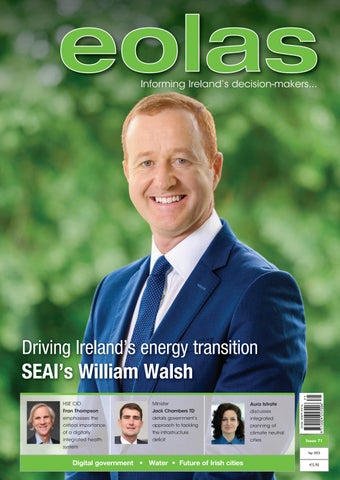
Informing Ireland’s decision-makers...
Driving Ireland’s energy transition
SEAI’s William Walsh HSE CIO
Minister
Aura Istrate
Fran Thompson
Jack Chambers TD
discusses
emphasises the
details government’s
integrated
critical importance
approach to tackling
planning of
of a digitally
the infrastructure
climate neutral
integrated health
deficit
cities
Issue 71
system Sep 2025
Digital government • Water • Future of Irish cities
€5.95
Thursday 9 October 2025 • Croke Park, Dublin Sponsored by
Environment Ireland® is Ireland’s major environmental policy and management conference. Now in its 21st year, this important event features a range of focused sessions highlighting the pressing issues facing the environment in Ireland and globally. The environment in Ireland, and across the globe, is coming under increasing pressure with crises developing in several areas including climate and biodiversity. Ensure you don’t miss the latest developments in environmental policy and regulation and best practice in environmental management across the sector. Each year Environment Ireland hosts a number of visiting experts to showcase best practice internationally.
2025 speakers include... Veronica Manfredi Director for Zero Pollution, Water Resilience and Green Cities European Commission Barry Quinlan Head of Climate and Environment Policy Department of Climate, Energy and Environment Tom Gaynor Chief Operations Officer Repak Danielle Conaghan Partner and Head of the Environment and Planning Group Arthur Cox
Venkatesh Kannan Associate Director Irish Centre for High-End Computing (ICHEC) Lucie Martin Research Officer, Behavioural Research Unit Economic and Social Research Institute Heidi Redmond Circular Economy Adviser Strategic Investment Board
Ali Sheridan Chair Just Transition Commission
Robbie McDonald Chief Scientist and Chief Insights Officer, The Office for Environmental Protection Geraldine Brennan Director of Circular Economy Innovation IMR and Circuléire Mary Kelly-Quinn Associate Professor, School of Biology and Environmental Science, University College Dublin Richard Crawley Programme Manager – Planning Advisory Service UK Local Government Association
Eimear Cotter Director of the Office of Evidence and Assessment Environmental Protection Agency Matt Crowe Chair, The Water Forum
Laura Morrison Head of Responsible Business, Business in the Community Ireland Jane Stout Vice President for Biodiversity and Climate Action Trinity College Dublin
Exhibition opportunities available! The Environment Ireland exhibition area is limited to 22 stands and sells out every year. An important platform for your organisation to interact with a senior audience of 300+ attendees from across the Irish environment sector. For exhibition opportunities contact Sam Tobin on +353 (0)1 661 3755 or email sam.tobin@environmentireland.ie
Online
By email
By telephone
www.environmentireland.ie
registration@environmentireland.ie
+353 (0) 1 661 3755
eolas issue 71 September 2025 Digital
Events
Publications
If you tolerate this... In August 2025, Israel killed six journalists in a single missile strike. Armoured with the tacit approval of its western allies – as demonstrated through the diplomatic, financial, and logistical cover provided, alongside an increasingly authoritarian approach to protest in some
Editorial Ciarán Galway, Editor ciaran.galway@eolasmagazine.ie Joshua Murray joshua.murray@eolasmagazine.ie Ciaran Brennan ciaran.brennan@eolasmagazine.ie
countries – there will be no immediate repercussion for the aggressor. In a bleak regression for humanity – surpassing even the nadir of the 20th century when 69 American journalists were killed during WWII – at least 192 journalists (a cautious count as per the CPJ) have been killed in Gaza since October 2023. Adding salt to the gangrenous wound, veteran BBC reporter John Simpson undermined the agency and professionalism of Palestinian journalists in Gaza when he recently suggested on X/Twitter that “honest, unbiased eyewitness reporting... has so far been impossible in Gaza”. A telling insight into the mindset of one of Britain’s most prominent media figures. Even in Ireland – allegedly “the most pro-Palestinian nation in Europe” – with little social, professional, or financial consequence at stake, the relative silence of prominent journalists is a shameful stain on our
Clayton Taylor clayton.taylor@eolasmagazine.ie Advertising Sam Tobin sam.tobin@eolasmagazine.ie Design Gareth Duffy, Head of Design gareth.duffy@eolasmagazine.ie Jamie Hogan jamie.hogan@eolasmagazine.ie Events Lynda Millar lynda.millar@eolasmagazine.ie
profession. In the absence of a functional fourth estate, Palestinian life will be extinguished from Gaza. A June 2025 poll – undertaken by the Hebrew University of Jerusalem’s aChord Center – indicates that a majority (64 per cent) of the representative sample of 1,112 Israelis believe “there are no innocent people” in Gaza. In this context and given the submissive approach of Israel’s allies to its genocide, the inference is that, as per some uncodified and grotesque caste system, Palestinian life is worth less. If we tolerate the destruction of this people at this time, which population will be next and when? Counterintuitively, the same poll mentioned above reveals that 77 per cent of respondents agreed that “world public opinion regarding Israel is very important or important to some degree”. As such, the Occupied Territories Bill – in a format which encompasses both goods and services
Become a subscriber! Annual subscriptions: €30.00 + €5.00 P&P Contact: Sharon Morrison Email: subscriptions@eolasmagazine.ie Online: www.eolasmagazine.ie/subscribe eolas Magazine Owen McQuade, Publisher owen.mcquade@eolasmagazine.ie bmf Business Services Clifton House Lower Fitzwilliam Street Dublin, D02 XT91 Tel: 01 661 3755 Web: www.eolasmagazine.ie
– carries weight, and is the very least that Ireland can contribute in response to the gravest crime against humanity of this century (so far).
Ciarán Galway Editor
FSC® is an acronym for the Forest Stewardship Council®, which is an independent, non-governmental, not-for-profit organization that was established to promote the responsible management of the world’s forests. The FSC® system provides an assurance that products such as wood and paper have been harvested in a socially and environmentally responsible manner.
www.eolasmagazine.ie
The FSC’s Chain of Custody certification provides a way in which the material can be tracked from the certified initial source through the manufacturing process to the end user and other controlled sources.
Digital
Events
contents
Publications
12
04 08
04
Matters arising
07
Cúpla focal
08
Issues 08
Interview: Minister Jack Chambers TD discusses the infrastructure deficit
12
Cover story: SEAI’s William Walsh
18
Round table discussion: Navigating change to deliver sustainability and climate commitments
28
Interview: HSE National Director of Procurement Gareth Morton on leveraging
Hosted by
procurement to deliver best-in-class care
47
47
Digital government report 56
HSE CIO Fran Thompson: The HSE’s vision for a ‘digital-first health system’
72
Analysis: OECD recommends key actions to guide digital government transformation to improve access to public and private services
80
Digital Iceland CEO Birna Íris Jónsdóttir discusses how consolidating digital government services enables effective emergency response
Sponsored by
18
28 95
80
102
150
136
166
Water report 98 102
Analysis: Water infrastructure and NDP 2025 Maynooth University’s Conor Murphy on why climate policy must be rebalanced
123 Future of Irish cities 128 136 140
Sponsored by
Sponsored by
Analysis: What the NDP review means for the future of Ireland’s cities David Gavaghan on the future population trends of Irish cities UCD professor Aura Istrate explores integrated planning of climate neutral cities through citizen engagement and city governance decision-making
149 Europe 149 150
History of the flag and anthem of the European Union Kathleen Funchion MEP discusses the European Parliament’s response to the genocide in Gaza
154 Public affairs 154
Mol an Óige: Eoghan Kenny TD
160
Analysis: The EU-US trade deal fails to re-establish order in the ‘transatlantic alliance’
162
The state of play in the race for Áras an Uachtarán
166
DCU’s John Doyle traces why the cost of a united Ireland is a point of contention
170
ICTU General Secretary Owen Reidy on the need to enact the Occupied Territories Bill
95 123
149 154
matters arising
FOREIGN AFFAIRS
Oireachtas Committee: Central Bank should stop ‘facilitating’ Israeli bonds An Oireachtas Committee has called on the Central Bank of Ireland to conduct an internal review into, and stop “facilitating”, so-called Israel “war bonds” according to an Oireachtas Committee report. In a report published on 5 August 2025, the cross-party Joint Committee on Finance, Public Expenditure, Public Services Reform and Digitalisation, and Taoiseach, urged the bank to complete the review “in advance of any renewal in September of any Israeli [bonds]”. The issuing of bonds by Israel is seen by some as “financing Israel’s continued violations of human rights”.
published when securities are offered in the EU market. Countries outside the EU must choose a member state to be their ‘home member state’. In 2021, following Brexit, Ireland was chosen as Israel’s new ‘home member state,’ making the Central Bank complicit in the sale of Israeli bonds in the EU market. The Ireland Palestine Solidarity Campaign has called on the Central Bank to “stop funding genocide, it is a legal and moral obligation”. The Central Bank said it “will review” the report. In June 2025, the Government defeated a bill from the Social Democrats, which demanded the Central Bank stop facilitating the sale of Israeli bonds by 85 votes to 71.
Under the EU Prospectus regulation, a prospectus must be
ISSUES
Historic sexual abuse in schools inquiry commission established A commission of investigation into the handling of historical child sexual abuse in schools was established in July 2025. This was the primary recommendation of the Report of the Scoping Inquiry, published in June 2024. The commission must prepare a report for the Minister for Education and Youth, Helen McEntee TD. It will investigate how schools handled concerns of child sexual abuse. In particular, it will identify failures “to treat such concerns in a manner which adequately protected children”, and “the causes and responsibility for such failures”. The report will assess how the Department of Education, An Garda Síochána, and the HSE – or their relevant successor and
4
eolas matters
predecessor organisations – handled “concerns of sexual abuse reported to them”. The commission will also reflect the impact of sexual abuse upon survivors and provide learnings for the future in relation to child protection. Upon establishment of the commission, McEntee said the Scoping Inquiry’s findings were “devastating”, adding that “it is clear that survivors want accountability”. “This commission will have a remit to examine the handling of sexual abuse in all types of schools, which was a wish expressed by many survivors.”
matters arising
ENERGY
Reforms to electricity infrastructure rules announced Direct connections between renewable energy generators and electricity users will be enabled under reforms to rules on electricity infrastructure in the ‘Private Wires’ policy approved by the Government in July 2025. Currently, only ESB Networks can own a line that brings electricity from a generator to an electricity customer. Under the Private Wires policy, private investors will be able to build and own lines that do so in the following circumstances: •
a wind farm or solar farm owned by one company will be able to share a grid connection with another generator or a battery installation owned by another firm;
•
private lines will be allowed where they are the solution to allow on street charging of electric vehicles; and
•
to allow a firm that self-supplies electricity to provide electricity to a neighbouring customer where the line does not have to cross land owned by a third party.
The Department of Climate, Energy and the Environment said this will “facilitate the provision of low-cost charging solutions for electric vehicles and expand opportunities for self-supply of electricity”.
POLICING
Justin Kelly appointed Garda Commissioner The Government has appointed Deputy Commissioner Justin Kelly as the new Garda Commissioner. Appointed by Minister for Justice, Home Affairs, and Migration Jim O’Callaghan TD, he succeeds Drew Harris from 1 September 2025, commencing a five-year term with salary of €314,512. First joining An Garda Síochána as a recruit in 1992, Kelly served as a frontline inspector in Blanchardstown and Clondalkin in Dublin, then as a Detective Inspector in the Drugs and Organised Crime Bureau before ascending to the rank of Detective Superintendent in the Garda National Protective Services Bureau.
In 2021, he worked for the United Nations in Bosnia and Herzegovina, helping the building of capacity in local law enforcement. He then served as Detective Chief Superintendent in the AGS’s Special Detective Unit before becoming Assistant Commissioner for Organised and Serious Crime in 2022. In 2024, he was promoted to the rank of Deputy Commissioner in charge of security, strategy, and governance. Taoiseach Micheál Martin TD welcomed the appointment of the “highly qualified” Kelly, citing his expensive experience in policing, particularly in “national security, organised crime, and domestic and sexual violence”.
eolas matters
5
matters arising
HOUSING
Eamon Ryan appointed chairman of EU housing advisory board Former Green Party leader Eamon Ryan was appointed chairman of the European Commission’s new Housing Advisory Board in June 2025.
Environment, Climate and Communications between 2020 and 2025 in a coalition government with Fianna Fáil and Fine Gael following the 2020 election.
Comprising 15 members from 15 member states, the board will provide policy recommendations informing the European Affordable Housing Plan. The plan aims to increase affordable housing supply and improve access for people in need to address the EU’s housing crisis.
Fianna Fáil MEP for Ireland South Billy Kelleher posted on X (Twitter) to say he was “deeply concerned with this appointment”. He added: “Mr Eamonn [sic] Ryan has given his life to public service, but I cannot see where he has contributed to increased housing supply in his political life.”
Ryan stood down as Green Party leader in June 2024 after the party’s poor performance in the local and European elections. He served as Minister for Transport and Minister for the
Taoiseach Micheál Martin TD said he was “surprised” by Kelleher’s criticism, adding that Ryan’s appointment “is not concerning”.
TRANSPORT
Public consultation on new transport adaption plan launched The Department of Transport launched a public consultation on an updated Transport Sectoral Action Plan (T-SAP II) in June 2025. The draft T-SAP II sets out 39 priority actions to reduce disruption, safeguard transport infrastructure, and “keep Ireland moving safely and efficiently”. First published in 2019, the plan is focused on adapting Ireland’s transportation sector to the evolving realities of climate change such as increased disruption resulting from flooding, storms, and rising sea levels. The revised plan uses updated science, better data, and stronger integration across sectors and regions.
6
eolas matters
Developed by the Department alongside the consultancy firm AECOM, it draws on Met Éireann climate projections, risk assessment for road, rail, active travel, ports, airports, and public transport, policy commitments under the Climate Action Plan and National Adaptions Framework, and feedback from transport operators, public bodies, and experts. Launching the consultation, Minister for Transport Darragh O’Brien TD says the plan “brings together climate science, risk assessments, and expert insights to guide adaption action across the transport sector”. He adds: “By planning for climate resilience today, we’re safeguarding transport for generations to come… by helping to ensure Ireland’s transport system can withstand the challenges ahead.”
cúpla focal “I am just being honest; it’s unlikely we will see those [offshore renewable] projects fully connected to our grid by 2029 or 2030. There will possibly be one. The remainder will come in early 2030 and 2031. Life exists post-2030.” Energy Minister Darragh O’Brien TD acknowledging that that offshore wind targets will not be met.
“Did the Irish fall into a vat of Guinness & propose something so stupid that it would be attributed to an act of diplomatic intoxication? It will harm Arabs as much as Israelis. Sober up Ireland! Call [the Israeli Minister for Foreign Affairs] & say you’re sorry!” US Ambassador to Israel Mike Huckabee commenting on the Occupied Territories Bill.
“Silence, failure to take an initiative will be rightly construed as a moral failure.” President Michael D Higgins urging EU member states to take diplomatic action against Israel amid the Gaza genocide.
“The idea that you can live in Belfast, and you could be a candidate… but you can’t vote, is crazy… It smacks actually of a gerrymander.” Sinn Féin president Mary Lou McDonald TD speaking at Feile an Phobail.
eolas eolas cúpla matters focal
7
issues eolas
Minister Jack Chambers TD: ‘We will shorten the infrastructure project lifecycle’ Minister for Public Expenditure, Infrastructure, Public Service Reform and Digitalisation, Jack Chambers TD, speaks to Ciarán Galway about the Government’s updated National Development Plan (NDP), unpacks the Summer Economic Statement 2025, and discusses Ireland’s exposure to the evolving global trade landscape. Chambers is a risen star among the coalition government’s Fianna Fáil cohort. Within a week in June 2024, then aged 33, he became his party’s deputy leader and the Finance Minister in the previous government. Having guided Fianna Fáil through general election 2024 – as director of elections – he was appointed to his current portfolio on 23 January 2025.
8
eolas issues
Sitting in an immaculate Government Buildings office a little over six months later, the Minister is unsurprisingly keen to emphasise his commitment to enhanced capital expenditure. With no fewer than 75 mentions in Programme for Government 2025, enhanced infrastructure delivery is a major focus of the current administration, given its role as a key
driver of FDI, economic growth, housing delivery, and climate action. “We have come from a period of historic low [capital] investment to one with higher investment with slower delivery systems. So, a strategic priority for me is to accelerate and reposition delivery systems in light of record levels of capital funding. That is to unblock a lot of the challenges that we have around basic
issues eolas
infrastructure in our country. With the new infrastructure brief and Infrastructure Division in this department, there is a real strategic priority, and a lot of policy reform will come from that,” the Minister observes. A second strategic priority identified by Chambers is managing the macroeconomic and fiscal position of the State to ensure “spending efficiency with discal stability”. “We have a lot of work ongoing on reviewing public financial procedures, enhancing value for money considerations in the budget process, and really driving reform to give more headroom to ministers in the budget decisions that they make in terms of their baseline position,” he says. “Central to all that is to make sure the decisions we make are affordable and sustainable and that informs the decisions we will make in Budget 2026.”
Updated NDP In October 2024, Ifac published its Ireland’s Infrastructure Demands in which it determined that “Ireland’s infrastructure is now 25 per cent lower than average for a high-income European country”. Subsequently, in late July 2025, the Government published its updated NDP, or capital investment plan, “with unprecedented levels of investment” totalling €275.4 billion from 2026 to 2035, including sectoral capital allocations of €102.4 billion for 2026 to 2030. Asked how the updated NDP compares with its previous two iterations – 2018 and 2021 – the Minister insists that “it is very clear in its strategic prioritisation” rather than “just setting out allocations across departments”. He adds that this makes “a kind of strategic different distinction between this NDP and others”. At just 49 pages, the 2025 NDP is much reduced in volume when compared with 2018 (109 pages) and in 2021 (184 pages). Its scant content also markedly contrasts with the previous two iterations in that it eschews detail in relation to specific projects. “We want departments and agencies to develop sectoral investment plans, which
“We are going to drive high impactful reforms in the autumn on trying to remove the barriers and truncate and shorten the project lifecycle.” Minister for Public Expenditure, Infrastructure, Public Service Reform and Digitalisation Jack Chambers TD is a different approach to previous years, where we had long lists of projects,” the Minister acknowledges. “We want to develop sectoral investment plans, again learning from the barriers to infrastructure delivery which have been documented to us by stakeholders; that there is not real clarity or certainty on what a list means.” As such, work is ongoing to transpose the funding envelopes given to each department into investment plans, “which has sectoral certainty to build a project pipeline”. These are anticipated to be published in autumn 2025.
Accelerated delivery To date, the NDP has been beset with project delivery delays. Almost 13 per cent (11 projects) of the 88 large projects earmarked for delivery between 2020 and 2025, will not be completed on time. In this context, the Minister believes that ongoing work to address barriers to effective infrastructure delivery within the State is “as important a piece of work as the additionality in the NDP”. “The funding announced last week [22 July 2025] provides a huge uplift in the overall allocation – in excess of €30 billion compared to the baseline position over the next five years. But really, what is more important is making the case for reform,” he says. However, rather than a funding challenge, Chambers characterises the “most impactful barriers to the timely development of infrastructure” as being challenges relating to processes and systems. In response, he believes in a “redesign” of delivery systems “to drive and accelerate infrastructure in the economy”.
Following the public engagement and stakeholder engagement on barriers to delivery, which concluded with the Minister publishing Accelerating Infrastructure – a report on accelerating the development of infrastructure and the “most impactful barriers” impeding this development – on the day of this interview. “We now have the first evidence-based report which sets this out across 12 thematic areas, and we are going to drive high impactful reforms in the autumn on trying to remove the barriers and truncate and shorten the project lifecycle.”
Ambition Asked to summarise the Government’s ambition for the State’s stock of public infrastructure by the end of this decade, Chambers initially focuses on megaprojects. “They have been sitting waiting to get the go-ahead, some of them over 10 years, some of them over 20 years, and actually seeing them advancing and commenced would be an important milestone.” Secondly, the Minister reiterates the importance of housing delivery and the critical infrastructure to enable that. “The public sense of infrastructure delivery is that it is slow, cumbersome, fragmented, and endless in process. If in three to five years, we see infrastructure defined by momentum, a pipeline of projects, and tangible commencements, that will switch the sense of infrastructure delivery. That is a real metric. “Once projects are published in terms of sector investment plans, that will give a medium-term position on what is possible. We have a lot of projects now that are emerging from planning. Getting them commenced will show that there is delivery happening on the ground.”
eolas issues
4 9
issues eolas
that it wants to continue to build a proposition which has enhanced ‘zero for zero’ cooperation across measures. We know that aviation is now at that, so are certain agrifoods and certain generic drugs. Hopefully, in time, as the new trading relationship settles, there will be further opportunities to lower that [tariff figure] for particular sectors and Ireland will benefit from that.”
Current expenditure
Macroeconomic assessment Asked to unpack his assessment of the Irish economy, the Minister remains upbeat amid the swirling uncertainty in the global trade policy landscape. Describing the current position as “a real point of economic strength”, he points to the figure of 2.8 million people working across the State – 400,000 more than before the Covid pandemic. “When you think of the series of crises that we have navigated through – with one million people out of work [at the height of the pandemic], the inflationary crisis, and the cost-of-living crisis – we have shown phenomenal economic resilience over the last five years. “We are building up our fiscal buffers with the two reserve funds – the Future Ireland Fund and the Infrastructure Climate and Nature Fund – and that allows us the ability to navigate the challenges of tomorrow in a careful, considered, and sustainable way.” On the macroeconomic challenges, Chambers stresses that government has not been surprised by the challenge of deglobalisation, which he says, “did not arrive with President Trump”. Outlining government’s response, the Minister asserts that market diversification, consolidating domestic economic competitiveness, and regulatory simplification will be key. Referencing the opportunities of a changing geopolitical environment and a continued demand for enhanced trade and cooperation across the world, the Minister asserts that “Ireland needs to be at the forefront of those conversations”.
10
eolas issues
Exposure Given the prevailing volatility in global trade policy landscape, Ireland is exposed. In the joint foreword to Summer Economic Statement 2025, Chambers and his cabinet colleague, Minister for Finance Paschal Donohoe TD, acknowledge this: “There is now concrete evidence that the transatlantic economic relationship has taken a step backwards.” Elaborating, the Minister admits: “Look, we are an open trading economy which tries to provide efficiencies and value added to a global supply chain. With uncertainty and security of supply sometimes superseding efficiency of supply, given how geopolitics have evolved – and economic nationalism being the thematic development in recent times – that presents a risk for the Irish economic model.” Summer Economic Statement 2025 was published with an applied assumption of no change against a 10 per cent baseline tariff in place since April 2025. Five days later, however, the US-EU trade deal established a baseline 15 per cent tariff for most exports from the EU to the US. “Ultimately, we now have an EU-US trade agreement that provides predictable investment proposition for indigenous and foreign direct investors into Ireland, many of whom still need to trade within Europe and elsewhere. So, while the tariff environment is more challenging than what preceded it, we are still looking to diversify markets, and the EU is examining other international markets,” Chambers remarks. “We know that there is a ceiling of 15 per cent. The European Commission has said
In the first six months of 2025, current expenditure is growing at a pace exceeding budget 2025 forecasts. As per the June 2025 fiscal monitor, current spending was €45.1 billion at end-June 2025, or 6.5 per cent (€2.8 billion) ahead of where it was in the first six months of 2024 – and well ahead of the 1.4 per cent growth outlined in Budget 2025. Once again, as highlighted by Ifac, spending overruns in 2024 were not factored into budgeting for 2025. Consequently, spending overruns in 2025 are expected to total at least €2 billion. While Ifac outlines that “the first five months show spending overruns in many different areas”, however, to date, monthly profiles of departmental expenditure have not been published in 2025. In fact, in its June 2025 Fiscal Assessment Report, Ifac reported that having requested these monthly profiles, the Department of Public Expenditure Infrastructure Public Service Reform and Digitalisation had failed to provide them. Disputing that ‘many’ departments are exceeding their spending projections for 2025, the Minister confirms that 10 of the 18 government departments remain within current spending parameters. “If you look back over the last five years, we have had an average growth in expenditure of about 9 per cent. What has accelerated that has been the in-year decisions or issues that emerged during the year, which contributed to the overall growth in public expenditure. This year, it is at about 6.5 per cent presently, compared to last year, and the overall growth of public expenditure is actually connected to the increase in capital expenditure, which is what we want to see,” the Minister claims. Conceding that “we do need enhanced fiscal discipline”, he outlines that the work being undertaken for Budget 2026
issues eolas
has three focuses: adequacy, efficiency, and fiscal sustainability. “That means, in the estimates process prior to 2026, ensuring that the best mitigation [from] in-year decisions which contribute to overruns in terms of current expenditure, and we need to try to prevent that more next year compared to the last five years, particularly when we agree a medium-term expenditure framework and medium-term fiscal framework under the EU rules. Enhanced fiscal discipline between the budgets will have to be improved next year.”
Exceptional corporation tax receipts However, this begs the question: Where would the public finances be in the absence of exceptional corporation tax receipts? “They [corporation tax receipts] are exceptional because of our industrial and enterprise policy, which we need to protect and nurture in the context of changing geopolitics,” Chambers responds. In the Fiscal Assessment Report: Ireland’s Bounty, published in December 2024, Ifac outlines that in the absence of exceptional corporation tax receipts, government would be running a deficit of €6.3 billion in 2024. “In effect, the surplus is being produced by a handful of foreign multinationals based on their worldwide profits,” it added. In July 2025, Ifac chair, Seamus Coffey reiterated this point when he appeared before the Oireachtas Select Committee on Budgetary Oversight, stating: “After accounting for exceptional corporation tax and a strong economy, the government is running a substantial deficit.” One week later, the Central Bank of Ireland’s Deputy Governor, Vasileios Madouro, warned the committee that rapid economic growth and exceptional corporate tax receipts “could be at risk in the coming years”. In the meantime, the Fiscal Monitor for July 2025 once again recorded corporation tax revenue (excluding CJEU revenues) was €1.8 billion or 14 per cent ahead of the same period in 2024. However, as well as highlighting the importance of tax competitiveness – “we have our position within the European Union” – the DPER Minister emphasises
“They [corporation tax receipts] are exceptional because of our industrial and enterprise policy, which we need to protect and nurture in the context of changing geopolitics.” the significance of Ireland’s “exceptional” talent for foreign direct investors and indigenous businesses alike, and its stable business and political environment. “The fact that we have a stable, predictable industrial policy still makes Ireland an attractive place to do business. The fact that we are very focused, as a government, on competitiveness as an issue and the decisions that we will have to make from that will yield opportunities for our country,” he says.
Budget 2026 Asked to define the expenditure strategy within Budget 2026, the Minister notes that it is currently under development. Opaquely, he replies that the budget will deliver “targeted interventions across different departments”, particularly in terms of social protection, child poverty, and driving the competitiveness agenda. “Obviously, the investment in infrastructure will form a core part of Budget 2026,” he adds, while indicating that future proofing public services in response to changing demographics will also be a key feature. “We will not be doing one-off measures,” he insists. “Whatever measures we take need to be targeted. They need to be within the fiscal parameters, and they need to be sustainable for the medium to long term. “We have agreed a Summer Economic Statement and a budget package which still allows for progress across key policy areas and will help families, will help improve living standards and public services.” This means, he explains, that ministers will be expected to make choices around their priorities, rather than “sitting one-off measures above permanent measures which have been taken”.
Given the economy’s strong performance, Ifac suggests that support from budgetary policy is not required. Recent budgets, it argues, have “pumped money into an economy that is already performing well” or, in other words, have been procyclical. When this is put to the Minister, he responds directly: “We want to moderate.”
Vision Outlining his vision for the lifetime of the Government, the Minister specifies that his “number one priority” is “enabling and driving infrastructure reform” to unlock the delivery of tens-of-thousands of new homes. “We have an important role in the Department of Public Expenditure to drive and make the case for reform within the Irish economy,” he says. Describing infrastructure delivery and reform as one of the major challenges facing the State, and acknowledging the criticisms associated with the existing deficit, Chambers concludes: “I want to switch that; to build momentum and confidence and positivity on that as we enter the 2030s. “Similarly, it [the vision] is – as part of the budget process – to fulfil a lot of the commitments in the Programme for Government on in terms of improved public services and living standards, ensuring that we enter the next phase in the 2030s in an economy which is resilient, more diversified, and is embracing new opportunities, particularly around the digital transition and digitalising public services, while trying to build a low carbon future. All of that connects back to infrastructure delivery.”
eolas issues
11
cover story
12
Driving Ireland’s energy transition
Since joining SEAI in 2013, Walsh has contributed to the evolution of Ireland’s national energy authority from a relatively peripheral body to one that plays a central role in the State’s decarbonisation efforts. “Back then, SEAI was a ‘nice-tohave’. Now, it is very much a ‘musthave’,” he reflects.
Sustainable Energy Authority of Ireland (SEAI) Chief Executive William Walsh speaks to eolas Magazine about the organisation’s expanding role in driving the decarbonisation of Ireland’s energy system, the scaling of retrofit and solar programmes, the importance of electrifying transport, reducing car dependency, and decarbonising industry, all to achieve a 51 per cent reduction in Ireland’s energy-related emissions by 2030.
That transformation has been underpinned by significant growth supported by government. “In 2018, we had around 90 staff and a budget of €150 million. In 2025, we have over 250 staff and a budget of approximately €800 million,” Walsh explains. “This reflects not only our expanded remit, but also the increasing importance of the energy transition to Ireland.”
cover story
SEAI’s role has been reinforced by national legislation committing to a 51 per cent reduction in emissions by 2030 and the establishment of carbon budgets and sectoral ceilings. Walsh notes that energy transition efforts are now “measured and managed”, supported by
cover story
a maturing energy industry and improved cross-sectoral collaboration.
energy-related emissions reductions required by 2030:
SEAI’s roles are multi-faceted, from helping all energy users to save money and move away from fossil fuels with practical advice and financial supports, to providing objective data and evidence to inform policy development.
1. decarbonising industry;
Progress Outlining progress, Walsh points to advances in residential retrofits and commercial solar, electric vehicles, and energy efficiency. He particularly emphasises the societal impact of domestic solar energy: “It has helped people understand energy. That awareness makes the wider transition – away from fossil fuels and towards renewables – more accepted and better understood.” SEAI’s strategic approach is defined by five key pillars which Walsh describes as necessary for delivering 90 per cent of the
2. expanding wind and solar and strengthening the grid; 3. electrifying transport; 4. scaling retrofit, heat pump adoption, and district heating; and 5. reducing car dependency. “These are our five actions for 90 per cent,” Walsh explains. “They are the areas with the greatest potential for emissions savings. Our job is to keep the focus on them.”
Affordability and community engagement Energy affordability is a constant priority. While SEAI is not responsible for setting energy prices, it works to reduce costs for consumers through energy efficiency. “Through the Warmer Homes Scheme we
deliver home energy upgrades to vulnerable homeowners in energy poverty. Their homes are more comfortable, use less energy, and thus they cost less to run,” Walsh says. SEAI also supports over 1,000 sustainable energy communities across Ireland. These networks help homeowners, small businesses, and organisations take collective action through enhanced insulation, retrofitting, and renewable generation. “We want communities to reap the dividend of working together,” he adds. “Whether it is retrofitting a sports club or providing energy efficiency advice to a local business, these programmes help make the transition more inclusive, meaningful, and achievable.”
Retrofitting and regulation Walsh highlights the dual impact of
coverissues story agenda issues eolas
4 13 13
cover story
building regulations: “They ensure that new homes are built to high energy standards, while also supporting the development of a supply chain for retrofit technologies like heat pumps.” In 2024, SEAI supported the retrofit of 54,000 homes. The 2025 target is 63,000. “As we scale up, we bring expertise into the market, and that is making retrofitting more effective and more affordable,” Walsh says. “The end result is warmer, healthier, and more comfortable homes; and last year home energy upgrade activity supported more than 10,000 jobs, so it is an increasingly significant component of Ireland’s workforce.”
District heating While at a nascent stage of development in Ireland, district heating is identified by Walsh as a significant opportunity. “Over 90 per cent of our heating still comes from fossil fuels. That is the single biggest challenge,” he explains. “District heating works well in comparable countries. The challenge here is low deployment.” Recent developments, including government approval for the General Scheme of the Heat (Networks and Miscellaneous Provisions) Bill 2024 and a €5 million government allocation for feasibility studies, are a clear signal of growing support for developing district heating networks. Furthermore, SEAI now leads the National District Heating Centre of Excellence. “The technology is available, insulated piping, low heat loss, and diverse heat sources, but we need
14
cover story
anchor tenants to make it viable,” he says. He cites the potential of the Ringsend Waste-to-Energy facility as a future district heating hub for parts of Dublin.
Collaboration “The public sector has to lead by example,” Walsh says. SEAI works with around 350 public bodies on energy performance and collaborates with large users such as hospitals and schools through pathfinder projects aimed at decarbonising existing building stock. SEAI also oversees administration of the Energy Efficiency Obligation Scheme, which requires energy suppliers to assist their customers in improving efficiency. “The suppliers have been proactive. Some have even established retrofit divisions, which we encourage and welcome.”
Infrastructure and innovation From an infrastructure perspective, Walsh identifies several priorities. “We need to dramatically accelerate the pace of onshore and offshore wind deployment, ensure that the electricity grid can handle it, and build out storage solutions. Interconnection is also crucial – the Celtic Interconnector is a significant development.” While Ireland has an enormous renewable energy potential, Walsh warns that “deployment remains too slow” and calls for a continued focus on pragmatically addressing planning and regulatory barriers.
cover story
“We can meet the energy challenge with focus, collaboration, and a shared commitment.” William Walsh, Chief Executive, Sustainable Energy Authority of Ireland
Artificial intelligence (AI) is on SEAI’s radar as a potential accelerator of the transition. “We hold significant BER datasets, on over one million homes, which could be used alongside those covering national energy use. There is clear opportunity for AI to support homeowners in their decision-making and delivery,” Walsh says. At the same time, he acknowledges AI’s growing energy footprint. “We must balance the benefits of deployment with the energy it consumes. AI is not a silver bullet, but it is developing fast and has the potential to contribute to Ireland’s energy transition. We are examining where it can add the most value while mitigating any associated risks.” Concluding, Walsh emphasises that the energy transition, in addition to being a climate imperative, remains both an economic and a social opportunity. “People are not just engaging for environmental reasons. Businesses want to control overheads and homeowners want warmer homes. These are the realworld drivers. He notes that Ireland currently spends billions of euros annually on the importation of fossil fuels. “We can generate that energy indigenously and eventually export it. That is the dividend, not just improved energy security, but economic opportunity. “A decarbonised Ireland will mean warmer homes, cleaner air, cheaper and more secure energy in a prosperous, resilient economy. We must stay the course. The opportunity is there, and the path is clear. It is a challenge, but it is one we can meet with the right focus, the right collaboration, and a shared commitment to delivery.”
Profile: William Walsh William Walsh is Chief Executive Officer of the Sustainable Energy Authority of Ireland (SEAI). Appointed CEO in 2021, previously acting as interim CEO since 2019, he has also held senior roles across the finance and public sectors. He now leads SEAI in its mandate to support and drive the decarbonisation of Ireland’s energy system.
cover story
15
issues eolas
Crafting climate policy The publication of the Just Transition Commission’s Introductory Report in June 2025, alongside the Climate Conversations 2024 findings from the Department of Climate, the Environment and Energy provides the basis for a broader framing of climate policy aimed at providing a just transition. Both documents, while developed independently, reinforce key themes regarding public engagement, policy delivery, and institutional preparedness for a whole-of-society transition to a low-carbon economy. The Just Transition Commission was established in late 2024 to provide “independent, evidence-informed advice to government on the delivery of a just transition”. The introductory report, its first output, sets out a number of structural and procedural challenges that require attention if just transition principles are to be integrated into the Government’s climate policymaking. The Commission recommends a clearer strategic framework, improved coordination between national and local levels of government, and the development of indicators to track the social impact of decarbonisation measures. The report also repositions the concept of just transition away from its prior association with the cessation of peat production in the midlands, recommending that it be
16
eolas issues
embedded more broadly across all climate and energy policies. Particular reference is made to sectors and communities considered vulnerable to transition-related disruption, including rural populations, coastal communities, farming households, low-income groups, and members of the Traveller community. The Commission notes that governance structures to date have not consistently accounted for the differentiated impact of climate policies on these cohorts. In parallel, the Climate Conversations 2024 report presents the results of an open public consultation held between May and September 2024, under the remit of the National Dialogue on Climate Action (NDCA). The consultation attracted 1,949 responses and provides a snapshot of attitudes, perceptions, and levels of public involvement in climate action. It is not representative of the general population but offers insight into the views of those already engaged with climate-related challenges.
issues eolas
One of the key findings from the consultation is a marked increase in levels of “concern” regarding climate change, with 90 per cent of respondents stating that they are worried about the issue. Frustration (67 per cent), worry (56 per cent), and powerlessness (47 per cent) were the most frequently reported emotional responses. These findings are consistent with the Commission’s emphasis on the need to improve communications around climate policy, particularly with respect to clarity, impact, and accountability. Public perceptions of government performance on climate action remain low. Fewer than 15 per cent of respondents agreed that the Government has a clear plan for coordinating action across sectors. Respondents expressed particular dissatisfaction with government performance on citizen engagement, the provision of supports to enable behavioural change, and the communication of policy objectives. Notwithstanding this dissatisfaction, respondents reported high levels of personal commitment to climate action. Over threequarters (76 per cent) stated they could do more to reduce their environmental impact, and 61 per cent reported active involvement in at least one community organisation. Of these, over half (54 per cent) said that some of their activities related to climate action. Engagement is most common in waste reduction and biodiversity, with increasing interest in active mobility and circular economy initiatives. However, the report also documents persistent misperceptions regarding the relative impact of different climate actions. Respondents continue to overestimate the effectiveness of lower-impact behaviours (for example, reducing food waste) and underestimate the benefits of higher-impact measures such as switching to electric vehicles or using heat pump technology. The Commission has identified this as a key area for improvement, recommending that communications be aligned more closely with the actual emissions-reduction potential of various actions.
A number of the recommendations in the Climate Conversations report overlap with those of the Commission. These include the need to strengthen local capacity for climate action, to develop community climate hubs, and to use the NDCA as a platform for sustained engagement and co-design. The consultation report highlights the potential of the Dingle Peninsula 2030 project as a replicable model for place-based, citizen-led climate planning. The Commission similarly advocates for greater investment in local governance and public participation structures. Across both reports, there is a consensus on the need for data collection and indicator development. The Commission calls for a systematic review of existing datasets and the establishment of metrics that can be used to monitor and evaluate Ireland’s progress on just transition objectives. The Climate Conversations report outlines the demographic and regional differences in participation and attitudes, underlining the need for disaggregated data to inform equitable policy design. Taken together, these two publications provide a broad evidence base to support policy development in the area of just transition. The Commission’s initial reflections are expected to inform future iterations of the Climate Action Plan and related governance arrangements. The public consultation findings will continue to guide the NDCA’s outreach and engagement strategy and contribute to the broader behavioural science and public communications work of the Department. As Ireland moves towards implementation of its 2030 emissions reductions targets and 2050 net zero emissions target, the operationalisation of a just transition approach will require further integration into departmental planning, budgeting, and oversight frameworks. The establishment of clear governance responsibilities, the mainstreaming of equity considerations, and the improved coordination of national and local action are likely to remain key challenges in the period ahead.
eolas issues
17
round table discussion
Backlog to breakthrough: How automation and AI are transforming public services Accenture hosted participants from across the public sector to engage in a round table discussion designed to determine how automation and AI are transforming the delivery of public services. What are the most significant use cases of AI driving public service transformation? Francis McGuire The UK’s Department of Work and Pensions implemented a GenAI solution to process handwritten letters, significantly improving response times and ensuring quicker access to social welfare support. This demonstrates how GenAI can streamline laborious tasks and enhance public service efficiency.
Sam Waide From an RSA perspective, the best use case has been the rollout of the RSA customer contact centre. We can leverage AI to quickly determine pertinent information about the customer, including their driving history and penalty points. For both staff in the centre and customers, this access to real-time information has accelerated interactions. Nicola Roche The Department of Agriculture, Food and the Marine has partnered with external partners and developed an AI solution to
Round table discussion hosted by
18
determine bovine TB risk at animal level which enables us to detect potential cases and reduce instances of bovine TB in Ireland. Simultaneously, the Department is collaborating with Met Éireann to better understand the impact of climate change and look at prospective agricultural land challenges. Neil O’Hare Ambient speech technology provides the ability to record and process verbal interactions between patients and clinicians. It negates the need for clinicians to manually write notes with the speech recognition and interpretation technology that can automatically draft the notes. Another exciting development is the National Children’s Hospital, which will be an intelligent building with a lot of data and sensors. We can leverage AI to ensure we are running that hospital efficiently from an energy perspective, and from an access perspective.
Jane Corr Most people in the country utilise CIÉ’s services, so the main thing for us is ensuring that we leverage the associated data. In Singapore’s public transport system, for example, AI is used to deliver virtual messages in sign language to users. There is a chance to deliver for every citizen and improve all our public infrastructure if we can ensure that AI is properly integrated into public services.
Participants Neil O’Hare Neil O’Hare is professor of health informatics, University College Dublin, and Group Chief Information Officer with Children’s Health Ireland. A physicist by background, having completed his PhD in medical physics at DCU in 1991, he was previously Chief Physicist in St James’s Hospital, but has had a strong emphasis on health informatics throughout his career, including heading up many large implementation projects around clinical information systems, acting as advisor to the Department of Health, and project management of a range of medical equipping projects. O’Hare is the current coordinator of the Grad Dip/MSc in healthcare informatics (UCD).
What is the potential for responsible AI use to enhance public service delivery? Neil O’Hare We need to prioritise making our services accessible to end-users and that requires more cohesive policy guidance. We must better communicate the potential use cases and guard rails with our end-users. Sam Waide The predominant way to ensure responsible AI use is to ensure that our goals are understood. For road safety, the objective is to have zero deaths and zero injuries by 2050. There is tremendous opportunity for AI toolchains to benefit road safety. The RSA understands its role in the bigger picture of the digitalisation public services, and AI can contribute to the pursuit of Vision Zero, however safety needs precision.
round table discussion
Francis McGuire As an Operations Leader at Accenture, Francis McGuire designs and delivers large-scale digital transformations across multiple industries – utilising automation, AI, and cloud-enabled platforms to reimagine public services, improve agility, reduce costs, and drive operational excellence. With deep experience both here in Ireland, and globally, he leads teams to streamline shared services, automate back-office processes, and embed AI powered chatbots and predictive analytics wisely and responsibly. Nicola Roche Nicola Roche is Principal Officer in IMT Schemes, Land, and Digital Services in the Department of Agriculture, Food and Marine. A senior ICT leader with over 25 years of experience delivering large-scale digital transformation in the public and private sectors, Roche has a proven track record in strategic planning, programme delivery, agile adoption, governance, data analytics, and information security.
Jane Corr There is a culture change required within the public sector. Comparing the private sector to the public sector, there is a much more risk-averse approach in the public sector which slows progress. Responsible AI use represents an opportunity in the public sector to improve user experience and enhance services.
Jane Corr Jane Corr is Head of Cyber Security at CIÉ. She is a Group A recognised information security and IT leader who has a track record of building successful teams. With over 30 years’ experience in a variety of IT infrastructure roles, Corr moved into Information Security 10 years ago. She has held chief information security officer and head of cybersecurity roles in both private and public sector settings. She has a Bachelor of Science degree from Trinity College Dublin and has attained CISSP, CRISC, and CISM security certifications.
Francis McGuire Building public trust is key, and there is more emphasis on quality of delivery in the public sector because public services are citizen-solution based while companies are profit-driven. While there is less scope for pilot trials in the public sector, there is greater opportunity for building public support among the public. We need the public service to lead the charge and drive progress.
Sam Waide Sam Waide is the Chief Executive and Accounting Officer of the Road Safety Authority (RSA) in Ireland, leading RSA’s actions within the Government’s Road Safety Strategy 2021-2030, leveraging digital solutions for safer road use and service delivery for customers. Previously, he held leadership positions in the health service and private sector, where he led digital transformation solutions including electronic healthcare records, product lifecycle management, regulatory real time reporting, and supply chains. He is a chartered director and fellow of Institute of Directors.
Nicola Roche Being cautious and slower are natural things in the public sector. In the private sector, where competition and choice often result in an innovation race, whereas in the
4
19
Neil O’Hare The challenge we have is that if there is an overreliance on AI, that the worker can become fundamentally deskilled. We must avoid exacerbating a data literacy deficit; this means teaching data literacy alongside an ability to use AI to allow us to ensure that what the AI gives us is valid. This is a challenge which applies across all age groups. Many submissions I receive in my academic capacity are easily recognisable as generative AIproduced work in my field, and the result is a knowledge shortfall in specialised settings. There are benefits to this technology and its use, but we need to proceed with caution. Sam Waide
round table discussion
“To overcome this challenge of trust, we need end-users to understand the capabilities and limitations of the technology.” Neil O’Hare public sector, there is only one service provider – and no choice – meaning our service delivery must reach the highest of standards. People trust us with their data, and they must be confident that their data is secure. If the civil service or a public service body makes a mistake, the stakes are arguably higher than for private companies, given the potential impact on people’s lives. There are opportunities where we can be more agile, but we must not rush our approach to AI.
around AI. We are beginning to move beyond the idea that AI will lead to job loss and instead focusing on the rollout of responsible AI in a steady manner. This needs to be transparent and with clear governance demonstrating the role of human oversight. However, we must not overlook the efficiencies that AI can bring to public services.
AI relies on data entry, and so AI-enabled solutions can only provide feedback on the source data. If the source data is either inaccurate or untrue, the challenge is that AI will provide inaccurate ‘solutions’. Digital literacy is another important aspect; there are already cohorts who are unable to use existing applications such as Microsoft Excel, so the potential for widening data illiteracy is significant. Nicola Roche We need to acknowledge that many of the regulations around AI are generated by people who look like us around this table, and there is a significant need to ensure that AI does not profile users by stereotypes to do with race, gender, or religion.
How can this potential for public service transformation be balanced against the associated challenges? Jane Corr When designing an AI framework, it needs to be deliberate. The governance needs to be established quickly to ensure accountability and enable the completion of risk assessments. The right set of security controls must also be established. Francis McGuire There are still perception challenges
20
“Stories of AI success will help bring the public on the journey with us.” Francis McGuire
round table discussion
“There are opportunities where we can be more agile, but we must not rush our approach to AI.” Nicola Roche To what extent do the recently published Guidelines for the Responsible use of Artificial Intelligence in the Public Service support public service bodies to pursue responsible innovation? Nicola Roche The guidelines are asking us to have AI governance procedures in place to ensure that policy and implementation serves all people fairly and to the highest of standards. This means ensuring highquality risk identification and bias testing. This requires care because if we only look within our own frame of reference, there could be bias or inaccurate analysis and solutions provided which do not reflect the needs of the user. Overall, these are good guidelines for all of us to follow not just with AI, but with policy more broadly. Jane Corr The best thing about the guidelines is that they are supportive, rather than a series of top-down orders. As public servants, we are tasked with doing the best for every citizen in this country, so there is
scope for AI innovation but in a way in which people are served well. Francis McGuire The themes of accountability and need are the best aspects of the guidelines, because if progress is to be made there is a need for accountability which will steer us away from any potential risks. The aim must be to progress quickly, but we are ultimately serving citizens and that must be the underpinning policy of this transformative process. The new policy guideline document is brilliant and there is a lot of thought which went into it; the task now is policy implementation especially in the private sector. Sam Waide It is about moving at pace in a safe and steady manner. AI has existed since the 1950s, but it is only now that it is truly entering public consciousness. The guidelines are good, but implementation at pace is a challenge. The challenge is about figuring out how the transformative potential of AI can be underpinned by protection at a government level in a consistent
4 21
round table discussion
“If the public sector wants citizens to embrace AI, it must effectively communicate how the technology can make their lives easier...” Jane Corr
22
manner across the public service. It requires a matrix approach at a government level, which is not always popular. However, a consistent approach is required if the public service is to share in best practice and foster innovation, whilst acknowledging that automation without oversight equals risk.
regulation is unsustainable. What we need is transparency in vendors’ testing processes and for organisations to be able to have confidence in the product.
Neil O’Hare
Neil O’Hare
There is a risk of creating a governance industry. Any AI tool we use is not home built; in most cases it is commercially procured from reputable vendors. Like any product we buy, we can perform a level of testing, but we do not validate it comprehensively; we assume that has already been completed as part of CE marking. Overlaying this with governance protection and safety regulation runs the risk of inadvertently creating an entire governance industry. If we want AI innovation and deployment, this level of
We are outlining the capabilities of the technology to end-users and determining if they are interested in deploying AI. Trust is crucial. I am reminded of the AI legal judge analogy; most people would choose a human over an AI solution to be the judge of a legal case they were involved in. However, AI will give you consistency and will not be subject to human weaknesses. To overcome this challenge of trust, we need end-users to understand the capabilities and limitations of the technology.
How can public services’ use of AI improve citizen trust and engagement?
Francis McGuire This is an exciting time. We have an amazing policy paper in the National AI Strategy. We are sitting in Accenture’s global headquarters for innovation and R&D activities, and all the surrounding companies are building AI models. In Ireland, we have access to knowledge and experience, a young workforce,
round table discussion
“A consistent approach is required if the public service is to share in best practice and foster innovation.” Sam Waide and a government that aspires to digitalise all public services by 2030. Communication with the public is key to capitalise on context, and stories of AI success will help bring the public on the journey with us. Jane Corr Irish people are adaptive. If we understand a new idea, we can run with it. Additionally, young people do not want to access public services in the traditional way. They are not interested. Even if the solution is only 75 per cent complete, they will take it every time over the alternative. If the public sector wants citizens to embrace AI, it must effectively communicate how the technology can make their lives easier in a transparent way. Sam Waide Different cohorts within society have different levels of interest in AI. Young people are excited about the technology, and they are interested in the companies that deploy it. It increases their interest in working for these organisations. There is a much wider engagement required
beyond the AI transactional output or solution. In 2024, an inaugural road safety youth forum was established, and it occurred to me that a similar forum could be established for public service innovation. There are different ways to engage with people regarding AI, and it is important to involve young people because they are the leaders of tomorrow. Nicola Roche Do citizens care about AI? Arguably, the answer is no. But people do want better and faster public services delivered in a manner which makes sense for them. They want a single gateway where the can access their data. We need to prove that this service is transparent and offers value for money. The digital wallet and life events programme being prepared by the Office of the Government Chief Information Officer is an example of this.
23
issues eolas
Government commits to passing heavily amended Occupied Territories Bill In the shadow of the Gaza genocide, the Government published the General Scheme of the Occupied Territories Bill in July 2025. eolas Magazine analyses the proposals which have been heavily criticised by both opponents of the genocide and supporters of the State of Israel. The Occupied Territories Bill, officially called the Control of Economic Activity (Occupied Territories) Bill 2018, proposes the prohibition the importation of goods originating in illegal Israeli settlements located in the Occupied Palestinian Territories, including East Jerusalem and the West Bank. Goods from these settlements are defined as any materials or products of any kind. The prohibition is enforceable under the Customs Act 2015, which allows the Minister for Foreign Affairs to designate affected areas by postal codes, following consultation with the Minister for Finance. The explanatory notes in the general scheme of the Bill cite the International Court of Justice’s (ICJ) advisory opinion as the Bill’s foundation, framing it as a necessary step to prevent trade relations that might assist in maintaining an illegal situation. However, the legislation deliberately limits itself to the import of goods and, crucially, excludes services and investment relations. 24
eolas issues
issues eolas
This delineation is significant, as the Bill’s critics and supporters agree that the exclusion of services reflects legal caution regarding EU competence over trade policy. The Department of Foreign Affairs acknowledged on 1 July 2025 that the measure only brings Ireland “towards compliance” with its obligations under the ICJ advisory opinion and not fully into compliance. The current government draft is a heavily amended version of the Bill first introduced by Senator Frances Black in 2018. The original Control of Economic Activity (Occupied Territories) Bill 2018 proposed a broader prohibition. It additionally sought to criminalise the provision of settlement services and the extraction of natural resources from occupied territories generally. It explicitly targeted investments that could entrench the occupation. Under Black’s draft, individuals or companies engaging in trade or services linked to settlements would have faced penalties of up to five years’ imprisonment and fines up to €250,000. The intention was that Ireland would not allow its market or financial system to support illegal settlements in the Occupied Palestinian Territories. While the 2018 bill passed the Seanad and cleared early stages in the Dáil, it
stalled after government ministers, including Taoiseach Micheál Martin TD, argued that it would be “unconstitutional” as trade policy falls within the remit of the EU. Blinne Ní Ghrálaigh – a barrister who represented South Africa in its genocide case against Israel at the ICJ – addressed the Joint Oireachtas Committee on Foreign Affairs and Trade on 9 July 2025, asserting that “there is no basis in international law for differentiating between trade in goods and trade in services in the manner proposed”. She added that the Bill risks being “little more than window dressing”. Ní Ghrálaigh further argued that the scaling back of the Bill weakens Ireland’s compliance with international law, claiming that excluding services and investments “fails to ensure compliance even with the duty set out in the advisory opinion requiring Ireland to distinguish between Israel and the OPT in its dealings”. Former Fine Gael Justice Minister Alan Shatter, speaking before the Committee on 16 July 2025, asserted: “The Bill is the first initiative of any European government to enact legislation to intentionally boycott and discriminate against Jews since the defeat of Nazi Germany in 1945.” While no other individual EU member state has introduced analogous legislation, nine member states (including Ireland) have called on the European Commission to consider trade restrictions on both goods and services linked to illegal Israeli settlements. This includes urging a review of the EU-Israel Association Agreement to ensure compliance with international law as outlined in the ICJ advisory opinion. Shatter went on to dismiss the Bill as “fantasy politics and political theatre that does profound damage to the reputation of our state”.
State of affairs in Gaza As of 15 August 2025, 61,827 have been killed in Gaza by Israeli forces, according to the Gaza Health Ministry. Israel claims that its campaign is an effort to destroy Hamas, the Islamist group which governs Gaza and whose military wing was responsible for the 7 October attacks, in which 1,200 civilians are estimated to have been killed. The medical journal The Lancet has argued that the death toll, including indirect deaths because of the war, may be considerably higher than the estimates of Gazan health officials. “It is not implausible that up to 186,000 or even more deaths could be
eolas issues
4
25
issues eolas
Ireland’s leadership Ireland, as one of three EU member states to jointly recognise the State of Palestine following the commencement of the Gaza genocide, has been broadly perceived by the international community as one of the most vociferous opponents of Israel’s actions in the Palestinian territory. The Government’s stance has been broadly popular, with a July 2025 iReach survey saying that 46 per cent of the public rate the Government’s response to the genocide as “good” or “very good”. 60 per cent believe Ireland should take a stronger public stance.
attributable to the current conflict in Gaza,” the medical journal reported as early as July 2024. In a follow-up report in January 2025, The Lancet claimed that the real death toll could be as much as 40 per cent higher than that estimated by authorities in Gaza. A June 2025 report from the Ben-Gurion University of the Negev asserts that 377,000 people in Gaza are “unaccounted for” and estimates that the population of Gaza is now around 2 million, in contrast to the total of 2.3 million prior to the war. The report notes that it is challenging to count the number of people buried under rubble in Gaza, meaning that there is a high degree of variability in the number of deaths. In May 2025, the United Nations – backed Integrated Food Security Phase Classification (IPC) released a report warning that the entire population of Gaza is at risk of famine. The May-June 2025 IPC snapshot says that over 500,000 of Gaza’s estimated two million people are enduring “faminelike conditions”, while the entire region is in acute food insecurity. The report also warns that 39 per cent of Gazans are going multiple days without food, and that child malnutrition in Gaza City is 16.5 per cent, surpassing famine thresholds for the critical indicator. “The facts are in and they are undeniable. Palestinians in Gaza are enduring a humanitarian catastrophe of epic proportions,” according to UN Secretary General António Guterres.
26
eolas issues
Where the west stands The alleged use of starvation as a weapon of war has arguably been the main driving force in changing attitudes towards the genocide in Gaza, with the French President Emanuel Macron having announced it will recognise the State of Palestine in September 2025. Canada and Australia also plan to recognise the State of Palestine in September 2025, following France’s lead. In an act of perverse diplomacy, British Prime Minister Keir Starmer MP has said that the UK would also recognise the State of Palestine by September 2025 unless Israel agrees to a ceasefire, permits the UN to resume the supply of aid and commit to a peace process that “delivers a two-state solution”. German Chancellor Friedrich Merz has warned of a “catastrophic humanitarian situation” in Gaza but has ruled out recognising the State of Palestine in the near future: “We do not currently consider the recognition of a Palestinian state to be the right step.” The United States has also moved away from its official policy of supporting a two-state solution, with the State Department releasing a statement on 28 July 2025 claiming that a French/Saudiled conference on a two-state solution would serve to “embolden Hamas”.
While the Government has a generally high approval rating, the cautious nature of the delay and introduction of the Bill shows that political leaders are keen to avoid harming the State’s diplomatic relations with its pro-Israel allies, namely the US. Ireland’s relatively assertive stance has been criticised by American commentators and politicians, with US Ambassador to Israel Mike Huckabee posting on X (Twitter): “Did the Irish fall into a vat of Guinness & propose something so stupid that it would be attributed to an act of diplomatic intoxication? It will harm Arabs as much as Israelis. Sober up Ireland! Call [the Israeli Ministry of Foreign Affairs] & say you’re sorry!” In response, Taoiseach Micheál Martin TD said: “I reject the comments made by the ambassador… This kind of row is ridiculous, given the enormity of killing and the enormity of the death and destruction that’s happening in Gaza.” Martin also reaffirmed that the Bill will be passed: “We are going ahead with the Bill... I have said previously that there have been issues in terms of [banning the import of] services, and the impact that might have on multinational companies based in Ireland, inadvertently. “We do not want companies that are based in Ireland, employing people, punished in any shape or form. That would be counterproductive in terms of the objective being to leverage pressure on Israel, not on Ireland.”
issues eolas
The future of procurement in the HSE Appointed to the role of National Director of Procurement within the HSE’s national finance and procurement division in January 2025, Gareth Morton talks to Ciaran Brennan about his strategic priorities and how the HSE can use procurement to deliver bestin-class care for patients. “It is an incredible honour to step into this position. It contributes to a health system which touches every community in Ireland,” Morton states. “I bring leadership to this role with a commitment for collaboration, accountability, and continuous improvement, along with a clear vision for how procurement can support a resilient, responsive, and value-driven health service.” The National Director states that procurement helps to deliver value for money in the healthcare system while
28
eolas issues
enabling better outcomes for patients. Although new to the role, Morton navigates challenges including the volatility of the global supply chain, inflation, and the pressure of ensuring regulatory compliance. “We have got to align our procurement operations with the expanding healthcare service and the demand on the system,” he adds. “My priority is to lead a procurement function that is proactive, collaborative, and deeply connected to patient care.”
issues eolas
“I want us to become a trusted, proactive, value-driven partner in the delivery of health services for the people of Ireland.” Gareth Morton, National Director of Procurement, HSE
Priorities Morton has 30 years’ experience in procurement and supply chain management in fast moving consumer goods within retail. He previously held senior commercial roles within Tesco. Morton believes that his experience has provided him with a “deep understanding of efficient, sustainable, and value-focussed procurement”. “This experience helps to reinforce the importance of strong engagement with our suppliers and our senior leadership to ensure that any decisions we make are practical, evidencebased and align with the broader organisational priorities of the HSE.” Morton stresses the importance of building “highperforming teams” to deliver results in dynamic and challenging environments. He says he is consistently focused on “embedding procurement as a strategic partner”. The National Director highlights that the procurement function contributes to the HSE’s financial stability and enables it to achieve longterm service goals. Morton asserts he aims to “support healthcare through effective, efficient, and responsive procurement”. This aim is underpinned by a set of strategic priorities set out in the HSE’s corporate procurement plan. He outlines the organisation’s aim to ensure the healthcare sector gets the requisite goods and services “exactly when and where they are needed to keep everything running smoothly”. “We aim to achieve the best value for money by coordinating purchasing strategically, which helps save costs and allows reinvestment in patient services and patient care and we do not lose sight of that.”
Morton states that the HSE also aims to provide SMEs with opportunities to participate in the procurement process, adding: “We ensure it is as much local as global and national as best we can.”
Sustainability He says balancing the HSE’s climate goals with its aim to deliver healthcare products is a topic of “major importance” to the HSE’s procurement function as the organisation is the State’s largest purchaser with a spend of €5.4 billion. He points out that the HSE’s Climate Action Strategy 20232050 identifies sustainable procurement as being “essential for the HSE’s decarbonisation”. “In alignment with that climate strategy, I am going to lead our green procurement strategic framework,” states Morton. “That framework will set out an improvement plan to address the main environmental and social impacts of HSE contracts and supplies, right through to our service providers with the aim to reduce our carbon footprint. “Our procurement teams are focussed on embedding sustainability principles across contracts, ensuring the HSE leads by example in sustainable healthcare delivery.” Morton views innovation as vital in unlocking green procurement, pointing to the HSE’s increasingly digitally-driven approach as an example of how innovation can increase efficiency and reduce the organisation’s carbon footprint. The National Director points to increased investment in higher-quality products with a smaller carbon footprint as another measure the organisation must consider. However, he
4
eolas issues
29
issues eolas
acknowledges that this may lead to increased costs, adding that this will be addressed through the implementation of the green procurement strategic framework.
Value for money Morton identifies effective procurement as a means to achieve maximum value from public money, facilitating the delivery of best-in-class patient care. He states: “Procurement in healthcare must balance fiscal responsibility with patient and clinician needs to ensure that our resources are used wisely and strategically to support better outcomes.” “Value for money is achieved through transparent, competitive procurement practices. We secure high-quality goods and services which we aggregate at the best possible price.” The HSE has six health regions, each with its own specific needs. Morton explains that the procurement function must collaborate closely with the regions to support those needs whilst also determining what is required at national level: “Cultivating strong supplier partnerships is vital to delivering value and meeting the diverse need effectively. He continues: “Effective procurement in the HSE goes beyond cost saving, it is a strategic enabler for better care. That is what we always try to benchmark ourselves on. We are also transitioning to a more expansive digital healthcare environment. “It is about aligning the needs of the front line and the expectations of the public to ensure that every euro we get is put back into the system. Digital is definitely the future. With that comes the excitement of innovation.”
30
eolas issues
Innovation Morton reiterates the importance of innovation to enhance efficiency throughout the discussion, at one point asserting: “I have joined the HSE in one of its most transformational periods. “We have recently implemented a single national financial management and procurement system across the publicly funded HSE-run health and social care system. This system lays the foundation for more integrated, data-driven procurement and finance operations across the HSE, enhancing transparency and decision-making.” He reveals that his function is adopting a digital approach to track equipment and deliver products throughout the system, adding that the function has “a huge network of hospitals to keep track of”. The National Director adds that procurement is exploring the use of AI in its activities and how this will be adapted, it is within digital innovation that we see more opportunities for the future. Concluding, Morton states his overarching vision for the HSE’s procurement function: “I want us to become a trusted, proactive, value-driven partner in the delivery of health services for the people of Ireland. “At the heart of this is a commitment to deliver value for public money, ensuring our procurement practices support safe, effective, compliant, and improved patient-centred care.”
issues eolas
Education Plan 2025 prioritises student wellbeing Introducing a new education therapy service, tackling pupil absenteeism and targeting smart phones in schools are some of the measures contained in Education Plan 2025, published by the Department of Education and Youth in June 2025. admissions in several pilot schools in 2026. •
School buildings: Deliver on the National Development Plan commitment to upgrade infrastructure and provide school places with a particular focus on pupils with special educational needs and adding capacity.
•
Reducing costs: A new circular for schools with an emphasis on reducing costs, such as school uniforms to be developed.
A new Education Therapy Service aims to build capacity of school communities to better support all children and provide therapeutic interventions children who require it.
With over 100 actions contained in the plan, measures include: •
•
•
Improving wellbeing in schools: Provide €9 million of funding for measures to tackle mobile phone use is schools alongside a comprehensive suite of mental health resources, and training for postprimary schools over the next two years. The rollout of the Counselling and Mental Health Wellbeing pilot will continue in primary schools. Reducing absenteeism: Amendment of legislation to bring children under six attending primary school within its scope to ensure earlier intervention. Improving school transport: An evaluation of pilot projects from the 2024/25 school place will take place with the introduction of e-ticketing. This is alongside an ambition to have an additional 100,000 pupils by 2030.
•
Supporting parents and students: Legislation to provide for a new parent and student complaints procedure and support the establishment of student councils in both primary and post-primary schools.
•
Support for leaders and teachers: Actions will be taken to support teacher professional learning and school leadership support for teachers and schools, with further actions to empower school leadership with resources, mentoring, and training.
•
Focus on Gaeilge: A new policy will be published on Irish-medium education outside Gaeltacht areas and Irish in English-medium schools.
•
A new common application system: Introduce a single application scheme for school
In the 2025/26 school year, the Department aims to provide 90 therapists to work in 45 special schools, with a rollout to other special schools in 2026/27. It is intended that the service will rollout in special classes and mainstream schools at an unspecified time. With just under one million pupils, 95,000 teachers and a budget of €11.8 billion, the Department of Education and Youth have a colossal task in educating Ireland’s young people. In the 2022 Programme for International Student Assessment results, Ireland ranked highest in reading literacy with significantly above average results in both mathematics and science. Minister for Education and Youth Helen McEntee TD states that the Department’s vision is to deliver a “world-class education system which breaks down barriers and ensures every child and young person can achieve their full potential”.
eolas issues
31
Harnessing the power of theatre for your organisation
Advertorial
The Abbey Theatre has been offering Theatre Skills for Business workshops for 10 years. These workshops and individual coaching sessions are based on what the Abbey knows best – performance and communicating a message.
32
Our clients tell us they want to be more confident speakers; they want to have more presence, to make an impact, command the room, to sound authentic and to influence their teams. We give them the tools to do just that.
The power of theatre Many of the skills and techniques that are foundational to an actor’s craft can be hugely beneficial to people working outside of theatre. Actors are used to working with discipline, articulacy, and ambition. They train their voices and bodies so that they can speak with greater ease and clarity. They learn how to adjust their style of delivery to fill both large theatres and small studios, to deliver both simple and complex messages with energy and authenticity, to lift the words off the page and breathe life into them.
Our approach We coach our business clients using the same theatre techniques. We can work with you on how you stand, how you take space, how you breathe and speak as you tell your stories. We will also help you clarify your objectives and to refine your message to become more concise and impactful. We think speaking is active and when you speak you are always playing an action. Actions are what we do to someone else to get what we need or want. You may want to praise, calm, enlighten, challenge, encourage, warn, or galvanise your listeners. The list of possible actions to play is endless. Being ‘in action’ makes you a more engaging speaker because you are speaking to rather than at your audience.
Our specialist teachers
Participant testimonials “It has been a pleasure to work with The Abbey as part of our Early Careers Leadership Programmes. It was great fun designing the sessions to ensure the participants had the opportunity to learn new skills through the lens of theatre coaching. These skills are the soft skills that they can bring into their careers as the leaders of the future.”
University Engagement and Alumni Lead, Deloitte
Interested? We have a range of full day workshops designed for smaller groups, which can be booked as an individual or for an organisation. We also offer a range of one to one and bespoke options, depending on your individual needs. Our workshops take place in the National Theatre in the heart of Dublin, in our Abbey and Peacock auditoriums.
To find out about Abbey Theatre Skills For Business, please scan here:
To learn more about our Theatre Skills for Business workshops or have an initial chat about your specific needs:
Advertorial
Andrea Ainsworth is the voice director at the Abbey theatre and the core of her work is preparing the actors for performance on the stages. Andrea coaches actors, at all stages of their professional careers, on voice and on text. Using skills from the theatre, Andrea specialises in helping business clients find a more dynamic speaking style, to prepare them for presentations. Phil Kingston, the Community and Education Manager, was an actor for many years and is also a skilled writer and storyteller. He specialises in team building, networking and storytelling workshops. Gillian McCarthy is an actress and theatre facilitator with over 20 years’ experience. As a theatre facilitator and teacher, she was worked with organisations such as Deloitte, Glandore, Smurfit Business School, and the HSE.
Aimed at those who want to improve their professional communication skills, Presenting with Impact explores how to use drama techniques to find a style that suits you and allows you to get your message across to colleagues, clients and groups. Women Take Centre Stage is specifically tailored to work with women on their personal communication style, with the goal of building confidence and developing a stronger personal brand. We can also develop specific activities for larger groups or organisations.
E: joanne.pollard@abbeytheatre.ie W: www.abbeytheatre.ie
Range of options Theatre Skills for Business offers a variety of different supports, depending on your needs.
33
issues eolas
Sinn Féin unveils proposals for all-island health service The North’s First Minister Michelle O’Neill MLA with Tánaiste Simon Harris TD.
With record-high waiting lists and budgetary constraints in the North alongside a growing gulf between HSE and private provision in the Republic, Sinn Féin has published a discussion paper for cross-border healthcare provision, and eventually an all-island health service. The proposals promise a “root and branch revision” of both systems as opposed to a simple merge of unperforming provisions. The discussion paper, titled, The case for an Irish National Health and Care Service, outlines steps to improve cooperation between services in both states with a view toward “full integration” of delivery and service on an all-island basis. The service would be centrally funded, universal, and free at the point of access. To build such a service, reform must be implemented in a “planned, systematic, and strategic way”, with 10 proposals outlined, requiring support from the Government and Northern Ireland Executive.
34
eolas issues
1. the Shared Ireland Unit should develop costings for both the Bengoa and Sláintecare reports and costed proposals for integrating the health systems in the North and South into a single universal system; 2. both Ministers of Health, alongside HSE regions and HSC trusts should lead design, planning, and collaboration for integration; 3. cross-border collaboration involving health and social care experts, health economists, trade unions, and senior management alongside further and higher education institutions;
4. a single waiting list system across the island of Ireland to facilitate the movement of patients across regions to reduce waiting times; 5. digital health and care records should be in place from primary to tertiary care, with data sharing to support cross-border care; 6. align emergency services to maximise recruitment, training, and operational capacity, with particular focus on border regions; 7. national strategies and clinical programmes delivered on an all-island basis with common, comparable standards;
issues eolas
“Both health services on the island of Ireland are in crisis… A new Ireland requires a new health and care service that can meet the needs of citizens and is free at the point of delivery.” Sinn Féin President Mary Lou McDonald TD
8. all-island workforce planning to ensure sufficient graduates for the service; 9. develop common professional and regulatory standards for all health and care professionals, improving access to work opportunities, professional development, and clinical governance; and 10. establish a Rural Health Commission to develop a rural health strategy. In the paper, Sinn Féin President Mary Lou McDonald TD says: “There are many reasons, but no excuses, for the critical state of health services on the island of Ireland.”
It set out a path towards “equal access to health services for every citizen”, through “one universal health service”. It proposed reducing prescription charges, free GP care, and expansion in both primary care, social care, and mental health provision amongst its many recommendations. It is set to cost €3.6 billion, in 2025 prices over 10 years. The perceived slow pace of implementation has been criticised, with the latest report, Sláintecare 2025+ lacking detailed costings and being described as “underwhelming” by opposition TDs.
McDonald blamed successive Irish and British Governments for the current difficulties in health provision across the island: “They have failed to plan services according to need, to train and retain enough health and social care professionals or to modernise provision.”
Sinn Féin are committed to implanting the recommendations of the report, with the party’s health spokesperson David Cullinane TD previously telling eolas magazine that “a Sinn Féin government would deliver on the commitment of Sláintecare to deliver the right care in the right place at the right time”.
McDonald claims the funding crisis in the North is caused by the “financial control of Westminster”, but there are no cost projections in the paper, instead it proposes that this task be left to the Shared Island Unit.
In the North, the Bengoa report was published in 2016 and described by thenHealth Minister Michelle O’Neill MLA as enabling “wholesale transformation” of Northern Ireland’s health system which she said was “at breaking point”.
Sláintecare and Bengoa Published in 2017, the Sláintecare report is the HSE and Department of Health’s “overall improvement plan and strategy for reforming Ireland’s health and social care system”.
The report recommended moving treatment away from hospitals to the community alongside training GPs to become nurses. However, the proposals were criticised for lacking ambition, lacking urgency, and a lack of costings or targets.
It also failed to tackle soaring waiting lists. As of March 2025, the number of elective care patients waiting for either inpatient or daycare admission, or a first outpatient appointment has risen to 547,000. This is a near-75 per cent increase from the 313,000-figure quoted at the time of the publication of the report in October 2016.
A ‘growing debate’ on Irish unity In its conclusion, the paper says: “On an island of seven million people… it makes no sense having two separate health services with no all-island healthcare plan.” Deirdre Heenan argues in her paper Cross-Border Cooperation Health in Ireland that “unionists can no longer be assured that the NHS is viewed as an immutable asset”, creating an NHS-style health service could be a crucial issue in a unity plebiscite. An Irish Times poll, published in December 2022, found that 45 per cent of respondents in the North would be less likely to vote for unity if a united Ireland “adopted the health system used in the Republic of Ireland”. This compared to 50 per cent being more likely to vote for unity if an NHS-style system was in place. In a Sunday Independent poll in August 2025, 15 per cent of respondents in the Republic placed healthcare as one of the “two most important issues to deal with”, compared to just 1 per cent for Irish unity.
eolas issues
35
issues eolas
Government approves establishment of Housing Activation Office Government has approved the establishment of the Housing Activation Office (HAO) within the Department of Housing, Local Government and Heritage “to ensure a radical step change in housing supply”. In Securing Ireland’s Future, the 2025 Programme for Government (PfG), government committed to integrating existing housing delivery groups into a new “strategic housing and infrastructure delivery office” under remit of the Minister for Housing, James Browne TD. The PfG envisioned that this office would help “coordinate and accelerate home building by unblocking infrastructure delays” while coordinating “investment in the servicing of zoned lands for homebuilding”. Previously, in the Report of The Housing Commission, published May 2024, The Housing Commission arrived at a consensus “that it is essential to establish a body to address the functional administrative, technical, and practical barriers” in the housing system. Identifying a Housing Delivery Oversight Executive (HDOE) “as the most appropriate vehicle... for this task”, the Commission recommended its establishment in legislation as a timelimited “decision-making body responsible for coordinating the delivery of housing”.
Objectives
Structure
Specifically, the HAO’s three objectives are as follows:
Led by “an experienced CEO”, the HAO is tasked with engaging and aligning stakeholders such as local authorities, utilities, infrastructure providers, and industry to “enable an unblocking of housing development”.
1. Identifying and addressing barriers to the delivery of infrastructure projects crucial to housing development by aligning funding and coordinating infrastructure providers. 2. Engaging and aligning stakeholders to address barriers in a cohesive manner. 3. Delivering actions to coordinate and accelerate the delivery of necessary infrastructure and unblocking “issues on the ground”. Meanwhile, the HAO’s scope of work focuses on two areas:
1. Local activation With a goal of accelerating housing delivery at site level, the HAO aims to: •
develop a programme of infrastructure investment which prioritises areas with housing need and greatest potential for delivery at scale; and
•
oversee and coordinate the programme.
Cabinet approval In late April 2025, the Minister for Housing announced cabinet’s approval of establishment of the Housing Activation Office. Outlining the raison d’être for the new office, the Housing Minister explains: “The Housing Activation Office will do what it says on the tin – it will have the ability to seek out obstacles to growth, the agility to troubleshoot and ensure smoother delivery. In a nutshell it is a dedicated, expert team focused on activating sites and getting shovels moving where they are stalled.”
36
eolas issues
2. Strategic activation With a goal of supporting infrastructure planning for the delivery of sustainable communities on strategic sites (with emphasis on transport-orientated development (TOD)), the HAO aims to: •
•
coordinate stakeholders to identify the public infrastructure required to enable housing delivery; and develop a programme of infrastructure investment to support delivery on a phased basis, aligned with investment in public transport.
While the current NAMA CEO was proposed to cabinet by Minister Browne, as the preferred appointee, subsequent political fallout provoked Brendan McDonagh to withdraw his interest. At the time of print, the HAO CEO has not been officially named. The Housing Activation Office will be supported by a Housing Activation Delivery Group, comprising senior representatives from key government departments, as well as infrastructure providers, regulators, public housing delivery agencies, and “other public sector expertise”, and chaired by the Minister. Furthermore, the Housing Activation Industry Group is intended to provide an opportunity for regular and structured engagement between the Housing Activation Office and industry representatives and, again, will be chaired by the Minister. Staffed by a “multidisciplinary team” of seconded public sector and contracted expertise, the HAO’s terms of reference envision that “expertise will span programme and project management, planning, economic appraisal, infrastructure delivery, engineering, financial and legal etc”. Managing a planned “multiannual housing infrastructure budget” via the Towns and Cities Infrastructure Investment Fund (to be determined by the review of the National Development Plan), the HAO will also be tasked with coordinating
issues eolas investment by infrastructure providers. Simultaneously, it will be required to “explore co-financing and other delivery models”. Ultimately, the HAO is intended to deliver: •
•
a more coordinated and systematic approach to infrastructure enabling housing delivery; and a clear investment programme, with delivery metrics, “within six months”.
Reaction Describing the concept of the HAO as “ill-conceived form the start”, Sinn Féin housing spokesperson, Deputy Eoin Ó Broin remarks: “Along with vaguely defined Housing Activation Delivery Group and Housing Activation Industry Group also announced this week, the combined proposal creates more bureaucracy that will get in the way of public and private sector housing delivery. “We do not need more red tape or more departmental committees. We need a radical reset in housing policy... they [government] should implement The Housing Commission proposal for a Housing Delivery Oversight Executive with emergency powers underpinned by legislation.” Labour housing spokesperson, Conor Sheehan TD says: “We have heard plenty of noise about unblocking blockages, tackling shortfalls, and watching delivery, but nothing in black and white as to the legislative underpinning of the office, and if it will do more than check the Minister’s homework.” Meanwhile, appearing before the Oireachtas Joint Committee on Housing on 10 June 2025, chairman and CEO of the O’Flynn group and former Commission member Michael O’Flynn asserted: “We saw the housing delivery oversight executive, as we call it and which has now graduated into being the [housing] activation office... as a body that would be time limited and established in legislation in order to give it the authority it needs to identify and address the blockages and make things happen across the sector, whether that involves zoning, high delivery zones, infrastructure deficiencies, water, wastewater, or utilities. “This was a structure that would be introduced to change things immediately... At the time, we anticipated it being in the Taoiseach’s office so that it would operate across departments and make sure that immediate provision of housing would happen where it was not... That is very different from what is now being suggested.” On the previous day, President of the Society of Chartered Surveyors Ireland (SCSI), Gerard O’Toole insisted: “The terms of reference for the [HAO] must facilitate greater collaboration and transparency. Regular and effective engagement with key industry stakeholders will be key to the success of this office. But so also will be accountability and ongoing measurement of activity. “If the HAO can accelerate planning and procurement processes, improve access to finance for home builders and increase the supply of serviced development land, it will be deemed a success.”
“In a nutshell it [the HAO] is a dedicated, expert team focused on activating sites and getting shovels moving where they are stalled.” Minister for Housing James Browne TD
“We need a radical reset in housing policy... they [government] should implement The Housing Commission proposal for a Housing Delivery Oversight Executive.” Eoin Ó Broin TD, housing spokesperson, Sinn Féin
“We have heard plenty of noise about unblocking blockages, tackling shortfalls, and watching delivery, but nothing in black and white as to the legislative underpinning of the office, and if it will do more than check the Minister’s homework.” Conor Sheehan TD, housing spokesperson, Labour
“At the time, we anticipated it being in the Taoiseach’s office so that it [a Housing Delivery Oversight Executive] would operate across departments... That is very different from what is now being suggested.” Michael O’Flynn, chairman and CEO of the O’Flynn group and former Commission member
“If the HAO can accelerate planning and procurement processes, improve access to finance for home builders and increase the supply of serviced development land, it will be deemed a success.” Gerard O’Toole, President of the Society of Chartered Surveyors Ireland (SCSI)
eolas issues
37
issues eolas
An Coimisiún Pleanála established An Coimisiún Pleanála, the State’s new national planning body, has been established following the commencement of Part 17 of the Planning and Development Act 2024. Formerly known as An Bord Pleanála, the national planning body became known as An Coimisiún Pleanála on 18 June 2025. Insisting that the re-establishment is more than “simply renaming an existing body”, Housing Minister James Browne TD asserts that it was “a comprehensive organisational restructuring that will result in a modernised planning body”. “In anticipation of this development, my Department worked with An Bord Pleánala to ensure the transformed planning body is properly resourced in preparation for organisational change,” the Minister outlines. The new structure will comprise three pillars:
38
eolas issues
1. the governing board to oversee the governance function; 2. the planning commissioners; and 3. the corporate structure.
Governing board Former HSE CEO Paul Reid was appointed as the Chairperson of the governing board of An Coimisiún Pleanála. In this role, Reid will be tasked with governance and performance of the organisation, including meeting statutory targets for decisions on all planning cases. The six other board members are: 1. Peter Dennehy, former Chief Officer of the Pre-Hospital Emergency Care Council (PHECC);
2. Anne Graham, former CEO of the National Transport Authority (NTA);
organisational and technical functions to support core decision-making roles”.
3. Mary Keane, former Director General of the Law Society of Ireland and current Pre-Hospital Emergency Care Council member with Tailte Éireann;
In a written response to a question from Sinn Féin housing spokesperson, Eoin Ó Broin TD, in June 2025, Minister Browne revealed that there are now more people working at the Board “than at any time previously”. Almost 300 people are now working at the national planning body, a 50 per cent increase when compared with 2021. Similarly, Exchequer funding received by An Coimisiún Pleanála has increased by 35 per cent from €30.1 million in 2023 to €40.6 million in 2025.
4. Penelope Kenny, former Chair of An Bord Pleanála’s audit and risk committee; 5. Peter Madden, a senior business executive, previously with Arnotts and Sammon Contracting; and 6. Michael Moriarty, former board member of the Rotunda Hospital.
Planning commissioners Responsible for all decision-making in relation to appeals, applications, referrals, and requests, the former members of the An Bord Pleanála board are now the planning commissioners of An Coimisiún Pleanála.
Corporate structure The last chairperson of An Bord Pleanála, Peter Mullan, is now the CEO of An Coimisiún Pleanála, leading “a strengthened management team and a revised organisational structure to undertake all
Commenting on the re-establishment, Minister of State for Local Government and Planning at the Department of Housing, Local Government and Heritage John Cummins TD says: “Today marks another milestone in the reform of our planning system... The revised planning authority represents a shift in how we deliver timely decisions for housing and infrastructure across our country. “At its core, its transformation will streamline processes, deliver faster decision-making, and offer a clearer and more consistent framework.”
eolas issues
39
issues eolas
ESRI suggests change to poverty metric The Economic and Social Research Institute (ESRI) suggests altering the current measure of poverty in the State and introducing a two-tier Child Benefit system to address childhood deprivation and poverty. In The effect of child-related benefits on child poverty and deprivation in Ireland, published in June 2025, the ESRI recommends multiple measures to reduce childhood deprivation and poverty. The report estimates that the 2025 child or at-risk-of-poverty (AROP) rate is 13.9 per cent; the child material deprivation rate is 19.5 per cent; and the child consistent poverty rate is 5.6 per cent. It asserts that child-contingent benefits achieve the following:
40
•
reduce the child AROP rate by 10 percentage points;
•
reduce the child material deprivation rate by 3.2 percentage points; and
•
reduce the child consistent poverty rate by 6.7 percentage points.
eolas issues
The report estimates the following impact of the absence of in-kind childcontingent benefits: •
child AROP rate would be 1.5 percentage points higher;
•
child material deprivation rate would be 0.6 percentage points higher; and
•
child consistent poverty rate would be 1 percentage point higher.
To reduce childhood deprivation and poverty, the report recommends reforms including a means-test second tier of child-benefit, and increases to the Working Families Payment, Child Support, and Child Benefit. The report determines that introducing a second tier of Child Benefit would produce the most cost-effective reduction and estimates it would achieve the following:
•
4.6 per cent reduction of child AROP rate;
•
0.7 per cent reduction of child material deprivation rate; and
•
2.1 per cent reduction of child consistent poverty rate.
Measuring poverty Deprived children in Ireland: Characterising those who are deprived but not income-poor, published in June 2025, finds that children who experience deprivation but are not classified as AROP fall outside the official measure of consistent poverty, which combines the two. The State’s current national poverty strategy, the Roadmap for Social Inclusion 2020-2025, is underpinned by this measure.
Distinction between deprivation and at risk of poverty Deprivation: The enforced inability to afford two or more items from a defined list of 11 items that are considered the norm for other people in society. E.g inability to afford to keep the home adequately warm; inability to afford new clothes. At risk of poverty: A person is at risk of poverty if their household has an equivalised disposable income below 60 per cent of the national median equivalised disposable income.
AROP households are those with disposable incomes below 60 per cent of the median equivalised income for Ireland. Deprived households are those with an enforced lack of two or more of 11 items, including home heating or eating protein once every two days. The report asserts that these families are at risk of falling into poverty and recommends the creation of “comprehensive policies to improve living standards for vulnerable families”. “Current poverty measures may not fully capture the extent of deprivation experience by children in Ireland,” the report asserts. “While the 60 per cent threshold is widely used in policy and academic studies, and is a key EU indicator of poverty, it does not perfectly capture the multidimensional nature of poverty.” The report states that the proportion of deprived but not-AROP children in Ireland increased from 12 to 17 per cent between 2020 and 2023, as outlined in the Survey of Income and Living Conditions. In the same period, the number of children in consistent poverty decreased from 7 to 5 per cent. The report explains that many deprived but not AROP children fall below the poverty line when incomes are adjusted for housing costs. “Raising the cut-off to define poverty may allow more children to be classified as consistently poor, and support better targeted measures,” the report recommends. Noting that families with children “have relatively high housing costs compared to others in society”, the report adds: “Taking housing costs into account reduces the proportion of children deprived not AROP and almost doubles the rate of child consistent poverty to 11.5 per cent.” For deprived but not-AROP children, 39 per cent live in households where at least one person over the age of 16 has a disability, while
41 per cent live in lone parent households. The report dictates that these factors amongst others are “significant predictors of both consistent poverty and being deprived notAROP”.
Policy Numerous policy adjustments are outlined in the report, including the introduction of a range of income thresholds to identify households at risk of falling into consistent poverty. “Tapering all income supports is important so those just above the income thresholds are not fully excluded,” states the report. The ESRI also recommends income measures be adjusted for housing costs, and support to lone parents and people with disability be introduced. The report asserts that a second tier of Child Benefit could lift 40,000 children out of income poverty. The Institute identifies policies such as the Social Inclusion and Community Activation Programme and schemes like Delivering Equality of Opportunity in Schools as instruments to support deprived but not income poor (AROP) households. Upon publication of Deprived children in Ireland, Minister for Children, Disability and Equality Norma Foley TD said: “Tackling child poverty is a priority for the Government and requires everyone across government to work together to give children the futures they deserve. “How we think about children experiencing poverty and deprivation should reflect the multidimensional reality of children’s lives. I welcome today’s research, which helps to deepen that understanding and will further drive our ambition to reduce child poverty and improve the lives of children in Ireland.”
eolas issues
41
Credit: Government Information Service
issues eolas
Pre-Budget 2026: Balancing resilience and risk Budget 2026 is expected to deliver a package shaped by strong domestic growth but clouded by global uncertainty, with trade tensions, the housing crisis, and reliance on volatile corporation tax receipts dominating the fiscal landscape. In addition, with the cost-of-living remaining high, the Budget will not likely be winning this government any popularity contests. The State’s economy enters the 2026 budget cycle in relatively robust health. The Economic and Social Research Institute (ESRI) projects GDP growth of 4.6 per cent in 2025 and 2.9 per cent in 2026, with Modified Domestic Demand (MDD) rising by 2.3 per cent and 2.8 per cent over the same period. Employment remains high, with unemployment at close to 4 per cent. Inflation is forecast to average 2.0 per cent in 2025 and 2.1 per cent in 2026, down from the highs of prior years. However, the ESRI warns that high energy costs and strong wage growth could mean that, while inflation remains low at a macro level, the cost-of-living
42
eolas issues
remains high for most people in society. While the domestic economy remains resilient, the broad fiscal outlook is tempered by external risks.
Global challenges International conditions have become increasingly unpredictable. The global economic order was thrown into disarray in April 2025 after Donald Trump announced “retaliatory tariffs” on all foreign imports into the United States, with a 20 per cent baseline tariff for all imported EU goods escalating global trade tensions. Sector-specific levies have created fresh uncertainty for Irish
exporters. While Ireland’s pharmaceutical sector has thus far been shielded, threats of broader trade restrictions remain. Tánaiste Simon Harris TD has emphasised that Ireland’s budgetary planning must reinforce competitiveness and encourage market diversification. At the National Economic Dialogue in June 2025, Harris warned that tariffs are “economically damaging for all sides” and highlighted the need for investment in SMEs, research, and digital innovation. On 27 July 2025, the European Commission and the American Government struck a trade deal, imposing 15 per cent tariffs on EU exports to the a US, drop from the 20 per
Baseline macroeconomic forecasts (% annual change) 100%
80%
60%
Source: PBO/Central Bank of Ireland.
40%
20%
0% 2023
2024
2025f
2026f
2027f
-20%
cent proposal initially mooted by US President Donald Trump. Prior to the final announcement on tariffs, Harris cautioned that foreign direct investment into Ireland is already slowing, potentially dampening productivity and growth. Budget 2026 is therefore expected to include measures that support export resilience and reduce dependency on a small number of markets.
Fiscal position and vulnerabilities Headline public finance figures suggest strength, with healthy surpluses driven by exceptional corporate tax receipts. However, Minister for Finance Paschal Donohoe TD has warned that these receipts are volatile and cannot underpin permanent spending. In May 2025, Ireland’s corporation tax receipts stood at approximately €2.5 billion, representing a 30.2 per cent decline (about €1.1 billion less) compared with May 2024. The Government’s fiscal approach is further constrained by the EU’s new medium-term budgetary rules, which fix net public expenditure over five years. Under this framework, Finance Minister has signalled that Budget 2026 must prioritise targeted investments particularly in housing, energy, water, and transport while avoiding overreliance on temporary revenues.
Modified Domestic Demand
Gross Domestic Product (GDP)
Total Employment
Unemployment Rate
HICP Inflation
HICP ex-food & energy (Core)
The Future Ireland Fund and the Infrastructure, Climate, and Nature Fund will play a key role in channelling windfall taxes into long-term projects rather than recurrent spending.
Housing and infrastructure Housing remains the most pressing domestic challenge. Completions are forecast to increase from 33,000 in 2025 to 37,000 in 2026; however, this remains below estimated demand. Structural barriers such as high production costs, infrastructure bottlenecks, and labour shortages, continue to impede progress. The Tánaiste has indicated that Budget 2026 will focus on accelerating housing supply. The allocation of capital spending will be critical, with the Government under significant pressure to demonstrate tangible progress in addressing the housing crisis.
Cost-of-living supports Recent budgets have featured substantial cost-of-living packages, including energy credits and double child benefit payments, which have softened the impact of inflation on households. Senior ministers have suggested there will be no one-off cost-of-living supports in the upcoming budget. Minister for Public Expenditure Jack Chambers TD warned in March 2025: “We want to move away from
a position of one-off measures and ad hoc measures… and make sure that we have fiscal sustainability in the decisions that we make.” However, despite falling inflation, the costof-living remains significantly higher than pre-Covid, with food inflation still outpacing broad inflation and prices not falling. This is further exacerbated by the persistent housing crisis and supply shortfall. While the Government will be keen to shore up public finances early in its term, the likelihood is that there will be little by the way of support to help citizens with the cost-of-living. While financially sound, there will likely be significant public backlash against the Government amongst members of the public.
Income tax The Summer Economic Statement 2025 indicates scope for a tax package of around €1.5 billion. However, a significant share of this could be consumed if the VAT rate on hospitality is cut to 9 per cent, as promised. Budget 2025’s €1.1 billion income tax package largely offset inflation without delivering real tax cuts, and similar measures are expected in the upcoming budget. Indexing the tax system to 4 per cent wage inflation would alone cost €1 billion in 2026, leaving limited room for further spending reductions. Welfare and
eolas issues
4
43
issues eolas
Government fiscal indicators Indicator
2023
2024 (e)
2025 (f)
2026 (f)
2027 (f)
Headline general government balance (€ billion)
2.7
7.4
2.6
2.8
2.3
Underlying general government balance (€ billion)
-1.3
-2.1
-2.2
-2.2
-2.4
General government gross debt (% of GDP)
75.9
70
63.6
60
57.9
Source: Central Bank of Ireland
pensions are also under review, with the €12 weekly increase in Budget 2025 serving as a likely benchmark. The Government may also consider expanding targeted supports, such as a second child benefit payment for low-income families, though administrative complexity could be a barrier. Carbon tax increases, potential adjustments to renter’s credits, mortgage relief, and excise duties are also expected to feature, with ministers balancing revenue needs against the cost pressures faced by households.
New fiscal framework Budget 2026 will be the first shaped under the revised European fiscal framework, requiring the Government to commit to a defined expenditure path for the next five years. This new structure limits the scope for ad hoc spending increases and compels the Government to prioritise fiscal resilience amid upcoming trade and supply chain disruptions. The Finance Minister has also stressed that the Government must use this budget to prepare for long-term challenges such as ageing demographics and the green transition. Strategic investments in renewable energy infrastructure, digital services, and productivity-enhancing reforms are expected to form part of the package.
Analysis Ireland’s economic outlook is facing increasing uncertainty as the global order shifts away from open trade and investment toward protectionism and economic fragmentation. The Department of Finance’s discussion paper, Medium-term budgetary planning against a rapidly changing global backdrop, prepared for the National
44
eolas issues
Economic Dialogue 2025, highlights the risks this poses to Ireland’s export-driven economy, particularly in light of the State’s reliance on multinational corporations and the outsized role they play in generating corporation tax revenue. In the context of reconfiguring global supply chains and attempts by the US to regain manufacturing jobs which have been outsourced to other countries, the report warns that Ireland’s narrow tax base and dependence on a small number of firms could become significant fiscal vulnerabilities. At the same time, the paper says that the Government’s medium-term budgetary framework must contend with looming demographic and infrastructural pressures, notably population ageing, the climate transition, and existing bottlenecks in areas such as housing, energy, and transport. The paper outlines how the resilience of the Irish economy will depend on boosting domestic productivity and maintaining competitiveness by addressing high costs and regulatory complexity. With domestic productivity still significantly lagging that of foreign-owned sectors, targeted investment in innovation, AI adoption, and R&D is seen as key to futureproofing the economy. Looking ahead to Budget 2026, the focus of government will likely remain on safeguarding the sustainability of public finances by prioritising budget surpluses and continuing to diversify trade and investment links beyond traditional partners. Taoiseach Micheál Martin TD says: “While we are in a strong position to address the needs of our country, we must remain conscious of the strong headwinds against us and the potential economic consequences we face due to decisions being made by others.”
PUBLIC SERVICES 2025
Sponsored by
Organised by Digital
Events
Publications
Thursday 2 October • Talbot Hotel Stillorgan, Dublin
Better Public Services is the transformation strategy for the public service aimed at delivering for the public and building trust. The three core pillars of the strategy are: Digital and innovation at scale, Workforce and organisation of the future and Evidence-informed policy and services designed with and for the public. The vision is to create an inclusive, high quality and integrated public service provision that meets the needs and improves the lives of the people of Ireland. This conference will bring together key stakeholders from across Ireland’s public service to look ahead to what’s next and how we can deliver transformation at scale.
Speakers include: Emer Higgins TD Minister of State for Public Procurement, Digitalisation and eGovernment
Pauline Mulligan Chief Executive Officer Local Government Management Agency
Angela Hanson Innovation Lead, OECD Observatory of Public Sector Innovation Angela Denning Chief Executive Officer Courts Service
AnnMarie Farrelly Chief Executive Fingal County Council
Dara Ryder CEO AHEAD
Louise McEntee Partner and Central Government Leader Deloitte
Mary Murphy Policy Analyst Age Action
Nessa White Executive Director, Transformation SOLAS
Michael Cronin Managing Director OpenSky
Elaine Teague Chief Executive Officer Disability Federation of Ireland
Siobhán Manning Service Innovation and Design Lead, Mater Misericordiae University Hospital
Exhibition opportunities available There are a limited number of exhibition opportunities available which will be of interest to companies and organisations with products or services they wish to promote. For further information on how your organisation can benefit, contact us directly on +353 (0)1 661 3755 or email Olivia.Ross@eolasmagazine.ie.
Phone
Online
+353 (0)1 661 3755
www.publicservices.ie
registration@eolasmagazine.ie
Sav e th e da te!
National Retrofitting Conference 2025 Tuesday 25 November · Talbot Hotel, Stillorgan, Dublin In partnership with
Sponsored by
The National Retrofitting Conference, now in its fifth year, will convene key players involved in the Government’s ambitious area-based, one-stop-shop approach to retrofitting, aimed at upgrading at least 500,000 homes to a B2 energy rating by 2030. It will also explore the deep energy retrofitting of public sector and commercial buildings. Join industry leaders and experts as they discuss progress, share insights, and explore opportunities for further involvement in this critical national effort. Don’t miss this opportunity to engage in the conversation shaping the future of energy efficiency in Ireland.
Exhibition opportunities There are a limited number of opportunities for interested organisations to partner with the conference as an exhibitor. This is an excellent way for organisations to raise their profile with a key audience of senior decision-makers from across Ireland’s energy sector. For more information on packages available at the event contact us on 01 661 3755 or email info@energyireland.ie
Online
By email
By telephone
www.energyireland.ie
info@energyireland.ie
+353 (0) 1 661 3755
Fresh Thinking
Digital government report
Sponsored by
digital government report
Fresh Thinking
How advisory innovation can accelerate Ireland’s public service transformation
Advertorial
Aine McCarthy, Head of Project and Portfolio Management at Fexco Managed & Advisory Services, explores how Ireland’s public sector must continually adapt through advisory innovation to achieve sustainable, system-wide reform amid climate, digital, and societal challenges. The Irish public service sector is navigating a period of unprecedented transition. The imperatives of climate adaptation, digitalisation, regional development, and evolving public expectations are creating new demands on government systems and institutions. In sectors ranging from transport to health, education to water, transformation is not only necessary, it is expected.
48
Delivering on this expectation requires more than investment or intent. It demands new ways of working. Advisory innovation, the strategic use of advisory support to guide, plan, and deliver complex change, is increasingly central to this task not just as a service, but as a mindset that integrates policy, delivery, and learning across public bodies and sectors.
At this pivotal moment, Ireland has the chance to embed advisory innovation into the core of its public transformation strategy, enhancing capacity, speeding up progress, and ensuring alignment with national and European priorities. It also offers an opportunity to shift from reactive policymaking to proactive governance, where transformation is guided by evidence, strategic foresight, and deeper engagement with affected communities.
Fresh Thinking Advisory innovation
digital government report
Public bodies today operate in environments characterised by complexity, interdependence, and accelerating change. Transformation requires more than conventional project management; it calls for structured guidance that is responsive, informed by policy, and capable of managing risk across systems. Advisory innovation provides this framework. It brings together domain expertise, programme management, digital fluency, and policy literacy, creating the conditions in which public sector transformation can be both ambitious and achievable. In practice, this might involve designing new governance models, aligning service delivery with evolving regulations, integrating digital systems with legacy processes, or coordinating multi-agency implementation. Critically, the goal is not to replace internal capacity, but to strengthen it, enabling public bodies to lead and sustain their transformation journeys. As transformation becomes an ongoing necessity, rather than a one-off event, advisory innovation must evolve as well, offering not only technical knowledge, but a capability-building ethos that embeds resilience and adaptability at every level of the public service.
Building on what works Ireland has already seen the impact of advisory support in delivering transformation in key areas such as energy efficiency and digital public services. In these sectors, advisory partners have worked alongside public bodies to unlock funding, align with policy goals, and build long-term operational capability.
Importantly, these case studies demonstrate that the most successful
Aligning with Ireland’s policy agenda Ireland’s public sector operates within an increasingly integrated policy environment. The Climate Action Plan 2024, the National Development Plan, Housing for All, and Our Public Service 2030 all set out ambitions that are interconnected and system-wide. These plans highlight the need for joined-up thinking, outcome-driven delivery, and data-informed decisionmaking. The emphasis is not only on reform, but on measurable progress — requiring public bodies to move quickly from planning to delivery, while maintaining transparency and trust.
governance capacity to manage risk and complexity. It also supports strategic integration — ensuring, for example, that infrastructure projects are aligned with sustainability targets, or that digital initiatives reinforce service inclusion. In a policy environment increasingly shaped by global challenges such as climate change, health system pressures, and digital ethics give us the ability to translate strategy into locally relevant, cross-cutting action becomes a defining feature of high-performing public service systems.
Water as a public service The water sector exemplifies the challenges and opportunities of public service transformation. Ireland’s water infrastructure is under strain with high leakage rates, ageing assets, environmental pressures, and growing demand. Addressing these challenges requires more than engineering
Advertorial
Lessons from these programmes, including the value of strategic planning, the importance of cross-sector collaboration, and the need for clear performance metrics, offer a roadmap for broader transformation across government. Where public bodies are stretched, advisory support has acted as a catalyst: enabling change while embedding new practices and frameworks that endure beyond the life of a project.
transformations are those co-designed with stakeholders and tailored to specific institutional contexts. Generic approaches may offer quick wins, but sustainable transformation demands customised solutions that reflect the unique dynamics of each public service area.
4
Advisory innovation plays an enabling role in this context. It helps interpret policy into action, structure programmes to meet multiple goals, and build the
49
digital government report
Fresh Thinking
upgrades; it calls for systemic change across planning, regulation, data, and public engagement. Transformation in this context means embedding resilience, sustainability, and digital capability across the water system. It means linking water planning to housing, regional development, and climate adaptation. And it means building the institutional capacity to coordinate across agencies and meet regulatory obligations with agility. The sector also offers a valuable test case for advisory innovation. From designing digital roadmaps and managing regulatory compliance to facilitating cross-sector collaboration, advisory support can help unlock the potential of water as a modern, responsive, and citizen-facing public utility.
Advertorial
It also illustrates how transformation is not simply about operational efficiency, but about public value — ensuring equitable access, safeguarding the environment, and reinforcing public trust in essential services.
50
Enabling digital and sustainable transitions
technically sound but also aligned with policy and service objectives.
Digital transformation is now a core component of public service reform. Real-time monitoring, predictive analytics, digital twins, and smart infrastructure are no longer future concepts; they are active tools for improving service performance and public accountability.
It also enables sustainability. By integrating data and digital tools into public service delivery, agencies can better track carbon impacts, design circular systems, and ensure that infrastructure investments support Ireland’s climate and environmental commitments. These capabilities are increasingly essential in an era of resource scarcity and rising environmental accountability.
In the water sector, for instance, digitalisation is enabling utilities to identify leaks, manage demand, and engage customers with greater precision and transparency. But the process of digital transformation from procurement to deployment remains challenging, particularly where legacy systems, fragmented governance, or limited capacity are factors. Advisory innovation supports this transition by helping public bodies structure digital programmes that are interoperable, secure, and futureproofed. It ensures that technology investment is underpinned by strategic clarity, and that solutions are not only
Collaboration as a catalyst for change One of the defining characteristics of today’s public service challenges is their cross-sector nature. Water, for example, intersects with planning, housing, health, biodiversity, and local government. Delivering impact in such areas requires collaboration across organisational and jurisdictional boundaries. Advisory support can facilitate this collaboration acting as an integrator, a convenor, and a translator across sectors and stakeholders. It can help develop shared frameworks, align funding streams, and create the governance models that allow complex, multi-stakeholder programmes to function effectively.
Fresh Thinking This collaborative approach is increasingly essential in public sector reform. It helps break down silos, build consensus, and drive more coherent, system-wide outcomes. It also fosters innovation by bringing together diverse perspectives and capabilities to tackle shared problems.
digital government report
In doing so, it enables public sector organisations not only to solve immediate challenges, but to co-create the conditions for longer-term system change — where collaboration becomes the norm rather than the exception.
Embedding capacity for the long term Transformation efforts often focus on project delivery. But enduring change requires capability, the systems, skills, and confidence within public bodies to sustain new approaches and continuously improve. Advisory innovation contributes to this by prioritising capacity-building. This includes knowledge transfer, codesigned tools, training programmes, and the development of internal governance and performance management systems. The aim is not to create dependency, but to empower. When done well, advisory support leaves behind stronger institutions, more transparent processes, and a culture of learning that enables public bodies to adapt and evolve long after a specific intervention has concluded. It also ensures that innovation is not confined to leadership or isolated projects — but is diffused throughout the organisation, making transformation everyone’s responsibility.
Opportunities and imperatives
Emerging priorities such as climate adaptation, circular economy integration, regional equity, and citizen engagement will require new approaches to transformation.
Advisory innovation can support this shift. It provides the scaffolding for integrated planning, evidence-based decision-making, and risk-aware delivery. It enables a more agile, responsive public sector capable of delivering complex outcomes in uncertain environments. As technologies evolve and policy priorities shift, the need for structured, expert, and strategic advisory support will only grow. Embedding advisory innovation into the heart of Ireland’s transformation agenda can ensure that ambition is matched by action — and that progress is both measurable and sustainable. It is also a way to futureproof public institutions, equipping them with the skills, structures, and partnerships necessary to navigate future crises and opportunities alike.
Conclusion
an ongoing responsibility, one that must be embedded across systems, institutions, and services. Meeting this responsibility will require adaptive leadership, strategic thinking, and collaborative execution. Advisory innovation offers a practical and proven way to enable this. It supports public bodies in navigating complexity, aligning with policy, managing risk, and building capability. And it does so in a way that strengthens public value, delivering better outcomes, greater transparency, and more resilient institutions. In sectors like water, the opportunity is already clear. But the principles and practices of advisory innovation are equally applicable across health, education, energy, and local government. The challenge now is to scale what works and ensure that advisory support becomes a standard part of how the public sector operates in the coming years.
Advertorial
Ireland’s public sector has made significant progress in recent years, particularly in areas such as digital government, energy efficiency, and regional investment. But challenges remain — and expectations are growing.
The ability to act strategically, collaborate effectively, and adapt continuously will be key.
W: www.fexco.com
Transformation is no longer a discrete task within Ireland’s public sector. It is
51
digital government report
Fresh Thinking
D igitalgovernm entin Ireland: Progress and priorities in 2025 The Better Public Services: Public Service Transformation 2030 strategy continues to act as the overarching framework for public service reform, with digitalisation identified as a core enabler of service improvement. The latest update from the Department of Public Expenditure, Infrastructure, Public Service Reform and Digitalisation outlines progress in embedding user-centred design, strengthening data governance, and building digital capability across the State. The strategy emphasises integrated service delivery and a “digital by default” approach, with reforms supported by common platforms, shared data services, and responsible technology adoption. According to the 2025 update, these measures aim to improve efficiency, accessibility, and public trust in state services. The Connecting Government 2030 strategy, led by the Office of the Government Chief Information Officer, provides the ICT and data architecture to deliver on the Better Public Services vision. Its priorities include
52
interoperability, cybersecurity, and the development of common components such as the Government Digital Wallet, which is scheduled for beta launch later in 2025. The wallet aims to comply with the EU Digital Identity (eIDAS 2.0) Regulation, enabling secure EU-wide sharing of digital documents such as driving licences and birth certificates. The Government’s 2025 Programme for Government reaffirms commitments to digital transformation, aligning national targets with the EU’s Digital Decade objectives. This includes the provision of all key public services online by 2030, the integration of once-only data sharing, and meeting EU benchmarks for user-centricity and availability. Ireland’s approach is also shaped by European legislation, including the Interoperable Europe
Fresh Thinking
digital government report
“We want to have much greater use of AI, and we have published guidance to empower and enable public servants to be a greater use of AI within public service.” Minister Jack Chambers TD Act, the Single Digital Gateway Regulation, and eIDAS 2.0. Work is underway to ensure compliance through platform integration and cross-border service compatibility, with the State of the Digital Decade 2025 report tracking Ireland’s milestones against EU targets. According to the European Commission’s eGovernment Benchmark 2024, Ireland performs strongly in digital services for business and government transparency, though further work is needed in complex service domains such as digital health records to reach top-tier EU performers like Denmark and Estonia. The OECD’s Government at a Glance 2025 places Ireland among the highest-scoring countries for digital government governance, alongside the UK, Denmark, Korea, and Australia. The OECD notes that Ireland’s strengths lie in central coordination, investment in shared digital infrastructure, and the establishment of national service design standards. The OECD Digital Government Index similarly ranks Ireland in the top cohort for “digital by design”, “user-driven”, and “datadriven” government, reflecting consistency in its approach over recent years. Delivery measures underway in 2025 include expanded use of life-event service models – bundling procedures for major life changes such as starting a business or moving home – and increased automation of back-office processes. Interoperable systems are enabling greater data sharing across departments, while front-end improvements focus on mobile responsiveness, accessibility, and integration with the MyGovID identity platform. The Government Digital Wallet is one of the flagship projects under Connecting Government 2030. Once fully operational, it will integrate with EU systems to support secure, cross-border access to official credentials. It is expected to reduce administrative burdens, streamline citizen interactions, and enable the development of proactive, event-driven services. Ireland is also investing in digital skills across the public service to meet the capability requirements of these strategies. Training programmes, guidance documents, and toolkits have been introduced to support public servants in adopting emerging technologies responsibly and effectively.
AI in government AI has emerged as a key enabler of Ireland’s digital government ambitions. The publication of the Responsible AI Guidelines for the Public Service earlier in 2025 marked a turning point in how the State approaches AI adoption. These guidelines – covering a decision-making framework, a Responsible AI Canvas, and lifecycle management tools – aim to help departments “adopt AI responsibly while protecting citizen rights”. AI is also being rolled out aiming to support flood risk prediction systems, health service scheduling, and document processing in government departments. However, uptake remains uneven, with some areas still in pilot stages rather than embedded in day-today operations. The refreshed National AI Strategy aims to change this, setting a 2030 target for 75 per cent adoption of AI, cloud, and data analytics across enterprises and public services. Speaking to eolas Magazine in August 2025, DPER Minister Jack Chambers TD says: “We want to have much greater use of AI, and we have published guidance to empower and enable public servants to be a greater use of AI within public service. “I think there are opportunities in terms of the efficiency and interaction citizens will have with public services and AI once it is used in a balanced way. “The guidance we have published is very much to encourage the use of AI in public services and more intent to enhance the digitalisation of public services. There are some really good examples of it being used in particular sectors. “There is a range of different parts of the State using it, but it does need to become much more frequently used to and again, will enhance people’s work and enhance the quality of public services. The guidance that we have set out shows how it should be used, so that people are protected in using it appropriately.”
53
digital government report
Shaping the future responsibly
Minister Jack Chambers, Minister of State Emer Higgins, and Chair of the Oireachtas Committee on AI, Malcolm Byrne TD with senior officials at the launch of the Guidelines at Dublin City Council Wood Quay.
Artificial intelligence (AI) is no longer a distant reality. It is already shaping how we live, our economies, and crucially how governments serve their people.
Advertorial
Across the globe, AI is being adopted to improve decision-making, streamline operations, and deliver better outcomes for citizens. In Ireland, its potential is already being realised in areas such as healthcare diagnostics, predictive analytics, and natural language processing for better public engagement. But with great power comes great responsibility. The emergence of AI has raised important questions about trust, fairness, accountability, and transparency. This resonates especially when it comes to its use in the public sector. The Irish Government recognises the need to harness AI’s potential while maintaining public trust and safeguarding human rights. That is why the recently published Guidelines for the
54
Responsible Use of Artificial Intelligence in the Public Service by the Department of Public Expenditure, Infrastructure, Public Service Reform and Digitalisation mark a significant and timely progression.
Why do we need guidelines? AI can support better and more efficient public services. But without careful oversight, it can also reinforce existing biases, lead to opaque decision-making, and diminish public confidence. These risks are particularly acute in the public service, where decisions directly affect citizens’ lives, entitlements, and access to essential services.
Better Public Services (2023) is the transformation strategy aimed at delivering for the public and building trust. It sets a clear ambition: to deliver more user-centric, integrated, and inclusive public services. AI, when used ethically, can help realise that vision. However, the strategy also emphasises the importance of responsible innovation by ensuring that the deployment of new technologies does not compromise values such as equity, transparency, and accountability. The Guidelines serve as a critical safeguard, providing a structured framework to guide Public Bodies in the responsible and ethical use of AI. They ensure that innovation does not outpace governance, and that public trust is maintained as technologies evolve.
What do the Guidelines hope to achieve? The Guidelines have been designed with several key objectives in mind: Promote trust and transparency: Citizens need to understand when and how AI is being used in public services. The Guidelines call for clear communication, transparency of processes, and explainability of AI-driven decisions.
•
Ensure accountability: Public sector organisations must be able to account for how AI systems are deployed, including who is responsible for their operation, oversight, and outcomes.
•
•
•
Support fairness and inclusivity: AI systems must be free from bias and designed to avoid unintended discrimination. The Guidelines encourage ongoing monitoring to ensure fairness. Foster innovation safely: Rather than stifling innovation, the Guidelines provide a structured path for Public Bodies to experiment responsibly. This ensures that ethical risks are identified and mitigated early in the development cycle. Align with European and international norms: The Guidelines are informed by emerging EU regulation, including the EU AI Act, and best practices from international counterparts, ensuring Ireland’s approach is aligned with global standards.
How do we ensure the Guidelines are accessible?
The Guidelines have been structured to be easily navigable, with clear principles, practical checklists, and case studies to help users apply them in real-world settings. Contained within the Guidelines is a Decision Framework which can be used as a guide for public service workers when considering using AI to solve a problem or improve a service.
Minister Jack Chambers TD, Minister of State Emer Higgins TD and Chair of the Oireachtas Committee on AI, Malcolm Byrne TD display an AI planning tool at the launch of the Guidelines.
This framework will help evaluate if AI is the most suitable solution for our needs. The Guidelines provide a userfriendly Responsible AI Canvas. The Canvas is a simple, structured tool, designed to help Public Service workers develop, implement, and oversee responsible AI solution.
What supports are available to public service bodies? Additional supports are available to ensure the successful implementation of the Guidelines. These include: •
•
•
Training and capacity building: The Institute of Public Administration offers a number of courses catering to all levels in AI. A bespoke training course is available which has been specifically curated for the Guidelines. The Centre for Applied Data Analytics (CeADAR) serves as the European Digital Innovation Hub (EDIH). CeADAR offers access to funded specialist training and upskilling, scope proof of concept solutions and develop and test prototypes, understand how your organisation can benefit from analytics and AI and conduct project feasibility work designed to minimise the barriers to technology adoption. Guidance on the use of Cloud Computing and on Cloud Services Procurement.
Digital transformation in the public service The launch of these Guidelines is part of a broader movement toward digital transformation in the Irish public service. As articulated in Better Public Services (2023), the Government is committed to modernising public
services through digital tools that improve efficiency, reduce administrative burdens, and enhance user experience. Digital transformation is not just about technology. It is about putting people at the centre. Whether it is through AI, cloud computing, data analytics, or digital ID, the focus is on creating services that are easier to access, more personalised, and more responsive to the needs of citizens and businesses.
How do I stay informed? Digital transformation is a fast-moving space, and staying informed is key to ensuring public servants are equipped to lead and manage change. A number of channels are available to support ongoing learning and engagement: •
Gov.ie/transformation: The central hub for news, resources, and updates on digital transformation efforts across government.
•
DPER’s social media: Follow DPER on platforms such as X (@IRLDeptPER) and LinkedIn for real-time updates, guidance documents, and opportunities to participate in events and consultations.
•
Join our networks: A vibrant community of public servants driving innovation, sharing best practices, and shaping the future of public service delivery in Ireland. The network offers workshops, newsletters, and collaboration opportunities for those involved in transformation initiatives.
Advertorial
Accessibility is not just about format; it is about understanding and relevance. From the outset, the development of the Guidelines has been grounded in consultation with a wide range of stakeholders from across the Public Service and academia. This collaborative approach ensures the Guidelines are practical, usable, and resonate with the realities of public service delivery.
digital government report
•
W: www.per.gov.ie/
55
digital government report
Fresh Thinking
Building Ireland’s digital health future Fran Thompson, Chief Information Officer of the Health Service Executive (HSE), outlines the scale, complexity, and critical importance of delivering a digitally integrated health system. Thompson outlines the HSE’s vision for delivering a “digital-first health system”. He explains that progress must be driven by six core pillars: governance, workforce, clinical and business transformation, cybersecurity, digital foundations, and data. “These six pillars are not just technology projects; they are fundamental shifts in how we deliver healthcare. If we get these right, we can deliver better care, improve access, and strengthen patient outcomes across the country,” Thompson says.
56
highlights the ambition to shift this dynamic: “We need to put the patient at the centre.” Thompson spoke passionately about the Shared Care Record, a view that brings together GP, hospital, and clinic data. “When you go to your GP, they have access to the shared care record – know what happened to your hospital, and vice versa. The shared care record is available to the citizen.” This will allow patients to have a unified view of their records and clinicians to access a comprehensive picture of care.
1. Empowered patient
2. Digitised workforce and workplace
“At the centre of the healthcare today for you is the institution or the organisation that you are being treated in,” Thompson says, underscoring the fragmented nature of current records. He
“Our people do not have the tools they need today,” Thompson explains, highlighting the challenge of modernising digital tools at scale.
Fresh Thinking
“If we have a digitally literate, skilled workforce, we can harness the data and have one single EHR for the totality of the country.” Fran Thompson, Chief Information Officer, HSE
He emphasises the need for clinicians and support staff to have access to “really good productivity tools”, essential for both delivering and accepting digital change. “Digitisation is as much about enabling staff as about deploying systems.”
3. Digitally enabled and connected care Thompson describes the Electronic Healthcare Record (EHR) as the system of record for clinicians and the Shared Care Record as an “aggregated view”. “Our Shared Care Record is bringing together all of the data from the multiple systems into one view for clinicians.” He acknowledges the scale of the challenge: “We have about 2,700 odd individual solutions and systems.” True integration requires workflows that move data “very, very speedily from hospitals to community care and diagnostics in real time, or as close to real time as there is”.
4. Digital health ecosystem Thompson stresses the importance of innovation and building an ecosystem beyond large vendors. “They are brilliant at lots of stuff. They are not always great at innovation at the edges,” he says. That is why the HSE is working to “support Irish companies to deliver a really good ecosystem and to allow and support innovation”. This approach, he explains, is about adapting solutions that exist elsewhere and integrating them locally: “We need to utilise the solutions we have to innovate at the edges.”
digital government report
He describes the HSE’s strategy to invest heavily in frontline staff: “70 per cent of those resources are going to the frontline for some of these programmes.”
5. Secure foundations Cybersecurity and reliable infrastructure form the backbone of the transformation. “We know the cost of that is eye-watering,” Thompson admits, referring to the extensive financial commitment required for Wi-Fi and other critical infrastructure. On cybersecurity, he says: “Every day is a cyber challenge for us, given the size and scale and what goes on.” According to Thompson, resilience, staff training, and a “security-first culture” are essential to underpin digital health efforts.
6. Data-driven services “Data made a difference during Covid,” Thompson says, explaining how improved analytics underpinned vaccination and patient tracking. The HSE has since appointed a Chief Data and Analytics Officer to build on this momentum. Giving a practical example, Thompson says: “When we were launching an app on 25 February 2025, we discovered maternity clinics could name their services however they wanted, so we had to standardise that data.” In this context, he believes that standardisation is vital: “We need to bring that across all of our outpatients. Clean, consistent data will feed realtime analytics, dashboards, and decision-making tools.”
A digitally literate workforce Thompson concludes with a firm reminder of the path forward: “You cannot do everything in one hour, it is a multi-year programme.” He emphasises pragmatism and sequencing starting with shared records, maternity and lab systems, single HR and finance platforms, virtual wards, and more. “This is the biggest change programme the organisation will ever have, enabled by technology, making sure patients’ voices are heard and understood. If we have a digitally literate, skilled workforce, we can harness the data and have one single EHR for the totality of the country.”
57
digital government report
Making it easier for government and the public sector to manage multi-cloud platforms
Over the past decade, the complexity of managing IT infrastructure has grown exponentially. Government departments, agencies, and public sector organisations face unique challenges in navigating this landscape, with a mix of legacy systems, private and public clouds, stringent regulations, and increasing demands to deliver faster, more efficient, and cost-effective services to citizens.
Advertorial
For government IT teams, balancing modernisation with compliance and budget constraints is an ongoing struggle. As a partner to enabling solutions to key challenges and changes in dynamics, Hewlett Packard Enterprise continues to adapt, innovate, and acquire toolsets that enhances capabilities to drive benefits and outcomes. For government an increasing challenge is managing multiples of ‘X’. This focus in on a particular tool that makes it easier to manage multi cloud platforms. 58
HPE Morpheus is an orchestration and automation platform designed to help government agencies and public sector organisations regain control of their IT environments with simplicity and efficiency. It transforms complexity into manageability, enhances productivity, reduces human error, and supports smarter, faster decision-making – all while ensuring compliance with robust regulatory requirements. It is the solution to the IT challenges faced by public sector entities.
Built for the unique needs of the public sector Government agencies and public sector organisations are inherently diverse, each with its own processes, systems, and regulatory requirements. Legacy systems often coexist with newer platforms, contract renewals occur at different cycles, and workloads are managed in varied ways. Morpheus is designed to work with this complexity rather than forcing organisations to start from scratch. Whether workloads are spread across public clouds, private clouds, or hybrid environments, Morpheus acts as a unifying layer that simplifies management without disrupting existing systems. This ensures that agencies can retain what works while modernising and automating the rest.
One platform for all IT environments Government organisations often operate across multiple cloud and on-premises
This unified approach simplifies operations, enabling teams to work more efficiently. Instead of toggling between disparate tools and systems, IT teams gain access to consistent dashboards, automated workflows, and a consolidated view of the infrastructure. This reduces the risk of errors, enhances productivity, and ensures compliance with government regulations. Think of Morpheus as the “smartphone” of IT infrastructure – bringing together key systems into one interface to make life easier for IT teams.
Automation for efficiency and risk reduction In government and public sector work, mistakes can have serious repercussions, including regulatory violations, financial penalties, investigative scrutiny, and reputational damage. Automation is crucial in reducing manual errors, standardising operations, and ensuring proper workload deployment and management.
Budget constraints are a persistent challenge for public sector organisations. Governments need to maximise their budgets, deliver innovation, and transform citizen services – all while adhering to strict financial oversight. With Morpheus, agencies can optimise workload placement, right-size infrastructure, and reduce licensing costs, ensuring every dollar is spent effectively. Morpheus also supports strategic decision-making, providing real-time insights into resource usage, cost allocation, and performance metrics. This helps public sector IT leaders identify inefficiencies, make smarter infrastructure investments, and stretch their budgets further to deliver better outcomes for citizens. Integrated into the HPE GreenLake suite of services, Morpheus provides platformwide dashboards and powerful visibility tools. Gone are the days of lengthy, confusing reports – now decision-makers can access clear, actionable insights to guide their IT and budget strategies.
Technology evolves rapidly, and government IT teams need agile solutions that balance progress with accountability. Morpheus delivers consistency across environments, supports innovation without adding complexity, and empowers IT teams to focus on delivering value to citizens. In a world where standing still means falling behind, Morpheus ensures agencies stay ahead while retaining control.
Ready to modernise government IT? Morpheus simplifies infrastructure management, automates processes, and optimises resources, helping government agencies and public sector organisations evolve in the face of changing demands. Let’s explore how Morpheus can empower your IT teams and transform the way you deliver services to citizens. Reach out to our local HPE team today to learn more about simplifying your IT landscape with Morpheus.
Find more about Multi cloud management – HPE Morpheus
A trusted solution for government IT Morpheus is vendor-agnostic, making it an ideal solution for government agencies that rely on a diverse range of tools and technologies. Its ability to unify and manage multiple environments in one place builds trust and simplifies operations. Combined with HPE’s proven track record in the public sector, Morpheus provides a reliable and futureproof path to IT modernisation.
Advertorial
Morpheus takes automation to the next level, freeing up government IT teams to focus on innovation, digital transformation, and delivering enhanced citizen services rather than being bogged down in repetitive tasks. Whether it is automating the provisioning of resources, optimising workloads, or ensuring compliance with security policies, Morpheus helps reduce risks while improving efficiency.
Control costs and optimise budget spending
digital government report
environments, including AWS, Azure, Google Cloud, VMware, OpenStack, and other platforms. Morpheus provides a single control interface that delivers visibility and automation across all these environments, regardless of provider.
Carita O’Leary HPE Ireland Sales Leader T: +353 86 673 5730 E: carita.oleary@hpe.com W:www.hpe.com
59
digital government report
Fresh Thinking
National digital and AI strategy to be updated As outlined in the Programme for Government (PfG), the Government is set to update the National Digital and AI strategy to solidify its digital ambitions. As part of the PfG, Securing Ireland’s Future, the Government committed to making Ireland a “centre of expertise for digital and data regulation alongside being a regulatory hub for companies operating across the EU Digital Single Market”. Productivity in Irish businesses is to be improved through digitalisation, including AI, while online public services are to see improvements in efficiency through digitalisation, particularly in healthcare. An e-inclusion strategy is to be launched to help improve digital skills and “ensure no one is left behind by the move to a digital society”. Investments will be made in basic literacy skills alongside complex training in AI and quantum computing. Businesses are encouraged to use the new grow digital portal to assist in digitalisation. AI deployment, innovation, and support will be provided through education and learning networks, and research will be carried out on the impact of digitalisation in classrooms, with the aim of unlocking the potential of AI in education. 60
Fresh Thinking
digital government report
“We will continue to build on Ireland’s longstanding reputation as a technology hub to become a vibrant location for AI innovation.” Taoiseach Micheál Martin TD Collaboration with EU partners regarding innovation will be supported alongside the implementation of the EU Online Safety Framework to help tackle disinformation and protect vulnerable groups. By 2026, 1.1 million people will have high-speed fibre broadband with mobile and internet blackspots being addressed. Remote working hubs are to be expanded with support learning and career learning will be supported through connecting hubs. The current strategy, Harnessing Digital: The Digital Ireland Framework was first launched in 2022. Increased usage of digital technology during the Covid-19 pandemic led to the Government creating the framework to enable a digital transformation across the economy and wider society. Goals include full 5G coverage, 80 per cent of adults with basic digital skills, and 90 per cent of public services conducted online. Small businesses will be issued grants and assistance in upgrading digital consumption to enable 90 per cent of small and medium enterprise to conducted at basic digital intensity, with 75 per cent enterprise take up in cloud, big data, and AI. All of this is to be achieved by 2030. The Government states that the updated strategy will further promote the Government’s vision of “maximising the opportunities afforded by AI and maintain the State’s position as a global digital leader”. It will enable the acceleration of domestic AI capabilities with a key focus on public service reform and delivery. It builds on previous commitments and promises. Taoiseach Micheál Martin TD has committed to “ensuring Ireland continues to be a digital leader in Europe, and globally”.
“Given the pace and scale of impact of AI and other new technologies, we need to significantly accelerate the digitalisation of enterprise, public services, and the wider economy. “We will continue to build on Ireland’s longstanding reputation as a technology hub to become a vibrant location for AI innovation.”
Artificial intelligence Created in 2020, generative AI burst onto the news agenda following the release of ChatGPT in 2022 with the promise to transform lives and business alike. In response to this, the National AI Strategy was launched as a blueprint for AI expansion. It attempts to explore innovation while remaining alert to ethical considerations. Under the aegis of the strategy, Patricia Scanlon was appointed as Ireland’s first AI ambassador with the goal of “demystifying AI” and to lead “a meaningful engagement with the public on the governance and use of AI”. Since then, Irish business has embraced AI, with research from PwC, reported in The Irish Times with 67 per cent of business leaders reporting AI adoption as of December 2024, with 86 per cent believing AI will have a positive effect on the Irish economy in the near future. AI Minister, Niamh Smyth TD, writing in eolas Magazine in May 2025, described AI as “transformative force that has the potential to reshape our economy, society, and daily lives. “The benefits are clear. AI is a powerful tool that can future-proof business, help enterprise to remain competitive, transform business processes, and improve productivity.”
61
digital government report
Accelerating inclusive digital government Ireland, globally recognised as a critical technology hub, faces a pivotal moment in its digital government journey. Ambitious targets are set for the next three years, as well as 90 per cent of core public services online by 2030, universal gigabit connectivity by 2030, and 80 per cent of adults with basic digital skills, writes Ali Bovis, Digital Adviser Public Sector at Version 1. The challenge for technology leaders in the Irish public sector will be translating this bold vision into tangible, beneficial results for every citizen. To facilitate the momentum towards these horizon points, we have identified five practical priorities to consider as Ireland works to realise its digital ambitions:
Advertorial
1. Put the citizen at the centre from day one: Digital government succeeds only when it reflects the real needs of citizens across all demographics and circumstances. •
•
62
Co-design services with users: Involve people representing diverse needs; elderly citizens, those with disabilities, non-native speakers, and digitally excluded communities throughout the entire process. Champion inclusion: Ensure accessibility compliance goes beyond meeting minimum standards. Services should use simple language, intuitive interfaces, and offer multiple access channels including phone, in-person, and digital options. The goal is not just digital-first, but digital-inclusive.
2. Close the digital skills divide: Infrastructure investment alone will not deliver digital inclusion unless Ireland addresses the need for digital skills. While Ireland is a leader in basic digital skills at the European level, around one in four Irish adults still lack basic digital skills. •
Scale digital skills initiatives: Government must embed digital literacy into all education levels and creating targeted upskilling programmes for public sector workers. Nordic countries demonstrate the effectiveness of
comprehensive digital skills programmes, countries like Sweden achieving 67 per cent basic digital skills coverage compared to the 54 per cent EU average. •
•
Support assisted digital: Invest strategically in community-based digital champions and face-toface support services. Libraries, community centres, and local councils should become hubs for digital assistance, helping citizens navigate new online services while building confidence and capability.
3. Embed cybersecurity and trust by default:
Legacy systems and organisational silos remain the biggest barriers to digital transformation. Government leaders must drive agile, joined-up change that breaks down boundaries. •
Standardise and interoperate: Prioritise modular platforms, open APIs, and cloud-first architectures to accelerate service delivery and support future innovation – such as AI to facilitate modernisation.
•
Adopt agile delivery methods: Move away from large, monolithic IT projects toward iterative, userfocused development. Regular releases, continuous feedback, and rapid prototyping reduce risk while delivering value faster.
•
Reward collaboration: Actively promote partnerships between departments, local authorities, academic institutions, and private sector innovators. Complex digital challenges require diverse expertise, perspectives and incentives.
•
Invest in digital leadership: Ensure senior leaders have the digital literacy and strategic vision needed to deliver transformation. This includes recruiting digital natives into leadership roles and providing comprehensive digital training for existing executives.
As Ireland’s digital footprint expands, so does its exposure to cyber threats. Recent attacks on global healthcare systems and critical infrastructure underscore the urgency of building resilience from the ground up. •
Make ‘secure by design’ the norm: All new digital systems must integrate security controls from conception, not as an afterthought. Including automated threat detection, zero-trust architecture, and regular penetration testing.
•
Strengthen supply chain security: As public sector supply chains become increasingly digital, risks and vulnerabilities multiply. Implement rigorous vendor assessments, regular audits, and clear incident response protocols.
From ambition to impact
Foster a culture of vigilance: Technology alone cannot realise digital government. Consistent training, awareness, simulations, and clear escalation procedures ensure every employee understands their role in maintaining security.
We will be embracing these priorities as part of our longterm engagement with the Department of Education, integrating HCM and Payroll Software as a Service (SaaS) solutions that will enable the timely, secure, and accurate processing of payroll.
4. Harness data and AI responsibly:
Our team will lead on the design, development, integration, and management of the technology systems that service approximately 155,000 teaching and nonteaching staff, as well as retirees across Ireland.
•
Ireland’s next leap in service quality and efficiency depends on trusted, ethical use of data and emerging technologies like artificial intelligence. •
•
Trial AI where it adds value: Begin with targeted use cases that deliver measurable benefits for example, fraud detection, resource allocation, predictive maintenance, or automated customer service. Always maintain human oversight and ensure algorithmic transparency.
Ireland’s digital government ambitions are achievable, but success requires focused action across these five priority areas.
By putting citizens first, closing skills gaps, securing trust, leveraging data responsibly, and modernising collaboratively, Irish public sector leaders can deliver transformation that truly serves everyone. Time will determine whether Ireland emerges as a global leader in inclusive digital government or struggles with the mounting challenges of an increasingly digital world. The choice and the opportunity is clear.
Advertorial
•
Build robust data governance: Enable secure, transparent data sharing between agencies while maintaining strict privacy protections. Establish clear data ownership, consent mechanisms, and audit trails. Estonia’s X-Road platform demonstrates how secure data exchange can dramatically improve service delivery while maintaining citizen trust.
digital government report
Measure and adapt: Use data analytics to identify which demographics are not engaging with digital services, then design targeted interventions. Regular skills assessments and user feedback loops ensure programmes remain relevant.
5. Modernise collaboratively across teams and sectors:
W: www.version1.com
Drive ‘data for good’ initiatives: Use integrated analytics to address complex social challenges like healthcare planning, climate adaptation, or social services coordination. Open data initiatives can also stimulate innovation in the private sector while improving government transparency.
63
digital government report
Fresh Thinking
Promoting tourism while representing government Catrin Elis, content editor for Visit Wales, outlines to eolas Magazine how the government organisation delivers creative content that appropriately represents the Welsh Government to promote tourism. Elis begins by highlighting Visit Wales’ approach which is to “create warm, assured, spirited content which showcases our ‘bro’ (region) and ‘byd’ (world), to inspire audiences across the world to choose Wales”. She describes this as “an inherently Welsh approach with a global outlook”.
The content editor outlines the COPE strategy: Create Once. Publish Everywhere. She says: “When you go out and capture content, it is important to consider the channels for the content. It is not good practice to slap the same content on every channel, say the same things, and expect it to work.”
Outlining the challenges, she says: “As with most government organisations we always need to be mindful that we’re spending public funds, and therefore need to try and get the best value for money and return from our work. To do this we need to find our USP to make our content go further. That is what we focus on – making sure that we are distinctively Welsh.”
She states their objectives which are to: engage and inspire; inform audiences; drive web traffic; grow brand audience; increase brand awareness; and influence behaviour.
The organisation’s strategy is underpinned by three pillars: seasonality, which involves extending the traditional season to show Wales is “an all-year round destination”; spread, which involves spreading the benefit of tourism; and spend, which involves prioritising value over volume.
64
“For us, it is not just about getting the numbers. If we wanted the numbers, we would just post pretty pictures every day. That is the easy approach. For us, there is more depth to it.”
Representing government Elis insists that it is “essential” to place branding at the centre of all content. She also navigates how this can result in thinking differently for some organisations,
Fresh Thinking
digital government report
“As Visit Wales is part of the Welsh Government, we always keep in mind that we are representing Welsh ministers. We stay loyal to our core brand, whilst at the same time try to be fun and creative on our social channels.” Catrin Elis, content editor, Visit Wales
such as Visit Wales: “Your brand values can decide how you present yourself in your content. Whilst it could be fun to venture ‘off brand’ to keep up with the latest trends, it is better to stay loyal to the brand and think how you can make your content fun, but also in line with your values. “As Visit Wales is part of the Welsh Government, we always keep in mind that we are representing Welsh ministers. We stay loyal to our core brand, whilst at the same time try to be fun and creative on our social channels.” When creating content, Elis states that Visit Wales has to be “considerate” in its content. One of the ways to do this is to ensure responsible behaviour is showcased in content. To demonstrate this, she displays an image of a paddle boarder without a helmet or lifejacket, stating that Visit Wales would not show this image on its own channels. She continues: “Whilst many people do not go paddle boarding with a life jacket and a helmet, we need to demonstrate best practice at all times.” The content editor also traces the requirement for Visit Wales to remain abreast of current events. They must check
their content to ensure it does not overlap with any events happening in real time that could be relevant. Demonstrating this, she says: “You have to be really on top of the news, for example there may have been a tragic accident on a mountain on the day when you have a scheduled post going out that day showing a pretty mountain. Plans need to be adjusted in response to real-life events. “Sometimes a post has gone out and something subsequently happens, and when that is the case we will remove the content if required. We also add safety messaging on anything that shows outdoor activities, encouraging people to prepare, check conditions and book with accredited providers.” Concluding, Elis underscores the importance of accuracy, stating: “If you are representing the Welsh Government, or if you are a body that people expect to be accurate, you have to aim to be accurate in everything that you do. We check facts before publishing content, and we aim to make sure we are responsible and appropriate in all our content.”
65
Navigating digital transformation and avoiding tomorrow’s legacy digital government report
and AWS, are aimed at replacing physical infrastructure with virtual equivalents. They excel at raw computing power and database services. This is the world of IT, data engineers, and data scientists. ‘Application Platforms’, like Salesforce, focus on automating business processes, leveraging reusable business components, and connecting data together to create a 360 engagement layer of a citizen. They abstract, as much as possible, the inner workings of databases and servers. Choosing the right platform is not merely a technology decision; it directly impacts an organization’s ability to deliver a modern digital engagement experience for both citizens and employees. To succeed the choices must be a collaborative decision between IT and the business.
The Irish public sector faces increasing pressure to deliver efficient, citizen-centric services, from health screening, welfare services, social housing and much more.
Advertorial
75 per cent of constituents, according to a BCG study, want the quality of digital government services on par with the services provided by best-in-class private sector companies. This means seamless interactions and a focus on self-service and personalisation. Government policies advocate for cloudfirst platforms believing that by emulating a cloud-first approach they will achieve the same outcomes. However, the challenge for CIOs is transitioning from disconnected, onpremises, point solutions. The UK Government spends 50 per cent of its IT budget supporting legacy systems one. In this world the lived experience of most public sector workers is ‘swivelchairing’ between applications and using unsecured and unauditable spreadsheets to plug the gaps.
66
So how and why is ‘a platform’ better? One of the promises of a platform is that it will deliver best-of-breed reusable components and prevent everyone from reinventing the wheel. Take a household for example, the application has to reflect the real world complexity of households, not just Mum, Dad and one to three children. This is a known problem so why not build it once and use it in many settings across, health, social care, and so on. Even better, get someone else to build and maintain it. Which brings us to cloud native platforms. All major vendors like Salesforce, AWS, and Microsoft claim to offer a platform. But what do they mean by platform? Each has a different target audience and architectural philosophies. ‘Builder Platforms’, like Microsoft Azure
The pitfalls of a ‘code first’ approach A common misstep within the public sector is the belief that IT can customcode their way to 360-degree citizen engagement layer using Builder Platforms. This approach is costly, increases delivery risk, and generates significant technical debt. One UK public sector body has recently taken the decision to build its own CRM. No CIO in the commercial world would ever take this approach and their LinkedIn profile picture would soon be decorated with ‘open for work’ if they did.
The potential of agentic AI AI has the potential to fundamentally improve the delivery of public sector services. Given 73 per cent of Irish public sector CEOs report recruiting as a challenge, employing more people is not the answer. Agentic AI can automate routine tasks using human-like interactions. By offloading routine tasks, employees can focus on high value activities. One childcare services organisation and an early adoptor of Agentforce has seen a 25 per cent reduction in administrative tasks.
•
Builder: Virtual private cloud: Moving from on-premise infrastructure to a virtual server environment to reduce the overall burden of maintaining physical infrastructure
•
Builder: Data engineering and data science. Large-scale data management and processing. Laying the groundwork for machine learning and AI model creation.
•
Application: Use Salesforce’s deeply unified platform to unlock your enterprise data, create a unified citizen view and make data actionable in the flow of work
Unlocking data Significant parts of Irish public sector organisations still rely on legacy applications built on obsolete code like COBOL and proprietary databases. All the data is locked away in black boxes attached to a plug stating, ‘Never Unplug’. Even modern applications can have limited ability to integrate data either by design or omission. In an effort to fuel AI and address the disconnected nature of enterprise data, some vendors propose a “One Data Lake to Rule Them All” strategy where all data is sucked into their solution. However, this risks vendor lock-in. In three to five years, CIOs will be grappling with extracting data from that data lake to a new one, incurring further data migration costs. Salesforce has a different view founded on 2.5 decades of developing the idea of a customer 360. Now a deeply unified platform, Salesforce offers a significant strategic advantage over the ‘One Data Lake to Rule Them All’ approach. •
Metadata-based architecture: Ensures consistent security, access control, and auditability of data across the platform
•
Data minimisation and secure access: Unlocks data from existing systems of record, minimising the need to move data, creating a robust foundation for trusted, secure, and grounded Agentic AI. Use prebuilt components: Modular and reusable components, like the household data model reduce the need for custom code and its associated maintenance burden.
To learn more about how Salesforce supports the public sector, visit our website: www.salesforce.com/government For additional insights on how Salesforce helps modernise public services and boost operational efficiency with AI, explore our Resource Centre: sfdc.co/ukresources
Richard Boyd, CTO – Public Sector UKI, Salesforce
Advertorial
•
digital government report
To be effective AI needs data. Data ensures the behaviour of the AIs response is accurate and based on the organisation’s policies, services and the data they hold.
W: www.salesforce.com
The blended platform model The solution is not to abandon Builder Platforms, but to use them for their strengths like virtualisation, data engineering. This blended mode of Builder and Application Platform provides choice, minimises vendor lock-in, and combines the best of both worlds.
67
digital government report
Fresh Thinking
How Revenue uses AI to improve the user experience Vincent Duffy, Chief Technology Officer at Revenue, tells eolas Magazine how embedding AI in the organisation’s processes self-empowers staff, increases efficiency, and improves the user experience. Duffy says Revenue has approximately 1,500 tax and duty manuals, and administers around 75 taxes and duties, so “no one person is an expert in all and sundry”. This delays staff in responding to customer queries. To address this, the Government agency has used an AI-enabled document processing technology called RevAssist since June 2024. Staff enter a question into RevAssist which produces a short reply based on the organisation’s 1,500 manuals. Duffy adds: “The key thing is, it also quotes the source documents. We do not allow it to go out to the big bad world to pull out tax guidance from HMRC or IRS. We confine it within our own knowledge base and therefore the answers are appropriate and up to date.” Additionally, Revenue has established a “feedback loop” through which staff can record instances when the system is inaccurate so it can be fine-tuned through prompt engineering. Duffy also outlines the importance of “good document governance”.
68
“Our advice is only make well-curated data available to your AI models because, if you put in draft 0.1, 0.2, 0.3, the AI will interrogate it, it will read it, and it will take it as gospel.” Duffy asserts that the “natural follow-on” from using AI to interpret these documents is to use it to draft them which Revenue began to explore in Q4 2024. As they are complex documents based on legislation, Duffy says: “Our intention is that AI will not produce the final document. Human intervention is going to be required.” The Chief Technology Officer says the organisation has used AI internally to “interrogate vast swatches of technical documentation” as a use case for AI. He reveals it has piloted several sandboxed LLM models which will be used for staff queries. “But our data does not go beyond our own boundary which is key in the sense of terms and conditions,” he says.
Fresh Thinking
digital government report
“A programme is for life, not just for Christmas. You have put this technology in place and now you are going to have to babysit it.” Vincent Duffy, Chief Technology Officer at Revenue
Empowering staff Duffy asserts that Revenue wants to empower staff through a self-service hub so staff can utilise AI by interpreting, creating, and uploading documents. He indicates that his hub will be subject to a test and compliance process. Additionally, Revenue is using AI to process unstructured data such as photographs of receipts and invoices from customers. He explains that the technology used is similar to mainstream OCR technology which can be used to translate documents. The agency also provides self-service scanning options that enables staff to convert physical documents to digital. “It is all aimed at speeding up the process and taking a risk-based approach to processing an accompanying paper,” says Duffy.
Customer service On customer service, Duffy says: “Customer service is a huge thing for Revenue. We have about 35 telephone lines, we take in about 2.5 million phone calls per year, and process about 1.5 million queries electronically through our MyEnquiries portal. Processing and moving them around a vast organisation has always been a challenge for us.” Previously, navigating the MyEnquiries portal was “really confusing” for customers according to Duffy who says taxpayers only used it correctly “between 45 and 65 per cent of the time”. The use of a natural language processing model which processes the query and directs the customer has seen the success rate rise to between 94 and 97 per cent.
Duffy traces how the agency aims to improve phone line customer service by using bots and AI technology. The current process requires customers to wait on the line before staff can take their call. They are then asked to answer a security question and detail the reason for their call. Duffy asserts that a bot could be deployed to do this as the customer waits on the line. This information will be given to the staff member who is primed to answer the customer, further expediting the process. Generative AI could also be used to create a short summary of the call to be stored on record, Duffy states.
Governance On governance, the CTO asserts: “It is all caveated on the premise that it must go to a human for working afterwards. We have no intention of making our AI make automatic decision about a taxpayer.” He explains that the organisation has produced an approach to AI governance informed by EU documents such as Ethics Guidelines For Trustworthy AI and public sector guidelines such as Guidelines for the Responsible Use of Artificial Intelligence in the Public Service. Duffy advises organisations to begin trialling AI to create protocol for its use. The CTO also stresses the importance of understanding the terms and conditions of third party products. He asserts that organisations must have full control of their data. Concluding, Duffy says: “A programme is for life, not just for Christmas. You have put this technology in place and now you are going to have to babysit it.”
69
digital government report
How LocalGov Drupal helps councils ensure their websites are as accessible as possible Accessibility is a ‘must have’ for public sector websites, as essential services should be available to all who need them. But how accessible are these websites really? And how can councils tackle this successfully? Stella Power, Managing Director, Annertech, writes.
Advertorial
There are legal requirements for websites to be accessible, especially those operating in the public sector. These include the EU Web Accessibility Directive and the new European Accessibility Act, which came into effect on 28 June 2025. An accessible website helps demonstrate compliance with these legal requirements, but it also reflects a commitment to making the web a more inclusive space for everyone, regardless of their abilities. Consistent monitoring is important for maintaining high standards – and the 70
National Disability Authority’s (NDA) Summary of Ireland’s Monitoring 20222024 report shows some improvement in the accessibility rating of council websites. A similar exercise by the UK’s Government Digital Service (GDS) showed similar results, with the GDS commenting in its latest report: “Monitoring gets the public sector to fix their accessibility challenges.”
Common challenges The main challenges identified by both the NDA and GDS on public sector websites in Ireland and the UK are:
•
Colour contrast: These include not enough colour contrast between text and background, which makes it harder for people with visual impairments to read.
•
Visible focus: A lack of visible focus affects the users of keyboards and screen readers, which can help people with visual impairments, cognitive, hearing, and motor disabilities.
•
Keyboard navigation: Another involves problems in using a website or app with a keyboard, which affects users who have trouble operating a pointing device such as a mouse, and screen reader users.
•
PDFs: Inaccessible PDFs were the most common issue for the highest number of websites reviewed by the NDA in 2023 and 2024. Some of the challenges mentioned were low awareness of the errors among staff and low capacity among design
agencies on creating accessible PDFs. •
Name, role, value: This refers to the information that assistive technologies (like screen readers) use to understand and interact with user interface components, ensuring accessibility for users with disabilities.
These are challenges that would affect the majority of people who are impaired in some way, so they are important to get right.
Although it is possible to fix challenges as they are identified in audits, it is easier to solve accessibility challenges right in the beginning, when a website is first being developed, throughout the delivery and beyond launch to avoid new challenges being introduced.
Making council websites accessible This is where LocalGov Drupal – a CMS built by councils for councils – excels. At its foundation is the powerful Drupal CMS, whose powerful features are harnessed to create fast, efficient websites that deliver results for their users. And it is proudly accessible outof-the-box. Annertech has been involved in the LocalGov Drupal project for many years now, and we have helped move many Irish councils on to the platform, including Carlow County Council, Tipperary County Council, Galway City Council and Laois County Council. Some of the ways in which LocalGov Drupal helps councils create accessible websites: •
all components are tested for accessibility compliance before inclusion in the distribution;
Stella Power, Managing Director, Annertech
•
content is structured to work well with assistive technologies;
next steps so they can be addressed with the community.
•
websites adapt seamlessly to different devices and screen sizes;
•
default themes meet WCAG colour contrast requirements; and
•
forms include proper labels, error messages, and focus indicators.
Our goal – both at Annertech and at LocalGov Drupal – is to ensure that everyone who visits a website that we have developed or currently maintain gets a great experience, no matter the challenges they face in real life.
It has appointed a LocalGov Drupal Accessibility Governance Group, of which Annertech has a member. The group maintains accessibility quality standards and communicates important accessibility updates to the community. As part of our work with the accessibility governance group, we have been involved with an extensive accessibility audit of the core services. One of our priorities is to record the challenges with recommendations and
Building accessibility into websites from the beginning is the best way to ensure that that happens. If we can achieve that then we will not only be supporting clients in meeting legislative standards, but actively ensuring frictionless experiences for all.
T: 01 524 0312 E: hello@annertech.com W: www.annertech.com/localgovdrupal
About Annertech
Advertorial
•
it aims to build accessibility into websites from the beginning, and the team champions and supports an accessibility-first approach to feature development;
digital government report
When we conduct accessibility audits, we will often find that there is one issue, for example colour contrast, that is repeated across the website. Fixing that single issue can dramatically reduce the number of problems across all pages.
Annertech is Ireland’s leading open-source digital agency and is the ‘go to’ expert for Drupal and LocalGov Drupal. Founded in Dublin in 2008, Annertech works with many clients in both the private and public sectors.
•
the codebase prioritises proper heading hierarchy and semantic HTML elements;
In 2021 Annertech UK opened to service a growing number of clients and staff members in the UK.
•
all interactive elements work properly with keyboard-only navigation;
Team Annertech has won some of Ireland’s most prestigious digital awards, including multiple Spider Awards (including the coveted Grand Prix award), National Digital Awards, Digital Media Awards, and Ireland eGovernment Awards.
71
digital government report
Fresh Thinking
Tow ards a digitalpublic infrastructure strategy Initiatives such as Build to Share and MyGovID have been cited as showing strong signs of alignment with the Organisation for Economic Co-operation and Development’s (OECD) vision for digital public infrastructure (DPI). The OECD outlines five key actions to guide digital government transformation, with Ireland already showing signs of alignment through initiatives such as Build to Share and MyGovID. A report published by the OECD in 2024, Digital Public Infrastructure for Digital Governments, sets out a comprehensive roadmap for building and governing national DPI. The paper defines DPI as “a set of secure and interoperable digital systems that support broad access to both public and private services”. DPI includes systems such as digital identity, digital payments, data-sharing platforms, digital post, and core government registries. These tools act as digital building blocks, enabling scalable, resilient, and inclusive service delivery. In Ireland, projects such as MyGovID, Revenue’s ROS, and the Build to Share framework reflect elements of the OECD’s vision for DPI. However, the report suggests that more structured governance and investment will be needed to fully unlock the benefits.
72 72
Fresh Thinking
The report identifies five key actions governments can take to ensure that DPI delivers on its potential to improve service delivery and enhance digital transformation: •
Develop a national strategy for DPI, covering digital ID, payments, notifications, and service registries, to provide long-term direction and accountability.
•
Foster collaboration with stakeholders, including the private sector, academia, and civil society, to support transparent governance and innovation.
•
Ensure sustainable investment and funding models for the development and maintenance of DPI, including options for public-private costsharing.
•
Adopt a human-centred approach with safeguards for privacy, inclusion, and accessibility, using mechanisms such as privacyby-design and ethical standards.
•
Strengthen international cooperation, particularly in relation to the development of digital public goods, common standards, and cross-border interoperability.
Strategic alignment The report highlights examples of countries that have adopted coordinated DPI strategies. These include Norway’s National Joint Solutions, a centralised governance model for interoperable services; IndiaStack, a public-private framework for digital identity and payments; and Sweden’s hybrid funding model, which supports DPI through a mix of transaction-based user fees and central funding. Ireland’s Build to Share initiative provides shared digital services such as hosting, identity, and messaging, and is cited in the report as a positive example. However, the OECD recommends more integrated oversight, including formal frameworks for governance, safeguards, and performance measurement. These structures, it says, are essential for managing complex DPI ecosystems and responding to emergencies such as cyberattacks or service disruptions.
Safeguards are especially important, the report states, given risks related to data misuse, exclusion, and over-dependence. Governments are recommended to embed DPI systems within existing digital rights and security frameworks, and to support user agency through data transparency and opt-in mechanisms.
digital government report
Recommendations for national action
Implications for Ireland The OECD’s DPI roadmap complements existing Irish policy priorities around digital government, digital inclusion, and public service reform. While the Department of Public Expenditure, NDP Delivery and Reform has made progress through projects such as Digital Postbox and MyGovID, the report suggests that Ireland could benefit from a more formalised DPI strategy that incorporates private sector engagement, investment models, and international coordination. The OECD also points to the importance of aligning DPI policy with other strategic goals — such as climate resilience, economic competitiveness, and social inclusion — to ensure long-term return on investment. It recommends performance-based funding, ongoing monitoring, and the use of opensource digital public goods to support flexible, scalable implementation. Though the report is not legally binding, it offers a framework that Ireland can draw upon to expand its digital public infrastructure in line with international best practice. With Europe considering a potential ‘EuroStack’ for shared digital infrastructure, Ireland’s early investments position it well to participate provided it can formalise governance, scale its tools, and maintain public trust. A spokesperson for the Department of Public Expenditure, Infrastructure, Public Service Reform and Digitalisation tells eolas Magazine: “The Government fully subscribes to the six dimensions of the OECD Digital Government Index… “The Government is working to the DPI principles in its development of its Digital Government building Blocks, including the Digital Wallet. The Government works closely with International partners through its OECD and EU membership.”
73
digital government report
Connecting strategy with delivery in digital government transformation In an era where public services are under increasing pressure to modernise, deliver faster, and provide seamless experiences, the challenge for government departments and agencies is not simply adopting new technology, but rethinking how they operate.
Advertorial
Based in Dublin and working across Ireland and the UK, Nucleo is a mid-tier advisory and technology consulting firm with a clear mission: help organisations harness the power of data, systems, and change to transform the way they work. With a team that brings deep expertise across data and AI, enterprise solutions and change delivery, Nucleo has built a reputation for delivering complex programmes in both the public and private sectors, from utilities and transport to financial services, construction, manufacturing, and government. Our work in the public sector is driven by a simple philosophy: every euro invested in digital transformation should create tangible value for businesses. That means building programmes around real needs rather than chasing the latest technology trend. It means working closely with leaders to ensure they have a clear vision and roadmap, aligning stakeholders, embedding change management from day one, and ensuring the people who will use new systems are engaged and ready. The technology may be complex, but the goal is simple – better services, delivered more efficiently. 74
A major strength of Nucleo’s offering is our data and AI capability. In today’s public sector, data is the fuel for better decision-making, more efficient operations and improved services. We help organisations put in place strong data strategies and governance, integrate and migrate data between systems, and use automation and workflow optimisation to free staff from repetitive tasks. Increasingly, this also includes responsibly embedding AI, including large language models into operations, whether to improve customer service responsiveness, speed up case processing, or provide leaders with real-time insight into performance. We take a governance-first approach to AI, ensuring compliance with evolving regulations like the EU AI Act while keeping transparency and accountability front and centre. Equally important is our enterprise solutions division, which supports the systems that underpin modern government operations, from CRM platforms to field services systems and asset management. We have delivered successful implementations of large-scale
People
Our experience tells us that successful transformation in government is built on a few critical success factors: clear alignment with policy and organisational objectives; early and ongoing
Next wave of digital government Looking ahead, we see several key priorities shaping the next wave of digital government in Ireland. Data interoperability across agencies is high on the agenda, enabling faster, more coordinated responses to citizen needs. Service design will continue to gain ground, putting user experience at the heart of new systems. Responsible AI adoption will be critical, with strong governance and transparency ensuring trust. Automation will be deployed at greater scale to free up skilled staff for high-value, people-focused work. Additionally, there will be an ongoing focus on capability-building, ensuring that public bodies can sustain transformation internally without overreliance on external support.
In all of these areas, Nucleo is ready to support. Our cross-sector experience gives us a unique vantage point, allowing us to bring proven solutions from one sector to another and our culture of partnership means we work alongside our clients rather than simply delivering to them. This collaborative approach has helped us deliver national-scale projects that are both technically robust and genuinely embraced by the people who use them. As the digital government agenda moves forward, the stakes are high. Public trust, service quality and operational efficiency all depend on getting transformation right. By combining data expertise, enterprise systems know-how, and deep change management capability, Nucleo is uniquely positioned to help public sector bodies not just adapt to the future, but actively shape it. Our goal is always the same, to connect strategy with delivery, turning ambition into tangible outcomes that make a real difference.
Advertorial
But technology alone does not transform an organisation, people do. This is why Nucleo places such emphasis on change delivery. Digital initiatives fail too often, not because the wrong technology was chosen, but because those who needed to adopt it were not brought on the journey. Our change management framework ensures projects have leadership alignment, stakeholder engagement, targeted communication, and the right training and capability-building programmes to support adoption. We also focus on resistance management, tackling concerns and challenges early to ensure transitions happen smoothly. By taking a people-first approach, we help public sector bodies realise benefits sooner and sustain them over the long term.
engagement with the people impacted; robust governance; and a readiness to adapt as needs evolve. The reality of public sector change is that priorities can shift, whether due to new legislation, budgetary pressures, or evolving market expectations, so having delivery partners who can flex with those changes is essential. Nucleo’s agility, combined with our end-to-end capability, means we can support our clients through every stage of the journey, from strategy and business case development through to implementation, adoption, and optimisation.
digital government report
technology platforms, ensuring that these investments are not only deployed effectively, but optimised for long-term return on investment. In the public sector, this often means helping agencies achieve interoperability between systems, enabling data to flow securely and accurately between departments, and building the analytical capability to use that data to inform policy and service design.
Nucleo, 57-59 Sir John Rogerson’s Quay, Dublin 2 E: info@nucleo.ie W: www.nucleo.ie
75
digital government report
Fresh Thinking
Towards a data-driven housing future Martin Tully, Head of Data and Analytics at the Department of Housing, Local Government and Heritage, discusses the Department’s data strategy aimed at improving data quality and accessibility. With the State’s housing crisis continuing to persist through a third government term, data is playing an increasingly pivotal role in shaping government policy. In this context, Tully says: “Evidence-based decision-making is essential for improving housing delivery.” Tully highlights the evolution of the Department’s approach to data: “We have moved from reactive reporting to building structures that support consistency, stewardship, and collaboration.” Tully characterises the Department’s strategy as a deliberate move away from fragmented practices toward a unified framework. “Our story is not just about datasets; it is about how we document, define, and manage data across its entire lifecycle,” he explains. Referencing early challenges, Tully recounts how routine data requests would prompt repeated cycles of clarification and validation. “You would be asked a question like: 76
Fresh Thinking
‘What is the number of housing starts?’ But without a source, a definition, or a date range, we would be trying to answer without the tools,” he says. “Each request was met with goodwill and effort, but it exposed a lack of consistency and structure.”
Emergency response
Governance
“Multiple local authorities provided data in different formats. It required geospatial validation, coordination with LGMA, and vetting by the Department of the Taoiseach,” he explains. “Thanks to our GIS professionals, we were able to publish a national map which is live and accurate within days.”
1. establishing governance, classification, and standards; 2. embedding data management practices; 3. building an integrated data platform; 4. growing live analytics and reporting; and 5. developing people, skills, and data culture.
digital government report
In response, the Department launched a comprehensive five-goal data strategy, which includes:
Tully also highlights a recent case study where structured data work enabled rapid crisis response. Following Storm Éowyn, his team was tasked with mapping emergency community hubs.
Tully says the project shows “how far we have come” and “how crucial well-managed data is in a crisis”.
Digital strategy The Department’s broader digital strategy, currently in consultation, will, Tully states, reinforce this work under four pillars: 1. citizen digital experience;
One of the most significant developments is the creation of a metadata registry, which is a centralised reference for terminology, definitions, and value domains. “We have used the ISO 11179 standard to define terms like ‘property type’ clearly and consistently,” Tully says. “This work may seem technical, but it is the foundation for trust in the numbers we publish.”
An ‘insights-driven’ housing strategy Alongside metadata work, the Department has launched the Insights Platform in collaboration with the Department of the Taoiseach. “It is built from scratch, pulling together over 60 data sources and more than 400 metrics,” Tully explains. The platform aligns with the four key pathways of Housing for All: •
affordability and home ownership;
•
social housing and homelessness;
•
supply and construction; and
•
vacancy and efficient use of stock.
“This system allows us to visualise housing progress in near real-time,” Tully notes. “Behind every dashboard is a metric registry showing ownership, purpose, and caveats so that data can be interpreted accurately and not just consumed.”
2. innovate to create; 3. smart and resilient communities; and 4. data. He also underscores the importance of data literacy, calling it “foundational” for the use of AI or advanced analytics in public services. “If we get the basics such as stewardship, governance, and literacy right, then we will be well-positioned to innovate,” he adds.
Collaboration over silos Tully says that underpinning all technical change is a change in culture: “We have to get away from the idea that data teams are just backoffice support. That model of ‘throw it over the fence’ no longer works,” he says. Tully calls for “cooperation at scale” across departments and agencies. “We are at our best when we bring together different skills such data analysts, policymakers, and technologists toward a common goal.” Tully is optimistic about the road ahead but pragmatic about the work still to be done. He concludes: “We have made huge progress, but we are still building. The systems, registries, and platforms we have created are steps toward something bigger: a housing system supported by clear, connected, and actionable data.”
77
digital government report
Reimagining workforce strategy for public sector digital transformation Ireland’s public sector transformation is accelerating at an unprecedented pace, pushing government departments and state agencies to reimagine how they deliver value. However, there is a fundamental truth behind every successful digital initiative: technology alone does not drive transformation – people do, writes Aimée Kelly, Director – Public Sector at Cpl.
Through our work with clients across the public sector, we have seen that organisations leading the digital charge recognise that their greatest competitive advantage is their ability to attract, deploy, and retain the right talent at the right time.
The new talent equation
Advertorial
Public sector leaders face a talent environment defined by rapid technological change, intense competition for digital skills, and evolving workforce expectations. Organisations rely on us to find specialists who will make an impact — such as strengthening healthcare forecasting with AI, safeguarding essential infrastructure, to creating intuitive digital services. These professionals are in high demand and have choices. They expect competitive compensation, fast-moving processes, and flexibility. In contrast, traditional
78
public sector recruitment cycles often struggle to meet these requirements.
The deeper challenge From our engagements across public sector departments and agencies, it is clear that the challenge runs far deeper than just finding qualified candidates: •
•
Competitive intensity: Multinationals and Irish startups compete for the same talent pool, often offering equity packages, flexible working arrangements, and rapid career progression that traditional public sector structures struggle to match. Demographic transitions: An ageing workforce means institutional knowledge walks out the door with every retirement, while younger professionals bring different expectations about workplace flexibility, purpose-
driven work, and continuous learning opportunities. •
Obsolete skills: The technical skills that were cutting-edge two years ago are already becoming obsolete. Training budgets designed for a world where skills lasted decades, not months, no longer suffice.
Reimagining workforce architecture Public sector leaders who are effectively navigating this new environment are reimagining their workforce architecture – moving beyond traditional hiring models to adopt more dynamic, future-ready strategies.
Blended talent solutions Leading organisations are embracing blended workforce strategies that
combine permanent staff with contract based, interim, and outsourced expertise. A local authority implementing a citizen services platform might engage AI specialists for the initial development phase, UX designers for interface optimisation, and cybersecurity consultants for vulnerability assessment. The result: Access to skills they could not hire permanently, reduced long-term cost, rapid capability building, and internal upskilling through collaboration with experienced professionals.
Strategic capability building
Partnership-driven solutions Building every capability in-house is not always practical or necessary. Leading public sector organisations are forging strategic relationships with partners who understand both the technical requirements of digital transformation and the cultural context of public service delivery. Success requires partnerships extending beyond traditional recruitment to encompass comprehensive talent solutions: access to compliant professionals who can be deployed rapidly for specific projects, workforce planning advisory services that anticipate future skill requirements, and inclusive hiring that broadens talent pools beyond conventional recruitment channels.
The public sector advantage To attract top digital talent, you need a clear value proposition that aligns with what professionals want today. The most effective public sector employers have figured out how to sell the mission: the chance to build systems that genuinely matter, work that affects millions of people’s daily lives, and the opportunity to help shape how the country functions. Digital professionals are increasingly seeking roles that feel meaningful beyond the bottom line. When you can offer someone the chance to design platforms that deliver healthcare to communities, strengthen national security, or streamline services that citizens depend on, you are offering something most private companies simply cannot.
Navigating the transition
Futureproofing through strategic foresight Public sector organisations that thrive will be those that develop systematic approaches to identifying emerging skill requirements, building adaptive capability, and maintaining access to cutting-edge expertise. This requires moving beyond reactive hiring toward proactive workforce planning that anticipates future needs and develops multiple pathways for meeting them. People strategy must be at the heart of digital strategy.
The path forward Organisations that successfully navigate digital transformation will treat talent as their primary strategic asset and develop sophisticated approaches to acquiring, developing, and deploying talent effectively. This requires dynamic, flexible workforce strategies that combine the stability and purpose of public service with the agility needed for digital leadership. The challenge is real, but so is the opportunity. We are committed to helping Irish public sector organisations navigate their digital transformation journey with tailored talent solutions that deliver both immediate impact and long-term success. Ready to transform your talent strategy? Contact our public sector experts today and take the next step toward building a future-ready workforce.
Advertorial
Public sector clients who stand out have learned to communicate these advantages effectively while simultaneously addressing traditional weaknesses through innovative approaches to compensation, career development, and workplace flexibility.
This approach allows organisations to maintain continuity while building new capabilities, ensuring that transformation initiatives progress without disrupting essential services.
digital government report
Leading organisations build capabilities proactively. This means conducting rigorous future-skills mapping, fostering collaborative relationships between external consultants and internal personnel, and designing career advancement frameworks that retain talent within the public sector. Our most impactful clients have created centres of excellence that blend permanent staff with rotating specialists.
combine internal capability development with strategic external partnerships.
T: 087 3337 948 E: aimee.kelly@cpl.ie W: www.cpl.com
nd Reform.
The transformation from traditional to modern workforce strategies requires careful orchestration. Successful organisations typically begin by identifying their most critical digital initiatives and the specific talent requirements for each phase. Then, they develop blended sourcing strategies that
79
digital government report
Fresh Thinking
Identifying opportunities in em ergencies Birna Íris Jónsdóttir, CEO of Digital Iceland, tells eolas Magazine how the organisation is consolidating government services and explains the way it can be deployed in an emergency. Digital Iceland is the Icelandic public service portal, providing all state service in one place. Jónsdóttir traces the organisation’s goal to simplify people’s lives and ensure all Icelandic government agencies are “on the same page”, namely the Digital Iceland website. She says: “We want to move data and not people.
Citizen-first approach
“We see emergency as opportunity. We first saw this during the financial crisis of 2008. In 2015, the Icelandic Government made available a mortgage relief scheme. To access this, citizens needed to have an electronic ID (eID) enabled.”
Stating that the organisation has achieved significant success in its five-year history, Jónsdóttir asserts that this was enabled by its “focus on the user experience and front-end solutions”. Digital Iceland also designed its system to facilitate government agencies in delivering services.
This led to eIDs being administered to 96 per cent of the population. Now, eIDs are used as an electronic signature in various government services to provide secure online authentication. Jónsdóttir also traces how the organisation took advantage of the Covid-19 pandemic by enacting legislation which obliges government agencies to deliver documents to citizens through Digital Iceland’s digital mailbox.
80 80
Outlining the driving force behind Digital Iceland, Jónsdóttir insists: “We always put the citizen first. All of our projects are based on that guideline. It also directs our technical approach. We wake up to simplify citizen lives.”
Jónsdóttir explains that they use open source coding and adds: “There is a lot of lock-in with the legacy systems of the Government. This is not only in Iceland, this is all over the world. We are starting to unwind this lock-in, and making the platform more scalable and accessible by generating open source code and engaging with different development teams through a framework agreement.”
Fresh Thinking
digital government report
Grindavík, a town in southwest Iceland following a volcanic eruption.
However, only between 25 and 30 per cent of Iceland’s agencies have joined Digital Iceland which Jónsdóttir identifies as a challenge for the organisation. She says she would like to see legislation created that would stipulate an obligation for all government agencies to join the portal. Along with the digital mailbox, Digital Iceland also offers an authentication service, an authorisation service, and an app which gives citizens access to their government data. Jónsdóttir adds that they are currently transferring healthcare data into the portal. She explains that the organisation offers a standardised applications system and has developed around 300 applications for digital services for government. “This is a huge opportunity to do things better and improve processes,” she says. Jónsdóttir explores the challenges this presents: “We have a clear content strategy and this is often difficult for the agencies because they want their legal text in the portal, but our content strategy states that the content has to be expressed in a way that the citizen understands.” She asserts that the organisation’s “secret sauce” is a framework agreement which gives them access to over 100 software developers and specialists across 20 teams in the market. The framework agreement goes to tender every two to four years. Digital Iceland makes smaller statements of work agreements within the framework agreement which allows the team “to be very agile and scale up and down according to our focus”.
“We are very flexible. This is an opportunity for the Government to invest in the market, be supportive of development and innovation in the Icelandic market,” says Jónsdóttir.
Digital support during emergencies Stating that it was “time for the drama”, Jónsdóttir displays an image of Grindavík, a small town with a population of about 3,500 in the southwest of Iceland. She follows it up with another image of the town, this time featuring a lava flow originating from the nearby Sundhnúkagígar Crater Row volcano which has erupted multiple times since 2023. Outlining how Digital Iceland responded to the eruption on one occasion – which destroyed three houses and led to the evacuation of the town – Jónsdóttir says: “What was needed was digital support and digital services for this event. We were able to put up a web page in only three days with all of the information needed for the people of Grindavík. “Emergency services needed to apply to access the town because of the dangers, and we delivered this application process. The people of Grindavík also had to apply to enter the town and these applications were set up in a matter of days.” Concluding, Jónsdóttir says: “The foundations that we have built in the digital journey made it possible to react quickly and well to this emergency and provide services to people in a robust manner.”
81
digital government report
From cloud-first to cloud-smart: Shaping the future of public sector IT
Ireland’s public sector continues to undergo a profound digital modernisation. Across government departments and state bodies, there is a clear commitment to using technology to deliver better, more efficient, and more responsive public services, writes Shelah McMahon, Head of Public Sector at Ergo.
Advertorial
The era of ‘Cloud First’ was about rapid adoption, moving workloads to the cloud as a default. But as public sector organisations advance their digital strategies, the focus is shifting from a ‘Cloud First’ mindset to a more refined ‘Cloud Smart’ approach. This evolution recognises the importance of aligning cloud adoption with organisational objectives, emphasising secure, valuedriven technology decisions that deliver lasting impact.
82
What cloud smart really means Cloud Smart is about intelligent workload management across public cloud, private cloud, hybrid, or onpremises. It balances agility with governance, innovation with security and compliance, and cost-efficiency and value with control. Not every service belongs in the cloud. For many public sector bodies, factors like data sovereignty, compliance, latency, and cost demand flexibility. A Cloud Smart strategy recognises this, enabling
organisations to alternate between cloud and on-premises solutions to meet their needs. As a trusted partner on multiple key government OGP frameworks, Ergo enables organisational change through Cloud Smart adoption. We help public sector bodies assess their environments, identify cloud opportunities, and design strategies that deliver measurable outcomes. From secure migration and hybrid infrastructure to governance and operating models, we guide every stage ensuring technology becomes a catalyst for innovation, resilience, and better citizen outcomes.
Innovation with agility and purpose Innovation in the public sector thrives when cloud technologies are used to achieve specific, measurable outcomes. A Cloud Smart approach empowers organisations to innovate across every platform by aligning technology choices with strategic goals, operational realities, and citizen needs.
Rather than prioritising cloud adoption for its own sake, Cloud Smart focuses on outcomes: enabling faster delivery of services, modernising legacy systems, and integrating securely with critical infrastructure. This flexibility ensures innovation is not constrained by platform but driven by purpose.
By embracing Cloud Smart, public sector organisations are better positioned to adopt emerging technologies – especially AI. Cloudnative data platforms and AI tools unlock the full value of public data, enabling smarter, faster, and more transparent decision-making.
Security and resilience by design For Ireland’s public sector, where trust, compliance, and continuity are nonnegotiable, embedding security and resilience by design is essential. This is especially important when managing sensitive workloads across cloud, hybrid, or on-premises environments. Cloud-based security services provide robust, continuously updated layers of defence, offering advanced threat detection, identity management, and comprehensive encryption. Simultaneously, hybrid and on-premises solutions play a critical role. By maintaining local control over sensitive workloads and meeting stringent compliance requirements, public sector organisations can strengthen resilience and security across their entire technology landscape.
Aligning innovation with regulation The NIS2 Directive emphasises cyber resilience and incident response. A Cloud Smart mix of security and
The EU AI Act introduces new requirements around transparency, risk management and accountability, especially for high-risk use cases like healthcare and law enforcement. Cloud platforms offer a wide array of platform services to aid organisations in ensuring their AI usage is ethical, fair and free from bias. Having good governance and human oversight is the key to meeting the stringent requirements of the EU AI Act.
Plan for tomorrow with Ergo As digital advances continue to reshape how public services are designed and delivered, the question is no longer how fast to adopt cloud, but how to embed it as a core part of public infrastructure, alongside hybrid and/or on-premises solutions.
With a 30-plus year legacy of delivering results across local and central government, education, and healthcare, Ergo has a proven track record of success. We are a trusted partner on multiple government frameworks, offering a seamless route to successful outcomes, partnerships, and regulatory compliance. We are not just delivering technology; we are delivering outcomes. Prepared for today, planning for tomorrow, Ergo is here to help you build a digital foundation that is resilient, responsive, and ready for the future.
As Ireland’s largest indigenous IT solutions provider, Ergo brings sectoral expertise across cloud, security, data and AI, licensing (with Micromail), and productivity – backed by enterprise grade managed services. We are uniquely positioned to support the public sector with consultancy, design, resourcing, and 24/7/365 managed services. We are a trusted partner on major government frameworks, including Compute and Storage Infrastructure; Back up, Replication and Disaster Recovery; and Virtualisation.
Cloud must be secure, efficient, resilient, and built for the public good. A Cloud Smart approach ensures that adoption is not just a technical upgrade, but a long-term investment in better governance, stronger service delivery, and more agile institutions. At Ergo, we bring unmatched expertise in Cloud Smart adoption. Our marketleading cloud capabilities help public sector organisations make strategic decisions about what to move, how to move it, and how to maximise value once it is there. Our deep partnerships with best-in-class technology providers ensure access to the most advanced, secure, and scalable solutions, across cloud, hybrid, and on-premises environments.
Ergo is proud to deliver innovative, secure and compliant solutions that meet the evolving needs of Ireland’s public sector. For more information, contact Shelah McMahon, Director of Public Sector: E: shelah.mcmahon@ergotechnologygroup.com
Advertorial
By combining the robust disaster recovery and failover features of cloud platforms with resilient on-premises solutions, organisations can ensure uninterrupted public services and comprehensive protection against disruption.
recovery tools helps public sector bodies meet these requirements, ensuring service continuity, safeguarding data, and maintaining control over critical infrastructure. A hybrid approach supports workload segmentation, lowlatency access, and redundancy.
digital government report
At Ergo, we build the foundation for continuous innovation by designing secure, scalable, and interoperable solutions tailored to the public sector. Our approach supports the Irish Government’s cloud guidance and the Better Public Services strategy, while meeting data sovereignty and residency requirements.
“Prepared for today, planning for tomorrow, Ergo is here to help you build a digital foundation that is resilient, responsive, and ready for the future.”
W: www.ergotechnologygroup.com
83
digital government report
Fresh Thinking
H ow the U K is transform ing digitalgovernm entw ith A I Deputy Director at the UK’s Government Digital Service (GDS), Mike Skelton, tells eolas Magazine about how the UK’s approach to digital public services has evolved, what challenges remain, and how emerging technologies like AI are being carefully explored to meet the changing expectations of citizens. Skelton contextualises that, over a decade ago, the UK’s digital public service infrastructure was “fragmented, inefficient, and largely inaccessible”. “The landscape was dominated by large, centralised infrastructure projects delivered through traditional waterfall methods, with little attention paid to how people actually experienced government online,” he says. “There were more than 2,000 government websites at one stage. That created a huge burden on the public to understand how government was structured, just to complete basic tasks. You needed to know whether something was DWP or HMRC or DVLA – and most people do not think in those terms. They just want to get things done.”
84
The shift came with the publication of a 2010 report by digital entrepreneur Martha Lane Fox, who called for a “radical overhaul” of how government was rolling out digitalisation. The recommendation led to the establishment of the Government Digital Service (GDS) in 2011 and the subsequent launch of GOV.UK in 2012, consolidating previously disparate services into one platform. “GOV.UK was built around the principle that it should work for everyone,” Skelton says. “That meant rewriting content to be accessible at a reading level of nine years old. It meant designing services for mobile devices. Most importantly, it meant putting users, and not just government departments, at the heart of the experience.”
Fresh Thinking
Building trust
“That recognition matters because people need to know where to go for reliable, accurate information, especially in a time of growing misinformation,” he states. Accessibility remains a top priority, with GOV.UK services built to meet the highest international standards (WCAG AA and above). Skelton describes GDS as “a standard-bearer” for good design and inclusive digital services, a role that extends beyond central government. “We support other departments and local authorities through tools like the GOV.UK design system,” he explains. “It is a shared language of components that ensure consistency, regardless of which bit of government you are interacting with.”
An evolving landscape Despite the platform’s success, Skelton acknowledges that “the world has moved on”, and so too must the way government serves its people. He cites changing behaviours, particularly among younger users, as a key driver of current thinking. “There is a generation now who do not really use websites. Social media platforms are their search engines. That tells us something important: static content models will not be fit for purpose for much longer. We need to meet users where they are in a way in which they expect to interact.” This has informed new projects under development, including a GOV.UK app, which will aim to bring together key services in a mobilenative experience. Skelton believes the app could become “government in your pocket”, with features like notifications, personalisation, and secure integration with digital identity systems. “It is about making services more proactive, seamless, and secure, especially for those who rely on government support day-to-day,” he explains.
Using AI Another significant development area is generative AI, which Skelton describes as offering “huge potential, but requiring careful guardrails”.
“Trust is everything,” Skelton cautions. “We are not experimenting for experimentation’s sake. We are taking a measured, responsible approach. Our tools are built only on trusted, curated government data with no scraping and no third-party inputs. That is non-negotiable for us.”
digital government report
GOV.UK attracts millions of visits every week, with traffic consistently peaking around key moments like tax deadlines, elections, or crises. Skelton is keen to highlight that GOV.UK is now a trusted source for the public, ranking alongside major technology companies in brand recognition, according to data from UK polling company YouGov.
content, offering conversational assistance to users seeking advice. Skelton states that 70 per cent of users found it helpful.
Skelton says the team continues to test, iterate, and evaluate new applications of AI, including content summarisation and improved search, but always under the principle that “humans remain firmly in control of the experience”.
Adapting to structural change In early 2024, GDS moved from the Cabinet Office to the new UK Department for Science, Innovation and Technology (DSIT), part of a broader shift to integrate digital policy, innovation, and delivery under one umbrella. “There is an opportunity here to bring emerging technologies like AI closer to real-world delivery challenges,” says Skelton. “It means more joined-up thinking across digital identity, platforms, and innovation units like the AI Incubator.” The move coincides with a broader look at the state of digital public services in the UK. The recent State of Digital Government review highlighted areas where government must improve. In response, a new Digital Blueprint outlines how delivery teams like GDS will help tackle those gaps. “This is about getting back to basics – making sure services work, are joined up, and meet user needs. That is still our North Star,” he says.
Staying user-first As government faces new demands from global crises to shifting demographics, Skelton says that GDS’s mission remains unchanged: to make government simpler, clearer, and faster for everyone. “That means continuing to challenge old ways of working, continuing to advocate for user needs, and continuing to reduce what we call ‘failure demand’ where people are forced to phone government or seek help simply because digital services did not work well enough in the first place.” He concludes: “Ultimately, digital government is not just about shiny tools. It is about delivering the right outcomes for people, in the moments that matter. That is what good looks like and that is what we are building for.”
In 2024, GDS ran a limited public trial of a generative AI tool trained exclusively on GOV.UK 85
digital government report
Building Ireland’s foundation for the future on open source and digital sovereignty 1) Trust and transparency start with open source For Ireland’s public bodies, critical service providers and national infrastructure operators, knowing exactly what your systems are doing is nonnegotiable – and that starts with being able to see and verify the code that runs them. Unlike proprietary “black box” software, open source provides full visibility into its inner workings. Code can be audited, vulnerabilities identified, and configurations verified against Irish and EU standards. It removes hidden dependencies and reduces the risk of backdoors or unknown behaviours in critical systems.
As Ireland accelerates its digital ambitions, a new strategic priority is emerging across government, critical infrastructure and enterprise: digital sovereignty, writes Chris Jenkins, Senior Principal Chief Architect, Red Hat.
Advertorial
At Red Hat, we define digital sovereignty as the ability of an organisation or nation to maintain control over its digital infrastructure, data, and technologies, free from undue external influence. In today’s environment of cross-border data flows, AI advancement and geopolitical risk, digital sovereignty is no longer just a theoretical concept. It is a practical, national security concern. But it is not achieved in isolation. It is built through trusted technology choices, secure architecture, and an open
86
approach that gives governments and organisations the ability to shape, adapt, and govern their digital environments. This is where open source plays a critical role. It goes beyond software, providing a set of principles – transparency, interoperability, portability, control – that form a structural and strategic defence that protects digital autonomy. Across five core areas, Red Hat is helping Irish institutions build this foundation for the future with open, secure, and sovereign-ready technology:
Red Hat Enterprise Linux is a key example. As a fully open, enterprisegrade operating system, it allows public bodies to deploy software with confidence – knowing it has been community-tested, security-hardened and governed by open standards.
2) Control and choice through an open hybrid approach Digital sovereignty is not just about where infrastructure sits – it is about how much control you have over it. For Ireland’s public sector, that means being able to run workloads consistently across public cloud, private cloud, and on-premise environments – without being tied to any single vendor’s tools, pricing or data policies. An open hybrid cloud approach supports this by prioritising modularity and interoperability, ensuring that systems work together securely rather than in silos. This architectural flexibility is increasingly important as digital services evolve. It allows organisations to decide where data resides – whether on-shore, in
3) Resilience in critical infrastructure A sovereign digital environment must also be a resilient one. For Ireland, that means protecting the continuity of essential services – from energy and water to health, transport, and finance – even in the face of cyber incidents or technical disruption. This resilience relies on distributed, decentralised architectures that avoid single points of failure. If one part of the system is compromised, the rest continues to function – keeping services available when they matter most. This approach is already shaping how critical infrastructure operators in Ireland design and modernise their platforms. With the help of automation and open standards, teams can secure workloads more consistently and maintain uptime without sacrificing control.
4) Strengthening local ecosystems Digital sovereignty is also about who
At Red Hat, we are committed to supporting that goal by working with Irish technology partners, research institutions and system integrators to build local expertise and co-develop solutions. This strengthens national capacity and ensures technology decisions are rooted in the Irish context. Open source naturally supports this model. By enabling community-driven development and shared governance, it ensures that solutions are not only transparent, but shaped by those closest to the challenges they aim to solve.
5) Preparing for sovereign AI As Ireland explores the potential of artificial intelligence across public services, questions of sovereignty are coming to the forefront. Who controls the data used to train models? Where is it stored? Can outcomes be audited or governed locally? To address these questions, governments and organisations need the ability to develop and deploy AI in ways that align with national frameworks and preserve control over sensitive information.
where data governance, model oversight and infrastructure control can all be enforced. Our open architecture enables the transparency and auditability essential to responsible AI deployment. Many Irish organisations are also shifting focus from large, general-purpose AI to smaller, domain-specific models. These are easier to train using internal or synthetic datasets, more cost-effective to run and better aligned with regulatory obligations.
Securing Ireland’s digital future Digital sovereignty is a practical challenge shaping how Ireland builds, governs and secures its digital infrastructure. From transparency and hybrid control to resilience, local capability and sovereign AI, each element contributes to a stronger, more independent digital foundation. In this way, Ireland is remaining open to collaborate, while ensuring it moves forward on its own terms. At Red Hat, we are proud to support that work – with open technologies, trusted partnerships, and a deep commitment to helping Ireland navigate its future with confidence.
Advertorial
Red Hat works with organisations across critical infrastructure to build in this resilience from the start. Using Red Hat OpenShift and Red Hat Ansible Automation Platform, teams can standardise security practices and automate failover across regions and services.
shapes and sustains the systems in use. For Ireland to maintain long-term control over its digital future, it needs local capability: skilled teams, trusted partners, and an ecosystem that understands national needs.
digital government report
sovereign clouds or across multiple regions – and to move it freely without being penalised. It also avoids the kind of lock-in that limits long-term adaptability.
Learn more at: W: www.redhat.com/en/global/unitedkingdom-ireland
Whether through transparent models, open tooling or platforms like Red Hat’s OpenShift AI, open source supports the development of sovereign AI strategies -
87
Fresh Thinking
digital government report
Digitalising healthcare Advances in digital innovation are helping transform health and social care in Northern Ireland, and according to Director of Digital Health and Care Northern Ireland (DHCNI) AND Deputy CDIO at the Department of Health, Tom Simpson, the benefits are not confined to clinical outcomes and greater efficiencies. The Department’s flagship encompass programme is being rolled out across the region and Simpson believes the advantages it offers for patients is front and centre in terms of measuring its success. He says: “Digital transformation is about much, much more than technology, it is about people, it is about processes. In terms of healthcare, fundamentally, it is about patients and how we deliver their care, and how we make services safer, more efficient, and more accessible for patients and staff.” While Northern Ireland has a fully integrated health and social care system, Simpson points out that the sector provides for a broad base of activities in a complex interdependent environment. Explaining the thinking behind encompass, Simpson says its key function is to support the transformation of the delivery of services for a population of nearly two million and a health and care staff of around 80,000. “The landscape provides some very specific challenges that have also been an impetus for change. This includes a vast
88
Fresh Thinking
“A major issue faced is in the duplication of work that has happened and the risk of missed communication. Clearly that is something that has massive consequences in terms of risk of patient safety but also in terms of efficiency in a system that is resource and finance constrained. Patients routinely did not have access to their own data so that is a missed opportunity in terms of engagement, helping them to engage better with their care which can lead to improved outcomes. In this case, transformation through improved digital care is crucial. “We are deploying a lifelong electronic care record. We have partnered with Epic platform which has three million users worldwide. It provides us with a comprehensive platform that allows us to provide standardised care across the region irrespective of geography.” One of the key benefits of encompass, he says, is in terms of helping clinicians and thus improving clinical outcomes for patients as well as well as resulting in greater efficiencies and savings across the system. “Primary care is not fully integrated, but GPs do have access to the system and have some limited functionality for referrals and orders. So through this platform we can improve clinical outcomes supported by accurate timely coordinated care; we can introduce patient access to data and, over the lifetime of the programme, we will see around £30 million worth of cashable benefits and a further half billion of non-cash releasing benefits.” “The reality is that data in the health and social care system in Northern Ireland has, up until now, been fragmented, siloed, and difficult to use effectively and encompass provides us with a single comprehensive record which could create a real time connected and standardised source of truth across the whole system. “We are moving from a system in which decisions were being made using incomplete information to one where clinicians, managers, and policymakers
have the right information at the right time, enabling better clinical decisions, allowing proactive and preventative care, and reducing duplication and inefficiency.”
digital government report
number of digital systems that do not integrate or do not allow data to flow how we would like. Many of these are on a burning platform as they near end of life and a need then to have a sustainable future proof solution that does not risk availability and reliability problems.
A key element in the encompass programme is the patient portal to the system Mycare. This, Simpson explains, “enables patients to be active participants in their care, they can view their records, they can get test results, they can communicate with clinicians”. Not only does this create efficiencies across the system, it gives patients greater ownership of their own health, he says. “It is not just about conveniences, this is about empowerment. When people have access to their own data they have better understanding of their health, they can track their progress, and they can make informed decisions,” he adds. “The encompass programme is now adopted and in use across all five provider trusts in Northern Ireland, delivering a single digital care record for every citizen who receives health and social care in hospitals or trust settings. This marks a major milestone: for the first time, all of the Northern Irish provider trusts are now using the same digital health and care record system. “I cannot emphasise enough how reliant this programme is on people. We have invested heavily in dedicated staff, but probably more important than that is the training that has gone across the whole system. “The greatest gain in optimisation comes from investing in the people who are actually using the platform, ensuring they get the best from it. And we have got people working across every trust, every profession, and every level of the health system ensuring that this is not just an IT deployment, but a true shift in how we provide care in Northern Ireland. “As we move past implementation and into optimisation and transformation, the focus is now on embedding these changes into the fabric of our health care system, ensuring that the transformative benefits of encompass are realised, sustained, and built upon for years to come.”
89
digital government report
The role of .ie in digital government In today’s digital world, a domain name does more than point people to a website. It tells a story about who you are and where you are rooted. That story begins with .ie, the country’s official domain who are celebrating 25 years of providing government, businesses, communities, and individuals with a unique and trusted online identity.
Advertorial
As the internet continues to evolve, the domain industry has emerged as a vital force in shaping digital governance. How is this? Country-code top-level domains (ccTLDs), like .ie, offer their nations a tool for asserting digital identity and sovereignty, enabling localised governance aligned with national laws and values. Operating through a multistakeholder model (which includes governments, the private sector, the technical community, and civil society), the domain industry not only manages the infrastructure of the internet, but it also actively participates in the negotiation and enforcement of the rules that govern it. 90
Internet infrastructure and access Domain names are managed through a partnership between registries and registrars, forming the backbone of how we find websites. The .ie domain gives ‘Ireland online’ a distinctly Irish and trusted identity and presence, helping citizens feel confident when accessing official services. Behind this trust is the Domain Name System (DNS), which ensures users are directed to the services they need while keeping everything running smoothly. The DNS acts like the internet’s address book, making internet navigation simpler for everyone. It converts complex web addresses into easyto-read, user-friendly names. This system helps users reach platforms where individuals can connect to essential services with ease.
Digital governance depends on stable and consistent infrastructure to keep services accessible with platforms like MyGov.ie, a portal for managing public services online, and the Public Services Card, which simplify access to multiple state supports. Together these systems make it easier for people to connect with essential services.
digital government report
Digital identity and sovereignty Country-code top-level domains like .ie, give nations a unique digital presence that reflects their identity online. These domains empower governments to shape how their country is represented in the digital space. This local governance is crucial for safeguarding national interests and ensuring alignment with domestic laws, cultural values, and governance priorities. This level of control enables the delivery of trusted and secure citizen services, aligned with their own structure. It is not just about having a domain. It is about owning the digital narrative and ensuring digital sovereignty over how public services are accessed and managed online.
Multi-stakeholder policy in practice We at .ie play a key role in implementing and enforcing policies that keep the internet running smoothly and fairly. By maintaining clear procedures and safeguards, we help ensure that the .ie namespace remains a trusted digital space for everyone.
We engage with the likes of the Department of Enterprise, Trade and Employment, Guaranteed Irish and Digital Business Ireland, civil society groups, and technical experts who provide insight into infrastructure and security. We also collaborate with academic institutions, such as Dublin
We also regularly take part in fora that impact internet governance at a global level. In 2025, .ie hosted the very first Internet Governance Forum for Ireland. This important event comes as the World Summit on the Information Society (WSIS) is being reviewed after 20 years of ensuring multi-stakeholder internet governance.
particularly country-code domains like .ie, cannot be overstated. More than just a technical label, a domain name represents legitimacy and a local presence. As Ireland continues to shape its digital future, a .ie domain stands as both a symbol and a tool of national digital sovereignty, supporting economic growth and cultural identity. In the broader context of global digital governance, the domain industry will remain a cornerstone supporting how the internet is structured, accessed, and trusted for the next 25 years and beyond.
W: www.weare.ie
Advertorial
We work diligently with our multistakeholder Policy Advisory Committee, which provides policy recommendations. This Committee is made up of key stakeholders from the local internet community, including government bodies, the private sector, civil society groups and the technical community. Through this forum, we ensure that the policies that govern the .ie domain namespace are developed in a multi-stakeholder and bottom-up approach.
City University (DCU), whose expertise helped shape our Digital Town Blueprint. The Digital Town Blueprint is a comprehensive research framework that defines what makes a town digitally advanced, using data-driven insights to guide future digital planning, investment, and development at local level aligned to the Town Centre First national policy driven by the Department of Rural and Community Development.
This multistakeholder model ensures that no single party dominates how the internet is run. It fosters shared responsibility and open dialogue around decisions that impact digital policy and standards. By actively participating in global discussions on internet governance, .ie helps position Ireland as a strong contributor to the development of international frameworks. In a time when trust, security, and identity matter more than ever online, the role of the domain industry, 91
digital government report
Fresh Thinking
Harnessing AI for better public service delivery Jonathan Bright, a former Oxford University professor specialising in computational approaches to the social and political sciences, argues that with thoughtful implementation and public trust at its core, artificial intelligence (AI) can play a pivotal role in modernising and streamlining public services in the UK. “AI is not new, but its potential in the public sector is accelerating fast,” says Bright, who believes the emergence of generative AI (GenAI) is driving renewed political will and operational experimentation. “What we are seeing now is a step-change in interest and application, not only in what AI can do but also how quickly it is being adopted.” Bright classifies AI’s public service applications into three broad areas: perception, prediction, and generation. “Perception technologies are already widely used,” he explains, citing examples such as facial recognition at passport gates or
92
analysing aerial imagery to support urban planning. “These are among the most mature applications of AI in government.” Predictive AI, he notes, has been a major area of public sector innovation for years, though with mixed outcomes. “We have seen models used to forecast missed NHS appointments, identify children at risk, or predict homelessness. But social data is hard to work with, and these tools need to be carefully evaluated for impact.” GenAI, however, is the “newest frontier” which Bright says is “being trialled enthusiastically across government
Fresh Thinking
Efficiency and empowerment Recent research from The Alan Turing Institute shows a high rate of GenAI use among public sector professionals, even in areas where digital adoption has traditionally lagged. “In our survey of professionals across schools, universities, the NHS, social care, and emergency services, nearly one-third of respondents in schools reported using GenAI daily,” says Bright. “Over half knew someone who was already using it. That is a staggering rate of uptake in less than a year.” More striking still, Bright notes, is how positively public sector workers view the technology. “These are people who historically disliked the digital tools they had to use. But here, they see clear benefits, especially in reducing routine admin and freeing up time for more impactful work.” In the NHS, for instance, respondents estimated that almost half their working week is spent on administrative tasks. They believe AI could cut this burden by nearly a full day. These are efficiency gains that could be transformative if realised.
Opportunities Bright’s team also sought to identify highimpact use cases for AI by analysing 400 citizen-facing services across UK central government. These range from passport applications to driver’s licence renewals; transactions that collectively total over one billion annually. “Of these, we found around 140 million transactions involved complex decisionmaking,” says Bright. “And over 80 per cent of those show a high potential for automation using existing AI capabilities.” Bright says that economic methods such as those used to estimate automation potential can help public bodies identify where to invest next. “It is not just about what is possible, but where AI can make the biggest difference,” he says.
Risks Despite the optimism, Bright says that risks abound: “The promise of AI is huge, but so are the potential pitfalls. If we do not get it right, we risk losing public trust.”
digital government report
departments”. From assisting in policy drafting to answering citizen queries through chatbots, its uptake has been “swift and bottom-up”.
He warns that validating GenAI systems such as those used in citizen interactions is an unsolved challenge: “Setting up a chatbot is easy. Ensuring it gives the right answer every time is incredibly difficult.” Failure to plan for when technology goes wrong, he adds, has been at the heart of some of the UK’s most damaging public sector digital failures. “We have to assume these systems will fail sometimes and be ready with mechanisms for redress.” Bias and fairness are equally critical. “Public services do not just cater to the average citizen, they must work for everyone,” says Bright. “An AI system that marginalises vulnerable groups is not just ineffective, it is dangerous.”
Responsible innovation Bright stresses the need for clear governance frameworks, particularly in light of upcoming legislation like the EU AI Act. Transparency, he says, will be key to earning public trust. “If a chatbot is responding to a citizen, that citizen deserves to know it is a chatbot. Simple design choices like that help build confidence,” he says. “We must be proactive about responsible innovation, not reactive.” He draws comparisons with technologies that failed to win public support such as genetically modified crops or nuclear power: “Even the most promising innovations can be rejected if people do not feel they are being used fairly and transparently.” Bright believes that GenAI can “significantly improve the public service experience”. However, its success hinges on “how it is deployed, governed, and understood”. He concludes: “With the right structures in place, AI can make government more responsive, more efficient, and more inclusive, but if we ignore the risks or treat governance as an afterthought, we will squander a rare opportunity for transformation.”
93
AI
Sponsored by
AI FORUM Thursday 6 November • Croke Park The AI Forum will take place on Thursday 6 November in Croke Park. This conference will bring together all the key stakeholders involved in the delivery of
Ireland’s public services and all those involved in emerging technology across both the public and private sector. The National Artificial Intelligence Strategy, AI – Here for Good, sets out Ireland’s ambition to be an international leader in using AI to benefit our economy and society, through a people-centred, ethical approach to its development, adoption and use. Published in 2021, it was refreshed in 2024 to take into account significant developments in AI technology and the EU AI Act which is now in force. The refresh will build on solid foundations in place and aims to balance innovation with regulation and trust-building measures.
A high-level panel of local and visiting experts will explore issues including:
4 AI to deliver measurable value to citizens 4 Managing the risks of AI usage 4 AI-powered technology for healthcare 4 Unlocking AI’s value securely: Navigating key security 4 4 4 4 4 4 4 4 4
imperatives Addressing issues around trust and privacy Bridging the gap between the public and an understanding of AI Effective procurement to shape outcomes AI to support and augment human capabilities The impact of the digital divide The role of data in AI Embedding AI into existing systems and business workflows The transformational benefits and opportunities Delivering the core principles: trustworthy, people-centred and ethical
Sponsorship and exhibition opportunities
There are a limited number of opportunities to become involved with this conference as a sponsor or exhibitor. This is an excellent way for organisations to showcase their expertise and raise their profile with a key audience of senior decision makers from across Ireland’s public services. This interactive conference provides an excellent opportunity for making contacts and networking. For further information please contact Lynda Millar on 01 661 3755 or email lynda.millar@eolasmagazine.ie.
More information available soon! Online www.aiforum.ie
Email registration@eolasmagazine.ie
Phone +353 (0)1 661 3755
Uisce Éireann: Delivering Ireland’s Water Future
Water report
In partnership with
water report
Uisce Éireann: Delivering Ireland’s Water Future
Delivering Ireland’s water future: Uisce Éireann’s strategic vision for 2025 and beyond Vision for the future: Uisce Éireann CEO Niall Gleeson, right, pictured with the Cathaoirleach of Wicklow County Council, Cllr Melanie Corrigan, An Taoiseach Michéal Martin TD, and Minister for Housing, Local Government and Heritage, James Browne TD at the official opening of the new Arklow Wastewater Treatment Plant in May 2025.
At Uisce Éireann, our mission is to deliver secure, safe, and sustainable water services that support Ireland’s people, communities, and economy. From enabling housing and economic growth to protecting the environment and preparing for climate resilience, our work is central to Ireland’s future, writes Niall Gleeson, CEO of Uisce Éireann. Supporting housing and growth
Advertorial
Ireland’s housing challenge is well known, and Uisce Éireann plays a vital role in addressing it. In 2024, we invested over €1.3 billion in water and wastewater infrastructure, helping deliver tens of thousands of new homes. These upgrades are about more than pipes – they unlock land for development, enable planning permissions, and assure communities that essential services are in place. A major milestone achieved recently was the planning approval for the €1.3 billion Greater Dublin Drainage (GDD) project. This transformative scheme will serve up to 500,000 people across north Dublin, Meath, and Kildare. It will ease pressure on the Ringsend treatment plant – currently at full 96
capacity – and support continued housing and economic development in the capital region. As our Infrastructure Delivery Director Maria O’Dwyer said, this is “a really positive day” for Dublin’s future. Another key project is the Water Supply Project Eastern and Midlands Region. With Government approval in principle, we are now preparing a planning application to be submitted by yearend. This project will benefit 50 per cent of the country’s population and help provide a secure, resilient water supply for the Eastern and Midlands Region including the Greater Dublin Area.
Transforming Ireland’s water infrastructure We are undertaking the largest transformation of water services in the
State’s history. Our capital programme is delivering new and upgraded treatment plants, more resilient networks, and digital monitoring systems. In 2024, we treated 1.7 billion litres of drinking water and 1.26 billion litres of wastewater daily, achieving 99.8 per cent compliance with drinking water standards. But transformation is also about integration. We are building a unified Uisce Éireann—breaking down legacy silos, investing in our workforce, and embedding a culture of safety, innovation, and accountability.
Valuing and enhancing our environment Water is a precious natural resource. Our commitment to environmental protection is embedded in all we do,
Uisce Éireann: Delivering Ireland’s Water Future
water report
Top priority: Tackling leakage remains a top priority for Uisce Éireann and the utility is investing heavily in innovative technologies alongside tried and tested methods to fix leaks across the 65,000km water network.
from reducing leakage to improving wastewater treatment. Leakage reduction remains a top priority. Since 2015, we have invested nearly €1 billion in the water network, aiming to reduce national leakage to sustainable levels. As a result, leakage is now at the lowest level it has ever been. We are investing €250 million in the water network every year including leak repairs, aiming to reduce national leakage to sustainable levels. But with over 65,000km of underground pipes – many old and damaged – leakage reduction is challenging, especially with rising demand in areas like Greater Dublin. But we remain committed to achieving a sustainable level of leakage by continued investment in the water network, focussing resources on areas threatened by water shortages and experiencing higher demand as a result of population and economic growth.
Ensuring essential funding Delivering our strategic goals requires sustained investment to address decades of underfunding. Historically,
Encouragingly, the need for increased funding is now widely recognised. We are working closely with government, regulators, and stakeholders to ensure our funding model supports long-term planning and delivery. The Strategic Funding Plan and Water Services Policy Statement provide the framework, and we welcome the revised National Development Plan, which reaffirms government’s commitment to water infrastructure. This prioritisation reflects the essential role of resilient water services in enabling growth, supporting housing, and protecting the environment.
Inspiring confidence and building trust Public trust is earned through performance, transparency, and engagement. We are committed to clear, consistent communication with customers, communities, and stakeholders. Enhancing the customer experience is a key priority, and we are leveraging new technologies to improve our service channels and communication strategies.
Integrating 3,000 former local authority staff is a major undertaking, and we are focused on supporting their development. Our recent campaign to promote career advancement for caretakers is one example of how we are creating opportunities and recognising dedication. A motivated, empowered team is essential to delivering world-class water services.
Looking ahead Our priorities are clear: support housing and economic growth, protect the environment, deliver value for money, and build a resilient, integrated utility. The challenges – from climate change to population growth – are significant, but so are the opportunities. We are proud of the progress made, but we know there is more to do. With continued support from government, partners, and communities, we will meet the challenge.
Advertorial
We are also investing in nature-based solutions and sustainable drainage systems aligned with the Water Framework Directive and the UN Sustainable Development Goals. Our approach reflects a deep respect for the environment and the role of water stewardship in climate adaptation.
only about 6 per cent of government capital expenditure went to water services, and we are still dealing with that legacy. We estimate that €55-€60 billion (in 2022 money) will be needed by 2050 to meet known needs and risks.
Together, we are building a water future that is secure, sustainable, and fit for generations to come.
W: www.water.ie
We are also investing in our people. 97
water report
Uisce Éireann: Delivering Ireland’s Water Future
Water infrastructure and NDP 2025 In late July 2025, the Government published its latest iteration of the National Development Plan (NDP). As per its 2018 and 2021 predecessors, water infrastructure remains a major focus of the 2025 NDP, alongside critical energy and transport infrastructure, as enablers of housing delivery. Programme for Government 2025 (PfG), Securing Our Future, emphasises the need to enhance infrastructure delivery, and prioritised an early review of the NDP. The PfG also determined that the updated NDP prioritised infrastructure investment in housing, energy, water, and transport. The core ambition of the updated NDP is delivering the enabling infrastructure to drive the delivery of 300,000 new houses by the end of 2030 and consolidating economic competitiveness. Between 29 May and 26 June 2025, a public consultation on the NDP review attracted 185 responses, of which 36 per cent indicated that the water sector should be a priority sector for additional investment. 98
For the five-year period from 2026 to 2030, a total of €36 billion of Exchequer voted capital expenditure has been allocated to the Department of Housing, Local Government and Heritage, of which €7.7 billion is earmarked for water.
timeframe, “to build essential capacity for growth and increase the resilience and sustainability of water supply”. In total, therefore, an additional €4.5 billion of non-voted funding will be made available to Uisce Éireann.
On top of total Exchequer allocations (€202.4 billion), a further €10 billion in equity funding and fund releases has been provided for the period from 2026 to 2030. Of this, 21 per cent or €2 billion is being provided to Uisce Éireann in 2025 “to enable the delivery of 300,000 additional homes to 2030”. And to meet regulatory requirements.
The provision made for water infrastructure in the NDP is primarily intended to support the Uisce Éireann Strategic Funding Plan.
A further €2.5 billion in non-voted funding has been allocated to specifically support the delivery of large-scale water infrastructure projects in the same
The updated NDP affirms: “These funds are available and ready for drawdown when required. Across all sources, including the NDP investment, a total of €12 billion has been released and earmarked specifically for critical water infrastructure investment.” Speaking with eolas Magazine, Minister for Public Expenditure, Infrastructure,
Uisce Éireann: Delivering Ireland’s Water Future
water report
“When it comes to water infrastructure, we have provided multiyear funding to Irish Water [Uisce Éireann] to drive delivery in terms of water and wastewater infrastructure.” Minister Jack Chambers TD Public Service Reform and Digitalisation Jack Chambers TD says: “When it comes to water infrastructure, we have provided multiyear funding to Irish Water [Uisce Éireann] to drive delivery in terms of water and wastewater infrastructure. That has been a €2 billion equity injection this year [2025]. “We have set aside €2.5 billion for the Great Dublin Drainage (GDD) Scheme and the Water Supply Project for the Eastern and Midlands Region. Again, projects that are now being earmarked to give certainty to the market around the pipeline and the priority in terms of delivery, but also to allow Irish Water [Uisce Éireann] to advance other infrastructure that is not impacted by megaprojects and the €7.5 billion over a five-year period now in Exchequer funding to Irish Water [Uisce Éireann]. So, the total funding combined is €12 billion.” Appearing before the Joint Committee on Infrastructure and National Development Plan Delivery in late May 2025, Uisce Éireann CEO Niall Gleeson stated: “For 2025 to 2029, our strategic funding plan sets out a funding requirement €10.3 billion of investment for capital infrastructure and assets. However, sustained ongoing investment will be required for many decades to offset the years of underinvestment in water services.” Referencing the Government’s new housing target of 303,000 new units by the end of 2030, Gleeson added: “We estimate that to support Government in realising this new proposed target, an additional ring-fenced funding stream of €2 billion will be required between 2025 and 2030 to deliver the water services capacity needed for housing growth across the country.” Uisce Éireann’s total ‘ask’ of the updated NDP, therefore, was €12.3 billion over
Figure 1. Department of Housing, Local Government and Heritage gross vote capital allocated for 20262030 under the updated 2025 NDP (€ million) Year
€ million
2026
1,396
2027
1,571
2028
1,571
2029
1,571
2030
1,571
Total
7,680
five years. With this commitment, Gleeson asserted that “the supply chain will stick with us”. Ultimately, the water sector will receive a total capital investment of €12.2 billion from 2026 to 2030, only slightly less than it advocated for. Asked for its reaction to the updated NDP, Uisce Éireann’s response welcomes the Government’s “renewed commitment to water infrastructure investment”. “This prioritisation of water infrastructure reflects the critical role that resilient water services play in enabling sustainable growth, supporting housing delivery and protecting the environment across Ireland,” it says, adding: “As Ireland plans for a growing population and increasing housing demand, Uisce Éireann is focused on delivering the water and wastewater infrastructure that will underpin this growth.
term demand and ensuring environmental sustainability. These transformative investments will provide the capacity and resilience needed to support housing, economic development, and climate adaptation in the decades to come. The commitment of ringfenced funding for these projects in the NDP is to be greatly welcomed. “We are looking forward to engaging with government and state agencies to deliver on our ambitious targets, and to plan, procure, and deliver critical water infrastructure efficiently at scale. We will be working with the Department of Housing, Local Government and Heritage on the next steps in relation to funding timelines. “Uisce Éireann remains committed to delivering safe, climate-resilient, and future-proofed water services that support Ireland’s social, environmental, and economic goals.”
“Looking ahead, key national projects such as the GDD scheme and the Water Supply Project, Eastern and Midlands Region will be central to meeting long99
water report
Driving investment and delivering better outcomes for customers The Commission for Regulation of Utilities (CRU) plays a vital role in ensuring that water and wastewater services in Ireland are safe, reliable, and responsive to the needs of homes and businesses. Every day, 1.8 million customers rely on these essential services.
Advertorial
As the economic regulator for public water and wastewater services, the CRU sets performance targets and monitors the performance of Uisce Éireann in delivering services and investment in infrastructure in a cost-efficient manner to serve customers now and into the future. The CRU is currently reviewing Uisce Éireann’s budget for the upcoming revenue control (RC4), covering 2025 to 2029. This process determines the revenue Uisce Éireann requires to operate and invest in critical infrastructure. In line with its Strategic 100
Funding Plan 2025-2029, the RC4 submission outlines a projected investment of up to €16.9 billion. The CRU will consult on the proposed regulatory framework that will support this investment later this year. The approved funding will support the delivery of Uisce Éireann’s capital programme and operating costs, enabling critical improvements in outcomes for customers and communities across Ireland. The RC4 investment strategy and allowed revenues will be adjusted to align with the National Development Plan 2021-2030, which was highlighted by the Government in its 2025 MidTerm Review. The NDP prioritises water
infrastructure as a key enabler of housing, economic growth, and climate resilience. Uisce Éireann’s planned investments under RC4 will directly support these national priorities, including: •
accelerating the delivery of housing by improving water and wastewater capacity;
•
enhancing climate resilience through upgrades to aging infrastructure; and
•
supporting regional development and economic competitiveness.
The CRU’s final determination, planned for early 2026, will set a revenue profile for Uisce Éireann during RC4. To note, these allowances are robustly reviewed and come with clear expectations and defined deliverables, which can be monitored and reported on throughout the RC4 period. Any changes between forecast and actual expenditure is assessed by the CRU to ensure planned outputs and outcomes are delivered for the investments funded by the exchequer and small and large businesses. Performance will be tracked through the CRU’s Performance Assessment Framework and Capital Investment Plan Monitoring Reports, which are published annually. These reports are a vital accountability incentive, offering independent oversight of the utility’s operations. By highlighting both achievements and areas that require improvement, the CRU challenges Uisce Éireann to remain answerable to its customers and stakeholders. The reporting process helps build public trust by showing where progress is being made and where further action is required. The cost of providing water and wastewater services is covered through a combination of exchequer funds for residential premises and tariffs for businesses. One of the key roles of CRU is to ensure the appropriate costs of providing water and wastewater to businesses in the Water Charges Plan.
Protecting customers and promoting fairness Uisce Éireann provides water and wastewater services to over 80 per cent of the premises in the State. The balance of premises provide their own water and wastewater services through either group water schemes or private wells and septic tanks. The CRU enforces minimum service standards and protects the interests of premises served by Uisce Éireann, including more than 32,000 vulnerable customers. It also oversees a range of customerfocused policies, including: the domestic and non-domestic customer handbooks;
•
the First Fix Free scheme; and
•
the First Mover Disadvantage policy.
These policies ensure that customers are treated fairly and that developers and businesses can connect to water services efficiently.
The CRU encourages all stakeholders to participate in the consultation. Feedback will play a vital role in shaping a regulatory framework that reflects the lived experiences and expectations of Irish water customers.
Commissioner Fergal Mulligan Fergal has been a member of the Commission for Regulation of Utilities (CRU) since May 2024. Fergal previously worked as the Director of the Digital Connectivity Office in the Department of Climate, Energy and the Environment and prior to that led the delivery of the Government programme to ensure all citizens have access to high-speed broadband under the National Broadband Plan. He previously held a senior management role with the telecoms regulator, ComReg and various accounting and audit positions, including with PricewaterhouseCoopers in Dublin and Melbourne. He is a Chartered Certified Accountant since 1998 and has in recent years received diplomas in Corporate Governance from UCD and Economics and Competition Law from Kings College London.
Advertorial
•
A public consultation on the CRU’s draft determination will open in Q4 2025, giving all stakeholders – including customers, businesses, and advocacy groups – an opportunity to shape the final decision. The CRU will publish its final determination in early 2026.
water report
Accountability and performance
to modernise the system, reduce service interruptions, cater for housing growth, and improve customer engagement. The CRU continues to monitor how this funding is allocated to ensure it delivers tangible benefits for customers and communities.
W: www.cru.ie
Record investment and public oversight Uisce Éireann is making transformative annual investment – over €1 billion annually – in water and wastewater infrastructure. It aims
101
water report
Uisce Éireann: Delivering Ireland’s Water Future
Building Ireland’s water resilience Conor Murphy, Professor at Maynooth University, tells eolas Magazine that the time has come to “rebalance” climate policy by integrating water adaptation and resilience into the core of Ireland’s response to climate change.
Ireland’s water systems are already under pressure from climate change, with increased flood risk, reduced summer flows, and more frequent droughts threatening ecosystems, agriculture, infrastructure, and public health. In this context, Murphy says: “We have spent a long time focused on mitigation. Reducing greenhouse gas emissions has taken the front seat in climate policy, which is vital. But the impacts of climate change are already here. We need to bring adaptation up to the same level of urgency.” Murphy is a lead researcher on several EPA-funded climate projects, including HydroPredict, which provides future projections of river flows and hydrological extremes, and was also a lead author to Volume 3 of the Irish Climate Change Assessment Report (ICCA).
‘Climate change is happening now’ One of the strongest examples of this came in October 2023, when Storm Babet caused widespread flooding in Midleton, County Cork. For the first time, Irish researchers were able to conduct an attribution study to determine how much of the event was driven by human-caused climate change. “We worked with Met Éireann, Imperial College London, and others. What we found was that the likelihood of two-day rainfall events as extreme as Babet has more than doubled over the past century. The intensity of those events has increased by 13 per cent and that is directly because of human activities.” These findings were backed by long-term rainfall and temperature records held by Met Éireann and analysed by researchers at Maynooth. “We can now clearly discern the fingerprint of anthropogenic climate change,” Murphy adds. “It is showing up in our rainfall patterns, in our temperatures, and in the increasing frequency of extremes.”
102
Uisce Éireann: Delivering Ireland’s Water Future
A shifting water balance Using high-resolution models and data from 37 river catchments across the State, HydroPredict examined how climate change is likely to affect average river flows, floods, and droughts out to 2100 under different global emissions scenarios. “The key headline is that we are likely to see increases in winter flows and decreases in summer flows. In a sustainable future where emissions are brought under control, these changes are modest, but in a high-emissions scenario, they become much more pronounced.”
water report
By the end of the century, summer river flows could decrease by up to 40 per cent in many catchments, while winter flows could increase by 20 per cent, amplifying flood risks. “That is saturated soils, higher base conditions; catchments primed for flooding,” he says. The impacts on low flows, which are crucial for water quality and environmental health, are even more stark. “We are seeing projected reductions of up to 40 per cent in flows exceeded 95 per cent of the time, particularly under business-as-usual emission scenarios. That has serious implications for ecosystems, abstraction, and pollution dilution.”
Drought is no longer a distant risk Murphy also highlights a major shift in drought risk, particularly for eastern and southeastern Ireland. Historically seen as a low-level challenge for the island, drought is becoming more serious due to warming-driven evapotranspiration and altered rainfall. “Before 2018, we had not seen a major drought since the 1970s. But that changed, and what we found was that rainfall alone is not the full story,” he says. “You have to account for evapotranspiration [water lost from soils, plants, and open surfaces] driven by rising temperatures. That is why we use indices like the Standardised Precipitation Evapotranspiration Index (SPEI), not just rainfall, to monitor and project drought.” Projections show increases in drought frequency, magnitude, and duration, particularly in spring and summer, and especially under medium and high emission scenarios. “In the east and southeast, we could see severe drought conditions becoming far more common. This has knock-on effects for agriculture, water supply, and ecosystem services.”
Local preparation One of the most striking findings from HydroPredict is the clear linkage between global mitigation efforts and Ireland’s local future. “If we succeed globally in limiting emissions, the impacts on our water systems are significantly reduced,” Murphy explains. “Even for low flows and droughts, the severity of changes is much less under a sustainable pathway.” However, he cautions that further action is required. “Even if we meet the goals of the Paris Agreement, we are still going to see change. That means we need to prepare for the 2050s and beyond. Water is fundamental to our economic and social resilience.”
Investing in resilience and stewardship Murphy argues that building resilience in the water sector is both a national imperative and a long-overdue opportunity. “We are not starting from a good place,” he says. “There has been underinvestment in infrastructure, growing demand, and inconsistent water quality. We need to change that. “Central to this is the concept of water stewardship, which is the idea that water must be carefully managed, protected, and valued across all sectors of society. We have seen steps forward in some places, steps back in others, but we need coherent, long-term planning. “That means investment, governance, data, and public engagement. We need robust monitoring systems, stronger integration of hydrological projections into planning, and serious political will to make water adaptation a cornerstone of our climate response.” Concluding, Murphy says: “Climate change is already here. We can see its fingerprints in our floods, in our flows, and in our droughts. The time to adapt is now.”
103
Accelerating the delivery of water infrastructure Driven by strong economic performance and greater than expected
water report
population growth, Ireland’s cities and regions have experienced rapid expansion in recent years, increasing the demand for housing, services, and related enabling infrastructure. To unlock development, the Department of Public Expenditure Infrastructure Public Service Reform and Digitisation (DPER), has identified the accelerated delivery of new infrastructure in the water, energy and transport sectors as critical to enabling all other social and economic infrastructure development and progress1.
Uisce Éireann seeks to address wastewater treatment capacity and compliance issues at up to 840 wastewater treatment plants nationally. To date, 39 projects have been approved through the STVGP Programme nationally and an additional 11 towns and villages will also be delivered through complementary Uisce Éireann programmes.
Water infrastructure as a critical enabler With responsibility for supplying 1.7 billion litres of drinking water and treating 1.2 billion litres of wastewater daily, Uisce Éireann operates one of the most complex utility networks in the country. The scale and scope of its challenge are unprecedented balancing aging infrastructure demands and funding constraints against climate change resilience for national water resources, population growth and rapid urbanisation, regulatory shifts, and emerging environmental standards2. At the heart of these efforts is a pressing need to accelerate water and wastewater provision which requires a strategic and streamlined approach to national infrastructure planning and delivery.
Balancing regional development and growth While cities and urban centres attract significant investment returns, balanced regional investment remains a key national priority. The Small Towns and Villages Growth Programme (STVGP) spearheaded by Uisce Éireann is a national programme designed to ensure that existing water infrastructure in smaller towns and villages can support economic growth and new housing needs (Figure 1). The programme supports:
Advertorial
•
•
•
sustainable growth and development across towns and villages, while protecting the environment and ensuring a continued supply of safe drinking water; delivery of national policy objectives and national strategic outcomes under the National Planning Framework, by ensuring that essential infrastructure is provided within each local authority area; and alignment with County Development Plans to enable targeted local investment.
1:https://assets.gov.ie/static/documents/Report_on_Engagement_and_Barriers_to_Infrastructure.pdf 2: www.water.ie 3: https://www.water.ie/projects/national-projects/small-towns-villages-growth-programme
104
Figure 1: Areas progressing through the STVGP3
Accelerating progress with a programmatic approach The STVGP complies with the relevant requirements of the National Infrastructure Guidelines published in December 20234. A multi-stage approvals process facilitates the delivery of capital projects and project stages are subject to procurement, planning, legal and environmental regulations. 4: https://www.gov.ie/en/department-of-public-expenditure-infrastructure-public-service-reform-anddigitalisation/collections/infrastructure-guidelines/
water report
Figure 2: Uisce Éireann Project Stages.
There are 4 key project stages: •
1: Strategic assessment;
•
2: Preliminary business case;
•
3: Final business case; and
•
4: Implementation (construction).
Jacobs supported Uisce Éireann in developing a preliminary business case (PBC) Factory model to accelerate the delivery of the STVGP. Adopting a programmatic approach model, the PBC Factory is designed to optimise productivity and streamline project lead times through its approval process, accelerating the development of a pipeline of construction ready schemes. A programmatic approach provides an effective delivery model to prioritise critical projects, manage and sustain resources and streamline the overall delivery process. The packaging of projects into a long-term programme also allows utilities and their supply chain to invest in their teams and to build long-term and collaborative working relationships that support innovation and deliver tangible improvements to the delivery process.
The PBC Factory approach is already delivering results – it has improved the STVGP efficiency reducing the burden on stakeholders while developing a long-term programme of upgrades for delivery. The collaborative environment has also enabled the deployment of innovative technology solutions for efficient data analysis, commercial appraisal, and reporting to improve the productivity of the delivery teams.
Global Insights, Local Delivery As a global leader in resilient and sustainable infrastructure solutions, Jacobs brings a wealth of expertise to helping clients navigate critical national challenges5. In Ireland, we have supported more than €50 billion worth of award-winning critical infrastructure projects across sectors including working with the National Transport Authority, Uisce Éireann, the Land Development Agency and IDA Ireland among others.
use of existing resources to meet immediate challenges while bringing longer term certainty allowing for sectoral development and innovation. A programmatic model allows for economies of scale, shared services, and data-driven optimisation across portfolios. This enhances delivery performance and resilience, particularly in a constrained labour and supply chain environment. A longer-term approach provides the space for collaboration and improved processes that can streamline the delivery of outcomes and improve the overall productivity of the sector. To meet the scale of tomorrow’s challenges and to enable communities all across Ireland to thrive, we must proactively integrate and improve delivery systems, accelerate innovation and deliver infrastructure that supports growth, safeguards public health and enhances the environment.
E: Nick.Stokes@jacobs.com W: www.jacobs.com
Advertorial
Working collaboratively with Uisce Éireann stakeholders, Jacobs developed a delivery process for the PBC Factory that focussed on achieving consistent and efficient outcomes by standardising methods for multi-criteria option assessment to provide data driven decisions to option design, financial appraisal, climate resilience, carbon and renewable energy
assessment, and project reporting. The delivery process agreed streamlined touchpoints and review periods for project stakeholders, and a focus on securing consistent outcomes.
From this experience of planning and delivering significant infrastructure projects globally and locally, we have identified three key success factors for infrastructure: Programmatic delivery models offer significant potential for more efficient
5: www.jacobs.com
105
water report
Uisce Éireann: Delivering Ireland’s Water Future
CAP25 falls short on climate action for water resources Climate Action Plan 2025 (CAP25) includes minimal actions to achieve the United Nations’ sustainable development goal (SDG) of ‘clean water and sanitation’ despite the Sustainable Progress Index 2025 – published by Social Justice Ireland in February 2025 – placing Ireland joint-10th out of 14 countries for delivering on the SDG. CAP25 includes progress on six out of eight targets set under the SDG, which is central to the plan’s approach to climate action for water resources. The first target the plan addresses is that universal and equitable access to safe and affordable drinking water for all be achieved by 2030. Progress on this target is measured by the proportion of the population using safely managed drinking water services. This is addressed under the Public Sector Climate Action Mandate outlined in CAP25. The mandate applies to all bodies covered by decarbonisation targets except for local authorities, commercial semistate bodies, and the school sector. It traces an aim to provide a suitable drinking water refill point for staff “in any premises accessed by the public”. However, the
106
document lacks details on the proportion of the population using safely manged drinking water services.
Water quality and efficiency The second SDG target progressed under CAP25 is that water quality be improved by 2030 by reducing pollution, eliminating dumping and minimising the release of hazardous chemical and materials, halving the proportion of untreated wastewater, and increasing recycling and safe reuse. Progress indicators include the proportion of safely treated domestic and industrial wastewater flow, and the proportion of bodies of water with good ambient water quality.
Uisce Éireann: Delivering Ireland’s Water Future
CAP25 also progresses target 6.4 of the SDG to increase water-use efficiency in all sectors, ensure sustainable withdrawals and supply of freshwater, and reduce the number of people suffering from water scarcity. One action in the Public Sector Climate Action Mandate asserts that organisations must measure and monitor their total water usage. Indicators of progress on this target include a change in water-use efficiency over time, and freshwater withdrawal as a proportion of available freshwater resources. Another target of the SDG is to implement integrated water resources management at all levels, including through transboundary cooperation by 2030. Indicators of progress on this target are the degree of integrated water resources management and the proportion of transboundary basin area with an operational arrangement for water cooperation. CAP25 does not include any actions which contribute to this target.
Ecosystems and communities Target 6.6 of the SDG is that waterrelated ecosystems will be protected and restored by 2020. Although the deadline for this target has passed, multiple actions in CAP25 align with it. The plan stipulates that action be taken to restore wetlands and outlines that the National Parks and Wildlife Service will continue to implement a €12 million restoration scheme in the midlands. In 2025, works will begin on the first phase of wetland sties selected for restoration while phase two will encompass the creation of further restoration plans. CAP25 notes that inventory refinements in 2024, including revision to the drainage status and associated
emissions factors for grassland on peat soils and peat extraction on wetlands, saw a 45 per cent reduction in reported national emissions. The document insists that these refinements will continue for the sector. Target 6.b sets an intention to strengthen the participation of local communities in improving water and sanitation management. The indicator of progress is the proportion of local administrative units with established and operational policies and procedures to enable local communities’ participation.
water report
In line with this, CAP25 set an aim for a sectoral adaptation plan for the water quality sector to be created. The draft Water Quality and Water Services Infrastructure Sectoral Adaptation Plan 2025 underwent public consultation between July and August 2025. It includes actions to reduce pollution, address release of chemical materials, and improve wastewater infrastructure. CAP25 also sets an aim to improve the resilience of Ireland’s water infrastructure through implementation of a Nature Based Solutions Programme.
CAP25 notes that climate engagement campaign Climate Action Works (CAW) was established in 2024 to support local communities in climate action. The plan also points to research initiatives like Climate Conversations 2025, behavioural studies, and expanded stakeholder for a as examples of efforts to engage with communities on the transition to climate neutrality. However, it does not include any actions regarding the establishment of local administrative units.
Funding and risks In addition to the SDG, CAP25 states that designated projects aimed at improving water quality will be supported through the €3.15 billion Infrastructure, Climate and Nature Fund between 2026 and 2030. The first European Climate Risk Assessment, published in March 2024, identifies water as one of the resources endangered by 36 climate risks. To address these risks, various local authorities signed the EU Adaptation Mission Charter. Each has received support from Climate Matters to address the unique challenges they face. The Sustainable Progress Index 2025 states that results for this SDG in Ireland are mixed: “Indicators for access to improved drinking water and sanitation show further development is required. The proportion of wastewater that is treated is lower in Ireland relative to the best performing countries. “On a positive note, Ireland scores well on Eurostat’s water exploitation index, which is a measure of total freshwater use as a percentage of the renewable freshwater resources.”
107
Uisce Éireann: Delivering Ireland’s Water Future
water report
Ending raw sewage in Ireland: Uisce Éireann’s commitment to wastewater transformation Michael Tinsley, Infrastructure Delivery Senior Portfolio Manager with Uisce Éireann: Over 85 per cent of raw sewage discharges by volume have been eliminated.
Advertorial
At Uisce Éireann, we believe that every community deserves clean water and a healthy environment, writes Michael Tinsley, Infrastructure Delivery Senior Portfolio Manager, Uisce Éireann. For too long, untreated wastewater has flowed into rivers, estuaries, and coastal waters across Ireland. This is not just an environmental issue; it is a public health concern, and a barrier to development in many rural communities.
There are plans for the remaining nine locations, prioritising the areas where we can make the biggest impacts first. However, these remaining locations face a number of complex barriers, including planning and licensing issues, site acquisition delays, and legal challenges.
That is why we are committed to ending raw sewage discharges from all the towns and villages that have never had wastewater treatment. It is a hugely ambitious infrastructure programme, and it is central to our mission of delivering safe, sustainable water services for all.
Arklow: A national milestone
The scale of the challenge In 2014, 50 locations across Ireland were identified as discharging raw sewage daily. These were communities where public sewers existed, but no treatment plants had ever been built. Since then, we have made significant progress. As of mid-2025, 35 of these locations have been completed, and six more are under construction. That means over 85 per cent of raw sewage discharges by volume have now been eliminated. 108
The opening of the Arklow Wastewater Treatment Plant this year marked a major milestone. Serving a population equivalent of 24,000 (with the capacity to expand to 36,000), this facility has ended the daily discharge of the equivalent of 14,000 wheelie bins of raw sewage into the Avoca River. It is a symbol of what we can achieve when planning, funding, and community support align. Speaking at the launch of the Arklow Wastewater Treatment Plant in May, An Taoiseach Micheál Martin TD noted that projects like this highlight the vital role of strategic infrastructure investment in meeting the country’s demand for housing while also protecting and enhancing the environment. Other areas that have seen the benefits of our investment in eliminating raw sewage include Cóbh and Ringaskiddy in County Cork; Kilrush and Liscannor in County Clare; Bundoran in County Donegal; Rush in Dublin; Spiddal in Galway; Ballylongford in County Kerry; Killala and Belmullet in County Mayo; Dunmore East in County Waterford; and Kilmore Quay in County Wexford.
Uisce Éireann: Delivering Ireland’s Water Future
water report The Kilrush wastewater treatment plant on the Lower Shannon Estuary which was completed in 2024 following an investment of €11 million by Uisce Éireann. Kilrush is one of 35 locations where projects have been completed to date by Uisce Éireann to end the discharge of raw sewage.
For a full list of areas where projects have been completed or an underway see www.water.ie/rawsewage
Challenges in consenting and approvals process Uisce Éireann is committed to providing treatment in the remaining nine locations. However, this is not without its challenges, and we have experienced delays in obtaining the necessary statutory consents for the projects and encountered legal challenges in a number of locations. Our teams are required to engage with multiple legislative regimes and multiple competent authorities when obtaining consent for upgrades and the construction of new infrastructure.
We acknowledge the significant progress that is being made in planning reform. When the Planning and Development Act 2024 is commenced,
We also acknowledge the Ministerial Action Plan on Resourcing the Planning Sector, and the additional resources provided to An Coimisiún Pleanála should enable them to meet their deadlines. We are continuing to engage with government and regulators to explore reforms that would prioritise critical infrastructure and streamline approvals.
Human stories and community impact Our messaging is clear and consistent: untreated wastewater is unacceptable, and we are committed to ending it. The raw sewage programme is not just about pipes and plants; it is about supporting communities, protecting nature, and enabling growth. Behind each one of these projects is a community that has lived with the consequences of untreated wastewater.
Looking ahead The elimination of raw sewage discharges is a cornerstone of our strategic plan. It aligns with our commitments under the Water Services Policy Statement, the National Planning Framework, and the EU Urban Wastewater Treatment Directive. It supports housing, protects the environment, and builds public trust. But we cannot do it alone. We need continued support from Government, regulators, and communities. We need planning reform, licensing clarity, and sustained investment. And we need to keep telling the story – of progress, of challenges, and of the people we serve. At Uisce Éireann, we are proud of what we have achieved. But we know there is more to do. Together, we will end raw sewage in Ireland and build a wastewater system that is fit for the future.
Advertorial
For example, an upgrade to a Wastewater Treatment Plant may require a planning permission, a wastewater discharge authorisation, a foreshore licence, and landowner consents, such as wayleaves or CPO. This requires each consenting authority to enter into separate independent deliberative processes, each of which is subject to its own timelines, delays and the potential for judicial review of each decision.
we expect that we will benefit from statutory decision-making timelines for An Coimisiún Pleanála.
W: www.water.ie
In Newport, County Mayo, for example, two untreated discharges continue to threaten shellfish waters and recreational areas. Our plan to build a new treatment plant and outfall will transform the local environment and support tourism and growth. But delays in licensing have stalled progress, and the community is still waiting. 109
water report
Uisce Éireann: Delivering Ireland’s Water Future
What the recast Urban Waste Water Treatment Directive means for Ireland eolas Magazine analyses the implications of the recast Urban Waste Water Treatment Directive, which entered force at an EU level in January 2025. The recast Urban Waste Water Directive, formally called Directive (EU) 2024/3019, adopted in November 2024 and entering into force on 1 January 2025, replaces the 1991 Urban Waste Water Treatment Directive (91/271/EEC). The revision aims to modernise the European Union’s approach to urban wastewater management, introducing new obligations for member states in relation to pollution control, climate resilience, energy neutrality, and the treatment of micropollutants. The directive introduces a number of structural and regulatory changes that will be of particular relevance to Ireland, given the challenges that persist in areas such as infrastructure investment, treatment standards, and compliance monitoring. The 1991 Directive, which formed the basis for urban wastewater policy across Europe for over 30 years, focused primarily on the collection and treatment of municipal wastewater and industrial discharges from agglomerations exceeding certain population thresholds. 110
While it succeeded in driving improvements in wastewater infrastructure across the EU, including in Ireland, the directive had become outdated. It did not adequately address pollutants of emerging concern, nor did it reflect the wider environmental and climate-related priorities introduced through subsequent EU environmental and public health legislation. The recast directive aims to address these shortcomings while aligning the wastewater sector with broader objectives under the European Green Deal, the Zero Pollution Action Plan, and the Circular Economy Action Plan. A key new requirement in the revised directive is the introduction of quaternary treatment for micropollutants. Member states will be required to ensure that treatment plants remove a significant proportion of pharmaceuticals and other chemical substances that may be present in urban wastewater. Specifically, agglomerations with a population equivalent (PE) greater than
150,000 must equip treatment facilities with additional treatment stages designed to remove at least 80 per cent of targeted micropollutants by 2045. Intermediate compliance targets require that 20 per cent of such plants be upgraded by 2033 and 60 per cent by 2039. Treatment plants serving populations between 10,000 and 150,000 PE will also be subject to this requirement where they discharge into sensitive water bodies, including bathing waters, drinking water sources, and protected habitats. In the Irish context, this will apply directly to major urban centres such as Dublin, Cork, Limerick, and Galway, and potentially to a number of regional towns with discharges into environmentally sensitive areas. The implications for capital planning are significant, as the scale and complexity of quaternary treatment systems are expected to require large-scale infrastructure upgrades. The Environmental Protection Agency (EPA) has previously identified
Uisce Éireann: Delivering Ireland’s Water Future
consistent underperformance at a number of Irish treatment facilities, and the implementation of this aspect of the directive will likely require accelerated investment and strategic oversight by Uisce Éireann in coordination with the Department of Housing, Local Government and Heritage.
The EPR provision introduces a new funding model for wastewater treatment that shifts a share of the financial burden from water consumers and public authorities to producers. In Ireland, the implementation of the EPR system will require legislative and administrative preparation, including engagement with affected industries and the designation of competent authorities for oversight and enforcement. It may also create opportunities for environmental innovation and reformulation in the pharmaceutical and cosmetics sectors, in line with green chemistry objectives. The directive also introduces binding targets for energy neutrality in the wastewater sector. Member states must ensure that, by 2045, energy consumption in urban wastewater collection and treatment processes is balanced by renewable energy production and energy recovery measures. Treatment facilities with a capacity greater than 10,000 PE will be required to conduct regular energy audits and report energy consumption and greenhouse gas emissions. Interim targets in 2033 and 2039 are intended to support phased progress toward full energy neutrality. This requirement aligns wastewater policy with EU climate objectives, but also introduces operational challenges, particularly for
• 1 January 2025: Directive (EU) 2024/3019 enters into force at EU level • 31 July 2027: Ireland must transpose directive into national law
water report
Another major policy development in the revised directive is the establishment of an Extended Producer Responsibility (EPR) scheme. Under this provision, the pharmaceutical and cosmetics sectors will be held financially responsible for contributing to the costs associated with the removal of micropollutants from urban wastewater. From 31 December 2028, manufacturers placing products on the EU market that contain substances listed in the directive must provide financial contributions to cover a substantial share of the cost of quaternary treatment, as well as monitoring, reporting, and administrative functions related to the EPR system. Member states are required to establish transparent governance mechanisms to administer these schemes, and to ensure that financial contributions are proportionate and equitable.
Recast Urban Waste Water Treatment Directive: Timeline for implementation (Ireland)
• 31 December 2028: Extended Producer Responsibility (EPR) schemes for pharmaceuticals and cosmetics must be operational • By 2033: Minimum 20 per cent of treatment plants >150,000 PE must have quaternary treatment installed • By 2039: Minimum 60 per cent of treatment plants >150,000 PE must meet quaternary treatment requirements • By 2045: All relevant plants must comply with quaternary treatment and energy neutrality targets
older treatment plants that lack modern energy recovery systems. In Ireland, achieving energy neutrality will likely require a combination of technological upgrades, increased investment in on-site renewable generation (such as solar photovoltaics and biogas), and changes in operational management. Uisce Éireann will be responsible for coordinating the implementation of these requirements. Further requirements relate to climate adaptation and integrated planning. The directive mandates that member states conduct vulnerability assessments of wastewater infrastructure in light of climate risks, including flooding, extreme rainfall, and sea-level rise. For agglomerations of 1,000 PE or more, integrated urban wastewater management plans (UWMPs) must be prepared, taking into account urban drainage, runoff management, and the use of nature-based solutions. These plans must be regularly updated and coordinated with other water-related planning instruments, including river basin management plans under the Water Framework Directive. The directive also strengthens rules on monitoring, public access to information, and data reporting. Operators will be required to make treatment performance,
energy consumption, emissions, and compliance data available to the public, including through digital platforms. Rules on biomedia containment, sludge reuse, and treated wastewater reuse are also updated, reflecting a more circular approach to wastewater management. Ireland, like all member states, must transpose Directive 2024/3019 into national law by 31 July 2027. The Department of Housing, Local Government and Heritage, in collaboration with the EPA and Uisce Éireann, will be responsible for overseeing this process. Legislative changes, administrative systems, and investment planning will need to be aligned in a relatively short timeframe to ensure compliance with the new obligations. Broadly, the directive introduces a number of complex requirements across infrastructure, finance, governance, and environmental monitoring. While the long-term benefits are expected to include improved water quality, reduced pollution, and more resilient wastewater systems, the short- and medium-term challenges are substantial and will require coordinated and sustained policy action.
111
water report
Tapping into expertise
Amid increased investment in Ireland’s water infrastructure, Egis is expanding its capacity and stands ready to add to its existing project portfolio. Ireland’s water network has been stretched to breaking point by decades of underinvestment. Uisce Éireann is working to upgrade ageing systems while building new facilities to meet the needs of a fast-growing population, rising housing demand, and higher environmental standards.
resources by awarding contracts to the private sector. Egis, one of Ireland’s largest multi-disciplinary engineering and operations firms, is already directly involved in supporting the utility’s work programme with services ranging from feasibility, design, and planning to construction supervision.
The utility oversees 8,000 water and wastewater assets involving 90,000km of pipework. It invests about €1.4 billion each year on capital projects and it has already made considerable progress.
Current Egis projects include the Inlet Works Storm and Sludge programme, which involves upgrading 60 wastewater treatment plants to bring them into compliance, extend their lifespan and improve efficiency.
Advertorial
Dublin’s upgraded Ringsend Wastewater Treatment Plant, for example, now processes about 40 per cent of the country’s wastewater following a €500 million upgrade. Meanwhile, a series of modernisation projects are underway to improve services nationwide. Yet, there is more to do. The utility has said it needs over €10 billion between now and 2029 for capital projects, and a further €2 billion to service increased housing output under the National Development Plan. To assist in realising its strategies, Uisce Éireann accesses expertise and extra 112
Egis also worked with partners on the upgrade and flood proofing of the Lee Road Water Treatment Plant and managed the design, engineering and project management of the Ringsend Wastewater Treatment plant upgrade. Elsewhere. the company is providing design expertise in partnership with EPS Group, Farrans Sorenson, and Glanua on projects throughout the country. Egis’ 2023 acquisition and integration of JB Barry & Partners, a leading engineering firm, further strengthened its competence in this sector. It has also
been enhanced by recent leadership developments, including the appointment of Joanne Moran as Regional Service Line Director for Water, Environment and Energy Transition, and Marcus Fagan as Director for Water for Ireland and the UK. This reconfiguring of the water leadership team reflects the firm’s commitment to respond to the increased levels of investment being made in water infrastructure in both regions. Active in Ireland since 1994, Egis employs more than 630 staff across 16 locations, with a portfolio ranging from water projects to operating major transport assets such as the Dublin Tunnel. With experience spanning decades, multiple regions, and every stage of the water project lifecycle, the company is well placed to help deliver the transformative infrastructure that Ireland now urgently needs.
W: www.egis-group.com
Uisce Éireann: Delivering Ireland’s Water Future
water report
‘P ositive’results for Irish bathing w ater quality With 96 per cent of assessed bathing waters reaching the minimum required standard for water quality, Irish bathing water quality remains ‘overall very good’.
In 2024, of the 151 identified bathing waters assessed, 145 (96 per cent) met or surpassed the minimum required standard of sufficient. In total 122 waters (81 per cent) were of excellent quality, a marked increase from 114 (77 per cent) in 2023. The vast majority of bathing waters have excellent or good quality: •
96 per cent of the 151 identified bathing waters met or exceeded the minimum standard.
•
122 bathing waters (81 per cent) were of excellent quality, a sizable increase from 114 for 2023.
•
Two bathing waters were poor, (down from five for 2023) and the Environmental Protection Agency (EPA) have confirmed that both will have a swimming prohibition for the 2025 season. These are Lady’s Bay, Buncrana in County Donegal and Sandymount Strand in Dublin.
•
One bathing water – Half Moon, Dublin – was classified for the first time with excellent quality.
Local Improvements Three beaches – Front Strand, Loughshinny Beach in Fingal, and Trá na mBan, An Spidéal in County Galway – previously had poor quality in 2023. After Special Management Plans were put in place, samples taken in 2024 have shown improvements in water quality for all three bathing waters. At Trá na mBan, An Spidéal, a new water treatment plant has been commissioned, and all samples taken in 2024 returned results of excellent water quality. In Balbriggan, identification and resolution of storm water misconnections have contributed to improved results. Both beaches are in a temporary category while improvements are monitored. Loughshinny Beach water quality has increased from poor to sufficient for 2024.
What impacts bathing waters? Urban wastewater was most frequently reported as the likely cause of incidents in 2024. Other reported causes included agricultural runoff, contamination from animals/birds and pollution entering the surface water collection system through misconnections or runoff from urban areas. Heavy rainfall can result in wastewater overflows and in runoff from agricultural lands and urban areas, which can cause short-term deterioration in water quality. With 2024 being a drier year than 2023, there were less than half of the bathing water warnings in 2024 (113) compared to 2023 (275).
114
Uisce Éireann: Delivering Ireland’s Water Future
Water quality in Ireland (2023 and 2024) 140 114
122
100 80 60 40
24
water report
Number of bathing waters
120
19
20
5
5
4
2
0 Excellent
Good 2023
Sufficient
Poor
2024
Source: EPA
Likely causes of reported incidents in 2023 1
1 5
17
8
15
Urban wastewater
Diffuse pollution from agriculture
Contamination from animals/birds
Misconnections/runoff from urban areas
Septic tanks
Proliferation of cyanobacteria/macro-algae
Source: EPA
Pollution incidents In 2024 the EPA was notified of 34 pollution incidents which resulted in the closure of bathing waters, down from 45 in 2023. The majority were due to the presence of pollution in sample results (18 incidents) and due to algal blooms (1 incident). Bathing waters were also closed as a precaution after overflows in the sewer network (15 incidents).
European context Under the Bathing Water Directive, over 22,000 bathing waters are monitored throughout Europe. Ireland, with 81 per cent of bathing waters having excellent quality, is below the EU average of 85 per cent. In five countries – Cyprus, Bulgaria, Greece, Austria, and Croatia – 95 per cent of bathing waters were of excellent quality. Poland, with 58 percent, had the worst results in the EU. 115
water report
Uisce Éireann: Delivering Ireland’s Water Future
Significant increase expected in water bodies designated as ‘heavily modified water bodies’ Up to 466 water bodies throughout Ireland
improvements where feasible while safeguarding critical human uses.
could be designated as heavily modified
The designation will be revisited in future planning cycles as national policy evolves particularly in areas such as arterial drainage, land use, and flood management, and as ecological assessment tools become more refined.
water bodies (HMWBs) in the next River Masin Management Plan 2028-2033. This proposed designation follows a comprehensive technical assessment by the Environmental Protection Agency (EPA) in 2022 and reflects a significant evolution in the State’s approach to water resource management.
without causing disproportionate socioeconomic or environmental harm. Instead, these water bodies are assessed against the alternative objective of good ecological potential (GEP).
Previously, only 33 water bodies had been designated as HMWBs. The expansion to 466 water bodies comprises 433 rivers, 20 lakes, and 13 estuarine or coastal waters.
The Department’s review, informed by additional data from specified use owners, determined that in all 466 cases, achieving GES would either “compromise vital services” or prove “technically or financially unviable”. These findings are designed to ensure that the RBMP’s objectives remain aligned with both environmental goals and Ireland’s infrastructural realities.
The expanded candidate list reflects recognition that significant hydromorphological alterations have historically occurred to support specified uses. Under the EU Water Framework Directive (WFD), HMWBs are those whose physical characteristics have been significantly altered for a specified use, making the achievement of Good Ecological Status (GES) impractical 116
Going ahead, HMWBs must be integrated into regulatory, planning, and licensing frameworks. The EPA has proposed defining and monitoring GEP targets using the Mitigation Measures (Prague) Approach, emphasising
The public consultation on the designation of Heavily Modified Water Bodies closed on 23 May 2025, following an eight-week period for stakeholder engagement. Planning for the fourth-cycle RBMP (2028-2033) is underway, with a public consultation having closed for submissions on 25 July 2025. This article was updated on 26 August 2025 to reflect an error in designation of a source.
water report
Group Water Schemes: Powered by people, guided by strategy Ballinabranna Group Water Scheme, County Carlow, was awarded the Excellence Flag for Outstanding Community Engagement at the 2024 GWS Excellence Awards. (L–R): Mark Farrelly (CEO, NFGWS), Senator Malcolm Noonan, Gail Fitzgerald (Ballinabranna GWS), Róisín Dowd Smith (NFGWS), and Douglas Kelly (DHLGH).
The National Federation of Group Water Schemes (NFGWS) continues to play a pivotal role in helping to safeguard rural Ireland’s drinking water through its newly launched Strategic Plan 2025-2030. The organisation is the representative body for circa 380 community-owned group water schemes (GWSs), who provide potable water to 200,000 across rural Ireland. At the heart of the NFGWS’s mission is a commitment to empowering GWSs through expert guidance, training and advocacy, ensuring that they deliver professional and resilient water services.
Rising tides
Mark Farrelly, NFGWS CEO, says: “This Strategic Plan is a confident declaration of what is possible when communities, expertise, and vision come together. We are not just preparing for the future, we
“The GWS sector is a vital component of rural Ireland, helping to ensure it is a vibrant place for people to live and work.”
Its strategic plan is not just a roadmap for the next five years, it is a testament to the enduring value of co-operative action in delivering vital public services.
To read the full Strategic Plan and for more information on the National Federation of Group Water Schemes, please visit: E: info@nfgws.ie W: www.nfgws.ie
Community is key A key feature of the strategic plan is its emphasis on rural community participation and governance. GWSs continue to promote inclusive leadership through their voluntary boards and create opportunities for all ages to get involved in source protection.
Advertorial
The NFGWS’s strength lies in its collaborative ethos. Through strong partnerships with the Department of Housing, Local Government and Heritage, local authorities, and like-minded organisations, the Federation ensures that the voice of rural communities is heard at every level of policy and decision-making. Its role in national forums and working groups further amplifies the sector’s contribution to Ireland’s water and environmental goals.
are shaping it. With our member group water schemes at the heart of everything we do, the NFGWS is committed to building a resilient, innovative, and sustainable rural water sector that will serve generations to come.
partnerships and pilot projects that explore new technologies and operational models.
The recent Biodiversity Enhancement and Climate Action (BECA) pilot project has provided the sector with a blueprint for future positive local involvement thanks to its success in highlighting the impact of community on source protection and wider environmental initiatives. The sector’s commitment to innovation is evident in its support for research 117
Uisce Éireann: Delivering Ireland’s Water Future
water report
European Commission announces Water Resilience Strategy The European Commission has launched a Water Resilience Strategy aimed at strengthening Europe’s ability to cope with growing water challenges, including drought, flooding, and pollution. The Water Resilience Strategy forms part of the European Union’s broader climate adaptation framework and aims to tackle structural vulnerabilities in water systems across the EU. The strategy, announced as a key priority in the 2024-2029 Political Guidelines of the European Commission, introduces a new approach to water governance, with an emphasis on restoring water ecosystems, improving infrastructure, and strengthening crossborder cooperation. According to the Commission, by 2030, global demand for water will outpace supply by up to 40 per cent. Meanwhile, pollution and climate-related pressures, such as drought and flooding, are placing significant stress on European water systems. The strategy is the EU’s response to a confluence of longstanding risks and emerging threats. The strategy outlines a shift from reactive crisis management to proactive planning and investment. At the centre of this change is a broad commitment to restore the natural water cycle from source to sea as a way to build resilience and ensure water availability in the long term. The Commission highlights the growing cost of inaction, outlining that highly persistent pollutants such as perand polyfluoroalkyl substances (PFAS) are accumulating in European waters, with health-related costs estimated at between €52 billion and €84 billion annually. The strategy proposes better enforcement of existing water protection laws, alongside green infrastructure projects that enable water retention and natural filtration at source.
118
Uisce Éireann: Delivering Ireland’s Water Future
Economic and digital transformation The water sector, already a significant contributor to the EU economy, is also positioned as a driver of innovation and competitiveness. The EU currently holds 40 per cent of all global patents in water technology and generates €107 billion annually from the sector, which supports 1.7 million jobs.
The Commission commits to provide technical guidance to support water-efficient technologies in agriculture, industry, and urban planning, including best practice examples and access to EU climate adaptation tools like Copernicus and the European Climate Adaptation Platform.
Cooperation Ensuring access to clean and affordable water for all remains a key principle underpinning the strategy. The Commission aims to improve public awareness of water challenges by supporting education and outreach programmes, as well as ensuring water pricing structures are fair and sustainable. In parallel, the EU will expand its global water partnerships, promoting resilient water systems in neighbouring countries and the global south, where the impact of climate-driven water scarcity is often most acute. To support transparency and stakeholder participation, the Commission has announced that it will convene a biannual Water Resilience Forum, with the first meeting to take place in December 2025. The forum will bring together member states, industry, civil society, and researchers to monitor implementation, exchange expertise, and adapt policy as needed.
Delivery of the Water Resilience Strategy is centred around five priority areas: •
Governance and enforcement: Strengthening member state compliance with EU water laws and integrating water resilience into broader climate adaptation plans.
•
Investment and infrastructure: Mobilising public and private investment in water infrastructure, nature-based solutions, and pollution control.
•
Digitalisation and AI: Accelerating deployment of digital water management technologies across sectors.
•
Research and innovation: Supporting R&D and innovation in water-related technologies and practices.
•
Security and preparedness: Enhancing risk assessments and resilience against floods, droughts, and contamination events.
water report
As part of the strategy’s goal to build a “watersmart” economy, member states are being encouraged to reduce water consumption and increase efficiency by 10 per cent by 2030. This includes a push to modernise water distribution networks and reduce leakage, in part by increasing uptake of digital tools such as real-time monitoring, data-driven infrastructure planning, and artificial intelligence (AI).
Strategic pillars
In support of these pillars, the Commission states that it will also revisit existing legislation, including the Water Framework Directive, with a view to strengthening protections for aquatic ecosystems and water supply in the post-2027 legislative cycle. The Water Resilience Strategy builds on the EU’s long-term vision for water security and climate adaptation, outlined at the 2023 UN Water Conference. It reflects a more integrated approach to environmental governance, aligning water policy with biodiversity, food security, energy, and health. President of the European Commission Ursula von der Leyen has positioned water resilience as a strategic enabler for the implementation of the EU’s sustainability and solidarity principles.
119
water report
Water Forum calls for the use of water efficient fittings to reduce supply demand pressures
Clockwise from left: Then-Minister Malcolm Noonan, Minister Darragh O’Brien TD, Donal Purcell and Trional McGrath, Water Forum secretariat; Matt Crowe, Water Forum Chair; Sarah Cotterill of University College Dublin; and Keith Hyland, Water Forum member and Chair of the Water Services Standing Committee.
Advertorial
Despite Ireland being perceived as a ‘wet’ country, the greatest demand for water is in areas where there is least rainfall. A 30 per cent population growth in the past two decades substantially increases demand for water and expands economic needs. Climate change impacts will exacerbate the challenges in water supply. In 2018 and again in 2020, Uisce Éireann (Irish Water) issued national water conservation orders (hosepipe bans) and this year ran a national water conservation campaign during the recent warm dry spell. One of the Water Forum’s statutory functions is to advise the Minister for Housing, Local
120
Government and Heritage on water policy, we have outlined below how we developed our position on water conservation.
Science to policy We commission research to ensure policy recommendations are based on the latest science and data. In 2021,
Sarah Cotterill, Assistant Professor at University College Dublin, completed commissioned research on domestic water conservation. This report titled, A Framework for Improving Domestic Water Conservation in Ireland presented 10 policy recommendations including: •
establish a national water conservation team to develop and
implement a national water conservation strategy in Ireland; •
•
update building regulations in Ireland to specify total water use per building and maximum ratings for fittings; and rethink water education to support a bottom-up understanding of water linked to the Irish curriculum.
Stakeholder engagement
In 2023, a second workshop focused on the recommendation to develop a bottom-up understanding of water, linked to the national curriculum. A wide range of education stakeholders were invited to consider how water education could be improved in the school curriculum and in non-formal education settings. The Forum commissioned the development of cross-curriculum education modules to help build a bottom-up understanding of water resources, water and wastewater services in Ireland. Four modules that comprise of lesson plans, PowerPoint presentations and a student workbook are available to download for free from the Forum’s website and Scoilnet.ie (a Department of Education online resource centre for teachers).
Building on the research and workshops, the Forum then developed a Policy Position on Water Conservation which was submitted to the Minister and Department officials in May 2023. Recommendations included the establishment of a national water conservation team with a mandate to lead the development and implementation of a government-led water conservation strategy.
•
this would result in saving of up to €9.7 million in state costs for water and wastewater services to 2030 (Uisce Éireann);
•
alongside an additional potential energy savings for households of €30 million per year (approximately €100 per household);
•
reduced hot water consumption through more efficient taps and showers could reduce household energy costs by up to €280 per year; and
•
these technologies would also reduce a household’s carbon emissions by 70 and 93 kg CO2 eq. in electrical energy savings, equating to an estimated reduction of 1.5 per cent of the average Irish person’s annual carbon emissions.
National survey In August 2023, the Water Forum commissioned a national survey of over 1,518 water consumers to gain an understanding of water consumers knowledge of and interest in water conservation and technologies. The survey found that: •
•
74 per cent of respondents support water conservation measures but 59 per cent do not know how much water they use. 73 per cent said more information would help them manage their water use.
Based on these findings the Forum’s Water Survey Summary Report highlighted the need “for education and awareness on how to increase water efficiency in the home, to take advantage of the strong consumer support for conservation”.
Cost benefit analysis The Water Forum has also called for a review of building regulations to ensure that new buildings are not only energy efficient, but also water efficient to help conserve water resources. Cost-benefit analysis research commissioned by the Water Forum shows that fitting water saving devices (e.g. efficient taps, showers and toilets) in the 300,000 new houses committed to be built over the next five years has the potential to save money as well as water resources. The researchers, John Gallagher and Laurence Gill of Trinity College Dublin used a baseline of water use of 110 litres per person per day (LPD) to represent a new-build, four-person family home. For the cost-benefit-analysis, the researchers used a combined cost to the state of €4.40 per m3 (1,000 litres) for water and wastewater services, (which equates to €2.19 per m3 for drinking water and €2.21 per m3 for wastewater) based on Uisce Éireann data. The analysis shows that: •
•
low to moderate cost water saving technologies (taps, showers and toilets) would cost developers less than €180 per household;
Uisce Éireann has indicated that water supply constraints in some areas of the country hamper meeting the Government’s housing targets. The research and Summary Report: The Value of Water Conservation confirms that using water saving technologies and setting water efficiency targets for new builds would reduce water demand, relieve pressure on water and wastewater infrastructure, and it would help unlock capacity for additional housing, particularly in areas with water supply constraints.
Significance of the Forum’s work This example of bringing science to policy through a national stakeholder body, illustrates the positive impact the Water Forum is having on national policies and water management. The Forum is very supportive of advancements in the establishment of the National Water Conservation Working Group, and we will provide scientific support and input from stakeholders to progress the work of this group.
Advertorial
Policy Position
LPD across the planned 303,000 new homes could save 2.2 million cubic metres of water per year;
water report
Following presentation of the research to members of the Water Forum, the Forum hosted two workshops to discuss the policy recommendations in more detail. The first workshop focused on developing a national strategy for water conservation and the recommendation to update building regulations to include water efficiency targets. Attendees at the workshop included officials from the Department of Housing, Local Government and Heritage (including representatives from water policy and building regulations), the Irish Green Building Council, Uisce Éireann, National Federation of Group Water Schemes, Waterwise UK, and Water Forum members.
A Water Conservation Working Group has recently been set up by the Department to advise the Minister on a future strategy for water conservation and prioritisation of resources during periods of water stress.
We will continue to inform and engage to make sure those who wish to conserve water in their homes are empowered to do so.
W: www.thewaterforum.ie
reducing water usage from an estimated baseline of 110 LPD to 90 121
water report
Uisce Éireann: Delivering Ireland’s Water Future
Excess water charges will not be introduced ‘at this time’ Although domestic water charges were abolished nearly a decade ago, the potential for their return is yet to fully evaporate. The Government has dropped plans for an excess water charge for domestic households. Minister for Housing James Browne TD “is not giving consideration at this time to bringing in such charges”, according to a spokesperson for the Department. “No proposal has been brought to the minister in this regard, and charges do not form part of the current programme for government,” the spokesperson adds. Furthermore, Taoiseach Micheál Martin TD has affirmed: “There will be no return to water charges.” However, speculation had arisen in October 2024, when Uisce Éireann published its Water Charges Plan which outlined a maximum allowance of 213,000 litres of water per annum per domestic household. If this allowance is breached, the water utility suggested, a household would be liable for a charge of €1.85 per 1,000 litres of water used. Charges would be capped at €250. This would apply to both wastewater and 122
drinking water. In March 2025, Deputy Browne said the charges were “intended to encourage water conservation and not designed as a revenue raising measure”. Opposition TDs criticised the proposals, with Eoin Ó Broin TD, Sinn Féin spokesperson for housing, saying the policy was an attempt to implement water charges “by the back door”. “The claim that the introduction of a charge for so-called excessive water usage is a water conservation measure is utterly false.” “The Government’s real intention will be to introduce the principle of charging for domestic water services as the first step in water charges being applied to all households,” he said. Excess water charges were planned to be introduced in 2019, but were first postponed until 2022, and then 2025.
Following the latest announcement, Sinn Féin leader, Mary Lou McDonald TD and Deputy Ó Broin submitted draft legislation to rule out the reintroduction of water charges. Ireland remains the only country in the EU that has not implemented domestic water charges. Instead, Uisce Éireann is largely funded through general taxation, with the Department of Housing, Local Government and Heritage providing 80 per cent of the state-owned company’s funding, with non-domestic charges and connection fees accounting for the remaining 20 per cent. Charging for water has been a political football for almost half a century. In 2017, charges for domestic households were abolished following widespread public protests having been reintroduced in 2014 as an austerity measure. Published in November 2016, a report from the Joint Committee on the Future Funding of Domestic Water Services supported holding a referendum on whether public ownership of water services should be enshrined in the Constitution, effectively allowing privatisation only in the case of a public vote. Despite pressure from activists and trade unions, no such referendum has been held to date or been seriously considered by government.
Future of Irish cities report
Sponsored by
future of Irish cities report
Joined-up planning holds the key to unlocking housing delivery Housing delivery is often treated as a standalone issue, but it should not be. New homes depend on infrastructure, which not only requires connections, but coordination. Transport, energy, and water systems
Advertorial
make homes viable. When planned in isolation, delays can follow. Ireland is facing one of the fastest rates of urban population growth in Europe. To meet this challenge, we must unlock land for housing. This is not just about land, bricks, and mortar. It is about how people live. Growth will provide new jobs, homes, and amenities but it must be carefully balanced to provide a high quality of life, access to services, and opportunities for all residents. The key to both speed and quality lies in how we coordinate, plan, and deliver infrastructure.
With more collaboration across agencies and the use of digital planning tools, the approach is becoming more integrated. And that is when things move faster. By aligning infrastructure development with housing needs from the outset, delays, and inefficiencies can be significantly reduced.
In recent years, Jacobs has worked with the Land Development Agency (LDA) on the assessment of state-owned lands across Ireland for housing. Many sites face familiar constraints: poor road access, limited transport, and ageing utilities.
Lifting the constraints: where housing delivery is gaining ground
There are already clear signals that integrated approaches can remove longstanding blockers. Agencies like the LDA and the National Transport Authority (NTA) are moving towards more coordinated strategies. The sites are there. Our challenge is to align the systems.
124
A well-connected home is not just defined by what is inside its four walls, but how it links to power, water, transport, and community.
Jacobs’ recent assessments show the same pattern in cities and towns across Ireland: challenges with road access, limited or absent public transport, and constrained utility infrastructure. These are coordination issues, not dead ends. The LDA’s remit has expanded, with a goal to maximise the potential of every tool at our disposal and accelerate housing delivery to the levels necessary to meet the State’s needs. The NTA and
Ireland is not alone in facing these challenges. The paths to resolving them may vary widely from one region to the next, but the common thread is coordination and strategy correlates to speed and quality. For example, the Netherlands’ Recovery and Resilience Plan ties housing growth directly to infrastructure investment, with mobility, decarbonisation, and sustainable urbanisation all treated as linked priorities. In Freiburg, Germany, tram routes and schools were built before the homes, matching transport infrastructure to the growth of the community with a high-quality system in place early.
Connections that accelerate delivery
Since 2021, the NTA has committed to transition towards zero emission bus fleets. This commitment was reinforced in 2024 with the launch of its first
The decarbonisation challenge creates an opportunity to deliver upgraded depots, stronger local energy infrastructure, and better support for new housing. Both the NTA and LDA recognise that transport is not separate from housing, it is what makes new communities viable. Integrated planning between the two is essential, not only to reduce emissions through modal shift, but to speed up delivery by coordinating depots, land access, grid connections, and development timelines. The demand for more lands to accommodate modernised bus depots is likely to see an exponential upward trend across the country. National government bodies and local authorities will need to work collaboratively on land use planning for combined services required to support housing development. An interim bus depot we designed and nearing completion at Jamestown in Dublin shows what is possible when that alignment happens early. Jacobs worked with the NTA from the outset, integrating land use planning in the identification of the site, before designing the depot, navigating
statutory consents and planning gateways through close engagement with local authorities, then developing the procurement strategy. The depot is now close to delivery in under four years. This paves the way for existing depots to be upgraded as required for the expansion of the electric fleet, while also achieving combined land use and bus network goals that align with wider housing objectives.
Capacity, constraints, and local solutions As housing demand grows and the shift to electric transport and heating accelerates, pressure on Ireland’s energy infrastructure is increasing. Current supply constraints, aging infrastructure, and the sustained reliance on imported, non-renewable energy pose significant barriers to the delivery of new housing across Irish cities and towns. Meeting this demand will require national investment in capacity alongside smarter, more local solutions that build resilience into the system. Innovative solutions for the production, storage and transmission of energy will be the key to providing long-term resilience. Direct current (DC) microgrids are one of the most promising options and small-scale residential projects have already been piloted across the globe. They store and distribute energy on-
Advertorial
Public transport is the fastest lever available to make housing work, especially in towns and smaller cities with limited rail networks, and buses will carry most of the load. They can be deployed quickly and re-routed as demand changes. But they still need the right infrastructure.
Sustainability Strategy 2024-2030 which outlines the transition of nearly half of its Dublin metropolitan bus fleets and 40 per cent of combined bus fleet in Cork, Limerick, Galway, and Waterford to low or zero emission vehicles by 2026.
future of Irish cities report
Uisce Éireann are working more closely with planning teams. And Jacobs’ longterm role has been supportive of a system-led approach.
4 125
future of Irish cities report
site, reduce conversion losses, and cut strain on the grid. They work especially well for transport sites. Battery electric buses already run on DC power, so removing AC (alternating current) to DC converters simplifies the system and reduces cost. Depots can be a proving ground. Their predictable demand and closed-loop setup make them ideal candidates for localised energy infrastructure. To scale this approach, regulation and planning policy will need to evolve. Land-use frameworks should allow for mixed infrastructure. Planning should support decentralised systems. And stakeholders need clearer pathways to evaluate and implement alternatives.
Advertorial
Many housing delays also stem from capacity limits in water supply, drainage or treatment networks. Ireland’s water infrastructure is managed nationally, but its impact is local. Digital tools like Jacobs’ Digital OneWater model help planners understand how to align housing needs with water system upgrades. In New York, the same tool helped free up urban land by integrating wastewater planning into broader city design.
Data for joined up delivery
126
scenarios to be explored simultaneously, reducing the risks associated with these developments. Digital models help planners and delivery agencies run hundreds of planning scenarios at once, assessing the impacts of different timelines, site choices, and capacity constraints. Modelling growth needs across infrastructure and housing helps join the dots and allow for more accurate scenario modelling to plan the cities of the future. To assess and prioritise the best locations for bus depots, we use heat mapping tools to ensure that suitable public transport is available to meet future demand, by locating these in areas that best serve the fleet and bus routes. These tools consider key information such as population numbers, property values, bus routes served, future fleet requirements, access, safety and route widths. Modelling tools, such as Jacobs FleetMax, help planners find strategic opportunities for transitioning fleet in the early planning and design phases of infrastructure projects and programmes, ensuring that rural locations can be served by zero emission public transport vehicles. The broader shift is about working across disciplines. Data models are only as good as the conversations they support. When planning and delivery teams use a shared view, decision-making improves.
Bringing together transport, energy, and water planning is complex, but the adoption of digital tools allows a greater understanding of how to integrate the needs of housing, transport and utility infrastructure from an early stage.
Faster, smarter, and more human
These platforms offer deeper insights into complex systems and enable substantial cost savings by allowing hundreds of planning
Ambitious targets for growth have been set out in Ireland’s National Planning Framework to meet escalating housing and infrastructure
“A well-connected home is not just future of Irish cities report
defined by what is inside its four walls, but how it links to power, water, transport, and community.” demand. With one of the greatest projected urban population increases in Europe by 2051, time is of the essence.
inclusive, healthier public realm with better connectivity, safety, and wellbeing.
Early and integrated planning of energy, transport, and water infrastructure across government departments – supported by digital tools – can be a catalyst not just for agile housing delivery, but for healthier, more connected communities. When infrastructure and housing are planned together, the result is not only more efficient development, but environments that actively support people’s wellbeing and quality of life.
It shows that joined-up planning builds not just transport or housing networks, but better places to live.
As the key influencing government organisations scale up their land activation efforts, leveraging digital tools and a systems-based approach can unlock the land, homes, and sustainable communities needed across the country. By treating infrastructure as a starting point, we will build quicker, better, and for the long term.
Advertorial
We can already see this approach in action. The City of Edinburgh has adopted a similar model in its public realm redesign, putting health and people at the heart of infrastructure planning. It is shown how systems designed together can support both wellbeing and movement. The way people live, travel, shop, socialise, work, and play is evolving, reflecting global trends and modern technologies. Edinburgh is recognising these changes by putting people at the heart of design.
Planning systems together allows housing and infrastructure to become mutual enablers Behind the aspirational targets for housing delivery, sits an ultimate goal – to create thriving, resilient places for people. Sequencing infrastructure from the start, with alignment across all agencies, is the essential path to that goal.
E: George.Wade@jacobs.com W: www.jacobs.com
Jacobs worked with the City of Edinburgh Council on a city centre redesign to shape vision, delivery planning and business cases for new public spaces. The changes could create wider pedestrian areas, cycle routes, greenery, seating, and traffic reduction – all aimed at creating a more
127
future of Irish cities report
What the NDP Review means for the future of Ireland’s cities The 2025 Review of the National Development Plan has allocated €275.4 billion for new infrastructure projects throughout Ireland between 2026 and 2035. eolas Magazine examines the ramifications of this for the future of Ireland’s cities. Housing
Transport
The 2025 review of the National Development Plan (NDP) reaffirms housing as the cornerstone of urban development. The Government’s ambition to deliver around 300,000 new homes by 2030 is supported by €35.9 billion in allocations for housing, including €7.7 billion for water infrastructure to unlock capacity for growth.
The NDP commits €22.3 billion to the transport sector between 2026 and 2030, placing low-carbon mobility at the centre of future urban growth. Investment in public transport, active travel, and strategic projects like MetroLink will enhance connectivity, reduce congestion, and cut emissions.
To accelerate delivery, the plan mandates the use of standardised designs for social housing and encourages modern methods of construction (MMC). These innovations aim to lower costs and speed up delivery, particularly in urban areas where demand is highest. The adoption of MMC is forecast to reduce labour shortages in the construction sector and support the delivery of an annual average of 12,000 social homes and 15,000 starter homes.
MetroLink, backed by the Infrastructure, Climate and Nature Fund (ICNF), is the flagship project of this investment cycle. Its construction is to be accompanied by continued development of walking and cycling infrastructure, including 660km of new pathways and 400km of cycling routes.
The NDP also integrates housing development with other urban priorities, including energy, transport, and climate resilience, aiming to ensure that new communities are well served by modern infrastructure.
128
Public consultation for the review confirmed transport as the top priority for additional investment, with 77 per cent of respondents highlighting its importance. This aligns with the National Planning Framework (NPF), which promotes compact, sustainable urban development supported by integrated transport networks.
The NDP provides €3.5 billion in equity funding to ESB and EirGrid to expand grid capacity, while €4.5 billion is allocated to Uisce Éireann to support large-scale water projects. These investments are critical to meeting the Government’s housing targets and to supporting the electrification of cities as part of the climate transition. Enhanced grid capacity also aims to strengthen the State’s competitiveness by supporting the digital economy and high-tech industries. By prioritising renewable energy integration and sustainable water management, the NDP aims to ensure that urban infrastructure can adapt to the pressures of population growth and climate change.
Climate Climate policy underpins every target outlined in the NDP. All projects funded under the plan are subject to climate and environmental assessments to ensure alignment with the State’s statutory targets: a 51 per cent reduction in emissions by 2030 and climate neutrality by 2050. The ICNF provides €2 billion annually to support environmental projects. Of this, €2 billion is earmarked for low-carbon transport, €500 million for renewable energy initiatives, and €650 million for water quality improvements. For cities, this focus translates into cleaner air, more green spaces, and infrastructure that can withstand the impacts of climate change.
Governance and delivery The scale of the NDP’s ambitions requires reforms to how infrastructure is delivered. Updated Infrastructure Guidelines have reduced approval stages for major projects from five to three, streamlining decision-making while retaining robust oversight.
The Build Digital Project supports innovation in the construction sector, driving adoption of digital practices to increase productivity and sustainability. The creation of an infrastructure division within the Department of Public Expenditure and the establishment of the Accelerating Infrastructure Taskforce will further address barriers to delivery.
Demographics The State’s population is projected to reach 6.1 million by 2040, with cities absorbing much of this growth. The NDP responds by aligning with the revised NPF’s aim for balanced regional development, targeting a 50:50 distribution of growth between the five biggest cities (Dublin, Cork, Galway, Limerick, and Waterford) and the rest of the State. This approach reduces the risk of urban congestion while ensuring that smaller cities benefit from strategic investment. Compact growth policies also encourage more efficient use of land and resources, supporting sustainable urbanisation.
Commentary and analysis In his ministerial foreword, Minister for Public Expenditure, Infrastructure, Public Service Reform and Digitalisation Jack Chambers TD says: “The largest ever capital investment plan in the history of the State will create the building blocks needed to deliver thousands of new homes, provide more childcare and school places, invest in children’s disability services and ensure better healthcare for all. “The review of the NDP has considered the most important challenges facing our economy and society in terms of delivering housing, educating our young people and the next generation of workers in our economy, and supporting competitiveness through innovation. It takes account of the needs of a growing and ageing population, addressing historical infrastructure pressures, ensuring balanced regional development in line with the NPF as well as meeting our climate obligations, whilst also
delivering on the commitments contained in the Programme for Government.
future of Irish cities report
Energy and water
“This NDP, along with the spatial planning in the NPF, will be vital to delivering the infrastructure needed to respond to these challenges whilst also ensuring Ireland is in a strong position to respond to opportunities as they arise. Delivery of the Plan will be supported by the work being progressed by my department and the Accelerating Infrastructure Taskforce to identify potential reforms to remove barriers to the delivery of strategic infrastructure, while continuing to ensure value for money for the Exchequer.” The review has been critiqued by Sinn Féin, with the party’s Dublin spokesperson Mark Ward TD saying that it is “low on detail and it is lacking in ambition”, adding: “This plan does nothing to reassure Dubs who have been waiting decades for the delivery of affordable housing and transport infrastructure.” Delivering on the NDP’s commitments faces challenges such as labour shortages, inflation driven by supply chain disruption, and overcoming a slow panning system. The review highlights the need for an expanded construction workforce of up to 80,000 additional workers, and improved productivity through digital adoption and MMC. Infrastructure shortfalls, including energy, water, and transport, have inhibited the badly-needed increase in housing supply, which continues to be the main challenge facing government. If the plan succeeds, it will play an enabling role in boosting supply and lifting the State out of the housing crisis. However, with the consequences of the Government’s planning reforms still to be properly observed, it remains unclear whether the infrastructure ambitions will be met and whether the Government will be able to work towards solving the housing crisis which underpins the longterm transformation ambitions of Ireland’s cities. 129
future of Irish cities report
Open, connected, and engaged As regions around the world race to adapt to the challenges of climate change, population growth, and digital transformation, Dublin has positioned itself as a leader in urban innovation. Launched in 2016, Smart Dublin is a collaboration of the four Dublin local authorities (DLAs) working with public sector bodies, academia, industry, and citizens to tackle urban challenges using emerging technologies and data-driven solutions.
Advertorial
To accelerate innovation, Smart Dublin adopted the smart district approach, concentrating pilot projects in targeted locations across Dublin: Smart Docklands, Smart DCU, Smart D8, Smart Balbriggan, Smart Dún Laoghaire, and Smart Sandyford. Smart Dublin’s innovation projects are typically led by one or more of the local authorities and piloted at a smart district.
infrastructure, and local development. These include social housing provision, road and transport upkeep, planning and development control, environmental monitoring, the fire and emergency response, etc. Each of these services is open to new ways of working that can leverage new technologies and insights from the corresponding data.
By transforming these public services, Dublin is becoming a ‘smarter region’. Some examples of our work to transform council services includes: •
Hyperlocal Air Quality: We captured over 50 million street-level air quality data measurements of Dublin City over a period of 16 months. The project was delivered in partnership with Google, using their first electric Street View car equipped with Aclima’s mobile air sensing platform. This data is now openly available to the public to support further research and to increase awareness of air quality levels in Dublin.
Transforming local authority services Your local council provides hundreds of services which support communities,
130
Google’s car covered over 30,000kms capturing hyperlocal air quality data.
Play your part; alert us to rough sleepers: The Dublin Rough Sleeper Alerts app enables members of the public to alert the outreach teams to the location of anyone sleeping rough. This enables the outreach teams to rapidly make contact and provide support. Since its launch at the end of 2020, over 6,000 alerts have been submitted by the public.
•
A Stolen Ring Buoy is a Stolen Life: Every week, ring buoys go missing or are tampered with in Dublin. We used an innovation procurement process to explore lowcost sensor technology to provide real-time alerts when ring buoys are stolen or tampered with. Over 600 sensors have been deployed by multiple Irish local authorities.
Applying the same emerging technology in diverse ways A big part of Smart Dublin’s remit is to trial emerging technologies to understand the opportunities they may unlock. There is also a need for us to act as a custodian to ensure new technology is used in an ethical way. When a trial is successful and lessons have been learned, the technology can be scaled up and adopted by day-to-day council services. Examples of applying an emerging technology include: •
•
Digital twins and 3D models: Can visualise, and simulate a physical environment in ways that could not be done before. Council use cases include emergency response, energy retrofits, public consultation, and much more. GenAI: We launched a Generative AI Lab to explore how AI technologies can improve the way local authorities serve their communities - while making sure AI is used responsibly and ethically. This is a collaboration with the ADAPT Research Ireland Centre and Trinity Business School.
Ring buoy: A sensor is discretely installed to indicate the presence of the ring buoy.
Research Ireland Centre for Future Networks and Communications, we produced a series of engaging, factbased videos. Telecoms for Everyone highlights how advances in communication networks are transforming everyday life in Dublin.
Championing Open Data Transparency and data sharing are pillars of Smart Dublin’s approach. Its Open Data Platform (Dublinked) hosts over 800 datasets, providing freely available information on many local services ranging from real-time bike-share information to noise pollution readings to registers of derelict sites. By making this data freely available, it fosters a culture of openness and transparency across Dublin’s local authorities. A great example of open data in action is our Active Travel Dashboard, which serves as a ‘one-stop-shop’ for analysing patterns of walking and cycling across the Dublin region. By aggregating data from multiple sources – census data, Google trips data, and EcoCounter sensors – the dashboard highlights the positive impact of active travel for your locality (e.g. health, fuel savings, CO avoided, etc.)
Demystifying ‘Smart Cities’ Smart Dublin also promotes an inclusive smart community through awareness, skills, and confidence-building. We want to upskill diverse stakeholders and demystify the term ‘Smart Cities’. Examples of our education activities include: •
Telecoms for Everyone: Provides clear information about the telecoms infrastructure which supports digital connectivity across our region. In partnership with the CONNECT
•
‘Design Your Future City’: A weeklong programme delivered by Smart Docklands’ Academy of the Near Future team for TY students to explore the role of technology in addressing urban challenges through hands-on workshops and creative activities.
•
IoT with Otie: A comic strip series showcasing and demystifying the Internet of Things (IoT). The series includes five stories exploring the history, evolution, and current impacts emanating from IoT.
If you would like to stay informed on the work of Smart Dublin, you can sign up for our quarterly email newsletterSmart Updates.
Advertorial
•
If it is dirty, dangerous, or dull, a drone should do it: Local authorities are now using drones for many services such as survey and mapping (e.g., hard-to-reach areas), infrastructure and dangerous building inspections, environmental monitoring, emergency response, etc. The use of drones is improving safety, cutting costs, and speeding up service delivery.
future of Irish cities report
•
Scan the QR code to join our mailing list. E: info@smartdublin.ie W: www.smartdublin.ie
131
future of Irish cities report
Rejuvenating Dublin city centre A plan to rejuvenate Dublin city centre by increasing the number of residents, making streets cleaner and safer, and creating a “healthy, vibrant, always-on city that respects its heritage” is outlined in the Roadmap for Delivery: Dublin City Taskforce Report, published in June 2025. It builds on the Dublin City Taskforce Report, published in October 2024, which asserts that since the global financial crisis and Covid-19 pandemic, Dublin “feels less safe, is heavily littered, and is visibly rundown”. The taskforce report outlines the following 10 action areas to rejuvenate the city: 1. revitalise O’Connell Street and environs;
6. implement a dedicated waste management plan for the city centre; 7. operate the City Centre Transport Plan; 8. offer Dubliners compelling reasons to visit the city centre;
2. prioritise regeneration of social housing complexes;
9. create a marketing and communications function for Dublin; and
3. convert derelict sites into high-density residential with provision for essential workers;
10. evolve appropriate governance for a capital city.
4. make policing and security more visible and add 1,000 more gardaí; 132
5. deliver more targeted and better located services for vulnerable populations in the city centre;
As outlined in the roadmap report, the rejuvenation project will be rolled out in three phases between 2025 and 2035,
delivered by the Department of the Taoiseach. Phase one spans from 202526, phase two from 2027-30, and phase three from 2031-35. The roadmap is underpinned by five strands.
GPO redevelopment The redevelopment of the GPO is the most significant project outlined under the roadmap. This is to be enabled by the creation of a 10-year Integrated Area Strategy. The Report of the Interdepartmental Group on the Dublin City Taskforce, published in tandem with the roadmap, asserts: “The future GPO should be developed as a mixed-use precinct incorporating some, or all of the following: •
public realm enhancements at street
future of Irish cities report
“The GPO is one of the most significant places in Ireland’s revolutionary history. It is disgraceful that the government intends to turn this historic building, an iconic site of our nation’s struggle for freedom, into shopping units and office space for corporations.” Sinn Féin leader Mary Lou McDonald TD level to encourage public use of the complex;
to ensure full compliance of the commercial centre with waste prevention byelaws.
•
retention of a post office function;
•
reimagined retail components along Henry Street and in the GPO Arcade;
•
a significant cultural use(s); and
The report sets targets that Dublin city improve its ranking in the Irish Business Against Litter reports, 80 per cent of the deposit return scheme be attained, and that on-street bagged waste restrictions be imposed.
•
high quality office element on the upper floors to provide critical accommodation to meet ongoing and additional government requirements.”
Under phase one, the title of the landmark is set to transfer to the Office of Public Works. Upon publication of the roadmap, Sinn Féin leader Mary Lou McDonald TD said: “The GPO is one of the most significant places in Ireland’s revolutionary history. It is disgraceful that the Government intends to turn this historic building, an iconic site of our nation’s struggle for freedom, into shopping units and office space for corporations.” During a Dáil Éireann debate on 26 June 2025, in response to criticism on the proposed redevelopment of the GPO by Sinn Féin TD Pearse Doherty, Tánaiste Simon Harris TD said: “The GPO is always going to be preserved under this plan as the historic cultural institution it is.”
Culture, cleanliness, and community support The roadmap outlines intentions to create a cultural hub in line with the GPO redevelopment. This aim will be informed by an audit of cultural landmarks, performance spaces, interactive installations, and exhibition areas under phase one. The roadmap plots ambitions to expand late opening hours in Henry Street, and weekend and evening opening of cultural institutions to deliver this. To improve cleanliness in the city centre, the roadmap recommends that new waste collection systems be implemented under phase one. It also insists that additional cleaning and waste management services be rolled out in phase two
Under the heading of ‘enhancing community support’ the report asserts that existing services and facilities be audited, and a register of existing facilities in the core area be created. It also includes aims to relocate city centre emergency accommodation “where possible and appropriate”, source appropriate areas for emergency accommodation in the Greater Dublin Area and nationwide, and introduce a moratorium for the purchase, lease, and operating of contracts for new emergency accommodation in the core area. Phase two contains ambitions to create a central registry of new accommodation offers, and the provision of on-street services for homeless people. Phase three includes plans to “curb new emergency/temporary accommodation for vulnerable groups located in the area”, while ensuring day service facilities are provided for vulnerable populations.
Engines and enablers The report identifies the establishment of a Legal Implementation Body by Dublin City Council as key to deliver the aims. It does not state when this body will be put in place but asserts that an interim PMO will need to be appointed until then. Other immediate actions to be taken include the establishment of an Oversight Board, and preparation of a scoping paper to outline options for the Legal Implementation Body. The Dublin City Taskforce Report states that the plan will require between €750 million and €1 billion in capital funding, as well as between €100 million and €150 million in annual operational funding. Over the 10-year of the roadmap, this would amount to between €1.75 billion and €2.5 billion. 133
future of Irish cities report
Electrification for tomorrow’s net zero cities Cities are responsible for up to 70 per cent of carbon emissions globally. As Ireland’s urban areas have grown in lockstep with our population in recent decades, this puts cities at the frontline of efforts to deliver on national climate targets. Against this background, electrification is emerging as the cornerstone of sustainable urban living. By replacing fossil fuels with clean electricity from renewable sources, cities can not only reduce their carbon footprint; they can minimise harmful pollutants in the air, becoming healthier, more pleasant places to live.
Advertorial
Energy providers have a big role to play in making the all-electric city a reality, and ESB is at the forefront of this transformation in Ireland, supporting electrification across sectors while empowering customers and communities to tap into the benefits it offers.
Smart buildings: Rethinking the urban fabric According to research from the C40 global cities’ network, buildings are responsible for an average of 60 per cent of the emissions in urban areas, with heating and cooling the main culprits. Tomorrow’s buildings will not just consume energy however, they will generate, store, and share it – a change 134
being driven by electrification in tandem with improved energy efficiency. For new-build houses, airtight insulation, and electrified heating in the form of a heat pump generally come as standard. Cities, however, are a patchwork of dwellings from all eras and in varying state of repairs. Transforming these homes into lowcarbon, energy-efficient buildings usually requires deep retrofits. One-stop-shops such as Electric Ireland Superhomes, a joint venture of ESB and Tipperary Energy Agency, are making this possible by upgrading properties with heat pumps, advanced insulation, and even rooftop solar – allowing them to generate their own electricity. The rise of microgeneration in cities is not limited to residential properties. There is huge untapped potential for solar PV to be integrated into rooftops and facades of office buildings or commercial enterprises. ESB’s Smart Energy Services (SES) works with businesses to unlock these opportunities: for example, delivering a rooftop PV installation for the Pavilions Shopping Centre in the
As for commercial property, ESB’s Fitzwilliam 27 office in Dublin stands as an example of what is possible when urban buildings are designed for ‘sustainability-first’. Ireland’s first large fossil fuel-free office building, it operates at near-zero energy consumption: it has no fossil-fuel heating, utilising geothermal energy, heat pumps and solar PV.
Transport: The electric revolution rolls on
Rethinking transport for tomorrow’s cities also means going beyond simply replacing petrol cars with EVs, and embracing new solutions like shared mobility and vehicle-to-grid. To this end, ESB’s innovation team is working with partners in industry and research to trial a new kind of e-mobility hub or
The digital backbone of the smart city Behind the scenes, the electrification of our cities requires an energy grid that is robust, resilient and increasingly digital and data-driven. ESB Networks is working to ensure a net-zero ready electricity distribution network by 2040, which is foundational for a net-zero Ireland by 2050. Looking ahead to the upcoming Price Review 6 (PR6) period (2026-2030), it is proposing to invest over €13 billion in the network infrastructure that serves cities, towns and rural communities across Ireland. In the first instance, this investment is needed to help expand, upgrade, and future-proof the physical network infrastructure required to support the huge increase in demand as sectors like heat and transport electrify. At the same time, the all-electric city will call for a new kind of flexibility on the network to be accommodated. In a decarbonised system powered by variable renewables and where energy generation is increasingly decentralised, a range of smart solutions will be deployed by network operators to forecast demand, manage energy use in real time and empower customers to become active participants in the electricity market. ESB Networks has been developing and trialling such solutions through initiatives like the National Network, Local Connections
programme, and plans to accelerate investment and innovation in advanced digital infrastructure in PR6.
Collaboration holds the key To fully unlock the potential of electrification to decarbonise our cities, collaboration between energy providers, public bodies, and local businesses and residents will be key. As an industry partner in UCD’s Next-Generation Energy Systems (NexSys) research programme, ESB works with researchers and peer organisations to explore pathways to a net-zero energy system, with cities as a key focus. Communication with customers will also be vital, listening closely to their needs and giving them the tools to embrace an all-electric lifestyle; whether heating their homes, getting around their city, or taking control of their electricity use. Far from a vision from the distant future, the electrified city is already being built today – one retrofit, one EV charger, one smart meter at a time. And it is not only urban dwellers who will reap the benefits, as the changes underway bring Ireland as a whole closer to our net-zero goals.
Advertorial
Electrification is also transforming how Irish city-dwellers get from A to B. Electric vehicles (EVs) are becoming a natural choice for urban driving where short hops are the norm. In cities, however, not everyone has access to a private driveway to install a charger, making the public EV charging infrastructure crucial. ESB’s ecars network has been steadily expanding to meet this need, now offering over 1,600 charging points across the island of Ireland. ESB is also helping urban public transport go electric: ESB SES designed and built Ireland’s first fully electric bus depot in Athlone, where up to 18 EV buses can charge at once, supported by a dynamic load management system to optimise on-site energy use.
‘eHub’ in urban centres around the country. These one-stop locations with charging facilities give people access to shared EVs, e-bikes or e-cargo bikes, which can be rented directly from a smartphone, and have the potential to provide support to the grid.
future of Irish cities report
Dublin suburb of Swords, which has reduced the centre’s carbon footprint while lowering energy costs.
ESB 27 Fitzwilliam Street Lower Dublin 2 D02 KT92 T: +353 1 676 5831 W: www.esb.ie
135
future of Irish cities report
The promised land Ireland was in the midst of an existential crisis 70 years ago but the quiet determination and sheer brilliance of TK Whitaker played a pivotal role in establishing the groundwork for Ireland’s transformation, writes David Gavaghan. In 1958, the Republic’s population, which had been declining at an alarming rate – 400,000 leaving Ireland in the 1950s – was less than three million, whilst Northern Ireland’s was less than 1.5 million. Today there are over seven million living on the island; nine million people might be living in Ireland by 2050. In July 2025, the Financial Times published a fascinating article on the decline of rural populations across Europe; Ireland however was once again the outlier with a completely different anticipated population profile to the rest of the EU. This will present Ireland with a very different challenge but like the rest of Europe, we share the accelerating challenge of climate change. Although Ireland may be a major beneficiary from the impact of climate change due to our more temperate climate, rising sea levels will have enormous implications for Dublin, Belfast, and Cork and all populations along the coastal regions of Ireland (and in some areas further inland). 136
future of Irish cities report
“It would be well to shut the door on the past and to move forward energetically, intelligently, and with the will to succeed, but without expecting miracles in a short period of time.” TK Whitaker, Economic Development 1958
Economically and socially, the partition of Ireland has not served the fortunes of the two principal cities in Northern Ireland well. A century ago, Belfast was the acme of Irish cities with the northeast generating 80 per cent of the island’s wealth. Today the position is the reverse with Dublin now the powerhouse and Cork, Limerick, and Galway all making positive contributions to the Irish economy whilst Belfast and Derry, although now significantly improved, have yet to become sustainable economically. Both cities have not seen the population growth that is being witnessed elsewhere in Ireland with Belfast city centre still to reach the much-heralded target of 400,000 people (currently 300,000 albeit there are 10 years still to run) and Derry city has remained broadly stuck with a population of under 100,000 for decades. With potentially nine million people on the island in 25 years, what might be the configuration of the urban centres? Dublin will undoubtedly remain the pre-eminent city and, with a concerted effort to tackle the enormous challenges it faces including how to address rising sea levels, the population could be two million. Belfast too should see significant growth and, once partition leaves us, I believe there is a real prospect of it growing to more than one million people. It is worth remembering that in the 1950s Belfast’s population was 0.5 million. To make this a reality for Belfast, it will require an extraordinary transformation in every aspect of its activities. One major contributor would be to travel between Belfast and Dublin in an hour or less by train (proponents of AI driven cars dream on!) As night follows day, this will lead to an exponential growth in Belfast’s population. This trend has been seen across the world but closer to home once two similar sized cities and broadly equivalent distance – Milan and Turin – were able to avail of a high-speed train service just over a decade ago, the growth in numbers travelling between the two cities was exponential. To deliver such a major infrastructure project will require a sea-change in thinking and the abandonment of incremental snail like pace that has permeated decision making and investment. Our political masters and local government leaders need to tackle such projects with the same steely determination shown by the County Down man in the 1950s.
In terms of the other major conurbations across Ireland, there will ideally be a handful of cities that rise to the challenge of increasing their populations to 0.5 million or so. Cork is likely to be the leading candidate. But Galway, Limerick, Athlone, and Derry are all contenders. Many doubters suggest that I have a Panglossian view, but it is worth recording that in 1800 Belfast had some 20,000 inhabitants. A century later, the population had grown to some 350,000. Perhaps there was a vastly different attitude permeating society then – not all of it for the best of reasons. Only this week I read whilst waiting to board the train to Belfast in the decrepit designated zone of the famous Enterprise Express (then properly named and not the oxymoron it is today) ran for a period between Belfast to Cork. Too often in Ireland, we fail to appreciate global trends and what is required to make us both globally competitive but also environmentally sustainable. Many global corporations will not even consider making an investment unless the population is more than a million people. The 15-minute city that has regained traction once again are a beacon of offering a sustainable future. The need to invest heavily in our biodiversity is a sine qua non in both urban areas as well all areas across the island of Ireland. It is shameful how we have destroyed one of the greatest natural gifts that our beautiful island had bequeathed us. Peripheral rural areas of Ireland also face an exciting future, but political intervention that chooses to ignore how global capital is drawn to major conurbations is destined to failure. The need to ensure that throughout Ireland that we have detailed resilience plans will dictate whether we can weather the vicissitudes of climate change. In the next decade, we will all face the full onslaught of climate change with millions of people seeking refuge on our little island. The will to succeed we saw 70 years ago should inspire us to redouble our efforts. There is no time to lose.
137
future of Irish cities report
Limerick Twenty Thirty:
Shaping Ireland’s first city of the future In the global race to reimagine urban working and living, the conundrum facing cities is not only which lane to take but what type of course lies ahead. In this prevailing environment, where change is perhaps the greatest certainty and one being rapidly accelerated by AI, Limerick is shifting gears, becoming better than it has ever been before, and is ready to compete with all others.
Advertorial
That vision is Limerick 2030: An Economic and Spatial Plan, launched over a decade ago. A first-of-its-kind roadmap in Ireland, laying out a clear, actionable vision for the city’s transformation, the strategy was not merely aspirational; it was a pragmatic blueprint, grounded in revitalisation, economic rebalancing, and urban reinvention. And it was from that blueprint that Limerick Twenty Thirty DAC emerged, created as Ireland’s first ‘special purpose vehicle’ (SPV) for city transformation. A development body with a singular focus: to deliver landmark infrastructure that would elevate Limerick onto the European investment radar. 138
And as cities worldwide grapple with the demands of the future – climate resilience, liveability, digital integration, and competitiveness – Limerick Twenty Thirty is a strategic implementation vehicle that is driving an innovation-led transformation of what the city looks and feels like, and, critically, how it delivers economically and socially, setting it apart as a beacon of what a ‘future city’ can be. What makes Limerick Twenty Thirty extraordinary is its origins in innovation. Formally established in 2016 from the Limerick 2030 Economic and Spatial Plan, from its inception, Limerick Twenty Thirty has embodied entrepreneurial leadership. With innovators and business leaders at the helm, and a dynamic team, the organisation fused public sector purpose with private sector agility, introducing a new model of urban delivery in Ireland. Rather than merely overseeing development, it has actively curated and catalysed change, identifying opportunities not just for regeneration,
but for urban reinvention. This innovation-first philosophy has been evident step-by-step in how it gathered its team and then brick-by-brick in how it delivered its developments. The Gardens International project on Henry Street – a revitalisation of a derelict city centre site – was the first significant development undertaken by the company and one that set a whole new standard for office space in Limerick. It was a multi-award-winning statement of intent, blending historic preservation with sustainable design, delivering a high-specification commercial space that retained Limerick’s character while turning it to the future with stunning new sustainability standards and architecture, to enhance the city’s global ambitions. Now, the Opera Square project is raising the bar again, delivering on Limerick’s 21st century ambition and future-facing ethos. Currently under construction, Opera Square is the largest commercial property development project outside of Dublin, and one of the most advanced in
future of Irish cities report
Europe in terms of design, sustainability, and scale. From carbon targets to digital integration, the project is being delivered to world-class environmental and smart city standards, redefining the benchmarks for regional urban development in Ireland. The development spans across 3.7 acres in a prime city centre location. The project includes the One Opera Square building, which is nearing completion and is due for launch in September, a 106,000ft2 Grade A office space designed to accommodate up to 1,000 workers. And, in keeping with Limerick Twenty Thirty’s story so far, the One Opera Square project has attracted an innovative investment partnership, with the subsidiary company developing this stunning commercial space, ‘Treaty Stone Partnership’ a coming together of Limerick Twenty Thirty with the Ireland Strategic Investment Fund (ISIF), driven by investment from the latter’s €500 million regional cities programme. This public-private partnership is emblematic of the strategic thinking underpinning the entire Limerick transformation effort: leverage visionary planning to unlock capital, scale, and long-term impact.
And there is more on the horizon. Across the river, on the northern banks of the Shannon, the 10 acre Cleeves Riverside
The development will harmonise public realm, culture, business, educational, and residential elements – creating a model for human-centred city design that is increasingly vital to retaining and attracting young, mobile talent in a competitive European landscape. It also reflects how Limerick Twenty Thirty is evolving to meet needs. Whereas Opera Square was primarily commercially focused to act as an economic catalyst to attract investment and people to work in the city centre, Cleeves Riverside Quarter leans heavily into ‘housing’, with 500 residential and student accommodation units. What distinguishes Limerick Twenty Thirty is its fusion of origin, ambition, innovation, and execution.
In many ways, Limerick Twenty Thirty is a template for other cities. Indeed, the greatest tribute to it is that other urban centres are now seeking to replicate its formula. That formula is creatively navigating the complex challenges of post-pandemic urban development, regional rebalancing, and climate transition. Its mix of ‘first-of-its-kind governance’, world-class project execution, and future-focused strategic planning makes it not just an Irish success story, but a European one. Critically, its projects are more than real estate investments. They are strategic assets that will attract foreign direct investment, create high-quality employment, delivering sustainable, inclusive urban environments. And position Limerick as a serious competitor in the race to be a European leader in working and living. Limerick is not waiting for the future; it is building it. With bold vision, innovative leadership, and transformative projects, Limerick Twenty Thirty is lighting the way forward.
Advertorial
The wider Opera Square development aims to be a regional and national exemplar of innovation and sustainability, delivering significant economic and social impact. It will support up to 3,000 jobs across a vibrant mix of office, retail, and public spaces, including a landmark 14-storey building, a hotel, a new world-class city library, and the redevelopment of the public realm. The scheme also includes the preservation and sensitive redevelopment of 16 heritage buildings, enhancing the amenity of the city and creating an attractive destination for residents and visitors alike.
Quarter is urban regeneration in motion. Cleeves – planning permission for which will be lodged later this year – is poised to become a mixed-use urban quarter, linking the city’s historic core with its expanding digital and innovation districts. Already, it is underpinned by a €35 million commitment from the Urban Regeneration and Development Fund (URDF), reinforcing confidence in Limerick’s ability to deliver at scale.
W: www.limerick2030.ie
It was born from an innovative vision; it has recruited and empowered entrepreneurial leadership; and it is delivering projects that are not just largescale, but transformative, changing how the city sees itself and how it is seen nationally and internationally.
139
future of Irish cities report
Integrated planning of climate neutral cities Aura Istrate, Assistant Professor in Urban Planning and Sustainable Urbanism at University College Dublin tells eolas Magazine how the C-NEWTRAL doctoral network is looking at new approaches to integrated planning of climate neutral cities through citizen engagement and city governance decision making. C-NEWTRAL doctoral network stands for “smart comprehensive training to mainstream new approaches for climateneutral cities through citizen engagement and decision-making support for innovative governance and integrated planning”. The network is rising to the challenge of creating climate neutral cities, Istrate says: “To become climate neutral by 2030, cities require enhanced capacity and ongoing support to implement climate neutral solutions and assess how this may impact different sections of society.
140
“Our approach encompasses integrating pillars of urban nature, urban mobility, build-form, energy, and circularity.” “The aim of the project is to provide highly skilled, highly trained interdisciplinary researchers and professionals for this task of achieving climate neutral cities.” The European Commission have designated 100+12 climate neutral and smart cities by 2030, under the so-called Cities Mission. Istrate explains that “CNEWTRAL aims to align with the EU’s City Mission enablers, particularly with
participative city governance and integrated urban planning”.
A pan-European project Six universities, the University of Bologna, University of Girona, Heidelberg University, University of Helsinki and Queen’s University Belfast, with University College Dublin (UCD) as the coordinating institution, act as host institutions. Between them, there are 12 individual doctoral projects under the umbrella of climate neutral cities. Throughout each project, researchers undergo a secondment while completing a PhD, Istrate says: “We invited several associated partners to provide network wide training on either citizen engagement tools or decision-making support for city governance. “We have a high number of partners from industry, NGOs or local authorities across Europe to provide a secondment to our researchers. For three months, our researchers should work with
future of Irish cities report
“We are excited to be bringing forward a new perspective on climate-neutral cities, we will keep moving forward with our contribution and further pushing the boundaries of knowledge.” Aura Istrate, University College Dublin associated partners on a common project sitting under the climate neutral city vision.” The basis of the methodology is formed by participative methods alongside governance and planning tools while digital technologies and AI are briefly touched on. Twelve researchers are positioned on different themes, all of which lead to different perspectives to inform a climate neutral city. Istrate gives an overview of preliminary results expected from the project: “Falling under the citizen engagement pillar, one of the projects led by the University of Helsinki will first produce a comprehensive literature review of citizen science tools to integrate naturebased solutions for urban regeneration, that will further inform the research design and methodology of the respective PhD project. Furthermore, our colleagues from the University of Bologna will deliver a matrix of building energy solutions organised based on performance levels. Likewise, one project at Queen’s University Belfast will research effective pathways for usercentred implementation of energy efficient policy in neighbourhoods. Another PhD project at Heidelberg University will look into mobility justice. “We also must deliver results under the city governance decision making pillar, and these include a digital water policy, to reveal and create a methodology for the negative externalities that are brought in when using AI for green and digital water transformation, to be delivered by the University of Girona.
“In UCD, we must provide comparative theoretical as well as empirical understanding of coupling active mobility with blue-green infrastructure. There will also be a framework for effective decision support systems for renewable energy communities, alongside a framework for digital tools optimisation for urban water management to be delivered by partner universities in CNEWTRAL”.
Increasing participatory planning Within the 12 individual projects, Istrate exemplified project DC6, concerning data-driven participatory planning to integrate nature-based solutions in cities. The assistant professor contextualises: “The gap is that research on data-driven methodologies for stakeholder involvement in integrating nature-based solutions in urban planning remains limited. “DC6 project therefore aims to address this current lack of data driven tools, in order to allow stakeholders and citizens to evaluate, visualise or understand the impacts of different urban initiatives on nature and biodiversity.” The overarching research question is, how can digital tools facilitate integrating nature-based solutions through participatory urban planning? With such a broad question, Istrate explains: “We broke this overarching research question into several subquestions such as: What are the difficulties in adopting nature-based solutions in urban planning? How do we integrate and assess the performance of nature-based solutions in cities? How do
we increase public interest? What kind of digital platforms or tools would serve to involve a large number of stakeholders in this aim?” Augmented reality is one of the solutions considered. This would involve, for example, a phone or tablet showing potential plans through its screen in real time, portraying an estimation of what the future might look like. “We are considering how to get citizens to use the tools developed, how to make it a more interesting experience for them because it is difficult otherwise to engage citizens in participatory planning processes, unless these tools are more interactive, or more playful.” While this PhD project is primarily carried out under Istrate’s supervision at UCD in the context of Dublin, as the project evolves, it is hoped to incorporate more European cities into it, such as the city of Heidelberg. Other topics are also being explored, as Istrate asks: “How do integrated active mobility and blue-green infrastructure reinforce each other? Is blue-green infrastructure encouraging more users to cycle to work or school? Is this only psychological or does it have an impact in terms of physical health as well? These are some of the questions we are going to address under DC7 at UCD.” Concluding, Istrate says: “We are excited to be bringing forward a new perspective on climate-neutral cities, we will keep moving forward with our contribution and further pushing the boundaries of knowledge. “We hope to present some of our specific results in the years ahead.”
141
future of Irish cities report
How Payzone is shaping the future of mobility in Ireland As Ireland’s towns and cities face the dual pressures of climate targets and growing urban populations, the way we move around is evolving, writes Jim Deignan, CEO of Payzone. Addressing challenges such as traffic congestion, carbon reduction, and accessibility demands a more connected, intuitive, and sustainable transport experience. Payzone Ireland, the State’s largest consumer payments network, is playing a pivotal role in that evolution, redefining what is possible in the smart mobility space. With over two decades of experience delivering payment and service innovation, Payzone is now empowering local authorities, mobility providers, and commuters alike to reimagine how we navigate and interact with our urban environments.
Advertorial
One app, many services Payzone was the first company in Ireland to integrate a broad range of mobility services into a single, unified mobile application. This includes on and off street parking, bike and car sharing, and tolling. This ‘one app, many services’ approach is a significant departure from fragmented legacy systems, ensuring users have consistent, accessible experiences regardless of location. 142
Today, Payzone operates cashless parking solutions across 17 counties in Ireland, including Dublin, Cork, and Galway; three cities central to the EU’s Climate-Neutral and Smart Cities Mission. By reducing reliance on multiple platforms and delivering a seamless user journey, Payzone not only simplifies the day-to-day experience for motorists but also helps councils eliminate costly inefficiencies caused by operating in silos. As Ireland continues its transition to cleaner, more compact cities, the case for integrated digital mobility has never been stronger. Through a single, scalable application, Payzone is facilitating greener travel choices, improving accessibility, and laying the digital foundation for next-generation transport systems.
Powering better planning with data for local government councils The Department of Transport’s Economic Cost of Congestion report paints a stark picture of the consequences of inaction. From lost
productivity to reduced air quality and increased emissions, poorly optimised transport systems are costing Irish cities dearly. That is where Payzone’s mobility ecosystem becomes a strategic asset. By capturing anonymised behavioural data from hundreds of thousands of daily mobility interactions, Payzone generates valuable insights into how people move across and within towns and cities. This includes travel patterns, peak times, dwell zones, and adoption of alternative transport options. These insights can support local governments in designing infrastructure that responds to real-world needs. Whether it is adjusting traffic flows, enhancing cycle lanes or planning EV charging infrastructure. Payzone does not just support mobility for end users, it enables smarter, more data-driven planning for local governments.
Supporting accessibility through unified design With the implementation of the European Accessibility Act (EAA),
engineering teams, a dedicated local helpdesk, and ISO certified systems, we are proud to be the trusted payments and mobility technology provider for Ireland’s evolving towns and cities.
Payzone’s application is built to support universal design. Users shouldn’t have to re-learn interfaces or navigate inconsistent payment methods simply because they cross from one local authority to another. Yet this is the reality many face with fragmented apps and services.
As a founding member of Mobility Partnership Ireland (MPI), Payzone is also championing industry-wide collaboration to reduce fragmentation and support a coherent national strategy for shared mobility. Together with partners such as Bleeper, Moby, GoCar, and Aircoach, we are building solutions to support Ireland’s future mobility landscape.
By consolidating services under one roof, Payzone provides a streamlined, Web Content Accessibility Guidelines (WCAG) compliant experience for all users including older populations and those with visual, cognitive, or motor impairments. We are actively working with partners to test and refine our digital platforms to ensure ongoing compliance, and most importantly, usability. A single app does not just support users, it eases the compliance burden for councils by offering an out of the box, all-in-one solution.
Payzone’s reach spans across Ireland; from cities to regional towns. We have supported numerous councils in launching and modernising their cashless parking infrastructure, enabling motorists to pay using our retail network, website, or through the mobile application. We also provide flexible back-end solutions for enforcement officers and parking operations teams. With in-house
As cities prepare for the first revision of the National Planning Framework and respond to the climate resilience recommendations outlined by Trinity College Dublin professors, scalable solutions are essential. Whether you are launching new parking facilities, preparing for expanded EV adoption, or supporting behavioural shifts away from car dependency, Payzone’s solutions are built to grow with your town or city. Our roadmap includes greater insights for transport modelling, deeper integration with multimodal transport networks (e.g., cycling, bus, rail), and further expansion into services that align with future smart city standards. Empowering Leap Card transactions since 2011, Payzone is now supporting Indra and the National Transport Authority (NTA) in delivering the next generation of ticketing infrastructure, bringing seamless integration across bus, rail, and other transport services.
public services need to function in the digital age, Payzone is delivering mobility solutions that are both progressive and pragmatic.
Smarter cities and towns The future of towns and cities in Ireland is not just about building more roads or adding more transport options; it is about creating systems that are coherent, connected, and citizen-first. It is about harnessing data to plan better, using technology to enable inclusion, and ensuring that every step we take aligns with our national climate and infrastructure goals. Transport should be at the heart of a modern, connected Ireland and Payzone very much welcomes the Government’s recently revised National Development Plan, committing over €24 billion to transport infrastructure build. This critical funding extends to public transport, roads, electrification, and active travel and includes key low carbon transport projects such as Metrolink. As the conversation continues around compact growth, 15-minute cities, and the future role of digital infrastructure, Payzone remains ready to support Irish towns and cities on their journeys; offering the tools, insight, and innovation needed to build smarter, more liveable spaces for all.
Advertorial
A trusted partner to councils and communities
Innovation that scales
future of Irish cities report
digital inclusion is now a core obligation. The EAA reinforces the importance of consistent user experience, intuitive interfaces, and accessible design for individuals with disabilities or access needs.
T: 01 207 6000 E: jim.deignan@payzone.ie W: www.payzone.ie
With a clear understanding of how 143
future of Irish cities report
City edge, field-by-field, urban expansion in Dublin.
Irish Cities in Crisis Irish Cities in Crisis is a call to arms. The essays in this book describe the changes needed across government, particularly regional and local government reforms, and the transformations required in town planning and urban design, write authors David Browne and Jim Coady. We the authors are issuing a call for unanimous active engagement in reaching a consensus on development solutions through both top-down and bottom-up approaches. It is crucial that the common good, anchored by sound planning principles, succeeds over individual or corporate agendas. Irish Cities in Crisis sets out a clear vision for the compact and sustainable growth of Irish towns and cities over the coming 50 years. Resourcing and implementation of that vision must start now. 144
Recognise the crisis The contribution of cities to our way of life and economy is poorly understood. We have a successful economy and a burgeoning population but, unless we change how we design our cities, Ireland will not be the very attractive place it should be in which to live, work and invest. There is a crisis. Our planning and development systems cannot provide the well-designed living and working environment needed for the
future, and we cannot continue with land-hungry, low-density urban expansion. Change will not be easy. Courage and great leadership are needed from all levels of government to develop across Irish society a vision of how Irish cities must transform to meet the challenges of population growth and climate change, and then implement the changes needed.
“Without healthy cities, Ireland will not retain and continue to attract domestic and foreign investment.”
Our population could grow from 7.2 million to 11 million by 2070. For decades we have underestimated population growth and set targets for infrastructure, housing, and development that were too low. Our ports, airports, transport networks, piped and wired infrastructure, public services, and housing must get ahead of the already ‘baked-in’ population growth.
building development commences in new areas: compact neighbourhoods are the ‘building blocks’ of their cities; and they install high-frequency public transport linked to ‘active travel’ as they adapt to a carbon-free future.
What has gone wrong? Too little autonomy is devolved to regional and local authorities. There are too few planning and urban design staff across all levels of governance, particularly in local authorities, to properly design our urban areas, and the reaping of windfall profits from rezoning or intensification of permissions bedevils implementation of projects.
Cities must decarbonise, conserve land, protect the natural world, and enhance biodiversity as they respond to population growth and diminishing household size. We must densify new and existing suburbs and plan the net zero places in which to live and work, with green infrastructure linking residents to the natural world and public transport systems offering frequent services.
Our planning system facilitates lowdensity suburban expansion, with little creation of ‘place’, the streets, squares and green spaces that underpin public life and wellbeing. Competition between cities and counties is also detrimental to proper planning as it frequently draws development into the countryside which should be in towns and cities.
Training and research for a plan-led future
Successful European cities have much greater autonomy and resources devoted to urban design and project development than we do. They collect up to 40 per cent of their capital through local taxes and the uplift in land values from rezoning accrues primarily to the public purse. They design and manage urban development: top-down and bottom-up planning is the norm: the common good is their touchstone: infrastructure and public services are provided before
resourcing regional and local authorities to enable them envision, design and manage their regions, cities and towns effectively;
•
equipping planners and urban designers with the leadership to guide the densification of existing suburbs, design the new ones, and facilitate bottom-up and top-down planning;
•
ensuring future city plans include 3D models and digital twins, and express the design parameters of future neighbourhoods, easing planning approval for compliant developers;
•
strengthening the form of our cities with urban growth boundaries, designed urban development zones, small blocks, streets, active streetscapes and a pedestrian friendly public realm; and
•
developing the public and active transport networks, and demanding high quality architectural design.
Respond to climate change and destruction of the planet All our cities occupy coastal estuaries and are increasingly vulnerable to flooding as weather events intensify and seas rise, integrated planning and investment are needed to avoid catastrophe.
Recognise the contrast with European cities
•
There are too few town planners and urban designers in our regional and local authorities. Training in these and other urban management disciplines must be widened to guide a plan-led future. Good governance and urban design needs co-ordinated research focussed on near-term issues and long term national goals. A publicly funded body should co-ordinate this work.
Planning compact, healthy, sustainable and resilient urban growth Transformative city planning and urban design can be delivered by: •
dismantling the silo cultures in local, regional, and national government and facilitating collaboration;
future of Irish cities report
Potential population growth, consequences, and opportunities
IC70 Galway City Study Galway is growing fast, with a dynamic economy and manufacturing sector, 25,000 third-level students, a significant cultural scene and a thriving tourism industry. For visitors, it is also the gateway to the west of Ireland. It is surrounded by an exceptional landscape and has a strong city centre, but its suburbs display sprawl and car dependence and lack a sense of place. Given its size and the ubiquity of its problems, it is ideal for demonstrating the principles IC70 promote – finding the genius loci of the place, developing a vibrant centre, creating richly textured districts and neighbourhoods by densifying suburbs, connecting green infrastructure elements together, and creating a city of ‘short distances’ based on active movement – pedestrian, cycle, and public transport – rather than the car.
4 145
future of Irish cities report
In Freiburg, one of Europe’s most sustainable cities, small four storey walk-up apartment buildings, built by the city, co-ops, and private developers, enclosing common gardens and accessed along shared lanes, are the building blocks of new neighbourhoods. These apartments are sometimes interspersed with three- and four-storey terraced townhouses.
The IC70 study demonstrated how Galway, and all Irish cities and towns, may be enabled to grow successfully. How we must embrace their role as the engines of our society and economy and resolve the false urban/rural divide that often impedes good policymaking. We have been profligate in the use of land. Urban creep must be stopped and existing suburbs infilled to sustainable densities. There is hardly a town or city whose development envelope actually needs substantial expansion while accommodating anticipated growth over the next 50 years if we adopt sustainable, compact urban growth. The Galway study also demonstrated how our mono-use suburbs must be transformed into mixed use neighbourhoods, with all the facilities needed for successful living and working close to our homes, with beautiful open spaces, playgrounds and parks, and connections to a city-wide green infrastructure than links residents to the natural world.
Shift in mindset Radical change is needed in how we view our cities, and how they will be financed, governed, and planned. Cities must be recognised as the engines of our social, economic, and cultural lives. Without healthy cities, Ireland will not
146
retain and continue to attract domestic and foreign investment. Great cities and towns are our future.
public buildings to deliver effective public services in support of communities.
Such change demands collaboration between national, regional and local governance, civil society, and private sector actors. It also needs considerable investment in planning for our future and the construction of infrastructure and
There is much to do, and we hope Irish Cities in Crisis helps chart the way. Irish Cities in Crisis is available in bookshops and from the RIAI.
Irish Cities 2070 Group The Irish Cities 2070 Group (IC70), supported by the RIAI and the Academy of Engineering, has expertise in town planning, urban design, architecture, engineering, economics, property and quantity surveying, and demography. Its purpose is to foster a debate about an holistic, sustainable urban future for Ireland and its cities and towns.
Irish Cities in Crisis: Abridged In October 2024, Irish Cities in Crisis was published by the RIAI. Authored by IC70, this compendium of essays examines the role of cities in the economic, social and cultural life of Ireland. We suggested how, by 2070, approximately 11 million people could be accommodated in more compact urban settings, able to compete with the best cities in retaining and attracting people and investment. We reviewed the roles of national, regional, and local governance, population growth, transport between and within cities, and the role of ports and airports. We also suggested approaches to city centre renewal, the densification of suburbs and how our cities might grow compactly and with resilience to provide healthy, safe, and enjoyable places in which all citizens might blossom.
future of Irish cities report
Athlone to be Ireland’s first ‘green city’ by 2040 The €5 billion plan identifies Athlone as the remedy to Ireland’s growing population and includes the redevelopment of 5,000 hectares of land. The plan could see the town of 22,000 people more than quadruple its population to 100,000 through a “transformative approach to sustainable urban development”. Developed by the Ballymore Group, the blueprint seeks to transform the midlands town into a “new, sustainable city”. Details of the plan have been shared with government ministers, opposition spokespeople, and senior figures from industry, state agencies, and the education sector alongside a range of local commercial and political representatives.
The masterplan The plan proposes the expansion of the Technological University of the Shannon (TUS) from its current 14,000 student body to 25,000 students, with a focus on green technology. This will be accompanied by a 5,000-bed ecofriendly student village. To enable
population growth, 20,000 new zerocarbon homes will be built alongside new schools, arts and sports facilities, and a new hospital. To encourage decarbonised transportation, infrastructure for electric driverless buses, pedestrians, bikes, and electric cars will be provided. The plan would see Athlone transformed into “a city of green spaces, active travel, and self-sustaining neighbourhoods”, with natural habitats being restored and infrastructure designed to adapt to the changing effects of climate change. Ballymore is hoping to secure private and public investment for the plan which it describes as a “credible blueprint for addressing Ireland’s demographic and environmental challenges”. In a statement, the company explained that Athlone was “identified as the ideal pilot” for Ireland’s green transition.
“It has all the fundamental building blocks in place including the university, a town centre with room to expand and enable green transport, and the natural resources to allow 90 per cent of its energy to be generated from renewable sources and to support the national energy transition.” The property developer hopes that the plan for Athlone is “one that could be replicated to provide regionally balanced growth”.
Not a ‘crazy idea’ Sean Mulryan, founder of the Ballymore Group, told The Business Post that he had to convince others that the Athlone masterplan was not a “crazy idea”, explaining that “there is nothing here that has not been done before… It is just that it is time Ireland did it, and we have an opportunity”. He stated: “This is for Ireland and for the grandchildren and great-grandchildren of Ireland.”
147
Irish Green Data Summit 2025
Meeting Ireland’s data centre energy demand sustainably
Tuesday 14 October 2025 • Gibson Hotel, Dublin
Data centres now account for 21 per cent of all electricity consumption in Ireland, rising from 5 per cent in 2015 amid exponential growth in cloud computing. Given the mainstreaming of AI and advent of quantum computing, energy consumption in data centres is set to increase significantly again, with the European Commission forecasting a sixfold increase over the next decade. The summit will take a wider focus through the lens of the circular economy and investigate how Ireland can continue to benefit from the growth in data centres sustainably.
Key themes of the 2025 summit will be as follows:
a Current energy use in data centres in Ireland; a Outlook for energy demand from data centres to 2030 and beyond;
Expert speakers include: Paul Deane University College Cork Padraig Fleming
a Regulatory framework for very large energy users; a Legislative context for very large energy users; a Role of indigenous renewable energy sources; a Future electricity grid development; a Case study: the net zero carbon data centre; a Future role of renewable gases; a Battery storage and data centre back up; a Waste heat utilisation in district heating schemes; a Visiting speakers on European policy, data centre
Gas Networks Ireland Lisa Foley Cornwall Insight Michael McCarthy Ibec John O’Shea Codema
evolution, and emerging energy technologies.
Sponsorship and exhibition opportunities available There are a limited number of opportunities for interested organisations to partner with the Irish Green Data Summit 2025. This is an excellent way for organisations to showcase their expertise and raise their profile with a key audience of senior policy and decision makers from across Ireland's energy sector. For further information on how your organisation can benefit, contact Olivia Ross on +353 (0)1 661 3755 or email olivia.ross@energyireland.ie
Phone
Online
+353 (0)1 661 3755
www.greendatacentres.ie
registration@energyireland.ie
eolas europe
40 years of the EU’s most significant symbols June 2025 marked 40 years since the introduction of the flag of the European Union (EU), as well as the 40th anniversary of the introduction of ‘Ode to Joy’ as the anthem of the EU. The EU flag’s iconic imagery of 12 gold stars against a clear blue sky reflects the initial founding vision of the EU and its preceding organisation, the European Community, of peace amid the aftermath of World War Two. The flag, introduced as the official flag of the EU in June 1985, is designed to represent harmony and solidarity among the peoples of Europe, with the 12 stars symbolising completeness and entirety. The stars do not, as is a common misconception, represent the number of member states at any stage in the history of the institution. Prior to its adoption in 1985, the flag had been the official emblem of the Council of Europe from 1955, which was formed by six European states amid the end of World War Two and the onset of the Cold War. 2025 also marks the 40th anniversary of the introduction of Beethoven’s ‘Ode to Joy’ as the EU’s official anthem. Without lyrics, the European Commission rationalises that the “universal language of music expresses the values we share across Europe: freedom, peace, and solidarity”. Ireland has been a member of the European Community since 1973, with the State having adopted a largely isolationist foreign policy prior to accession. With Ireland not having a played a role in World War Two and officially neutral during the Cold War, it was not approached for membership of the initial iterations of the EU in the 1950s. Indeed, Ireland’s accession to the Community was initially
subverted by a proposal for Britain to be granted membership first. This would have placed Ireland at the mercy of a significantly more powerful country with which relations were highly fraught amid the conflict in the North. However, negotiations between then-Minister for Foreign Affairs Patrick Hillery and the UK Government resulted in the two states joining concurrently in 1973. Among the highlights of Ireland’s EU membership have been the adoption of the euro as the State’s currency in 2002, holding the presidency of the European Council on six occasions (with a seventh to come in 2026), and the leading role Ireland played in the Brexit negotiations, including the Kenny Declaration, which allows the North to be re-admitted into the EU in the event of a vote for Irish reunification. Also noteworthy is the fact that Ireland has twice initially rejected EU treaties, with the Nice Treaty and Liston Treaty both subject to second votes after initial rejections in referendums. In both events, the primary reasons were concerns among the general public on what passage would mean for the State’s neutrality, and lack of familiarity with the complex EU myriad of legislation and regulations. Nevertheless, in 2025, Ireland is one of the most pro-EU member states, with opinion polling showing support for membership consistently above 90 per cent. With another presidency of the European Council to come in 2026, Ireland is set to maintain a highly integrated relationship with the EU.
eolas europe
149
eolas europe
Kathleen Funchion MEP: An EU divided over the genocide in Gaza For nearly two years, the world has watched as the people of Gaza endure a relentless, livestreamed genocide. Among the most vulnerable and impoverished populations on Earth, they have been bombed, starved, and systematically dehumanised, whilst much of the international community offer little more than empty platitudes about peace. Let’s call this what it is: a genocide, writes Kathleen Funchion MEP. As an Irish member of the European Parliament, the divisions this genocide has exposed in the EU never fails to shock me. I was not naive, and always knew that Ireland’s own history of colonialism, degradation, famine, and displacement, offered us a unique insight into the Palestinian experience. I still did not expect the resistance to any meaningful action to bring about a sustainable ceasefire to be so resolute and heartless. At the beginning of my term in office, I, with my Sinn Féin colleague Lynn Boylan MEP, opposed the nomination of Ursula von der Leyen for a second time as President of the European Commission, not least because of her record on the war in Gaza. Rather than using her office and
150
eolas europe
the apparatuses that exist within the European Commission infrastructure to put the EU forward as a credible partner for peace, she has stood by and enabled the war crimes being broadcast onto phones and television screens. As an MEP, I have consistently used every platform available to highlight the ongoing atrocities in Gaza. In June 2025, I directly questioned the European Commission about a phone call between Ursula von der Leyen and Benjamin Netanyahu. I reminded them that Netanyahu is the subject of an outstanding arrest warrant from the International Criminal Court (ICC), and asked whether this was acknowledged during their conversation. If von der Leyen is truly committed to
upholding international law, then surely, she should have insisted that Netanyahu surrender himself to the ICC.
Moment in history The blatant disrespect the Netanyahu regime has shown the EU institutions is another issue that we must call out. Earlier in the year, Lynn Boylan was deported from Israel as she was en route to attend an official European Parliament mission to Palestine. Boylan is serving as the chair of the European Parliament delegation for relations with Palestine – this highlighted the lack of respect the Israeli authorities have for democratic intuitions.
eolas europe
The recent hijacking of the Freedom Flotilla’s aid ship – where my colleague Rima Hassan MEP and other activists were kidnapped – was another example of Israeli cruelty. In a speech I made to the European Parliament in June, I outlined that when future generations look back on this moment in history, they will not look kindly on the EU institutions. They will not look kindly on the President of the European Commission, who willingly takes phone calls from war criminals. They will not look kindly on the parliament, as there has been a failure to impose even the most basic of sanctions against Israel. If the EU is serious about de-escalation and a ceasefire, it needs to send a clear message to the world that there can be no trade deals for war criminals and that the EUIsrael Association Agreement must be suspended with immediate effect. As of the writing of this article, we still have no EU sanctions on Israel, and the Israel Association Agreement has yet to be suspended. The agreement requires respect for human rights and Israel has trampled that principle into the dust. Article 2 has been breached again and again, yet the EU hides behind process. The so-called “review process” announced is just a stalling tactic – one more month, one more season of starvation, one more window of cover for ethnic cleansing.
Action As a human being, this can be both maddening and upsetting. That said, whilst it can all seem negative and that all of Europe does have a different view and perspective to Ireland, there are successes which offer
us hope. As a member of the European Parliament’s Committee on Women’s Rights and Gender Equality, I submitted key amendments to a committee opinion on the EU Disability Strategy, which explicitly recognises the plight of children in Gaza who have suffered amputations, and the dire circumstances faced by people with disabilities amid Israel’s ongoing war on Gaza. It is my view that this opinion sends a clear message: disability rights are human rights, and the EU cannot ignore the suffering of disabled people – whether they are in Europe or in Gaza. In Parliament, we will continue to fight for a ceasefire, and to demanded answers about EU funding flowing to Israeli companies through Horizon Europe – money that supports companies complicit in occupation and apartheid. Unfortunately, the Commission’s response is always the same: delays, obfuscation, and cowardice. We must demand that humanitarian policies be genuinely principled – rooted in international law, shaped through a gendered and disability lens that recognises the unique suffering of women, children, and disabled people in war zones. The EU cannot claim to champion human rights while refusing to address the hell on earth in Gaza – the graveyard of children. Too many lives have already been stolen. Too many children have died, Gaza has been reduced to ruins. The International community must act now.
Kathleen Funchion is a Sinn Féin MEP representing the Ireland South constituency.
eolas europe
151
conference report
Energy Ireland 2025 J Owen Lewis, Energy Ireland Chair; Tanya Harrington, Commission for Regulation of Utilities; Darragh O’Brien TD; Caoimhe Archibald MLA; Cathal Marley, EirGrid; Ciarán Galway, eolas Magazine and Declan Meally, Sustainable Energy Authority of Ireland.
Energy Ireland 2025 took place from 11-12 June at Croke Park, Dublin. Over 330 delegates attended the two day event which was opened with addresses from both Minister Darragh O’Brien TD and Minister Caoimhe Archibald MLA. Energy Ireland 2025 brought together all the key stakeholders in the Irish energy sector to discuss and debate the key drivers of the energy transition and energy security. The conference looked at the developments that will decarbonise Ireland’s increasingly integrated energy system. Delegates in attendance heard from over 40 speakers, both visiting and local, from organisations including the Commission for Regulation of Utilities; ESB; Bruegel; Eurelectric; Maritime Area Regulatory Authority; Department of Climate, Energy and the Environment, and University College Cork.
Tanya Harrington, CRU addresses delegates.
15 2
Energy Ireland 2025 delegates.
Stephen Woodhouse, AFRY asks a question.
John French, Utility Regulator Northern Ireland and Matt Collins, Department of Climate, Energy and the Environment.
Edwina Nyhan and Christina Vanderkamp, Gas Networks Ireland.
Laura Brien, Maritime Area Regulatory Authority and Úna Nic Giolla Choille.
conference report
Michael Geary, Indaver Ireland and David Gascon, TRC Global Consulting Limited.
Cecilia Trasi, Bruegel addresses delegates.
Paddy Hayes, ESB in conversation with Jude Webber, Financial Times.
Delegate asks a question.
Palzor Lama and Conor Grogan, Emerson.
Sarah Sharkey, ESB; Anna Dunne, ESB and Hannah Gilmartin, Department of Climate, Energy and the Environment.
Bridget Carey and Frank Stengs, Shell Energy Europe.
Delegates visit the Activ8 exhibition stand.
Catherine Norris, Turley Planning Ireland; Stacy Feldmann, EAI Markets Committee and Shalaka Sapate, EirGrid.
Delegates visit the Zenadrone exhibition stand.
153
mol an óige eolas
Mol an óige Eoghan Kenny TD Labour Party TD for Cork North Central Eoghan Kenny was first elected to the Dáil in November 2024. At 25 years of age, he is the youngest TD in the 34th Dáil and the first ever Deputy born in the 21st century. Sitting down with Ciaran Brennan, he discusses Labour’s recent progress and why he believes the Government is failing on education.
154
The 25-year-old Mallow native first connected with politics in 2019 when, aged 19, he wrote to then-Minister for Education Joe McHugh to prompt him to reconstruct his school, Patrician Academy in Mallow, which burnt down in 2016. No progress had been made on the building to this point, but within six weeks of Kenny’s letter, construction began.
Following this, Kenny began working as the secretary for former Labour Cork East TD, Seán Sherlock. Kenny says that Sherlock is his “political idol”, and that it was the former TD who first floated the idea of him running for office. In February 2024, Kenny was co-opted onto Cork County Council before winning his seat during the local elections in June 2024.
“That ultimately kickstarted it because I could see that with any political will or energy behind a campaign, things could be done,” says Kenny.
A seat in the Dáil opened up when Sherlock decided not to contest the election after his main supporter base of Mallow was moved from Cork East to Cork North Central. This
eolas mol an óige
mol an óige eolas
paved the way for Kenny to put his name on the ballot paper, and ascend to the Dáil chamber in November 2024. Kenny reflects: “I was not expecting it, to be totally honest with you. I think the Labour Party probably did not expect it.”
“There is great, great energy within the Labour Party. We sit around this table every Tuesday and there is political discussion. We are not afraid to take strips off each other which is extremely good for the party and for our members.
It was a rapid rise for Kenny who says that “no one was ever involved in politics in my family”. However, he says that his family have always been “trade unionists at heart”, which Kenny says made the Labour Party “the natural fit” for him. He adds: “I would have been drawn to the Labour Party ultimately because of Seán. It was a case of: ‘If Seán is in the Labour Party, why could I not be in the Labour Party?’”
“A big draw for anybody that is joining the Labour Party now would be the fact that we have governed and we are not afraid to govern,” he adds.
Labour Party progress Kenny was one of the success stories for the Labour Party which made gains in the Dáil in the most recent election, earning 11 seats. This represents the first signs of progress since the highs of the 2011 election when it pipped Fianna Fáil to second place behind Fine Gael, securing a record of 37 seats, enabling it to govern along with Fine Gael. However, the party was virtually wiped out in the 2016 election – winning only seven seats, before dropping further to six in 2020.
‘A chaotic start’ On his personal political ambitions, Kenny says his primary intent is to achieve re-election next time around. The Labour education spokesperson also says his “dream job” is that of Minister for Education. Regarding his ambitions within the Labour Party, he is less specific: “Obviously you want to progress within your party – wherever that brings you to. It could bring you to a higher level within the party.” Kenny states that he is enjoying his work as a TD, but he had a “chaotic start” to life in Leinster House. The Mallow native was only in the door when the speaking rights row began. It was sparked by the unprecedented decision by Ceann Comhairle Verona Murphy TD to grant opposition speaking rights to the Michael Lowry-led Regional Independents Group, in spite of the fact its TDs
eolas mol an óige
4
155
mol an óige eolas
Mol an óige support the Government, with two serving as ministers of state. “I think a deal was done with what Ivana [Bacik TD] would consider the ‘Lowry lackies’,” he reflects. “I think it was completely wrong. I think Fianna Fáil and Fine Gael handled it extremely badly.” Disruption and dissent abounded in the Dáil for weeks, with opposition TDs walking out on numerous occasions. Tensions were high, and Kenny says this made it “extremely difficult” to begin working as a new TD. He adds: “My position in the Dáil itself, is right in front of Michael Lowry. There were people [addressing] Michael Lowry and shouting at him, and I was sitting in front of him. It was a difficult experience but we have overcome it now.”
Education Kenny currently serves as Labour’s spokesperson for education and youth. He expresses his delight at this appointment and his passion for education, particularly special educational needs. The Mallow native worked as a religion and business teacher at Mayfield Community School, and he identifies this experience as key in understanding the challenges facing students, teachers, and parents. Kenny asserts: “The Department of Education over at least two governments has failed on education dramatically.” He identifies that “there are a number of things we have failed on”. This includes the provision of places in classes for children with special educational needs, the backlog in assessments of needs, and the shortage of teachers in the State. Kenny states: “There was a serious lack of planning by ministers for the last two terms in terms of special educational needs.” “The role of a special needs assistant (SNA) has been completely undermined for many years. Particularly during the last two Dáil terms.” Kenny identifies the failure to abolish the obligation on SNAs to work an additional 72 hours on top of their contracted honours is evidence of this. He has also criticised Leaving Cert reforms set to be rolled out in September which will see project work or additional components of assessment introduced in all subjects, while some subjects will have the number of written exams reduced.
156
eolas mol an óige
‘‘
Eoghan Kenny TD
There is great, great energy within the Labour Party. We sit around this table every Tuesday and there is political discussion. We are not afraid to take strips off each other which is extremely good for the party and for our members.”
“To me, as a teacher and a politician – and it is not political to say it – it is going to fail. It is absolutely dramatically going to fail,” he states. Despite his criticism of the Government, Kenny notes the importance of engaging with Minister for Education Helen McEntee TD to enact change. “I am trying to build up a relationship with Minister McEntee as well because unlike some in the opposition, I believe that there should be good communication between opposition spokespeople and the ministers. “It is easy to play the populist role of shouting back and forth, but if you can offer constructive solutions to the issues, naturally the Minister is going to work with you on it.” Approximately 15,000 children are awaiting an assessment of needs, and HSE CEO Bernard Gloster has stated that this could increase to 25,000 by the end of the year. Under the Disability Act 2005, the Government is required to conduct an assessment of needs within six months of an application being submitted. He asserts that the system is need of “a serious overhaul”, indicating that it is a lack of staff that is causing the backlog. The Labour TD states that this lack of staff is caused by inadequate pay and conditions. “It is very difficult when a family comes to me in my office and says they cannot get an assessment of needs. As a policy maker, that is embarrassing,” he adds. Kenny also raises the lack of teacher supply as evidence that the Government is failing on education, adding “we can just not simply get teachers”. The 25-year-old opines that the crisis can be attributed to the lack of housing, affordable childcare, school places, infrastructure, and public transport. This is driving newly qualified teachers abroad, and there is little to incentivise their return, he says. “You can move abroad and earn far more money and have good access to public transport, childcare would be free or less, and you would be able to buy a house comfortably. It is impossible in Ireland right now to do any of those things.”
Sponsored by
DIGITAL MARKETING DUBLIN
Friday 26 September • Radisson Blu Royal, Dublin
Register now!
Key issues to be examined: • Digital marketing strategy and planning
Now in its fourth year, Digital Marketing Dublin will feature expert speakers from across the spectrum of digital marketing including a focus on targeting specific audiences through tools such as SEO, paid search and email marketing. #DMDublin will get to the heart of digital planning and strategy. Leading digital marketing experts will examine best practice and achieving results, giving examples of successful campaigns.
• AI and new technologies for digital marketing • How to effectively communicate your organisation’s sustainable practices • Influencer marketing • Content marketing • SEO • Paid search advertising • Influencer marketing • Data and analytics • Social media • Video • Inclusive UX design
Speakers confirmed Darragh Doyle Strategic Communications Dublin City Council Culture Company
Emma Toal Assistant Brand Manager Musgrave MarketPlace
JR Oakes VP - Strategy LOCOMOTIVE
Rowena Crowley Digital Director Drury
Laura Costello Head of Sustainability & Planet Services THINKHOUSE
Gemma Adams Head of Digital Transformation Irish Distillers
Maryrose Lyons Founder The AI Institute
Paul Nolan Associate Director, Head of Marketing RCSI University of Medicine and Health Sciences
Kevin Horan Head of Digital Design HSE
Iky Tai Web Manager – SEO and Development Procore Technologies
Maedhbh McDonald Head of Digital Marketing Bord Bia
Mary Hayes Too Into You Coordinator Women’s Aid Ireland
Registration open! Online:
By phone:
By email:
www.dmdublin.ie
01 661 3755
registration@eolasmagazine.ie
public affairs eolas
Dublin media outlets seem to have a problem with the North
Credit: RTÉ
There was once a time that Dublin newsrooms could not get enough of the good news stories from the North. In the glow of the Good Friday Agreement coverage of the burgeoning peace and stories on northern cultural, tourism, and business stories peppered the daily Dublin national newspapers, writes Eamon Quinn. The Dublin media showed something of respect for their fellow citizens in the North. It was a brief period of ‘hug a nordie’, if you like. In the North, political unionism 25 years ago kicked up a stink when Dublin-based media group, the Independent owned by Tony O’Reilly bought the then main political unionist newspaper, the Belfast Telegraph. O’Reilly was far from being a republican or even green Irish nationalist (he subsequently accepted an honour from the British state) and the hefty price paid for the Belfast title also helped the late businessman clinch the deal. Back then the two unionist papers did their thing, fighting to be the ‘national newspaper of Northern Ireland', even as the North and the world was moving on. BBC NI at the time provided only grudging coverage of most things Irish cultural or sporting –
158
eolas public affairs
the insightful RTÉ Après Match sketch of the northern TV sports programme back in the day was a brilliant piece of satire. The TV weather map for long sharply defined by six-county outposts of Belleek, Newry, and Londonderry, continued to pander to northern unionism. Fast forward to the current times. Many Belfast media outlets have accepted to some degree the changing nature of politics in the North. Radio and television current affairs programmes cackle with the debate about the timing of a border poll under the Good Friday Agreement. There is still some humour to be had at the expense of the Belfast newspaper outlet that earlier this year filed a story on the new pope under the category of ‘Republic of Ireland news’. But by and large much has changed for the better.
public affairs eolas
However, in the Republic, something odd has happened. An argument can be made that northern-based outlets provide a wider coverage of the Republic than the Dublin newsrooms provide of the 2 million and growing population in the North. The 26county map showing water lapping at the Monaghan and Co Donegal with the North erased are now regular fixtures of Dublin newspapers. The infamous map of The Late Late Show with the northern counties blacked out is an apt metaphor for the Dublin newsrooms’ withdrawal coverage of the North. When we talk about the Dublin media and coverage of the North, few realise that it is anchored on a very narrow base. Despite a rapidly growing population, the national broadcaster still has only two staffers in Belfast. The Irish Times has two staffers and the Irish Independent, the main southern outlet now owned by Belgium-based Mediahuis, has none. Virgin Media News is more likely to broadcast YouTube coverage of a Texan storm twister than cover a major political story up the road in Belfast. 25 years ago, Dublin papers had reporters filing business stories from Belfast. Such dedicated positions have also gone. And remarkably little trickles into the Dublin newsrooms of the lively debate raging up north about the mainstay of the Good Friday Agreement – a border poll. Instead, regular columnists on the opinion pages appear hostile to the interests of fellow Irish citizens living in the North. This raises an enduring mystery. The media industry squeezed by the US search and video giants fight hard for every euro in advertising and sponsorship. But much of the alienating editorial commentary appears to be messaging that we don’t want northern companies to advertise in our print editions or online. I canvassed the views of economics experts, a publisher, journalists, and communications experts for the purpose of this opinion piece. One senior expert in Dublin wryly notes the exception appears to be the reunification debate but only when it involves an estimate of the reputed high costs for the southern government. Other estimates by leading economists that the subvention grant from London could be bridged are mostly ignored, he notes.
Another leading observer draws attention to the spate of recent articles claiming that reconciliation should be a precondition of a border poll. It is an eye-rolling moment for anyone paying attention down the years. Unionists argued the same to scupper prospects for the Good Friday Agreement and is otherwise known as the unionist veto, another way to fob off nationalists from a border poll, notes one of the media observers. Others note that the economics and business coverage out of Dublin appears to eschew whole industries and businesses from food to drink to retailing and through the production of electricity and tourism that are operated on an all-Ireland basis. Commentators in Dublin media seem to be ignorant of the economic ties that bind. A member of a leading business group in the North explains his amusement when regularly asked by Dublin reporters enquiring that northern firms could get one over on the south from the Trump tariffs. Fighting the fallout of Brexit showed that the all-Ireland economy was a key part spreading prosperity across the island. Some of the group of media experts are forgiving of young Dublin journalists working in a contracting industry. Many reporters working in Dublin newsrooms have never been to Limerick or Belfast, notes a senior journalist of 40 years. But you have to wonder when Dublin reporters covering Glastonbury this summer readily embrace some acts as Irish artists but shove the label of ‘Northern Irish’ on the lads of Kneecap from west Belfast and Derry. “Is this some sort of editorial trolling?” asks one of the group. There may be some easy solutions. Some Dublin media run useful training courses on climate change for their editorial staff to improve the breadth of coverage on an important subject. Taking new recruits on short training courses to Belfast and Derry would be a start, suggests one of the group. Dublin journalism colleges could prepare their students for all-Ireland economics and political reporting – a likely boom area in the coming years. God knows, there are precious few jobs in Dublin newsrooms at the moment without further alienating 2 million readers in the North.
eolas public affairs
159
Credit GUE NGL
public affairs eolas
EU clear loser
in lopsided trade ‘deal’ After months of uncertainty, the EU and US have agreed a trade deal creating a tariff “ceiling” of 15 per cent, but with Donald Trump already threatening a further 250 per cent tariff on pharmaceuticals, and the EU pledging €1.3 billion of extra investment in the US, the deal fails to re-establish order in the ‘transatlantic alliance’ and risks further fracturing the European body politic, writes Clayton Taylor. Nearly all EU exports to the US are subject to 15 per cent tariffs from 1 August 2025, after European Commission (EC) President, Ursula von der Leyen and US President Donald Trump signed a wide-reaching trade deal at Trump’s Turnberry Golf Course in Scotland. With trade in goods and services between the trade blocs surpassing €1.6 trillion in 2024, European leaders are hoping this deal restores stability and predictability for business, while the White House claims the deal “achieves historic structural reforms and strategic commitments that will benefit America”.
160
eolas public affairs
Key commitments include: •
Establishing a single, all-inclusive US tariff ceiling of 15 per cent for EU goods. From 1 August, the vast majority of EU goods will be subject to a 15 per cent tariff upon entry to the US market. This includes cars, car parts, and semiconductors. The EC claims that tariffs on pharmaceuticals are also capped at 15 per cent, though Trump has since threatened to impose 250 per cent tariffs on pharmaceuticals. The EC has acknowledged that, “until the US decides whether to impose additional tariffs on these products pursuant to Section 232 [of the Trade Expansion Act 1962] they will remain subject to the US’ most favoured nation tariff”.
public affairs eolas
•
•
•
•
•
•
The EU and US will join forces to protect the steel, aluminium, and copper sectors from unfair and distortive competition. According to the EC, the bloc and the US agreed to establish tariff rate quotas for EU exports at historic levels – cutting the current 50 per cent tariff, but the White House have claimed “the EU will continue to pay the 50 per cent tariff”. US offers ‘special treatment’ for strategic products. US tariffs on EU aircraft, aircraft parts, certain chemicals, certain drug generics, and “natural resources” will return to pre-January 2025 levels, with a commitment to add more products to this list over time. Enabling “better access” to the EU market for US fishery and agriculture products worth €7.5 billion. US exports such as Alaska pollock, pacific salmon, and shrimp, alongside soya bean oil, planting seeds, grains or nuts, ketchup, and cocoa and biscuits will have improved access to the EU market. The EU will reduce “non-tariff barriers”. Car/automative standards, and sanitary and phytosanitary measures will benefit from mutual recognition of conformity assessments in additional industrial sectors. Large increase in EU investment in US. The EU intends to procure US liquified natural gas, oil, and nuclear energy products with an offtake valued at €700 billion, with the aim of replacing Russian gas and oil. The EU also intends to purchase €40 billion worth of AI chips from the US. Promoting ‘mutual investments’ on both sides of the Atlantic. EU companies have expressed interest in investing at least €550 billion in various sectors in the US by 2029, on top of current investments totalling €2.4 trillion.
The fallout Reaction to the deal has been swift. Hungarian Prime Minister Viktor Orbán said Trump “ate von der Leyen for breakfast”, while French Prime Minister François Bayrou described the deal as a “dark day for Europe”. He lamented: “It is a dark day when an alliance of free peoples, brought together to affirm their common values and to defend their common interests, resigns itself to submission.” In Ireland, where pharmaceuticals make up 15 per cent of the State’s GDP, Minister of State for International Development Neale Richmond TD said: “We are not exactly celebrating this, it is not a case that this is a good thing but it is probably the least bad option. He continued this tepidity by saying: “It is what it is, and we move on…We want stability for businesses, and we have that today.” Taoiseach Micheál Martin TD struck a positive tone by saying the deal “brings clarity and predictability to the
trading relationship between the EU and the US – the biggest in the world”. “Given the very real risk that existed for escalation and for the imposition of punitively high tariffs, this news will be welcomed by many,” he added.
Analysis In an age of political brinkmanship, such negotiations are rarely straightforward. For the US and EU, a long-standing, mutually beneficial economic order was shattered on 2 April 2025, after Donald Trump applied a 25 per cent tariff on all EU exports to the US, leaving European leaders shellshocked. The ‘transatlantic alliance’, forged in the reconstruction of Europe following the Second World War, risked implosion. Following the April 2025 development, frenzied negotiations between the world’s largest trading bloc and the world’s most powerful nation bore little fruit, until 1 August – the deadline imposed by Trump against the threat of a 30 per cent levy. Like a monarch ordering a subject to his palace, Trump beckoned for von der Leyen to meet with him at his golf course in Turnberry, Scotland. There, the two leaders thrashed out a trade deal. Afterwards, the deal was hailed by von der Leyen as delivering “stability and predictability” to EU-US trade. But to others, it confirmed the observation of former Greek Finance Minister Yanis Varoufakis, that we have now entered a “century of European humiliation”. EU leaders may take solace in the 15 per cent tariff “ceiling”, but with Trump’s volatile reneging tendencies – vis-à-vis “I’ll end the [Russo-Ukrainian] war in 24 hours” – they may well be thinking, how concrete is this ceiling? Even more notable is the fact that the EU insists all of this is “not legally binding”. The EU is certainly splashing the cash, with new investments totalling nearly €1.3 billion (including €600 billion from the private sector), roughly the size of The Netherlands’ GDP, flowing into the US, which, in turn, has committed itself to precisely $0 of extra investment in the EU as part of this deal. For Trump, this is a major political victory, with the potential prospect of tens of billions of dollars rolling into the US treasury from these tariffs – and to his base, ‘daddy’ displaying dominance over the Europeans – but the €1.3 trillion question is, will American citizens accept higher inflation as the price to pay for Trump’s success? Suffice to say, with his original 20 per cent, and later 50 per cent tariff proposals, Trump shot for the moon, and even though he missed, with 15 per cent, he certainly orbits the stars.
eolas public affairs
161
The state of play in the Irish presidential election With President Michael D Higgins to conclude his second term on 11 November 2025, eolas Magazine analyses the state of play amongst the political parties and the public figures that have announced intentions to run. ‘United left’: Catherine Connolly TD Dubbed the ‘united left candidate’, Independent Galway West TD Catherine Connolly has received the support of the Labour Party, the Social Democrats, People Before Profit, and numerous Independent Oireachtas members. She was elected to the Dáil in 2016 and served as Leas Ceann Comhairle in the 33rd Dáil. Launching her campaign in June 2025, Connolly said she is part of a movement “looking for something different in our country”. She added: “It is a movement that says we cannot stand idly by and tolerate genocide as we look on in Gaza, or look at the normalisation of war, the normalisation of homelessness.” Connolly called Israel a “genocidal state” during a debate in Dáil in July 2025 and accused the Government of “waiting for the morally corrupt EU take action” on Israel in May 2025. This claim was strongly contested by Tánaiste Simon Harris TD. Connolly’s trip to Syria in June 2018 with then-TDs Mick Wallace, Clare Daly, and Maureen O’Sullivan – while the country was under the now collapsed dictatorship of Bashar al-Assad – will be scrutinised. Addressing this during a press conference in July 2025, she said: “On no occasion had I anything to do with the [Syrian] government, nor did I ever utter one word of support for Assad.” The group, including Connolly, was pictured with pro-Assad commentator Fares Al-Shehabi – then an Independent MP – during the trip. The EU had imposed sanctions on Al-Shehabi for supporting Assad. A spokesperson for Connolly said meeting Al-Shehabi was “not an endorsement”, adding that she “was not entirely aware of who he was”, The Journal reported in July 2025.
162
eolas public affairs
Credit: Defence Forces
public affairs eolas
public affairs eolas
“We cannot stand idly by and tolerate genocide as we look on in Gaza, or look at the normalisation of war, the normalisation of homelessness.” ‘United left’ candidate Catherine Connolly TD
Fine Gael Former Fine Gael MEP Mairead McGuinness was nominated by the party in July 2025 but dropped out in August 2025 on medical grounds. “This decision is not lightly taken and follows a stay in hospital last week,” said McGuinness in a press release. The Fine Gael executive council reopened nominations for the candidacy following McGuinness’ announcement. Former TD Heather Humphreys and MEP Seán Kelly are currently seeking the Fine Gael nomination. Humphreys, a TD between 2011 and 2024, is highly likely to earn the nomination having received the backing of 38 parliamentary colleagues at the time of writing. Those backing the former Minister for Social Protection include Ministers Peter Burke TD, Helen McEntee TD, and Patrick O’Donovan TD. Candidates need nominations from 20 parliamentary party members (TDs, Senators, and MEPs), 25 councillors, and five members of the executive council to be nominated as the party’s presidential candidate. Kelly has the backing of six Fine Gael parliamentary party members. If this support for Humphreys translates into nominations, it is highly unlikely Kelly will be nominated. However, the former GAA president has refused to rule himself out of the contest. Speaking to the Echo on 19 August he said: “Do you know, I would take that with a grain of salt at this stage. People can be quoted for saying things, but you never know.” Humphreys, who served as a TD between 2011 and 2024, did not contest the 2024 general election, saying she wanted to spend more time with her family. This was the same reason she gave when ruling out a tilt at the Áras in May 2025. Speaking to Northern Sound radio after announcing her intention to run said: “I have never felt as good about taking on a challenge.”
4
eolas public affairs
163
public affairs eolas
“Incredibly and shockingly, Irish citizens in the North of Ireland can stand in and win a presidential election and they can be President of Ireland, but they still cannot vote in presidential elections.” Aontú leader Peadar Tóibín TD
Sinn Féin Sinn Féin is currently divided on nominating its own candidate or backing another. In August 2025, Sinn Féin leader Mary Lou McDonald TD conceded that there are “mixed views across the party”, regarding Sinn Féin’s strategy. However, she bizarrely claimed that a Sinn Féin candidate would not divide the left-wing vote, saying “transfers decide those elections”. Sinn Féin are searching for a win after the disappointment of the 2024 general election when the party failed to maintain the momentum it created in the 2020 election when the party gained 14 additional seats. Gains for the Labour Party and the Social Democrats in the most recent election suggest that left-wing voters are splintering. McDonald has been indecisive on whether she will run or not. She ruled herself out of the running in March 2025, saying “it will not be me. I want Sinn Féin to be in government in Dublin”. In July 2025, McDonald refused the rule out the possibility of her running. The Dublin Central TD suggested that Sinn Féin would “have a clearer picture” of their approach between late-July and early-August, however this timetable was not kept. It is now being report that Sinn Féin will decide in September. First Minister of the northern Executive, and Sinn Féin vice president, Michelle O’Neill MLA has also not ruled herself out of the race.
164
eolas public affairs
public affairs eolas
Fianna Fáil Fianna Fáil has not yet decided on whether it will nominate a candidate or not. The last time the party contested the election was 1997, when Mary McAleese was elected. Party leader Taoiseach Micheál Martin TD has ruled himself out of the running, but many others have clamoured for nomination. Foyle MP and former SDLP leader Colum Eastwood was mooted as a potential Fianna Fáil candidate when he announced his intention to run in June 2025. However, Martin said he was “surprised” by Eastwood’s announcement, adding: “Colum’s a very capable, effective parliamentarian. But we will make our choice as a party and we have not concluded deliberations, at all.” Former Fianna Fáil TD and Minister for Education Mary Hanafin has also publicly announced her ambition to be nominated by the party. However, the Taoiseach has thrown cold water on this. Hanafin lost her Dáil seat in 2011 and unsuccessfully contested both the 2016 and 2020 general elections. Former Taoiseach Bertie Ahern has also been touted as a possible nominee having rejoined the party in 2023 after leaving in 2012 following the Mahon Tribunal. The tribunal found he did not truthfully account for payments of £165,000 made to accounts connected to him. Despite Ahern’s political pedigree and popularity within Fianna Fáil, the Mahon Tribunal may prove too big an opportunity for his competitors for him to enter the Áras. MEPs Billy Kelleher and Barry Andrews wrote to the chair of the Fianna Fáil’s Parliamentary Party in August 2025 to request an urgent meeting to discuss the election. Chair Brendan Smith TD said it would likely be mid-September before Fianna Fáil senators, MEPs, and TDs meet in person for their party think-in in Cork. Kelleher said “this is too late in the day” to discuss selecting a candidate.
Others Numerous public figures have announced their intentions to run including former Dragon’s Den panellist Peter Casey. He finished second in the 2018 election with 23 per cent of the vote after making significant gains when he started targeting the Travelling community in his campaign. This time around, Casey is focusing on immigration and transferring power away from the EU. MMA fighter Conor McGregor, who was found guilty of rape in a civil case in November 2024, intends to contest the election with an anti-immigration stance. A jury found he sexually assaulted Nikita Hand in December 2018, a decision he unsuccessfully appealed. McGregor has 20 other convictions comprising 17 driving offences, two public order offences, and one assault causing harm offence. Riverdance creator Michael Flatley announced he intends to seek a nomination in July 2025 during a High Court case he has taken regarding works carried out at his mansion in County Cork. Born in Chicago, Illinois, Flatley is eligible to run for the presidency as he has Irish citizenship. Gareth Sheridan, co-founder of biopharmaceutical company Nutriband,
is another would-be candidate. The 35year-old intends to seek nomination by earing the support of four local authorities. Sheridan has stated that he has the support of Tipperary and Laois County Councils. In August 2025, The Ditch reported that Sheridan’s company “paid an Israeli hospital that trains Israel Defense Forces (IDF) soldiers $50,000 in a medical technology deal”. “We were not aware of any connections with the IDF at the time,” said a spokesperson for Sheridan.
Irish citizens in the North The 2025 presidential election has reignited debate about allowing Irish citizens in the North to vote in the Irish Presidential election. At present, you must be an Irish citizen and normally reside in the Republic to vote. In April 2025, Aontú submitted a bill to change this, which necessitates an amendment to Bunreacht na hÉireann in turn requiring a constitutional referendum. The Bill passed the first stage in June 2025 during a Dáil Éireann debate. During the debate, Aontú leader Peader Tóibín TD said: “Incredibly and shockingly, Irish citizens in the North of Ireland can stand in and win a presidential election and they can be
President of Ireland, but they still cannot vote in presidential elections.” A LucidTalk poll for the Belfast Telegraph found that the 55 per cent of Irish citizens in the North should have the right to vote in the election, while 40 per cent said they should not, and 5 per cent were unsure, did not know, or had no opinion. Sinn Féin tabled a non-binding motion in the Northern Ireland Assembly in May 2025 calling for voting rights for Irish citizens in Northern Ireland. In the motion, Sinn Féin referenced the 2013 Fifth Report of the Convention on the Constitution of Ireland which recommended affording Irish citizens residing outside of the Republic the right to vote in presidential elections. The motion was carried with a majority of 46 to 25. During a Dáil debate in June 2025, Sinn Féin’s McDonald submitted a motion to request that the recommendations in the Convention be implemented. She said: “It is a matter of some injustice and a violation of democracy that Irish citizens in the six counties and those living abroad are denied the right to vote for their Uachtarán.”
eolas public affairs
165
public affairs eolas
The projected cost of the first 10 years of a united Ireland In the public debate on a future united Ireland, the probable cost of unity to the Irish state has been a major point of contention, writes John Doyle, professor and Vice President for Research, Dublin City University. On one side of this debate, there are those who argue that the extent of the current subsidy (or subvention) from the UK Government to Northern Ireland, frequently quoted as between £10 billion and £14 billion, makes a united Ireland economically unfeasible. An alternative view argues that this frequently quoted figure grossly exaggerates the probable real cost of unity. A recent report form Dublin City University (available to download on https://all-islandeconomy.com/) contributes to this debate by deconstructing the UK subvention and analysing to what extent this expenditure would become the responsibility of a new Irish state. Based on this analysis, it models three likely scenarios for the fiscal position of the new state post reunification.
166
eolas public affairs
Deconstructing the subvention The financial subvention from the UK state to Northern Ireland, is currently reported as £14 billion per annum. It is a public finance accounting convention that measures the difference between taxation raised in Northern Ireland and Northern Ireland’s allocated share of the UK Government’s total budget and is not a record of money actually spent in Northern Ireland or of monies spent to provide services for Northern Ireland. This report updates previous work on the UK subvention with the latest (2023) accounts. It clarifies how the largest elements are calculated – including pensions, debt, defence, non-identifiable expenditure and tax, and analyses the extent to which they would transfer as a cost to a united Ireland.
public affairs eolas
“This ‘subvention’ from the ‘Republic’, funded by taxes or borrowing is less than threequarters of 1 per cent of GNI in year one... This is well within what could be afforded.” John Doyle, Professor, Dublin City University
The conclusion of the analysis suggests that the starting fiscal deficit for ‘Northern Ireland’ within a united Ireland would be £1.5 billion per annum.
Fiscal projection for the government finances of a united Ireland On the basis of the adjusted subvention figure, the report goes on to explore the potential fiscal position of the first 10 years of a united Ireland. To the deficit figure of £1.5 billion per annum (€1.75 billion) outlined above, the model used in the report provides for a €1 billion annual boost to public expenditure in Northern Ireland to provide much needed additional investment in health, welfare, education, and infrastructure. The projections also assume a gradual implementation of a 48 per cent increase in public sector wages, over 15 years, which is what is required to bring wages into line with the Republic, at a year one cost of €152 million per annum, increasing by that amount annually over 15 years. While a shorter or a longer period of transition might ultimately be agreed, there is no realistic possibility that salaries would be increased by 48 per cent in year one. The cost of living in Northern Ireland, including housing would not increase instantly, and a 48 per cent pay rise would be highly inflationary in the regional economy.
This model also assumes that pensions would transfer gradually to Ireland in proportion to the number of years where tax and pension contributions are made to the Irish state, at an annually rising cost of €115 million.
Three scenarios Three scenarios for public finances are analysed, following the pattern of economic growth in central Europe after those states joined the EU, and taking into account the trajectory of economic growth in both parts of the island in recent decades. After allowing for inflation, Northern Ireland’s economy grew by just over 30 per cent, between 2000 and 2024, or an average of 1.3 per cent per annum. Using modified gross national income (GNI*) to exclude the distortions from multinational operations, the Republic’s economy grew by 71 per cent in real terms over the same period, an average of just over 3.2 per cent per annum. The report argues that with Northern Ireland rejoining the EU and adopting the Republic’s higher public spending on education, infrastructure, and on R&D, a more competitive corporation tax policy, and a more equitable tax policy, there is no reason why it would remain so much poorer and so much less economically productive than other parts of the island. Economic convergence will take some time, but it will happen.
eolas public affairs
4
167
public affairs eolas
The three modelled scenarios, Path A, B, and C are as follows: Path A would replicate the performance of the most improved economies in Central Europe, where countries such as Latvia, Lithuania, Bulgaria, and Romania have maintained an average growth rate per capita, of approximately 3 per cent above EU averages from 2000 to 2023. The Republic of Ireland, by comparison, grew at 2.7 per cent above EU averages. This would see Northern Ireland’s GNI catch up with the Republic in approximately 25 years. If this growth rate was achieved, Northern Ireland would no longer have a financial deficit by year five and would run a fiscal surplus of over €6.7 billion per annum by year 10 of a united Ireland or have those resources available for improved public services and investment. Path B is a medium growth path compared to the recent Central European experience, maintaining an average growth rate per capita, of approximately 2 per cent above EU averages. This group included Croatia, Estonia, Poland, and Slovakia, and would see GNI* convergence with the Republic in approximately 40 years. With Northern Ireland achieving this growth rate the fiscal deficit would end by year six, and, by year 10, Northern Ireland would be contributing an annual surplus of €3.6 billion per annum to a united Ireland budget. Path C is a low growth path compared to the recent Central European experience, but even these countries with a weaker performance compared to their neighbours, still maintained an average growth rate per capita, of approximately 1 per cent above EU averages – a group including Czechia, Hungary, and Slovenia. In this case convergence would still take place, but over a very long period. If Northern Ireland achieved a 1 per cent per annum growth boost after unity, it would reach break-even in year nine.
The cost of a united Ireland has been exaggerated firstly because what is called the UK subvention has been misunderstood and misinterpreted, and secondly because the potential for economic growth in an all-island economy, where Northern Ireland is once again inside the EU, has not received sufficient attention. As referenced above, the inherited ‘subvention’ for Northern Ireland is £1.5 billion (€1.75 billion), based on 2023 data. Boosting public expenditure by €1 billion per annum, to provide necessary investment in health, education, infrastructure and welfare, while also allowing for the cost of gradually equalising public sector salaries and taking over pensions would see a full year-one cost of €3 billion.
168
eolas public affairs
Each of the modelled scenarios would allow the North to absorb all the increased costs of gradually equalising salaries and pensions and to gradually raise sufficient tax through growth to cover the initial deficit. This ‘subvention’ from the ‘Republic’, funded by taxes or borrowing is less than three-quarters of 1 per cent of GNI* in year one, and will fall gradually as the overall economy of the island grows and end within five to nine years. This is well within what could be afforded. For the Republic, the costs associated with unity have tended to be exaggerated and the benefits of an all-Ireland economy largely ignored. Without underestimating the difficulties of a process of unification, the aim of this report is to contribute to the discussion by demonstrating the range of possible costs and benefits of this project.
public affairs eolas
Taoiseach: Daniel O’Connell will always be a ‘national hero’ In two speeches delivered this summer, Taoiseach Micheál Martin TD honours “The Liberator” Daniel O’Connell exactly 250 years after his birth, praising his “liberal nationalism”, and ability to rally the masses in support of a moral and just cause. In early August 2025, standing in the shadow of Derrynane House, County Kerry, the isolated ancestorial home of “The Liberator”, Martin delivered a warm homage to O’Connell. Born into a wealthy family of professionals, the barrister turned political giant led the fight for Catholic Emancipation, one of the first political mass movements in history. Reflecting on his legacy, the Taoiseach described O’Connell as “one of the most important leaders in the modern history of religious freedom in Ireland and throughout Europe”. His campaigning zealotry reached its zenith in 1828, emerging victorious in a by-election in East Clare. The first openly Roman Catholic MP since the reformation, the resolute O’Connell spurned the Oath of Supremacy, thereby refusing to declare that “that no foreign prince, person, prelate, state… ought to have… authority ecclesiastical or spiritual within this realm”. To affirm would have been to disavow his faith. Considered an act of treason, this refusal to cite triggered a constitutional crisis, alleviated only by his sceptical, Irish compatriot Arthur Wellesley, Duke of Wellington, who – as Prime Minister rammed Catholic Emancipation through the British Parliament in 1829. Nearly 200 years later, the immense political stature of O’Connell is still internationally recognised, Martin refers to
him as one of the “many great figures who defined a nationalism which should always aspire to being anti-sectarian and inclusive”. Speaking to the Daniel O’Connell 250 Symposium hosted by Trinity College Dublin in July, the Taoiseach lamented on the diminishing role of O’Connell in the modern discourse of Irish history, “when we see our history solely as a link to and from the events… of 1916-23, we lose enormous amounts of the social, political, and cultural diversity of our history”. “When we fail to look at wider contexts and influences, we risk believing in a type of national exceptionalism.” The nationalism of 1916, with its blood sacrifice and revolutionary fervour, would have been an affront to “The Liberator”. His repugnance toward political violence is siad to have stemmed from his first-hand observations of revolutionary France, and the butchery surrounding the failed United Irishmen rebellion. As the Taoiseach points out, “solidarity and liberal values provided the foundation for the early growth of nationalism… The angry, reactionary, and exclusionary nationalism which we see today is a later distortion. “The use of national flags to signal separateness is a travesty of the ideas behind these flags which were created as symbols of inclusion.”
After 1829, he set his sights on achieving another great emancipation. He was utterly repulsed by slavery, refusing to work with pro-slavery MPs throughout his career. He earned the admiration of the celebrated abolitionist and former slave Fredrick Douglas, who proudly embraced the title of “the black O’Connell”. Through the prism of today’s volatile world, the Taoiseach linked the current Ukrainian resistance against the Russian invasion with the ghosts of Irish history, he spoke of the “shared traumas of mass famines, migration, and domination by powerful neighbours”, experienced by both nations. “Ukraine must fight, not just to control their future, but also to protect their right to know their history.” The Taoiseach finished his speech by lauding O’Connell’s ability to “define a wider solidarity and inclusive nationalism which was felt far beyond Ireland”. “The great challenge of our generation is to build reconciliation on our island and to play our part in preserving the values of democracy, human rights, and the rule of law. “There is no doubt that we would all benefit from engaging more with the inspiring story of O’Connell’s struggle for the rights of all and solidarity between nations and peoples.”
The legacy of O’Connell is not confined to Ireland, his belief in justice and liberty extending across Europe and beyond.
eolas public affairs
169
public affairs eolas
TRADE UNION DESK Irish trade union movement will continue to advocate for Occupied Territories Bill
Amid efforts to undermine the Occupied Territories Bill, the trade union movement in Ireland will continue to urge the Oireachtas to enact the legislation as soon as possible, writes Owen Reidy, General Secretary, Irish Congress of Trade Unions (ICTU). Over the past few months, the Occupied Territories Bill has continued its slow progress through the machinery of government and the Oireachtas. In that time, we have all watched as the Israeli Government’s murderous campaign in Gaza has continued, alongside increased violence in illegally occupied Palestinian territories.
170
from US lawmakers and diplomats, some of them offensive, criticising Ireland. In doing so, they betrayed a complete lack of understanding of the legislation in question.
hearing evidence in relation to the Bill, as part of its pre-legislative scrutiny. Hearing from the Ireland Palestine Solidarity Campaign, Jewish Representative Council of Ireland, and others.
Despite this, as the Bill has progressed, the campaign to undermine it both at home and abroad has increased.
The US Ambassador to Israel, Mike Huckabee, accused Ireland of being “drunk”, and having fallen into a “vat of Guinness”. US Senate Foreign Relations Committee chairman, Senator Jim Risch, said Ireland was on “a hateful, antisemitic path”.
During one session, various concerns were raised by Ibec, including on the feasibility of implementing the legislation, and its potential effects on US-Irish relations.
Throughout July 2025, there were a clearly concerted series of comments
Meanwhile, the Oireachtas Committee on Foreign Affairs and Trade has been
eolas public affairs
It was claimed that it would be “incredibly difficult” for businesses to prohibit trade in services with the illegal Israeli settlements, and that trade in services is
public affairs eolas
“Congress’ colleagues in the Palestinian trade union movement have requested us to escalate all efforts to end any complicity in Israel’s illegal occupation, colonial apartheid, and genocide.” Owen Reidy, General Secretary, Irish Congress of Trade Unions practically speaking, “incredibly hard” to identify and stop. However, businesses are already required to do exactly this regarding Russian-occupied territory in Ukraine. In 2014, when Russia occupied Crimea, Ireland (and the EU) immediately banned business here from trading in both goods and services with those occupied territories. The same principle applies to legislation for Israeli-occupied territory. It is also important to note that under EU law, Irish companies are already required to track services that trade with (a) Israel and (b) the illegal settlements, and to distinguish between the two. Under the EU-Israel trade deal, Israeli goods are entitled to reduced-tariff access to the single market. The EU is clear that the settlements in the occupied territories are illegal and not a part of Israel, and therefore full tariffs must be applied to all trade with them, in both goods and services. Aside from the supposedly practical considerations, there has been a vaguely patronising and condescending suggestion that while the Bill is all very well meaning, the risk to investment is such that it should be dropped. Leaving aside the morality of placing such a price on our principles, the central fact – one that is often lost or forgotten in these discussions – is that the Irish Government, EU, International Court of Justice, International Criminal Court, and UN are all clear: the settlements are illegal under international law. During their evidence to the Committee, Ibec raised concerns that the legislation would mean companies falling foul of anti-BDS (Boycott, Divest, Sanction) legislation in place in certain US states, alongside the risk of reputational damage.
The point remains that the occupied territories are not recognised as Israeli territory, and thus the issue of it being a boycott of Israel does not arise. Even setting that aside, if standing up for the international rules-based order is symbolic, that is undoubtedly important, and something the Irish Government should be doing proudly. Furthermore, while Irish-based commentators have been quick to dismiss the importance of the Bill, Congress’ colleagues in the Palestinian trade union movement have requested us to escalate all efforts to end any complicity in Israel’s illegal occupation, colonial apartheid, and genocide, and that includes the Occupied Territories Bill. Such efforts were backed at Congress’ recent Biennial Delegate Conference, with unanimous backing of the 600 delegates. In addition to this, all the main political parties – garnering over 80 per cent of the votes in the 2024 general election – committed to implementing the Occupied Territories Bill in some form. Beyond that 80 per cent, a further 15 per cent of votes went to Independent candidates, many of whom would also support passing the Occupied Territories Bill. The Bill is something that Irish voters have clearly endorsed. One would hope that representative groups are working to inform our friends in the US and elsewhere that the legislation is not what the farright of US and Israeli politics claim it to be. It is a targeted measure at settlements deemed to be illegal, one which has the strong backing of the Irish public. For much the same reason, and with the appalling events in Gaza continuing, the trade union movement will continue urging the Oireachtas to pass the legislation as soon as possible.
eolas public affairs
171
public affairs eolas
Restoring the Western Rail Corridor The All-Island Strategic Rail Review encompasses numerous important recommendations, but one for me is significant: reinstating the Western Rail Corridor between Claremorris and Athenry. This reinstatement in necessary for a more connected Ireland, writes Keira Keogh TD. I am lucky enough to have essentially a door-to-door service from Westport to Dublin, and I know the value of good public transport. Consequently, I also know its limits.
would enable students to commute to third level institutions in Galway or even Limerick without relying on cars, lessening the demand in housing hot spots in those cities.
If my constituents want to travel from Mayo to Galway, our nearest city, they must take a detour to Athlone. If they want to visit Sligo, they must either drive or rely on the bus. While this may seem like a small inconvenience, for families, students, and workers who rely on these services to commute each and every day, these inconveniences shape their lives.
Proven impact
The Claremorris-Athenry line once formed a vital link from the northwest to the south and west of Ireland. It connected Mayo with Galway, Limerick, and even Cork. It opened up routes that did not require a detour through the midlands. Its closure cut Mayo’s access to significant parts of the national rail network.
The opportunities for freight cannot be overstated. Ballina plays a regional key role as a freight hub that connects Mayo to industries in Dublin Port. With strategic investment, that link could be strengthened, making Mayo a logistics leader. I would love to see us go further. If we could get the train to Shannon Airport and the train to Knock Airport, just imagine the industry we could support. It would also reduce the number of freight trucks on the roads, reducing road wear, lowering our emissions, and supporting our climate commitments.
The restoration of the ClaremorrisAthenry rail line would be highly beneficial for our region. It would directly reconnect Mayo to Galway and consequently increase educational, economic, and tourism opportunities. It
172
eolas public affairs
We have seen the tangible results of opening sections of the Western Rail Corridor. When a portion of the corridor in Limerick reopened, passenger numbers increased, and there was a lift in economic activity. This is a proven, positive impact.
Tourism potential Furthermore, there is also untapped tourism potential. The west of Ireland is one of the most beautiful and culturally rich regions in the country, but in many areas, it is not easy to reach unless you have access to a car. A reinstated Western Rail Corridor could become part of a rail journey along the Wild Atlantic Way, linking cities, coastal towns, and rural heritage sites. It could enable visitors to fly into Knock Airport, and in a small amount of time be connected by rail to Galway, Limerick, or even further south. Destinations could be combined in one holiday without the need for car hire. In isolation, these all may sound like small details, but they all add up to the same sentiment: Mayo and the west cannot be left behind. The reinstatement of the Western Rail Corridor is about fairness, growth, and sustainability. It also serves as a mechanism to make the west of Ireland an accessible world class destination. The people of the west of Ireland, have waited long enough. It is time to unlock the opportunities that the region deserves.
Digital
Events
Publications
eolas Magazine is Ireland’s leading business and public policy magazine which reaches over 10,000 decision-makers and influencers in government, the public sector, the private sector, and the voluntary and community sector.
FEATURE YOUR ORGANISATION GET IN TOUCH CONTACT: Sam Tobin E: sam.tobin@eolasmagazine.ie • T: 01 661 3755
UPCOMING REPORTS IN THE OCTOBER 2025 ISSUE (72)
Housing • Justice • Data Centres
Informing Ireland’s decision-makers...
Informing Ireland’s decision-makers...
Putting court users first
ESB’s Paddy Hayes
The Courts Service’s Angela Denning
Darragh O’Brien TD
Shared Island Unit
Minister of State
head Émer Deane
Emer Higgins TD on
discusses the next
developing the first
phase of the
National Public
infrastructure
Shared Island
Procurement
investment
initiative
Strategy
outlines his vision for transport
ESRI’s Séamus McGuinness outlines
Oireachtas TV
Niamh Smyth TD
Broadcasting
performance gaps
shares the
Manager
between the island’s
Government’s
Donnacha McKeon
vision of Ireland as
discusses
a leader in AI
parliamentary
two economies issue 70
Minister of State
Bord Gáis Energy’s Dave Kirwan European Heat Pump Association Director
issue 69
Garda Assistant
DHLGH senior
Commissioner
advisor Alma Walsh
General Paul Kenny on the place of heat
Paula Hilman
outlines new
discusses the latest
environmental
pumps in Europe’s
developments in
considerations in
energy future
roads policing
planning policy
Informing Ireland’s decision-makers...
Setting the pace Fexco’s Martin Ryan
Energising a greener, fairer future
Decarbonising our electricity system Transport Minister
Informing Ireland’s decision-makers...
Transport • Sustainable tourism • Procurement
€5.95
May 2025
Artificial intelligence • Renewable gas • Workforce of the future
€5.95
UCC Associate
HSE CIO
Education
Fran Thompson
Minister
discusses the
Norma Foley TD
digitalisation of
outlines her ‘big
healthcare
vision’ for
issue 68
Vice-President for Sustainability Brian Ó Gallachóir advocates for all-island energy security
education
broadcasting June/July 2025
Future of policing • Infrastructure and construction • Retrofitting
€5.95
issue 61 Jan 24
March 2025
Health
•
Technology and innovation
www.eolasmagazine.ie
•
Education
•
Energy
€4.95